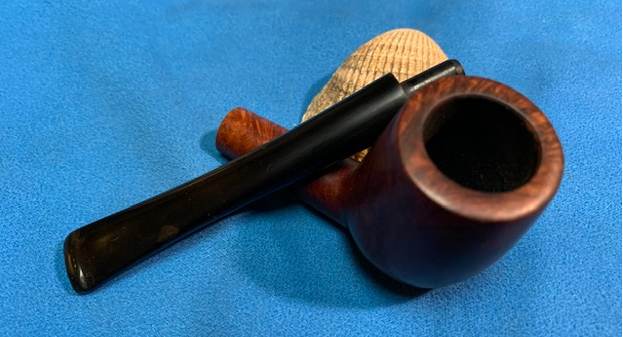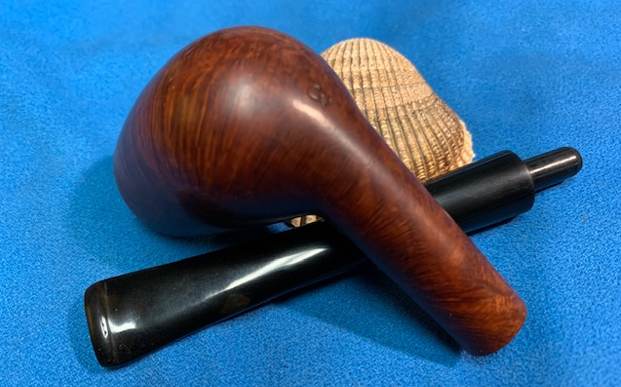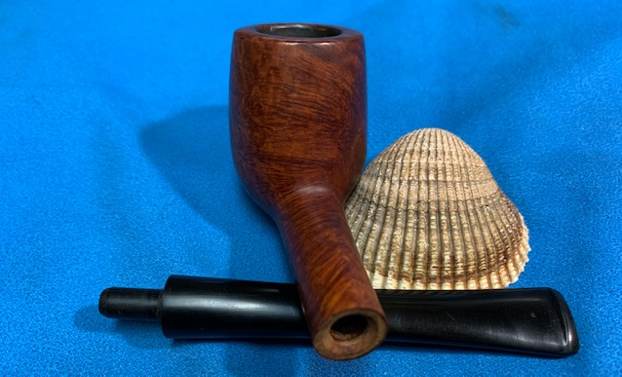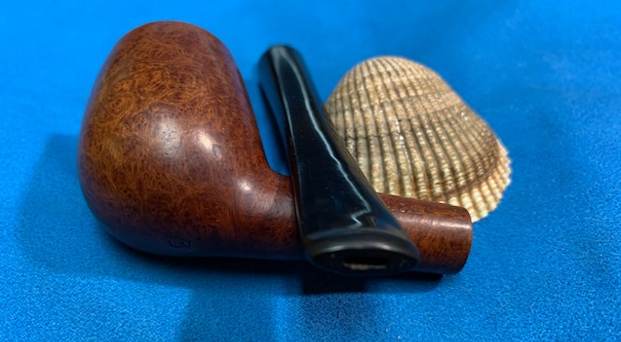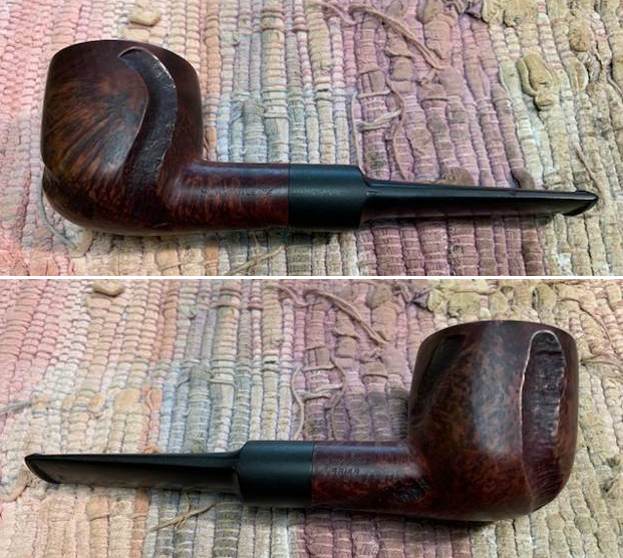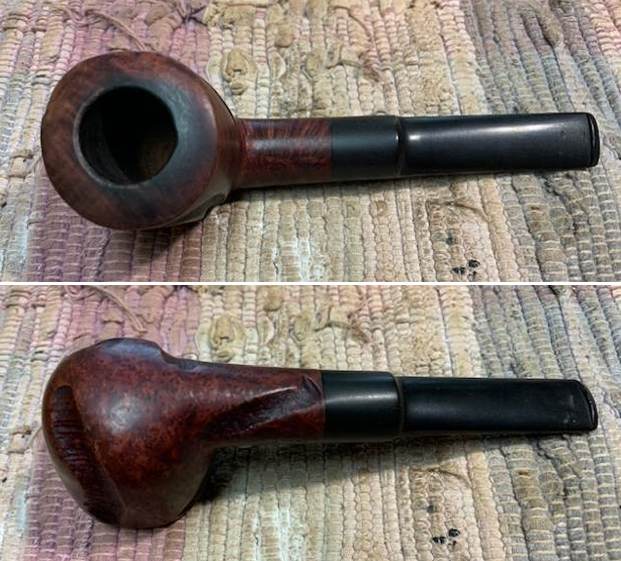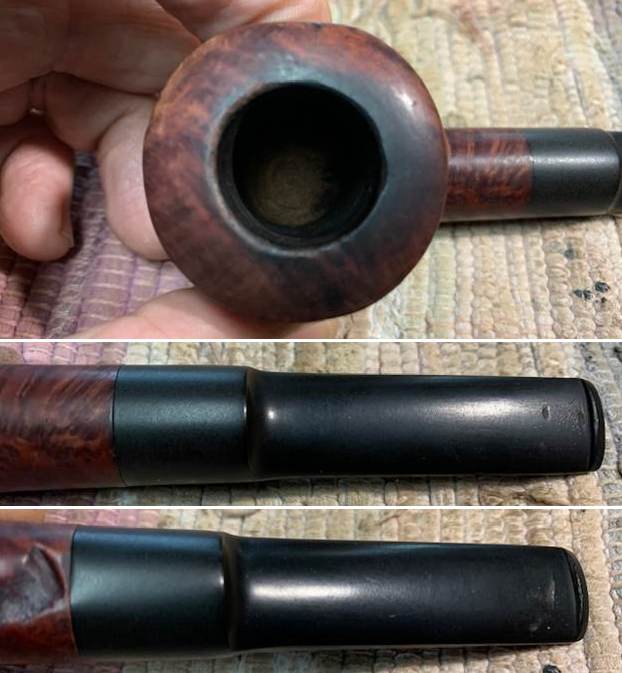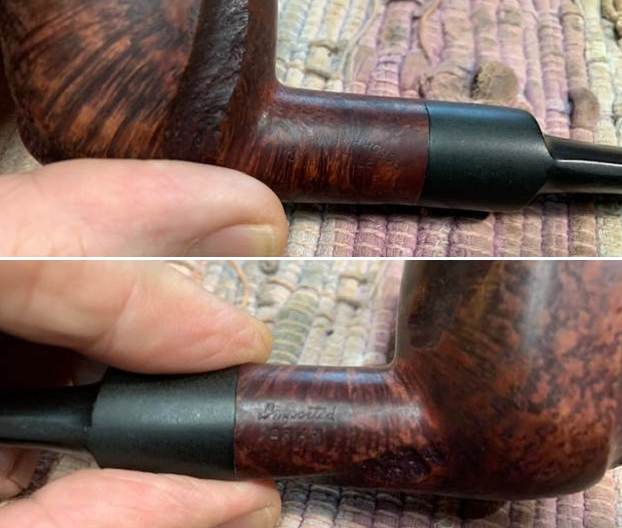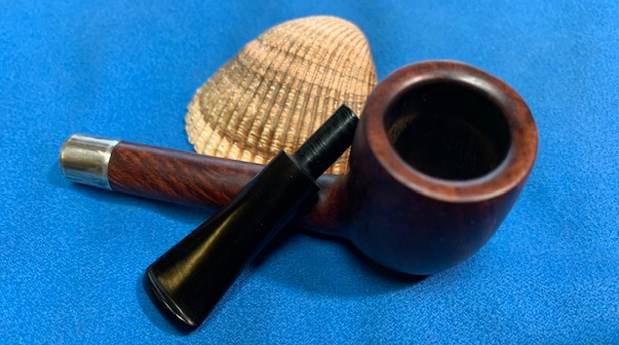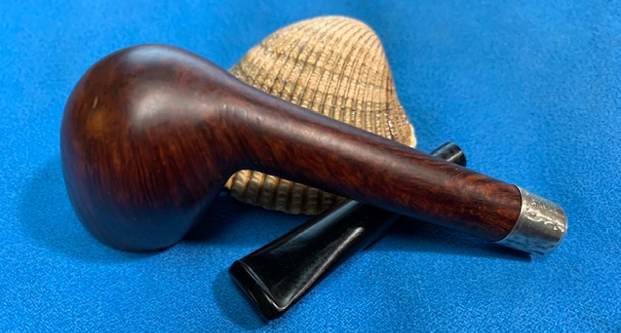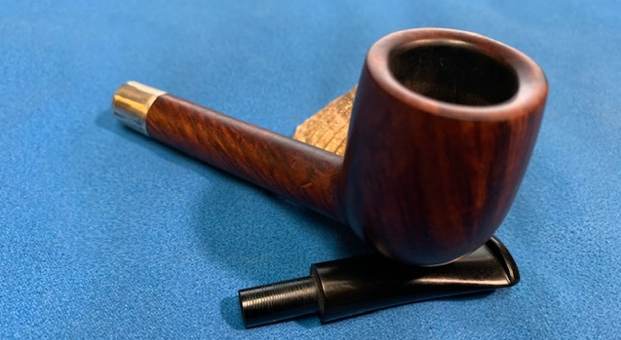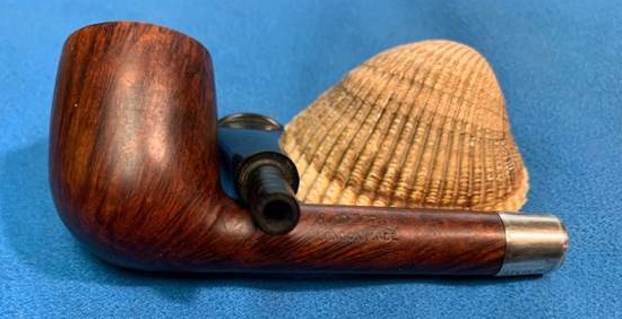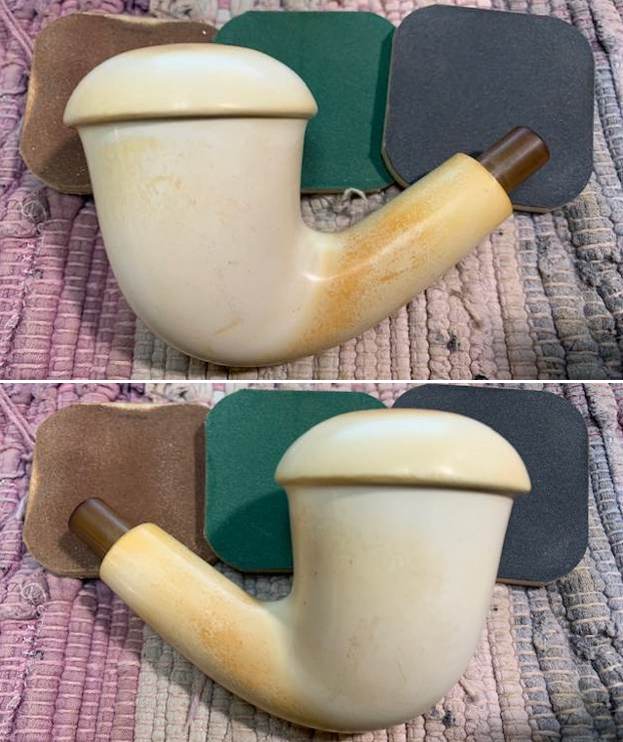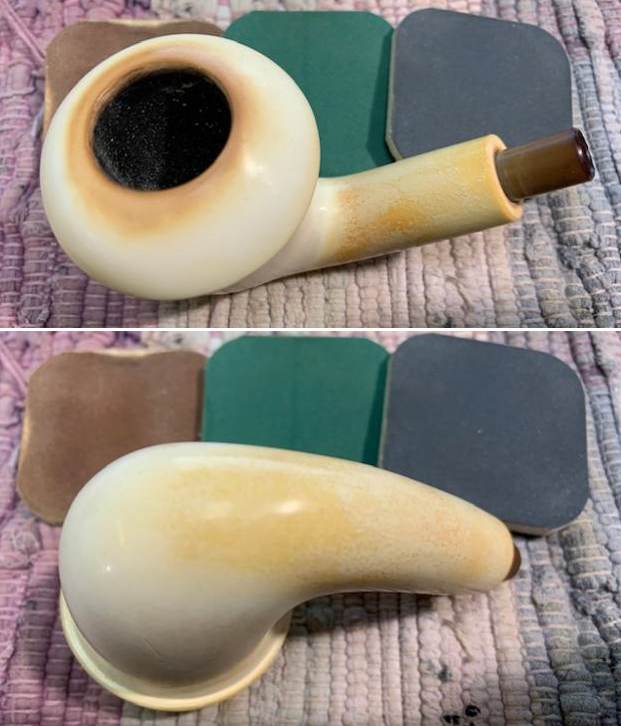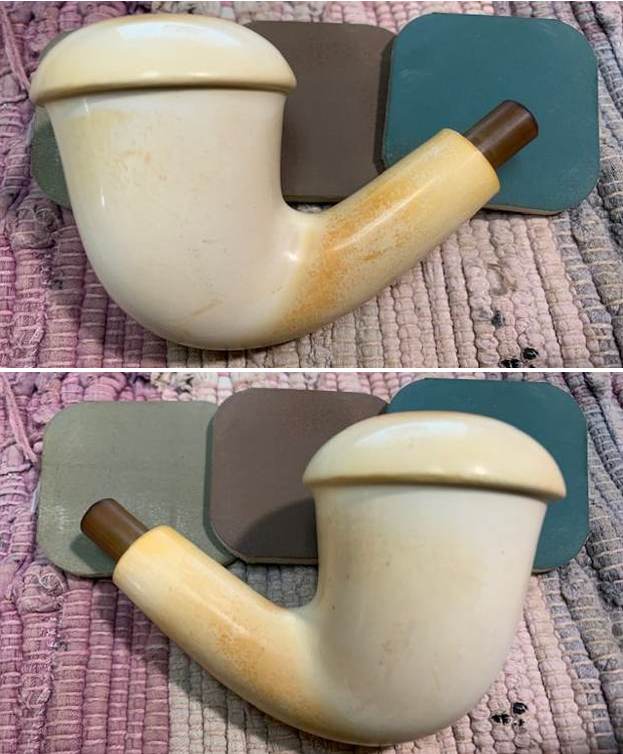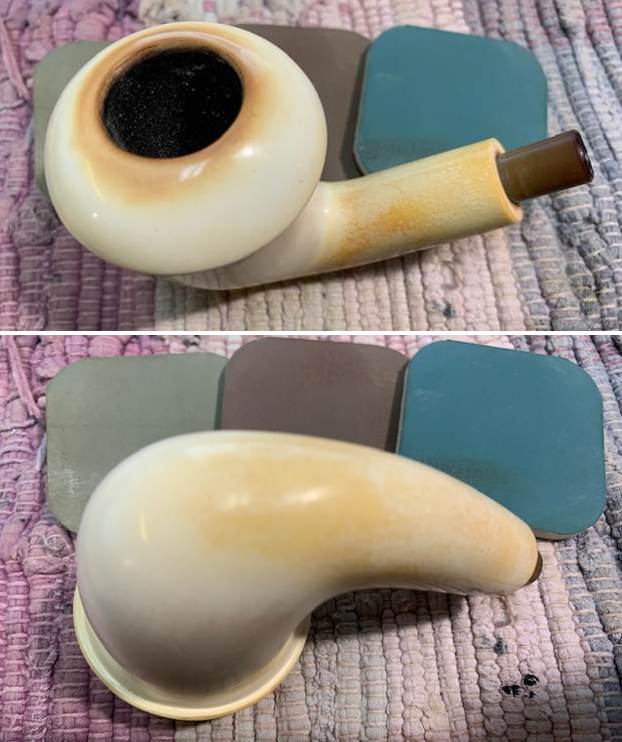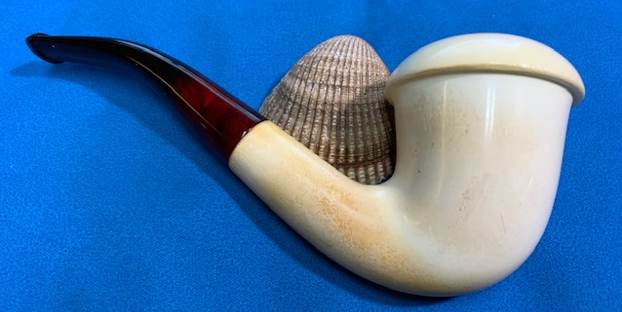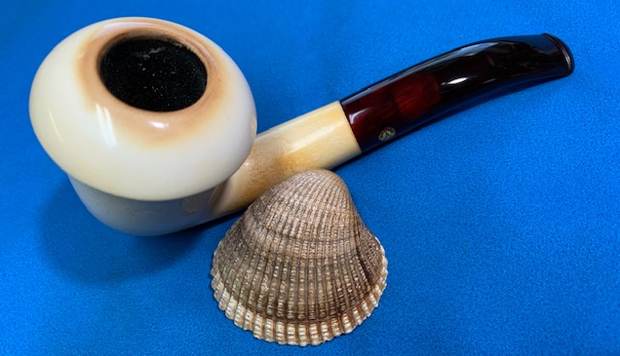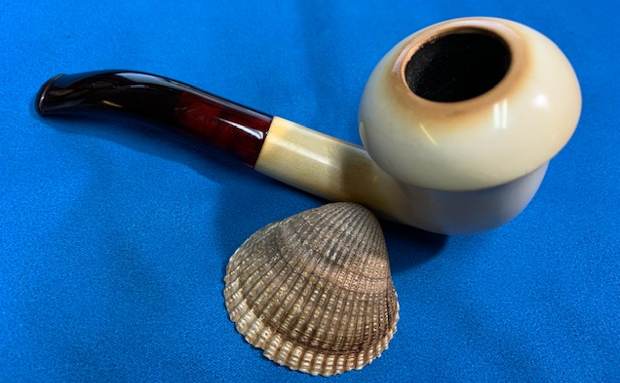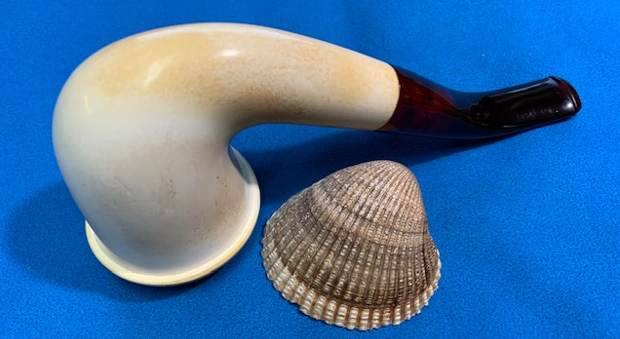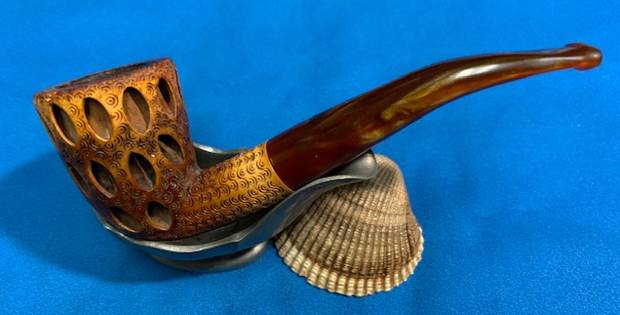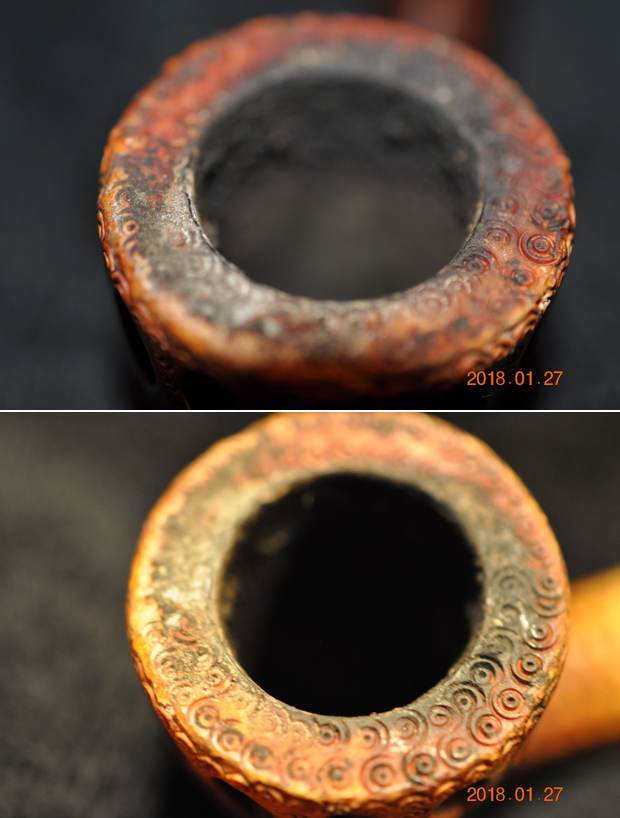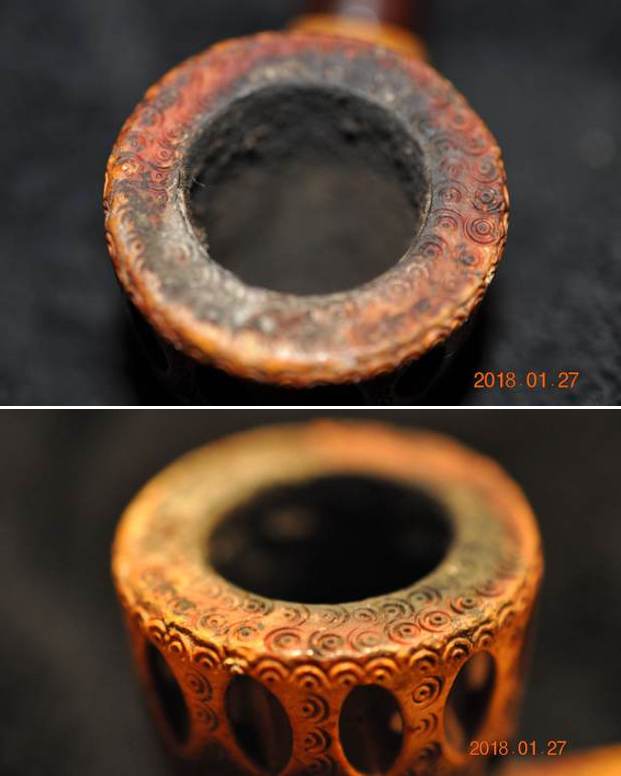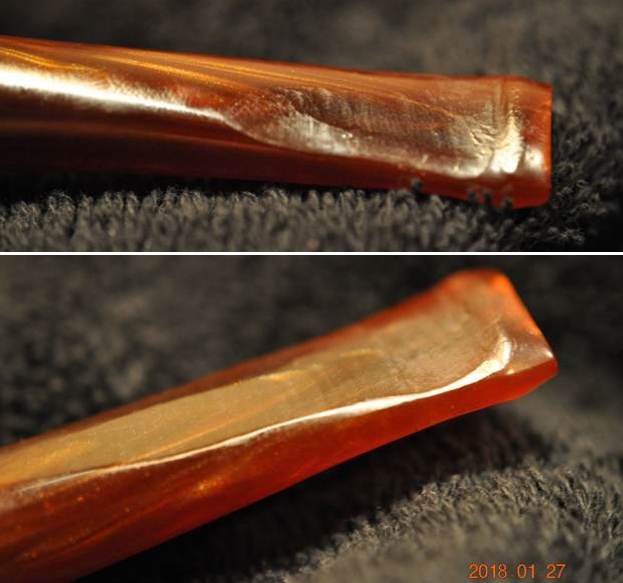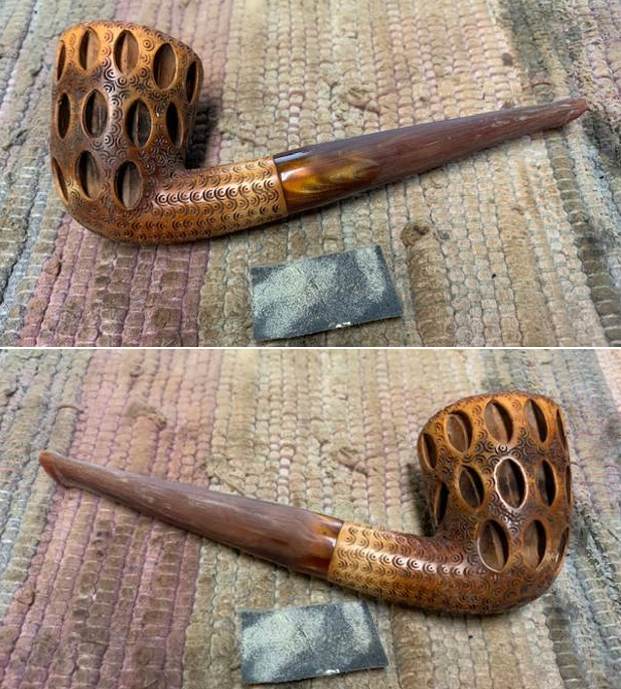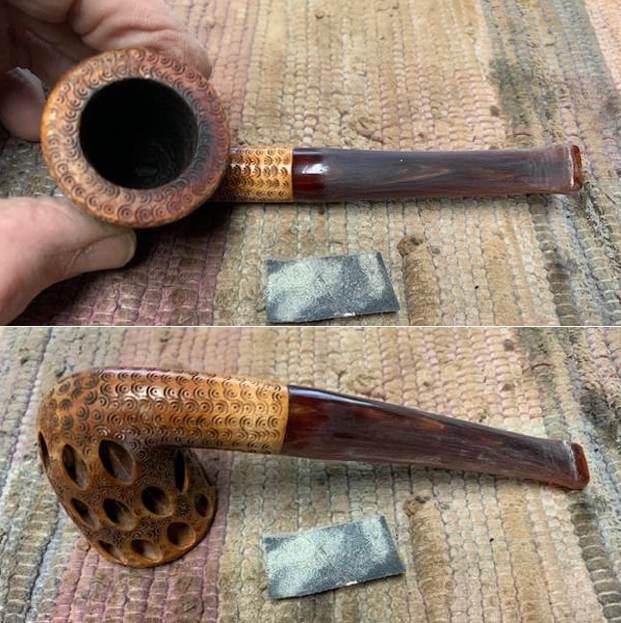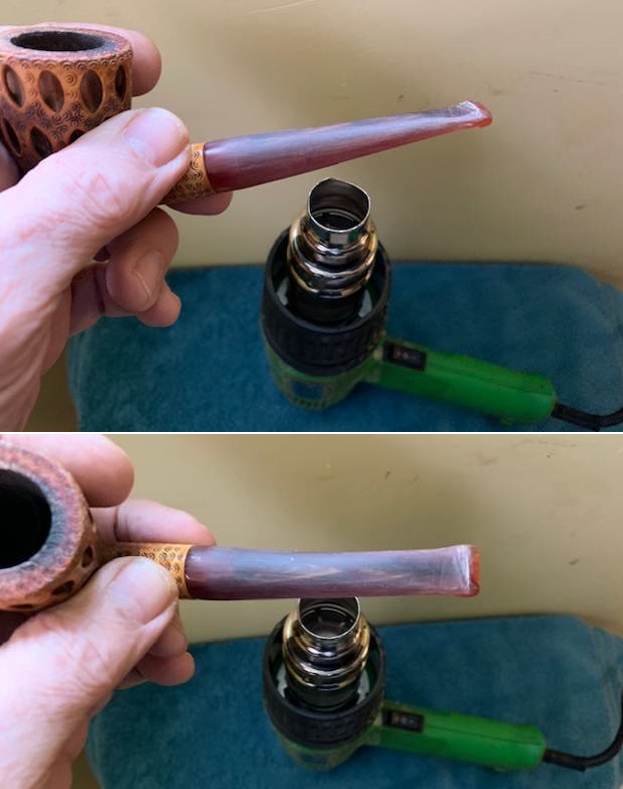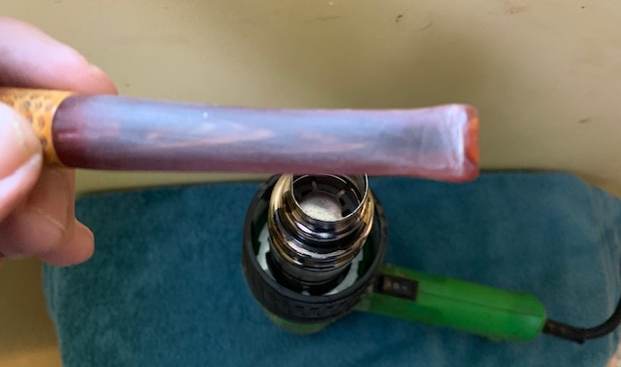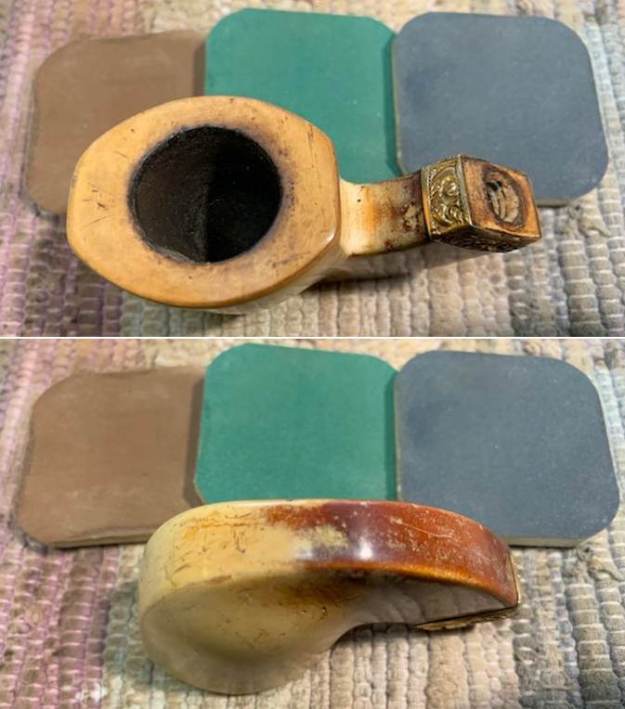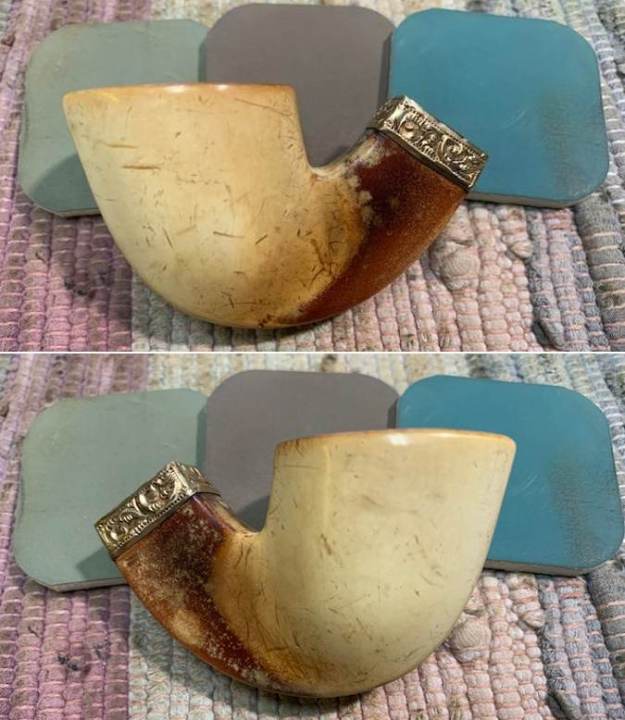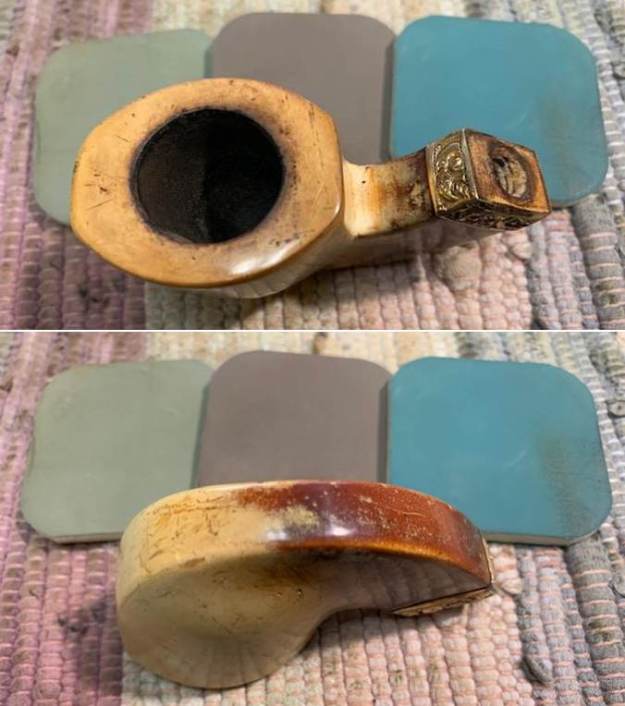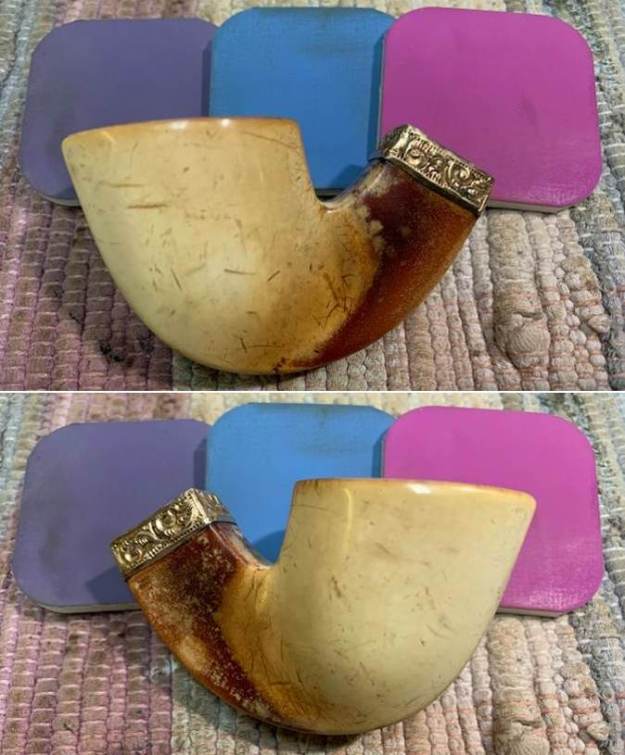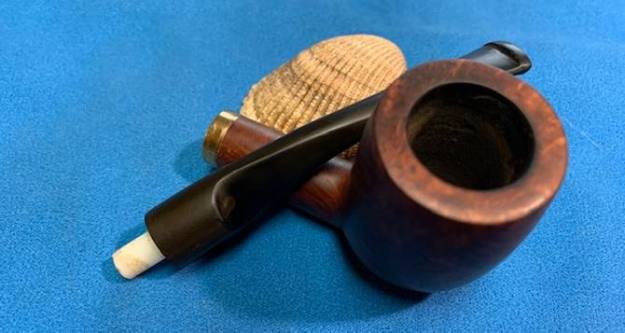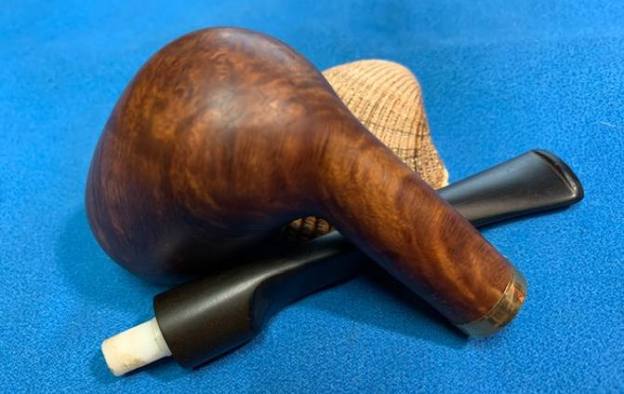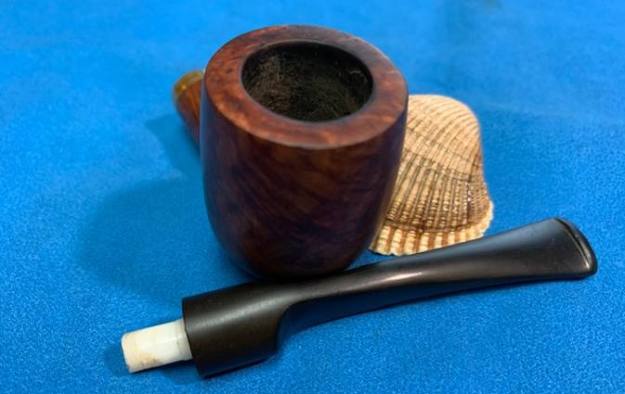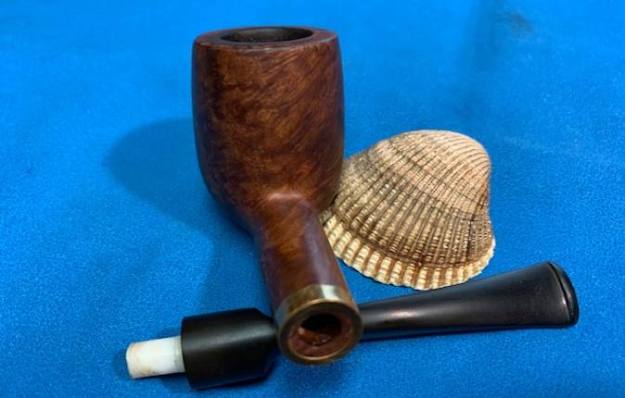
Tag Archives: fitting a stem

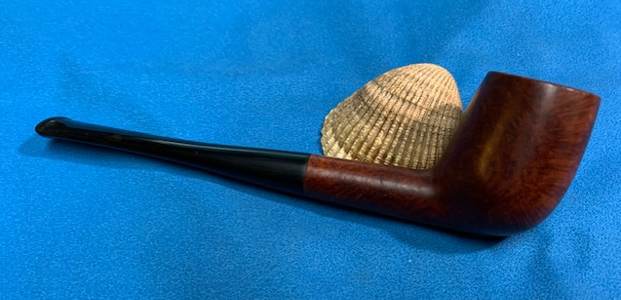
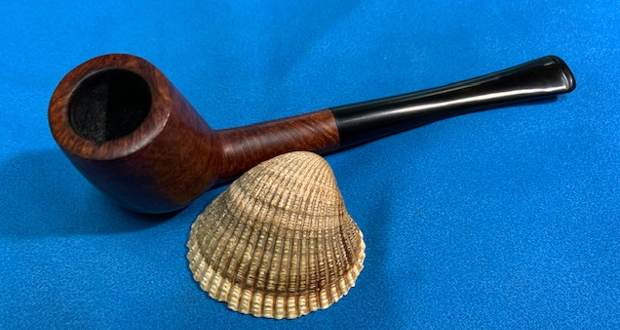
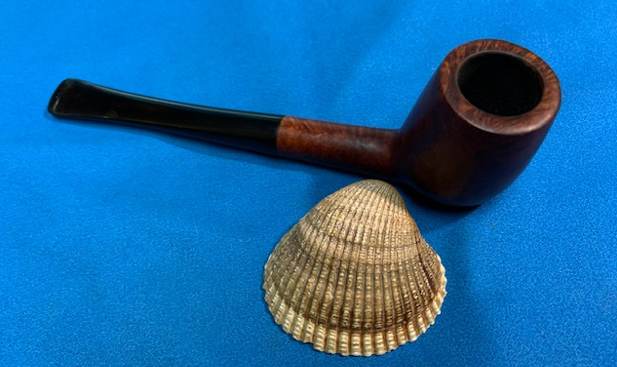
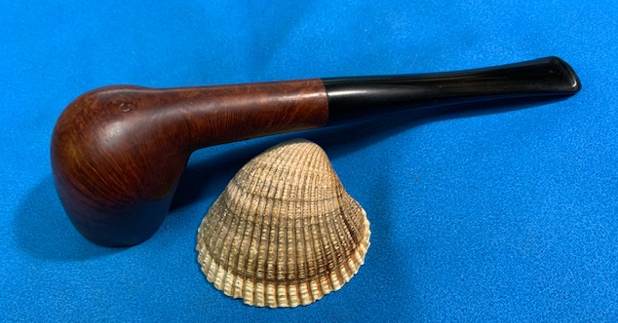
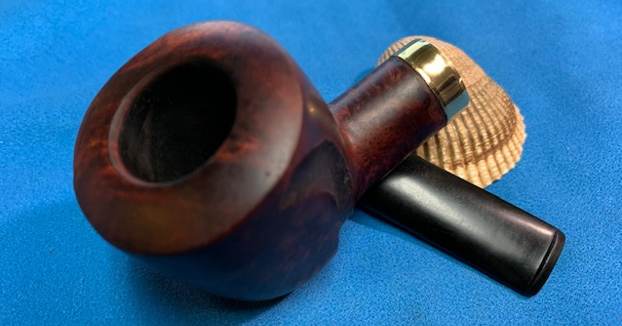
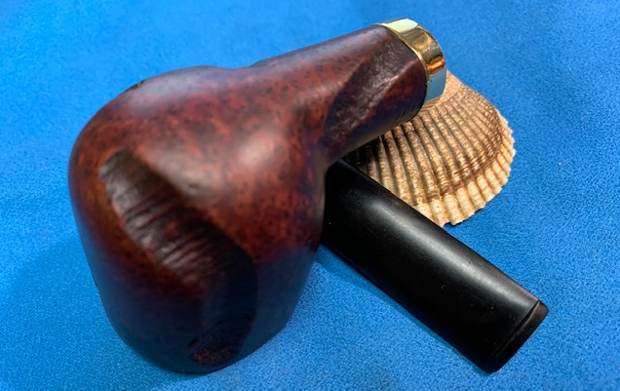
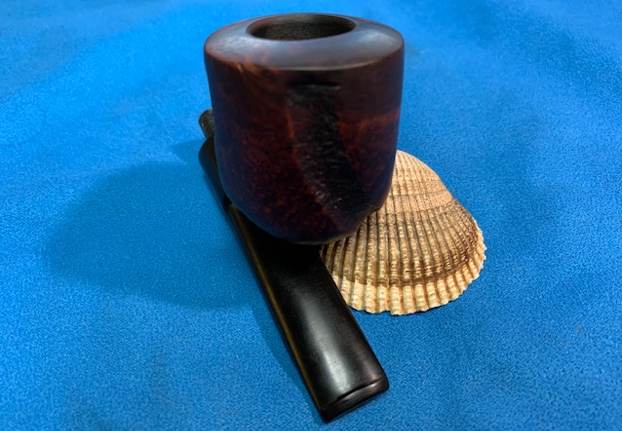
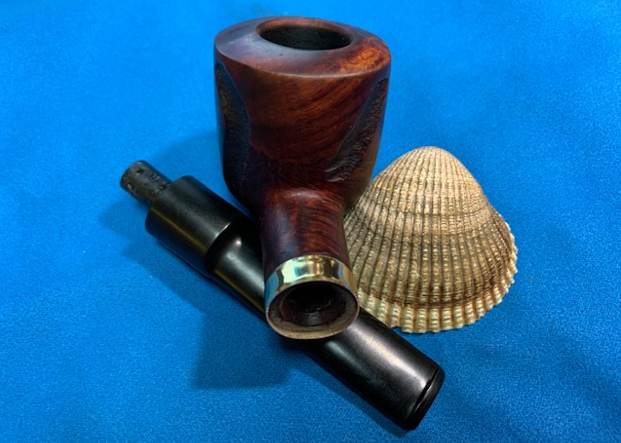
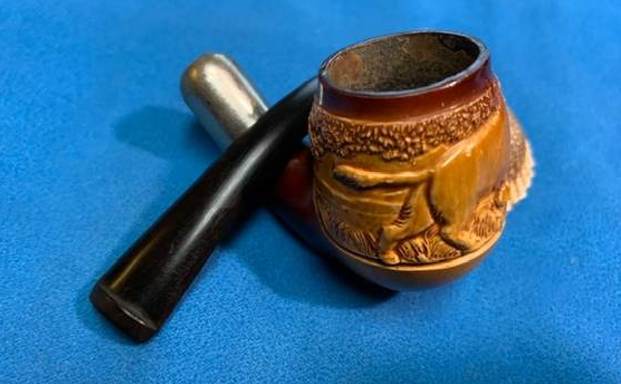
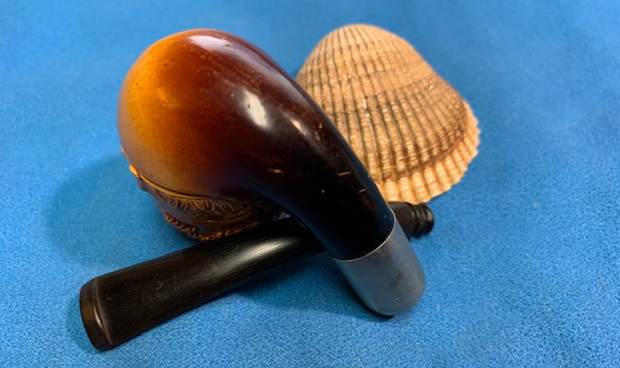
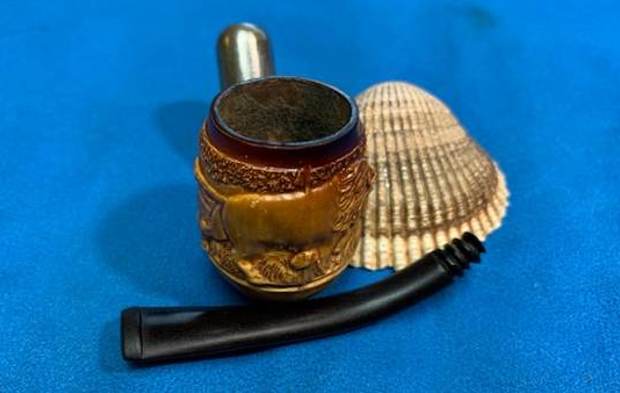
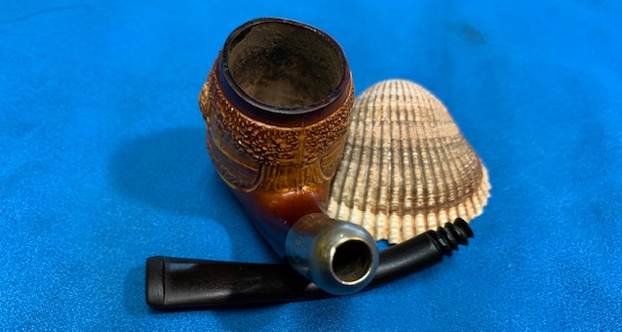
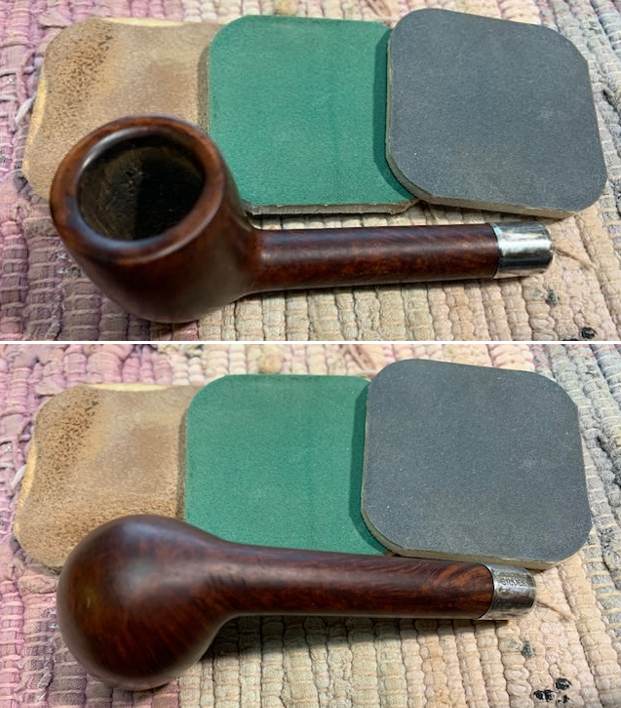
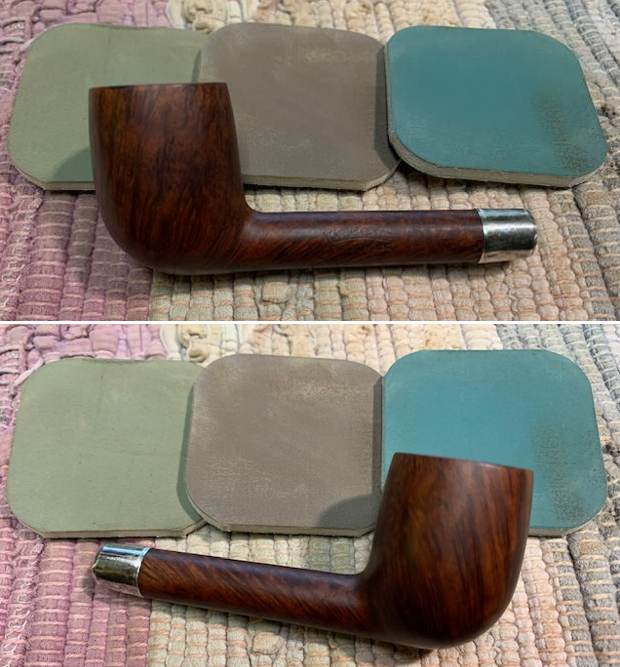
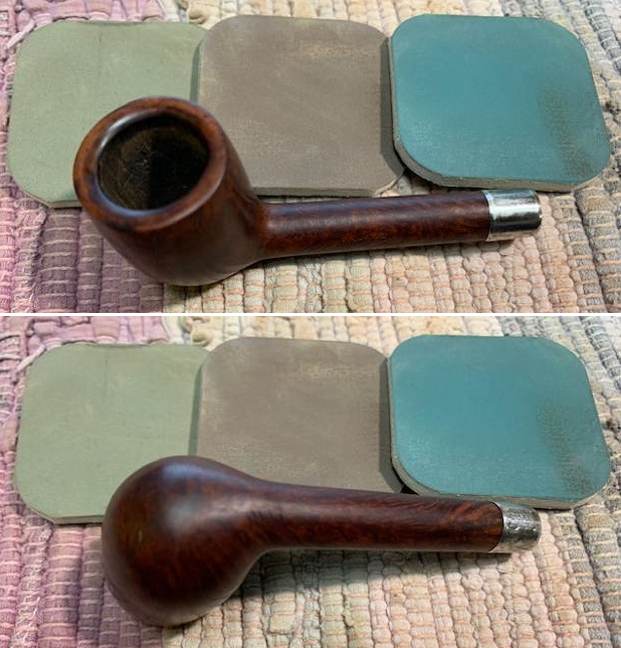
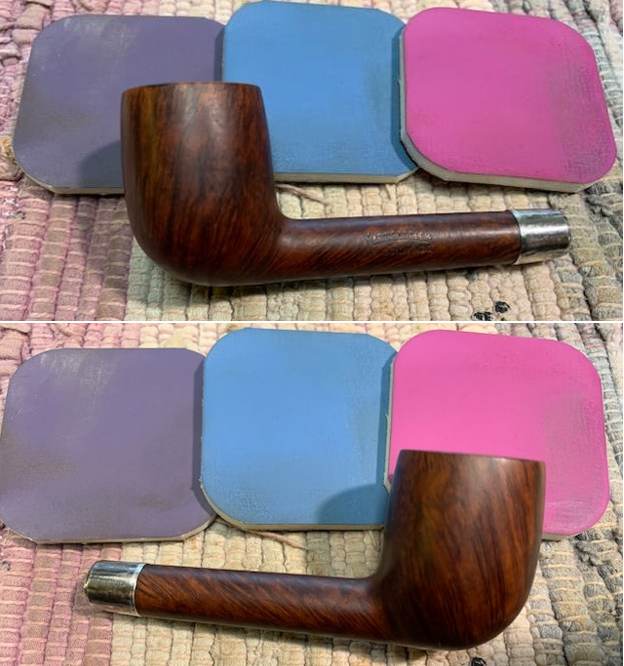
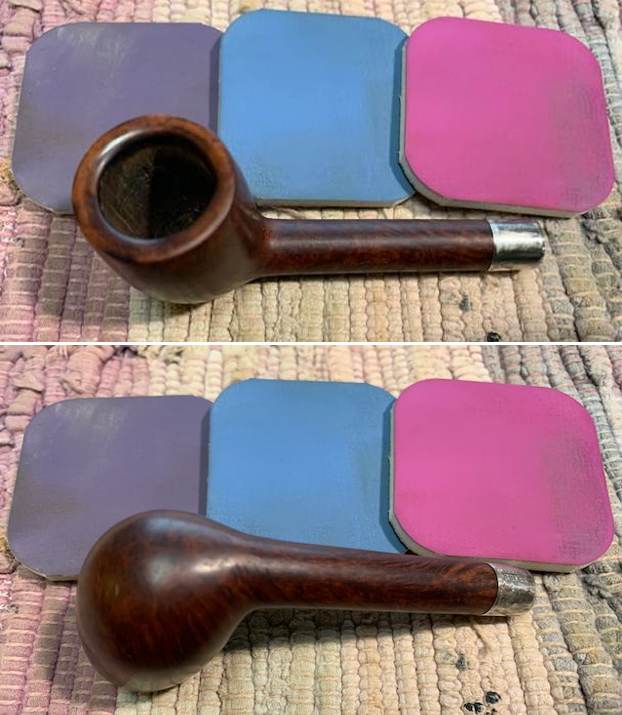
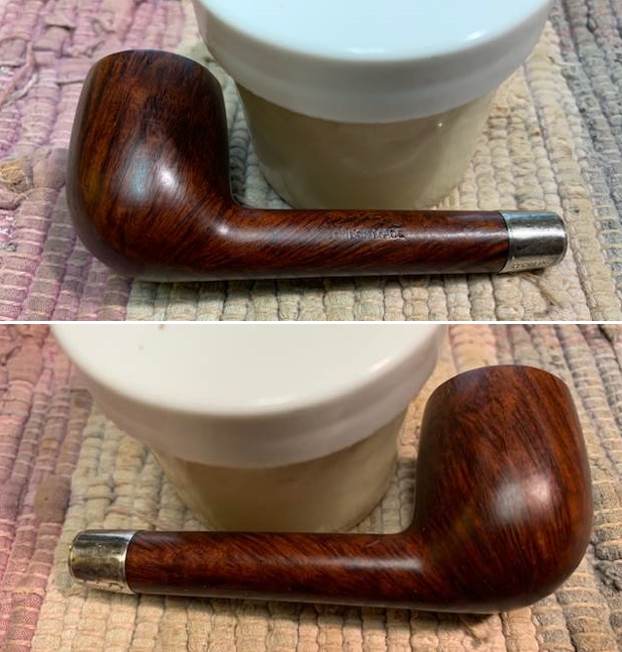
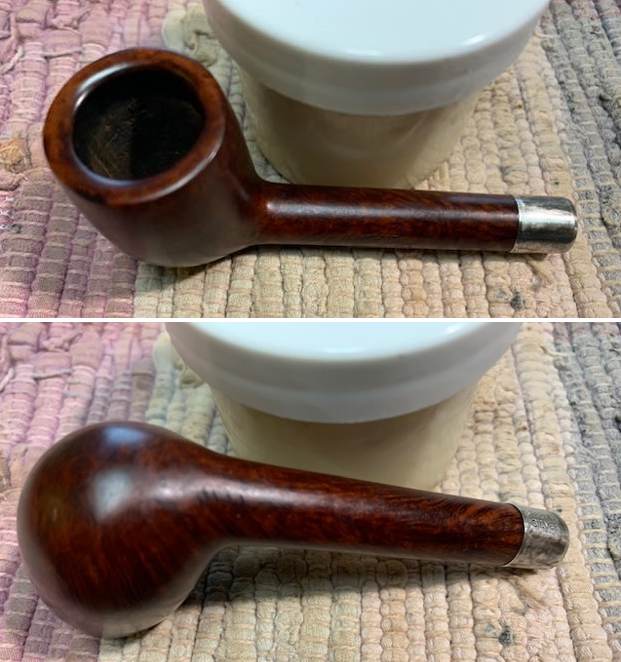
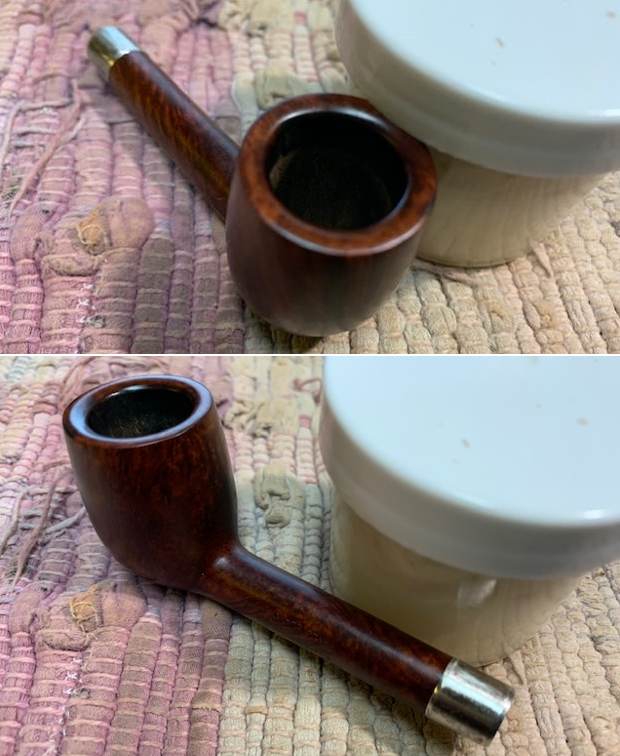
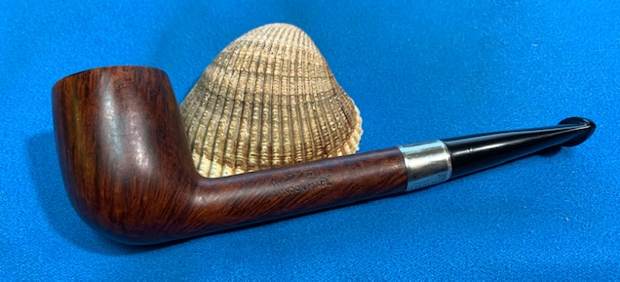
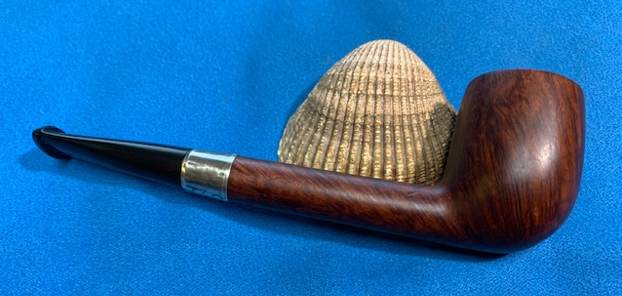
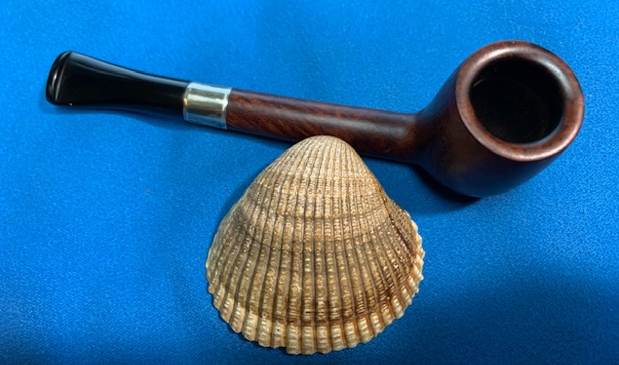
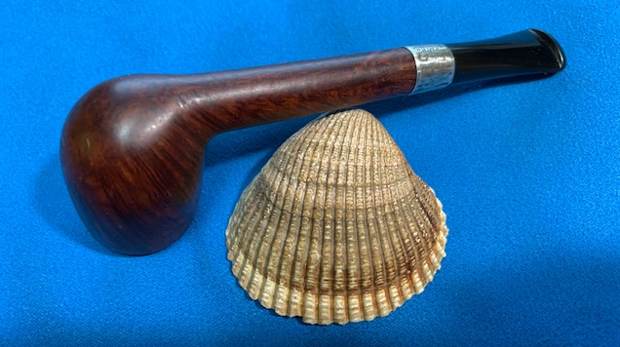
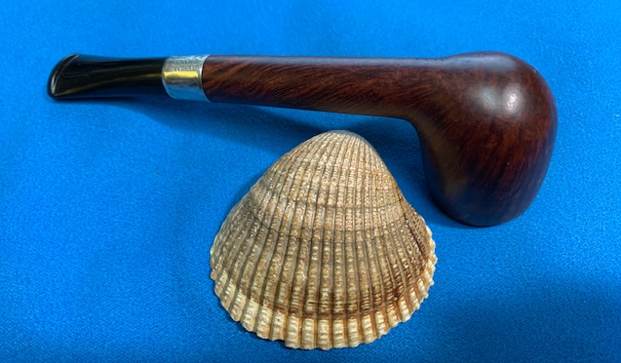
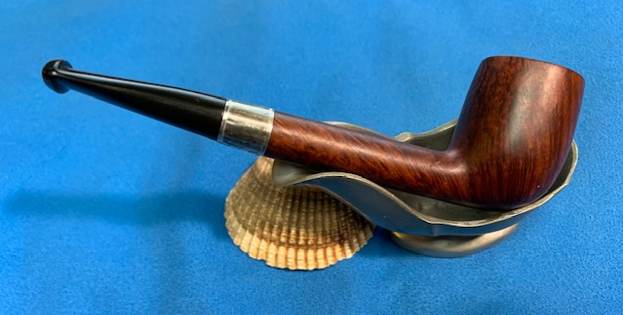
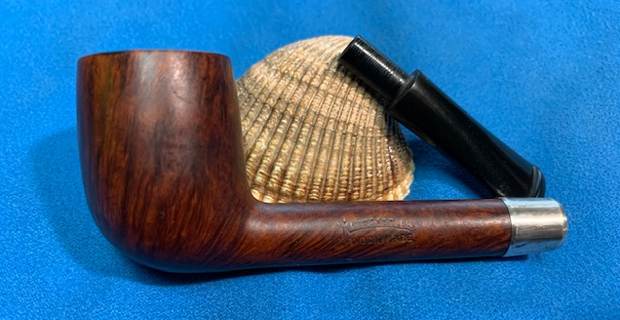
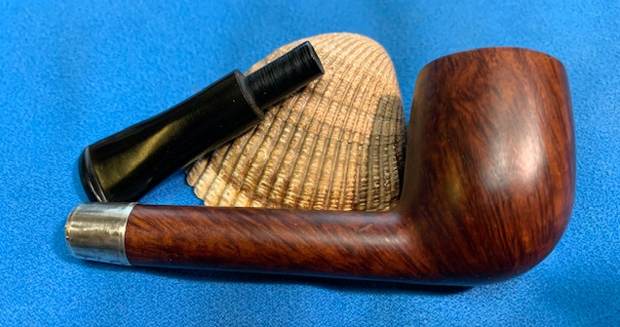
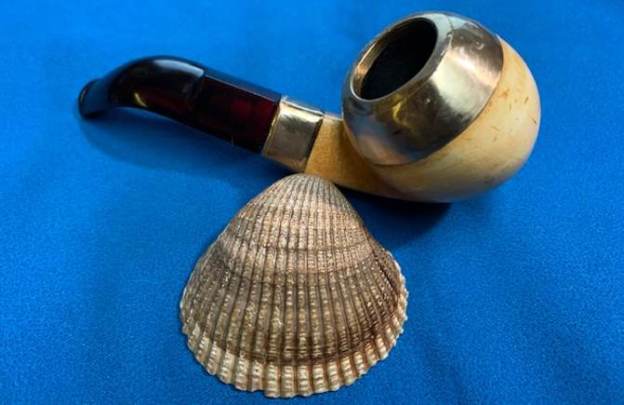
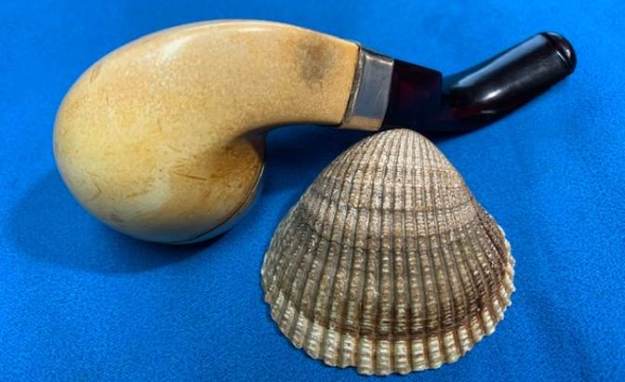
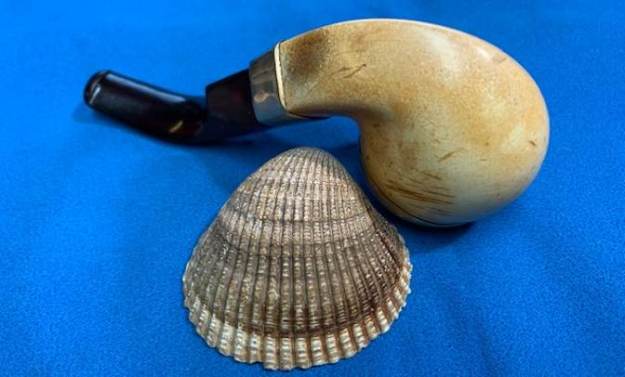
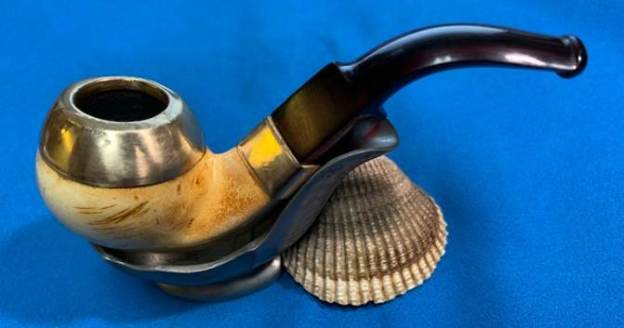
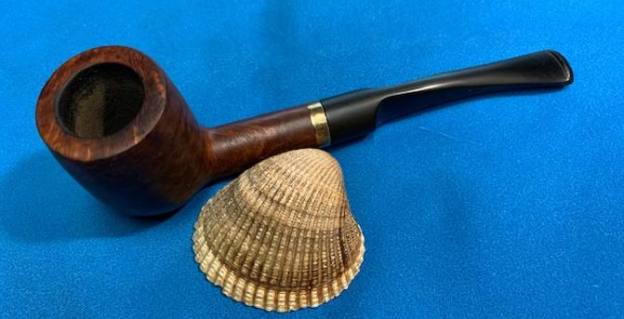
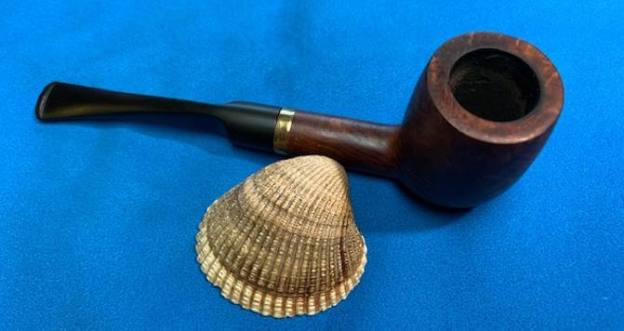
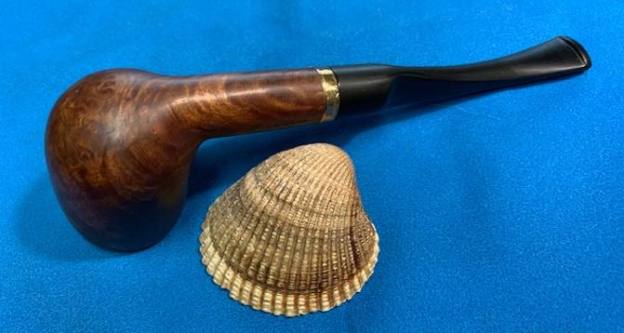
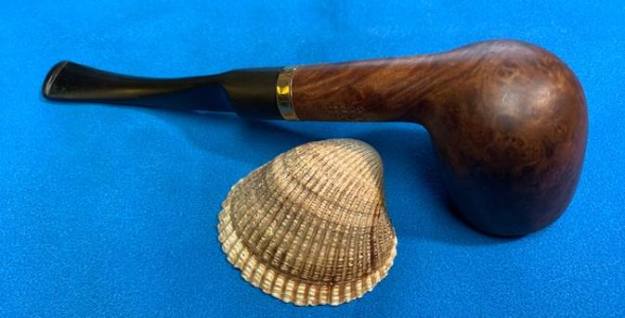
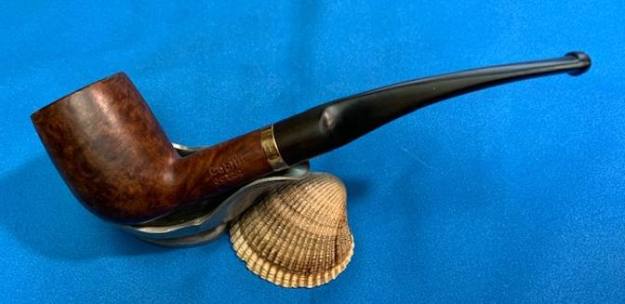
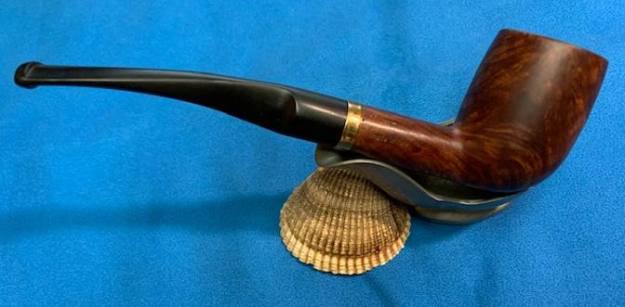
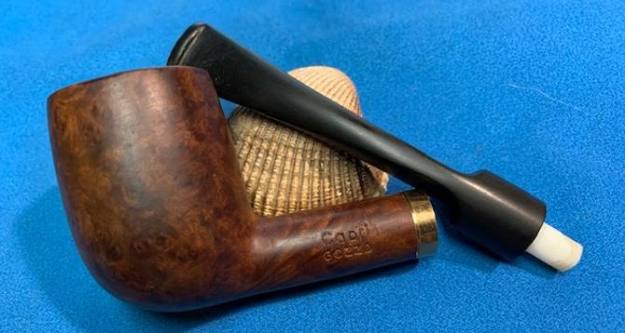
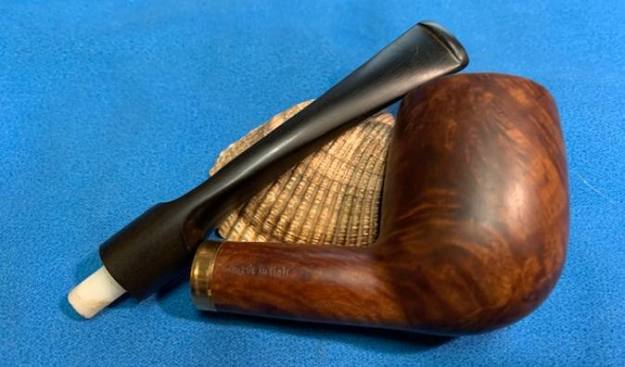
Restoring and Reshaping a stem on a beautiful “Malaga” Imported Briar 3 Cutty


Blog by Steve Laug

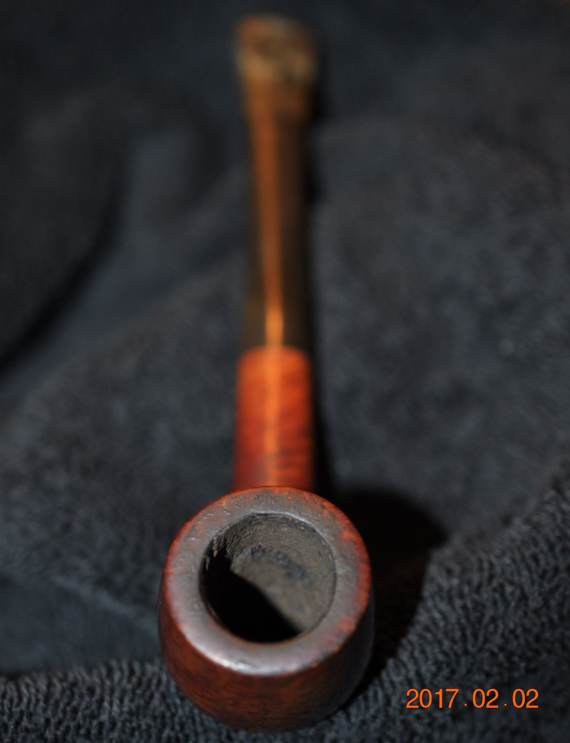
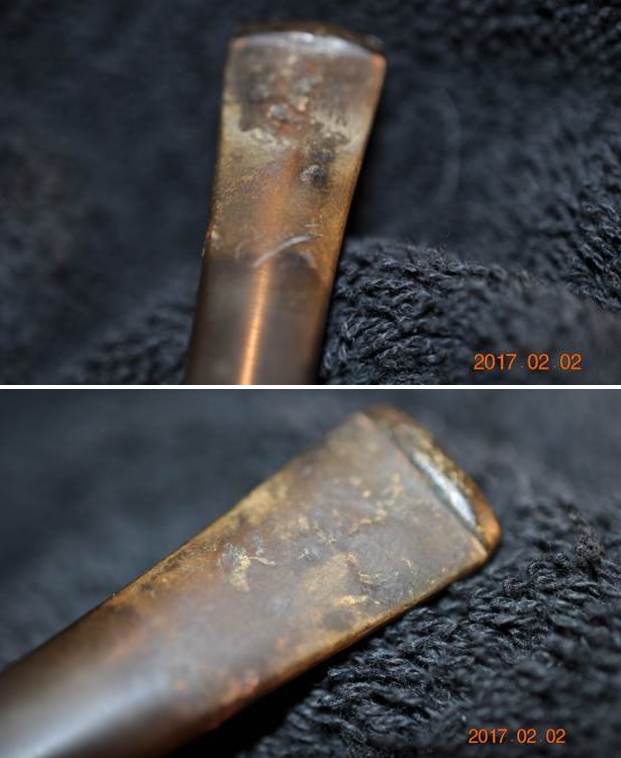
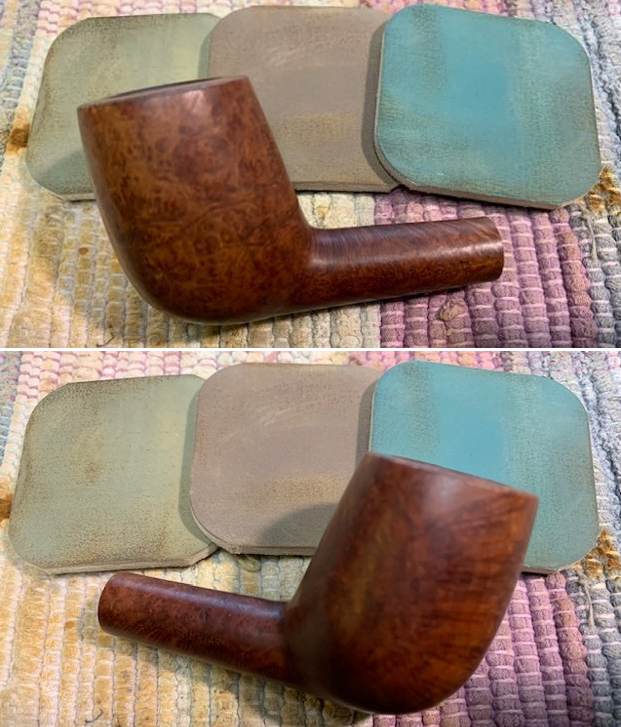
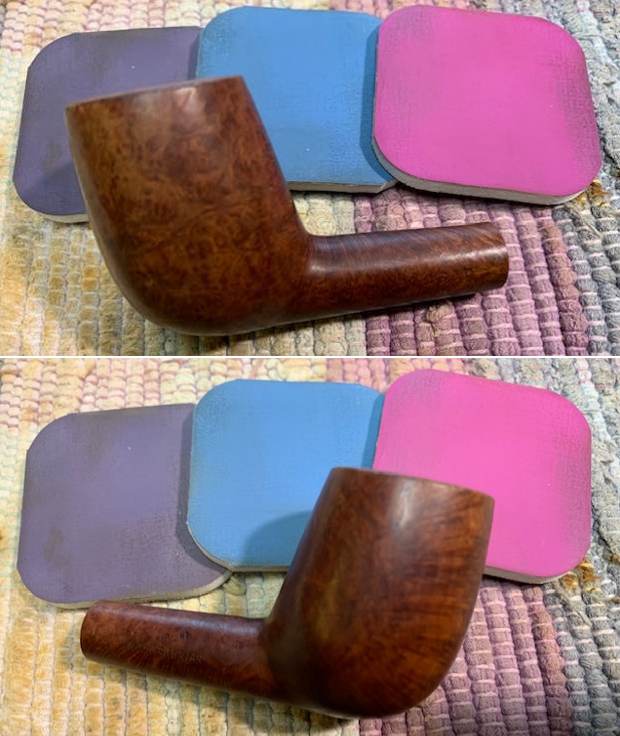
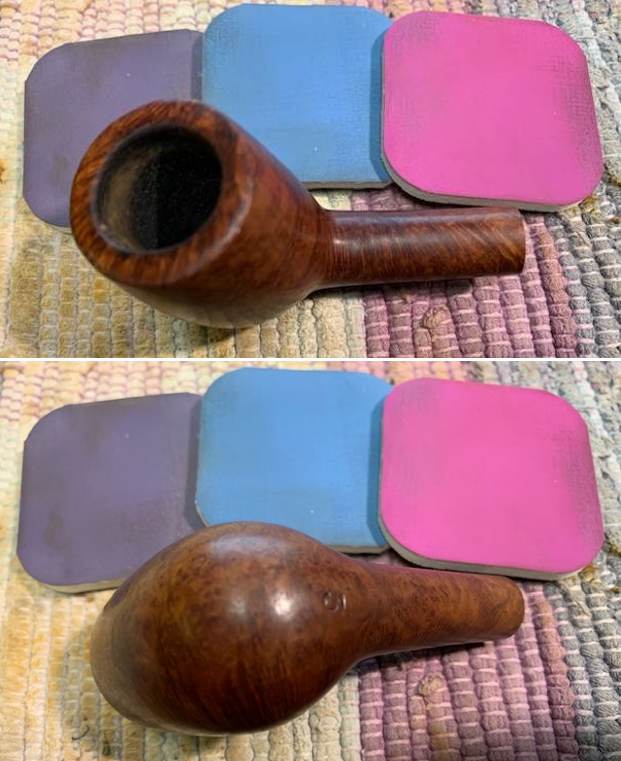
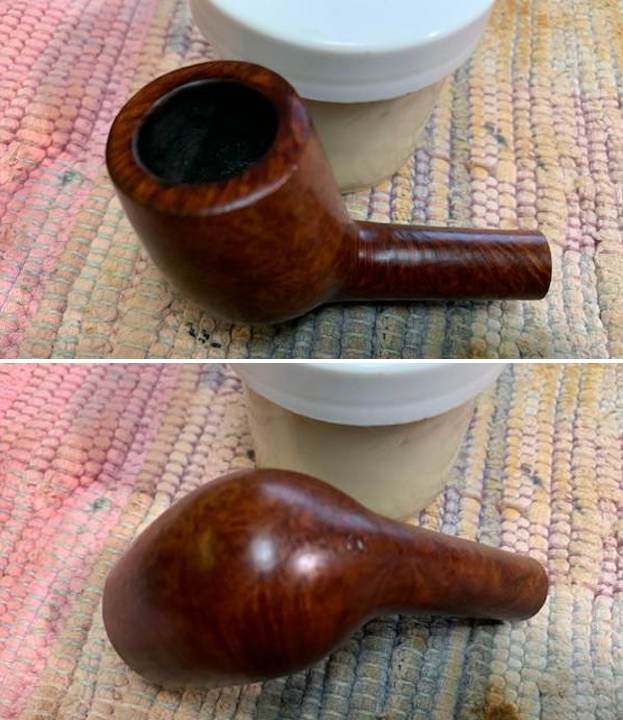
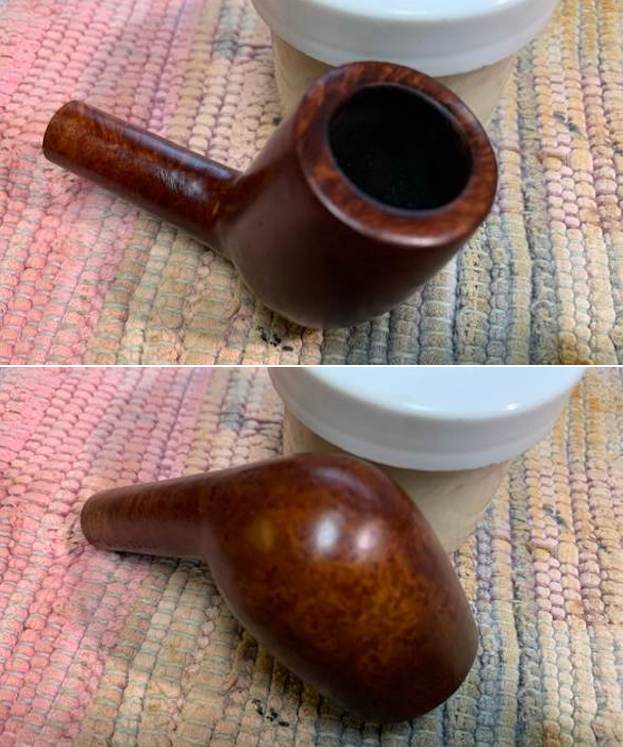
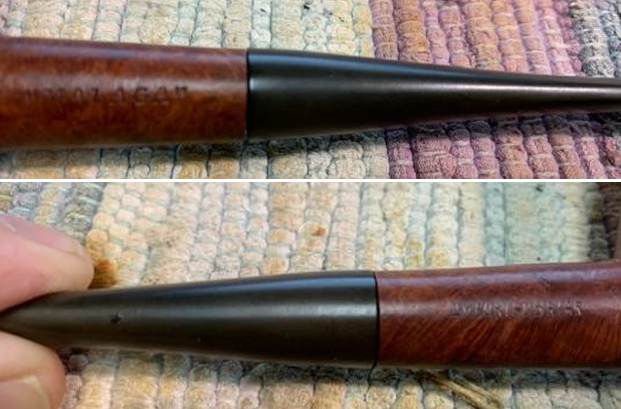
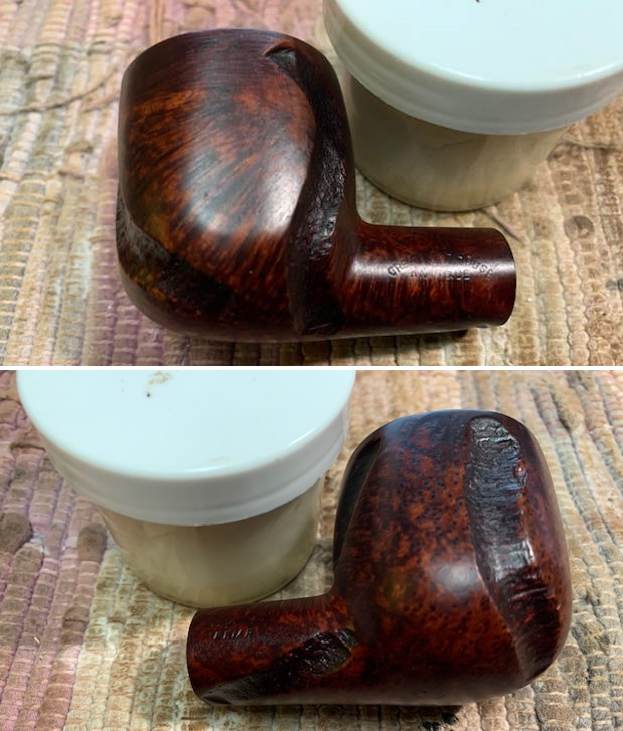
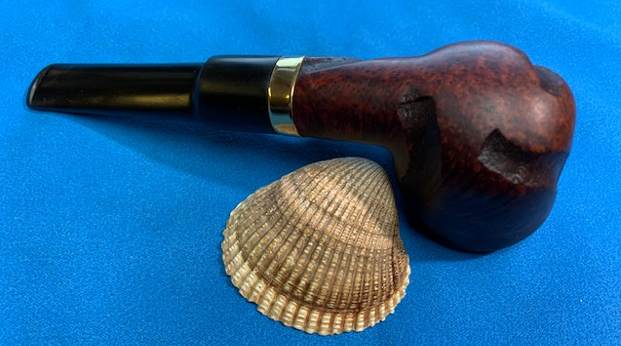
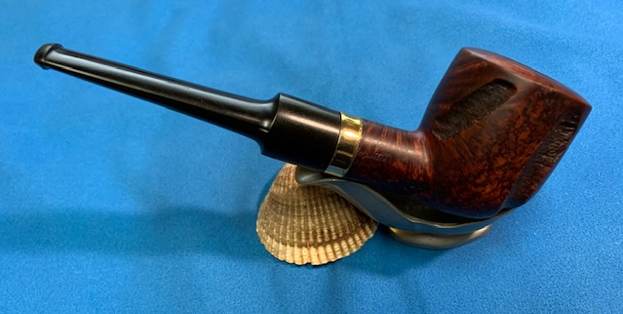
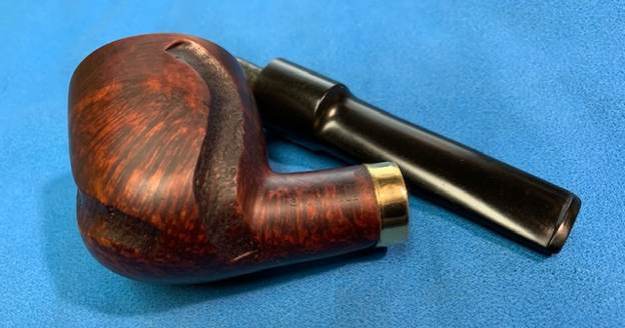
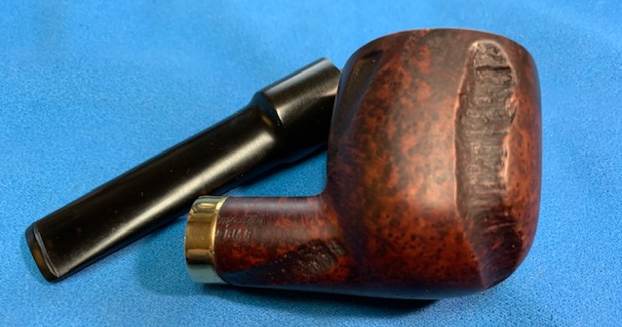
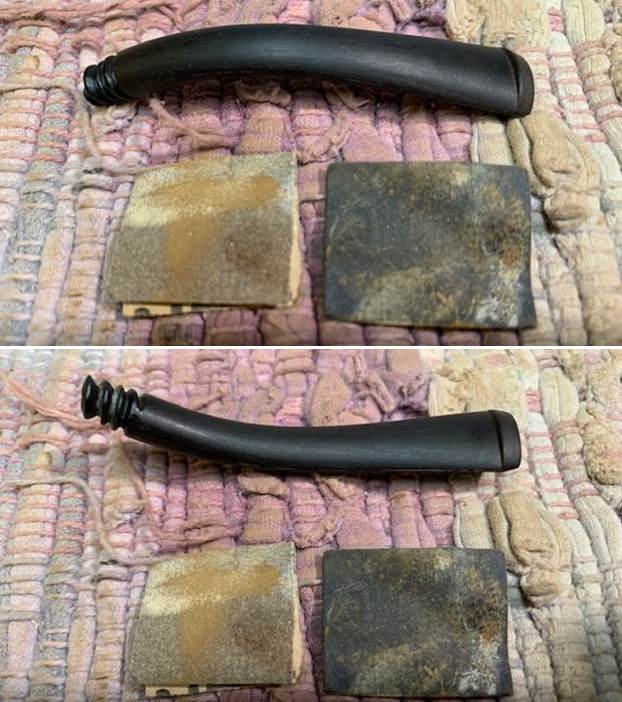
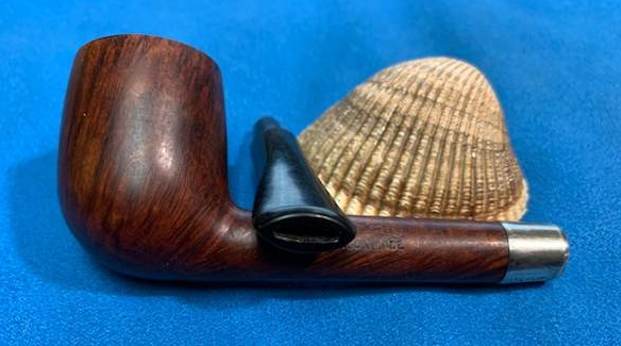
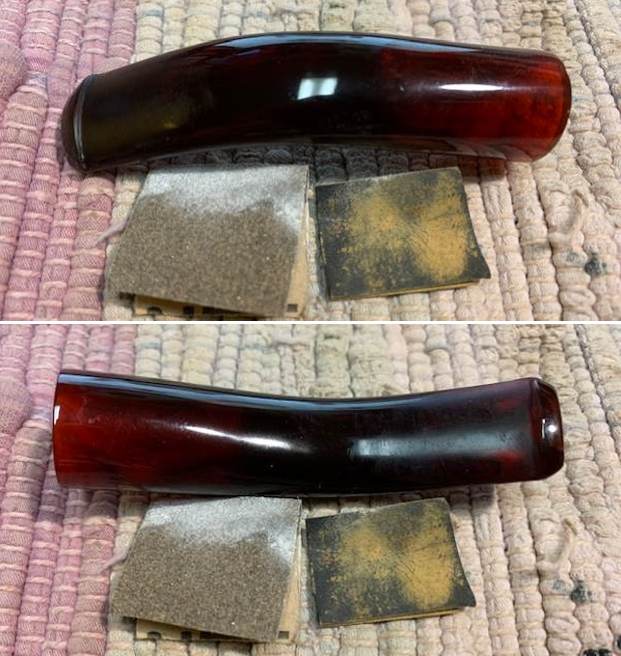
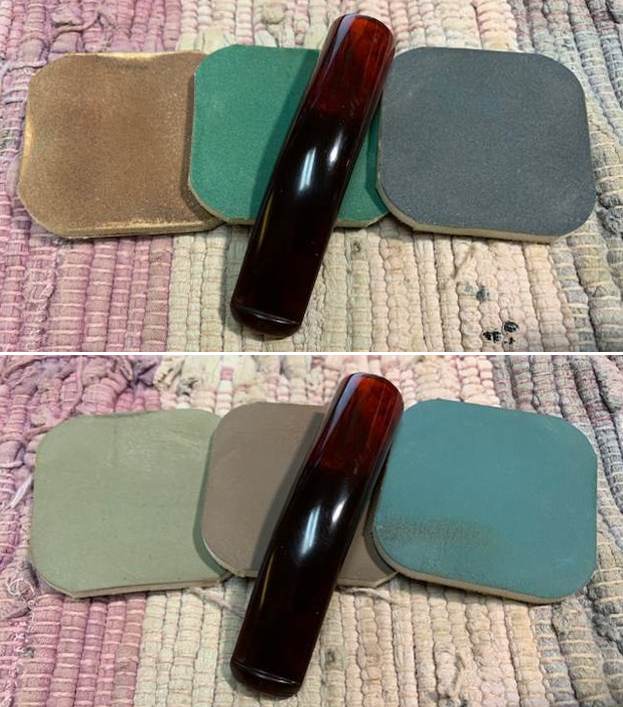
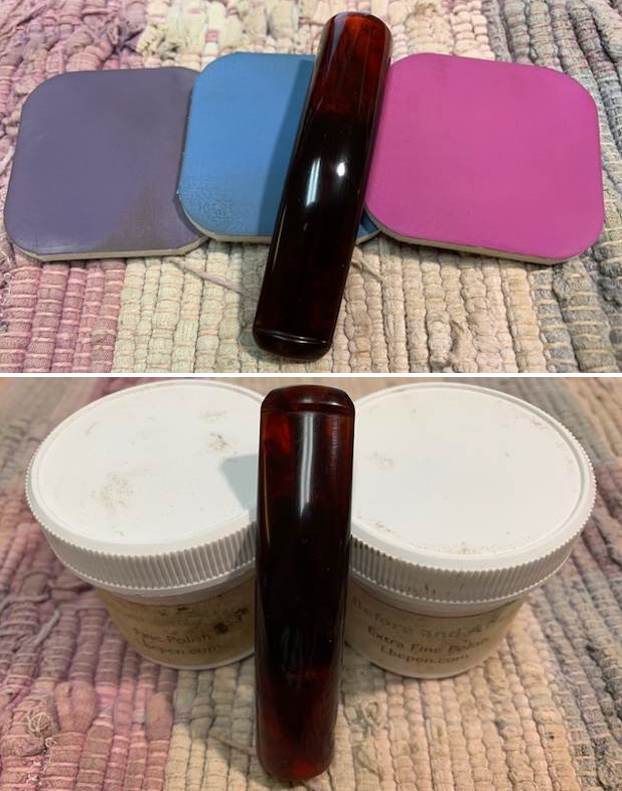
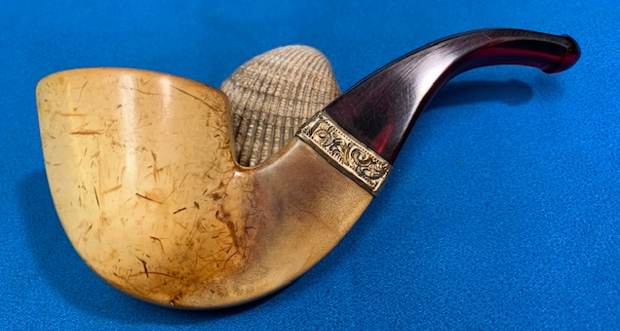
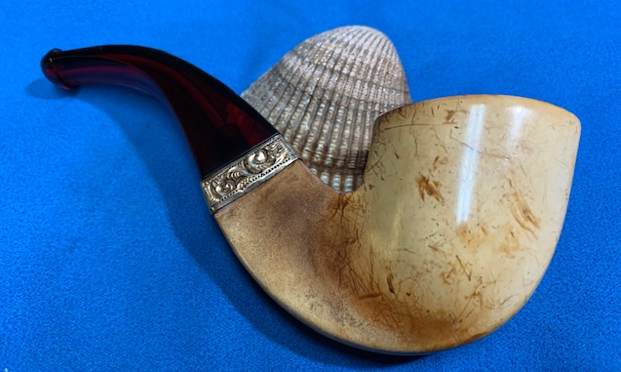
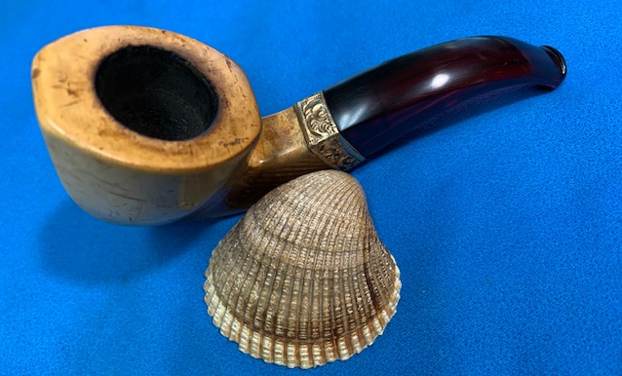
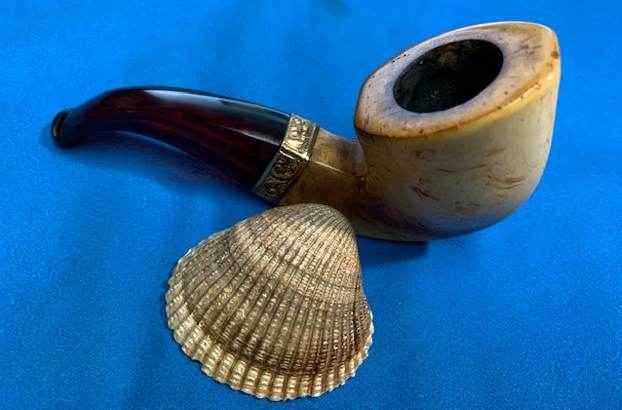
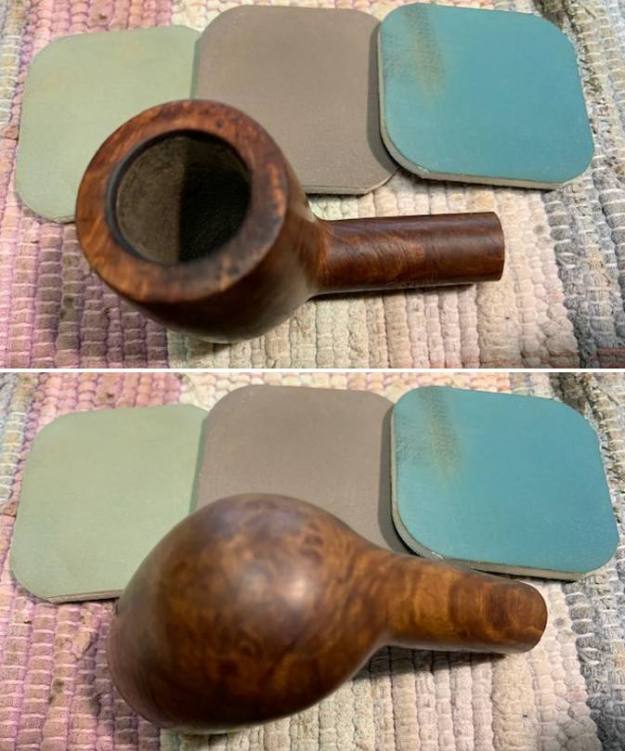
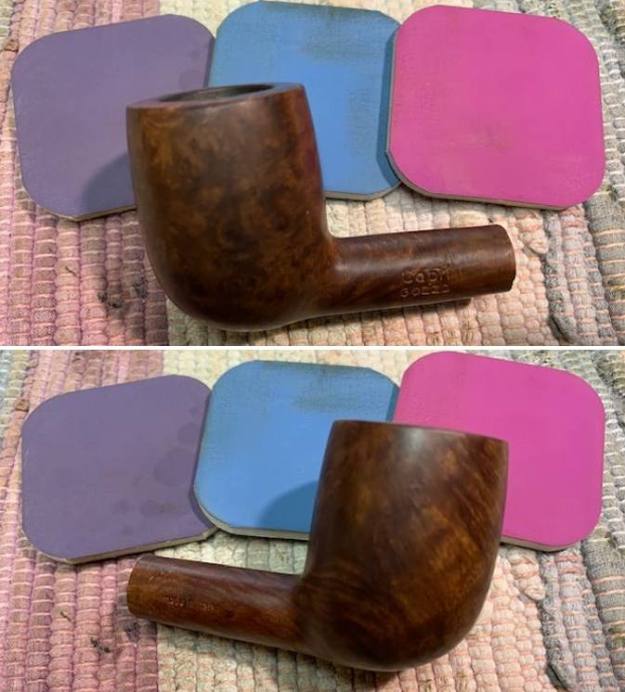
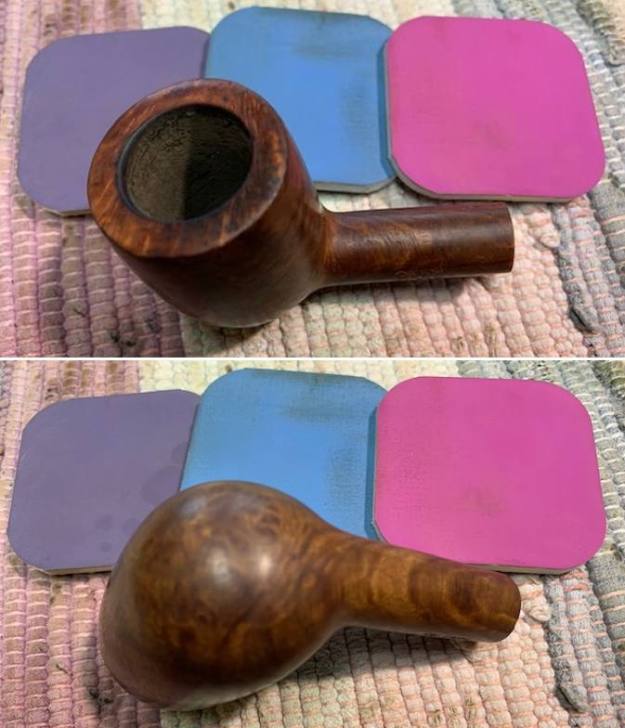
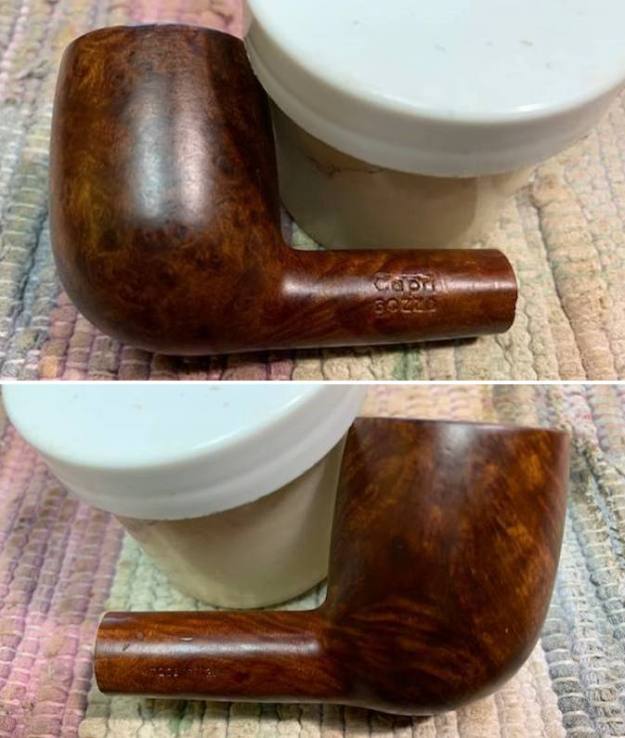
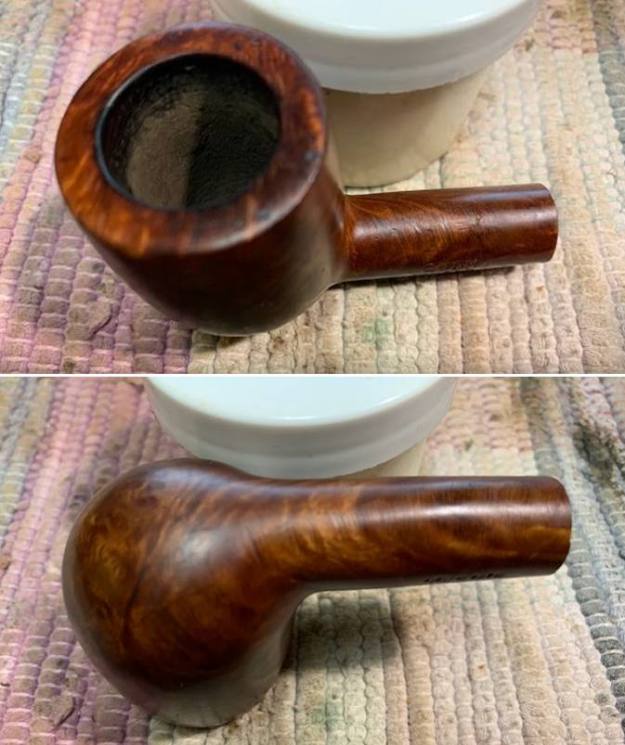
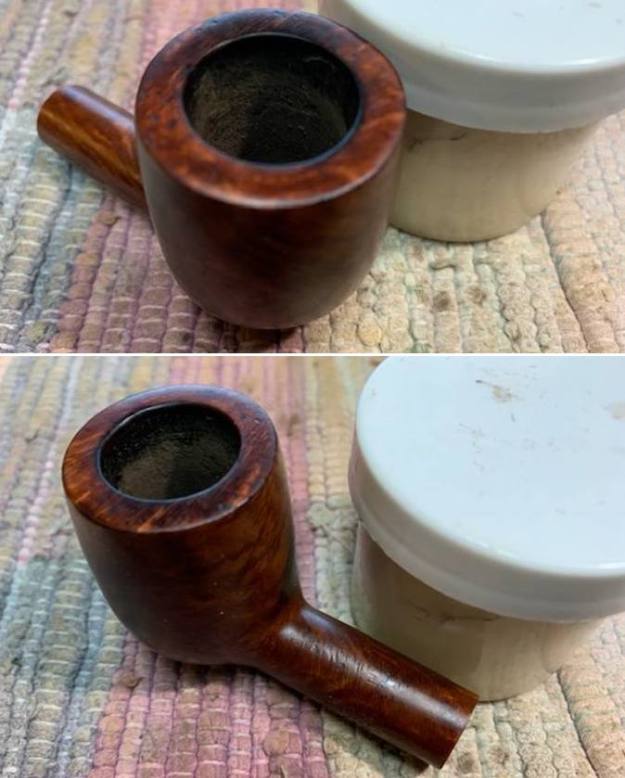
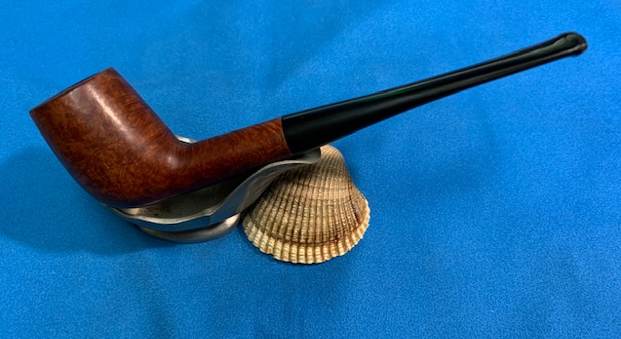
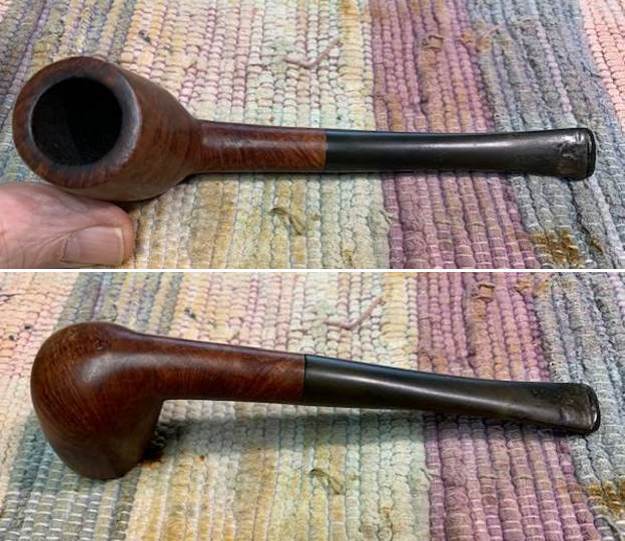
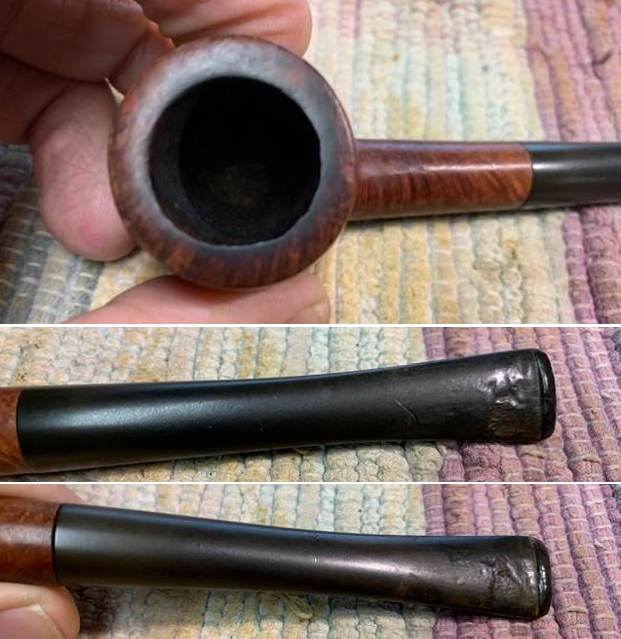
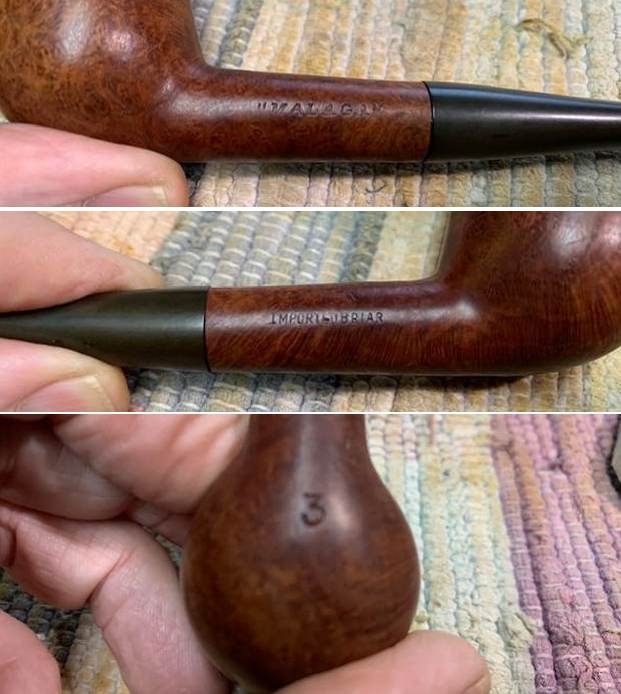
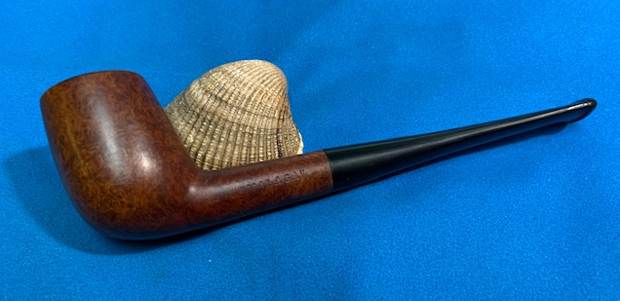
The next pipe I chose to work on from my box of pipes to be restored is a lovely “Malaga” Cutty with a poorly fit stem. We bought the pipe off eBay back in January, 2017 from Gilroy, California, USA. The stamping on the pipe was clear and readable. On the left side it read “MALAGA” and on the right side it read IMPORTED BRIAR. On the heel of the bowl it was stamped with the number 3. It was an interesting looking Cutty shaped pipe. The grain around the sides was quite nice and a mix of cross grain and birdseye grain. There was a thick cake in the bowl and a thick lava coat on the rim top. The inner edge of the bowl was so caked it was hard to know what the edge looked like underneath. The stem was oxidized, calcified and had a lot of deep tooth mark and chatter on both sides ahead of the button. It was a bit of a mess. Jeff took some photos of the bowl before he started to work on it. Jeff took photos of the bowl and rim top to show the cake in the bowl and the lava coat on the top and on the inner beveled edge of the bowl. I am hoping that it protected the edge from damage. He also took photos of the stem to show the deep tooth marks and chatter on the oxidized stem. He took photos of the bowl and heel to show the condition of the finish. Though the finish is dirty and grimy you can see some nice grain showing on the bowl sides. Jeff took photos of the stamping on the sides of the shank and the heel of the bowl. It read as noted above and was readable. I have worked on a lot of Malaga pipes in the past so I am not a stranger to the brand. I have blogged their restorations, so rather than repeat previous blogs, I am including the link to one that gives some of the history of the Malaga brand and the Malaga Pipe Shop in Royal Oak, Michigan in the USA from a catalogue. It gives a sense of the brand and the history in their own words. Follow the link to get a feel for the brand and the pipemaker – https://rebornpipes.com/2013/02/09/george-khoubesser-and-malaga-pipes/.
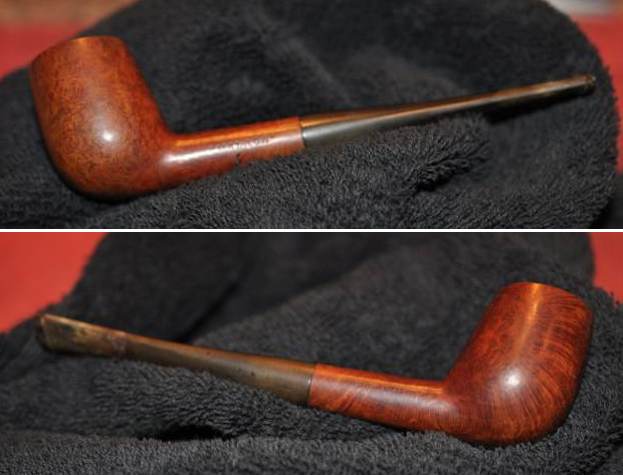
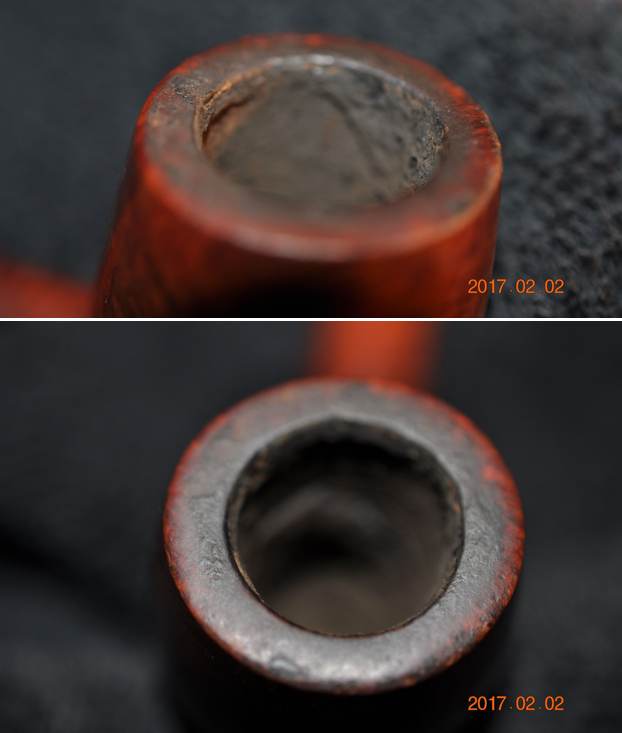
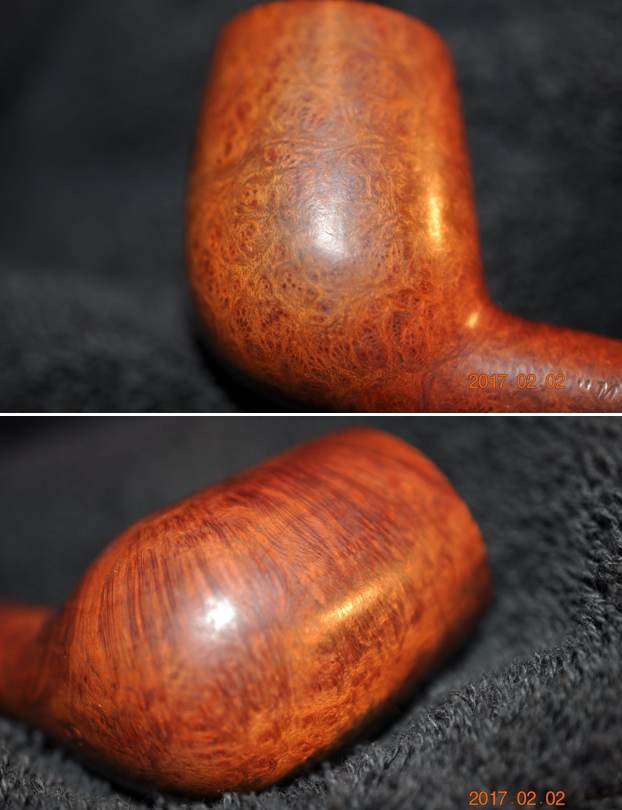
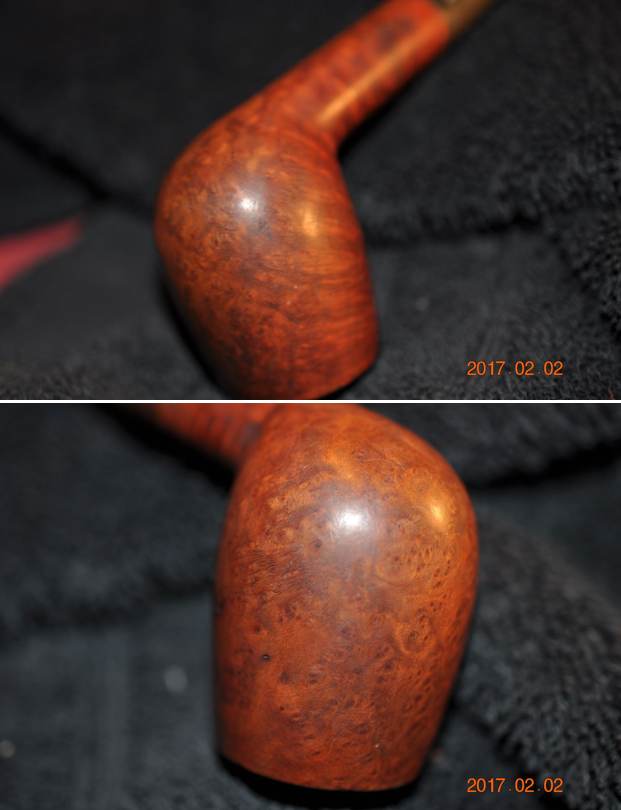
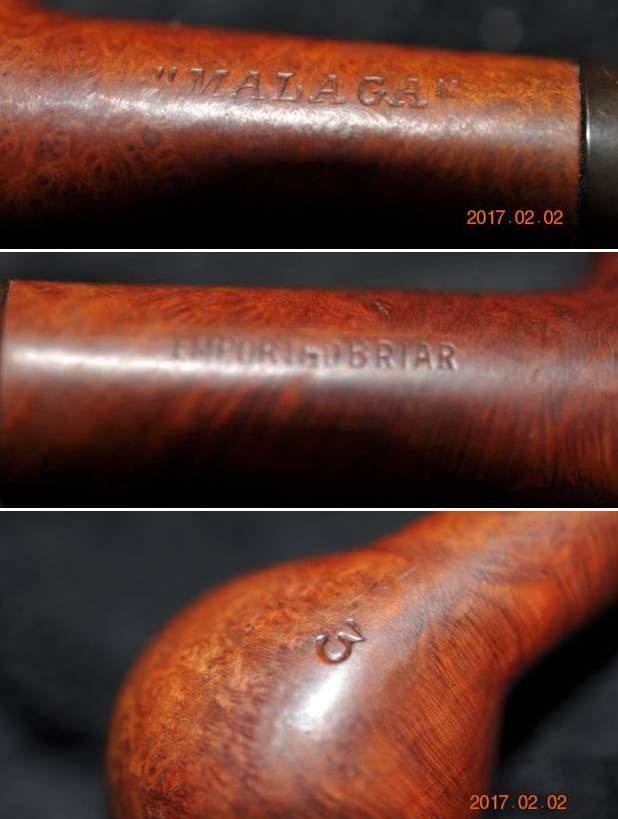
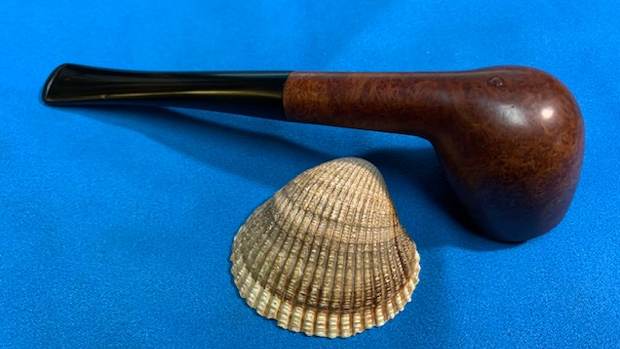
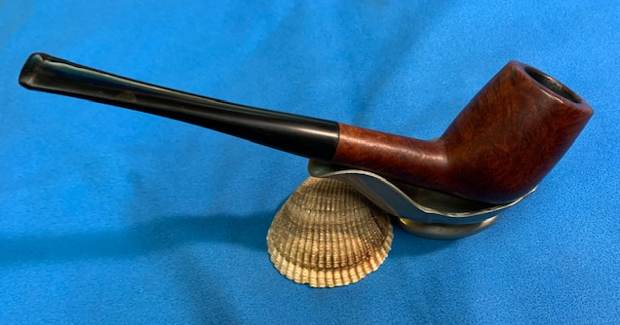
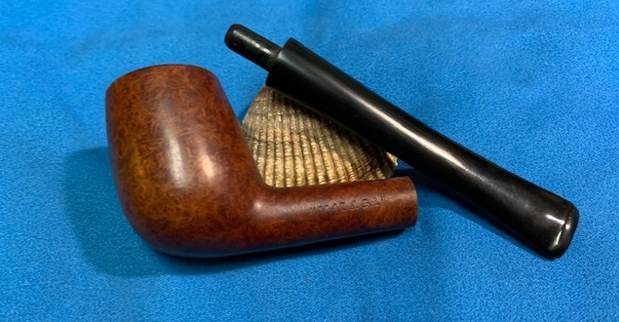
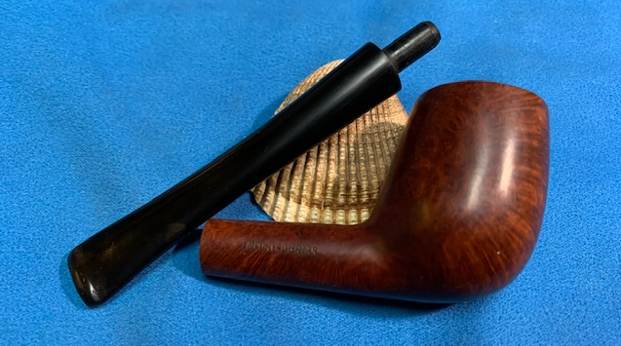
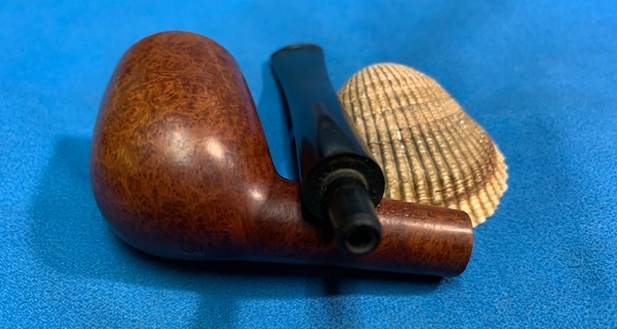
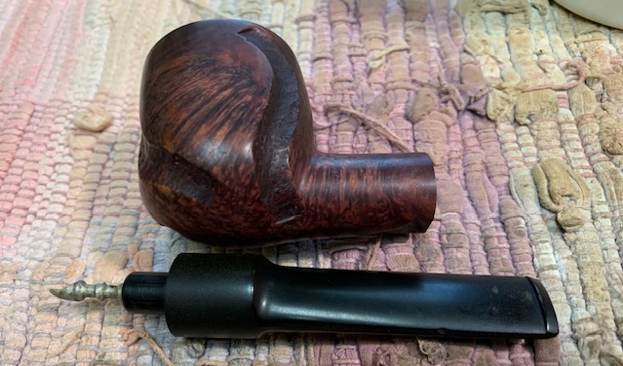
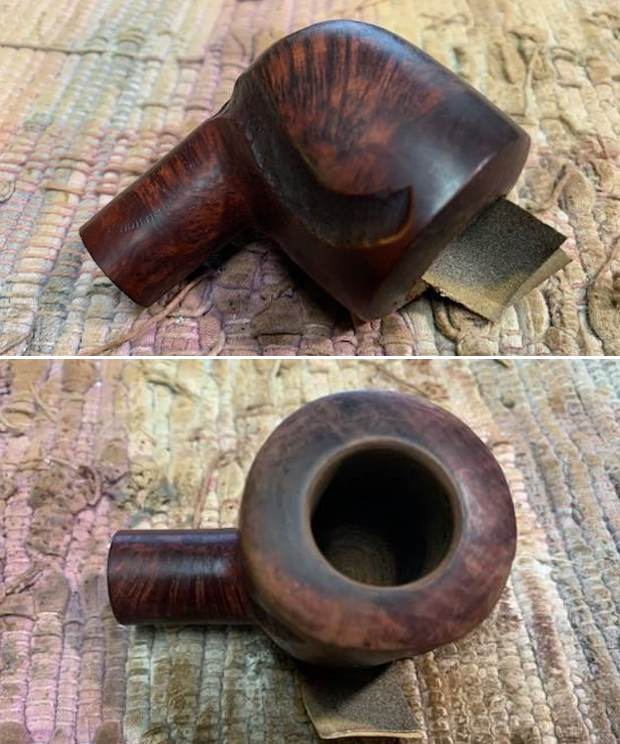
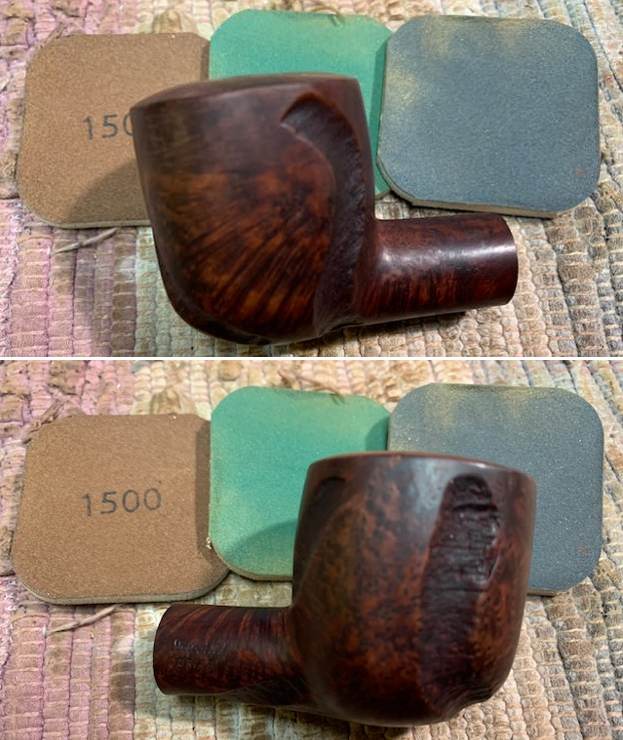
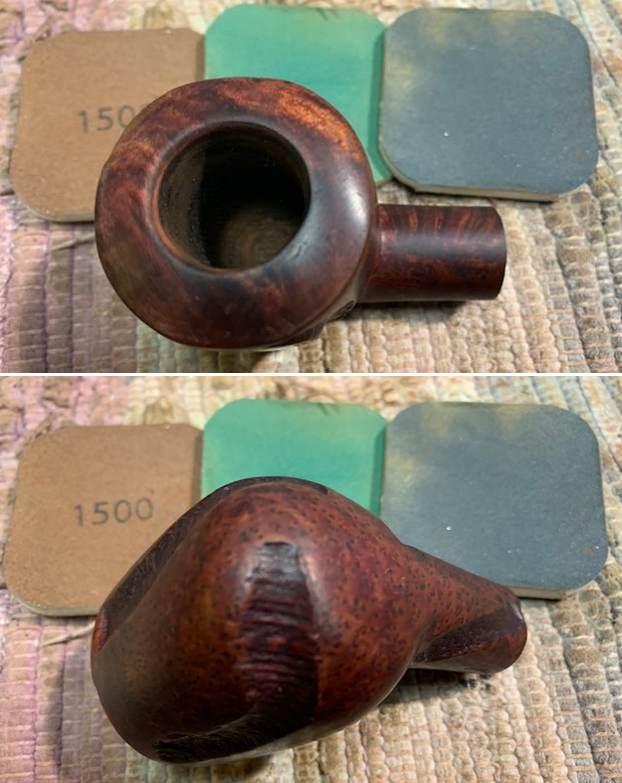
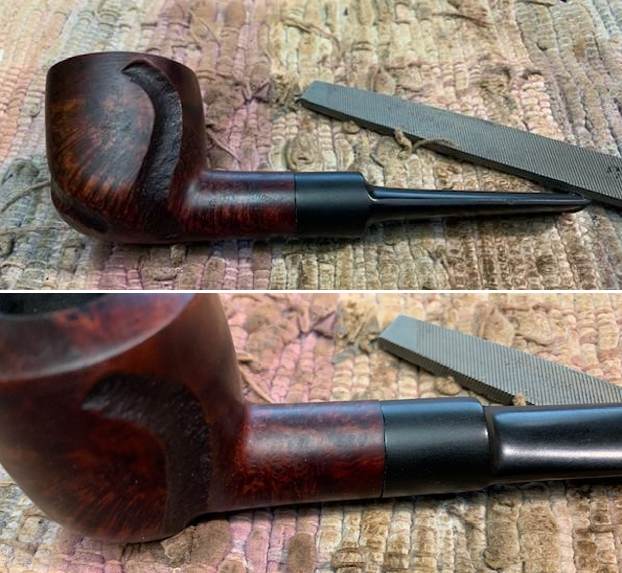
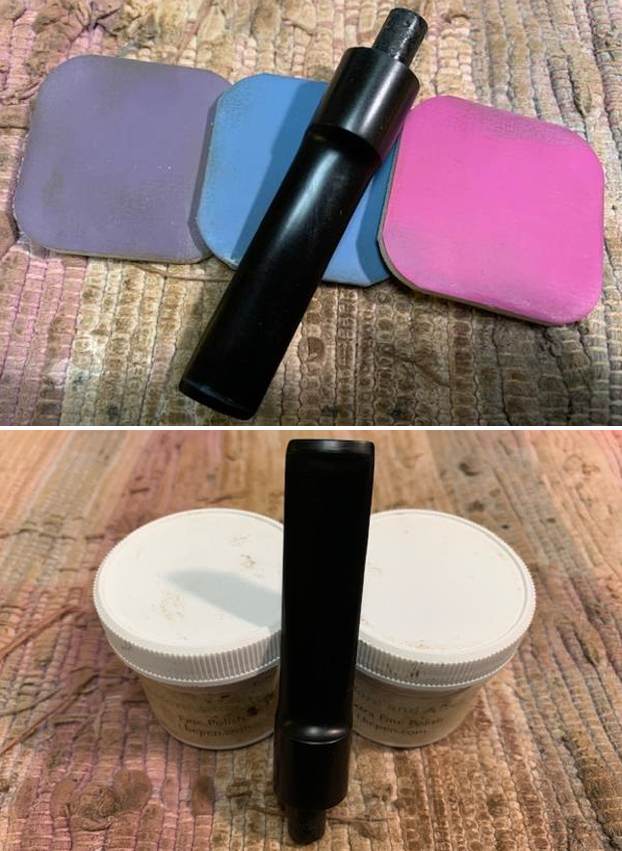
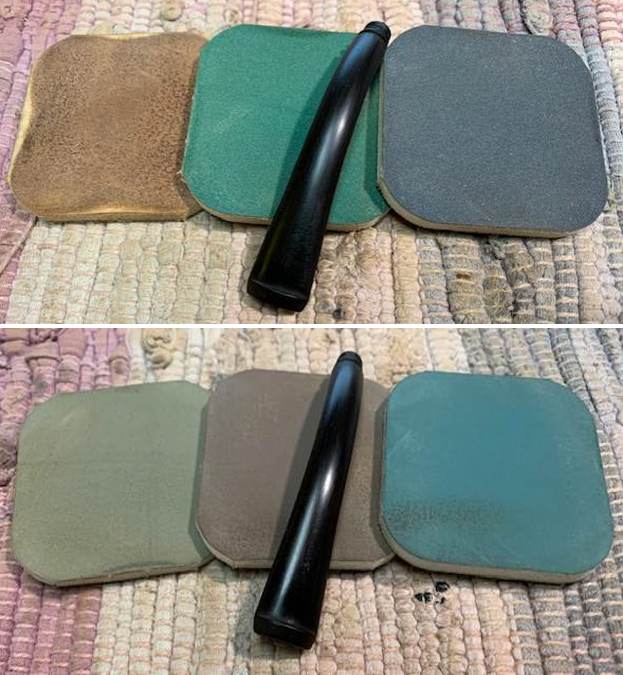
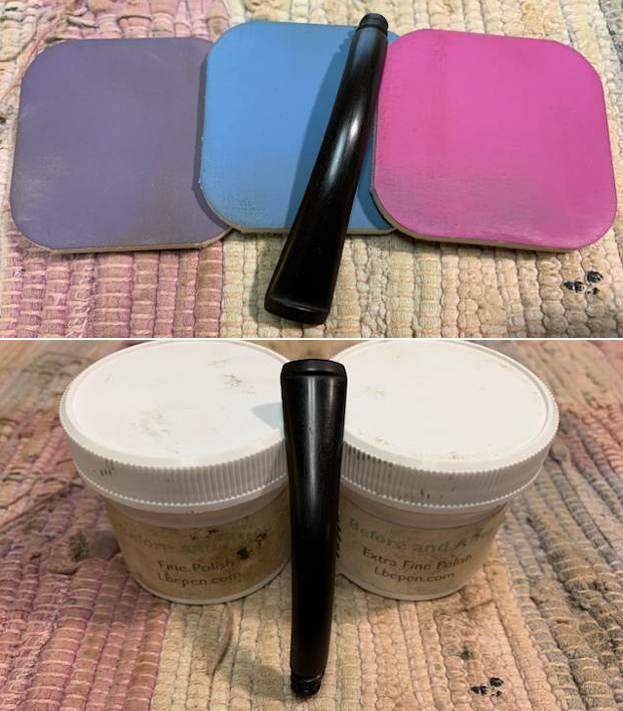
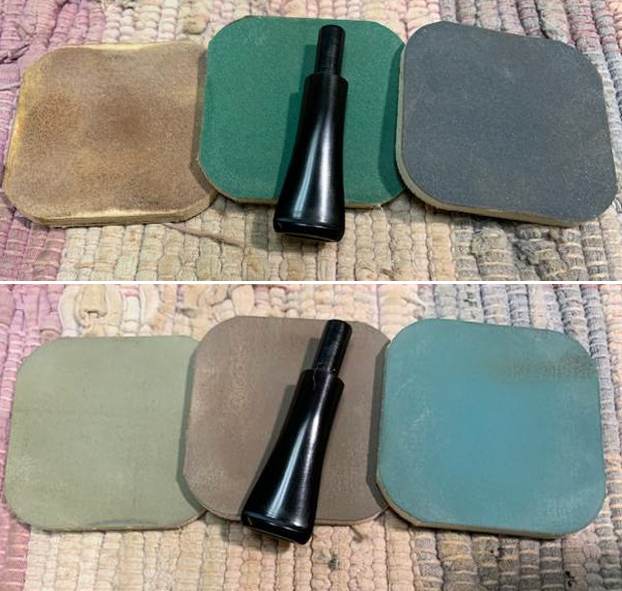
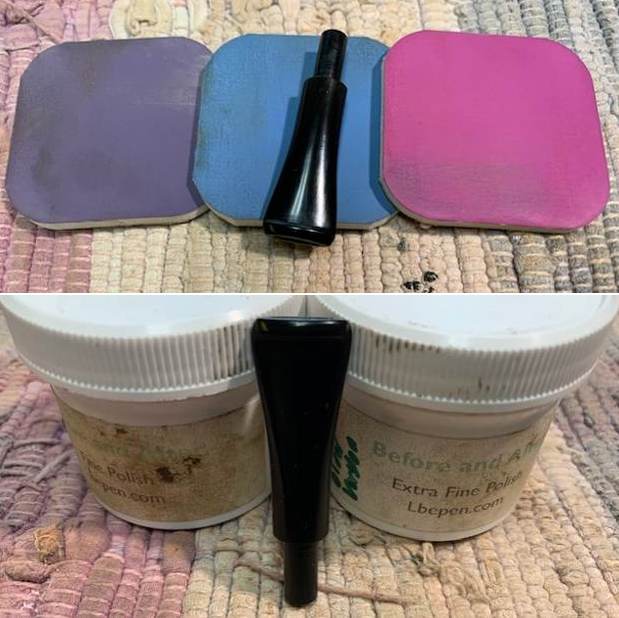
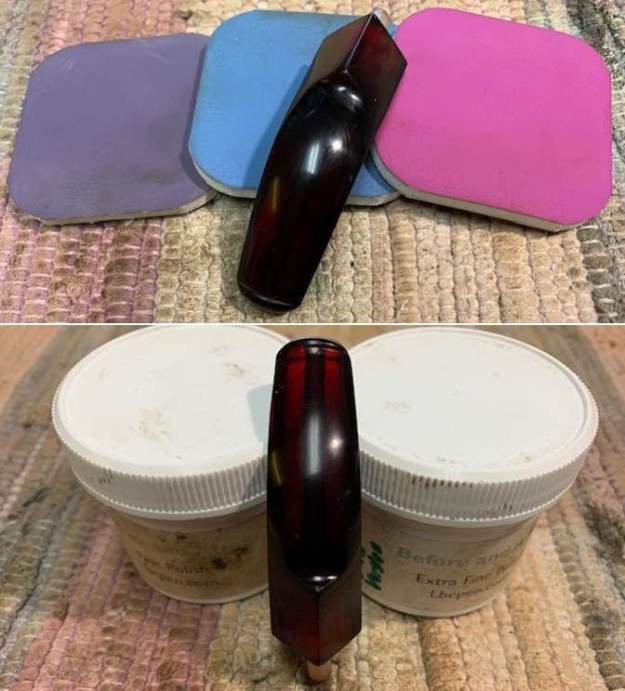
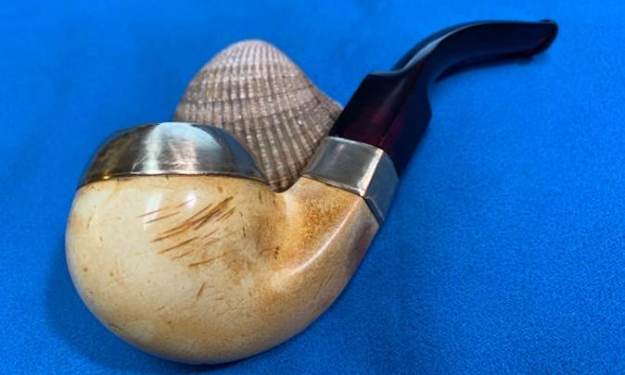
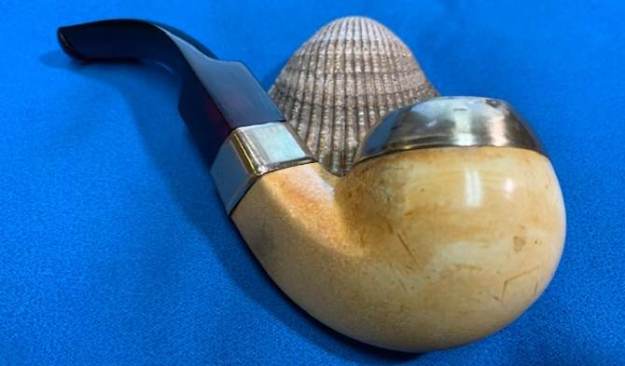
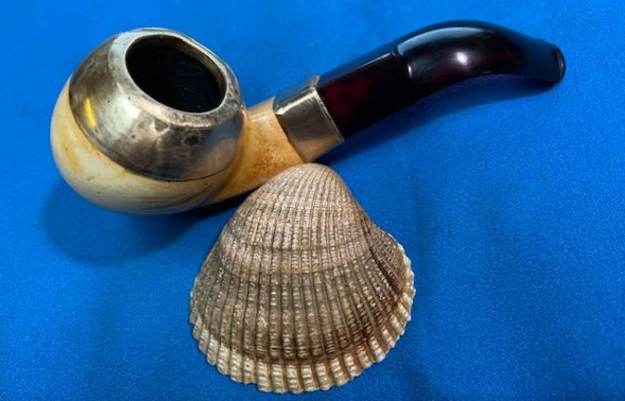
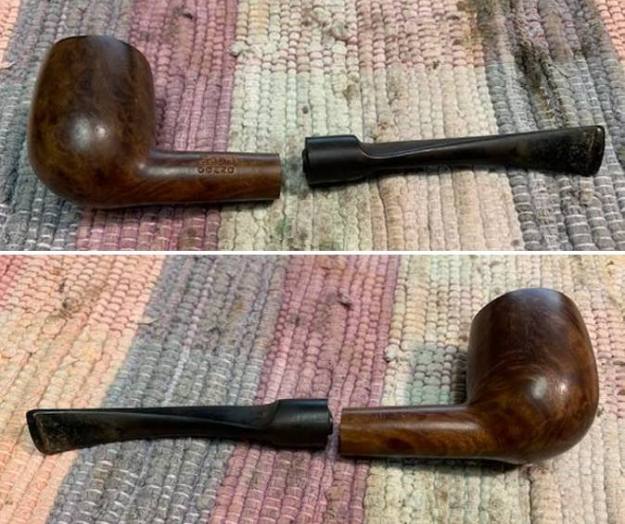
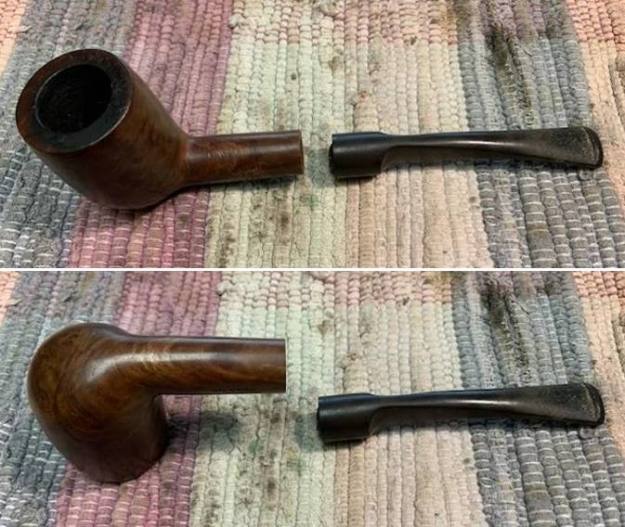
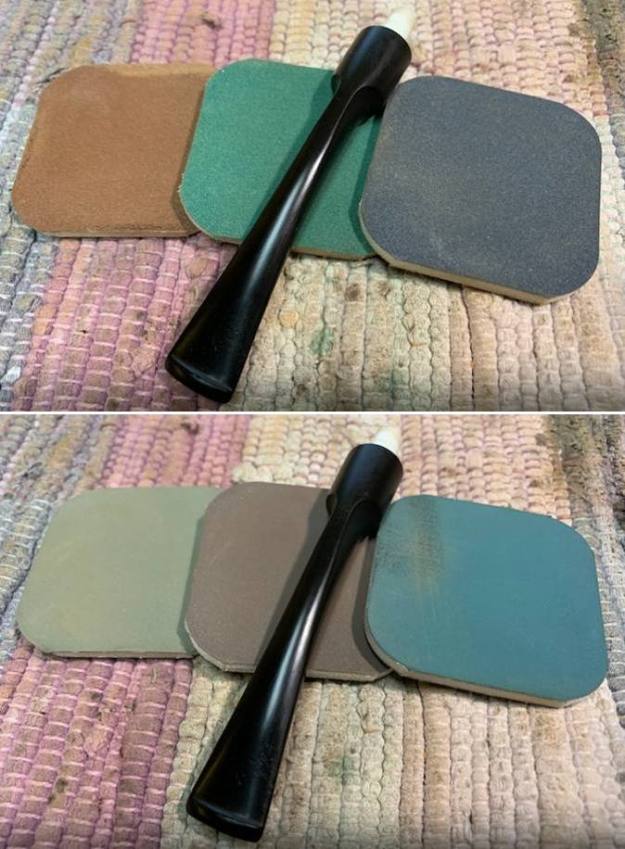
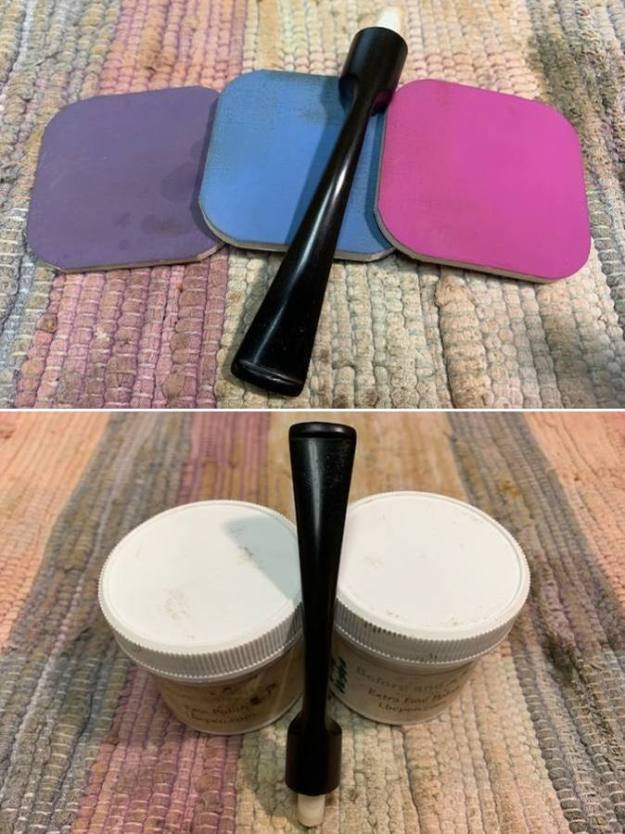
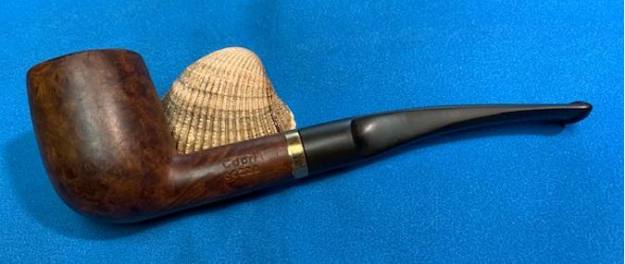
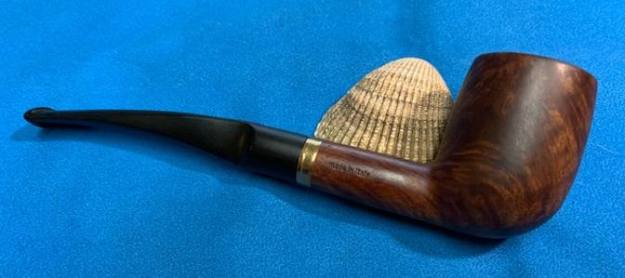
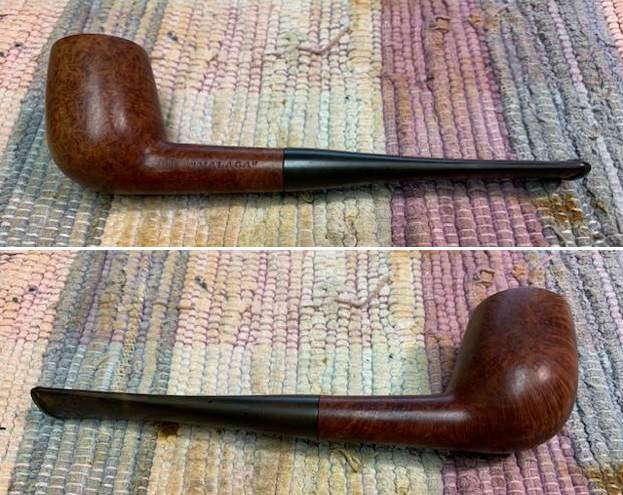
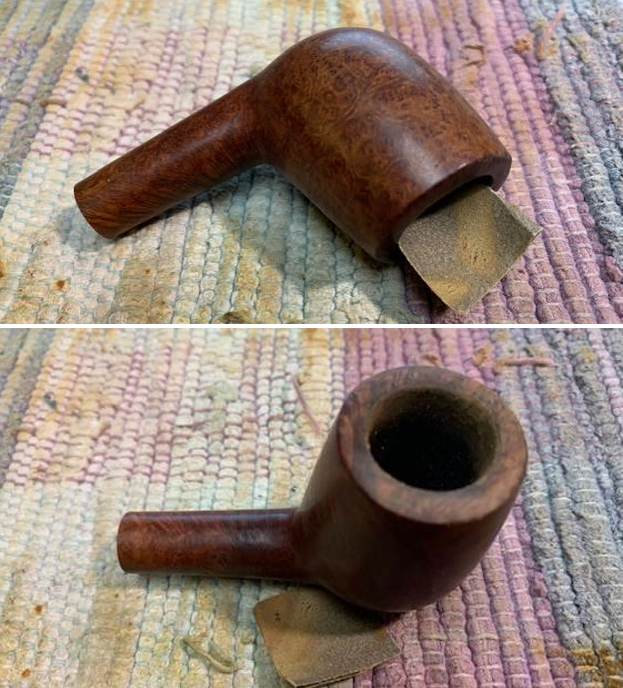
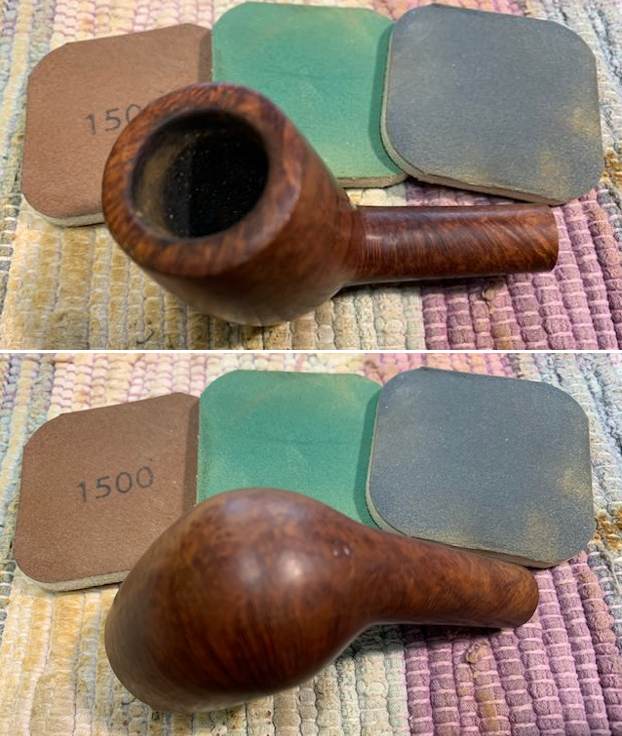
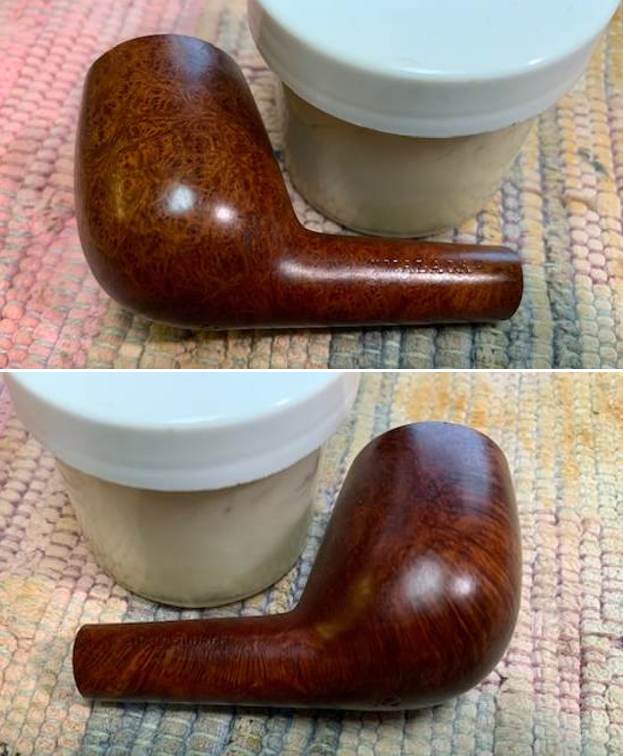
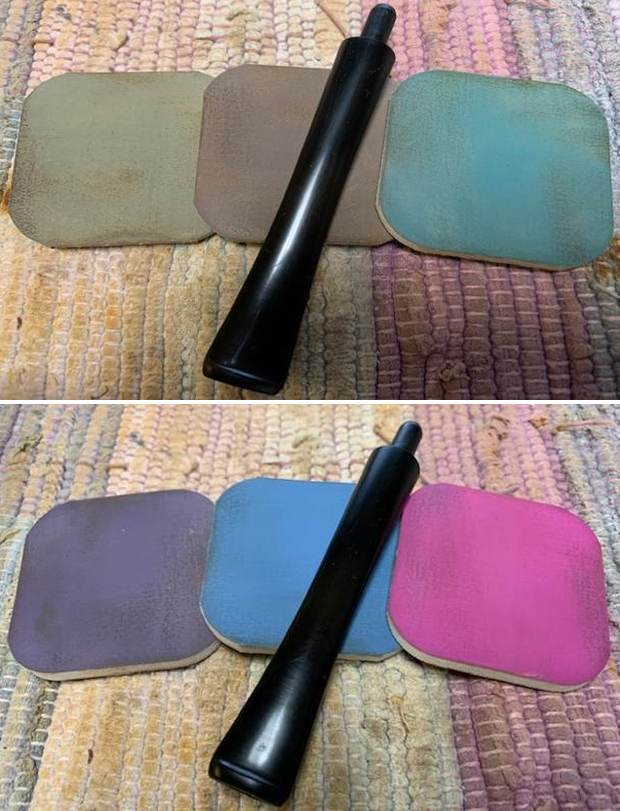
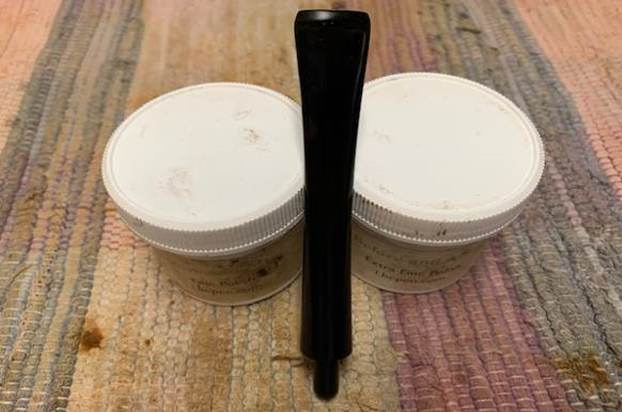
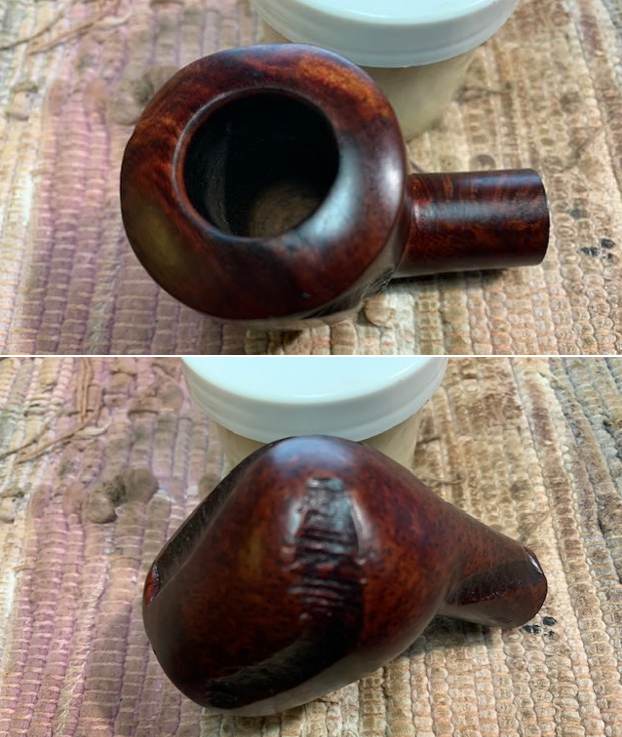
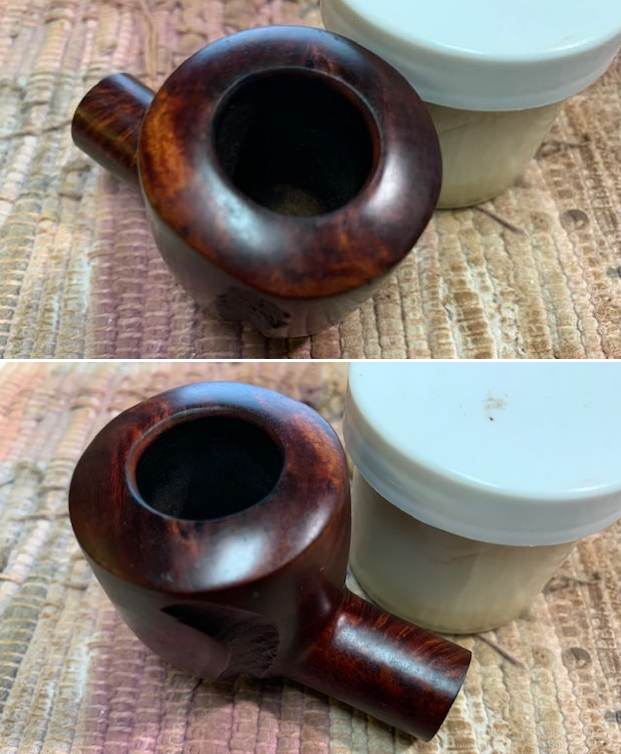
I took some photos of the pipe as I took it out of the box. Here is what I saw. I could see that Jeff had cleaned it well. The bowl had been reamed with a PipNet reamer and Savinelli Fitsall Pipe Knife. He had scrubbed the exterior with undiluted Murphy’s Oil Soap. He rinsed it with warm water. He cleaned out the internals with alcohol, cotton swabs and pipe cleaners. The stem was twisted and tweaked to the right as can be seen in the photos of the top and underside of the pipe. The grain on the bowl is quite nice with just a few small fills that are solid and well blended in with the surrounding briar. I took photos of the pipe before I started my work on it. The rim top had cleaned up very well and you can see the damage to the inner edge of the bowl at the back as well as some darkening on the rim top and outer edges. The stem cleaned up well but the tooth damage is quite deep and messy. I took photos of the stamping on the sides of the shank and heel of the bowl. The stamping is clear and readable as noted above.I took the stem off the shank and took a photo of the pipe. I really like the look of the Cutty shape and the grain on the bowl. It is a beauty. The stem will look good once it has gone through some surgery on the diameter and the shank and the chomping on the button end.I started my work on the pipe by cleaning up the damaged inner edge and top of the rim with a folded piece of 220 sandpaper. Once it was finished it definitely is an improvement.I polished the bowl and rim top with micromesh sanding pads – dry sanding with 1500-12000 grit pads and wiped down the bowl after each sanding pad. I rubbed the bowl and shank down with Before & After Restoration Balm. I worked it into the surface of the bowl sides and shank with my fingertips to clean, enliven and protect the briar. I let the balm sit for a little while and then buffed with a cotton cloth to raise the shine. The Balm did its magic and the grain stood out.   I set the bowl aside and turned my attention to the stem. I decided to address the fit of the stem to the shank. They were significantly different in diameter. I wanted to address that first while at the same time dealing with the deep tooth marks. I took photos of the fit of the stem to the shank. I think you can see the variation in diameter in the photos. The stem is bigger on the top an don the right side. If I turn it over it is the reverse but the fit is better against the shank face in the way it is in the photos below.I sanded the shank end of the stem with 220 grit sandpaper to reduce diameter to a close fit. I got I close then decided to deal with the tooth marks on the stem surface so that I could sand the entire stem to shape and it to the shank. I “painted” the tooth marked area with the flame of a lighter and was able to lift many of them significantly. Those that remained I filled in with clear CA glue and set aside to cure. Once the repair had cured I used a small file to flatten it out and to redefine the button area and edges. It looked much better. I followed that by sanding the repaired area with 220 grit sandpaper to further blend in the repairs to the surrounding vulcanite. I started polishing the stem with 400 grit wet dry sandpaper. With that work down on the button end I could go back to fine tuning the stem to shank fit.I went back to fitting the stem to the shank with 220 grit sandpaper and after some more adjustments the fit works well with the shank and I am pleased with the smooth transition to the shank.I polished it with micromesh sanding pads – 1500-12000 grit pads (somehow the photo of the 1500-2400 grit pads was inadvertently lost). I wiped it down with Obsidian Oil after each sanding pad. I used Before & After Pipe Polish – both Fine and Extra Fine to further polish the stem. I gave it a final coat of Obsidian Oil and set it aside to dry. Once I finished refitting and repairing the stem, this “Malaga” Imported Briar 3 Cutty was another beautiful pipe. The briar around the bowl is clean and really came alive. The rim top looks much better than when I began. The rich brown stains gave the grain a sense of depth with the polishing and waxing. The grain really popped. I put the vulcanite stem back on the bowl and carefully buffed the pipe with Blue Diamond on the buffing wheel. I gave the bowl and the stem multiple coats of carnauba wax on the buffing wheel. I buffed the pipe with a clean buffing pad to raise the shine. I hand buffed the pipe with a microfiber cloth to deepen the shine. The finished “Malaga” Cutty is a beauty and feels great in the hand and looks very good. Give the finished pipe a look in the photos below. The dimensions of the pipe are Length: 6 inches, Height: 1 ¾ inches, Outside diameter of the bowl: 1 ¼ inches, Chamber diameter: ¾ of an inch. The weight of pipe is 1.34 ounces /38 grams. I will be putting it on the rebornpipes store soon. Look for it in the American Pipe Makers section. If you would like to add it to your collection let me know. This is another pipe that has the possibility of transporting the pipe man or woman back to a slower paced time in history where you can enjoy a respite. Thanks for walking through the restoration with me.
This Greenwich House Antique Imported Briar Crowned Pot Turned into a Nightmare


Blog by Steve Laug

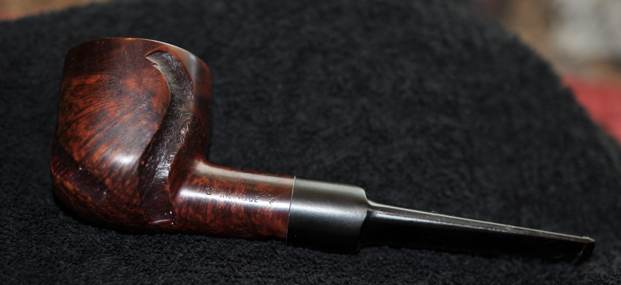
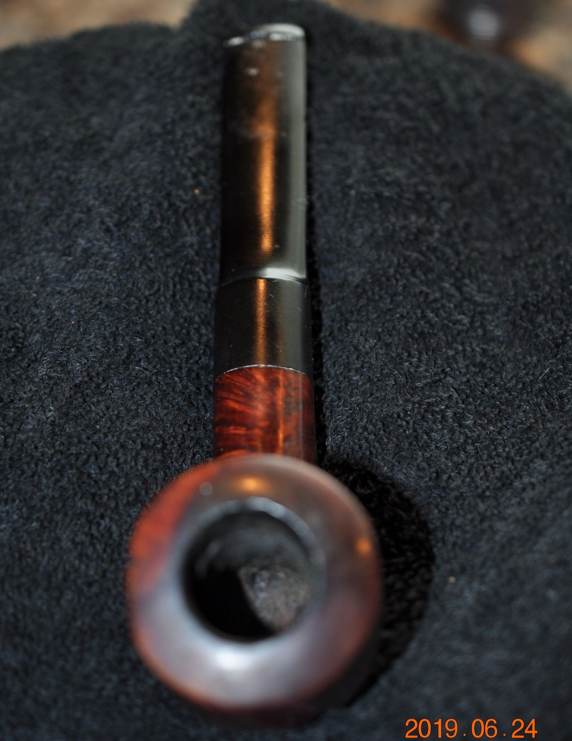
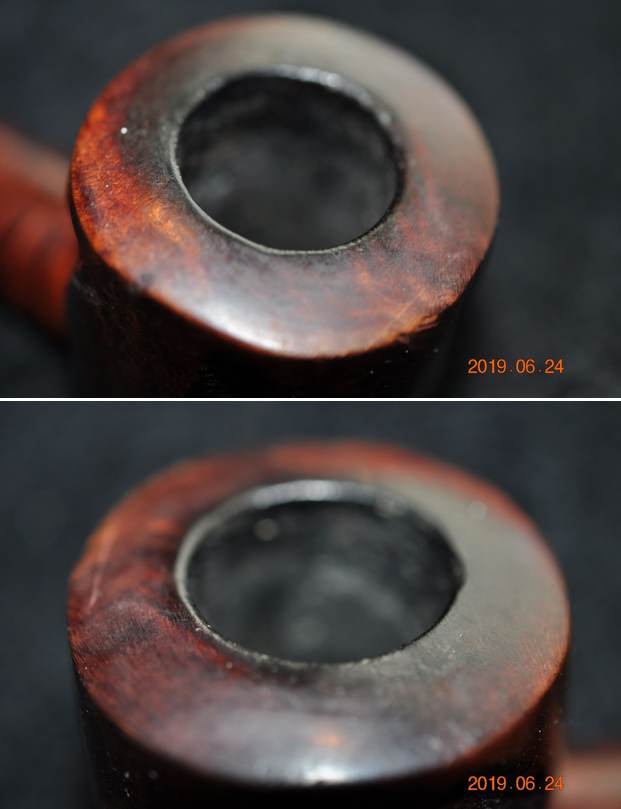
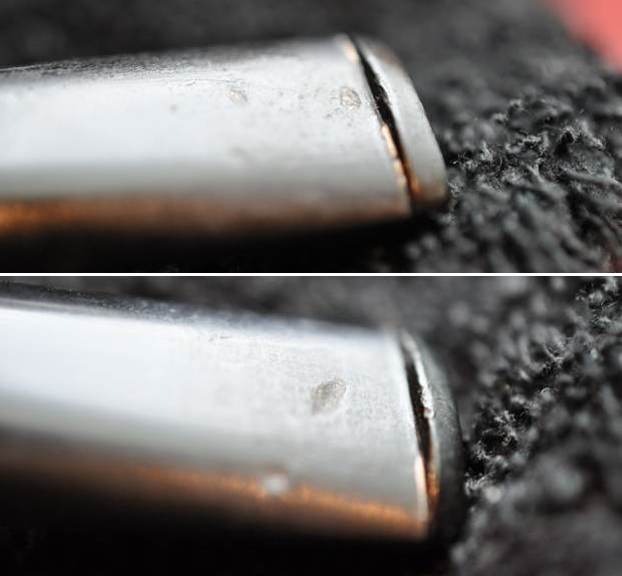
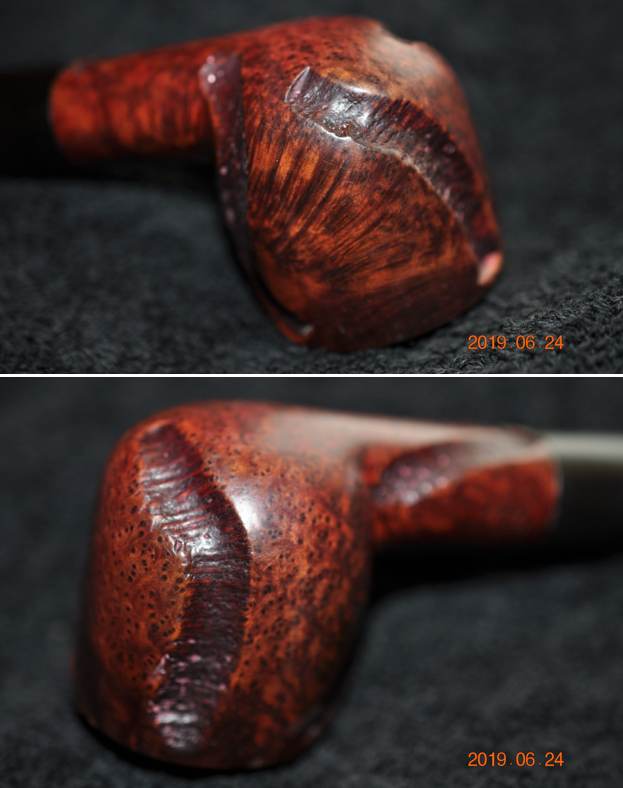
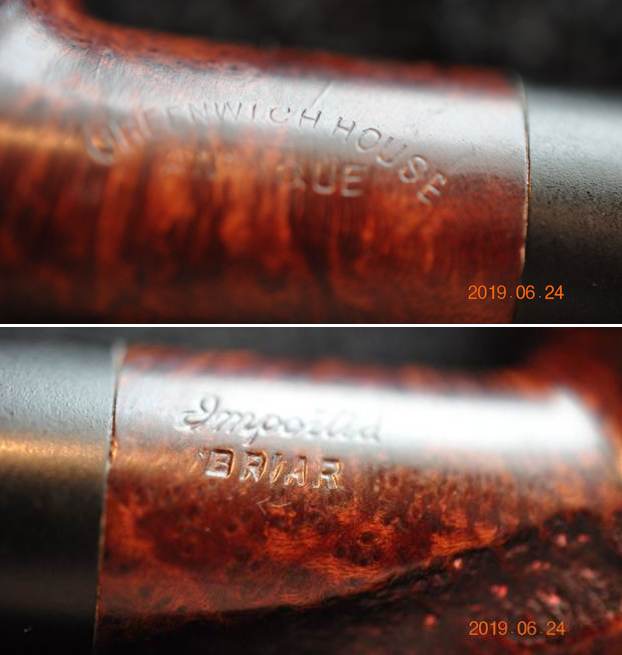
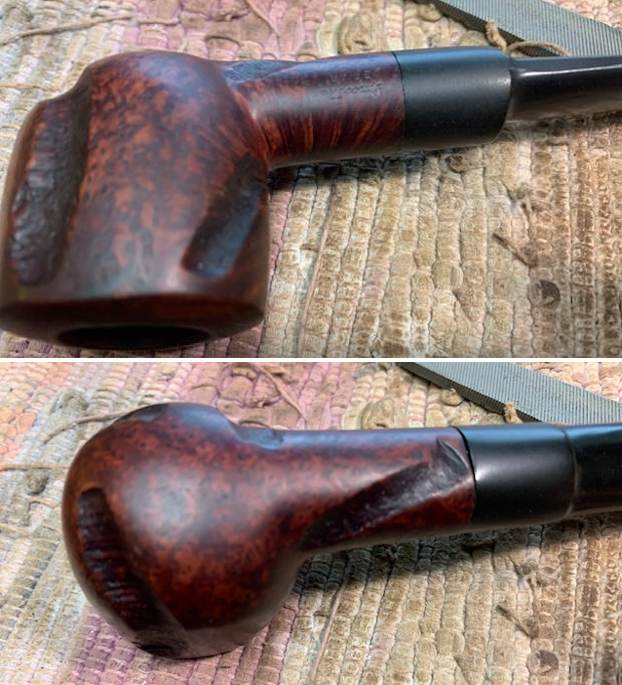
Sometimes when I start working on a pipe there is can be a sense of gloom or expectant trouble. That was the case with this one. I thought it would be a straightforward clean up and restoration. Little did I know what lay ahead for me in this restoration. Time would tell and I would share it here with you my readers. It started as usual. I recognized the brand on this pipe but could not remember any of the details. Jeff picked this pipe up from an antique store in Ogden, Utah, USA back in 2019. It is stamped on the left side of the shank and reads Greenwich House [arched over] Antique and on the right side Imported [over] Briar. It was the Greenwich House tag that grabbed my attention. You know how sometimes a name just sits on the edge of your memory beyond your reach but you still know it? That is what this name did to me. The finish is quite dirty with a cake in the bowl and lava overflow on the rim top. The worm trails on the sides and base reminded me of a Custom-Bilt but a bit more smooth. The crowned rim top was more elegant. The saddle style stem was old vulcanite and other than deep tooth marks it was quite clean, Jeff took some photos of the pipe before he started. He took close up photos of the rim top, bowl and stem to give a better picture of what he was seeing as he prepared to clean it up. You can see the cake in the bowl and the lava on the rim top. The inner edge appears to be burned and damaged but it was hard to tell for sure. The stem had some deep tooth marks on both sides just ahead of the button and some light calcification at the sharp edge.Jeff took his characteristics photos of the bowl sides and heel to give a clear picture of the grain around the bowl and the style of the worm trails carved into the sides and heel. It is a nice piece of briar.The stamping was readable though a little faint on the left side of the shank. It read Greenwich House arched over Antique on the left. On the right side it was very clear and read Imported [over] Briar.I turned first to my blog on a previous restoration of a Greenwich House pipe. I had worked on one that was stamped Thoro-Kleen, a metal pipe (https://rebornpipes.com/2016/02/24/a-piece-of-art-deco-greenwich-house-thoro-kleen/). I read through that blog and have included a pertinent piece of information on the brand below.

According to Pipedia (https://pipedia.org/wiki/Thoro-Kleen) the Greenwich House Thoro-Kleen was a metal pipe system from the same family as the Roybrooke, Comet, and Original Gridiron pipes, and parts from all are believed to be interchangeable. The pipes were sold by the Greenwich House Corporation, located in 1947 at 939-M 8th Avenue, N.Y. 19, N.Y…

From that I knew it was an American Made pipe that had been carved for or by a company known as Greenwich House Corporation in New York City.

I turned to the listing of American Brands on Pipedia to see if there was a listing for the Greenwich House itself (https://pipedia.org/wiki/American_Pipe_Brands_%26_Makers_G_-_H). I found that there was not an article but the list of makers identified the brand and said that The Antique was made of Aged Algerian Briar. One more piece fell in place. The pipe I was working on was stamped Antique so I now knew the source of the Imported Briar.

But I still wanted a bit more information so I did a Google search and was taken to pipes made by Greenwich House on smokingpipes.com and other sites. Worthpoint, an auction site had several and also had one stamped Antique (https://www.worthpoint.com/worthopedia/vintage-greenwich-house-carved-1992675965). I have included the description from the sale item below as it is quite descriptive of the pipe in my hands.

Vintage Greenwich House Carved Antique Aged Algerian Tobacco Pipe. Good condition. Measures about 6.25″ long.

It is similarly stamped as mine and also similarly sized. Now it was time to work on the pipe itself. Jeff had cleaned up this nicely grained Pot with his usual pattern. He reamed the bowl with a PipNet pipe reamer and then cleaned up the inside of the bowl with a Savinelli Fitsall Pipe Knife. He scrubbed the exterior of the bowl and shank with Murphy’s Oil Soap and a tooth brush to remove the grime on the rim top and bowl. He cleaned the internals of the shank and stem with pipe cleaners, cotton swabs and alcohol until the airways were clean and the pipe smelled fresh. The pipe looked much better once the bowl and stem were clean. He scrubbed the stem with Soft Scrub to remove the oxidation and then let it soak in Before & After Pipe Stem Deoxidizer. He rinsed it with warm water when he took out of the soak. Before I started my part of the work I took photos of the pipe. I took close up photos of the bowl and the rim top to show the condition. The photo clearly shows the burn damage to the inner edge and the rim top at the back of the bowl. You can also see the roughening of the rest of the inner edge and rim top. It was going to take some work to bring it back. I also took photos of both sides of the stem to give a sense of the condition of both sides at the button. There is deep tooth marking and damage on both sides ahead of the button. I took a photo of the stamping on the sides of the shank. It was readable but was more faint on the left than the right side. It read as noted above.I removed the stem from the shank and saw to my chagrin a stinger. I fiddled with it a bit to see if it was pressure fit or screwed into the tenon. There was no give to it. (This portends what is ahead, keep reading.) I set the stem down with the bowl and took a photo to give a general look at the proportions of this pipe.I started work on this one by using a folded piece of 220 grit sandpaper to clean up the inner edge of the bowl and the rim top at the back. I was able to clean and reshape the bowl by slowly working through the process. So far the restoration was going well.I polished the bowl and rim top with micromesh sanding pads – dry sanding with 1500-12000 grit pads and wiped down the bowl after each sanding pad. I rubbed the bowl and shank down with Before & After Restoration Balm. I worked it into the surface of the bowl sides and shank with my fingertips and a horse hair shoe brush to clean, enliven and protect the briar. I let the balm sit for a little while and then buffed with a cotton cloth to raise the shine. The Balm did its magic and the grain stood out.   So far so good! I filled in the deep gouges on the top and underside of the stem and set it aside for the repairs to cure.After the repairs cured things took a horrible turn! If you have read this blog for long you know how much I dislike metal stingers. I find that they indeed condense moisture and fill the shank with horrendous muck. Soooo… I decided I would try to remove this one and give the stem a thorough cleaning. I have found that most stingers are either threaded and screwed into the tenon or are pressure fit. Either way a little heat loosens the glue or gunk that hold it tight and it is easily removed.
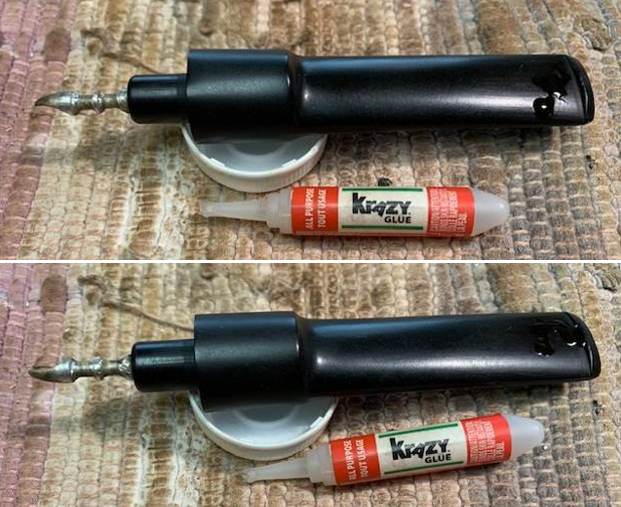
Well… the heat did absolutely nothing with this one. It did not twist or wiggle free. It was solid with or without heat… or cold for that matter. I was frustrated at this point and tried to pull it with pliers and the “wicked” thing snapped off! Now that usually does not matter either. I can easily drill it out with a small bit.

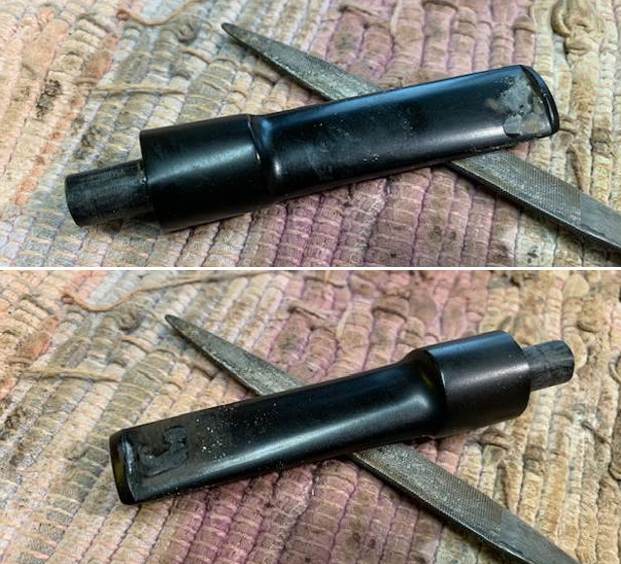
Again not so!! The remaining tube went well beyond the saddle on the stem. I drilled and drilled then filed the edges to smooth it out. At this point I should have just left it. But I DID NOT DO THAT. NO! I tried to pull out the remnant of the tube with a small file. And then a chunk of the tenon cracked off. You can see the offending tube in the tenon stubbornly laughing at me. Arggh… This was becoming much more of a  problem. Each step I took to remedy it made it actually worse. Now I would need to cut off the remaining tenon and the drill the stem and make a new tenon for it. OH MY! THIS IS NOT WHAT I WANT TO DO!!

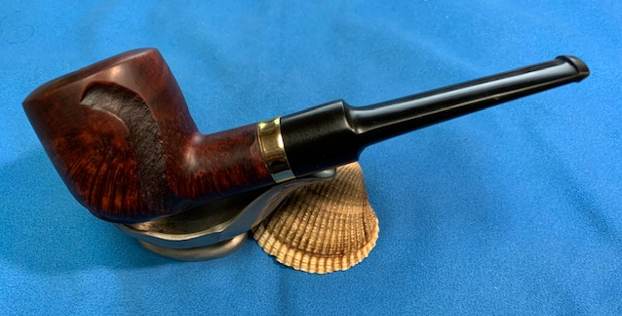
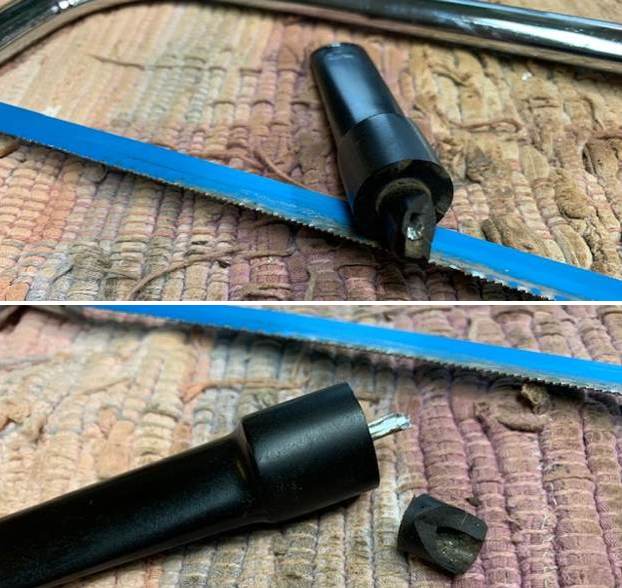
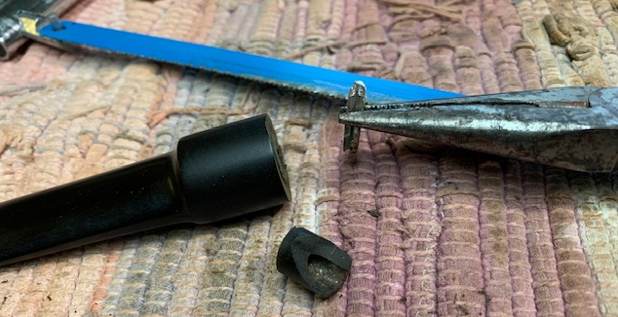
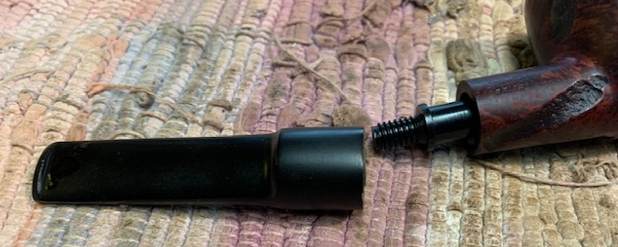
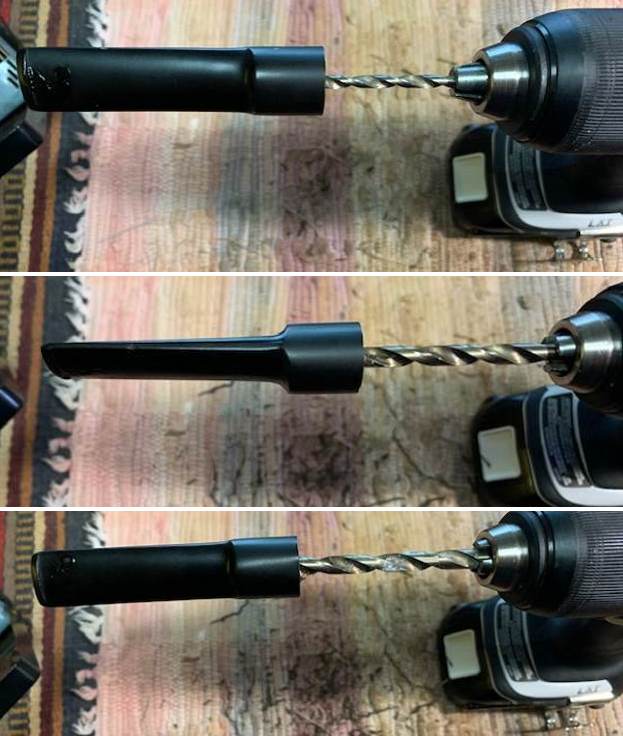
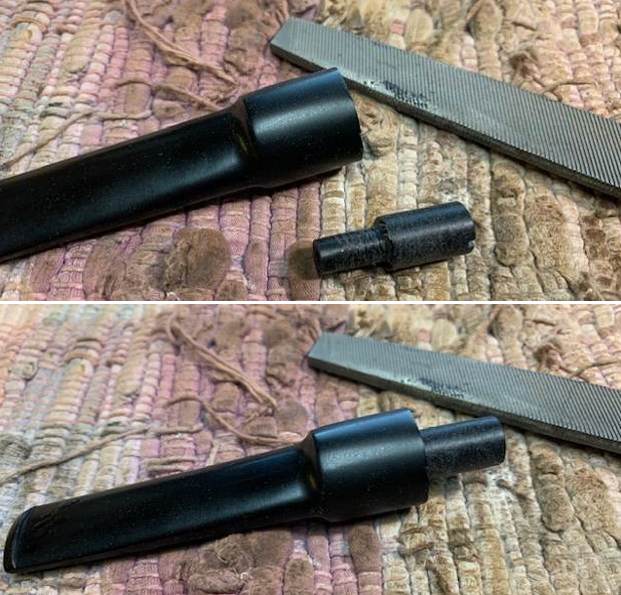
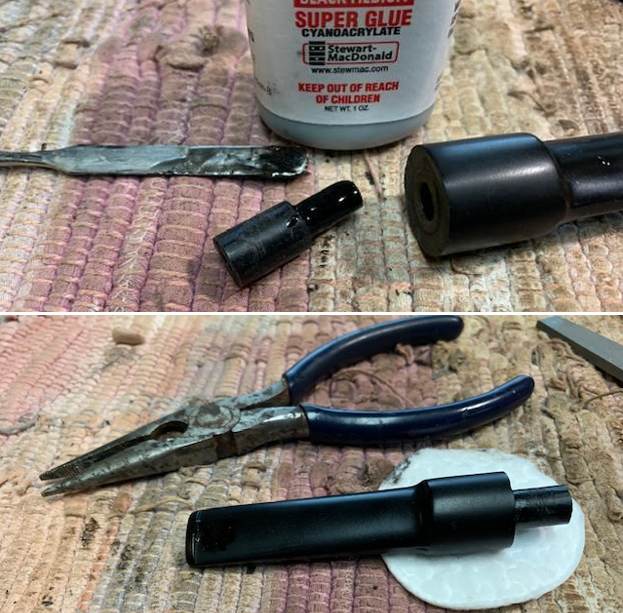
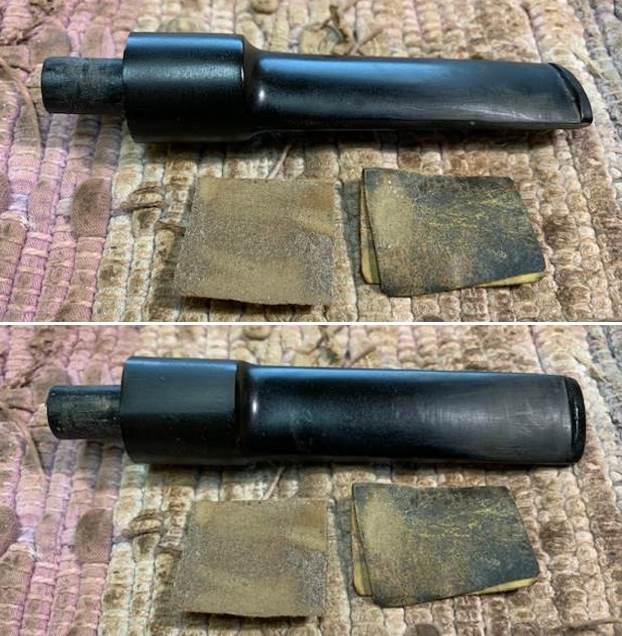
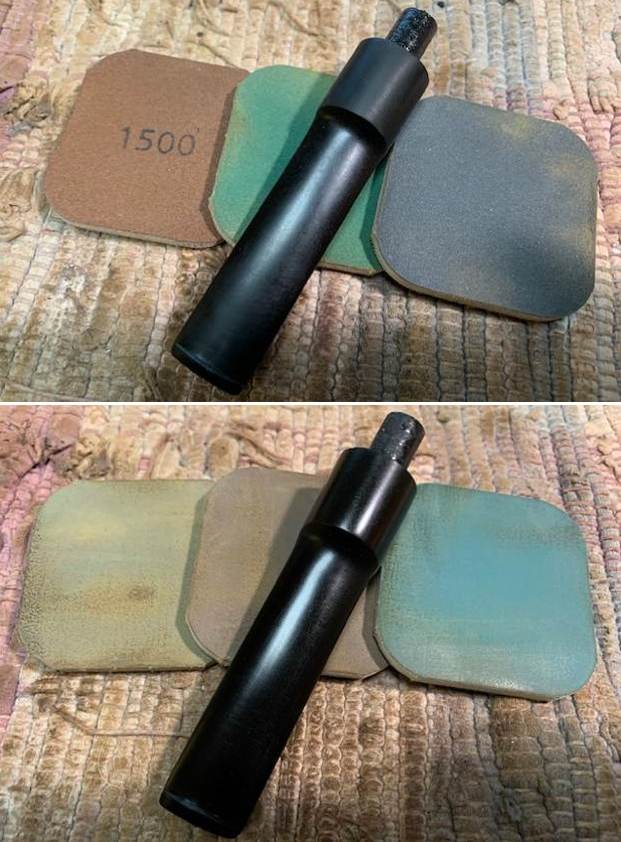
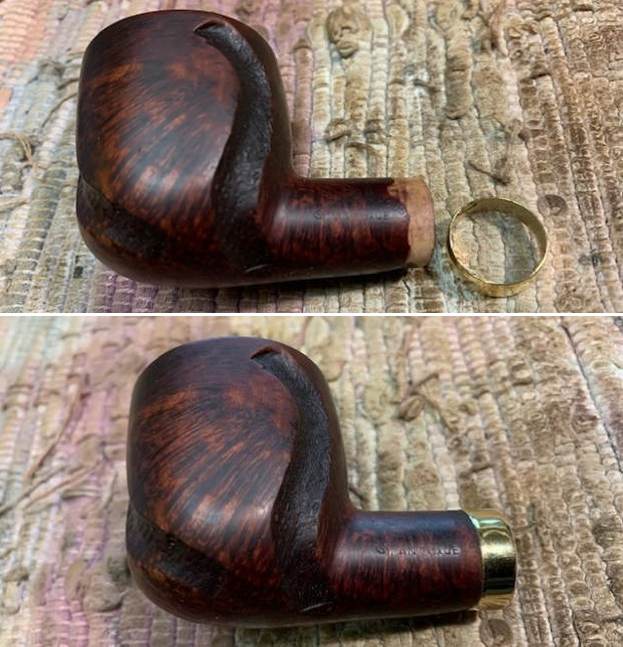
I got out my hacksaw and carefully cut all the way around the broken tenon. I purposely did not cut the tube as I wanted to see how far into the stem it actually went. I pulled it out with a pair of pliers and took a photo of the length of the offending tube once it was free of the airway. You might laugh at this point and I invite that. This was a lot of work to go to just to clean out the airway in the stem. But now I could replace the tenon. I went through my tenons and had one that was a close fit to the shank of the pipe. I would need to drill out the stem to take the threaded replacement tenon but I was hoping that this part would proceed without more things going awry. I started drilling with my cordless drill and a bit slightly larger than the airway in the stem. I continued going through various bits up to ¼ inch which was the size I would need to receive the threaded tenon end with some modifications. You will notice the repairs to the deep tooth marks still have not been smoothed out.I modified the threaded tenon with a Dremel and sanding drum. I removed the should on the middle of the tenon and reduced the diameter of the threaded portion so that I could glue it in place in the stem. I cleaned up the edge between the thicker portion and the threaded portion with a flat rasp to make the fit smooth when inserted in the stem. I inserted it in the stem and took a photo.Before gluing the tenon I the stem I put all the parts together to make sure that everything lines up correctly. It looks good so I take photos to show it at this point in the process. With the alignment correct I coated the threaded end of the tenon with black super glue and pushed the tenon in place in the stem. I set the stem aside to let the glue cure and went and had a cup of coffee with Irene. I needed to lick my wounds a bit on this whole mess!After coffee I went back to the stem to clean up the repairs on the top and underside of the stem. I flattened out the repairs with a flat file to begin to blend them into the surface. I followed that up with 220 grit sandpaper to further blend it in. I started polishing it with 400 grit wet dry sandpaper. I polished the stem with micromesh sanding pads – 1500-12000 grit pads. I wiped it down with Obsidian Oil after each sanding pad. I used Before & After Pipe Polish – both Fine and Extra Fine to further polish the stem. I gave it a final coat of Obsidian Oil and set it aside to dry. While I liked the look of the new stem on the shank it felt like it was missing something to me. I really wanted to give it a special touch that would set it apart and make the look spectacular. I went through my band collection and found a perfect 14K Gold band that would do just what I wanted. I took down the end of the shank to enable a snug fit. I heated the band with a lighter and pressed it onto the shank end. I finally finished this nightmarish restoration of a pipe that should have been quite simple. The Greenwich House Antique Import Briar Crowned Pot with a vulcanite saddle stem is a great looking pipe now that everything came together. The briar around the bowl is clean and really came alive. The rim top looks much better than when I began. The rich brown stains gave the grain a sense of depth with the polishing and waxing. The grain  on the smooth portions really popped and the worm trails carving look good as well. I put the vulcanite stem back on the bowl and carefully buffed the pipe with Blue Diamond on the buffing wheel using a light touch on the briar. I gave the bowl and the stem multiple coats of carnauba wax on the buffing wheel. I buffed the pipe with a clean buffing pad to raise the shine. I hand buffed the pipe with a microfiber cloth to deepen the shine.
The finished Greenwich House Antique Pot is a beauty and feels great in the hand and looks very good. Give the finished pipe a look in the photos below. The dimensions of the pipe are Length: 5 ¾ inches, Height: 2 inches, Outside diameter of the bowl: 1 ½ inches, Chamber diameter: ¾ of an inch. The weight of pipe is 2.29 ounces/65 grams. It is much more beautiful in person than these photos can capture. I will be putting it on the rebornpipes store soon. Look for it in the American Pipe Makers section. If you would like to add it to your collection let me know. This is another pipe that has the possibility of transporting the pipe man or woman back to a slower paced time in history where you can enjoy a respite. Thanks for walking through the restoration with me.
Restemming a CPF (Colossus Pipe Factory) Clay Bent Billiard


Blog by Steve Laug

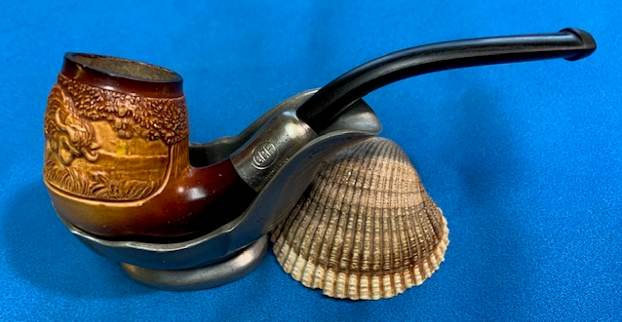
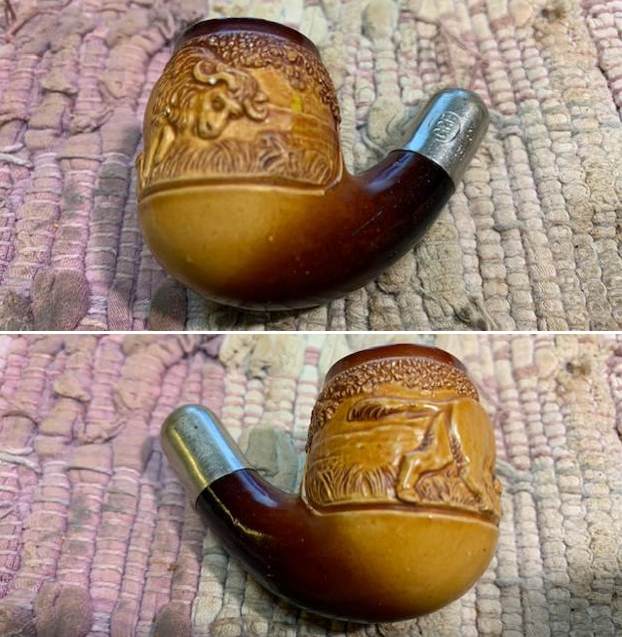
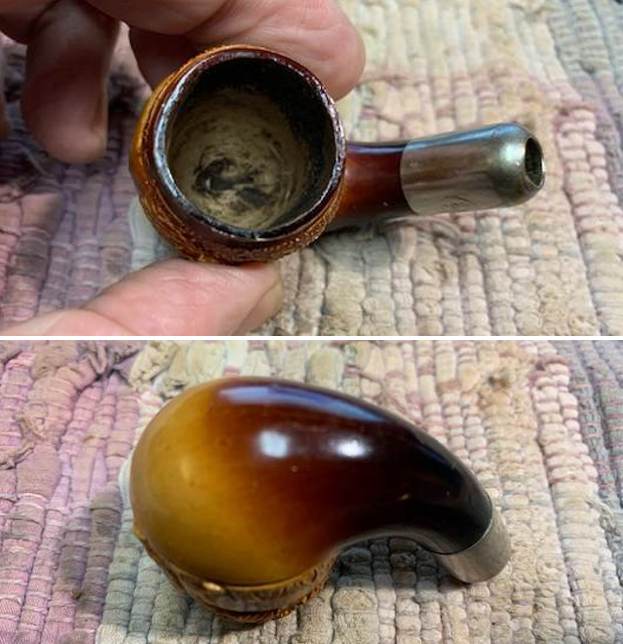
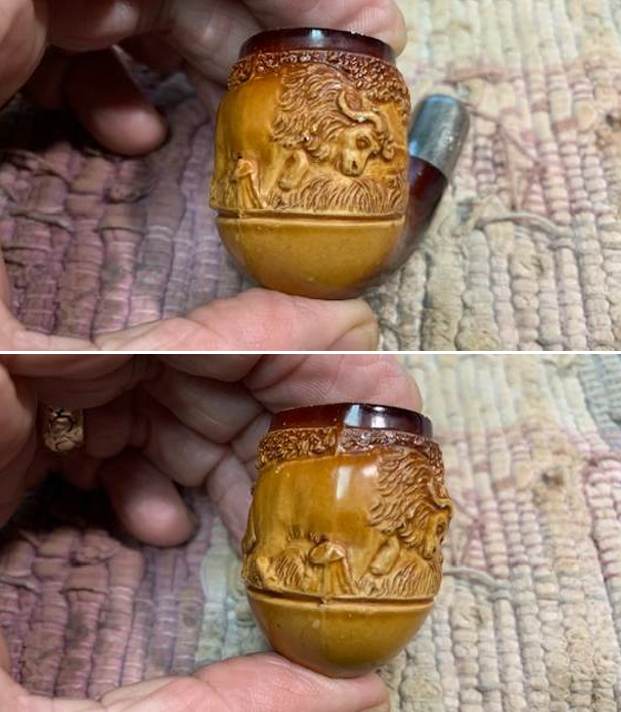
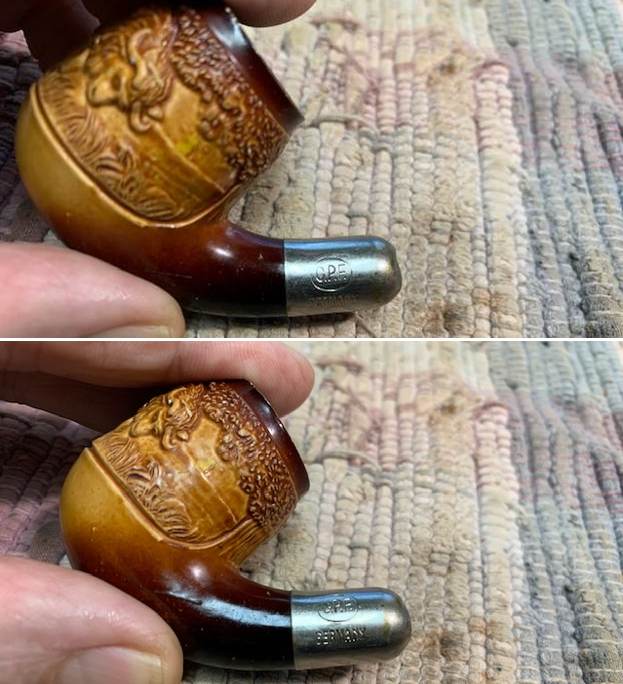
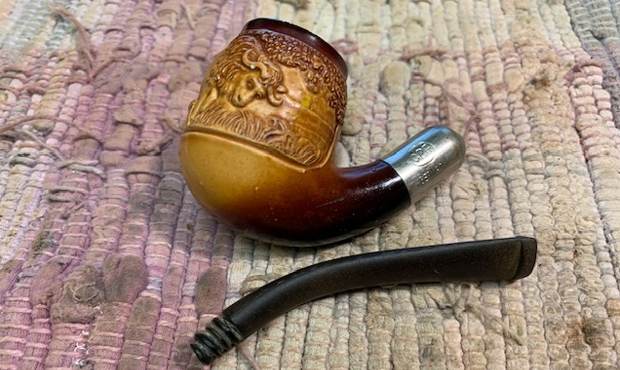
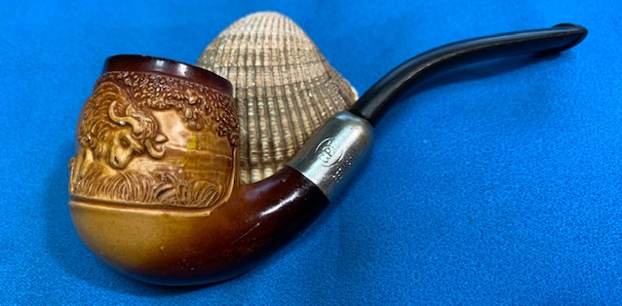
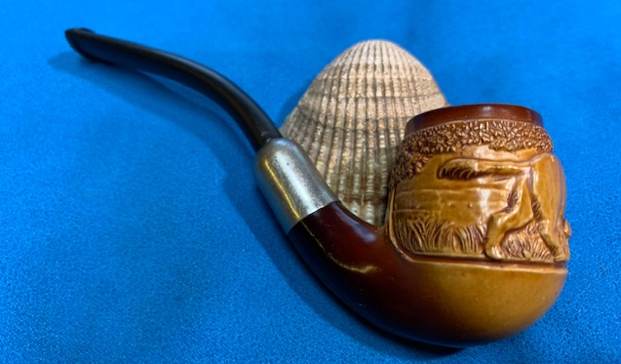
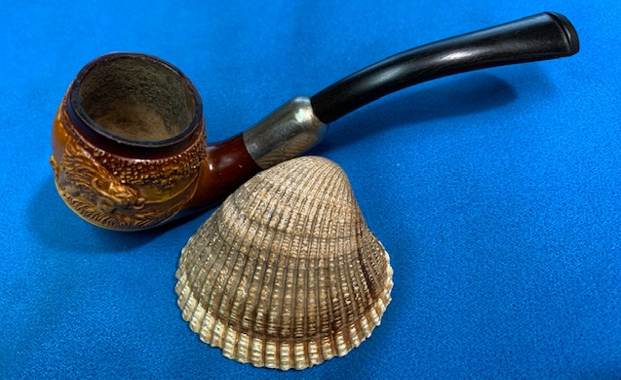
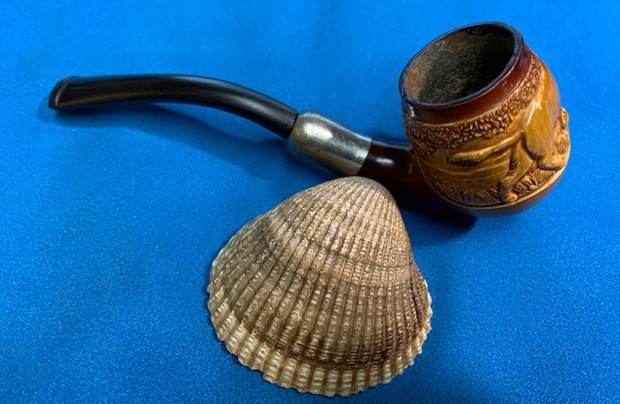
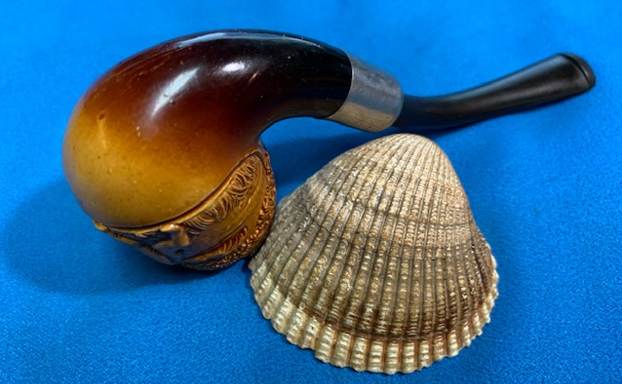
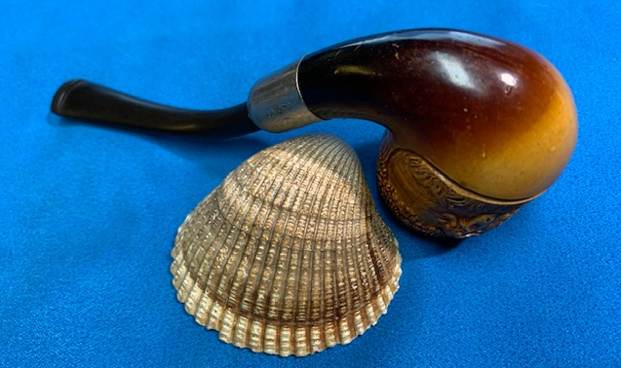
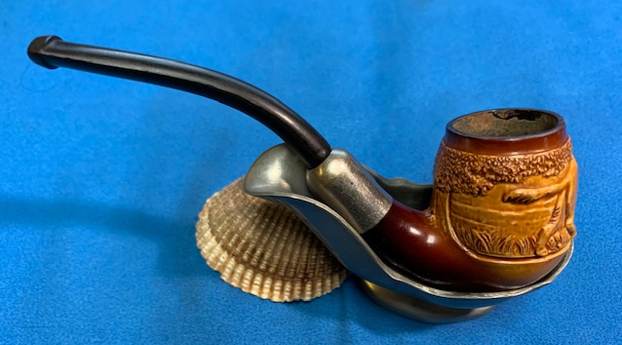
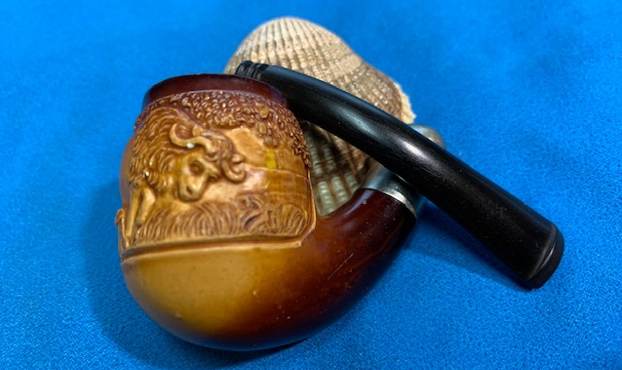
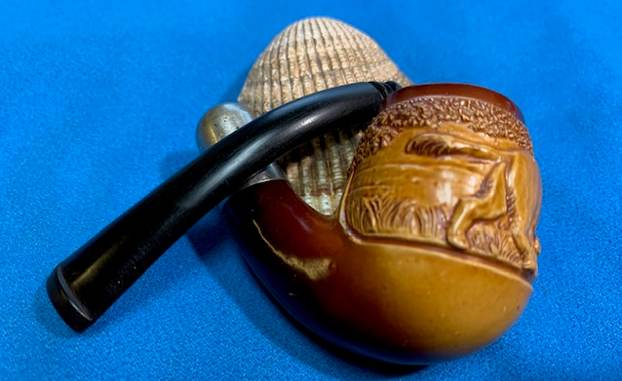
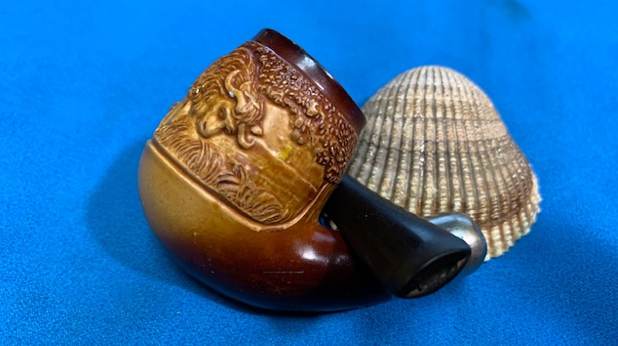
The next pipe on the worktable is another interesting piece of pipe history that comes from the bag of old pipes that I have been working on intermittently. This one is an interesting clay bowl sans stem. The bowl was in pretty clean shape with little damage. The bowl had been lightly smoked but was in good condition. There was a nickel ferrule on the shank that was marked C.P.F. in an oval (The Colossus Pipe Factory) logo. Under that it was stamped Germany. The bowl was a mix of dark, rich brown/red on the bottom (heel of the bow) working up to a rich golden colour with a dark ring cut around the top of the bowl and rim top. There was no stem with the pipe so I would have to go through my collection to find one. I took some photos of the pipe before I started on it. The bowl has a cast pastoral scene around the bowl sides. It a well executed water buffalo in the grass under a tree spreading across the back and the top of the bowl.I took photos of the stamping on the left side of the nickel ferrule on the shank end. It is clear and readable as noted above.A short description would be that it is a lightly smoked ceramic bowl with a nickel ferrule and vulcanite screw in stem. It is stamped on the left side of the ferrule and reads C.P.F. in an oval [over] Germany. I have a collection of C.P.F. pipes here that I have worked to build up over the years in all different sizes and shapes as well as a variety of materials. This old ceramic pipe will fit well into that collection. I wrote a blog a few years ago on the brand that gives a clear history and defines the meaning of the C.P.F. stamp. Here is the link to the blog and a pertinent quote that I am including below.

(https://rebornpipes.com/2013/04/14/some-reflection-on-the-historical-background-on-cpf-pipes/).

From my research I believe that we can definitively assert that the C.P.F. logo stands for Colossus Pipe Factory. The brand was purchased by KB & B sometime between 1884 and 1898 and that it continued until 1915. That time frame gives help in dating some of the older CPF pipes you or I might find. It can be said that prior to the dual stamping it is fairly certain that the pipe is pre-1884 to 1898. After the dual stamping it can be placed post 1898 until the closure of the brand line in 1915. CPF made beautiful pipes. I believe Sam Goldberger was correct in his assertion of the potential carvers that made the pipes being of European training and the classic shapes and well aged briar. That coincides with all the CPF pipes that I have come across.

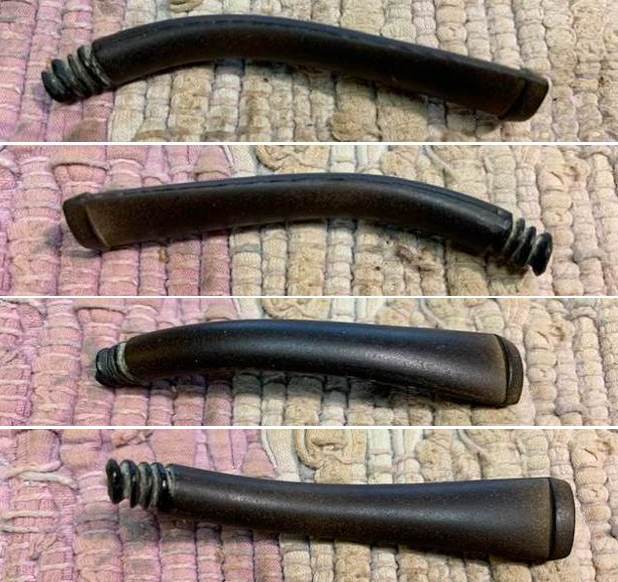
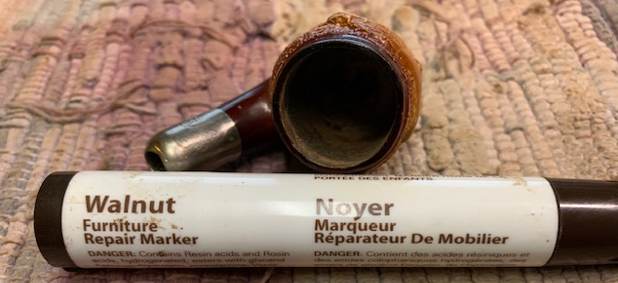
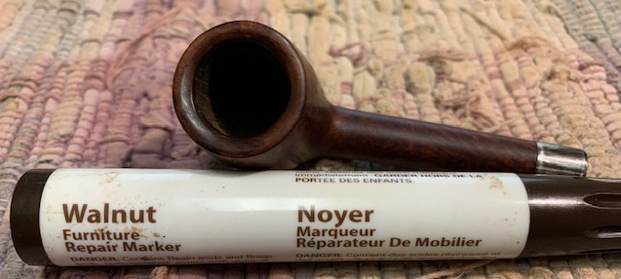
I went through my stems and found an older vulcanite stem that may well have been the one that came with the pipe. The tenon had been threaded and it screwed into the shank and ferrule perfectly. It turned into place and was a perfect fit. I took a picture of the stem with the bowl to give a sense of what the pipe would look like with the stem. I liked what I was seeing.I touched up the rim top where the finish had worn off using a Walnut Stain Pen. The match was perfect.I set the bowl aside and turned to deal with the stem. I scrubbed it with Soft Scrub to break down the oxidation that was deep in the vulcanite. I was able to remove a large portion of it that way. I then sanded it with 220 grit sandpaper to remove more. I started polishing it with 400 grit wet dry sandpaper.I polished out the scratches and more of the oxidation in the surface of the vulcanite with micromesh sanding pads – 1500-12000 grit pads. I wiped it down with Obsidian Oil after each pad. I used Before & After Pipe Polish – both Fine and Extra Fine to further polish the stem. I gave it a final coat of Obsidian Oil and set it aside to dry. I really enjoyed refurbishing this old C.P.F. Germany Glazed Clay Bent Billiard because it is so unique looking. I put the bowl and stem back together to have a look at the whole with all it of it polished. I hand buffed it with a microfiber cloth to deepen the shine. It is fun to see what the polished bowl looks like with the silver plated band and the polished black vulcanite stem. This richly finished C.P.F. Germany Glazed Petite Bent Billiard is light weight and it is clean and ready load up with my favourite. Have a look at it in the photos below. As noted above, Its measurements are Length: 4 ½ inches, Height: 1 ½ inches, Outside diameter of the bowl: 1 inch x 1 ¼ inch, Diameter of the chamber: ¾ of an inch. The weight of the pipe is 44 grams/1.55 oz. This is one will be joining other C.P.F. pipes in my personal collection of the brand as it is a unique addition. Thanks to each of you who are reading this blog. Remember we are not pipe owners; we are pipemen and women who hold our pipes in trust until they pass on into the trust of the next generation.    

Breathing New Life into a Hardcastle’s London Made Petite Liverpool


Blog by Steve Laug

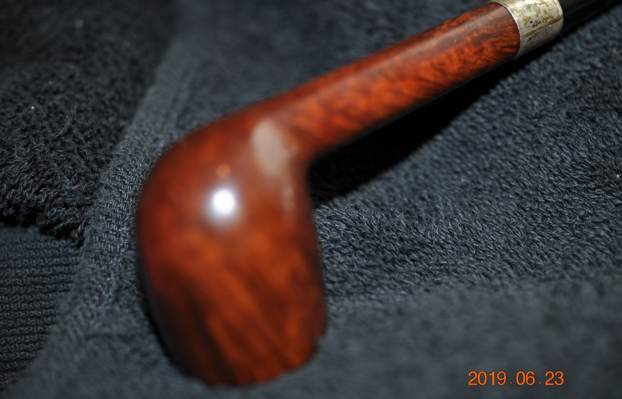
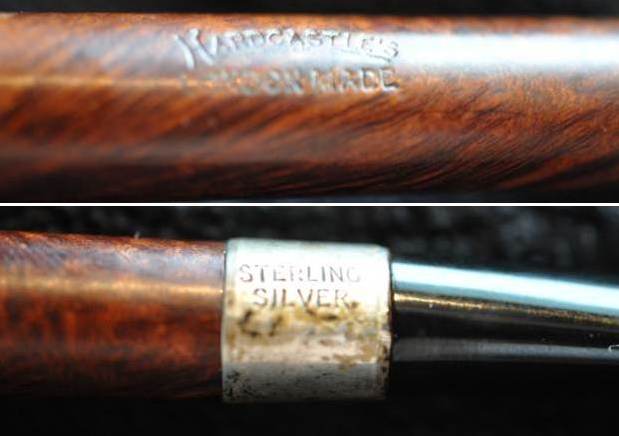
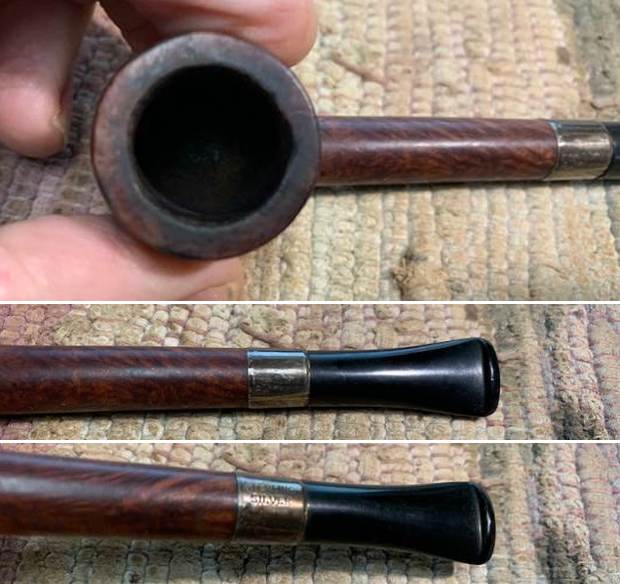
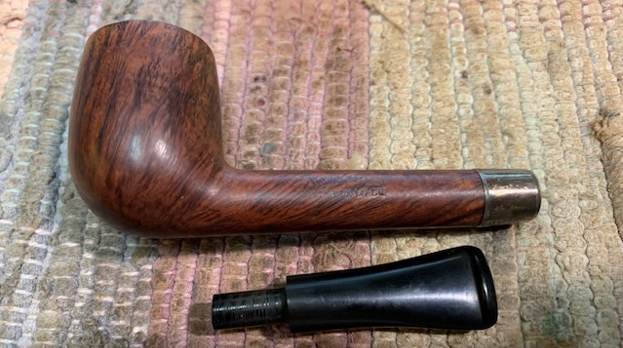
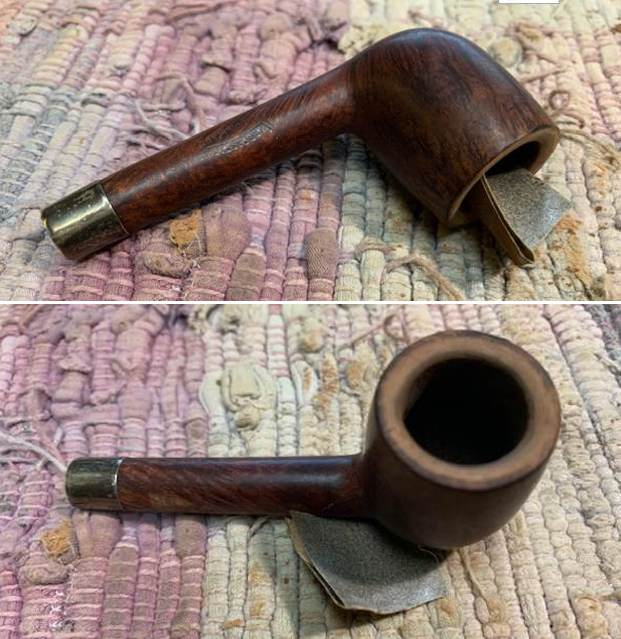
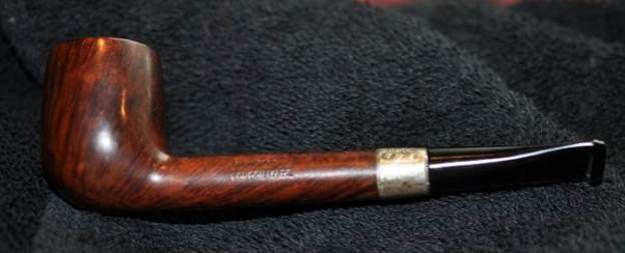
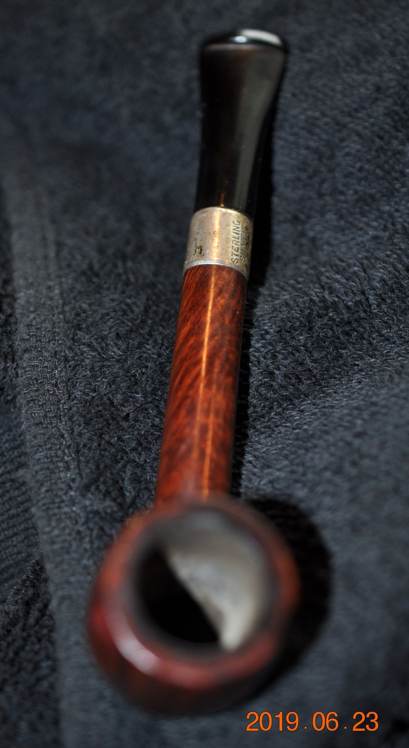
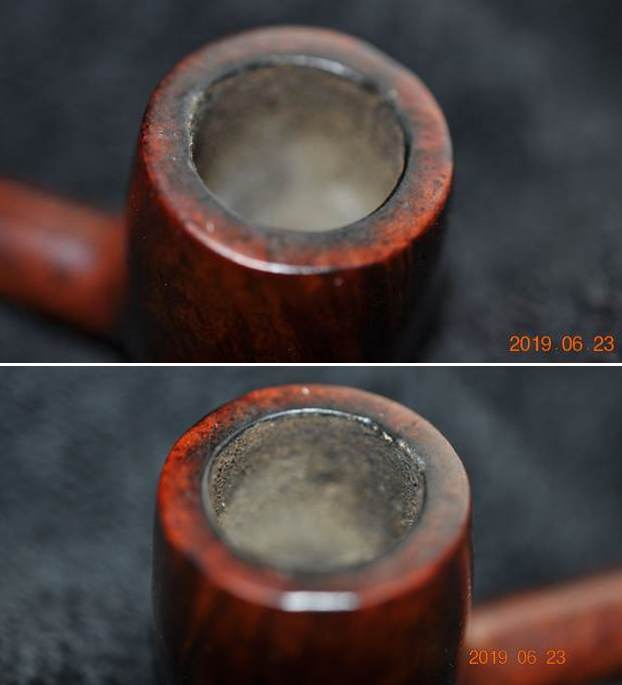
The next pipe on the work table came to us from an online auction on 03/21/19 in Wilkes Barre, Pennsylvania, USA. It is a smooth Hardcastle’s Liverpool shaped pipe with a taper vulcanite stem. The pipe is stamped on the left side of the shank and reads Hardcastle’s [over] London Made. The Sterling Silver Band is stamped Sterling [over] Silver on the underside. The finish had a lot of grime ground into it and it was very dirty. The bowl was thickly caked and there was a lava coat on the flat rim top and damage to the back of the inner edge of the rim. The stem was lightly oxidized and had light tooth chatter and marks on the top and underside button. The dirty pipe showed some great looking flame and straight grain under the grime. It was full of promise. Jeff took photos of the pipe before he started his cleanup work.   He took photos of the rim top and bowl to give a clear picture of the thickness of the cake and the condition of the rim top and edges. You can see the darkening and damage to the inner edges all around the bowl but particularly toward the back side of the bowl. He also took photos of the top and underside of the stem to show the light oxidation and chatter and tooth marks. Jeff took photos of the side and heel of the bowl to give a picture of what the briar around the pipe looked like.    He took photos of the stamping on the shank and the silver band. They read as noted above and are clear and readable. I was curious about the particular line of Hardcastle’s pipes that I was working on. I wanted some more information on the London Made line so I did some searching on Pipephil (http://www.pipephil.eu/logos/en/logo-hardcastle.html). I including the short history of the brand as a whole from that site. The line itself was not present on the site.
1903: Edmund Hardcastle establishes the brand.

1936: the family sells 49% of the Hardcastle Pipes Limited shares to Dunhill.

1946: Dunhill buys the remaining shares. The family continues to manage the company.

1967: Dunhill merges Hardcastle with Parker. The new Parker-Hardcastle Limited company absorbs the Masta Patent Pipe Company.

I turned to Pipedia (https://pipedia.org/wiki/Hardcastle) to try to gather more information on the line. It gives a more detailed history of the brand but there is no mention of the Hardcastle’s London Made. I quote a section of the history below.

Hardcastle was founded in 1908 by Edmund Hardcastle and built itself a good reputation among the numerous British mid-graders. In 1935 Dunhill started to build a factory next door to Hardcastle in Forest Road, Walthamstow, London E17. The family owned Hardcastle Pipes Limited sold 49% of its equity to Dunhill In 1936.

Along with closing down its pipe factory in Notting Hill in 1946 Dunhill bought the remaining shares, turning Hardcastle into a 100% Dunhill subsidiary. As members of the Hardcastle family continued as executives in the company’s management Hardcastle retained a certain independence.

This ended in 1967. Dunhill merged Hardcastle with Parker (100% Dunhill as well). The new Parker Hardcastle Limited also absorbed the former Masta Patent Pipe Company. Hardcastle’s Forest Road plant was immediately given up and the production of Hardcastle pipes was shifted to Parker’s nearby St. Andrews Road factory – now consequently called Parker-Hardcastle factory.

In fact this put a definite end to Hardcastle as an own-standing pipe brand, and none other than Edwin Hardcastle, the last of the family executives, spoke frankly and loudly of Hardcastle pipes being degenerated to an inferior Dunhill second.

Today Hardcastle pipes use funneled down bowls that are not deemed suitable to bear the Dunhill or even the Parker name (as well as obtaining briar from other sources).

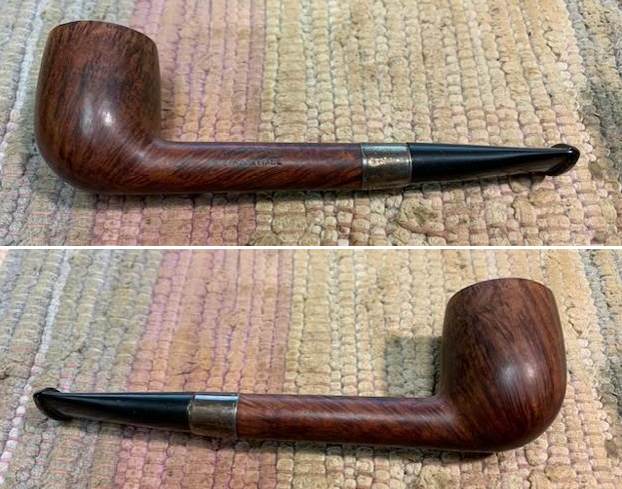
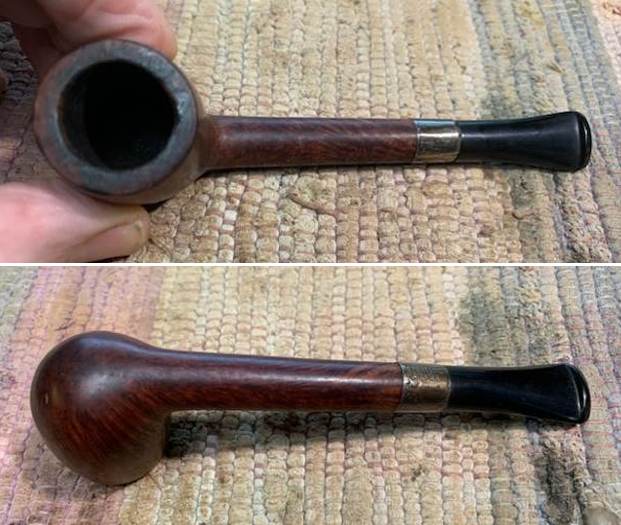
With that bit of information I believe it is an older family period pipe but cannot prove it. Jeff had cleaned up the pipe with his usual thoroughness. He reamed the pipe with a PipNet Pipe Reamer and cleaned up the remnants with a Savinelli Fitsall Pipe Knife.  He scrubbed the bowl with undiluted Murphy’s Oil Soap with a tooth brush. He rinsed it under running warm water to remove the soap and grime. He cleaned out the inside of the shank and the airway in the stem with alcohol, cotton swabs and pipe cleaners. He soaked the stem in Before & After Deoxidizer and rinsed it off with warm water. I took photos of the pipe over 2 years later when I finally got around to working on it.  The rim top has a lot of darkening on the top and chips and burn damage on the inner edge and on the rim surface leaving the bowl slightly out of round. The stem surface looked very good with some tooth marks and chatter on both sides near the button.I took a photo of the stamping on the shank side. It is clear and readable as noted above. I removed the stem and took a photo of the pipe to give a sense of the whole. The round shank and tapered stem makes for a lovely Liverpool.I started my work on the pipe by working over the rim top and the inner edge of the bowl to clean up the damage. Once finished the rim top and edge looked much better. I stained the sanded and beveled the rim top and inner edge with a Walnut Stain Pen. It matched the rest of the colour on the briar very well.I polished the briar with micromesh sanding pads – wet sanding with 1500-12000 grit pads. I wiped the bowl down after each pad with a damp cloth. I rubbed the bowl down with Before & After Restoration Balm. I worked it into the surface of the bowl sides and shank with my fingertips. The product works to clean, enliven and protect the briar. I let the balm sit for fifteen minutes and then buffed with a cotton cloth to raise the shine.   I polished the silver band with a jewelers cloth. It works to polish and protect it from further oxidation and darkening.I laid the bowl aside and turned to work on the stem. I polished the vulcanite stem with micromesh sanding pads – 1500-12000 grit pads. I wiped it down with an Obsidian Oil impregnated cloth after each sanding pad. I used Before & After Pipe Polish – both Fine and Extra Fine to further polish the stem. I gave it a final coat of Obsidian Oil. This petite Hardcastle’s London Made Liverpool – round shank with a vulcanite taper stem is a great looking pipe now that it has been restored. The beautiful grain that shines through the polished finish is stunning. I put the stem back on the bowl and carefully buffed the pipe with Blue Diamond on the buffing wheel. I gave the bowl and the stem multiple coats of carnauba wax on the buffing wheel and followed that by buffing the entire pipe with a clean buffing pad. I hand buffed the pipe with a microfiber cloth to deepen the shine. The finished Hardcastle’s London Made Liverpool fits nicely in the hand and feels great. Give the finished pipe a look in the photos below. The dimensions of the pipe are Length: 5 inches, Height: 1 ½ inches, Outside diameter of the bowl: 1 inches, Chamber diameter: ¾ of an inch. The weight of the pipe is 19gr/.67oz. I will be adding it to the rebornpipes store in the British Pipe Makers section. If you are interested in adding this pipe to your collection send me a message or an email. Thanks for reading this blog and my reflections on the pipe while I worked on it. There are many more to come!
Restoring a Hand Carved Meerschaum Calabash with a 9mm Acrylic Filter Stem


Blog by Steve Laug

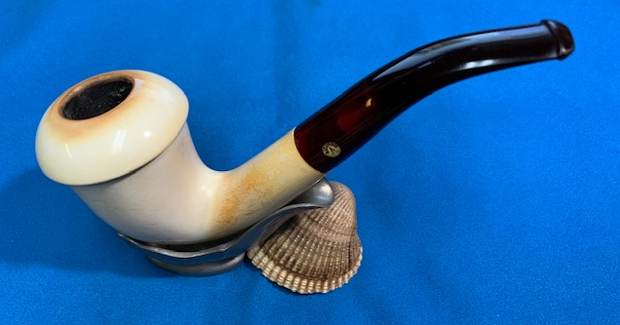
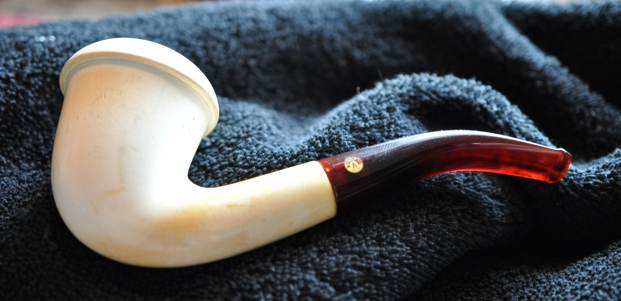
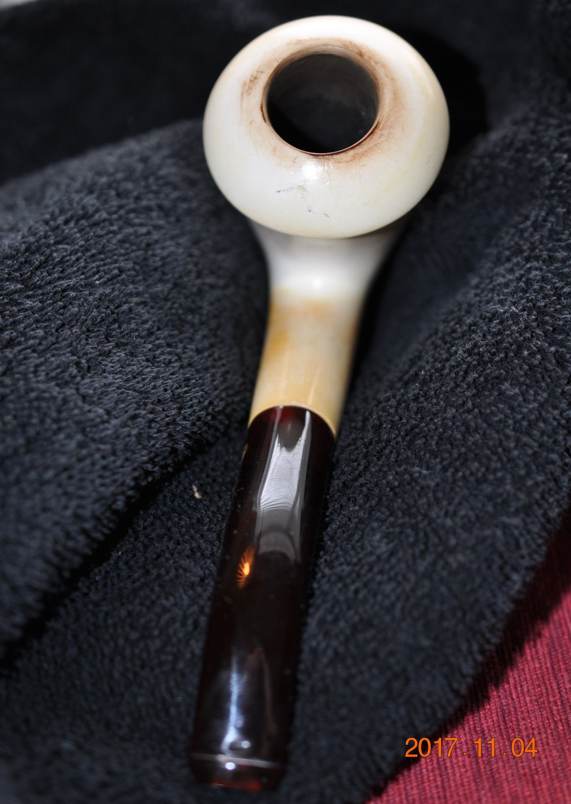
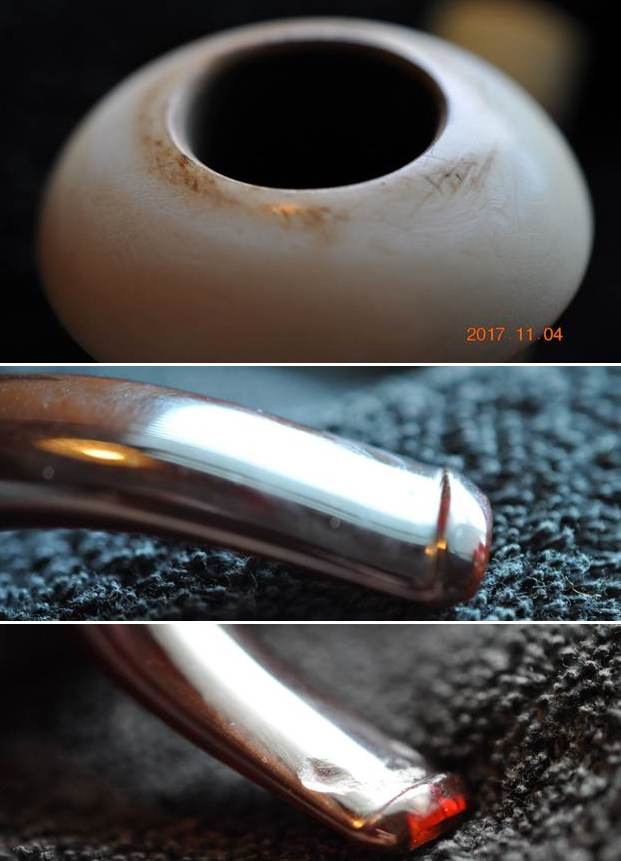
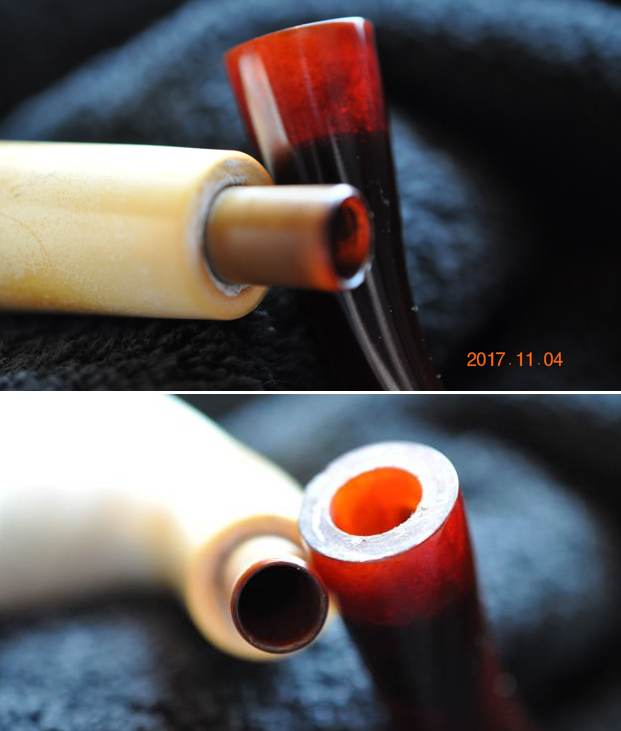
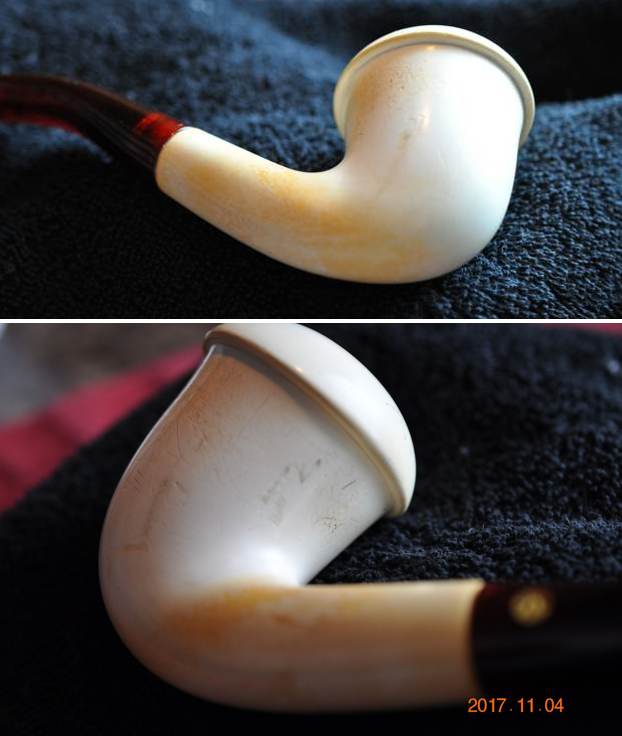
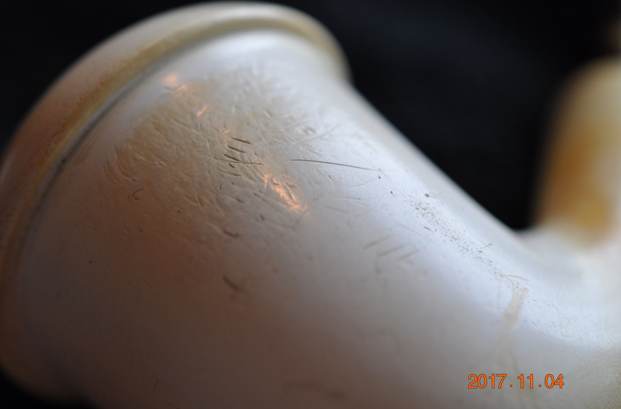
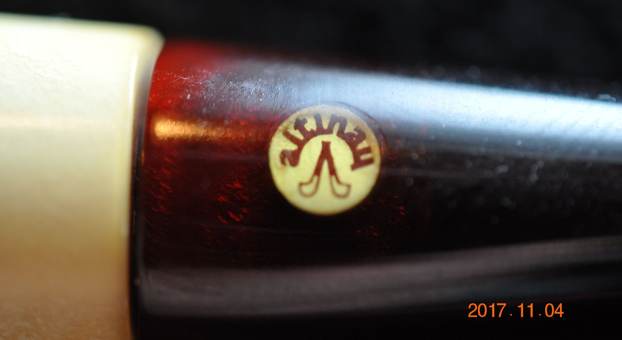
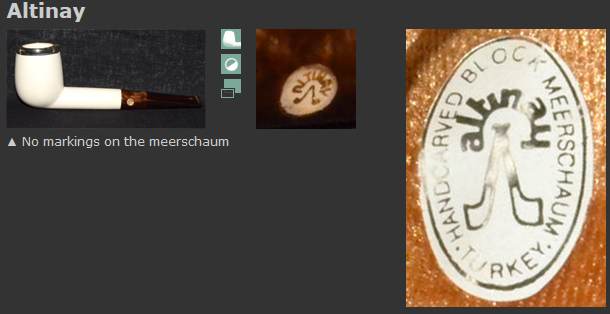
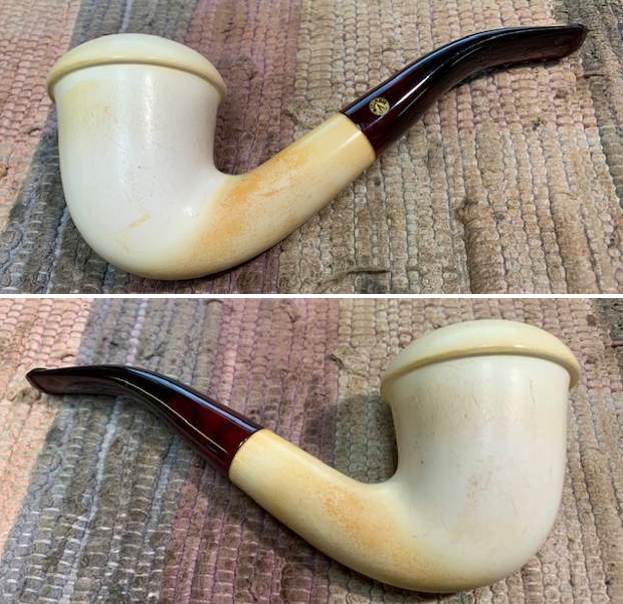
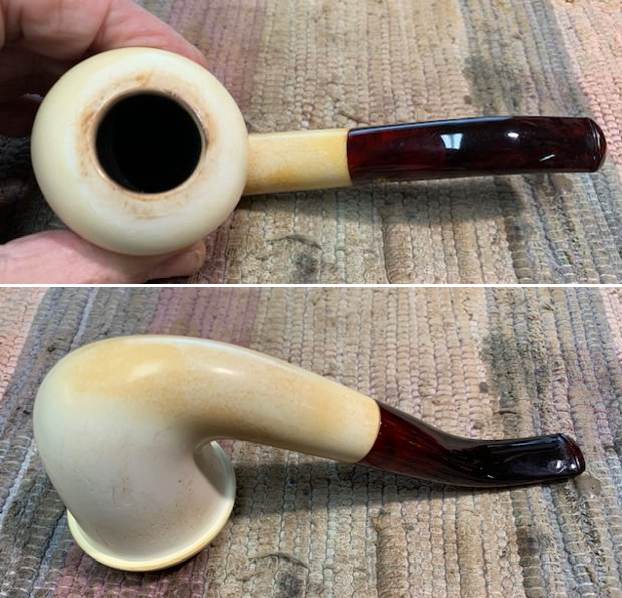
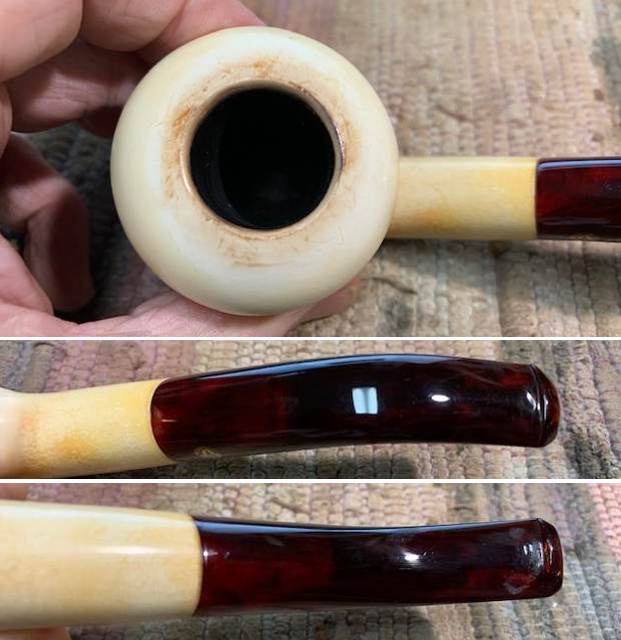
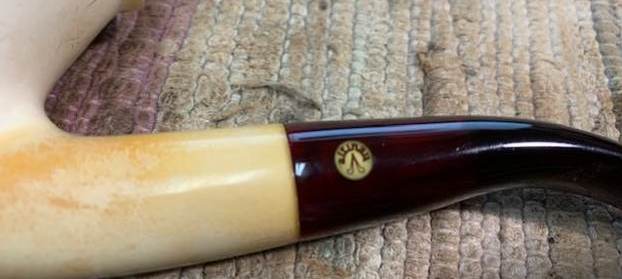
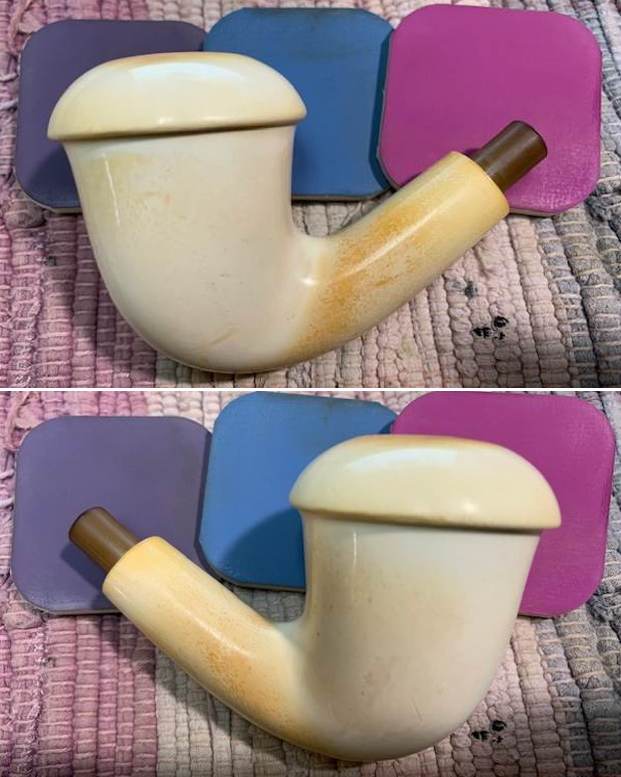
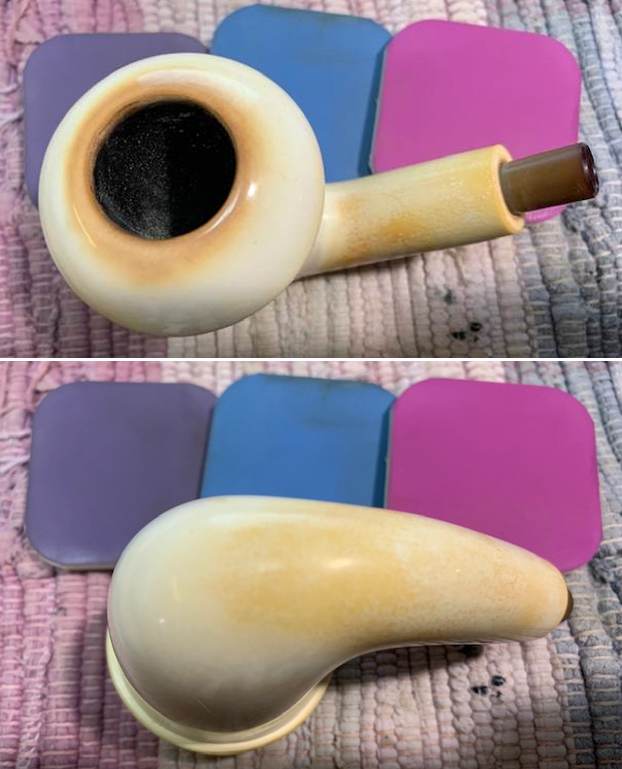
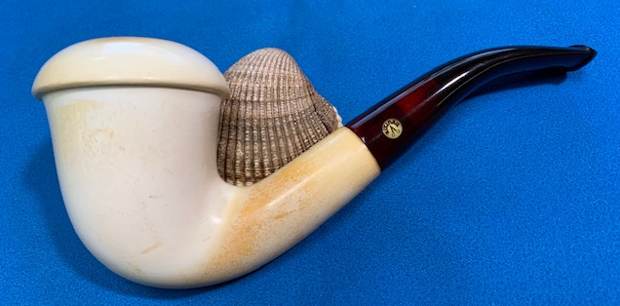
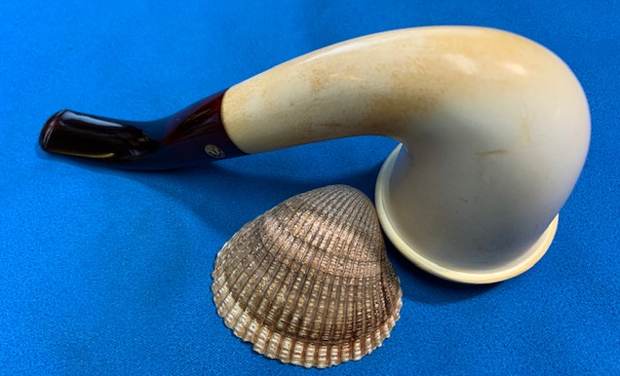
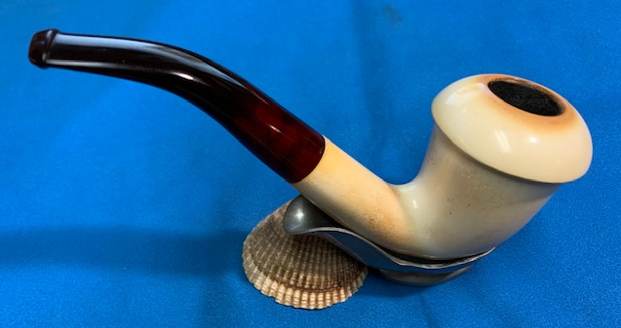
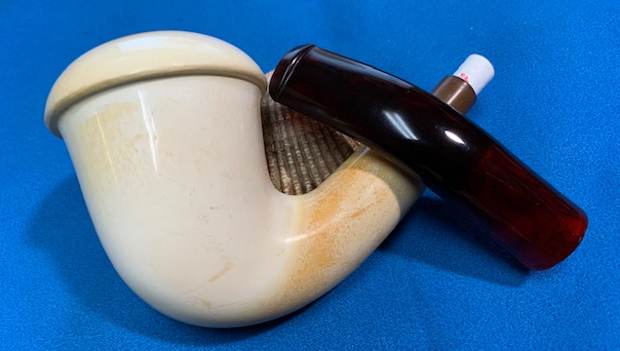
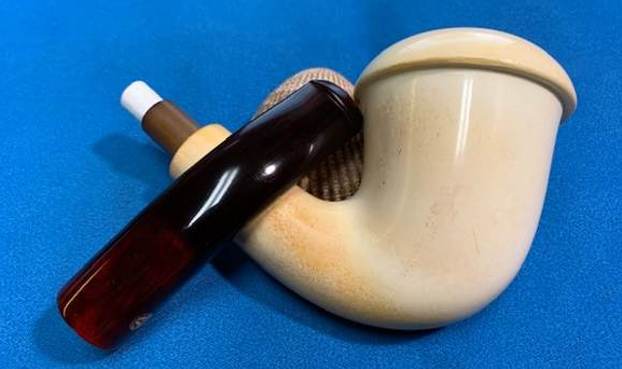
The next pipe I chose to work on came from a trip Jeff and his wife took  to Europe in the Fall of 2017. He picked it up in a bazaar in Frankfurt, Germany. It was a nicely carved smooth Calabash with a round brass Altinay logo on the ruby coloured acrylic stem. The finish on the bowl and cap were scratched and worn looking but still had a lot of charm. The bowl and rim top appear to have been quickly cleaned for the sale but there was still a light cake in the bowl and some lava spots on the inner edge and rim top. The meerschaum was beginning to develop a patina on the shank and lightly on the bowl and rim top. The ruby coloured acrylic stem was made for a 9mm filter which is not surprising. It gave a good first impression but had deep tooth marks on the top and underside ahead of the button. He took photos of the rim top and the stem to show the condition. You can see the issues on the rim top and stem as I noted above. There are also some scratches on the rim top itself that I am hoping will polish out and look much better. You can see the tooth damage on the stem surfaces on both sides ahead of the button. The mortise on the shank has been fitted with a nylon tenon that holds 9mm filters. The stem has been drilled out to fit snug over the tenon. Jeff took photos of the side and heel of the bowl. You can see the graceful lines and nicely carved bowl of the pipe. It is a lightweight block meerschaum that is well made. There are a lot of visible scratches around the sides and top. He took a close up photo of the left side of the bowl to show the scratches. He took a photo of the brass Altinay two pipe logo inset on the left side of the taper stem.I turned to Pipephil to see what I could learn about the brand (http://pipephil.eu/logos/en/logo-a4.html). There was a sidebar that said that the Altinay Pipe Co Ltd. was founded in 1964 in Eskişehir (Turkey). I did a screen capture of the section on the site and included it below.I then turned to Pipedia to learn a bit more about the brand (https://pipedia.org/wiki/Altinay). I have copied pertinent information on the history of the brand below.

HISTORY OF ALTINAY

Necdet Altınay (1941-2018), who worked in various jobs from a young age to support his family, entered the meerschaum carving sector at the age of 14 and became a meerschaum master at a young age by training from the best masters of the time.

After developing himself in all areas of meerschaum carving such as compositions, sculptural works, famous claw figures until the age of 23, he founded Altınay Pipe Co. in 1964 and started working on purely classical style pipes by noticing the important deficiency in the pipe industry about classical style meerschaum pipes.

He has developed his skills on classical pipes with tactics he received from European pipe masters and has gained an important place in the sector with international fairs he attended regularly.

The importance he attaches to quality and customer satisfaction in his business has made the ALTINAY brand a popular and sought-after brand in meerschaum sector. And soon started exporting worldwide, America, Russia China and especially in Europe through distributors.

Besides his own brand ALTINAY, he also produced meerschaum pipes for world famous brands such as Dunhill, Peterson, Savinelli, Chacom, Brebbia, Butz Choquin. As it is already for Rattrays and Andreas Bauer now.

After working 3 generations together for several years, before he passed away in 2018, largely transferred his superior skills and vision to his son (Nedim Altınay,1967) and grandson(Said Altınay,1990), whom he worked and trained for many years. Now Nedim and Said are working together to take the company further in His quality and vision…

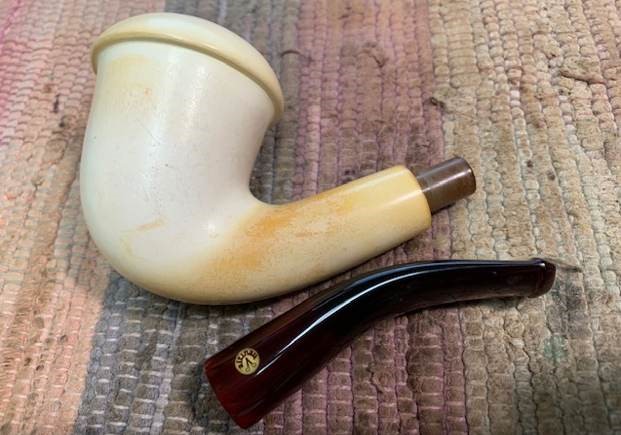
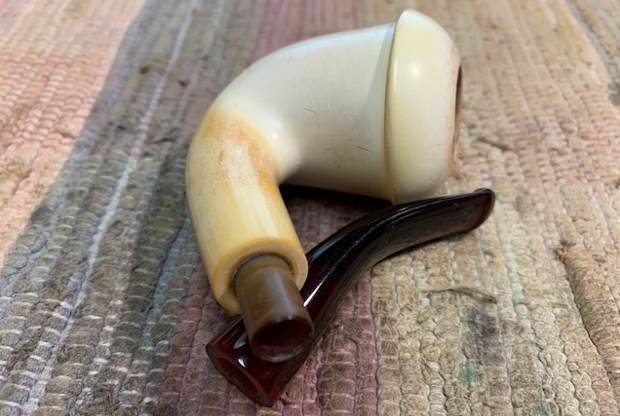
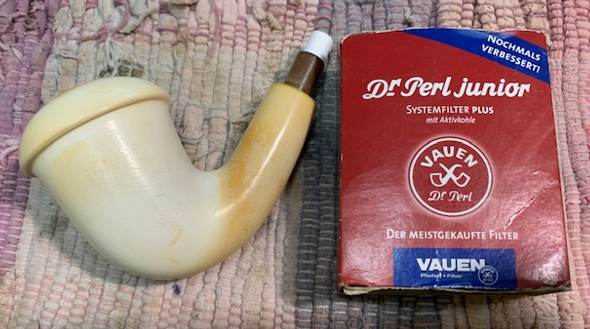
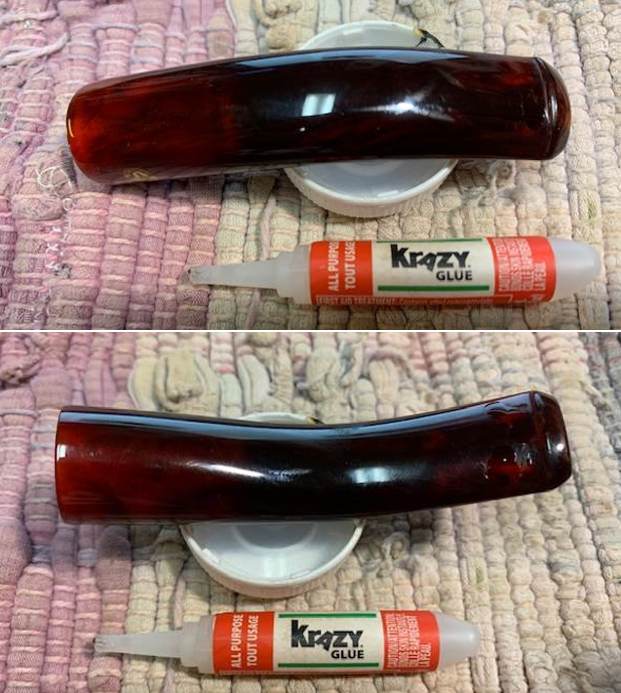
Jeff had cleaned up the pipe with his usual thoroughness. He carefully reamed the pipe with a Savinelli Fitsall Pipe Knife. He scrubbed the bowl with undiluted Murphy’s Oil Soap with a tooth brush. He rinsed it under running warm water to remove the soap and grime. He cleaned out the inside of the shank and the airway in the stem with alcohol, cotton swabs and pipe cleaners. He cleaned the stem Soft Scrub cleanser and rinsed it off with warm water. I took photos of the pipe 3 years later when I finally got around to working on it. The rim top and inner edge of the rim looked very good with some slight darkening on the rim top and inner edge. The stem surface looked very good with some deep tooth marks and chatter on both sides near the button. I took a photo of the logo on the left side of the taper stem. The fit of the stem to the shank is snug. The shank also shows some patina developing nicely along its length.I removed the stem and took a photo of the pipe to give a sense of the whole. The tenon is nylon and is integrated in the shank. The stem is drilled to slide snug on the tenon. The stem is a nice looking ruby red acrylic. I polished the smooth meerschaum with micromesh sanding pads – dry sanding with 1500-12000 grit pads. I worked on the darkening of the rim top at the same time. I wiped the bowl down after each pad with a damp cloth. The longer I polished it the more the patina came to the surface. The pipe became more beautiful with each grit of polishing pad. I took out my Dr. Perl Junior 9mm filters made by Vauen to fit one to the stem of this beauty. It fit in mortise and tenon perfectly and did not inhibit the air flow significantly. Impressive.I set the bowl aside and turned my attention to the stem. I filled in the deep tooth marks on the stem surface on both sides with clear CA glue. Once the repairs cured I sanded them smooth with 220 grit sandpaper. I started polishing the stem with 400 grit wet dry sandpaper. I polished the stem with micromesh sanding pads. I dry sanded it with 1500-12000 pads and wiped the bowl down after each pad with a cloth and Obsidian Oil. I finished polished it with Before & After Fine and Extra Fine stem polish. I wiped it down with the cloth and Obsidian Oil one final time and set aside to dry. This Altinay Meerschaum Calabash with a ruby coloured acrylic stem is a beautiful pipe. The polished light weight meerschaum that shines through the polished finish is stunning. I put the stem back on the bowl and carefully buffed the pipe with a clean buffing pad. I hand buffed the pipe with a microfiber cloth to deepen the shine. The finished Altinay Meerschaum Calabash fits nicely in the hand and feels great. Give the finished pipe a look in the photos below. The dimensions of the pipe are Length: 6 inches, Height: 2 ½ inches, Outside diameter of the bowl: 2 inches, Chamber diameter: ¾ of an inch. The weight of the pipe is 55 grams/ 1.94 oz. This Altinay Calabash is a real beauty and the 9mm filter ruby coloured acrylic stem just highlights the beauty. Jeff made a great find when he picked this up in Frankfurt. Thanks for reading this blog and my reflections on the pipe while I worked on it. There are many more to come!

A Pipe of Distinction


Blog by Kenneth Lieblich

Next on the chopping block is a very personal pipe – and one that is staying in my collection. The photo you see below is of my late grandfather, in the early 1970s, smoking a charming Bewlay Canadian pipe. It is this pipe’s restoration that I am recounting today. I do not know where my grandfather acquired it (or under what circumstances), but I suppose it does not ultimately matter. My grandfather was an enthusiastic pipe smoker and he clearly enjoyed this one. I am definitely looking forward to cleaning this one up. It has a value well beyond dollars.The pipe is from The House of Bewlay and is a Canadian shape. What a charming and elegant pipe! In order to read the markings correctly, I used my old trick of rubbing chalk over them (like a gravestone) and that helped a lot. The pipe’s markings read Bewlay [over] Twenty. The other side of the pipe shows the shape number, 003 [over] London Made. This sort-of corresponds with a Bewlay catalogue from the late 60s, as you can see in the photos. I say, “sort-of”, because the brochure shows shape numbers 001 and 002. I do not know the exact date of the pipe, but it is likely from the late-1960s or early-1970s. Let us read a bit more about Bewlay from the Pipedia article:

The English brand of Bewlay & Co. Ltd. (formerly Salmon & Gluckstein Ltd.), was in business from the early 20th century until the 1950s. The brand ended up being sold and taken over by Imperial Tobacco Co. The shop chain closed in the 1980s but there seems to be one shop still in business on Carr Lane in the city of Hull. Bewlay pipes were made by prestigious firms. Notably Barling, Charatan, Loewe & Co., Sasieni, Huybrecht, and Orlik. So understandably, the English considered a Bewlay pipe a quality pipe.

Anyway, on to the pipe – and what a beauty it was. However, it was not without its issues. The stummel had the following problems: lava on the rim, a notable burn to the rim, plenty of cake in the bowl, a couple of nicks to the bowl, and a tired, worn-out colour of wood. By the way, the strange “stains” to the bowl are, in fact, old bits of newspaper. After my grandfather died, the pipes were wrapped in newspaper and stuck in a box. The newspaper got wet at some point in the intervening years. Meanwhile, the stem had its own set of problems: some oxidation and calcification, minor tooth marks and dents, a filthy stinger, the ‘B’ logo was a bit worn, and (worst of all) a large chunk of vulcanite missing from the bit! This pipe was going to be a bit tricky, and I needed to be especially careful to ensure the missing vulcanite would be repaired properly – so it could be used for many years to come. The stem was first on my list. This stem has a stinger in it – and it was being quite stubborn about coming out of the tenon! I opted to warm the stem and stinger with a hair dryer and this provided just enough softening of the internal goo to allow me to pull it out. The stinger then went for a soak in some lemon-infused isopropyl alcohol. I let it set for several hours and then cleaned it off and it looked much improved. I then finished it with some metal polish and moved on. I wiped down the outside of the stem with Murphy’s Oil Soap on some cotton pads. I also took a BIC lighter and ‘painted’ the stem with its flame in order to lift the bite marks and dents. This was fairly successful in raising the damage. Then, I cleaned out the insides with pipe cleaners and isopropyl alcohol. Once this process was done, the stem went for an overnight soak in the Before & After Hard Rubber Deoxidizer. The following day, I cleaned all of the de-oxidizing sludge off with alcohol, pipe cleaners, et cetera. The oxidation had migrated to the surface and would be fairly straightforward to remove. I scrubbed vigorously with SoftScrub on cotton pads to remove the leftover oxidation. I also built up some tiny dents on the stem with cyanoacrylate adhesive and let it fully cure.Now it was time to make a patch for the missing chunk of vulcanite. This patch was made with a mixture of cyanoacrylate glue and activated charcoal powder. This created a black, resilient mush that would be very hard-wearing when cured and would work perfectly for this repair. Thanks to Steve’s instruction, I first plugged up the stem’s draught hole with a pipe cleaners coated in petroleum jelly. This ensured that any of the cyanoacrylate and charcoal mush would not accidentally plug up the air passage in the stem. This was a tricky business and it took some real patience and effort to make it work. As the photos show, after I applied the cyanoacrylate and charcoal mush, it looked pretty darn ugly, but I was expecting that. I also managed to get some of the bits of pipe cleaner bristles into the repair! No big deal – those were quickly excised. After the curing, I pulled out the Dremel rotary tool and began to remove the excess material. This was also the preliminary step in shaping the button. To carry this process on, after the Dremel, I used a miniature file to further shape the button and make it suitable for sanding. I used another file on the inside to ensure there were no rough edges in the bore. I then sanded the stem down with 220-, 400-, and 600-grit sandpapers to meld seamlessly into the stem. This ensures that it keeps its shape and looks like it should. I then used all nine Micromesh pads (1,500 through 12,000 grit) to bring out the lovely black lustre on the stem. I also used Obsidian Pipe Stem Oil in between each pad scrubbing. It is worth noting that a repair this big on a stem will never be completely invisible, but I was very pleased with how I managed to make the stem of my grandfather’s pipe look so good. Just before finishing with the Micromesh pads, I took the opportunity to repair the “B” logo on the stem. It had faded – both by loss of paint and also by fingers inadvertently smoothing out the “B” over time. So, I added some acrylic paint with a paint brush, let it dry, and buffed it to make it look good. The “B” is back, but, as later photos reveal, a little bit has disappeared into history.On to the stummel, and the usual cleaning procedures were in order for this pipe. I used both the PipNet Reamer and the KleenReem to remove the built-up cake, and followed that with 220-grit sandpaper to remove as much as I could. I wanted to take the bowl down to bare briar to ensure there were no hidden flaws in the walls of the bowl. Fortunately, there were none. I then proceeded to clean out the insides of the shank with cotton swabs, pipe cleaners, and isopropyl alcohol. There was quite a bit of filth inside this stummel – it took many pipe cleaners et cetera to clean it out.I followed that up by cleaning the insides with some dish soap and tube brushes. I then moved on to cleaning the outside of the stummel with Murphy’s Oil Soap and some cotton pads. That removed the bits of aforementioned newspaper and any remaining dirt. I also soaked the rim in Murphy’s for a while just to loosen up the lava. In order to remove the lingering bits of lava and fix any nicks on the rim, I “topped” the pipe – that is to say, I gently and evenly sanded down the rim on a piece of 220-grit sandpaper. This effectively removed the lava, without altering the look of the pipe. After that, a light application of Before & After Restoration Balm brought out the best in the stummel’s grain. What a difference that made! There is some beautiful wood under the grime! Having completed that, I was able to address the small nicks on the stummel. I dug out my iron and a damp cloth to try and raise the nicks. The hot and moist steam can often cause the wood to swell slightly and return to shape. There was some movement – not a lot, but it was better than doing nothing. I filled the remaining divots with cyanoacrylate adhesive and let it cure. Now, with the nicks filled, it was time to sand down the stummel. I used all nine Micromesh pads (1,500 through 12,000 grit) to wet/dry sand everything smooth. Then I added a bit more Before & After Restoration Balm. Then it was off for a trip to the buffer. A dose of White Diamond and a few coats of carnauba wax were just what this pipe needed. The lovely shine made the wood look absolutely beautiful. This is a wonderfully crafted pipe and has a very elegant feel to it. It took a lot of work, but I am proud of it and the final product is (hopefully) worthy of my beloved grandfather’s memory. Obviously, this is one pipe that I am keeping for myself and adding to my collection. I am sure that I will be enjoying this one for many years to come. I hope you enjoyed reading the story of this pipe as much I as I did restoring it. If you are interested in more of my work, please follow me here on Steve’s website or email me directly at kenneth@knightsofthepipe.com. Thank you very much for reading and, as always, I welcome and encourage your comments.

Reworking a Messy Hack Job on a Stem of a Lace Carved Meerschaum Dublin


Blog by Steve Laug

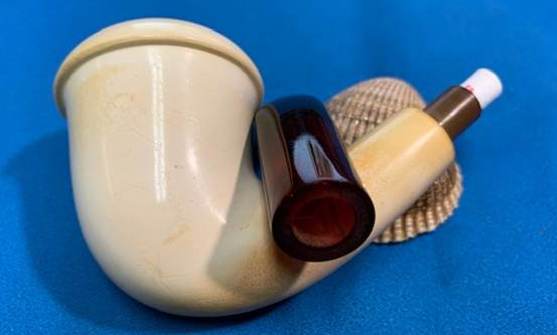
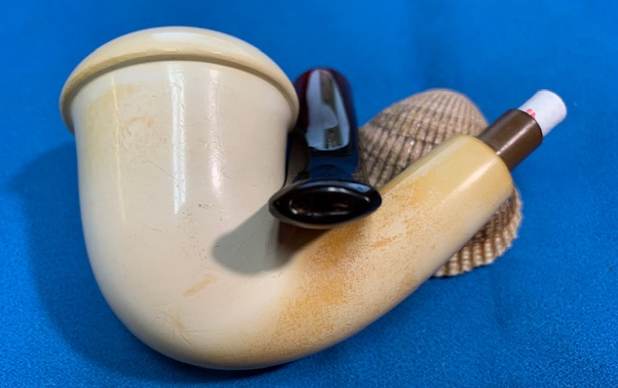
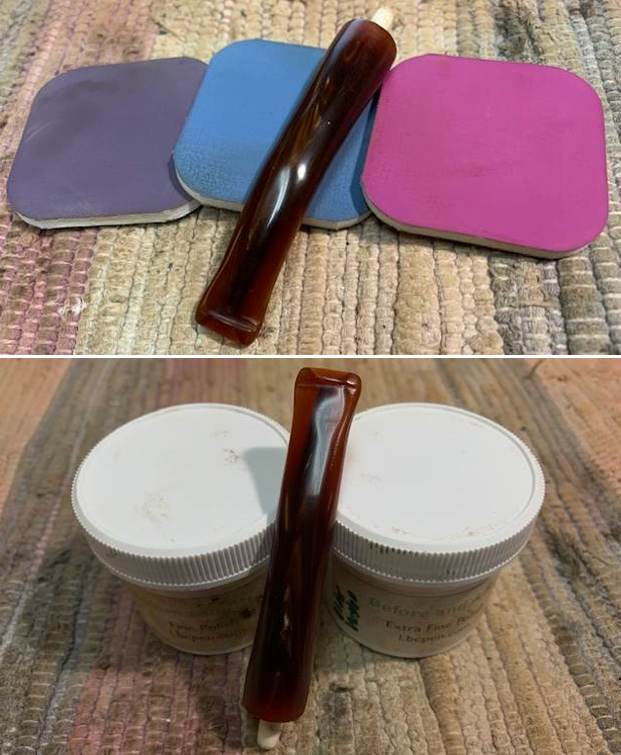
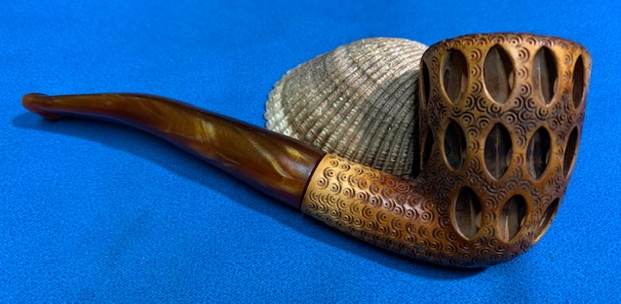
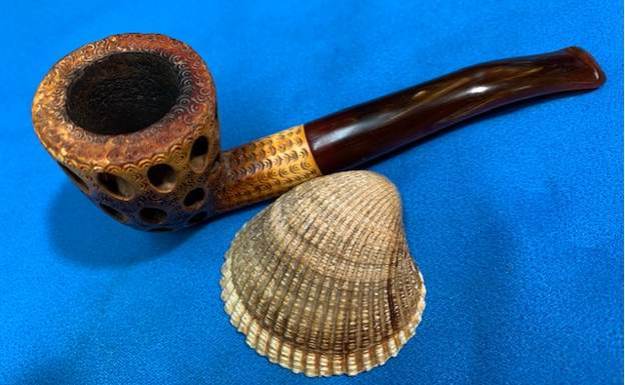
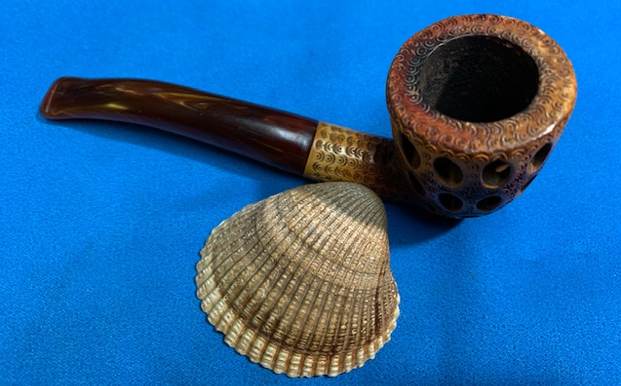
I am kind of on a meerschaum restoration binge so I thought I would have a look at my box of meerschaums to restore. I pulled out this nice looking lace carved Dublin meerschaum with a great patina. Jeff received an email from a fellow early in January, 2018 who lived in Los Fresnos, Texas, USA. He told us that he had a few pipes that had been his grandfather’s and he was selling them off for the family. This pipe was one of those. We love to pick up pipes with a bit of the back story attached so we did it. The exterior of the pipe was dirty but still quite beautiful. The bowl had a thick cake in it and there was lava on the rim top. It was obviously a well loved and oft smoked pipe. The stem was a mess with what looked like a reshaping done with a pocket knife that had left all kinds of hack marks and cuts in the surface. To my thinking it was done by the previous pipeman who had customized it to his liking for a more comfortable fit. The push tenon was old and tired and the threads holding it in the stem were stripped so that it was a very loose fit and would need to be replaced. The pipe had potential but would need a lot of work to bring it back. The stem would take the most time as I would need to smooth out the damage and reshape it properly. Jeff took photos of the pipe before he went to work on it. He took photos of the rim top and included different angles to capture condition of the bowl and rim top. You can see the lava build up on the rim top carving and edges as well as the thick cake in the bowl. He also took some photos of the stem to show the hacked condition of the acrylic and what would need to be done to reshape it. Jeff took some photos of the heel of the bowl and side to give a sense of the patina already yon this beauty. The under bowl (inside the lace) has really darkened and adds depth to the carving. Very nice! Jeff had cleaned the pipe thoroughly. He had reamed it carefully with a PipNet reamer and cleaned that up with a Savinelli Fitsall Pipe Knife. He worked slowly so as not to damage the inner edge of the bowl. It was a mess. He had scrubbed the exterior of the meerschaum with undiluted Murphy’s Oil Soap and a soft tooth brush. He cleaned out the interior of the shank and airway with alcohol, pipe cleaners and cotton swabs. He cleaned out the hacked acrylic stem with alcohol, cotton swabs and pipe cleaners to remove the debris and oils in the airway and the threads of the push tenon. Once it was clean the thread no longer held the tenon in the stem. I took photos of the pipe when it arrived here. It has real potential to be a great looking pipe. I took some close up photos of the bowl, rim top and both sides of the stem to show what they looked like before I started my part of the work. They are quite clean but the stem particularly is very roughly carved.I went through my jar of tenons and found a push tenon that was close to the original size of the one that had been used. The threads on the stem end fit perfectly but the push tenon portion was slightly too big. I would need to reduce the diameter slightly to get a perfect fit.I used a small flat file to flatten out the ridges and waves in the top and underside of the stem. I also used it to recut the button and sharpen the edge for more definition. A lot more shaping work to go but it is going to work well.I fit the push tenon in the shank portion and it was smooth and snug but removable by my fingers with little problem. I thread it in the stem portion and tightened it. I would put the stem on the shank to further shape the stem.With the stem in the shank I sanded the stem with 220 grit sandpaper to further shape the stem and to remove the deep gouges and file marks from the previous pipeman’s work on it. It began to take shape with each pass of the sandpaper. With the shaping on the stem basically finished and the rough sanding done I decided it was time to bend the stem to match the flow of the bowl. I heated it with a heat gun until the acrylic became flexible. I carefully bent it while on the pipe to make sure that the bend was not angled to either side. I wanted to take care of one of the shaping issues that I noticed in my work. The stem was tweaked slightly toward the right side. I knew I could not do much to change that but I could minimize it a bit in the bending. I bent softened stem to the right angle and cooled it quickly under water to set the bend. I took photos of the newly bent stem to show how it looked. I wanted the bend to reflect the bowl angles. I wanted the pipe to sit in the mouth with the bowl flat rather than angled down. The bend I put in worked to achieve that perfectly. I was also happy how the bend actually did minimize the rightward tweak of the stem. It looked much better. With the bend correct I went back to some final shaping of the stem surface. I worked on it with 220 grit sandpaper to get the shape I wanted. While not perfect it is a vast improvement from where it was when we purchased it. Once I had that I started the polishing of the stem with 400 grit wet dry sandpaper. It was starting to look really good!I polished the newly shaped acrylic stem with micromesh sanding pads – dry sanding with 1500-12000 grit sanding pads. I wiped it down after each sanding pad with a cloth containing some Obsidian Oil. I know Obsidian Oil does nothing for acrylic but I have found that it removes the small particles left behind by the polishing. I finished polishing the surface with Before & After Pipe Stem Polish – both Fine and Extra Fine and buffed it off with a cotton cloth. I gave it a final coat of obsidian Oil and set it aside to dry. It is a beautiful looking variegated brown/copper/gold acrylic stem. This Lace Carved Meerschaum Dublin turned out to be another fun pipe to work on and I was excited to see it come back together. With the grime and debris gone from the finish it was a beauty and the patina was quite nice. I chose not to rewax it because of the intricate lacework of the carving. I did not want to fill it in. I put the stem back on the bowl and carefully buffed the pipe with a clean buffing pad to raise the shine. I hand buffed the pipe with a microfiber cloth to deepen the shine. The rich polished meerschaum on the bowl looks really good with the polished variegated acrylic stem. It all came together better than I expected. Give the finished pipe a look in the photos below. I can only tell you that it is much prettier in person than the photos capture. The dimensions of the pipe are Length: 5 ½ inches, Height: 2 inches, Outside diameter of the bowl: 1 ½ inches, Chamber diameter: ¾ of an inch. The weight of the pipe is 37 grams/1.31 ounces. This is truly a great looking Meerschaum. Thanks for walking through the restoration with me as I worked over another beautiful pipe. I will be putting it on the rebornpipes store in the Ceramic and Meerschaum Pipe Section. If you are interested in the pipe send me an email or a message. Thanks for your time.

Reclaiming a Uniquely Shaped Cased Bent Opera Meerschaum with a Redmanol Stem


 Blog by Steve Laug

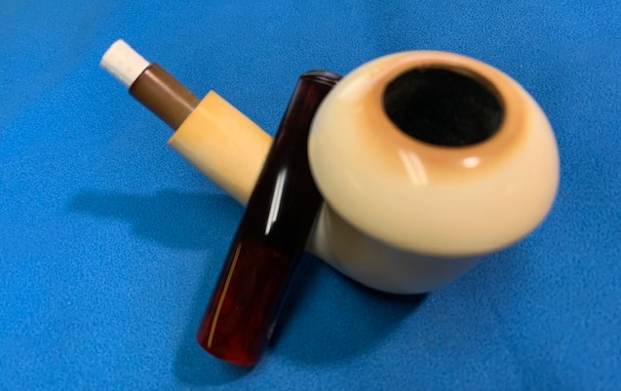
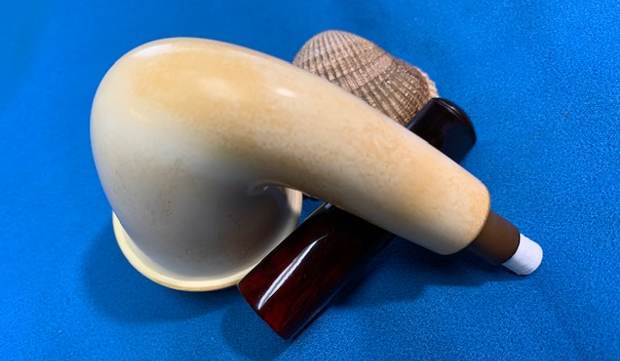
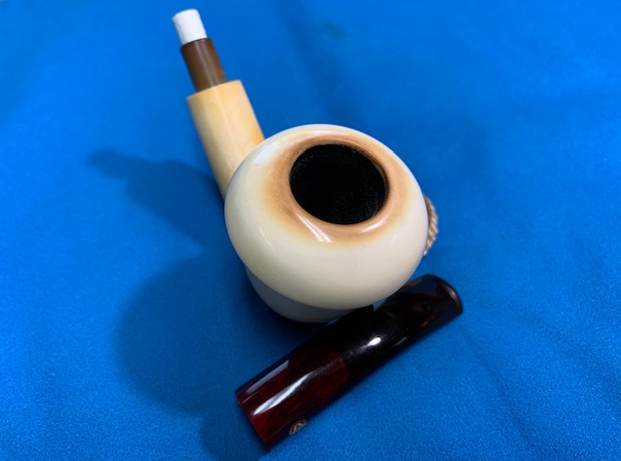
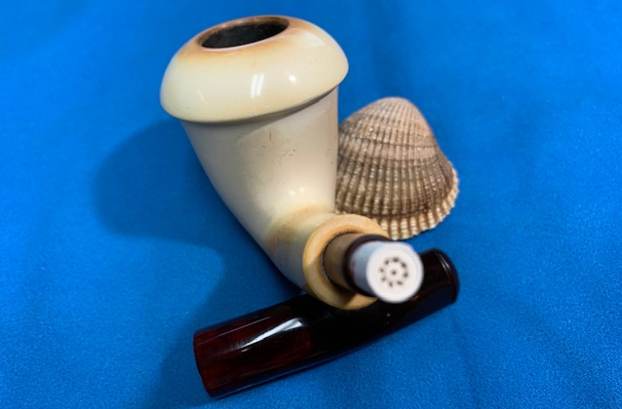
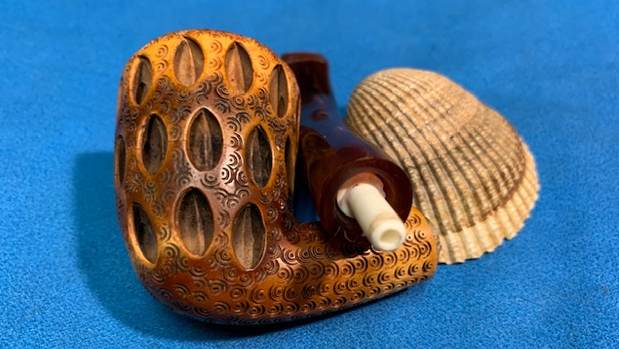
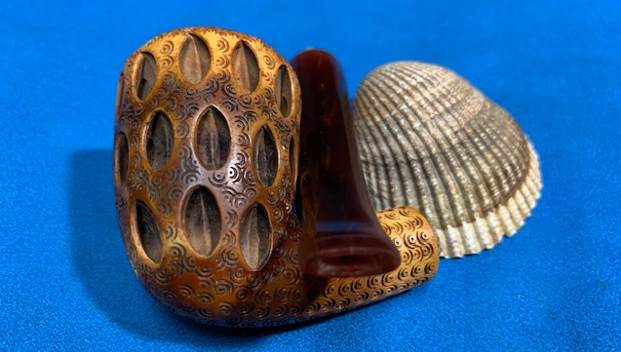
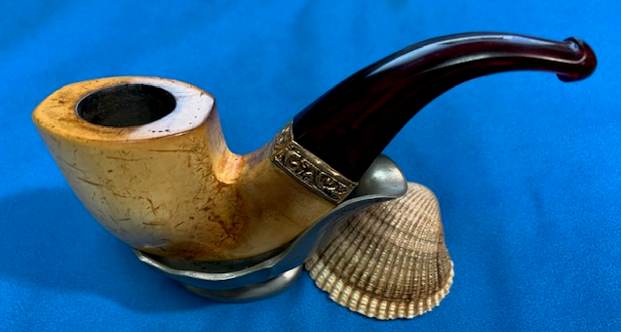
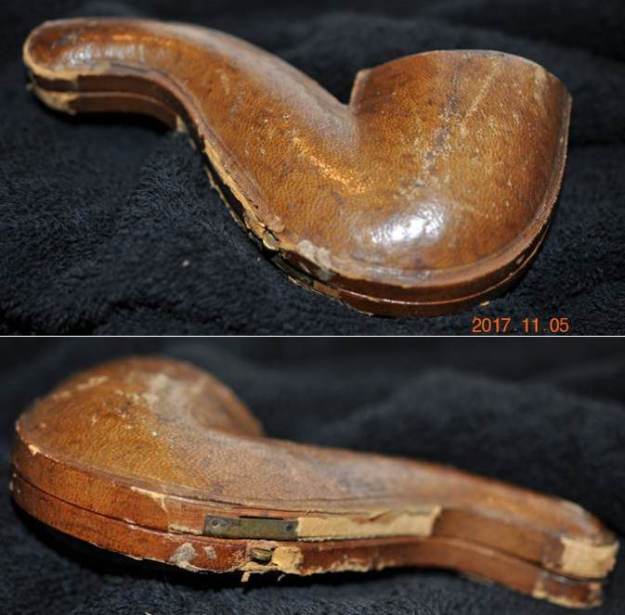
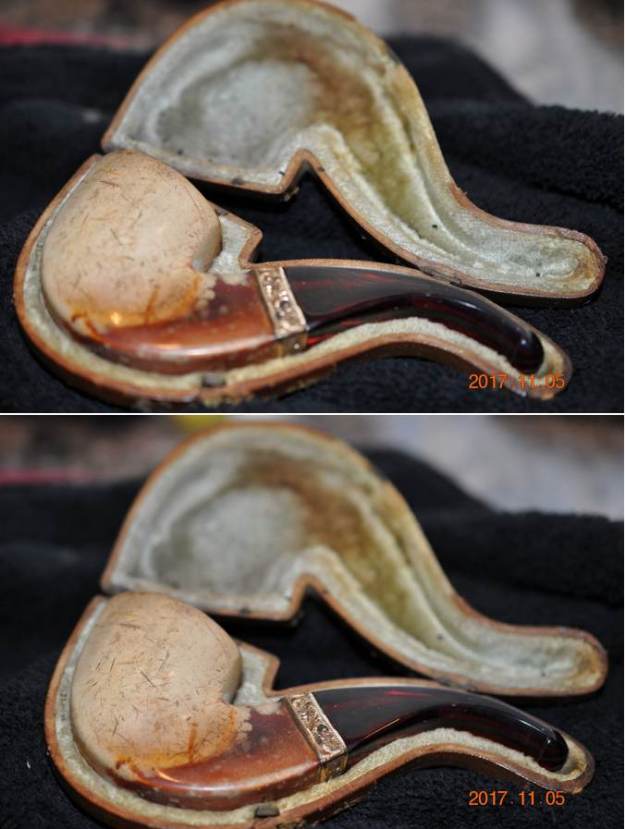
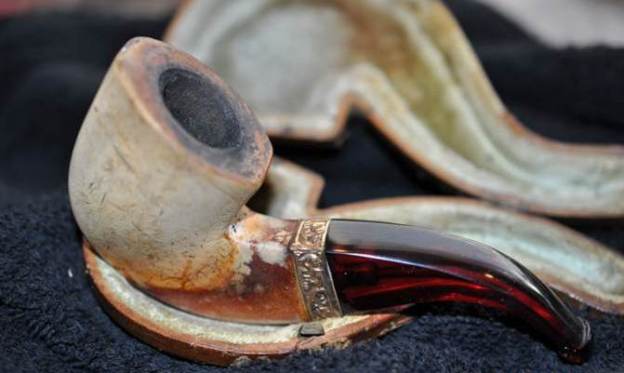
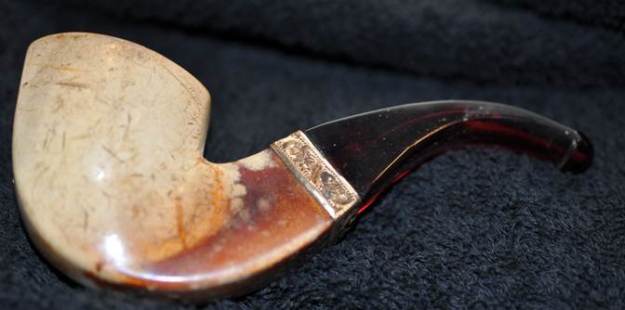
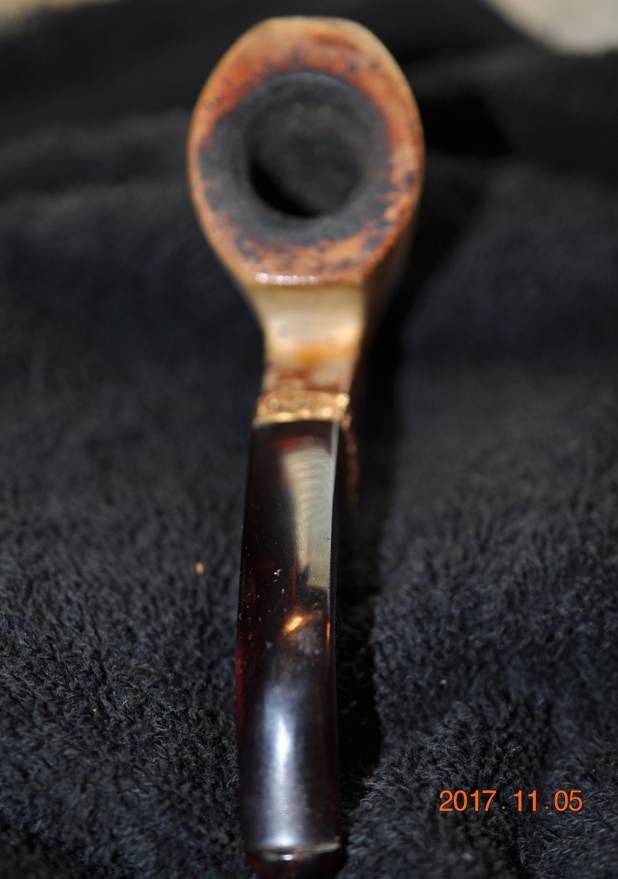
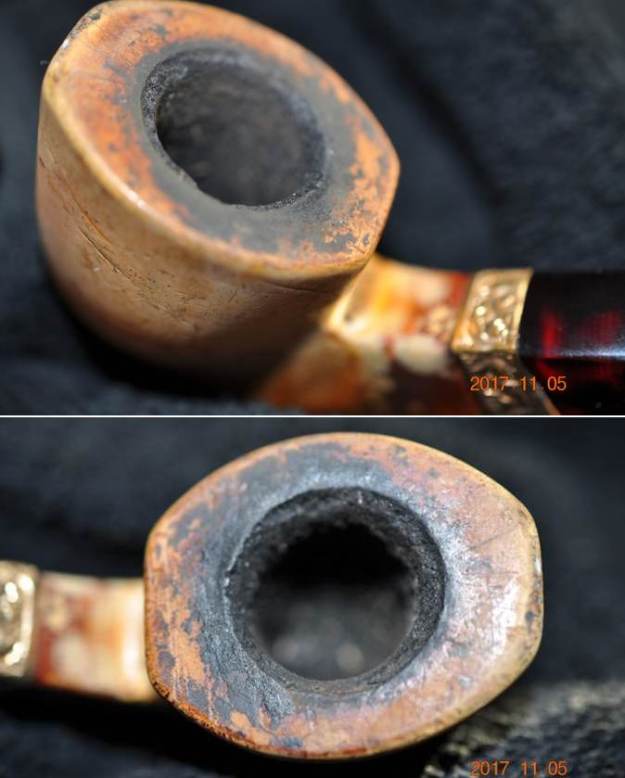
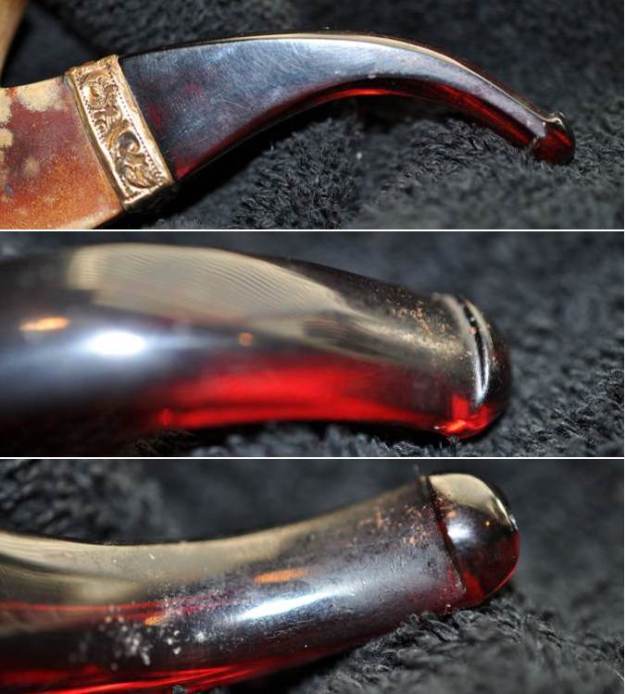
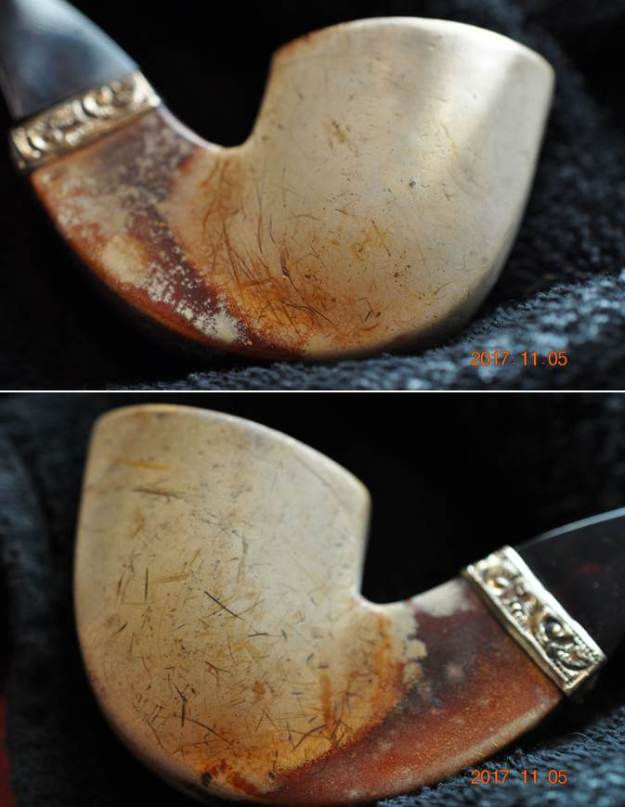
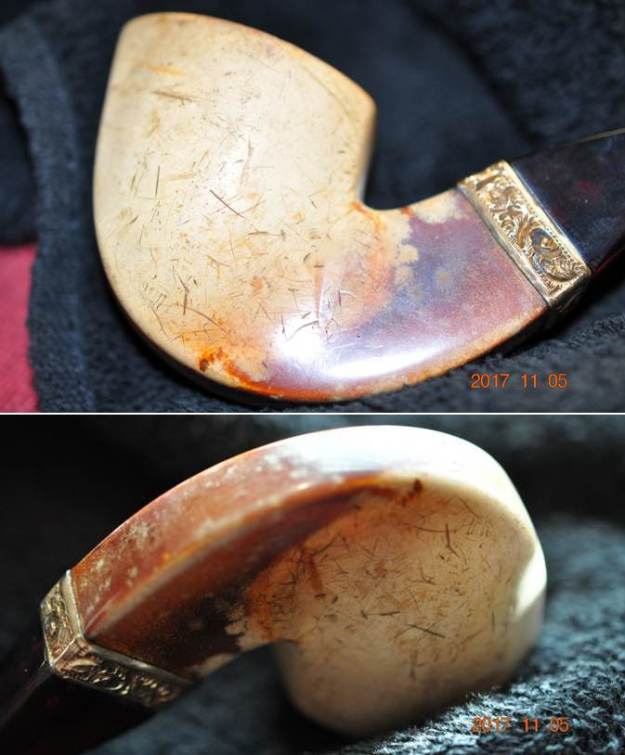
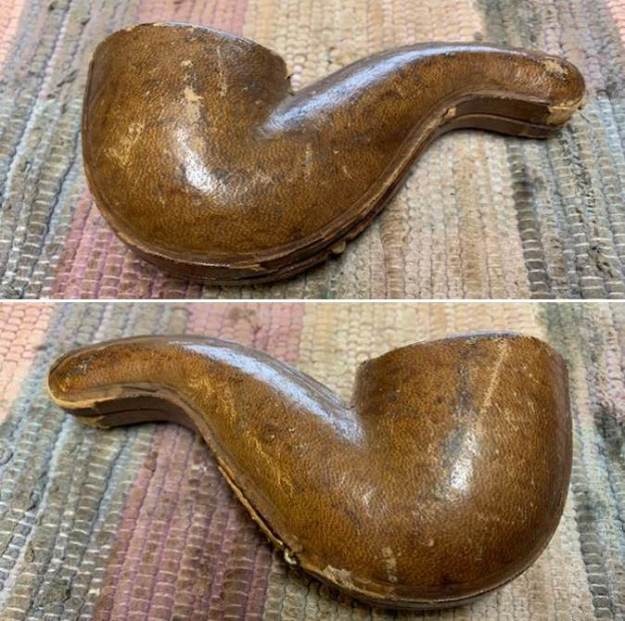
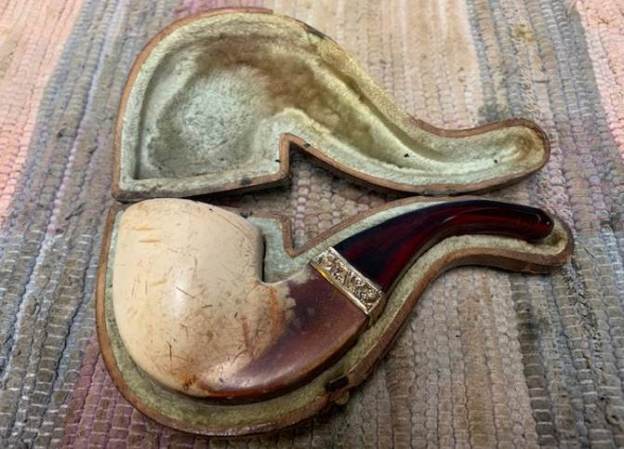
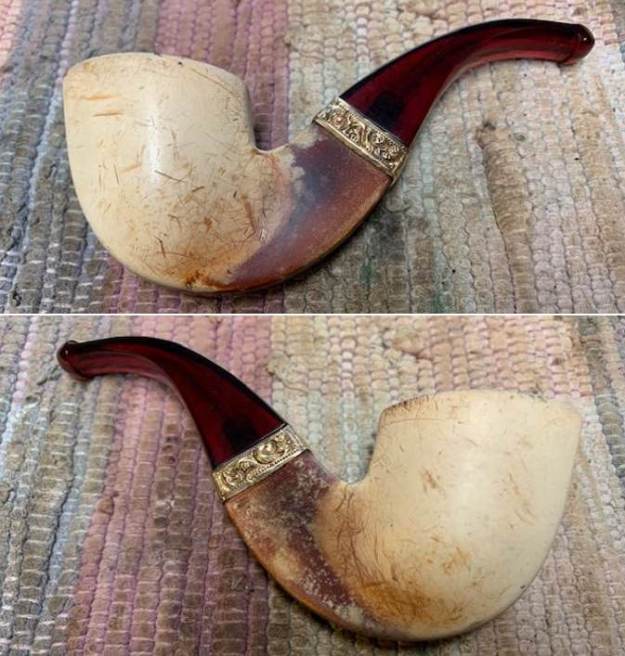
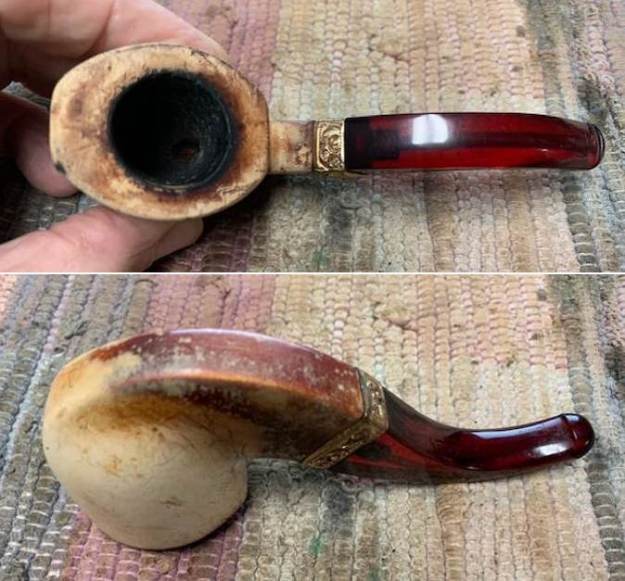
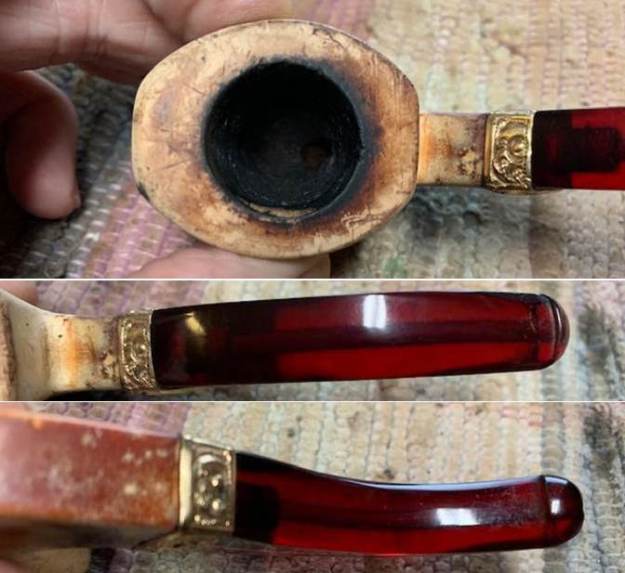
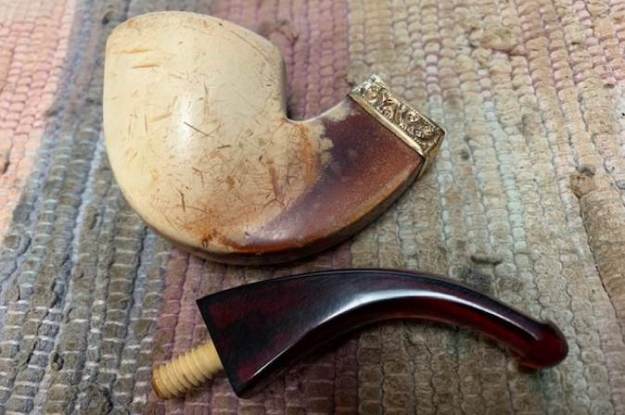
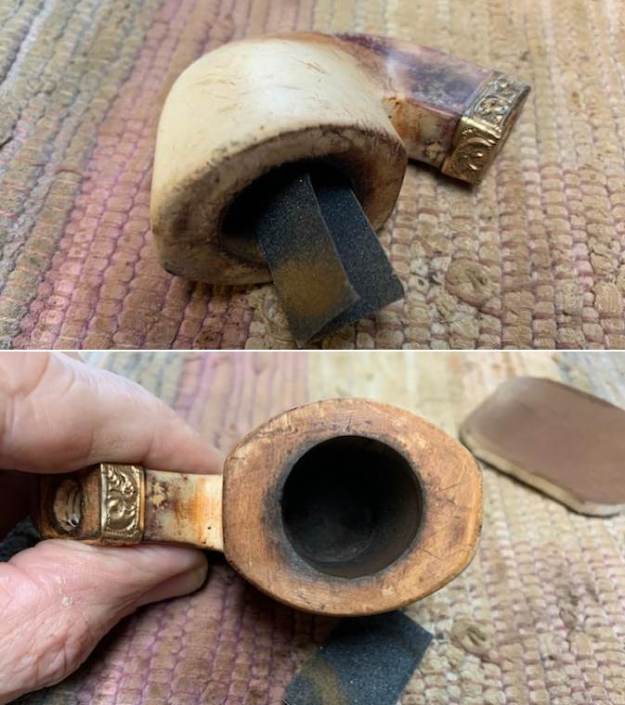
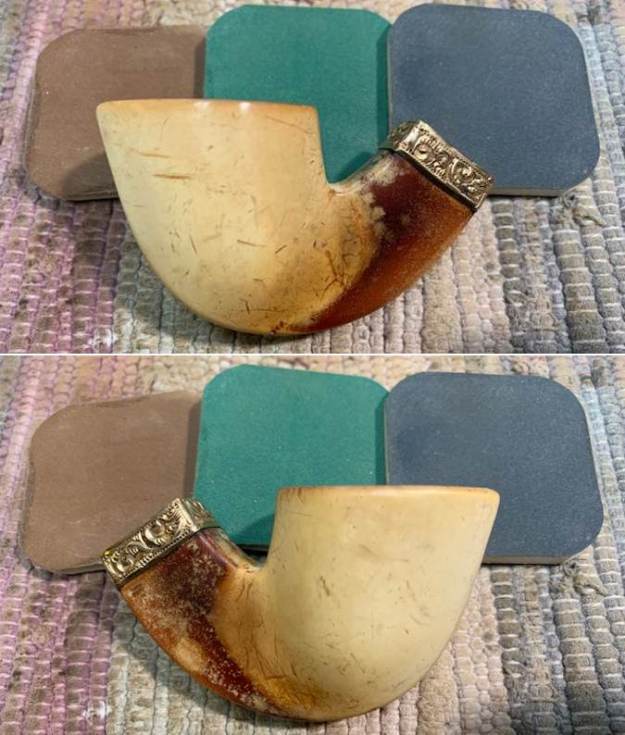
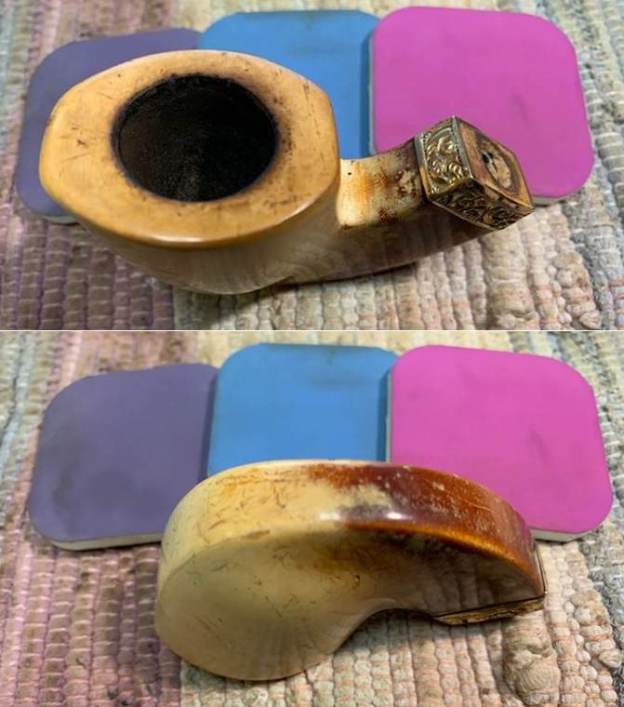
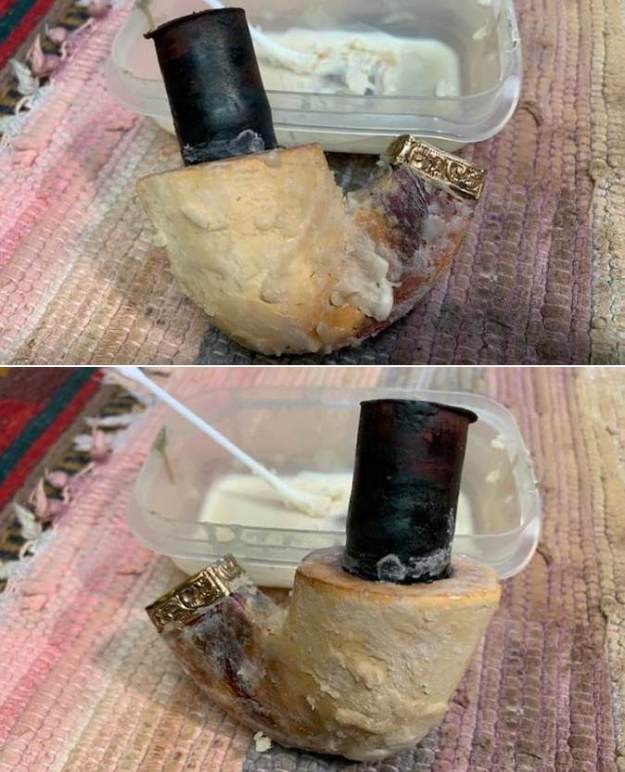
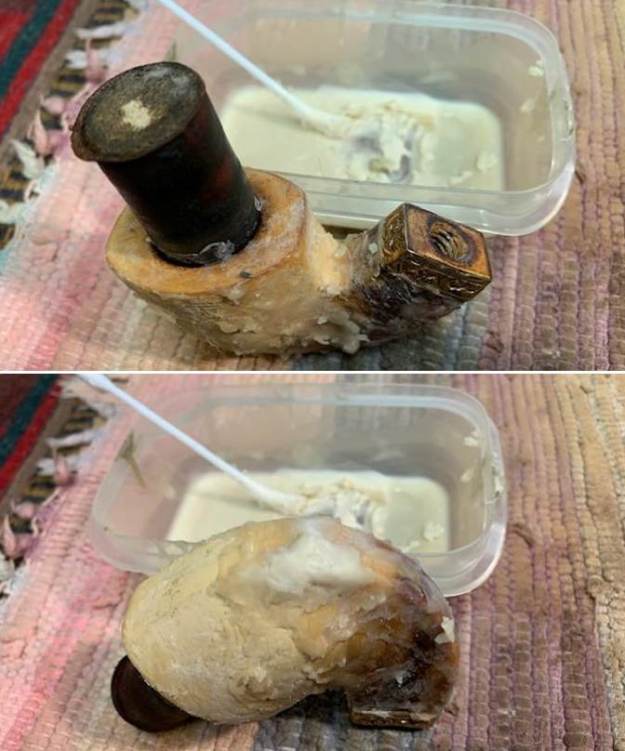
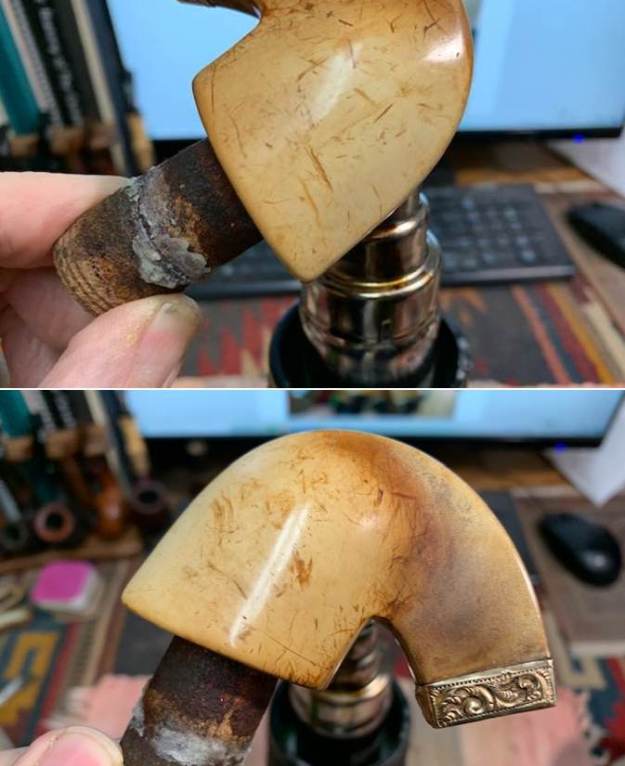
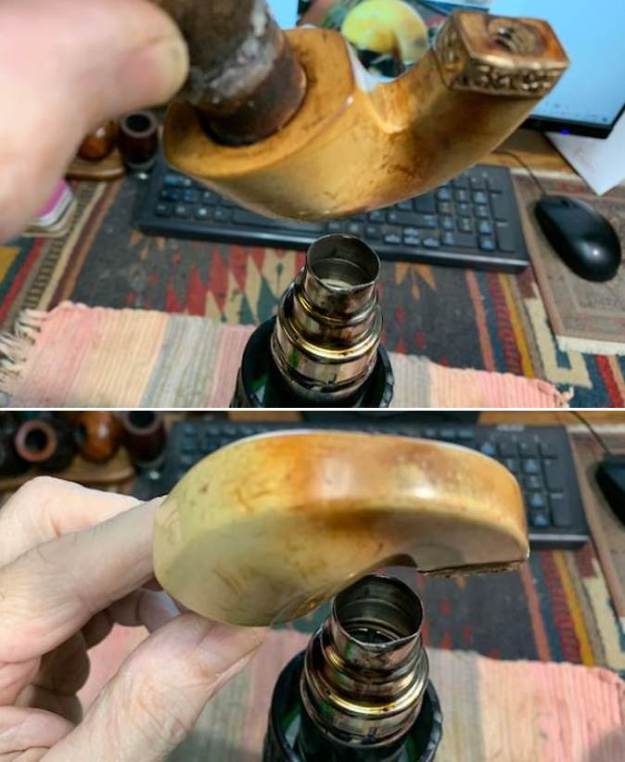
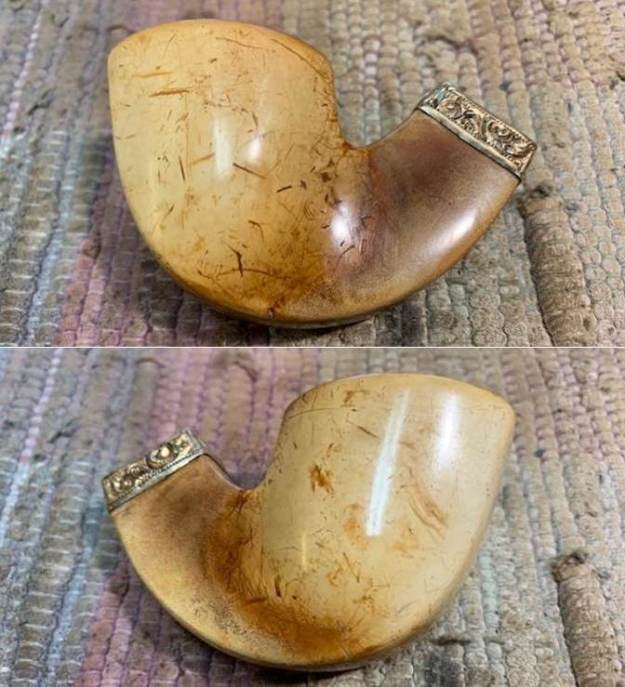
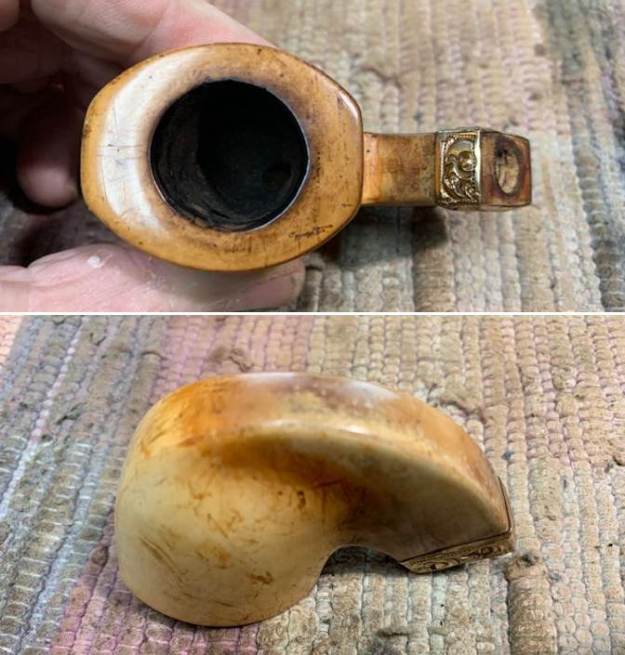
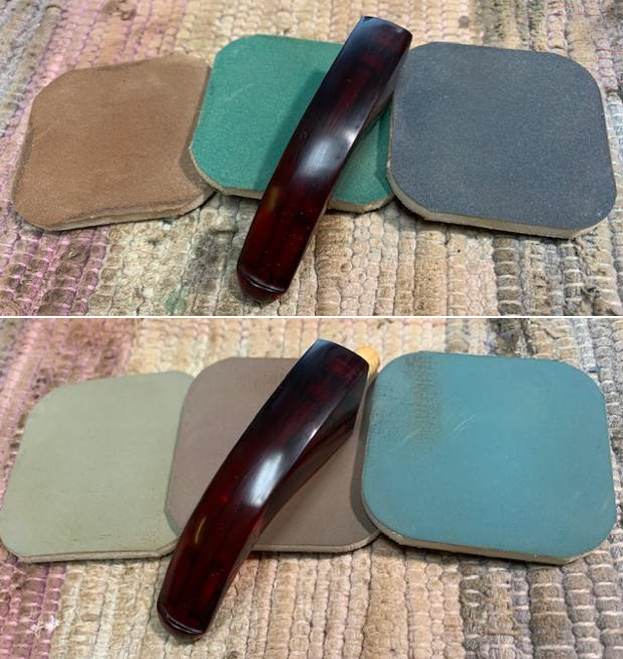
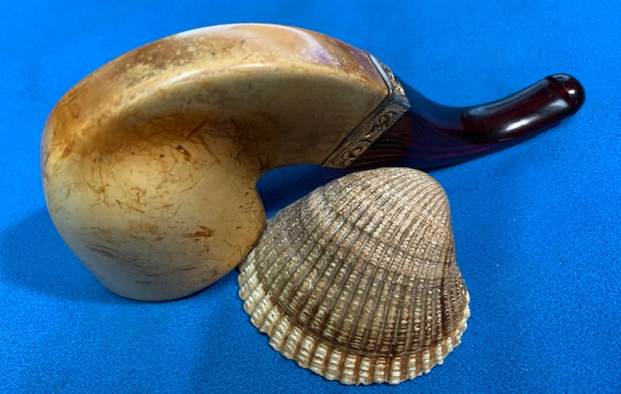
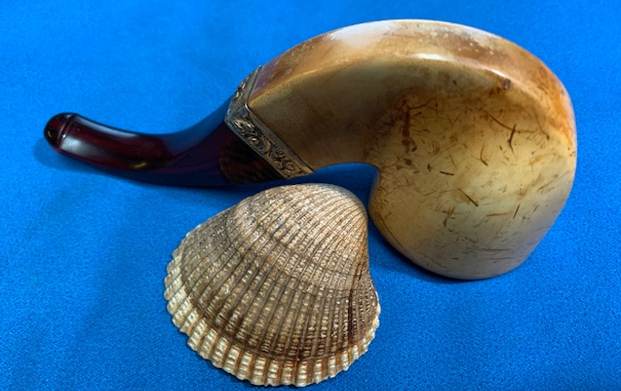
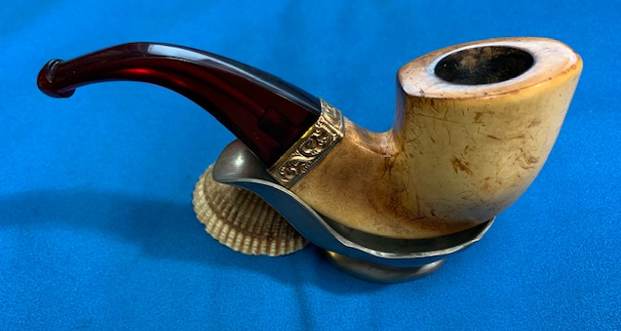
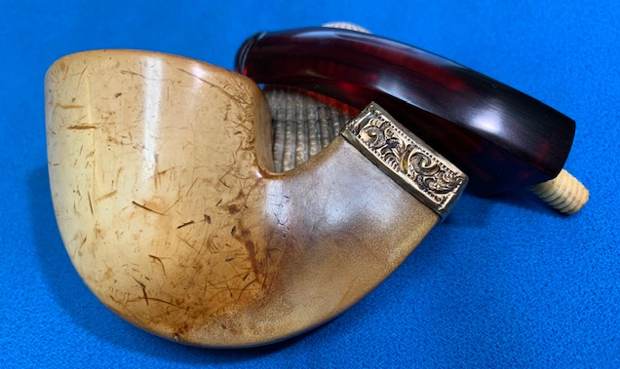
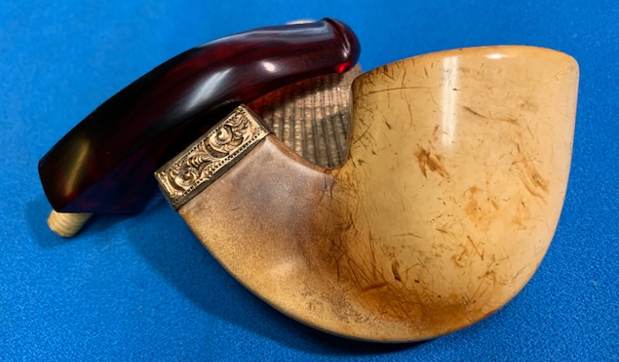
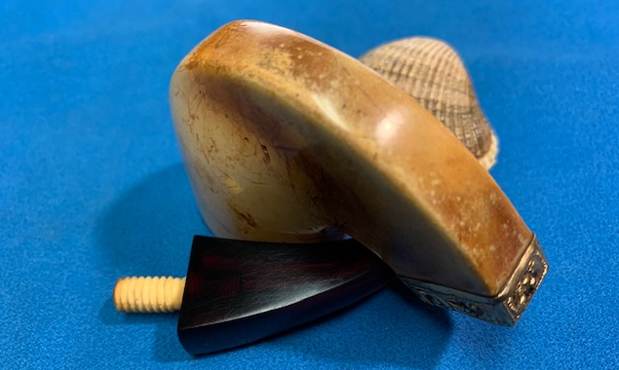
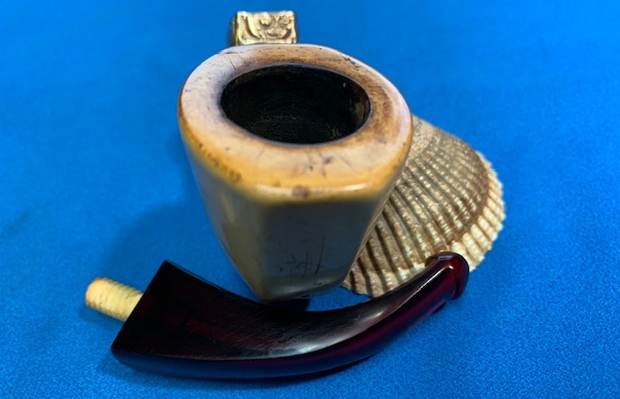
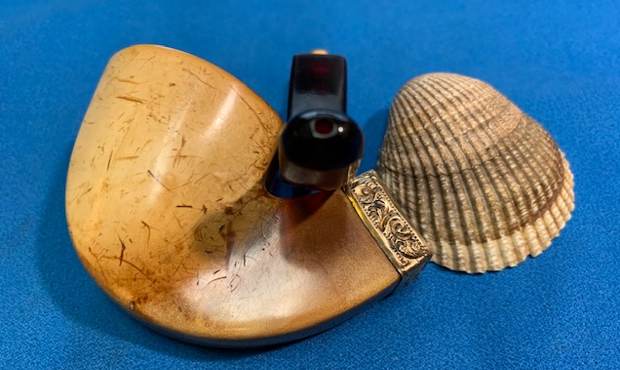
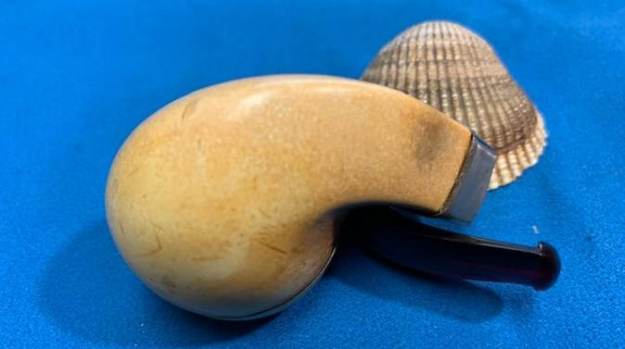
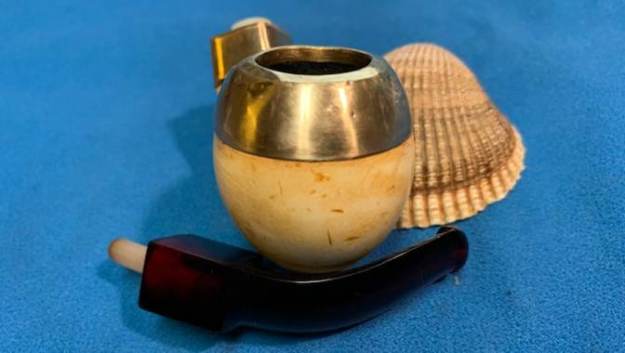
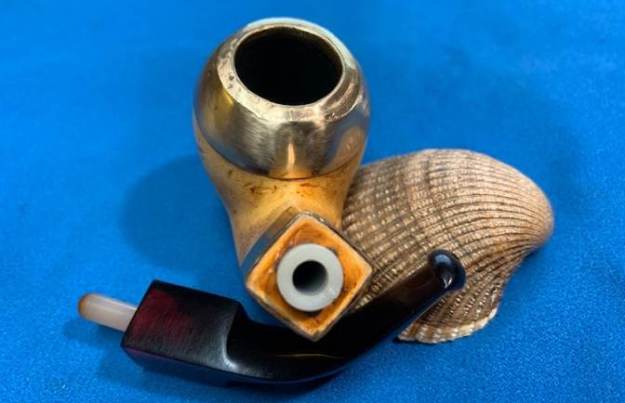
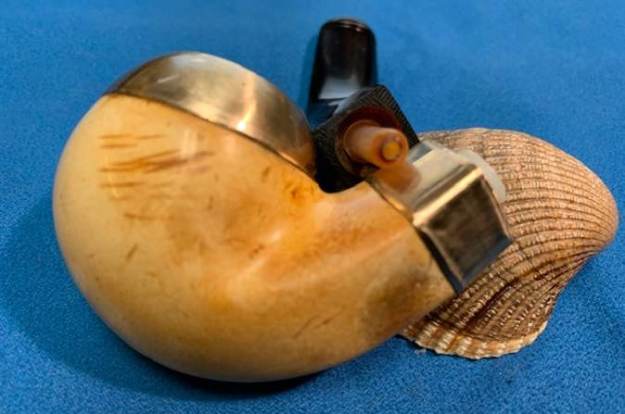
This afternoon I finished a nice little meerschaum apple with a gold rim cap and gold band on the shank and a Ruby Bakelite/Redmanol stem (https://rebornpipes.com/2021/12/25/next-on-the-table-is-a-blinged-out-meerschaum-bent-apple-with-a-ruby-bakelite-stem/). I posted it on the blog and it sold almost before it was on the store. I was contacted by another friend for the same pipe and had to tell him that it sold. I did however have another interesting one in the box that he might be interested in seeing. The pipe was also a meerschaum with rectangular shank, rolled gold band on the shank and a Red Bakelite stem. We purchased of Ebay from Queensbury, New York, USA. This pipe was heavily smoked and needed a lot of work but showed promise. The leather cover on the case was in was worn but still in decent condition. There was some wear on the edges of the case but the hinges and lock worked very well.Don’t you want to know what is inside of this case? Do you want to compare it with the other meerschaum I wrote about? Well… I will get there. Jeff opened the case to show us what the pipe looked like inside. The lining of the case was worn and had a faded green colour to it. There was not identifying stamp on the lid. The rolled band was ornate and filigreed. It really was a beautiful looking older pipe. Jeff took a photo of the pipe in the case. It look like it had been smoked hard and often. The case was filled with chunks of tobacco and ash and the rim top was covered with thick lava. The meerschaum however was really beginning to take on some nice patina – particularly on the shank. Have a look at this beauty!He removed it from the case and really it is the first look of the profile of this interestingly shaped old timer. I would almost call it an Opera pipe but it is a bit big for that. It is however longer and thinner than a standard bowl. Otherwise it is a squashed bent Dublin. It is really filthy but look at the patina on the shank and the rolled gold band on the shank. It is really quite lovely. The second photo below shows the top view of the pipe. You can see the cake in the bowl and the lava on the rim top but do not miss the shape of the bowl. It is a unique one for sure. Jeff took some close up photos of the rim top to show the lava build up and the very thick cake in the bowl. It really made me wonder what the inner edge of the bowl looked like. You can also see some of the scratches on the side of the bowl. It is a mess but… The stem is very nice and actually surprisingly unchewed. There are light tooth marks and chatter on the stem surfaces but nothing deep and the shape is also quite unique. The rolled gold band on the shank is also very ornate.He took some photos of the sides and heel of the bowl to give a sense of the wear and tear on the pipe. You can see it has been a hard worn and greatly used pipe. It must have been a terrific smoker and someone’s favourite go to pipe. I really like the look of the patina on the shank. The mottled reds and browns are very nice. Jeff had cleaned it thoroughly. He had reamed it carefully with a PipNet reamer and cleaned that up with a Savinelli Fitsall Pipe Knife. He worked slowly so as not to damage the inner edge of the bowl. It was a mess. He had scrubbed the exterior of the meerschaum with undiluted Murphy’s Oil Soap and a soft tooth brush. He cleaned out the interior of the shank and airway with alcohol, pipe cleaners and cotton swabs. He carefully cleaned out the Bakelite stem with clean water and pipe cleaners to remove the debris and oils in the airway and the threads of the bone tenon. I took photos of the pipe when it arrived here. The first two photos show case after he had cleaned it in the process. The third photo shows the pipe in the fitted case The overall look of the pipe after cleaning shows the tiredness and worn look of the bowl sides. The stem on the other hand is quite remarkably unscathed and the bone tenon almost looks new. The pipe is a beauty in the rough and definitely needs some TLC. I took a close up photo of the bowl and rim top to show the condition of the cleaned bowl and rim. You can see the clean bowl and the many scratches and darkening on the back edge and top of the rim. I also took some photos of the stem to show how it looked. It was remarkably clean. Even the tooth chatter and marks were very minor.I unscrewed the stem from the shank to see an almost new looking threaded bone tenon on the stem. Amazingly it was free of damage and had not been over or under-turned in the shank.I decided to start my work on this pipe by addressing the damage to the inner edge of the rim and the rim top. I used a folded piece 220 grit sandpaper to work over both. I was able to remove most of the damage on the inner edge and a fair bit on the rim top with the sandpaper. It definitely is an improvement.I polished the briar and the shank with micromesh sanding pads – dry sanding with 1500-12000 grit pads. I worked on the rim top and make it even better looking. I figured that once I heated it to rewax they would look significantly different (Time will tell). I wiped the bowl down after each pad with a damp cloth. The meerschaum began to shine and the scratches were less intrusive. The photos tell the story!   Now it was time to wax the meerschaum bowl. I melted a block of beeswax and dipped the pipe I in the mix and painted the wax with a cotton swab into the hard to reach spots on the shank corners. I heavily coated the bowl with the liquid wax. I let the wax harden dry then I used the cork as a handle while I heated it with a heat gun. As the wax melted I wiped it off with a paper towel. I let the excess drip back into the container. The bowl began to really take on some patina even though the scratches also stood out more. Those scratches were part of the story of the pipe’s journey. I buffed it with a soft cloth and took pictures of the pipe at this point in the process of the restoration. The wax did its magic and the patina was rich and deep. Even the scratches looked better to me! The pipe is well traveled and the scratches help tell the story. I set the bowl aside and turned to deal with the stem. I polished the Bakelite stem with micromesh sanding pads – dry sanding with 1500-12000 grit sanding pads. I wiped it down after each sanding pad with a cloth containing some Obsidian Oil. I finished polishing it with Before & After Pipe Stem Polish – both Fine and Extra Fine and buffed it off with a cotton cloth. I gave it a final coat of obsidian Oil and set it aside to dry. It is a beautiful looking ruby coloured stem. This beautiful no name Bent Opera shaped Meerschaum with a Bakelite stem was another fun pipe to work on and I really was looking forward to seeing it come back together again. With the grime and debris gone from the finish it was a beauty and after the waxing with Beeswax the patina was quite nice. The rolled gold filigreed band on the shank is an added bonus. I put the stem back on the bowl and buffed the pipe with Blue Diamond on the buffing wheel.  I buffing it with a clean buffing pad on the buffer to raise the shine. I hand buffed the pipe with a microfiber cloth to deepen the shine. The rich polished meerschaum on the bowl looks really good with the polished ruby Bakelite stem. It is very well done. Give the finished pipe a look in the photos below. I can only tell you that it is much prettier in person than the photos capture. The dimensions of the pipe are Length: 5 inches, Height: 2 inches, Outside diameter of the bowl: 1 1/8 inches x 1 ¾ inches, Chamber diameter: 7/8 of an inch. The weight of the pipe is 39 grams/1.38oz. This is truly a great looking Meerschaum. Thanks for walking through the restoration with me as I worked over another beautiful pipe. This beauty has already been spoken for and is reserved for the next pipeman. I hope to send it out in the mail tomorrow. Thanks for your time.

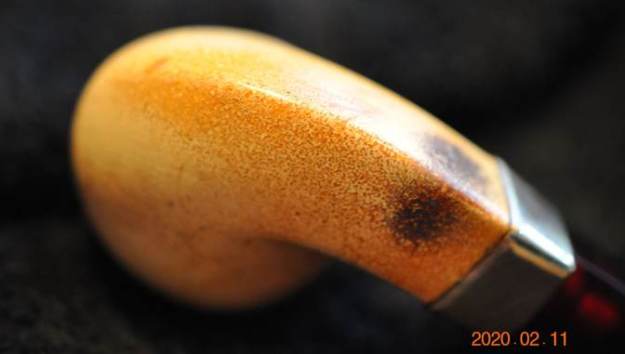
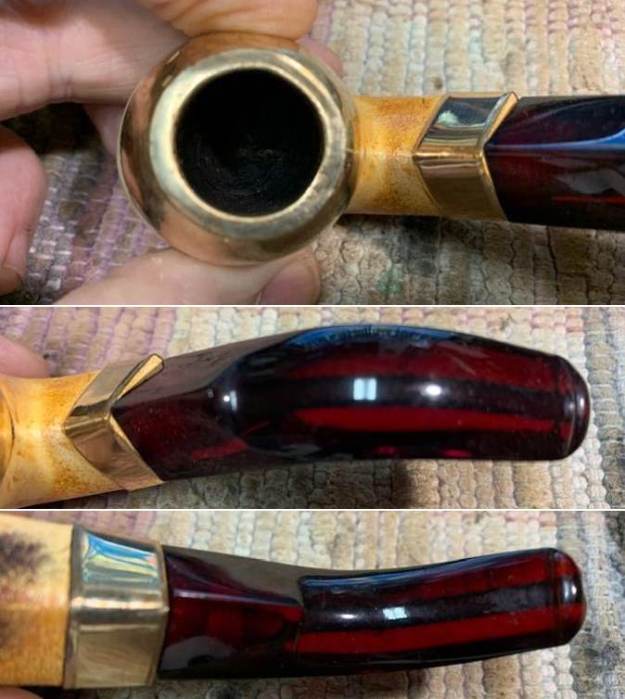
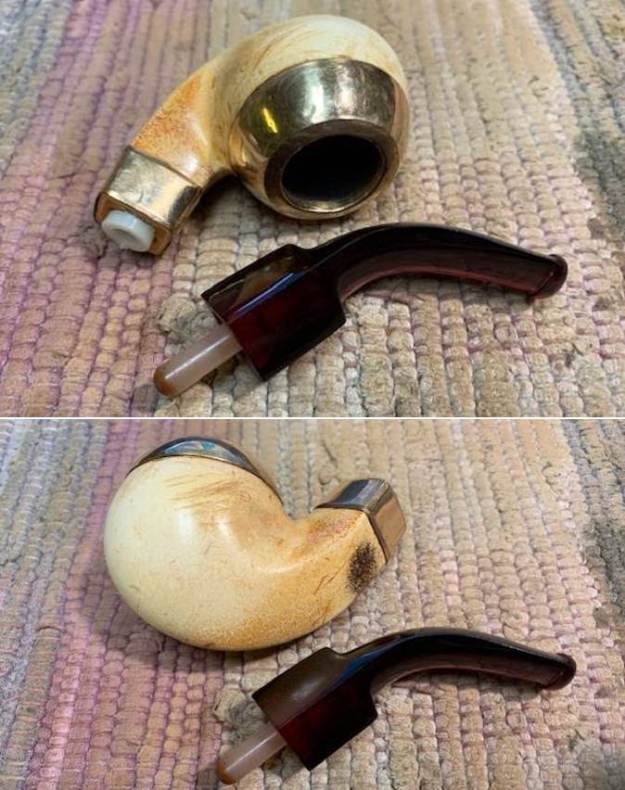
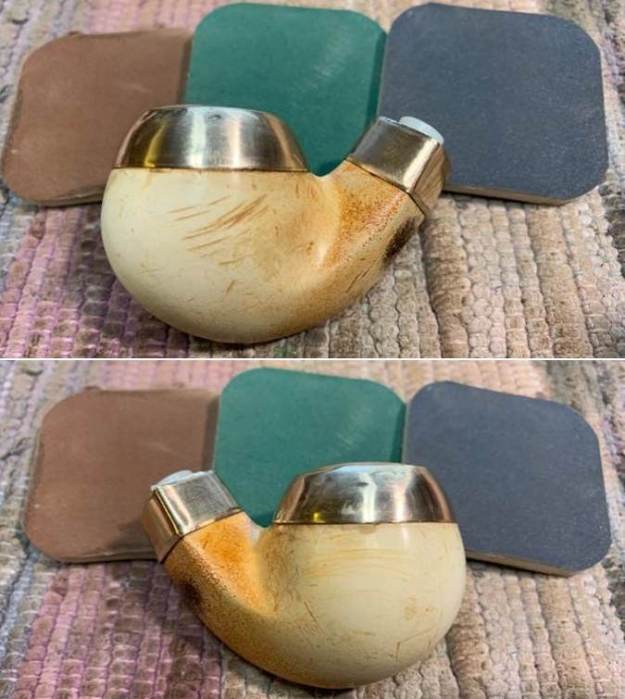
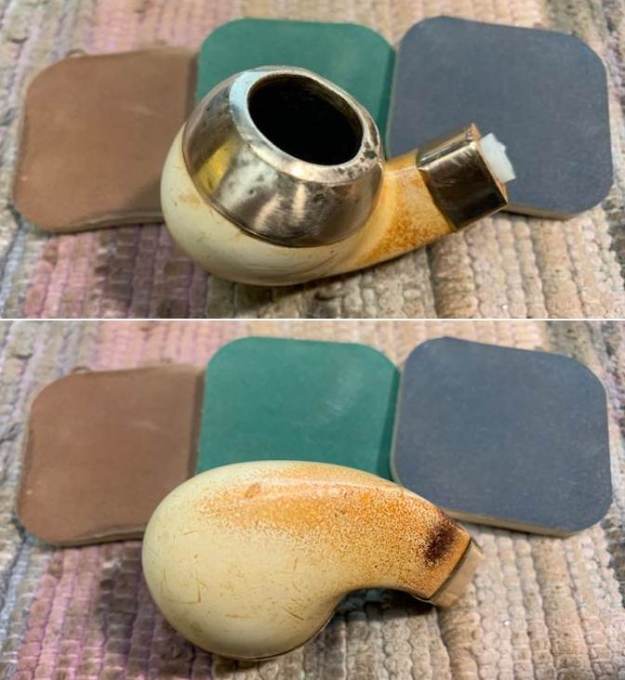
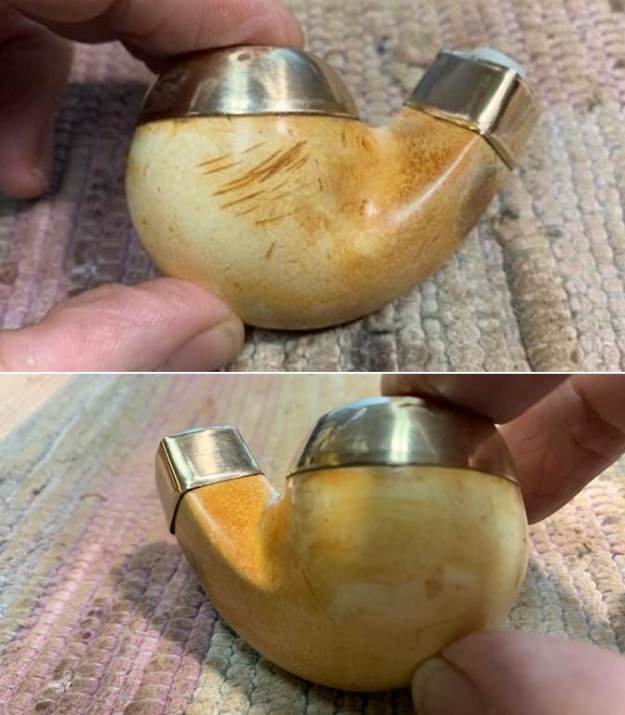
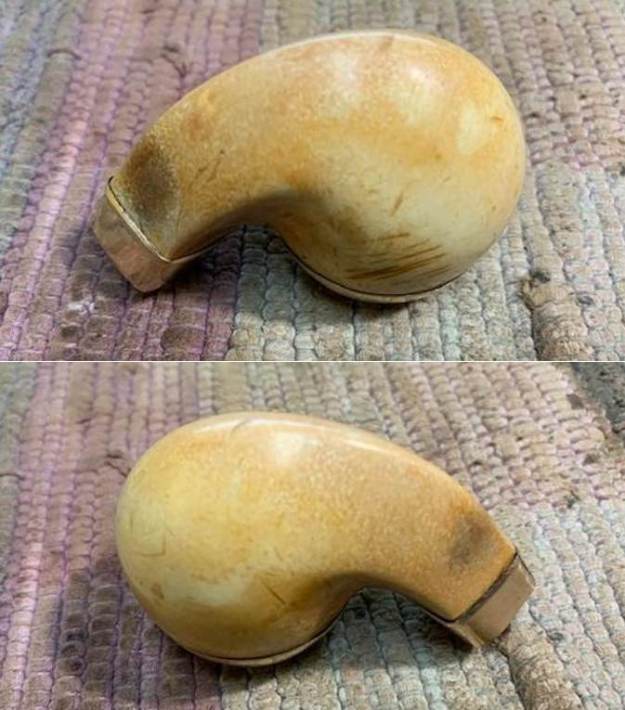
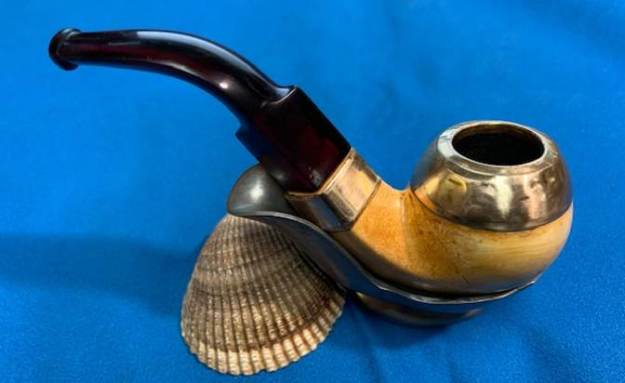
Next on the table is a Blinged Out Meerschaum Bent Apple with a Ruby Bakelite Stem


Blog by Steve Laug

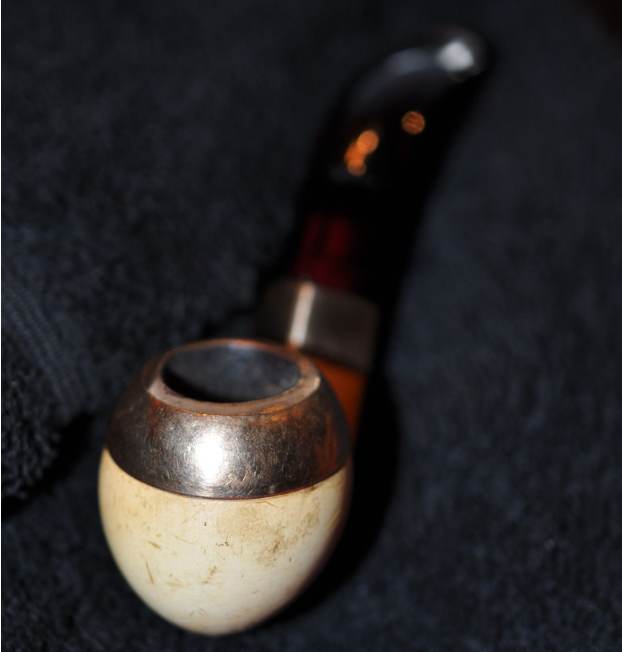
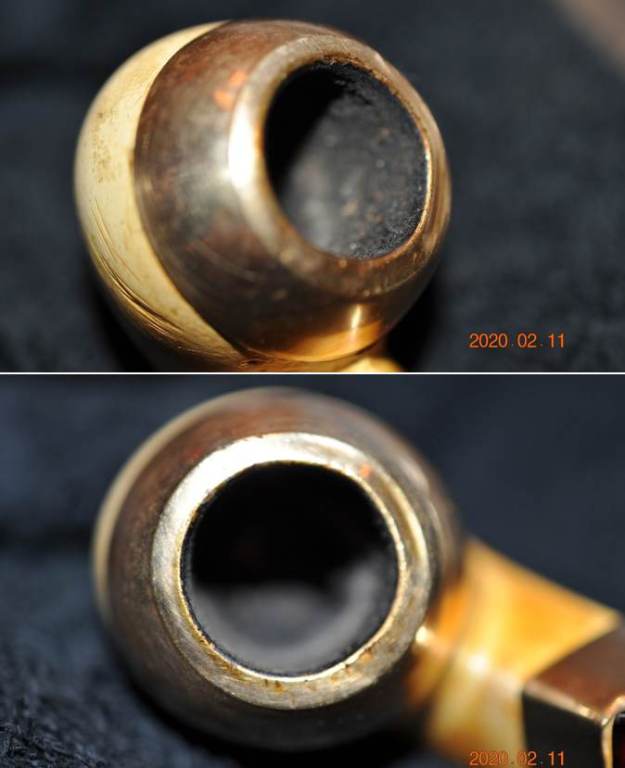
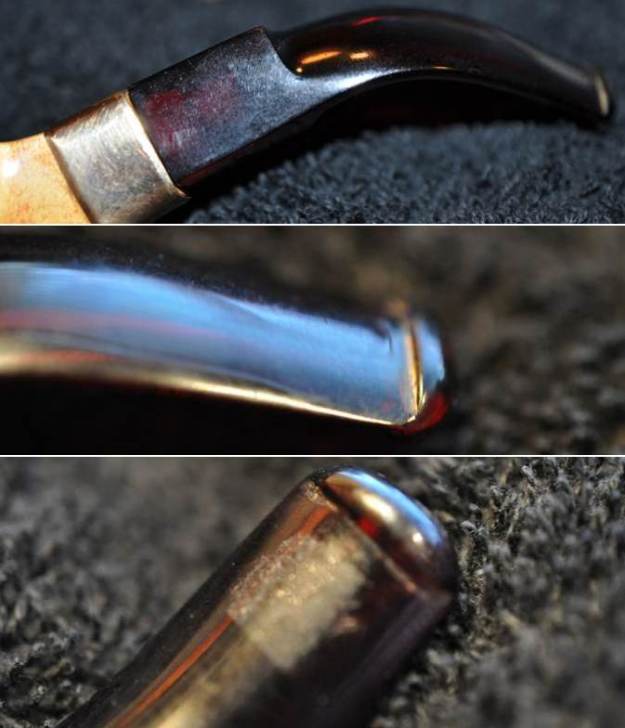
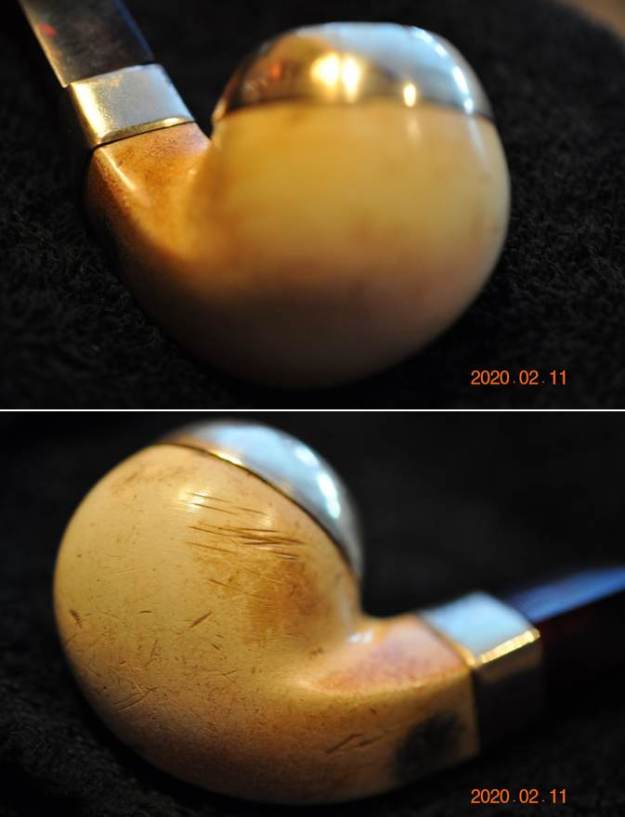
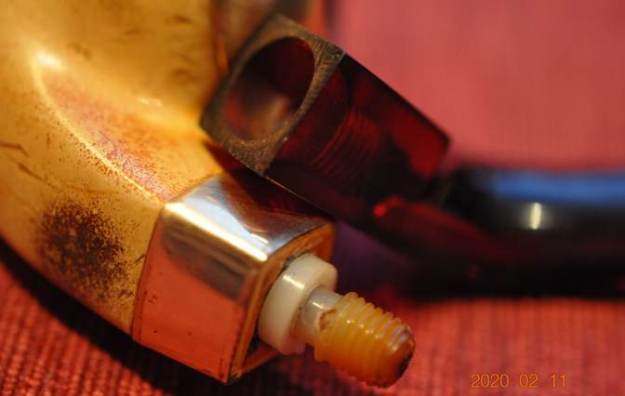
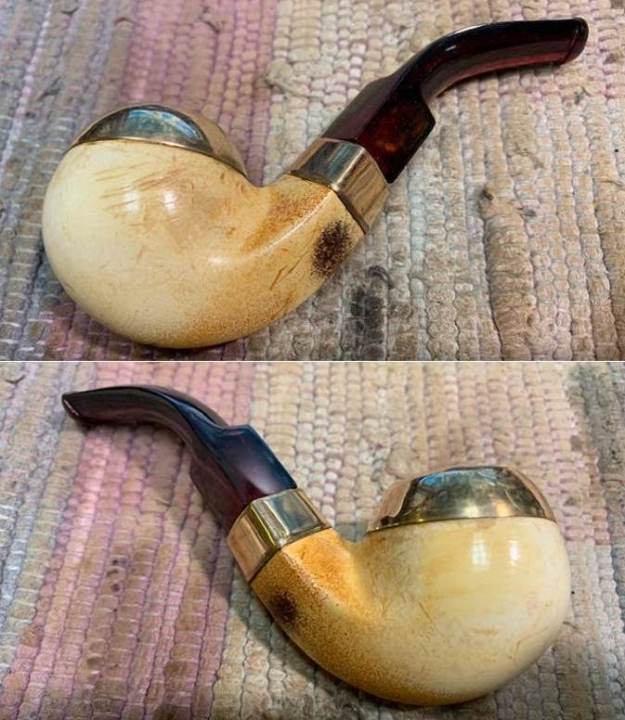
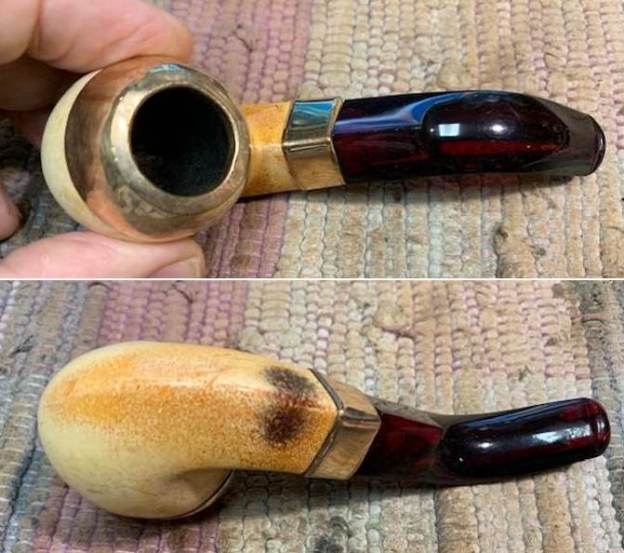
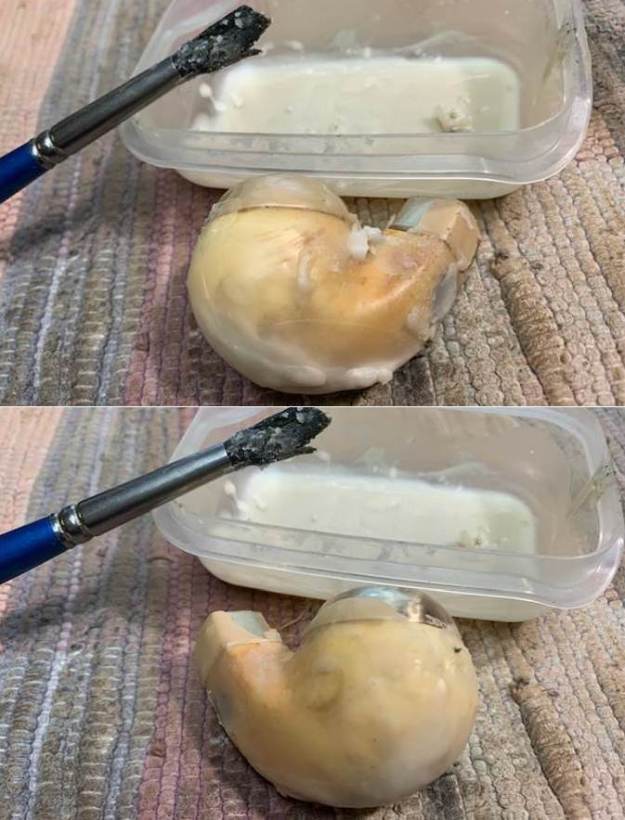
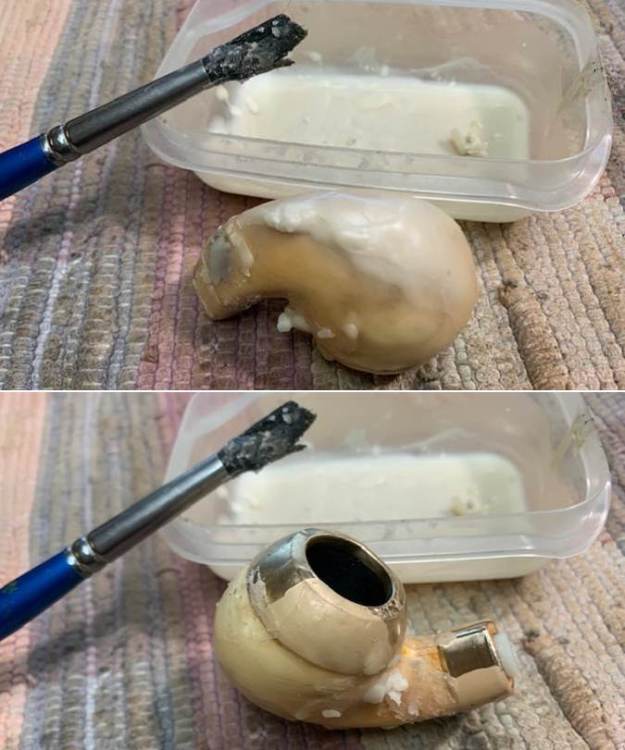
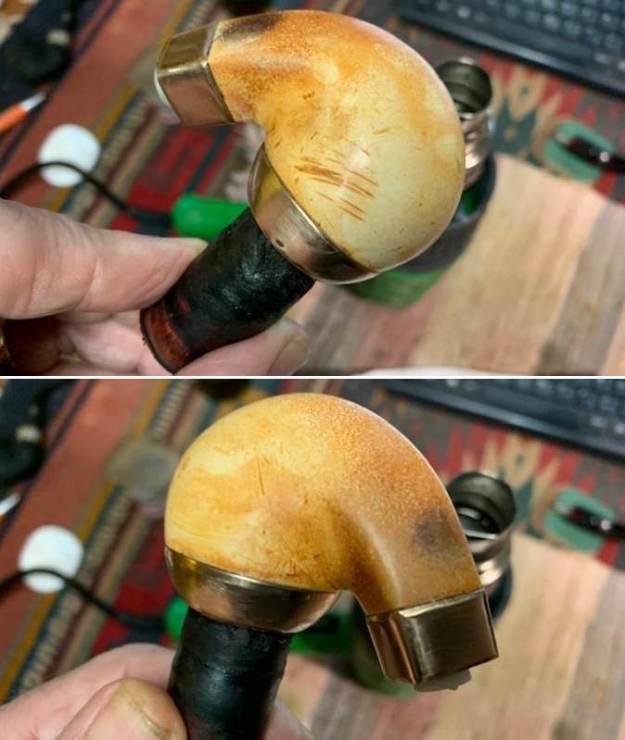
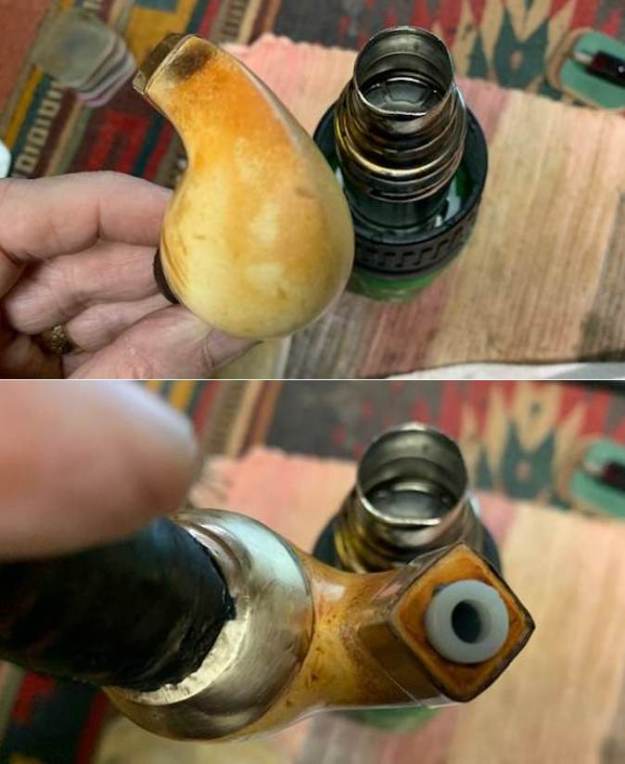
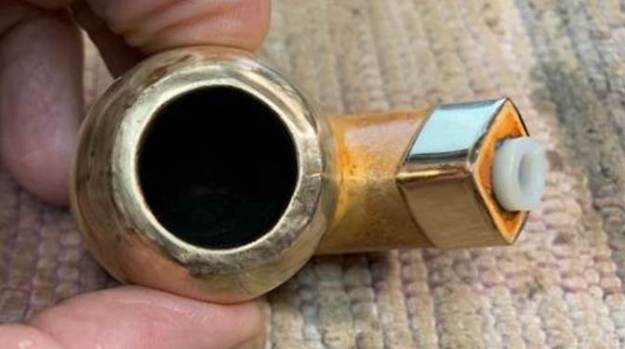
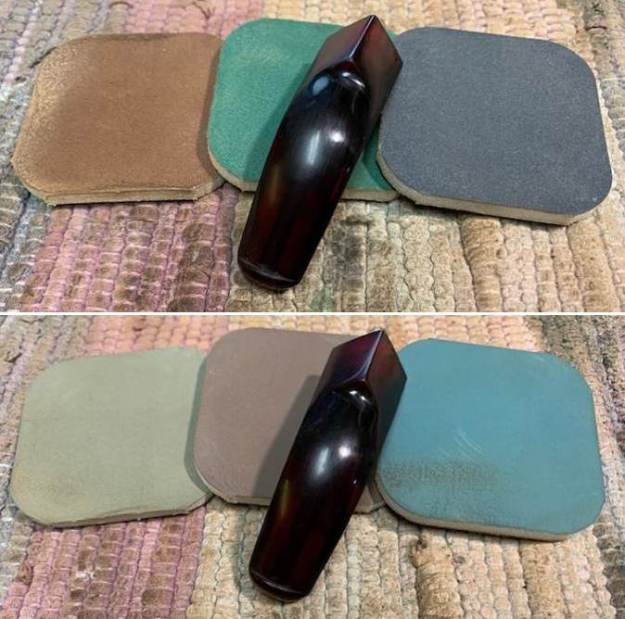
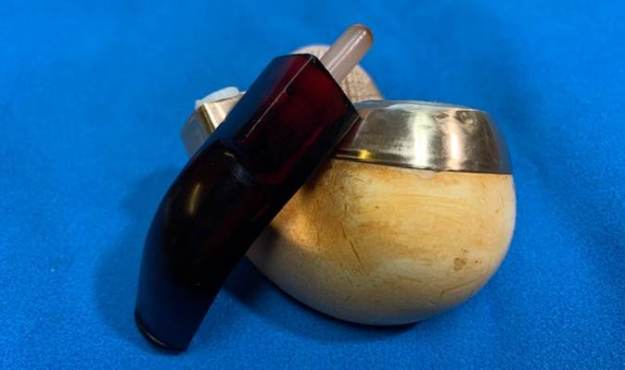
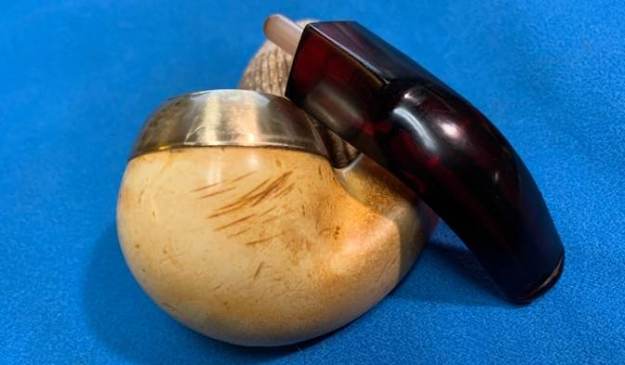
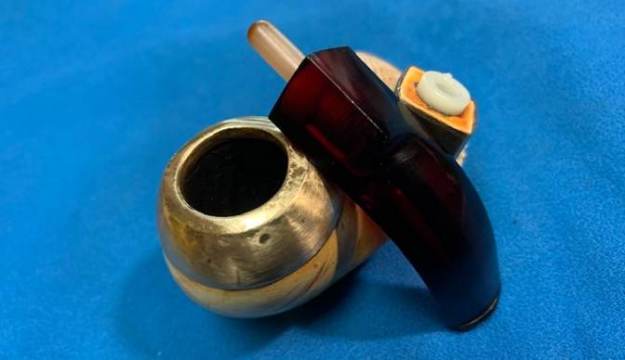
We finished up around the tree and our Christmas Breakfast so now there is a quiet time before we eat again. I decided that a snowy Christmas day in Vancouver demanded the right pipe to be worked on so I think I chose appropriately. We bought the pipe I chose at an auction from a fellow in Los Angeles, California, USA. Though it is not shiny white and new looking it is a meerschaum ball/apple/ornament with a gold rim cap and shank band that are quite blinged out and beautiful. The bowl had a thick cake and there was a light lava overflow on the rim. The gold coloured rim cap looked good underneath the lava and oils. The exterior of the bowl and shank was smooth and starting to develop some colouring on the shank and sides. The finish had a lot of scratches and some dark spots on the bottom side of the diamond shank near the band. The pipe did not have any stamping on the shank or band. The rim cap had some nicks and dents in it but they did not detract from the beauty of the pipe. The shank band was also scratched but not dented. The Bakelite (Redmanol) stem was in excellent condition with light tooth marks on the surface in front of the button. I expected the stem was screwed onto the shank but that would be revealed soon enough. Jeff took photos of the pipe before he started his cleanup work. Jeff captured the condition of the bowl and rim top with the next series of photos. You can see the work that is ahead of us in the photos. The cake is very thick and heavy. The rim looked like it might have some damage on the top and inner edge of the cap. The photos of the stem show the shape and the top and underside of the stem. It is dirty and there is some gummed stickiness on the underside where there must have been a price sticker. The tooth marks and chatter was very light on both sides. Jeff took some great photos of the sides of the bowl and heel showing what is underneath the developing patina and the scratches in the surface of the meerschaum. It will be interesting to see what happens as the pipe is cleaned and restored. He removed the stem from the shank. You can see the threaded tenon end in the shank of the pipe and the wide open airway in the stem. It looks to me that there is a push tenon in the shank and the threading was for anchoring it in the stem. I took it out of the box of pipes and looked it over. It was amazingly clean. Jeff carefully reamed it with a PipNet pipe reamer and cleaned up the reaming with a Savinelli Fitsall Pipe Knife. He scrubbed out the internals with alcohol, pipe cleaners and cotton swabs until the pipe was clean. He scrubbed the exterior of the bowl with Murphy’s Oil Soap and a tooth brush to remove the grime and grit on the meerschaum and the lava and oils on the rim top. The bowl looked very good. He scrubbed the stem with Soft Scrub to remove the grime and rinsed it off with warm water. It came out looking far better. Now it was time for me to do my work on the pipe. I took photos before I started my part of the work. I took some photos of the rim top and stem. The rim top is clean but you can see some of the dents in the gold cap. I am afraid that they will remain a permanent part of the pipe’s story. The bowl itself looks very clean. The close up photos of the stem shows that is it very clean and the tooth marks are visible.The way the stem lined up with the shank made me wonder about the tenon system that was used. From Jeff’s photos it looked like the threaded portion sticking out of the shank was part of a push tenon system. If that was true then I truly believe that someone had replace the original bone tenon on what I think is actually an older pipe with a new push tenon system. The stem has an orific opening on the end and it is definitely made of Bakelite. I unscrewed the stem from the shank and then pulled the tenon free from the shank end. It was indeed a push tenon. I took a photo of the bowl and stem to give a sense of the proportion of the pipe. It is a classic looking apple for sure.I polished the briar and the shank with micromesh sanding pads – dry sanding with 1500-12000 grit pads. I worked on the two dark spots on the underside of the shank and was able to determine they were not burn marks but rather spots that had taken on a dark patina.I figured that once I heated it to rewax they would look significantly different (Time will tell). I wiped the bowl down after each pad with a damp cloth. The meerschaum began to shine and the scratches were less intrusive. The photos tell the story!   Now it was time to wax the meerschaum bowl. I melted a block of beeswax and dipped the pipe I in the mix and painted the wax with a brush into the hard to reach spots on the shank corners. I heavily coated the bowl with the liquid wax. I let the wax harden dry then I put a cork in the bowl to provide a handle while I heated it with a heat gun. As the wax melted I wiped it off with a paper towel. I let the excess drip back into the container. The bowl began to really take on some patina and the dark spots changed in colour. I buffed it with a soft cloth and took pictures of the pipe at this point in the process of the restoration. The wax did its magic and the patina was rich and deep. Even the scratches looked better to me! I set the bowl aside and turned to deal with the stem. I polished the Bakelite stem with micromesh sanding pads – dry sanding with 1500-12000 grit sanding pads. I wiped it down after each sanding pad with a cloth containing some Obsidian Oil. I finished polishing it with Before & After Pipe Stem Polish – both Fine and Extra Fine and buffed it off with a cotton cloth. I gave it a final coat of obsidian Oil and set it aside to dry. It is a beautiful looking ruby coloured stem. This beautiful no name Bent Apple shaped Meerschaum with a Bakelite stem was another fun pipe to work on and I really was looking forward to seeing it come back together again. With the grime and debris gone from the finish it was a beauty and after the waxing with Beeswax the patina was quite nice. I put the stem back on the bowl and buffed the pipe with Blue Diamond on the buffing wheel.  I buffing it with a clean buffing pad on the buffer to raise the shine. I hand buffed the pipe with a microfiber cloth to deepen the shine. The rich polished meerschaum on the bowl looks really good with the polished ruby Bakelite stem. It is very well done. Give the finished pipe a look in the photos below. I can only tell you that it is much prettier in person than the photos capture. The dimensions of the pipe are Length: 4 ½ inches, Height: 1 ¾ inches, Outside diameter of the bowl: 1 inch, Chamber diameter: ¾ of an inch. The weight of the pipe is 35grams/1.23oz. This is truly a great looking blinged out Meerschaum Bent Apple. Thanks for walking through the restoration with me as I worked over another beautiful pipe. I will be adding it to rebornpipes store in the Ceramic and Meerschaum Pipes section if are interested in adding it to you collection. Let me know by email or message. Thanks for your time.

Replacing a Broken Tenon on an Italian Made Capri Gozzo Billiard


Blog by Steve Laug

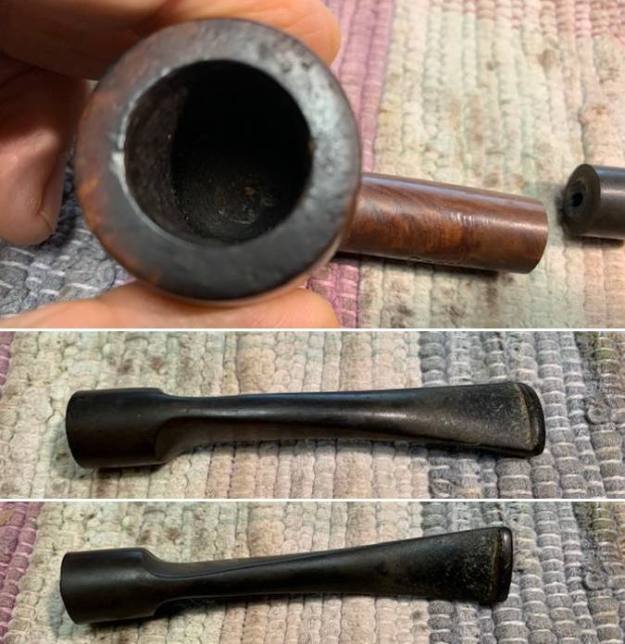
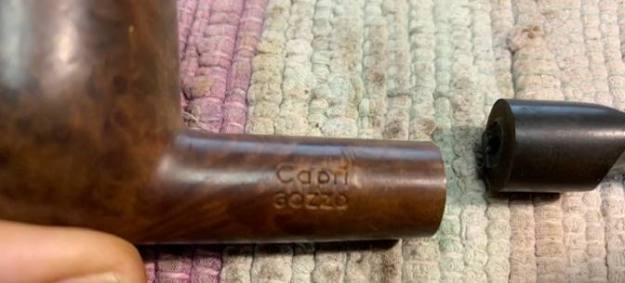
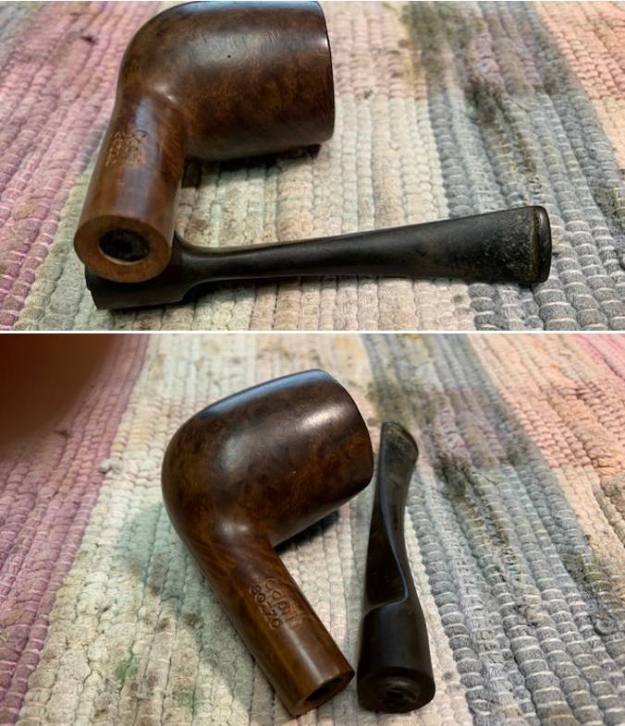
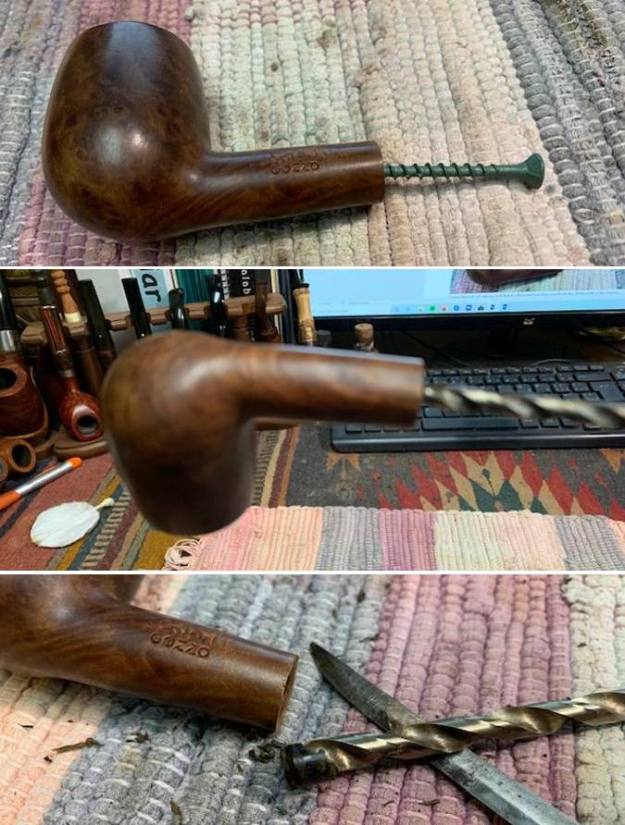
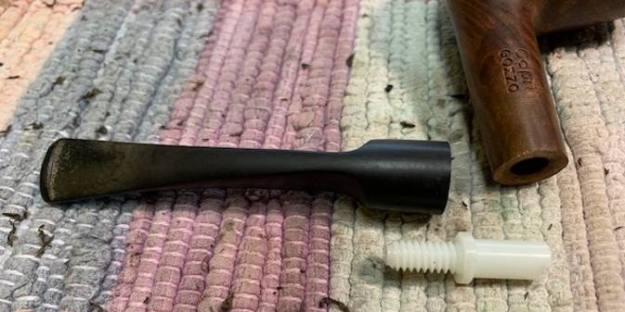
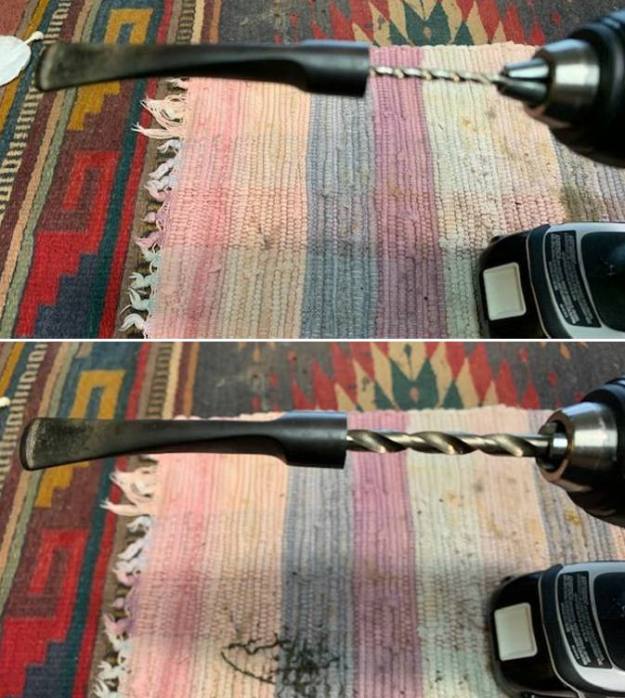
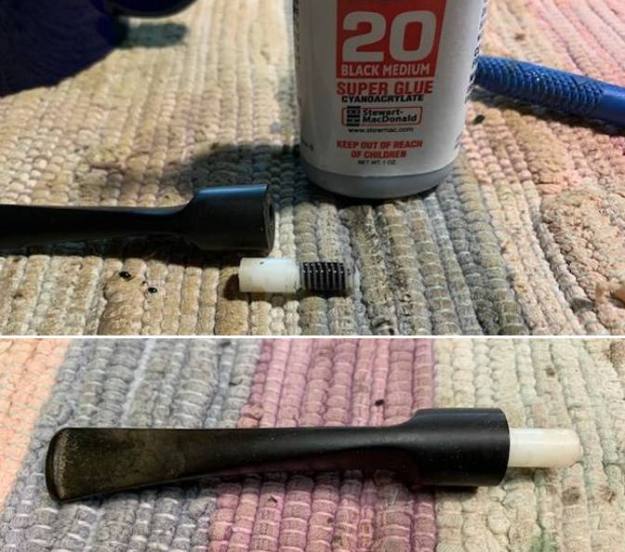
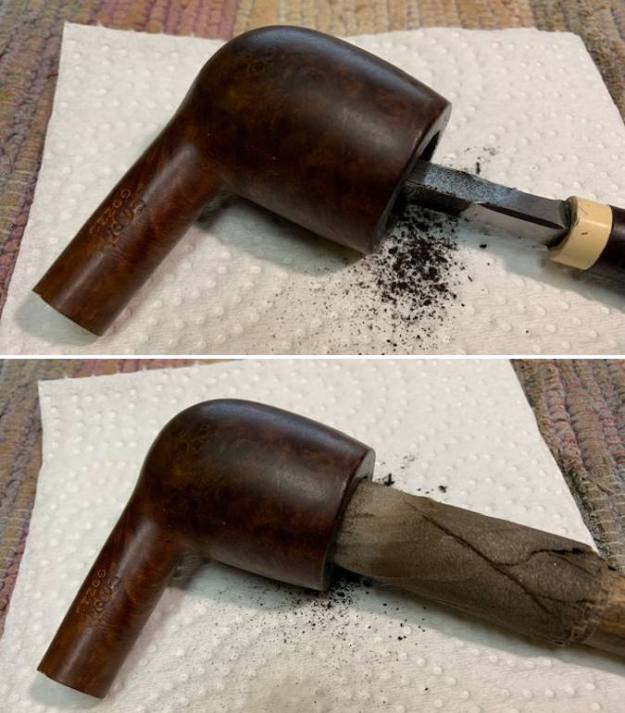
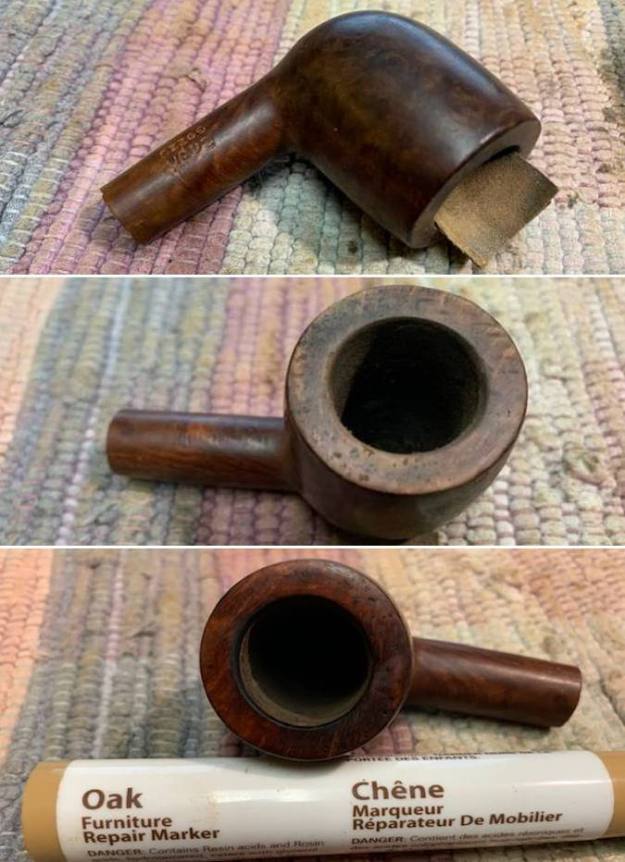
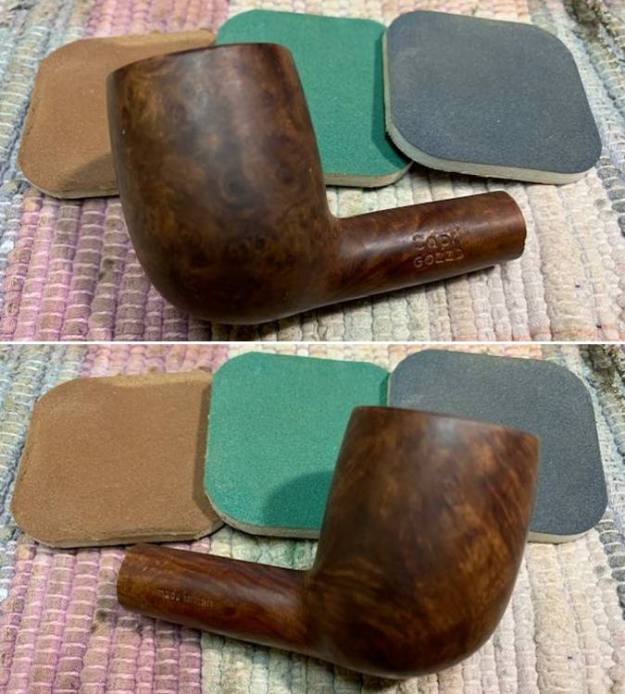
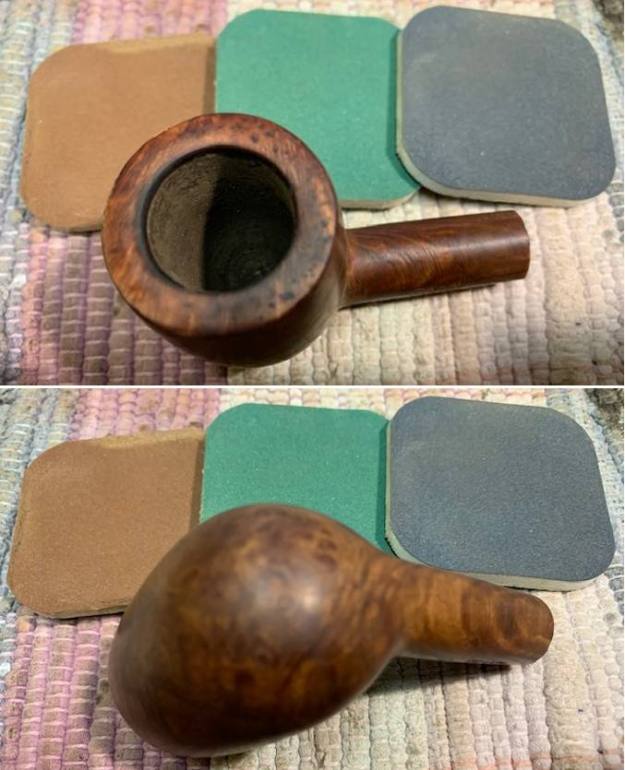
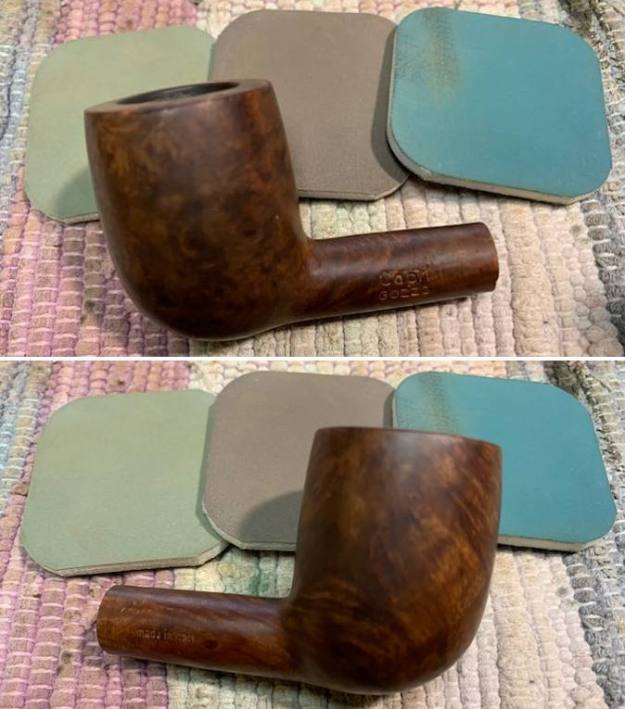
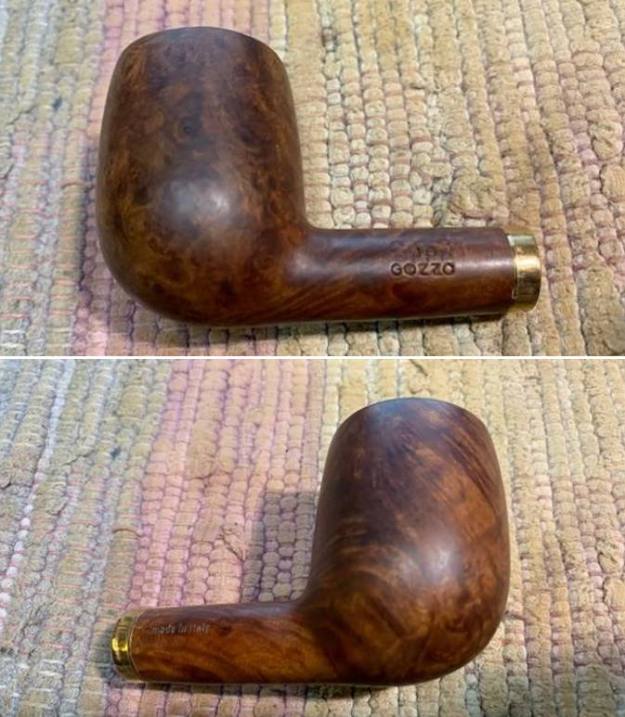
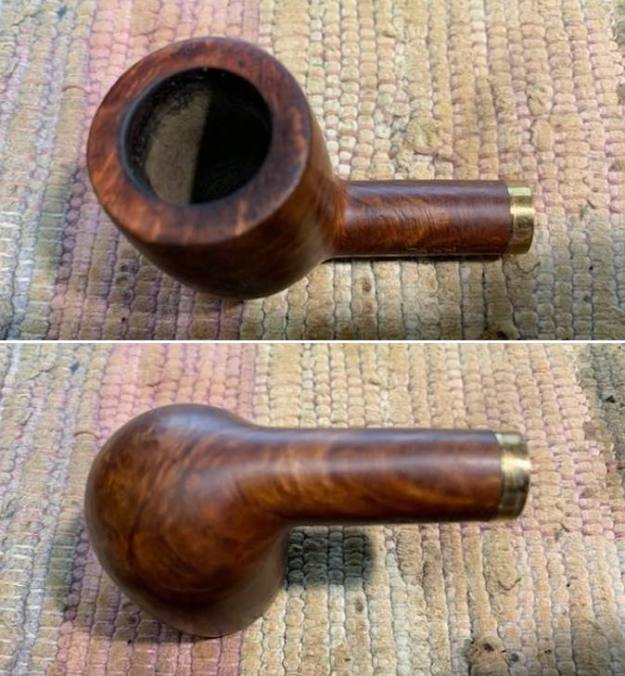
Yesterday I received an unexpected package from a fellow living in Port Clements, British Columbia. I say unexpected because I had not spoken to anyone from there about a repair. But here it was so I opened it to find a pipe with a broken tenon and a cheque for the work. There was a note in the package with a return address but no phone number or email. The pipe had the tenon broken off cleanly and stuck in the shank.The edges of the shank had some nicks in the edges and face on the left side. The stem face had some remnants but otherwise the break had been clean. The pipe was stamped on the left side of the shank and read Capri [over] Gozzo. On the right side of the shank it was stamped and read Made in Italy. The finish was dirty and there was a moderate cake in the bowl and lava overflowing on the rim top. It looked like he had dropped it somewhere along the way and snapped the stem off. The stem was lightly oxidized and had some chatter and tooth marks on both side ahead of the button but nothing to deep. I took some photos of the bowl and stem when I received it to show what it looked like when I received it here in Vancouver. I took photos of the rim top to show the condition of the bowl and the damage to the inner edge and the top of the rim. I also took photos of the stem to show the oxidation and tooth chatter on both sides at the button.I took a photo of the stamping on the left side of the shank. It was clear and readable as noted above.I took some photos of the shank end and stem end to show the broken tenon and the remnant on the face of the stem.I decided to start my work on the pipe by pulling the tenon from the shank. Usually I use a dry wall screw and twisted it into the airway. On this pipe it was stuck tight. I put it in the freezer for about 30 minutes and it was still stuck. I decided to drill it out and move on. I went through my tenons and found that I was missing the black Delrin one that I needed for the size of the shank. I did find a threaded white Delrin one that would fit the shank with a few minor adjustments. I used a Dremel and sanding drum to remove the shoulder ahead of the threads and it fit perfectly in the shank. I am hoping that the fellow will return my calls so I can chat with him about the tenon. No luck on many phone calls so the tenon was glued in place this morning.Now it was time to work on replacing the broken tenon. I drilled out the face of the stem with a cordless drill and a bit roughly the size of the airway in the stem. I find that this helps to center the drilling. I worked my way through drill bits up to 15/64s which is approximately the size of the threaded portion of the tenon.I turned the threaded portion of the tenon into the drilled airway and the fit was perfect. I used a dental pick to spread some black CA glue on the threads of the tenon and turned it in place in the stem. I set it aside to wait for the glue to cure.While the glue cured on the new tenon I turned my attention to the bowl. I reamed the bowl with a Savinelli Fitsall Pipe Knife and then sanded it with 220 grit sandpaper wrapped around a piece of dowel.I used a piece of folded 220 grit sandpaper to clean up the inner edge of the bowl and smooth out the nicks there. I also sanded the rim top at the same time to remove the lava and darkening there. I stained the rim top with an oak stain pen to blend it into the surrounding briar.I polished the briar with micromesh sanding pads – dry sanding with 1500-12000 grit pads and wiping the briar down with a damp cloth after each pad. The briar began to take on a shine as the pads progressed. I worked some Before & After Restoration Balm into the surface of the briar with my fingertips to clean, enliven and protect the briar. I let the balm sit for 15 minutes and then buffed with a cotton cloth to raise the shine. The photos show the bowl at this point in the restoration process. I pressed a thin brass band on the shank end to take care of the nicks and chips there. It also gave a smooth surface for the face of the stem to sit. I like the addition of the bling. I set the bowl aside and turned my attention to the stem. It was in such great condition that I polished it with micromesh sanding pads – wet sanding with 1500-12000 grit sanding pads. I wiped it down after each sanding pad with Obsidian Oil. I polished it with Before & After Pipe Stem Polish – both Fine and Extra Fine. This Capri Gozzo Fancy Saddle Stem Billiard turned out to be a more beautiful pipe than I had expected when I took it out of the package. The finish on the briar is nice and the grain really stands out. I put the pipe back together and buffed it lightly with Blue Diamond on the buffing wheel. I gave the bowl and the stem multiple coats of carnauba wax. I hand buffed the pipe with a clean buffing pad to raise the shine and hand buffed it with a microfibre cloth to deepen the shine. It is fun to see what the polished bowl looks like with the polished black vulcanite stem. This classic looking Capri Gozzo Billiard feels great in my hand. It is light and well balanced. Have a look at it with the photos below. The dimensions are Length: 6 inches, Height: 1 ½ inches, Outside diameter of the bowl: 1 ½ inches, Chamber diameter: 7/8 of an inch. The weight of the pipe is 63 grams/2.22 oz. The pipe definitely looks better than when it arrived. It will be heading back to pipeman who sent it to me later this week. Thanks for walking through the repair and restoration with me as I worked over this pipe. Thanks to each of you who are reading this blog.