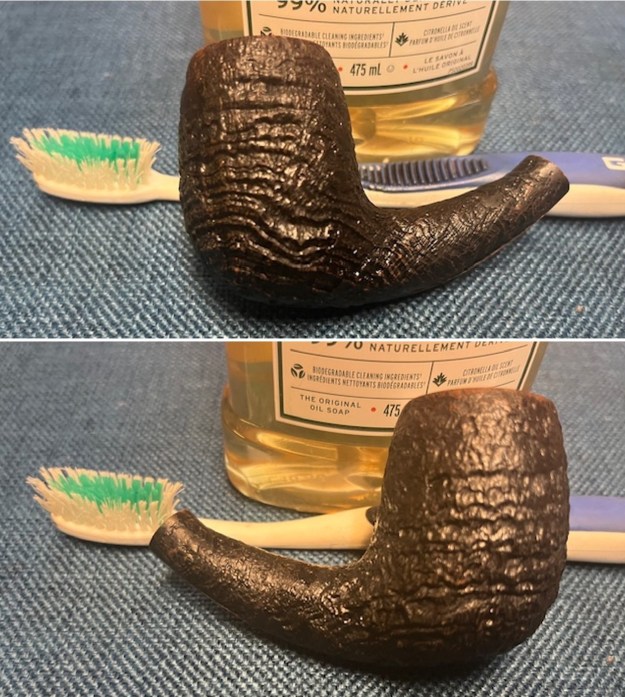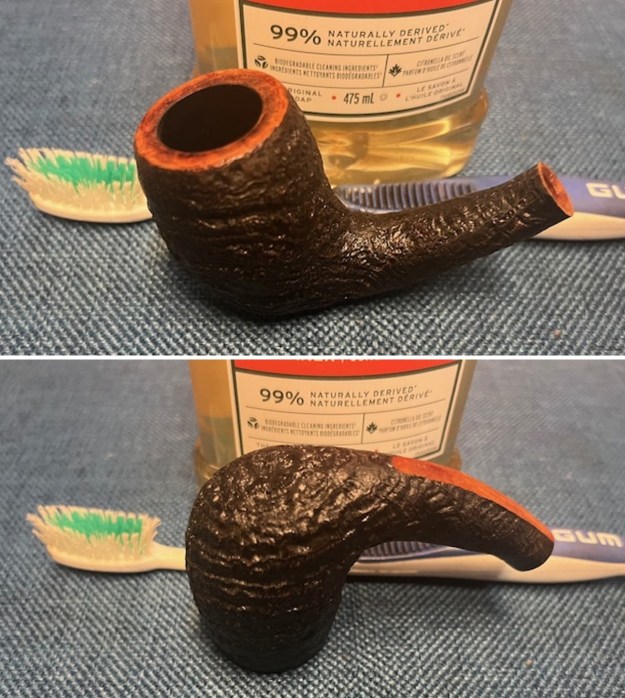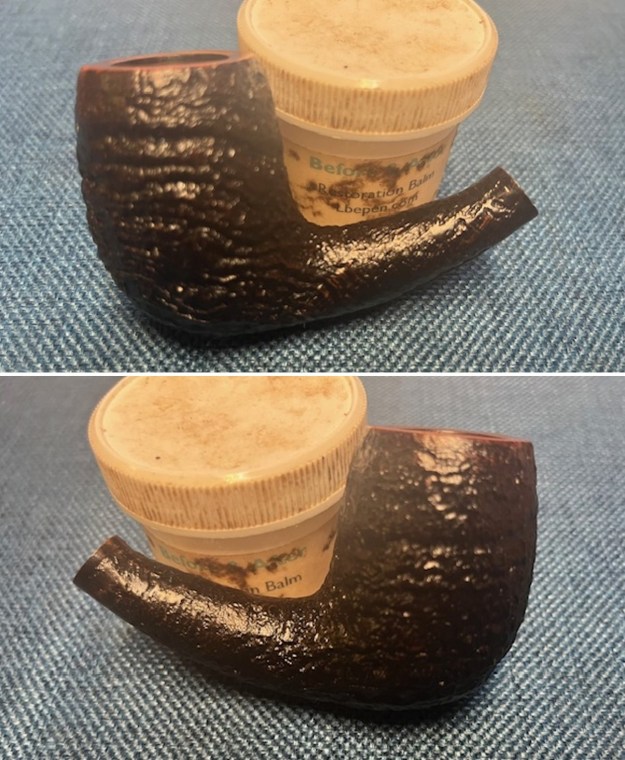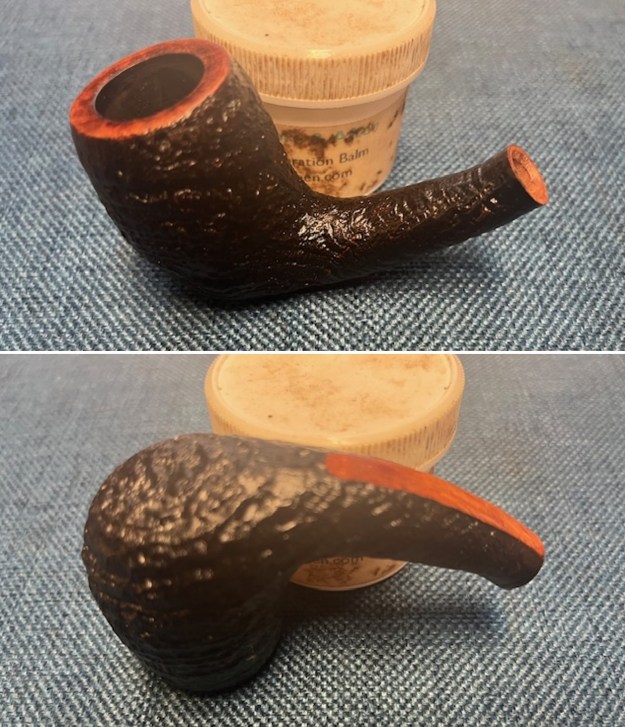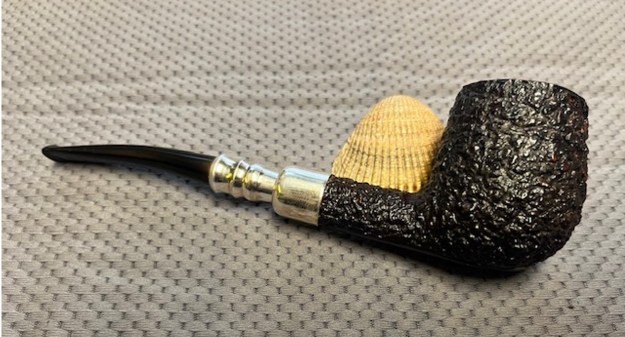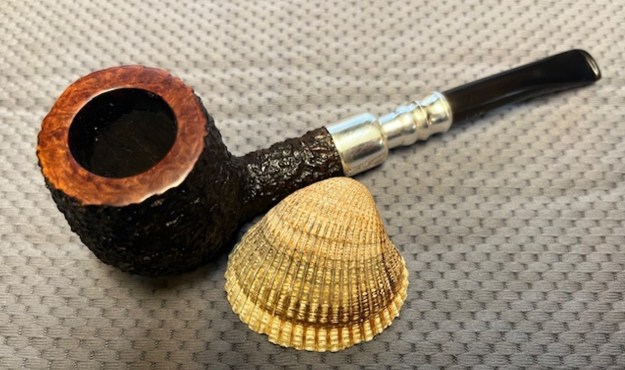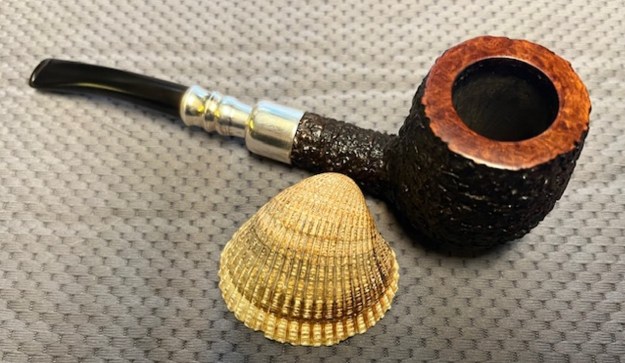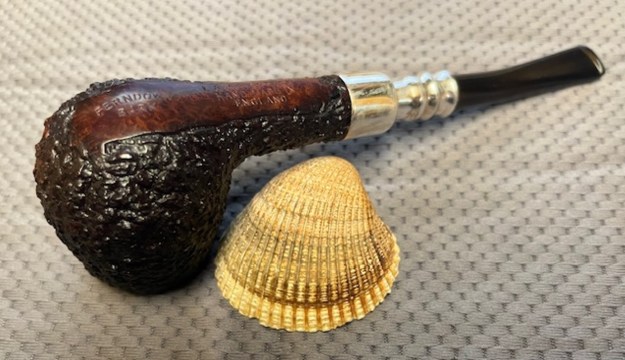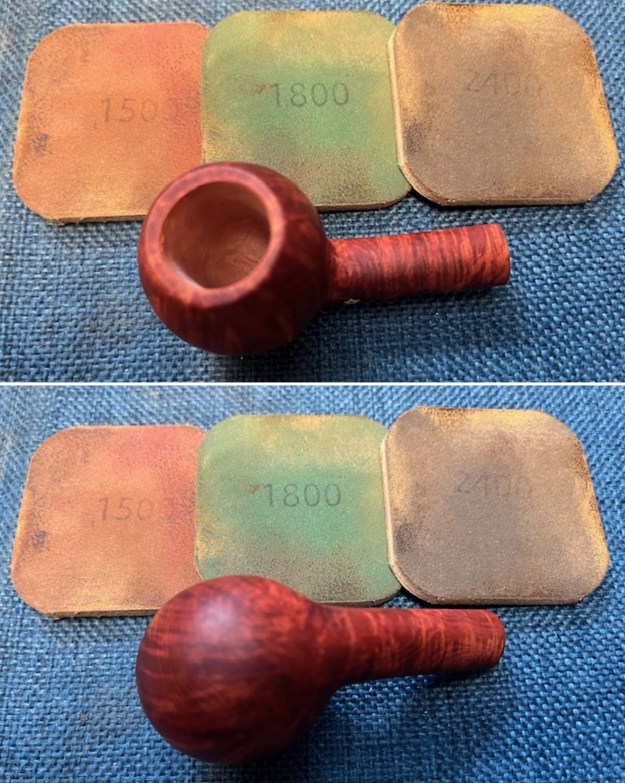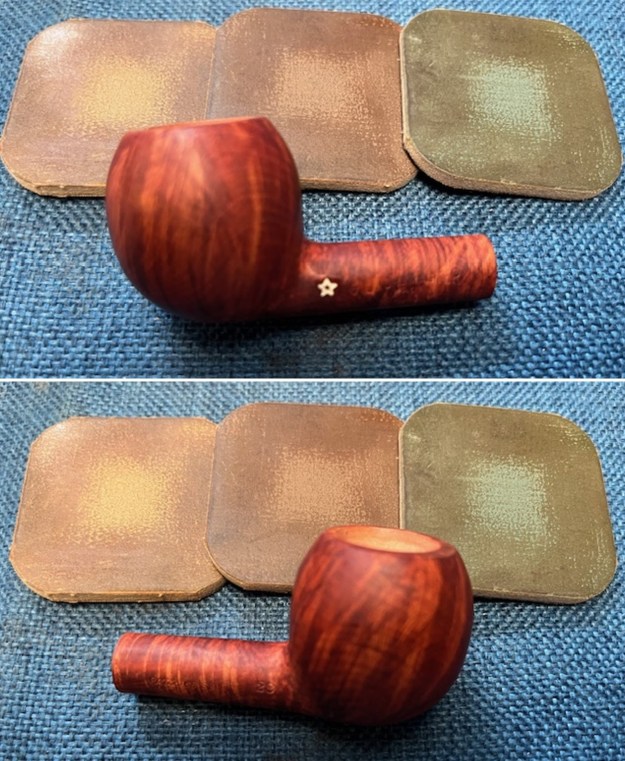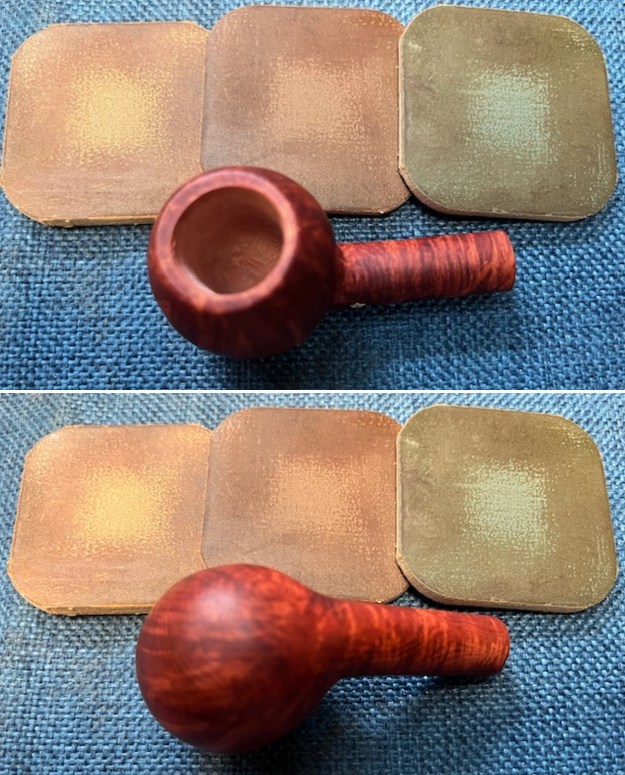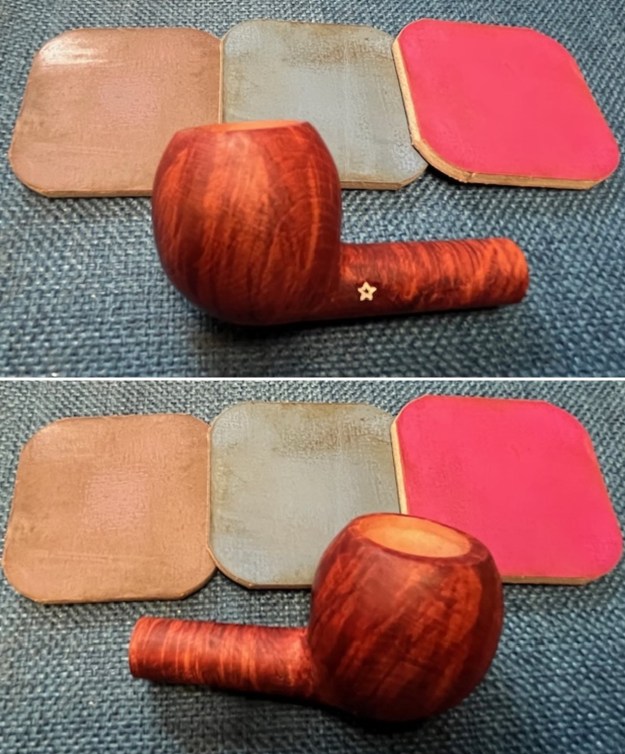
Tag Archives: contrast staining

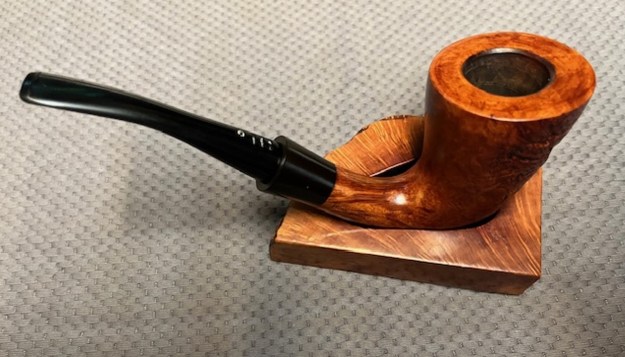
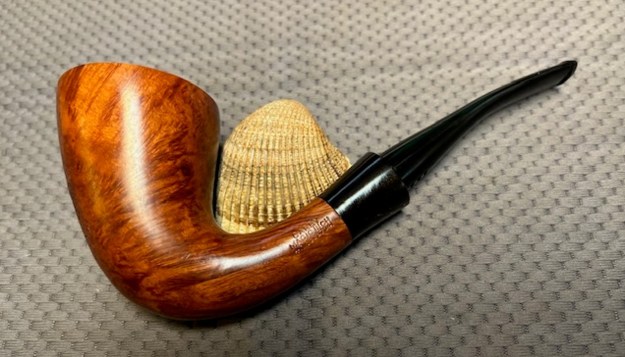
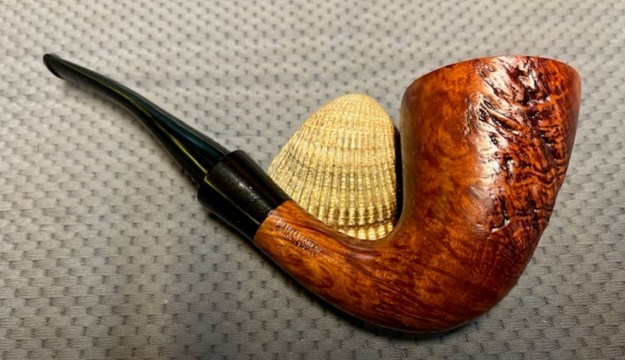
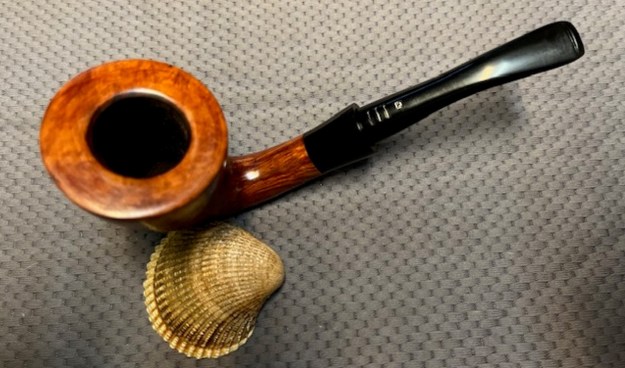
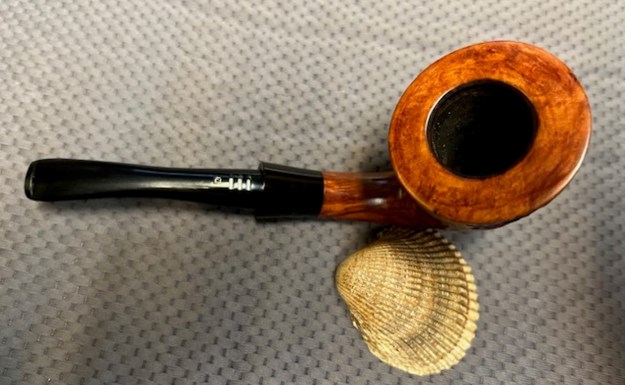
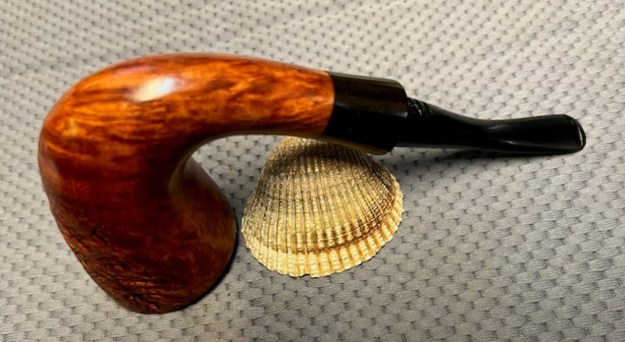
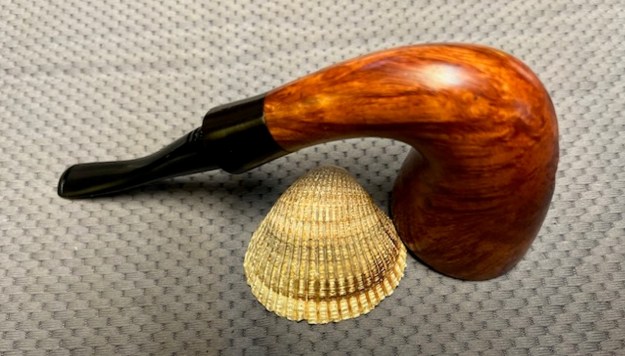
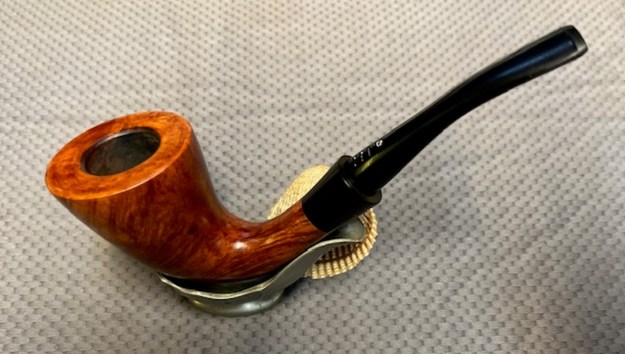
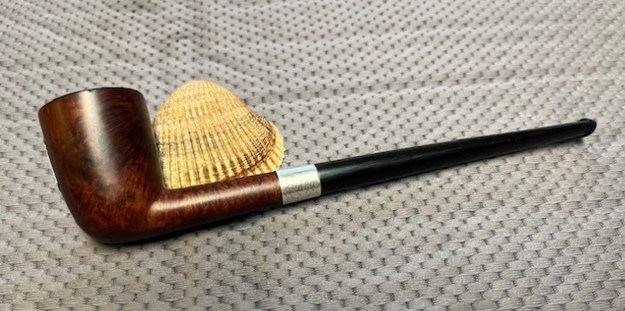
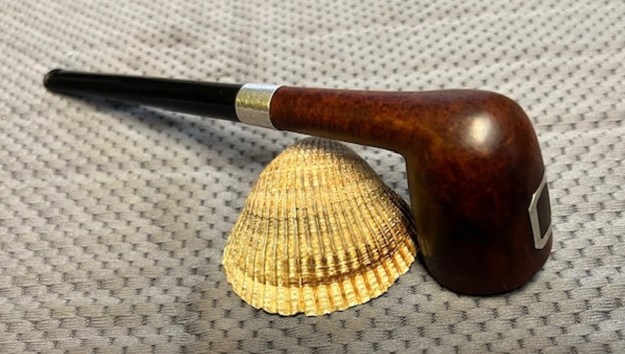
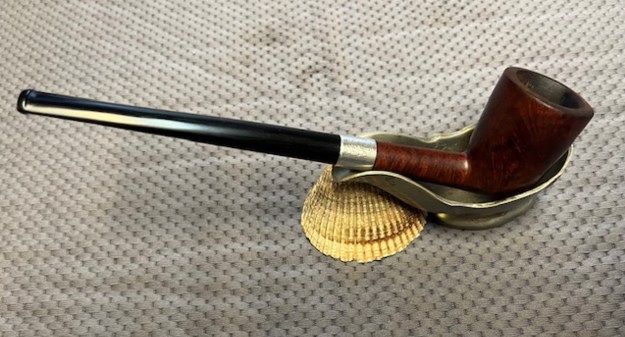
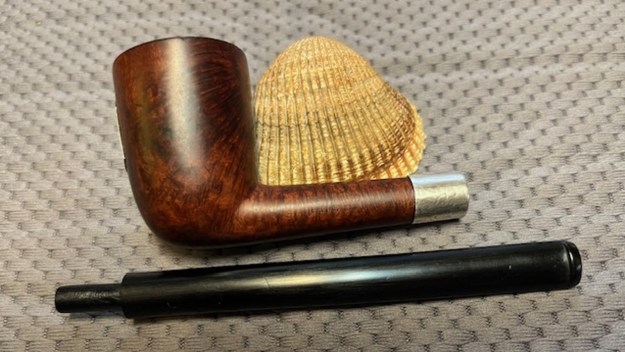
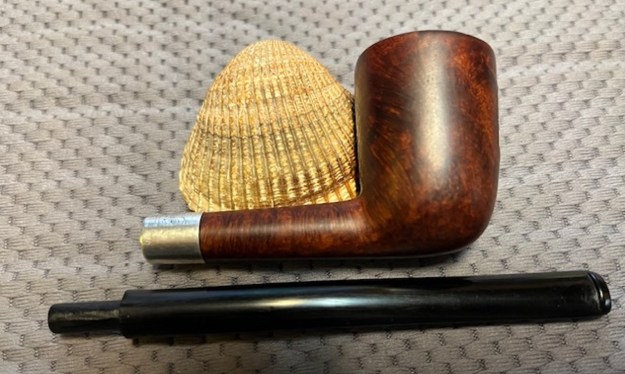
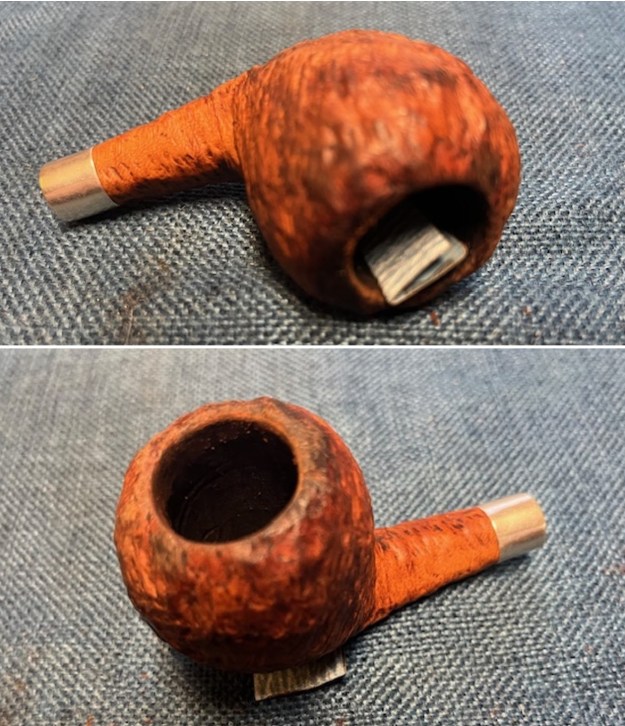
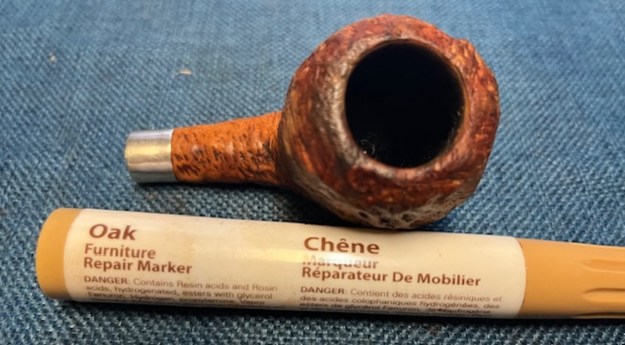
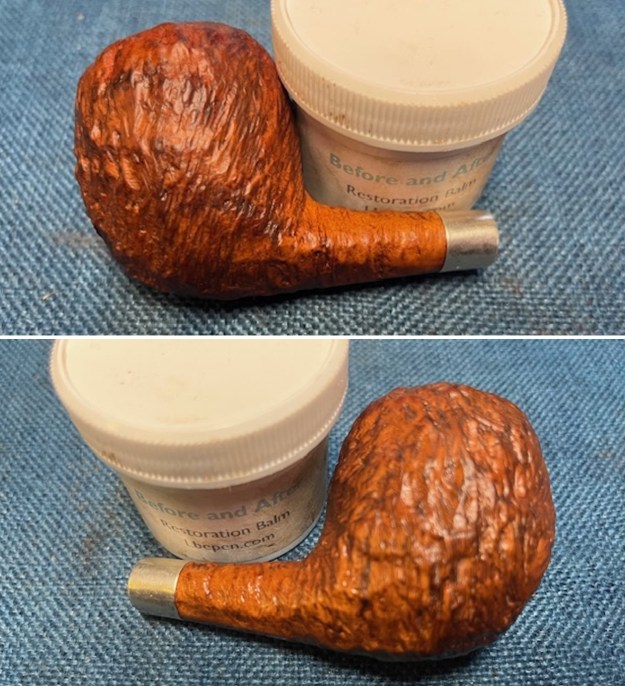
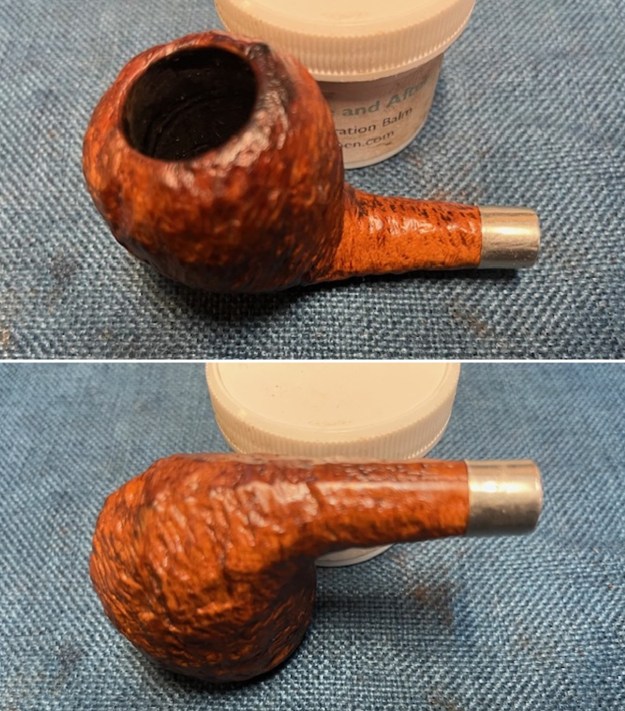
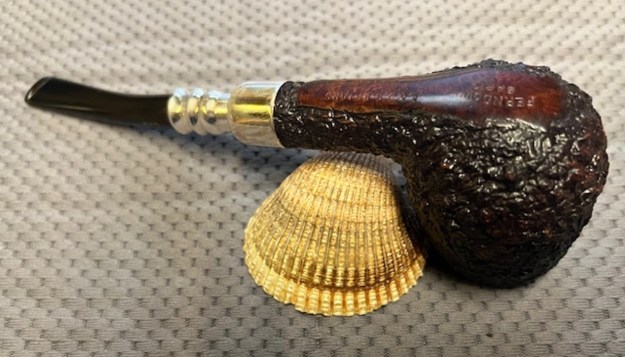
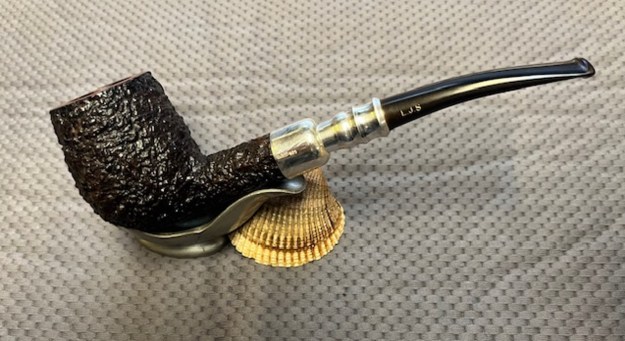
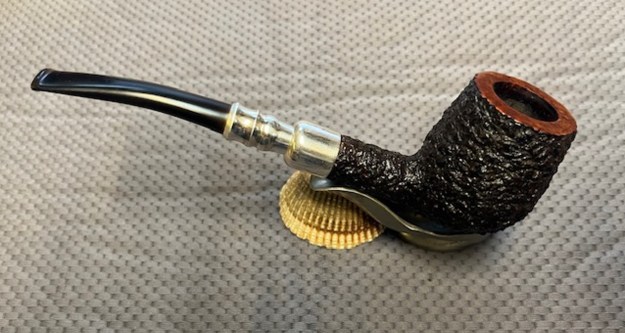
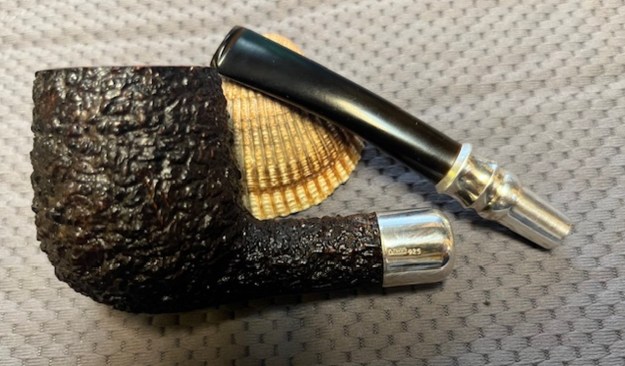
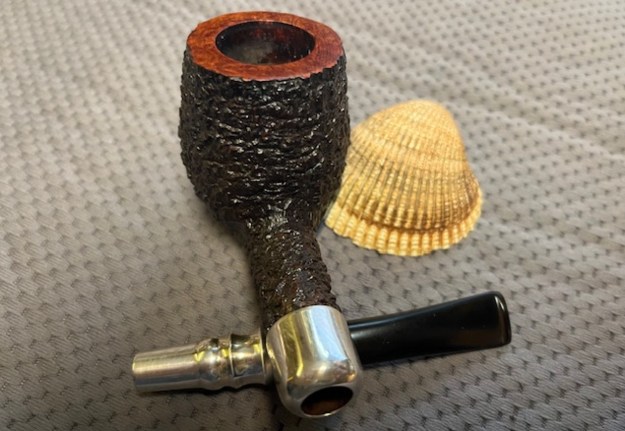
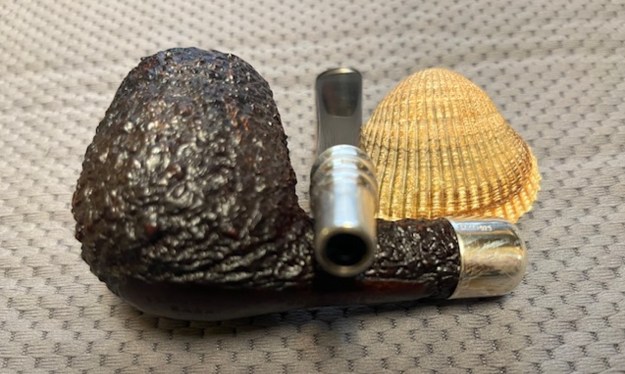
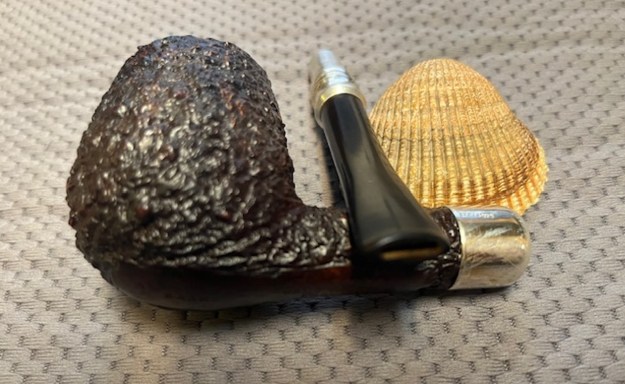
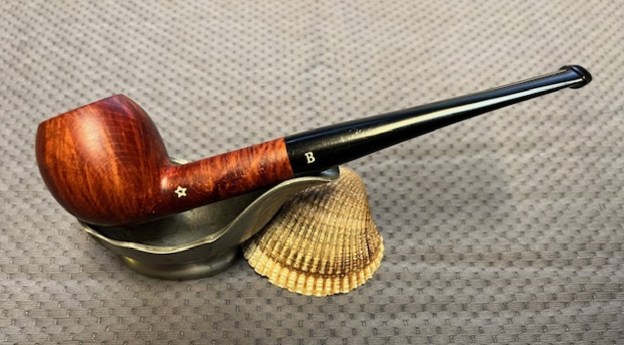
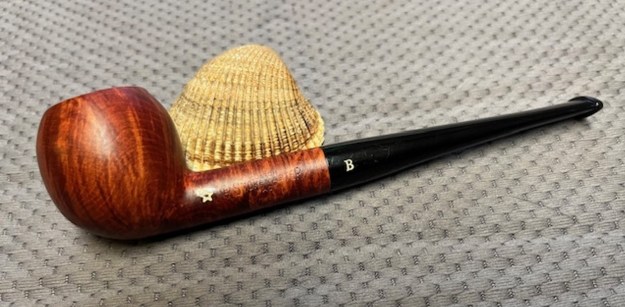
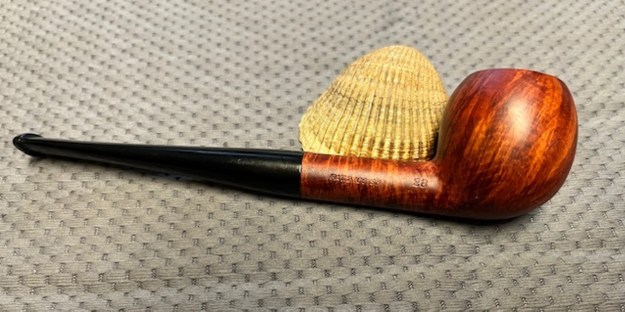
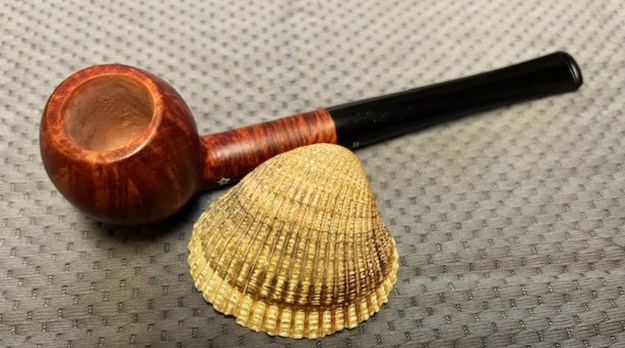
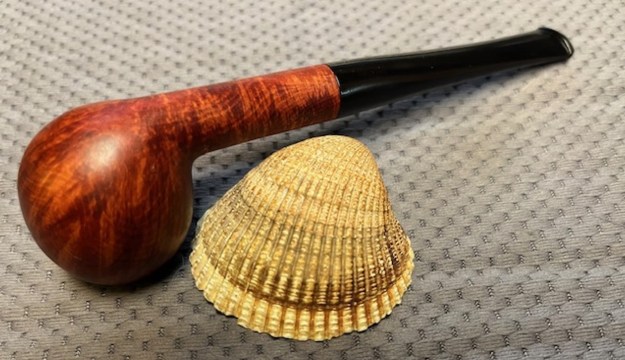
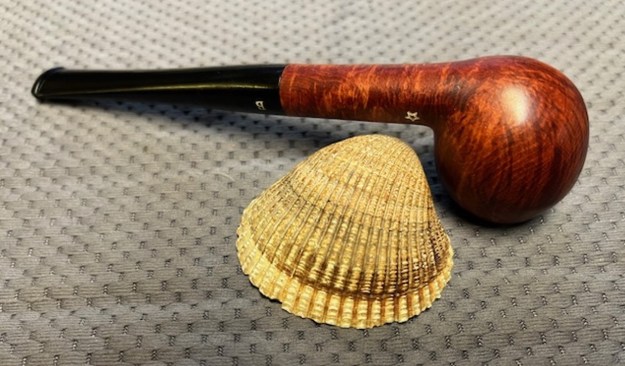
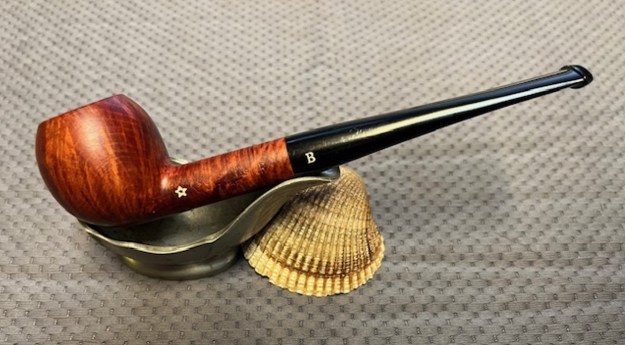
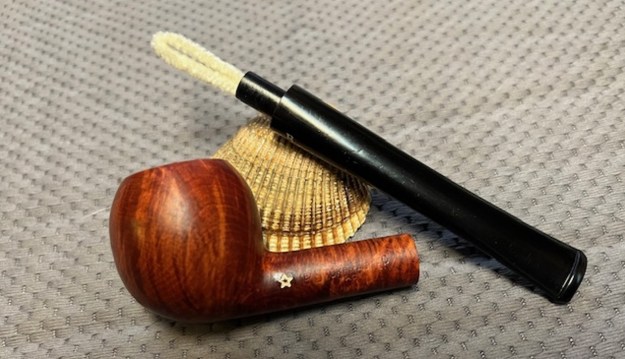
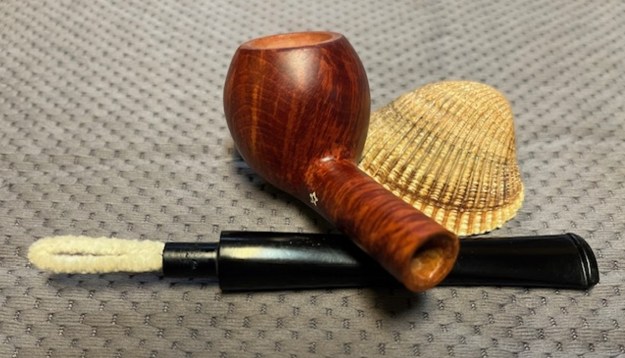
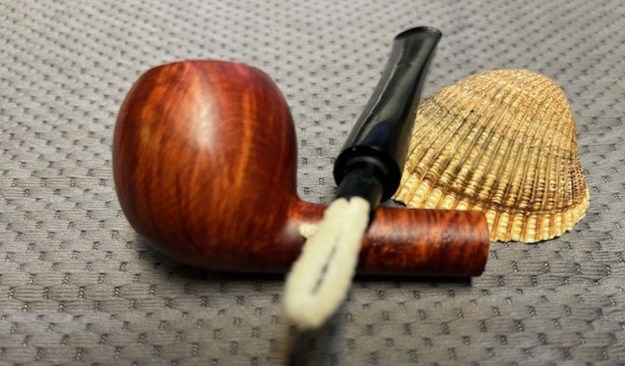
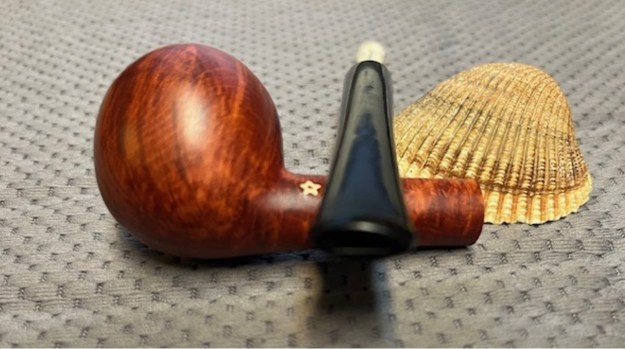
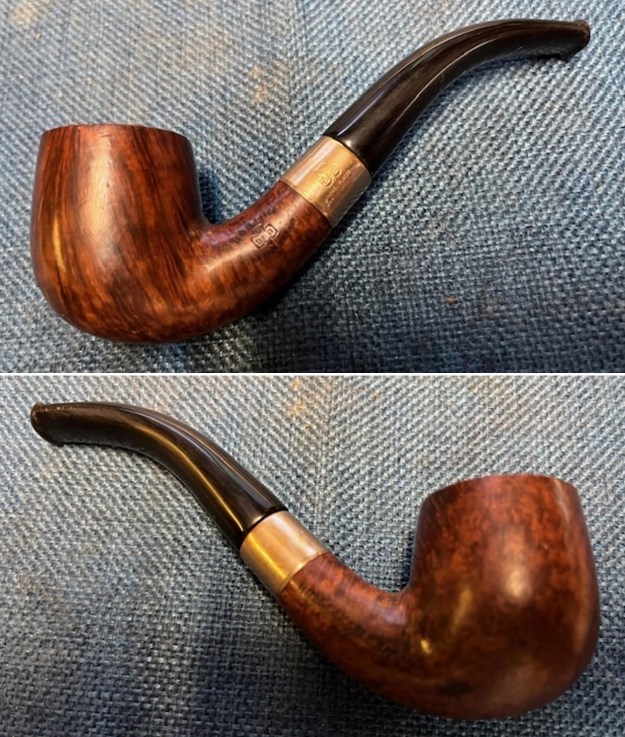
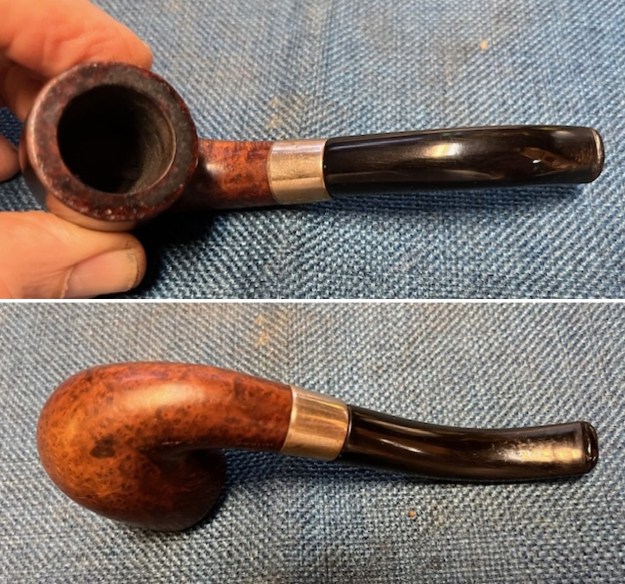
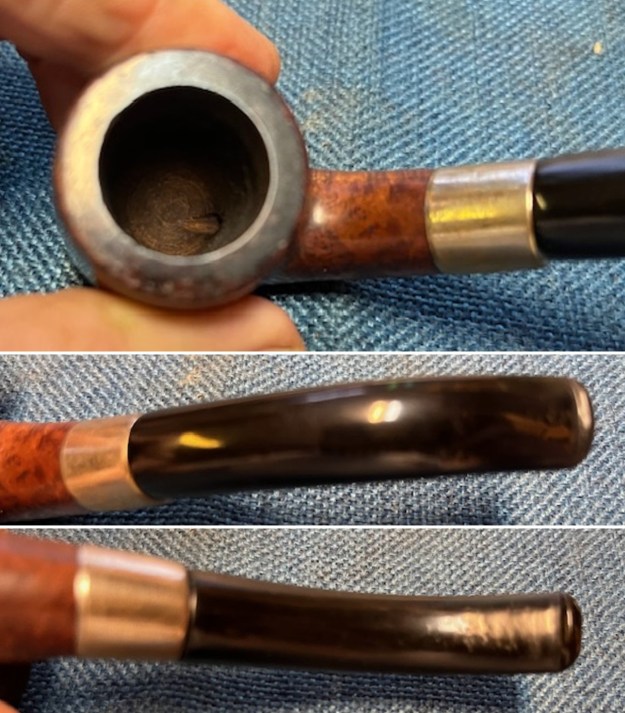
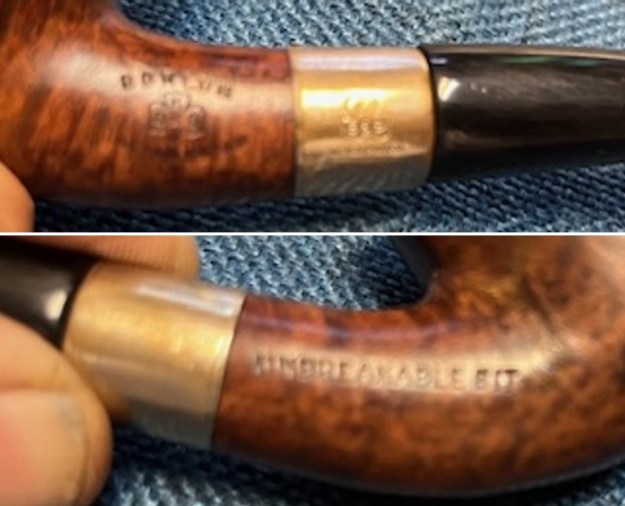
Restoring a Mystery Campaign Calabash Pipe with a White Star Logo


by Steve Laug

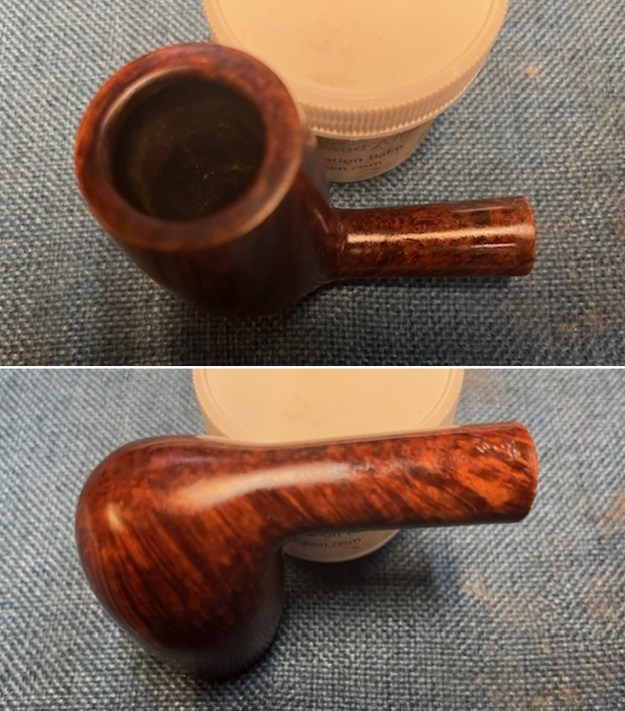
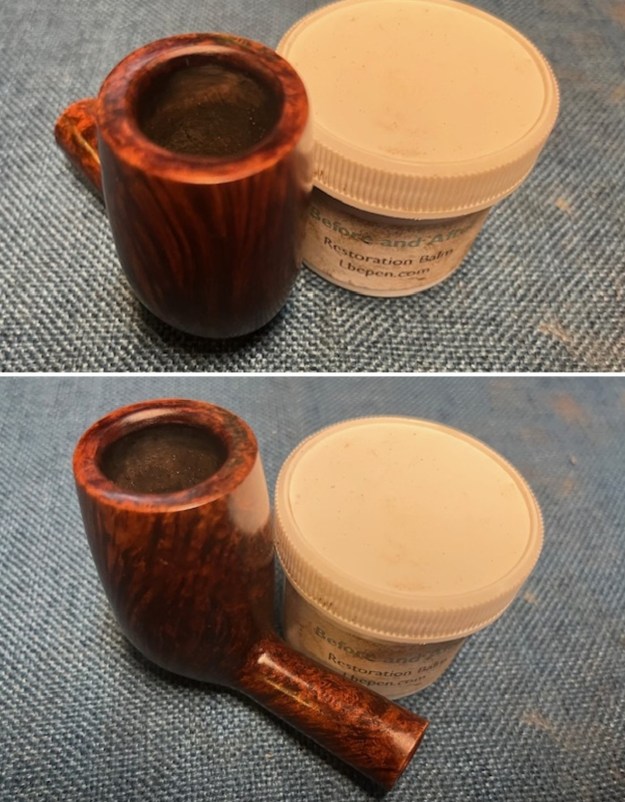
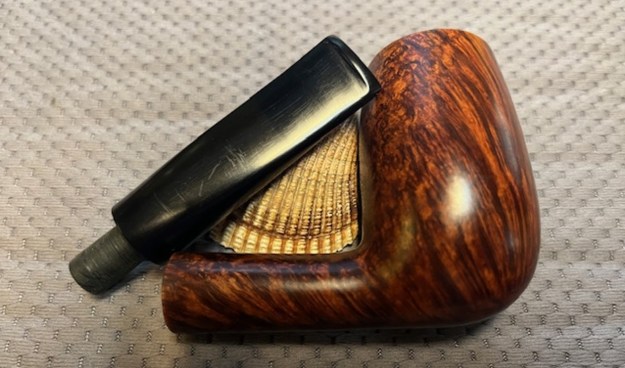
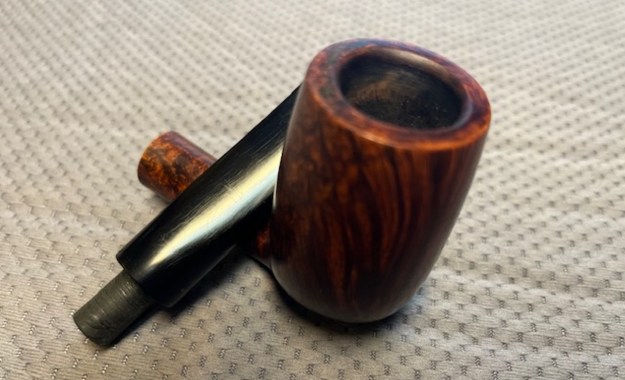
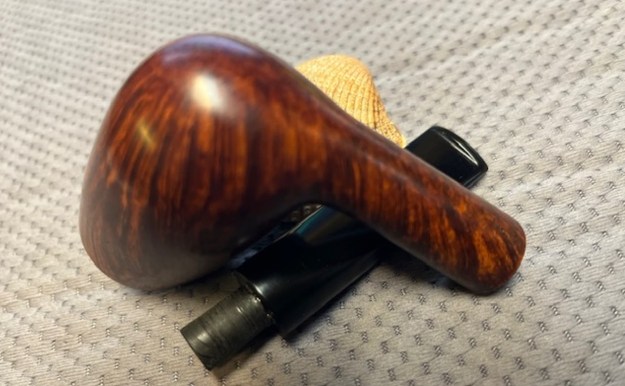
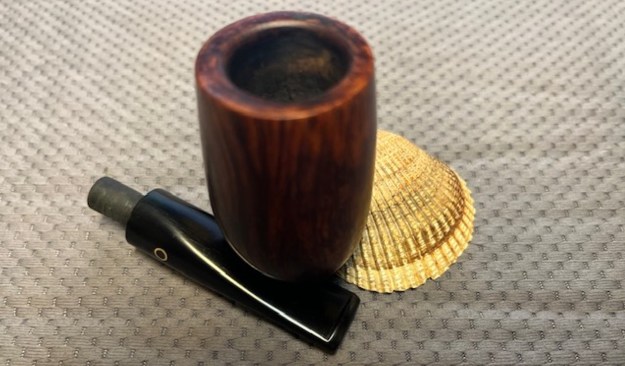
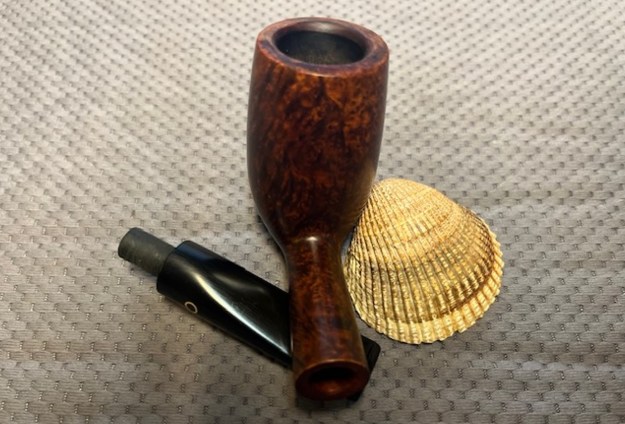
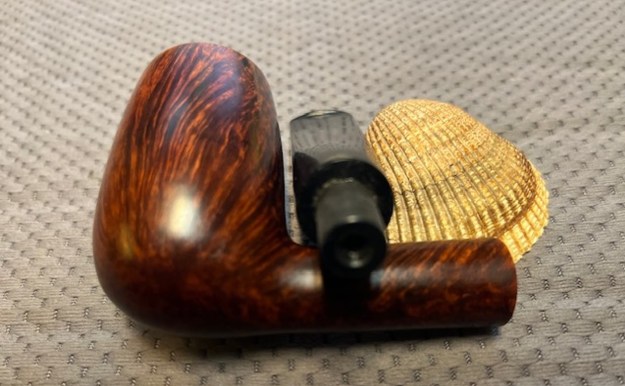
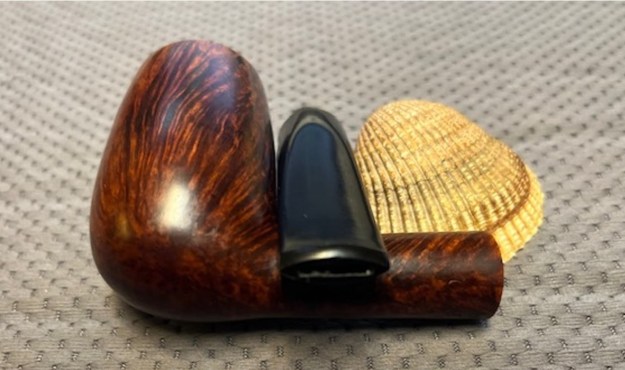
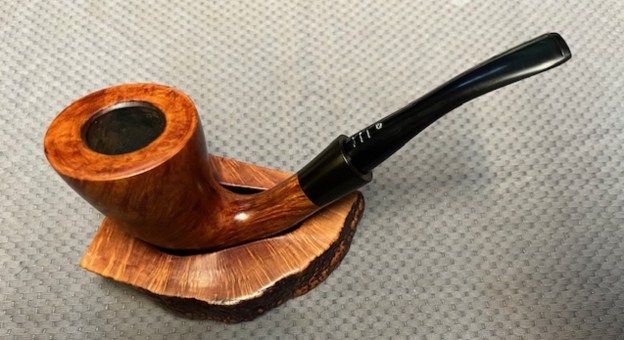
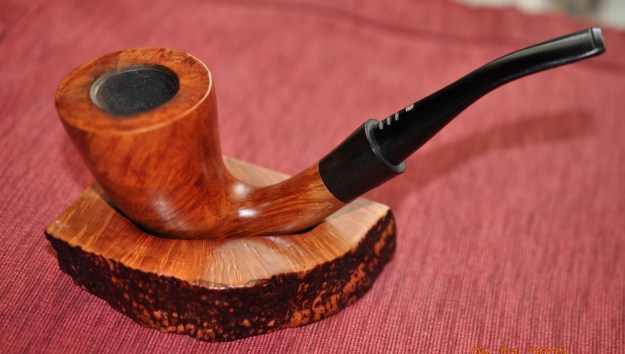
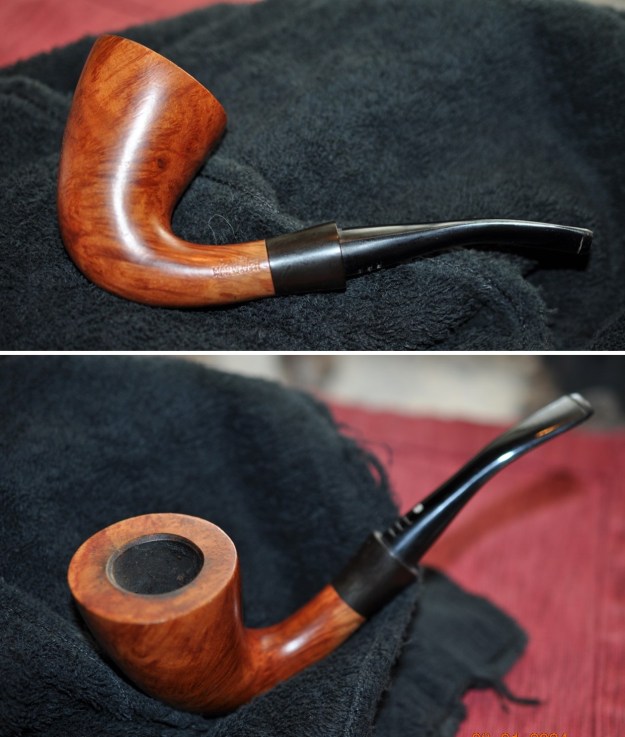
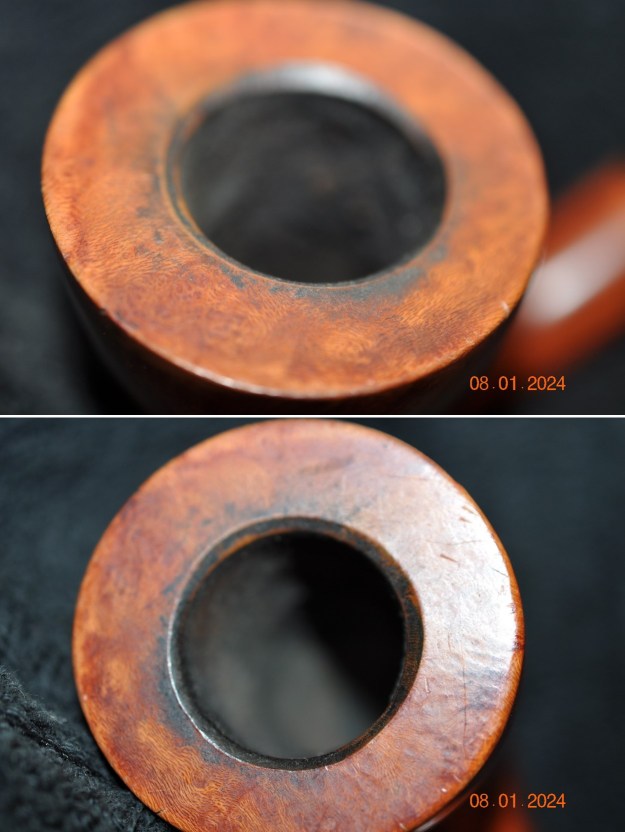
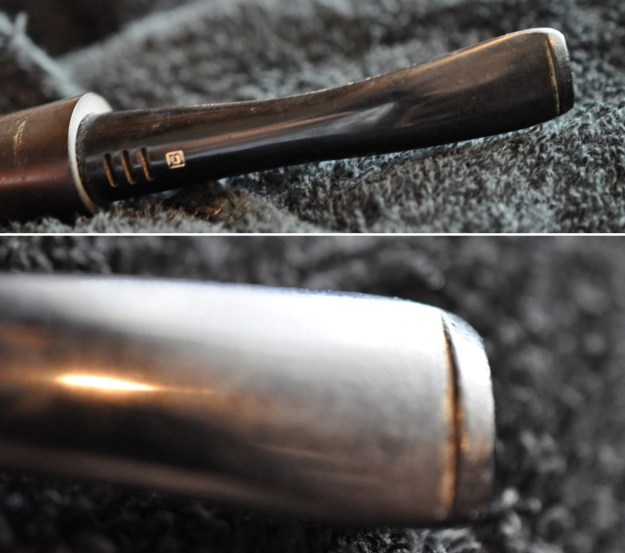
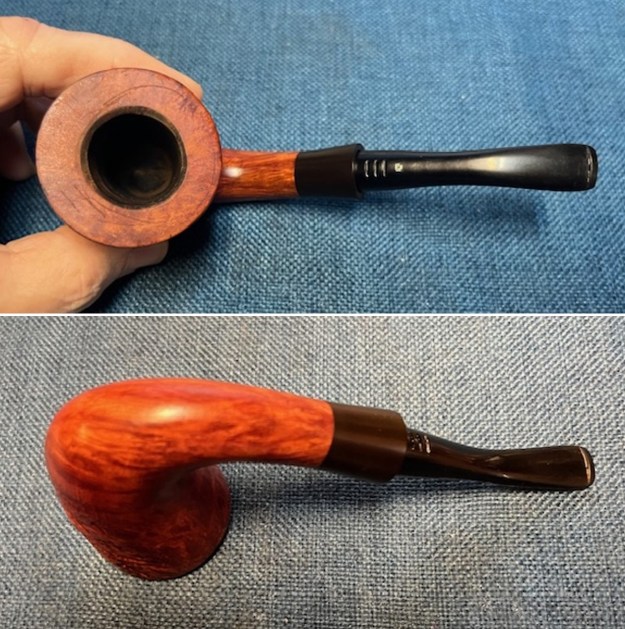
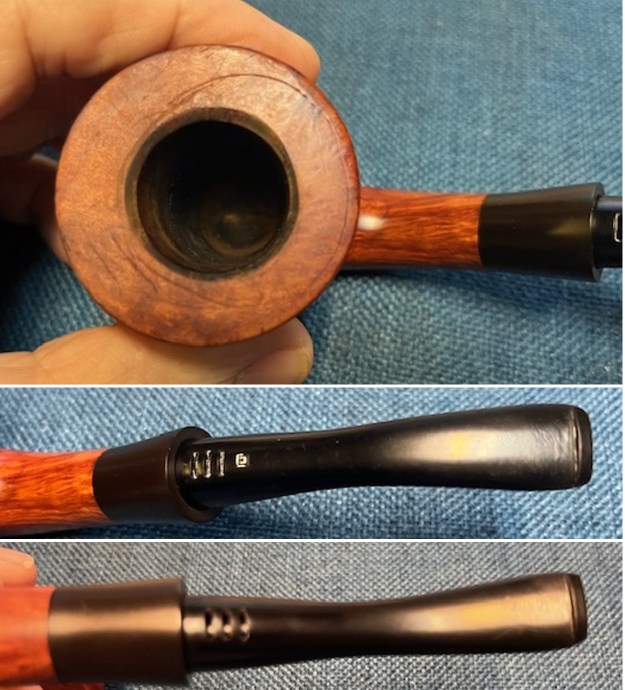
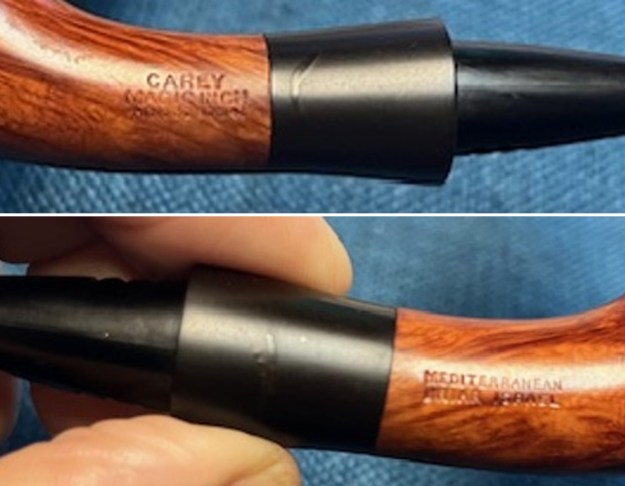
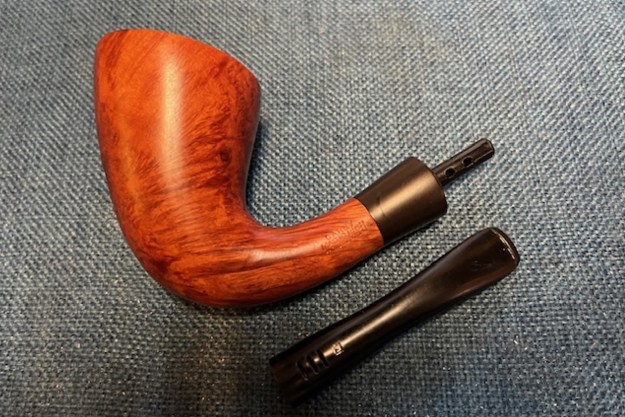
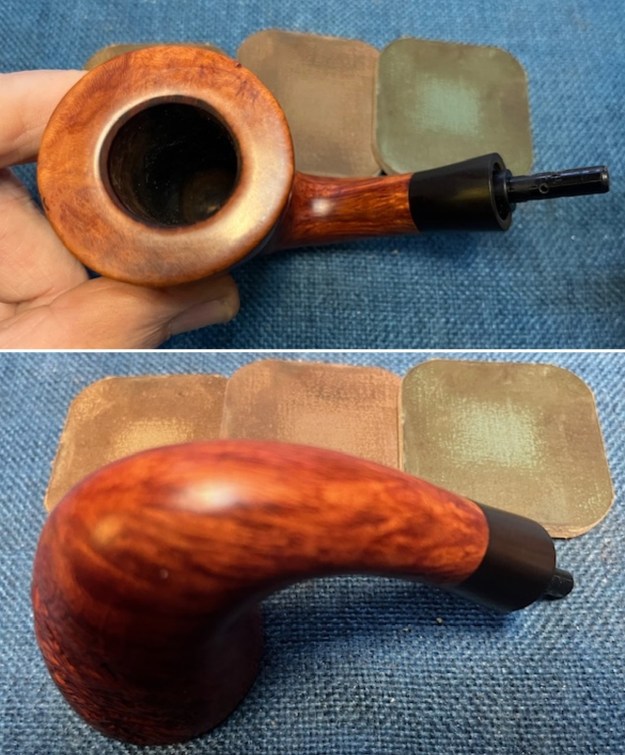
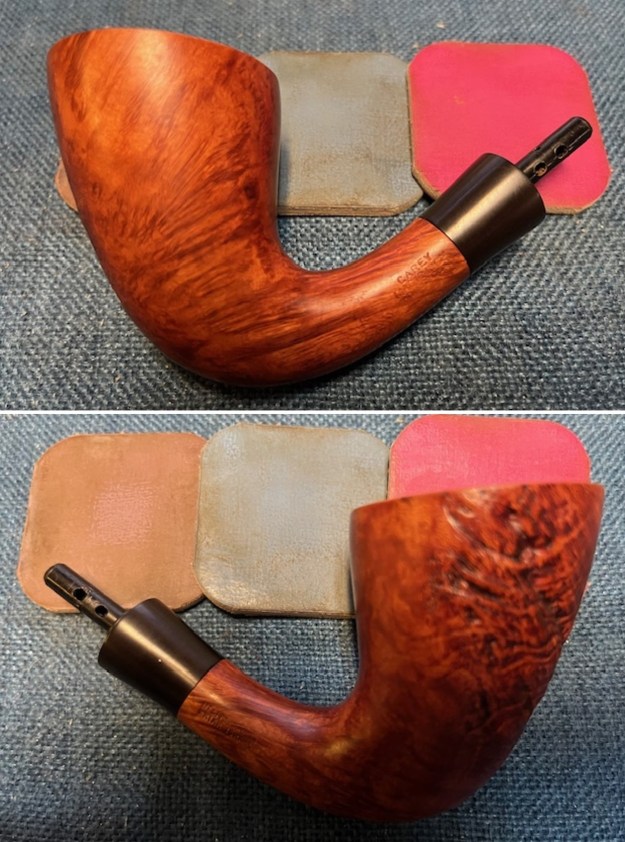
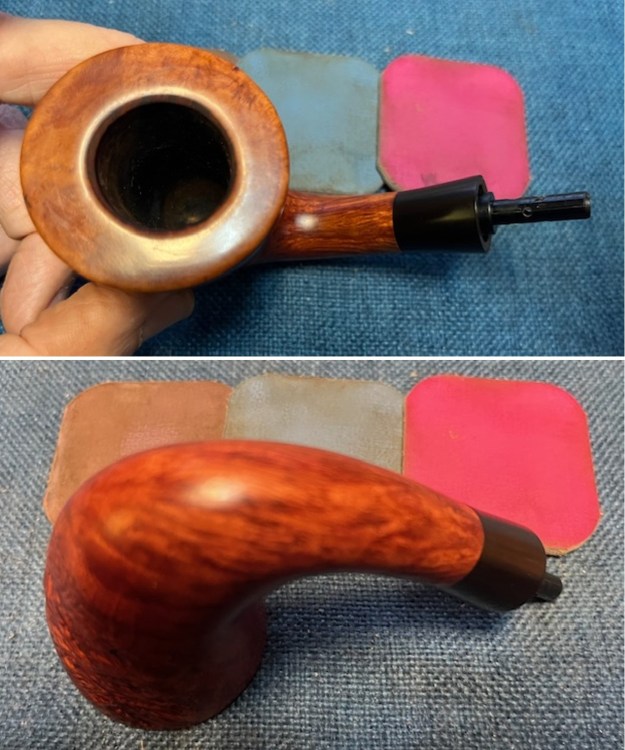
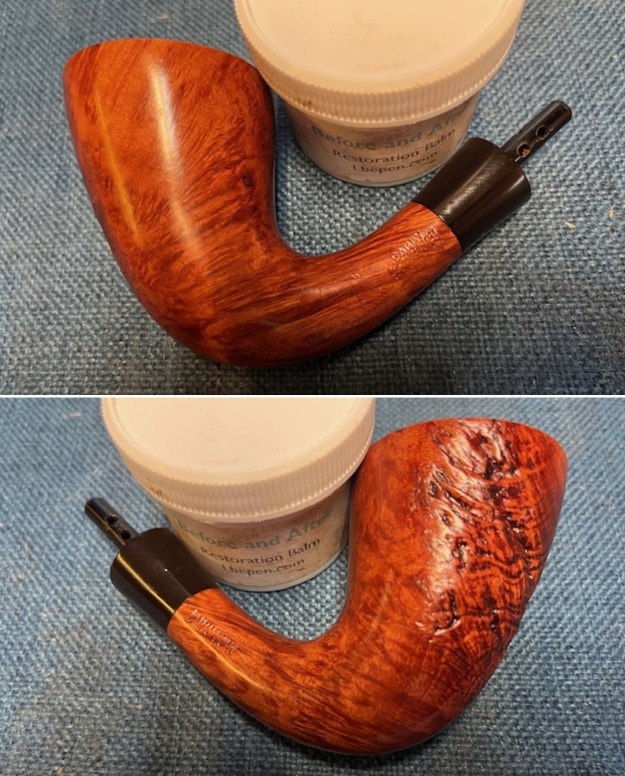
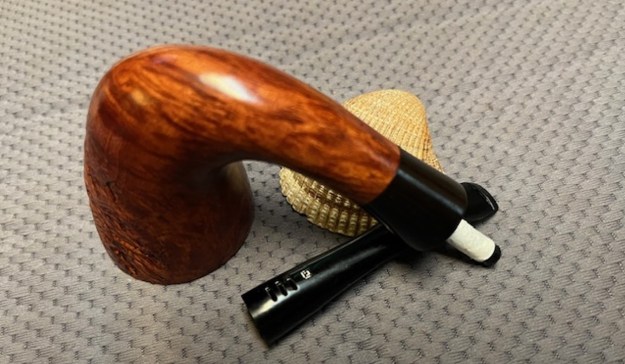
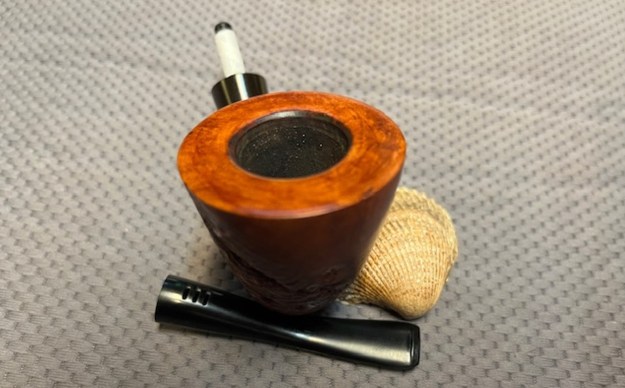
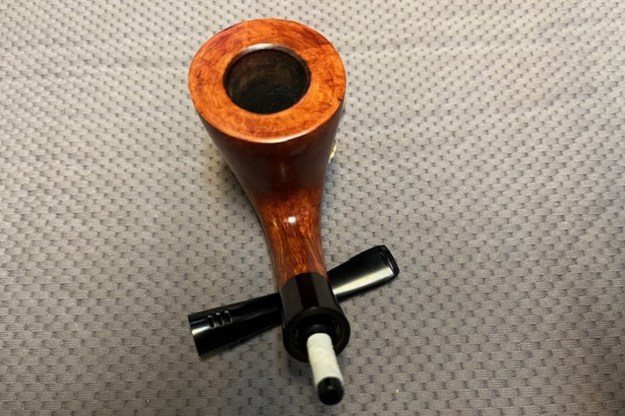
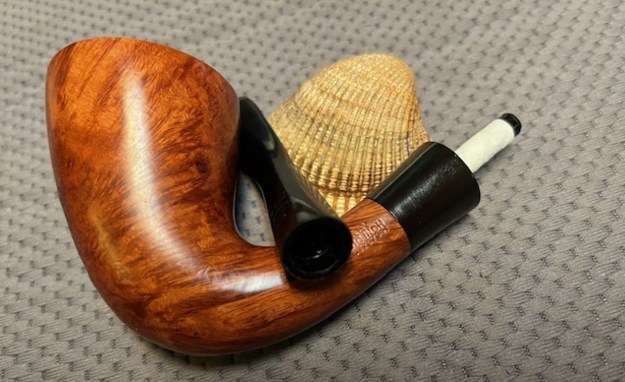
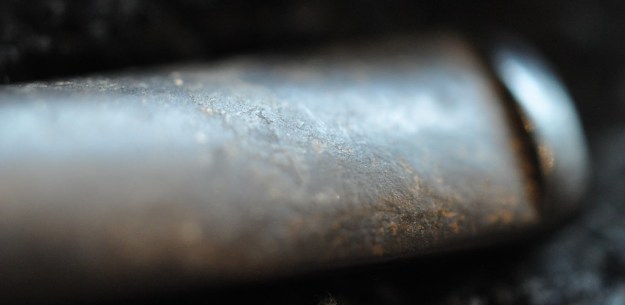
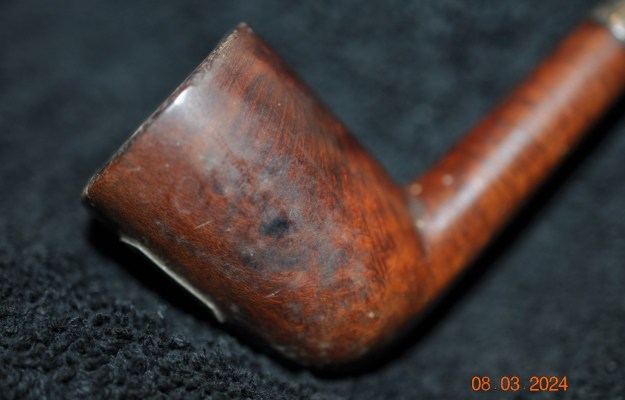
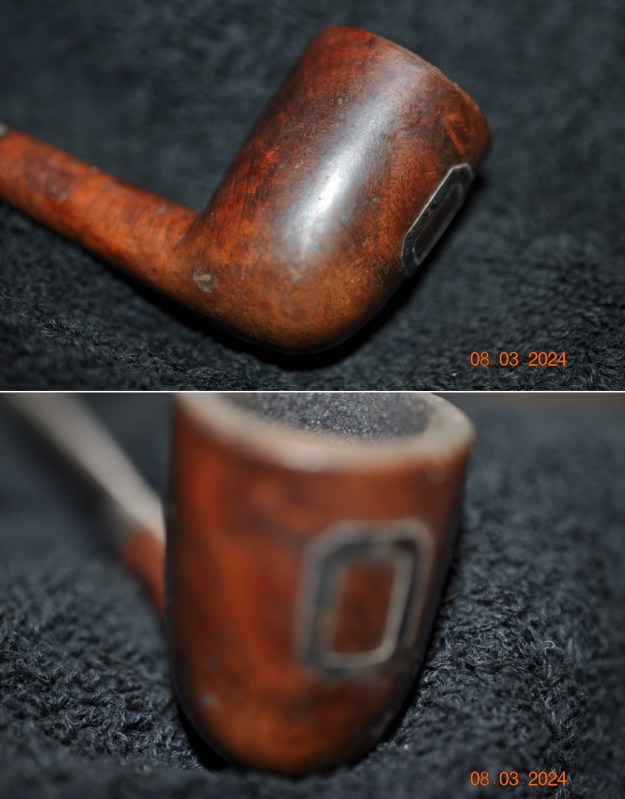
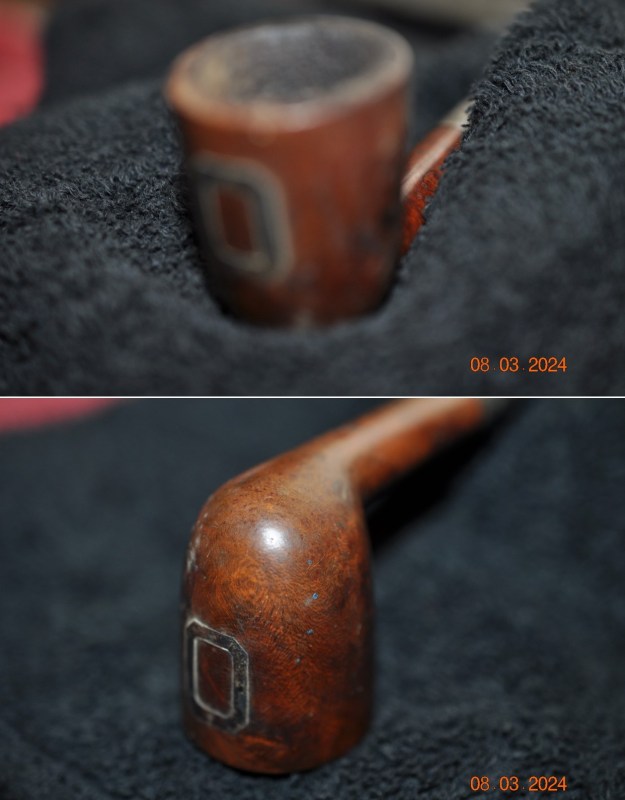
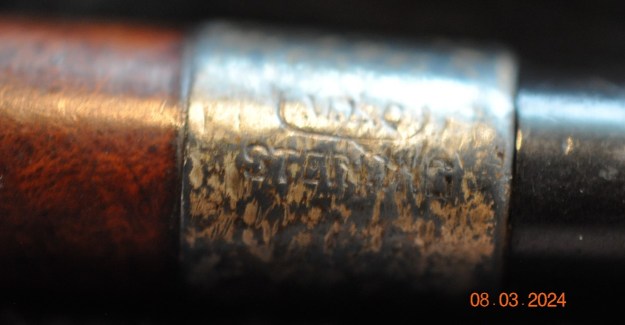
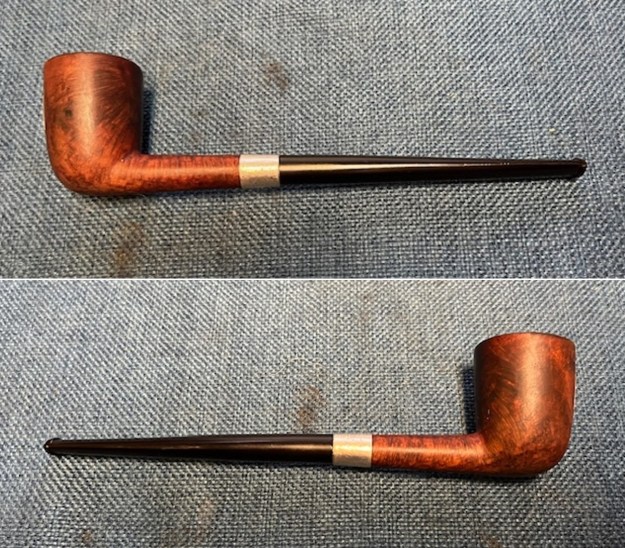
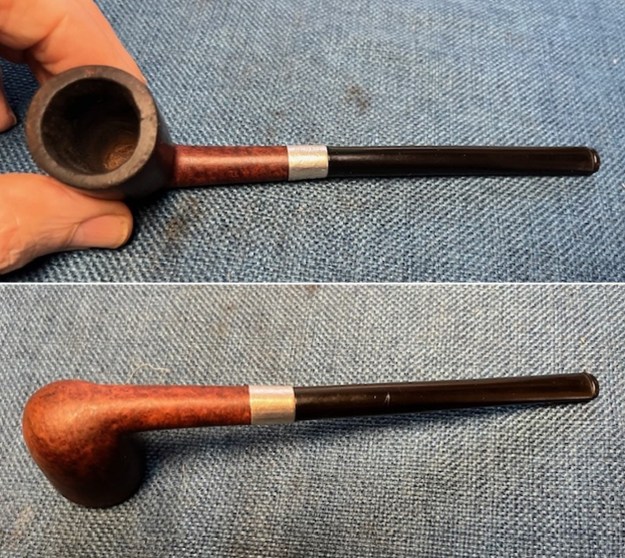
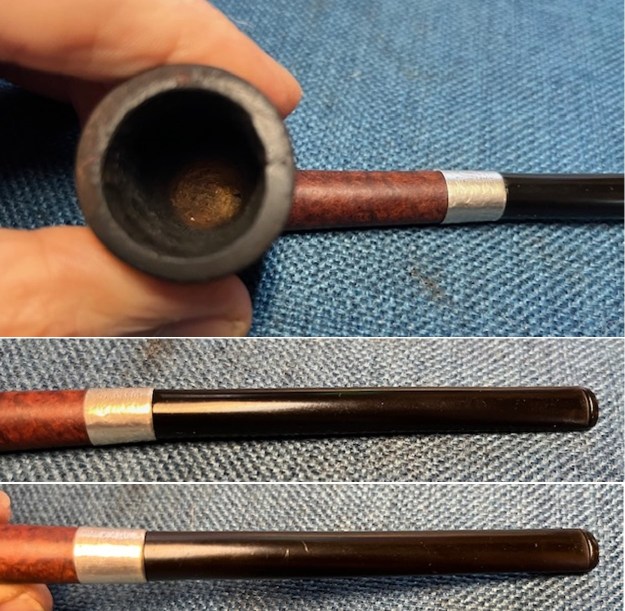
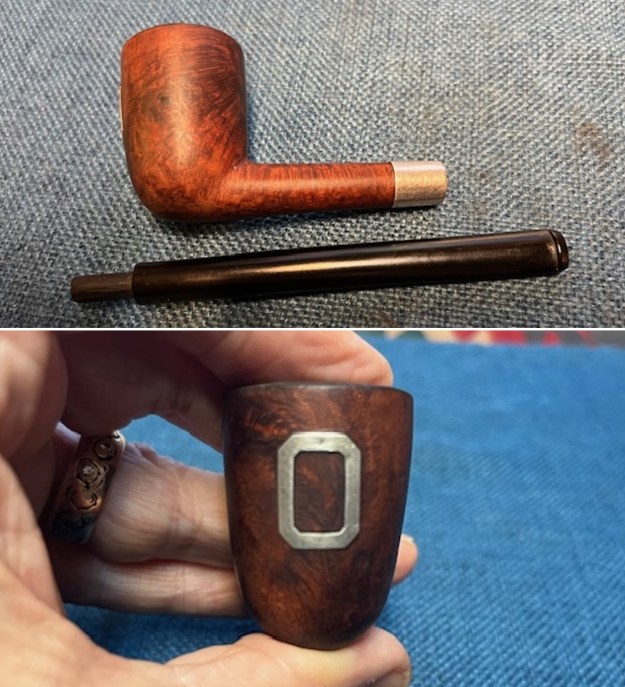
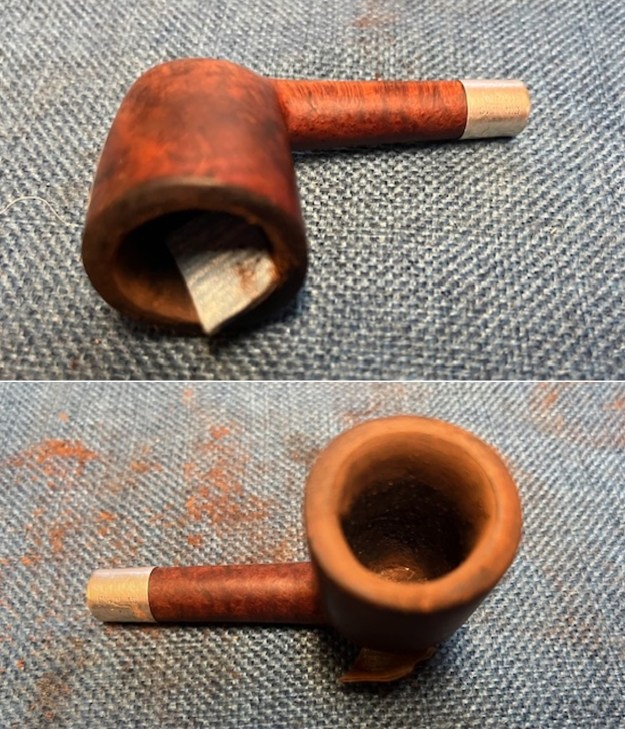
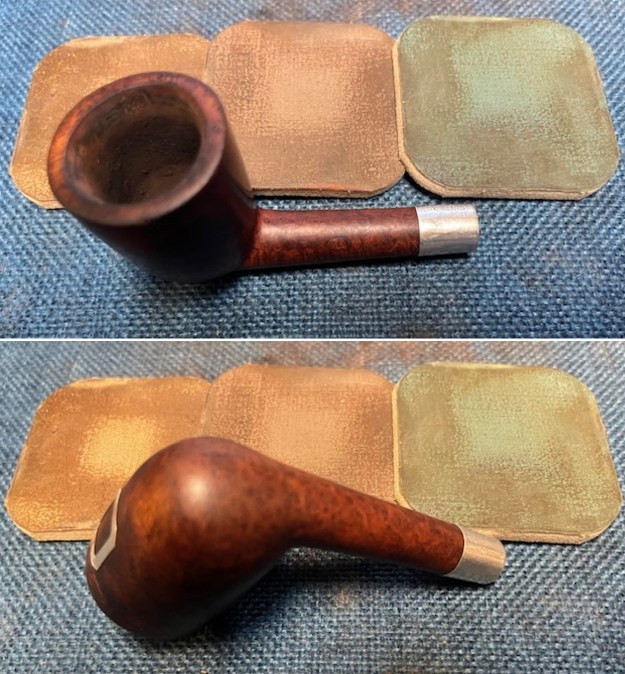
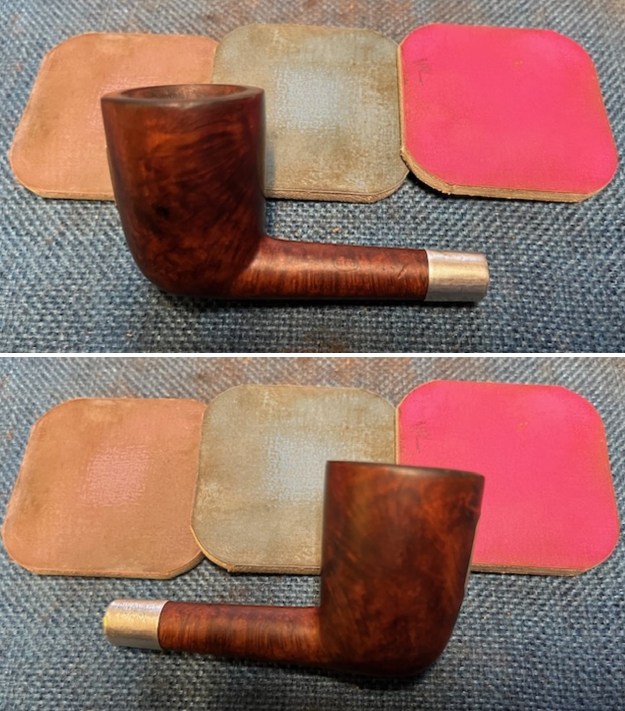
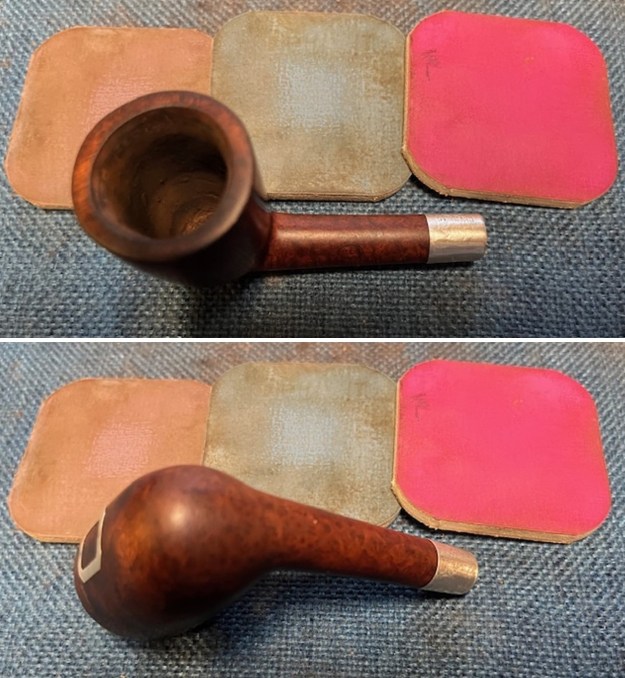
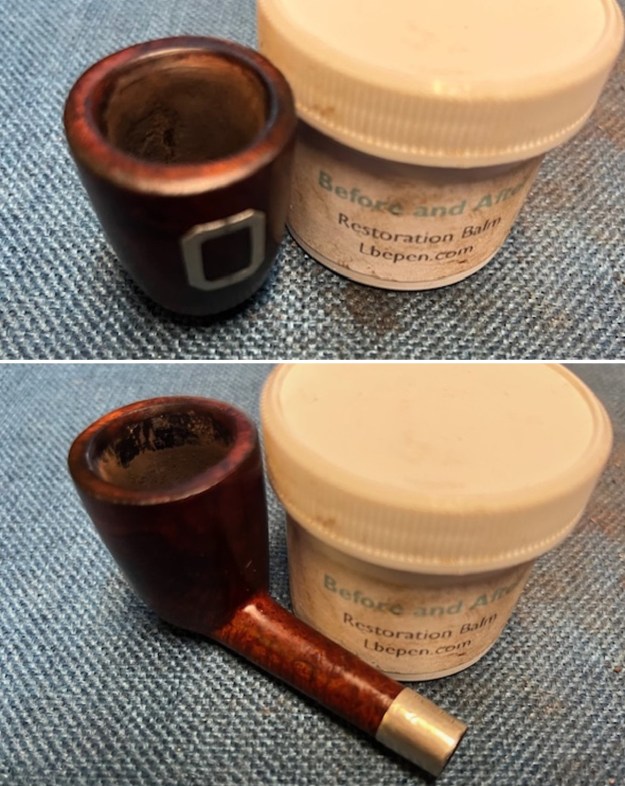
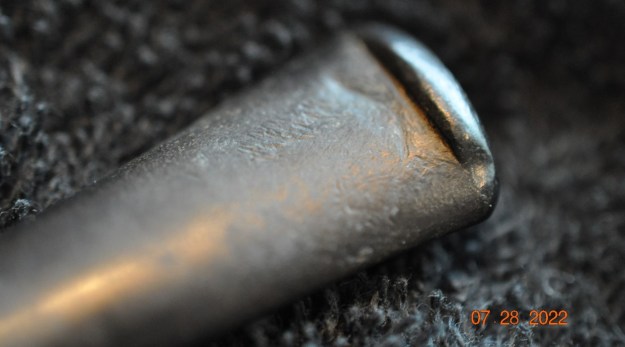
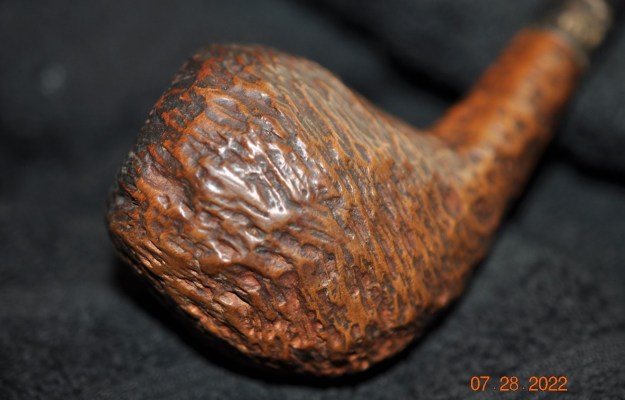
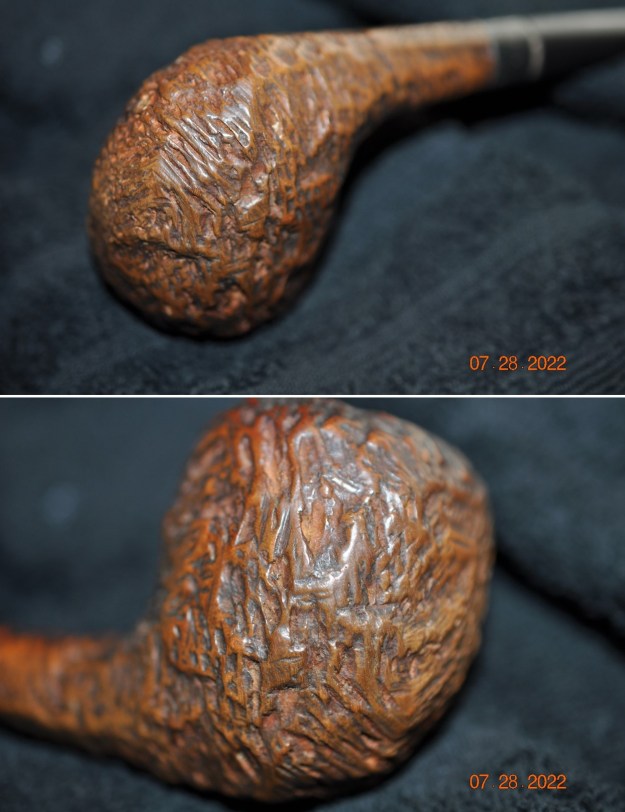
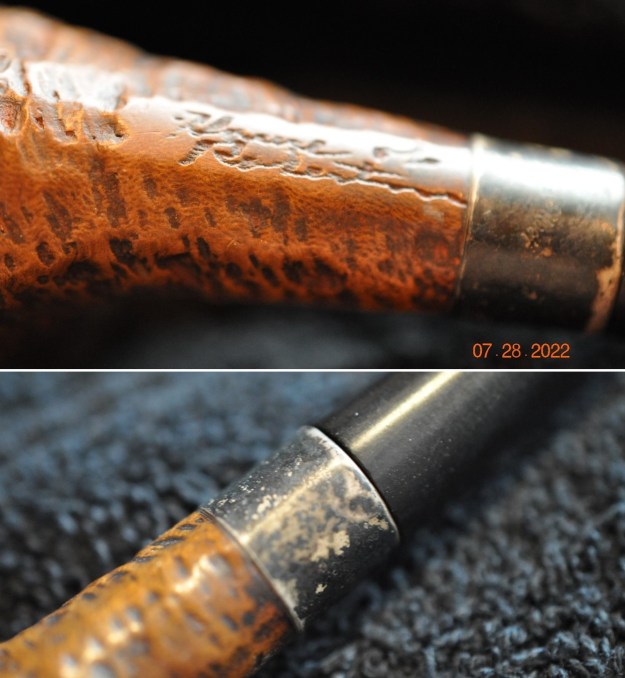
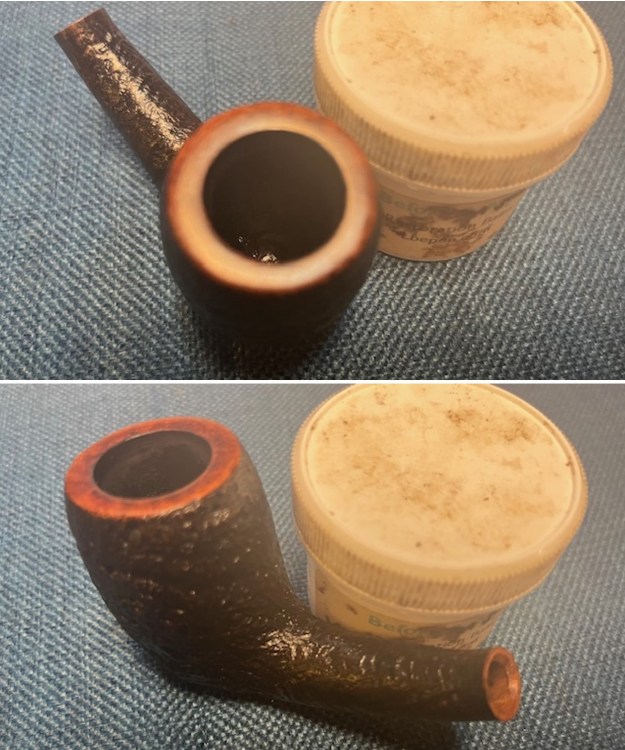
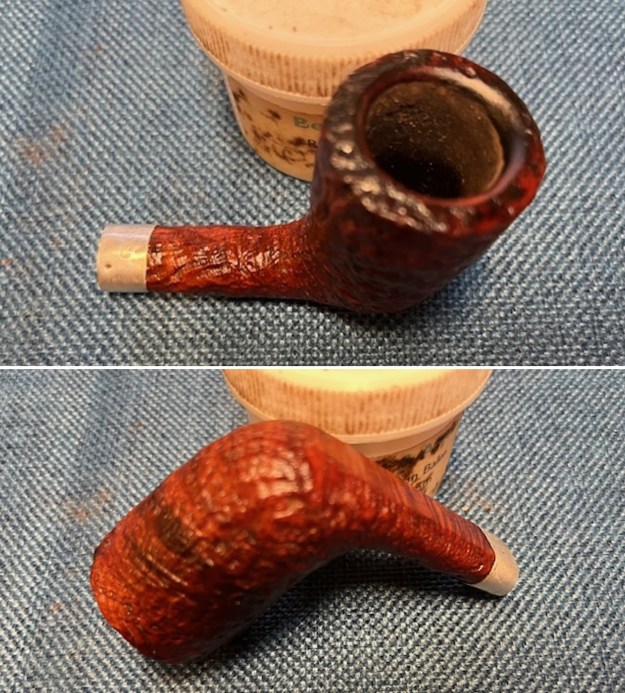
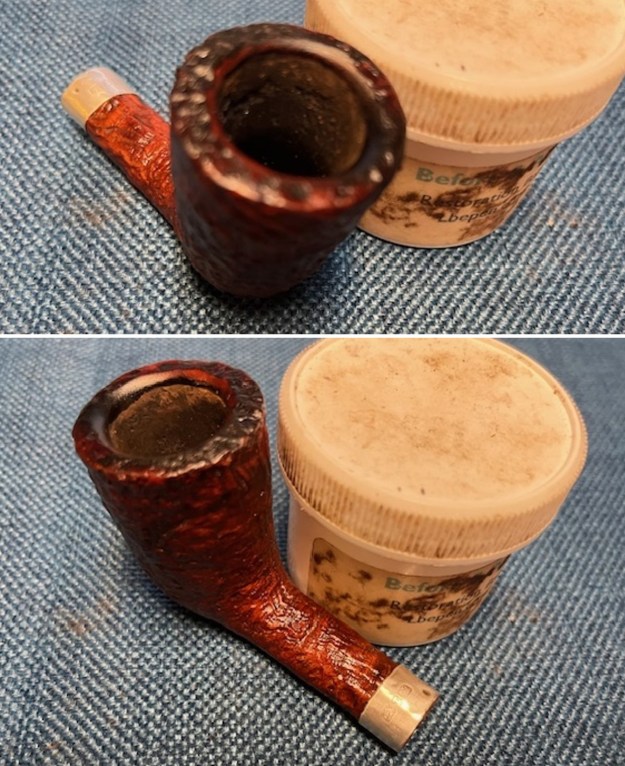
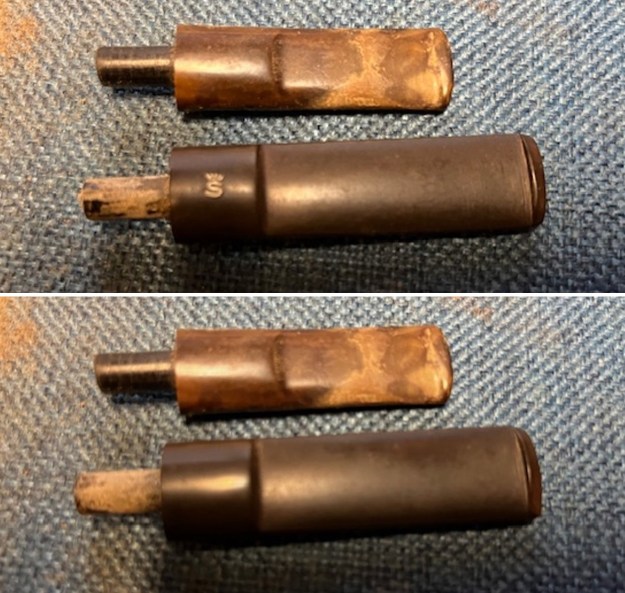
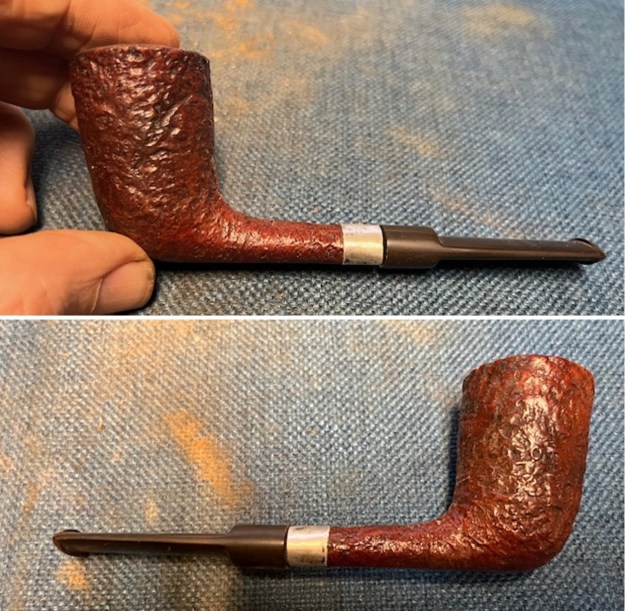
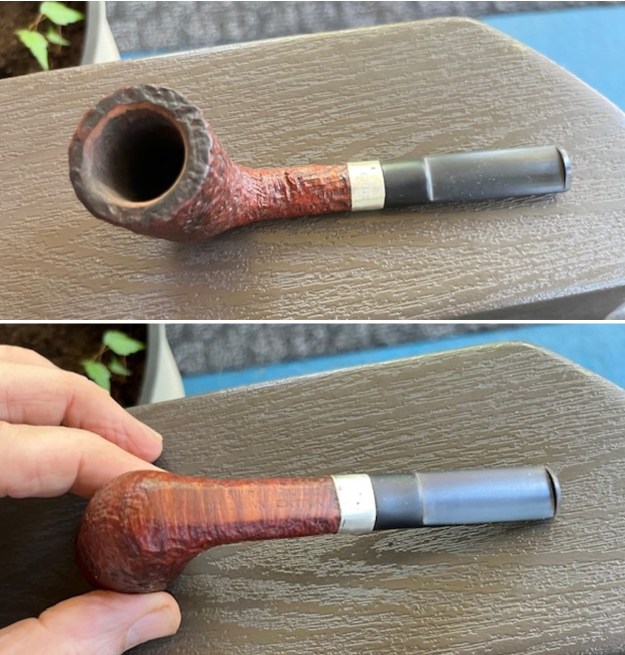
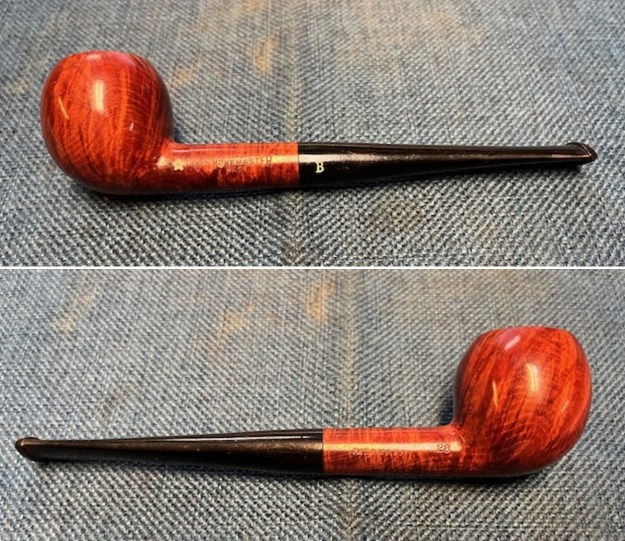
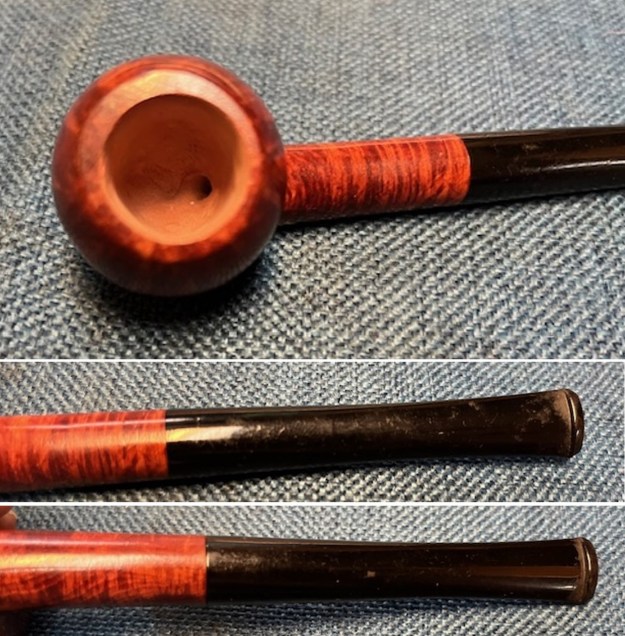
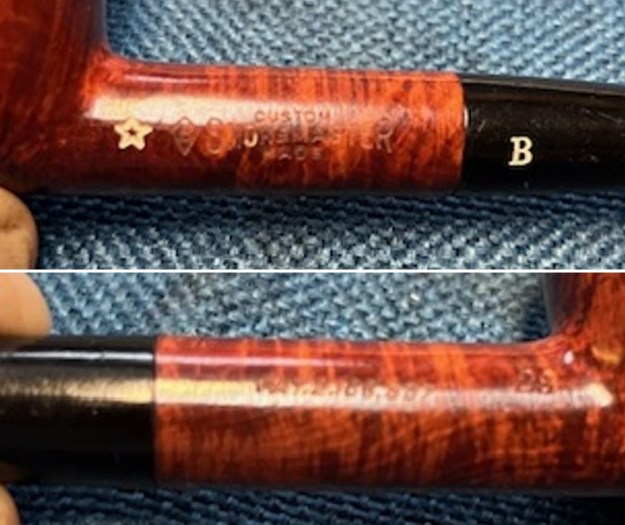
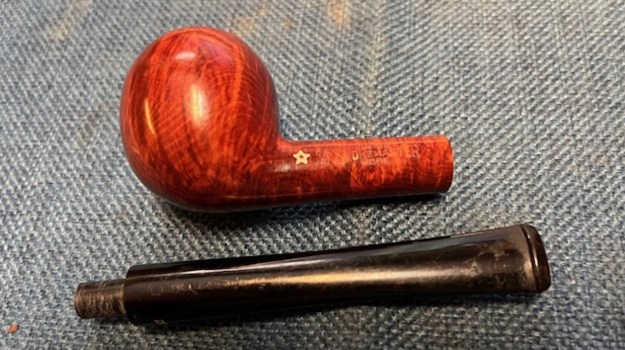
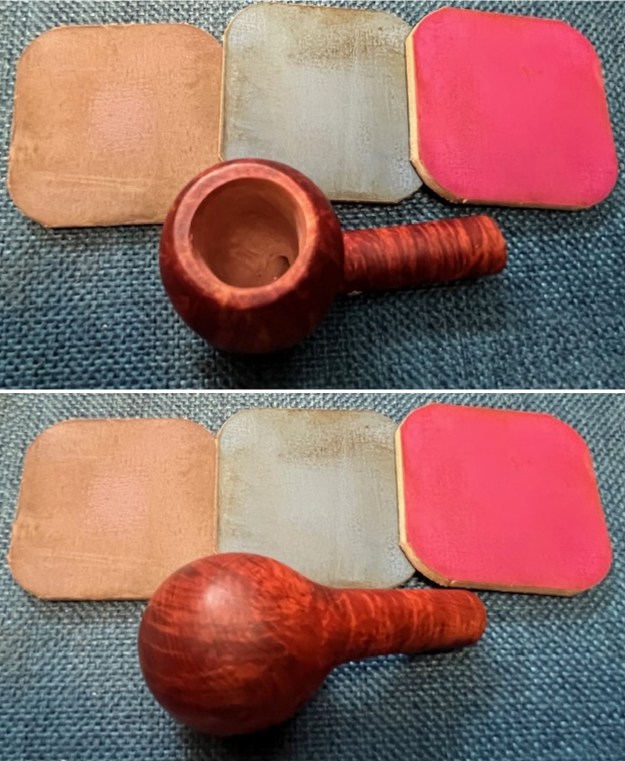
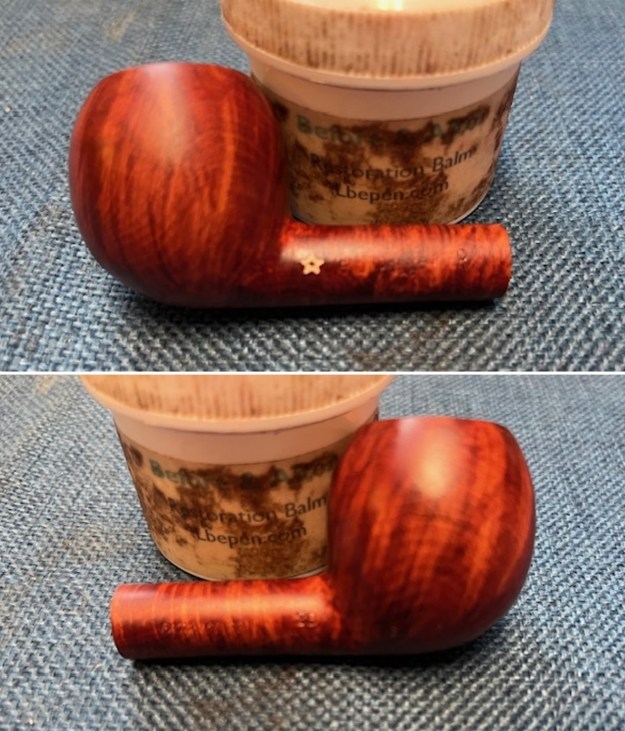
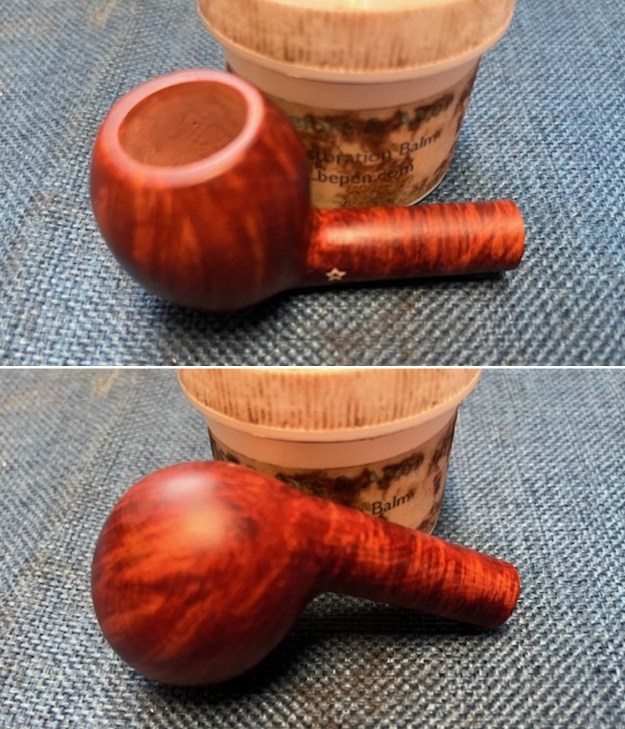
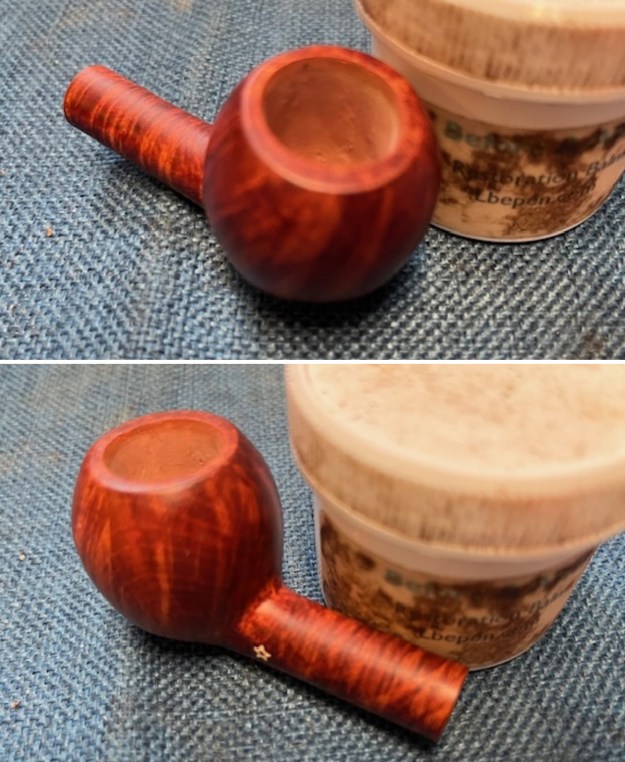
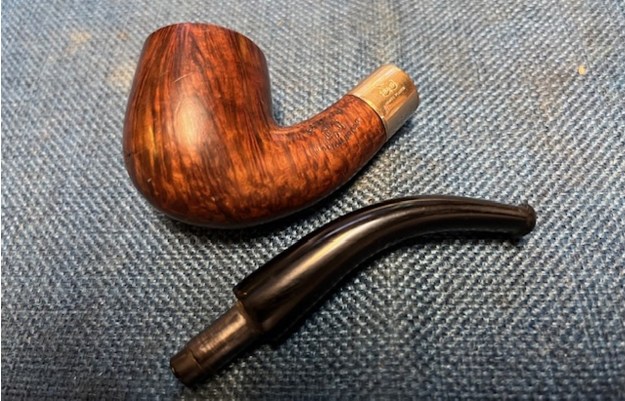
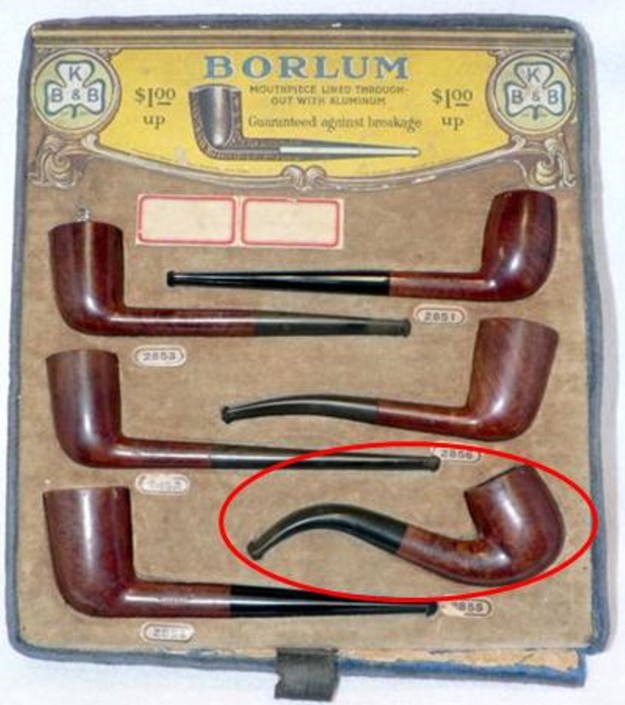
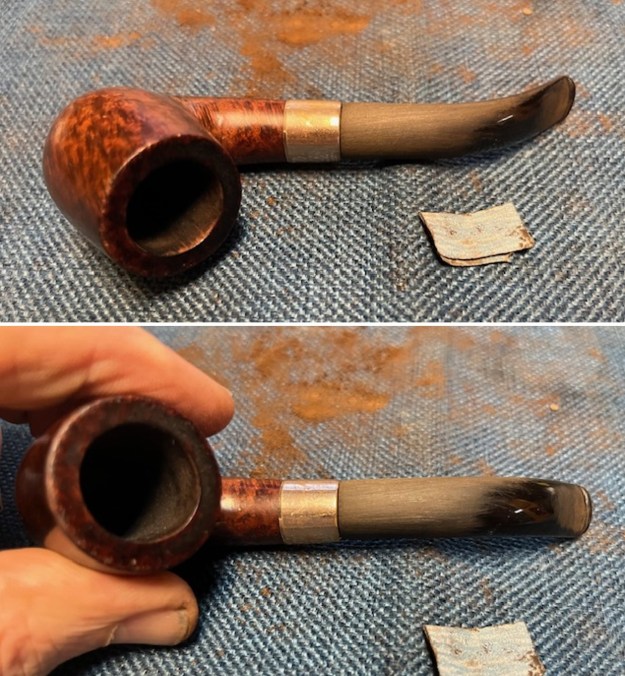
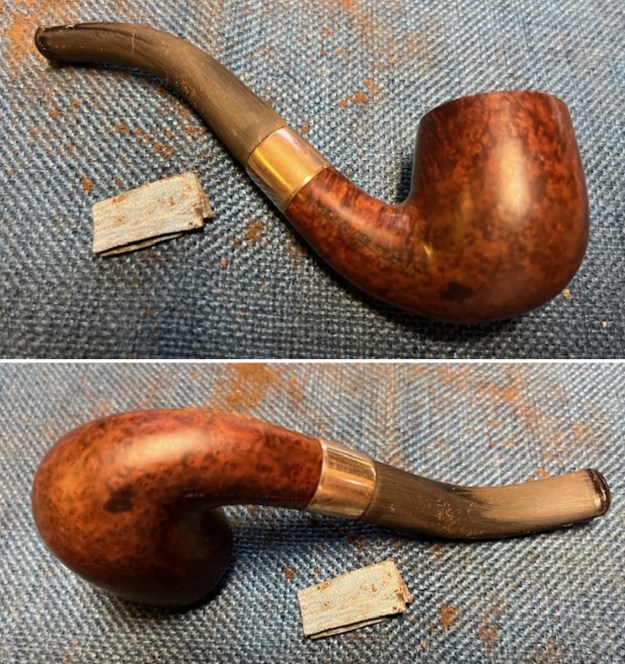
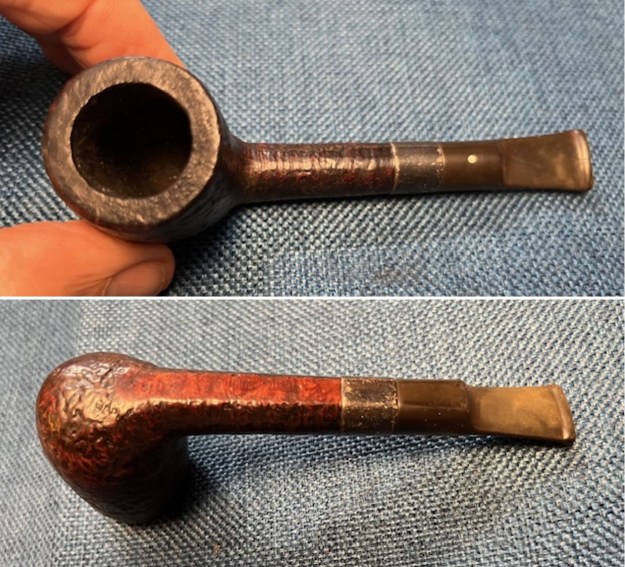
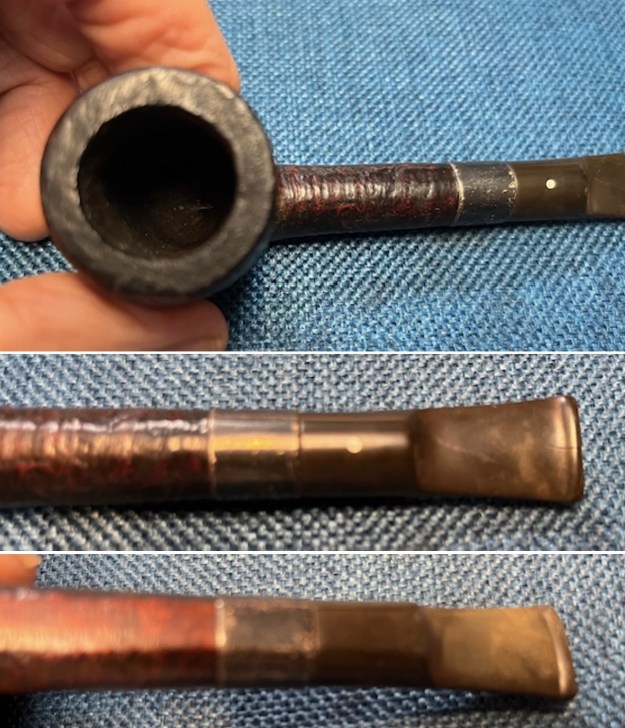
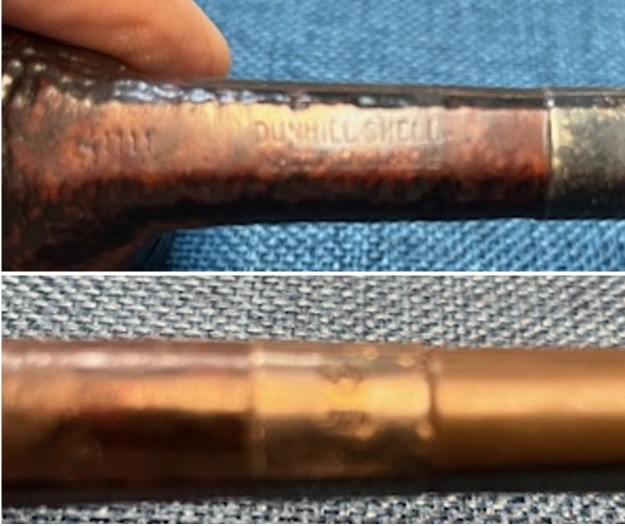
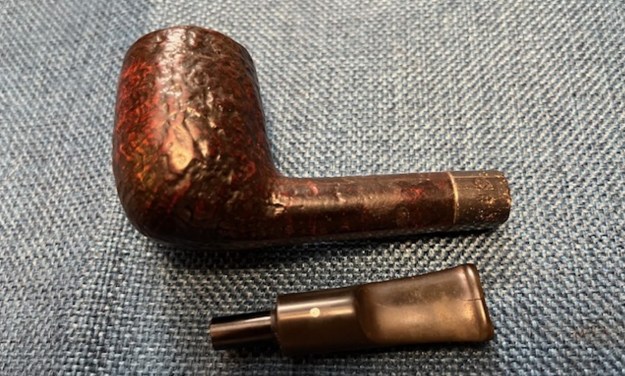
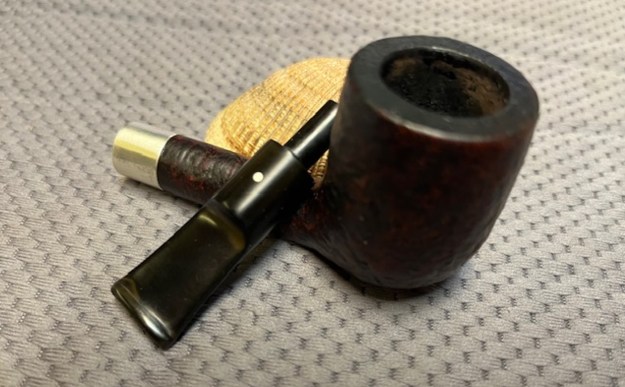
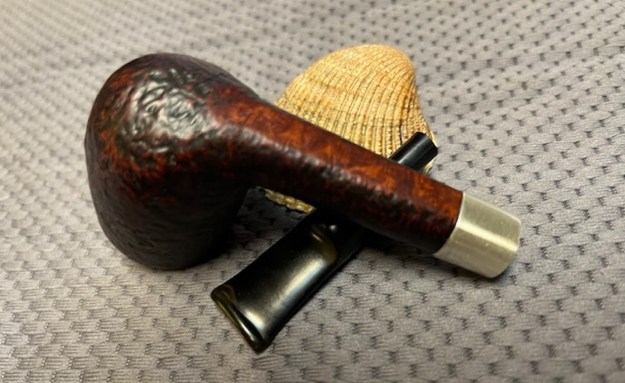
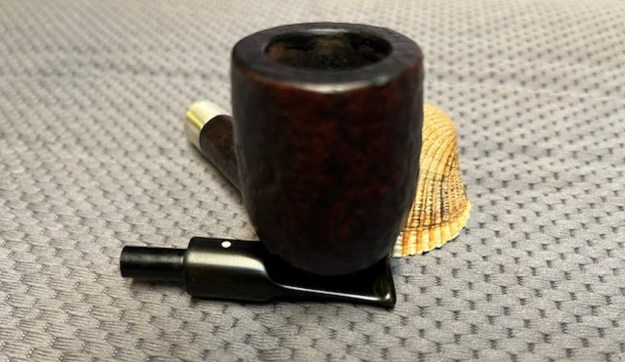
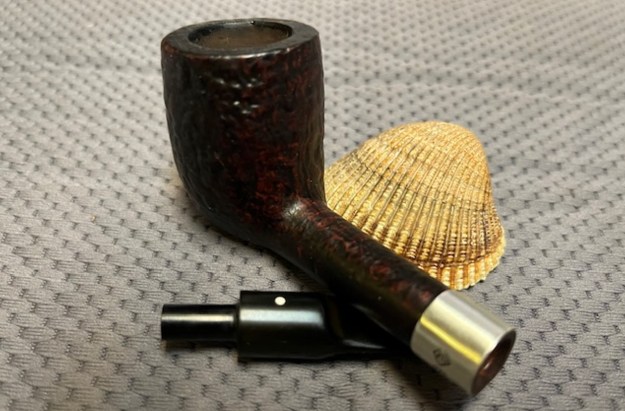
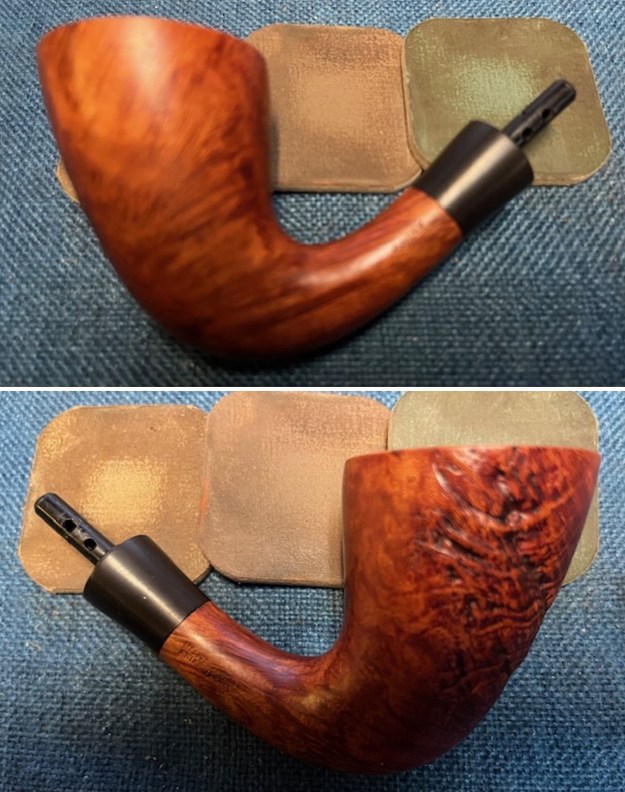
Last week I received a package of pipes to work on for a friend, Scott. I had no idea what was coming but when it arrived I was surprised with the interesting and amazing pieces he included for me to work on. These included a nice looking large Dunhill 841 ODA Lovat, a Campaign pipe with a Calabash style bowl and a start on the stem, a Sasieni 2 Dot London Made Canadian with a Lovat style saddle stem, and finally an older GBD MR&Co silver banded 5 Lovat. All of them are quite lovely and also interesting for me to be able to work on. I took a photo of the box when I unpacked the pipes.The final pipe I chose to work on from this lot was the Campaign style pipe with buffed out logos and stamping on the shank sides. The pipe has a smooth, rich brown finish. The stamping has been either buffed out or was absent. The bowl had a moderate cake in it and the rim top and inner edges had a heavy lava built up. When the bowl is unscrewed from the base the inside of the calabash is dirty and has a thick tar coat in it. The finish on the bowl and shank were worn and dirty with grime and darkening ground into the surface all around the bowl and shank. Under the tars the rim top and inner and outer edges of the bowl appeared to be in ok condition but cleaning would tell the story. The saddle stem was calcified and oxidized and there were tooth marks on the top and underside ahead of the button. There was also a bite through on the underside of the stem against the button. There is a inlaid white star on the topside of the saddle portion of the stem. I took a few photos of the pipe before I started working on the pipe and have included them below. I took a photo of the rim top and bowl to show the condition of both of them. The briar calabash bowl itself had a thick cake on the walls and bowl bottom. The rim top showed a heavy coat of lava and the inner edge was heavily caked and its condition would be revealed with cleaning. The outer edge looks good. The photos of the stem show the oxidation, calcification and tooth marks/chatter on both sides ahead of the button. There is a large bite through on the underside of the stem ahead of the button.I unscrewed the calabash bowl from the base and took photos of the parts. You can see from the photos that the inside of the base is very dirty with tars and oils. There is a lot of debris in the bottom of the base as well. I checked on Pipephil (http://www.pipephil.eu/logos/en/logo-f4.html) to see if I could find something with a similar star on the stem. I found a pipe made by Frank that had the same five-point white star as the stem I am working on. It could very well have been made for Frank.I went back and read over the blogs I have written on previous Campaign pipes that I restored. I am attaching the link to one of the blogs and some of the information that I found in researching the brand at that time. (https://rebornpipes.com/tag/wdc-campaign-calabash-pipe/). The information is all on the WDC made Campaign pipe but the information is helpful.

In my online research I found a brief interchange on a Google group. I include the link if you would like to read it in context and its entirety. It gives some helpful information regarding this particular pipe. https://groups.google.com/forum/#!topic/alt.smokers.pipes/kpkpd3zXoiwExcerpt from pipedia.org

To a request for information regarding the WDC Campaign pipe on the Google Group there was quite a long string of answers. I am quoting two of those in full…

Respondent 1: While I can’t say anything about this pipe specifically, I have a hazy memory of that shape listed in a book about pipes; (I may be totally misremembering this, but here goes) the shape being called the “Dawes”, named after Harding’s Vice President?  Anyone else remember this? Sounds like an interesting pipe, whatever it’s called…

Respondent 2: From Weber’s Guide to Pipes: “The Dawes Pipe (more correctly named the Lyons, after its inventor, Charles Herbert Lyons) happened to be the favorite pipe of General Charles G. Dawes, Vice-President of the USA from 1925 to 1929. General Dawes smoked the curious pipe incessantly and it became popularly known as the Dawes Underslung, because the shank joined the bowl near its rim.”

I looked on Pipedia, (https://pipedia.org/wiki/William_Demuth_Company) and I quote in part from the article on the William Demuth Company.

The Demuth Company is probably well known for the famous trademark, WDC in an inverted equilateral triangle. William commissioned the figurative meerschaum Presidential series, 29 precision-carved likenesses of John Adams, the second president of the United States (1797-1801) to Herbert Hoover, the 30th president (1929-1933), and “Columbus Landing in America,” a 32-inch-long centennial meerschaum masterpiece that took two years to complete and was exhibited at the World’s Columbian Exposition in Chicago in 1893.

The Presidential series was the result of Demuth’s friendship with President James A. Garfield, a connoisseur of meerschaum pipes. Demuth presented two pipes to Garfield at his inauguration in 1881, one in his likeness, the other in the likeness of the President’s wife. Later, Demuth arranged for another figurative matching the others to be added to the collection as each new president acceded to the White House, terminating with President Hoover.

From the above information I learned some significant details about the Campaign pipe. It was invented by Charles Herbert Lyons and was the favourite pipe of General Charles G. Dawes who was the Vice President of the USA under President Harding from 1925-1929. It fits nicely into that period when WDC was having Presidential Pipes commissioned ending in 1933. That places this old pipe in the time period between the late 1920s and early 1930s.

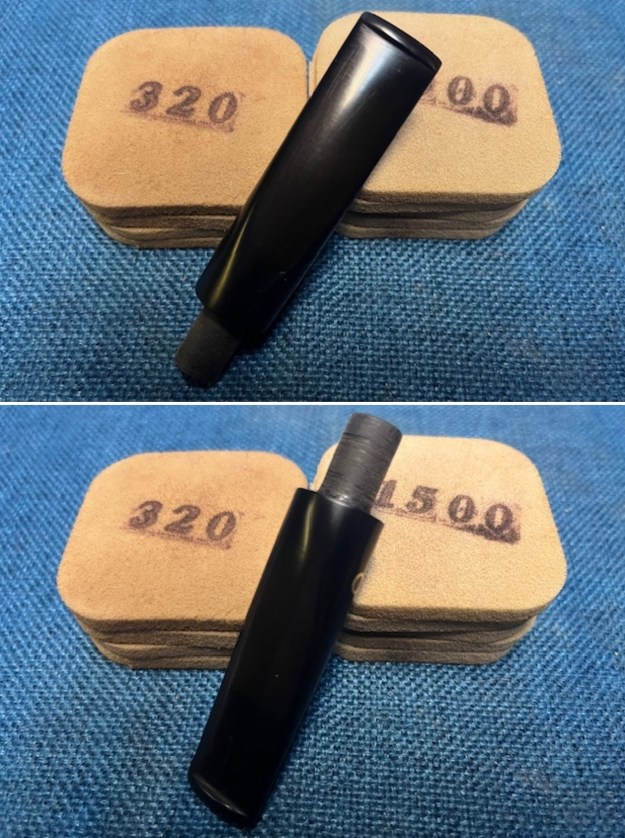
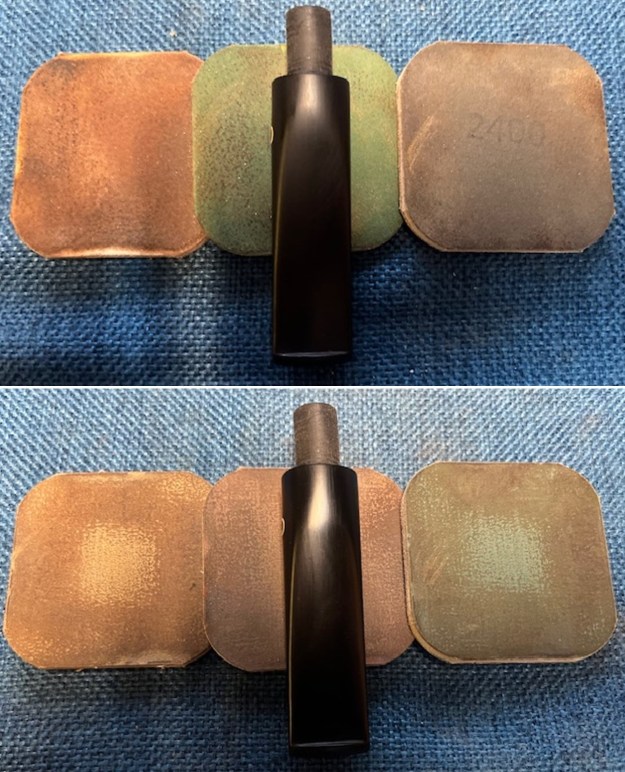
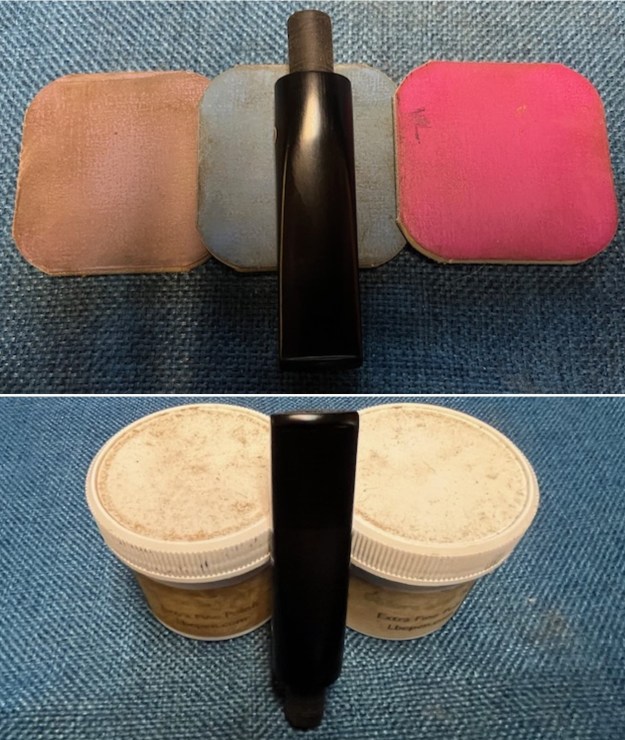
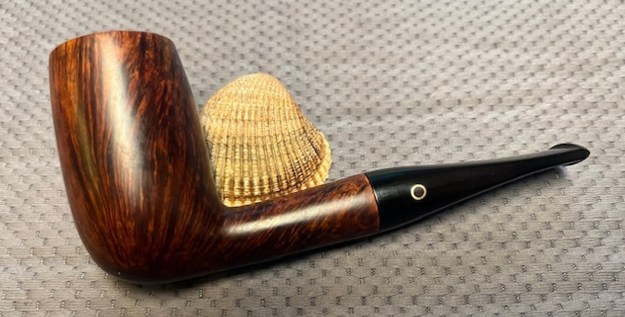
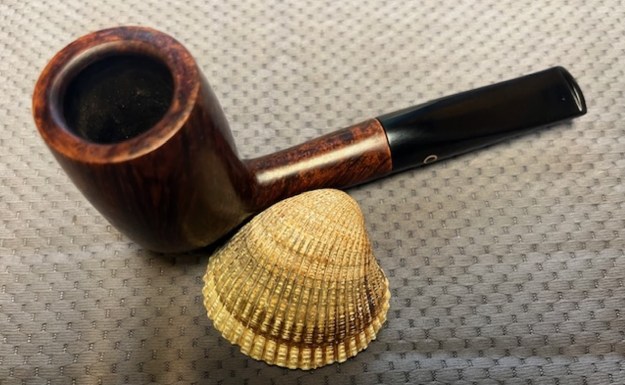
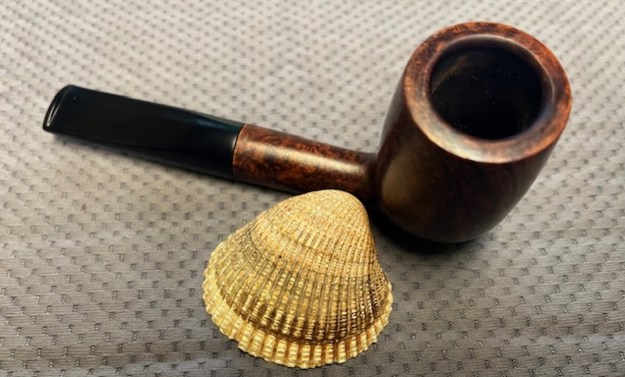
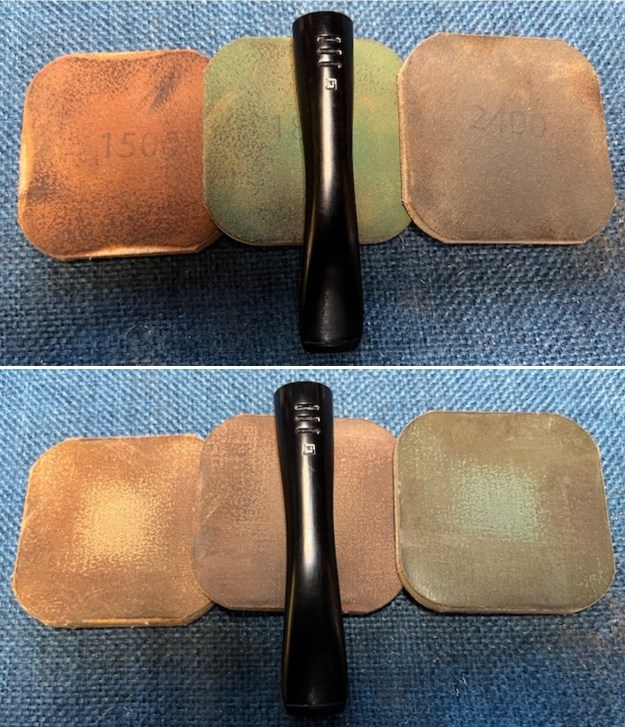
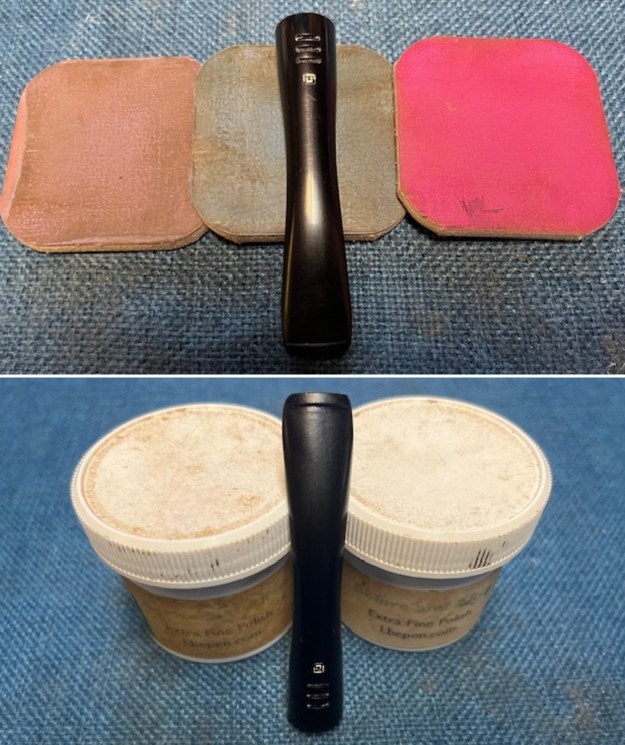
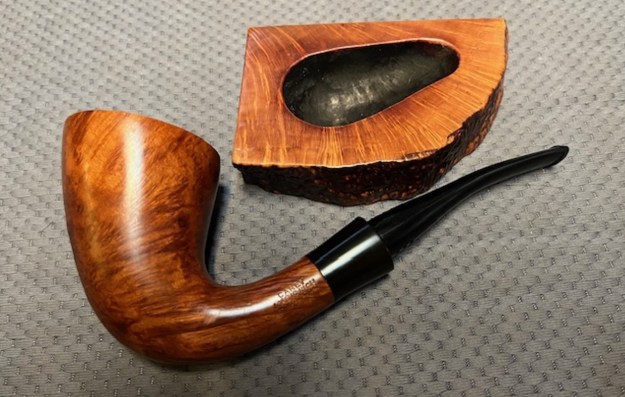
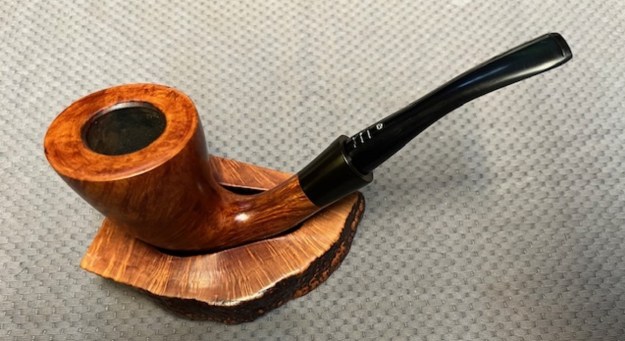
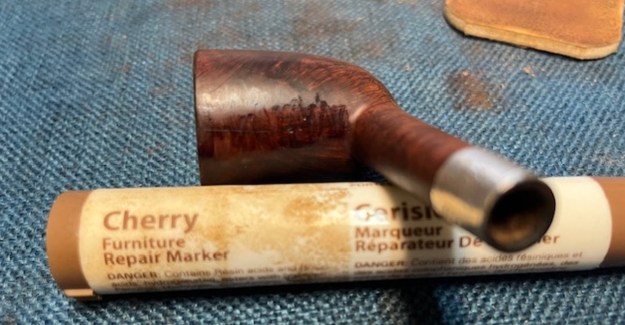
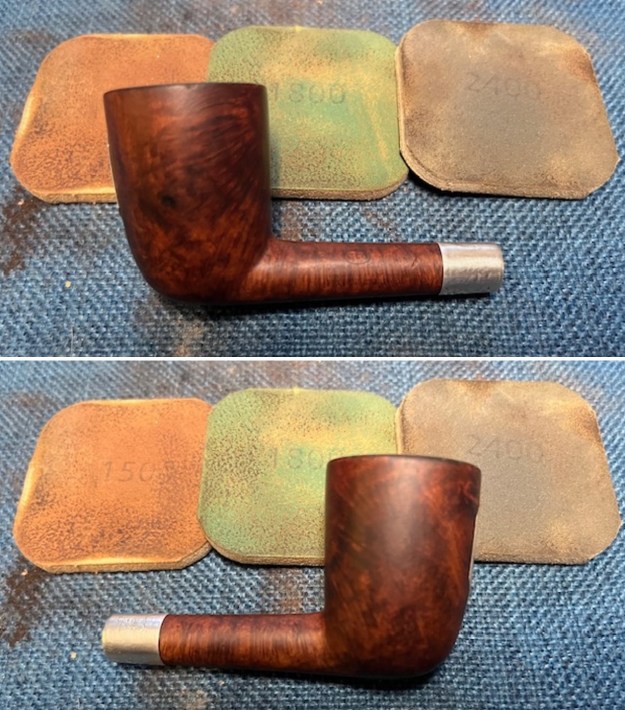
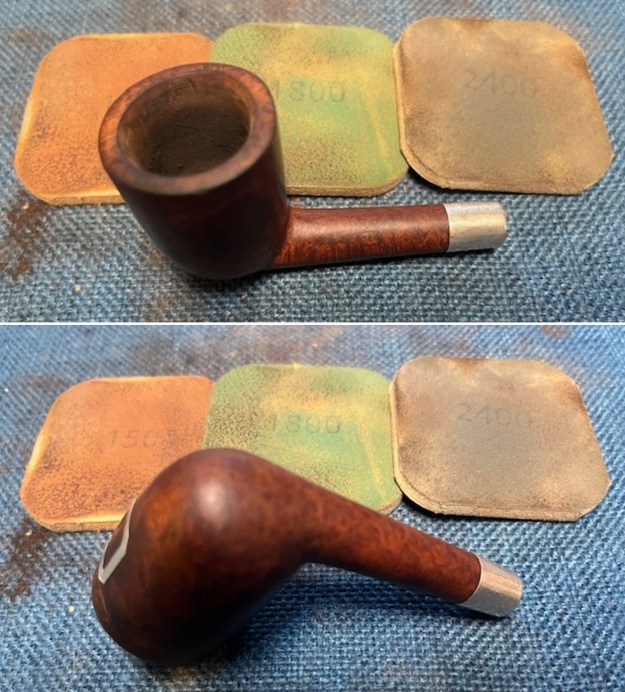
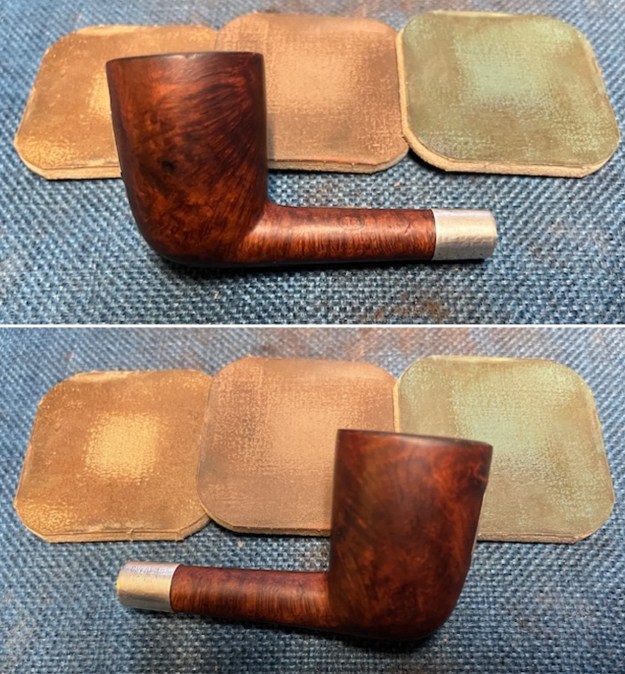
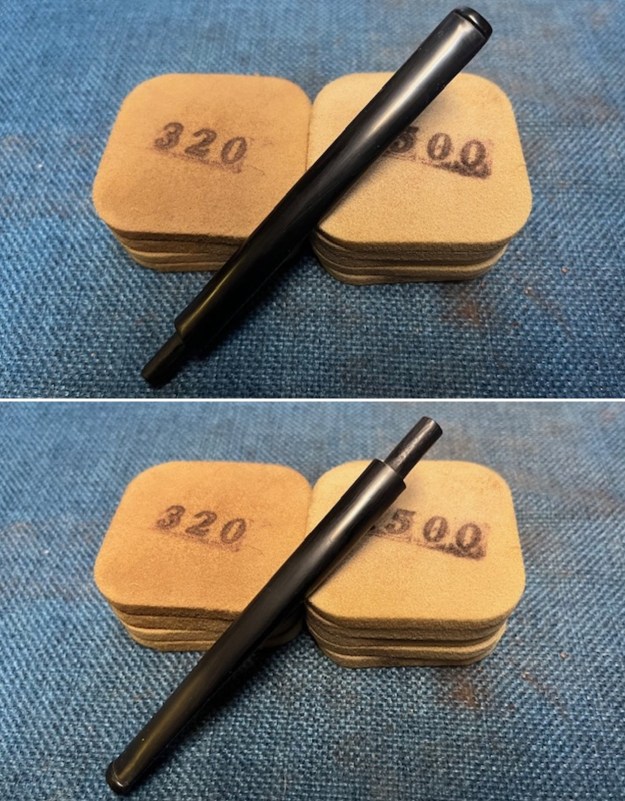
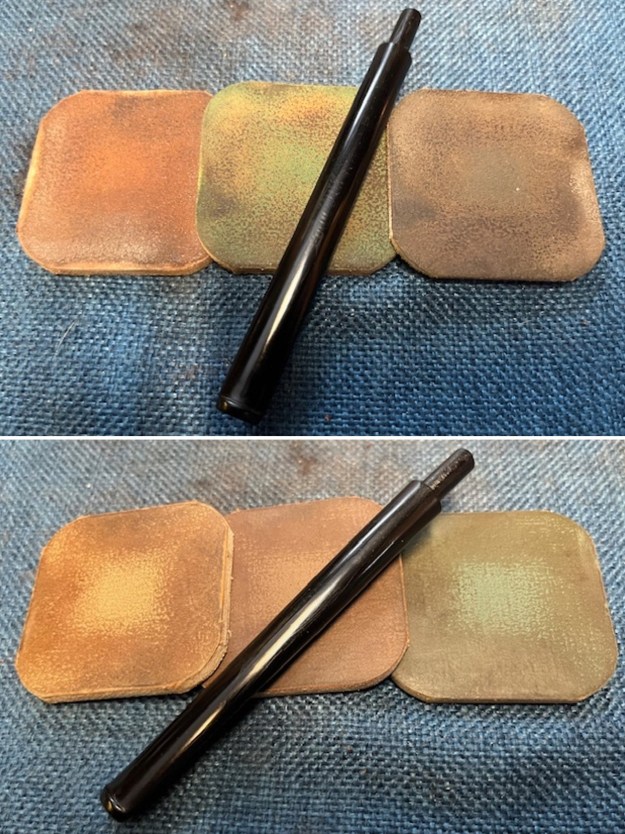
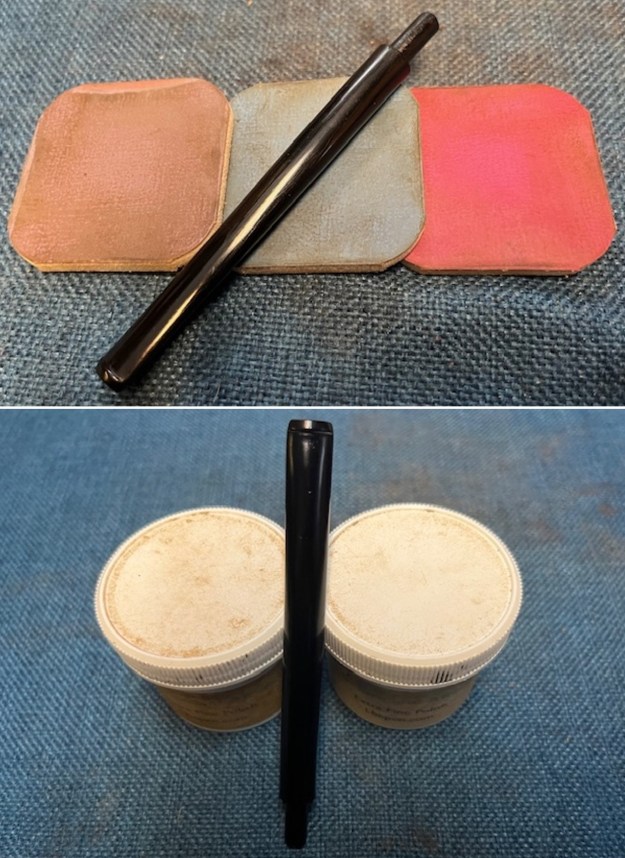
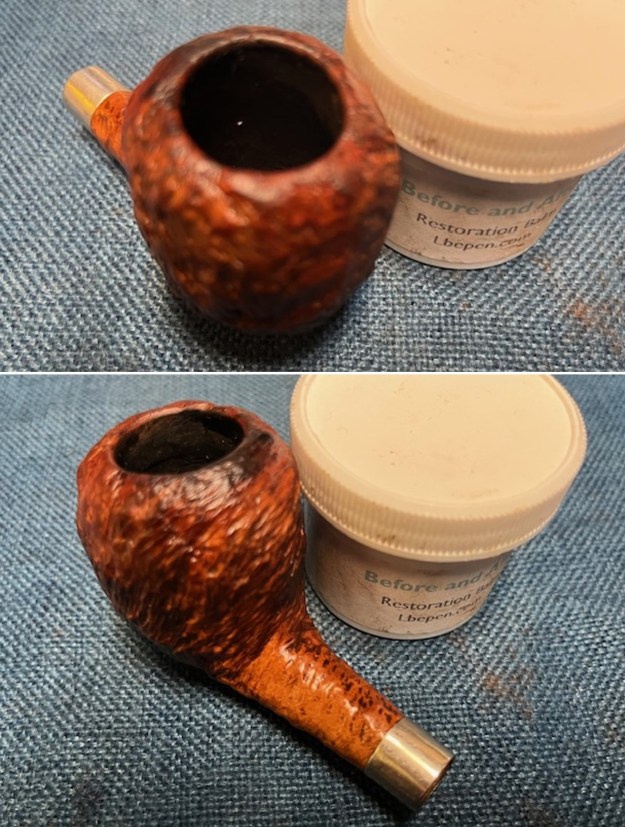
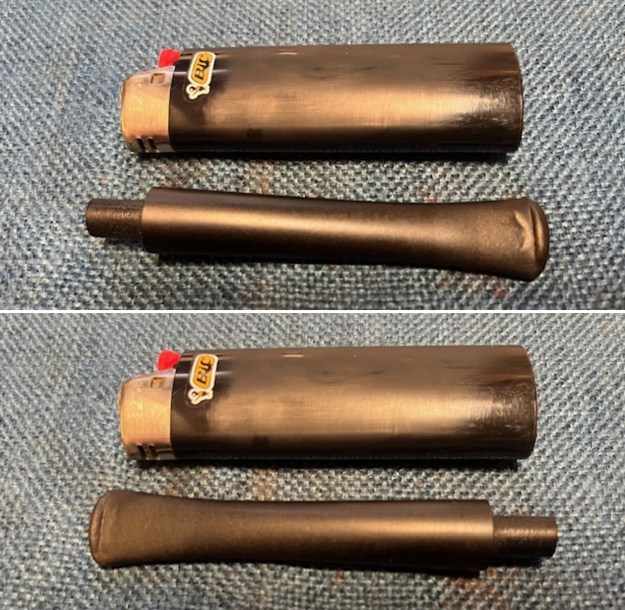
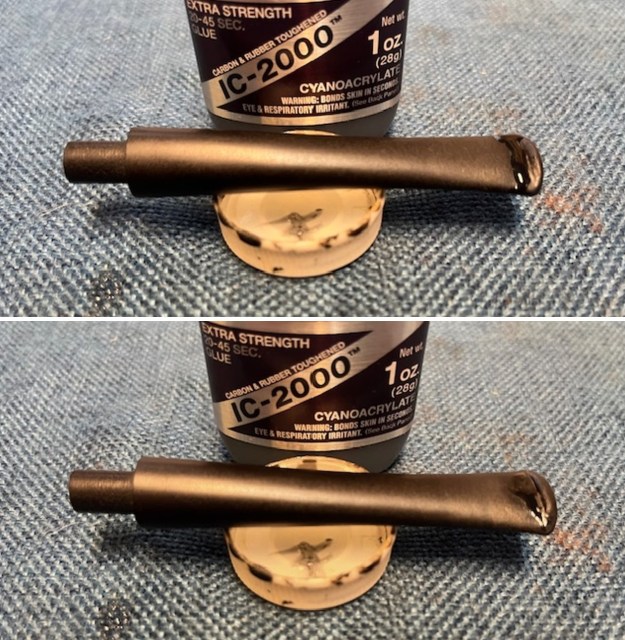
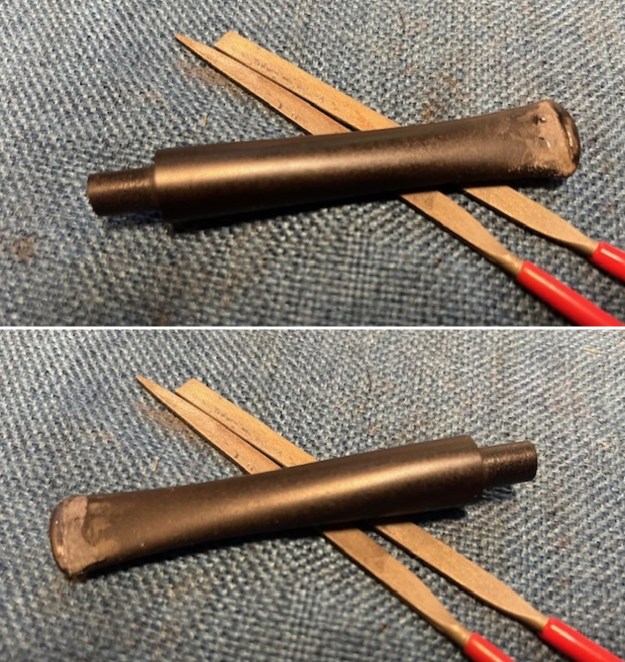
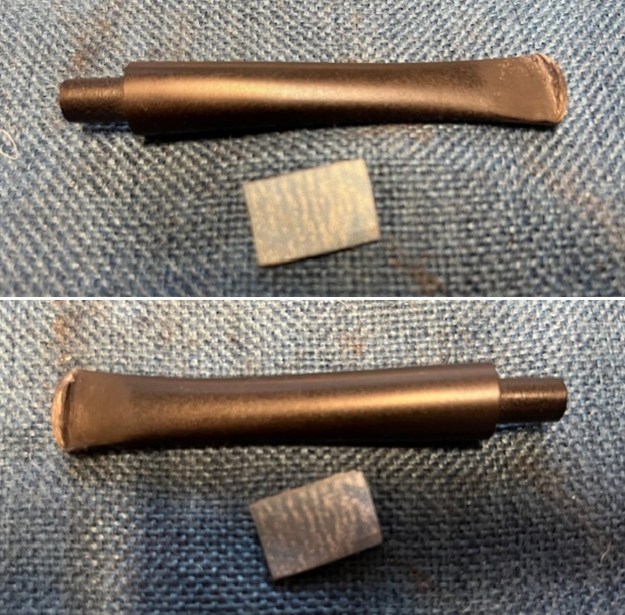
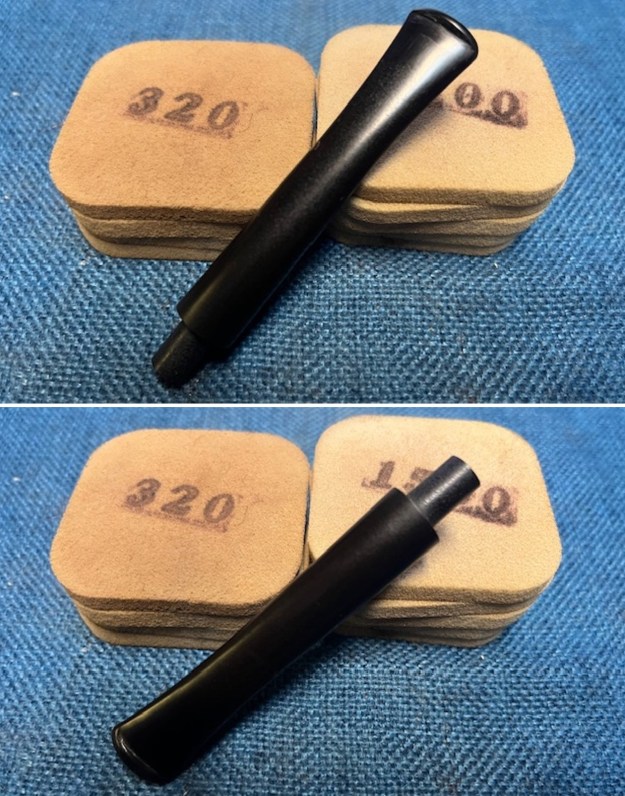
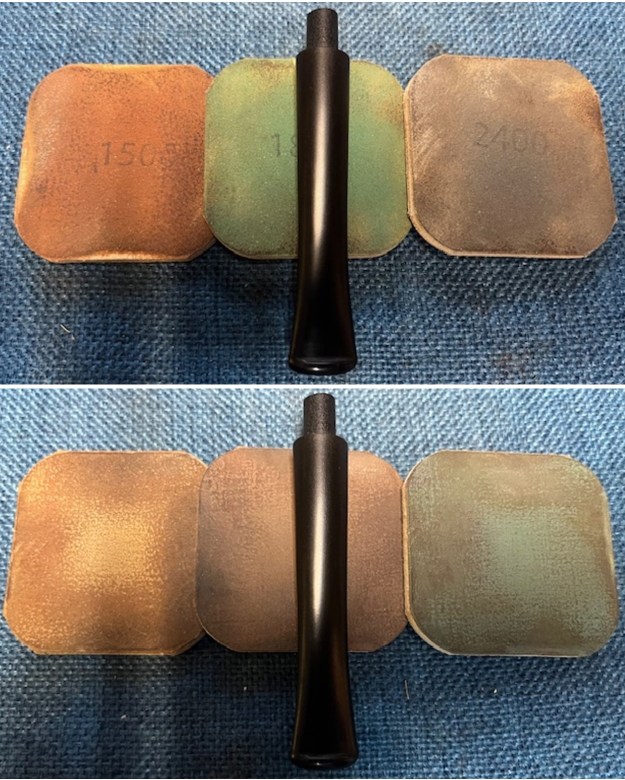
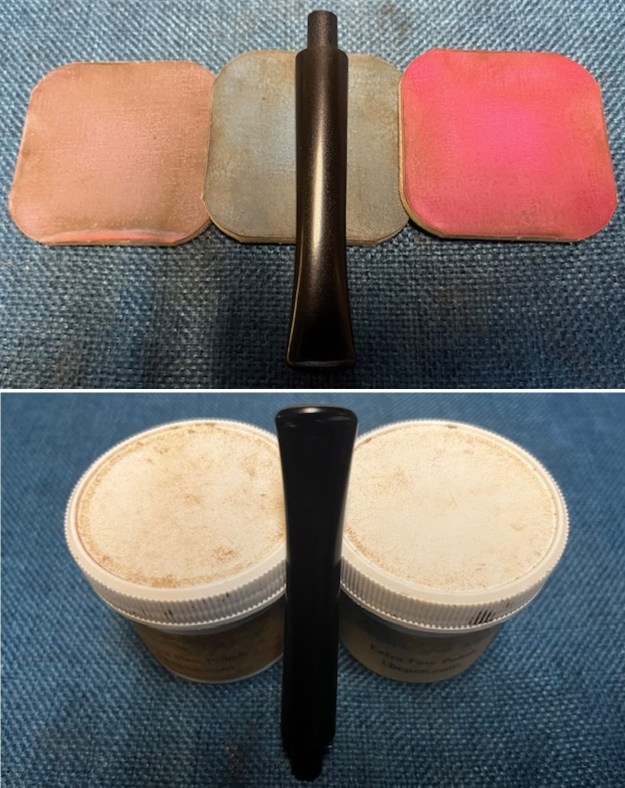
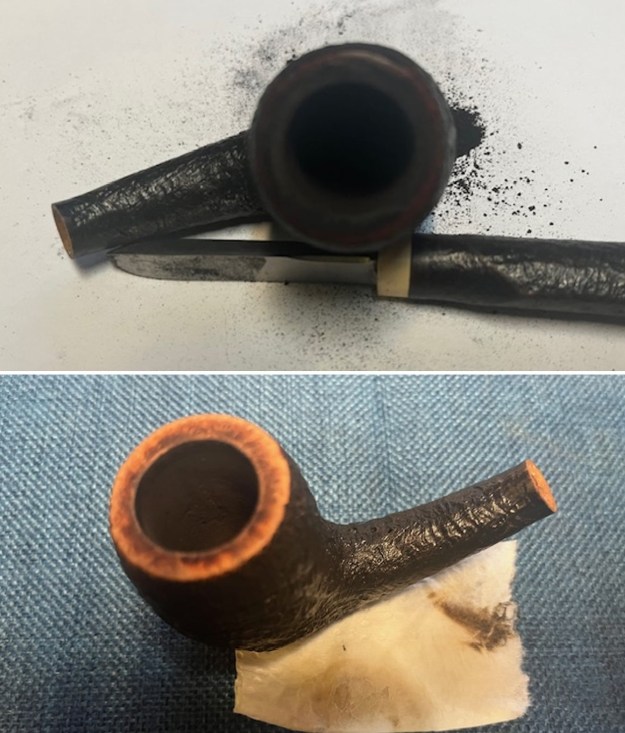
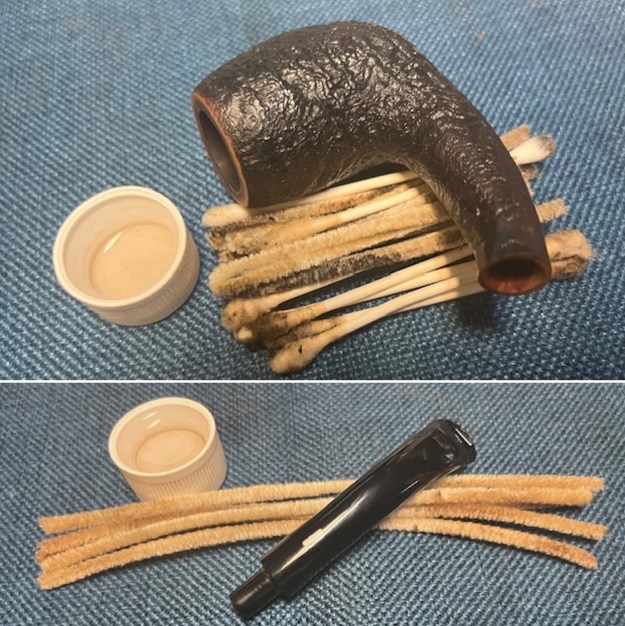
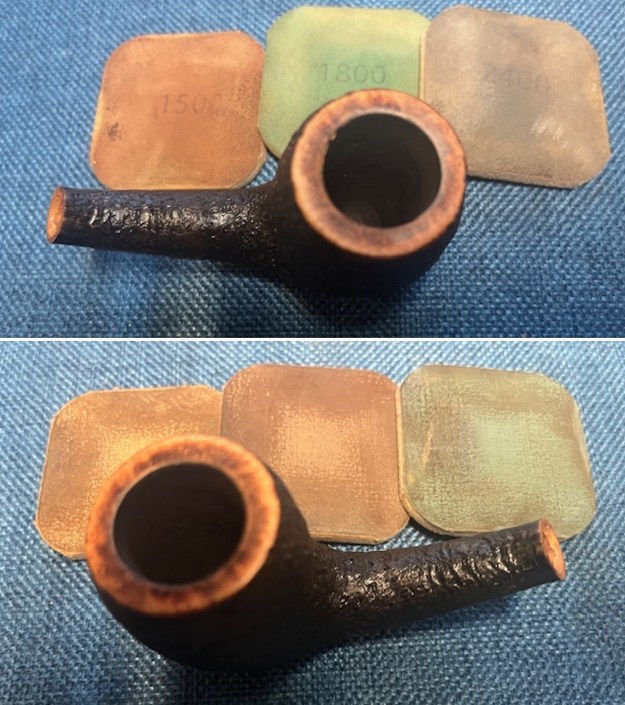
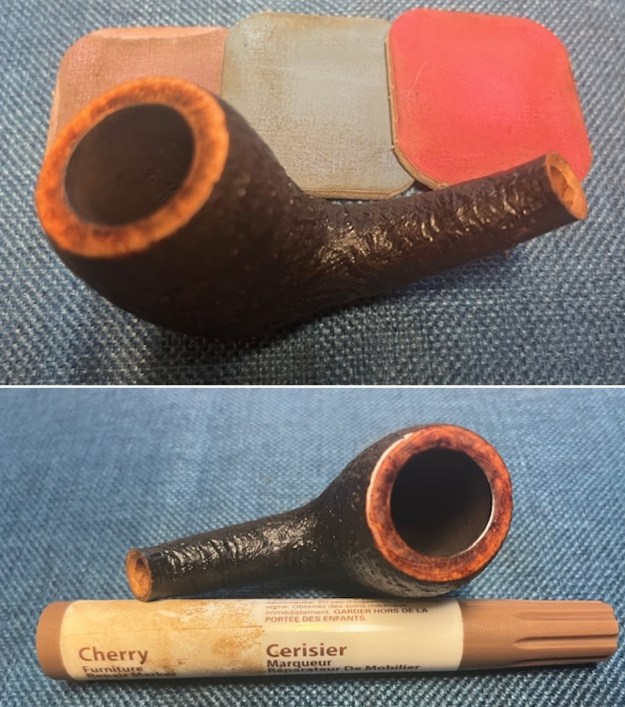
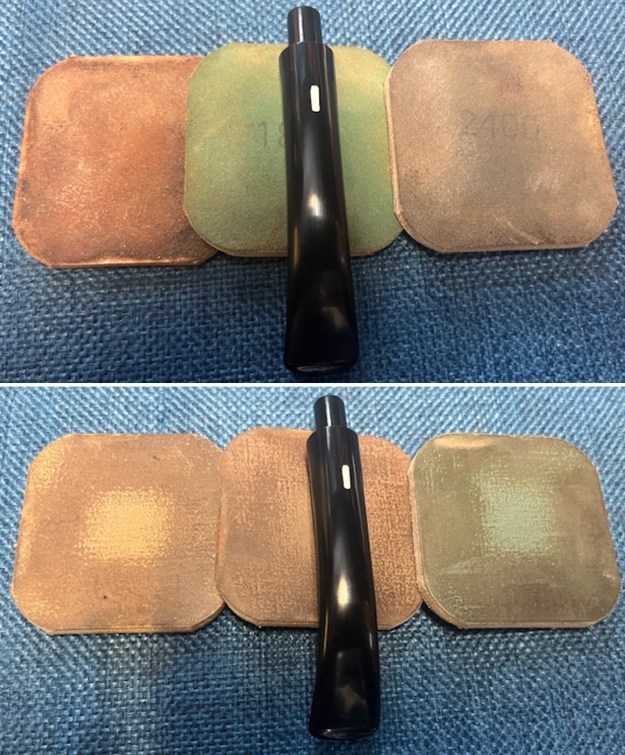
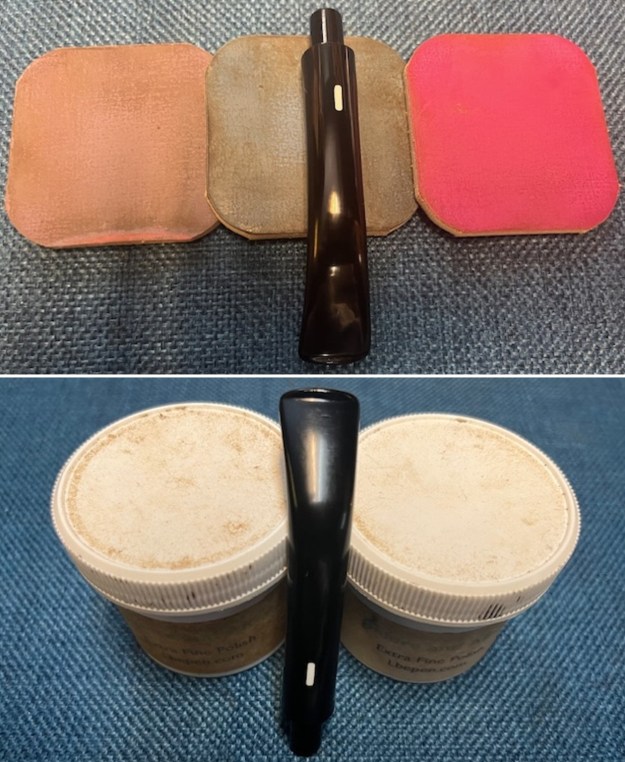
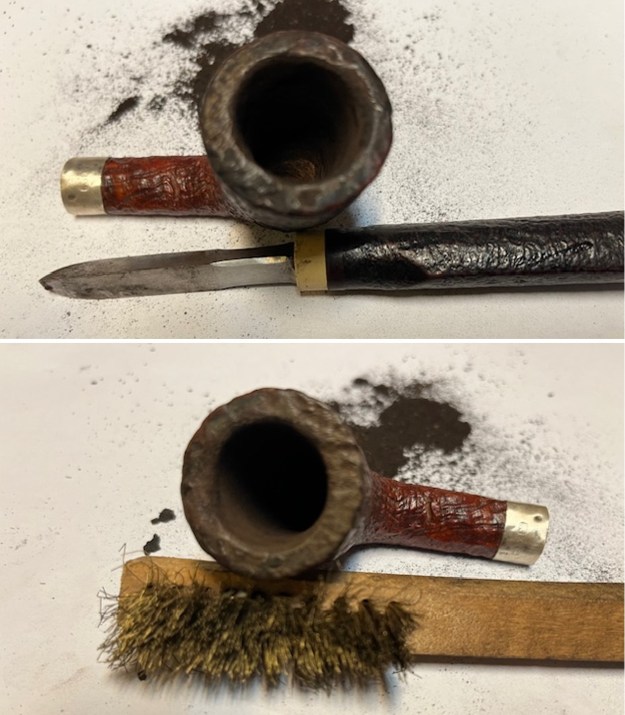
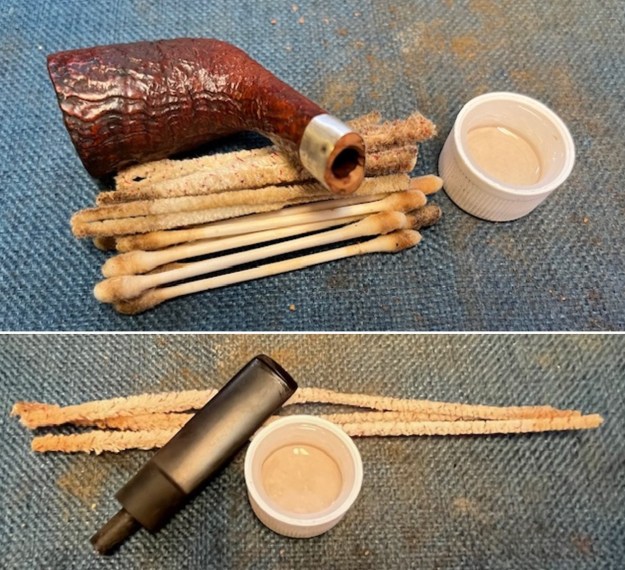
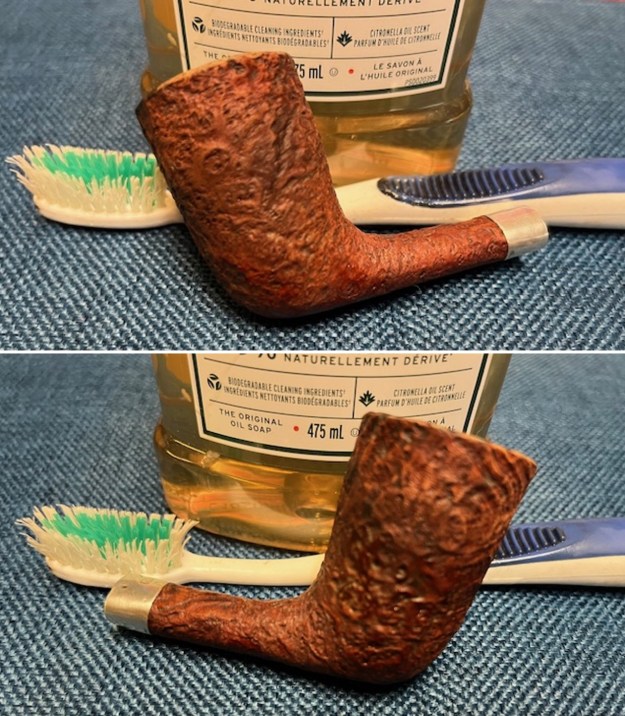
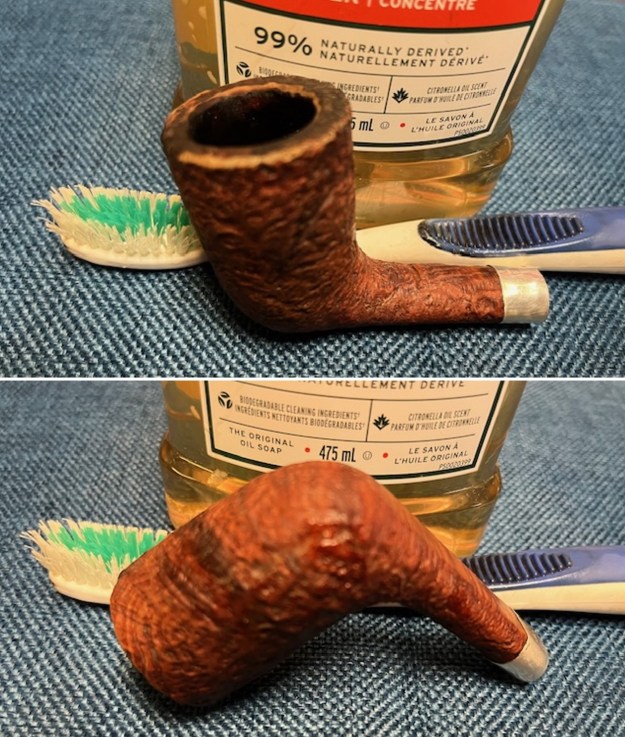
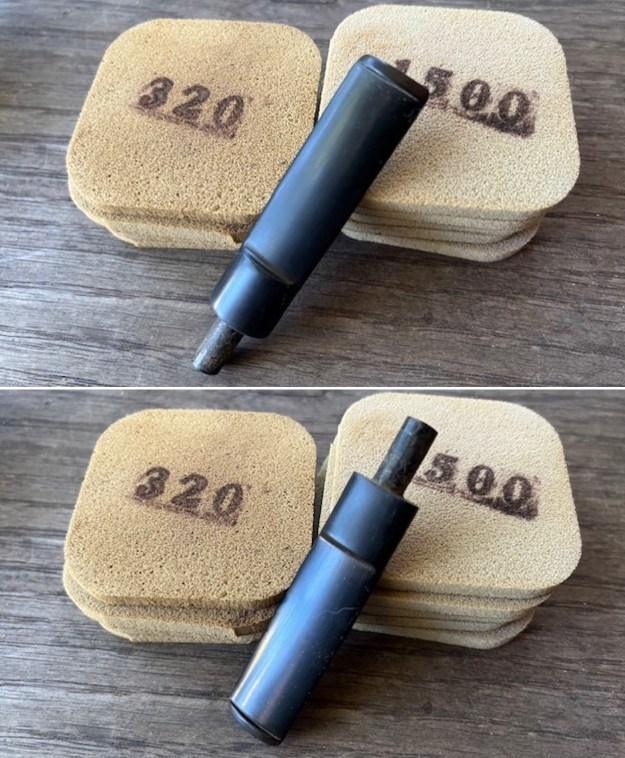
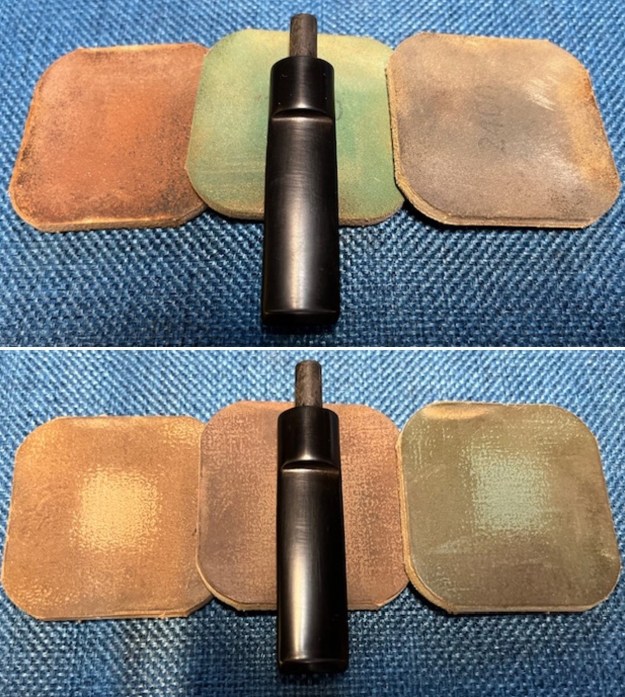
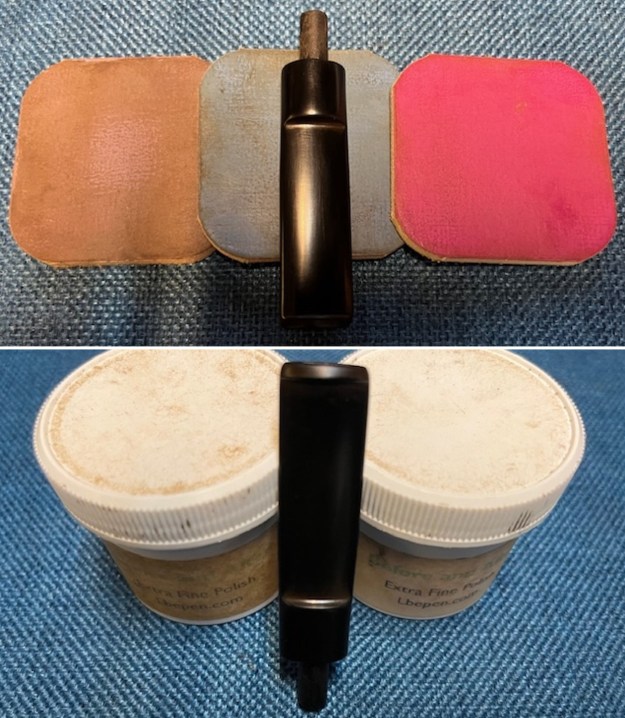
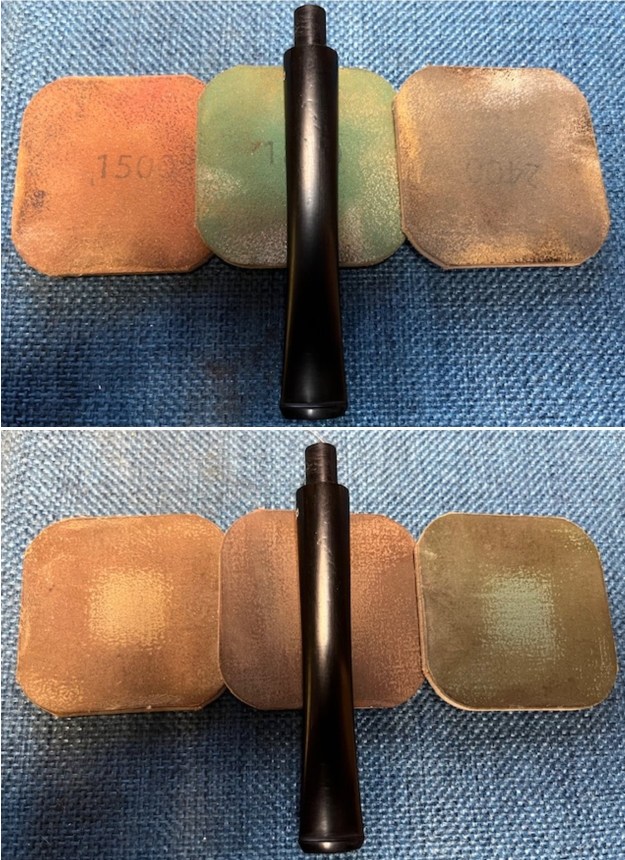
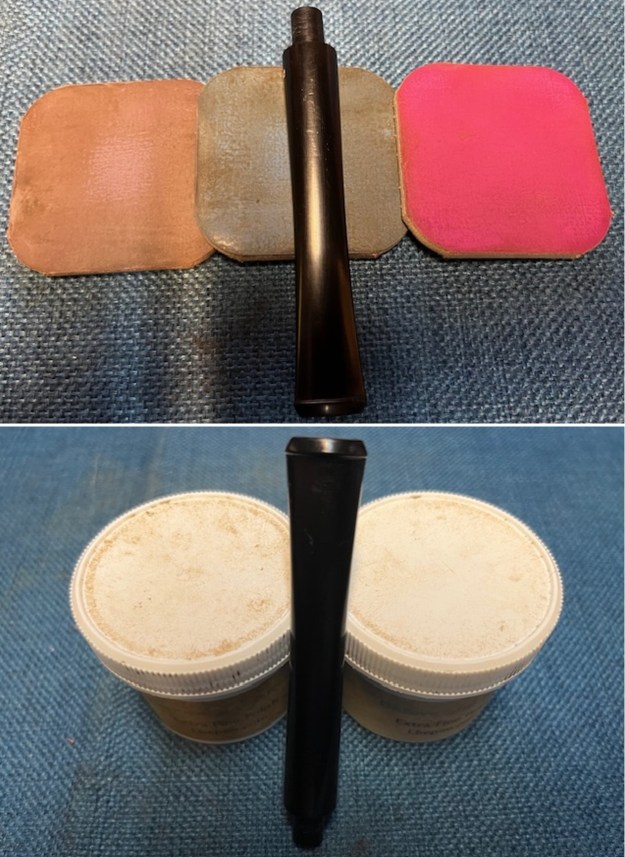
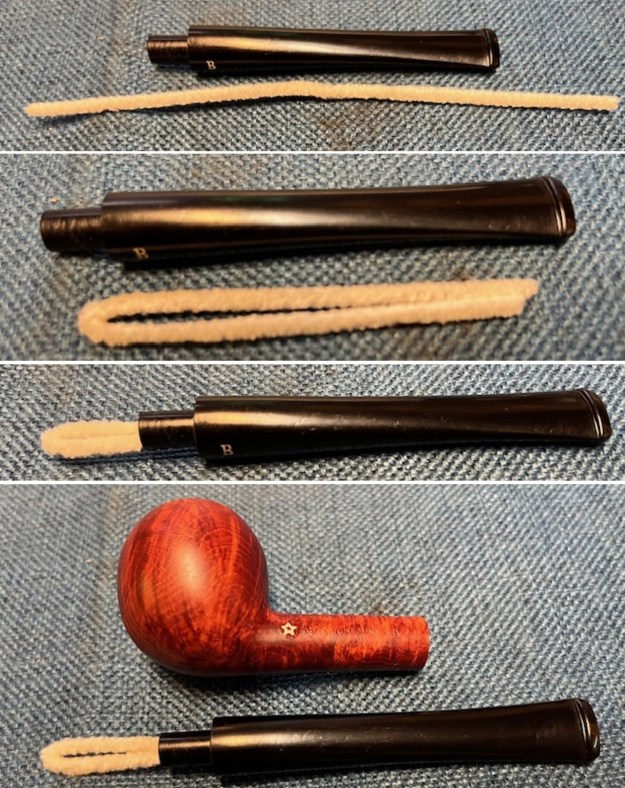
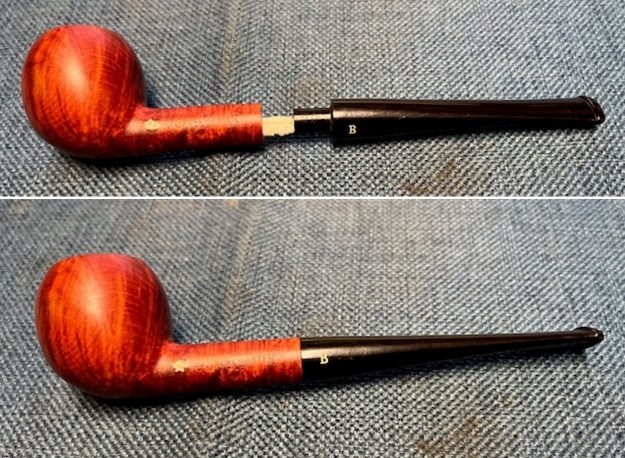
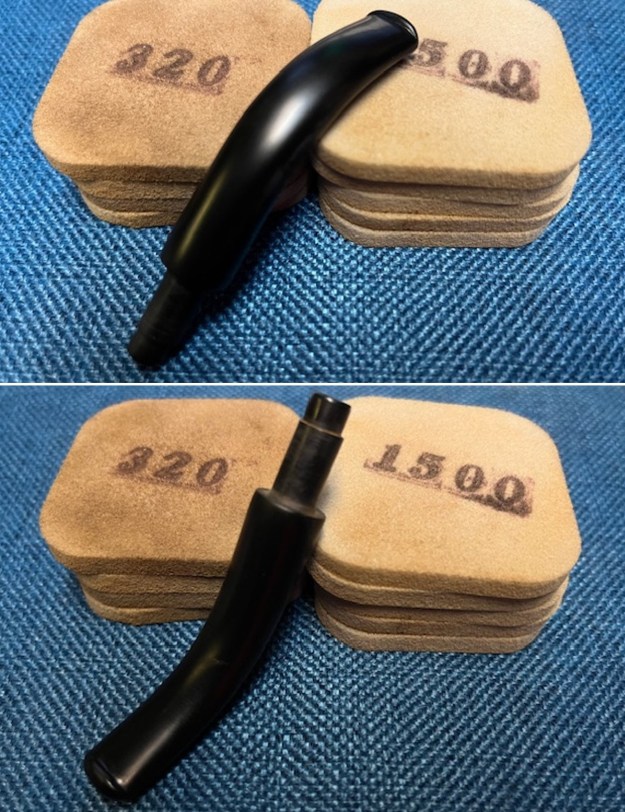
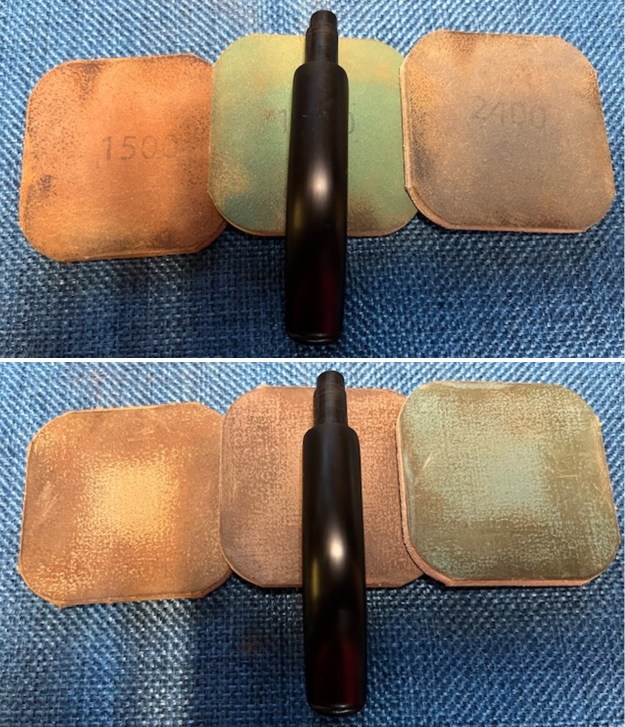
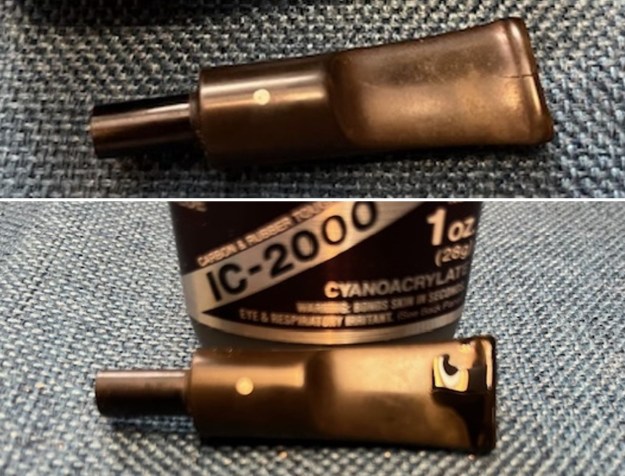
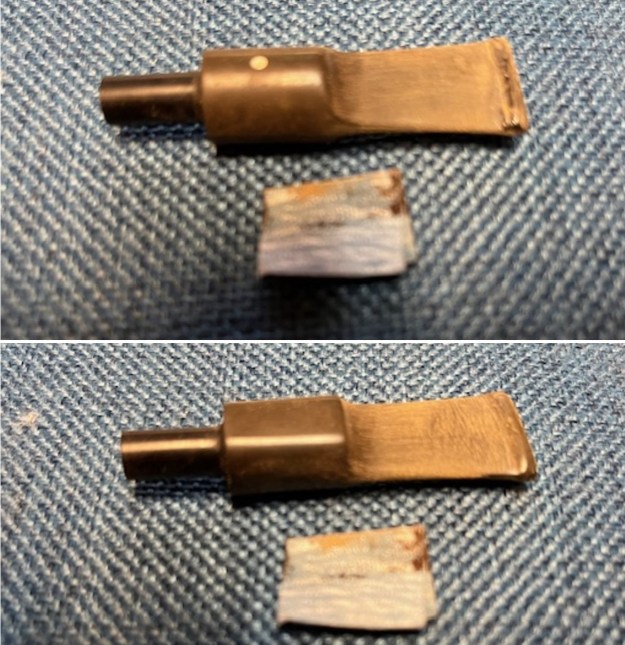
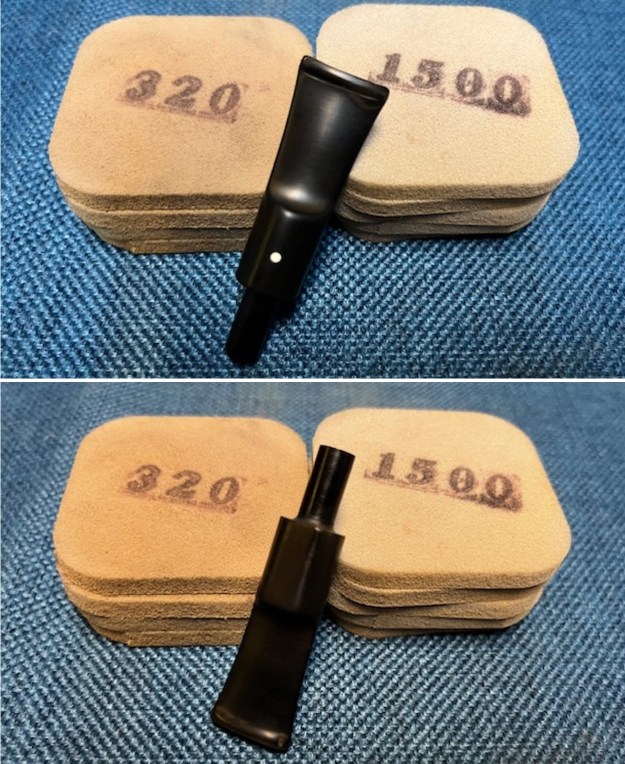
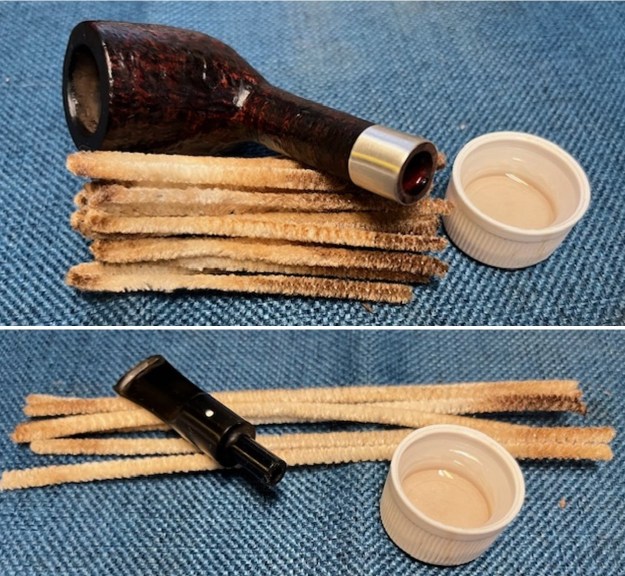
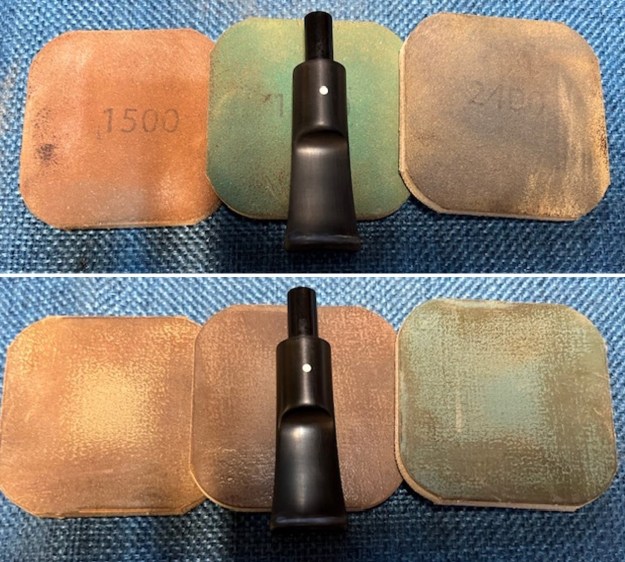
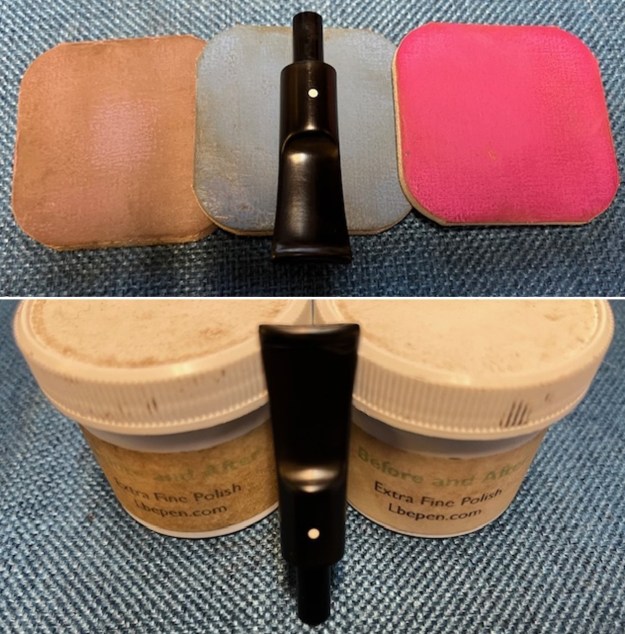
Now it was time to work on the pipe. I used a Savinelli Fitsall Pipe Knife to clean up the cake in the bowl. I used a dowel wrapped with 220 grit sandpaper to smooth out the walls of the bowl. I checked for damage on the bowl walls and it was in good condition. I also sanded the inside of the base with the dowel and sandpaper. I scraped the rim top with a Savinelli Fitsall Pipe Knife. I cleaned up the inner edge of the bowl with a folded piece of 220 sandpaper. I scrubbed the exterior of the briar with a tooth brush and undiluted Murphy’s Oil Soap to remove the build up on the surface of the briar and clean off the lava on the rim top. I scrubbed it and then carefully rinsed the bowl with warm water. I dried it with a soft cotton cloth. It certainly looked significantly better and the patina remained in the wood. I scrubbed out the inside of the shank, mortise and the airway in both the stem and the bowl. I used pipe cleaners, cotton swabs and isopropyl alcohol. It cleaned up very well. I also wiped down the inside of the base with alcohol and paper towels.I polished the briar with micromesh sanding pads to minimise the scratches in the briar. I dry sanded with 1500-12000 grit pads and wiped the bowl down after each pad with a damp cloth to remove the sanding debris. By the end of the nine pads the briar took on a rich shine and the rim top looked very good. I paused the polishing to stain the rim top with a Cherry stain pen to match the rest of the bowl and shank. The stain is a bit spotty in the photo but once it is buffed out and further polished the blend is perfect. I went back to polishing the stem with the remaining sanding pads. I wiped it down with a damp cloth after each pad to remove the sanding debris and dust. I rubbed the bowl down with Before & After Restoration Balm. It is a paste/balm that works to deep clean the finish, enliven and protect the briar. I worked it into the briar with my finger tips to make sure that it covered every square inch of the pipe. I set it aside for 10 minutes to let it do its work. I buffed it with a cotton cloth. The briar really began to have a deep shine. The photos I took of the bowl at this point mark the progress in the restoration. I set the bowl aside and turned my attention to the stem. The stem had a metal tube in the tenon to strengthen the connection. I needed to deal with was the bite through on the underside just ahead of the button before I did much else with the stem. I rubbed some Vaseline onto a folded pipe cleaner and pushed it into the airway underneath the hole. The Vaseline would keep the CA glue repair from sticking to the pipe cleaner. I filled in the hole with Black CA glue that was extra strength and had rubber in the mix. I sprayed it with an accelerator to harden the glue so I could pull the pipe cleaner out. Once the surface hardened I was able to remove the pipe cleaner. I set the stem aside for the repair to cure overnight. This morning I used a small file to flatten the repair and to remove the tooth marks on the topside of the stem.I sanded the stem with 320-3500 grit sanding pads to break up the remaining oxidation and smooth out the repair to the stem surface. I wiped it down after each sanding pad with an Obsidian Oil impregnated cloth. It began to look good.I polished the stem with micromesh sanding pads – dry sanding with 1500-12000 grit pads. I wiped the stem down after each sanding pad with Obsidian Oil. I polished it with Before & After Pipe Stem Polish – both Fine and Extra Fine. Once I had finished the polishing I gave it final coat of Obsidian Oil and set it aside to dry.  I put the Bowl and the Base of the Campaign Pipe bowl and stem back together. I polished the bowl and stem with Blue Diamond to polish out the scratches in the briar and the vulcanite. I gave the bowl and the stem multiple coats of carnauba wax. I buffed the pipe with a clean buffing pad to raise the shine. I hand buffed it with a microfiber cloth to deepen the shine. The pipe polished up pretty nicely. The reddish/brown stains worked amazingly well with the polished vulcanite taper stem. The grain around the bowl and shank and looks quite remarkable. This is truly a beautiful Campaign Underslung Calabash Style Pipe. The finished pipe is shown in the photos below. The dimensions of the pipe are Length: 5 inches, Height: 1 ¾ inches, Outside diameter of the bowl: 1 ½ inches, Chamber diameter: ¾ of an inch. The weight of the pipe is 1.45 ounces/41 grams. With this one finished I can pack up Scott’s pipes and send them back to him in the week ahead. I am sure he will soon add them into his rotation and enjoy some great smokes. Thanks for walking through the restoration with me. Cheers.

As always, I encourage your questions and comments as you read the blog. Thanks to each of you who are reading this blog. Remember we are not pipe owners; we are pipe men and women who hold our pipes in trust until they pass on into the trust of those who follow us.

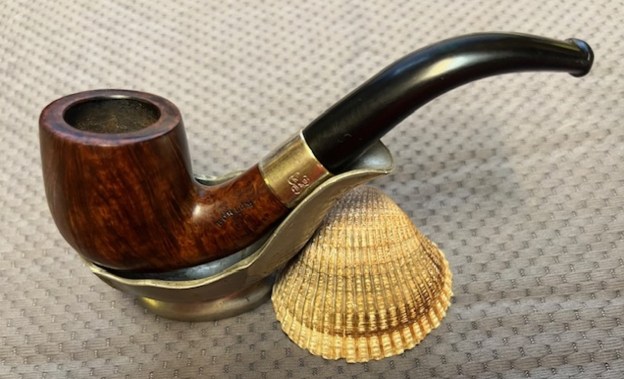
Restoring a MR&Co GBD London England 6 Silver Banded Lovat


Blog by Steve Laug

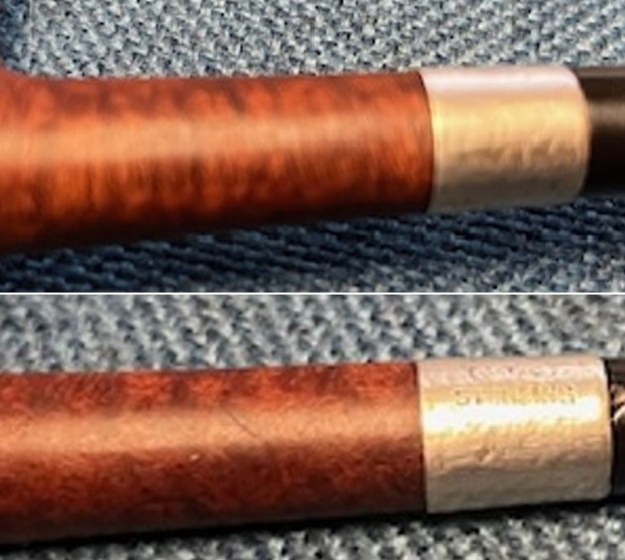
Last week I received a package of pipes to work on for a friend, Scott. I had no idea what was coming but when it arrived I was surprised with the interesting and amazing pieces he included for me to work on. These included a nice looking large Dunhill 841 ODA Lovat, a Campaign pipe with a Calabash style bowl and a start on the stem, a Sasieni 2 Dot London Made Canadian with a Lovat style saddle stem, and finally an older GBD MR&Co silver banded 5 Lovat. All of them are quite lovely and also interesting for me to be able to work on. I took a photo of the box when I unpacked the pipes.The third pipe I chose to work on from this lot was the MR&Co GBD Made in London 6 Lovat. The pipe has a smooth, rich brown finish. The stamping on the left side of the shank read GBD in an oval (GBD Logo). On the right side it was stamped London England [over] the shape number 6. The Sterling Silver band on the shank bore the GBD logo [over] three silver hallmarks – the letter T which is a date stamp, a rampant lion which is a silver quality stamp and a Leopard head which links it to the City of London all in square cartouches with rounded corners. Under that there was a lozenge with pointed ends stamped with the letters MR&Co. The bowl had a heavy cake in it and the rim top and inner edges had a heavy lava built up. There were some nicks on the outer edge of the bowl on the front and back of the bowl. The finish on the bowl and shank were worn and dirty with grime and darkening ground into the surface all around the bowl and shank. Under the tars the rim top and inner and outer edges of the bowl appeared to be in ok condition but cleaning would tell the story. The Sterling Silver band was tarnished and the stamping faint though readable. The stem was calcified and oxidized and there were tooth marks on the top and underside ahead of the button. The GBD silver oval logo was inlaid on the left side of the saddle portion of the stem. I took a few photos of the pipe before I started working on the pipe and have included them below. I took a photo of the rim top and bowl to show the condition of both of them. The bowl itself had a thick cake on the walls and bowl bottom. The rim top showed a heavy coat of lava and the inner edge was heavily caked and its condition would be revealed with cleaning. The outer edge looks good. The photos of the stem show the oxidation, calcification and tooth marks/chatter on both sides ahead of the button.I took photos of the stamping on the sides of the shank. The stamping was faint but still readable as noted above. You can also see the stamping on the silver band. It is much clearer in person. I removed the stem from the shank and took a photo to show the proportions of the pipe. I turned to Pipephil to renew my memory of the brand (http://www.pipephil.eu/logos/en/logo-gbd.html). It gave a brief history of the brand and the changes of owners. I was looking for the MR&Co stamp and found mention of Marechal & Ruchon Cie. The name of the French owners of the GBD lines after the original founders in 1850 sold it. I have included comments below.

Brand created in 1850 in Paris by Ganneval, Bondier and Donninger.

Marechal & Ruchon Cie first, then C.J. Verguet Frères (closed in 1970) owned GBD from 1903 to 1970 and manufactured these pipes in the St Claude (Fr) plant.

Sometime in the 1970s Cadogan company (Oppenheimer group) took over GBD. Prior to this time, the pipes were stamped “London England” in a straight line, even if they were sometimes crafted in France.

I also reread the history of the brand on Pipedia (https://pipedia.org/wiki/GBD). It gave more detail than Pipedia but nothing stunningly helpful.

I went back to Pipephil and did a quick look at some of the additional links that are present on hallmarks (http://www.pipephil.eu/logos/en/infos/hallmark-london.html). I found a great reference tool for London Hallmarks that applied to the pipe in hand. I have included a screen capture of that below.You can see from the information above that the Leopard’s head in a square was the mark for the City of London. That gave me information that the band (the pipe?) was made in London. Secondly the Rampant Lion shown in the second photo above is the same as the mark on this band which certifies the quality of the Sterling Silver in the band. That gave me the information on the two marks on the band. It was thus the London town Mark and the .925 Sterling silver mark. Now I need to look at the date stamp “T” that was on the band.

The page contained a dating chart as well as the above information. It stated that the “Twenty letters of the alphabet of different shape identify the year in which the piece was verified by the assay office.” It included a chart for the years 1896 – 2001. I did a screen capture of that below. To me the “T” stamp matches the one under 1954 in the chart below. It is shown underneath the same two marks that are on this pipe. I have drawn a blue box around it for ease of reference.Given those facts the Hallmarks can be interpreted. The pipe is a GBD London England Made pipe (GBD Logo and stamp on the briar and band). It has a London town mark (Leopard head without the crown), a .925 Sterling Silver certification (the Rampant Lion) and a 1954 date stamp (“T”). The MR&Co stamp identifies it as being made during the time Marechal & Ruchon Cie (1903-1970). That fit well with the 1954 date stamp. Now it was time to work on this old timer.

Now it was time to work on the pipe. I used a PipNet Pipe reamer first to take out the majority of the cake. It was a deep bowl so I used a Savinelli Fitsall Pipe Knife to clean up the remaining cake in the bowl and to scrape off the lava on the rim top. I used a dowel wrapped with 220 grit sandpaper to smooth out the walls of the bowl. I checked for damage on the bowl walls and it was in good condition. I scraped the rim top with a Savinelli Fitsall Pipe Knife. I cleaned up the inner edge of the bowl with a folded piece of 220 sandpaper. I wiped the rim top down with a damp cotton pad and the rim top began to really look much better. I polished the silver band with a jeweller’s cloth to remove the tarnish and protect the silver from further tarnishing. I scrubbed out the inside of the shank, mortise and the airway in both the stem and the bowl. I used pipe cleaners, cotton swabs and isopropyl alcohol. It cleaned up very well.I scrubbed the exterior of the briar with a tooth brush and undiluted Murphy’s Oil Soap to remove the build up on the surface of the briar and clean off the lava on the rim top. I scrubbed it and then carefully rinsed the bowl with warm water. I dried it with a soft cotton cloth. It certainly looked significantly better and the patina remained in the wood. I polished the briar with micromesh sanding pads to minimise the scratches in the briar. I dry sanded with 1500-12000 grit pads and wiped the bowl down after each pad with a damp cloth to remove the sanding debris. By the end of the nine pads the briar took on a rich shine and the rim top looked very good. I rubbed the bowl down with Before & After Restoration Balm. It is a paste/balm that works to deep clean the finish, enliven and protect the briar. I worked it into the briar with my finger tips to make sure that it covered every square inch of the pipe. I set it aside for 10 minutes to let it do its work. I buffed it with a cotton cloth. The briar really began to have a deep shine. The photos I took of the bowl at this point mark the progress in the restoration. I set the bowl aside and turned my attention to the stem. First, I wanted to address the tooth marks in the surface on both sides. I “painted” the surface of the vulcanite with the flame of a Bic lighter and was able to significantly lift the tooth marks. I filled in the deeper marks with black rubberized CA glue. Once it cured I sanded the repairs with 220 grit sandpaper to smooth them out. I sanded the stem with 320-3500 grit sanding pads to break up the remaining oxidation. I wiped it down after each sanding pad with an Obsidian Oil impregnated cloth. It began to look good.I polished the stem with micromesh sanding pads – dry sanding with 1500-12000 grit pads. I wiped the stem down after each sanding pad with Obsidian Oil. I polished it with Before & After Pipe Stem Polish – both Fine and Extra Fine. Once I had finished the polishing I gave it final coat of Obsidian Oil and set it aside to dry. You can see from the photos that under the light of the flash the oxidation was still present. This was one stubborn pipe. I scrubbed it down with Soft Scrub and cotton pads until the oxidation was no longer present. It looked better. I wiped the stem down with Obsidian Oil to protect it further.I put the 1954 MR&Co GBD London England 6 Lovat bowl and stem back together. I polished the bowl and stem with Blue Diamond to polish out the scratches in the briar and the vulcanite. I gave the bowl and the stem multiple coats of carnauba wax. I buffed the pipe with a clean buffing pad to raise the shine. I hand buffed it with a microfiber cloth to deepen the shine. The pipe polished up pretty nicely. The reddish/brown stains worked amazingly well with the polished vulcanite taper stem. The grain around the bowl and shank and looks quite remarkable. This is truly a beautiful 1954 MR&Co GBD 6 Lovat. The finished pipe is shown in the photos below. The dimensions of the pipe are Length: 6 inches, Height: 1 ¾ inches, Outside diameter of the bowl: 1 ¼ inches, Chamber diameter: ¾ of an inch. The weight of the pipe is 1.41 ounces/38 grams. I have one more of Scott’s pipes to work on and then I will be sending them back to him. I am sure he will soon add them into his rotation and enjoy some great smokes. Thanks for walking through the restoration with me. Cheers.

As always, I encourage your questions and comments as you read the blog. Thanks to each of you who are reading this blog. Remember we are not pipe owners; we are pipe men and women who hold our pipes in trust until they pass on into the trust of those who follow us.

Restoring a Sasieni Two Dot London Made King Size 44G Oval Shank Lovat


Blog by Steve Laug

Last week I received a package of pipes to work on for a friend, Scott. I had no idea what was coming but when it arrived I was surprised with the interesting and amazing pieces he included for me to work on. These included a nice looking large Dunhill 841 ODA Lovat, a Campaign pipe with a Calabash style bowl and a start on the stem, a Sasieni 2 Dot London Made Canadian with a Lovat style saddle stem, and finally an older GBD MR&Co silver banded 5 Lovat. All of them are quite lovely and also interesting for me to be able to work on. I took a photo of the box when I unpacked the pipes.The second pipe I chose to work on from this lot was the large Sasieni Two Dot Large oval shank Lovat. The pipe has a smooth, rich brown finish. The stamping on the topside of the shank read Sasieni [over] Two Dot [over] London Made [over] King Size. On the underside the COM Stamp was shaped like football and read Made in [arched over] England. That is followed by a shape number 44G. The bowl had a heavy cake in it and the rim top and inner edges had a heavy lava built up. The cake was thicker on the back half of the bowl. The outer edge of the bowl looked very good. The finish was very dirty with grime ground into the bowl sides and shank. The stem was calcified and oxidized and there were tooth marks on the top and underside ahead of the button. The Sasieni two blue dots were on top of the saddle portion of the stem. I took a few photos of the pipe before I started working on the pipe and have included them below. I took a photo of the rim top and bowl to show the condition of both of them. The bowl itself had a thick cake on the walls and bowl bottom. The rim top showed a heavy coat of lava and the inner edge was heavily caked and its condition would be revealed with cleaning. The outer edge looks good. The photos of the stem show the oxidation, calcification and tooth marks/chatter on both sides ahead of the button.I took photos of the stamping on the sides of the shank. The stamping was clear and readable as noted above. I removed the stem from the shank and took a photo to show the proportions of the pipe. Before I started my work pipe, I turned to Pipephil’s site (http://www.pipephil.eu/logos/en/logo-sasieni.html) to get a feel for the Two Dot pipes. As usual there is some helpful information in short form on the site. I have included a screen capture of the pertinent section below.On the side bar it also included this information on the King Size stamping:

“King Size” marking in any Sasieni grade or finish were the largest pipes Sasieni regularly marketed.

“Two dot” pipes are not to be confused with the Duplicated One dot.

On the side bar there was also a link to move information in French regarding the Two Dot pipes (http://www.pipephil.eu/oddpipes/dots/sasieni-2dots.html). I ran it through Google Translate and picked up the following information that was quite helpful. (I know Google translate is greatly lacking but it at least gives a sense of the meaning of the words.) I am including the link and the translation should you want to check it out.

Two-Dot Sasieni

If you are intending to acquire your first Sasieni pipe, and your budget does not allow you to splurge these days, I cannot recommend enough that you take a closer look at the colonized pipes at this London pipe maker.

What differentiates the Sasieni two-point pipes from those with four? Very few two things, judge:

Alfred Sasieni wanted the pipes marked with the diamond to be absolutely perfect. Those which had even a surface irregularity (sandpit) the size of a tenth of a pinhead, were to be considered second choice.

At the beginning of the sixties (see diagram here http://www.pipephil.eu/logos/fr/infos/sasieni-timechart.html), while the house was already marketing second-choice pipes through sub-brands [1], it was finally decided to sell the “almost perfect” under the prestigious Sasieni brand, but by reducing the points to two.

These two-point pipes were marketed from 1961 until the early 1980s. On the second-hand pipe market these models are generally sold at very fair prices [2]…

[1] Illustrated list of Sasieni’s sub-brands or second brands.

[2] Do not confuse Sasieni pipes marked with a double point, with those that have a point on either side of the pipe.

From that information I knew that I was dealing with an “almost perfect” piece of briar and that explained the two small pinprick holes on the right side of the bowl. I also knew that the Two Dots were marketed for a short period from 1961 to the early 1980s which gave a time frame for this pipe. With the King Size stamp I also knew that I was dealing with one of the largest pipes that Sasieni marketed.

By the way, Pipedia gives a great history of the brand (https://pipedia.org/wiki/Sasieni) that is well worth reading.

Now it was time to work on the pipe. I used a PipNet Pipe reamer first to take out the majority of the cake. It was a deep bowl so I used a Savinelli Fitsall Pipe Knife to clean up the remaining cake in the bowl and to scrape off the lava on the rim top. I used a dowel wrapped with 220 grit sandpaper to smooth out the walls of the bowl. I checked for damage on the bowl walls and it was in good condition. I sanded the bevel on the inner edge of the rim with 220 grit sandpaper and the thick lava coat on the rim top with a 320 grit sanding pad. I scrubbed out the inside of the shank, mortise and the airway in both the stem and the bowl. I used pipe cleaners, cotton swabs and isopropyl alcohol. It cleaned up very well.I scrubbed the exterior of the bowl with a tooth brush and undiluted Murphy’s Oil Soap to remove the grime and debris in the finish. I scrubbed out the mortise and tenon with small tube brushes and soap to remove the oils and tars in the shank area. I rinsed it with warm water to remove the grime and oils in the finish and shank. It has a fresh look that really highlights the grain in the briar. I polished the briar with micromesh sanding pads to minimise the scratches in the briar. I dry sanded with 1500-12000 grit pads and wiped the bowl down after each pad with a damp cloth to remove the sanding debris. By the end of the nine pads the briar took on a rich shine and the rim top looked very good. I paused the polishing process long enough to give the rim top a light stain with a Maple stain pen to add some colour back to the light areas on the rim top. It matched the colour of the rest of the bowl and would do so even more once polished. Once finished I continued the polishing process with micromesh sanding pads. I rubbed the bowl down with Before & After Restoration Balm. It is a paste/balm that works to deep clean the finish, enliven and protect the briar. I worked it into the briar with my finger tips o make sure that it covered every square inch of the pipe. I set it aside for 10 minutes to let it do its work. I buffed it with a cotton cloth. The briar really began to have a deep shine. The photos I took of the bowl at this point mark the progress in the restoration. I set the bowl aside and turned my attention to the stem. First, I wanted to address the tooth marks in the surface on both sides. I “painted” the surface of the vulcanite with the flame of a Bic lighter and was able to significantly lift the tooth marks. I sanded the remaining marks and chatter with 220 grit sandpaper to smooth them out. I sanded the stem with 320-3500 grit sanding pads to break up the remaining oxidation. I wiped it down after each sanding pad with an Obsidian Oil impregnated cloth. It began to look good.I polished the stem with micromesh sanding pads – dry sanding with 1500-12000 grit pads. I wiped the stem down after each sanding pad with Obsidian Oil. I polished it with Before & After Pipe Stem Polish – both Fine and Extra Fine. Once I had finished the polishing I gave it final coat of Obsidian Oil and set it aside to dry. I put the Sasieni Two Dot London Made King Size 44G oval shank Lovat bowl and stem back together. I polished the bowl and stem with Blue Diamond to polish out the scratches in the briar and the vulcanite. I gave the bowl and the stem multiple coats of carnauba wax. I buffed the pipe with a clean buffing pad to raise the shine. I hand buffed it with a microfiber cloth to deepen the shine. The pipe polished up pretty nicely. The reddish/brown stains worked amazingly well with the polished vulcanite taper stem. The grain around the bowl and shank and looks quite remarkable. This is truly a beautiful Sasieni Two Dot King Size 44G Lovat. The finished pipe is shown in the photos below. The dimensions of the pipe are Length: 6 ½ inches, Height: 2 inches, Outside diameter of the bowl: 1 ½ inches, Chamber diameter: 7/8 of an inch. The weight of the pipe is 2.22 ounces/64 grams. I have two more of Scott’s pipes to work on and then I will be sending them back to him. I am sure he will soon add them into his rotation and enjoy some great smokes. Thanks for walking through the restoration with me. Cheers.

As always, I encourage your questions and comments as you read the blog. Thanks to each of you who are reading this blog. Remember we are not pipe owners; we are pipe men and women who hold our pipes in trust until they pass on into the trust of those who follow us.

Restoring a Classic Dunhill Bruyere Prince


By Steve Laug

I took a break from the queue of pipes I have to work on to work on a pipe in my own box. Paul in Illinois who loves Dunhill Prince shapes and he regularly texts and asks if I have any. When I was in Idaho I picked up one that we had purchased from a friend in Denmark on May 22, 2024. It is a lovely Dunhill Bruyere Prince. The stamping on the left side of the shank read FET (the designation for a prince) [over] F/T next to the bowl. That is followed by Dunhill [over] Bruyere. On the right side it read Made in [over] England followed by a number 7 to the right of the D in England that will help me date the pipe. The bowl had been reamed not long ago. There was some lava on the rim top on the back of the rim and the inner edge had darkening and was rough to the touch. The outer edge looked very good. The finish was dirty but it could not hide the lovely grain around the bowl and shank. The stem was clean though a bit pitted. The bend in the stem common on Prince pipes had straightened over time. There were tooth marks on the top and underside ahead of the button. The classic Dunhill White Spot was missing on top of the stem but a clean small hole remained where it had been. I took a few photos of the pipe before I started my work on it. I sent the photos to Paul and he is excited about it. I took a photo of the rim top and bowl to show the condition of both of them. The bowl itself had been recently reamed. The rim top showed a coat of lava and some darkening around the edge. The inner edge looked rough but a cleaning would make that clear. The outer edge looked very good. The photos of the stem show light oxidation, the missing white spot on the top and tooth marks/chatter on both sides ahead of the button. I took photos of the stamping on the sides of the shank. The photos are blurry but you can see the shadow of the stamping. The stamping was faint but readable as noted above. I removed the stem from the shank and took a photo to show the proportions of the pipe. As is my regular practice, before I started my work on the pipe, I turned to Pipedia’s section on Dunhill Bruyere Pipes to get a bit of background on the Dunhill finishes (https://pipedia.org/wiki/Dunhill#Root_Briar). I quote:

Bruyere

The original finish produced (usually made using Calabrian briar), and a big part of developing and marketing the brand. It was the only finish from 1910 until 1917. A dark reddish-brown stain. Before the 1950s, there were three possible finishes for Dunhill pipes. The Bruyere was a smooth finish with a deep red stain, obtained through two coats, a brown understain followed by a deep red.

There was a link on the above site to a section specifically written regarding the Bruyere finish (https://pipedia.org/wiki/Dunhill_Bruyere). I turned there and have included the information from that short article below.

Initially, made from over century-old briar burls, classified by a “B” (denoted highest quality pipe); “DR” (denoted straight-grained) and an “A” (denoted first quality), until early 1915. After that, they became a high-end subset to the Dunhill ‘Bruyere’. The DR and B pipes, a limited production, they should be distinguished as hand-cut in London from burls as opposed to the Bruyere line which was generally finished from French turned bowls until 1917, when the Calabrian briar started to be used, but not completely. Only in 1920 Dunhill took the final step in its pipe making operation and began sourcing and cutting all of its own bowls, proudly announcing thereafter that “no French briar was employed”.

Bruyere pipes were usually made using Calabrian briar, a very dense and hardy briar that has a modest grain but does very well with the deep red stain.

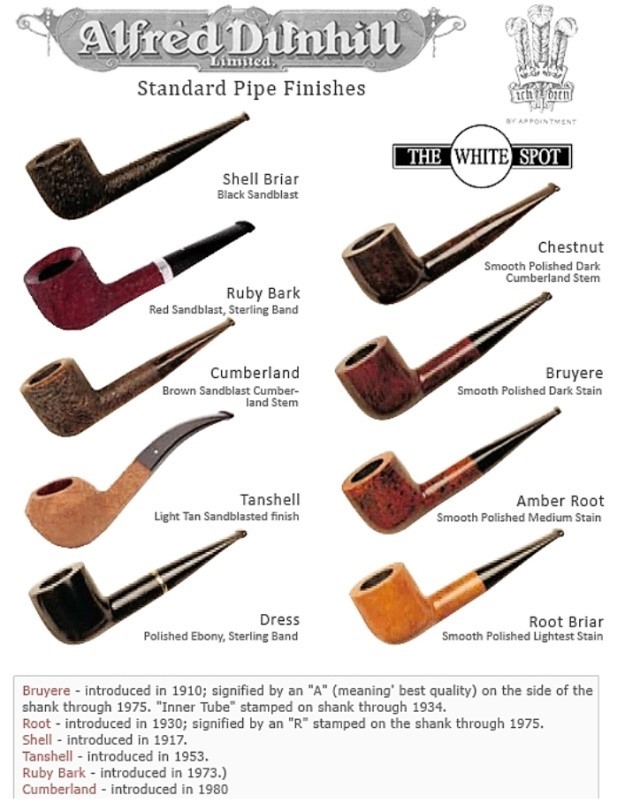
“Before the 1950s, there were three possible finishes for Dunhill pipes. The Bruyere was a smooth finish with a deep red stain, obtained through two coats, a brown understain followed by a deep red. The Shell finish was the original sandblast with a near-black stain (though the degree to which it is truly black has varied over the years). Lastly, the Root finish was smooth also but with a light brown finish. Early Dunhill used different briars with different stains, resulting in more distinct and identifiable creations… Over the years, to these traditional styles were added four new finishes: Cumberland, Dress, Chestnut and Amber Root, plus some now-defunct finishes, such as County, Russet and Red Bark.”

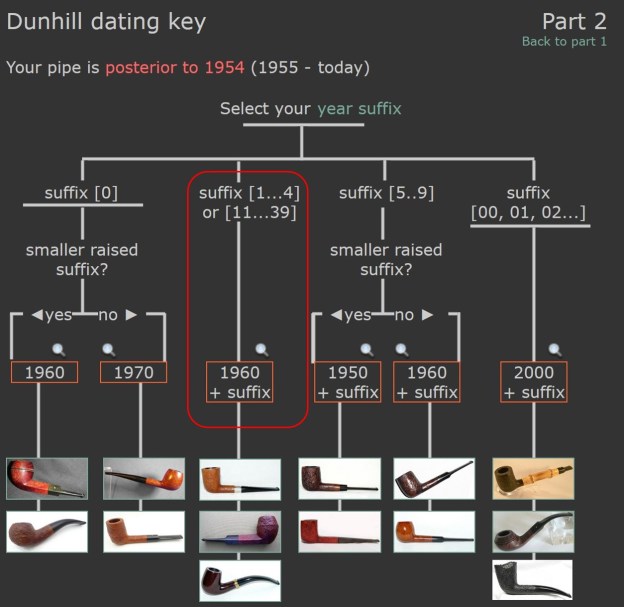
There was also a link to a catalogue page that gave examples and dates that the various finishes were introduced (https://pipedia.org/wiki/File:Dunnypipescatalog-1.png).I turned to Pipephil’s dating guide to show how I arrived at the date of manufacture for this pipe (http://www.pipephil.eu/logos/en/dunhill/cledat-en1a.html). I am including the chart that is provided there for the dating a pipe. I have drawn a red box around the section. Since the pipe I am working on has a suffix 7 and is the same size as the D in England. It points to the 1960 line on the chart below. To date it just add 1960 +7 for a date of 1967. I have drawn a red box around the pertinent section in the chart.I now knew that I was working on a Bruyere that came out in 1967 as far as I could tell by the date stamp. The shape of the pipe is an FET (Prince) with a F/T or fishtail stem.

Now it was time to work on the pipe. I used a PipNet Pipe reamer first to take out the majority of the thin cake. I used a Savinelli Fitsall Pipe Knife to clean up the remaining cake in the bowl and to scrape off the lava on the rim top. I used a dowel wrapped with 220 grit sandpaper to smooth out the walls of the bowl. I checked for damage on the bowl walls and it was in good condition. I used a folded piece of 220 grit sandpaper to clean up the damage around the bowl edge and the lava build up on the rim top. It is looking much better at this point in the process. I scrubbed out the inside of the shank, mortise and the airway in both the stem and the shank. I started the process by scraping the inside of the mortis with a pen knife. There was a small ridge of build up mid mortise making the seating of the stem incorrect. Once I had scraped it clean I used pipe cleaners, cotton swabs and isopropyl alcohol on the shank and on the airway in the stem. It cleaned up very well. I scrubbed the exterior of the bowl with a tooth brush and undiluted Murphy’s Oil Soap to remove the grime and debris in the finish. I scrubbed out the mortise and tenon with small tube brushes and soap to remove the oils and tars in the shank area. I rinsed it with warm water to remove the grime and oils in the finish and shank. I dried it off with a soft cotton cloth. One of the benefits of doing this is that the briar in the nicks and dents on the bowl sides swell and virtually disappear. The pipe has a fresh look that really highlights the grain on the briar. I polished the briar with micromesh sanding pads to minimise the scratches in the briar. I dry sanded with 1500-12000 grit pads and wiped the bowl down after each pad with a damp cloth to remove the sanding debris. By the end of the nine pads the briar took on a rich shine and the rim top looked very good. Even the damage on the outer edge, while still present looked much better and the roughness was gone. I rubbed the bowl down with Before & After Restoration Balm. It is a paste/balm that works to deep clean the finish, enliven and protect the briar. I worked it into the briar with my finger tips to make sure that it covered every square inch of the pipe. I set it aside for 10 minutes to let it do its work. I buffed it with a cotton cloth. The briar really began to have a deep shine. The photos I took of the bowl at this point mark the progress in the restoration. I set the bowl aside and turned my attention to the stem. First, I wanted to address the tooth marks in the surface on both sides. I “painted” the surface of the vulcanite with the flame of a Bic lighter and was able to significantly lift the tooth marks. I also heated the stem so I could put a slight bend in it to capture the Prince shape. I sanded out the remaining tooth marks that were present with a folded piece of 220 grit sandpaper. It looked very good at this point. I paused in the sanding process to address the missing white dot on the stem surface. I have some white spot material that I received from Mark Hoover. It is a small envelope of white spots. I put one spot in the lid of a jar I have here and mixed it with some 100% acetone. I stirred it with a dental pick to mix the acetone with the spot material. It softens and becomes malleable. I pressed the softened material into the hole on the top of the stem with the dental pick. Once it set I sanded off the excess material on the stem surface with a folded piece of 220 grit sandpaper. I sanded the stem with 320-3500 grit sanding pads to smooth out the newly filled white spot and to break up the remaining oxidation. I wiped it down after each sanding pad with an Obsidian Oil impregnated cloth. It began to look good.I polished the stem with micromesh sanding pads – dry sanding with 1500-12000 grit pads. I wiped the stem down after each sanding pad with Obsidian Oil. I polished it with Before & After Pipe Stem Polish – both Fine and Extra Fine. Once I had finished the polishing I gave it final coat of Obsidian Oil and set it aside to dry.   The diameter of the tenon made it clear that the pipe had originally had an inner tube. Somewhere along the journey the tube had disappeared. I went through my can of tubes and stingers and found an inner tube that was the right length. I inserted it in the tenon and took photos of the fit.I put the 1967 Dunhill Bruyere FET F/T Prince bowl and stem back together. I polished the bowl and stem with Blue Diamond to polish out the scratches in the briar and the vulcanite. I gave the bowl and the stem multiple coats of carnauba wax. I buffed the pipe with a clean buffing pad to raise the shine. I hand buffed it with a microfiber cloth to deepen the shine. The pipe polished up pretty nicely. The reddish/brown stains worked amazingly well with the polished vulcanite taper stem. The grain around the bowl and shank and looks quite remarkable. This is truly a beautiful Dunhill Bruyere FET F/T Prince. The finished pipe is shown in the photos below. The dimensions of the pipe are Length: 6 inches, Height: 1 ¼ inches, Outside diameter of the bowl: 1 ¼ inches, Chamber diameter: 7/8 of an inch. The weight of the pipe is 1.23 ounces/36 grams. I have another pipe set aside for Paul in Illinois that I will pack together and send to him. I am sure he will soon add them into his rotation and enjoy some great smokes. Thanks for walking through the restoration with me. Cheers.

As always, I encourage your questions and comments as you read the blog. Thanks to each of you who are reading this blog. Remember we are not pipe owners; we are pipe men and women who hold our pipes in trust until they pass on into the trust of those who follow us.

Restoring a 1961 Dunhill Bruyere Made in London 1 ODA 841 Lovat


by Steve Laug

Last week I received a package of pipes to work on for a friend, Scott. I had no idea what was coming but when it arrived I was surprised with the interesting and amazing pieces he included for me to work on. These included a nice looking large Dunhill 841 ODA Lovat, a Campaign pipe with a Calabash style bowl and a start on the stem, a Sasieni 2 Dot London Made Canadian with a Lovat style saddle stem, and finally an older GBD MR&Co silver banded 5 Lovat. All of them are quite lovely and also interesting for me to be able to work on. I took a photo of the box when I unpacked the pipes.The first pipe I chose to work on from this lot was the large Dunhill ODA 841 Lovat. The pipe has a smooth Bruyere finish. The stamping on the left side of the shank read ODA [over] 841 next to the bowl. That is followed by Dunhill [over] Bruyere. On the right side it read Made in [over] England followed by a number 1 to the right of the D in England that will help me date the pipe. The bowl had a heavy cake in it and the rim top and inner edges had a heavy lava built up. The outer edge of the bowl had knocked hard against a surface and damaged all the way around. The finish was very dirty with grime ground into the bowl sides and shank. The stem was calcified and oxidized and there were tooth marks on the top and underside ahead of the button. The classic Dunhill White Spot was on top of the saddle portion of the stem. I took a few photos of the pipe before I started my work on it and have included them below. I took a photo of the rim top and bowl to show the condition of both of them. The bowl itself had a thick cake on the walls and bowl bottom. The rim top showed a heavy coat of lava and the inner edge looked rough from being reamed with a knife but a cleaning would make that clear. The outer edge on the front of the bowl and the back have knocking damage and the side edges have some as well. The photos of the stem show the oxidation, calcification and tooth marks/chatter on both sides ahead of the button.I took photos of the stamping on the sides of the shank. The stamping was clear and readable as noted above. I removed the stem from the shank and took a photo to show the proportions of the pipe. Before I started my work on the pipe, I turned to Pipedia’s section on Dunhill Bruyere Pipes to get a bit of background on the Dunhill finishes (https://pipedia.org/wiki/Dunhill#Root_Briar). I quote:

Bruyere

The original finish produced (usually made using Calabrian briar), and a big part of developing and marketing the brand. It was the only finish from 1910 until 1917. A dark reddish-brown stain. Before the 1950s, there were three possible finishes for Dunhill pipes. The Bruyere was a smooth finish with a deep red stain, obtained through two coats, a brown understain followed by a deep red.

There was a link on the above site to a section specifically written regarding the Bruyere finish (https://pipedia.org/wiki/Dunhill_Bruyere). I turned there and have included the information from that short article below.

Initially, made from over century-old briar burls, classified by a “B” (denoted highest quality pipe); “DR” (denoted straight-grained) and an “A” (denoted first quality), until early 1915. After that, they became a high-end subset to the Dunhill ‘Bruyere’. The DR and B pipes, a limited production, they should be distinguished as hand-cut in London from burls as opposed to the Bruyere line which was generally finished from French turned bowls until 1917, when the Calabrian briar started to be used, but not completely. Only in 1920 Dunhill took the final step in its pipe making operation and began sourcing and cutting all of its own bowls, proudly announcing thereafter that “no French briar was employed”.

Bruyere pipes were usually made using Calabrian briar, a very dense and hardy briar that has a modest grain but does very well with the deep red stain.

“Before the 1950s, there were three possible finishes for Dunhill pipes. The Bruyere was a smooth finish with a deep red stain, obtained through two coats, a brown understain followed by a deep red. The Shell finish was the original sandblast with a near-black stain (though the degree to which it is truly black has varied over the years). Lastly, the Root finish was smooth also but with a light brown finish. Early Dunhill used different briars with different stains, resulting in more distinct and identifiable creations… Over the years, to these traditional styles were added four new finishes: Cumberland, Dress, Chestnut and Amber Root, plus some now-defunct finishes, such as County, Russet and Red Bark.”

There was also a link to a catalogue page that gave examples and dates that the various finishes were introduced (https://pipedia.org/wiki/File:Dunnypipescatalog-1.png). I turned to Pipephil’s dating guide to show how I arrived at the date of manufacture for this pipe (http://www.pipephil.eu/logos/en/dunhill/cledat-en1a.html). I am including the chart that is provided there for the dating a pipe. I have drawn a red box around the section. Since the pipe I am working on has a suffix 1 it points to the 1960 line on the chart below. I have drawn a red box around the pertinent section in the chart.On Pipedia they also have an ODA shape chart that was helpful. I have included that below (https://pipedia.org/wiki/A_DUNHILL_ODA_SHAPE_CHART).I turned further to a listing on Pipephil (http://pipephil.eu/logos/en/infos/dunhill-oda-en.html)with regard to the ODA 800 Series pipes. It is a helpful document and I have included a screen capture of it below. The chart has a paragraph at the top that reads as follows:

The following chart (1) lists larger Dunhill shapes introduced in 1950. They were stamped “ODA” with a number ranging from 806 to 857 (but not all number in between….

After the chart were the following paragraphs that I am also including.

Pipes from the ODA 800 series must be distinguished from the pre-WWII “OD” (Own Design) pipes. The later were carved to order and graded from A to J.

 The ODA 800 series were discontinued in the mid 1990s.

 (1) According to John Loring (op. cit.) I now knew that I was working on a Bruyere that came out in 1961 as far as I could tell by the date stamp. The shape of the pipe is Dunhill ODA 841 which were made from 1950 until 1990 when the 800 series was discontinued. So this pipe fits the date line perfectly. The ODA 841 was the designation for Lovat shape with a saddle stem.

Now it was time to work on the pipe. I used a PipNet Pipe reamer first to take out the majority of the cake. It was a deep bowl so I used a Savinelli Fitsall Pipe Knife to clean up the remaining cake in the bowl and to scrape off the lava on the rim top. I used a dowel wrapped with 220 grit sandpaper to smooth out the walls of the bowl. I checked for damage on the bowl walls and it was in good condition. I scrubbed out the inside of the shank, mortise and the airway in both the stem and the shank. I used pipe cleaners, cotton swabs and isopropyl alcohol. It cleaned up very well.I scrubbed the exterior of the bowl with a tooth brush and undiluted Murphy’s Oil Soap to remove the grime and debris in the finish. I scrubbed out the mortise and tenon with small tube brushes and soap to remove the oils and tars in the shank area. I rinsed it with warm water to remove the grime and oils in the finish and shank. It has a fresh look that really highlights the briar. I used a folded piece of 220 grit sandpaper to clean up the damage around the bowl edge and the lava build up on the rim top. I also carefully knocked off the rough edges on the outer edge of the bowl without significantly changing the damage. It is looking much better at this point in the process.I polished the briar with micromesh sanding pads to minimise the scratches in the briar. I dry sanded with 1500-12000 grit pads and wiped the bowl down after each pad with a damp cloth to remove the sanding debris. By the end of the nine pads the briar took on a rich shine and the rim top looked very good. Even the damage on the outer edge, while still present looked much better and the roughness was gone. I paused in the polishing to touch up the light spots on the bowl top and edges with a Cherry stain pen. The colour is a perfect match and with the ongoing polishing and final buffing of the bowl it will blend in perfectly.Once the stain cured I went back to the polishing routine. The stain coat blended in quite well and was looking like it should by the time I finished the final pad. I rubbed the bowl down with Before & After Restoration Balm. It is a paste/balm that works to deep clean the finish, enliven and protect the briar. I worked it into the briar with my finger tips o make sure that it covered every square inch of the pipe. I set it aside for 10 minutes to let it do its work. I buffed it with a cotton cloth. The briar really began to have a deep shine. The photos I took of the bowl at this point mark the progress in the restoration. I set the bowl aside and turned my attention to the stem. First I wanted to address the tooth marks in the surface on both sides. I “painted” the surface of the vulcanite and was able to significantly lift the tooth marks. I sanded the remaining marks and chatter with 220 grit sandpaper to smooth them out. I sanded the stem with 320-3500 grit sanding pads to break up the remaining oxidation. I wiped it down after each sanding pad with an Obsidian Oil impregnated cloth. It began to look good.I polished the stem with micromesh sanding pads – dry sanding with 1500-12000 grit pads. I wiped the stem down after each sanding pad with Obsidian Oil. I polished it with Before & After Pipe Stem Polish – both Fine and Extra Fine. Once I had finished the polishing I gave it final coat of Obsidian Oil and set it aside to dry.  I put the 1961 Dunhill Bruyere ODA 841 Lovat bowl and stem back together. I polished the bowl and stem with Blue Diamond to polish out the scratches in the briar and the vulcanite. I gave the bowl and the stem multiple coats of carnauba wax. I buffed the pipe with a clean buffing pad to raise the shine. I hand buffed it with a microfiber cloth to deepen the shine. The pipe polished up pretty nicely. The reddish/brown stains worked amazingly well with the polished vulcanite taper stem. The grain around the bowl and shank and looks quite remarkable. This is truly a beautiful Dunhill Bruyere ODA 841 Lovat. The finished pipe is shown in the photos below. The dimensions of the pipe are Length: 6 ¾ inches, Height: 2 inches, Outside diameter of the bowl: 1 ½ inches, Chamber diameter: 7/8 of an inch. The weight of the pipe is 1.98 ounces/56 grams. I have three more of Scott’s pipes to work on and then I will be sending them back to him. I am sure he will soon add them into his rotation and enjoy some great smokes. Thanks for walking through the restoration with me. Cheers.

As always, I encourage your questions and comments as you read the blog. Thanks to each of you who are reading this blog. Remember we are not pipe owners; we are pipe men and women who hold our pipes in trust until they pass on into the trust of those who follow us.

The Third of Six Pipes from Salmon Arm for Restoration –A Peterson’s System Premier 309


Blog by Steve Laug

A few weeks ago, I received an email from a friend, Sonny in Salmon Arm, BC. We have worked together on pipes over the past few years either ones that I have sold to him or those he has picked up on auctions or sales that I have restored. He wrote that he had some pipes that needed restoration.

I also have some of those old estates I still need to send to you for restoration. Hopefully I will be able to pack them up and get them off to you this week. Thank you again, Steve! – Sonny
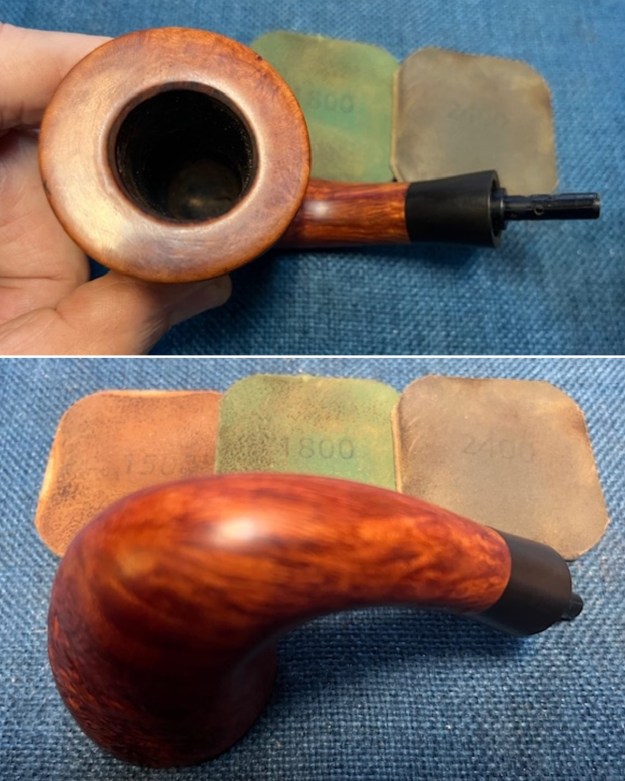
He followed that up with another email regarding what he wanted done on the various pipes. I have included it below.

I would like the Vauen bent ball shape to have no band on it. It looks like it may have had a band there at one time and I’m not sure why. And if any of them needs to be stained again, I would like them to be black, especially the Peterson 309 and that ball Vauen. Let me know what you think.

I took a photo of the box of six pipes once I unwrapped them. There were 6 interesting pipes – a Vauen Luxus Bent Ball, a Vauen Dr. Perl Billiard, a Sand Blast Vauen Dr. Perl Pot, a Parade News Briar Shop Oom Paul, a Bari Pearl Bamboo shank Ball and Peterson’s System Premier 309 Bent Billiard. All were in need of various degrees of restoration.The third pipe I chose to work on was the Peterson’s System Premier. It is stamped on the underside and reads Peterson’s [arched over] System [over] Premier. To the right of that it is stamped with the shape number 309 [over] Made in the [over] Republic [over] of Ireland. The pipe was dirty and there were white spots of paint in the sandblast finish. There was a silver ferrule on the shank end. It is stamped Peterson’s [over] Dublin followed by Sterling [over] Silver. That is followed three silver hallmarks: Hibernia seated arm on a harp for the country of manufacture; the crowned Harp designating sterling quality and the date letter marks which in this case was the letter I. The bowl has a thick cake in it and some lava in the sandblast on the rim top. The stem is a system stem with a metal chimney. It was very dirty with heavy oxidation and light tooth marks and chatter on both sides ahead of the button. I took these photos before I started my work on the pipe. I took a photo of the rim top and bowl to show the condition of both of them. There is a moderate cake in the bowl and some lava on the thin rim top. There is also debris in the bowl. The photos of the stem show the heavy oxidation and tooth marks/chatter on both sides ahead of the button.I took photos of the stamping on the underside of the shank. The stamping was clear and readable as noted above. It is much clearer in person but is hard to capture on the curve of the shank. I also tried to capture the stamping on the silver ferrule. I removed the stem from the shank and took a photo to show the proportions of the pipe. The first of those photos shows it with the chimney in place and the second shows it unscrewed. Before I started working on the pipe I wanted to dig into the detail on the stamping on the pipe. I knew what some of the stamping meant regarding the rough age of the pipe.

 Because the pipe was stamped Made in the Republic of Ireland I knew that I was dealing with a Republic Era pipe made between 1950-1989. It was a Sandblast Peterson’s System Premier 309 Billiard with an interesting blast finish. The stain on the bowl was a mess with fading and paint in the blast. Originally it looked like the bowl had been stained with a combination of brown stains. Now it was time to tighten down the date on the pipe from the hallmarks on the Sterling Silver ferrule.

I turned to the hallmarking chart on one of the blogs on rebornpipes to lock down the date for the pipe (https://rebornpipes.com/wp-content/uploads/2015/05/peterson-cataloguecomp_page_27.jpg). The chart defines the meaning of each hallmark. The first one of the seated woman with a harp is known as the Hibernia stamp and identifies the pipe as made in Ireland. The second stamp is a crowned harp which is a fineness mark denoting the high quality of silver that was used. The third stamp is an italic lower case “i”. I have included a larger screen capture of the chart in the lower left of the photo below. I have drawn a RED CIRCLE around the date letter below. It is a lower case “i” as seen in the circled letter below. It identifies the date of this Peterson’s pipe to 1976. I knew that I was dealing with a Republic Era pipe made between 1950 and the present. The hallmarks date the pipe to 1976. Now it was time to work on the pipe.

Armed with that information I turned my attention to the pipe itself. I reamed the bowl with a PipNet reamer to remove the cake. I cleaned up what remained with a Savinelli Fitsall Pipe Knife. I sanded the walls of the bowl to remove any remnants of cake with 220 grit sandpaper wrapped around a piece of dowel. Once finished the inside of the bowl was smooth. I scrubbed the exterior of the bowl with undiluted Murphy’s Oil Soap and a tooth brush. I also worked over the interior of the shank and bowl with brushes and soap at the same time. I rinsed the pipe off with warm running water and dried if off with a soft towel. The pipe is certainly cleaner. In speaking with Sonny I knew that he wanted the bowl stained black as he preferred that colour. So, this morning early I obliged him and stained the pipe with a black aniline stain. I applied it with the wool dauber and then flamed it to set the stain. I repeated the process until the coverage was even around the bowl.Once the stain dried I buffed it with a coarse cloth to remove any excess stain and to blend it into the surrounding surface smoothly. It looks good with the black stain. I sent photos to Sonny and he approves! Before I cleaned the inside of the shank and the stem I took the stem out of the Briarville’s Pipe Stem deoxidizer where it had been sitting over night and rubbed it briskly with a coarse cotton cloth to remove the oxidation on the surface and dry off the remaining deoxidizer on the stem. I am pleased with how well the product worked even after I have used this batch for over a year. Once the pipe was reamed, cleaned and stained and the stem was deoxidized I worked on the internals – the mortise, sump and airway in the shank and airway in the stem. I cleaned out the airway to the bowl, the mortise, sump and the airway in the stem with pipe cleaners, cotton swabs and alcohol. I also worked over the aluminum chimney that screwed into the tenon on the stem.When I get the bowl to this point in the process I use Before & After Restoration Balm. It is a paste/balm that works to deep clean the finish, enliven and protect the briar. I work it into the briar and the bamboo with my finger tips to make sure that it covers every square inch of the pipe. I set it aside for 10 minutes to let it do its work. Once the time has passed I wiped it off with a soft cloth then buffed it with a cotton cloth. The briar really began to have a deep shine. The photos I took of the bowl at this point mark the progress in the restoration. You see the shine that the briar has taken on and the way rustication has depth. The black stain works on the pipe and it is a beauty. I set the bowl aside and turned my attention to the stem. I wiped the stem down with Soft Scrub cleanser and cotton pads to further remove the remnants of oxidation in the surface of the vulcanite.I sanded the stem with 320-3500 grit sanding pads to break up the remaining oxidation. I wiped it down after each sanding pad with an Obsidian Oil impregnated cloth. It began to look good.Once finished that I screwed the aluminum chimney back into the tenon on the stem. The fit and look is very good. I polished the stem with micromesh sanding pads – dry sanding with 1500-12000 grit pads. I wiped the stem down after each sanding pad with Obsidian Oil. I polished it with Before & After Pipe Stem Polish – both Fine and Extra Fine. Once I had finished the polishing I gave it final coat of Obsidian Oil and set it aside to dry. I polished the silver ferrule with a jeweller’s cloth and the silver took on a deep shine. It is a pretty pipe with the shinning silver and the black stain on the bowl. I am excited to finish restoration and reworking of this Republic Era Peterson’s System Premier 309. I put the pipe back together and buffed it lightly with Blue Diamond on the buffing wheel. I gave the bowl multiple coats of Conservator’s Wax and the stem multiple coats of carnauba wax. I hand buffed the pipe with a clean buffing pad to raise the shine. It is fun to see what the polished bowl looks like with beautiful mixed grain all around it. The polished sandblast on bowl along with the silver ferrule look great with the black vulcanite stem. This sandblast Peterson’s System Premier 309 Bent Billiard is great looking and the pipe feels great in my hand. It is light and well balanced. Have a look at it with the photos below. The dimensions are Length: 6 inches, Height: 2 inches, Outside diameter of the bowl: 1 ¼ inches, Chamber diameter: ¾ of an inch. The weight of the pipe is 49 grams/ 1.73 ounces. It is a beautiful pipe that I will be sending back to Sonny once finish the remaining three pipes of the six he sent to me for restoration. I look forward to hearing what he thinks of it. As always, I encourage your questions and comments as you read the blog. Thanks to each of you who are reading this blog. Remember we are not pipe owners; we are pipemen and women who hold our pipes in trust until they pass on into the trust of those who follow us.
The First of Six Pipes from Salmon Arm for Restoration –A Vauen Bent Ball Filter Pipe


Blog by Steve Laug

A few weeks ago, I received an email from a friend in Salmon Arm, BC. We have worked together on pipes over the past few years either ones that I have sold to him or those he has picked up on auctions or sales that I have restored. He wrote that he had some pipes that needed restoration.

I also have some of those old estates I still need to send to you for restoration. Hopefully I will be able to pack them up and get them off to you this week. Thank you again, Steve! – Sonny

He followed that up with another email regarding what he wanted done on the various pipes. I have included it below.

 I would like the Vauen bent ball shape to have no band on it. It looks like it may have had a band there at one time and I’m not sure why. And if any of them needs to be stained again, I would like them to be black, especially the Peterson 309 and that ball Vauen. Let me know what you think.

I took a photo of the box of six pipes once I unwrapped them. There were 6 interesting pipes – a Vauen Luxus Bent Ball, a Vauen Dr. Perl Billiard, a Sand Blast Vauen Dr. Perl Pot, a Parade News Briar Shop Oom Paul, a Bari Pearl Bamboo shank Ball and Peterson’s System Premier 309 Bent Billiard. All were in need of various degrees of restoration.The first pipe I chose to work on was the Vauen Bent Ball. It is stamped on the left side and reads Vauen [over] Luxus. On the underside is the shape number 3083. The pipe was dirty and the shank appeared to have had band on it at one time. There were no cracks or damages on the shank end or sides so it was cosmetic. Where the band had been there was some dried glue and debris on the shank. The finish was very dirty with lots of grime ground into the surface of the briar. The bowl had a thick cake in it and there was some lava on the rim top. The stem was a 9mm filter stem and it was very dirty in the tenon and the airway in the stem was plugged. The airway in the shank was heavily tarred and there were light tooth marks and chatter on both sides ahead of the button. I took these photos before I started my work on the pipe. I took a photo of the rim top and bowl to show the condition of both of them. You can also see the debris where the shank band had been. The photos of the stem show the oxidation and tooth marks/chatter on both sides ahead of the button.I took photos of the stamping on the left side and underside of the shank. The stamping was clear and readable as noted above.As usual I do some background reading to remind myself of the background on the Vauen brand before I started my work on the pipe. It is an important part of the restoration to me as it adds colour to the pipe I am working on. I turned to Pipephil’s site (http://pipephil.eu/logos/en/logo-v1.html). I did a screen capture of the information on the site. There was a great sidebar that gave some history of the brand. I include both of them below.In 1848, Karl Ellenberger and his partner Carl August Ziener establish a pipe factory in Nuremberg. In 1901 they merge with Gebhard Ott an other factory in town and they create a firm named Vereinigten Pfeifenfabriken Nürnberg (abbreviated : VPFN*). Shortly after Ernst Eckert, a member of the Ott family became manager of the society. During the 20th century Adolf, Ernst (jr) and Alexander Eckert (CEO in 2012) followed one another at Vauen’s head.* VPFN : “V” is said VAU in German (pronounce faou) and “N” becomes EN. Hence VAUEN.

Dal Stanton (Pipesteward.com) wrote a great piece on the history of the brand on a Vauen pipe that he worked on. I reread that and quote a section from the blog below that gives a great sense of the history of the German brand and some photos from the website (https://rebornpipes.com/2021/04/27/breathing-new-life-into-a-german-vauen-6294-p-lip-saddle-billiard-for-a-special-young-lady/).

… I turn to the question of the history of the VAUEN name? I look to the History section of the VAUEN website and again, I am impressed with the presentation. Whenever I work on a pipe, and especially when a pipe name is new to me, I enjoy looking at its history to appreciate the pipe more fully now on my worktable. From VAUEN’s website:Quality and a wealth of ideas have a long tradition at VAUEN. 160 years of VAUEN: that means 160 years of skilled workmanship and modern technology and 160 years of experience in fulfilling the individual wishes of today’s pipe lovers, and those of tomorrow.

In Nuremberg in 1848, Karl Ellenberger and his partner Carl August Ziener turned an idea into reality: Germany’s first pipe manufacturer produced tobacco pipes for connoisseurs around the world using a selection of the best wood. In an amalgamation with the Gebhard Ott pipe factory, which was founded in 1866 in Nuremberg, the Vereinigten Pfeifenfabriken Nuremberg (United Pipe Factories Nuremberg, or VPFN) was born in 1901.  Under the management of Ernst Eckert, a descendent of the founding Ott family, a company was born whose products and services would shape the tobacco and smoking culture in Europe and overseas for the next 160 years and counting.

The question about the name, VAUEN, not being a name of a person and why it is capitalized throughout is explained:

In his search for a name that would be easily remembered by all pipe lovers, Ernst Eckert’s son, Adolf Eckert, coined a new name for the company in 1909: VAUEN – a composition of the first letters V (pronounced vow) of Vereinigte Pfeifenfabriken and N (pronounced en) of Nuremberg. A brand for the future was born.

Armed with that information I turned my attention to the pipe itself. To clean up the hardened glue and debris on the shank end I washed it off with acetone on a cotton pad. I was able to remove the debris and glue as well the shiny varnish coat on the bowl. It looked much better than when I started. I reamed the bowl with a PipNet reamer to remove the cake. I cleaned up what remained with a Savinelli Fitsall Pipe Knife. I sanded the walls of the bowl to remove any remnants of cake with 220 grit sandpaper wrapped around a piece of dowel. Once finished the inside of the bowl was smooth. Once the pipe was reamed and clean I took the opportunity to work on the internals – the mortise and airway in the shank and stem. I cleaned out the airway to the bowl, the mortise and the airway in the stem with pipe cleaners, cotton swabs and alcohol.I sanded the bowl with 2 inch sanding pads using grits 320-3500 to remove the lava on the rim top and the remaining finish on the bowl. All of it was done to prepare the bowl for a restaining. Sonny had asked that once the pipe was cleaned up if I would stain it black for him. He also did not want the and in place on it. I stained it with a black aniline stain – Feibing’s Black Shoe Dye. I applied it with a dauber and flamed it with a Bic lighter to set the stain in the briar. I set it aside to dry.I set the bowl aside to let the stain cure. I turned my attention to the stem. I worked it over with cotton pads and Soft Scrub cleanser. I was able to remove the oxidation and the stem began to look very good at this point.I sanded the stem with 320-3500 grit sanding pads to break up the remaining oxidation. I wiped it down after each sanding pad with a soft cloth. It began to look good. I polished the stem with micromesh sanding pads – dry sanding with 1500-12000 grit pads. I wiped the stem down after each sanding pad with Obsidian Oil. I polished it with Before & After Pipe Stem Polish – both Fine and Extra Fine. Once I had finished the polishing I gave it final coat of Obsidian Oil and set it aside to dry. Once I finished the stem, I fit it with a clean 9mm filter. I have a small box of Vauen Dr. Perl Junior filters that I have here and they fit the stem perfectly.From there I moved to polishing the briar with micromesh sanding pads. Before I sanded the bowl, I wiped it down with isopropyl alcohol on a cotton pad to make the stain a bit more transparent. Then it was ready for sanding. I sanded the newly stained bowl to allow the grain to stand out clearly. I dry sanded the briar rather than wet sand it. Again, it is a matter of personal preference. I prefer to use the pads dry and find they work very well on the briar. I sand with each pad (9 in total) and group them by threes for ease of reference. I wipe the bowl down with a damp cloth after each pad to remove the sanding debris and check the briar. I love seeing the developing shine on the briar as I move through the pads. I include the many photos of various angles of the bowl so you can see the change. Pay attention to the changes in the briar in these photos as you work through them. When I get the bowl to this point in the process I use Before & After Restoration Balm. It is a paste/balm that works to deep clean the finish, enliven and protect the briar. I work it into the briar with my finger tips to make sure that it covers every square inch of the pipe. I set it aside for 10 minutes to let it do its work. Once the time has passed I wiped it off with a soft cloth then buff it with a cotton cloth. The briar really began to have a deep shine. The photos I took of the bowl at this point mark the progress in the restoration. You see the shine that the briar has taken on and the way the grain just pops. It is a gorgeous pipe. I finished with the Blue Diamond and moved on to buffing with carnauba wax. Once I have a good shine in the briar and stem I always give the bowl and the stem multiple coats of carnauba wax. I have found that I can get a deeper shine if I following up the wax buff with a clean buffing pad. It works to raise the shine and then I follow that up with a hand buff with a microfiber cloth to deepen the shine. It is always fun for me to see what the polished bowl looks like with the polished stem. It really is a beautiful pipe. The smooth finish around the bowl sides and shank show the grain shining through the polished black stains on this Vauen Luxus 3083 Filter Ball and the polished stem is a great addition. The finished pipe feels great in my hand. It is light and well balanced. Have a look at it with the photos below. The dimensions are Length: 5 ¾ inches, Height: 1 ¾ inches, Outside diameter of the bowl: 1 ¼ inches, Chamber diameter: 7/8 of an inch. The weight of the pipe is 1.20 ounces/34 grams. It is a beautiful pipe that I will be sending to a friend of mine who is collecting older Vauen pipes. I look forward to hearing what he thinks of it. As always I encourage your questions and comments as you read the blog. Thanks to each of you who are reading this blog. Remember we are not pipe owners; we are pipemen and women who hold our pipes in trust until they pass on into the trust of those who follow us.

Restoring the third of 5 pipes for an old pipeman – a Large Ed Burak Connoisseur Bent Bulldog


Blog by Steve Laug

Earlier in June I received an email regarding restoring some pipes for her husband. Here is here email.

I have one Calich and one Dunhill pipe which my husband destroyed using a torch lighter on. I am wondering if it is possible to get them restored somehow. If you want to have a look I can send pics.

I wrote and asked for photos of the pipes. She wrote that there were actually 5 pipes not two and included photos of all five. I asked her if she was wanting to sell them or just repair them. Here is her response.

No… I don’t want to sell (yet) he’s 86 and has taken up smoking his pipes again. He was using a torch lighter until I discovered and replaced with proper pipe lighters. For now, I’m wondering if it’s possible or even wise to restore them. – Kathleen.

I replied to Kathleen and invited her to send the pipes to me in Vancouver. They arrived just before I left for my visit with my Dad in Idaho. Here is what I found when they arrived. There were three Caliches, a Dunhill, and an Ed Burak Connoisseur. The Calich Pipes included a rusticated straight Opera, a bent Rhodesian with an octagonal rim cap and an acrylic stem. The Dunhill was a sandblast Billiard with a repair band on the shank. The Ed Burak Connoisseur was a bent Bulldog. All had rim top damage from being lit with a torch lighter. Some were in worse condition than others. The worst were the Calich Opera and the Dunhill Billiard which had torch damage on the left side of the rim and down the bowl side. The others had varying degrees of burn damage. I set them aside until I returned home from my visit. Here are the photos that Kathleen sent me of the third pipe – a large Bent Bulldog. I took the pipes out of the box and laid the group out on my worktable. I took some photos of the group to show their condition. The photo of the left side of the shank shows the damage I mentioned in the earlier paragraphs. The right-side photo looks very good. The photos from the rim top show a lot of damage and the overall condition of the pipes very clear. After looking through the remaining group of three pipes I decided to work next on the Burak Connoisseur. This one is a smooth Bent Bulldog with a single ring below the rim cap. It is stamped Connoisseur on the left side of the shank. On the right side it is stamped with the signature of Ed Burak in script. The smooth finish Bulldog had a very thick cake in the bowl and there was a lava overflow on the top. There was heavy burn damage under the lava like the other two pipes I have worked on. There was one on the front edge of the bowl toward the front right as well as much heavier burn damage on the left back edge. The bowl was out of round. The finish had a lot of oils and tars built up on the sides and the cap. It was oily and sticky to the touch while I held it. The shank had a thick coat of tars and oils and the stem had a thick tar build up as well so its fit in the shank was very sticky and dirty. The stem is a vulcanite saddle without any stamping on it at all. It was oxidized, calcified and had tooth marks on the stem ahead of the button. There were overflowing tars on the smooth shank end around the fit of the tenon in the mortise. A lot would be revealed once I had cleaned it. I took photos of the pipe before I started my cleanup work. I took a close-up photo of the bowl and rim top to show its condition. The inside of the bowl was heavily caked with a wet oily tobacco. The rim top had damage on the front right in the photo below as well as on the back left. The back left side is the worst as it is quite thin and the bowl is out of round. It left a mess for me to clean up. The stem was also is a mess. There was some tooth marks and dents on the top and underside ahead of the button. There was a thick coat of calcification and oxidation on the stem.I took a photo of the stamping on the sides of the shank. It is clear and readable as noted above. I removed the stem from the shank and took a photo of the pipe showing the shape and flow of the pipe. It is a nice looking pipe that shows a lot of damage from burning. I decided to have a look at the history of the brand. Over the years I have had a few Connoisseur pipes but none of them were stamped like this one with the Ed Burak signature on the left side. I wondered about the stamping. It was my guess that it somehow helped with dating the pipe to a particular time in Ed Burak’s pipe making career but I did not know for sure. I decided that before working on this particular pipe I would do a little research on the brand and the maker on Google. I always check Pipedia to see what they might have on a maker. In this case I was not disappointed. There as a great article on the site. The link to that is: http://pipedia.org/wiki/Burak.

On that site I found not only some history on Ed Burak and the brand. I also found some great information on the site regarding Ed Burak. I quote from that article below. If you should wish to read it in its entirety click on the link noted above. The article is entitled, The Art of Edward F. Burak, Dean of American Pipe Designers.

“Ed Burak is the dean of American pipe designers whose work has had a worldwide influence on the thinking and the work of contemporary pipe makers.”

“…he met and subsequently began working with Meerschaum master Paul Fisher, with whom he stayed 5 years. During that time he produced a small number of Meerschaum pipes, a few of which are still extant in collections. He also worked for Wally Frank as a pipe designer. In 1968 he bought the Connoisseur Pipe Shop, where he was able to concentrate on his own designs. Burak’s pipes have been carved by a number of well-regarded pipe makers, among them Joe Corteggione and Tony Passante. Several of his freehands are in the Museum of Modern Art in New York and have been part of a traveling exhibit of the American Craft Museum.”

“Burak’s work is best known as pipe design as fine art. He admires pays tribute to the classic English designs of the old Barlings and Comoy’s and offers a line of “Classics” which begin with these traditional values yet reflect his own interpretations.”

“Because these pipes are different, so carefully crafted, they not only please the eye, but educate it. Most pipe makers will start with an idea and work the wood toward that goal, but will change their original design to accommodate the briar. Burak does not allow the medium to modify the intent. Minor surface flaws are left on the pipes. No staining is permitted; all Connoisseurs have a natural finish, with only carnauba was added.”

“As a significant footnote, the reader should note that Ed Burak’s pipes are NOT made by Paul Perri, nor Weber, nor Jobey, as erroneously stated in Lopes’s book “Pipes: Artisans and Trademarks.” Burak prefers not to disclose the name of his current pipe carver.”

I also learned on Pipephil’s website, http://www.pipephil.eu/logos/en/about-en.html that the stamping did indeed give some information that helped in identifying the period that a particular pipe was made. There I found that one may generally separate Connoisseur pipes date of manufacture into three periods.

From late 1960’s until 1974: no stampings
From 1974 until 1981: CONNOISSEUR over N.Y.C.
From 1981 on: CONNOISSEUR over N.Y.C. and Ed Burak’s signature

The pipe I was working on was stamped like the photo below. It had the Connoisseur stamp on the left side and Ed Burak’s signature on the right side. That dated the pipe to the time period from 1981 to the time that the Connoisseur Pipe Shop in Manhattan closed in 2009 on Ed’s retirement.

I did some further searching and foun that on the Puff.com Pipe Forums was a thread on Connoisseur pipes that confirmed how the pipes were finished when they were originally made. http://www.puff.com/forums/vb/general-pipe-forum/299824-ed-burak-pipes-man.html. There in the latter part of a post by a member identified as Mr. Rogers was the information that I was seeking confirmation about.

“His premium pipes were like nothing I had seen before. He finished all of his pieces with only wax, no stain. He incorporated blemishes into his designs and made no attempt to hide these flaws with fillers. I frequented the CPS (Connoisseur Pipe Shop) as a high school, college, then grad school student, never really having the funds to purchase his premium pieces. As luck would have it, once I became established in my work/field, the CPS was long gone…”

Now that I had a pretty good idea of when the pipe was made and what the stamping meant, it was time to go to work cleaning up this beauty. I knew that the pipe in hand was made between 1981- 2009. I reamed the bowl with a PipNet Pipe reamer using the first cutting head. I took the cake back to bare briar so that I could check out the inside walls. I used a Savinelli Fitsall Pipe Knife to scrape back the remaining cake. I finished my cleanup of the walls by sanding it with 220 grit sandpaper wrapped around a piece of dowel. I scraped off the lava buildup on the rim top with the edge of a Savinelli Fitsall Pipe Knife. I was able to remove the majority of the build up leaving the burn damage very clear.I worked on the internals next. I cleaned out the airway to the bowl, the mortise and the airway in the stem with pipe cleaners, cotton swabs and alcohol. When I finished the pipe smelled very clean.I scrubbed the briar with undiluted Murphy’s Oil Soap and a tooth brush and rinsed it off with warm running water. I scrubbed the rim top with a tooth brush and warm running water at the same time. I dried the bowl off with a soft microfiber cloth and gave it a light buffing. I also cleaned out the shank, mortise and airway in the stem and shank with Murphy’s Oil Soap and shank brushes to clean out the oils and tars on the inside. You can see the darkening or burn damage on the top of the rim and the outer edge of the rim cap. I am hoping it is removable. Once it was clean I turned my attention to the rim top. To smooth out the damage on the cap I topped the bowl with 220 grit sandpaper to smooth out the top. I took a photo of the rim top at this point. The burn damage on the back left is very visible and will need to be rebuilt.I rebuilt the back left inner edge up to match the rest with briar dust and clear CA glue. I put a drop of glue on the briar and pressed some briar dust onto the edge with a dental spatula. I carefully topped the repaired rim top with 220 grit sandpaper and took a photo of the rim at this point in the process.I worked over the inner edge of the bowl with a wooden ball/sphere and 200 grit sandpaper to give the inner edge a slight bevel that would help blend in the repair that I had made to the top and inner edge. It began to look much better at this point. I touched up the rim top with a Cherry Stain Pen to match the colour on the bowl. It looked pretty good considering where it started.I sanded the bowl and cap with 320-3500 grit sanding pads to smooth it out and blend in the restained cap. I wiped the bowl down between each pad with a damp cloth. When I finished it wiped it down with a cotton pad and alcohol. I polished the bowl with micromesh sanding pads – wet sanding with 1500-12000 grit sanding pads. I wiped it down with a damp alcohol cotton makeup pad after each sanding pad. I rubbed the bowl down with Before & After Restoration Balm. I worked it into the surface of the briar with my fingertips to clean, enliven and protect it. I let the balm sit for ten minutes then buffed with a cotton cloth to raise the shine. Mark Hoover’s Balm is a product that I have come to appreciate and one I use on every pipe I have been working on. I set the bowl aside and turned my attention to the stem. The stem had tooth marks and chatter on both sides ahead of the button. Before I could work on them I needed to remove the oxidation and the calcification on the surface. I scrubbed the stem with Soft Scrub on cotton pads to remove them both.Once it was clean, I painted the tooth marks and chatter with the flame of a lighter to try to lift the marks. Many of them were lifted thanks to the memory of vulcanite. I filled in the remaining marks with black super glue and set it aside to dry.Once the repairs cured I used two small files to flatten them and started process of blending them into the surface. I sanded the repairs with a folded piece of 220 grit sandpaper and they were removed. The surface was smooth. I sanded the stem with 320-3500 grit sanding pads to smooth out the remaining marks and begin polishing the stem. I wiped it down after each sanding pad with a soft cloth. It began to look good. I polished the stem with micromesh sanding pads – wet sanding with 1500-12000 grit pads. I wiped the stem down after each sanding pad with Obsidian Oil. I polished it with Before & After Pipe Stem Polish – both Fine and Extra Fine. Once I had finished the polishing I gave it final coat of oil and set it aside to dry. This is the third of five pipes from Kathleen that I am working on. It is a beautifully shaped Ed Burak Connoisseur Bent Bulldog. It has the kind of beauty I have come to expect from other pipes of Ed’s I have worked on. I put the bowl and stem back together. I polished the bowl and stem with Blue Diamond to polish out the scratches in the briar and the vulcanite. I gave the bowl and the stem multiple coats of carnauba wax. I buffed the pipe with a clean buffing pad to raise the shine. I hand buffed it with a microfiber cloth to deepen the shine. The pipe polished up pretty nicely. The smooth finish is well done and the reshaped rim cap look really good with the variegated acrylic stem. This Burak Connoisseur Bent Bulldog was a fun pipe to bring back to life. It is a comfortable pipe to hold in the hand. The finished pipe is shown in the photos below. The dimensions of the pipe are Length: 6 inches, Height: 2 inches, Outside diameter of the bowl: 2 inches, Chamber diameter: 7/8 of an inch. The weight of the pipe is 61 grams/2.12 ounces. Thanks for reading this blog and my reflections on the pipe while I worked on it. Once I finish the other three pipes in the lot I will be sending them back to Kathleen for her husband to enjoy once again.

Another Danish Beauty Designed by Sixten Ivarsson


by Kenneth Lieblich

This wonderful pipe is a Danish Sovereign 64 Freehand with a smooth finish, a plateau rim and a stylized saddle stem. The more I look at this pipe, the more I like it. It is a short and stocky pipe (like an MMA fighter) and it feels strong and rugged (also like an MMA fighter). It feels wonderful in the hand and was clearly a much-loved pipe. It came from the same collection of pipes, here in Vancouver, that my recently restored freehand canted egg came from. Let’s look at the pipe’s markings. On the left side of the shank are the words Danish [over] Sovereign. On the right side of the shank is the number 64 – that’ll be the shape number. On the underside of the shank are the words Made in Denmark. On the left side of the stem are three letters: XXX. These are used to designate Danish Sovereign, specifically. I’m not sure why – there doesn’t appear to be anything smutty about these pipes. Sorry – dad joke. From previous restorations, I learned that ‘Danish Sovereign’ is a sub-brand of the esteemed Danish pipemaker, Stanwell. Pipephil lists Danish Sovereign as such, and also mentions that this brand was marketed specifically for North America.Pipedia equivocates a bit about Danish Sovereign. They list the company under its own name and that the pipes “appear to be Stanwell seconds”. However, the Stanwell page lists it clearly as one of their brands. Pipedia has a good amount of information on the Stanwell brand and its history. I certainly recommend looking it over: https://pipedia.org/wiki/Stanwell.

With the number 64 on the shank, I went to check the list of Stanwell shapes, here on Rebornpipes, and I found a match. Shape 64(a) is listed as “Freehand, Plateau top, saddle mouthpiece, by Sixten Ivarsson”. To further confirm this, here is a page from an old 80s Stanwell catalogue which clearly shows the same shape of pipe with the matching shape number.Anyway, this really is a good-looking pipe. Just a few issues to resolve. The stem was oxidized and calcified, and had some small bite marks. The plateau rim on the stummel was a bit encrusted with lava, but not too bad. The insides were fairly dirty and would need some work to clean out. The main issue with the stummel, however, is a strange mottling of the stain. The last of this series of photos shows an example of the ruined finish. The stem was first on my list. I wiped down the outside of the stem with oil soap on some cotton pads. I also took a BIC lighter and ‘painted’ the stem with its flame in order to lift the bite marks and dents. Unfortunately, this didn’t really work, but I have ways of sorting this out. Then, I cleaned out the insides of the stem with pipe cleaners and 99% isopropyl alcohol.Once this process was done, I used some cleanser and cotton pads to wipe down the stem before throwing it in the pipe stem oxidation remover overnight. The following day, I cleaned all of the de-oxidizing mess and again scrubbed with the cleanser on some cotton pads to remove the leftover oxidation. This worked well.I used some nail polish to restore the letters XXX on the stem. I painted the area carefully and let it fully set before proceeding.Before I moved on to the Micromesh pads, I built up the dents on the stem with cyanoacrylate adhesive and let them fully cure (forgot to photograph this). I sanded the adhesive down with my needle files to meld seamlessly into the stem. I then used all nine Micromesh pads (1,500 through 12,000 grit) to bring out the lovely black lustre on the stem. I also used Obsidian Pipe Stem Oil in between each pad scrubbing, from 3,600 on.On to the stummel, and the usual cleaning procedures were in order for this pipe. I used both the KleenReem and some 220-grit sandpaper taped to a dowel to remove the built-up cake and take the bowl down to bare briar. I wanted to ensure there were no hidden flaws in the walls of the bowl. Fortunately, there were none.I then proceeded to clean out the insides of the shank with cotton swabs, pipe cleaners, and 99% isopropyl alcohol. There was some filth inside this stummel, but it wasn’t too bad. I followed that up by cleaning the insides with some dish soap and tube brushes.I then moved on to cleaning the outside of the stummel with oil soap, some cotton pads, a toothbrush, and a wire brush. That removed any latent dirt. However, it didn’t remove the odd, mottled stain. That needed to be sorted out straight away.In order to remove the existing mess, I opted to begin with my grey sanding pads. Those greys start out with more aggression than my Micromesh pads. That aggression was necessary to strip the wood down. I gave the wood a thorough going-over before shifting to the usual Micromesh pads. I was satisfied, as the wood came out smooth, clean, and pale. Now what? Here’s the plan. The grain in this briar was so attractive, that I wanted to make a special effort to emphasize it. I took some black leather dye and coated the stummel with it (excluding the plateau). After applying the dye, flaming it, and letting it set, I wiped those areas down with isopropyl alcohol to remove most of the dye. The goal here was to accentuate the grain with only residual amounts of black dye.The next step was to bring back the lovely rich colour that was always supposed to be there. In similar fashion, I coated everything – bar the plateau – with some light brown dye. Again, after flaming and setting, I wiped everything down with isopropyl alcohol on cotton rounds. I was so pleased with the results – the pipe looks absolutely fantastic.Naturally, I then applied the Before & After Restoration Balm to the stummel and let it sit for 20 minutes or so. There is some beautiful wood on this Danish pipe and I mimed a chef’s kiss in approval. Then it was off for a trip to the bench polisher. I buffed with gusto by applying the finishing touches of white diamond compound and carnauba wax. I had to be especially careful with the bench polisher, since the plateau edge had a tendency to catch on the buffing wheels.

This Danish Sovereign 64 Freehand was a delight from the start and its beauty only increased through the restoration process. I am pleased to announce that this pipe is for sale! If you are interested in acquiring it for your collection, please have a look in the ‘Danish’ pipe section of the store here on Steve’s website. You can also email me directly at kenneth@knightsofthepipe.com. The approximate dimensions of the Stanwell are as follows: length 4⅞ in. (124 mm); height 2 in. (50 mm); bowl diameter 1⅔ in. (42 mm); chamber diameter ¾ in. (19 mm). The weight of the pipe is 1⅞ oz. (55 g). I hope you enjoyed reading the story of this restoration as much as I enjoyed restoring it. If you are interested in more of my work, please follow me here on Steve’s website or send me an email. Thank you very much for reading and, as always, I welcome and encourage your comments.
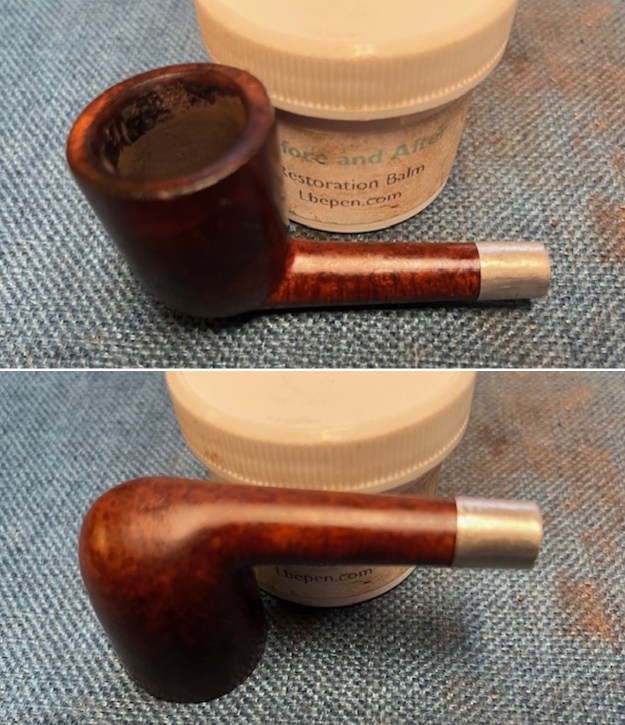
Repairing a Broken Tenon and Restoring A Ben Wade Golden Matt Handmade Freehand


Blog by Steve Laug

To me there is something almost electric about handling and working on a pipe designed and carved by Preben Holm. I can’t describe adequately the feeling I have when I turn the bowl and stem over in my hands even before I start working on one of these his pipes. All I know is that there is an energy and fluidity that flows through the pipe because of the way he carved and shaped the briar. He is a master of chasing the grain in the briar. Every time I get a chance to work on one I am excited about the possibility. So, a few weeks ago when I got an email from a reader of the blog about his Ben Wade, Preben Holm pipe it was with no hesitation that I accepted working on it. I have included that email below along with a photo I asked him to send me to see the pipe.

I wondering if you can find me a replacement pipe stem for my Ben Wade pipe. Dropped my pipe and broke it. — TomThis Ben Wade Golden Matt was no exception to my experience with Ben Wade pipes. Tom sent it to me and today it arrived. I was excited to be able to work on it. This one has incredible grain around the bowl sides and shank. The bowl had a very thick cake on the walls. The plateau on the rim top is filled with tars and lava but it is a large top. The shank end also has a plateau finish. It is very unique pipe. The combination of dark and medium stains highlights grain that runs like flames across both sides of the bowl culminating at the flat heel of the bowl. The rim top is plateau and it looks quite unique – with the valleys and hills in the top and also something that looked like it had been wire brush. The variegated copper, brown and gold acrylic stem is beautiful and the turning of acrylic give it an amazing look. The tenon is broken off and fortunately the piece has been pulled from the shank. It is a smooth break which makes things easier. There were tooth marks on the top and underside of the stem ahead of the button. I took photos of the pipe to try and capture what it looked like before I started working on it. It really is a beauty in spite of the grime in the finish. I took some time to really examine the condition of the pipe. I made some notes of what I saw. It is clear to me that this is one of Tom’s favourite pipes as you can see from the thick cake in the bowl and the lava on the rim top. It is hard to know the condition of the inner edge of the bowl due to the lava on the edges. The outside of the bowl and plateau portions are dirty and dusty but the grain pops through. The fancy acrylic turned stem still had a faint BW Cross and Crown logo on the top just past the fancy turnings. The stem as a whole was dirty and dusty with tooth marks and chatter on the both sides ahead of the button. I took a photo of the stamping on the underside of the shank to capture all of the stamping. It was clear and read Ben Wade in script at the top [over] Golden Matt [over] Hand Made [over] in [over] Denmark. Though the photo is a bit blurry the stamping is much clearer in person.I wanted to get a sense of the background of the pipe. I always enjoy the background as a part of my work on a pipe. I am including the history that I included in a previous blog. It includes the idea that the Preben Holm pipes were marketed under the Ben Wade label in the US and imported through Lane Ltd. I turned to Pipedia and read the listing on the brand to refresh my memory and flesh out the knowledge of the brand (https://pipedia.org/wiki/Ben_Wade). I have included a photo from that site that was taken from a Tinderbox advertisement. The pipe labelled D in the advertisement is a Ben Wade Golden Matt Freehand.

Ben Wade Ad in a Tinder Box catalogue, courtesy Doug Valitchka

I quote the portion of the article that summarizes the history of the brand.

Young Copenhagen master pipemaker Preben Holm had made a meteoric career heading a pipe manufacture employing 45 people at the age of 22! But around the turn of 1970/71 he was in major financial difficulties. His US distributor, Snug Harbour Ltd. in New York City, left him in the lurch. Holm had three unpaid invoices on his desk and another large shipment was ready for the USA, when Snug Harbour’s manager told him on the phone that there was no money at all on the account to pay him.

So, the Dane went to New York for an almost desperate search for a new distribution partner. He made contacts with Lane Ltd. and met Herman G. Lane in February 1971. Lane Ltd. had no interest in Holm’s serial pipes produced at that time but so much the more in the hand-carved freehands because the hype for Danish freehands and fancies in the States was still on its way to the climax then. The meeting resulted in an agreement to start a cooperation. Lane insisted to improve the quality considerably and in return he assured to be able to sell essentially larger quantities.

Holm went back home to work on new samples with all-new designs and altered finishes for Lane. Both, Lane and Holm, agreed that it would be unwise to sell the pipes under Preben Holm’s name as long as Snug Harbour had a considerable stock of Preben Holm pipes and might sell them pipes at very low prices just to bring in some money.

So, on Mr. Lane’s proposal it was determined to use the name Ben Wade belonging to Lane Ltd. Lane spent considerable amounts of money for advertising the new brand in the big magazines– the centerpiece being whole-page ads showing a very exclusive Seven Day’s Set.

The cooperation with Lane Ltd. proved to be an eminent business success for both partners. Within a very short time Ben Wade Handmade Denmark sold in much larger quantities and at higher prices than they had ever dreamed of. And the hype these freehands and fancy pipes caused went on unbroken long after Herman G. Lane deceased. Preben Holm – obviously much more brilliant in pipe making than in pipe business – was in major troubles again in 1986 and had to sack most of his staff. The Ben Wade production was significantly lowered but continued until his untimely death in June of 1989.

Up to now Preben Holm made Ben Wade pipes are cult and highly sought for on the estate markets.

This pipe was another Preben Holm made Freehand distributed in the US by Lane Ltd under the name Ben Wade. The freehand rage occurred in the late 70s and the pipes were made until Preben’s death in 1989. My guess would be that this pipe was made sometime during that time period and potentially in the late 70s.

Armed with that information I moved forward to work on the pipe itself and see what I had to do with it. I reamed the pipe with a PipNet pipe reamer using the second and the third cutting head to take the cake back to bare briar. I cleaned up the remnants of the cake with a Savinelli Fitsall Pipe Knife. I finished the bowl internals by sanding the bowl walls with 220 grit sandpaper wrapped around a piece of dowel. The bowl walls looked very good with no checking or cracking to the walls. I worked over the rim top with a brass bristle wire brush to knock off the loose debris on the rim top. I worked it over to clean out the grooves and valleys of both the plateau top and the wire marks across the surface of the rim. It really is a beautiful pipe and a unique looking rim top finish. It cleaned up quite well.With the internals of the bowl cleaned I worked on the airway in the shank, mortise and the stem. I cleaned it with pipe cleaners – both regular and bristle, cotton swabs and 99% isopropyl alcohol. I was able to remove a lot of the debris and oils in the pipe. It smells much better. Now that the reaming and scrubbing of the interior was finished, I moved on to the exterior of the pipe. I scrubbed the plateau rim top and shank end along with the smooth bowl with undiluted Murphy’s Oil Soap and a tooth brush. The grime and oils just rinsed off under the warm water that I ran over the finish. I dried it off with a soft cloth and I was please with how clean it was and how the grain stood out. I sanded the briar with 320-3500 grit sanding pads. I wiped the briar down after each sanding pad with a damp cloth to remove the debris that was left behind. By the time I finished the last pad the briar was very smooth and clean to the touch. I polished the briar with micromesh sanding pads – dry sanding with 1500-12000 grit sanding pads. I wiped it down with a damp cloth after each sanding pad. The bowl began to really shine with the polishing. I worked some Before & After Restoration Balm into the finish of the smooth briar with my finger tips. I worked it into the plateau on the rim top and shank end with a horse hair shoebrush. The product works well to clean, enliven and protect the briar and really brings it back to life. I have been using it for quite a few years now and really like the way it makes the briar come alive and makes the grain pop. The bowl is finished and really looks amazing. All that remains is that I have to polish it on the buffer. I set it aside and turned my attention to the broken tenon. I went through my collection of tenons and found a couple that would work. The difference was in the diameter of the portion of the tenon that went into the stem.I chose the top one in the photo above as the tenon insertion point was smaller in diameter and would fit better in the stem. I used a Dremel and sanding drum and 220 grit sandpaper and a topping board to flatten the broken end on the snapped tenon. I wanted a flat surface to be able to drill the airway for the new tenon.Once it was flattened I used progressively larger drill bits to open the airway.  By the third drill bit the opening was perfect for the diameter of the tenon insert end. I smoothed out the junction of the tenon and the stem using a flat file and the transition was very smooth. I flattened the threads of the insert end with the file at the same to make the fit snug. I knew that once I glue it in place it would be secure and strong.I painted the end of the threaded portion of the tenon with rubberized black CA glue. I inserted a pipe cleaner in the stem and threaded the new tenon onto the pipe cleaner. Once everything was aligned I pressed the tenon in place in the stem end. It aligned perfectly with the pipe cleaner as a guide.Once the glue had set and the tenon was firmly in place I sanded it with 220 grit sandpaper to achieve a snug fit in the shank.I touched up the Cross & Crown stamp on the top of the stem with Rub’n Buff Antique Gold and buffed it off with a cotton pad. It was faint but it was readable. I sanded the tooth marks and chatter on both sides with the 220 grit sandpaper to smooth out the marks and minimise them. It looked better.I polished the stem with micromesh sanding pads. I used 1500-12000 grit sanding pads. I wiped it down with a damp cloth to remove the sanding debris on the surface of the stem. I polished the new tenon at the same time and both took on a rich shine and looked better. I finished by polishing the stem and tenon with Before & After Pipe Stem Polish and gave it a final wipe with Obsidian Oil. This is a beautiful Hand Made Preben Holm made Ben Wade Golden Matt Freehand with a fancy, turned, variegated acrylic stem. It has a great look and feel. The shape fits well in the hand with the curve of the bowl and shank junction a perfect fit for the thumb around the bowl when held. I polished stem and the bowl with Blue Diamond polish on the buffing wheel. I gave the plateau on the rim top and shank end multiple coats of Conservator’s Wax. I gave the bowl and the stem multiple coats of carnauba wax. I buffed the pipe with a clean buffing pad to raise the shine andwith a microfiber cloth to deepen the shine. The rich combination of browns and black in the smooth finishes and the black plateau areas took on life with the buffing. The rich colour of the briar works well with the polished stem. I like the grain and finished look of this Preben Holm Ben Wade Golden Matt Freehand. Have a look at it with the photos below. The dimensions are Length: 6 ½ inches, Height: 2 ¼ inches, Outside diameter of the bowl: 2 wide x 2 ¼ inches long, Chamber diameter: 7/8 of an inch. The weight of the pipe is 74 grams/2.61 ounces. This Danish Freehand is a real beauty. Thanks for walking through the restoration with me as I worked over another beautiful pipe. It will be heading back to Tom shortly and he will once again have his favourite pipe to enjoy. Thanks for your time.