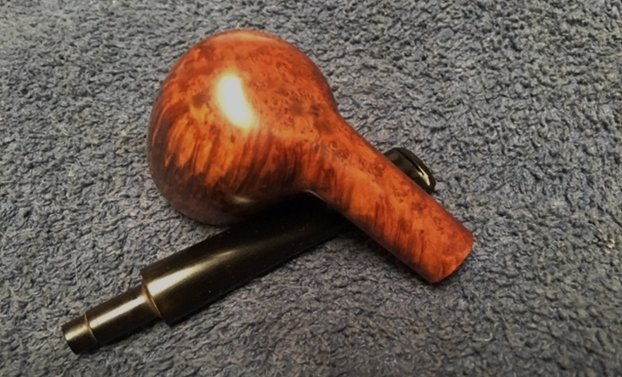
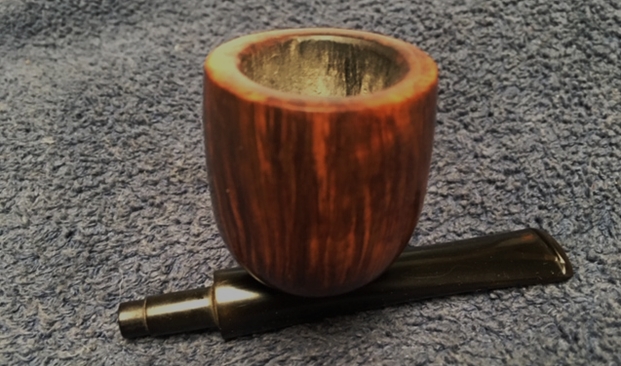
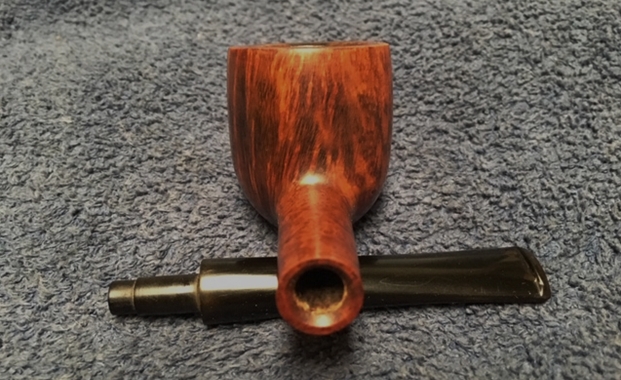
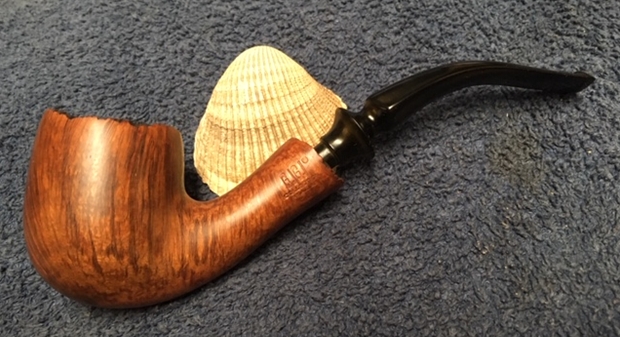
Tag Archives: contrast staining

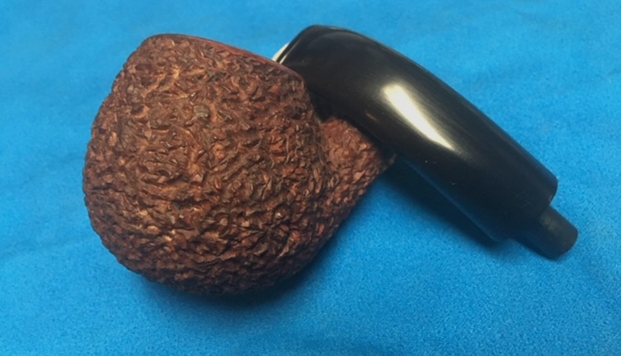
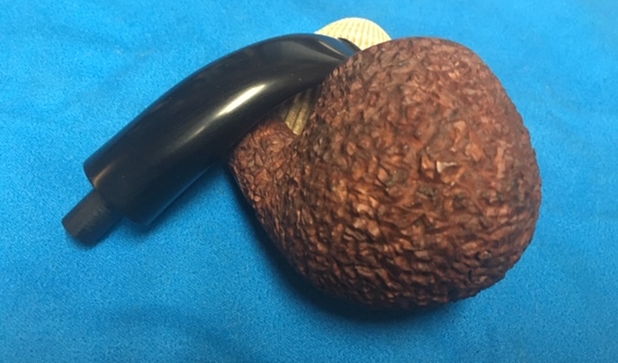
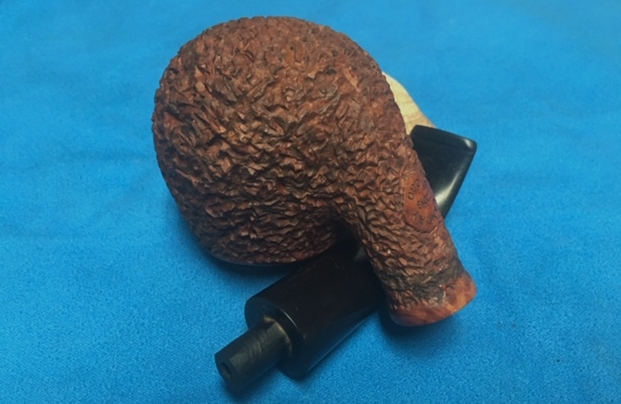
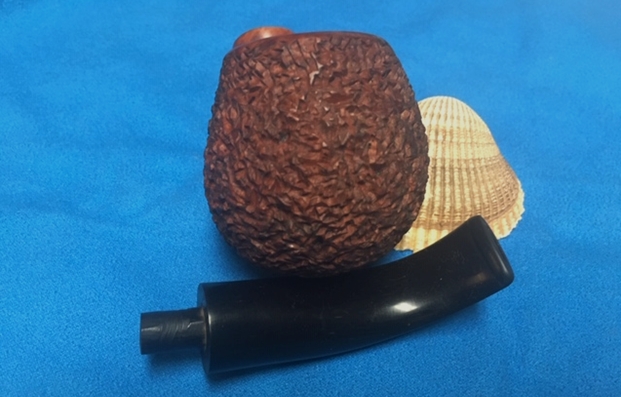
Restemming and Rebirthing a Landry 2013 Bent Ball


Blog by Steve Laug

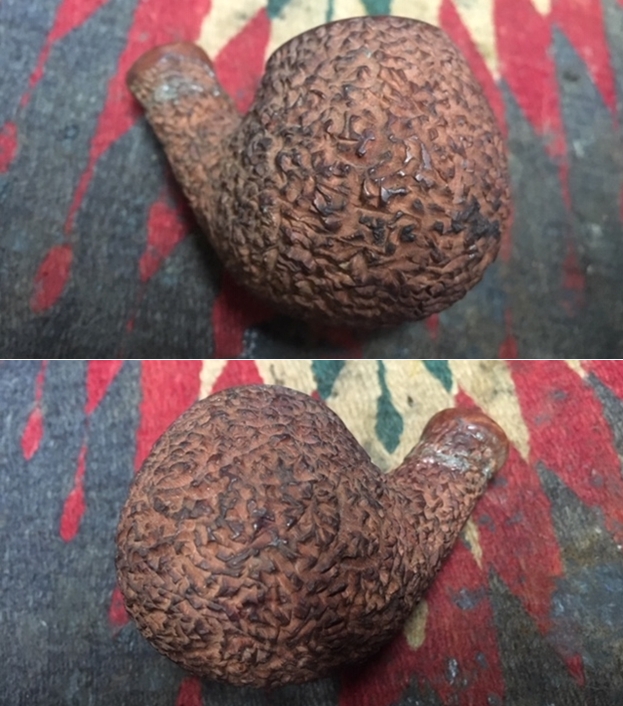
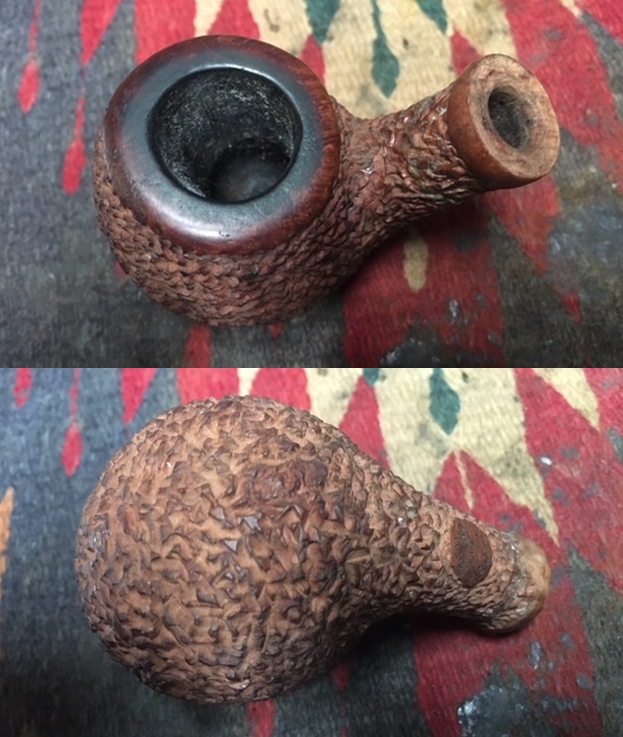
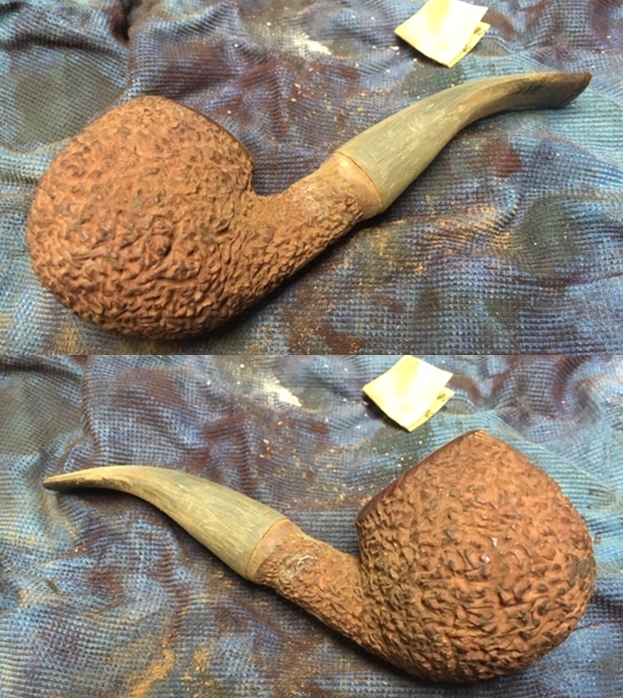
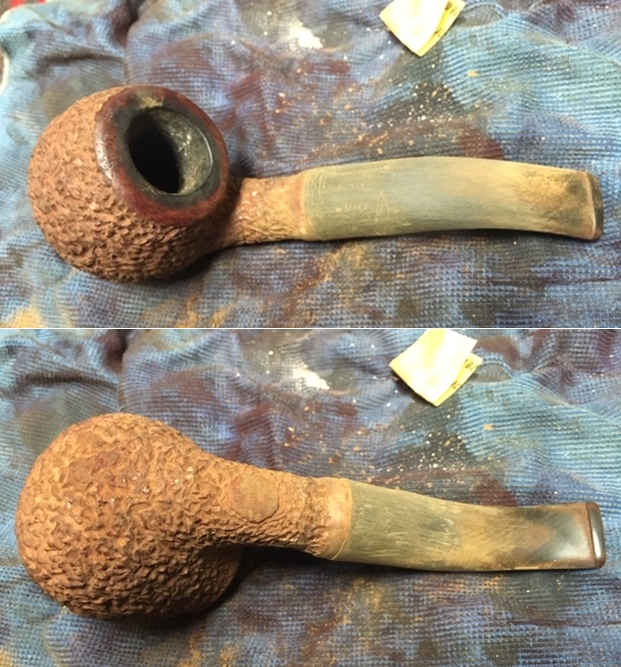
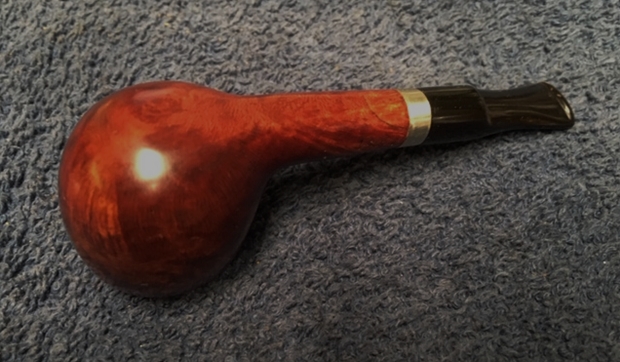
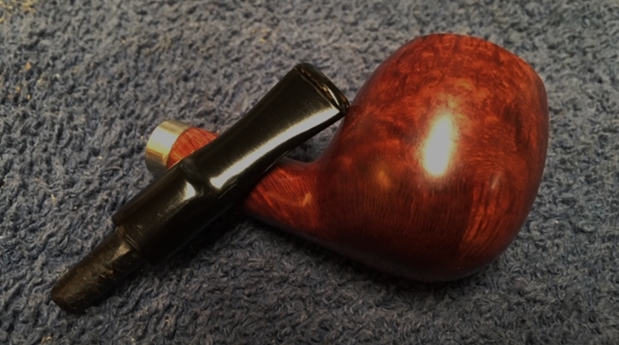
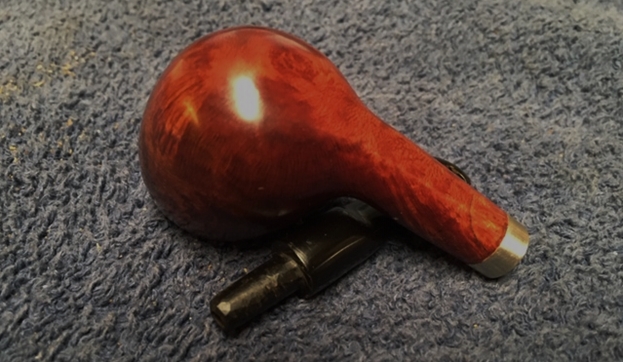
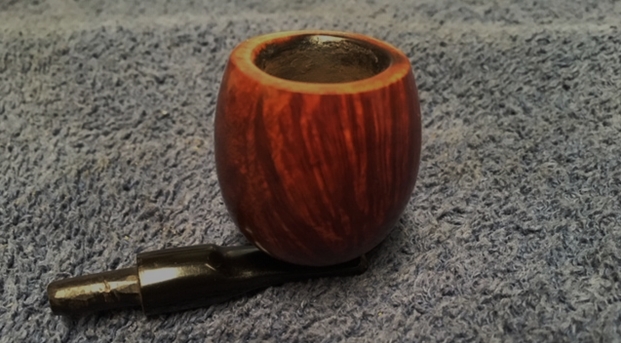
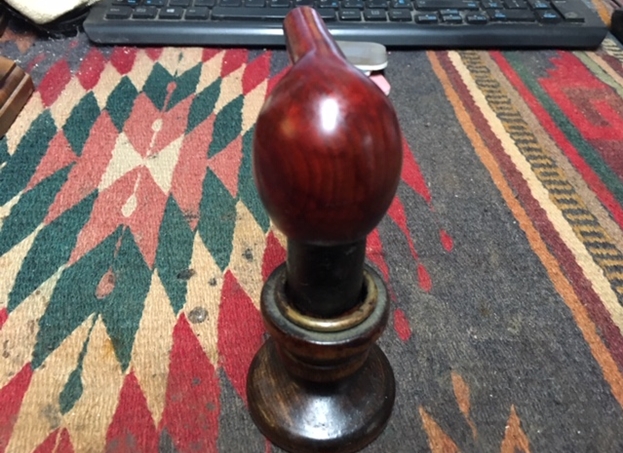
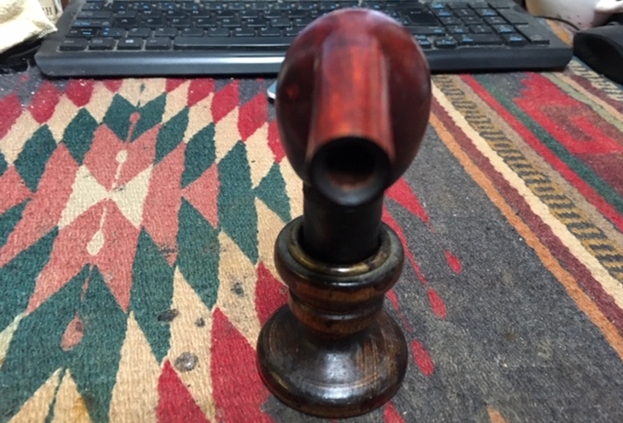
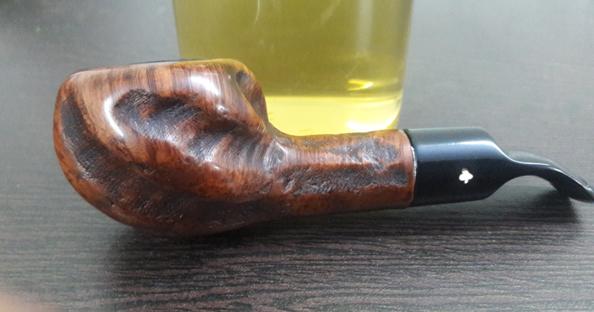
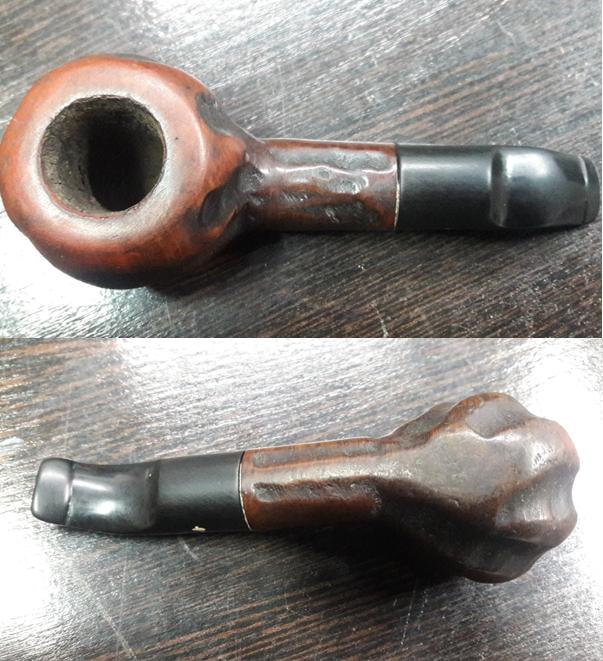
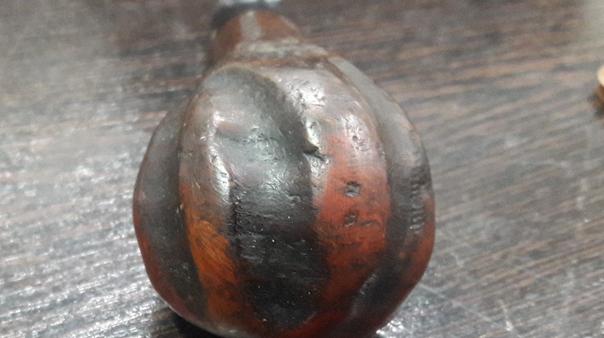
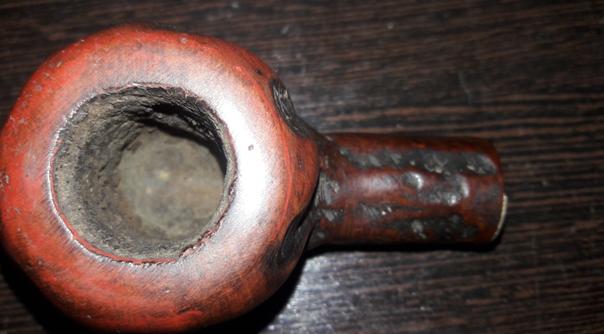
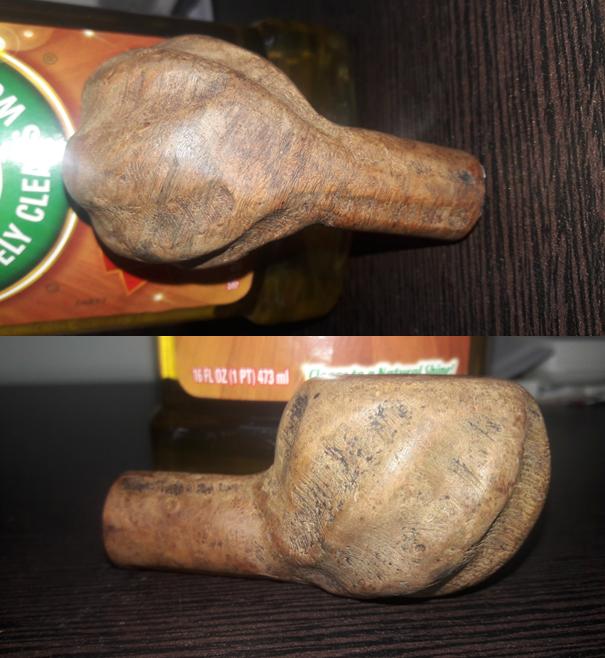
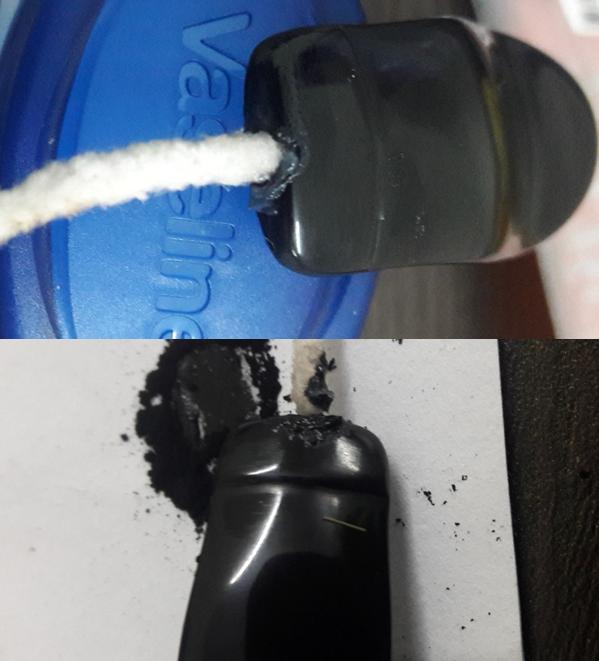
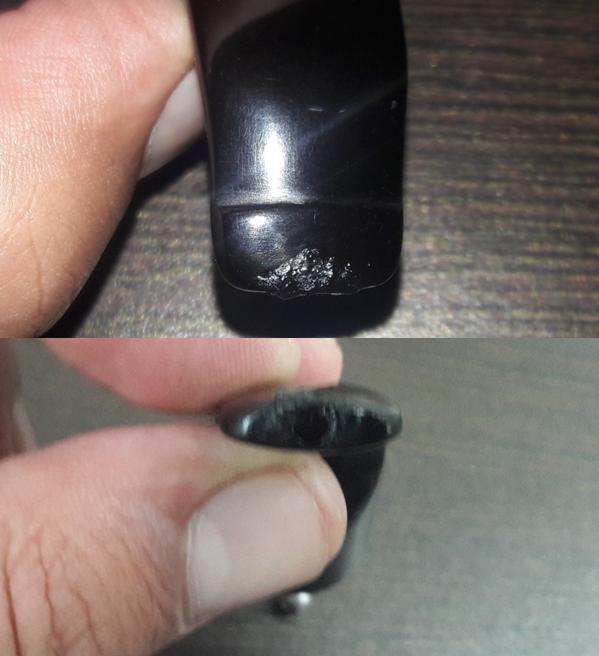
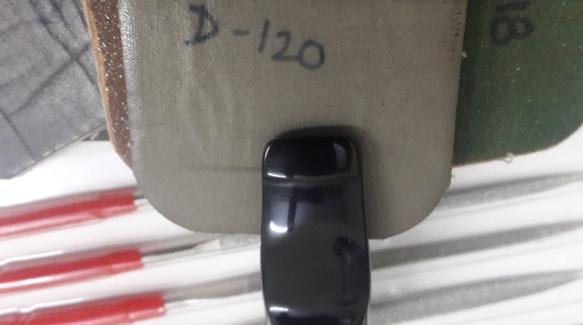
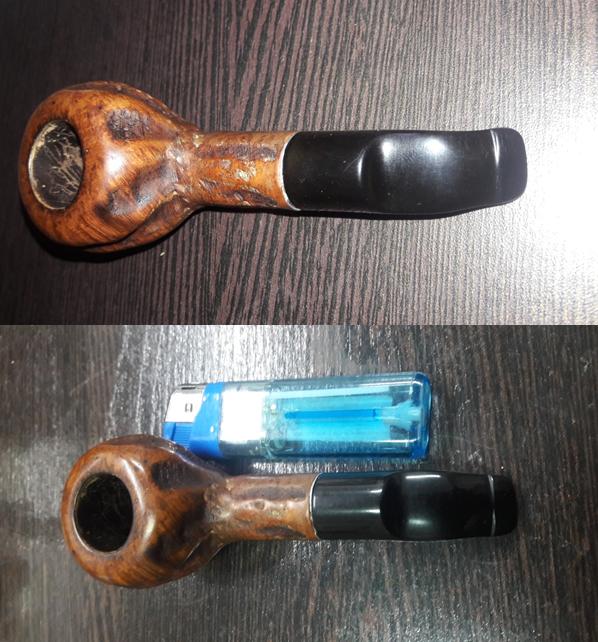
Last evening I had a fellow drop by the house with three pipes for repair. Two of them were not worth repairing – broken shanks and Chinese knockoff pipes. Neither was made of briar and one had the beginning of a large burn out on the back of the bowl. I discouraged the fellow from fixing either of those two as the cost of repair would be more than he paid when he purchased them. However the third one was interesting to me. It was a bent ball bowl without a stem. It was a real mess. He had broken the stem in half and lost it. The shank had also been broken but he was a bit of a wood worker and had clamped and glued it. He had done a decent job and the repair was solid. The bowl had a cake that was thick and soft – made from the heavily case aromatic that he smoked. The airway in the shank was clogged with tars and oils and I could not even blow through it. The rusticated finish was rugged and sharp with a smooth rim and shank band. The bowl and rim were very dirty and the briar looked lifeless. The shank flared at the stem/shank junction.

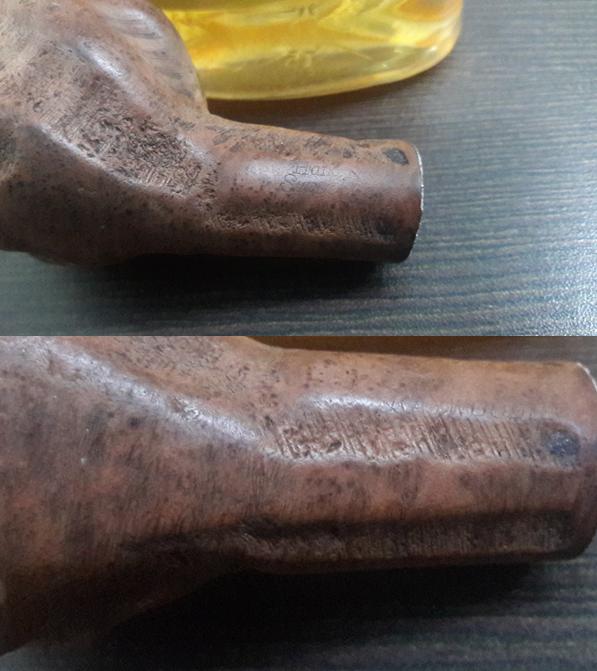
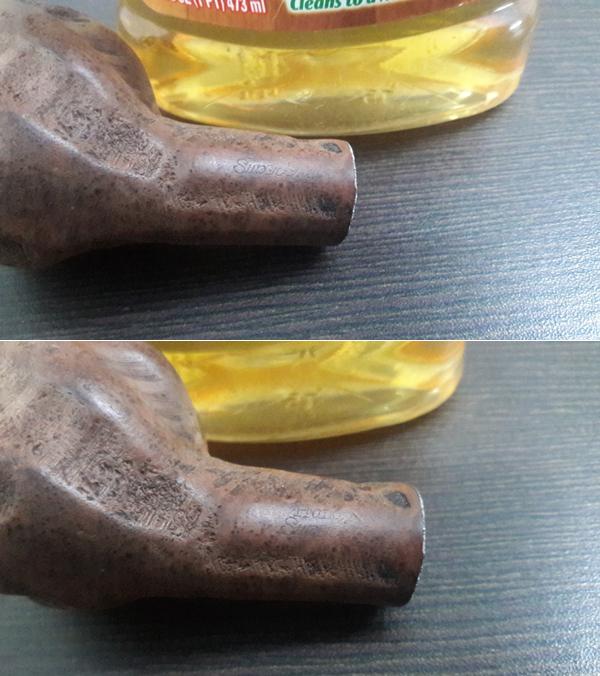
When I examined the pipe while he was there I found that it had a makers stamp on an oval smooth patch on the underside of the shank. It was clearly stamped LANDRY arched at the top of the oval. The year it was made, 2013 was in the middle of the oval and the letters U.I.O.G.D were arched at the bottom of the oval. When I asked the owner of the pipe what those letters were he said that I was some Latin phrase. When I examined it with a loupe I found that there were periods between the letters and that probably I was dealing with an acronym of some kind. I went with his notion of it being Latin, Googled the acronym and found that it stood for the five words making up the Benedictine motto: Ut In Omnibus Glorificetur Dei (translated from Latin it means: So that in all things God may be glorified). That made sense as he had been given the pipe by a Benedictine Priest a while ago when he had first started smoking a pipe and he had broken it after smoking it quite heavily.

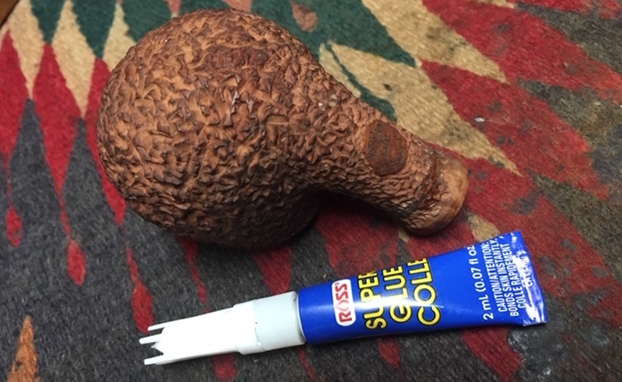
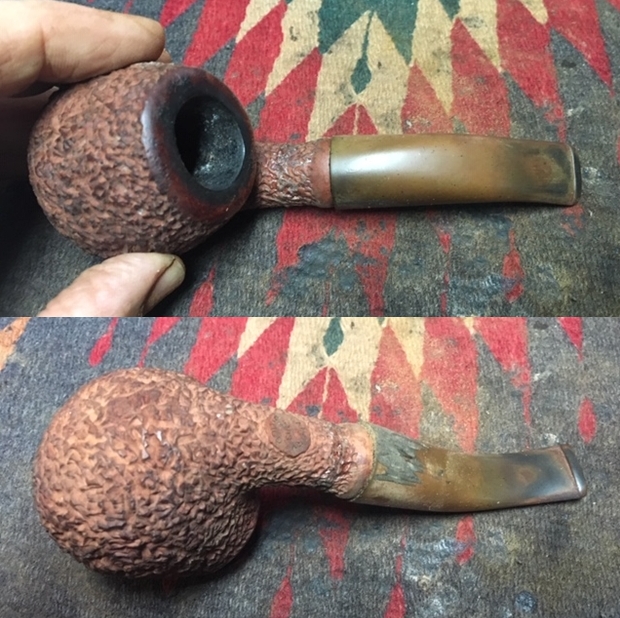
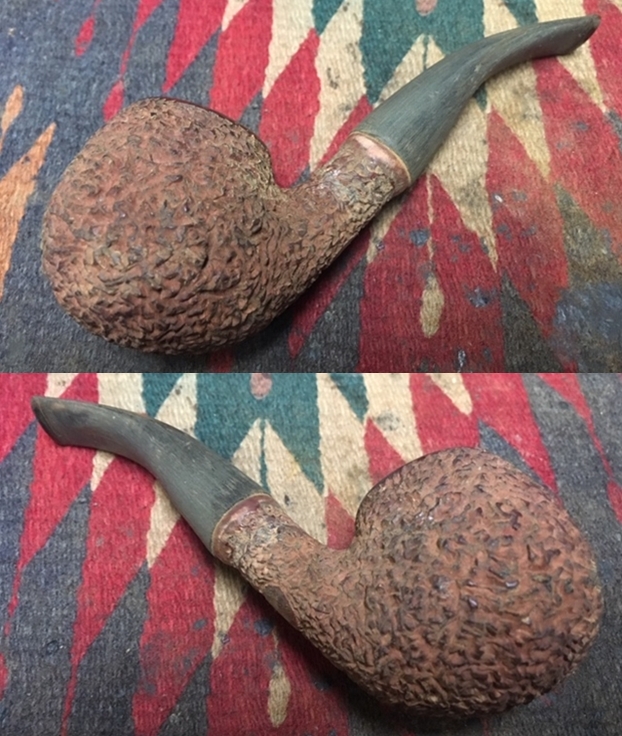
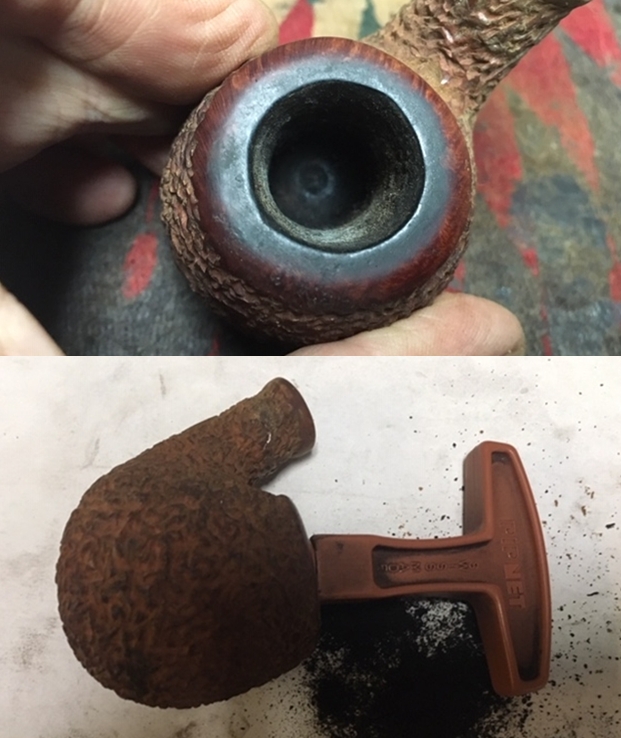
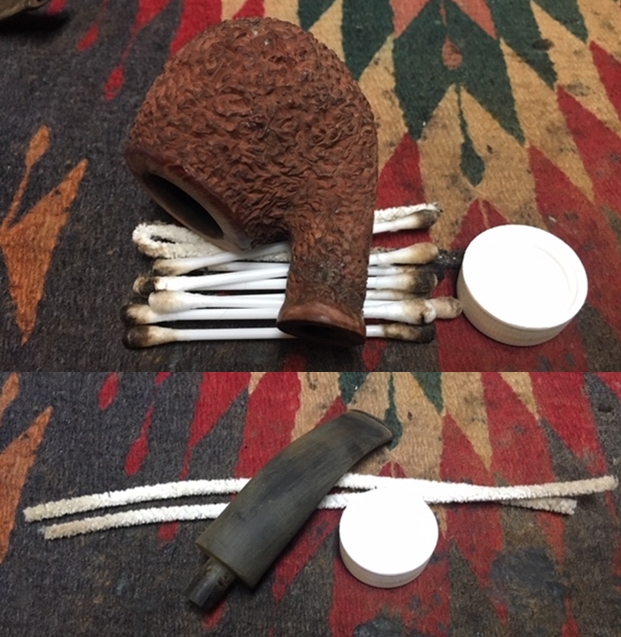
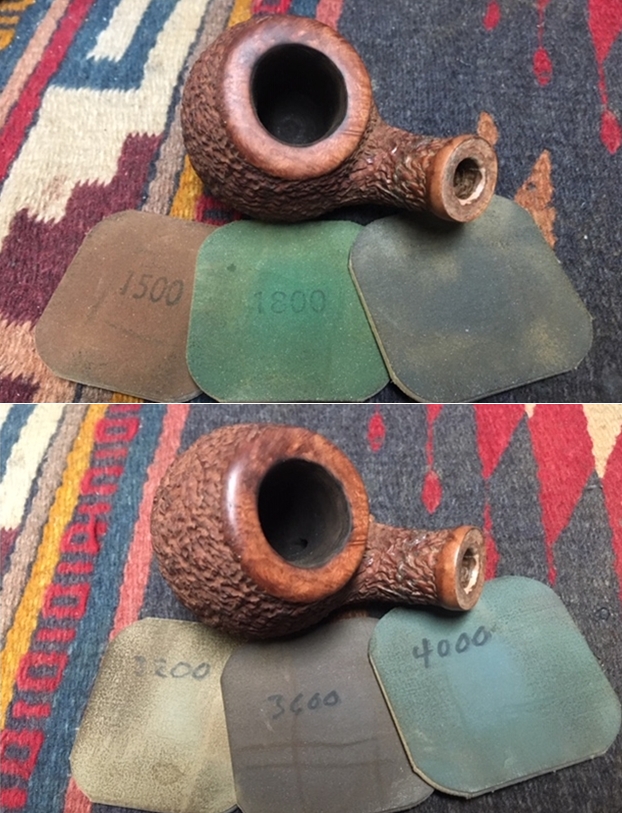
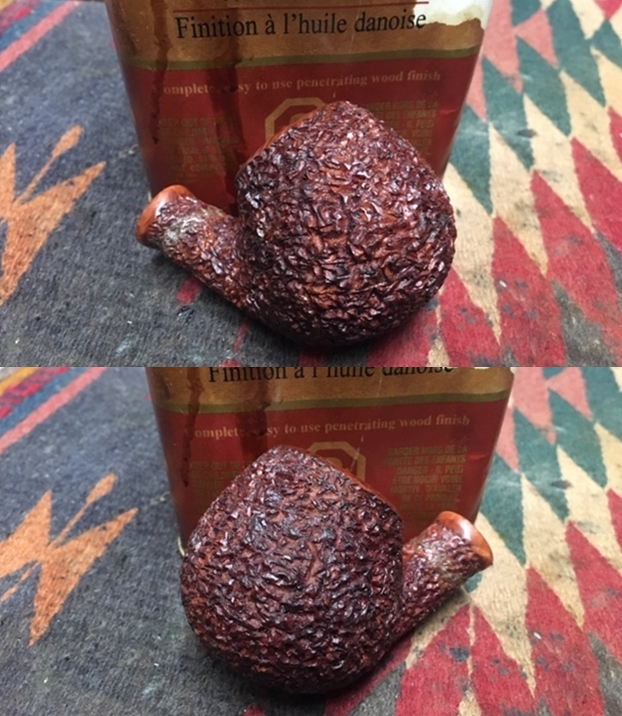
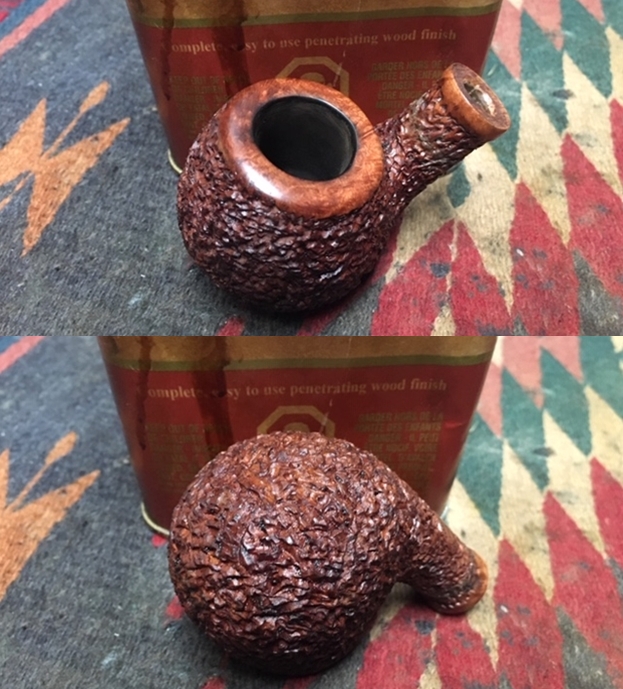
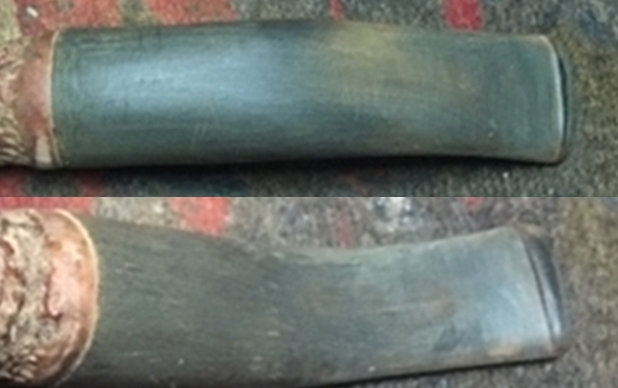
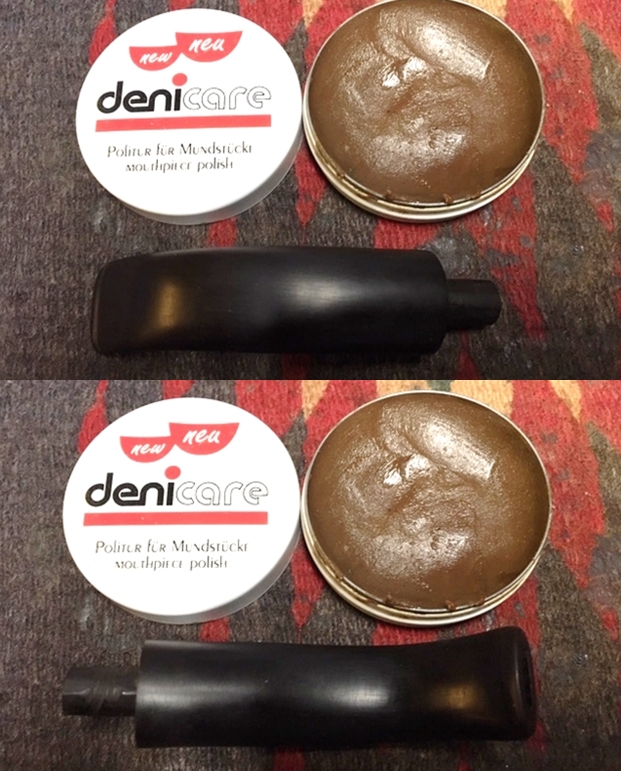
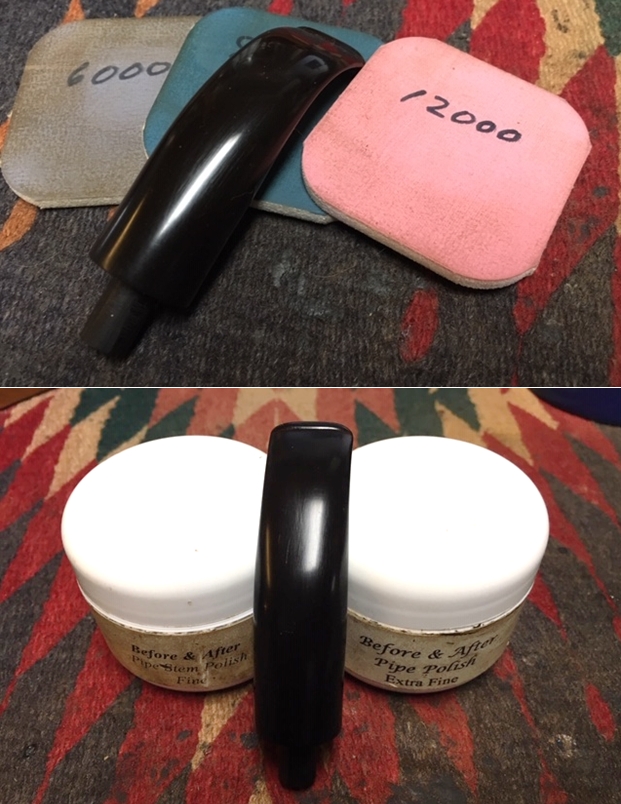
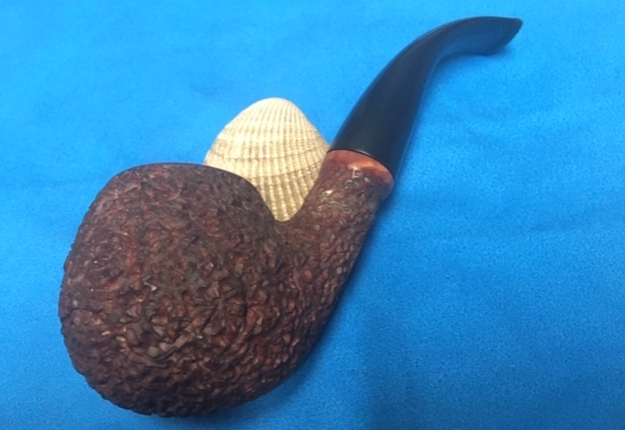
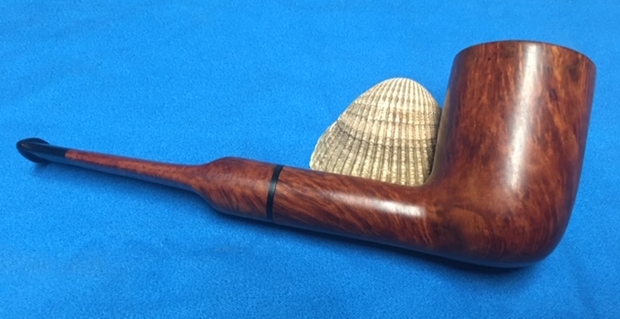
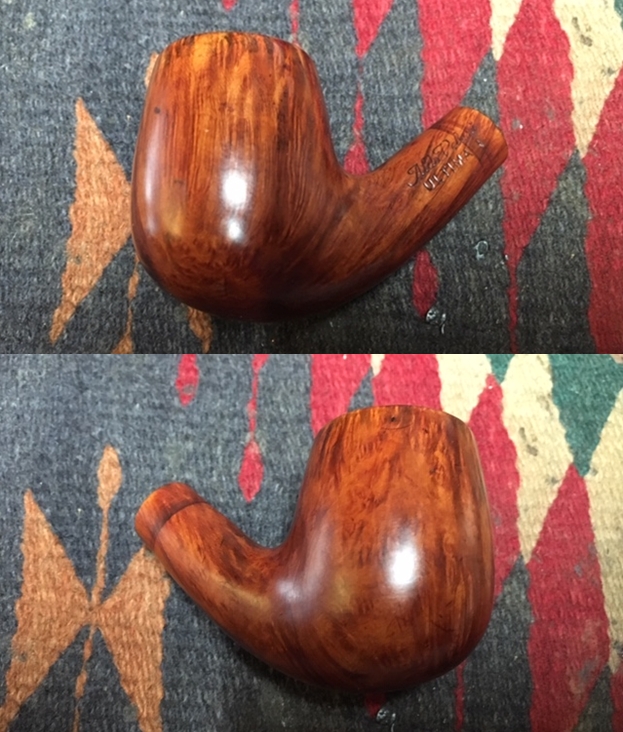
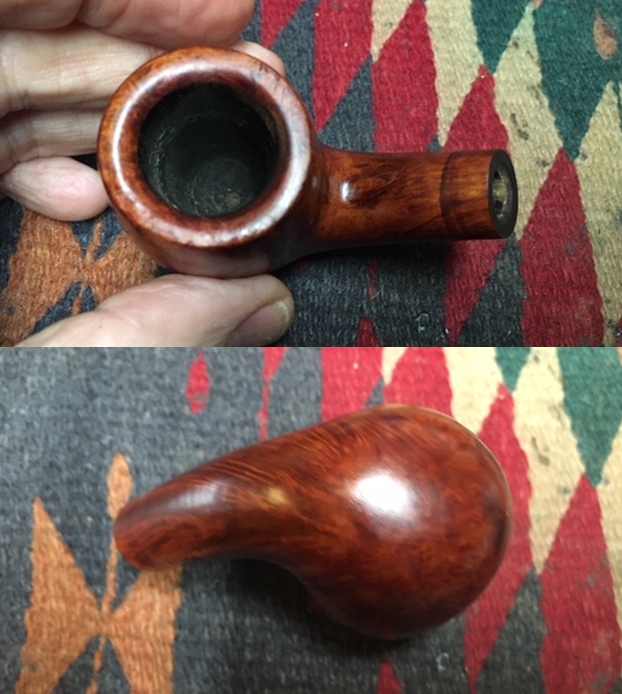
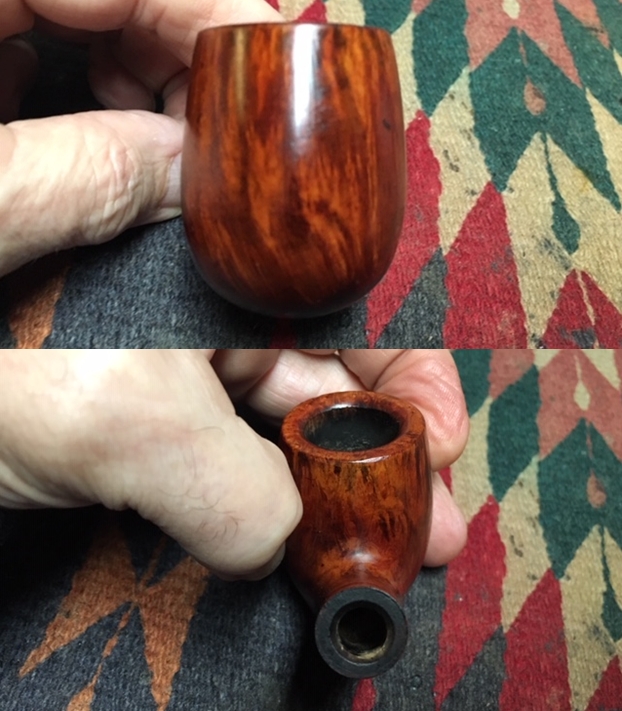
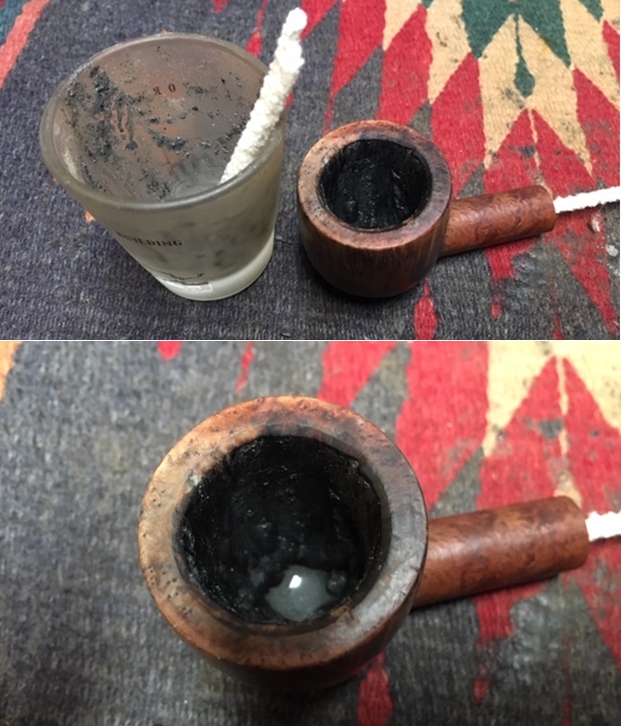
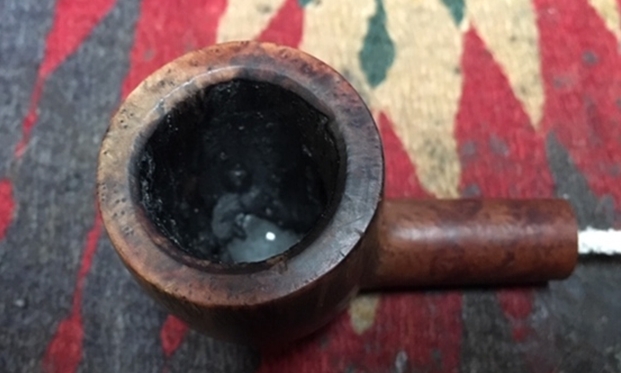
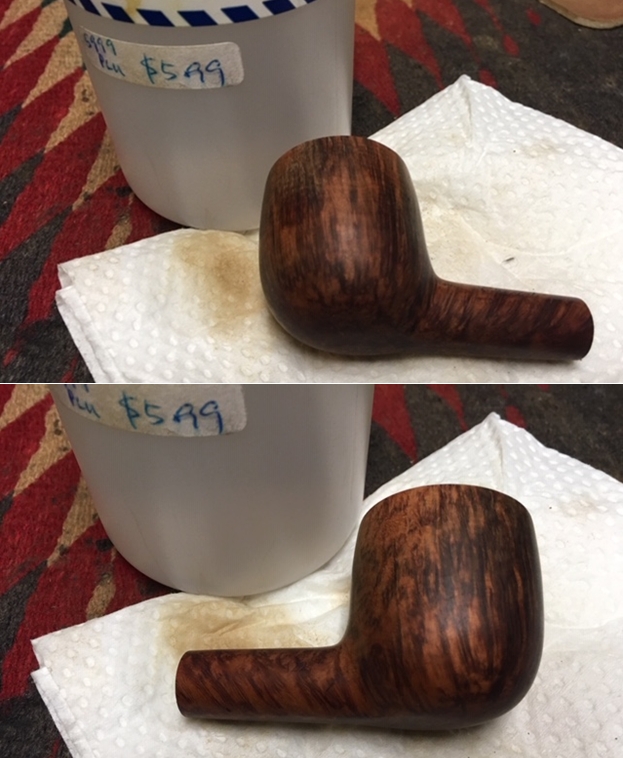
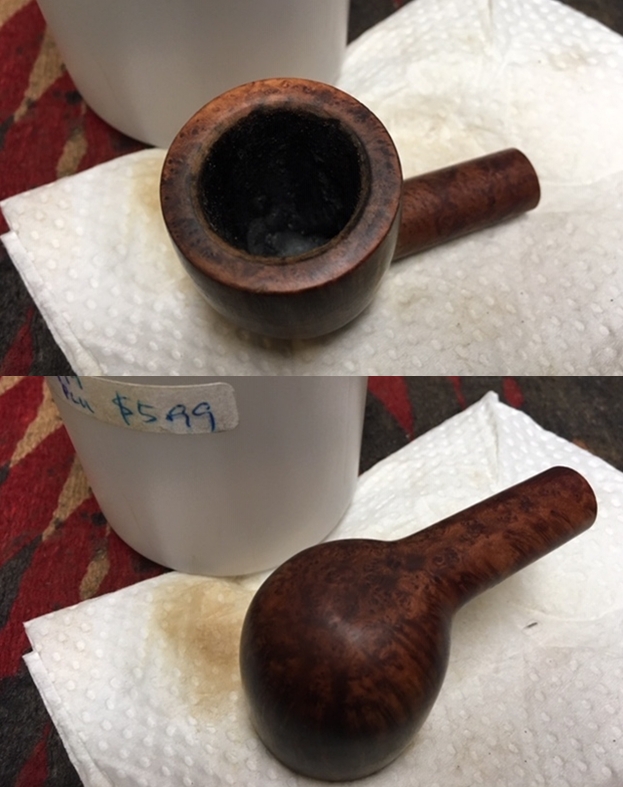
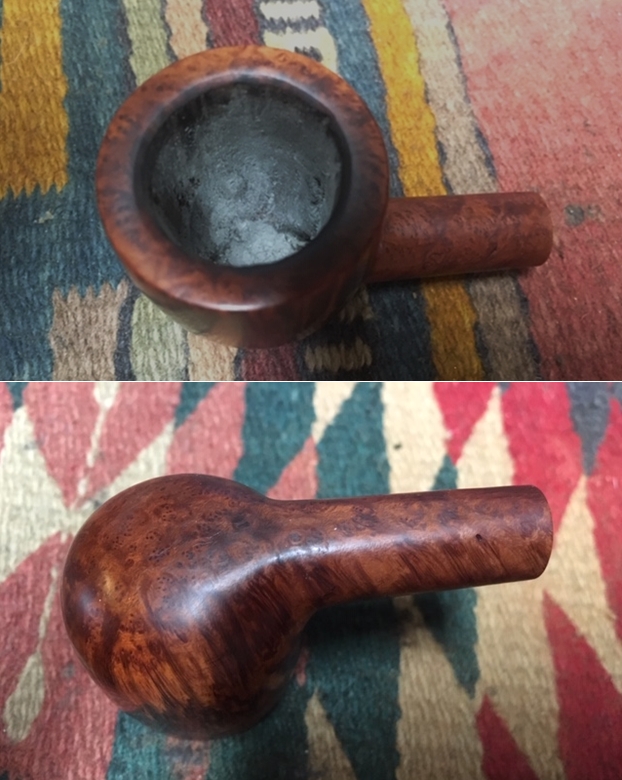
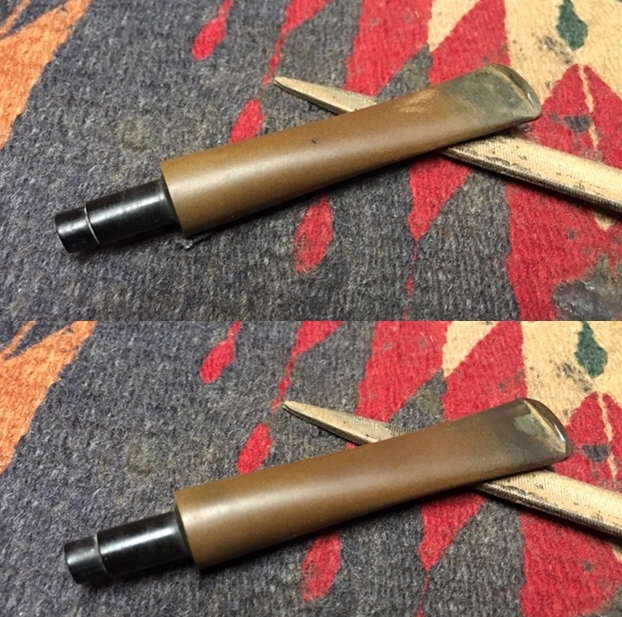
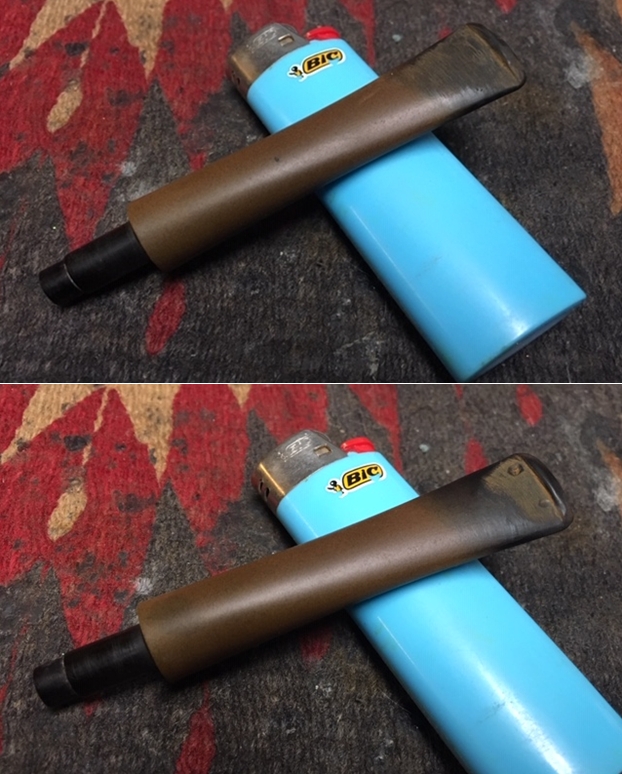
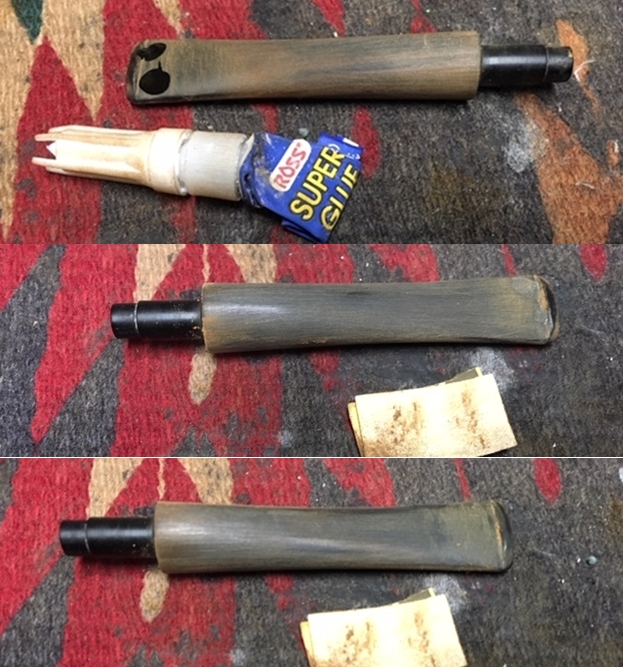
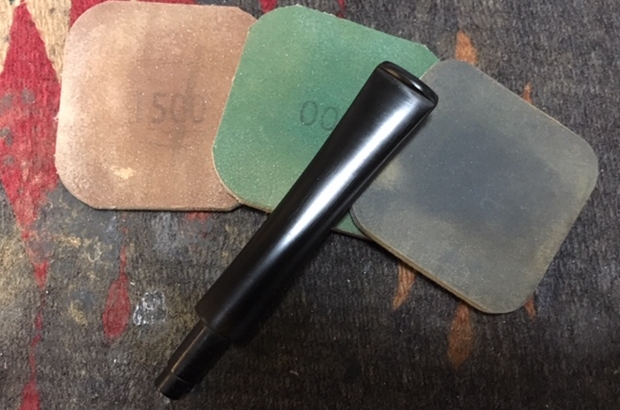
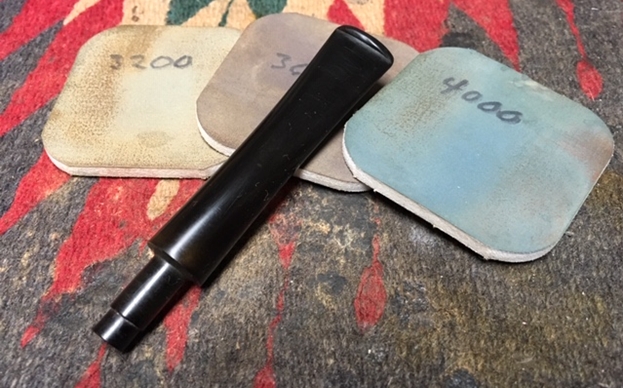
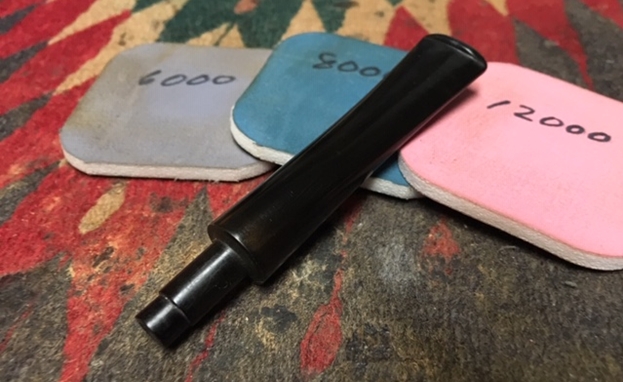
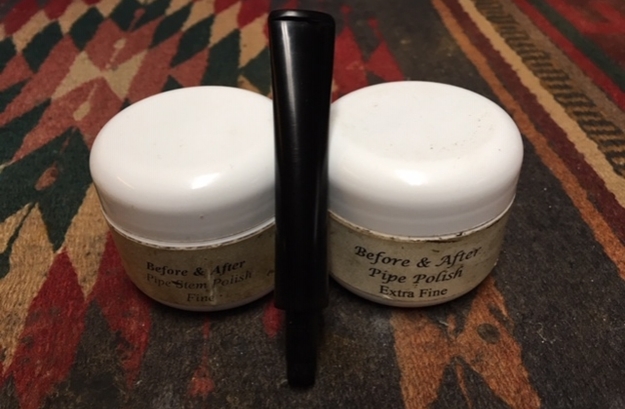
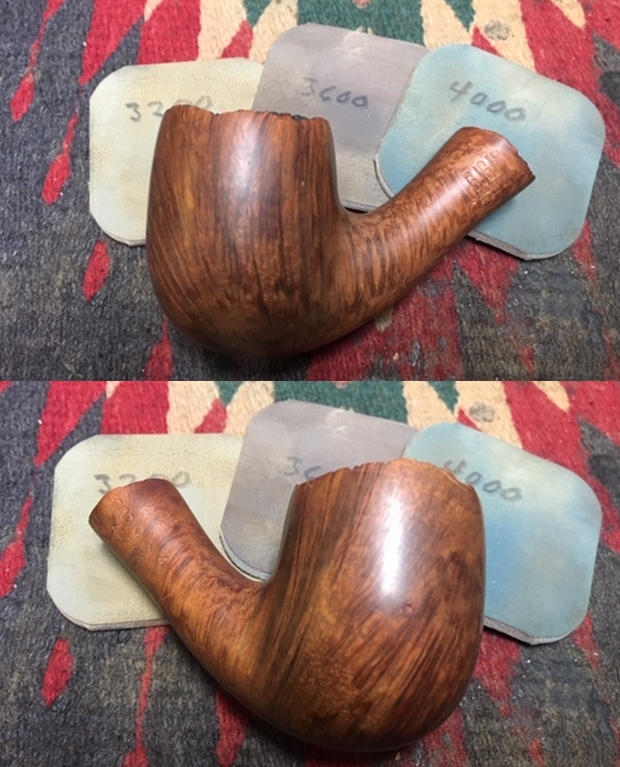
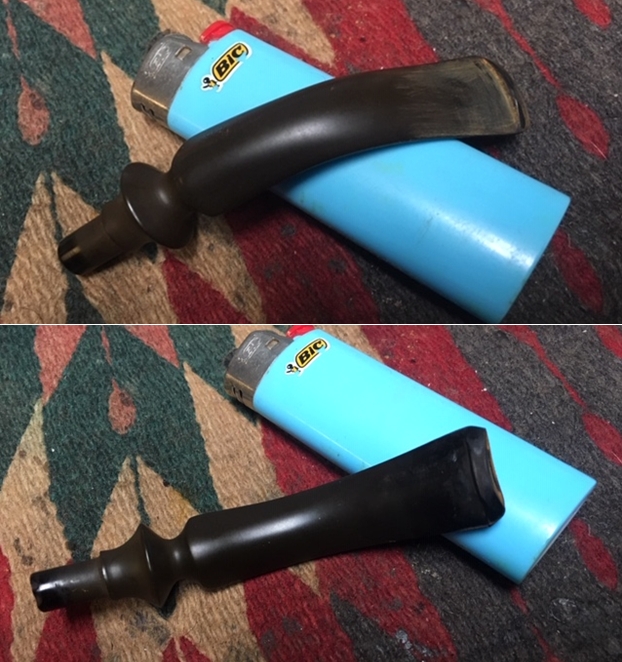
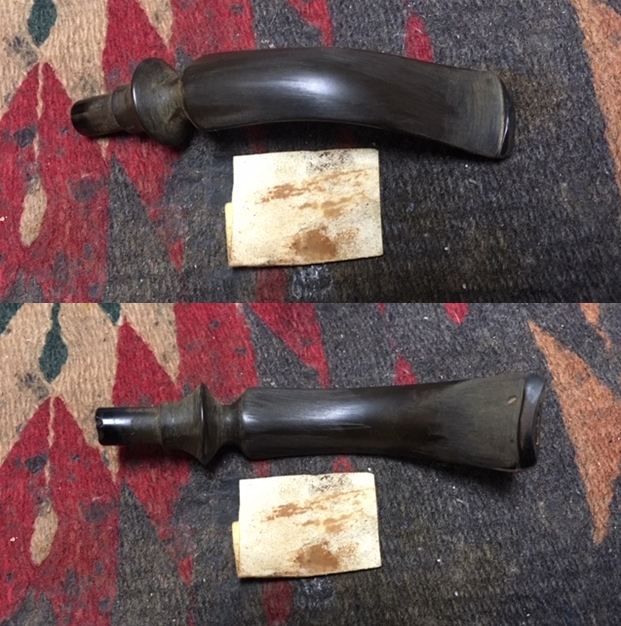
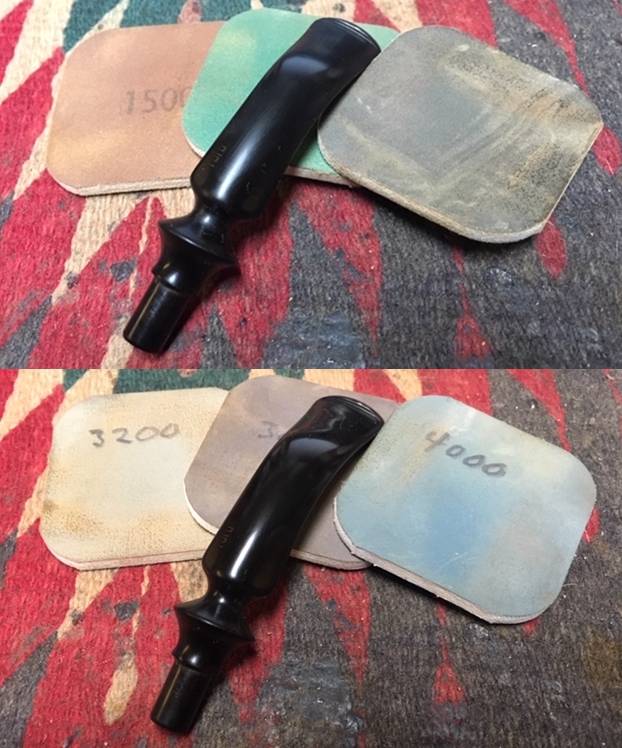
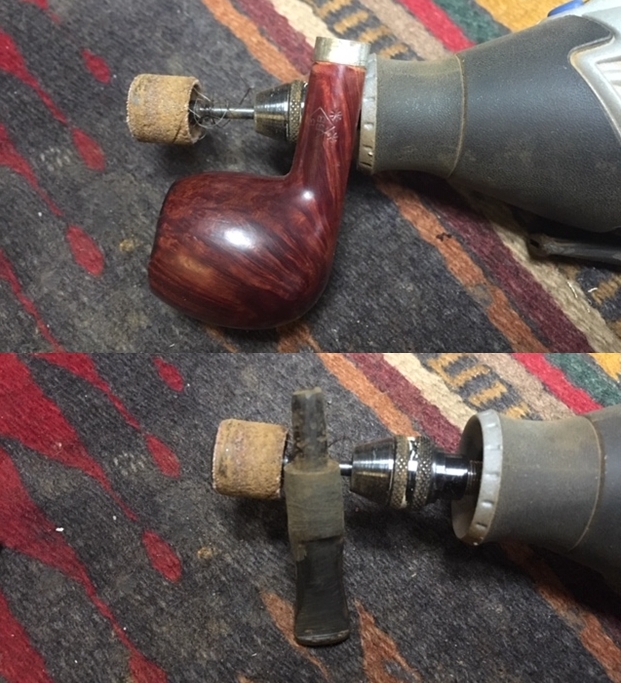
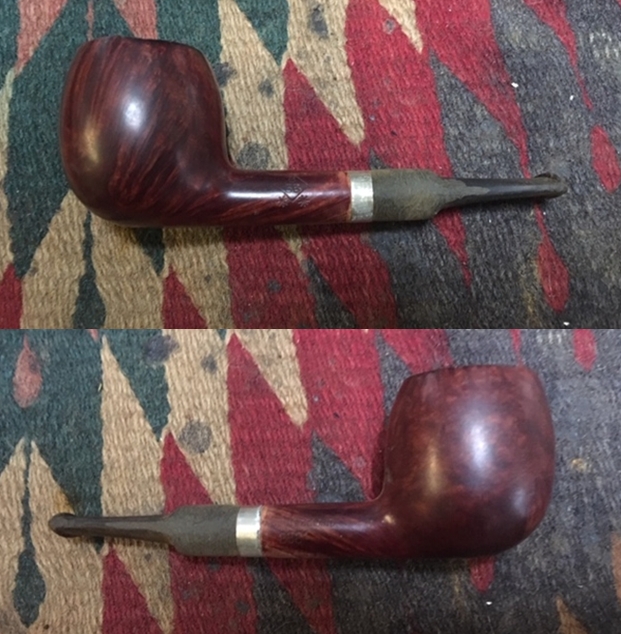
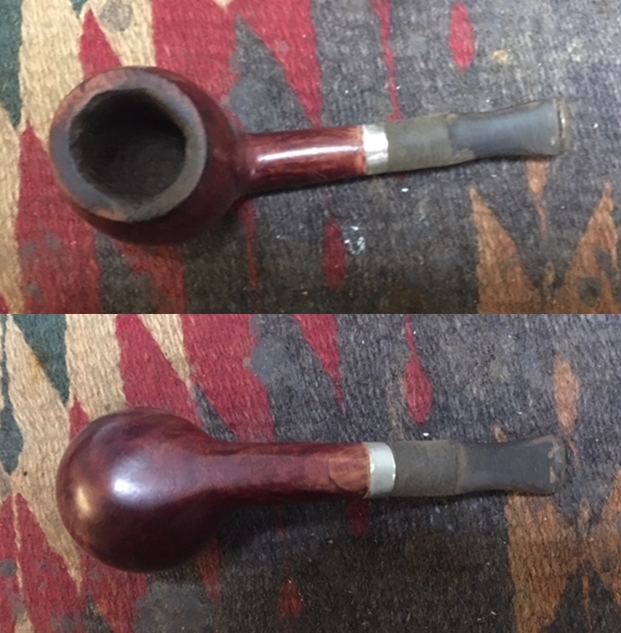
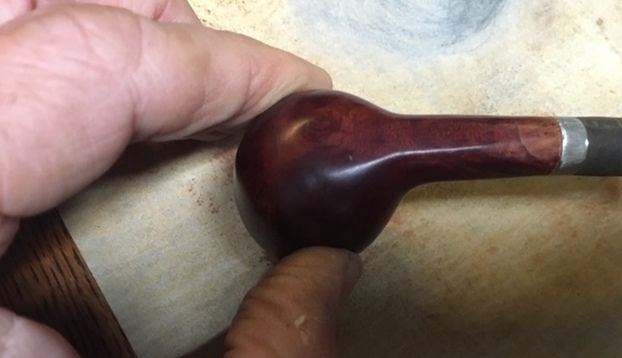
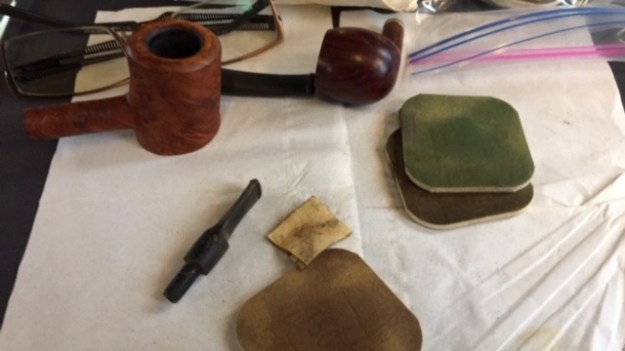
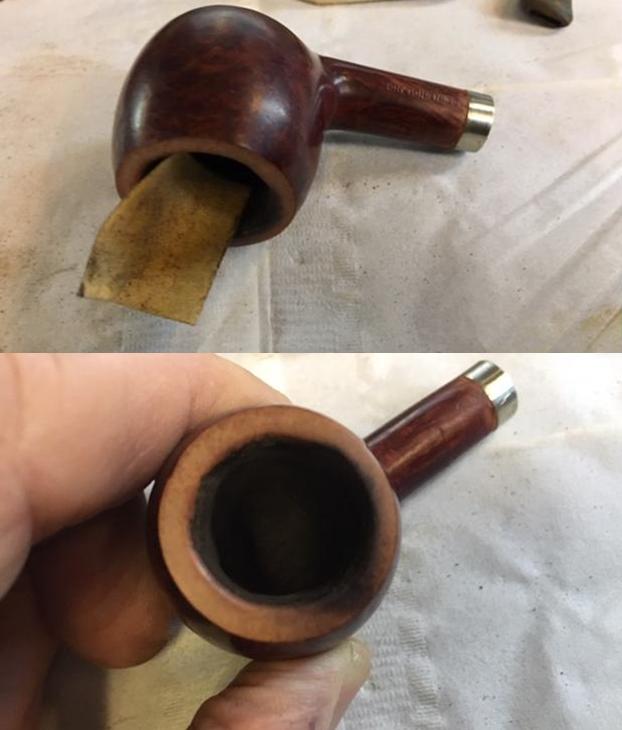
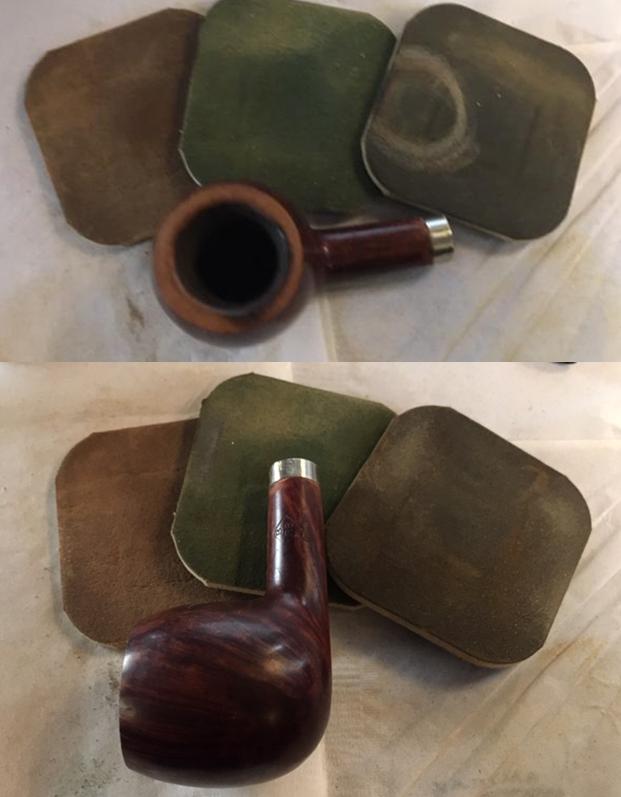
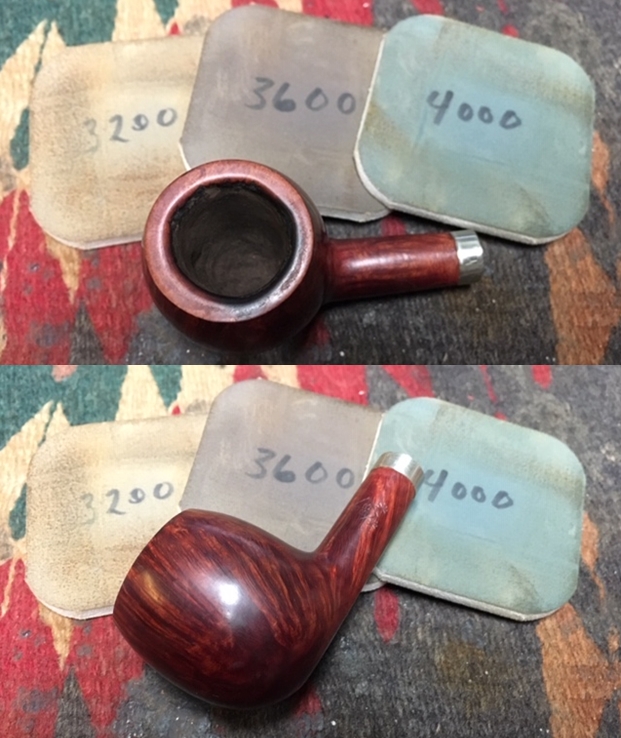
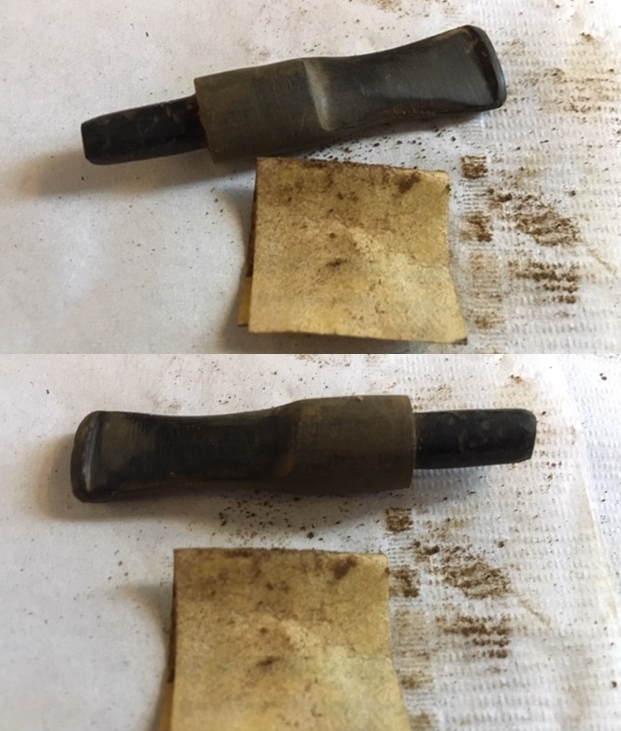
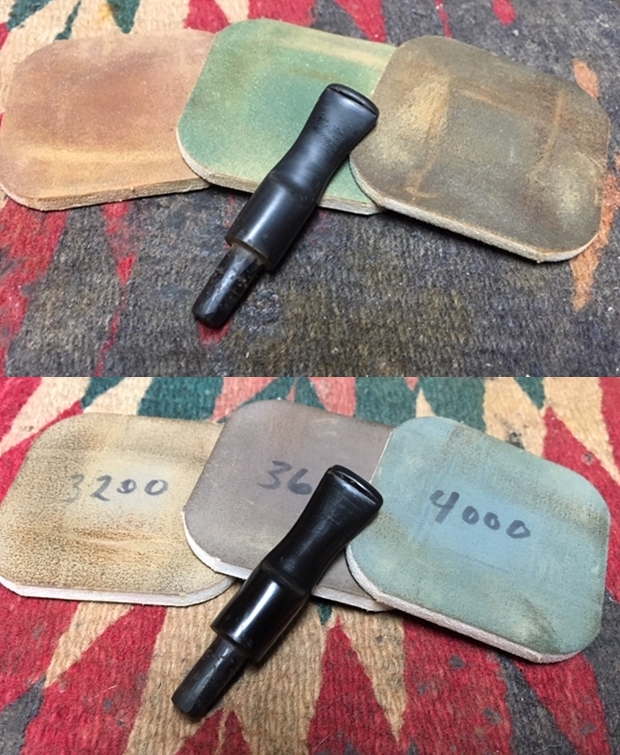
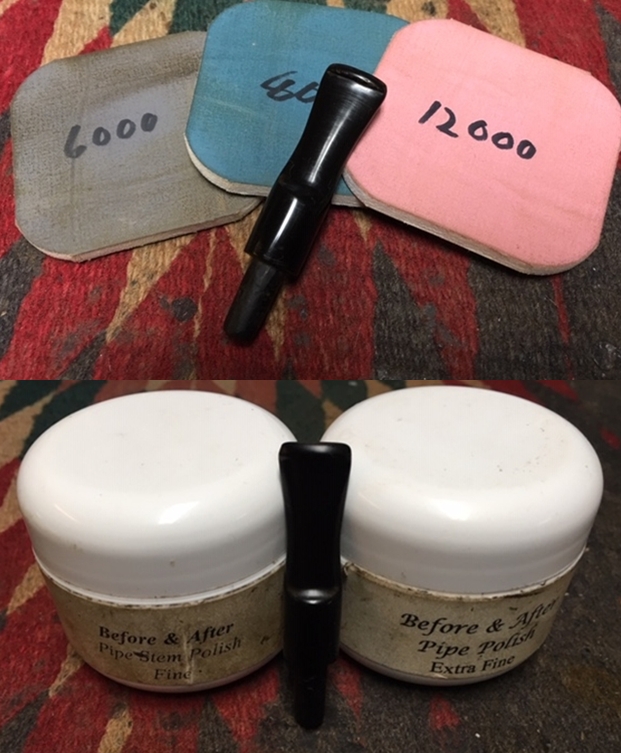
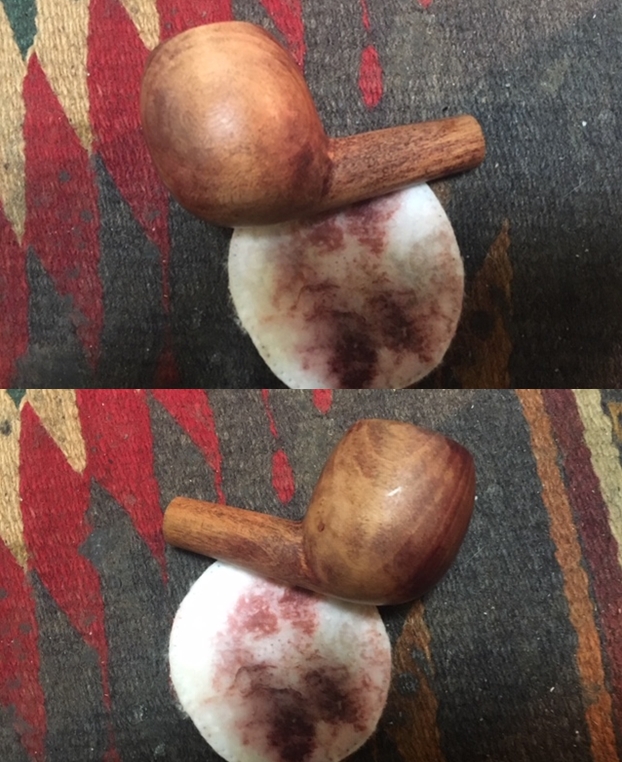
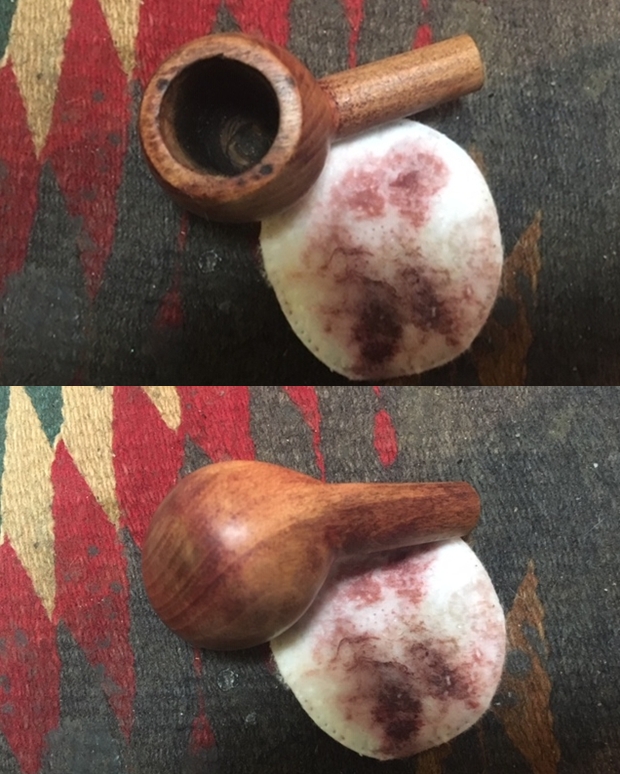
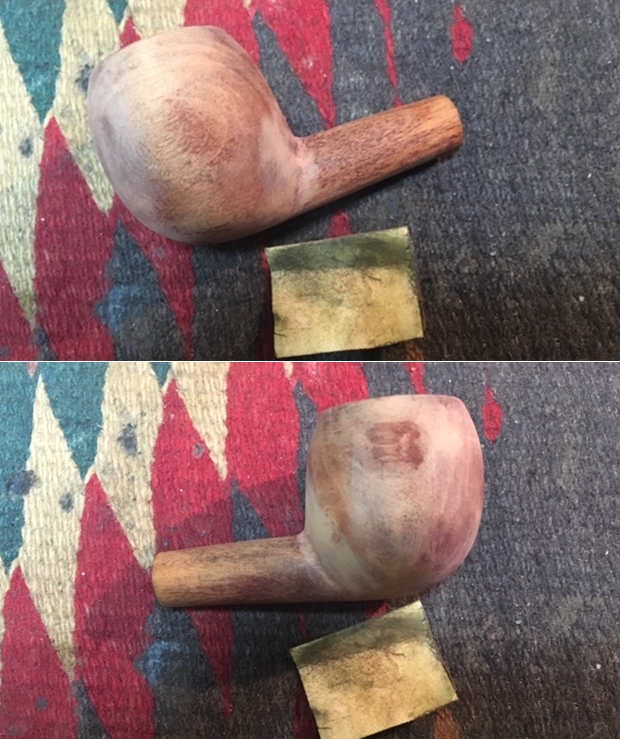
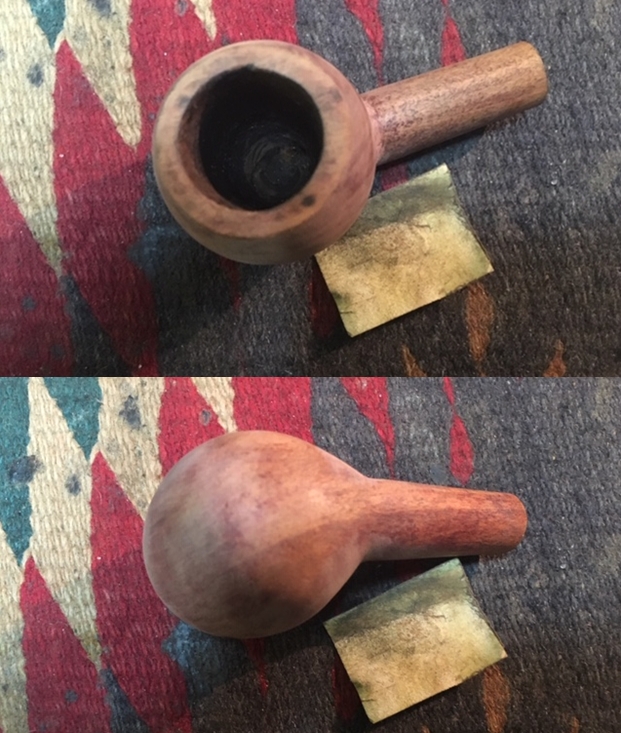
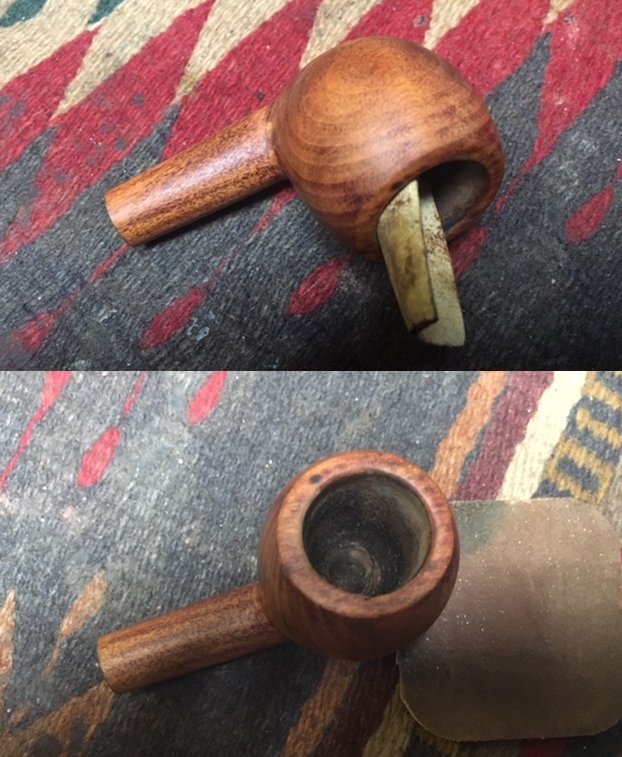
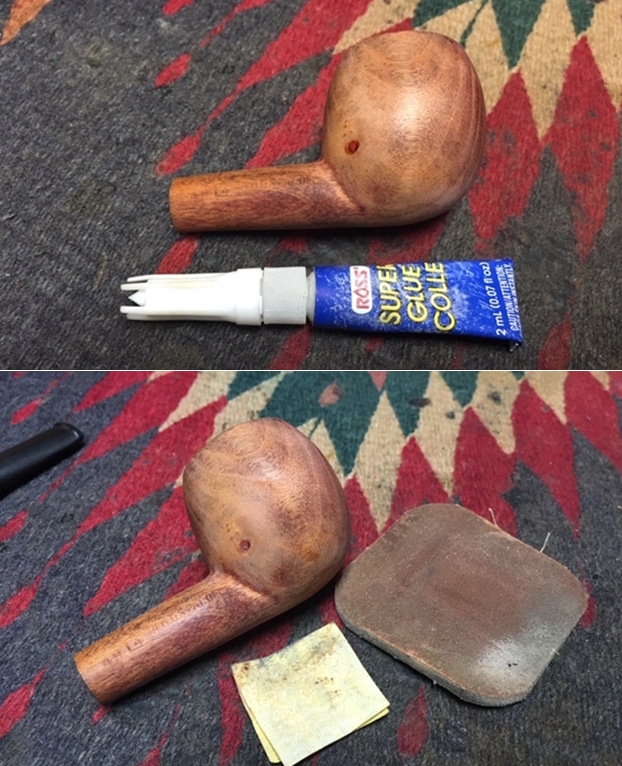
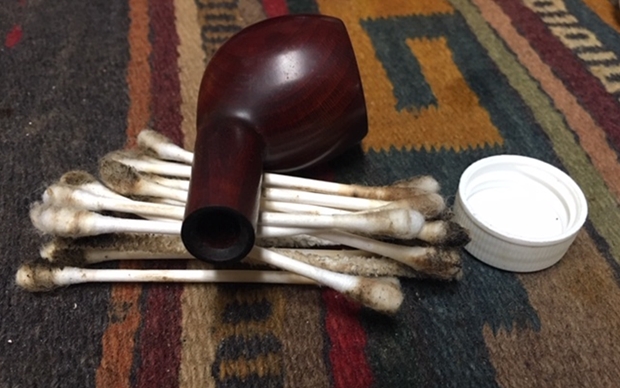
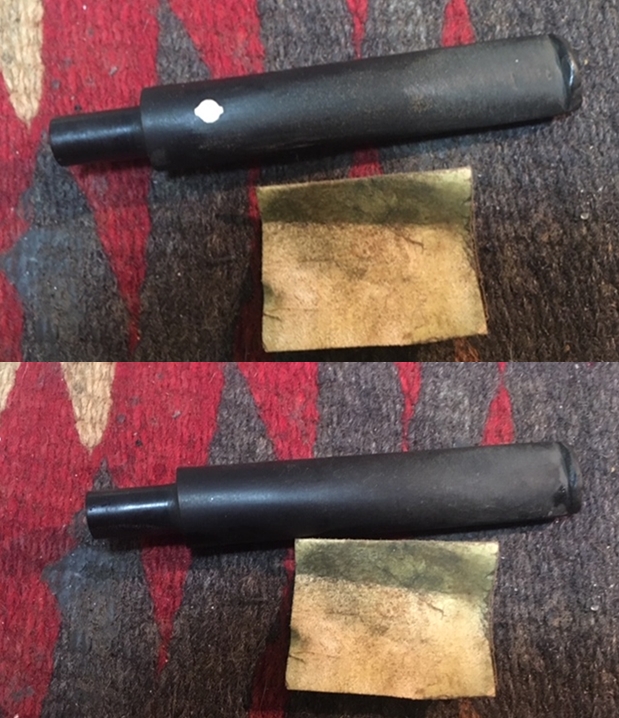
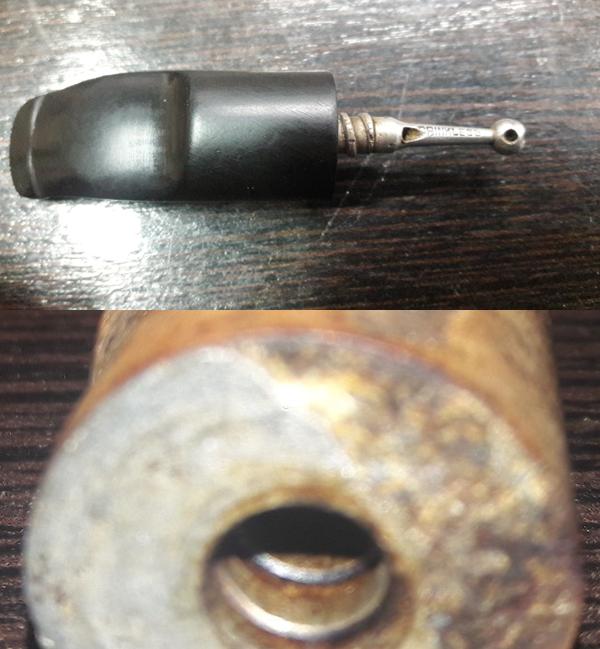
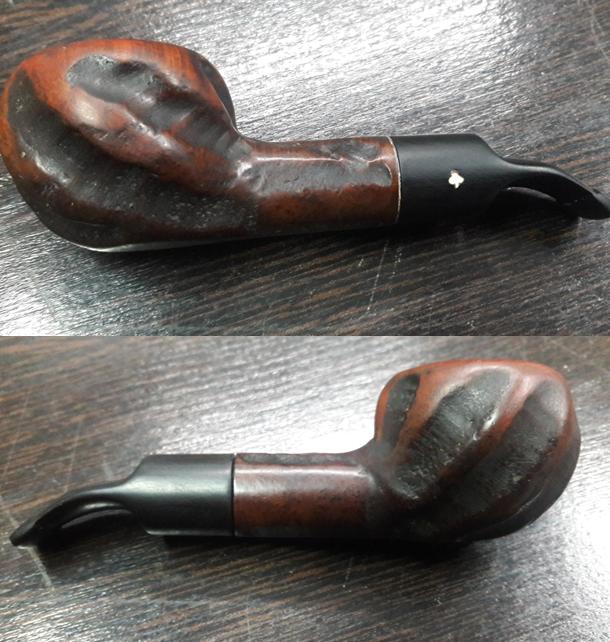
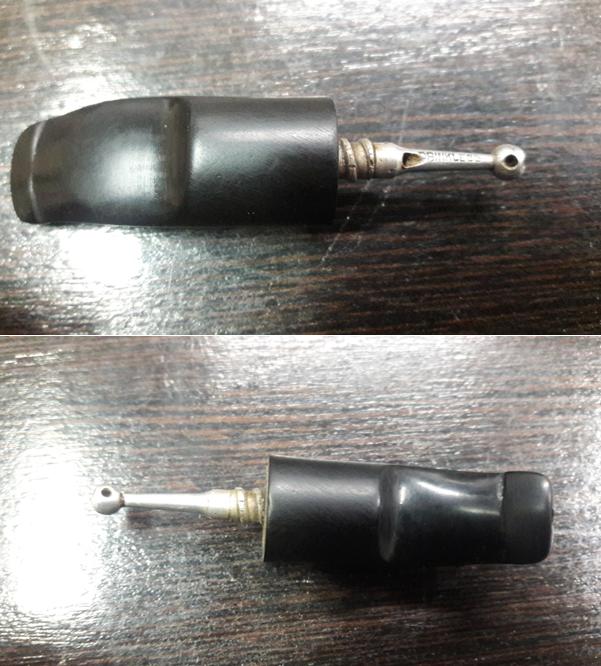
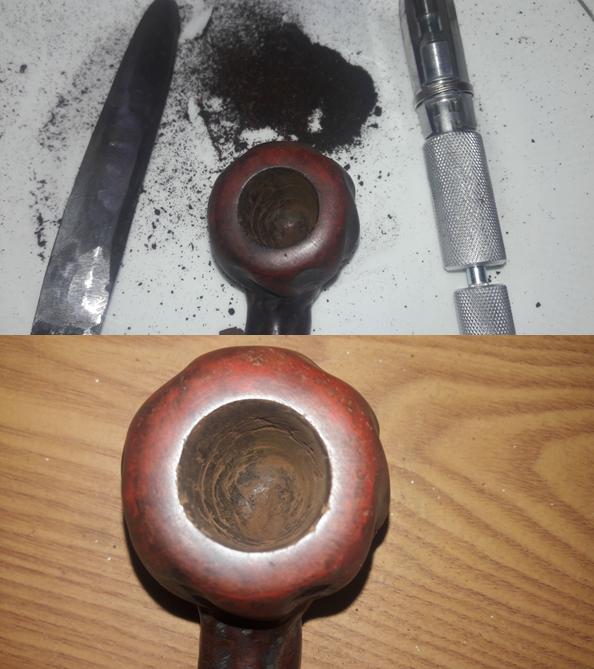
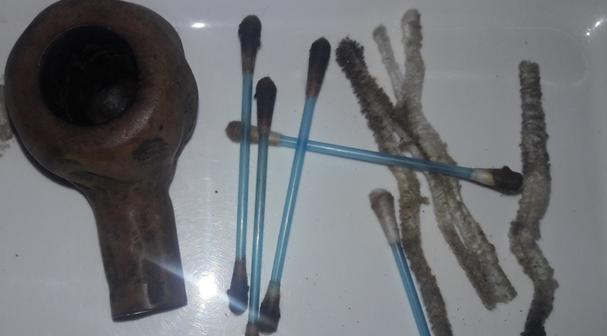
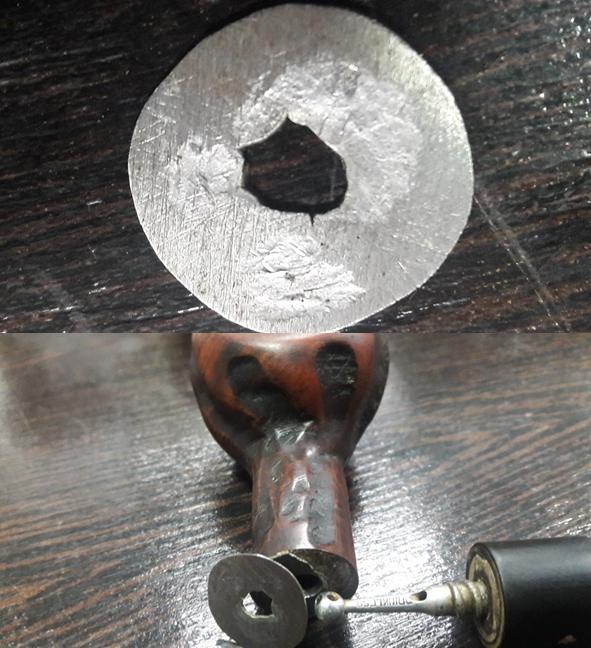
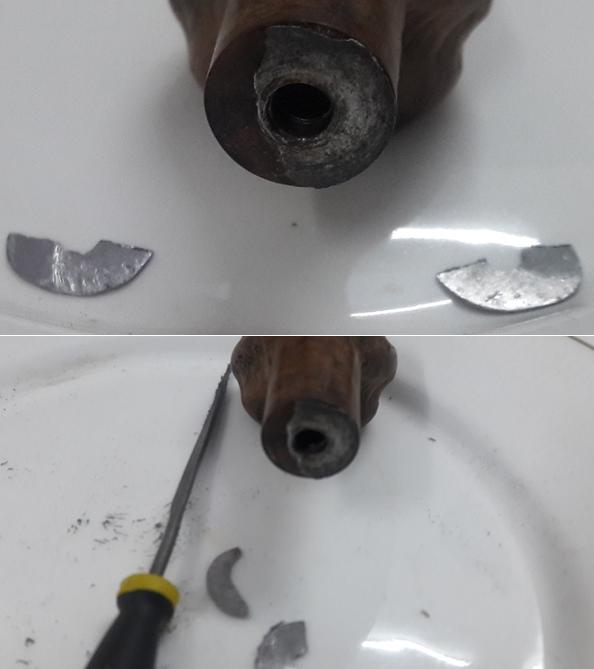
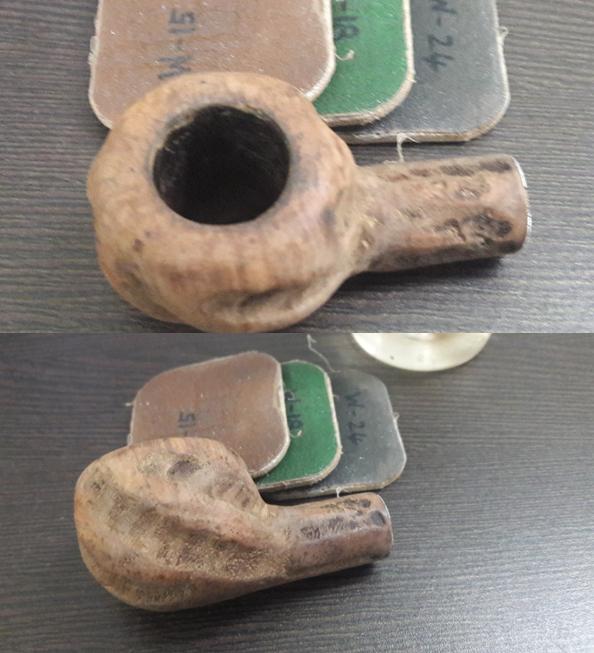
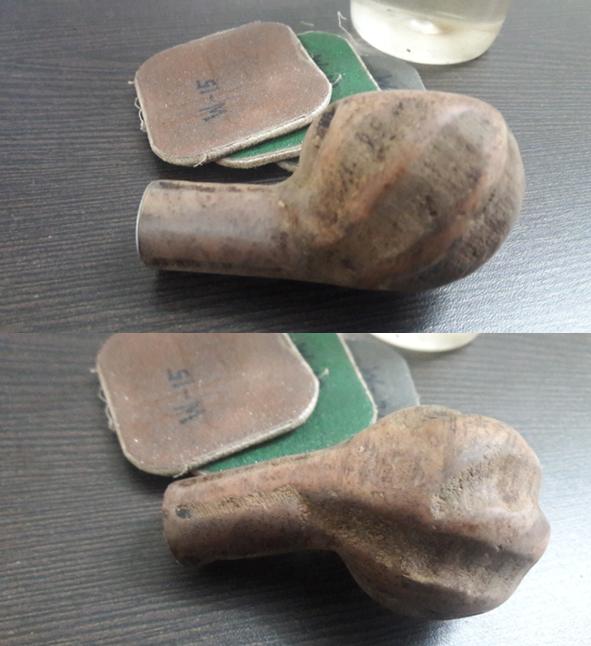
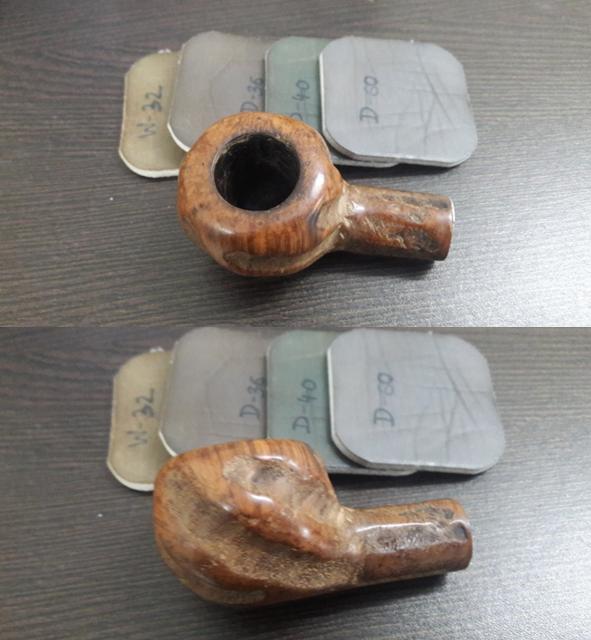
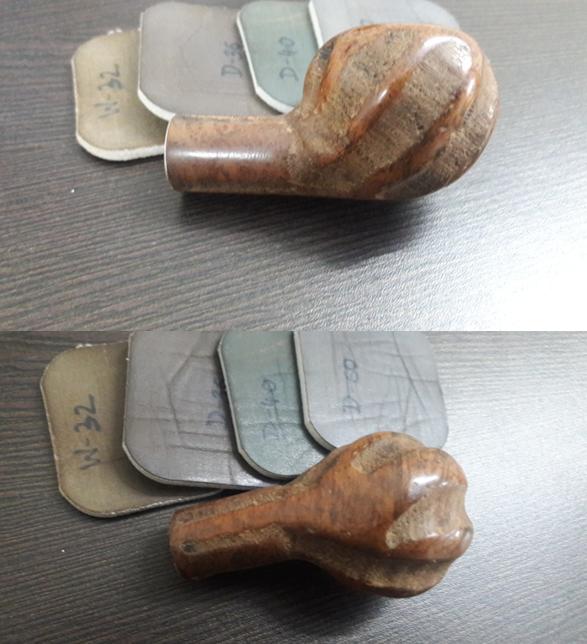
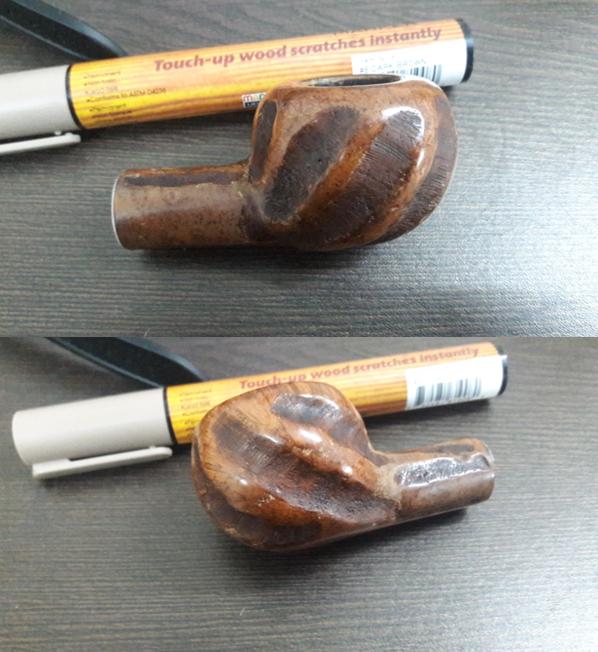
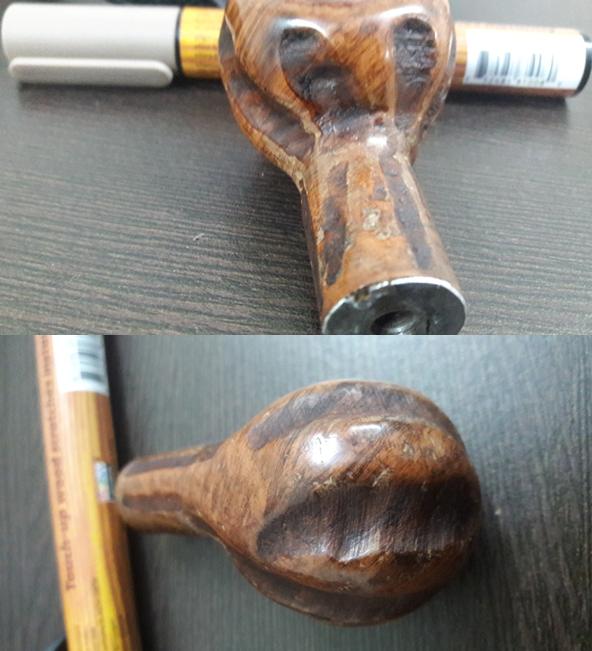
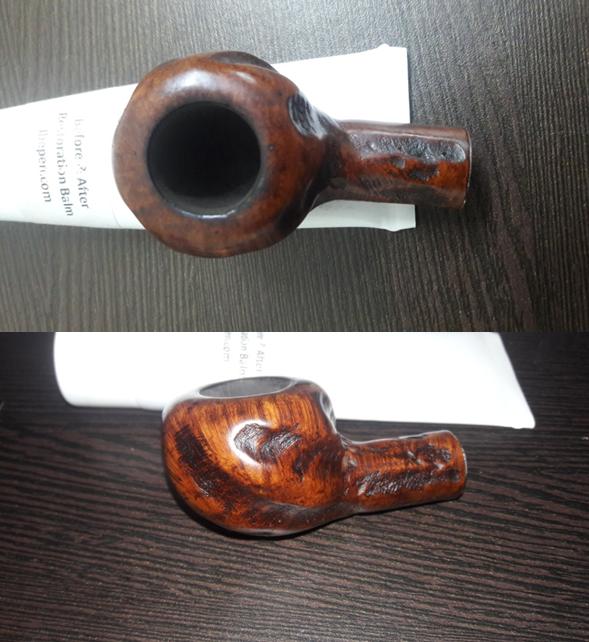
I took photos of the bowl before I started to work on it. You can see the repair on the shank. The rustication is very dirty and the rim top is coated with an overflow of lava from the bowl. The entire pipe reeked of a sweet cherry aromatic. The shank was heavily gummed up and I could not blow air through the shank into the bowl. It was clogged. The bowl also appeared to be drilled at an angle and from a quick glance seemed to be drilled crooked. The pipe was a mess! I took a photo of the oval and the stamping on the shank. You can also see the glue repair on the shank. It was a solid repair but a bit sloppy.There were some gaps in the glue around the circumference of the shank so I used a wire brush to clean up excess glue from the repair. I wanted to remove all of the excess glue so that it would look cleaner once I finished. I then filled in the gaps in the repair with clear super glue and filled in those areas with briar dust to build up the area ahead of the smooth band at the shank end.Restemming this old bowl would be a bit tricky. The shank actually flared to a smooth hip at the end where the stem sat. It was wider in diameter than the rusticated shank just below it. It was obvious from the way the shank end and mortise were made that it required a flush fit stem and not a freehand style stem. I would need to find a stem that had a wide enough diameter for me to work with and give the pipe the kind of look that it must have had originally. I went through my can of old stems and found one that was going to work. The tenon was almost perfect. I sanded it lightly with the sanding drum on the Dremel and cleaned it up with a file and the fit was just right. I would need to reduce the diameter of the stem slightly to match the shank but I think it was going to work for me. I took photos of the fit of the “new” stem to show you what I saw. Bear with me for the moment. It was quite ugly and my brother said it looked like a muffin top of a tight belt (or something like that). But I thought it had potential… time will tell. I trimmed the excess diameter of the stem with a sanding drum on my Dremel. I worked on it until the diameter was very close to the right size. I brought it back to the work table and sanded it smooth with a folded piece of 220 grit sandpaper to remove the scratches from the Dremel. I took photos of the stem and shank at this point. I wiped down the stem with Obsidian Oil to clean off the dust and get a sense of how it was looking. I sanded the band around the shank a bit too as it had some glue on it from the repair that had been done. I took photos of the pipe at this point in the process. I decided it was time to set the stem aside for a bit and work on the bowl. I took a photo of the bowl and rim to show what it looked like when I started. The bowl is thickly caked and there was damage to the inner edge of the rim. The lava overflow was quite thick on the rim top as well. I reamed the bowl with a PipNet pipe reamer. You can see the angle of the bowl from the way that the reamer is sitting in the second photo below. I cleaned up the reaming with a Savinelli Fitsall pipe knife and then sanded the walls of the bowl with sandpaper wrapped around a piece of dowel. With the bowl reamed I turned my attention to the dirty exterior of the bowl. I scrubbed it with a tooth brush and undiluted Murphy’s Oil Soap. I worked over the rim top with the tooth brush and a piece of sandpaper to remove the tars and lava there. I rinsed it off with running water to remove the soap and debris in the finish. Now it was time to address the thick tars and oils in the shank and open the airway into the bowl. I worked on the mortise and the airway in the shank with a paper clip, pipe cleaners, cotton swabs and alcohol. Once I had opened the airway I scrubbed it until it was clean. I also cleaned out the airway in the new stem with alcohol and pipe cleaners. It was not nearly as dirty as the shank.I polished the rim top and the smooth shank end with micromesh sanding pads – wet sanding with 1500-2400 grit pads and dry sanding with 3200-12000 grit pads. I wiped the polished areas with a damp cloth after each sanding pad. The rim and shank end began to really look good. I decided to stain the bowl and shank with some Medium Walnut Danish Oil. It has the translucence I wanted to let the natural colour of the briar shine through while allowing me to hide the repairs to the shank. I applied the stain with a cotton pad and daubed it deep into the grooves of the rustication. I kept applying it until the coverage was good. I waxed the bowl with several coats of  Conservator’s Wax and buffed it out with a horsehair shoe brush. The bowl and rim looked really good. I really liked the look of the bowl at this point in the process. The shine and the finish looked very good. I set the bowl aside and turned my attention to the new stem. I sanded it with 220 grit sandpaper to remove the oxidation and the scratch marks from fitting the stem. I wiped the stem down with Obsidian Oil to remove the sanding dust and get a feel for the scratching. I polished the stem with Denicare Mouthpiece Polish. I applied it with my finger and rubbed it in and then off with a cotton pad. I find that it is gritty enough to remove the residual oxidation after sanding (besides I have about three tins of the stuff to get through so I use it on each pipe).I polished the stem with micromesh sanding pads – wet sanding with 1500-2400 grit pads and dry sanding with 3200-12000 grit pads. I wiped the stem down with Obsidian Oil after each sanding pad. I finished polishing the stem with Before & After Pipe Polish – Fine and Extra Fine. I gave it a final coat of Obsidian Oil and set it aside to dry. I bent the stem with a heat gun to get it to follow the lines of the top of the bowl so that it can hang in the mouth with the bowl top straight. I polished the stem with Blue Diamond on the buffing wheel and gave it multiple coats of carnauba wax. I put it back on the shank and buffed the entire pipe with a clean buffing pad to raise the shine on the bowl. The heavy rustication works well with the stain I chose to use on it and the combination looks really good with the polished vulcanite stem. The flared shank end and the thick stem work well together to my mind to create an interesting pipe. The finished pipe is shown in the photos below. Its dimensions are – Length: 6 inches, Height: 2 inches, Outer diameter of the bowl: 1 ½ inches, Chamber diameter: 7/8 of an inch. I will give it another coat of Conservator’s Wax and then call the fellow who dropped it off for repair. I am hoping he likes the look of his pipe. Thanks for reading this blog.

Refurbishing my Inherited Large “Soren” Pickaxe Freehand


Blog by Paresh Deshpande

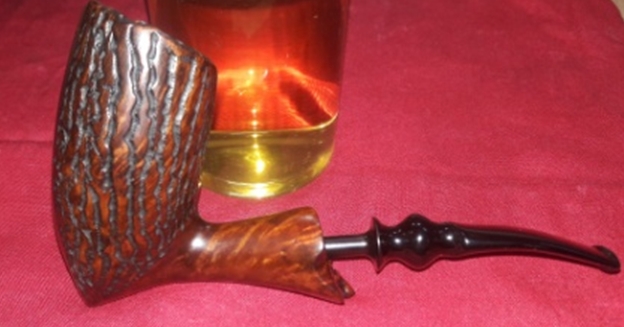
It’s been two months since I had worked on a free hand pipe that was made in Denmark, the last being a “Soren” sitter. The next pipe that I decided to work on from my grandfather’s collection is again a “SOREN”, but this pipe is a monster sized Pick Axe with a humongous bowl!!

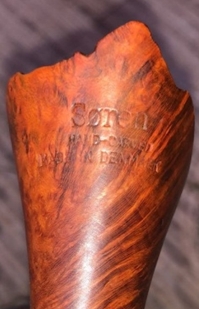
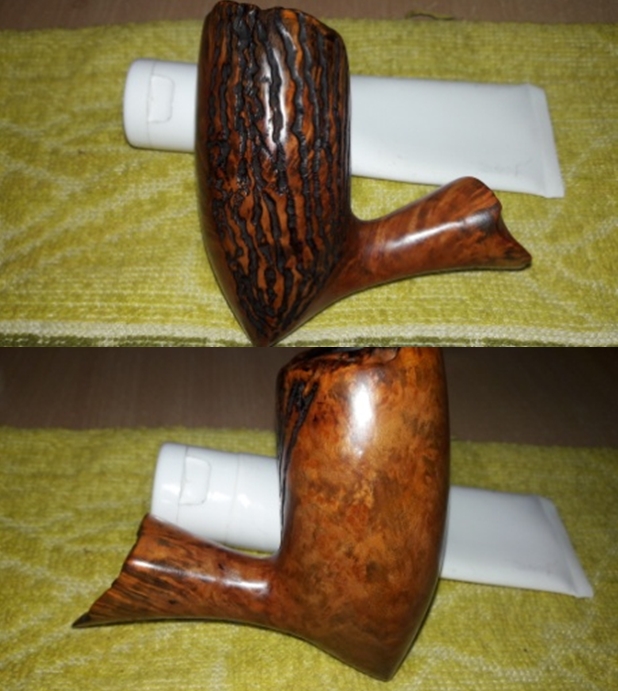
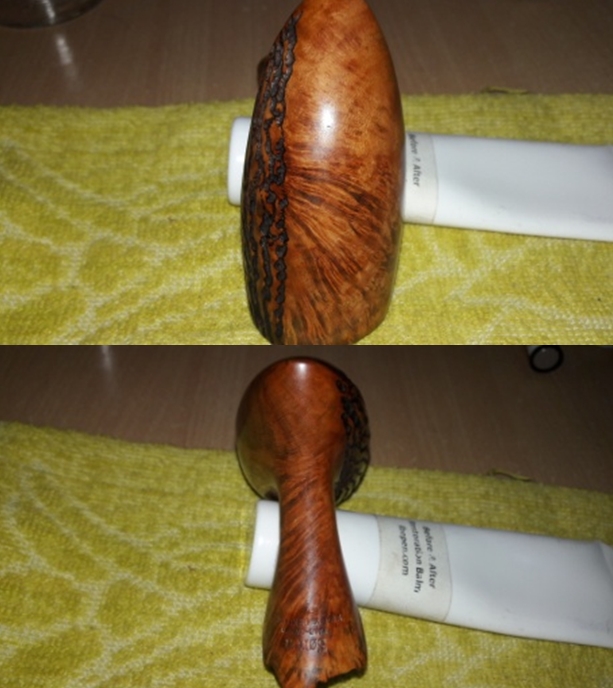
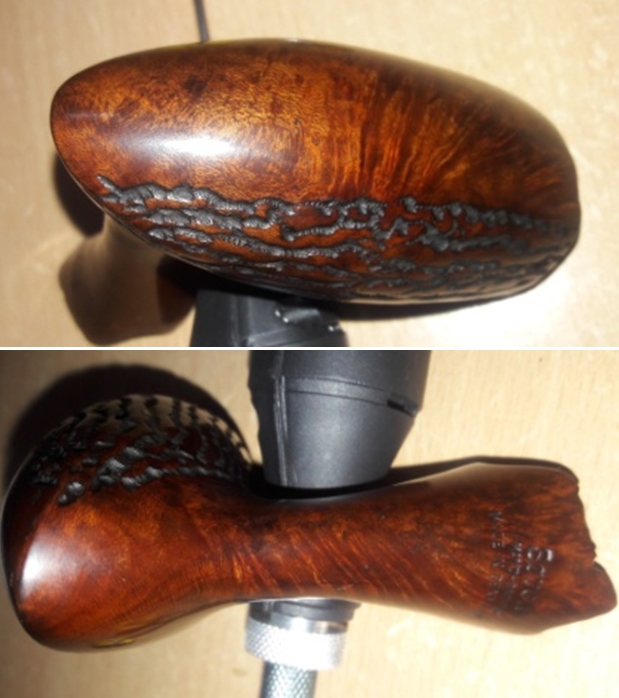
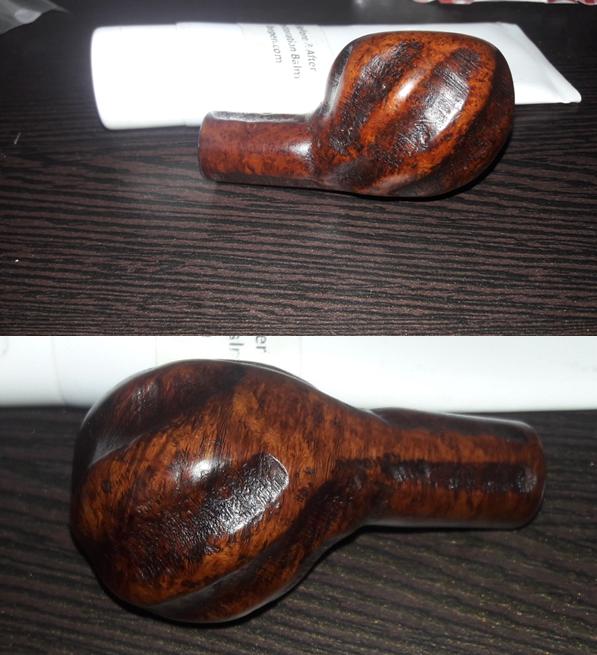
The large pick axe stummel has a combination of smooth and rusticated surface covering the bowl. The cascading water flow like hand carved rustication extends from the front left side of the bowl to the back while the smooth surface covers most of the front and complete right side of the bowl. Beautiful swirls of grains can be seen on the smooth surface interspersed with flame grains extending upwards from half way of the front of the bowl. The plateau shank end is flared towards the shank end and boasts of lovely flame grains on the right side of the shank. The flared shank end bears the only stamping seen on this pipe. It is stamped as “Soren”, name of the carver in script hand over “HAND-CARVED” over “MADE IN DENMARK” in block capital letters. The fancy vulcanite stem is devoid of any stampings.

While working on my Soren sitter free hand, I had referred to pipedia.com for information on this famous pipe carver from Denmark. I reproduce the information available on pipedia.com for a quick read.

 “Søren Refbjerg Rasmussen founded a company in 1969, which employed an average of 8 – 12 craftsmen in the 1970’s. The semi-freehands they produced were traded under his prename Søren. Rasmussen himself finished only the very best pipes. So his way of pipemaking closely resembled the ways of Preben Holm, Karl Erik Ottendahl or Erik Nørding. Altogether more than 1,000,000 pipes were sold.

Today he works alone as Refbjerg and manufactures only a small number of pipes in his workshop in DK-2860 Søborg, which are considered to be tremendously precisely executed. The dimensions mostly range from small to medium sized, corresponding to his personal preferences. The shapes adhere to the classical models, but often he gives them a touch of Danish flair. Refbjerg accepts minor faults but never uses any fillings. “Straight Grain” is the only grading, used for his very best pieces. He likes stem decorations made of exotic woods or metal rings.

As Rainer Barbi once stated “Refbjerg uses only briar from Corsica and more than that, he’s the one and only to import it from there, at least in Europe. He’s supplier to the vast majority of the Danish makers”.

From the above, it can be safely assumed that this pipe was made in the 1970’s as it bears the stamp of the carver’s prename “Soren”!!

INITIAL VISUAL INSPECTION
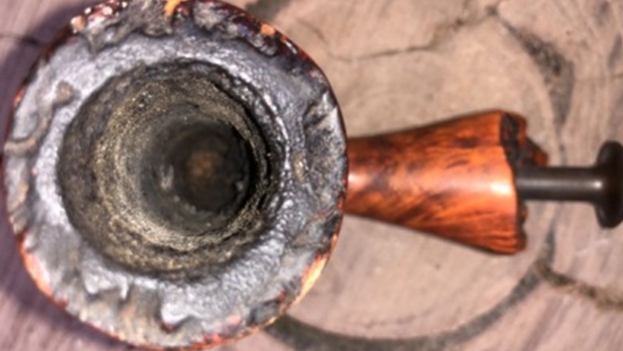
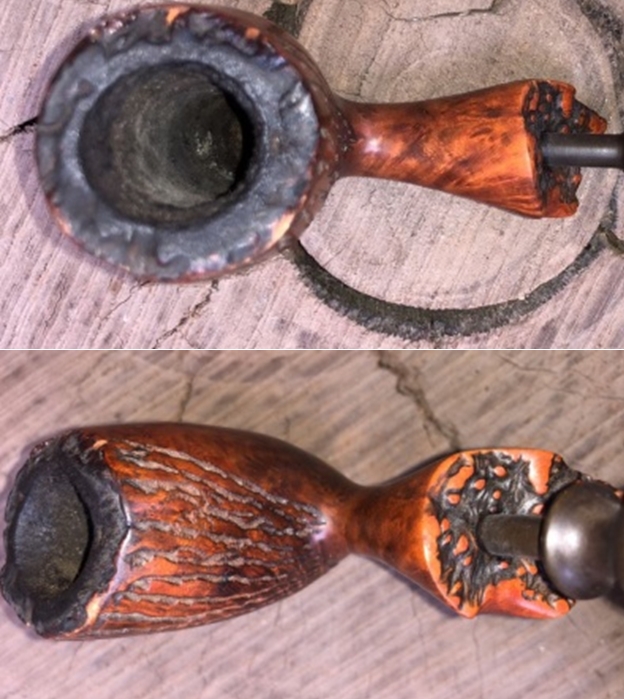
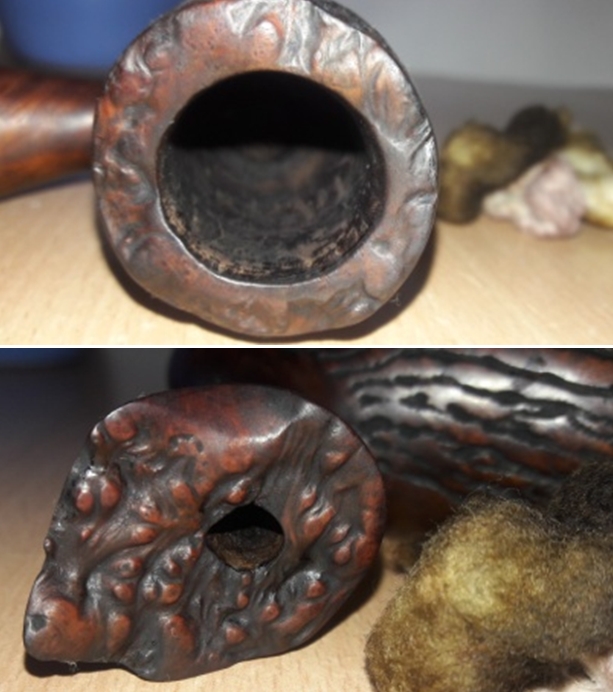
There is a thick layer of cake in the bowl. The external surface of the stummel feels solid to the touch and I think there are no issues with the condition of the chamber. However, there are always surprises when you least expect them!!! I have learnt my lessons!!! Thus, condition of the inner walls of the chamber will be ascertained once the chamber has been reamed and the cake is taken back to the bare briar. There is a strong sweet smell of tobacco which may reduce once the cake has been reamed out and chamber has been cleaned with isopropyl alcohol.The plateau rim top and shank end is covered in the overflow of lava, dirt and grime. This will have to be cleaned. The condition of the inner edge will be determined only after removing the cake. The air way in the shank is clogged with oils and tars and will require a thorough cleaning. The stummel is covered in a thick layer of dust, dirt, oils and grime. The stummel looks dull and lackluster. The grains on the smooth surface and the sandblast rustications are all covered in tars, oils and grime. To be able to appreciate these grains and rustications, the stummel will have to be cleaned. However, there is not a single fill to be seen on this large briar estate. A few minor dents and dings are seen on the stummel surface, a result of uncared for storage over a prolonged period. This issue can be sorted out by sanding the stummel surface with a sand paper, followed by micromesh sanding and polishing. The fancy quarter bent vulcanite stem is heavily oxidized and two deep bite marks can be seen on the lower surface of the stem. The lips on both upper and lower surface show significant damage due to bite marks and are out of shape. I hope to address these issues by simple heating of the stem with the flame of a Bic lighter. The air way in the stem appears to be clogged and the air flow is laborious to say the least. This will be addressed by thorough internal stem cleaning with pipe cleaners and alcohol. There is calcification seen on either surface about an inch from the button end. The bottom of lip edge shows significant deposition of dirt and oxidation. This will have to be cleaned.THE PROCESS
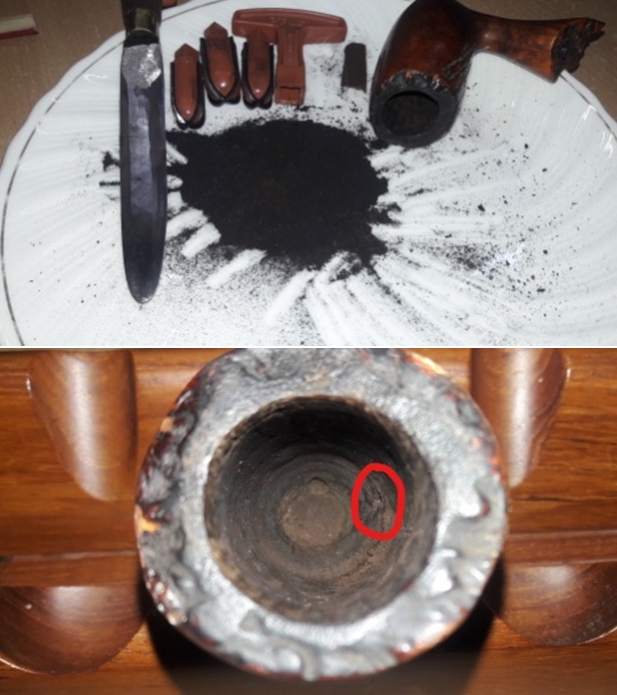
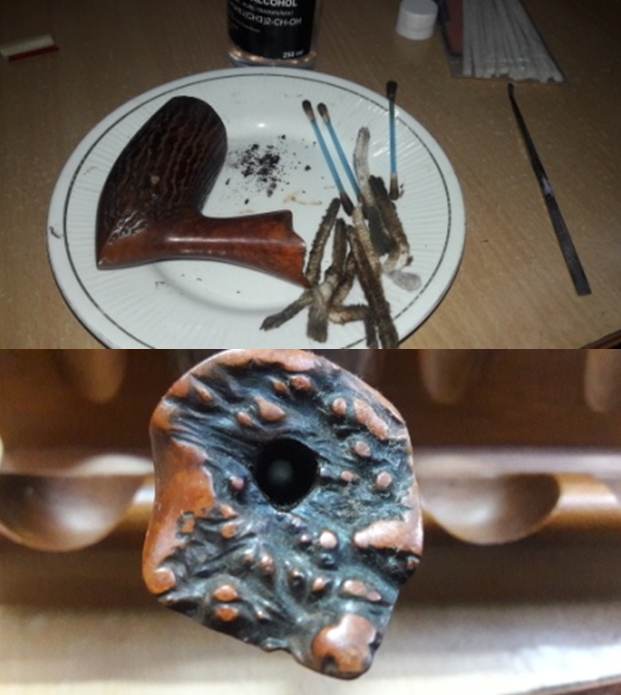
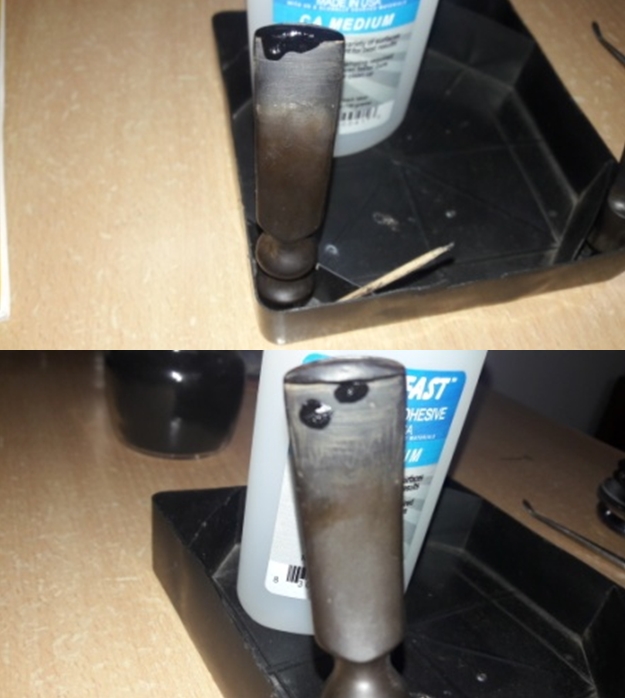
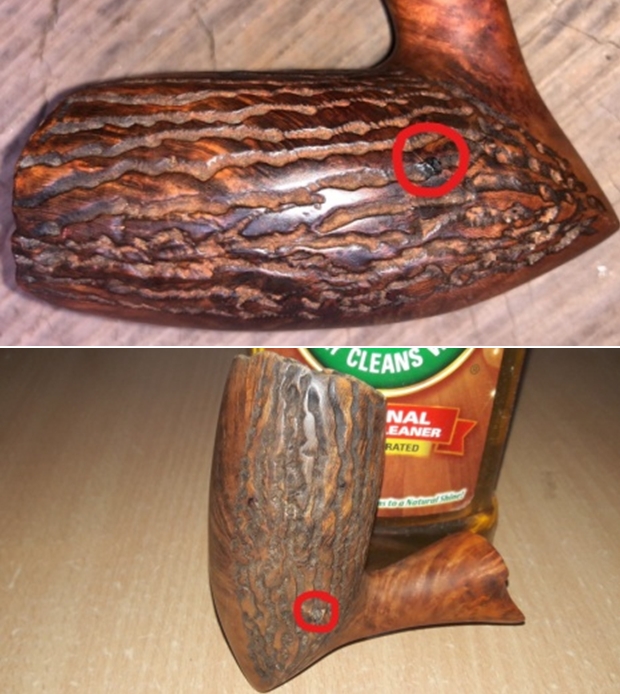
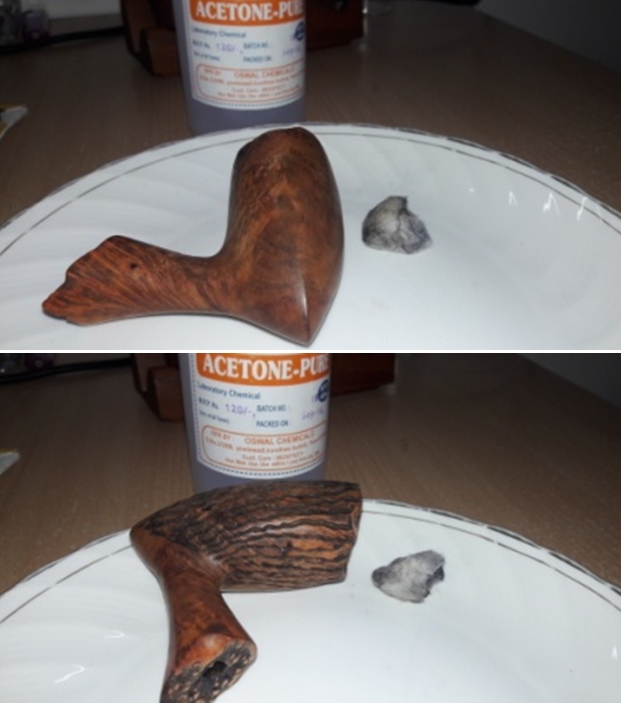
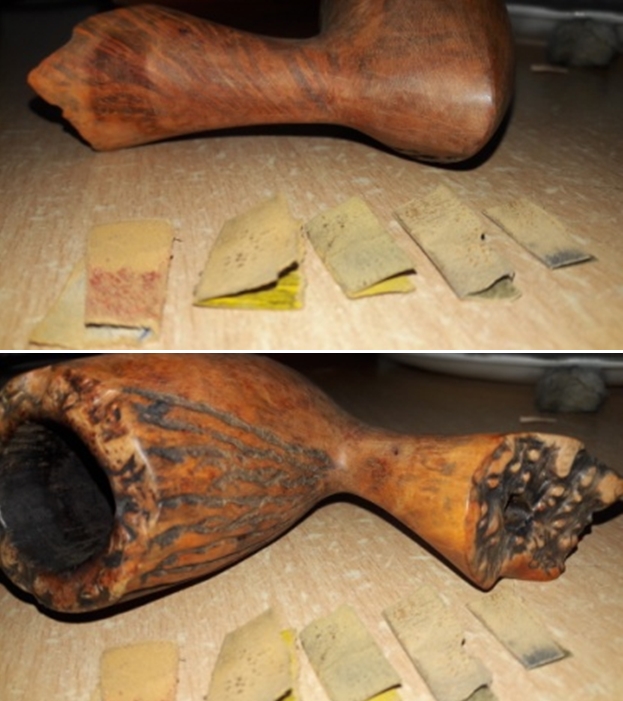
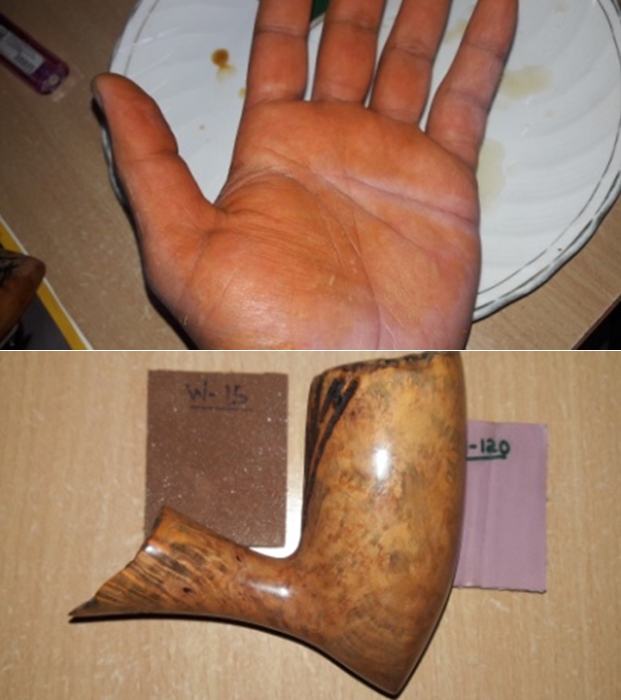
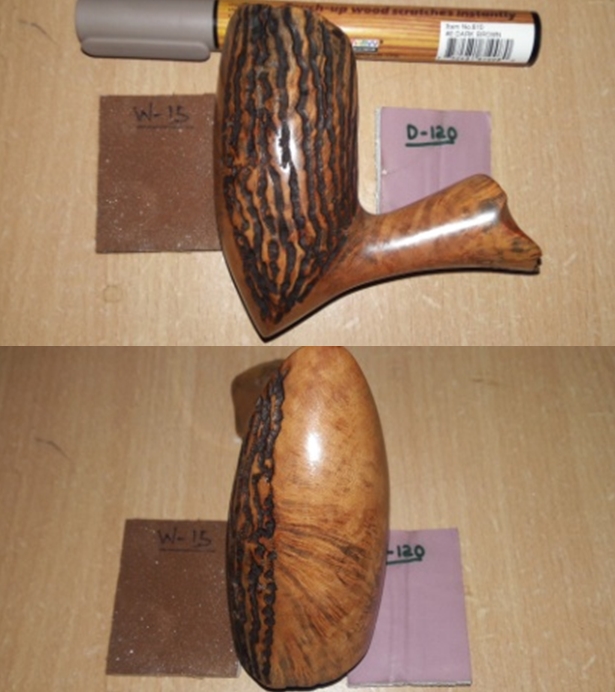
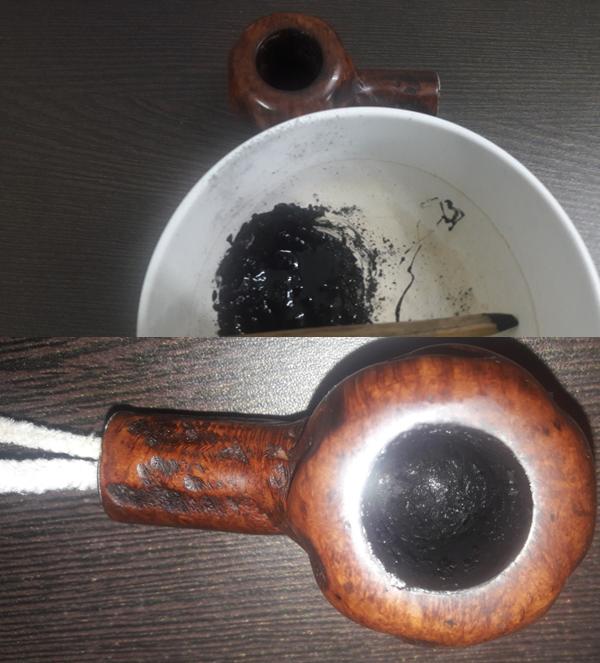
I started this project by reaming the chamber with size 2 and followed it up to size 4 head of PipNet reamer. I used a 220 grit sand paper, pinched between my thumb and forefinger, to sand the inner walls of the chamber of the pipe. Once I had reached the bare briar, I wiped the chamber with a cotton pad dipped in isopropyl alcohol. This removed all the residual carbon dust but this time not the ghost smells. This cleaning revealed the first (and pray it to be the last!!) surprise. There are a few very thin webs of line seen along the front and left side of the chamber walls and one slightly larger gash on the left side. This gash is highlighted in a red circle. I shall address this issue at the end of the restoration by coating the walls with a mixture of activated charcoal and yogurt. This coating will aid in quicker formation of a fresh cake.I followed up the reaming by cleaning the mortise and air way of the pipe using hard bristled, regular pipe cleaners and q-tips dipped in alcohol. The mortise and the draught hole was so chock-a- block with all the dried tars, oils and gunk that I had to use my fabricated spatula to scrape out all the muck from the mortise and the draught hole!!!! I gave a final clean with shank brushes dipped in alcohol and dried the mortise with a rolled paper napkin. The shank internals and the draught hole are now nice and clean with an open and full draw. The issue of sweet smells of old tobacco was also reduced to a very large extent.I cleaned out the internals of the stem using hard bristled and regular pipe cleaners dipped in alcohol. I scraped the dried oils and tars from the tenon with the sharp edge of my fabricated dental spatula. The deep bite marks on the stem and lip edges were flamed with the flame of a Bic lighter.  This helps to raise the bite marks to the surface. However, this did not work. From my experience, I have learnt that getting rid of the oxidation from and around the surface to be filled helps in subsequent better blending of the fill with the stem surface. With a folded piece of used 150 grit sand paper, I sand the area that is required to be filled. I cleaned the sanded portion of the stem with cotton pad dipped in alcohol and spot filled the damaged area with a mixture of activated charcoal and clear superglue. I set the stem aside for the fill to cure. Now, it was the turn of the stummel of the pipe to get cleaned up. Using a hard bristled tooth brush dipped in undiluted Murphy’s oil soap, I very deliberately scrubbed the stummel, cleaning the surface thoroughly. Special attention was paid to scrub out all the dirt and dust from the crevices in the rustication on the sides and front of the stummel as well as the plateau rim top and shank end. I was surprised to note that while rinsing the pipe under tap water, the water ran a bright orange color. Residual orange color can be seen on the stummel, probably due to a coating of shellac!!! I do not like it and will have to get rid of it, period. The stummel, plateau shank end and rim top were dried using paper napkins and soft cotton cloth. The cleaning of the stummel revealed the second surprise!! There was a sticky and soft spot present in the rusticated portion on the stummel; this has been marked in a red circle below. When I scrubbed the stummel, it was revealed that this fill had gone soft. I dug out the old and soft fill with my fabricated sharp knife. The alignment of this fill roughly matched with that of the larger gash observed on the left side of the chamber wall. I discussed this issue with my guru, Mr. Steve, after he had seen the pictures of the damage. It was decided that the fill would be refreshed and the inner walls of the chamber should be coated with a layer of activated charcoal and yogurt. There were three other very minor fills; two on the shank end and one in the rusticated portion of the stummel at the back of the bowl. These have been circled in red. Before progressing ahead with any further restoration, I decided to address the issues of “fills” in the stummel!!!!! I completely removed the old fills using a sharp, pointed and thin fabricated knife. I press a little briar dust and realizing what a precious commodity it is, I was very careful not to waste even a microgram. I packed it in to the gouges on the stummel, pressing it tightly with the back of a toothpick and spot applied CA superglue over it with the pointed end of the toothpick. I spot filled the shank end fills with only CA superglue as they were not large and deep. With this, I set the stummel aside for the fresh fills to cure.After the fills had cured, I sand these fills using a flat head and a round needle file to achieve a rough match with the surrounding surface. With a folded piece of 180 grit sand paper, I sand the fills in the rusticated portion to match it with the worm trails in the rustication. I wiped the entire stummel with a cotton swab soaked in acetone to remove the coating of shellac, but without the expected results. The stummel still has that orange coloration. I further sand the entire smooth surface of the stummel with a piece of folded 150, 220, 440, 600 and 1000 grit sand paper to perfectly match the fills with the rest of the stummel surface and also to achieve my aim of completely removing the shellac coating, but the coloration still persists. Hopefully, remnants of the shellac coat will be addressed during the micromesh sanding and polishing process. This use of sand paper, however, addressed all issues of the dents and dings from the stummel surface!! I wanted to remove the coating of shellac while highlighting the grains seen on the smooth portion of the stummel. To achieve this aim, I sand down the stummel using micromesh pads, wet sanding with 1500 to 2400 grit pads and dry sanding with 3200 to 12000 grit pads. I wiped the stummel with a moist cloth to clean the surface of all the dust after wet sanding. The orange coloration on the stummel can be gauged by the color of my hand. I was still not happy with the results of the micromesh sanding. Using a dark brown stain pen, I darkened the worm trails in an attempt highlight and add contrast against the raised portions in the rustication. I was not satisfied with the way the pipe looked at this stage. It was still “loud” and appeared gaudy. I rub a small quantity of “Before and After Restoration Balm” in to the briar and let it rest for a few minutes. I took some extra efforts to work the balm in to the hand carved rustications on the bowl. I hand buffed it with a horse hair brush to a deep shine. I had assumed that this would help improve the look of the stummel. Alas!! That was not to be the result. The bowl still appeared ugly and definitely did not measure up to my standards. I was lost for ideas when I shared pictures of the stummel with my guru, Mr. Steve. This is what he saw. In his characteristic style, Mr. Steve suggested that “I would first get rid of the dark stain in the worm trails by wiping the entire stummel and then re-staining it”. This is exactly what I did. I wiped the stummel with a cotton swab dipped in isopropyl alcohol and removed all the stain. Mr. Steve had sent me sachets of easy-to-use stain powder which just needed to be mixed in isopropyl alcohol and applied to the stummel surface. I chose the Walnut stain. Since this was the first time that I would be using a stain, I was a bit apprehensive. I mixed a little quantity of the stain powder and mixed it with a little quantity of 99.9% pure isopropyl alcohol to a liquid consistency. I have purposely not mentioned any specific quantity of each as I had mixed the two just by relying on feel and visual confirmation. I was fortunate that I got the mix spot on in the first attempt. There is a lot of leeway in this process in that if the stain appears too dark after application, desired transparency could be achieved by wiping the stummel with a cotton swab dipped in alcohol!!!! I folded a pipe cleaner and evenly applied the stain over the complete stummel, plateau rim and shank end. This was followed by burning excess of alcohol with the flame of a Bic lighter. This also helps the stain to set on the stummel surface. Just a word of caution to all first timers like me, please wear either plastic or latex rubber gloves if you wish to avoid the struggle of removing the stains from your hands later!!! I wiped the stummel surface with a cotton swab dipped in isopropyl alcohol as the stain was slightly darker and unevenly applied than I would have liked. This helped in bringing more transparency and evenness in the stain application. Once the stain had set, I mount a cotton cloth buffing wheel on to my local machine which is similar to a Dremel.  I set the speed at about half of the full power and applied White Diamond compound to stummel of the pipe. I wiped/ buffed the pipe with another clean cotton cloth buffing wheel to clear it of any leftover compound dust. I then mounted another cotton cloth wheel on to the polishing machine and applied several coats of carnauba wax over the stummel. I finished by giving the stummel a rigorous hand buffing using a microfiber cloth to raise the shine further. The grains on the stummel now look beautiful and peek through the stain. I shared the pictures of the stummel with Mr. Steve who appreciated the look of the stummel at this stage. With the stummel nice and clean and attractive, I worked the stem of the pipe. The fill on the stem had cured nicely and I sand it down with a flat head needle file. I sharpened the lip edges using a needle file and sand the entire stem with 220 followed by 400, 800 and 1000 grit sand paper. This helps to reduce the sanding marks left behind by the more abrasive 220 grit paper, while this process eliminated the deep oxidation seen on the vulcanite stem of the pipe. To bring a deep shine to the vulcanite stem, I went through the complete set of micromesh pads, wet sanding with 1500 to 2400 grit pads and dry sanding with 3200 to 12000 grit pads. I wiped the stem with alcohol after each pad and rubbed it down with Extra Virgin Olive oil. The internals of the stem was cleaned out using alcohol and pipe cleaners. The pictures of the process and final results are shown below. The only issue remaining to be addressed, before I could proceed with the final polish, was the deeper gash seen in the walls of the chamber. I mixed activated charcoal and yogurt to a consistency which would enable an even spread and applied it on the inner walls of the chamber and set it aside to cure it overnight.To finish, I re-attach the stem with the stummel. I mount a cotton cloth buffing wheel on to my local machine which is similar to a Dremel. I set the speed at about half of the full power and applied White Diamond compound to stummel of the pipe. I wiped/ buffed the pipe with a soft cotton cloth to clear it of any leftover compound dust. I then mounted another cotton cloth wheel on to the polishing machine and applied several coats of carnauba wax over the stummel and the stem. I finished the restoration by giving the pipe a rigorous hand buffing using a microfiber cloth to raise the shine further. The completed pipe, with the dark brown hues of the stummel contrasting with the shiny black stem, looks lovely, fresh and vibrant; the photographs speak for themselves. The beauty, size and shape of this pipe make it one of my favorite and will find a place of pride in my modest collection. If only the pipe could tell some of the stories and incidents that it has witnessed while my grand old man puffed away.…………… Cheers!!! PS: The oversized and shape of the stummel coupled with an equally proportionately long stem, posed a challenge while taking pictures of the complete finished pipe!!!! This is one of the many areas where I need to make a lot of progress. If I am unable to capture the beauty of the finished pipe and present it in an attractive manner, I feel my efforts are in vain.


Cleaning a Second Aldo Velani Ultima 1 Straight Billiard


Blog by Steve Laug

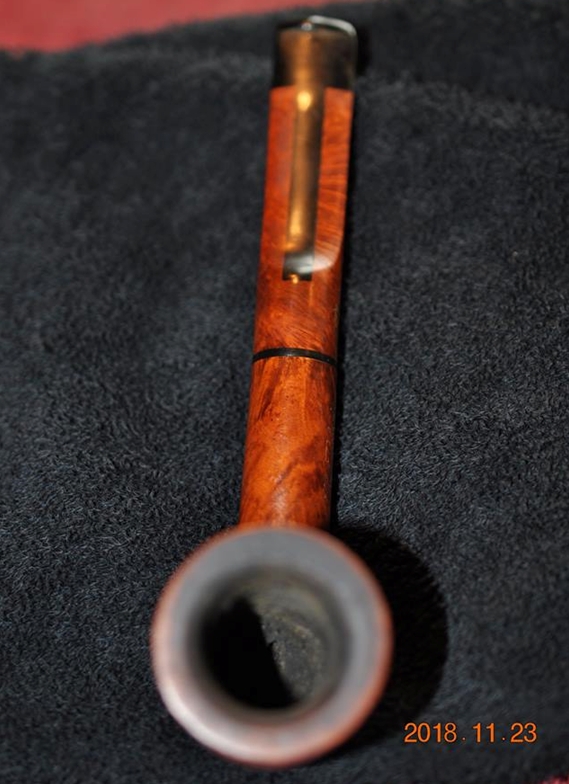
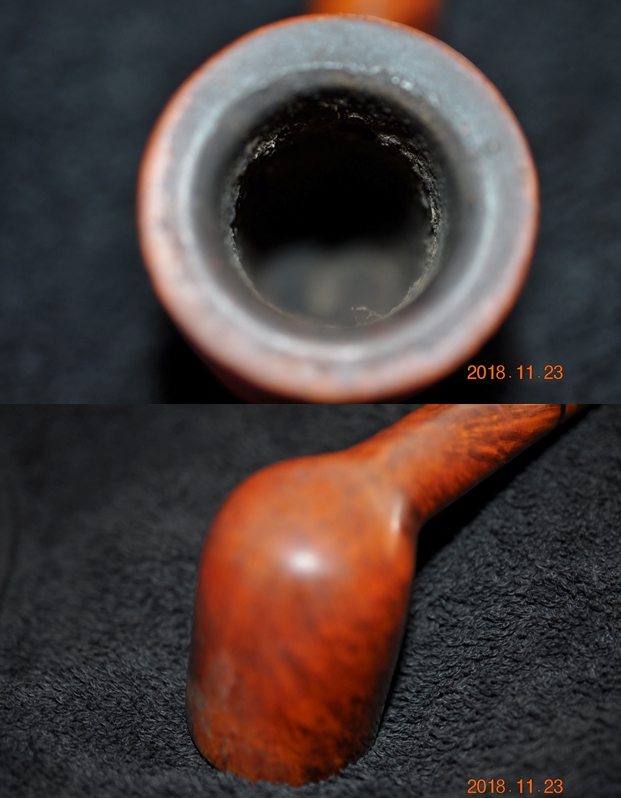
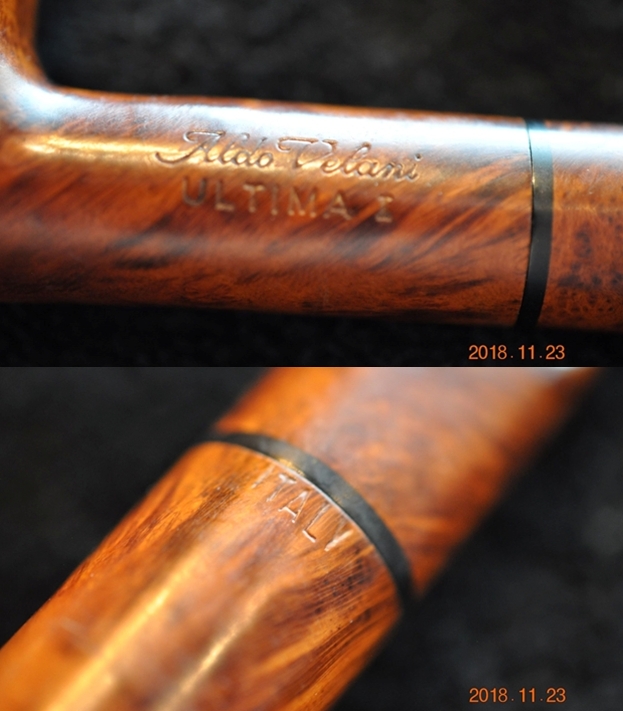
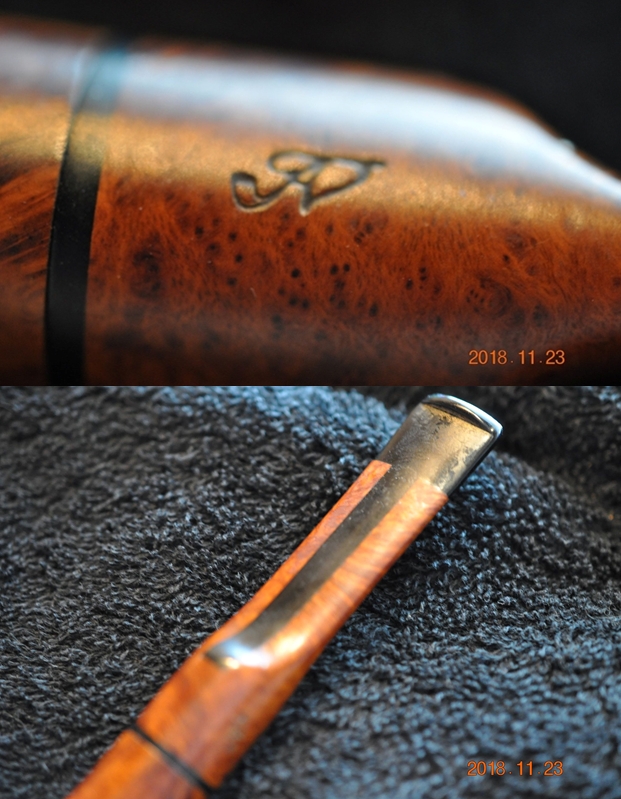
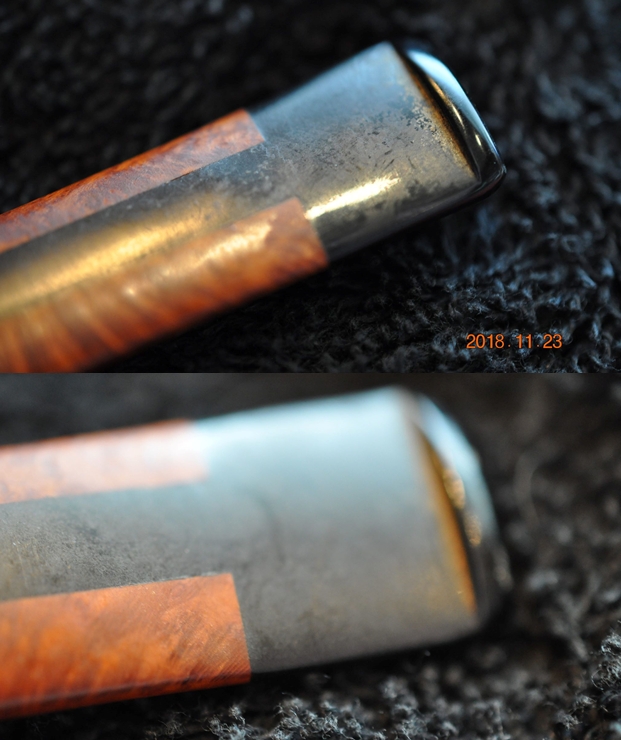
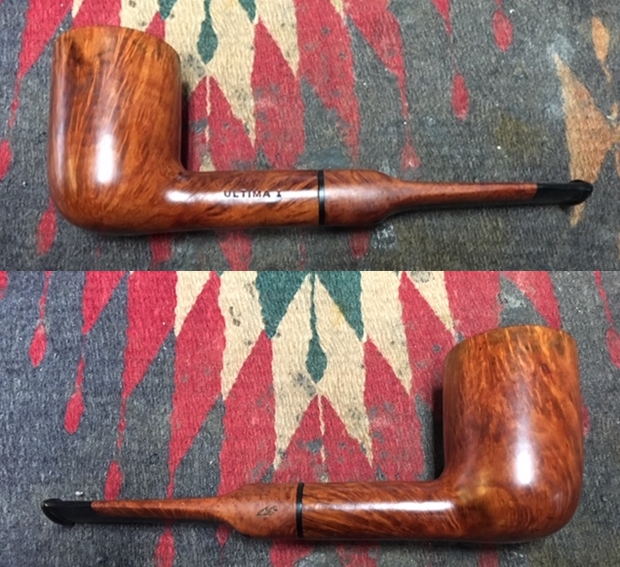
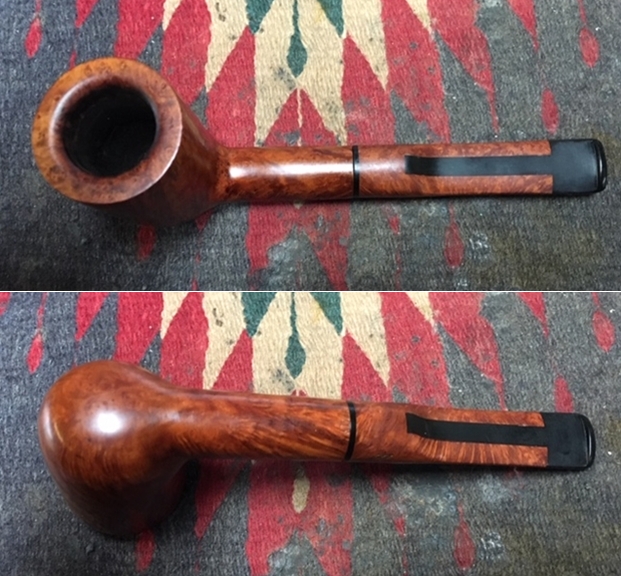
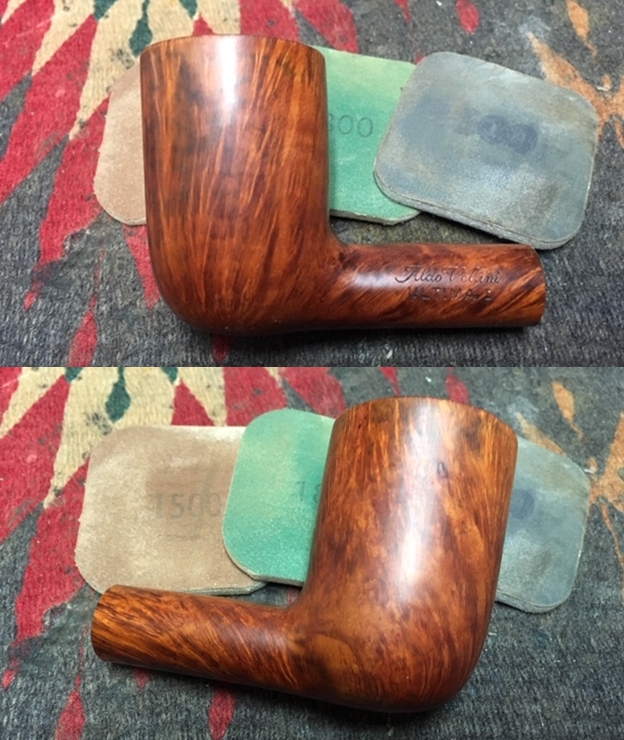
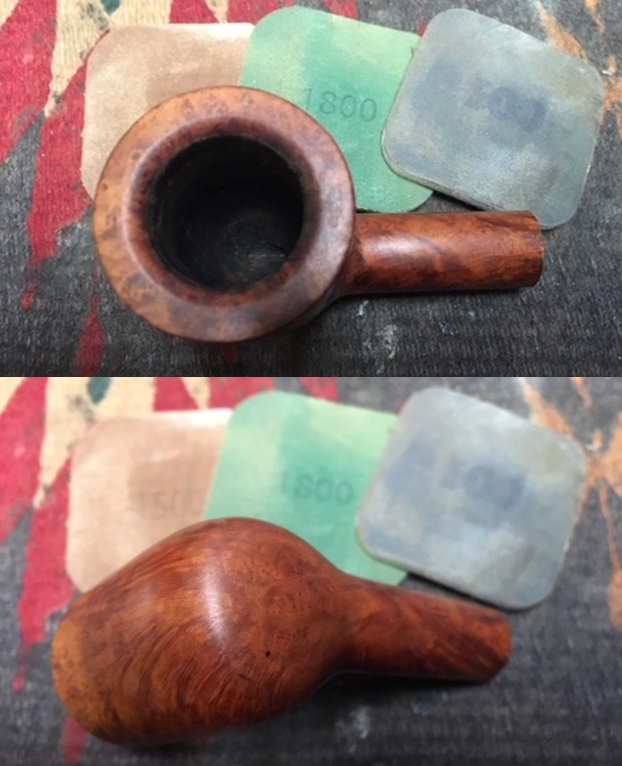
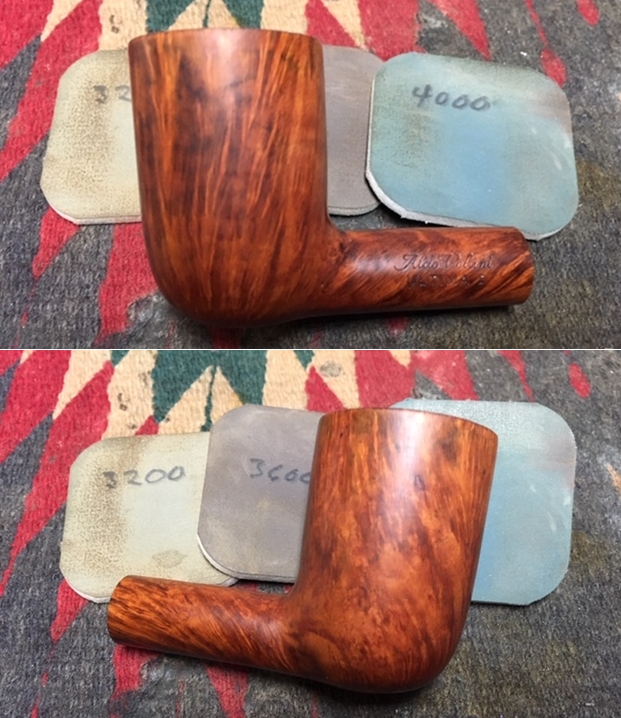
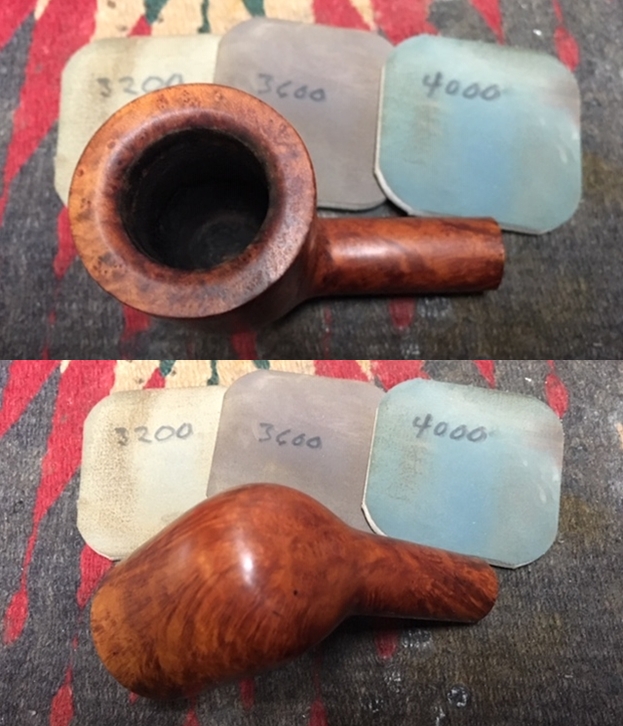
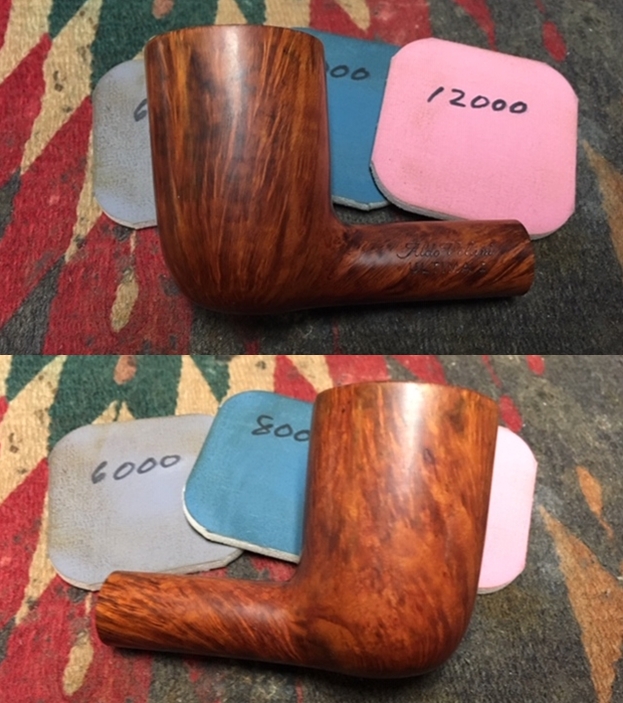
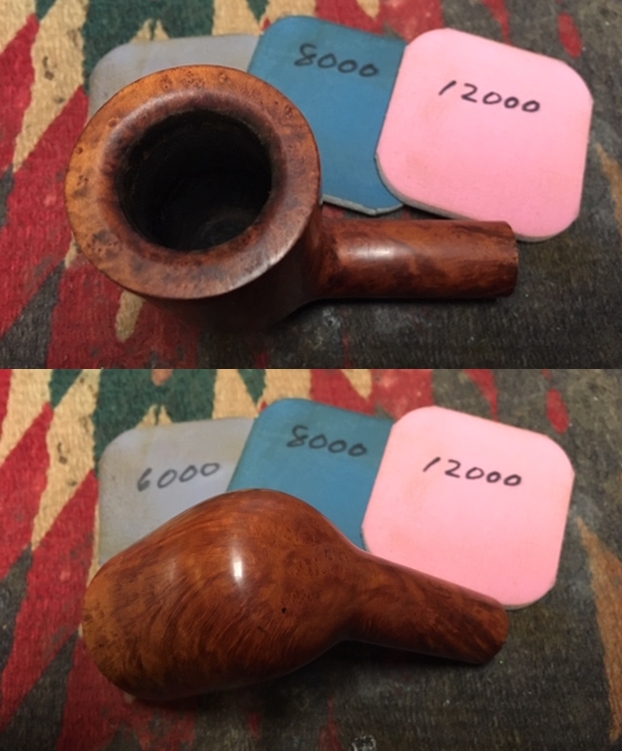
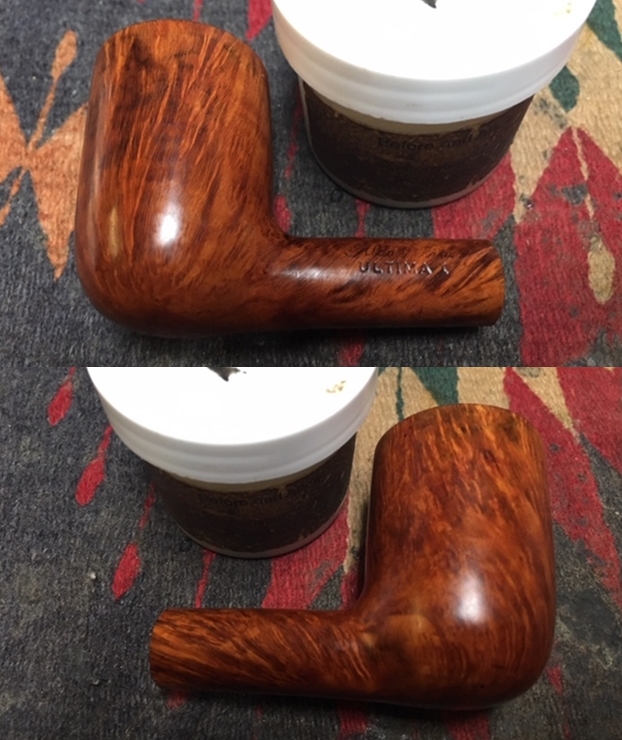
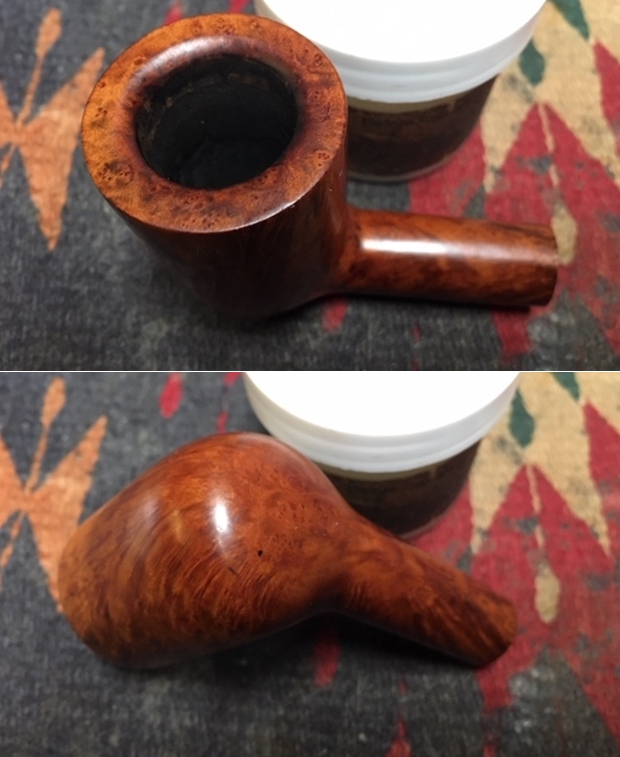
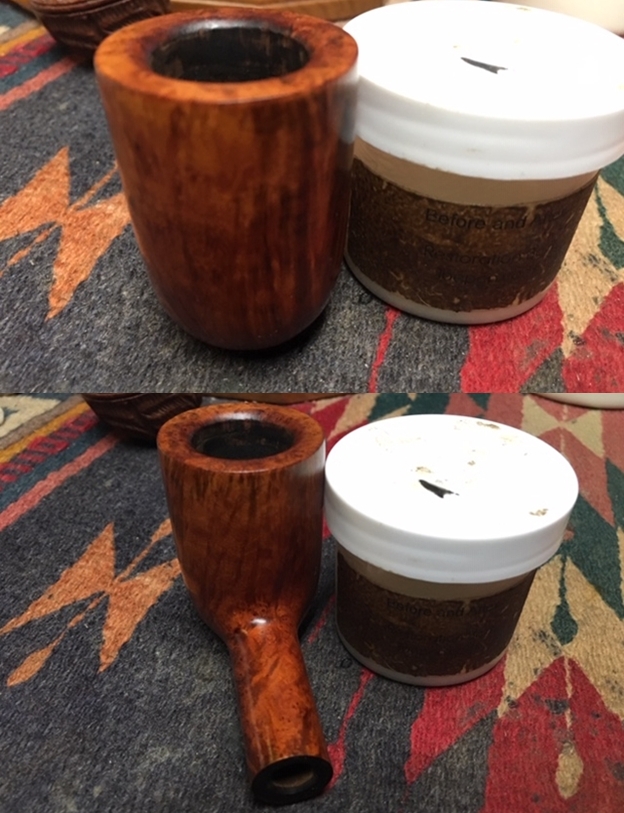
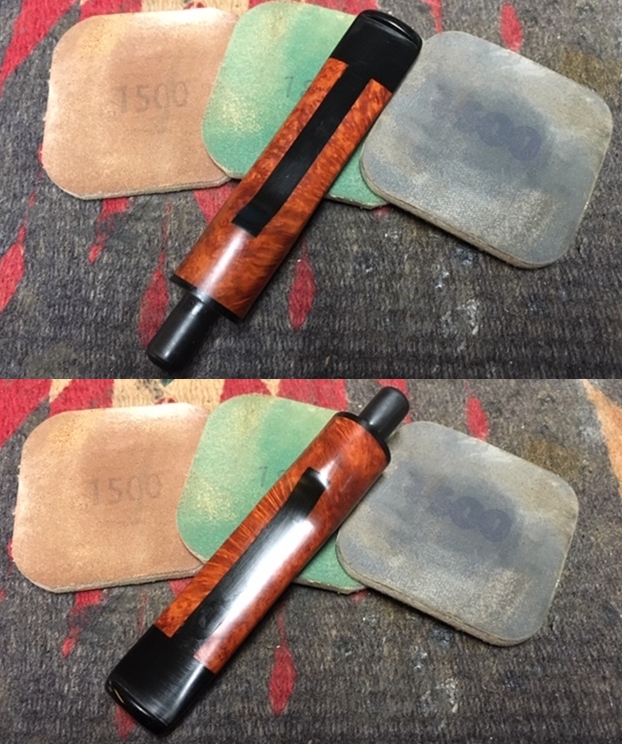
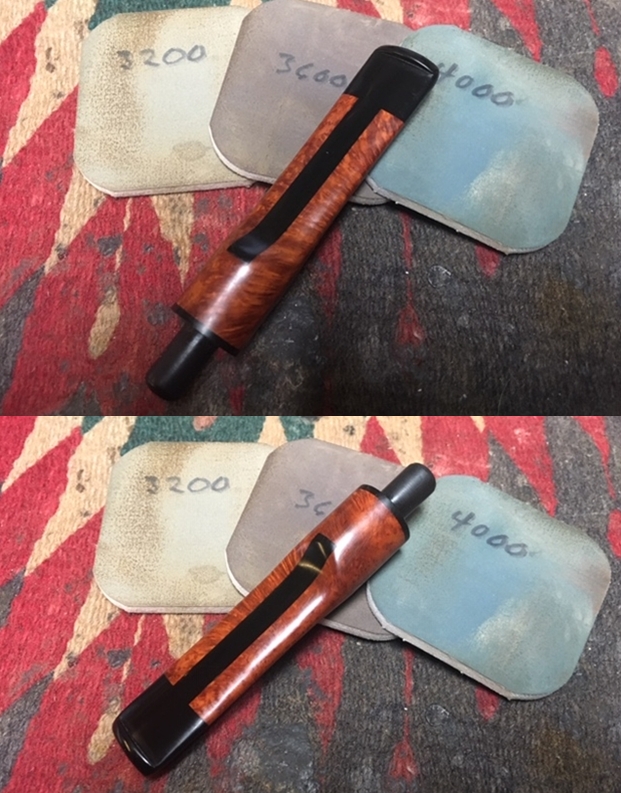
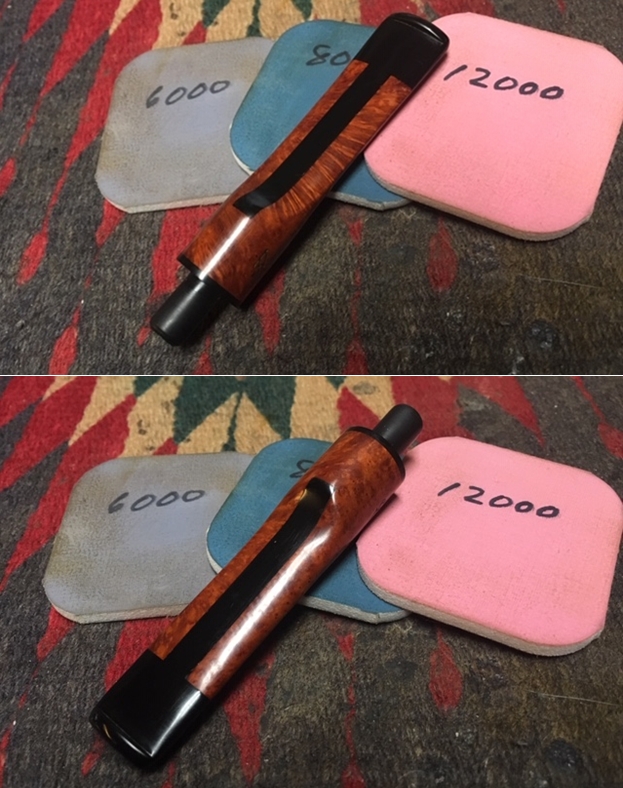
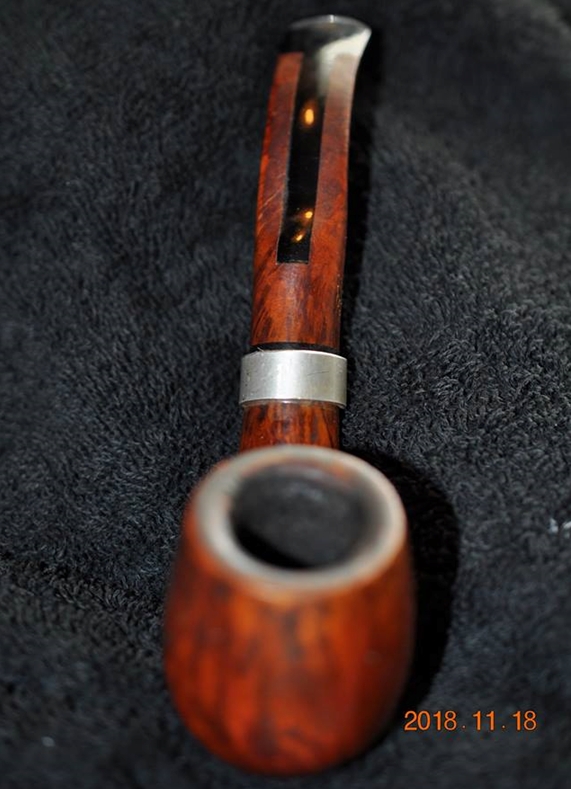
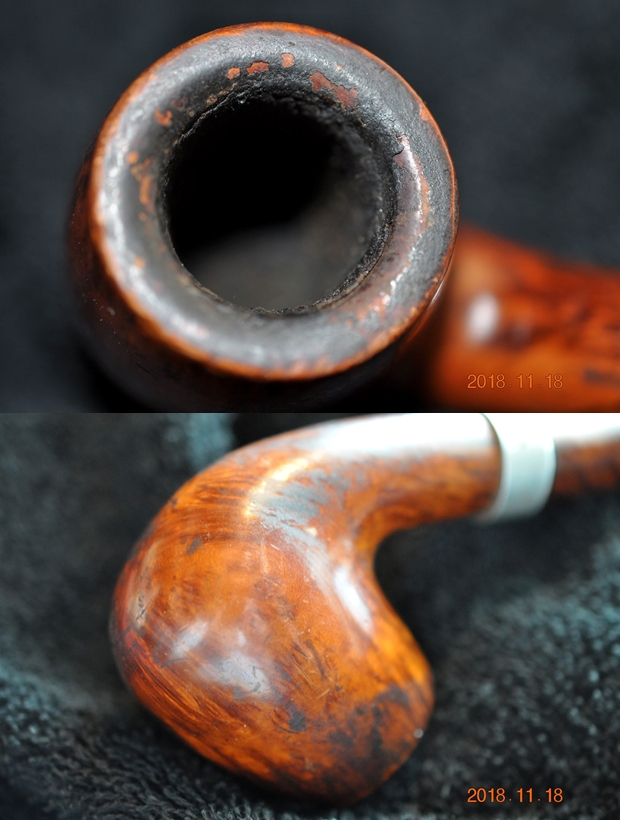
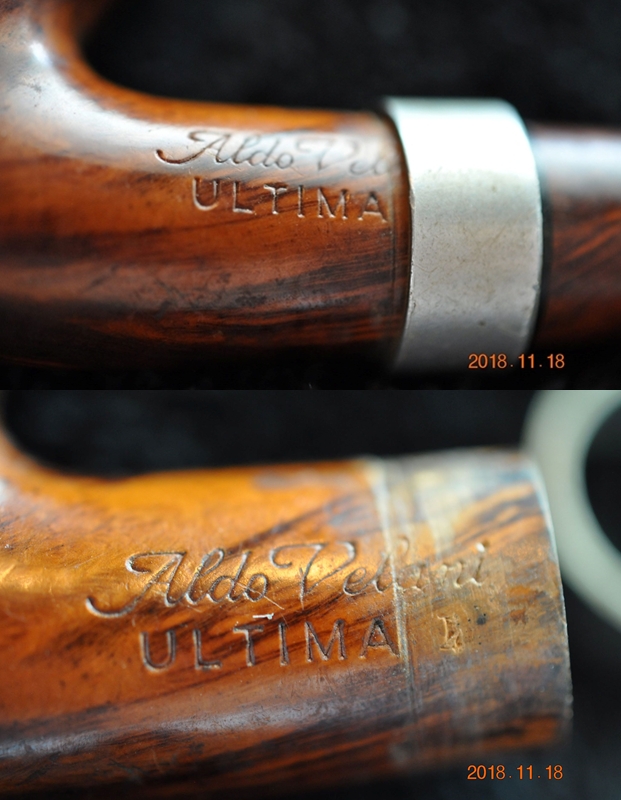
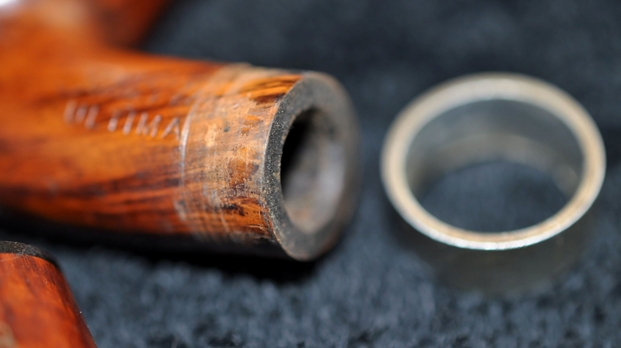
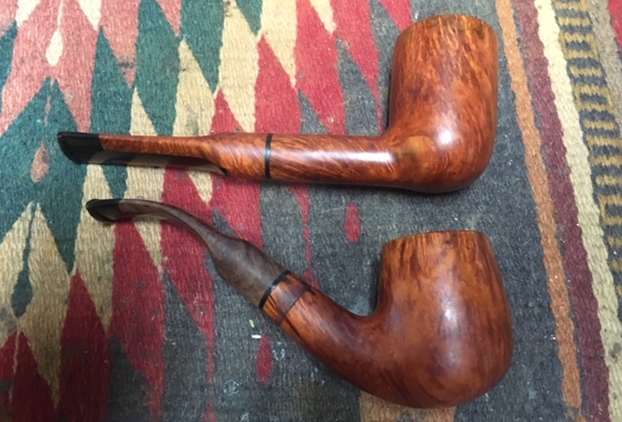
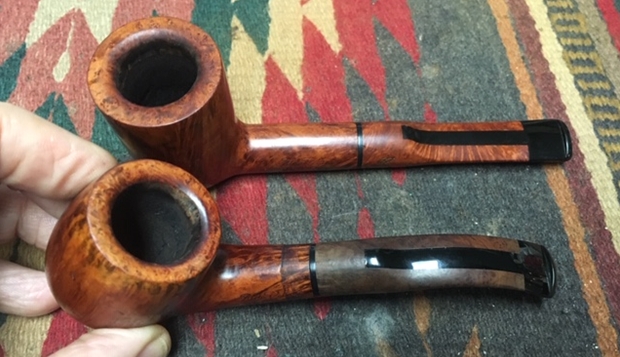
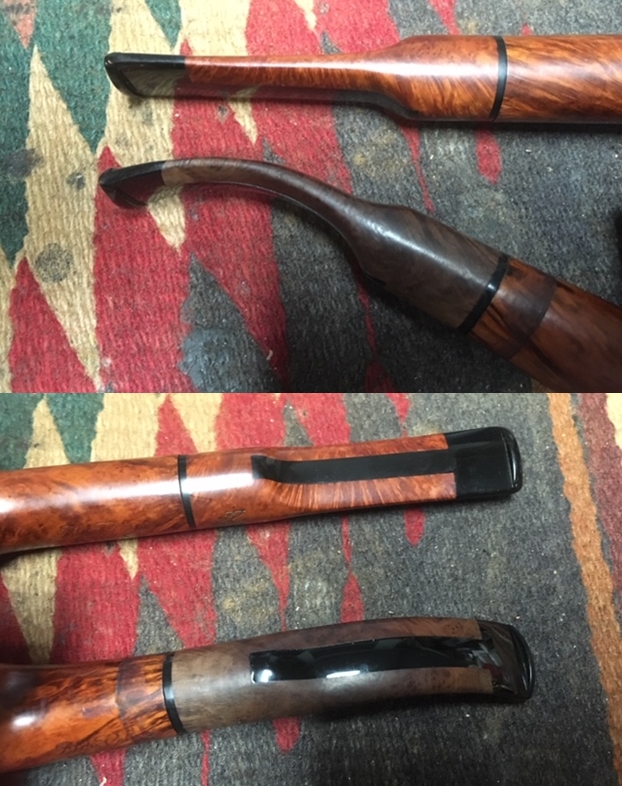
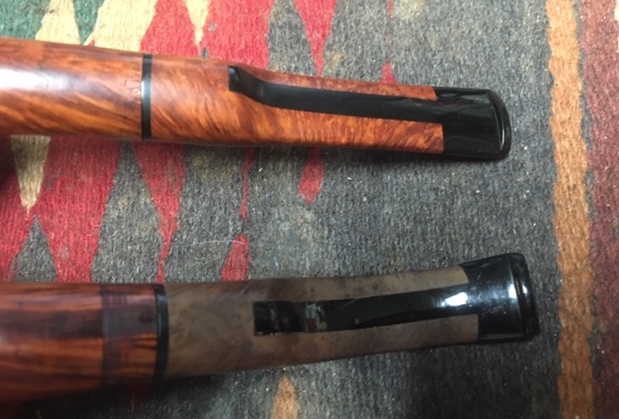
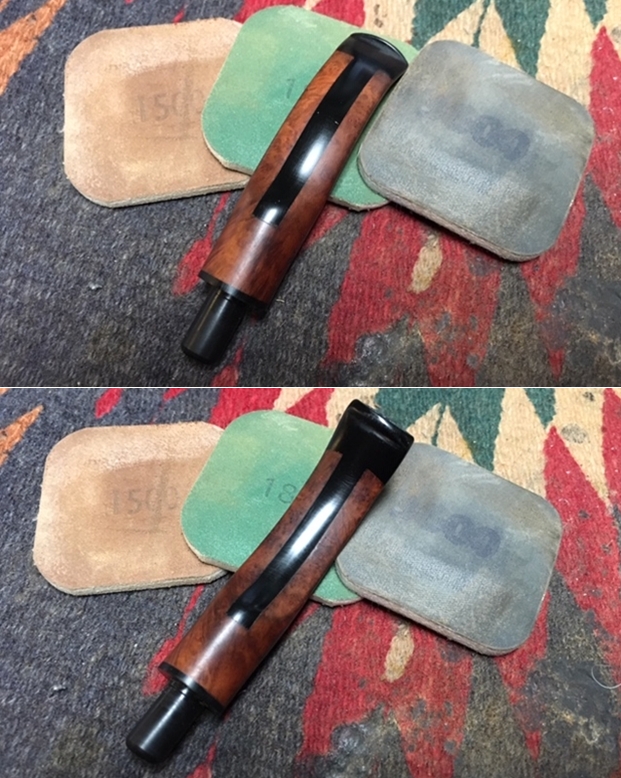
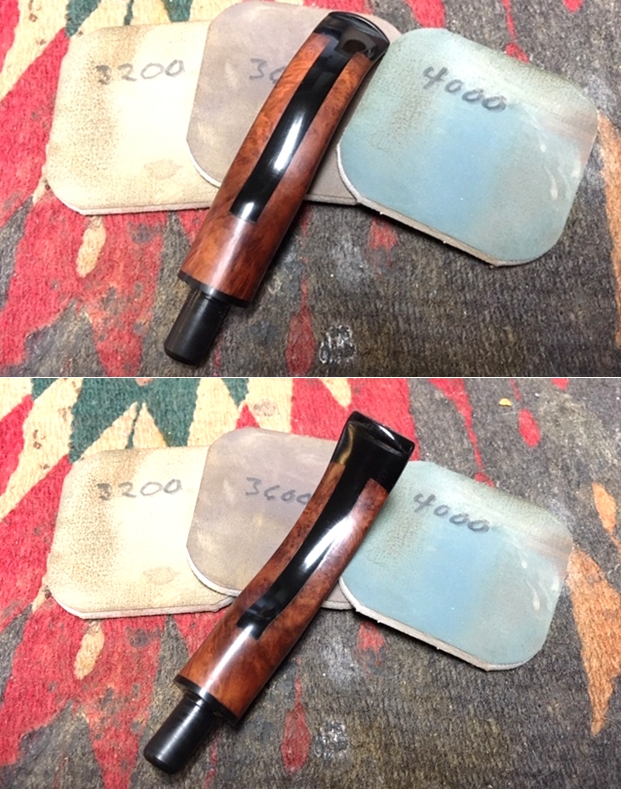
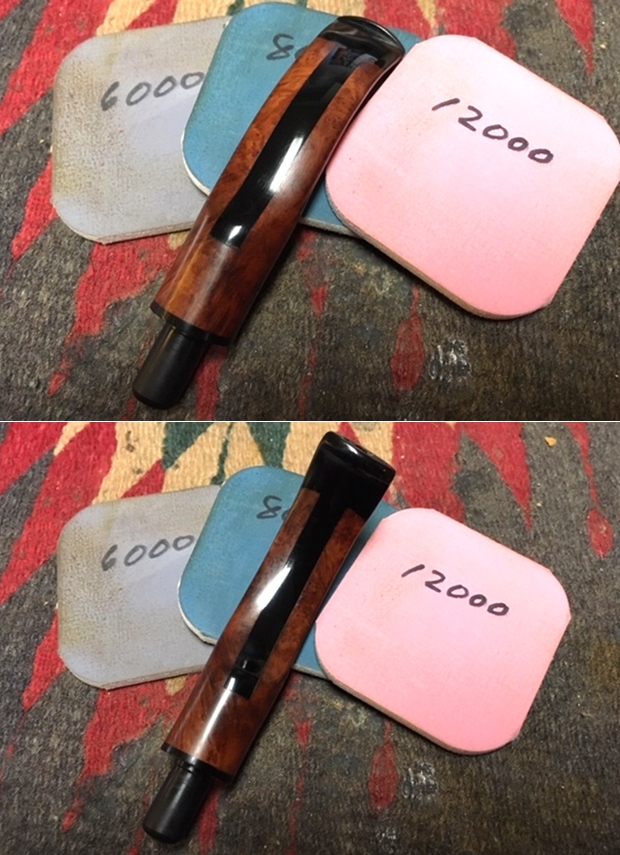
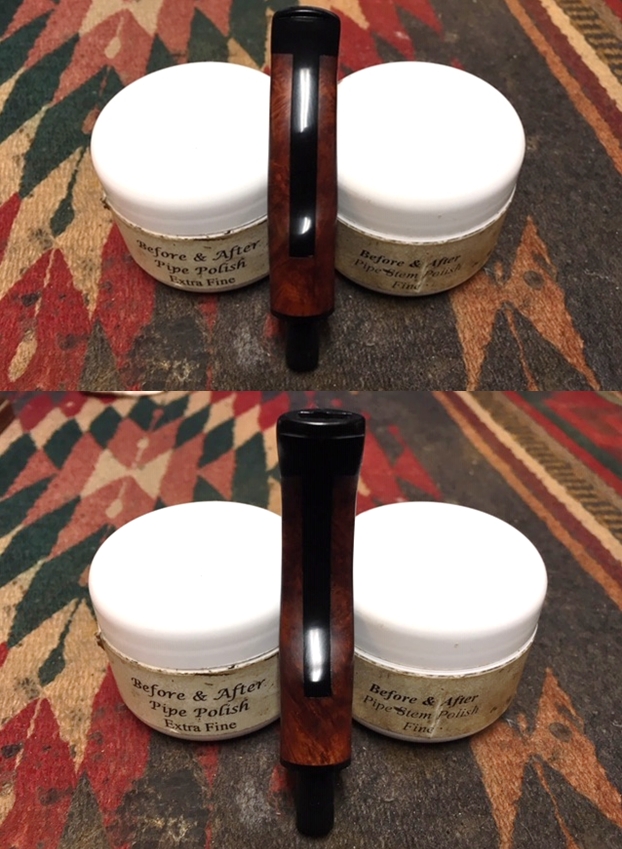
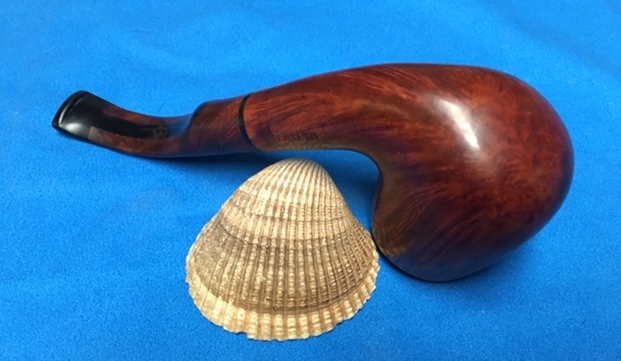
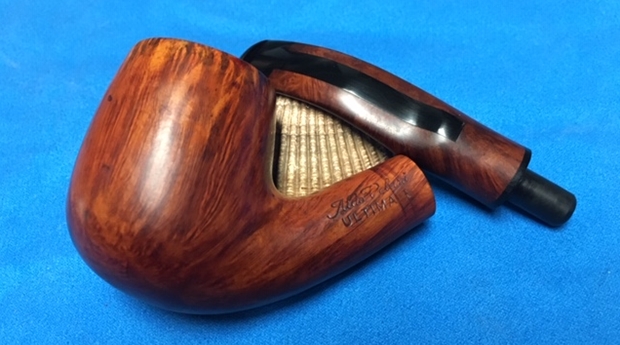
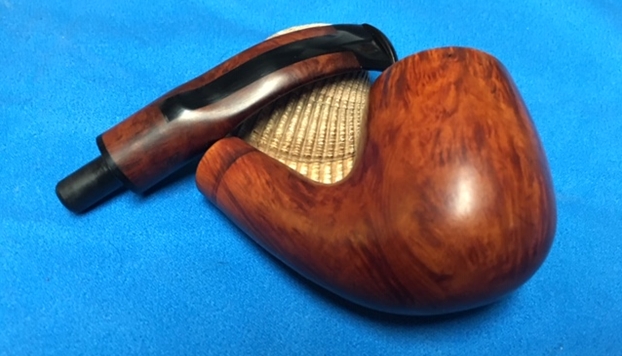
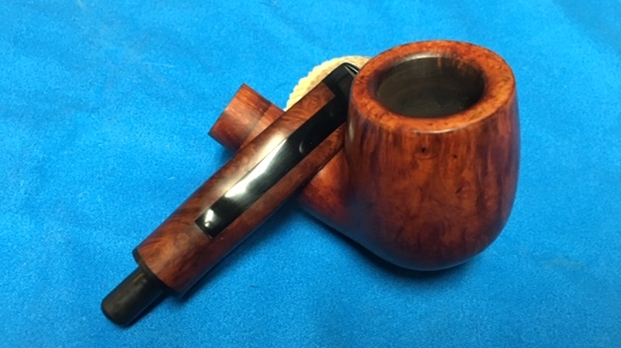
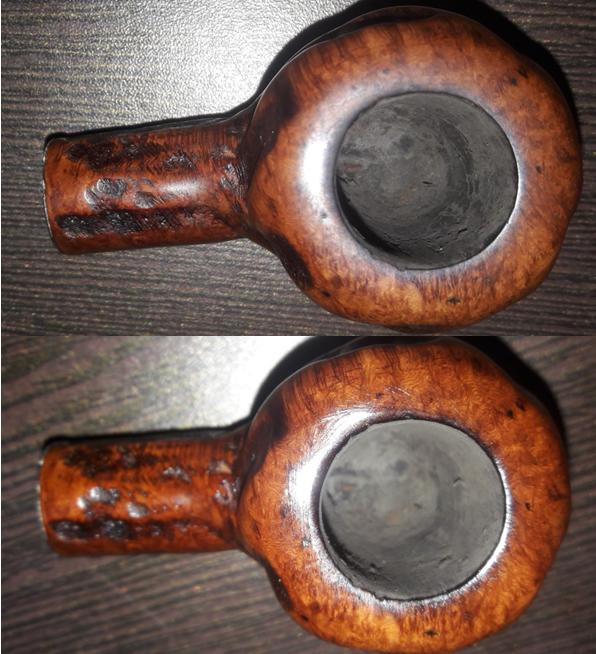
My brother Jeff picked up a pair of Aldo Velani Ultima 1 pipes in a lot he purchased on an auction. The Ultima 1 has a composite stem with briar inserts on the saddle and along the sides of the stem with Lucite forming the base of the stem. There are strips of Lucite on the top and underside and in the bite area around the button. It really is a beautiful looking pipe with a lot of class and distinction. Most Aldo Velani pipes are made in Livorno, Italy, for the USA market by Cesare Barontini. They were previously imported by Lane Limited. The name “Aldo Velani” is actually fictional and the brand was made for export (https://pipedia.org/wiki/Aldo_Velani  http://www.pipephil.eu/logos/en/logo-a3.html).  The second pipe of the pair was in significantly better condition than the first one. The pipes were probably made in the 1990s. This one was dirty but the exterior was in better shape. There was a thick cake in the bowl and there was a lava overflow on the rim top. This one was as it was made – no band added and no changes to the pipe. The stem was dirty and had light tooth marks on the Lucite around the button. Jeff took photos of the pipe before he started his clean up. He took some photos of the rim top and the side of the bowl to show how dirty it was. You can see the lava on the rim and the cake in the bowl. You can also see the sticky buildup on the exterior of the bowl.He took photos of the stamping on the shank – it read Aldo Velani over Ultima 1. On the underside of the shank it is stamped ITALY next to the shank/stem union. There was a nice acrylic band on the stem between the briar of the shank and the briar on the stem. The stem showed some wear and tear but it was in much better condition than its brother. The left side of the saddle stem also had the AV stamp in the briar. It always amazes me how dirty some folks let their pipes get. This one has a sticky substance all over the stem surfaces and a build up of gunk on the button and along its edges. Jeff cleaned the pipe with his usual thoroughness – reaming the bowl and scrubbing the internals with alcohol, cotton swabs and pipe cleaners. He scrubbed the exterior with Murphy’s Oil Soap to clean off the dust and grime on the finish. The rim top looked very good and the bowl itself looked great. The stem was in great shape other than a bit of tooth chatter. He cleaned the inside of the airways with alcohol and pipe cleaners. He did not put this one in the Before & After Deoxidizer Bath having seen the effects on the other one. I took photos of the pipe when it arrived here. I polished the bowl and shank with 1500-12000 grit micromesh sanding pads. I wet sanded it with 1500-2400 and dry sanded it with 3200-12000 grit pads. I wiped it down after each pad with a damp cloth to remove the sanding dust. The photos below show the progress in the polishing. The pipe was beginning to look really good and the grain was beginning to really pop. It was time to work some Before & After Restoration Balm into the briar on the bowl and the rim top. I worked it into the surface with my fingertips to clean, enliven and protect the wood. I let the balm sit for about 20 minutes and buffed it off with a soft cotton cloth. I took photos of the pipe at this point in the process to show what the bowl looked like at this point. I set the bowl aside at this point and turned my attention to the stem. I was really glad to see that this composite briar and Lucite stem was in decent condition. There was some light tooth chatter and scratching but nothing serious. It would only need to be polished. I polished it with micromesh sanding pads to remove the scratching left behind by the 220 grit sandpaper and give the briar and the Lucite a shine. I wet sanded with 1500-2400 grit pads and dry sanded with 3200-12000 grit pads. I wiped the stem down with a damp cloth after each pad. When I was finished the stem looked great. The photos tell the story. I put the bowl and stem back together. I polished the bowl and stem with Blue Diamond to polish out the scratches in the briar and acrylic. I gave the bowl and the stem multiple coats of carnauba wax. I buffed the pipe with a clean buffing pad to raise the shine. I hand buffed it with a microfiber cloth to deepen the shine. The pipe polished up pretty nicely. The contrast of colours between the briar bowl and the briar inserts on the stem really looked good with the polished black Lucite. The Aldo Velani Ultima 1 looked really good and was a great match to its bent brother. The pipe has a unique look that catches the eye. The finished pipe is shown in the photos below. The dimensions of the pipe are Length: 6 inches, Height: 2 ¼ inches, Outside diameter of the bowl: 1 1/2 inches, Chamber diameter: 7/8 of an inch. This one will soon be on the rebornpipes store if you are interested in adding it to your collection. Thanks for reading this while I worked on it. It was interesting and unusual piece to restore and I really enjoyed the work.

Life for a Really Filthy Aldo Velani Ultima 1 Bent Billiard


Blog by Steve Laug

My brother Jeff picked up a pair of Aldo Velani Ultima 1 pipes in a lot he purchased on an auction. The Ultima 1 has a composite stem with briar inserts on the saddle and along the sides of the stem with Lucite forming the base of the stem. There are strips of Lucite on the top and underside and in the bite area around the button. It really is a beautiful looking pipe with a lot of class and distinction. Most Aldo Velani pipes are made in Livorno, Italy, for the USA market by Cesare Barontini. They were previously imported by Lane Limited. The name “Aldo Velani” is actually fictional and the brand was made for export (https://pipedia.org/wiki/Aldo_Velani  http://www.pipephil.eu/logos/en/logo-a3.html).  The first of the pair had definitely seen better days in its ‘not so long life’. The pipes were probably made in the 1990s. This one was filthy and there was a thick coat of scum on the outside of the briar bowl and the stem. It was sticky to touch and really a mess. The bowl had a thick cake and there was a lava overflow on the rim top. The previous owner must have thought the pipe would look better with a band so he cut a piece of aluminum conduit and made a band. It is quite thick and really scratched and edges were rough from cutting – it was a real cob job! The stem was dirty and had tooth marks on the Lucite around the button. Jeff took photos of the pipe before he started his clean up. It really was a mess and needed new life breathed into it! He took some photos of the rim top and the side of the bowl to show how dirty it was. You can see the lava on the rim and the cake in the bowl. You can also see the sticky buildup on the exterior of the bowl.He took photos of the stamping on the shank and the fit of the aluminum band. You can see how thick it is in the photos. You can see it with and without the band. The shank was discoloured and scratched by the poorly made band. It would take some work to deal with that. The sad thing is that the band was purely “cosmetic” because the shank was not cracked or damaged. The band definitely had to go for cosmetic reasons! The stem definitely showed some wear and tear as well but the structure was sound. It always amazes me how dirty folks let their pipes get. This one has food particles or something jammed against the sharp edge of the button. The AV logo was stamped on the left side of the briar portion of the saddle stem. Jeff cleaned the pipe with his usual thoroughness – reaming the bowl and scrubbing the internals with alcohol, cotton swabs and pipe cleaners. He scrubbed the exterior with Murphy’s Oil Soap to clean off the dust and grime on the finish. The rim top looked very good and the bowl itself looked great. There were a few nicks or sandpits on the right side and heel of the bowl. The area where the band had been was quite a bit better but still was not right but it still looked better without the band than with it.

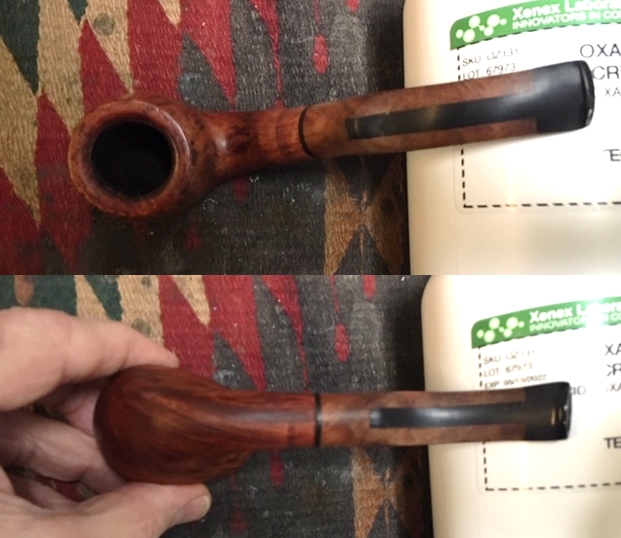
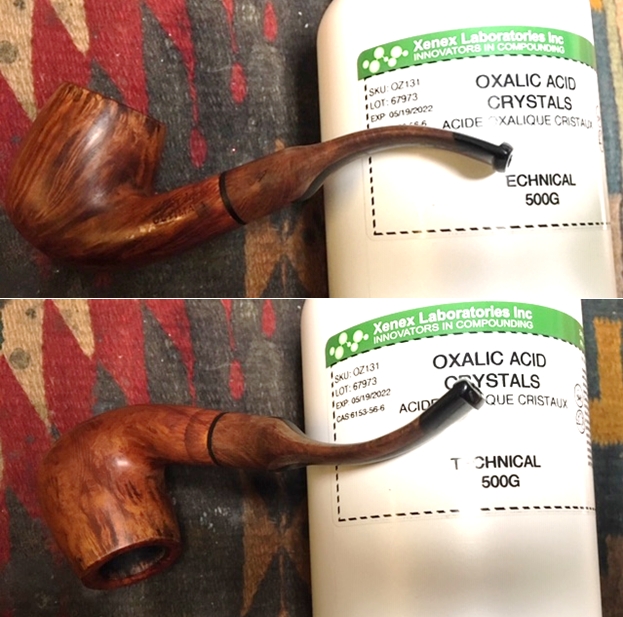
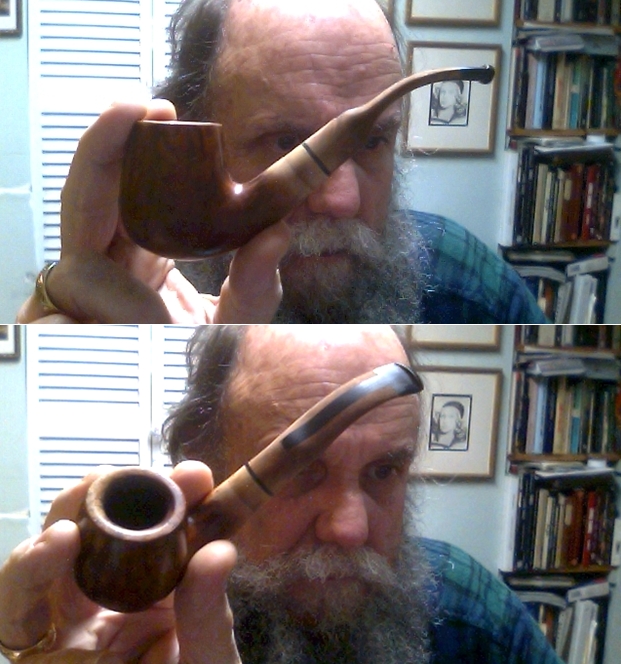
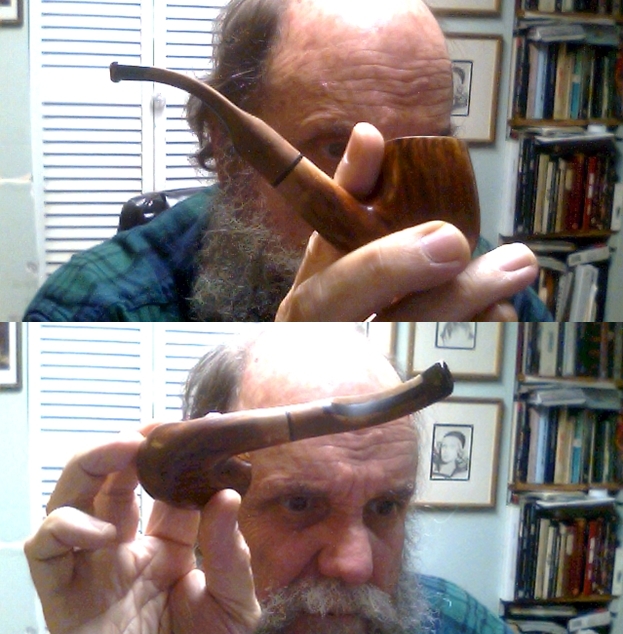
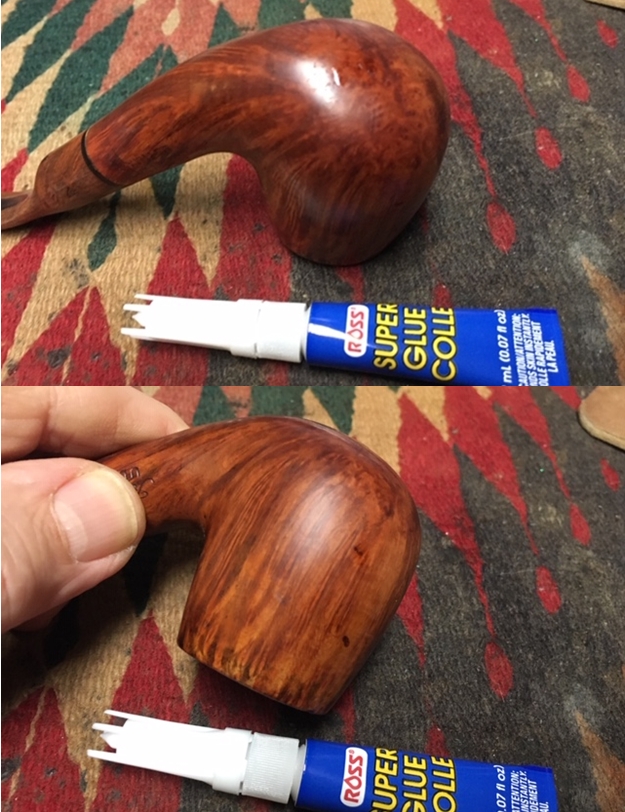
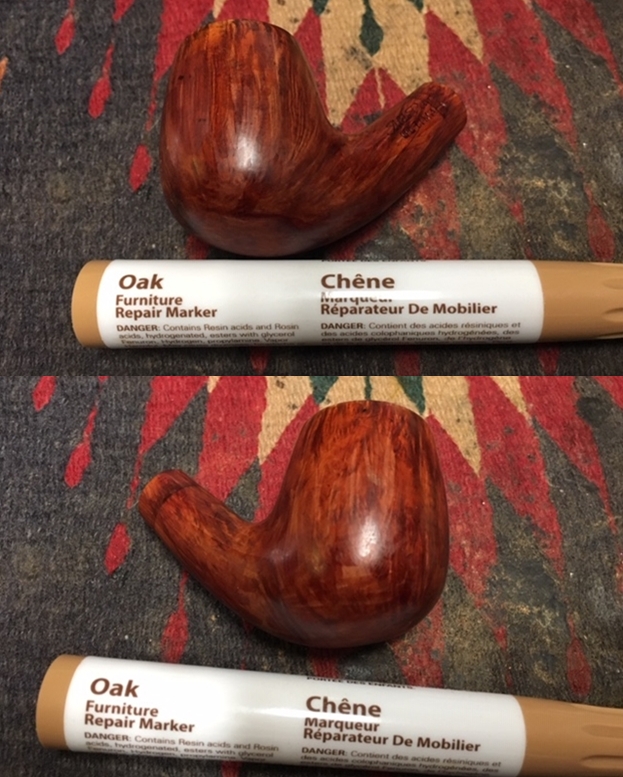
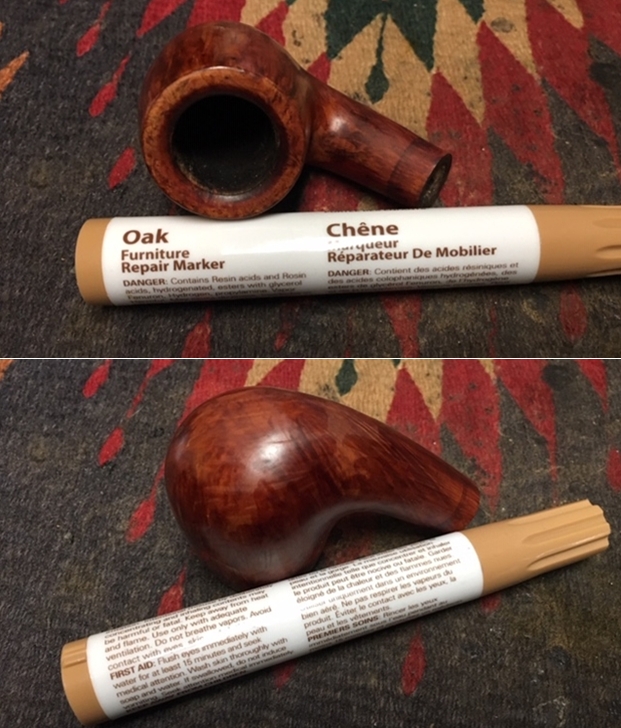
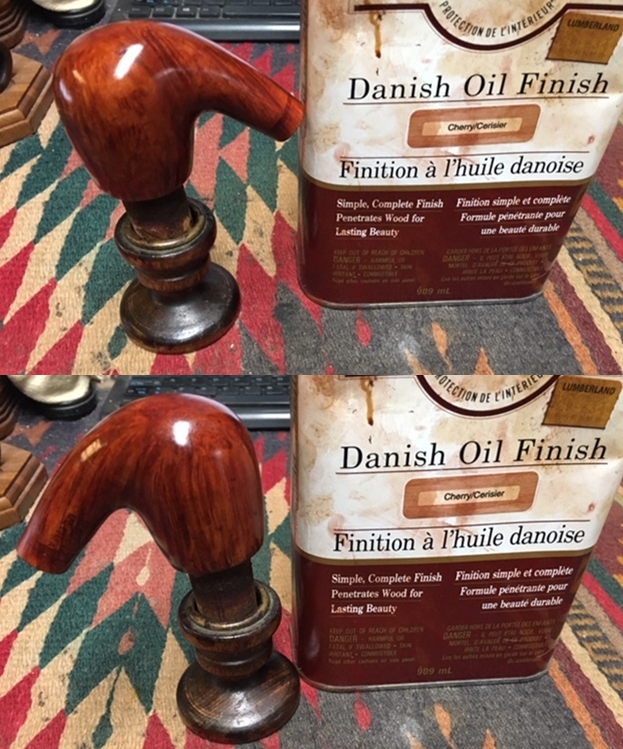
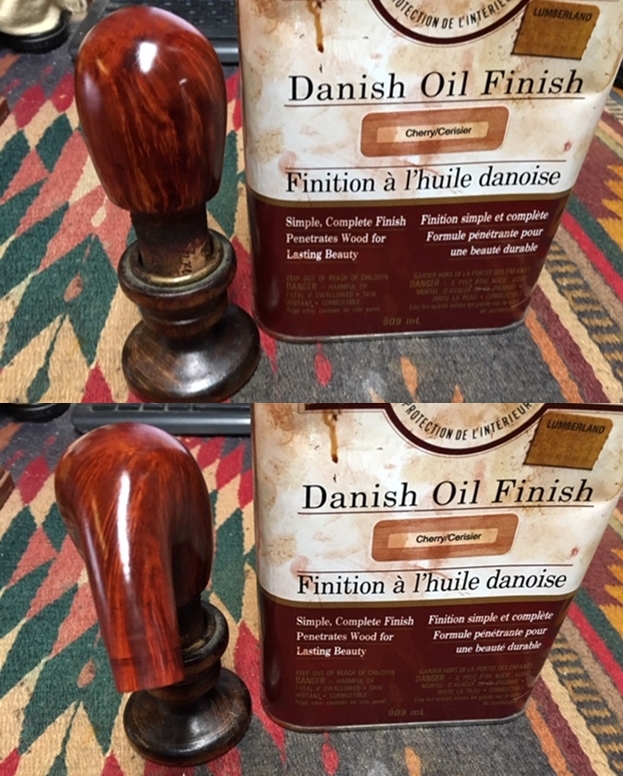
Sometimes the cleaning and restoration work has some unexpected results that end up making more work for the restorer! In this case the issue arose when Jeff soaked the stem in Before & After Deoxidizer. He did not leave it in too long but the time it sat in the mix made the briar inserts almost black and it swelled above the Lucite. When he took it out and rinsed it off the stem looked awful and Jeff was just sick! I took photos of the stem and bowls on both pipes to show the contrast in the stem. Originally the stem on the bent looked like the stem on the straight. The photos below show the comparison and the damage to the stem on the bent. Now the trick would be to try to restore the stem to a semblance of its original colour. I was not sure I would be able to get it back but time would tell. I decided to start my restoration on this pipe by addressing the most irritating issue facing me with this pipe! I wanted to see what I could do with the stem and the staining where the band had been. I mixed up a batch of oxalic acid – crystals and water. I made it fairly concentrated –1 teaspoon of oxalic crystals to ½ cup of water. When my Dad was here we used it to remove water stain damage to a pipe stand that I was refinishing. I figured it was worth a try. I wiped the stem down with a cotton pad dipped in the oxalic mixture. I also wiped the darkened ring around the shank where the band had been. I wiped it on repeatedly and dried it off. The first set of four photos show the immediate results of the action. I sanded the shank area (carefully avoiding damaging the stamping) and the briar portions of the stem with a worn piece of 220 grit sandpaper to further remove the darkening. I was able to remove much of the issue on the stem. I sent the following photos via Facebook Messenger to my brother to ease his mind about the stem. You can see that things are looking quite hopeful with the stem and the shank at this point. Please ignore the curmudgeonly model that is posing with the pipe!I wiped the stem and bowl down with an alcohol wetted cotton pad to remove the sanding dust. I polished the briar with 1500-2400 micromesh sanding pads. I used some clear super glue to repair the deep sand pits and nicks in the briar. Once the repairs had cured I sanded them smooth with a small piece of 220 grit sandpaper to blend them into the briar and then sanded the repaired areas with 1500-2400 grit micromesh pads. When I had finished the repairs were smooth (I failed to take photos of this part of the process).I stained the repaired areas, the rim top and the shank end where I had stripped the finish with the oxalic acid wash with an Oak stain pen. The colour most accurately matched the rest of the bowl. I was happy with the overall look of the bowl but the ring damage on the shank end still stood out too much to my liking. The colour on the bowl was even but still was significantly browner than the reds of the stem. I decided to rub the bowl down with several coats of Danish Oil Cherry stain. I rubbed it down and wiped it off several times until I had the colour I wanted. I set it aside to let the stain sink into the briar. The pictures below show the bowl at this point in the process. I am making progress. I was happy with the finished bowl colour and the darkening left by the poorly done band looked better than it had before. There were still remnants that were left behind and these are the war wounds from the journey this pipe took before it came to me. Here are some photos of the bowl at this point. The colour is very good and works with the stem and the grain really sings. I set the bowl aside at this point and turned my attention to the stem. I polished it with micromesh sanding pads to remove the scratching left behind by the 220 grit sandpaper and give the briar and the Lucite a shine. The stem was looking far better than I expected or had hoped. Now came the test – would the bowl and stem look good together? I polished the bowl and stem with Blue Diamond to polish out the scratches in the briar and rubber. I gave the bowl and the stem multiple coats of carnauba wax. I buffed the pipe with a clean buffing pad to raise the shine. I hand buffed it with a microfiber cloth to deepen the shine. The pipe polished up pretty nicely. The Cherry Danish Oil had really breathed life into the briar on the bowl and stem and the pipe came alive with the buffing. The contrast of colours between the briar bowl and the briar inserts on the stem really looked good with the polished black Lucite. The Aldo Velani Ultima 1 looked far better than when it enter the queue and I was able to redeem the darkened stem. The finished pipe has a unique look that catches the eye. The finished pipe is shown in the photos below. The dimensions of the pipe are Length: 6 inches, Height: 2 inches, Outside diameter of the bowl: 1 3/8 inches, Chamber diameter: 7/8 of an inch. This one will soon be on the rebornpipes store if you are interested in adding it to your collection. Thanks for reading this while I worked on it. It was interesting and unusual piece to restore and I really enjoyed the work.

Resurrecting a Tired & Worn Special Straight Grain 122


Blog by Steve Laug

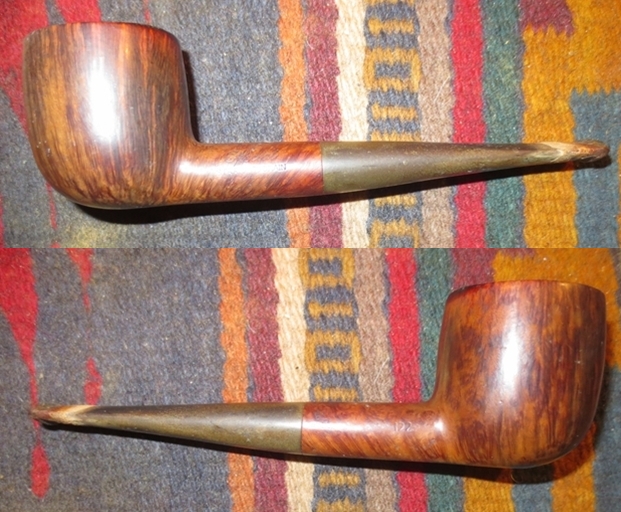
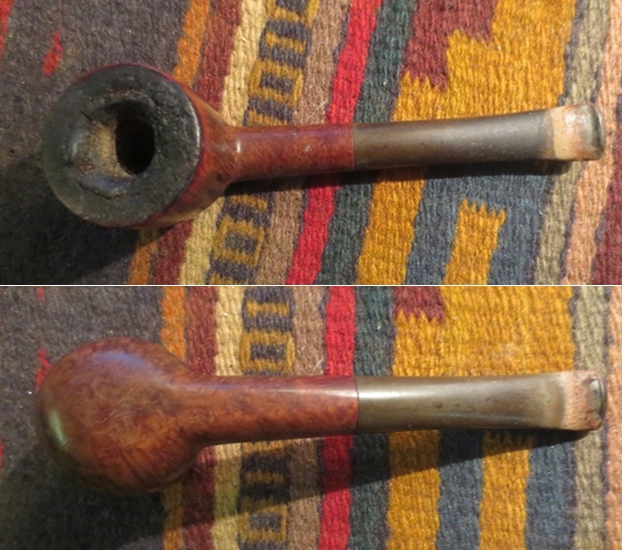
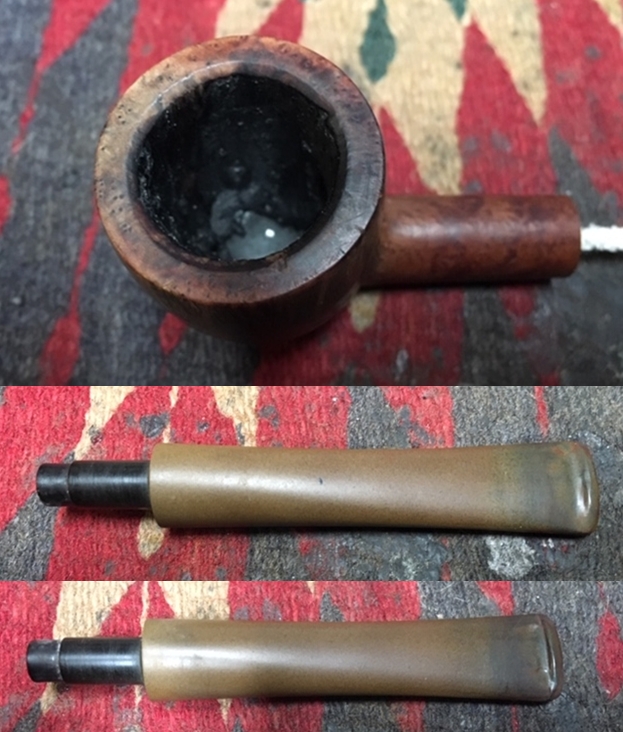
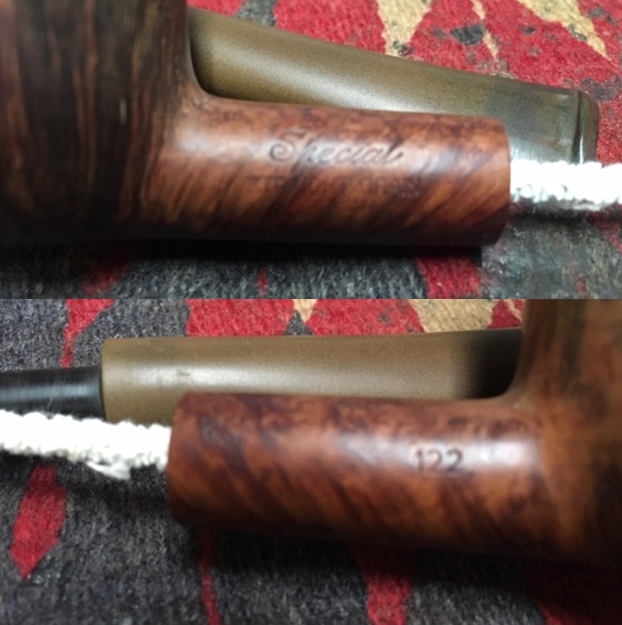
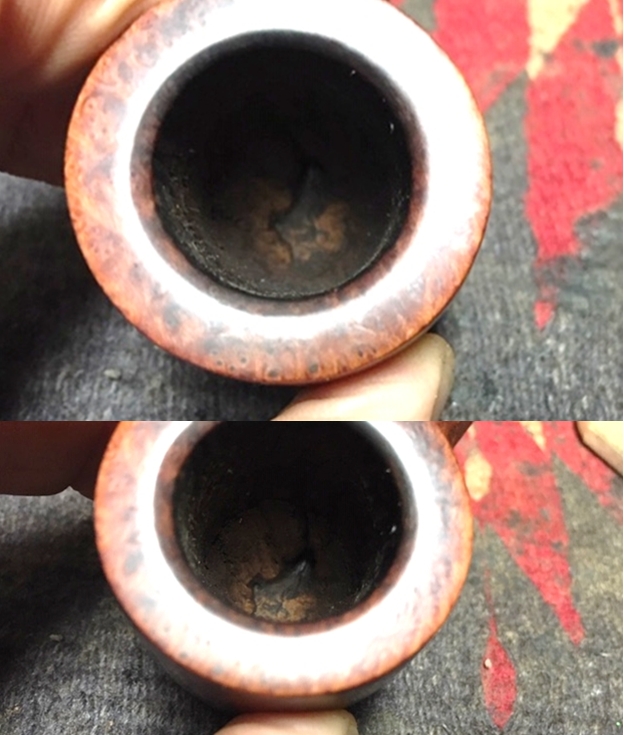
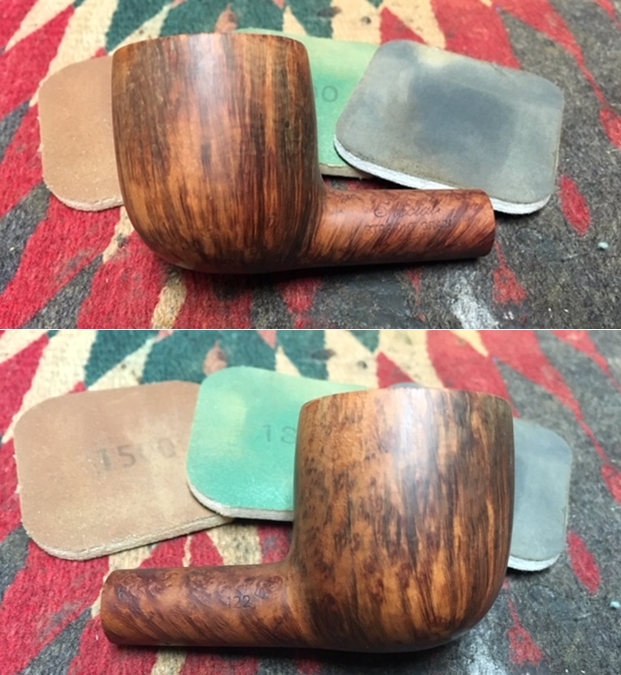
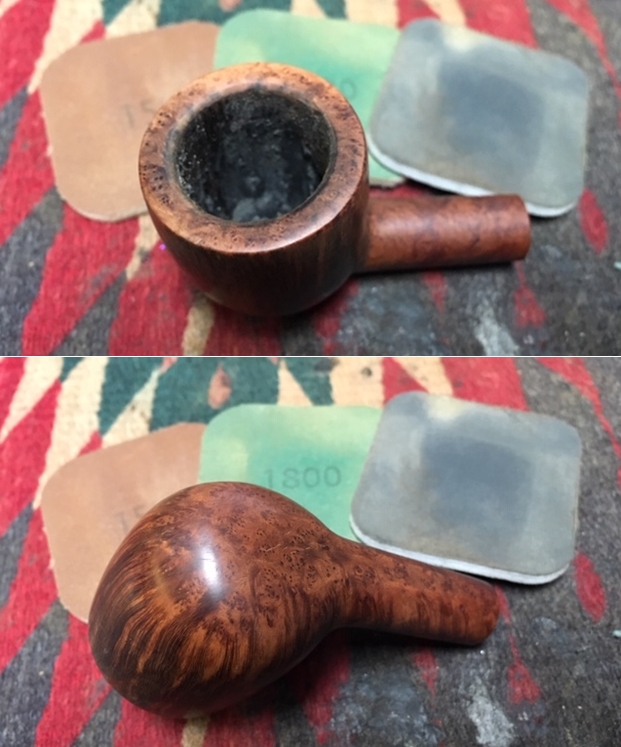
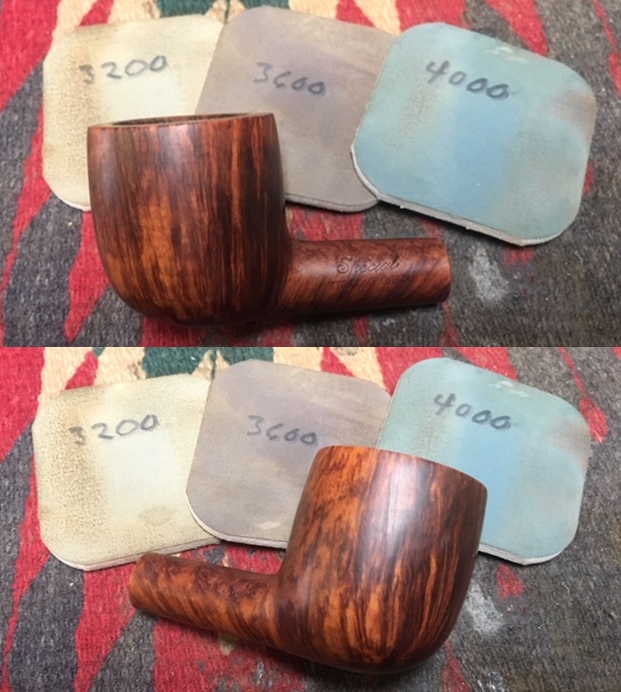
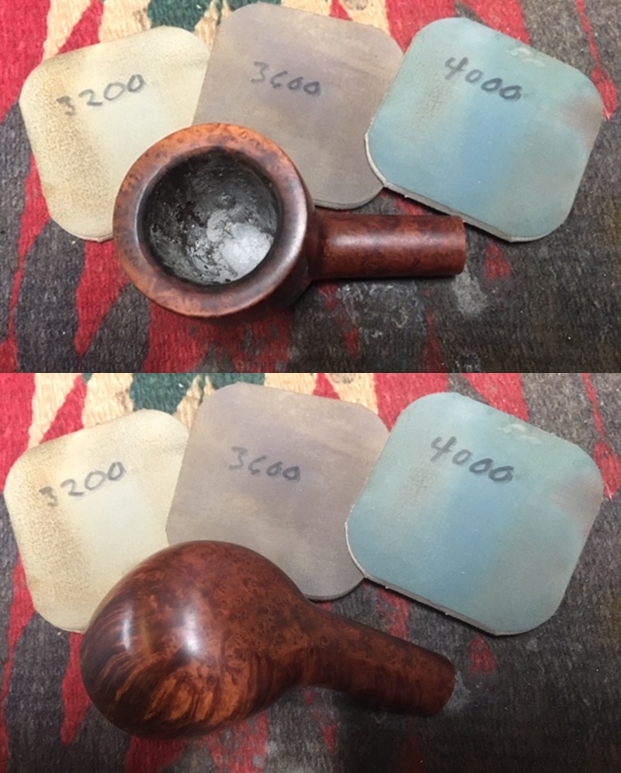
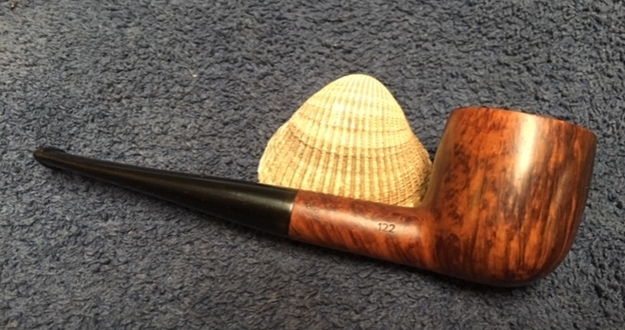
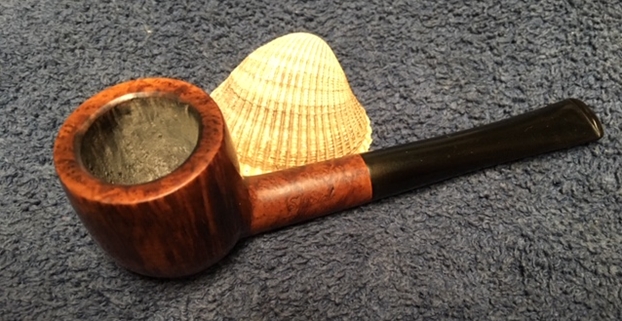
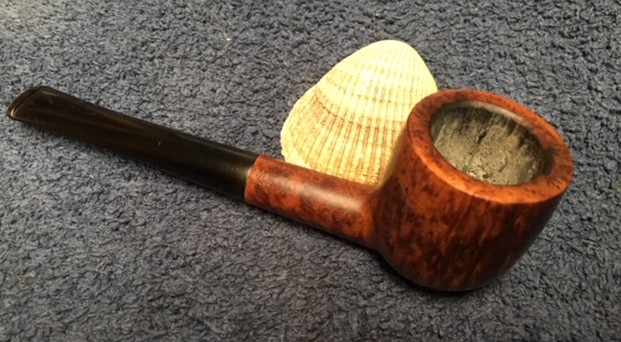
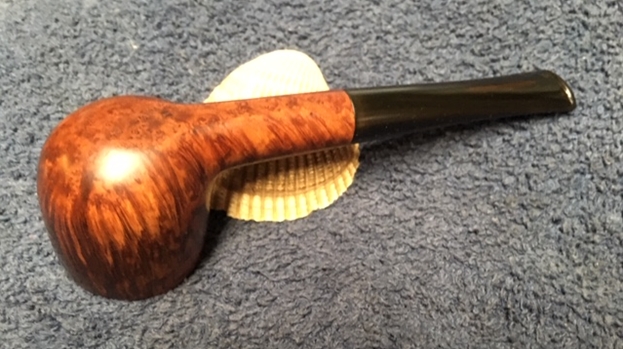
In my ongoing work on the estate pipes from the pipe shop that had closed here in Vancouver I am turning to a fourth pipe from the lot. The entire lot came to me from the estate of an older pipeman whose wife dropped them off at a pipe shop to be cleaned and sold. When the shop closed they came to me. The pipe on the table now is stamped Special over Straight Grain on the left side of the shank. On the right side it is stamped with a Comoy’s style COM stamp reading Made in London in a circle over England followed by the shape number 122. The briar has some nice straight and flame grain around the bowl with birdseye on the top of the bow, shank and the underside of both. The bowl had a thick cake in it with an over flow of lava on the rim top. The rim top looked very bad but it hard to know if there was real damage or if the marks were in the lava overflow. It was hard to know what the rim edges looked like with the thick coat covering it all. The briar was dull and dirty looking. The stem is vulcanite and is oxidized with no visible stamping or logo. There was calcification and tooth chatter and damage next to the button on both sides. There are heavier tooth marks on the underside of the stem. I took photos of the pipe when I received it.   I sent this pipe along with about twenty others from this lot to my brother Jeff in Idaho to work over and clean up. He cleaned up the pipes with his usual thoroughness – reaming the bowl and scrubbing the internals with alcohol, cotton swabs and pipe cleaners. He scrubbed the exterior with Murphy’s Oil Soap to clean off the dust and grime on the finish. When he sent it the pipe was ready to restore. Like the Savinelli I just worked on, I could not believe how good the rim top looked in comparison to what it was when he started. I was working on the Savinelli Giubileo D’ Oro and it had the same issues as this one with the trough in the bowl so I used the remaining pipe mud that I made for it to repair the bowl bottom on this pipe. In doing so I forgot to take photos before I began. I slid the stem over the pipe cleaner and put it in place to get photos. I took the following photos of the pipe to show what it looked like before I started working on the exterior. The briar was clean and the grain quite stunning. The finish looked dull and lifeless. I took a close up photo of the rim top after Jeff had cleaned it up. The look of the rim top and edges is very good. (Ignore the pipe mud in the bowl bottom.) He had been able to remove the cake and the lava very well. The bowl was clean but there seemed to be a trough in the bottom of the bowl made by a pipe cleaner repeatedly passing over the same spot. The stem is also shown and was very clean but oxidized. He had not started using Mark’s Before & After Deoxidizer at this point. The tooth marks on both sides near the button are visible in the photos.  The marks on the underside of the stem were worse than the ones on the topside.I took some photos of the stamping on the shank sides. The first photo shows the Special over Straight Grain stamp on the left side. The second shows the shape number and the COM Stamp that reads Made in London in a circle over England and the shape number 122 on the right side.There were several things about the stamping that I was unfamiliar with so I did some searching online. I had a memory of the Special being a Comoy’s product. The COM stamp on the shank and the stamping on the left side of the shank pointed to that. The shape number 122 also seemed to point in that direction. I turned to all of my usual sources – Pipedia and Pipephil and found nothing connecting the stamping to Comoy’s. There is not a note regarding the Special Straight Grain stamp on either site when it is missing the Comoy’s designation. However there was a connection with the shape number on the Comoy’s Shape Chart on Pipedia (https://pipedia.org/wiki/Comoy%27s_Shape_Number_Chart).

I have captured a portion of the chart to show the number and designation match what I have in hand.  I circled the shape number in red that is on the right side of this pipe. It fits the description of a 122 Pot with a straight stem and a medium sized bowl. I think I could safely assume I was working on a Comoy’s made pipe with an interesting and unique stamping – Special Straight Grain on the right side of the shank!

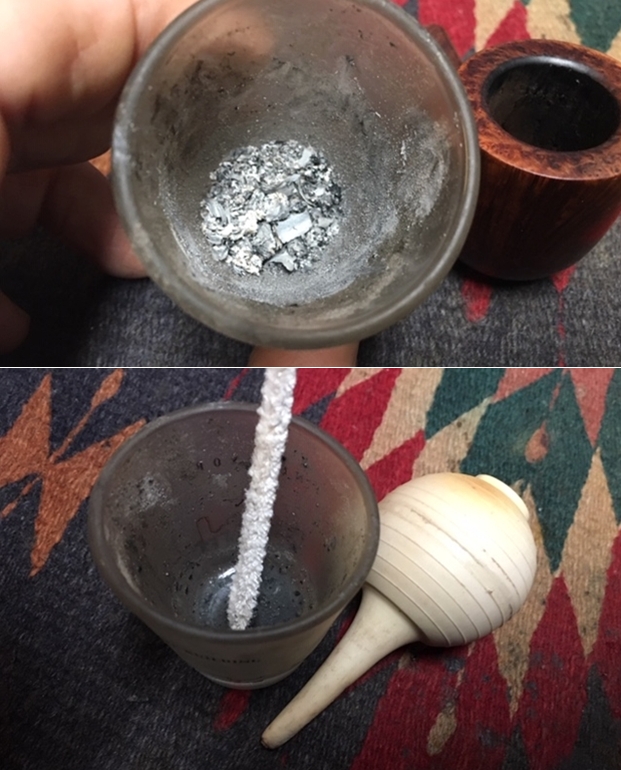
I started working on the bowl. Since I was working on the La Savinelli Giubileo D’Oro at the same time and both had parallel issues with the bowl I decided to address the trough in the bottom of the bowl first. It was quite visible and though the bottom of the bowl was still quite thick, it bothered me. I decided to mix a batch of pipe mud to fill in the trough and protect the bottom while a new cake was formed in the bowl. I mixed some cigar ash and water to form a paste. I put a pipe cleaner in the airway to protect it from being filled in. I used a folded pipe cleaner to paint the mud around the airway to clean up some of the edges and tamped some into the bottom of the bowl to fill in the trough. I packed it in place with a Czech pipe tool tamper as it fit in the bottom of the bowl. The pictures that follow tell the story. It will take a while to dry out but once it has dried it will be quite hard. I set the bowl aside while I worked on the other pipe.

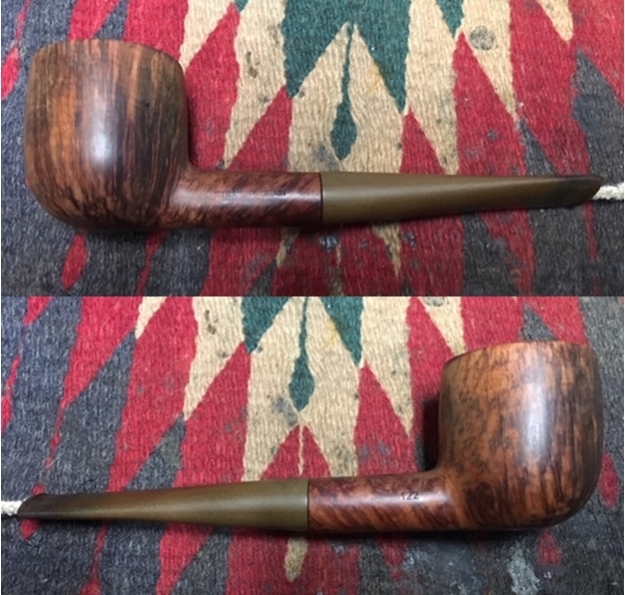
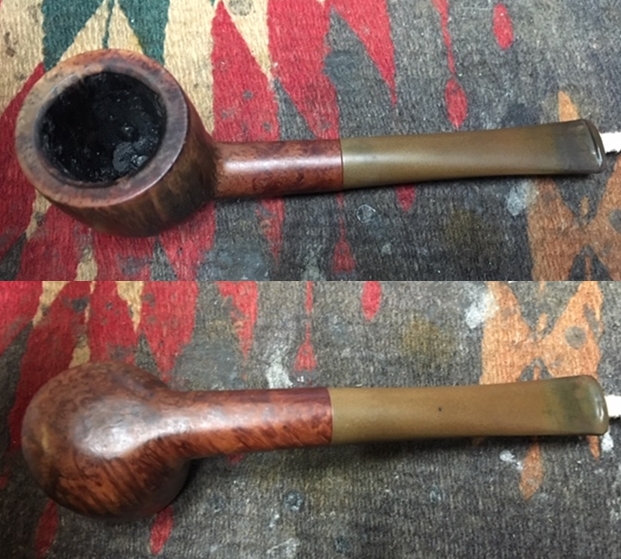
(The first two photos show the bowl of the Giubileo. The bowl on the Special had a twin looking bottom and I forgot to include photos of the bowl bottom on this repair. You can imagine it from the photos below.) I wanted clean up the rim top in the least intrusive method possible and still be able to deal with the scratches and wear on the flat surface. I wanted to see if I could minimize the darkening on the back side and the bevel of the inner edge of the rim top. I sanded it on a small medium and fine grit sanding block to see what I could do to begin with (forgot to take photos). I was happy with the way it was beginning to look. I finished with the blocks and wiped the bowl down with isopropyl alcohol to get a feel for what it looked like under the sanding dust. I polished the briar by wet sanding with 1500-2400 grit sanding pads to raise the shine. I also wanted to remove as much of the scratching as I could. I dry sanded the briar with 3200-12000 grit pads. I wiped the bowl down with a damp cloth after each pad. The briar began to really shine and the grain stood out. This was a beautiful pipe and worthy of the designation SPECIAL STRAIGHT GRAIN. The pipe was beginning to look really good and the grain was beginning to really pop. It was time to work some Before & After Restoration Balm into the briar on the bowl and the rim top. I worked it into the surface with my fingertips to clean, enliven and protect the wood. I let the balm sit for about 20 minutes and buffed it off with a soft cotton cloth. I took photos of the pipe at this point in the process to show what the bowl looked like at this point. I decided to rub down the surface of the bowl and shank with a Medium Walnut Danish Oil Finish and a cotton pad to give some depth to the finish. I really like how the Danish Oil Walnut Stain can make the grain pop on the briar without really darkening the finish. I hand buffed the bowl with a soft cloth to polish the briar. I buffed it lightly on the buffing wheel using Blue Diamond on the wheel. I took photos of the bowl after buffing. I really like the way that the grain stands out now. It is truly a beautiful piece of briar. The bowl looked good so I set it aside and turned my attention to the stem. I used a flat blade needle file to sharpen the edge of the button and smooth out the tooth damage to the edges of the button. I also worked on the tooth chatter with the filed. I followed that by using a Bic lighter to paint the surface of the vulcanite with the flame. Between the file work and the heat of the flame I was able to remove some of the marks and minimize the others. The photos tell the story.   I filled in the two deep tooth marks on the underside of the stem with superglue. The tooth marks on the topside were no longer an issue so I would only need to sand out the file marks. I set the stem aside to dry. Once the glue had dried I sanded the stem surface with 220 grit sandpaper to smooth out the repairs and remove the oxidation that was on the stem surface.I polished the stem with micromesh sanding pads – wet sanding with 1500-2400 and dry sanding them with 3200-12000 grit pads. I wiped the stem down with Obsidian Oil after each pad. I gave it a further polish with Before & After Pipe Stem Polish – both Fine and Extra Fine. When I finished I gave it a final coat of Obsidian Oil and let it dry. The following photos show the stem at this point. I polished the bowl and stem with Blue Diamond to polish out the scratches in the briar and rubber. I gave the bowl and the stem multiple coats of carnauba wax. I buffed the pipe with a clean buffing pad to raise the shine. I hand buffed it with a microfiber cloth to deepen the shine. The pipe polished up pretty nicely. The Walnut Danish Oil had really breathed life into the briar and the pipe came alive with the buffing. The contrast of colours between the briar and the stem worked really well. The Special Straight Grain pipe has a rich and classic look. The finished pipe is shown in the photos below. The dimensions of the pipe are Length: 5 1/2 inches, Height: 1 5/8 inches, Outside diameter of the bowl: 1 3/8 inches, Chamber diameter: 7/8 of an inch. This one will soon be on the rebornpipes store if you are interested in adding it to your collection. Thanks for reading this while I worked on it. It was interesting and unusual piece to restore and I really enjoyed the work.

Breathing Life into a GIGI Collection Italia Studio X 40288


Blog by Steve Laug

It was time to go back to working on the estate pipes from the pipe shop that had closed here in Vancouver. The entire lot came to me from the estate of an older pipeman whose wife dropped them off at a pipe shop to be cleaned and sold. When the shop closed they came to me. The pipe on the table now was an Italian made with a bit of a freehand look to it. It is stamped GIGI over Collection Italia on the left side of the shank. On the right side it is stamped Studio X 4 over 40288. On the underside of the shank it is stamped REGD. NUMBERS over 256267-386165 followed by Made in Italy. The briar has some nice straight and flame grain around the bowl with what looks like faux plateau on the top of the bowl and the shank end. The bowl had a thick cake in it with an over flow of lava on the rim top. The plateau type finish was filled in with lava and was a real mess. It was hard to know what the rim edges looked like with the thick coat covering it all. The briar was dull and dirty looking. The freehand style stem is vulcanite and is oxidized. It had a turned portion near the tenon and the stem itself was oval. There was calcification and tooth chatter and marks damage next to the button on both sides. I took photos of the pipe when I received it. I sent about twenty of the pipes to my brother Jeff in Idaho to work over and clean up. He cleaned up the pipes with his usual thoroughness – reaming the bowl and scrubbing the internals with alcohol, cotton swabs and pipe cleaners. He scrubbed the exterior with Murphy’s Oil Soap to clean off the dust and grime on the finish. When he sent it the pipe was ready to restore. I took photos of the pipe when I unpacked it. The briar was clean and the finish dull. There were some small fills on the left underside of the shank and bowl that needed to be repaired. I took a close up photo of the rim top after Jeff had cleaned it up. The look of the rim top and edges is very good. The carved finish on the plateau top is clean and undamaged. He had been able to remove the cake and the lava very well. The bowl looked very good. The plateau on the shank end is also very clean. The stem is also shown and was very clean. The tooth marks on both sides near the button are visible in the photos.  I was unfamiliar with the brand so I did some searching online and found some basic information on Pipedia. I quote in full:

Luigi “Gigi” Crugnola was born in 1934, the same year Giorgio Rovera founded a company in his own name in Varese, Italy along with partners Angelo and Adele Bianchi, who also happened to be Luigi Crugnola’s Uncle and Mother, respectively. The company produced pipes for 30 years, largely exported to America and elsewhere in the world. Crugnola took over the company in 1964 with the death of Angelo Bianchi, changing the name soon after to his own nickname Gigi, and continues to run the company today. The vast majority of Gigi pipes continue to be made for export (https://pipedia.org/wiki/Gigi).

I turned to my other go to website, Pipephil. The site included a photo of the carver and confirmed the information that I had read on the Pipedia site. It gave the contact information for the pipe company. It is as follows: Gigi Pipe Via Rovera, 40 21026 Gavirate Oltrona al Lago (VA) The link is – http://www.pipephil.eu/logos/en/logo-g3.html.

From that I learned that the pipe was made by Luigi “Gigi” Crugnola and was made after he took over the company in 1964 and changed the name of the brand. I also learned that the majority of the pipes were made for export from Italy so it was not unusual to find one in Canada.

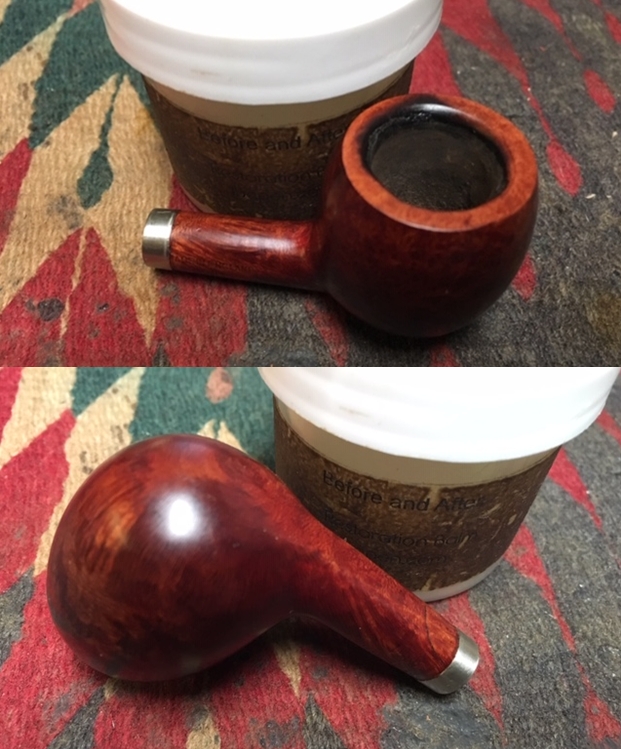
Armed with that information I decided to start on the bowl. I repaired the fills on the underside of the bowl and shank with clear super glue. Once the glue dried I sanded it with 220 grit sandpaper to blend the repairs into the surface of the briar. The fills looked much better with the darkening that occurs with the glue repairs than they did before my work. The photos below show the repaired areas.I polished the briar with micromesh sanding pads to smooth out the surface of the briar and blend the repairs into the rest of the bowl. I wet sanded it with 1500-2400 grit pads and dry sanded it with 3200-12000 grit pads. I wiped it down with a damp cloth after each sanding pad. I worked Before & After Restoration Balm into the briar and the plateau on the rim top and the shank end. I worked it into the surface with my fingertips to clean, enliven and protect the wood. I let the balm sit for about 20 minutes and buffed it off with a soft cotton cloth. I took photos of the pipe at this point in the process to show what the bowl looked like at this point. I used a Medium Walnut Danish Oil Finish to touch up the repaired area and the rest of the bowl. The walnut stain really makes the grain pop on the briar. I hand buffed the bowl with a soft cloth to polish the briar. I buffed it lightly on the buffing wheel using Blue Diamond on the wheel. I took photos of the bowl after buffing. The grain is really standing out on the bowl at this point. It is beautiful. I took photos of the stamping at this point because it really stood out now.I set the bowl aside and turned my attention to the stem. I used a Bic lighter to paint the surface of the vulcanite with the flame. The heat of the flame raised the tooth marks around the button edges. It raised the bite marks significantly but a repair would still need to be done. As I worked on the stem I noticed that it was faintly stamped on the right side of the stem near the turning with the words GIGI.I sanded the tooth marks and the surface of the stem with 220 grit sandpaper to minimize the tooth damage and to remove the oxidation. I was able to remove the majority of the tooth damage other than a few small spots along the button on the top side and the underside.I filled in the tooth marks with superglue spreading it with a toothpick. I set it aside to dry.Once the glue repairs cured I sanded them with 220 grit sandpaper to smooth out the repairs. I sanded them to blend them into the surface of the rubber. I began the polishing of the stem with Denicare Mouthpiece Polish to work on the oxidation. I polished the stem with micromesh sanding pads – wet sanding with 1500-2400 and dry sanding them with 3200-12000 grit pads. I wiped the stem down with Obsidian Oil after each pad. I gave it a further polish with Before & After Pipe Stem Polish – both Fine and Extra Fine. When I finished I gave it a final coat of Obsidian Oil and let it dry. The following photos show the stem at this point. I polished the bowl and stem with Blue Diamond to polish out the scratches in the briar and rubber. I gave the bowl and the stem multiple coats of carnauba wax. I buffed the pipe with a clean buffing pad to raise the shine. I hand buffed it with a microfiber cloth to deepen the shine. The pipe polished up pretty nicely. The original patina on the bowl came alive with the buffing and worked well with the polished vulcanite stem. The pipe has a rich look. The finished pipe is shown in the photos below. The shape, finish and flow of the pipe and stem work give the pipe a very classic look. The dimensions of the pipe are Length: 6 inches, Height: 2 inches, Outside diameter of the bowl: 1 1/2 inches, Chamber diameter: 3/4 of an inch. Thanks for reading this while I worked on it. It was interesting and unusual piece to restore and I really enjoyed the work.

A Tiny 2 Star BBB 8881 Apple/Globe Provided An Interesting Challenge


Blog by Steve Laug

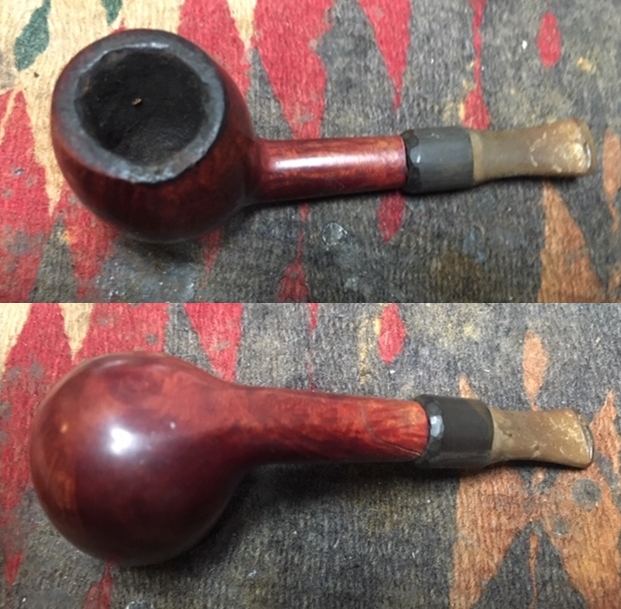
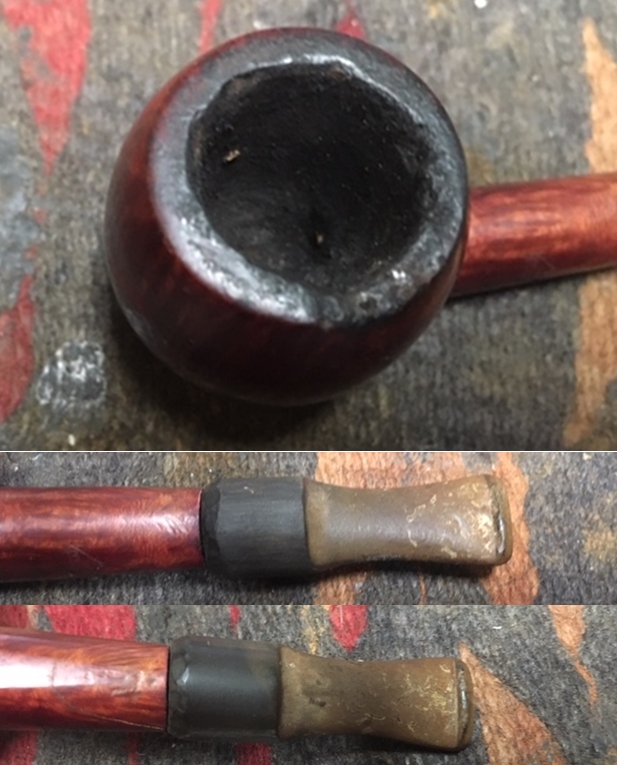
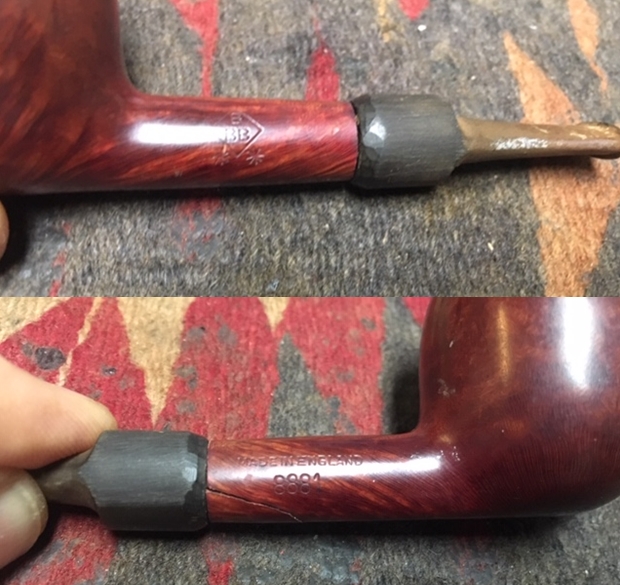
When I spoke with a fellow here in Vancouver who had a pipe that he wanted me to fix it sounded like a simple repair. He said that it had a very loosely fitting stem. He asked if he could drop by to show it to me and see if I could fix it. From past experience I have learned to never jump to conclusions about what sounded like an easy repair. When he arrived he showed me his GBD Faux Spigot. It turned out to need far more work than just tightening a loose stem. I wrote about that restoration in a previous blog (https://rebornpipes.com/2018/11/03/redoing-a-poorly-restored-ebay-gbd-super-q-9436/). We talked about his GBD for a bit and he made the decision to have me do a restoration on it. Then he reached into his pocket and pulled out a small plastic bag with a little BBB 2 Star apple of globe shaped pipe. It was stamped BBB in a diamond on the left side of the shank with two ** – one on either side of the diamond. ON the right side it was stamped Made in England over the shape number 8881. He said that he had found it at his parents’ house and really no one there knew where it came from.

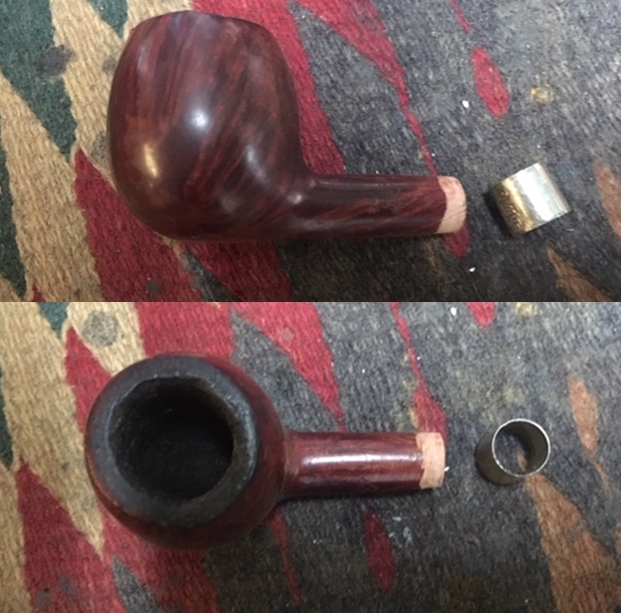
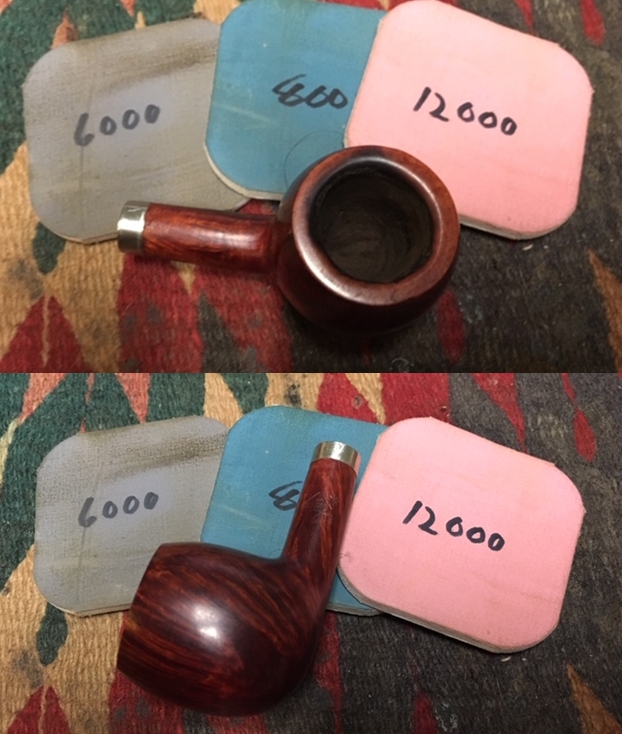
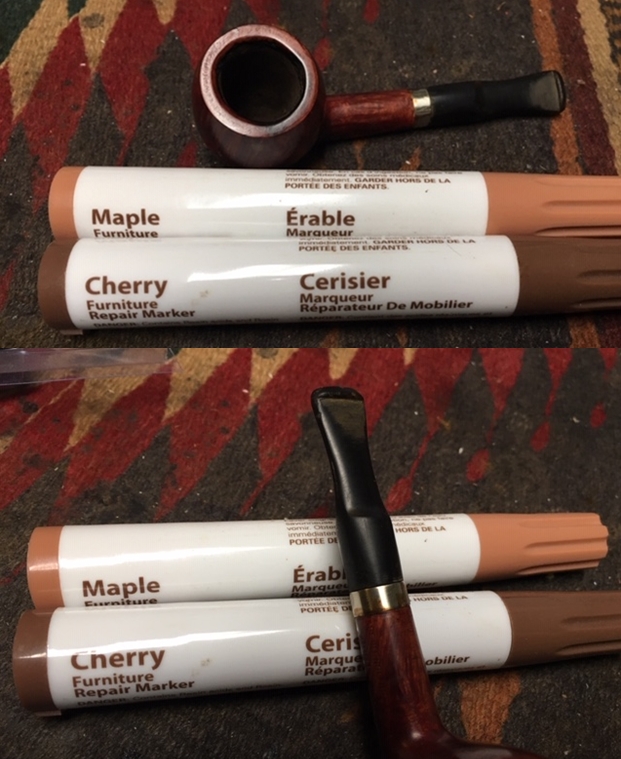
Here is what I saw. Starting with externals. The pipe was small – kind of a pocket pipe. The grain on the bowl was quite stunning – a mix of flame and birdseye all around the bowl and shank. The rim top was coated with a thick lava coat and it went into the bowl. The inner edge of the bowl was in rough shape having been hacked clean with a knife. There was a crack on the right side of the shank curving to the underside. It looked to me it was made by the poorly made stem being shoved into the shank. The stem was larger in diameter than the shank and had been rounded over with a file. There were deep bite marks on the surface ahead of the button on both sides. Moving to the internals. The end of the tenon was carved with a knife to make it fit the mortise in the small shank. The inside of the shank was dirty but less so than I expected. The inside of the bowl had a light cake but most of that was gone from the knife job that had left a wounded inner edge on the rim. Looking at the pipe I explained what I would have to do to bring it back to life and restore it to use. It would need, cleaning, reshaping on the rim, a band on the cracked shank that would leave the stamping readable, and a reworking of the stem to make it a fitting addition to the lovely briar of the bowl. The pipe was going to be a fun challenge. I took these photos to give you an idea of what I saw. The previous pipeman who had fit a new stem to an old favourite pipe had done a functional job but it looked rough. It was pretty clean on the inside so it was cared for. It must have been a great smoking pipe for him to fit a new stem and not give up on it when the previous one broke or was lost. It was smokable. I took a close up photo of the rim top to show the condition. It is hard to see but the rim top was not smooth. The lava build up was pretty thick and there were some deep nicks and chips in the flat top. The close up photos of the stem reveal the scratches in the vulcanite, the tooth marks and the worn and ill-defined button.  The oversized diameter – prettified to look nice is clear in the photos. I took photos from the side of the pipe to show the stamping on the shank and the prettified stem. In the second photo you can see the crack in the shank curving downward to the underside.I decided to address the cracked shank first. With the crack as large as it was and movable I did not want to further damage it when I worked on the stem and fit of the tenon. I knew that it needed to be banded but that would cover the stamping on the shank so adjustments would have to be made. I used a Dremel and sanding drum to reduce the size of the shank to fit the band I had chosen. I did not take of too much briar and I only damaged the M in Made In England as part of it would end up being covered by the band.I repaired the crack in the shank with super glue and pressure fit the band onto the shank to the point of the end of the sanded portion. I used a Dremel and sanding drum to cut back the band to the width that I wanted. Compare the photos above with the one below to see how much I took off of the band. I topped the band on a topping board with 220 grit sandpaper and smooth out the sharp edge with 1500 grit micromesh. I decided that since I was already working with the Dremel and sanding drum that I would take down the excess diameter on the stem as well. I reduced it to sit snugly against the band giving the pipe a classy look.I cleaned up around the inside edge of the band and edge on the shank with a folded piece of 2220 grit sandpaper to smooth things out and make the fit and transition smooth. I lightly sanded the blade portion of the stem and the area of the tooth marks next to the button with 220 grit sandpaper to remove the oxidation and clean it up. I fit the stem in the shank and took a photo of the pipe at this point in the process. It was beginning to look like a classic BBB to my eye. With the stem roughly fit to the shank it was time to address the bowl top. I topped it on a topping board with 220 grit sandpaper. At that point I called it a night. I had to catch a train down to the southern part of Washington from Vancouver in the morning so I thought I would bag up a couple of pipes I was working on and take them with me.I caught the train south from Vancouver, BC at 6:30am. Once we had our seats we were in for an 8 hour train ride. I figure it would be a good opportunity to work on these two pipes. You can see my work table in the photo below. I used the fold down table. It had a lip around it so I spread out a couple of napkins for the dust and went to work on the pipes.I started working on the BBB by addressing the damage to the inner edge of the rim. It was significant with cuts and burns. My topping worked had helped with the top damage and smoothed that out but I need to work on the rim edge. I used a folded piece of 220 grit sandpaper to smooth out the sharp edges and bring the bowl back to round. Once I had the rim as round as I could get it and smoothed out the damaged edge I polished it with micromesh sanding pads. I polished the bowl and the rim at the same time. I wet sanded with 1500-2400 grit micromesh sanding pads and dry sanded with 3200-12000 grit pads. I wiped the bowl down with a damp napkin after each pad. I touched up the stain around the front of the band and stained the rim top and inner edge with Maple and Cherry stain pens. Together the two stains matched the rest of the bowl.I rubbed down the briar with Before & After Restoration Balm. I worked it into the smooth surface of the briar with my fingertips to clean, enliven and protect it. I let the balm sit for a little wall and then buffed with a cotton cloth to raise the shine. The following photos show the bowl at this point in the restoration process. The rim matches well but still needs to be polished and buffed to raise a shine on it. I used a folded piece of 220 grit sandpaper to reshape the button and also to smooth out the marks left by the Dremel when reducing the diameter of the stem. I sanded the tooth marks near the button on each side of the stem to smooth them out.I polished the stem, tenon and metal work with micromesh sanding pads – wet sanding with 1500-2400 and dry sanding with 3200-12000 grit pads. I wiped the stem down with Obsidian Oil after each sanding pad. I was able to remove the damage on the tenon and polish out the dripping varnish on the metal adornment. The stem looked much better at this point in the process. I the polished stem and bowl with Blue Diamond to polish out the remaining small scratches and raise the shine. I gave the bowl and the stem several coats of carnauba wax and buffed the pipe with a clean buffing pad to raise the shine. I hand buffed it with a microfiber cloth to deepen the shine. The pipe polished up pretty nicely. This turned out to be a beautiful little pocket pipe in terms of shape and finish. The new nickel band adds a touch of class in my opinion and gives the pipe a new elegance. I look forward to hearing what the fellow who dropped it off for repair thinks of it once he has it in hand and is smoking it. The finished pipe is shown in the photos below. The dimensions are Length: 4 inches, Height: 1 3/8 inches, Outside diameter of the bowl: 1 inch, Chamber diameter: 3/4 of an inch. Thanks for walking through the restoration with me.

Salvaging a ‘Really’ Poor Richard’s of Italy Giant Billiard


Blog by Dal Stanton

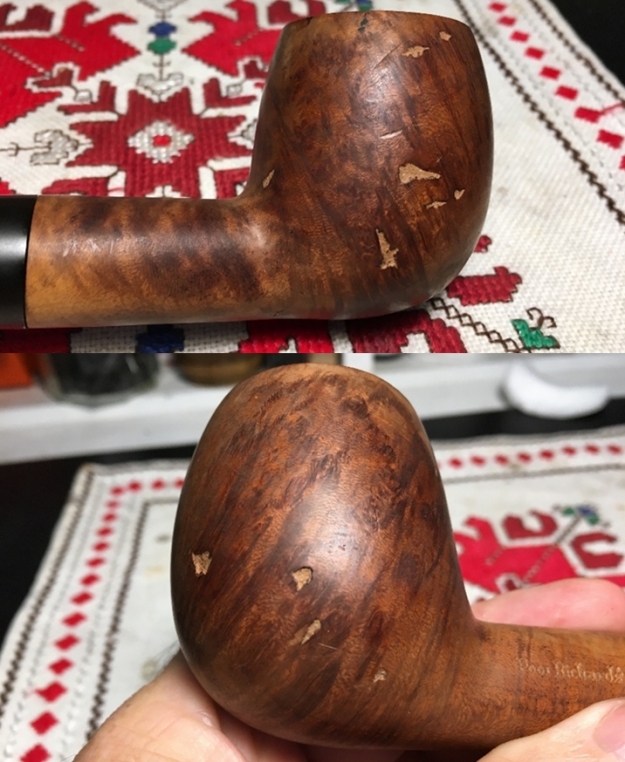
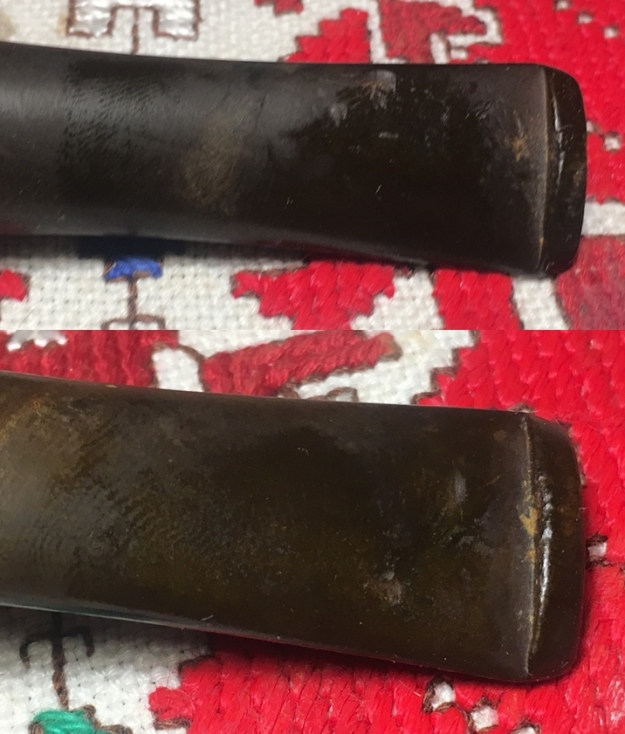
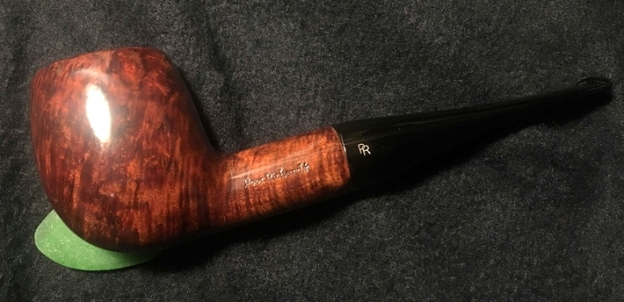
Let’s be honest. When I saw this Poor Richard’s on the eBay auction block I thought the name was a joke by the seller.  He WAS huge (L: 6 3/4”, H: 2 1/8”, Rim W: 1 1/2″, Chamber W: 7/8”, Chamber D: 1 7/8”, Weight: 74gr), no doubt, but his condition could qualify him for the title: King of the Basket Pipe Realm.  His condition was indeed poor and adding to the ‘joke’ was that he was displayed on satiny royal purple material.  But the clincher was coming. Adding insult to injury, the seller’s byline description under Poor Richard’s picture was: Poor Richard’s Classic Bulldog Large Estate Pipe Beautiful !!!  Nice  !!!  Bulldog?  I felt sorry for him.  I placed a bid and when the auction ended, it was no surprise that mine was the only bid seeking a new life for Poor Richard’s.  My wife’s response when she first saw Poor Richard’s was that Poor Richard’s dog got a hold of him!  Here are the pictures I saw. After bringing Poor Richard’s back to Bulgaria, I put him on my website in the For ‘Pipe Dreamers’ Only! section where my friend and fellow Pipe Dreamer from India, Paresh, saw him.  Poor Richard’s became the fourth pipe Paresh commissioned – all of them on the larger side and each one of them advancing our work here in Bulgaria benefiting the Daughters of Bulgaria, helping women and girls who have been trafficked and sexually exploited.
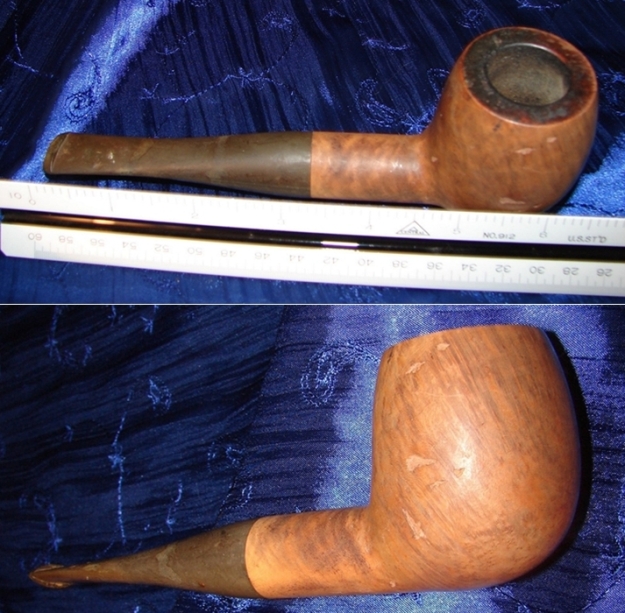
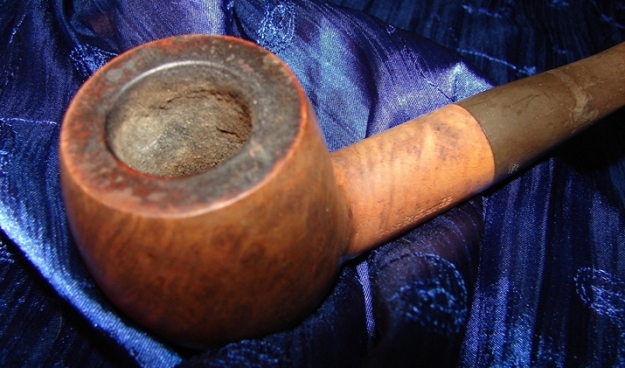
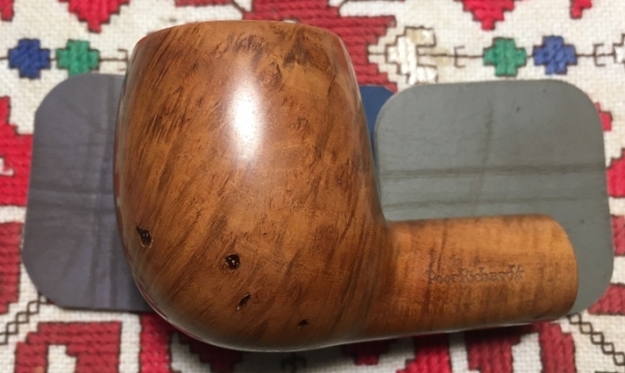
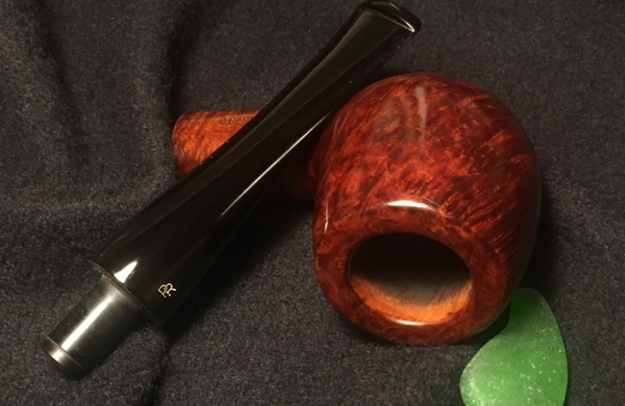
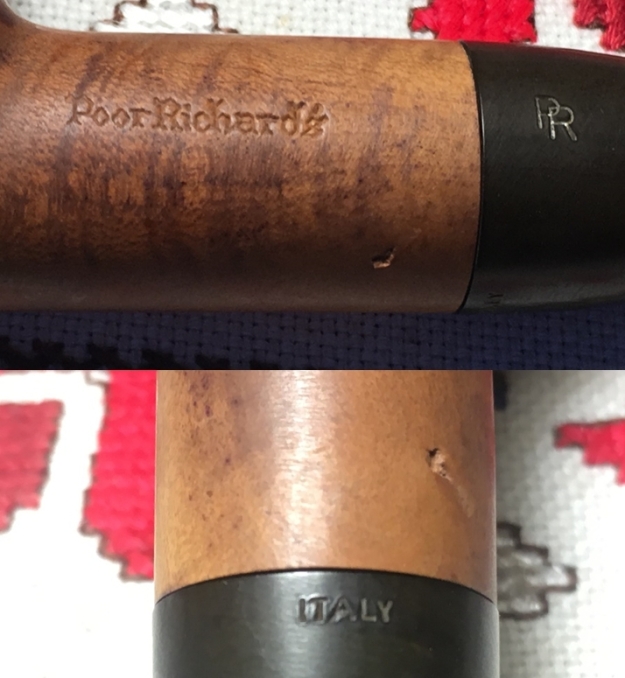
Taking more pictures on my worktable on the 10th floor of a formerly Communist ‘Block’ apartment building, the nomenclature on the left shank is ‘PoorRichard’s’ in what I call an ‘Old World’ script.  There are no other markings on the shank.  The stem is stamped with an interlocking ‘PR’.  The bottom of the stem is stamped with the COM, Italy.When I began doing the research on this Poor Richard’s, I recalled that rebornpipes’ contributor, Al Jones (aka: Upshallfan), had recently posted a restoration of a Poor Richards 9438 Cordovan Rhodesian shape.  Reading Al’s write-up was helpful because it clued me into the ‘mystery’ surrounding the origins of the Poor Richard’s name.  I noticed that our pipes shared the ‘Old World’ script nomenclature as well as the interlocking ‘PR’ stem stamp.  The obvious difference was the COMs – his, London, England and mine, Italy and his included a shape number, and mine, without.As I’ve done in the past with much benefit, I wrote to Al asking about the differences between our Poor Richard’s and what to make of the differing COMs?  His response was helpful:
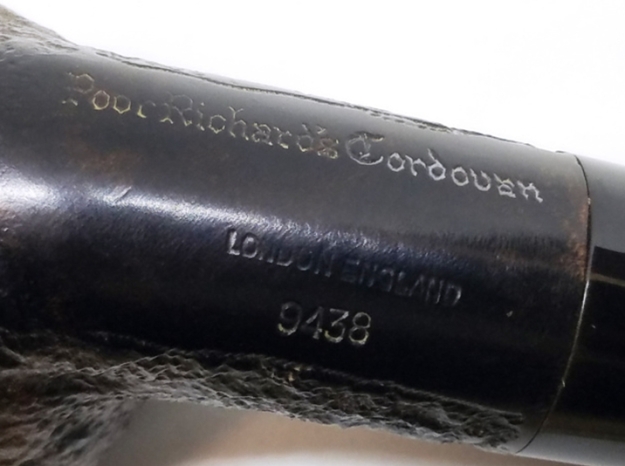
Dal

Unfortunately, there is nothing but speculation about these Poor Richard pipes.  The one shop here, with that name, can’t even conclusively determine if they had shop pipes.

I suspect it was a shop pipe, made by various makers for this shop.  But a shop in Montana having shop pipes doesn’t exactly make sense either.  Usually shops with their own pipes were larger, and in metro areas, not out in the wilderness of Montana.

Poor Richard pipes are not listed in “Who Made That PIpe”, so my guess is still a shop pipe.  Perhaps that Montana shop was bigger than I presumed. 

I suspect Italian companies, like GBD made shop pipes as well.  Perhaps that one was made by Savinelli or other?  Without a shape number, it’s impossible to determine.

Have fun restoring it!

Al

Al referenced the pipe shop in Montana that in a subsequent email he referenced that Steve had also worked on a Poor Richard’s attributed to the ‘Poor Richard’s’ pipe and tobacco shop in Bozeman, Montana. However, Al said that Steve’s Poor Richard’s pipe had a totally different nomenclature with Montana stamped on the pipe.  I found this write up on Rebornpipes and what a write up!  It was one of Steve’s and Charles Lemon’s classic collaborations including a pinning tutorial.  When these two masters get together, its fun to see the wonders happen!  (See this post which is worth the read:  A Humpty Dumpty Cross Canada Project – Could this Poor Richards Select Square Shank Billiard 9489 ever be whole again?)  Steve’s research on the Montana shop is good and saved me time and steps.  Since Steve’s write up in 2016, the website had changed and a description of Poor Richard’s history beginning in 1962 can be found here: History.  The following pictures show the shop early on and what it is today.Even with the mystery and the discrepancies with the nomenclatures, in researching different pipe shop pipes in the past (L. J. Peretti, Pipe Pub), I found that it’s common to have pipes manufactured in various places.  Another indicator that the Poor Richard’s nomenclature refers to a shop is simply because it is possessive – Richard’s, pointing to something else.  Whether there’s another Poor Richard’s shop other than the one in Bozeman, I don’t know.  This question has been lost to history.
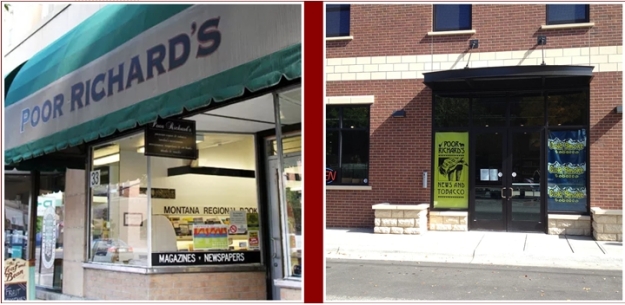
The condition of the giant Poor Richard’s before me now is poor. I take more pictures to take a closer look. The chamber has moderate cake build up that needs to be removed to inspect the condition of the chamber.  The lava flow on the rim is thick.  The stummel surface reminds one of a moonscape with all the craters in need of attention!  Along with the pits and holes there are dents and scrapes.  The oxidation on the stem is joined by bites and compressions on the lower and upper bit.  With a better understanding of the Poor Richard’s name, I begin the salvage of the giant Billiard by running pipe cleaners dipped in isopropyl 95% through the stem and then adding it to a soak of Before & After Deoxidizer along with several other commissioned pipes in the queue.  The Poor Richard’s stummel and stem are first on the left.  After letting it soak overnight, I fish out the Poor Richard’s stem and let the fluid drain off.  I then push a pipe cleaner through it to help remove the Deoxidizer.  I then wipe the stem with cotton pads wetted with isopropyl 95% to remove the raised oxidation from the vulcanite stem.  After wiping off with the alcohol, I then wipe again using a cotton pad and light paraffin oil (mineral oil) to clean and condition the stem further.  Finally, I run another pipe cleaner through the stem dipped in isopropyl 95%.  The pictures show the process. Taking the stummel, I use the Pipnet Reaming Kit to clean the chamber.  After putting paper towel down on the table for easier clean up, I start reaming using the third largest blade head since the chamber is so large.  I also use the fourth and largest blade to ream.  Following the reaming, I use the Savinelli Fitsall Pipe Tool to scrape the chamber walls removing additional carbon cake – especially down in the floor of the chamber with the difficult angles.  Then, after wrapping 240 grit paper around a Sharpie Pen, I sand the chamber walls removing additional carbon and smoothing the chamber surface.  I clean the chamber next using a cotton pad wetted with isopropyl 95%.  While inspecting the chamber, I do see some hairline heat cracks that are very small, but not serious enough to warrant repair.  Next, using undiluted Murphy’s Oil Soap I work on the external briar surface using a cotton pad.  I also use a brass wire brush on the rim to remove the lava and follow by carefully scraping the rim surface with a flat knife edge.  After scrubbing, I rinse the stummel in the sink with cool tap water.Turning to the internals, I use pipe cleaners and cotton buds dipped in isopropyl 95% to clean the mortise and airway. I also use a small dental spatula tool to scrape tars and oils off the mortise walls.  The cleaning wasn’t too bad. Later, I’ll continue cleaning the internals with a kosher salt and alcohol soak.With the internals cleaned, I now look at the stummel surface.  I have several fills to dig out and to fill.  My main tool in doing this is a sharp dental probe.  The goal is to only have a solid base in the holes – either old filler material or briar.  It takes quite a bit of time, but I move from fill to fill doing the needed excavation work. With the holes excavated, I prepare a batch of briar dust and CA glue patch to apply to the problem areas.  I scoop briar dust in a small mound on an index card and put a glob of thick CA glue next to the briar dust.  Using a dental spatula, I mix briar dust into the CA glue until I reach a thicker consistency, like molasses.  I then trowel the patch mixture into each of the holes leaving excess to be sanded down after cured.  The pictures show the process. With the Briar Dust patches curing, I turn to the stem.  After the soak in the Before & After Deoxidizer, much of the oxidation was removed.  But looking more closely, there remains oxidation but it’s much subdued. I decide to place the stem in another soak – this time with OxiClean.  I put a pipe cleaner through the stem and put it in the OxiClean to let it soak overnight.With the day ending, I continue the cleaning and refreshing of the stummel internals.  To do this I employ a kosher salt and alcohol soak.  First, I form a wick by stretching and twisting a cotton ball and with a stiff piece of wire, I stuff it down the mortise and airway.  It will serve to draw out tars and oils.  Then I fill the bowl with kosher salt and place the stummel in an egg crate to keep it stable.  With a large eyedropper, I fill the bowl with isopropyl 95% until it surfaces over the salt.  After a few minutes, I top off the alcohol as it is absorbed and turn out the lights.The next morning, there isn’t too much discoloration of the salt which means I didn’t put in enough alcohol or that the internals are clean.  The wick is darker.  I toss the expended salt into the waste, wipe the bowl with paper towel and blow through the mortise to remove remaining salt crystal.  I then use a shank brush on both the bowl and the mortise – blowing again.  Finally, to make sure all is clean and ready to go, I wet a cotton bud and pipe cleaner with isopropyl 95% and run them through the mortise and airway.  They come out clean and it’s time to move on. I put the stem in an OxiClean soak through the night and it’s time to fish it out.  I take a picture of the additional oxidation that has been raised and I take the stem to the sink and wet sand the stem with 600 grade paper to remove the oxidation.  It looks cleaner now after sanding.Looking more closely now at the bit area, there are good sized compressions.  The button also has some bite marks.  The first step is to use the heating method to see if it will expand the vulcanite reducing the severity of the compressions.  I use a Bic lighter and paint the upper- and lower-bit areas. The areas were lessoned, but not erased by heating the vulcanite. I then use 240 grade paper and sand the upper- and lower-bit areas as well as redefine the button with a flat needle file.  I take pictures of each step. First, the upper bit progress:After heating:After 240 sanding and filing:Progression of the lower bit area:After heating:After 240 sanding and filing: I’ve sanded out as much as will sand and now I will patch the areas that did not sand out.  I first wipe the stem with alcohol to clean the area.  I then apply black CA glue to the areas.  And I wait, and wait, and wait….  Well, I just discovered that Black CA glue can go flat and lose its ability to bond.  Reading the directions, is says to refrigerate to prolong shelf life.  Well, the shelf life must have been reached.  I wipe the old CA glue off and thankfully, I had purchased another bottle of Hyper Bond Black Rubber Reinforced CA glue.  I discover that the bottle mouth is larger than the squirt spouts that I have so I end up troweling a small bit of the glue on the end of a pointed dental spatula and apply it to the spot.  It works!  To advance the curing time I spray the upper and lower patches with an accelerator which does the trick.  The first picture, upper that didn’t cure and the new glue on the lower.  New bottle of glue is heading for the fridge! Next, taking a flat needle file I start filing the black CA patches staying on top of the glue mounds.  I then follow by using 240 grade sanding paper to bring the excess CA glue to flush with the vulcanite surface.  First, pictures showing the upper bit: The next step with the stem is to wet sand it with 600 grade paper then I follow by buffing the stem with 0000 steel wool to prepare the vulcanite surface for the micromesh pad phase of sanding.  The patches on the bit blended very nicely.I put the stem aside because I’m anxious to get started on the Poor Richard’s stummel.  I decide to start from the top and work down.  I will establish fresh lines for the rim and remove the surface scratches by topping the stummel.  I first use 240 grade paper on the chopping board and invert the stummel and rotate the stummel over the paper. After the 240 paper, I use 600 grade paper for another few rotations.  It looks good. To dress this Poor Richard’s up a bit, I create an internal bevel.  To me, an internal bevel softens the rim lines and is a classy touch.  I cut the bevel initially using a rolled piece of coarse 120 grade paper then follow with 240 and 600.  I simply pinch the rolls of sand paper under my thumb and rotate around the internal circumference of the rim.  I like it. Now, time to work on filing and sanding all the briar dust putty patches all over the stummel surface.  I use the flat needle file to work the mounds down to near the briar surface then I finish off with 240 grit paper, bringing the patch flush with the surface.  The pictures show the process.  Lots of filing and sanding! With the patches all repaired, I use sanding sponges to sand the entire stummel to remove additional nicks and scratches and to blend the patch areas.  I start with a coarse sponge, follow with a medium then light sponges. I like the way sponge sanding cleans up a rough bowl.Moving on to the micromesh stage, I wet sand the stummel with pads 1500 to 2400 then dry sand with pads 3200 to 4000 and 6000 to 12000.  I love the way the micromesh process teases out the briar grain. This Poor Richard’s is looking good! To mask the plethora of fills scattered on this Italian Poor Richard’s stummel, I will give him a dark stain.  I use Fiebing’s Dark Brown Leather Dye to do the job.  With it being an aniline based dye, later I can wipe the bowl with alcohol to blend and lighten as I choose.  I assemble the components used in applying dye on my worktable.  I mount a cork in the mortise to act as a handle and I pour the dye into a shot glass.  I use a folded pipe cleaner to apply the dye and a lit candle to flame the aniline dye.  I begin by wiping the stummel with alcohol to clean the surface.  I then warm the stummel using a hot air grain. This expands the briar grain aiding in it being more receptive to the dye.  Using the pipe cleaner, I then apply dye liberally to the entire stummel making sure to cover the rim well.  I then ‘flame’ the stummel with the lit candle and the alcohol immediately combusts leaving the pigment sealed in the grain.  After letting the stummel ‘rest’ a few minutes, I repeat the process of applying dye and flaming.  I then put the stummel aside to rest for several hours helping to assure that the dye is set and will not rub off later on hands when the pipe is put back into service.  The pictures show the process. With the flamed stummel resting, I turn again to the stem.  Using micromesh pads 1500 to 2400, I wet sand the stummel.  Following this, I dry sand using pads 3200 to 4000 and 6000 to 1200.  After each set of three micromesh pads, I apply a coat of Obsidian Oil to the stem to revitalize the vulcanite.  The stem is looking good. The stained stummel has rested for about 24 hours and it’s time to unwrap the flame crust. After mounting a 1 inch felt buffing wheel on the Dremel, I set the speed to the lowest RPM and apply the more abrasive compound, Tripoli, to remove the crust revealing the newly stained briar surface.  As I have refined my technique using the Dremel during the compound phases, I’ve learned that using a felt buffing wheel and Tripoli allows me to have more control over the degree of opaqueness allowed through the stain, especially when using darker stains like with this Poor Richard’s.  When I begin removing the crust with the felt wheel and the coarser Tripoli compound, the initial pass of the buffing process removes the top crusty layer, but thick, ‘blotched’ stain remains.  These blotches, or darker patches of stain hide the grain underneath.  After this first pass, my practice is to purge the wheel quickly on the side of the chopping board that is on my lap, providing the work platform for all the buffing.  After I purge the wheel of the thick stain residue from the flaming, I load more Tripoli to the felt wheel and then begin additional passes over the same area – frequently purging and reloading the felt wheel with Tripoli.  Through this process I can determine how the grain is presented.  More Tripoli buffing, the lighter hues are raised in the grain, giving more definition.  When I’m working an area where a patch is located, I tend to allow it to remain darker to enhance the masking.  After staining, I would say that this phase applying the Tripoli is the most critical for the finished look of the grain.  Why?  The coarse Tripoli combined with the coarser felt wheel does the heavy lifting by increasing the opaqueness of the stain when desired which sets the stage for the finished look.  The following less coarse compounds, such as Blue Diamond, and using the cotton wheel, provides more buffing of what is there rather than remove it.  The pictures below give a hint of what I’m describing.  For those who use a Dremel, I hope this is helpful. To blend the stained finish, I lightly wipe the stummel with a cotton pad wetted with alcohol.  I don’t need to lighten the stummel, only blend.After wiping down the stummel with the cotton pad, the Tripoli with felt wheel had lightened more than I wanted in order to provide a darker shading to blend and to mask the fills.  I decide to stain the stummel again, but the second time around, I use a cotton cloth buffing wheel and Tripoli instead of the more aggressive felt wheel.  Saving on pictures repeating the same process, here is the stummel after the second staining and flaming.  Again, I wait several hours allowing the stain to rest.Following the Tripoli compound, I mount another cotton cloth buffing wheel in the Dremel, increase the speed to about 40% full power, and apply Blue Diamond compound to both the stem and stummel which I reunite.  After completing the application of Blue Diamond, I wipe/buff the pipe with a felt cloth to remove the residual compound dust in preparation for the wax application.Before applying wax, I refresh the Poor Richard’s stem stamping, the interlocking ‘PR’ and the country of manufacturing stamp, ‘Italy’.  Using white acrylic paint, I use a pointed cotton tip to apply paint to the stamps.  While still wet I lightly wipe the excess paint off leaving the stamps filled.  It works well, and the Poor Richard’s is shaping up well! To finish the buffing stage, I mount another cotton cloth wheel to the Dremel, leaving the speed at 40%, and I apply carnauba wax to stem and stummel.  I follow by giving the pipe a rigorous hand buffing with a microfiber cloth.
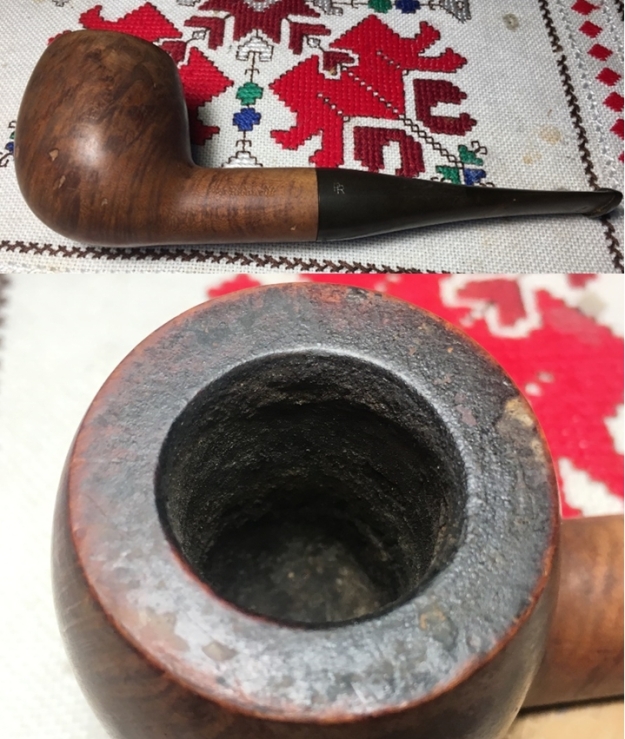
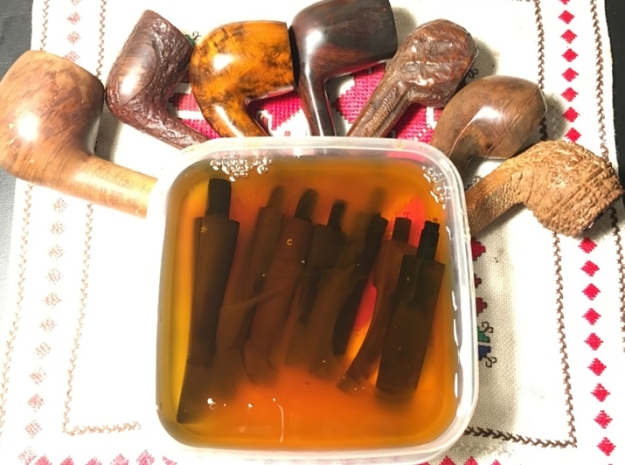
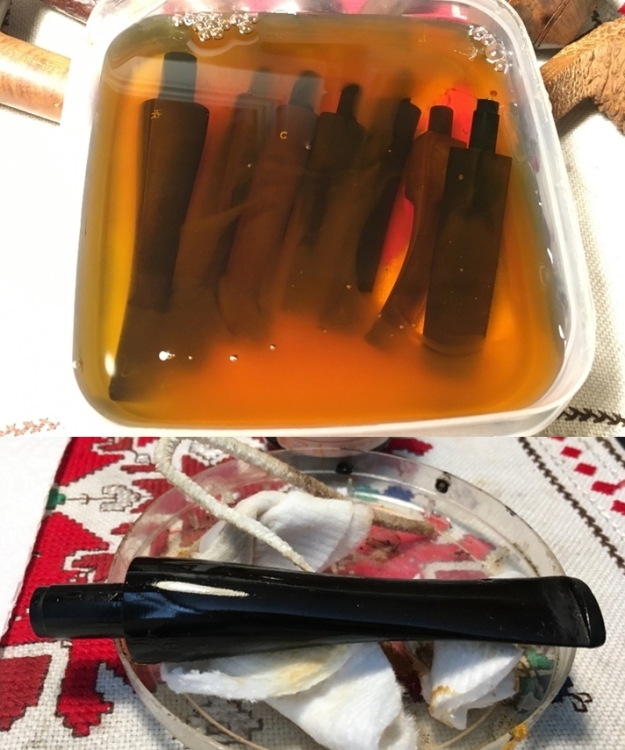
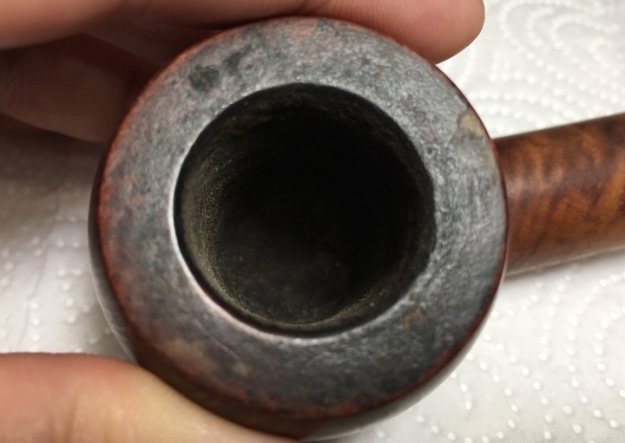
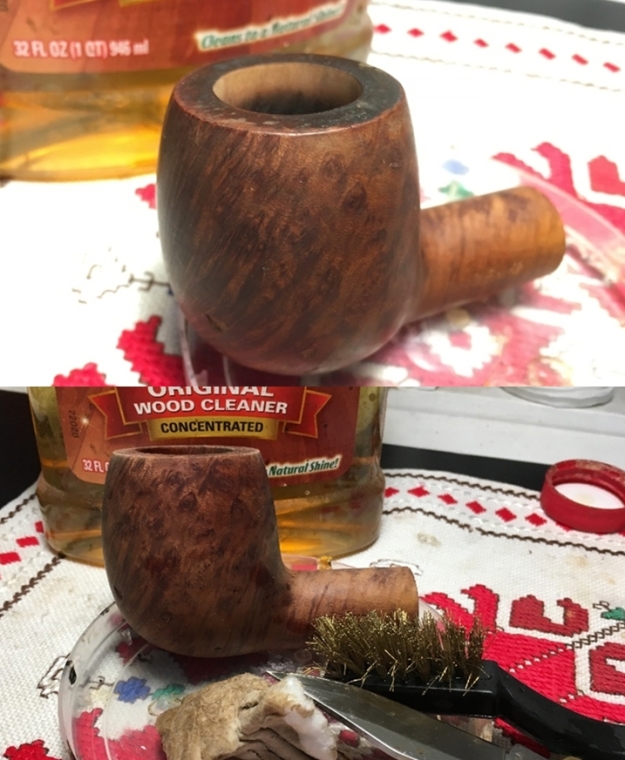
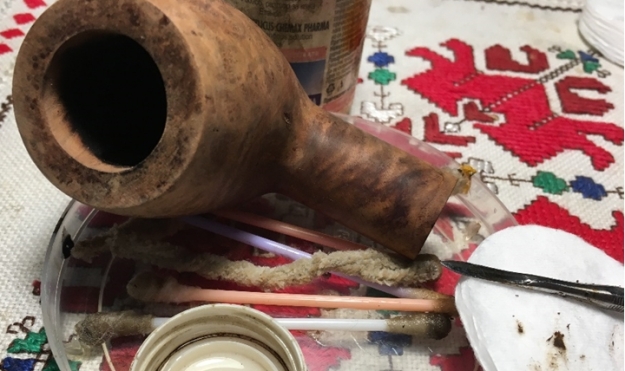
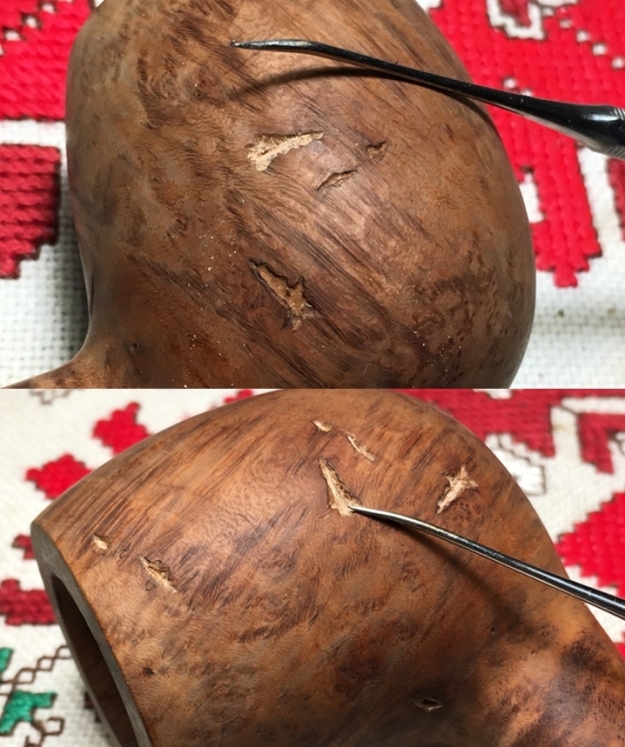
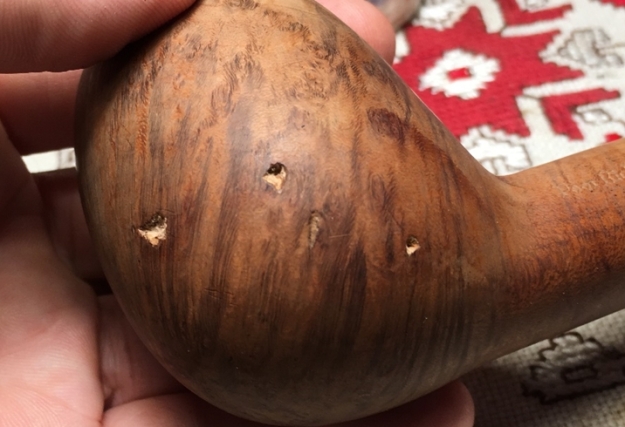
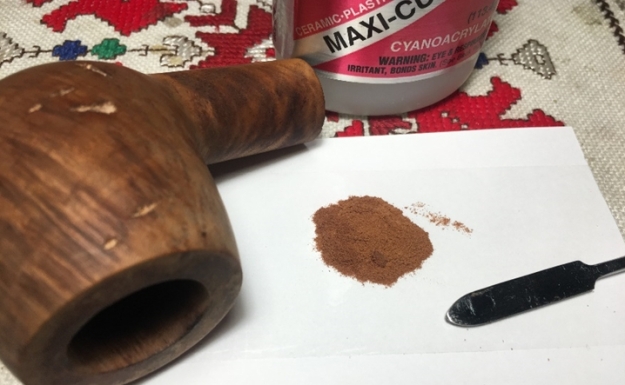
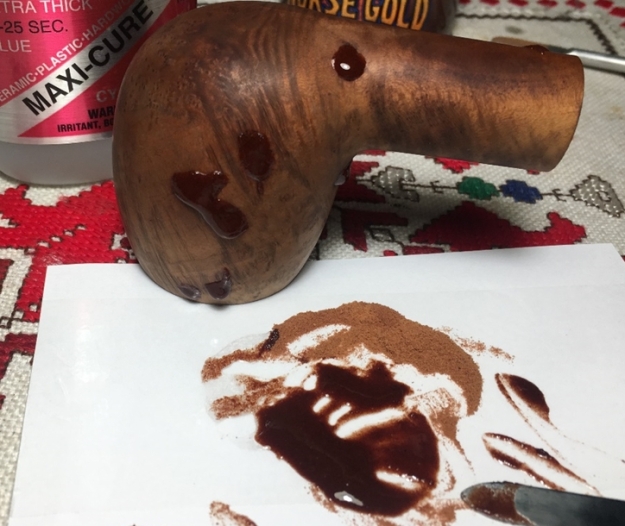
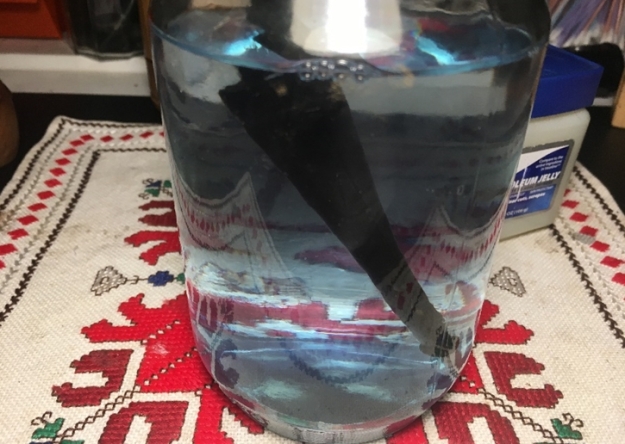
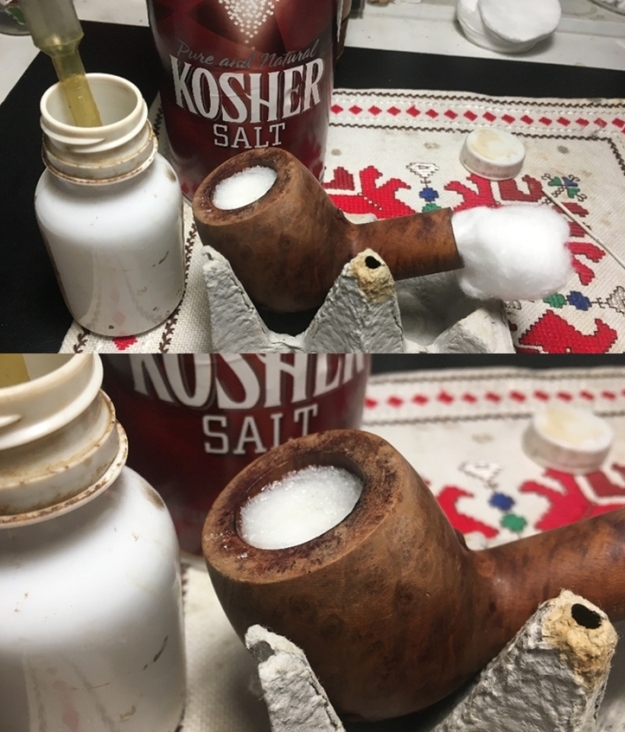
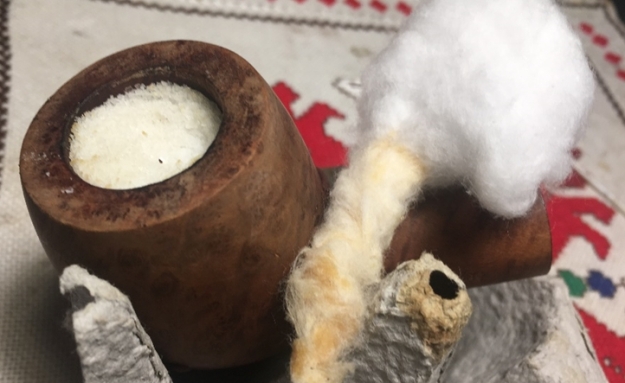
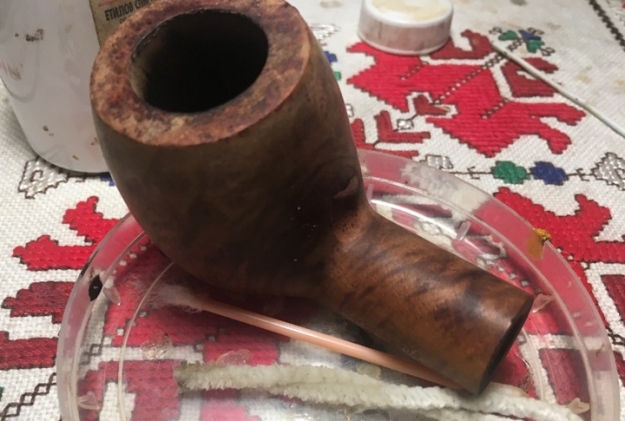
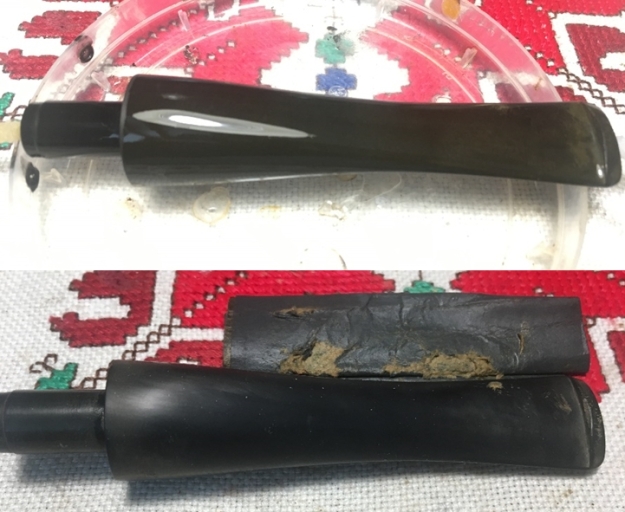
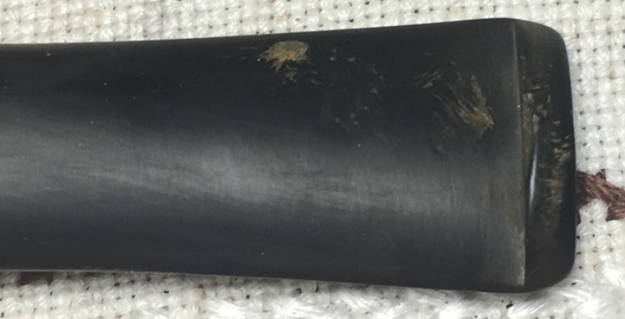
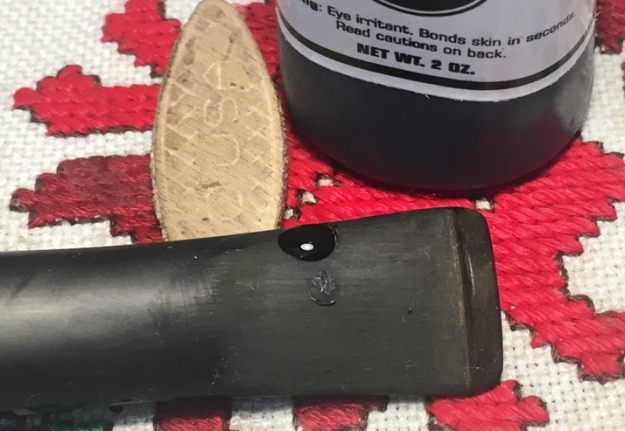
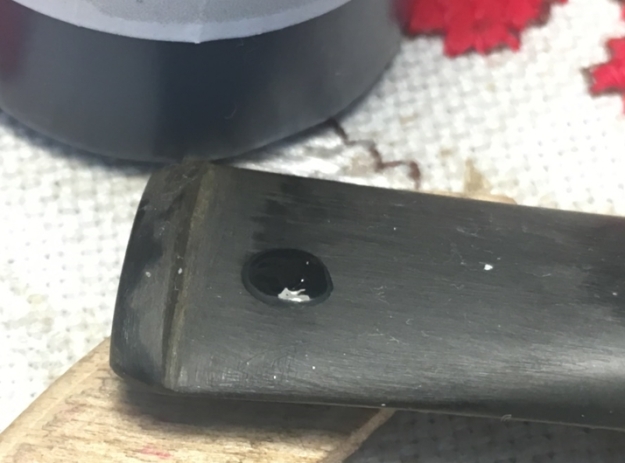
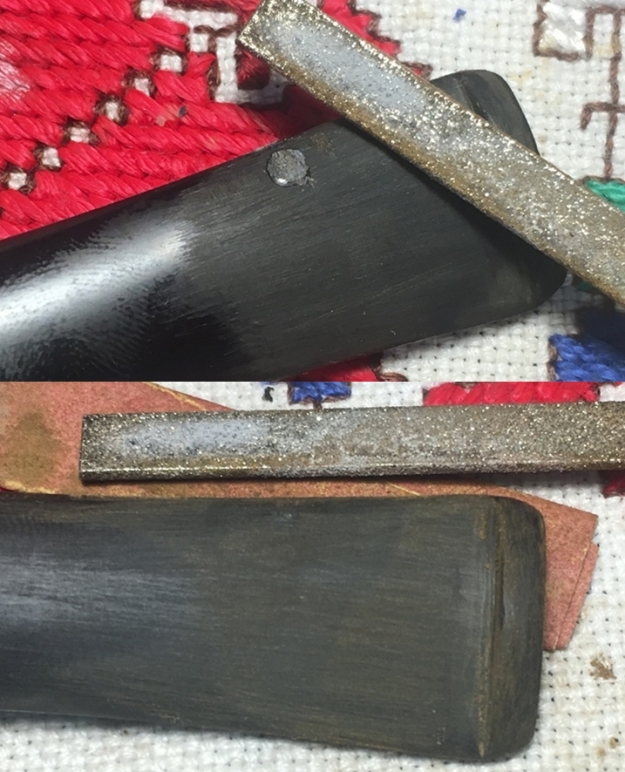
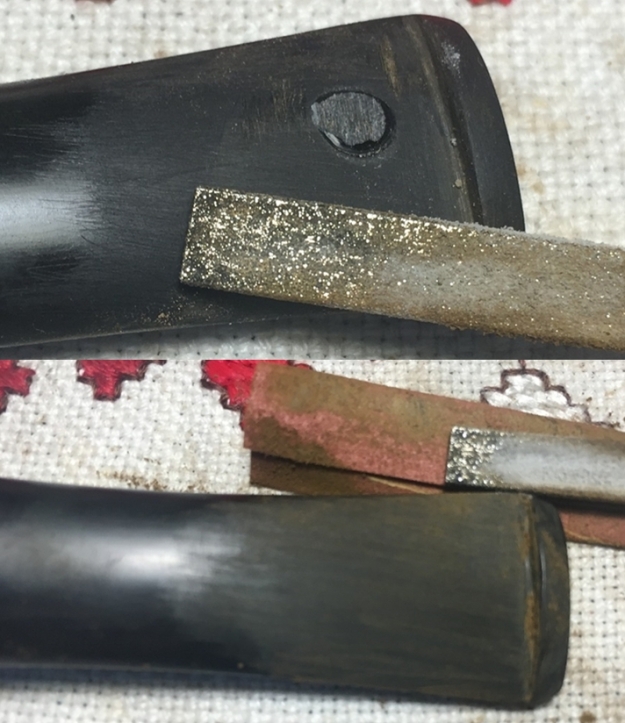
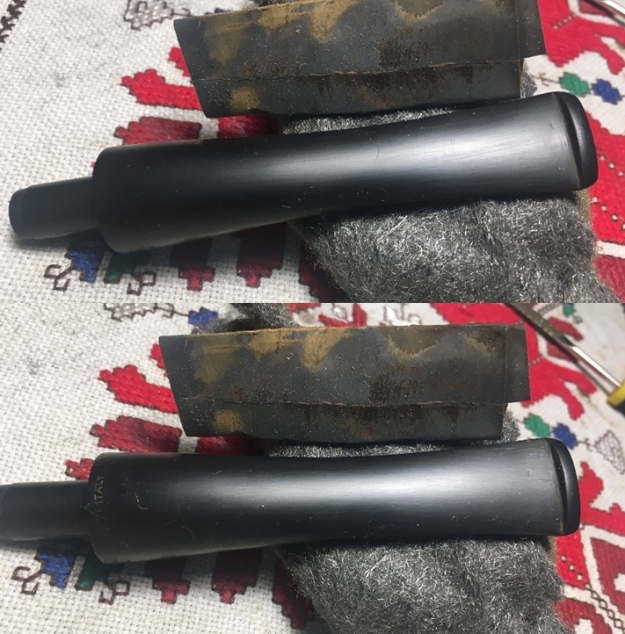
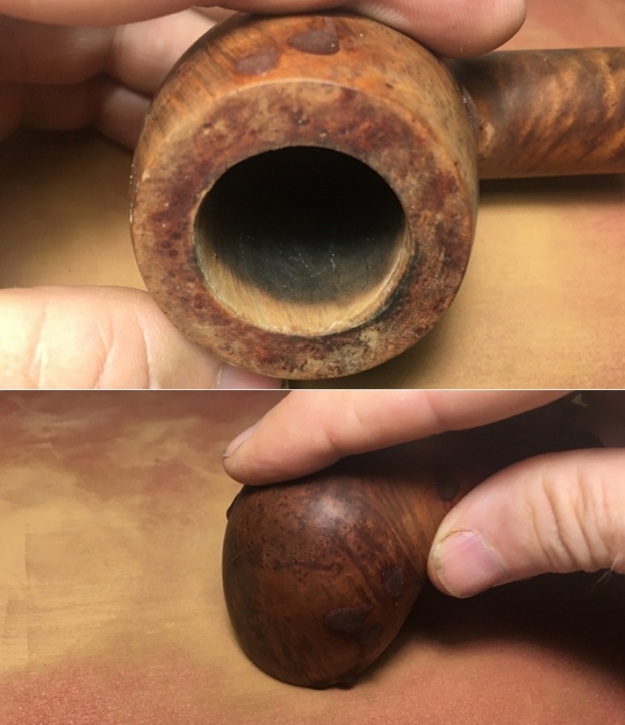
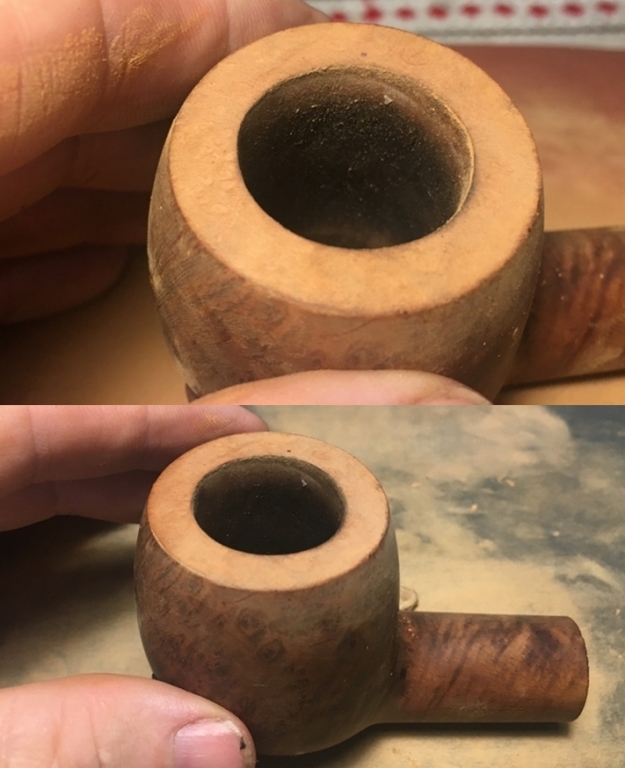
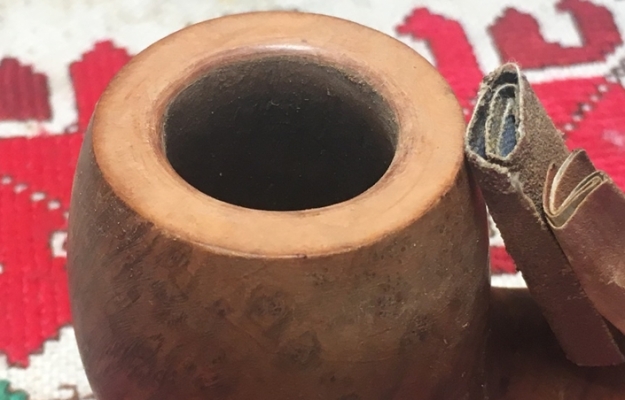
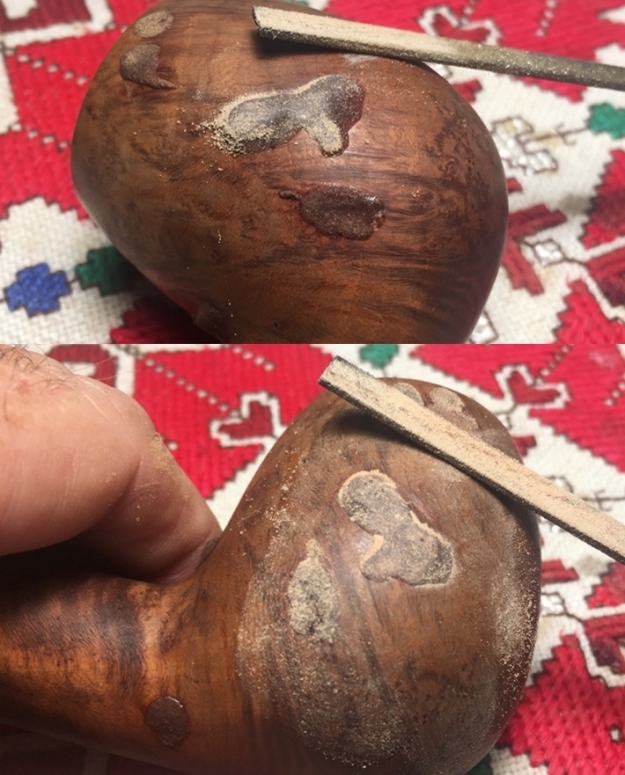
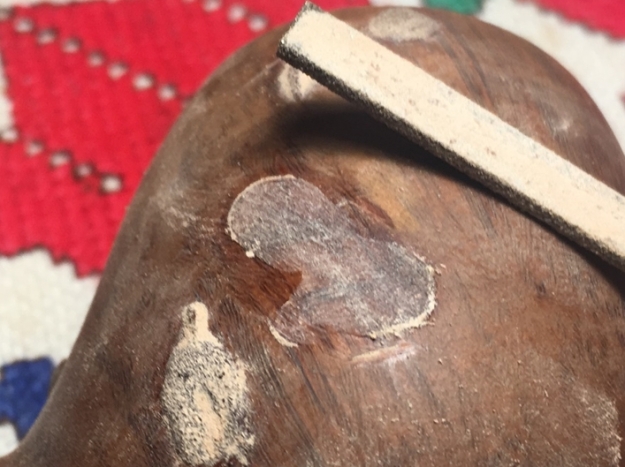
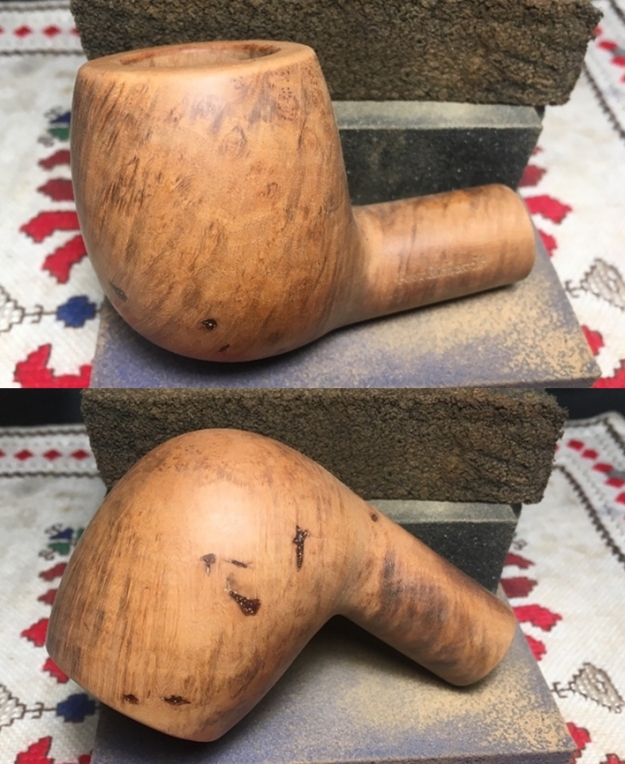
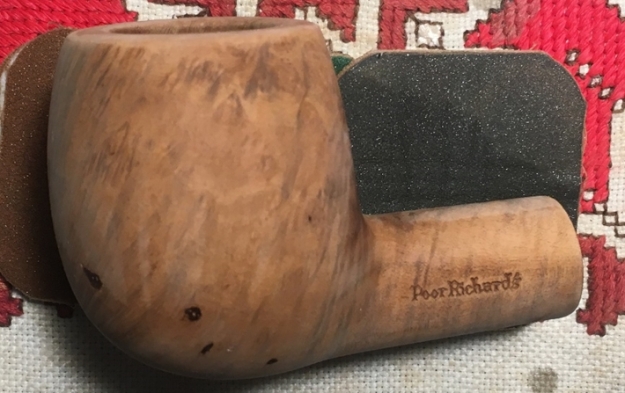
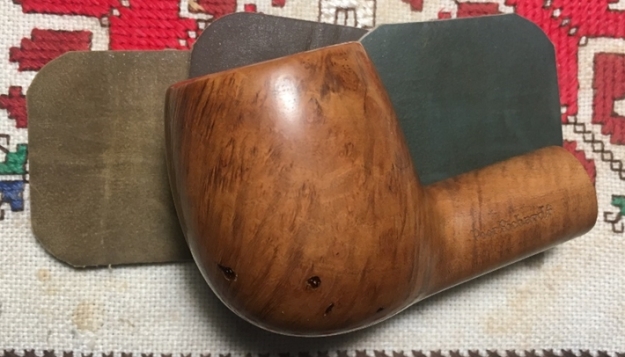
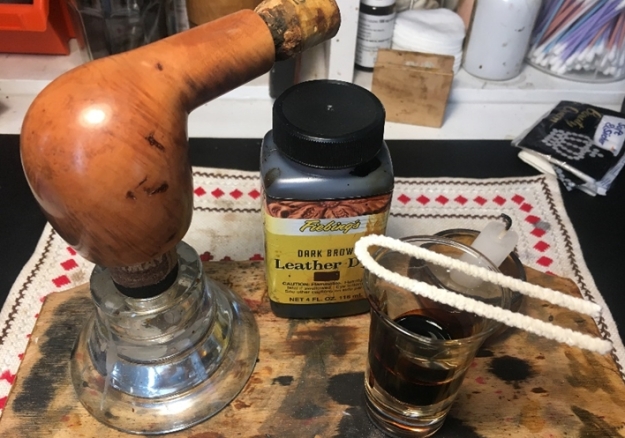
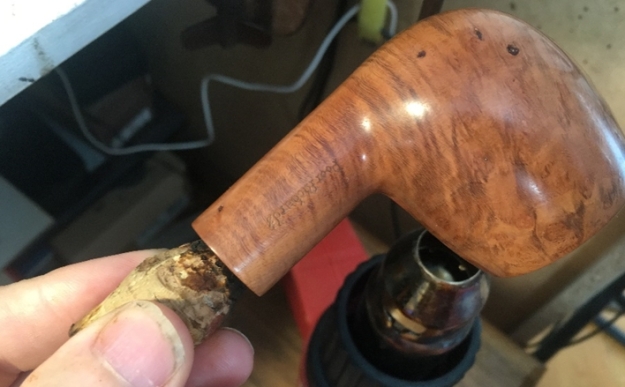
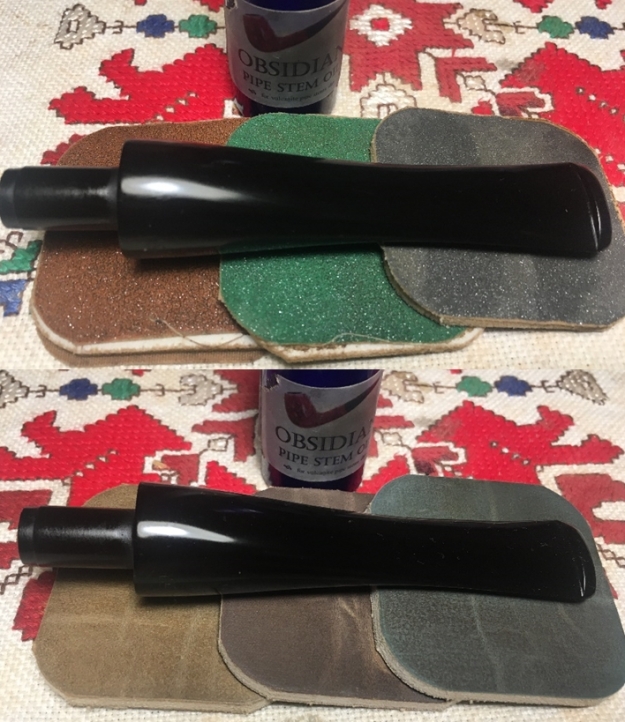
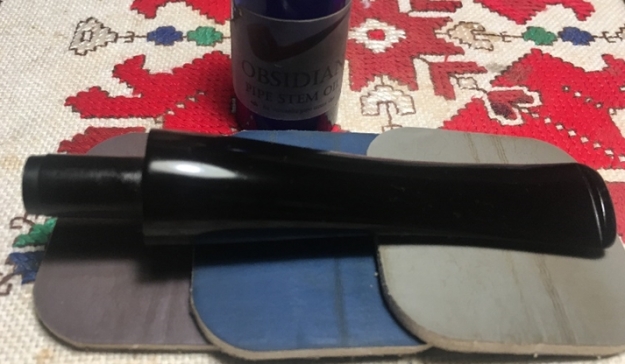
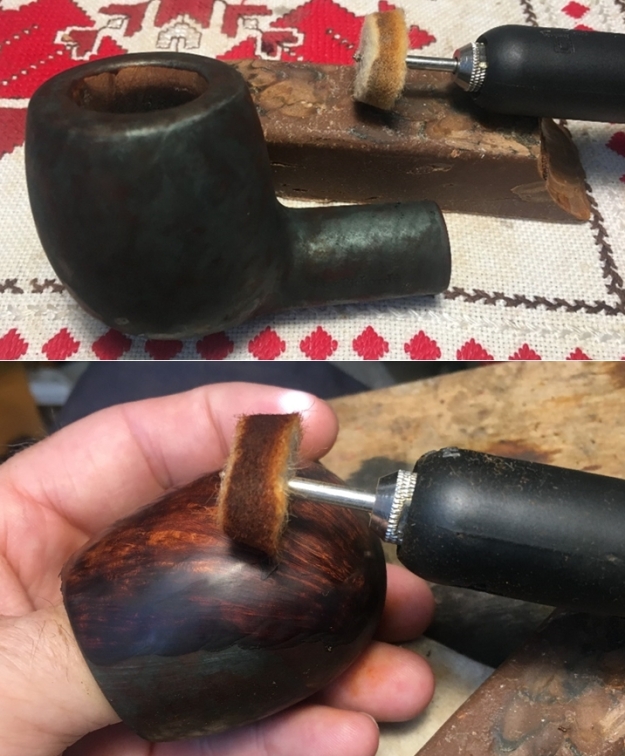
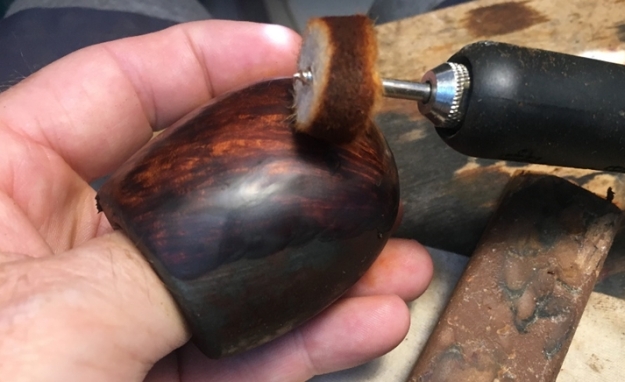
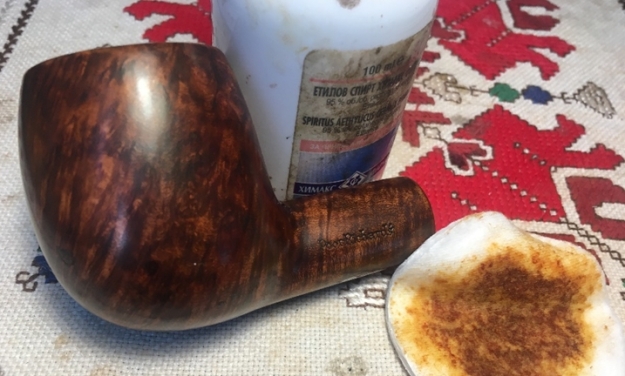
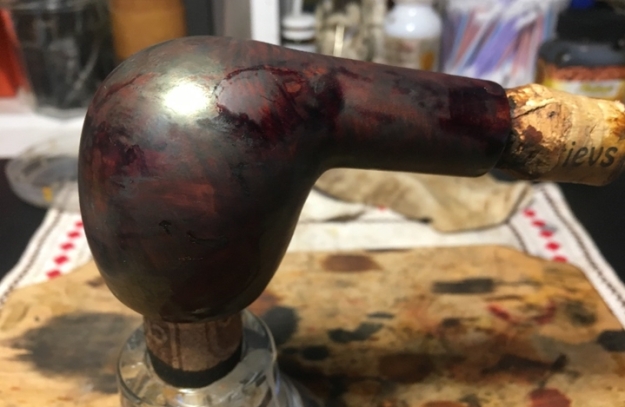
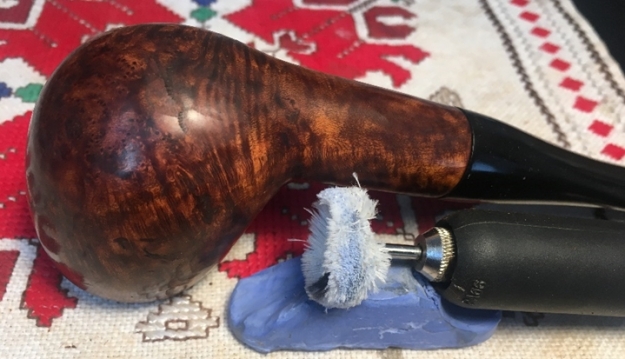
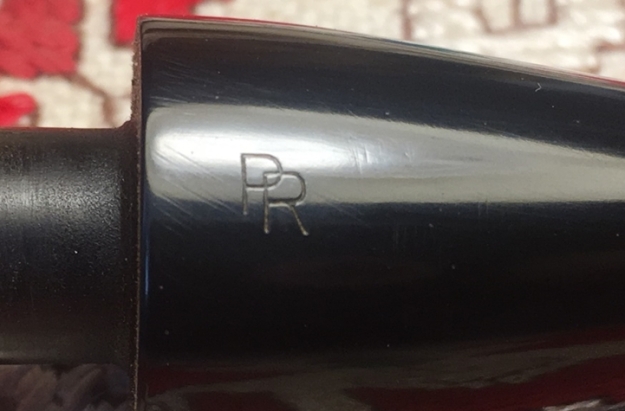
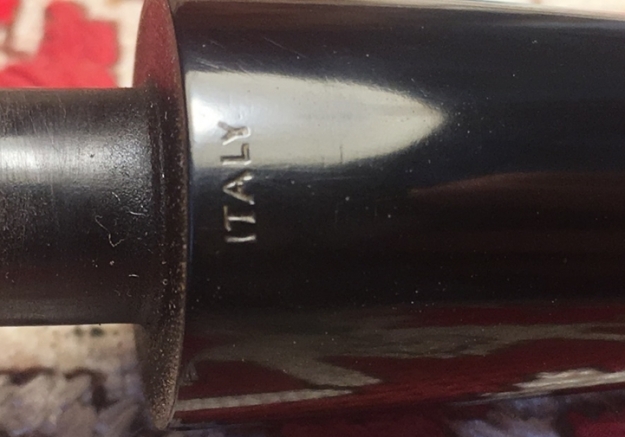
I’m pleased with the transformation of the Poor Richard’s.  The dark brown dye helped to mask the repairs done to the stummel and it looks great.  This straight Billiard is a classic shape and as large as this Poor Richard’s is, I believe it will serve its new steward well.  Paresh commissioned him from the For ‘Pipe Dreamers’ Only! section on The Pipe Steward site.  He will have first opportunity to acquire the Poor Richard’s from the The Pipe Steward Store which benefits the Daughters of Bulgaria – helping women and girls who have been trafficked and sexually exploited.  Thanks for joining me!
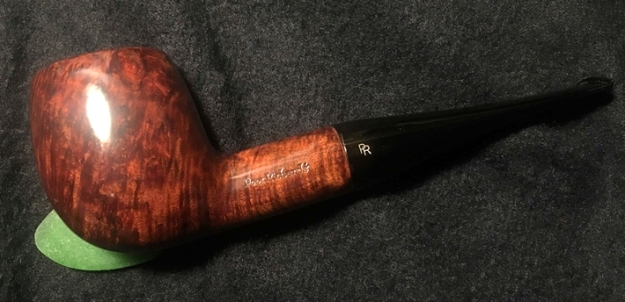
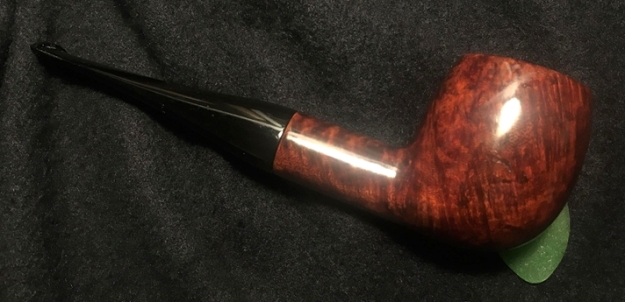
Resurrecting a Tired and Worn 1937 Dr. Grabow Special 4914 Apple


Blog by Steve Laug

The next pipe on my restoration table is an interesting older pipe that appears to be made out of walnut or some other hard wood. It was tired and worn looking with the remnants of what appeared to be an oxblood stain in the wood. The stamping was dirty and worn but readable nonetheless. On the left side the pipe is stamped Dr. Grabow over Special and on the right side it is stamped with the shape number 4914 near the shank stem junction. That is followed by Pre-Smoked over Reg. US Pat. Off. The rim top was dirty and had some tar ground into it. The bowl had a light cake in it and there was a small nick on the inner right edge of the bowl. It had a hard rubber vulcanite stem with the white Linkman style propeller inset on the top of the stem. The rubber was quite hard and did not show signs of oxidation. There were tooth marks on the top and underside of the stem at the button. I took some photos of the pipe before I started my cleanup. I took some close up photos of the rim top and bowl to show its condition. The tar spots are on the surface. The nick is visible on the right side of the bowl. I also took photos of the stem to show the bite marks and wear on the stem.I took a photo of the stamping on both sides of the shank to show the condition. Interestingly once I cleaned the shank up and removed the stain the stamping was very readable.I looked up information on the Dr. Grabow Special 4914 pipe on Pipedia to see if I could identify the time period that the pipe came from. I had a hunch that it came out during the war years due to the alternative wood that had been used in its manufacture in place of the normal briar (https://pipedia.org/wiki/Dr._Grabow_Models_(Series,Line)_Names_Through_the_Years). Here is what I found out:

SPECIAL (or Special Italian Briar) post-1937, begins with 43, 49, maybe no number at all; DOLLAR DR. GRABOW 1937 or previous, may not be marked as such, begins with 43, 44, 49 Series 43 = Natural Finish (DG), c1937. Series 44 = Dark Finish (DG), c1937. Series 49 = Walnut Finish (DG), c1937.

Thus I knew that the pipe came out post 1937. I still had not confirmed the date of the pipe other than knowing that it was made after 1937. I did some more digging on Pipedia and found the following information that also helped pin down the date (https://pipedia.org/wiki/Dr._Grabow).

The production of the pipes started in 1930/31. In 1937 Linkman began calling his pipes “Pre-Smoked”. An ad dating from 1946 celebrates it as “America’s Most Wanted Pipes” and the text announced that each Dr. Grabow was broken in on the Linkman’s Automatic Smoking Machine with fine Edgeworth tobacco, reducing the need for the new owner to spend time breaking in his pipe. In 1949 the official name read Dr. Grabow Pipe Company Inc. with seat at W. Fullerton Avenue 1150, Chicago 14, Illinois. (Thus the Linkman factory.) Series: Special, De Luxe, Supreme, Tru’ Grain, Select Grain.

That helped to pin down when the first Pre-Smoked Pipes came out on the market. I have included a couple of advertisements from the 1940s on the Pre-Smoked pipes. The advertisements were on Pipedia courtesy of Doug Valitchka. I found a similar pipe for sale on eBay (https://picclick.co.uk/Lovely-Vintage-Dr-Grabow-Special-4914-Smokers-Pipe-372388011756.html). It could very well be a twin of the pipe that I am working on. It is also made from an alternative wood, rather than briar.

I started my restoration on the pipe by wiping down the bowl with acetone on a cotton pad to remove the remnants of the oxblood finish. I took photos of the bowl after the cleanup. I sanded the bowl with 220 grit sandpaper to remove the remaining stain. I sanded the rim top to remove the stain and tars there. I worked over the inner edge of the rim with 220 grit sandpaper to remove the damaged area on the right side. It did not take too much work to remove it. I polished the rim and bowl with micromesh sanding pads – wet sanding with 1200-2400 grit pads. The bowl began to have a rich shine.When I sanded the bowl a small red putty fill showed up on the back right side of the bowl. It was slightly pitted. I filled in the pits with clear super glue to remove the damage. I sanded it with 220 grit sandpaper and then with a 1200 grit micromesh pad.I polished the bowl with red Tripoli on the buffing wheel to smooth out the wood. I heated it and stained it with the “red” tan aniline stain. I flamed it with a lighter and repeated the process until the finish had good coverage. I also gave the bowl a coat of Danish Oil with Cherry stain to highlight the grain. I cleaned out the internals in the stem and the bowl with pipe cleaners, cotton swabs and alcohol. The shank was dirty and the debris and grime that came out made fit of the stem in the shank much tighter.I set the bowl aside and worked on the stem. I sanded the surface of the stem with 220 grit sandpaper to remove the tooth chatter and the lighter tooth marks. I cleaned it up a soft cotton pad to remove the debris. I filled in the deeper tooth marks with clear super glue to repair them. I set the stem aside to let the repairs cure. I sanded the hardened repairs with 220 grit sandpaper to blend them into the surface of the vulcanite.I polished stem with micromesh sanding pads – wet sanding with 1500-2400 grit pads and dry sanding with 3200-12000 grit pads. I wiped the stem down with Obsidian Oil after each pad. When I had finished polishing with the last pad, I gave it a final coat of Obsidian Oil and set it aside to dry. This small war era Dr. Grabow Pre-smoked apple is a unique alternative wood pipe. It has interesting swirled grain around the bowl and cross grain across the shank. The grain really is interesting. The rim top looks much better. The vulcanite stem is high quality and shined up well. I buffed the bowl and the stem with Blue Diamond polish to raise the shine on the briar and the vulcanite. I was careful to not buff the stamping and damage it. I gave the bowl and stem multiple coats of carnauba wax. I buffed the entire pipe with a clean buffing pad to raise the shine. I hand buffed it with a microfiber cloth to deepen the shine. The finished pipe is shown in the photos below. The rich oxblood stain allows the grain to really stand out while hiding the fill in the bowl side of this little pipe and it works well with the rich black of the vulcanite stem. The dimensions of the pipe are: Length: 5 1/4 inches, Height: 1 1/2 inches, Outside Diameter: 1 inch, Diameter of the chamber: ¾ of an inch. This little Linkman’s Grabow apple fits nicely in the hand and makes a great pocket pipe. Thanks for walking through the restoration with me.
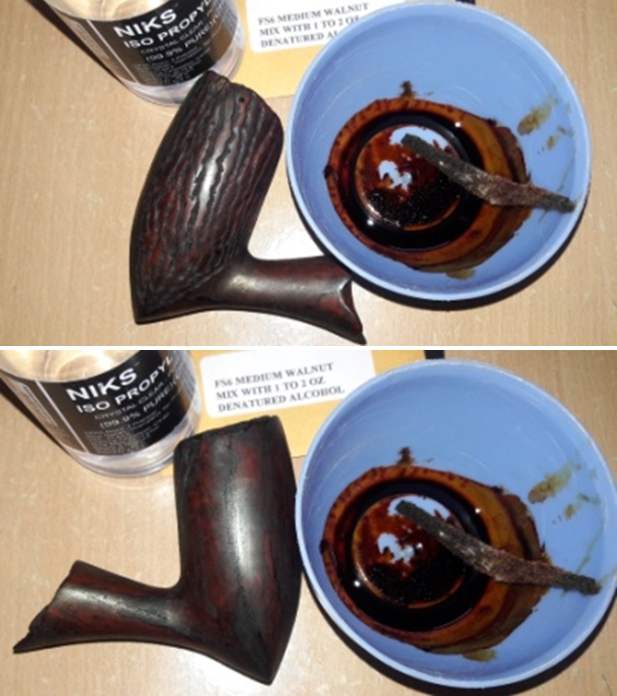
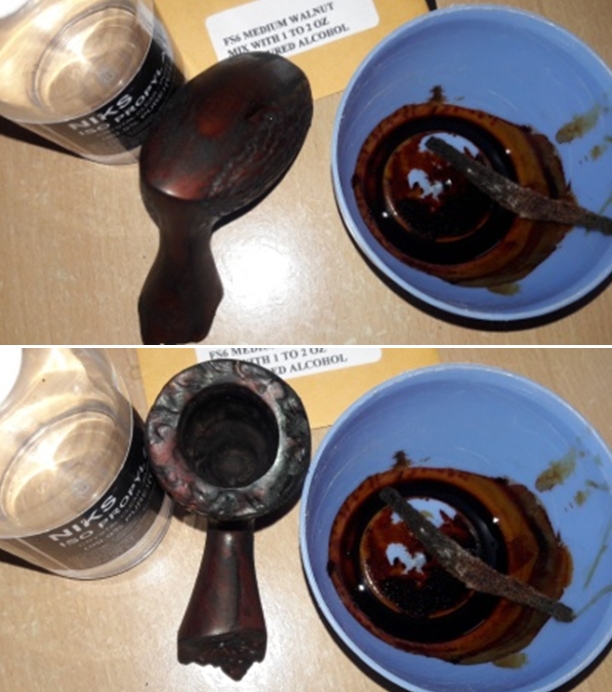
Restoring my Grandfather’s…what the…A Kaywoodie?????


Blog by Paresh Deshpande

Yes!! That is what exactly my thought was, when I looked closely at the small pipe in my hand that I had selected as my next project for restoration. Those who have read my previous write ups on pipe restoration would know that I have inherited a large number of pipes from my grandfather dating between the periods from 1940s to 1970s. I had not come across a single Kaywoodie pipe in the two boxes I had opened, one box still remaining unopened!!!

I have restored two Custom-Bilt pipes from this collection to date, one from 1938-41 era (https://rebornpipes.com/2018/06/02/restoring-my-grandfathers-custom-bilt-pipe/) and second from the Wally Frank era(https://rebornpipes.com/2018/07/20/restoring-a-wally-frank-era-custombilt-sitter-633/), the third Custom-Bilt billiard from 1938-41 era was sent to Mr. Steve of rebornpipes fame to sort out tenon issues and have fallen in love with Custom-Bilt pipes since thereafter!!!! I had picked this pipe assuming it to be a Custom-Bilt and it was only on close scrutiny was it reveled that this was a Kaywoodie!!!!! I deliberately rummaged through the pile again and sure enough, there was another Kaywoodie Bent Billiard with 4 holed stinger in relatively unsmoked condition. It seems my grandfather never took a liking for these Kaywoodie pipes!!!!!

This Kaywoodie Pocket Pipe, now on my work table, has similar large finger like vertical rustications with very thin horizontal lines ensconced within these large vertical rustications. These thick vertical rustications extend upwards and end short of the rim top, giving the rim top a flat smooth surface. These rustications can be seen extending all around the shank on top and bottom, save for smooth surfaces on either sides of the shank. The smooth surface on the left side of the shank bears the stamping “Handmade” over “Super Grain” in cursive hand, over “KAYWOODIE” in block capital letters. The right side of the shank bears the stamp “IMPORTED BRIAR”. All these stampings are thin, worn out but readable under bright light with a magnifying glass. The ¾ bent saddle stem bears the trade mark “Clover leaf” symbol.This pipe comes with a four-holed threaded stinger which screws into the shank. This stinger is stamped with “DRINKLESS”. There is an aluminum spacer ring separating the shank end from the stem end when threaded in. On closer observation, it can be seen that a portion of this spacer, closer to the mortise opening, extends into the mortise and is threaded which matches with the stinger threads.I took all these observation and searched pipedia.com for history of this brand, models and attempt at dating this pipe. This site has detailed information on Kaywoodie pipes, including the history of origin, about the owners of the brand and also various important links to “Collector’s Guide to Kaywoodie Pipes” and “Kaywoodie’s Logos and Markings: Clover variations since 1919”. Here is what was revealed as extracted from pipedia.com:-

Kaywoodie was the name a pipe offered by Kaufman Brothers & Bondy Company (KBB), first appearing in February of 1919. The Dinwoodie pipe, also by KBB, appeared in November of 1919. Sometime before 1924, the Dinwoodie had been discontinued and the Kaywoodie name was beginning to be used on an extensive line of pipes that ultimately would be the name of the company. The origin of the name Kaywoodie is a combination of the K from Kaufman and wood, as in briar. Not much is known of the original KBB company other than it was started in 1851 by the German born Kaufman brothers when they opened a small pipe shop in the Bowery section of New York City. In the back room of this shop, they made their first pipes. From this meager beginning, the Kaywoodie name and organization was to emerge.

When one of the men from the New York office got “gold fever”, he carried a large supply of pipes with him to California that he sold along the way. This early “national distribution” did much to build the reputation of KBB. By the late 1800’s, branches of KBB were opened in Chicago, Atlanta, San Francisco and St. Louis with family and friends acting as agents. The trademarks, for the inlaid cloverleaf and the cloverleaf with the KBB initials inside, were issued in 1881. KBB’s pipes became more popular and were in constant demand by the end of the century. Orders were streaming back east and KBB needed to move to larger manufacturing facilities. By 1915 the move was made to larger facilities in the old Union Hill section of Union City, New Jersey. The salesroom offices were located at 33 East 17th. Street, New York. When the Kaywoodie pipe was first introduced by KBB it came with a hand cut rubber mouthpiece fitted with an aluminum Inbore Tube. This device was to “assure a clean, cool smoke.” Other KBB pipes such as Ambassador, Heatherby and Melrose also had the Inbore tube. The early Drinkless Kaywoodies from 1924 through 1931 had push bit stems. In 1931, after three years of research, the new Drinkless Kaywoodies with the synchro-stem, (threaded drinkless screw-in mouthpiece) were introduced. The drinkless attachment was advertised as cooling the smoke from 850 degrees in the bowl to 82 degrees when it entered the mouth. By the mid 1930’s, all Kaywoodie’s came with the screw mounted Drinkless attachment. (Export Kaywoodies, available briefly from 1950-1955, had push bit stems and were available in all the same shapes and finishes as the drinkless versions.)

Throughout much of the 1940’s, 50’s and 60’s, the Kaywoodie family of pipes consisted of 11 basic grades of briar pipes; though new grades were frequently added to the line and some older grades were discontinued or downgraded. These 11 basic grades of pipes, listed in ascending order of quality, were:

  1. Drinkless
  2. Hand-made Super Grain
  3. Super Grain
  4. Relief Grain
  5. Flame Grain
  6. Silhouette
  7. Oversize Kaywoodies
  8. Meerschaum Inlaid Kaywoodies
  9. Connoisseur
  10. Ninety-fiver
  11. Centennial

Thus from the above, I can safely infer that this pipe was a higher grade Kaywoodie from the 1940s to 1960s.

INITIAL VISUAL INSPECTION
The finish looked a lot like the classic Kaywoodie take on Tracy Mincer’s Custom-Bilt pipes. The carved worm trails seen on the stummel and shank is filled with dust, dirt and grime of years of smoking and thereafter years of uncared for storage. The grime and dirt is so strongly entrenched in to these carved worm trails that it appears black and solidly smooth to the touch. I could see 3-4 small dings and dents on one of the fingers of the raised portion of the stummel. This will need to be addressed. There is a decent layer of cake inside the bowl which is dry and hard to the touch. The smooth rim top is clean and devoid of any apparent damage. The condition of the inner walls of the chamber can be ascertained after the cake has been reamed out. The inner edge of the rim shows minor uneven surface, however, the outer edge of the rim is clean and without dents or dings. The short ¾ bent saddle stem has smooth upper and lower surfaces without any tooth chatter or bite marks. This is unlike any other pipe stem I have seen that had belonged to my grand old man. The four holed stinger is clean, however, the holes appear to be clogged. This was confirmed as air did not flow when I tried to blow through the stem. May be that has been the reason that this pipe was not as extensively used by him. The inlaid white clover leaf is clean and prominent with a tiny portion of the top of the leaf missing!! But it is so tiny chip that it is not immediately visible. The lips are worn out and may need to be reconstructed; again I am not sure about this as there is no damage as such. There is an aluminum spacer between the stem and the shank which breaks the monotony of the pipe. However, it is broken on the right side leaving an ugly gap between the shank and stem. The remaining portion of the aluminum spacer was crumbling and breaks merely to the touch. This needs to be addressed. There is a circular band of white tape or some such material at the end of the stinger where it meets the stem. This is something which is not correct and the reason for it having been placed needs to be checked. THE PROCESS
First and foremost in any restoration of pipe, I start with reaming the chamber with a Kleen Reem pipe reamer. However, in this instance, the cake was dry, tightly packed and very hard. I feared breaking the reamer and resorted to the use of my fabricated knife. After a struggle, I was able to take the cake down to the bare briar. I sanded the inner walls of the chamber with 150, 220 and 600 grit sand paper to completely remove the remaining cake and smooth out the walls. Alas, I observed some superficial gouges on the wall surface due to the use of knife. I would need to address this by coating the chamber walls with pipe mud at a later stage. I cleaned the mortise and internals of the shank with cue tips, pipe cleaners and alcohol. Since the major challenge appreciated in this restoration project was the construction of a new aluminum spacer, I decided that is where I would start!!!! To address this issue, I identified three options, as under, which were available to me:

(a) Coat the entire spacer, including the broken portion, with superglue, building it up in layers and then sanding it to flatten it on a topping board. This coat of superglue will also stabilize the remaining original spacer.

(b) Fabricate an aluminum spacer out of a regular aluminum washer and replace only the broken portion of the spacer.

(c) Replace the entire spacer with the new fabricated aluminum spacer.

I discussed these options with my mentor, Mr. Steve Laug. As is his trademark style of tutoring, his suggestion was, “I would go with the first option”!!!!! He further clarified that the spacer also enters the mortise and has threads for the “synchro-stem” (threaded drinkless screw-in mouthpiece). Thus, I concluded that exercising the third option was best avoided if I wished to avoid ruining the pipe!!! That left me with following either first option or the second option. Any other sane student would have followed the advice of his mentor (which I had been doing up to this point!!!). However, I, for some reason, was convinced that the end result of exercising the second option would result in a better finish and thus embarked on the arduous journey of replacing only the broken portion of the original spacer with the fabricated aluminum washer.
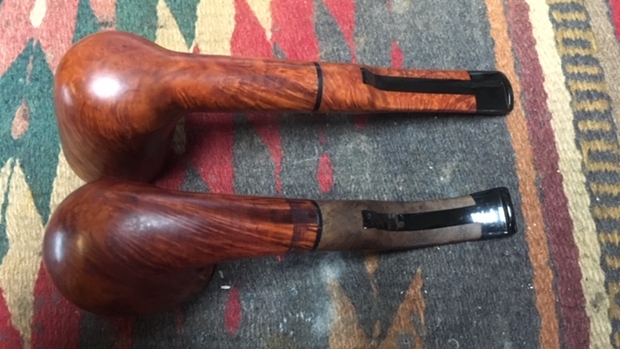
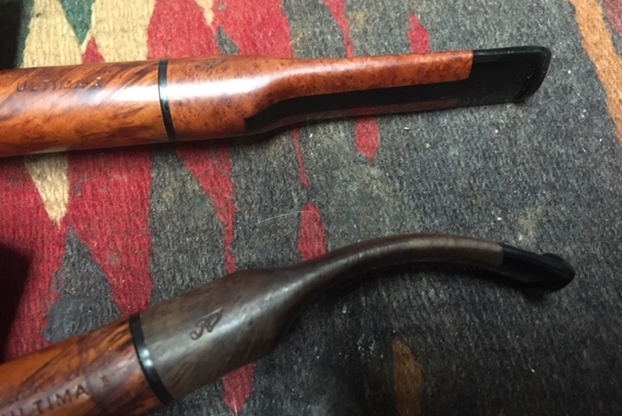
I began the process by shaping the new aluminum washer to match the size, shape and thickness of the original spacer. I was not very meticulous about the size and thickness as the same would, in any case, have to be perfectly matched by sanding it down with needle files. The following pictures will tell the story of the entire process of constructing this spacer. However, what these pictures do not tell you is the long back breaking hours involved, the strain to which eyes were subjected, precise and controlled movements of the needle files and agony experienced whenever the needle file inadvertently scraped the crumbling original spacer, causing it to chip. When I was satisfied with the fit and finish of the new spacer, I applied an even coat of superglue over the entire surface and very painstakingly re-aligned all the broken pieces of the original spacer and also the new fabricated spacer over the coat of the superglue and set it aside to cure overnight. Next day I evenly applied another coat of superglue over the entire spacer and again set it aside to cure so as to stabilize the spacer repairs and even out the surface. Once the glue had sufficiently cured, I topped the surface on a topping board to even out the glue. To further smooth out the surface and ensure a transparent, even and smooth surface, I polished the surface with micromesh pads, wet sanding with 1500 to 2400 grit pads and dry sanding with 3200 to 12000 grit pads. I frequently wiped the surface with a moist cloth to remove the glue dust. I was able to maintain just sufficient thickness of the coat so as not to disturb the alignment of the stem with the shank while stabilizing and protecting the spacer. I was very satisfied with the results. Now with the spacer taken care of, I start working on the stummel. I thoroughly clean the stummel with undiluted Murphy’s oil soap and a hard bristled tooth brush scrubbing the rustications clean of all the lodged dirt, dust and grime. I had seen a few dents and dings on one of the fingers of the stummel rustication and wanted to address it. I began by sanding the stummel and raised portion of the rustications with a 600 grit sand paper followed by 800 grit sand paper. I had used very light hand so as not to lose too much briar (though at the end I realized that I should have used a bit more force since at the end of the process, these dents and dings were still very much visible!!!!!!). This sanding was followed by polishing with micromesh pads, wet sanding with 1500 to 2400 grit pads and dry sanding with 3200 to 12000 grit pads. I wiped the bowl down with a moist cloth after each pad to remove all the sanding dust. As I was going through the micromesh pads, I was thinking of adding some twist to the finish and remembered that Mr. Dal Stanton, a gentleman I often turn to for some interesting pipe related conversations and advice, had refurbished a Tom Howard rusticated tomato pipe for me. He had darkened the crevices of the rustications with a dark stain pen and the contrast was eye catching, to say the least. I wanted to have a pair of pipes with this finish and decided to give this Kaywoodie the same treatment. I discussed with Mr. Dal Stanton who wholeheartedly explained the technique of achieving this finish and also gave me some very fine and pragmatic advice which I shall cherish on this journey. I stained the crevices in the rustications with a dark brown stain pen and set it aside for the stain to set in to the crevices. After the stain had set, I rubbed a small quantity of “Before and After” restoration balm in to stummel and set it aside for a few minutes to let the balm work its magic on the briar wood. The balm works to bring back the shine and pours life in to the briar. I buff the stummel with a horse hair shoe brush followed by a nice hand polish with a soft cotton cloth. I liked the way the stummel has finished. To address the superficial gouges in the chamber created by use of knife during reaming, I prepared a mixture of pipe ash and yogurt of putty consistency and applied a coat to the inner walls of the chamber. Once the coating had cured, I gently sand the walls with a 220 grit sand paper to a smooth and even surface. With this, the stummel is all completed. Once the stummel had been finished and set aside, I turned my attention to the stem. There was not much work on this stem since it was sparingly used with only light signs of oxidation and no bite marks or tooth chatter. I start by sanding with micromesh pads, wet sanding with 1500 to 2400 grit pads and dry sanding with 3200 to 12000 grit pads. I wiped the stem with a cotton swab dipped in alcohol to remove the sand dust and rub a small quantity of Extra Virgin olive oil and allow it to be absorbed in to the stem. The stem is now nice and shiny. The next thing to address was the blocked stem. I tried cleaning the airway in the stem with pipe cleaners dipped in alcohol, but the pipe cleaner would not go in the complete distance. There was gunk and tars which had accumulated inside the airway and in the holes too!!!! Using a straightened paper clip, I probed and cleaned all the holes on the stinger. I tried to blow through the stem, but I realized that it was still blocked. I tried pushing the paper clip through the airway and then there was this small sound of a crack!!!!!! Aargh……..the upper lip now has a chip!!!!! Undaunted by this temporary setback, I continue with the clearing of the blocked stem. Finally, I am able to dislodge the block and now the air flows freely through the stem.To address this chip, I firstly insert a regular pipe cleaner coated with Vaseline in to the air way. This prevents the charcoal and glue mix from dribbling in to the air way blocking it. I mix a small quantity of activated charcoal and CA superglue and spot apply it over the chipped surface. Once I have ensured that the complete surface is coated with the mix, I set it aside to cure overnight. The next evening, I file the filling with a needle file and match it to the surface of the stem. To further match the filling with the rest of the stem surface, I sand the fill with a 220 grit sand paper followed by micromesh polish pads. The stem is now nice and shiny again with a free flow of air through the airway. I finished this restoration by applying a small quantity of Halcyon II wax and rubbed it deeply in to the stummel with my fingers. A few minutes later, I polished it with a soft cotton cloth using muscle power. The stummel now has a nice deep shine to it and the grains on the rim top and raise portion of the rustication can be seen in its full glory. I re-attach the stem and then relies that the stem is off center to the shank!!!! My God, this one was giving me a hard time. I removed the white sticky tape that was stuck around the stinger at the stem end and tried the fit. The fit had improved but it was still off centre. Again, to address this issue, I was presented with two options of either sanding the coating of superglue over the spacer till the off center was corrected or heat the stinger till the glue fixing the stinger in the stem was loosened and turn the stinger in to the mortise till the issue was addressed. I decided to go with the second option as I feared losing the coating of superglue over the spacer and thus exposing the brittle original to further chipping. I heated the stinger with the flame of a Bic lighter so that the glue holding the stinger would loosen a bit and fitted the stem in to the mortise, tightening it till the stem and shank were perfectly aligned. I let the stinger sit in this position till it had cooled down and the glue had hardened again. Now the fit of the stem and the shank is perfectly aligned. Here are the pictures of the finished pipe and hope that this long write up has been an enjoyable read. Thank you for walking with me through this restoration as I attempt to preserve the legacy of my beloved grand old man!!!!!