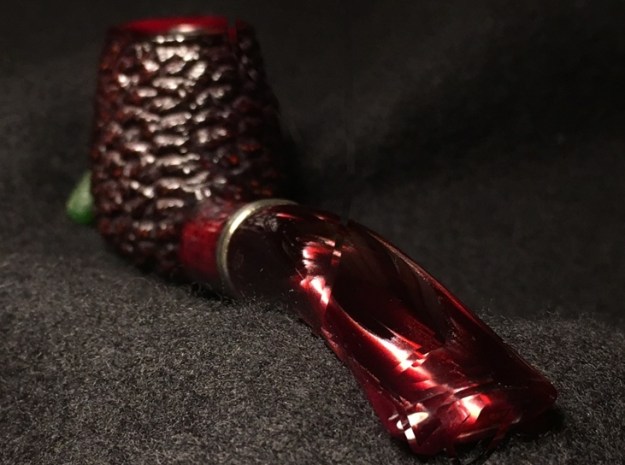
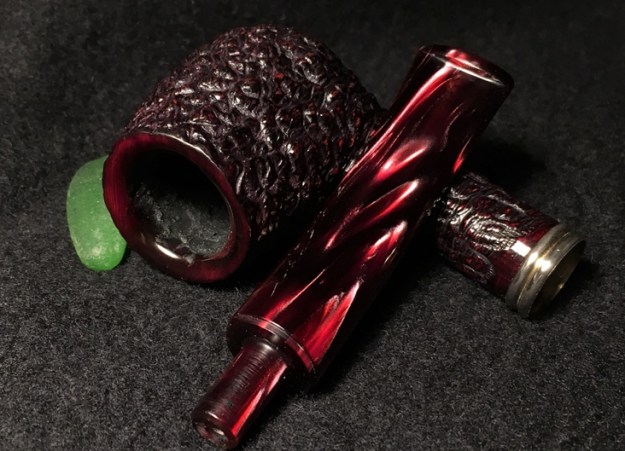
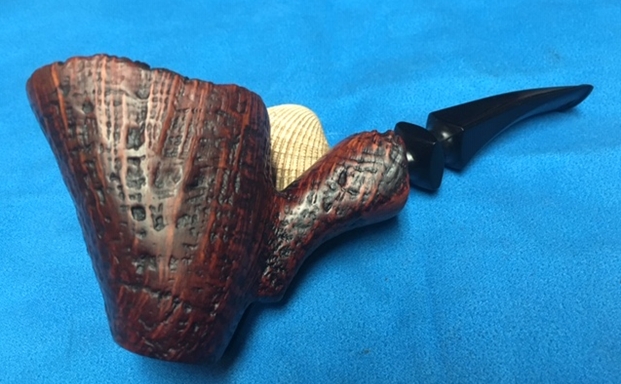
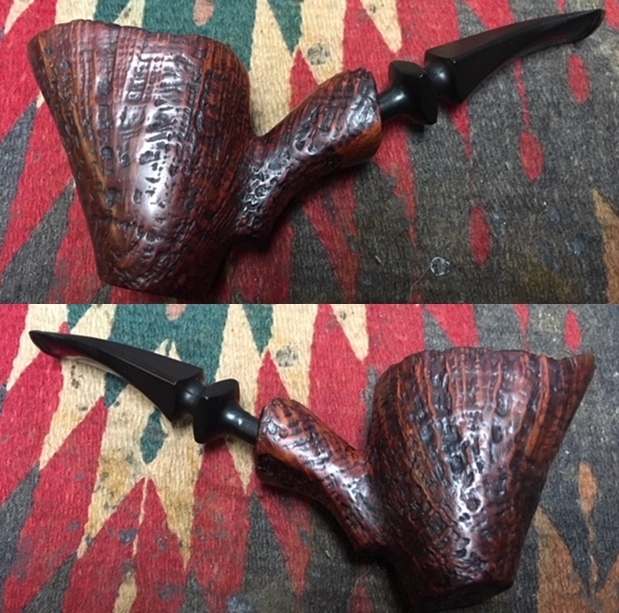
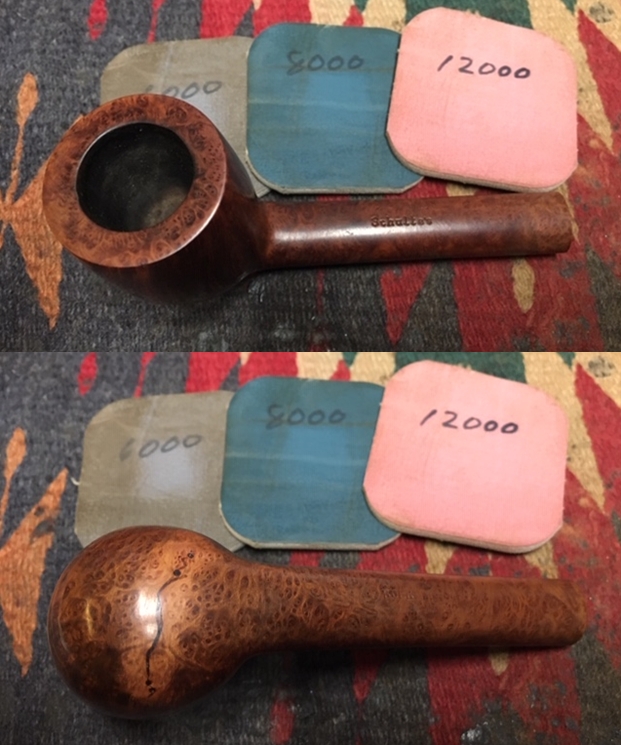
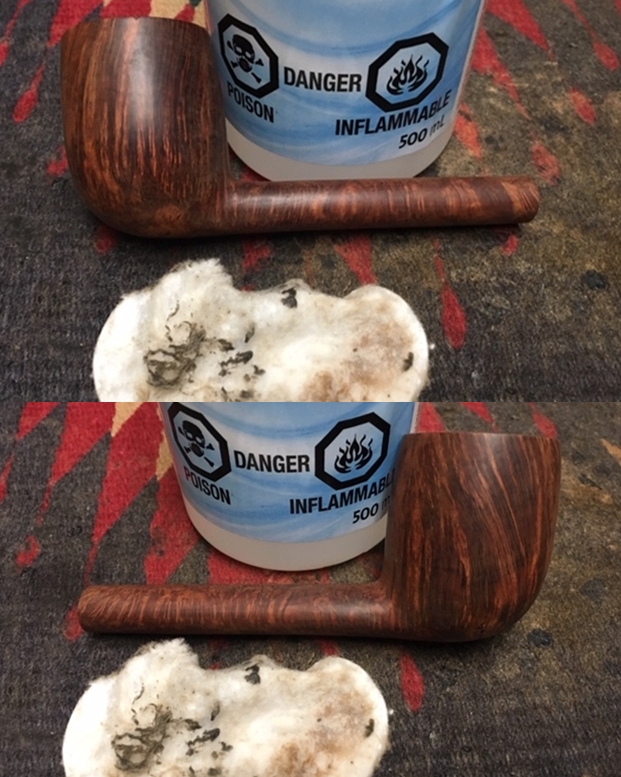
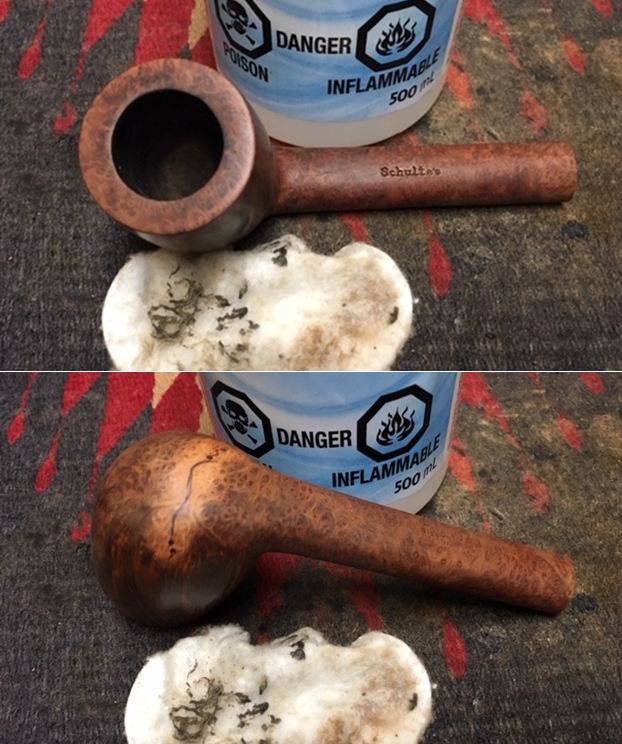
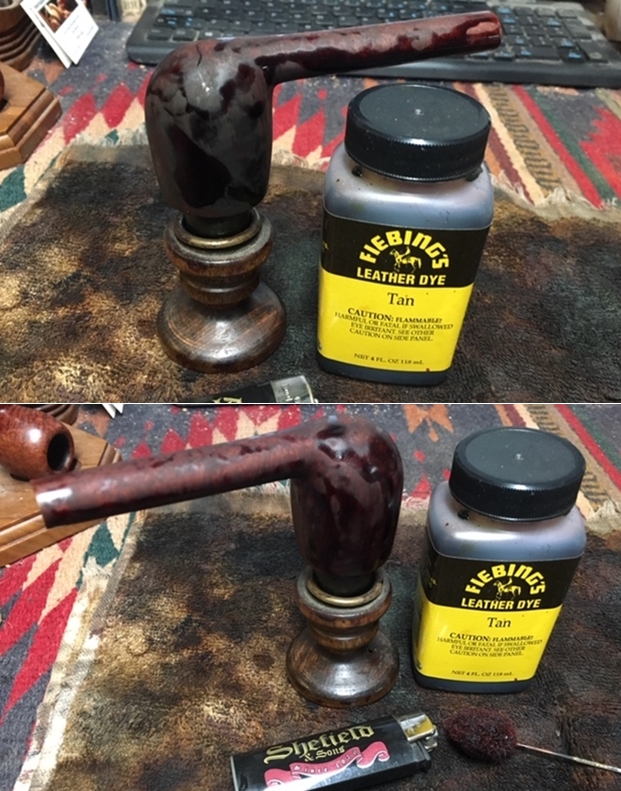
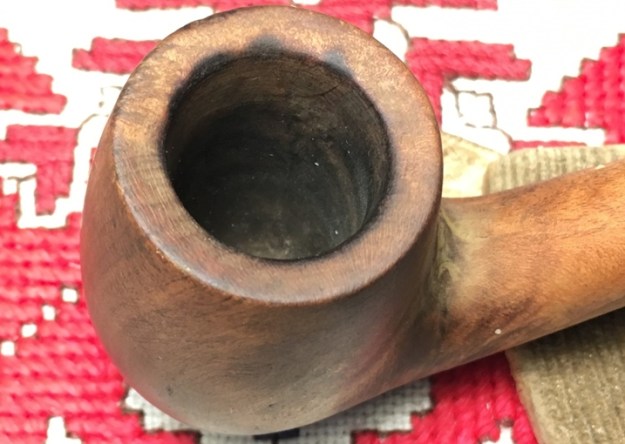
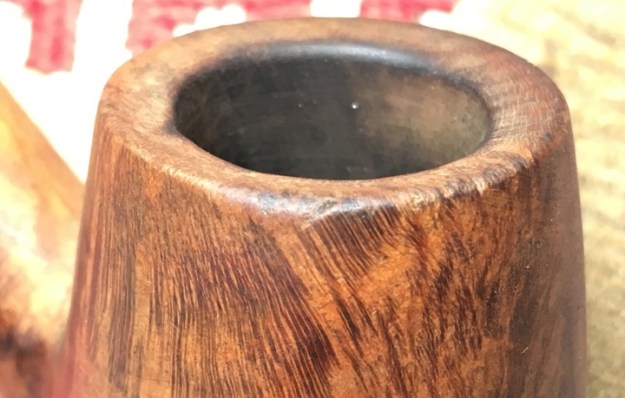
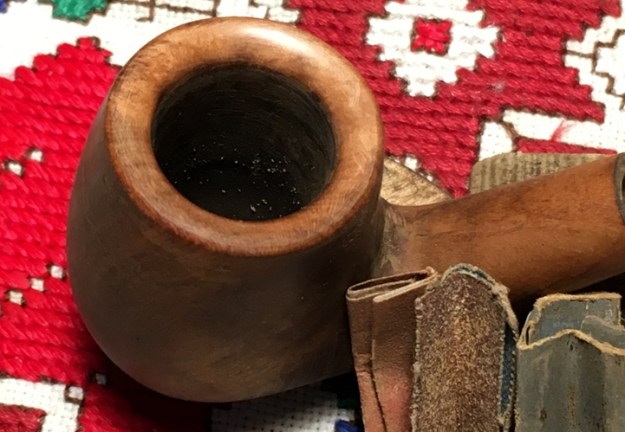
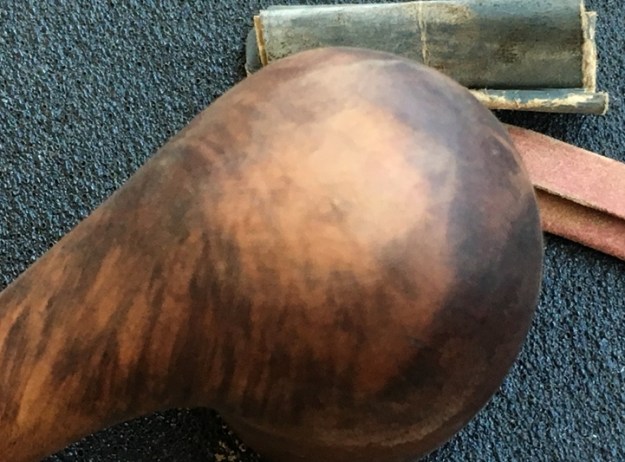
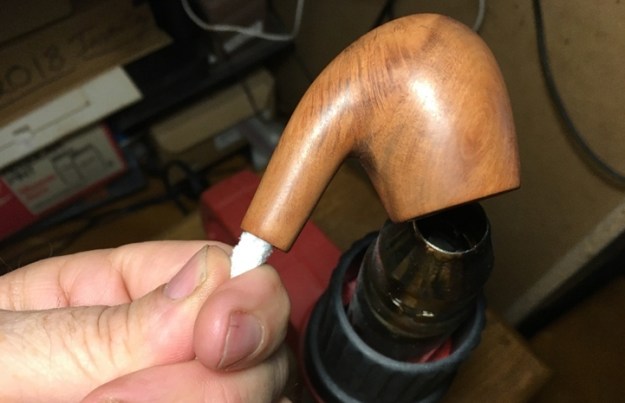
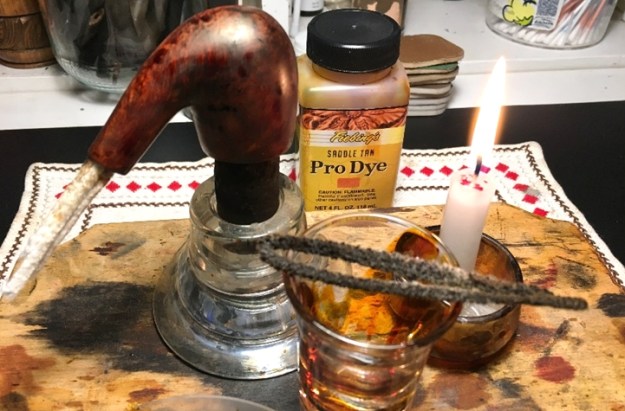
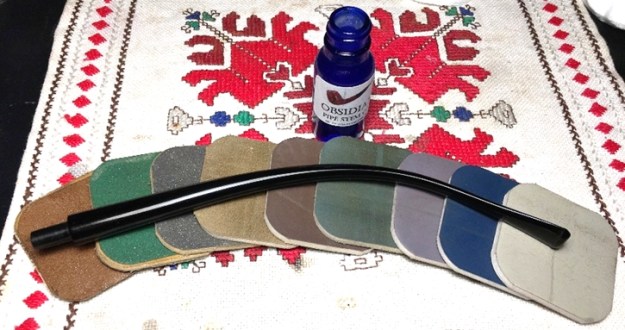
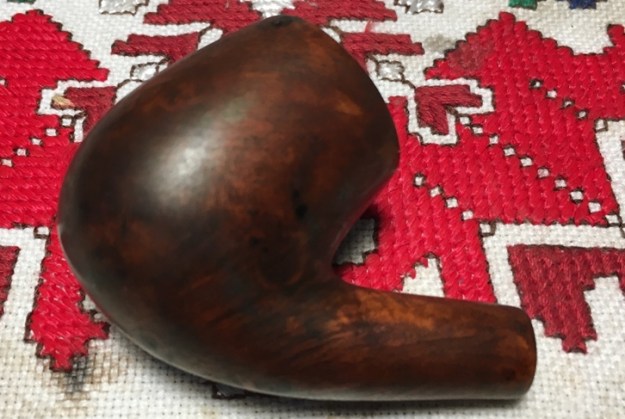
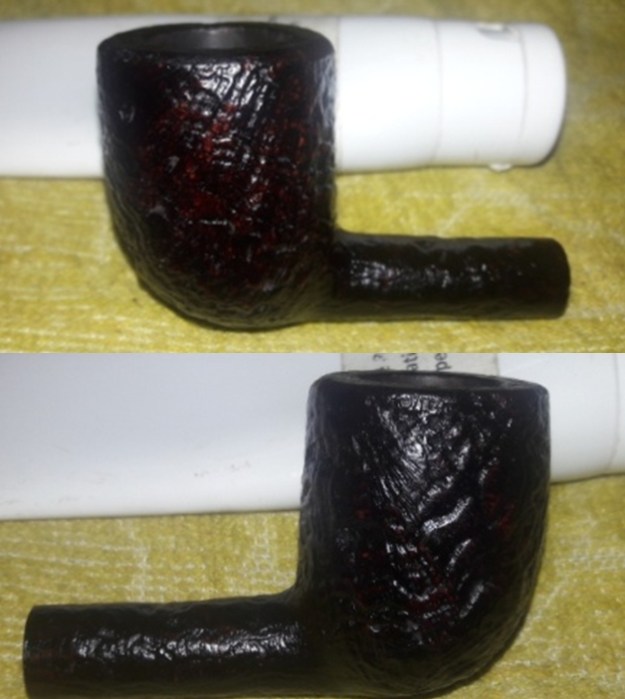
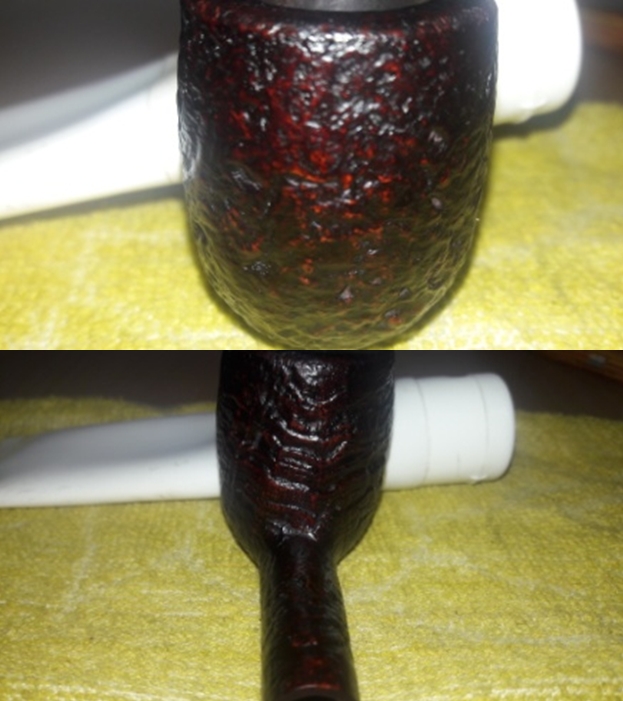
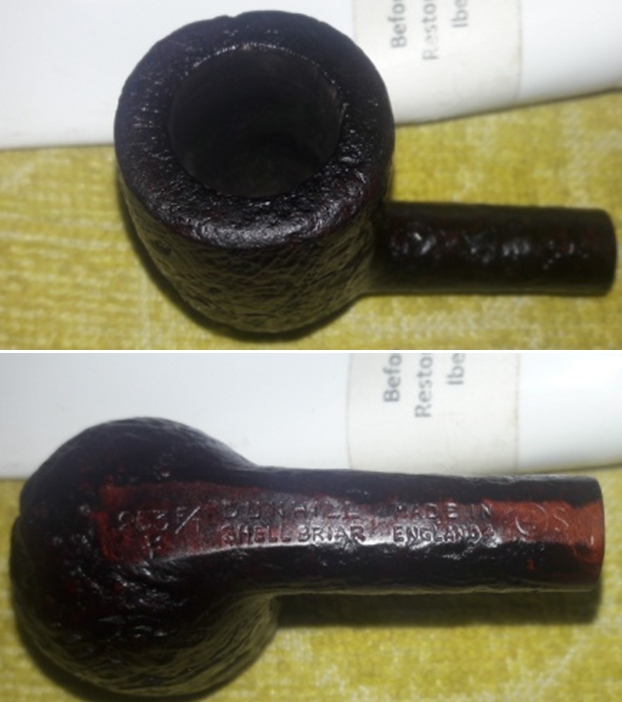
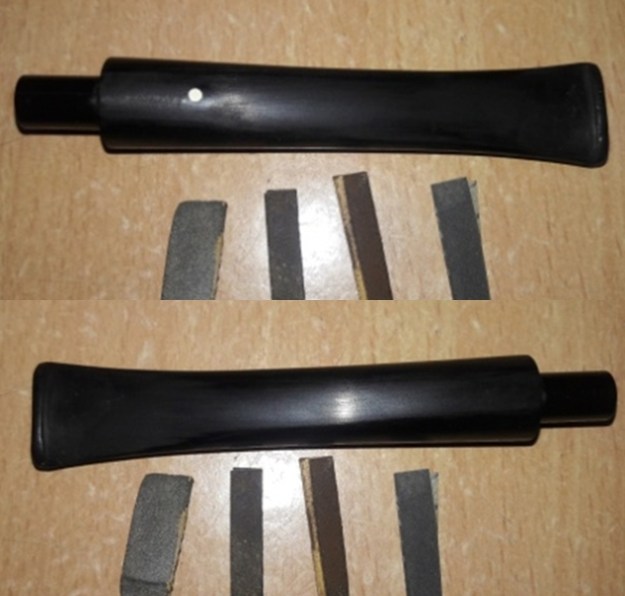
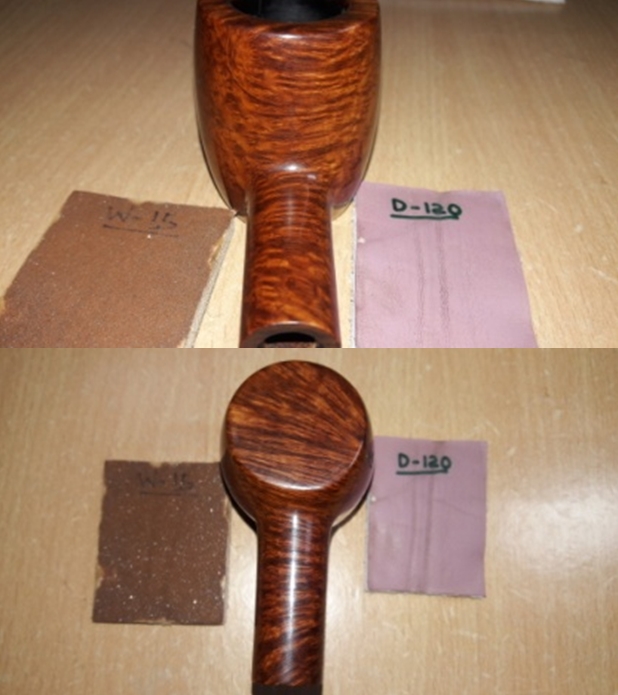
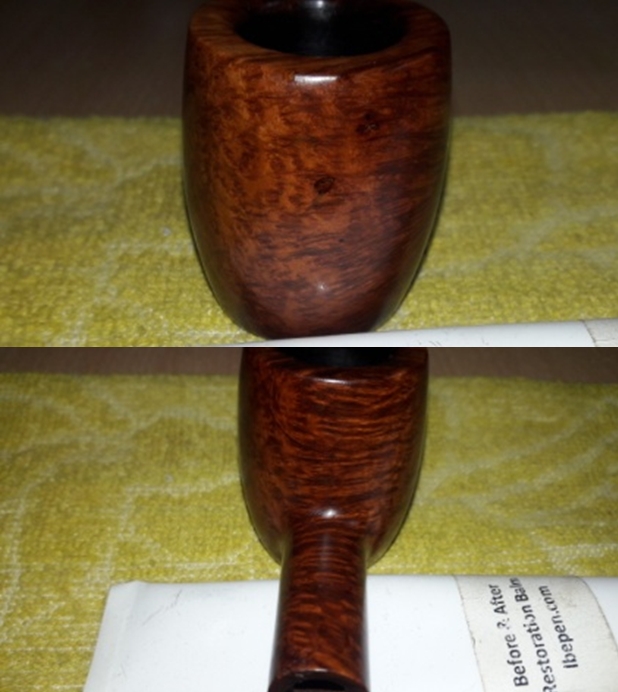
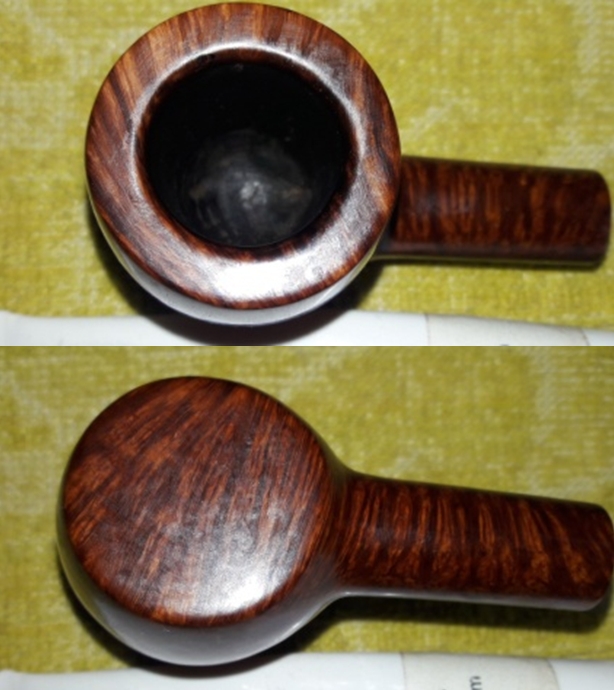
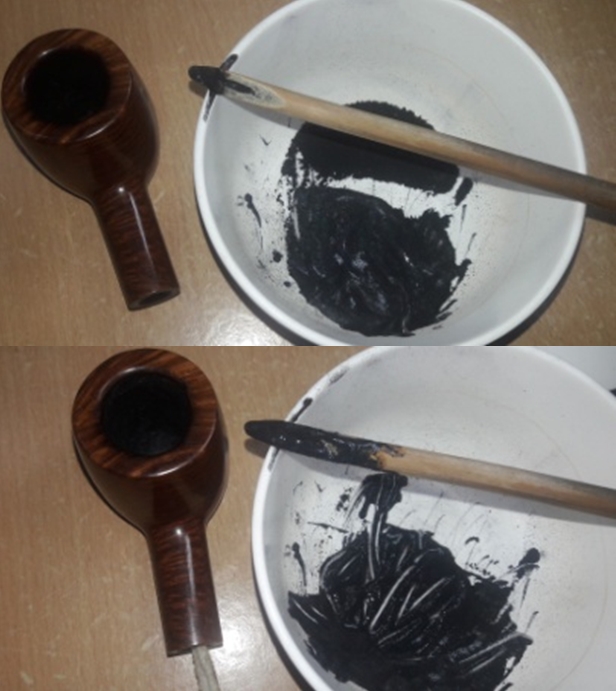
Tag Archives: contrast staining

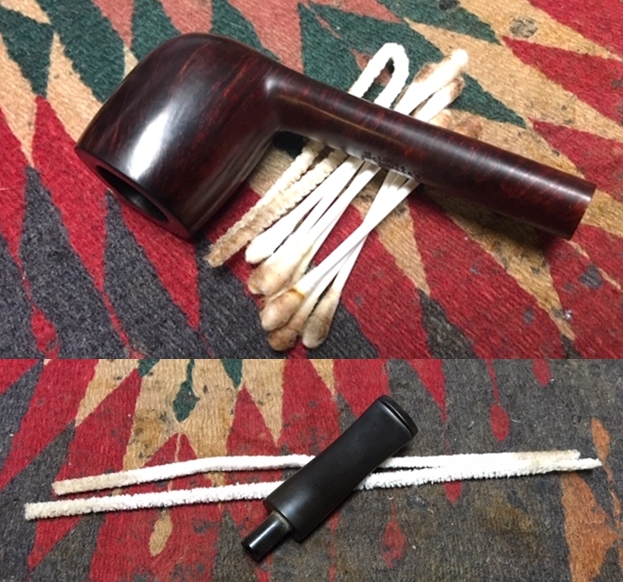
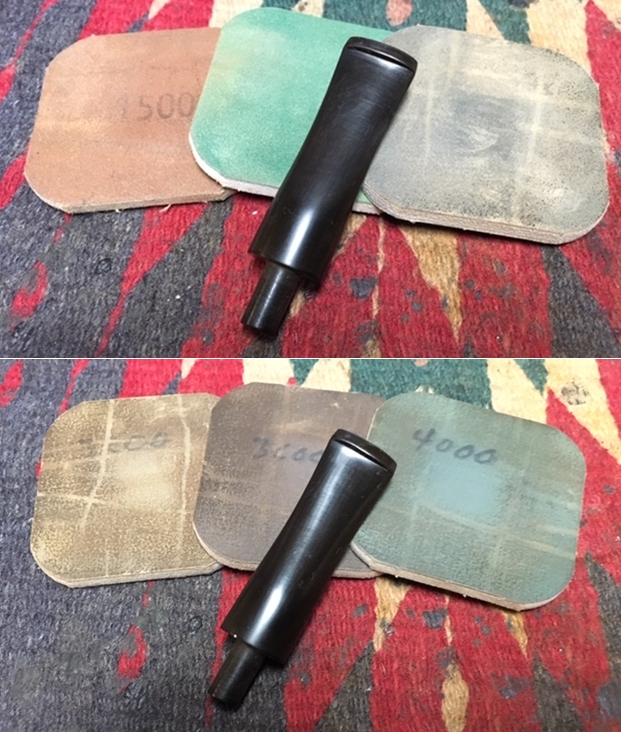
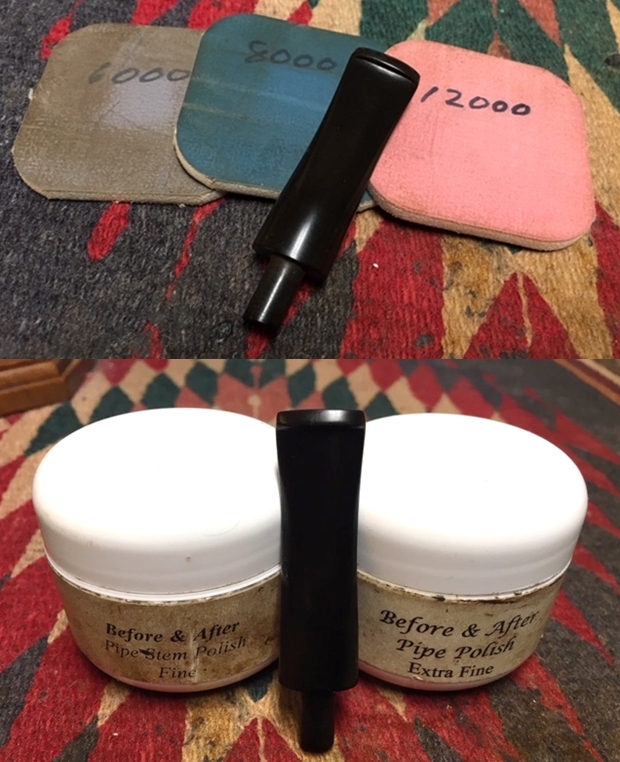
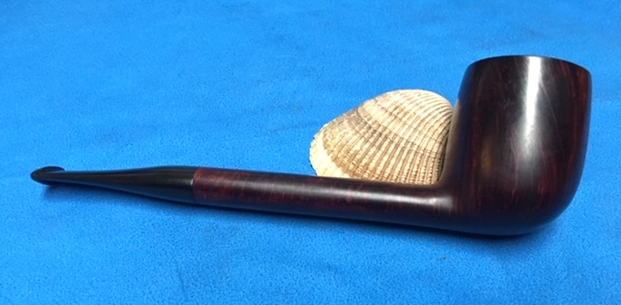
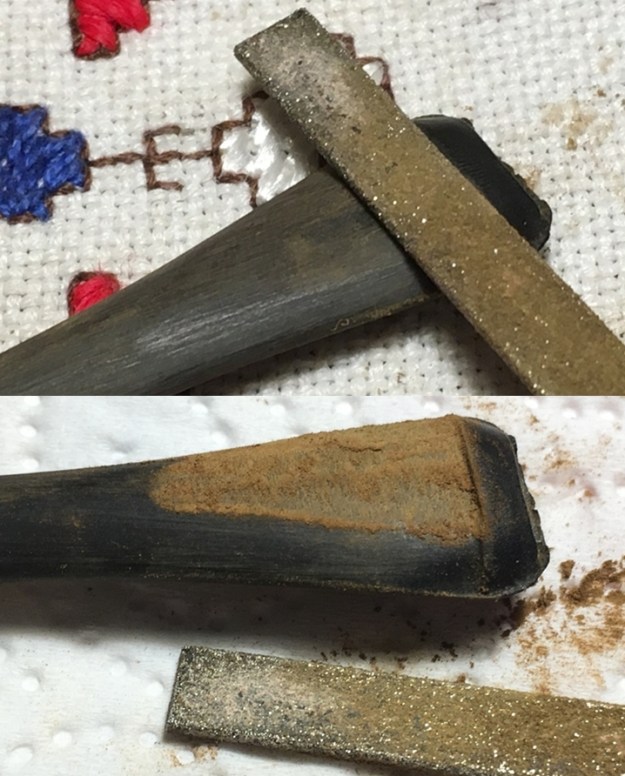
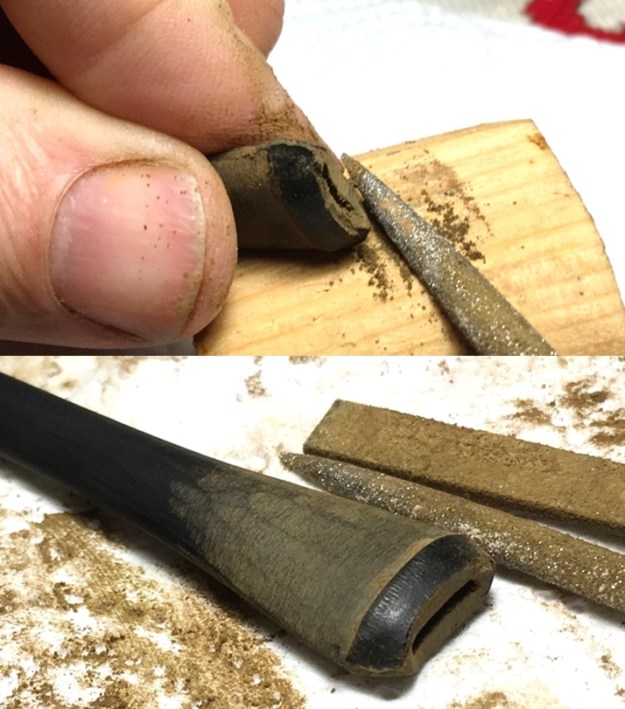
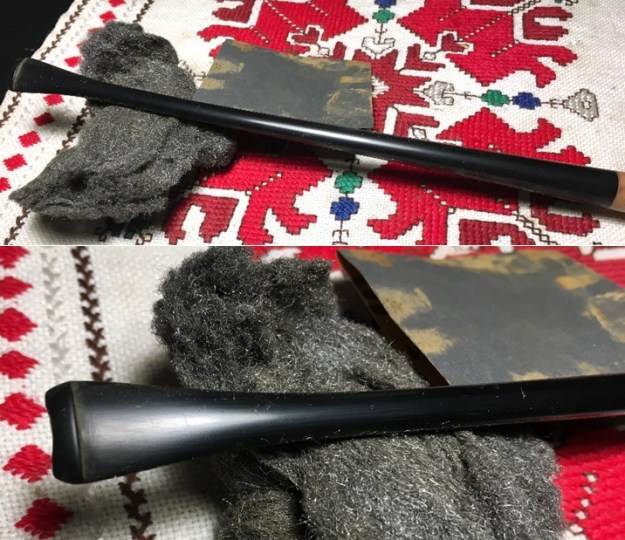
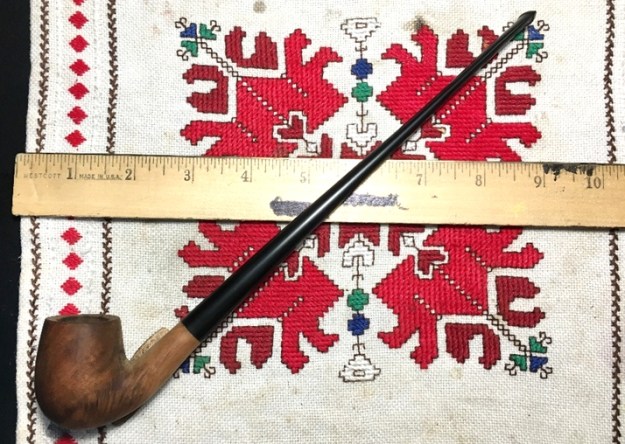
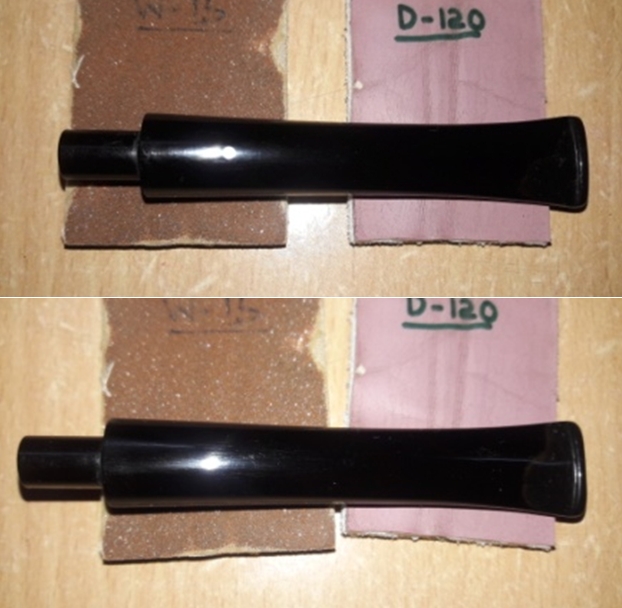
Reconstructing a Broken Stem on a 1964 Dunhill Shell 253 f/t


Blog by Paresh Despande

I had just finished a second of the 30 pipes from my Mumbai Bonanza find, a 1979 DUNHILL BRUYERE 51671; here is the link to the write up; https://rebornpipes.com/2019/03/13/reconstructing-a-broken-stem-on-dunhill-bruyere-51671/

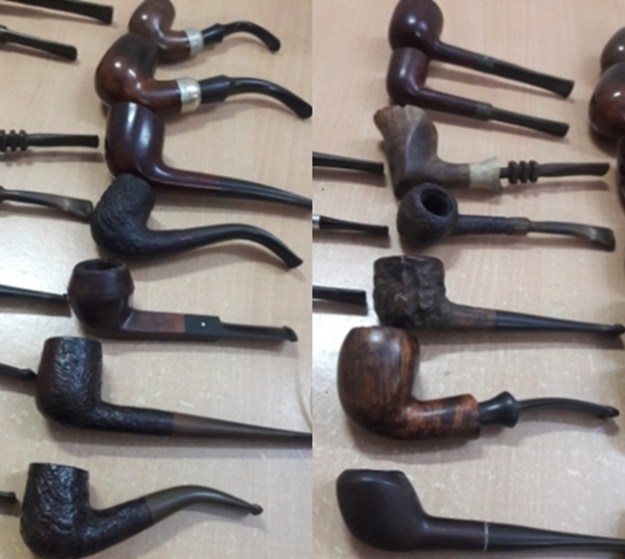
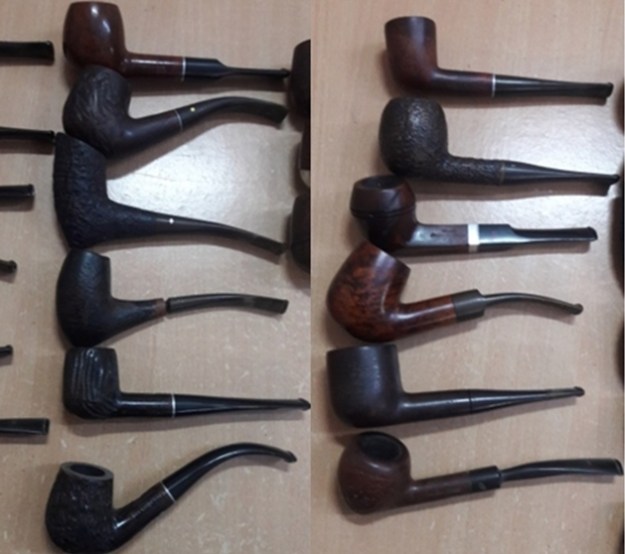
I was fortunate enough to have heeded to the advice of my dear friend and mentor, Mr. Steve, and struck a deal with a trash collector from Mumbai. He did not know what he was selling and I did not know what I was buying as we reside in different cities!! The argument that Mr. Steve presented was that if not anything, I shall at least have some spares and this was logical. I struck a deal and here are pictures of the pipes that I received in this lot. This lot contains some very nice collectible pipes, a few well known brand pipes and some mediocre pipe brands. Overall, with seven Dunhills, a Preben Holm #1, a couple of Made in England Pete System pipes, Charatan’s, Custom-Bilt, Stanwell and other assorted pipes, I would say that I had hit a huge jack pot!! Hence, I like to call this find as “Mumbai Bonanza”.

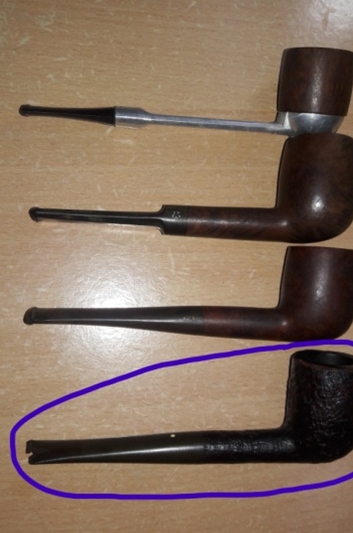
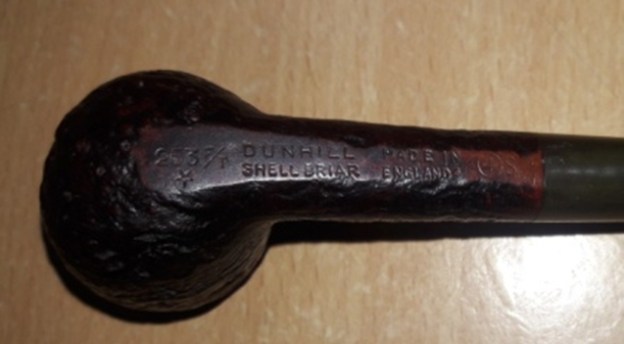
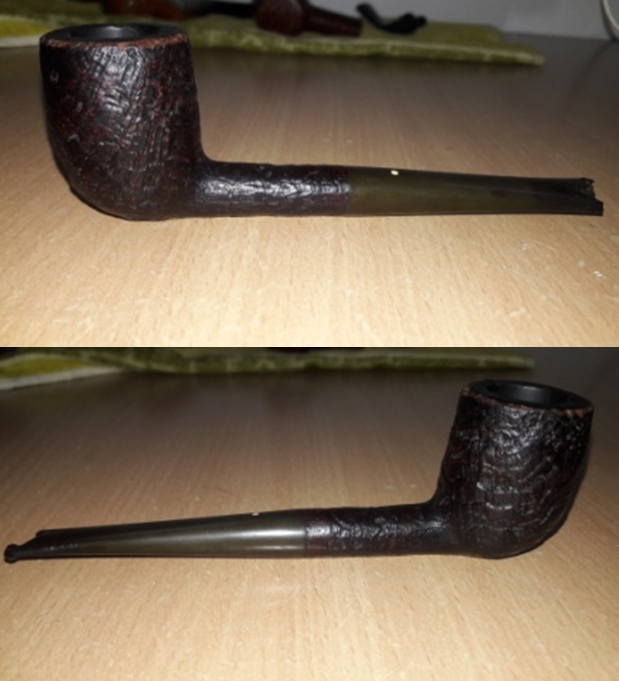
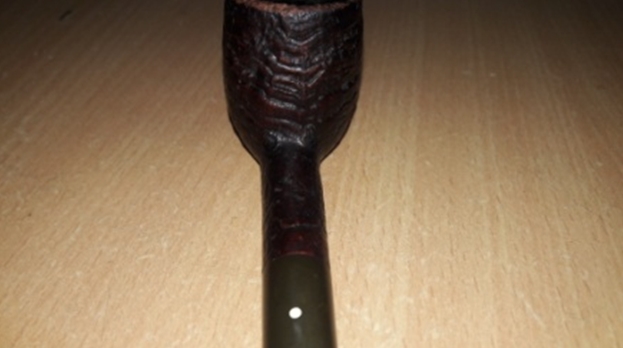
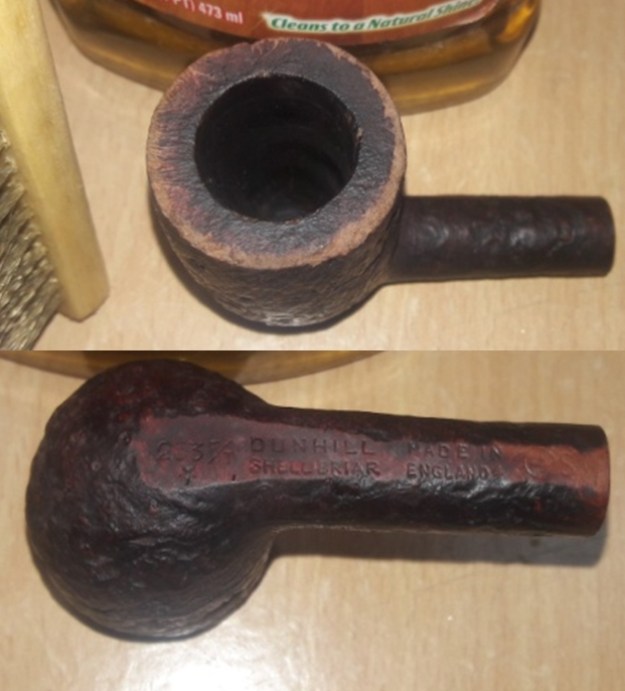
The pipe that I decided to work on next from this find is another Dunhill, a 1964 Shell Briar billiard, and is marked in an indigo circle in the picture below. It is stamped on the heel and the underside of the shank with the shape number 253 over a star followed by F/T followed by DUNHILL over Shell Briar over the COM stamp Made in England 4 which dates it as being made in 1964. This is followed by Group size number 4 in a circle and letter S for Shell. Dunhill White Dot adorns the top of the vulcanite stem. The stampings are deep, crisp and clear. I tried to search on pipedia.org for the significance of the star on the heel. However, the information available did not match with the stampings on the pipe on my worktable. I approached members in my group on FB. Their learned response indicated that Dunhill stamped their replacement stummel with a star at the bottom of the heel. They also assured me that these replacement bowls are intrinsically original with same quality as the original and that this does not affect the value of this pipe.

With assurance, I move ahead with the restoration of this beautiful medium sized and sandblasted Dunhill billiard.

INITIAL VISUAL INSPECTION
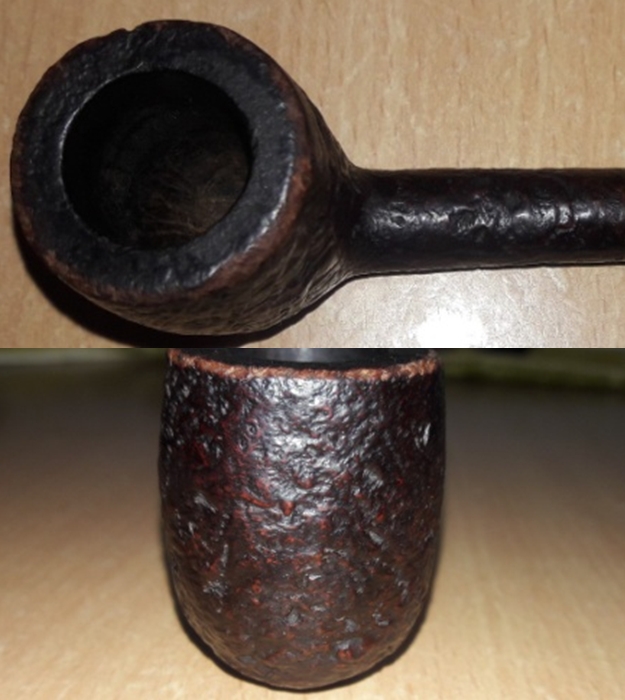
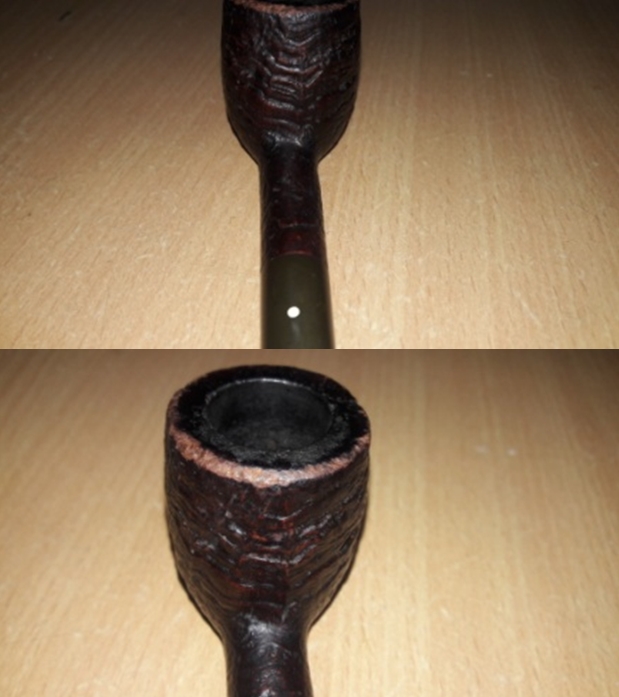
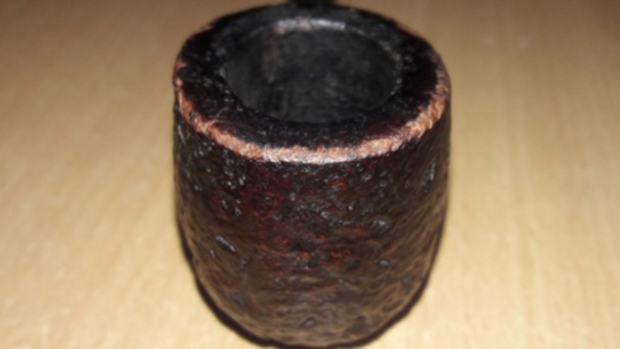
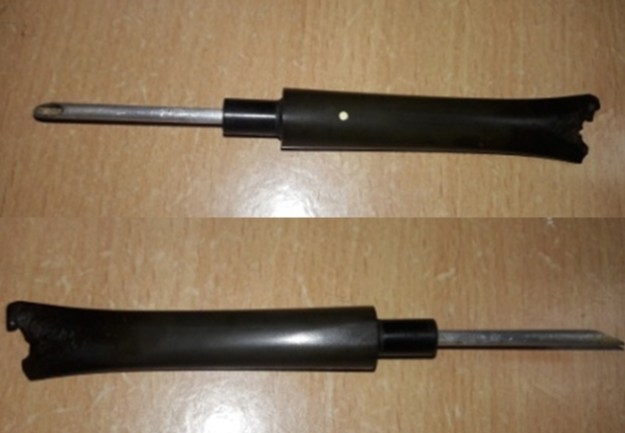
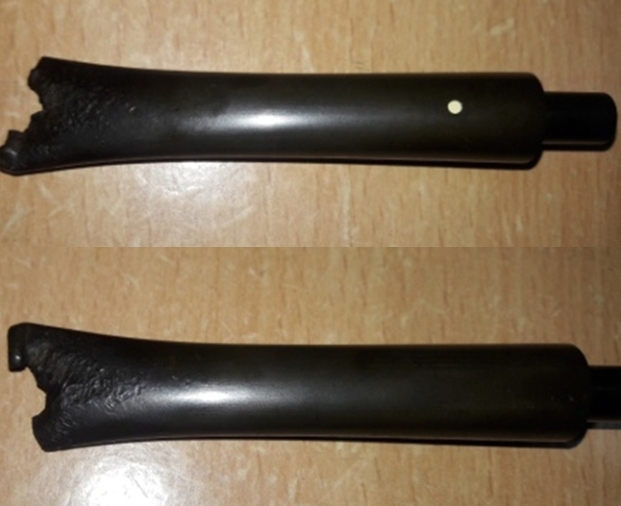
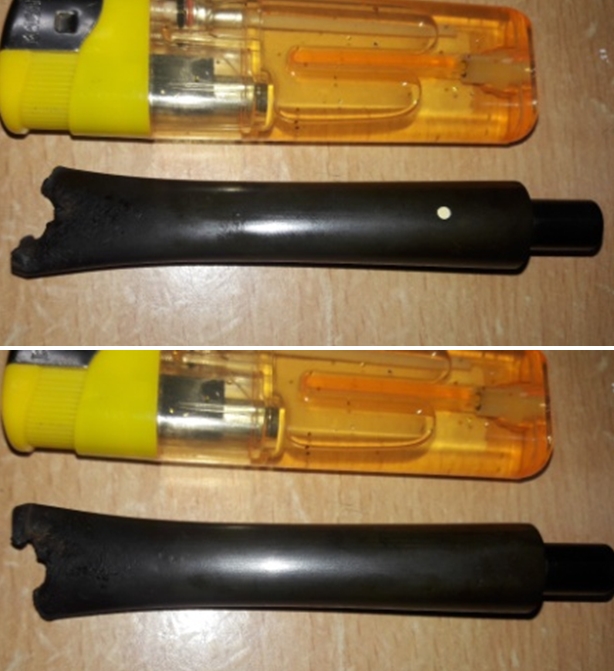
The chamber is clean with a thin layer of cake which indicates that the pipe has been kept clean by its previous Steward. From what I can see, the chamber walls appear to be without any damage. The chamber is odorless. There is an overflow of lava on the rim top surface. The inner rim edge show minor unevenness which should be easy to address. It is the outer rim edge that shows significant damage in the form of dents, dings and scratches, all along the circumference. This must have been caused due to hammering of the edge against a hard surface to remove dottle!!!!! This being a Dunhill Shell, it will be a challenge for me to fix these dents. The mortise is clean and so is the shank airway. The condition of this pipe is very similar to the earlier Dunhill Bruyere that I have restored and makes me wonder if these could have come from the collection of the same Steward. The stummel boasts of some beautiful sandblast patterns, a mix of straight and cross grain all around. It is dirty with grime and tar filling in much of the craggy finish. The briar looks lifeless and dull which is nothing serious to address. The round shank of the Billiard flows into a long tapered stem which has a flare, like a fish tail, at the button end and hence the stamp F/T. The vulcanite stem shows significant damage to the button end, in fact, there is no button at all, similar to the Dunhill Bruyere that was restored earlier!!!!! This convinces me that there is a high probability that these have been previously enjoyed by the same Steward. The stem end is missing, well, about an inch of vulcanite. This pipe would have been his favorite and he had continued to enjoy bowls of his favorite tobacco long after the button end had been chewed off. This is evident from the significant tooth chatter on both the surfaces of the stem. I intend to reconstruct/ rebuild this portion of the stem, including the slot, while maintaining the stem and general profile of the pipe. This will require major repairs. The quality of vulcanite is good. The condenser tube inside the stem however will have to be cleaned and sanitized. In this project, repairs to the damaged outer edge and stem rebuild will be a major challenge, the stem more so, as achieving the fish tailed profile of the stem will need to be adhered to for overall aesthetic appeal of this piece of briar. Having just finished the tedious restoration of the Dunhill Bruyere, I am aware of the challenges this restoration will present en-route.

THE PROCESS
Since the stem has significant damage, and from my experience of stem repairs this will be time consuming and laborious part, I start this project by tackling the stem first. I had decided to rebuild the entire stem including the button and the slot, while giving the button end a slight flare which is the trademark of a fish tail stem. This decision was partly dictated by the fact that I do not have a rotary cutting blade to cut the damaged button end and partly to my innate desire to maintain the originality of the pipe. It’s a Dunhill after all!!

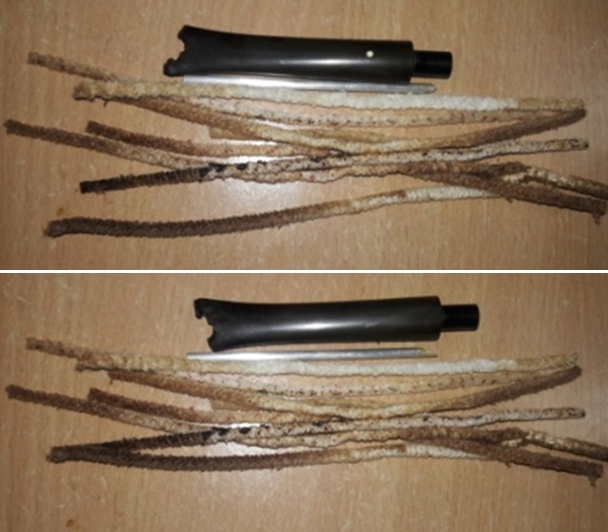
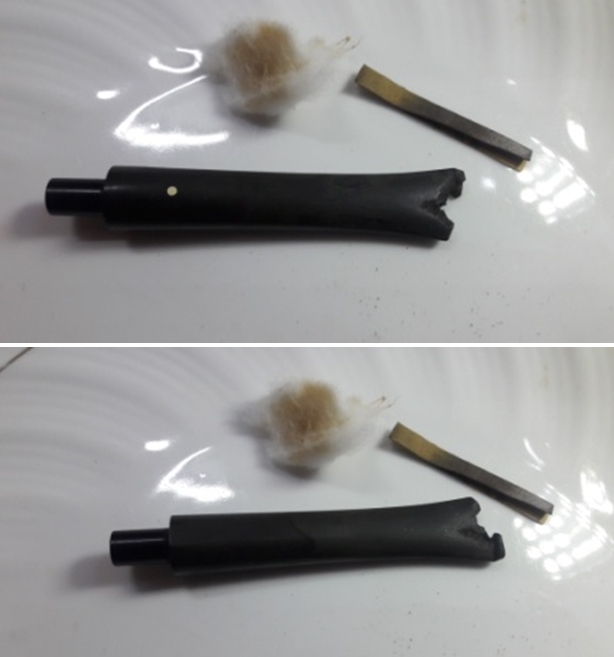
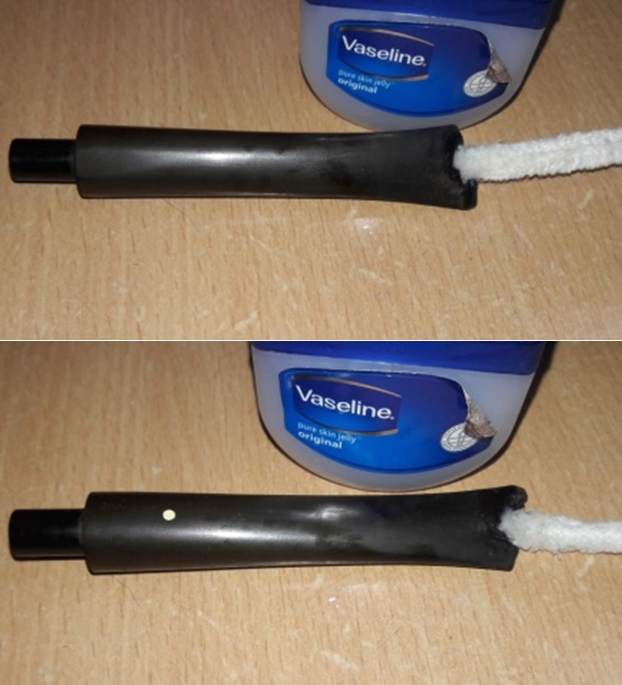
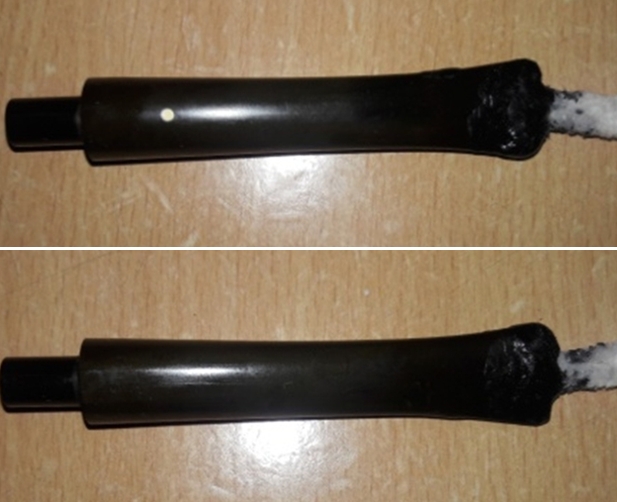
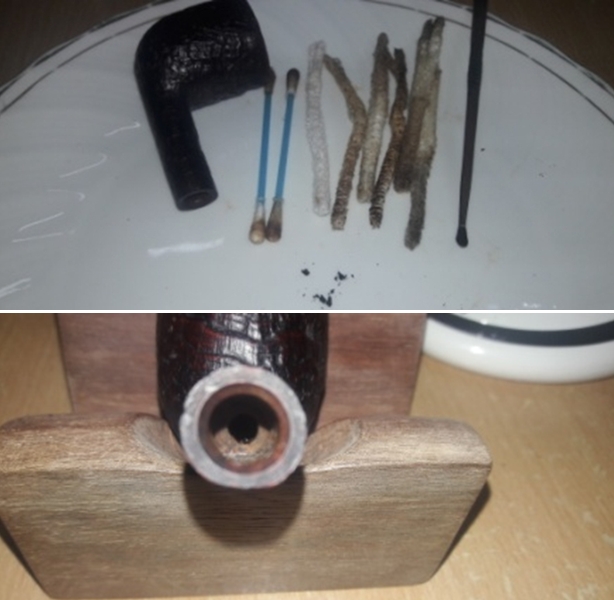
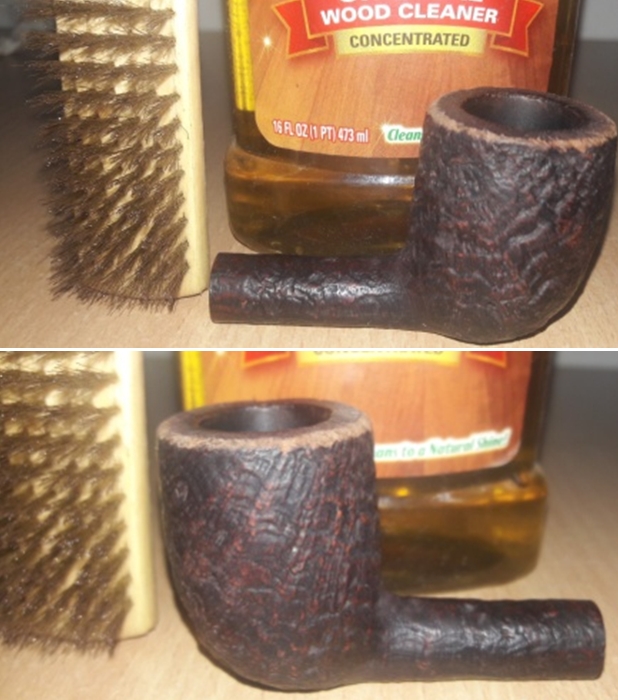
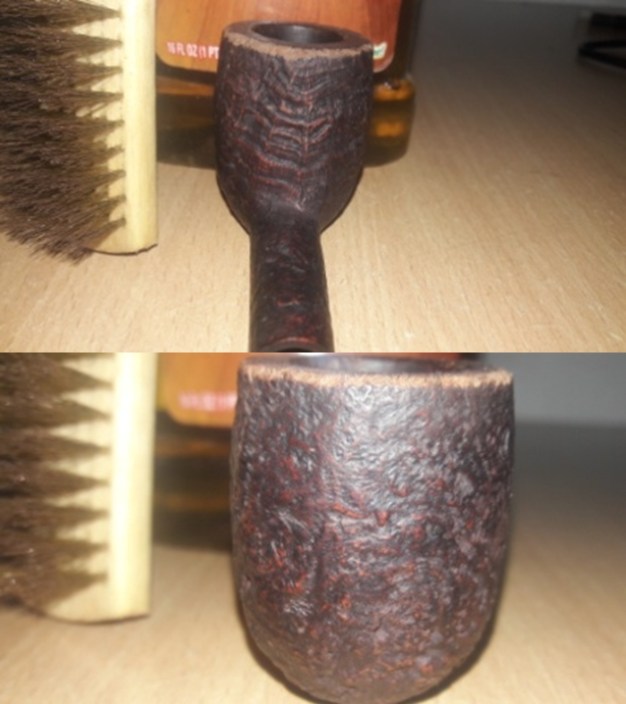
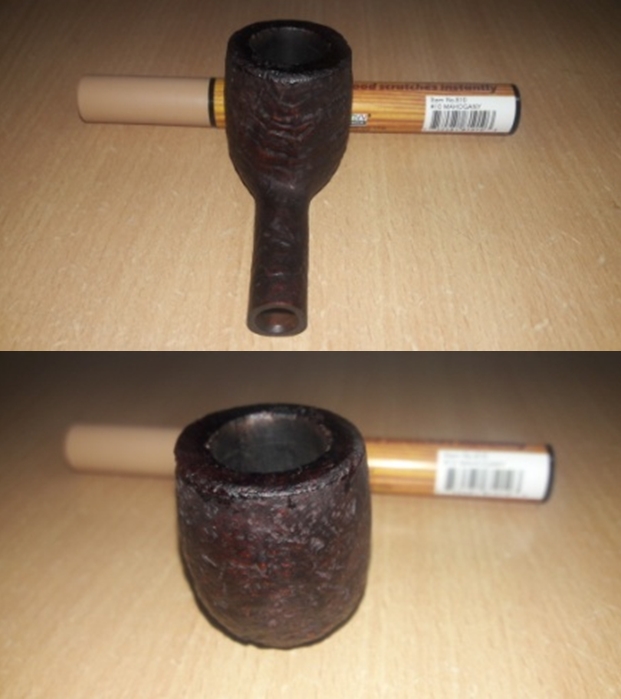
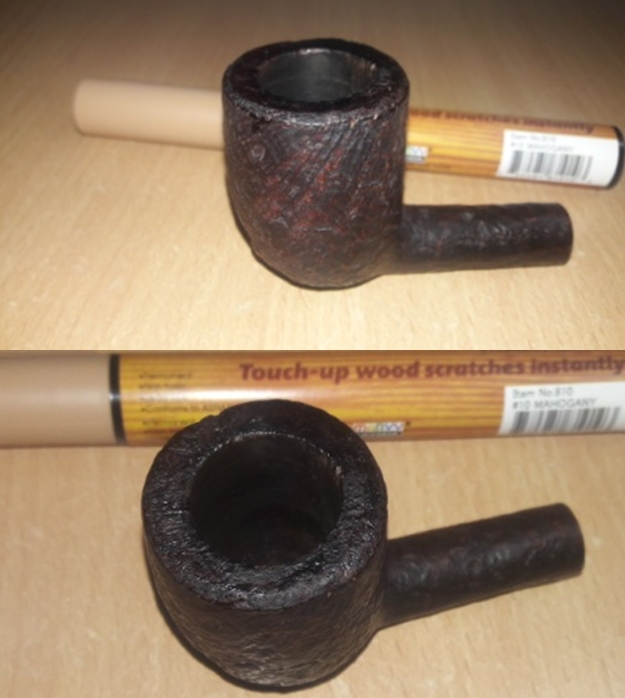
Now that I was clear about the path to be followed, I first flame both the surfaces of the stem with a Bic lighter. The heat from the flame raises the vulcanite to the surface and takes care of the tooth chatter that was seen earlier. I sand the stem end with a folded piece of 220 grit sand paper to erase the scratches and provide a smooth surface for the intended fill. I cleaned out the internals of the stem with hard bristled and regular pipe cleaners dipped in isopropyl alcohol. Once I was satisfied with the internal cleaning, I wiped the stem surface, particularly the damaged button end, with a cotton pad and alcohol to remove any traces of dirt and grime. To begin the stem repairs, I smeared a folded pipe cleaner with petroleum jelly and inserted it in to the stem airway. I prepared a mix of CA superglue and activated charcoal and generously applied it over and extending beyond the broken surface and set it aside for curing over night. I have not researched and measured the exact length that I had to reconstruct, but eyeballed the length using the longer right side of the stem where a portion of the button was still intact. Before moving ahead, I would like to mention here that I had applied this mix in layers, over the week, to achieve sufficient thickness which would help during the filing and sanding while shaping the button and achieving the correct stem profile. While the stem repair was set aside to cure, I moved ahead to deal with the stummel repairs. There was practically no cake in the chamber and so I directly used a folded piece of 180 grit sand paper to sand out the traces of cake and expose the walls of the chamber to ascertain that there are no cracks/ heat fissures. I wiped the chamber with a cotton pad dipped in isopropyl alcohol to remove the carbon dust left behind by all the reaming and sanding process. The walls of the chamber were solid with no damage. This was followed by cleaning the mortise by scraping away at the dried gunk with my fabricated spatula and followed it up with further cleaning using cue tips, pipe cleaners and shank brush dipped in isopropyl alcohol. This eliminated all traces of old smells from previous usage.Continuing with the cleaning regimen, using a soft brass wired brush I gently scraped away the thick lava coat in the blast of the rim. With a hard bristled tooth brush and dipped in undiluted Murphy’s oil soap, I very deliberately scrubbed the sandblast finish on the stummel and the rim top. The stummel and rim top was dried using paper napkins and soft cotton cloth and set it aside to dry out naturally. The stummel looks fresh and clean. The damages to the outer rim edge are now clearly visible in the above pictures after the cleaning. At this point in the restoration, I was faced with the dilemma of whether or not should I top the bowl to address the rim damage. The issue was recreating the sandblast on the rim top after topping. I put this question to my friends from pipe restoration community on FB. Mr. Steve and Mr. Mark Domingues suggested that I stain the damaged areas with a stain pen and if this does not work, topping is the only recourse available. I went ahead with the suggestion and stained the damaged rim edges and rim top using Mahogany color stain pen. After it had dried completely, I again stained it with dark brown stain pen to darken it further. I set it aside for several hours before working on it any further. Here is how the rim appeared at this stage. Next, I rub a small quantity of “Before and After Restoration Balm” in to the briar with my finger tips and let it rest for a few minutes. The balm almost immediately works its magic and the briar now has a nice vibrant appearance with the beautiful contrasting hues colors that are unique to this sandblast pipe, on full display. I further buff it with a horse hair shoe brush. I had hoped that the balm would work its magic on the filled area and help in blending it a bit, and in this instance, the blend was perfect. The damaged surface has blended to an extent that it appears like a sandblasted surface. Sometimes in life, the most difficult issues have the simplest solutions!! I set the stummel aside and turned my attention to the stem repair. The fill had cured nicely and I moved ahead and began the process of filing and shaping the button end with a flat head needle file. This time around it was more  challenging as I had set for my self the aim of creating a fish tail shape (or rather as close a match to fish tail as possible), a straight thin slot and a concave shape to the button end as seen on original stems. Learning from past mistakes, I marked a straight line for the slot orientation and using only the tip of the pointed needle file, I carved out the slot. I followed it up by sanding with folded pieces of 180 grit sand papers to laboriously shape and widen the slot, always taking care to maintain a straight line. Once I was satisfied with the profile of the slot, I went ahead and shaped the button by first achieving a rough shape with a flat head needle file and there after fine tuning it by sanding it down with a 220 grit sand paper. Unfortunately, being so engrossed in this process made me forget to take pictures of the progess of these stages.

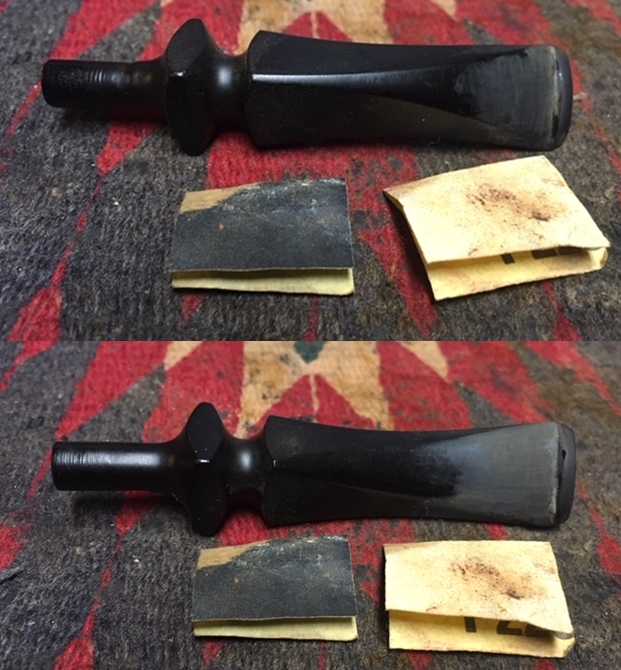
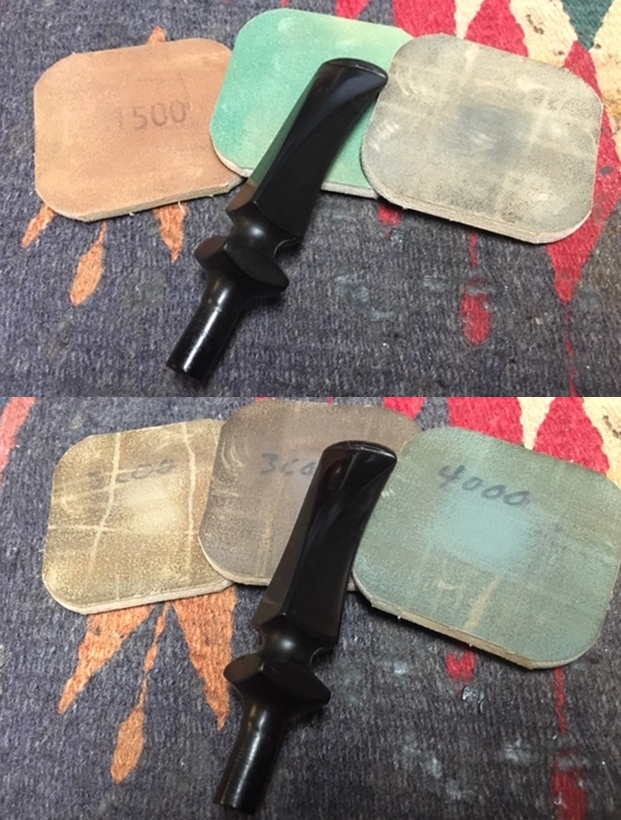
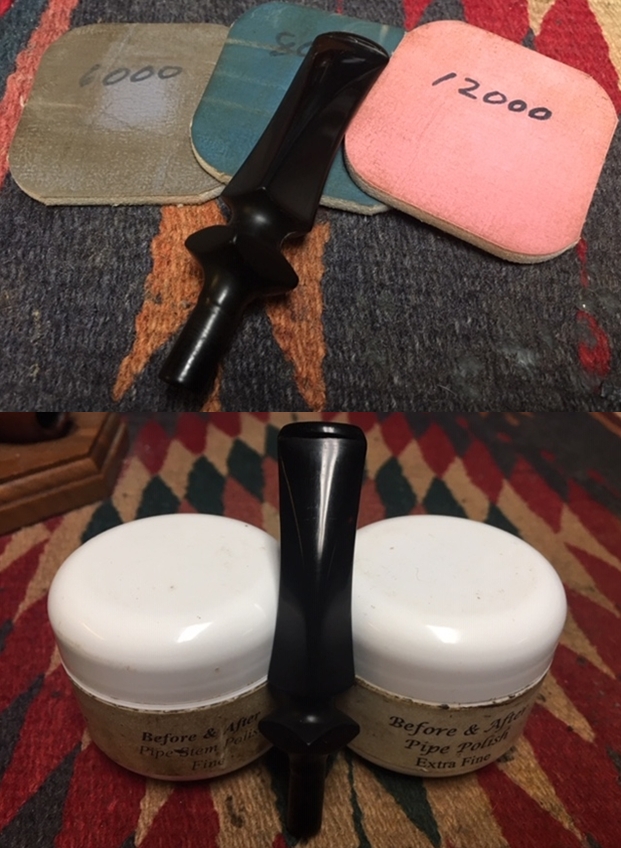
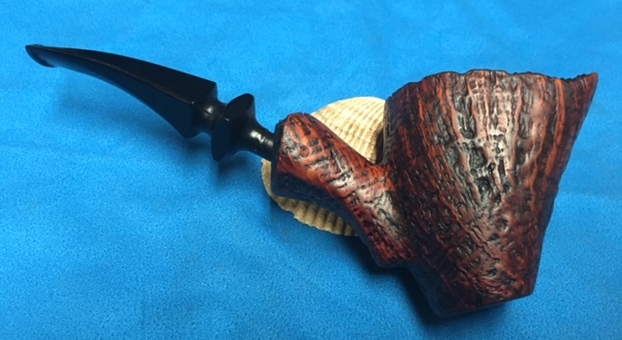
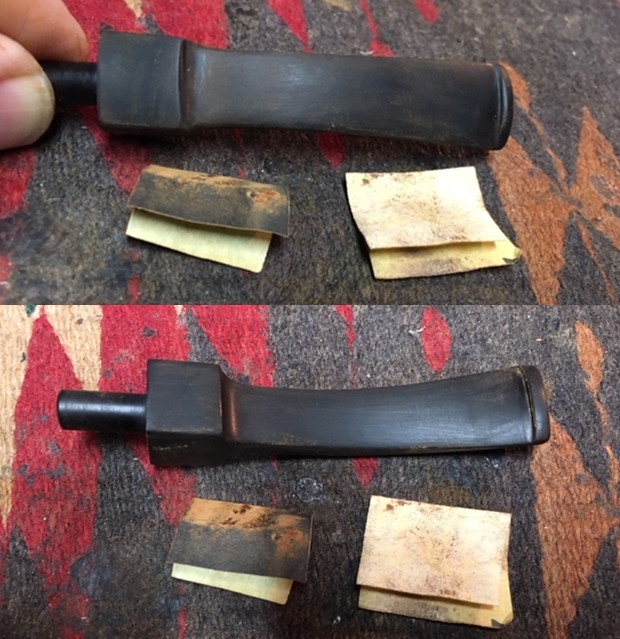
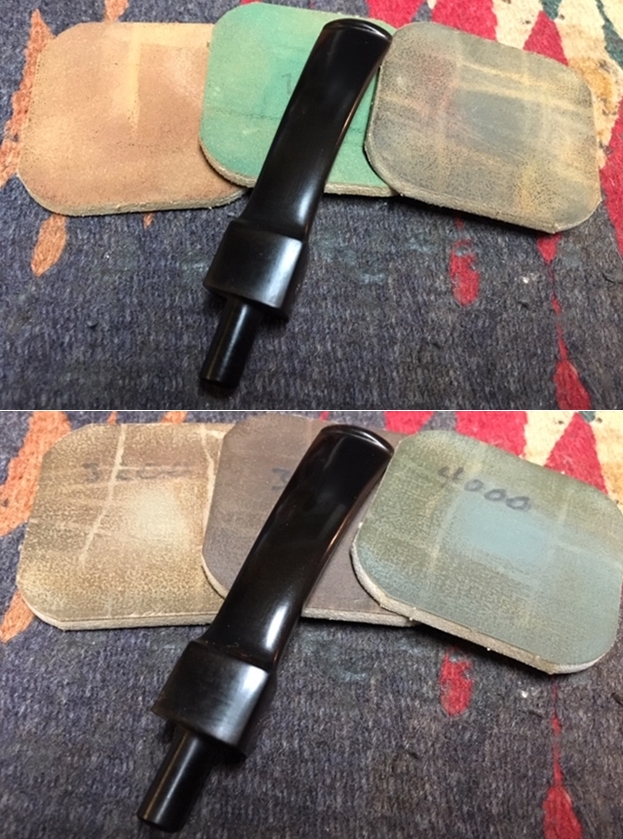
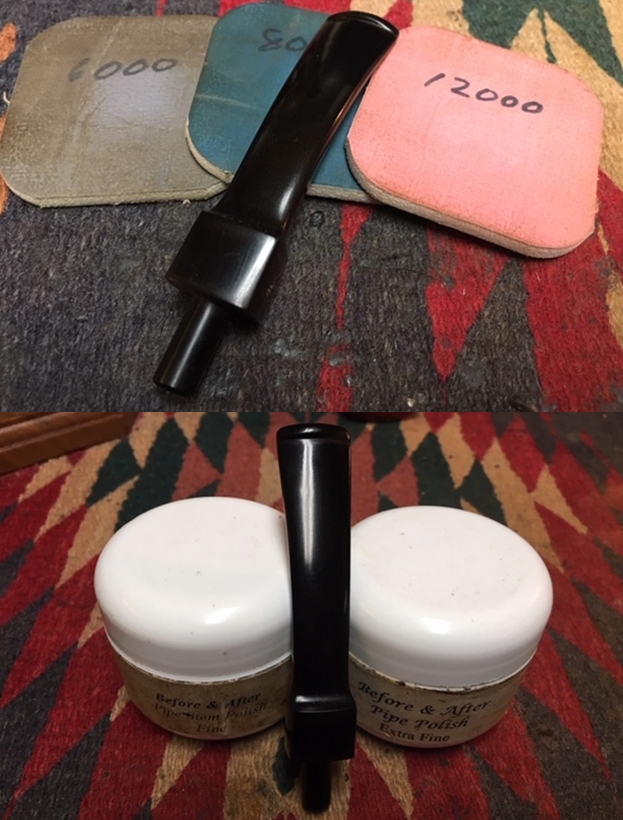
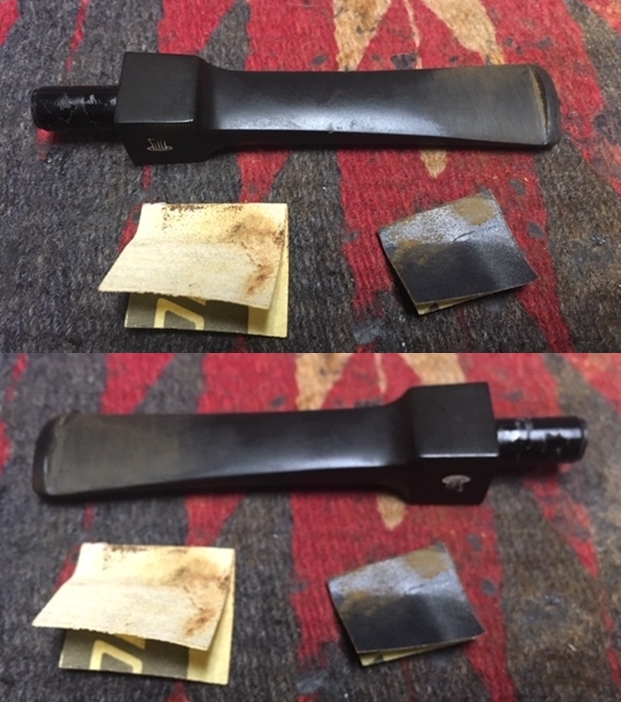
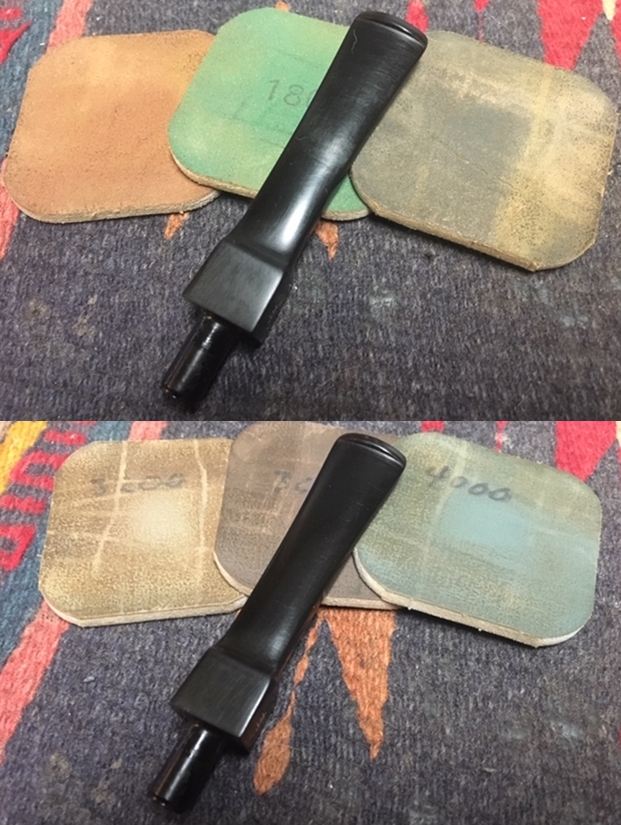
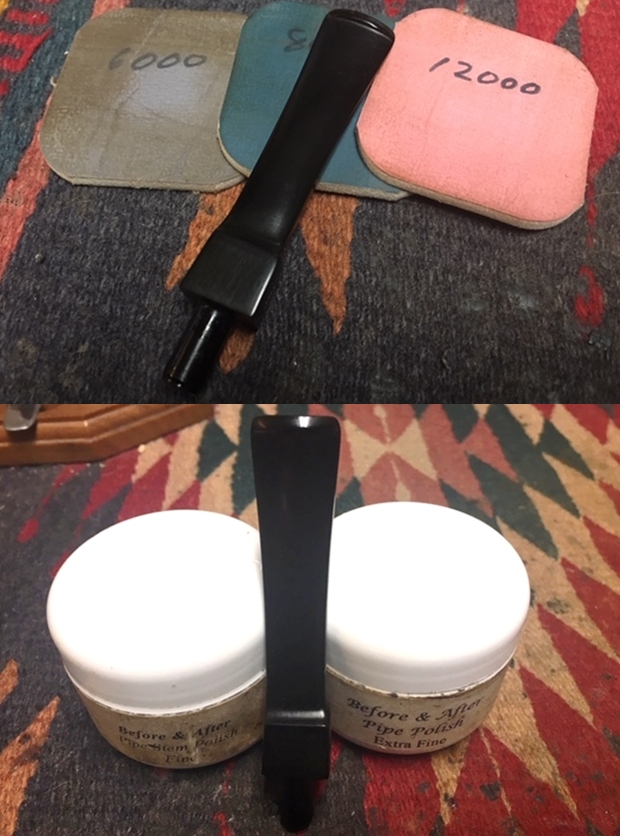
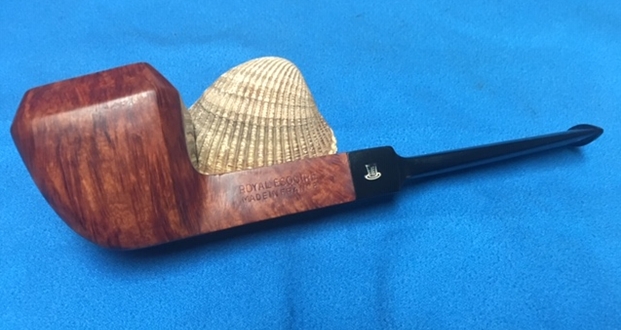
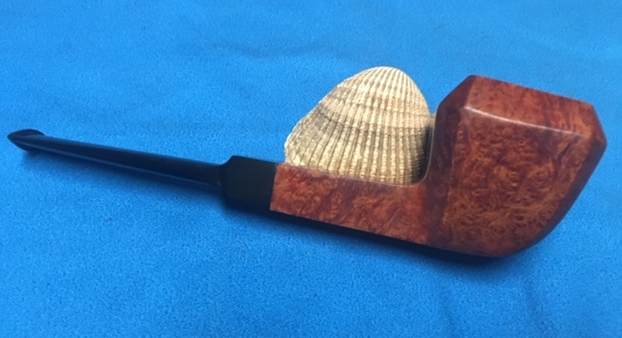
For a better blending, I further sand the entire stem with 220 followed by 400, 600 and 800 grit sand paper. This helps to reduce the sanding marks left behind by the more abrasive 220 grit paper. To bring a deep shine to the vulcanite stem, I went through the complete set of micromesh pads, wet sanding with 1500 to 2400 grit pads and dry sanding with 3200 to 12000 grit pads. I wiped the stem with alcohol after each pad and rubbed it down with Extra Virgin Olive oil to rehydrate the vulcanite. The repairs have blended in very well and the stem now looks shiny black and beautiful. The internals of the stem was once again cleaned out using alcohol and pipe cleaners to clear the airway of all the debris resulting due to the sanding. The finished stem is shown below. To finish, I re-attach the stem with the stummel. I mounted a cotton cloth buffing wheel to my local machine which is similar to the Dremel.  I set the speed at about half of the full power and applied White Diamond compound to the entire pipe. I wiped/ buffed the pipe with a soft cotton cloth to clear it of any leftover compound dust. I then mounted another cotton cloth wheel on to the polishing machine and applied several coats of carnauba wax. I finished the restoration by giving the entire pipe a rigorous hand buffing using a microfiber cloth to raise the shine further. The completed pipe looks lovely, fresh and vibrant. I cannot thank enough my friends Mr. Dal Stanton, Mr. Sam Vior, Mr. Victor Naddeo and Mr. Steve for helping me to research and complete this lovely 1964 made Dunhill Shell billiard.


Repairing a Broken Shank on a Sandblast Kriswill Golden Clipper 1803 Apple


Blog by Lee Neville

Over the past few months I have been in correspondence with Lee via email. He picked up a couple of pipes for me at a local antique shop in Edmonton, Alberta, Canada and sent them to me. We have fired emails back and forth on restoration questions and issues. He also included Charles Lemon of Dad’s Pipes in the conversations and we had a great time. Earlier this week he sent Charles and me an email about a restoration of a pipe that he did using the internal tube to repair a broken shank. He did a great job on the restoration and the description of the work so I asked him if I could post it on rebornpipes. He was glad to have me do so. Thanks Lee for your work and write up welcome to rebornpipes as a contributor! – Steve

Thought I would share my latest pipe rehabilitation effort of a Kriswill Golden Clipper – Model 1803.  This is the sandblast variant of the 03 shape. It showed up in the Winnipeg EBay lot I purchased and was in two pieces – stem (still attached to its snapped off shank) and the bowl itself.  I tried to remove the stem from the snapped off shank – without luck –  stuck tight. The bowl and shank had broken crookedly transversely across the shank – the break measured between 4mm and 8mm from the bowl body. I’m thinking it occurred when someone tried to pry and twist the stem out of the shank while holding on to the bowl.  The tars holding the stem fast held while the shank and bowl parted ways. In all, a stark example why one cannot use the bowl for leverage when trying to removing a reluctant stem from a shank.  Cue Yosemite Sam screaming “Whoa Mule! Whoooooahhh!!!”.There is also a crusty / gummy residue on the broken bowl and shank surfaces indicating a previous failed glue repair. I’m excited and eager to try my hand at a hidden brass tubing reinforcement glued up inside the shank & bowl as part of this repair.

Bowl Rehab
The bowl was packed full of foul smelling crust. The bowl edge is quite ragged – burned and charred in one area, a bit of a gouge just below the rim in another, damage/wear from dottle banging etc. around the periphery. As I could get to the bottom of the bowl from the exterior of the bowl,  I gently used a dental pick to pry manky tars, oils and burgey from the smoke channel. No doubt this build-up led to the welded-on stem and the situation at hand.

I scraped the carbon out of the bowl with a flexible knife blade, then removed the rest of the crust with some twists with a dowel covered with 220 grit sandpaper to work back to briar. I then used 320 / 400 grits over the dowel to finish the bowl interior to smooth. Luckily, there are no cracks, burnouts in this bowl.

I filled the gouge below rim edge at the 11 o’clock position with CA glue and briar dust to build this rim area up – this minimized the following topping effort. I didn’t want to significantly alter the geometry of the bowl.  Minimal is the key word here. Re-topping was followed by polishing the rim up to 4000 grit with micro mesh pads. I re-stained the rim with a stain marker to bring it back into line with the existing stain value.

I finished up the bowl exterior by scrubbing it gently with cotton pads moistened with water, then repeated with pads wetted with alcohol. Looking good.

Re-attaching the shank to the bowl
I soaked the stuck-together shank and stem in isopropyl alcohol overnight.  They easily pulled apart between the jaws of two pairs of padded pliers. Solvents 1 – Evil 0! The shank remnant stunk with old badness. I hit it with brushes and q-tips and was able to clean it out in 15 minutes of vigorous action.  I’ve cleaned dirty shotguns stem to stern quicker than this 25mm length of broken briar shank!

I used a dental pick to remove most of the remnants of dried glue from the shank and the bowl so they’d fit as closely possible when re-glued.  I then used the CA + spray accelerator product from Inoteca to glue the bowl to the shank. Applying a very thin layer of medium viscosity CA glue to both surfaces, I pressed them together, then hit the assembly with the spray accelerator.  Instant activation and hold. I left this overnight to cure, then the following evening removed the squeeze out from the joint with needle files.  This was followed with filling gaps in the glue line with briar dust and CA glue, needle filing and light sanding.

I applied random dabs of stain marker pen (dark oak and mahogany) to colour match the briar dust/CA fills around the glue line, then I blended these re-stained areas into the stummel with a q-tip moistened with alcohol.

Now for the hidden brass tubing reinforcement.  I bought a length of 5/32″ OD brass tube from a local hobby shop as its ID would be close to the stock diameter of the draught hole post repair. I measured approximately 14mm of briar body between the opening of the draught hole in the bowl bottom to the edge of the broken shank still attached to the bowl.  This meant I could use 20mm of tubing to span the break between the bowl body through the shank to the bottom of the stem mortise. The tube reinforcement will span the break area 10mm each way.

I cut a 20mm length of tubing and roughed up its external surface with needle files to provide additional physical bonding for the epoxy.  Inserting the bowl into my small Dremel bench vise with shank pointing to the sky, I drilled out the shank using a 11/64” bit to the desired depth. This 11/64” hole will allow room for the epoxy to fix the reinforcing length of tubing to the shank wall.

I gently flared one end of the brass tubing using a center punch. This flared end will drop and seat against the stem end of the 11/64” hole drilled in the shank.  I then mixed up a bit of JBWeld, generously smeared the exterior of the tubing with it, then threaded a vaselined pipe cleaner through the tube/glue mess.  The pipe cleaner functions as a guide for the tube to slide into the shank and will prevent epoxy from sealing the draught hole at the end of the tubing through to its opening at the bottom of the bowl.

I pressed everything home with a length of Q-tip stick and was gratified to feel the tubing seat its flared end at the top of the 11/64” hole drilled through the shank mortise.  I pulled the pipe cleaner through the tubing from the bowl end – ensuring any epoxy squeeze-out was cleared from the bottom of the bowl. I used Q-tips to remove any epoxy squeeze-out in the stem tenon area of the shank and left the epoxy to set overnight.

The picture below shows the flared end of the hidden tubing snugly glued below the bottom of the shank mortise in the stummel.Cleaning up the stem
The stem was horribly packed full – poking and prodding with brushes, pipe cleaners and picks, I worked both ends of the stem until it was clear. Then it went into an oxyclean bath to lift the oxidation.  Luckily, the Kriswill stamp was in good shape.  The next day, I removed the lifted oxidation with soft toothbrushes, 400 grit wet n’ dry and then moved quickly through the micro mesh pads through to 12000 grit, it came up bright and shiny.

Finishing the pipe
I slathered on a thick coating of Howards Feed and Wax (beeswax, carnauba and citrus oils) and rubbed it into the stummel to feed the thirsty briar. Gently buffed with a microfibre cloth.  I also treated the bowl to a coating of maple syrup + activated charcoal. I dabbed a bit of Testors white enamel into the stamping on the stem, then wiped the excess away – the Kriswill stamp is now very noticeable.

The stem married up to the stummel with little fuss – It looks good.  It’s a lovely pipe – a small rusticated apple with a delicate shank and stem. It’s a feather-light lovely example of Danish pipe making from the late 1960’s – early 1970s. I’m really looking forward to sparking it up.Again, thank you both (Charles Lemon of Dad’s Pipes Blog and Steve Laug of rebornpipes blog) for your exhaustive documentation around this procedure – I would have been in quite the pickle without your guidance. (I wish you both the very best in your adventures.)

Photos of the finished restoration are shown below. I am happy with the finished pipe and enjoying the fruit of my work.

The pipe dimensions are as follows:
Kriswill Golden Clipper – Model 1803
Bowl Height: 40mm
Bowl opening: 22mm
Max depth of bowl: 35mm
Max Bowl diameter: 38mm
Length of stummel: 65.28 mm
Diameter of shank: 11mm
Length of stem: 89 mm
Over all length of pipe: 155mm

Top View – showing the topping and stain blend.  I did radius the inside of bowl ever so slightly to bring it back into round.Right side of bowl – Detail. Bottom of bowl – showing rustication.Pipe in profile (the near side or right side) – love the proportions of this pipe – gee whiz they made them graceful back in the day!Pipe in profile (the far side or left side).

Restoring a Unique “House of Lords” Sitter


Blog by Paresh Deshpande

I am pretty angry and frustrated at myself!!!!! That’s a very strong and confusing sentiment against oneself, I admit. But that’s the truth. Let me explain.

I spent nearly two weeks working on three pipes; a Dunhill Bruyere, a Tim West Freehand and a Stefano Exclusive. These three had their lip end of the stem either chewed off for about an inch and a half or a through and through hole!!! It could be considered as a major stem repair project. I successfully rebuild the stem end, including the button, lip edges and the slot. Though, I was unable to shape the slot as perfectly as I would have liked on the Dunhill, the repair was perfect on the Tim West and the Stefano. I felt elated and supremely confident about my capabilities. The blending of the repairs appeared spot on and I blazed through the remaining restoration, clicking pictures of the progress without giving them a second look. When, at the end, I went through the pictures while doing the write up, to my horror, the repaired stem and stummel stared back at me with all their imperfections on display in form of scratches, brownish spots of oxidation and fillings showing through the stain!! This was embarrassing for me and I shared these images with Mr. Steve. In his characteristic method of pointing out my short comings, I shall quote his reply to me, “Takes lots of work… I am having a little trouble with that lately…. Trying to rush it. Pipe looks good”, unquote!! Readers of rebornpipes and those who know him would be smiling while reading this part. Well, to cut the banter short, I shall rework all these short comings later as I want to start on a fresh pipe!!

The pipe on my work table, from my inherited collection, is one large barrel shaped full bent (this aspect needs to be confirmed and will be cleared as we progress further) sitter with beautiful and very tightly packed birds’ eye grain on either side of the bowl and shank, extending over to more than half of the front of the stummel. Equally tightly packed cross grain are seen on the front left and back of the bowl and also on the upper and bottom surface of the shank. It is stamped on the left side of the shank as “HOUSE OF LORDS” over “MADE IN ENGLAND” in block capital letters. The right side of the shank bears the numeral “275”, probably the shape code, towards the bowl shank junction. The vulcanite saddle stem bears the Crown logo stamped on the left of the round stem. The stem logo and the shape code are slightly worn off. I have included a picture of the stem logo from pipephil.eu to show how it appears on this stem.To know more about the brand, the lines offered by the maker and attempt to date this pipe, I visited pipedia.org, which has wealth of information on almost all pipes. The only information available here was that this brand was by Samuel Gordon in the early 20th century and thereafter became a Sasieni second. My next go to site is pipephil.eu where the stampings and stem logos on a pipe are used for brand information and to date a pipe. Here is the link for information on the pipe currently on my work table:-

www.pipephil.eu/logos/en/logo-h3.html#houseoflords

This site also pointed to the same information gleaned from pipedia.org. Here is what was found on pipephil.eu.

Brand from Samuel Gordon. Maybe a Sasieni second (J.M. Lopes, op. cit.)

I further followed the link to “Gordon” and learned that Samuel Gordon had founded the brand “GORDON” in 1910-20 eras. This is the link for Gordon brand of pipes; www.pipephil.eu/logos/en/logo-g4.html#gordon

From the above information, it is assumed that this piece is from the early 20th century period. Wow!!!! This is really an old pipe. The pipe brands and its vintage, those that are in my grandfather’s collection, never cease to amaze me and there are some really collectible pipes that I have inherited.

INITIAL VISUAL INSPECTION

The chamber shows a nice even build up of a cake which makes it difficult to comment on the condition of the inner walls of the chamber. However, the general appearance of the stummel makes me believe that there will not be any major issues with the chamber walls. The rim top is clean with no overflow of lava and this is a big surprise coming from my inherited collection!! The chamber is out of round with the inner rim edges showing charring at 3 o’clock and 9 o’clock direction. It appears that this charred area of the inner edge was tried to get rid off in an amateurish way. The outer rim is also damaged and has a few chips and dents to the front, probably caused due to hitting the bowl against a hard surface to remove the dottle!! All in all, I would say that this was one of the few well cared for pipes from his collection!!The surface of the stummel is covered in dirt and grime accumulated over a period of time. The stummel surface is peppered with numerous dents and dings, more so towards the front of the bowl, probably caused due to careless and uncared for storage for the last 40-45 years and equal number of years of previous usage!!!! It will be a big decision whether to address these dents and dings by abrasive sanding method and loose the patina which has developed on the surface, or let them be. Well, I shall cross the bridge when I reach it. The mortise appears to be either clogged or has some obstruction as air flow through it is hard and laborious. The vulcanite stem is heavily oxidized. Some light tooth chatter is seen on both surfaces of the stem towards the lip. This issue should not be a major headache to address. The lip edge on both sides is crisp but lightly damaged. The quality of vulcanite is good.The thing that struck me odd was the bend on the stem. It was bent way too much than the normal. When I shared the pictures of this pipe with Mr. Steve, he too found the angle of the bend too rakish and very odd, to the extent that he felt it might not even be correct for the pipe. However, the stem logo confirmed otherwise. So, I am confronted with the controversial prospect between “PRESERVATION” and “RESTORATION”!! While I do not have as clear a mandate as Mr. Steve had, managing this conflict, for me, is more challenging. To me, this inheritance is a family heirloom and in this particular instance, I would rather maintain this profile instead of straightening it. Mr. Steve gave me a second perspective that the stem was bent during storage due to intense heat which is prevalent in India and may not be original as my grandfather had smoked!! Well, this could be true. The inner conflict continued while I proceed to clean and spruce up the pipe to its pristine condition (or at least make a sincere attempt at it)

THE PROCESS
I reamed the chamber with my fabricated knife and scraped out all the cake. With a folded piece of 180 grit sandpaper, I further sand out the last traces of remaining cake and expose the walls of the chamber. There are some very minor and insignificant webs of line on the chamber walls that can be seen to the front and above the drought hole. I wiped the chamber with a cotton pad dipped in isopropyl alcohol to remove the carbon dust left behind by all the reaming and sanding process. I gently scraped the rim top surface with a sharp knife to remove the lava overflow. Using the same knife, I gently scrapped out the charred briar from the inner rim edge till I reached solid wood. The following pictures show the inner rim edge after the removal of the charred wood from the 3 o’clock and 9 o’clock direction. Also seen is the earlier amateurish attempt at addressing the issue of out of round bowl. I shall address this issue by creating a bevel to inner edge. This was followed by cleaning the mortise with cue tips, pipe cleaners and shank brush dipped in isopropyl alcohol. With my fabricated spatula shaped knife, I scrapped out the dried oils and tars from the mortise. My, there were chunks of gunk in there and can be seen in the following pictures!! Finally after some diligent cleaning, the mortise is clean and this further completely eliminated traces of old smells from previous usage.The internals of the stummel is now clean and fresh. Now, it was the turn of the stummel to get cleaned up. Using a hard bristled tooth brush dipped in undiluted Murphy’s oil soap, I very deliberately scrubbed the surface of the stummel. I cleaned the rim too. The stummel and rim top was dried using paper napkins and soft cotton cloth. I am not very happy the way the rim top appears at this stage with all the charring and uneven inner and outer rim edges. This needs to be addressed. I set the stummel aside to dry out naturally. After cleaning the rim top with Murphy’s oil soap, the inner edge damage was even more evident, and begged to be addressed before I proceed any further. I topped the rim on a 220 followed by 320 and 600 grit sand paper, checking frequently till I was satisfied that the charred surface was greatly reduced. The inner edge is still uneven, though much better than before topping. With a folded piece of 180 grit sand paper pinched between my thumb and fore finger, I created a bevel on the inner edge. This addressed the issue of uneven and out of round inner edge. A couple of dents and chips are also seen to the outer rim edge and one (circled in red) in the newly created inner edge bevel. There were a few slightly deeper chips on the stummel surface. I gouged out the old and dried wood from these dents from the front of the stummel, inner rim edge and the heel and spot filled it with a mix of CA superglue and briar dust (believe you me gentlemen, making and thereafter applying this mix to fill the pits is not as easy as it appears!!!!!! The moment superglue comes into contact with the briar dust; it hardens even before you can blink. Maybe there is an issue with the glue that is available to me here, coupled with the prevailing climatic conditions or maybe one Mr. Dal Stanton could help!!). I always over fill the holes so that when I sand them down they are smooth and I can feather in the fills with the rest of the briar. I set the stummel aside to cure overnight. I had applied this mix of superglue and briar dust to the inner rim edge as it would not be coming in direct contact with heat from the burning tobacco leading to health issues. While the stummel was drying, I worked the stem. I covered the stampings on the stem with whitener using a whitener pen. I flamed the stem surface of the stem with a Bic lighter to raise the tooth indentations and scratches on the stem. The heat from the flame of Bic lighter causes the vulcanite to expand and regain its natural shape, reducing the marks. Using a needle file, I sharpened the lip edges. For a better blending, I further sanded the entire stem with 220 followed by 600, 400 and 800 grit sand paper. This helps to reduce the sanding marks left behind by the more abrasive 220 grit paper. To bring a deep shine to the vulcanite stem, I went through the complete set of micromesh pads, wet sanding with 1500 to 2400 grit pads and dry sanding with 3200 to 12000 grit pads. I wiped the stem with alcohol after each pad and rubbed it down with Extra Virgin Olive oil. The internals of the stem was cleaned out using alcohol and pipe cleaners. The finished stem is shown below. By the time I had worked on the stem, the fills on the stummel surface had completely cured. I sanded the fills using a flat head needle file and checked to see if I had missed any spots. I wanted the entire surface smooth to the touch. I sanded the spots down and blended them into the bowl surface using a folded 220 grit sand paper. I followed this step by sanding the entire stummel with a 220 grit sand paper followed by 600 and 800 grit sand papers. Once that was done I wiped the bowl down with a cotton cloth dampened with Isopropyl alcohol to remove any remaining dust. I wet sand the stummel with 1500 to 2400 grit pads and follow it up by dry sanding with 3200 to 12000 grit pads. Once I was through with the micromesh pad sanding, the fills showed in complete contrast with the rest of the stummel, as can be seen in the pictures below. I hope they will blend in better once I apply the balm and buff the stummel. I rub a small quantity of “Before and After Restoration Balm” in to briar and let it rest for a few minutes. The balm almost immediately works its magic and the briar now has a nice vibrant appearance. I further buff it with a horse hair shoe brush. The stummel, at this point in restoration, looks beautiful save for the fills which can still be seen in all their awfulness. To address this, I have the option to stain the stummel with a dark brown stain or I let it be as a being part of its journey thus far!! Thus, another conflict has been added to the existing one regarding the stem. I shall think about it once I reach that point in restoration. Before I proceed to final stage of polishing and applying carnauba wax coats, I want to address the superficial and insignificantly thin lines in the chamber as a precautionary measure. I mix activated charcoal and yogurt to the consistency of a thick porridge, not runny while being pliable. Inserting a folded pipe cleaner into the mortise till it peeps out of the draught hole, I apply an even coat of this mixture to the inner walls of the chamber with a modified bamboo frond and set it aside to dry out overnight. The next evening, the coat has completely dried out and is hard. Using a piece of folded 220 grit sand paper, I lightly run it over the coating to a smooth finish. I had a long look at the dark fills against the rest of the stummel and did not like it. I made a decision to stain the stummel in dark walnut stain. I use the powder variety of stain and mix it with 99% isopropyl alcohol. I heated the stummel surface with a heat gun and applied the stain with a folded pipe cleaner. As I paint the stummel with stain over sections at a time, I burn the dye using a Bic lighter that combusts the alcohol in the aniline dye and sets the dye pigmentation in the wood.  After fully saturating the stummel and covering the whole surface, I set the stummel aside to rest for several hours. Once the stain had set, I mount a cotton cloth buffing wheel on the Dremel and set the speed at about 40% full strength and apply red compound to the stummel. This does help in revealing the grains gradually while masking the darker fills. To finish, I re-attach the stem with the stummel. I mounted a cotton cloth buffing wheel to a locally manufactured machine which is similar Dremel.  I set the speed at about half of the full power and applied White Diamond compound to the entire pipe. I wiped/ buffed the pipe with a soft cotton cloth to clear it of any leftover compound dust. I then mounted another cotton cloth wheel on to the polishing machine and applied several coats of carnauba wax. I finished the restoration by giving the entire pipe a rigorous hand buffing using a microfiber cloth to raise the shine further.

The completed pipe looks lovely, fresh and vibrant; the photographs in this case, do not do justice to the appearance of this beautiful large barrel-shaped pipe. Thank you for having the patience to reach this far while reading the write up. And as usual, I request all those readers to please leave a comment as it will help me to improve further and hone my skills. PS: After the pipe restoration was completed, nearly 15 days later my guide and mentor, Mr. Steve casually asked me if I had decided to straighten the stem. This set me thinking that here is a gentleman who is still thinking about the bent stem and that he is still doing so as he is convinced that a straight stem would look nicer on the pipe and would be original to the pipe. This convinced me to re-straighten the stem to its original. I place a fluffy pipe cleaner through the airway to prevent it from collapsing due to heating and with a heat gun; I heat the stem till it is pliable and straighten out the stem just by eyeballing the shape till satisfied. Here are a few pictures after the stem was straightened. Yes, there are a few minor issues which is a direct result of the process like the alignment of the shank end with the tenon end and slight dullness in the shiny stem etc, but they will be addressed subsequently. The overall appearance of the pipe is much better and the shank flow into the stem is more fluid and even. Thanks Mr. Steve!!


Life for a Beat up Bari Senior Old Briar Pick Axe


Blog by Steve Laug

The next pipe in the queue came from a pipe that Jeff purchased from an antique shop in Brookings, Oregon. He stopped by there on a trip last fall and picked up a few pipes. He picked up quite a few of his pipes and they included this interesting, Kriswill like Bari Senior. It is stamped on the left side of the shank and read Bari over Senior over Old Briar. On the right side it said Made in Denmark over the shape number 503. It is a pick axe shaped pipe with a deep pointed bowl and a narrow shank. The entire pipe had some beautiful mixed grain around the bowl but it was covered with deep cut marks on both sides and the front of the bowl. The rim top was covered with lava and darkening. The pipe was filthy but the grain underneath was rich and the finish looked like it would clean up well. The stem is vulcanite and has a pinched side on both left and right just past the saddle. The stem is oxidized and had tooth marks and chatter on both sides at the button edge. The photos below tell the story and give a glimpse of the pipe before clean up. Jeff took photos of the bowl and rim from various angles to capture the condition of the pipe before he started his cleanup work. There was a thick coat of lava on the rim and the cake in the bowl. It appeared that the beveled inner edges were in good condition. The outer edges actually appeared to be in excellent condition.He also took a series of photos of the sides of the bowl and shank to show the beautiful grain on the pipe but also the serious damage to the bowl – large gouges in the briar all around the bowl sides and front. The number of the gouges was a nightmare. Jeff took photos of the stamping on the left side of the shank. It reads as noted above. The first stamp BARI is legible. The second line that reads Senior and the third that reads Old Briar are both less legible.The next two photos show the stem surface. They show the tooth marks and chatter on both sides near the button. The stem is oxidized and has a thick build up around the button end. The pinched stem is a beautiful and sleek addition to the pipe.Once again, Jeff did his usual thorough clean up job on the pipe so that  when it arrived here in Vancouver it looked really good. Jeff reamed the bowl with a PipNet pipe reamer and followed up with a Savinelli Fitsall pipe knife to remove the cake. He scrubbed out the mortise and the airway in the shank and the stem with alcohol, cotton swabs and pipe cleaners. He scrubbed the exterior of the bowl, rim, shank and stem with a tooth brush and Murphy’s Oil Soap to remove the oils and tars on the rim and the grime on the finish of the bowl of the pipe. He rinsed it off under running water. He dried it off with a soft cloth. He was able to remove all of the lava build up on the beveled rim top of the pipe. The rim top looked pretty good though there were scratches in the flat top and a little darkening on the inner bevel toward the front of the bowl. The grain was beautiful but there were a lot of deep gouges in the briar around the sides of the bowl. He soaked the stem in Before & After Deoxidizer and was able to remove the oxidation. The pipe looked very good.I took photos of the pipe to show its condition before I started my work. I took a close up photo of the bowl and rim to capture the condition of the pipe before I started my restoration of the pipe. The rim top was clean but had some nicks on the flat surface and some darkening on the inside edge of the rim at the back of the bowl. The stem was quite clean with some light tooth marks and chatter on the top and underside near the button.I took some close up photos of the sides and front of the bowl to show the deep gouges in the briar. They were cuts rather than dents so steaming would not repair them. This would take some sanding and then strategic filling and staining to blend them into the briar. Time would tell if I could achieve what I wanted to do with this one. I started my restoration of the pipe by dealing with this damage. I sanded the damage areas on the bowl sides and front with a folded piece of 220 grit sandpaper. I worked on the areas until the lighter damaged areas were removed and the deeper ones were less visible.I filled in the deeper gouges with clear super glue. You can see the repairs are almost like pock marks around the bowl. They also highlight the extent of the damage on the sides of the bowl were when I started.When the repairs had cured I sanded them smooth with folded 220 grit sandpaper until they blended in to the surrounding briar. As I sanded I also found more damage on the front of the bowl and filled it in and sanded it smooth. I wiped the bowl down with alcohol on a cotton pad to remove the sanding dust. I wanted to remove it in preparation for restaining the bowl.I topped the bowl on a topping board with 220 grit sandpaper to remove the damage on the rim top and edges of the bowl. It did not take too much sanding to remove the damaged areas and leave the top ready for the next step.I sanded the bowl and rim with a medium and a fine grade sanding sponge to remove the sanding marks from the briar on the bowl and rim top. It was the first step in polishing the briar to ready it for staining. I continued to polish the briar with micromesh sanding pads – wet sanding with 1500-2400 grit pads and dry sanding with 3200-12000 grit pads. I  wiped the briar down after each pad with an alcohol dampened cotton pad. I decided to stain the pipe with contrasting stains – a dark brown undercoat and a cherry top coat. My thinking was that this would minimize the visual overload of repairs. I stained the bowl with the dark brown aniline stain and flamed it to set the stain in the grain of the briar. I repeated the process until the coverage was even and then set it aside for the afternoon. My thinking was that the dark stain would highlight the grain and also hide some of the repairs to the briar bowl.I wiped down the excess stain on the bowl with a cotton pad and isopropyl alcohol. I wanted to make the stain a bit more transparent and prepare it for buffing. I buffed the pipe with Red Tripoli on the buffing wheel to remove the excess dark stain. After buffing the bowl the Tripoli the grain was darker and the contrast between the light and the dark on the grain was quite stunning. I wiped the bowl down with alcohol and then rubbed some Before & After Restoration Balm into briar to enliven and preserve it. I buffed it with a soft cloth to raise the shine at this point. Once I had buffed off the balm I gave it a top coat of Danish Oil Cherry stain. I applied it with a soft cotton pad and let it sit for about 30 minutes before buffing it off with a cloth. Here is what it looked like as it dried. With the second coat of stain finished, I worked some Before & After Restoration Balm into the surface of the briar with my fingertips to clean, enliven and protect it. I let the balm sit for a little while and then buffed with a cotton cloth to raise the shine. The following photos show the bowl at this point in the restoration process. The bowl and the rim top look really good and the darkening is lessened. The finish looks very good with the combined rich brown and cherry stain on the bowl and rim. The stem was in good enough condition that I was able to polish out the tooth chatter and marks by wet sanding it with 1500-2400 grit micromesh sanding pads. I then dry sanded it with 3200-12000 grit pads. I wiped the stem down with a damp cloth after each pad. I further polished it with Before & After Pipe Polish – both Fine and Extra Fine. I wiped it down with a coat of Obsidian Oil and set it aside to dry. There was a spot of metal embedded in the vulcanite of the stem on the top left side ahead of the button. I have marked it with a red circle to highlight it for you as you look at the photo. It does not disappear as the stem is polish but seems to go quite deep in the rubber of the stem. Since I had finished both the bowl and stem I put them together and polished them both with Blue Diamond polish on the buffing wheel. I gave the bowl multiple and the stem multiple coats of carnauba wax. I buffed the pipe with a clean buffing pad to raise the shine. I hand buffed it with a microfiber cloth to deepen the shine. The pipe polished up pretty nicely. The grain around the sides of the bowl really began to stand out with contrast as I buff the bowl. The rich dark brown undercoat and cherry top coat finish on the briar works well with polished black vulcanite stem. Bari made some beautiful pipes and this is certainly one of them. The darker stain does the job hiding the repairs to the gouges and makes the grain really show through. This pipe is a great feeling pipe in the hand and I am sure that it will be an amazing smoker. Have a look at it with the photos below. The dimensions are Length: 5 1/2 inches, Height: 2 1/2 inches, Outside diameter of the bowl: 1 1/2 inches, Chamber diameter: 3/4 of an inch. I will be putting this beauty on the rebornpipes store shortly and it can be added to your collection. Thanks for walking through the restoration with me on this Bari Senior Old Briar 503 Pick Axe.

Rebuilding a Rim and Chamber for an Aldo Velani Trio Rusticated Volcano


Blog by Dal Stanton

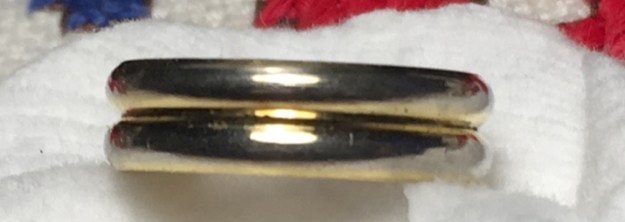
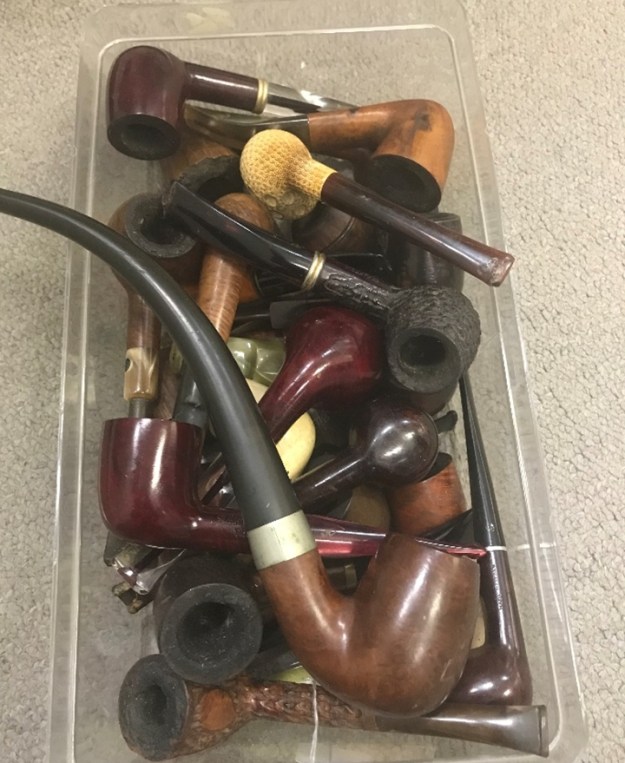
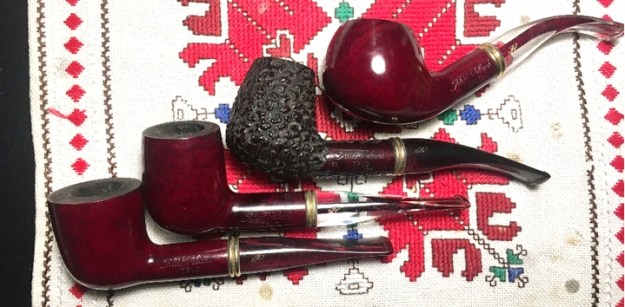
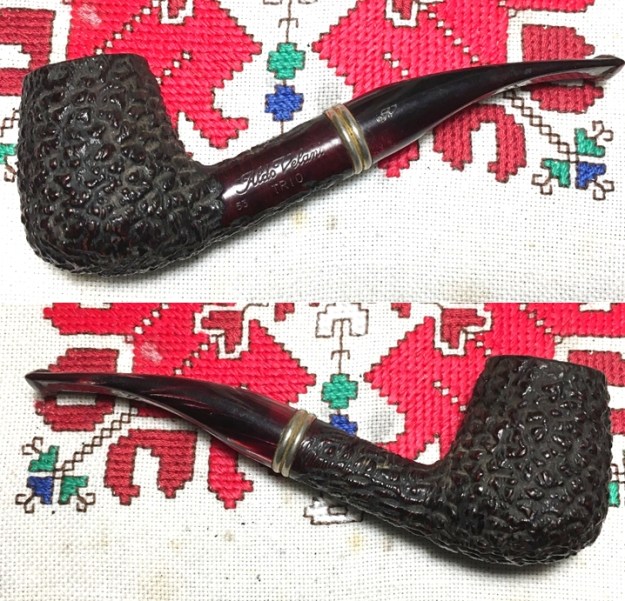
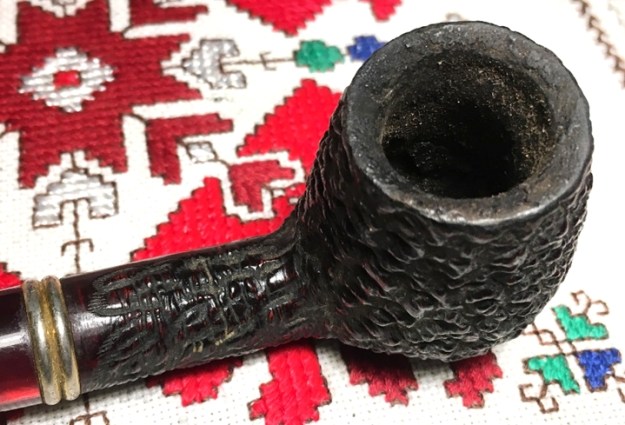
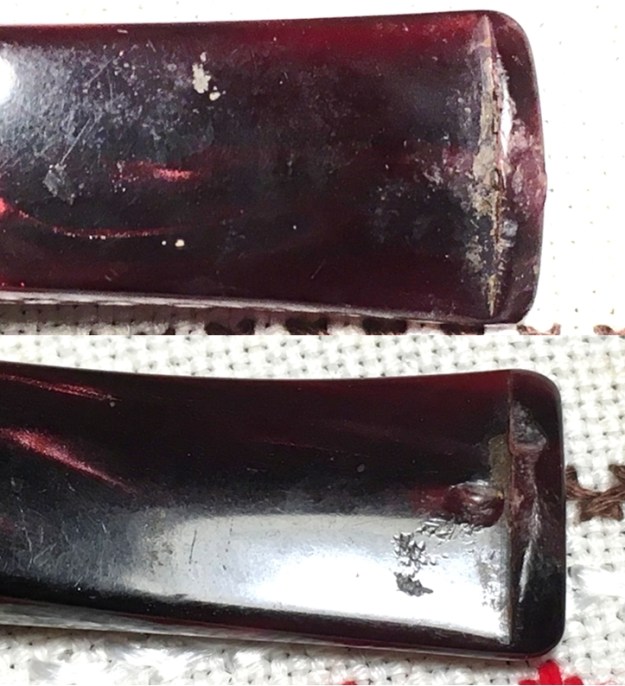
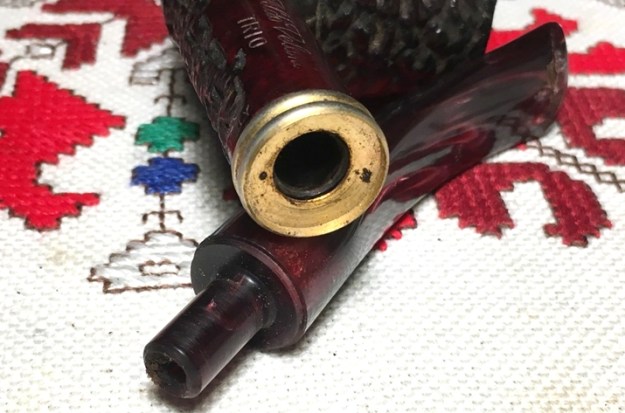
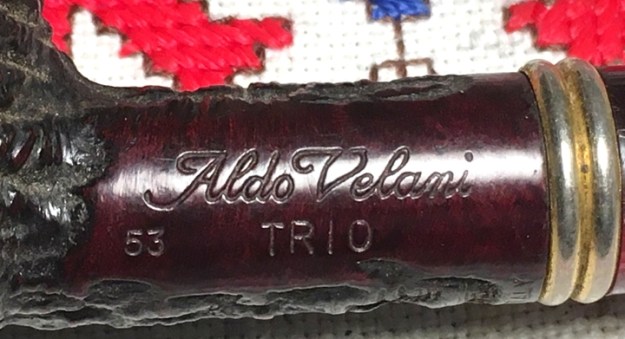
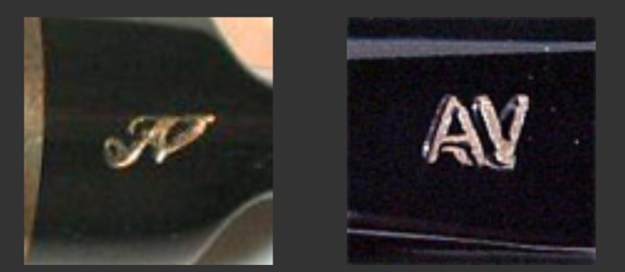
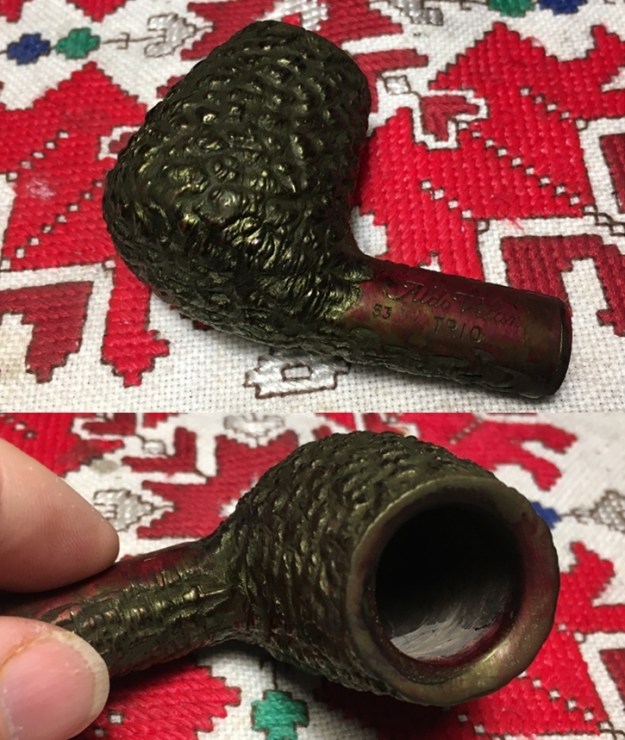
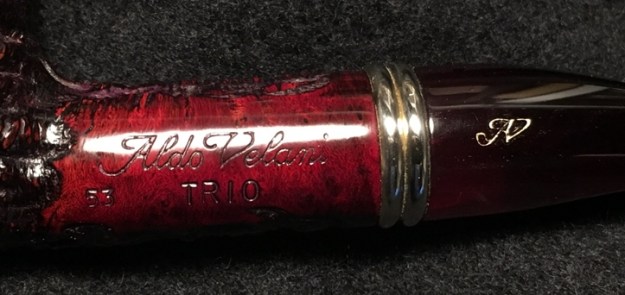
This Rusticated Volcano came to my worktable in what I call the St. Louis Lot of 26 that my son, Josiah, found in an antique shop before last Christmas. He was impressed by the quality of pipes in the Lot and emailed me in Bulgaria with a proposition of going in together for the Lot of 26.  His part in the purchase would be his Christmas present to me – that I would choose a pipe for my own from the Lot.  My part of the purchase would be to restore the pipes to benefit the Daughters of Bulgaria.  It was a proposal hard to refuse and some weeks later I unwrapped the St. Louis Lot of 26 in Denver where our family had gathered for Christmas.  I chose as my gift from Josiah an unbelievable find: a Churchwarden – EP Champion Made in France.  After my restoration of the EPC Majestic, I know that this pipe also has a very auspicious nomenclature dating back to pre-WW2 from the now defunct Paris based A Pandevant & Roy Co. which has now been included in Pipedia as a new entry based on my research during that restoration – Woohoo!  To see my first Pipedia entry, see this LINK!  This picture, after opening the Lot of 26, just happens to have both subjects on the top – the Aldo Velani Trio Rusticated Volcano and my historic EP Churchwarden.Now, back in Bulgaria, on the 10th floor of our formerly Communist apartment complex block, each pipe in the Lot of 26 has been sorted and populated on the website in the ‘For “Pipe Dreamers” Only!’ collection.  Stephen saw the Aldo Velani when I posted a picture on Facebook of the Lot of 26 earlier.  The former steward of this estate liked the Aldo Velani Trio set.  In the Lot, in addition to the Rusticated Volcano came three others from the Aldo Velani Trio set.  The common characteristics of the set is the bright Oxblood hue, the double-ringed gold banding and an assortment of acrylic stems.  The set is obviously meant to appeal to an upscaled expectation.Stephen was drawn to the deeply Rusticated Volcano and after communicating back and forth, he decided to commission it.  Here are more pictures taking a closer look at the Aldo Velani Rusticated Volcano.The rusticated version of the set of Aldo Velani Trio is cast somewhat darker than the smooth briar brothers.  The chamber shows moderate build up of cake and some lava flow over the rim.  This guy was well used by his former steward.The darker ruby red – burgundy acrylic stem shows heavy tooth chatter and chewing on the bit and button.  The lower bit has a deeper bite compression that needs addressing.The amazing ‘fire’ of the acrylic stem presents in a spectrum of ruby red to burgundy and is eye catching and when the entire pipe is cleaned up, will probably steal the show.The gold band I’m assuming is nickel plated as there are no markings showing a gold metal content.  The double-bumped band is attractive and adds a touch of class as it joins the acrylic stem and rusticated stummel.  The band will shine up nicely.The nomenclature on the left shank side is cursive script, ‘Aldo Velani’ [over] ‘TRIO’ with the shape number ‘53’ set to the left side of the smooth shank panel.  Barely visible in the picture below is the stamping ‘Italy’ next to the band and the very bottom. The Aldo Velani stem stamp is interesting and takes a closer look to figure out.  I found in Pipedia’s Aldo Velani article, an example and details of the stamping on an original Aldo Velani box, courtesy of Doug Valitchka.  The stamp depicts a pipe as the front leg of the ‘A’ for Aldo and the back leg of the ‘A’ forms the front riser of the ‘V’ of Velani. The article cited from Pipedia provides helpful information understanding the provenance of the Aldo Velani name:
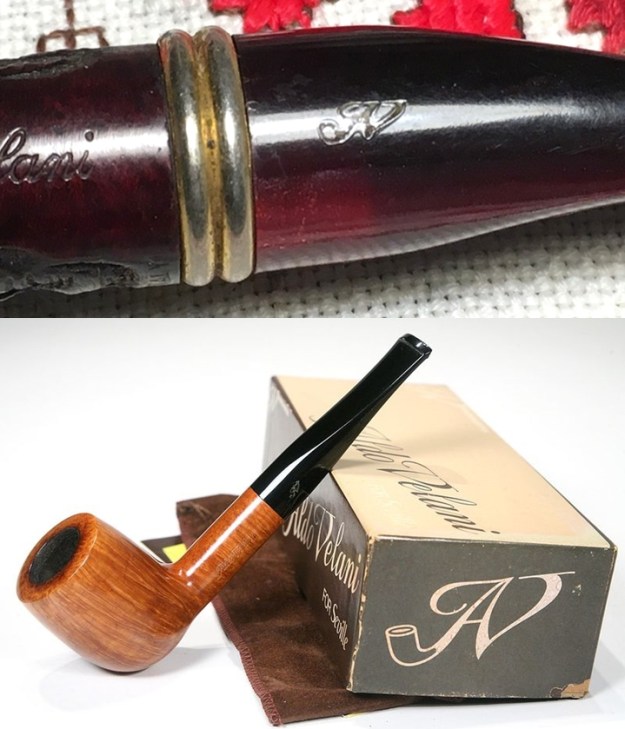
Most Aldo Velani pipes are made in Livorno, Italy, for the USA market by Cesare Barontini. They were previously imported by Lane Limited. Lane spokesman Frank Blews once described Velani’s stylish, intrinsically Italian designs as “Billiards with more ball, bulldogs with more jaw.” The name “Aldo Velani” is actually fictional.

Another Barontini 2nd is named “Cesare”.

I learn two interesting things from this information.  First, Aldo Velani is a faux name that does not describe an Italian pipe house but a specific pipe line.  Secondly, the Aldo Velani is made by the Casare Barontini name based in Livorno, Italy.   Further information is available cross referencing to Casare Barontini in Pipedia:

In 1890 Turildo Barontini opened a factory for the production of briar. In 1925 his son Bruno began to produce the first pipes. Cesare Barontini, son of Bruno, started direction of the factory in 1955, and still runs it together with his daughters Barbara and Silvia.

Sub-brands & Seconds: Aldo Velani. Cesare, L’artigiana, Stuart, Cortina

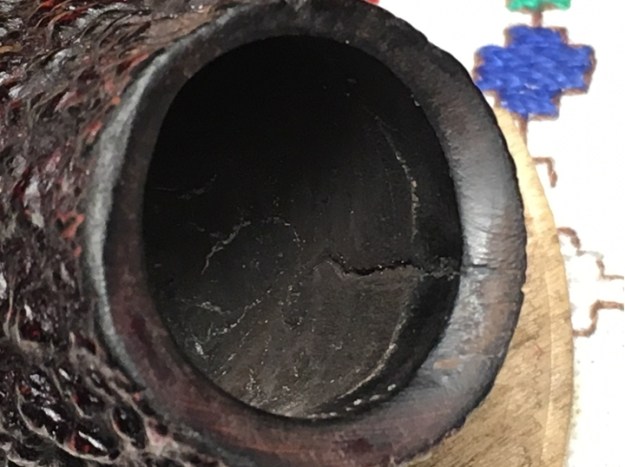
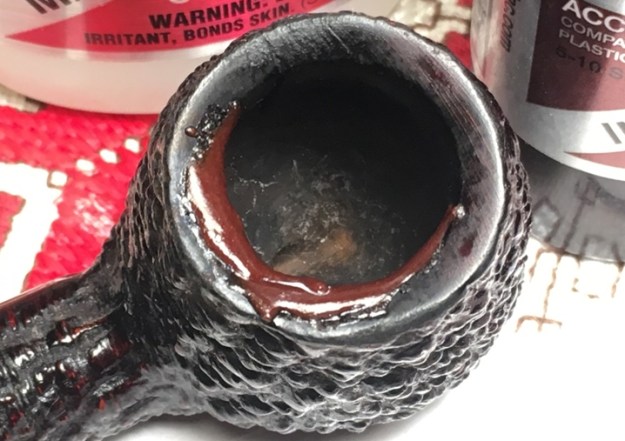
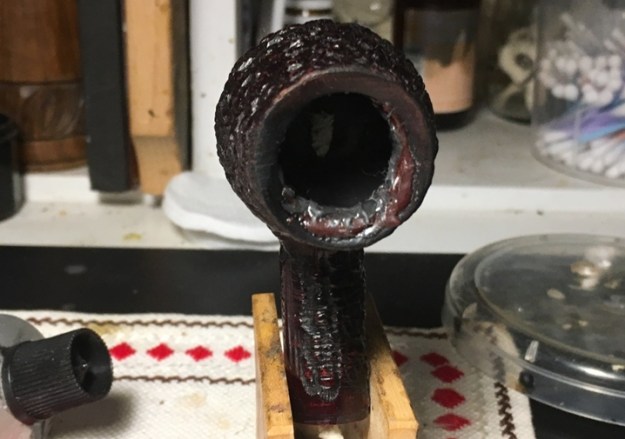
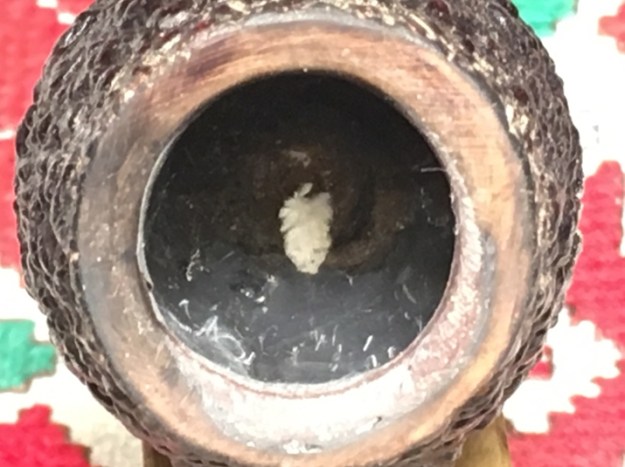
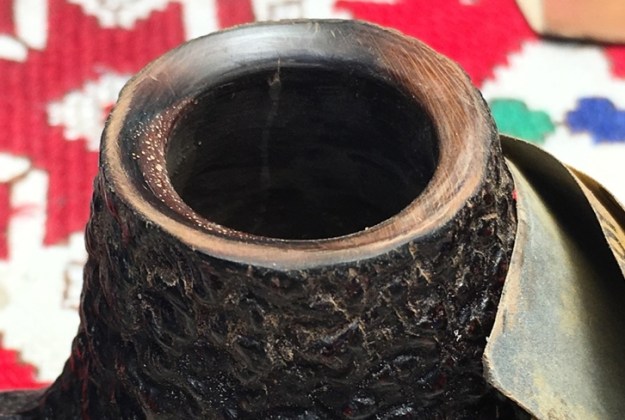
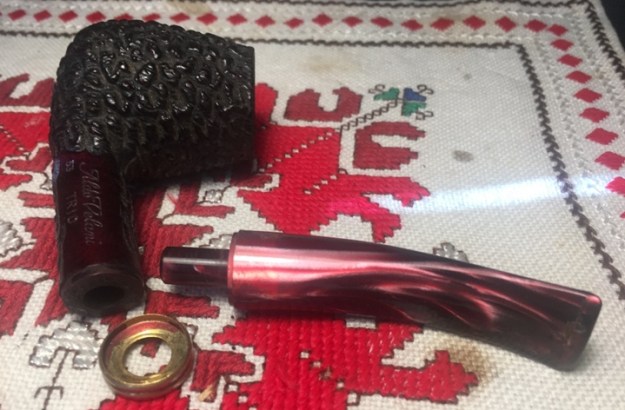
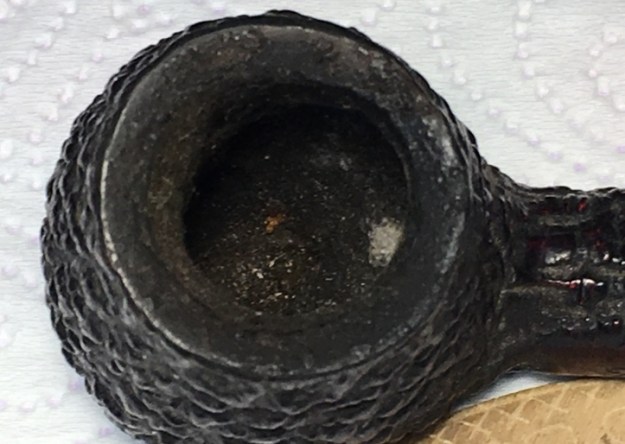
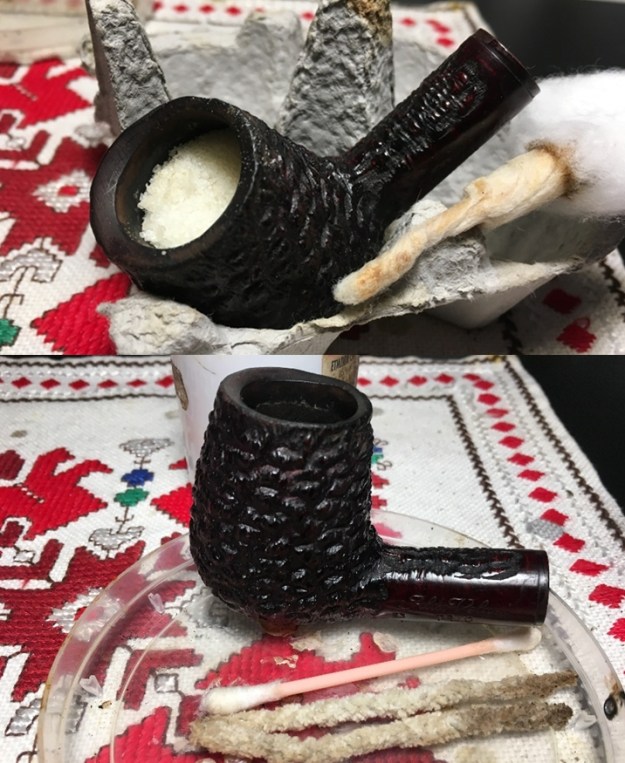
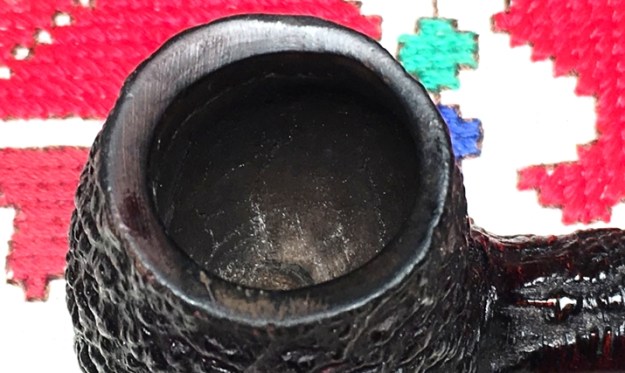
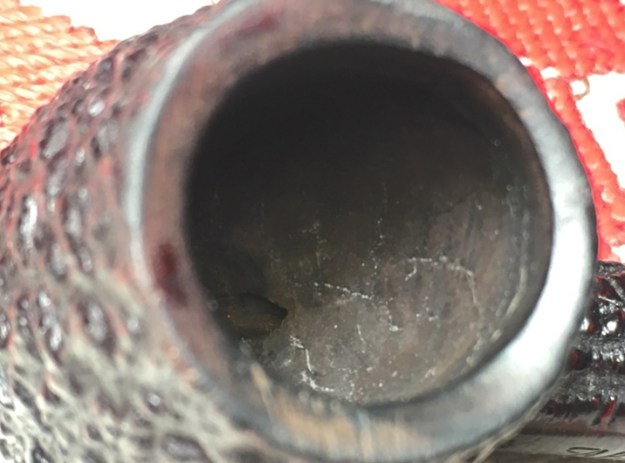
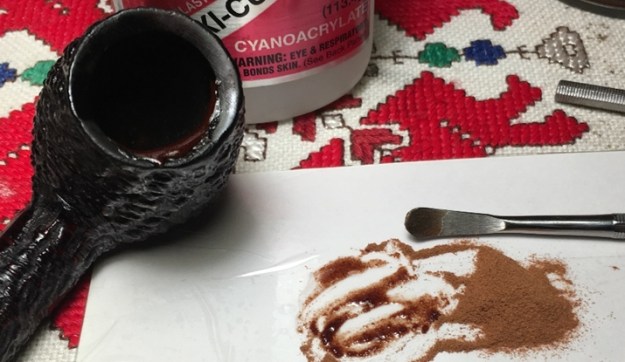
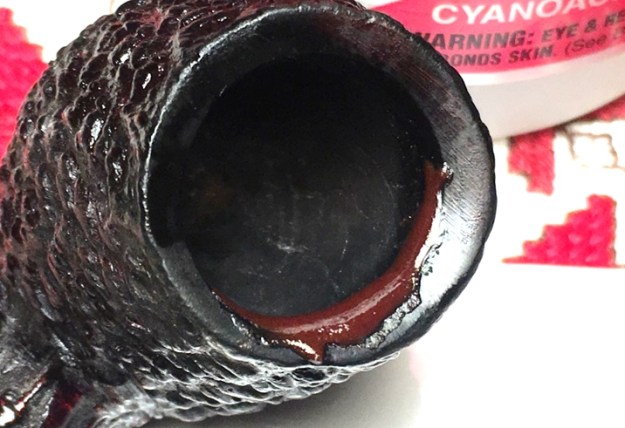
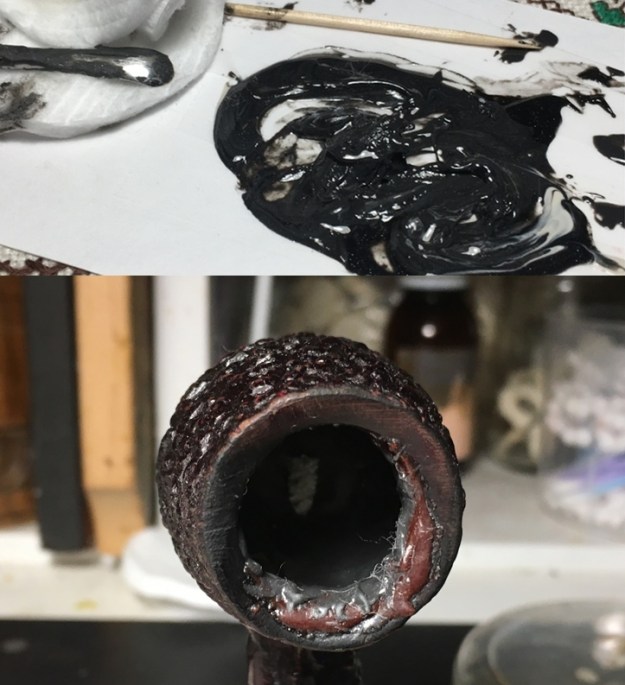
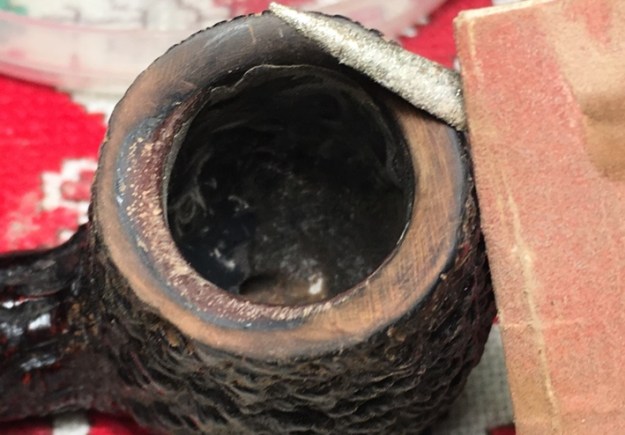
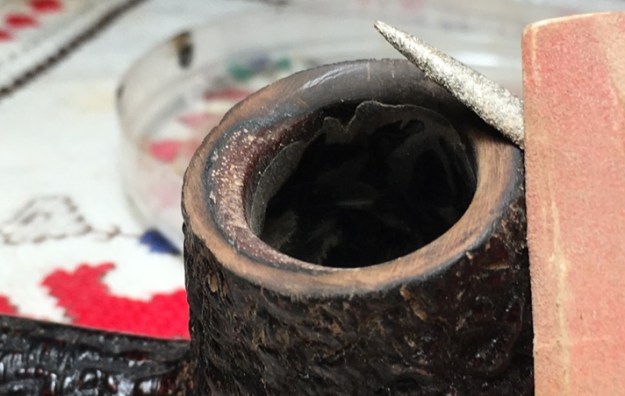
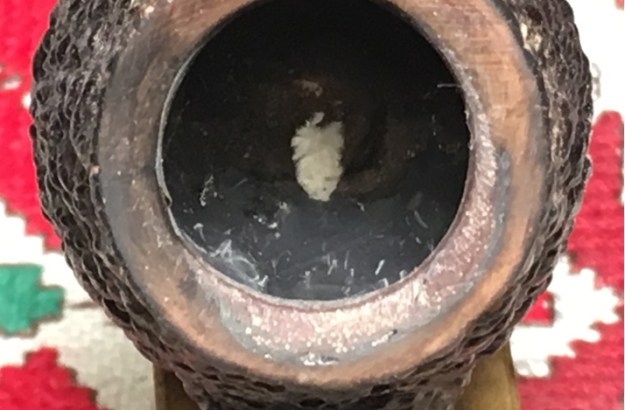
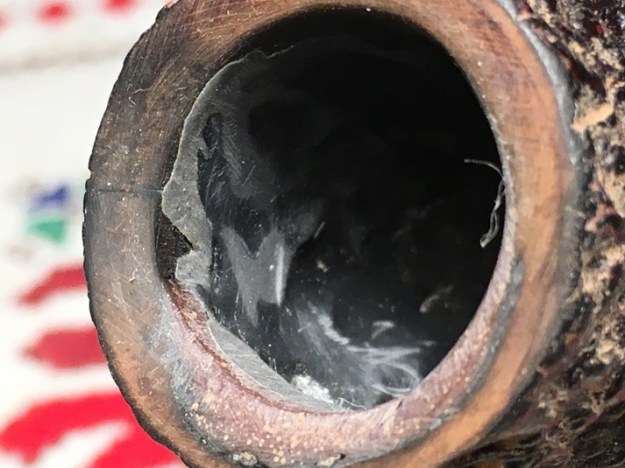
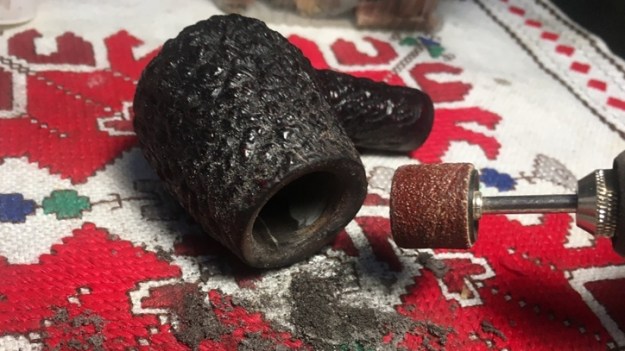
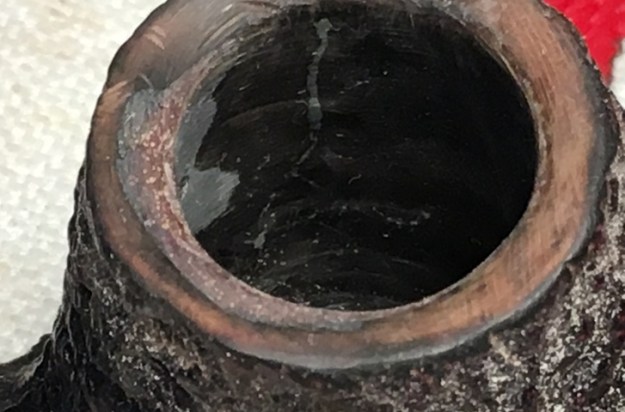
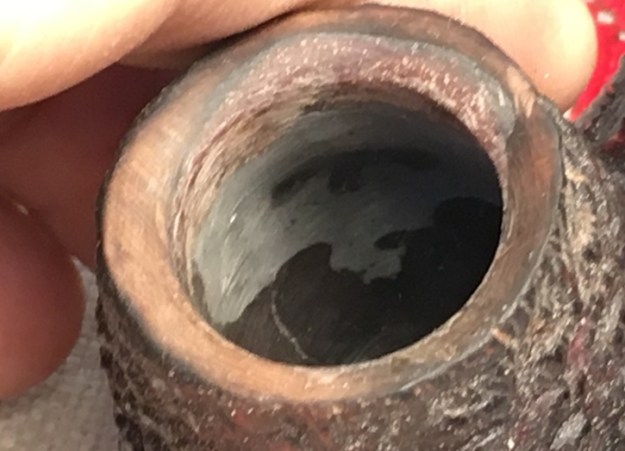
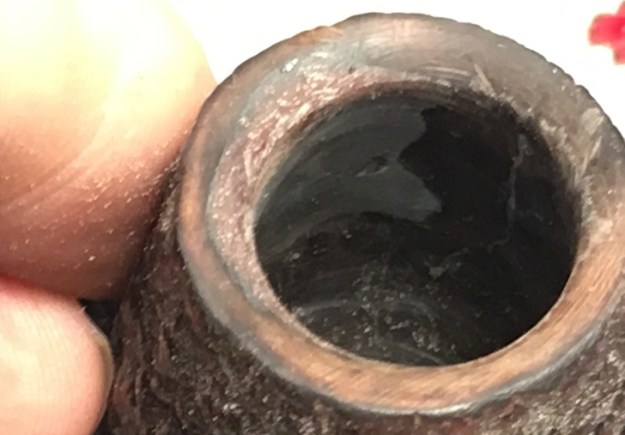
Pipephil’s site has several examples of the Aldo Velani line depicted which tend to be very stylish and nice-looking pipes which confirms the Pipedia assertion that Casare Brontini produced the Aldo Velani lines primarily for export.  It is evident that there was not a consistency in the stem stamping or name style for Aldo Velani as different examples are given.  Here are the stem stamping variations provided by Pipephil:With a better understanding of the Aldo Velani Trio Rusticated Volcano before me, I begin his recommissioning by cleaning him up!  I start by disassembling the parts – I find that the gold band easily is removed which will allow cleaning of each element to be easier.I then take the stummel and ream the chamber using the Pipnet reaming kit.  I use the 2 smaller blade heads then switch to the Savinelli Fitsall tool.  It doesn’t take long digging in the chamber and clearing away the cake that I realize there are problems.  I remove the carbon cake and then sand the chamber wall with 240 grade paper wrapped around a Sharpie Pen to further clean and allow me to see the chamber wall with more clarity.  I wipe the chamber with a cotton pad wetted with isopropyl 95% to aid me in my assessment. The first thing I note was strange was what looks like a ‘stoop’ at the lower back side of the chamber that gives the appearance of the draft hole entering the chamber floor more ‘forward’ than usual.  What becomes more evident as I clear away the thick cake is that the back side of the chamber had fallen away revealing excessively burned briar.  I see carbon fissures reaching into the chamber wall which I continue to remove by scraping with the Savinelli Fitsall Tool knowing that I need to find solid, healthier briar underneath the carbon cake.  After sanding and cleaning, I take these pictures skewed toward an opened aperture to reveal the darker chamber confines with a pipe cleaner giving reference to the draft hole entry.  I was able to find solid briar and now a cleaned surface with only 2 heat fissures that I see but the burning toward the aft of the bowl has reduced the diameter of the briar thickness significantly compared to the forward chamber wall thickness.  The following pictures show what I’m seeing and it’s not good. This final assessment picture below shows evidence of the wall thinning only in reference to the rim’s condition.  The rim is dangerously thin.With much to think about now regarding how to proceed with the chamber damage, I proceed with the normal cleaning regimen which is needful and gives time to think!  Using undiluted Murphy’s Oil soap on a cotton pad and with a bristled tooth brush, I clean the attractive rusticated surface.  I also use a brass wire brush and a little help from my thumb’s fingernail to clean the remaining lava off the labored, bemangled rim.  The cleaning does well and reveals the smooth briar rim motif of the original design of the Aldo Velani.  The smooth briar rim would have popped in contrast to the rustication.  I like it, but unfortunately, much of the original rim is now smoke history. To the internals – I use pipe cleaners and cotton buds wetted with isopropyl 95% to do the job.  With the condition of the chamber lack of care and maintenance, it’s not surprising that the internals are grungy.  I also use a dental spatula to scrape the mortise wall as well as long shank brushes to clean the airway.  In time, the pipe cleaners and buds start surfacing less soiled and I move to the next phase of cleaning the internals.I continue the internal cleaning with a kosher salt and alcohol soak.  I stretch and twist a cotton ball to serve as a mortise wick and then insert it down the mortise into the airway with the help of a straight stiff wire.  I then fill the bowl with kosher salt which, unlike iodized salt, does not leave a ghosted aftertaste.  After putting the stummel in an egg crate to provide some stability, I fill the bowl with isopropyl 95% until it surfaces over the salt.  After a while, the alcohol is absorbed into the salt and cotton wick and I add some more alcohol to top it off and put the stummel aside to soak for several hours. With the kosher salt doing its thing, I turn now to the stem.  The first thing to do is clean the internals using a pipe cleaner and isopropyl 95%.  The pipe cleaners discover not too much resistance.  I then wipe down the acrylic stem external surface to clean it from the grunge so I can examine the surface closely.The stem is in good shape with only expected scratches and scrapes from normal wear.  The bit is a different story with a compressed button and tooth chatter on the upper side and a deep compression on the lower bit with button damage and chatter.  Starting with the upper bit challenges, I sand using 240 grit paper on the bit and button.  I’m thinking that sanding alone might address the damage on this side.  I also use a flat needle file to help shape and freshen the button.  As I had hoped, sanding and filing alone erases the compressions and chatter.The lower bit is a different approach.  I realize from the outset that sanding alone will not address the damage – the compressions on the bit and button are too deep.  Because of this, I apply a patch of thick CA glue to the areas and then use an accelerator too quicken the curing time.  I start with CA glue because I want the footprints of the compressions to be larger so that the CA has more to attach to. I then address the cured CA patch first by filing with a flat needle file and then by sanding with 240 grade paper.  I reshape the button with the file as I work on filing the patch mounds down to the acrylic surface.  Then, switching to 240, I bring the patches down flush with the acrylic surface.  The ruby red and burgundy hues should shine through the transparent CA glue after sanded and polished.Sometimes an air pocket is uncovered in the sanding and filing like in the picture below.  To remedy this, I add another drop of CA glue to fill this. I finish this phase of the repair using the flat needle file and 240 grit paper. To erase the scratches of the 240 grit paper I follow by wet sanding with 600 grade paper and the I apply a 0000 grade of steel wool.Then, the micromesh process using 9 pads from 1500 to 12000.  First, I wet sand with pads 1500 to 2400 and then follow by dry sanding with pads 3200 to 4000 and 6000 to 12000.  I’m not sure it revitalizes the acrylic material, but as I do with vulcanite stems, I apply obsidian oil to the stem after each set of 3 pads.  My – the fire in this acrylic stem is beautiful.  The problem is that it’s difficult to capture with my iPhone 6s camera! Next, I shine up the gold nickel plated double-ringed band – shank cap.  I first wash it with warm water and dish soap using a bristled tooth brush to get into the center crease.  After I dry the band, I then apply Tarn-X with a cotton pad and after scrubbing it well, rinse with cool tap water and dry it.  It looks great.  Later, I will buff it up more with the Dremel. It has been several hours since starting the kosher salt and alcohol soak.  The salt and cotton wick have soiled somewhat, not as much as I thought it would, but perhaps my initial cleaning had accomplished more than I thought!  After I toss the expended salt in the waste, clean the chamber with a paper towel, I also use broad bristled shank brushes to clean the residue salt left behind.  I blow through the mortise to loosen and remove salt crystal remaining in the airway.  Finally, to make sure the cleaning has done the job, I expend a few more pipe cleaners and cotton buds with alcohol and discover that the internals are clean.  Moving on!I’ve had some time to think about the issues with the burning damage to the chamber.  The good news is that there are no burn throughs, but the briar on the back side of the chamber is thin. The rim on the backside is also thinner in comparison to the front side of the rim which is evident in the first picture.  In the second picture I’ve tried to show how the inner chamber has bowed out because of the loss of briar through burning.  During the reaming and removal of all the charred wood, left behind is a bowed cavity where it should be relatively straight-vertical.  The third picture shows the remaining fissure that crawls up the left side of the chamber and impacts the rim. I’ve looked very closely and thankfully, the fissure crack is isolated where it is.  There are no skulking cracks over the rim into the rusticated surface. To give this pipe a longer life, I will employ two different approaches that hopefully will build the rim up and fill the bowl cavity out to increase the mass on the rear chamber wall.  To do this I’ll use JB Kwik Weld to build a new chamber lining and to fill the fissure on the left side of the bowl.  JB Weld will be the main strategy in the chamber itself because of its heat resistant capabilities.  This is the lower chamber strategy.  Before starting this, I will first build out the rim thickness using a mixture of thick CA glue and briar dust to form a putty that will cure and provide the upper scaffolding for a rear rim rebuild. I’ll form this first around the back side of the rim and as I form the rim mold with the putty, I’ll intentionally fashion an ‘under-ridge’ with the briar dust putty.  This ‘under-ridge’ will form the raised boarder that the JB Kwik Weld will butt against when it is applied afterwards.  I hope this plan will work!
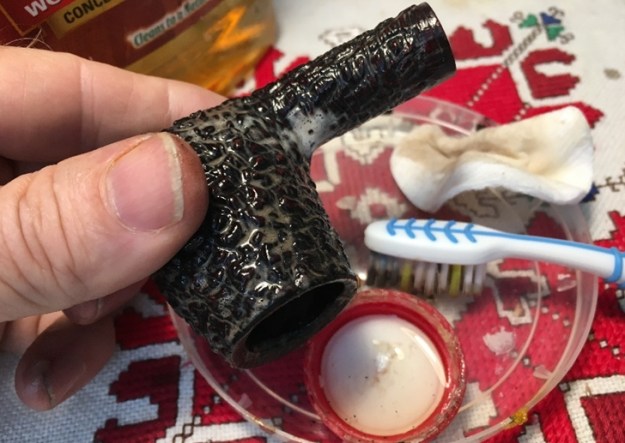
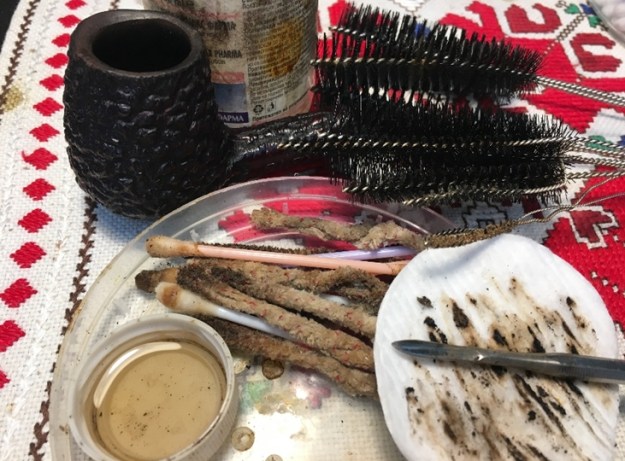
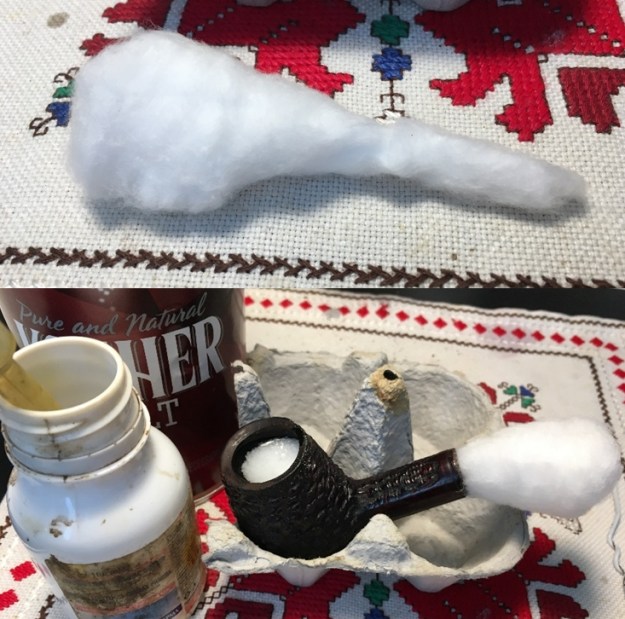
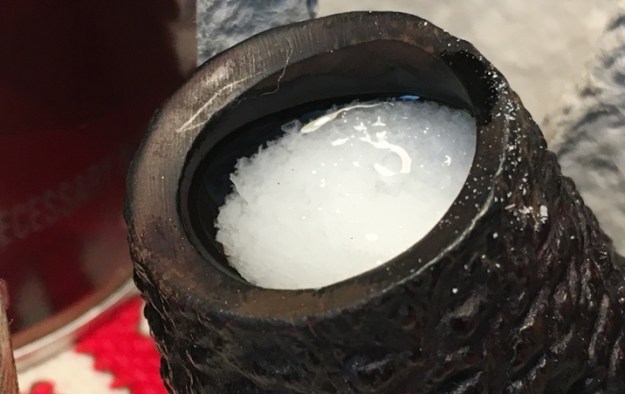
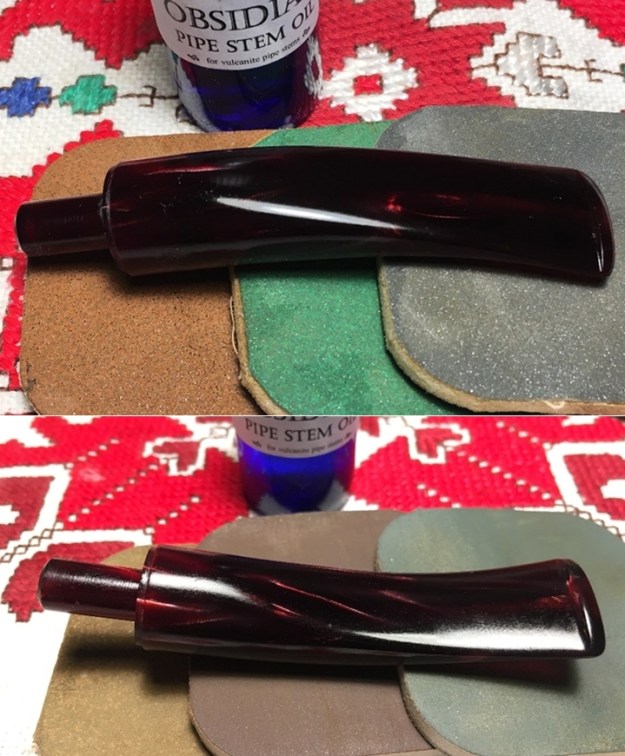
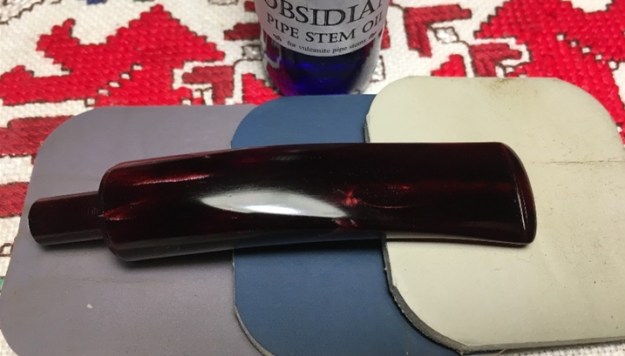
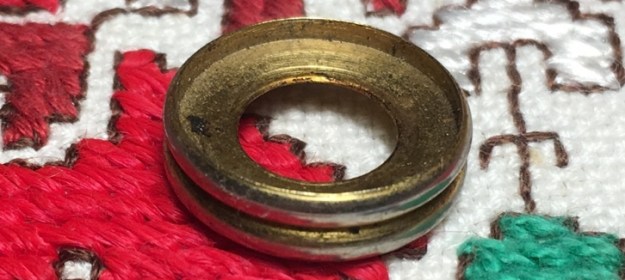
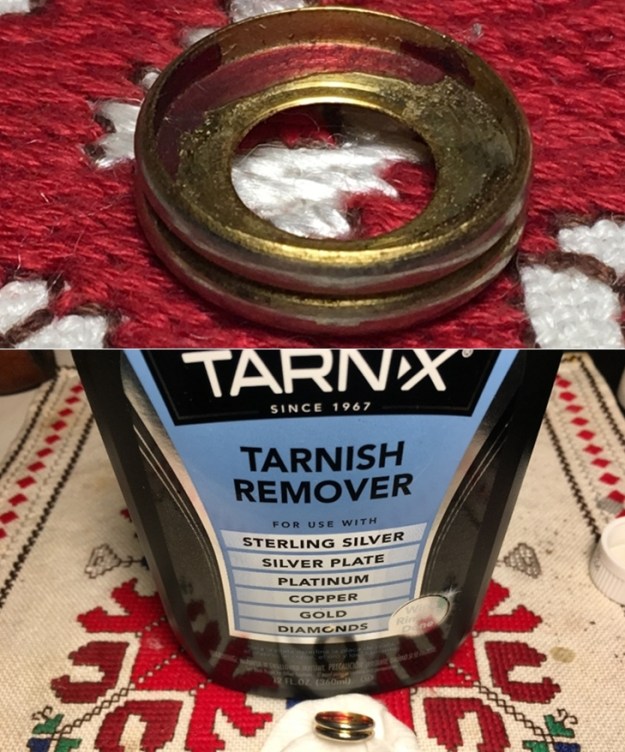
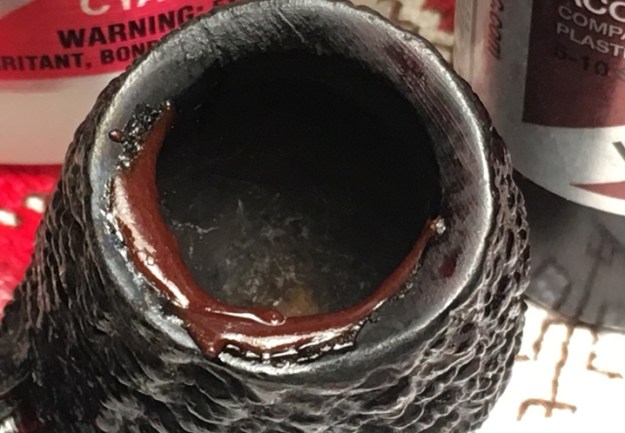
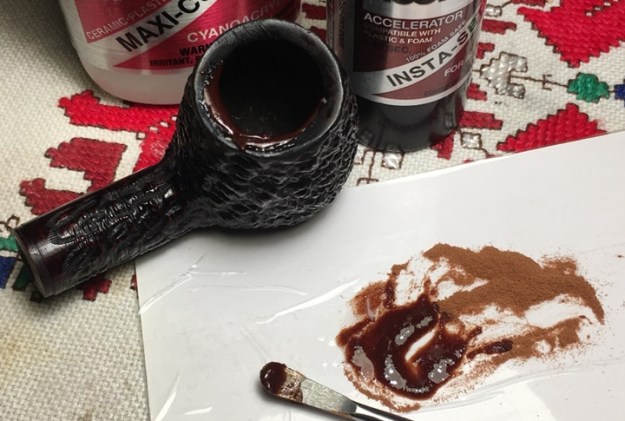
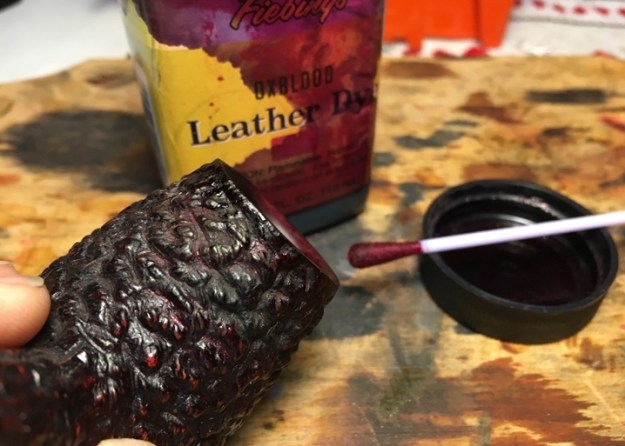
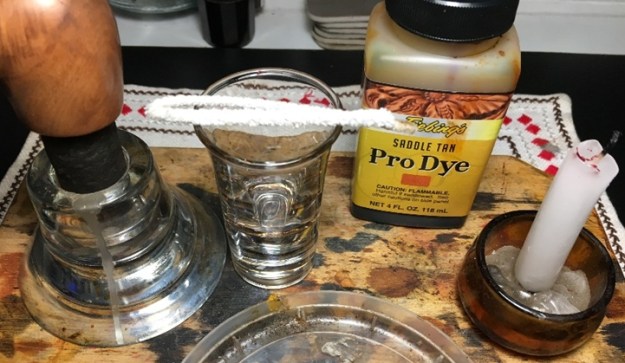
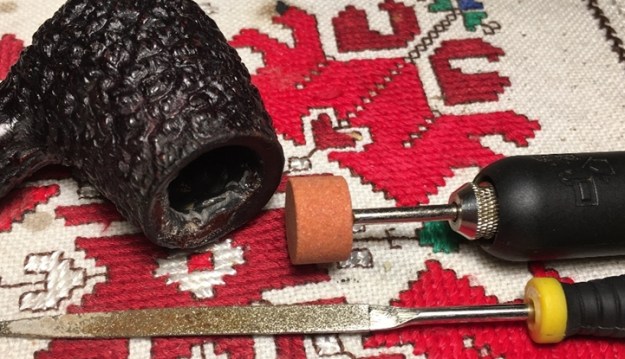
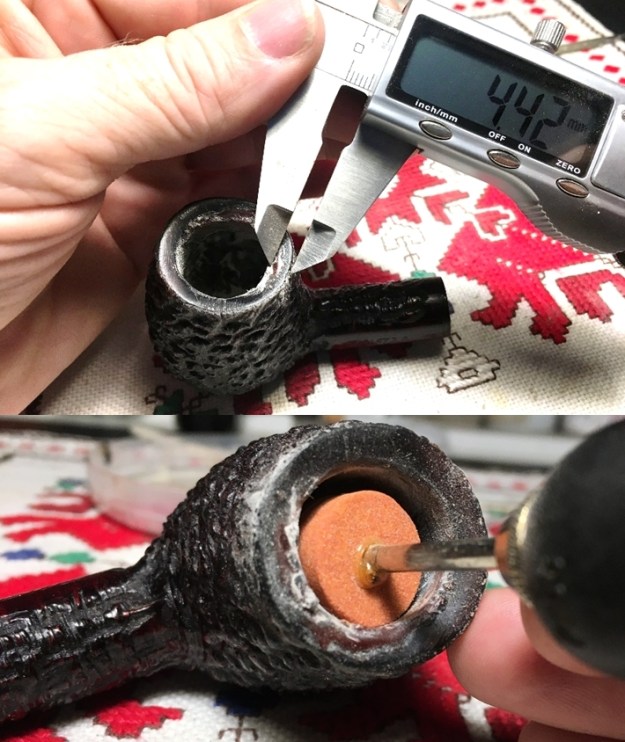
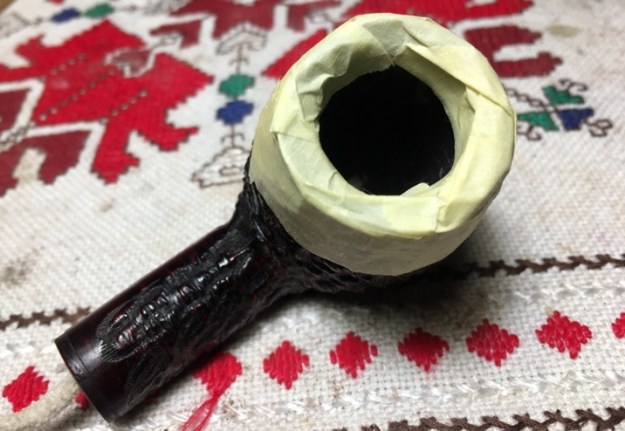
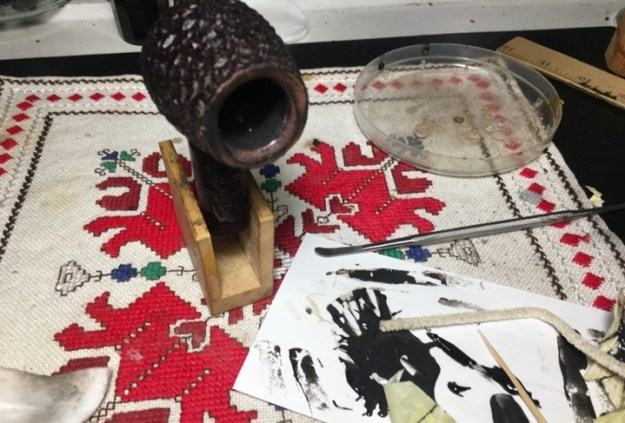
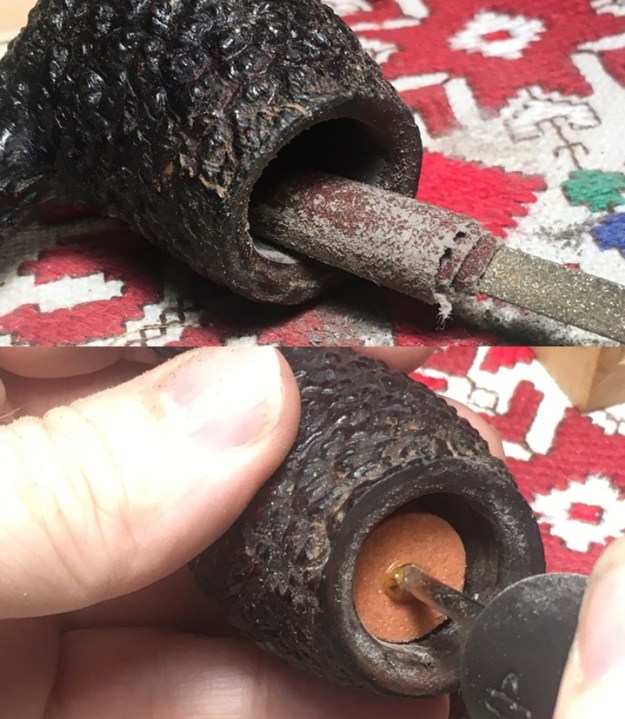
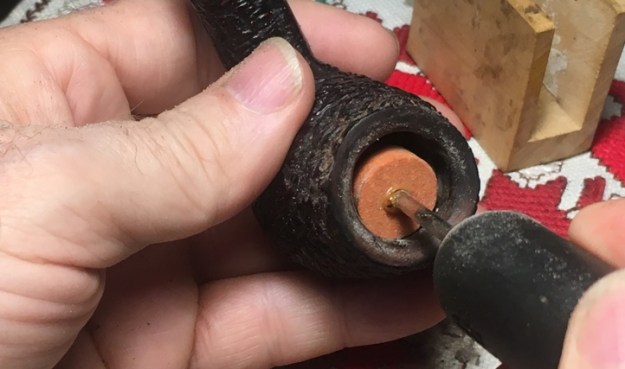
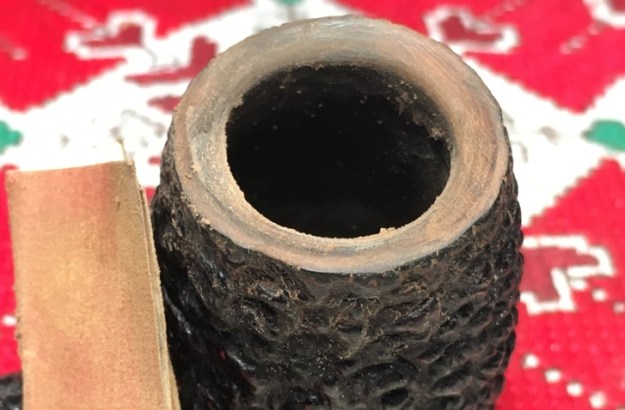
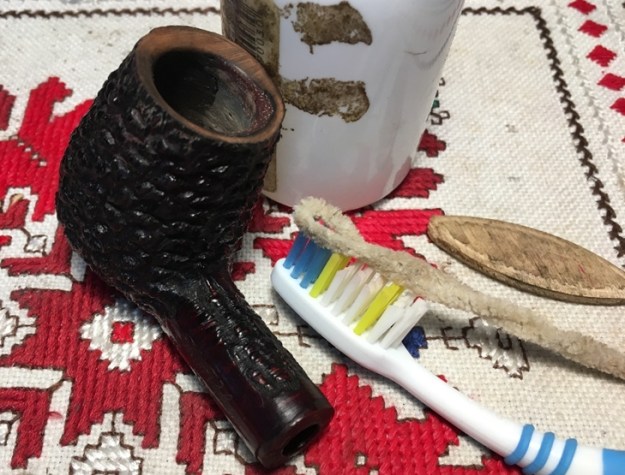
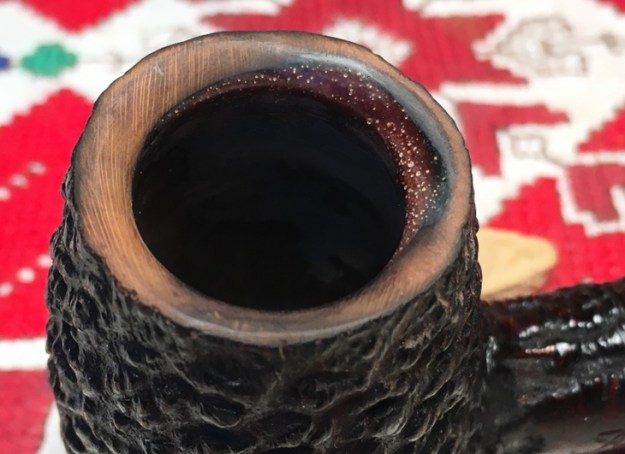
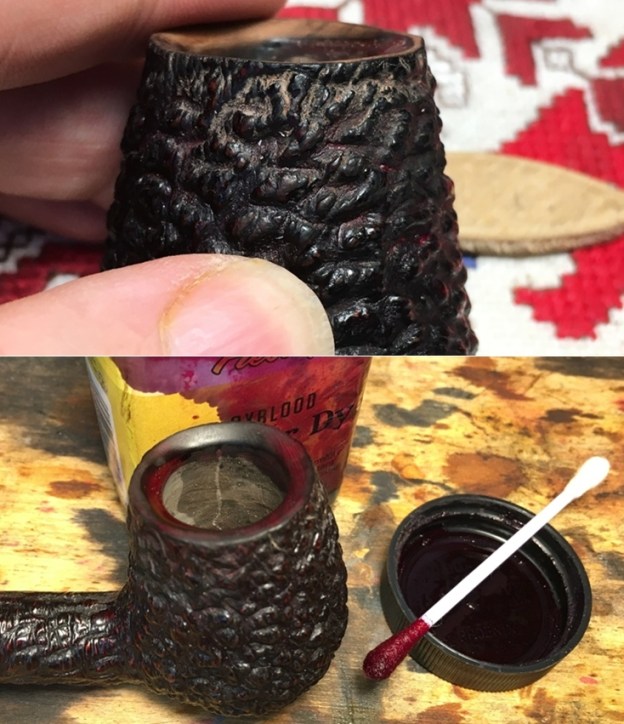
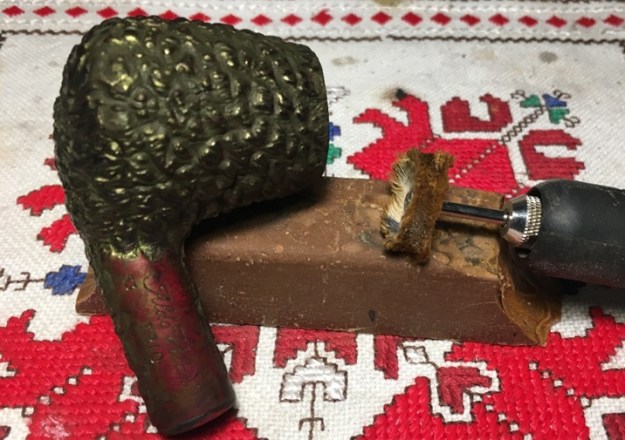
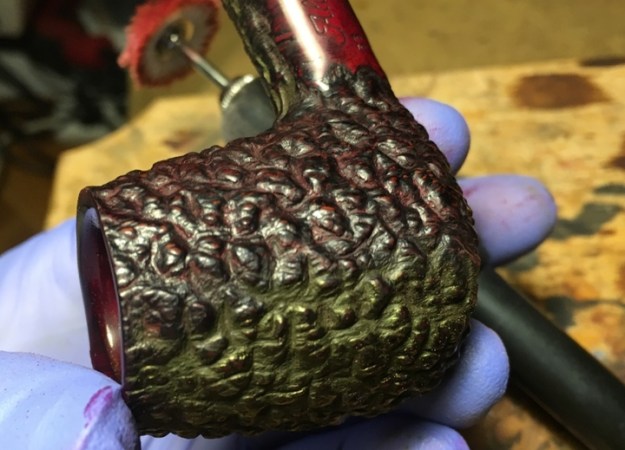
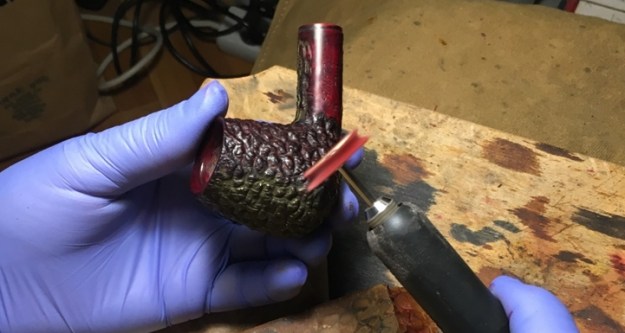
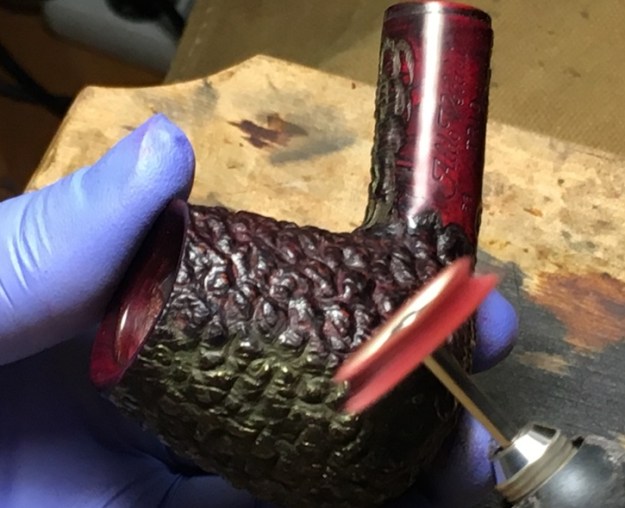
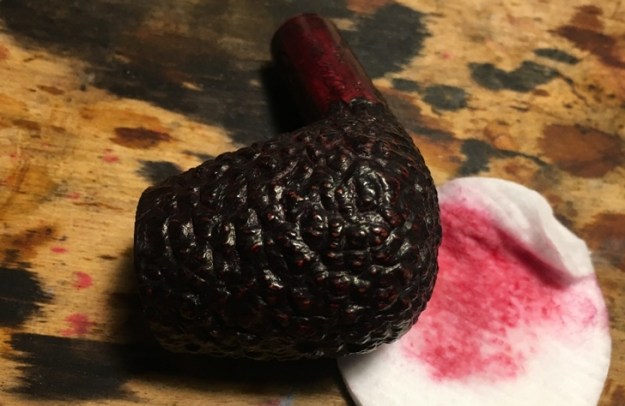
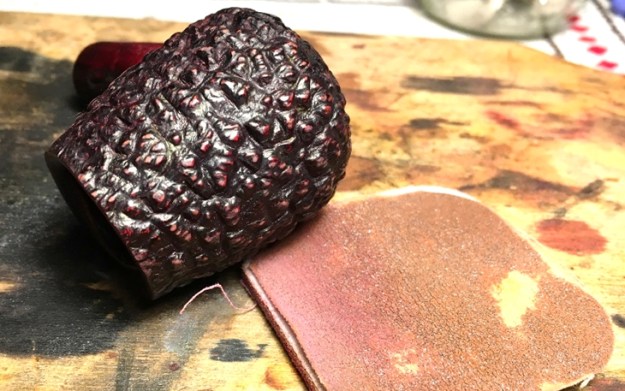
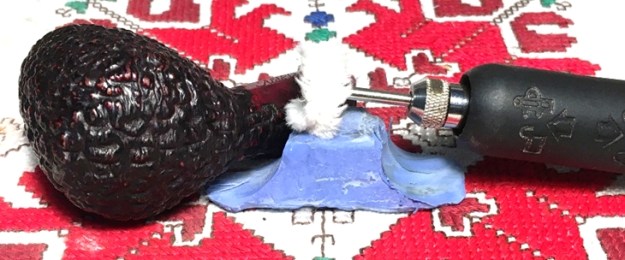
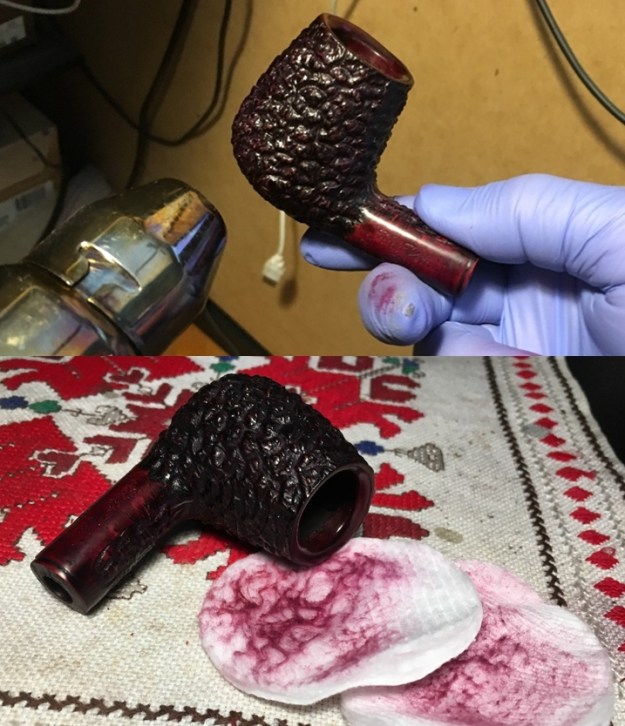
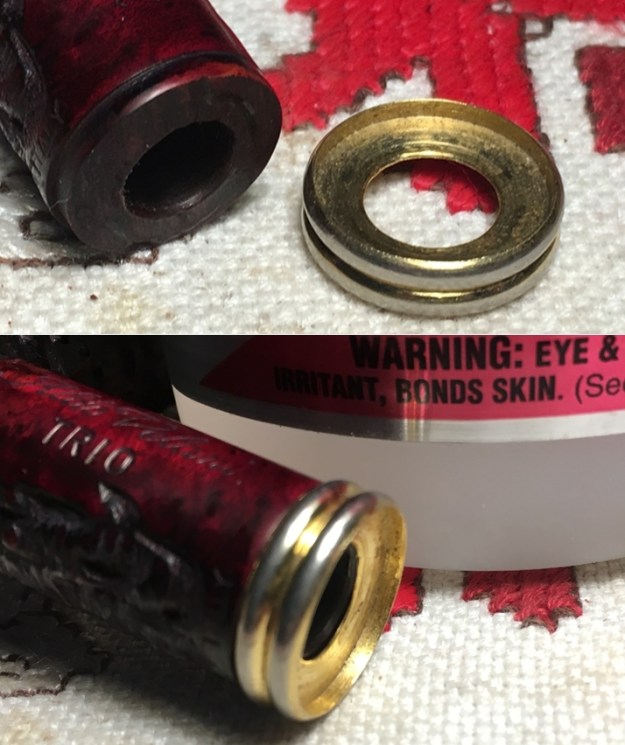
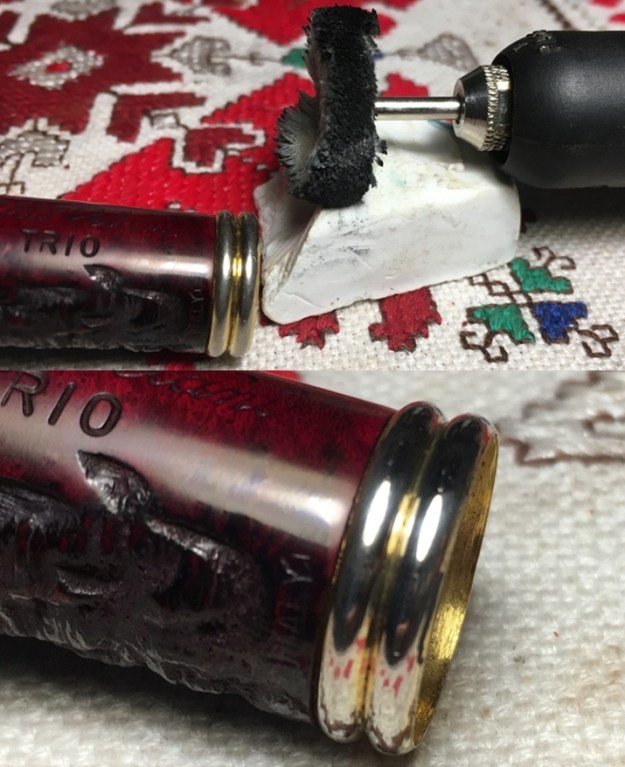
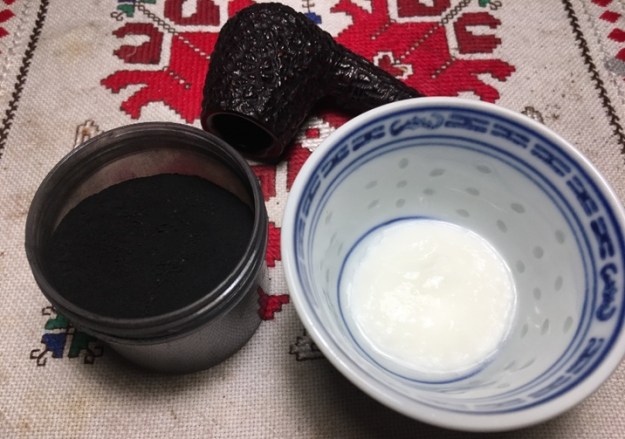
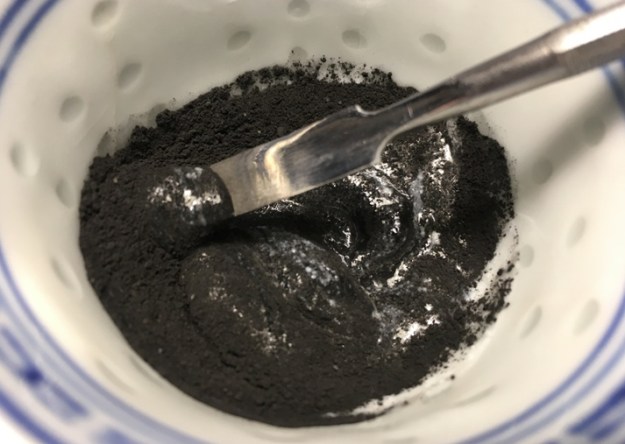
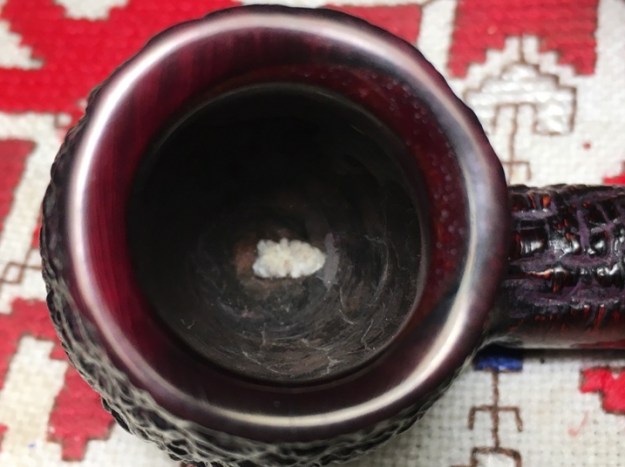
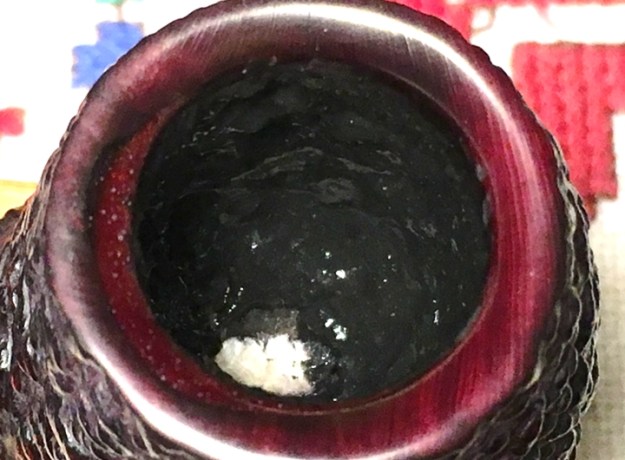
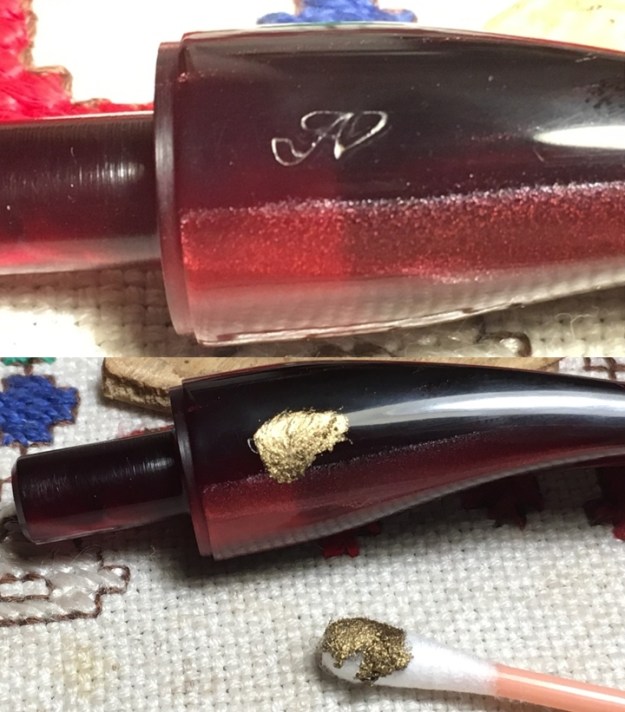
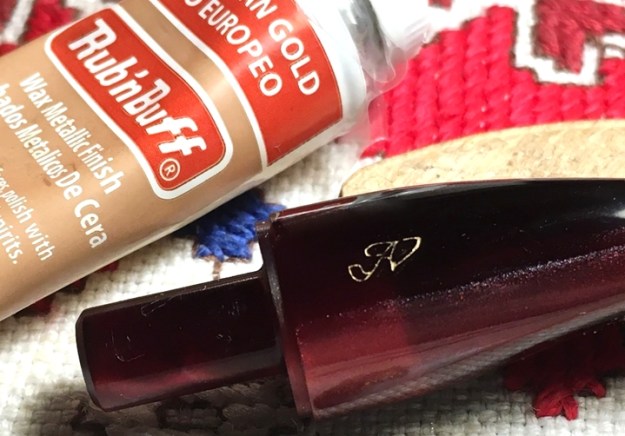
The first thing I do is wipe the bowl and rim with alcohol and a cotton pad to clean the surface.  Then I mix a batch of briar dust and thick CA glue on an index card.  When it’s about the viscosity of molasses so it will hold together and not run, I trowel it to the rim with a curved dental spatula shaping the rim form.  As I’m working, I see that the putty isn’t firming up on the rim as I hoped and so I use an accelerator to help quickly set the putty in place and cure.  I apply three separate batches of putty to build up the rim which are shown in the pictures.  The first phase looks good.  The pictures show the progress. Next, I mix equal parts of the two components of JB Kwik Weld, the steel and hardener.  After the two elements meet, there is about 4 minutes of relative pliability to apply the Weld in place.  After four to five minutes the Weld begins to harden.  I use a spatula to trowel the Weld into the chamber – trying to avoid the rim, but that wasn’t easy to do.  As I apply the Weld into the chamber, I spread it on the back wall and fill the fissure.  As it hardens, I tamp it down and shape.  After applying and shaping, I set the stummel up so that the back of the bowl is down allowing gravity to help.  I turn out the lights and call it a day. The next day I’m anxious to start to work on shaping the rim after the JB Kwik Weld and briar dust putty have thoroughly cured.  My main work horse to begin with is the Dremel mounted with a round grinding stone and a half-rounded needle file.  The grinding stone is the perfect size at 5/8 inches in diameter to fit into the narrowed Volcano summit and yet, large enough to provide a larger and less abrupt grinding footprint.  As I begin to grind the internal lip of the rim patch, I remove the excess briar dust putty patch material.  I go slowly and patiently eyeballing the roundness of the rim.  I decide to employ a caliper to measure the original intact part of the rim to help me measure the removal process.  I would rather leave more and work down slowly sanding with paper than to be greedy with the Dremel grinder and take off too much.After a time, a take a picture to mark the progress removing and rounding. When I’m close to being satisfied with the removal and rounding with the Dremel grinding stone, I use both a flat and half rounded needle files to begin removal of the excess patch material on the rim top.  The entire rim bevels inwardly and slanting toward the chamber and I patiently and gently file in that direction. After filing, I transition to 240 grade paper to continue to shape and to blend the rim patch with the resident briar.  I do a dance back and forth between sanding and filing and eyeballing the angle of the rim slant – seeking as much uniformity as possible!I’m satisfied with where I am at this juncture.  The inner rim looks round and the rim rebuild is holding together very well.  The area is still rough, and I’ll continue to work on that later, but now I turn my attention from the rim rebuild and restoration to the chamber. I wet a cotton pad with alcohol and wipe out the chamber so that I can assess where the chamber repair is with the JB Kwik Weld.  With the shank oriented downwardly, I take a few pictures after replacing the pipe cleaner through the draft hole.  The pictures are difficult to see what I can feel with my finger as I examine the contours of the hardened JB Weld.  The cavity created by the burn damage has been filled partially and reinforced well.  I no longer have any concerns about the thinness of the briar on the back of the bowl.  I don’t believe I can fill the entire cavity with JB Weld and will not try.  But I still can feel an abrupt ridge underneath the rim repair.  This I need to fill to provide a smoother transition from the rim repair to the chamber repair. Orienting the picture now to the left side of the chamber, the JB Weld has filled the fissure very nicely.  I’ll sand the excess off later. After dealing with the fissure proper, I’ll address the upper part of the fissure crack that reaches to the rim.For the second strategic application of JB Kwik Weld, I cover the rim and upper bowl with masking tape to protect from accidental drips of the Weld.  After mixing the two parts of the JB Weld, again I use a dental spatula to apply the epoxy to specific areas underneath the rim rebuild to provide the foundation for a smooth, seamless transition between the two reconstruction areas.  As before, to be careful, I place a pipe cleaner through the draft hole even though there is no plan for Weld to be applied in that area.  After troweling enough JB Weld to the area targeted, I patiently and carefully continuously tamp the area to massage the epoxy into the best positioning.   As the 4-minute window passes, the epoxy is thickening allowing me the final opportunity to shape and smooth the epoxy before it sets.A few hours later, I begin the dance of sanding and utilizing the round grinding stone mounted onto the Dremel.  The sanding paper I use is a coarse 120 grit and I wrap it around the end of the flat needle file to give me some reach and leverage as I apply pressure during the sanding.  The goal is to remove all excess JB Kwik Weld only leaving that which provides necessary filling to the burned-out area and to the heat fissure.  These pictures show the dance, but the reality is this phase is a mess with dust flying all over!  Living and working in our 10th floor flat of a formerly Communist bloc apartment complex in the winter provides much opportunity for me to thank my wife for her patience and helping to take a few of the pictures below! After I’m satisfied with the heavy duty grinding and sanding, I switch to a sanding drum mounted to the Dremel.  It serves to fine tune the sanding and makes my job easier.I finish with the rim/chamber rebuild.  After cleaning the chamber blowing and wiping with a cotton pad wetted with isopropyl 95%, I’m pleased with the outcome.  The pictures show remaining epoxy in the areas of need.  The first picture shows well the fissure that is now secured with epoxy.  The lighter epoxy is visible but to the touch, there is nothing there.The next pictures show the transition between the two repair projects.  The briar dust rim rebuild transitions to the chamber burn repair.  The JB Weld contours to the chamber wall building out the large burned area that threatened the aft chamber wall, but thankfully never burned through.  The aesthetics are still nothing to get excited about but I’m hopeful through the sanding and polishing process the rim rebuild will blend well with the surrounding briar.  Later, I will apply a coating of pipe mud to the chamber to encourage the growth of a new, healthy protective cake. I move on now to fine tuning the rim.  I use 240 grit paper to clean up scratches left over from the restoration project and then I apply 600 grade paper to smooth. With all the sanding, filing and grinding of epoxy and briar, I do a quick clean up of the stummel by taking it to the sink and running tap water over it and scrub it with the bristled tooth brush.  I also wipe the chamber and the rim with a cotton pad wetted with isopropyl 95% and run a pipe cleaner through the airway also wetted with alcohol to make sure all is clean.Next, before progressing further with the sanding of the rim, I color the rim to hide and blend the repairs.  I use straight Fiebing’s Oxblood with a cotton bud to apply several coats of the dye to the rim.  I also touch up the rusticated areas on the peak of the Volcano bowl that had lightened because of all the construction and cleaning going on. I’m hopeful that the dye will also be absorbed by the rim patch area which is speckled now after the sanding.  After applying the dye several times, I give the rim a light wipe of a cotton pad wetted with alcohol simply to blend and gather excess dye. Next, I move directly to applying micromesh pads to the rim and to the smooth briar panel on the left shank flank.  I begin by wet sanding with pads 1500 to 2400 and I realize immediately that I had made a mistake in the order of things.  As soon as I began wet sanding the Oxblood dye that I had just applied was, for the most part, now running down the drain.  I realize that I should have completed the micromesh regimen and then applied dye to the rim.  Not able to change anything at this point, I continue after wet sanding with the first set of three, to dry sand using the remaining pads, 3200 to 12000.  The pictures show the results – the rim looks great regarding the sanding and polishing but the coloring of the rim is lost for the most part.  I also discover as I micromeshed the smooth panel that the color was coming off as well….  I’m encouraged by the fact that we learn as much from what not to do as doing something well.  The pictures show the results. Circumstances create the environment for decisions and decisions shaped by past successes and failures is the definition of wisdom.  What is the wise course of action!? Previously, I planned to keep the original finish as it was and move to the polishing phase.  Now, I decide to apply Fiebing’s Oxblood Leather Dye to the entire stummel and not just as a touch up.  At this point there are too many ‘touch up’ points and it is better simply to refresh the entire bowl with dye.  I assemble all the components of my tabletop dying station and then wipe the stummel down with alcohol to clean the surface.  Using a hot air gun, I heat the stummel to open the briar to be more receptive to the dye pigmentation.After heated, I then apply the Oxblood dye to the stummel using a folded pipe cleaner holding on the cork which is inserted into the shank as a handle.  As I paint the stummel with dye over sections at a time, I ‘fire’ the dye using a lit candle that combusts the alcohol in the aniline dye and sets the dye pigmentation in the wood.  After fully saturating the stummel and covering the whole surface, I set the stummel aside to rest for several hours.Several hours later I’m ready to ‘unwrap’ the fired crust on the surface of the rusticated stummel.Since I’m working with a rusticated stummel, I don’t use a felt buffing wheel as is my approach with smooth briars.  I mount a cotton cloth buffing wheel on the Dremel and set the speed at about 40% full strength, I apply Tripoli compound to the stummel.I’m always fascinated by the way the grain emerges during the unwrapping process with the Tripoli.  The picture below shows the ‘front line’ of the buffing process and the richness of the rusticated surface being revealed.  Yes, surgical gloves!  In this way I keep stain of my hands which keeps my wife happier!With my wife’s help, the next few pictures show my customary ‘Dremel posture’ – my lap top station working on a chopping board.  I keep the overhead lamp close and I’m able to see the movement of the compounds and waxes I apply during the use of the Dremel.Working on rusticated and blasted surfaces are rough on the cotton cloth buffing wheels and I’ll be tossing this one when I’m finished!  I buy buffing wheels in bulk.  The smaller buffing wheel allows me to rotate the orientation of the stummel to follow the rusticated valleys and ridges – I keep moving and it takes a good bit of time to work through the rustication.  Patience reveals good results most of the time!After completing the Tripoli regimen, I wipe the bowl with a cotton pad wetted with alcohol.  I do this not really to lighten the aniline stain but to blend the Oxblood dye and to wipe off excess dye.With a rusticated surface as distinct and deep as this Aldo Velani Trio, I use a 1500 grade micromesh pad and lightly ‘brush sand’ the surface of the stummel.  What this does is sand the tips of many of the rustication ridges and lightens them.  This creates more contrast in the rustication that I first saw many restoration ago, restoring a rusticated fully bent Billiard, Lorenzo Rialto.  The ‘speckled’ effect creates a mesmerizing rusticated surface – I like it.  The picture shows these results.Next, I mount another cotton cloth buffing wheel to the Dremel, maintaining the same speed and I apply Blue Diamond compound to the stummel surface.  I decide not to reunite the stem at this point to apply the Blue Diamond in order to use a different buffing wheel with the acrylic stem.One of the reasons for letting the newly dyed and fired stummel to ‘rest’ for several hours before working on it is that it helps the dye to set and less of it comes off later on the steward’s hands.  This does happen especially the first few times a pipe is put in service and the bowl heats up for the first time.  I’m concerned that the rusticated surface will hold more unseasoned dye surface and to mitigate against Oxblood dye coming off on the hands, I heat the stummel with the hot air gun and with the bowl heated, I wipe it heartily with a few cotton pads to capture the unseasoned dye.  I hope this helps!Before turning to the stem, I have two additional projects to complete before the final phase of applying wax.  I need to remount the gold band/shank cap and polish it.  Also, I need to apply a mixture of sour cream (or natural yogurt) and activated charcoal to the chamber to aid the formation of a cake to serve to buffer the newly repaired chamber wall from the fire.  Starting first with the band, I apply a small drop of thick CA glue inside the cap and then attach it to the end of the shank.  I use a thicker variety so that it doesn’t run and get on something that it shouldn’t!Next, I mount a cotton cloth buffing wheel on the Dremel that is dedicated to the application of White Diamond compound on nickel.  You don’t mix buffing wheels!  I label each wheel for what compound or wax is used and on what surface – metals and wood are different! I also am careful while buffing the band to stay on the metal and not bleed over onto the briar.  The black residue that comes off the metal can darken and stain briar – careful!  Wow!  I thought the cap was shiny before, but now it beams!Next, applying the natural yogurt and charcoal mixture to the chamber walls to provide a buffer between the briar and the burning tobacco helps as a ‘starter’ to develop a protective cake.  I’ve learned that I have used too much yogurt in the past and toss a lot in the waste.  This time, I use much less.I mix the charcoal in until it thickens.  I’ve learned to mix a little more charcoal than I think is necessary so that it is firmer.  The test I’ve used to know when I’ve mixed enough charcoal into the soup is when I can scoop some of the mixture on a flat dental spatula and it doesn’t run off.  That lets me know that it will stay where I put it on the chamber wall and not be overcome by gravity pulling it down to the floor of the chamber.When the mixture seems good, and after I put a pipe cleaner through the draft hole, so it stays clear, I dollop the black mixture using a dental spatula and paint the chamber walls up to the rim.  I got the mixture right.  After covering the chamber walls fully, I take a picture – it’s not easy to see, but it looks good and will serve the needed purpose.  A word to the new steward of the Aldo Velani Trio, when you put the pipe into service do not scrape the chamber to clean it!  Gently stirring the ash loosens it allowing it to dump easily.  Then, use a folded over pipe cleaner and ‘rub’ the chamber wall which cleans adequately.  You want to allow enough time for a cake to develop. With the stummel waiting for the yogurt/charcoal mixture to dry, I now turn to the stem.  I mount another cotton cloth wheel on the Dremel, maintain speed at 40% full power and apply Blue Diamond to the beautiful fiery acrylic stem.  After this, I mount another cotton cloth wheel, maintain the same speed and apply White Diamond compound. After completed, I wipe and buff the stem with a felt cloth to remove the compound dust.Next, I want to spice up this classy stem by refreshing the Aldo Velani stamp on the side of the stem. It is unique with the A and V in cursive script, but to me the clincher is the pipe forming the left leg of the A.  It’s just cool.  With all the gold in the band, I think gold would be a good color to bring out this noteworthy stem stamping given that I don’t have a picture of the original intent but what I see looking closely at the stamp, it may have been gold but I’m not positive.  I use Rub’nBuff European Gold to apply the color.  As the name says, I apply it over the stamp with a cotton bud and then wipe it of with a cotton pad.  I need to rub it well to clean up the excess but what is in the stamping stays in the stamp.  It looks great! Now the home stretch.  The charcoal/yogurt mixture has set up and time to apply carnauba wax. I unite stem and stummel and mount another cotton cloth buffing wheel on the Dremel, increase the speed to about 50% full power.  I increase the RPMs to increase the heat in applying the wax – more heat causes the wax to liquefy more as it’s working into the briar which makes application of the wax to the rougher rusticated surface more likely not gunk up. When applying wax to the stem, I back the speed off to 40% full power.  After completing the application of wax, I give the pipe a hearty hand buffing to raise the shine even more.
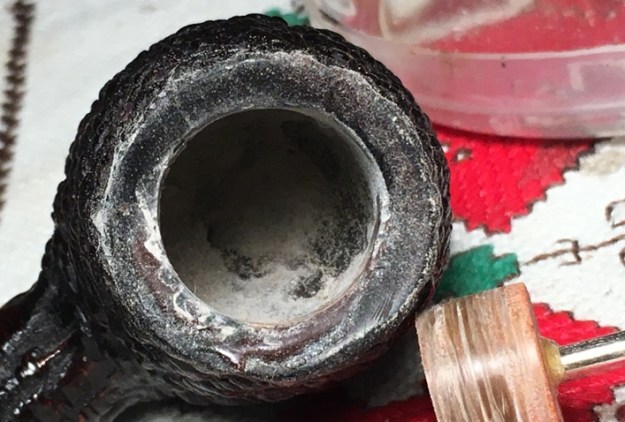
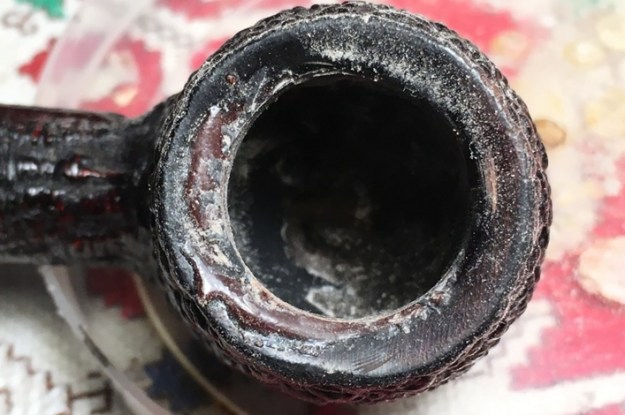
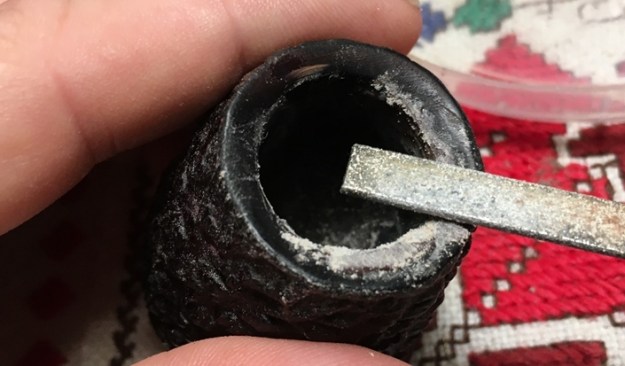
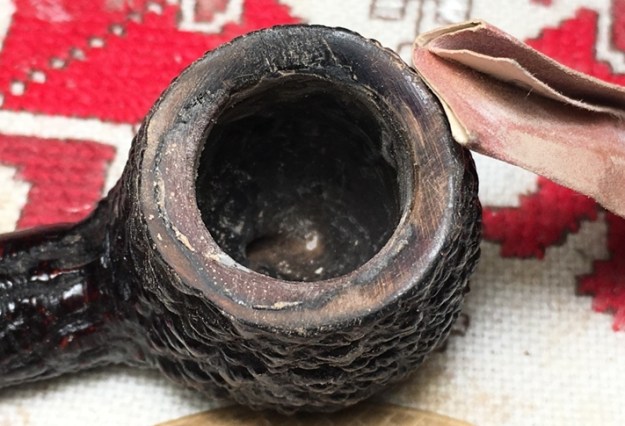
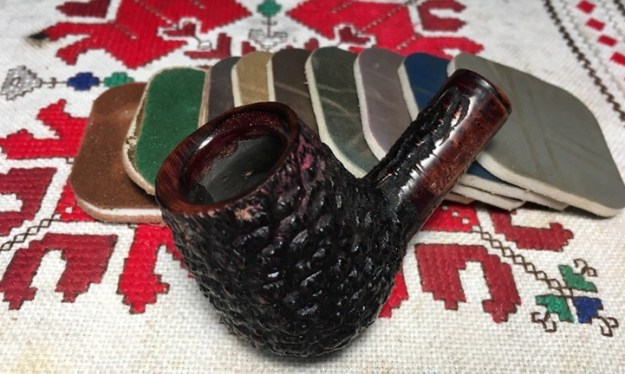
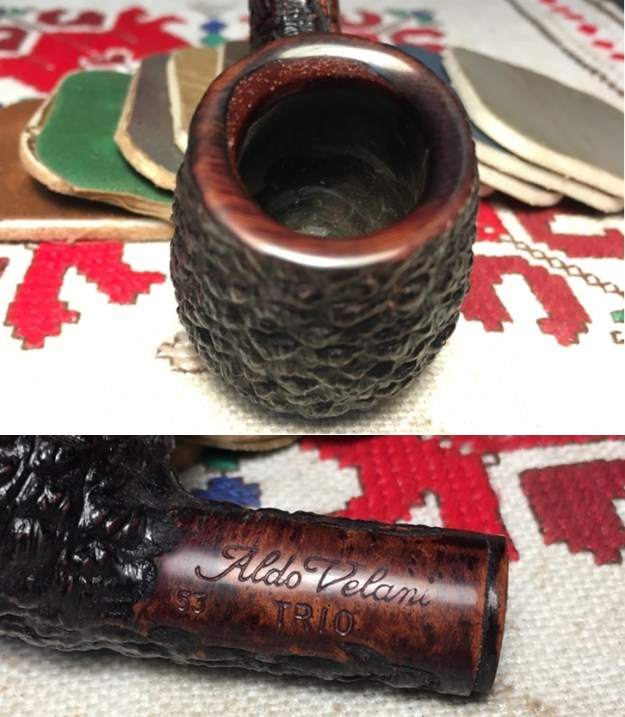
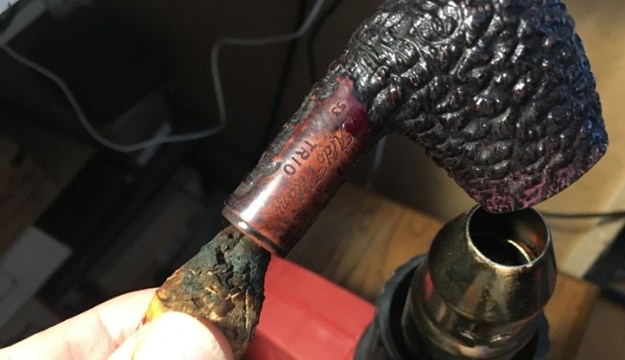
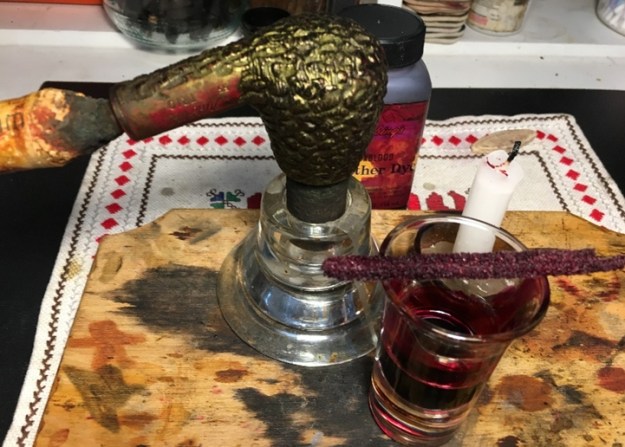
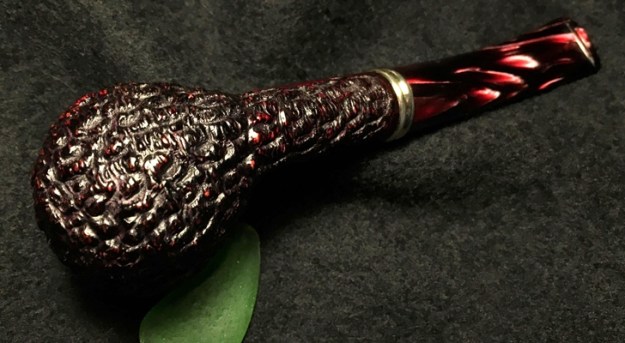
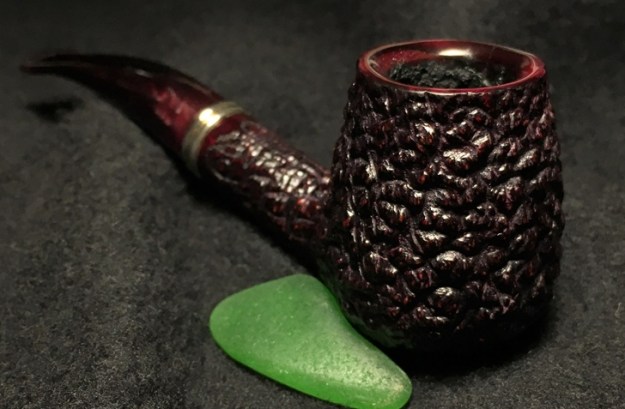
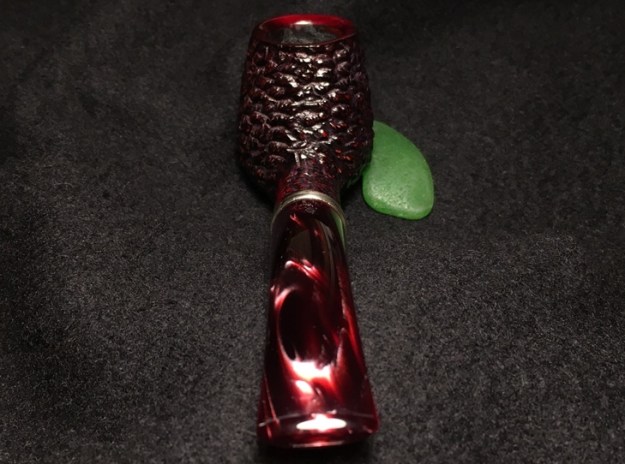
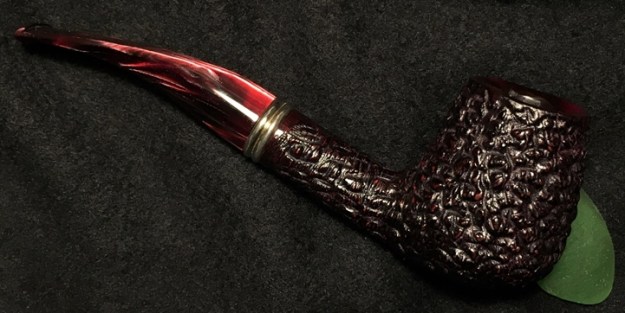
Oh my.  This Barontini Aldo Velani Trio Rusticated Volcano is a classy pipe – I would call it a ‘dinner pipe’.  It requires a more upscale dress code!  This pipe required a lot of work – a repaired stem bit and button, a rim rebuild and a restoration of the damaged chamber.  What a difference!  The rustication is distinctive, and the Volcano shape is enhanced by the craggy rise of the bowl tightening into the summit of the smooth briar rim contrast.  Transitioning to the stem the band adds to the class and the acrylic stem is simply on fire – it’s alive and the Oxblood hue of the briar is… did I say ‘classy’ already?  This Aldo Velani Trio was commissioned by Stephen and he has the first opportunity to claim him from The Pipe Steward Store.  This pipe benefits the Daughters of Bulgaria – women and girls who have been trafficked and sexually exploited. Thanks for joining me!
 

Discovering the History with the Reclamation of this Petite EPC Majestic Bent Horn Stem Billiard


Blog by Dal Stanton

This is an amazing petite now on my worktable.  I think it qualifies as a ‘pocket pipe’ because it has obviously been used and loved.  I acquired it last year from the French eBay auction block in a Lot of 50 that included some prized pipes which have already passed through my work table and are now serving new stewards.  I cannot find the EPC Majestic in this picture of the French Lot of 50, but what has been characteristic of this Lot is that there are several named pipes that I’ve never heard of before.  My assumption has been that many of these are French made since the Lot came from France.  Many of these pipes also sport very nice horn stems.  This is true also of the EPC Majestic.

Stephen saw the EPC Majestic in the For “Pipe Dreamers” Only! collection on The Pipe Steward website.  I love it when I get return pipe men looking again!  Stephen has already brought home an L. J. Peretti Bent Billiard (LINK) and now he’s commissioned the EPC Majestic as well as a newer acquisition from an antique store in St. Louis, a really nice Aldo Valeni Trio Blasted Billiard – next on my worktable.  I appreciate Stephen, even though he happens to be a cousin on my wife’s side of the family!  He’s a retired Coast Guard man and has grown in his love for and appreciation of pipes.

When he asked about the EPC Majestic, I made sure he understood that he was inquiring about a pipe with diminutive dimensions.  He assured me that this was exactly what he was looking for and I placed him in the queue.

Here are pictures that got Stephen’s attention: The dimensions of the EPC Majestic are: Length: 4 1/8 inches, Height: 1 1/2 inches, Rim width: 1 inch, Chamber width: 5/8 inches, and Chamber depth: 1 3/8 inches.  Sometimes measurements don’t translate as well to people and therefore I questioned Stephen.  For demonstrable purposes to show this very nice looking ‘Pocket Pipe’ in the natural habitat, I take a palm picture – I’m not a big man and this pipe fits fully in my palm!  My wife’s description was, ‘How cute!’The nomenclature is interesting.  On the left shank flank is stamped 3 hearts and in each heart is stamped the letters, E – P – C.  The hearted letters are over ‘MAJESTIC’.  There are no other identifying marks that I can find on the pipe.  My assumption at this point, as I mentioned above, is that this is a French made pipe, but this is only a guess at this point.

As I’ve experienced with other pipes from this Lot, EPC shows up nowhere that I see in my usual first places: Pipedia or Pipephil.eu.  I also look in other groups and threads and I can find nothing.  Expanding the search, I put in ‘EPC Majestic’ in Google and came up with an interesting vein of information – a cigar company.  E.P. Carrillo to be exact based in Miami, Florida.  I read with interest the story of Ernesto Perez-Carrillo who was a well-known cigar manufacturer in Cuba and during the Fidel Castro era was forced to leave Cuba and settle in Miami with his family.  After much struggle, was able to restart a cigar company which is very well-known today among cigar aficionados.  Interestingly, the brand that won the 2018 Cigar of the Year Award rated the #1 cigar of 2018 by Cigar Aficionado was named, ‘Majestic’.  Yet, what does this have to do with a nomenclature on the side of a pipe’s shank?

My mind started coming up with questions – Did this the E.P. Carrillo cigar company put its name on a pipe?  Was the diminutive size of this pipe indicator of a promotional pipe of some sort?  Would a pipe be used to promote cigars?  The questions came even though they made absolutely no sense!  Every pipe man and cigar man would answer, absolutely, not!  My heart agrees 100% but my mind’s questions were not satisfied.  So, as I’ve done many times before with surprising success, I went to the contact tab of the E.P. Carrillo website and sent an email to the info@epcarrillo.com address given.  I have very little expectation that I will receive a response, especially with an email essentially asking if they ever used pipes to promote their cigars….  We’ll see!

Well, during the restoration, I received a very nice note back from Lissette Perez-Carrillo, the daughter of founder, Ernesto (pictured above with father), stating: Hi that’s very nice but we aren’t in the pipe business. Thanks for sharing.   No one is surprised by her response!

I have one more lead that came after I posted pictures in different Pipe smokers Face Book groups and Eduardo responded from Pipe Smokers of America suggesting that the EPC may be related to the Edinburgh Pipe Club.  Feeling like I’m grasping at straws, I find the EPC web site (LINK) and it’s nicely done.  I also find an information email and send off another inquiry.  Does Scotland have a stake in the EPC Majestic?

Then, the breakthrough came.  I had completed the restoration and was doing the final edit of the write-up, when I remembered the link that Eduardo had posted in the FB group, Pipe Smokers of America.  It was a link that I had seen before in my first look in Pipedia, but I missed an important clue.  The link was a simple search result of ‘Majestic’ in Pipedia.   Twenty pictures come up on the page, most of the pictures have pipes with a ‘Majestic’ nomenclature that belonged to other companies that didn’t help me.  But I missed the clue in the very first picture of a very old company symbol.  The 3 hearts with EPC.

The picture gave me the company, but at first glance, the company name given, ‘A. Pandevant & Roy’ offered no correlation to EPC.  Pipedia nor Pipephil.eu had any references for a direct search of Pandevant & Roy.  When I broadened the search on the internet, I hit pay dirt.   The search took me to a Dutch site called, ‘PKN Society for Research of Historical Tobacco Pipes’ (link) which contained many old catalogues dating back to the 1800s when ‘Clay’ was king in the pipe world. Of special interest to me were two catalogues of the ‘A. Pandevant & Roy’ company.  The catalogues were in French, so it took some time to work through the text – Google Translate was employed!

The catalogues were in PDF format and the pages turned easily to scan the product lines of pipes and other paraphernalia for sale.  I first looked through the first catalogue dated 1922 to 1923.  I perused the pages and still was not able to put together the nomenclature – EPC, though I was seeing EPC in several places.  I went back to the front cover of the catalogue and looked again to see if I could piece together EPC.  I think the cover is interesting and has a classic feel, so I included it below.  As I study the cover again, I noticed that there were actually two Pandevants represented – the more prominent was “A.”, but just above “A.”, the less prominent, “E. Pandevant” was present.  I’m theorizing that “A.” is still living and currently (1920s) is running the company with “Roy”.  However, the founder of the company was the father, “E.”, probably now deceased.  The theory sounds good, but not only good, but plausible!

This gives me a credible EP, but what about ‘C’?  Then I see it – ‘Charenton’ near Paris.  I did a quick search of the French district of Charenton and discovered that there are many places in France bearing this name and the ‘Pres Paris’ – near Paris, would be a marker regarding which Charenton was the former base of operations for the A. Pandevant & Roy Co.  The cover also says that “E.P.C.”, “La Savoyarde”, “MAJESTIC”, “La Parisienne” and “E.P.” were registered trademarks of the company.  At the top of the cover, it states that this ‘House was founded in 1884’ – when clay pipes were the predominant medium of pipe smoking.  Curious to see, I used Google Maps to search the address, 29, Avenue du Marché, Charenton (Seine), Paris, and discover that the street and address have passed into history.  The pages in the catalogue were interesting to peruse.  I discover that horn is a predominant stem material displayed in the catalogue, though there are vulcanite varieties, there are just not as many.  Of course, I look for the petite EPC Majestic and I do find pipes very close to the Petite.  Notice on the page included below – the stems are all depicted as horn.  Depicted also is the brass shank cap receiving each of the horn stems.  It would seem the pipe on my table belongs to this era of production of the A Pandevant & Roy Co. I did find these this example below of a petite – the nomenclature isn’t exactly the same with the three hearts, but I wanted to include this just in case the petite on my table has one of these names, ‘My Little Jeannette’ or ‘My Little Mariette’!   I love it.The later catalogue dated 1937-39, gives some additional information.  The first thing I see is that the address has changed – the same street number, 29, but the street was changed to, 29, Avenue Anatole-France Charenton Seine.  This time Google Maps found the address – it is now an apartment complex on a residential street.  With this later catalogue, pipes took more of a backseat to the other paraphernalia – not starting until page 24!  The assortment was less than the former catalogue and few pipes that could possibly resemble the EPC Majestic in my possession.  1939, the date of this catalogue, is the last entry I could find anywhere for the A. Pandevant & Roy Co.  What was happening in 1939 could be a clue to understanding the fate of the A. Pandevant & Roy Co.   From ‘The People in History’:

1939 Germany and the Soviet Union attacked Poland and Britain, France, India, Australia and new Zealand declared war on Germany on September 3rd , the United States decided to remain neutral but did begin rearming for war , which helped end the great depression. The United States also hosted the Worlds Fair in New York early in the year. Also, after speaking to the physicist Albert Einstein president Roosevelt initiated the Americas A-Bomb programme. 

Perhaps, one of the tolls of World War II was also the French company in Paris that produced the EPC Majestic now on my table.  My research will stop here and with a greater sense of the history and heritage of this EPC Majestic Petite Horn Stem Billiard before me, I look more closely at the pipe itself, I discover something very interesting that I haven’t seen before and is reminiscent of a Gourd Calabash.  I’m looking more closely at the horn stem and that it was fashioned with what appears to be a horn tenon as well. I don’t know if its threaded or glued in place, but it is solid, and I’m not interested in forcing the tenon to discover if it will be moved! I then look at the shank and wonder if the brass band/shank cap will come off.  I give a little twist of pressure and it comes off easily.  What I see next surprises me.  I see the briar shank ringing something else inserted into to the mortise.  A lining of some sort.  I discover then that it appears to be cork.  Cork seats the horn tenon in the mortise much like cork seats the Meerschaum bowl on a Gourd Calabash. I have never seen this before, but it seems to work quite well.  I will condition the cork with a little petroleum jelly later.  The challenge becomes protecting the cork while I’m cleaning the rest of the stummel internals. I’m not sure that I want the cork saturated with alcohol – I’m not sure that will be the best thing.The bit of the horn stem appears to be chewed some.  On both the upper and lower bit there are bite compressions and chatter.The EPC Majestic bowl has seen better days.  There are four large fills on the heel of the stummel that will need addressing.  The finish on the bowl has seen better days.  There is a ‘water mark’ line running perfectly straight, bisecting the stummel.  It appears that the stummel was half submerged in some liquid for a time – enough time to discolor the stummel. The rim is nicked and has some lava flow needing to be cleaned.  The chamber has light cake but needs freshening.  The general condition of the pipe is banged up and dirty.I begin the clean up of the stummel by reaming the chamber using the Pipnet Reaming kit. I use only the smallest blade head and it is too large to reach to the chamber floor.  I switch to using the Savinelli Fitsall tool to continue the job and it does well scraping and cleaning the chamber walls down to the floor.  I then sand the chamber using 240 grade paper wrapped around a Sharpie Pen to give leverage.  This cleans the chamber further of carbon and then I wipe the chamber with a cotton pad wetted with isopropyl 95% to remove the carbon dust.  After looking at the cleaned chamber, I detect no problems with heating – fissures, etc.  Moving on!To clean the external briar surface, I use undiluted Murphy’s Oil soap and a cotton pad. I’m anxious to see how or if the stummel cleans up!  It does clean up, but the finish is very thin.  The rim cleans up nicely with the help of a brass wire brush except for one area on the right-hand side from lighting the tobacco.  After scrubbing the stummel, I rinse it with cool tap water careful to keep water out of the internals.  With the stummel wet, I use a sharp dental probe to test the large fills on the heel of the stummel.  As I suspected, they are soft, and I remove them with the probe and clean the holes to make sure all the old fill was gone.  The pictures show the progress. Next, I work on cleaning the internals of the stummel.  Using cotton buds and pipe cleaners dipped in isopropyl 95% I go to work.  With the cork lining in the mortise, I reach beyond it as much as possible to clean.  The drilling of the small stummel has the primary larger mortise drilling first, then a more angled airway drilling from the mortise to the draft hole.  A trap of sorts is created and the end of the mortise because of the drilling.  It cleans up well.  With the cork lining I will not be utilizing a kosher salt and alcohol soak, so I press through cleaning with buds and pipe cleaners.  I also use a dental spatula to scrape in the mortise, but things are clean.  Well, I finish the cleaning and toss the evidence before taking a picture!  Oh well, moving on!

Next, I look more closely at the stummel.  I refill the holes now using a briar dust and CA glue putty mixture.  I first wipe the stummel with alcohol to clean the area.  I then put a small amount of briar dust on an index card and mix CA glue with it gradually until it thickens to a molasses-like thickness.  Then I use a tooth pick to trowel the putty to the holes and fill them. After tamping the patches, I set the stummel aside for a time to allow the briar dust putty to cure. With the stummel on the sidelines, I start work on the bent horn stem.  I first clean it with Murphy’s Oil soap and a bristled tooth brush to rid the porous horn surface of grime.  After I scrub it well, I rinse it off with water to rinse the soap.  It looks much better. Then I clean the internal airway with a few pipe cleaners wetted with isopropyl 95%.  It didn’t take too much effort.There is tooth chatter on the upper and lower bit.  I also see some bite compressions on the lower.  I sand the area with 240 grit paper.After sanding the upper and lower bit with 240 grit paper, there remains 2 small compressions on the bit and one on the button lip.  The lower has major bites that need filling. I purchased an amber CA glue last time I was in the US and this is the first opportunity to use it.  I apply drops to the upper bit in the 3 places and on the lower.  I’m hopeful that the amber CA glue will result in a blended patch.With the stem patches curing, I turn back to the stummel and the briar putty fills have cured.  I file the patches down with a flat needle file close to the briar surface. I’m careful to stay over the patch as I file to avoid scratching the adjoining briar. Then, switching to 240 grade paper, I sand the patches down to the briar surface.I condition the cork lining in the mortise and to do this, I swab some petroleum jelly over it using a cotton bud.  This will moisten the cork keeping it from drying out.  The Amber CA glue used to patch the horn stem has cured and I use a flat needle file and 240 grit sanding paper to work on the patches.  The smaller patches on the upper bit are dispatched easily with 240 grade paper.  On the lower repair, I first use the flat needle file to shape the button and reduce the patch.  I then finish it with 240 grit paper. Next, I wet sand the horn stem using 600 grade paper.Straight away, I then apply micromesh from 1500 to 12000.  I first wet sand using pads 1500 to 2400 and then dry sand with pads 3200 to 4000 and 6000 to 12000.  I apply a coat of Obsidian Oil after each set of three pads – the horn drinks up the oil and it looks great. I put the stem aside to absorb the oil and dry. Turning again to the stummel, I first use sanding sponges from coarse to light weight to address the scratches and nicks in the stummel surface.  I also sponge sand the rim and it looks good except for a small area of residual scorching on the inner rim lip. To clean the inner rim of the scorching I introduce a light bevel using 240 grit paper rolled tightly.  I pinch the roll between my thumb and the inner lip of the rim and rotate around the rim.  I then do the same with 600 grade paper.  I’m satisfied with the progress.Next, I sand the stummel with the full regimen of micromesh pads, 1500 to 12000.  First, I wet sand with pads 1500 to 2400, then dry sand with pads 3200 to 4000 and 6000 to 12000.  The grain really emerges during this sanding phase.  I believe the original hue on this EPC Majestic stummel was a darker brown.  I say this because the color of the stummel underneath the brass shank plate/band was darker – it was protected.  A darker hue suits better too, to help blend the briar dust patches on the heal of the stummel.  I elect to go with a Fiebing’s Dark Brown Leather Dye to darken the stummel.  I assemble all the desk top components of my staining process.  I first wipe the bowl down with a cotton pad wetted with alcohol to clean it.  I then fit the shank with a cork to serve as a handle.  I warm the stummel with the hot air gun to expand the briar to help it be more receptive to the dye.  Then, I amply apply the Dark Brown aniline dye using a folded over pipe cleaner.  As I paint a portion of the stummel with the dye I ‘fire’ it, by igniting the dye with a lit candle and it combust the alcohol in the dye and sets the dye pigment.  When the surface is covered, I set the stummel aside to rest through the night. The next morning, I mount a felt buffing wheel to the Dremel, lower the speed to the slowest possible, and ‘unwrap’ the ‘fired’ crust with Tripoli compound.  The grain contrast that begins to bleed out is striking.  After applying the Tripoli compound to the stummel, I mount a cotton cloth buffing wheel and go over the stummel again with Tripoli after increasing the speed of the Dremel to about 40% full power.  This helps sharpen the grain, removing blotches of dye and reaching into the crook of the shank bend that was difficult to reach with the felt wheel.  After completing the Tripoli compound application, I wipe the stummel with a cotton pad wetted with alcohol to lighten the finish a bit and to blend the newly dyed surface.  I then mount another cotton cloth buffing wheel to the Dremel, maintain the same speed and apply Blue Diamond compound to the horn stem and stummel.The brass shank cap/band is next on my sites. I wash it with warm tap water and soap and rinse it well and dry it.  Then I apply a little of the TarnX liquid to a cotton pad and wipe it on the brass shank cap to clean it.  Afterwards I rinse the shank cap and what a difference! I replace the cap on the shank with a small drop of thick CA glue to hold it solidly in place.  It looks great.Now the home stretch.  With the shank cap cleaned, polished and replaced, I rejoin the horn stem with the petite Bent Billiard stummel and wipe the pipe with a felt cloth to make sure the compound dust is removed before applying wax. I then mount another cotton cloth wheel and apply some coats of carnauba wax to the entire pipe.  I finish by giving the pipe a rigorous rubbing with a microfiber cloth to raise the shine.

Well, this petite EPC Majestic Bent Horn Stem Billiard had a mysterious origin that is now much clearer.  I have not heard from the Edinburgh Pipe Club regarding my inquiry – I hope they don’t think me a loon!  The Miami-based Cigar company, E.P. Carrillo does not own this pipe.  It was manufactured by the A. Pandevant & Roy Co., at 29, Avenue du Marché, Charenton (Seine), Paris.  My guess is that this pipe is dated in the 1920s because of the preponderance of similarities to the pipes in the 1922-23 catalogue.  I believe the latest dating, if my theory holds, would be with the commencement with World War II and the eventual Nazi occupation of Paris and France.

Yet, all told, this small pocket pipe is a superbly fashioned pipe.  It’s so small one might think it is toy-like.  It IS small, but it’s the real deal – a seriously fashioned pipe.  The grain color with the dark brown dye is beautiful – the heel patches are forgotten in the dark grain swirls.  The blend of the briar, brass band and horn stem are a striking ensemble that I believe my cousin Steve will be pleased to bring home to Alabama.  He commissioned the pipe from the For “Pipe Dreamers” Only! collection and this pipe truly fits into the dreamer category.  Not only is it a beautiful pipe but the research reveals that it is a collectible as well.  Since Stephen commissioned it, he will have the first opportunity to acquire it from The Pipe Steward Store.  This pipe benefits our work here in Bulgaria working with the Daughters of Bulgaria – women and girls who have been trafficked and sexually exploited.  Thanks for joining me!  First, before and after palm shots!
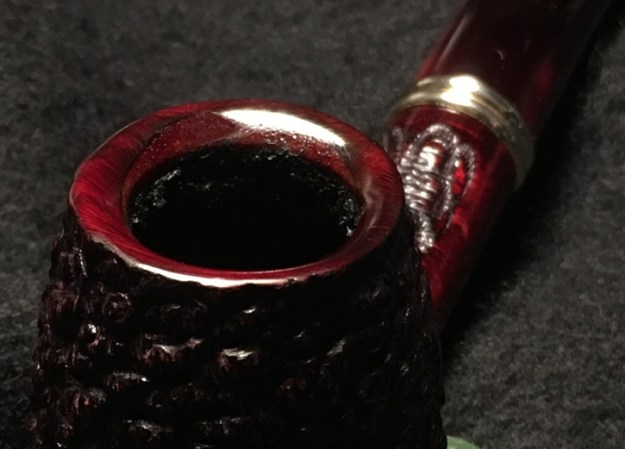
 

The Decline of Restoring Old Pipes, Part 3/4: Sir Daryl and the Golden Blueline Bakelite


Blog by Robert M. Boughton
https://www.roadrunnerpipes2k.com/
https://www.facebook.com/roadrunnerpipes/
Copyright © Reborn Pipes and the author except as noted

Once upon a time there was a man who was about to go on a long journey, and right before his departure he asked his three daughters what he should bring back to them. The oldest wanted pearls, the second, diamonds, but the third said, ‛Dear Father, I’d like to have a singing, springing lark.’ — The Brothers Grimm, Jacob and Wilhelm, from “The Singing, Springing Lark,” in Children’s and Household Tales (1815)

RECAP
Part 1 hypothesized that the discontinuation, illegality and dwindling or total unavailability of vital materials, used in antique and other very old pipes, will lead to a serious crisis in restoring these heirlooms and otherwise prized implements of contemplation to their original conditions.  My main theme was the need for those of us in the business – having considerable, moderate or little experience under our belts – to learn how to overcome these difficulties that will become more acute all too soon.  In hindsight, I should have emphasized better the need for those who now have the know-how to use their own perhaps self-discovered and unique (read proprietary) heroic measures  to cooperate in sharing them with the rest of us, as Part 4 will demonstrate without the help I would have preferred but with other expert assistance that is very much appreciated.

Part 2 described the first of three such repairs I have completed, its example being a Colossus Pipe Factory (CPF) Best Make turned lion’s head meerschaum with a gold band and genuine cherry red amber stem that needed reconnecting with a new bone screw tenon.  Five years after I began searching for the one part, I was compelled to send the otherwise restored CPF to a specialized repair service that may have been the only place capable at the time to affect the rehabilitation, for lack of a proper bone screw tenon or anyone to whom I could turn for instruction on how to repair the damage to the inner shank.  Now I know the necessary work was relatively minor.  Having determined the approximate technique used to repair my CPF, I will share the knowledge with anyone who cares to read the next and final installment, in which I mend a more damaged meerschaum shank and re-stem the pipe.

SIR DARYL AND THE GOLDEN BLUELINE BAKELITE
Once upon a time, in the sixteenth year of the third millennium, there lived a young man who dwelt in the center of a place of medium size.  When it was founded by Spaniards three centuries earlier the sage brush- and tumbleweed-blown burg was a dukedom known as Alburquerque, with two r’s, named in honor of a now long-forgotten duke of the proud nation that settled it.  But long before our tale began, the name was shortened, probably because of common misspelling, to Albuquerque, with only one r.

At the time the events of this account began to unfold, more than half of the almost one million souls who called the Land of Enchantment home tried to get along in its fast-growing and biggest metropolis, but perhaps lacked faith in the higher powers.  Gun-related deaths and evils in general were far above average compared to the other 49 quasi-independent lands of the constitutional federal republic they composed.  This was before Puerto Rico, Guam, the Virgin Islands and Panama were granted the same status, although they did not ask for it, and despite the attempts of Texas, Hawaii and California to rule themselves   Most of the people still believed they were part of a true democracy, which of course does not exist.

The young man, whom we will call Sir Daryl, had a high-tech job that his life in general and education and training in particular had prepared him to perform with the greatest skill.  He also enjoyed his work, as much as any man likes the chronic rising from bed day in and day out and spending long hours away from home and friends, so that was a good thing.

But Sir Daryl’s real love in life was going on quests for beautiful and rare tobacco pipes that were bestowed with magical powers.  Sir Daryl’s keen eyes and a preternatural knack for recognizing the magic when he saw it aided him in his never-ending search.  Even when he traveled for business purposes, without fail he seemed able to sniff out the rare and hidden examples of the craft that awaited him   All of the precious shapes and styles he discovered in this fashion were his for the taking at prices so low he could not bring himself to turn them down.  Sometimes Sir Daryl wondered at his aura of luck in locating the treasures but did not spend much time fretting over his ostensible good fortune.  As his tastes grew more refined, which such appetites always arouse, Sir Daryl turned to antiques.

Unaware that his friends were beginning to notice the signs of a peculiar spell that was known to afflict many pipe collectors of his period, before counter-spells were found to eliminate the problem, Sir Daryl became obsessed with the thrill of the chase and ultimate liberation of these fine prizes from their previous, unworthy guardians.  And they were much admired by all who beheld them

One of Sir Daryl’s most splendid finds was crafted by the renowned house of Kaufman Brothers & Bondy and given the enticing name Blueline Bakelite, the creation of which he was able, with his considerable fact finding skills, to pinpoint to the second year of the second decade of the twentieth century.

Alas!  Sir Daryl so wanted to savor the gold-banded billiard beauty that he took it with him to his weekly informal pipe get-together early one Friday evening, still in the box in which it arrived with the day’s mail.  He settled back in the cushioned chair that had his name on it and prepared a bowl with an excellent Virginia Perique concocted with miraculous properties that made his body seem weightless and his mind travel to far-off places, not all of which he had ever seen outside of these visions.

With the slowest possible deliberation, Sir Daryl struck a wooden match and kindled the top layer of the divine amalgam in expectation of an ethereal treat, Almost immediately, his typical serene and content composure twisted into a spasm of intense revulsion apparent to his friends all about the low, round table where everyone had set out tins and other glorious, colorful containers with concoctions from around the globe that group custom made free for the trying.  Sir Daryl began to retch and reached for a tissue paper to spat out the evil spell that began its sorcery in his mouth and thence to wind an insidious path into his throat.  With the greatest of luck that was his hallmark, Sir Daryl cast out the vile spirit.

Being a naturally kind, trusting soul, the only mistake Sir Daryl made was in believing the minion who sold him the pipe with the false claim that it had been cleansed of all evil.  As Sir Daryl’s breath returned with the color in his face, one of his peers, who sat closest to him in another deep cushioned chair to his right, happened to be gifted with the power of perception.  Suspecting the foul truth of the matter, the wise aficionado asked if dottle was the problem.

Still unable to speak in a clear voice, Sir Daryl handed his newest prize to the other man, one of several Restorers present round the small table, and sipped from a bottle of mineral water, the better to wash away the diminishing remnants of old leaf and other substances too frightful to mention in this story conceived for young, impressionable children.

The Restorer scrutinized the various parts of the instrument and offered his services to Sir Daryl, for a modest fee, of course, and a deal was struck.  The trustworthy Restorer said with his natural sense of fidelity that he would return the treasured and still un-tested Blueline Bakelite the next day.  Little did he then know of the otherworldly obstacles that would befall him, beginning later that very night.

Enchantment, as a point of interest and special significance, concerns the subjection to or bewitchment by magical influences.  Some enchantments are made for good – and others not.

 THE RESTORER TELLS OF HIS ODYSSEY, IN HIS OWN UNCOUTH VOICE
Thank you, Omniscient Narrator, for that lovely, florid introduction, and for providing the most charming and flattering title you could come up with for my chapter in some other hero’s tale.  I don’t mean to be rude, but I must set a couple of facts straight, if only for the sake of dispelling that whole fidelity thing you pinned on me.

For one thing, I didn’t “offer” my services, it was more like begging Sir Daryl to grant me the honor of taking his beautiful but badly marred and filthy 1911 billiard – yes, that’s the year our Narrator meant to say in his own rather prosaic, ho-hum way –home with me.  I asked whether he wanted the final stain to adhere to the original dark brown or be lighter and was not surprised when he opted for the former. Anyone with eyes will see the KB&B was messed up outside from the shots of it I snapped as soon as I was home, which I’ll dig up some place and show in a minute.  As far as its innards go, I know more than I really needed to about that because I just had to see what Sir Daryl’s little fit was all about and later tried it in private with some of the cherriest aromatic there is.  The consequence indeed was every bit as nasty as my friend Sir Daryl let on!

Daryl in the chair with his name on it

And enough with your Sir Daryl nonsense.  He’s just a man like I am, and his name is Daryl Loomis.  Even if I didn’t know him for going on five years now, I should know his real name because he’s bought about nine pipes from me, and that’s by far the record for one person.  I suppose, based on what you said about his taste in pipes and all, this must mean I sell some pretty good ones, although I admit I never let an antique go to Daryl or anyone else.

One last thing: if I had known what was going to happen in the middle of the night, I never would have accepted the $25 Daryl paid me in advance.  Come to think of it, I would not have taken the unique pipe at all.  Then again, maybe if I had the power to see back and forth and all over Time like a certain Narrator, I suppose I would have just avoided the whole mess in the first place.  I’ve always hated trippy thoughts like that.  At any rate, at least then you wouldn’t have this grand fable to tell, would you, big guy?  And forget about any singing, springing larks popping up!  Quite the opposite is in store, in fact.  I’ll bet the old codger of a Narrator ends up claiming he knew that all along and only meant it as foreshadowing.

Anyway, I found the shots I snapped, and here are the first of them. When held to the light, as I did and will prove in good time, the Bakelite stem is remarkable in its similarity to genuine cherry red amber.  That is a seeming contradiction in terms, I’m aware, as the word amber, from the Latin and Greek origins, means orange. However, the actual stem material is a synthesis of phenol and formaldehyde resins made in a process of intense heat and pressure known as thermosetting.  The first synthetic plastic, Bakelite provided a cheaper alternative, when amber was the rage, that was difficult to differentiate from the real thing with the naked eye and was therefore popular in the manufacture of pipes during the early 20th century.

Other than the need for a serious cleaning and retorting of the inner pipe, Daryl’s Blueline Bakelite had inexplicable dark black blotches on the left middle and right rear sides of the bowl.  I never determined the cause of the stains, as I ended up having no better option to choose as the source of the marks, but there were two I ruled out: scorching with long-inflicted match or lighter flames and burnouts.  Scorches would have come out much easier than these deep flaws, and burnouts never would have cleared up.  There was also the telltale damage to the chamber that was not present.  By the way, the restoration process will be shown in a time lapse style rather than my usual frame by frame style.

The following photos were taken after a preliminary Everclear soak, during which the band came off.  I followed that with a light sanding using 600-grit paper. I reattached the band with Super Glue.  A whole lot of sanding later, starting with 150-grit paper and working back up to 800, succeeded in eliminating the blotch on the left shank, but a specter remained on the right.  A terrible slope, lacking a better word, on the right side of the rim is also apparent now for the first time in the photos I took after the scar on the left was eliminated with considerable work.  But that would have to wait to be righted. I know this was cockeyed thinking, but I wanted to see if staining would cover the spot on the right of the bowl rather than continuing to abrade the wood.  I used Lincoln Brown aniline stain, flamed it with a Bic and micro meshed to the correct shade.  Obviously, the attempt failed.I had worked on the pipe from roughly 8 p.m. the previous night, after returning from my pipe get together, and it was sometime around 4 a.m. Saturday.  True enough, I could have used a break for sleep, but I don’t blame the unthinkable calamity that happened next on my own fatigue.  Although I accept full responsibility for what followed by the simple fact that the rare and precious pipe was in my custody, and would even be happy to blame myself for some error, that was not the cause of the awful event that occurred without warning.

As I had done many times, with the same great care and patience, I unscrewed the stem from the bone tenon.  There was no resistance, no mis-threading, nothing whatsoever wrong – until the sickening sound and feel of bone that was, one second, solid, and the next, several disjointed pieces that didn’t even fit together and more or less pulp left in the shank and stem.  And the infernal softness of the sound it made when it shattered, not a snap, crackle or even a pop, but as closely as I can describe it, like the effortless breaking between a pinkie and a ring finger of the softest piece of chalk.  There I was, exhausted as I readily admit, with the bone tenon broken and crushed in my hands, the remnants scattered on the floor in bits and fine powder. Almost three years after the pipe restoration went all the way south (and I’m sure everyone knows the figurative distance and final destination I’m suggesting), I still remember most how the unimaginable tragedy lacked any definitive sound.  I know now that the bone material had passed its life expectancy long before and might have failed at any moment.  In hindsight, I am grateful it happened to me rather than Daryl.

Here is the ghastly reality my numb mind had not even processed yet as I saved the horror for the record, by pure dazed habit, after frantically trying to graft the three tangible splinters of the tenon together with Super Glue.  Note the Frankensteinian product of my mad attempt at surgery on the tenon and the perfect evenness of the fault line leading to a total impaction of the stem hole.I tried my best to sleep and, late in the morning when I got up, considered the remains, my hope to find I had dreamed the whole fiasco obliterated with less noise than the plan-changing event a few hours before.  I decided to put the stem aside for the time being.  Why tempt further catastrophe when such things have a way of finding us, like the only two certainties in life of which Christopher Bullock seems to be the first person to warn us, in his 1716 farce, The Cobler of Preston.

Instead, I turned to the mangled rim and working with a double-sided 150/180-grit sanding pad painstakingly returned it to full health. When I was finished with the rim, it was looking good.  I even managed to give it a slight inward slant before reaming and sanding the chamber smooth.Other than the missing tenon, everything was beginning to look up again.  Outside was warm and sunny, bare wisps of clouds here and there in the blue sky.  When the other incomprehensible disaster struck, I felt like a lightning rod on an old barn swaying and creaking in the storm of the century.

This time, no ifs ands or buts, it was my fault despite the inherent danger of meddling with Bakelite or any other synthetic plastic.  I had no trouble with some dental tools I somehow got my hands on, wheedling out a chunk of packed bone here and another there from the shank, and the mother lode popped out nice and easy   Then it was the stem’s turn, and it was ornery.  I just started to make a decent dent on the harder bone inside the tiny stem hole when I just plain blew it.  I heard it that time, the crack amplified by my ears the way a bolt from Zeus struck the railroad tracks a few yards from me as I walked home from work in Granby, Colorado just before my 21st birthday.  I was watching the storm coming closer and saw nature’s electricity hit the rails.  That flash up in the Rockies made me jump a foot in the air, but the explosive soundwave a heartbeat later sent me flying across U.S. Hwy. 40, forget about the non-stop two-way traffic between the Berthoud and Rabbit Ears Passes..

Once again, in the frenzy of emotions over my double-destruction debacle starting with the bone tenon and then the stem, I hastened to glue the two pieces of the stem together before taking pictures.  The first was while the glue was still setting, the second after I micro meshed off the excess glue and to show the great color as well as how closely the small piece fit into the big, and the third just for the sake of showing the end view.Regardless of my initial frazzled audacity to think I might be able to right this wrong, my sense of morality is intact enough that I know I would have rejected the notion of passing off the fatally flawed stem as undamaged no matter how seamless the result may have been, but I was still relieved to have any temptation removed.

The star-crossed shadow that came to lurk around every corner began to seem a curse.  Since the day I restored my first pipe, until then the thought of giving up the whole endeavor for good never occurred to me.  At that lowest point of all my work reclaiming old and worn estate pipes, to crib from Steve’s site motto, I came a breath away from scattering all of it with my arms and hands to the walls about me or wherever else they might crash and shatter – the remains of the KB&B, dozens of other pipes awaiting my attention and every tool I had acquired, all of which I didn’t yet know was soon to be stolen from me anyway.  But that’s a different story I’ll tell when I’m ready.  This was in the spring of 2016, when my life in general was, to me, dangerously pointless.  I considered selling what I could and scraping together everything I had to find Daryl a suitable replacement.  That was really all I cared about, but it was enough.

I am well aware that some readers of my blogs view my style of writing as feigned or, a little worse, contrived.  My unorthodox approach to blogging pipe restorations doesn’t help, and my habit of falling into literary mimicry now and then may annoy many of the more experienced contributors to this forum.  That’s just not how I approach any writing project, which happens to be with the same imagination and enthusiasm I try to put into the actual pipe work.  I needed a year from the completion of this particular trial merely to face the unpleasant truths of the experience and find the words to describe it, however fanciful they may strike some folks.

But I did finish the job, although it took two years and the unwavering patience of my friend Daryl to be done with it.  In that respect, the Narrator’s appellation of Sir Daryl is well warranted.   Now I can finally let everyone know something that’s been on my mind for too long: anyone who doesn’t buy the bald self-analysis of my strengths and weaknesses I just finished sharing once and for all can believes what he will and sod off.  I’m not going away, and this is for the rest of you, who hopefully know who you are and that I appreciate the encouragement.

With more time to work on the pipe afforded to me by the unhappy but, for Daryl, fortunate destruction of the tenon if not the stem while both were my responsibility to replace, I was able to eradicate the mark on the right side of the bowl.  The next shots show the re-staining and micro meshing to the correct original dark shade of brown.  Thanks to the intrinsic problems with Windows 10, the key shot of the right side was lost, and I only have one showing the final result after eliminating the remaining scratches from the excessive but necessary sanding used to make the black marks disappear, which I accomplished with every sanding and smoothing resource at my disposal. Desperate to get Daryl’s pipe back to him, I was willing to offer as a temporary solution my real cherry red amber stem from the CPF Best Make turned lion’s head meerschaum I restored in Part 2.  Preparing for that possibility, I straightened the amber by heating it in the oven.  The second pic shows the original Bakelite stem above the straightened amber stem, in which I had placed a bone tenon I happened to have on hand but that didn’t fit.  The length of the amber stem is a little longer, but I expected it would at least mollify Daryl.All of the events and work occurred during a relatively short period of time in 2016.  Not until two more years passed did I find Norwoods Pipe Repair, and Kenneth Norwood assured me he could replace the bone tenon and even the same color of Bakelite stem.  At last I can show the parts he returned with the pipe I sent him.  The replacement, as it turned out, was also a little longer than the original, but I was confident Daryl would be more than pleased.Only two years after taking on the task of cleaning and restoring the KB&B that had such wonderful potential, all I had to do was retort the pipe.  I did so immediately, and as the replacement parts arrived, believe it or not, the same day as our monthly pipe meeting, I was able to return the gorgeous completed pipe to its owner that night. THE END OF THE LONG JOURNEY
Thus ends our tale of the long and arduous task of the unlucky but persistent Restorer…who almost never faltered in his pursuit of Right versus Wrong.

And everyone lived, happily ever after.

THE NARRATOR’S PREVIEW OF THE FINAL ADVENTURE
The fourth and final Book in this series will tell the tale of the first venture by the heroic Restorer, since thus he clearly needs to be described, into the small and secretive world of meerschaum repairers in his quest to be of service to a Good Lady.  Anyone who has ever had dealings with this lonely coven will understand how they covet and guard above all else the alchemies they devise as theirs and theirs alone.  But our hero will reveal, for the whole world to know at long last, the wondrous knowledge he has uncovered with the aid of unanticipated paladins – in particular an Artisan of high renown who dwells in the same town as the Restorer.SOURCES
https://norwoodspiperepair.com/index.html
http://freakonomics.com/2011/02/17/quotes-uncovered-death-and-taxes/
https://rebornpipes.com/tag/kbb-kbb-pipe-history/

New Life for a Sad, Old Kriswill Bent Egg


Blog by Steve Laug

The next pipe in the queue is from a group of pipes that Paresh purchased from a rag picker in Mumbai, India. The fellow had found a large number of pipes as he was going through rubbish bins and contacted Paresh. This is a tired and worn looking Kriswill. I knew looking at it even before the stamping was checked that this was a Kriswill because there is something distinctive about the shapes. The pipe is stamped (though it is faint now from wear) Kriswill Hand Made in Denmark. The pipe was filthy and unusable. I think it was from the generation who smoked a pipe to death and then pitched it. The finish on the pipe is very dirty and the sandblast is almost worn smooth. There is a thick cake in the bowl and a lava overflow on the rim top. I can see some damage to the inner edge of the rim but because of the cake and tars it is hard to know what the inner edge looks like. The stem was broken at the tenon and there was a very strange set up keeping the pieces together. I took photos of the pipe before cleaning it. The photos give a pretty clear picture of the shape of the pipe and its general condition when I received it. At first glance I thought that the tenon was broken off in the shank but as I examined it I came to believe it was even worse. It looked like someone had glued something in the shank and Gerry-rigged a connection to the stem. The photo below shows what I saw. What is not clear in the photo was a piece of metal in the centre of the mortise area. It looked like a tube but when I tried to push air through the shank it was absolutely plugged.I was going to have to try to drill out the shank but before I did that I examined the shank and stem more closely. The stem had been hacked pretty seriously so that the diameter was not even close to the diameter of the shank. In the centre of the mortise the metal tube turned out to be a 2 inch long finishing nail. It appears that the nail was used to keep the stem in place in the shank. For what? I don’t have an answer for that as it was utterly unsmokable. Once I removed the nail with a pair of needle nose pliers I was able to blow air through the shank. It was at least clear. I used a drill bit slightly larger than the mess in the shank and carefully drilled the shank. It did not work to clear out the shank! However, it was clear what was there – it was a tube made of masking or painters tape! I took a pen knife and twisted it into the mortise and was able to pull the tube free of the shank. The last photo shows everything that had been in the shank to hold the stem in place on the shank. I could surmise from the length of the stem what I would need for a replacement stem. I went through my can of stems and found one that had the right sized tenon and was the same length and width as the broken stem. It was a saddle stem instead of a taper but I liked the look of it on the pipe. I pushed it in place and took the following photos. I would need to reduce the diameter of the saddle, bend the stem and do a general cleanup, but it was a keeper. I took a photo of the stamping on the shank to show that it reads Kriswill. Underneath it says Hand Made in Denmark but that stamping is faint and only readable in a bright light or with a lens.With the stem chosen I set it aside to work on the bowl. I really hate working on dirty pipes! I can’t say enough how much I appreciate my brother Jeff doing the lion’s share of the reaming and cleaning before I even work on pipes… It is these few that I have to clean up that make me thankful and realize how much work he does before I get them here to restore. Thanks Jeff. The bowl had a thick cake and a heavy overflow of lava. It was obviously someone’s favourite pipe.I reamed the bowl with a PipNet pipe reamer using the smallest cutting head. The bowl on these old Kriswill pipes is conical so the PipNet only goes so far down the inside. I reamed out the bowl as far as the reamer would reach and then used Savinelli Fitsall pipe knife to finish the project. I scraped the rim top with the pipe knife to remove the majority of the lava and could see that the rim edges and top were damaged with burn marks.To remove the damage to the top of the rim I topped it on a topping board with 220 grit sandpaper. I worked on it to remove the burned areas and the damage to the inner edge of the rim as much as possible. I am happy with how it turned out.I lightly beveled the inner edge of the rim with a folded piece of 220 grit sandpaper to give it a cleaner look. The look of the bowl at this point is far better than when I started the rim clean up. I will still need to polish the rim and match the stain to the shank end smooth portion. Fortunately for me this old Kriswill originally had a smooth rim top so it will look like new.I polished the topped bowl rim with 3200-12000 grit micromesh sanding pads. With each successive grit of micromesh the grain stood out more and gave a good finished look to the pipe. I liked what I saw when I looked at it. There was a little variation in stain colour between the rim top and the shank end so I decided to stain both to get a good blend. I used an Oak stain pen to match the colour of the shank and smooth spot where the stamping was. Once the stain had cured for that time I moved on to the next step in the process.It dawned on me at this point that I had been so intent on getting the plug out of the shank and topping the bowl that I forgot to clean out the shank! I normally do that right after reaming the bowl but forgot. It goes to show you that if you vary an habitual pattern even a bit you will leave steps out. I stopped the process and went back and cleaned out the shank and airway to the bowl with pipe cleaners, cotton swabs and isopropyl alcohol until the pipe was clean and smelled fresh.With the rim top and bowl polished and the shank and airway CLEAN, I worked some Before & After Restoration Balm into the surface of the briar with my fingertips to clean, enliven and protect it. I let the balm sit for a little while and then buffed with a cotton cloth to raise the shine. The following photos show the bowl at this point in the restoration process. The bowl and the rim top look really good and the darkening and lava are gone. The finish looks very good with the contrast between the rich, dark brown and the Oak stain on the rim and shank end. I am very happy with the results. With the bowl finished I set it aside and turned my attention to the stem. I used a file and a folded piece of 220 grit sandpaper to shape the diameter of the saddle portion of the stem to fit the diameter of the shank. It took a lot of filing and sanding to get it to this point but there is a lot of fine tuning work to do. The shank is not round but it is more of a vertical oval in shape so the stem will need to match it to have a seamless fit. It is a lot of hand shaping work to get the two to match. I sanded the scratches and the tooth marks on the stem with 220 grit sandpaper to bring the shank and saddle portion into line. I further sanded and shape it with 400 grit sandpaper to remove the scratches. This is the beginning of the polishing process on the stem. I wiped the stem down with Obsidian Oil and put it back in the shank to take progress photos. I polished the stem with micromesh sanding pads – wet sanding it with 1500-2400 grit pads and dry sanding it with 3200-12000 grit pads. I wiped the stem down with Obsidian Oil after each pad. I further polished it with Before & After Pipe Polish – both Fine and Extra Fine. I gave it a final coat of Obsidian Oil and set it aside to dry. This pipe has had quite a journey to this point in time and space. It somehow traveled from Denmark where it was made to Mumbai, India. There is was found abandoned, binned and found by a rag picker who then sold it to Paresh in another region of India. From Paresh it traveled to me in Vancouver, Canada. In April it will travel to Nepal with me and back Paresh in India. I only wish that it could tell its story. All I know is that I have extended its life of usefulness and given its purpose back as it was intended.

I polished stem with Blue Diamond polish on the buffing wheel. I gave the bowl multiple coats of Conservator’s Wax and the stem multiple coats of carnauba wax. I buffed the pipe with a clean buffing pad to raise the shine. I hand buffed it with a microfiber cloth to deepen the shine. The pipe polished up pretty nicely. The contrasting grain came alive with the buffing. The rich contrasting browns and black colouring works well with the new, polished black vulcanite stem. The finished pipe is a beauty and feels great in the hand. Have a look at it with the photos below. The dimensions are Length: 5 ½ inches, Height: 2 inches, Outside diameter of the bowl: 1 inches, Chamber diameter: 5/8 of an inch. I will be taking this pipe with me to India soon and giving it back to Paresh. Thanks for walking through the restoration with me on this battered and weary Kriswill.

A Cutty Tavern Pipe – Recommissioning a Historical Classic as a Gift for a Steward of History


Blog by Dal Stanton

Tavern Pipe
By Suzie Baker

Summary and excerpts of the artist’s description:
Here the subject poses as an American Colonial man from 1776; he actually posed on Washington’s Birthday.  He has a ruddy complexion and piercing blue eyes. From my perspective, he is more interesting to paint than a golden-haired beauty.

He poses with a tavern pipe. This type of pipe was a communal pipe used in pubs in the 18th century. After each use, the pipe stem was cut away then replaced on the mantel for the next user. I chose a color scheme appropriate to the time period and drew inspiration from Rembrandt’s work in the direct gaze, dark background and loose handling of paint, especially in the clothing….

Let me first tell you the story about the commissioning of the Cutty Tavern Pipe now on my worktable and then I will tell you about the gifted artist I discovered in my research about tavern pipes, Suzie Baker, and her amazing offer to benefit the Daughters of Bulgaria with her ‘Tavern Pipe’.Living in Bulgaria, the opportunities to talk with our grown children (and growing grandchildren!) residing in the US, is a special treat.  My son, Jonathon, reached out to me on FaceTime with a special, ‘historical’ request.  Jonathon desired to commission a special ‘historical’ pipe as a gift for Andrew, a friend who was leaving his job as the assistant curator of the Dearborn Historical Museum – an American city in the state of Michigan that takes its history seriously.   Jonathon, while serving on the mayoral appointed Dearborn Historical Commission, befriended Andrew as Andrew fulfilled his duties as a curator for the museum tasked with safeguarding Dearborn’s history.

Today, Dearborn, a suburb of Detroit, is proud to be one of the most ethnically diverse cities in the world.  Yet, Dearborn’s history is predominantly shaped by the controversial industrialist and auto manufacturer, who called Dearborn his home, Henry Ford (1863-1947).

When Jonathan shared his desire to commission a pipe with some historicity as a gift for a CURATOR of a museum, and that museum was the Dearborn Historical Museum, I was anxious to rise to the challenge that that request presented.  I did a fast dictionary search on Google to see a working definition of ‘Curator’.  This is what I found:

Automobile manufacturer Henry Ford, left, and his son, Edsel, in one of their car showrooms in January 1928. (AP) from Washington Post article (link)

Curator:
a keeper or custodian of a museum or other collection.
“the curator of drawings at the National Gallery”
synonyms: custodian, keeper, conservator, guardian, caretaker, steward

I took special interest in the last word listed as a synonym of curator – ‘steward’, which speaks to my ‘Pipe Steward’ sentiments.  Understanding that we are not the owners ultimately but protecting and caring for that which belongs to others to pass it on.  I understand this as I handle pipes which are laden with their own histories revealed in the nomenclature, but often the history and legacies of that pipe’s steward(s) joins the pipe’s legacy moving together to the future.  As a curator, Andy participated in guarding history.  History by its very nature comes with a blend of beauty and goodness coalescing with ugliness and pain – each side of the pendulum is history which we guard so that we do not forget it and continue to learn from past triumphs and failures – even when it’s not comfortable.

So, the gauntlet was thrown: A Steward of History (Andrew the Curator) is celebrated for his service by the current president of the Dearborn Historical Commission (my son), who reaches out to The Pipe Steward (that’s Dal in Bulgaria) to commission a special pipe, with historical gravitas to adequately serve as an appropriate gift.  Jonathon asked for my recommendations, but relying on the Harry Potter principle in wand selection approach, I turn Jonathon loose

Keens Steakhouse reported to be the oldest pub/restaurant in NYC and that celebrates their history of clay cutty taven pipes and have a serious collection of clay pipes on display (Link from PipesMagazine.com).

looking through my virtual ‘Help Me!’ baskets in the For “Pipe Dreamers” Only! collection to discover which pipe would choose Andrew and let Jonathon know 😊.  After whittling the list down, one pipe did the choosing – the Cutty Tavern Pipe which I acquired from the Lot of 66 off the eBay auction block.  After Jonathon confirmed the commissioning, the first question that came to my mind, since I don’t know Andrew personally, was whether he is the kind of curator that enjoys a trip to the pub after a long day curating at the museum?  This was an important question for my historical research – how do you talk about Tavern Pipes without an appreciation for the natural and historical habitats from which Tavern Pipes have their genesis?  Thankfully, with a confident confirmation, Jonathan assured me that yes, Andrew would enjoy a pub.  With that settled, I began my research.

I found a short description of the Cutty shape on ThePipeGuys site to be a good summary and historical description of the Cutty Tavern Pipe.

Cutty

Tavern scene with a man smoking a pipe next to a barrel with a jug on top of it, his left foot resting on a bench. 1694 From the British Museum (Link)

There is no denying the resemblance that the Cutty bears to the clay tavern pipes of a bygone age. Delicately shaped, Cuttys typically have not an ounce of excess briar left in place. This delicacy of shaping necessitates the use of a special drill bit for the tobacco chamber, which tapers even more drastically than a Danish conical bit, and comes to a sharp point at its tip. A special honor is paid to this pipe, in that this type of conical bit is now called the “cutty bit”.

Notice, the ladies are not left out!
From Pinterist Pipe Smoker Group (link)

Many Cuttys still include the “spur” at the foot of the bowl, once again hearkening back to their clay ancestors, but while the spur of a clay pipe was the remnant of the manufacturing process, the briar versions are purely nostalgic. The bowl of the Cutty is heavily canted forward, which helps differentiate it from other long-shanked pipes like the Canadian. The Cutty may sometimes display a very unique stem, which is slim, slender, and round (almost like a straw). However, the majority of modern Cuttys now sport a tapered stem and come in many finishes.

Try simply googling ‘Cutty Tavern Pipe’ and 100s of images begin sharing different shards of the story and one feels like he’s in a time machine.  Of course, the briar descendants of the classic clay workhorse Cuttys of the 1800s and the early 1900s, claim this heritage as their own.

Elizabethans called a pipe a “little Ladell.”

TobaccoPipes.com adds this information in their ‘Complete Guide to Tobacco Pipe Shapes’:

As far as we can tell, the Cutty is the oldest pipe shape that is still available today.  

As early as the 16th century, pipe smokers would settle in at their favorite tavern and–if they had a high enough social status–would pull out a long clay pipe, almost always a Cutty shape.  This shape was common because it was easy to craft in the molds used for clay pipes (William Goldring, The Pipe Book: A History and How to:1973).  

In my digging into the Cutty clay pipe history, I discovered one very interesting and surprising article (at least to me) that a curator would appreciate.  The Colonial Williamsburg Foundation’s (Virginia, USA) website, History.org, published an article by Ivor Noël Hume entitled, “Hunting for a Little Ladle – Tobacco Pipes” (link).  The author describes how archeologist can learn much about different periods of Colonial America in Williamsburg, Virginia’s, history through the recovery of thousands of clay pipe fragments!  As we’ve already mentioned, hygienic concern is the predominant theory.  An excerpt from the author is enlightening:

There are thousands of pipe fragments found in Williamsburg. An early explanation for their ubiquity had it that in colonial-era taverns’ pipes passed from mouth to mouth, but that in the interests of hygiene the previously lip-gripped section was broken off and thrown away. There is no documentary support for that notion, but it is known that used pipes were placed in iron cradles and heat cleansed in bake ovens before being issued to the next round of smokers.

And then I came across this picture that was among 100s of others on the google ‘Tavern Pipe’ image search page results – and I paused.  I see a pipe man in an age gone by and I immediately know what he’s doing as a fellow-pipe man.  Yes, he’s smoking his beautifully shaped long Cutty Tavern Pipe, but he’s doing something else much more important – that his Cutty clay is helping him to do – reflection.  He’s looking out the window, or at the hearth with his eyes, but his heart and soul are elsewhere, seeking understanding or perhaps a much-needed answer.  It is not lost to me as well, that his waiting quill – while ready to move and inscribe on the parchment the sought-out knowledge or answer that his reflection is cultivating, is at rest.  For that moment, the quill waits for the hand’s movement from the heart’s command.

Every pipe man and woman know that smoking a pipe is more than smoking.  It’s a ritual that brings us into calm or fellowship and a slowed time for reflection as we seek to negotiate life and care for loved ones and friends.  The name of the painting I was lost in was simply ‘Tavern Pipe’.  I knew at that moment I wanted to include this painting in the writeup of this special Cutty Tavern Pipe for a special friend of my son – a museum curator would appreciate what I see.

In the next moment I was composing my email to the artist, Suzie Baker, after I clicked on the link taking me to her website where I found her contact information.  This is what I wrote:

Dear Ms. Baker,

I’m writing to you asking for permission to use the picture of your beautiful painting, Tavern Pipe, in a write up I am doing on the restoration of a briar wood Cutty Tavern Pipe.  I came across your www.suziebaker.com site while doing research on tavern pipes.  I will give full credit to your work and website when I cite the information. 

I am an artist of another kind.  You can see my website at www.ThePipeSteward.com.  I collect old, used and often discarded vintage pipes and restore them.  I then sell them world-wide and give the proceeds to the Daughters of Bulgaria – a work in Bulgaria helping women and girls who have been trafficked and sexually exploited.  My wife and I live and work in Bulgaria with the Daughters of Bulgaria.  The pipe restoration hobby is a personal way I try to make a difference by talking about this issue to primarily a men’s world – pipe smokers.  Each restoration has its own write-up which you can see at the website.  I will not use the picture of your painting without permission and if given, will, as I said, give you and your site full recognition.  As a pipe lover and one who enjoys a bowl now and then, your painting captures something of the spirit of those who enjoy, and yes, love not only the smoking of pipes, but the beauty of pipes as they showcase both beauty and design.  I call my work, The Pipe Steward, is because unlike cigarettes and cigars (which I do not like!) pipes are often heirlooms and are passed down from generation to generation.  They often carry with them the memories of those who had them before. 

Thank you for your consideration of this request. 

Best regards, 

Dal Stanton
The Pipe Steward

In the past I’ve written notes like this to individuals and pipe houses asking for information about pipes to aid research and I press the ‘send’ button with a very low expectation that this burst of electrons ever finding their way back to my inbox.  I was surprised when her reply arrived so quickly.  Here is what she said:

Hi Dal,

Thanks for the request and your service to those caught in trafficking, a daunting and worthy cause. 

Yes, I would be pleased for you to use my image in your write-up. In fact, this painting is still available so if the posting results in a sale, I will donate 25-30% of the sale back to your worthy cause. The price and details are listed on my sight in the info under the painting (as seen on a computer screen) or info tag on a Mobile device. 

I am on an airplane currently and about to take off. I can send you the image tomorrow. Please let me know what resolution you require. 

Blessings,

Suzie Baker OPA
Vice President, Oil Painters of America 


Well, as the president of the Daughters of Bulgaria Foundation, her generous offer was something I could not refuse as we work for the benefit of the Daughters.  I appreciated her response and offer.  After looking at her website, I was drawn to the “About Suzie Baker” tab – who is this person?  Not only is she an accomplished artist, wife and mother, but she recognizes that her talent is a gift and she uses this gift to give back to others – especially artists.  There’s much more on this page that describes the accomplishments of this artist who also desires to be a benefactress of women who have been trafficked and sexually exploited. Her ‘calling’ is similar to my own, as I seek to ‘give back’ specially to pipe men and women, the gift of restoring pipes that I am stewarding for a time, and at the same time, seeking to benefit the Daughters.  About Suzie Baker:

Giving Back

This artist also believes in giving back to the community of artists, and she is proud to serve as a Board Member with the Oil Painters of America. “Serving on the board with OPA is and will be a highlight of my career, primarily because of the opportunity it gives me to serve my fellow artists,” she says. “Being on the path of a working artist is a calling. I find helping others on their path a very satisfying pursuit.” She has also earned Signature Member status in numerous other prestigious art organizations: the American Impressionist Society, the

Click the picture for the Daughters!

National Oil and Acrylic Painters Society, the Laguna Plein Air Painters Association, the Outdoor Painters Society, the California Art Club, and American Women Artists.” – from Suzie Baker, Fine Artist at https://www.suziebaker.com/info/suzie

Pipe men and women, if you would like to add the ‘Tavern Pipe’ to your collection of pipes and artwork and help a good and needful cause at the same time, the Daughters of Bulgaria, click the image on the right which takes you to Suzie Baker’s site with a full description of the Tavern Pipe painting, and a higher resolution picture to view. Contact information for Suzie Baker is also included.  When you contact her, simply tell her that it’s for the Daughters.

This story has told you about the son, the curator and the artist.  Now, the story turns to the Cutty Tavern Pipe on my work table – the main character!  I was fascinated by the research I did that shed light on this unmarked Cutty.  All the before-mentioned descriptions are true of this 9-inch Cutty Tavern Pipe.  Here are pictures that show you what I’m seeing.     This pipe is the perfect gift for the curator!  One more bit of research that showcases the historical uniqueness of clay Cutty Tavern Pipes and its relations to its briar descendants.  The severely canted and uniquely shaped bowl comes to a point as it ties into the long, pencil thin shank and stem.  A very interesting diagram I discovered at CanadianArchaeology.com (link) of the National Historic Parks Branch of Canada, depicts the historical development of the clay pipe bowl and provides the corresponding dating for that particular style.  As I look at the diagram’s images and comparing them to our Cutty, it was fashioned after the clay Cuttys belonging to the period from 1820 to 1860.  The canting and the bowl width, along with the spur, now ornamental for the briar, all seem to align.  I have no way of dating the Cutty Tavern Pipe heading to Andrew, but its history and heritage wrap around it even in the absence of a verifiable nomenclature.

Armed now with a deeper and more comprehensive understanding of the Cutty Tavern Pipe on my table, I take a closer look at his condition.  The briar, somewhat subdued underneath the dirt and grime, is beautiful.  The surface itself shows that it has been well loved and used by a previous steward.  There are nicks and dents over the bowl surface as well as the shank. The pipe shows signs of wear but has been well-cared for.  I say that because, with a shank of only 7/16 inches wide at the stem joint, the fact that the shank hasn’t cracked at this very thin juncture is amazing!  A caution to the future steward, be careful with the stem mounting and removal!  The shank IS pencil thin.  Looking at the rim, there are some dents on the external lip and some significant lava flow over the backside of the rim.  The conical chamber has moderate cake build up which I will remove to provide the briar a fresh start.  The long pencil stem shows some oxidation and tooth chatter on the bit.  The button and slot look to be in good shape.To begin the restoration, using pipe cleaners dipped in isopropyl 95% and long shank brushes, I clean the internal airway of the pencil stem.  It was dirty.After soaking for several hours, I remove the stem and take a closeup shot to reveal the raised oxidation – the olive green layer is now to be removed.To remove the oxidation, I wet sand the stem using 600 grade paper.  Following the sanding, I apply a 0000-grade steel wool on the entire stem as well cleaning the surface further.  To begin the process of rejuvenating the vulcanite, I apply a mineral oil – paraffin oil, to the stem and put it aside to absorb.  It’s looking good!I begin the cleaning process of the stummel by reaming the chamber.  Because of the small, tapering chamber, I do not use my regular Pipnet Ream kit but instead go directly to using the Savinelli Fitsall tool and it does a stellar job.  It reaches very easily to the difficult areas at the floor of the chamber and negotiates well the angle of the conical bowl.  Using 240 grit paper around a Sharpie Pen, I sand the chamber to clean further the carbon cake.  Finally, I clean the carbon dust using a cotton pad wetted with isopropyl 95%.  After inspecting the chamber, I see no heating problems with cracks or fissures.  I move on. Next, to clean the external surface of the stummel I use undiluted Murphy’s Oil Soap with a cotton pad to scrub.  This does a great job.  I also utilize the straight edge of a pocket knife to gently scrape the lava crust from the rim and then use a brass wire brush to work on the burned area of the rim.  The cleaning well removes the finish on the stummel, but there remains a darkened area on the rim where there was scorching.  To complete the basic cleaning regimen, I use pipe cleaners and cotton buds to work on the internals of the mortise.  With the stem internal airway as dirty as it was, I am not surprised to find the mortise equally mucked up with tars and gunk.  After I put on surgical gloves, my first hurdle was to clear the entire airway.  The first pipe cleaners I plunged into the abyss would not push through the draft hole – something was blocking. After a few attempts, the pipe cleaner pushed old tobacco through, and it was finally cleared.  In addition to pipe cleaners and cotton buds dipped in alcohol, I use a long-wired shank brush wetted with alcohol to clean the airway.  A dental probe was also helpful reaching in and excavating the collected tars off the mortise walls.  To increase my cleaning leverage more, I use a drill bit almost the size of the airway, hand turning it as it moves up the airway, scraping the tars of the briar as it goes.  Finally, some headway is realized, and cotton buds begin to lighten.  I’m satisfied with the cleaning for now.With the workday ending, I continue the cleaning of the internals using a kosher salt and alcohol bath.  I first stretch and twist a cotton ball to form a ‘mortise wick’ that I insert into the long, narrow shank of the Cutty.  I use a slender painter’s brush to help force the cotton down the airway.  I then situate the stummel in an egg carton and fill the bowl with kosher salt.  Kosher salt doesn’t leave an aftertaste like iodized salt.  I then fill the bowl with isopropyl 95% until is surfaces over the salt.  I wait a few minutes as the alcohol recedes and then top it off.  I turn out the light to let the salt and alcohol do it job through the night. The next morning the soak has done the expected job.  The kosher salt and cotton wick are soiled after drawing out oils and tars from the internal cavity.  I empty the bowl of salt, wipe the chamber with a paper towel, use a shank brush and blow through the mortise to remove any left-over salt crystals.  To make sure the cleaning is complete, I expend a few more cotton buds and pipe cleaners and find great results. A refreshed pipe for the curator! Moving on!I look now at the rim.  With the dents I see on the outer lip and the scorched darkened briar on the inside of the rim lip, I decide to top the stummel lightly to remove most of the damage to the rim and to freshen the rim lines.  After placing 240 grade paper on a chopping board, with the stummel inverted, I rotate the stummel over the paper several times to top the stummel.  I check to make sure I’m remaining true and finish with a few more rotations. I change the paper on the board to 600 grade and rotate the inverted stummel a few more times to smooth the rim surface further following the coarser 240 grit.  Not all the darkened briar is removed, but I’m not willing to give up more of the rim’s briar.  I focus now on the internal lip of the rim and introduce a bevel to remove more of the darkened briar.  I first cut the bevel using a coarse 120 grade paper followed by 240, then 600.  With each grade of paper, I fold it into a tight roll and then pinch it against the inner rim with my thumb.  I work the rolls around the rim so at the end it is an even, consistent bevel.  I like the subtle softening of the internal bevel and it accomplishes sufficient removal of damaged briar.I move on to the stummel preparation.  As I identified above, I find some significant cuts and dents in the stummel, and especially in the narrow shank.  My guess is that the pipe was stored in a can with the stem inserted first.  The cuts in the shank look like injuries sustained as the shank rubbed against the can edge – my theory.   I take a few pictures to show this.  I decide to fully clean the briar surface and I use 240 grade sanding paper over the entire stummel followed by 470 grade paper.  I then wet sand the stummel using 600 grade paper.  The pictures show the progress. Next, I use sanding sponges to sand and smooth the surface more.  I start with a coarse sponge, then medium then finally, a light grade sponge.  The grain starts emerging during the sponge sanding process.  It looks good. While inspecting the shank afterwards, I notice the crevasse that remains in the shank.  I use a magnifying glass to take a closer look.  It doesn’t appear to be a trauma resulting in a crack but a gouge or cut.  To be on the safe side and for cosmetic reasons, after wiping the area with alcohol to clean it, I apply CA glue to it to seal it. After applying a drop of CA glue on the crevasse, I put the stummel aside giving time for the CA glue patch to cure.With the stummel on the side, I turn back to the stem and look at it again.  The tooth chatter that was evident before was fully removed during the earlier wet sanding with 600 grade paper and 0000 steel wool.  I decide to move now to the micromesh phase by first wet sanding with pads 1500 to 2400 and follow this by dry sanding with pads 3200 to 4000 and 6000 to 12000.  Between each set of 3 I apply Obsidian Oil to revitalize the vulcanite.  The pencil stem looks great! The CA glue patch applied to the crevasse on the shank has cured and is ready to be sanded down and blended.  Using 240 grit paper, I sand down the initial patch mound until it is flush with the briar surface.  Following this, I again use 600 grit paper to erase the 240 scratches and to smooth it out.  As before, I then apply each sanding sponge, starting with the coarse sponge, medium then light. I can still see the scar, but it is now sealed and smooth to the touch and blends in nicely.  A needed detour. With the repair finished, now I apply micromesh pads to the Cutty stummel.  First, I wet sand using pads 1500 to 2400.  Following I dry sand with pads 3200 to 4000 and 6000 to 12000.  The spur even gets its time in the sanding process! During the micromesh phase, I watch the grain emerge and it is beautiful, and see the Cutty bowl design more clearly.  The horizontal grain flanking both sides of the bowl run parallel with the shank.  The cant of the bowl is accented by the grain as the bowl seems to jut out with the grain.  The effect catches the eye.  Added to this is the bird’s eye grain that is on the fore and rear of the bowl.  Whoever turned this block of briar into the Cutty was insightful and could see what the lines would do with the canted Cutty angles.  The picture of the Comoy’s Blue Riband 347 Cutty below (link) has the same eye catching grain motif.  I found this picture of a Cutty as I was doing an online survey looking at the different hues that briar Cuttys come in generally.  Of course, you will find a spectrum of color from dark to light as you look at the googled image pages.  Yet, as I looked at 100s of pictures, what seemed to be resonating with me was the darker hues like the Comoy’s above depicts.  Of course, the clay Cutty is white, but the older ‘English’ classic feel was communicated more through the darker hues like this striking Comoy’s.  My decision was made, and after assembling my desktop staining tools, I mix together Fiebing’s Dark Brown Leather Dye 2 parts to 1 with Fiebing’s Saddle Tan Pro Dye in a shot glass.  After wiping the stummel with alcohol to clean it, I insert into the mortise two doubled pipe cleaners to serve as my handle.  I then heat the Cutty stummel with a hot air gun to open the briar helping it to be more receptive to the dyes.  Using a folded pipe cleaner as an applicator, I ‘wash’ parts of the stummel with the dye and then ‘flame’ it using a lit candle.  As an aniline dye, the alcohol combusts when it meets the flame and as the alcohol burns off in a ‘puff!’ it sets the dye pigment into the briar.  I methodically apply the dyes to the entire stummel flaming as I go. When thoroughly covered, I put the stummel inverted on a cork situated in a candle stick holder to rest through the night allowing the dye to settle.  I discovered that this period of resting is important as it helps guard against the newly applied stain to come off on the fingers later when the pipe is first put into service and the briar is heated for the first time.The next morning I’m ready to start ‘unwrapping’ the fired and dyed stummel.  The firing creates a crust on the surface which I initially remove with the use of a felt buffing wheel applying Tripoli compound.  I mount the felt buffing wheel onto the Dremel, set the speed at the lowest RPMs because I do not want to create too much friction and scorch the briar.I methodically work the felt wheel through the crust revealing the briar grain underneath the crust.  Throughout the process, I purge the felt wheel often as it collects the crusty fired dye.  I stage a picture (below) to show the contrast after the felt wheel applies Tripoli compound and has unwrapped a portion of the stummel revealing the stained grain beneath.  After I complete the initial unwrapping of the entire stummel, I change from a felt cloth buffing wheel to a cotton cloth wheel and increase the speed of the Dremel to 40% full power.  I then apply another round of Tripoli compound with the softer cotton wheel.  I discovered doing this after the felt wheel helps to angle in to the crook of the shank/bowl junction better, but it also removes more dye blotches revealing a sharper grain contrast.After completing the second round of Tripoli, I wipe the stummel with a cotton cloth wetted with alcohol.  This can lighten the finish if I choose to rub more aggressively but I don’t.  I’m satisfied with the color, but the wipe helps blend the finish further and remove excess dye.I follow the Tripoli compound by applying the finer Blue Diamond compound.  I mount another cotton cloth wheel to the Dremel, keep the speed at 40%, and apply the compound.  I apply it to both the stummel and the stem.  Since the stem is longer, it’s easier to keep them separated as I apply the compound.Following the Blue Diamond, another cotton cloth wheel is mounted, the speed remains the same and I apply Carnauba wax to both the stem and stummel.After completing the application of wax, I try to reunite the stem and stummel and discover that the tenon/mortise fit is too snug for comfort.  This often happens after internal cleaning and the briar is wet and that can expand it microscopically – enough that forcing the tenon into this pencil thin shank is a recipe for disaster – cracking a shank is not a fun thing to deal with! To remedy this, I wrap a piece of 600 grit paper around the tenon and sand it down until it fits more easily and snuggly.  This restoration has told an interesting story.  The Cutty Tavern Pipe looks great.  The dark brown finish and polishing regimen has resulted in a unique Cutty bowl drawing even more attention.  The Cutty Tavern Pipe’s lines are classic and harken back to a day gone by when these pipes were fashioned with clay and were held proudly by both those with means and the common man and woman who had gathered with friends to enjoy each other at the pub and a smoke.  A fitting gift for a curator of history and even more so, the commissioning of this pipe by my son, benefits the Daughters of Bulgaria – helping women and girls who have been trafficked and sexually exploited.  The unexpected turn in this story is the painting, ‘Tavern Pipe’, depicting the pipe man and his pipe – an accurate and telling image captured on canvas by the brush of a gifted artist, Suzie Baker, whose generosity is making available a percentage of the sale of this painting to the Daughters of Bulgaria.  Is there a pipe man or woman out there to bring the Tavern Pipe home benefiting the Daughters?  I hope so!  Thank you for joining me!


A Breath of Life for a Variegated Finish S&R Sitter Billiard


Blog by Steve Laug

Years ago now I met Steve and Roswitha at the Chicago Pipe Show. I cannot even remember the year but I remember having a good conversation with them. I was not able to pick up one of their pipes at that time but I was amazed at the beauty and style of pipes that the two of them were creating in their shop, Pipes & Pleasures in Columbus, Ohio. Over the years I have watched for them and even bid on a few on eBay. Sadly, I never won any of the pipes that I bid on. They all escaped my grasp. Given that you may have a sense of the surprise I had when my brother and I picked up a pipe rack and 21 pipes from a fellow in Michigan and it had an S&R billiard. I clipped a photo of the collection and circled the S&R in the photo. It is the second pipe from the right on the second shelf of the rack. It is a nice looking two toned sitter billiard – sporting both smooth panels on the sides of the bowl and an interesting sandblast finish.Jeff took some photos of the pipe when he received them to show the general condition. I have included the photos of the S&R pipe. It was dirty and worn looking. There was a thick cake in the bowl and heavy lava overflow on the rim top. The smooth panels on both sides of the bowl and the ring around the shank end have great grain that follows the grain of the sandblast next to them. The stamping is very clear and shows the interlocked SR with a pipe. The sandblast is well done and really shows the grain. It is not to deep or rugged but it is very nicely done. The stem is vulcanite and slightly oxidized. There are deep tooth marks on both sides of the stem at the button edge and some scratching on the stem surface. The photos below tell the story and give a glimpse of the saddle billiard shape. Here is a close up of the bowl and rim top. You can see the thick lava coat. It is hard to see if there is any damage on the inner or outer edge of the rim. There is a thick cake in the bowl that is hard and rough. The second photo is a close up of the right side and the flat underside of the bowl. You can see the interesting grain in the sandblast.The next photo shows the interlocked S&R stamp with the pipe. It is clear and legible.The next two photos show the scratching, oxidation and tooth marks in the stem at the button. The first photo shows the top side of the stem and the second the underside.I decided to take some time to review my knowledge of the brand. I turned to Pipedia and read the article that was included there (https://pipedia.org/wiki/S%26R_Pipes). I quote in full below:

Stephen and Roswitha Anderson of S&R Pipes, also known as S&R Woodcrafters, have become pipe makers renowned throughout the world as talented carvers of high-grade briar pipes. They have been featured in several trade publications and magazines such as Pipes and Tobaccos and PipeSmoker, and have several pieces on display in museums in Europe and the United States.

They are the first American pipe carvers honored with induction into the Conferee of Pipe Makers of St. Claude, France; the very place where the carving of briar pipes became a world-wide industry. Sadly, Steve passed away in March of 2009. Roswitha is still carving S&R pipes and carrying on with the shop with help from her “guys” David, Marty, and Tony.

Steve and Roswitha began carving pipes in the 1960’s. They travelled to pipe shows and arts and crafts shows throughout the country and Europe selling their pipes and built up quite an extensive loyal customer base. Eventually, it became time to offer their pipes to the retail fraternity of pipe smokers.

Pipes & Pleasures had its grand opening in a distinct red brick house on Main Street in Columbus, Ohio in 1977. The front section of the house was converted into a traditional tobacco shop selling pipe tobacco, cigars, and pipes manufactured by well known companies such as Dunhill, Charatan, and Savinelli as well as the high-grade S&R pipes that Steve and Roswitha carved. A workshop was set up in the back section of the house.

When the cigar boom hit in the ’90’s, the shop was expanded by building a large computer controlled walk-in humidor. It’s no secret throughout the country that Pipes & Pleasures has the best maintained cigars in the Columbus area as well as the best selection of premium cigars available in the area including the much sought-after Davidoff line.

Soon after the boom began, Steve and Roswitha moved their pipe making workshop to their farm and converted that space into a large smoking lounge for their many customers. The lounge features comfortable easy chairs, a television set, a stereo, a library of books and magazines about every aspect of tobacciana, a chess table, and a couple of card tables. The lounge is populated daily with long-time loyal customers and newcomers to the enjoyment and relaxation of cigar and pipe smoking. It’s also the room where several cigar tastings and samplings are held every year by representatives from cigar companies such as Davidoff and La Flor Dominicana.

I captured a photof the shop from the Pipedia article to include below. It is a great looking shop.

The Pipes & Pleasures shop, home of S&R Woodcrafters

I also turned to the Pipes & Pleasures website and copied the “About Us” section. Here is the link to the site (https://www.pipesandpleasures.biz/maintenance). I quote in part.

Pipes & Pleasures proprietors Stephen and Roswitha Anderson have become pipe makers renowned throughout the world as talented carvers of high-grade briar pipes. They have been featured in several trade publications and magazines such as Pipes and Tobaccos and PipeSmoker, and have several pieces on display in museums in Europe and the United States. They are the first American pipe carvers honored with induction into the Conferee of Pipe Makers of St. Claude, France; the very place where the carving of briar pipes became a world-wide industry.

Steve and Roswitha began carving pipes in the 1960’s. They travelled to pipe shows and arts and crafts shows throughout the country and Europe selling their pipes and built up quite an extensive loyal customer base. Eventually, it became time to offer their pipes to the retail fraternity of pipe smokers…

…Sadly, Steve passed away in March of 2009. Roswitha is still carving S&R pipes and carrying on with the shop with help from her “guys” David, Marty, and Tony, who welcome you to this website.

Jeff reamed the bowl with a PipNet pipe reamer and followed up with a Savinelli Fitsall pipe knife to remove the cake. He scrubbed out the mortise and the airway in the shank and the stem with alcohol, cotton swabs and pipe cleaners. He scrubbed the exterior of the bowl, rim, shank and stem with a tooth brush and Murphy’s Oil Soap to remove the oils and tars on the rim and the grime on the finish of the bowl of the pipe. He rinsed it off under running water. He dried it off with a soft cloth. He was able to remove most of the lava build up on the rim top of the pipe leaving a clean rim with some debris in the sandblast. I took photos of the pipe to show its condition before I started my work. I took a close up photo of the rim top to show the light debris in the sandblast finish of the rim. The inner and outer edge of the bowl looks really good. The stem photos show the scratching I noted above that extends from the button forward about an inch. They also show the tooth marks and the wear on the button surface on both sides.I started my restoration with the rim top. I used a brass bristle brush to clean out the remaining debris in the grooves of the sandblast. I wiped the rim top down with a damp cotton pad to remove the dust. I used a Walnut Brown and a Black stain pen to blend the colour on the rim top match the rest of the sandblast portion of the bowl.With the rim top cleaned and restained, I worked some Before & After Restoration Balm into the sandblast and smooth surfaces of the briar with my fingertips to clean, enliven and protect it. I let the balm sit for a little while and then buffed with a cotton cloth to raise the shine. The following photos show the bowl at this point in the restoration process. The bowl and the rim top look good. I am very happy with the results. With the bowl finished I set it aside and turned my attention to the stem. I sanded the scratches and the tooth marks on the stem and then filled it in with clear super glue. I set it aside to cure for overnight. In the morning I smoothed out the fills with a needle file to dress up the sharp edge of the button. I sanded the repairs with 220 grit and 400 grit sandpaper to blend them into the surface. I polished the stem with micromesh sanding pads – wet sanding it with 1500-2400 grit pads and dry sanding it with 3200-12000 grit pads. I wiped the stem down with Obsidian Oil after each pad. I polished it with some Before & After Pipe Polish – both Fine and Extra to deepen the shine. I wiped it down with a final coat of Obsidian Oil and set it aside to dry. This interestingly finished S&R billiard was a surprise to me. I had pretty much forgotten about ever restoring one of Steve and Roswitha’s pipes when this one came to me in a lot my brother and I bought from Michigan. It is a stunning example of their craft – the mixed smooth panels, band and sandblast finish and the contrasting stain is very well done. I polished the stem with Blue Diamond polish on the buffing wheel. I gave the bowl multiple coats of Conservator’s Wax and the stem multiple coats of carnauba wax. I buffed the pipe with a clean buffing pad to raise the shine. I hand buffed it with a microfiber cloth to deepen the shine. The pipe polished up pretty nicely. The contrasting finishes came alive with the buffing. The rich, contrasting brown and black colours work well with the polished black vulcanite stem. The finished pipe is a beauty and feels great in the hand. Have a look at it with the photos below. The dimensions are Length: 6 1/4 inches, Height: 2 inches, Outside diameter of the bowl: 1 1/2 inches, Chamber diameter: ¾ of an inch. I will be putting this beautiful billiard on the rebornpipes online store soon. It may well the kind of unique pipe you have been looking for so have a look. Thanks for walking through the restoration of this pipe with me. It was a fun one to work on.