Tag Archives: bowl topping

Working on another of Paresh’s Grandfather’s pipes


Blog by Steve Laug

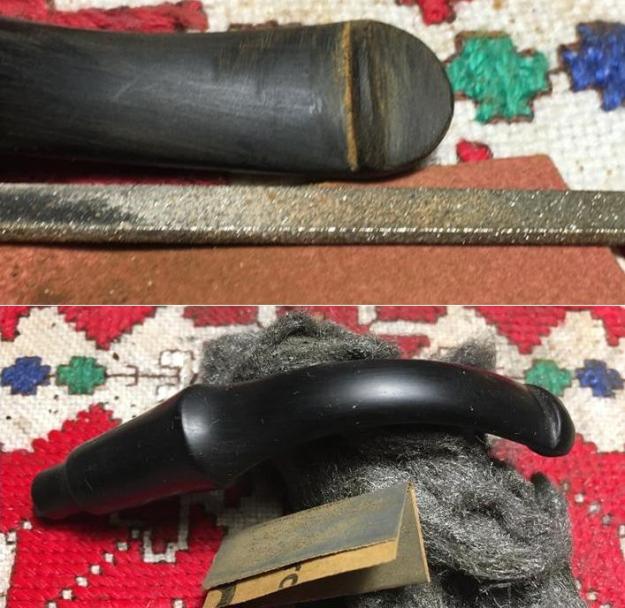
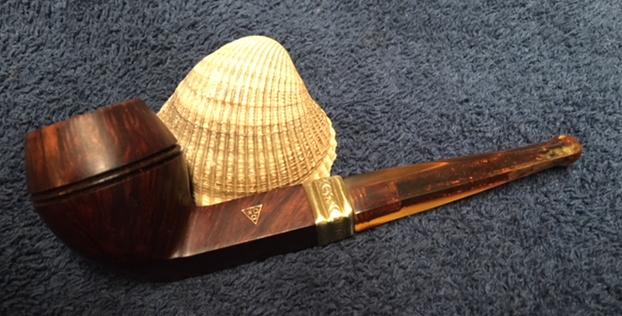
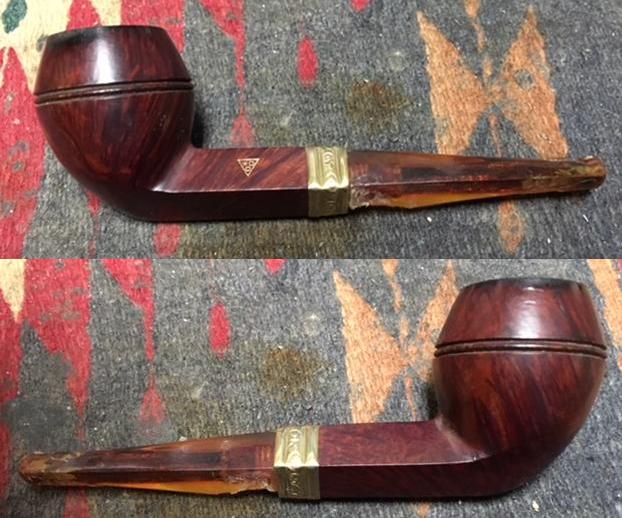
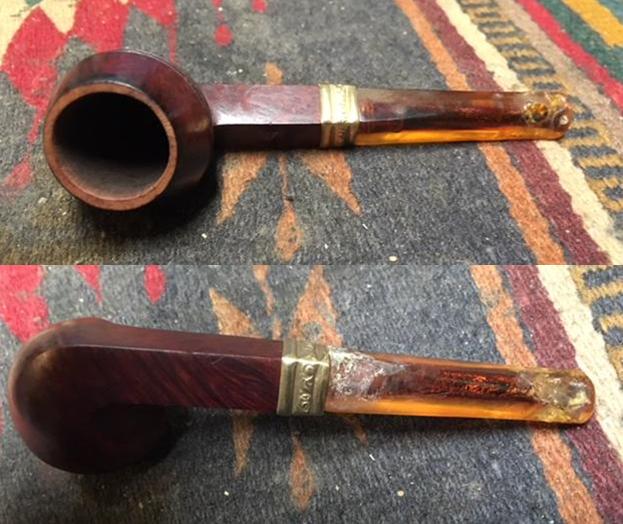
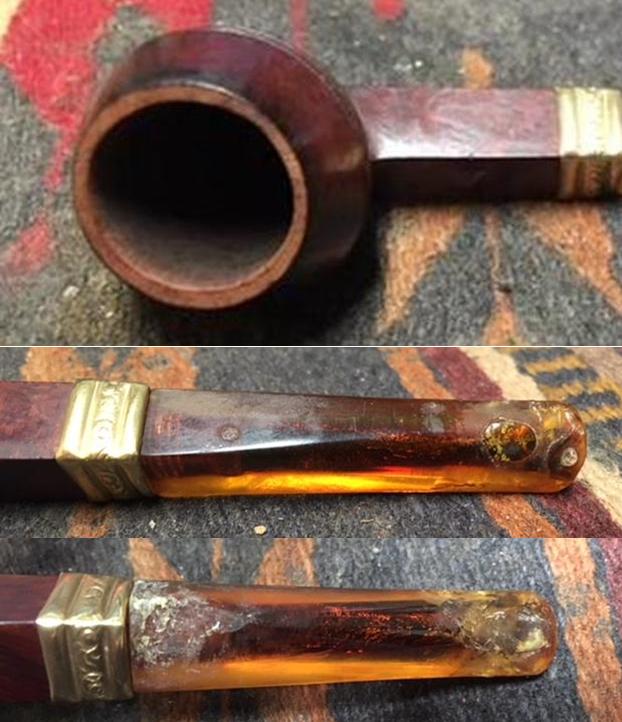
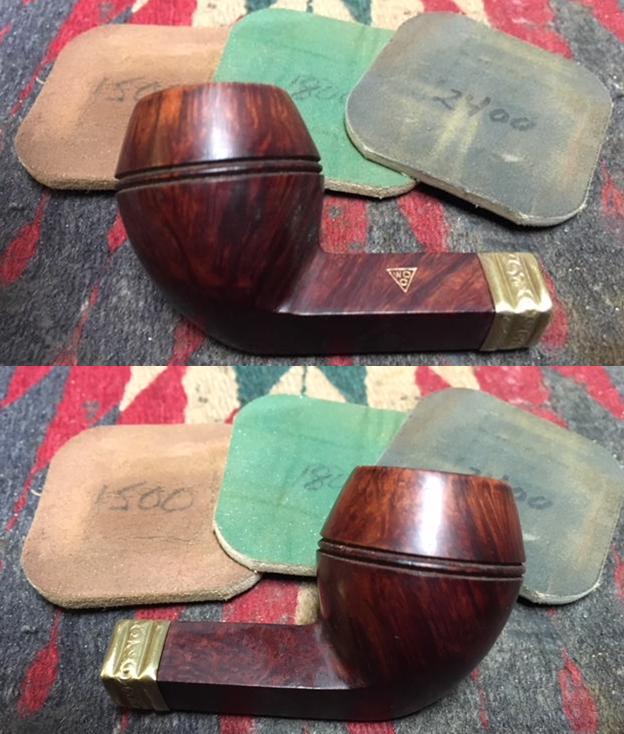
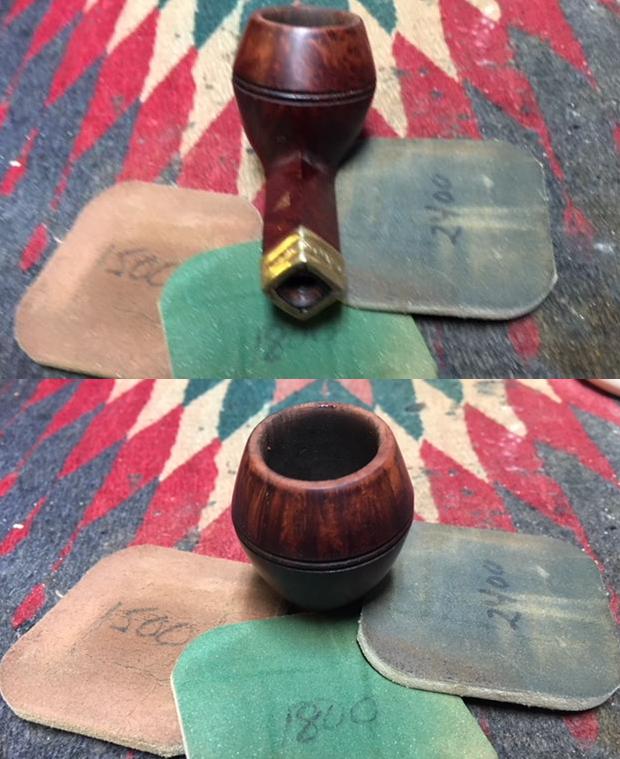
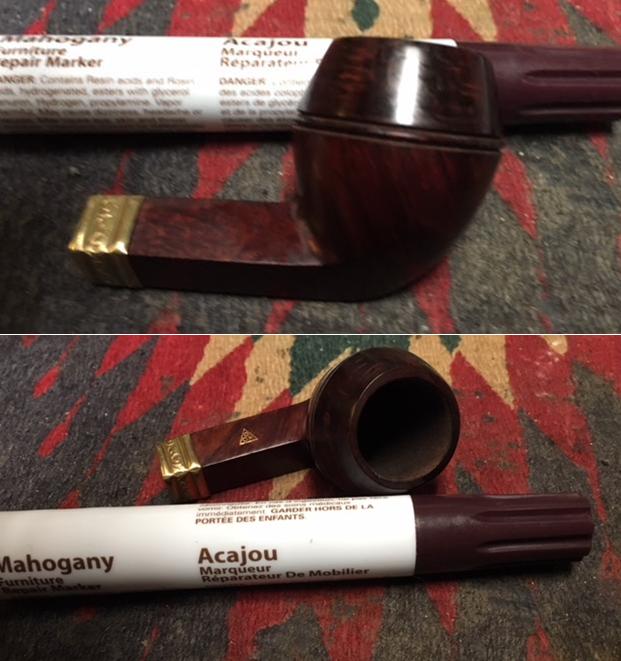
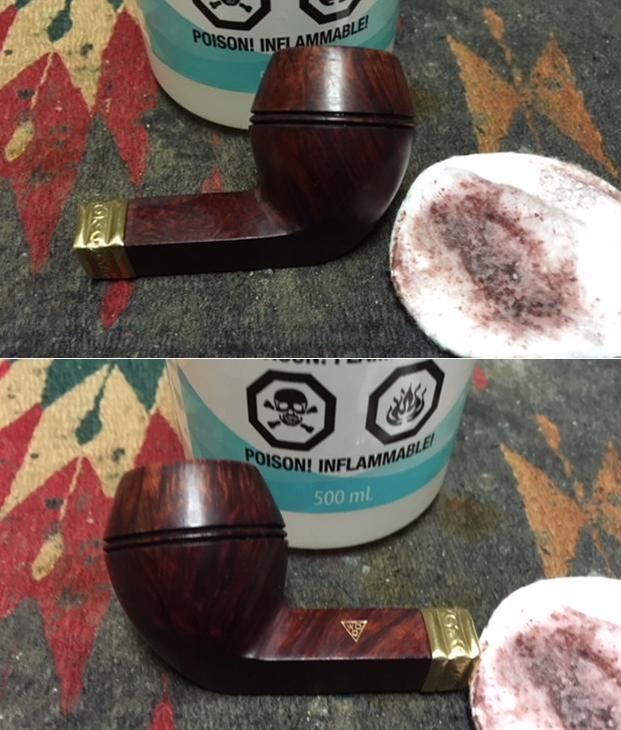
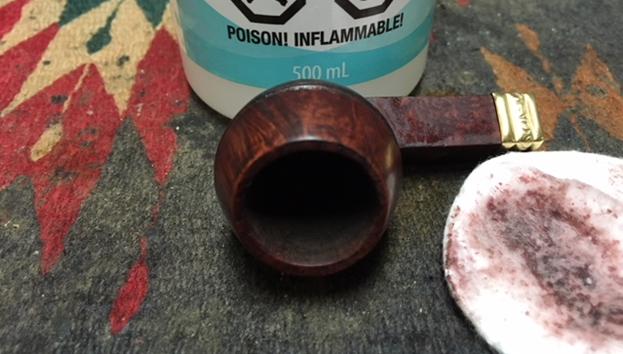
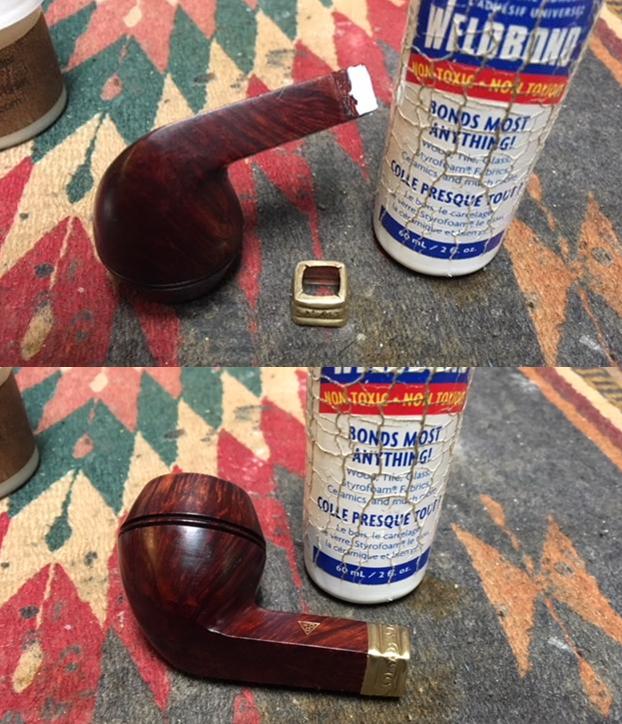
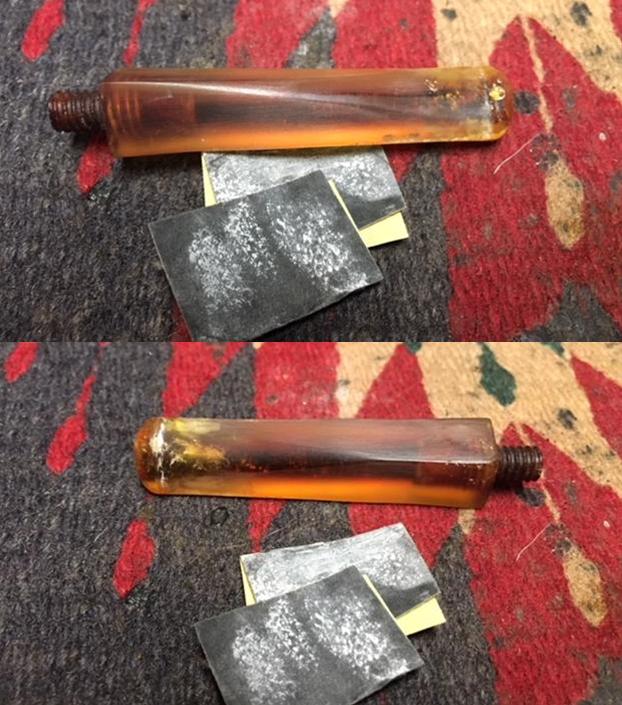
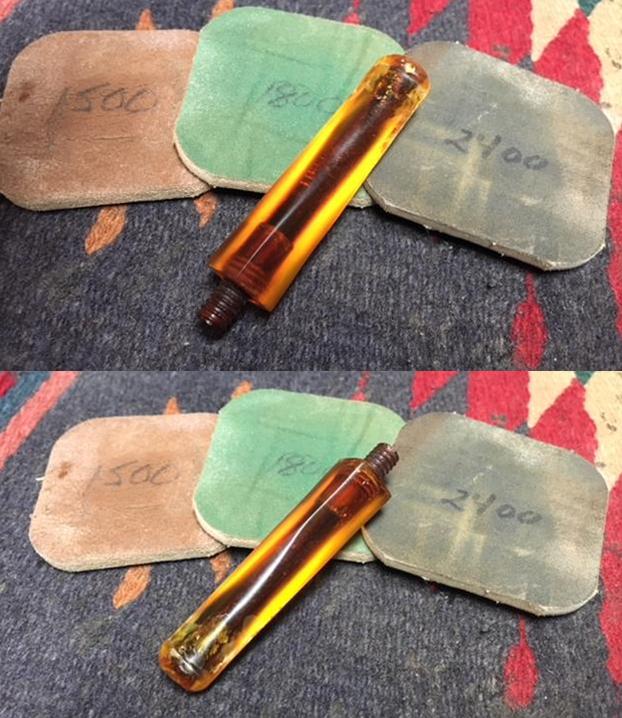
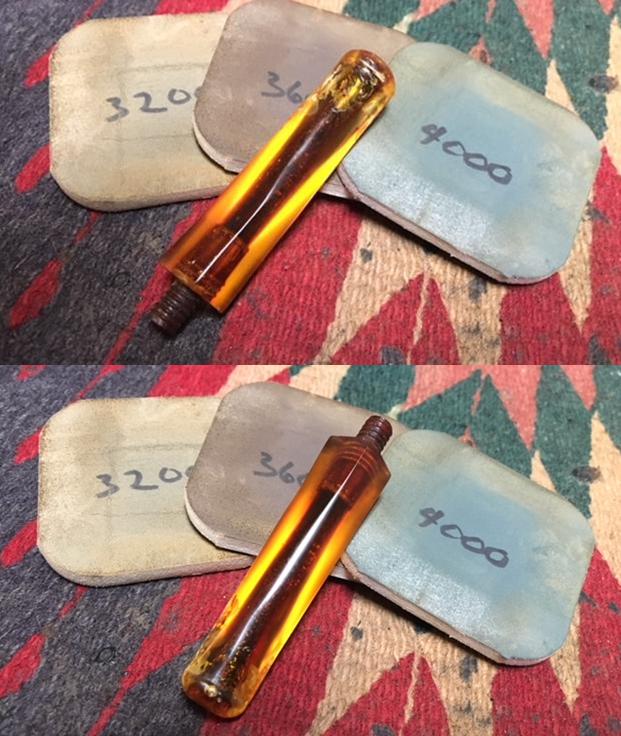
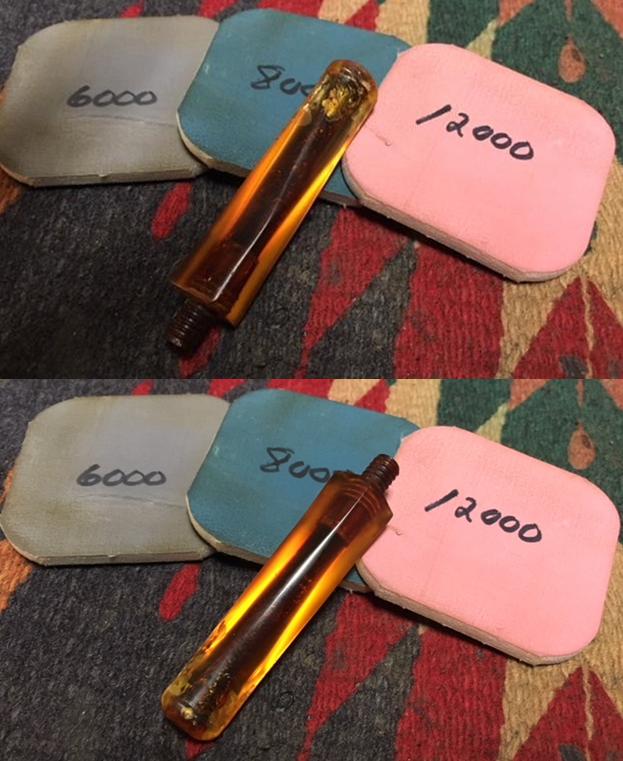
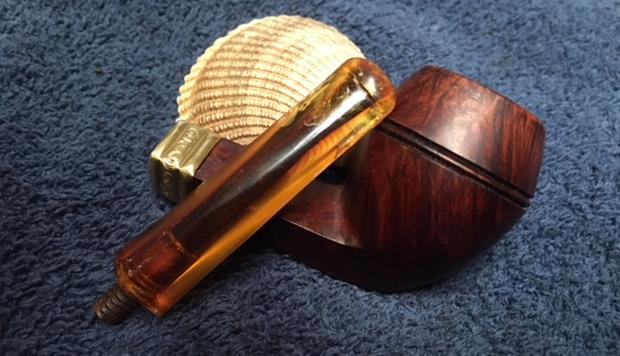
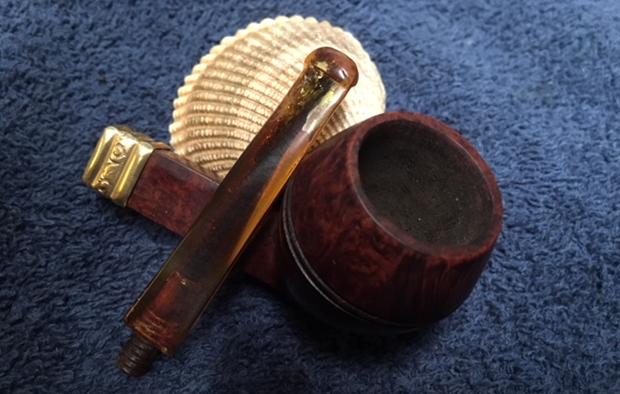
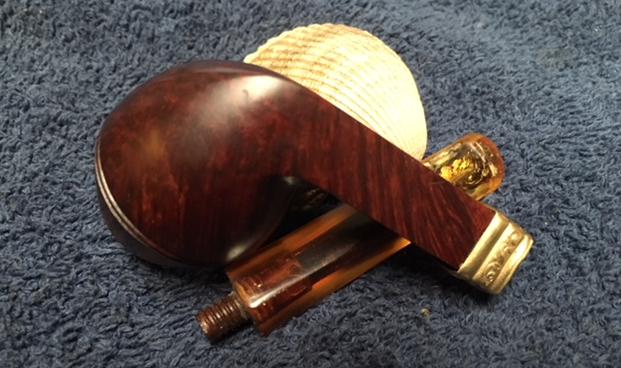
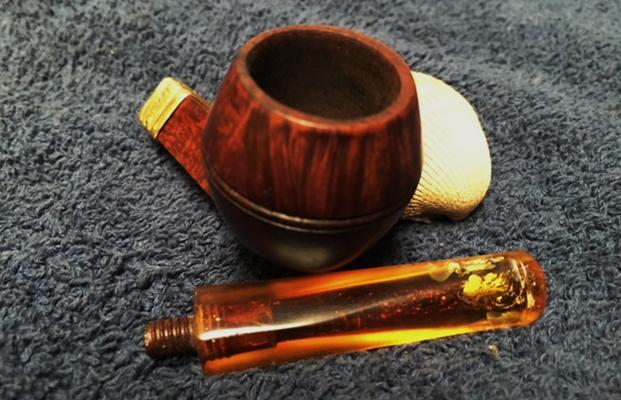
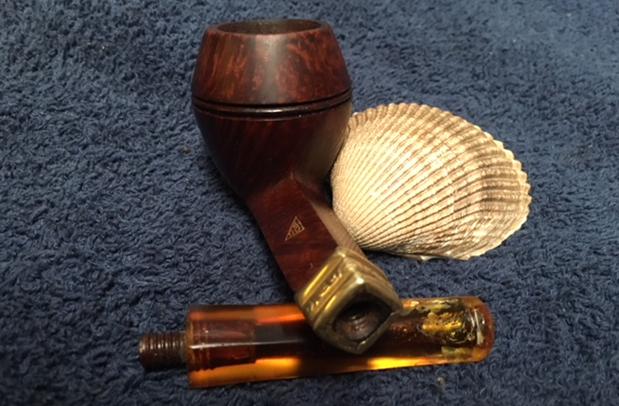
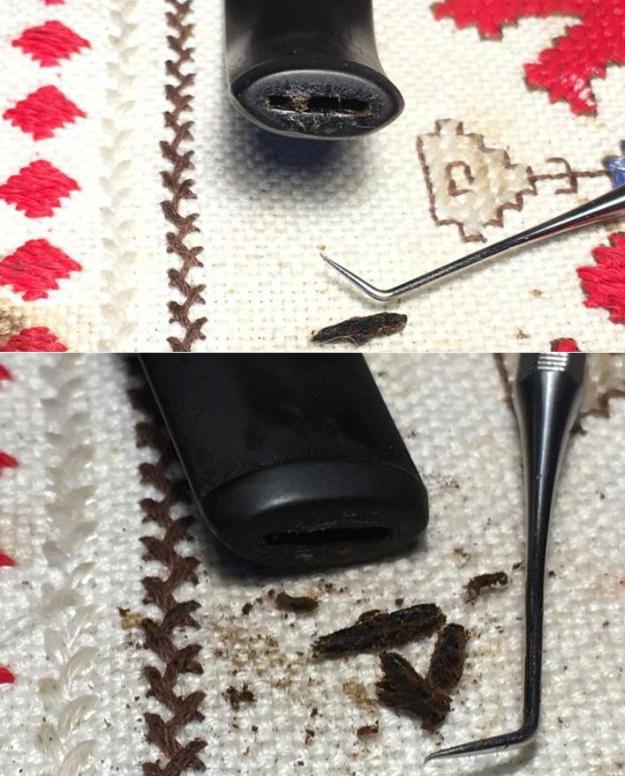
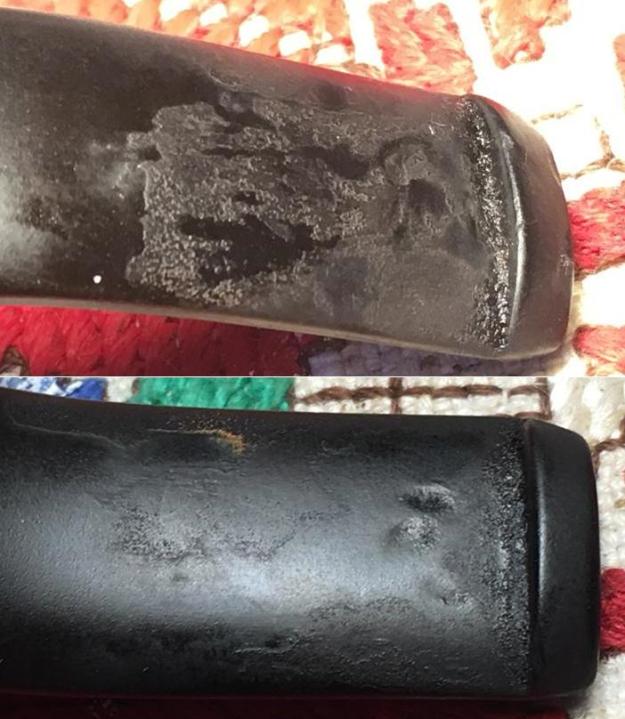
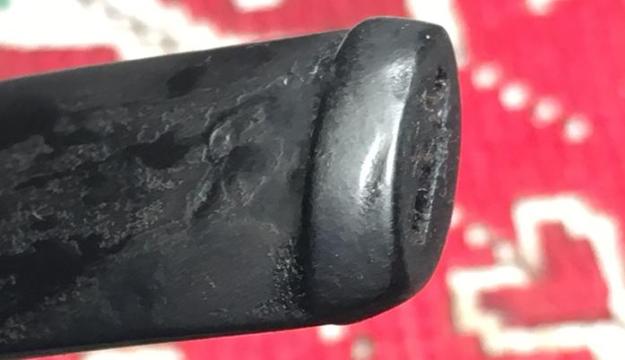
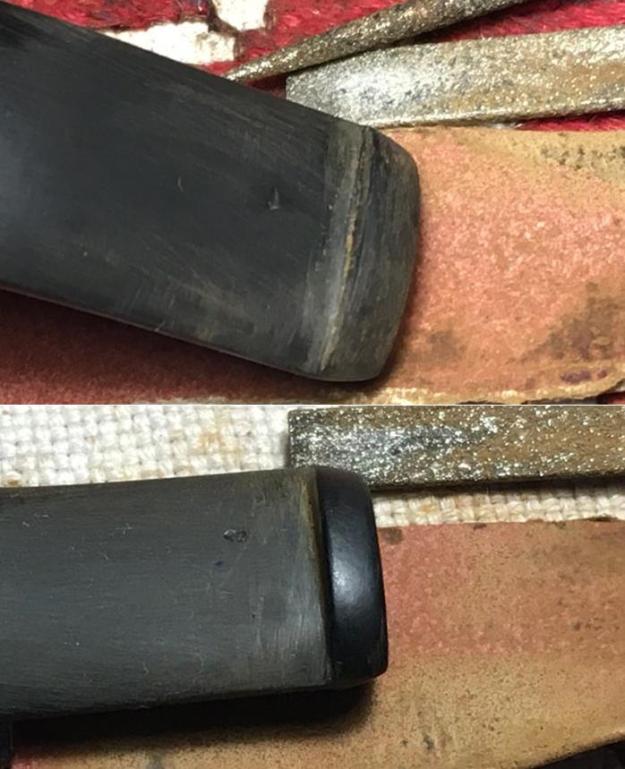
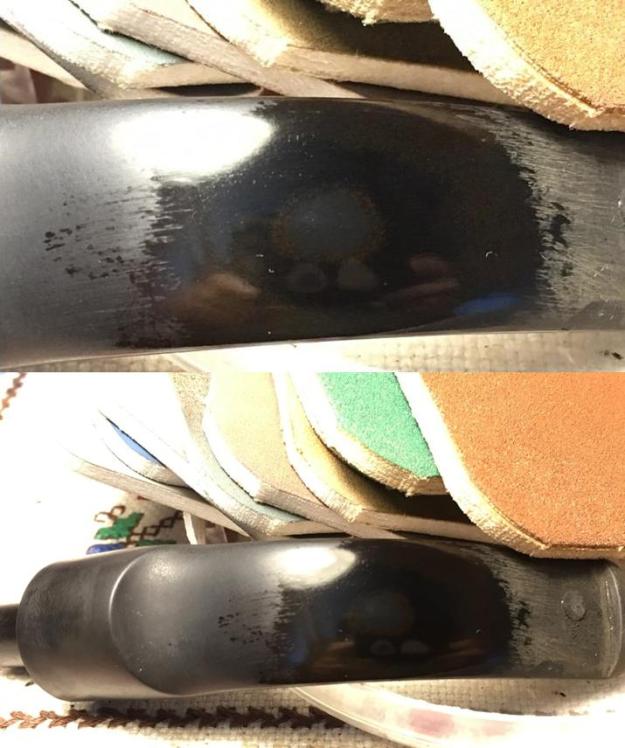
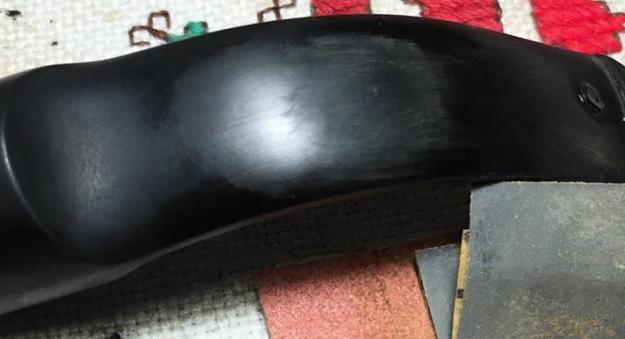
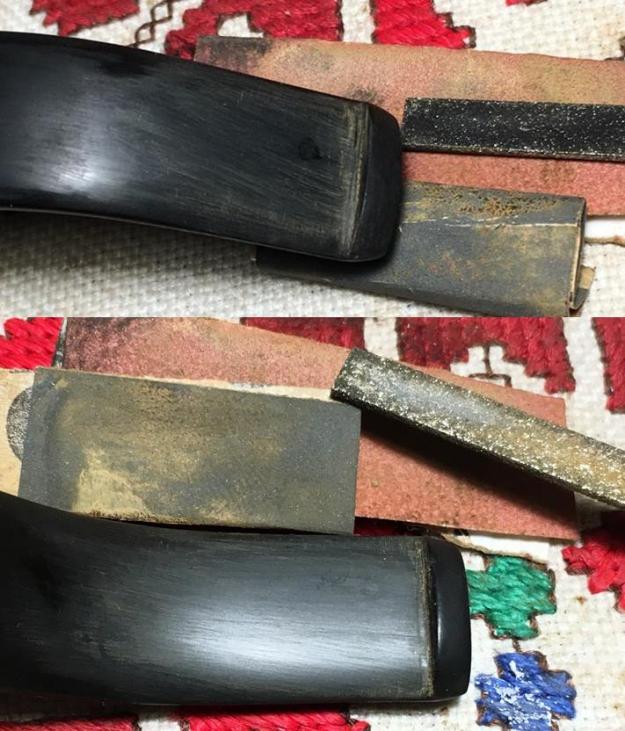
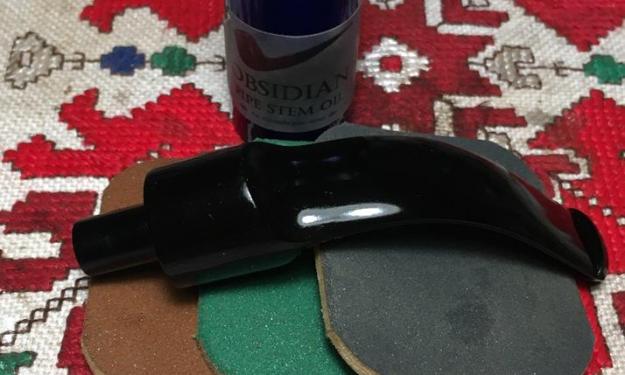
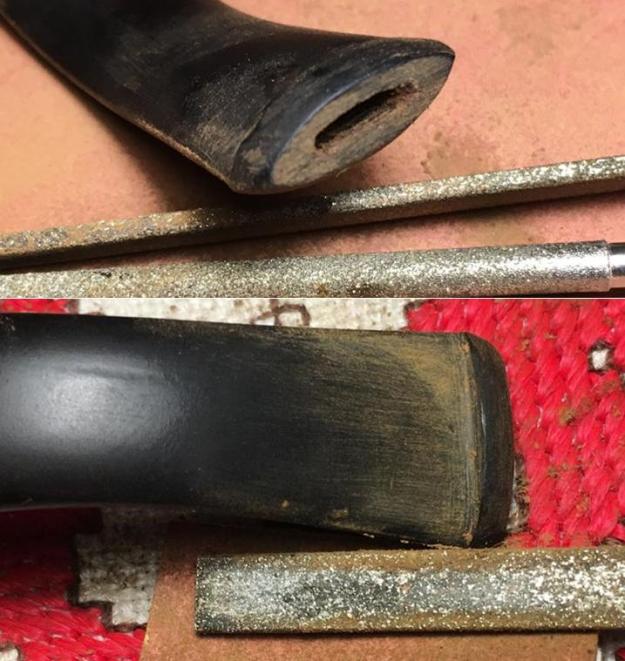
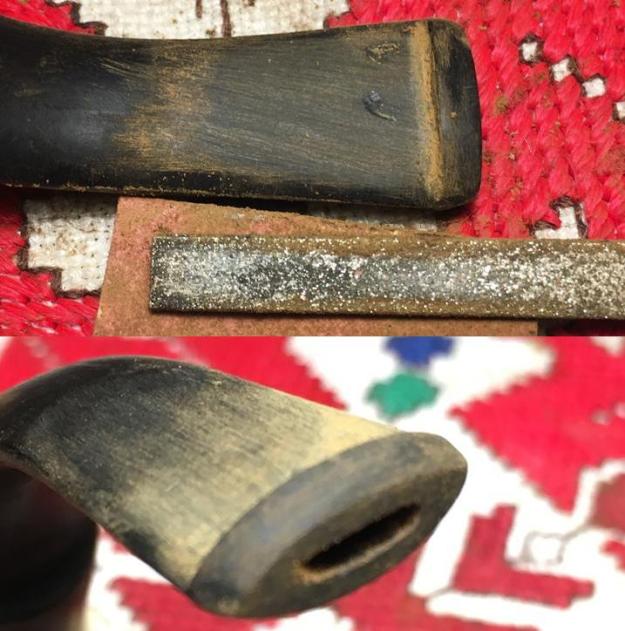
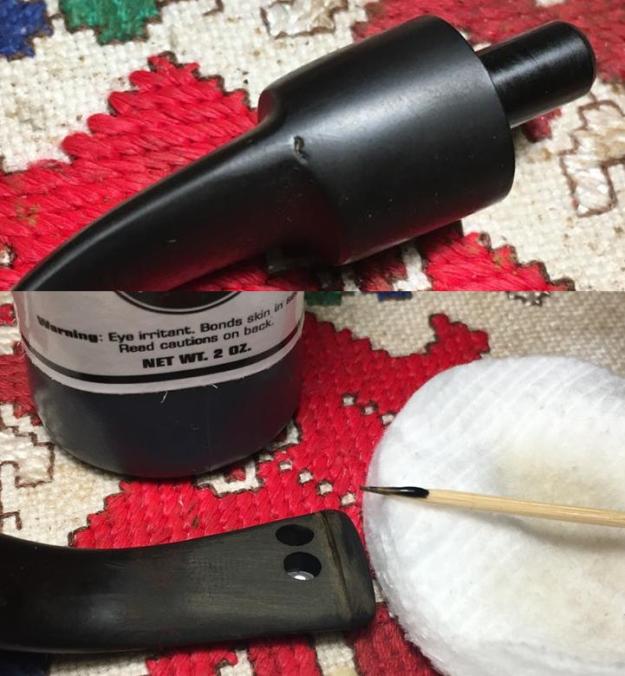
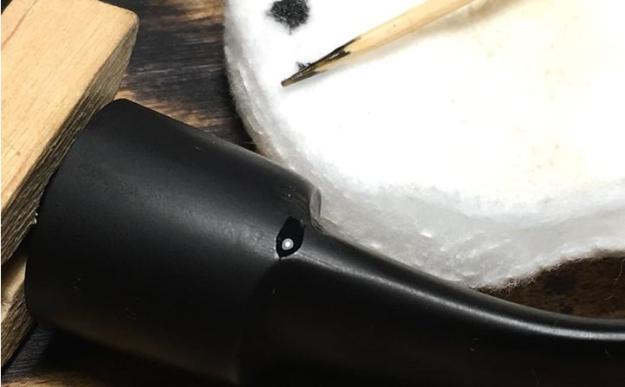
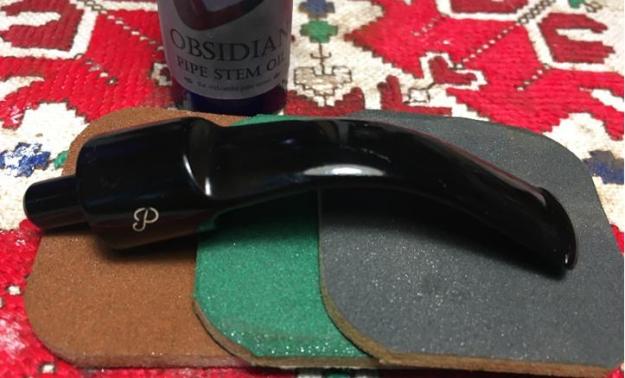
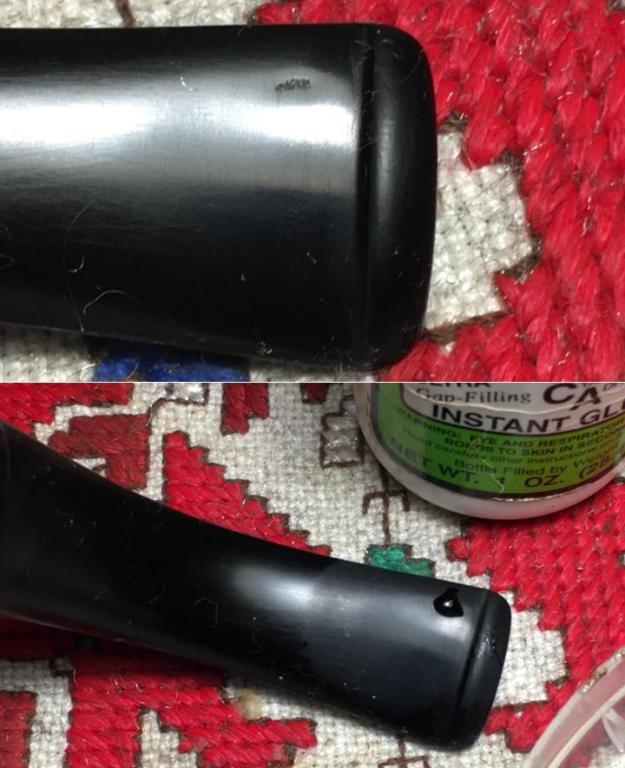
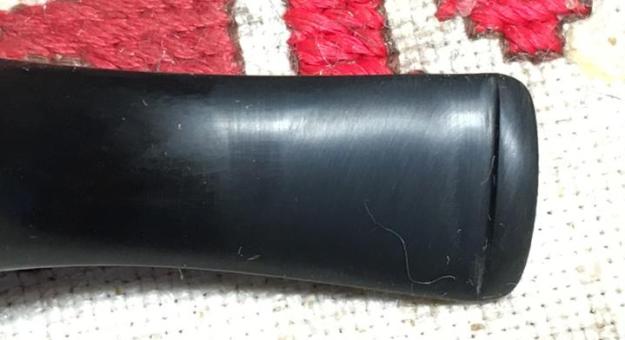
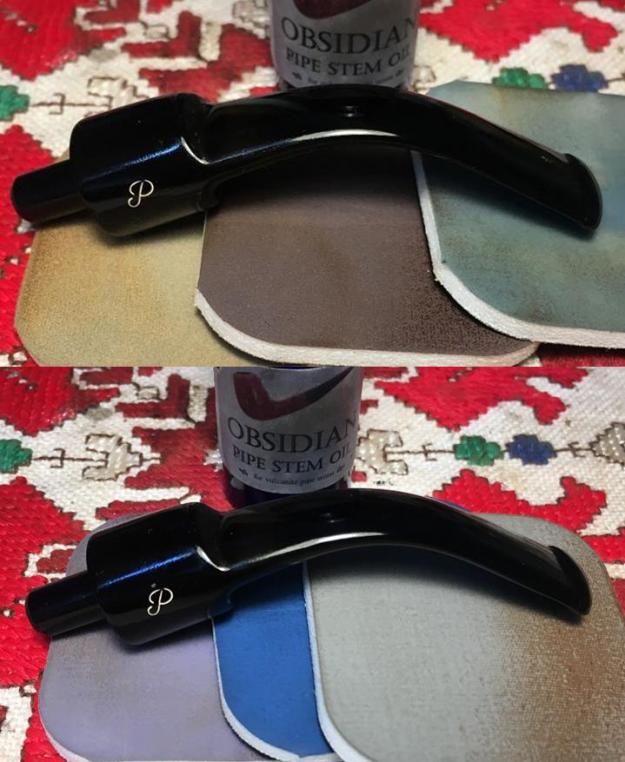
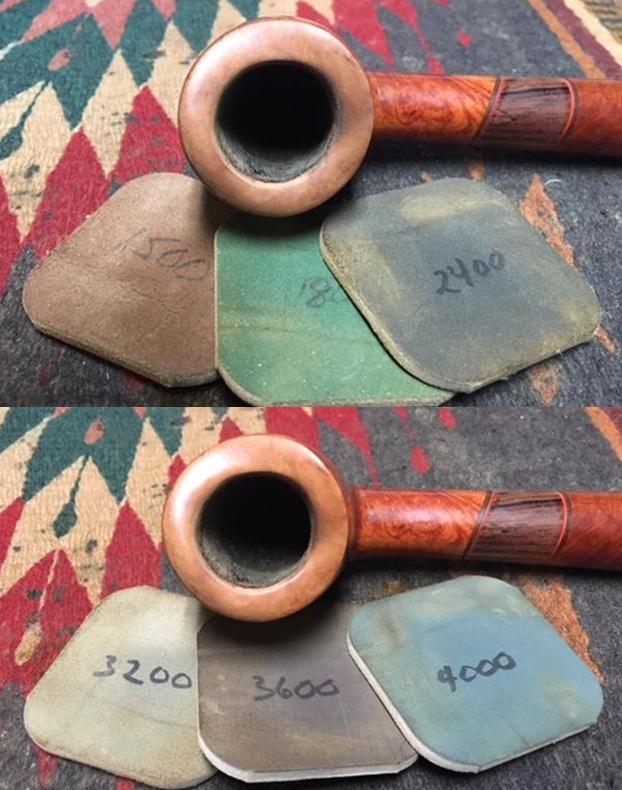
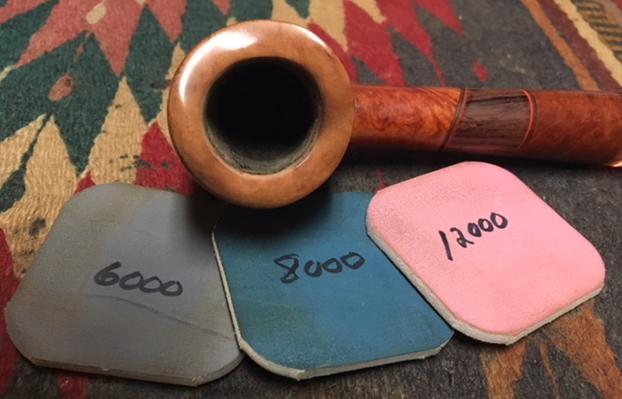
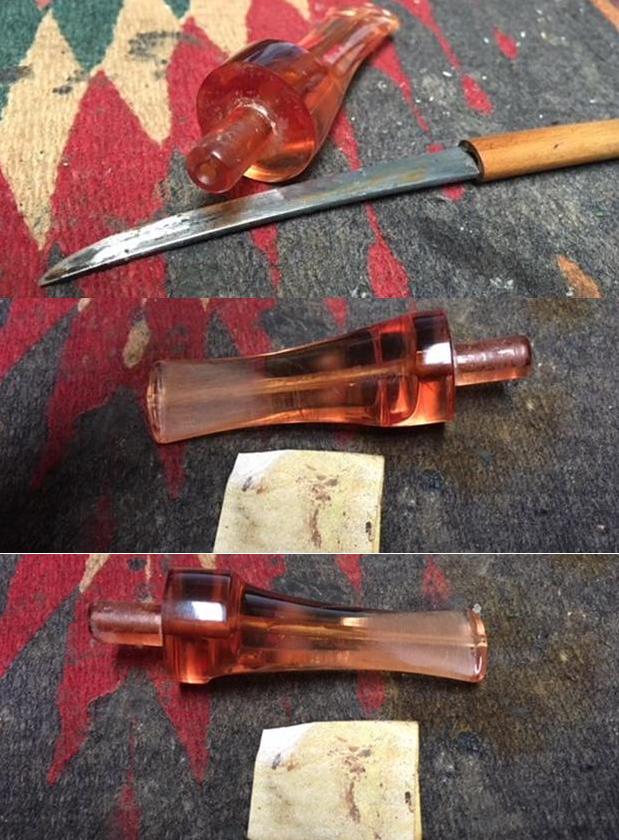
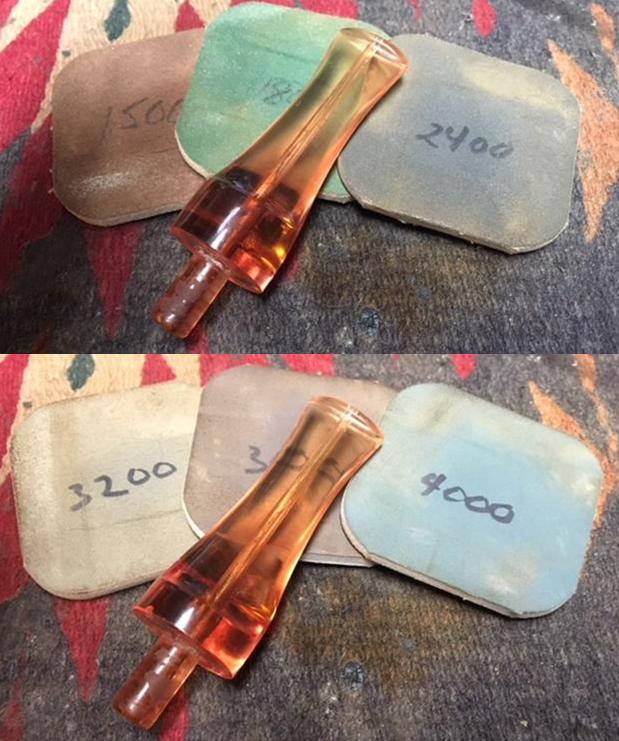
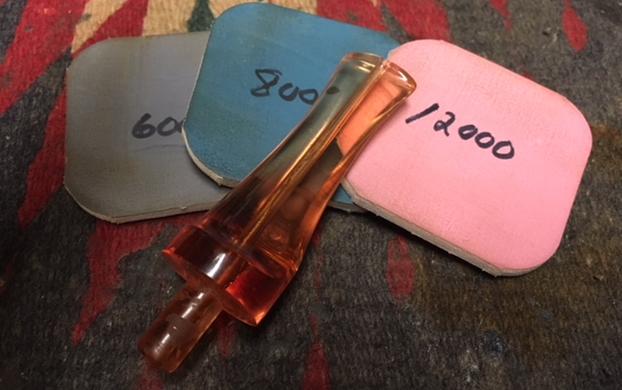
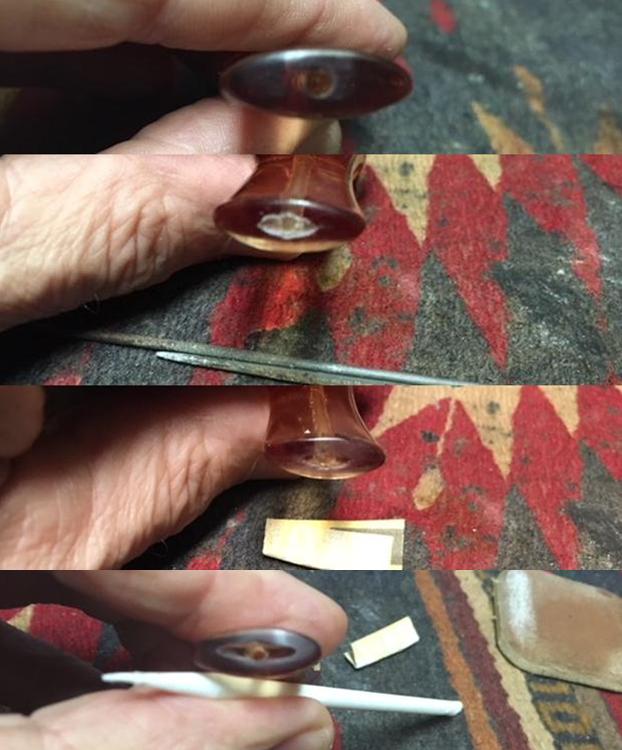
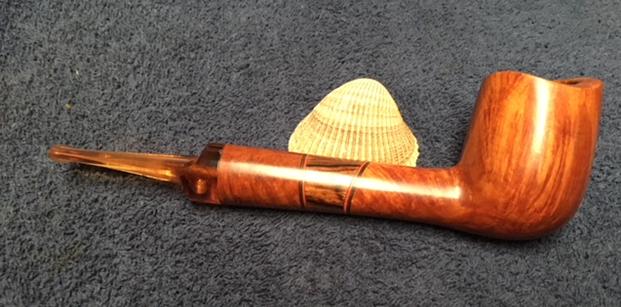
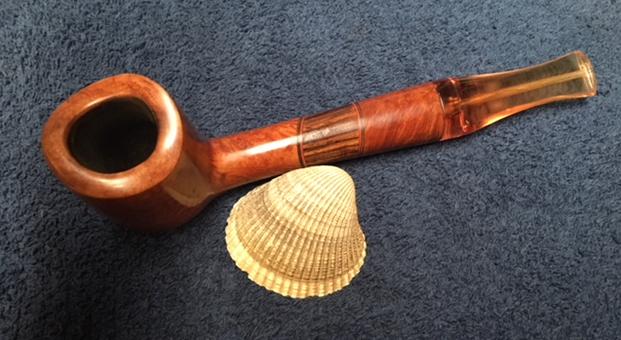
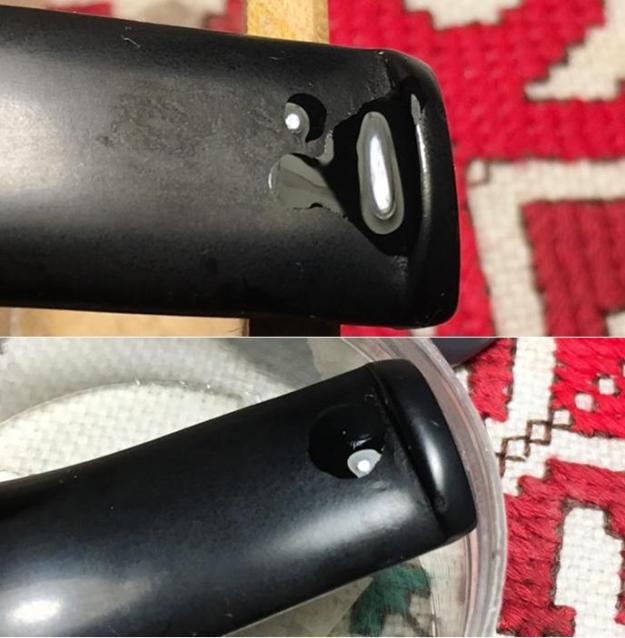
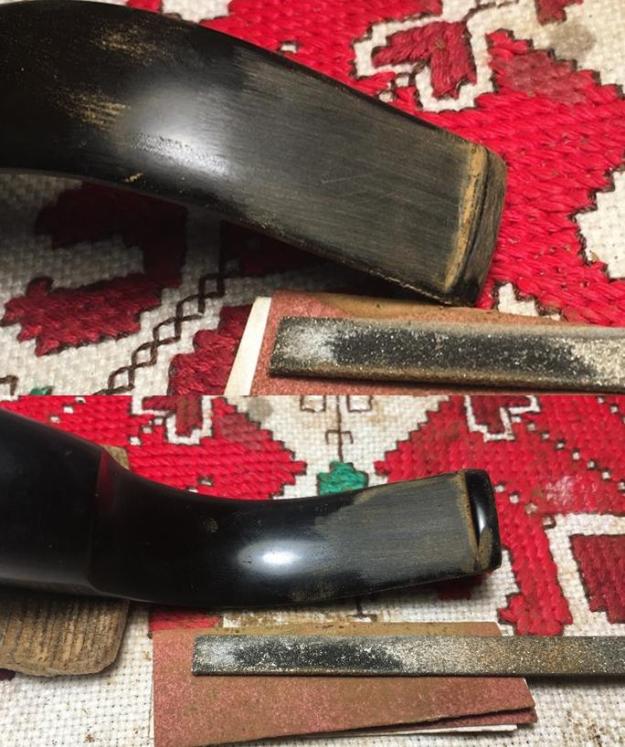
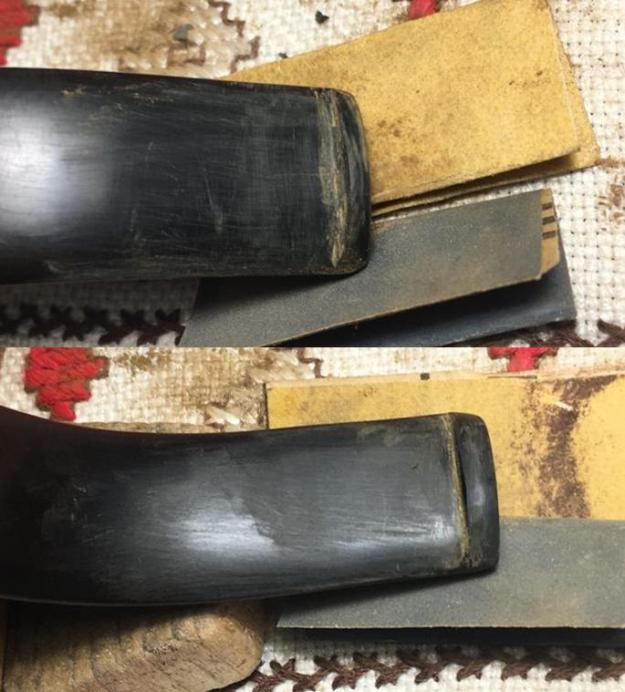
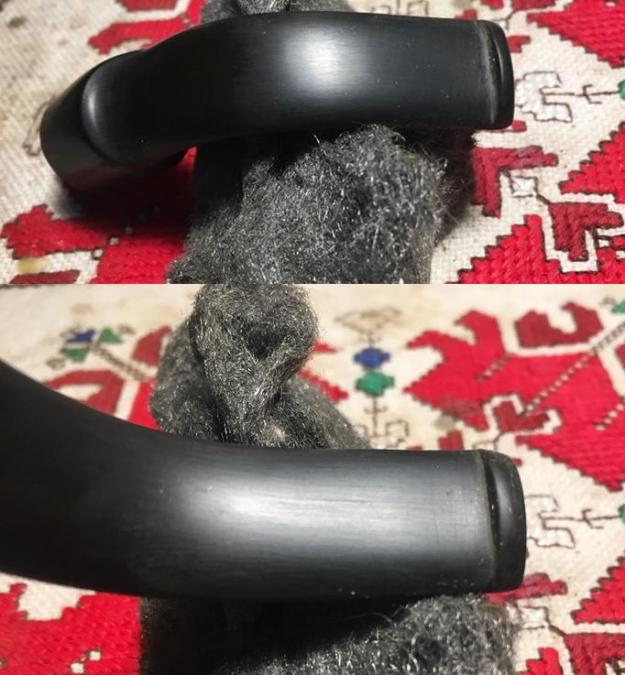
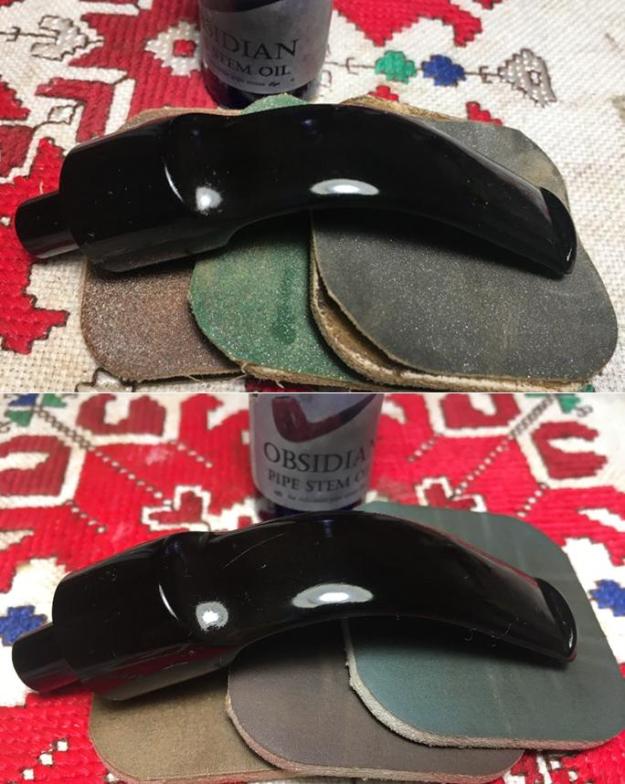
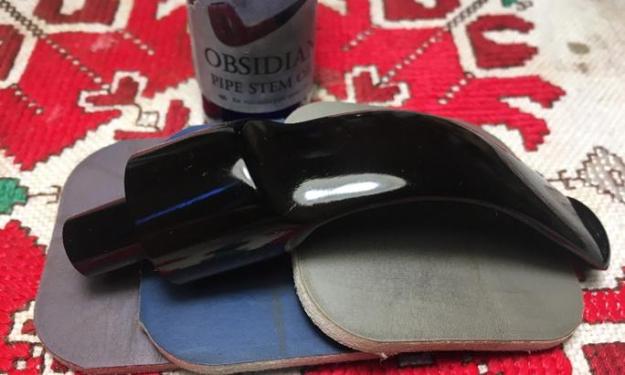
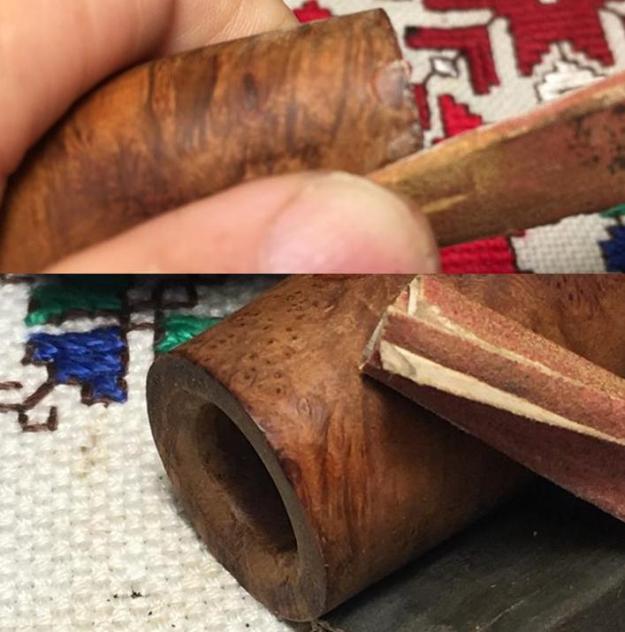
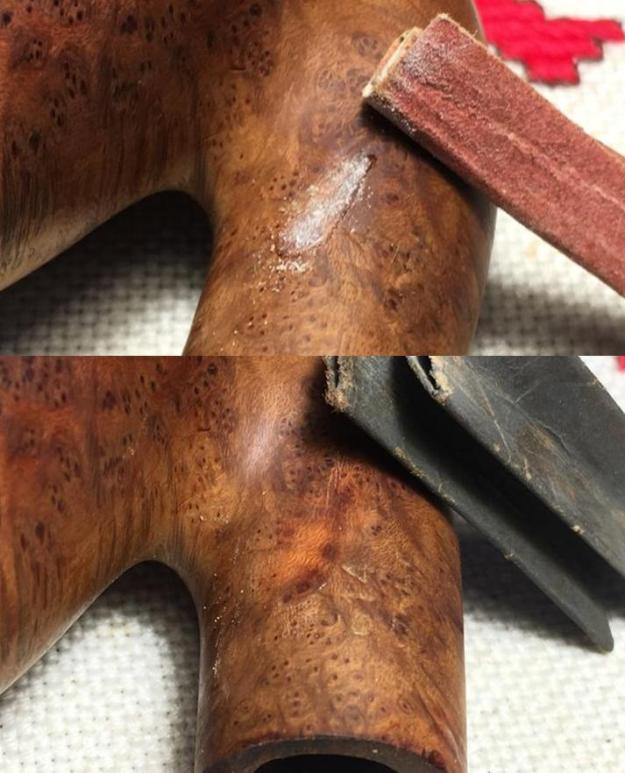
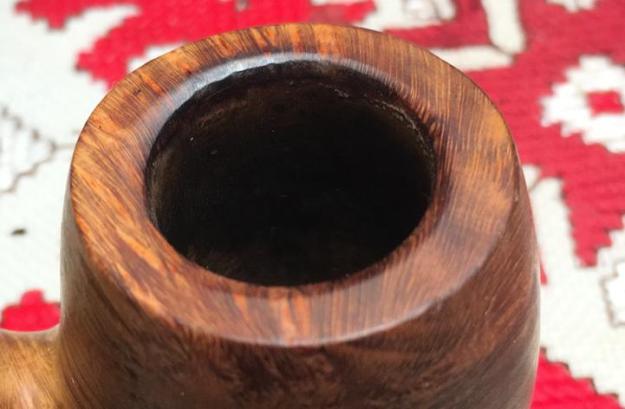
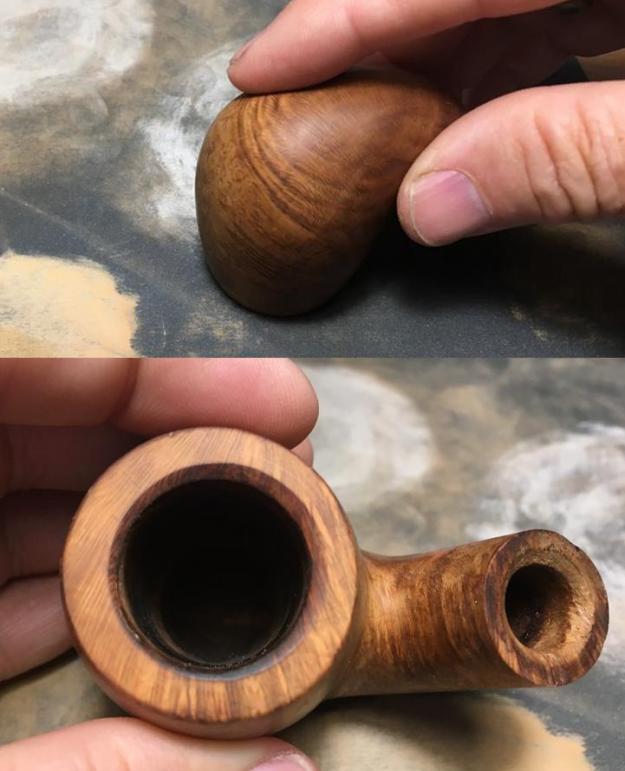
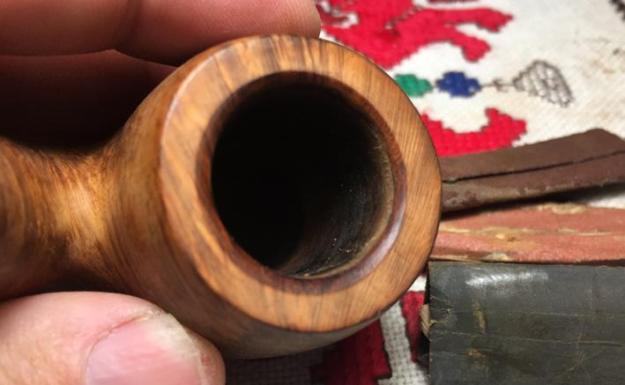
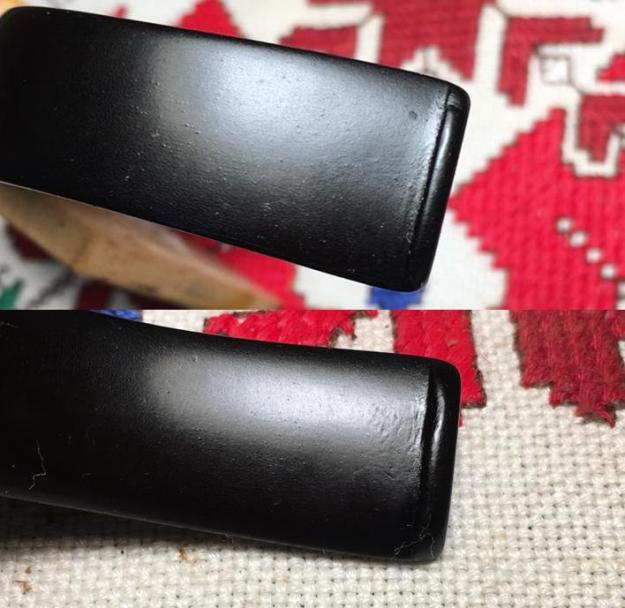
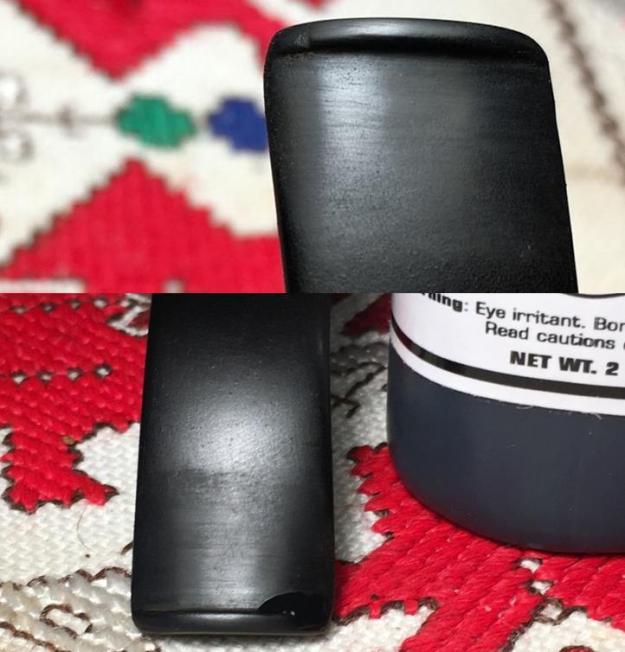
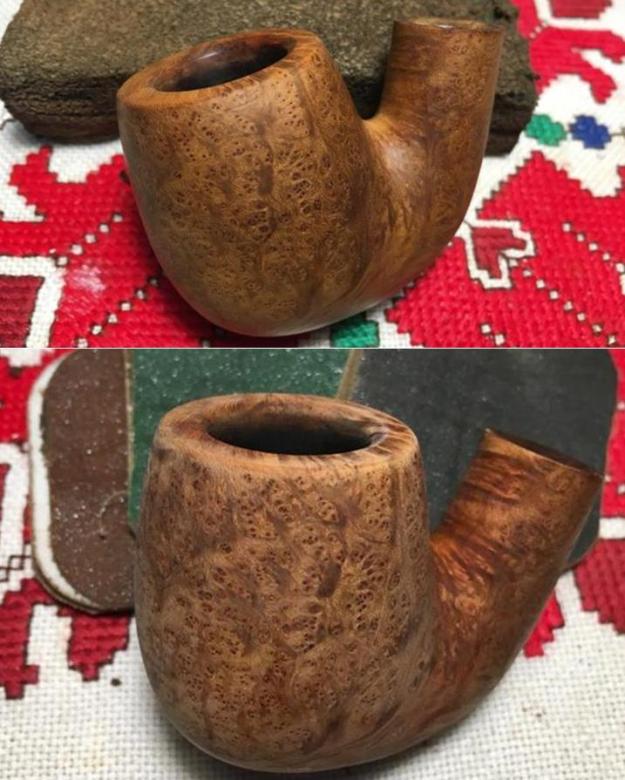
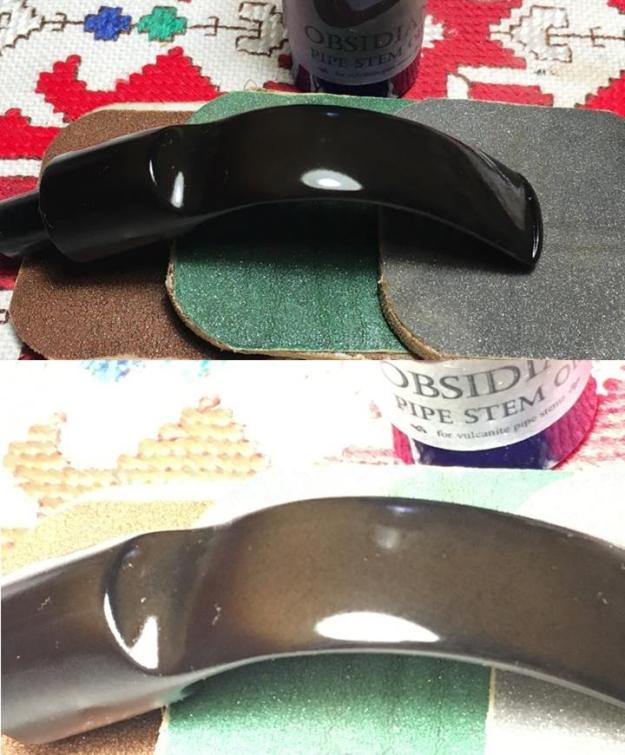
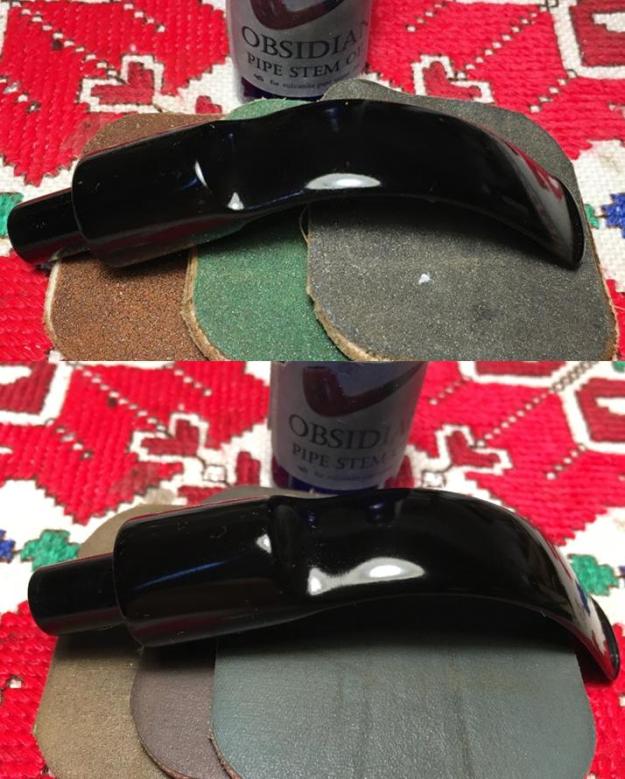
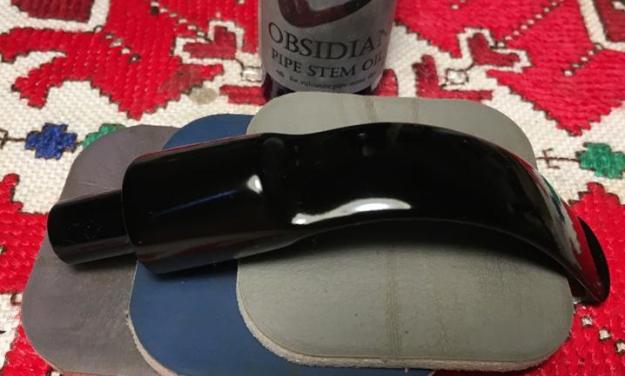
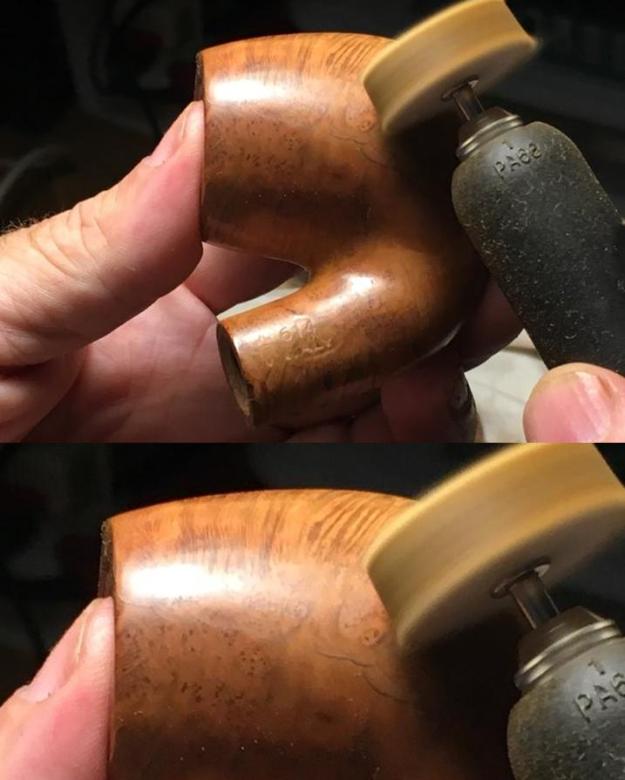
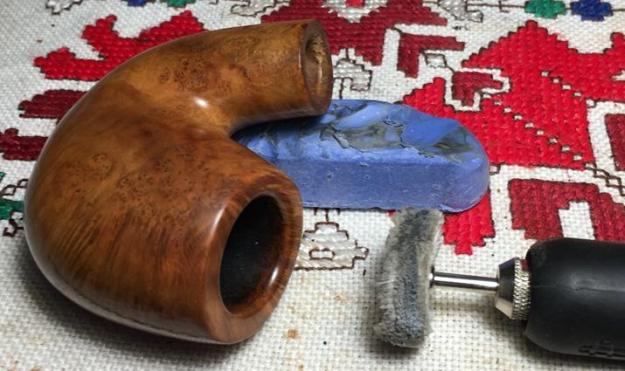
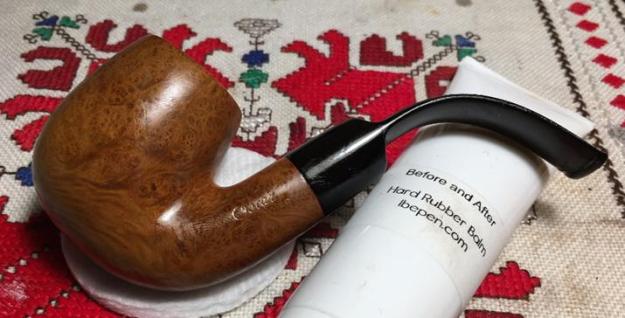
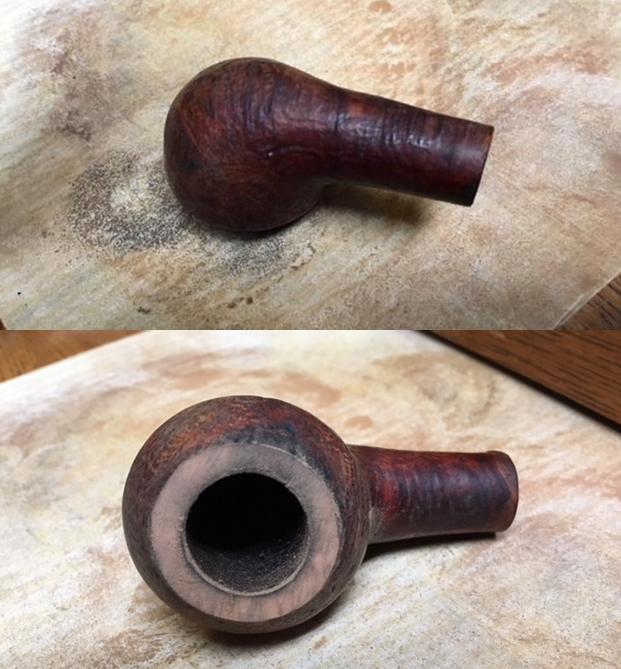
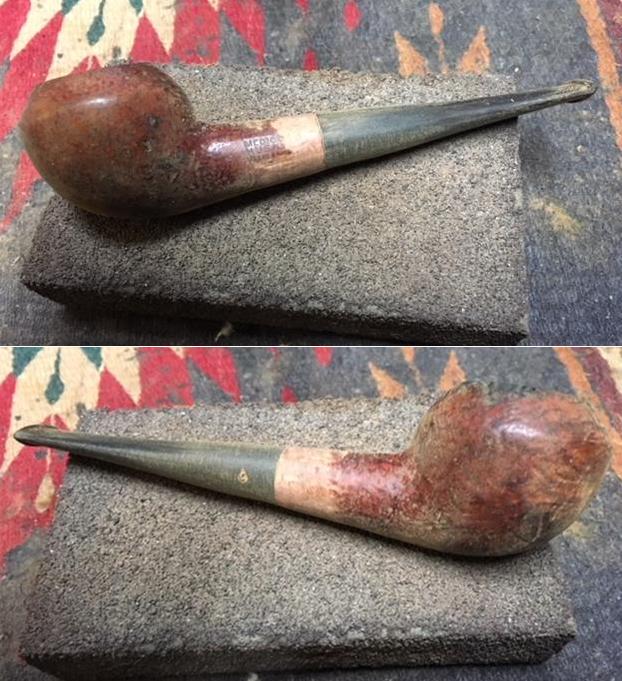
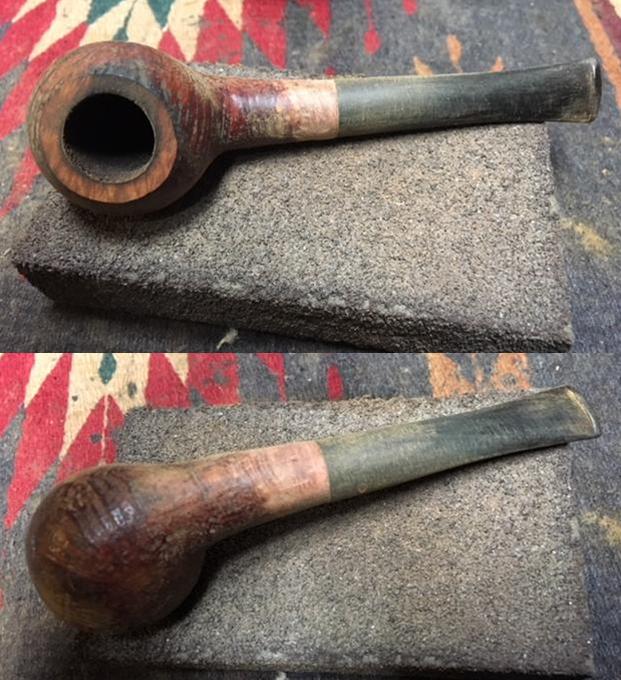
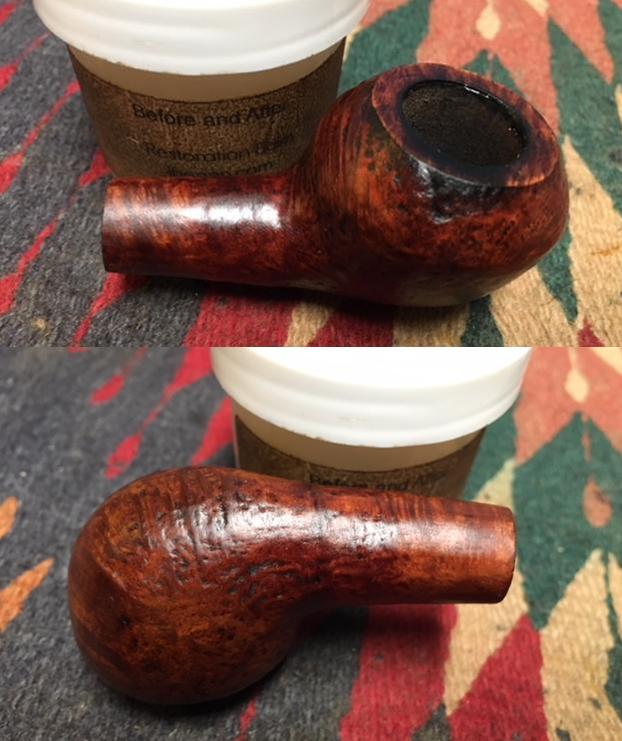
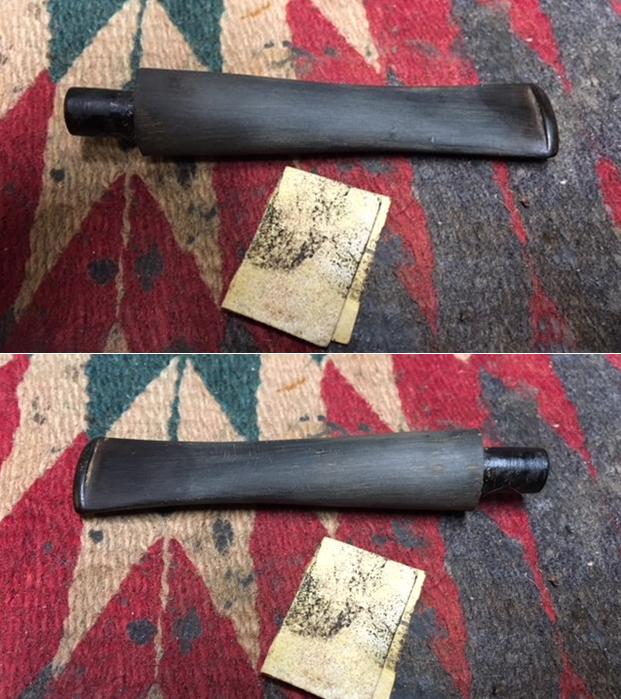
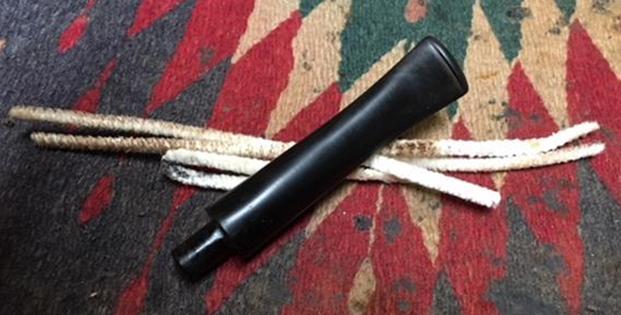
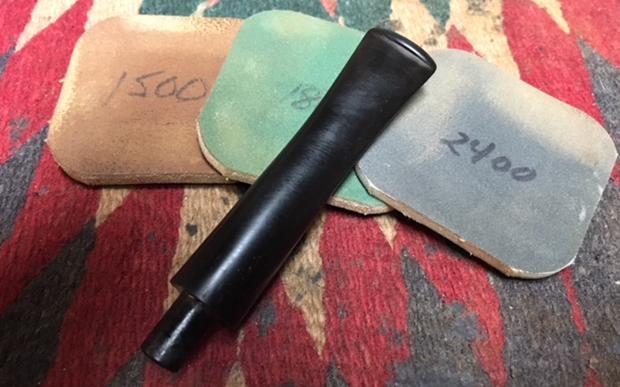
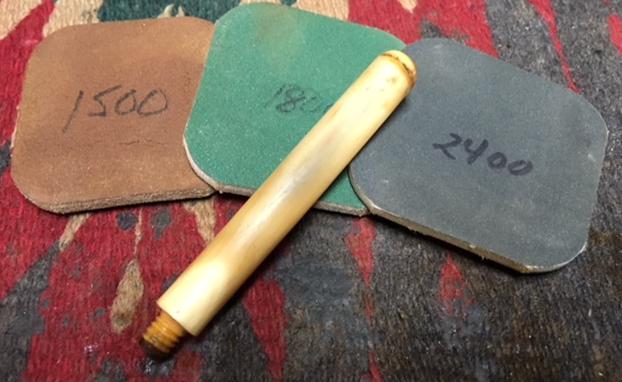
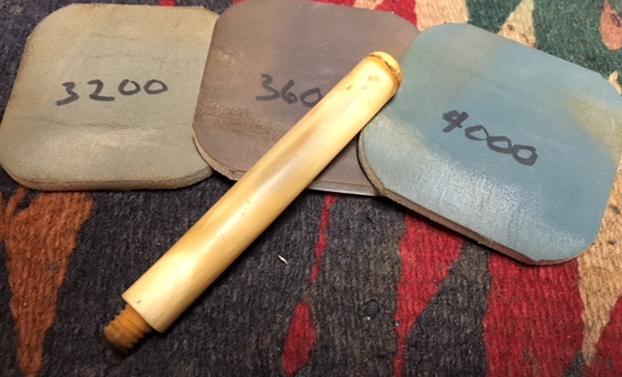
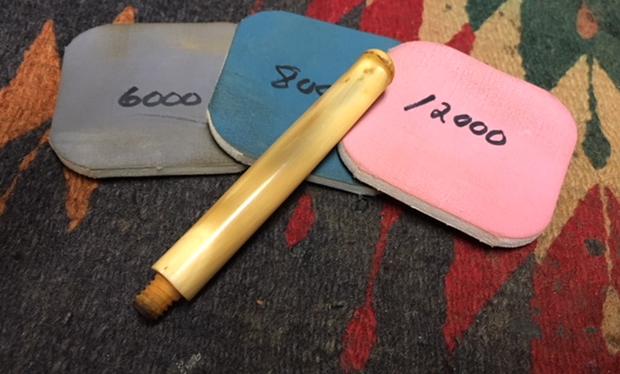
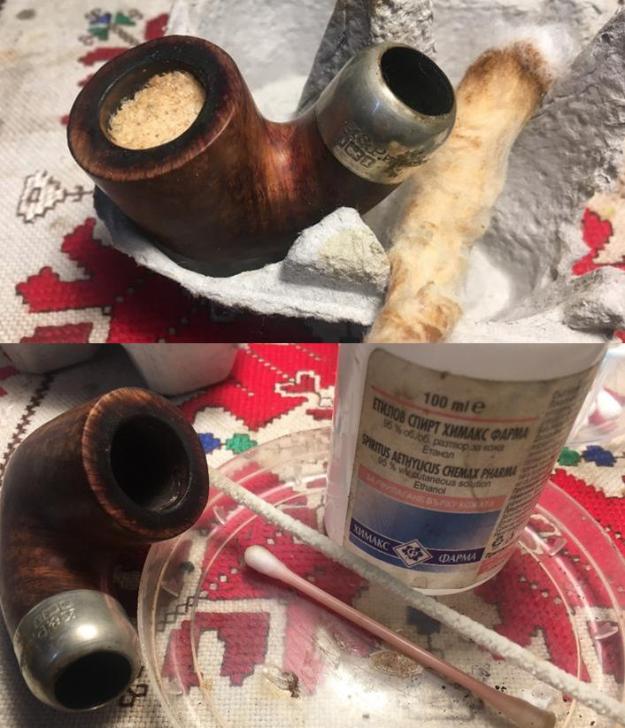
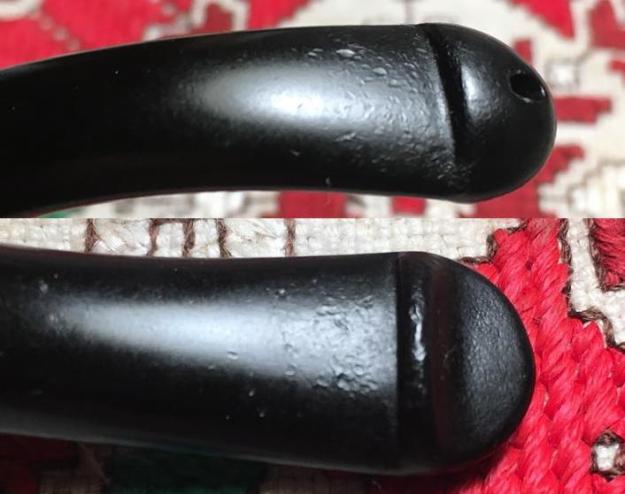
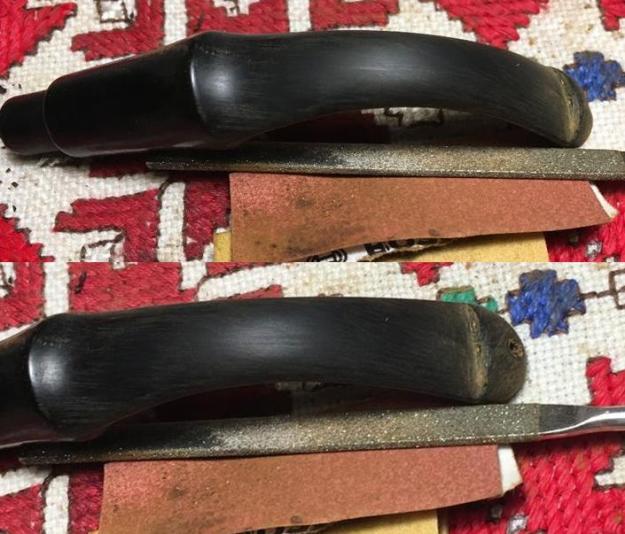
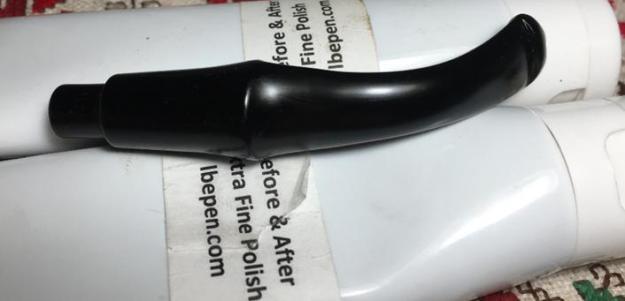
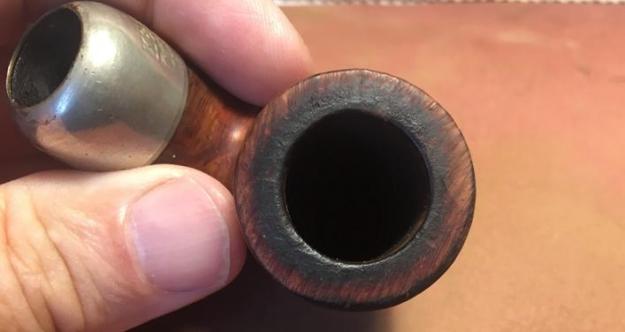
Paresh, my friend in India reached out to me over Whatsapp to talk about a few more of his Grandfather’s pipes. He was confident in working on many of them but there were a few that he wanted me to try my hand on. His wife Abha would ream and clean them for me so I would be able to start with a relatively clean pipe. The first of these was a beautiful older WDC Bulldog with an amber coloured Bakelite stem. It was in rough condition when Paresh and Abha started working on it. They reamed the thick hard cake with a KleenReem pipe reamer and clean up the exterior of the bowl with Murphy’s Oil Soap. They also cleaned the interior with alcohol, cotton swabs and pipe cleaners. The rim top had a thick over flow of lava that hid the briar that Paresh topped to smooth out. There was some darkening to the rim top and down the sides of the bowl cap. The briar was very dirty. There was a gold stamped WDC triangle on the left side of the shank and a brass decorative band that was loose. The stem was a mess. There was a large chunk of the Bakelite missing on the underside and deep tooth marks on the top and underside near and on the surface of the button. I took photos of the pipe to show its condition when it arrived.You can see the work that Paresh and Abha had done to the rim top to clean it up and remove the damage. He had also worked over the inner edge of the bowl to smooth out the damage to the edge. You can also see the extensive damage to the stem in these photos.I took some close up photos of the bowl and stem to give a better idea of what I was working with on this pipe. The rim top was clean but there was darkening down the edges of the cap for about a quarter of an inch. The stem was a mess. Paresh had tried to repair the damage and tooth marks with some clear super glue that he picked up in India. He found that it was inferior and did not harden quickly. Once it did the repair tended to fall out. It was very frustrating. He was able to patch the tooth marks on the stem but not the missing chunk at the stem/shank union.The bowl was the easiest part of the restoration on this old pipe so I started there. I worked on the darkening along the top edge of the cap and was able to remove it with micromesh sanding pads. I used 1500-2400 grit pads to remove the damage and then polished it with 3200-12000 grit pads. I wiped it down with a damp cotton pad after each pad to check out the progress. I polished the rim top at the same time. The photos tell the story. With the rim darkening removed and the rim and cap polished it was time to touch up the stain to blend it into the rest of the bowl. I used a Mahogany stain pen and stained the cap and the rim top. The match was a little darker than I wanted and not as transparent either. I wetted a cotton pad with alcohol and wiped down the cap to blend the stain and make it more transparent. This did the trick and I was happy with the finished colour. The photos show the process. I slipped the loose brass shank cap/band off the shank and used a tooth pick to put some all-purpose glue around the shank end. I pressed the band in place on the shank and wiped off the excess glue that squeezed out with a damp cotton pad.The briar was clean but dried out and in need of some deep cleaning. I rubbed the bowl down with Before & After Restoration Balm to deep clean the briar bowl and shank. The product works to clean, enliven and protect the briar. I hand rubbed it with my fingers, working it into the exterior of the pipe. I wiped it off and buffed it with a soft cloth to polish it. The pipe really began to have a rich shine. I took some photos of the bowl at this point to mark the progress in the restoration. I set the bowl aside and turned my attention to the stem. I used a needle file to clean up the edges of the button on both sides. I also used the file to smooth out the repairs that Paresh had made to the tooth marks on the surface of the stem. He had done a good job and now it was time to blend them into the surface of the stem.I sanded the file marks out of the stem surface with 220 grit sandpaper and blended the repairs into the surface of the stem. I filled in the missing chunk of Bakelite with multiple layers of amber super glue. I could have used clear glue but I had the amber around and it is a thicker product so it used it. I use layers so that the repair does not get to thick. It makes the drying time shorter and I think it gives a better bond.I laid the stem aside and went to bed. I touched up the final layer of glue in the morning and went to work. The stem had the entire day to cure. When I returned in the evening I sanded the repaired area with 220 grit sandpaper and reshaped the entire stem surface to make the flow of the taper correct. I would need to add some more glue to the patch but progress was being made. Slowly but surely I was conquering this repair.I touched up the glue repairs and wiped the stem down with Obsidian Oil. I took the next two photos to send on Whatsapp to Paresh and Abha. The stem is looking really good. There is still a lot of polishing to do but it is getting there.I polished the stem with 400 grit wet dry sandpaper to remove the scratches and polish the Bakelite.I polished the stem with micromesh sanding pads – wet sanding it with 1500-2400 grit pads and dry sanding with 3200-12000 grit pads. I wiped it down with Obsidian Oil after each sanding pad. I gave it a final coat of oil and set it aside to dry. I carefully polished stem and bowl with Blue Diamond (using a soft touch) to polish out the remaining small scratches. I gave the bowl and the stem multiple coats of carnauba wax and buffed the pipe with a clean buffing pad to raise the shine. I gave the stem several coats of Conservator’s Wax and hand buffed it with a soft cloth. I hand buffed it with a microfiber cloth to deepen the shine. The pipe polished up pretty nicely. The transparent medium brownish red stain worked really well with the golden/amber Bakelite stem. The finished pipe is shown in the photos below. The dimensions of the pipe are Length: 4 3/4 inches, Height: 1 3/4 inches, Outer diameter of the bowl: 1 inch, Chamber diameter: ¾ inches. This is the first of three of Paresh’s Grandfather’s pipes that he sent me to finish. I will set it aside and when the others are finished I will pack them up and send them back to India. I look forward to hearing what he thinks of it once he gets to load it with his favourite tobacco and carry on the pipe man’s legacy of his Grandfather. Thanks for walking through this restoration with me as I worked over this beauty.

Another L. J. Peretti Oom Paul Sitter Recommissioned


Blog by Dal Stanton

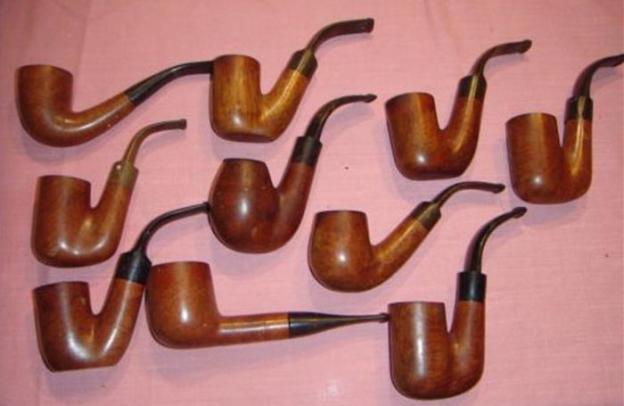
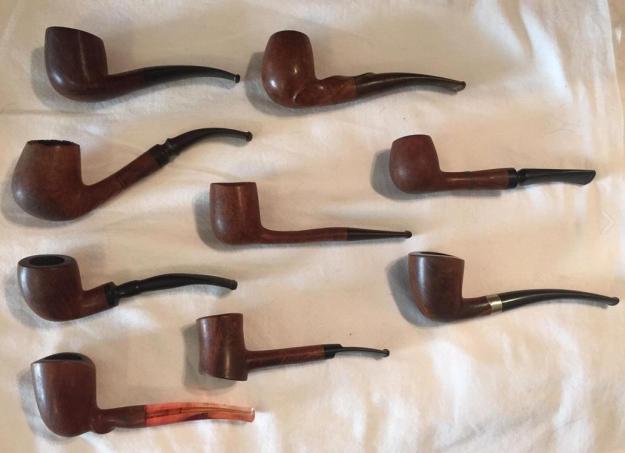
I’m almost finished working through the Peretti Lot of 10 I acquired off the eBay auction block.  I’m amazed at the interest in these pipes since I posted a picture of the Peretti Lot on several of my favorite Facebook pipe groups.  I also enjoy posting on Instagram and Facebook giving updates of the restorations on my worktable here in Sofia, Bulgaria.  One of the best things I enjoy about ‘Pipedom’ and social media are the relationships developed around the world with pipe men and women whose love of pipes – their names and their histories, trust people like me who restore these friends enabling them to be passed on to the next generation of pipe men and women.  That’s why I named my pipe space, The Pipe Steward.  We are stewards when we understand that we don’t own, but we merely take care of something special for a time, add our histories then pass it on.  I met Tim via social media when I posted the picture below.  He was drawn to the Oom Pauls and commissioned one of the Sitters potentially to add to his already large collection – I see the plethora of posts and pipes he has on Instagram!  So, adding this Peretti Oom Paul Sitter to his collection is special and appreciated.  When one of my pipes is commissioned, the final decision to keep it is made after its restored and I publish the write up and a price is set.  So, Tim has first dibs on this Oom Paul Sitter when it goes to The Pipe Steward Store.  As with the other Perettis, this Sitter will benefit the Daughters of Bulgaria – our work here in Bulgaria helping women and girls who have been trafficked and sexually exploited.

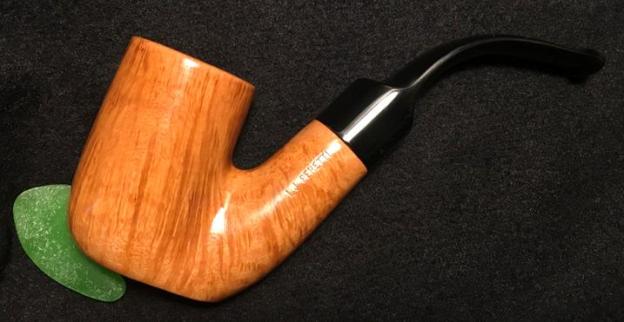
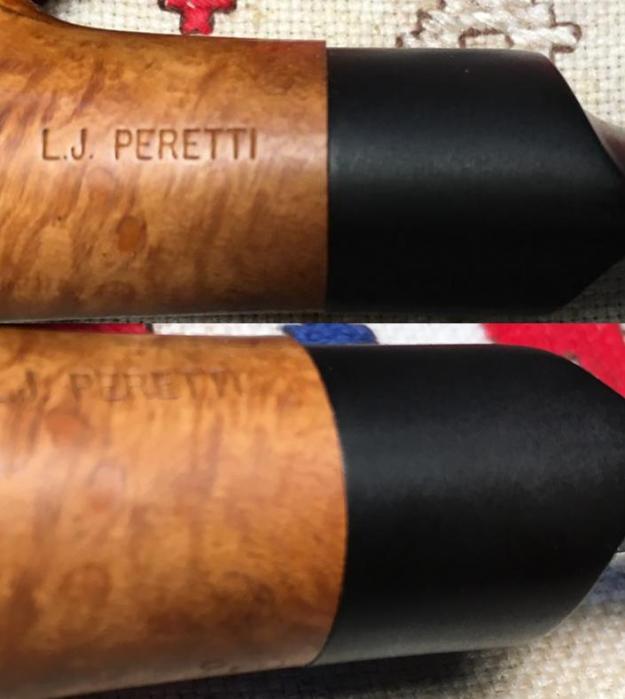
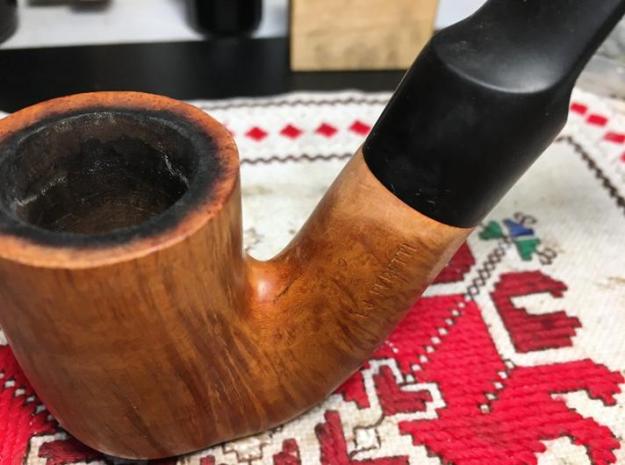
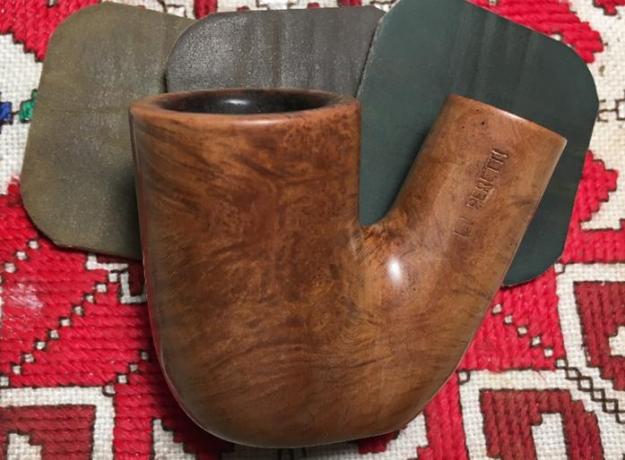
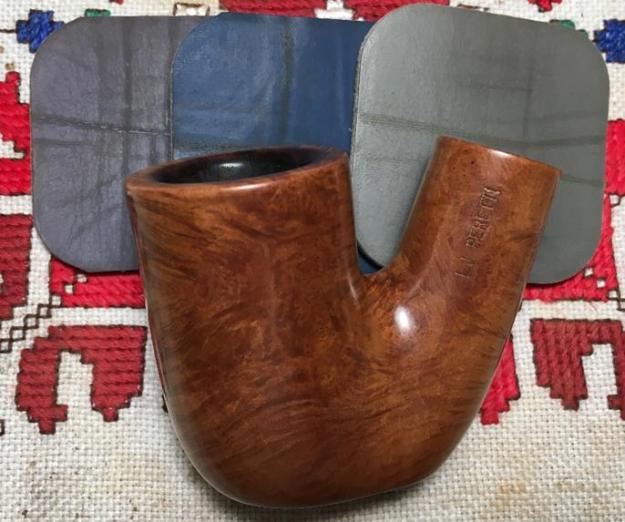
Of the Peretti Lot of 10, there are two Oom Pauls yet to be restored that have been commissioned.  Two other pipes above are joining my collection of Perettis when I finally get to restoring them!  The Calabash on the top, left, and the COLOSSUS Billiard on the bottom.  The Oom Paul Sitter before me now is distinctive and stands out even in the picture above – bottom right.  The vertical straight flame grain is distinctive even in its present state.  Here are pictures chronicling the Oom Paul Sitter’s condition and challenges. The condition of this Sitter resembles all his brother Oom Pauls and the cousins.  The former steward of these Perettis seemed to have a scorched earth policy.  All of them, this one included, have thick cake in the chamber and thick, crusty lava flowing over the rim. As with the others, the left side of the rim has taken the brunt of the tobacco lighting and the briar is charcoal where the flame was pulled over the side, burning the rim.  The unfortunate result of this is that when the charred wood is cleaned away, the rim/bowl is thinner on that edge and therefore out of round.  The stummel surface is dirty but will clean up well showing the beautiful vertical grain.  I see no fills in this briar.  The stem carries with it the bites and dents that all the other Perettis received as well.  The stem is moderately oxidized and has a little calcification on the bit.  The one critical observation I have made about the Peretti Oom Pauls is that the drilling of the mortises for the tenon/stem fit hasn’t been the best.  This Sitter’s stem does not sit evenly with the shank.  The shank has a lip over the upper part of the saddle stem and the stem has a lip over the lower shank.  The drilling has left something to be desired!  The tenon fit is also loose. I have plenty of hurdles to address as this Oom Paul Sitter is recommissioned!

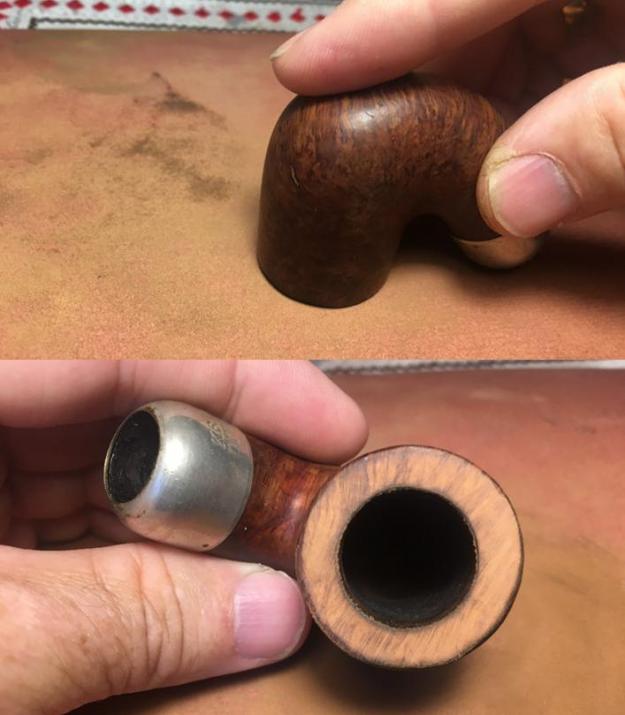
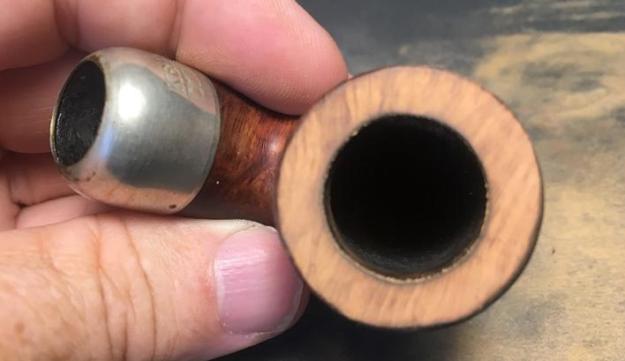
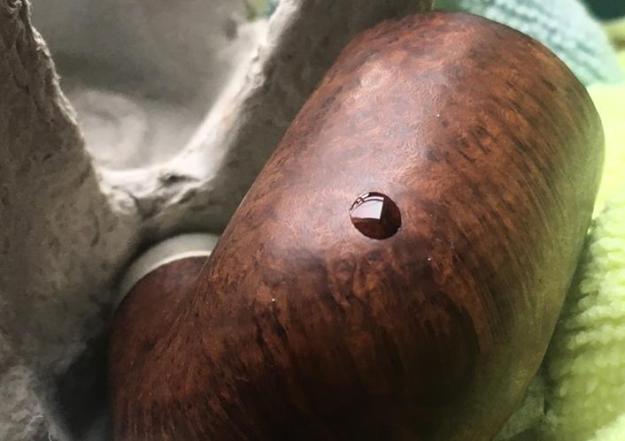
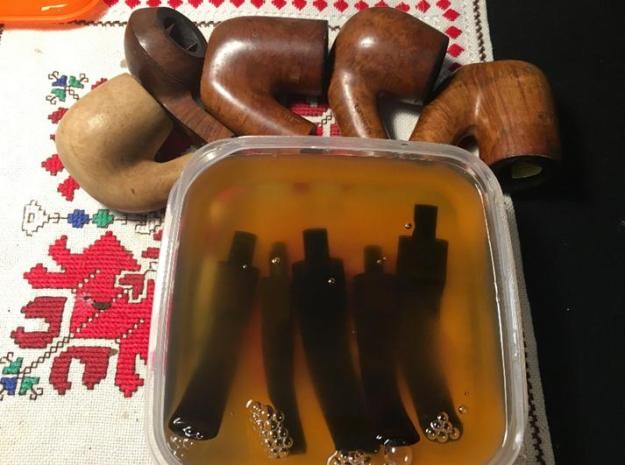
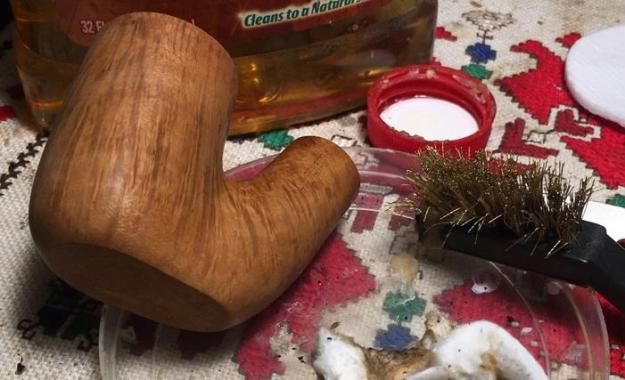
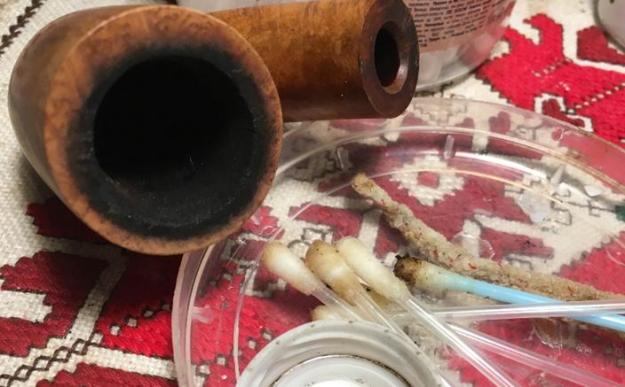
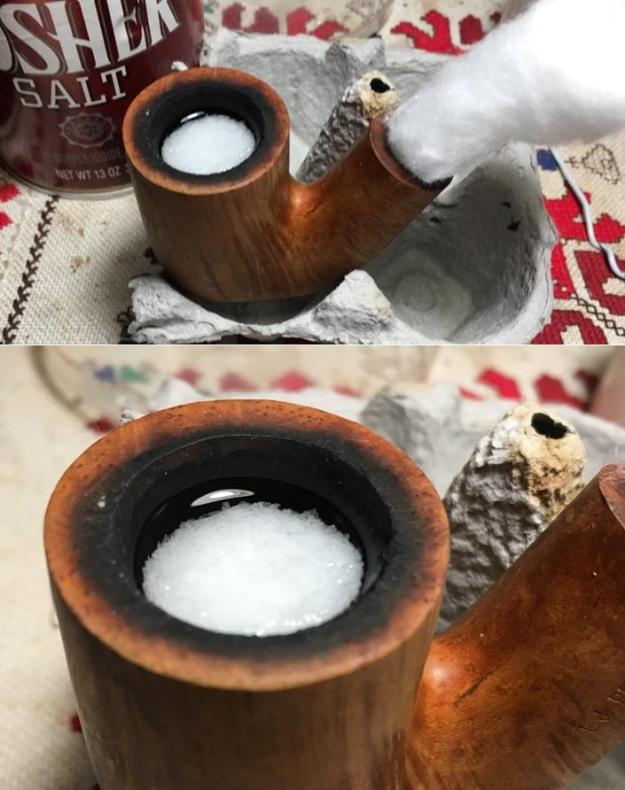
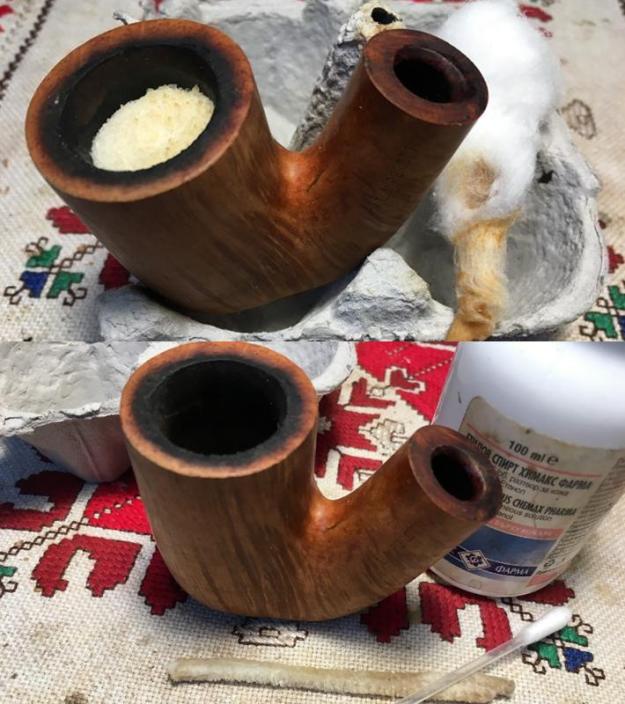
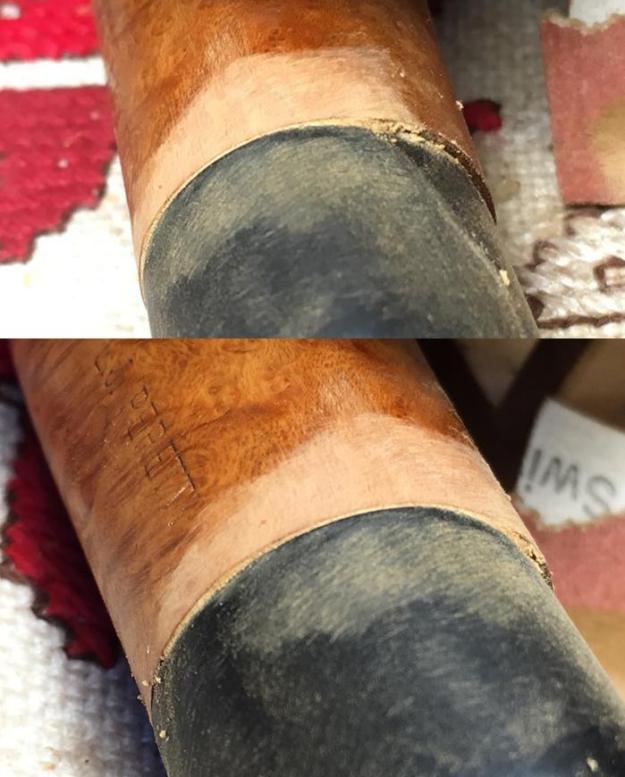
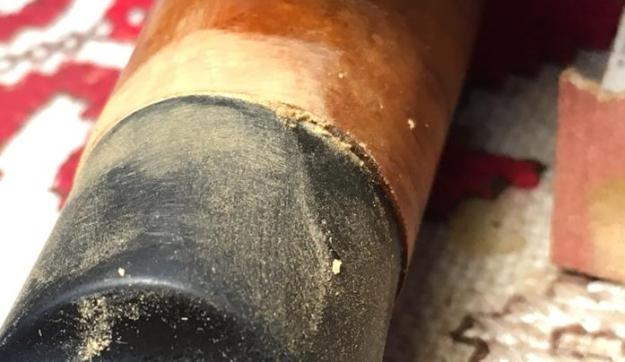
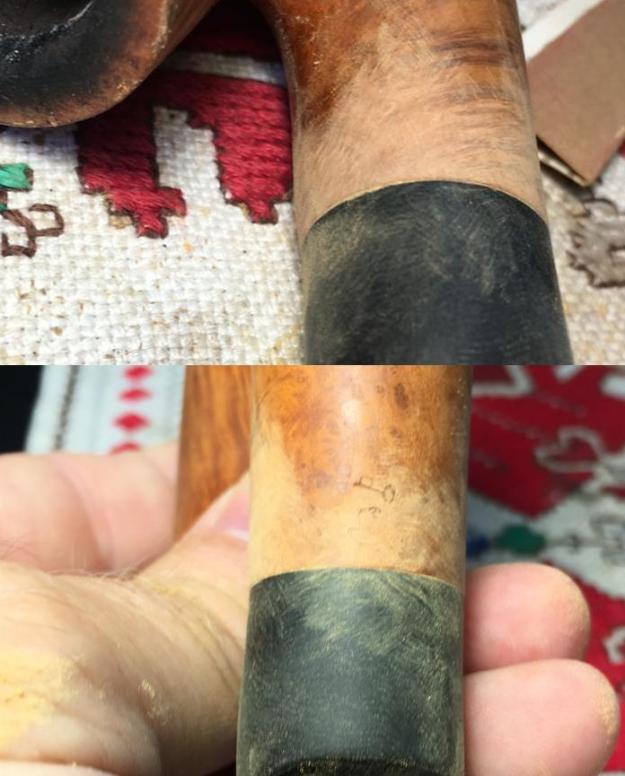
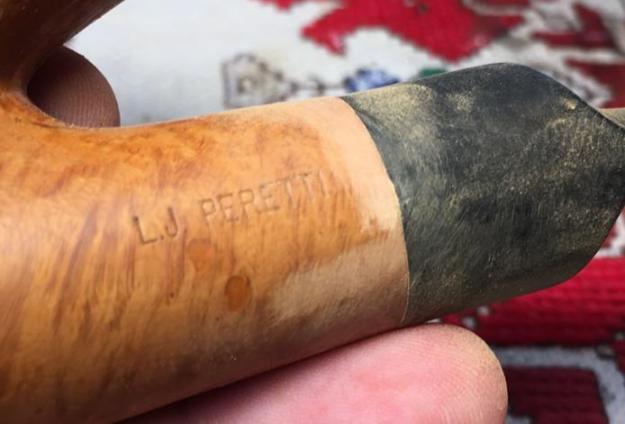
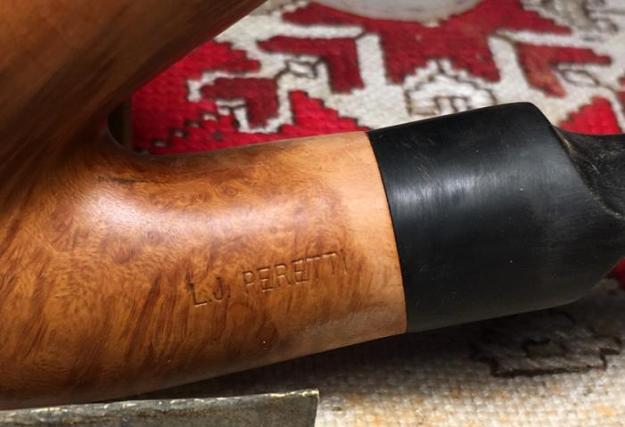
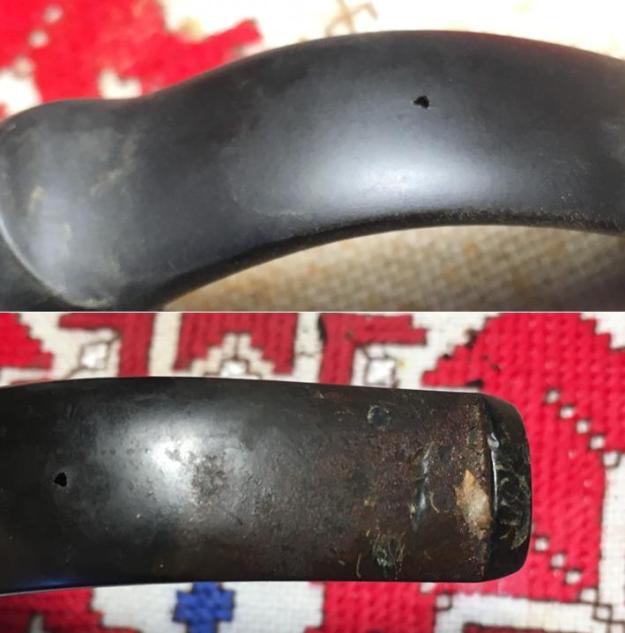
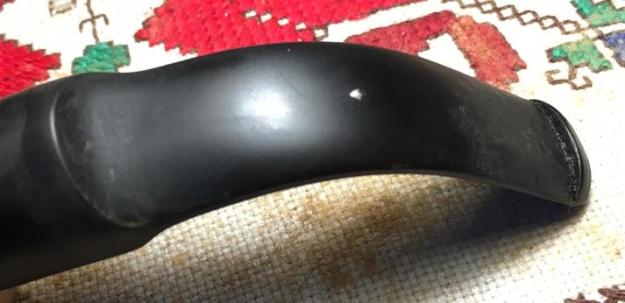
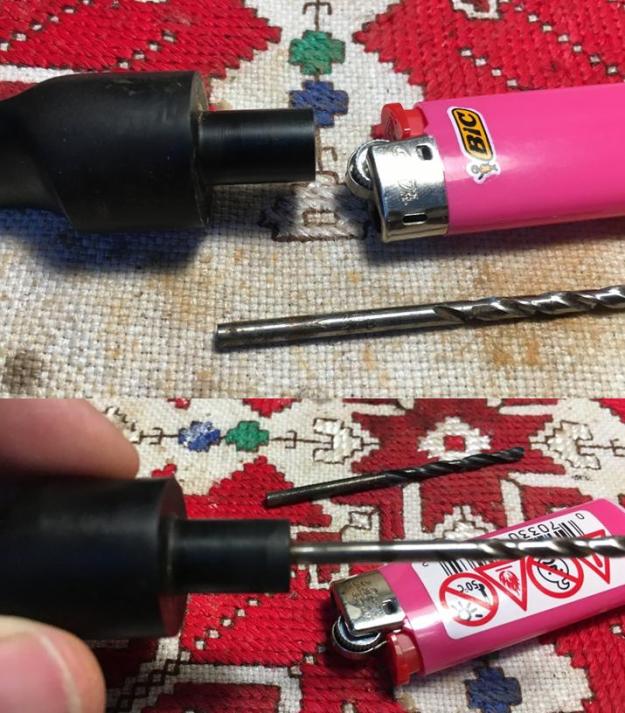
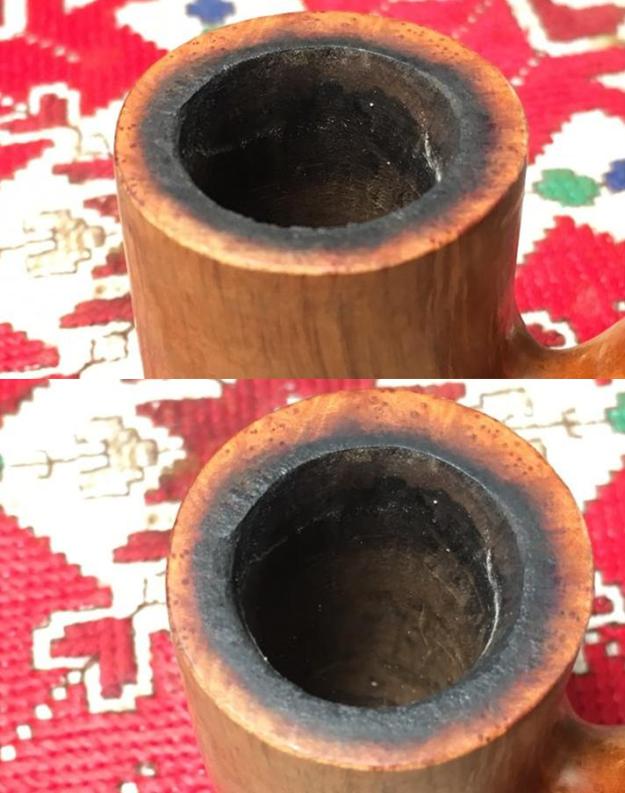
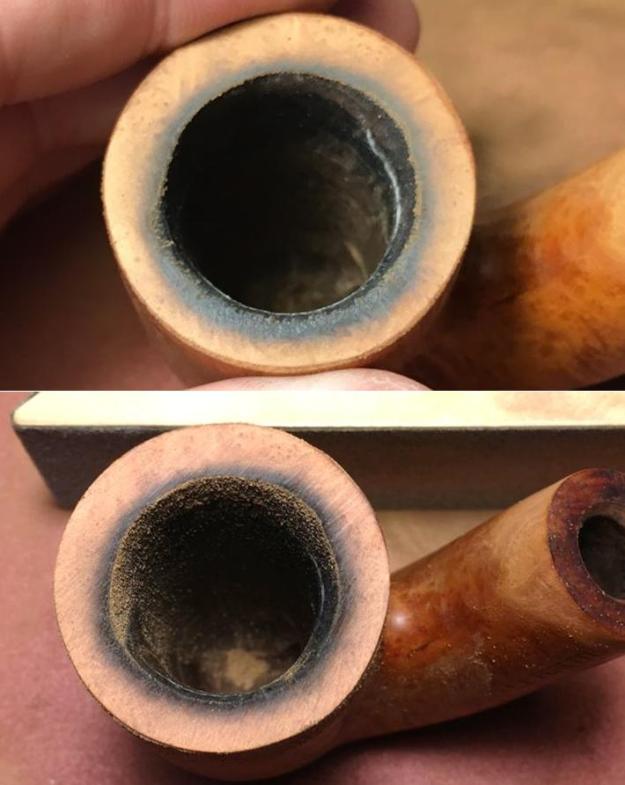
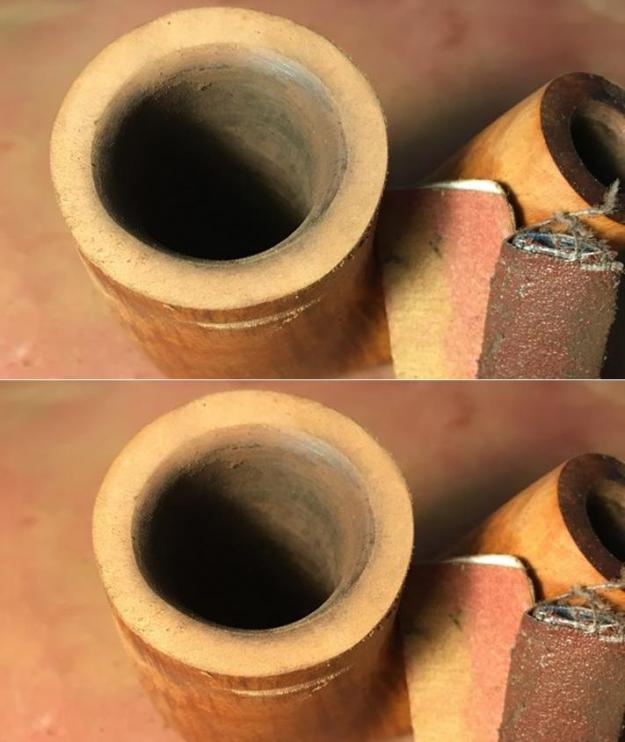
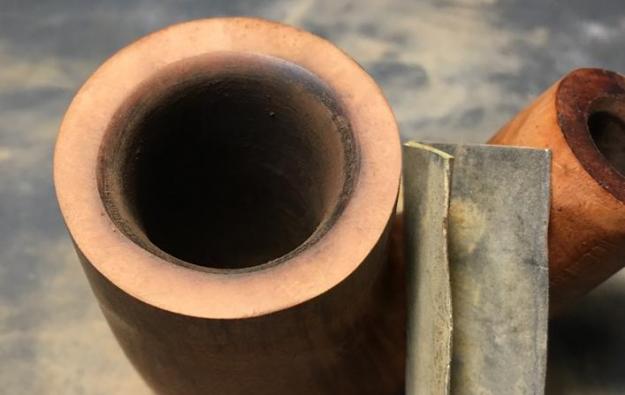
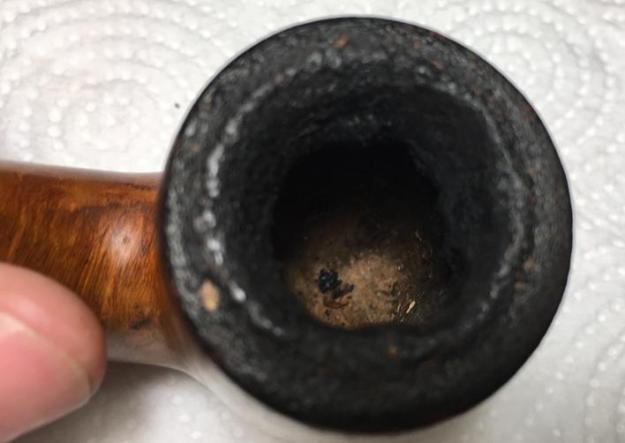
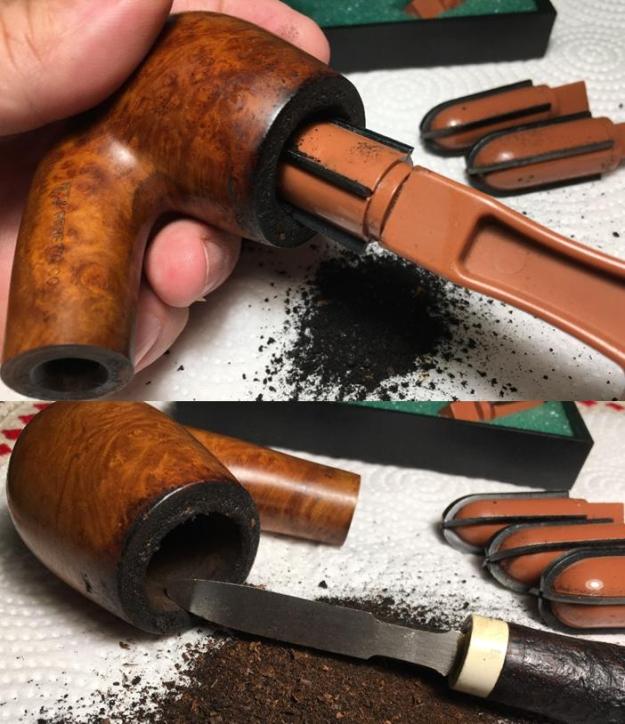
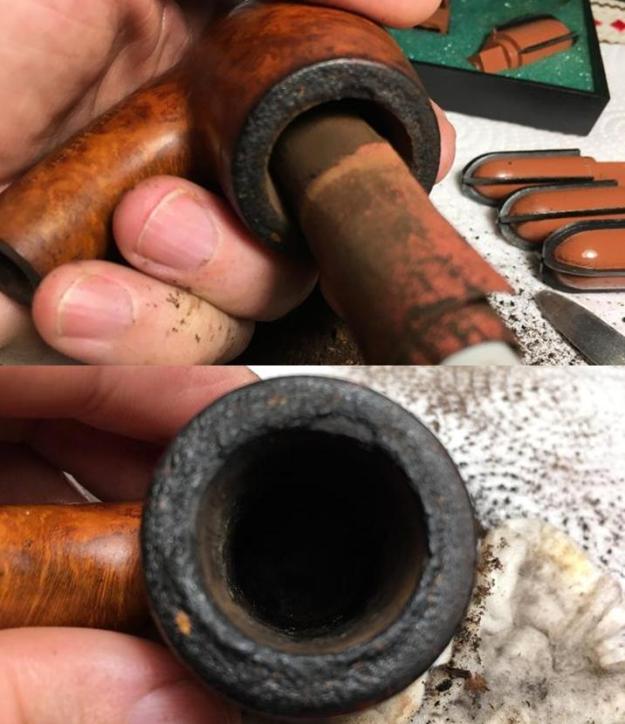
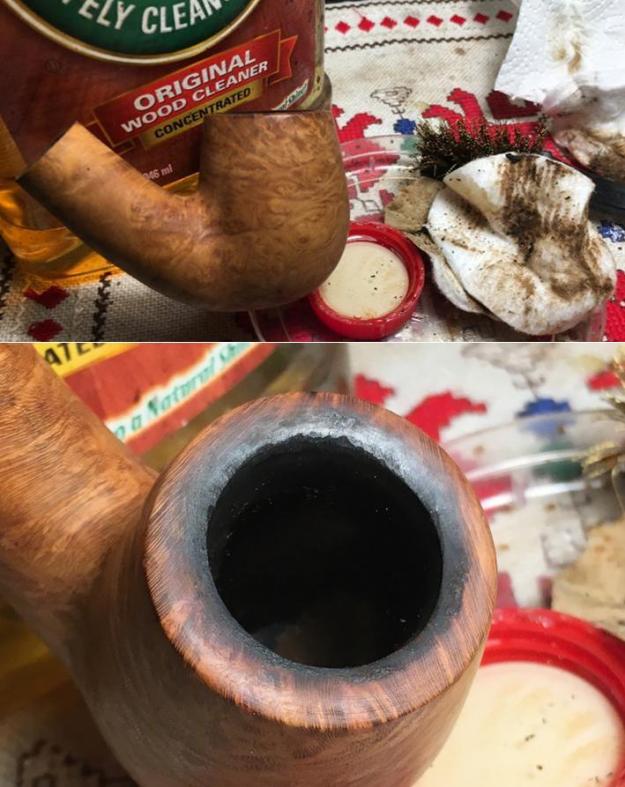
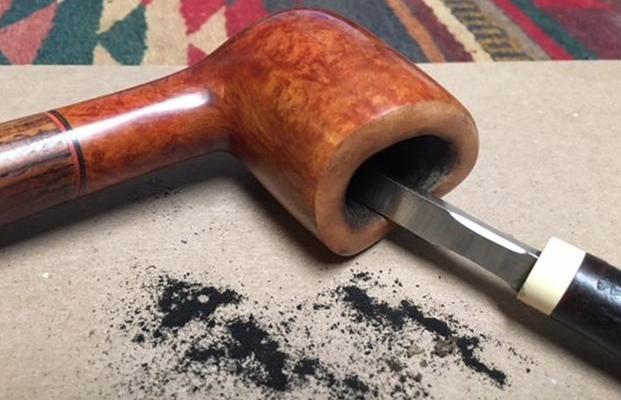
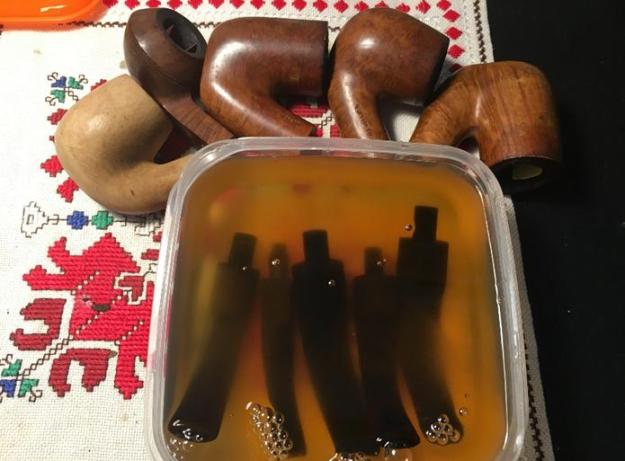
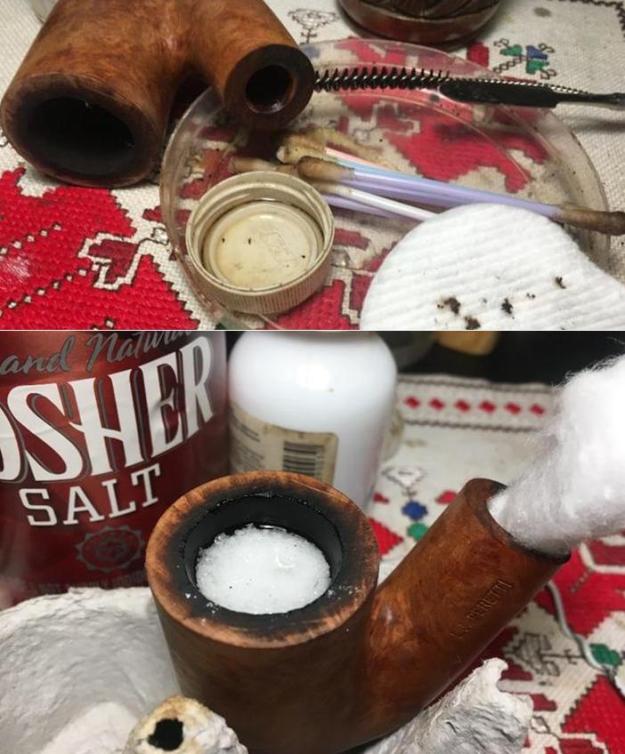
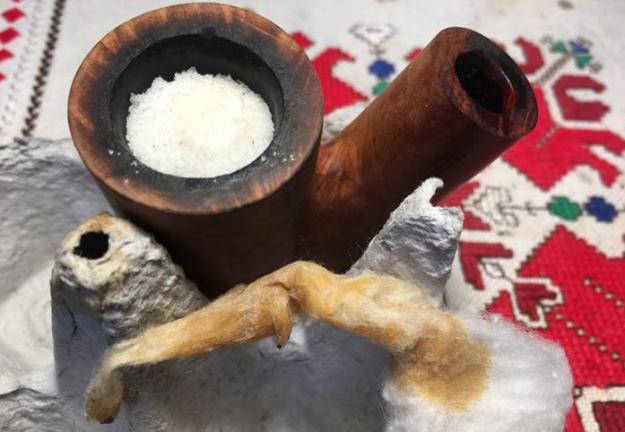
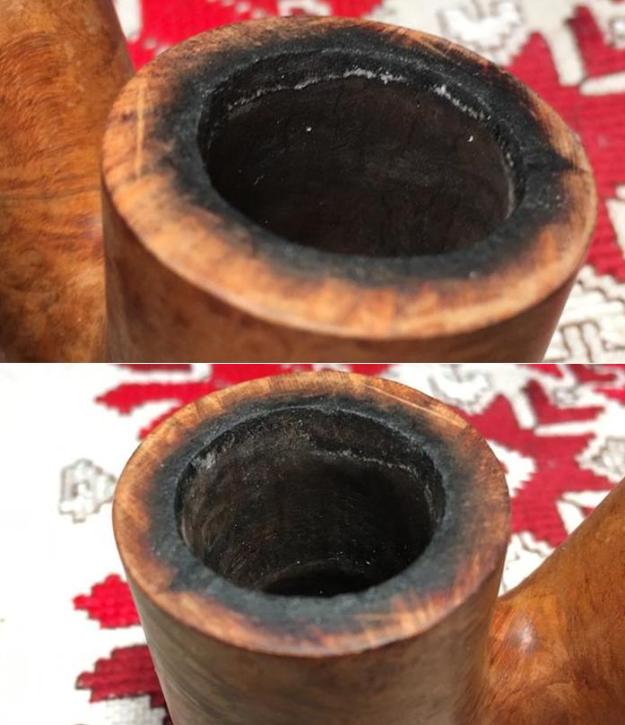
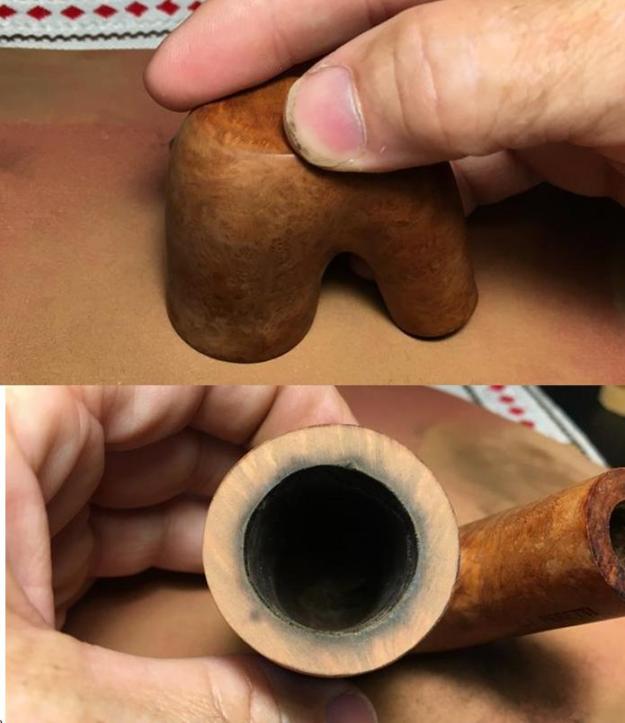
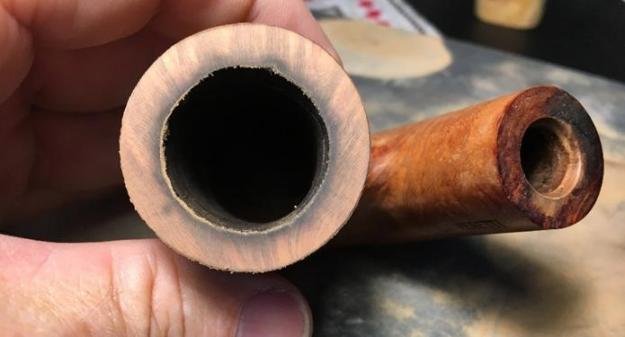
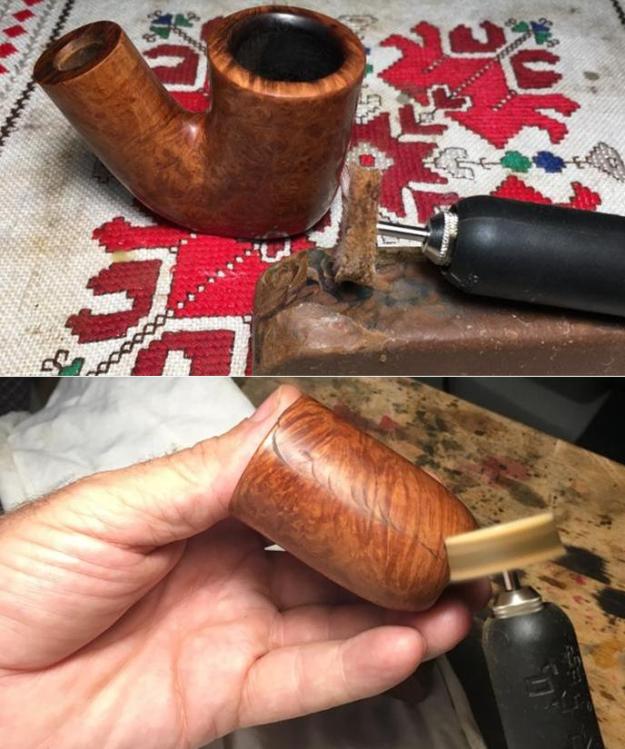
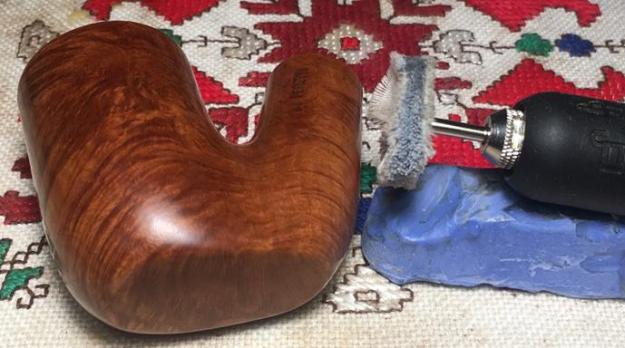
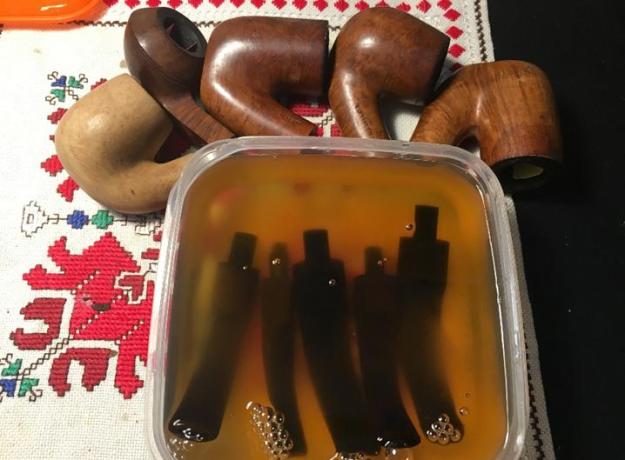
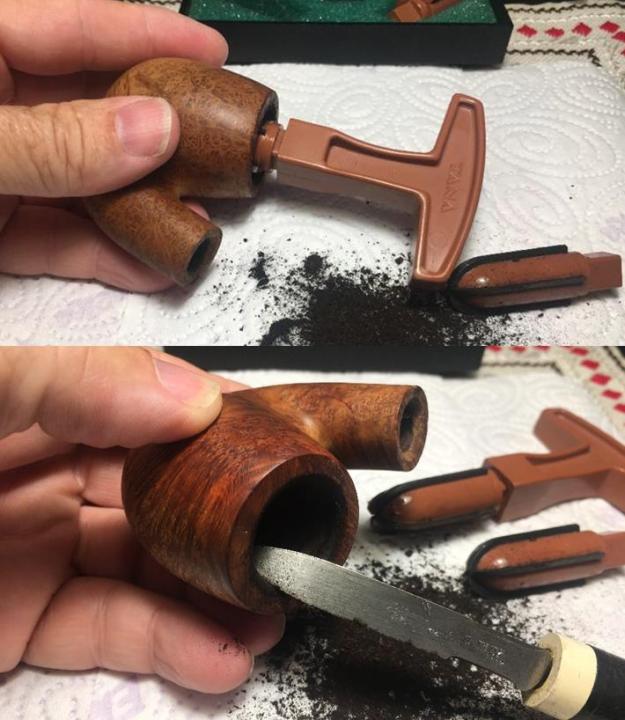
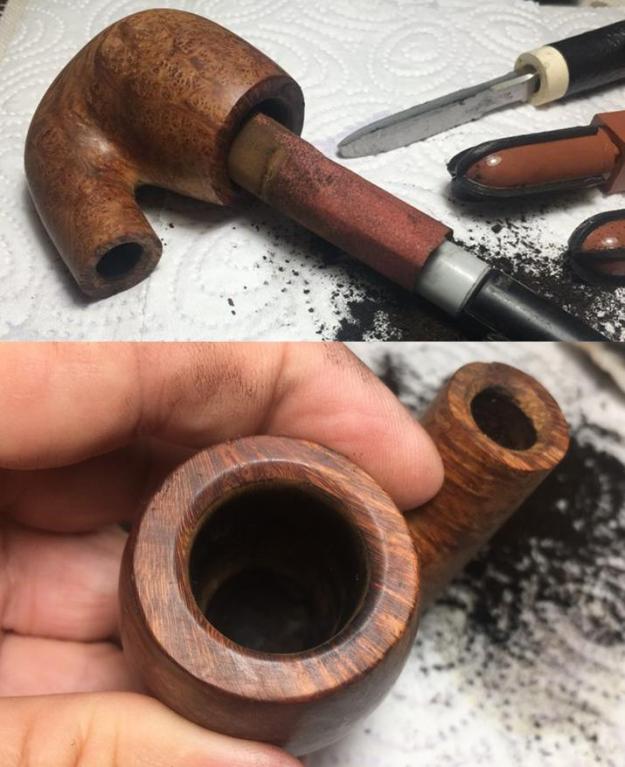
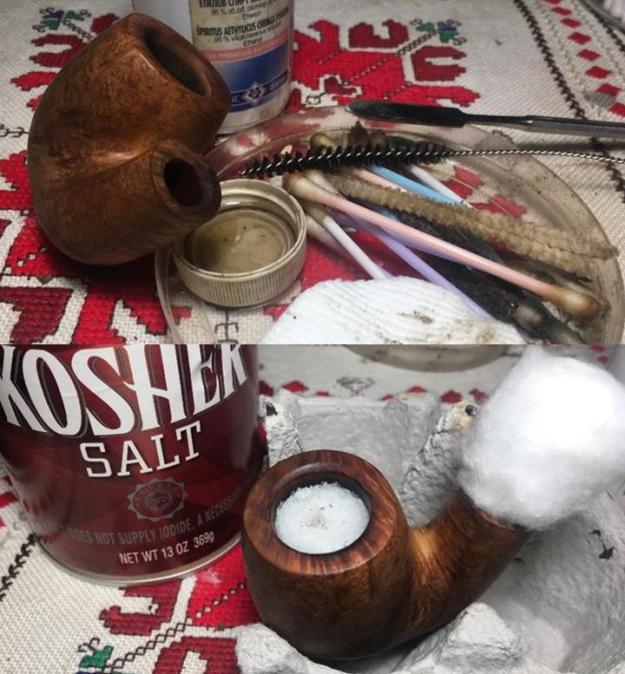
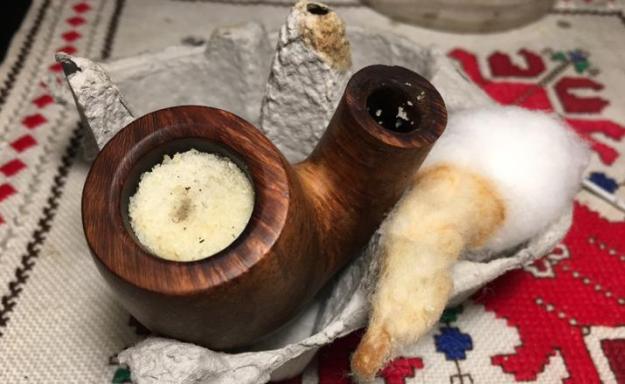
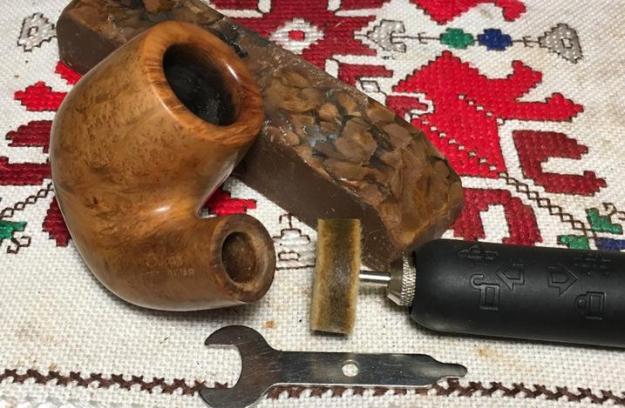
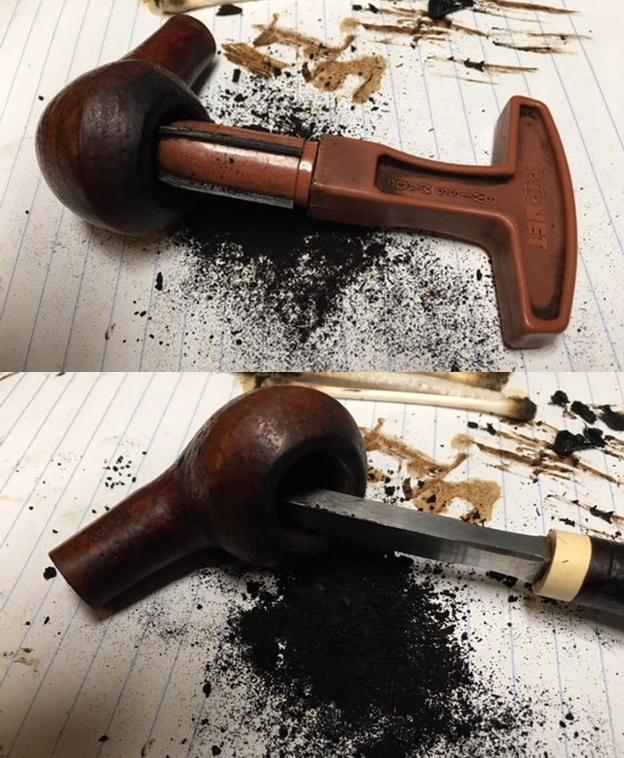
Beginning with the stem, it joins 4 other stems in a bath of Before and After Deoxidizer.  The stem soaks for several hours and when I fish it out, I let it drain and then wipe it down with cotton pads and light paraffin oil – this removes the Deoxidizer and the raised oxidation which wipes off as a very nasty brown.  The Deoxidizer has done a good job.Before proceeding further with the stem, I turn to the stummel cleanup.  I start by reaming the thick, crusted cake in the chamber.  Using my Pipnet Reaming Kit, I start with the smallest blade – first laying paper towel down to minimize cleanup!  I use 3 of the 4 blades available in the Pipnet Kit. The cake is hard causing the reaming tool to seize at times and I’m careful not bear down through stops in the turning of the blades but draw out the blades and go at it again.  I follow the Pipnet blades by employing the Savinelli Fitsall Tool which scrapes the walls more closely giving me more control.  I remove more cake on the top rim charring.  The goal is to find solid, healthy briar – which I do, but I can see the narrowing of the rim a bit due to the removal of the damaged wood. I then sand the chamber with 240 paper wrapped around a Sharpie Pen to give leverage.  This process clears the remnants of carbon cake and brings out a freshened briar to allow the new steward to restart a proper cake development – the thickness of an American dime is sufficient and helpful to protect the briar.  Thicker than that and the carbon cake can damage the bowl as the cake heats and expands. Finally, I wipe the chamber with cotton pads wetted with isopropyl 95% – ridding the chamber of the carbon dust.The bottom of the picture below represents the left side of the stummel where the rim damage is greatest.  You can see the narrowing of the rim on the bottom (left) compared to the opposite side.Now to attack the lava flow on the rim and to clean the stummel surface.  I take a few pictures of the stummel grime to show the progress.  I’m looking forward to seeing what Murphy’s will do!  Using undiluted Murphy’s Oil Soap, I go to work using cotton pads.  I also use a brass brush on the rim – brass brushes do not scratch the wood.  The hard crust is not easily moved.  I use the Savinelli Fitsall tool’s flat straight edge and carefully scrape the crust off the rim.  After getting the rim and stummel as clean as I can, I rinse the stummel with cool tap water and wow!  I’m not disappointed.  The beauty of this block of briar is shouting from the housetop!  I’m liking this a lot.  The downside is the rim.  As with all the other brothers and cousins, this stummel will be topped to restore fresh briar to the rim.  I love doing ‘before & after’ comparisons.  Who says that a good cleaning doesn’t help!? Now, to clean the internals of the stummel I use pipe cleaners and cotton buds dipped in isopropyl 95%.  I’m amazed that the internals, mortise and draft hole, are not terribly dirty.  With only a few pipe cleaners and cotton buds expended, I turn to the stealth approach.  To freshen the internals even more, I use the kosher salt and alcohol soak.  I fashion a wick using a cotton ball by pulling and twisting it.  I then push it down into the mortise into the draft hole using a straight hard wire.  I fill the bowl with kosher salt which will not leave an aftertaste as iodized salt and I cover the bowl and give the stummel a shake to displace the salt.  I then fill the bowl with isopropyl 95% until it surfaces over the salt.  In a few minutes the alcohol has been absorbed so I top if off again.  I put the stummel aside for the night, I turn out the light and my day is finished.The sun has risen on a new day in Bulgaria and the kosher salt and alcohol soak has done the job.  The salt and wick are discolored showing that the oils and tars were absorbed through the night.  I thump the stummel on my palm to dislodge the salt into the waste and I wipe the chamber out with paper towel as well as blowing through the mortise.  I dislodge any leftover salt crystals.  To make sure all is clean I run a pipe cleaner through the draft hole and a cotton bud in the mortise and all is clean and fresh.  I wonderful thing to behold!Before proceeding any further with stummel or stem restoration, I work on the issue of the junction between the two.  The upper half of the shank is extending over the stem so that when I run my fingers over the area there is an obvious ridge.  I take a close-up to show this.  Also, on the bottom of the shank, the stem extends over the shank – not as much, but I still detect a ridge in the opposite direction with the touch.  The mortise drilling was too low creating the offset.Leaving stem and stummel joined, I carefully sand the higher areas on both shank and stem to form a smooth transition from shank to saddle stem.  Of course, much care is given in the sanding so that I don’t inadvertently erase the ‘TI’ at the end of the L. J. Peretti nomenclature on the shank!  In the immediate picture below, you can see the sanded alignment transitioning into what has yet to be sanded on the top of the shank. The hope is to remove the ridge, but also to taper the sanding down the shank a bit to avoid the ‘stuffed pants’ look – a bulge of briar paralleling the ridge sanding.  The goal is a smooth, tapered transition. I like the results.  The ridges are removed and tapered.  Now, switching to 600 grade paper I erase the scratches left by the 240 sanding. After the 600 grade sanding is completed, I take a look at the junction.  Through the cleaning process, I have noticed that the stem has loosened in the mortise.  I’ll need to address the tenon/mortise junction. …AND IT WAS GOING SO WELL, until it wasn’t.  As I was surveying the stem, my eye caught sight of what looked like a hole on the upper side of the stem, mid-way through the bend.  Oh my!  Well, I first thought my eyes were not seeing what they were obviously seeing.  My initial reaction was, “How did I do that?”  Then, my next inclination was to look at earlier pictures of the stem to see if it was there and if so, how is it possible to have missed something so obvious?!?!  I’m glad you couldn’t hear the conversation floating through my mind at that point!  I found a picture before the restoration began, and yes, it was there.  The pictures reveal the source my current frustrations which is part and parcel of pipe restorations – and life….  I put a dental probe in the hole, and yes, it did go through. I then ran a pipe cleaner through to see how thin the vulcanite was at the stem’s bend where the hole broke through.  It appears thin, but salvageable.  To test the integrity of the surrounding vulcanite I pinch it hard to see if it would break.  It didn’t and that is good. I decide to patch it like a typical hole in a bit scenario but perhaps leave the patch a little ‘fat’ to add some reinforcement to the area.So, the projects are mounting for this stem.  First, to address the stem’s looseness – the tenon/mortise junction. Second, repair to the hole in the bend.  Third, repair the chewed bit and button – upper and lower.  Then, the sanding and preparations for the finishing phase.  I begin with the tenon expansion to tighten the stem’s fit.  I do this first because it’s the easiest and least time consuming.  I find a drill bit just a little larger than the existing tenon draft hole to act as the ‘expander’.  I use a Bic lighter and heat the vulcanite tenon by painting it with the lighter’s flame.  As the vulcanite heats, as a rubber composite, it softens and becomes pliable.  When heated sufficiently, gently I push the smooth end of the bit into the hole and the tenon expands as a result.  It works like a charm.  After heating the tenon, inserting the bit by twisting it, and retracting it, I test the fit.  It is good and snug, but not too tight that one is afraid of cracking the shank – which I’ve had experience in! I decide to do the prep work on the bit next so that at the conclusion, I can apply patch material to the bit area as needed as well as to the bend hole.  Looking at the bit and button first, I take a few more pictures to get a closer look.  I notice that there was something on the side of the draft hole and I began digging with a dental probe.  One hunk of something dislodged like it was hanging on for dear life.  I stuck the probe in deeper…there’s more….  I was incredulous!  How could so much stuff hide in the button draft hole!  I took pictures – it is an event!Addressing the dents first, I paint the dents with the flame of a Bic lighter to expand the vulcanite as it heats.  As it expands, the dents tend to dissipate in their severity.  Often, after flaming dents one is able simply to sand out the remaining damage – or much of it.  I also flame the button hoping to minimize the dents on the lip.  It did help, but sanding is still necessary. With a flat needle file and 240 grade sanding paper, I go to work on the upper and lower bit.  I use the file to refine the button and remove the dents where possible. The sanding removes much except for one dimple on the top and one on the lower bit. The button sanded out nicely.  I also employ a round sharp needle file to sharpen the edges of the draft hole. For the upper and lower dimples, I spot drop Special ‘T’ CA glue which is thicker. First, I clean off the areas with alcohol and cotton pads to clean it. I start with applying glue on the lower dimple and wait for an hour or so for the glue to set, and I flip the stem over and apply glue to the upper bit dimple. Now to the bend hole.  I use 240 grit paper and lightly rough up the area around the hole.  I then wipe it with isopropyl 95% to clean the area.  Instead of applying CA glue, I’ll use a putty created out of mixing CA glue and activated charcoal dust. I believe this will give me more texture for blending if I leave a larger area of patch to reinforce the area.  I don’t know if this will work in the end, but I can start with this intention and if it doesn’t work, I can always sand the excess.  First, I put petroleum jelly on the end of a pipe cleaner and I insert it to where I see it has reached the hole.  The pipe cleaner will hopefully keep the glue/charcoal in place and the petroleum jelly will keep the putty from sticking to the pipe cleaner, so I can pull it out!  Next, I place some charcoal dust on an index card.  I then place a bit of regular super glue next to the charcoal.  I use a tooth pick to draw the charcoal into the glue so that it’s gradually added.  In this way I can judge what the thickness should be – not too thin so it runs – not so thick that it doesn’t penetrate the hole. I mix the activated charcoal and superglue and when it seems to be the right consistency, I apply it to the hole using the toothpick as a trowel.  I tamp the putty down so that it fills the hole and I spread the patch around the surface.  I give a few movement tugs on the pipe cleaner and it is not stuck.  I put the stem aside to allow all the patches to cure. Turning again to the stummel, I focus on the rim repair.  I start by topping the Oom Paul Sitter.  Using 240 grade paper on a chopping board I rotate the inverted stummel on the paper in a circular motion.  I will remove enough on the rim trying to minimize the internal bevel which will remove the remainder of the charred wood.  I’ll have to be careful.  When placing the inverted stummel on the chopping block before putting the 240 paper down, I test how level the top is – the stummel rocks a bit.  This tells me that the rim is not level and most likely the left side, where most of the damaged wood is, has deteriorated.  Charred wood is softer and therefore probably dipped. I start topping and check often to see where things are going.  I also use a sanding block to help direct the topping to areas to try to bring about an evenly rounded rim – a challenge with the charring damage on the left side of the stummel – depicted on the bottom in the pictures below.  The pictures show the process. I’ve removed enough top briar real estate at this point and I will try to bring more balance to the rim as I remove the internal charring as I introduce a bevel.  Using a coarser 120 grade paper, I cut the initial bevel removing the charring.  I follow the 120 beveling using a rolled piece of 240 grade paper which smooths and continues to clean the char.  I then take the stummel back to the topping board again to reestablish the lines of the rim.  I do this a few more times, as I try to create a more balanced looking rim. I then top the stummel again with 600 grade paper and beveling as well.  The pictures show the rim cleaning and balancing process. One last step.  To soften the entire look of the rim, I introduce a gentle bevel on the external rim edge by cutting it with 120, following with 240 then 600 rolled pieces of sanding paper.  Considering from where we’ve come, I’m satisfied with the appearance of the rim!  It’s not perfect and this Peretti will carry the rim imbalance with it the ‘limp’ but he’s moving!Next, to prepare the stummel surface for the finishing phase, I use micromesh pads 1500 to 2400 to wet sand the stummel.  Then I follow this by dry sanding with pads 3200 to 4000, then 6000 to 12000. The grain on this Peretti Oom Paul Sitter is exceptional.  I watch it emerge through each micromesh cycle. This is going to be a beautiful pipe. With most of the Peretti Oom Paul restorations I have done (and the Peretti Half Bent Billiard) I was very pleased with the results of applying Before and After Restoration Balm on the stummels.  Keeping the light, natural original motifs of these Perettis has been my goal and the use of the Balm has helped maintain this desire.  I do the same with this Peretti.  I put some Balm on my finger and I work the Balm into the briar surface.  As I work it in, it starts as more liquid – with the consistency of light oil, but then gradually firms up until it is wax-like.  After I work it in thoroughly with my fingers, I set the stummel on the clothespin stand to allow the Balm to do what it does for a while. I take a picture of the Balm on the stummel.  After several minutes, I wipe the Balm off by buffing it out with a clean microfiber cloth.  It looks great – as I was expecting.With the Sitter’s stummel waiting in the wings for the stem to catch up, I pick up the stem.  Having had a night to thoroughly cure, the patches are ready to be filed and sanded down.  Before I forget it, since I had a pipe cleaner with petroleum jelly on it in the stem’s airway, I want to clean the airway so I run a pipe cleaner through the stem dipped with isopropyl 95%. Also, the thought in the back of my mind is the putty in the hole patch, did it push through and harden in the airway and form an obstruction.  Unfortunately, this was the case.  With the pipe cleaner coming from the tenon side, there seems to be a ridge at the patch site just entering the bend.  The pipe cleaner hung up there.  Coming from the button end, there is no problem with an obstruction.  As I test repeatedly, I discover that coming in from the tenon side, if I put a slight downward bend to the end of the pipe cleaner, the pipe cleaner would successfully navigate past the patch down to the button draft hole.  This is not a perfect situation, but it could be much worse with no passage through the airway.  Yet, the bright side of the scenario is that the patch is a bit stronger as a result, though the new steward will need to be aware of this bump in the road.  So, we move on. I begin the filing on the bend hole patch using a flat needle file.  I focus on keeping the file on the patch mound to not impact the vulcanite around the patch.To help me see what the patch would look like if I left it a bit ‘fat’ on the surface, I take a little detour.  My thinking is that it might help strengthen the area to leave the patch fatter on the surface.  To get a preview of the patch area, I ran the patch through the entire sanding process to get a better idea how visible it would be.  It didn’t take long to go from the filing to 240, 600 then 0000 steel wool focusing only on the patch area. Then I ran the patch spot through all the micromesh pads 1500 to 12000, applied Obsidian Oil and I look at the patch area. I take two pictures to show the future.  I decide I didn’t like the future!  Actually, the patch isn’t that bad, but I know it’s there and it seems unfinished….  I decide to continue to blend the patch by sanding.This is the bend patch after continuing with 240 and 600 grade papers.  That’s much better.I move on to the upper and then lower bit.  I use the flat needle file, 240 then 600 on both upper and lower sanding the patches and blending them.I follow by sanding/buffing the entire stem with 0000 steel wool before starting the micromesh pad process.Now to the fine-tuning sanding process.  I wet sand the stem using micromesh pads 1500 to 2400.  I then follow this by dry sanding with pads 3200 to 4000 then 6000 to 12000.  After each set of three pads, I apply Obsidian Oil to revitalize the vulcanite.  The Peretti’s stem is looking good even with all the repairs that were done.  I love the glassy pop of the vulcanite!  The patch work blended well. Now the home stretch.  I reunite the Peretti Oom Paul Sitters stem and stummel and mount the felt buffing wheel to the Dremel, set it at the slowest speed and apply Tripoli compound to the stummel.  Tripoli is a coarser compound I apply using a circular pattern over the stummel in a methodical way to cover the entire stummel.  I do not put too much pressure on the wheel, but allow the speed, compound and the felt to do the work.  When the Tripoli is complete, I mount a cotton cloth wheel to the Dremel, remaining at the same speed and I apply Blue Diamond compound to both stummel and stem.  I do it in the same way as the Tripoli. Finally, I change cotton cloth buffing wheels and apply White Diamond compound to the stem alone.  When the compounds are completed, I buff the pipe with a felt cloth to remove the compound dust from the surface of the briar.  I mount yet another cotton cloth buffing wheel to the Dremel, increase the speed to about 40% of full power and I apply a few coats of carnauba wax to stem and stummel.  Finally, I complete the restoration of this Peretti Oom Paul Sitter by giving it a brisk hand buffing using a microfiber cloth.

The vertical flame grain on this large Oom Paul Sitter stummel is striking and it is complemented by bird’s eye on the heel as well as the shank. It is unique in the Peretti Lot of 10 where the pipes showcased mainly horizontal and bird’s eye grain.  This Peretti will provide much visual pleasure to his new steward and with the size of the bowl, he will pack enough favorite blend for a nice long reflective time.  The stem and rim gave some challenges which I think have worked out well.  He carries with him some marks from his former life – as we all do!  Tim lives in Missouri and is the pipe man who commissioned this Oom Paul Sitter and has first dibs on the pipe when I put it in The Pipe Steward Store.  This pipe will benefit the Daughters of Bulgaria – women and girls who have been trafficked and sexually exploited.  Thanks for joining me!


Another L.J. Peretti of Boston: A Hefty Half Bent Billiard with a Saddle Stem


Blog by Dal Stanton

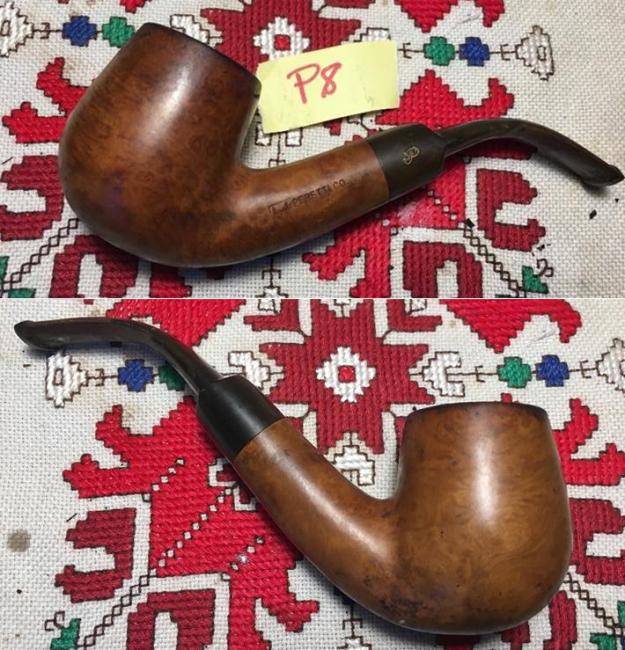
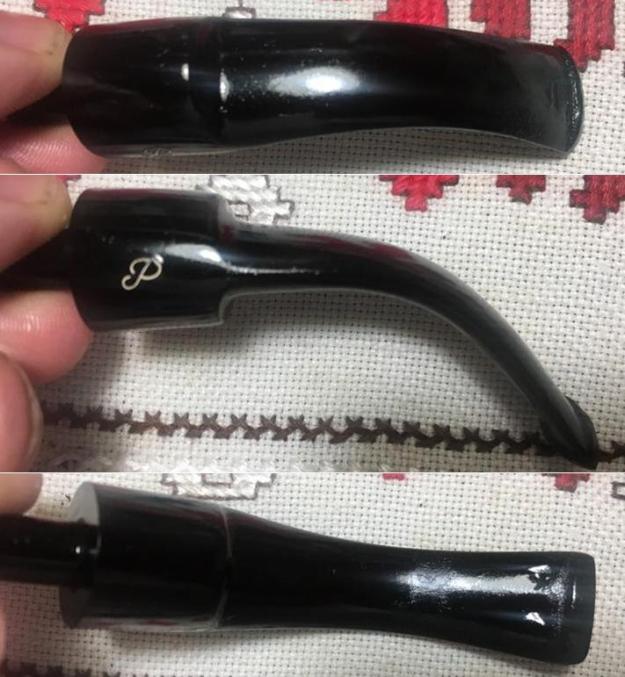
I have been placing several L. J. Peretti pipes in the hands of new stewards which brings me much satisfaction!  The others were all Oom Pauls – classic Oom Paul’s and some slightly modified by Peretti to serve as Oom Paul sitters.  After I was introduced to L. J. Peretti pipes and restored some that I added to my own collection, I started keeping my eyes open for these pipes because I discovered they were pretty good smokers and that the briar used to make them was not bad – actually, was quite good.  When I saw the Peretti Lot of 10 on the eBay auction block with the seller’s location nearby Peretti’s home of Boston, I figured (correctly) that these all came from a Peretti collector who lived in Boston or near enough to know the Peretti story.  The L. J. Peretti Co. is the 2nd oldest Tobacconist shop in the US – where custom blends are still created by hand.  Here is the picture I saw on eBay. The Peretti on my worktable now is the Billiard Half Bent Saddle on the right, center in the picture above.  Two things stood out when I cradled this Billiard in my palm for the first time.  First, the stem has the classy cursive Peretti ‘P’ stamped on it.  Only a few in the Lot of 10 had this stamp.  Only hazarding a guess, but this may indicate a higher-grade line in the Peretti offerings – though I haven’t laid my eyes on anything that could confirm this, catalogues, etc.  It is a classy touch to have the ‘P’ embedded on the stem.  Secondly, this Billiard is a big boy!  Just comparing him to the hefty Oom Pauls in the photograph above shows that this Billiard is not shrinking away in embarrassment! The bowl is full and the shank is long and broad.  His dimensions are Length: 5 7/8 inches, Height: 2 inches, Rim Diameter: 1 5/16 inches, Chamber Diameter: 1 7/8 inches, Bowl depth: 1 3/4 inches.  I also put him on the scale and he weighs 57 grams.

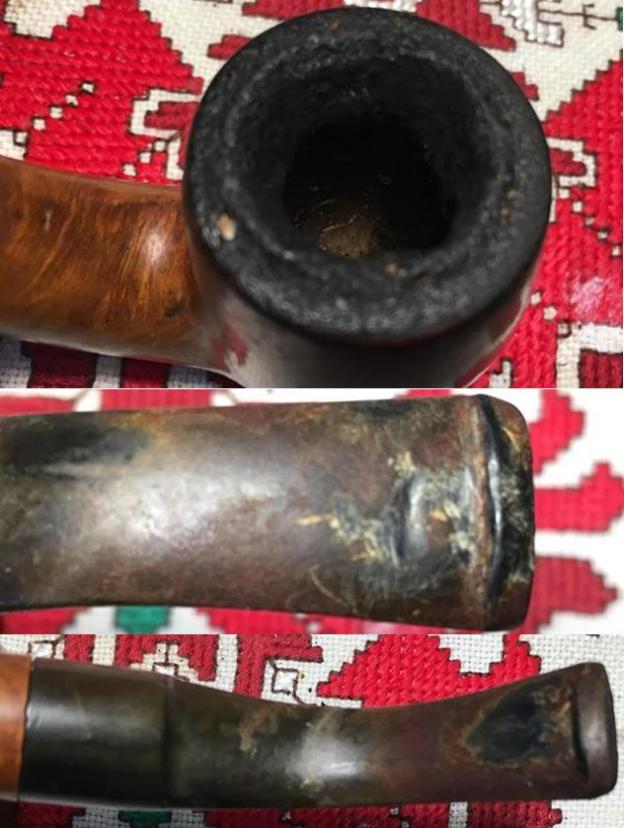
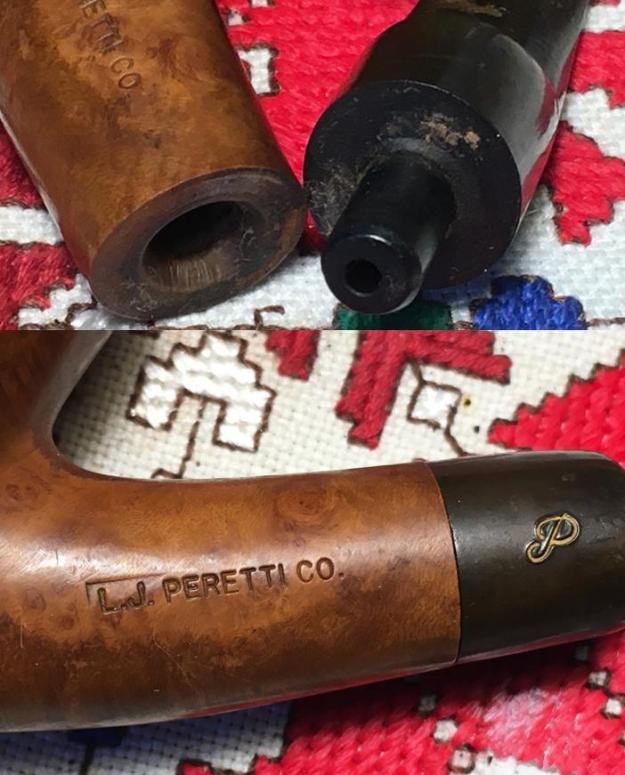
Our cousin, Stephen, who my wife and I visited while we were in the US some months ago, saw the Peretti Lot of 10 when I posted a picture of the 10 offering the Oom Pauls to new stewards to be commissioned.  He responded but he wasn’t interested in an Oom Paul.  He was drawn to the Half Bent Billiard because it reminded him of a pipe he had earlier in life.  I was glad to restore the Billiard for Stephen because I remembered that during our visit to his home in Alabama, he saw my restored L. J. Peretti HUGE Bent Egg in my pipe pouch – also from the Lot of 10 pictured above – center, left and pictured below after being restored (See LINK for restoration), and Stephen tried to barter him away from me!  Who could blame him?!  I held firm and my Peretti Egg and I continue to have regular fellowship here in Bulgaria!  Thank you, Stephen! Since Stephen commissioned this Peretti, he will have first dibs on it when I put it in The Pipe Steward Store.  This pipe benefits our work here in Bulgaria helping trafficked and sexually exploited women and girls (and their children!) – the Daughters of Bulgaria.Bringing the Half Bent Billiard on my worktable here in Sofia, Bulgaria, I take some pictures to take a closer look as well as to assess what this Billiard’s challenges are. As with all his Peretti cousins in the Lot of 10, the L. P. Peretti Co. is stamped on the left side of the shank.  Some of the other Perettis are without the ‘Co.’  As noted above, this Peretti also has the cursive ‘P’ stamped nicely on the stem.  Only a few of the Perettis had this stamp in the Lot.  This Billiard shares with all his cousins the thick cake in the chamber.  It also has very thick lava flow on the rim.  It is also most likely, as with the other Perettis, that there will be scorching damage underneath the lava.  The briar surface is dirty – lots of grime, but this should clean up nicely, as with the other Perettis, this large patch of Billiard briar shows great promise.  The stem is also showing deep oxidation and calcification on the stem – especially on the bit.  As with all his cousins, the bit and button show a good bit of biting, clenching and the subsequent dents, chatter and button damage.

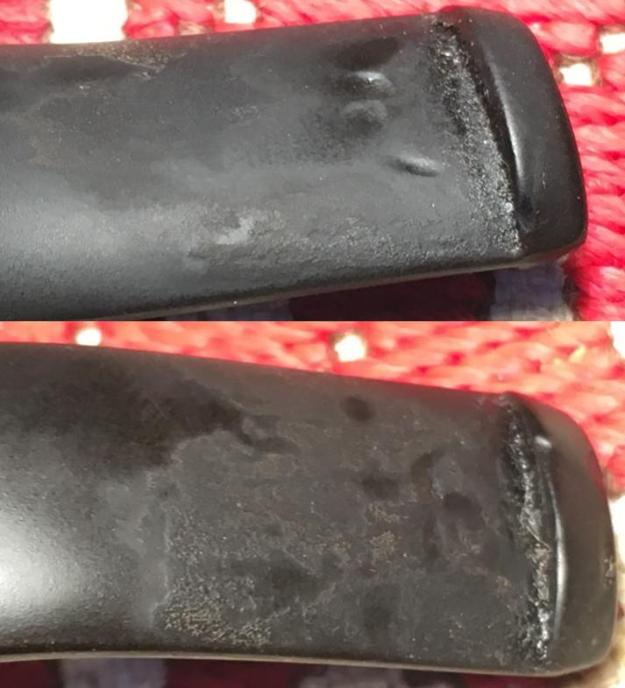
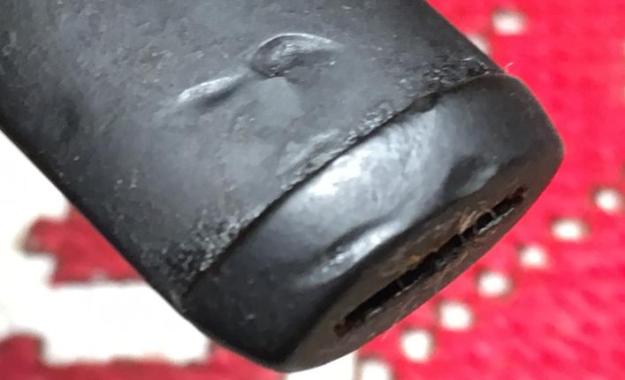
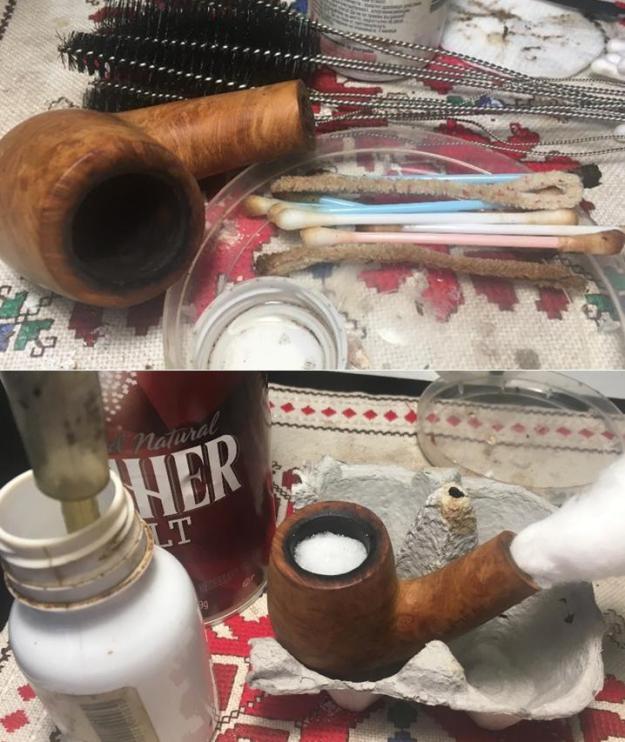
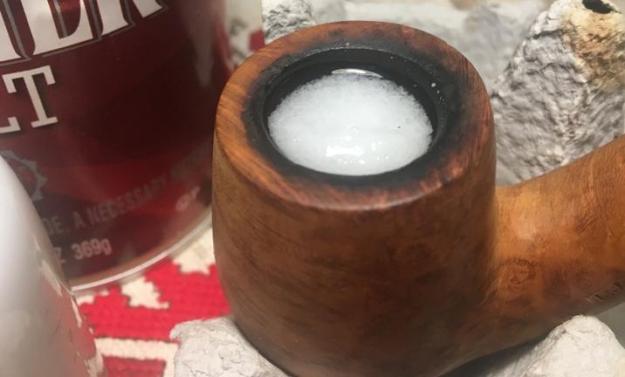
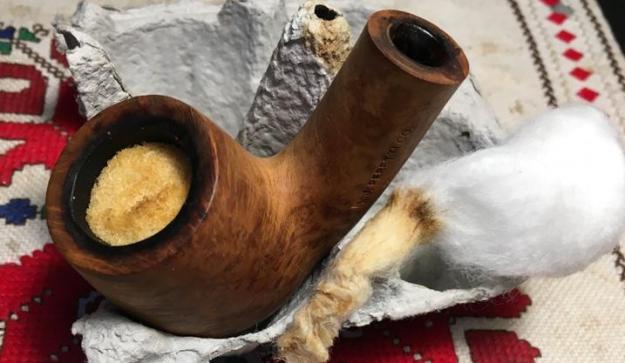
To start the restoration of this hefty Peretti Billiard Half Bent Saddle, I add the stem to a bath of Before and After Deoxidizer.  This was the first time I used the Before and After product and I was testing it to see how it worked.  The Peretti Billiard joined several pipes and their stems in the queue.  After soaking for several hours, I fished out the Billiard’s stem and allowed the Deoxidizer to drain.  I then wiped off the oxidation with a cotton pad wetted with light paraffin oil, Bulgaria’s mineral oil.  One of the attributes of Before and After Deoxidizer is that it is stamp friendly, which proves to be the case with the Peretti ‘P’.   With the stummel now in hand, I use the Pipnet Reaming Kit to remove the very thick cake resident in the chamber.  By removing the cake down to the briar gives it a fresh start and enables me to examine the chamber wall for damage.  After putting down paper towel for easier cleanup, I start with the smallest blade.  I use 3 of the 4 blades available in the Pipnet Kit.  I then fine tune the reaming by using the Savinelli Fitsall Tool to scrape the chamber walls removing more carbon cake left behind.  Wrapping a piece of 240 grit paper around a Sharpie Pen, I sand the chamber.  Finally, I clean the chamber of the carbon dust using cotton pads with isopropyl 95%.  The chamber walls look great – no problems.  The pictures show the steps in the process. Now to the external surface.  I use undiluted Murphy’s Oil Soap and cotton pads to scrub the grime – and there’s plenty of it.  I also work on the crusty rim surface utilizing a brass brush and scraping with my thumb nail.  I also employ a pin knife to help scrape the crust.  What emerges is beautiful grain on the stummel – large swirling bird’s eye catches my eye. Surprisingly, a nice looking, slightly rounded rim emerges from underneath all the crust!  The briar on the rim reveals that this was a nice-looking pipe at one time – I’m thinking it was on Peretti’s upper scale shelf.  The scorching on the inside of the rim is significant and will need to be addressed. Next, the dirty job.  Using pipe cleaners and cotton buds dipped in isopropyl 95% I attack the internals of the stummel.  I also utilize a dental spatula to scrape the mortise walls.  With a little effort the buds and pipe cleaners started coming clean.  As I usually do with all my restorations, I follow this cleaning with a kosher salt/alcohol soak.  I find that this additionally cleans the internal briar and freshens the internals.  After putting the stummel in an egg carton to keep it upright and stable, I fill the bowl with kosher salt which leaves no aftertaste (as iodized salt does).  I then fashion a ‘wick’ by stretching and twisting a cotton ball which is inserted down into the draft hole and mortise – as far down as I can manage.  I then fill the bowl with isopropyl 95% alcohol until it surfaces over the salt.  After a few minutes, after the alcohol has been absorbed, I will top the alcohol off again.  I put the stummel aside and let it soak through the work day until I return home this evening. Later, when I arrive home from work, I’m always pleased to see the nasty results of the salt/alcohol bath.  The salt has discolored, and the wick has absorbed the grunge.  I thump the old salt into the waste, wipe the bowl with paper towel and blow through the mortise to dislodge any remnants of salt from the soak.  To make sure all was clean, I ran a pipe cleaner through the draft hole and plunged a cotton bud in the mortise – both dipped in isopropyl 95%, and both came out clean.  Done – always a nice place to be.I turn now to the chewed up and dented stem – oh my.  The entire Peretti Lot of 10 I determined came from one steward.  One of the ways I determined this was that all the stems were clenched the same way and therefore reveal the same forensics!  I take a few pictures to show the problems with upper and lower bit and button.  The first step I use is using flame to heat the vulcanite which expands it making the dents less severe and more easily sanded.  I use a Bic lighter and paint the upper and lower bit areas.  I concentrate on the button as well.  After several cycles of ‘painting’ I have come to the point where the vulcanite is no longer expanding.  It has helped but there remains some denting and bite marks.  I pair the before and after ‘flame painting`’ pictures to let you compare. I think the button benefited most. Using 240 sanding paper, I sand both upper and lower bit and the button to see how much of the damage can be sanded out.  The heating technique helped more than I realized – good news.  The upper bit sanded out completely.  The lower bit still shows two dents.  Using the flat needle file, I worked on the button and refreshed the upper and lower button lips.  The draft hole was dented too.  I pull out the topping board with 240 paper on it and ‘top’ the button to flatten it out.  I smooth out the draft hole using a rounded needle file.  I take a picture to show the progress of the 240 paper and file work.  When I look at the stem I see something I didn’t see before.  A hole in the stem on the right at the base of the saddle.  I’ve never seen this before.  I’ll need to patch it as well.  I wipe the stem with alcohol to clean the area where I will apply black CA glue to fill the dents.  After clean, using a toothpick, I spot drop black CA glue on both dents on the lower bit.  The toothpick allows me to control where and how much glue I apply.  I wait an hour or so for the glue to set and then turn over the stem and spot drop glue on the ‘saddle’ hole.  I set the stem aside for the patches to cure for several hours.  With the stem patch curing, I turn again to the stummel and the rim.  The scorched briar needs to be removed and topping the stummel will move in that direction. Like all the Peretti Billiard’s cousins in the Lot of 10, the left side seems to have borne the brunt. I’m hoping I only need to top a small amount and remove the remaining scorched wood on the internal rim edge by introducing a bevel.  That’s the plan.   Placing 240 grit paper on the chopping block, I top by moving the inverted stummel in a circular motion and evenly as possible.I stop to check a number of times how much progress has been made on removing the scorched briar.At this point, I’ve removed enough damaged surface via topping leaving a manageable internal ring of charred material that can be removed without taking more healthy briar.  I use a rolled piece of 120 coarse sanding paper to cut an internal bevel and remove the scorched area.  I also aim at balancing the round of the rim – it is slightly out of round because of the greater damage on the left side of the bowl where the former steward lit his tobacco.  After cutting the bevel with 120, I give another very light topping with 240 grit paper to restate the rim line after the bevel.I follow the 240 topping board and 120 paper beveling by using 240 grade paper to erase the scratches of the 120 beveling.  Then, I use 600 grade both to erase the scratches of the 240 on the bevel, but to top again lightly the stummel with the 600 grade paper to erase 240 scratches and to smooth.Finally, I introduce a very gentle external bevel around the rim using 240 then 600.  I do this to soften the look of the rim and to give it more of a rounded appearance.  I’m pleased with the rim repair.  This Peretti Big Boy Billiard has already come a long way from the caked, scorched condition he arrived in!  He’s looking good.Now to the briar surface – and there’s a lot of briar real estate on this stummel!  I begin by wet sanding with micromesh pads 1500 to 2400.  Then dry sanding, I use 3200 to 4000 and 6000 to 12000.  I take a picture after each set of three. I enjoy watching the grain emerge on the Peretti Billiard through the micromesh pad cycles – it’s an amazing transformation.  Along with most of his Peretti cousins, the briar seems to be a higher grade – no fills and the grain is beautiful. To maintain the rich natural briar look consistent with the Peretti hue template, yet to deepen and make the briar grain richer, I use Before and After Restoration Balm. I apply the Balm to my finger and then spread it over the stummel and work it in to the briar.  The Balm begins as an oily liquid and then gradually grows firmer until it takes on the characteristics of a thick wax.  After I work the Balm in well, I put the stummel on the stand to absorb the Balm for several minutes and take a picture.  I then wipe the stummel with a clean cotton cloth to remove the Balm residue and buff up the surface.  I put the stummel to the side and turn my focus again to the stem.After the black CA glue patches have thoroughly cured, I first use 240 sanding paper to do the initial removal of excess patch and blending. I continue to shape and fine tune the button lips with the 240 as well as remove the patch excess and smooth the saddle hole on the side.  Then, to erase the tracks of the 240, I use 600 grade paper. To erase the scratches of the 600, I buff the entire stem with 0000 grade steel wool which leaves a good evenly prepared surface to begin the micromesh pad cycles.  I like the way the chewed bit came out.Now, using micromesh pads 1500 to 2400 grade, I wet sand the stem.  It was going so well until it wasn’t! After starting the second cycle dry sanding with pads 3200 to 4000, I see what I didn’t see before.  As the lower bit was glossing up because of the micromesh sanding, a small dimple remnant of the lower bit dent became visible to me – ugh.  When it comes to restoring pipes (and with many things in life 😊) I’m a stickler for detail and even though I’m well advanced in the stem finishing process, this dimple will not stand!  I wipe the spot with alcohol to assure that it is clean and I spot-drop Special T CA glue on the dent. This glue is extra thick because I want the drop to stop on the spot and not run over the stem as thinner CA glue tends to do.  I’ll spare you all the pictures of starting over filing, sanding, steel wooling and micromeshing pads catching this dimple patch up, so let it suffice to show the before and after, and then we move on.  Starting with the completion of pads 1500 to 2400:The discovery.  Before….And after….Now moving on to dry sanding with pads 3200 to 4000 and 6000 to 12000.  To revitalize the vulcanite, after each cycle of three I apply Obsidian Oil.  The stem looks great even though I encountered a significant detour along the way.  I love the pop of vulcanite that has been fine-tuned with micromesh pads!The home stretch!  As I reunite the half-bent saddle with the stummel to begin the compound buffing cycle I discover that the union between stem and stummel has loosened.  As sometimes can happen during the cleaning process, the mortise can be opened, and the result is that the tenon is not as snug. To remedy this and to tighten the mortise/tenon union a bit, I use the flat end of a drill bit just a little larger than the diameter of the tenon draft hole.  I heat the vulcanite tenon with a small flame and as it warms the vulcanite it becomes pliable and gradually I insert the drill bit into the airway.  This expands the mortise a bit and hopefully, creates a better fit. The approach works perfectly even though it required two enlarging drill bits to provide a snug union. With stem and stummel reunited with a good fit, I mount a cotton cloth buffing wheel to the Dremel and set the speed to the slowest.  Using Blue Diamond compound, I apply it to the stummel and stem using a slow, methodical, circular approach, not applying too much pressure to the buffing wheel, but allowing the speed of the Dremel and compound to do the work.  With my wife’s assistance, I include a picture showing this below.  After completing the Blue Diamond application, I mount another cotton cloth buffing wheel dedicated to the application of wax.  After increasing the speed to about 40% of full power, I apply the carnauba wax in the same way as the compound.  Afterwards, I use a microfiber cloth and give the pipe a brisk hand buffing to raise the shine.None of the Peretti pipes that I’ve restored thus far have disappointed.  They arrived on my worktable in rough shape with scorching and chewed bits.  This L. J. Peretti Co. Billiard Half Bent Saddle was no exception.  The briar grain showcased in the large bowl reveals swirls of large bird’s eye pattern and horizontal straight grain in a whimsical contrast.  The grain flow reminds me of pictures of Jupiter’s atmosphere intermingling!  The distinctive Peretti “P” stamping stands out nicely imbedded in the glassy shine of the half bent saddle stem.  Cousin Stephen commissioned this hefty Peretti Billiard and will have first dibs on it in The Pipe Steward Store.  This pipe benefits women and girls (and their children) that we work with here in Bulgaria, who have been trafficked and sexually exploited – the Daughters of Bulgaria.  Thank you for joining me!

What an interesting Freehand pipe – a Veeja 900 C6


Blog by Steve Laug

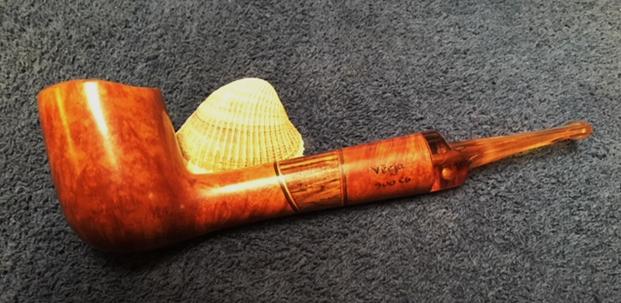
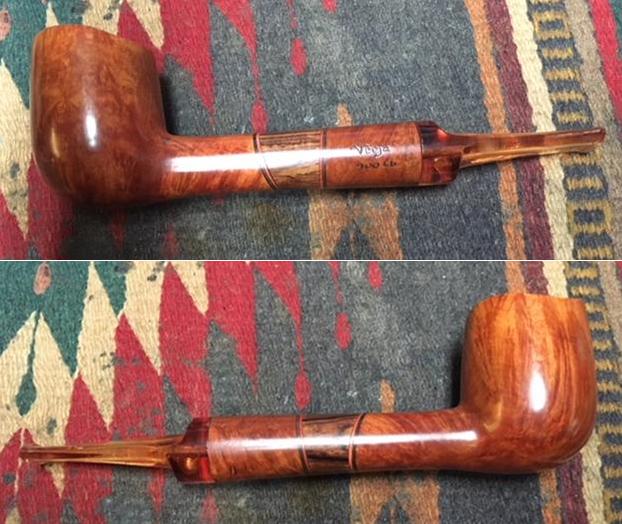
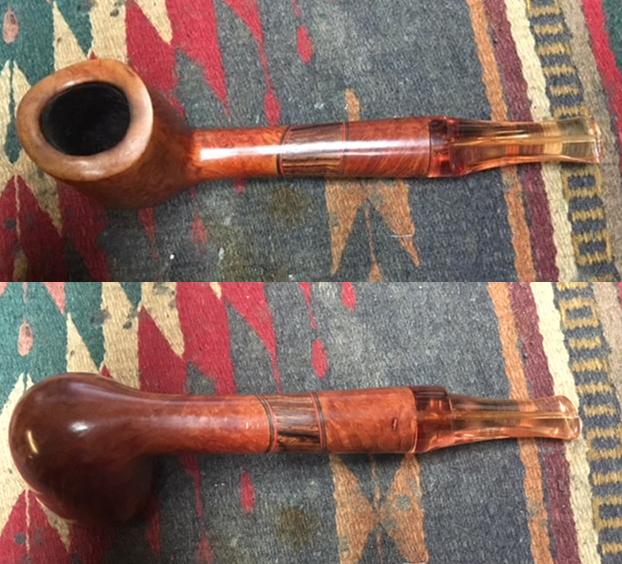
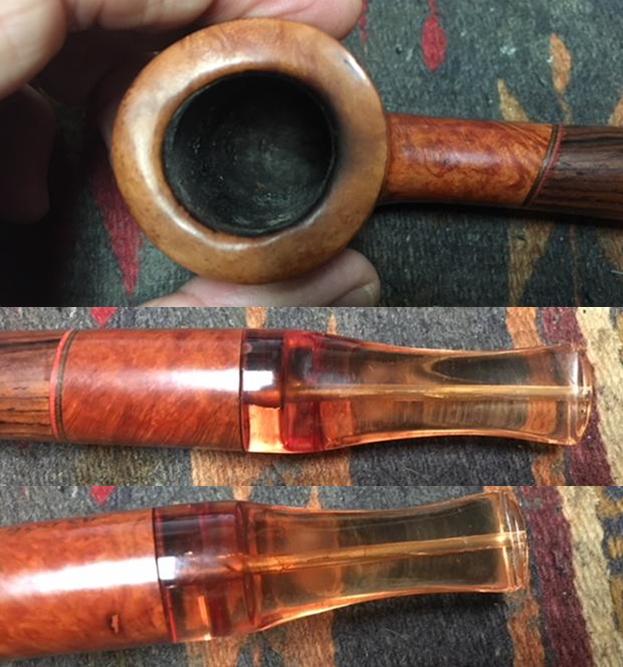
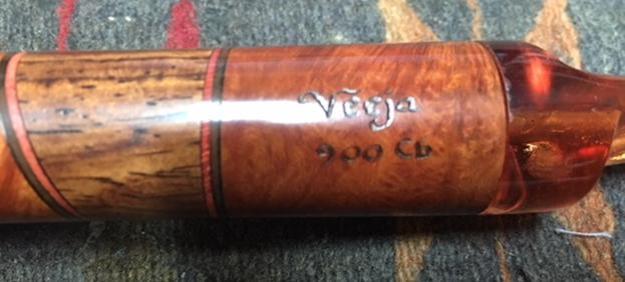
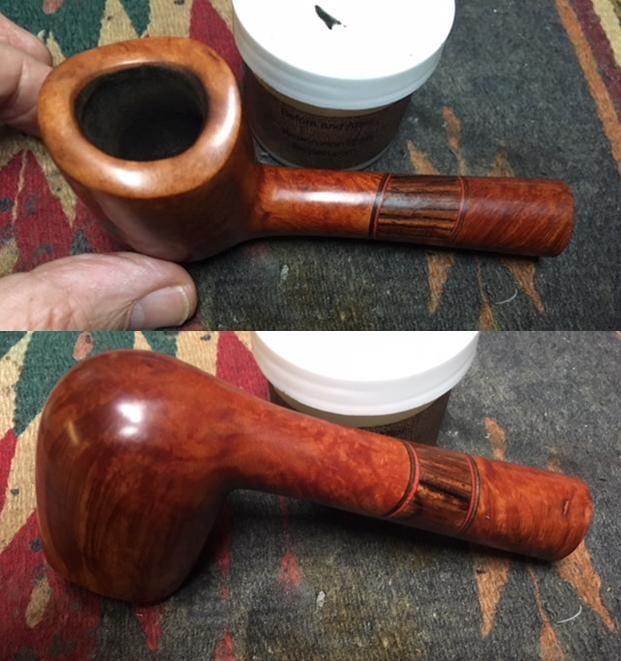
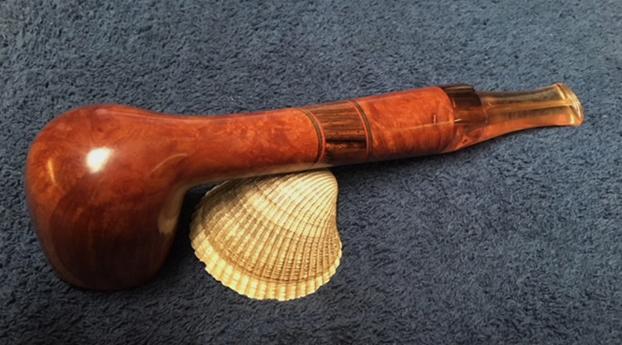
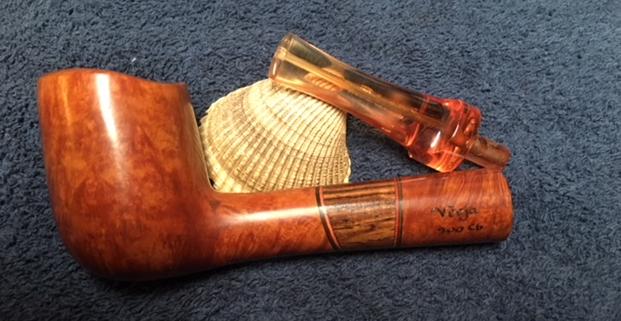
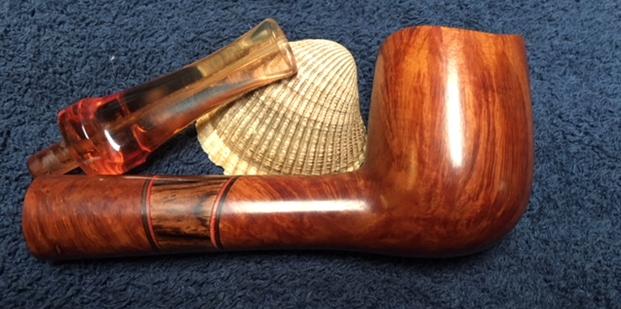
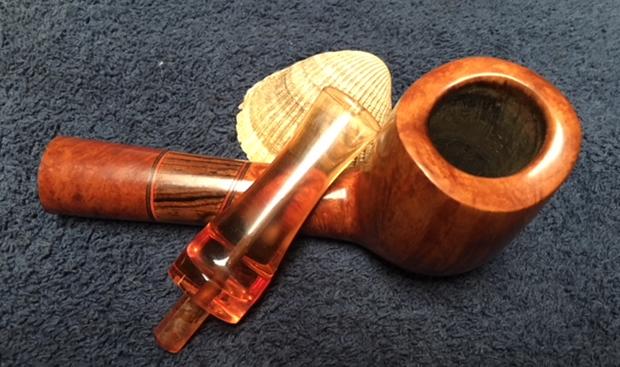
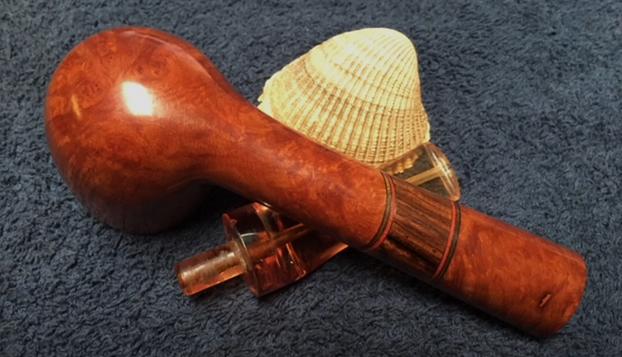
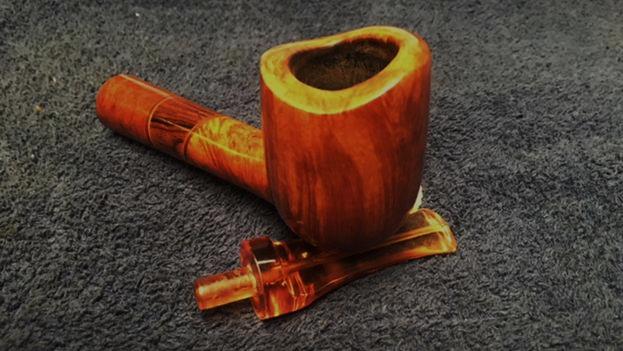
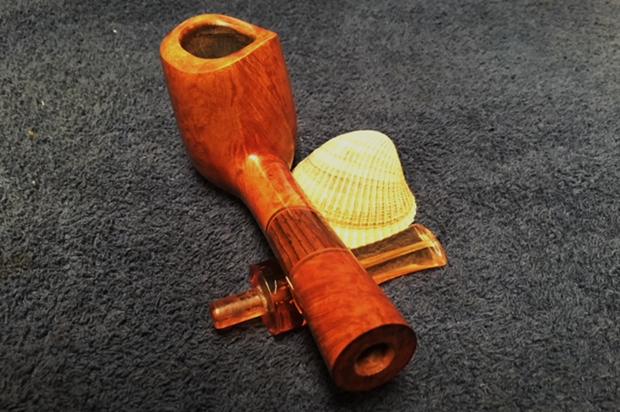
Earlier this year I took some pipes in trade from a fellow in Alabama. He wanted some pipes that I would be adding to the rebornpipes store and wanted to trade me for some of his own. The first of these that I chose to work on today was one that is an interestingly shaped pipe with a wavy rim top, a long shank split by some exotic wood set off on each side with a thin band of dark wood and red wood. The bowl and shank are briar and the insert of exotic wood actually looks good. The shank flares toward the stem which is an amber acrylic saddle stem. The rim has some darkening and a little damage on the back side of the inner edge of the rim. The bowl had a light cake and smelled of aromatic tobacco. The finish on the pipe was in excellent condition. The acrylic stem had some tooth marks on both the top and bottom of the stem at the button. The slot in the button was missing and the button end appeared to be unfinished. It had the round hold drilled in the acrylic but the slot had not been shaped. Jeff had been able to clean up the rim top and remove much of the light lava on the surface. He had scrubbed the exterior with Murphy’s Oil soap and removed the dust and grime that had accumulated there. He lightly reamed the bowl with a PipNet reamer and cleaned it up with a Savinelli Fitsall Pipe Knife. He cleaned the interior of the mortise and the airway in the shank and the stem with alcohol, cotton swabs and pipe cleaners. The pipe came to me clean and ready to do some light touch ups and polishing. The stem was cleaned but it had minor tooth chatter on the top and underside near the button and on the surface of the button itself. I took close up photos of the rim top and the shank end to show the condition of the plateau. I also took photos of the stem to give a clear picture of what I had when I started.I took a photo of the left side of the shank to show the junction of the exotic wood inserta nd the wood bands on either side of it. It splits the long briar shank and gives the pipe an exotic flair. The photo also shows the stamping on the left side of the shank. It reads Veeja over 900 C6 or Cb.The Veeja brand was unfamiliar to me. I had never heard of it before so I did some searching on Google to see if I could find any information at all. I found a photo of nine Veeja pipes on Worthpoint that were being sold. They have similarities to the one I am working on but were also very different. There was no information on the brand. So other than seeing other pipes by the maker I was no further ahead. Here is the photo and the link to the sale listing on Worthpoint. https://www.worthpoint.com/worthopedia/lot-veeja-original-tobacco-pipes-1796762187  

I did some further digging and found a listing on Pipedia for the brand. Here is the link to that information https://pipedia.org/wiki/Veeja. Once again it did not include much information. I include the article in full below.

Veeja Pipes were apparently made in New York, but we have been unable to establish any further details about them.

From that I could determine that the pipe was made in New York. No city is mentioned and no information is given about the pipemaker. I wanted to know more about the pipe so I kept looking. I found a discussion on the pipesmagazine forum and include the comment that started the discussion. http://pipesmagazine.com/forums/topic/veeja-and-appia-stanwell-pipes-1. It was posted in 2014 and there was no response to his question. I quote:

I picked up two pipes… One of them is marked ‘Veeja original 1985’ which I bought in New York sometime around the early 2000s. The only online reference I can find is that this a one line reference to Veeja being a NY hand made pipe maker. Does anyone know anything about the person/company who made this?

I spent some more time digging to find more information but there was nothing else that I could find. Do any of you who are reading this have further information on the brand or the maker? Do you know where in New York it was made? Thanks for any help that you can give me on this.

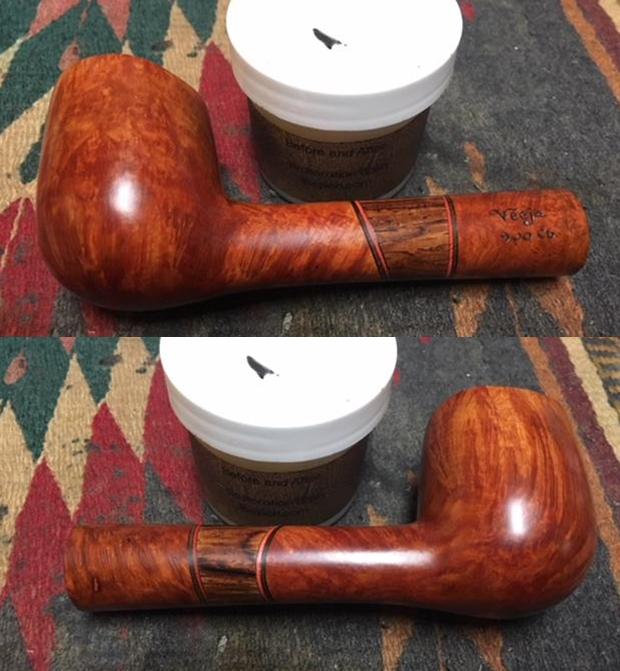
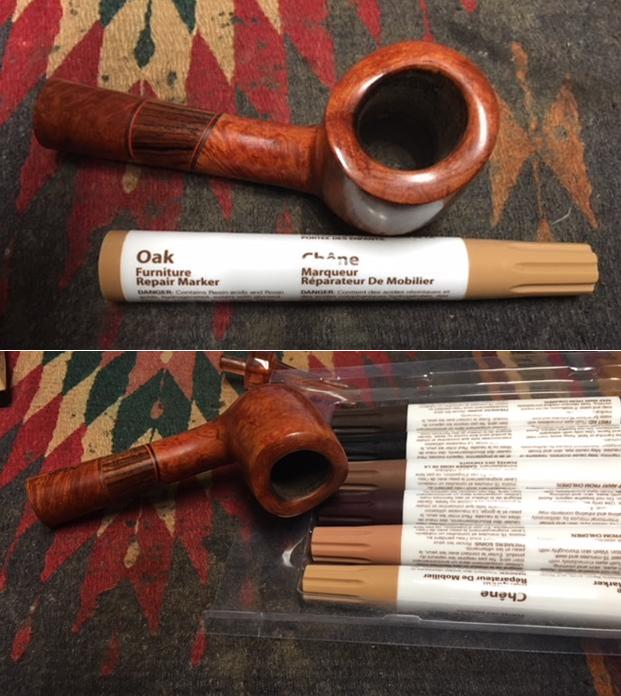
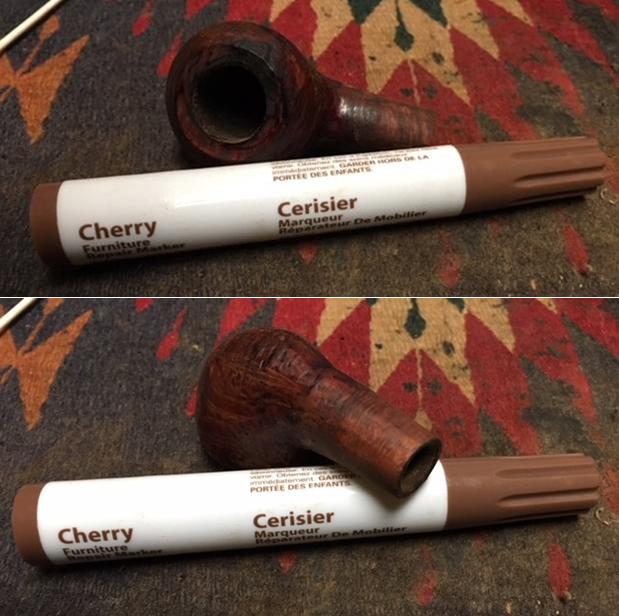
I called it quits and moved on to start working on the pipe itself. I started with the damage to the rim. I sanded out the damage on the rim top as well as to the inner edge until I had minimized the damage and reshaped edge and the top of the rim.I polished the sanded rim top and edge with micromesh sanding pads – wet sanding with 1500-2400 grit pads and dry sanding it with 3200-12000 grit pads. I polished it until the scratches were removed from the briar. I cleaned out the remnants of the cake with the Savinelli Fitsall Knife. I wanted to remove all the reminders of the previous tobacco and give the pipe a new smell. I sanded it with 220 grit sandpaper to smooth out the inside of the bowl.I rubbed the bowl down with Before & After Restoration Balm to deep clean the briar bowl and the rim top as well as the briar shank with the exotic insert. The product works to clean, enliven and protect the briar. I hand rubbed it with my fingers, working it into the exterior of the pipe. I wiped it off  and buffed it with a soft cloth to polish it. The pipe really began to have a rich shine. I took some photos of the bowl at this point to mark the progress in the restoration. I wiped down the rim top so that it was clean. I used an oak coloured stain pen to match the rim top to the rest of the bowl. Once it dried I buffed the piep with Blue Diamond on the buffing wheel. (I picked a set of these stain pens up at Canadian Tire recently. The assortment of colours really makes them useful as I match them to the colours of the pipes I work on. I included this second photo to show what I am using to stain the pipes.)I set the bowl aside and turned my attention to the stem. I cleaned up the area around the end of the tenon where it joined the stem. When the tenon had been turned this area had been left a bit rough. I scraped away the excess with a pen knife to leave it smooth. I sanded the tooth marks out of both sides of the stem to smooth out the surface.I polished the stem with micromesh sanding pads – wet sanding with 1500-2400 grit pads and dry sanding with 3200-12000 grit pads. I wiped the stem down after each pad with a damp cloth to remove the sanding dust on the acrylic. I decided to finish up the end of the button and cut a slot into the acrylic. I took photos of the process from the original opening to the finished slot. I used needle files, sand paper and sanding sticks to open the slot and polish it.I the polished stem and bowl with Blue Diamond to polish out the remaining small scratches. I gave the bowl and the stem multiple coats of carnauba wax and buffed the pipe with a clean buffing pad to raise the shine. I hand buffed it with a microfiber cloth to deepen the shine. The pipe polished up pretty nicely. The finished pipe is shown in the photos below. This is the first Veeja pipe that I have worked on and judging by the craftsmanship on this one I will keep an eye for more of them in the future. The shape, finish and flow of the pipe and stem are very well done and the joints and fitting of the shank band mid stem were flawless. The dimensions are Length: 7 1/4 inches, Height: 2 1/4 inches, Outside diameter of the bowl: 1 1/2 inches, Chamber diameter: 7/8 inches. This one will be added to the rebornpipes store soon. If you are interested in adding it to your collection send me an email to slaug@uniserve.com or send me a message on Facebook. Thanks for walking through the restoration with me as I worked over this great freehand. I have other free hands that I will be working on in a variety of shapes and sizes in upcoming blogs.

Another Athens find: Renewing a Stout Peterson System Standard 313 Republic of Ireland


Blog by Dal Stanton

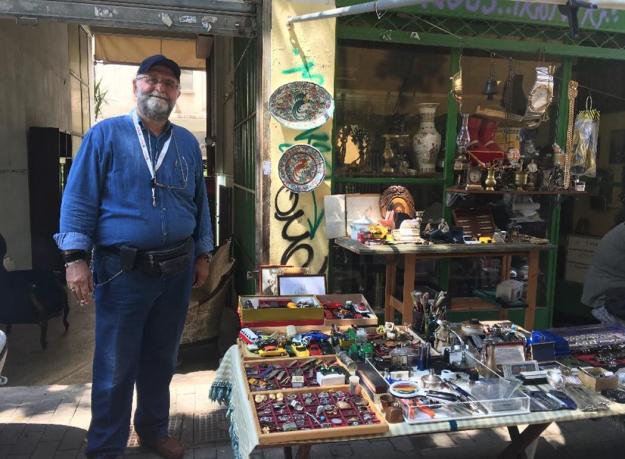
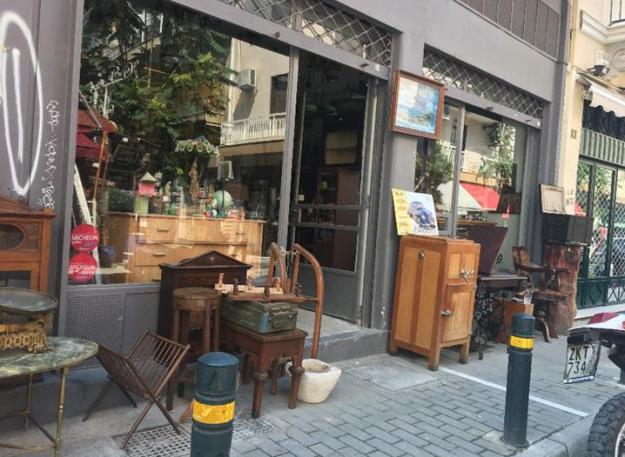
Athens, Greece, has been fertile ground for me in landing some nice pipes in the Athenian ‘wild’.  An area very close to the well-known Acropolis summit and near-by Mars Hill, where the Apostle Paul gave his defense of the Christian faith, is the Monastiraki market area. I have found several keepers in this area. I was drawn to one antique shop that spilled out onto the sidewalk of a typically narrow, crowded street.  As I looked over the plethora of paraphernalia in the shop, my eye caught sight of two lonely pipes among statuettes, ash trays, jars and lamps.  Immediately I knew one was a definite possibility – a Pete.  I looked quickly to determine if it was Pre-Republic or Republic of Ireland.  It was a Republic, but seemed to carry some weight of years.  What also caught my attention was that it was on the smaller side as far as I’ve seen of Petersons.  The shape number on the right side of the shank was 313.  The other pipe keeping company with the Pete was a Bewlay London Made ‘Reject’.  Interesting.  I’m always interested in pipes with the mark, ‘Reject’. The shop owner was all business and I wasn’t as happy with the bundled deal as I had wished, but I wanted the Pete and he’s now with me here in Sofia, Bulgaria. This Peterson System Standard 313 has been in my ‘Help Me!’ basket for some time until my brother-in-law, Greg, commissioned it to be restored along with a Comoy’s Pebble Grain Modern Poker.  He and his wife, Sarah, my wife’s sister, were visiting us here in Bulgaria, and Greg trolled through my buckets of pipes until he found these two – he commissioned both when he couldn’t decide!  The Pete and the Comoy’s both benefit the Daughters of Bulgaria, helping women and girls that have been trafficked and sexually exploited.  Thanks, Greg!
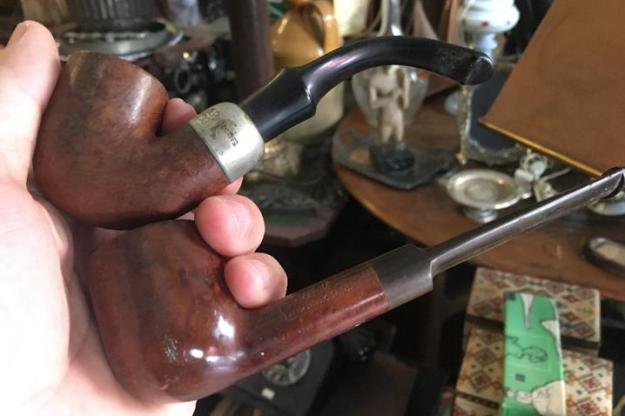
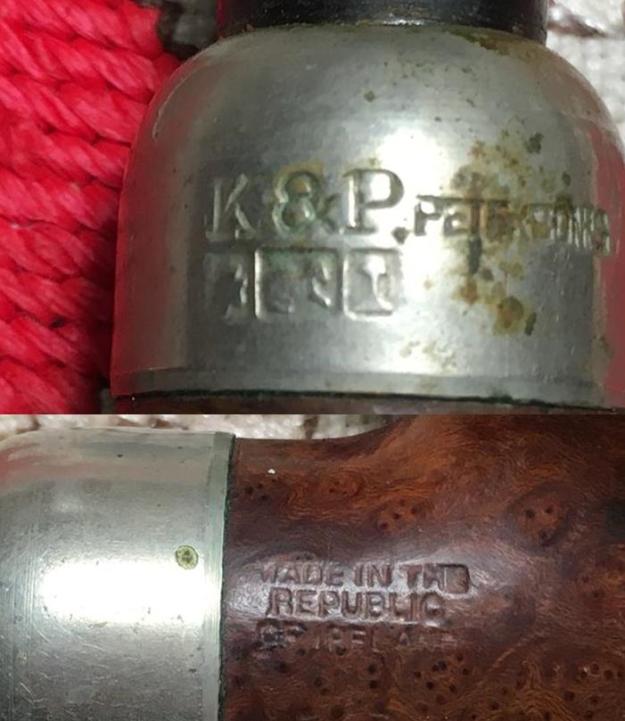
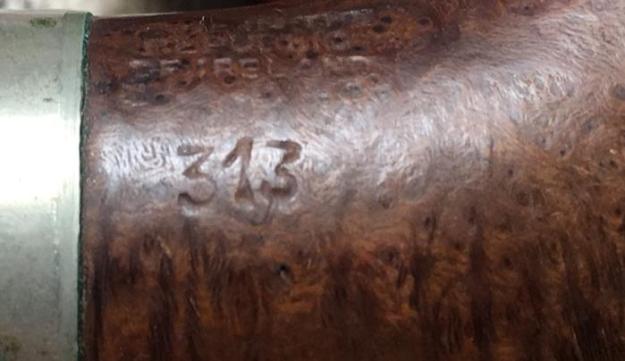
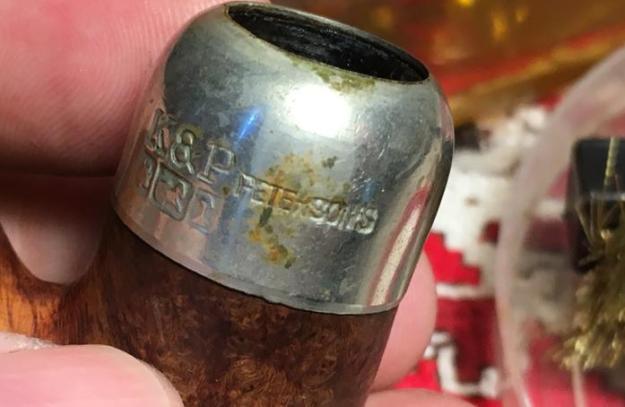
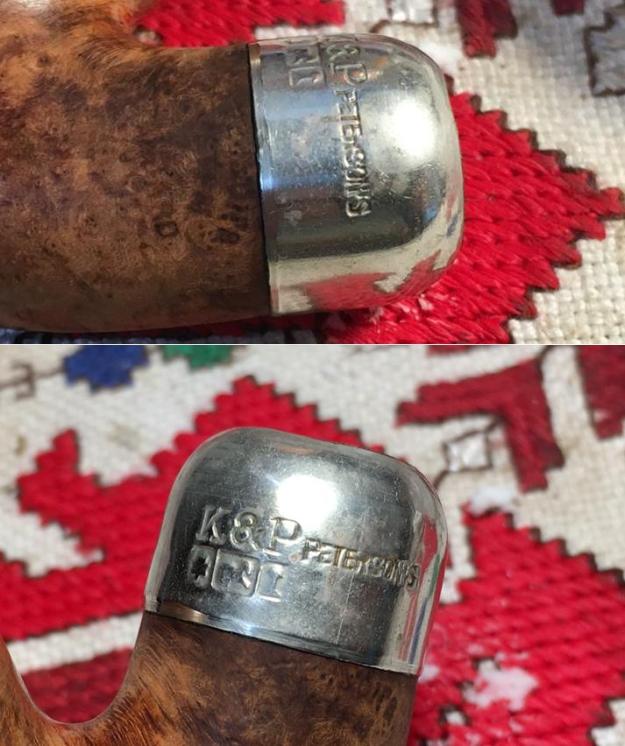
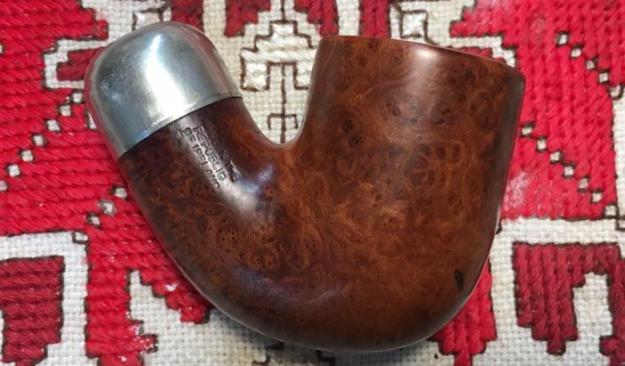
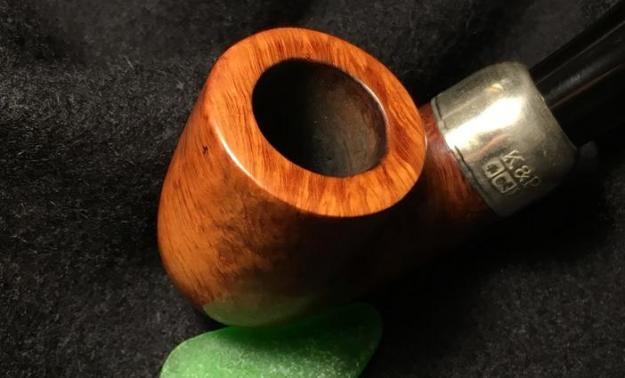
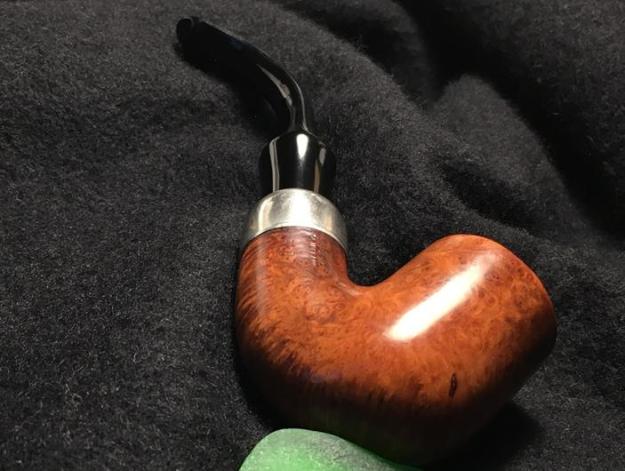
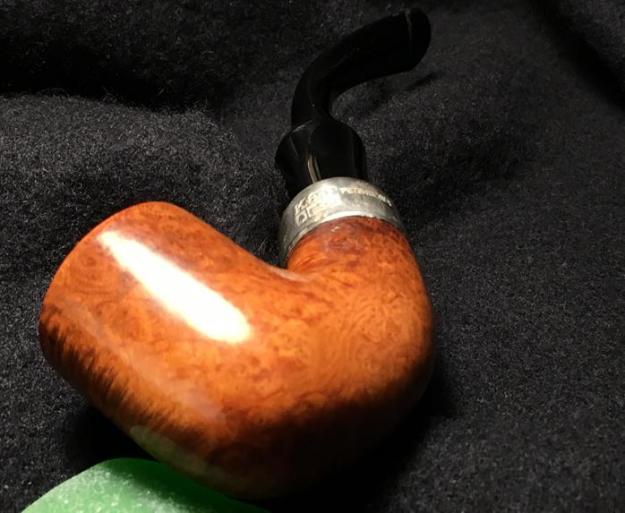
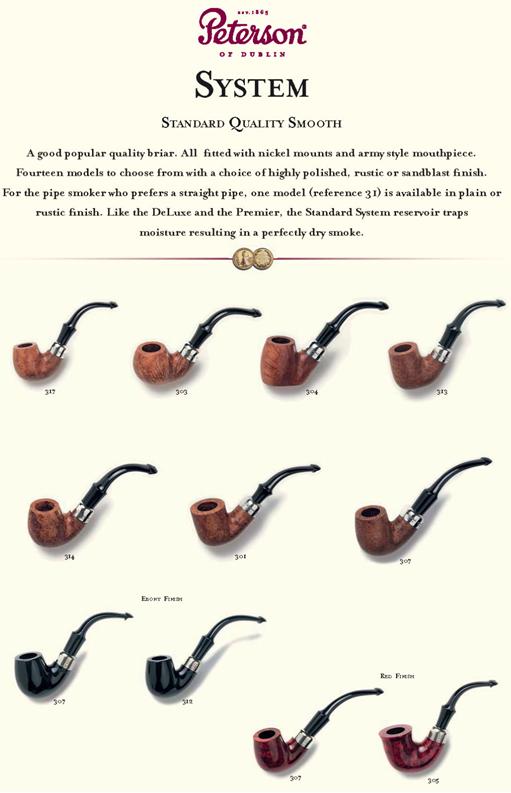
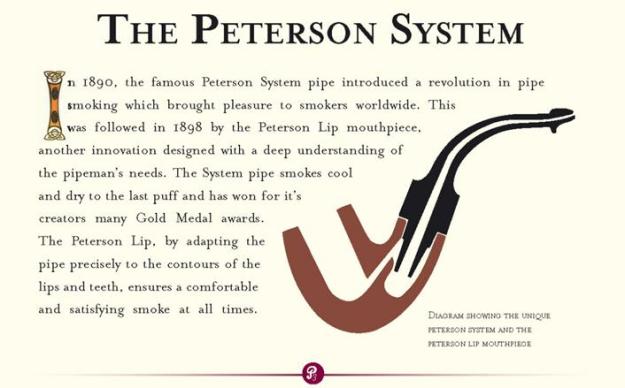
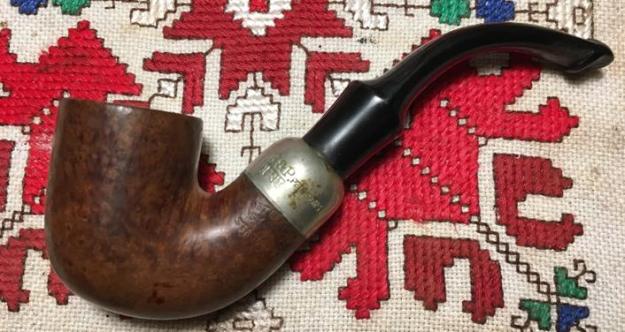
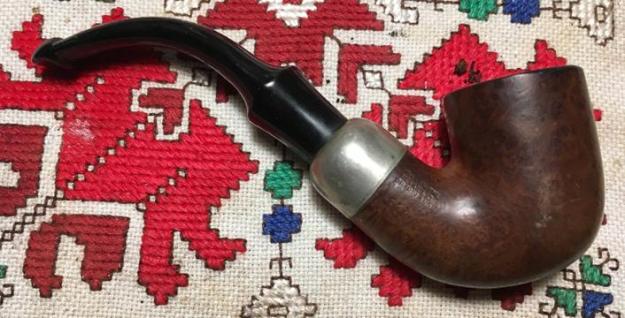
With this being the first Peterson System Pipe on my worktable, I’m looking forward to learning what I can.  The first thing I did was to identify the shape number of this Peterson.  Not long-ago Steve posted on rebornpipes a very interesting Peterson of Dublin Pipe Catalogue which he thought was dated about 2010.  I enjoyed looking through it then and tucked it away in my mind for when I would bring a Peterson to the worktable.  I found the shape 313 in the Standard Quality Smooth section of the catalogue which I included below.  It’s on the far right of the first row.  The description of the Standard Quality was helpful.What I also found interesting and helpful was the description of the Peterson System Pipe.  When this design hit the market in the late 1800s it was innovative then and continues to be popular today. Two design innovations were the focus: a trap (or sump) that collected the moisture in the mortise and the well-known ‘P-Lip’ stem, which stands for ‘Peterson’.  This design was supposed to be superior by directing the smoke to the upper part of the mouth rather than burning the tongue.  It is also engineered to compress the air as it moves toward the button.  I’ve included the description and a cutout showing the design from the same catalogue.I love working on vintage pipes – I only wish they could talk and tell their stories while I restore them!  With this Peterson now on my work table, I take some pictures to chronicle his condition and to get a closer look. The nomenclature is clear.  On the left side of the shank is stamped in arched fashion, ‘PETERSON’S’ over ‘SYSTEM’ over ‘STANDARD’ in straight letters.  Above this stamp, on the nickel ferule is ‘K&P PETERSON’S’.  The right side of the shank bears the ‘MADE IN THE REPUBLIC OF IRELAND’ placing it in the Republic Era – from 1949 until the present (from the Pipedia article:  A Peterson Dating Guide; A Rule of Thumb, by Mike Leverette).I’ve also been curious about the ‘faux’ hallmarks stamped under the K&P on the ferrule.  From the same helpful Pipedia article I read this:
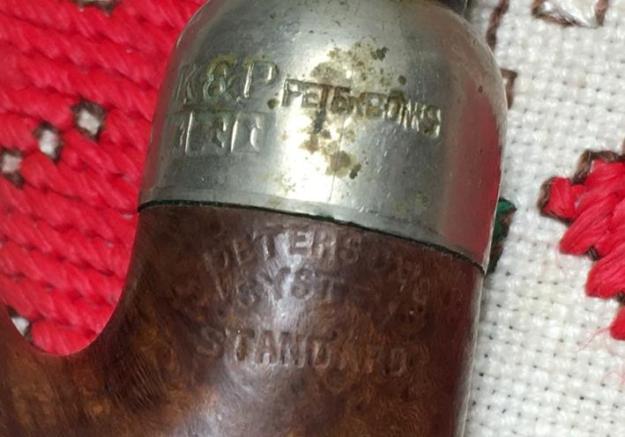
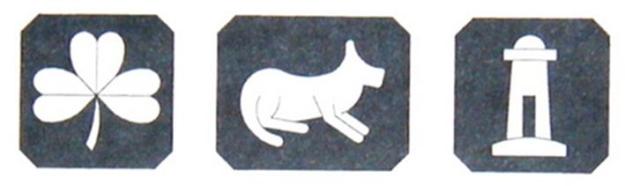
Before we close this section on silver hallmarks, we must address the marks that many people refer to as hallmarks. Peterson uses three marks on some of their pipes that are not silver hallmarks but are rather another Peterson logo (See Enclosure 4).

These marks are:

  • A Shamrock for the many shamrocks found in Ireland
  • A Prone Fox representing the famous fox hunts in Ireland’s history, and
  • A Stone Tower for the many hundreds of stone towers spotted throughout Ireland

Again, these are not genuine silver hallmarks. I’m indulging in a bit of history to better appreciate the K&P Peterson’s on my worktable.  Another question, “K&P”?  Again, Mike Leverette’s Dating Guide article helps with a concise history along with pictures from Pipedia’s main Peterson article:
The history of Ireland is an old and honorable one; steeped in warfare, family, racial and religious traditions. No other country can compete in comparison. However, the first couple of millennia of Irish history have no relevance to this dating guide. Should you wish to read more on the history of the Irish, I recommend “The Story of the Irish Race” by Seamus MacManus who gives a very vivid, and near as we can tell, an accurate portrayal of their history.

History pertinent to our purposes began in the year 1865; the year Charles Peterson opened a small tobacco shop in Dublin. Later in 1875, Charles Peterson approached the Kapp brothers, Friedrich and Heinrich, with a new pipe design and with this, a very long-lived partnership was formed, Kapp & Peterson. This new pipe design is the now famous Peterson Patented System Smoking Pipe. By 1890, Kapp & Peterson was the most respected pipe and tobacco manufacturer in Ireland and rapidly gaining followers in England and America. In 1898 another of Peterson’s remarkable inventions became available, the Peterson-Lip (P-Lip) mouthpiece, also known as the Steck mouthpiece. So, for the purpose of this dating guide, we will study Irish history, relevant to our pipe dating needs, from 1870s until now.
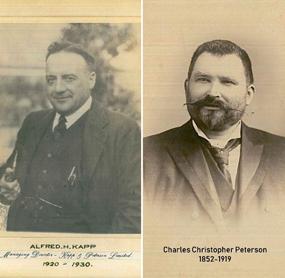
Before we start with this Peterson dating guide, an observation; the Kapp Brothers originally came from Nuremberg, Germany. They were making pipes at least as early as the 1850s (their Dublin shop opened in 1855) and in many of the shapes we now associate with Peterson since the Kapp Brothers simply took their existing shapes and incorporated Charles Peterson’ s patented design into them. From their inception, Kapp & Peterson’s goal was to make a good smoking pipe that the ordinary, common working man could afford, and we believe they have, very admirably, lived up to this.

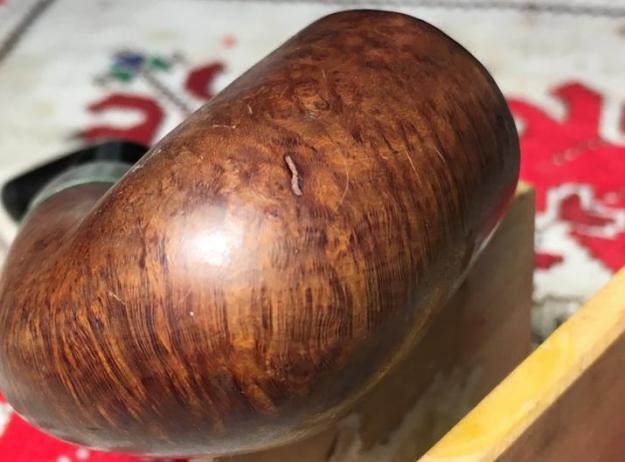
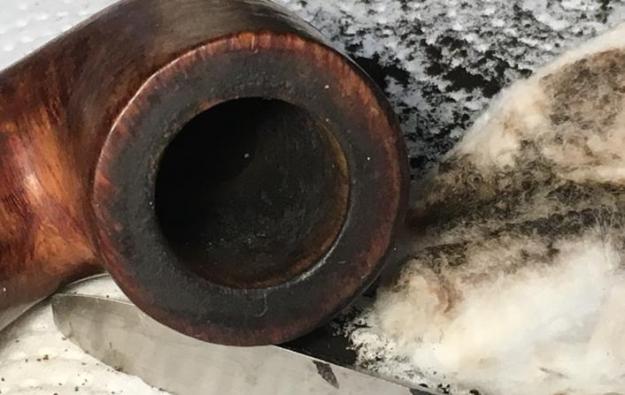
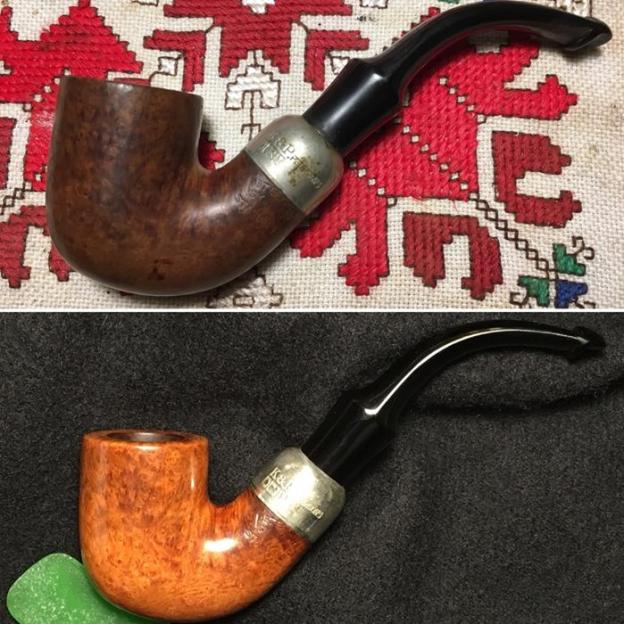
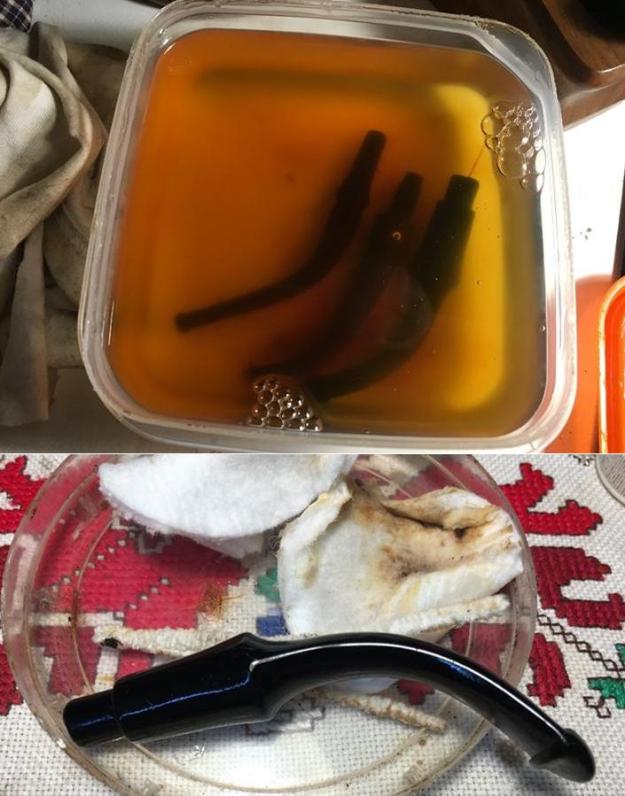
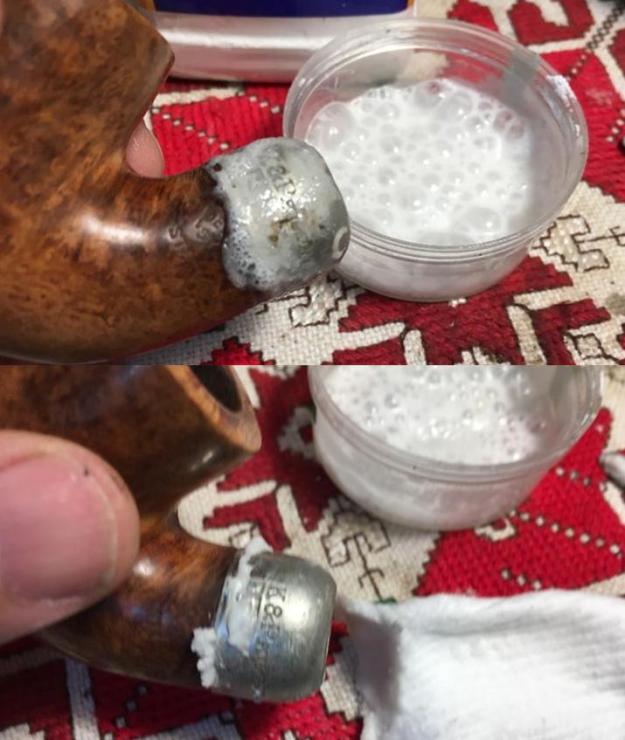
With a great admiration for the pioneering businessmen and pipe men, Kapp and Peterson, I now turn to the Peterson System Standard 313 on my table – really a quintessential working man’s pipe. It gives that kind of persona. The chamber is still loaded with the former steward’s tobacco!  Whenever I see this I wonder if this was the last bowl enjoyed on this side of life.  I’ll never know, and the Pete still isn’t talking!  The chamber has moderate cake build-up and the rim has some lava flow and some scorching.  The stummel generally is in good shape with typical marks of wear, but nothing too serious, and it is darkened with grime.  There is one fill I detect on the front, right of the stummel which I record with a picture.  The nickel ferrule has some dark areas on it which will hopefully clean up and shine up.  The System P-Lip stem has a good collection of tooth chatter, but I don’t detect any clench dents.  I begin the restoration of this Peterson by first adding the stem to a soak of Before and After Deoxidizer along with a Peretti and Comoy’s stem that are in the queue along with their respective stummels.  Before I place the stem in the Deoxidizer, I clean the internals of the System Stem P-Lip for the first time, and I now understand some of what I’ve read about the difficulty in cleaning these stems!  They are engineered to narrow down toward the button and the P-Lip draft hole is smaller than usual.  I read from the Pipedia Peterson article above that Falcon pipe cleaners are thinner and can be used well with these stems.  Good to know!  With pipe cleaners dipped in isopropyl 95% I clean the stem and this keeps the Deoxidizer from becoming soiled as quickly. I let the stem soak for several hours.  After removing the stem, I let it drain of the Deoxidizer and then wipe off the raised oxidation using cotton pads wetted with light paraffin oil.  The oxidation wipes off as a nasty brown goo.  The System stem looks good after it is wiped down well.Putting the stem to the side, with the stummel now in hand, I clean the old baccy out of the chamber.  The tobacco still has a sweet aroma to it – I’m not a tobacco blend expert or else I might hazard a guess!  Using the Pipnet Reaming Kit, I start with the smallest blade and ream the chamber removing the carbon cake down to the fresh briar.  Since the bowl diameter is smaller, I only use the first blade.  I then utilize my Savinelli Fitsall Tool, which I find to be very handy. It can remove some carbon at the floor of the chamber missed by the Pipnet blade and it scrapes the walls more closely giving me greater control.  Wrapping a piece of 240 grit sanding paper around the Sharpie Pen, I sand the chamber walls removing even more carbon residue and getting down to the briar for a fresh start. Finally, I use a cotton pad wetted with isopropyl 95% and clean the chamber of the carbon dust.  Looking at the chamber, I see no problems – it looks great. Turning to the externals, I use undiluted Murphy’s Oil Soap with cotton pads to scrub the grime off the bowl and rim.  I also use a brass brush on the rim which is dark from some scorching.  After this, I rinse the stummel with tap water.  While I was doing this, I allowed the water to run over the nickel ferrule and rubbed it with cloth to see if this would help clean it up.  There is still what looks like corrosion on the nickel-plated surface.  I’ll do some Google research later to see what the next step might be to clean the nickel safely.  I also am not able to remove the darkened briar on the rim.  I’ll need to give it a gentle topping to remove it.  While I think about these challenges, I clean the internals of the stummel.  Using pipe cleaners, cotton-buds and shank brushes dipped in isopropyl 95%, I go to work.  Well…, some time later, I’m still not 100% satisfied with the cleaning of the Peterson ‘sump’ and draft hole.  The old tar and oil gunk is thick and only after employing many weapons in the arsenal is it starting to shape up.  The sump has collected the moisturized gunk as designed.  Along with pipe cleaners, cotton buds and different sized shank brushes, I also use both a dental spatula and probe to stir up and scrape the mortise and sump walls.  I take a picture to show this frontal attack – it isn’t pretty.  Now, to continue the cleaning I’ll use the kosher salt and alcohol approach.  Using kosher salt, which does not leave a taste as iodized salt does, I fill the chamber with salt, cup the top of the bowl with my palm and give it a shake to displace the salt.  I then set it in an egg crate to keep it stable.  Using a cotton ball, I create a wick to stuff down the mortise to act as a wick drawing more of the oils and tars out of the briar.  I make the wick by stretching and twisting the cotton ball and then guiding the end down into the draft hole as far as I can get it – I use a piece of thin metal coat hanger wire to push the cotton through the draft hole.  I also push the cotton down into the sump.   Once that is done, using a large eye dropper, I fill the bowl with alcohol until it surfaces over the salt.  After a few minutes – after it’s been absorbed, I top it off again.  I set the stummel aside to soak through the night. The next morning, the salt-alcohol soak did the job!  The salt is soiled, and the cotton wick is full of tars and oils.  After dumping the expended salt in the waste basket, I wipe the bowl out with a paper towel and blow through the mortise to loosen and left-over salt.  I run a pipe cleaner and alcohol through the draft hole and a cotton bud as well in the sump and the mortise walls to make sure all is clean and I’m happy to report that it is!  From this cleaning, I think a wise practice for any Pete steward would be to clean your pipe often!  Don’t allow too much gunk to collect in the sump.Turning to the Peterson-Lip stem, I use 240 grit paper to sand focusing on the tooth chatter on P-Lip button and the upper and lower bit.  I also refresh the lines of the button contours using a flat needle file.  To erase the scratches made by the file and 240 paper, I use 470 paper.   I then employ 600 grade paper sanding the entire stem and follow this with 0000 steel wool which begins the buffing up of the vulcanite. Before moving on to using micromesh pads on the stem, I use Before and After Fine and Extra Fine Polish on the stem to enrich the vulcanite.  For each polish successively, I place a bit on my finger and work it into the vulcanite.  I then wait a few minutes and wipe each successive polish off with a cotton cloth which also buffs up the vulcanite gloss.I put the stem aside and look again at the Peterson stummel.  I have two initial challenges to solve.  The rim’s dark ring from it being scorched.  Secondly, the small fill on the right-front quadrant of the stummel.  I use a dental probe and dig at it a bit to see how solid the fill is.  Some of the fill material flaked off and left a small indentation as a result. This needs to be filled again and masked. I will patch it before moving ahead with the stummel surface.  But first, I work on the rim.  I use a chopping board with 240 grade paper on it.  To top the inverted stummel, I use uniform, easy circular motions and I don’t need to take much off – just enough to remove the scorched wood.  Switching the paper on the chopping board to 600 grade paper, I top the stummel a bit more to smooth out the 240 scratches.  I take pictures to show the progress.   I notice that there is still a bit of dark wood on the outer rim lip. I’ll take care of that when I’m sanding the stummel rounding off the edge slightly.  I’ll stain the rim’s bare briar a bit later to match the stummel’s surface. Now, to address the fill. I again use a dental probe to scrape the old fill and to remove what is not solid.  To darken the old, remaining fill, I use a cherry stain stick to darken and color the fill so that it will blend with the briar grain better – I hope!  I then apply a small drop of clear super glue to the hole.  I use a toothpick to guide the super glue to the patch – while I was doing this, the power went out and I had to finish using the sunlight coming into the open window!  I put the stummel aside and wait for the CA glue to cure and the lights and internet to come back on! I decide to work on the stem using the micromesh pads. Starting with pads 1500 to 2400 grade, I wet sand the System stem. Then, using 3200 to 4000 and 6000 to 12000 I dry sand the stem.  Following each set of 3 pads, I apply Obsidian Oil to revitalize the vulcanite.  I never grow tired of watching the pop in the vulcanite when it turns to that glassy gloss!  The Peterson-Lip System stem is looking good.  I put it aside to dry and absorb the Obsidian Oil. I turn back to the stummel.  The CA glue has cured on the patch and I begin the process of removing the patch mound by using a flat needle file.  The most important part of this process is to keep the file on the hardened glue and not slide off and to impact needlessly the neighboring briar.  I want to keep the area needing repair and refinishing as small as possible!  I file the glue mound down until it’s almost at the level of the briar surface.  Then, using a tightly rolled piece of 240 grit paper, I sand the mound further, so it is flush with the briar.  Finally, I use 600 grade paper to smooth the patch out preparing it for dye stick to blend the patch.  I think its going to blend very well with the briar. Now, to the rim.  I use 240 grit paper rolled tightly and I run it around the outer rim edge to give it a slight rounding to remove the remnants of damage on the rim.  I gently pinch the rolled paper over the rim edge with my thumb, so I create the slight bevel.  I also do the same, very lightly, to the inside rim edge.  I follow by doing the same with a rolled piece of 600 grade paper.  Finally, I take the stummel back to the topping board once more on 600 grade paper simply to redefine a crisp line around the rim after the beveling.  I think it looks great and ready for the next step. I’m hoping that I can match the dye stick color correctly!  I read on rebornpipes, Steve was restoring a Peterson System Standard and needed to use a dye stick on the rim.  He used cherry and said that it matched the Peterson schema well.  I’ll do the same and see how it goes!  I apply dye to the both the fill patch and the rim.  I wait a while for the dye to thoroughly dry before proceeding.I then sand the stummel with micromesh pads.  I wet sand using pads 1500 to 2400, and then dry sand with pads 3200 to 4000 and 6000 to 12000. To protect the Peterson’s nomenclature, I stay clear of the until the later pads – and even then, a very light touch. As you can see in the pictures above and the focused one immediately below, the nickel ferule of this Pete needs help dealing with the corrosion – it is an eyesore.  Care must be given because metals can be a bit tricky.  One approach that works for silver might turn another metal black!  After doing some quick ‘How to clean/polish nickel plating’ searching on Google, the approaches I found were helpful.  The general theme is to start conservatively and then to work more aggressively – that is, simply washing the nickel with warm water (every source warned about the need to use warm water with nickel – not hot nor cold) and a mild liquid dish detergent.  I do this to begin, and it does brighten the ferule but does not help with the corrosion.  The next step is to make a paste using baking powder (a mild abrasive and acidic) with water.  This I do next with better results.  At first, I have too much water, but eventually I find the ratio to create a thicker paste.  I then apply the paste with my thumb and work it in around the entire ferule but concentrating on the corrosive spots – the main one being over the ‘Peterson’s’ stamp. Afterwards, I gently rinse the ferule with warm water.  I like the progress, but I return to the paste and this time use a cotton pad dipped a bit into the paste and use it in a circular motion over the spot and then rinse.  I buff the ferule with a cloth and I like the results! The corrosion on the nickel is greatly reduced and the ferule looks shinier – but not pristine, still holding some scuffs from life.  I think this is good because he is an older Pete after all! The Pete is looking great.  Before moving to the final stages using abrasive compounds on the stem and stummel, I apply Before and After Restoration Balm to the stummel which has a way of enriching and deepening the briar. In keeping with the product’s name, I take some before pictures to compare with the after pictures – that always interests me.  I put some on my finger and work the Balm into the briar.  The Balm starts more liquidy and gradually firms up into a thicker, wax-like consistency.  After applying, I prop the stummel on an egg crate and let it sit for some minutes to absorb the Balm.  Then, after about 20 minutes, I wipe the Balm off, buffing up the shine with a cloth.  Then I take the ‘after’ pictures which are below for comparison.  I like the results. Because of the military style stem, I leave the stummel and stem separated as I apply compounds and wax.  I begin by mounting a cotton cloth buffing wheel to the Dremel dedicated to the application of Blue Diamond compound.  With the Dremel set to the slowest speed, I apply the compound to the stummel in a slow, patient, methodical manner.  I use the sheen created on the briar by the overhead lamp to see the compound as I move it and direct it over the surface.  For the System stem, I switch cotton cloth buffing wheels and apply White Diamond, which is a finer abrasive than Blue Diamond.  For both compounds, I don’t apply much pressure to the wheel but allow the speed and the abrasive compounds to do the work.  After the compounds, I wipe stummel and stem with a felt cloth to remove compound dust before applying the wax. Then, again changing to another cotton cloth buffing wheel, and increasing the Dremel to about 40% power, I apply a few coats of carnauba wax to both stummel and stem and complete the process with a rigorous hand buffing with a micromesh cloth to raise the shine.
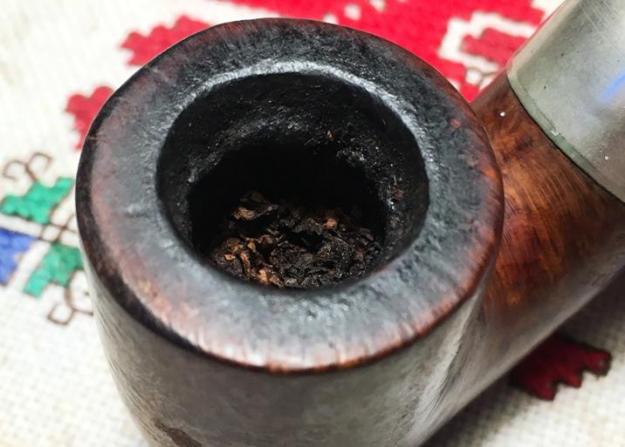
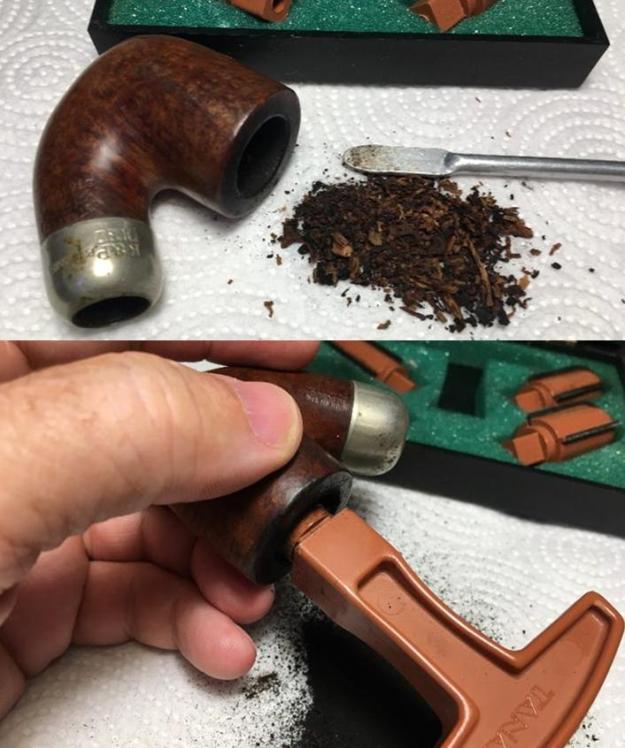
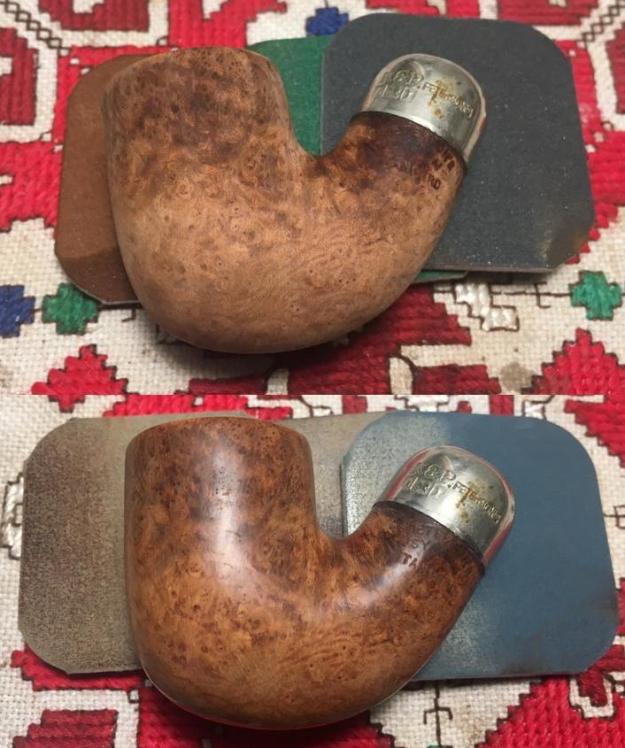
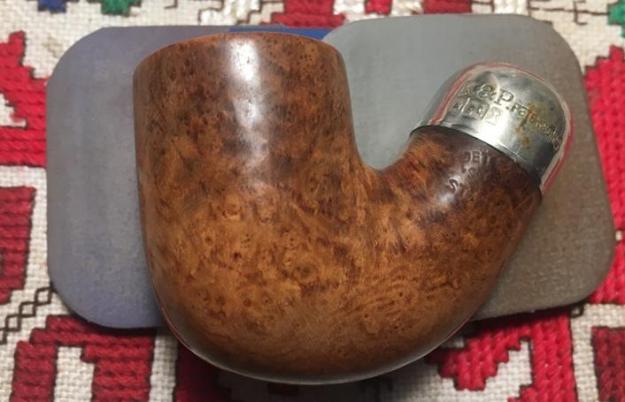
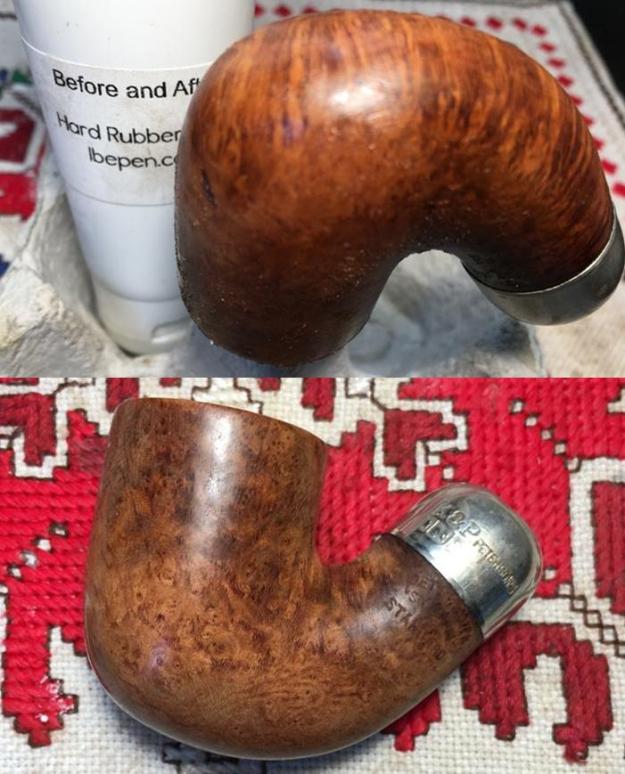
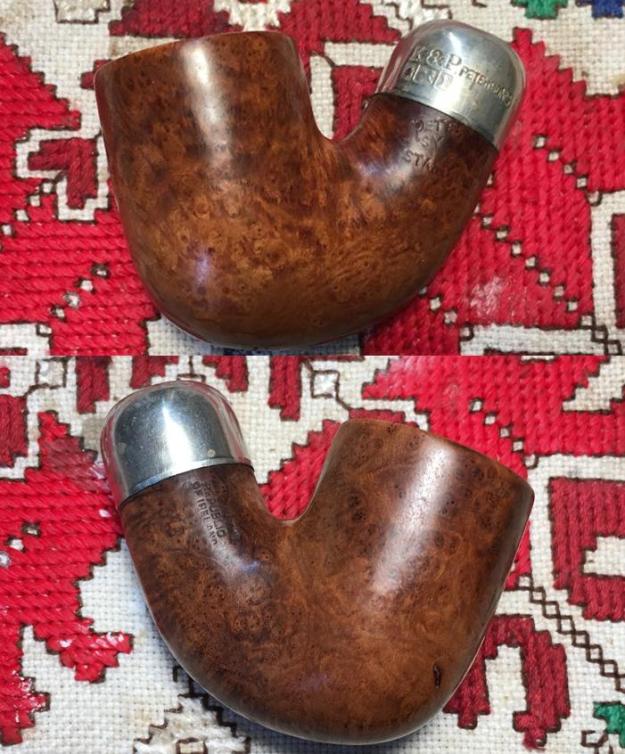
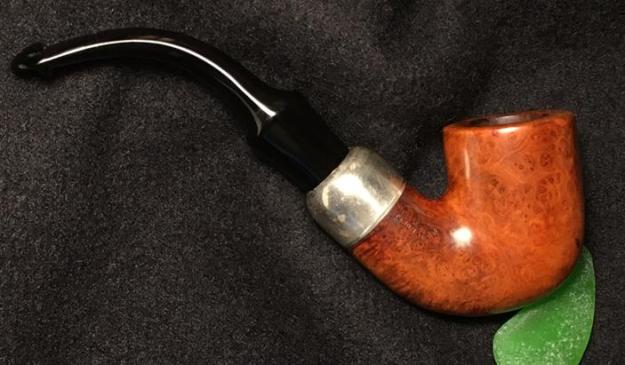
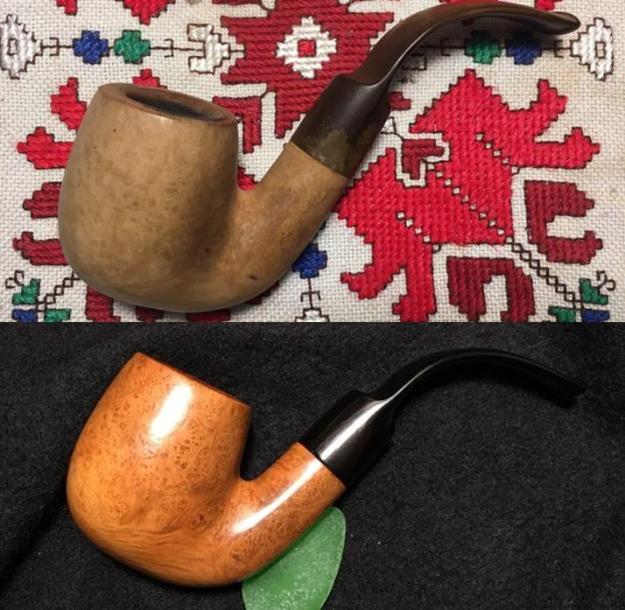
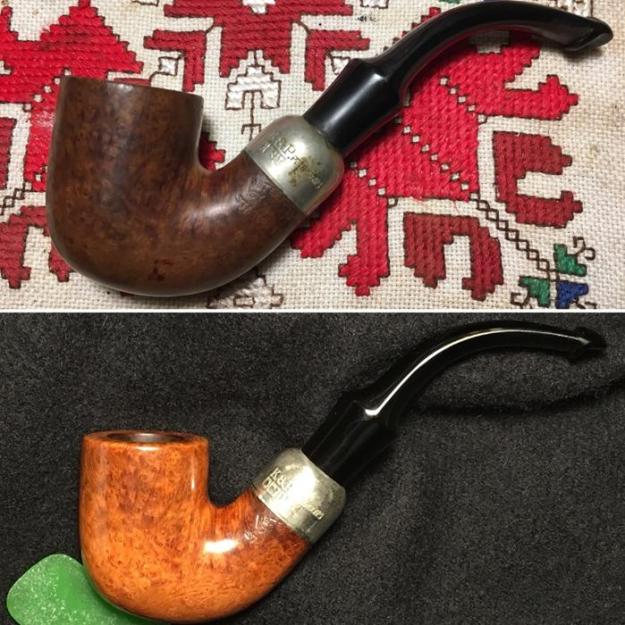
Oh my! The image that comes to my mind as I look at this Republic of Ireland Peterson, is that of a leprechaun, smoking his newly shined up pipe, doing a jig as he dances down the street!  This is the first Peterson on The Pipe Steward worktable and I’m pleased with the results and appreciate more the history of this well-known, proud Irish pipe name.  The grain of this Peterson System is surprisingly expressive and eye catching for a ‘Standard’ grade – a workingman’s pipe.  The nickel ferule came out great providing a classy transition for the military styled P-Lip System stem.  I’m pleased with the results! Greg commissioned this Peterson System Standard 313 and he will have first dibs on it in The Pipe Steward Store.  This pipe will benefit the work of the Daughters of Bulgaria – women and girls who have been trafficked and sexually exploited.  The pictures start with a before and after! Thanks for joining me! 
Recommissioning Another L. J. Peretti of Boston: An Oom Paul Sitter


Blog by Dal Stanton

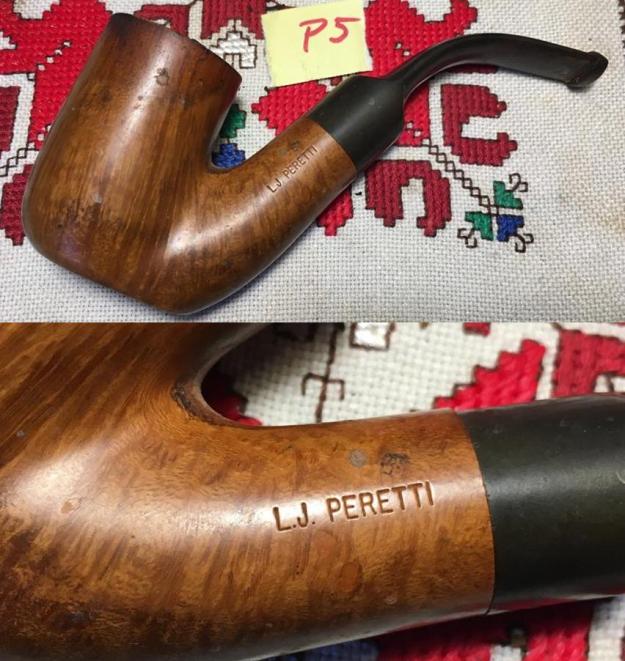
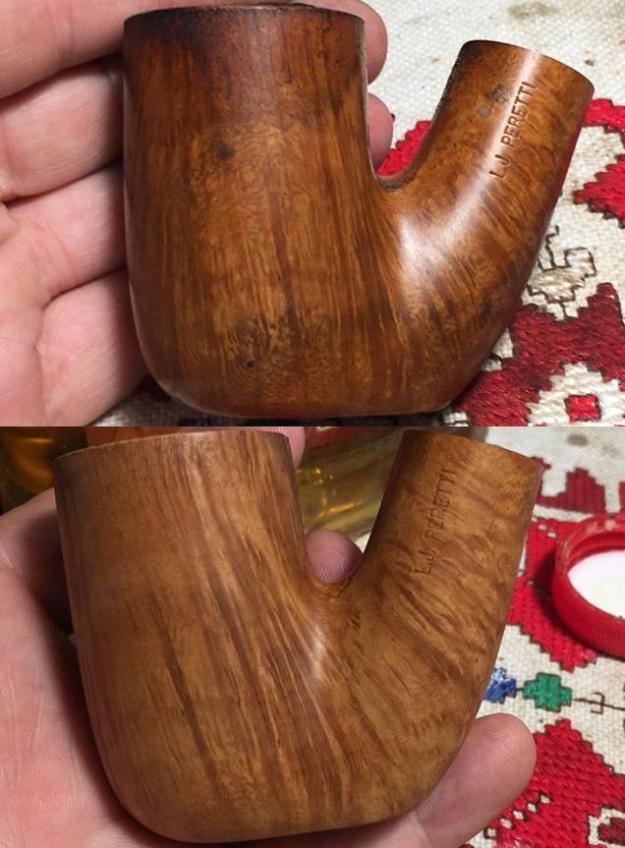
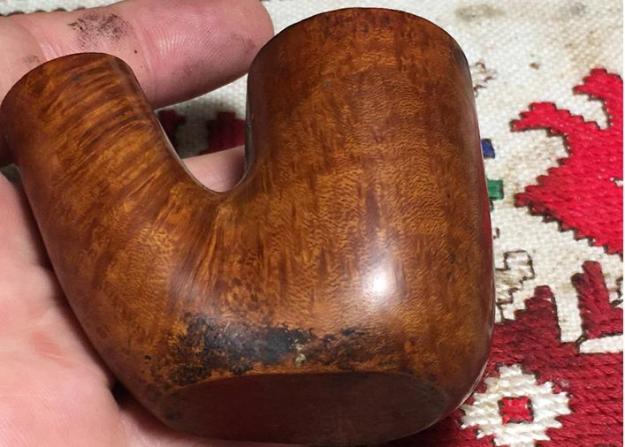
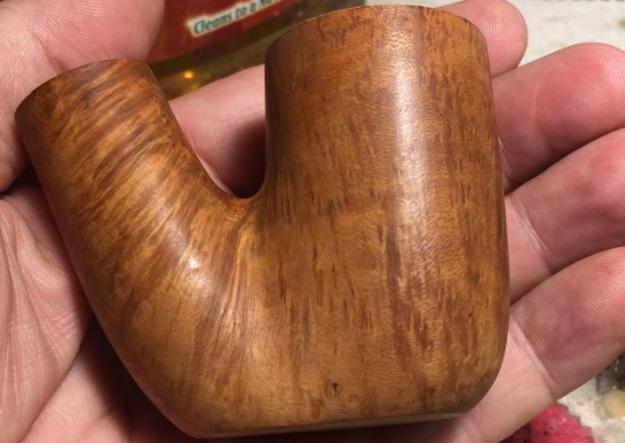
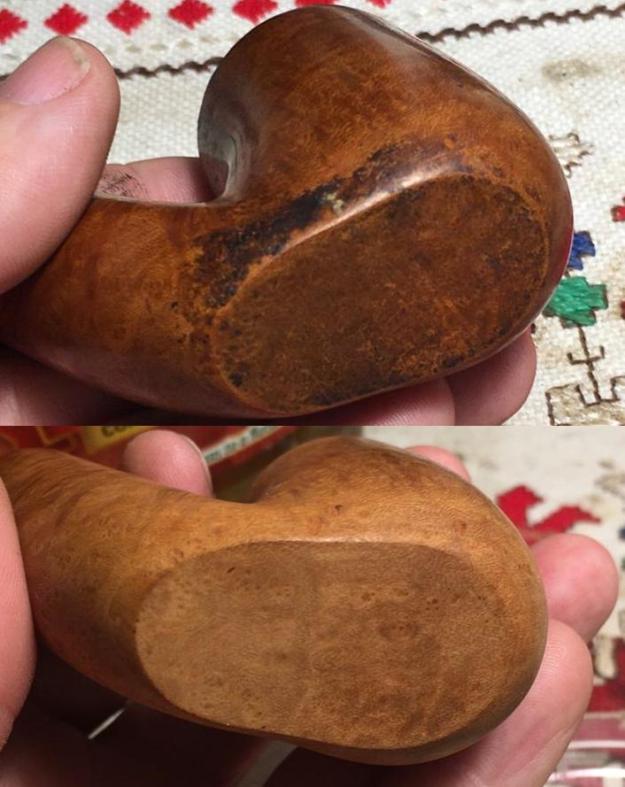
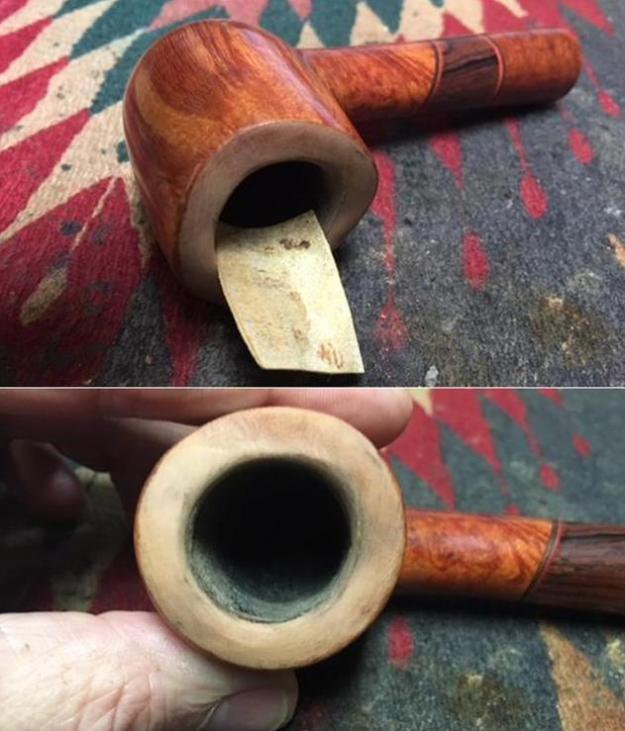
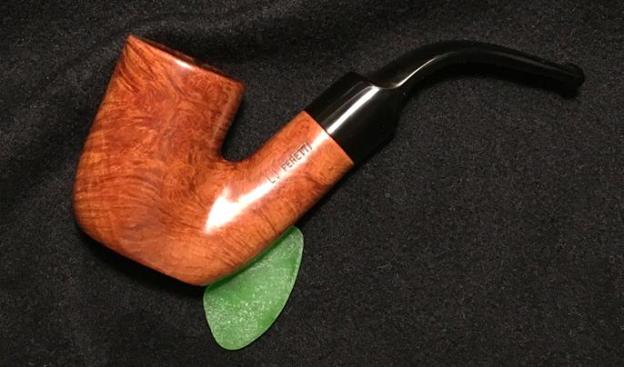
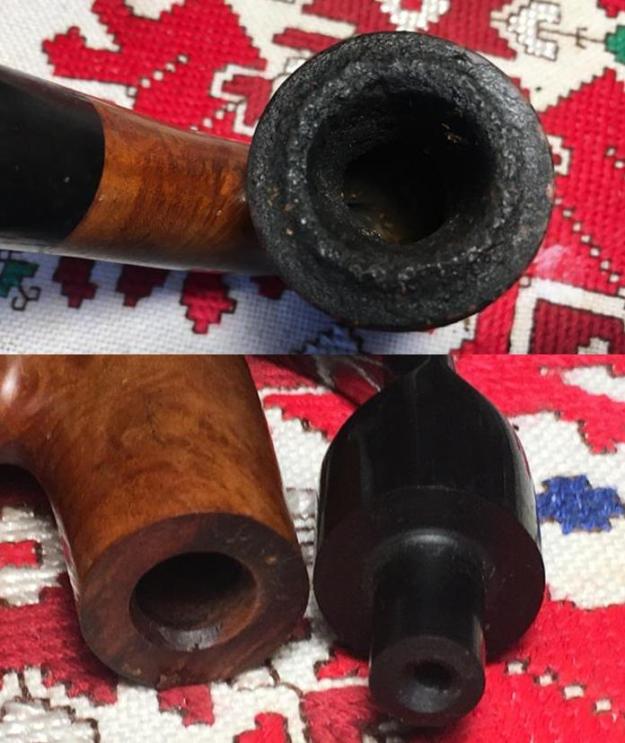
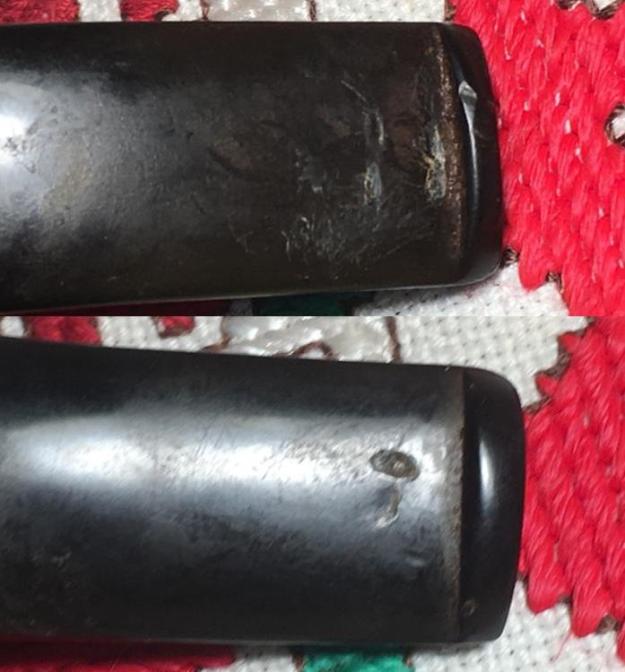
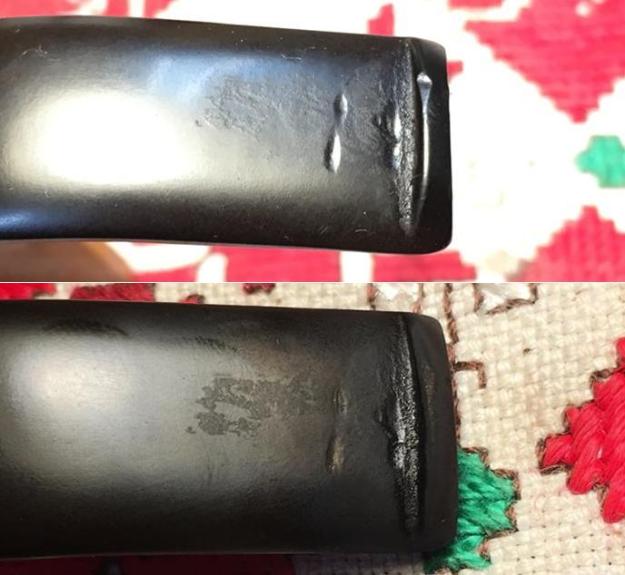
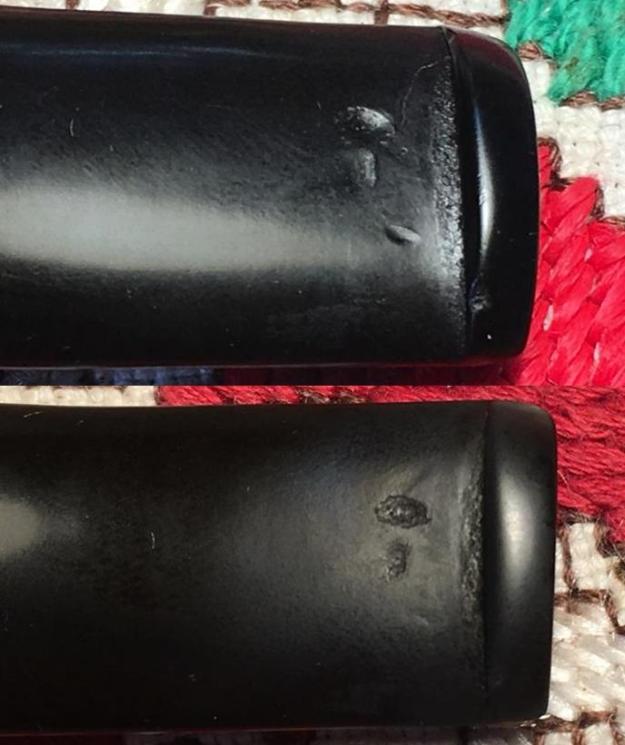
After restoring my first two Oom Pauls (see: LINK) from the L. J. Peretti Co., Tobacconist of Boston, this is the next Oom Paul that came to Bulgaria in the Peretti Lot of 10 I acquired off the eBay auction block.  I posted the picture of the 10 (below) on my favorite Facebook pipe groups (The Gentlemen’s Pipe Smoking Society, Old Codgers Smoking Pipe, Pipe Smokers of America, and Tobacco Pipe Restorers) letting interested pipe men and women know that except for one, the Oom Pauls would be available for personal collections.  All the Perettis restored and placed with new stewards benefit the Daughters of Bulgaria, an effort to help women and girls (and their children!) who have been trafficked and sexually exploited.  This L. J. Peretti Oom Paul Sitter from the Lot of 10 has been commissioned by a pipe man in neighboring Romania, just to the north of Bulgaria.  After restored, he will have first dibs on this Peretti now on my worktable!Along with the large stummel, what makes this Peretti stand out is the fact that it is a Sitter – a very nice feature when one is at the table enjoying friends and board games or a hand of cards!  I wish that the L. J. Peretti Co., had put out a shape chart in the past – if they had, I haven’t been able to find it!  This pipe, with another Sitter in the Lot of 10, might be just a bit shy of full bent status which is the technical norm for Oom Pauls according to Bill Burney’s description of the Oom Paul in Pipedia, but it is clear that Peretti used the same tall, long, full stummel with the Sitters, but widened the bend a bit, perhaps to allow the better balance as the Sitter is seated.  My call is that it is very close and either way, will serve his new steward well!  Here are pictures I took of the Peretti Oom Paul Sitter on my worktable here in Bulgaria. The left side of the shank is stamped with L. J. Peretti with no other markings on the stummel or stem.  Along with his brothers and cousins in the Peretti Lot of 10, this Oom Paul Sitter shares the thick carbon cake in the chamber and the rim abuse of incessant lighting over the side of the rim.  The extent of the erosion to the briar around the rim due to this scorching I’ll know after the reaming and cleaning of the stummel/rim.   The bowl shows normal nicks, scratches and grime that has darkened and obscured the briar.  I detect no fills on the surface, but the Sitter’s heel has a large, lightened blotch/fill to be addressed along the way. The stem has moderate oxidation, but the bit is chewed up like all his Peretti brothers and cousins.  The former steward liked to chew on his Perettis!  The upper/lower bit and button lip have sustained compression dents.

I start the restoration process by addressing the oxidation of the stem.  Previously, along with several other stems of pipes in the queue, the Sitter’s stem went into a soak using ‘Before and After Deoxidizer’ to remove the oxidation from the vulcanite stem.  I first had cleaned the internals of the stem with isopropyl 95% and pipe cleaners.  The stem stayed in the soak for several hours and after removing it from the Deoxidizer, I wiped it down with cotton pads and mineral spirits (in Bulgaria, light paraffin oil).  The oxidation wipes off as a nasty brown on the cotton pads.  I continue to wipe with cotton pads and paraffin oil until it cleans and is buffing up.  The Before and After Deoxidizer does a good job. To continue the Before and After process, I now apply first the Fine Polish by putting some on my finger tips and working it into the vulcanite.  The polish starts off thick and gritty, but liquifies as I work it around and absorbs into the vulcanite.  After a while, I buff off the polish with a cotton pad and then, in the same manner, apply the Extra Fine Polish.  I take a picture of the stem after I worked this polish in but before buffing it off.  You can make out the texture of the polish on the surface.  I then buff it off with a cotton pad.  The stem looks clear of oxidation and has a deep black hue.I look now to the stummel.  I begin by reaming the heavily caked Oom Paul chamber.  I also work on the rim surface with very thick, crusted lava flow.  There is no way to determine the condition of the chamber wall or the rim until the cake is removed.  This is a consistent characteristic of all the L. J. Peretti Lot of 10.  I use the Pipnet Reaming kit to begin the job starting with the smallest blade over a paper towel to minimize clean up!  I use 3 of the 4 blades available.  I then use the Savinelli Fitsall Tool to continue to remove carbon from the chamber walls by scraping the chamber wall and reaching the difficult areas.  When I detect the walls are scraped smoothly – no more crunching of carbon, I sand the chamber using 240 grit paper wrapped around a Sharpie Pen.  Finally, after sanding I wipe the chamber with cotton pads wetted with isopropyl 95% to remove the carbon dust.  Looking into the chamber, I see no cracks or crevices. It looks good! I take pictures along the way.  Now, to attack the thick gunk on the rim, I use undiluted Murphy’s Oil also to clean the entire stummel which is darkened by the grime.  I use a cotton pad and Murphy’s and the grime is coming off.  I’m pleasantly surprised to see what I thought was a fill on the heel of the stummel disappear!  It too was simply gunk on the briar surface.  The rim put up some resistance!  I first use the cotton pad but quickly utilized a brass brush to scrub the lava over the rim.  I also used my pen knife to scrape gently the rim surface.  To complete the cleanup, I rinse the stummel and rim with cool tap water.  The stummel surface looks good – it cleaned up well and I can see some impressive grain patterns lurking underneath.  As with the other Peretti Oom Pauls I’ve restored, the plane of the rim is dropping a bit to the left of perpendicular with the shank, but I’ll leave it as is.  I also note that the left side of the rim has eroded somewhat because of the practice of lighting the tobacco over the edge.  The result is that there is an inconsistent rim width around the circumference.  I’ll seek to correct this, or at least help it along by creating an internal rim bevel. Since I like working on clean pipes, I turn to the internal cleaning of the stummel using a shank brush, pipe cleaners and cotton buds dipped in isopropyl 95%.  I also utilize a dental spatula to scrape the sides of the mortise to remove old tars and oils.  After the frontal assault on the gunk, I decide to employ the stealthier approach – a kosher salt and alcohol soak.  This approach helps to freshen the internals as well as remove more latent tars and oils.  I fill the stummel with kosher salt, cup the chamber with my palm and give the stummel a shake to displace the salt.  I then create a wick with a cotton ball by pulling and twisting it.  I stuff the wick down the mortise and through the draft way.  Then I place the stummel in an egg carton to stabilize it and fill the bowl with isopropyl 95% until it surfaces over the salt.  I wait a few minutes and top it off again.  The day is late, and I set the stummel aside to let it soak through the night.The next morning, I discover that the salt had not discolored much but the wick had been successful drawing out the oils.  I clean out the stummel getting rid of the expended salt and wiping the chamber with a paper towel. I run a long shank brush through the mortise and draft hole to clear the remnants of salt.  Now, a clean stummel!Now, to the rim.  I take a closer look and take a couple close ups to mark the starting point.  The damage is not as extensive as I’ve seen on some of his Peretti brothers.  Cleaning the scorched briar on the rim and creating an internal bevel in order to remove the damaged wood is the goal – fresh, healthier briar to form the rim.  Starting, I gently top the stummel with 240 sanding paper on a chopping board only removing what is necessary. Rotating the inverted stummel on the board I discover that I don’t need to take off much.  I then switch to 600 grade paper and smooth the rim – lightly topping it more.  The pictures show the progress. The topping went well.  Now, to cut the internal bevel, I roll a piece of 120 grade paper tightly around a hard wood disk to provide a flat, firm backing to help with a crisper b.  I then work the paper around the internal rim circumference edge to cut the initial bevel.  In the same way, I sand with 240 grade paper and finish it off with 320 and 600 grade papers.  I think the rim looks great. I’m enjoying how this Peretti in cooperating.  The stummel surface has normal nicks and minor dents which this Peretti has received over the years.  To remove these, using sanding sponges on the surface is my usual approach.  I start by employing a rougher grade sponge, middle grade and then finish going over the surface with a light grade sanding sponge.  I am careful to protect the L. J. Peretti nomenclature on the shank as I sand. After the sanding sponges I transition to using micromesh pads to sand out the briar surface more using finer sanding surfaces. I begin by wet sanding with pads 1500 to 2400 then dry sanding from 32000 to 4000 and then 6000 to 12000.  I enjoy watching the grain start to show through the micromesh pad cycles. The L. J. Peretti is looking good as I look at it now.  The pictures show the progress. Turning now to the stem, I take another look at the bit showing tooth chatter and dents. I first use a flame from a Bic lighter to paint the area expanding the vulcanite.  As the vulcanite expands as the natural result of heating it, I’m hopeful that the dents and chatter might rise and make for less sanding.  I believe the process helped but did not fully remove the dents.  I took before and after pictures first with the upper bit comparison, then the lower bit. To address the dents, after wiping the area with alcohol to clean the surface, I apply drops of Black Medium KE-150 CA glue to the dents.  I start on the upper bit.  I put CA glue on the 2 main dents and run more glue along the button to fill in the chatter there.  I then wait for an hour or so for the CA glue to set, so that I can flip the stem and apply glue on the lower bit. After the Black CA glue has cured, I start the process of filing and sanding the patch down to the vulcanite surface and sanding out the chatter.  Starting with the flat needle file and 240 sanding paper I do the initial sanding and refreshing the buttons of both the upper and lower bit with the file.  I follow by sanding with finer grades, 470 then 600.  I finish this phase by buffing the entire stem with 0000 grade steel wool.  The pictures show the progress finishing out the bit repairs. With this initial stem repair and sanding completed, I now use micromesh pads to continue sanding the stem with even finer sanding grades.  I begin wet sanding with pads 1500 to 2400, then dry sanding with pads 3200 to 4000 followed by pads 6000 to 12000.  After each set of 3 pads I apply Obsidian oil to revitalize the vulcanite.  I love to see the vulcanite’s glassy pop!  The pictures show the progression. Now, I take another look at the Peretti Oom Paul Sitter seated on my worktable!  I like that characteristic of this large stummel.  I study the attractive grain patterns that have started to emerge through the sanding process.  To enhance the grain further, I mount a felt buffing wheel on the Dremel and I apply the coarser Tripoli compound with the lowest speed setting. Before I start the sanding process, I purge the wheel with the Dremel’s metal tightening wrench.  I apply the compounds by rotating the wheel over the surface of the briar.  I don’t apply too much lateral pressure on the buffing wheel, but I allow the speed, wheel and compound to do the work. After asking nicely, my wife takes a picture of me applying the Tripoli compound with the Dremel.  After the Tripoli compound, I apply the less coarse compound Blue Diamond.  I apply it in the same manner as Tripoli but with a cotton cloth buffing wheel instead of a felt wheel.  When completed, I wipe the stummel with a cotton cloth to remove residue compound dust. The next step is to apply Before and After Restoration Balm to the Peretti’s briar surface.  With the other restorations I’ve done with the Peretti Lot of 10, I have been very pleased with the results of applying the Restoration Balm.  I very much like the natural briar look and the original Peretti motif has the lighter, natural patina.  The Balm seems to take the natural briar grain and deepen and enrich it.  I take a before and after picture of the stummel to show the difference.  I’m afraid the lighting of the pictures does not show the subtle deepening that I perceive with the naked eye.  To apply the Balm, I squeeze a little Balm on my fingers and work it into the briar surface.  As I do this, the Balm progressively thickens to almost a wax-like consistency.  I take a picture of the Balm on the stummel as I allow it to sit for a few minutes to give an idea of its consistency.  I then use a cotton cloth rag to wiping it off at first, and then buffing it as the surface is exposed.  I then use a micromesh cloth to give the stummel a hand buffing.  The pictures show to process comparing each side in succession. I remember that I forgot to apply Blue Diamond compound to the stem. So, I attach the stem to the stummel and apply Blue Diamond compound to the stem and then wipe the entire pipe with a felt cloth to remove excess compound dust.  Now, applying the carnauba wax, I mount a cotton cloth wheel to the Dremel, increase the speed to about 40% full power and apply the carnauba to the stem and stummel.  After applying a few coats, I use a micromesh cloth to give the pipe a rigorous hand buffing to raise the shine even more.

This Peretti Oom Paul Sitter cleaned up very well – I’m pleased with the results.  After restoring several Peretti pipes and I’ve concluded that not only have I found them to be good smokers, but the briar used for the production of these pipes seems to be of a higher quality and very pleasing to the eye on the whole.  The grain on this Peretti has not disappointed.  The large stummel showcases well the lateral grain on the lower regions and then bird’s eye grain dominates the opposite side of the bowl.  Codruț, a pipe man in neighboring Romania, saw this Peretti when I posted several Peretti Oom Pauls that were to be restored and made available.  He commissioned this Peretti and he will have first dibs on it when it goes into The Pipe Steward Pipe Store.  This Peretti Oom Paul Sitter benefits the Daughters of Bulgaria, our work here in Bulgaria helping women and girls (and their children) who have been trafficked and sexually exploited to find a new life.  Thanks Codruț(!), and thank you for joining me in this restoration!

An Unexpected Find in Athens – A Savinelli Oscar Aged Briar 614


Blog by Dal Stanton

When I first laid my eyes on this Savinelli, I didn’t realize it was a Savinelli.  I was in Athens, Greece, tooling through the Monastiraki market area at the foot of the Acropolis, next door to the Forum.  As I explored I found one shop nestled on a tree-covered side street with a table set on the front sidewalk with all kinds of paraphernalia. It drew me like a bee to pollen!  Two congenial men were sitting behind the table conversing in Greek. I assumed they chatted about all manner of life, family, politics…, and what is usually the case, as I drew near, their conversation stopped, and the English began.  As I perused the table with strategic disinterest, I saw one pipe on the table that did not grab me too much.  The shop owner asked me if I was interested in pipes?  I said yes, and he said that he had many more that he didn’t know what to do with…. “Oh, my…” – my heart skipped a beat!  In his wonderfully, friendly, thick Greek accent and manner of hospitality, he said, ‘Come with me.”  As he pulled a chain out of this pocket a full ring of keys followed. He led me down a narrow, alley walkway along the side of the shop.  We stopped and he unlocked a side door that led immediately up the stairs to an ‘upper room’ where, as he explained with a subdued, secretive flourish, he seldom brought customers.  When we entered the room, I saw why.  It was his special place – family pictures were arrayed everywhere, icons of the Greek Orthodox Church were given special deference as they hung from places of honor. Many shelves full of his collections.  He pulled my attention away from the array to a slew of pipes displayed in a case hanging on the wall and arranged beneath on a cluttered table. I took it all in.  He explained that his good friend, from Armenia, asked him to sell off his collection of pipes and he gave me a price for everything, including the wall-hanging display case.  With gratitude to him for his generous offer, I had to decline as I was flying back to Sofia and would have no room in my luggage for all of it.  I suggested to him that his friend could possibly make more money if he sold the pipes and case separately and he confided that he knew little about pricing pipes individually.  As we talked, I discovered that he was a board member of a foundation that assisted orphaned children Armenia – the home of his friend.  That opened the door for me to share that I too, was a board member of the Daughters of Bulgaria Foundation and I shared with him why I collected pipes – to restore and sell them to benefit the Daughters and their children.  He encouraged me to go through the collection and pull out pipes that interested me and make him an offer.  In Mediterranean culture, very much like Bulgarian culture – relationship is supreme, and we had talked of things near and dear to our hearts.  Pipes became the doorway to a deeper fellowship that we both understood and appreciated.   I left the shop owner with a firm handshake, a parting picture, and an appreciation for him and his journey. I also left his shop with some special pipes and friendly prices 😊: Lorenzo Carnevale Sanremo of Italy (on top in picture below), a Savinelli Roley Pocket Pipe (bottom, below), and a sorry looking ¾ Bent Billiard (center below) that appeared to have no name – at least in the dim light of the upper room, I could not see any.  It appeared the pipe had been left out in a sun-drenched field through a few seasons – showcasing a terribly oxidized stem and a bleached-out bowl, but the old boy had nice form and I liked him.  It struck me that this pipe reminded me of a Southern US epithet, ‘Bless his heart, he can’t help how ugly he is!’  The ‘Bless his/her heart’ is the softener or honey before the hard news! The pipes were unwrapped when I returned home to Sofia.  I was anxious to look at them, take some pictures, and to do my normal ‘information intake’ for each pipe I collect so that I can remember later when they emerge from the ‘Help Me! Basket’ heading to The Pipe Steward worktable.  With a magnifying glass in hand, I discovered that the ‘Bless his heart’ charity pipe was a hidden prince with great potential – a Savinelli Oscar Aged Briar 614 of Italy.  The Oscar is a popular line of the well-known Italian pipe family, Savinelli.  I was surprised and happy to see what I could do to help him out!  On the left side of the shank was stamped in cursive script, ‘Oscar’ over ‘AGED BRIAR’.  The right side of the shank was stamped the Savinelli ‘S’ logo on the left, and to its right was shape number ‘614’ over ‘ITALY’. I took some other pictures of the Savinelli Oscar on my worktable to catalog his condition when he arrived from Athens. Fast forward now nearly a year. Many of my restoration projects start because a pipe is commissioned, and it is plucked from the ‘Help Me!’ Basket.  This often happens when a pipe  listed in the “For Pipe Dreamers Only!” on The Pipe Steward site attracts someone.  Or, here in Bulgaria, when folks are in our home and know about my pipe restoration work, they often will pour through the many pipes in the ‘Help Me!’ Basket (and boxes 😊) in search of just the right one!  That was the case with the Savinelli Oscar. Taylor, a colleague and blooming pipe man, wanted a couple of pipes for himself and one for a friend in the US. The favorite he chose, or did the pipe choose him 😊(?), was the Savinelli Oscar which is now on my worktable.

To learn more about the Savinelli Oscar Aged Briar, I look at the Savinelli Pipe Shape guide to identify shape 614.  I locate it in the chart and it looks to be a 3/4 Bent Billiard. I circle the 314 in the chart and it’s interesting to see the other Bent Billiards nearby to compare.  I’m thinking that the Oscar is a 3/4 Bent but I am surprised to see, that comparing it to all the other Savinelli bent shapes, it seems to be the most fully bent shape that Savinelli offers – at least from this chart.Then, with a simple search on Google using the name and the shape number, 614, I’m hoping for an Oscar 614 in pristine condition to guide the restoration of this sad boy.  I find this example of an Oscar Aged Briar 614 formerly on the AntiqueAuctionsNow website – a nice looking classic bent stem Billiard.Ah ha! As I look closely at the picture above, it cues me into the possibility of the Savinelli Shooting Star stem stamp on the Oscar – impossible now to see with the heavy oxidation.  I look to another regular place, PipePhil.eu, which gives me more information and understanding.  The Savinelli Oscar line, along with three others, is marked with the Shooting Star stamp.Looking at the overall condition of the pipe, I have already noted the oxidation and a hope that the Shooting Star stamping can be salvaged.  The bit also has very minor tooth chatter with a single dent on the upper button. The bowl almost appears like it has been bleached by the sun and the nomenclature stampings on the sides of the shank are thin and will take some care not to diminish more.  The rim has some scorching over the left quadrant and has minor cake build up in the chamber.  The internal rim has a smart bevel that I will refresh.  I’ll ream the chamber to get down to the briar for a fresh start. A few small fills are detected on the lower shank and a significant divot is evident on the shank end, just below to the left of the Savinelli ‘S’ logo.

The first thing to address is the stem’s oxidation.  I add the Oscar’s deeply oxidized stem with a batch of other stems into a bath of Before and After Deoxidizer to remove the oxidation on the stem.  Aligned with each stummel, the stems are put into the solution for a few hours.  The Savinelli Oscar is on the left.  I’m hopeful that the Before and After Deoxidizer might uncover the Shooting Star stem stamp – hopeful, but doubtful.After a few hours, using a toothpick, I fish out the Oscar’s stem and allow it to drip-drain the Before and After Deoxidizer.  I then wipe the stem with cotton pads and mineral spirits (light paraffin oil here in Bulgaria) which removes layers of raised oxidation off the surface.  Miraculously, the Savinelli shooting star stamp appears out from underneath the oxidation!  It is very thin and I’m not sure there’s enough depth left of the stamp for acrylic paint to find purchase. Continuing with the stem, I use Before and After Fine Polish then Extra Fine Polish to further condition the stem.  With both, I place some polish on my finger and work it in on the vulcanite surface until it is absorbed.  After each, I buff it further with cotton pads.  The stem looks great – though the Shooting Star stamp doesn’t look like there’s much I can do with it but save what’s left of it!Turning to the stummel, I use undiluted Murphy’s Oil Soap to scrub the surface and rim with a cotton pad.  Whoops!  Usually, I do the reaming before this – I’ll need to back track.  I rinse the stummel with cool tap water and it cleaned up very well – the rim gunk is gone.  I decide to apply a coat of light paraffin oil (mineral oil) to the surface to rehydrate the briar.  I set it aside for a while for the paraffin oil to absorb fully.  The grain looks good. Now, back to the chamber cleaning that I missed.  I use the Pipnet Reaming Kit to ream the light cake out of the chamber. I use only the two smaller blades.  I then fine tune the reaming with the Savinelli Fitsall Tool.  Finally, I wrap 240 grade paper around a Sharpie Pen and sand the chamber down to the fresh briar.  I finish the chamber cleaning by wiping it with a cotton pad wetted with isopropyl 95%.  The pictures show the progress. To the internal cleaning – using cotton buds, pipe cleaners and a shank brush I clean the mortise.  I also use a dental spatula to scrape the mortise walls to remove gunk.  With my day ending, to give a more thorough cleaning, I use a kosher salt and alcohol soak to penetrate the tars and oils left in the bowl and mortise overnight.  I fill the bowl with kosher salt – not iodized that leaves a taste.  I give the bowl a shake with my hand covering the top to disperse the salt.  I then form a wick to stuff down the mortise to draw out the oils and tars.  I stretch and twist a cotton ball to do this.  With the cotton wick in place, I place the stummel in an egg crate to keep it steady.  I then use a large eyedropper to fill the chamber with isopropyl 95%.  I wait a few minutes and top it again.  Time to call it a day. The next morning, the soak has done the job of pulling even more oils and tar out of the internals.  I dump the used salt in the waste and use a paper towel and shank brush to wipe out the expended salt left in the bowl and mortise.  I also blow through the stummel to make sure there’s no old salt left.While I’m inspecting the stummel after removing the salt, looking at the scratch by the nomenclature and small chip on the shank end, I notice what I didn’t see before.  A stamp on the lower side of the shank that is nearly invisible.  I can make out only some of the stamping with a magnifying glass – Sav… over Produ….  I look again at the examples of the Oscar from Pipephil.eu (above) and sure enough, it shows a lower stamp as well – Savinelli over Product.  I take a picture to show what I found.I take a few shots of some problem areas – a cut or possibly a hairline crack, just above the shape number, the internal bevel of the rim is worn from lighting practices.  I want to refresh the bevel and rim, which is already in good shape.  I begin with the divot on the shank.  I decide to apply a drop of regular, clear super at the divot to build it out.  I’ll let it cure a few hours before sanding and blending it.  After a couple of hours, the shank end divot has set up enough for me to work on the cut/crack.  I’m not convinced it is a crack – a cut is more likely I think.  I decide to lay a very small line of regular super glue over the cut using a toothpick to guide the glue.  It will be close quarters with the shape number when I sand it down, but I think it will look better.After the glue cures, I first use 240 grit paper to sand both the divot and the cut down to the briar.  I stay on top of the glue mound as much as possible to not impact the briar surface.  I then use 600 grit paper to smooth and blend.  These were small issues, but I feel better for addressing them – the Savinelli Oscar will look good.  Now, I turn to the rim.  It’s in good condition but there are some nicks and dents on the edge of the rim.  There is also a darkened area from minor scorching from lighting the tobacco. (11 o’clock in the first picture).  In this area, the internal bevel has also eroded.  I decide to give the stummel a very light topping using 600 grade paper to reestablish the lines of the rim and bevel. After this, I wrap first a 120 grade paper around a tapered wooden disk to provide a hard surface behind the paper to cut a more distinct bevel.  I work the 120 paper around the damaged bevel area to shape the bevel.  I then follow in the same manner with the wooden disk, 240 then 600 paper to finish the rim and bevel repair.  The rim now looks fresher – I like it. I put the stummel aside for a time to address the stem.  After deoxidizing the stem, discovering the Shooting Star stamp hanging on by threads, I look closely at the stem and the bit is in good shape.  There are only shadows of tooth chatter and one small dent on the upper button lip.  To bring up the button dent, I try painting it with a flame from a Bic lighter to expand the vulcanite enabling me to sand out the dent.  After several attempts, I was still left with a dent.  I decide to apply a drop of Black Medium KE-150 CA glue to the dent.  I put the stem aside to let the patch cure. While I wait for the stem patch to cure, I pick up the stummel and start the external finishing process by first using a light grade sanding sponge to work the surface – addressing minor nicks.  I then wet sand the stummel using micromesh pads 1500 to 2400.  I follow this by dry sanding using pads 3200 to 4000, then 6000 to 12000.  I take pictures after each set of 3 to show the progress. I enjoy this part of the restoration process!  With each cycle of micromesh pads, the beauty of the grain emerges.  This Oscar has attractive grain.  I am drawn to the knot pattern on the heel as it gravitates outwardly and up the stummel with lateral grain having a feathered texture – bird’s eye grain as well on the upper bowl.  Very nice! With the black CA glue cured, I now return to the stem.  Using a flat, needle file, I remove the patch area above the vulcanite and redefine the button.  I follow with 240 grade paper to erase the tracks left by the file.  I then use 320 grade paper followed by 600 grade to smooth the area further.  I flip the stem and sand the lower bit with 600 grade paper to remove the light tooth chatter.  Finally, I buff the entire stem, watchful of the Shooting Star stamp, using 0000 steel wool.  The pictures show the progress. Following the steel wool buff, I now wet sand the stem with micromesh pads 1500 to 2400. After finishing with this first wet sand cycle, I was bushwhacked by oxidation resurfacing on the Oscar’s stem!  Ugh!!  After all the sanding and roughing up the surface, sometimes it’s difficult to see the oxidation left behind until the fine tuning with the micromesh pads. The first picture below doesn’t show what I can see with the eye – a deep shadow of oxidation.  I take another picture adjusting the aperture, so you can see the source of my frustrations!  I send a note to Steve with questions and his response was good news and bad.  The good news was that it wasn’t my process but that Savinelli stems are notoriously difficult to exorcise oxidation.  The bad news is that I simply will go back to work, sanding with 240 grit, 320, 600, then again steel wool buff and application of Before and After polishes….  I did all these, including a few times going through the first set of 1500 to 2400 micromesh pads, so that I am finally satisfied with the Savinelli Oscar’s stem.  Yet, I haven’t rid the oxidation 100%, but time to move on!Again, at the end of the first cycle of 3, wet sanding with micromesh pads, 1500 to 2400, I then dry sand with pads 3200 to 4000, then 6000 to 12000.  After each cycle I apply Obsidian Oil to the (almost!) exorcised vulcanite.  When I look at the stem now, it looks pretty good! With the Savinelli Oscar’s bowl back in front of me, I begin the final sanding and waxing process.  I first mount the felt buffing wheel on the Dremel and apply Tripoli compound to the briar’s surface.  I first set the speed at the slowest speed, purge the wheel with the Dremel’s tightening wrench’s sharp edge, and I apply the compound.  I apply compounds, which are abrasives, not waxes, in a methodical, circular motion, not applying too much downward pressure on the wheel but allowing the compound, speed and the wheel to do the work.  Following the Tripoli, I apply Blue Diamond compound in the same manner, with a cotton cloth buffing wheel mounted on the Dremel, set at about 40% speed.  During the application of the compounds, I love to watch the natural shine of the briar start reflecting like glass.  The beauty of this Savinelli’s grain is popping. With the help of my wife, the picture below shows the application of Tripoli compound.  You can see how I use the sheen of the lamp to ‘steer’ the compound around the briar surface allowing the action to buff out the microscopic lines and nicks.  With the compounds finished, I buff the stummel with a clean felt cloth to remove the compound dust left behind.  The last restoration I did of the L. J. Peretti Oom Paul (see LINK) which I added to my own collection, I utilized for the first time the Before and After Restoration Balm.  I liked the results a lot.  The Restoration Balm maintains the lighter hues of the natural grain but enriches the patina.  I use the Balm with the Savinelli Oscar as well.  I reunite the stem and stummel and I put some Balm on my fingertips and I work it into the briar surface as well as the stem.  As I rub, the Balm thickens until it has almost a stickiness.  After application, I lay it aside for a while to allow the Balm to do its thing – while it’s doing its thing, I take a picture.  I then wipe it down and buff it with a cotton cloth pad.  I like the rich luster that the balm brings up from the briar. The vulcanite stem also responds very well.I follow the Restoration Balm by applying carnauba wax to the stem and stubble.  I mount the Dremel with a cotton cloth buffing wheel dedicated to applying wax.  With the Dremel speed still at 40% I apply several coats to the pipe and follow the wax with a hearty hand buffing using a micromesh cloth that bring up the shine even more.

This surprising Savinelli Oscar find in Athens turned out better than I expected.  The grain is eye-catching, with plentiful bird’s eye captured around the bowl.  The knot on the heel though, grabs my attention.  The deep briar that I see now is a far cry from the sun-bleached conditioned that I found it in.  This Savinelli Oscar will go into the Pipe Steward Store and since Taylor commissioned this pipe as his first pipe, he will have first dibs.  The restoration of this Italian Savinelli Oscar Aged Grain 614 will benefit the Daughters of Bulgaria – helping women, girls, and their children, who have been trafficked and sexually exploited.  The first picture is a reminder of before and after.  Thanks for joining me!

Paresh’s Grandfather’s Pipe #7 – Charatan’s Make De Luxe 140 Billiard


Blog by Steve Laug

I have repaired 6 of the 7 older pipes (1937-1950s) left to Paresh by his Grandfather. I have enjoyed working on and researching them. His Grandfather was a pipeman who worked for the Indian Railroad. Paresh recently learned that his Grandfather smoked a pipe. This 7th pipe is a Charatan’s Make De Luxe 140 Billiard with a taper stem. I took photos of the pipe before I stated to work on it. The bowl was in rough shape with a series of cracks running down two spots on the bowl – one on the left side at the centre of the top and running down the bowl and connecting with another crack just right of the centre of the bowl at the back. It was a U shaped crack that went all the way through the bowl. The finish was dirty and the rim top had damage and lava on the rim top. The bowl was out of round. The outer edge of the bowl was damaged from knocking out against hard surfaces. The stem had tooth marks on the top and underside near the button. The stem had the CP stamped on the left side. The rim top had been cleaned and the bowl reamed. There was still some cake in the bowl. Abha (Paresh’s wife) had once again done a great job cleaning the finish. She had scrubbed it with Murphy’s Oil Soap and removed all of the debris and dust from the smooth finish. The cracks showed up on the outside of the bowl and also on the inside of the bowl. The inner edge of the bowl was damaged and slightly out of round. I also took a close up photos of both sides of the stem. You can see the tooth marks on both the top and underside of the stem just in front of the button. The surface of the stem is lightly oxidized.The stamping is readable. On the left side of the shank reads Charatan’ Make over London, England over De Luxe. Next to that is the shape number 140 next to the stem shank junction. There was no stamping on the right side of the shank. I looked up an article on determining dates of manufacture of Charatan Make pipes (https://pipedia.org/wiki/Dating_of_Charatans). That article helped me date this pipe with some level of certainty to the Rueben Era Charatan made between the years 1910-1960. I quote from the portion of the article that gave the identifying characteristics of that era. I quote in full.

Identification of a second era pipe (Rueben’s era, 1910-1960)

Pipes belonging to this period are rare, however is it possible to come across one. They can be distinguished from a pipe of the first era mainly because their larger size. Their characteristics are similar to the ones of the previous era.

1) Pipes can be larger, up to the dimension of a Dunhill group 5

2) The mouthpiece is tapered or saddle.

3) No double comfort

4) the CP logo is engraved so that the C enters the P

5) Absence of £ on the pipe shank (note that from 1955 all the pipe imported in the USA by Lane has it, however that stamping is not synonymous of the Lane era).

6) Absence of the letter X on the shape code engraved on the shank (for ex. 2502 and not 2502X)

7) Absence of letters DC after the shape number (for ex. 2502 and not 2505DC)

8) Absence of the engraving “MADE BY HAND” on the shank (introduced for the first time in 1958)

9) Presence of the writing “CHARATAN’S MAKE LONDON ENGLAND” on 2 lines

10) The CP logo is finer than in following eras

All ten of the items in the above list apply to the pipe in hand. From the stamping on the stem where the C enters the P to the missing L which places it as pre-1955 to the lack of a double comfort bit all help to place this pipe in this time period.

With that I reread Paresh’s biographical write up on his Grandfather once again. There Paresh stated that his Grandfather had visited England in 1946 and that later after 1947 the British left India for good. Many of the Superior Officers gave his Grandfather pipes as parting gifts. I am fairly confident that this was one of those gift pipes given to him around 1947. I am including his bio now as part of the background information on this pipe. Here is Paresh’s tribute.

Respected Sir,

Now that the first batch of my Grandfather’s pipes has reached you, I would like to share my memories of him with you, the aim being to provide you with an insight to his personality, the era in which he lived, and a brief history associated with the pipes that I have inherited from him.

My Grandfather, Ananta (named after an exotic seasonal white flower having lovely fragrance), was born in a small coastal town of Konkan region of Maharashtra, India, in 1918. These were very turbulent times when India’s freedom struggle against British rule was gathering momentum and the atmosphere was charged with “Quit India Movement”. Having completed his graduation from Bombay, he joined Railways in 1937. This also marked the beginning of his journey into the world of pipe smoking!!!!!

Having seen his potential, in 1945, he was sponsored by the Government to visit England, for gaining further experience and expertise in his profession. This was a period when India’s Independence was round the corner and efforts were being made to train Indians for various administrative appointments in future Independent India. He returned back to India after a year, in 1946 and with him came some pipes that he had purchased in England. I believe a few of his Petes, Barlings, Charatans and GBDs are from this visit.

In 1947, when the British finally left India for good, my Grandfather was gifted pipes by his British peers, subordinates and Superior Officers as a parting gift. He stayed in touch with a few of them over all these years, even visiting them in 1959-60. Some of his later era Charatans and Barlings and Petes are from this trip. He quit smoking in early 1970s (before I was even born!!!!) and his pipes were packed up. There were a number of pipes which were used as TINDER for lighting fires (CAN’T BELIEVE IT…… I have not overcome my grief of this loss till date!!!!!) due to ignorance!!!!!!

My Grandfather was a very strict disciplinarian and temperamental (I did not know this as he was neither when dealing with me as I am the youngest of all his grandchildren!!!!!! He was always the most understanding and loving person in my life). I later learned that in his office, he was not to be disturbed when his pipe was lit, as he would be in his thinking/ contemplating mode while it was just the opposite as he lit his pipe in the evening while at home, when he would be at his relaxed best!!!!.

The interesting part is that neither of us knew that we each smoked a pipe until after his demise in Jan 2018!!!! In our culture, to this day, smoking or alcohol consumption is socially never talked about (mute acceptance!!!). It was during his last rites that absent mindedly I lighted my pipe and looking into the flickering flames of his funeral pyre, remembered and recollected all the wonderful memories and talks that we had shared. No one said a word to me about my lighting up a pipe!!!!!! Immediately thereafter, I rejoined my duty station. A few days later, my wife, Abha, received a box from my Uncle with a note that said “Grandfather would have loved Paresh to have these”. This box contained a collection of his fountain pens and 8-10 of his pipes (since then as my folks are winding up his belongings, I have received 2-3 packets and a large number of pipes, some in decent condition and some in unspeakable state). Abha immediately messaged me with pictures of these pipes and pens. I had been collecting and restoring (no major repairs, though) fountain pens since long and immediately recognized some of them as highly collectibles, however, pipes were a totally different ball game! I was inexperienced with no knowledge/ information regarding various brands/ pipe makers, shapes and materials. I knew nothing about the value of these pipes, nothing about pipe restorations, nothing about caring for them; I mean zero knowledge about collecting pipes. I smoked some real cheap Chinese pipes which were readily and unfortunately, the only ones, available in India and some inexpensive pipes from eBay India!!!!! Also regular pipe cleaning, pipe rotation, pipe cleaners and such things were unknown to me.

Thus, to know more about the REAL pipes, I embarked upon the journey of exploring finer nuances of pipe brands/ makers, their history and watching “How to videos” on packing a pipe, cleaning, repairing and caring for ones pipes. I found it extremely interesting and satisfying. It was while meandering through this confusing quagmire of pipe world that I came across rebornpipes.com website and eventually established contact with you, Mr Steve, who has since been my mentor, guide and GURU, making this journey a wonderful and satisfying experience.

Sir, there is one more thing that I need to thank you for and that is when you asked me to write a brief about my grandfather and his pipes, I realized how little I knew about him, in fact, knew nothing, as I was not even aware that he was a “pipeman” as no one in my family ever spoke about it being taboo subject and since he had quit a long time before I was even born!!!! This led me to ask the elders in my family, questions on the subject and came to know the above details. I cannot thank you enough for prodding me to get to know my grandfather and his pipes a lot better. Sir, these pipes of his, with your help and guidance, will remain with me forever in mint condition…

I began work on the pipe by cleaning up the reaming of the bowl first with a PipNet pipe reamer. I began with the smallest cutting head and worked on cleaning up the inside of the bowl. While I cleaned it up the cracked section of the bowl came loose. I cleaned up the unbroken portion of the bowl and the broken chunk with a Savinelli Fitsall Pipe Knife to remove the remnants of cake left behind. I cleaned off the edges of the broken chunk of bowl and the remaining bowl with alcohol on cotton swabs. I used a slow curing clear super glue to repair the cracked chunk of briar. I painted the edges of the bowl and the chunk with the super glue and pressed the chunk in place in the bowl side. I held it in place until the glue had set and the chunk was firmly in place. I wiped the bowl down with alcohol on a cotton pad to wipe off the excess glue. I sanded the repaired cracks with 220 grit sandpaper and smoothed out the finish to blend in the repairs with the rest of the bowl. Once I had cleaned up the repairs I touched them up with clear super glue to fill in the divots in the repair. I sanded the bowl with 220 grit sandpaper to smooth out the repair further after the touch ups. I took pictures of the repair at this point to show the progress.I topped the bowl with 220 grit sandpaper and a topping board to smooth out the finish on the top. I removed the damaged areas, removed the glue that had squeezed out from the repairs and cleaned up the rough areas on the outer edge of the rim.I polished the bowl with micromesh sanding pads to blend the repairs into the finish of the bowl. I wet sanded with 1500-2400 grit pads and dry sanded it with 3200-12000 grit pads. I wiped it down with a damp cotton pad after each grit sanding pad. I mixed up a batch of JB Weld and applied it to the inside of the bowl with a paper clip and a folded pipe cleaner. I worked it into the inside of the cracks and lined the bowl walls all around the cracks until it was smooth. I set it aside to let it cure.Abha had done a great job cleaning out the internals of the mortise and shank with pipe cleaners, cotton swabs and alcohol. I ran a pipe cleaner through the shank to remove any of the debris that I had loosened when reaming the bowl. It was pretty clean so it did not take much as the interior was clean.I worked Before & After Restoration Balm deep into the briar of the bowl and shank to clean, enliven and protect it. I worked it in with my fingertips and set it aside for a few minutes to let the balm work. I wiped it off and buffed it with a soft cloth to polish it. The briar really began to have a deep shine and the grain began to shine through. I took photos of the bowl at this point to mark the progress in the restoration.   I worked on the inside edge of the rim with a folded piece of 220 grit sandpaper to smooth out the damage to the edge of the bowl.I stained the briar with a Dark Brown aniline stain and flamed it with a Bic lighter to set the stain. I repeated the process until I had even coverage on the bowl. I wanted to leave the stain pretty opaque to blend the repaired crack into the rest of the briar. I let the Dark Brown stain dry. Once it was dried I gave the bowl a coat of Conservator’s Wax, let it dry and then buffed the bowl by hand. I repeated the wax until the pipe looked good to my eye. I set the bowl aside and began the work on the stem. There were some deep tooth marks in the surface of the stem near button. I cleaned the areas with alcohol and filled in the marks with black super glue.  When the super glue cured I sanded it with 220 grit sandpaper to blend it into the surface of the stem. I used a needle file to sharpen the inside edge of the button.I sanded the repaired areas with 220 grit sandpaper to smooth out the repairs and blend them into the surface of the surrounding vulcanite.I cleaned out the airway on the stem with pipe cleaners and alcohol to clean out the tar and oils. It did not take much work to remove all of the remaining tars because Abha had done a really good job cleaning out the stem.I polished the stem with micromesh sanding pads – wet sanding with 1500-2400 grit sanding pads and dry sanding with 3200-12000 grit pads. I wiped the stem down with Obsidian Oil after each sanding pad and set it aside to dry. I polished it with Before & After Pipe Polish – both Fine and Extra Fine polishes. I wiped it down with some Obsidian Oil to fine the polishing process. With the stem polished I put it back on the pipe and lightly buffed the bowl and stem with Blue Diamond. I gave the bowl multiple coats of Conservator’s Wax and the stem multiple coats of carnauba wax. I buffed the pipe with a clean buffing pad to raise the shine and hand buffed it with a microfiber cloth to deepen the shine. The pipe polished up pretty nicely. I left a little oxidation around the CP stamp on the stem so as not to damage it. The finished pipe is shown in the photos below. It is the final pipe from Paresh’s Grandfather’s pipes that I finished and I will get them packed up and sent across the sea to India where he can carry on the legacy. I know that he is looking forward to having them in hand and enjoying a bowl of his favourite tobacco in memory of his Grandfather. Thanks for walking through the restoration with me as I worked this pipe over.
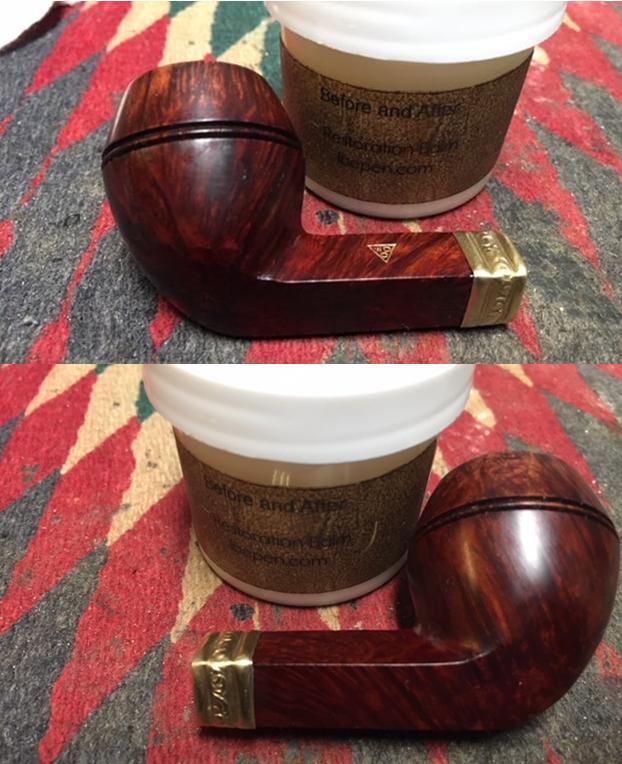
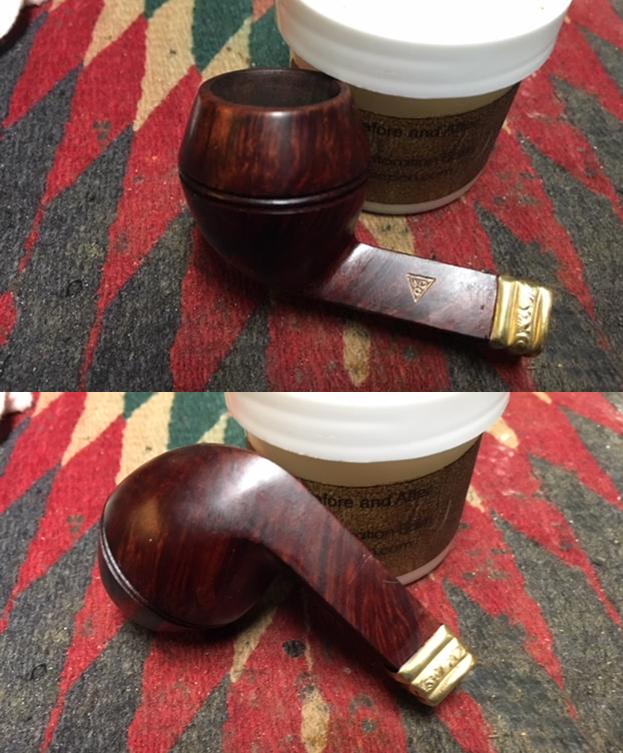
Restemming and Restoring a Tired Medico Husky Rhodesian


Blog by Steve Laug

About a week ago I received a call from a woman who had been referred to me by a pipe shop here in Vancouver. As is often the case here in Vancouver, the woman was calling on behalf of her husband. She wanted to know if I could replace a stem on her husband’s pipe. I told her to bring it by for me to have a look at. A little later the same day she showed up at the front door with a small plastic sandwich bag clutched in her hand and somewhat gingerly handed me the bag. The pipe inside was in rough shape. It had been smoked hard and had a thick gooey cake in the bowl, overflowing onto the rim and down the sides of the bowl. The rim top was damaged and slightly out of round. The stem was not even the correct stem and it was broken off. The diameter of the stem was less than the diameter of the shank. I looked at the pipe in the bag I could see the tars oozing out onto the sides of the bag. It smelled pretty sour. It was obviously either her husband’s favourite pipe or maybe his only pipe. She said he wanted a straight stem on the pipe. Could I do the work? We agreed on a price and she left the bag with me. I took the pipe out of the bag and took some before photos. I wanted to get rid of as much of the smell of the pipe as possible – believe me it was sour and it was dirty. I wiped the exterior of the bowl down with alcohol soaked cotton pads and remove the thick grime and sticky tars off the side of the bowl and as much from the damaged top as possible. Sadly I was in such a hurry to do that I forgot to take photos. Once the exterior was cleaned it was time to tackle the inside of the pipe. I scraped out the inside of the mortise with a dental spatula and remove a lot of hardened tars from the walls of the mortise. The airway into the bowl was clogged with thick tars so I used a paper clip to push through and open the airway. I cleaned out the mortise, shank and the airway into the bowl with cotton swabs, pipe cleaners and alcohol. I cleaned until the inside was clean and clear.I reamed the bowl with a PipNet pipe reamer and the second cutting head. I took the cake back to bare briar so I could check out the inside walls of the pipe. I finished cleaning up the remnants of the cake with a Savinelli Fitsall Pipe Knife. The inside walls look surprisingly good, but the top and inner edge of the rim had damage from repeated lighting of the pipe in the same spot.To minimize the damage to the top and edges of the bowl I lightly topped the bowl on the topping board with 220 grit sandpaper. I was able to remove much of the damage. I worked on the inner edge of the rim with a folded piece of sandpaper to smooth out the burn on the front right side. There was some darkening to the rim but it was solid and looked better.With the internals cleaned, the externals cleaned and rim damage minimized it was time to work on the new stem for the pipe. I went through my assorted stems and found one that would work. It had approximately the same taper that the shank had so it would continue the taper back to the button. I sanded the stem and the shank with a medium grit sanding block to make the transition very smooth. I carefully avoided the stamping on the side of the shank so that the Medico over Husky over Imported Briar was undamaged. The stem fits the shank very well and the transition from briar to vulcanite is smooth. The next series of photos show the pipe at this point in the process. The shank on the pipe was not quite round, so I had to do a bit of reshaping to get a round stem to fit it. The stem only fit one way and there was a divot where there had originally been a logo. I filled in the divot with black super glue and set it aside to cure.With the repair to the stem curing I turned my attention to the bowl. I used a Cherry Stain pen to touch up the sanded areas on the rim and the shank. The colour matched the existing colour on the rest of the bowl so I figured it would be a good match.I buffed the bowl with a soft cloth to raise a shine and blend the stains on the briar. I took the following photos to show the overall condition of the bowl at this point in the process. I rubbed the briar down with Before & After Restoration Balm to enliven, clean and protect the wood. I rubbed it in with my finger tips and worked it into the shallow blast on the bowl and the smooth areas as well. I buffed it with a shoe brush and then with a soft cloth to remove the excess balm. I sanded out the scratches in the vulcanite with 220 grit sandpaper and adjusted the fit to the shank of the pipe.I cleaned out the airway in the stem using alcohol and pipe cleaners. The stem was fortunately not very dirty so the cleanup was very simple. I polished the stem with micromesh sanding pads – wet sanding with 1500-2400 grit pads and dry sanding with 3200-12000 grit pads. I wiped the stem down after each pad with Obsidian Oil on a soft cloth. I buffed it with a soft cotton pad. This small, lightly sandblasted Medico Husky pipe looks a lot better now than it did when I started working on it.  The rim top looks much better than when I started. It was chewed up and heavily caked with lava. The newly fitted stem is high quality and shined up well. I buffed the bowl and the stem with Blue Diamond polish to raise the shine on the briar and the vulcanite. I gave the bowl and stem multiple coats of carnauba wax. I buffed the entire pipe with a clean buffing pad to raise the shine. I hand buffed it with a microfiber cloth to deepen the shine. The finished pipe is shown in the photos below. The rich brown stain allows the grain to really stand out on this little pipe and it works well with the rich black of the vulcanite stem. This restemmed Medico is ready to go back to the pipeman who sent it to me. I will be calling his wife shortly so that she can pick it up for her. Thanks for walking through the restoration with me.

Restoring a Beautifully Carved OaK Leaf Briar Canadian


Blog by Steve Laug

My brother Jeff sent me photos of a pipe that a fellow he knows was selling. The fellow had picked it up on one of his pipe hunting expeditions. It was an intricately carved briar pipe with a horn stem. The bowl was encircled in oak leaves with acorns both fully developed and partially developed. The shank was made up of the stem of the leaves and it was held in a hand. The underside of the shank had fingers and thumb wrapped around the stem on the leaves. There was also bark of a branch. The striations of the bark ran the length of the shank to the oak leaves and stems. The top of the rim had some darkening and a thick overflow of lava on the rim top. The inside of the bowl had a thin coat of cake and some debris in the bottom of the bowl. The horn stem had tooth marks on the top and underside of the stem and some tooth chatter. On the underside there were some worm holes next to the shank/stem junction. One was fairly shallow next to the stem and the other going across the stem was quite a bit deeper. I took photos of the rim top and the stem surfaces both top and underside to show the condition of the pipe when it came to me. You can see the damage on the rim top though the bowl is still in round. There was no damage to the inner or outer edge of the rim. The buildup of lava would need to be scraped away. The stem photos show the tooth chatter on the top and underside near the button and the worm holes near the shank/stem junction.I cleaned the surface of the stem with alcohol on cotton swabs and pads to remove the grime in the holes. I dried them out and then filed them in holes with clear super glue. The small hole was quite simple to fill while the larger one across the stem was deeper and more complicated to repair. It took multiple layers of glue to fill it in until it was even with the surface of the stem. The second photo below shows the filled in holes. The glue dried and turned darker than the rest of the stem. However the surface of the stem was smooth to the touch. I sanded the repairs with 220 grit sandpaper after they had hardened to blend them into the surface of the stem. I wiped the stem down with a cotton pad to remove the sanding dust left behind on the stem surface.I lightly topped the bowl on a piece of 220 grit sandpaper on a topping board to remove the damage and the lava overflow.I rubbed Before & After Restoration Balm into the briar to enliven, clean and protect it. I used cotton swabs and folded pipe cleaners to work the Balm into all of the carved grooves. I buffed it with a soft cotton cloth. I buffed it with a shoe brush to further work the Balm into the grooves and polish it. I polished the rim top with 1500-12000 grit micromesh sanding pads to remove the scratching in the briar left behind by the sandpaper. Once it was polished I touch it up with a Cherry stain touch up pen to match the colour of the rest of the bowl. I buffed the rim top with a soft cotton cloth to bring a shine.I cleaned out the interior of the mortise, shank and airway in the shank and the stem with alcohol, cotton swabs and pipe cleaners. It was dirty but not overly so – the pipe appeared to have been lightly smoked.I polished the horn stem with micromesh sanding pads – wet sanding it with 1200-2400 grit pads and dry sanding it with 3200-12000 grit pads. Each pad brought a deeper shine to the surface of the horn. The tenon appears to be horn and it was pretty clean. I polished it with Before & After Pipe Stem Polish – both Fine and Extra Fine. I buffed the stem with a clean cotton pad. While I was in Idaho I found a cast Elk head pipe rack made by Comoy’s of London. It is a unique one and it works very well to hold this large pipe. I screwed the stem back into the shank and buffed the bowl and shank with a cotton cloth to raise a shine. I put the pipe in the Elk pipe rack and took photos of the pipe. This large, ornately carved oak leaf briar bowl and shank is quite stunning. There a places on the underside of the shank where you could see air through the space between the base of the bowl and shank and the curve of the stems held in the hand. The rim top is smooth and clean and looks much better. The horn stem is of nice quality and after the repairs it shined up well. I hand buffed the bowl and the stem with a shoe brush to raise the shine on the briar and the polished horn stem. I gave the bowl and stem multiple coats of Conservator’s Wax. I buffed the entire pipe with a shoe brush and a microfiber cloth to deepen the shine. The finished pipe is shown in the photos below. The rich brown stain allows the grain to really stand out on this little pipe and it works well with the rich colour of the horn stem. The dimensions of the pipe are: Length: 9 inches, Height: 3 inches, Outside Diameter: 1 7/16 inches, Diameter of the chamber: 7/8 inches. This intricately carved knife will fit really nicely into my collection of antique pipes. I think that this will be a great pipe to smoke and should deliver a clean dry smoke. Thanks for walking through the restoration with me.