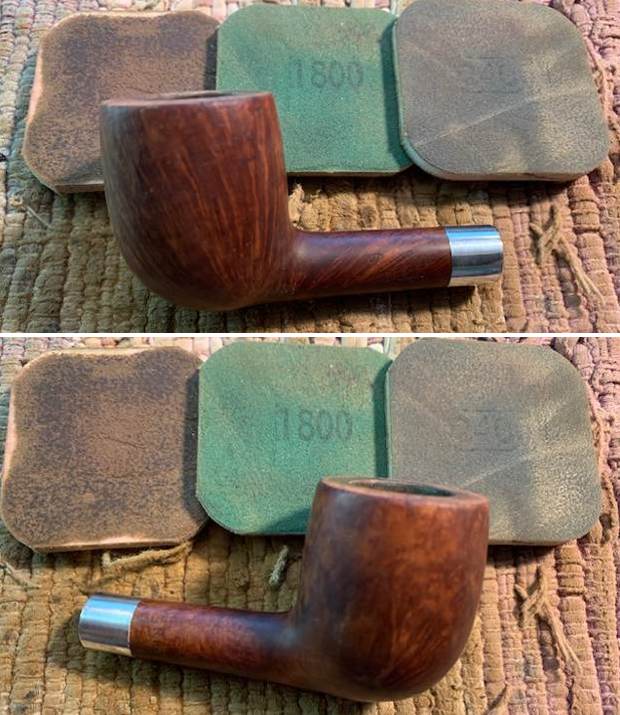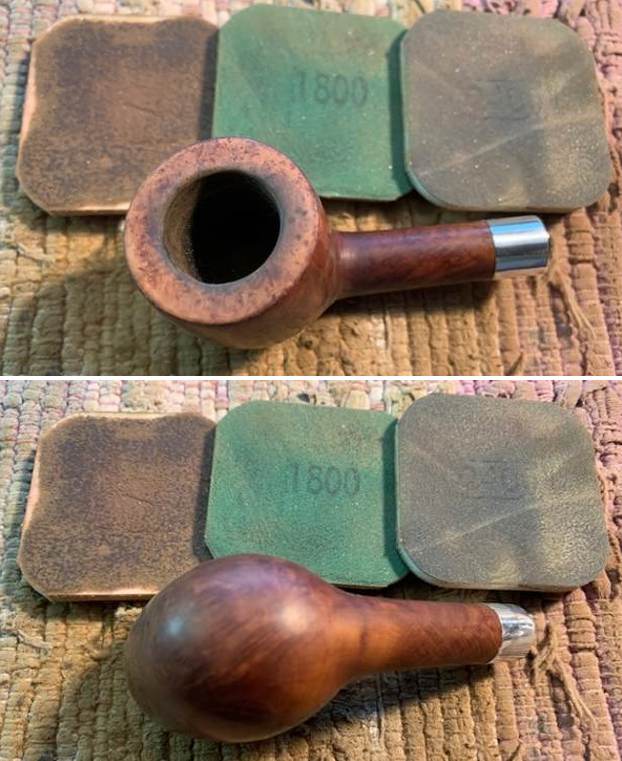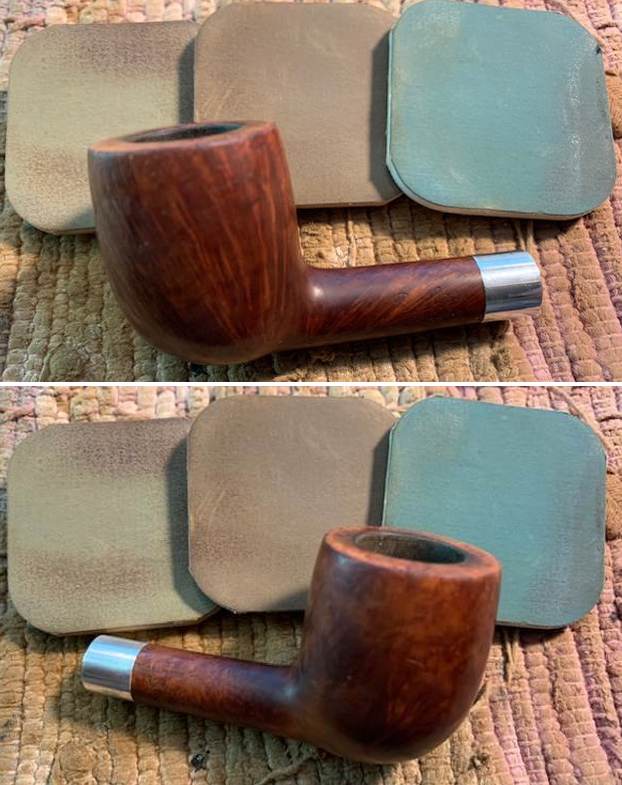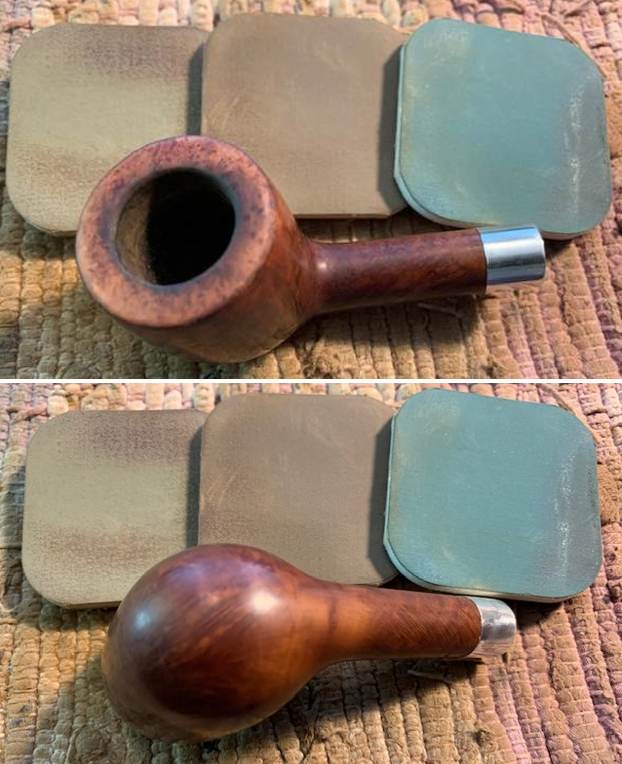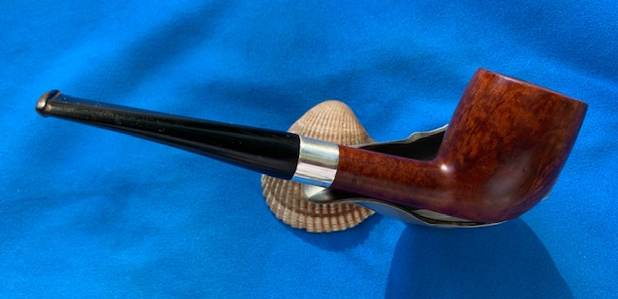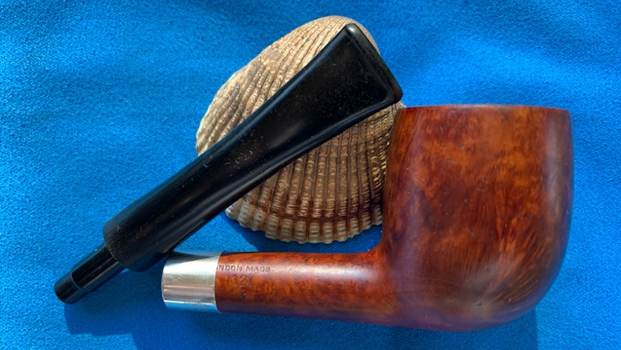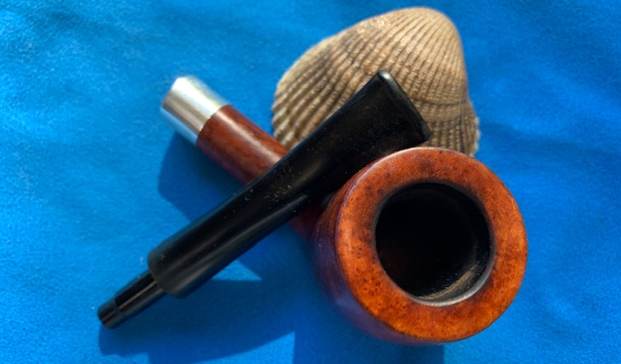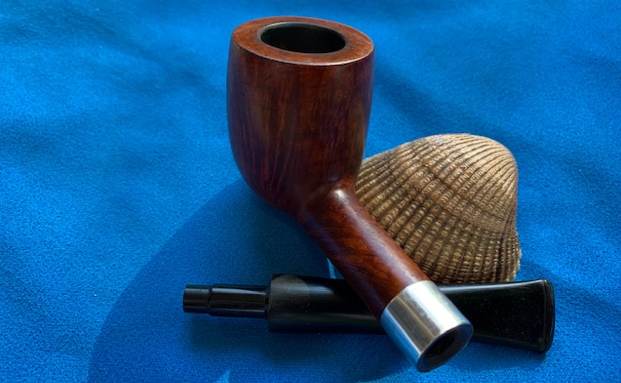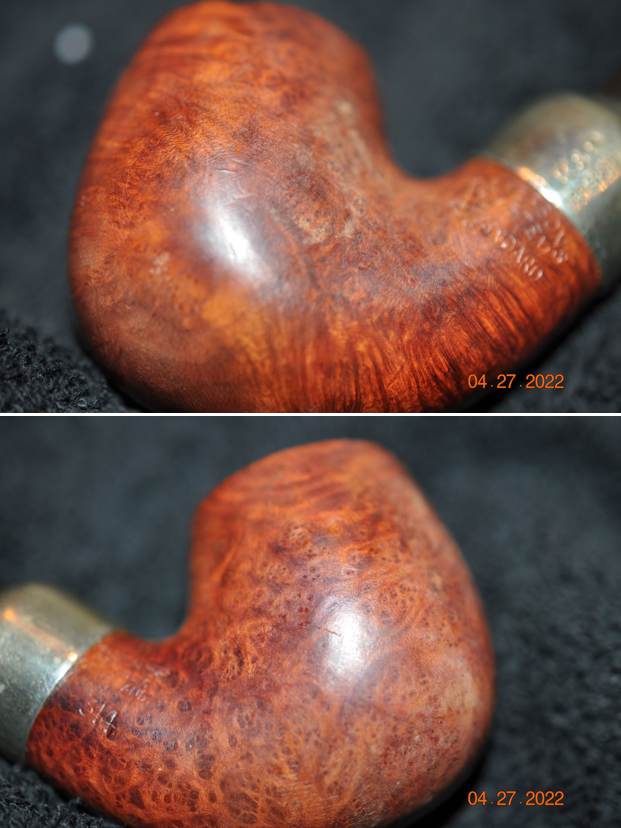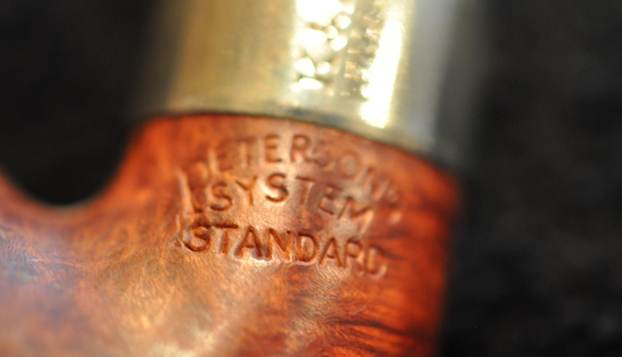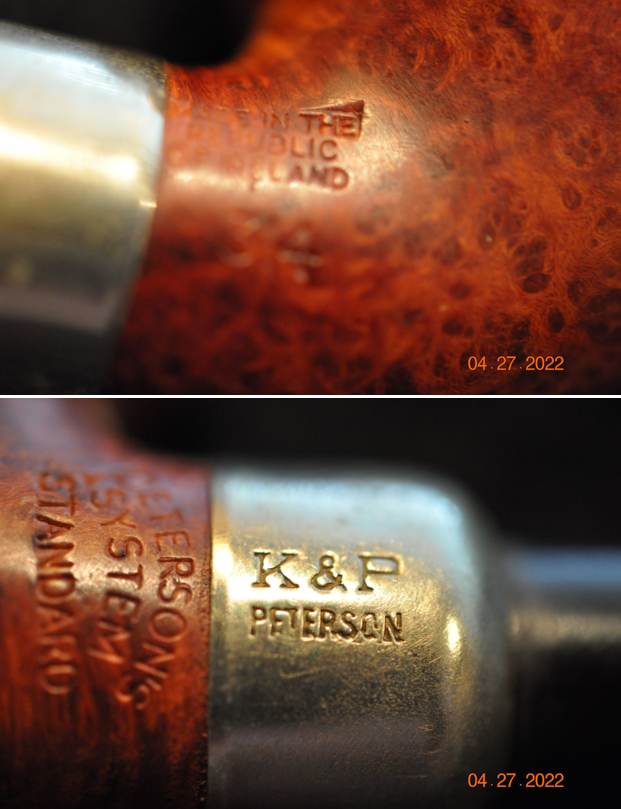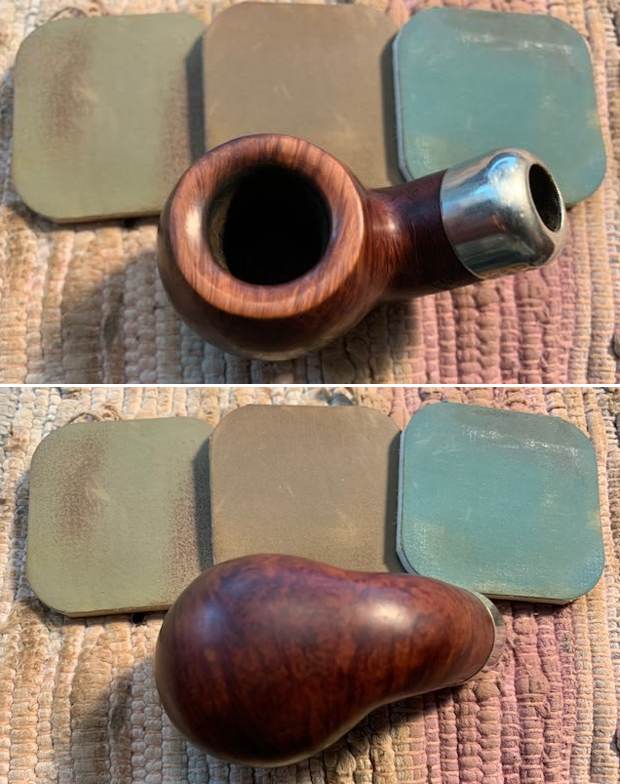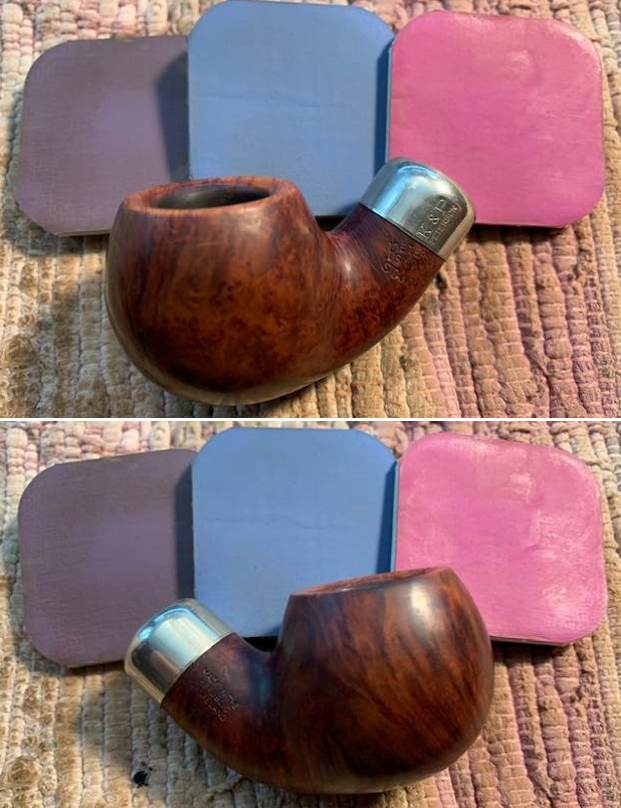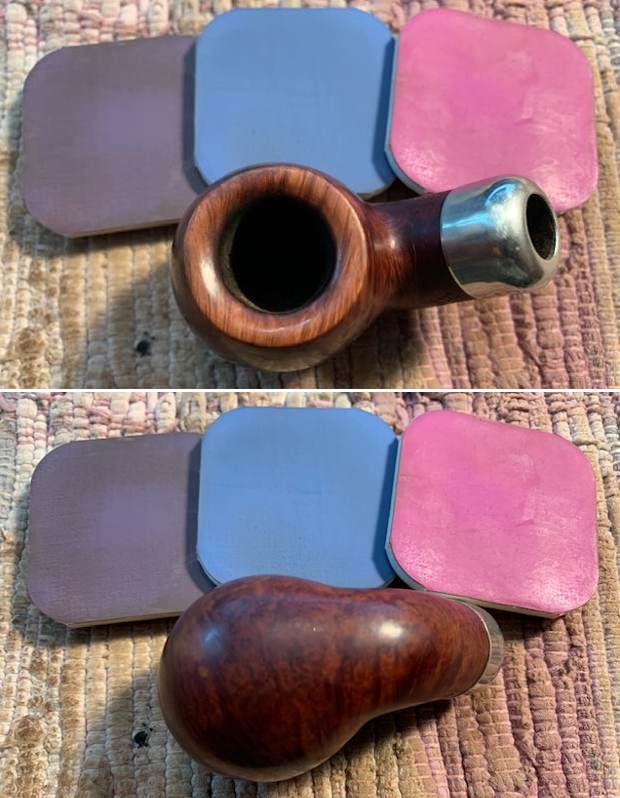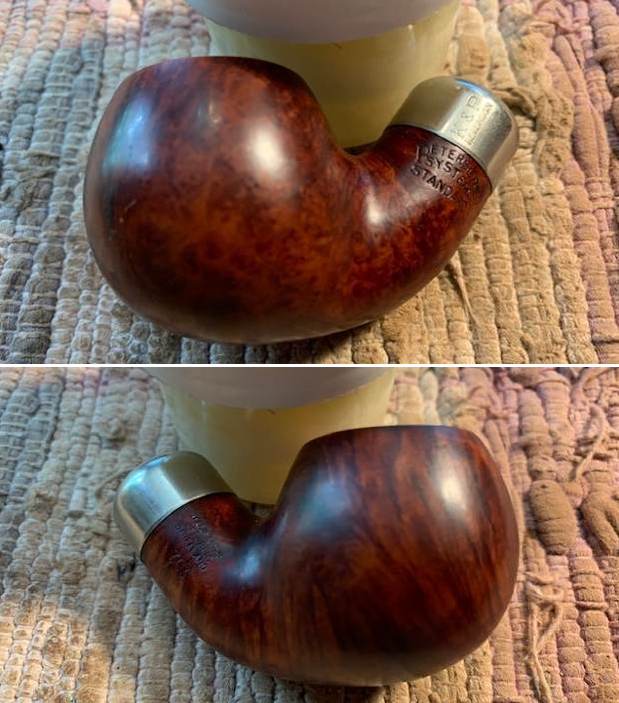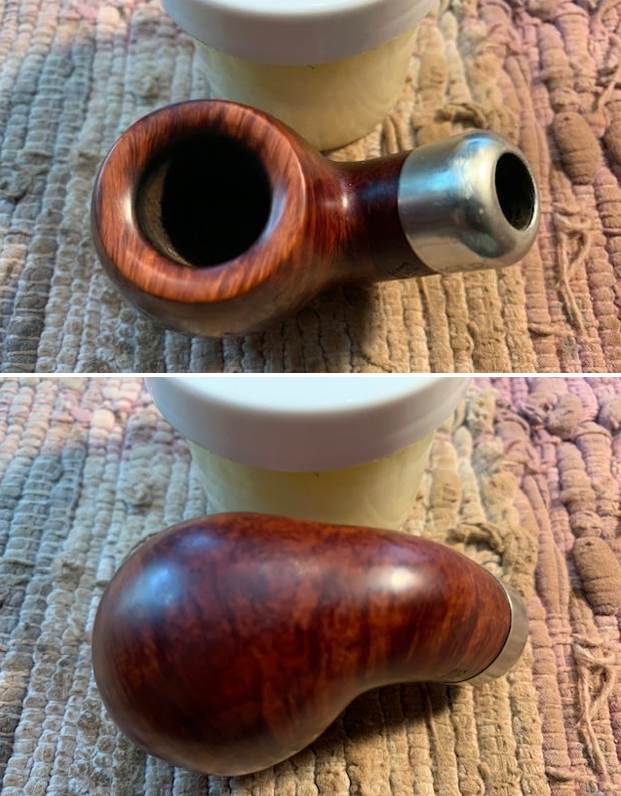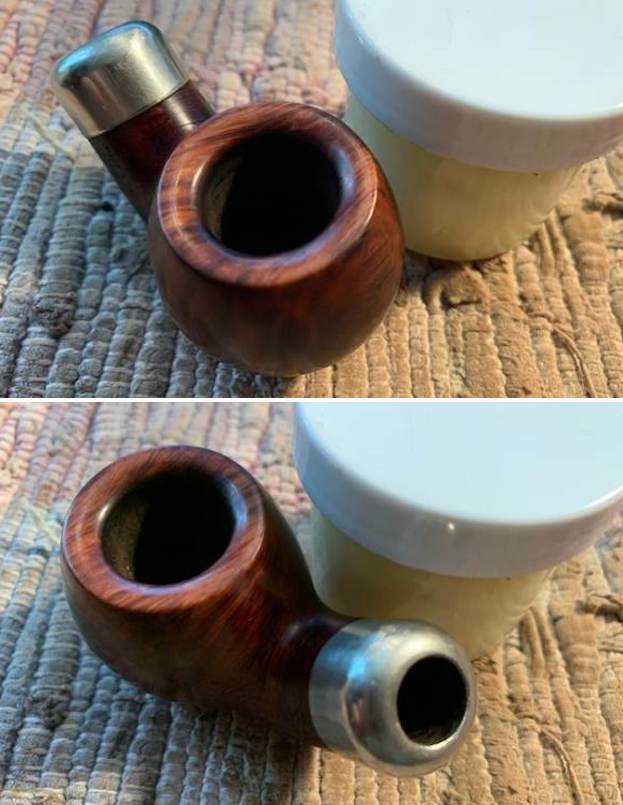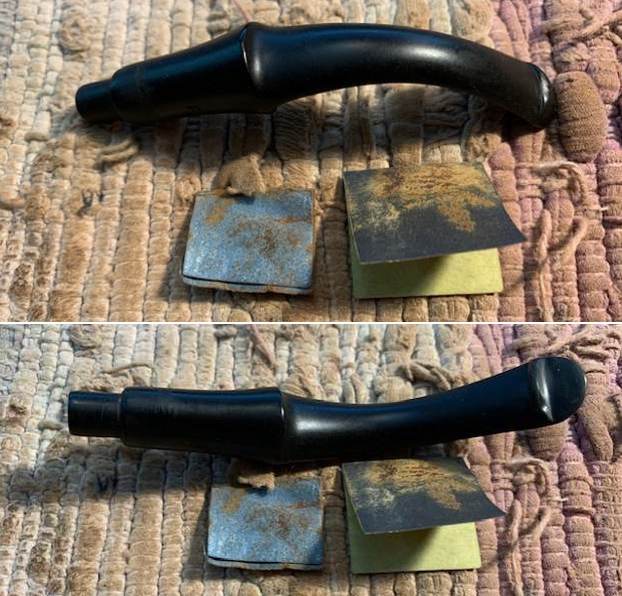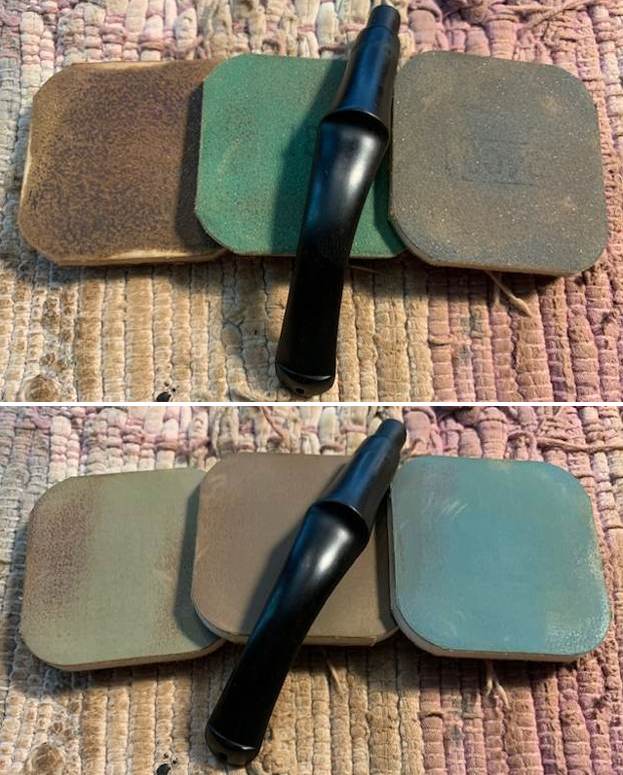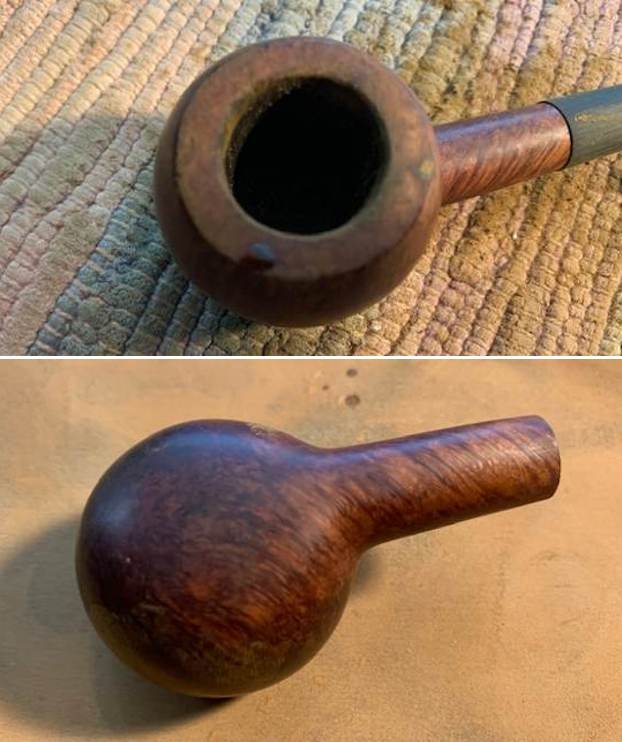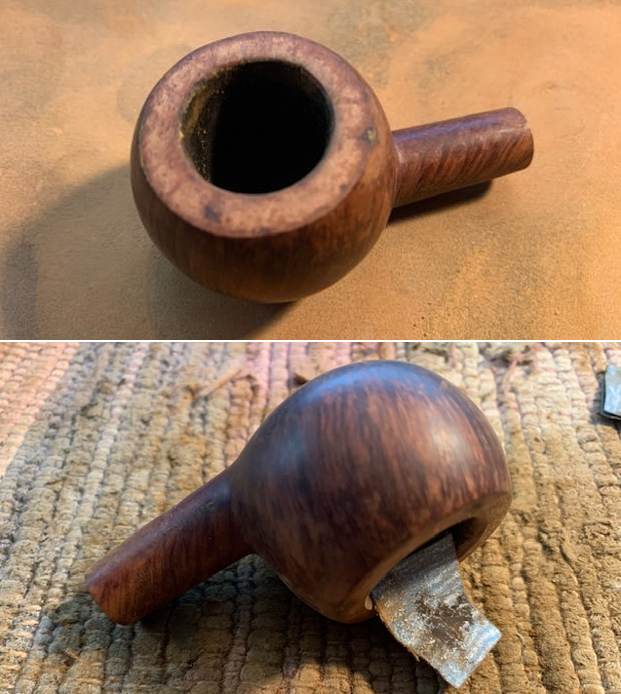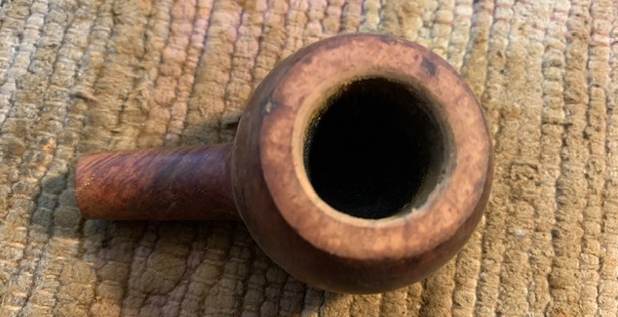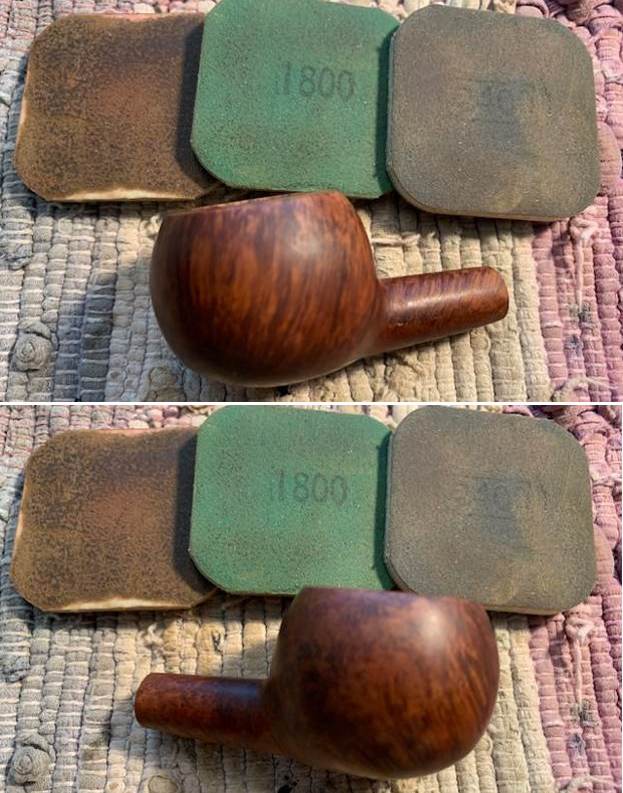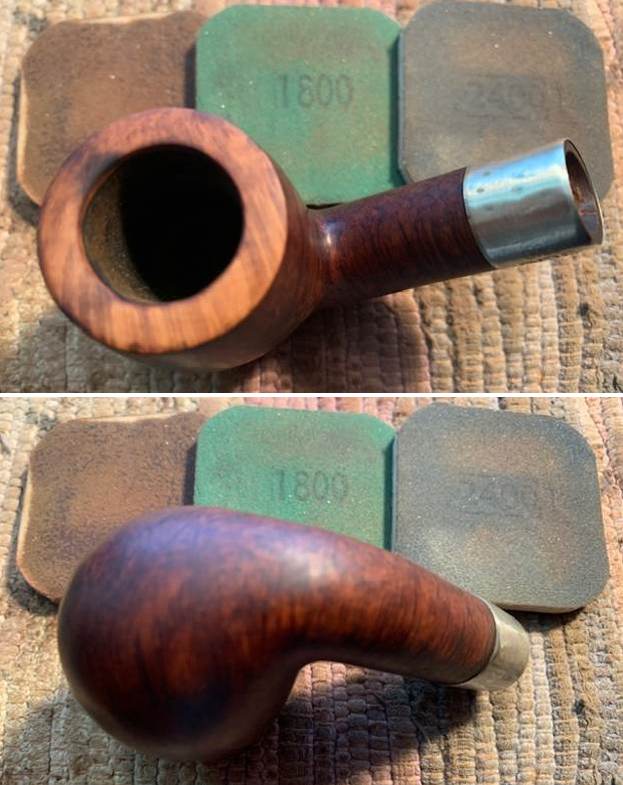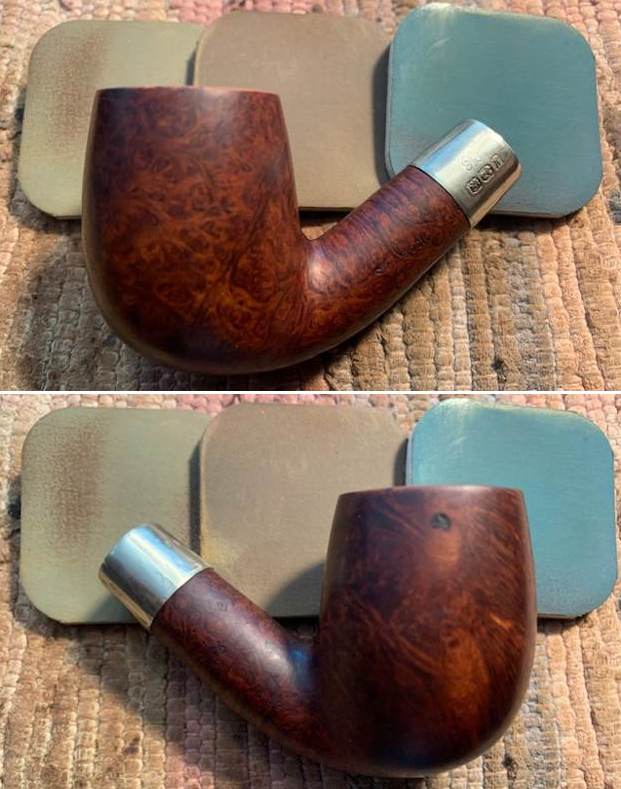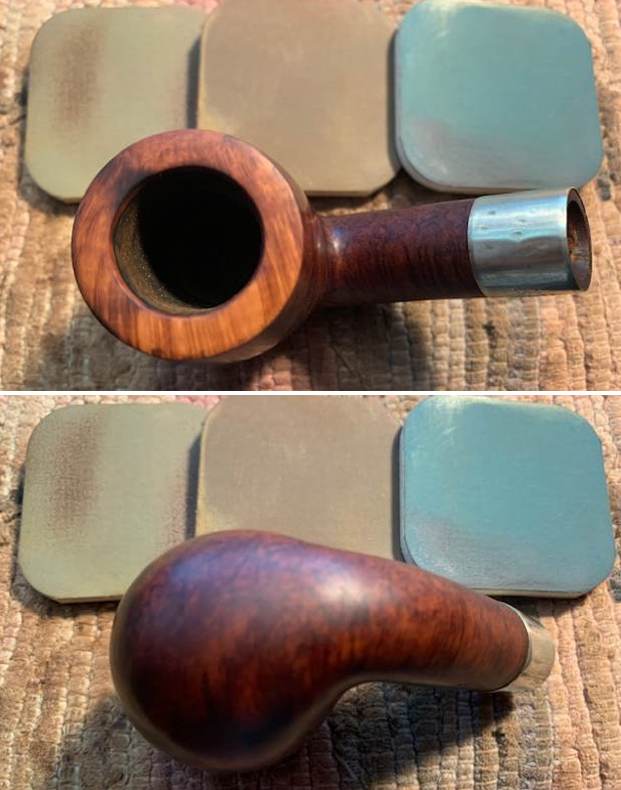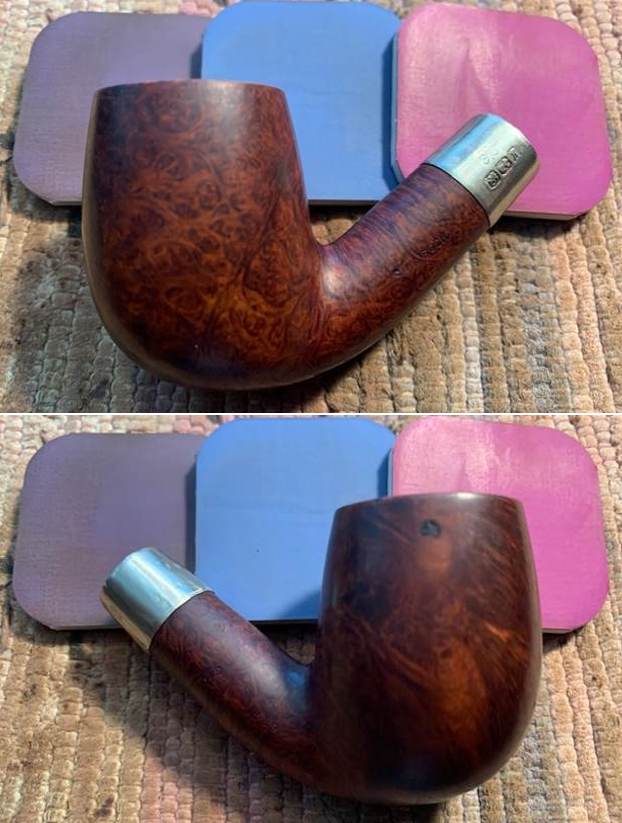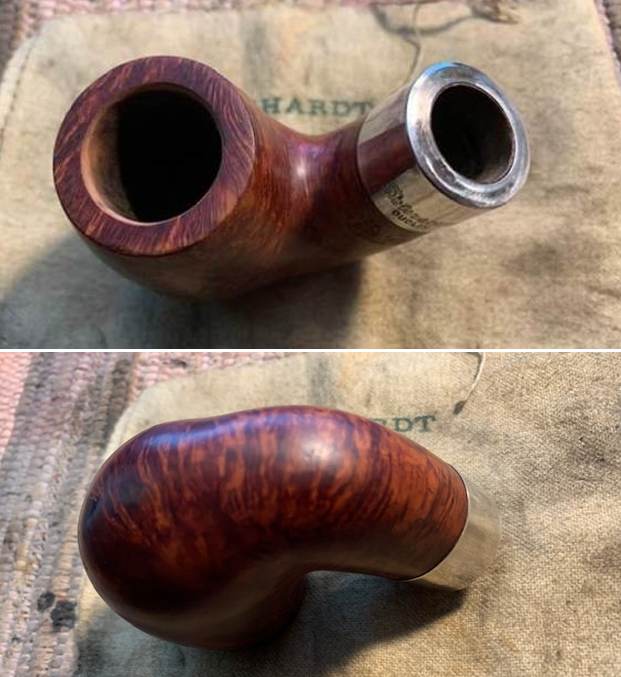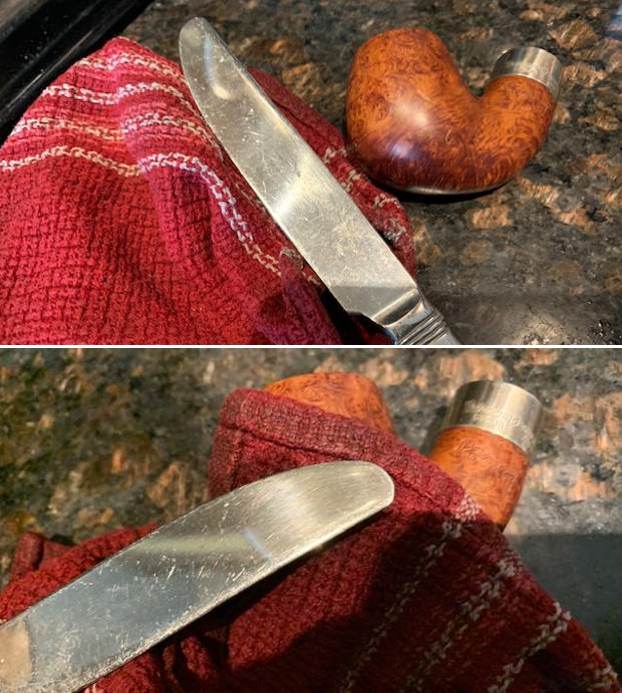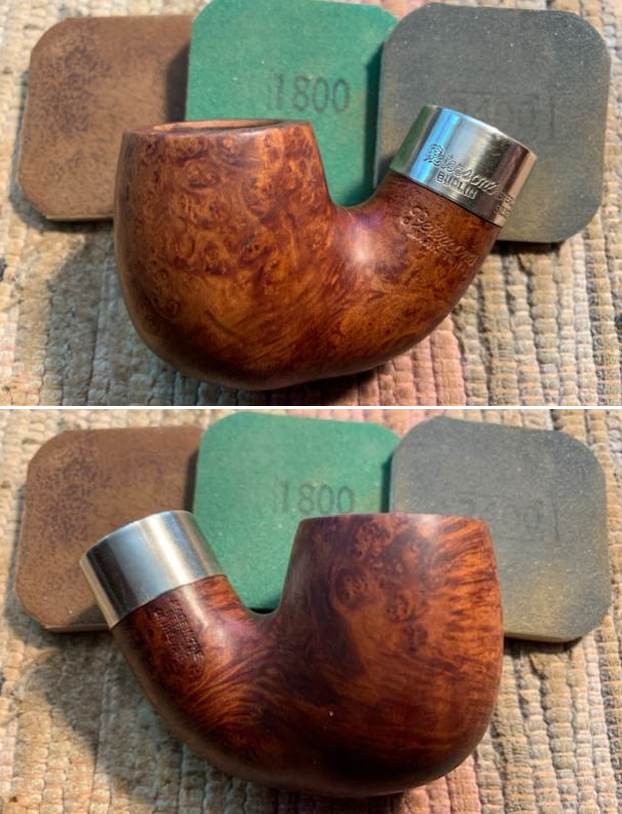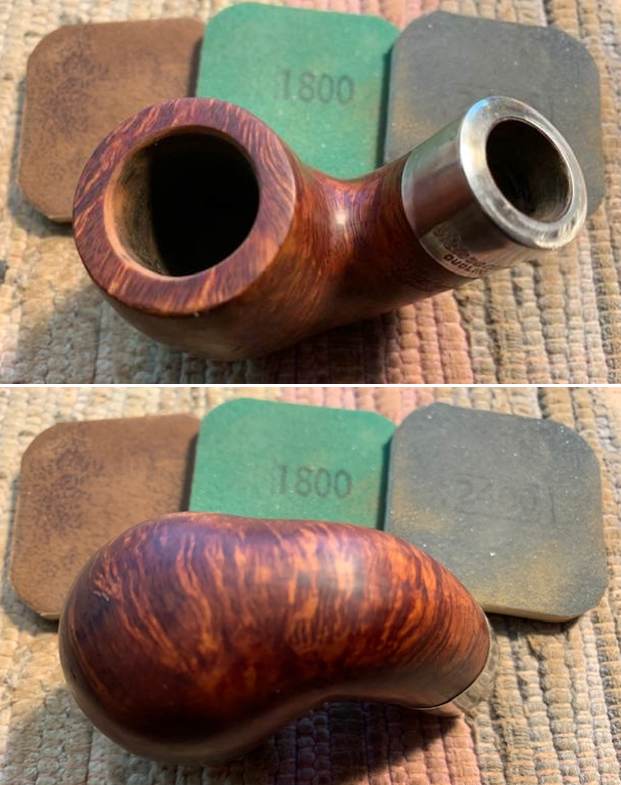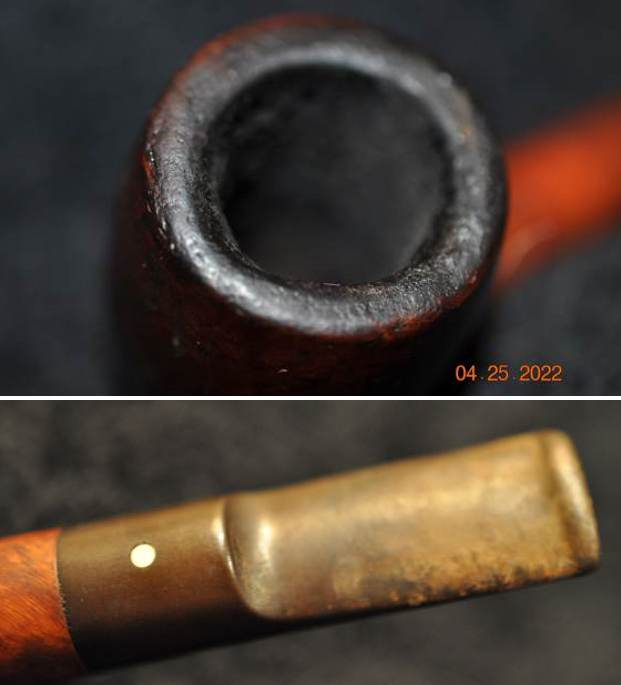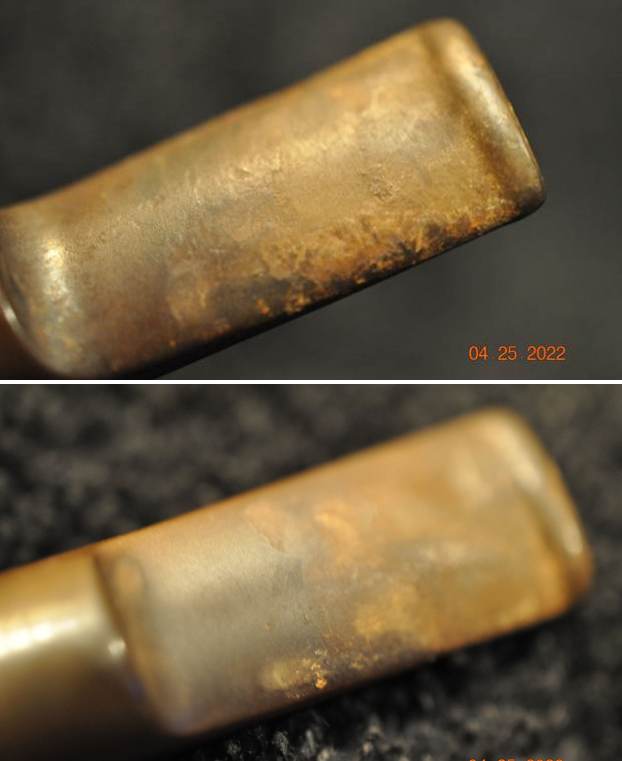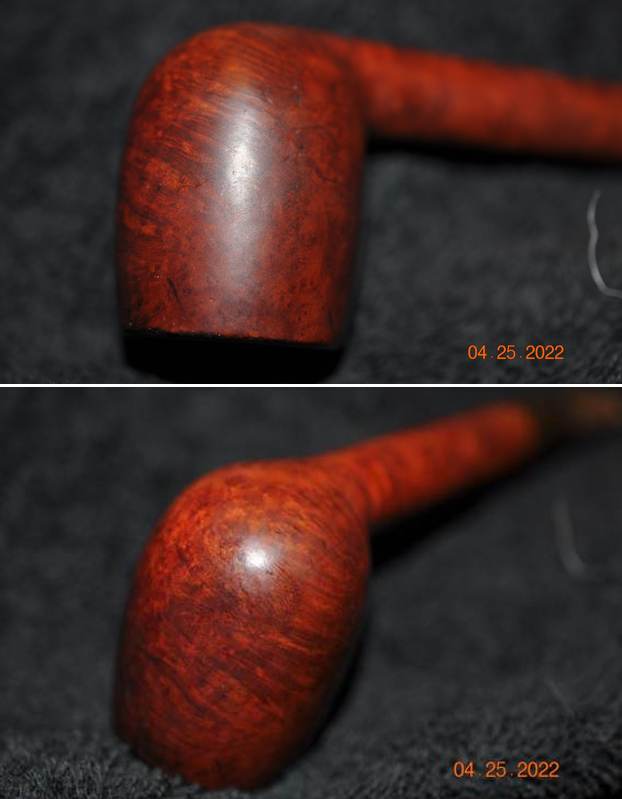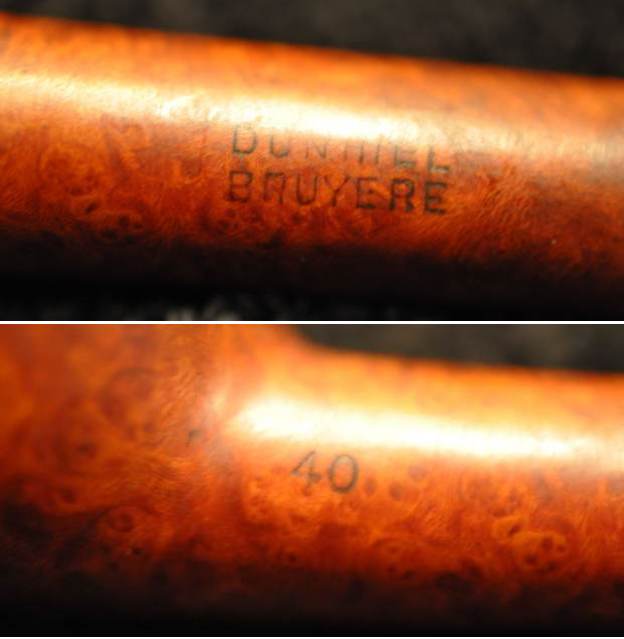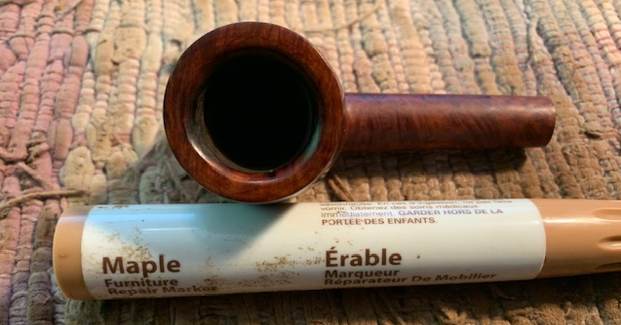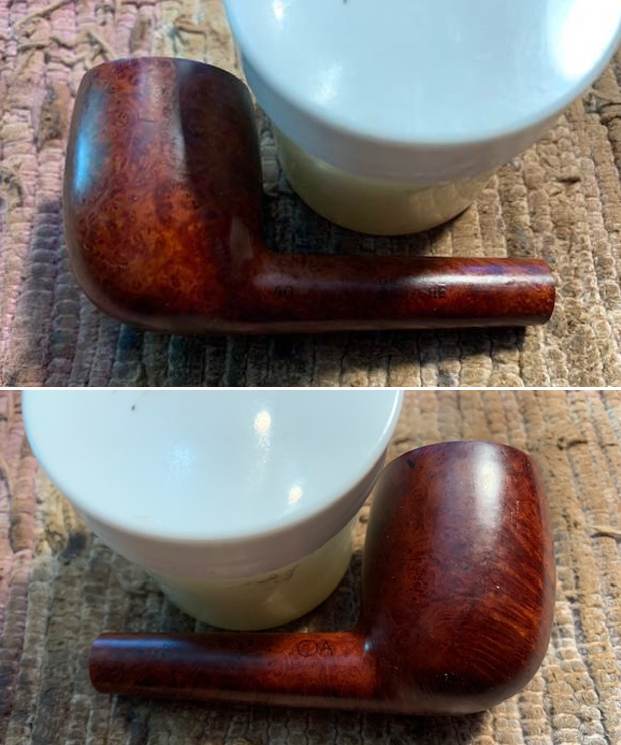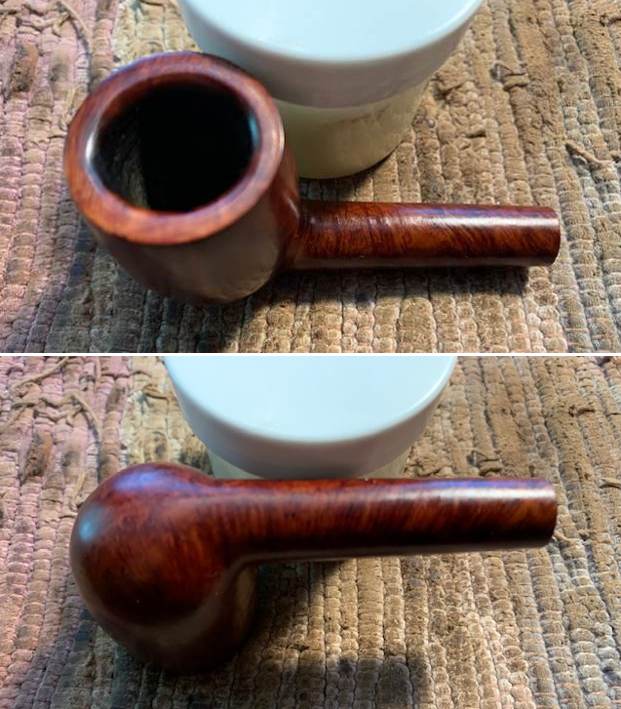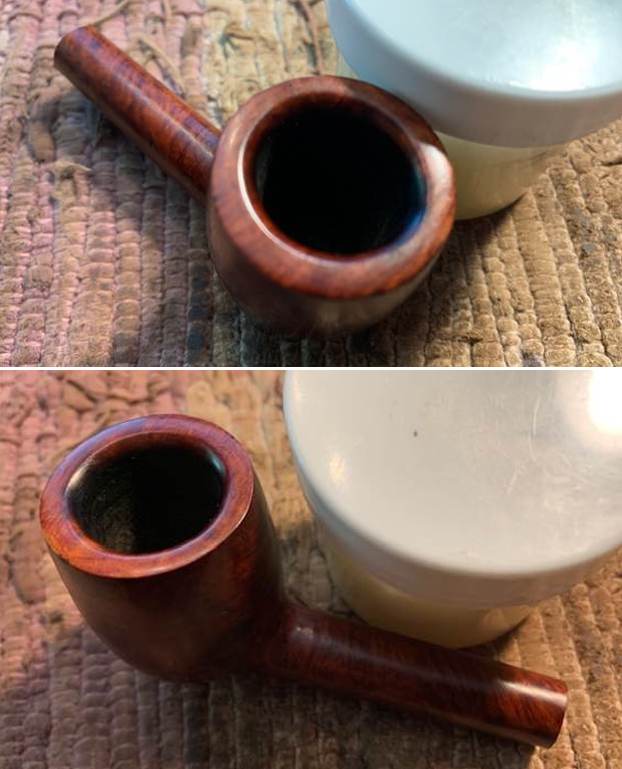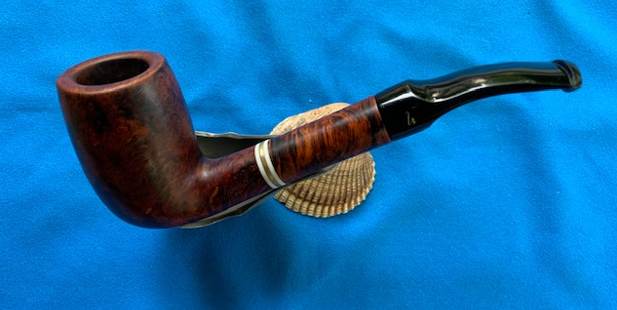
Tag Archives: bowl topping

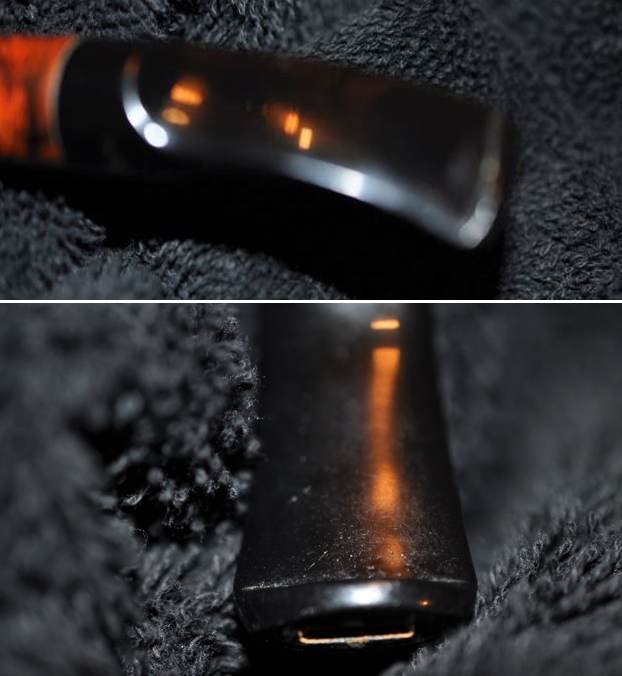
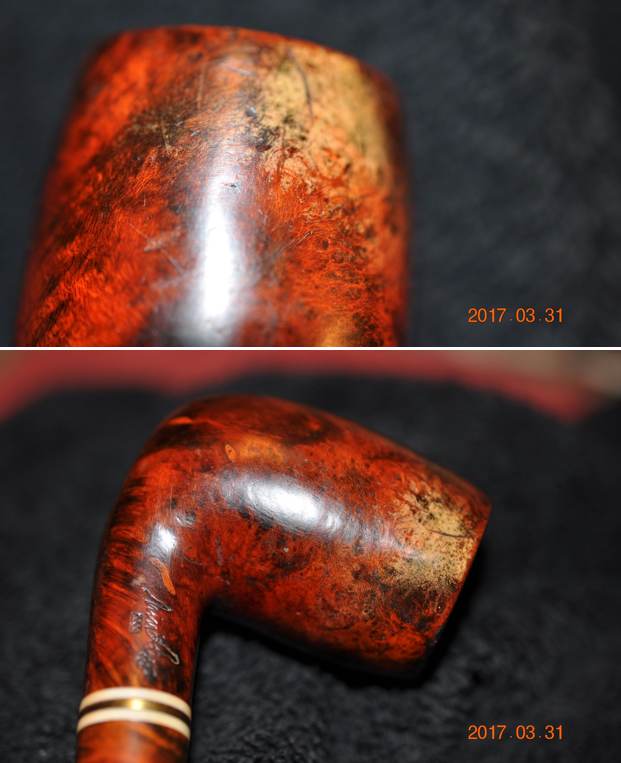
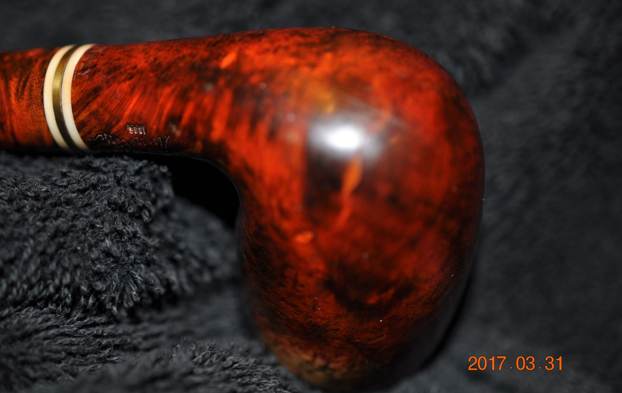
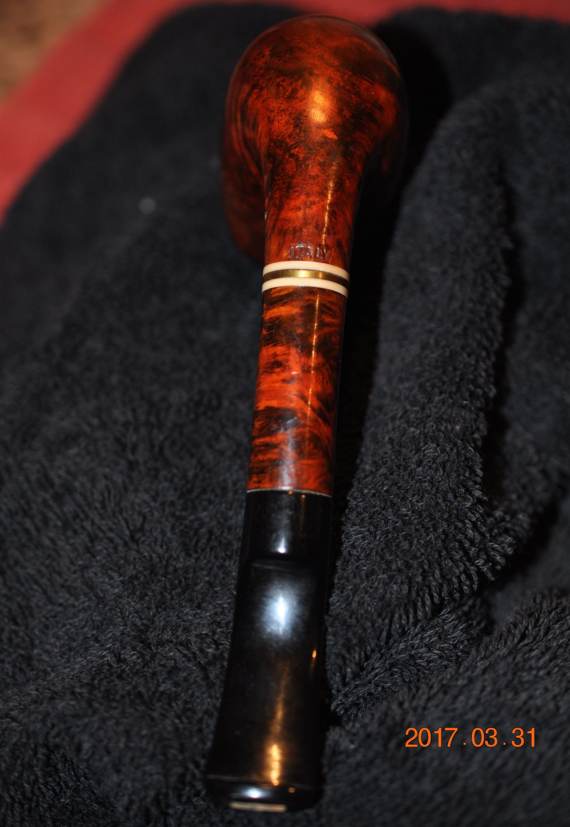
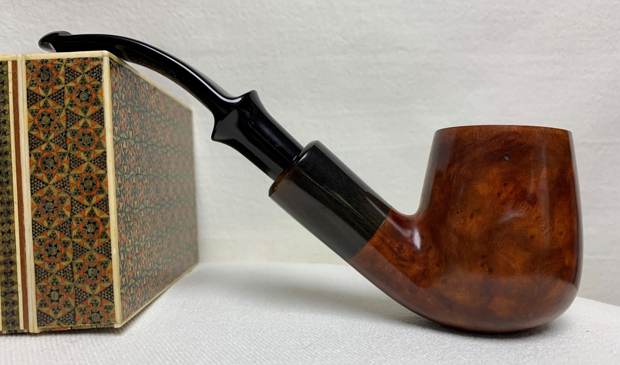
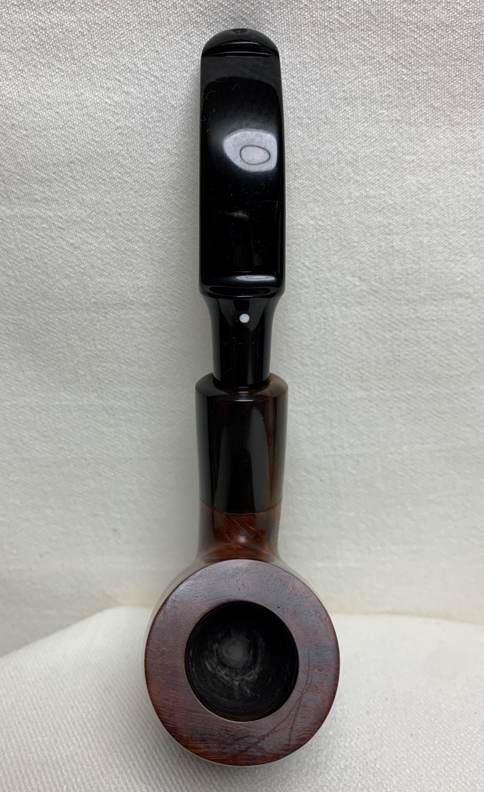
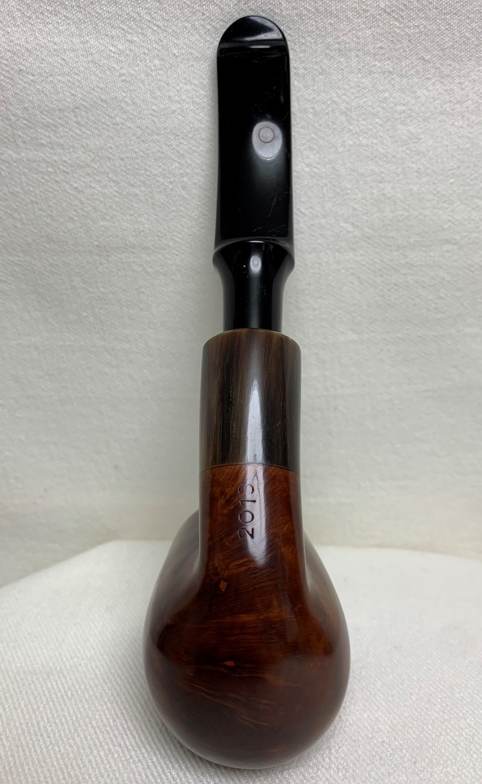
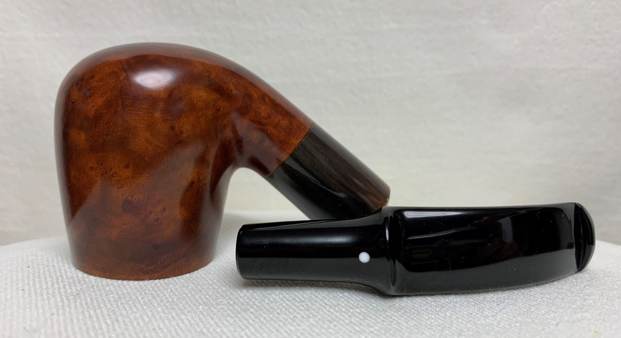
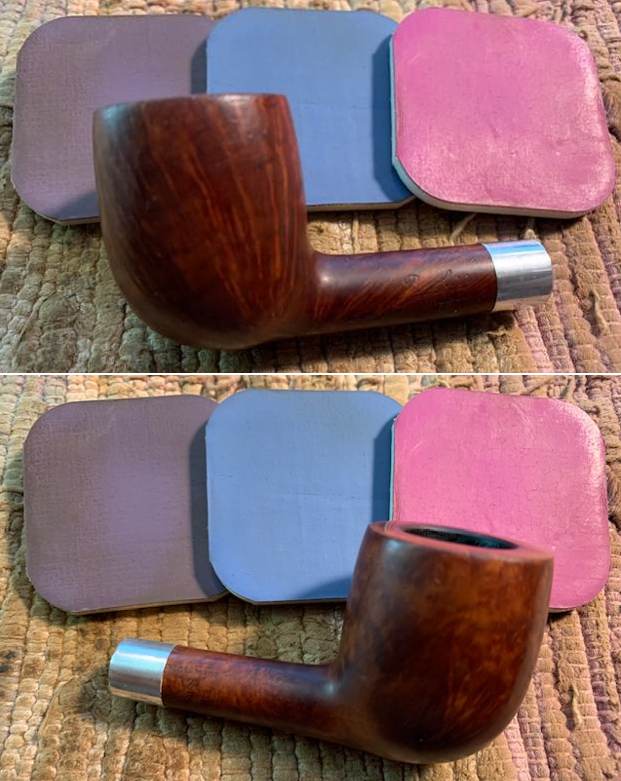
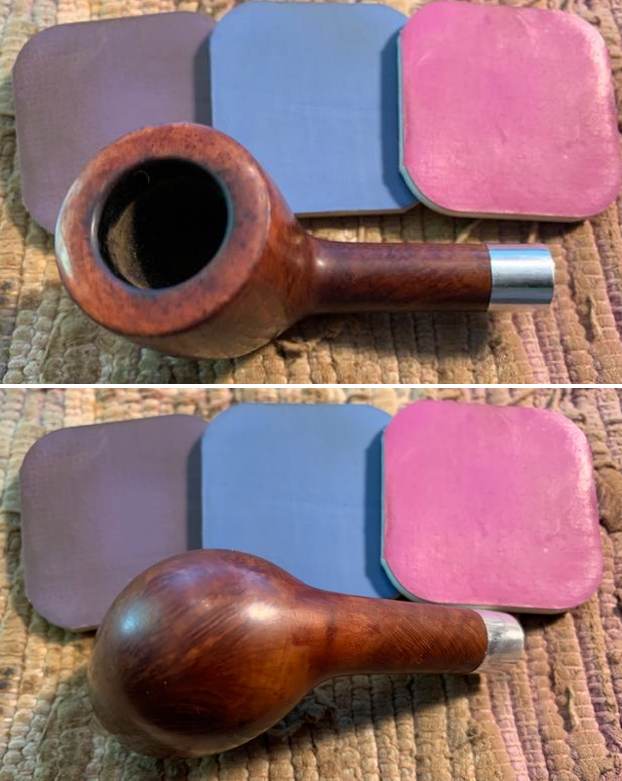
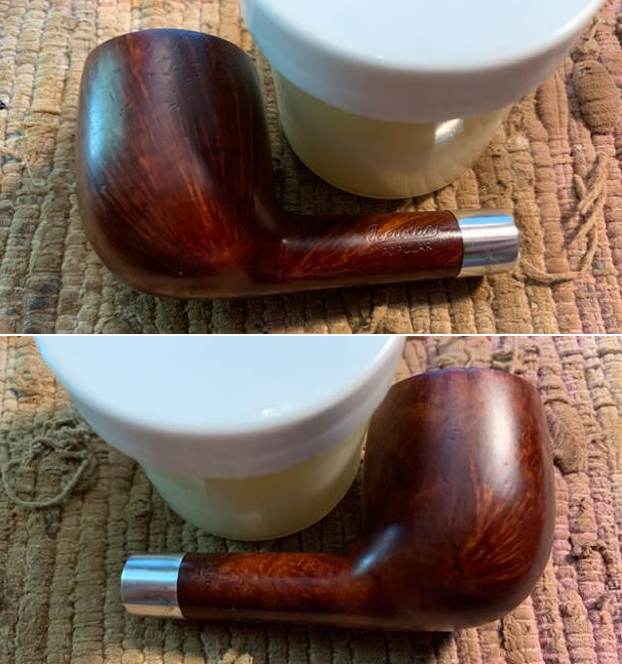
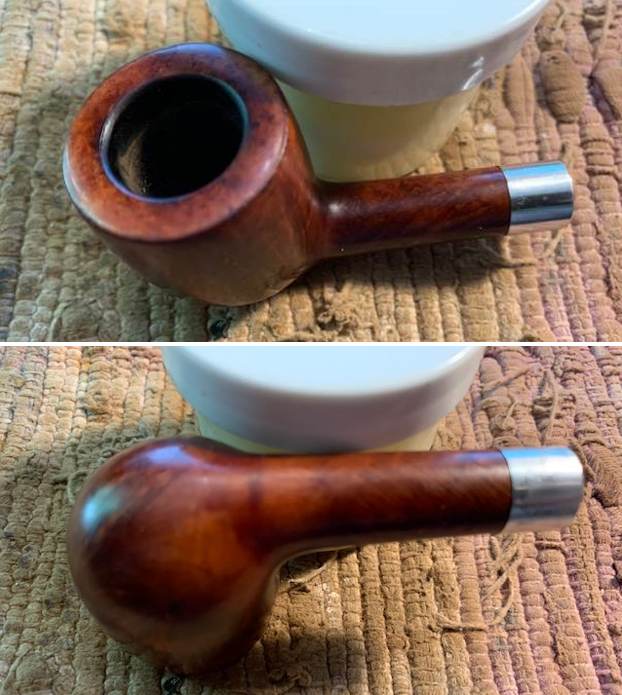
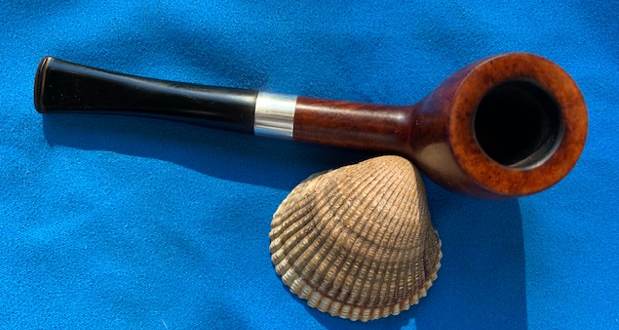
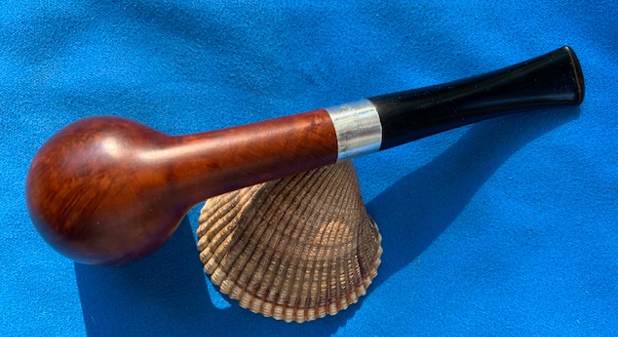
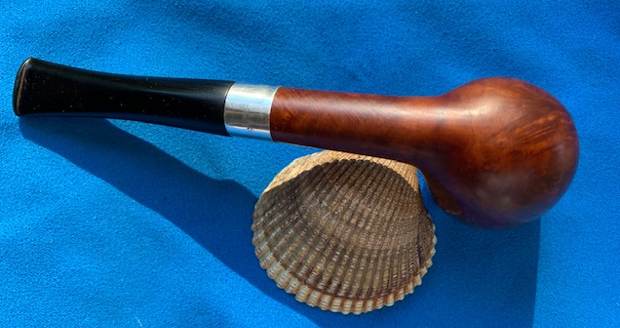
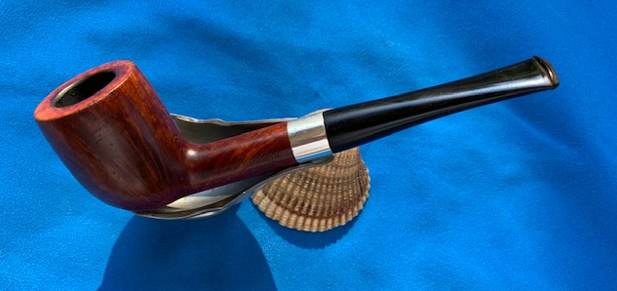
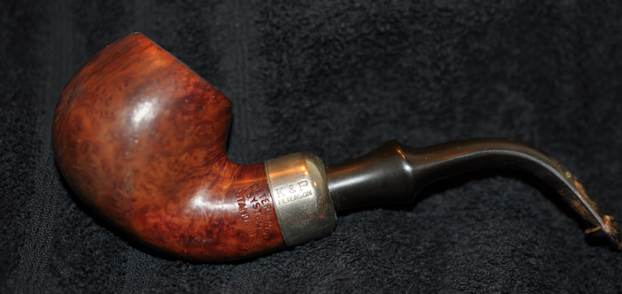
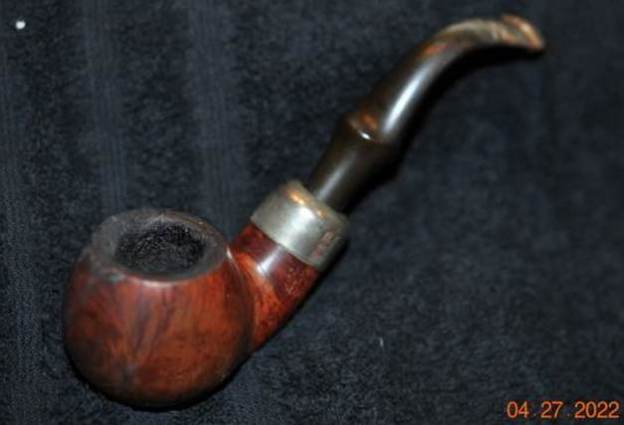
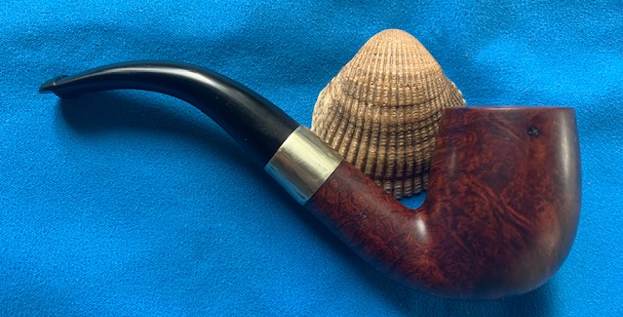
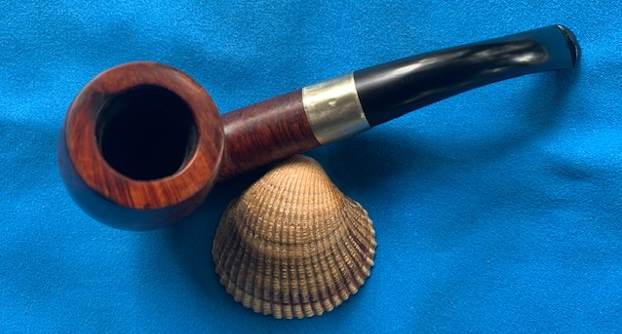
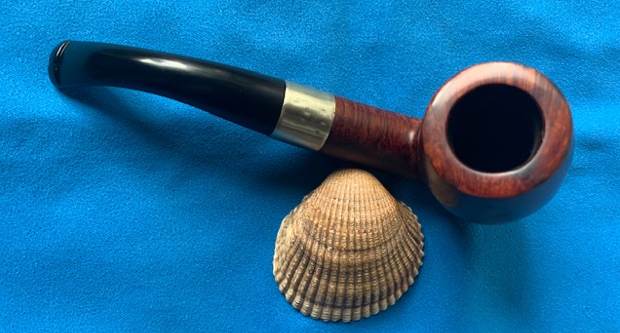
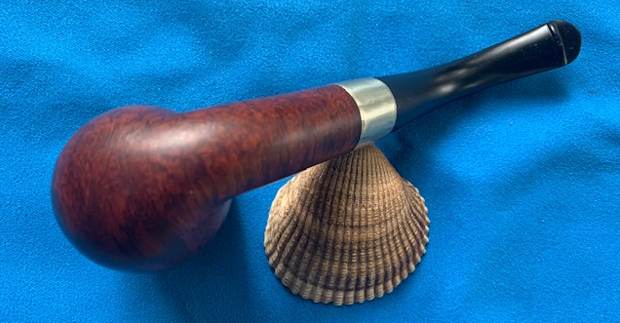
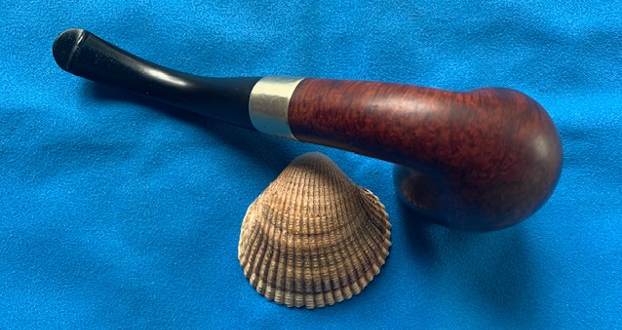
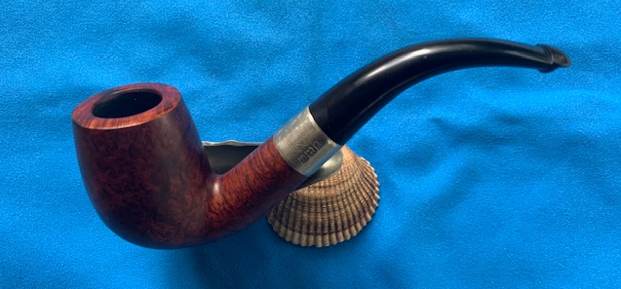
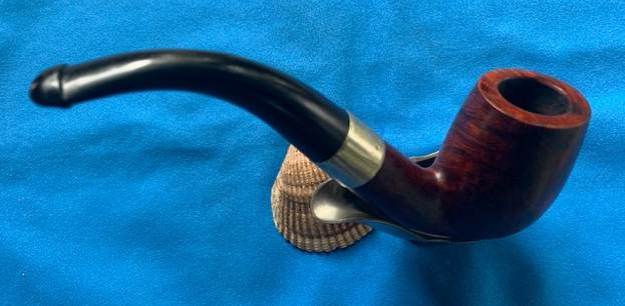
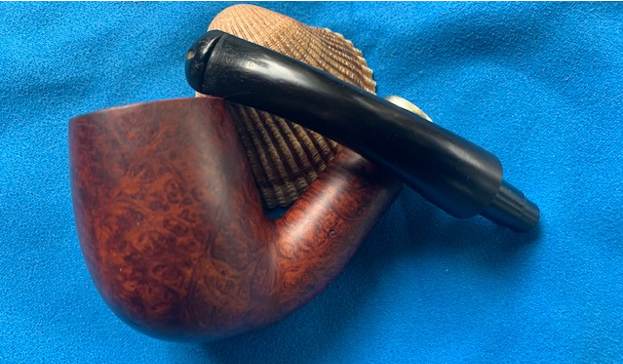
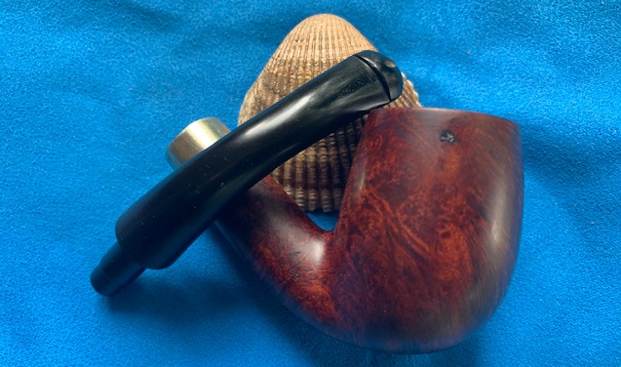
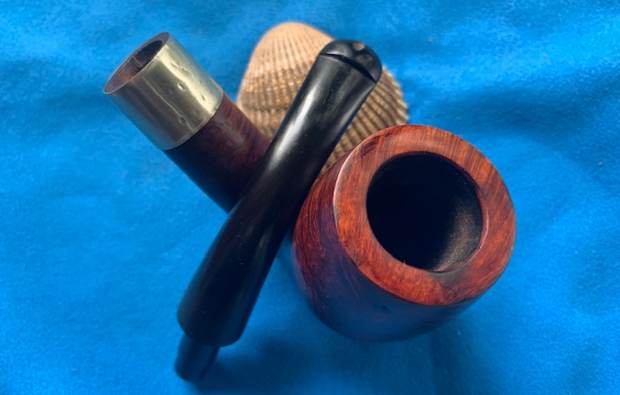
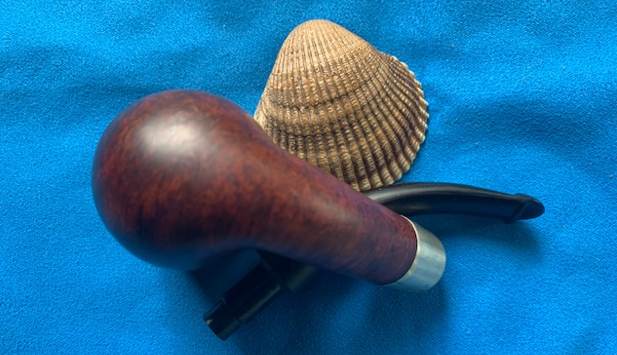
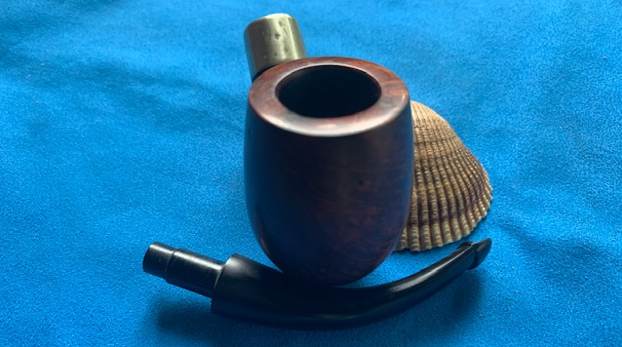
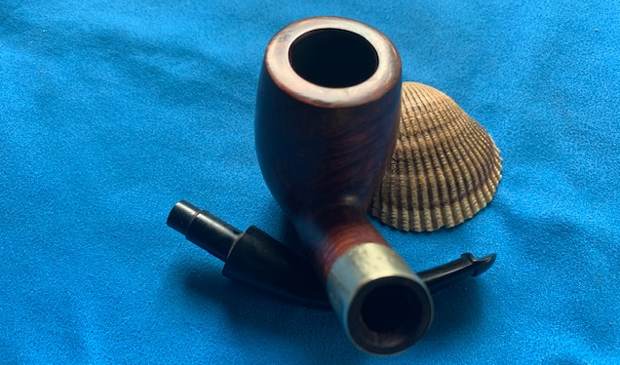
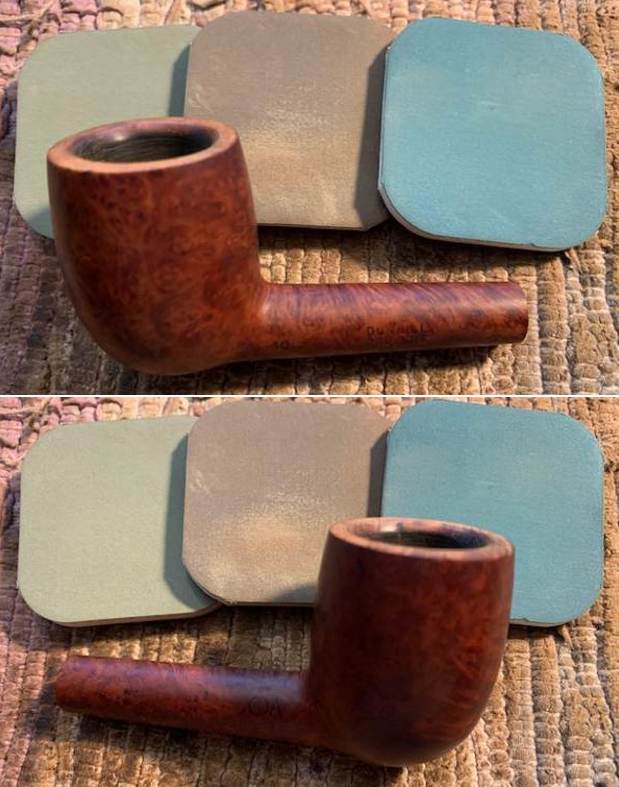
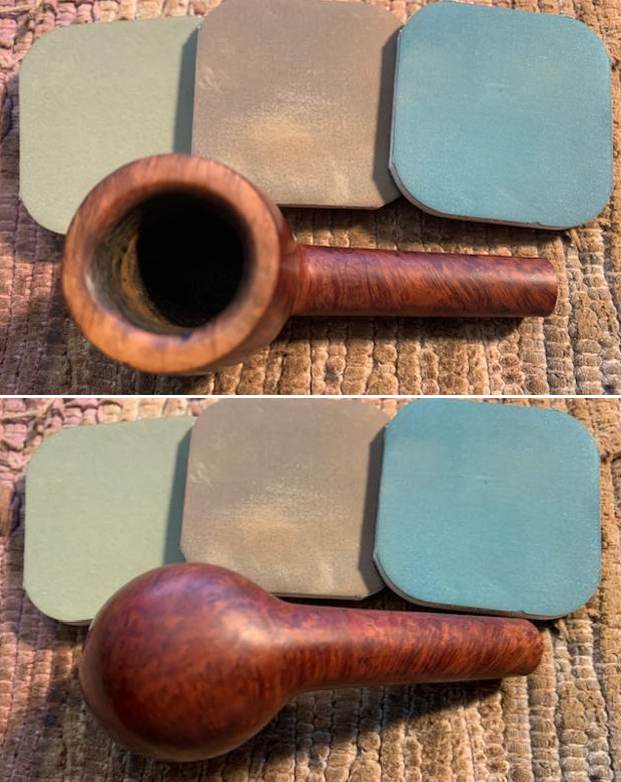
Restoring Another Lovely 1958 Dunhill Root Briar 34F/T 2R Billiard


Blog by Steve Laug

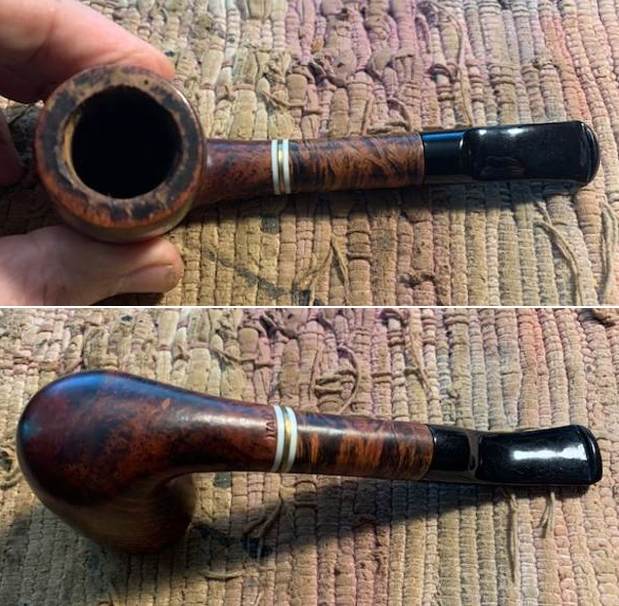
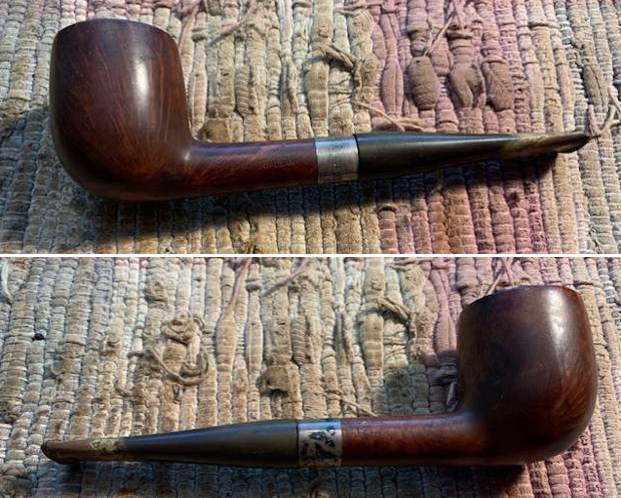
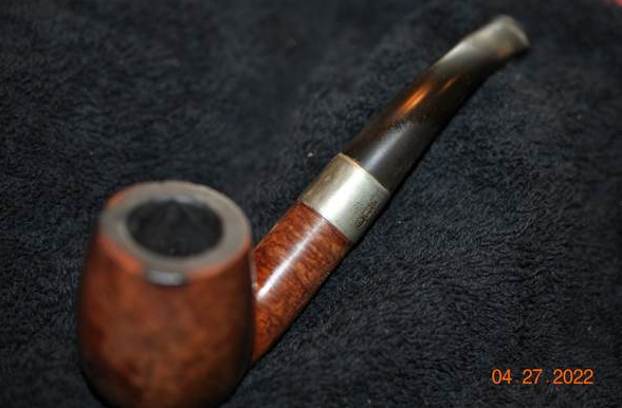
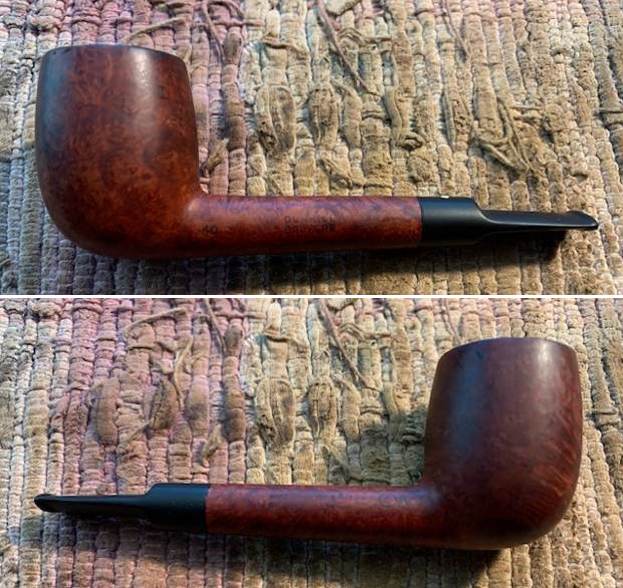
The next pipe on the table is another Dunhill group 2 sized Billiard. It is a small Root Briar Billiard that is proportionally well done. It has a two digit the shape number that I will define below. It is identical in stamping, shape, size and condition to the previous Root Briar 34F/T I worked on yesterday (https://rebornpipes.com/2022/05/27/168579/). Jeff and I purchased the pipes on 04/26/2022 from a woman who contacted us from Cleveland, Ohio, USA. We spent time chatting with her and arrived at a price and she sent the pipes to Jeff. It included 28+ pipes along with this one.

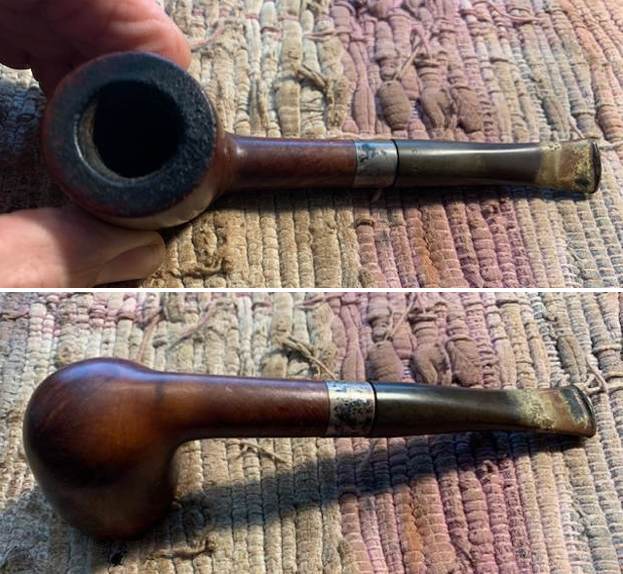
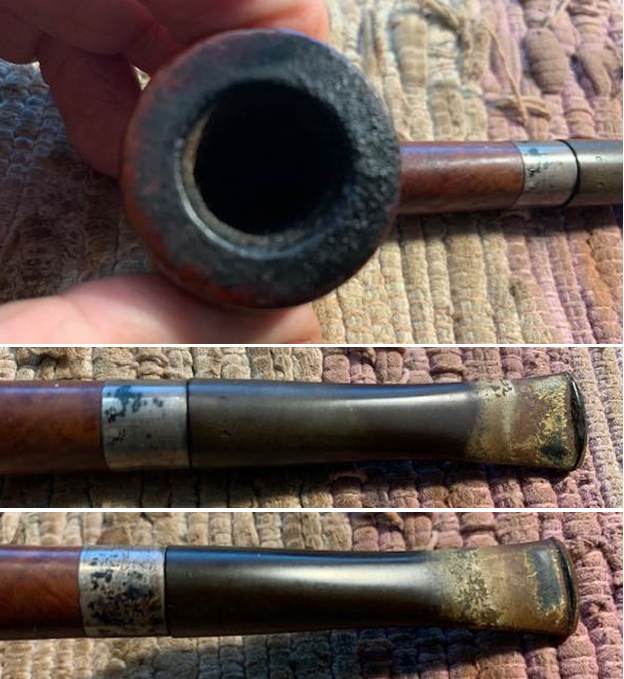
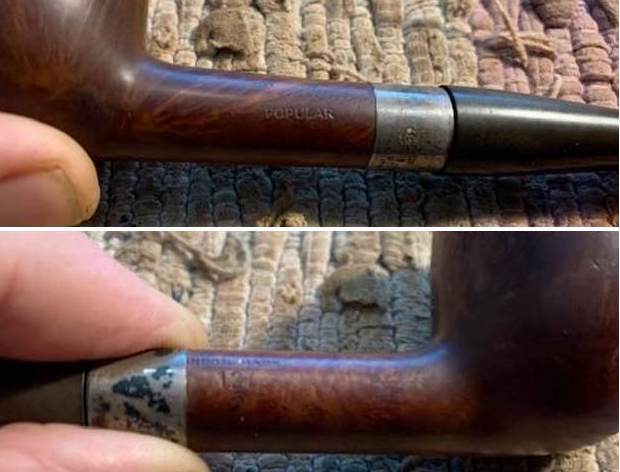
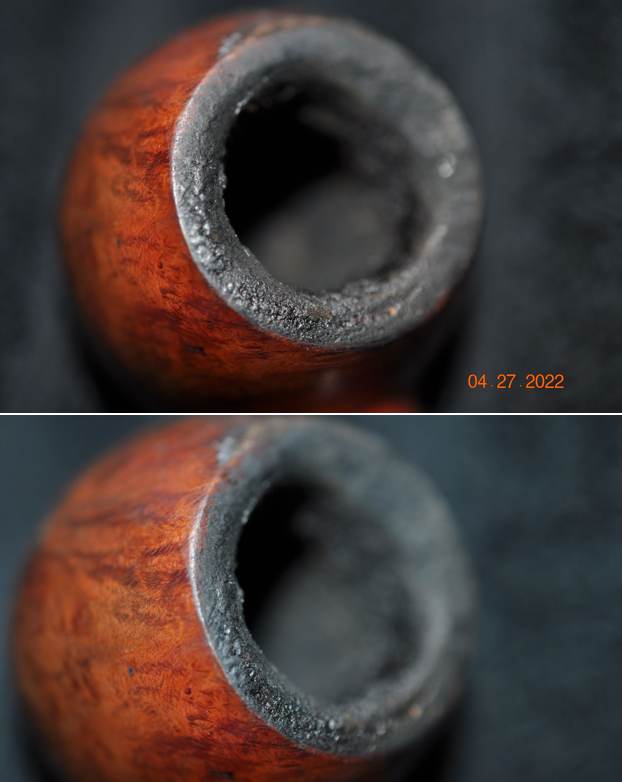
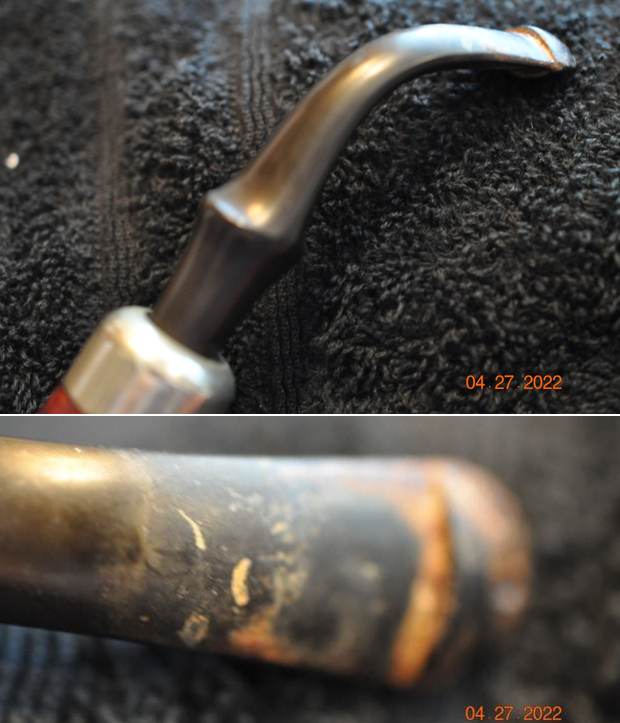
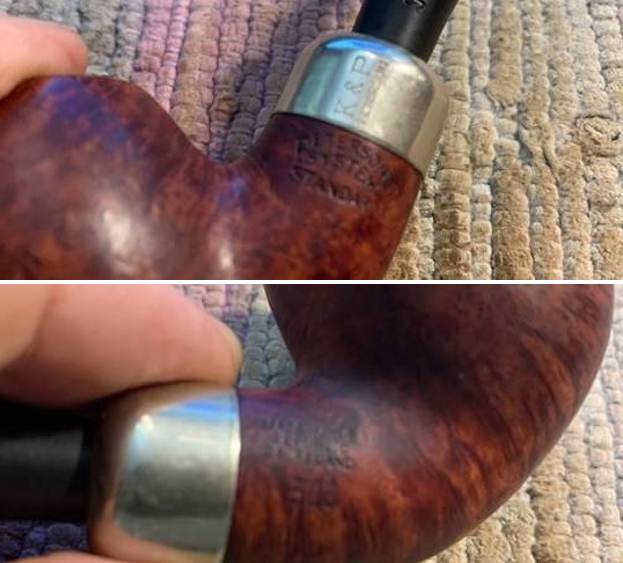
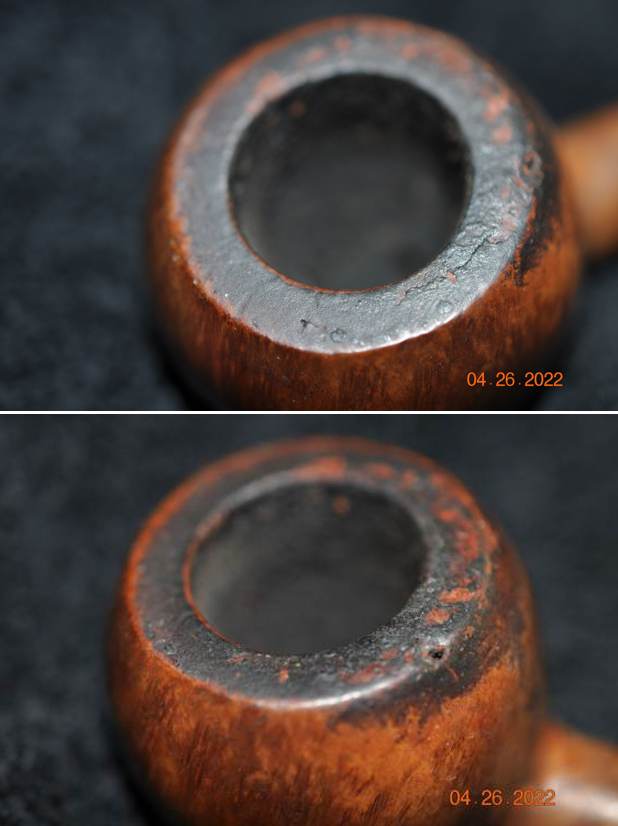
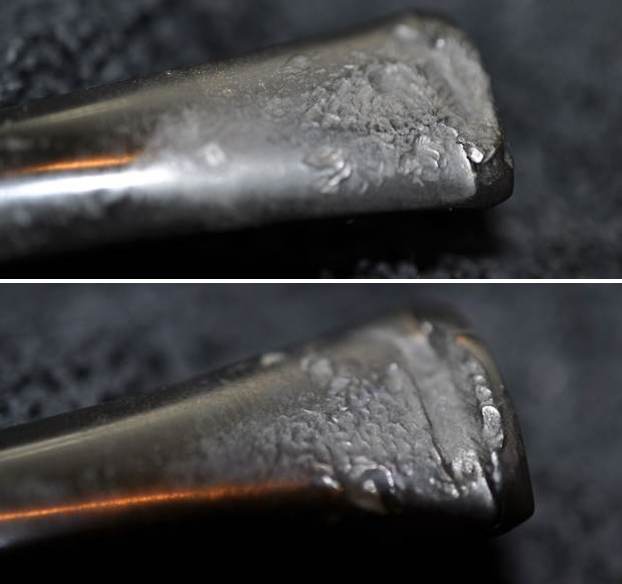
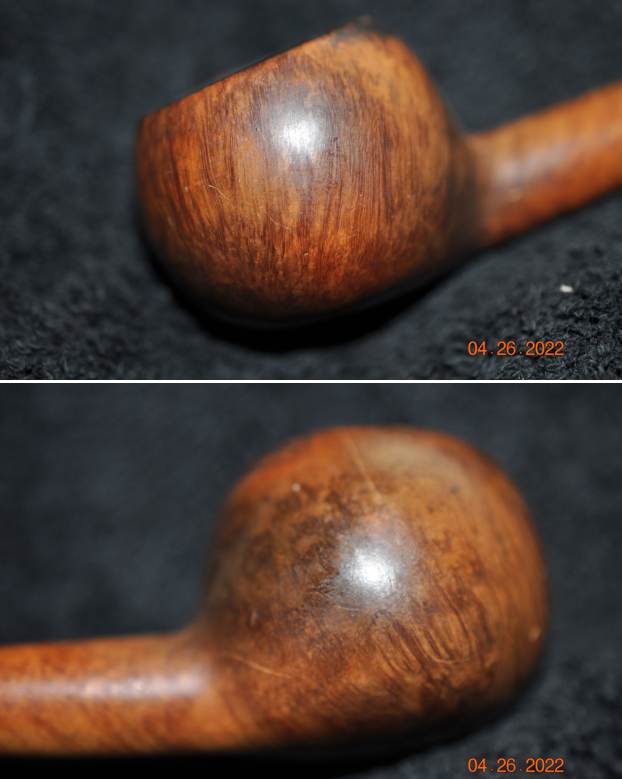
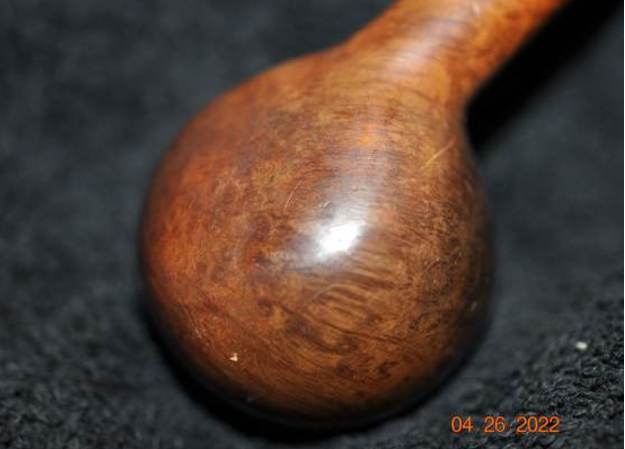
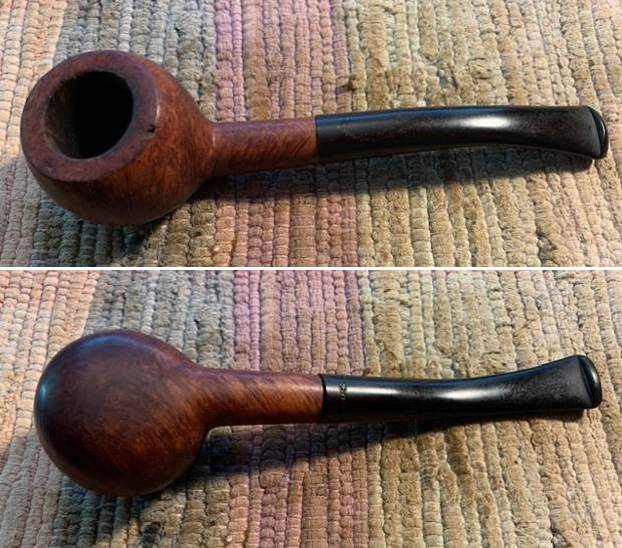
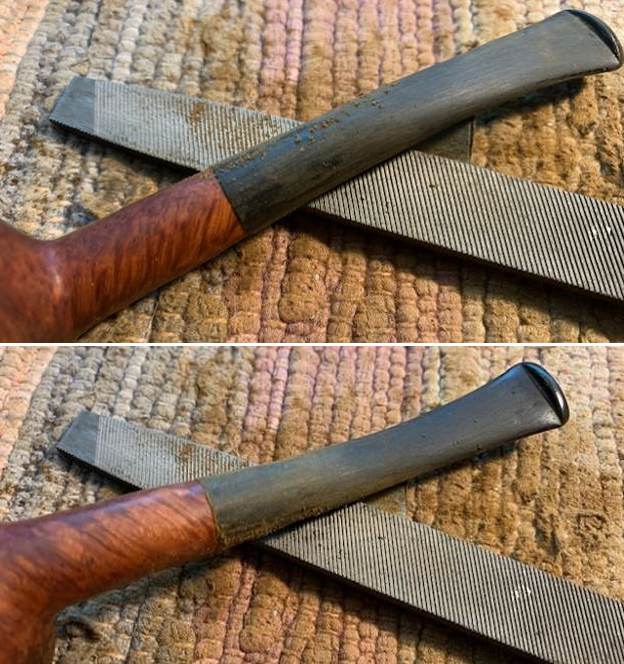
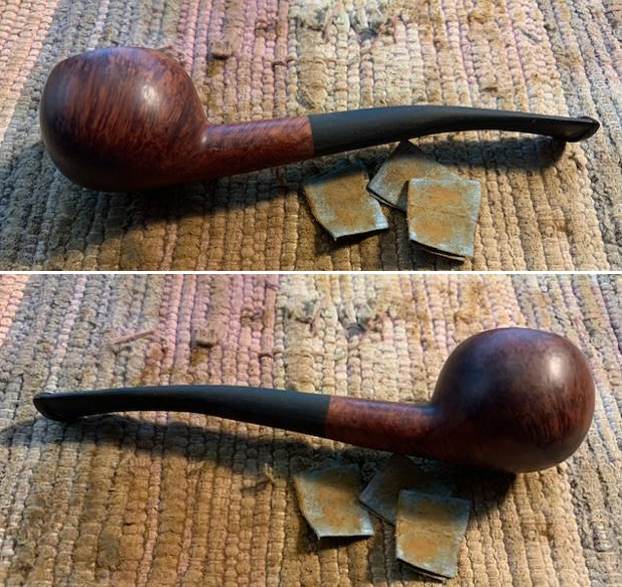
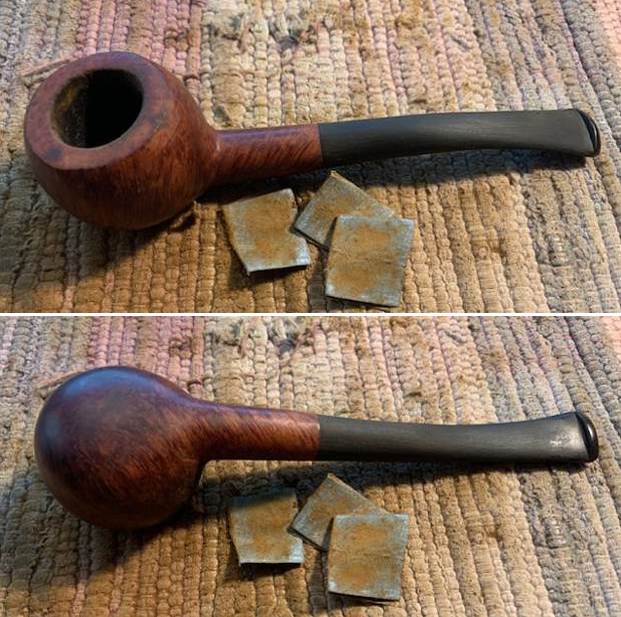
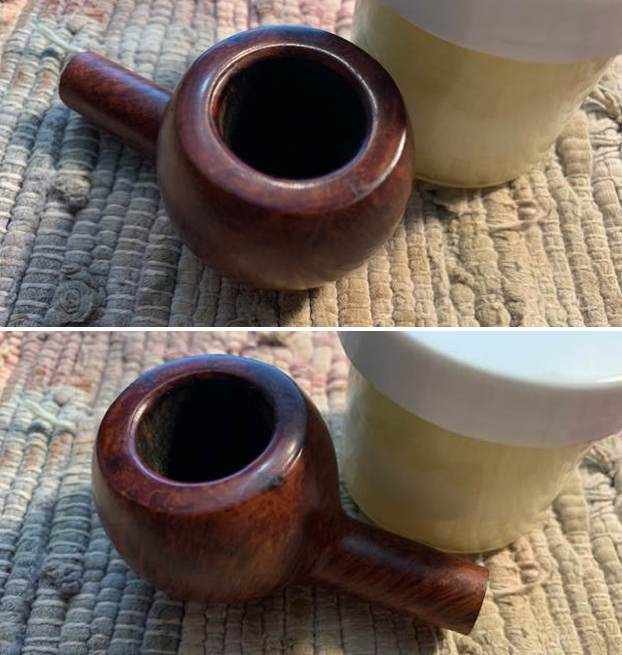
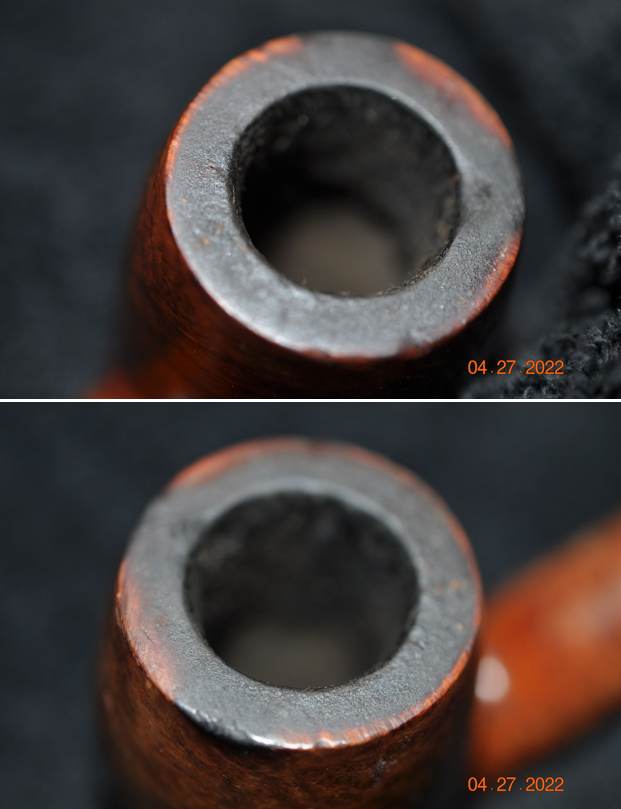
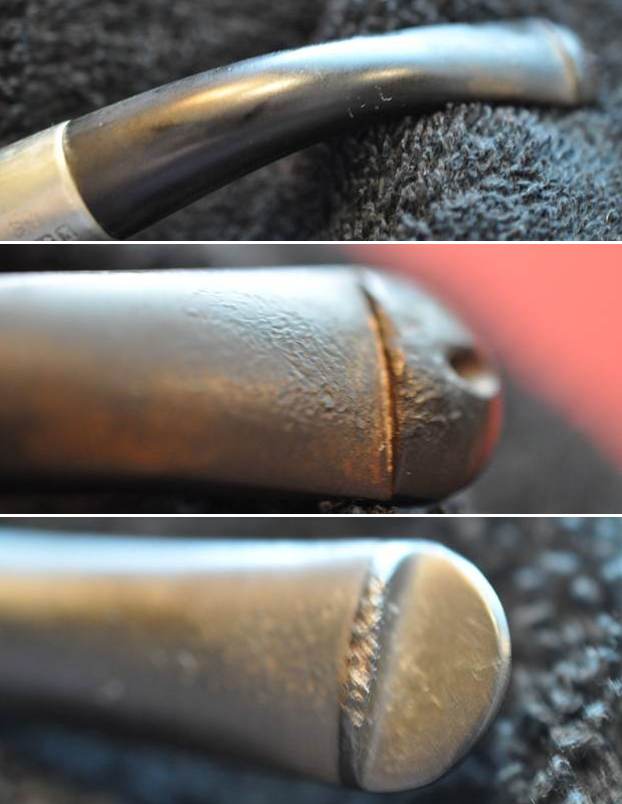
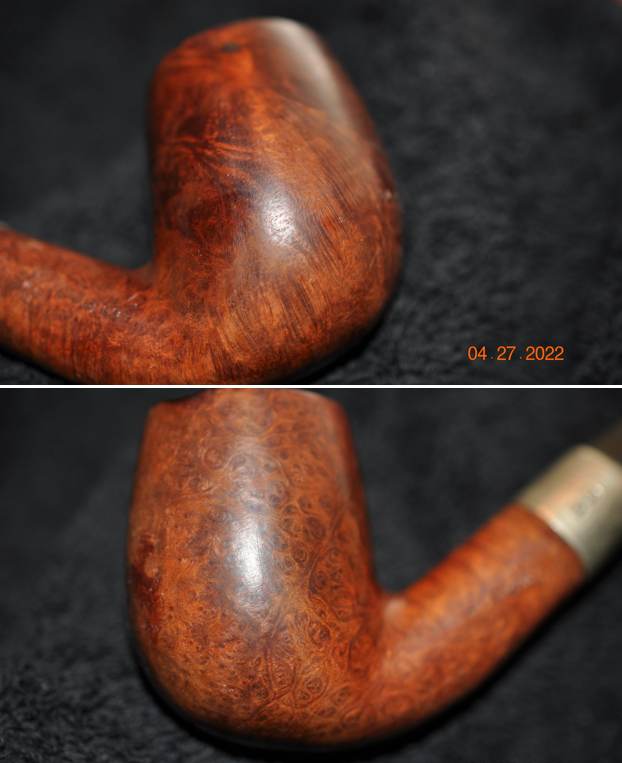
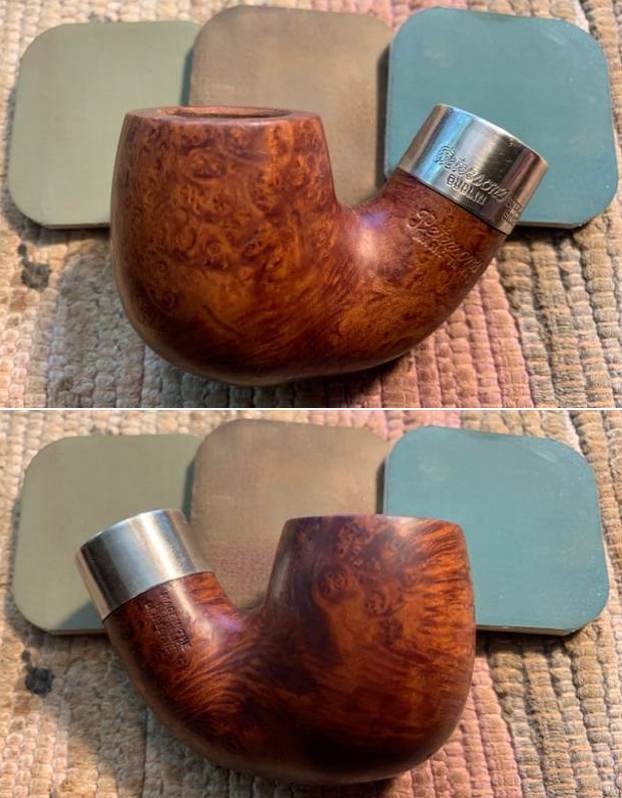
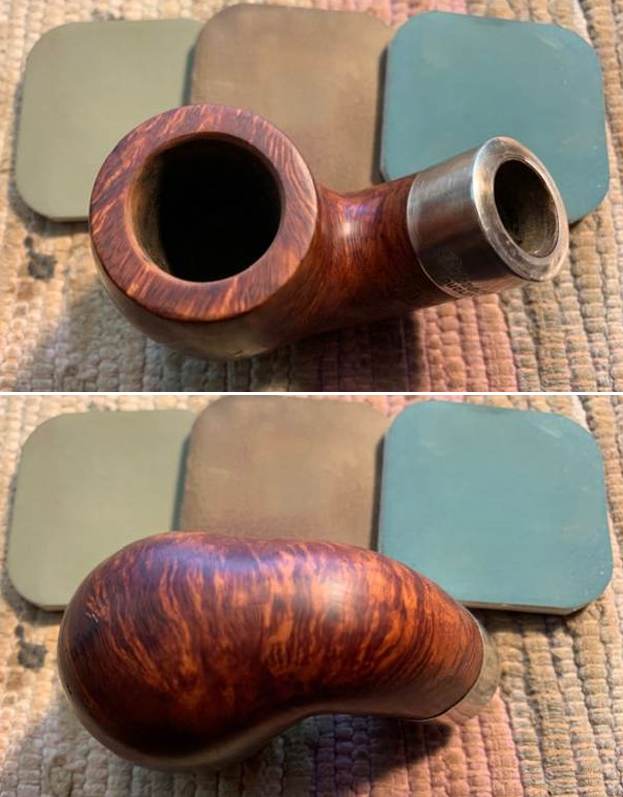
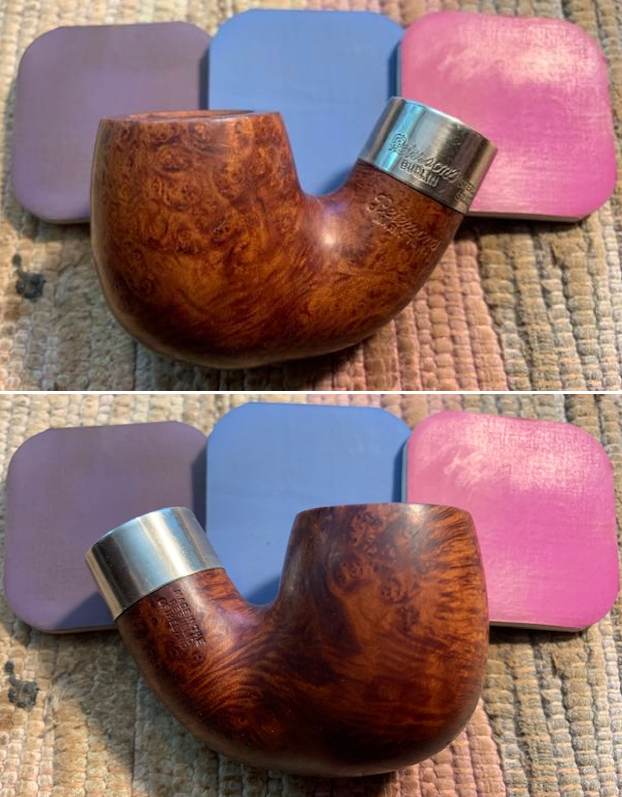
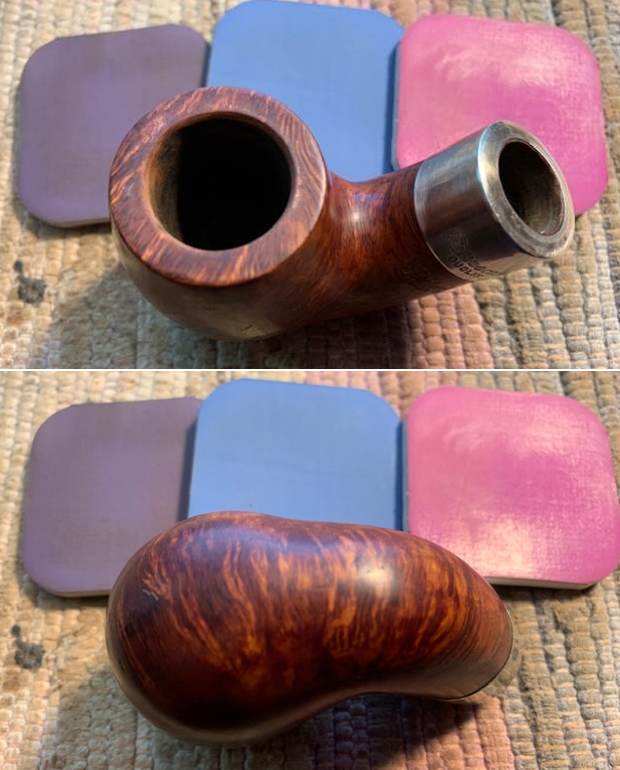
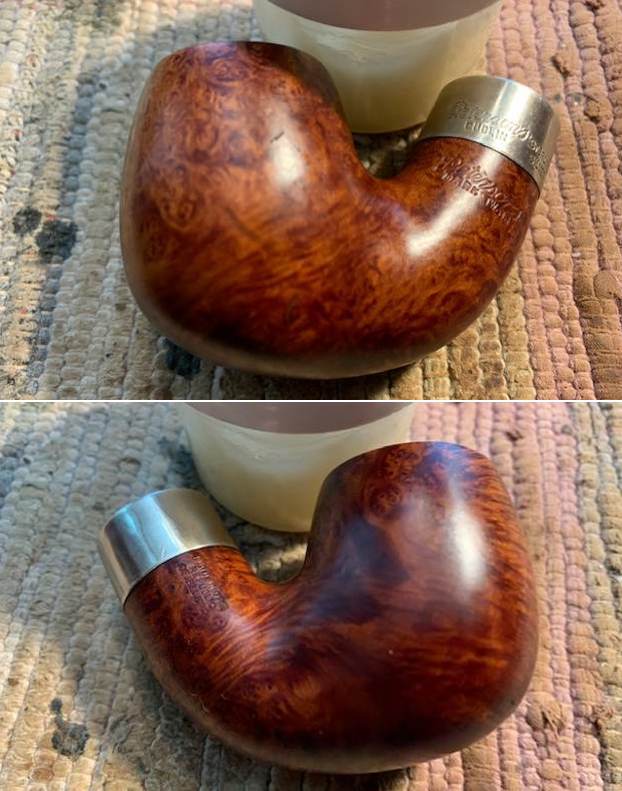
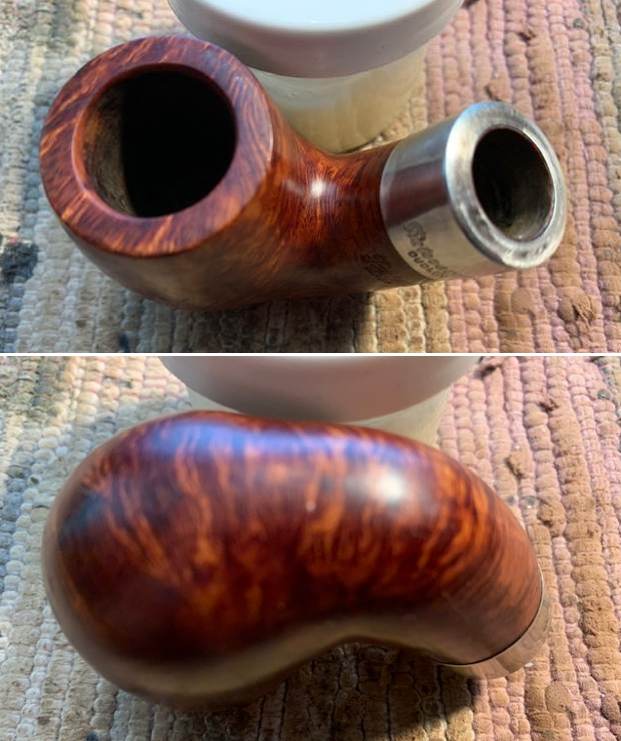
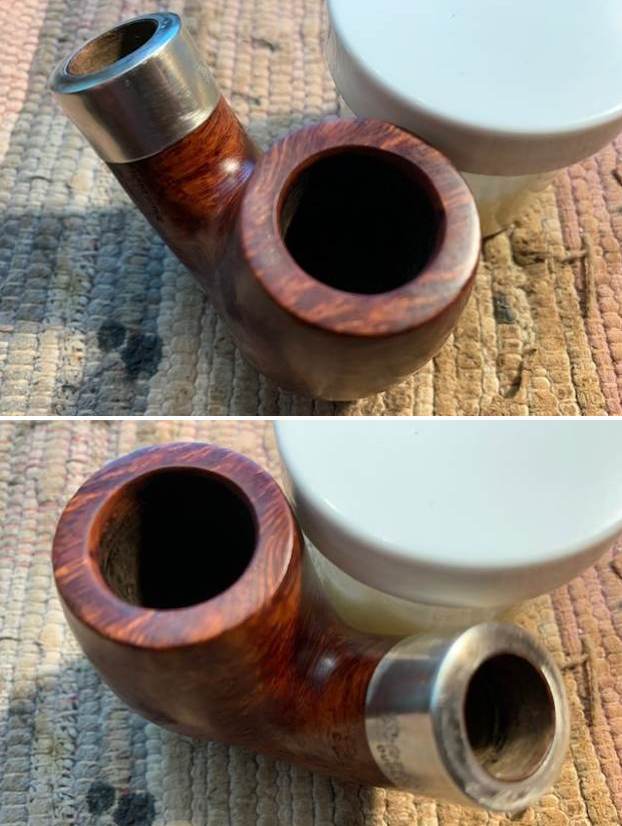
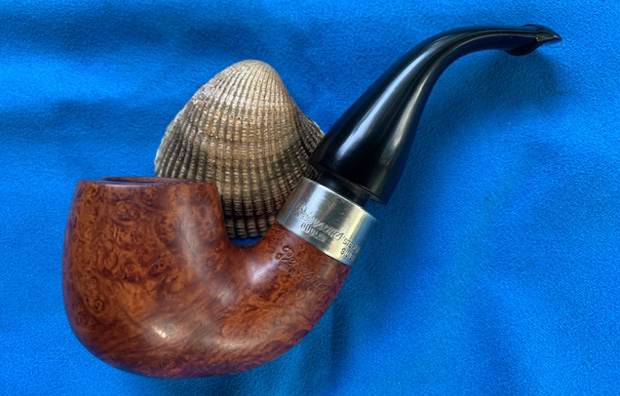
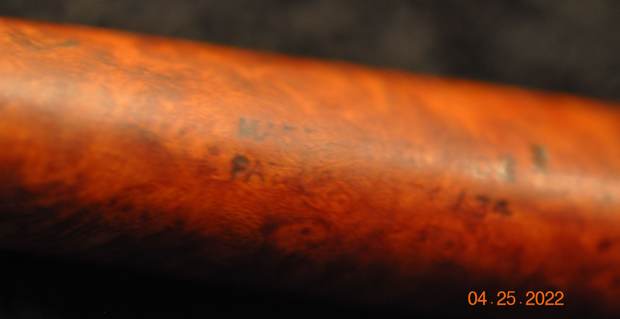
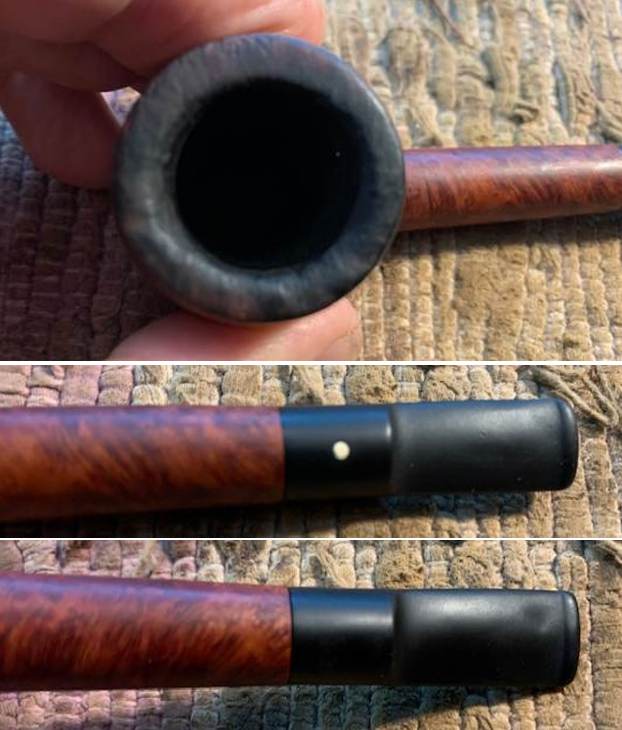
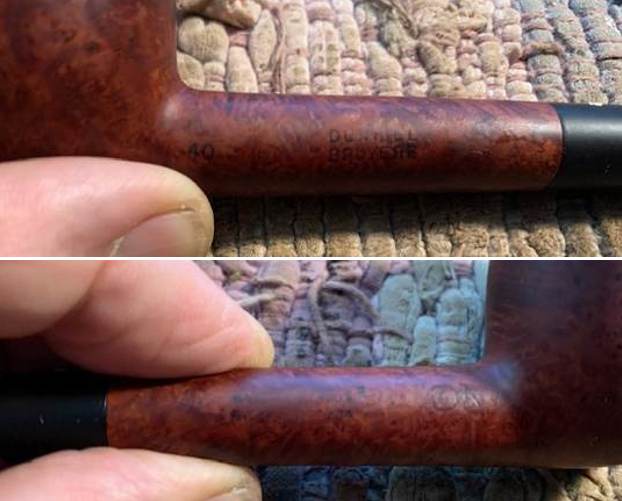
This Dunhill Billiard is stamped on the left side and reads 34 F/T followed by Dunhill over Root Briar and on the right side is stamped Made in England8 (two lines) followed by a circle 2 followed by R. The numbers and stamping tell me that the pipe is a Root Briar and the size is a Group 2. The F/T refers to the Fish Tail style stem. The finish was very dirty with spots of grime and debris stuck on it. The bowl had a thick cake in the bowl and heavy lava overflowing onto the rim top. The rim top had burned area on the left front top and inner and outer edges. There was darkening and burn damage on the inner edge all the way around. There were burn marks toward the back of the rim top. The stem had calcification, oxidation and tooth marks and chatter on both sides ahead of the button. The button itself appeared to be in good condition. The pipe came to us in a meerschaum pipe case (just like is twin). The case was not original. Jeff took photos of the pipe before he started his clean up work on it. He took photos of the bowl and rim top to show the condition. You can see the thick cake in the bowl and the burn damage on the rim top and edges of the bowl. It is the kind of damage that come from repeated lighting in the same place. The stem was heavily oxidized, calcified and has tooth marks and chatter on both sides ahead of the button. Overall the pipe is a real mess. Jeff took photos of the grain and finish around the bowl sides and heel. It was nice looking if you can see through the grime ground into the finish. He took a photo of the stamping on the left side of the shank. There is no photo of the right side stamping that gives the Made in England date code. The stamping is readable but filthy.Now it was time to begin to work on the stamping on the pipe. Because I had just finished working on a twin to this pipe I used the information that I had dug up on that one. I quote below.

Pipedia had some great information on the Root Briar finish and dates and how the finish was made (https://pipedia.org/wiki/Dunhill#Bruyere). The first quote below give the short version of the finish. I quote from both below.

Root Briar – Introduced in 1931 and highly prized because the grain is more pronounced in this finish (usually made using Corsican briar – was made exclusively from that briar into the 60s). The Root Briar finish requires a perfectly clean bowl with excellent graining. Therefore, it is the most expensive of the Dunhill pipes. Corsican briar was most often used for the Root finish since it was generally more finely grained. This is a rare finish, due to the scarcity of briar suitable to achieve it. These pipes are normally only available at Company stores, or at Principle Pipe Dealers. Straight grained pipes were formerly graded A through H, but are now only “Dr’s” and graded with one to six stars, with the letters G and H still used for the very finest pieces.

“Dunhill introduced its third major finish, the Root finish, in 1931. Corsican mountain briar is characteristically beautifully grained and the Root was made exclusively from that briar into the 1960s. The pipe was finished with a light natural stain to allow the beauty of the graining to show through. Although always available with a traditional black vulcanite bit, the Root was introduced in either 1930 or more likely 1931 and fitted with a marble brown dark and light grained vulcanite bit that has since become known as the ‘bowling ball’ bit because of the similarity in appearance between the bit’s finish and that of some bowling balls of the time. With the war, however, the bowling ball bit was dropped from production. Through 1954 (and after) the Root pipe nomenclature (including shape numbers) was identical to that of the Bruyere except that instead of the “A” of the Bruyere, the Root was stamped with an “R”. In 1952 when the finish rather then LONDON was placed under DUNHILL, ROOT BRIAR rather then BRUYERE was used for the Root.” Loring, J. C., The Dunhill Briar Pipe, The Patent Years and After (self-published, Chicago, 1998).

With that information clear for me I wanted to identify the shape number and try to pin that down (https://pipedia.org/wiki/Dunhill_Shape_Chart). I turned to the section on the older 2 digit Shape Numbers and read it. I quote it below and added a chart on the numbers.

The original skus/model numbers from the 1920’s until the early 1970’s stood for very specific shapes and bowls. For example, the codes 31, 34, 59, 111, 113, 117, 196, LB, LBS… were all different types of Billiard shaped pipes and there were about 50(!), such codes for the Billiard shape alone.

There was a link there (https://pipedia.org/wiki/Dunhill_Shapes_List) to a shape list that Eric Boehm put together for Dunhills. It is amazing to see the sheer number of variations on the Billiard shape. I copied the first three in the list as it includes the shape 34 Billiard.

Billiards:

31 Billiard, tapered bit 1 4¾” 1928, 1950 3

32 Billiard, tapered bit 1 5″ 1928, 50, 60, 69 3

34 Billiard, tapered bit (Dental) 2 5½” 1928, 50, 60, 69 3. (This is the pipe I am working on. It is a tapered bit Billiard. It does not have a Dental bit as noted above. Rather than the Dental bit it has a F/T or Fish Tail bit.)

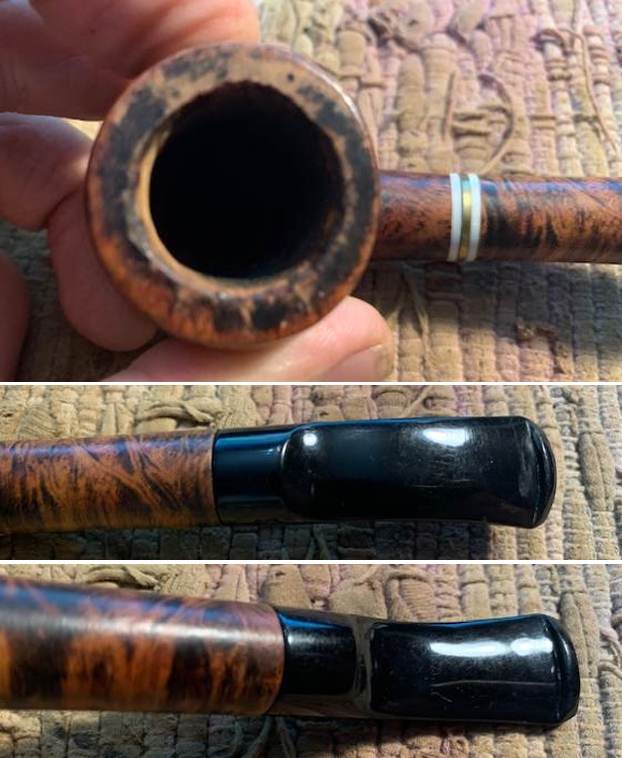
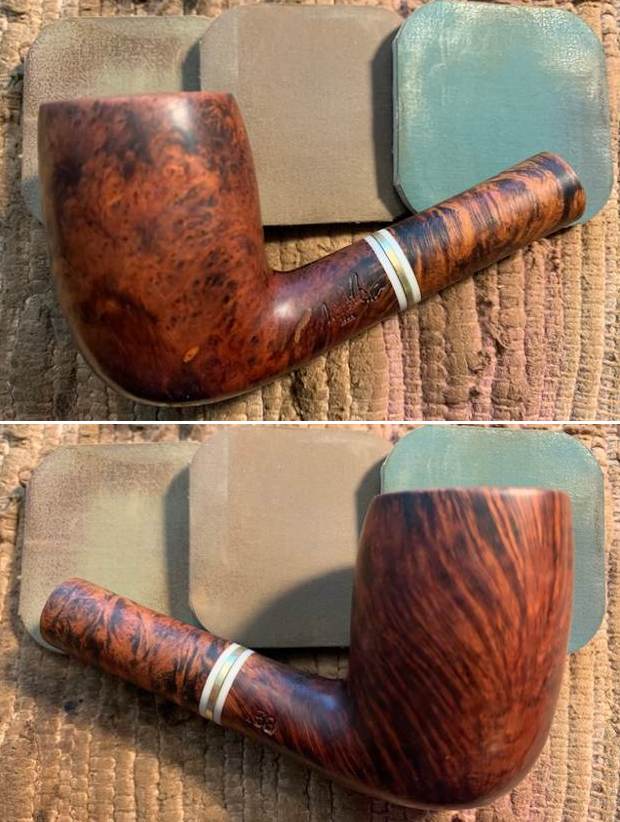
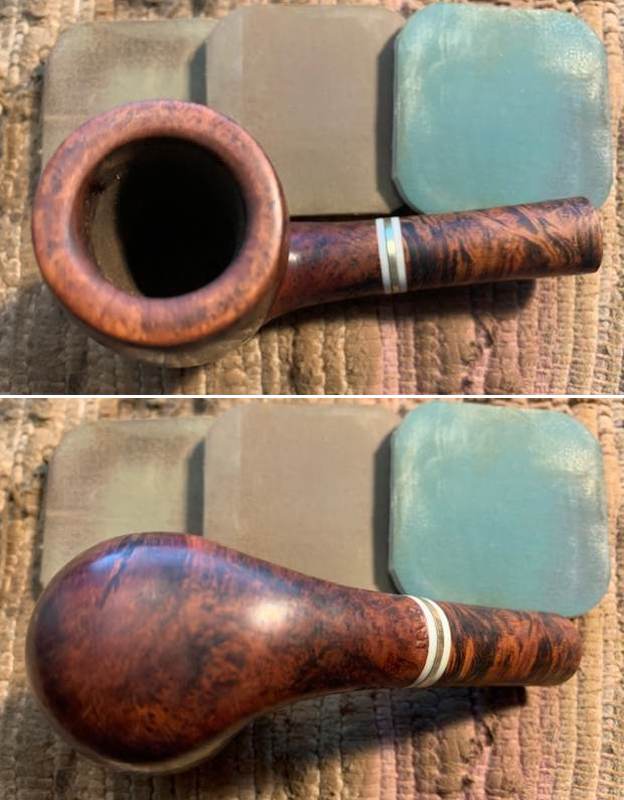
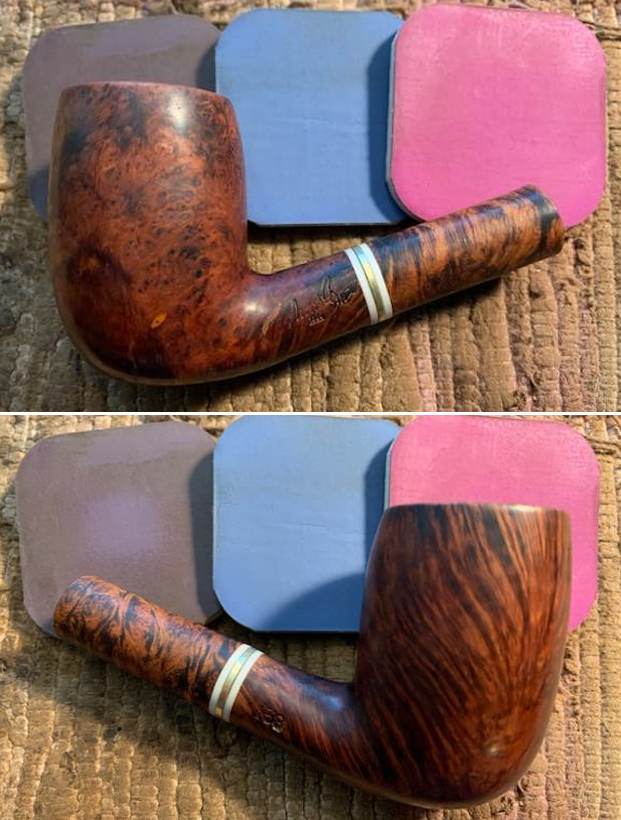
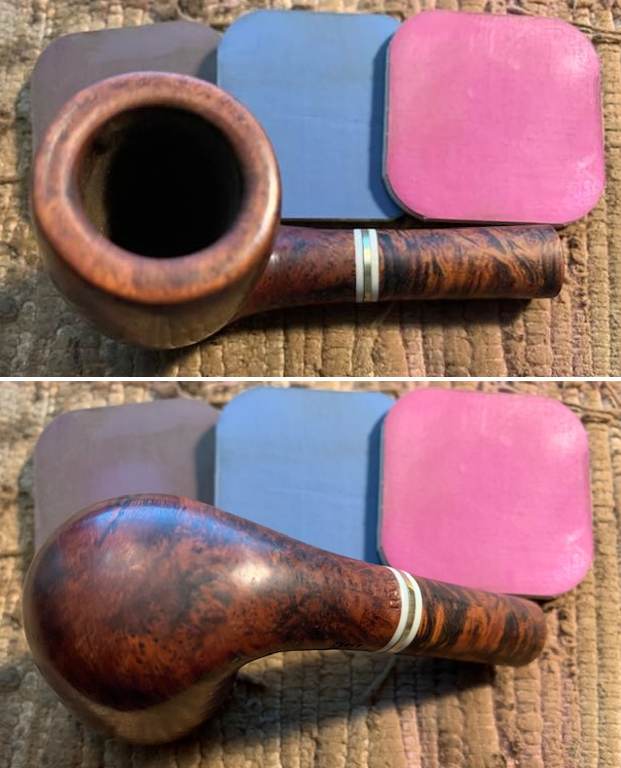
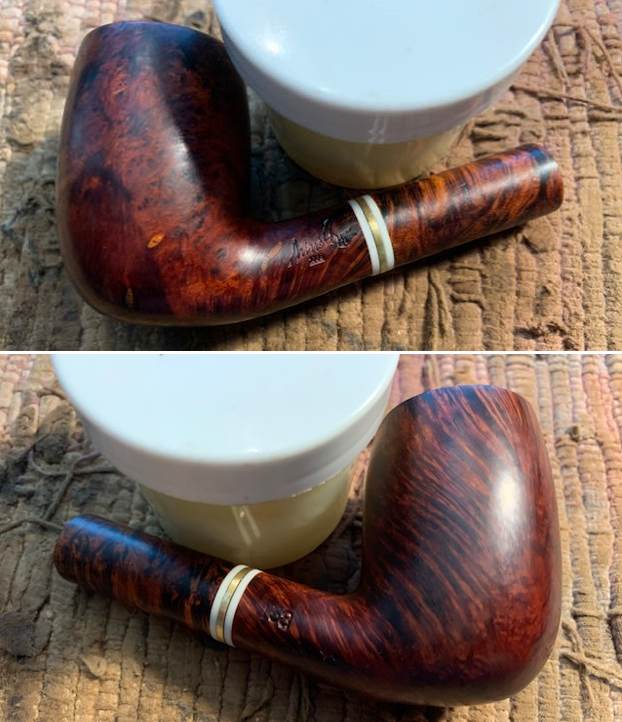
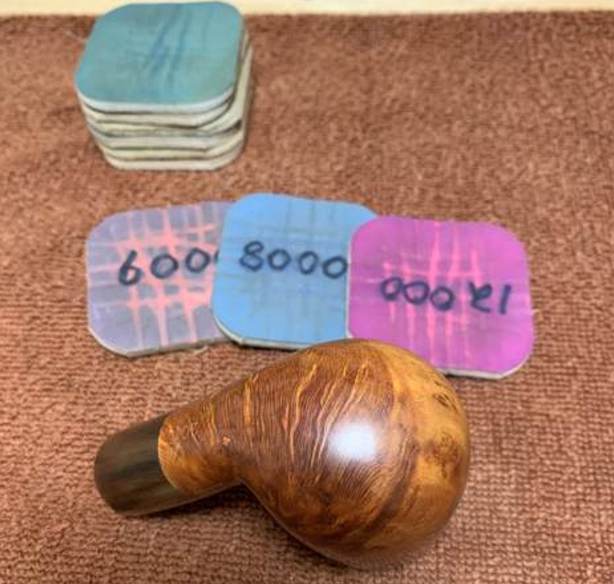
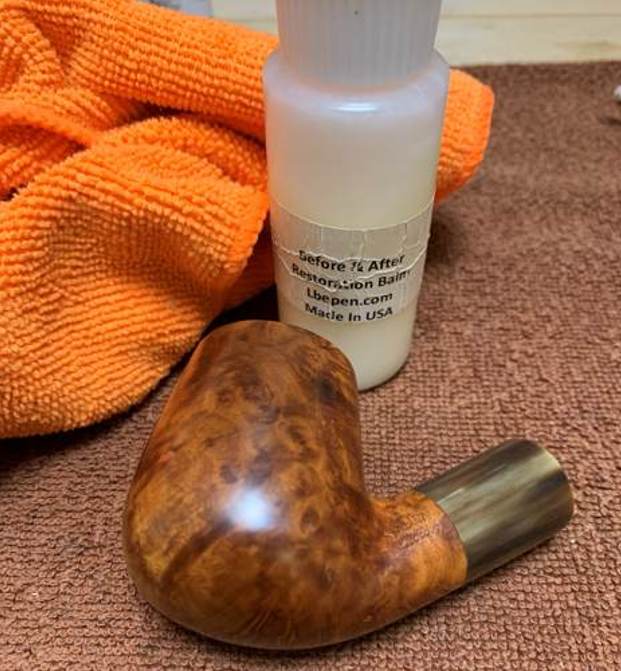
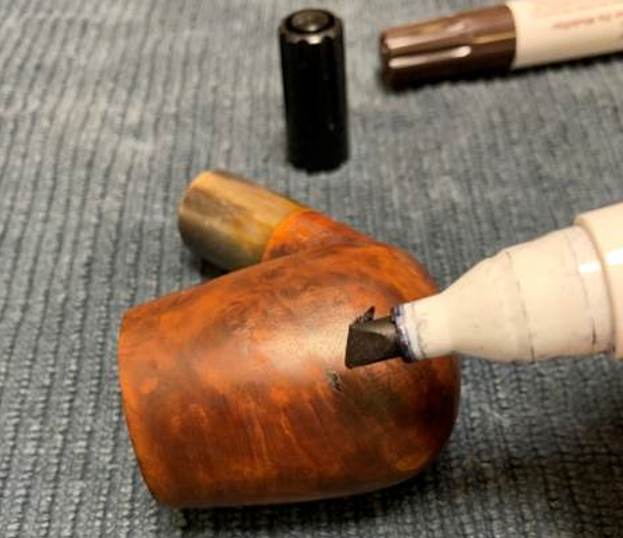
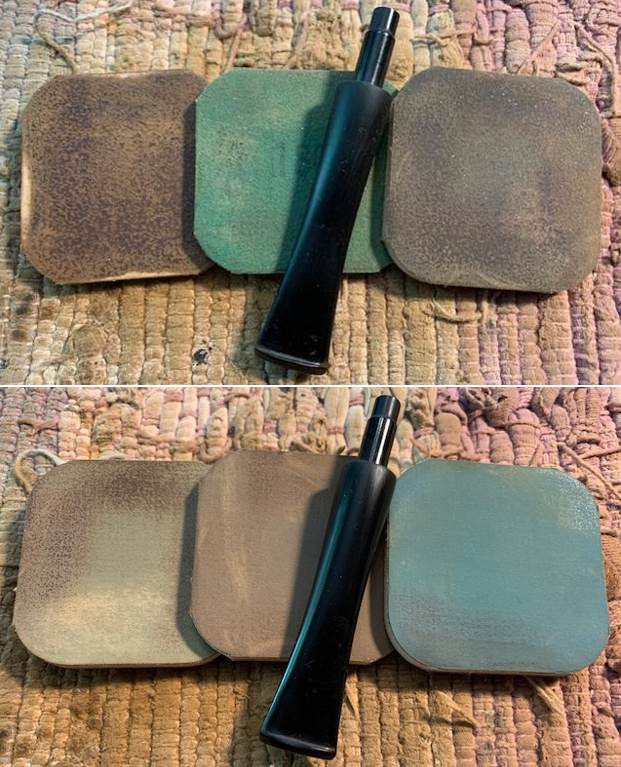
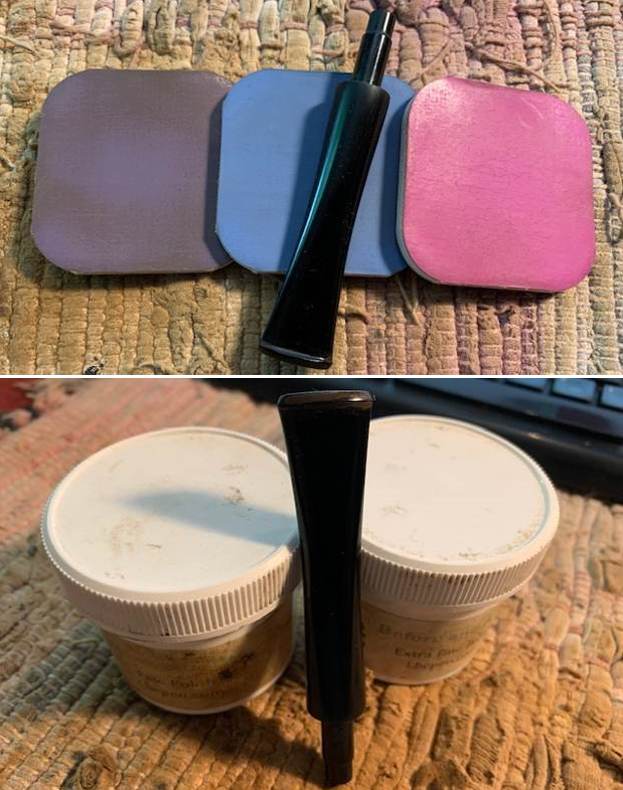
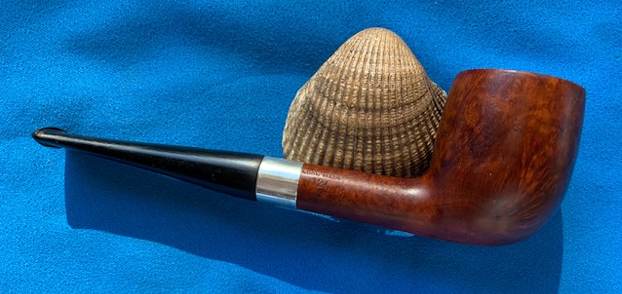
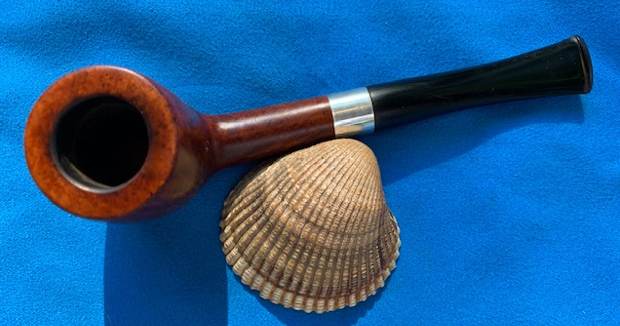
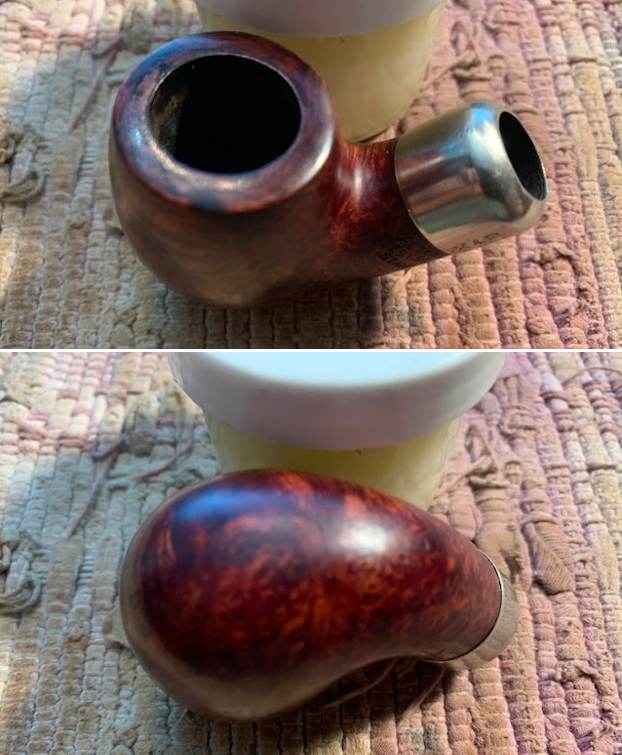
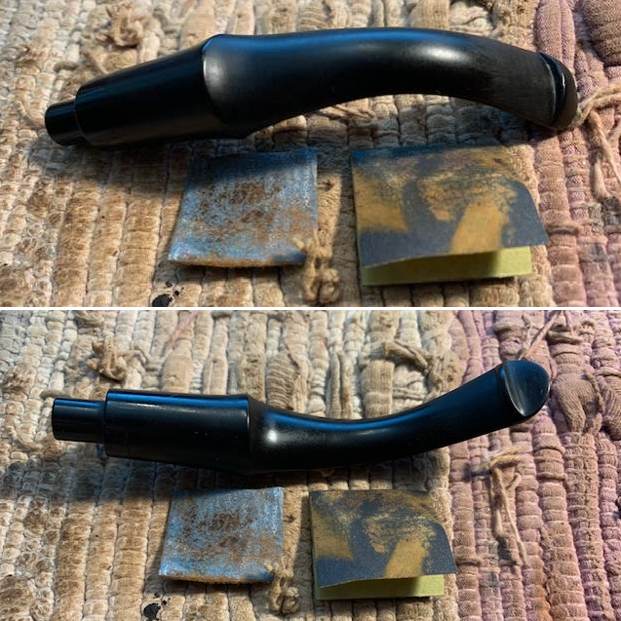
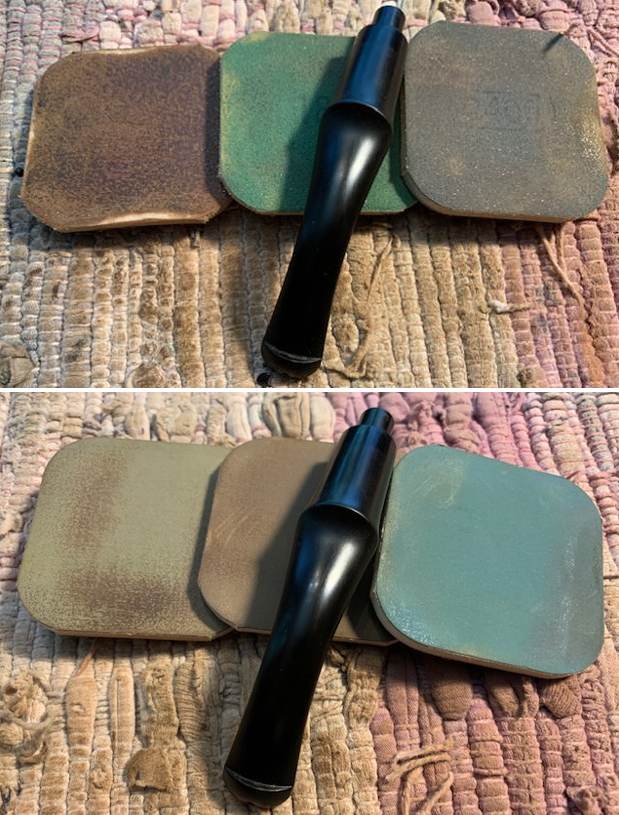
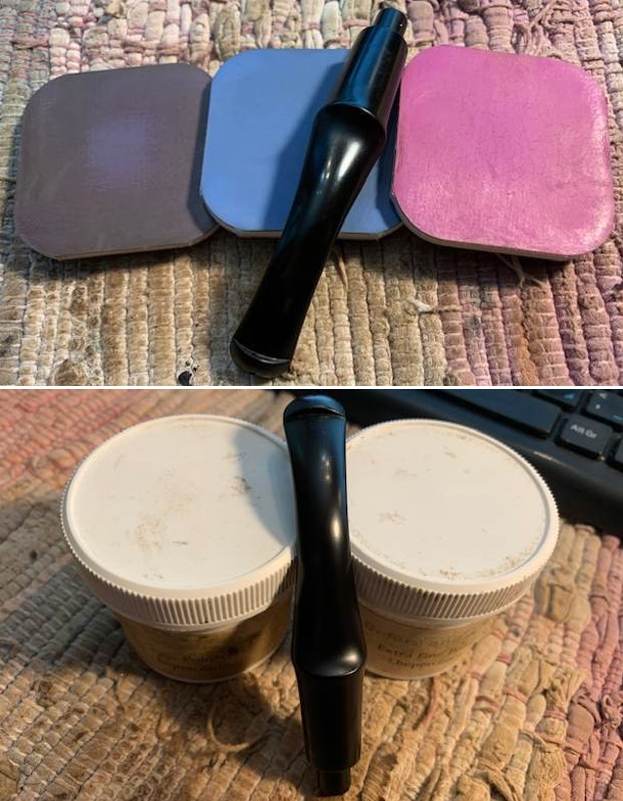
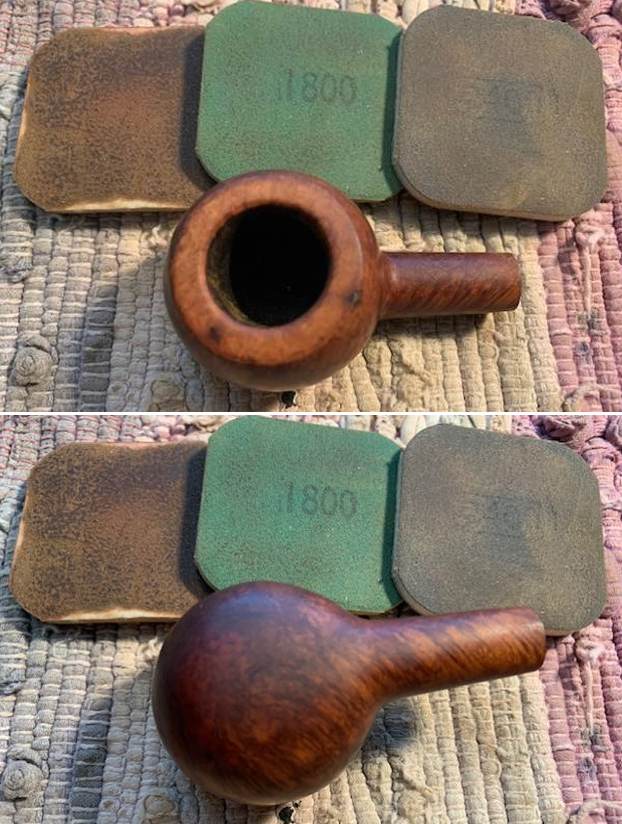
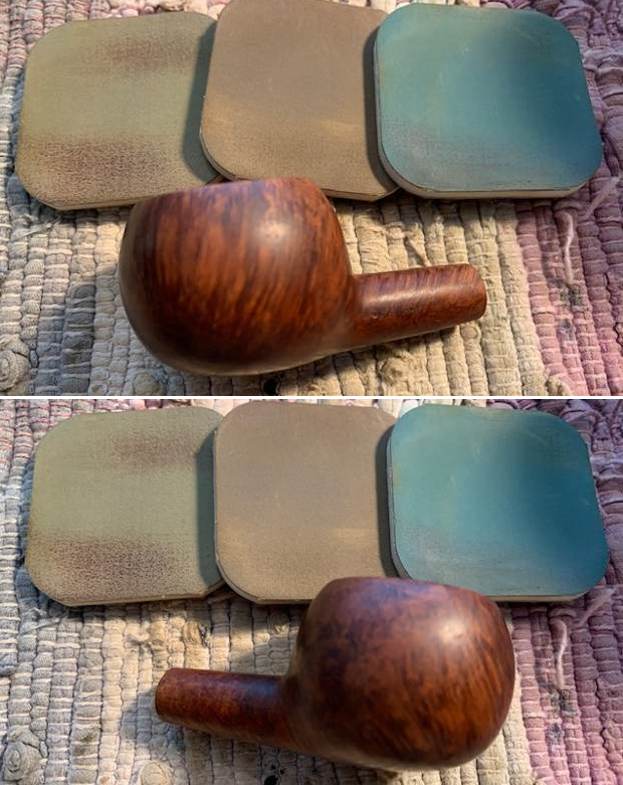
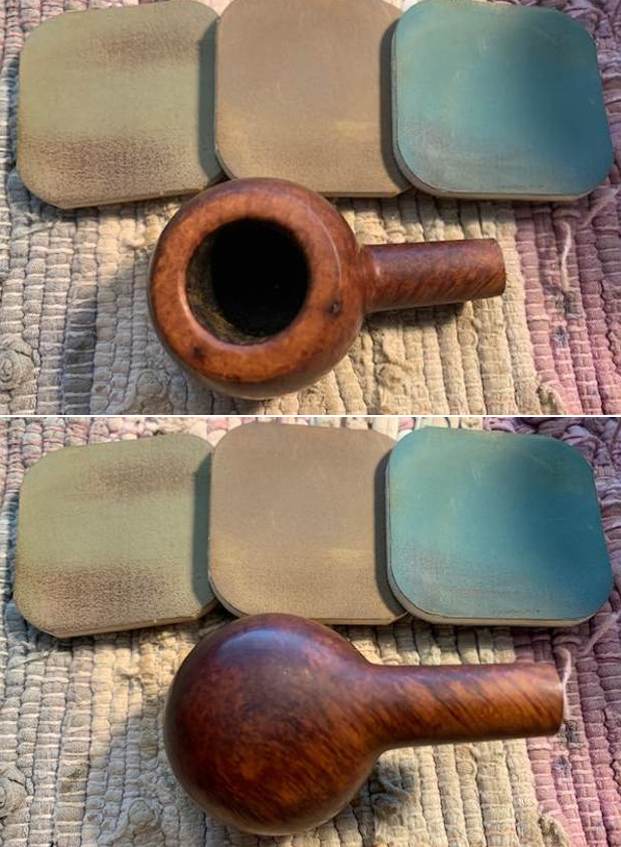
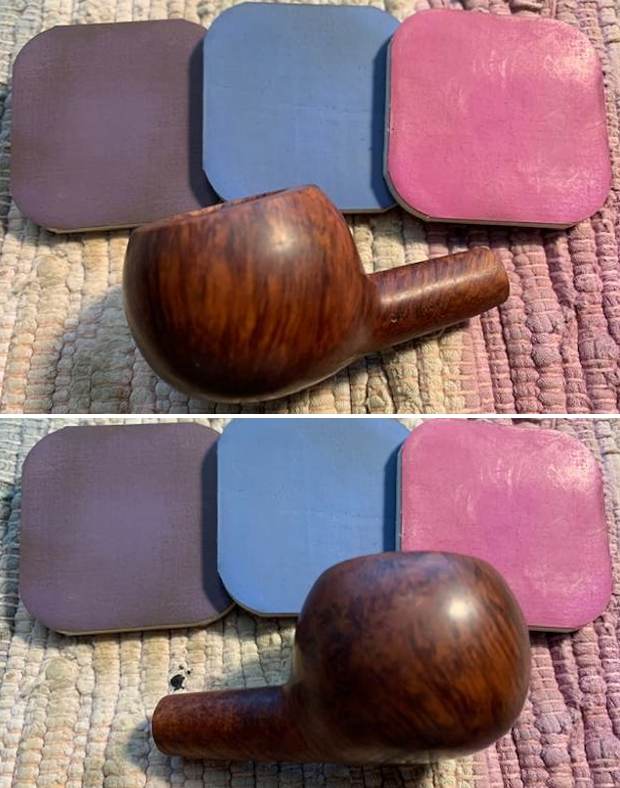
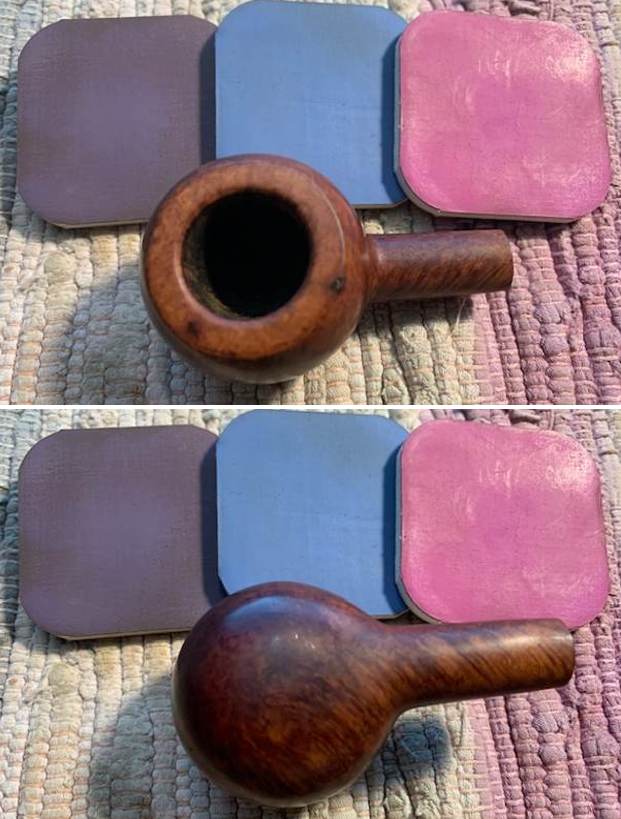
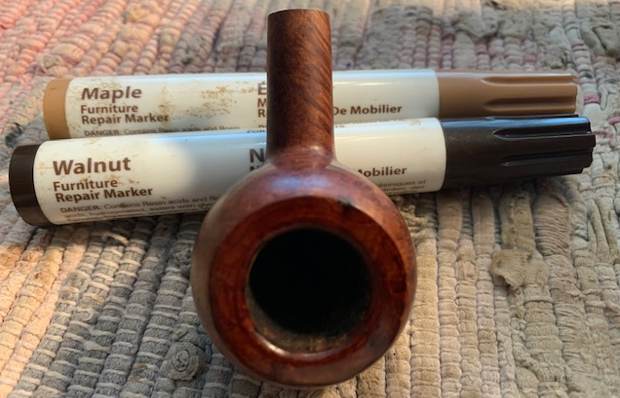
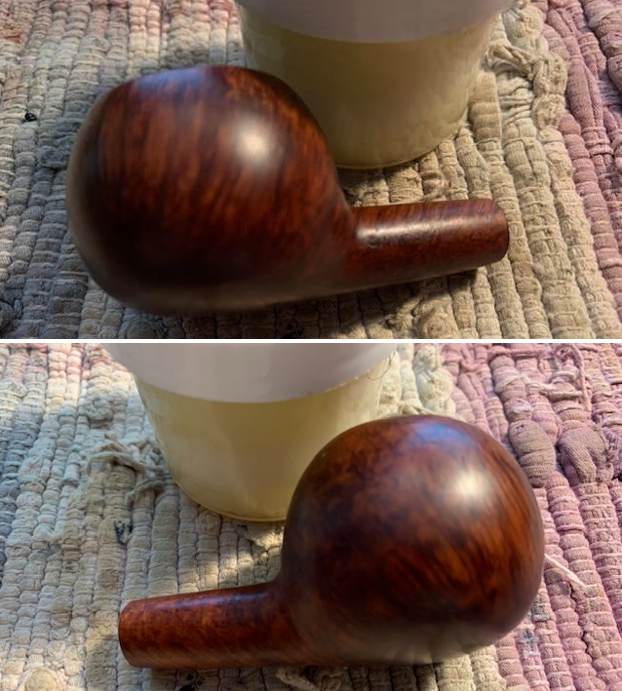
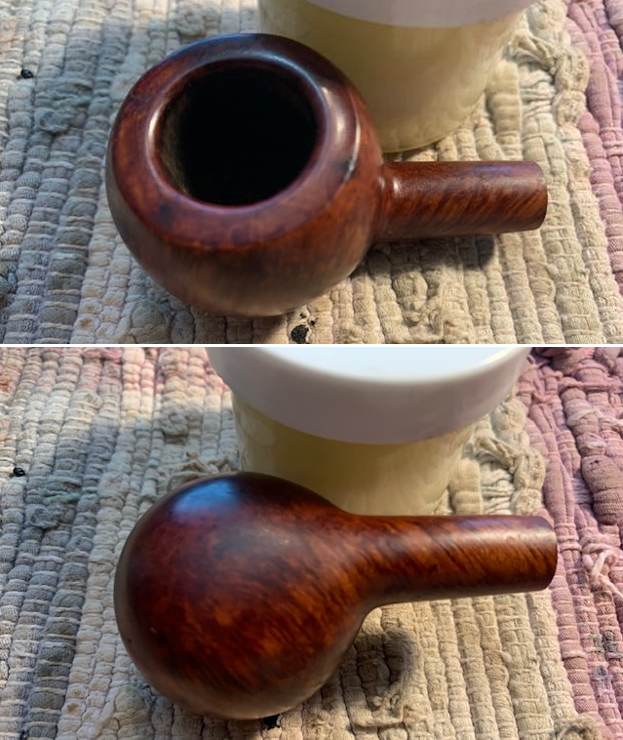
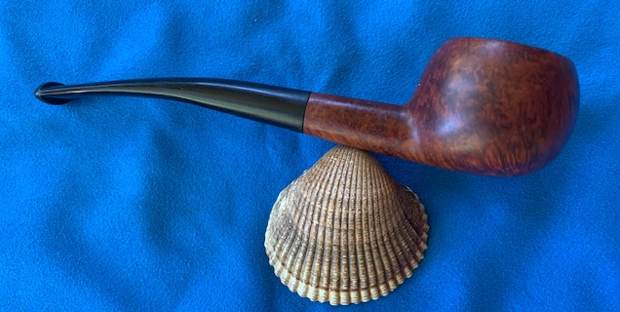
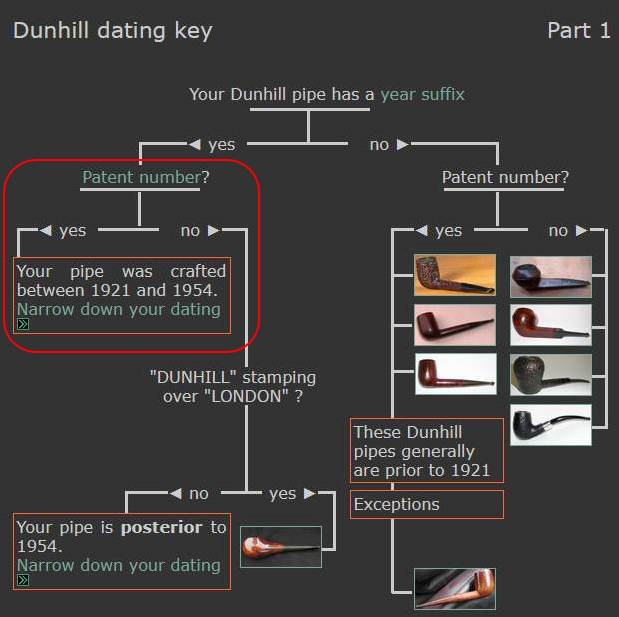
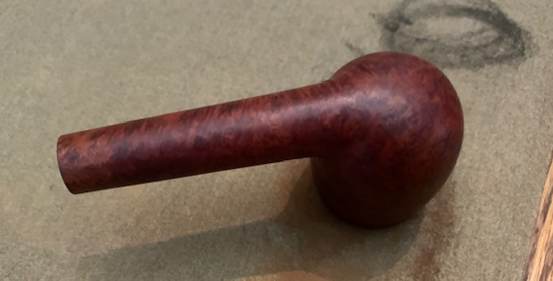
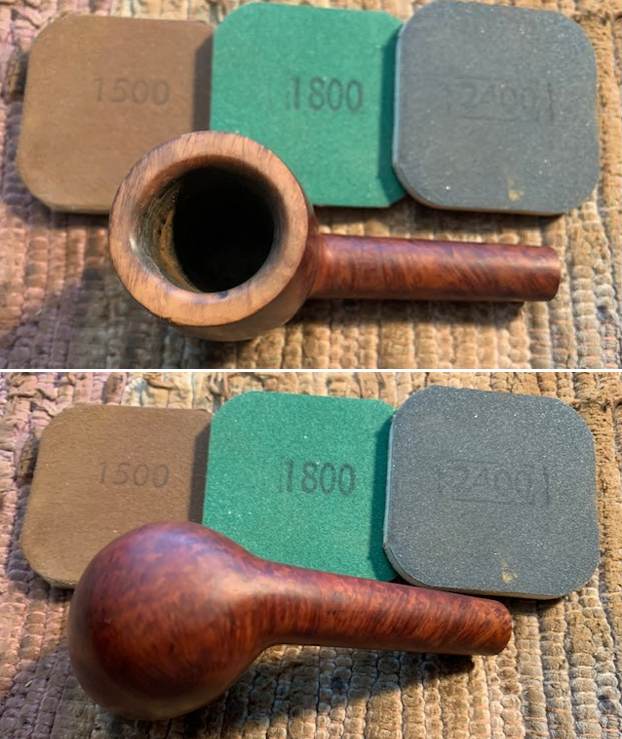
I turned next to dating the pipe. There is a superscript 8 following the D in ENGLAND on the right side of the shank. I turned to the dating chart on Pipephil to pin down the date on this twin (http://pipephil.eu/logos/en/dunhill/cledat-en1a.html). I did a screen capture of Part 2 of the Dunhill Dating Key and included it below. I drew a red box around the section dating this pipe. It is clear that the pipe was made after 1954 so that is why I went to Part 2. Once again, because the year suffix is 8 that tells me that the pipe was made in 1950+8 for a date of 1958.Armed with that information I turned to work on the pipe itself. Before he sent it to me, Jeff had done an amazing job cleaning the pipe. It almost looked like a different pipe after his work. He reamed the pipe with a PipNet pipe reamer and removed the rest of it with a Savinelli Fitsall Pipe Knife.  He scrubbed the bowl with undiluted Murphy’s Oil Soap with a tooth brush. He rinsed it under running warm water to remove the soap and grime. He cleaned out the inside of the shank and the airway in the stem with isopropyl alcohol, cotton swabs and pipe cleaners. He soaked the stem in Briarville’s Pipe Stem Deoxidizer and then rinsed it off with warm water. He scrubbed the stem with Soft Scrub and a tooth brush and rinsed it off with warm water. It looked amazing when I took it out of the package of pipes he shipped me. I took photos of the pipe before I started my part of the restoration work.  The rim top was cleaner and the inner edge of the bowl looked rough. There was burn damage all the way around but heavier on the front and the back of the bowl on the top and inner and outer edges. There was also darkening on the rim top. The stem surface looked good with the oxidation gone and light but visible tooth chatter on either side of the stem. I took photos of the stamping on the sides of the shank. It is clear and readable as noted above.I took the stem off the shank and took a photo of the parts of the pipe. The overall look of the pipe is quite nice.I started my portion of the work on this pipe by addressing the damage to the rim top and inner edge of the bowl. I topped the bowl on a board with 220 grit sandpaper to take down the damage on the top of the rim and outer edges. I used a folded piece of 220 grit sandpaper to smooth out the edge and give it a slight bevel to deal with the chipping and cutting on the inner edge. It cleaned up remarkably well. With polishing and buffing it would look even better. I polished the briar with micromesh sanding pads – dry sanding with 1500-12000 grit pads. I wiped the bowl down with a damp cloth after each pad. The rim top looked very good and the bowl began to take on a rich glow. I used an Oak Stain Pen to restain the rim top and the inner bevel of the rim edge. Once it dried I buffed it with a cotton cloth and the match was very good. There was some darkening on the back inner edge of the bowl but it is in far better condition.The bowl looked very good at this point so I rubbed it down with Before & After Restoration Balm. I worked it into the surface of the bowl and shank with my fingertips to clean, enliven and protect the briar. I let the balm sit for about 10-15 minutes and buffed with a cotton cloth to raise the shine. I set the bowl aside and turned to work on the stem. I polished the vulcanite stem with micromesh sanding pads – 1500-12000 grit pads. I wiped it down with Obsidian Oil after each sanding pad. I used Before & After Pipe Polish – both Fine and Extra Fine to further polish the stem and gave it a final coat of Obsidian Oil to finish it.  This 2nd beautiful 1958 Dunhill Root Briar 34F/T 2R is a great looking pipe now that it has been restored. The rich Root Briar finish that highlights the grain and works well with the polished vulcanite stem. I put the stem back on the bowl and carefully buffed the pipe with Blue Diamond on the buffing wheel using a light touch on the briar. I gave the bowl and the stem multiple coats of carnauba wax on the buffing wheel and followed that by buffing the entire pipe with a clean buffing pad. I hand buffed the pipe with a microfiber cloth to deepen the shine. The finished Dunhill Root Briar Billiard is a small pipe that will be great for sitting and reading. Give the finished pipe a look in the photos below. The dimensions of the pipe are Length: 5 inches, Height: 1 ¾ inches, Outside diameter of the bowl: 1 ¼ inches, Chamber diameter: ¾ of an inch. The weight of the pipe is 27 grams/.95 ounces. I will be adding the pipe to the British Pipemakers Section of the rebornpipes store shortly. If you are interested in adding it to your collection be sure to let me know. I take a moment to remind myself and each of us that we are trustees of pipes that will outlive us and the lives of many other pipe men and women who carry on the trust of their care and use. Thanks for reading this blog and my reflections on the pipe while I worked on it.

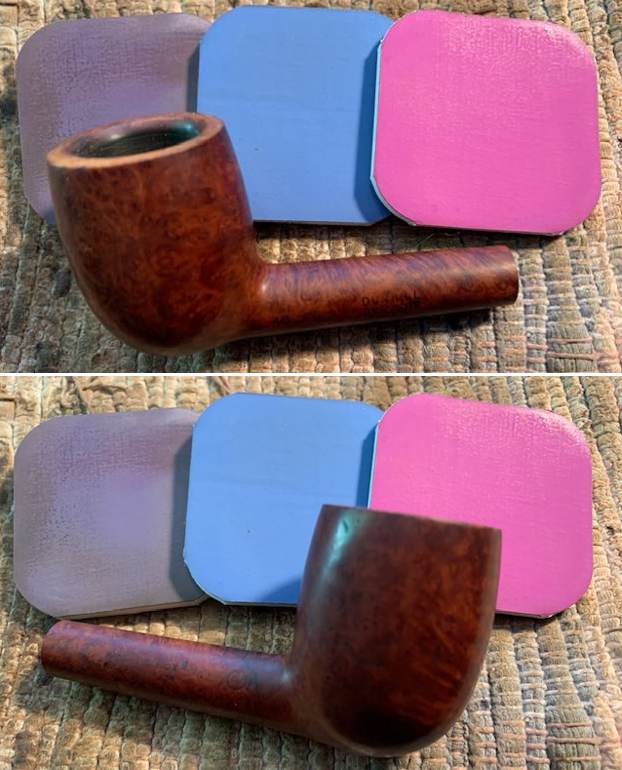
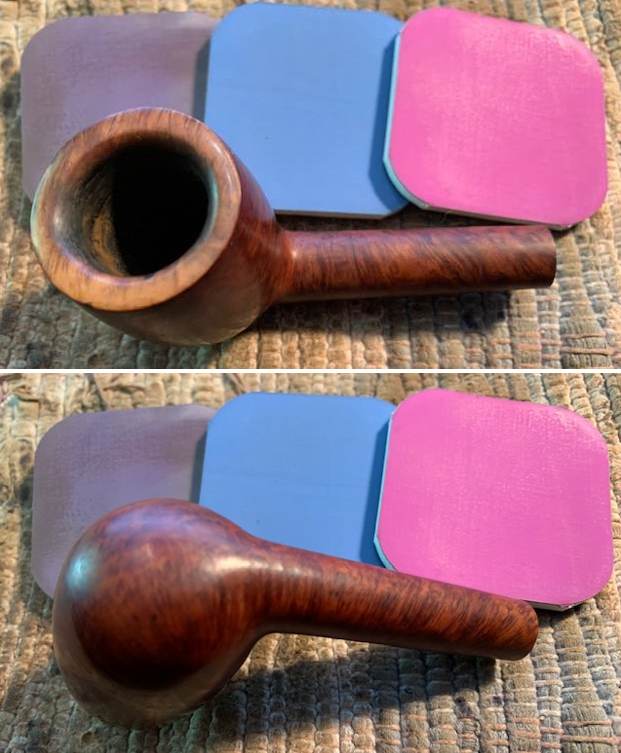
Restoring a lovely 1958 Dunhill Root Briar 34F/T 2R Billiard


Blog by Steve Laug

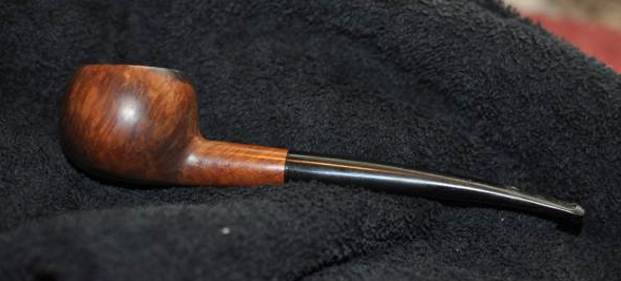
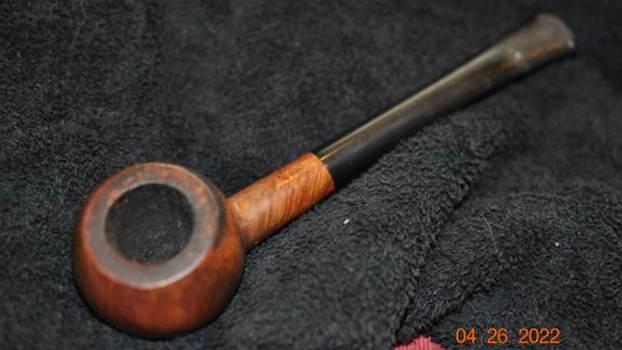
The next pipe on the table is another Dunhill that is a group 2 sized Billiard. It is a small Root Briar Billiard that is proportionally well done. It has a two digit the shape number that I will define below. Jeff and I purchased on 04/26/2022 from a woman who contacted us from Cleveland, Ohio, USA. We spent time chatting with her and arrived at a price and she sent the pipes to Jeff. It included 28+ pipes along with this one.

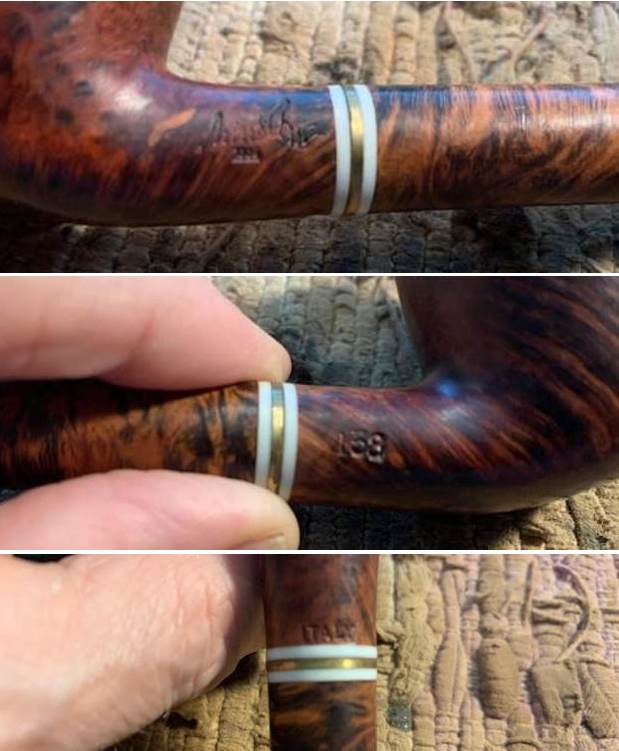
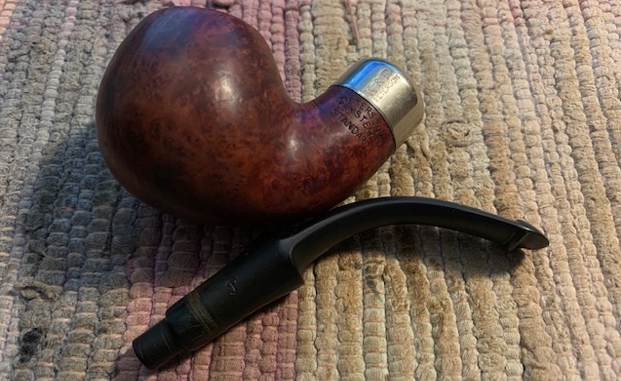
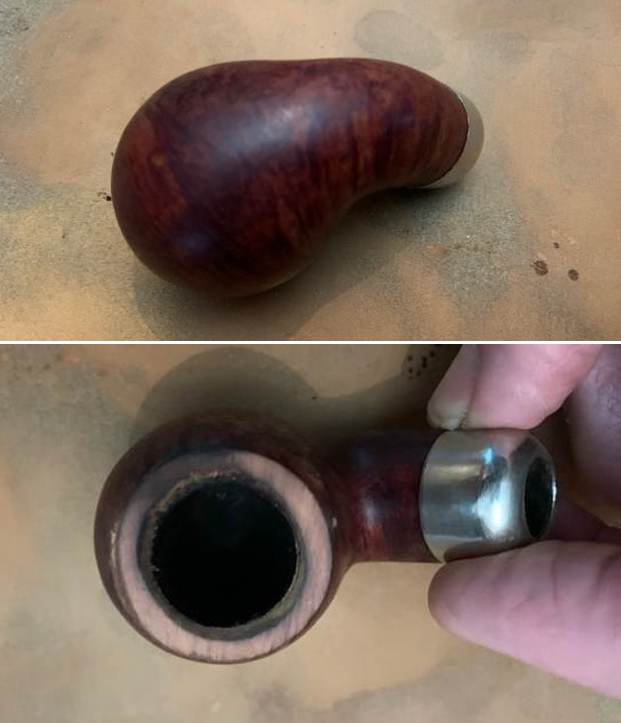
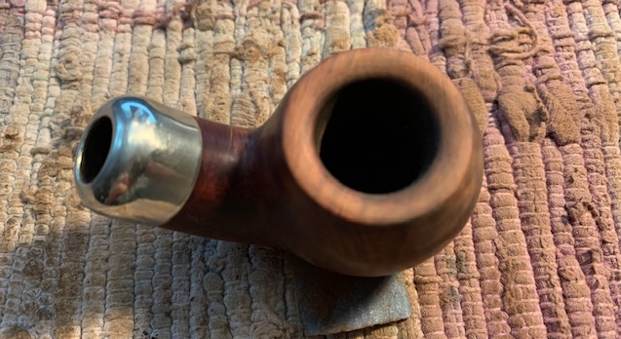
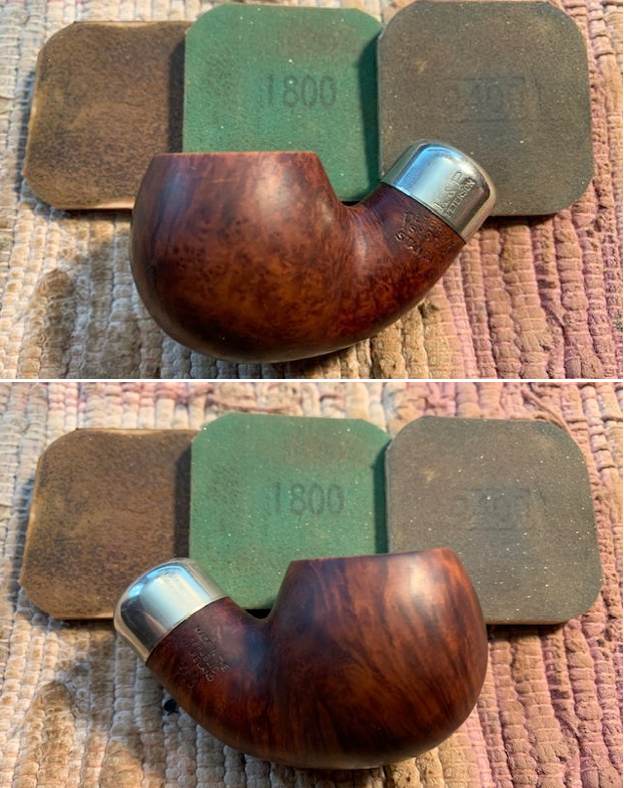
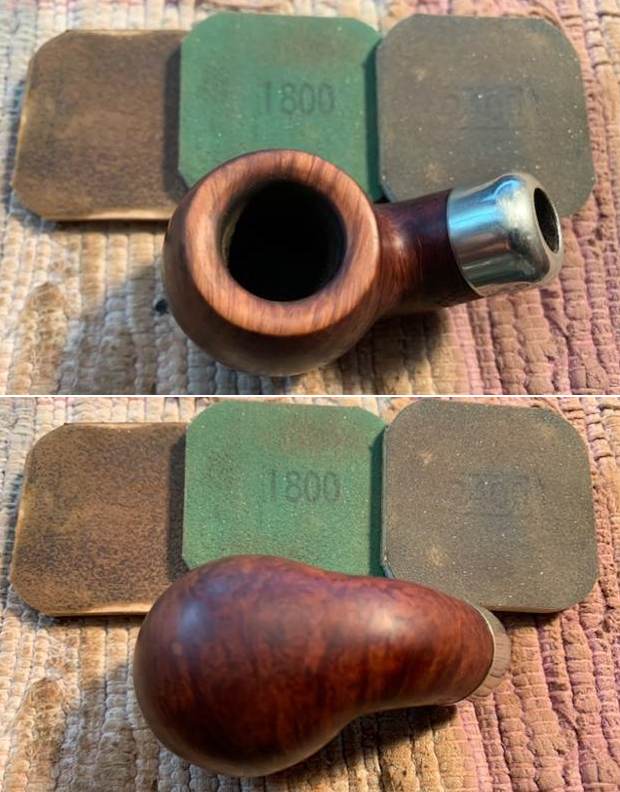
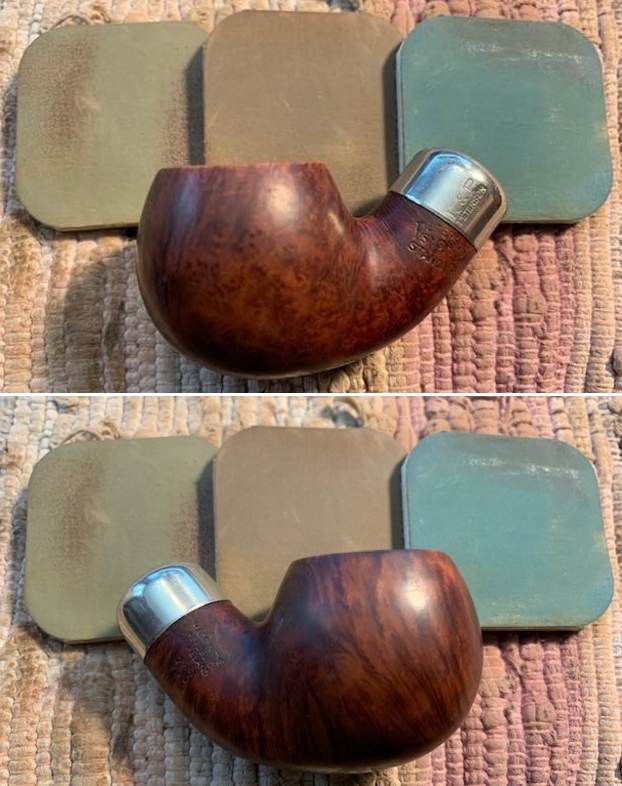
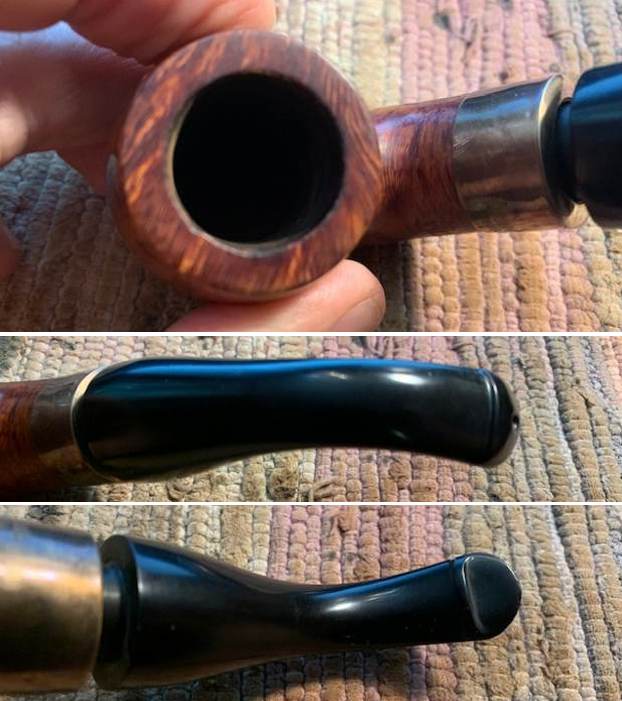
But now this Dunhill Billiard. On the left side it is stamped 34 F/T followed by Dunhill over Root Briar and on the right side is stamped Made in England8 (two lines) followed by a circle 2 followed by R. The numbers and stamping tell me that the pipe is a Root Briar and the size is a Group 2. The F/T refers to the Fish Tail style stem. The finish was very dirty with spots of grime and debris stuck on it. The bowl had a thick cake in the bowl and heavy lava overflowing onto the rim top. The rim top had burned area on the left front top and inner and outer edges. There was darkening and burn damage on the inner edge all the way around. There were a few burn marks toward the back of the rim top. The stem had calcification, oxidation and tooth marks and chatter on both sides ahead of the button. The button itself appeared to be in good condition. The pipe came to us in a meerschaum pipe case from the owner. It was not original. Jeff took photos of the pipe before he started his clean up work on it. He took photos of the bowl and rim top to show the condition. You can see the thick cake in the bowl and the burn damage on the rim top and edges of the bowl. It is the kind of damage that come from repeated lighting in the same place. The stem was heavily oxidized, calcified and has tooth marks and chatter on both sides ahead of the button. Overall the pipe is a real mess. Jeff took photos of the grain and finish around the bowl sides and heel. It was nice looking if you can see through the grime ground into the finish. He took a photo of the stamping on the left side of the shank. There is no photo of the right side stamping that gives the Made in England date code. It is readable but filthy.Now it was time to begin to work on the stamping on the pipe. I turned first to Pipedia as I remembered they had some great information on the Root Briar finish and dates and how the finish was made (https://pipedia.org/wiki/Dunhill#Bruyere). The first quote below give the short version of the finish. The second link goes into more detail. I quote from both below.

Root Briar – Introduced in 1931 and highly prized because the grain is more pronounced in this finish (usually made using Corsican briar – was made exclusively from that briar into the 60s). The Root Briar finish requires a perfectly clean bowl with excellent graining. Therefore, it is the most expensive of the Dunhill pipes. Corsican briar was most often used for the Root finish since it was generally more finely grained. This is a rare finish, due to the scarcity of briar suitable to achieve it. These pipes are normally only available at Company stores, or at Principle Pipe Dealers. Straight grained pipes were formerly graded A through H, but are now only “Dr’s” and graded with one to six stars, with the letters G and H still used for the very finest pieces.

“Dunhill introduced its third major finish, the Root finish, in 1931. Corsican mountain briar is characteristically beautifully grained and the Root was made exclusively from that briar into the 1960s. The pipe was finished with a light natural stain to allow the beauty of the graining to show through. Although always available with a traditional black vulcanite bit, the Root was introduced in either 1930 or more likely 1931 and fitted with a marble brown dark and light grained vulcanite bit that has since become known as the ‘bowling ball’ bit because of the similarity in appearance between the bit’s finish and that of some bowling balls of the time. With the war, however, the bowling ball bit was dropped from production. Through 1954 (and after) the Root pipe nomenclature (including shape numbers) was identical to that of the Bruyere except that instead of the “A” of the Bruyere, the Root was stamped with an “R”. In 1952 when the finish rather then LONDON was placed under DUNHILL, ROOT BRIAR rather then BRUYERE was used for the Root.” Loring, J. C., The Dunhill Briar Pipe, The Patent Years and After (self-published, Chicago, 1998).

With that information clear for me I wanted to identify the shape number and try to pin that down (https://pipedia.org/wiki/Dunhill_Shape_Chart). I turned to the section on the older 2 digit Shape Numbers and read it. I quote it below and added a chart on the numbers.

The original skus/model numbers from the 1920’s until the early 1970’s stood for very specific shapes and bowls. For example, the codes 31, 34, 59, 111, 113, 117, 196, LB, LBS… were all different types of Billiard shaped pipes and there were about 50(!), such codes for the Billiard shape alone.

There was a link there (https://pipedia.org/wiki/Dunhill_Shapes_List) to a shape list that Eric Boehm put together for Dunhills. It is amazing to see the sheer number of variations on the Billiard shape. I copied the first three in the list as it includes the shape 34 Billiard.

Billiards:

31 Billiard, tapered bit 1 4¾” 1928, 1950 3

32 Billiard, tapered bit 1 5″ 1928, 50, 60, 69 3

34 Billiard, tapered bit (Dental) 2 5½” 1928, 50, 60, 69 3. (This is the pipe I am working on. It is a tapered bit Billiard. It does not have a Dental bit as noted above. Rather than the Dental bit it has a F/T or Fish Tail bit.)

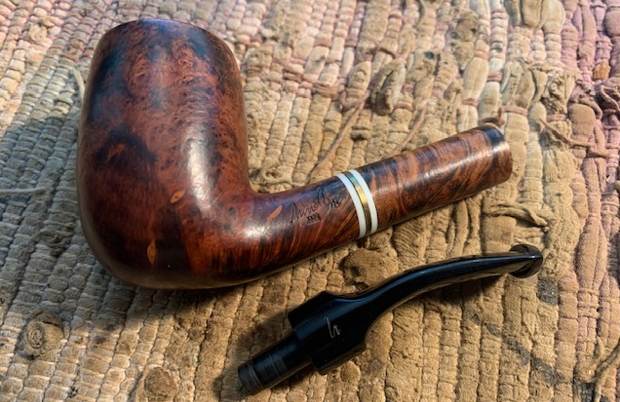
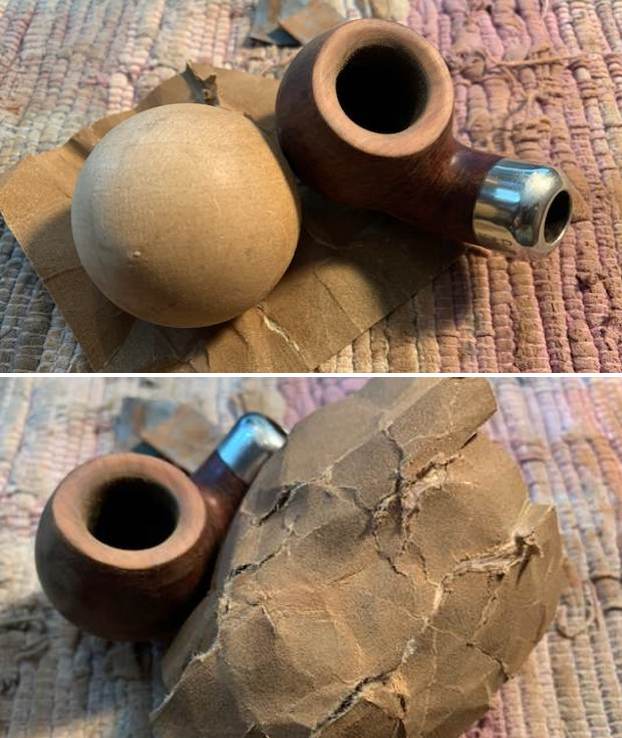
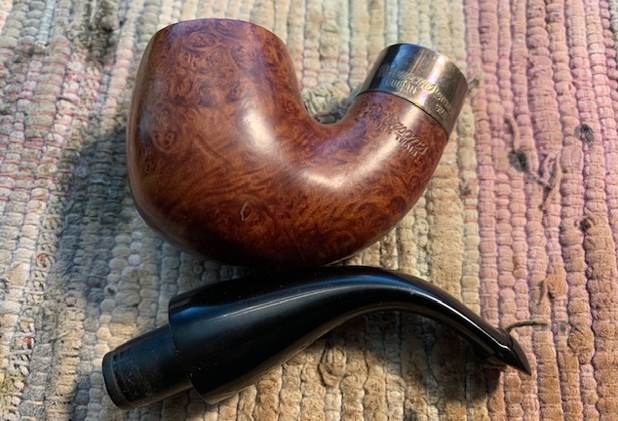
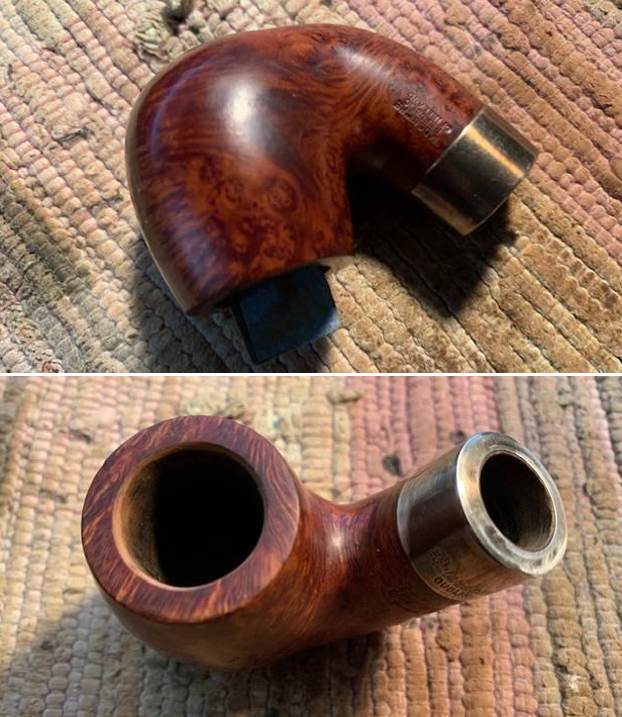
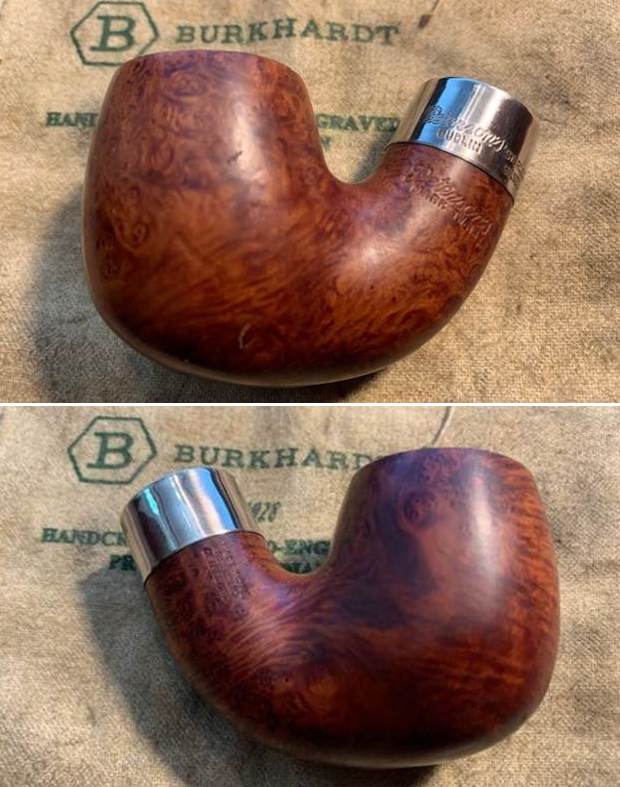
I turned next to dating the pipe as it would be more straightforward than the numbering on the shank. There is a superscript 8 following the D in ENGLAND on the right side of the shank. I turned to the dating chart on Pipephil (http://pipephil.eu/logos/en/dunhill/cledat-en1a.html). I did a screen capture of Part 2 of the Dunhill Dating Key and included it below. I drew a red box around the section dating this pipe. It is clear that the pipe was made after 1954 so that is why I went to Part 2. Because the year suffix is 8 that tells me that the pipe was made in 1950+8 for a date of 1958. Armed with that information I turned to work on the pipe itself. Before he sent it to me, Jeff had done an amazing job cleaning the pipe. It almost looked like a different pipe after his work. He reamed the pipe with a PipNet pipe reamer and removed the rest of it with a Savinelli Fitsall Pipe Knife.  He scrubbed the bowl with undiluted Murphy’s Oil Soap with a tooth brush. He rinsed it under running warm water to remove the soap and grime. He cleaned out the inside of the shank and the airway in the stem with isopropyl alcohol, cotton swabs and pipe cleaners. He soaked the stem in Briarville’s Pipe Stem Deoxidizer and then rinsed it off with warm water. He scrubbed the stem with Soft Scrub and a tooth brush and rinsed it off with warm water. It looked amazing when I took it out of the package of pipes he shipped me. I took photos of the pipe before I started my part of the restoration work.   The rim top was cleaner and the inner edge of the bowl looked rough. There was burn damage all the way around but heavier on the front of the bowl on the top and inner and outer edges. There was also darkening on the back rim top and edge. The stem surface looked good with the oxidation gone and light but visible tooth chatter on either side of the stem.   I took photos of the stamping on the sides of the shank. It is clear and readable as noted above.I took the stem off the shank and took a photo of the parts of the pipe. The overall look of the pipe is quite unique. The stem shorter than the bowl and shank but looks quite good.I started my portion of the work on this pipe by addressing the damage to the rim top and inner edge of the bowl. I topped the bowl on a board with 220 grit sandpaper to take down the damage on the top of the rim and outer edges. I used a folded piece of 220 grit sandpaper to smooth out the edge and give it a slight bevel to deal with the chipping and cutting on the inner edge. It cleaned up remarkably well. With polishing and buffing it would look even better. I polished the briar with micromesh sanding pads – dry sanding with 1500-12000 grit pads. I wiped the bowl down with a damp cloth after each pad. The rim top looked very good and the bowl began to take on a rich glow. I used an Oak Stain Pen to restain the rim top and the inner bevel of the rim edge. Once it dried I buffed it with a cotton cloth and the match was very good.The bowl looked very good at this point so I rubbed it down with Before & After Restoration Balm. I worked it into the surface of the bowl and shank with my fingertips to clean, enliven and protect the briar. I let the balm sit for about 10-15 minutes and buffed with a cotton cloth to raise the shine. I set the bowl aside and turned to work on the stem. I polished the vulcanite stem with micromesh sanding pads – 1500-12000 grit pads. I wiped it down with Obsidian Oil after each sanding pad. I used Before & After Pipe Polish – both Fine and Extra Fine to further polish the stem and gave it a final coat of Obsidian Oil to finish it. This beautiful 1958 Dunhill Root Briar 34F/T 2R is a great looking pipe now that it has been restored. The rich Root Briar finish that highlights the grain and works well with the polished vulcanite stem. I put the stem back on the bowl and carefully buffed the pipe with Blue Diamond on the buffing wheel using a light touch on the briar. I gave the bowl and the stem multiple coats of carnauba wax on the buffing wheel and followed that by buffing the entire pipe with a clean buffing pad. I hand buffed the pipe with a microfiber cloth to deepen the shine. The finished Dunhill Root Briar Billiard is a beauty. Give the finished pipe a look in the photos below. The dimensions of the pipe are Length: 5 inches, Height: 1 ¾ inches, Outside diameter of the bowl: 1 ¼ inches, Chamber diameter: ¾ of an inch. The weight of the pipe is 24 grams/.85 ounces. I will be adding the pipe to the British Pipemakers section of the rebornpipes store shortly. If you are interested in adding it to your collection be sure to let me know. I take a moment to remind myself and each of us that we are trustees of pipes that will outlive us and the lives of many other pipe men and women who carry on the trust of their care and use. Thanks for reading this blog and my reflections on the pipe while I worked on it.

New Life for a BBB Tortoise 403S Straight Bulldog


Blog by Steve Laug

It was time to work on one of the pipes that was purchased off EBay back in 06/05/2016 from a seller in Frederiksberg, Denmark. This one is a straight Bulldog with a diamond shank and a saddle stem. The rim topped is worn and dirty and had darkening and burn damage on the front rim top and bowl. It also has some darkening on the lower part of the bowl on both sides. It is stamped on the left side of the shank BBB in a diamond [over] Tortoise followed by RJ. On the right side it is stamped London, England and the shape number 403S. The stem has a BBB Diamond medallion on the topside of the saddle. The pipe was very dirty with a thick cake in the bowl and some lava overflowing on to the rim top. It was hard to know what the inner edge of the rim looked like because of the lava and cake. From the photos there seemed to be some damage to the inner edge at the front of the bowl but I could not be sure. The shank was quite dirty so the tenon did not seat in the shank. The stem was pearlized white. There was light tooth chatter and tooth marks on both sides of the stem at the button. Jeff took the following photos before he started his cleanup.  He took photos of the rim top to show the thick cake in the bowl and the overflow of lava. The cake is thick and hard and the lava overflow is a thick band around the bowl. The bowl is a real mess. This must have been a great smoking pipe. There were not photos of the stem surface to include as we did not take photos of that at this point in time.Jeff took photos of the stamping to capture the clarity of it even under the grime. The brand and the shape number are very readable. He also took a photo of the BBB Diamond Medallion on the stem top.I turned to Pipephil (http://pipephil.eu/logos/en/logo-bbb.html) to see what I could learn about the BBB Tortoise Model. The pipes that came with a pearlized stem that almost looked like it was made of abalone. It was acrylic of some sort but has the softness of vulcanite. It is remarkable material. I have included a screen capture of the section on the Tortoise.I turned to address the pipe itself. Jeff had cleaned up the pipe for me. He reamed the bowl with a PipNet pipe reamer and cleaned it up with a Savinelli Fitsall Pipe Knife. He scrubbed the exterior with Murphy’s Oil Soap and a tooth brush to clean off the grime off the finish and the heavy overflow of lava on the rim top. He cleaned up the internals of the shank, mortise and stem with pipe cleaners, cotton swabs and alcohol to remove all of the oils and tars in the pipe. He scrubbed the stem Soft Scrub to clean off the grime and grit. When it arrived here in Vancouver it was a clean pipe and I knew what I had to work with. I took photos of it before I started my part of the restoration.  I took photos of the rim top and the stem to show their condition. Jeff was able to clean up the incredibly thick cake and lava overflow that was shown in the rim and bowl photos above. He was also able to get rid of the grime and grit in the surface of the briar. There was some burn damage on the rim top and the inner and outer edge toward the front of the bowl. There was also some darkening on the rest of the rim top. The stem was much cleaner than before. There was some staining just ahead of the button.I took photos of the stamping on the sides of the shank and stem. They are a bit faint but are readable as noted above.I removed the stem and took a photo of the pipe to show the parts and the size of the stem compared to the shank and bowl. It is a well made pipe.I decided to address the bowl first. I worked on both the rim damage and try to minimize the burn damage on the front top and on the inner and outer edges. I worked on the inner edge of the rim first using a folded piece of 220 grit sandpaper smooth out the damage and give a light bevel to the inner edge. I next tried to lightly top the bowl with a medium sanding sponge to see if I could minimize it further. While it was better I was not happy with it at this point. The rim top has a slight dip where the burn had been and the top was not flat. I decided to do a more radical topping on the topping board with 180 grit sandpaper. I took off a minimal amount just to flatten the rim top. I would need to clean up the inner edge again but I liked the look the pipe was beginning to have.I polished the briar, including the inner edge of the bowl with micromesh sanding pads – dry sanding with 1500-12000 grit pads. I wiped the bowl down after each pad with a damp cloth. I rubbed the bowl and shank down with Before & After Restoration Balm to deep clean the finish on the bowl and shank. The product works to clean, enliven and protect the briar. I worked it in with my fingers to get it into the briar. After it sat for a little while I wiped it off and buffed it with a soft cloth. The briar really began to have a rich shine. I took some photos of the bowl at this point to mark the progress in the restoration. It is a beautiful bowl and even the burn damage it not too intrusive – it is present but not too distracting as it is now just darkening. With the exterior cleaned and polished I looked down the shank with a light and saw that the shank was still quite oily looking. I cleaned it and the airway into the bowl with alcohol, pipe cleaners and cotton swabs. I cleaned out the airway in the stem and removed the dark tars and material that was on the internal of the slot and V into the airway. It took time and some extra work but I was able to clean both well.  I set the bowl aside and worked on the externals of the stem at this point in the process. I polished it with micromesh sanding pads – dry sanding with 1500-12000 grit pads. I wiped the stem down after each pad with Obsidian Oil to enliven and protect the stem material. I used the Before & After Pipe Polish to remove the small minute scratches left in the pearlized stem even after the micromesh regimen. I finished by wiping the stem down with a final coat of Obsidian Oil and set it aside to dry.  I put the stem back on the pipe and took the pipe to the buffer. I worked it over with Blue Diamond to polish out the remaining small scratches. I gave the bowl and the stem several coats of carnauba wax and buffed the pipe with a clean buffing pad to raise the shine. I hand buffed it with a microfiber cloth to deepen the shine. The pipe polished up really well and even the newly beveled rim top looked good. I was happy with the results of the reworking of the rim. The finished pipe is shown in the photos below. The unique BBB 403S Straight Bulldog Tortoise shape and look of the pipe is a beauty which epitomizes the BBB Tortoise pipes that I have restored. It is a very stunning looking pipe with the mixed grain and the pearlized stem. The polished stem looks really good with the browns of the briar. The dimensions of the pipe are Length: 5 ½ inches, Height: 1 ¾ inches, Outside diameter of the bowl: 1 ¼ inches, Chamber diameter: ¾ of an inch. The weight of the pipe is 1.06 ounces/30 grams. This is another pipe that I will be putting it on the rebornpipes online store in the British Pipe Makers Section shortly, if you are interested in adding it to your collection. Thanks for walking through the restoration with me on this beauty!
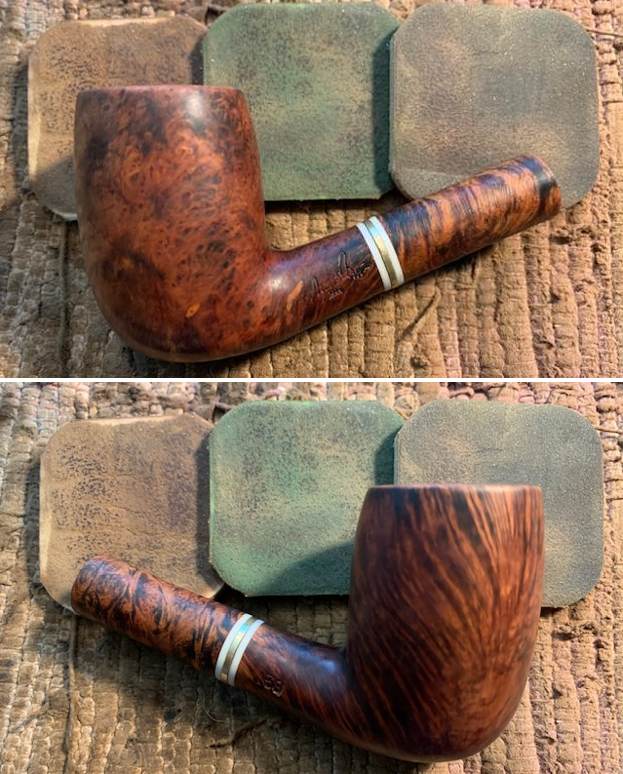
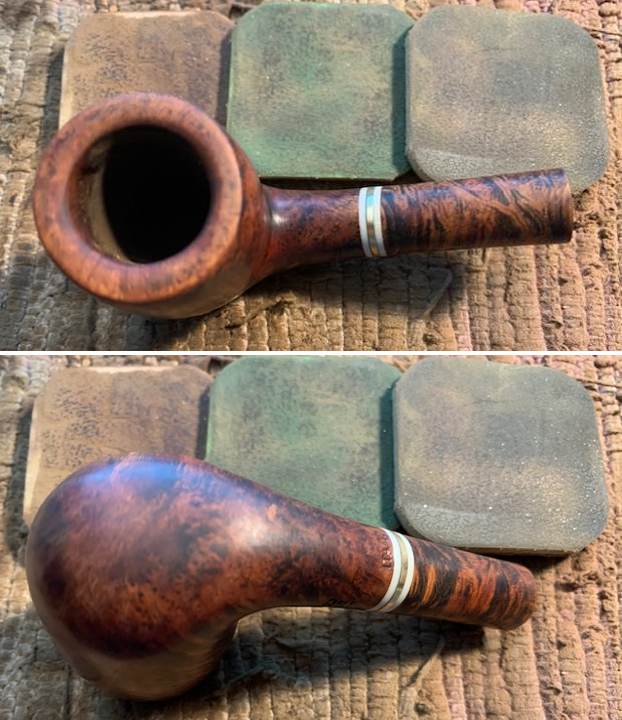
Labour Intensive Restoration of a Peterson’s Sherlock Holmes Series Professor


The next blog is one that has been submitted by Clint Stacey. We “met” via email to have a look at a pipe he was working on. It was a real challenge and one that demanded a lot of labour intensive work. Give his blog a read. He did a remarkable job on the pipe. Welcome to rebornpipes Clint and I hope this is the first of many blogs that you send to us.

Blog by Clint Stacey

I grew up around all sorts of stuff- from furniture and brick-a-brac to collectables and oddities coming into the house in all states of disrepair and leaving having been restored and reborn. My dad had a good eye and a passion for salvaging lost treasures sometimes it was his job, sometimes it supplemented his job, often it helped put food on the table.

I have followed in his footsteps, in terms of picking up all sorts of bits and bobs sometimes keeping them, other times passing them on to make room for the next thing. I don’t exactly remember when I first started picking pipes up – possibly about twenty five years ago. At that time, old pipes were plentiful at car boot sales, flea markets and junk and charity shops. Whilst I have picked up one or two nice examples I dread to think of the gems I’ve missed…

Now a days finding old or estate pipes is much trickier. The internet has educated people and quite often I will pick up some over priced wreck and be given chapter and verse of what it is by the seller.

As I have learnt more about pipes and become more discerning my real interest is in Petersons. I now have about forty.

Over the years I have picked up enough know how to do basic cleaning / tidying but little beyond that. I was seriously impressed when I discovered, about eighteen months ago, ‘rebornpipes’ and I saw some of the restoration work that was being carried out.

It had been a long time aim of mine to put together the Sherlock Holmes series of Petersons. I’ve started with the first series and having picked up three I was delighted to see a ‘Professor’ going cheap on EBay. It looked a bit rough but I thought it would clean up okay. There wasn’t much bidding (perhaps others knew more than me.)

When it arrived, I saw the real extent of the damage. It looked like somebody had taken great umbrage with the pipe and had attacked it with a carving knife before setting fire to it. I put it to one side uncertain of what I intended to do with it.About eighteen months ago I had come across rebornpipes. Having an interest in both pipes and restoration I was clearly in my element. How I hadn’t come across this before I don’t know. I decided to email Steve in the hope he could give some guidance with the Peterson.

I wasn’t sure if I would get a reply – after all we’re all busy people – and I wasn’t sure what he would be able to suggest. I was more than surprised by an almost instant response asking for photos. I sent these and Steve informed me that the pipe had been the victim of a torch lighter hitting the same point.

I had already given the pipe a clean – actually it wasn’t too bad beyond the lighter damage. Either it had been previously cleaned or possibly not actually smoked that much. A few cotton buds/pipe cleaners with some alcohol gave it a basic clean and the stem I scrubbed with warm water.

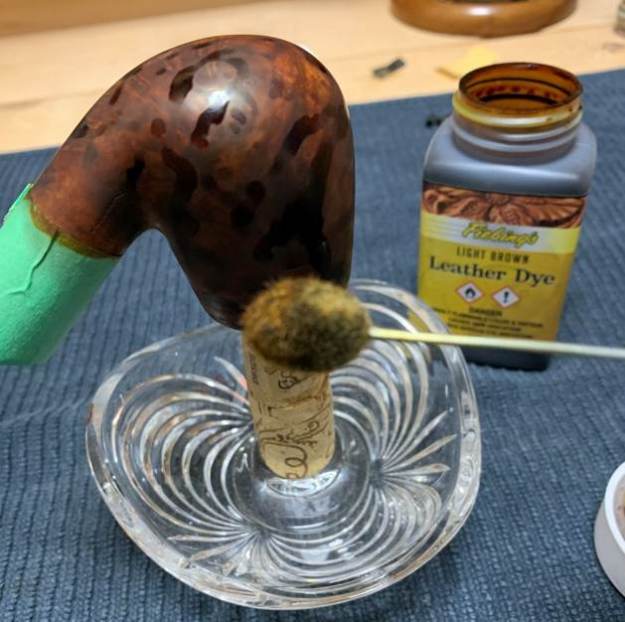
Steve suggested topping out the pipe armed with 220 sandpaper, a board and patience. I took it slowly at first carefully checking at points that I was keeping the pipe level. Working on it off and on I soon began to see some progress. I continued to take it down to a point where I had something to work it and began seeing some sign of hope. I kept checking in with Steve who continued to advise working slowly and patiently and keeping the pipe flat to the board in order to keep the top level.Although at this point it was greatly improved there was still a degree of difference in the thickness of the original and the pipe is well out of round. Steve asked for some side pictures just to check the height and suggested I kept going a bit further.Eventually I reached a point where I felt I had gone down as far as possible. Whilst I was pleased with the improvement it still didn’t look quite right. Steve had suggested that once I had got it sanded down I then used the technique of a ball in sand paper. I wasn’t entirely sure what I was doing at first but as I started to use this technique I saw both a bevel and shape starting to appear. Heartened I began working on smoothing out the inside as well as the top edge using fine grade sand paper. Finally, I reached a point where I was happy and felt that I could do little better. It had reached the point of staining the pipe to get the sanded area back to match the original colour. Steve’s advised a medium brown aniline stain. I used Feibing’s leather dye and was really pleased with how well this matched in with the original.I gave the pipe two coats and allowed it to dry. I then gave it a good polish with a carnauba wax. The stem had some oxidization so I worked on this with a fine grade wet and dry paper and then finished it with some carnauba wax. This will need a couple of coats to create a nice sheen. Throughout the process of working on this pipe Steve has been on hand offering help and guidance and I am really appreciative of both his time and knowledge. Often you come across pipes that are in a poor state through being ‘well loved’. Unfortunately, this one had just been abused. From the Hallmark H design, it appears to have been issued only in 2018. I amazed at how a pipe of such little age, and one that would have been expensive to buy, ended up in such a state. I am really happy to have been able to restore it and save it!

I have really enjoyed working on this and armed now with some knowledge and know how I intend to tidy up a few of the other pipes that I own.

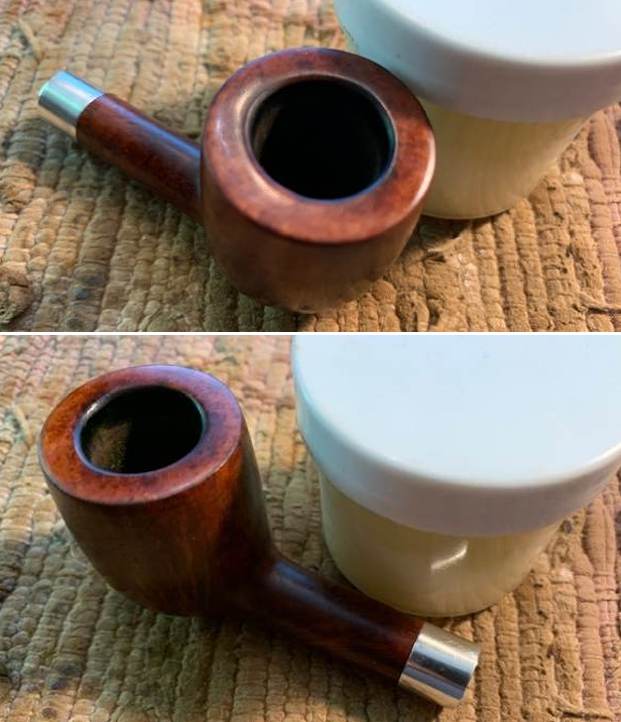
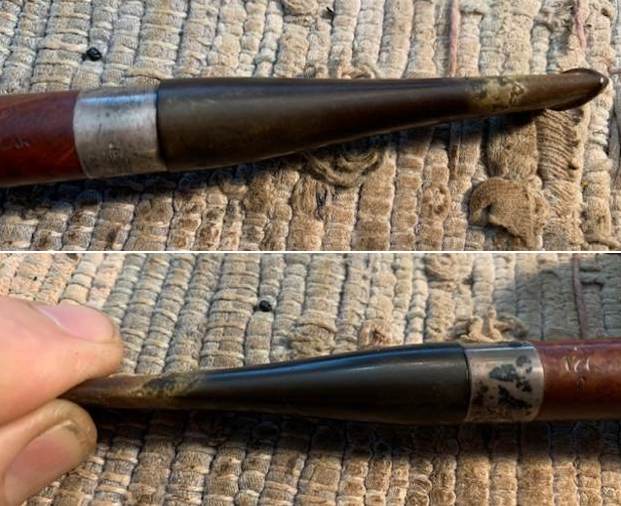
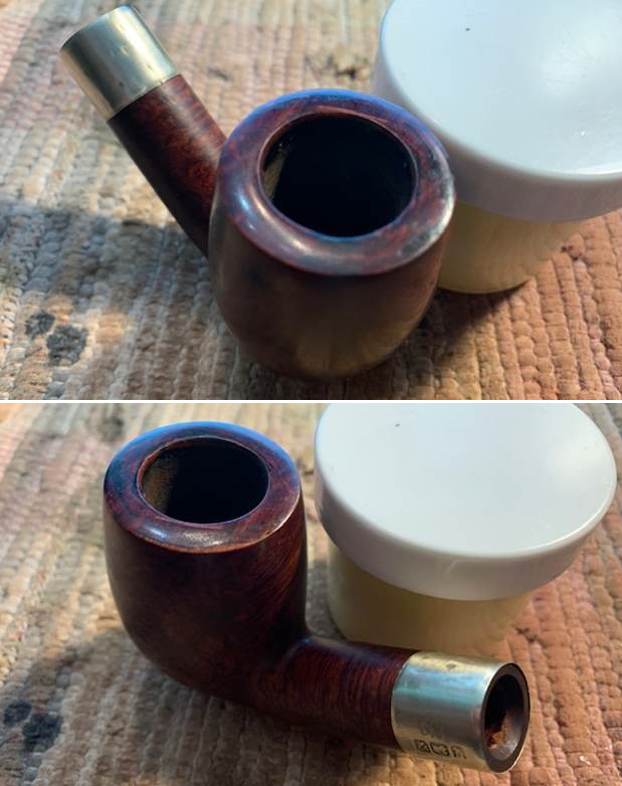
Repairing A Worm Hole Ridden Horn Stem And Refurbishing A c.1908 T.C.G Bent Billiard


Blog by Paresh Deshpande

This pipe had caught my eye for a long time. However, the extensive damage to the horn stem was a big challenge and was always relegated to ‘will- deal- with- later’ category of pipes. This time around, I decided to pick up the gauntlet and got the pipe to my work table.

The pipe currently on my table is as elegant and understated as the British and as compact as any English pipes of yore. The briar stummel has mixed grains and is sans any fills. The right side of the shank is stamped as “T.C.G” in an oval. There is no COM stamp. The only pointer to this pipe being English is the stamping on the Sterling Silver ferrule at the shank end. It is stamped “T.C.G” without frame over three sterling silver hallmarks. From left to right the first cartouche is with a LION PASSANT certifying silver quality followed by a cartouche with symbol for Chester Assay Office and the last cartouche contains the date code letter “H”. This was an English brand that I had neither seen before nor ever heard of. My first instinct to search for any new-to-me pipe brand is to visit rebornpipes and very rarely have I returned empty handed. This was one such rare instance where I came up empty handed. Pipedia.org and pipephil.eu, other popular sites that I visit for pipe related information, too did not have any mention of this pipe manufacturer.

The only clue to unravel the mystery of this pipe was in the stampings seen in the hallmarked silver band. I visited www.silvercollection.it and upon searching through the index, I came across a maker’s mark that was as seen on the pipe in my hands. The maker’s mark was described as Thomas Claud GOODING Edward Ryan GOODING – London. Here is the link and screen shot of the details and relevant details are highlighted in red.

http://www.silvercollection.it/DICTIONARYTOBACCONISTT.htmlThe next step was to date this pipe with the help of the hallmarks as seen on the silver band at the shank end. The Chester City mark was easy to identify. The letter “H” perfectly matched up with the letter that identified it as being assayed by the Chester Assay office in 1908. Given below is the link that will take the readers to the relevant section of dating and the picture that I have taken with the date code letter.

http://www.silvercollection.it/englishsilverhallmarksCHE.html

I further Google searched for Thomas Claud Gooding and other than an address for the said tobacconist at Farringdon Street, London, I could not glean much information.

It is my informed guess that TC Gooding got pipes made from other manufacturers like Barling’s, Comoy’s etc and got them stamped from manufacturers with their own registered name, T.C.G and sold these pipes from their shops. This was a very common practice in those days.

To summarize, the pipe that I am working on was from a tobacconist shop run by T C Gooding at Farringdon Street that was made in c1908 by some of the more established pipe manufacturers in London and sold under their own name T.C.G.

Initial Visual Inspection
This pipe is a beautiful smaller sized bent billiards, a classic English shape. The stummel has beautiful mixed grains all around without a single fill. The rim top surface is uneven with dents and dings to the inner rim edge. There is a very thin and even layer of cake (which was proved otherwise once I reamed the chamber) in the chamber. The stummel surface is dull and dirty. The bone tenon is threaded and locks in to place with a perfectly aligned shank and horn stem. It is the horn stem that has the most damage. Worm holes at the upper surface at the button end exposing the air way and at the shank end lower surface the threaded bone tenon remains exposed. The following pictures present a general idea of the condition of this pipe. Dimensions Of The Pipe
(a) Overall length of the pipe: –          4.5 inches.

(b) Bowl height: –                               1.5 inches.

(c) Inner diameter of chamber: –         0.7 inches.

(d) Outer diameter of chamber: –        1.1 inches.

Detailed Visual Inspection
The chamber has a thin layer of even cake and appears to have been lightly reamed before being stowed away. The condition of the chamber walls will be ascertained once the cake is completely taken down to the bare briar. The inner rim edge is lightly charred on the right side in the 4 ‘O’ clock direction (encircled in green) while the left inner edge is uneven (indicated with yellow arrows). The outer rim edge shows damage to the left and front (encircled in red) due to knocking the edge against a hard surface. The rim top is sans any lava overflow but is peppered with scratches, dents and dings. The stummel surface is covered in a layer of dust and grime giving the surface a dull and lackluster appearance. From underneath this grime, a mix of bird’s eye swirls and cross grains can be seen that waits to be brought to the fore. There are a number of scratches, dents and dings over the stummel surface but predominantly over the foot of the bowl (encircled in pastel blue). The mortise is clean with small traces of remnants of old oils and tars.The stem is where maximum damage can be seen. The bone stem is riddled with worm holes in the bite zone and towards the tenon end. The following pictures will give the readers a clear idea of the extent of damage to the stem and what I would be dealing with during its repairs. At the rounded slot end, the damage is deep enough to expose the air way (encircled in yellow) but thankfully; the air way is undamaged and intact. At the tenon end, the worm hole is deep and exposes the threaded bone tenon (encircled in green). The round slot and the bone tenon opening shows residues of dried oils and tars. The silver lining to all this damage is that the button edge surface and the tenon end flat base surface is still intact and will serve as a guide while I build up the damaged surface. The Process
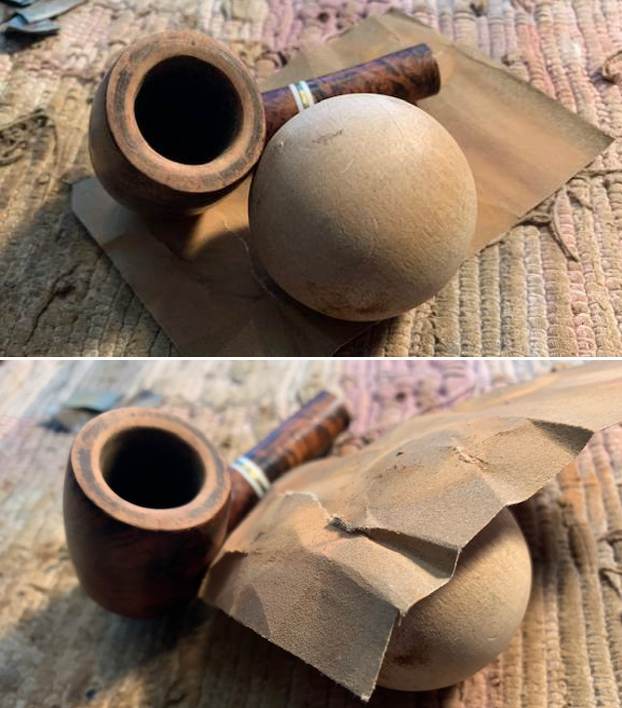
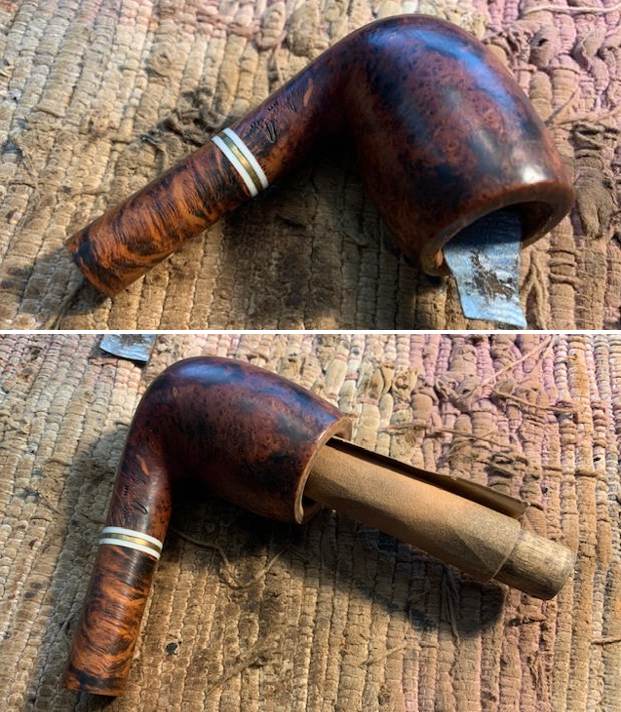
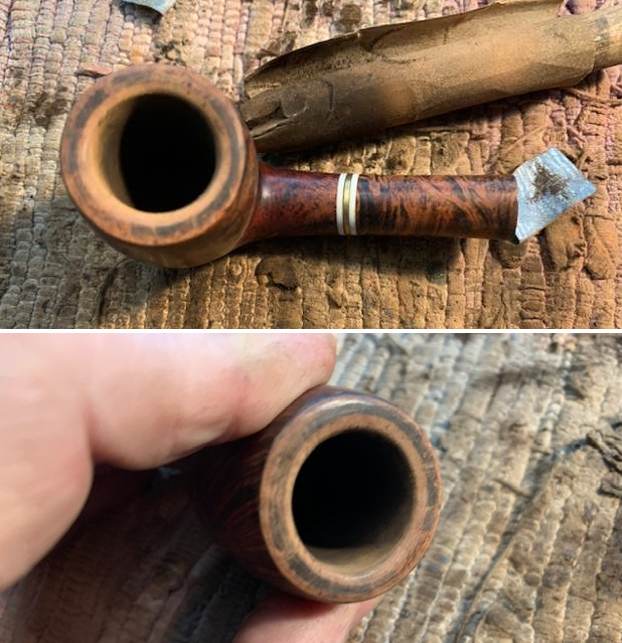
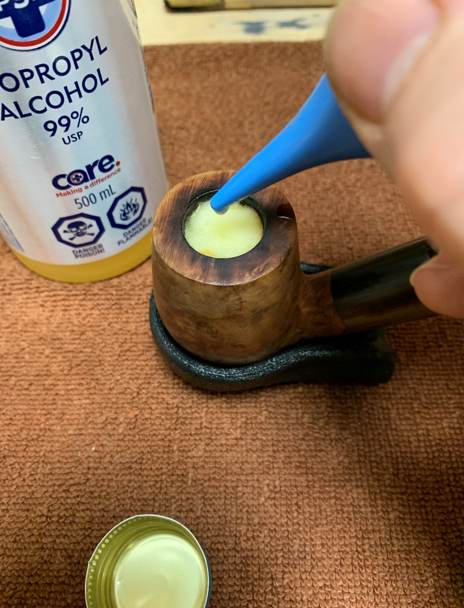
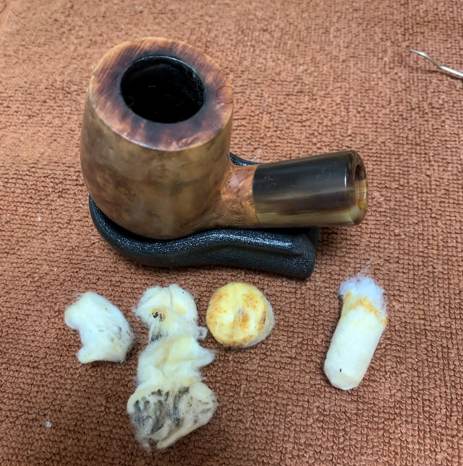
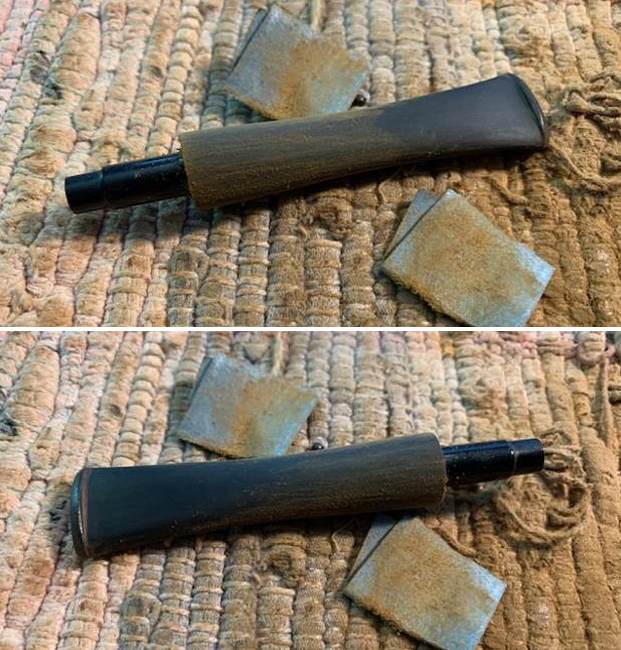
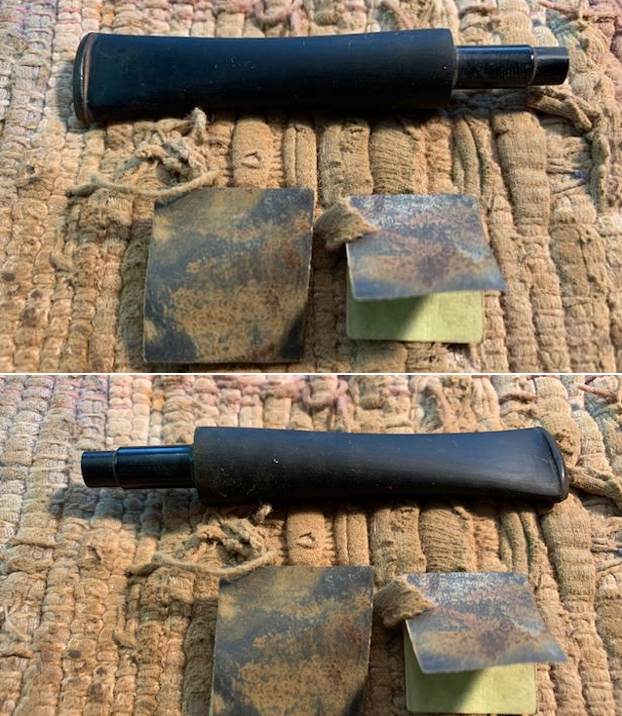
I started the repairs with the stem first as it would be the most tedious work and take the longest time. I cleaned the internals of the stem with thin shank brushes and anti-oil dish washing soap. This helps reduce the number of pipe cleaners that I would otherwise use for the cleaning of the airway.I ran a couple of bristled pipe cleaners dipped in isopropyl alcohol to thoroughly clean the airway. I followed it by cleaning the stem surface with cotton swabs wetted with alcohol in preparation for rebuilding the damaged horn surface with clear CA superglue.With the internal and external surface of the stem cleaned up, I moved ahead with reconstruction of the worm hole ridden bite zone and the tenon end of the stem with high viscosity clear CA superglue. I started the repair work at the tenon end. To hasten the process of curing, I sprayed the fill with accelerator. I followed the layering technique to rebuild the damaged surface, that is, first drop a blob of superglue over the surface to be rebuilt and spray the accelerator. Once the glue has hardened, drop superglue over the same area and spray the accelerator to harden the glue. I continued with this method at both the ends of the stem till I had completely covered the area to be rebuilt and then some more. The purpose of excessive build up of the damaged stem surface was that it would be sanded down to perfect or near perfect match with the rest of the stem surface. Following pictures will give the readers a general idea of the process explained above. Once the tenon end of the stem was filled with superglue and set using the accelerator, I followed the same procedure to rebuild the slot end of the stem. Thereafter, I set the stem aside for the fills to cure overnight. While the stem was set aside for the fills to cure, I reamed the chamber with size 1 and 2 heads of the PipNet pipe reamer. I removed the carbon from the areas where the reamer head could not reach with my fabricated knife. To completely remove the residual carbon from the walls of the chamber and even out the walls, I sand the chamber walls with a folded piece of 220 grit sandpaper followed by cleaning the chamber with a cotton swab wetted with isopropyl alcohol. The chamber walls are in pristine condition. The quantity of carbon that was removed did surprise me as I had anticipated a far less build up of cake in the chamber. I also cleaned the mortise with pipe cleaners and alcohol. Continuing with internal cleaning of the bowl, I decided to subject the chamber and mortise to cotton and alcohol bath. I packed the chamber with cotton balls and drew out a wick from the cotton and along with a folded regular pipe cleaner, inserted it into the mortise and through the draught hole into the chamber. I tightly packed cotton balls in to the remaining portion of the mortise. Thereafter, I soaked the cotton balls with isopropyl alcohol up to the brim. About half an hour later, the level of alcohol had gone down, having being absorbed by the cotton. I topped it up once again and set it aside overnight. By next afternoon, the cotton and alcohol had drawn out all the remaining oils and tars from the chamber and mortise. I removed the cotton balls and the filth can be gauged by the appearance and coloration of the cotton balls and the pipe cleaner. I ran pipe cleaners through the mortise and draught hole to clean out all the loosened tars and gunk that was lodged in the draught hole and mortise. The chamber and mortise now smelled clean, fresh and looked it too. I set the stummel to dry out naturally.With the internal cleaning done, it was time for the external cleaning of the stummel surface. I used a hard bristled tooth brush and Murphy’s Oil Soap, to scrub the stummel and rim top. I washed the stummel under running warm water with anti oil dish washing detergent till the stummel surface was clean and dried it using paper towels and soft cotton cloth. I simultaneously cleaned the shank internals with the detergent and hard bristled shank brush and set the stummel aside to dry out naturally.Next, I addressed the various stummel repairs that I have mentioned above. First issue that I addressed was that of the rim top surface dents/ dings, charred inner rim edge and chipped outer rim edge. To address the rim top damage, I topped the rim surface on 220 grit sandpaper till the surface was nice and even. I hate losing any briar and prefer to restrict topping to the barest minimum that is required. The damage to the outer rim edge, though greatly eliminated, can still be seen to the left side. This would be taken care of by creating a slight bevel to the outer edge. The charring to the inner rim edge is still visible (encircled in green). These issues could be completely addressed by the process of topping but the extent of topping that would be required to do so would alter the bowl height and also the entire stummel profile.With a folded piece of worn out 180 grit sand paper pinched between my thumb and forefinger, I carefully created a bevel over the inner and outer rim edge and addressed the issue of charred inner rim edge. The rim edges appear much better at this stage and should further improve the aesthetics of the stummel when the bevel and stummel is polished using the micromesh pads. While I was working on the stummel, the stem fills had cured completely and as I was keen to shape the stem fills, I kept the stummel aside and worked on the stem repairs. I used a flat needle file to roughly match the fills with the rest of the stem surface. I further evened out the fills by sanding the stem surface with a folded piece of 150 grit sandpaper. All this filing and sanding had exposed a few air pockets (indicated with green arrows) and a portion of the upper button edge (encircled in indigo) that would need to be further rebuilt.Since I had rebuilt the stem face at the tenon end, it was imperative for me to check the alignment of the stem against the shank face when seated. My expected fears came true and how! The stem was grossly overturned to the right.The general rule of thumb is that if the overturn is to the right, one needs to sand the left side so that the threads could complete the turn and achieve a perfect alignment. However, this need to be done extremely carefully as any excess sanding of the left side could result in a left overturn. Using needle files and a 220 grit sandpaper, I sand the excess fill from the left side, checking very frequently for the alignment. A few hours and numerous checks later, I achieved a perfect alignment of the stem and shank face. My mantra of “less is more” was always playing at the back of my mind as I worked on the stem face. Now I could move ahead with addressing the air pockets and rebuild of the button edge over the upper stem surface. I filled the air pockets and rebuilt the button edge over the upper surface with CA superglue and once the glue had cured, with a needle file and sandpaper, I reshaped and evened out the fills to match the rest of the stem surface. Next, I decided to address the dents and dings on the stummel surface, notably at the foot and lower sides of the bowl. Using a marker pen, I marked all the major areas with dents and dings as I had decided to leave the minor ones as they were. I heated my fabricated knife over the flame of a candle, placed a wet Turkish hand towel over the marked areas and steamed out the dents by placing the heated knife over the towel. The steam generated by placing a hot knife on the wet towel helps the briar to expand within these dents and dings, making for a smooth and even surface. The stummel appears much better and smooth at this juncture.To further even out the remaining minor dings, I lightly sand the entire stummel with a folded piece of worn out 180 grit sand paper. I followed it by wet sanding the stummel with 1500 to 12000 grit micromesh pads, wiping frequently with a moist cloth to check the progress. I rubbed a small quantity of “Before and After Restoration Balm” deep into the briar with my finger tips and let it rest for a few minutes. The balm almost immediately works its magic and the briar now has a nice vibrant appearance with the beautiful grain patterns displayed in their complete splendor. I further buffed it with a microfiber cloth to deepen the shine. Now I needed to work on the stem again. I had completed the refilling/ rough reshaping of the damaged stem and now proceed to fine tune the reshaped button edge, rebuilt surfaces and polishing of the stem. I sand the stem with 220, 320, 600, 800 and 1000 grit sandpapers. The coarser grade sandpapers help in achieving exactness of shape and removing excess repair material to match rest of the surface while 600, 800 and 1000 grit sandpapers help in eliminating the sanding marks left behind by the coarse grit papers and imparting a shine to the stem surface. I rubbed a small quantity of EVO in to the bone to hydrate it.To bring a deep shine to the horn stem, I went through the complete set of micromesh pads, wet sanding with 1500 to 12000 grit pads. I wiped the stem with moist cloth after each pad and rubbed it down with Extra Virgin Olive oil to rejuvenate the bone stem. I am pretty happy with the way the stem repairs have shaped up and also the button has a nice delicate shape. The finished stem is shown below. I cleaned the sterling silver ferrule at the shank end with “Pitambari”, a powder that is available all across India that is used to clean and shine brass and silver ware. Even Abha uses it to polish her silver and gold jewelry and cutlery. This compound is a very fine powder and is least abrasive with fantastic results. The band is now a nice shining piece of sterling silver and will provide a nice contrast between the shining horn stem and the dark brown stummel.To complete the restoration, I mount a cotton cloth buffing wheel on to my hand held rotary tool and polished the stummel and stem with Blue Diamond compound. This compound helps to remove the minor scratch marks that remain from the sanding. I mounted another cotton buffing wheel that I have earmarked for carnauba wax and applied several coats of the wax. I finished the restoration by giving the entire pipe a rigorous hand buffing using a microfiber cloth to raise the shine further. The finished pipe looks amazingly beautiful and is ready to join my collection. I only wish it could share with me its life story of the past years while I enjoy smoking my favorite Virginia blend in it or maybe an English blend or maybe just keep admiring it!! I wish to thank all the esteemed readers for reading through this write up and thereby being a companion in my journey.

Just in Time for St Patrick’s Day


Blog by Kenneth Lieblich

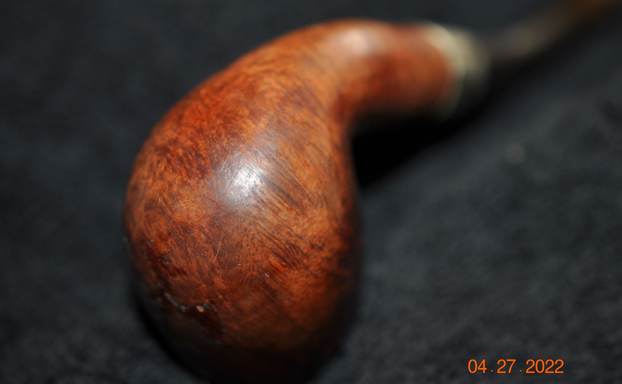
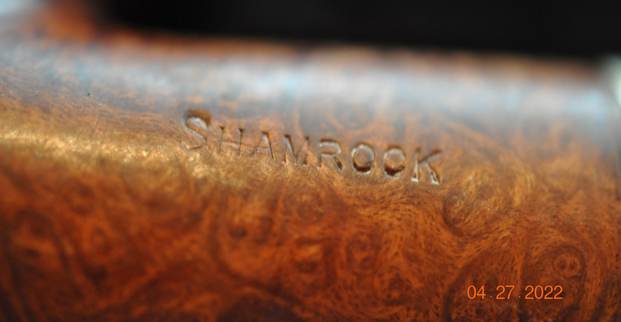
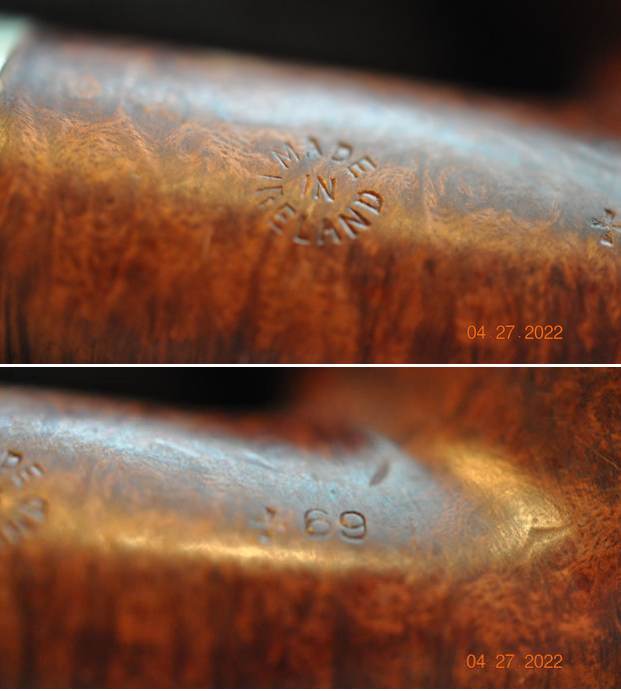
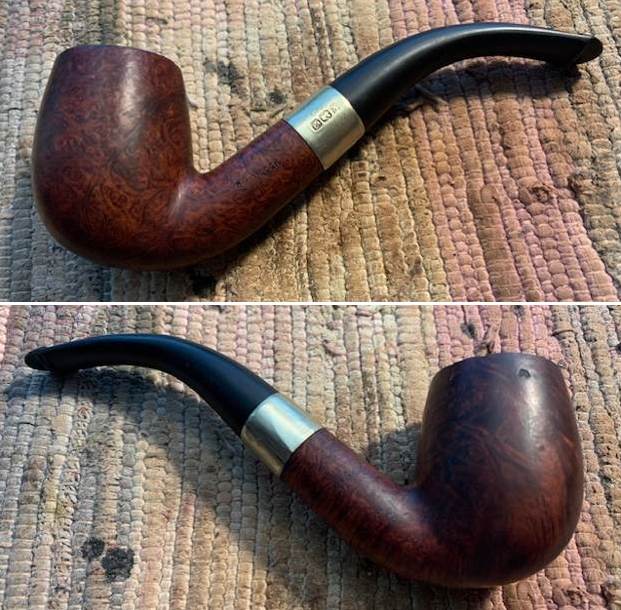
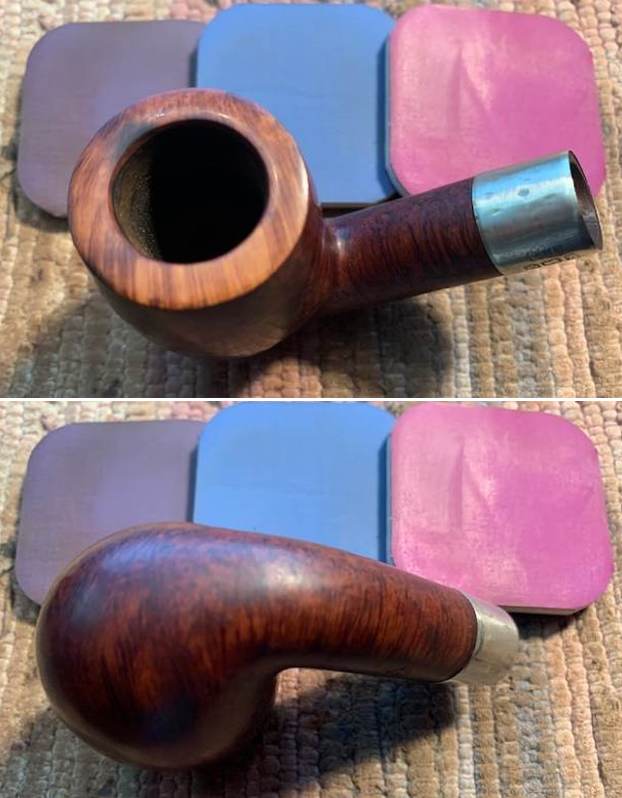
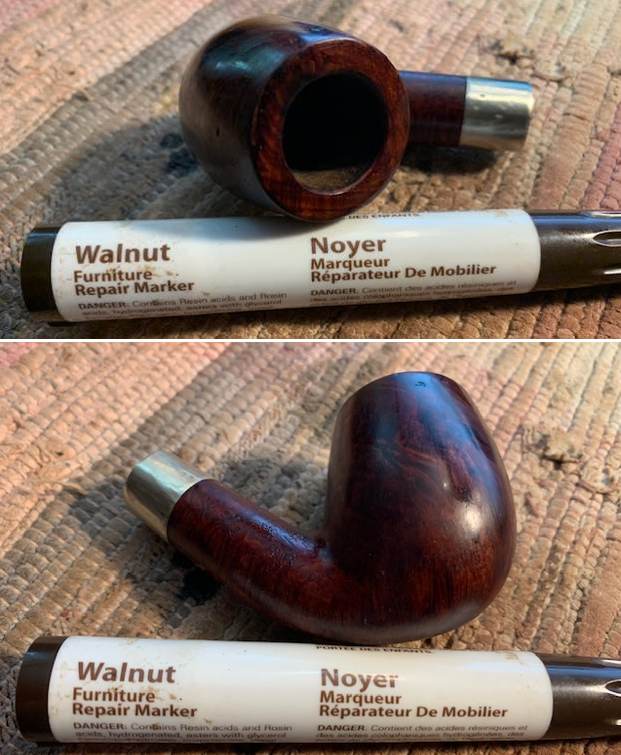
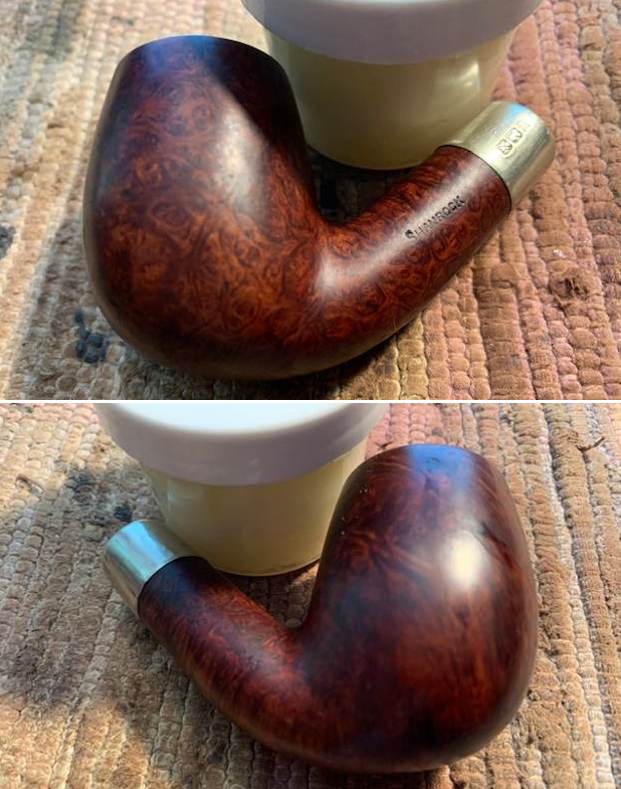
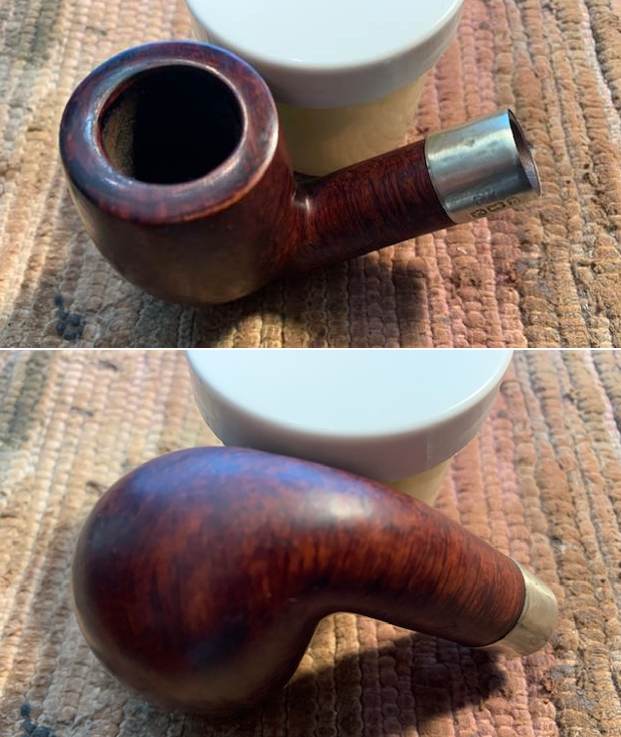
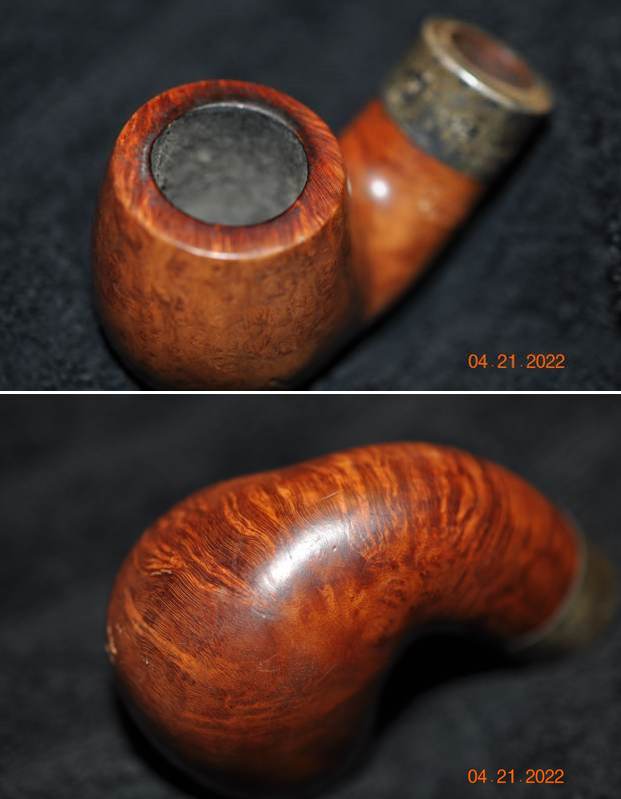
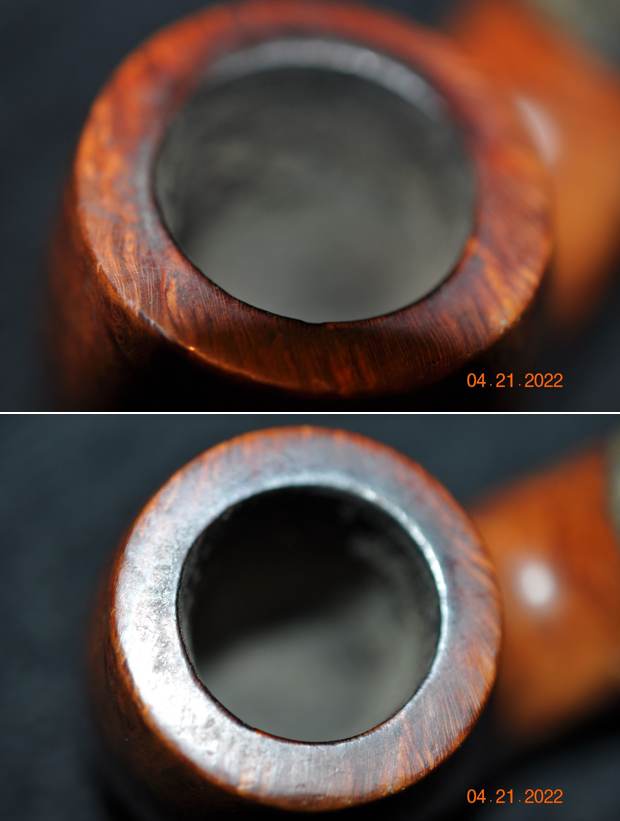
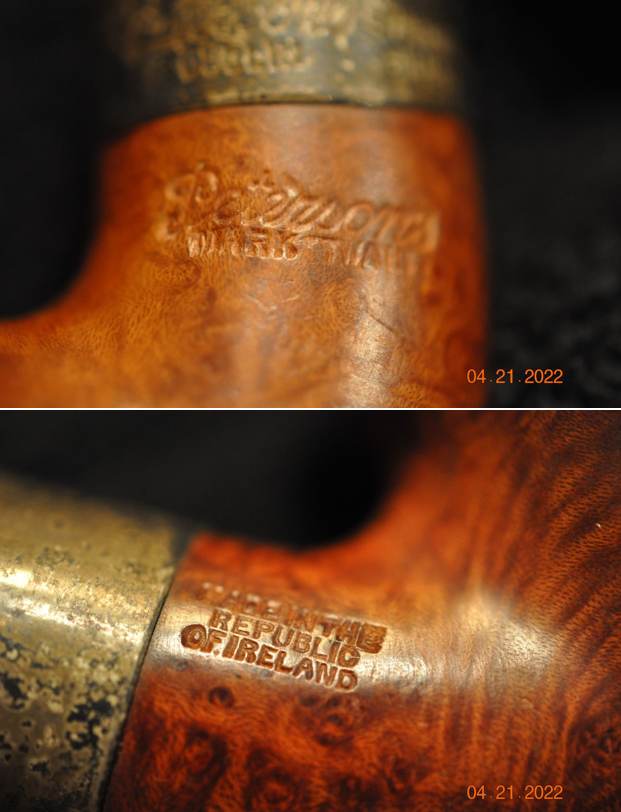
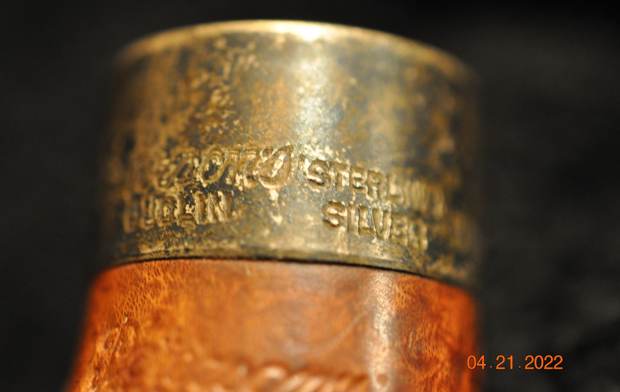
Next on the chopping block is this lovely Peterson Shamrock. I acquired it some time ago from Craigslist and I figured that it was time to honour the great patron of Ireland, Saint Patrick, with a pipe named for the Shamrock. This is a terrific pipe that simply looks a bit drab. Some special attention from me will bring out its best. This pipe shape is a classic billiard. This is a really pretty pipe and feels very comfortable in the hand. This pipe was made by the esteemed Irish pipe company, Peterson. Of course, Peterson is well known to most pipe smokers. For more information on the brand and its history, be sure to read the Pipedia article on them: https://pipedia.org/wiki/Peterson. The markings on the left-hand side of the shank read Shamrock and the left-hand side of the stem shows a capital S. The right-hand side of the shank reads “A. Peterson Product” [over] Made in the Rep. [over] of Ireland. Alongside this, the number 25 appears, the shape number. This “25” actually corresponds to the Peterson shape “455”, as explained over at Mark Irwin’s Peterson Pipe Notes:Meanwhile, Mark Irwin and Gary Malmberg’s book, The Peterson Pipe provided some essential background information on Peterson’s Shamrock pipe. As you’ll see below, the nomenclature for dating doesn’t exactly correspond to what I have above, but still leads me to think that this pipe’s date is between 1948 and 1998. That’s a pretty wide range, but it will have to do! From The Peterson Pipe:

Shamrock (c. 1941–2009) Originally stamped SHAMROCK with no brand name, an inexpensive line first described in George Yale (New York) mail order booklet in 1941, imported by Rogers Import. The line was actively promoted beginning in ’45, aggressively promoted in US by Rogers from early ‘50s when they registered the Shamrock logo with US Patent Office, claiming propriety since ’38. Over the years offered with P-lip or fishtail mouthpiece, with or without nickel band, with or without shamrock logo on the band, with or without S stamped in white or later in gold on mouthpiece. Appearing in 2008 as unstained smooth and rustic, fishtail mouthpiece with gold impressed P on the stem. COMS of MADE IN over IRELAND (c. 1945–1965), MADE IN IRELAND forming a circle (c. 1945–1965), “A PETERSON’S PRODUCT” over MADE IN IRELAND (c. 1945–1965), MADE IN THE over REPUBLIC over OF IRELAND (c. 1948–1998). Model is always difficult or impossible to date.

On to the pipe: it was in very nice condition, actually. The insides had already been cleaned fairly well by a previous owner. Annoyingly, the Craigslist seller claimed that the pipe was unsmoked, but this was clearly false (grrr). The stem had considerable oxidation, a few minor scrapes, but was otherwise in decent shape. The stummel was also very nice. The outside of the bowl had only slight scratches and the overall colour was a bit dull. The insides would need to be cleaned a bit, but most of the work had already been done. Really, this pipe just needed a day at the salon in order to look its best.The stem was first on my list. This stem has an inner tube in it, so, in order to clean it, I soaked it in some lemon-infused isopropyl alcohol. I let it sit for several hours and then cleaned it off and it looked much improved. I then buffed it with a microfibre cloth and moved on.I took a BIC lighter and ‘painted’ the stem with its flame in order to lift any tiny bite marks. This was only modestly successful in raising the dents. Then, I cleaned out the insides of the stem with pipe cleaners and isopropyl alcohol. It was a bit dirty, but not too bad and I only went through a few pipe cleaners in order to clean it up. Once this process was done, the stem went for an overnight soak in the Pipe Stem Oxidation Remover. The following day, I cleaned all of the de-oxidizing mess off with alcohol, pipe cleaners, et cetera. The oxidation had migrated to the surface and would be fairly straightforward to remove. I scrubbed with SoftScrub on some cotton pads to remove the leftover oxidation. After this, I used some nail polish to restore the Shamrock “S” logo on the stem. I painted the area carefully and let it fully set before proceeding.I then sanded the stem with 220-, 400-, and 600-grit sandpapers to meld seamlessly into the stem. I then used all nine Micromesh pads (1,500 through 12,000 grit) to bring out the lovely black lustre on the stem. I also used Obsidian Pipe Stem Oil in between each pad scrubbing. On to the stummel, and most of the usual cleaning procedures were in order for this pipe. The bowl did not need to be reamed, so I was able to skip that. But I still inspected the bare briar to ensure there were no hidden flaws in the walls of the bowl. Fortunately, there were none. I then proceeded to clean out the insides of the shank with Q-tips, pipe cleaners, and isopropyl alcohol. There wasn’t too much nastiness inside this stummel – it only took a handful of pipe cleaners etc. to sort that out. I followed that up by cleaning the insides with some dish soap and tube brushes. I then moved on to cleaning the outside of the stummel with Murphy’s Oil Soap and some cotton pads. That removed any remaining dirt. Even though the pipe was quite clean, I figured that a de-ghosting session couldn’t hurt, so I thrust cotton balls in the bowl and the shank, and saturated them with 99% isopropyl alcohol. I let the stummel sit overnight. This caused any remaining oils, tars and smells to leech out into the cotton.There was a slight mark on the rim of the stummel and, in order to remove it, I “topped” the pipe – that is to say, I gently and evenly sanded down the rim on a piece of 220-grit sandpaper. This effectively removed the marks, without altering the look of the pipe.Having completed that, I was able to address the small nicks on the stummel. I dug out my iron and a damp cloth to try and raise the nicks. The hot and moist steam can often cause the wood to swell slightly and return to shape. There was considerable movement! It looked a lot better as a result of the steam and I was pleased.I took the opportunity to add a light application of Before & After Restoration Balm. I let it sit for 10–15 minutes and then gave it a buff. This made the beauty of the stummel’s grain really pop. No doubt about it – this is a really lovely pipe! There was one tiny little dent remaining in the stummel. I lined it with cyanoacrylate adhesive. After letting it cure, I sanded the fill repair down with 200-, 400-, and 600-grit sandpaper. I then used all nine Micromesh pads (1,500 through 12,000 grit) on the stummel to finish it off. After that, I applied yet another application of Before & After Restoration Balm. Hubba hubba! This thing is looking better all the time. Then it was off for a trip to the buffer. A dose of White Diamond and a few coats of carnauba wax were just what this pipe needed. The lovely shine made the wood very attractive. This is a very handsome pipe and will provide many years of smoking pleasure. This Peterson Shamrock looks fantastic again and is ready to be enjoyed again by the next owner – just in time for St Patrick’s Day! I am pleased to announce that this pipe is for sale! If you are interested in acquiring it for your collection, please have a look in the ‘Irish’ pipe section of the store here on Steve’s website. You can also email me directly at kenneth@knightsofthepipe.com. The approximate dimensions of the pipe are as follows: length 5⅞ in. (150 mm); height 1⅝ in. (40 mm); bowl diameter 1⅛ in. (27 mm); chamber diameter ¾ in. (20 mm). The weight of the pipe is ⅞ oz. (26 g). I hope you enjoyed reading the story of this pipe’s restoration as much I as I did restoring it. If you are interested in more of my work, please follow me here on Steve’s website or send me an email. Thank you very much for reading and, as always, I welcome and encourage your comments.

A Decorated Veteran


Blog by Kenneth Lieblich

Next on the chopping block is this superb Ropp Six. It comes from a group of pipes I purchased from France. I love this pipe. I have a particular interest in French pipes and pipeworks, and I grabbed this one to restore for my collection. This is an old, old pipe with a few wounds (i.e. a veteran pipe with decorations) and needs just a little help to come back to life. This pipe was made by the venerable French pipe company, Ropp. Ropp has been around for a long time and their early pipes are really quite wonderful (the less said about their modern pipes, the better). The markings on the left-hand side of the shank read Ropp [over] Six. The right-hand side of the shank reads 886, presumably the shape number. Also, on the stem, there is the Ropp logo: Ropp, encircled in an oval.This pipe shape is a Rhodesian – a variation of the classic Bulldog. A Rhodesian will have a cylindrical shaped shank, not a diamond shank like the Bulldog. This is a really pretty pipe and feels very comfortable in the hand.

From Pipedia, here is a very brief history of the Ropp company:

Eugène-Léon Ropp (1830–1907) acquired a patent for the cherrywood pipe in 1869. In 1870, he established a workshop to manufacture such pipes in Bussang, in the Vosges mountains. Around 1893, his business moved into the former mill of Sicard (part of the community of Baume-les-Dames in Upper Burgundy. The pipes were a big success in export as well. Shortly before 1914, Ropp designated A. Frankau & Co. (BBB) to be the exclusive distributor in the UK and its colonies. Probably in 1917, a workshop in Saint-Claude in the rue du Plan du Moulin was acquired to start the fabrication of briar pipes. In 1923, another small building in Saint-Claude, serving as a workshop for polishing, was added. Cherrywood pipes were the mainstay of Ropp until the company finally closed down in September 1991. The company was taken over by Cuty-Fort Entreprises in 1994. On to the pipe: it was in decent shape, but it had a few issues. The stem had a bit of oxidation and calcification, but – mostly notably – it had substantial bite marks, top and bottom. The stummel also had a few issues. The outside of the bowl had some scratches and a couple of fills that needed to be addressed. These are the “decorations” I referred to in the title of this article. There was lava and debris on the rim, and a few burn marks too. The inside was pretty dirty too – it would need a thorough cleaning. The stem was first on my list. This stem has a stinger in it – and it was being quite stubborn about coming out of the tenon! I opted to warm the stem and stinger with my heat gun and this provided just enough softening of the internal goo to allow me to pull it out. The stinger then went for a soak in some lemon-infused isopropyl alcohol. I let it set for several hours and then cleaned it off and it looked much improved. I then finished it with some metal polish and moved on. I wiped down the outside of the stem with Murphy’s Oil Soap on some cotton pads. I also took a BIC lighter and ‘painted’ the stem with its flame in order to lift the bite marks and dents. This was not successful at all in raising the damage. More work would need to be done. Then, I cleaned out the insides with pipe cleaners and isopropyl alcohol. Even the bore was clogged with debris! It took an awful lot of work to get this clean! Once this process was done, the stem went for an overnight soak in the Pipe Stem Oxidation Remover. The following day, I cleaned all of the de-oxidizing mess off with alcohol, pipe cleaners, et cetera. The oxidation had migrated to the surface and would be fairly straightforward to remove. I scrubbed with SoftScrub on some cotton pads to remove the leftover oxidation. After this, I used some nail polish to restore the Ropp logo on the stem. I painted the area carefully and let it fully set before proceeding. I built up the dents on the stem with cyanoacrylate adhesive and let them fully cure. On this occasion, I actually built up several layers of the glue over a few days. I must admit, it was an annoying and frustrating process because, at this stage, it never looked quite right. I then sanded the adhesive down – first with a small file – then with 220-, 400-, and 600-grit sandpapers to meld seamlessly into the stem. I then used all nine Micromesh pads (1,500 through 12,000 grit) to bring out the lovely black lustre on the stem. I also used Obsidian Pipe Stem Oil in between each pad scrubbing. On to the stummel, and the usual cleaning procedures were in order for this pipe. This stummel was a bit of a mess inside, so I first decided to ream out the bowl. I used both the PipNet Reamer and the KleenReem to remove the built-up cake and followed that with 220-grit sandpaper to eliminate as much as I could. I took the bowl down to bare briar, as I wanted to ensure there were no hidden flaws in the walls of the bowl. There were some very thin craze lines inside the bowl, but they were small enough that I elected to leave them as they were. I then proceeded to clean out the insides of the shank with Q-tips, pipe cleaners, and isopropyl alcohol. There was considerable filth inside this stummel and it took a lot of cotton to get it clean. I followed that up by cleaning the insides with some dish soap and tube brushes.

I used a small butter knife to gently chip away at the lava on the rim. I then used more Murphy’s with a scrub brush to remove any remainder. This actually worked quite well. I then moved on to cleaning the outside of the stummel with Murphy’s Oil Soap and some cotton pads. That removed any latent dirt that blighted the wood.

In order to remove the remaining burns and nicks on the rim, I “topped” the pipe – that is to say, I gently and evenly sanded down the rim on a piece of 220-grit sandpaper. This effectively removed the damage, without altering the look of the pipe.Having completed that, I was able to address the small nicks on the stummel. I dug out my iron and a damp cloth to try and raise the nicks. The hot and moist steam can often cause the wood to swell slightly and return to shape. There was some movement – not a lot, but it was better than doing nothing. The repair was not perfect, but the remaining scratches would be improved by sanding.I lined the fills with cyanoacrylate adhesive and briar dust. After letting them cure, I sanded the fill repairs down with 200-, 400-, and 600-grit sandpaper. I then used all nine Micromesh pads (1,500 through 12,000 grit) on the stummel to finish it off. After that, a light application of Before & After Restoration Balm brought out the best in the stummel’s grain. There is some beautiful wood after all. It is a very handsome, decorated veteran. In order to accentuate the external beauty of this pipe, I opted for aniline dye. I applied some of Fiebing’s Medium Brown Leather Dye. As usual, I applied flame from a BIC lighter in order to set the colour. I then added a second coat – just to make sure. What a difference that made! It looked so much better with a fresh coat of stain. I applied some more Before & After Restoration Balm and then it was off for a trip to the buffer. A dose of White Diamond and a few coats of carnauba wax were just what this pipe needed. The lovely shine made the wood very attractive. This is a very handsome pipe and will provide many years of smoking pleasure. This is a wonderfully crafted pipe and has a very elegant feel to it. It took some work, but I am proud of it and the final product suits me to a T. It retains some wounds from battle, but, as Steve would say, they are part of this pipe’s story. This is one pipe that I am keeping for myself and adding to my collection. I am sure that I will be enjoying this one for many years to come. I hope you enjoyed reading the story of this pipe as much I as I did restoring it. If you are interested in more of my work, please follow me here on Steve’s website or email me directly at kenneth@knightsofthepipe.com. Thank you very much for reading and, as always, I welcome and encourage your comments.

Restoring a Republic Era Peterson’s “Sports” 2 Lovat


Blog by Steve Laug

The next pipe I have chosen is smooth finished Peterson’s Small Lovat shaped pipe that had a bit of a bland looking finish but had some good looking grain around the bowl sides and shank. It also came to us from eBay on January 1, 2018 from Bellingham, Washington, USA. This Lovat did not have a nickel ferrule on the shank end. It was stamped on the left side of the shank and read Peterson’s [over] “Sports”. It was stamped on the right side and reads Made in the Republic of Ireland (3 lines). Next to the bowl it is stamped 2. The pipe was in filthy condition when he brought it to the table. The finish was dirty with grime ground into the briar sides and rim. There was a thick cake in the bowl and there was some burn damage to the rim top and the inner edge of the rim. The stem was oxidized, calcified and had tooth marks and chatter on the top and underside on and near the button. Jeff took photos of the pipe before his cleanup work. They tell the story and give a glimpse of the promise that we see in this pipe. Jeff took photos of the rim top and stem to show the general condition of the pipe. The bowl is caked and the rim top and edges show quite a bit of damage around the bowl, inner and outer shank. There were no photos of the stem but I have it in hand and it had tooth marks on both sides ahead of the button. You can also see from above photos that the stem was oxidized.Jeff took some photos of the bowl sides and heel to show the amazing grain that was around this bowl. There were also some nicks in the outer edge of the rim and scratches on the briar. It is a nice looking pipe.     He took photos of the sides of the shank and stem side to show the stamping. The stamping is worn but is still readable in the photos below and is as noted above.     I am including the link to the Pipedia’s article on Peterson pipes. It is a great read in terms of the history of the brand (https://pipedia.org/wiki/Peterson).

I turned to “The Peterson Pipe” by Mark Irwin and Gary Malmberg to get some background on the Peterson’s Sports. On page 313-314 it had the following information.

“SPORTS” (1947-) A “Sport” is traditionally a compact pipe made for smokers engaged in athletic pursuits, most notably equestrian riders who do not want the bowl to bounce up and down. Six shapes described in 1947 shape chart. Occasional later catalogs show as many as 11 shapes. Last  appeared in shape chart in ’98, but still made in small numbers. Recorded specimens are stamped MADE IN IRELAND (forming a circle) or MADE IN THE over REPUBLIC over OF IRELAND. See Outdoor and Outdoor Sportsman.

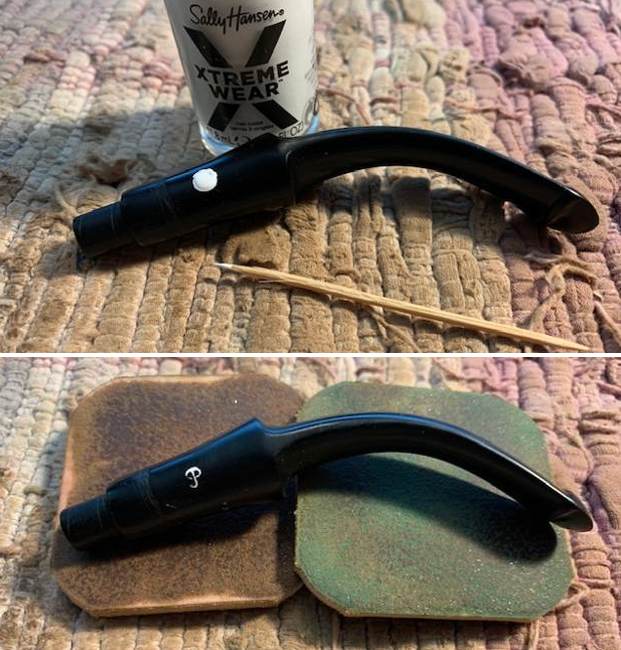
Now it was time to work on the pipe. Jeff had done a great job cleaning up the pipe as usual. He reamed the pipe with a PipNet reamer and cut back the cake back to the bare briar. He cleaned up the walls with a Savinelli Fitsall Pipe Knife. He scrubbed the interior of the bowl and shank with pipe cleaners, cotton swabs and alcohol to remove the tars and oils. He scrubbed the exterior of the pipe with Murphy’s Oil Soap and a tooth brush to remove the grime from the finish. He worked on the rim top lava and darkening with the soap and tooth brush. He scrubbed the inside of the stem with alcohol and pipe cleaners. He scrubbed the exterior with Soft Scrub and then soaked it in Before & After Deoxidizer. He washed it off with warm water to remove the deoxidizer. The pipe looked far better when it arrived.    I took some close up photos of the rim top and also of the stem surface. I wanted to show how well it had cleaned up. The rim top had some looked quite good and the inner and outer edges had some darkening and damage. I also took close up photos of the stem to show the tooth marks on the surface near the button. I took photos of the stamping on the sides of the shank. You can see that it is stamped as noted above. It is clear and readable.     I removed the stem and took a photo of the pipe to have a look at the parts and overall look. I decided to address the damage to the edge of the bowl and the rim top first. I topped the bowl on a topping board with 220 grit sandpaper to smooth out the damage to the rim top. I used a folded piece of 220 grit sandpaper to give the inner edge of the bowl a slight bevel to accommodate the burned areas and blend them into the surrounding briar. I polished the briar with micromesh sanding pads – dry sanding with 1500-12000 grit sanding pads. I wiped the bowl down with a damp cloth after each sanding pad.   I worked some Before & After Restoration Balm into the surface of the briar with my fingertips to clean, enliven and protect the briar. I let the balm sit for 15 minutes and then buffed with a cotton cloth to raise the shine. The photos show the bowl at this point in the restoration process.    I set the bowl aside and turned my attention to the stem. I “painted” the stem surface with the flame of a lighter to lift the tooth marks and chatter on both sides. I was able to lift most of them. I sanded the remaining tooth marks smooth with 220 grit sandpaper and started polishing the stem with 400 grit wet dry sandpaper. I used some white acrylic fingernail polish to touch up the “P” stamp on the left side of the saddle stem. I worked it into the stamp with a tooth pick. Once the acrylic had dried I scraped off the excess leaving the “P” stamp white. It looked quite good.   I polished the stem with micromesh sanding pads – wet sanding with 1500-12000 grit sanding pads. I wiped it down after each sanding pad with Obsidian Oil. I polished it with Before & After Pipe Stem Polish – both Fine and Extra Fine. I gave it a final rub down with Obsidian Oil and set it aside to dry.       I am excited to finish this Republic of Ireland Made Peterson’s “Sports” 2 Lovat. I put the pipe back together and buffed it with Blue Diamond on the buffing wheel. I gave the bowl and the stem multiple coats of carnauba wax. I hand buffed the pipe with a clean buffing pad to raise the shine. It is fun to see what the polished bowl looks like with beautiful mixed grain all around it. Added to that the polished black vulcanite stem combined with the bowl and made a stunning pipe. This smooth Classic Older Peterson’s “Sports” 2 Lovat is great looking and the pipe feels great in my hand. It is light and well balanced. Have a look at it with the photos below. The dimensions are Length: 4 inches, Height: 1 ¾ inches, Outside diameter of the bowl: 1 ¼ inches, Chamber diameter: ¾ of an inch. The weight of the pipe is 28 grams/.95 oz. It is a beautiful pipe that I will soon be putting on the rebornpipes store in the Irish Pipe Makers section. If you are interested in adding it to your collection send me an email or a message. Thanks for walking through the restoration with me as I worked over this pipe. Thanks to each of you who are reading this blog.

A Hardcastle Filter Pipe Well-Smoked


Blog by Robert M. Boughton
https://www.facebook.com/roadrunnerpipes

After some time he felt for his pipe.  It was not broken, and that was something.  Then he felt for his pouch, and there was some tobacco in it, and that was something more.  Then he felt for matches and he could not find any at all, and that shattered his hopes completely..

— J.R.R. Tolkien, The Hobbit, or There and Back Again

I had no idea where this pipe came from.  It seemed to appear out of thin air on the little stand that serves as a sort of waiting room for my next six appointments needing various degrees of rejuvenation.  The diminutive bent billiard – once a black dress pipe, I could tell – bore such wear and accumulated gunk that it looked more like something washed up on shore after a catastrophic oil spill.  The thought occurred to me that perhaps I should wear latex gloves for the initial inspection, which suggested the pipe was not broken, and that was something, and there were no apparent cracks or burnouts, and that was something more.  The rim of the bowl was wrecked, and that would not have been encouraging were it not for the apparition of the last five letters of an old friend’s name on the left shank.  The classy H on the stem confirmed a Hardcastle shrouded by the grime.  For a chronology of Hardcastle’s transition from its beginning in 1903 to the final stage of its evolution as a Dunhill second, follow the Pipephil link in Sources.

Only after the first two steps of the restoration did I discern that the billiard was a Filter Pipe model.  I was creating a new sub-folder in my restored Hardcastles when a warning appeared on the monitor asking if I wanted to replace the existing Filter Pipe folder with the new one.  This very pipe came to me a few years back with clear nomenclature but a rim that was more abused than most.  At the time, it was the perfect candidate for my experiments in giving pipes a dress finish.  My roommate, a Hardcastle devotee, bought it.  That explained the poor thing’s further decline.

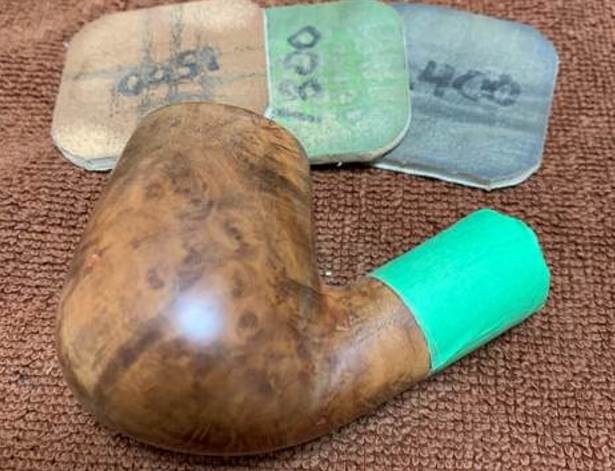
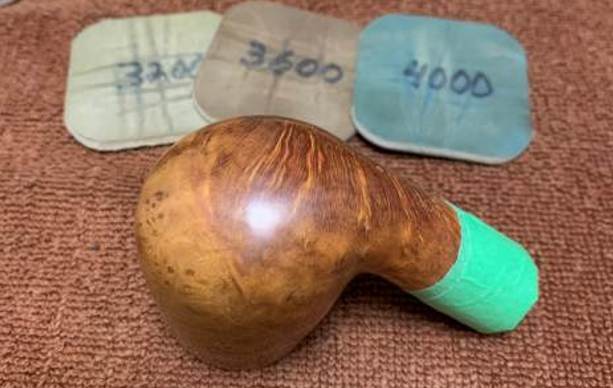
First, the before pics of the dress version.  I never blogged it because I was not happy with the rim work.  I’ve blogged one or two of my failures as cautionary tales, but not this one.Now for the carnage my roommate dumped on me.  This may be the most tortured pipe I have ever encountered.  CAUTION: The following images may be unsuitable for children or squeamish pipe smokers.In most cases, I soak the stummel in Isopropyl alcohol, but this time I chose Everclear to strip the homemade shellac I made for the dress process and the black leather dye beneath it – although not much of either appeared to remain.  I gave the stem a bath in generic stain remover. The stem came out in great shape, but the stummel less so. I used super fine 0000 steel wool to take off the residue from the Everclear soak.  This is when I could discern Filter Pipe.A full micro meshing sharpened the nomenclature and revealed the wood’s rich brown, if erratic, grain. I would like to know just how someone would go about inflicting such damage on a rim, but I couldn’t very well ask my roommate.  In the past, I have been somewhat successful with reversing mangled rims.  In one of the prior cases, for example, I resorted to a rasp.  Here are the before, during and after shots of that pipe, a P&K Everyman.I learned the importance of sanding, filing or grinding in the right direction. To narrow a rim, I move whatever tool I use with, or in the same general direction as the rim’s wall; to widen the rim, I move the tool against the rim, from the chamber outward. Try as I did to avoid resorting to extreme measures to make the Hardcastle rim right again, the time came to use my electric grinder. My main concern with making the misshapen rim at least more even and round again by putting it to an electric sanding wheel was the potential for irreversible damage in a heartbeat. Not being one to avoid a challenge, I went for it. I dare anyone reading this not to laugh at the last photo below. Believe it or not, the wheel sander did what I needed: it made the rim almost level.  I knew I could fix that problem a little later.

The pre-retort cleaning of the stummel and stem required more regular cleaners and a brass-handled brush with wire bristles, similar to the one below, both dipped in Everclear.  At least my roommate enjoyed the pipe while beating it.  The retort needed three test tubes of alcohol to come out clear.Notwithstanding the relative roundness of the rim, I knew I had to fill the preexisting indentation in the upper corner of the inner wall as shown in the post-electric sander pic.  I did something similar once, but again, I found the solution in one of Steve’s blogs on correcting an off-round rim. I filed off briar shavings from a hopeless pipe and mixed them with Super Glue, then applied the goop to the problem area inside the chamber.  It isn’t pretty, but it worked. Several hours later, I sanded down the remaining hard mess with 60-grit paper followed by a 120/180 pad. Several more hours later, I had reached the point where I knew I could not do better and sanded and micro meshed the stummel in preparation for staining.  I used British tan on the rim and moccasin brown on the rest, then micro meshed off the char with 1500, 8000 and 12000 pads.  That’s a good combination for a subtle contrast.I buffed the stummel with Red Tripoli and carnauba and was finished. SOURCES
https://www.worthpoint.com/worthopedia/hardcastle-filter-pipe-164105369
http://www.pipephil.eu/logos/en/logo-hardcastle.html
https://rebornpipes.com/2017/07/20/another-piece-pipe-history-a-lovely-cpf-french-briar-bent-billiard/

What A Beautiful Triangular Shank Oscar Aged Briar 123 Pot


Blog by Steve Laug

This older Savinelli Made pipe has been in my restoration queue since we picked it up from an antique store on 04/08/17 in Stevensville, Montana, USA. It is a beautifully grained pot shaped pipe with a triangular shank. It was stamped on the left side and read Oscar [over] Aged Briar. On the right side it was stamped with a Savinelli Shield S and next to that is the shape number 123 [over] Italy. On the underside of the shank it is stamped Savinelli [over] Products. The grain was quite nice peeking through the ground in grime on the briar. The bowl had a thick cake and there was some lava on the beveled inner rim of the top. The rim top was quite clean but there was a large putty fill on the right side toward the back of the bowl. The vulcanite stem was dirty and had some sticky substance from a gum label near the shooting star logo on the left side of the taper stem. There was some light tooth chatter near the button and some light oxidation. Jeff took photo of the pipe before he started his clean up work on it. I have included them below. He took some photos of the rim top to show the condition. You can see the light lava coat on the back side of the bowl top and on the beveled inner edge of the bowl. You can also see the putty fill on the rim top on the lower right side of the photos below. He also took photos of both sides of the stem to show the condition of both. He also took photos of the heel of the bowl and underside of the shank to show the birdseye grain that is clustered on the bowl. It is quite a stunning pipe. You can also see the small fill on the lower front of the bowl.Jeff took photos of the stamping around the shank sides. It is clear and readable as noted above. You can also see the shooting star Oscar logo on the left side of the stem. I turned to Pipephil’s site to learn about the Oscar (http://pipephil.eu/logos/en/logo-savinelli3.html). I did a screen capture of the section and also included the note from the side bar on the site. I quote from the side bar: Pipes from the Oscar line are not free from fillings. See also (same star logo): Savinelli Antique Shell, Savinelli Garda, Savinelli Sila.

From Pipephil I knew that the line had notable fills. The pipe I was working on had fills on the top and the front of the bowl.

I turned to Pipedia to the link on the shape chart for Savinelli pipes looking to find the 123 shape number (https://pipedia.org/images/4/41/Sav_Shape_Chart_2017.jpg). I have included the shape chart below. I have drawn a red box around the 123 Shape. The article on Pipedia is a great history of the brand and the Oscar is listed in the various lines.Jeff had reamed the pipe with a PipNet Pipe Reamer and cleaned up the remnants with a Savinelli Fitsall Pipe Knife. He scrubbed the bowl with undiluted Murphy’s Oil Soap with a tooth brush. He rinsed it under running warm water to remove the soap and grime. He cleaned out the inside of the shank and the airway in the stem with alcohol, cotton swabs and pipe cleaners. He soaked the stem in Before & After Deoxidizer and rinsed it off with warm water. I took photos of the pipe once I got around to working on it. The rim top looked very good. There were some nicks in the outer left backside of the rim. The beveled rim top was in excellent condition. There was a large putty fill on the rear right top side of the rim that I have circled in the photo below. The stem surface had some light chatter on both sides near the button. I took photos of the stamping on the shank sides. The stamping is clear and readable as can be seen from the photos. You can also see the shooting star on the left side of the stem. I removed the stem and took a photo to give a sense of the grain and a look of the whole. The photos also show the aluminum inner tube in the end of the tenon. It is anchored and made to stay in place in the stem.I started my work on the pipe by cleaning up the fill on the rim top. I was able to even out the fill with a spot of super glue. I filled in the fill on the front of the bowl with clear super glue at the same time. Once it cured I sanded it with a folded piece of 220 grit sandpaper to blend it in. I polished the bowl and the rim top, sides and shank with micromesh sanding pads – dry sanding with 1500-12000 grit pads and wiping it down after each pad with a damp cloth. I rubbed the bowl and shank down with Before & After Restoration Balm. I worked it into the surface of the bowl sides and shank with my fingertips to clean, enliven and protect the briar. I let the balm sit for 15 minutes and then buffed with a cotton cloth to raise the shine.   I set the bowl aside and turned to work on the stem. Since it was in good condition I did not have to sand out tooth marks. I polished the vulcanite stem with micromesh sanding pads – 1500-12000 grit pads. I wiped it down with a damp cloth after each sanding pad. I used Before & After Pipe Polish – both Fine and Extra Fine to further polish the stem. I gave it a final coat of Obsidian Oil and let it dry. This Savinelli Product Oscar Aged Briar 123 Triangle Shank Pot with a vulcanite taper stem is a great looking pipe now that it has been restored. I put the stem back on the bowl and carefully buffed the pipe with Blue Diamond on the buffing wheel using a light touch on the briar. I gave the bowl and the stem multiple coats of carnauba wax on the buffing wheel and followed that by buffing the entire pipe with a clean buffing pad. I hand buffed the pipe with a microfiber cloth to deepen the shine. The finished Oscar Aged Briar 123 Pot is another one that is comfortable in the hand and feels great. Give the finished pipe a look in the photos below. The dimensions of the pipe are Length: 5 ½ inches, Height: 1 ½ inches, Outside diameter of the bowl: 1 ½ inches, Chamber diameter: 7/8 of an inch. The weight of this pipe is 40 grams/1.41 ounces. If you are interested in adding this pipe to your collection I will be adding it to the rebornpipes store in the American Pipemakers section. Send me a message or an email. Thanks for reading this blog and my reflections on the pipe while I worked on it. There are many more to come!