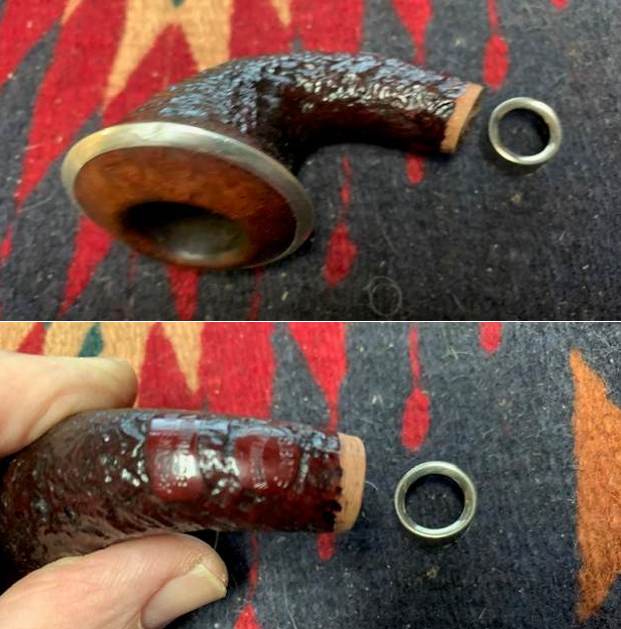
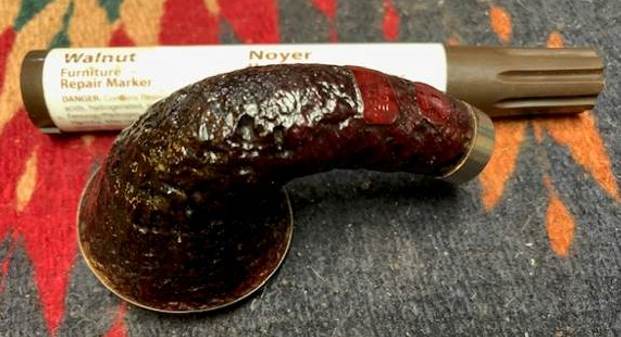
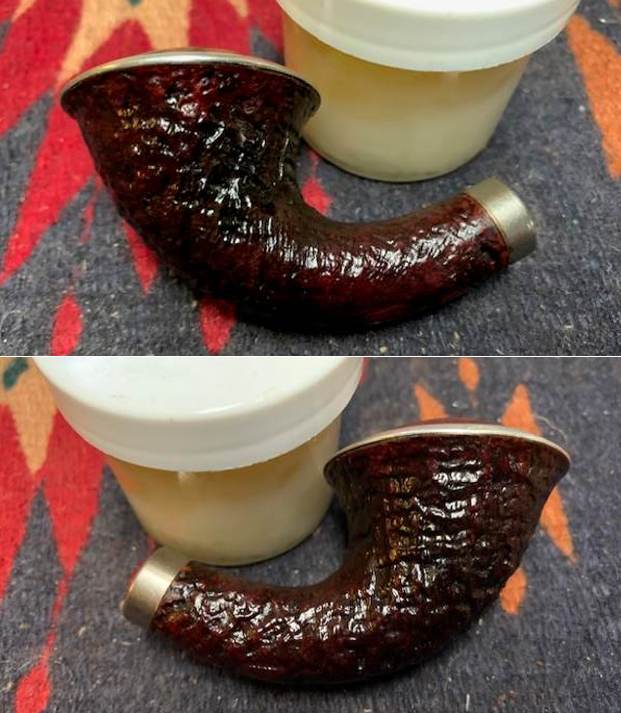
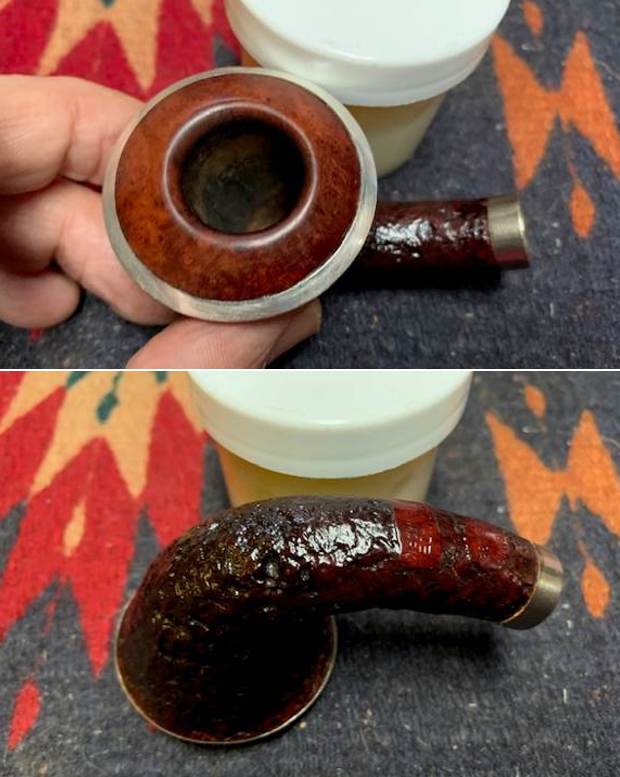
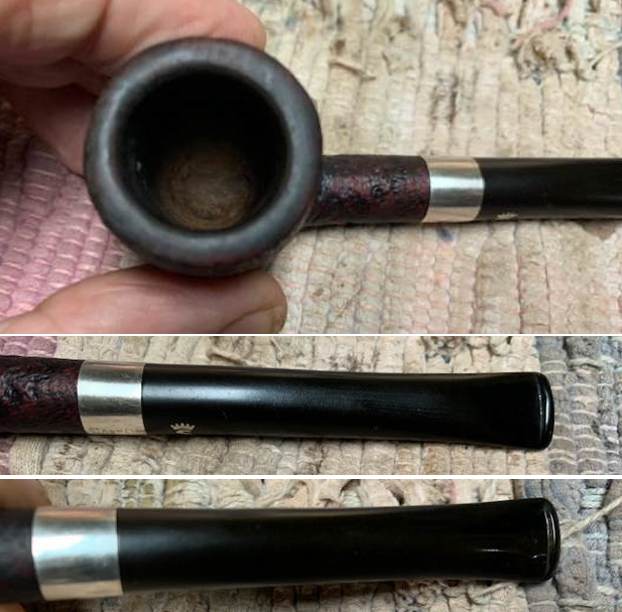
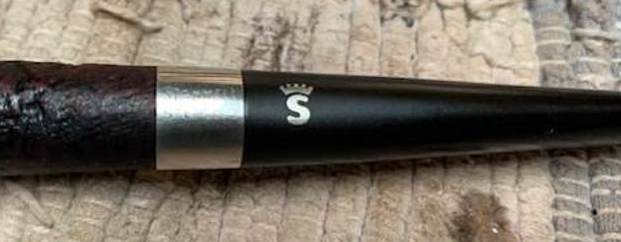
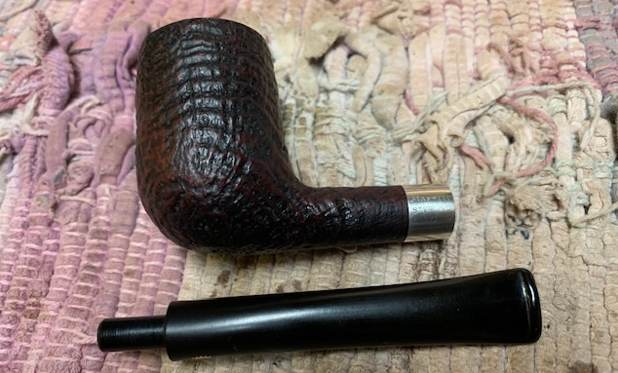
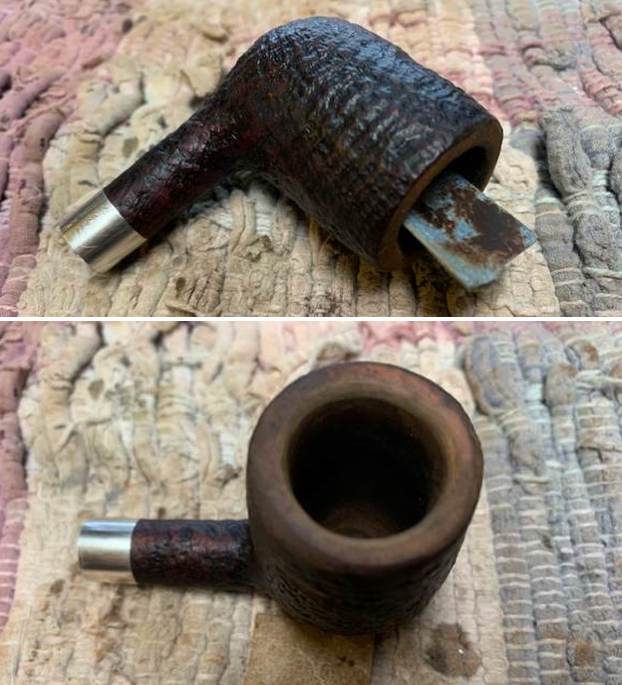
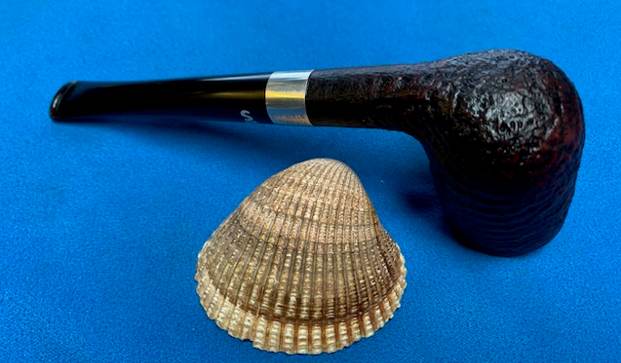
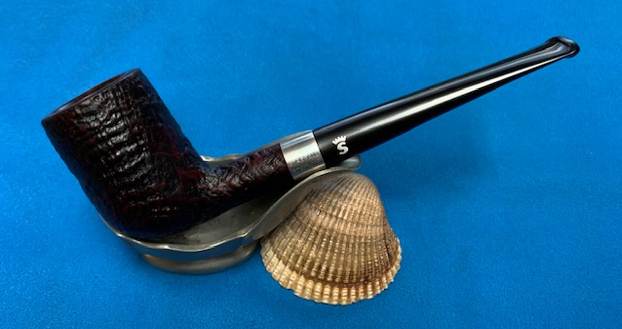
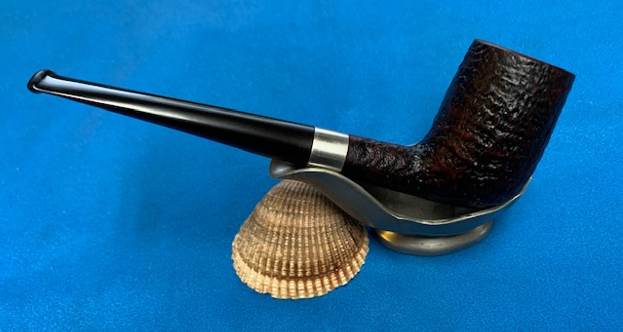
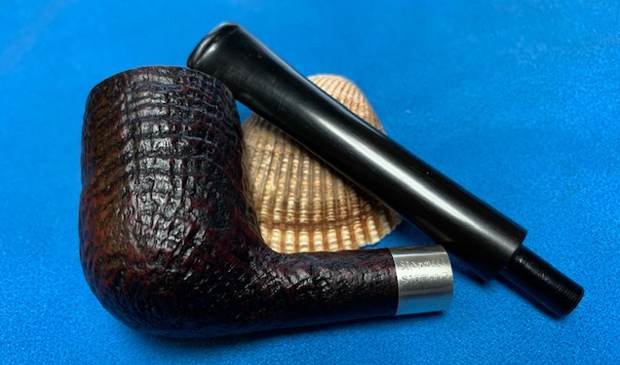
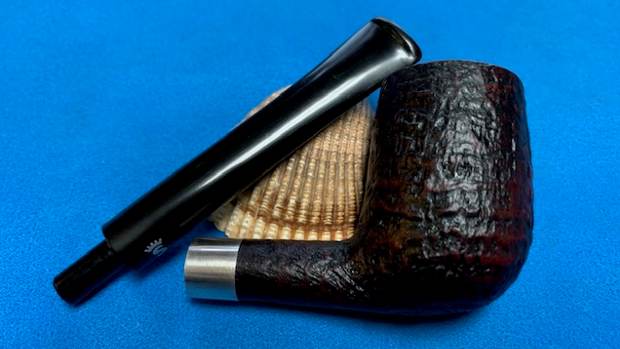
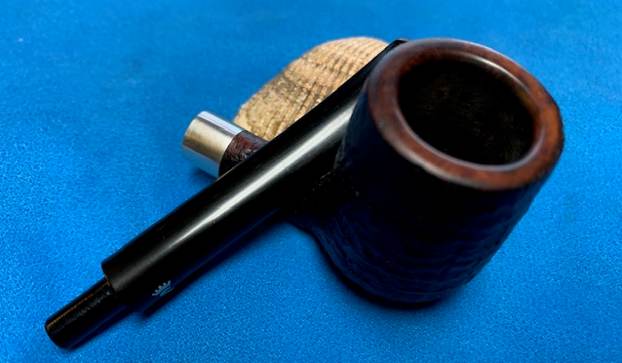
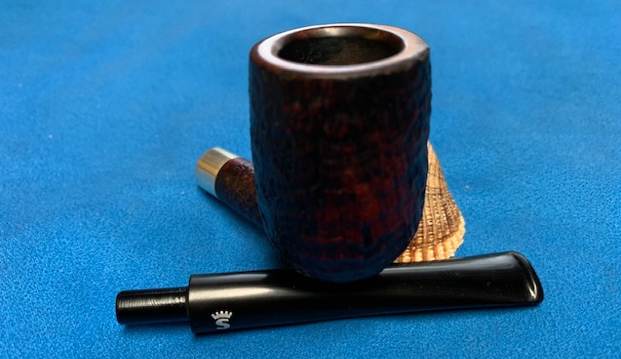
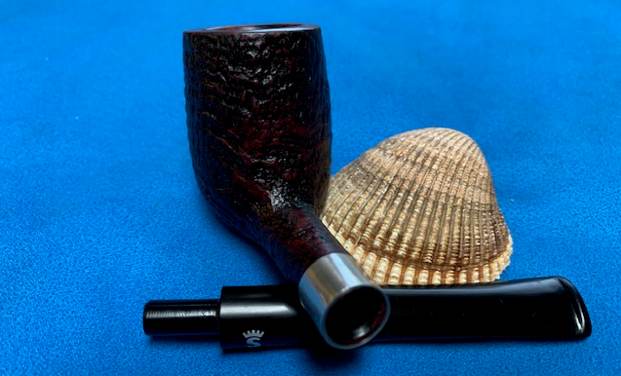
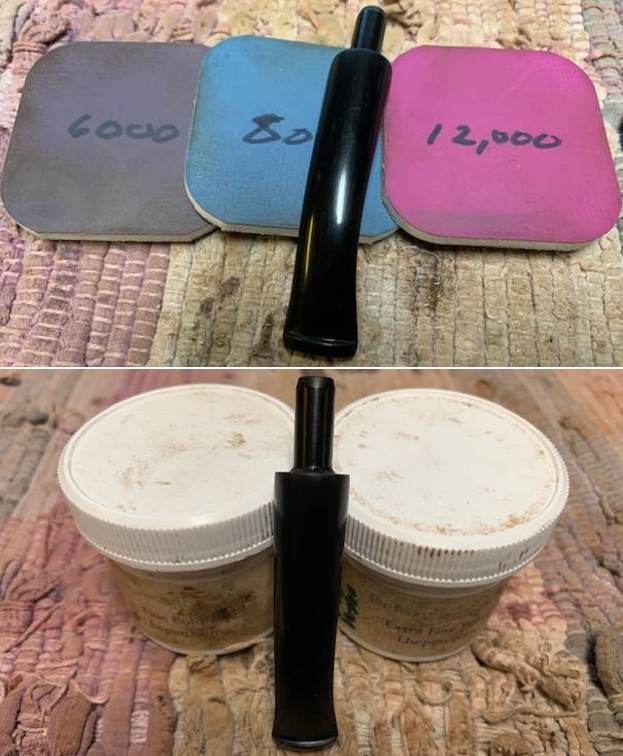
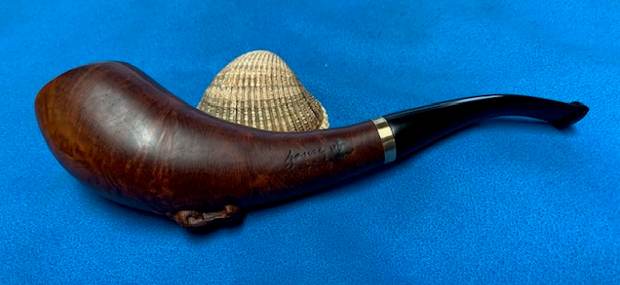
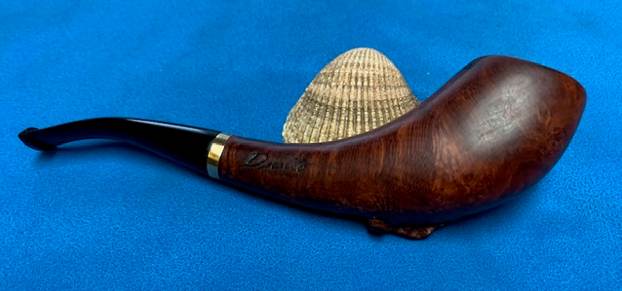
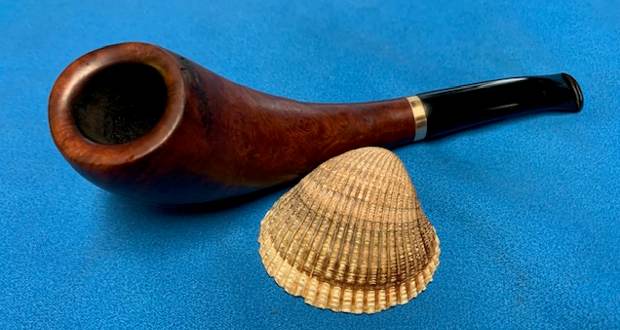
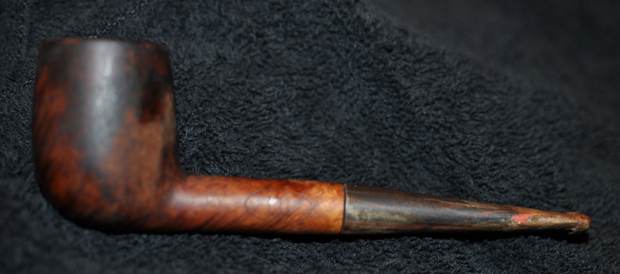
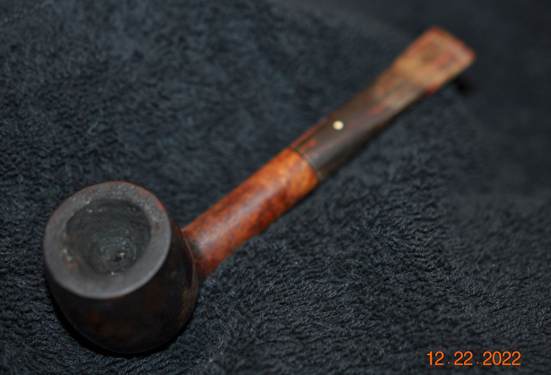
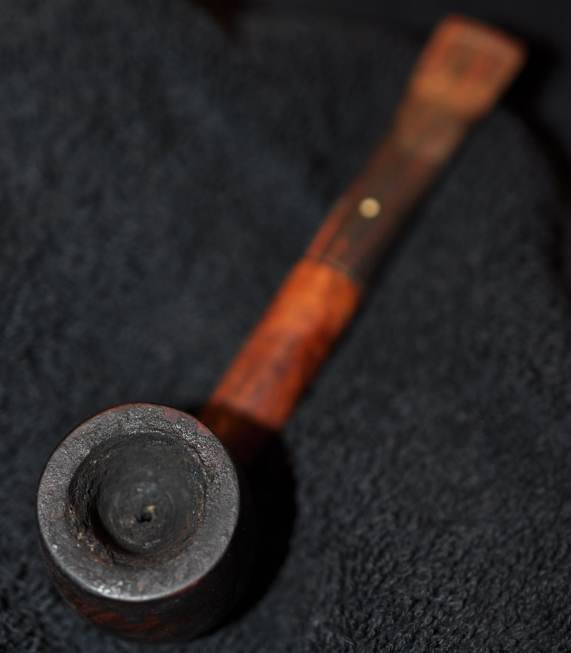
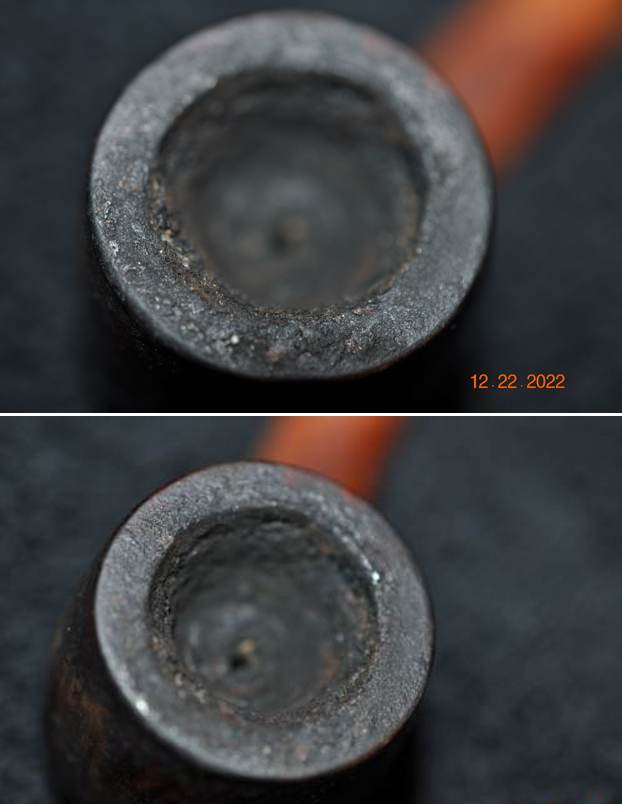
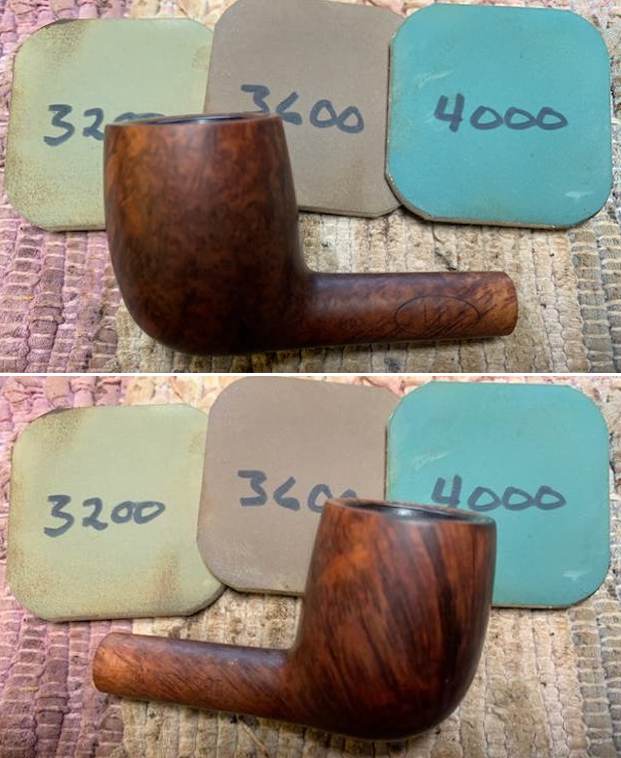
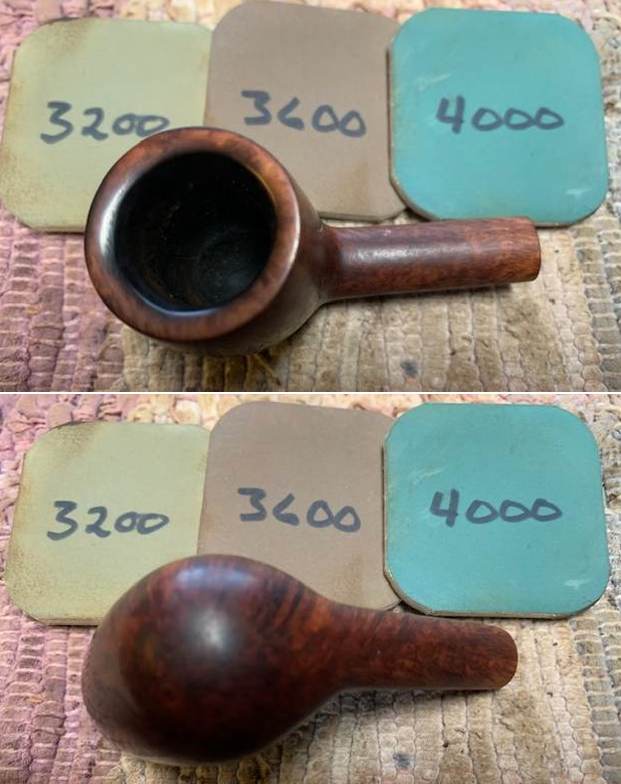
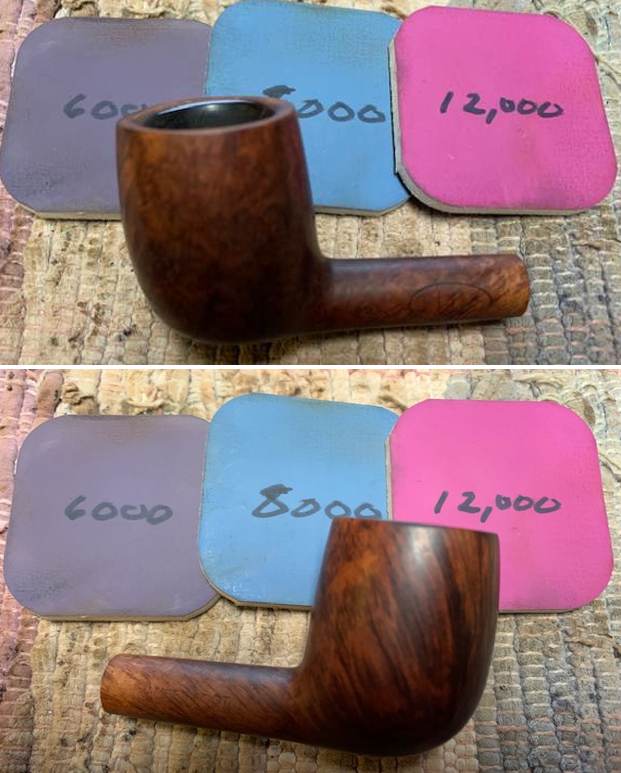
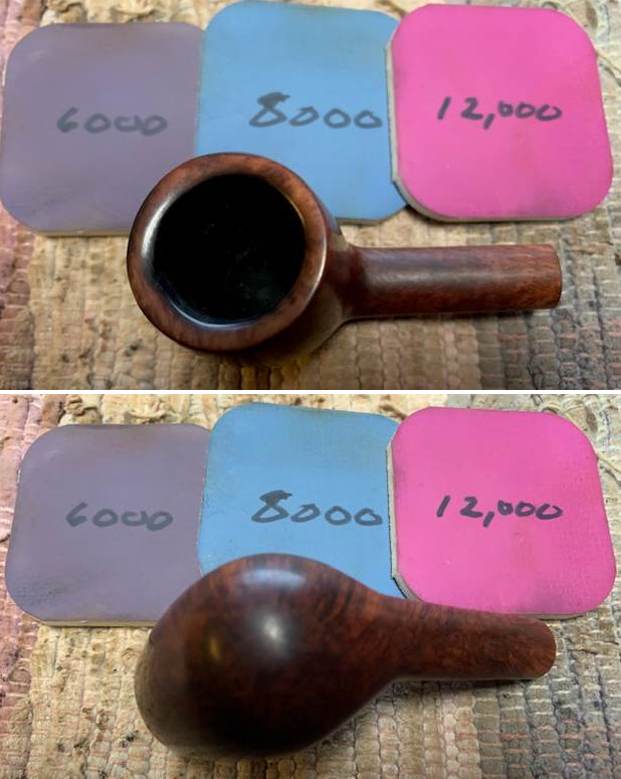
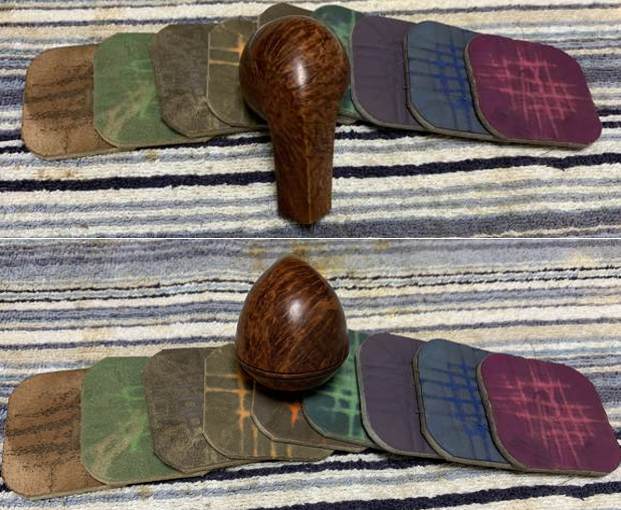
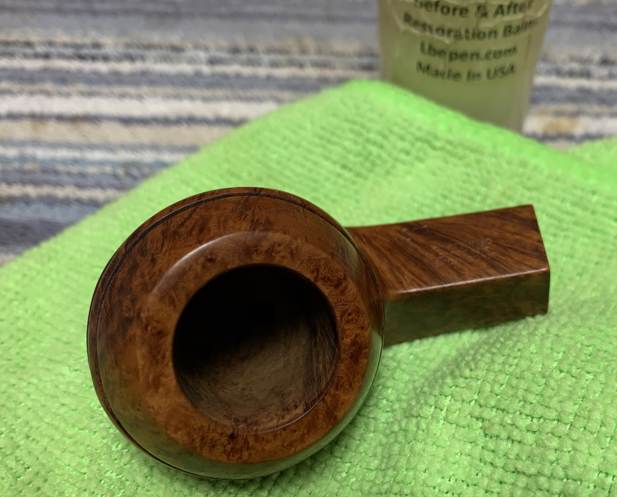
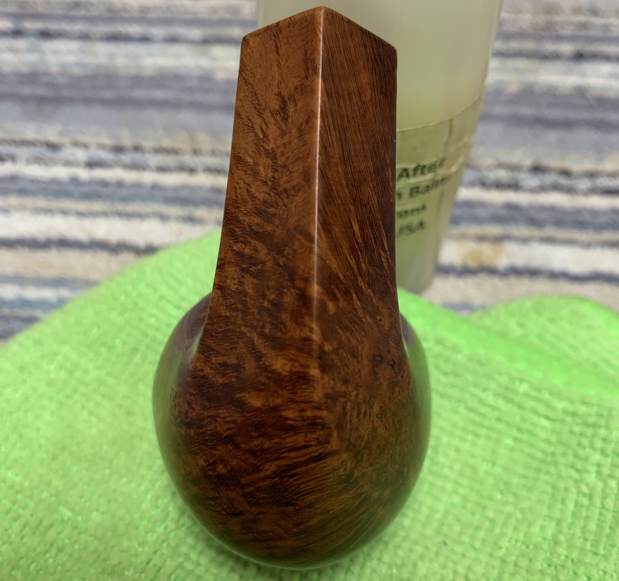
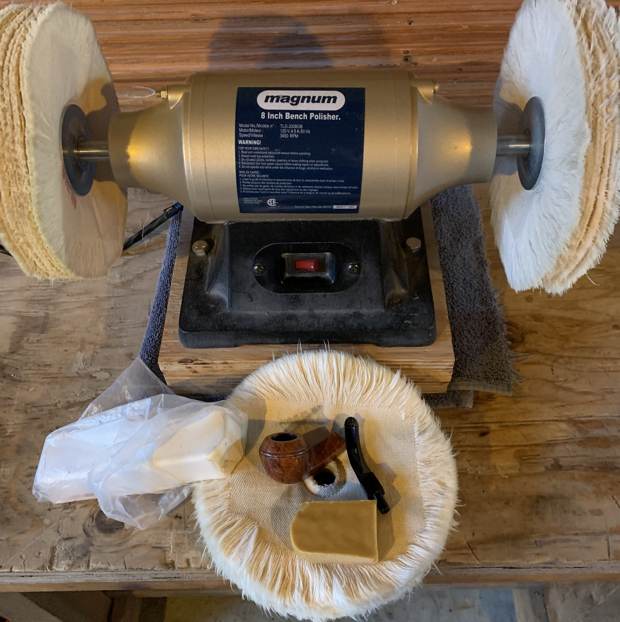
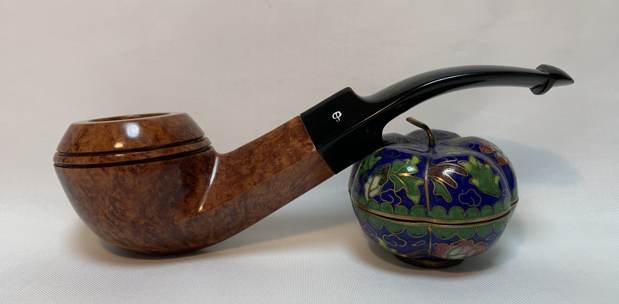
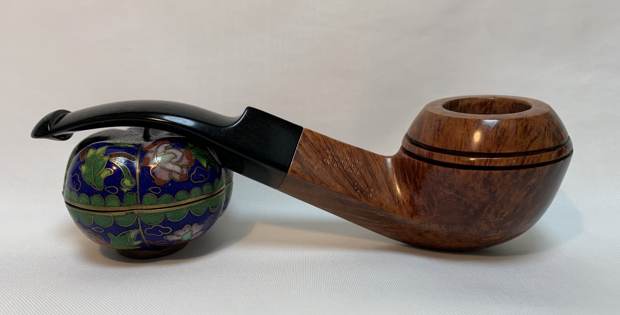
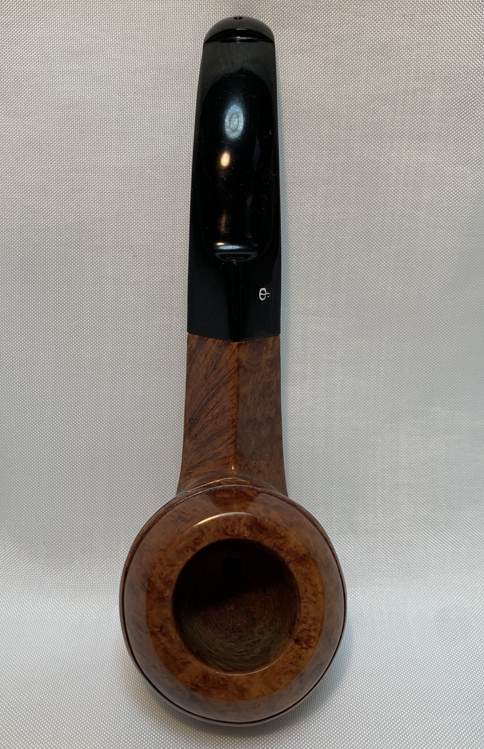
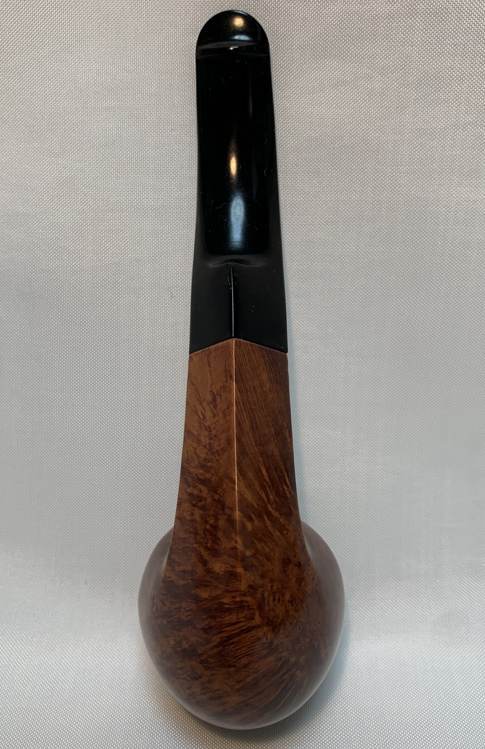
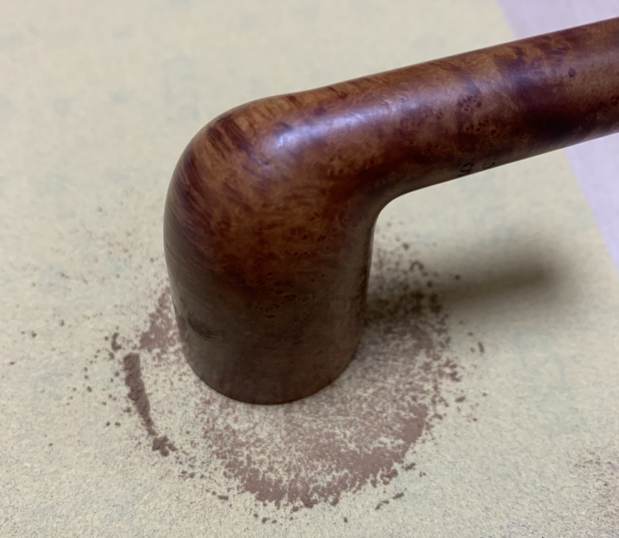
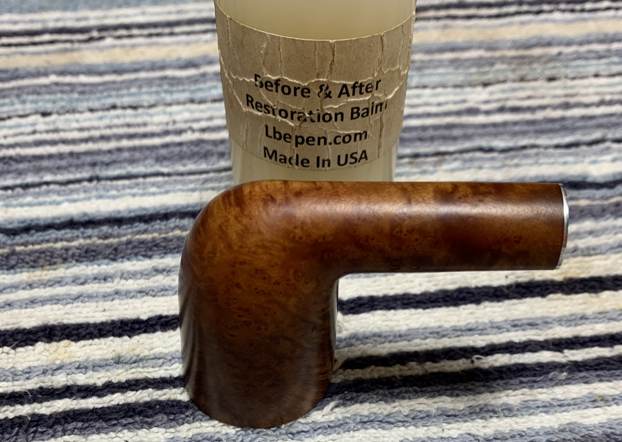
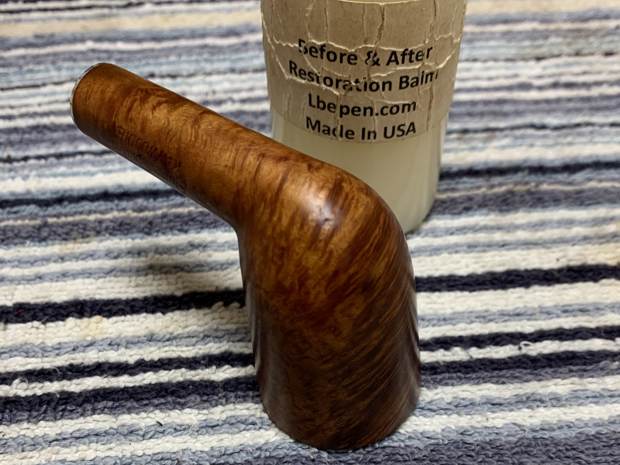
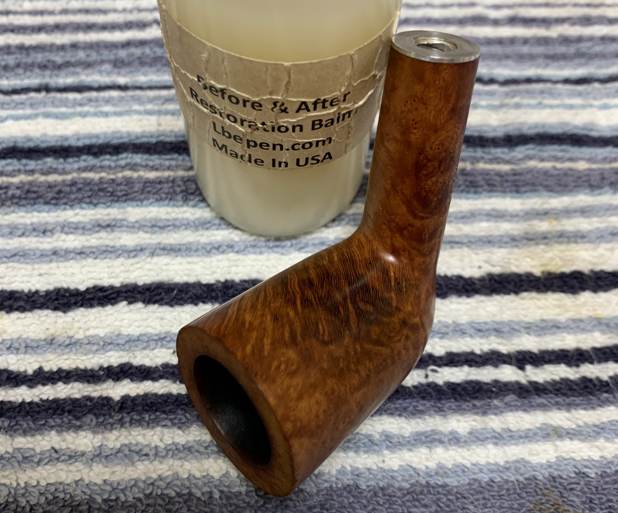
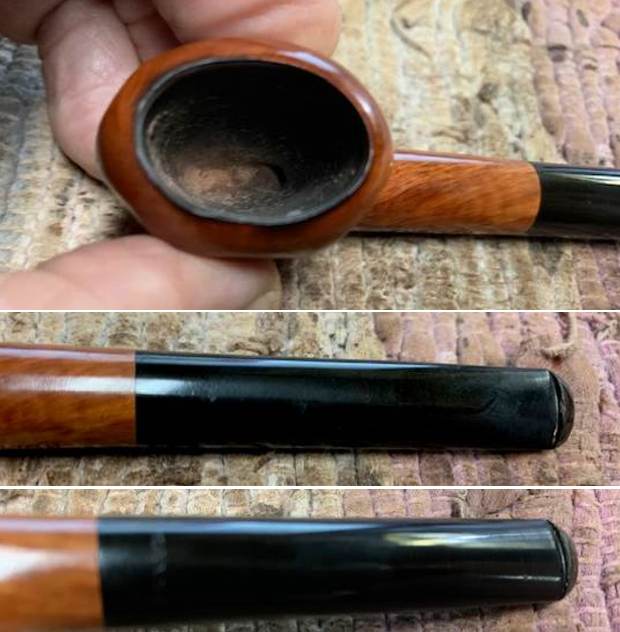
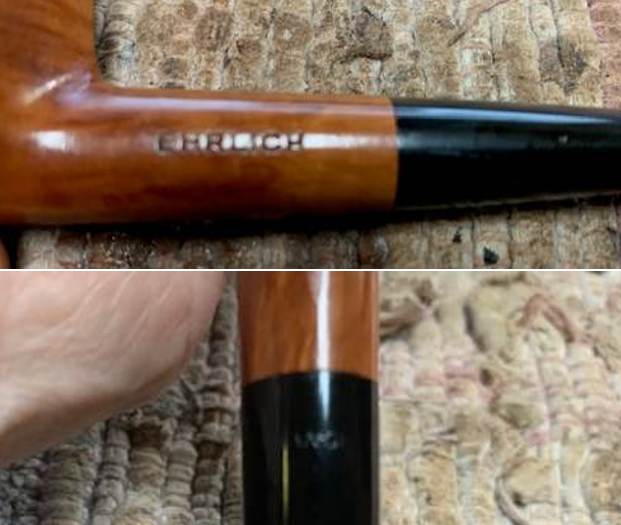
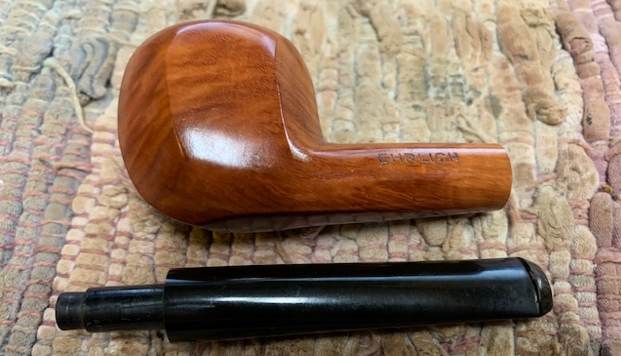
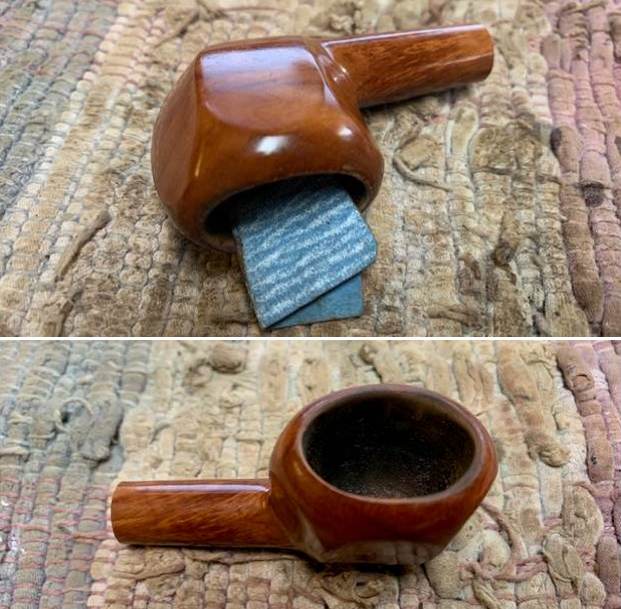
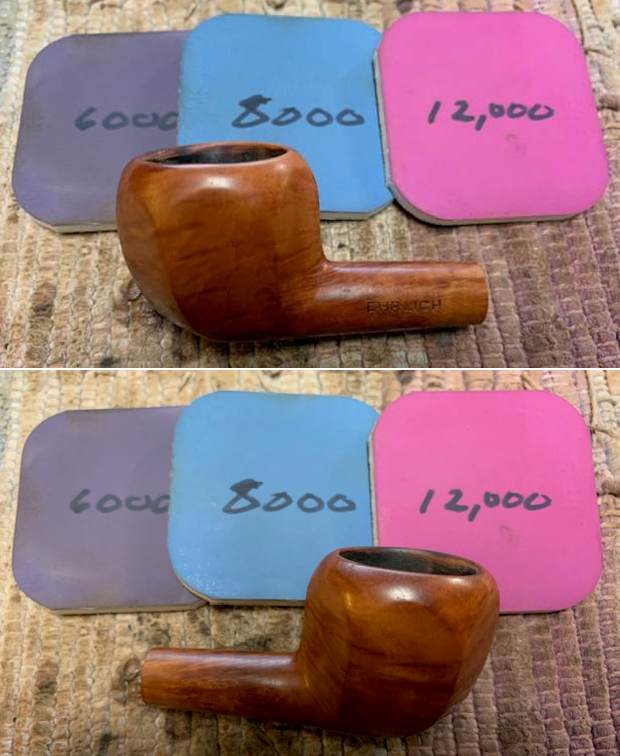
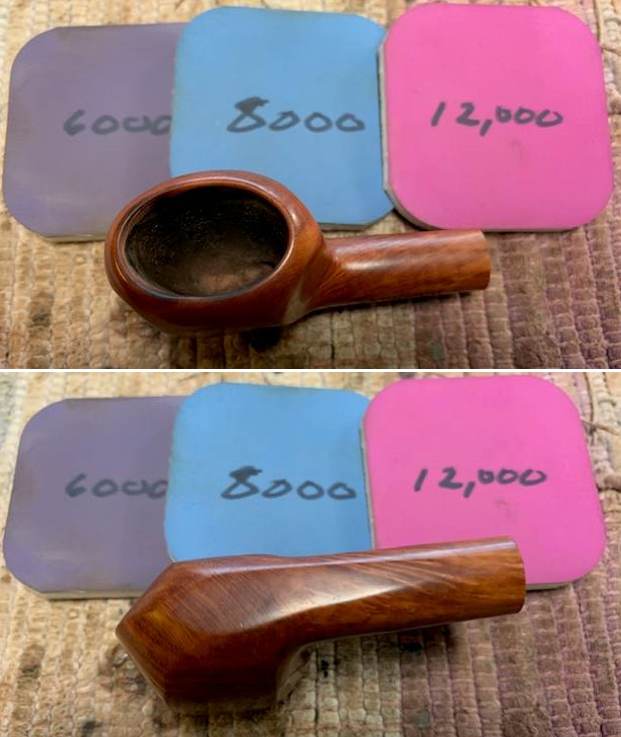
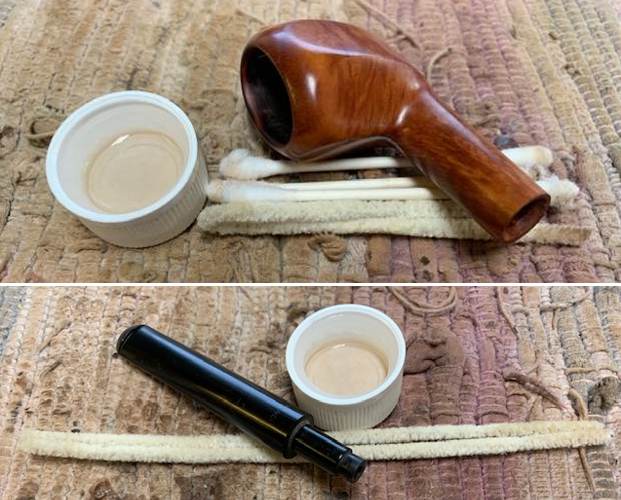
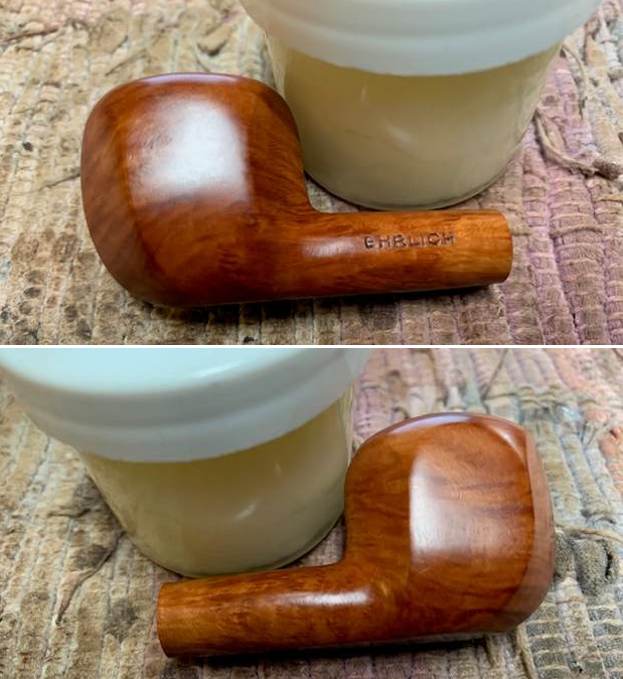
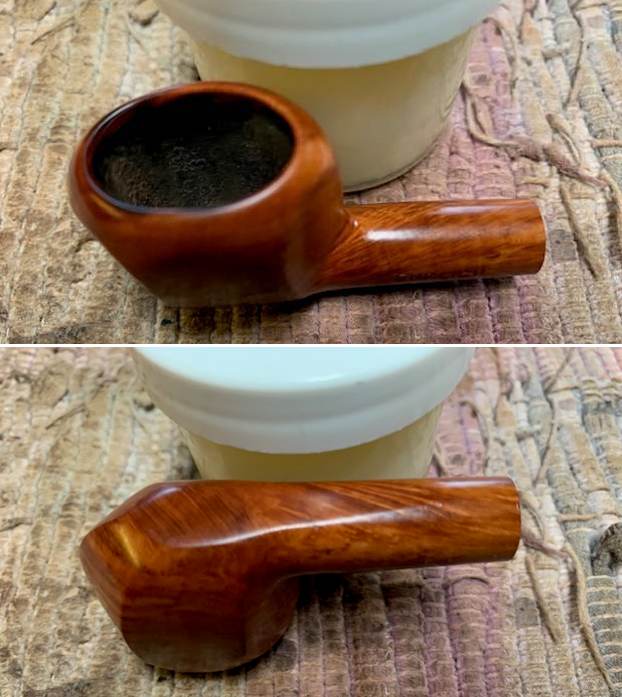
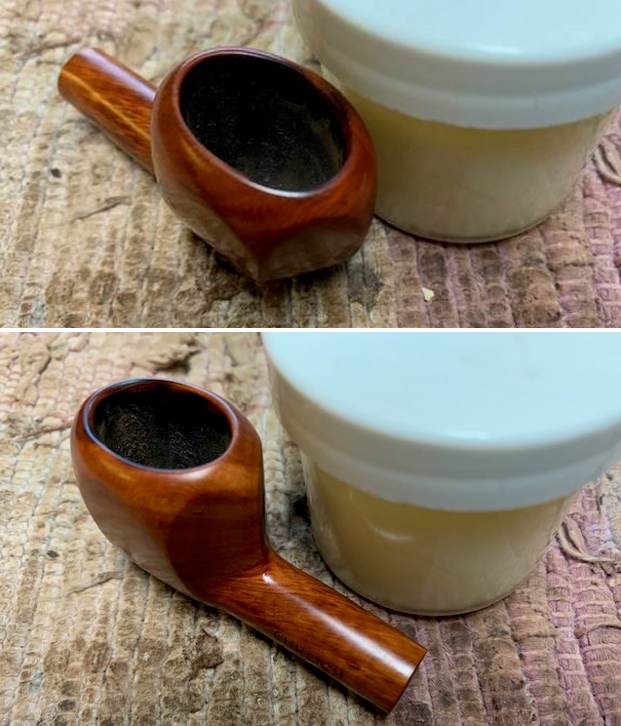
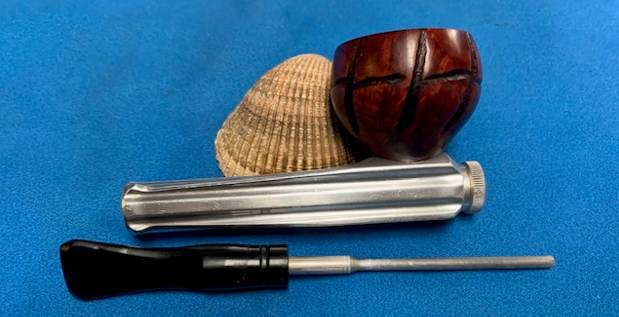
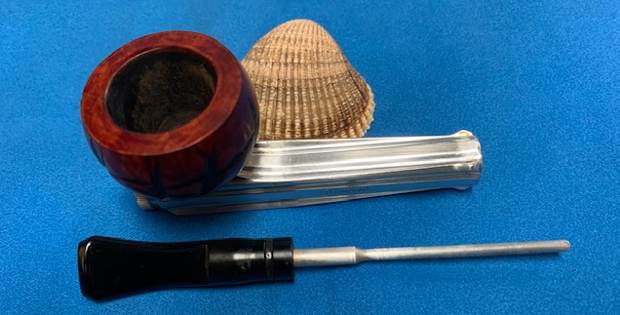
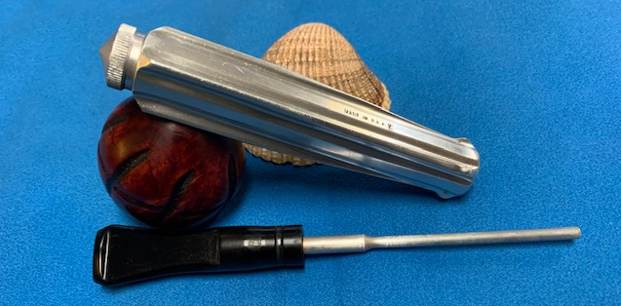
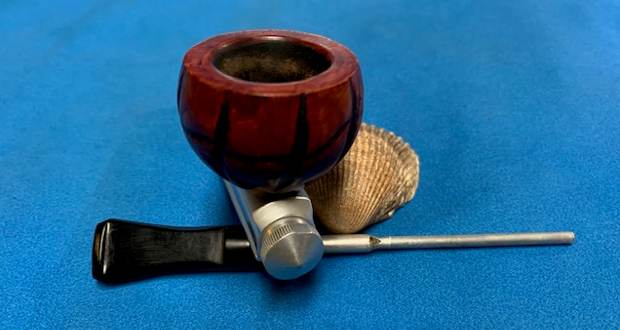
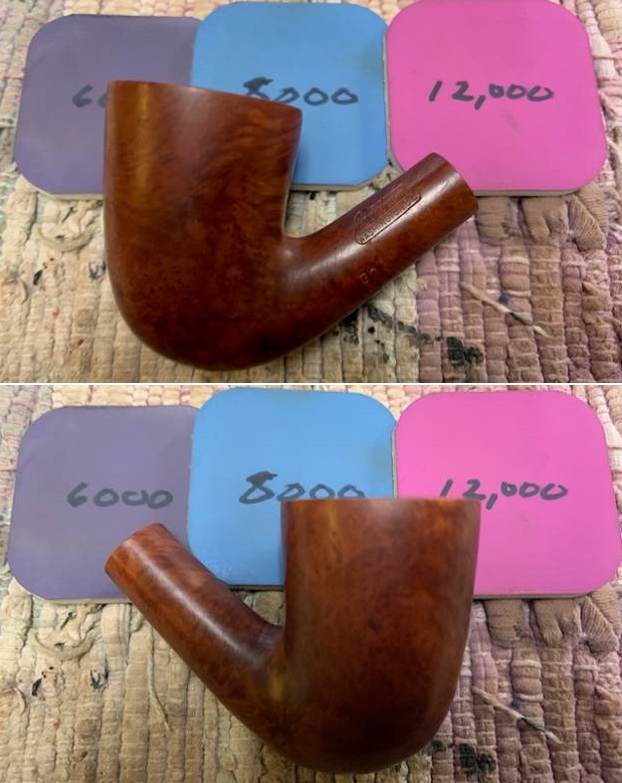
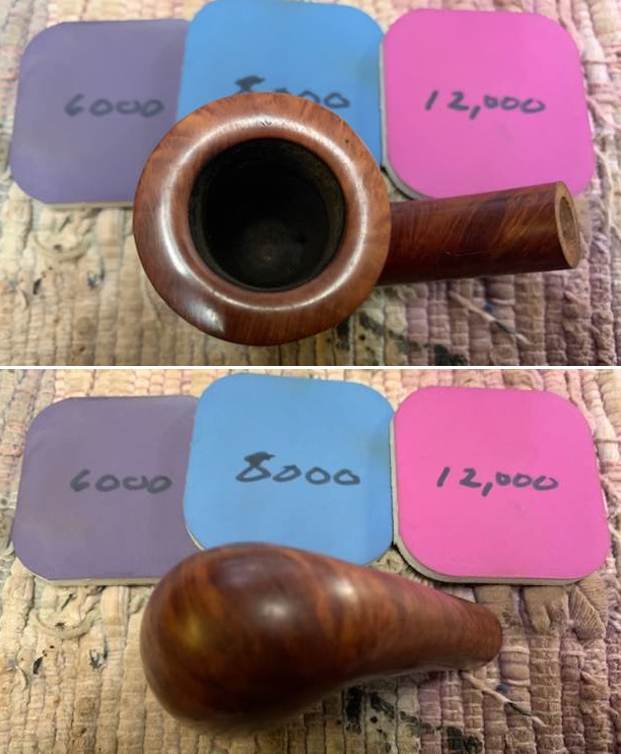
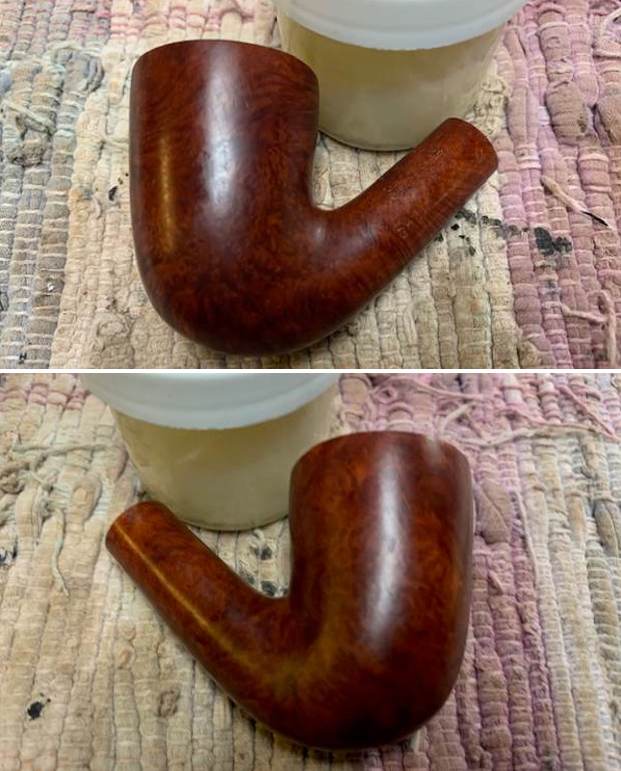
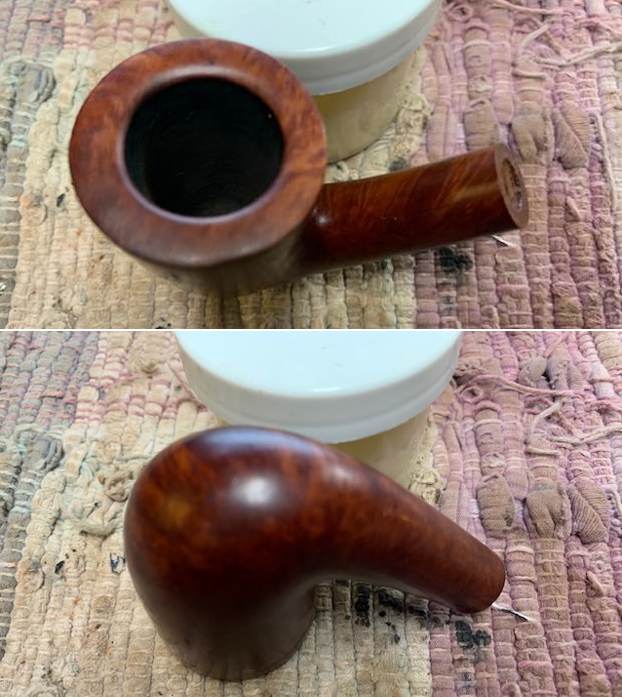
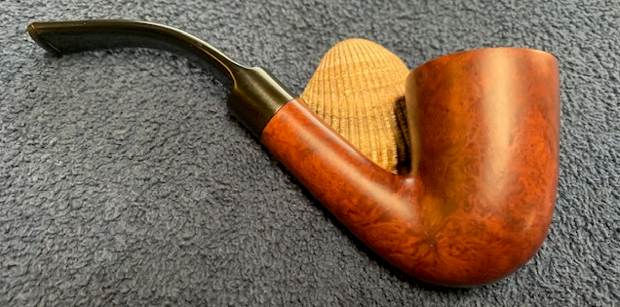
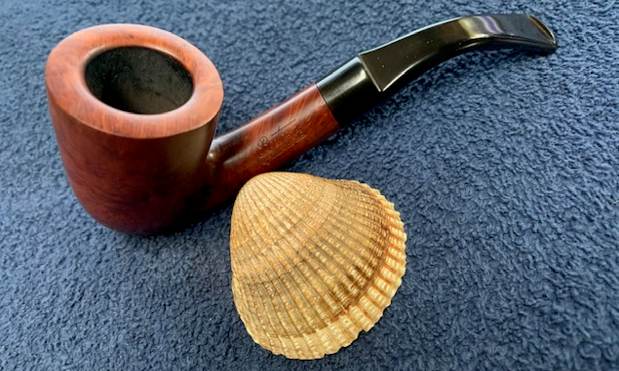
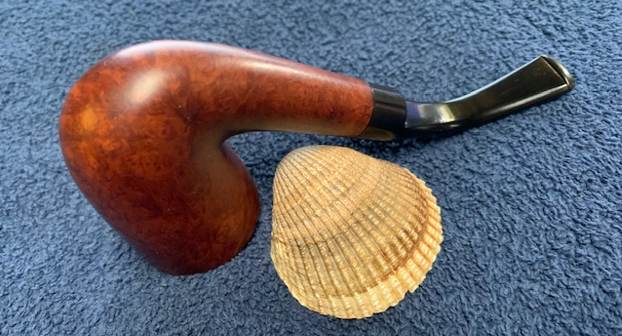
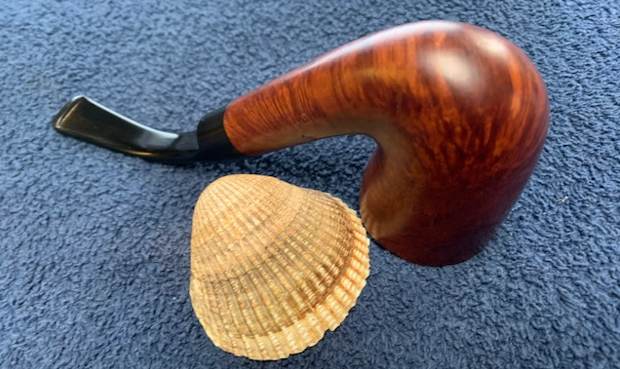
Tag Archives: bowl topping

Restoring a Peterson’s System 3 Bent Billiard 3170


Blog by Steve Laug

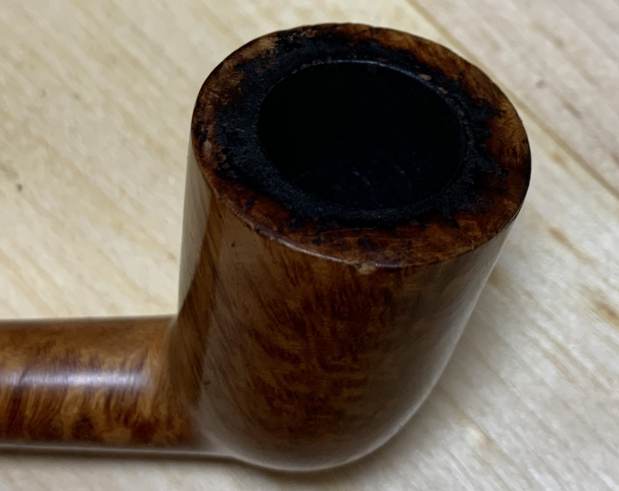
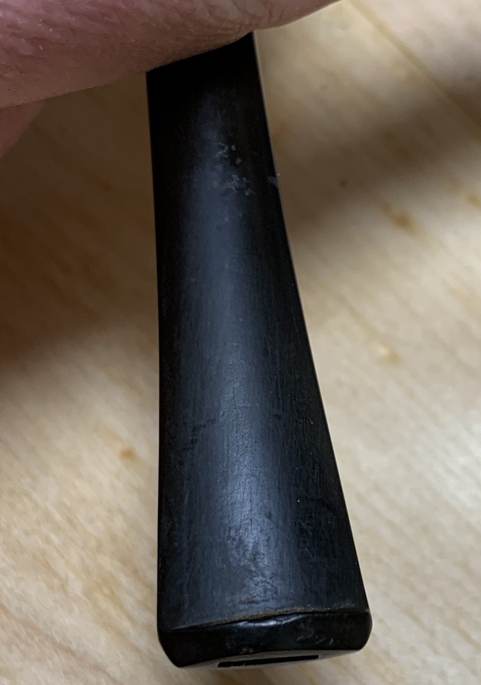
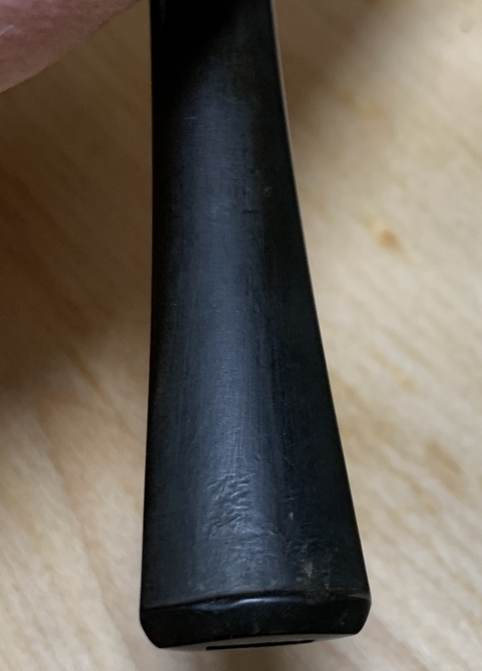
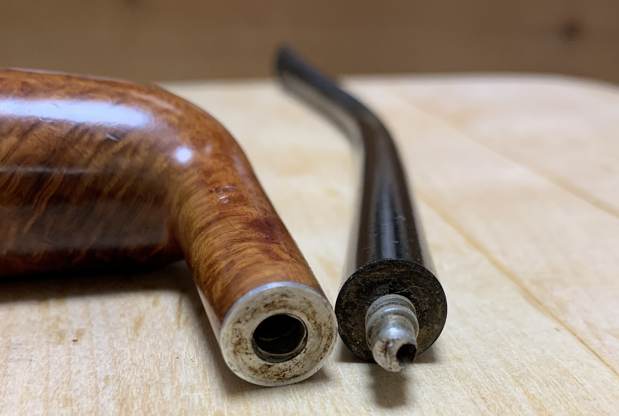
This is a pipe that I have taken out of my personal collection as I just do not use it too much. It is a classic Peterson’s System Bent Billiard shaped pipe with some nice grain around the bowl and a nickel ferrule. It is another pipe that I smoked solely Virginia tobaccos in so it is very clean. The inside of the shank, the system sump and the shank was quite clean. The smooth rim top has some damage on the inside edge of the bowl and is out of round. The smooth finish was very clean but dull and quite lifeless. The grain is mixed but still quite nice around the bowl and shank. The stamping on the shank is clear and readable. The left side is stamped Peterson’s [arched over] System [over] the number 3 in a circle. On the right side it was stamped with the shape number 3170. The nickel ferrule is dull but stamped K&P [over] three faux hallmarks [over] Peterson [over] Dublin. The stem was quite clean with no oxidation or tooth marks. I took some photos of the pipe before I started my work on it. I took close up photos of the bowl and the stem. You can see the light cake in the bowl and the darkening and damage on the inner edge of the rim top. The stem surface was clean and free of tooth marks or chatter on both sides. I took a photo of the stamping on the sides of the bowl and shank. It is clear and readable as noted above. I removed the stem from the shank and took a photo to give a sense of the proportions of the pipe. It is really quite nice looking. I turned to Pipedia (https://pipedia.org/wiki/Peterson) and read through the article there. It was a great reminder of the history of the brand.

I turned to “The Peterson Pipe” by Mark Irwin and Gary Malmberg to get some background on the Peterson’s System 0 Made in Ireland stamp. On page 301 of the book I found a listing on System pipes that referred to the 0-3 stamps. I quote:

System Pipes (1937-59) The 1937 catalog only slightly changed the grading hierarchy for System pipes. The De Luxe model, described as “the finished possible quality obtainable” would be assigned no grading subscript, but neither would the First Quality. Below these were 0 Grade, 2nd Grade and 3rd Grade, all stamped with numbers and PETERSON’S over SYSTEM or PETERSON’S over DUBLIN. Grades 0 and 2nd were fitted with sterling mounts, 3rd grade with nickel. Each of these grades were sometimes stamped below and sometimes to the right of the model name. Sometimes these numbers were circled, sometimes not. The location of the number and whether it was circled or not was rather random from the onset of its use until discontinued in 1959, and by itself only indicates that a given pipe was made between ’37 and ’59.  

On page 302 there was a listing on the nickel mounted markings. I quote:

Nickel-Mount Markings. Often called faux hallmarks or faux marks by Peterson collectors, this set of three little images of a shamrock, an Irish wolfhound and a round tower appear within rectangular shapes as decorations on nickel mountings. Very early nickel mounts (1891-c. 1920) had no such decorations, only the same stamps used on sterling but without the hallmarks. As a stamp, the set of decorations began to appear at the beginning of the Irish Free State era, sometimes alone but often under K&P and over block lettered PETERSON over DUBLIN, although the  three emblems appeared on K&P’s Irish Carving Shamrocks pipes since 1896. The stamp was used until about 1963, when hand soldered nickel bands and ferrules were replaced by pressed ferrules and premade bands…The shamrock is the emblem of Ireland; the Irish wolfhound has long been used for both hunting and protection, and is an emblem of strength; the round tower a symbol of Ireland’s early religious power. These decorations were stamped at the factory on non-sterling mounts only, and the assay office has nothing to do with…

The information was very helpful. I have highlighted the pertinent reference to regarding the stamping, the circle 3 number and the faux hallmarks above. I knew that I was dealing with a pipe made between 1937 and 1959.

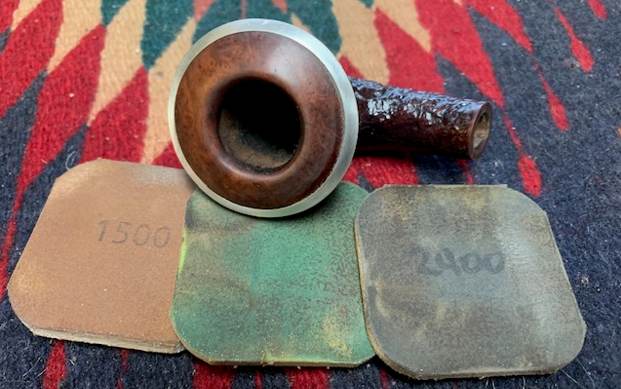
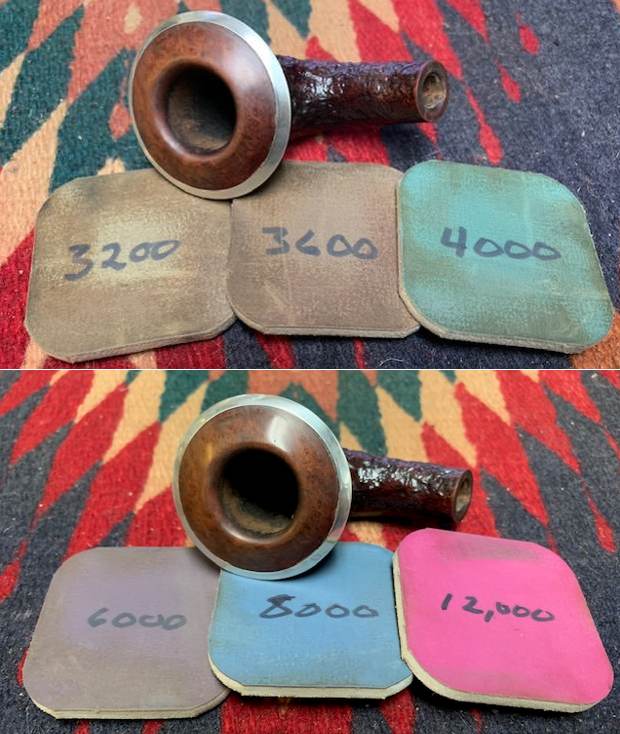
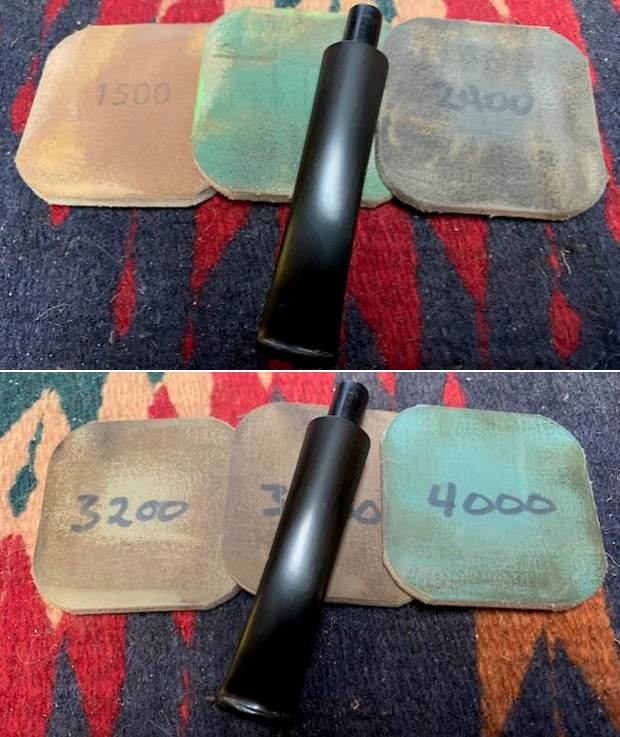
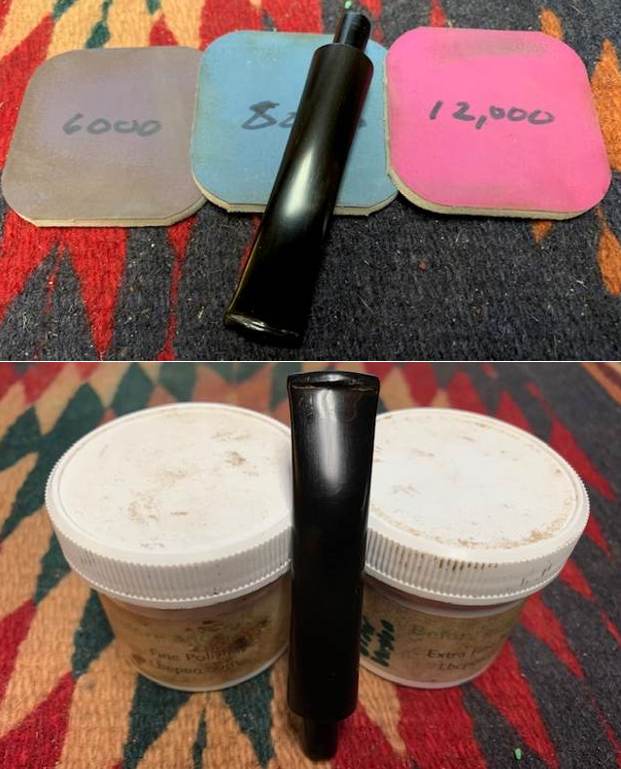
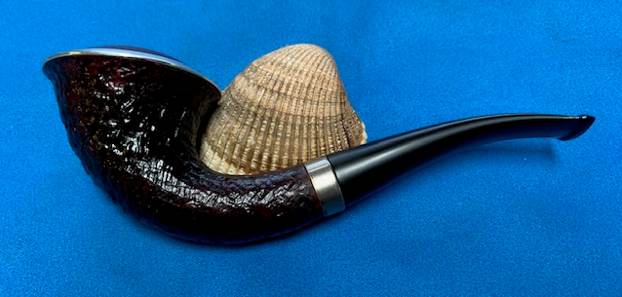
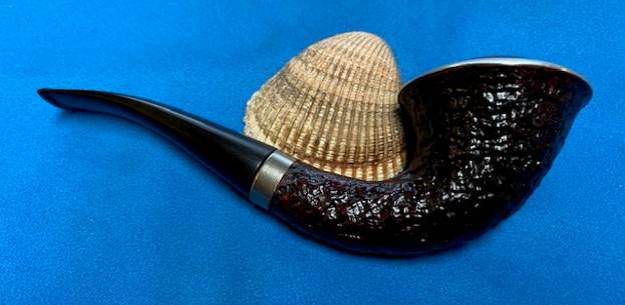
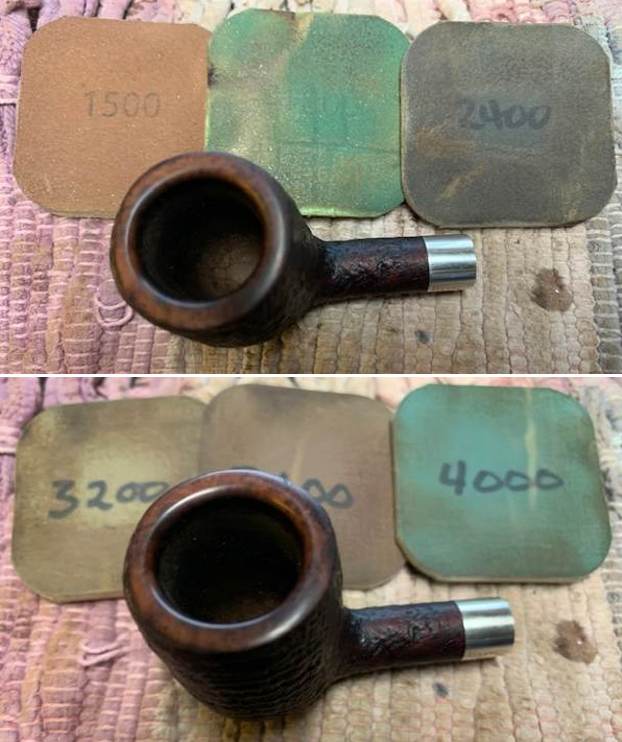
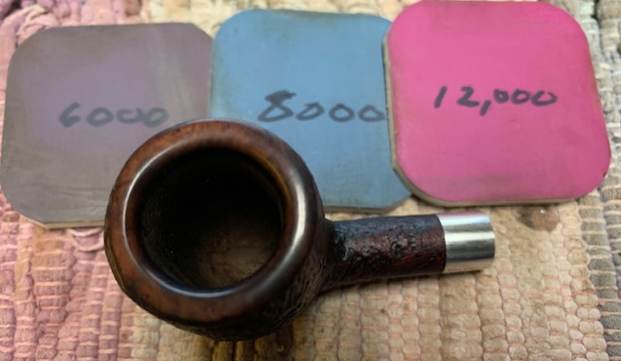
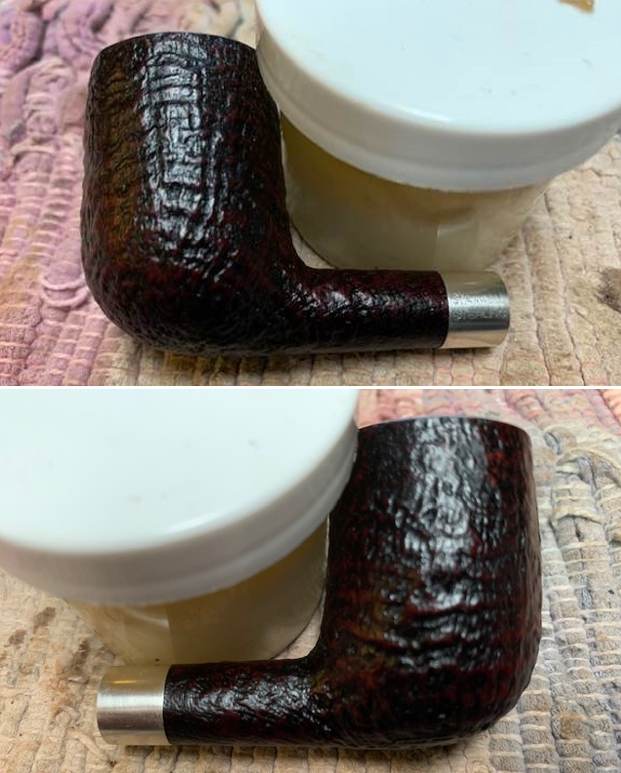
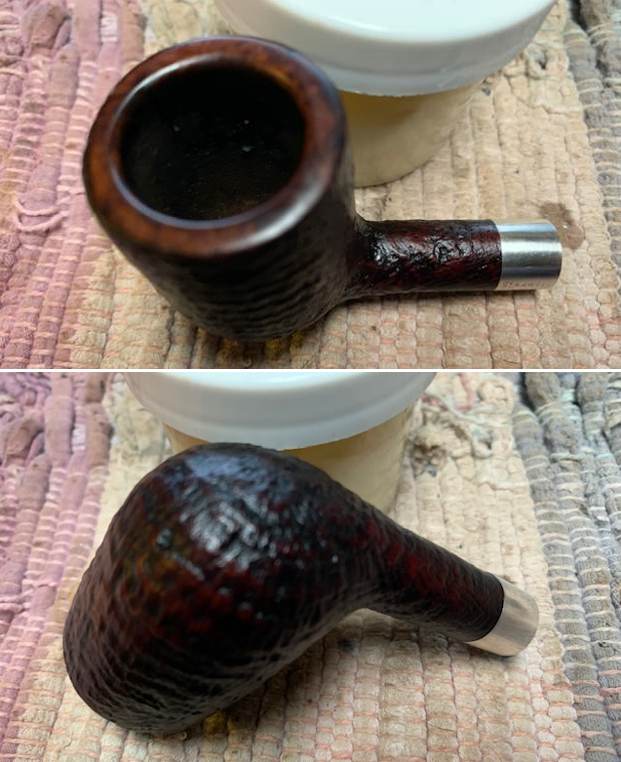
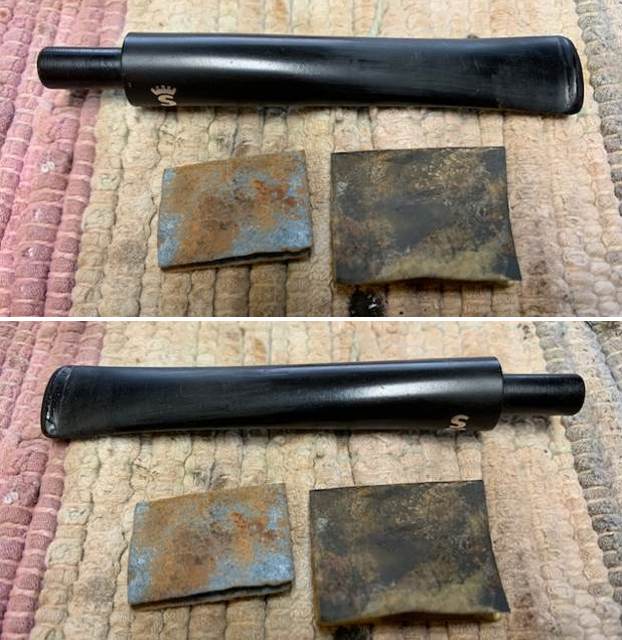
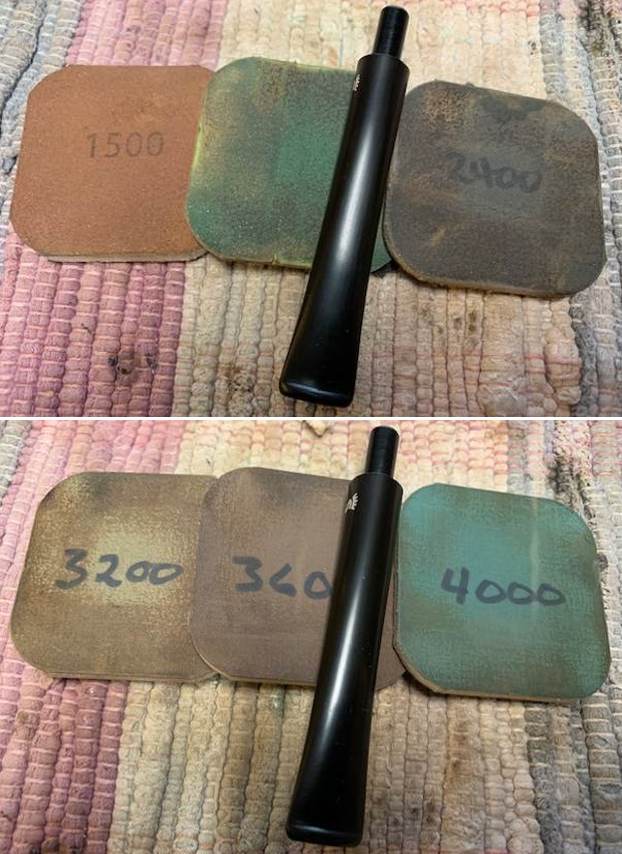
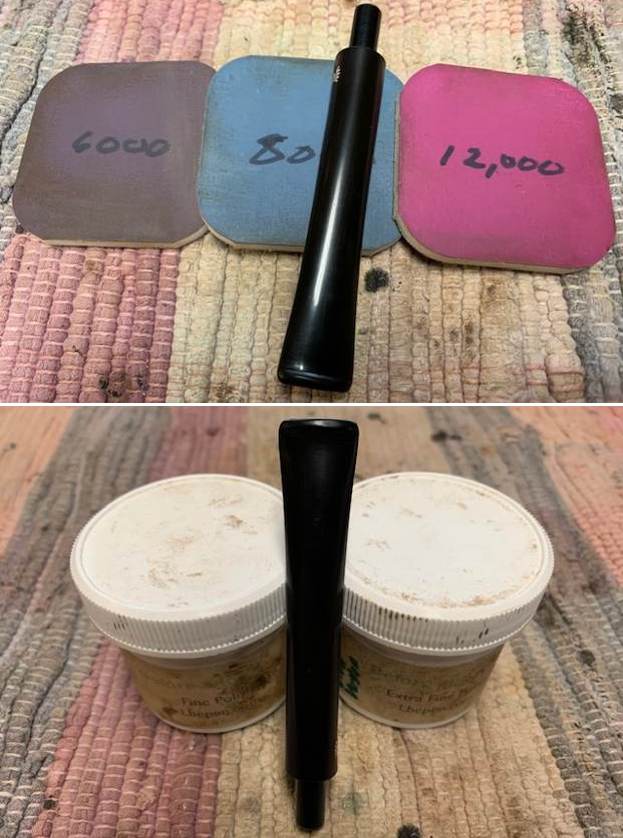
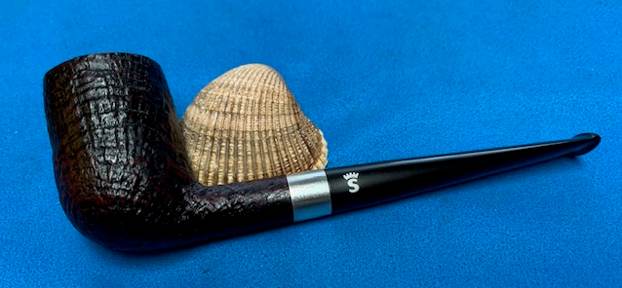
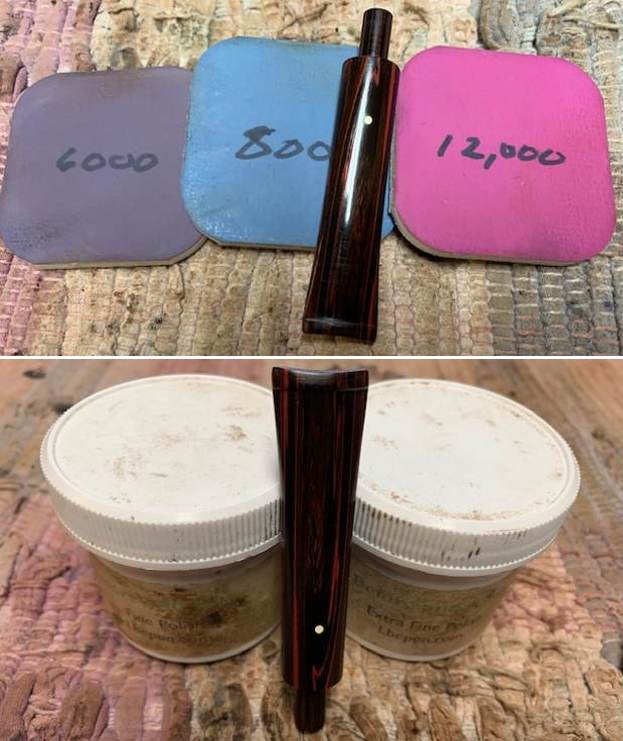
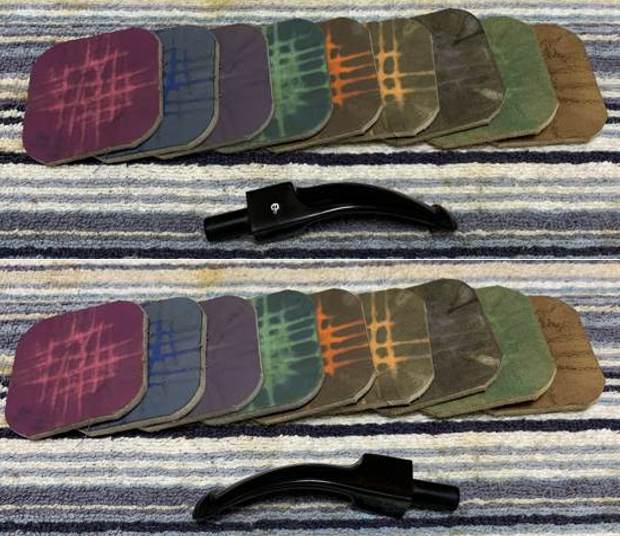
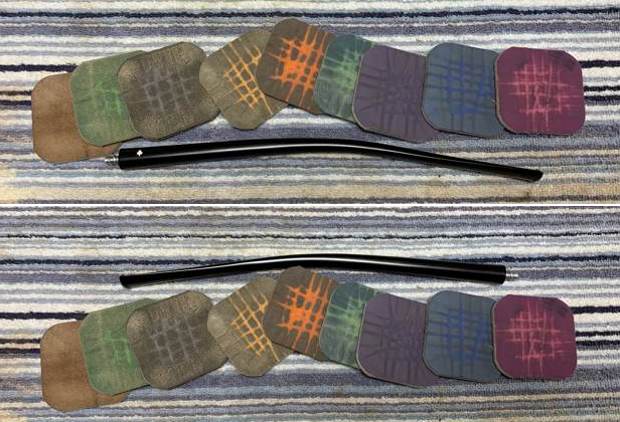
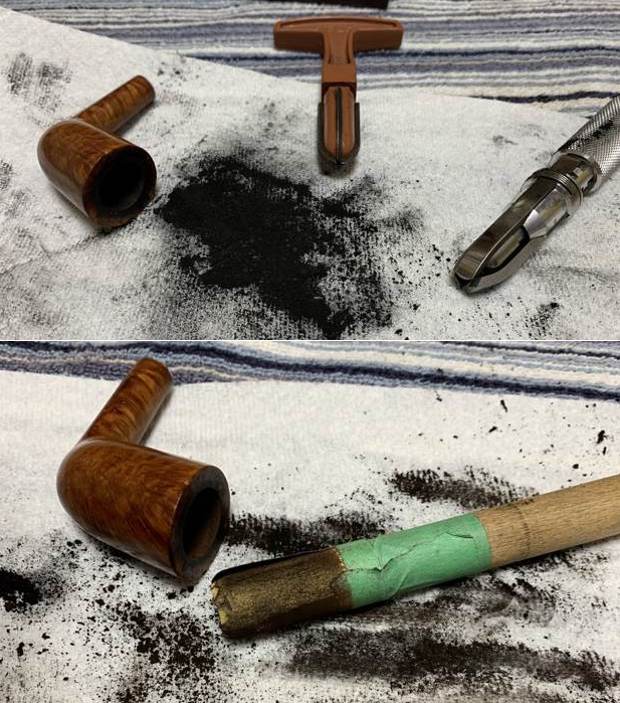
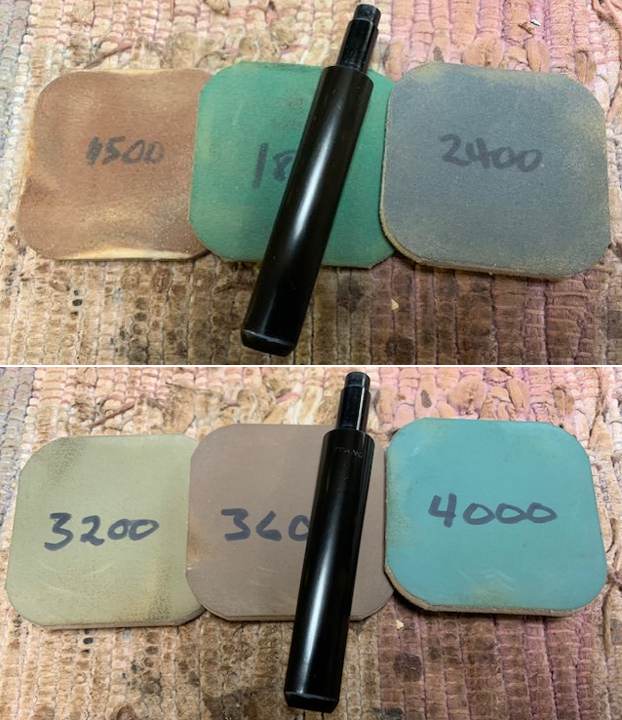
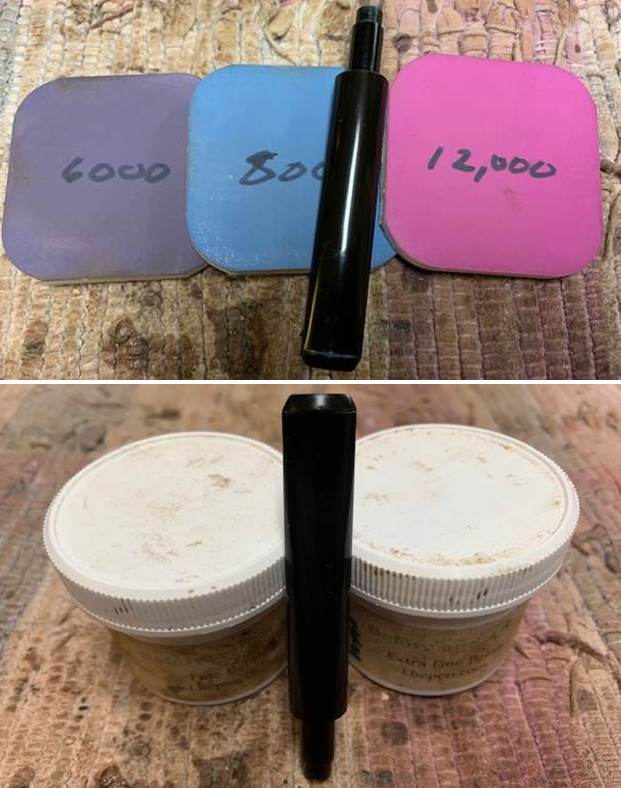
I reamed the bowl with a Savinelli Fitsall Pipe Knife. I sanded the walls on the bowl with a piece of 220 grit sandpaper wrapped around a piece of dowel to take the walls back to smooth once again. I worked on the pipe with a folded piece of 220 grit sandpaper to remove the damage on the rim top and edges of the bowl. It looked better but would need a bit more work.I cleaned out the sump, the shank and the airway in the stem and shank with pipe cleaners, cotton swabs and isopropyl alcohol. The pipe was clean and it smelled significantly better.I polished the rim top and edges with micromesh sanding pads – dry sanding with 1500-12000 grit pads to raise a shine. I wiped it down with a damp cotton pad to wipe off the debris after each sanding pad. I touched up the rim top and inner edge of the bowl with a Walnut stain pen to match it to the rest of the of the bowl. It blends in very well.I polished the nickel ferrule with a  jeweler’s cloth. The cloth is impregnated with polish that not only raises a shine but protects the metal. I worked some Before & After Restoration Balm into the surface of the briar with my fingertips. It works to clean, enliven and protect the briar. I let it sit for 15 minutes then buffed it off with a soft cloth and raised the shine. The bowl looks great at this point.   I polished the stem with micromesh sanding pads – dry sanding it with 1500-12000 grit pads. I wiped the stem down with Obsidian Oil after each pad. I polished it with Before & After Pipe Polish – both Fine and Extra Fine and gave it a final coat and set it aside to dry.  I put the stem back on the Peterson’s System 3 Bent Billiard 3170 and buffed the pipe with Blue Diamond on the buffing wheel. I polished the briar and the vulcanite of the stem until there was a rich shine. This classic Peterson’s shape and finish really highlights a proportionally well carved pipe. Once I buffed the pipe the briar came alive and popped with polishing. The black vulcanite stem has a rich glow. This Peterson’s System 3 Bent Billiard fits well in the hand and sits right in the mouth. Have a look at it with the photos below. The dimensions are Length: 5 inches, Height: 1 ½ inches, Outside diameter of the bowl: 1 inch, Chamber diameter: ¾ of and inch. The weight of the pipe is 1.48 ounces/42 grams. It was one I chose for my own collection and enjoyed, but I am happy to pass it on to the next pipe man or woman. This beauty will be going on the rebornpipes online store in the Irish Pipemakers Section. If you are interested let me know. Thanks for walking through the restoration with me as it was a pleasure to work on.

Restoring a Republic Era Peterson’s System 31 Billiard


Blog by Steve Laug

This is another one of those pipes that has been here for a long time and I have no memory where it came from. It had been cleaned and reamed. The inside of the shank, the system sump and the shank was quite clean. The smooth rim top was damaged and had some darkening. The edges – both inner and outer had some damages by burning and the bowl was out of round. The smooth finish was very clean from Jeff’s scrubbing. The stamping on the shank is clear and readable. The left side is stamped Peterson’s [arched over] System. On the right side it was stamped Made in the Republic of Ireland (3 lines). To the right of that stamp is the shape number 31. The nickel ferrule is oxidized and dull but it has the K & P stamp over three symbols. Next to that it was stamped Peterson’s. The stem was quite clean and free of tooth marks and chatter on both sides. I took some photos of the pipe before I started my work on it. I took close up photos of the bowl and the stem. You can see the reamed bowl and the darkening and damage on the rim top. The stem surface was clean and free of tooth marks or chatter on both sides. I took a photo of the stamping on the sides of the bowl and shank. It is clear and readable as noted above. I removed the stem from the shank and took a photo to give a sense of the proportions of the pipe. It is really quite nice looking.I am including the information from Pipedia’s article on Peterson pipes. It is a great read in terms of the history of the brand (https://pipedia.org/wiki/Peterson). I have included a bit of the pertinent history here.

1950 – 1989 The Republic Era  – From 1950 to the present time, the stamp for this era is “Made in the Republic of Ireland” in a block format generally in three lines but two lines have been used with or without Republic being abbreviated.

During the 1950’s and 60’s the Kapp & Peterson Company was still in the ownership of the Kapp family. However 1964 saw the retiral of the company Managing Director Frederick Henry(Harry) Kapp.

I found a great description of the System 31 shape on smokingpipes.com (https://www.smokingpipes.com/pipes/new/peterson/moreinfo.cfm?product_id=192182). I am including a portion of that below.

Peterson’s “31” shape is the only straight pipe featured in the System Standard line, yet it still features system drilling. Featuring a push-style tenon and a long, tapering metal tube, it houses a condensation chamber just under the bowl itself — providing the same gurgle free smoke you’d expect of a bent System configuration.

Paresh had worked on System 31 pipe so I went back and reread his work on that smooth pipe. It was very helpful for the background information included (https://rebornpipes.com/tag/peterson-system-31-pipe/).

I knew that I was dealing with a Republic Era pipe made between 1950-1989. The K&P mark on the nickel band ties to Kapp & Peterson brings the date to the time between 1950-1964. It was a smooth Straight billiard with a unique shape and chamber beneath the bottom of the bowl. The finish was stained with a combination of rich reddish brown stains. Now it was time to work on the pipe.

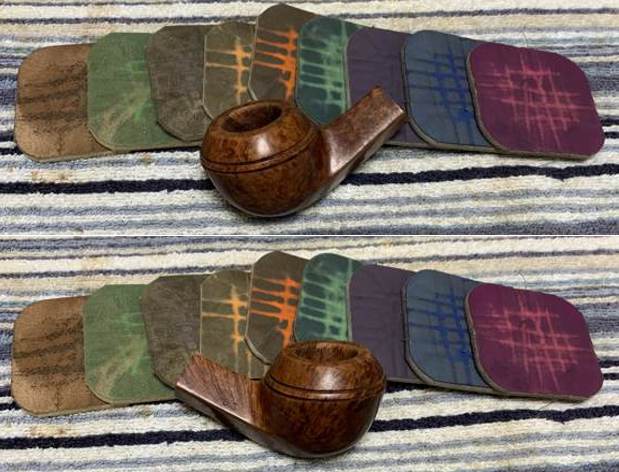
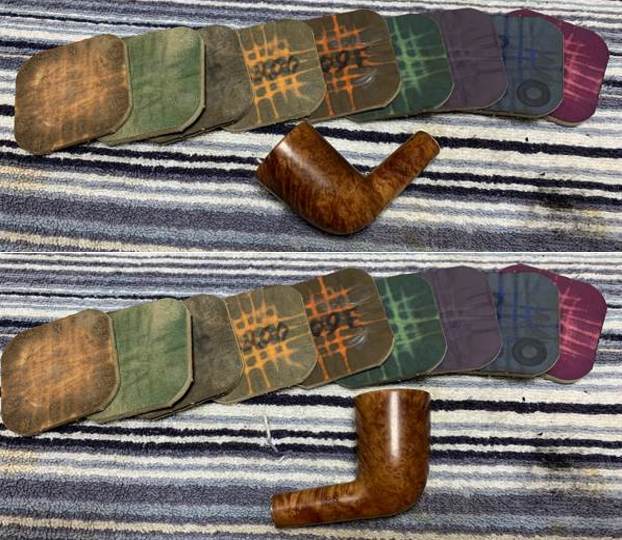
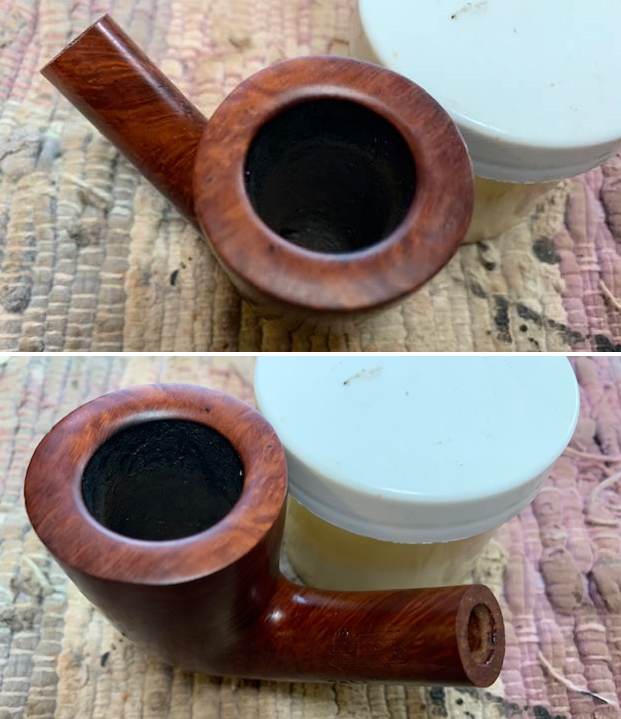
The bowl had been reamed and cleaned. I started working on the pipe by topping the damaged rim top on a topping board with 220 grit sandpaper to remove the damage on the rim top and edges of the bowl. I used a folded piece of 220 grit sandpaper to smooth out the inner edge of the bowl. I gave the inner edge of the bowl a slight bevel. I polished the rim top and edges with micromesh sanding pads – dry sanding with 1500-12000 grit pads to raise a shine. I wiped it down with a damp cotton pad to wipe off the debris after each sanding pad. I worked some Before & After Restoration Balm into the surface of the briar with my fingertips. It works to clean, enliven and protect the briar. I let it sit for 15 minutes then buffed it off with a soft cloth and raised the shine. The bowl looks great at this point.   I polished the nickel ferrule with a  jeweler’s cloth. The cloth is impregnated with polish that not only raises a shine but protects the metal.   I polished the stem with micromesh sanding pads – dry sanding it with 1500-12000 grit pads. I wiped the stem down with Obsidian Oil after each pad. I polished it with Before & After Pipe Polish – both Fine and Extra Fine and gave it a final coat and set it aside to dry.  I put the stem back on the Peterson’s System 31 Straight Billiard and buffed the pipe with Blue Diamond on the buffing wheel. I polished the briar and the vulcanite of the stem until there was a rich shine. This classic Peterson’s shape and finish really highlights a proportionally well carved pipe. Once I buffed the pipe the briar came alive and popped with polishing. The black vulcanite stem has a rich glow. This Peterson’s System Straight Billiard fits well in the hand and sits right in the mouth. Have a look at it with the photos below. The dimensions are Length: 5 ½ inches, Height: 1 ½ inches, Outside diameter of the bowl: 1 1/8 inches, Chamber diameter: ¾ of and inch. The weight of the pipe is 1.20 ounces/34 grams. This beauty will be going on the rebornpipes online store in the Irish Pipemakers Section. If you are interested let me know. Thanks for walking through the restoration with me as it was a pleasure to work on.

The French Collection


Blog by Kenneth Lieblich

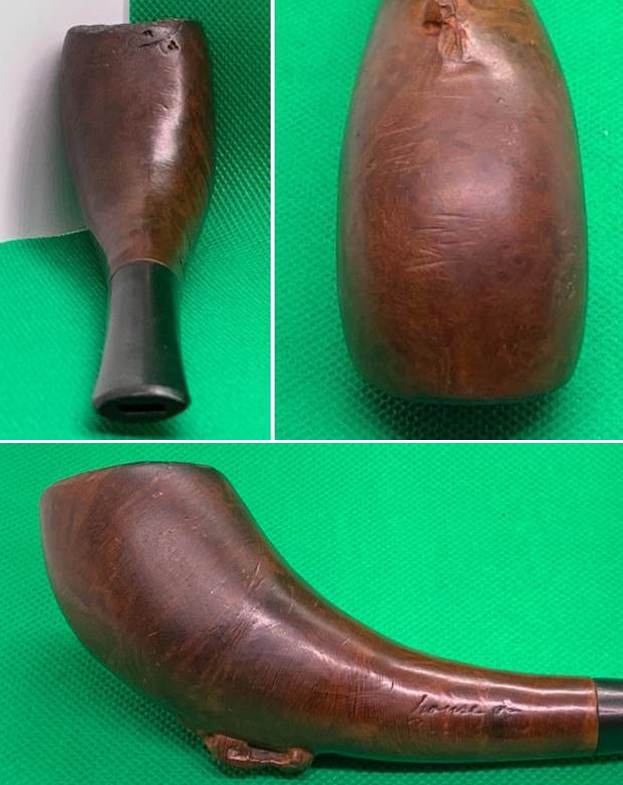
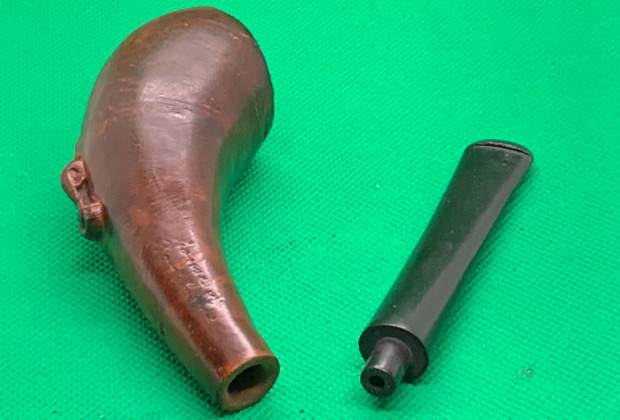
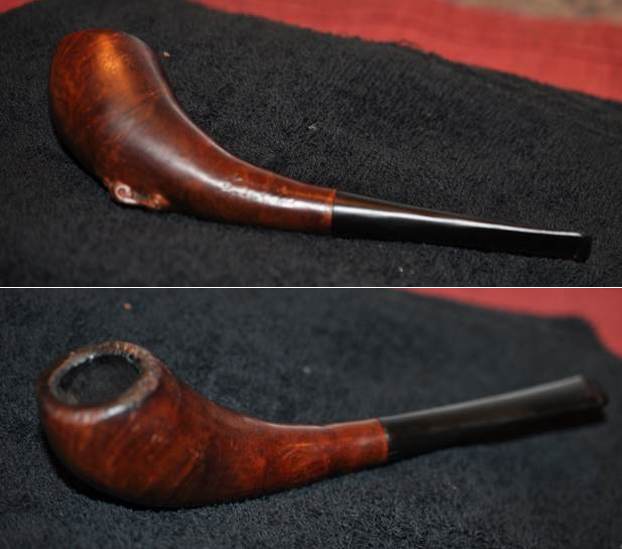
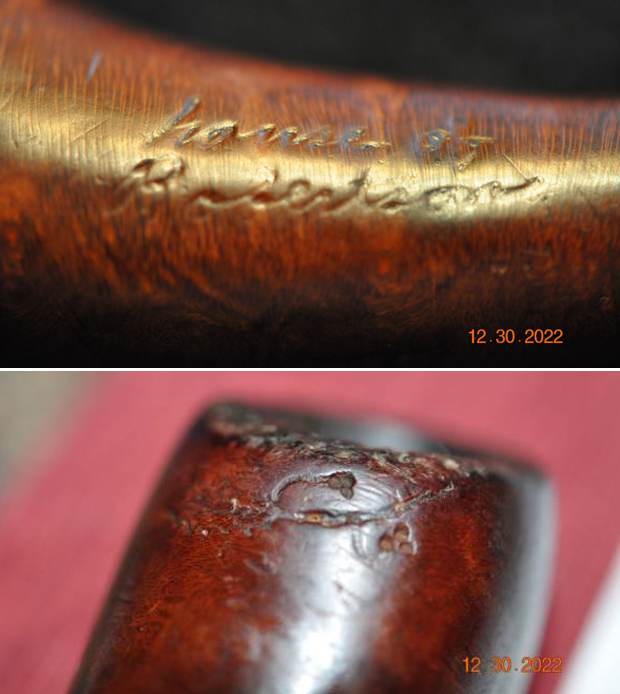
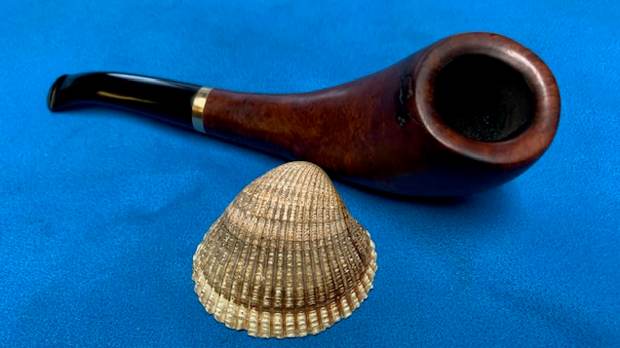
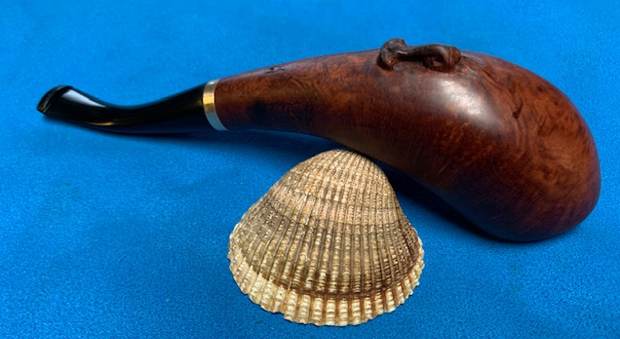
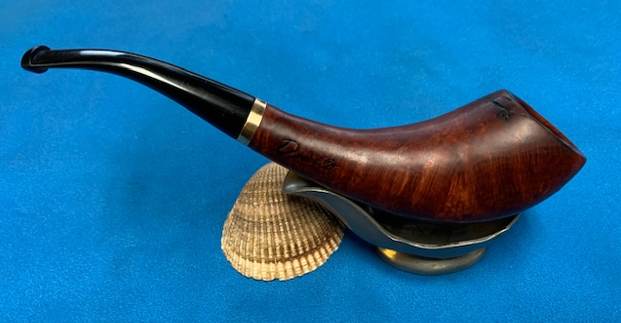
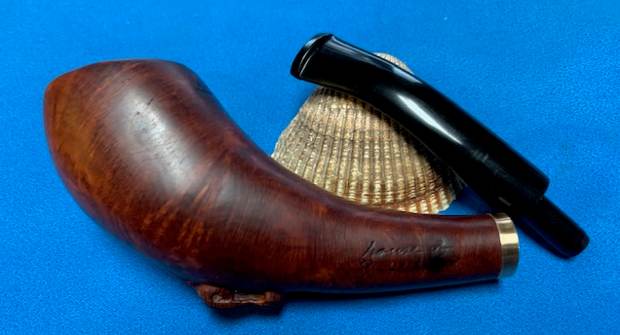
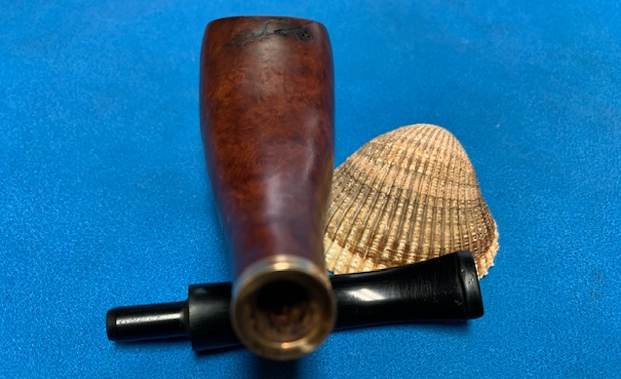
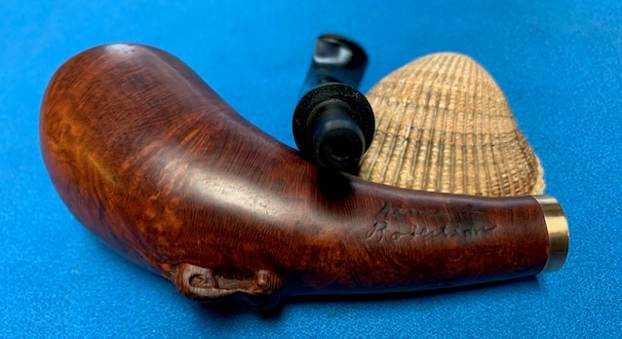
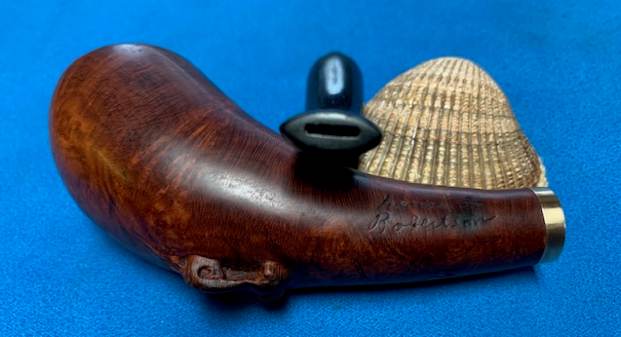
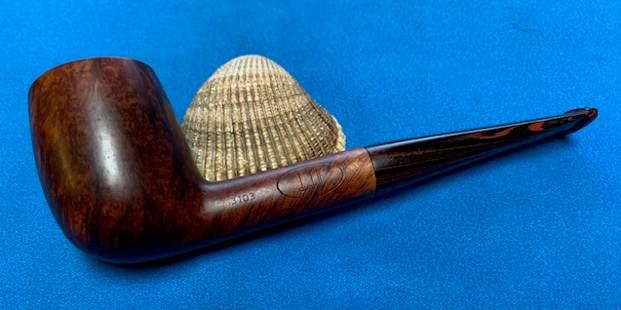
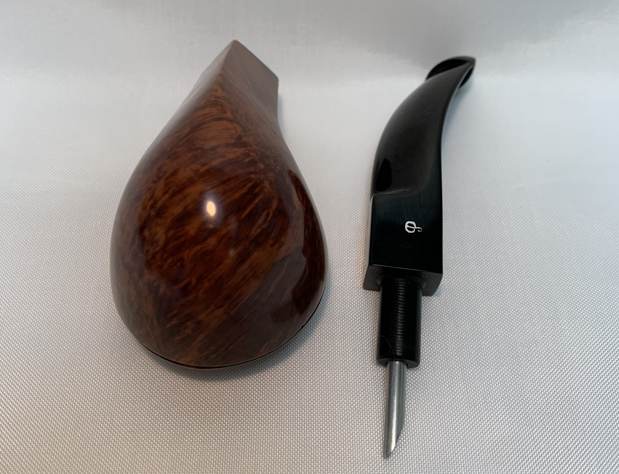
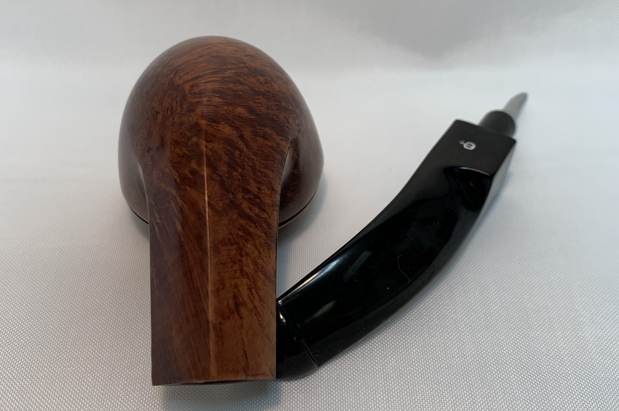
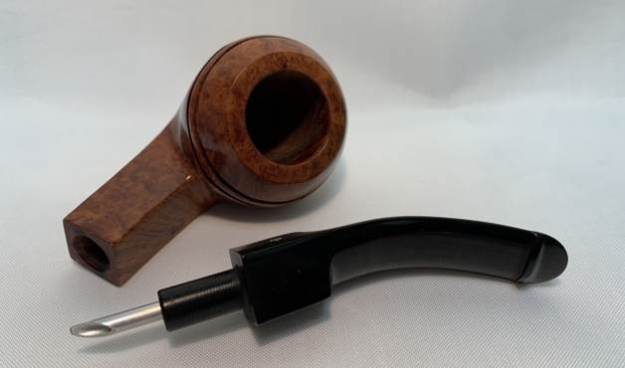
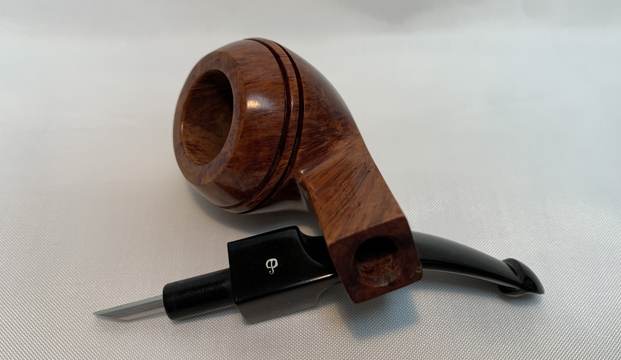
No, not the French Connection – but French Collection! I have long had an interest in French pipes and pipemaking. In recent decades, French pipes have received a fair amount of derision – and deservedly so. However, early French pipes are very often beautiful, well-made, and – best of all – good smokers. In my own small way, I am aiming to resurrect the reputation of early French pipes. There are superb pipes to be had from France. This blog post is about the restoration of the first pipe that is going into my “French Collection”.

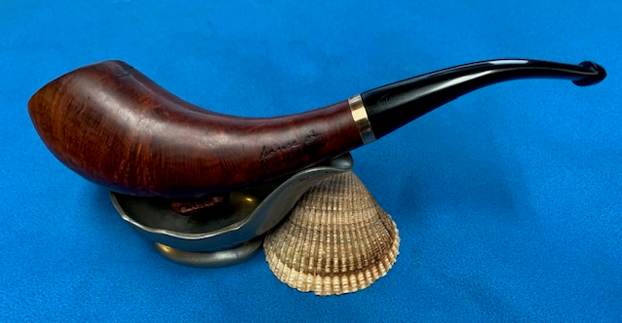
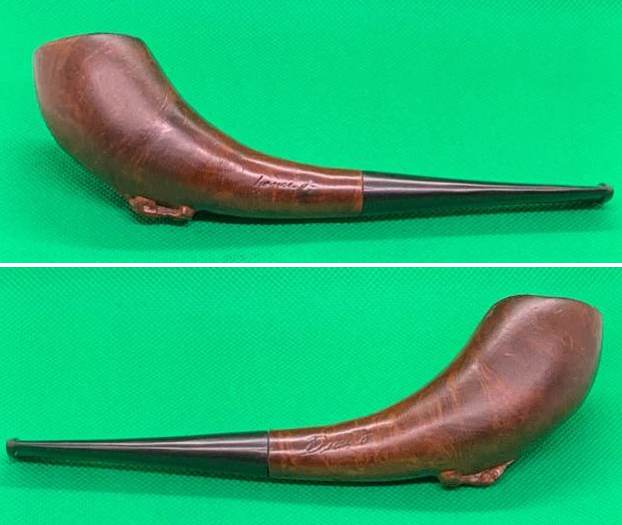
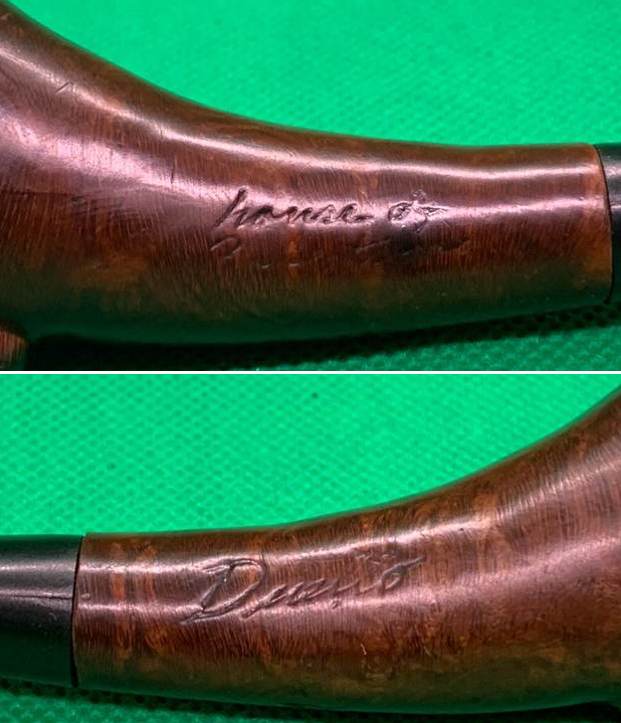
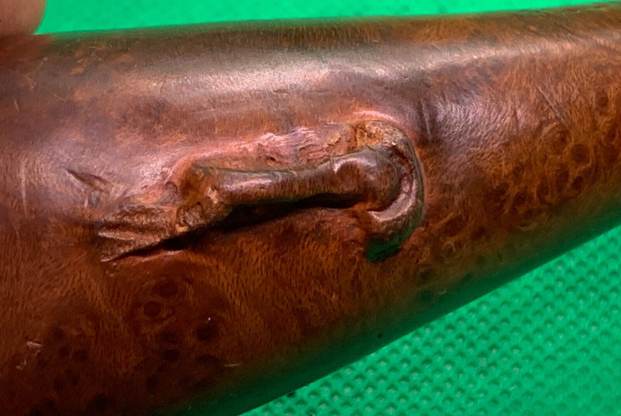
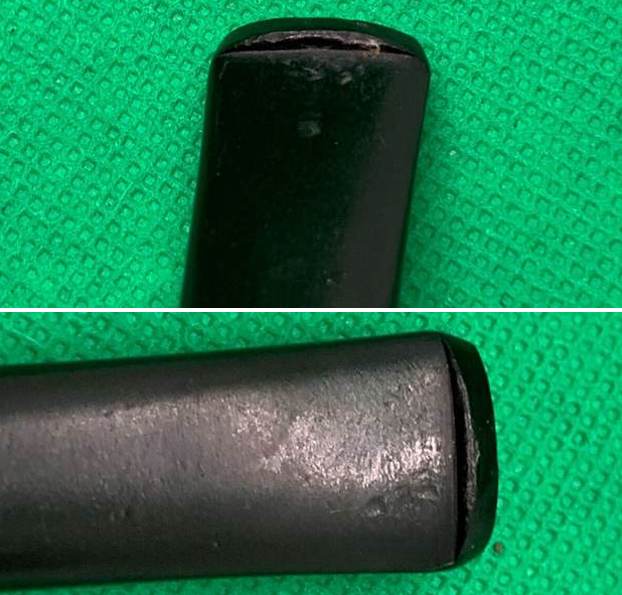
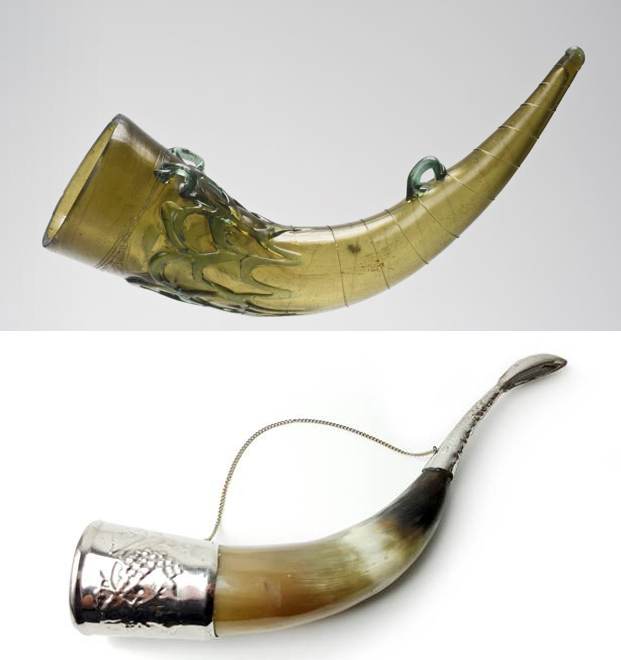
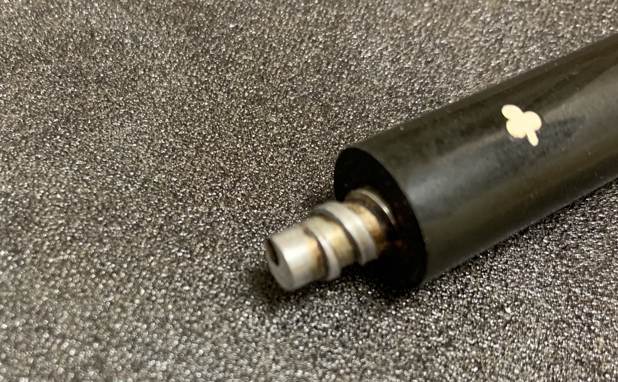
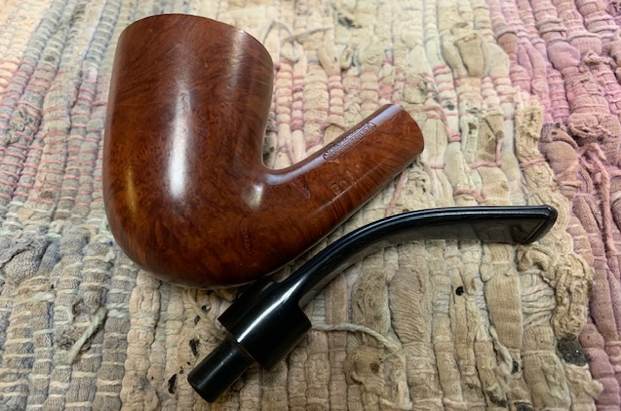
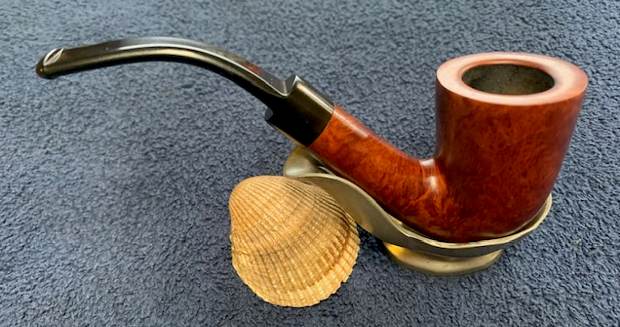
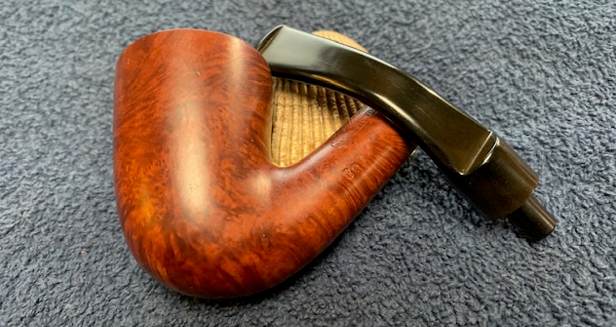
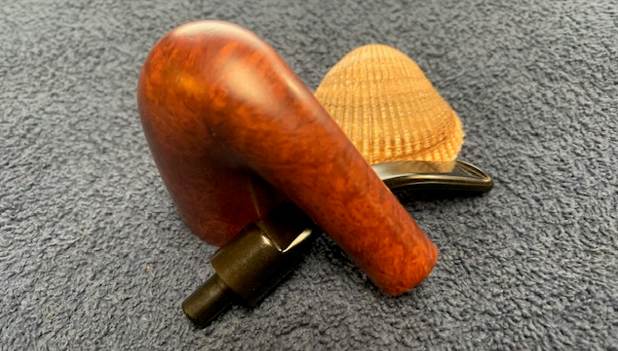
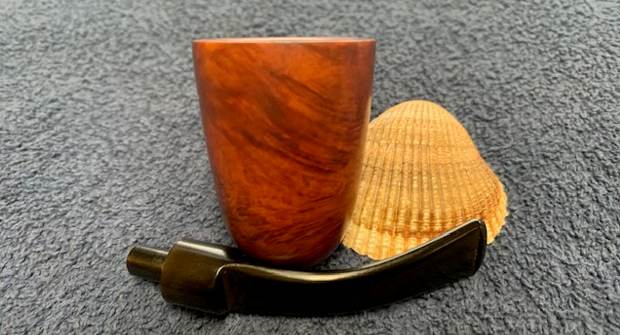
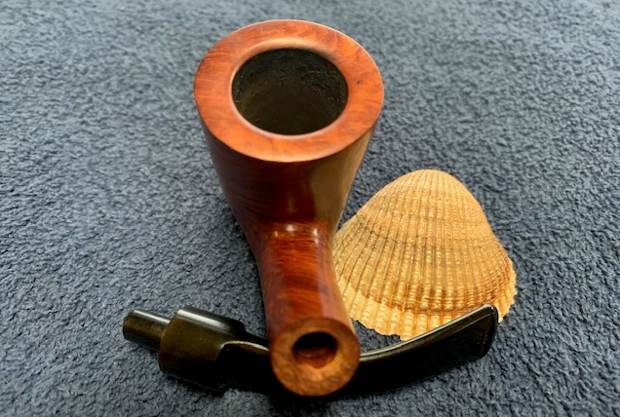
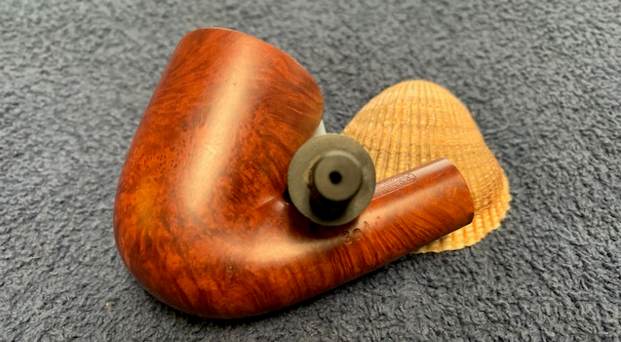
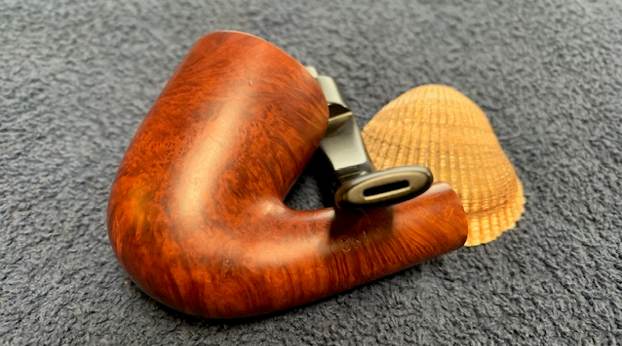
The pipe in question has no markings whatsoever. So how do I know it’s French? Well, I don’t have absolute proof, but I’ve got good circumstantial evidence: the pipe has a very French look to it, it smells like old French tobacco, it came in a lot of exclusively French pipes from France, and – most definitively – Steve thinks it’s French too.  As the photos show, this is a cutty-shaped pipe, albeit without the spur. However, it shows the distinctive, canted bowl of the cutty. It is a handsome pipe with a jaunty look to it, and I liked the pipe straight away. As I mentioned, this pipe has no marks of any kind. This obviously makes identification trickier. I know that Georges Vincent-Genod company used to make pipes similar to this once upon a time, but I cannot, in good conscience, definitely ascribe this pipe to the GVG company. Having said that, the following pipe from Genod certainly has its similarities…The age of this pipe is quite interesting. As you can see, the stem of the pipe is made of horn and has an orific button at the end. For more information on the orifice button, take the time to read Steve’s interesting article on the subject. This type of button is a feature that apparently disappeared by the 1930s, so the pipe must be around a hundred years old, right? Not so fast. The stummel has a threaded tenon made of metal – not bone (as one might expect from a century ago). Steve, my walking encyclopedia, informed me that the fact the tenon is in metal (instead of bone) suggests a date closer to World War II. He figures that the stem itself could be significantly older, but that it was left over in the factory and married to a ”newer” stummel. Therefore, we can surmise that the pipe is about 80 years old.

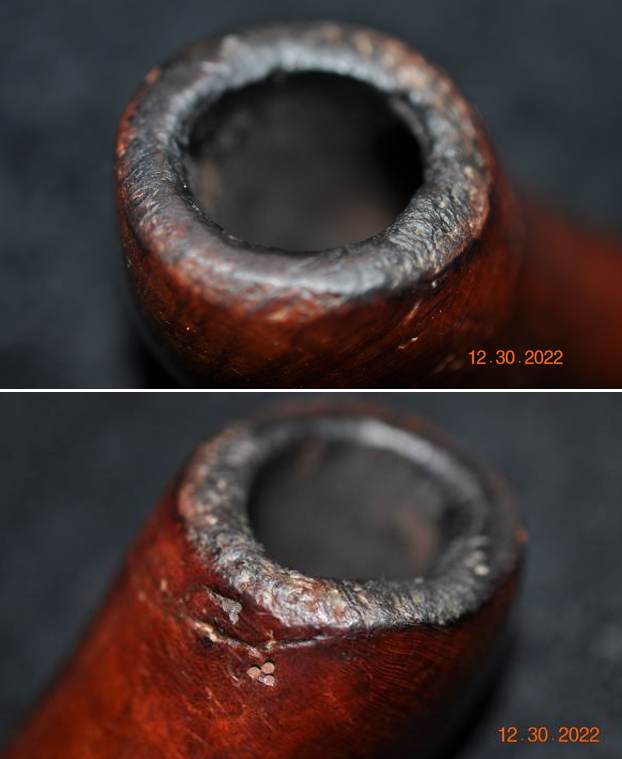
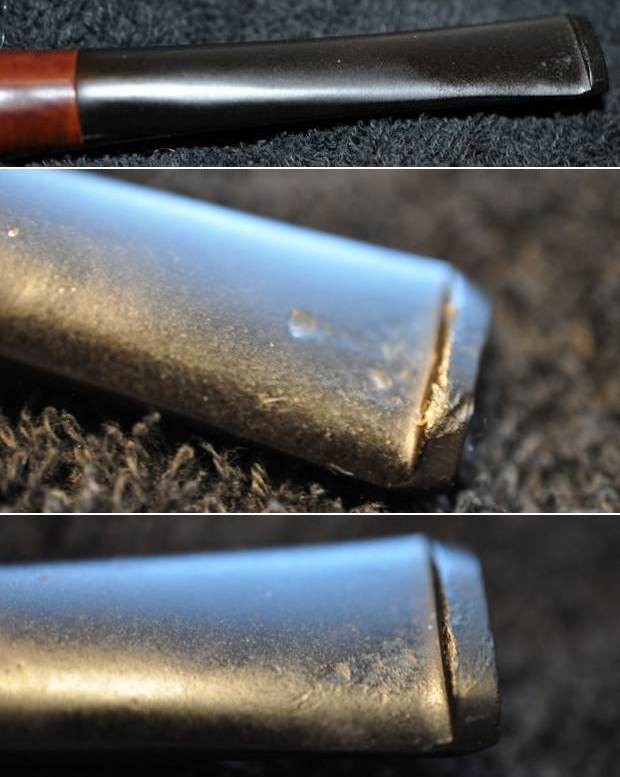
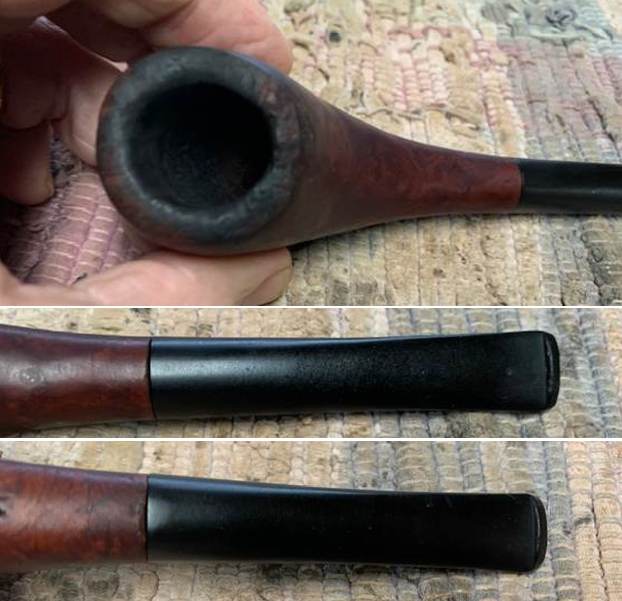
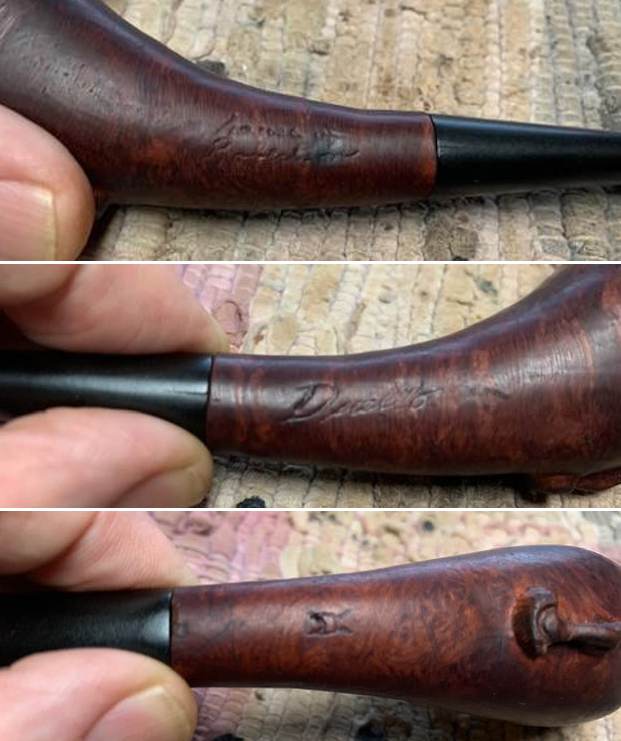
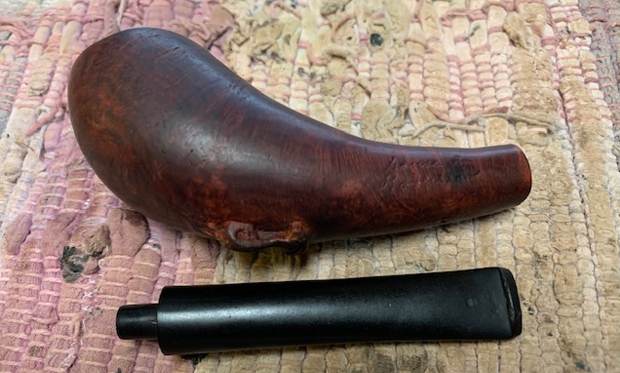
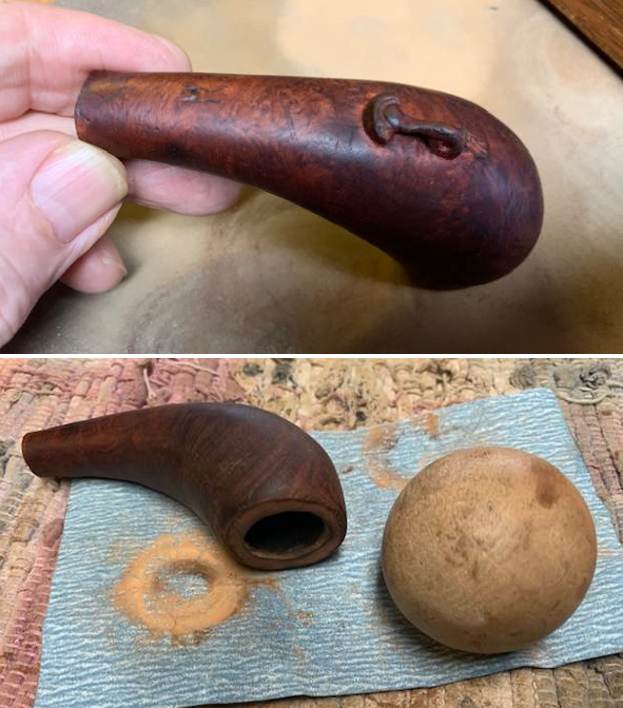
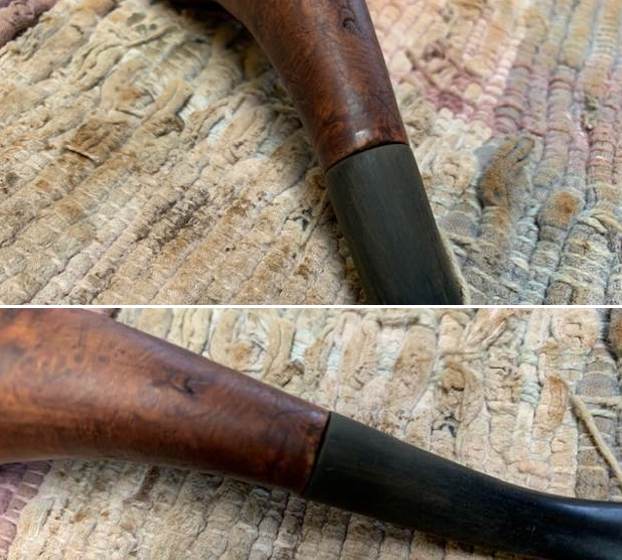
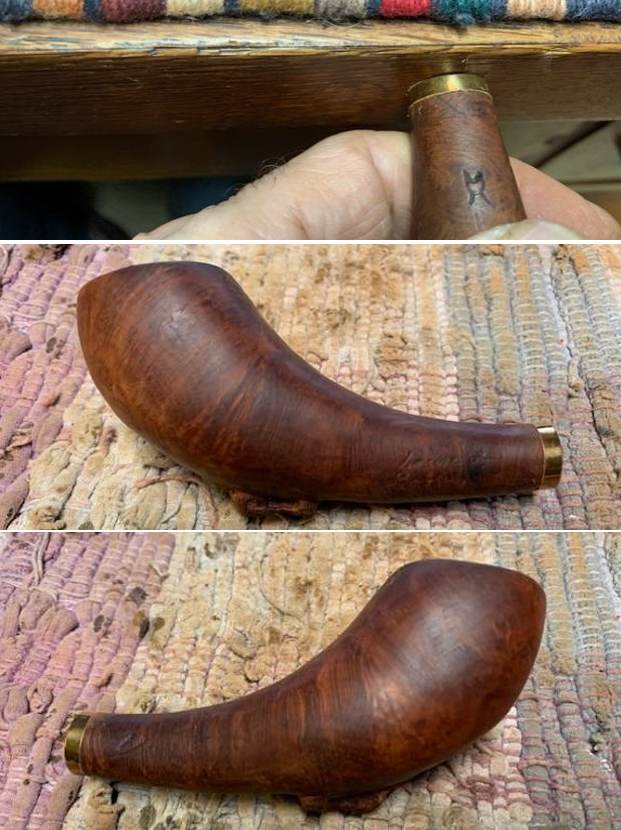
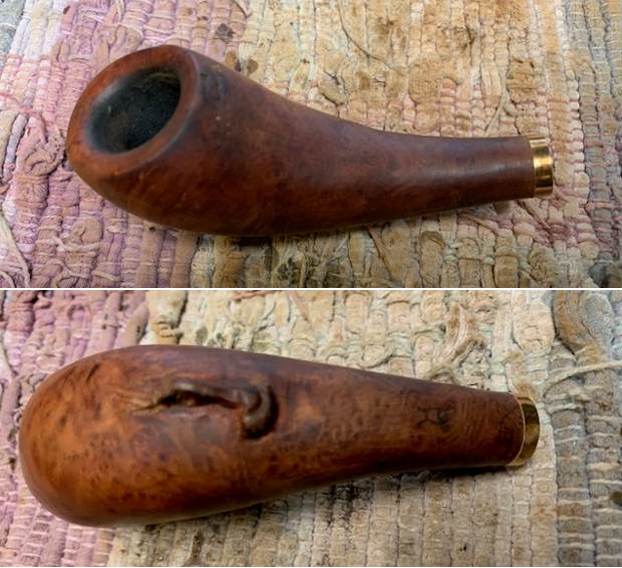
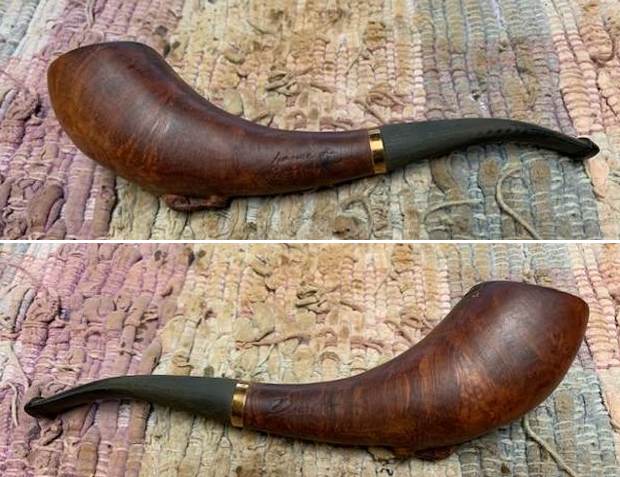
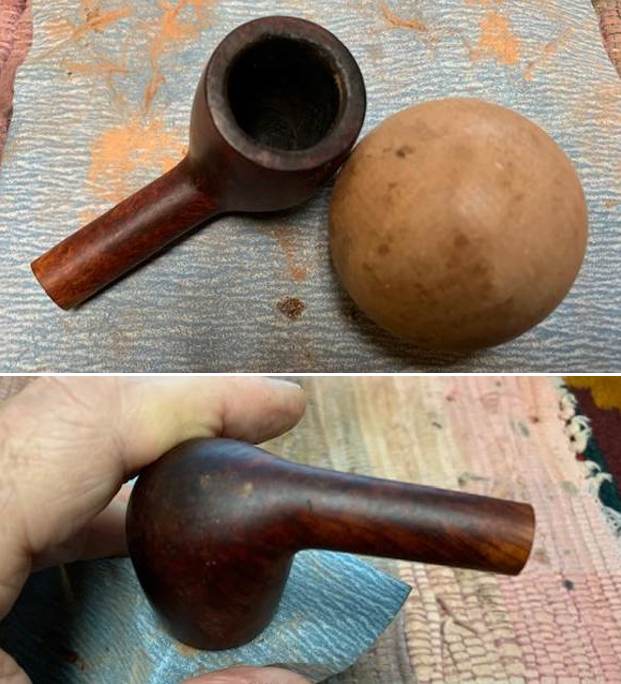
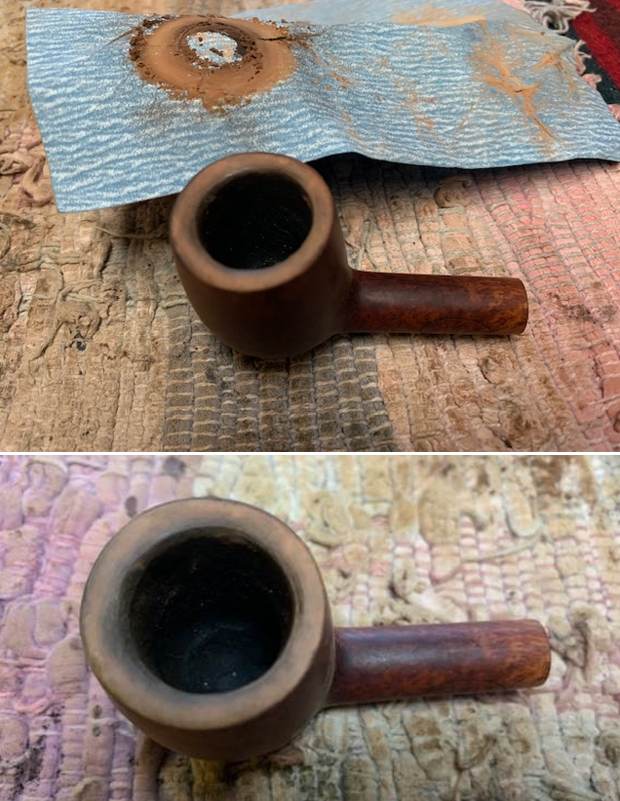
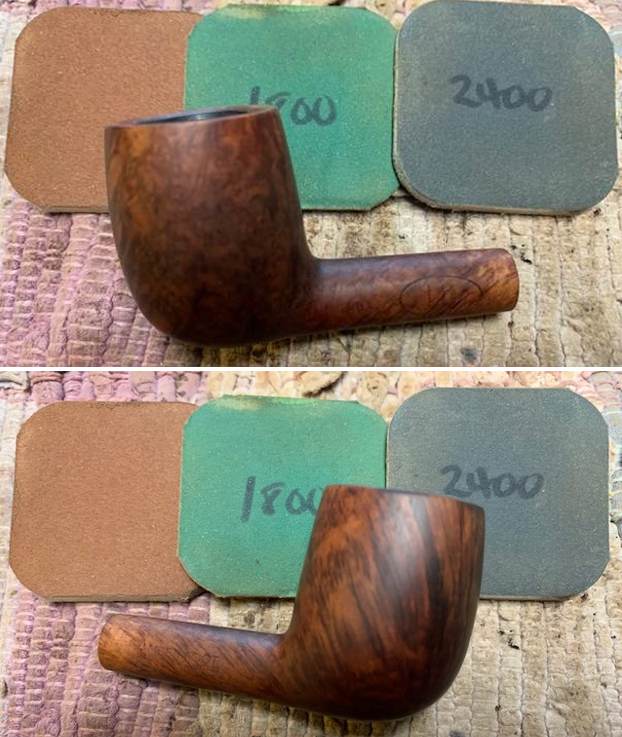
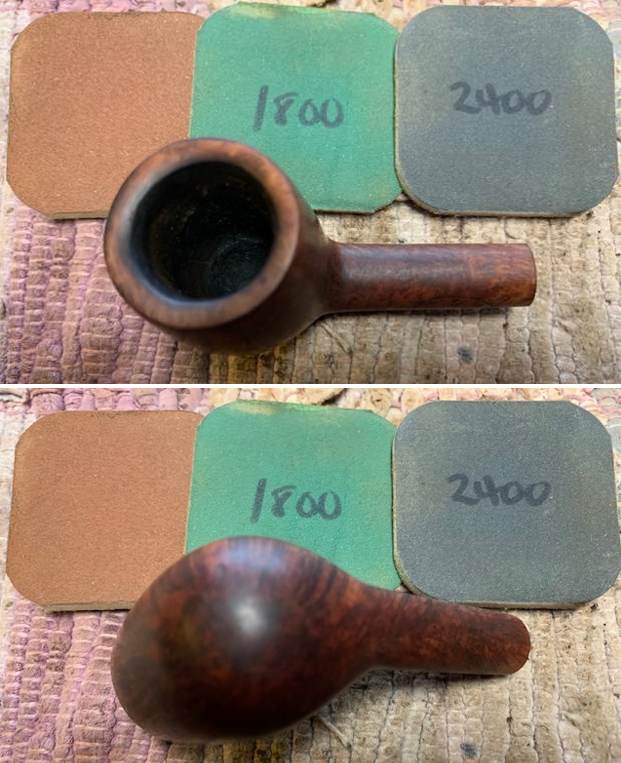
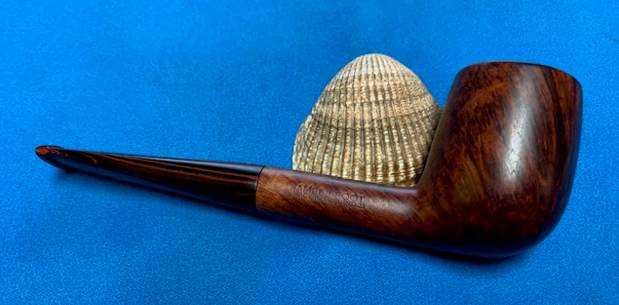
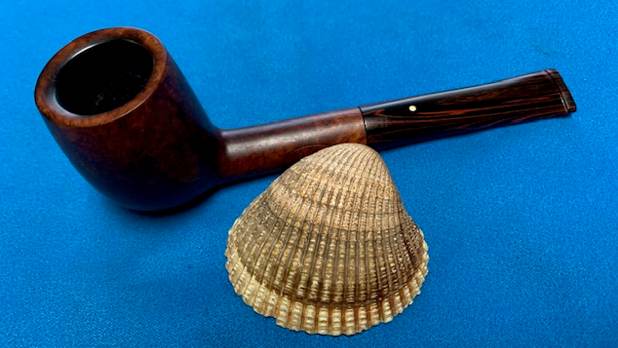
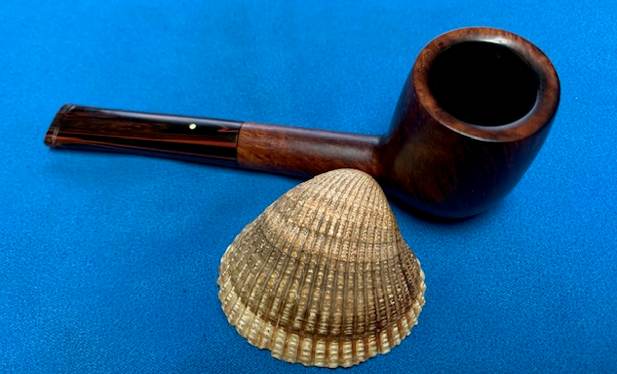
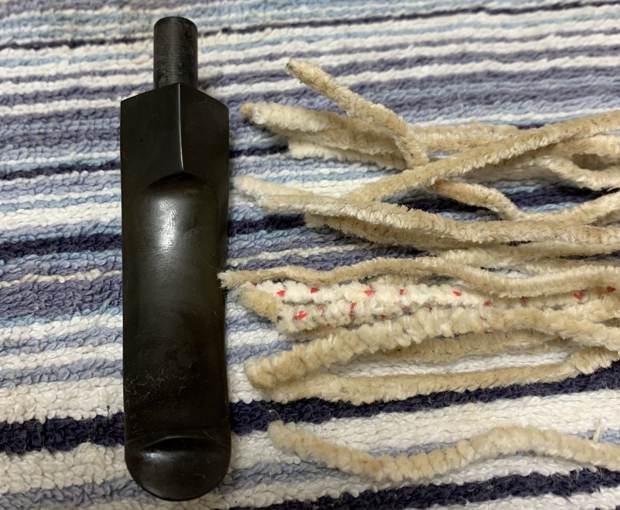
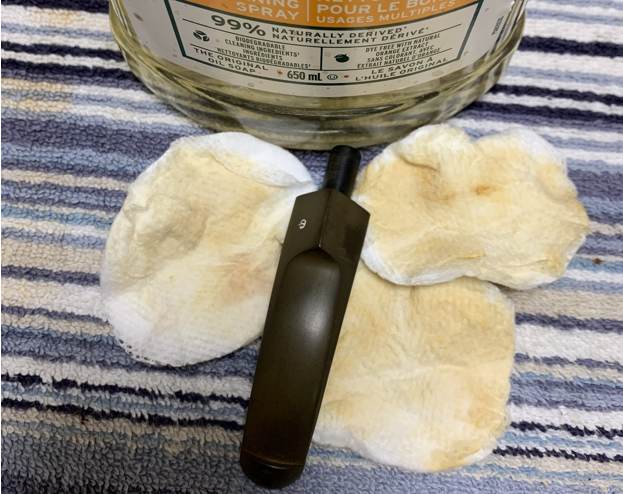
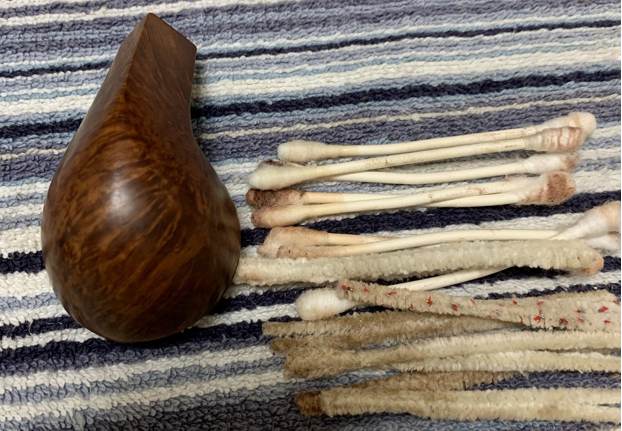
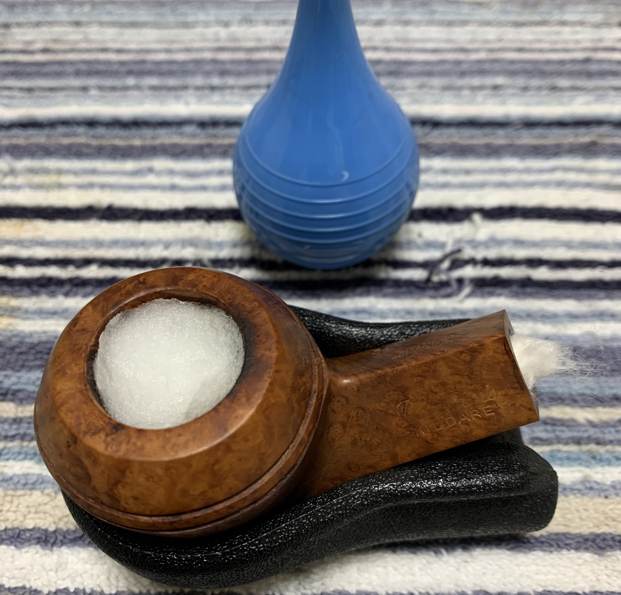
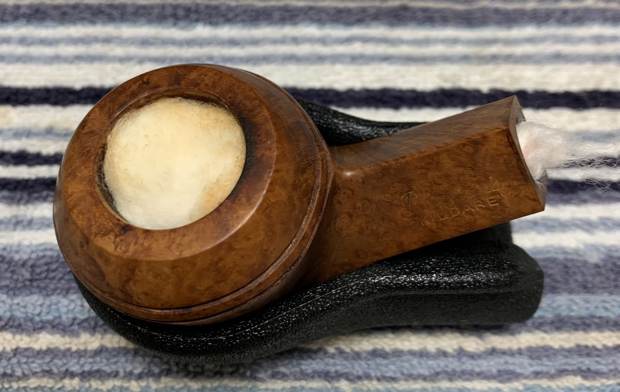
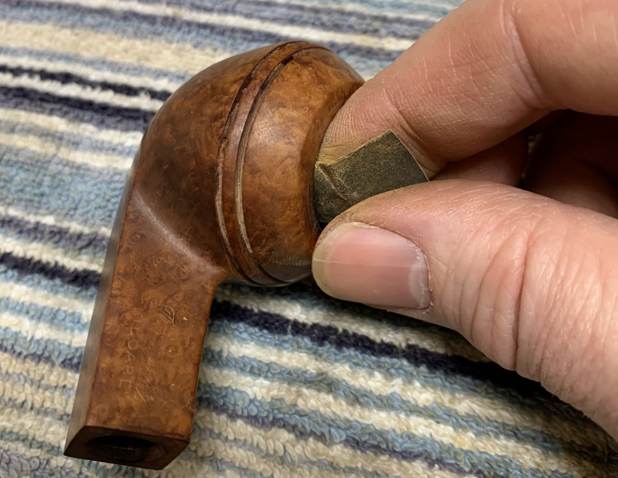
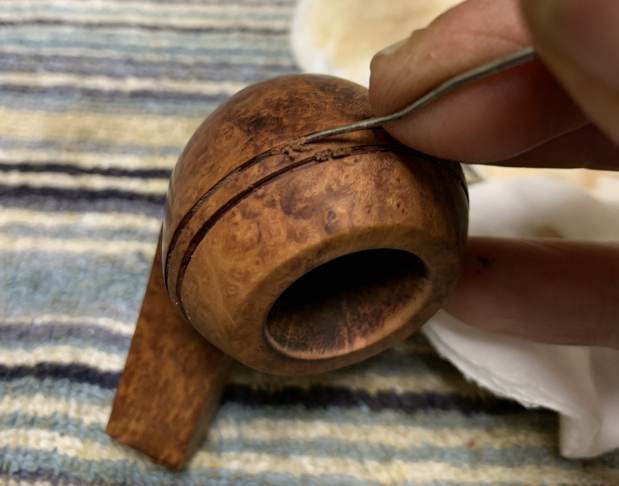
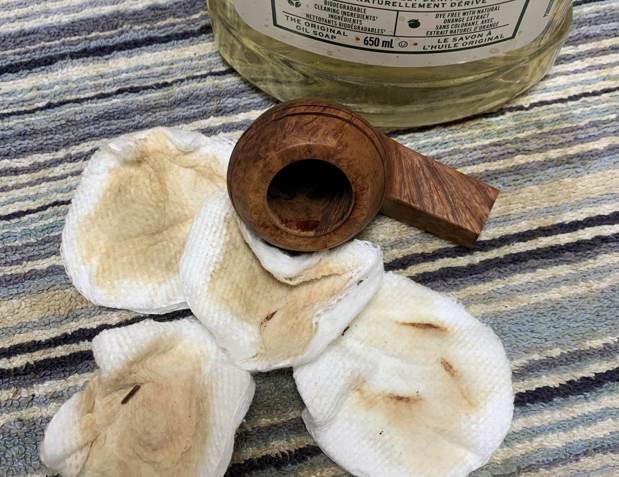
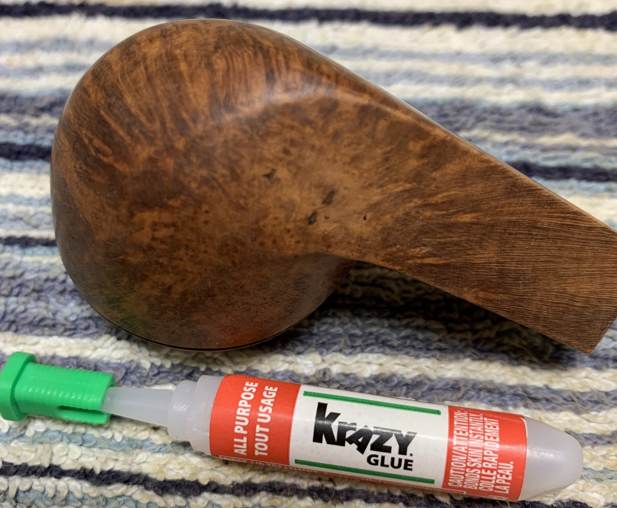
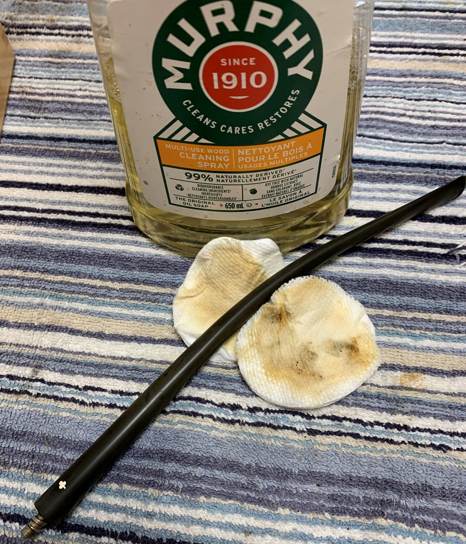
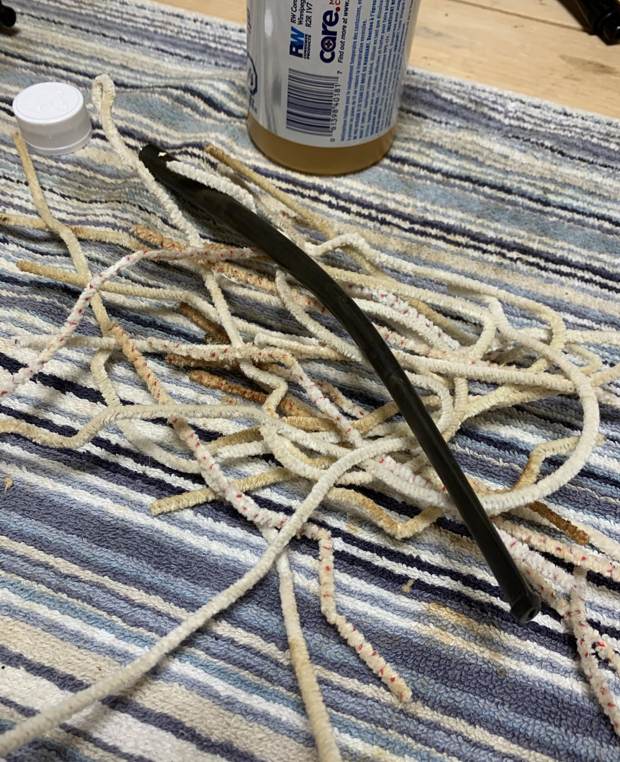
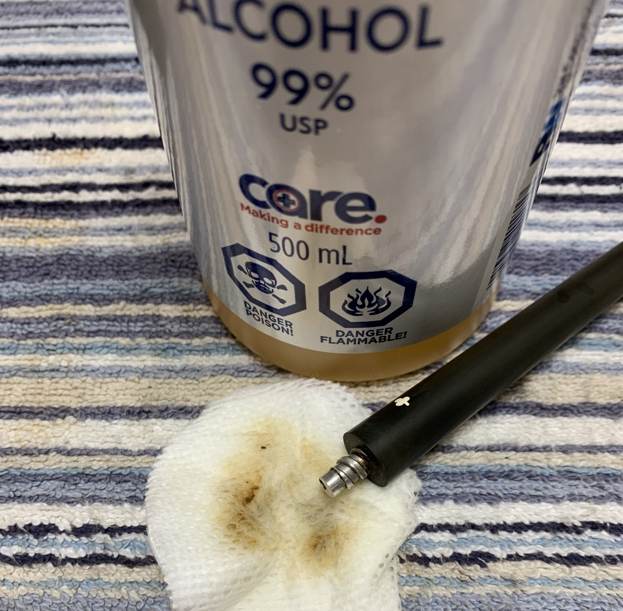
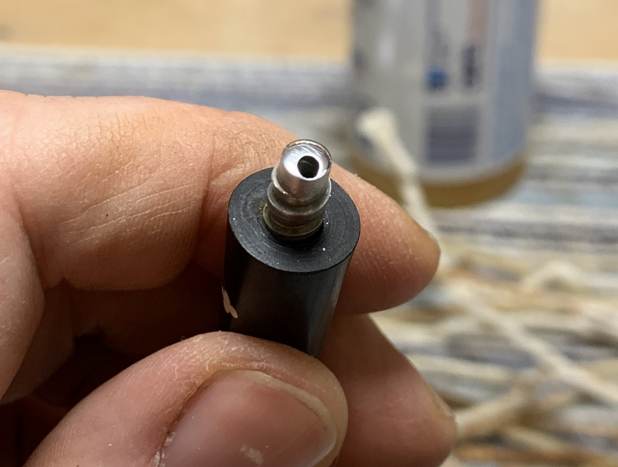
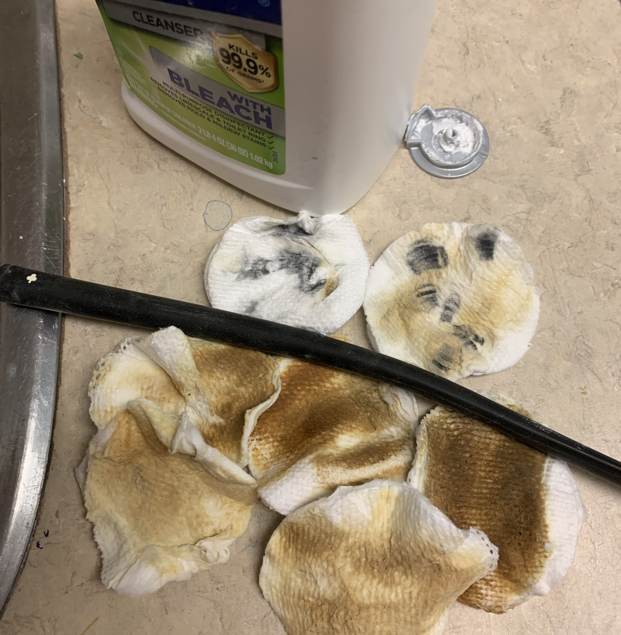
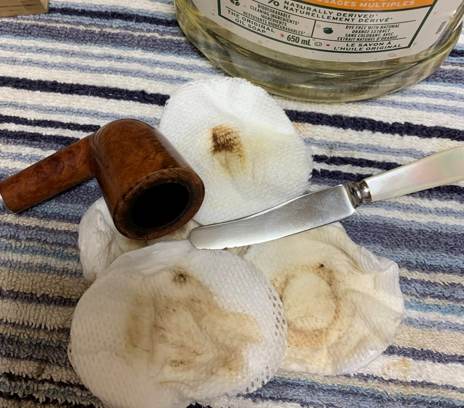
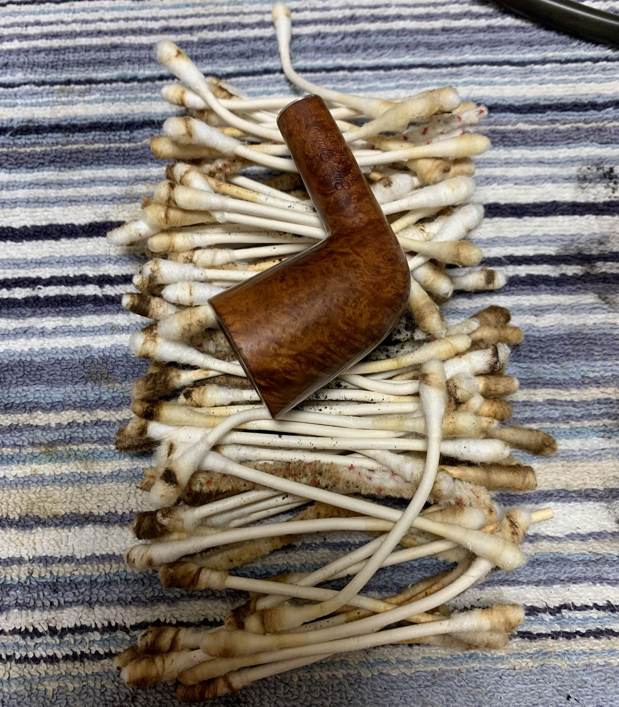
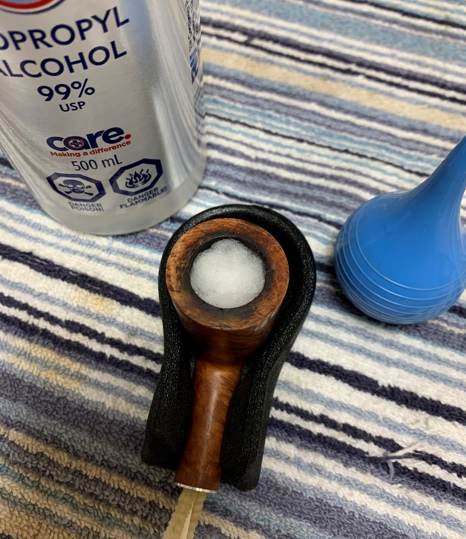
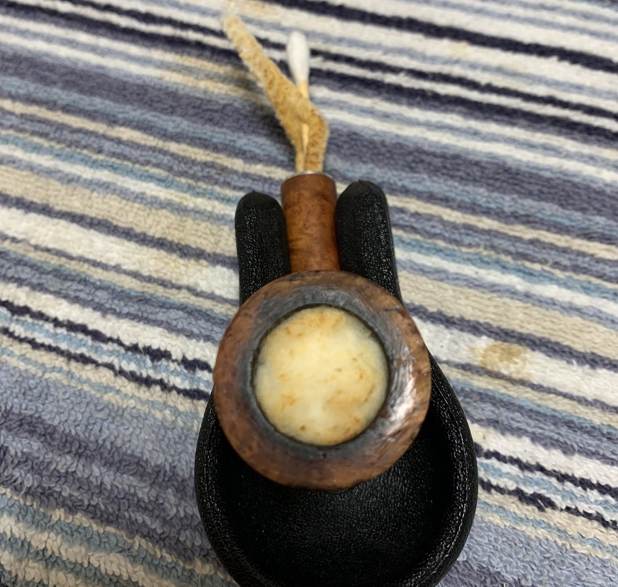
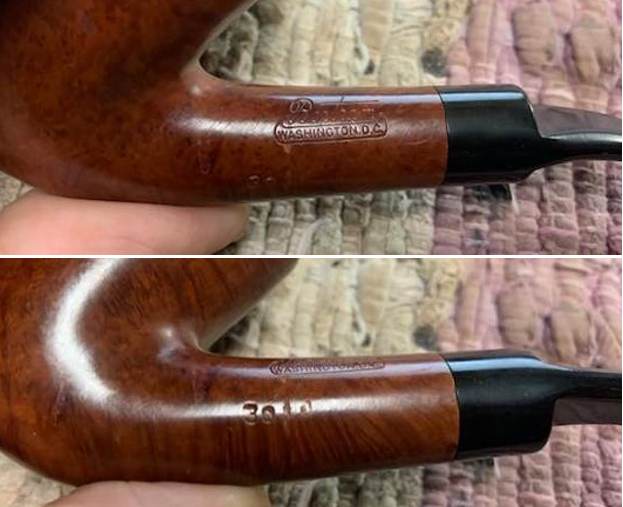
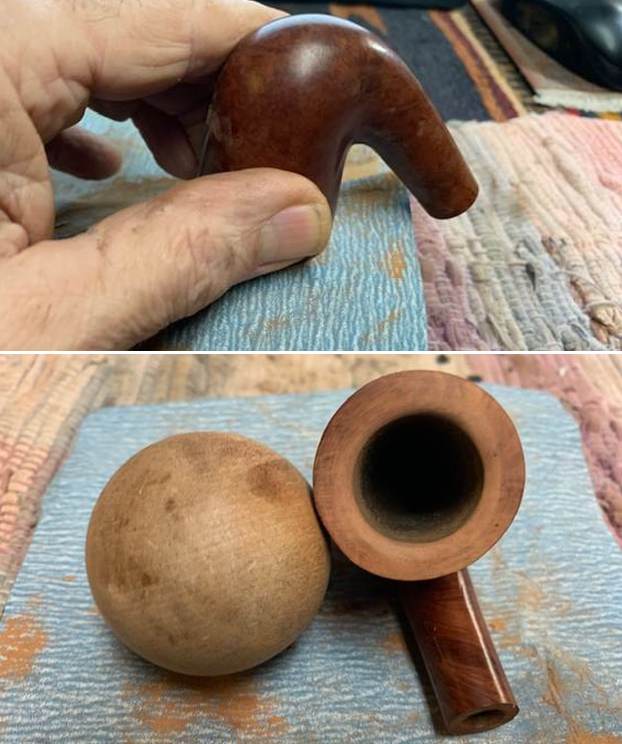
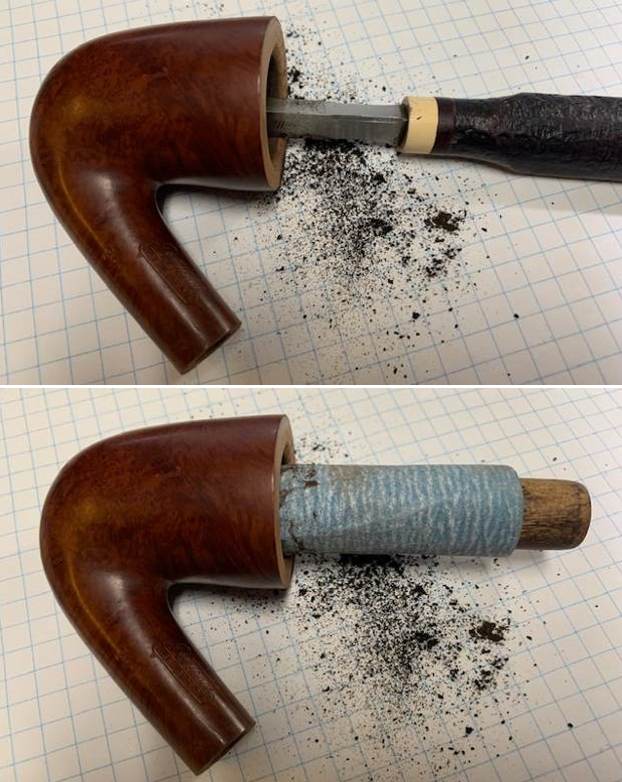
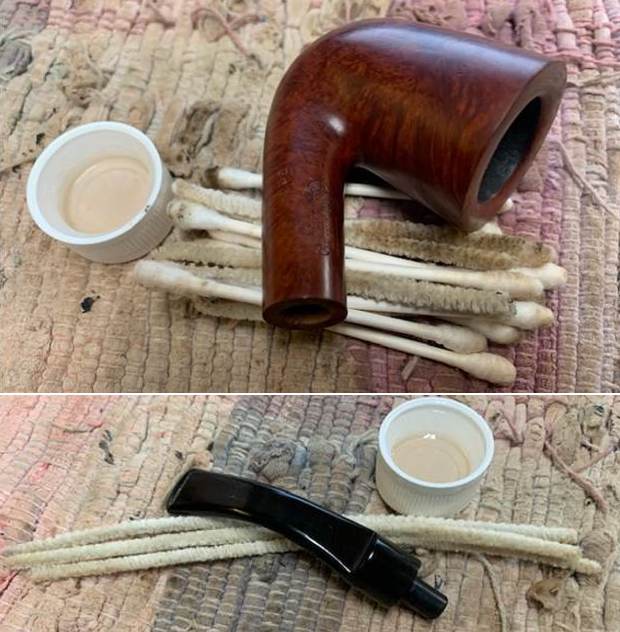
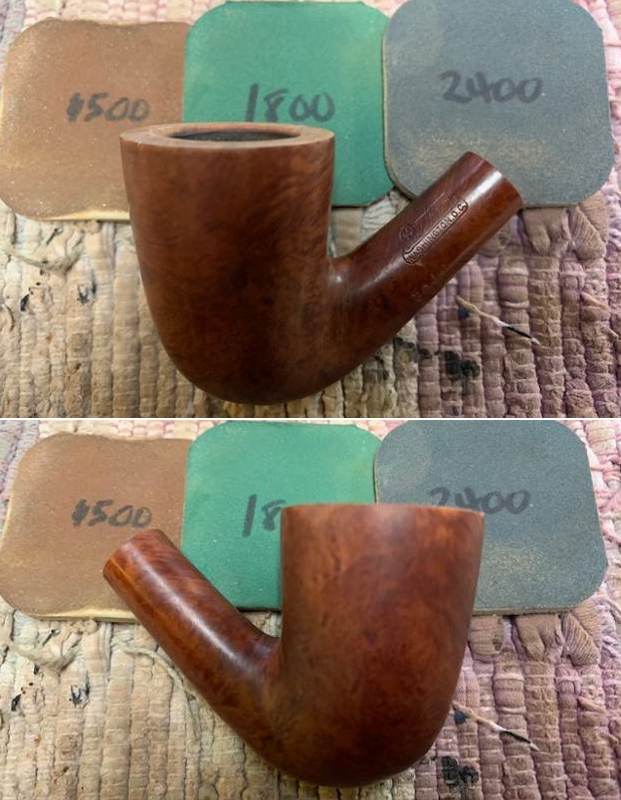
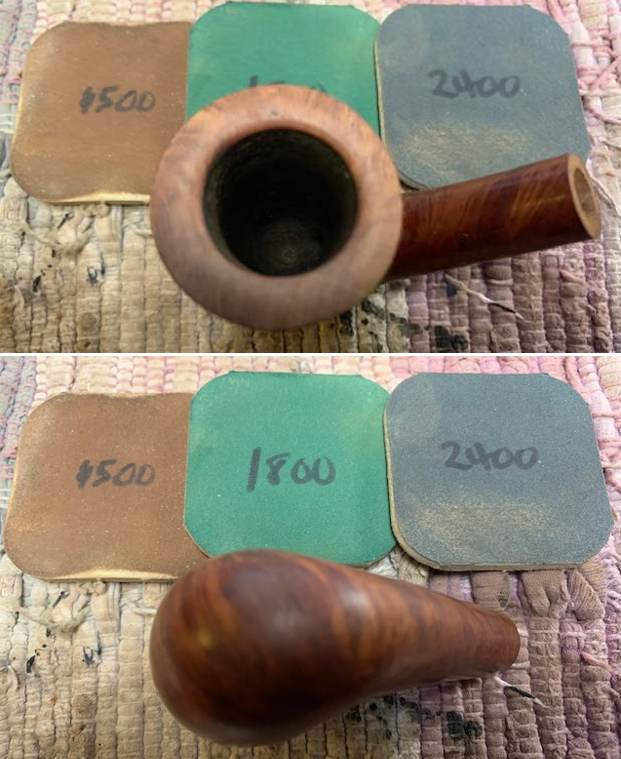
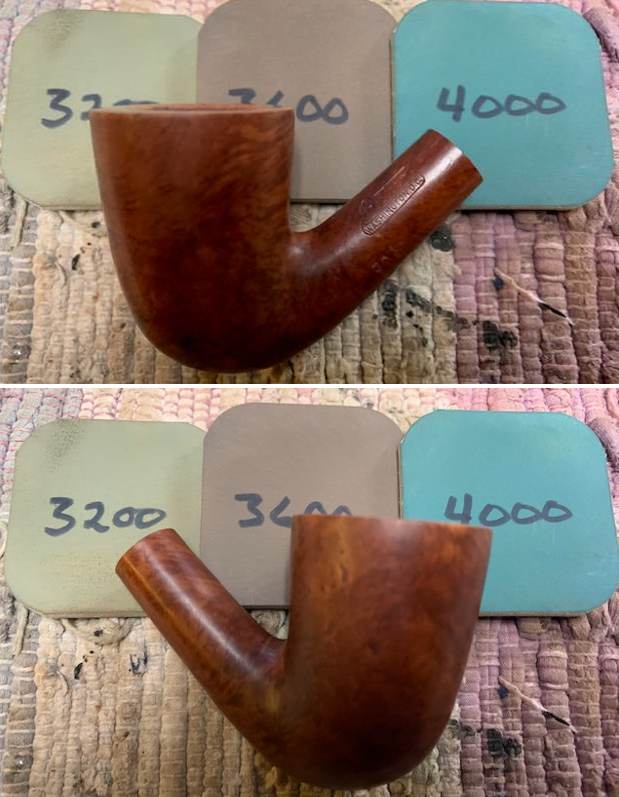
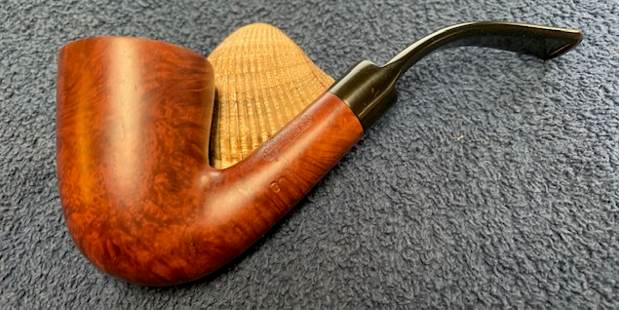
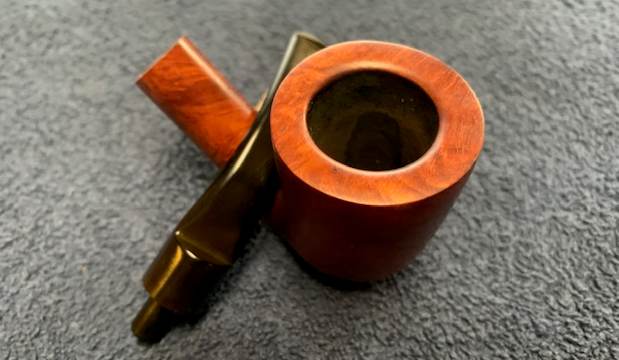
Let’s have a closer look at the condition of the pipe. The stem was dirty and worn, with plenty of evidence of tooth marks and dents. The insides were dirty too, but nothing too unusual. Meanwhile, the stummel was incredibly dirty.The bowl was so full of cake and the rim so overwhelmed with lava, that I couldn’t really tell what the condition of the wood inside was. Certainly, there was some lovely patina on the old wood on the outside of the bowl.I wanted to work on the stem first, but needed some help to unscrew it! I brought out the heat gun and gave a quick blast to loosen the goo holding the pipe together. That loosened the stem sufficiently to unscrew it. I wiped the stem with Murphy’s Oil Soap on some cotton pads. There was some filth there and I needed to remove it. I attacked the inside of the stem with pipe cleaners, cotton swabs, and isopropyl alcohol. It required a good amount of cotton to come clean. Now work on repairing the tooth marks, etc. on the outside of the stem. I built up the bite marks on the stem with cyanoacrylate adhesive and let it fully cure. There were a couple of small worm holes (or something similar) on the stem and I filled them the same way. Upon closer inspection, the button on the stem was a bit mangled. Simply doing the normal sanding wouldn’t do. I opted to use a small file and rework the horn to ensure a proper shape.Following that, I sanded the adhesive down with 220- and 400-grit sandpapers to meld seamlessly into the stem. I then used all nine Micromesh pads (1,500 through 12,000 grit) to bring out the beautiful designs in the horn, with some Obsidian Pipe Stem Oil in between each pad scrubbing. Now for the stummel. The brass ferrule came off very easily. I set it aside for now and would return to clean it later. First, I decided to ream out the bowl. I used the KleenReem and the PipNet to remove the built-up cake and followed that with 220-grit sandpaper taped to a dowel to eliminate as much as I could. Wow, there was a lot of debris! I took the chamber down to bare briar to ensure there were no hidden flaws in the wall. Fortunately (and surprisingly), there were none.Following this, I cleaned the insides with the requisite pipe cleaners, Q-tips and isopropyl alcohol. As the stack of cleaning materials show, it was a mess!I also took this opportunity to wash the stummel with Murphy’s Oil Soap and remove as much grime as I could. The pipe’s rim was so caked with filth that I opted to soak it in a jar-lid of Murphy’s to soften it. Then I used a brush to work out all the gunk on the rim. As the pictures show, the rim was badly worn. There were gouges and burn marks. Additional work would need to be done. Before that, however, I decided the pipe needed some additional TLC and I chose to de-ghost it. I thrust cotton balls in the bowl (and plugged up the shank) and saturated it with isopropyl alcohol. I left it overnight and let all the evil spirits in the pipe leech into the cotton. Once complete, the pipe looked great and smelled even better.I was, at first, very reluctant to “top” the pipe – that is to say, gently and evenly sanding down the rim on a piece of 220-grit sandpaper. I was reluctant because I loved the height of the bowl and didn’t want to change it. However, I did decide to do it – it just didn’t look right without it. I was especially careful this time, so as to remove the bare minimum from the rim.As I mentioned earlier, there were some burns on the inside of the rim that also needed to be addressed. I took some oxalic acid on a cotton swab and rubbed and rubbed. The burn improved but not sufficiently, in my opinion. So, I took a solid wooden sphere, wrapped sandpaper around it, and sanded until such time as the burns were removed. I proceeded very carefully, as I had to ensure that I was not removing too much. I think I got it just right and the rim looked much improved. After this, I used all nine Micromesh pads (1,500 through 12,000 grit) to sand the stummel smooth.I then applied some Before & After Restoration Balm which I massaged into the wood and let sit for 15-20 minutes. After that, I rubbed it with a microfiber cloth. The balm brings out the best in the beautiful wood. It makes things shine and really shows the lustre. I came back to the brass ferrule. It was pretty dirty too. I used some SoftScrub on a cotton pad and scrubbed it clean. Then I buffed it with a microfibre cloth and made it shine. I reattached it to the stummel with some glue and let it set.Finally, it was off for a trip to the buffer. The more I look at this pipe, the more I really like the elegant lines and the old-time feel of the wood. At the buffer, a dose of White Diamond and a few coats of carnauba wax were just what this pipe needed to shine properly. All finished! This is a wonderfully crafted pipe and has a very sporty feel to it. It took some work, but I am proud of it and the final product suits me to a T. It retains some wounds from battle, but, as Steve would say, they are part of this pipe’s story. This is one pipe that I am keeping for myself and adding to my newly-founded French Collection. I am sure that I will be enjoying this one for many years to come. The approximate dimensions of the pipe are as follows: length 6½ in. (165 mm); height 2 in. (51 mm); bowl diameter 1¼ in. (30 mm); chamber diameter ¾ in. (19 mm). The weight of the pipe is ⅞ oz. (25 g). I hope you enjoyed reading the story of this restoration as much as I enjoyed restoring it. If you are interested in more of my work, please follow me here on Steve’s website or send me an email. Thank you very much for reading and, as always, I welcome and encourage your comments. I hope you enjoyed reading the story of this pipe as much I as I did restoring it. If you are interested in more of my work, please follow me here on Steve’s website or email me directly at kenneth@knightsofthepipe.com. Thank you very much for reading and, as always, I welcome and encourage your comments.

Restoring a Worn and Tired Peterson’s Tyrone 606 Pot


Blog by Steve Laug

When ever either Jeff or I are pipe hunting we tend to pick up pipes that we like and want to restore. These have included a lot of different pipes of different brands. If you have followed us for long you know that some of these have included Peterson’s, Dunhill’s, and a wide range of Danish and English pipes. The next pipe I chose to work on is another Peterson’s Pipe – a nicely grained Pot shaped pipe. It is stamped on the left side of the shank and reads Peterson’s [over] Tyrone. On the right side of the shank it is a stamped with the shape number 606. There is a triple band shank extension – two brass bands separated by a black acrylic spacer. The bowl was heavily coated with varnish that was shiny under the dirt and grime. There was a heavy lava coat on the rim top and a moderate cake in the bowl. The stem was heavily oxidized and calcified with heavy tooth marks and chatter on both side of the stem and button. It was a nice looking pipe with some great grain around the bowl. I think that once it was cleaned up the grain would really stand out. I took photos of the pipe before I started my clean up work. I took some close up photos of the rim top and also of the stem surface. The rim top had a thick coat of lava protecting the rim top and the cake in the bowl covered the inner edges of the bowl. The outer edges of the bowl appear to be good condition. I would guess that there was some darkening and damage under the lava on the top. It should clean up really well. I also took close up photos of the stem to show oxidation, calcification and tooth marks and chatter on both sides of the stem and button. I took photos of the stamping on the sides of the shank and on the “P” logo on the left side of the stem. It is readable as noted above. I removed the stem and took a photo of the pipe to have a look at the parts and overall look. The tenon on the stem was made for a 9mm filter and actually looked quite good.I am including the link to the Pipedia’s article on Peterson pipes. It is a great read in terms of the history of the brand (https://pipedia.org/wiki/Peterson).

I turned to “The Peterson Pipe” by Mark Irwin and Gary Malmberg to get some background on the Peterson’s System Line. On page 315 it had the following information.

Tyrone (c.1991)- Smooth finish, walnut stain line with brass band with black acrylic inlay, gold hot-foil P stamped on P-lip or fishtail mouthpiece.

I followed some links to Mark Irwin’s Peterson Pipenotes where Mark had written something on the line (https://petersonpipenotes.org/2021/07/10/236-the-new-tyrone-line/). I quote from the article below and have included to pictures that Mark used. The first a brochure and the second a shape guide.

The original iteration of the Tyrone line debuted c. 1991 and was first seen in the early Dublin era’s1992 “Hand Made” brochure.As you can see, the walnut finish has a satin finish revealing quite a bit of grain beneath. The Black Catalog of 1997 gives a better glimpse of the stain, finish and original alternate mounting styles. The last appearance of this version of the Tyrone in the ephemera was in the 2010 Burgundy Catalog, although it was doubtless in production for a few years afterwards.For the Identification Guide:

Tyrone  (c. 1991–c. 2012; 2021–) smooth finish, walnut stain line with shank decoration of black acrylic between 2 brass rings, gold hot foil P stamped on mouthpiece, P-Lip or F/T. Relaunched July 2021 in Heritage finish (smooth dark brown) with original shank decoration and gold hot foil P on elongated F/T acrylic mouthpiece.

That information helps me date the pipe on hand as one of the original pipes from the line introduced between (c.1991-c.2012) rather than the later iteration of the line that came out in July of 2021 in the Heritage Finish. The first Tyrone came out with a smooth walnut stained finish the same as this one. It is a pretty looking pipe in a Pot shape.

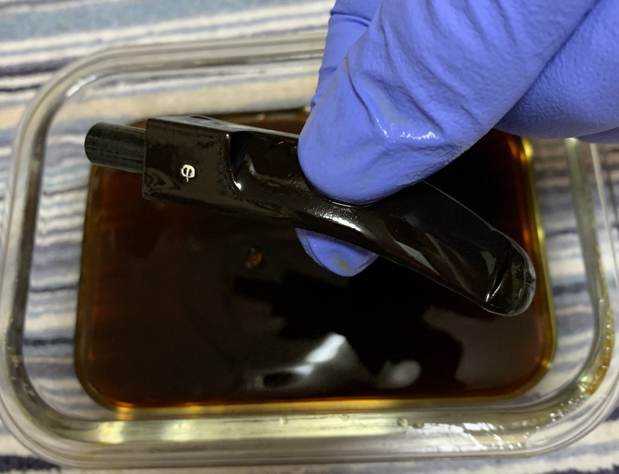
Now it was time to work on the pipe. I started working on it by stripping off the thick varnish coat with acetone and a cotton pad. I reamed the pipe with a Savinelli Fitsall Pipe Knife and cut back the cake back to the bare briar. I sanded the walls of the bowl with a piece of dowel wrapped with 220 grit sandpaper to smooth them out and clean them further. The bowl walls were in excellent condition.I topped the bowl with 220 grit sandpaper on a topping board to remove the marks and damage on the rim top. I carefully cleaned up some of the darkening and burn marks on the front rim top and edges. I used a folded piece of 220 grit sandpaper to give the inner edge of the bowl a slight bevel to minimize the darkening and damage and blend it into the surrounding briar. I restained the sanded rim top with a Walnut stain pen to match the bowl sides and shank.I cleaned out the mortise and airway in the shank with cotton swabs, pipe cleaners and isopropyl alcohol until they came out clean. (I would work on the airway in the stem when I removed it from the soak.)I polished the briar with micromesh sanding pads – dry sanding with 1500-12000 grit sanding pads. I wiped the bowl down with a damp cloth after each sanding pad. The polishing of the rim top and inner edge brought the rim top colour to match the rest of the bowl. I did not need to stain the rim at all. I worked some Before & After Restoration Balm into the surface of the briar with my fingertips to clean, enliven and protect the briar. I let the balm sit for 15 minutes and then buffed with a cotton cloth to raise the shine. The photos show the bowl at this point in the restoration process. I set the bowl aside and put the stem in the Briarville Pipe Stem Deoxidizer overnight and took a break to enjoy a movie. When I took it out of the bath the next morning the dip had removed the  oxidation and calcification. I rinsed it off with warm water and dried the stem with a coarse cloth to remove the surface oxidation. It looked very good and the tooth marks were very visible.I “painted” the surface of the stem with the flame of a lighter to lift the tooth marks on both sides. It lifted them considerably. I filled in what remained with clear CA glue. Once the glue cured I used a small flat file to flatten the repairs and recut the button edges. I sanded the stem with 220 grit sandpaper to blend them into the surface. I started polishing the stem with 400 grit wet dry sandpaper. I cleaned out the filter tenon and the airway in the stem with pipe cleaners, cotton swabs and isopropyl alcohol. I touched up the P stamp on the left side of the taper stem with Antique Gold Rub’n Buff. I applied it and worked it into the stamp with a tooth pick. Once it cured I scraped off the excess. It is definitely better though the stamp is faint in some spots. Strangely the stamping has a white tinge to it.I polished the stem with micromesh sanding pads – wet sanding with 1500-12000 grit sanding pads. I wiped it down after each sanding pad with Obsidian Oil. I polished it with Before & After Pipe Stem Polish – both Fine and Extra Fine. I am excited to put the final touches on this Peterson’s Tyrone 606 Pot with a 9mm Filter stem. I put the pipe back together and buffed it with Blue Diamond on the buffing wheel. I gave the bowl and the stem multiple coats of carnauba wax. I hand buffed the pipe with a clean buffing pad to raise the shine. It is fun to see what the polished bowl looks like with beautiful mixed grain all around it. Added to that the polished black vulcanite stem combined with the bowl and made a stunning pipe. This smooth Classic Peterson’s Tyrone 606 Pot is great looking and the pipe feels great in my hand. It is light and well balanced. Have a look at it with the photos below. The dimensions are Length: 6 inches, Height: 1 ½ inches, Outside diameter of the bowl: 1 ½ inches, Chamber diameter: 7/8 of an inch. The weight of the pipe is 43 grams/1.55 ounces. It is a beautiful pipe that I will soon be putting on the rebornpipes store in the Irish Pipe Makers Section. If you are interested in adding it to your collection send me an email or a message. Thanks for walking through the restoration with me as I worked over this pipe. Thanks to each of you who are reading this blog.

Breathing New Life into a Late Republic Era Peterson’s System Standard 309


Blog by Steve Laug

The next pipe I removed from box of Peterson’s Pipes that I have to work on was a Peterson’s System Standard pipe. Once again we are getting into pipes that have been here for a long time and pipes that neither Jeff or I have any memory of where it came or when we found it. It was stamped on both sides of the shank. On the left side it read Peterson’s [over] System [over] Standard. On the right side it was stamped Made in the Republic of Ireland (3 lines) and under that was the shape number 309. The shape is one of the most familiar of Peterson’s shapes, taking the Irish maker’s signature shank stoutness to an extreme: the shank here is nearly as wide across as the bowl itself. The nickel ferrule was in great condition and was stamped K&P [over] Petersons. Judging from the look of the rim top and inner edge I would guess that it had a thick cake when we bought it and the top was heavily coated in lava. The rim was out of round a bit. The vulcanite stem had been oxidized and had tooth marks and chatter near the button on both sides. Obviously we did not have pictures of the pipe before Jeff’s clean up so I took these photos of the pipe when I brought it to my work table. I took close up photos of the bowl, rim and the new stem. You can see the reamed bowl and the darkening, remaining lava and damage on the rim top and the inner edge. The new stem is in perfect condition and will only need to be polished.I took photos of the stamping on the sides of the shank and the nickel ferrule. All are clear and readable as noted above. I removed the stem from the shank and took a photo to give a sense of the proportions of the pipe. It is really quite nice looking.I am including the information from Pipedia’s article on Peterson pipes. It is a great read in terms of the history of the brand (https://pipedia.org/wiki/Peterson). I have included a bit of the pertinent history here.

1950 – 1989 The Republic Era – From 1950 to the present time, the stamp for this era is “Made in the Republic of Ireland” in a block format generally in three lines but two lines have been used with or without Republic being abbreviated.

During the 1950’s and 60’s the Kapp & Peterson company was still in the ownership of the Kapp family. However 1964 saw the retiral of the company Managing Director Frederick Henry(Harry) Kapp.

Pipedia also included a section of information on the System pipes including a diagram of the sytems look (https://pipedia.org/wiki/Peterson#Republic_Era_Pipes). I quote a section of the article in part and include a link to another article on Pipedia on the System pipe.

The Peterson System pipes are the standard bearers of the Peterson pipe family, famous for the excellent smoking pleasure they provide. Often imitated but never equaled, the Peterson System smokes dry, cool and sweet, thanks to the scientific effectiveness of the original design. The heart of the System is the unique graduated bore in the mouthpiece. This makes the suction applied by the smoker 15 times weaker by the time it reaches the tobacco chamber. The result is that all the moisture flows into the reservoir and, thus cannot reach the smoker’s mouth. The Peterson Lip further enhances the effectiveness of the graduated bore by directing the flow of smoke upwards and away from the tongue. This achieves a uniquely even distribution of smoke and virtually eliminates any chance of tonguebite or bitterness. Furthermore, the shape is contoured so that the tongue rests comfortably in the depression under the opening. Each “PLip” mouthpiece is made from Vulcanite. For the Peterson System pipes to work properly, the stem/tenon has to have an extension, the tip of which will pass by the draft hole from the bowl and into the sump. Upon the smoker drawing in smoke, this extension then directs the smoke down and around the sump to dispense a lot of the moisture before the smoke enters the extension and stem. On the System Standards and other less expensive systems, this extension with be made of Vulcanite turned integrally with the stem. On the more expensive System pipes this extension will be made of metal which screws into the Vulcanite stem. This extension on the earlier pipes will be of brass and the newer pipes will be of aluminium. Most smokers not knowing this function of the metal extension, assumes that it is a condenser/stinger and will remove it as they do with the metal condensers of Kaywoodie, etc. Should you have a System pipe with this metal extension, do not remove it for it will make the System function properly and give you a dryer smoke (https://pipedia.org/wiki/A_closer_look_at_the_famous_Peterson_Standard_System_Pipe).

With that information in hand I knew what I was dealing with in terms of the stamping and the age of this pipe. I knew from the information that the pipe was made during the Late Republic Era between 1950 and the present day. Personally I think this is probably a 60s-70s pipe. Now it was time to work on the pipe.

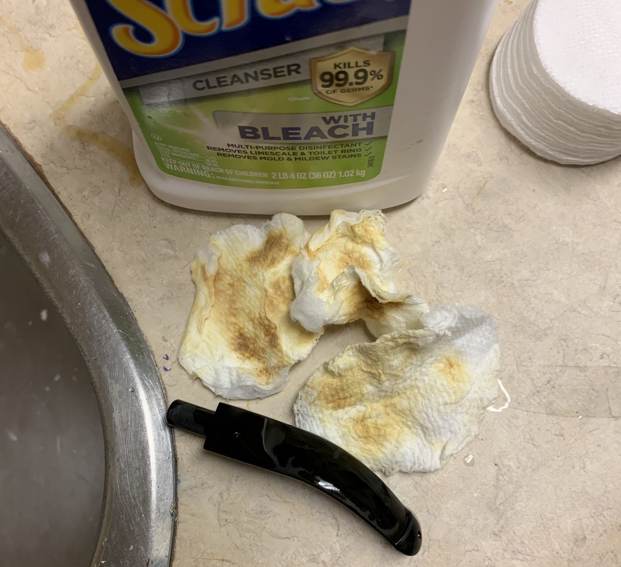
Jeff had thoroughly cleaned up the pipe. He reamed the pipe with a PipNet Pipe Reamer and cleaned up the remnants with a Savinelli Fitsall Pipe Knife.  He scrubbed the bowl with undiluted Murphy’s Oil Soap with a tooth brush. He rinsed it under running warm water to remove the soap and grime. He cleaned out the inside of the sump in the shank and the airway in the stem with alcohol, cotton swabs and pipe cleaners. He scrubbed the exterior of the stem with Soft Scrub to remove as much of the oxidation and calcification as possible. He soaked the stem in Before & After Deoxidizer and rinsed it off with warm water.

I decided to work on the damage on the top and the inner edge of the bowl first. I started the work with a folded piece of 220 grit sandpaper to clean up the inner bevel of the rim. Then moved on to using a wooden ball and a piece of 220 grit sandpaper to give the edge a uniform bevel and smooth out the rim top. Once I had finished I think that it looked much better. I wiped off the varnish coat with acetone and a cotton pad to remove the spotty finish and to also blend in the sanded rim top. I polished the briar with micromesh sanding pads – dry sanding with 1500-12000 grit pads. I wiped the bowl down after each  pad to remove the grit. The bowl began to take on a rich shine. It is going to be a beauty. I rubbed the bowl down with Before & After Restoration Balm. I worked it into the briar with my finger tips. I let it sit for 10 minutes and the Balm did its magic. It enlivens, cleans and preserves the briar. It certainly brought this bowl back to life. I buffed it off with a clean cloth and took the following photos.  I set the bowl aside and turned to work on the stem. I “painted” the tooth marks on the stem with the flame of a Bic Lighter to lift them. I was able to lift them all to some degree. I filled in those that remained with clear CA glue. I used a small file to flatten the repairs. I sanded them smooth with 220 grit sandpaper. I started polishing the stem with 400 grit wet dry sandpaper. I polished the vulcanite stem with micromesh sanding pads – 1500-12000 grit pads. I wiped it down with a damp cloth after each sanding pad. I used Before & After Pipe Polish – both Fine and Extra Fine to further polish the stem. This Republic Era Ireland Peterson’s System Standard Bent 309 with a Nickel Ferrule and a vulcanite P-lip stem is a great looking pipe now that it has been restored. The beautiful grain that shines through the polished finish is stunning. As the pipe is smoked the patina should develop and look even better. I put the stem back on the bowl and carefully buffed the pipe with Blue Diamond on the buffing wheel. I gave the bowl and the stem multiple coats of carnauba wax on the buffing wheel and followed that by buffing the entire pipe with a clean buffing pad. I hand buffed the pipe with a microfiber cloth to deepen the shine. The finished Peterson’s System Standard 309 Bent fits nicely in the hand and feels great. Give the finished pipe a look in the photos below. The dimensions of the pipe are Length: 6 inches, Height: 2 inches, Outside diameter of the bowl: 1 ¼ inches, Chamber diameter: ¾ of an inch. The weight of the pipe is 53 grams/1.83 ounces. I will be adding the pipe to the Irish Pipe Makers Section of the rebornpipes store. If you are interested in purchasing this pipe send me a message or an email. Thanks for reading this blog and my reflections on the pipe while I worked on it.

Restoring & Restemming the last the 8 Peterson Bowls – Republic Era System Standard 314


Blog by Steve Laug

Jeff and I often purchase pipe bowl/stummels of brands that we like and want to restore. These have included a lot of different bowls. If you have followed us for long you know that some of these have included Peterson’s, Dunhill’s, and a wide range of Danish and English pipes. Awhile ago Jeff and I were sorting through the bowls in our collection and pulled out eight Peterson’s bowls that were dirty and stemless. A friend referred us to a contact named Silas Walls, of Walls Pipe Repair in Wallace, Idaho, USA as he seems to have a good supply of original Peterson’s stems. Our friend has had him fit stems for some of his Petes and was very happy with the work. We made contact with him and sent him eight bowls for restemming.

In the photo above I show the 8 restemmed pipes. I have marked the 7 I have worked on already with a red X). This eighth one that we cleaned up before mailing them out was a bowl that we received on 06/05/21 from a friend in Chicago, Illinois, USA. It is stamped on the left side of the shank and reads Peterson’s [arched over] System [over] Standard. On the right side of the shank it is stamped Made in the Republic of Ireland (three lines) over the shape number 314. The ferrule is stamped K&P [over] Peterson’s. The before photos of this bowl were on a corrupted memory card and are gone. But needless to say the pipe was just as bad as the rest of this lot.

As with the others before this one I turned to Pipedia (https://pipedia.org/wiki/Peterson) and read through the article before starting on my work. I found an interesting note in the middle of the page. I quote the pertinent section below and have highlights some important information in red below.

From 1950 to the present time, the stamp for this era is “Made in the Republic of Ireland” in a block format generally in three lines but two lines have been used with or without Republic being abbreviated.

During the 1950’s and 60’s the Kapp & Peterson company was still in the ownership of the Kapp family. However 1964 saw the retiral of the company Managing Director Frederick Henry(Harry) Kapp.

Since I found a new stem it was now it was time to work on this final bowl of the lot. Jeff had done a great job cleaning up the pipe as usual. He reamed the pipe with a PipNet reamer and cut back the cake back to the bare briar. He cleaned up the walls with a Savinelli Fitsall Pipe Knife. He scrubbed the interior of the bowl and shank with pipe cleaners, cotton swabs and alcohol to remove the tars and oils. He scrubbed the exterior of the pipe with Murphy’s Oil Soap and a tooth brush to remove the grime from the finish. He worked on the rim top lava and darkening with the soap and tooth brush. It looked much better. I took pictures of the bowl without the new stem. It is a great looking piece of briar even with the gouges and marks on sides, top and heel of the bowl. The nickel ferrule has a few dents but otherwise looks very good. When the pipes came back to Jeff with their new stems they looked great. When the pipes arrived here I checked them out. Here is what I found. The first six pipes from the lot were flawless and quite beautiful. The last two – this 314 and a 313 I reworked previously, looked great at first glance but upon further examination it was clear that the stems were not Peterson’s style stems. The draught on the P-lip portion of the stem is on the top of the stem, but in the case of these two stems the airway came straight out the end of the stem like a Wellington pipe. I was not happy with them. I have already replaced the stem on the 313 and this 314 was the only one I still needed a stem for. Today I was gifted some Peterson’s P-lip stems and one was what I was looking for. It fit well but I would need to give it a bit more of a bend for a perfect look. With the new stem chosen, I turned to work on the damage on the top and the inner edge of the bowl. I used a folded piece of 220 grit sandpaper to clean up the inner bevel of the rim and remove the damage on the rim top. Once I had finished I think that it looked much better. I filled in the deep gouges in the bowl on the right heel and the underside of the heel with CA glue and also briar dust. I sanded them smooth with 220 grit sandpaper to blend them in. They looked significantly better. I stained the sanded areas with a Cherry stain pen to match the surrounding area around the rest of the bowl sides, top and heel.I polished the briar with micromesh sanding pads – dry sanding with 1500-12000 grit pads. I wiped the bowl down after each  pad to remove the grit. The bowl began to take on a rich shine. It is going to be a beauty.   I rubbed the bowl down with Before & After Restoration Balm. I worked it into the briar with my finger tips. I let it sit for 10 minutes and the Balm did its magic. It enlivens, cleans and preserves the briar. It certainly brought this bowl back to life. I buffed it off with a clean cloth and took the following photos.  I set the bowl aside and turned my attention to the stem. Since it was a new stem I did not need to polish it. The stem was looking very good. I heated the stem with a lighter to soften the vulcanite and bent it to the shape that it needed to be for the shape of the bowl. I held it in place to let it cool and set the shape. It looked very good.  This Republic Era Ireland Peterson’s System Standard Bent 314 with a Nickel Ferrule and a vulcanite P-lip stem is a great looking pipe now that it has been restored. The beautiful grain that shines through the polished finish is stunning. As the pipe is smoked the patina should develop and look even better. I put the stem back on the bowl and carefully buffed the pipe with Blue Diamond on the buffing wheel. I gave the bowl and the stem multiple coats of carnauba wax on the buffing wheel and followed that by buffing the entire pipe with a clean buffing pad. I hand buffed the pipe with a microfiber cloth to deepen the shine. The finished Peterson’s System Standard 314 Bent Billiard fits nicely in the hand and feels great. Give the finished pipe a look in the photos below. The dimensions of the pipe are Length: 5 ¾ inches, Height: 1 ¾ inches, Outside diameter of the bowl: 1 1/8 inches, Chamber diameter: ¾ of an inch. The weight of the pipe is 44 grams/1.55 ounces. I will be adding the pipe to the Irish Pipe Makers Section of the rebornpipes store. If you are interested in purchasing this pipe send me a message or an email. Thanks for reading this blog and my reflections on the pipe while I worked on it.

Cleaning up a Second Peterson’s De Luxe System 8S Bent Billiard with a Sterling Silver Ferrule


Blog by Steve Laug

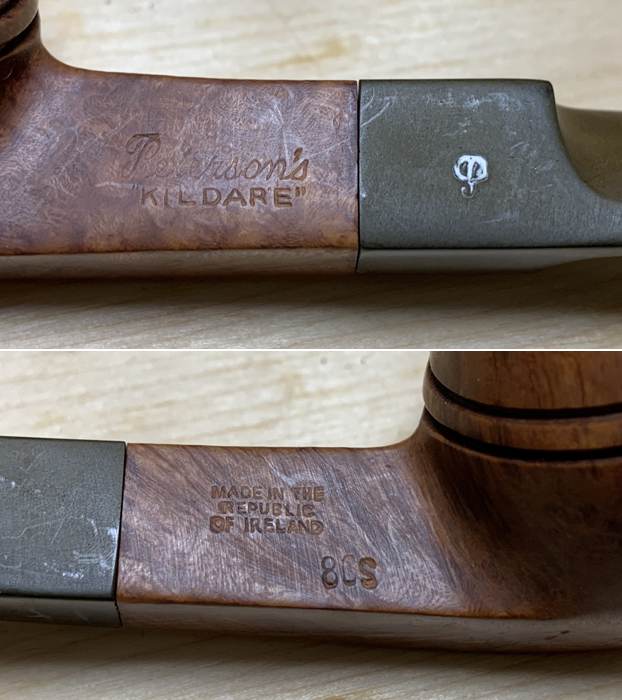
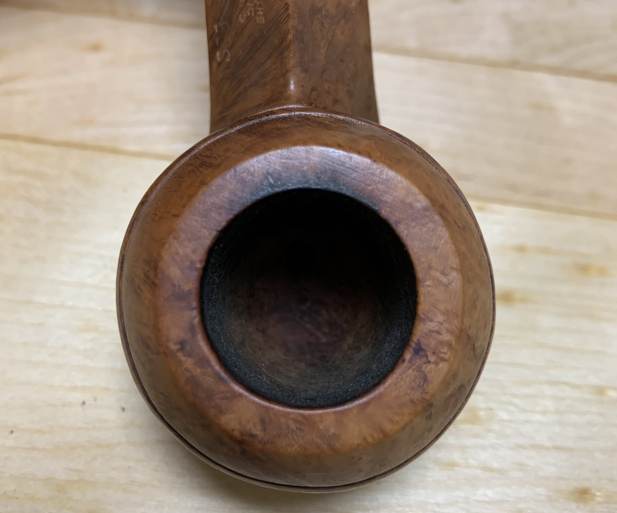
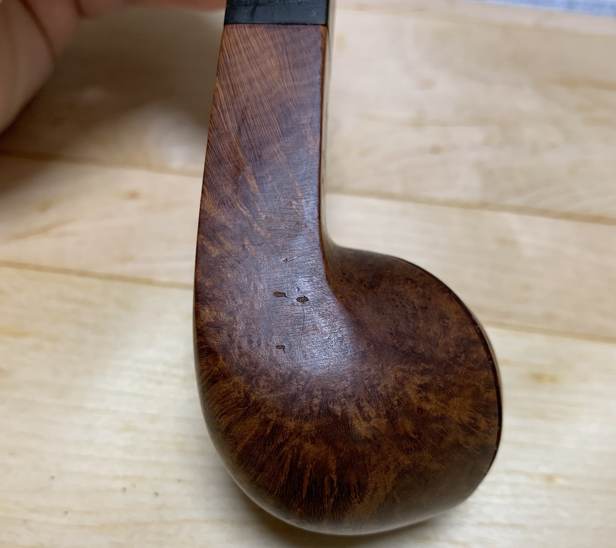
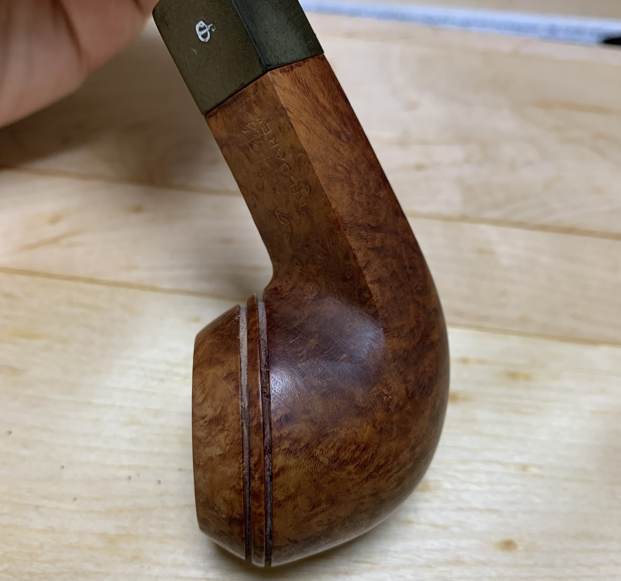
I have a few pipes that I am working on for local folks who either have dropped them off or who are friends that I am catching up with. The next pipe on the worktable is the second of two more that belongs to an old friend of mine who is in the process of moving. He stopped by and asked me to clean up two more of his favourite pipe. This first one I worked on was a Whidbey Hand Cut CW ’76 Freehand (https://rebornpipes.com/2022/11/11/cleaning-up-a-chuck-whitmore-hand-cut-whidbey-freehand-for-a-friend/). This second on is another Peterson Deluxe with a Sterling Silver Ferrule. It is stamped on the left side of the shank and reads Peterson’s [over]De Luxe. The stamping on the right side reads Made in the Republic of Ireland (3 lines) over the shape number 8S. The ferrule on the shank is clear and readable under the tarnish. It reads Peterson’s [over] Dublin. That is followed by Sterling [over] Silver. That was followed by three hallmarks – The Hibernia stamp, the Crowned Harp stamp and finally the letter “m”. It has some stunning grain around the bowl and shank under the grime. There was a thin cake in the bowl and the top and edges of the rim had some scratches and damage on both. The stem was lightly oxidized and calcified. There were light tooth marks on the surface of both sides. I took some photos of the pipe before I started my work. I took photos of the rim top and the stem to show their condition. The top and edges look quite good other than some darkening on the beveled rim top – heavier toward the back. The silver was badly oxidized but I could still read the stamping. The stem was oxidized, calcified and has light tooth marks and chatter on both sides. I took photos of the stamping on the shank and the Sterling Silver ferrule to capture its condition. The stamping on the shank is readable as noted above. The stamping on ferrule is clear and readable as noted above. There was no “P” stamp on the stem side. I removed the stem from the bowl and took a picture of the pipe to show the general look and proportion of the pipe. It also shows the metal condenser tube in the tenon end. To help identify the shape number I turned to a Peterson Catalogue that I have on rebornpipes and looked up the System Deluxe pipes (https://rebornpipes.com/tag/peterson-hallmark-chart/). I compared the shape of the pipe in hand with the shape chart show below. I have put a red box around the 8S pipe shown in the catalogue page shown below. So now I knew it was an 8S Bent Billiard.I turned first to Pipephil’s site to reacquaint myself with the DeLuxe. Unfortunately there was no information to be found on this specific line. I then turned to Pipedia’s article on Peterson pipes to see what I could garner from that information. It is a great read in terms of the history of the brand (https://pipedia.org/wiki/Peterson). I have included a bit of the pertinent history here.

1950 – 1989 The Republic Era  – From 1950 to the present time, the stamp for this era is “Made in the Republic of Ireland” in a block format generally in three lines but two lines have been used with or without Republic being abbreviated…

…With that information in hand I knew what I was dealing with in terms of the stamping on the pipe. It is a Republic Period pipe. I also wanted to be able to interpret the hallmarks on the silver band. I have captured a portion of the chart that include below that helps to clarify the meaning of each of the three hallmarks. I like the Hallmark feature on the higher end Peterson pipes with Sterling silver bands. It helps to pin down the date even further.

  • “Hibernia” seated, arm on harp represents Ireland (country of manufacture). There have been minor design changes over the years.
  • The “Harp Crowned” is the fineness mark denoting the high quality (purity) of the silver, and was used in a variety of designs until October 1992 when it was replaced by the new European Standard or Millesimal mark which gives the purity or quality of the silver in parts per thousand.
  • The Date Letter Code for the year in which the silver was hallmarked (see the chart below). In certain years a fourth hallmark is applied – for example 1966 – a Sword of Light for the 50th anniversary of the Easter Rising 1973. There were also other marks used for the fourth hallmark.

The pipe on my table had the Hibernia seated mark (Ireland) followed by the Harp Crowned signifying Sterling Silver percentage and finally in this case a lower case “m”. Each of the hallmarks was in an octagonal cartouche. The chart below helps me identify the date mark to 1978. I have drawn a red arrow to point out the 1978 mark in the chart below.

I have included the entire Hallmark chart for ease of reference show any of you be looking to date the pipes that you are working on at present.I polished the silver to remove the tarnish so that I could confirm the stamping on the silver and the date noted above. It is indeed hallmarked with the year stamp identifying it as a 1978 pipe. I took photos of the polished silver to show what it looked like after polishing. It is quite stunning. I worked over the rim top and the inner edge with a folded piece of 220 grit sandpaper to smooth out the damage and to bring the bowl back to round as much as possible. I polished the briar with micromesh sanding pads – polishing it with 1500-12000 grit pads. By the time I was finished the briar had a great shine. The grain on the pipe is quite beautiful. I rubbed the bowl and shank down with Before & After Restoration Balm to deep clean the finish on the bowl and shank. The product works to clean, enliven and protect the briar. I worked it into the finish with my fingers. After it sat for 15 minutes I wiped it off with a soft cloth. The briar really began to have a rich shine. I took some photos of the bowl at this point to mark the progress in the restoration. It is a beautiful bowl.  I set the bowl aside and turned my attention to the stem. I “painted” the surface with the flame of a lighter to lift the tooth marks and chatter. It worked very well and just a few small spots were left. I filled them in with clear CA glue and set it aside to cure. I sanded out the repairs and oxidation on the top and underside with 220 grit sandpaper and started polishing it with 400 grit wet dry sandpaper. I polished the stem with micromesh sanding pads – dry sanding with 1500-12000 grit pads. I wiped the stem down after each pad with a damp cloth to remove the sanding dust. I used the Before & After Pipe Polish to remove the small minute scratches left in the vulcanite. I finished by wiping the stem down with a final coat of Obsidian Oil and set it aside to dry.   I cleaned up the condenser and then put it back I place I the stem. This condenser was metal instead of the older bone ones. It is an integral part of the System pipe.As usual at this point in the restoration process I am excited to be on the homestretch. I look forward to the final look when it is put back together, polished and waxed. I put the bowl and stem back together. I polished the bowl and stem with Blue Diamond to polish out the scratches in the briar and the vulcanite. I gave the bowl and the stem multiple coats of carnauba wax. I buffed the pipe with a clean buffing pad to raise the shine. I hand buffed it with a microfiber cloth to deepen the shine. The pipe polished up pretty nicely. The grain really pops with the wax and polish. The shiny black vulcanite stem is a beautiful contrast to the browns of the bowl and thick shank. This Peterson’s DeLuxe 8S Bent Billiard was another fun pipe to work on. The Sterling Silver Ferrule works as a contrast between the stem and the briar and binds it all together. It really is a quite stunning piece of briar whose shape follows the flow of the briar. The pipe is comfortable pipe to hold in the hand. The finished pipe is shown in the photos below. The dimensions of the pipe are Length: 5 ½ inches, Height: 1 ¾ inches, Outside diameter of the bowl: 1 1/8 inches, Chamber diameter: ¾ of an inch. The weight of the pipe is 1.45 ounces/41 grams. This beautiful pipe will be going back with the other pipe to my friend. He will enjoy smoking it once again in his new place. Thanks for reading this blog and my reflections on the pipe while I worked on it.
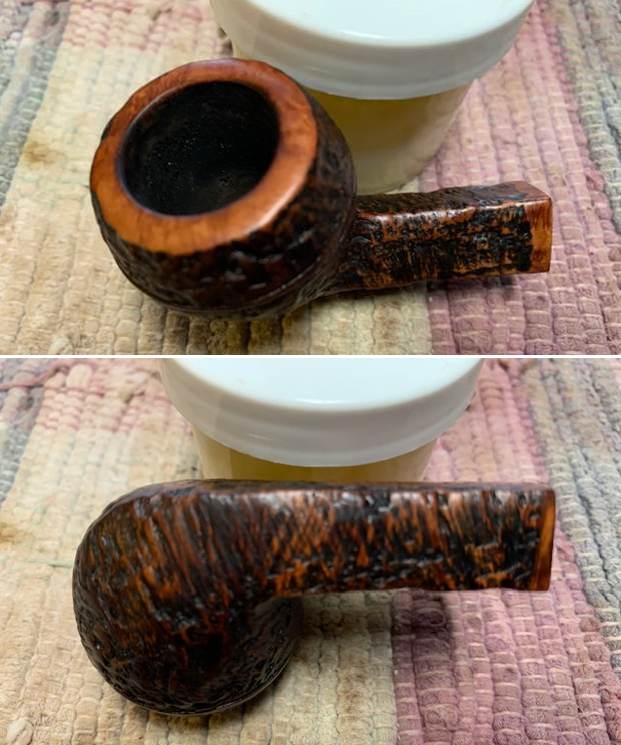
Breathing New Life into a Peterson of Dublin Dalkey 221 Chunky Bent Billiard


Blog by Steve Laug

The next pipe I brought to the table was another Peterson that Jeff purchased off eBay on 11/19/17 from Fort Meyers, Florida, USA. It has been sitting here in Vancouver awaiting my contribution to the restoration. It is a nicely shaped pipe with a chunky shank and feel in the hand. The finish is a walnut stain that gives a sense of rich brown. It is stamped on the left side of the shank and reads Peterson [arched over] of Dublin [over] Dalkey (in block print). On the right side there is the shape number 221 in the center of the and no other stamping. The bowl had a thick cake and a heavy overflow of lava on the rim top. The front outer edge of the rim had been beat against a hard surface and had a lot of damage and roughness across the bowl front. The rim top was also damaged with scratches and nicks in the surface that looked like it had been used as a hammer. The rest of the finish on the bowl was quite clean. The twin silver bands separated by an orange acrylic band on the stem is dirty but in good condition. The fishtail stem was oxidized, calcified and had light tooth chatter on both sides ahead of the button. The “P” stamp on the side of the saddle stem and readable and painted white. Jeff took photos of the pipe before he started his clean up work. He captured the cake in the bowl and the debris and lava on the rim top and edges in the next photos. It was very clear that it was an exceptional smoker! The damage on the front of the rim edge and the rim top is visible even under the heavy lava on the top and edges. The stem is oxidized, calcified and shows the tooth marks and chatter on both sides ahead of the button. Jeff captured some of the beauty of the shape and the grain in the next photo. The mix of grains on the front of the bowl and heel are quite lovely as can be seen in the photo below.He took photos of the stamping on the sides of the shank. It is clear and readable as noted above. He also took a photo of the  P logo stamp on the left side of the stem. I decided to check out both the Pipephil and the Pipedia sites for information on the Dalkey line. Both sites did not have any specific information. I then did a quick Google search for the Peterson Dalkey. The first link took me to smokingpipes.com (https://www.smokingpipes.com/pipes/estate/ireland/moreinfo.cfm?product_id=332074) to a pipe that had been sold there. I have included the information I found below:

While the bent Billiard is a classic shape, rendered by countless companies, Peterson’s “221” iteration is readily recognized as the work of the Irish marque because of the added visual weight attributed to the shank and transition. Such extra heft stretches the heel and provides more palm-filling substance. It makes for an eye-catching, muscular form in profile yet remains well balanced thanks to the curled transition and bent stem out back. Here it’s presented in the Dalkey finish, with a warm hazelnut stain and nickel-and-acrylic band.

The second link took me to pipesandcigars.com (https://www.pipesandcigars.com/p/peterson-dalkey-pipes/2000657/).I quote the following from the introduction to the line:

Peterson Dalkey Pipes come in an assortment of classic Peterson shapes. The finish is a warm brown tone, mated to black stems, and finished with a gold and orange triple trim ring. These pipes are not only handsome, but they’re among the most affordable smooth finished pipes that Peterson makes.

I then turned to The Peterson Pipe by Mark Irwin and Gary Malmberg and looked up the listing in the book for Dalkey. I quote what I found there.

Dalkey (2010-) Dark stained smooth finish line with a band of orange acrylic sandwiched between nickel bands, white P stamped on a fishtail mouthpiece.

Now I knew I was dealing with a pipe made after 2010 and the dark stained finish (to me it is a dark walnut). The shank band looks amazing with the stain on the finish. Now it was time to work on the pipe.

Jeff had done a great cleanup on the pipe. He reamed the bowl with a PipNet pipe reamer and followed up with a Savinelli Fitsall pipe knife to remove the cake. He scrubbed out the mortise and the airway in the shank and the stem with alcohol, cotton swabs and pipe cleaners. He scrubbed the bowl exterior with a tooth brush and Murphy’s Oil Soap to remove the grime on the finish of the bowl and the lava from the rim top. He rinsed it under running water. One of the benefits of this scrub is that it also tends to lift some of the scratches and nicks in the surface of the briar. He dried it off with a soft cloth. He cleaned the internals of the shank/mortise and stem with alcohol, pipe cleaners and cotton swabs. He soaked the stem in Briarville’s Pipe Stem Deoxidizer and rinsed it off with warm water and cleaned out the airway in the stem with alcohol, pipe cleaners and cotton swabs. I took photos of the pipe as I saw it when I finally brought it to my work table.   I took photos of the rim top and stem to show the condition. The rim top and edges were in very rough condition. You can see the damage to the top all the way around and to the outer edge on the bowl front. It really very rough to the touch. The stem was vulcanite and there were light tooth marks and chatter on both sides ahead of the button. I took photos of the stamping on the sides of the shank. They are clear and readable as noted above. The “P” logo on the stem is faint but is still quite readable.   I removed the stem from the shank and took a photo of the pipe to give a sense of the proportions of the bowl and stem.I took photos of the damage on the rim top and the front edge to show how beat up it was. The roughness is very tangible when I touched it. I dripped some clear CA glue on the front edge of the bowl so I could rebuild it. I then dipped it into some briar dust to build it up. I cleaned up and reshaped the edge with 220 grit sandpaper. I topped the bowl with a topping board and 220 grit sandpaper to smooth out the damage to the rim top. When I was finished it looked much better. With the rim top smooth it was now time to give the inner edge a bevel. I used a wooden ball and 220 grit sandpaper to shape the edge. I wrapped the ball with the sandpaper and worked on the edge. It took a bit of work to smooth it out and give it a bevel. I smoothed out the bevel with a folded piece of 220 grit sandpaper. The rim top came out looking very good at this point. I stained the rim top and the inner and front outer edges with an oak stain pen to match the colour of the stain around the bowl and shank.I decided to start with polishing the briar with micromesh sanding pads. I dry sanded it with 1500-12000 grit pads. I wiped the bowl down after each pad with a damp cloth. The bowl began to take on a rich shine and grain was beginning to stand out.   At this point the bowl was polished and clean. I rubbed down with Before & After Restoration Balm. I worked it into the surface of the bowl sides and shank with my fingertips to clean, enliven and protect the briar. I let the balm sit for 10 minutes, then buffed with a cotton cloth to raise the shine. The Balm did its magic and the grain stood out on the briar.   I set the bowl aside and turned my attention to the stem. I polished the stem with micromesh sanding pads – 1500-12000 grit pads. I wiped it down with Obsidian Oil after each sanding pad. I finished the polishing with Before & After Polishes – both Fine and Extra Fine. I gave it a final rub down with Obsidian Oil and set it aside to dry. I repainted the “P” logo stamp on the left side of the saddle stem with some white acrylic nail polish. I worked it into the stamp with a tooth pick. Once it dried I scraped of the excess and lightly polished it with a 1500-2400 grit micromesh sanding pad. This Peterson of Dublin Dalkey 221 Bent Billiard with a vulcanite taper stem has a smooth reddish finish. The rich browns of the stain make the grain come alive with the polishing and waxing. I put the vulcanite stem back on the bowl and carefully buffed the pipe with Blue Diamond on the buffing wheel using a light touch on the briar. I gave the bowl and the stem multiple coats of carnauba wax on the buffing wheel and followed that by buffing the entire pipe with a clean buffing pad. I hand buffed the pipe with a microfiber cloth to deepen the shine. The finished Peterson’s Dalkey 221 Bent Billiard really is a great looking and fits nicely in the hand and looks very good. Give the finished pipe a look in the photos below. The dimensions of the pipe are Length: 5 ½ inches, Height: 1 ¾ inches, Outside diameter of the bowl: 1 ¼ inches, Chamber diameter: ¾ of an inch. The weight of the pipe is 1.62 oz./46 grams. This pipe will soon be on the Irish Pipe Makers Section of the rebornpipes store if you would like to add it to your collection. Thanks for reading this blog and my reflections on the pipe while I worked on it.

Cleaning up a Peterson’s De Luxe System 8S Bent Billiard with a Sterling Silver Ferrule


Blog by Steve Laug

I have a few pipes that I am working on for local folks who either have dropped them off or who are friends that I am catching up with. The next pipe on the worktable is the second of two that belongs to an old friend of mine who is in the process of moving. He stopped by and asked me to clean up a couple of his favourite pipe. This first one I worked on was a Savinelli de luxe Milano 607KS (https://rebornpipes.com/2022/10/23/new-life-for-a-savinelli-de-luxe-milano-sandblast-607ks-bent-billiard/). This second on is a Peterson Deluxe with a Sterling Silver Ferrule. It is stamped faintly on the left side of the shank and reads Peterson’s [over]De Luxe. The stamping on the right side was buffed off. The ferrule on the shank is clear and readable under the tarnish. It reads Peterson’s [over] Dublin. That is followed by Sterling [over] Silver. That was followed by three hallmarks – The Hibernia stamp, the Crowned Harp stamp and finally the letter “m”. It has some stunning grain around the bowl and shank under the grime. There was a thin cake in the bowl and the top and edges of the rim had some scratches and damage on both. The stem was lightly oxidized but there were no tooth marks on the surface. I took some photos of the pipe before I started my work. I took photos of the rim top and the stem to show their condition. The top and edges showed some damage and was out of round and had darkening. The stem had oxidation though there was not any tooth marks of damage on the surface. I took photos of the stamping on the shank and the Sterling Silver ferrule to capture its condition. The stamping on the shank is faint but readable as noted above. The stamping on ferrule is clear and readable as noted above. I removed the stem from the bowl and took a picture of the pipe to show the general look and proportion of the pipe. It also shows the metal condenser tube in the tenon end. To help identify the shape number that had worn off I turned to a Peterson Catalogue that I have on rebornpipes and looked up the System Deluxe pipes (https://rebornpipes.com/tag/peterson-hallmark-chart/). I compared the shape of the pipe in hand with the shape chart show below. I have put a red box around the 8S pipe shown in the catalogue page shown below. So now I knew it was an 8S Bent Billiard.I turned first to Pipephil’s site to reacquaint myself with the DeLuxe. Unfortunately there was no information to be found on this specific line. I then turned to Pipedia’s article on Peterson pipes to see what I could garner from that information. It is a great read in terms of the history of the brand (https://pipedia.org/wiki/Peterson). I have included a bit of the pertinent history here.

1950 – 1989 The Republic Era  – From 1950 to the present time, the stamp for this era is “Made in the Republic of Ireland” in a block format generally in three lines but two lines have been used with or without Republic being abbreviated…

…With that information in hand I knew what I was dealing with in terms of the stamping on the pipe. It is a 1978  Republic Period pipe. I also wanted to be able to interpret the hallmarks on the silver band. I have captured a portion of the chart that include below that helps to clarify the meaning of each of the three hallmarks. I like the Hallmark feature on the higher end Peterson pipes with Sterling silver bands. It helps to pin down the date even further.

  • “Hibernia” seated, arm on harp represents Ireland (country of manufacture). There have been minor design changes over the years.
  • The “Harp Crowned” is the fineness mark denoting the high quality (purity) of the silver, and was used in a variety of designs until October 1992 when it was replaced by the new European Standard or Millesimal mark which gives the purity or quality of the silver in parts per thousand.
  • The Date Letter Code for the year in which the silver was hallmarked (see the chart below). In certain years a fourth hallmark is applied – for example 1966 – a Sword of Light for the 50th anniversary of the Easter Rising 1973. There were also other marks used for the fourth hallmark.

The pipe on my table had the Hibernia seated mark (Ireland) followed by the Harp Crowned signifying Sterling Silver percentage and finally in this case a lower case “m”. Each of the hallmarks was in an octagonal cartouche. The chart below helps me identify the date mark to 1978. I have drawn a red arrow to point out the 1978 mark in the chart below.

I have included the entire Hallmark chart for ease of reference show any of you be looking to date the pipes that you are working on at present.I worked over the rim top and the inner edge with a folded piece of 220 grit sandpaper to smooth out the damage and to bring the bowl back to round as much as possible. I polished the briar with micromesh sanding pads – polishing it with 1500-12000 grit pads. I rubbed down the Sterling Silver with a silver polishing cloth. By the time I was finished both the briar and the silver ferrule they both had a great shine. The grain on the pipe is quite beautiful.  I rubbed the bowl and shank down with Before & After Restoration Balm to deep clean the finish on the bowl and shank. The product works to clean, enliven and protect the briar. I worked it into the finish with my fingers. After it sat for 15 minutes I wiped it off with a soft cloth. The briar really began to have a rich shine. I took some photos of the bowl at this point to mark the progress in the restoration. It is a beautiful bowl.   I polished the silver ferrule with a jeweler’s cloth to remove the rest of the tarnish on the silver. It is treated with a product that protects the silver and removes the remaining tarnish. It has a rich, beautiful shine.   I polished the stem with micromesh sanding pads – wet sanding with 1500-2400 grit pads and dry sanding with 3200-12000 grit pads. I wiped the stem down after each pad with a damp cloth to remove the sanding dust. I used the Before & After Pipe Polish to remove the small minute scratches left in the vulcanite. I finished by wiping the stem down with a final coat of Obsidian Oil and set it aside to dry.   As usual at this point in the restoration process I am excited to be on the homestretch. I look forward to the final look when it is put back together, polished and waxed. I put the bowl and stem back together. I polished the bowl and stem with Blue Diamond to polish out the scratches in the briar and the vulcanite. I gave the bowl and the stem multiple coats of carnauba wax. I buffed the pipe with a clean buffing pad to raise the shine. I hand buffed it with a microfiber cloth to deepen the shine. The pipe polished up pretty nicely. The grain really pops with the wax and polish. The shiny black vulcanite stem is a beautiful contrast to the browns of the bowl and thick shank. This Peterson’s DeLuxe 8S Bent Billiard was another fun pipe to work on. The Sterling Silver Ferrule works as a contrast between the stem and the briar and binds it all together. It really is a quite stunning piece of briar whose shape follows the flow of the briar. The pipe is comfortable pipe to hold in the hand. The finished pipe is shown in the photos below. The dimensions of the pipe are Length: 5 ½ inches, Height: 1 ¾ inches, Outside diameter of the bowl: 1 1/8 inches, Chamber diameter: ¾ of an inch. The weight of the pipe is 1.52 ounces/44 grams. This beautiful pipe will be going back with the Savinelli De Luxe Milano to my friend. He will enjoy smoking it once again in his new place. Thanks for reading this blog and my reflections on the pipe while I worked on it.

Restoring a Victim of a Sharp Knife – A Peterson’s of Dublin System Standard 313


Blog by Steve Laug

While I was traveling in Europe I received a call from a fellow here in British Columbia who was referred to me by the local cigar shop. I call him when I returned home and it turned out that he had a pipe that he wanted me to work on. He sent it to me and it came on Friday. He said that the stem was clogged and he wanted me to clean up the airway and make it usable again. When it arrived I unpacked the box and found it was a Peterson’s 313 System pipe. It is stamped on the left side of the shank and reads Peterson’s [arched over] of Dublin [over] System [over] Standard followed by the shape number 313. It had once been a beautiful pipe with an acrylic stem but it had long before lost its charm. The sides of the bowl were beat up and the rim top was also beat up. There was a thick cake of lava on the rim top and the bowl was out of round. The cake in the bowl was also out of round and heavier on the left side than the rest. There was a lot of grime on the briar that made it sticky feeling. There was a hole in the bottom of the bowl that punctured the heel. The pipe was a mess. The stem was plugged as well and I could not blow any air through it. The nickel ferrule was oxidized and dirty with  grime on it and an overflow of oils from the sump. It was a mess.I called the fellow who sent the pipe and told him about the hole in the bottom of the bowl. He laughed and said he did not notice it. He said it was probably the result of constant reaming with a pocket knife. I am  pretty sure that is what caused the damage as it was very much of a cut. I would know more once I reamed the bowl.
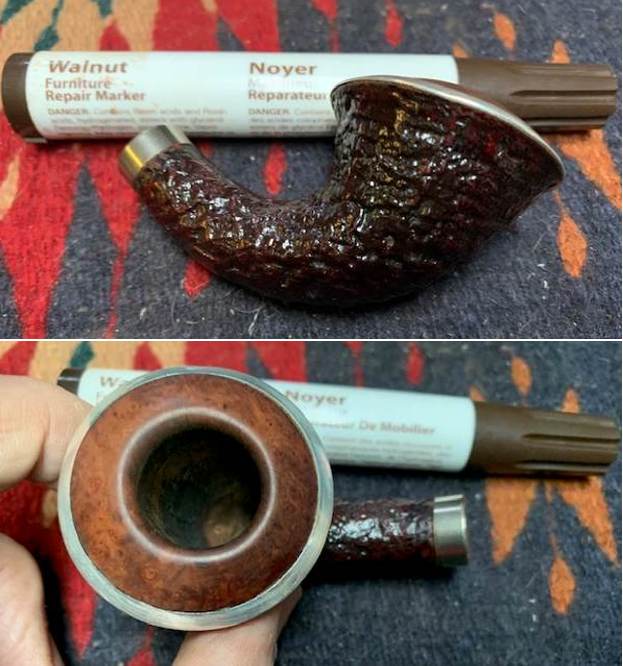
I reamed it with a PipNet reamer to take the cake back to bare briar. I scraped the remnants of the cake off with a Savinelli Fits All Pipe Knife. I sanded the walls with a piece of 220 grit sandpaper wrapped around a piece of briar. What I found in the bottom of the bowl confirmed the issues I noted above. Repeated scraping of the cake around the bottom of the bowl had left a trough all the way around the bottom and a nipple standing in the bottom of the bowl. I spoke with the owner and he wanted a fix that I have done often. I would repair the exterior with briar dust and clear CA glue. The inside bottom of the bowl would be filled in with JB Weld and once cured would be sanded and given a bowl coating of sour cream and charcoal powder. Before I could start the repair work I would need to clean up the external and the internals. I topped the bowl with 220 grit sandpaper on a topping board. It looked better at this point in the process. I sanded out the scratches on the sides of the bowl and around the rim top. It was quite damaged. I used a folded piece of 220 grit sandpaper to smooth out the marks in the bowl side in preparation for scrubbing it.  I scrubbed the bowl with a tooth brush and Murphy’s Oil Soap. I rinsed it off with warm running water to wash away the grime and debris. It was beginning to look much better. The first step in the repair was to repair the small hole in the bowl bottom. It was about the size of a pencil lead. I coated the edges with clear CA glue and packed in some briar dust. I repeated the process until the hole was repaired. Once it had hardened I sanded it smooth with 220 grit sandpaper to blend it into the surrounding briar.  I mixed up a batch of JB Weld with the stick and then built up the bottom of the bowl. I put a pipe cleaner in the airway so as not to cover it in the process of the repair. I coated bottom of the bowl and layered it on top of the trough around the bottom and built it up until it was smooth. I raised the bottom of the bowl about 1/8th of and inch. I applied several more coats of the mixture with a folded pipe cleaner and also filled in some of the deep gouges in the sides of the bowl left behind by the knife. I set it aside to cure overnight. This morning with the internals hardening I decided to clean out the sump and the airway into the bowl with pipe cleaners, cotton swabs and isopropyl alcohol. The pipe was a filthy one so it took a lot of cleaners. The stem was clogged but once I started working on it I could seen why. The fit of the pipe cleaner in the airway was tight and there was a lot of tars build up closing off even the small airway that was still open. Many pipe cleaners later the stem was open and the draught was perfect.  I had previously cleaned out the stem with pipe cleaners and alcohol.I polished the briar with micromesh sanding pads – dry sanding with 1500-12000 grit pads. I wiped the bowl down after each  pad to remove the grit. The bowl began to take on a rich shine. It is going to be a beauty.   I rubbed the bowl down with Before & After Restoration Balm. I worked it into the briar with my finger tips. I let it sit for 10 minutes and the Balm did its magic. It enlivens, cleans and preserves the briar. It certainly brought this bowl back to life. I buffed it off with a clean cloth and took the following photos.   As I looked at the rim top and the inner edge I still was not happy with the way it looked. Part of the issue was that the outer edge was out of round as well and there was not much that could be done with that without changing the 313 shape so I was pretty well stuck with the outer edge. I decided to work some more on the inner edge and give it a slight bevel. I used a folded piece of 220 grit sandpaper and worked on it until I was happier with it. It is now as good as it can be with the condition of the pipe. I set the bowl aside and turned my attention to the stem. I filled in the deep gouges on the topside with clear CA glue and set it aside to cure. Once the repairs cured I sanded them smooth with 220 grit sandpaper and started polishing the stem with 400 grit wet dry sandpaper.I polished the stem with micromesh sanding pads – 1500-12000 grit pads. I wiped it down with Obsidian Oil after each sanding pad. I used Before & After Pipe Polish – both Fine and Extra Fine to further polish the stem.  I mixed up a batch of bowl coating with sour cream and activated charcoal powder to form a protective coat over the repair. I applied it with a folded pipe cleaner. I wiped off the grime on the rim top and set it aside to cure. This coating will facilitate cake formation and protect the bowl until it forms. This Made in Ireland Peterson’s System Bent 313 with a nickel Ferrule and an acrylic P-lip stem is a better looking pipe now that it has been restored. The beautiful grain that shines through the polished finish is stunning. As the pipe is smoked the patina should develop and look even better. I put the stem back on the bowl and carefully buffed the pipe with Blue Diamond on the buffing wheel. I gave the bowl and the stem multiple coats of carnauba wax on the buffing wheel and followed that by buffing the entire pipe with a clean buffing pad. I hand buffed the pipe with a microfiber cloth to deepen the shine. The finished Peterson’s System 313 Bent Billiard fits nicely in the hand and feels great. Give the finished pipe a look in the photos below. The dimensions of the pipe are Length: 5 ½ inches, Height: 1 ¾ inches, Outside diameter of the bowl: 1 1/8 inches, Chamber diameter: ¾ of an inch. The weight of the pipe is 43 grams/ 1.52 ounces. I will be sending the pipe back to the owner once the bowl coating dries. It should give him a few more years of good service. Thanks for reading this blog and my reflections on the pipe while I worked on it.