Tag Archives: Bowl – refinishing

Restoration of a GBD Rockroot # 1345 Sitter


Blog by Paresh Deshpande

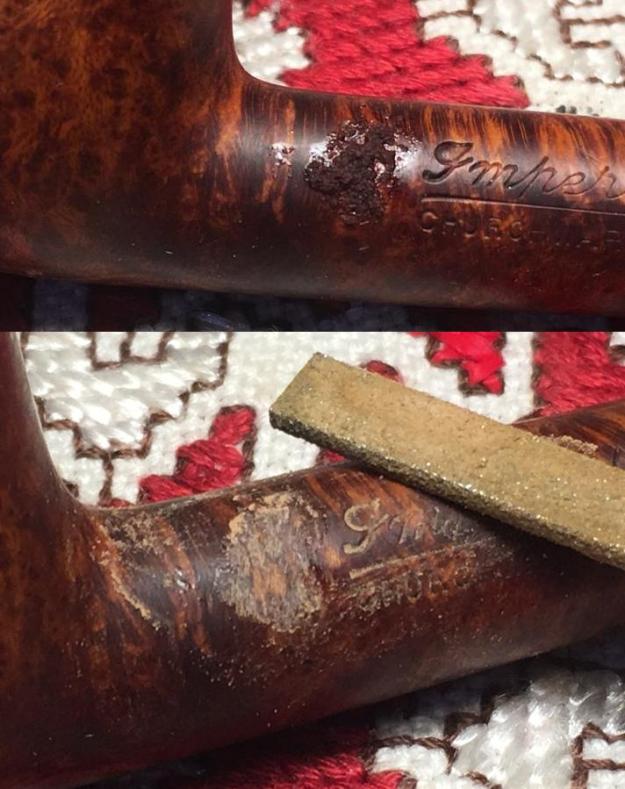
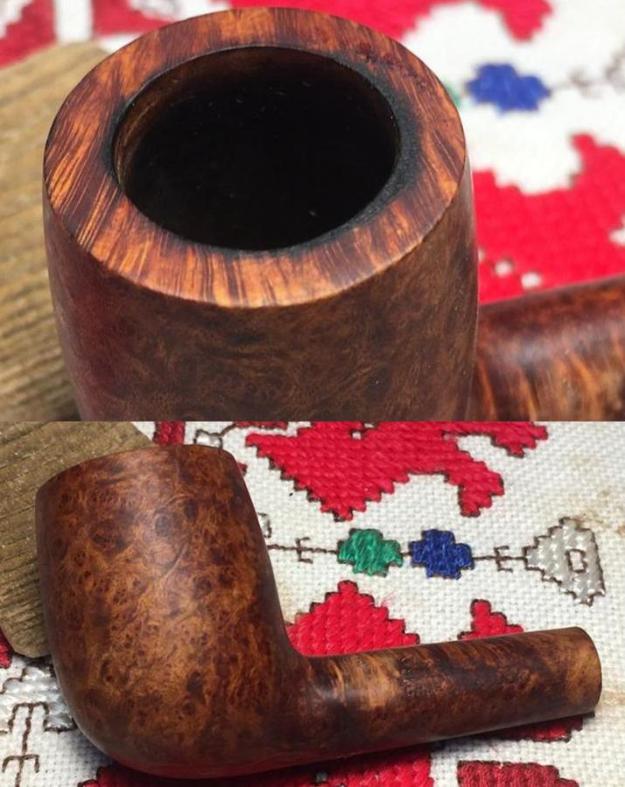
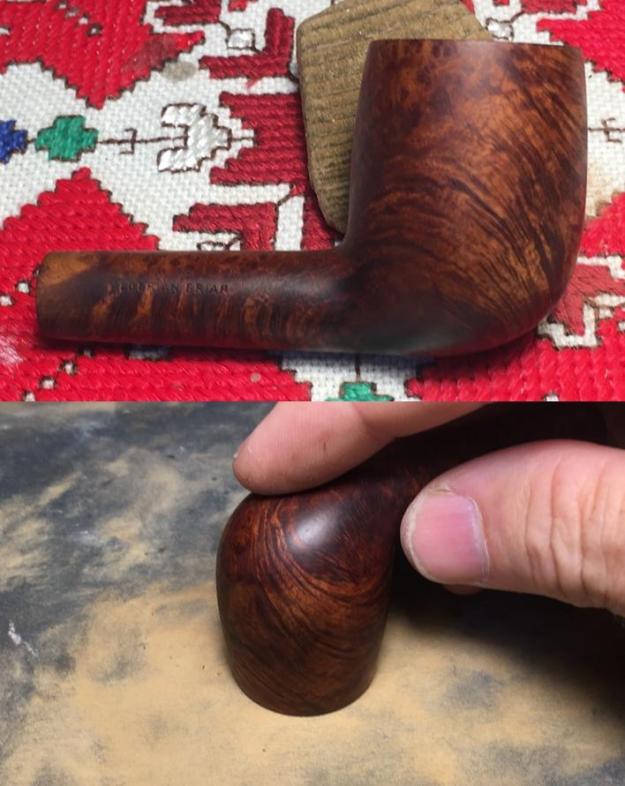
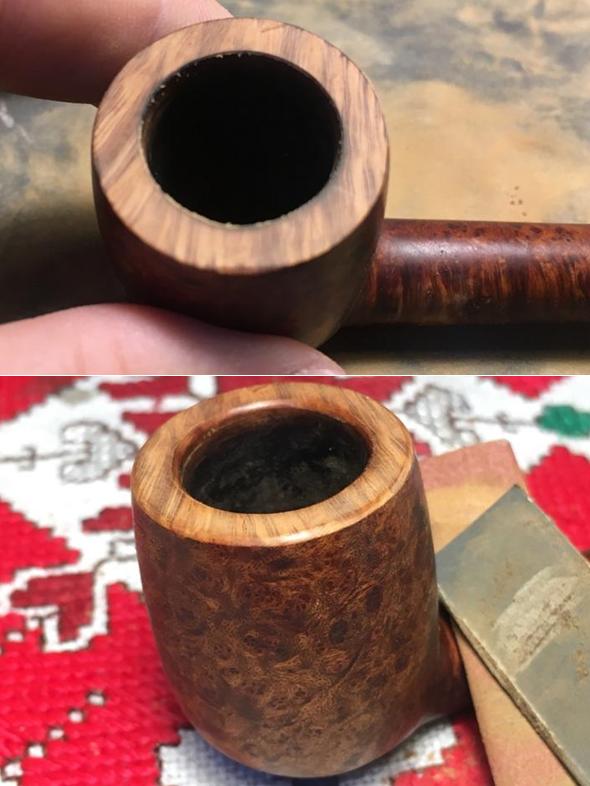
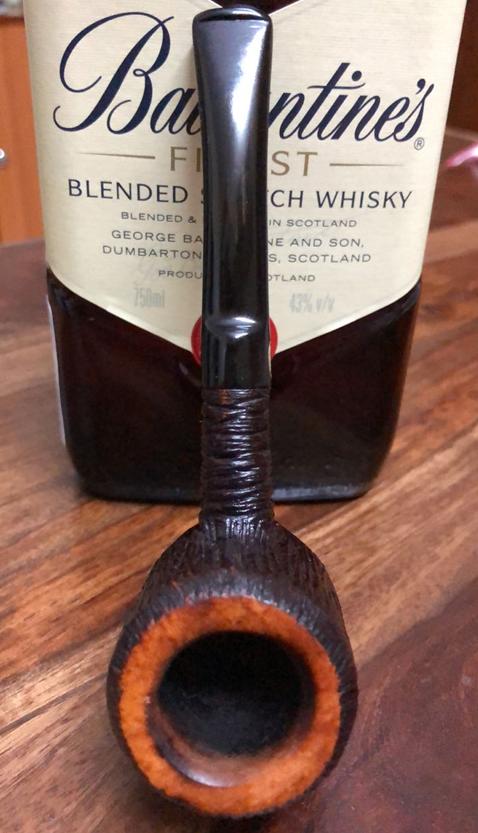
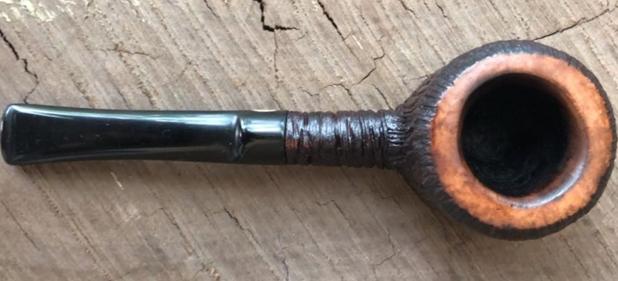
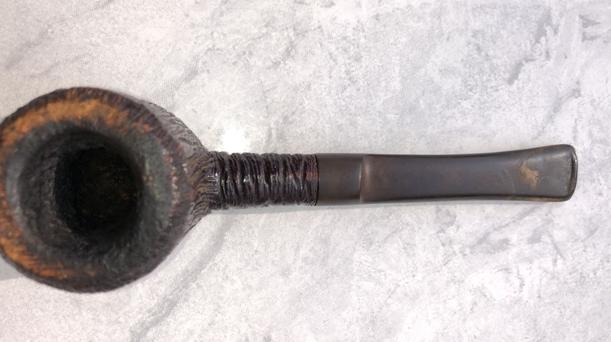
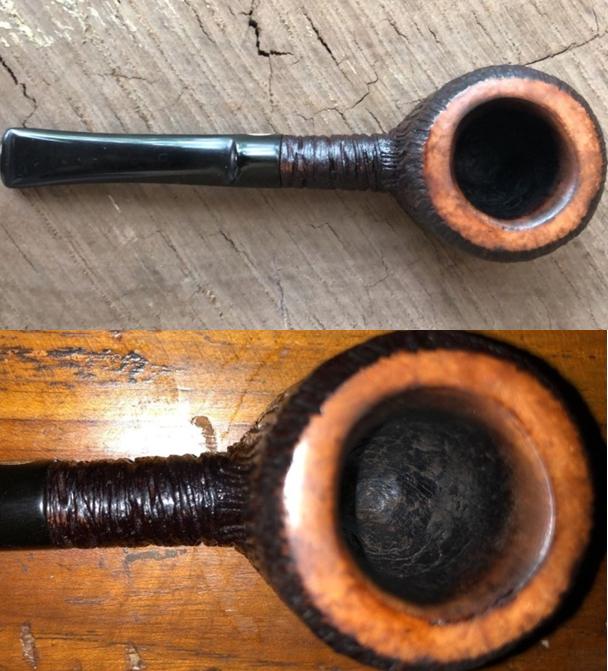
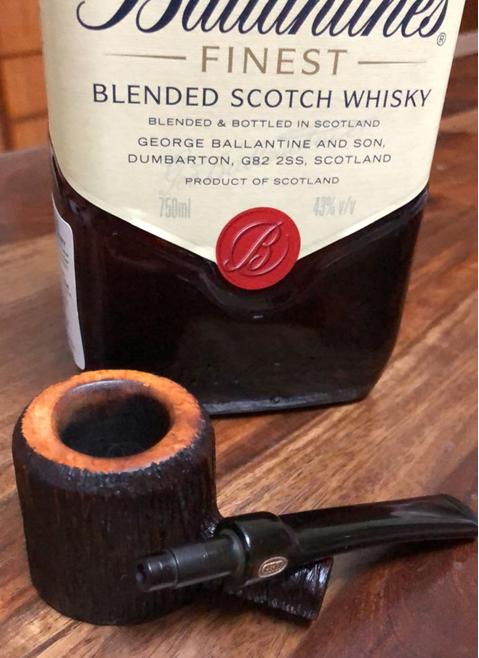
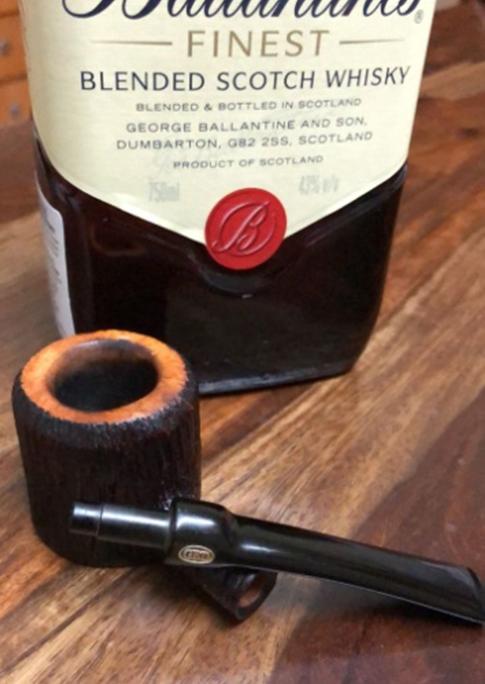
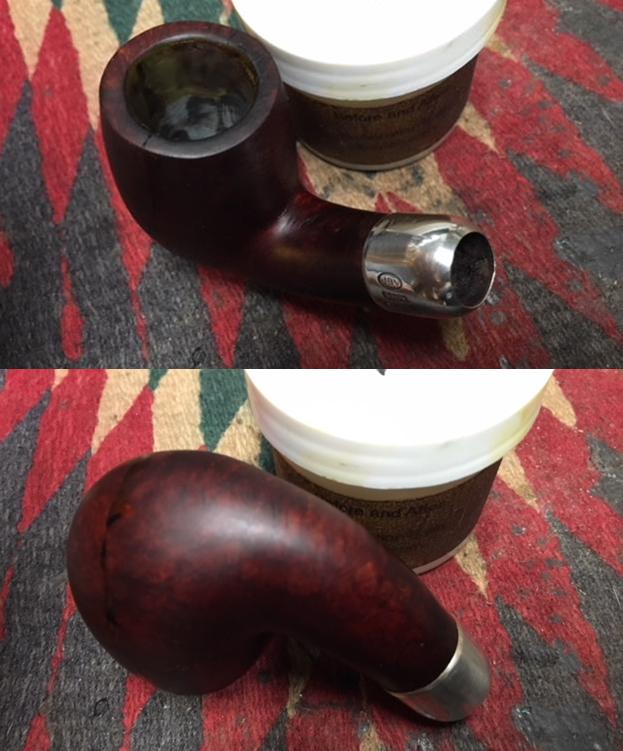
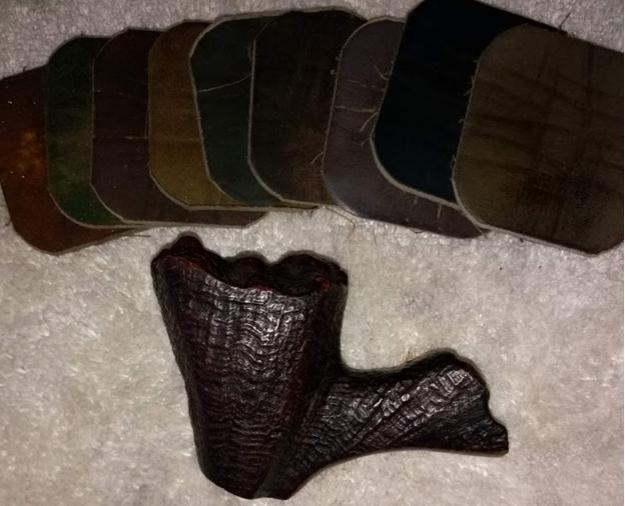
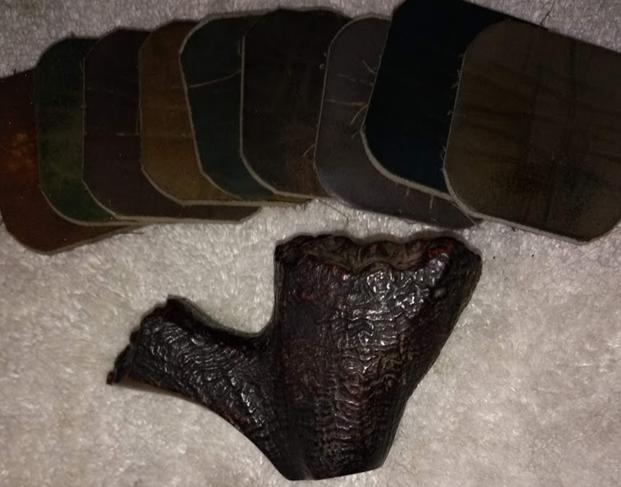
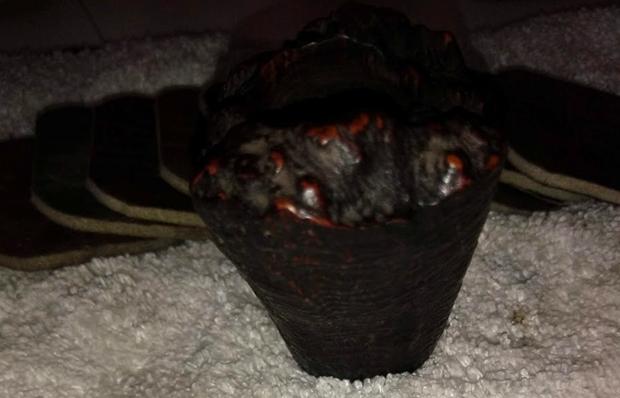
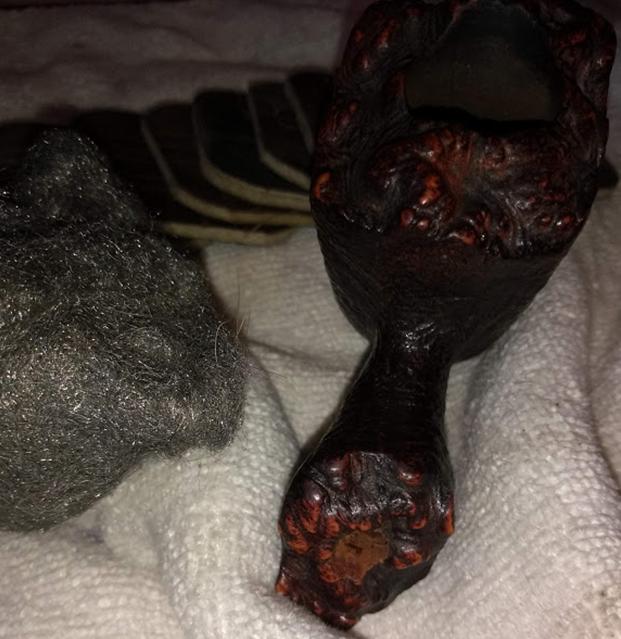
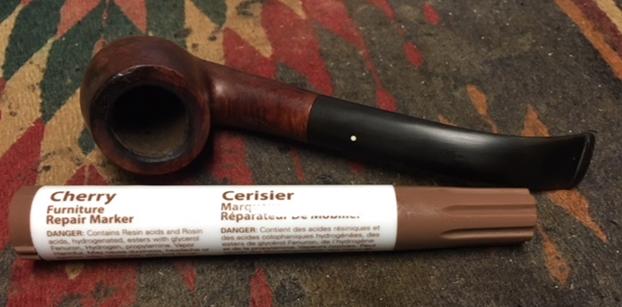
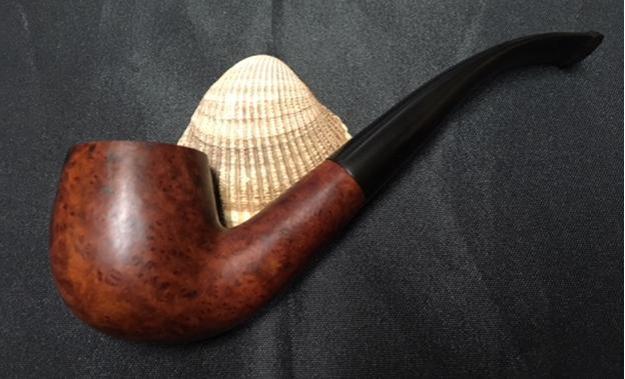
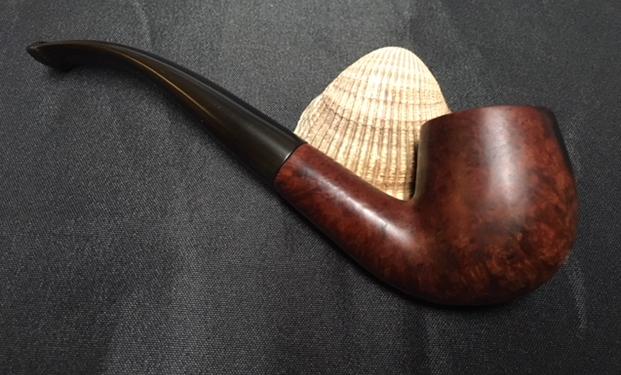
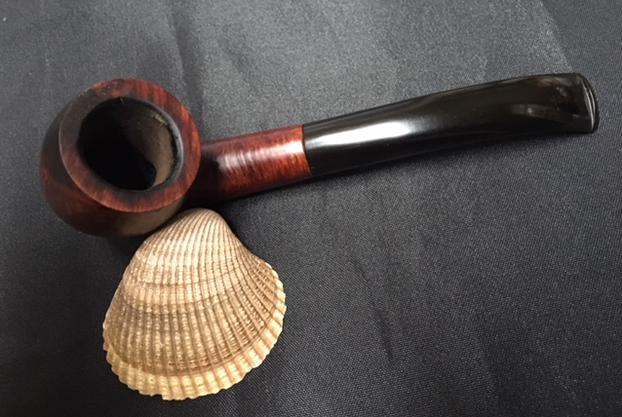
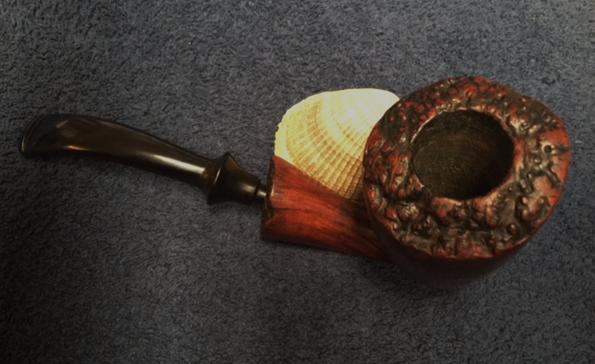
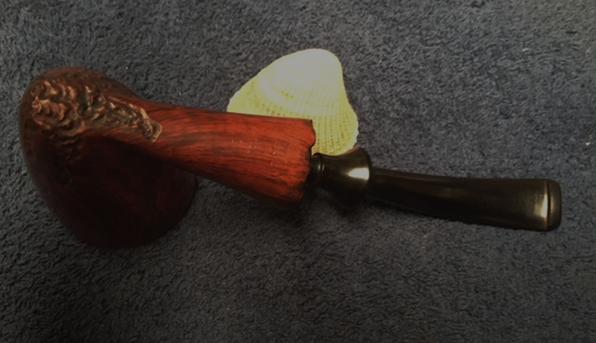
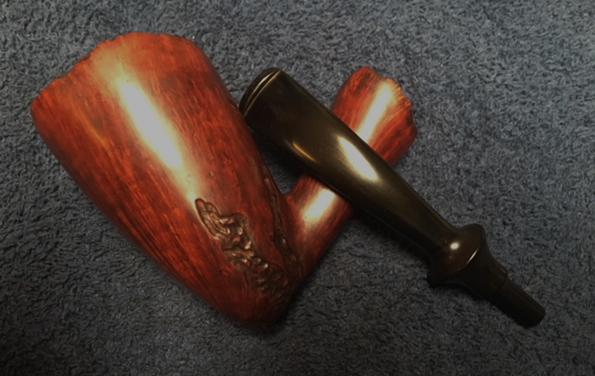
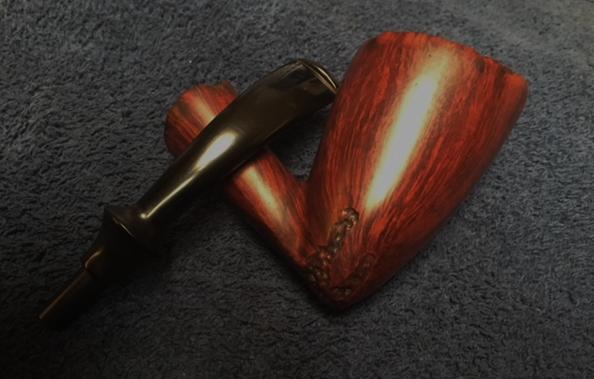
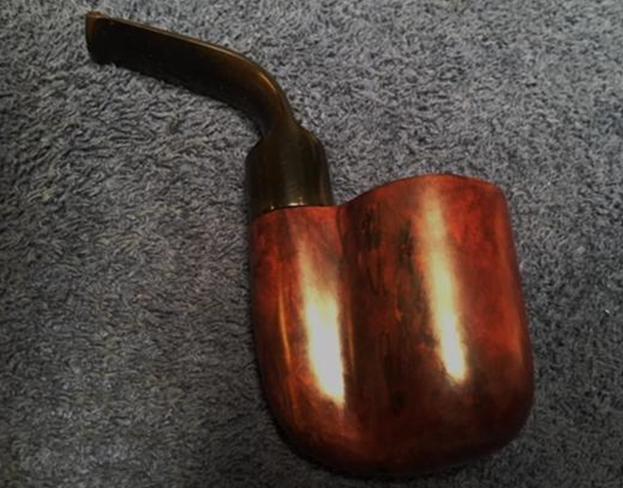
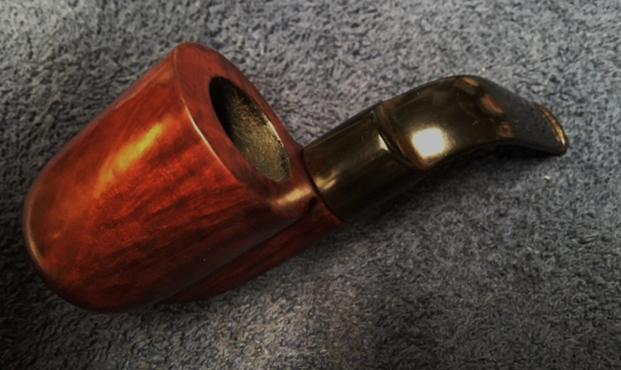
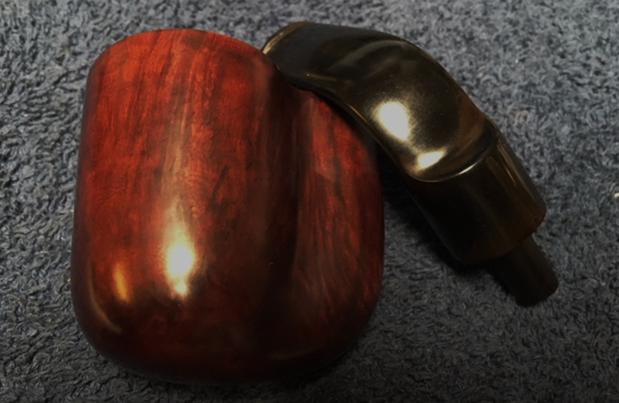
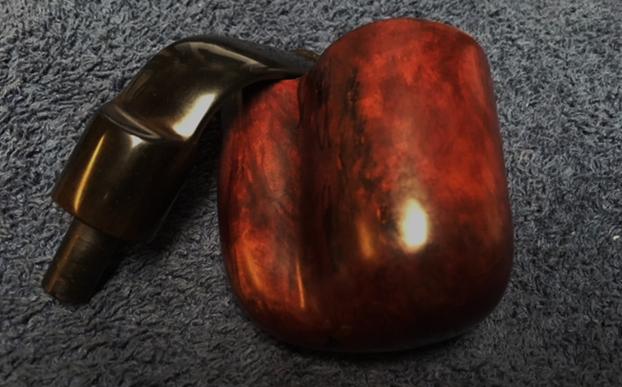
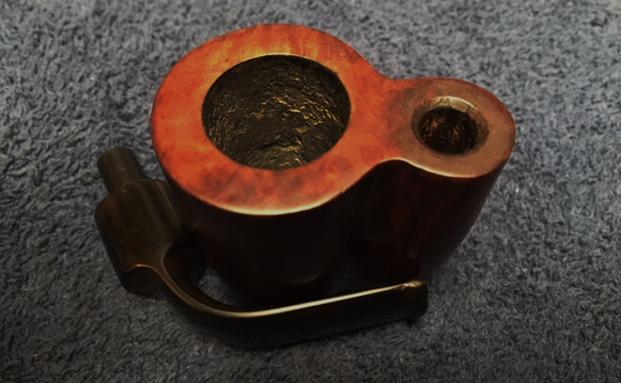
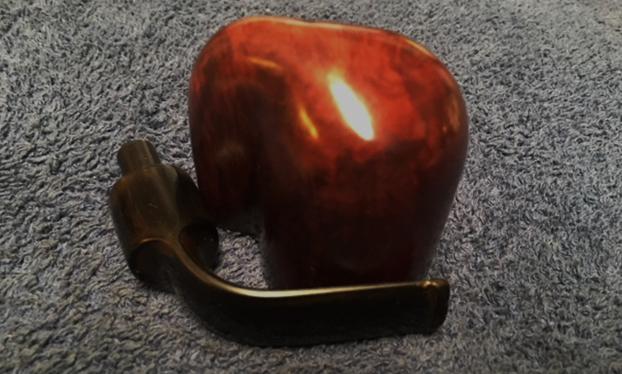
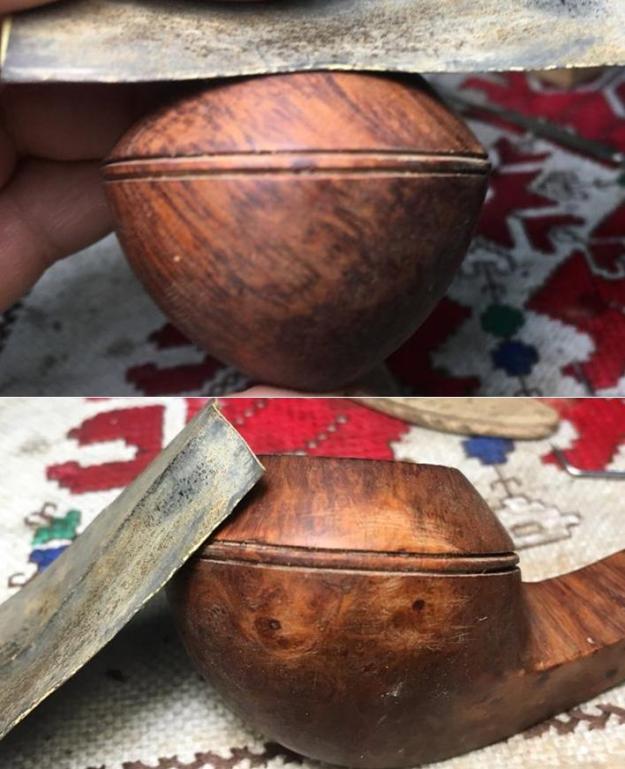
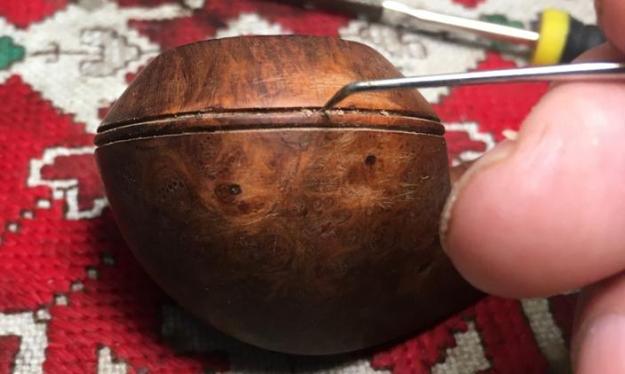
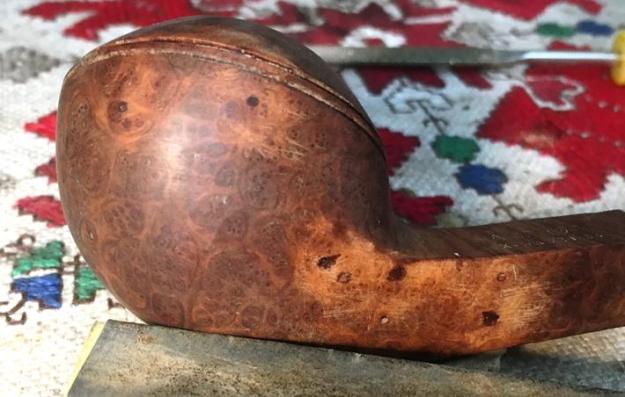
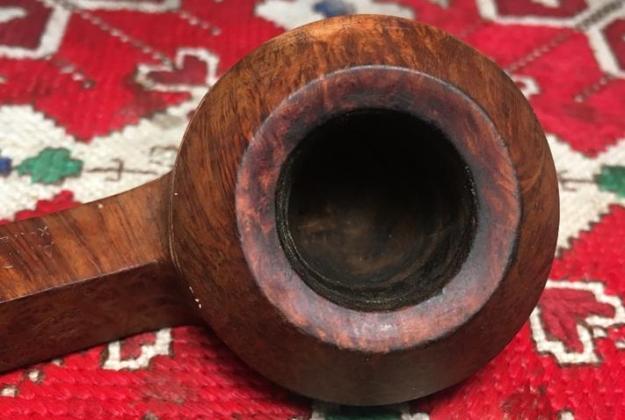
The next pipe that caught my fancy for restoration was a GBD ROCKROOT # 1345. This pipe has beaten Kriswill “Chief”  # 20 and Kriswill “ Golden Clipper” to the finish line, though not decisively since I do not have stain pens and I had to leave the rim top duly sanded to remove all the oils and tars and burn marks. Personally though, I rather liked the look of the contrast the rim provided to the dark coloured pipe bowl, shank and stem. But I have seen other similar GBDs and they all had the nice bowl coloured rim top which also looked beautiful!!!! Hence, my attempt at darkening the rim top. Without darkened rim top!! You decide and suggest please!!!

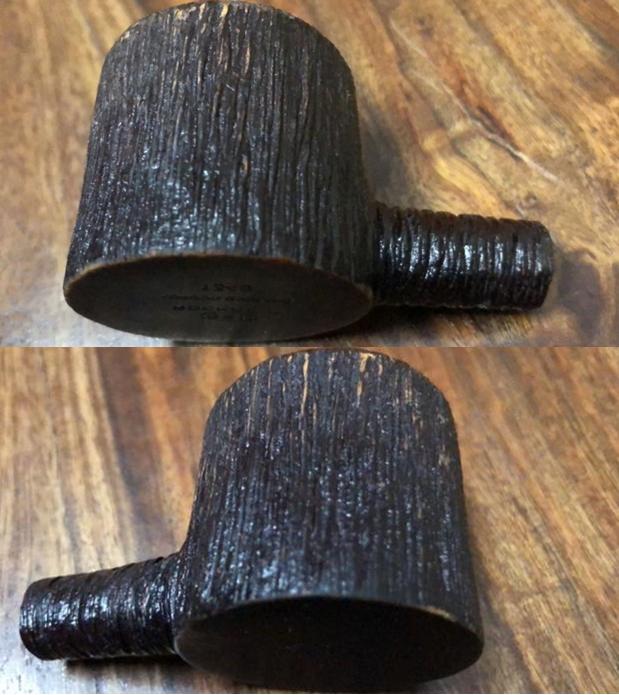
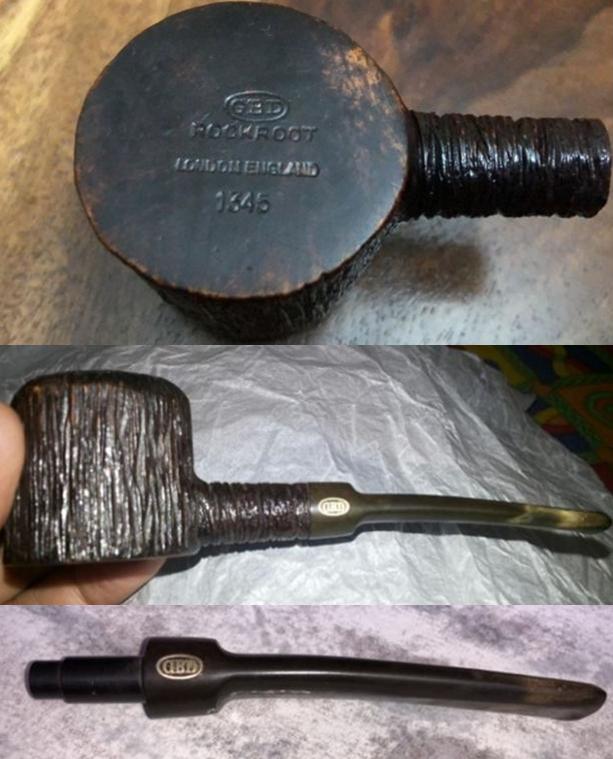
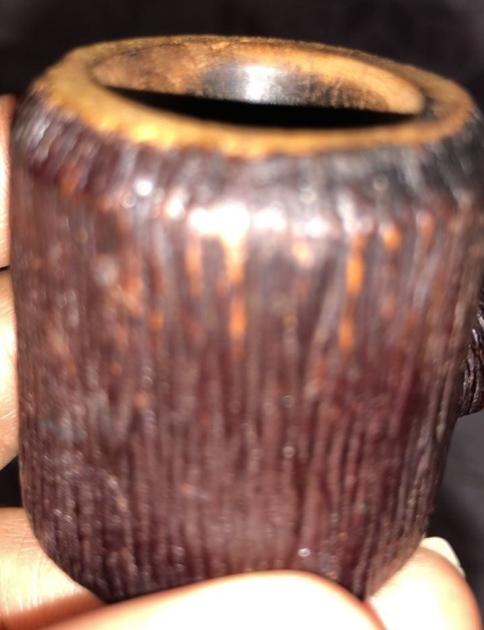
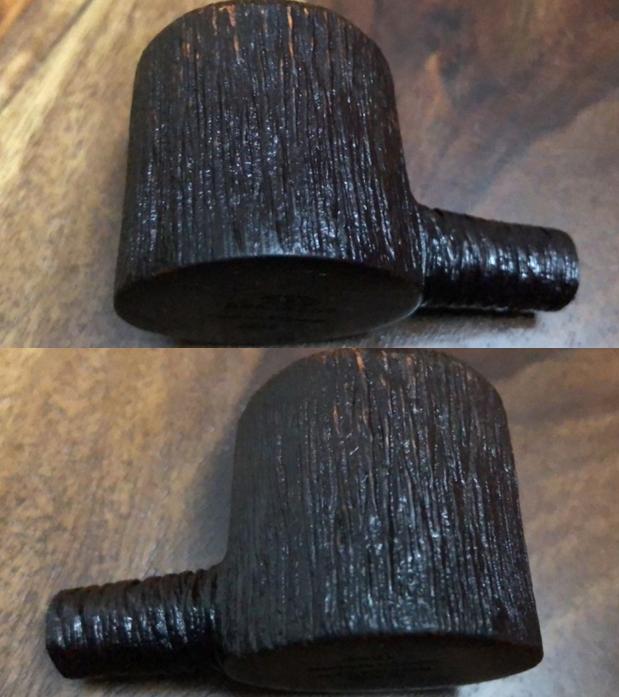
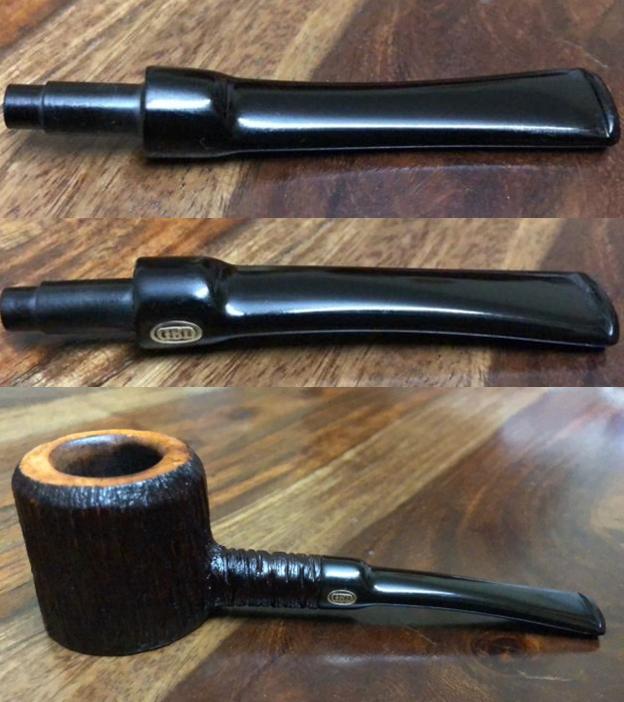
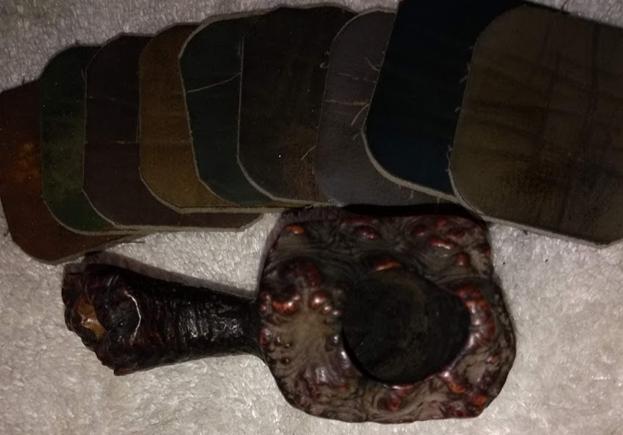
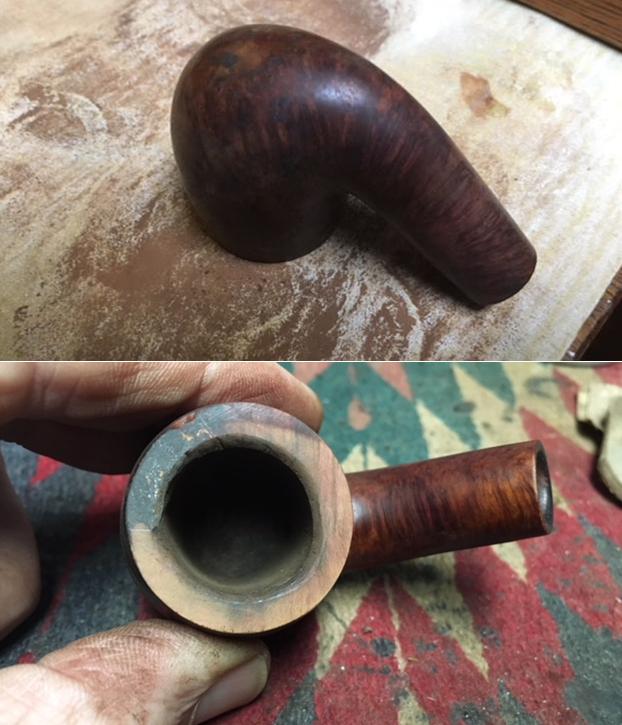
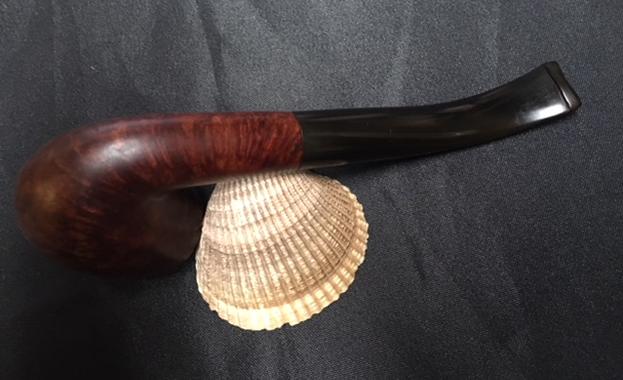
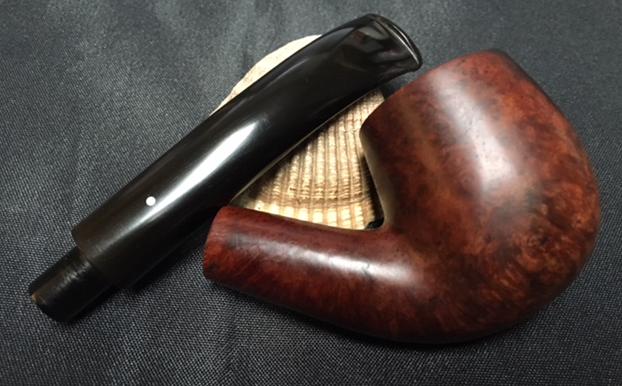
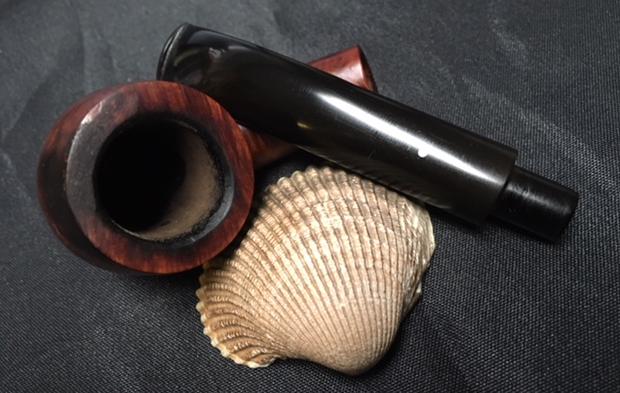
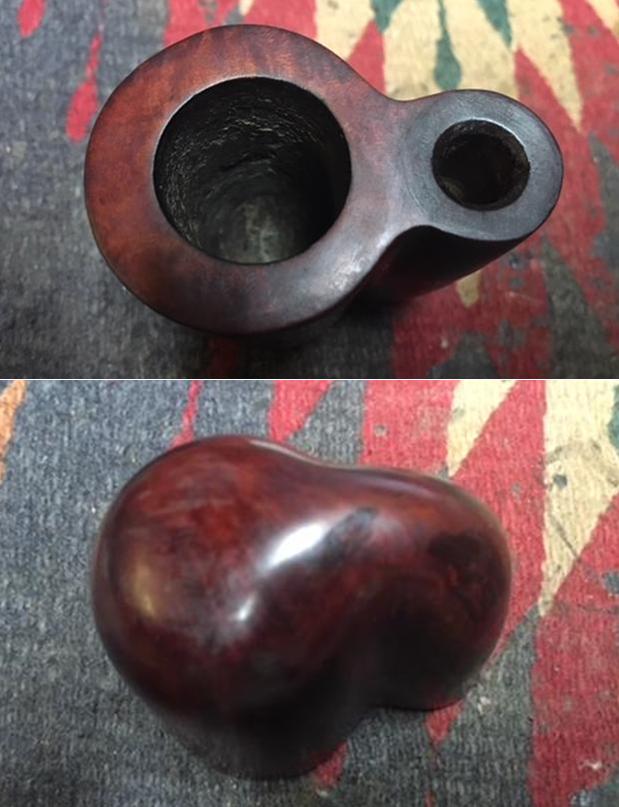
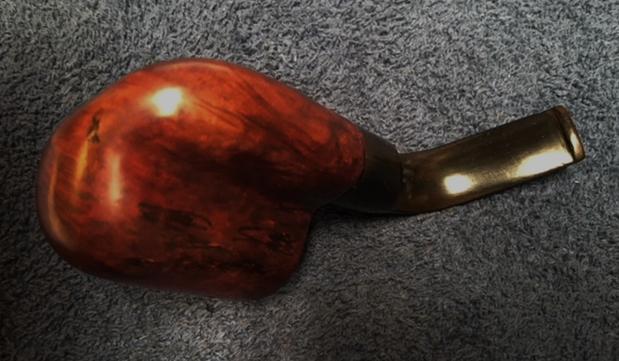
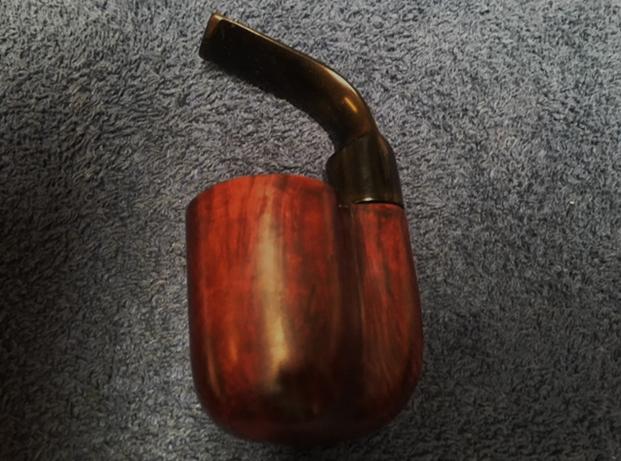
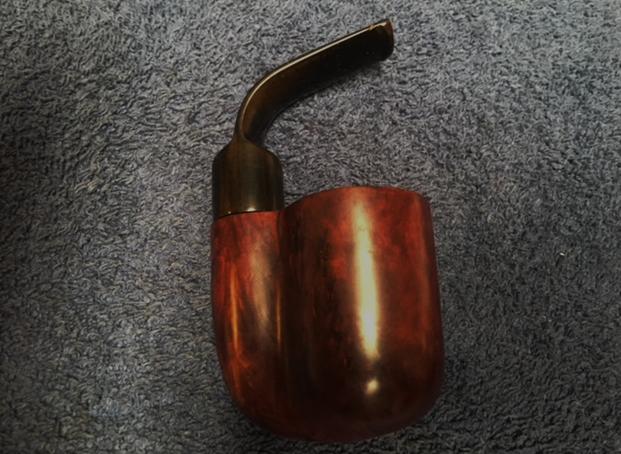
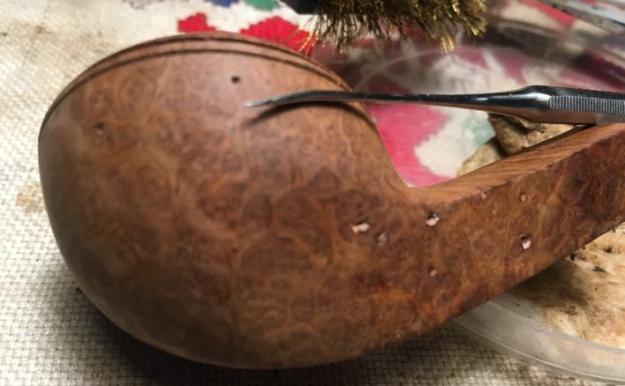
This pipe has a relatively smaller sized bowl with wire rustications running vertically along the bowl with circular wire rustications run around the shank. This wire rustication runs along the entire rim top. The bottom of the bowl is flat, smooth and bears crisp stampings with ‘GBD’ in oval over ‘ROCKROOT’ over ‘LONDON ENGLAND’ in a straight line over # ‘1345’. The saddle stem has a very subtle and delicate bend with just the lip touching the table top which coupled with the flat bottom of the bowl, makes it a perfectly balanced sitter. A brass oval roundel rim with embossed GBD is embedded in the saddle. This should polish up very nicely. INITIAL INSPECTION
The initial visual inspection of the pipe revealed the following:

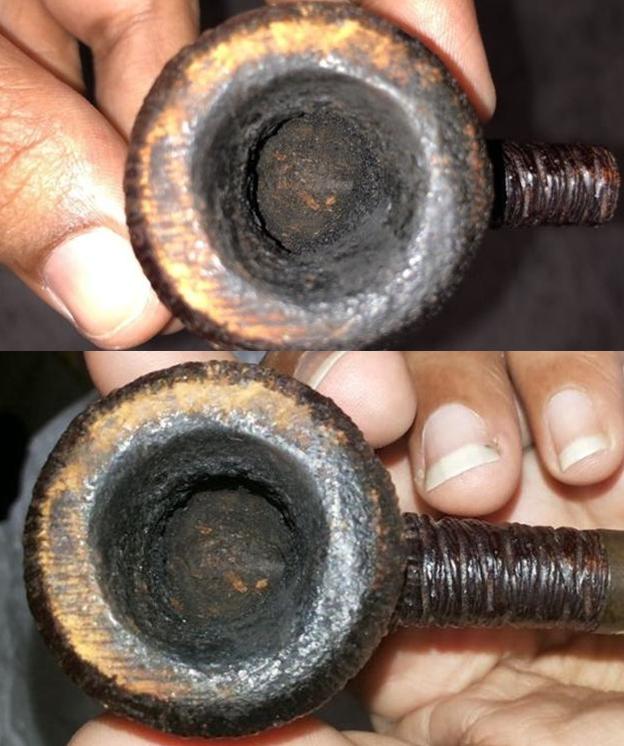
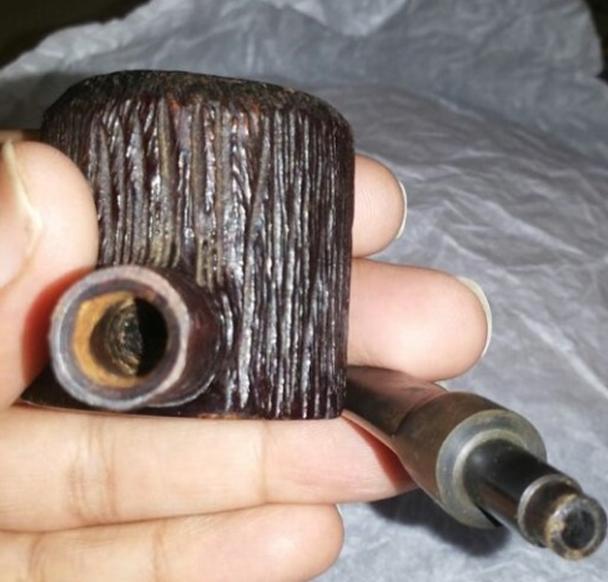
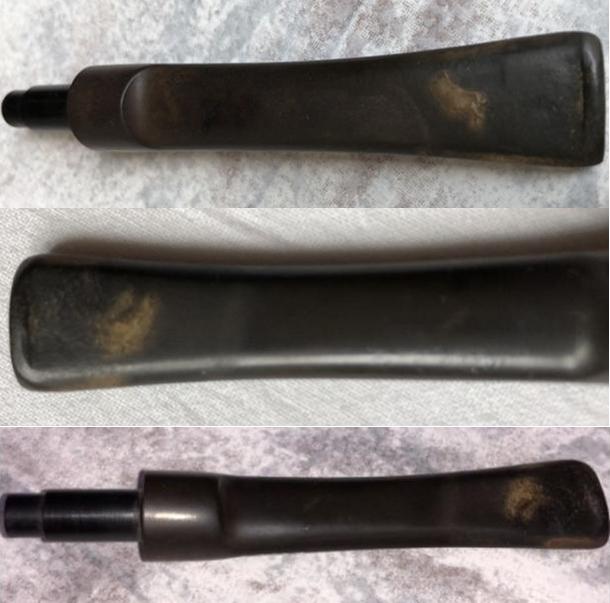
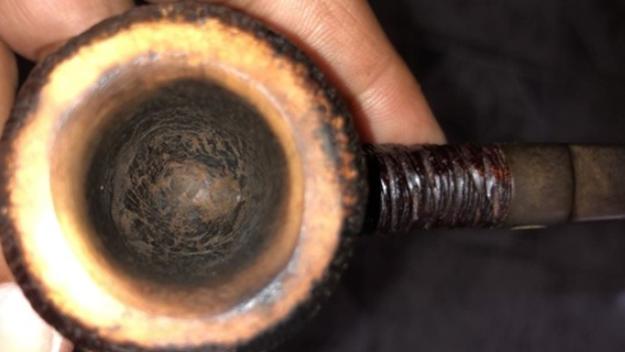
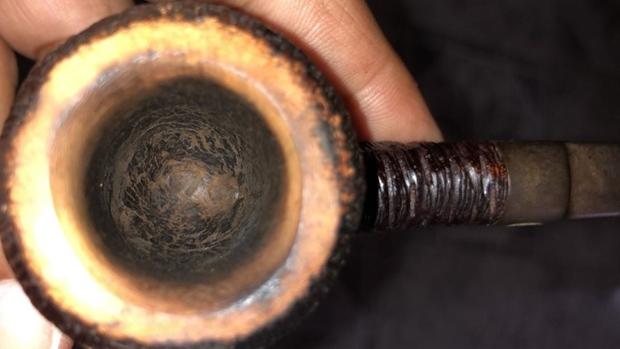
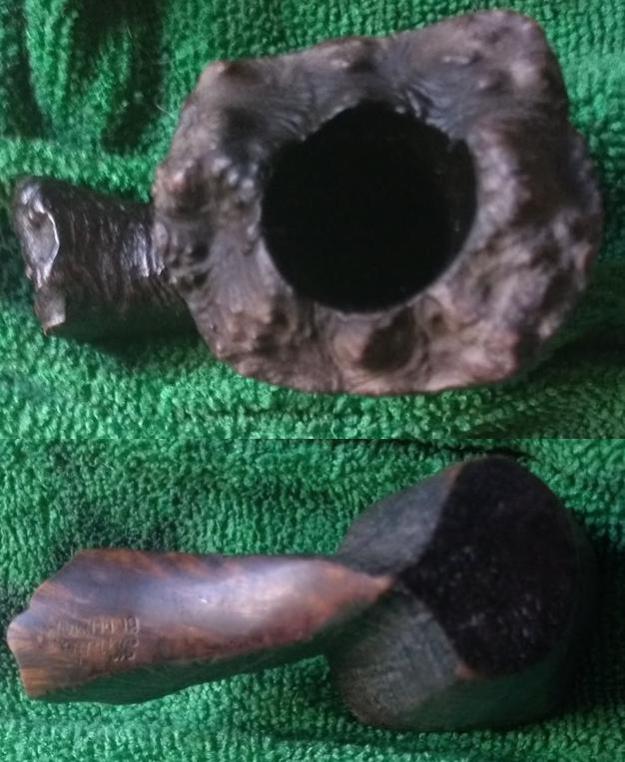
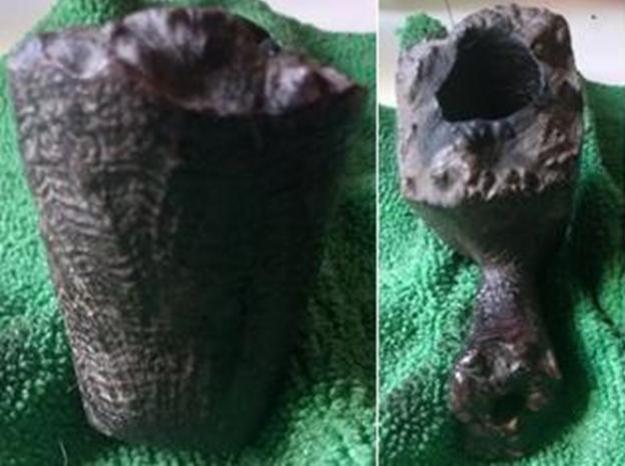
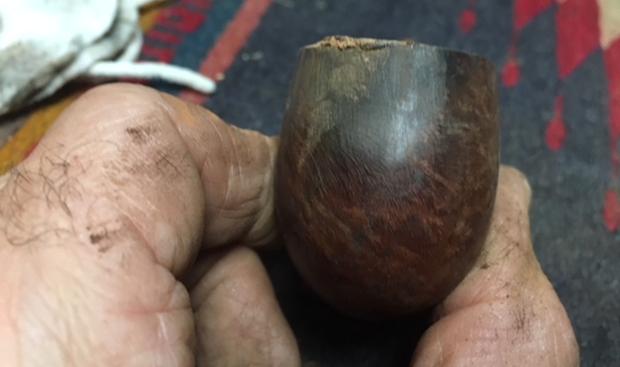
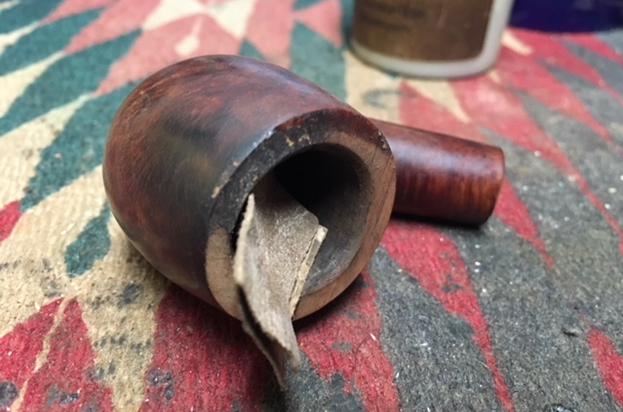
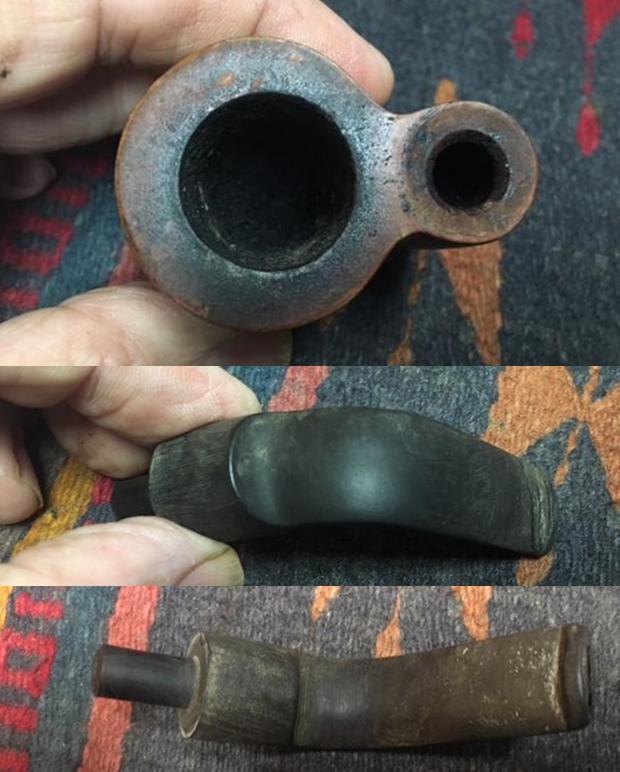
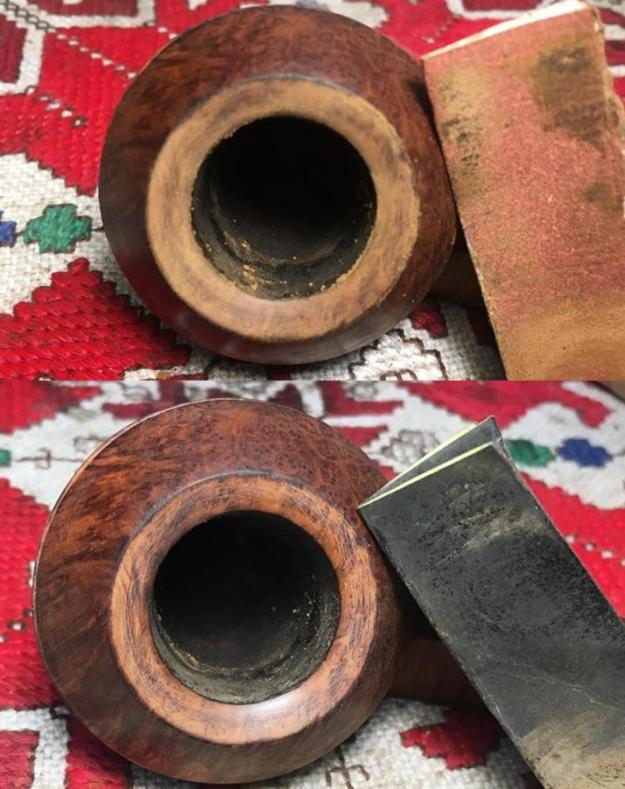
The bowl was heavily caked with oils, tars and grime overflowing onto the rim top and down the bowl along the vertical wire rustications. There appears to be some deep charring along the inner edge of the rim on the right hand side in 1’o’clock direction and on the left side in 7’o’clock direction. The extent of the damage to the rim can only be determined after reaming the bowl.The thin wire rustication on the rim top is worn out at certain places. The rest of the rustications along the bowl and shank is filled with dust, oils, gunk and dirt which has been accumulating over the years. Air did not pass through the stem. When the stem was removed from the shank, visual inspection revealed a completely blocked mortise and airway. The stem, too, was slightly blocked.The stem was heavily oxidized with heavy calcification near the lip. There was heavy tooth chatter extending up to an inch from the lip towards the saddle on both sides of the pipe. But thankfully there were no deep bite marks or holes. The lip on both sides has also been chewed out of shape.Dimensions:
Length – 5 inches
Bowl height – 1.5 inches
Bowl depth – 1 1/8th inches
Bowl inner diameter – 7/8  inch
Bowl outer diameter – 1.5 inches

THE PROCESS
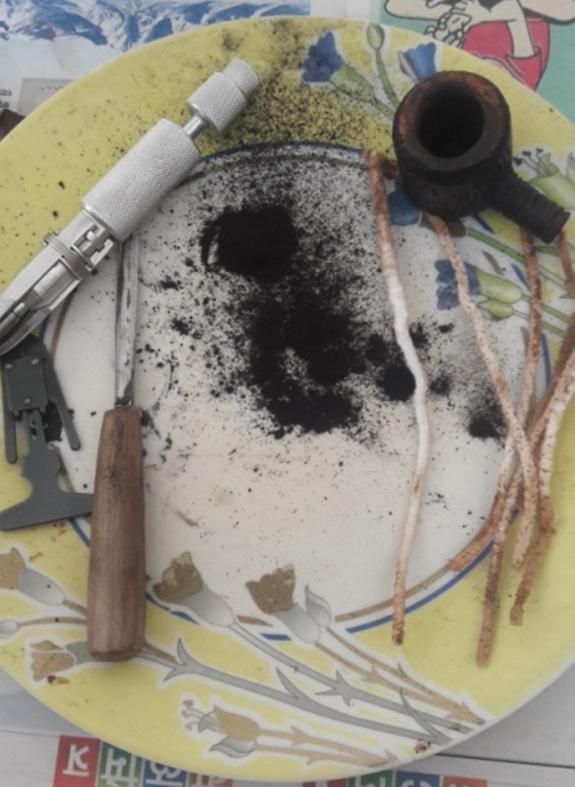
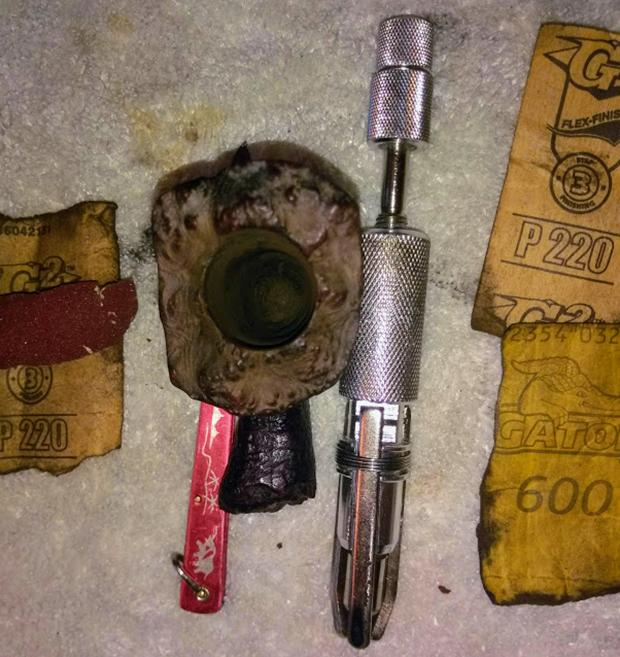
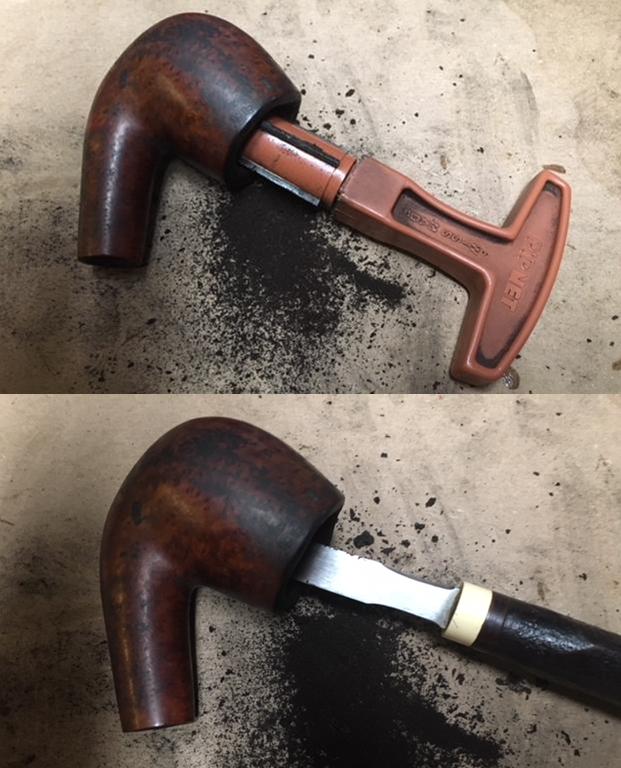
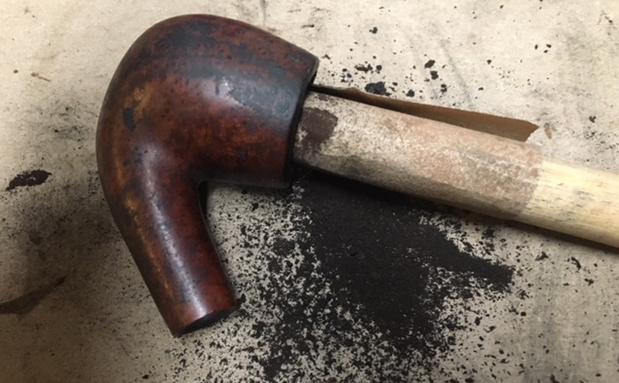
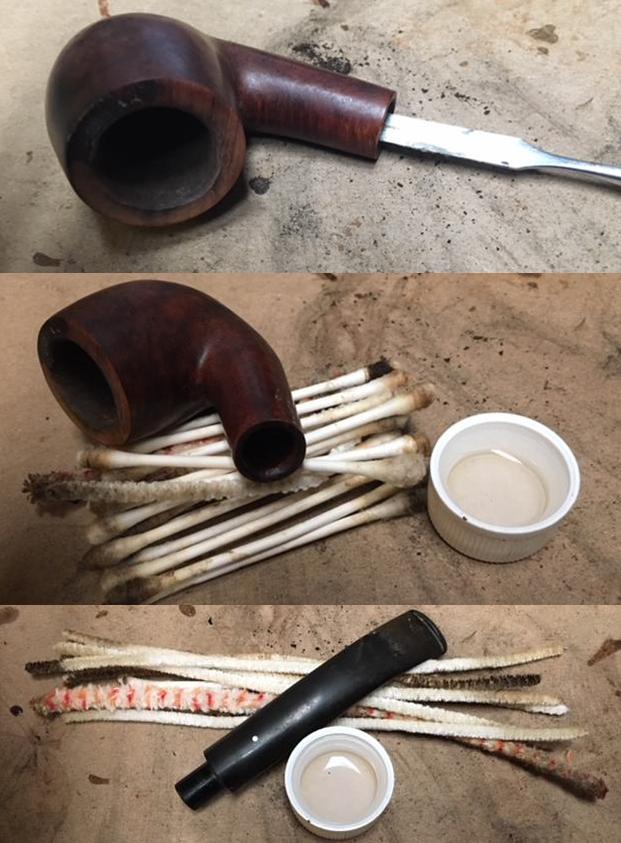
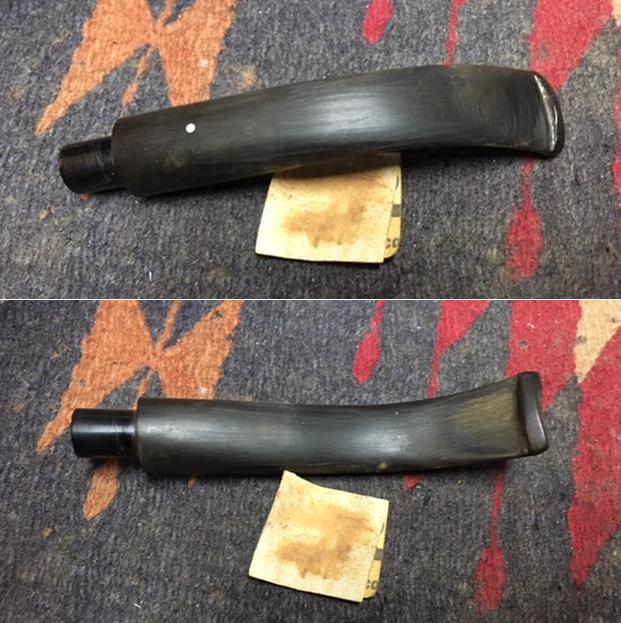
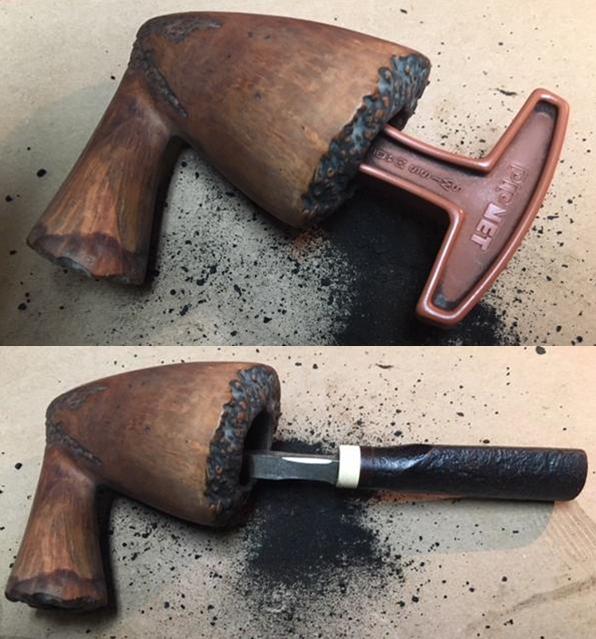
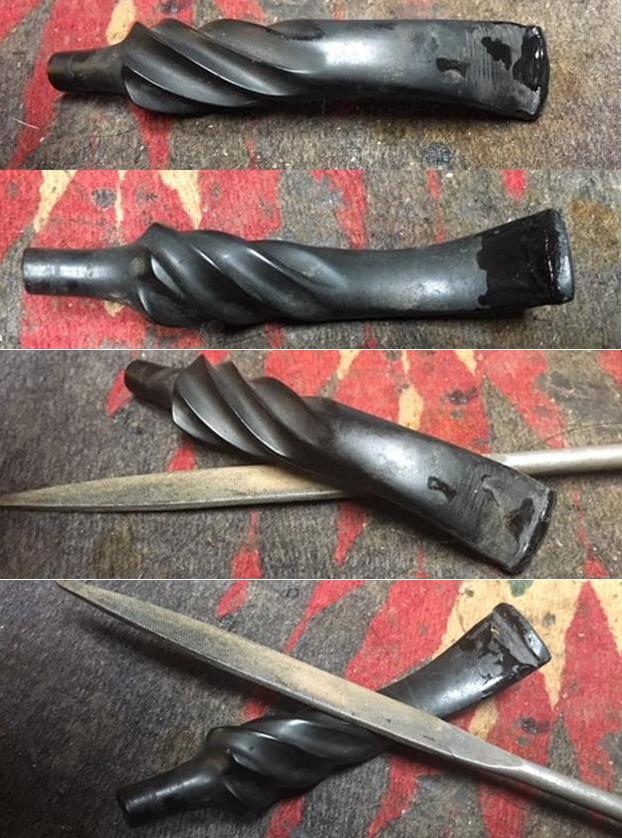
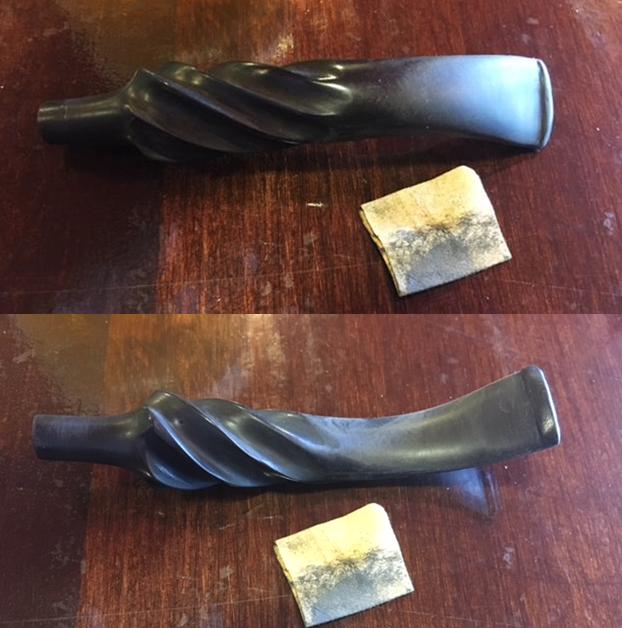
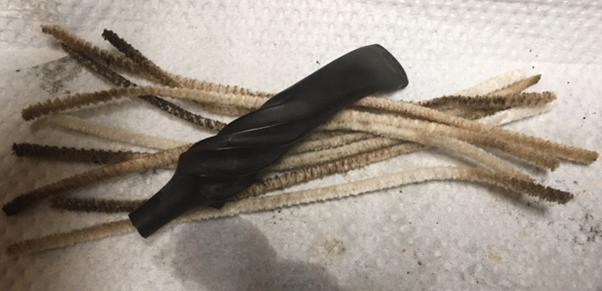
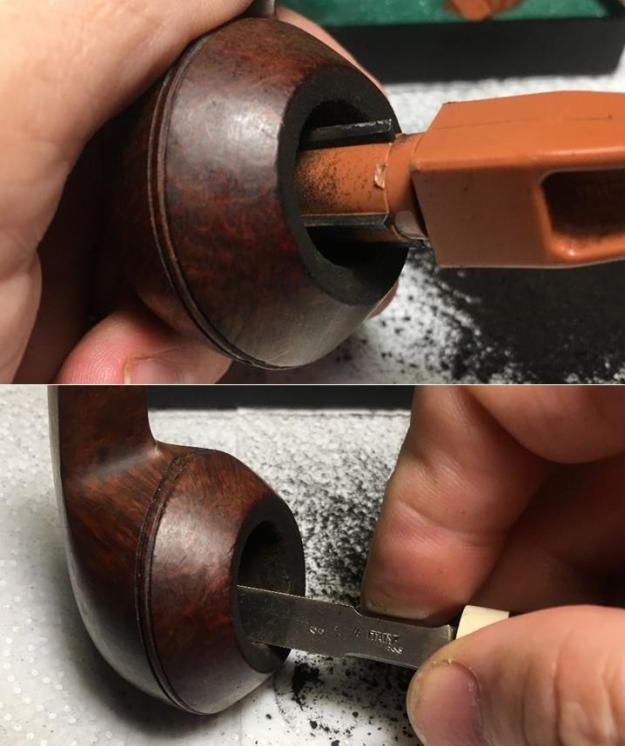
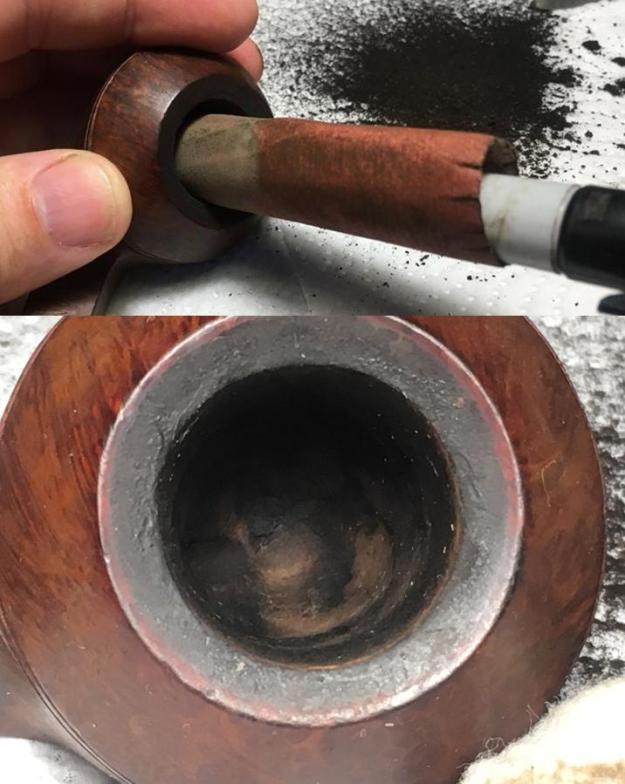
As usual Abha, my wife, started work on the bowl while I addressed the stem. Using a Kleen Reem reamer and British Buttner pipe reaming tool, Abha removed most of the thick cake in no time. The reason being a 1 inch deep bowl!!! She had been very careful in avoiding the edges which had the charred marks. While Abha was working her magic on the bowl, I painted the stem with the flame of a Bic lighter to try to lift the light tooth chatter. The lightest of the tooth chatter evened out and the remaining ones were lifted to the surface. I had to sand out the stem to smooth out the tooth chatter. At this point, using a 220 grit paper, I sanded down the stem till the surface felt even and smooth to the touch. I tightly folded a piece of the grit paper and using its edge tried to shape the edges of the lip. Then I applied Extra virgin olive oil to the stem and kept it aside to be absorbed by the stem. And as usual, I just forgot to take pictures of the stem at this stage!!!

Thereafter, I turned my attention to the bowl with hesitation. This was so because the reaming had revealed that the issue of charring was something I had not handled before. I immediately Facetimed  Mr. Steve and sought his advice. It was decided that a smooth surfaced rim, akin to the smooth bottom of the bowl, will add an interesting character to the pipe and will also take care of the charred inner edge of the bowl.

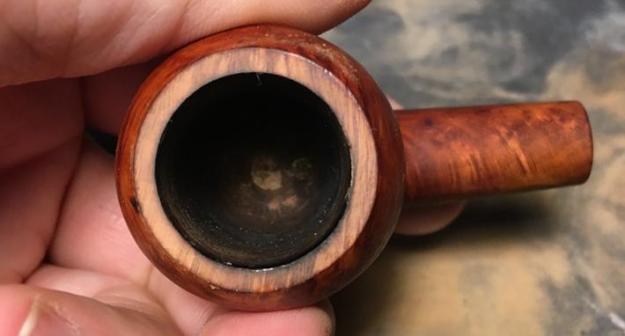
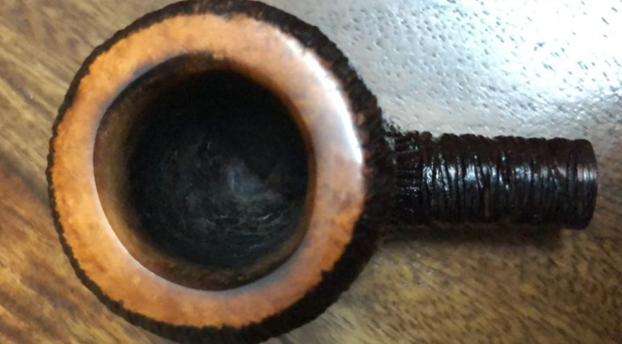
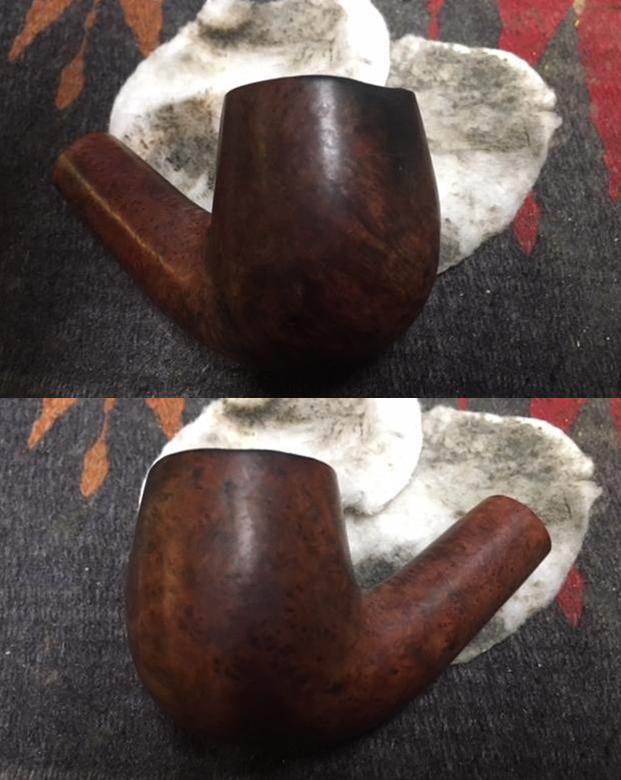
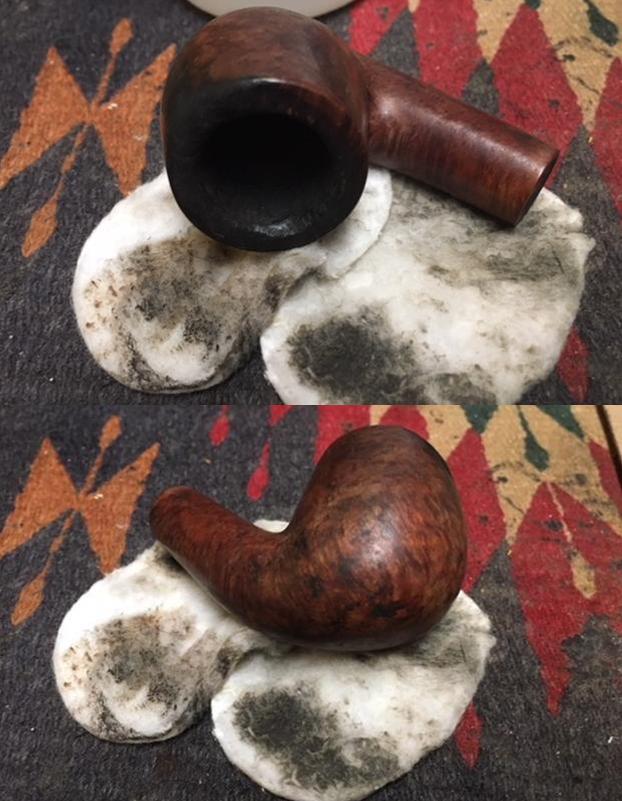
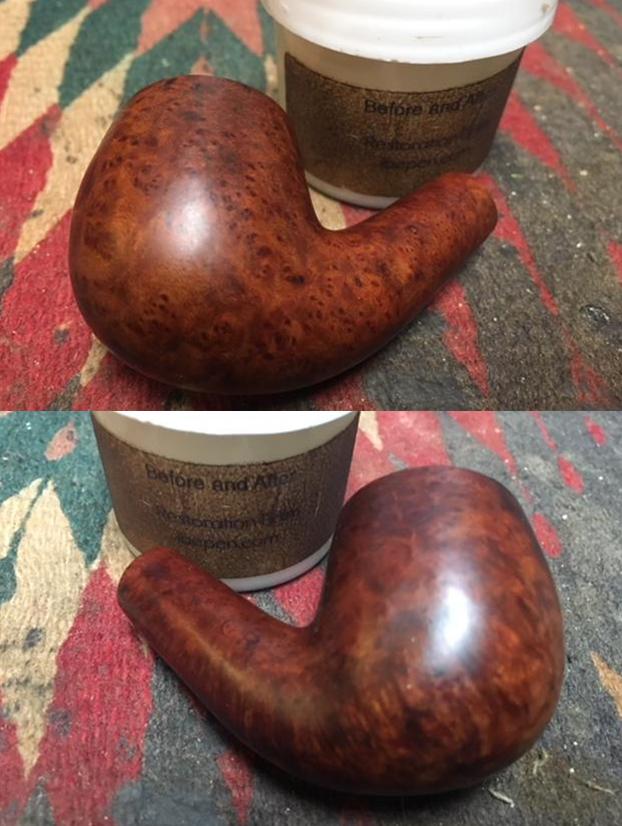
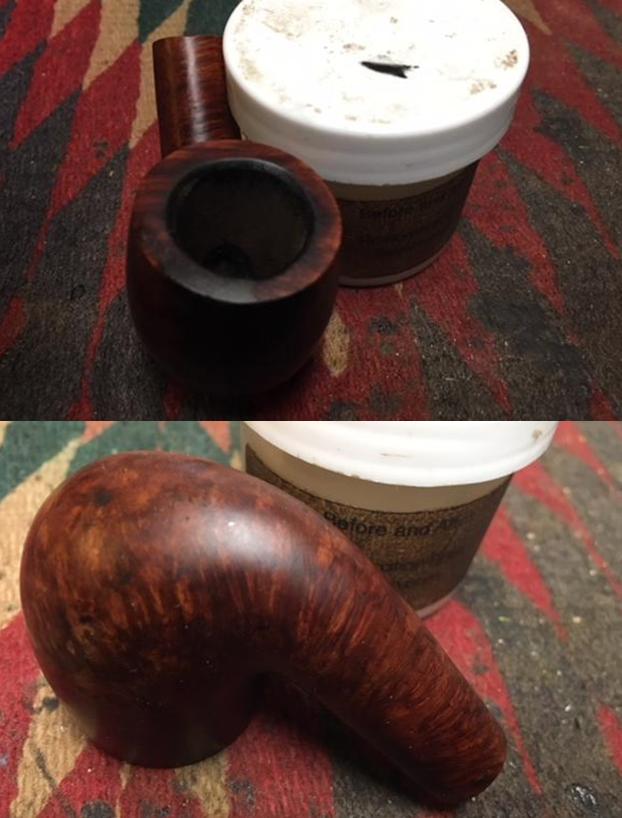
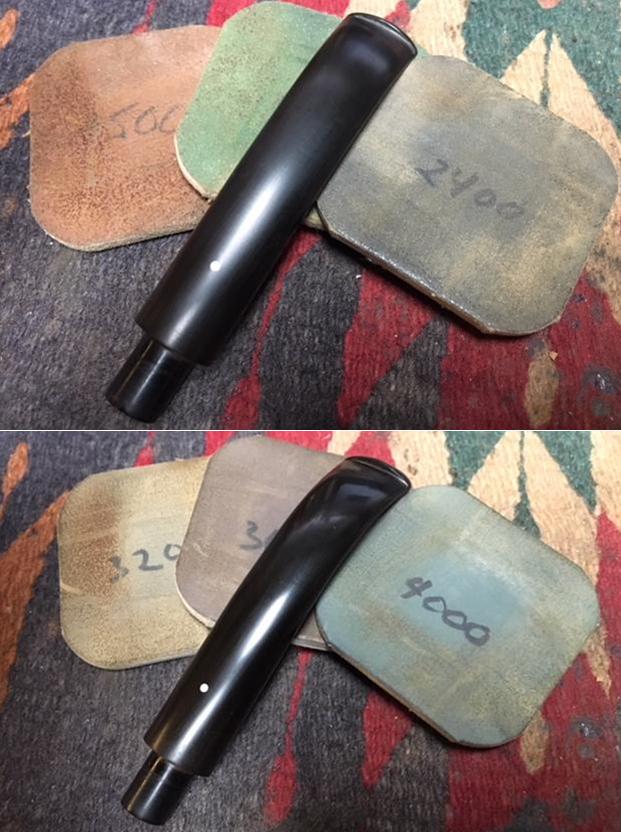
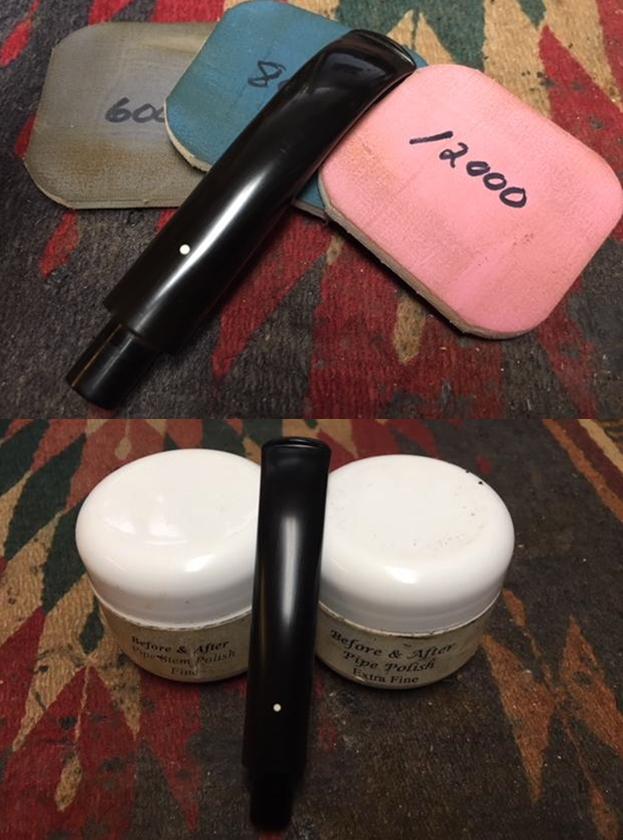
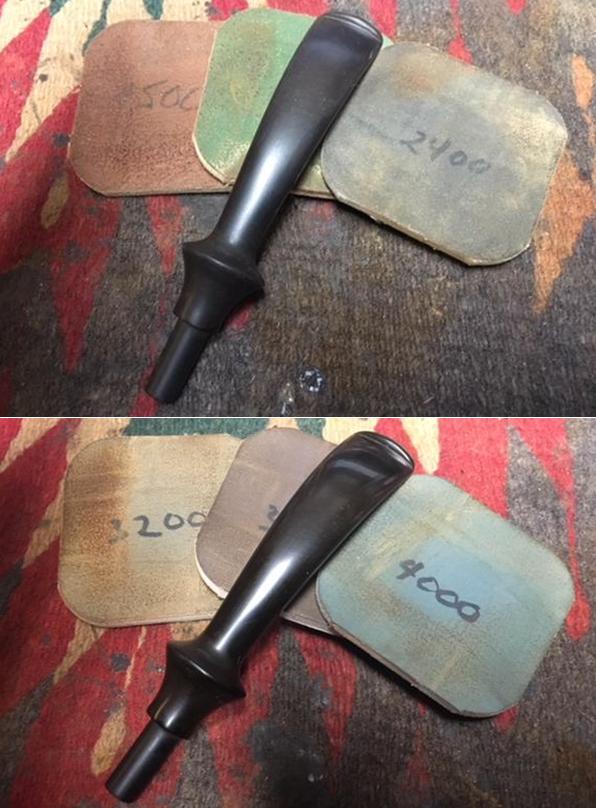
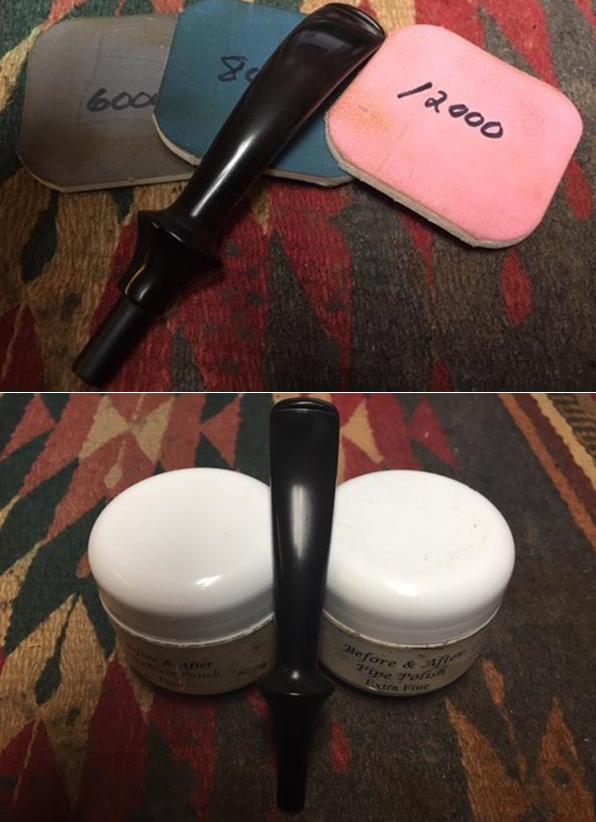
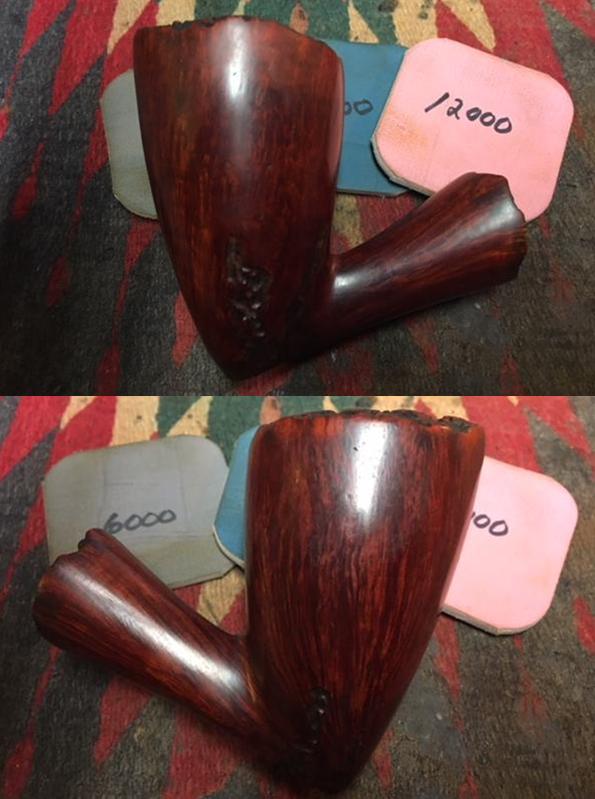
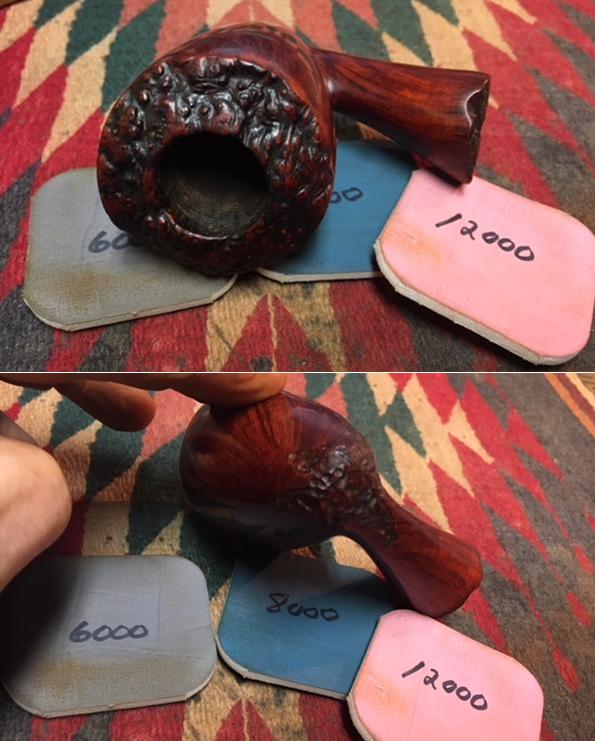
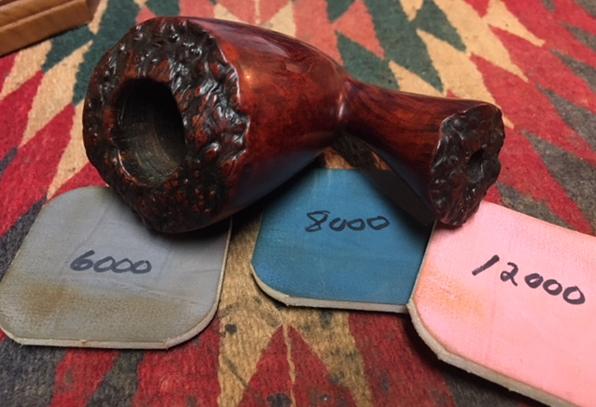
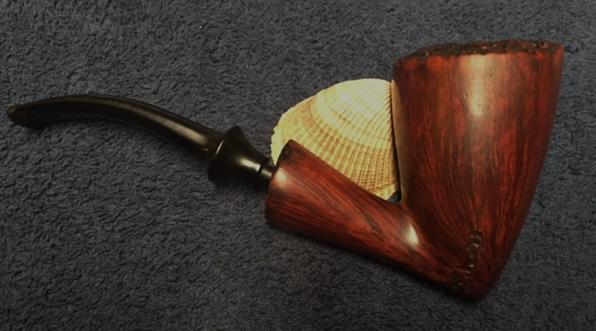
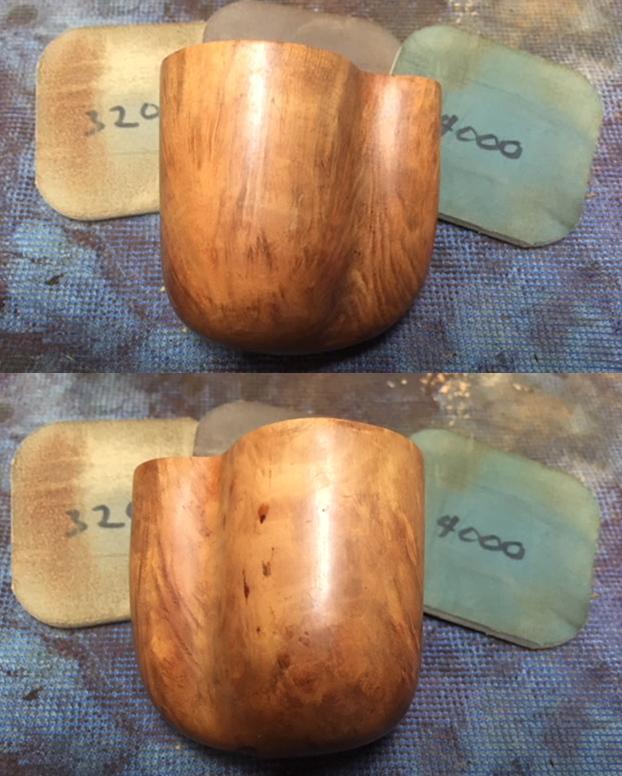
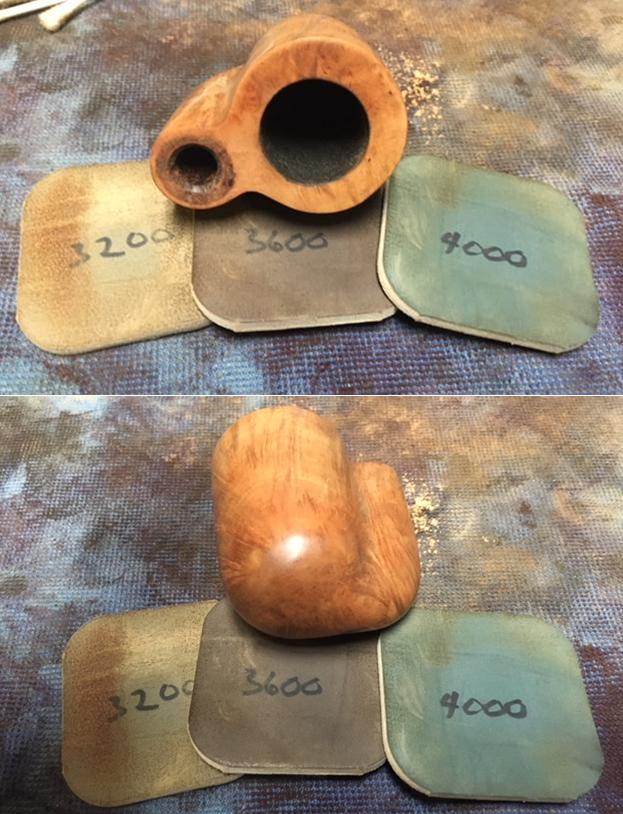
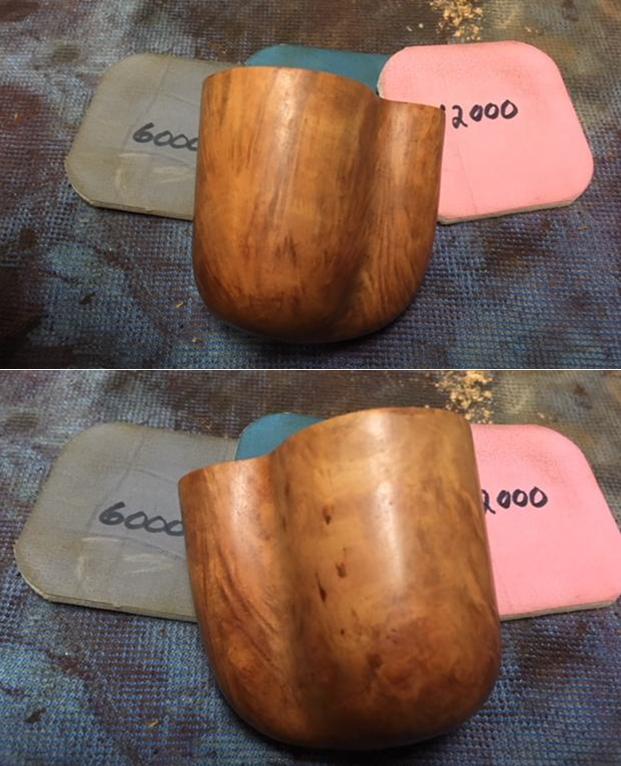
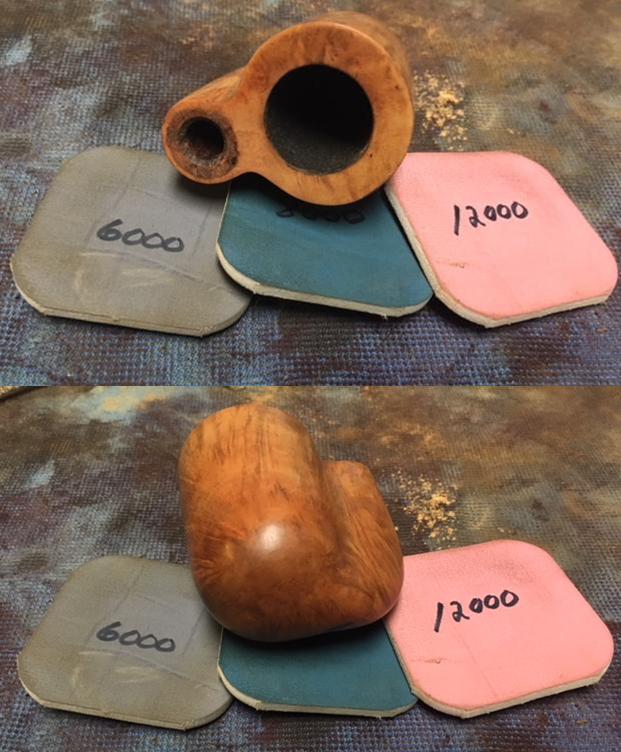
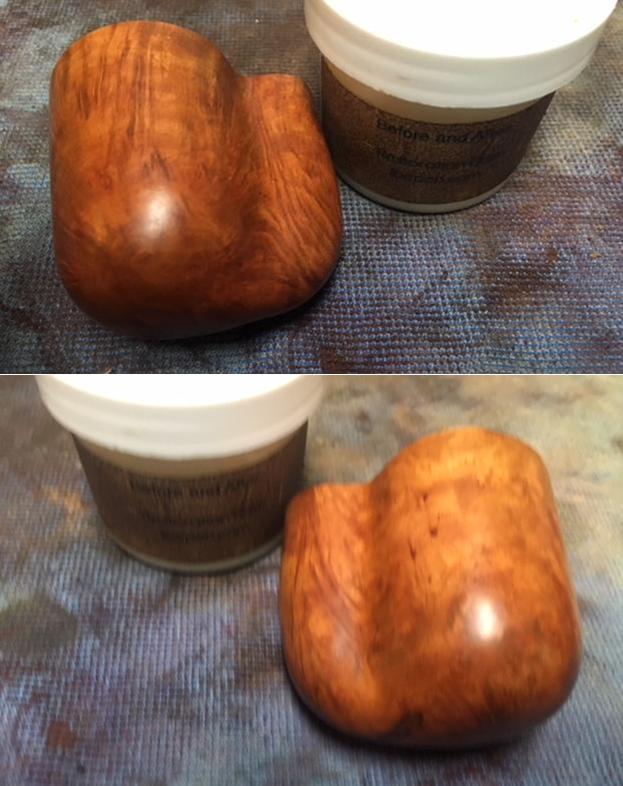
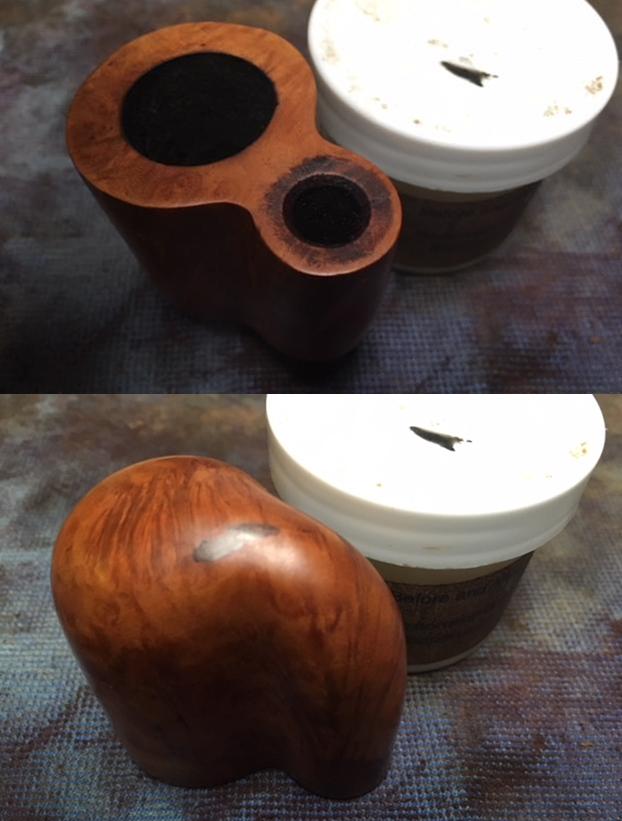
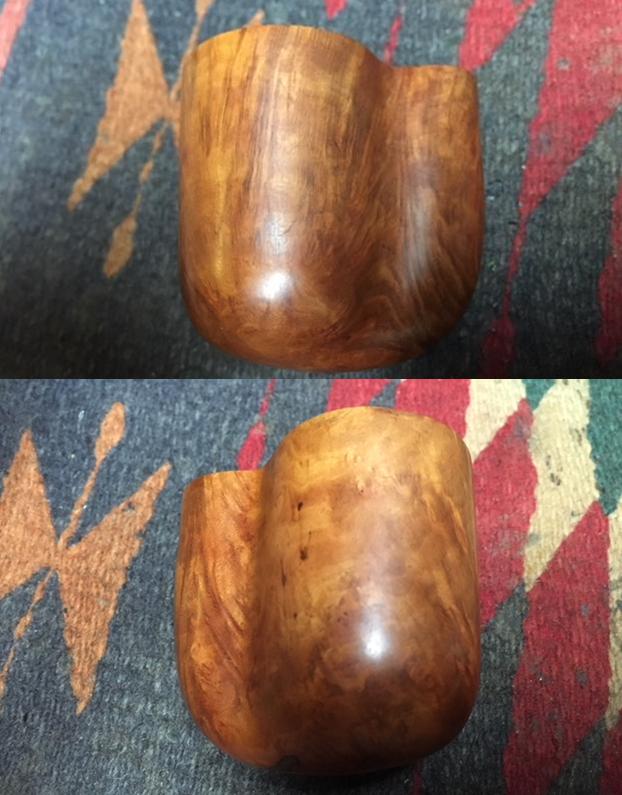
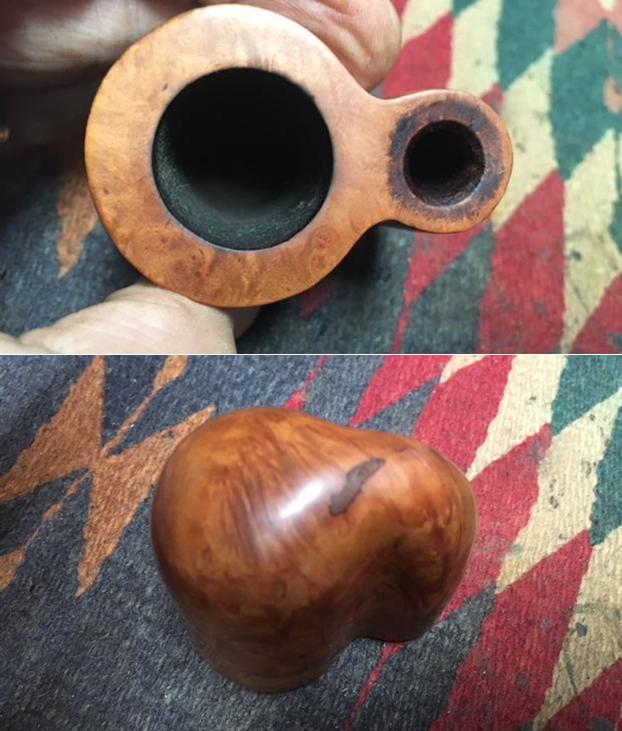
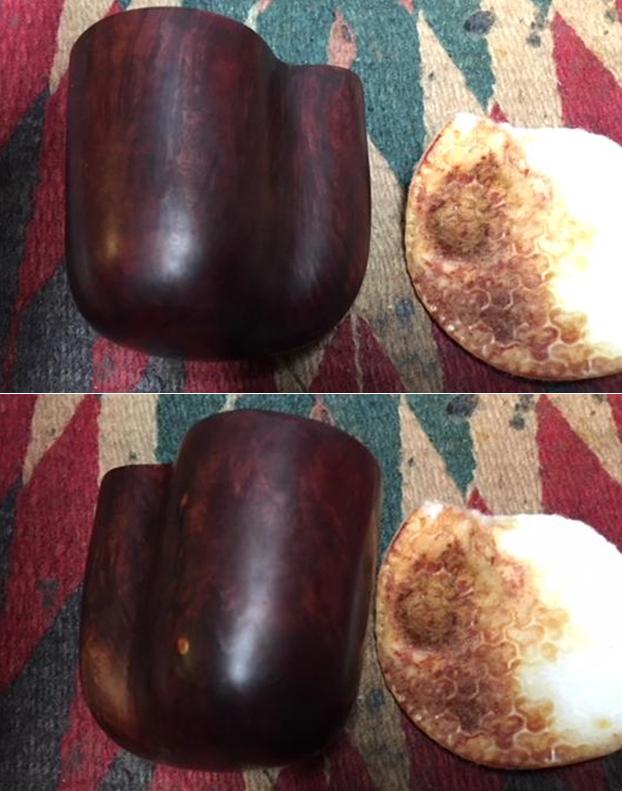
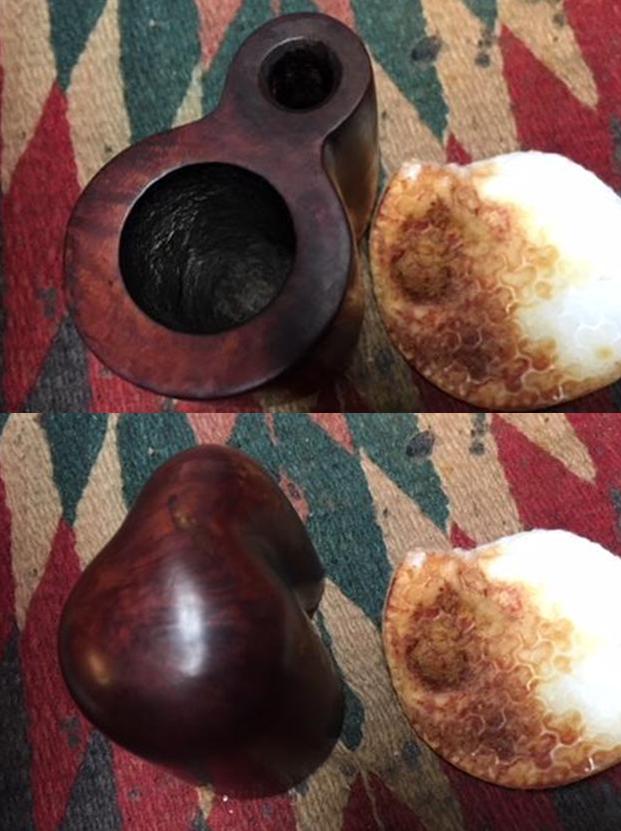
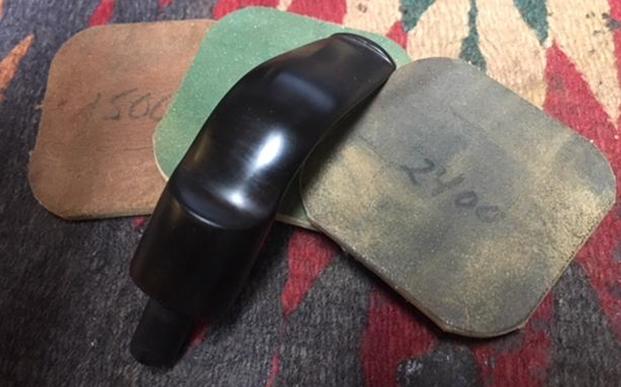
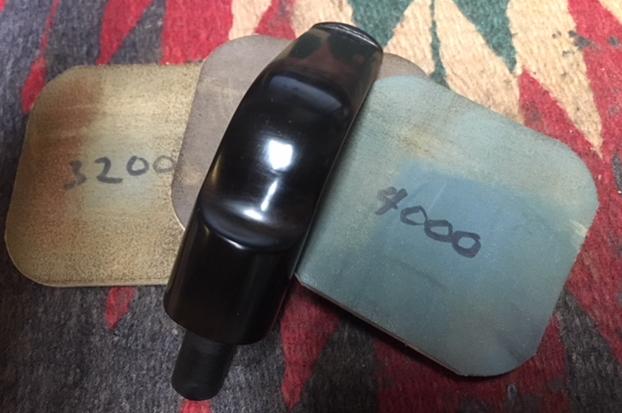
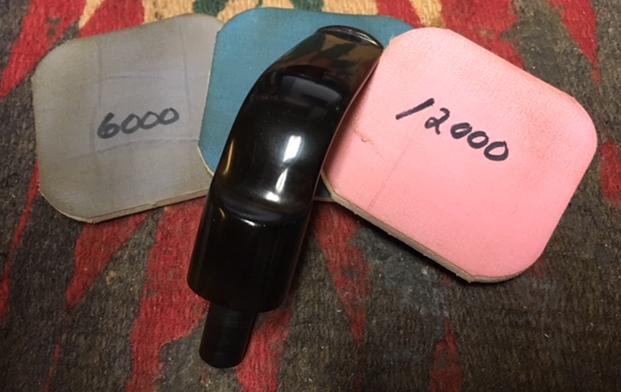
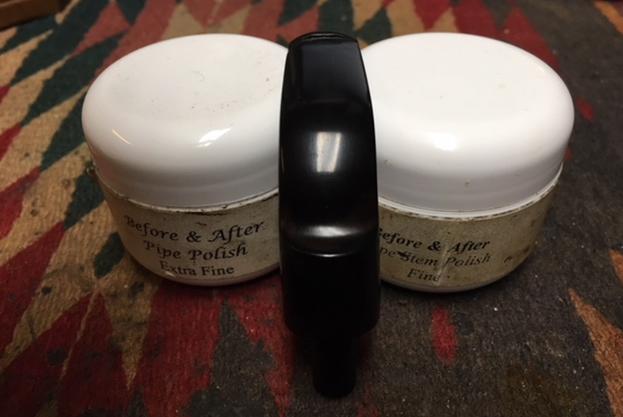
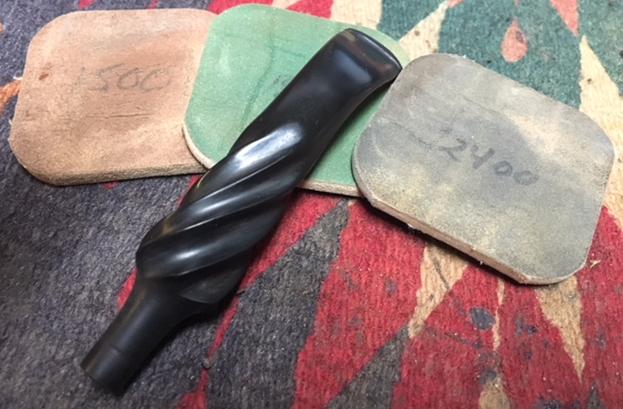
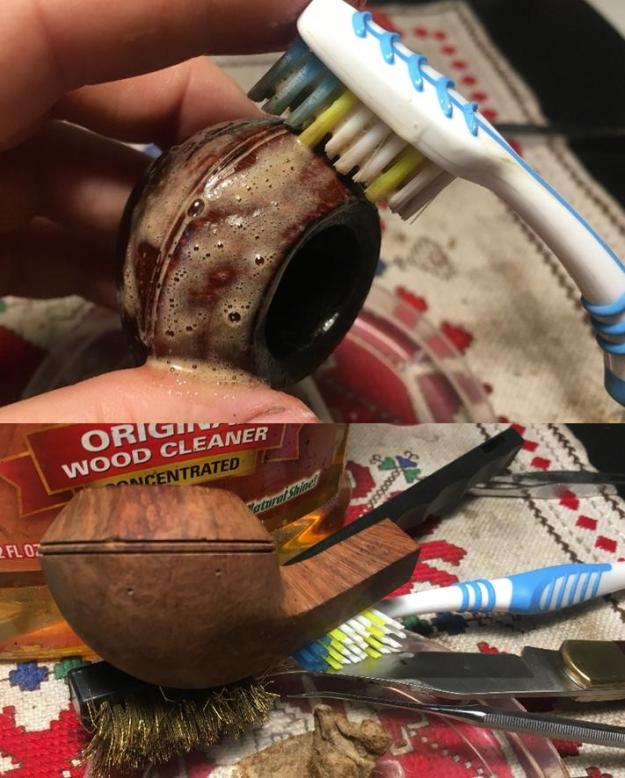
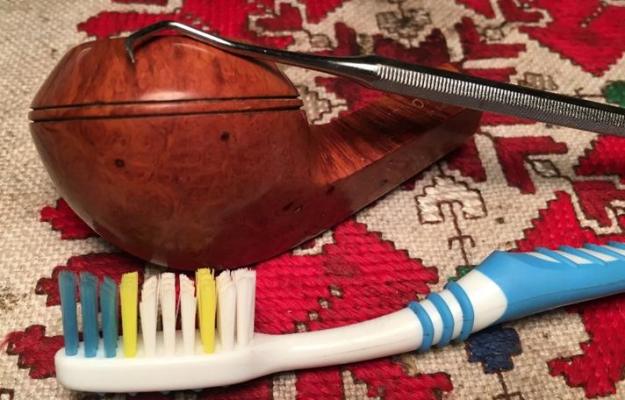
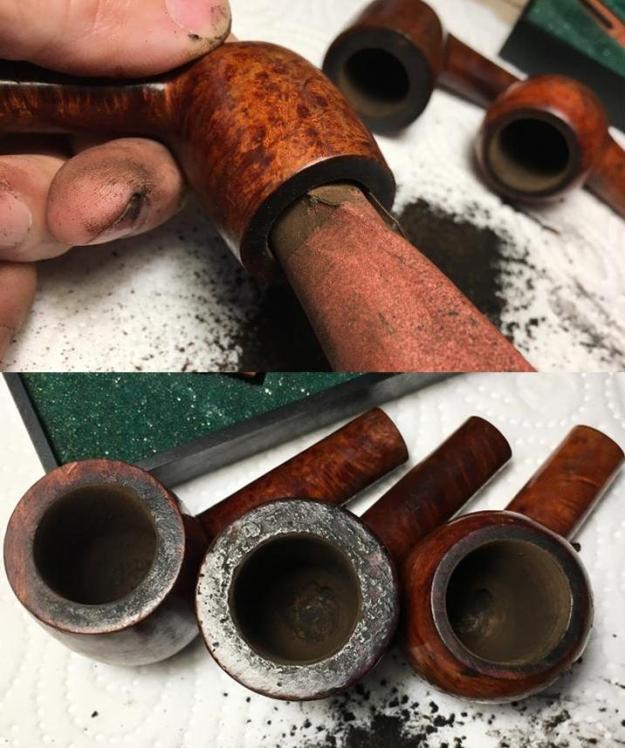
I began with cautiously sanding the inner edges of the bowl to remove as much of the charring as possible. Using Murphy’s oil soap and a hard bristled toothbrush I removed as much of the accumulated tars and lava from the rim top as I could. I lightly topped the bowl on a 220 grit sand paper. The charred portion of the briar came apart in chunks during the topping process. Thereafter, I tried to round off the inner edges of the bowl as much as I possibly could, by creating an inner bevel to cover up and address the charred portion. However, the bowl still remains out of shape.As can be seen, the bowl edge in the 1 o’clock (front right) and 7 o’clock (rear left) directions has moved out too far. I was not too inclined to sand down the other edges to merge with the moved out edges for fear of losing too much briar and further thinning the rim top. Any suggestions whether I should go all out with the inner edge to completely round it or leave it as is are welcome.  Once the bevel was made and I had sanded out as much of the charring as I was comfortable with, I sanded down the rim with micromesh pads, wet sanding with 1500 – 2400 grit and dry sanding with 3200 – 12000 grit. Using a brush and Murphy’s Oil soap, I cleaned the exteriors of the bowl, rim top and shank and rinsed it under running water. The bowl was wiped dry using a cotton cloth and left to dry out overnight. Turning my attention back to the stem, I wiped it down with a soft cotton cloth. On close inspection, I realized that there was one bite mark on both sides which was not raised and also that the lip edge was not defined/sharp. I mixed up activated charcoal powder with clear CA glue (the glue that was available to me here, has a tendency to come off in lumps. Hence I was skeptical about its function in this process) and applied it on both sides of the stem to fill in the bite mark as well as on the tip edge to define it further and set it aside to cure overnight. Next morning, I rubbed some “Before and After Restoration Balm” into the thin wire rustications of the dried out bowl. Every time I use this balm, I cannot help but appreciate how effectively it works to enliven and refresh an old briar bowl. I rubbed a small quantity of balm with my fingers into the thin wire rustications on the bowl and shank and kept it aside for a few seconds. Using a horse hair brush, I buffed the bowl and shank and worked the balm deeper into the closely packed rustication. I rubbed it down with a soft cloth to a bright shine. I had to use a lot of muscle power and time to get the desired shine since I do not have a wheel. I was satisfied with the way the bowl had turned out up to this point in the restoration.Thereafter I turned my attention to the stem. The fill of CA super glue and charcoal powder had cured sufficiently. Using needle files, I started filling away carefully and cautiously restricting the filing only to the filled areas. Using a flat head needle file, I filed away the excess filling and was satisfied with the end result. I used a 220 grit sand paper to further blend in the fill. I further polished the stem using micromesh sanding pads. Wet sanding with 1500 – 2400 grit pads helped reduce the sanding marks left behind by 220 grit papers to a great extent. I wiped it clean and coated the stem with extra virgin olive oil and let it rest for some time. This allows the vulcanite to absorb the oil. Thereafter I dry sanded the stem with 3200 – 12000 grit micromesh pads and applying olive oil after every third pad. The stem is now nice, smooth and shiny. I shared the pictures of the bowl and stem with Mr. Steve for his opinion and advice for further improvement. As is his style, Mr. Steve first appreciated the effort and suggested that a darker stain would look good. Since he was well aware that the stain pens I had ordered did not reach me, he suggested an ingenious and practical way of staining using local and readily available material. He suggested boiling black tea leaves in a little water and making a very strong and thick brew, letting it sit overnight. Using cotton swab/cue tip dipped in this brew, gently apply onto the area that is to be stained.

I followed his advice and applied it to the rim top of the Rockroot. After allowing it to rest for a few minutes, I gently wiped it off with a soft cotton cloth. The results are truly amazing. Mr. Steve further advised me to use regular black boot polish to further stain and bring back the shine to the rim top. The results of this can be seen in the following pictures of the finished pipe.This restoration has been a fantastic journey of learning, trials and frustrations which I enjoyed to the fullest. I cannot thank Mr. Steve enough for his wise, practical and timely advice and sharing his immense wealth of experience so readily with a novice like me. Thanks Steve!!!

Restoring a Cased Set – 2 JBV & 1 M&T Bent Billiards – Part 1


Blog by Steve Laug

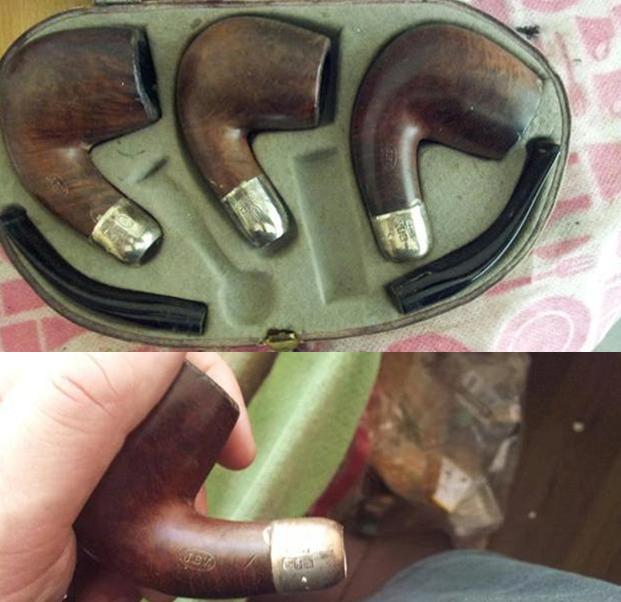
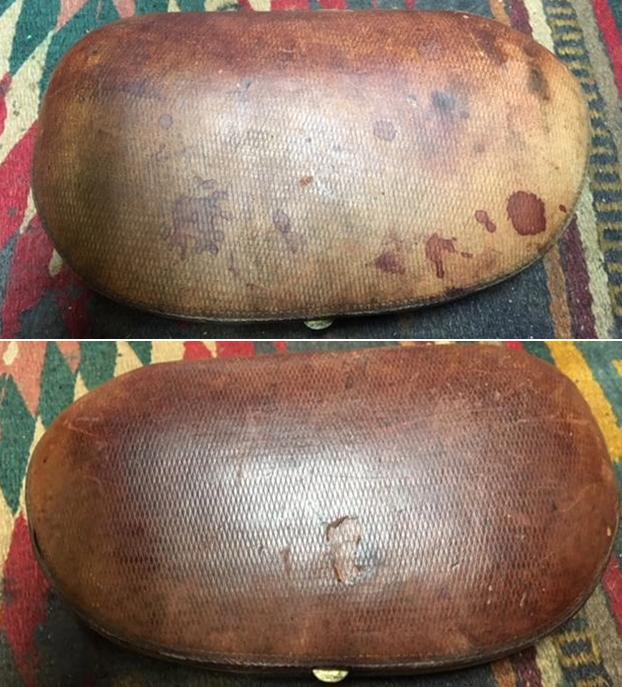
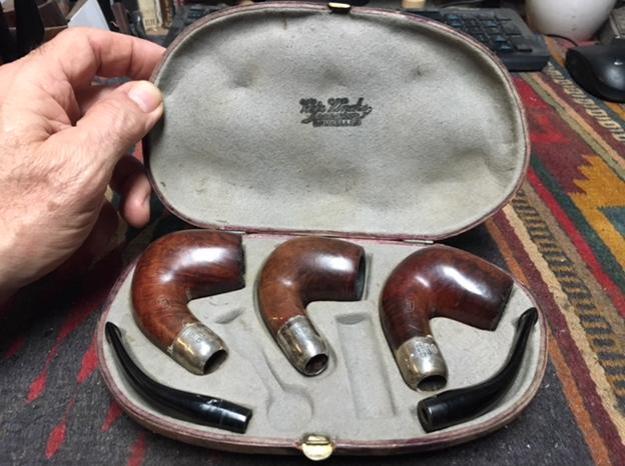
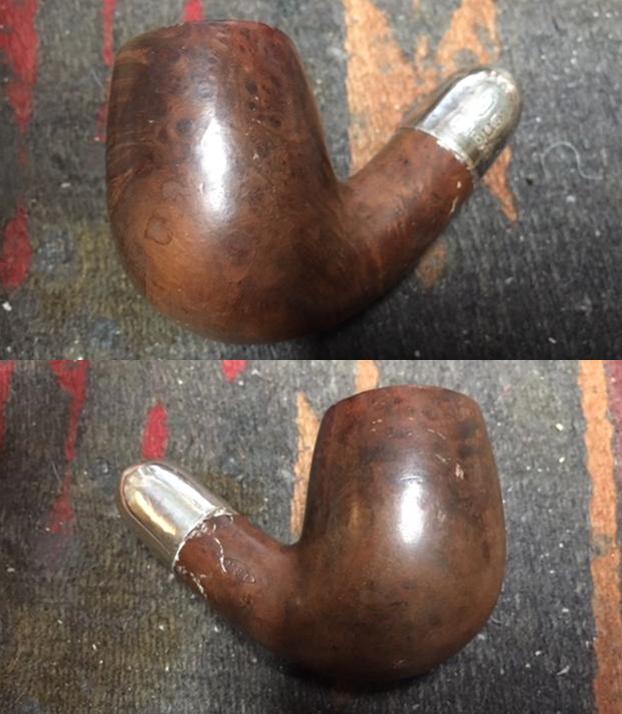
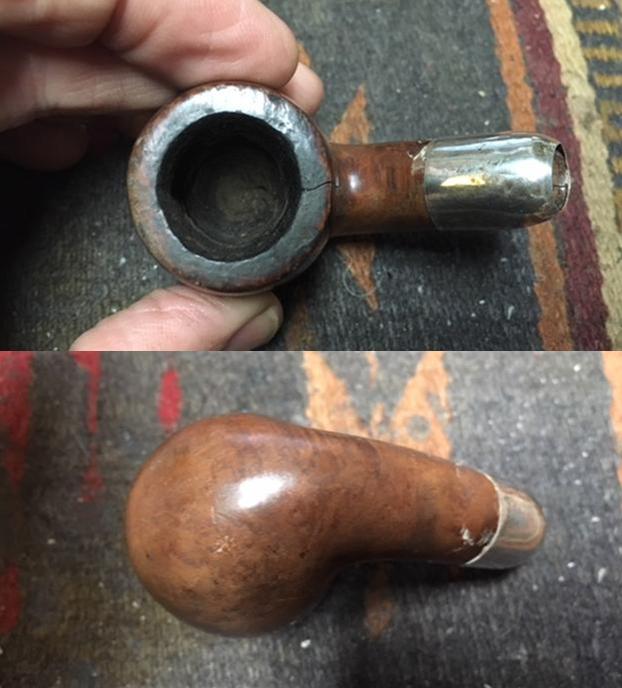
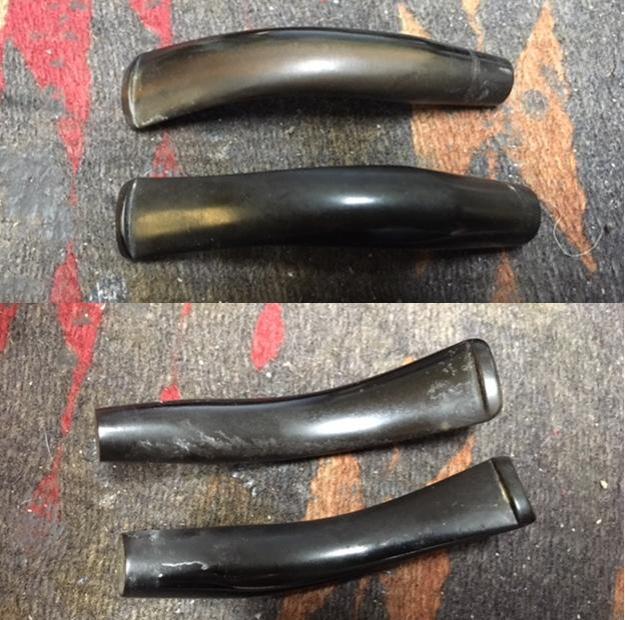
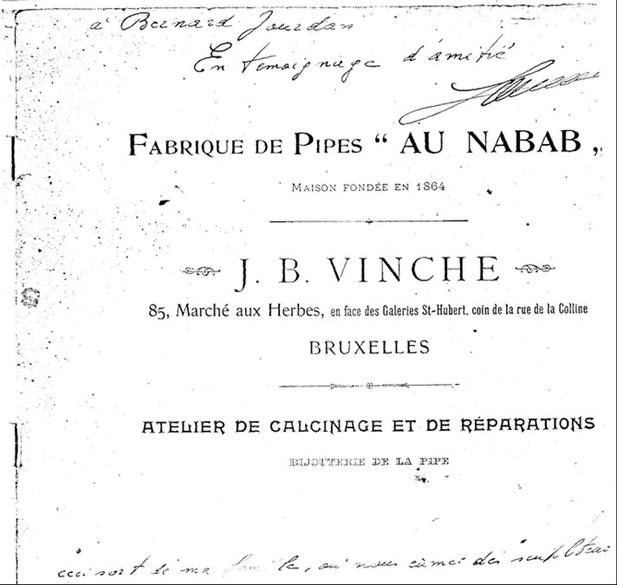
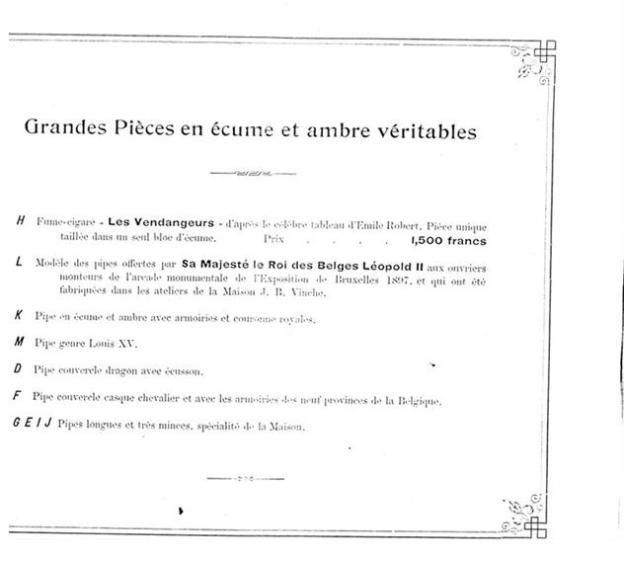
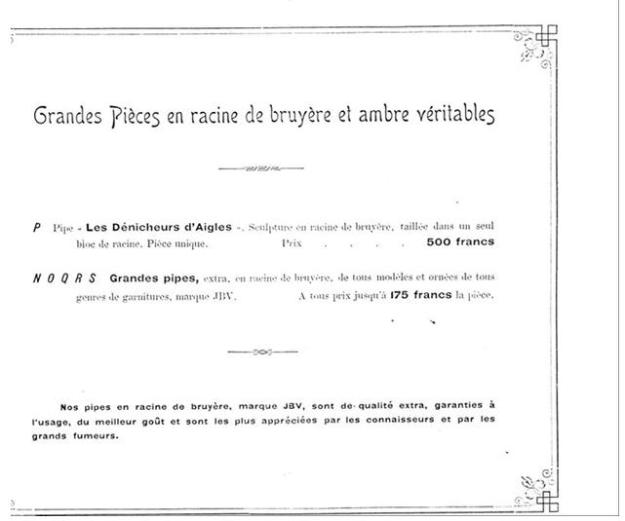
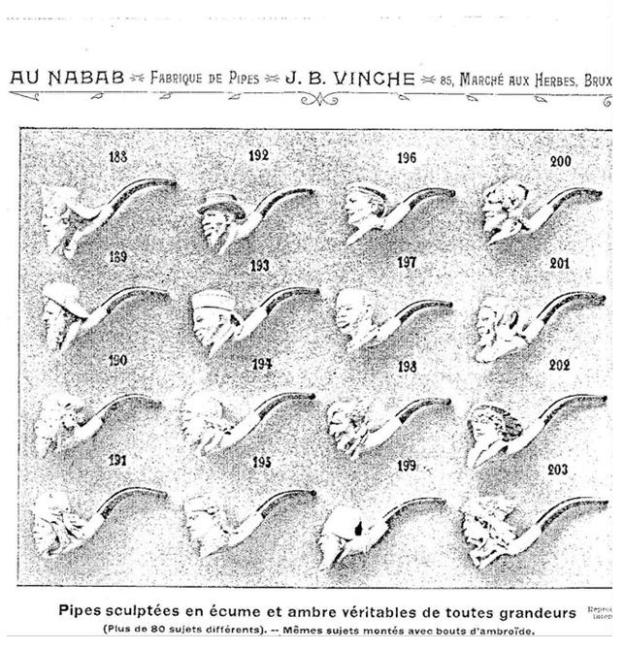
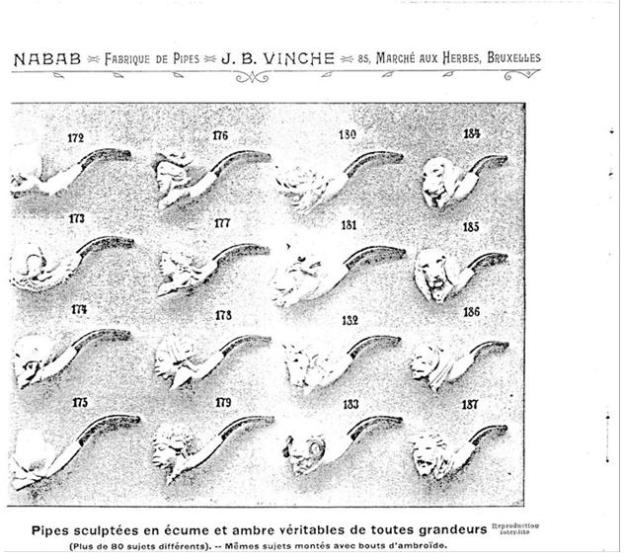
I was chatting with Chris van Hilst from Tobacco Pipe Restorers one day using Messenger and he was selling this old set of pipes. Two of them were stamped JBV in an oval and one was a M&T Best Briar & Bands. The set was missing the third JBV pipe and one of the stems was for the M&T. The silver was dirty and the bowls caked but there was something about the pipes that really attracted me. We talked prices and made a deal. I had him send the pipes to Jeff in Idaho as it was easier to deal with than sending them to Canada. I had him send me a couple of photos of the set that are shown below. The first is the pipes sitting in the case. It shows that there is some kind of cigarette holder and a tamper missing from the set. The second photo shows the JBV in an oval stamp on the left side of the shank of one of the pipes. I could also see hallmarks in the silver but was not able to clearly read them. Jeff received them pretty quickly and put them aside. My daughters went down for my Dad’s 90th birthday so he took the opportunity to send them north with them on their return trip. He had not had a chance to clean them so I was left to my own devices on this set of three. When they arrived, I took a photo of the case before I opened it and of the case open showing the pipes. It is covered in leather and is kidney shaped. It is lightly stained but other than a few nicks it is in great condition.There was some gold leters on the front edge of the case that reads FOURNISSEUR DE SM LEROI DES BELGES. It translates from Belgian French to read PROVIDER HM KING OF BELGIAN. Or the Provider for His Majesty King of Belgium.I opened the case and took a photo of the pipes on the inside and the stamping on the inside of the lid. It reads J.B. Vinche over “Au Nabab” over Bruxelles. That is what it reads as best as I can make out. It is pretty blurry.I took photos of each of the pipes before I started to work on them. I started with the pipe on the left side of the photo above and worked my way across for the photos. The first pipe below is the one on the left. It is stamped JBV in an oval on the left side of the shank. The silver ferrule is also stamped JBV in an oval over BRUX over three hallmarks that are hard to read. The first appears to be a flower, the second a person and the third is ARG over 900. The pipe is in rough shape. The finish is shot; there is silver polish on the shank ahead of the ferrule. There are some gouges in the top and underside of the shank. The JBV Oval was originally gold leaf. There is a thick cake in the bowl and the rim top is beat up. There are big chunks of briar missing around the outer edge of the rim. The rim top is chipped and damaged and the inner edge is in rough condition. The pipe is very dirty. The second pipe is shown below and is the one in the center position in the case. It is stamped BEST BRIAR & BANDS  with each word over the next on the left side of the shank. One the right side it is stamped M&T in a football shaped oval. The silver ferrule is also stamped with a BBB vertically on the side of the band next to the shank. Next to that is the same M&T stamp in an oval over three hallmarks that are hard to read. The first appears to be a flower, the second is 933 and the third is a crescent moon. The pipe is in rough shape. Once again the finish is shot; there is silver polish on the shank ahead of the ferrule. There are some gouges in the top and underside of the shank. There is a thick cake in the bowl and the rim top is beat up. There is a crack running down the back side from the rim halfway to the shank. The rim top is dented and damaged and the inner edge is in better condition than the first pipe. The pipe is very dirty. The third pipe is shown below and is the one on the right side of the case. It is stamped JBV in an oval on the left side of the shank. The silver ferrule is also stamped JBV in an oval over BRUX over three hallmarks that are hard to read. The first appears to be a flower, the second a person and the third is ARG over 900. The pipe is in rough shape. The finish is on this one is also shot; there is silver polish on the shank ahead of the ferrule. There are some gouges in the top and underside of the shank. The JBV Oval was originally gold leaf. There is a thick cake in the bowl and the rim top is beat up. There are big chunks of briar missing around the outer edge of the rim. The rim top is chipped and damaged and the inner edge is in rough condition. There looked like there could be a crack in the bowl down the left side. Like the rest of the pipes in this set the pipe is very dirty. There were two stems in the set. You can see from the photos below that they were different sizes. In the first photo the top stem is more delicate. It is narrower at the tenon end. It is for the M&T pipe while the bottom one is for the JBV pipes. The stems both are in decent condition with a little oxidation and minimal tooth chatter. There are no deep tooth marks so that is something to be thankful for. I knew that the set was older but I was unfamiliar with the brands. I had not heard of JBV so I did a bit of research on the brand and found an interesting link to an old catalogue. It turns out that the JBV is short for J.B. Vinche Company in Brussels. I have included the information on the brand that I found in the link as well as the link below.

This company maintained a factory in Brussels, Belgium, but records indicate that it also operated a retail establishment at 34, Rue Notre Dame des Victoires, in Paris under the name “Au Nabab” where, no doubt, it offered its product line for sale to the public.

https://www.facebook.com/tobaccopipeartistory/photos/a.111646685586370.24977.101191206631918/111646972253008/?type=3&theater

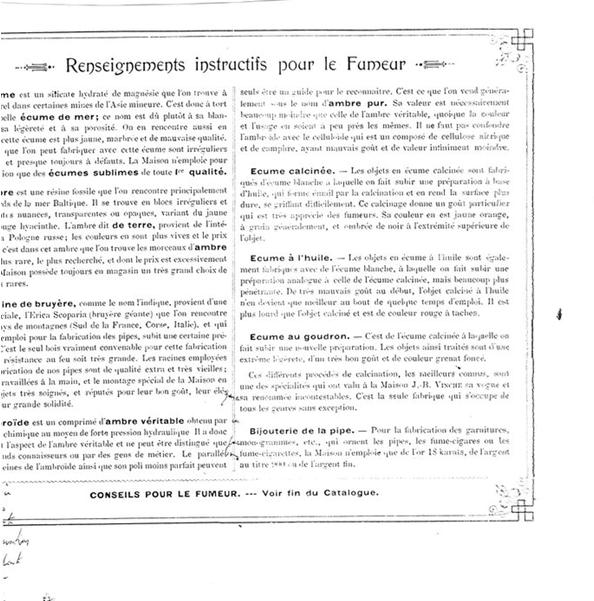
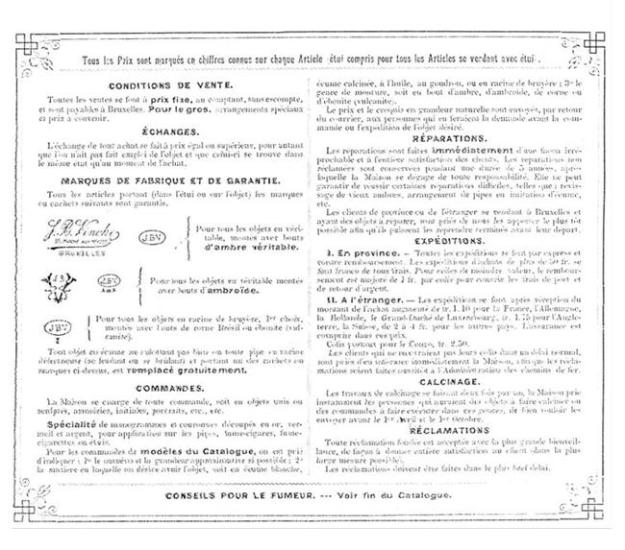
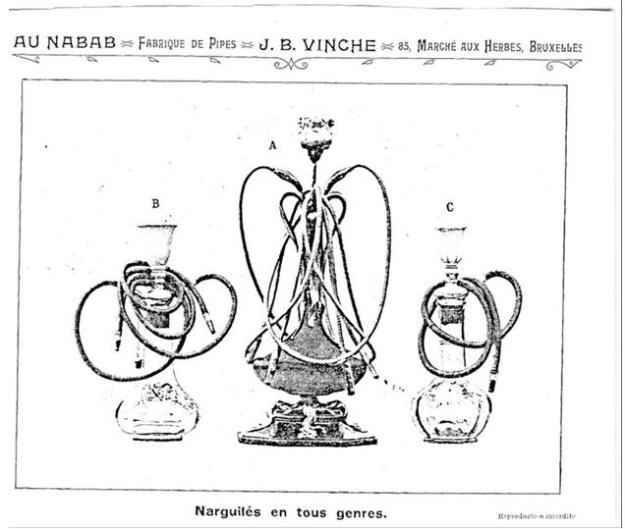
I also included some photos of a J.B. Vinche Catalogue from 1875. I checked on the Pipephil website to see what I could find there. Generally I find the site one of the most helpful in quickly confirming information on a brand. In this case it came through with a great bit of information. I did a screen capture of the pertinent section of the link. You can check it out further on the following link. http://www.pipephil.eu/logos/en/logo-v2.html.

The information included in the capture reads:

The brand has been created in Bruxelles in 1864 by Jean Baptiste Vinche and run after him by his son Victor. Marcel and Rene Vinche (3rd generation) managed the corporation from 1927 on. The brand is famous for its meerschaum pipes but briar pipes were also produced after 1938. In 1965 Jacques Vinche (4th generation) entered the family firm. Jeff and Mia Koopmans from Hilson Pipes joined in 1977. Today (2009) Ben and Wim Koopmans manage the business.Pipedia confirms this information at the following link: https://pipedia.org/wiki/Vinche.

I could not find out any information on the third pipe – the M&T Best Briar Band pipe. I checked in all of my usual sources and came up empty. Does anyone know anything about the brand? Let me know.

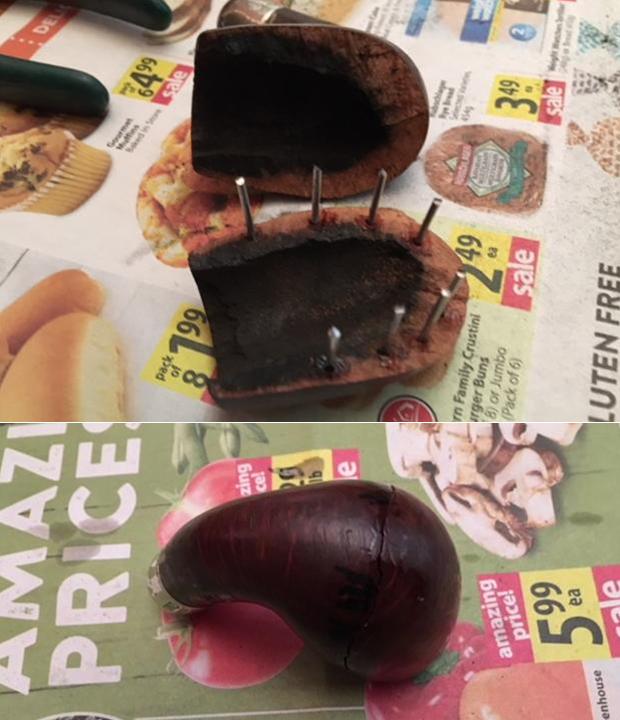
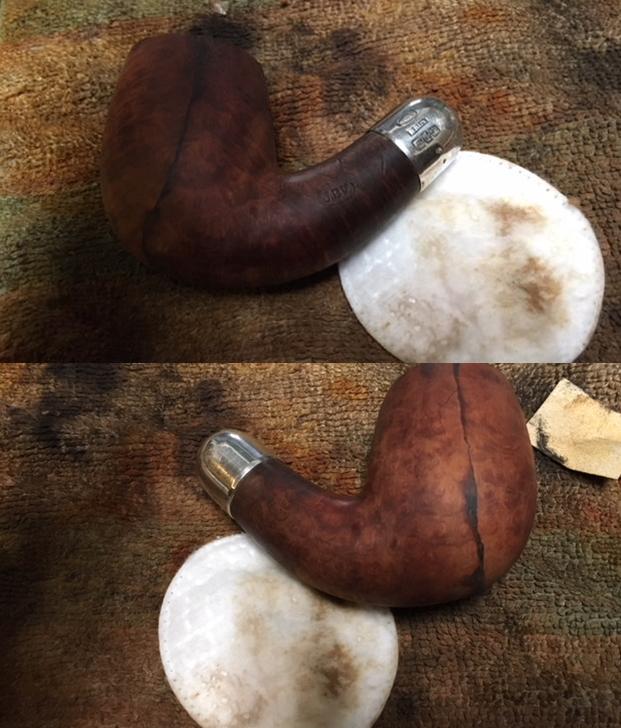
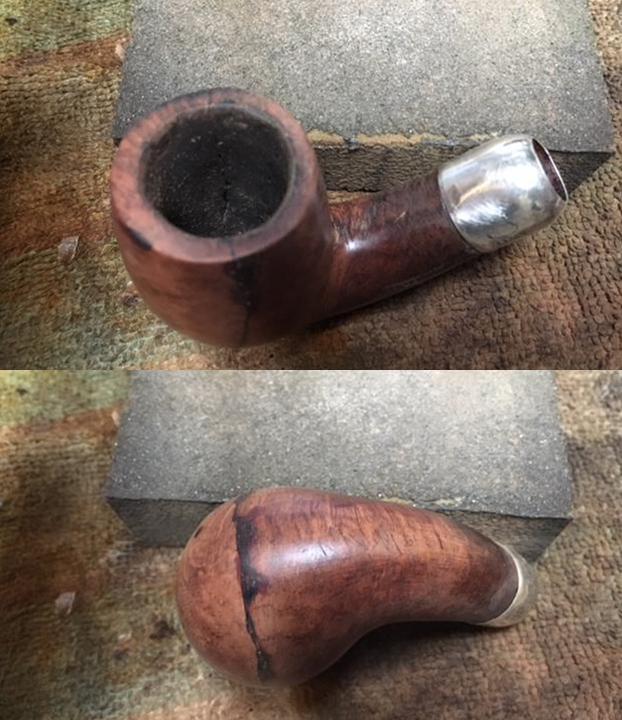
Armed with the background information, I decided to start on these pipes by reaming all three of them. The cake in each was quite thick and the damage to the rim and bowl made me proceed with caution. I was concerned about the cracked bowl in the M&T pipe as well as the potential crack in the second JBV pipe. I started with the first JBV pipe and reamed it with a PipNet pipe reamer starting with the first cutting head and working my way up to the second and lightly working on it with the third one. I took the cake back to bare briar to check out the interior of the bowl. I followed up by reaming it with a Savinelli Fitsall Pipe knife and finally sanding the bowl with 180 grit sandpaper wrapped around a piece of dowel. I moved on to the M&T Best Briar Band pipe and reamed it with a PipNet pipe reamer starting with the first cutting head and working my way up to the second and lightly working on it with the third one. I took the cake back to bare briar to check out the interior of the bowl. I followed up by reaming it with a Savinelli Fitsall Pipe knife and finally sanding the bowl with 180 grit sandpaper wrapped around a piece of dowel. I moved on to the second JBV pipe (the one that I thought had a possible crack). I started with the smallest cutting head on the PipNet pipe reamer and turned it gently in the bowl one twist and the bowl split in half in my hands. I was sick when I felt it break. I have never had that happen in all these years of working on pipes. It really was unbelievable. I held the pieces together and took the cake back to bare briar to check out the interior of the bowl. I used a Savinelli Fitsall Pipe knife to scrape away the remnants of cake. The photo below shows the bowl in half with the reamer next to it.This is not what I wanted to do next! I had planned to work through each of the pipes and have a nice set! Now I had to deal with this one and because it was part of an old set I felt obligated to try to put it back together. I was just sickening to have the second original bowl break in my hands. Why couldn’t it have been the cracked M&T bowl? But since it was the other JBV bowl I needed to repair it. At this point this blog also took a turn. I would do the rest of the first part of the blog on the bowl repair of this particular JBV pipe. I would have to follow up with at least one more part on the other two pipes in the set.

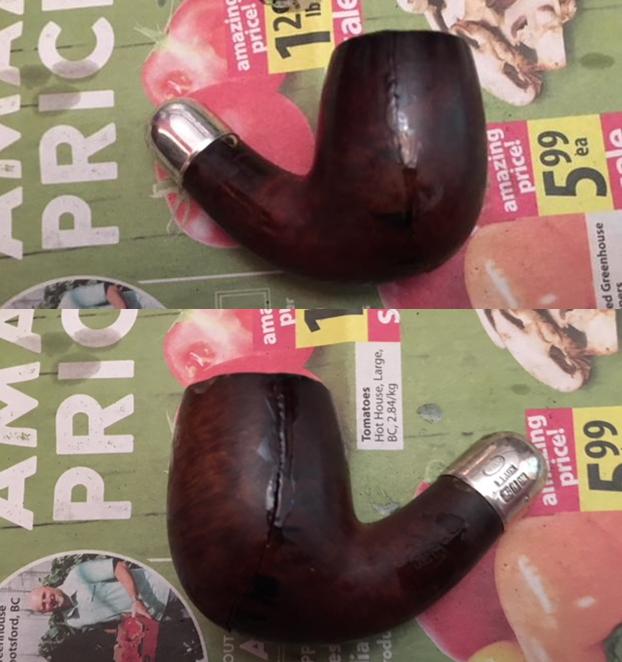
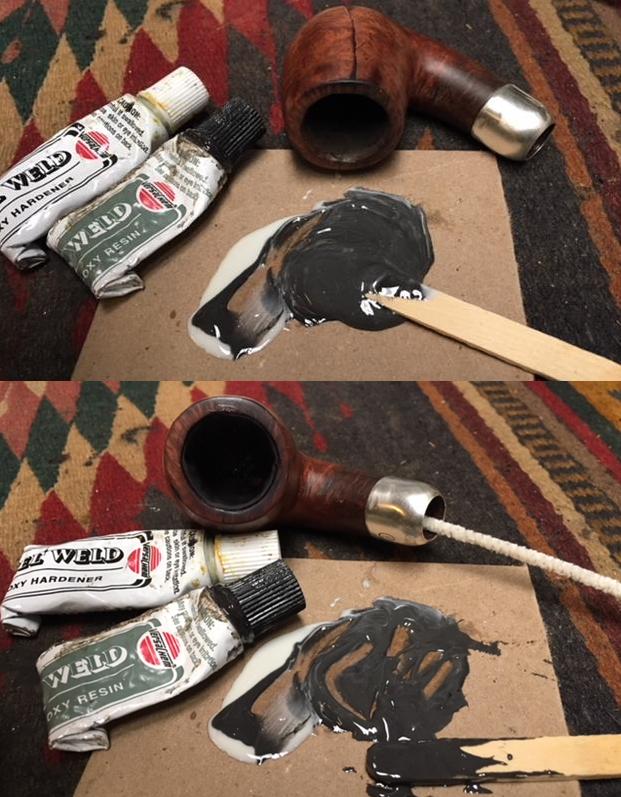
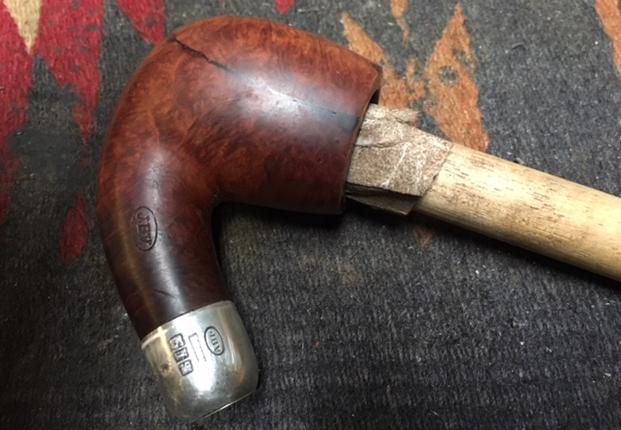
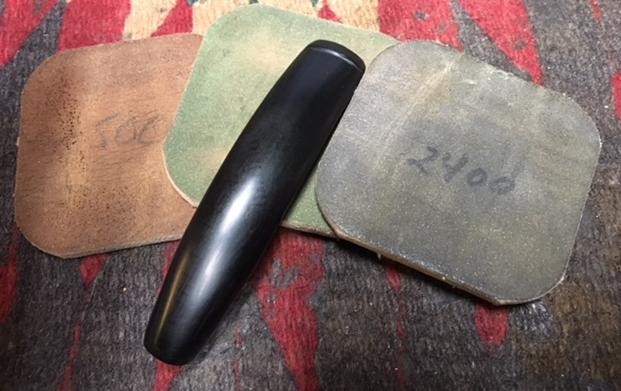
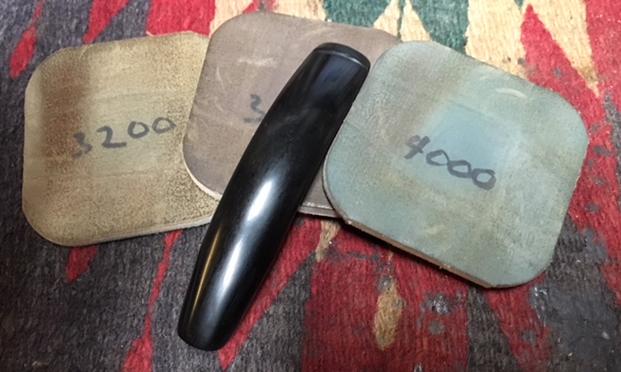
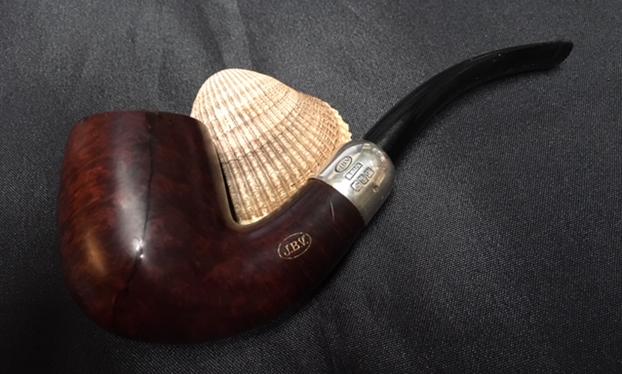
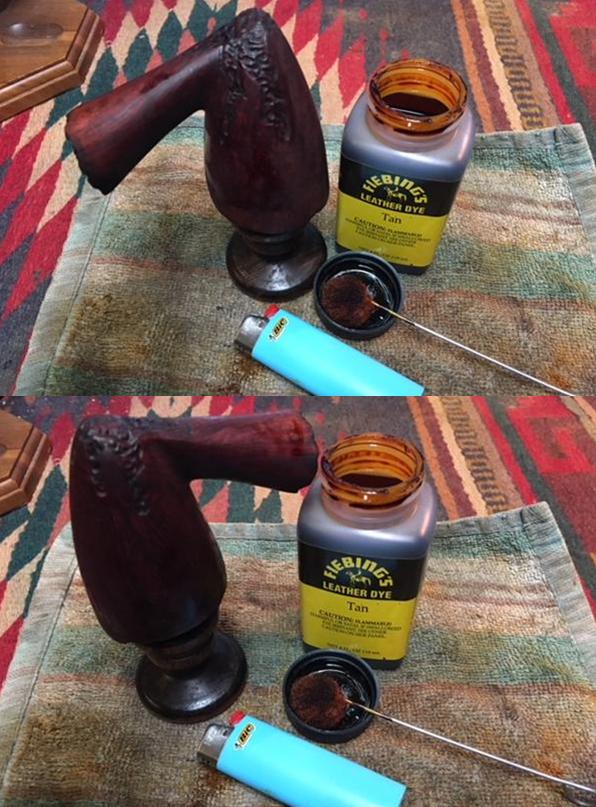
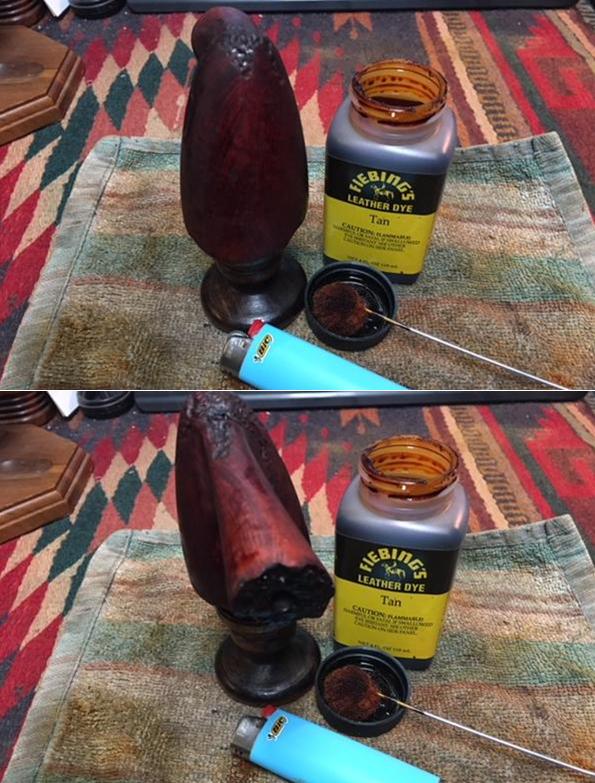
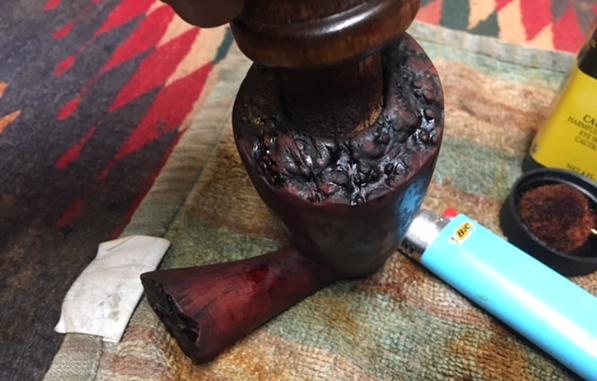
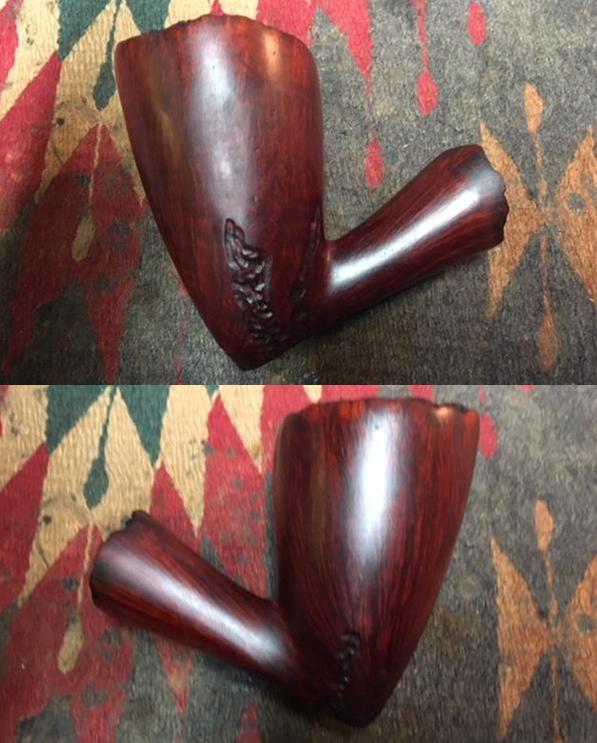
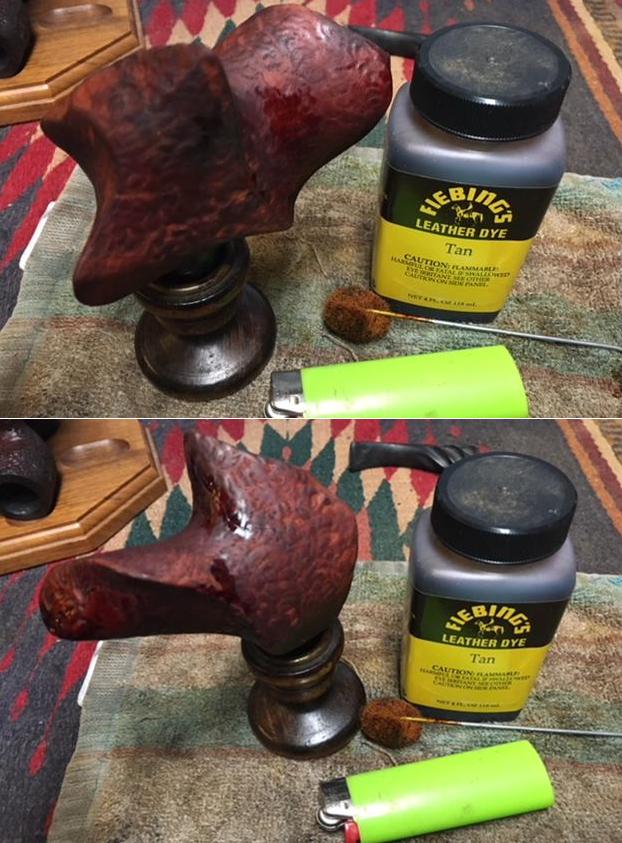
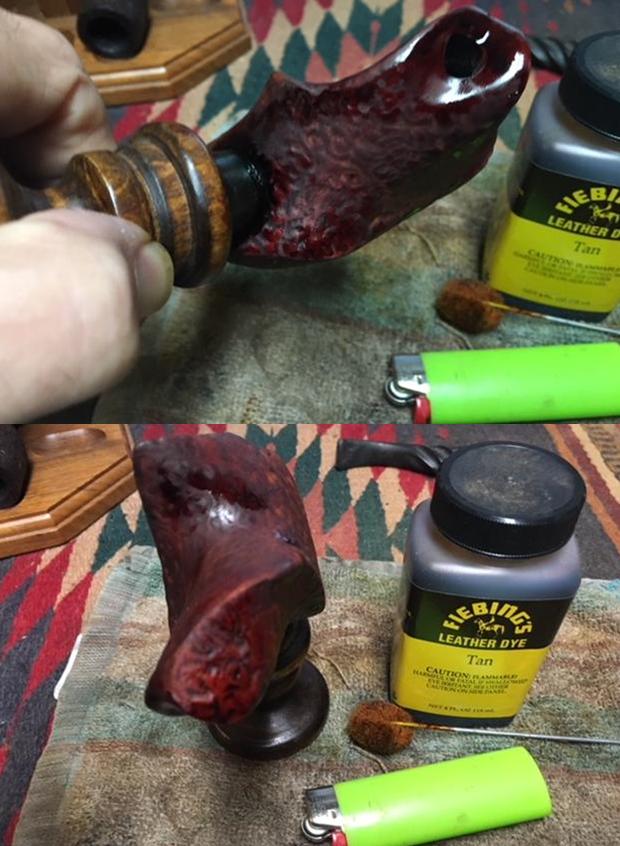
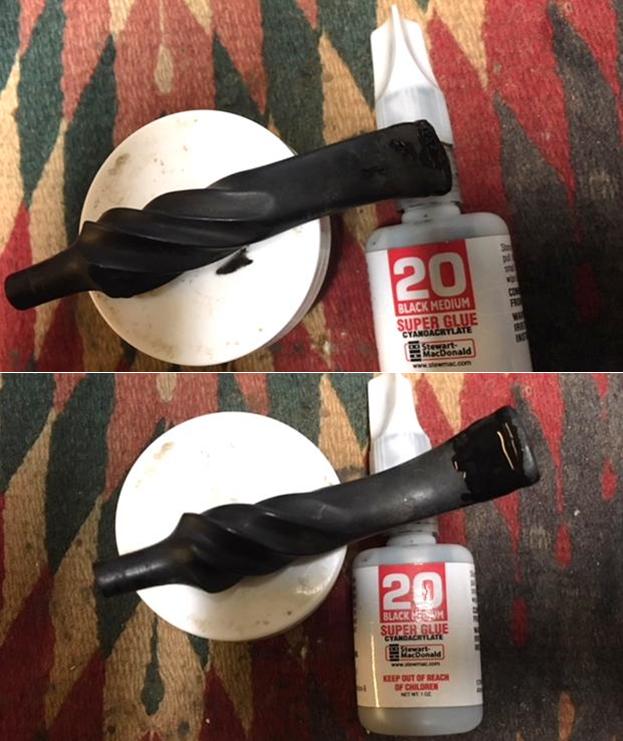
I turned to repair the bowl. I decided to pin the two halves together and then fill it and line the bowl with JB Weld. It would be a process. I drilled 8 small pin holes in the front half of the bowl and put stainless pins in the holes. I matched the two halves together and marked the holes on the other side of the bowl. I drilled matching holes. Once I had the holes aligned I painted each half with gel super glue and pressed the halves together and held them in place until the glue set. I filled in the cracks around the sides and bottom of the bowl with briar dust and super glue. I used a dental spatula to apply the patch all around the bowl. I pressed the mixture into the crevices that remained in the sides and bottom.When the repair hardened I sanded it with 180 grit sandpaper to blend it into the surface of the bowl. I also repaired the chips out of the edges of the bowl with super glue and briar dust. I sanded the bowl with 220 grit sandpaper and smoothed out the repaired areas and sanded the rest of the bowl at the same time. I carefully avoided the stamping on the shank so as not to damage that area. I topped the bowl to remove the damage to the rim top. I had hand sanded it with sandpaper to start the process and filled in the damaged areas with super glue and briar dust. Now it was time to top it. Once I had it topped I wiped the bowl down with alcohol to remove the dust and the remainder of the finish on the shank and bowl. I cleaned out the inside of the mortise and shank as well as the airway into the bowl with alcohol, pipe cleaners and cotton swabs. The airway was clogged so I pushed a pipe cleaner through into the bowl. The mortise was like a Peterson’s sump and it was filthy. It took a lot of work to clean it out.I sanded the exterior of the bowl with a medium and a fine grit sanding sponge. At this point I paused in sanding the exterior and turned my attention to repairing the inside of the bowl. I mixed a batch of JB Weld and put a pipe cleaner in the airway into the bowl to keep the airway from being covered with the mixture. I applied the mix to the inside of the bowl with a popsicle stick. I pressed it into the cracks and build up the damaged areas to protect it from further damage. With that I called it a night, set the bowl aside to dry and turned out the lights.  In the morning I sanded out the excess JB Weld with 180 grit sandpaper wrapped around a dowel. I wiped the bowl down with a damp paper towel to remove the dust. The photos below show the bowl at this point. I polished the briar with micromesh sanding pads – wet sanding with 1500-2400 grit pads and dry sanding with 3200-12000 grit pads. I wiped it down with a damp cloth after each sanding pad to remove the dust. I stained the bowl with a Tan aniline stain. I had found that the stain was probably mislabeled as it had a definite red cast to it. I applied it with the dauber and flamed it with a lighter to set the stain in the finish.Once the stain cured I rubbed the bowl down with Before & After Restoration Balm. It cleans, enlivens and protects the briar. In this case I also found that it blended the stain well on the surface of the briar. I polished the silver with a jeweler’s cloth to polish and remove the tarnish. I reapplied the gold to the stamping on the shank using Rub’n Buff Antique Gold. I applied it in the stamping using the tip of a sanding stick. I let the stamping sit for a few minutes then buffed off the excess product.I set the bowl aside and turned my attention to making a stem for this pipe. Remember I mentioned that the second stem in the case was for the M&T pipe and was too small in diameter for the shank of the second JBV pipe. I found a Bakelite stem in my box of stems that only needed to be shaped to fit the shank of the pipe. I tapered the end of the stem with a Dremel and sanding drum to match the taper of the other stem. I sanded it with 180 grit sandpaper to smooth out the Dremel marks and further taper it.I sanded out the tooth chatter and reshaped the edges of the button with 220 grit sandpaper. I also smoothed out the flow of the stem.I polished the stem with micromesh sanding pads – wet sanding with 1500-2400 grit pads and dry sanding with 3200-12000 grit pads. I wiped the stem down after each pad with Obsidian Oil to wipe away the sanding dust and bring some life to the Bakelite. With the stem and bowl done it the first installment of this blog is complete. It is time to reconnect things and take some final photos. I buffed the bowl and stem with Blue Diamond on the buffing wheel. I gave the entire pipe multiple coats of carnauba wax to protect. I buffed it with a clean buffing pad to raise the shine. I hand buffed it with a microfibre cloth to deepen the shine. This frustrating old pipe that split in half had been brought back to functional life and it does not look to bad to my eye. This is a long one. For some of you I am sure you are wondering what is wrong with me to take time to fix this one. To you I say it was worth the lessons that I learned and it is still a smokable pipe. Thanks for reading.

FINDING THE NATURAL BEAUTY OF A KNUTE OF DENMARK FREEHAND


Blog by Robert M. Boughton
Copyright © Reborn Pipes and the Author except as cited
https://www.facebook.com/roadrunnerpipes/

For after all, the best thing one can do
When it is raining, is to let it rain.

— Henry Wadsworth Longfellow, in “The Poet’s Tale: The Birds of Killingworth,” in Tales of a Wayside Inn (1863)

INTRODUCTION
Longfellow’s powerful poem is about man’s intolerant bent for all things natural based on ignorance of the indispensability of even the smallest part in an ecosystem.  It speaks to acceptance and “gentleness, and mercy to the weak, and reverence for Life.”  The work is sad and satirical and, in the end, surprising in its song of survival, but, alas, will never be required reading in any public school.

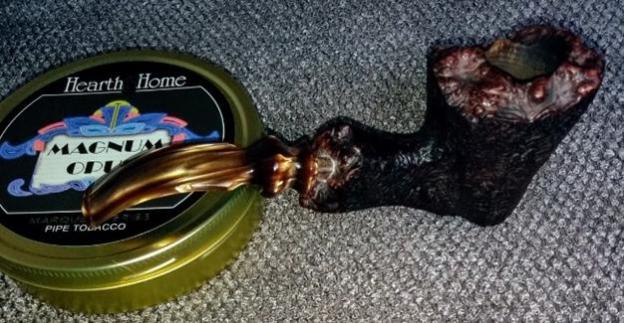
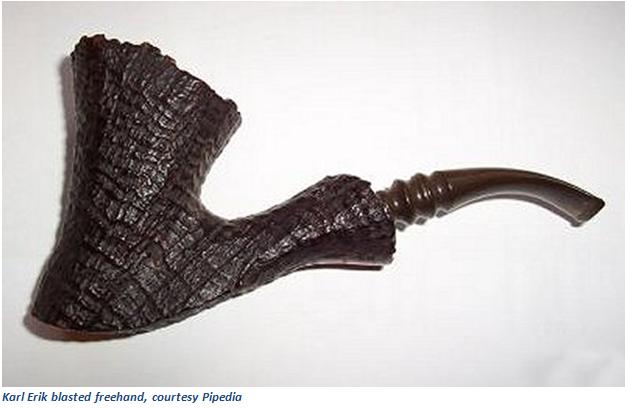
Knute of Denmark is a second of Karl Erik, which Karl Erik Ottendahl (1942-2004) made his main brand.  Ottendahl, an underrated and generous pipe maker who was a low-paid lithographer before he took up pipe carving as a hobby until it became his full-time vocation, understood the average smoker who made far less money than those fortunate enough to afford expensive varieties of the Danish freehand style of which he was an early crafter.  He therefore dedicated his life and work to pipes of great natural beauty at bargain prices.  Here is one that very much resembles the pipe in this blog, suggesting Ottendahl may have had a hand in making this Knute of Denmark.I suspect, or at least like to think, that Ottendahl read Longfellow’s magnificent poem, a couplet of which I quoted above, and if he didn’t, he would have enjoyed it.  And it was raining in the Isotopes City while I restored this pipe.

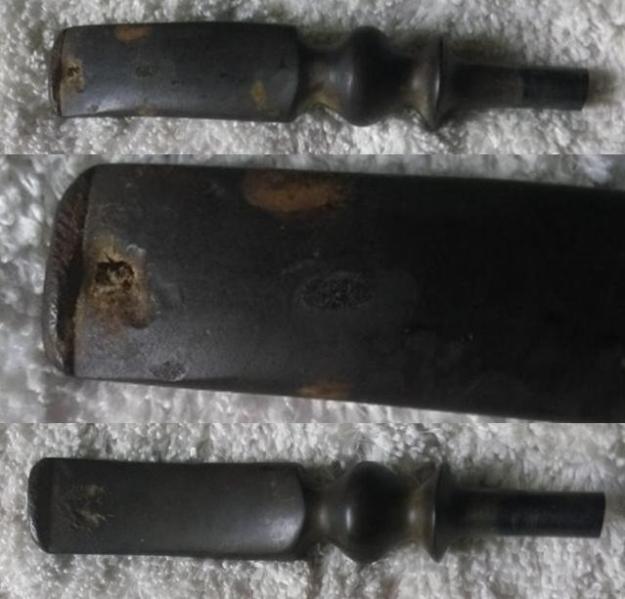
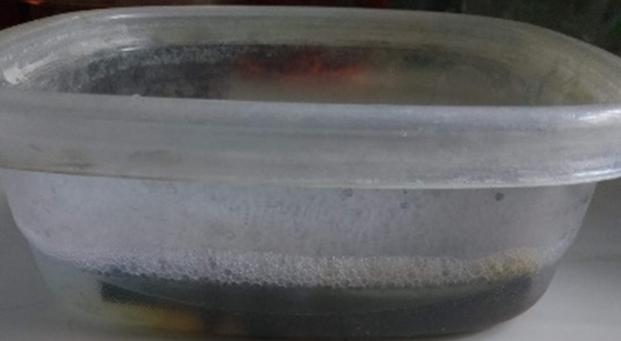
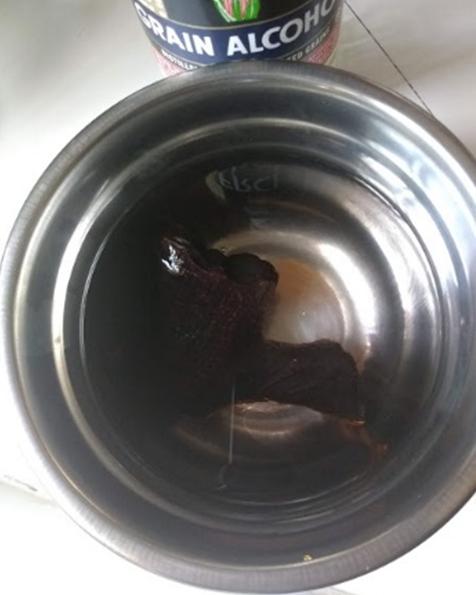
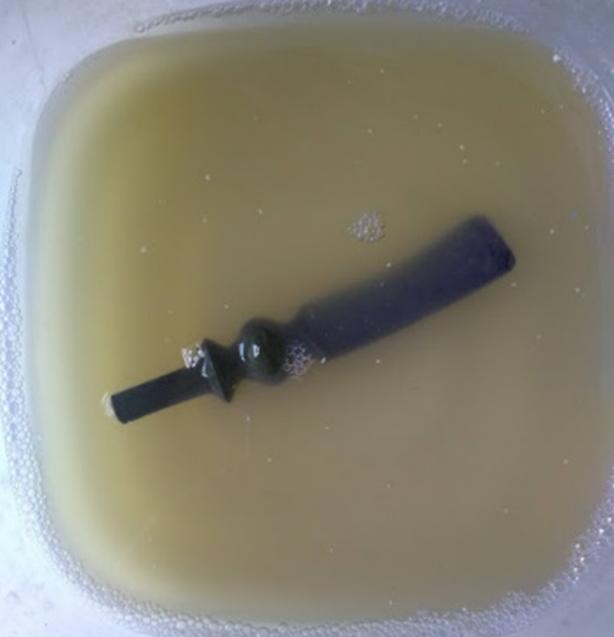
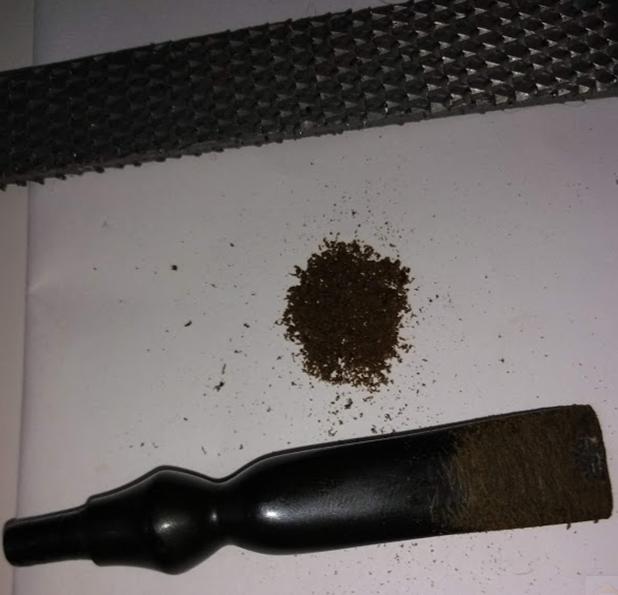
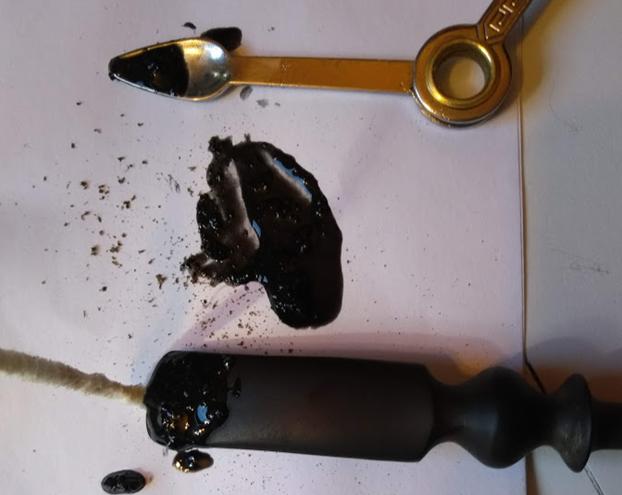
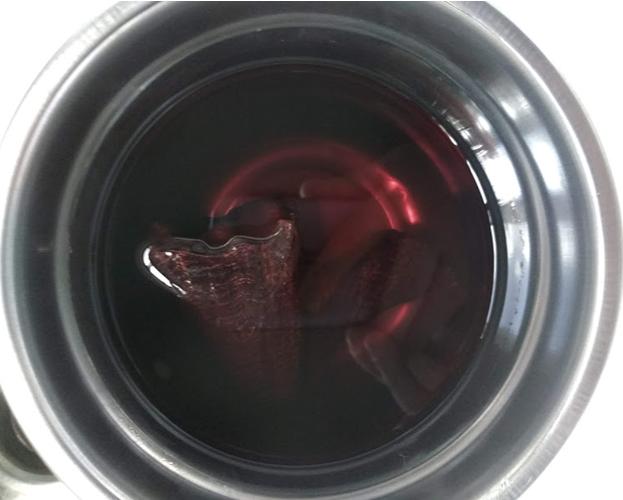
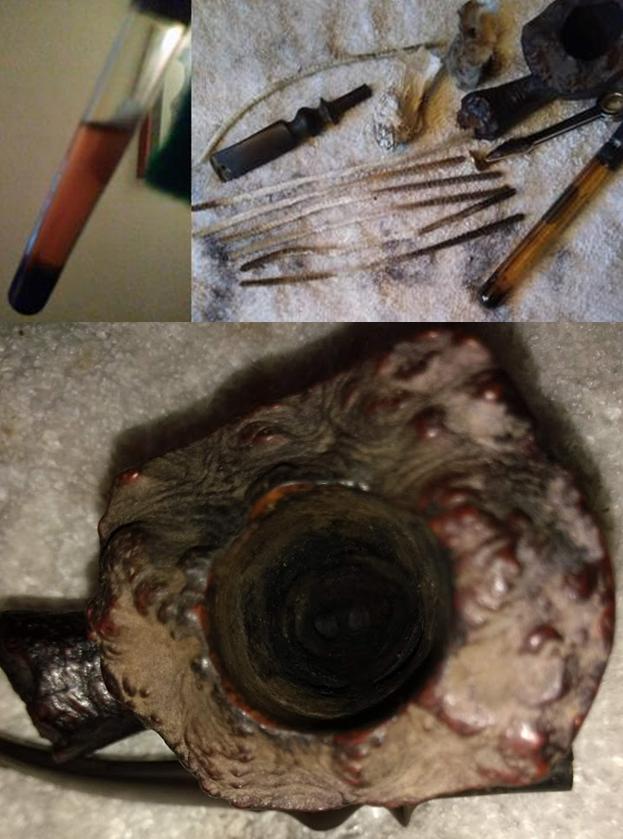
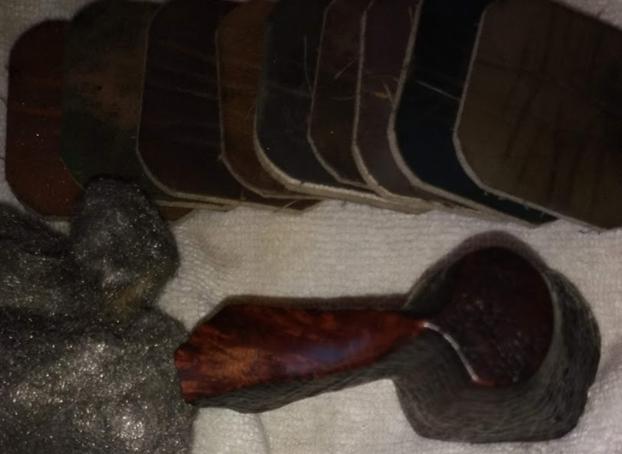
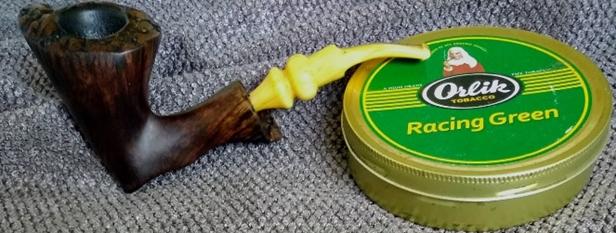
RESTORATION The stem was savagely damaged, with the top lip all but gone and a small hole below it and the bottom having two gouges.  Such long-term acts of mayhem must have been inflicted by someone with clear and severe anger issues who masticated the mouthpiece the way some people chomp on gum to stop smoking coffin nails.  I gave it an OxiClean bath to start.  At the same time, I stripped whatever dirt and stain (the latter of which I could see no signs) were present with an Everclear soak.  The immediate appearance of dark reddish swirls in the alcohol surprised me. The OxiClean soak, which was complete first, shows in the pic below how filthy the stem was.  Afterward, all I can say is it was clean. Figuring I had at least an hour before the stummel would be stripped, I filed off fine shavings from an old otherwise useless stem and made a nice little pile.  The ironic part of that task was that the stem was once a fancy type similar to the one I was fixing and would have been a perfect replacement had it not been toasted!  Then I added a few drops of black Super Glue, mixed it together with the shavings and quickly and liberally applied it to the stem after dipping a cleaner in petroleum jelly and inserting in the mouthpiece past the hole.  WARNING: I forgot my usual process of lubricating a small sliver of card stock paper also and inserting it inside the stem in front of the cleaner, but it all worked out later – with some extreme difficulty. That done, I had 12-24 hours before it would be dried, way more than enough time to finish the stummel that was ready to come out of the Everclear.  Checking out the progress of the alcohol soak, I was amazed by the almost blood red color of the 190-proof grain alcohol and guessed it was from residual maroon stain.For the first time after an Everclear soak, I wiped the still drying wood with a cotton rag saturated with purified water.  The water took longer to dry, but the result was stunning.  Despite the sandblasting, I believe what I beheld was the finest piece of briar I’ve ever seen.  Its natural beauty shone through the crisp dullness. I reamed the chamber, used a small sharp pocket knife to cut away some excess buildup and sanded with 150-, 220, 320- and 600-grit papers, then retorted the pipe. The following shots show the tremendous improvement of the wood’s potential color and glow.  I used the super fine “0000” steel wool in two of the photos only on the rim and shank opening.  But look at the difference. Late that night, with the stem patch dry, I took out one of my files, a narrow triangle with medium-grit flat sides to remove the thick, uneven mess on the top of the stem that is a necessary by-product of the black Super Glue method of hole-filling.  I was also able to remove most of the deep chasms on the bottom of the stem.  I began the smoothing process with a dual 150- and 160-grit sanding pad and regular, rougher 150-grit paper.The effort to salvage the ruined old stem was worthwhile and a good start on a plan of total rehabilitation for personal use, but this pipe is for sale, and I know the more difficult work of re-building the bottom lip will take longer and not, in the end, be suitable to pass off to a buyer.

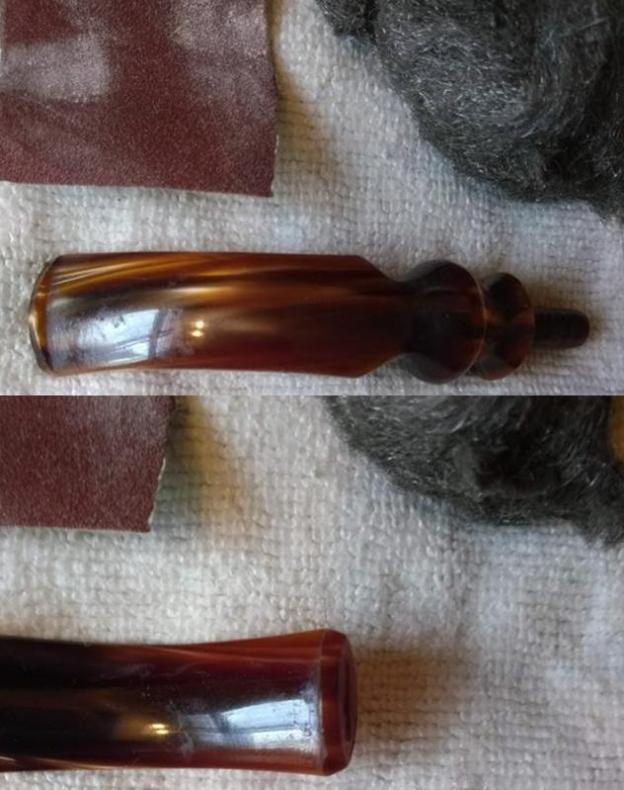
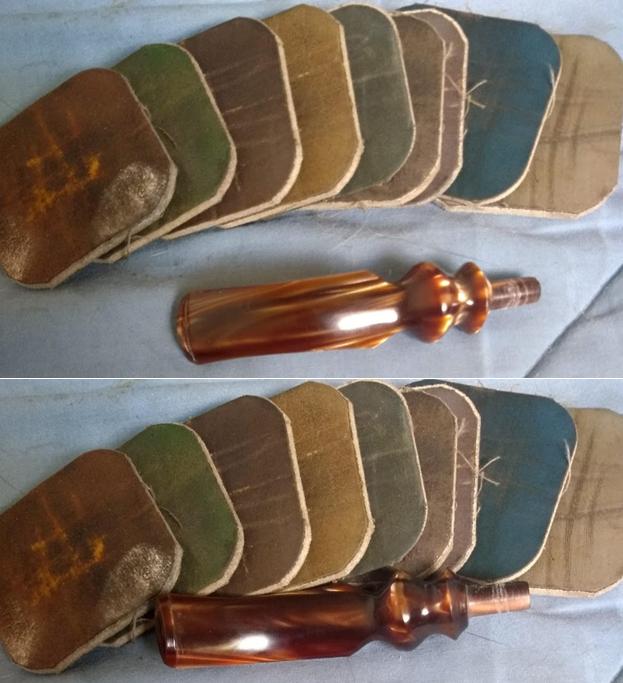
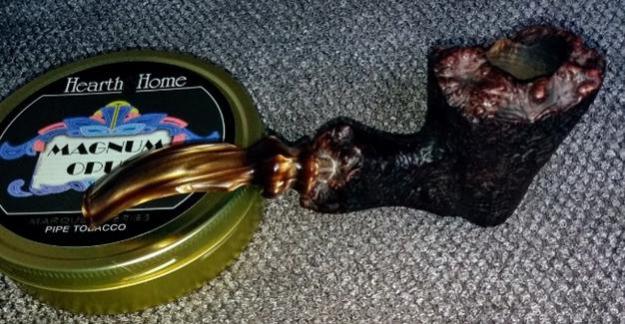
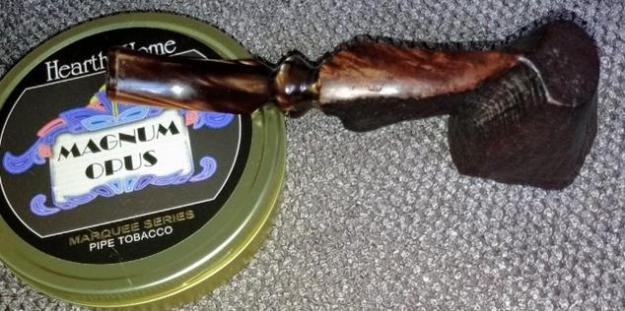
But as it happened, I had two other freehands with good fancy stems with which I could play musical chairs, a Ben Wade by Preben Holm I re-stemmed before and an estate Karl Erik I’m working on now that’s far too huge to support the smaller stem it came with.  For now, I’m enjoying the BW with the damaged Vulcanite stem as the yellow Lucite one fits the Karl Erik.  I liked the dark brown swirled Lucite stem that was on the Karl Erik better, and since the tenon of the BW by PH was too thin, the issue was settled.  I sanded down the elegant brown Lucite fancy stem’s tenon and smoothed it with steel wool before micro meshing it. A thorough buffing on the wheel with red and white rouge on the stem and stummel, and it was done. CONCLUSION
In the spirit of nature, I used no stain restoring this freehand that needed no artificial help to reveal its innate beauty.

SOURCES
http://www.pipephil.eu/logos/en/logo-k3.html
https://pipedia.org/wiki/Karl_Erik
http://www.hwlongfellow.org/poems_poem.php?pid=2047

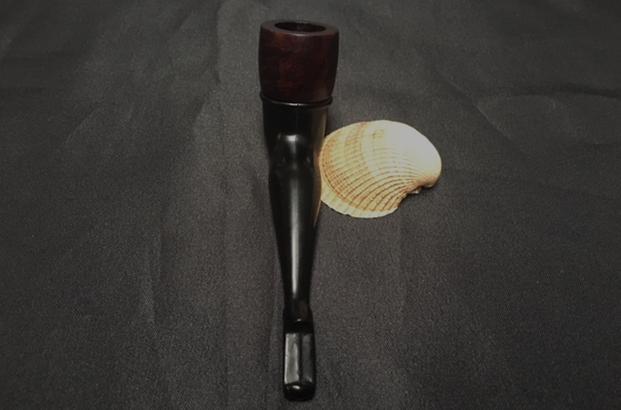
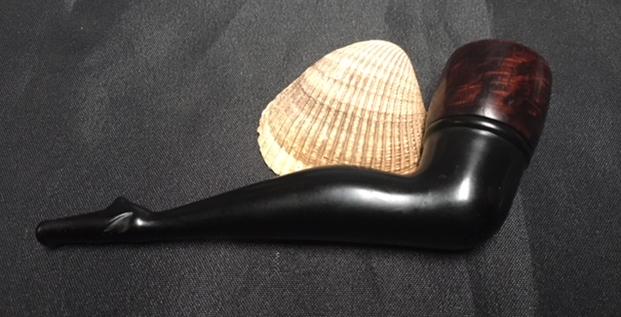
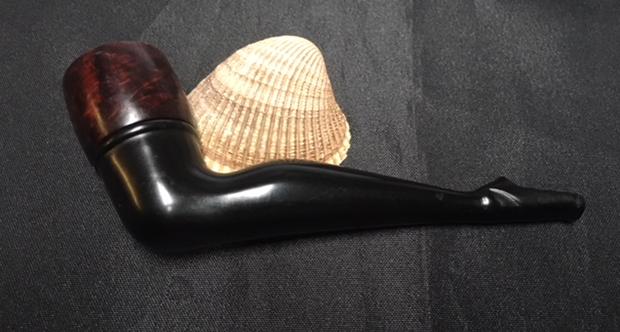
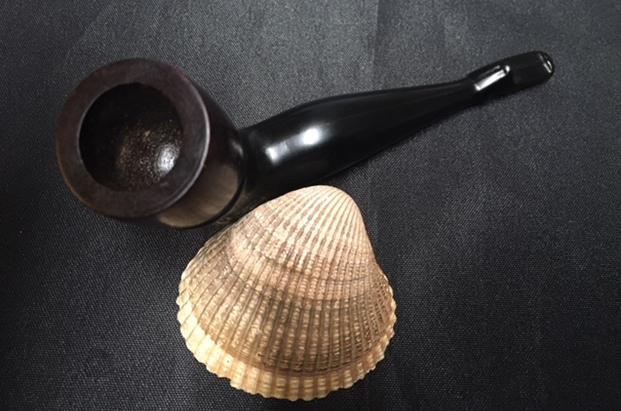
Restoring a Gutta-Percha Woman’s Leg Pipe with a Briar Bowl


Blog by Steve Laug

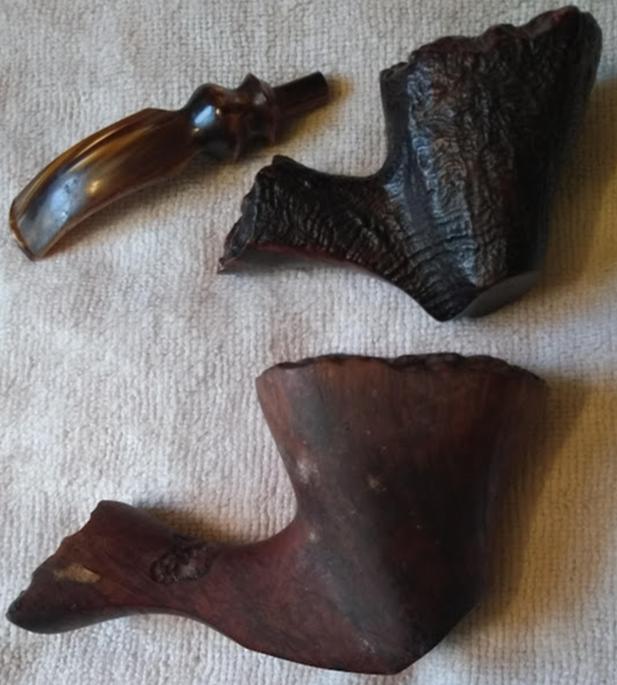
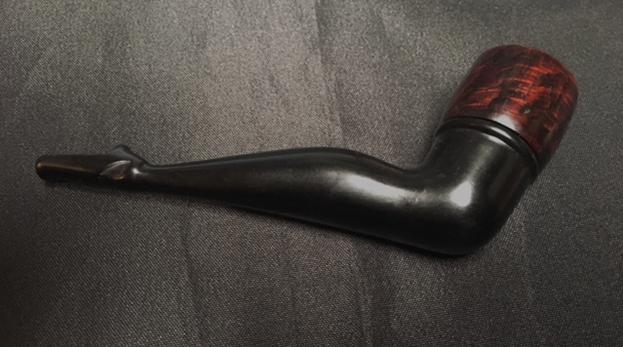
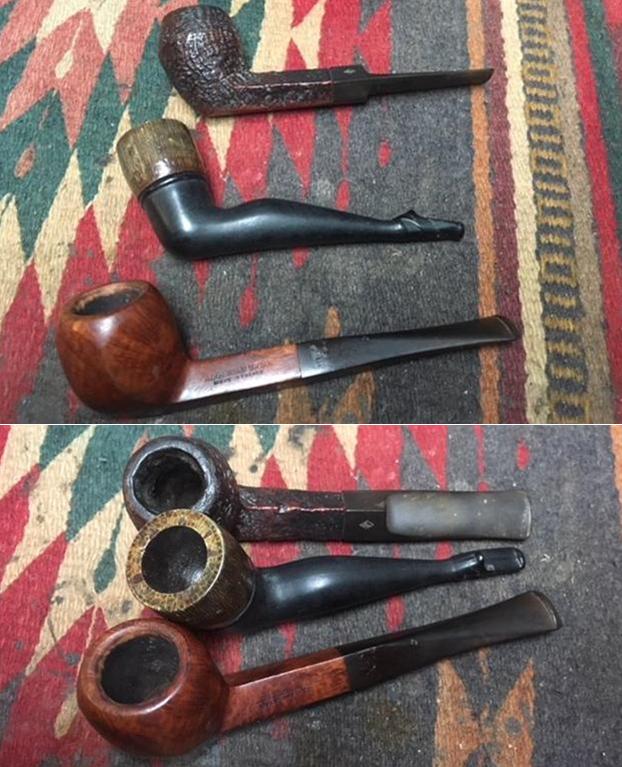
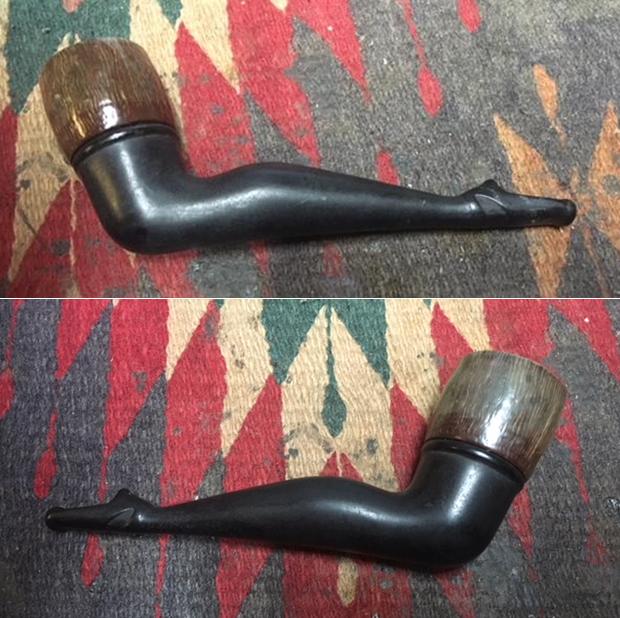
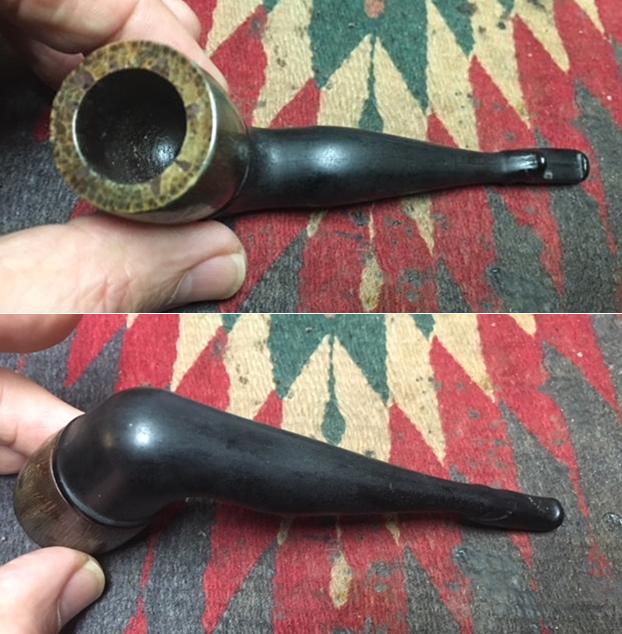
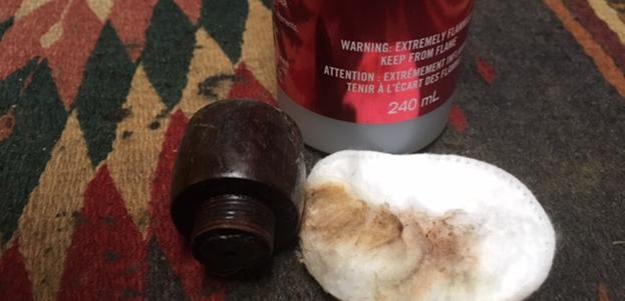
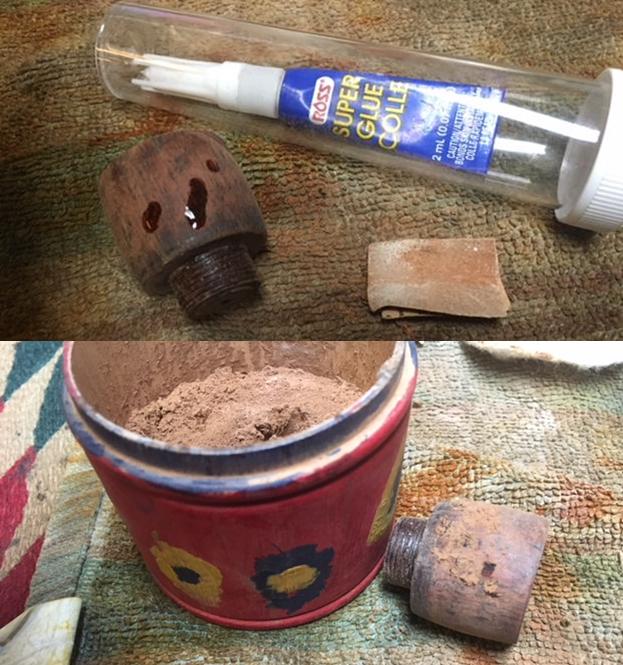
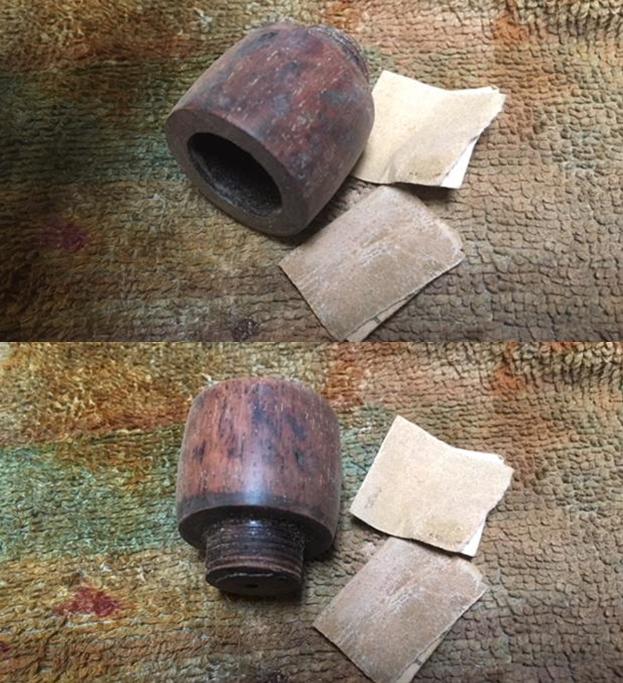
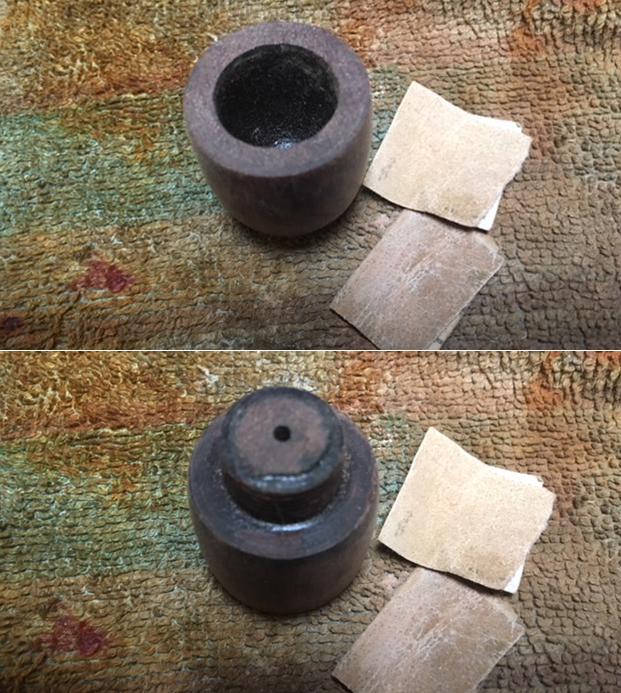
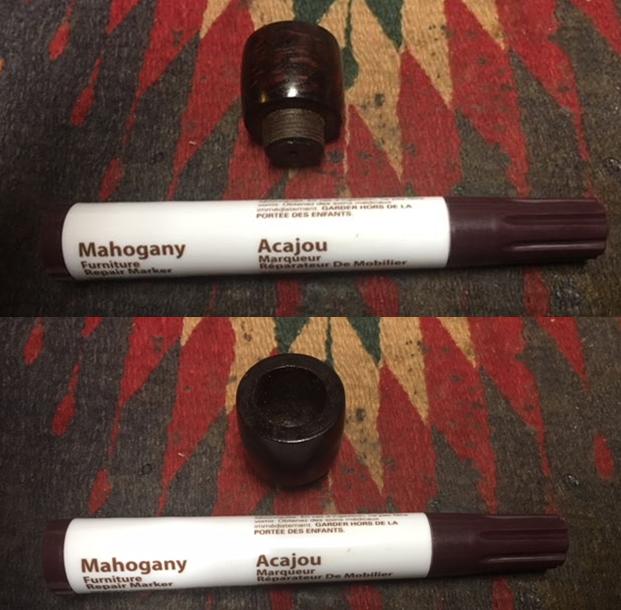
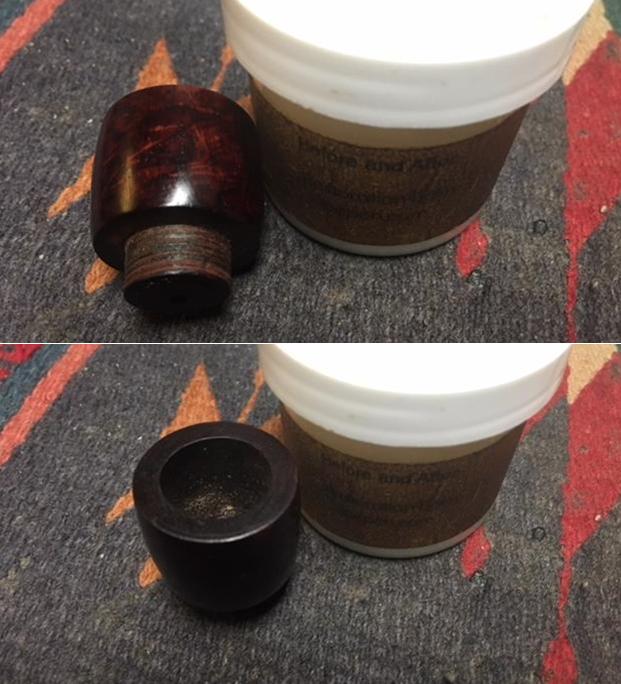
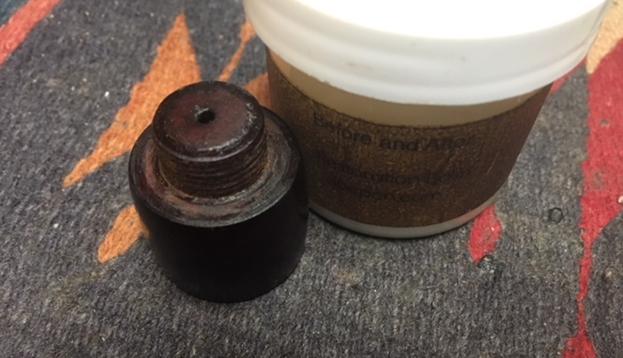
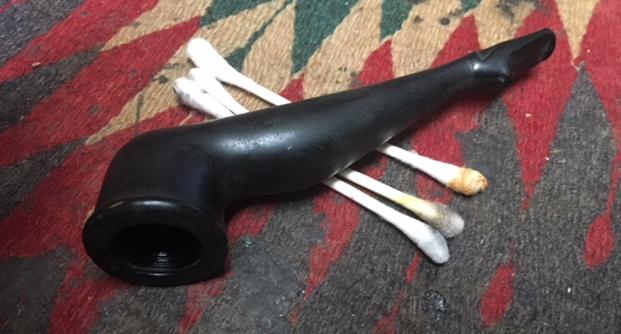
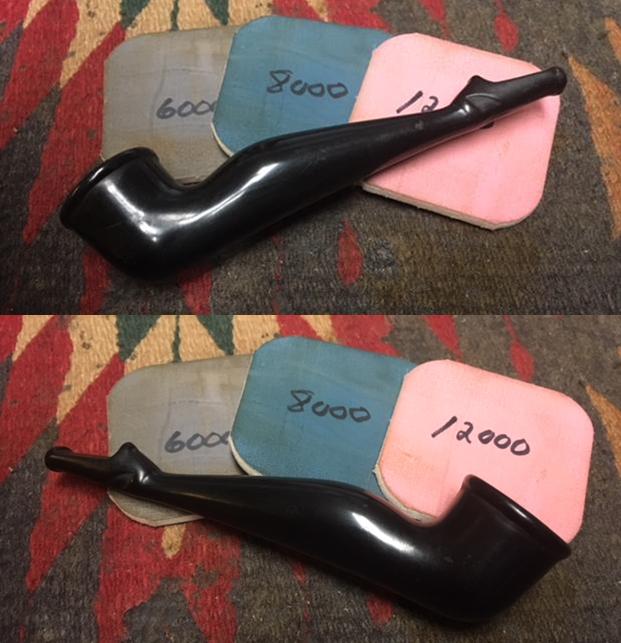
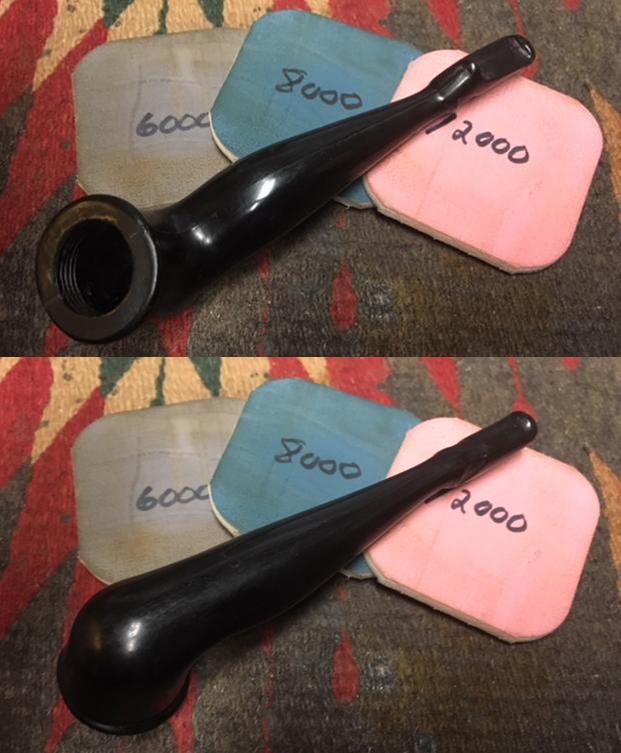
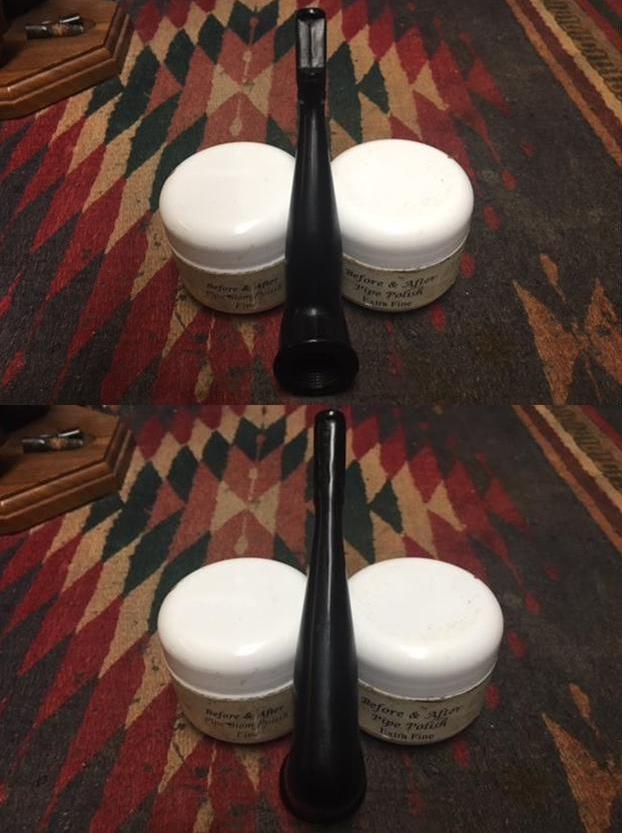
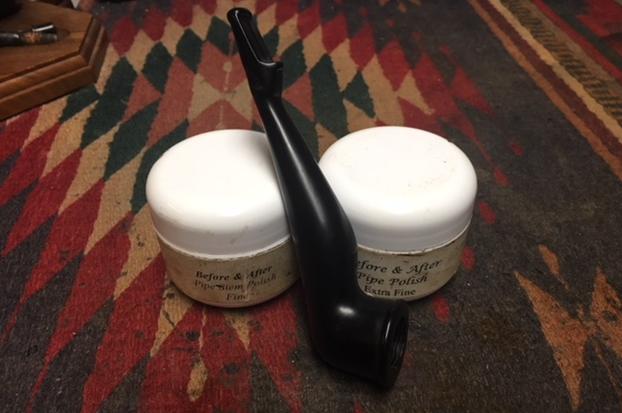
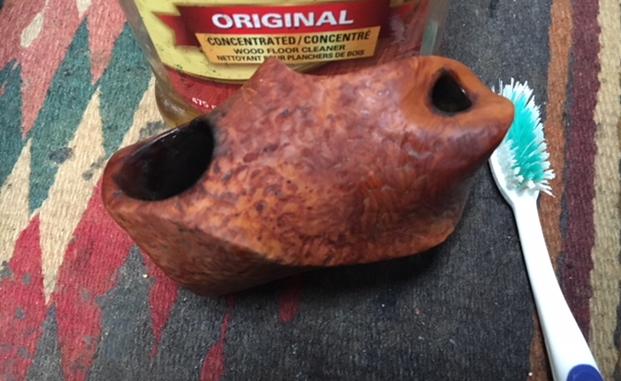
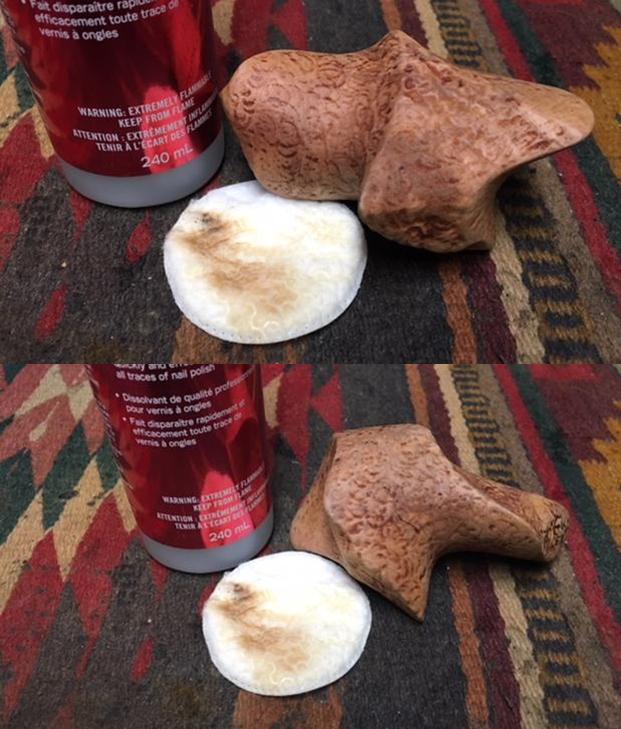
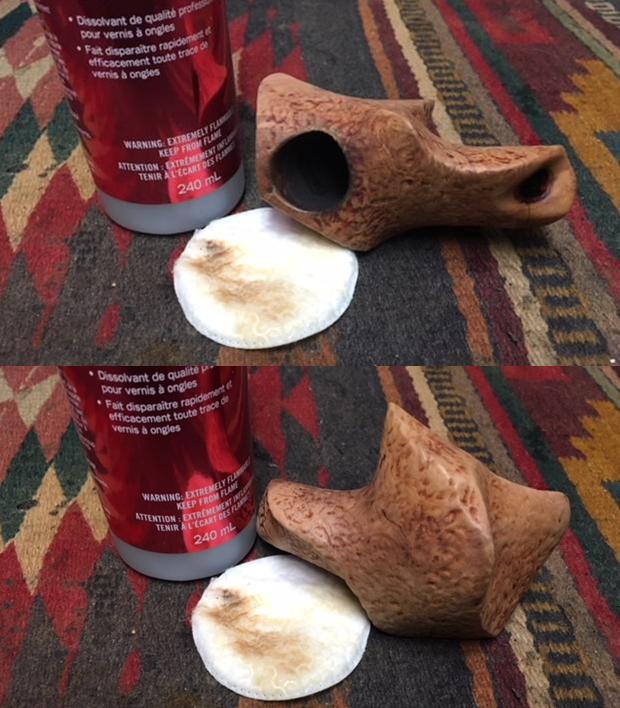
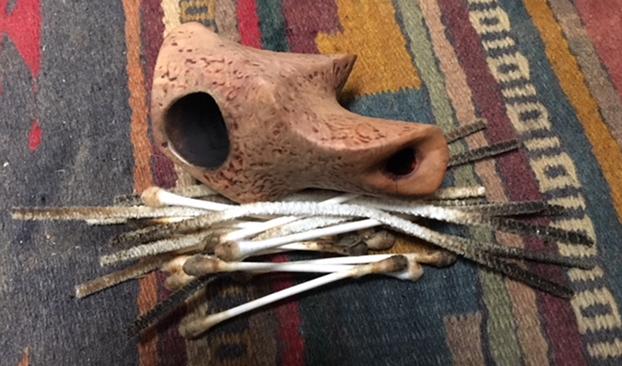
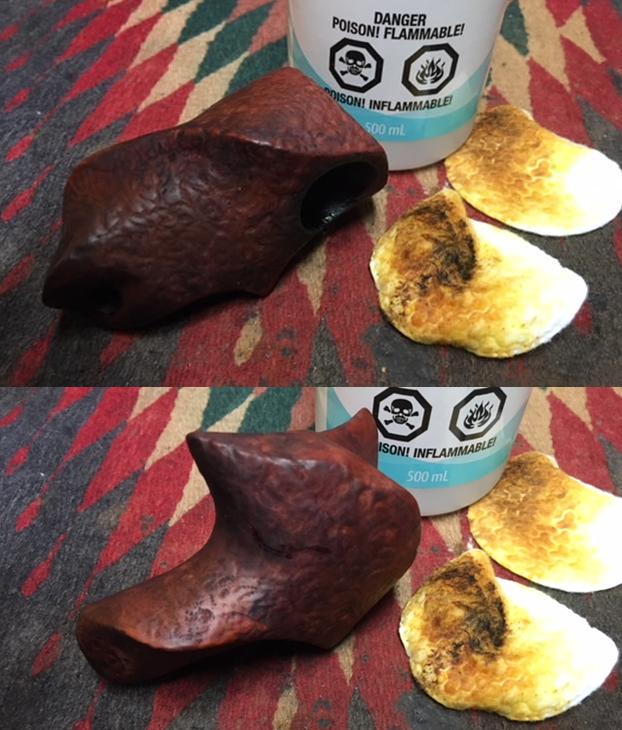
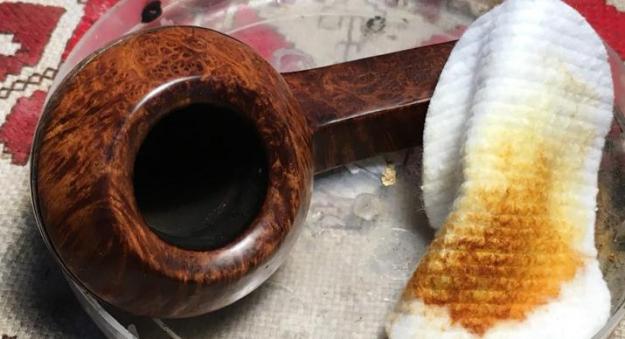
On Friday my wife and I took a drive out to one of our favourite spots near Vancouver to do a bit of walking and hunting. She likes looking for old cookbooks and I of course am always on the prowl for old pipes. We walked about for a while and enjoyed the beautiful day. We stopped by two antique malls and spent some time looking. She found nothing for her collection but I found three old pipes – A Parker Super Briar Bark 345 Bulldog in decent shape, a French Made Algerian Briar diamond shank Billiard and a Gutta-Percha Leg shaped pipe with a briar bowl. It was in the worst condition of the three pipes.The black cast/molded Gutta-Percha base was shaped like a female leg and even had a ballet slipper on the extended foot. The airway came out at the end of the toe. The base was nicked and dull looking with none of the rich glow that I know comes when the material is polished. But by far the worst part of the pipe was that some had dipped the briar bowl in a gold metallic paint rubbed it into the grain and then covered it with multiple layers of Varathane plastic coat. They had even dipped the threads on the nipple that screwed into the base in the plastic coat and painted the inside of the bowl as well. I say that was the worst part because otherwise the pipe was unsmoked. It would have been NOS (New Old Stock) before whoever did this abomination to the pipe. The bowl is normally a rich reddish brown colour in all the variations that I have seen on the internet so the gold and plastic finish would need to go. I took a close up photo of the rim top to show you the way it looked when I got it – I don’t know if some of you like the look – but I don’t. It is like painting an antique wooden piece with crackly gold paint to give it the look of hammered metal. It just does not work for me. I also took some photos of the base to show the condition of the mouthpiece end of the pipe. There were some nicks in the material but no tooth marks or chatter and the orific airway in the end of the toes was undamaged.I took photos of the bowl with it removed from the base to show how it had been painted with streaks to make it look like vertical grain – it was not as the wood was smooth and bits of it peaked through the gaudy gold finish. You can also see the thick plastic coat on the nipple that is threaded into the bowl almost filling in all of the threads. I topped the end of the nipple with 220 grit sandpaper on the topping board to remove the thick plastic coat that was not even smooth on that portion of the bowl. I did the same with the bowl to remove the plastic and metallic gold paint. Those areas definitely looked better to me but the bowl was a long way from looking normal.I tried wiping the bowl down with acetone to break through the plastic coat – no luck. The brown stains on the cotton pad come from the nipple end and the rim top where I had broken through the finish. There was only one way to remove this abominable coat of plastic and that was to sand it until it was gone… not my favourite thing. Think twice before any of you put that stuff on a pipe. It is truly awful and stops the wood from breathing.I sanded the bowl with 180 grit sandpaper and was able to break through the plastic coat and the gold coat. Underneath the bowl was nicked and damaged. The majority of the damaged spots were merely built up plastic coat and sanding them smoothed things out. But some of them were deep gouges in the wood. I sanded, cleaned with alcohol and filled those in with clear super glue and briar dust. When the repairs had cured I sanded them smooth with 180 and 220 grit sandpaper to blend them into the surface of the bowl. I sanded the bowl with a medium and a fine grit sanding sponge to remove the remnants of the repair and the plastic coat. It took a bit of sanding but the finish was finally smooth to touch. I sanded the bowl with micromesh sanding pads – wet sanding with 1500-2400 grit pads to smooth things out more.With the bowl smooth and clean I decided to stain it with the tan aniline stain I have. I am sure that it is mislabeled as it is far too red to be tan. I figured it would work well with this bowl.I wiped the bowl down with alcohol on cotton pads to even the stain coat and make it a bit more transparent. The trouble was that all of the flaws and nicks in the wood showed up then. I gave it a second coat of stain using a Mahogany stain pen to darken the overall surface of the bowl and still leave it transparent enough to see the grain in the wood. I rubbed some Before & After Restoration Balm into the surface of the bowl to enliven, clean and protect the newly stained bowl. I let it sit for a few moments then buffed it off with a cotton cloth. I took photos of the bowl at this point to show how things were developing. I set the bowl aside and worked on the base. I cleaned out the debris of time on the inside of the base with cotton swabs and alcohol. There were not a lot of tars as the pipe was unsmoked. But there was dust from sitting all these years since it was made.I polished the base with micromesh sanding pads – wet sanding with 1500-2400 grit pads and dry sanding with 3200-12000 grit pads. I wiped the base down after each pad with Obsidian Oil and rubbed it into the material. The pictures tell the story as the base begins to develop a shine. I further polished it with Before & After Pipe Polish – both Fine and Extra Fine to remove more of the scratches from the Gutta-Percha base. I rub the polish on with my fingertips and polish it with a cotton pad to raise the shine. I buffed the bowl and the base independently of each other with Blue Diamond on the buffing wheel to remove minute scratches and give the materials a shine. I gave both parts multiple coats of carnauba wax and buffed them with a clean buffing pad to raise the shine. I put the parts back together and hand buffed it with a microfiber cloth to deepen the shine. The photos below show the finished and restored pipe. I personally like the rich brown over the metallic gold on the bowl when I got the pipe. The dimensions of the pipe are petite – the length from thigh to tip of the toe is 5 ½ inches, the height from the knee to the thigh is 2 inches, the outer diameter of the thigh is 1 1/8 inches and the chamber diameter is 1 inch. It is a unique piece of pipe history and joins the rest of the Gutta-Percha pipes in my collection. Thanks for walking through the restoration of this leg pipe with me.

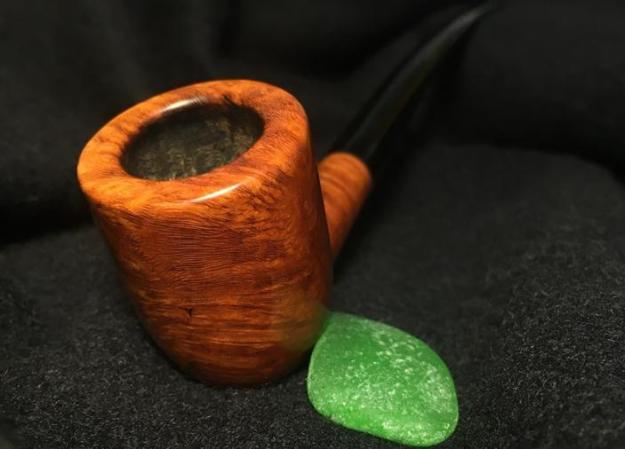
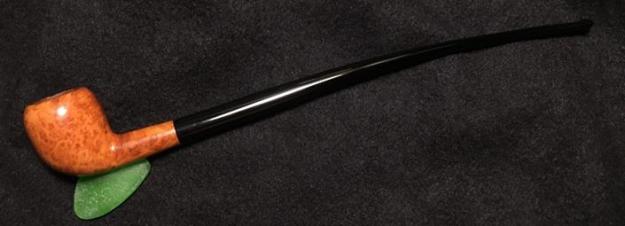
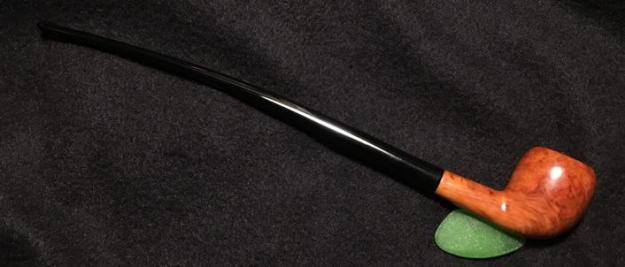
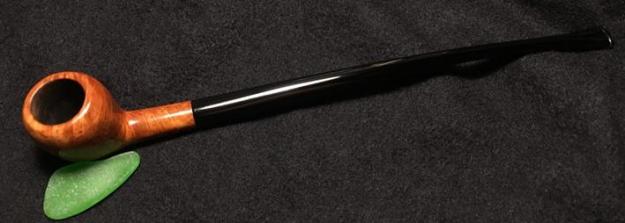
A Tale of Three Churchwardens


Blog by Dal Stanton

The first of the 3 was true born, but of hobbit stature.  He dreamed of walking in the world of men and of wizards seeing eye to eye but anxious to serve.  The second was bound to the first but he held no claim to royal lineage. He stood proud in the best sense of the word and cherished his Green Lands heritage and history.  The third of the 3, was free and bound to no man.  He was born into humbler circumstances but found favor in the Maker’s eye and the Maker dubbed him The Wise a valuable gift to any man.  All 3 strong, bound together in one tale, bring hope to the Daughters of men. 

I am sure that if J.R.R. Tolkien were to write this blog about the restoration and creation of 3 Churchwardens, he might begin the tale something like this.  Every pipe man and pipe women, if they do not have a Churchwarden in their collections, are hoping one day to find one – each looking for that special bond.  Why?  Simply stated, Churchwardens are cool.  I have a Churchwarden that I’ve named, Gandalf – there are probably many Churchwardens out there bearing that name.  Why?  Simply stated, Gandalf the Wizard – first The Grey then The White – is cool.  He smoked a Churchwarden like no one else, packed with ‘Old Toby’ and who doesn’t want to be like Gandalf?

There’s A LOT of information on the internet easily obtained by a simple search of ‘Churchwarden’ and I don’t want to repeat what’s easily found.  The short of it is this – ‘Churchwarden’ is an old shape as far as pipes go.  Of course, they were prevalent throughout Middle Earth.  As the story goes, there were men back in the days when they didn’t lock churches at night, who were employed as ‘wardens’ of the church – whose responsibility was to guard the premises.  To be faithful to their charge, they were not allowed to leave the walls of the church.  That created an unusual dilemma between guarding the holy confines and the desire to enjoy one’s evening smoke.  The moral dilemma was creatively solved by a stem.  The length of the stem enabled the church wardens to tend to their evening bowls as they stood vigilantly inside the church walls while the stems extended through the windows…so the story goes (see Pipedia’s article).

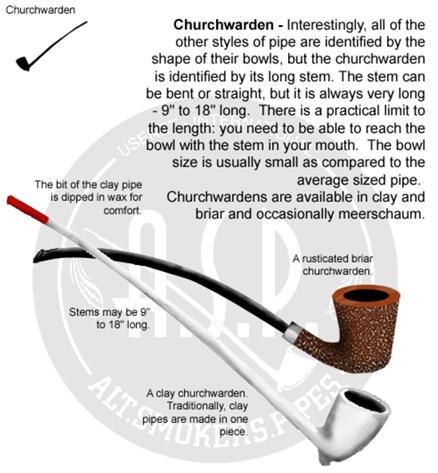
Another very interesting factoid about Churchwardens comes from Bill Burney’s Pipedia description of the Churchwarden that it is unique among all pipes:
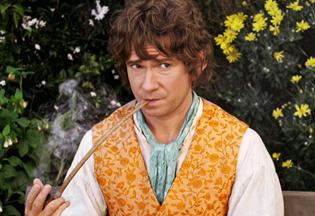
I want to include one other interesting link for those of you who are Middle Earth and Churchwarden enthusiast.  The question has always been asked by discerning folk, while Gandalf was smoking his Warden, or Bilbo, Merry and Pippen were puffing on theirs, what exactly was packed in their bowls??  Of course, we all know that the bowls had ‘Old Toby’ packed in them – or simply, ‘Pipeweed’.  This link goes to a fun site that explores the minutia of J.R.R. Tolkien’s Middle Earth including the story of pipe smoking and the mystery of what exactly inhabited the bowls of Middle Earth!  Enjoy!

The first of the 3 was true born, but of hobbit stature.  He dreamed of walking in the world of men and of wizards seeing eye to eye but anxious to serve.

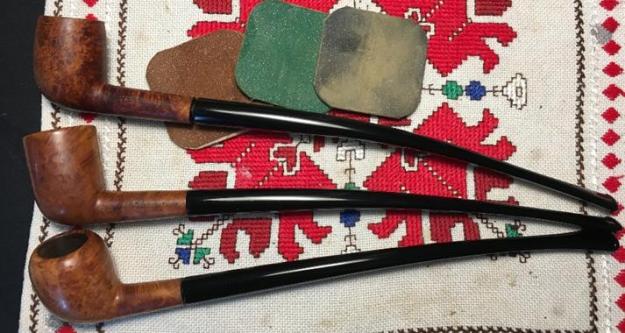
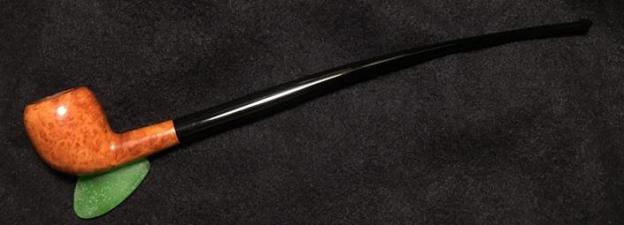
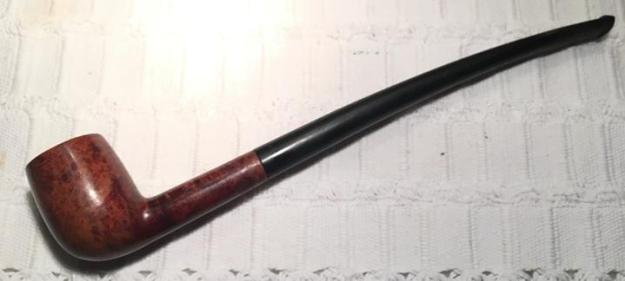
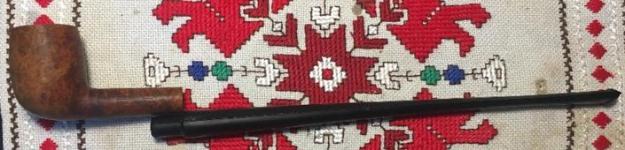
My ‘Tolkienesque’ opening, like Tolkien’s ‘Lord of the Rings’, holds some truth in the telling.  The ‘Tale of the Three Churchwardens’ started when I received an email from Toby – yes, I’m not making this up!  Gandalf smoked ‘Old Toby’ and a younger Toby from Germany wrote me about commissioning the “Imperial Churchwarden” (the ‘true born’ Churchwarden with royalty) as a birthday gift for a friend which he discovered in my website’s section, For ‘Pipe Dreamers’ Only.  We came to an accord and I put the Imperial Churchwarden from France in the queue to be restored in time for his friend’s birthday celebration. Later, when I found the Imperial in the “Help Me!” Basket, I was a little concerned.  The stem was shorter than I had originally thought – it was more of ‘Hobbit stature’ – a miniature Warden.  The stem was 5 ¾ inches beyond the shank or the total length of the pipe was about 8 ¾ inches or 22 cm – not really the coveted ‘Gandalf’ size.  I wrote to Toby with a proposal of adding some stature to the Imperial with a longer Churchwarden stem I had on hand – it would be more of a ‘Gandalf statured’ Churchwarden as a result.  I sent this picture with the proposed stem giving a total length of 11 inches or 28 ½ cm.  My Gandalf was on top for comparison.  Toby liked the idea and said that his friend was a huge ‘Lord of the Rings’ fan and that an extra 5 cms was a good investment for his friend to have a ‘Gandalf’ pipe.  
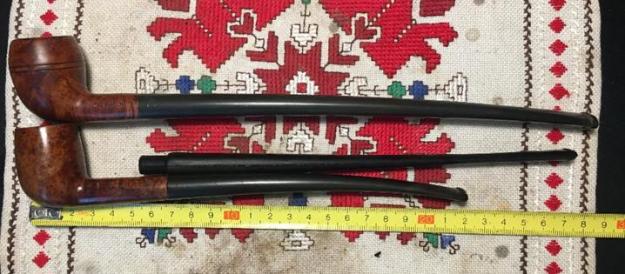
The second was bound to the first but he held no claim to royal lineage.  He stood proud in the best sense of the word and cherished his Green Lands heritage and history.

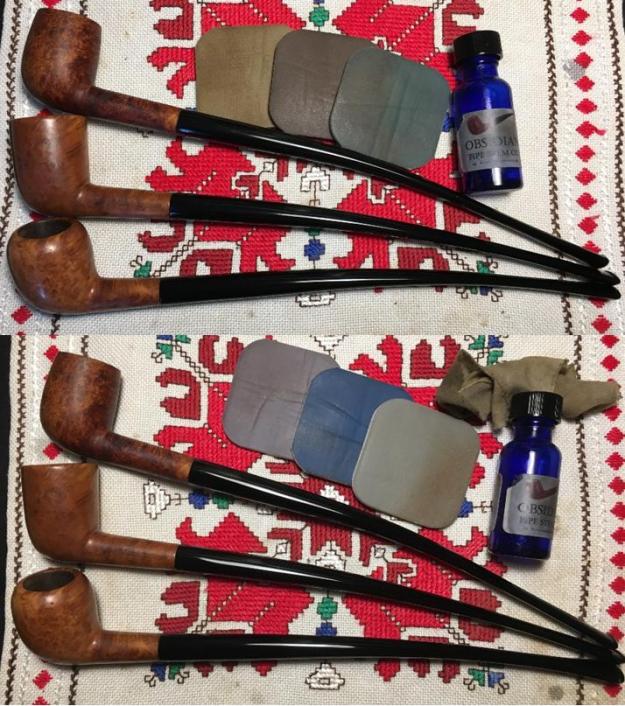
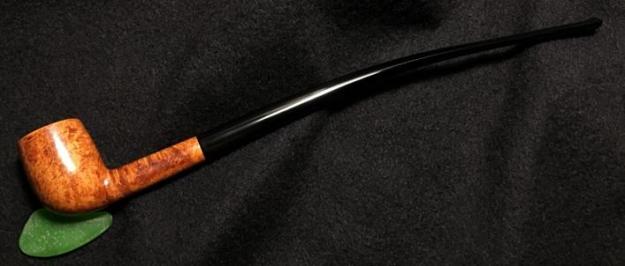
Then Toby asked if I might have another long warden stem in my stores – he thought it might be good for him to add a Churchwarden to his collection – perhaps that both he and his friend could blow smoke rings into the air in proper wizard fashion on his friend’s day of celebration!  I ordered 3 more 8.5” Churchwarden stems from Tim West at http://www.jhlowe.com and they arrived in Bulgaria from the US with a returning colleague.  At this point I moved from restoring a Churchwarden (true born) to creating a Churchwarden with re-purposed bowls.  I went through my stores to find potential bowls to be wedded to a Warden stem and transformed to a Churchwarden (thank you Bill Burney!).  I sent two options next to the Imperial – a Dublin and a Rhodesian.  Toby chose the Dublin with the canted bowl which to him was more ‘Gandalf-like’.  And so, the Dublin will mast the Churchwarden stem – representing a strong and resilient people proud of their ‘Green’ heritage and history.
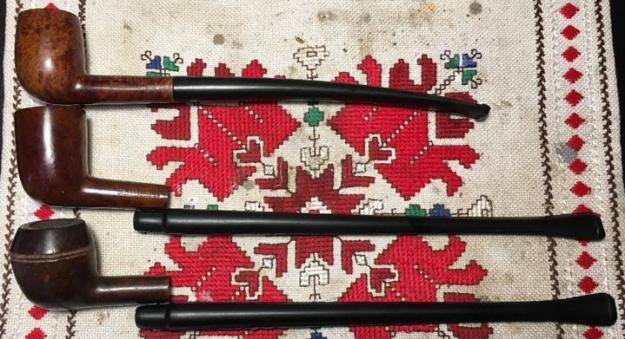
The third of the 3, was free and bound to no man.  He was born into humbler circumstances but found favor in the Maker’s eye and the Maker dubbed him ‘The Wise’ a valuable gift to any man.                     

All 3 strong, bound together in one tale, bring hope to the Daughters of men.

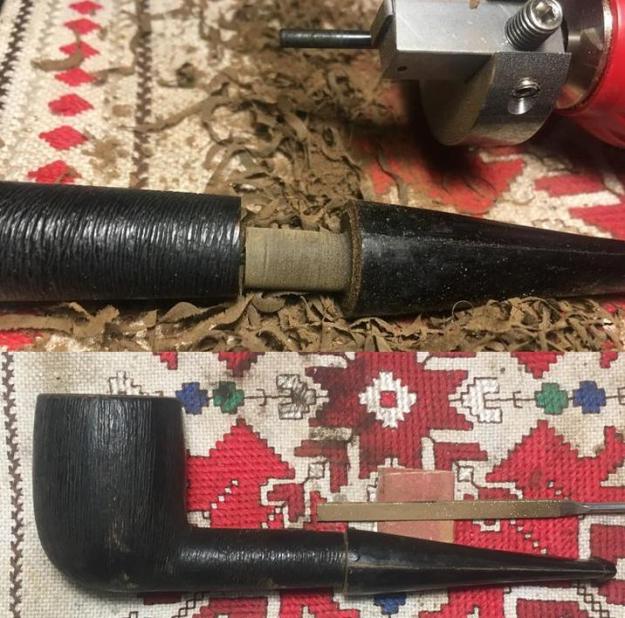
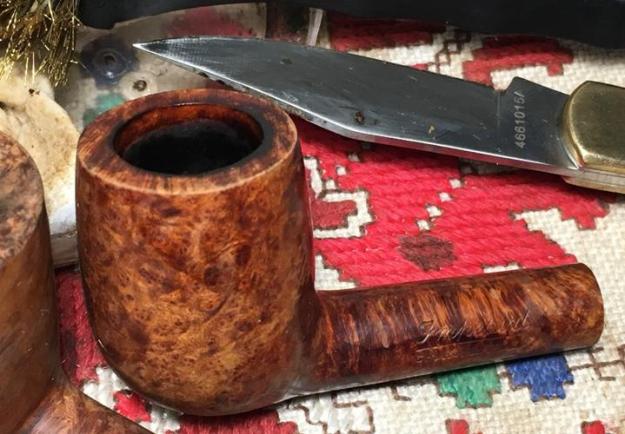
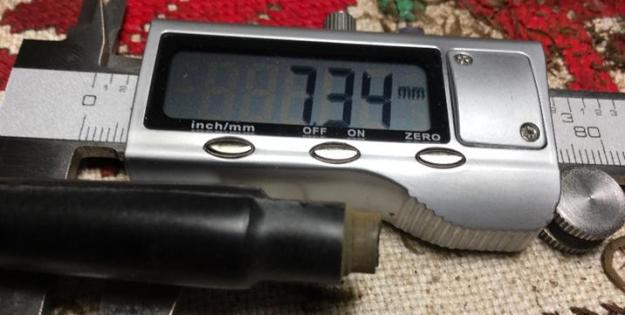
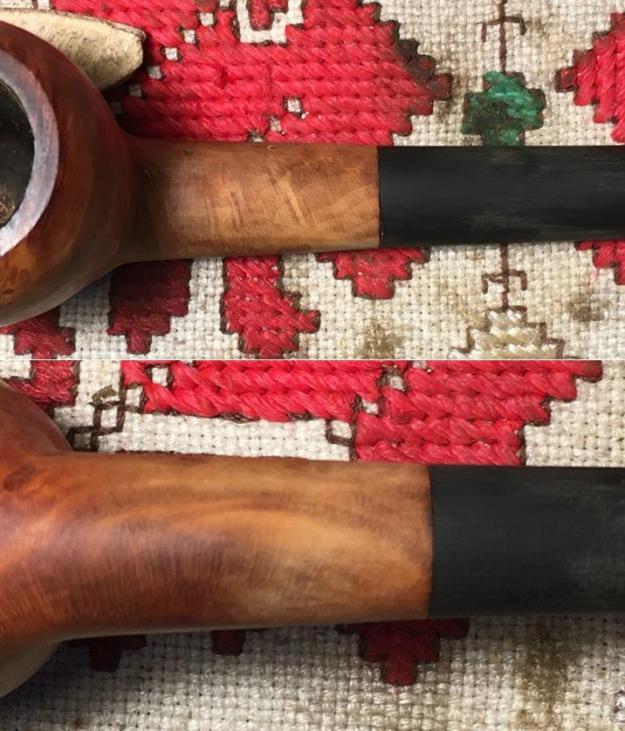
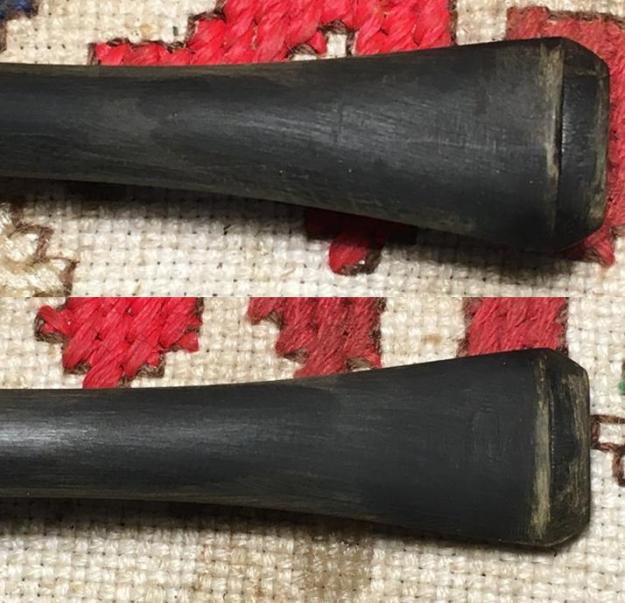
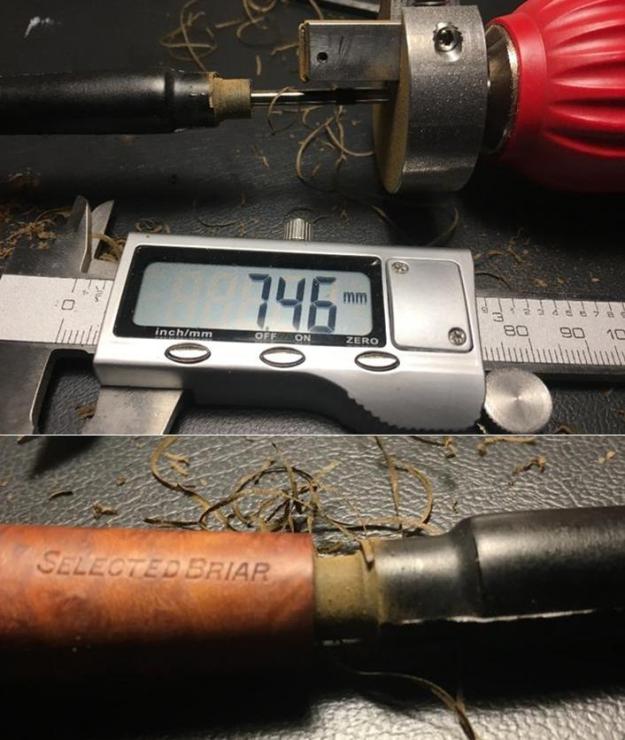
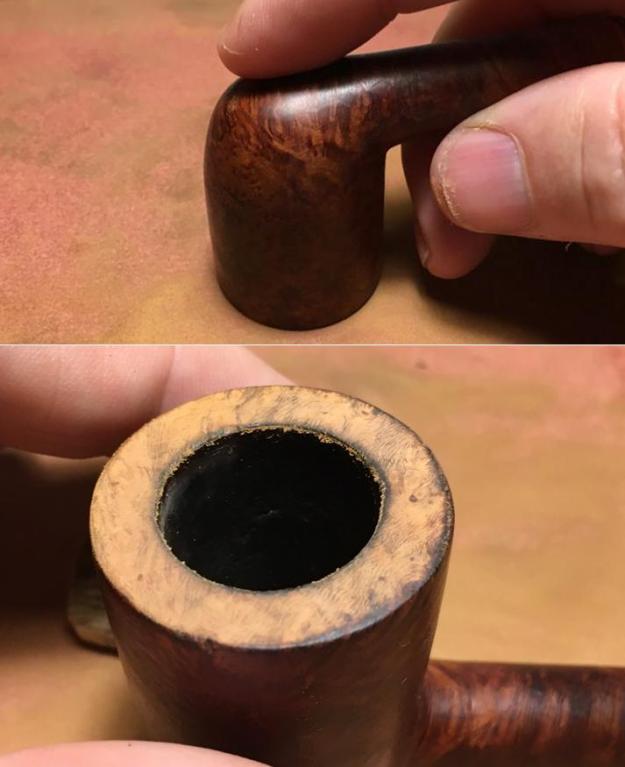
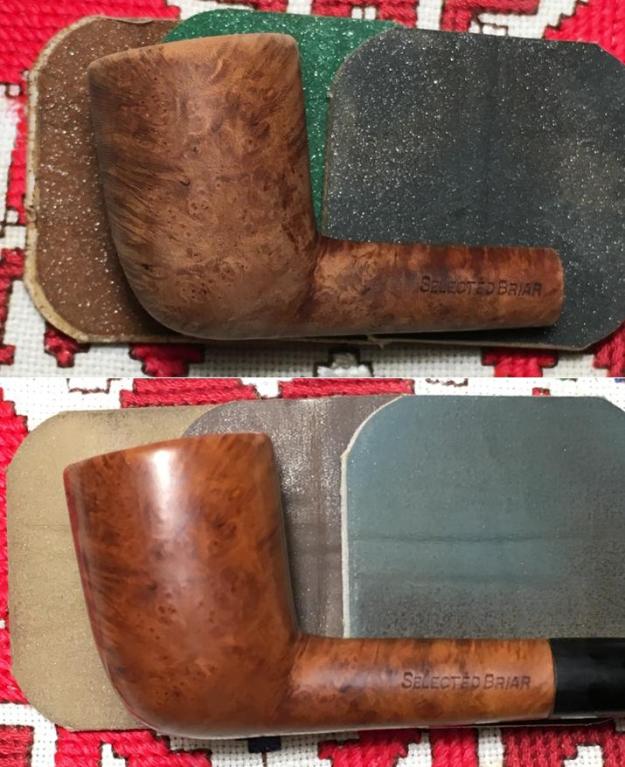
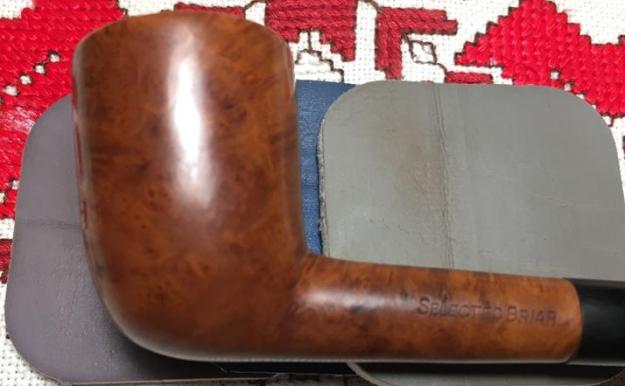
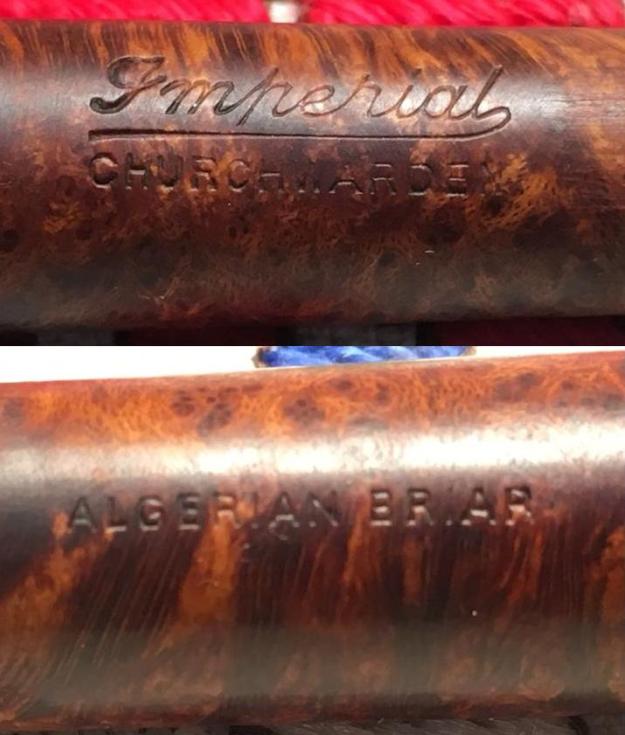
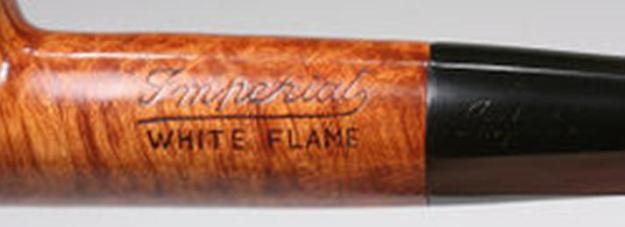
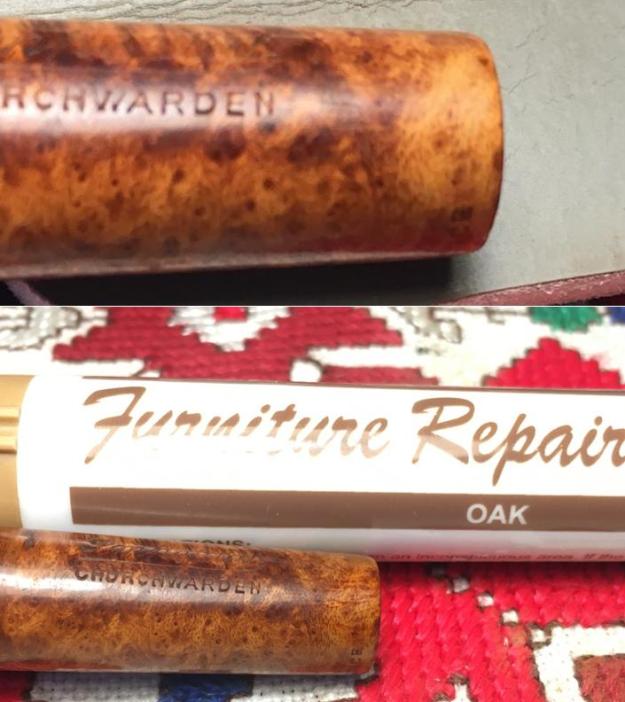
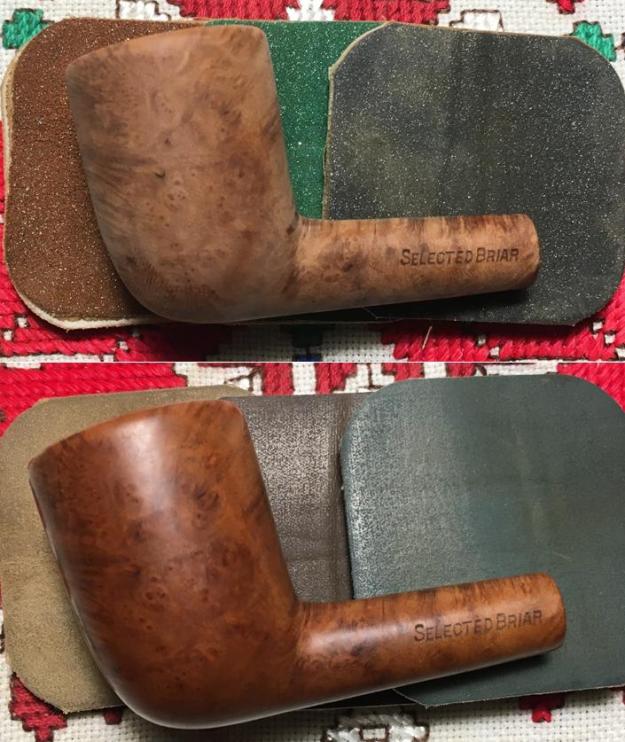
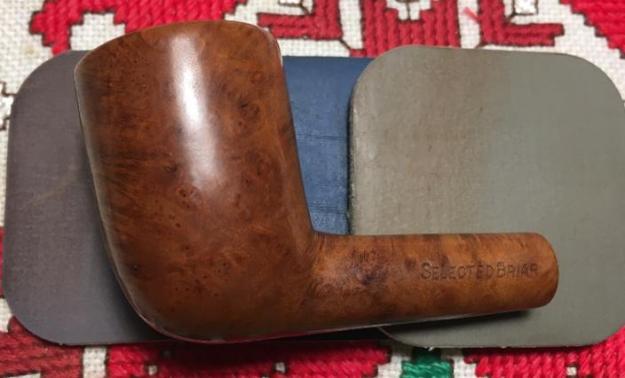
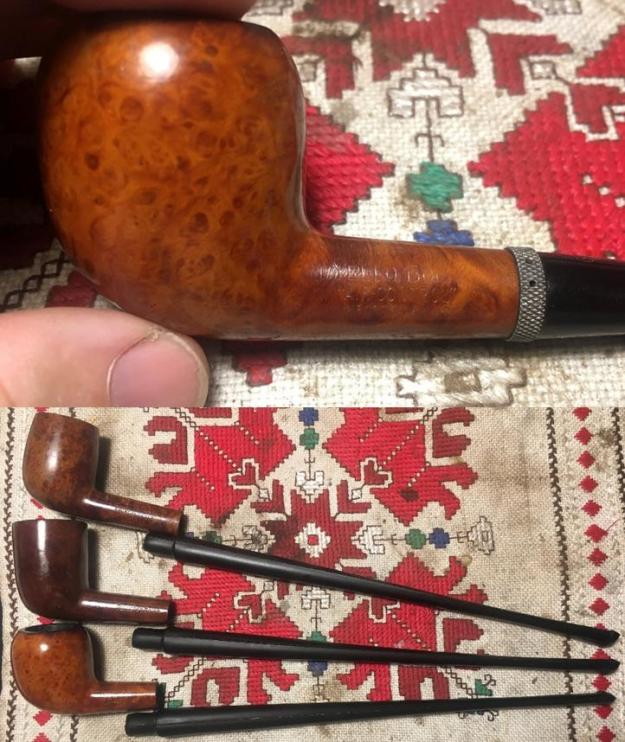
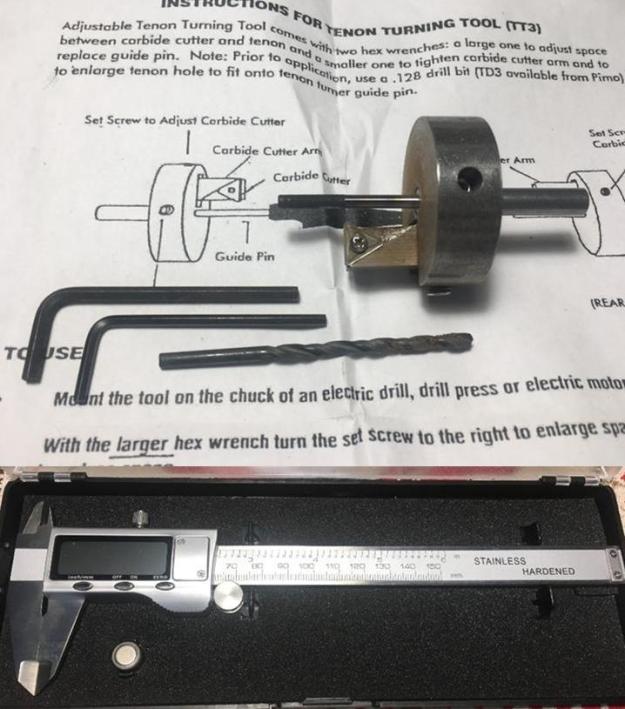
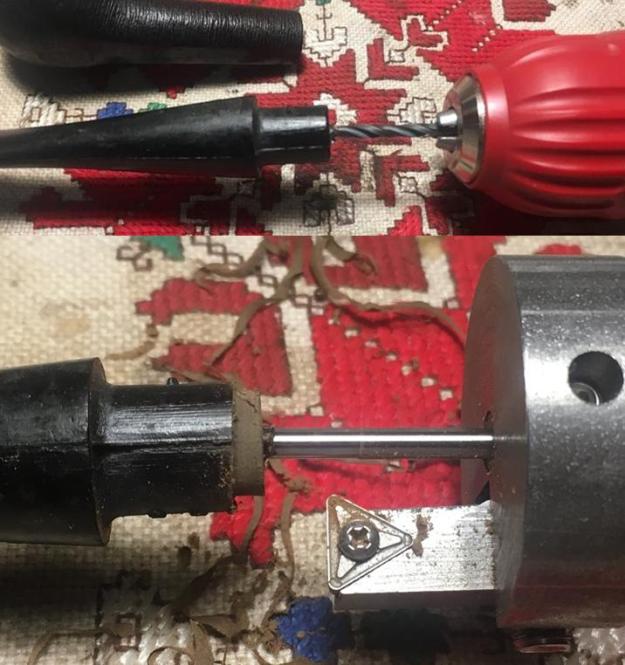
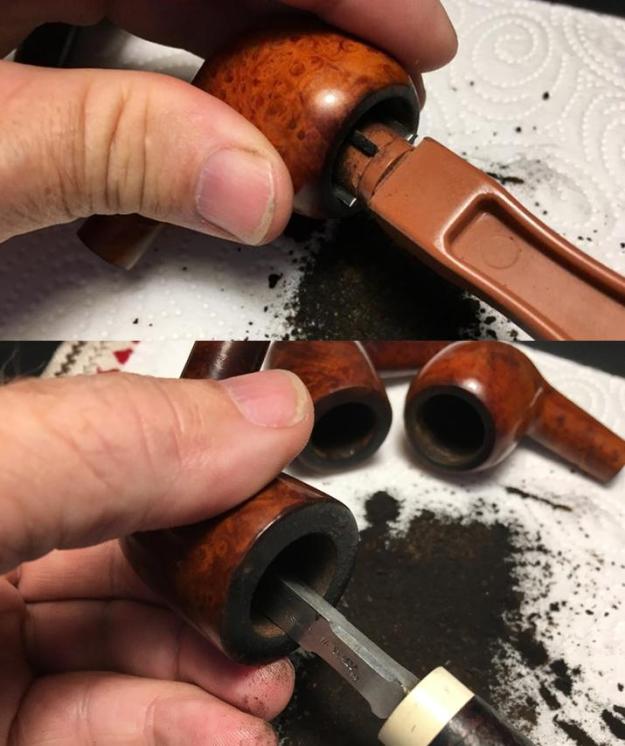
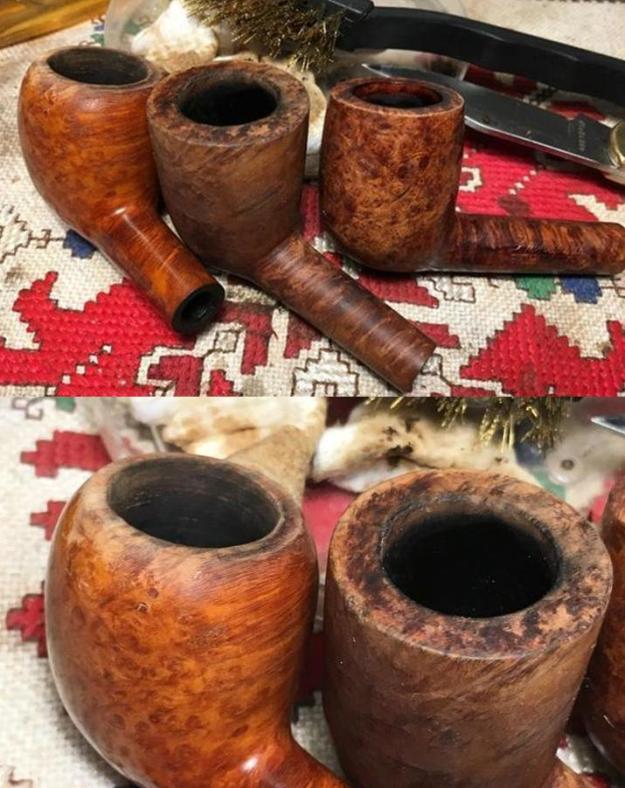
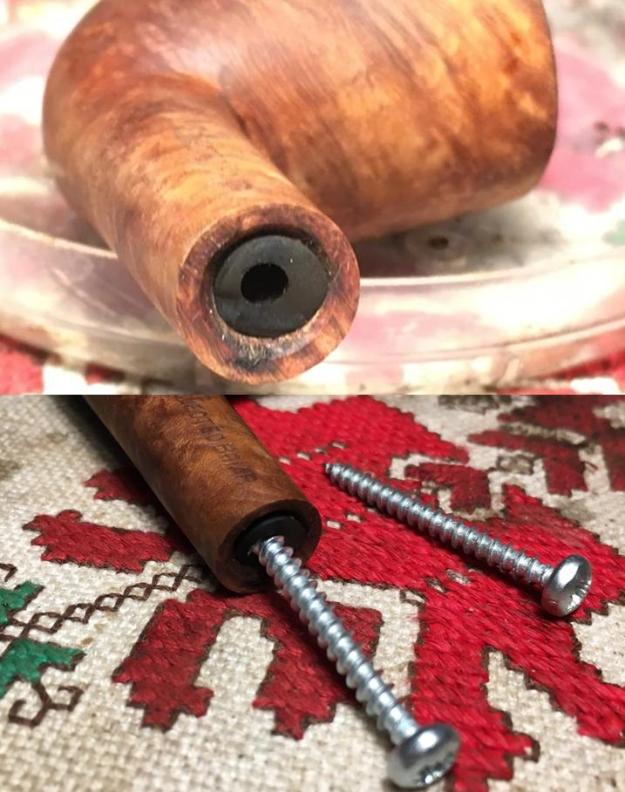
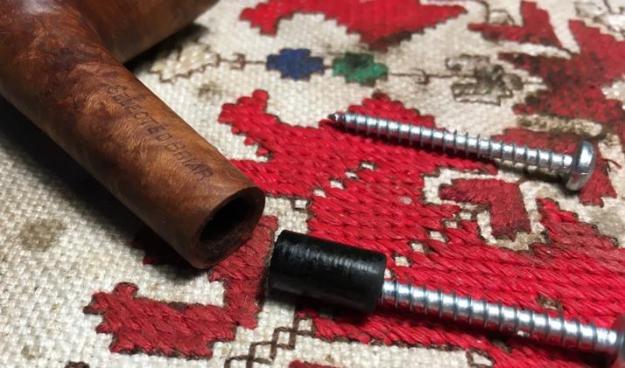
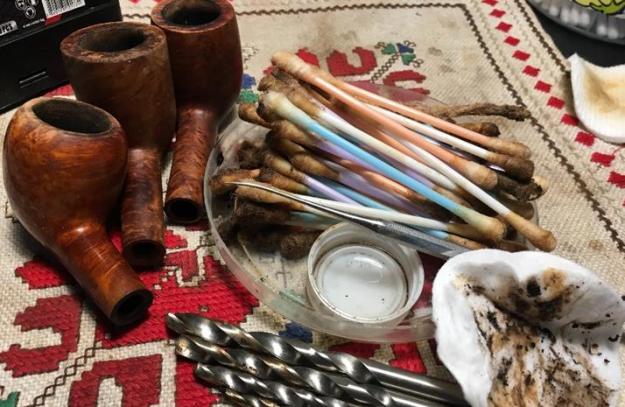
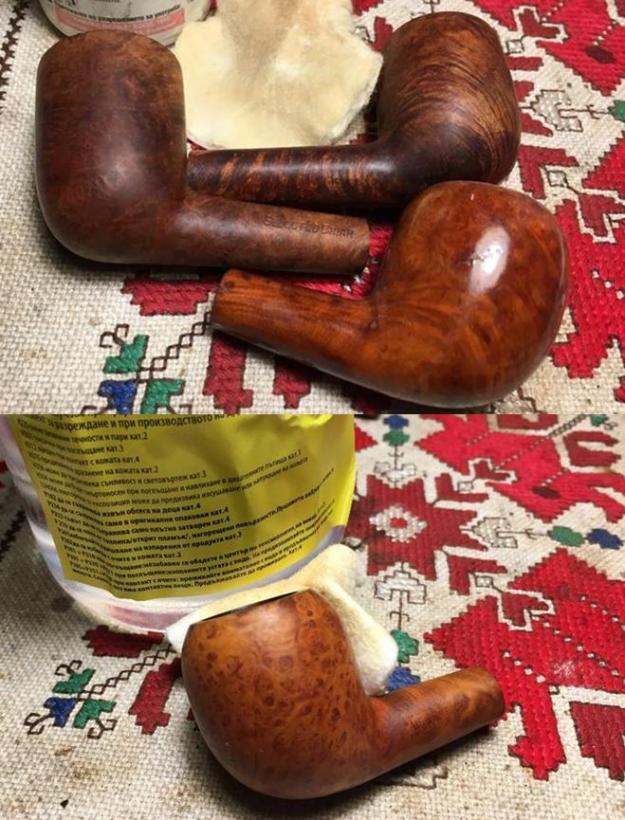
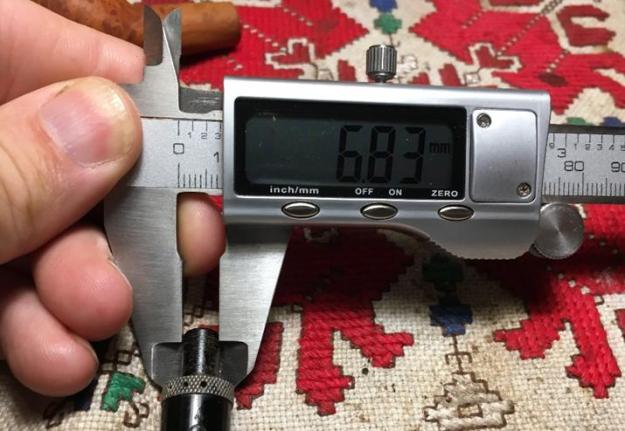
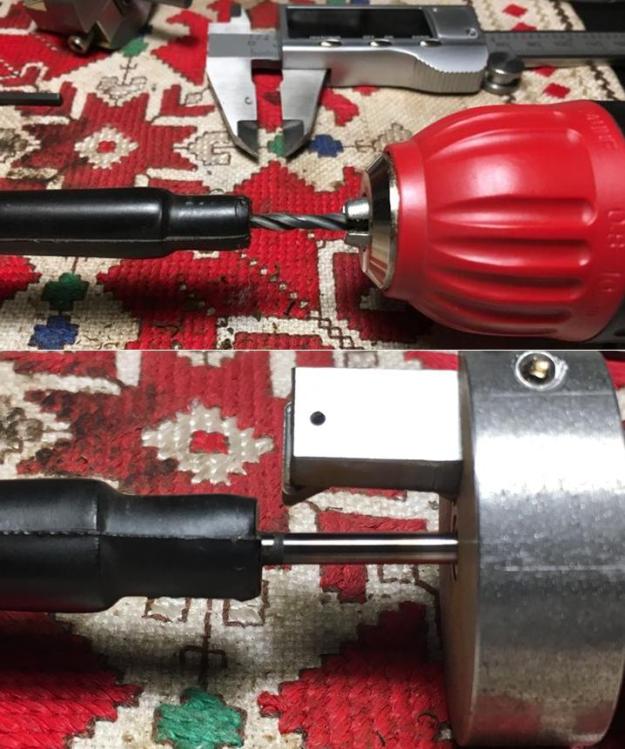
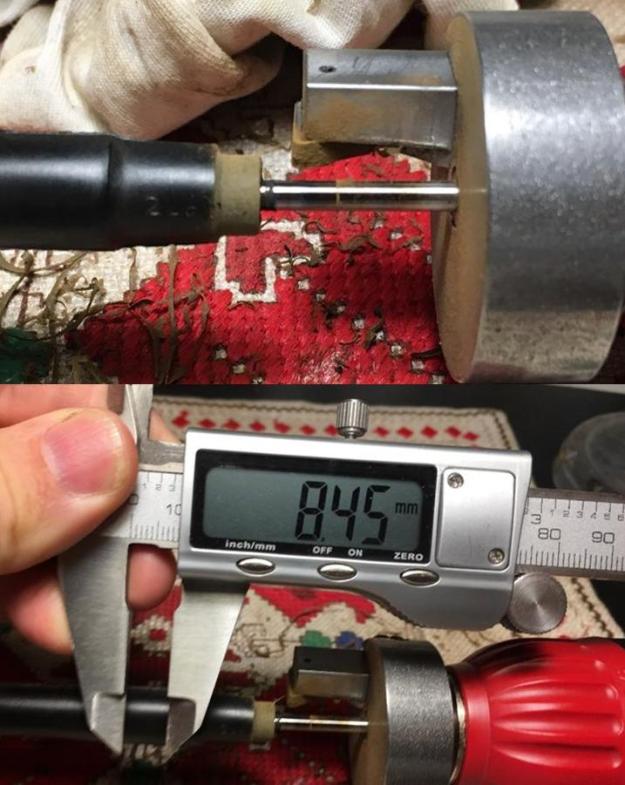
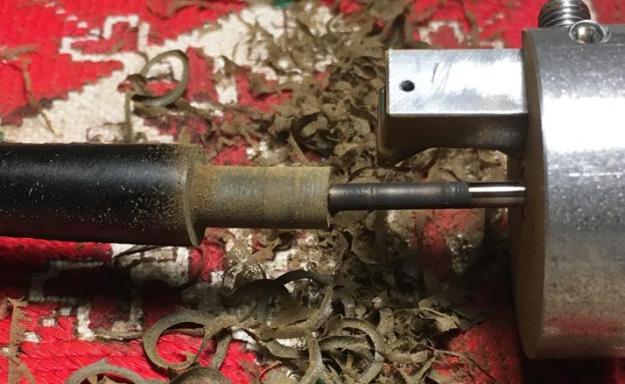
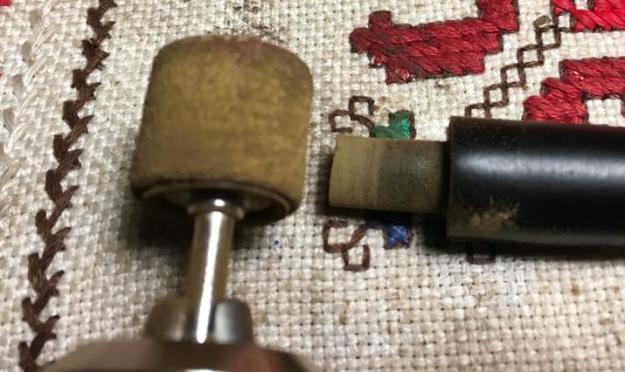
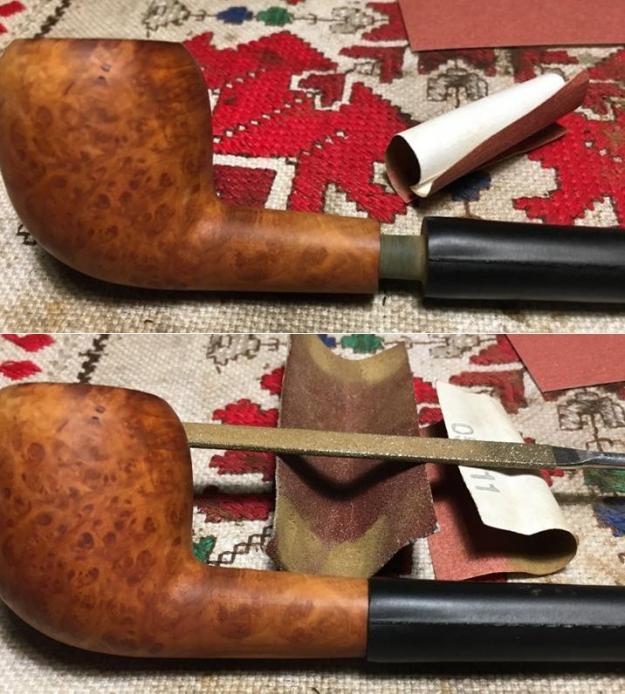
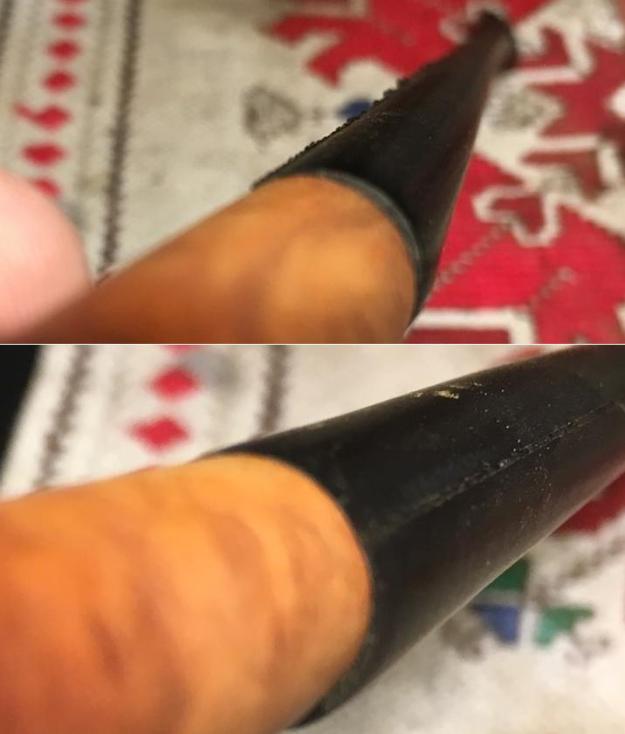
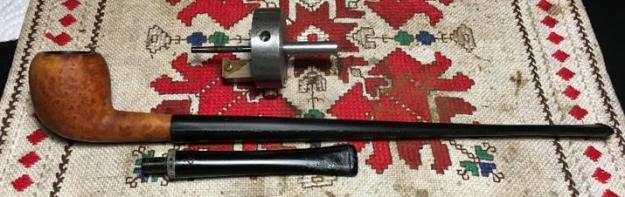
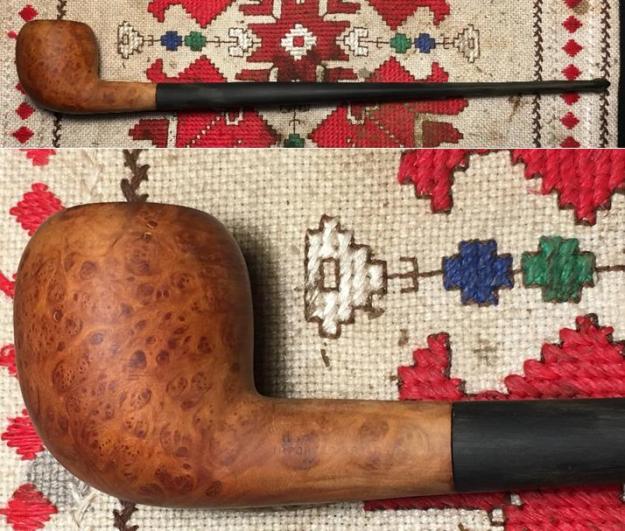
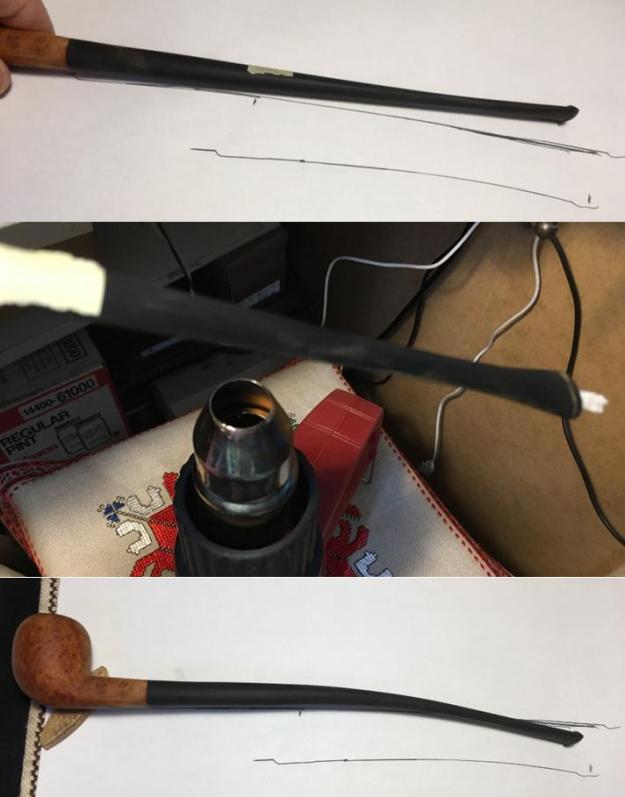
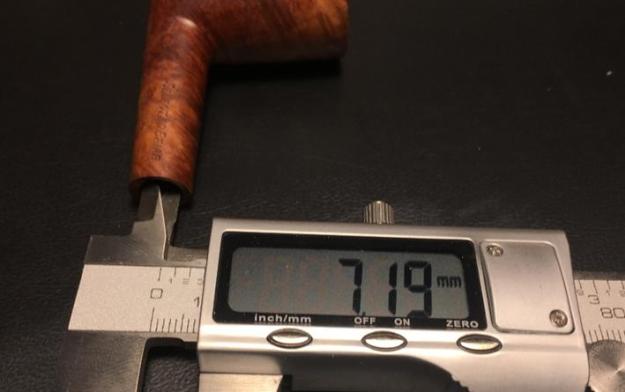
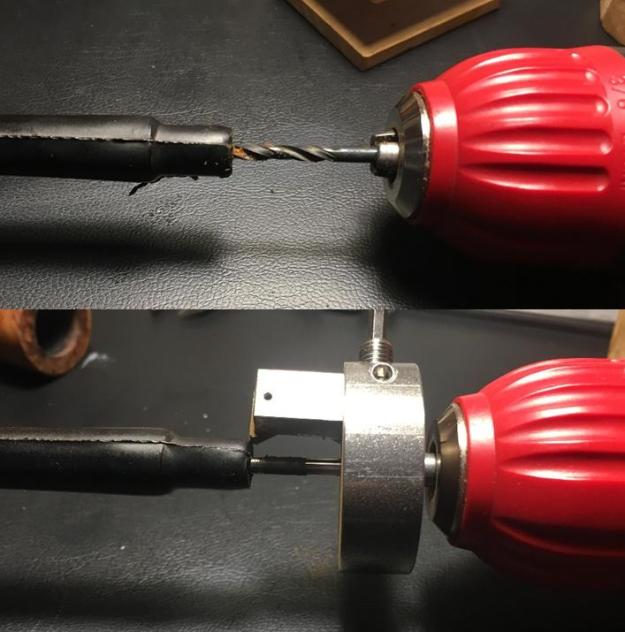
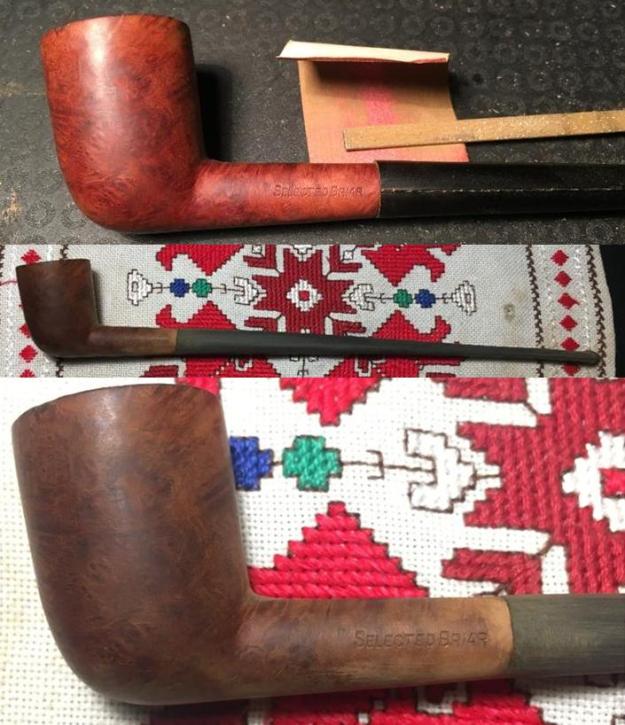
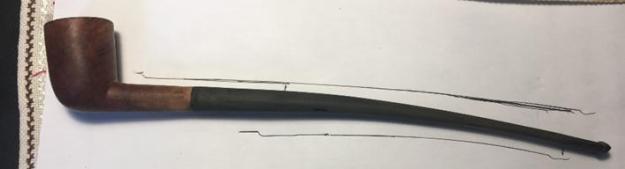
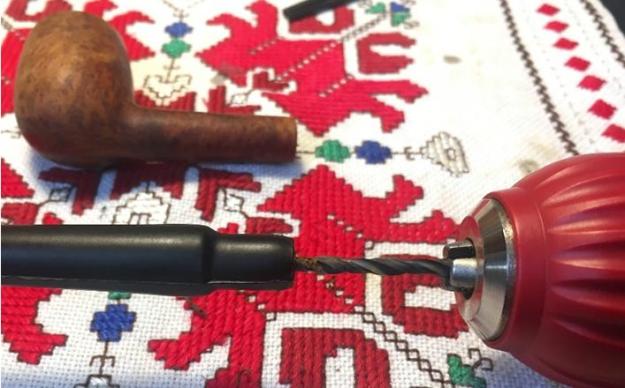
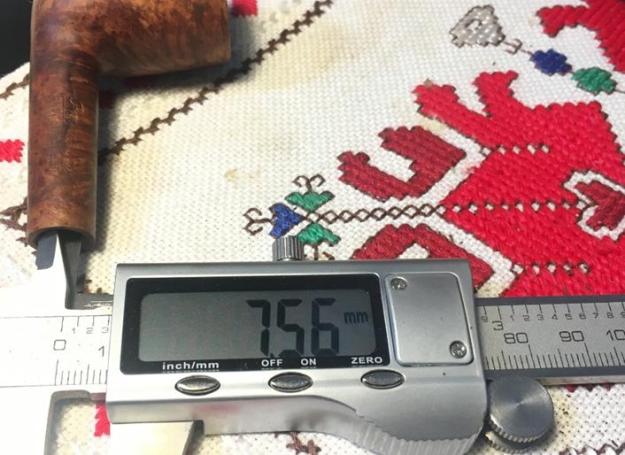
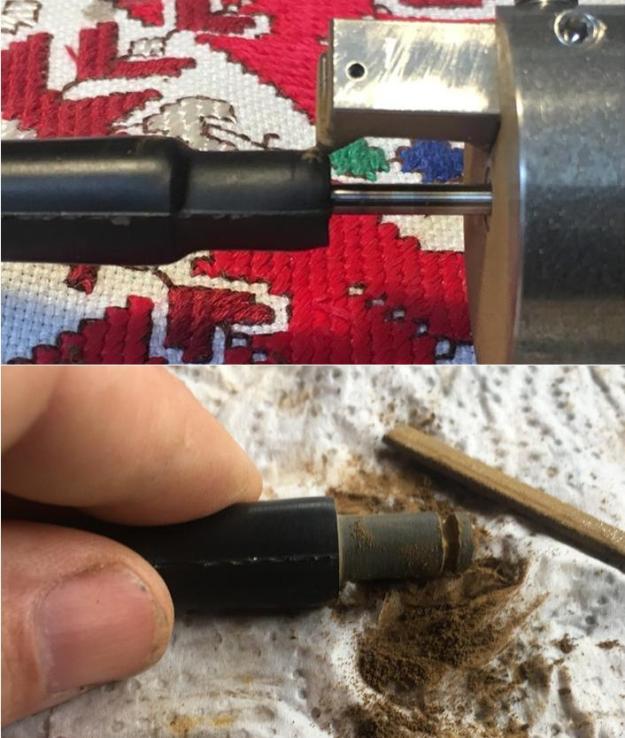
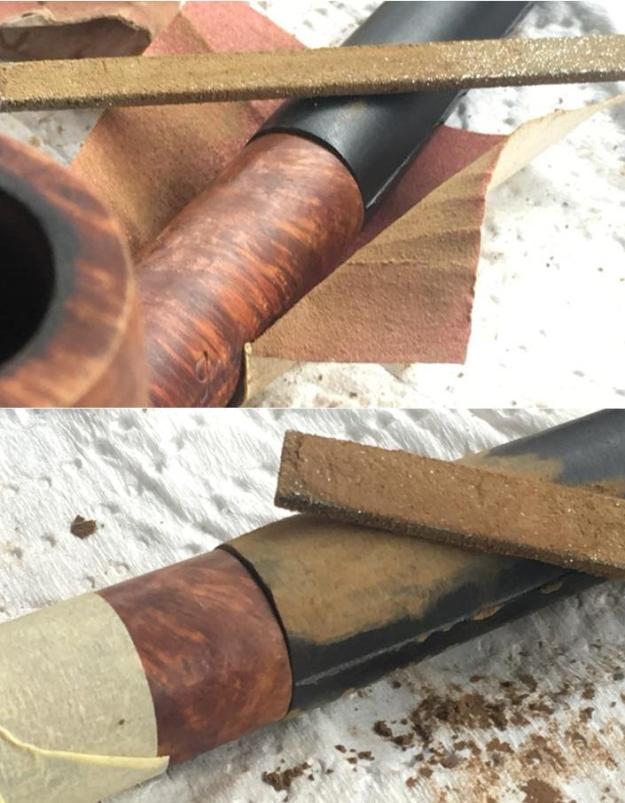
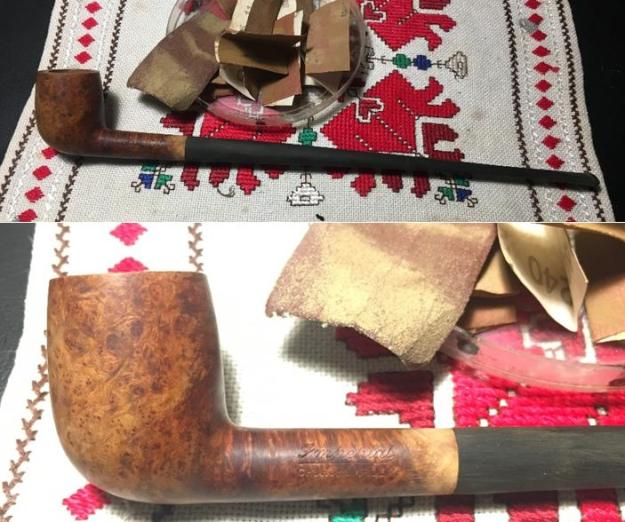
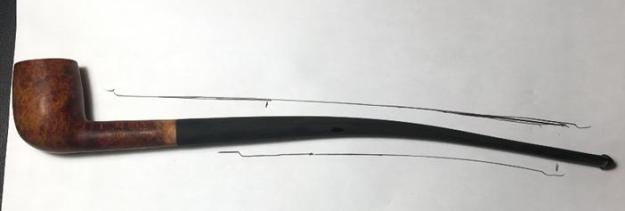
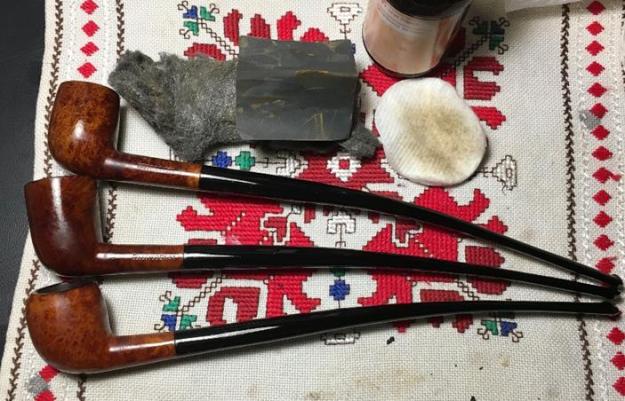
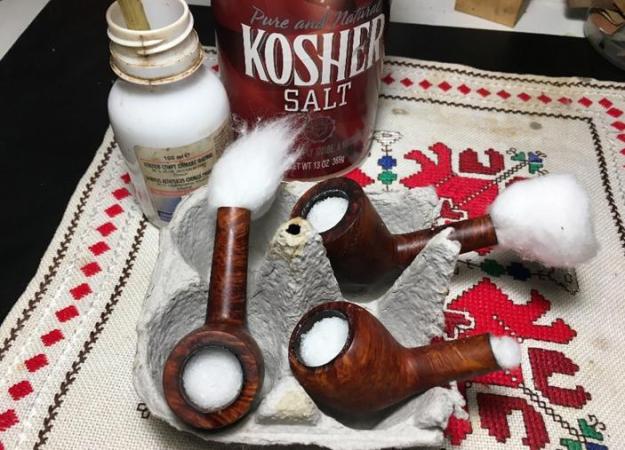
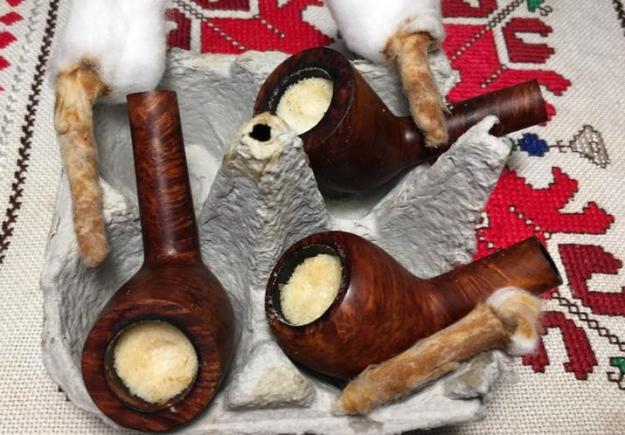
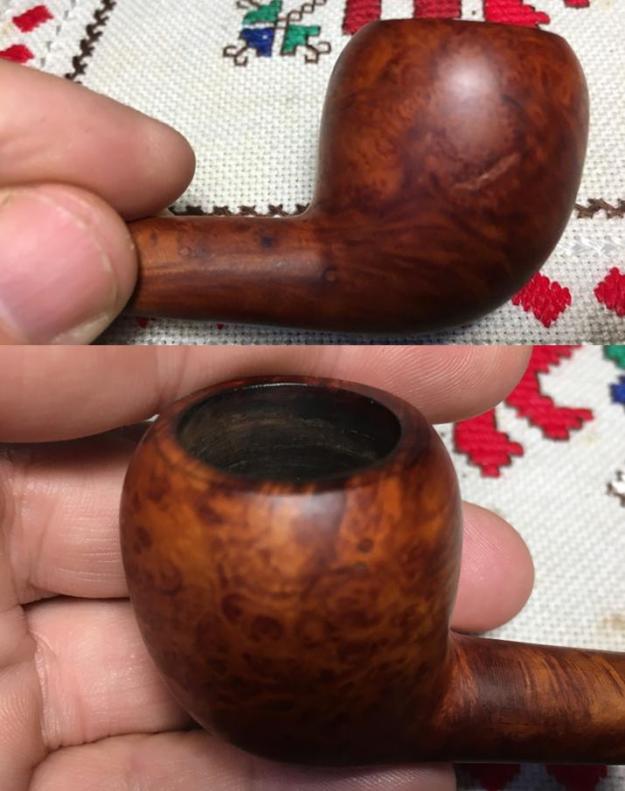
With two Churchwardens bound to Toby – one for his friend and one for himself, I was thinking, while I’m working on restoring and creating these Churchwardens, why not fashion another to put in The Pipe Steward Store for another steward to add to their collection.  I found a small bowl that I really liked – a Yello Bole ‘Air-control’ Imported Briar.  I looked at the Air-Control stem mechanism and my thought was that no one will ever want this Yelo Bole as he is now attached to his ‘high-tech’ stem, but I really liked the Apple shaped bowl.  I think he’ll look great mounted on a long-bent stem – a third Churchwarden, a wise choice for anyone wanting to add a Churchwarden to his collection!  All three Churchwardens will benefit the Daughters of Bulgaria – women and girls, the ‘Daughters of men’ who have been trafficked and sexually exploited.I want to thank Charles Lemon of https://dadspipes.com  up front for his input that led me to add two new tools to my tool box and expanding my ‘restorative reach’ with pipes.  The first is a PIMO Tenon Turning Tool that I ordered at Vermont Freehand after seeing the tool on Charles’ Worktable and Man Cave blog.  Charles’ later restoration, Re-Stemming a Butz-Choquin Marigny Deluxe Hand-Made Calabash was very helpful providing a step by step description of its use in replacing a tenon and the use of the tool.  The other wonderful tool that I coveted reading the same ‘Re-Stemming’ blog was the electronic caliper which Charles uses hand in hand with his many stem repairs.  I hadn’t seen an electronic caliper in Bulgaria, but then, I had never looked for one either!  Joy of joys, I found a German made electronic caliper in the local ‘Bricolage’ – I was a happy camper!  My new toys – that is, tools 😊 pictured next. As I approach the restoration and creation of the 3 Churchwardens, I will try to work in the reverse – starting with the ‘Free Born’ Yello Bole, then the ‘Green Land’ Dublin and finally, the ‘True Born’ French made Imperial.  Why this order?  As I get used to my new tools, I would rather start with the ‘non-commissioned’ pipe first to hone in on the techniques, working toward the most important Churchwarden, the Imperial, destined to be a gift.  To experiment and practice, I have already turned one stem with the PIMO tenon turning tool – a French Jeantet Jumbo which came to me without a matching stem and has been waiting patiently.  Without description, this is what I did last night while watching the World Cup match between Sweden and Mexico (my wife rooted for Mexico where she grew up!).  Sweden prevailed.  The Jeantet Jumbo will be completed sometime in the future – he’s a ‘big boy’ pipe! Turning now to cleaning the stummels of the Churchwardens, I start first by reaming each with the Pipnet Reaming Kit.  Each stummel uses only the smallest of the 4 blade heads available.  I then fine tuning each with the Savinelli Fitsall tool, followed by sanding the chambers with 240 grade paper wrapped around a Sharpie Pen.  Finally, each is cleaned with a cotton pad wetted with isopropyl 95%.  After clearing the light to moderate cake in each bowl getting down to the briar for a fresh start, the chambers look good in each – no problems I can see. Turning now to the external surface I use undiluted Murphy’s Oil soap and cotton pads to scrub each.  The Dublin (center above) has the most lava over the rim, while the other two, not as much.  In addition to cotton pads, I utilize a brass wire brush for the rims and use a knife blade carefully to scrape the Dublin rim.  The Dublin and the Imperial will both need some sanding on the rim to clean them up.  All 3 stummels’ finishes reveal that they are thin and worn.  Murphy’s took much of the finish off but not all with the Yello Bole and Imperial bowls.  The Dublin’s finish is gone.  During the cleaning, I discover that I missed the remains of a broken off tenon in the mortise of the Dublin.  I keep screws of different sizes on hand for just these occasions.  Using a small diameter screw, I screw into the airway hole of the tenon just enough to grab some vulcanite and gently pull out.  I don’t want to insert it too far into the broken tenon to not expand it and crack the shank.  As hoped, a little pressure and thankfully, the tenon comes loose. With the mortise cleared in the Dublin, I proceed to clean the internals of all 3.  I use pipe cleaners and cotton buds dipped in isopropyl 95% to do the dirty work.  Here is a truism: Just because you’re cleaning a smaller stummel doesn’t mean it’s a smaller mess!  Each stummel required boocoos of cotton buds, pipe cleaners – I also scrape the sides with a sharp dental probe as well as hand-turning drill bits down the mortises to excavate the tars and oils.  The pictures show the finish line of sorts – later, before I turn out the lights, I’ll give each a kosher salt/alcohol soak through the night to provide more stealth cleaning.To remove the old finish from the stummels I wipe them down with isopropyl 95% and cotton pads.  The alcohol fully removes the old tired finish off the Imperial and the Dublin, but the Yello Bole’s old finish is persistent.  The first picture below reveals the sheen left on the Yello Bole but the others are dull.  To deal with the ‘Candie Apple’ finish that remains on the Yello Bole stummel I use acetone on a cotton pad.  This does the trick and now we’re down to the briar on all the stummels.With the stummels clean inside and out, the next step is fashioning the Churchwarden stems from the precast stems I acquired for the job.  I start with the Yello Bole by making an outside measurement of the original stem’s tenon which, of course, fits perfectly.  The measurement with the electronic caliper is 6.83mm.  From Charles Lemon’s blog that I noted above, Re-Stemming a Butz-Choquin Marigny Deluxe Hand-Made Calabash, Charles recommended a conservative approach to using the PIMO tenon turning tool which I employed on my first run with the Jeantet Jumbo, to first do a test cut of the tenon at approximately 40mm more than the target measurement.  This allows a more conservative sanding of the tenon to gradually bring it down to a good fit – not too snug and not too loose.  The Pimo tool comes with a drill bit to pre-drill the tenon airway on the precast stem to serve as a guide for the guide pin on the tool.  Adding my margin of error of 40mm to 6.83mm target size leaves me a practice cut of about 7.23mm to aim at for the conservative approach.  The pictures move through the steps. The tenon turning tool is in the drill shock and when powered rotates at high speed. With the cast stem’s airway guided by the guide pin, I push the stem steadily against the revolving blade of the tool and it peels away the vulcanite.  The blade peels the vulcanite in spaghetti-type curls.  My first practice cut is measured, and it is 8.45.  Another 1.20 mm can come off.  With the enclosed allen wrench, I adjust the Pimo tool to remove more vulcanite and the next measurement is 7.34mm.  That is a .51mm difference and places me in the conservative sanding zone.  Now, I complete the cut of the entire tenon – all the way to the face of the stem.  I haven’t figured out how to minimize the vulcanite shavings that spew out everywhere!  I note that the original stem’s tenon is shorter.  I use a sanding drum on the Dremel and take off the excess. The cut looks good and now it’s time to take file and sanding papers to gradually bring the tenon to size. Now, as I watch several episodes of Grimm which I discovered on Netflix here in Bulgaria, I gradually sand the tenon to a snug but not too tight fit.  I use coarse 120 grade paper to start – always sanding around the tenon to maintain proper round.  Then, using a flat needle file and 240 grit paper, I fine tune the tenon sanding – again, maintaining proper round by sanding around the tenon evenly.  I must admit, when the tenon gets down to the target size – when it starts to marginally slide into the mortise, my stress level increases!  I know how easily one can crack a shank by rushing the tenon’s entry into the mortise.  It takes ‘100s’ of sanding cycles followed by testing the fit (carefully!) before the tenon safely and fully engages and finds a new home!  Success!The tenon is snug and secure, and now I take some pictures to show the ridges that need to be removed and tapered through the shank and stem.  Also, the precast stem has casting ridges down the length on both sides and the button is in very rough form.  The entire Churchwarden stem needs to be sanded, smoothed and shaped along with the shank/stem transition.One picture to show the growth in stature this Yello Bole stummel now enjoys before retiring the old stem to the stem bucket.Several episodes of Grimm later, I’m satisfied with the rough sanding and shaping of the stem.  I show the full length and then some closeups of the shank/stem transition and the button shaping.  I like what I see. The next step is to introduce a gentle bend to the stem.  This will aid the future steward of this ‘Free Born’ to know which way the stem is properly positioned – there is an up and down after the custom sanding and fit – there is no standard stem fit – echoing the words of Charles Lemon’s blog!  To give me an idea of where and how much the bend should be, I used my Gandalf as a template on a piece of paper.  I also draw an outline of the original, smaller Imperial stem for comparison.  I mark the stem at the point that Gandalf’s stem’s bend began.  Bends are very subjective, but this gives me an idea what to shoot for.  After I insert pipe cleaners in both ends of the stem to guard the airway integrity during the bending, I heat the target area of the stem with a hot air gun and bend it when it becomes supple.  I take the bend to the faucet with cool tap water to set the curve.  At the start, I found that I was bending too much.  Thankfully, vulcanite is very forgiving – to correct the bend all I do is re-heat the stem and it straightens on its own.  After a few tries, I find a bend I’m happy with – a compromise between Gandalf’s slightly longer stem and the shorter, original Imperial. I put the Yello Bole ‘Free Born’ aside and now turn to the Dublin.   The following pictures are lacking my standard background working mat – it needed to be cleaned!  I start by doing an inside measurement of the mortise – 7.19mm.  That is the target width of the tenon that is shaped.  I use the drill bit provided and drill the airway to receive the PIMO guide pin.  I then bring the blade down to just touching the tenon and cut a test like before and measure – 8.15mm.  That leaves .96mm to the target size.  I make a quarter turn of the wrench, closing the blade that much and take another cut – 7.46.  The quarter turn took .69mm off the tenon.  I now have .27 mm of ‘fat’ left on the tenon.  Again, the pictures show the steps. Now, well within the conservative sanding zone, I use a flat needle file and 240 grit paper and sand the tenon down to fit with appropriate snugness.  I then sand down the stem and button as before with the Yello Bole.  I’m aiming for a fluid transition from shank to stem.  The Dublin shapes up nicely!I use the same template to give the Dublin’s new fitted stem a gentle bend over the hot air gun. Now to the Imperial.  The same methodology is employed as with the former 2.  I fast track describing the process with each picture.I drill the airway to guide the Pimo guide pin.The mortise is measured for the target tenon size – 7.56mm.With the PIMO tool I cut a ‘fat’ initial tenon that measures about 40mm larger than the target – conservative sanding zone. I measure the length of the original Imperial stem tenon and shorten the precast Churchwarden tenon to match using the flat needle file as a saw.After sanding the tenon down to a snug fit, I’m left with filing and sanding the ridge and tapering the warden stem.  I cover the Imperial’s nomenclature with masking tape to protect it from the shank sanding.After some filing with a flat needle file and sanding with 240 grit paper, the transition from the shank to the Warden stem is shaped and the button is shaped from the rough precast stem. As with the other two, I heated the Warden stem with a hot gun and when it became supple I give it a slight, gentle flowing bend and seal the bend under cool tap water.The 3 are looking good and the transformation is taking shape!I then take each of the Warden stems through a wet sanding with 600 grit paper and then used 0000 grade steel wool to continue the sanding but also buffing up the fresh vulcanite.  To hydrate each of the 3 Wardens I wipe the stems and stummels with light paraffin oil (mineral oil in Bulgaria), which serves to give me a sneak peak at the finished Churchwarden pipes.  I like what I see!With my day coming to a close, I utilize the night by allowing the stummels to clean further by using a kosher salt and alcohol soak.  I fashion cotton ‘wicks’ from cotton balls and insert them down the mortises into the airways.  They act to draw the additional tars and oils out of the briar.  I then fill each bowl with kosher salt which leaves no aftertaste as iodized salt does.  I then fill the bowls with isopropyl 95% until the alcohol surfaces over the salt.  I top each stummel off in a few minutes and I turn out the lights.The next morning, I wasn’t disappointed.  The salt in each bowl had darkened and each of the wicks had discolored indicating further extraction of the tars and oils.  The salt went into the waste basket and I cleared the excess salt by wiping the bowls with paper towel and blowing with some force through the mortises.  I also follow with pipe cleaners and cotton buds to make sure all was clean.  Only the Dublin resisted further but soon pipe cleaners and cotton buds were coming out clean.  Stummels are cleaned and ready for their future stewards!  The picture shows the final carnage.Now, turning from the labor-intensive stem work, I look at the stummels.  Starting with the ‘Free Born’ Yello Bole that drew my attention.  The small Apple shape fits well the classic Churchwarden motif.  The grain is active with lateral grain expressing in bird’s eye perspective on the sides.  There are some fills in the stummel – one larger one on the right side of the stummel then a few pocket fills.  The fills all seem solid, but I will keep my eye on them as I sand. The rim is darkened from tobacco lighting and the inner edge of the rim is scorched.  I decide to give the rim a very light topping using 600 grade paper – more of a clean up to reestablish crisp lines and to remove the charring.  I use a kitchen chopping board and put the 600 paper on it for the topping.  It doesn’t take much. To address the normal nicks and dents on the stummel I use micromesh pads 1500 to 2400 and wet sand the stummel.  After the wet sanding I again look at the old fills that caught my attention before to see if they softened.  They remain solid, but I can see very small pockets that might benefit from repair.  I do not dig out the fills but simply painted the fills with a very thin layer of thin CA glue with a tooth pick – like the repair to miniscule air pockets that emerge with a CA glue/charcoal patch on vulcanite stems.  The painting is thin, so it cures very quickly, and I focus sand the spots again starting with the 1500 micromesh pad to the present was sufficient.  There is no impact on the surrounding briar.  I complete the micromesh cycles by dry sanding with pads 3200 to 4000 and 6000 to 12000.  I keep the Warden stem mounted on the stummel to guard against shouldering the shank face – keeping a nice seamless transition from shank to Warden stem.Here I picture the right side of the stummel to show the results of the ‘paint patching’ the larger fill and a few on the shank.  It blended well. Now, the Dublin is next in line.  This Dublin has ‘Selected Briar’ stamped on the left side of the shank.  It has nice looking briar, but the finish has lost its luster – it’s dull, tired and bored.  The rim is dark and has several dings on the edge.  There is one noticeable fill on the right front of the Dublin stummel.  The canted bowl of a Dublin has always attracted me and when Toby chose the Dublin to mast the Warden stem, I agreed it was a good choice – it will be an impressive looking Churchwarden.  I take a few pictures to get a closer look. I start by taking the Dublin to the topping board using 240 grit paper.  Removing the tired finish and re-establishing the lines of the rim will go a long way in sharpening this stummel.  After turning the inverted stummel on the 240 paper a few revolutions, I switch too 600 grade paper and smooth out the scratches of the 240.  Then, using 120 grit paper I cut an internal bevel on the rim followed by 240 and 600 grade papers.  I also cut a very small bevel on the external edge of the rim with the 240 and 600 papers.  I create the bevels to soften the look of the stummel and to me, it’s a classy touch.Next, I take the stummel through the full micromesh pad cycle by wet sanding with 1500 to 2400, followed by dry sanding using pads 3200 to 4000 and then 6000 to 12000.  The Dublin’s attitude is shaping up nicely! Turning now to the ‘True Born’ Churchwarden, the nomenclature stamped on the left side of the shank is a cursive, ‘Imperial’ over ‘CHURCHWARDEN’ in full block letters.  ‘Algerian Briar’ is stamped on the right.  The COM is France, stamped in very small block letters on the lower shank along the shank face.  These pictures show what I see. It did not take long to match the unique ‘Imperial’ nomenclature found in Pipedia’s very short article about the Imperial Tobacco Co. referencing Lopes:
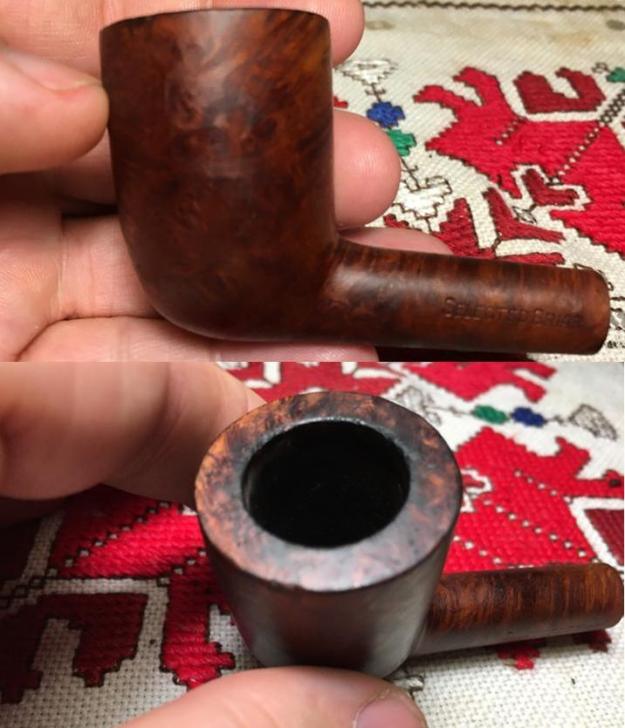
From Pipes, Artisans and Trademarks, by Jose Manuel Lopés’

The Imerial Tobacco Co. (Imperial Tobacco Ltd.) was founded in 1901 through the merger of several British tobacco companies. In 1902 it went into partnership with the American Tobacco Company to found the British American Tobacco Company.

Brands involved: Comoy’sBewlayNordingOgden’sSalmon & Gluckstein, and Steel’s

This example was provided by the courtesy Doug Valitchka to let me know that I had locked into the right company.Pipedia’s article on Imperial Brands goes into more of the history of the multitude of acquisitions that happened in the early 1900s to maintain competitive edge.  Today, Imperial Brands is an international consortium primarily involved in cigarette sales and is based in the UK.  I found only one reference in the article to a French-based connection referencing the closure of a factory in Nantes, France, in 2016.  The company website, http://www.imperialbrandsplc.com contains an extensive history of the company, but I found no references to pipe productions in France!  In Pipedia and in Pipephil – Imperial, references to Imperial, the country of manufacturing is consistently the UK and no mention of France.  So, the French connection to this True Born will remain shrouded in mystery!

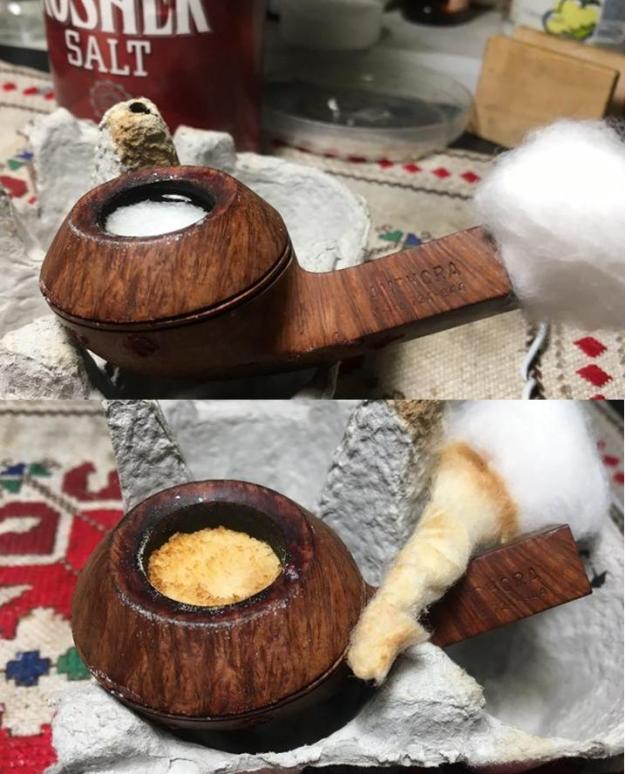
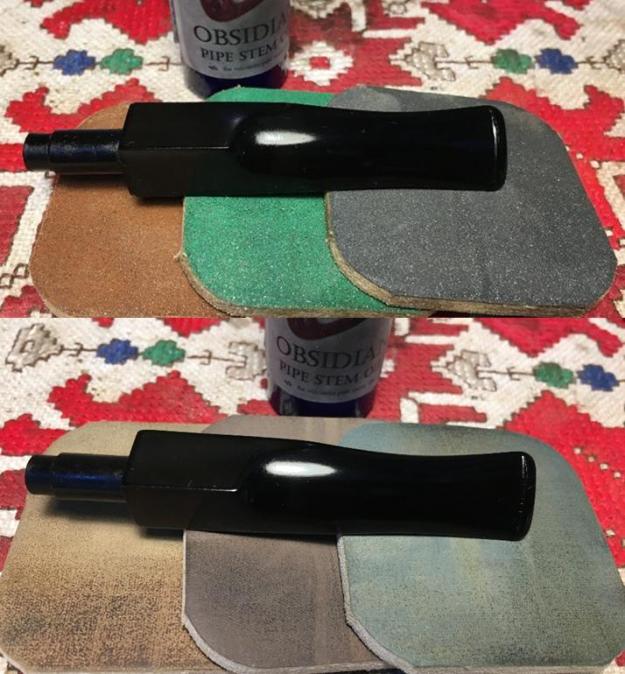
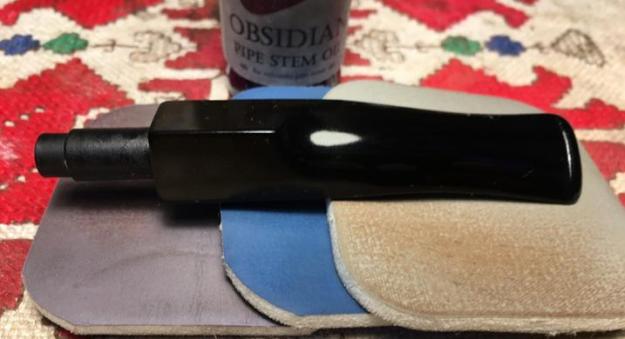
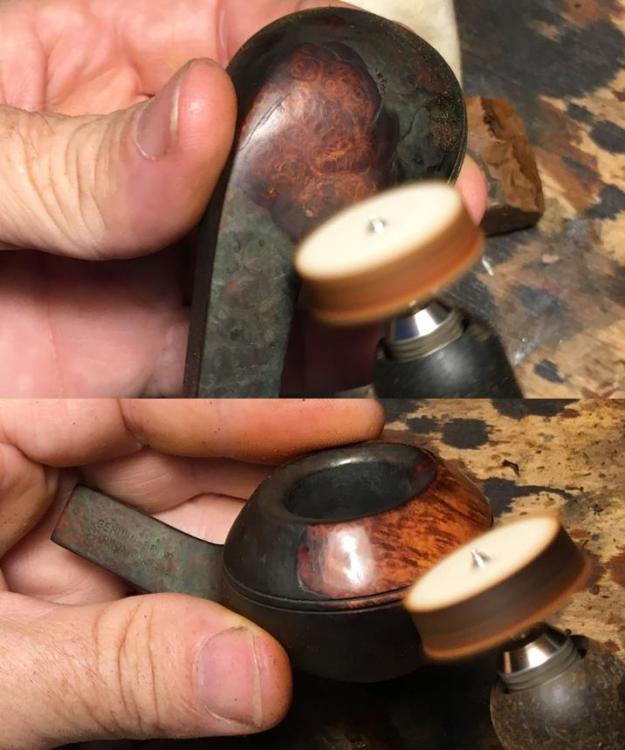
The Imperial stummel has a dulled finish as the Dublin but promises a very nice briar grain beneath.  The bowl and rim have normal wear nicks and dents.  I also detect residue shininess of old finish that didn’t come off when I cleaned with Murphy’s Oil Soap. I quickly dispatch this using a cotton pad wetted with isopropyl 95%.Inspecting the surface I find on the left side of the shank, near the ‘Imperial’ stamping, a chip that needs patching. I mix a small batch of CA glue and briar dust to patch the chip – this will blend well after sanded down.  I put a small mound of briar dust on an index card and place next to it a drop of regular CA glue.  I mix a small bit of the briar dust into the glue and when I find the resulting putty about the consistency of molasses, I apply it to the chip and put the stummel aside to cure. While the patch is curing, the large job of continuing the sanding of the Churchwarden stems jumps to the fore.  I decide to do all 3 Wardens together by first wet sanding using micromesh pads 1500 to 2400.  I follow by dry sanding using pads 3200 to 4000 and then 6000 to 12000.  After each set of three pads, I apply Obsidian Oil to each stem to vitalize the vulcanite.  There’s a LOT of vulcanite real estate to sand with a Churchwarden stem!  It’s also not easy taking pictures of the long Warden stems. Turning again to the bowls, and the Imperial’s cured patch of CA glue and briar dust, I carefully file the mound/excess down toward the briar surface.  I’m careful to stay on the excess patch material so not to damage the nearby briar and nomenclature.  I then switch to 240 paper, rolled tightly and then 600.  The patch looks great. As I take a closer look at the Imperial stummel, the rim is blackened on the internal edge.  I start by giving the bowl a very light topping with 600 grade sanding paper to clean it and to reestablish lines.  I then bevel the internal rim edge enough to clean it up as well as giving the external rim edge a bevel to soften the rim and to ‘class it up’ a bit. I like how it’s shaping up. With the rim restoration complete at this level, I use micromesh pads 1500 to 2400 and wet sand the entire stummel.  I follow with dry sanding with pads 3200 to 4000 and finish with 6000 to 12000. I have noticed on the shank a lightened area that was a result of the stem/shank fitting process where more sanding was necessary.  To darken and blend this area, I use an oak Furniture stain stick to do the job and it looks good.  I take a picture.Now, to deepen and enrich the briar of the French made Imperial Churchwarden, I apply Before and After Restoration Balm to the briar surface.  I put some on my fingers and work it into the surface.  The Balm does an amazing job bringing out the richness and the luster of the briar grain that is already beautiful.  After about 20 minutes, I wipe the Balm off the stummel with a clean cotton cloth.  It buffs up nicely.  I take a picture of the stummel with the Balm on it.Next in line is the Dublin bowl.  As with the French Imperial, I take the Dublin through the full 9 micromesh pads, 1500 to 12000.  I show the progress after each set of three pads – the first three wet sanding, the last 6, dry. As with the Imperial, I apply Before and After Restoration Balm to the Dublin bowl.  I put some Balm on my fingers and work it into the briar.  The Balm starts with the texture of light oil then as I rub it into the briar, is thickens into the texture of a thicker wax.  After I work it in I set the stummel aside to absorb the Balm.  After a time, I wipe off the Balm using a cotton cloth – it buffs up as I wipe the stummel.The final stummel is the Free Born Yello Bole.  Since the stummel has already gone through the full micromesh pad sanding process, it is ready to receive the Before and After Restoration Balm to deepen and enrich the nicely emerging briar grain.  As with the others, I apply the Balm with my fingers and after setting is aside for about 20 minutes, I wipe/buff off the Balm.  I take a picture of the Balm on the stummel and afterwards. At this point, using the Dremel mounted with dedicated cotton cloth buffing wheels set at the slowest speed, each of the three bowls I apply Blue Diamond compound and White Diamond compound is applied to the stems.  After the application of the compounds, I buff each Churchwarden with a felt cloth to remove the compound dust before applying wax.  I then mount another cotton cloth wheel on to the Dremel, increase the speed to about 40% full power and apply carnauba wax to stems and stummels.  After applying a few coats of wax, I give each Churchwarden a rigorous hand buffing with a microfiber cloth to raise the shine.

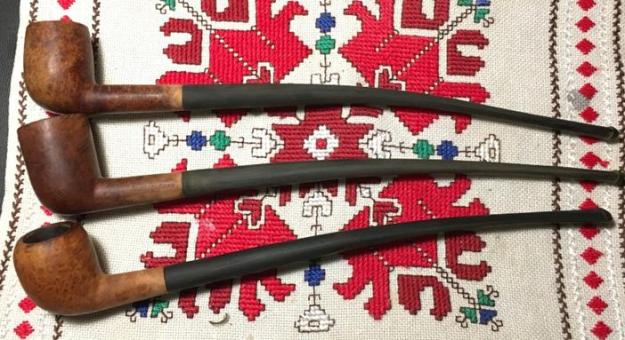
The Tale of the Three Churchwardens is now beginning.  I am pleased with the results.  Each bowl responded well displaying a myriad of grains and patterns.  Each now displays that classic, long, graceful, wise aura of the Churchwarden genre.  It is true, only one of the Churchwardens started has a Churchwarden – the True Born.  He is now no longer of Hobbit stature and will walk with men and wizards.  The other two re-purposed bowls look great – I’m pleased.  Tobias of Germany commissioned the French made Imperial Churchwarden and the Dublin.  He will have the first opportunity to secure these Churchwardens for his friend’s birthday present and for his own collection in The Pipe Steward Store.  As ‘fate’ would have it, the third Churchwarden bound to no man, was claimed also by a person also living in Germany!  A colleague was visiting Bulgaria and saw the 3 Churchwardens on my worktable.  Thankfully, I was able to finish ‘The Wise’ to return with his new steward to Germany.  I declare that Germany receives the Middle Earth Award!  Each of these Churchwardens benefits the Daughters of Bulgaria – a noble cause of helping women and girls who have been trafficked and sexually exploited.  Thank you for joining me in the telling of the Tale of Three Churchwardens!

The first True Born Imperial Churchwarden of France The second was bound to the first, the proud Dublin Green Land Churchwarden The Third ‘Free Born’ Churchwarden

Farida’s Dad’s Pipes #5 – Restoring a Dunhill Root Briar 56 Bent Billiard


Blog by Steve Laug

I am back working on a of pipes that comes from the estate of an elderly gentleman here in Vancouver. I met with his daughter Farida last summer and we looked at his pipes and talked about them then. Over the Christmas holiday she brought them by for me to work on, restore and then sell for her. There are 10 pipes in all – 7 Dunhills (one of them, a Shell Bulldog, has a burned out bowl), 2 Charatans, and a Savinelli Autograph. His pipes are worn and dirty and for some folks they have a lot of damage and wear that reduce their value. To me each one tells a story. I only wish they could speak and talk about the travels they have had with Farida’s Dad.

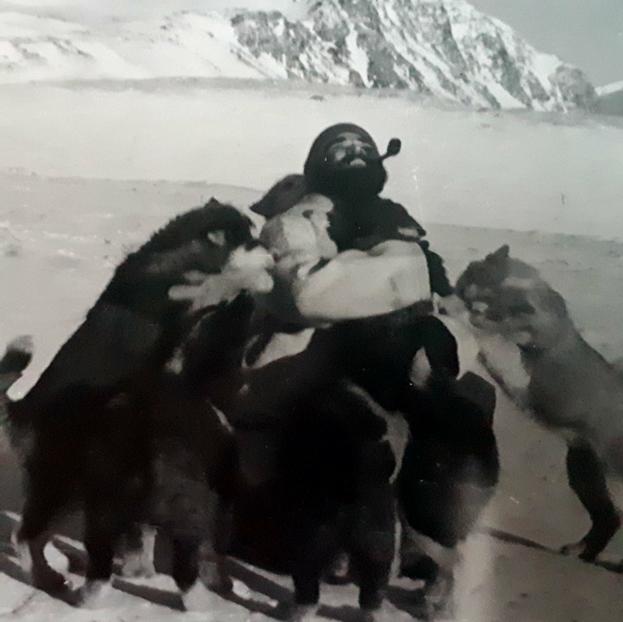
When I wrote the blog on the Classic Series Dunhill and thinking about its travels, Farida sent me an email with a short write up on her Dad. She remembered that I had asked her for it so that I could have a sense of the stories of her Dad’s pipes. Here is what she wrote: My dad, John Barber, loved his pipes. He was a huge fan of Dunhill and his favourite smoke was St. Bruno. No one ever complained of the smell of St. Bruno, we all loved it. I see the bowls and they’re large because he had big hands. When he was finished with his couple of puffs, he would grasp the bowl in the palm of his hand, holding the warmth as the embers faded. The rough bowled pipes were for daytime and especially if he was fixing something. The smooth bowled pipes were for an evening with a glass of brandy and a good movie. In his 20s, he was an adventurer travelling the world on ships as their radio operator. He spent a year in the Antarctic, a year in the Arctic and stopped in most ports in all the other continents. He immigrated to Canada in the mid-fifties, working on the BC Ferries earning money to pay for his education. He graduated from UBC as an engineer and spent the rest of his working life as a consultant, mostly to the mining companies. Whatever he was doing though, his pipe was always close by. 

She sent along this photo of him with his sled dogs in the Antarctic sometime in 1953-1954. It is a fascinating photo showing him with a pipe in his mouth. He is happily rough housing with his dogs. As a true pipeman the cold does not seem to bother him at all.Thank you Farida for sending the photo and the background story on your Dad for me to use on the blog. I find that it really explains a lot about their condition and gives me a sense of who Dad was. If your Dad was rarely without a pipe I can certainly tell which pipes were his favourites. As I looked over the pipes I noted that each of them had extensive rim damage and some had deeply burned gouges in the rim tops. The bowls seemed to have been reamed not too long ago because they did not show the amount of cake I would have expected. The stems were all covered with deep tooth marks and chatter and were oxidized and dirty. The internals of the mortise, the airway in the shank and stem were filled with tars and oils. These were nice looking pipes when her Dad bought them and they would be nice looking one more when I finished.

I finished two of the pipes and have written a blog on each of them. The first one was the Dunhill Shell with the oval shank pot (https://rebornpipes.com/2018/02/04/restoring-a-1983-dunhill-shell-41009-oval-shank-pot/) and the second was the Dunhill Classic Series Shell Billiard (https://rebornpipes.com/2018/02/08/faridas-dads-pipes-2-restoring-a-1990-lbs-classic-series-dunhill-shell-billiard/). The third pipe I restored from the estate was a Savinelli Autograph (https://rebornpipes.com/2018/02/15/faridas-dads-pipes-3-restoring-a-savinelli-autograph-4/). The fourth pipe of his that I worked on was a Dunhill Red Bark Pot that was in rough shape (https://rebornpipes.com/2018/03/10/faridas-dads-pipes-4-restoring-a-dunhill-red-bark-pot-43061/).

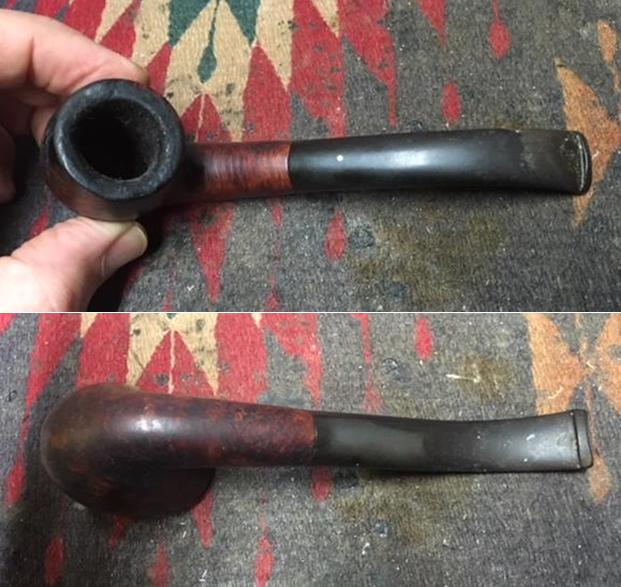
I went back to the remaining two Dunhills in the collection today and chose to work on a Dunhill Root Briar 56 Bent Billiard. It was so dirty it was hard to read the stamping on the sides. I could see that it was worn but I could not tell much else looking through the thick grime. The smooth finish sticky with oils and thick grime and the bowl felt oily to touch. I wiped off the oils and grime on the shank sides to see the stamping. It was worn but readable. On the left side of the shank it reads Dunhill over Root Briar. To the left of the stamping is the shape number 56. On the right side of the shank there is a faint stamp R with 4 in a circle. The rest of the stamping is very faint.

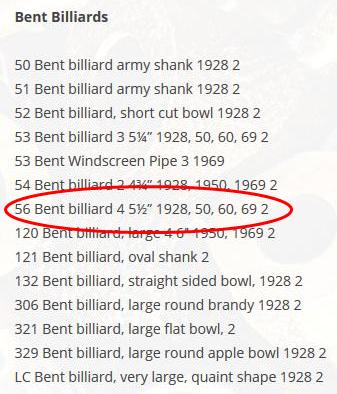
I turned to a blog I have on rebornpipes by Eric Boehme on Dunhill Shapes and looked for the shape number stamped on this pipe. Here is the link. https://rebornpipes.com/2012/11/01/dunhill-pipe-shapes-collated-by-eric-w-boehm/. I did a screen capture of the section on Bent Billiards and circled the pipe I have in hand in red. The shape number 56 is noted as a bent billiard size 4. It is noted as 5 ½ inches long just as the one I have is. It is listed as coming out in 1928, 1950, 1960 and 1969. The spread of dating was pretty large and the stamping so unreadable that I could not determine the date with that normal help. It was time to move on and look for other helpful information to see if I could narrow things down a bit.

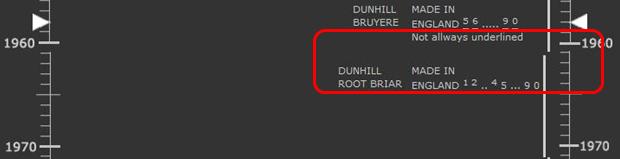
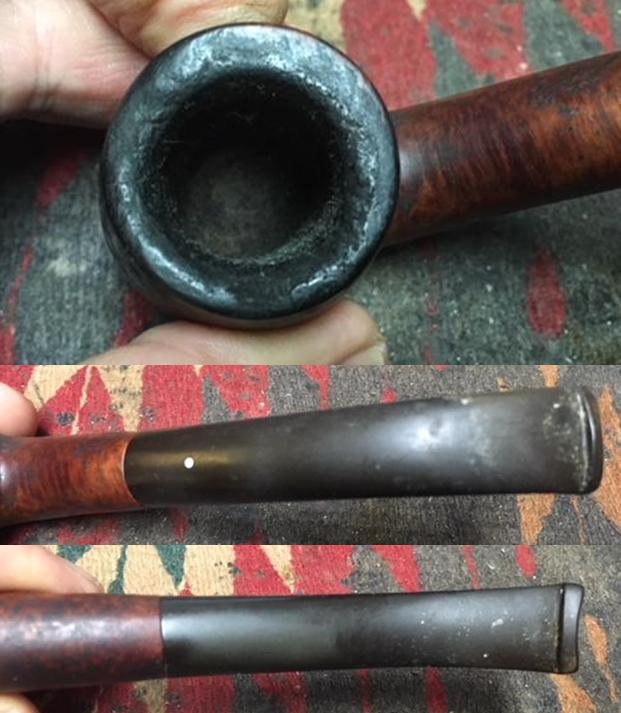
I turned to another site that I use often – the pipephil website on Logos and Stampings because there is some really helpful information on when each of the lines of Dunhill pipes entered the market. Here is the link to the section of the site that I turned to, http://www.pipephil.eu/logos/en/dunhill/root-bru-guide.html. I did a screen capture of a portion of the chart that gave me the time frame for this particular pipe. I circled the date and brand in red in the photo below. It looks like the Root Briar came out between 1960 and 1970. Now I knew that one I was working on a pipe that came from that era – which incidentally matched the other pipes in Farida’s Dad’s estate collection.The bowl was thickly caked and the cake had flowed over onto the smooth Root Briar finish on the rim top forming hard lava that made the top uneven. The inner and outer edges of the rim were both damaged. On the right front of the bowl the rim had been scraped and damaged and then burned. On the back edge there was the same kind of damage that was on the other Dunhill pipes in this estate. This one however was not quite as deep so it would need to be dealt with a bit differently when I got to that point. The stem was lightly oxidized but otherwise in good condition. There were light tooth marks and chatter on both sides in front of the button. The Dunhill white spot was intact on the top of the stem. I took photos of the pipe to show what it looked like before I started the cleanup work. I took close up photos of the bowl and rim top as well as the stem. You can see the condition of the rim top and bowl in the first photo. The outer edge has damage on the front right – burn damage and wear that comes from lighting a pipe repeatedly in the same spot. The back left side also shows damage on the inner edge. There was damage from what looked like a poor rim job. The stem has tooth chatter and some bite marks on the top and the underside of the stem just ahead of the button.I reamed the bowl with a PipNet reamer and used two of the four cutting heads to clean out the cake. The bowl thickly caked so I started with the smaller of the two and worked my way up to the second one which was about the same size as the bowl diameter. I cleaned up the reaming with a Savinelli Fitsall Pipe Knife to remove the remnants of cake. I finished by sanding the inside of the bowl with a dowel wrapped in sandpaper. I scrubbed the surface of the briar with alcohol and cotton pads. I scrubbed until I had removed the sticky tars and oils on the finish. I worked on the top of the rim with the edge of the Savinelli Fitsall Pipe Knife. I scraped the heavy buildup that was there. I scrubbed the scraped rim top with alcohol and cotton pads to remove the debris. I dried off the bowl with a soft rag. The cleaned and scrubbed pipe really made the rim top damage very clear. It looked to me that I would need to top the bowl. I topped the bowl on a topping board with 220 grit sandpaper to remove the damage to the top surface of the rim and clean up the damage to the edges. I did not have to remove a lot and repeatedly checked it to make sure that I had removed enough but not too much. I wanted to take the top down until it was smooth up to the burn damaged area on the rim top.I wiped down the rim top with alcohol and cotton pads to remove the sanding dust. I built up the damaged area on the rim with clear super glue and briar dust. I layered it until the height of the damaged area was roughly equal to the rim top. The third photo below shows the top at this point in the process. I took photos of the repaired bowl from a variety of angles to show what the repair looked like before I sanded and cleaned it up. I would need to top the bowl again to smooth things out and work on the edges. I topped the bowl again to remove the excess repair material. I worked it over the sandpaper on the board until the surface was smooth. I used a folded piece of 150 and 220 grit sandpaper to bevel the inside edge of the bowl. With the externals clean it was time to clean out the mortise and shank and airway into the bowl and the airway in the stem with alcohol, cotton swabs and pipe cleaners. I scraped the mortise with a dental spatula to loosen the tars before cleaning. I worked on the bowl and stem until the insides were clean.I used a Cherry stain pen to touch up the rim and match the colour of the rest of the pipe.I rubbed down the briar with Before & After Restoration Balm. I worked it into the smooth finish to clean, enliven and protect the new finish. It also evened out the stain coat and gave the stain a dimensional feel. I let the balm sit for a little wall and then buffed it with a horsehair shoe brush. I buffed the bowl with a cotton cloth to raise the shine. There was some darkening on the bowl front but the briar was solid. Overall the bowl looked really good. I set it aside and turned my attention to the stem. I sanded out the tooth chatter on both sides with a folded piece of 220 grit sandpaper.I polished the stem with micromesh sanding pads – wet sanding with 1500-2400 grit micromesh sanding pads and dry sanding it with 3200-12000 grit pads. I rubbed the stem down with Obsidian Oil after each pad. I polished it further with Before & After Pipe Polish, using both the Fine and Extra Fine polishes to further protect and polish out the scratches. When I finished with those I gave it a final rub down with the oil and set it aside to dry.  With the stem polished I put it back on the pipe and lightly buffed the bowl with Blue Diamond. I buffed the stem with a more aggressive buff of Blue Diamond. I gave the bowl several coats of Conservator’s Wax and the stem several coats of carnauba wax and buffed the pipe with a clean buffing pad to raise the shine. I hand buffed it with a microfiber cloth to deepen the shine. The pipe polished up pretty nicely. The finished pipe is shown in the photos below. This is the fifth of Farida’s Dad’s pipes that I am restoring from his collection. I am looking forward to hearing what Farida thinks once she sees the finished pipe on the blog. This one is already sold to a fellow in India. It will soon be on its way to him to carry on the trust from Farida’s father. The dimensions are Length: 5 1/2 inches, Height: 1 3/4 inches, Outside diameter of the bowl: 1 1/8 inches, Chamber diameter: ¾ inches. Thanks for walking through the restoration with me as I worked over another of the Dunhills. More of his pipes will follow including some one more Dunhill and two Charatans. The last photo of the front of the bowl shows the darkening to the briar that remains. It is solid and the burn mark does not compromise the briar. It looks worse in this photo than it does in reality. It is a dark spot that is solid.

A Harcourt Hand Carved Freehand – #7 of Anthony’s Dad’s Pipes


Blog by Steve Laug

This is a continuation of the work that began with an email from Anthony, a reader of rebornpipes asking if I would be willing to help him clean up his Dad’s pipes. He wrote; “I have a few pipes (8 or so) that haven’t been smoked in 15 years. They were my dad’s. I would like to get someone to restore them”. We chatted back and forth via email and the long and short of the story is that I have eight of his Dad’s pipes in my shop now to work on. The photo below shows the mixture of pipes that he sent me. There are some interesting shapes and most are very dirty and have very little if any of the original finish left on the briar. All have an overflow of carbon on the rim top and all have chewed, damaged stems and buttons. Anthony remembers his Dad smoking them throughout the years he was growing up so they went from regular use to being boxed and stored. They will need a lot of TLC to bring life back to them but it should be fun to give it a go. I went through the pipes and assessed their condition and contacted him and got the go ahead to proceed on the lot.I have completed the restoration of six of the pipes. The next pipe I chose to work on was the tall freehand with plateau on the rim and the shank end. It too had a replacement vulcanite stem – it is the second pipe down on the left hand column in the above photo. I have circled it in red. It is a tall freehand with a 1/4 bent stem. It is a really pretty straight grain with patterns of rustication on the bottom portion of the bowl. It has plateau on the top and on the end of the shank. The plateau finish has what looks like mold or at least water damage on both the top and end of the shank. There is also water damage around the end of the shank. The stem that is on it is again a replacement twin bore/bite proof stem that is chewed and for all intents and purposes destroyed. The fact that most of these pipes have a replacement twin bore bite proof stem tells me a lot about Anthony’s Dad’s habitual gnawing on his pipes. The stem is ruined with large pieces tooth marks and holes on both the top and underside extending from the chewed button into the surface of the stem. I will need to find a different stem. The pipe is stamped on the underside of the shank with the number 0 and under that Harcourt over Hand Carved in Denmark. The bowl had a thick cake, and some lava overflow under the water damage. The finish was gone and very washed out looking. Even the dirt and grime were anemic. I took photos of the pipe to show its overall condition when it arrived at my work table. I took some close up photos of the bowl, rim top and the stem to show what I was going to be dealing with on this pipe. The plateau rim top was in rough condition – mold filled in the grooves and valleys of the plateau. There was also some lava overflowing from the bowl that had filled in the grooves. The plateau on the shank end was worse than the rim top (if possible). The finish worn off and there was water staining all around the shank end.The water damage around the end of the shank was darker than the rest of the finish. It was water stained and those are hard to remove. I took a photo of the stamping on the underside of the shank. It reads 0 over Harcourt. Underneath that are two lines reading Hand Carved over In Denmark.The stem was ruined you can see from the second and third photos below. The “bite proof” stem evidently was not bite proof. Anthony’s Dad had gnawed through the twin bore and left holes in the deep tooth marks on the stem. It would need to be replaced.I had some vague memory about the Harcourt brand that had a connection to Preben Holm and the stamping seemed a lot like the way that he stamped his pipes. I did a bit of research on the brand to see the connection. The first place I looked was on Pipedia at the following link: https://pipedia.org/wiki/Harcourt. There I found the following information which I quote in full.

The brand Harcourt was produced by Preben Holm (†) for Dunhill to secure a share of the Danish fancy boom for Dunhill’s principal pipe dealers. Later Erik Nørding made Harcourt pipes for a shorter period. These pipe are sometimes (partially) rusticated.

It had been reported that the second generation of Harcourt pipes were sold exclusively through Dunhill stores, but we now know through Rich Mervin that the Brick Church Pipe Shop, a chain of 3 stores in NJ sold Danish freehands in the 1970s and 80s including Knute, Ben Wade, and Harcourt. They were also an authorized Charatan and Dunhill retailer. So, apparently Harcourt freehands were sold through at least some Dunhill dealers as well as the Dunhill stores.

I then turned to the pipephil site at this link and found out some more information on the brand. http://www.pipephil.eu/logos/en/infos/harcourt1.html. I followed the links there to some photos of a boxed pipe and the stamping on the shank.

This box contains a pipe carved for Dunhill in the 1970s. Harcourt pipes were Dunhill’s answer to the passion Danish style raised during this period.There was also a photo of the stamping on Preben Holm’s designed Harcourt that is recognizable by the characteristic shape of the pipe as well as by the stampings on its shank. The stampings in the photo are identical to the pipe I am working on. It is stamped with an 0 over HARCOURT and underneath that it reads  HAND CARVED over IN DENMARK.

From the two sites I was able to make the connection between the pipe I am working on and the Harcourt pipes that were made by Preben Holm. The connection between Preben Holm and Dunhill’s desire to tap into the Danish Freehand market in the US was also helpful as it gave me a potential date for the pipe. It was made in the 1970s – the height of the Danish period in the US.

So now I knew that Anthony’s Dad had purchased this pipe during the 1970s from a shop probably somewhere in California. Possibly even the pipe shop that Anthony’s Mom had written about called “Andre’s,” around 1969 or ’70. She said it was a unique shop, originally located in Los Gatos, or Campbell, California she thought. She said that it later moved to the Alameda area in San Jose. Anthony’s Dad also bought his favorite tobacco blends there so it makes sense to me that he may have also purchased the pipe there. Perhaps Anthony will let us know when he reads this.

Once again I am including the tribute that I asked Anthony to write about his Dad and his pipe smoking once again in case some of you missed that and wanted to have some background. Here is what Anthony sent: When my dad died 6 years ago, my mom asked if I wanted my dad’s old pipes. He was a long time pipe smoker, ever since I was a kid I can remember him sitting on the couch smoking his pipe inside. He worked at IBM and used to smoke his pipe in his office before they changed the laws in California. So you can imagine he had quite the collection over the years.

I took his pipes and put them in storage for a few years, I myself recently quit smoking cigarettes and decided to take up pipe smoking as it was easier on the wallet. I asked in /r/pipetobacco if anyone could recommend a pipe restoration service and someone told me about rebornpipes.com. I was hesitant but after looking at the blog I knew it would be a good place to send my dad’s pipes.

My dad loved smoking his pipes, sitting out by the pool in the sun taking a nap or in the garage wood working. The house was my mom’s area and the garage was my dad’s area. I spent hours sitting out in the garage as a kid watching the niners or a’s and giants on tv while doing woodworking projects. I hope to do the same with my kids these days.

I’m not sure if my dad smoked other tobacco but I remember Captain Black was the kind he smoked regularly. He had tins of it in the garage, full and empty and would turn the old tin jars into storage for odds and ends, like screws or washers or miscellaneous stuff.

I remember when I played little league my dad would sit in the stands and smoke his pipes. One of my teammates asked “What is that smell?” and I ashamedly said “Oh that’s my dad’s pipe…I’ll go tell him to put it out” and my teammate said “No man, it smells good!”.  It’s funny how the little conversations over the years you remember.

Another time when I was in 3rd grade or so we learned how smoking was bad for you (this was back in the 80s). I remember I asked my teacher if smoking a pipe was bad for you too….and she hesitated and said “Not as bad as cigarettes, since you don’t inhale it”. After that I was no longer worried about my dad smoking.

Knowing my mom I have no idea how my dad pulled this off but he managed to smoke his pipe in the house. I guess she liked the smell of it. Recently when I was waiting for my girls to get out of school I was sitting on a side street smoking my pipe and someone walked by and thanked me for bringing the pipe back. He said his dad used to smoke a pipe and he loved the smell. As did mine. The only difference is my daughters complain constantly about the smell of my car, but that is mostly because I smoke cigars too.

Anyway, grab some fine tobacco, light up a bowl and sit back and relax. I don’t have a pool like my dad did but you can catch me working on my laptop sitting in my driveway smoking a nice pipe, especially one of these restored pipes from reborn pipes….I can’t wait to smoke them.

Thanks Anthony, that gives me a sense of who your Dad was and how he enjoyed his pipes. I was ready to turn my attention to this seventh pipe. I went through my can of stems and found a stem that I really like the looks of. There was something classic about it and simple that looked right with the pipe. It was about ½ inch longer than the replacement stem. The tenon was the right length for the shank and once it was cleaned up it would look good. I would need to put a slight bend in the stem to fit the flow of the shank and pipe. It was lightly oxidized but otherwise a pretty clean saddle stem. I took photos of the two stems together to show how they compared.I heated the new stem with a heat gun to soften the vulcanite enough to bend it. When it was flexible I bent it over the end of the buffing wheel to get the proper bend on the shank. I put the stem in the shank and took photos of the newly bent stem. The fit was good. I liked the look of the bend and the flow of the pipe. I sanded down the circumference of the tenon with 150 and 220 grit sandpaper. It did not take too much work to get the stem to fit well in the shank  the way I wanted. I sanded the oxidation off the surface of the stem and sanded out the tooth chatter and light tooth marks on the top and underside of the stem at the button. I polished the stem with micromesh sanding pads – wet sanding with 1500-2400 grit pads and dry sanding with 3200-12000 grit pads. I wiped the stem down with Obsidian Oil after each sanding pad. I polished the stem with Before & After Pipe Stem Polish – both Fine and Extra Fine to finish removing the light scratches that remained. I gave stem another coat of the oil after that and set it aside to let the oil dry. I set the stem aside and worked on the bowl. I reamed it back to bare briar using a PipNet pipe reamer to remove as much of the cake as I could. I finished with a Savinelli Fitsall pipe knife and then sanded it with 220 grit sandpaper wrapped around a dowel. There were some deep gouges and flaws in the briar on the left side toward the bottom half of the bowl. I cleaned the area and filled them in with drops of clear superglue. When the glue cured I sanded them back to blend into the surrounding bowl side.I worked some Before & After Restoration Balm into the nooks and crannies of the sandblast finish on the rim top, bowl and shank. I worked it deeper into the grooves with a horsehair shoe brush. The balm works to clean, enliven and protect the briar. I really like the way it brings life to the briar. When I wipe it off with a soft cloth it not only adds a shine but takes away the grime that is in the finish.    I needed to stain the bowl to get some coverage on the water damaged areas. Even after sanding they were darker than the rest of the briar. I stained the pipe with Fiebing’s Tan stain. It seems the tan stain may be improperly labelled because everything seems to come out like it has been stained with oxblood or cordovan stain. It brought the red out of the briar. I applied the stain and flamed it with a lighter. I repeated the process until the coverage was even around the bowl. Once the stain had cured I buffed the bowl with Blue Diamond on thebuffing wheel to polish the stain and smooth out the finish. The pipe is looking good. The finish is a little too opaque for me so I will need to address that shortly. I decided to make the finish less opaque by polishing it with micromesh sanding pads. I sanded with 1500-12000 grit sanding pads to make the finish more transparent. The photos below show the process. I put the pipe back together and polished the bowl with multiple coats of Conservator’s Wax and the stem with multiple coats of carnauba wax. I buffed it with a clean buffing pad to raise the shine. I hand buffed it with a microfiber cloth to deepen the shine. The pipe polished up pretty nicely. The finished pipe is shown in the photos below. This is seventh of eight pipes that I am restoring from Anthony’s Dad’s collection. I am looking forward to hearing what Anthony thinks once he sees the finished pipe on the blog. Once I have the remaining pipe finished I will pack them up and send them back to him. It will give him opportunity to carrying on the trust from his Dad. The dimensions are Length: 7 inches, Height: 3 1/8 inches, Outside diameter of the bowl: 2 inches, Chamber diameter: 7/8 inches. Thanks for walking through the restoration with me as I worked over this pipe from Anthony’s Dad’s collection. One more freehand pipe remains and will soon follow in the days ahead keep an eye out for it.

A Nice Little Full Bent Pocket Pipe – #4 of Anthony’s Dad’s Pipes


Blog by Steve Laug

This is a continuation of the work that began with an email from Anthony, a reader of rebornpipes asking if I would be willing to help him clean up his Dad’s pipes. He wrote; “I have a few pipes (8 or so) that haven’t been smoked in 15 years. They were my dad’s. I would like to get someone to restore them”. We chatted back and forth via email and the long and short of the story is that I have eight of his Dad’s pipes in my shop now to work on. The photo below shows the mixture of pipes that he sent me. There are some interesting shapes and most are very dirty and have very little if any of the original finish left on the briar. All have an overflow of carbon on the rim top and all have damaged stems and buttons. Anthony remembers his Dad smoking them throughout the years he was growing up so they went from regular use to being boxed and stored. They will need a lot of TLC to bring life back to them but it should be fun to give it a go. I went through the pipes and assessed their condition and contacted him and got the go ahead to proceed on the lot.I have completed the restoration of three of the pipes. I put red X’s through the pipes in the above photo to show the ones that I have completed. The next pipe I chose to work on was the full bent briar with a stem that turned over the bowl to make it a pocket pipe – it is the second pipe down on the right hand column in the above photo. I have circled it in red. It is an interestingly shaped full bent pipe with the shank and the bowl being side by side with no gap between them. The only stamping on the pipe is on the underside of the shank at the stem/shank junction and reads ITALY. The bowl was very dirty and the finish was worn to the point that it was lifeless looking. Once again, not only did it have a thick cake in the bowl and some darkening and lava overflowing onto the rim top it also appeared that Anthony’s Dad had laid the pipe aside mid smoke. The bowl was about 1/3 full of partially burned tobacco that had hardened and dried with age. The bent, vulcanite stem was the least chewed of the collection and had some tooth chatter and light marks on both sides around the button. It was also oxidized and would need to be cleaned. I took photos of the pipe to show its overall condition when it arrived at my work table.   I turned the stem over the bowl to show how it was used as a pocket pipe and took a photo. The stem turned gave the pipe a better profile and it could easily be stuffed in a coat or vest pocket for use and reuse.I took some close up photos of the bowl, rim top and the stem to show what I was going to be dealing with on this pipe. The rim top was dirty and lava covered but the inner edge appeared to be in decent condition. The stem was lightly oxidized and it had the least chewing damage of any of these pipes. There were light marks and tooth chatter on both sides of the stem and button.I took photos of the bowl from various angles to try to capture the condition of the pipe for you. The briar appears to have some interesting grain around the sides. There is one fill in the bottom of the bowl that is chipped and damaged. I shared the tribute that I asked Anthony to write about his Dad and his pipe smoking in the last blog post and will share it again now. I always find that it gives me a sense of the previous pipeman when I work on a pipe from an estate. Anthony sent me a great tribute. Here it is in his words:

When my dad died 6 years ago, my mom asked if I wanted my dad’s old pipes. He was a long time pipe smoker, ever since I was a kid I can remember him sitting on the couch smoking his pipe inside. He worked at IBM and used to smoke his pipe in his office before they changed the laws in California. So you can imagine he had quite the collection over the years.

I took his pipes and put them in storage for a few years, I myself recently quit smoking cigarettes and decided to take up pipe smoking as it was easier on the wallet. I asked in /r/pipetobacco if anyone could recommend a pipe restoration service and someone told me about rebornpipes.com. I was hesitant but after looking at the blog I knew it would be a good place to send my dad’s pipes.

My dad loved smoking his pipes, sitting out by the pool in the sun taking a nap or in the garage wood working. The house was my mom’s area and the garage was my dad’s area. I spent hours sitting out in the garage as a kid watching the niners or a’s and giants on tv while doing woodworking projects. I hope to do the same with my kids these days.

I’m not sure if my dad smoked other tobacco but I remember Captain Black was the kind he smoked regularly. He had tins of it in the garage, full and empty and would turn the old tin jars into storage for odds and ends, like screws or washers or miscellaneous stuff.

I remember when I played little league my dad would sit in the stands and smoke his pipes. One of my teammates asked “What is that smell?” and I ashamedly said “Oh that’s my dad’s pipe…I’ll go tell him to put it out” and my teammate said “No man, it smells good!”.  It’s funny how the little conversations over the years you remember.

Another time when I was in 3rd grade or so we learned how smoking was bad for you (this was back in the 80s). I remember I asked my teacher if smoking a pipe was bad for you too….and she hesitated and said “Not as bad as cigarettes, since you don’t inhale it”. After that I was no longer worried about my dad smoking.

Knowing my mom I have no idea how my dad pulled this off but he managed to smoke his pipe in the house. I guess she liked the smell of it. Recently when I was waiting for my girls to get out of school I was sitting on a side street smoking my pipe and someone walked by and thanked me for bringing the pipe back. He said his dad used to smoke a pipe and he loved the smell. As did mine. The only difference is my daughters complain constantly about the smell of my car, but that is mostly because I smoke cigars too.

Anyway, grab some fine tobacco, light up a bowl and sit back and relax. I don’t have a pool like my dad did but you can catch me working on my laptop sitting in my driveway smoking a nice pipe, especially one of these restored pipes from reborn pipes….I can’t wait to smoke them.

Today after publishing the blog on the twisted freehand pipe I received an email from Anthony. He copied me an email that he had received from his Mom after she read the blog. It gives more insight into his Dad so he gave me permission to post it here.

Dear Anthony,I really enjoyed your email attachment about Steve Laug’s restoration of your dad’s pipes (“#1 and #3”)!  Your father would be so thrilled to see this master craftsman bringing back to life his old favorites — especially as he so loved wood-working himself — and to know that you treasure them.  (I wonder if the one I “rescued” from his workshop and now display in plastic case — the meerschaum lion’s head — is ruined.  After vacuuming and blowing out all the dust and rat-turds, I soaked it in vinegar till white again.  It looks good, anyway!)

I also loved reading your comments about Dad’s enjoyment of them.  I don’t think he was ever addicted to tobacco; he just enjoyed it casually (and mostly chewing on them!).

I remember when he acquired the large, twisted one (“#3”) at a pipe shop called “Andre’s,” around 1969 or ’70.  It was a unique shop, originally in Los Gatos or Campbell (I think) which later moved — maybe to The Alameda area in San Jose.  I’m not sure if Andre made any that he sold, but as a woodworker Dad was fascinated by this one especially.  He also bought his favorite tobacco blends there.  (Maybe there’s something on the Internet about Andre’s, if he became more well known.)

While expecting our first child in early April 1971, I went down there to get Dad a surprise gift pipe for his April 25 birthday and picked out a plump, short one labeled “The Little Chub.”  Not knowing in those days whether Baby would be a boy or girl, I wrapped it with a card saying it was “To My New Daddy from your Little Chub.”  Lo and behold, Baby arrived on Dad’s very own birthday, when I tucked the pipe into my suitcase for the hospital and presented it to him there (along with The Little Chub herself — his best birthday gift ever)!  I don’t see it among these photos, so I guess it got chewed down worse than the others!

Re. your notes on changes over the years in  smoking habits and rules:I think it was IBM that banned smoking at work before state or local governments did.  Also, as tobacco was made stronger (and more addictive), odors grew stronger and more permeating, and its terrible health effects became more obvious, more bystanders were impacted and objected.

As for my allowing pipes in the house in “the old days,” I had grown up with both parents heavy smokers, when that was common practice.  (I didn’t take it up myself, as I couldn’t afford it — in the break room at work in my teens, machines sold candy bars for a nickel, but a pack of cigarettes cost 35 cents!  And I liked chocolate better anyway.)  But a  man with a pipe was more attractive (especially if he dressed well), it seemed a sophisticated image, and the smoke smelled better.    Many of my professors at Berkeley had pipes on their desks!  But after we had kids and knew smoke was a hazard for them, we didn’t want them near it inside.  And of course, we watched both my parents suffer terribly (Daddy’s heart attacks and emphysema, and Mom’s lung cancer) from near-lifelong smoking.

Anyway, these are beautiful, vintage, collectors’ items when restored and they’d look great in a closed case on the wall!

Love,Mom

Thanks Anthony, that gives me a sense of who your Dad was and how he used and enjoyed his pipes. I was ready to turn my attention to this third pipe. On this pipe I decided to work with the stem as it seemed a pretty straightforward cleanup (unlike the others). I cleaned out the inside with pipe cleaners and alcohol and worked on the funneled end of the tenon with a cotton swab and alcohol. It was quite dirty but it did not take too long to change that.  I used some 000 steel wool to clean off the light oxidation and then sanded the tooth chatter and marks out with 220 grit sandpaper. I wiped down the bowl with acetone on a cotton pad to remove the grime and remnants of the finish on the bowl. I scrubbed the rim top but that would take a bit more work to clean it off. I cleaned up the fill on the bottom of the bowl and refilled it with super glue. I did not pick it out as it was merely pitted and not loose. The super glue would take care of the damage.With the exterior of the bowl cleaned and repaired it was time to address the rim top. I used a folded piece of 220 grit sandpaper to clean off the lava and remove the damage that was present on the surface. I worked over the surface of the shank end as well and cleaned off the grime there. There was still some darkening on the briar but it was clean.Now it was time to ream the bowl. I used a PipNet pipe reamer and took the cake back to bare briar. The pipe had been sitting for so long I wanted to do a maximum cleanup and also check out the walls of the bowl for damage. I cleaned up the bowl with a Savninelli Fitsall pipe knife and then sanded it with 220 grit sandpaper wrapped around a dowel.  I cleaned out the sump in the shank and mortise and the airway into the bowl with pipe cleaners, cotton swabs and alcohol.I repaired some deep gouges on the right side of the bowl with clear super glue. When it was dry I sanded it smooth with 220 grit sandpaper to blend it into the surface of the bowl.I began the polishing of the briar with a medium and a fine grit combination sanding sponge. I polished out the scratches and the repairs until the surface began to shine. I followed that by polishing it further with micromesh sanding pads – wet sanding with 1500-2400 grit pads and dry sanding with 3200-12000 grit pads. I wiped the bowl down after each pad with a damp cloth to remove the debris from the previous pad. Once I had finished I wiped it down with an alcohol dampened pad and let it dry. I rubbed Before & After Pipe Balm into the surface of the wood with my finger tips and worked it into the grain. The product did its magic and enlivened, cleaned and gave the wood a rich glow. It cleaned up the repaired areas so I could see where I needed to work in the stain to blend it into the briar. The photos show what it looked like at this point. I buffed the bowl on the buffing wheel with Blue Diamond to further polish it. The photos below show the condition of the bowl at this point. It is almost ready to restain. With the bowl cleaned, it was time to restain the pipe. I chose to use a Fiebing’s Dark Brown stain to give some life back to the pipe. It is dark enough that I figured it would hide the repairs a bit and blend the fill in on the bottom of the bowl. I heated the briar and then applied the stain with a dauber. I flamed the stain to set it in the grain and repeated the process until I was happy with the coverage. I set the bowl aside to let the stain cure overnight and called it a day.  I took pictures of it once I had buffed it with Blue Diamond to remove the topcoat of crust. It needed some more work in my opinion. The stain was a bit too opaque for me as I wanted the interesting grain to stand out. I would need to sacrifice some of the coverage on the files to get the grain to stand out. I decided to go for it and wiped the bowl down with alcohol on a cotton pad to make the stain a bit more transparent. I set the bowl aside and polished the stem with micromesh sanding pads – wet sanding it with 1500-2400 grit micromesh sanding pads and wiped it down with Obsidian Oil after each pad. I dry sanded it with 3200-12000 grit micromesh pads and again wiped it down after each pad with oil. I gave it a final coat of oil after the final pad and set it aside to dry. There were still some stubborn spots of oxidation in hard to sand spots so I polished the stem with Before & After Pipe Polish – Fine and Extra Fine polishes and I am happier with the end result.I polished the pipe with Blue Diamond to polish out the remaining small scratches. I gave the bowl and the stem multiple coats of carnauba wax. I buffed the pipe with a clean buffing pad to raise the shine. I hand buffed it with a microfiber cloth to deepen the shine. The pipe polished up pretty nicely. The finished pipe is shown in the photos below. This is fourth of eight pipes that I am restoring from Anthony’s Dad’s collection. I am looking forward to hearing what Anthony thinks once he sees the finished pipe on the blog. Once I have the remaining four pipes finished I will pack them up and send them back to him. It will give him opportunity to carrying on the trust from his Dad. The dimensions are Length: 3 1/2 inches, Height: 2 1/8 inches, Outside diameter of the bowl:  1 5/8 inches, Chamber diameter: 7/8 inches. Thanks for walking through the restoration with me as I worked over this pipe from Anthony’s Dad’s collection. Four more will soon follow in the days ahead. Keep an eye out for them because there are still some unique pipes in the lot.

An Interesting Pipe with a Twist – the third of Anthony’s Dad’s Pipes


Blog by Steve Laug

A few weeks back I received an email from Anthony, a reader of rebornpipes asking if I would be willing to help him clean up his Dad’s pipes. He wrote; “I have a few pipes (8 or so) that haven’t been smoked in 15 years. They were my dad’s. I would like to get someone to restore them”. We chatted back and forth via email and the long and short of the story is that I have eight of his Dad’s pipes in my shop now to work on. The photo below shows the mixture of pipes that he sent me. There are some interesting shapes and most are very dirty and have very little if any of the original finish left on the briar. All have an overflow of carbon on the rim top and all have damaged stems and buttons. They will need a lot of TLC to bring life back to them but it should be fun to give it a go. I went through the pipes and assessed their condition and contacted him and got the go ahead to proceed on the lot.The third pipe I chose to work on was the briar pipe with the twist and the twisted stem – one on the bottom left side of the photo. I have circled in red. It is an interestingly shaped and rusticated piece of briar. Not one side of the bowl is the same and from every angle it looks totally different. It is almost amoeba shaped and you almost expect it to morph and reshape as you hold it in your hands. There is no stamping on the shank or bowl anywhere. It is nameless. The bowl was very dirty and the finish was worn to the post that it was smooth and lifeless looking. Not only did it have a thick cake in the bowl and some darkening and lava overflowing onto the rim top it also appeared that Anthony’s Dad had laid the pipe aside mid smoke. The bowl was about half full of partially burned tobacco that had hardened and dried with age. The twisted stem turned out to be a twin bore “bite-proof” vulcanite one. It is unique with its twists and spirals. It was heavily chewed and had damage on both sides around the button. All of the pipes from Anthony’s Dad had the same marks and wear on the stem. It will need to be reshaped and rebuilt. The rubber of the mouthpiece is quite high quality vulcanite as it is one of the few stems that showed very little oxidation. I took photos of the pipe to show its overall condition when it arrived at my work table.   I took some close up photos of the bowl, rim top and the stem to show what I was going to be dealing with on this pipe. The rim top was dirty and lava covered but the inner edge appeared to be in decent condition. The stem was in pretty rough condition. There was a lot of chewing damage to the surface of the stem and button. There were some deep tooth marks on both sides of the stem and button. I think that it is obvious that this old pipe had been another one of Anthony’s Dad’s favourites.I took photos of the bowl from various angles to try to capture the unique look of the pipe for you. It is simply different from any of the pipes that I have been working on lately which is what caught my attention and moved it up in the restoration of the eight pipes. I asked Anthony to write a bit of a tribute to his Dad and his pipe smoking. I always find that it gives me a sense of the previous pipeman when I work on a pipe from an estate. Anthony sent me a great tribute. Here it is in his words:

“When my dad died 6 years ago, my mom asked if I wanted my dad’s old pipes. He was a long time pipe smoker, ever since I was a kid I can remember him sitting on the couch smoking his pipe inside. He worked at IBM and used to smoke his pipe in his office before they changed the laws in California. So you can imagine he had quite the collection over the years.

I took his pipes and put them in storage for a few years, I myself recently quit smoking cigarettes and decided to take up pipe smoking as it was easier on the wallet. I asked in /r/pipetobacco if anyone could recommend a pipe restoration service and someone told me about rebornpipes.com. I was hesitant but after looking at the blog I knew it would be a good place to send my dad’s pipes.

My dad loved smoking his pipes, sitting out by the pool in the sun taking a nap or in the garage wood working. The house was my mom’s area and the garage was my dad’s area. I spent hours sitting out in the garage as a kid watching the niners or a’s and giants on tv while doing woodworking projects. I hope to do the same with my kids these days.

I’m not sure if my dad smoked other tobacco but I remember Captain Black was the kind he smoked regularly. He had tins of it in the garage, full and empty and would turn the old tin jars into storage for odds and ends, like screws or washers or miscellaneous stuff.

I remember when I played little league my dad would sit in the stands and smoke his pipes. One of my teammates asked “What is that smell?” and I ashamedly said “Oh that’s my dad’s pipe…I’ll go tell him to put it out” and my teammate said “No man, it smells good!”.  It’s funny how the little conversations over the years you remember.

Another time when I was in 3rd grade or so we learned how smoking was bad for you (this was back in the 80s). I remember I asked my teacher if smoking a pipe was bad for you too….and she hesitated and said “Not as bad as cigarettes, since you don’t inhale it”. After that I was no longer worried about my dad smoking.

Knowing my mom I have no idea how my dad pulled this off but he managed to smoke his pipe in the house. I guess she liked the smell of it. Recently when I was waiting for my girls to get out of school I was sitting on a side street smoking my pipe and someone walked by and thanked me for bringing the pipe back. He said his dad used to smoke a pipe and he loved the smell. As did mine. The only difference is my daughters complain constantly about the smell of my car, but that is mostly because I smoke cigars too.

Anyway, grab some fine tobacco, light up a bowl and sit back and relax. I don’t have a pool like my dad did but you can catch me working on my laptop sitting in my driveway smoking a nice pipe, especially one of these restored pipes from reborn pipes….I can’t wait to smoke them.”

Thanks Anthony, that gives me a sense of who your Dad was and how he used and enjoyed his pipes. I was ready to turn my attention to this third pipe. I generally start working on pipes by reaming the bowl and removing the debris from there. In this case I picked out the plug of hardened partially smoked tobacco that filled the lower half of the bowl and then reamed it with a PipNet pipe reamer starting with the third cutting head. The bowl was a bit conical so I used the first and second cutting head as well. I took the cake back to bare briar. I used a Savinelli Fitsall pipe knife to clean up remaining debris in the bowl. I scraped the rim top with the edge of the knife to remove the lava that was there. I wrapped a piece of dowel with 220 grit sandpaper and sanded out the inside of the bowl to remove the remnants of cake and debris on the walls of the bowl.  I scrubbed the bowl with Murphy’s Oil Soap and a tooth brush. I worked on the rim top and the deep grooves and curves of the bowl. I rinsed the bowl off with running water to remove the grime and the soap. The pipe is beginning to look really good. I wiped the bowl down with acetone on cotton pads to remove the remnants of the finish that was originally present. I wanted a clean surface to restain so it did not take too much scrubbing to leave behind clean briar. I scraped out the mortise with a sharp pen knife to remove the buildup of hardened tars and oils that had accumulated there. I cleaned out the airway and the mortis with pipe cleaners, cotton swabs and alcohol to remove the debris and oils that were there. Once I had finished the pipe was clean.With the bowl cleaned, it was time to restain the pipe. I chose to use a Fiebing’s Tan stain to give some life back to the pipe. It is pretty close to the original colour of the bowl. I heated the briar and then applied the stain with a dauber. I flamed the stain to set it in the grain and repeated the process until I was happy with the coverage. I set the bowl aside to let the stain dry and settle. I turned my attention to the stem. I “painted” the stem with a Bic lighter flame to raise the vulcanite. I repaired the remaining deeper tooth marks on the chewed stem end and button with black super glue. Once I was happy with the repairs I set it aside to let the glue cure. While it was drying I went and did some errands. When I returned I wiped the bowl down with alcohol to even out the stain. I did not mind the darker sections but wanted to remove streaks and heavy spots. I examined the bowl to check on troublesome spots and low and behold I found what I always hate to find. It had not shown up before in my examination of the bowl but it was there clear as a bell – a group of cracks that was on the underside of the bowl. I am not sure how I missed them but they were very visible. Now I would need to address that issue. I drilled the end of each of the cracks with a microdrill bit to stop them from spreading. When I took the photos I saw one further trail that I had not drilled so I took care of that one at the same time.I filled in the crack and the drill holes using a paper clip to strategically place the super glue. I traced the crack with the end of the paper clip and filled in the space with the glue.When the repair had cured I sanded it lightly with 220 grit sandpaper to smooth out the surface of the repair. I worked on it with the corner of the paper to get into the grooves. I worked on it as well with a sanding stick and needle file. The next photos show the progress. I rubbed Before & After Pipe Balm into the surface of the wood with my finger tips and worked it into the grain. The product did its magic and enlivened, cleaned and gave the wood a rich glow. It cleaned up the repaired area so I could see where I needed to work in the stain to blend it into the briar. The photos show what it looked like at this point. I blended the repaired area into the rest of the surrounding briar with stain pens – combining Mahogany, Maple and Cherry pens. Once the stain cured I would wax and buff the bowl.I set the bowl aside and worked on the twisted stem. It had been sitting for 24 hours so the black super glue repair was hard and ready to work on. I reshaped the button edge and surface of the stem with a needle file to clean up the look and feel of the button and the stem.I touched up the shallow dents that needed a little more glue and put some on the edge of the button as well. Once it dried I sanded it with 220 grit sandpaper to blend it into the rest of the stem surface. I cleaned out the twin bore stem with pipe cleaners and alcohol. I discovered that the left side of the twin bore was plugged so that it was only get airflow through the right side. I cleaned it out with a straightened paper clip and followed up with alcohol and pipe cleaners down both bores. Once it was done the airflow was open.I polished it by wet sanding it with 1500-2400 grit micromesh sanding pads and wiped it down with Obsidian Oil after each pad. I dry sanded it with 3200-12000 grit micromesh pads and again wiped it down after each pad with oil. I gave it a final coat of oil after the final pad and set it aside to dry. I polished the pipe with Blue Diamond to polish out the remaining small scratches. I gave the bowl multiple coats of Conservator’s Wax and the stem multiple coats of carnauba wax. I buffed the pipe with a clean buffing pad to raise the shine. I hand buffed it with a microfiber cloth to deepen the shine. The pipe polished up pretty nicely. The finished pipe is shown in the photos below. This is third of eight pipes that I am restoring from Anthony’s Dad’s collection. I am looking forward to hearing what Anthony thinks once he sees the finished pipe on the blog. Once I have the remaining five pipes finished I will pack them up and send them back to him. It will give him opportunity to carrying on the trust from his Dad. The dimensions are Length: 6 1/2 inches, Height: 2 1/2 inches, Outside diameter of the bowl: width is 1 ¼ inches and length is 2 inches, Chamber diameter: 7/8 inches. Thanks for walking through the restoration with me as I worked over this pipe from Anthony’s Dad’s collection. Five more will soon follow in the days ahead. Keep an eye out for them because there are some unique pipes in the lot.  

ADDENDUM

This morning I received an email from Anthony in which he shared an email from his Mom regarding this pipe. He thought it would be good info to add to this blog about his Dad’s pipe. So with his encouragement and permission I add this to the end of this blog.
Dear Anthony,
I really enjoyed your email attachment about Steve Laug’s restoration of your dad’s pipes (“#1 and #3”)!  Your father would be so thrilled to see this master craftsman bringing back to life his old favorites — especially as he so loved wood-working himself — and to know that you treasure them.  (I wonder if the one I “rescued” from his workshop and now display in plastic case — the meerschaum lion’s head — is ruined.  After vacuuming and blowing out all the dust and rat-turds, I soaked it in vinegar till white again.  It looks good, anyway!)

I also loved reading your comments about Dad’s enjoyment of them.  I don’t think he was ever addicted to tobacco; he just enjoyed it casually (and mostly chewing on them!).

I remember when he acquired the large, twisted one (“#3”) at a pipe shop called “Andre’s,” around 1969 or ’70.  It was a unique shop, originally in Los Gatos or Campbell (I think) which later moved — maybe to The Alameda area in San Jose.  I’m not sure if Andre made any that he sold, but as a woodworker Dad was fascinated by this one especially.  He also bought his favorite tobacco blends there.  (Maybe there’s something on the Internet about Andre’s, if he became more well known.)

>While expecting our first child in early April 1971, I went down there to get Dad a surprise gift pipe for his April 25 birthday and picked out a plump, short one labeled “The Little Chub.”  Not knowing in those days whether Baby would be a boy or girl, I wrapped it with a card saying it was “To My New Daddy from your Little Chub.”  Lo and behold, Baby arrived on Dad’s very own birthday, when I tucked the pipe into my suitcase for the hospital and presented it to him there (along with The Little Chub herself — his best birthday gift ever)!  I don’t see it among these photos, so I guess it got chewed down worse than the others!

Re. your notes on changes over the years in  smoking habits and rules:
I think it was IBM that banned smoking at work before state or local governments did.  Also, as tobacco was made stronger (and more addictive), odors grew stronger and more permeating, and its terrible health effects became more obvious, more bystanders were impacted and objected.

As for my allowing pipes in the house in “the old days,” I had grown up with both parents heavy smokers, when that was common practice.  (I didn’t take it up myself, as I couldn’t afford it — in the break room at work in my teens, machines sold candy bars for a nickel, but a pack of cigarettes cost 35 cents!  And I liked chocolate better anyway.) But a  man with a pipe was more attractive (especially if he dressed well), it seemed a sophisticated image, and the smoke smelled better.    Many of my professors at Berkeley had pipes on their desks!  But after we had kids and knew smoke was a hazard for them, we didn’t want them near it inside.  And of course, we watched both my parents suffer terribly (Daddy’s heart attacks and emphysema, and Mom’s lung cancer) from near-lifelong smoking.

Anyway, these are beautiful, vintage, collectors’ items when restored and 
they’d look great in a closed case on the wall!

Love,
Mom

Recommissioning a Bulldog: Amphora X-tra 724-644 of Amphora Holland


Blog by Dal Stanton

Last year, while in the US for several months, I landed the largest haul of pipes in my pipe collecting history – which isn’t that ancient!  It was called the Lot of 66 by the eBay seller who represented a non-profit in Texas that sold donated items to help people in need.  Just by the cursory look in the picture below I was very interested in turning these pipes around to benefit our very precious people in need, the Daughters of Bulgaria.  The world is full of broken people experiencing a plethora of painful and often, dehumanizing conditions.  Sometimes all of our efforts seem like a drop in the bucket, but I suppose if a lot of people added their ‘drops’ it might, and often does make a difference, one life at a time.  Well, I won the Lot of 66 on the eBay auction block and thanks to a very patient wife, the Lot of 66 made it back home to Bulgaria where each pipe, one pipe at a time, makes it to my worktable and is recommissioned – hopefully, better than new!   The Amphora X-tra, quarter bent Bulldog of Holland is the next pipe on my worktable.In Bulgaria, I took the Amphora Bent Bulldog out of the ‘Help Me!’ Basket when Taylor saw this pipe, along with two others that he commissioned already restored, a Savinelli Oscar and an Italian Custom Shape.  I allow pipe people to commission pipes from my ‘Help Me!’ Basket which I have listed on The Pipe Steward website in the section, For ‘Pipe Dreamers’ Only!   I’m amazed how many ‘Pipe Dreamers’ there are out there!  This Bent Bulldog is the last of three Taylor has commissioned and is destined as a gift for a friend who is to be married!  Here are the pictures. There is precious little information in my usual go-to sites on the internet about Amphora.  Pipedia’s small article said this:

Amphora pipes are made in Holland by the Jos. Gubbels organization, the same company which makes the very well known and loved Amphora Pipe Tobaccos. The pipes are produced in relatively small numbers to a high standard and not commonly found.

The Royal Dutch Pipe Factory Elbert Gubbels & Sons B.V. is the only manufacturer of briarroot tobacco pipes in the Benelux countries where pipes of high quality are made under the brands Big Ben, Hilson, Royal Dutch and Amphora. They also supply numerous smokers’ accessories of high quality.

There also was pictured an Amphora Bulldog with the same nomenclature as the one on my worktable but of the blasted variety (courtesy of Doug Valitchka):What I see in this picture above is that there is an ‘A’ stamping on the stem.  The Amphora before me now has a fading whisper of an Amphora ‘A’ stamping.  It is very weak and I’m doubtful if I can save it let alone improve it.The only additional information added by PipePhil.eu about Amphora was that it’s mother company, The Royal Dutch Pipe Factory, referenced above, went bankrupt in 2012.

The Bulldog before me has the nomenclature on the left shank, ‘AMPHORA’ over ‘X – tra 724-644’. On the right side of the shank it reads, ‘GENUINE BRIAR’ over ‘AMPHORA HOLLAND’.  The general condition of the pipe is dirty and it has a lot of nicks, bumps and dents.  The cake in the chamber is moderate.  The dome of the Bulldog is in good shape, but the double rings separating the dome and the lower bowl has some chips and dents.  There are also several small fills isolated on the left, lower side of the bowl that need a closer look.  The stem has oxidation, but the bit has little tooth chatter.  I begin the restoration of this Amphora X-tra quarter bent Bulldog by adding the stem to the Before and After Deoxidizer along with other stems in queue.   I leave the stems in the bath for several hours and then I fish the Bulldog’s stem out.I wipe the Deoxidizer off (didn’t take pictures of this!) with a cotton pad and light paraffin oil (mineral oil in Bulgaria).  The deoxidizer did a good job.  After the stem dries, I look for the ‘A’ stamping on the stem.  It remains only a phantom and I’m afraid it will disappear into oblivion.  It is impossible to see without a strong light and glare.  I’m afraid it’s a lost cause.Turning now to the stummel, I ream the chamber to remove the layer of cake to go down to fresh briar.  To do this I use the Pipnet Reaming Kit.  I start with the smallest blade and use only 2 blades of the 4 available to me.  I then switch to the Savinelli Fitsall Tool to scrape the chamber walls to fine-tune the reaming job.  Finally, I sand the chamber removing additional carbon left over and getting down to the fresh briar.  To do this I wrap a piece of 240 sanding paper around a Sharpie Pen.  I finish by wiping the chamber with a cotton pad wetted with isopropyl 95%.  The chamber walls look good – I don’t see any cracks or heat fissures.  The pictures show the progress. Now, to clean the external briar surface I use undiluted Murphy’s Oil Soap and a cotton pad.  I also employ a tooth brush to scrub the surface around the dome rings and I use a sharp dental probe to scrape the muck out of the twin dome rings going around the circumference.  There is some light lava on the slanted rim which I scrub with a brass brush and scrape with a pin knife.  It cleans up well.  There remains darkened briar around the rim which I will need to sand.After the cleaning the stummel, I again check the fills that riddle the left side of the stummel.  I use a dental probe to test the fills.  The larger ones are soft from the moisture and I dig the fills out with the probe.  The smaller fills seem to be good, so I’ll leave them.  There’s a lot of patching to do.  To do all the stummel patching together, I look at the damaged areas of briar that have been chipped from the dome ring ridges.  I take pictures focusing on these areas to get a better look.  The first picture is the front of the stummel – a large chip is taken out of half of the center ring.  The next picture shows that there are two chips on the left side of the stummel.  I’ll patch the dome ring chips and the fills together using a putty mixture of CA glue and briar dust.  While I think about how best to approach these patches, I first clean the internals of the stummel using pipe cleaners and cotton buds dipped in isopropyl 95%.  It gave some resistance, but eventually the pipe cleaners and cotton buds prevail.  Later, I’ll also do a kosher salt and alcohol soak to clean more thoroughly.To patch the chips in the ring, after wiping the area with alcohol, I apply a thick CA glue and briar dust putty to damaged areas.  I mix thick CA glue and briar dust together until the putty reaches the viscosity of molasses and then I use a toothpick and a dental spatula to apply the putty. With the help of the dental spatula I make sure the troughs of the dome rings stay clear of putty – not an easy task!  With the fills, I apply putty to the holes as mounds and let the putty cure. It looks like a mess now, but I’m hoping it cleans up nicely when I sand the patches down tomorrow!  I let the patches cure overnight. Before I turn out the lights, the patches have set enough to handle.  I clean the stummel internals further with a kosher salt and alcohol soak.  I form a wick by twisting and pulling a cotton ball and then pushing it down the mortise and airway using a stiff straight piece of wire.  I then set the stummel in an egg crate to stabilize it and fill the bowl with kosher salt which leaves no taste.  I then fill the bowl with isopropyl 95% until is surfaces over the salt.  I now turn out the lights.

The next morning the soak has done the job.  The salt and wick are discolored showing the further absorption of tars and oils from the internal briar.  I dump the expended salt in the waste and clean the salt using paper towel.  I then finish by wetting a pipe cleaner and cotton bud with alcohol and run them through one more time.  Internals are clean for the next steward! Now working on a clean pipe, I look at the cured patches.  I start with the front chip on the dome ring.  Using a flat needle file, I go to work on filing down the patches to the briar surface.  I’m careful to keep the file on the patch mounds and not to impact surrounding briar.  Then switching to 240 grit, I lightly feather sand the area bringing the patch to the briar surface.  To sharpen the trough and remove excess patch, I fold a piece of 240 paper and fit it in the groove of the trough and sand (first picture below).  I then use a sharp dental probe to clean the debris out of the trough.  It looks good.  I then move to the left side of the dome ring and do the same with the two chip patches.  I take pictures of the process.  Next, I go to work on the fill patches on the side of the stummel.  With these many patches, it looks like a construction zone!  I use the flat needle file to bring the patches down to the briar surface.  Then, using 240 grade paper, I continue to sand and blend the patches with the briar surface.  I move from patch to patch until they are all down to the briar surface.  Again, I chronicle the filing and the 240 grade paper patch sanding.  Now I switch to 600 grade paper focusing first on the dome ring chips – first in the front.  I sand the area and I also, like with 240 paper, fold it in half and insert the fold into the trough of the ring and sand back and forth like a hand saw.  This addresses smoothing of the sides of the troughs which form the center dome ring.  Next, I move to the left side dome ring patches and do the same. Again, I use a sharp dental probe to ‘plow out’ the troughs removing the left-over debris.  I travel the entire circumference of the dome ring troughs.  I sand the entire ‘construction zone’ of patches with 600 grade paper which erases the scratches left by the 240 grit paper and blends the patches. Looking again at the beveled rim which angles toward the chamber.  It is darkened from minor scorching and I use a rolled piece of 240 grit paper to clean it.  I follow using a rolled piece of 600 paper to smooth and erase the 240 grit scratching.  Now, looking to the stummel, it has many scratches and dents, especially on the dome – I take a few pictures to get a closer look.  The question in my mind is, do I go the path of more disruption to the briar, starting with sanding sponges or do I start more conservatively using the micromesh pads?  I decide conservatively – I can always strategically back track if I see too many dents and scratches being left behind.  For now, I start with wet sanding using micromesh pads 1500 to 2400.  I follow this by dry sanding with pads 3200 to 4000 then 6000 to 12000.  Throughout, I’m careful to avoid the nomenclature on both upper, diamond shank sides.  After completing the micromesh sanding, I again take the sharp dental probe and carefully scrape out the dome rings to remove any debris that has collected – and there is some!  I move around the dome in both troughs and then follow by sweeping the rings out with a bristled tooth brush.I now need to catch the stem up with the stummel.  I take a few pictures of the upper and lower bit area and there are minor dents on it and the button has some compression.  I’ll heat the vulcanite to raise these dents which should result in easier sanding.  To start, I use a cheap Bic lighter and paint the bit and button with flame to heat and to expand the vulcanite.   This works well.  I then use 240 grit paper to sand the dents.  I use the flat needle file as well to sharpen the button – to make it crisper.  After using the 240 paper, I employ 600 grade paper to erase the scratches of the 240 paper.  Finally, I sand/buff the entire stem with 0000 steel wool. Looking back to the stummel, I have been thinking about how to proceed. From the earlier pictures, the original color motif on this Amphora X-tra Bulldog was lighter – tending toward natural briar but not quite.  With the fill patches I’ve done, I want to darken the color to mask these.  When I look at the patches again, I notice that the smaller fills that I did not deal with earlier – thinking that they were ok, had hollowed out.  Ugh.  I get the dental probe and excavate additional older fill material.  I’ve had detours before, and I’ve just started another.  With three additional holes to fill, the good news is that it is localized and shouldn’t take too long.  After cleaning the new holes, I spot drop regular CA glue into each and utilize an accelerator to quicken the process. To shorten this description, suffice it to say, I filed/sanded the patches down and I repeated the full micromesh pad process of 9 pads to complete the detour pictured next!To mask the orchard of patches on the left side of the stummel and shank, I will use Fiebing’s Dark Brown Leather Dye to darken the hue.  As an aniline dye, alcohol based, I can and plan to wipe the stummel down with alcohol to lighten the dye if I choose.  I will start darker and lighten if needed so that the patch of patches will be masked.  Even so, I like the look of a darker Bulldog – it has more of an ‘Olde World’ feel to it.  I transform my worktable to the stain table, bringing out the tools necessary.  I mount the Bulldog’s stummel on a cork to act as a handle.  I wipe the stummel down with alcohol to make sure it’s clean.  I then heat the stummel with a hot air gun which acts to expand the grain and making the grain more receptive of the dye.  After the stummel is heated well, I use a folded pipe cleaner to apply the dye to the stummel.  After thoroughly covered, I light or flame the wet aniline dye and the alcohol immediately flames off setting the dye in the briar.  After a few minutes, I repeat the process again by applying another coating of dye and then flaming it.   I set the stummel aside to rest for several hours. Turning to the stem, using micromesh pads 1500 to 2400 I wet sand the stem.  I follow by dry sanding with pads 3200 to 4000 and 6000 to 12000.  After each set of 3 pads I apply a coat of Obsidian Oil to revitalize the vulcanite stem.  The ‘A’ stem marking that was existent before is no longer.  There was nothing left to salvage by the time it reached my worktable. Now, time to unwrap the dye-flamed stummel.  It’s been resting for several hours after applying Fiebing’s Dark Brown Leather Dye.  To unwrap the crust to reveal the grain, I mount a new felt buffing wheel on the Dremel and set it almost to the slowest speed.  I apply the coarser compound, Red Tripoli to the stummel using a methodical section by section approach – not applying too much pressure on the wheel but allowing the speed, the felt wheel and the Tripoli to do the work.  With my wife’s help, because I don’t have three hands, she took a few pictures to show the Tripoli at work unwrapping.  To finish up the Tripoli, to get to the tight places next to the shank, I changed over to a cotton cloth buffing wheel which was able to reach into the crook.  The ‘unwrapping’ is pretty amazing to see the grain emerge and to discover how the leather dye was received.After completing the Tripoli, I wet a cotton pad with alcohol and lightly wipe the stummel.  I do this not so much to lighten the dyed finish, because I like the brown hue a lot, but to blend the fresh dye on the briar surface.I then mount the cotton cloth buffing wheel dedicated to Blue Diamond compound and increase the Dremel to 40% full power.  I join stem and stummel and apply Blue Diamond compound to the entire pipe.  When finished, I wipe the pipe with a felt cloth not so much to buff but to remove the compound dust from the surface in preparation for the carnauba wax.  Changing to another cotton cloth wheel, leaving the speed the same, I apply a few coats of carnauba wax to stem and stummel.  I then give the pipe a rigorous hand buffing with a microfiber cloth to raise the shine.
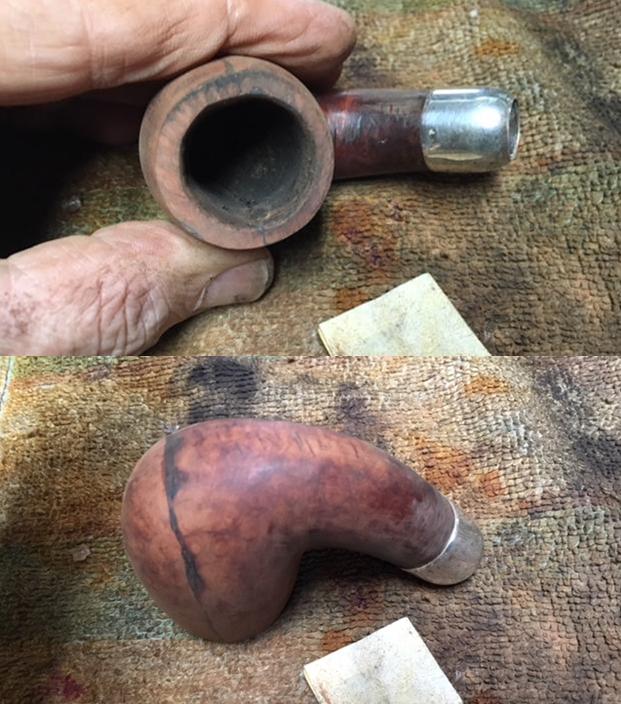
Oh my, he looks good!  The iconic Bulldog shape reminds one of the small, stout four-legged friend from whence this name comes.  This quarter bent Amphora X-tra 724-644 of Holland came out very well.  The dome ring repairs are invisible and the patch of patches on the lower left side of the bowl has blended well with the darker leather dye.  The briar grain is nice.  The straight grain seems to pour out over the Bulldog’s dome and is joined by bird’s eye grain bubbling like foam on a frosted mug – the dome is eye catching and pulls one’s attention to the pipe.  This Amphora X-tra is ready for a new steward!  Taylor saw the potential of this Bulldog when he commissioned it for his friend’s wedding gift (see For ‘Pipe Dreamers’ Only).  He will have first dibs on it when it goes into The Pipe Steward Store.  This pipe along with the other 2 that Taylor commissioned and acquired benefit the Daughters of Bulgaria – women and girls who have been trafficked and sexually exploited.  Thank you for joining me!