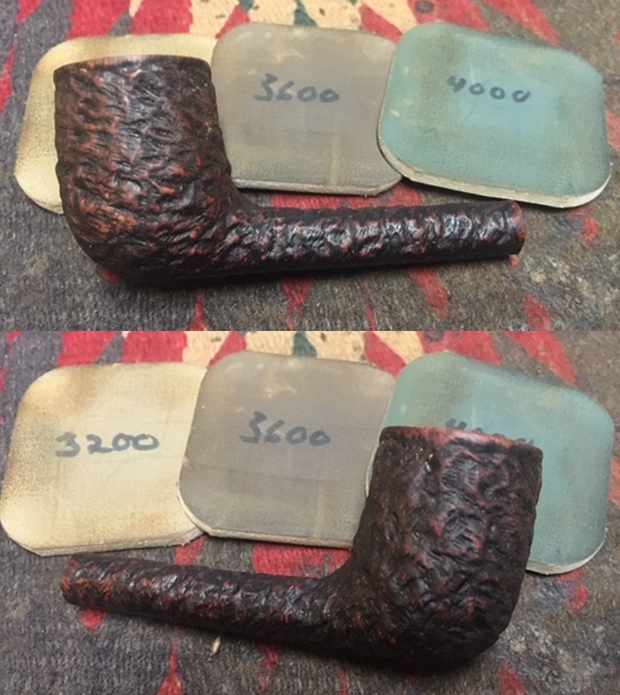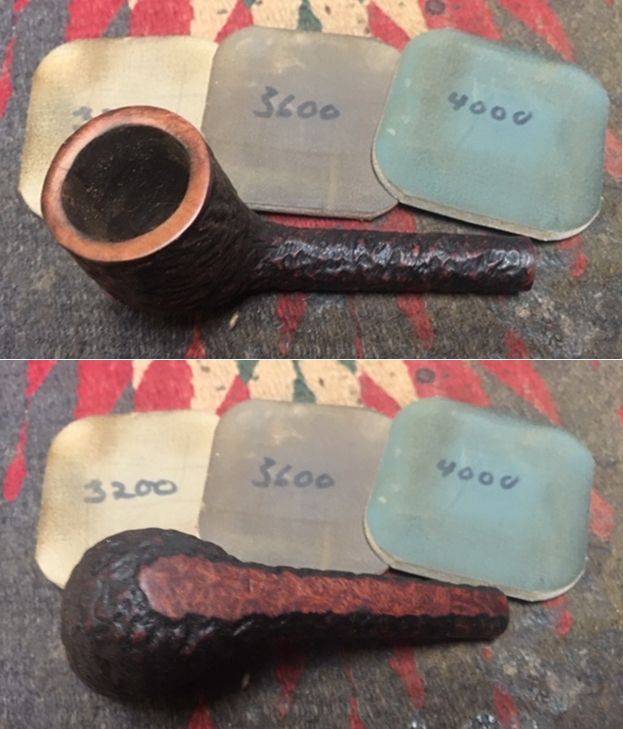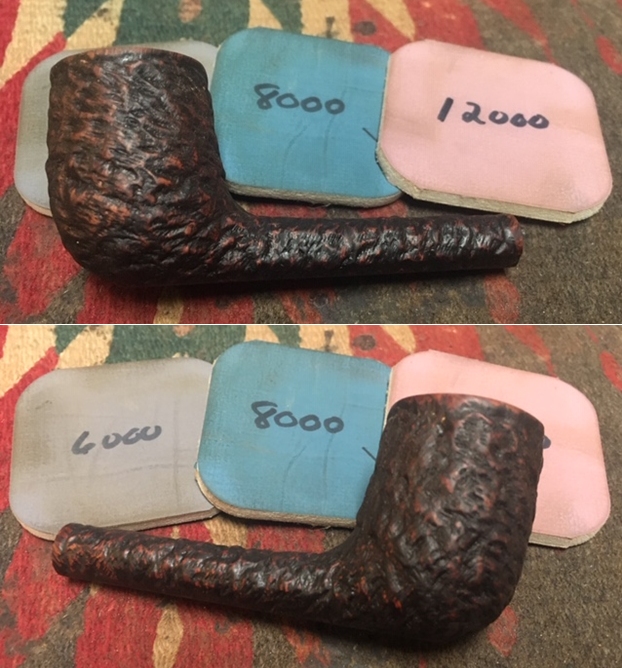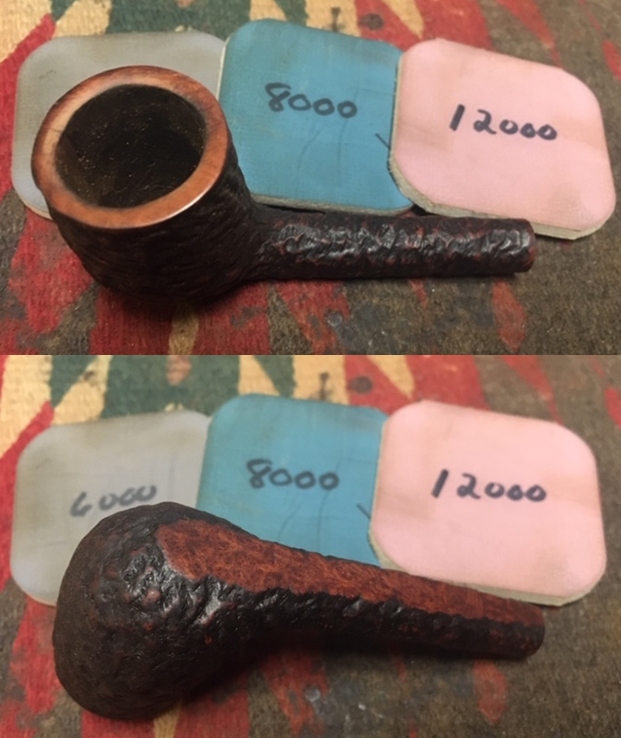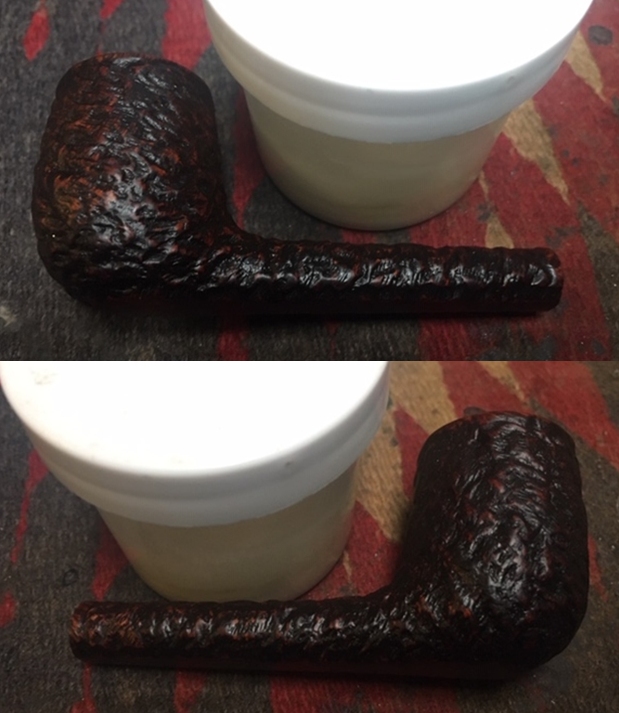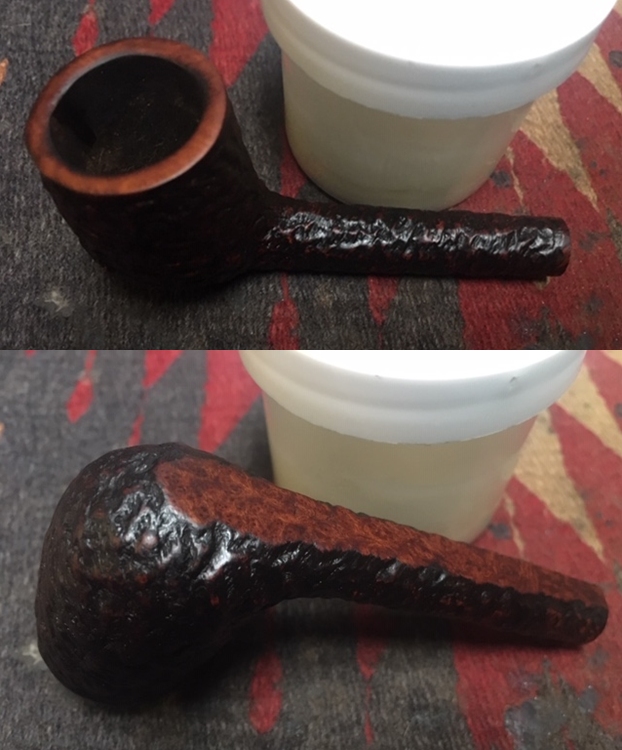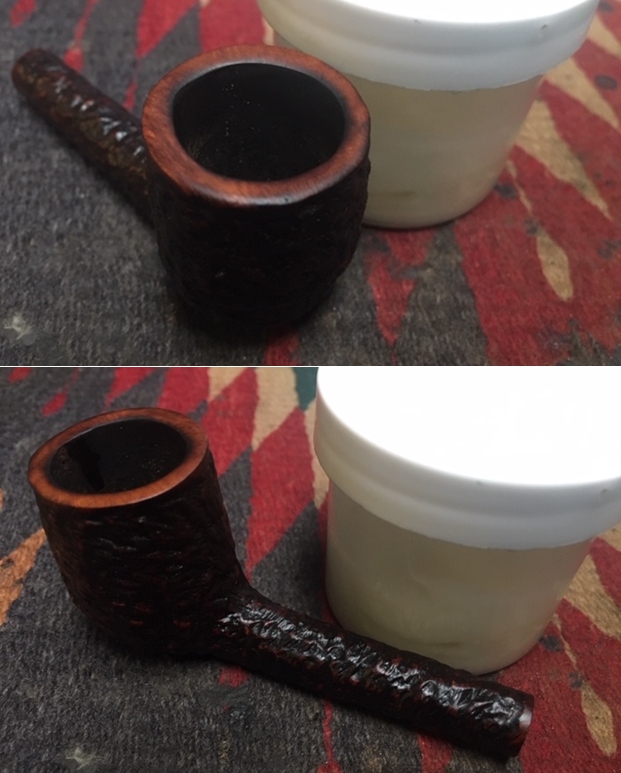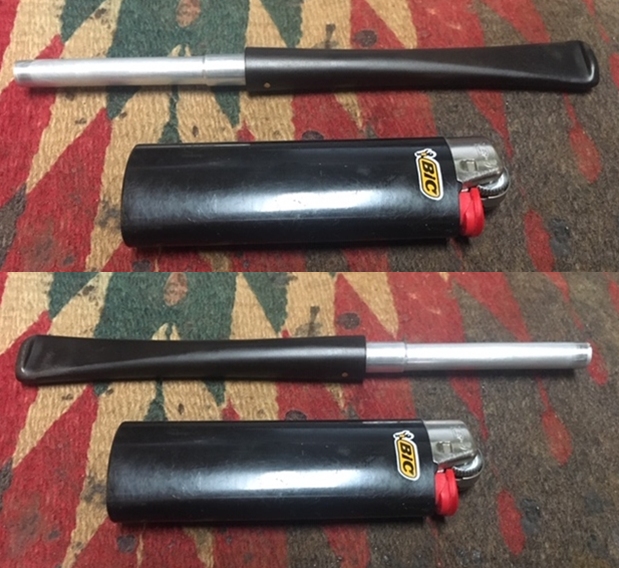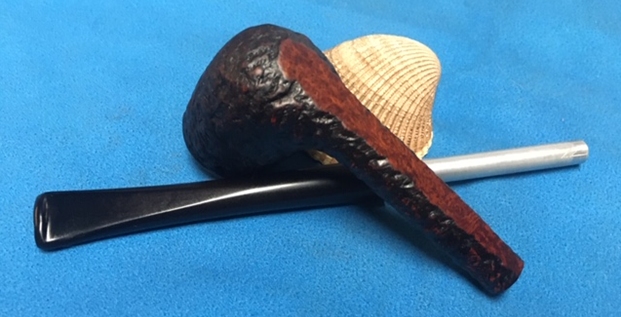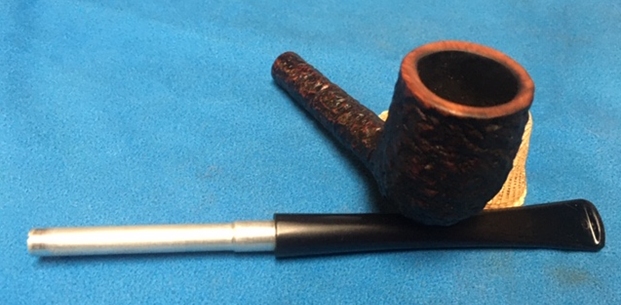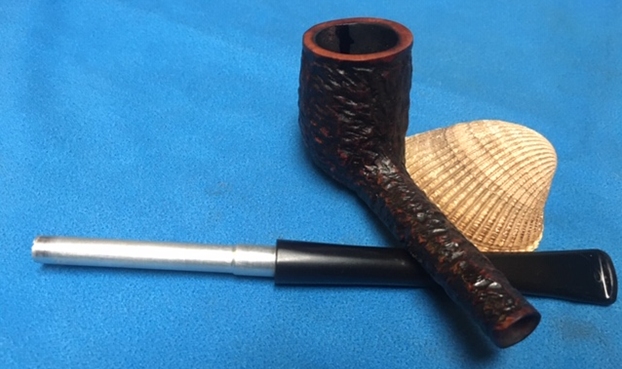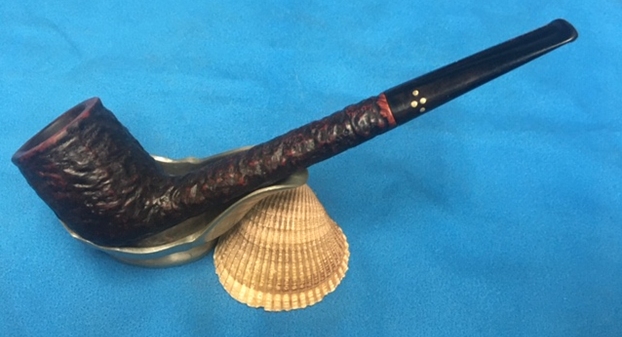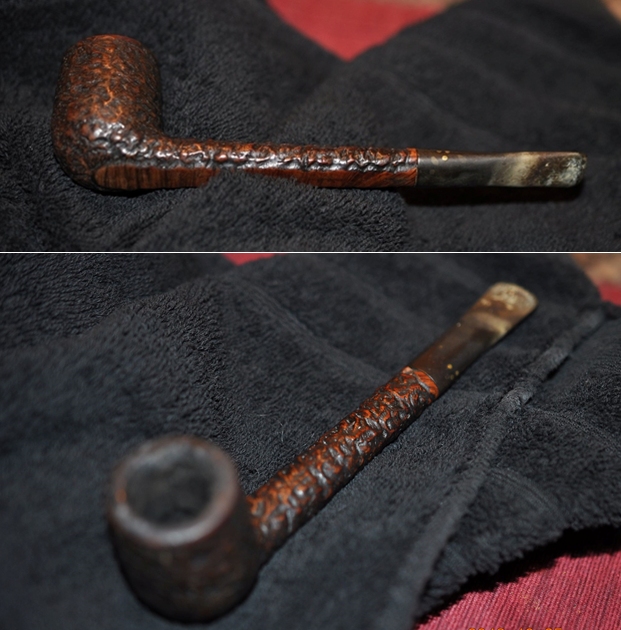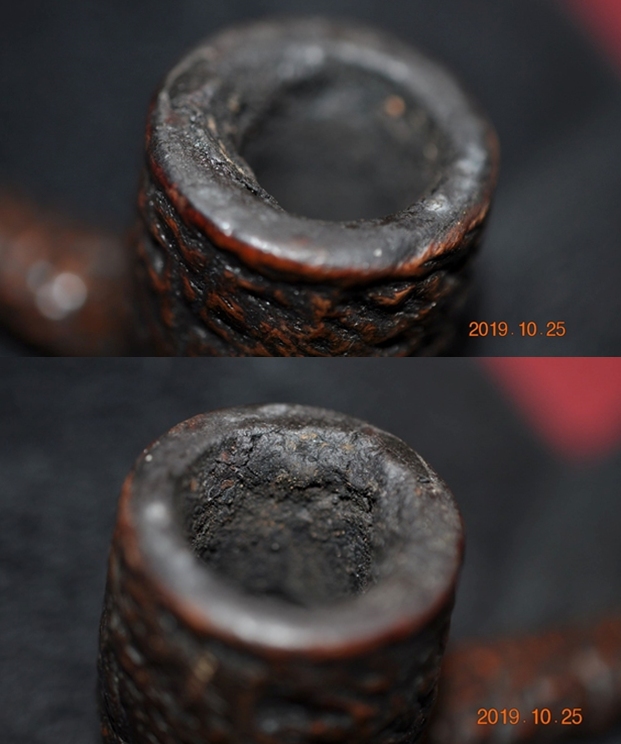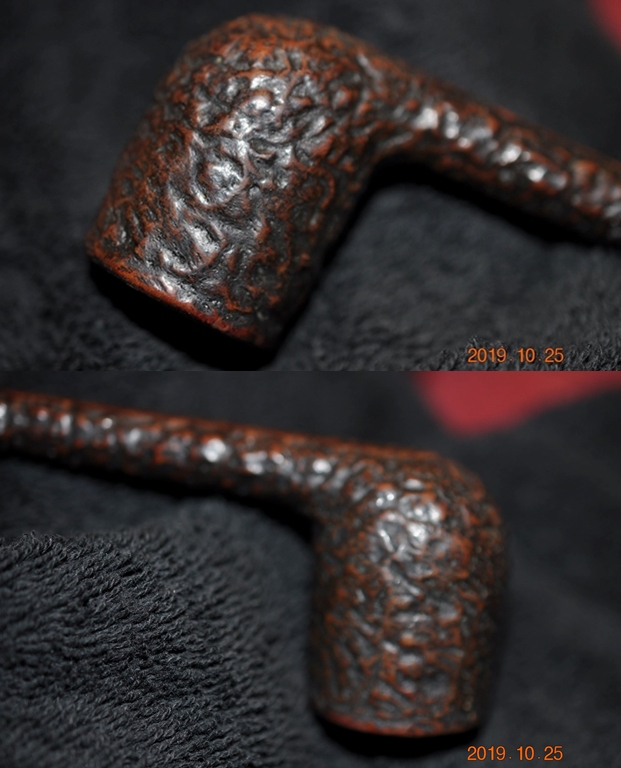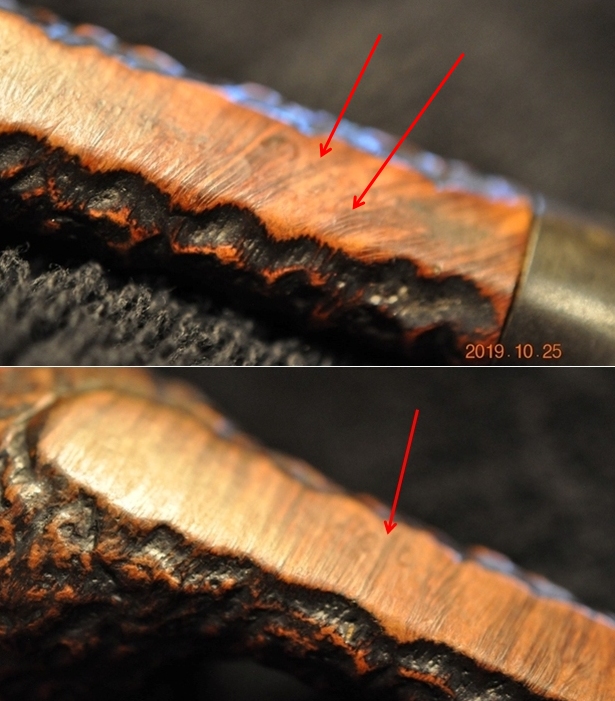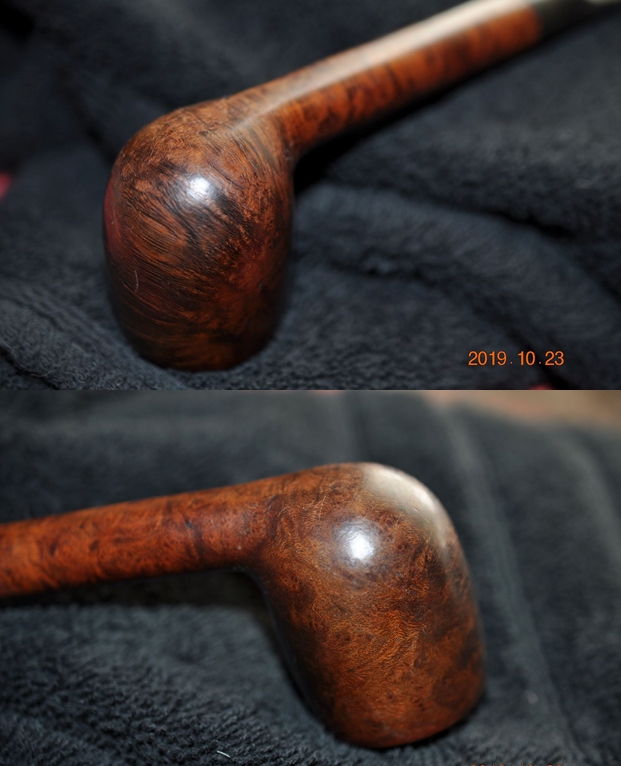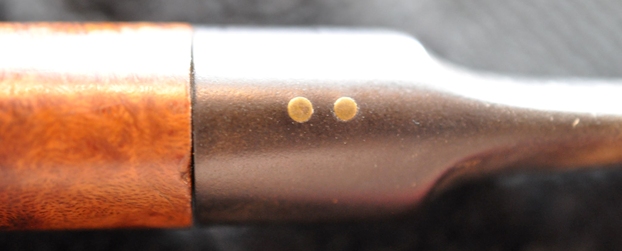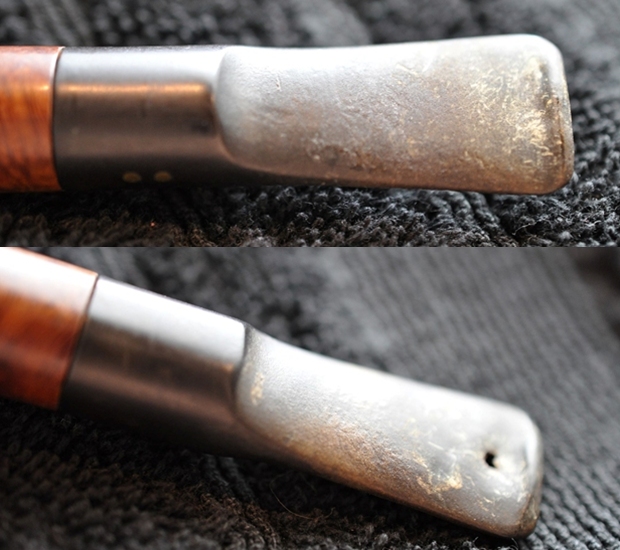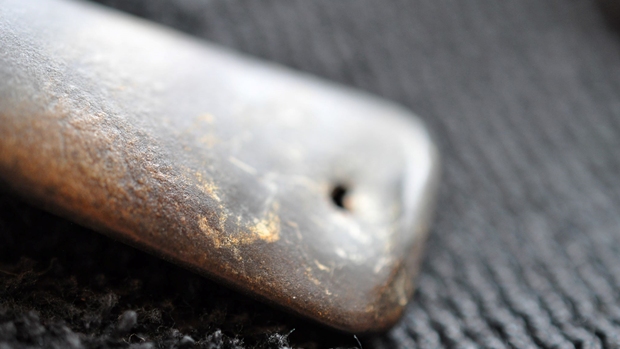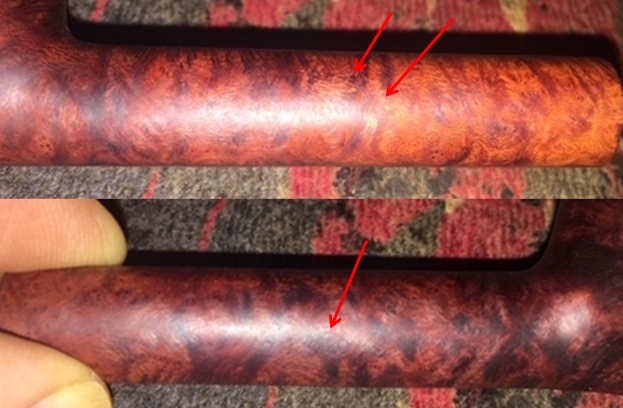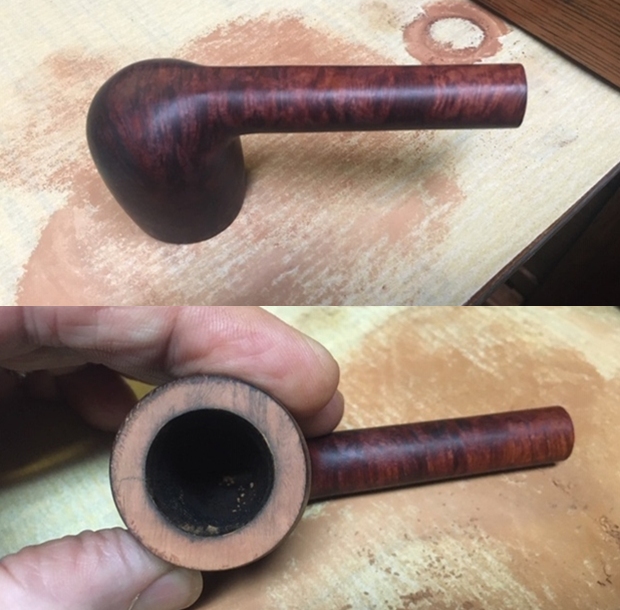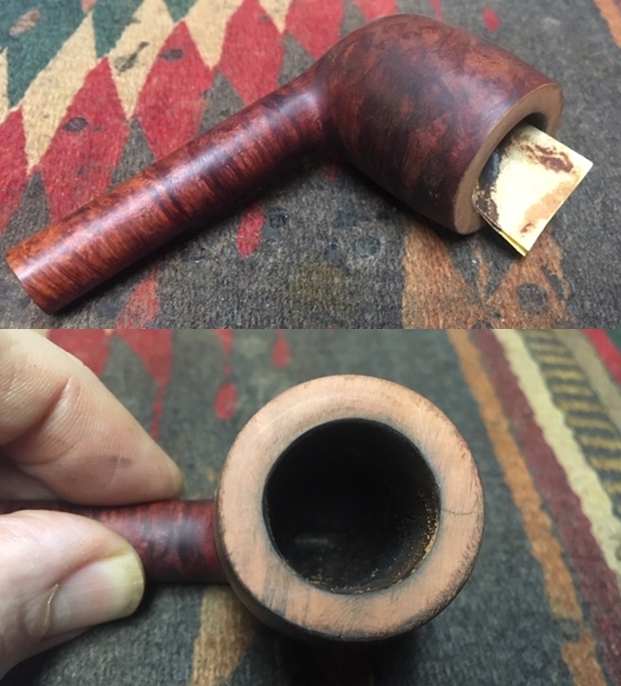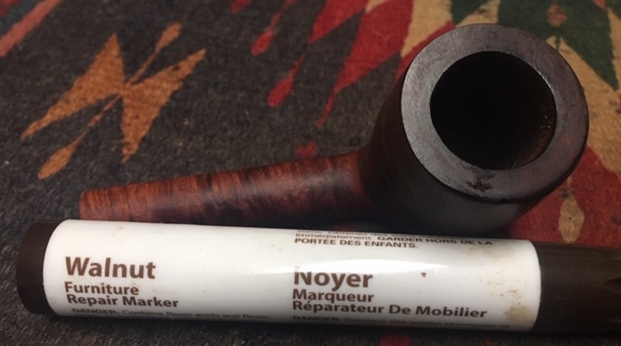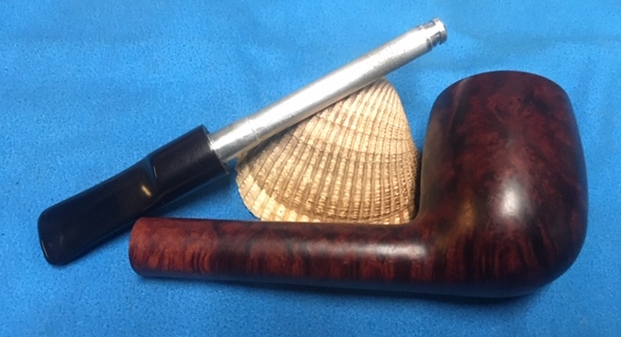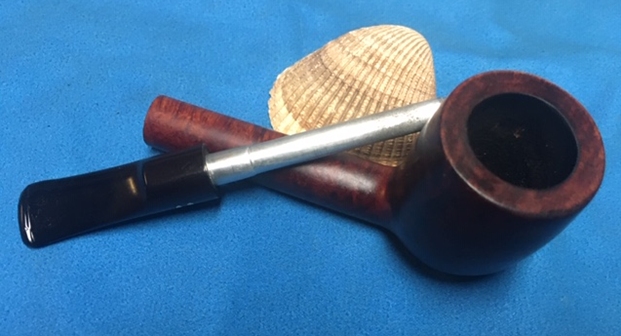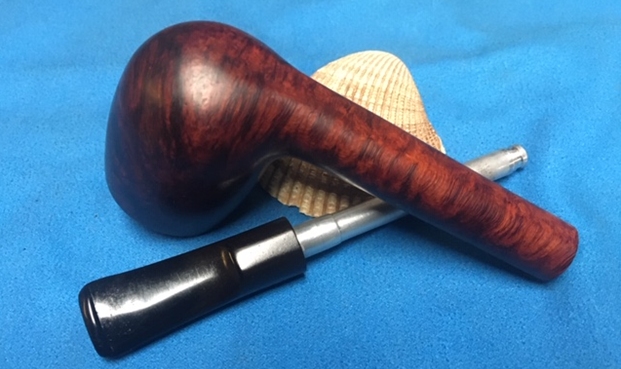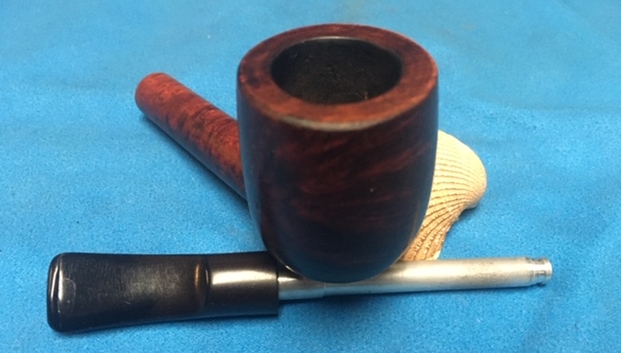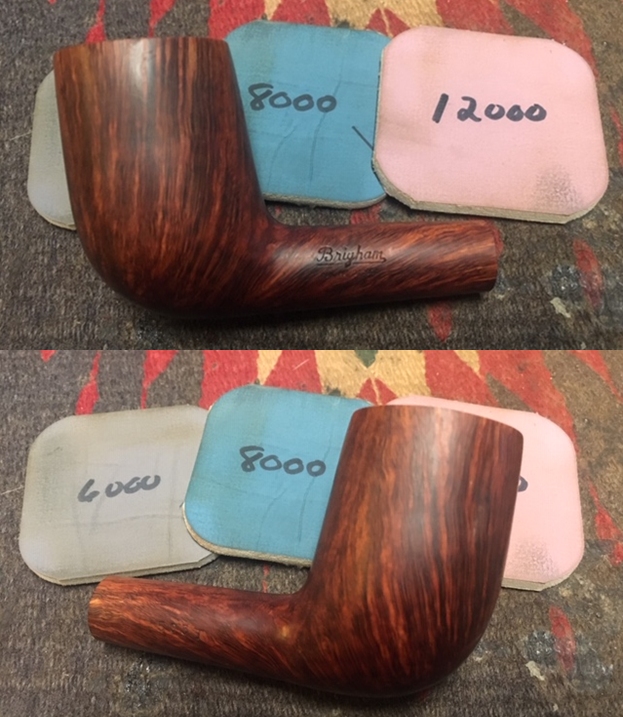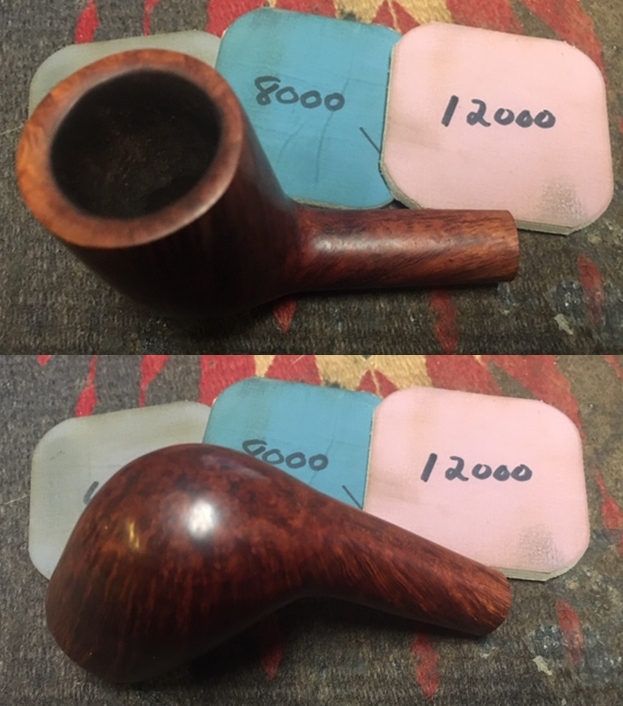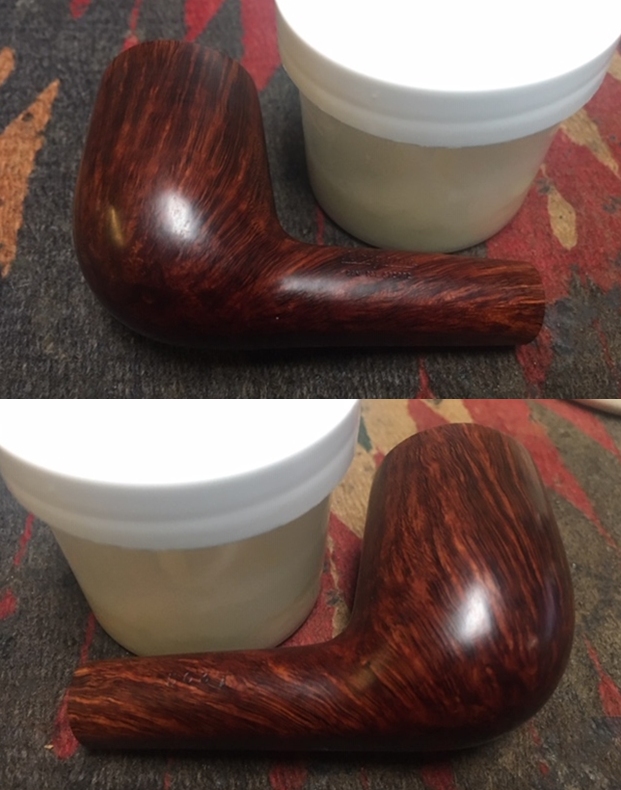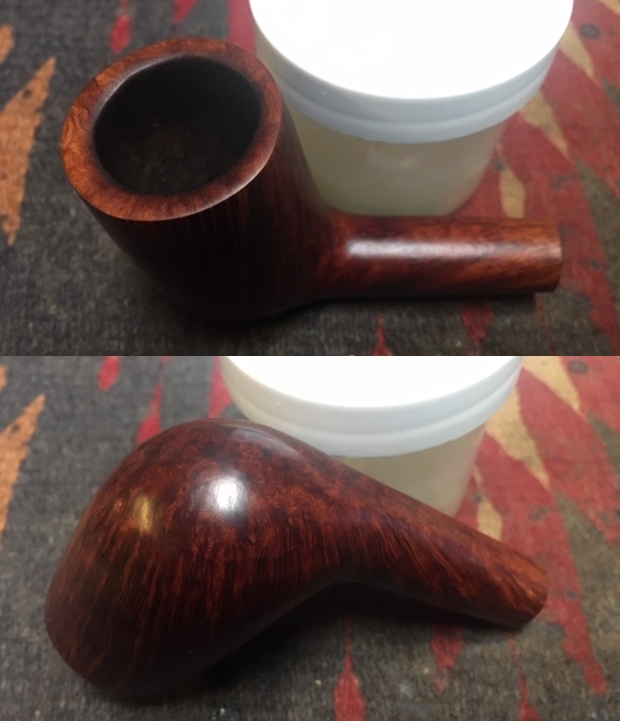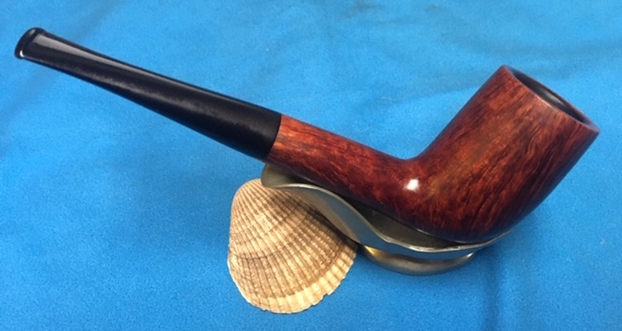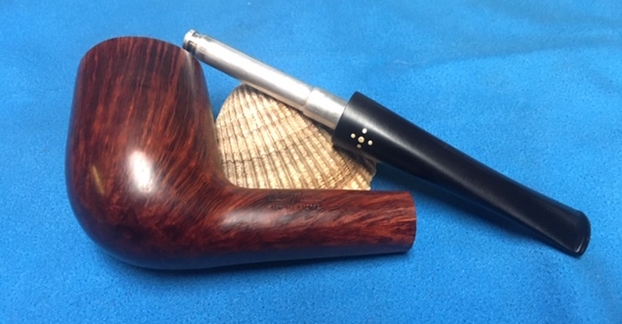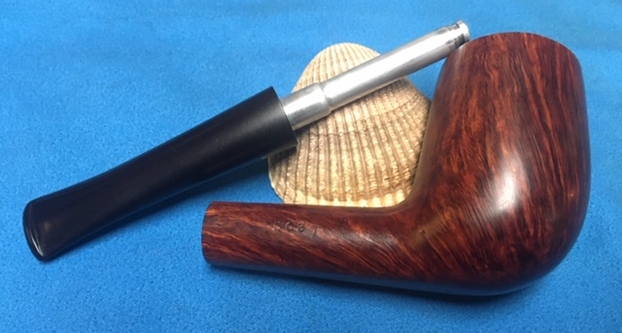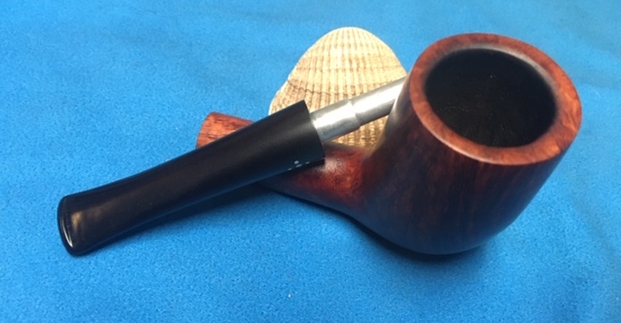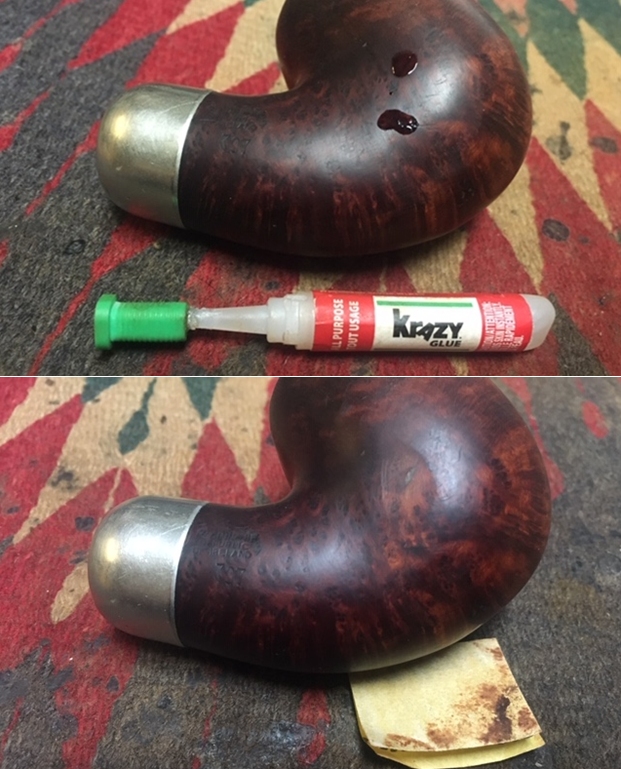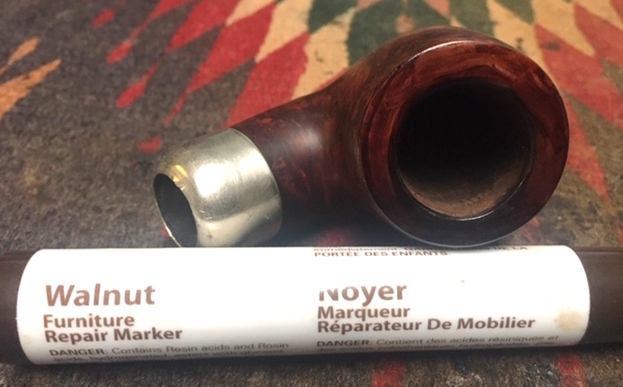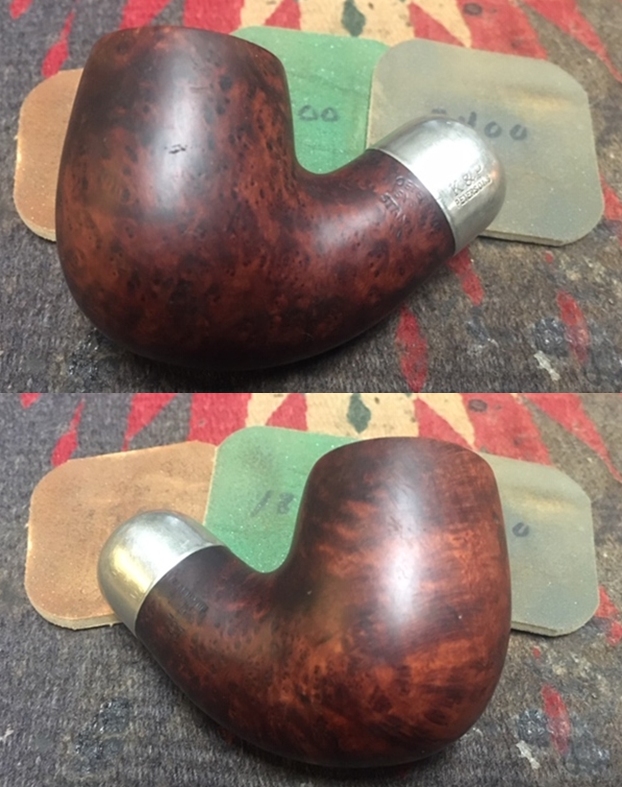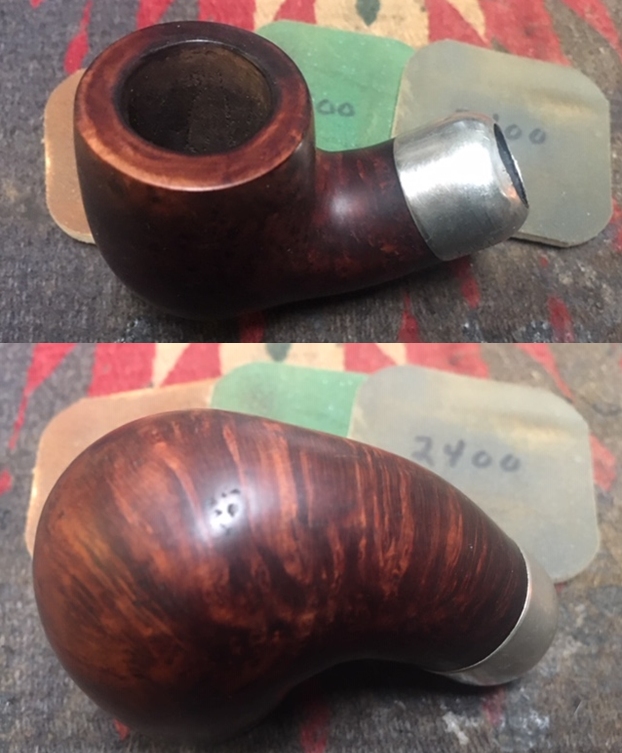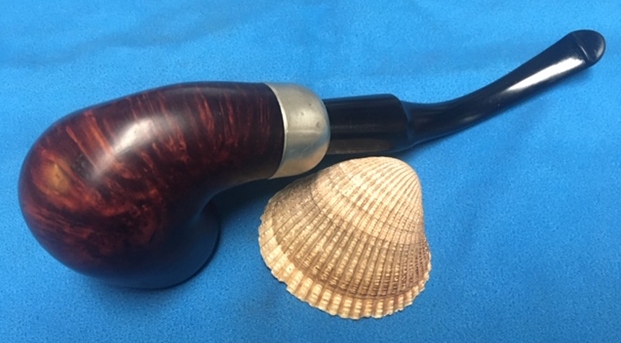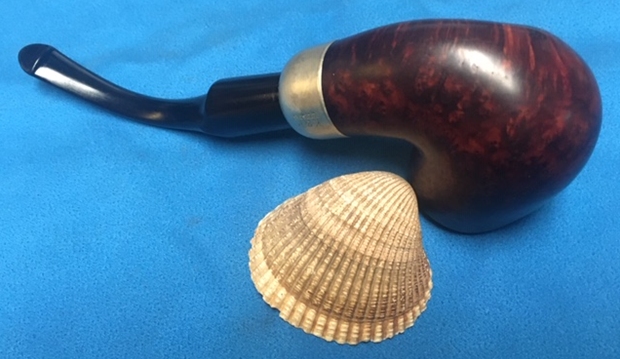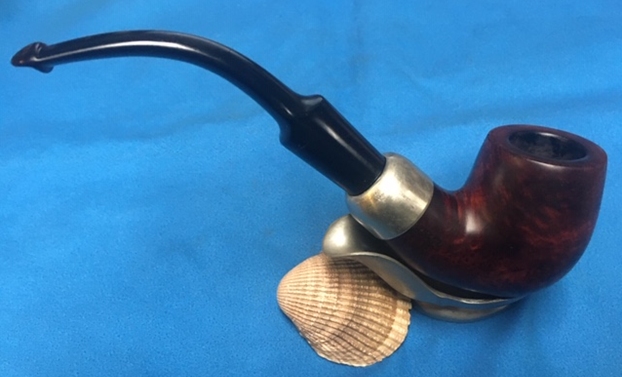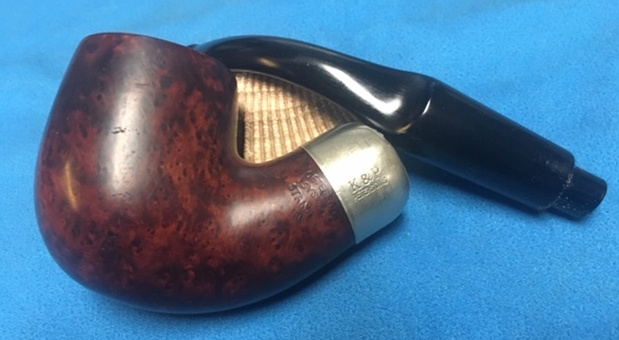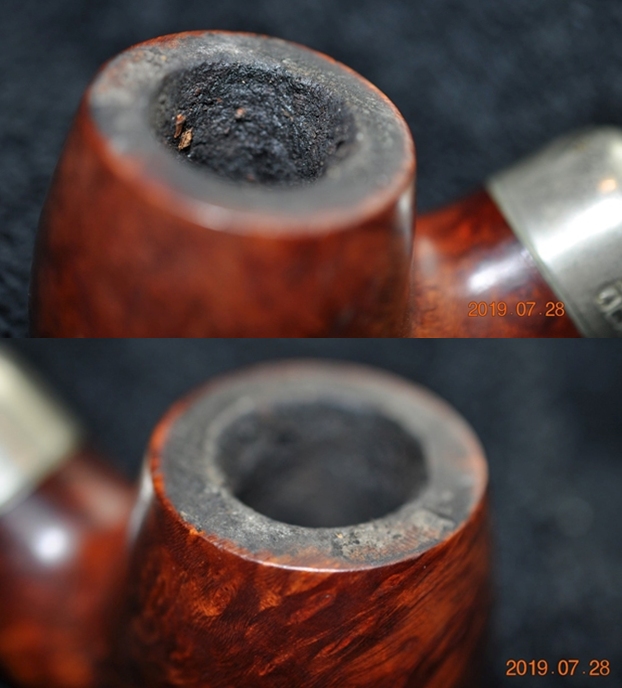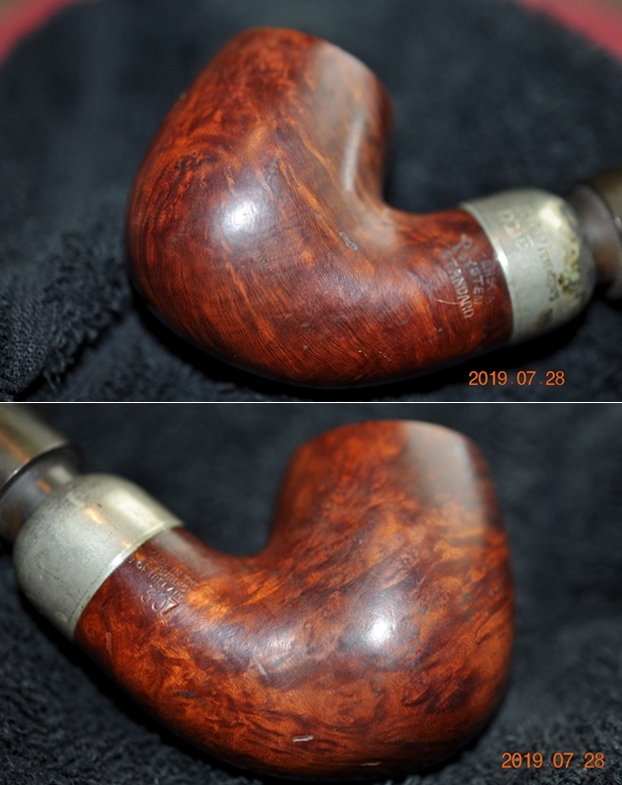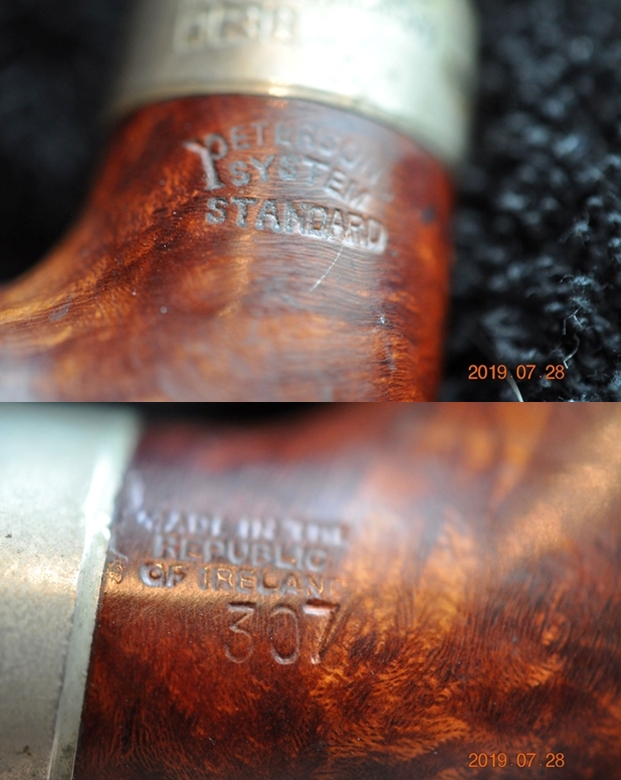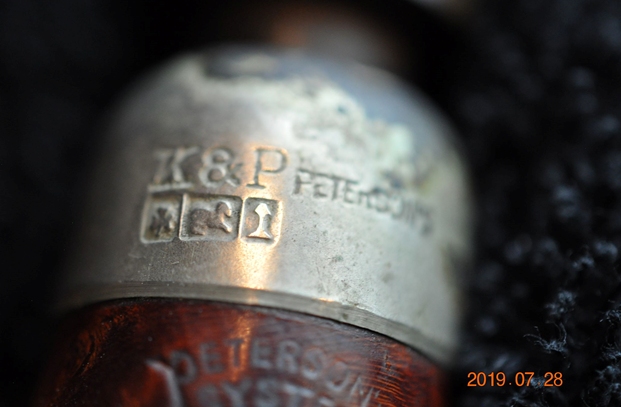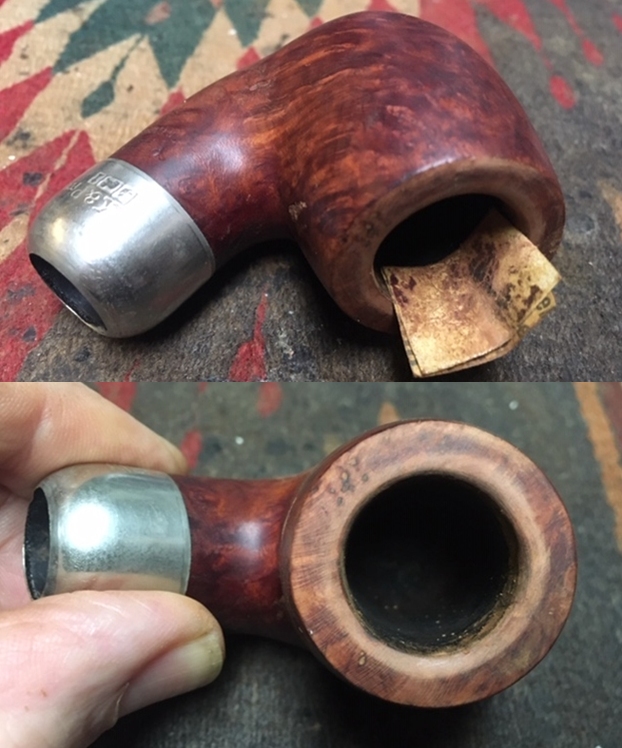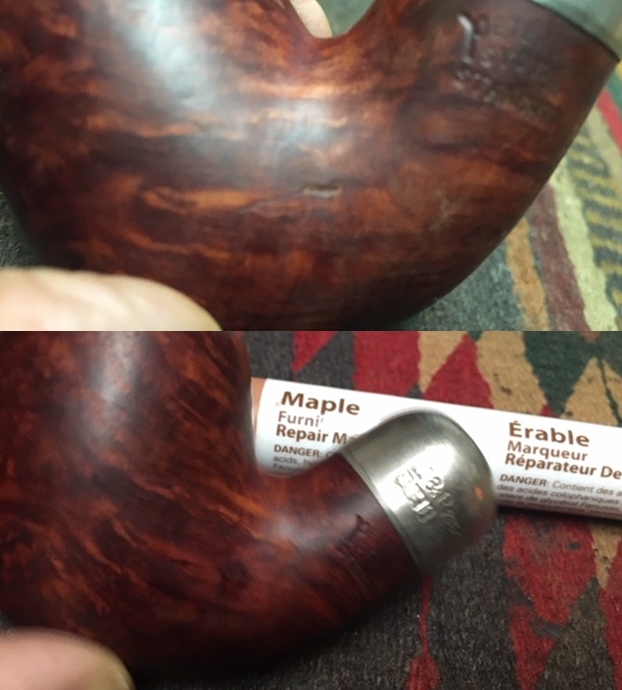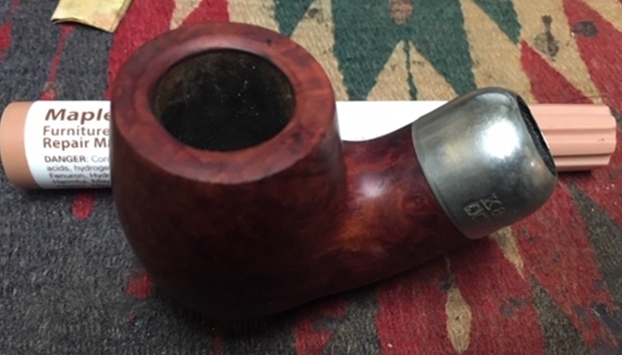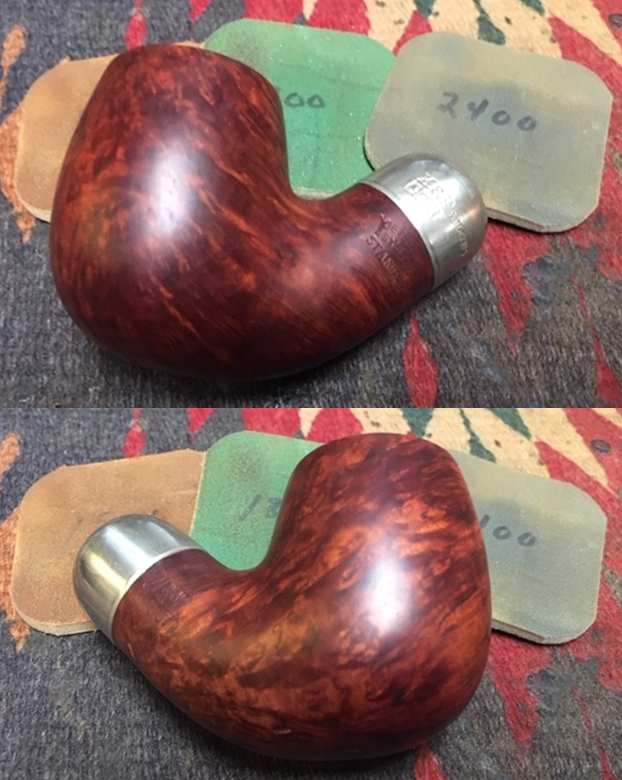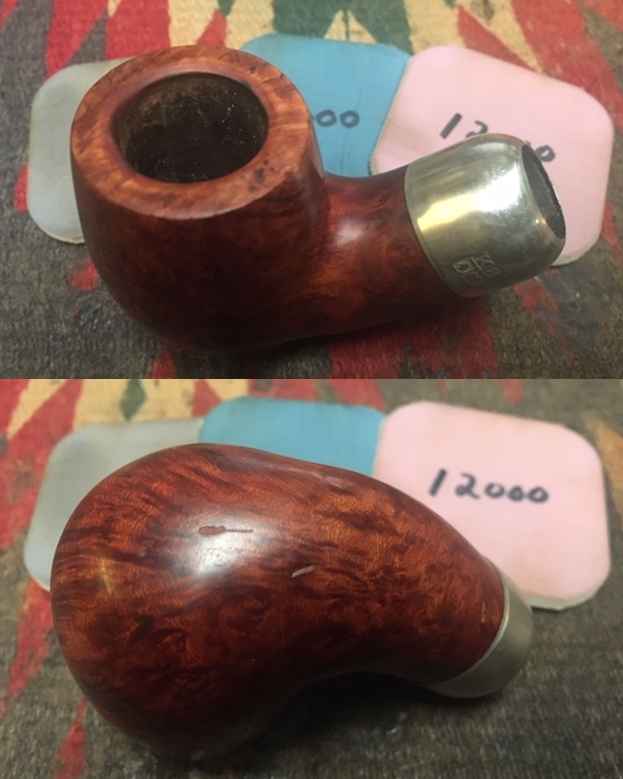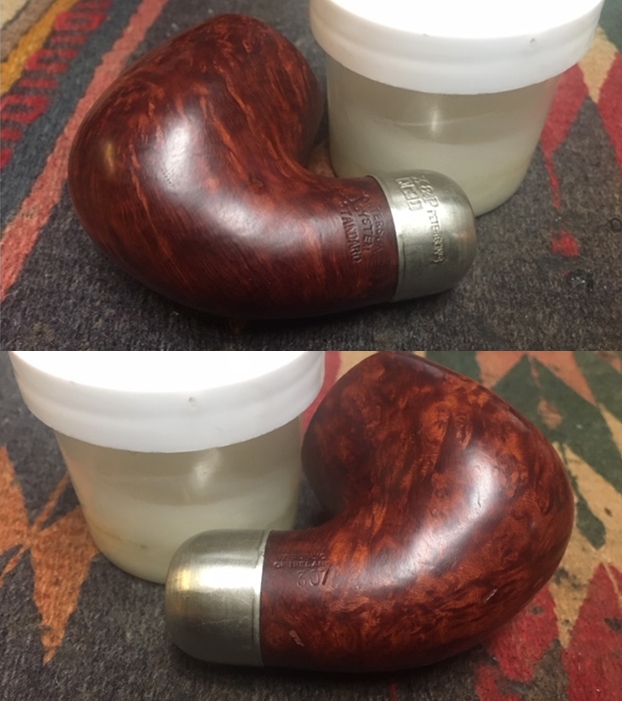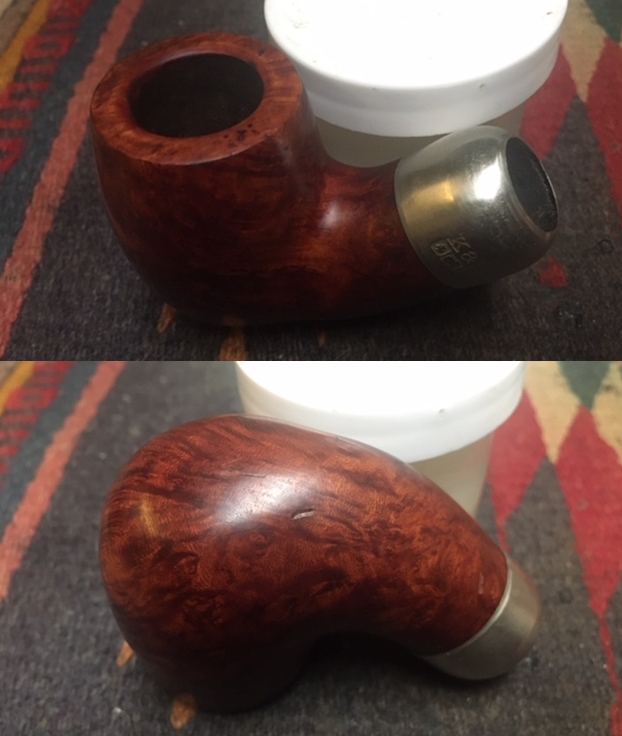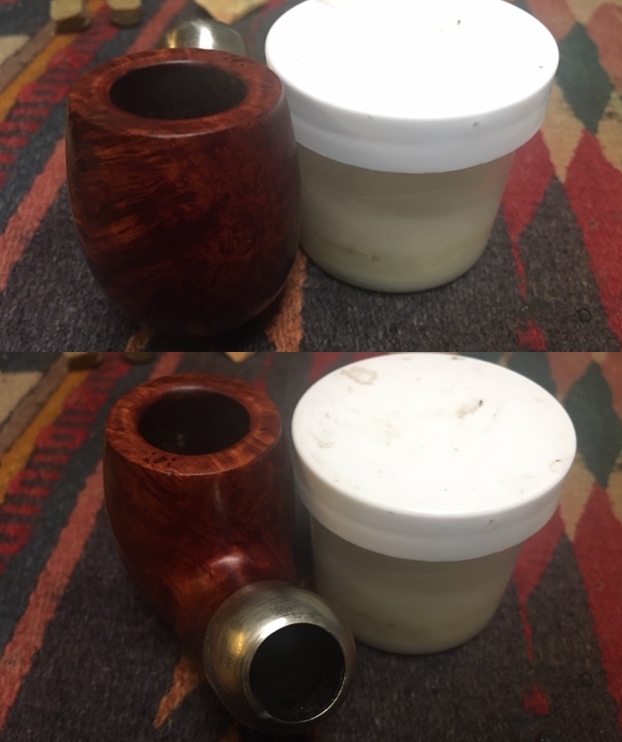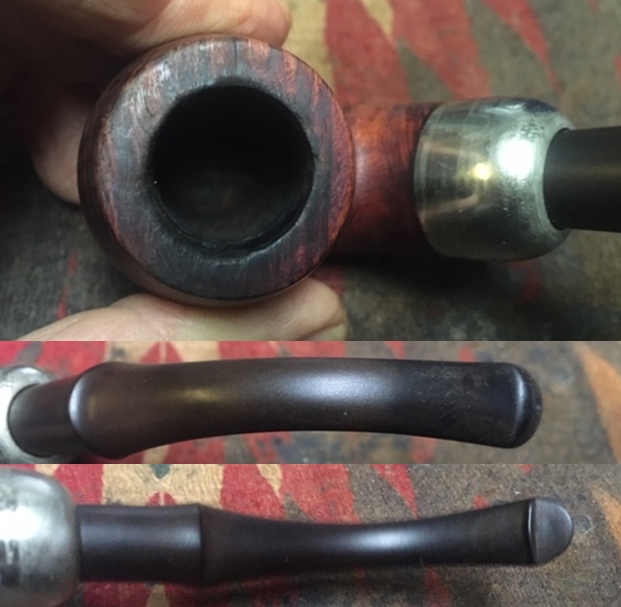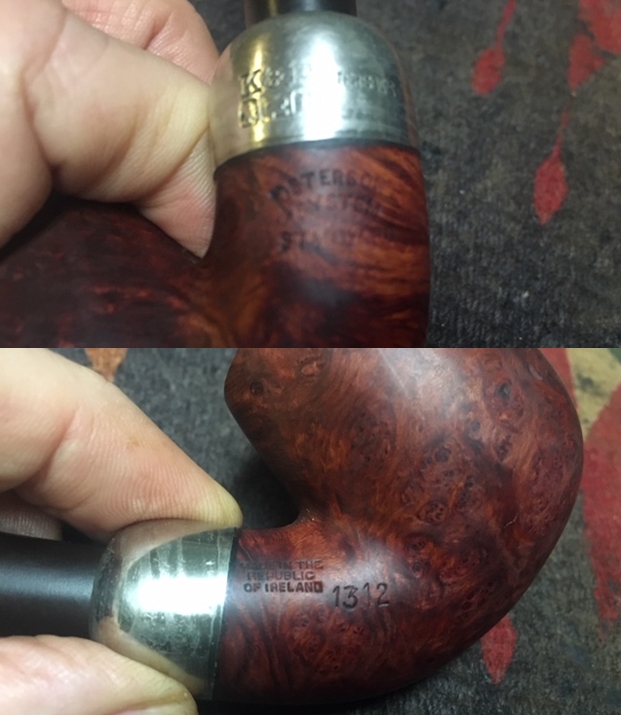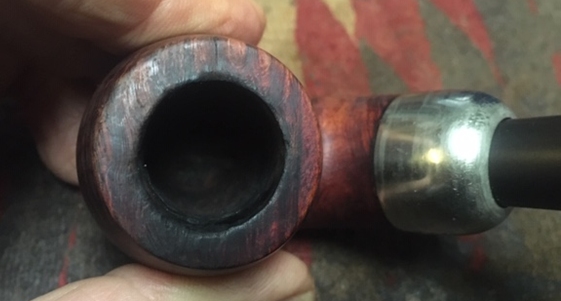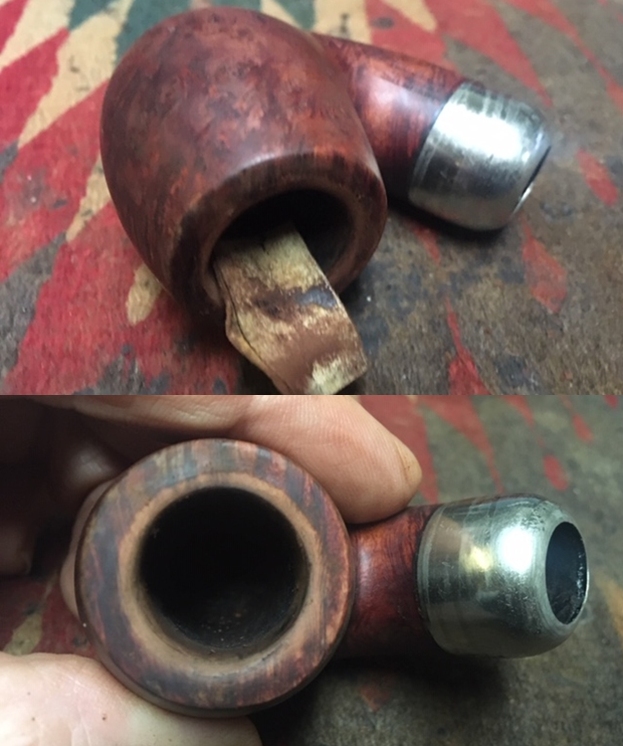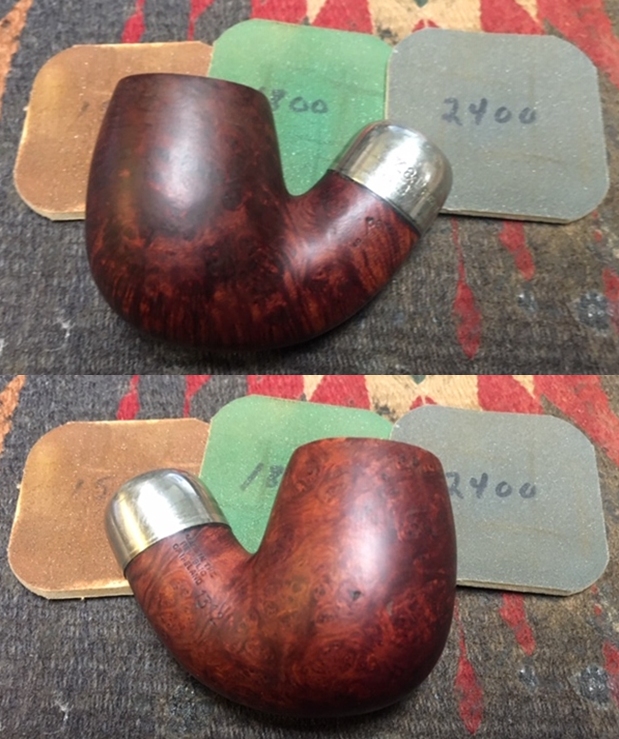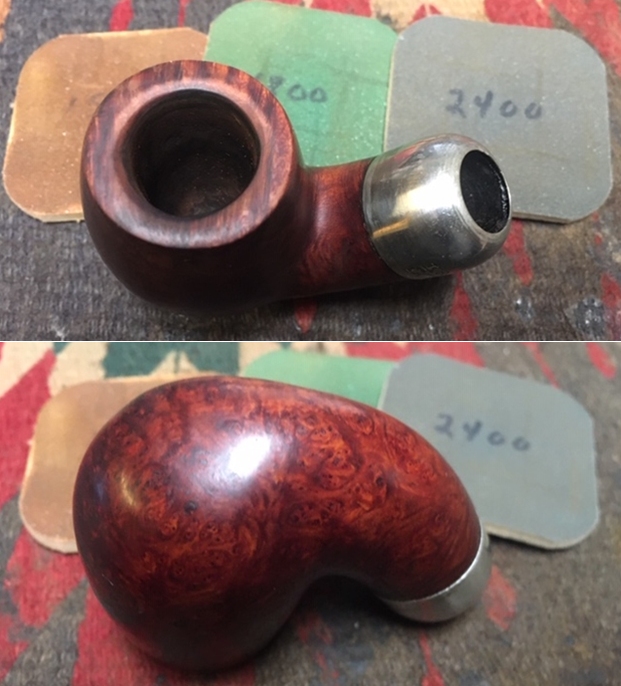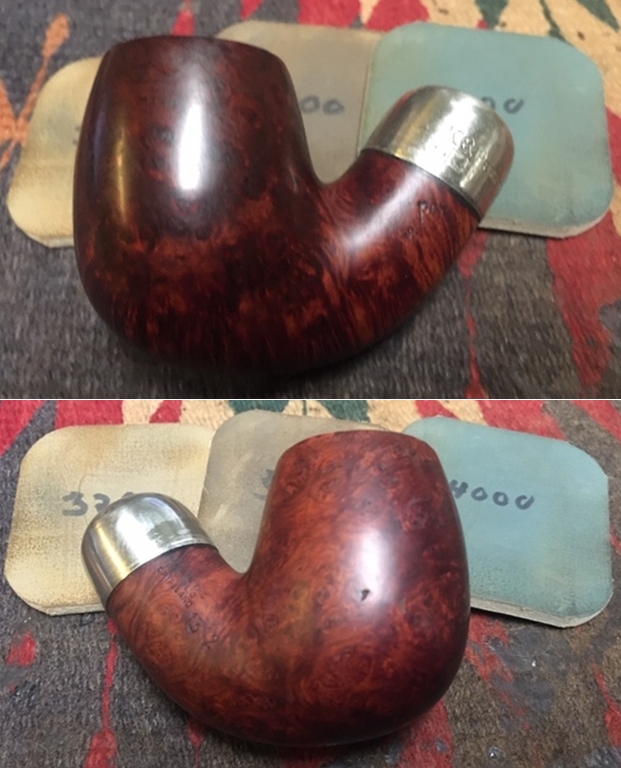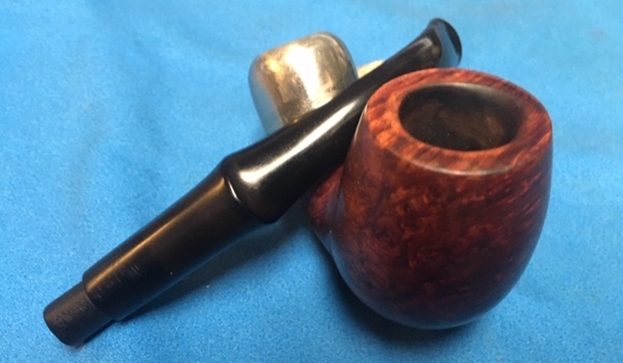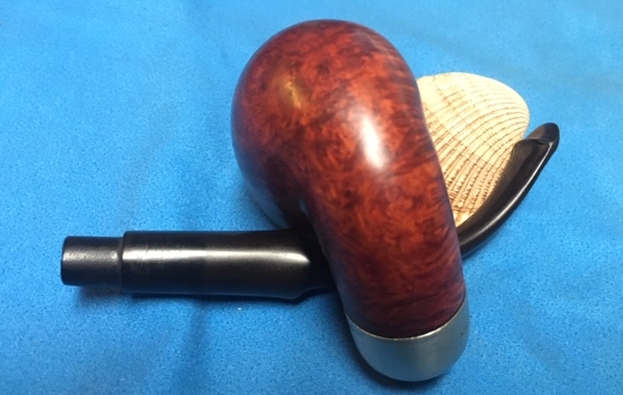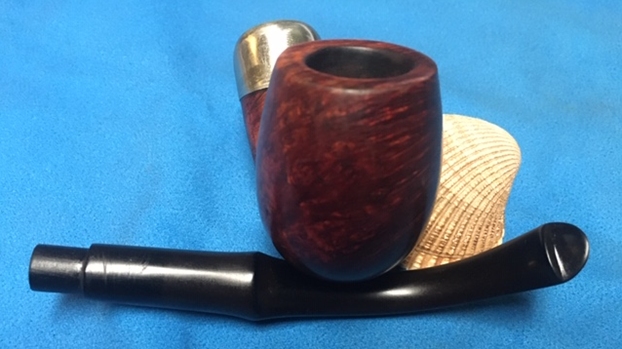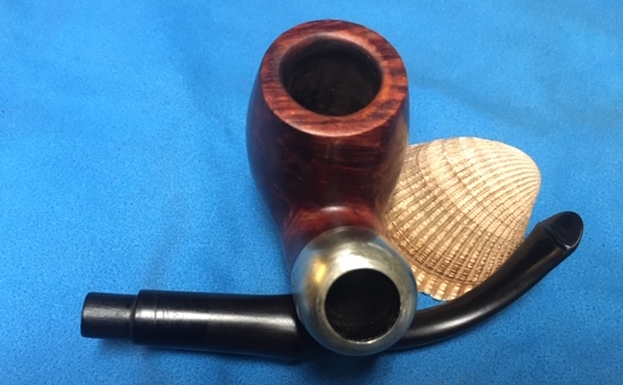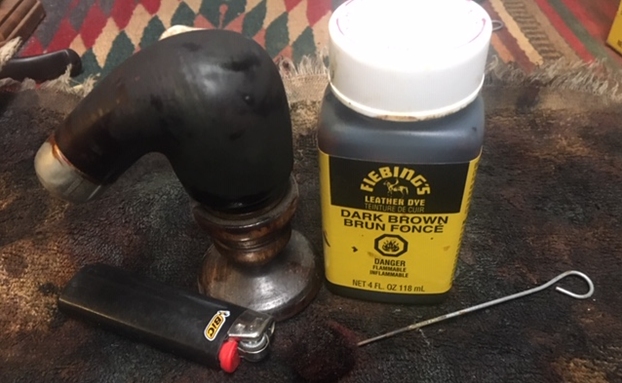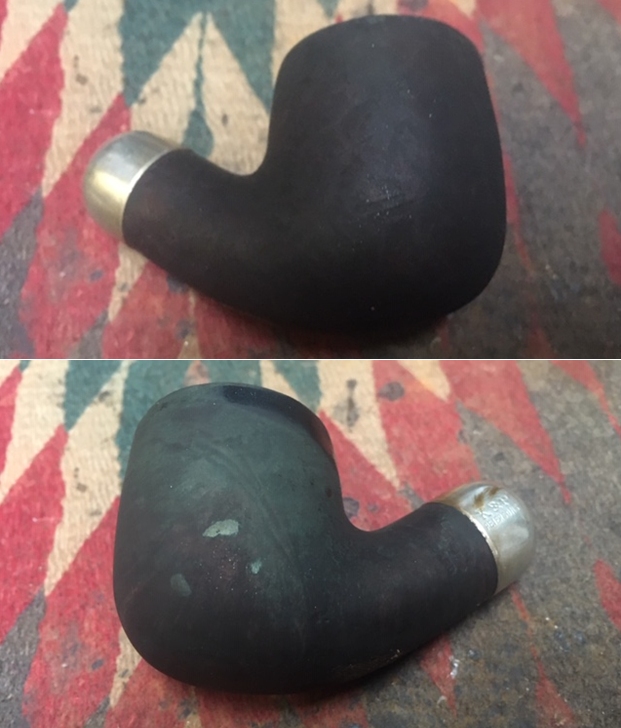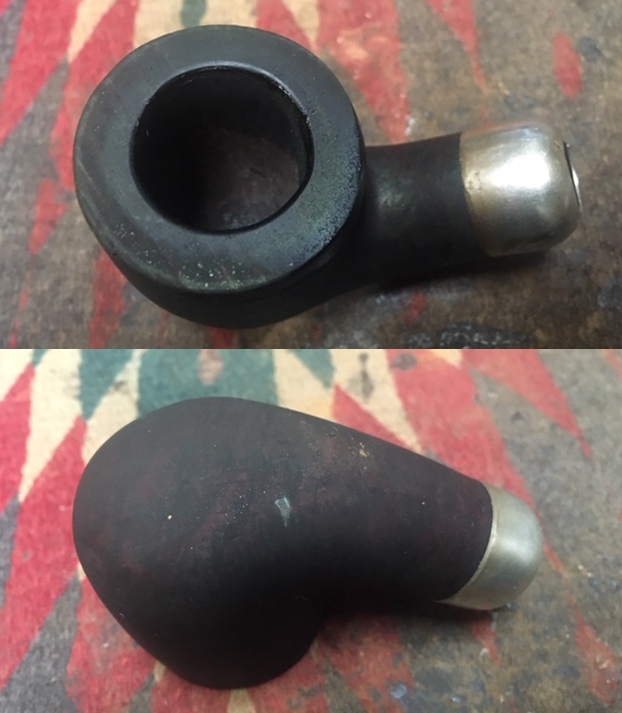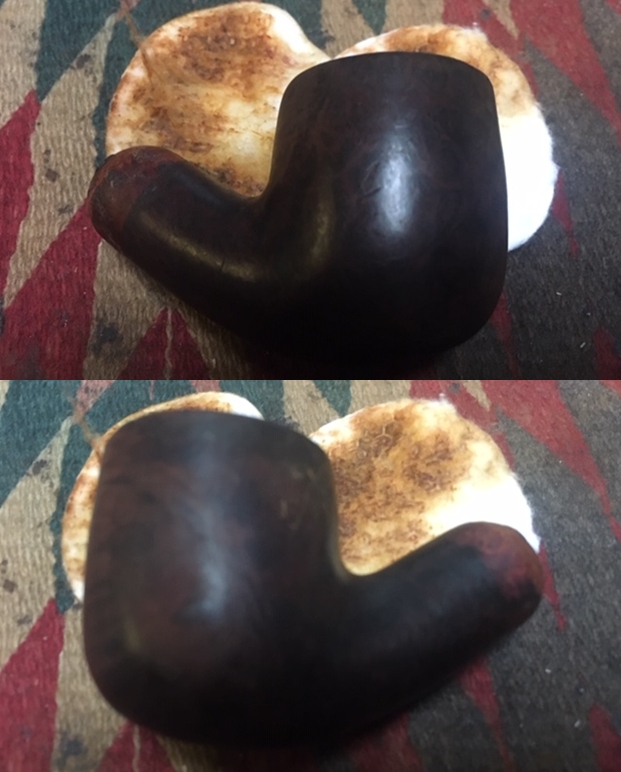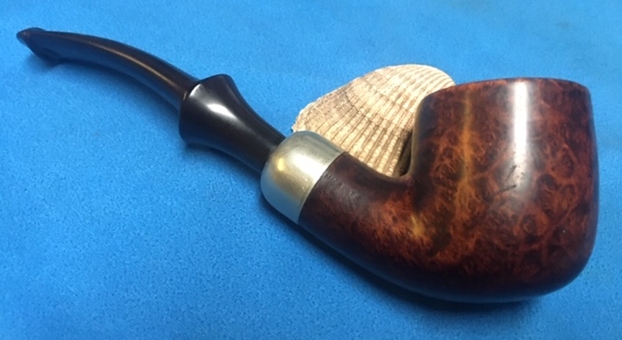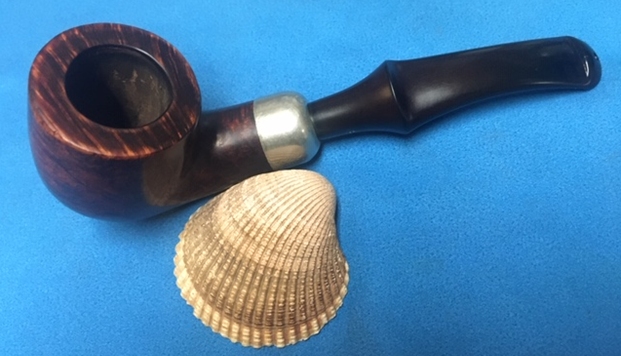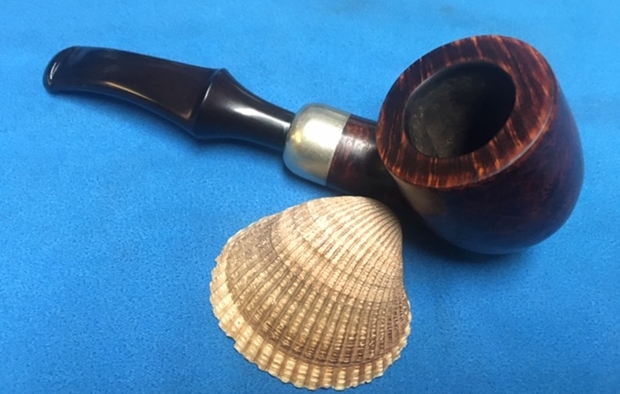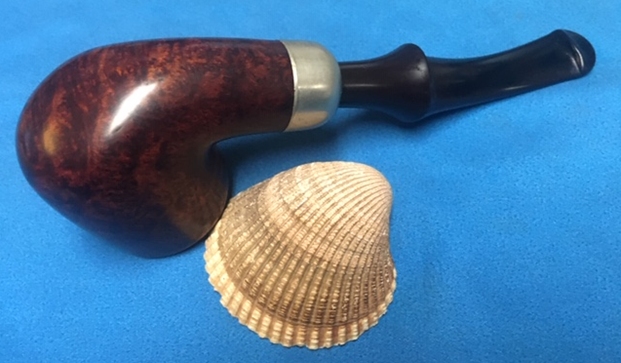
Tag Archives: Bowl – refinishing

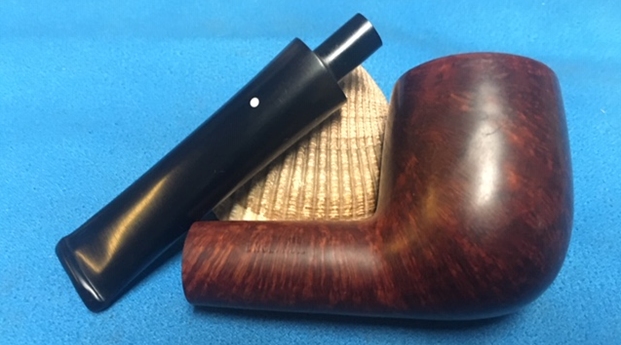
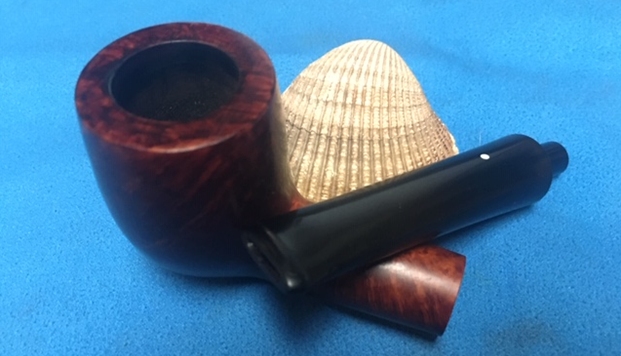
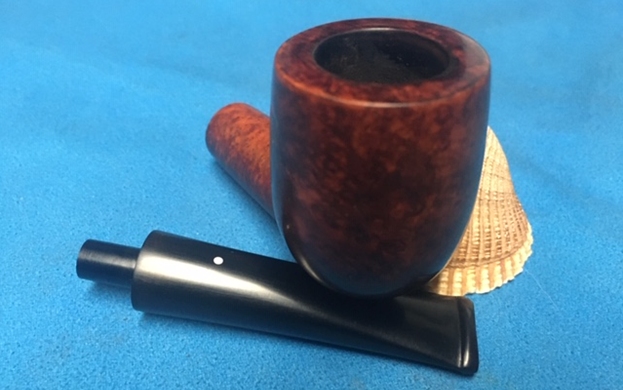
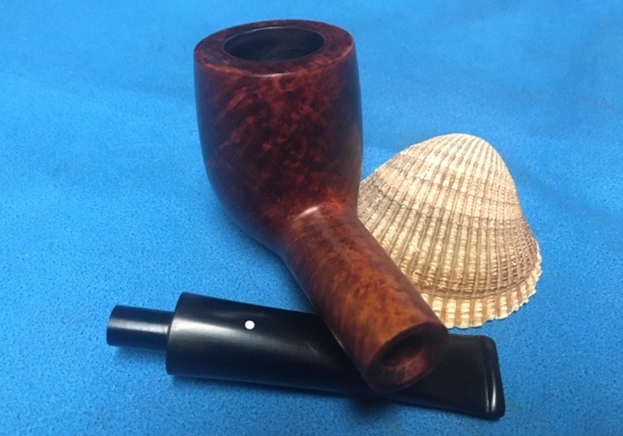
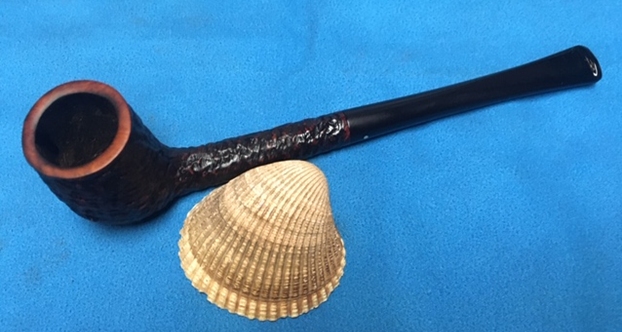
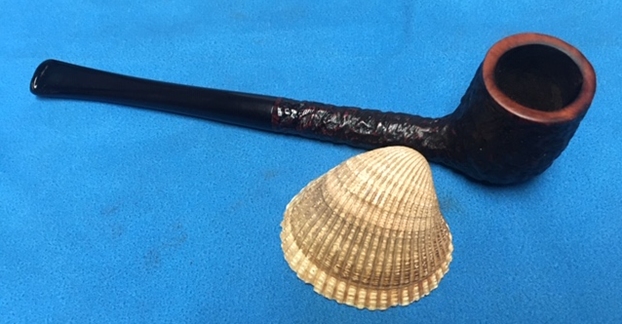
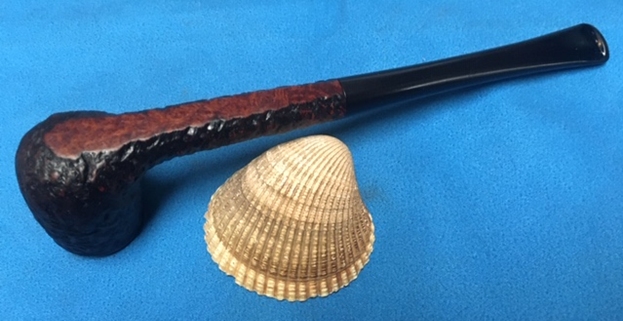
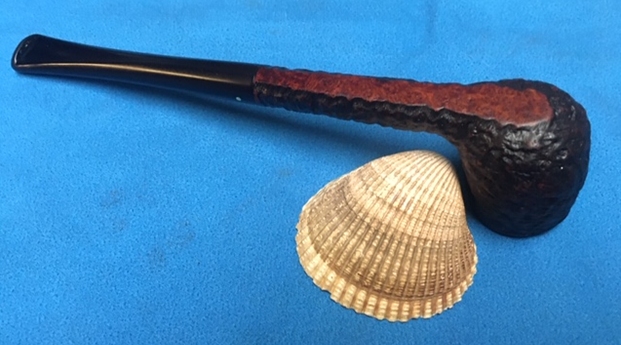
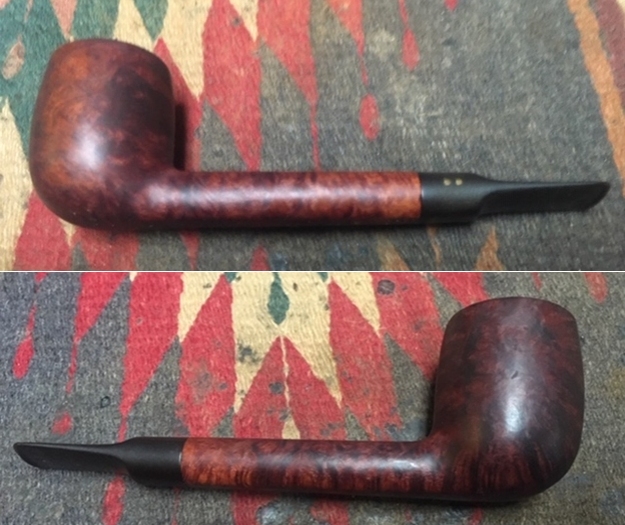
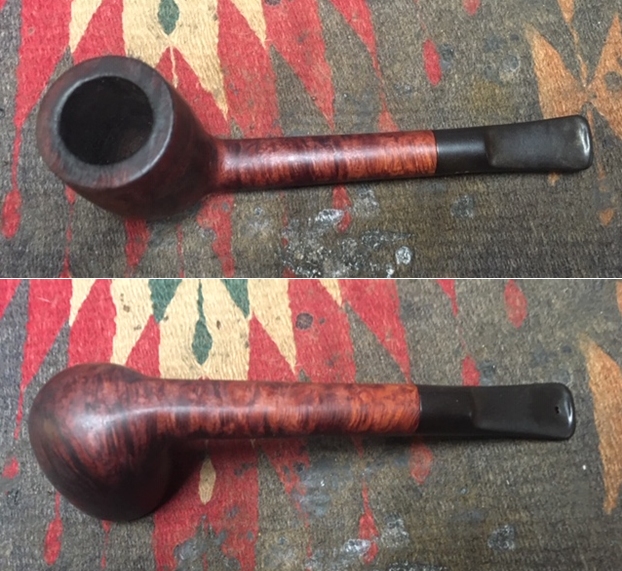
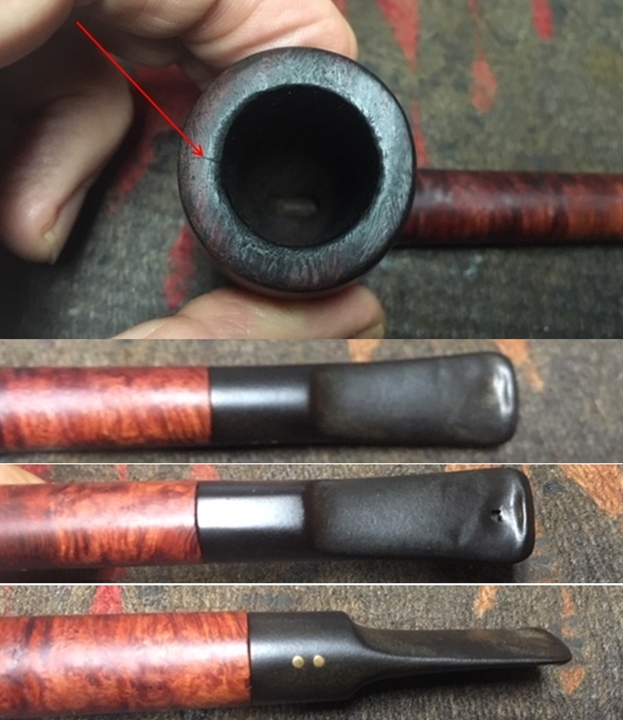
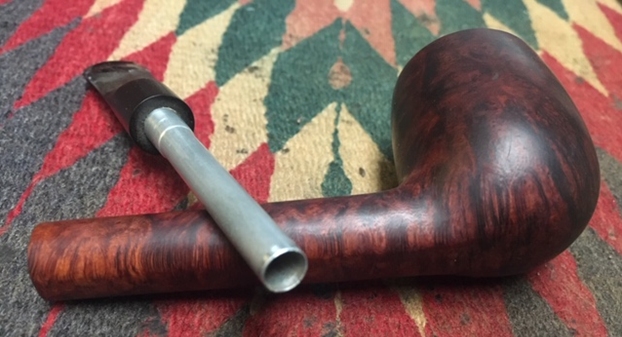
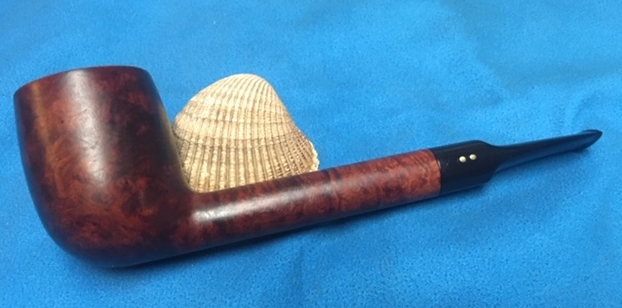
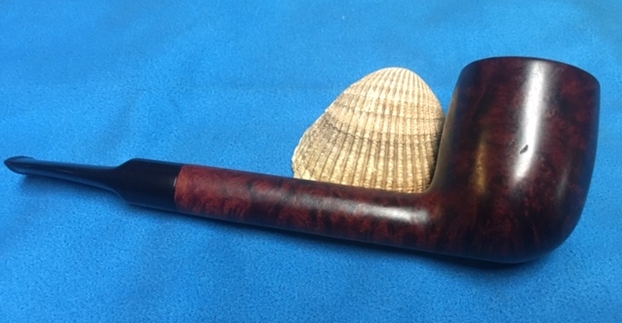
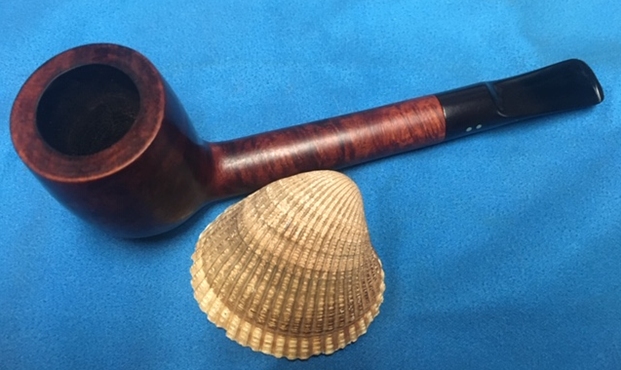
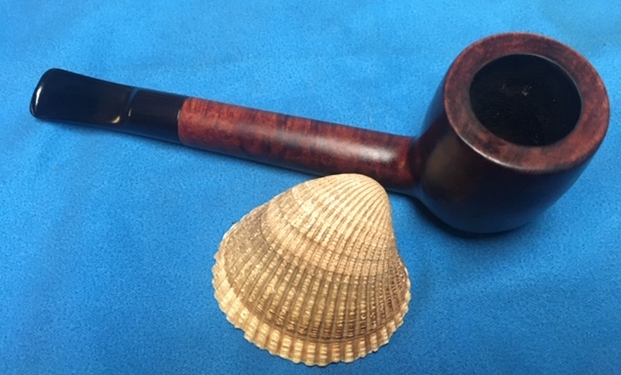
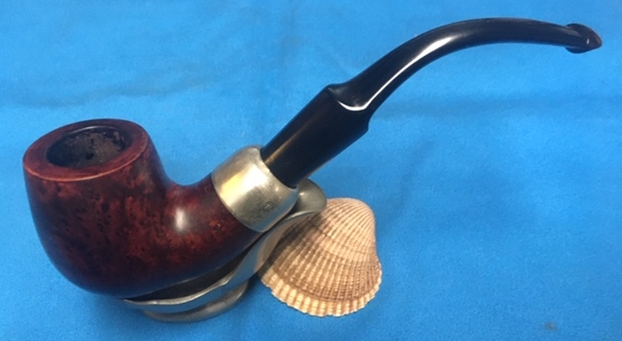
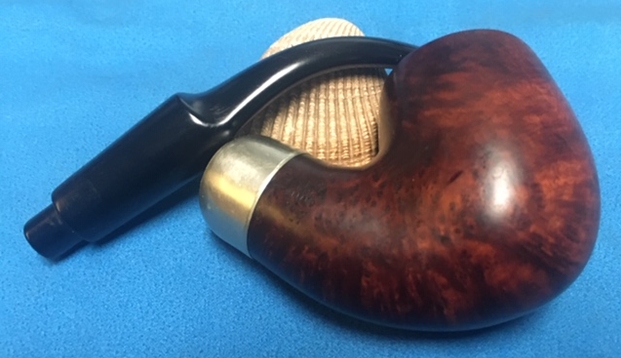
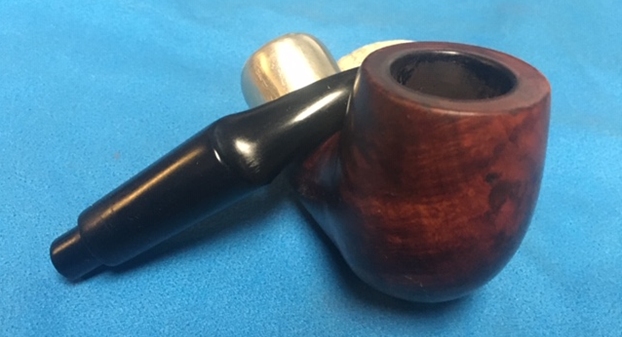
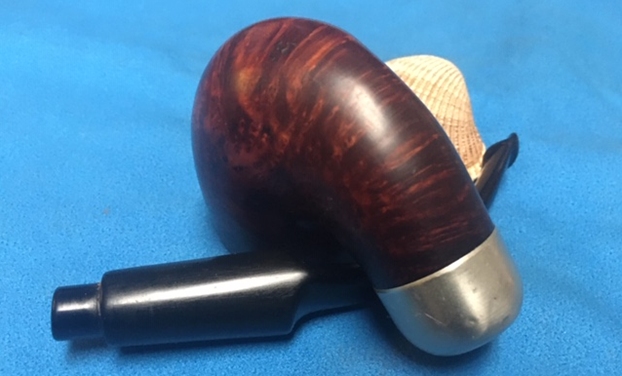
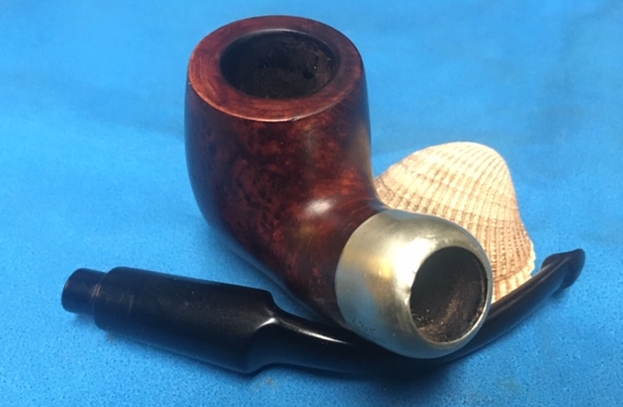
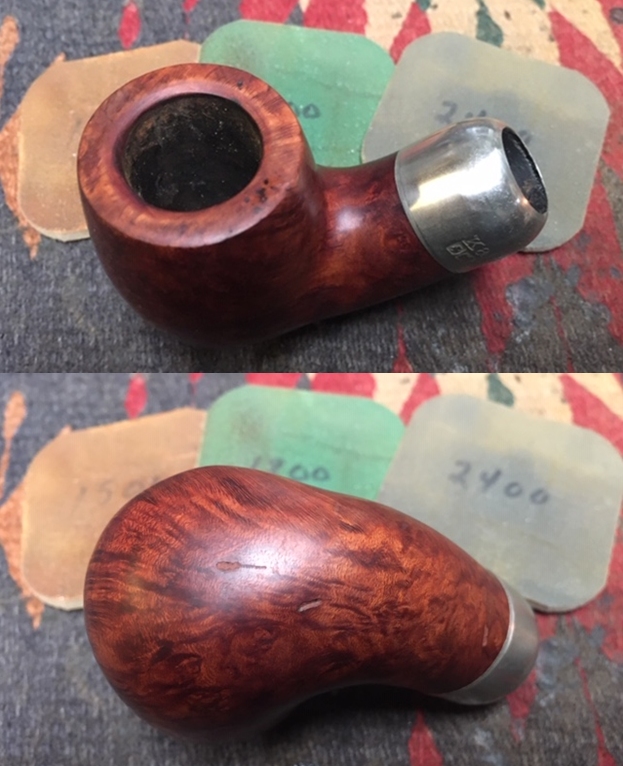
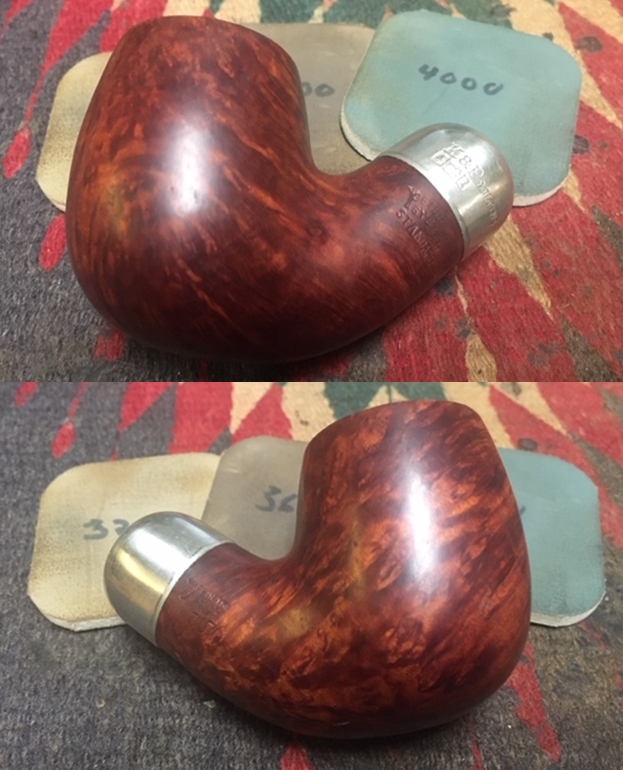
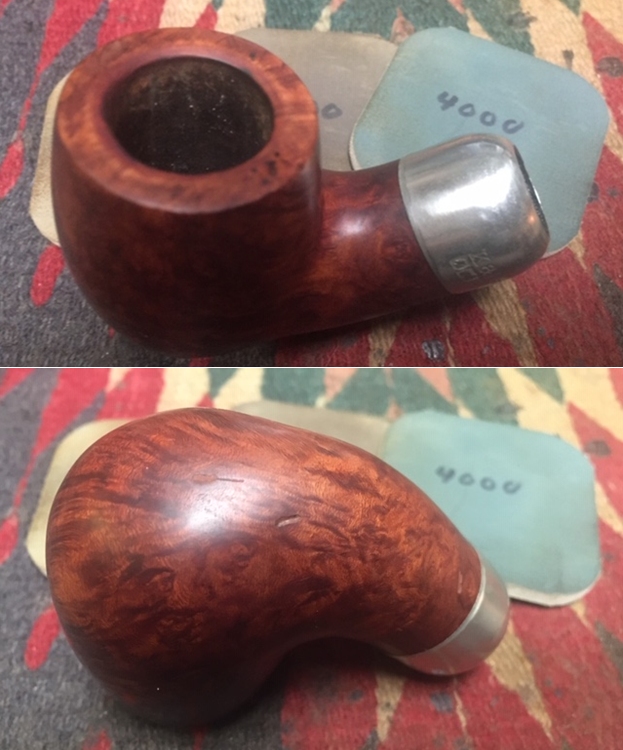
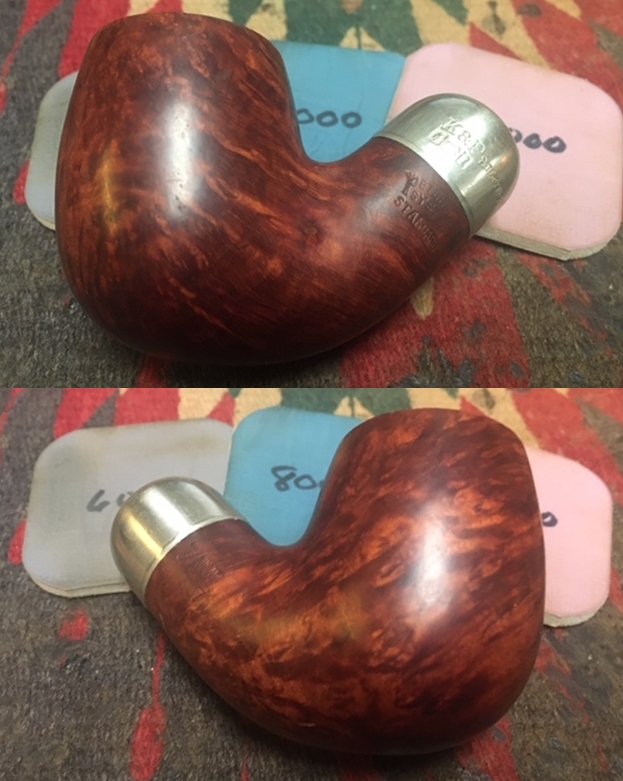
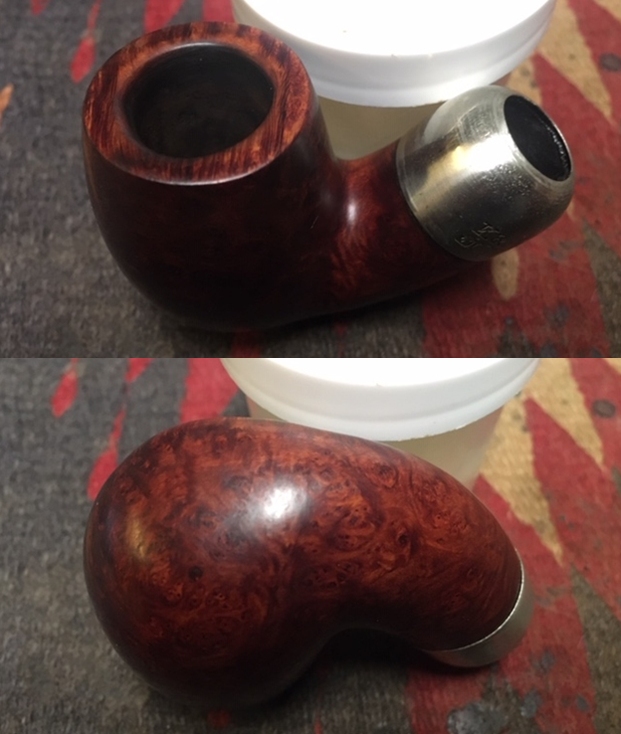
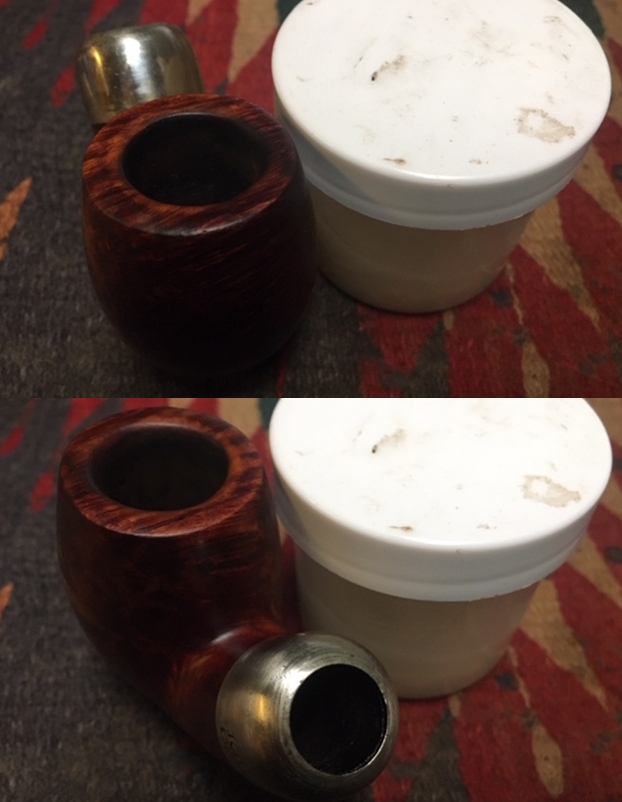
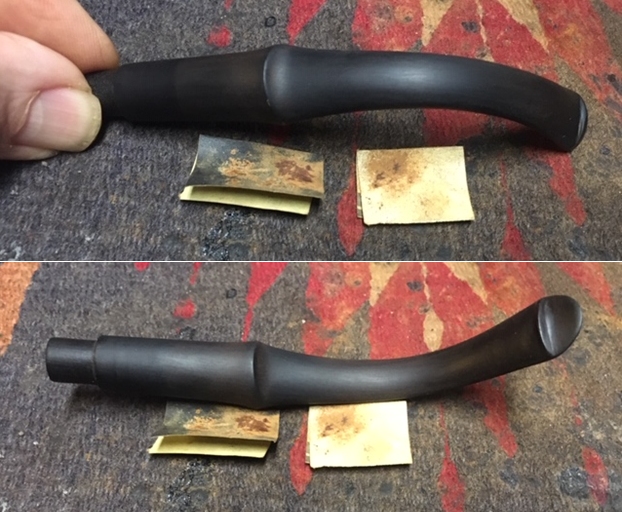
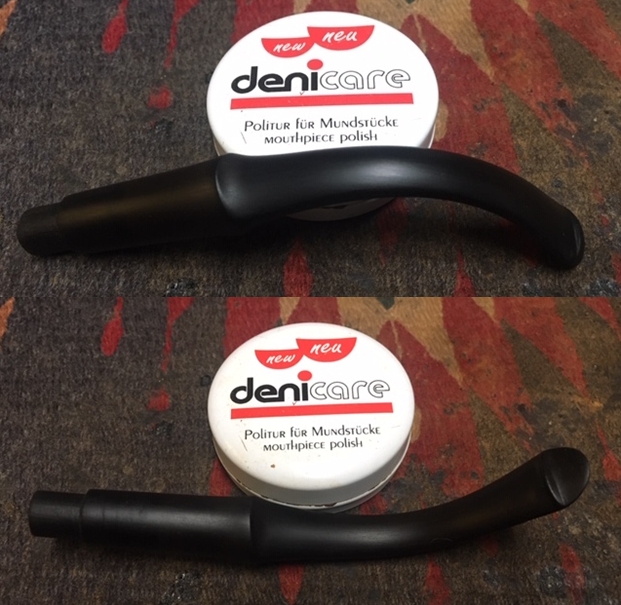
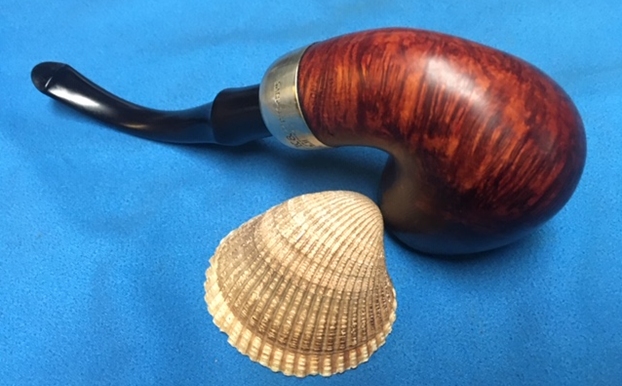
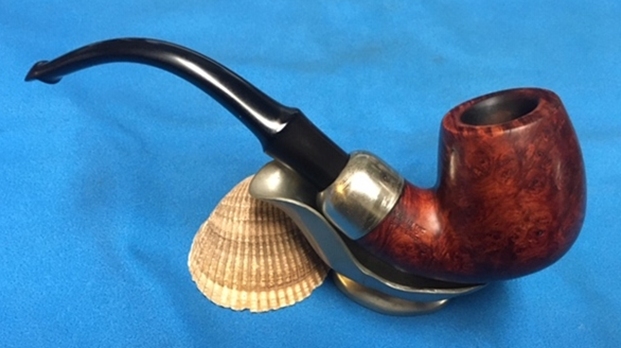
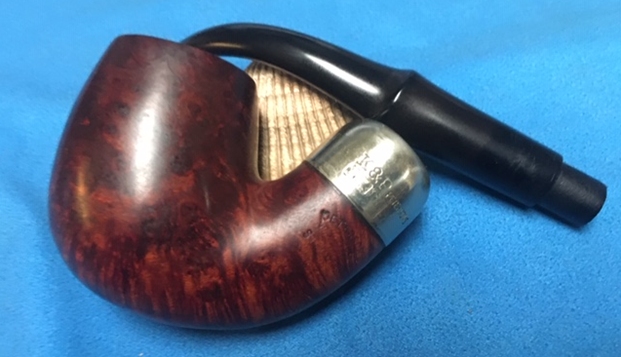
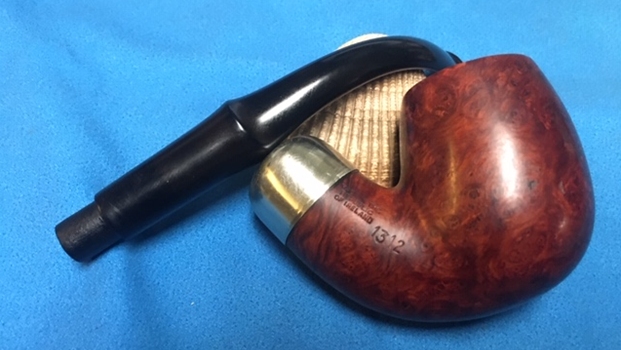
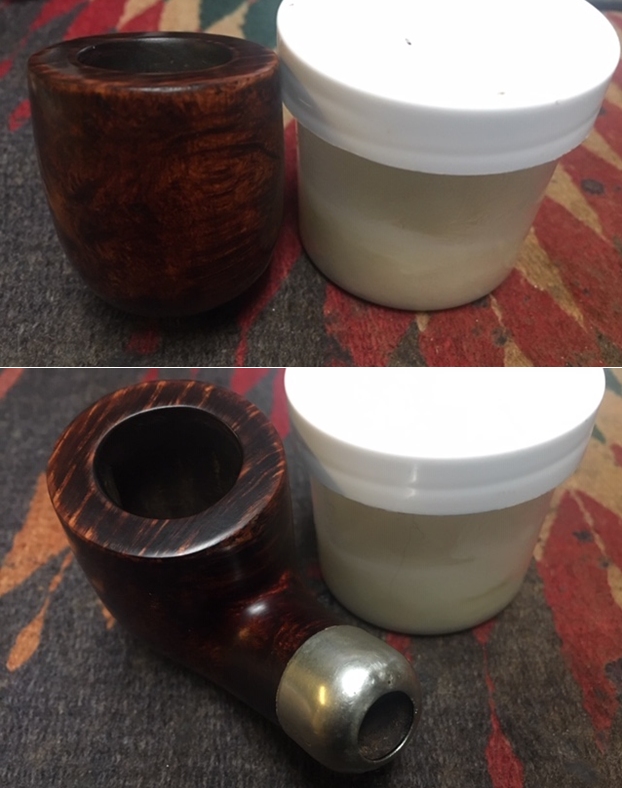
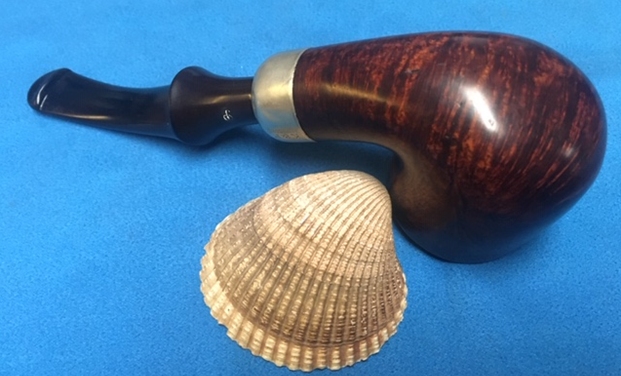
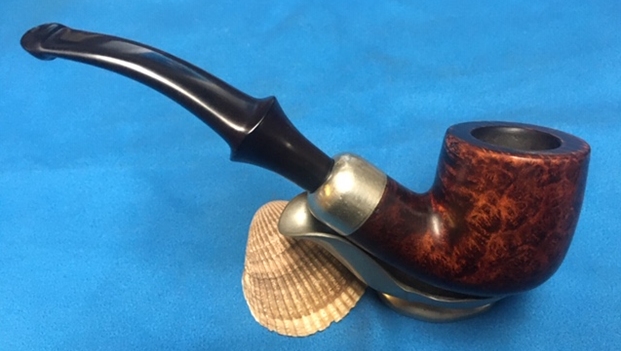
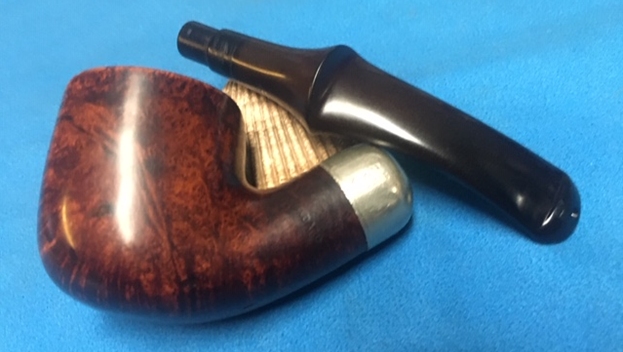
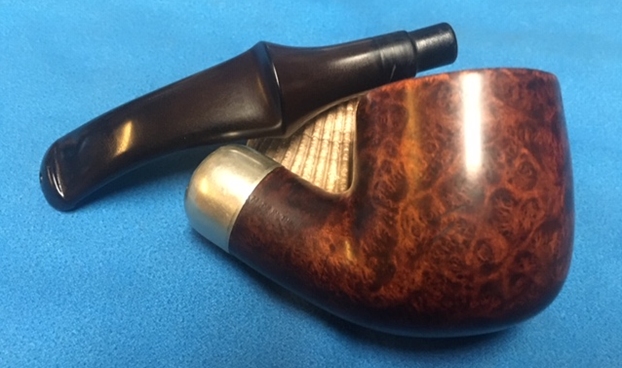
Restoring a 1978 Dunhill Root Briar 31032 Billiard from Bob Kerr’s Estate


Blog by Steve Laug

As I continue to work through the pipes in Bob Kerr’s Estate I am enjoying choosing different brands that he had to focus on for a bit. I had eight more from his Dunhill collection that I decided to go back to and finish working my way through that sub collection of the estate. Out of the 8 pipes six were Bruyere finished pipes, one was a Made in London, and one was a Root Briar. What follows is a list of what I saw when I examined the 8 pipes. As I finish the pipes I will include the link to the blog on that particular pipe for easy reference. I have already restored 16 pipes from this subgroup so you can do a quick search to read about the work on the Shell Briars and Tanshell Briars that were in that part of the collection.

  1. Bruyere 656 F/T Made in England 2 Circle 4A – Group 4 size Bruyere made in 1962. Stem is oxidized, tooth marks and chatter near the button, some calcification with damage to the button. Finish is dirty, bowl caked and lava overflow on the rim top. Bowl is out of round, damaged edge.
  2. Bruyere 112 F/T Made in England 9/11 Circle 2A – Group 2 size Bruyere made in 1969 and sold in 1971. Stem is oxidized, tooth marks and chatter near the button, some calcification with damage to the button. Finish is dirty, bowl caked and lava overflow on the rim top. Bowl is out of round, damaged edge.
  3. Bruyere 0333 Made in England 16 made in 1976. Stem is oxidized, tooth marks and chatter near the button, some calcification with damage to the button. Finish is dirty, bowl caked and lava overflow on the rim top. Bowl is out of round, damaged edge.
  4. Bruyere 41061 Made in England 18 made in 1978. Stem is oxidized, tooth marks and chatter near the button, some calcification with damage to the button. Finish is dirty, bowl caked and lava overflow on the rim top. Bowl is out of round, damaged edge.
  5. Bruyere 142 F/T Made in England 7/9/11 Circle 4A – Group for size Bruyere made in 1967 and sent out in 1969 or 1971. Stem is oxidized, tooth marks and chatter near the button, some calcification with damage to the button. Finish is dirty, bowl caked and lava overflow on the rim top. Bowl is out of round, damaged edge.
  6. Bruyere A Inner Tube Patent No. 5831412 Shape 34. Stem is oxidized, tooth marks and chatter near the button, some calcification with damage to the button. Finish is dirty, bowl caked and lava overflow on the rim top. Bowl is out of round, damaged edge. Missing the inner tube.
  7. Made in London 113 539/14. Stem is oxidized, tooth marks and chatter near the button, some calcification with damage to the button. Finish is dirty, bowl caked and lava overflow on the rim top. Bowl is out of round, damaged rim edges.
  8. Root Briar 31032 Made in England 18 – made in 1978. Stem is oxidized, tooth marks and chatter near the button, some calcification with damage to the button. Finish is dirty, bowl caked and lava overflow on the rim top. Bowl is out of round, damaged edge.

I chose to work on #8 next, the sole Root Briar pipe remaining in the collection. Paresh had picked up an earlier one that I had finished to add to his collection in India. The highest honor for a Dunhill pipe is to receive the prestigious Root Briar appellation. Root Briars have been coveted by pipesmokers ever since they first debuted in 1931, due to the fact that each pipe must boast briar completely free of even the most minor of blemishes. Dunhill has the strictest of standards and expectations for quality with all of their pipes, and so any block of briar that comes to bear the Root Briar stamp must indeed be superlative.

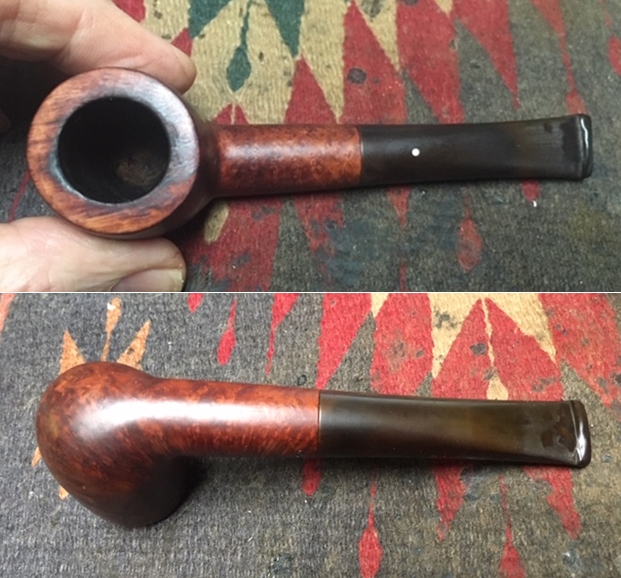
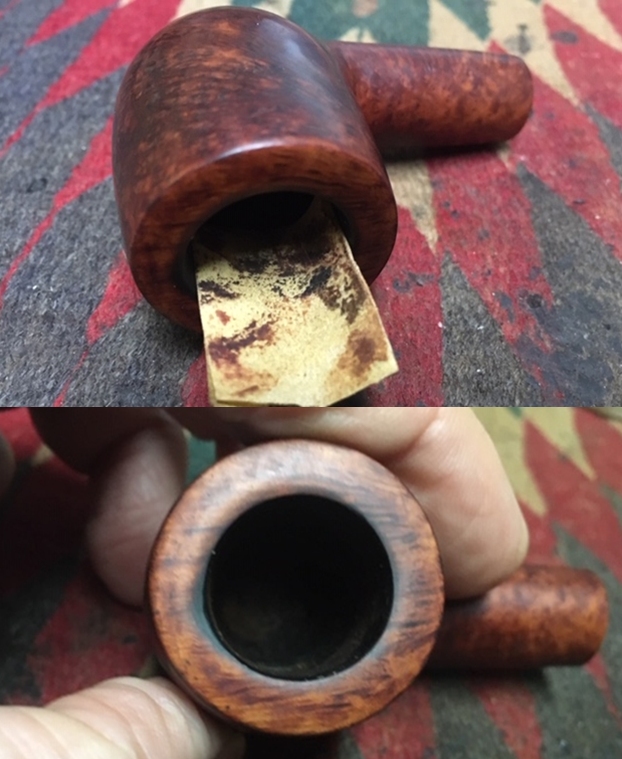
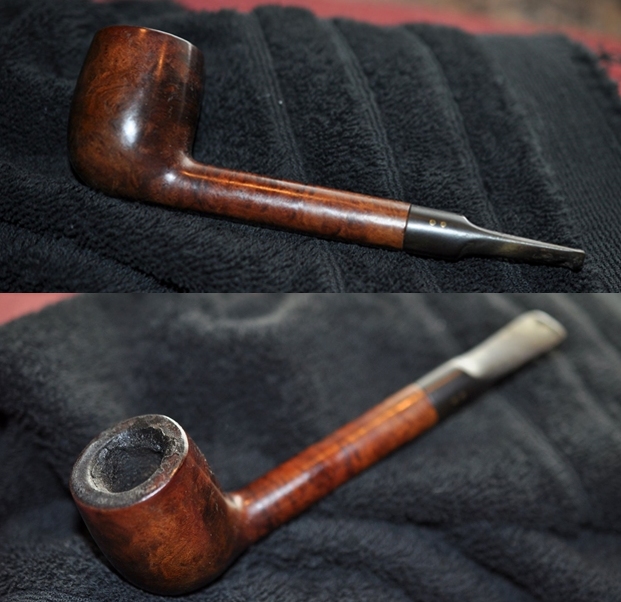
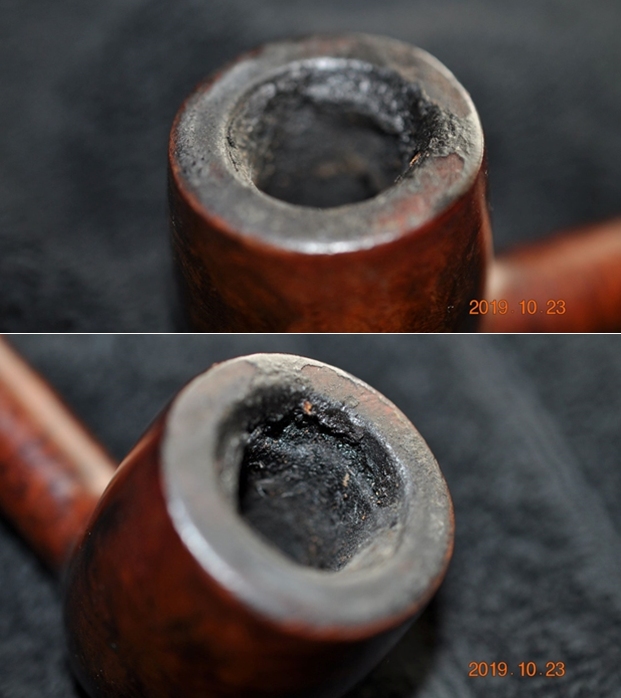
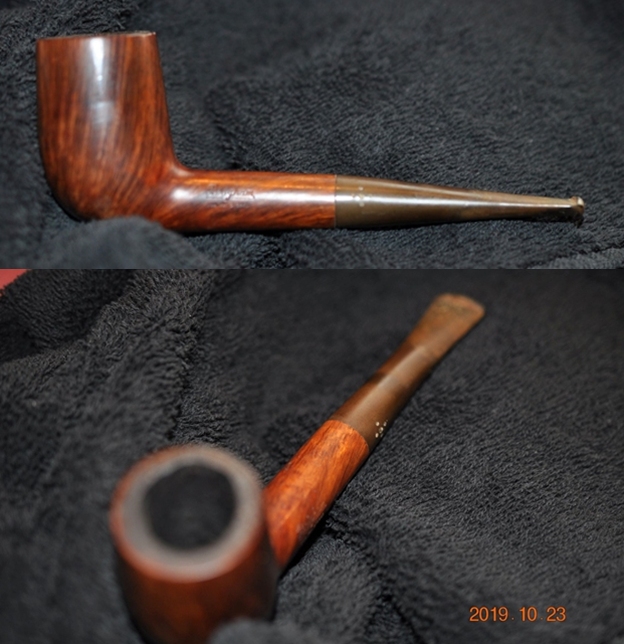
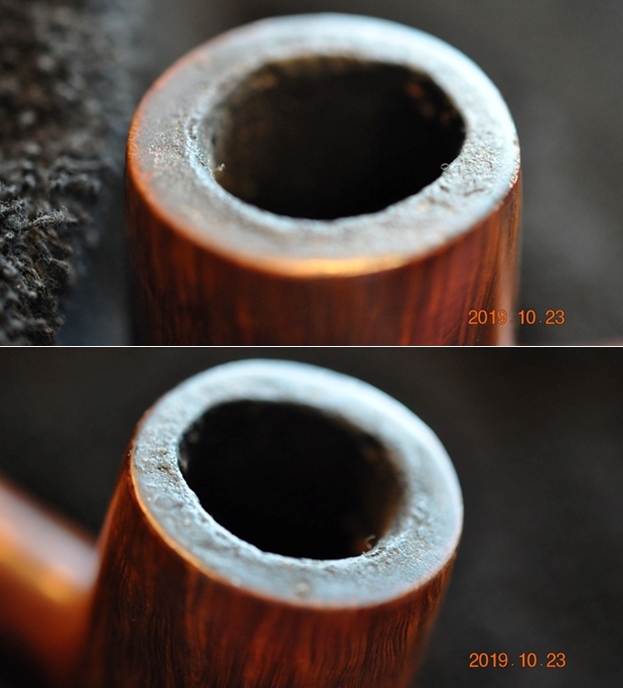
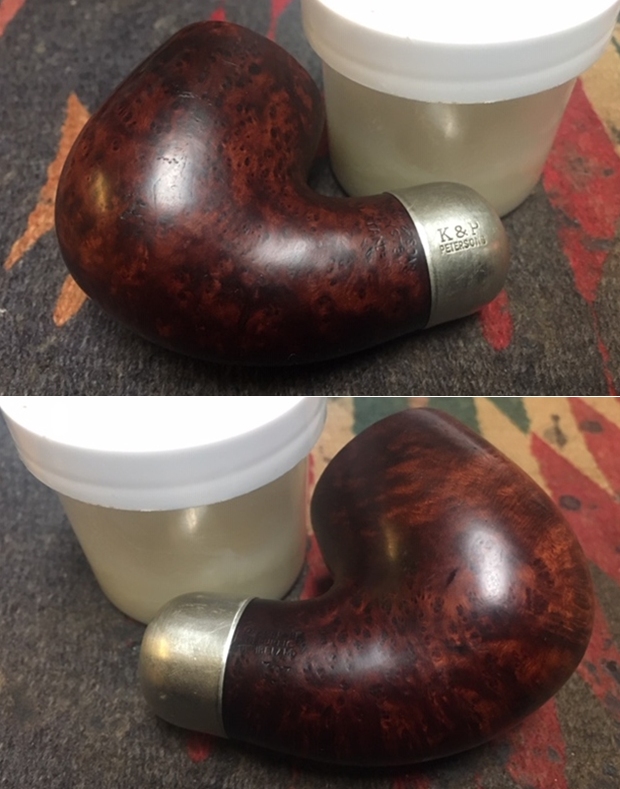
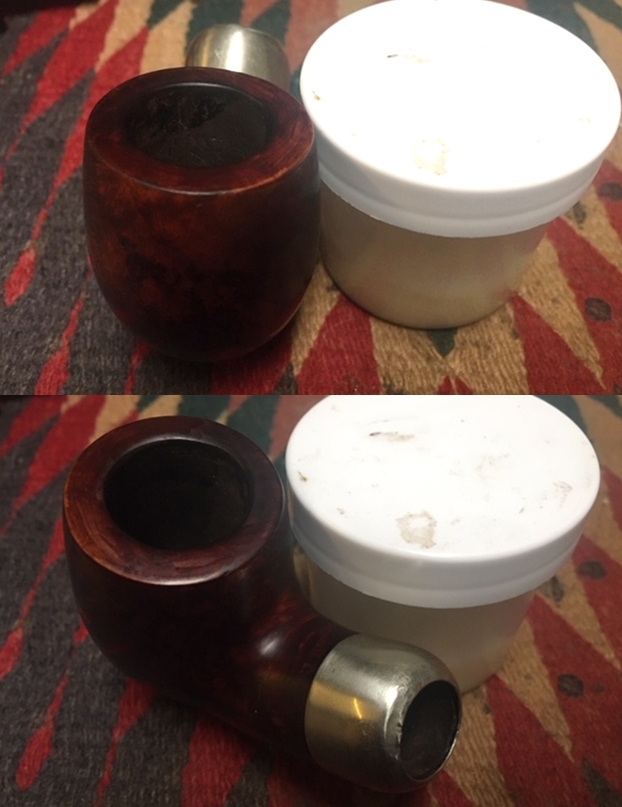
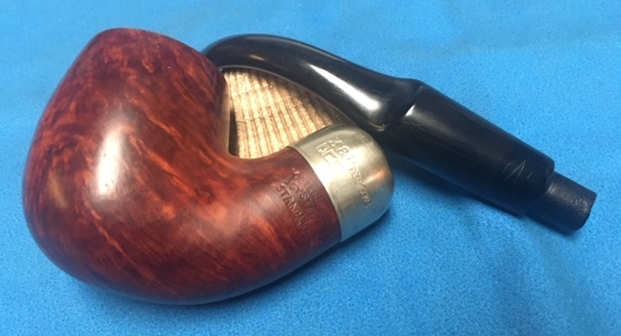
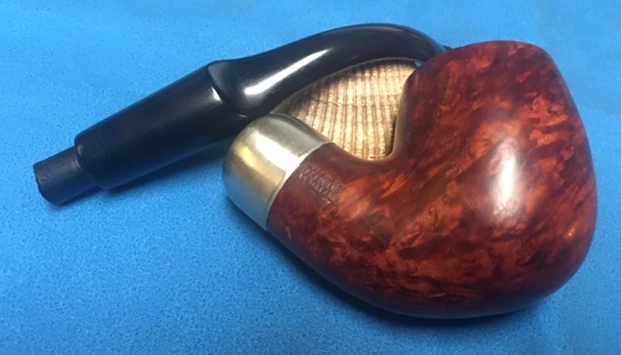
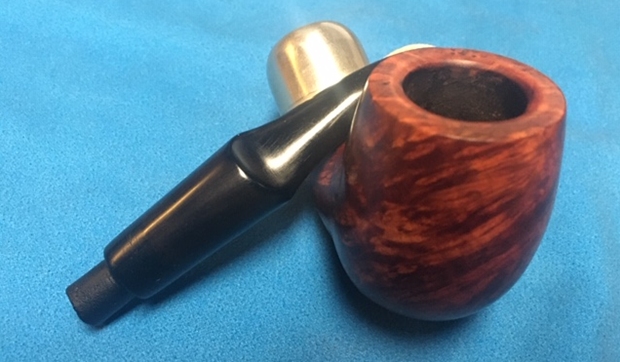
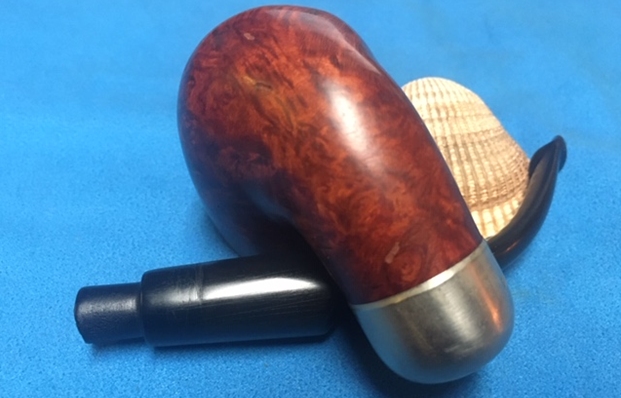
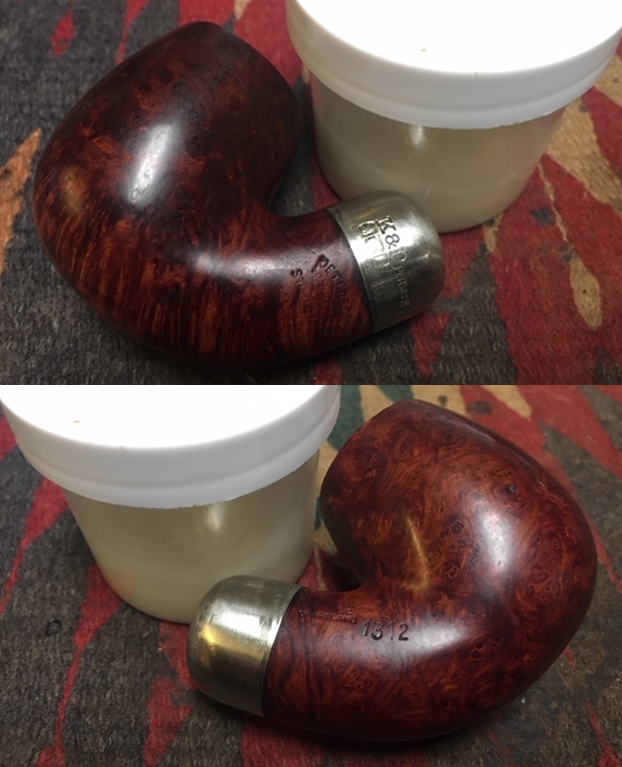
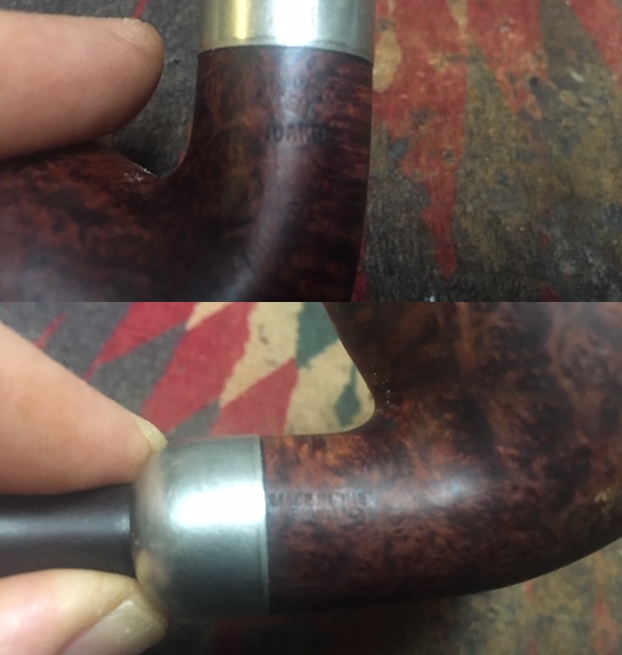
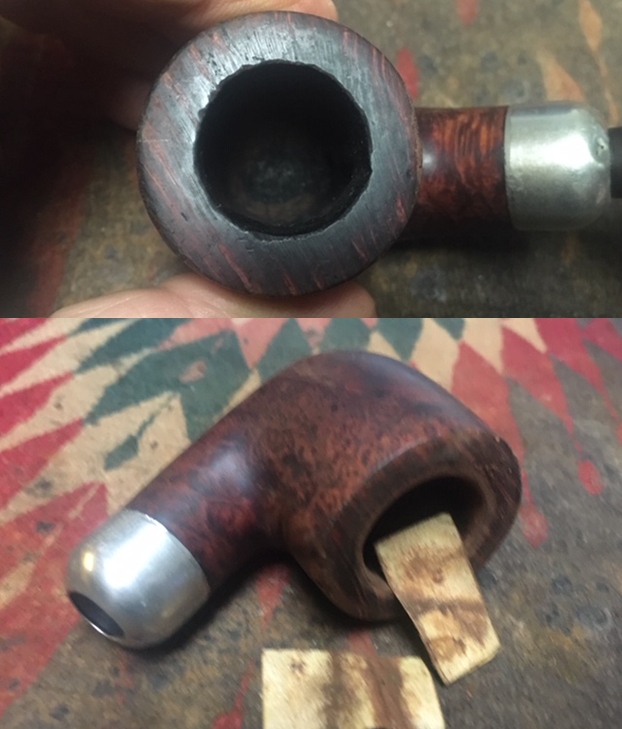
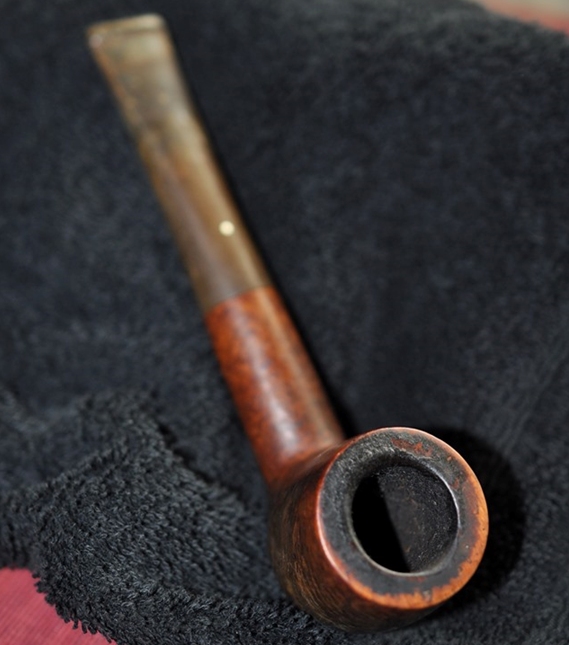
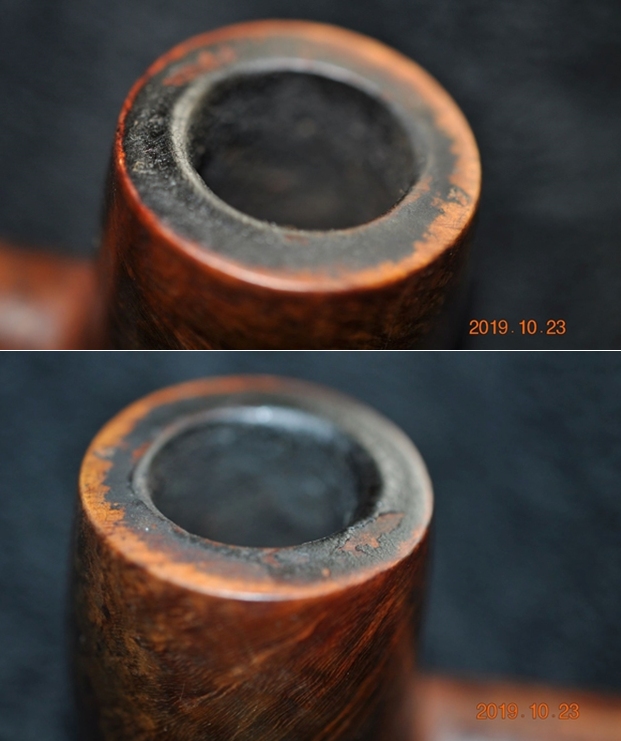
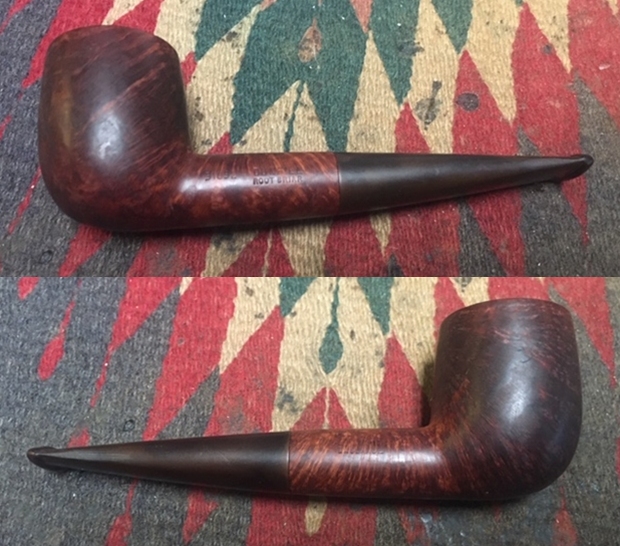
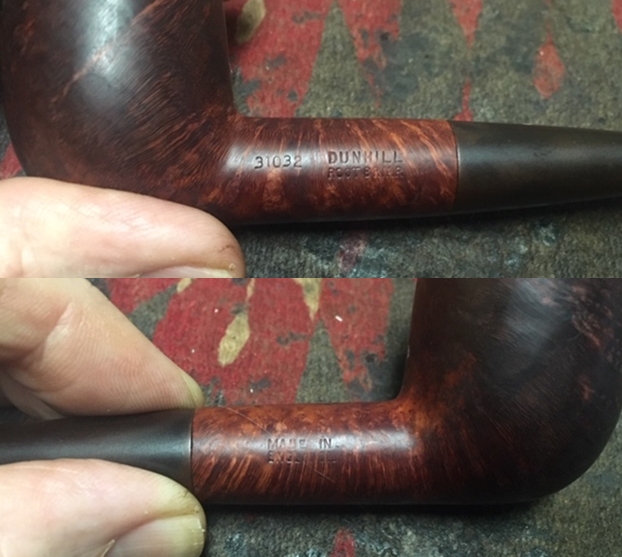
The pipe was stamped on the left side of the shank with the five digit shape number next to the bowl/shank junction. It read 31032. That is followed by Dunhill over Root Briar. On the right side of the shank it is stamped Made in England 18 which would make it a pipe made in 1978. The shape number code can be broken down to give a lot of information. Typically Dunhill pipes are stamped with a four digit code. The first digit (1-6) denotes the group size of the pipe. In this case it is a Group 3 sized pipe. The second digit denotes the style of the mouthpiece (0,1=tapered, 2=saddle). In this case it is a 1 which matches the tapered stem on the shank. The third and fourth digits give the generic shape in the chart below. I have captured part of the chart to identify this pipe as a 03 or a straight Billiard. When 5 digits occur, the meaning of the 4 first remains the same (http://www.pipephil.eu/logos/en/dunhill/shapes.html). There was a thick cake in the bowl with remnants of tobacco stuck on the walls. There was a lava overflow on the rim. The top and edges of the rim appear to be in good condition though there appears to be a little burn damage on the left front inner edge of the bowl. The outer edge looks very good. The grain on this is beautiful – diagonal or flame grain and some birdseye on the heel of the bowl. I think that there is a beautiful pipe underneath all of the buildup of years of use. The sides of the bowl had some darkening from oils and tars. The stem was oxidized and calcified toward the end with some tooth chatter. There were also some tooth marks on both sides of the stem ahead of the button and on the button itself. There was the classic White Spot on the top of the stem. Jeff took photos of the pipe before he started his cleanup work on it. Jeff took photos of the bowl and rim top to show the thick, hard cake in the bowl with remnants of tobacco stuck on the walls of the bowl. There was a lava build up on the smooth rim top and the edges of the bowl. The rim top looked pretty good but it was hard to know for sure. It appeared that there was damage at the back and the front of the inner edge. The outer edges looked good.    Jeff took photos of the side and heel of the bowl to show the condition of the finish. You can see the beautiful grain patterns around the sides of the bowl and shank. Even under the dirt and debris of the years it looked very good.The stamping is readable and on the left side of the shank you can see the shape number 31032 as noted above followed by Dunhill over Root Briar. On the right side it reads Made In England with the date stamp 18 after the D in England. He included a pic of the White Spot on the stem. Jeff took photos of the top and underside of the stem showing the tooth chatter, scratching and oxidation on the stem surface and wear on the edges of the button.I am really happy to have Jeff’s help on cleaning up the pipes from Bob’s estate as the 125+ pipes were taking me a long time to do alone. He cleaned this filthy pipe with his usual penchant for thoroughness that I really appreciate. This one was a real mess and I was looking forward to seeing what he had done with this one when I took it out of his box. It looked amazing and CLEAN. He reamed it with a PipNet pipe reamer and cleaned up the reaming with a Savinelli Fitsall Pipe Knife. He scrubbed out the internals with alcohol, pipe cleaners and cotton swabs until the pipe was clean. He scrubbed the exterior of the bowl with Murphy’s Oil Soap and a tooth brush to remove the grime and grit on the briar and the lava on the rim top. The finish looks very good with great looking grain around the bowl and shank. It looked like there were some dents in the briar on the right side of the bowl that would need to be dealt with. The stem looked a lot better. Jeff soaked the stem in Before & After Deoxidizer to remove the oxidation on the rubber. The pipe was ready for me to carry on the next part of the process. I took some close up photos of the rim top and also of the stem surface. I wanted to show how well it had cleaned up and what needed to be done. The rim top had some darkening toward the back of the bowl and on the inner edge. There was also some burn damage on the front inner edge of the bowl. The outer edge looked very good.  I also took close up photos of the stem to show the tooth marks and chatter on the stem surface.   The stamping appeared to be as clear as ever on the shank sides. This is just one of the things I appreciate about Jeff’s cleanup is that he works to protect and preserve the nomenclature on the shank of the pipes that he works on. I took some photos to show the stamping. Bob loved his Dunhill pipes and it was obvious that he enjoyed smoking them. Some appeared to be daily smokes while others he seemed to reserve for special occasions. Some seemed like they must have hung in his mouth while he did his carving while others were smoked in his chair. Having worked on over 60 of his pipes so far I am getting a feel for them.
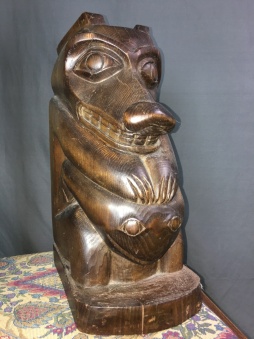
I am sure that many of you have read at least some of the other restoration work that I have done on previous pipes. You have also read what I have included about Bob Kerr, the pipeman who held these pipes in trust before I came to work on them (see photo to the left). Also, if you have followed the blog for long you will already know that I like to include background information on the pipeman whose pipes I am restoring. For me, when I am working on an estate I really like to have a sense of the person who held the pipes in trust before I worked on them. It gives me another dimension of the restoration work. Bob’s daughter wrote a short tribute to her father. I thank you Brian and tell your wife thank you as well.

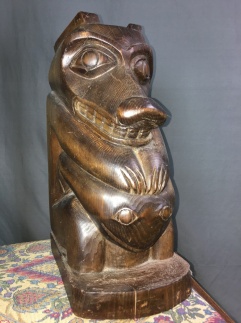
I am delighted to pass on these beloved pipes of my father’s. I hope each user gets many hours of contemplative pleasure as he did. I remember the aroma of tobacco in the rec room, as he put up his feet on his lazy boy. He’d be first at the paper then, no one could touch it before him. Maybe there would be a movie on with an actor smoking a pipe. He would have very definite opinions on whether the performer was a ‘real’ smoker or not, a distinction which I could never see but it would be very clear to him. He worked by day as a sales manager of a paper products company, a job he hated. What he longed for was the life of an artist, so on the weekends and sometimes mid-week evenings he would journey to his workshop and come out with wood sculptures, all of which he declared as crap but every one of them treasured by my sister and myself. Enjoy the pipes, and maybe a little of his creative spirit will enter you!

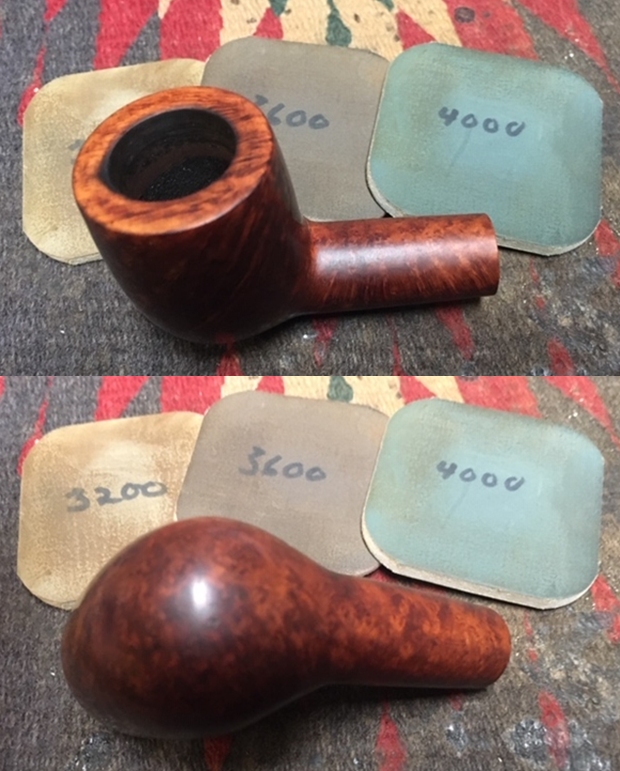
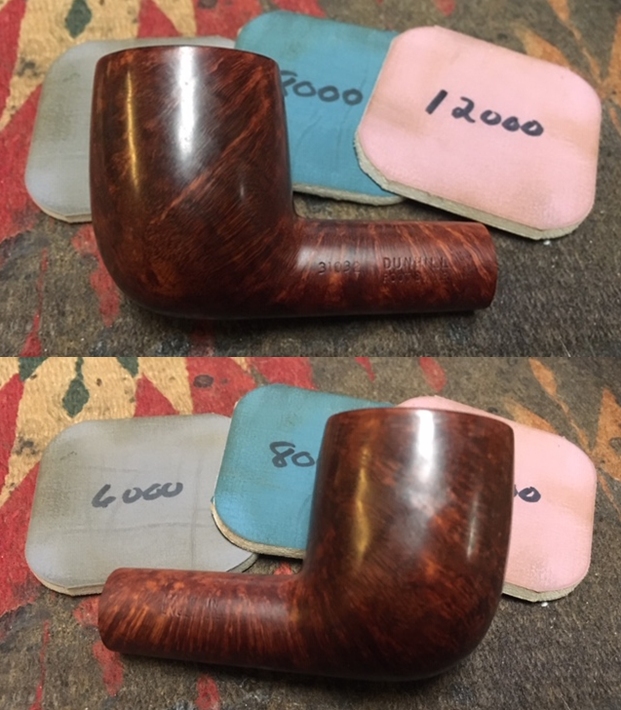
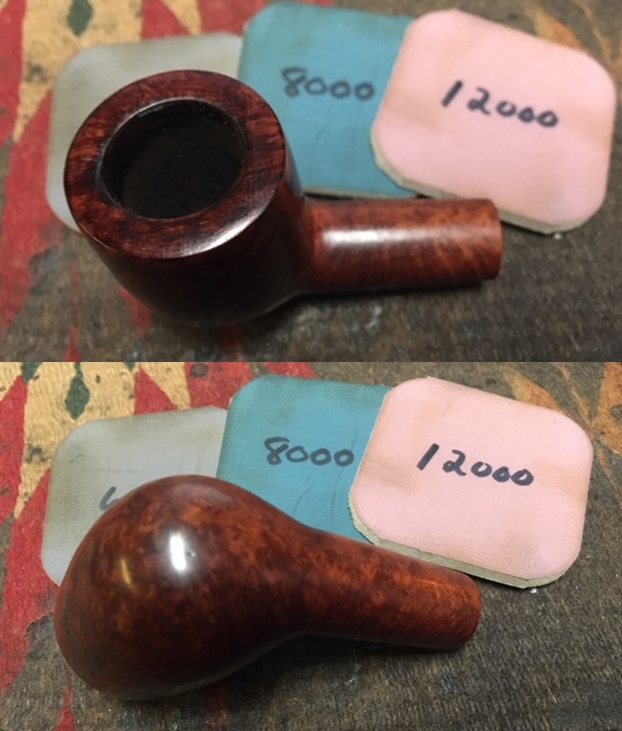
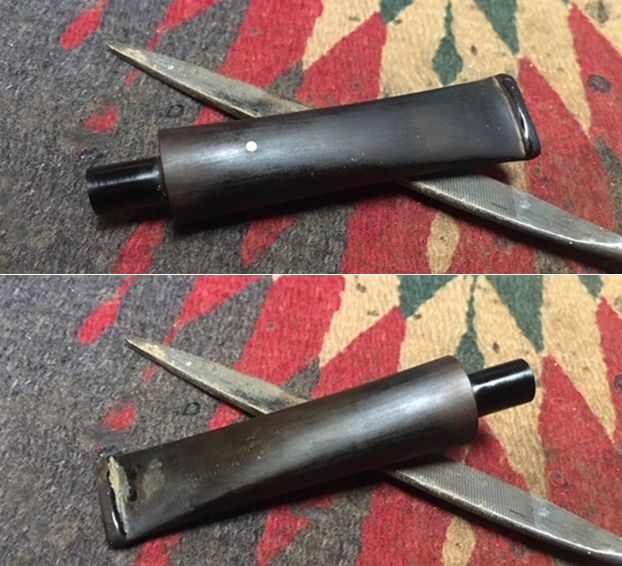
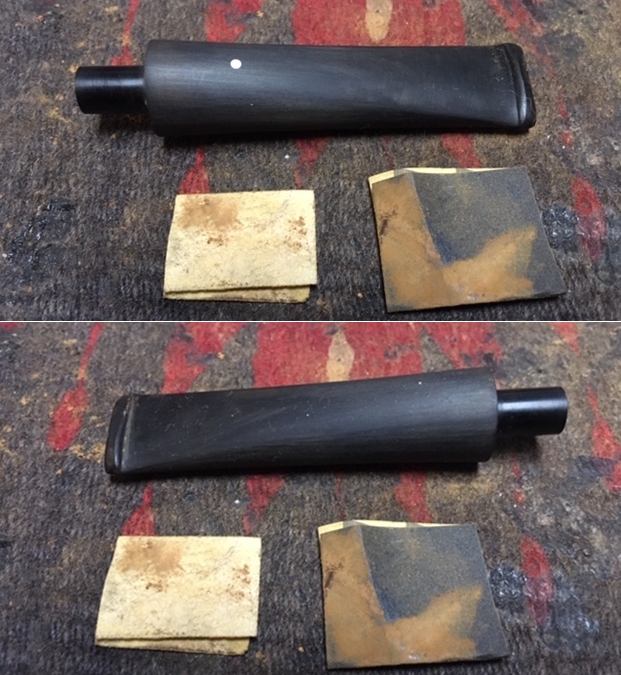
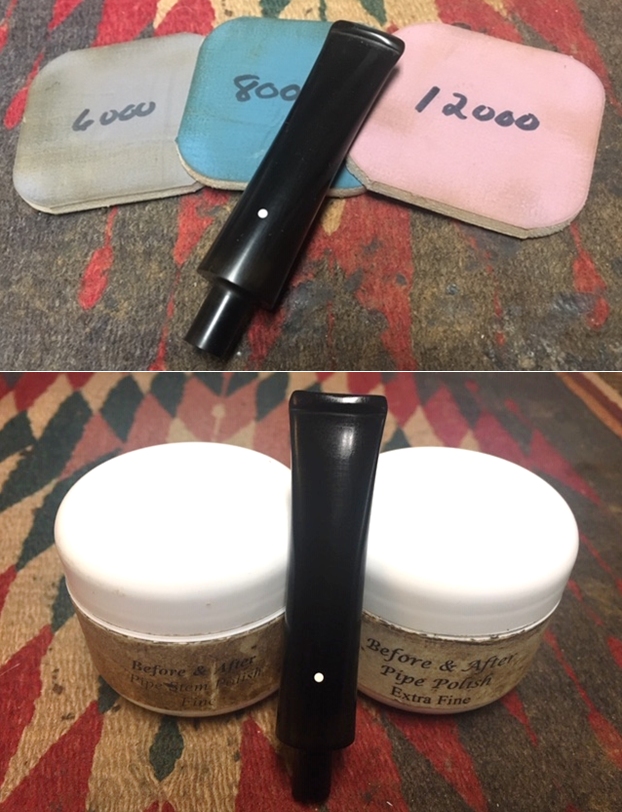
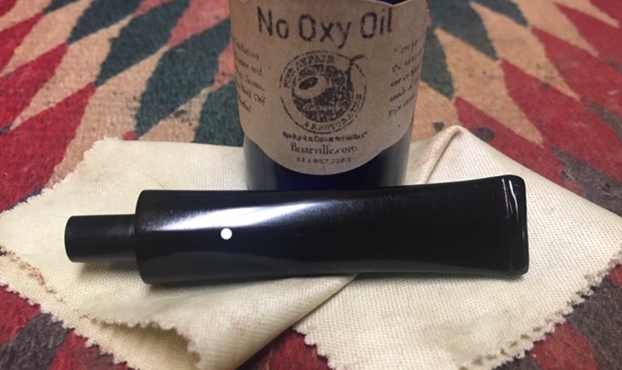
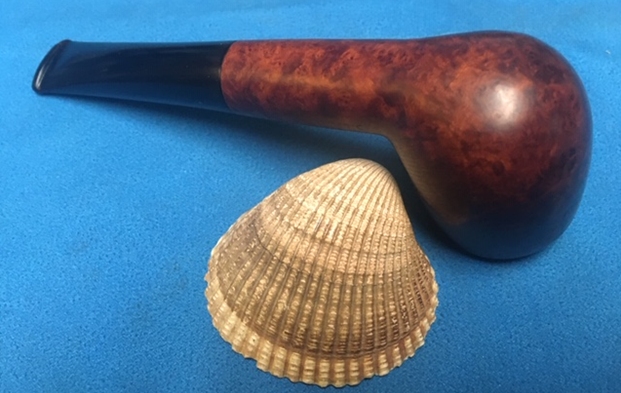
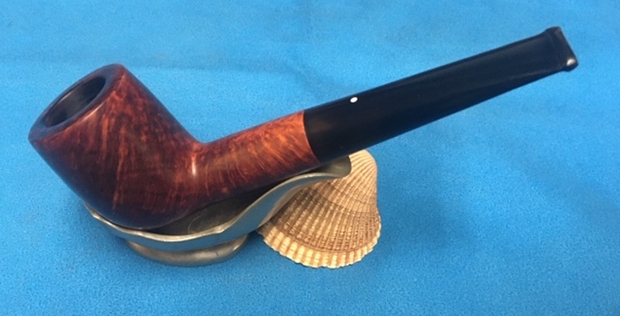
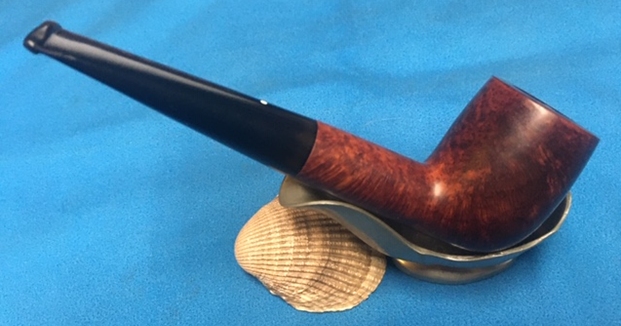
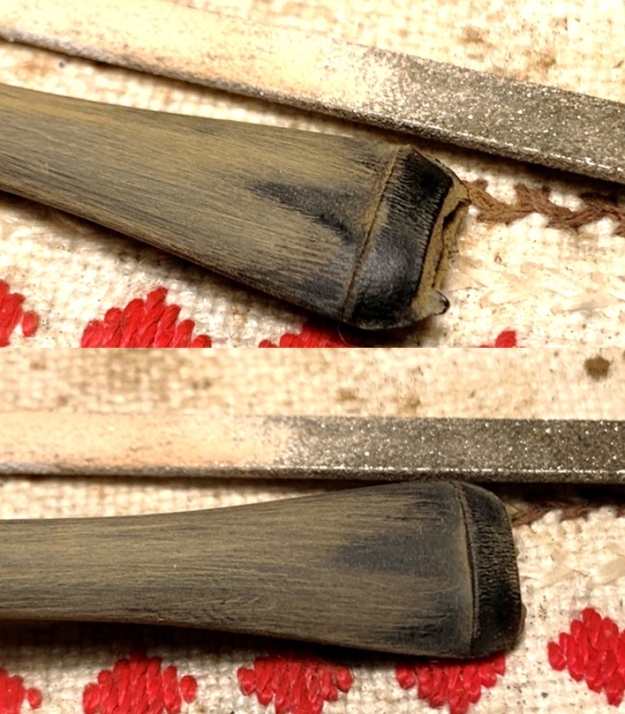
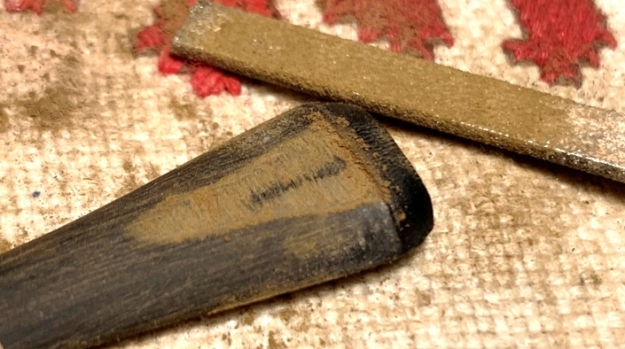
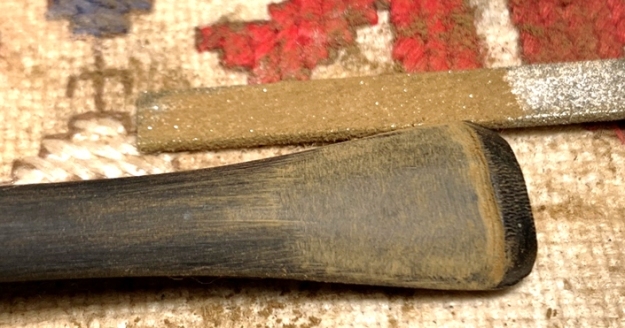
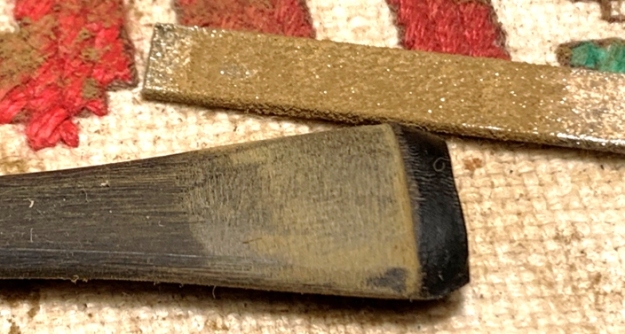
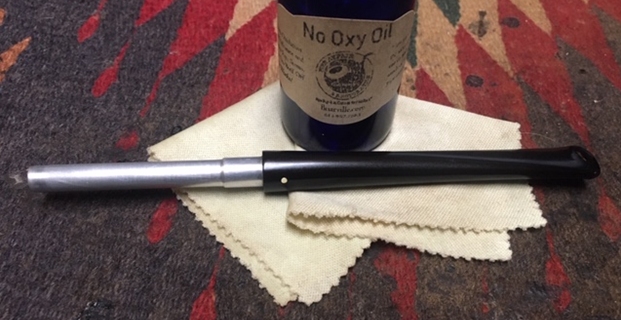
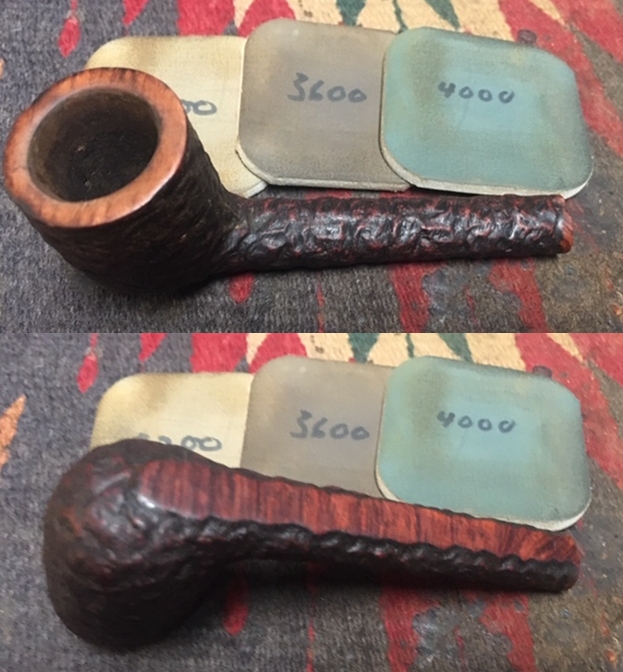
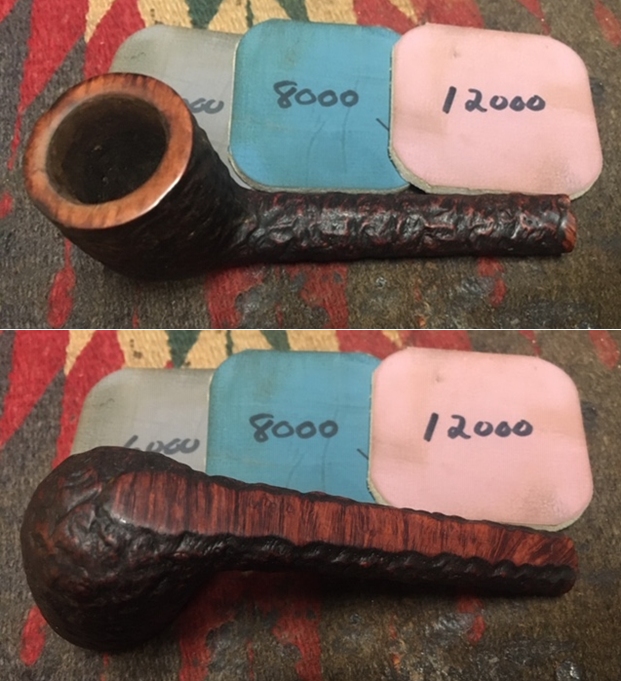
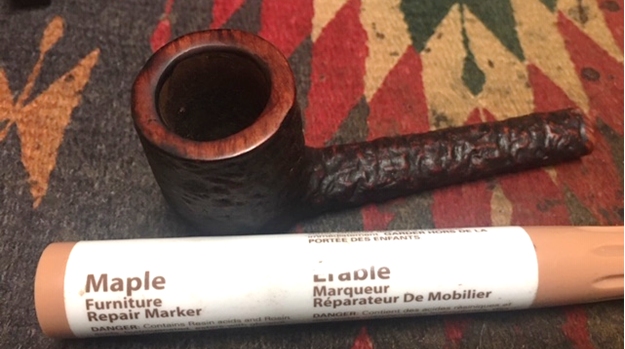
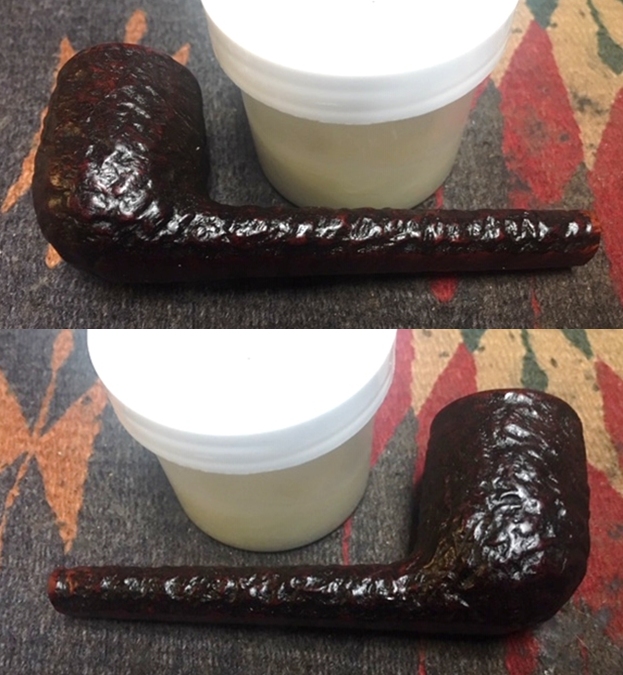
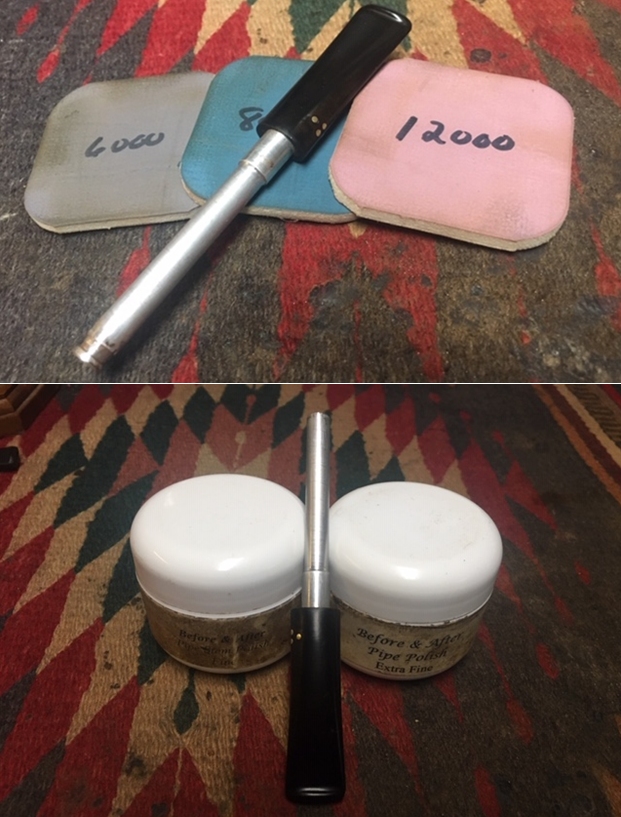
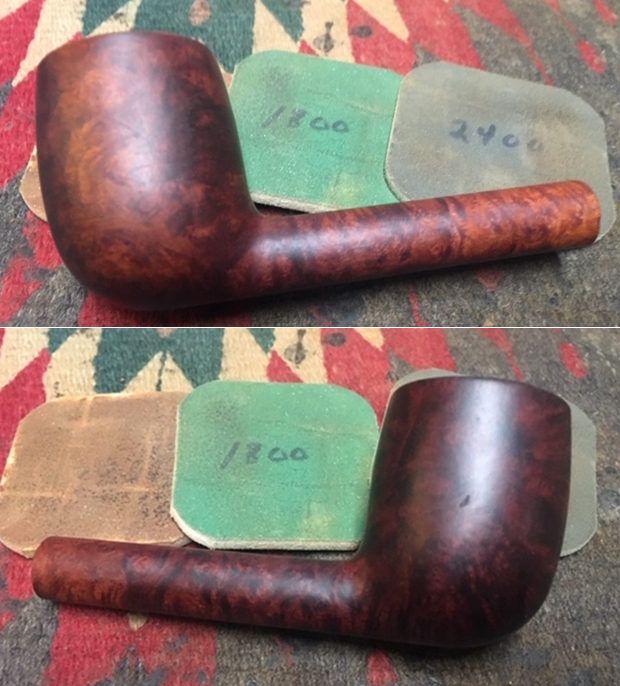
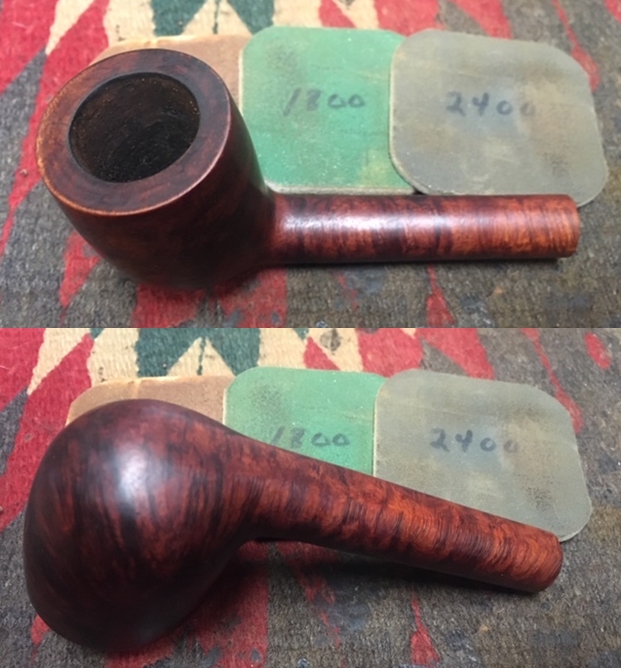
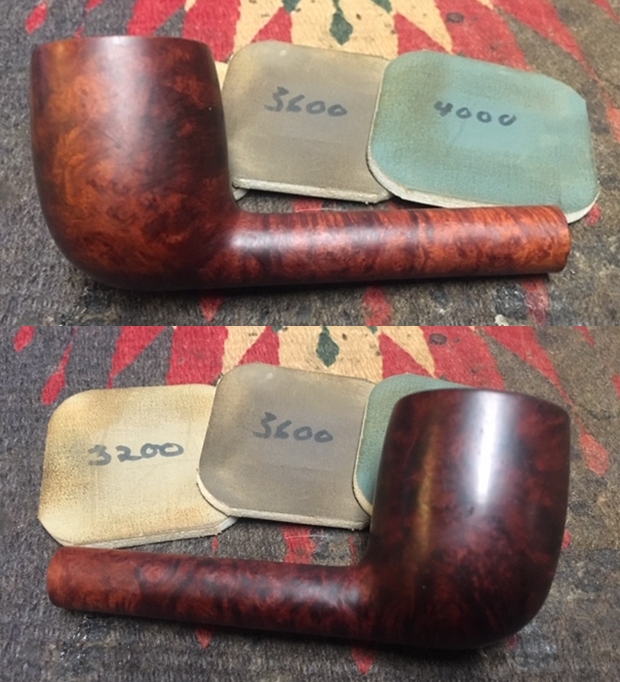
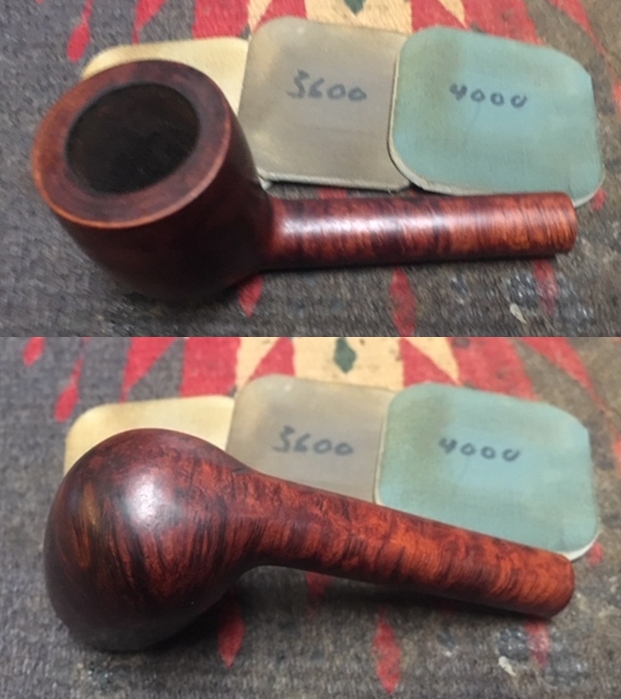
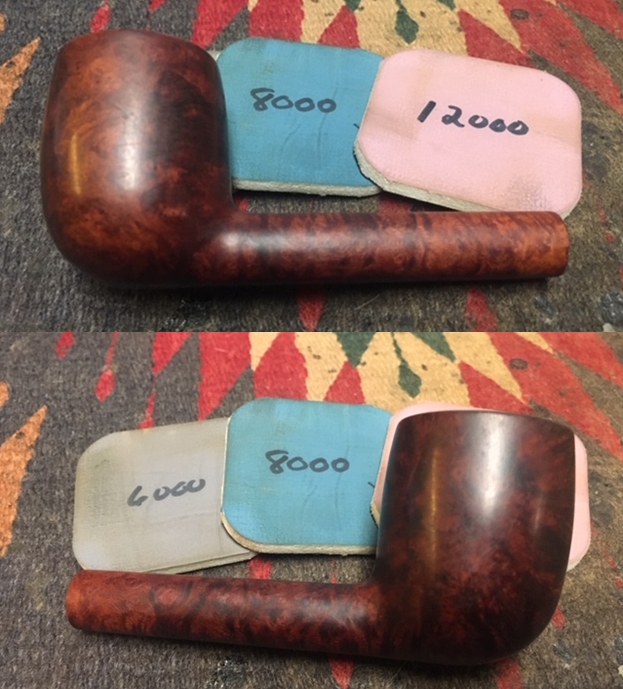
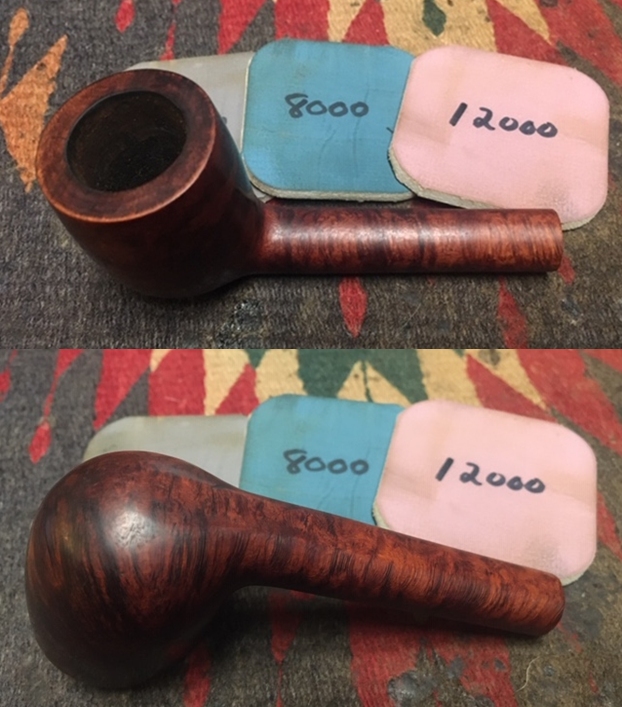
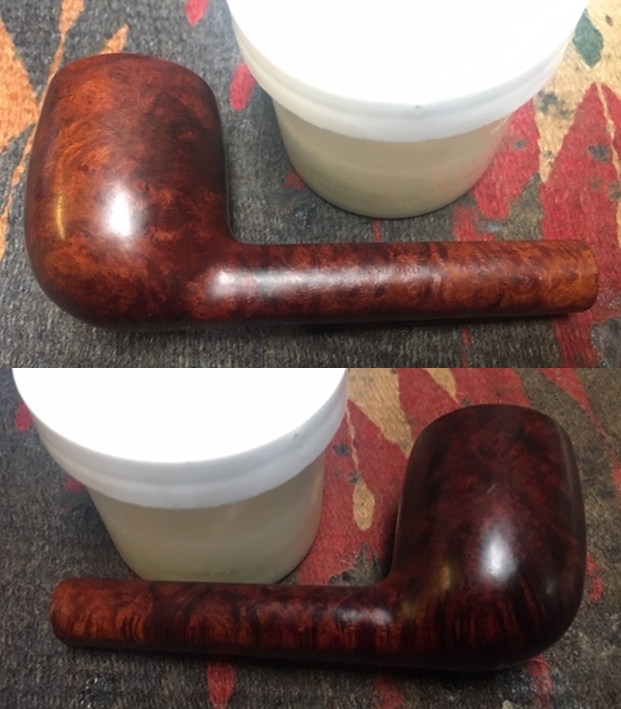
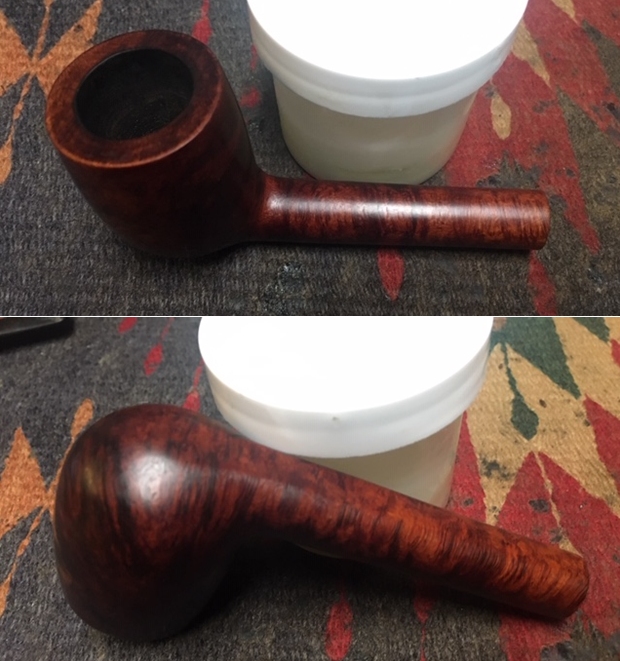
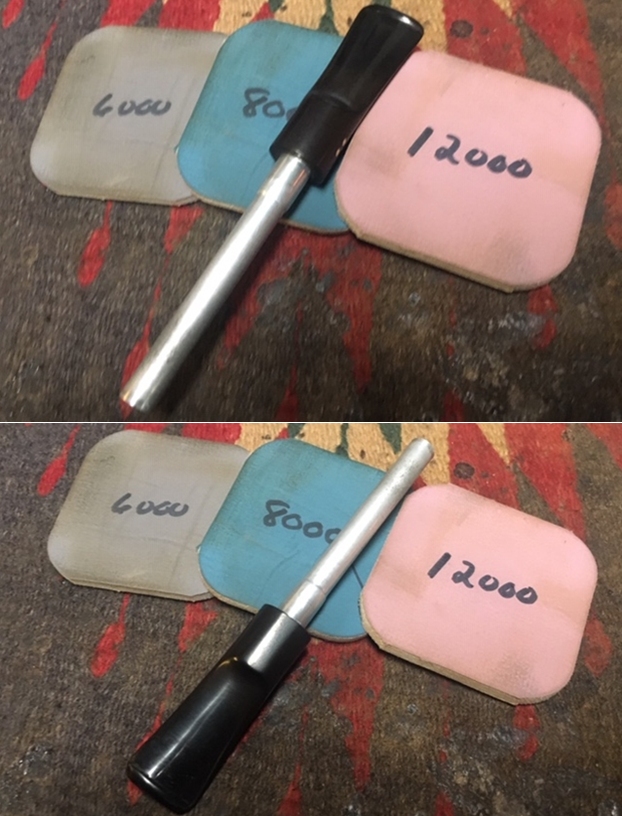
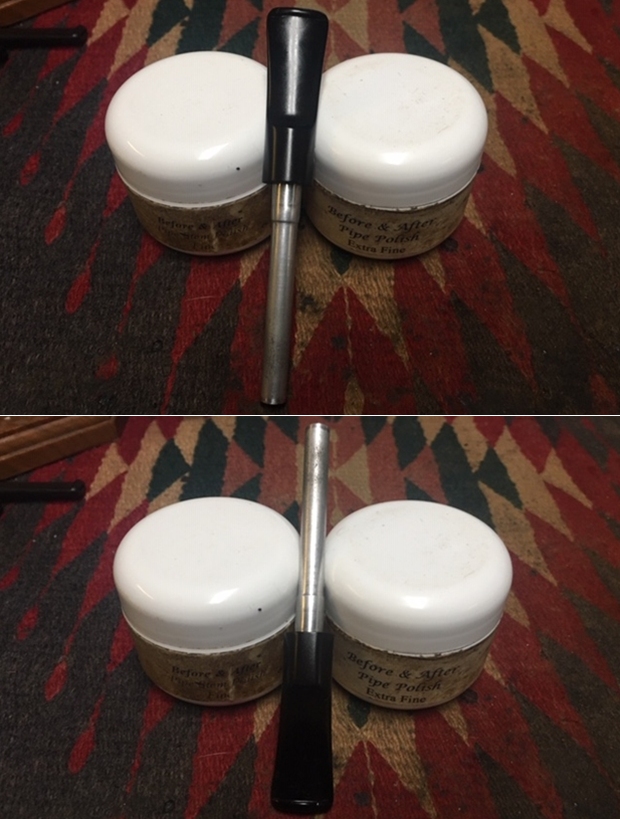
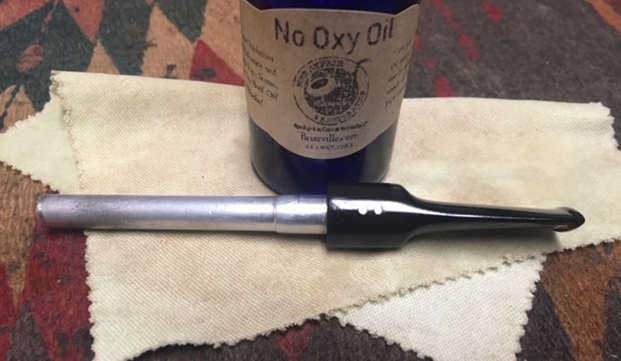
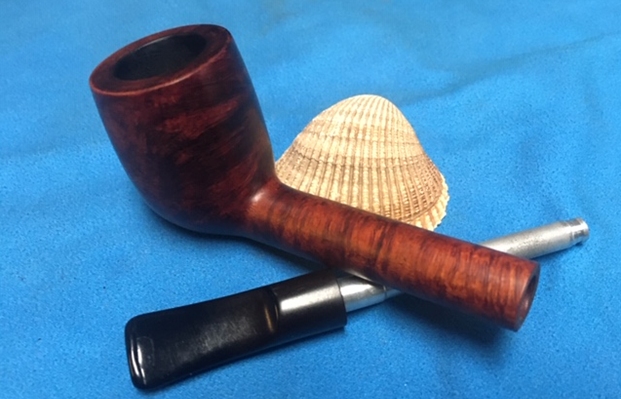
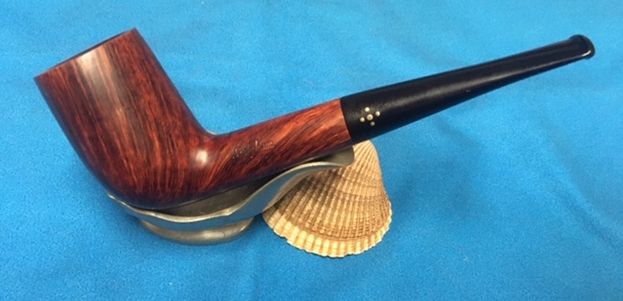
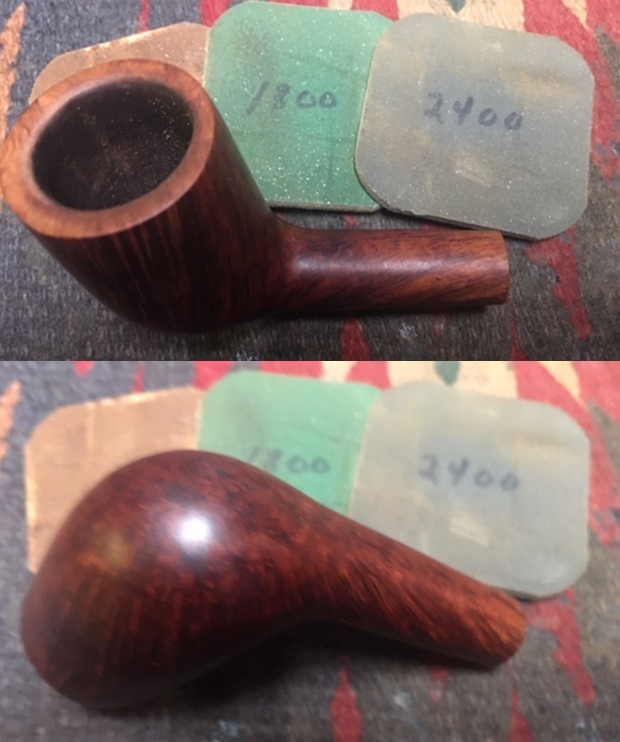
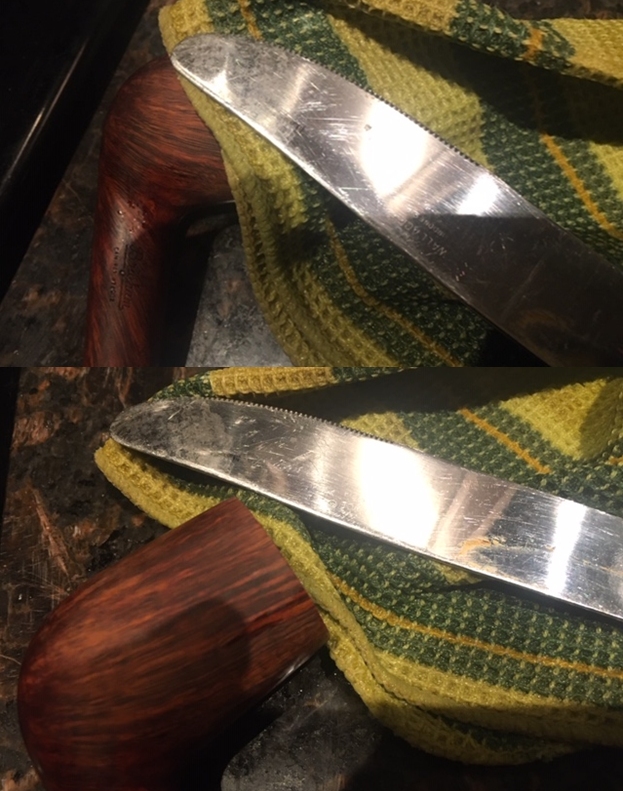
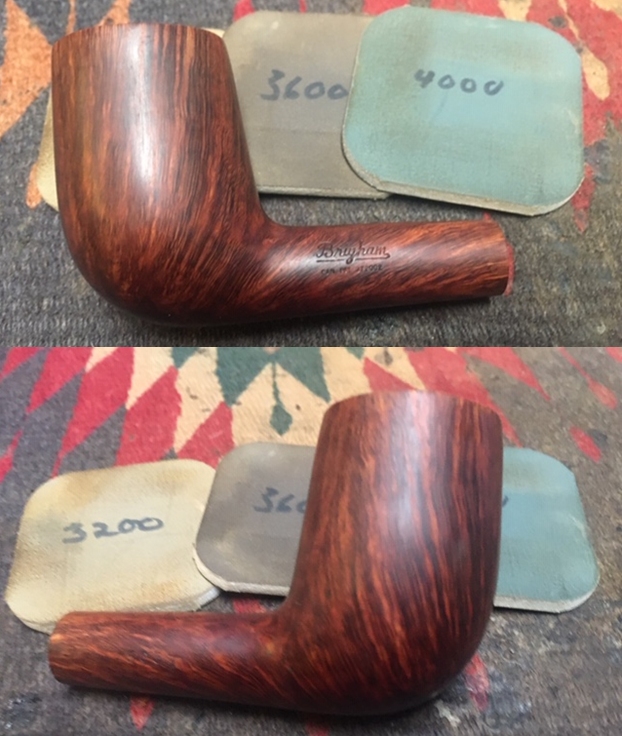
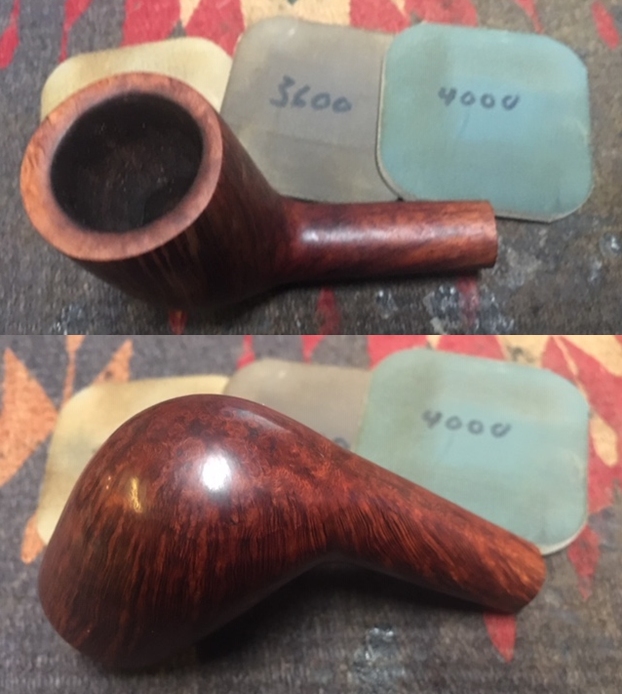
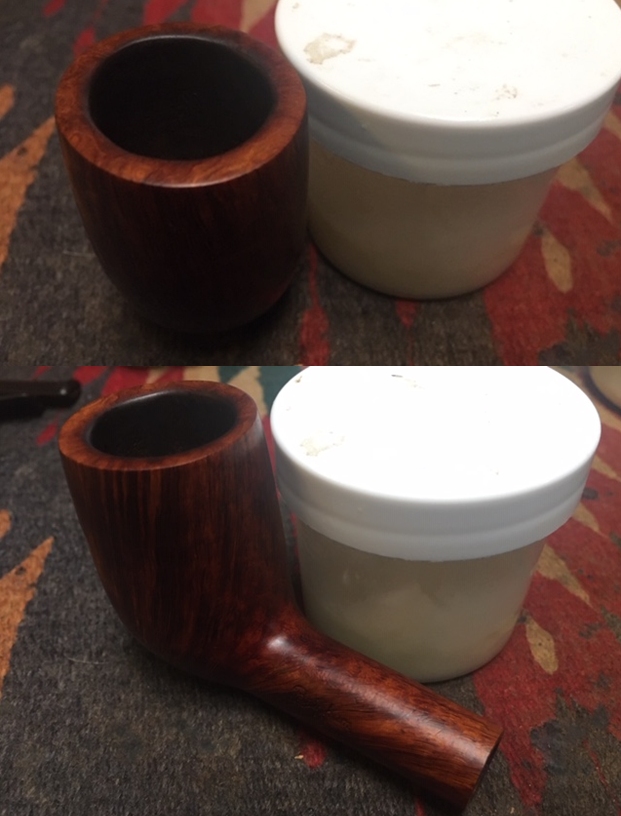
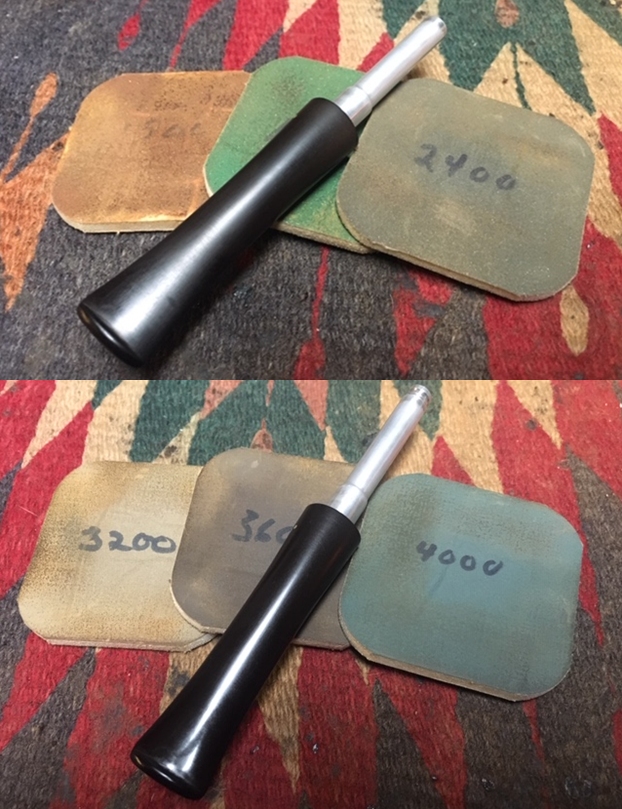
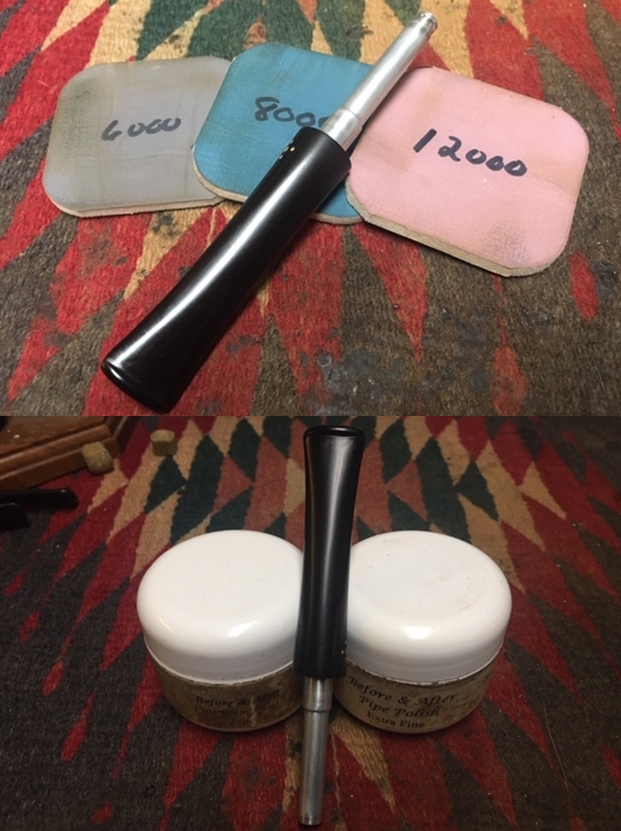
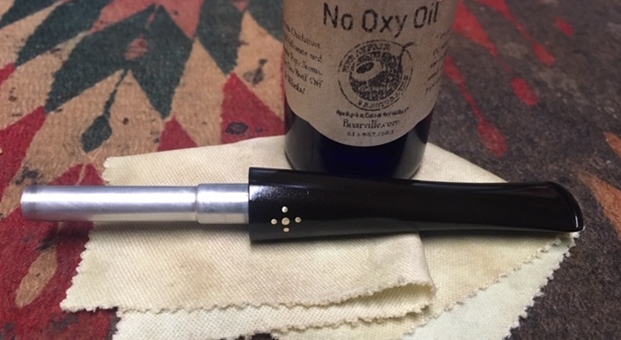
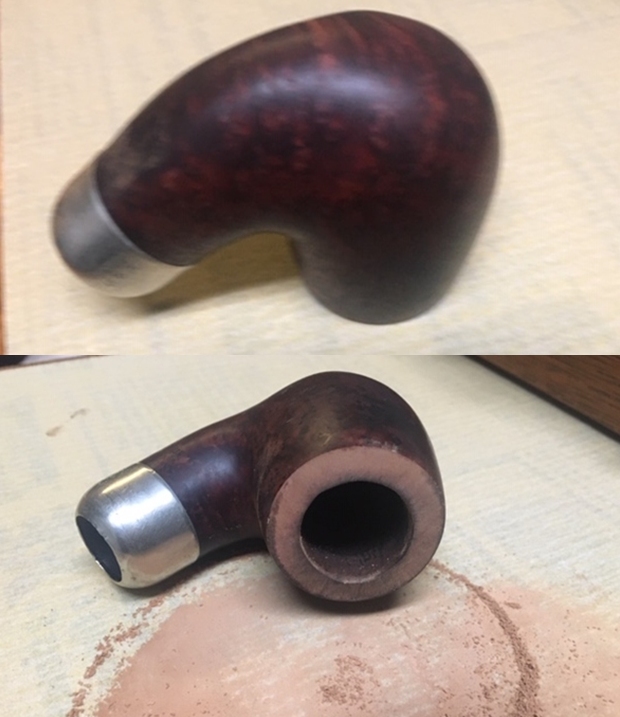
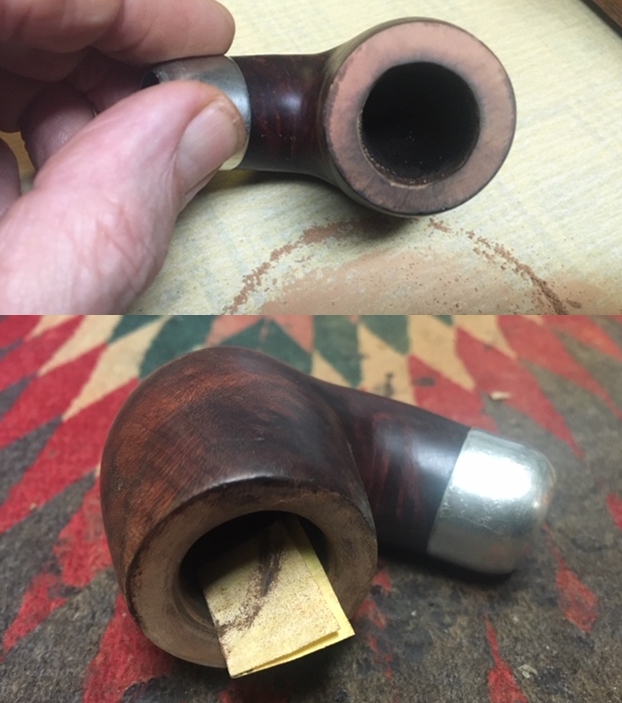
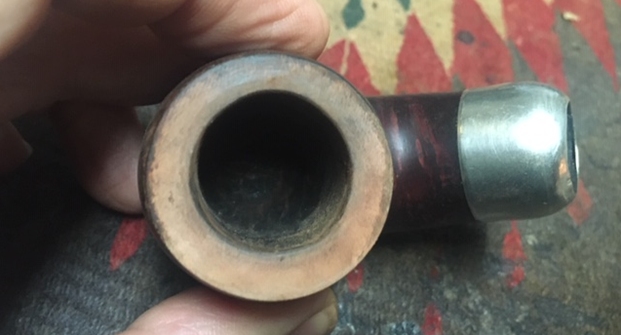
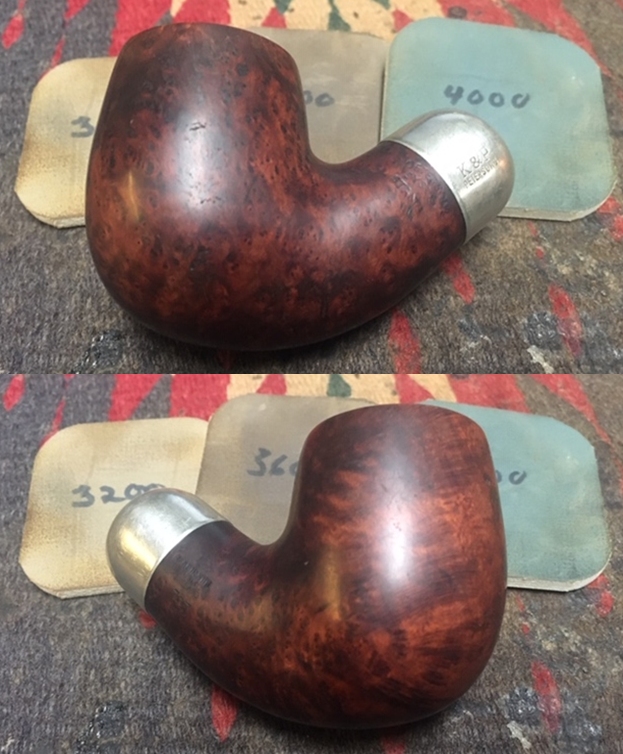
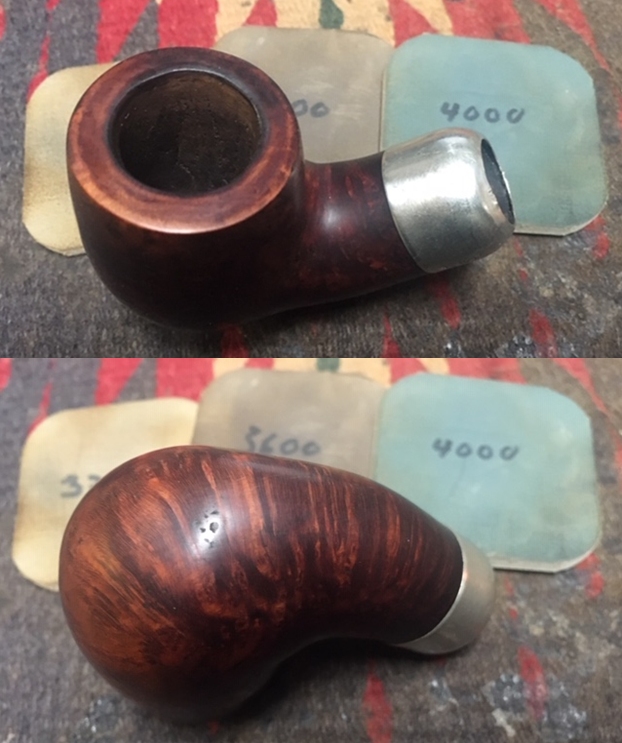
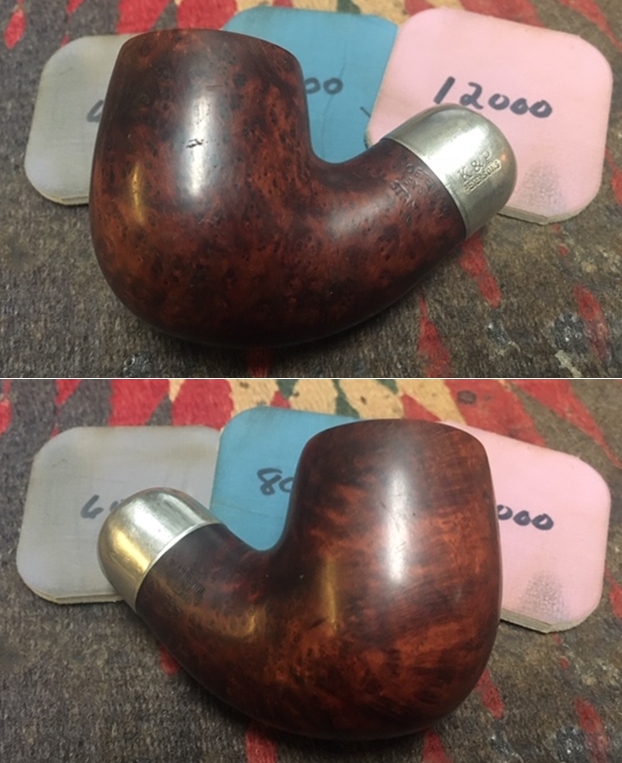
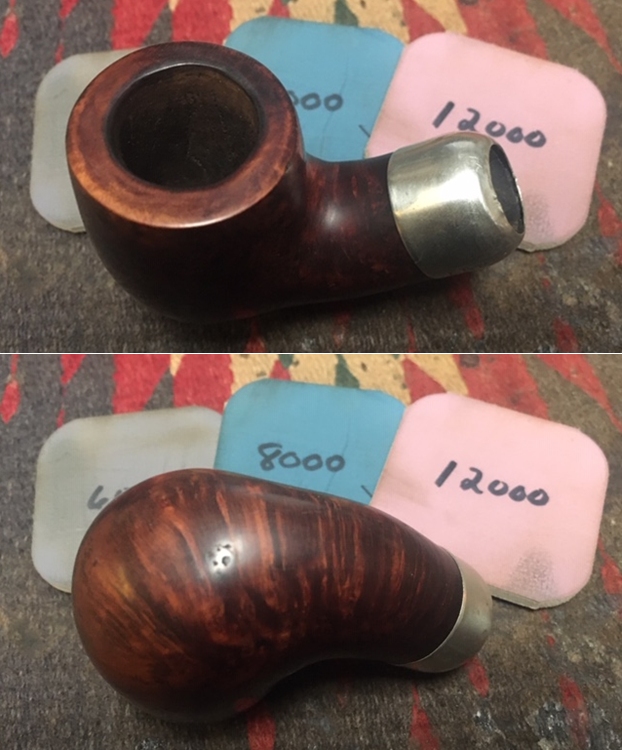
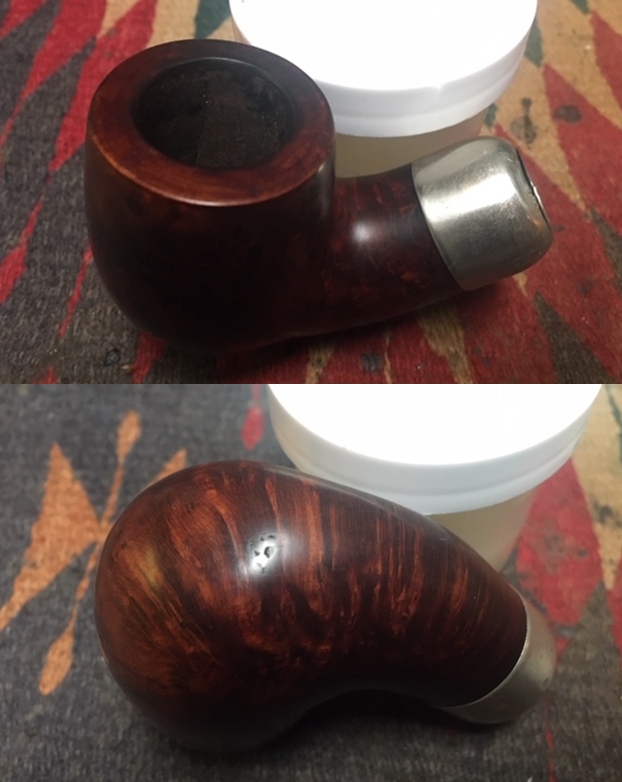
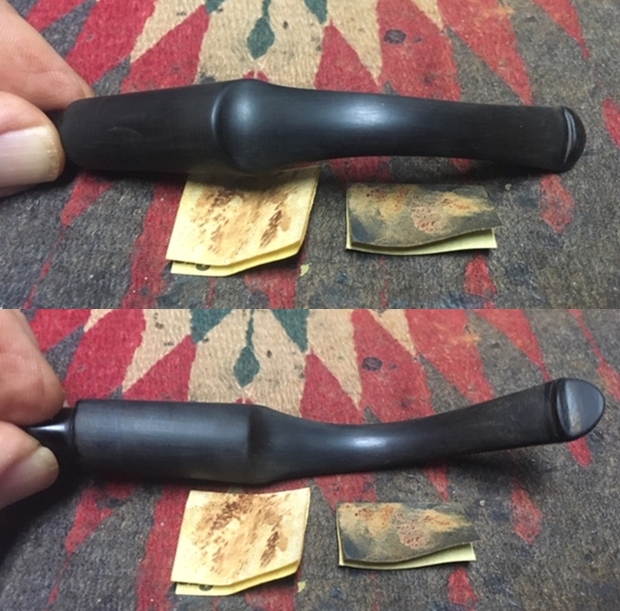
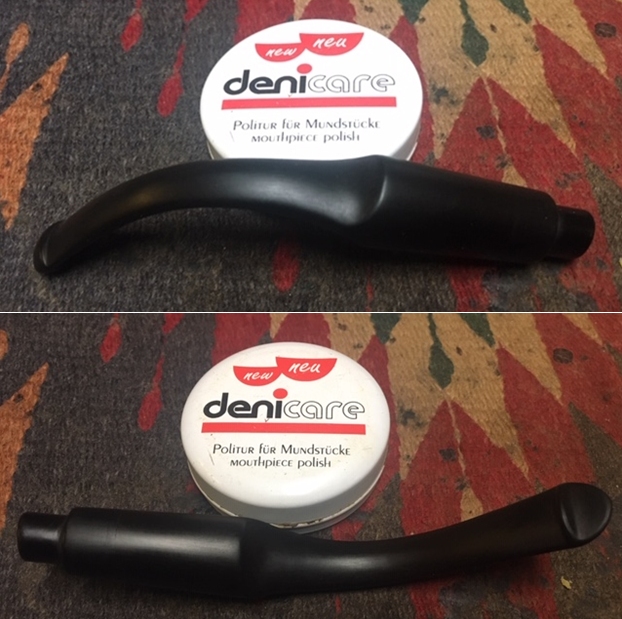
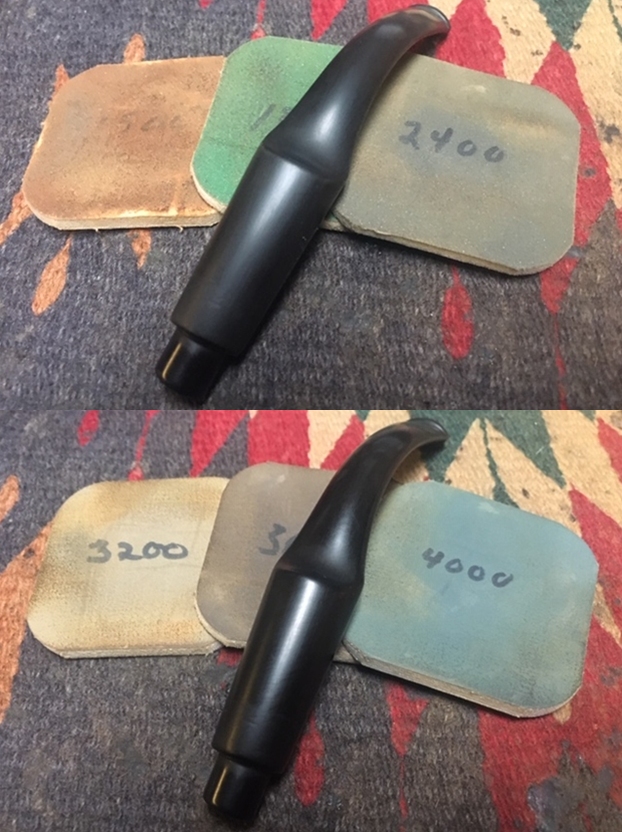
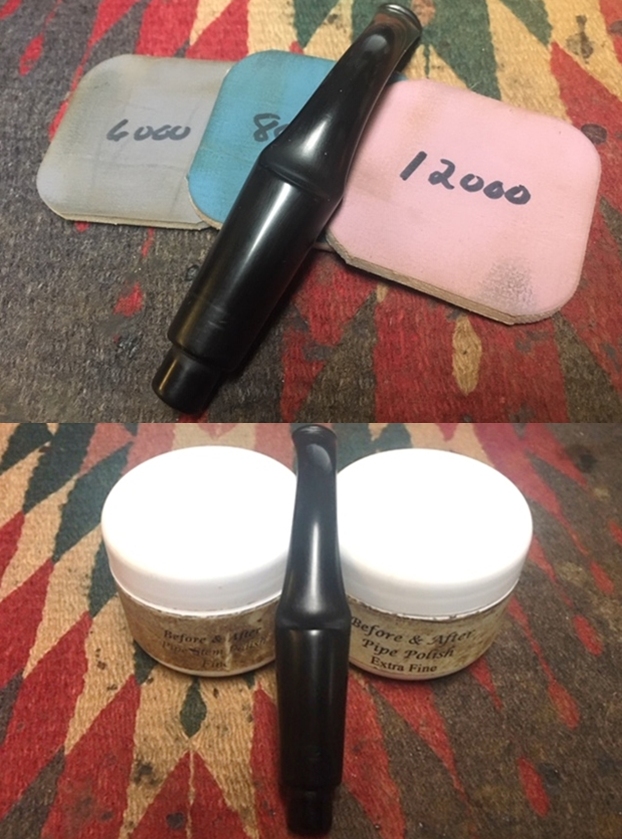
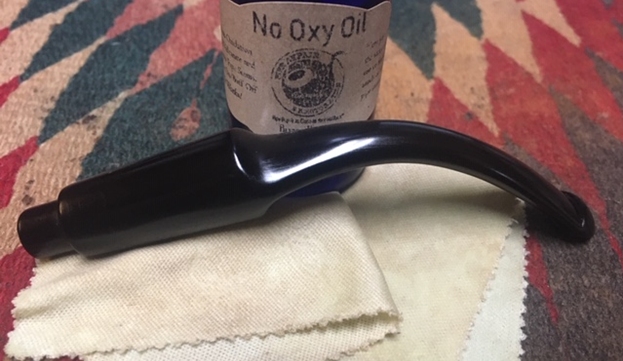
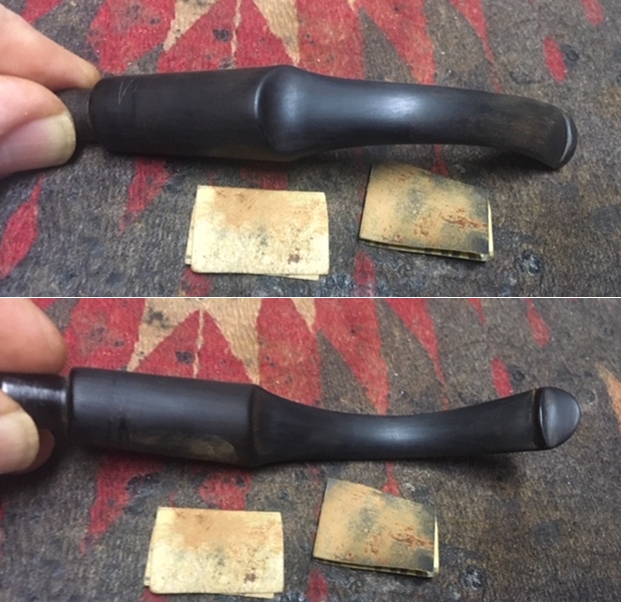
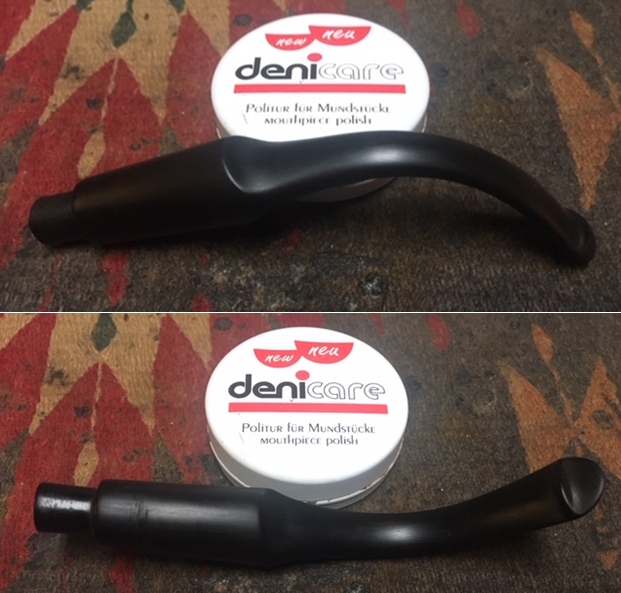
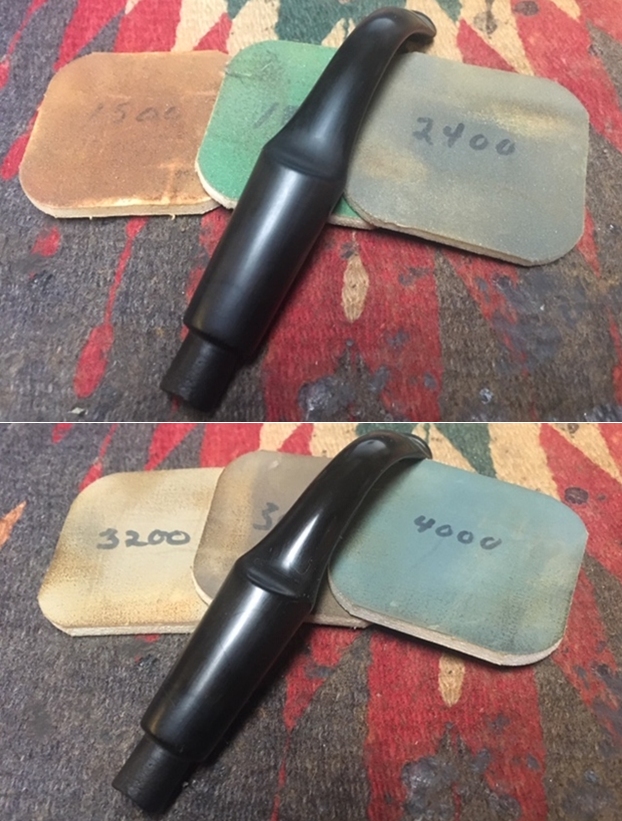
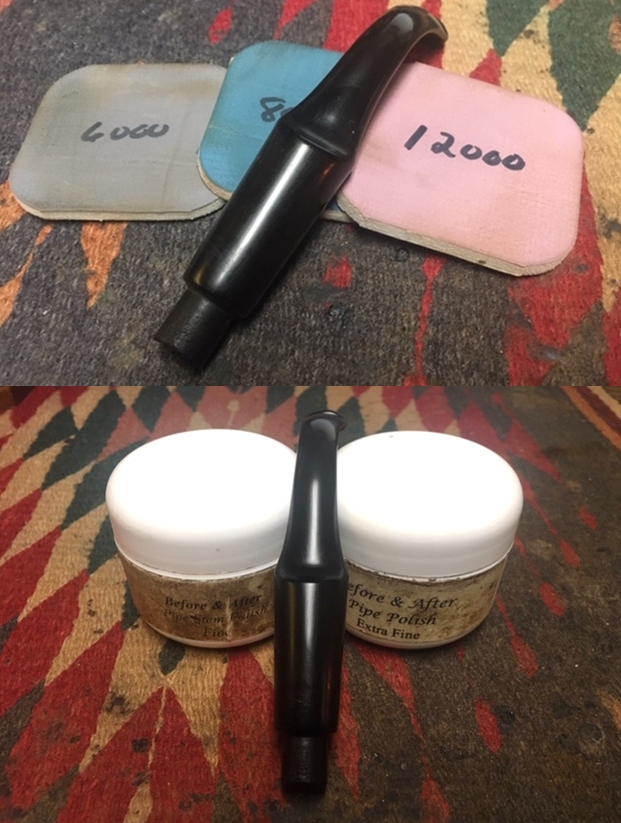
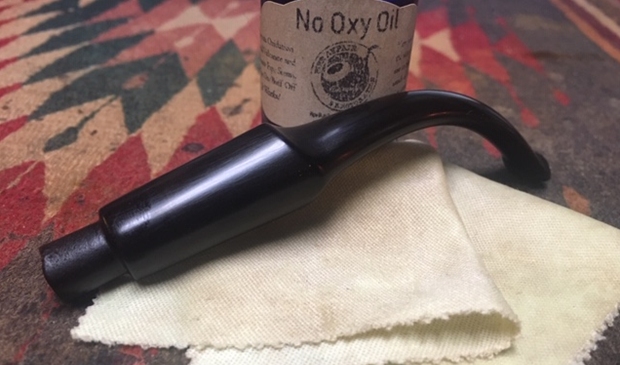
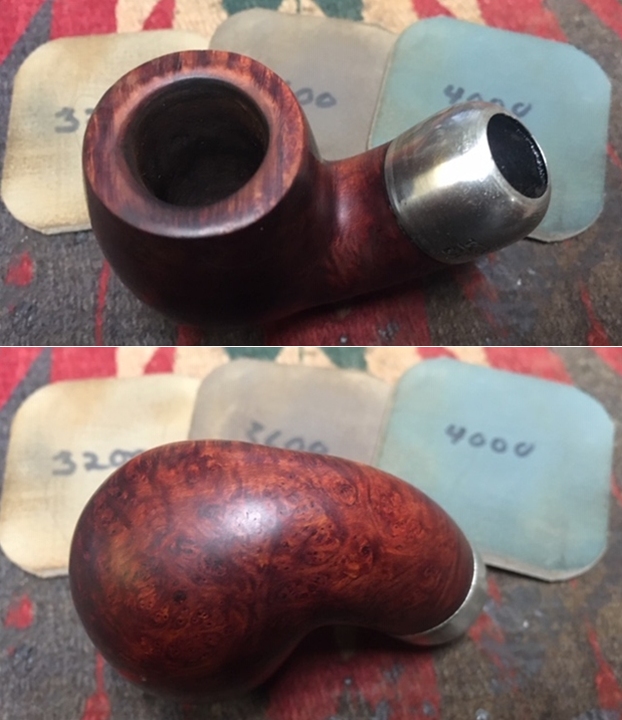
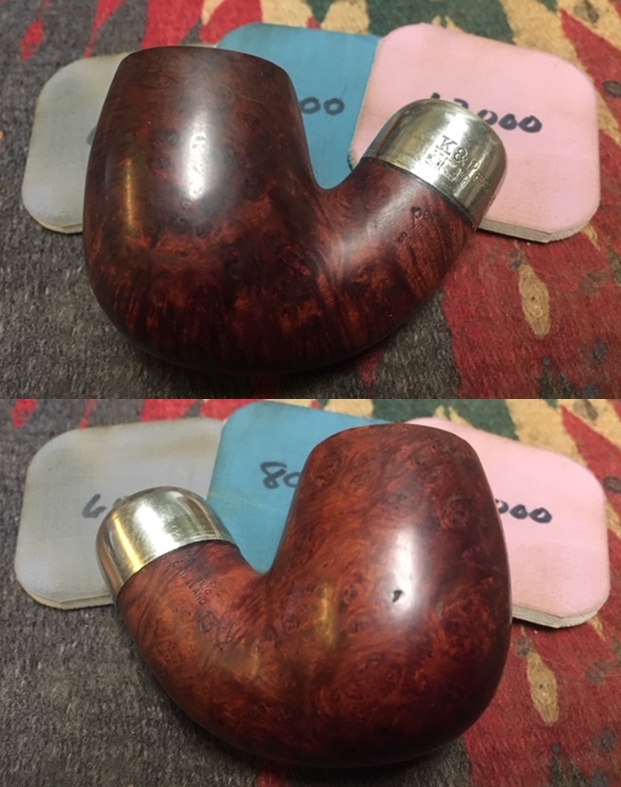
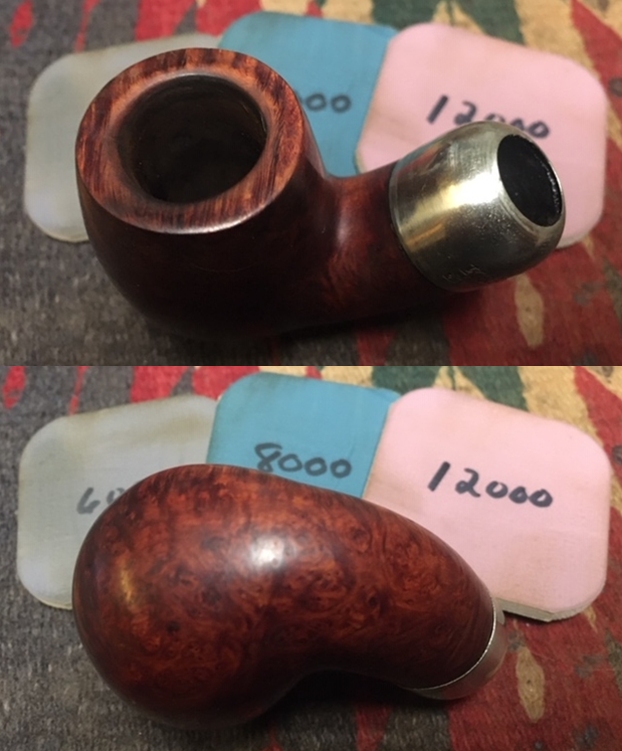
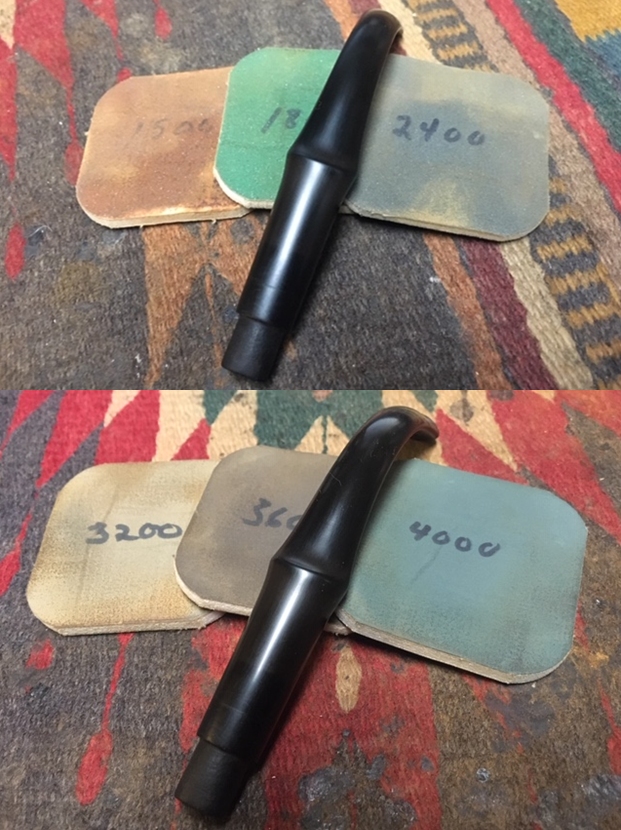
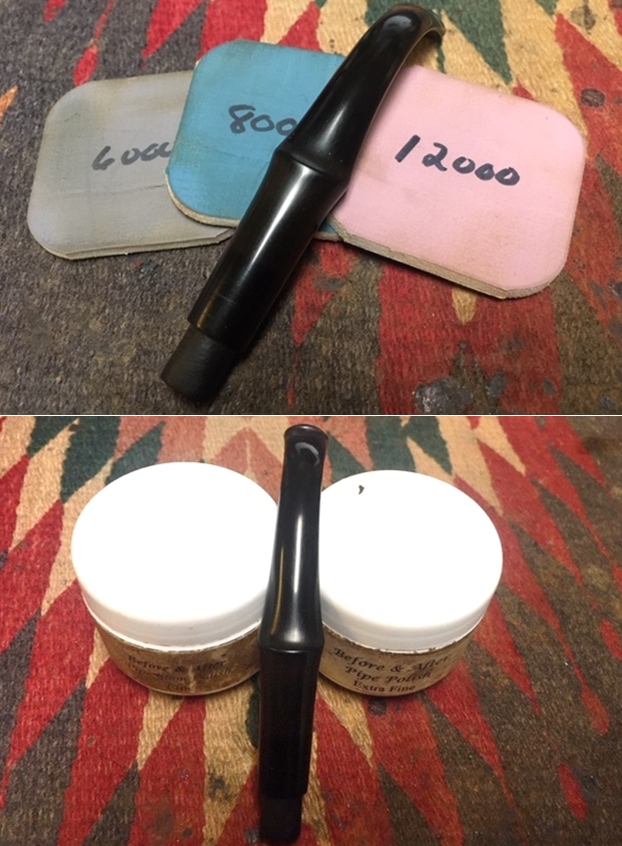
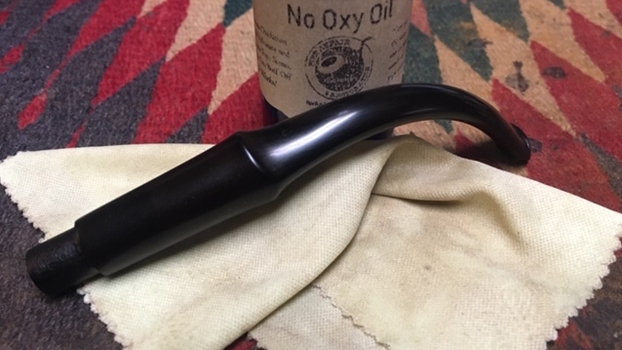
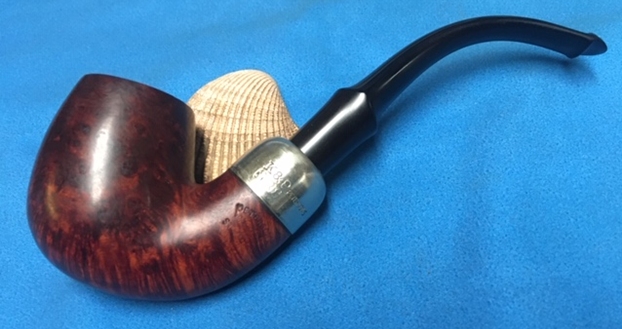
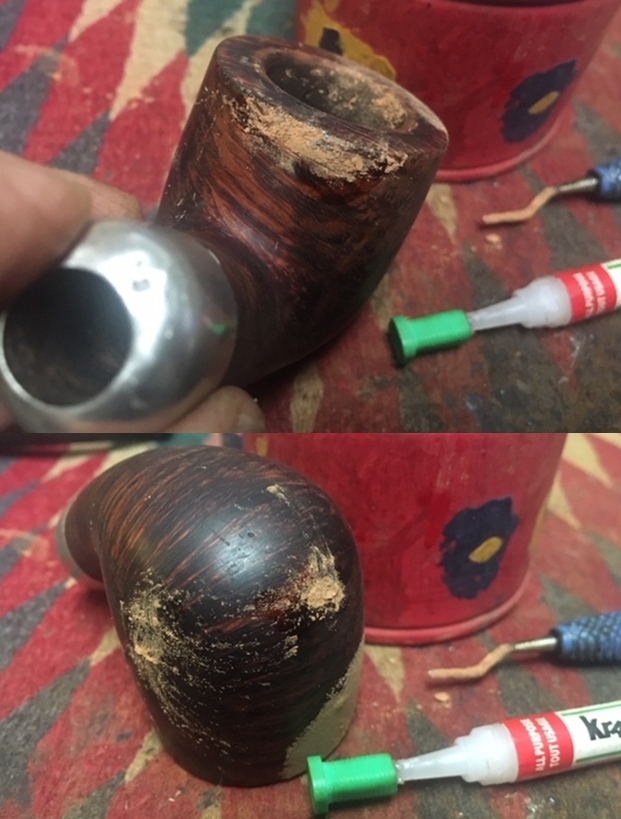
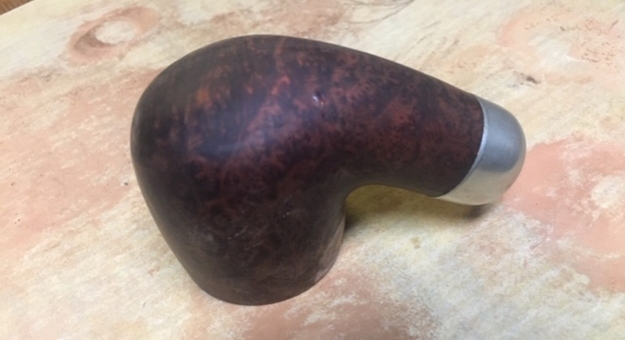
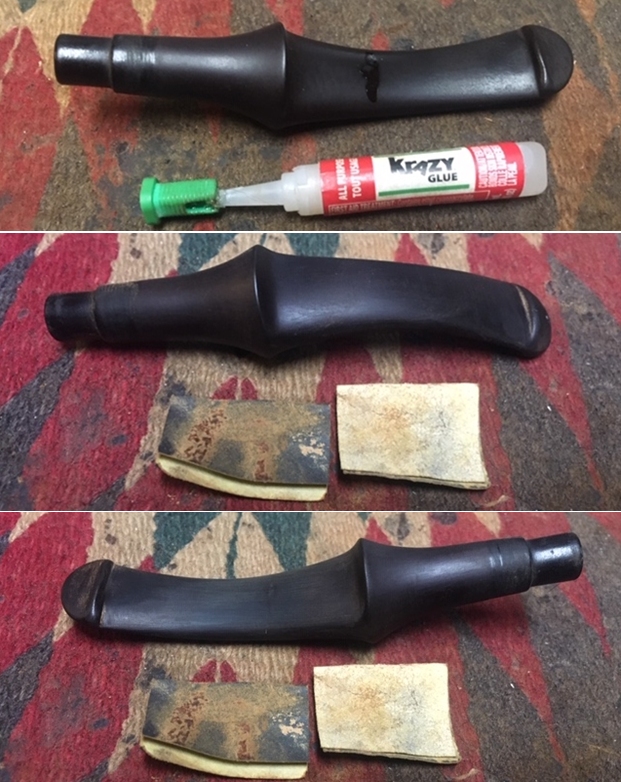
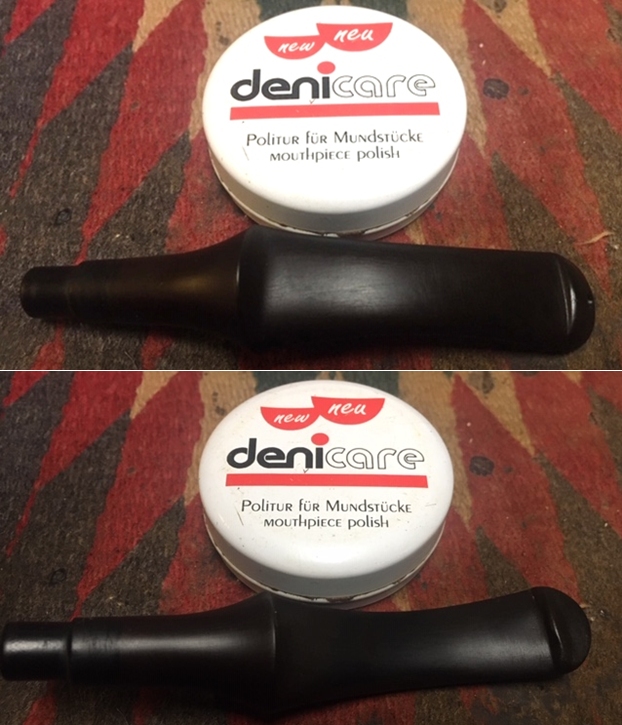
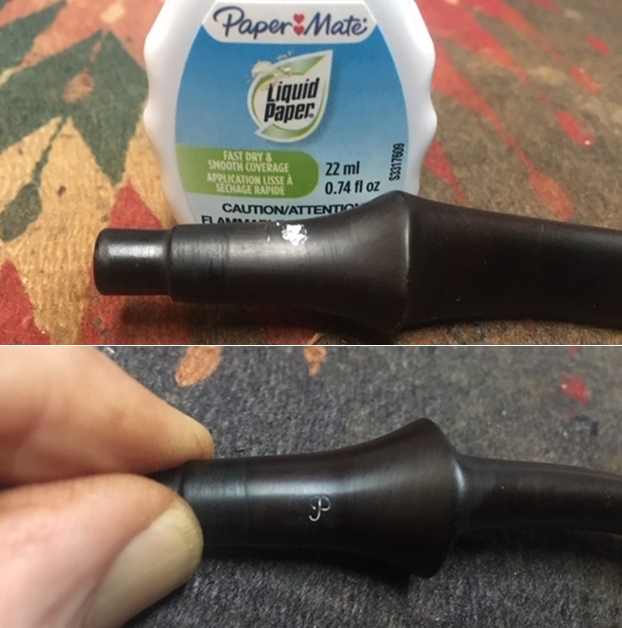
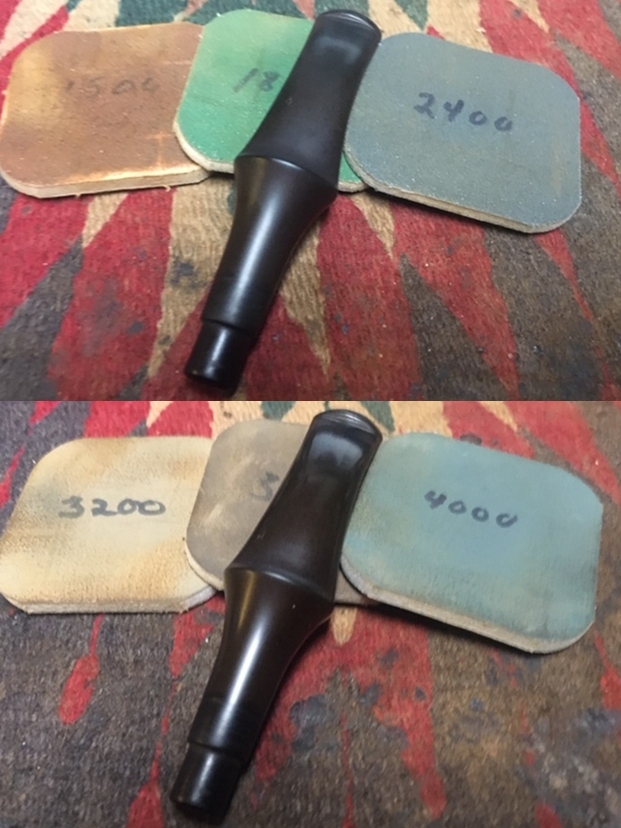
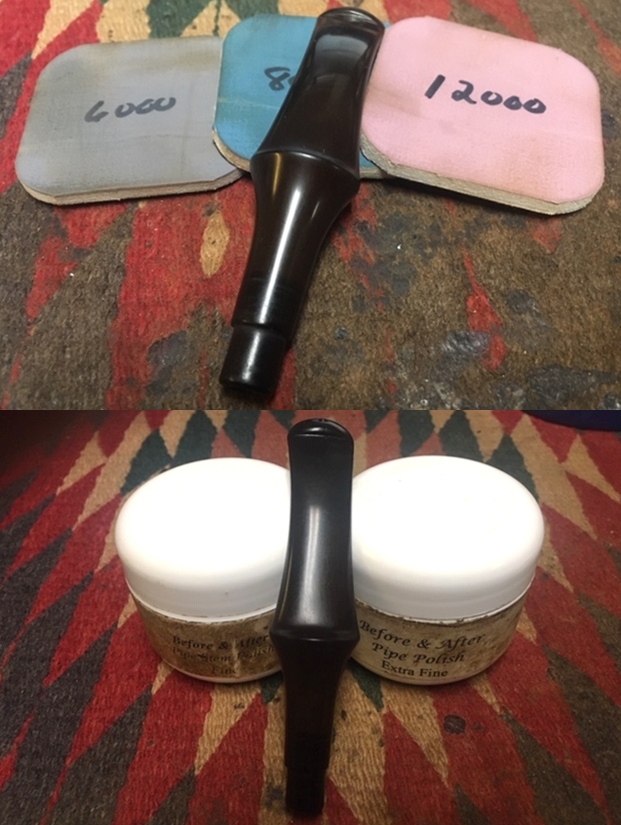
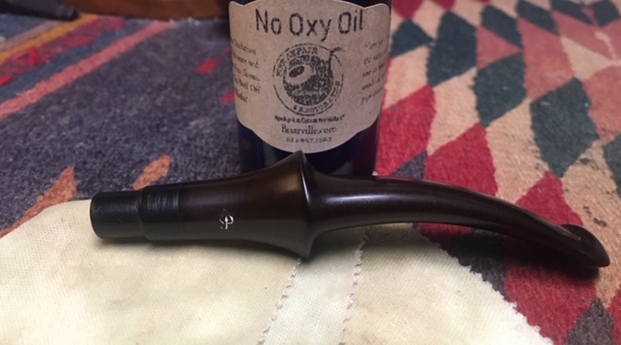
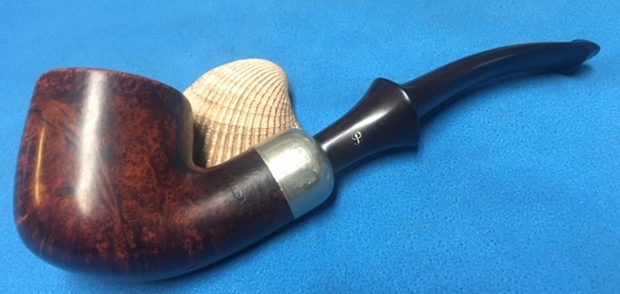
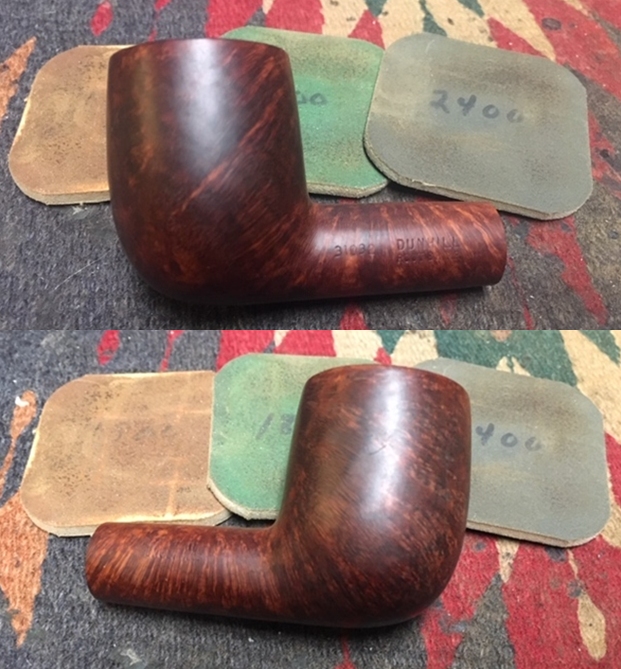
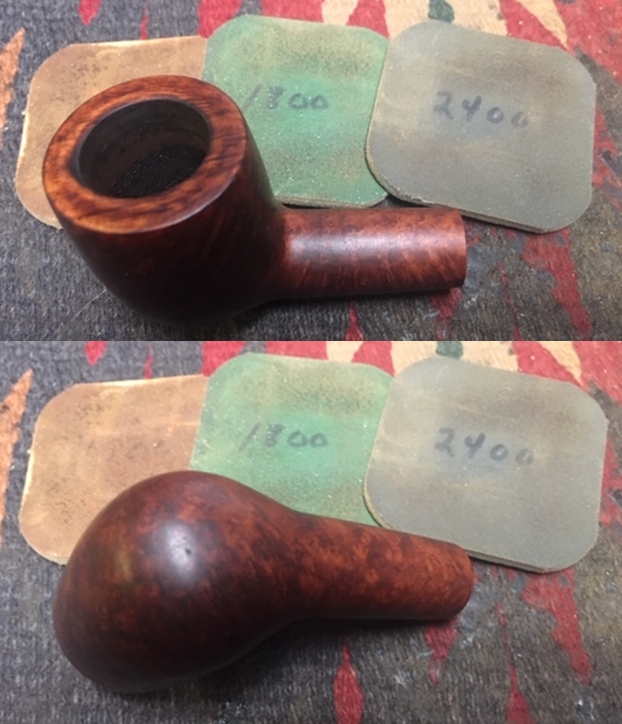
It was time to get on with the restoration of this beautiful and worn Dunhill Root Briar Billiard. I really appreciate the hard cleanup work that Jeff did on these pipes. They were a real mess when I sent them to Jeff and I have to tell you it was great that I did not need to clean this pipe. I decided to start the process by dealing with the dents in the briar on both sides of the bowl. I heated a knife with the flame on our gas stove and dampened a cloth. I put the cloth over the dents and applied the hot knife to the surface. The heat generated steam and lifted the dents. I applied the knife several times before I was happy with the look of the bowl. I then went on to address the damage to the inner edge of the bowl. I worked on the inner edge with a folded piece of 220 grit sandpaper and gave it a very slight bevel. I was able to remove much of the damage. There was still a slight “dip” in the edge at the front. The photos show the progress.   I polished the briar on the rim top with micromesh sanding pads – wet sanding it with 1500-4000 grit pads and I wiped the bowl down after each sanding pad with a damp cloth.  The grain progressively stood out as I polished the pipe with the pads.   I paused the polishing to restain the rim top to match the rest of the pipe. I used a walnut stain pen and was able to get the match. The rim top would need to be polished but the colour was right so time would tell.I continued to polish the bowl with 6000-12000 grit micromesh sanding pads. I wiped it down after each pad with a damp cloth.   I rubbed the bowl and rim down with Before & After Restoration Balm. I worked it into the surface of the briar with my fingertips to clean, enliven and protect it. I let the balm sit for a little while and then buffed the pipe with a cotton cloth to raise the shine. I really like watching the Balm do its magic and bring the briar alive.    With the bowl done it was time to address the stem. The dents in the top and underside were the right depth for me to lift them. I “painted” the surface of the stem with the flame of a Bic lighter to raise the dents in the surface. I was able to lift most of them to the point that a repair would be less complex.   I filled in the damaged areas on the button edge and the small remaining dents in the underside of the stem with clear Krazy Glue. Once the repair had cured I used a flat needle file to reshape the button and edges. The stem is starting to take shape.  I sanded the surface of the stem with 220 grit sandpaper to remove the remaining oxidation in the vulcanite. I polished it with 400 grit wet dry sand paper.    I rubbed the stem down with Denicare Mouthpiece Polish. I have a few tins of this laying around so I am trying to use them up. It does a pretty good job polishing the stem.  I polished the stem with micromesh sanding pads – wet sanding with 1500-12000 grit sanding pads. I wiped it down after each pad with a damp cloth to remove the sanding dust. I polished it further with Before & After Pipe Polish – both Fine and Extra Fine. I finished by rubbing the stem down with some “No Oxy Oil” to protect the vulcanite. I am experimenting with the product from Briarville and tracking how it works so I can write a review of it.  Once again at this point in the restoration process I am excited to be on the homestretch. This is the first of the Dunhill smooth pipes in Bob’s estate that I am working on. It is a beautiful Root Briar 31032 Billiard. I always look forward to this point in the process when it is put back together, polished and waxed. I put the bowl and stem back together. I polished the bowl and stem with Blue Diamond to polish out the scratches in the briar and the vulcanite. I gave the bowl and the stem multiple coats of carnauba wax. I buffed the pipe with a clean buffing pad to raise the shine. I hand buffed it with a microfiber cloth to deepen the shine. The pipe polished up pretty nicely. The grain around the bowl and shank really came alive with the wax and polish. The black of the tapered vulcanite White Spot stem is a beautiful contrast to the browns of the finished bowl and shank. This is Dunhill was a lot of fun to work on thanks to Jeff’s cleanup work. The pipe is comfortable pipe to hold in the hand. The finished pipe is shown in the photos below. The dimensions of the pipe are Length: 5 ¼ inches, Height: 1 ¾ inches, Outside diameter of the bowl: 1 ¼ inches, Chamber diameter: ¾ of an inch. This 78 Root Briar Billiard is a beauty that I am still trying to figure out whether to sell it or buy it. It will take a bit of time and once I decide I will either enjoy it or it will be going on the rebornpipes store. I have a lot more of Bob’s estate to work on of various brands. Perhaps one of those will catch your attention. Thanks for reading this blog and my reflections on the pipe while I worked on it. This is an interesting estate to bring back to life.

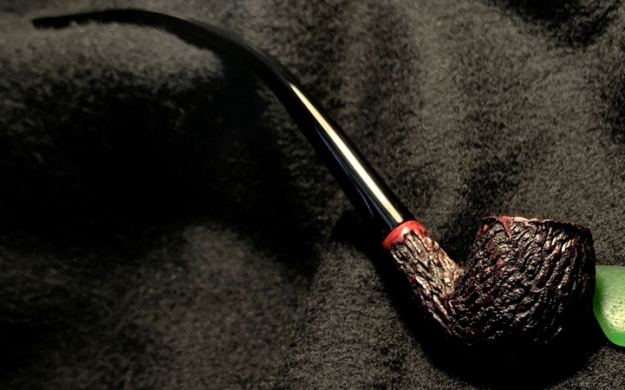
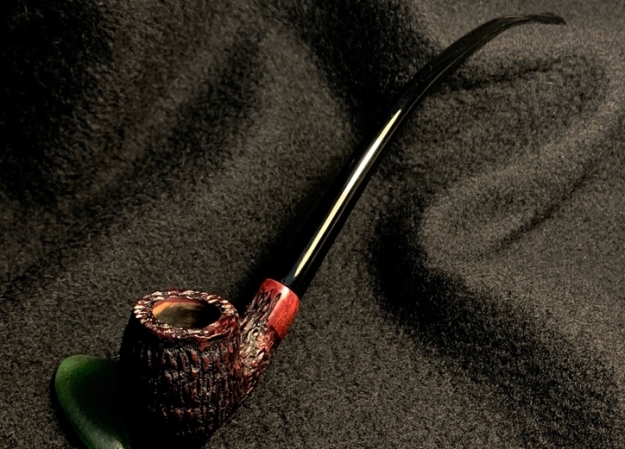
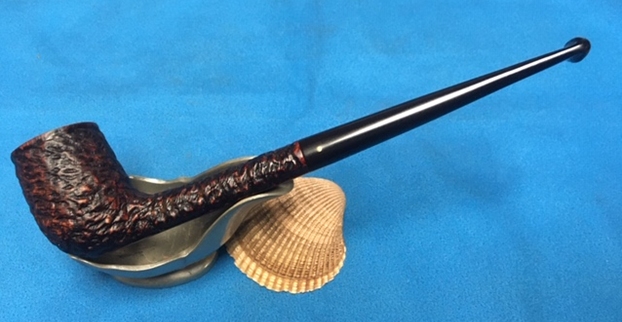
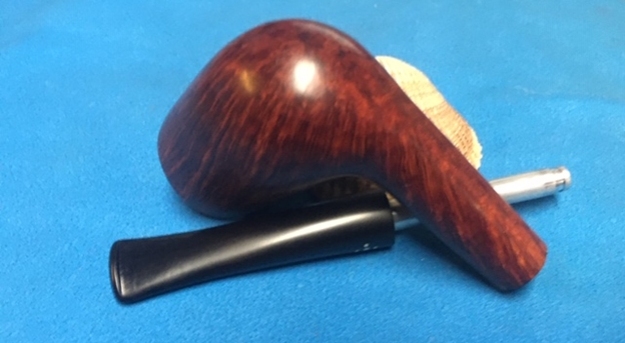
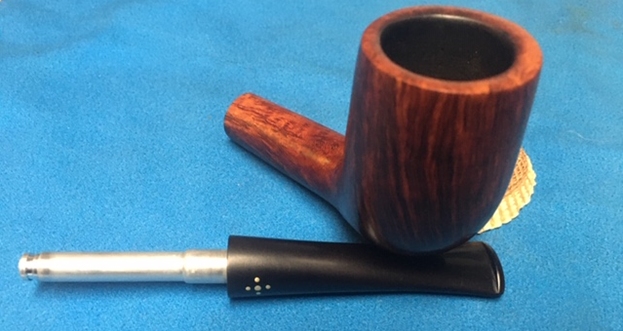
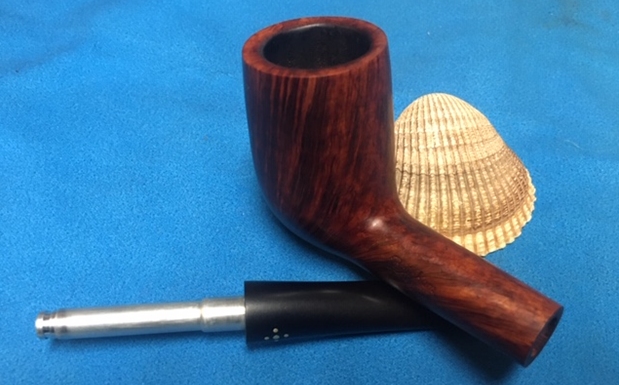
Fashioning a Churchwarden as a Christmas Gift for my Son


Blog by Dal Stanton

One of the advantages of having ‘The Pipe Steward’ in the immediate family is that there’s a very good probability that his gifting patterns might reflect one of his favorite pastimes – restoring pipes!  Over the years, it has given me great joy to gift my loved ones – sons and daughters(!), with pipes that I’ve restored.  There are at least two reasons for this.  First, they receive a beautiful pipe which has been given the TLC that brings it again to a pristine condition – often better than new!  They can enjoy the composite beauty of its shape, grain formations and hues.  Additionally, understanding a pipe’s story through the research and write-up that accompanies each recommissioned pipe adds to the overall appreciation for the pipe.  The pipe itself is the first part of a growing legacy.  Secondly, the fact that the gift has passed through the care and attention of my hands, restoring the pipe’s condition, adds my personal part to the pipe’s legacy.  The ‘Giver’s’ story is added to the pipe and is then associated with the pipe by the loved one that that receives the pipe, becoming its new steward.

My son, Josiah, is coming from St. Louis to join his mother and I for Christmas here in Bulgaria.  He joins his sister, Johanna and her husband, Niko, who have come to Sofia from Nashville.  Both Josiah and Johanna, our two youngest, lived here with us when they were teens.  So, they are coming ‘home’ for Christmas and this is special for them and for us.  Two additional things add to the specialness of this Christmas reunion.  First, Josiah is bringing with him a young lady for mom and dad to meet!  They met in college and have cultivated a relationship.  She’ll be coming to meet his parents….no pressure!  Secondly, Johanna and Niko are also bringing a special gift – we just found out that they are expecting their first little one to add to our growing number of grandchildren!  Gifts are special during Christmas and they come in different ways.  The greatest gift is the reason we celebrate Christmas – God’s gift of his Son, Christ, given to a dying and broken world to bring the gift of life.

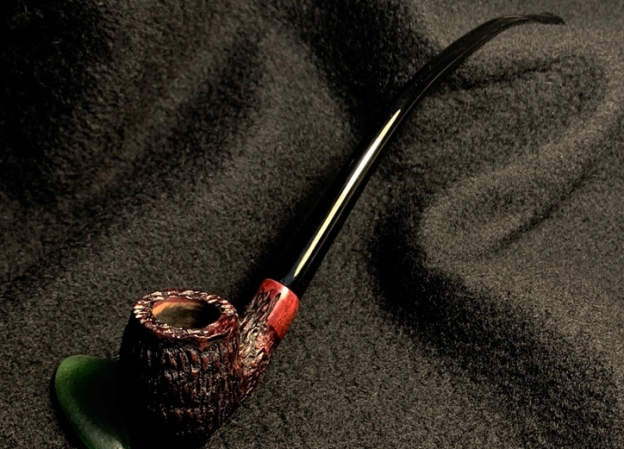
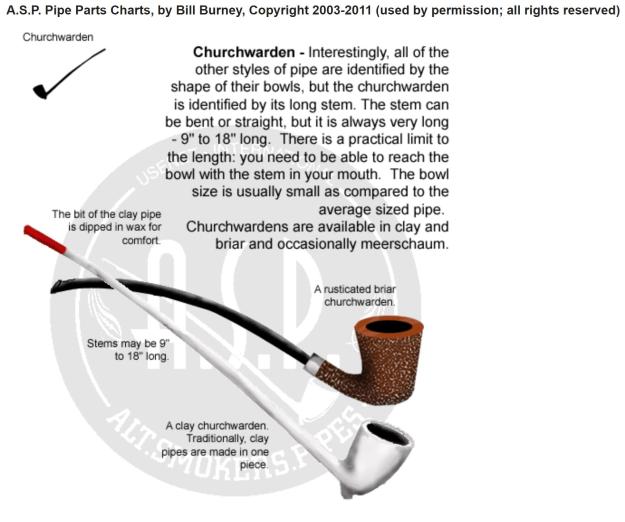
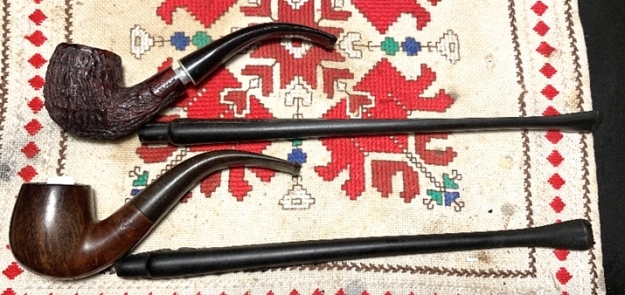
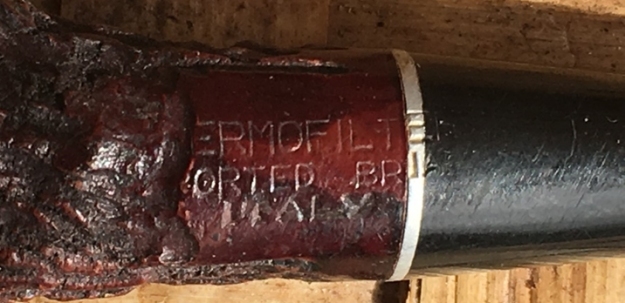
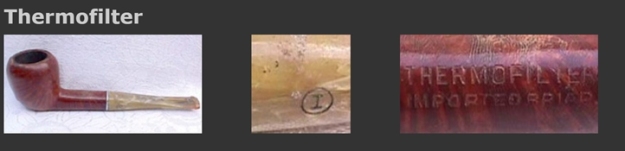
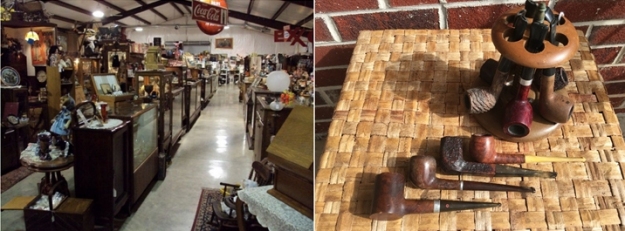
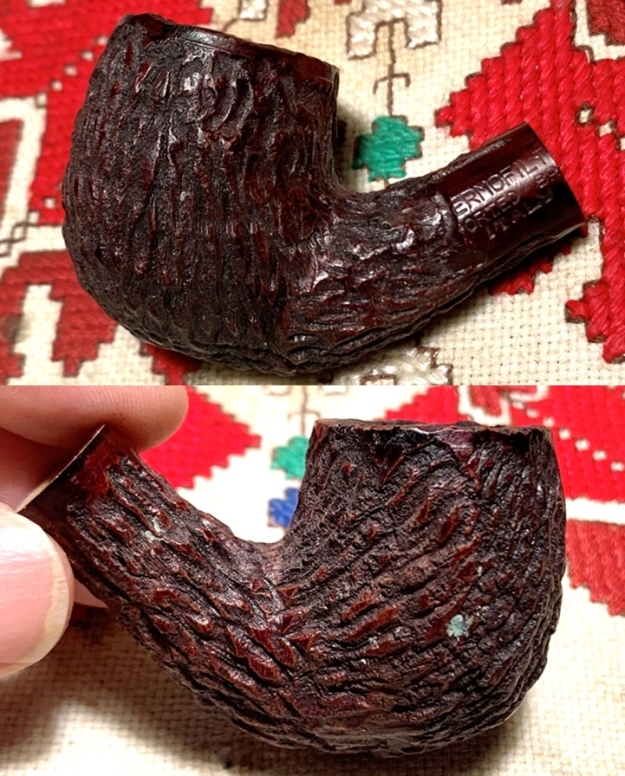
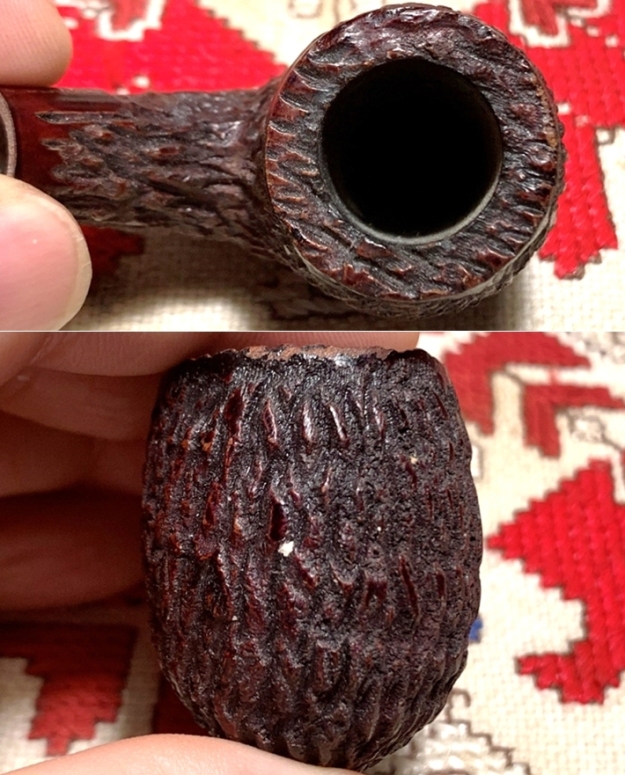
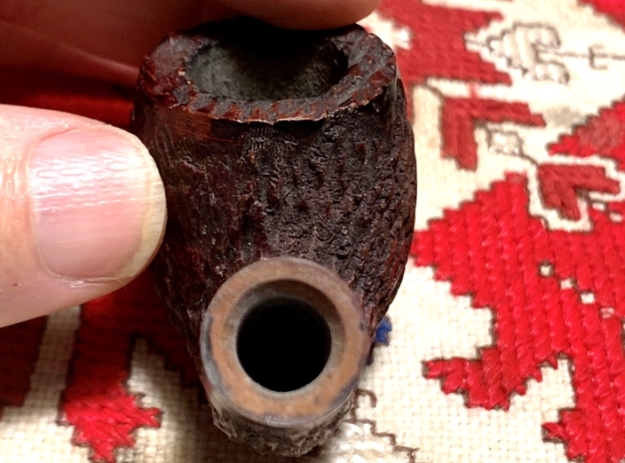
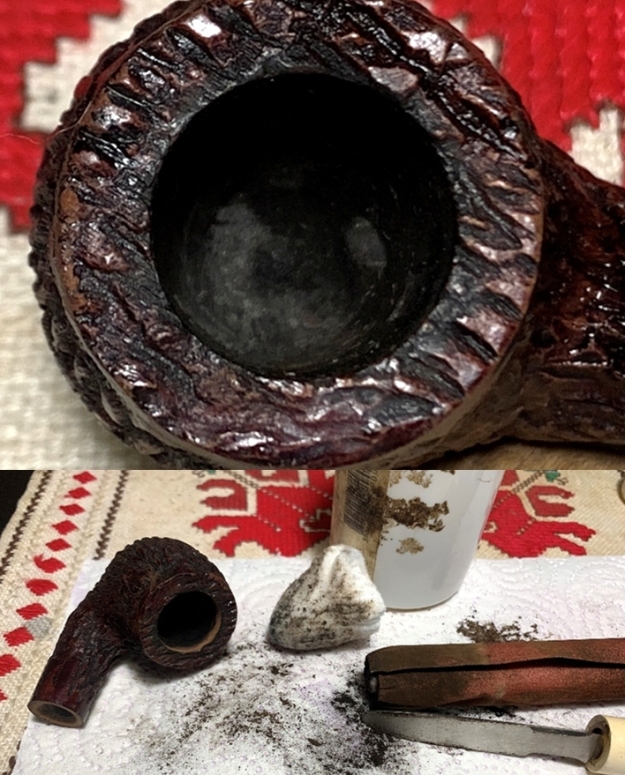
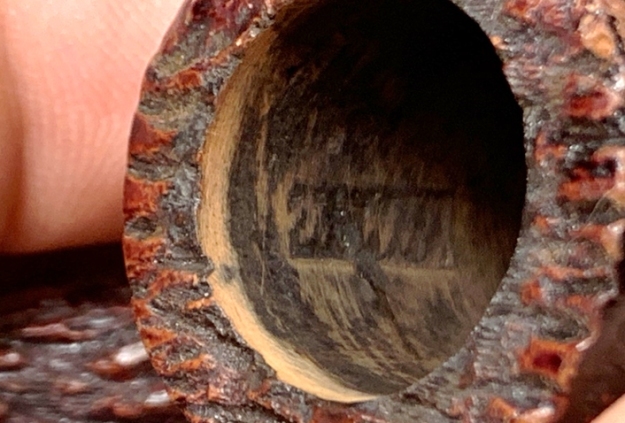
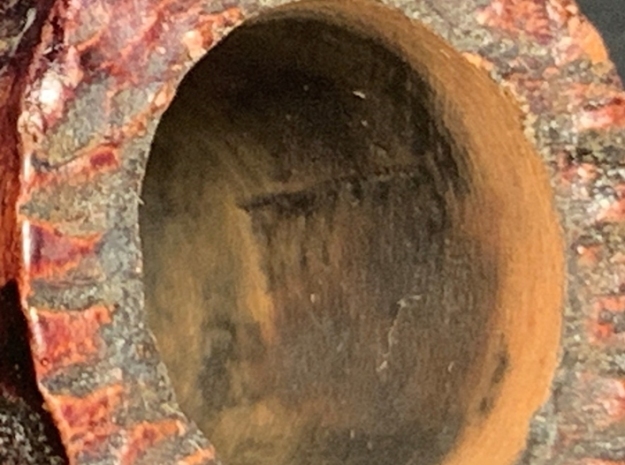
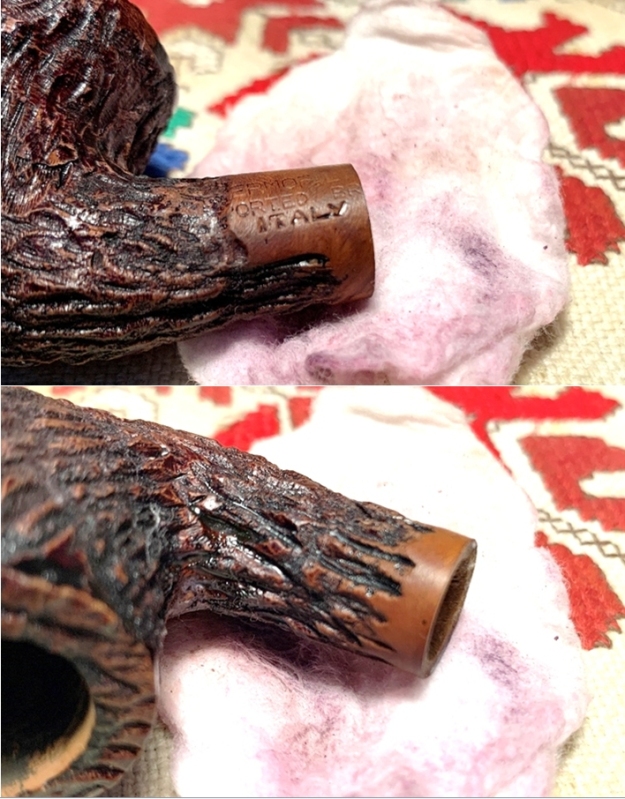
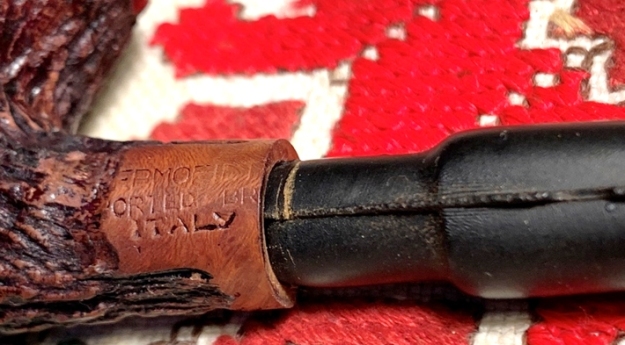
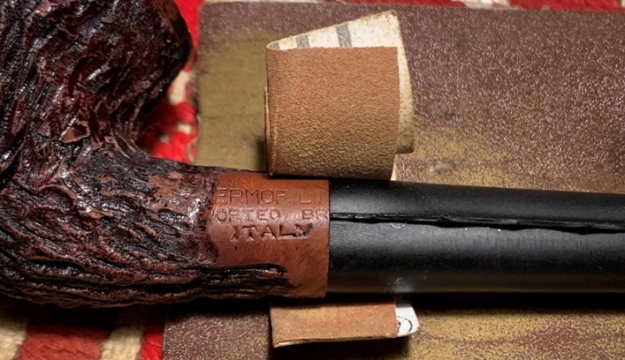
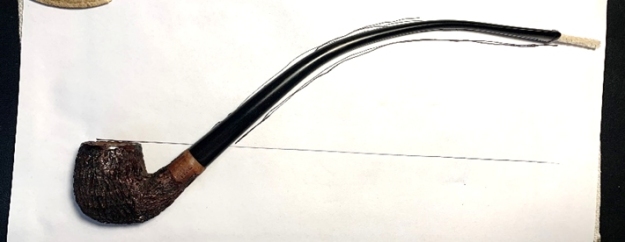
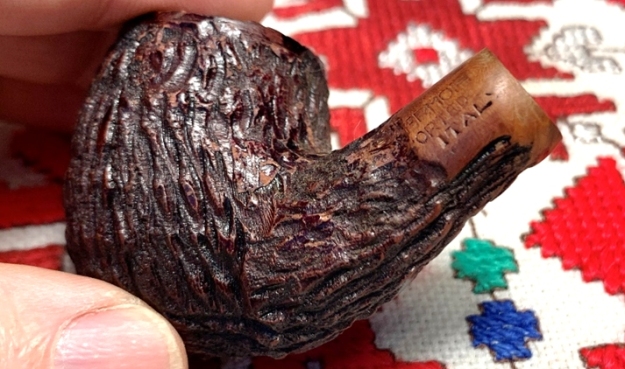
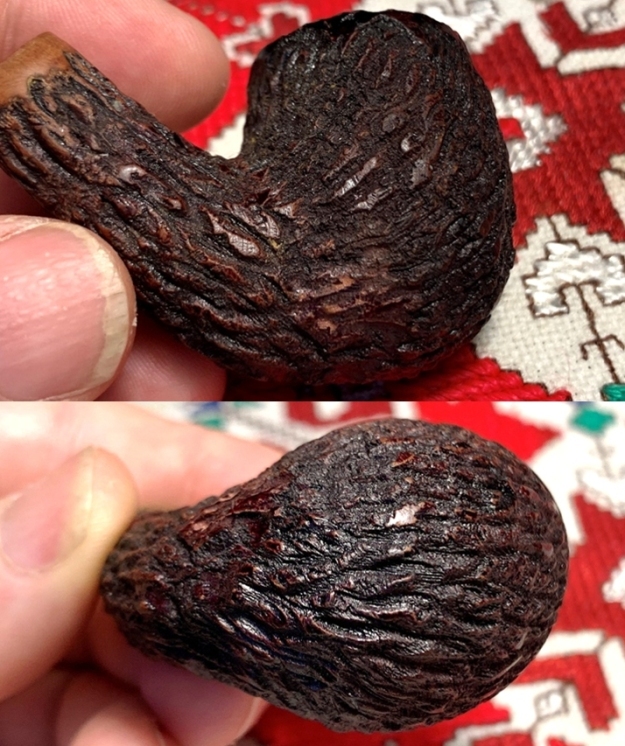
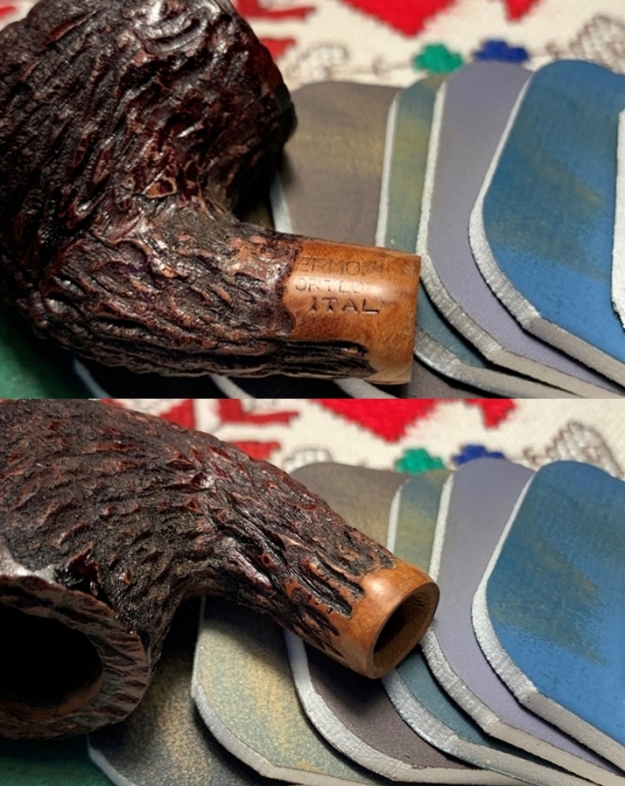
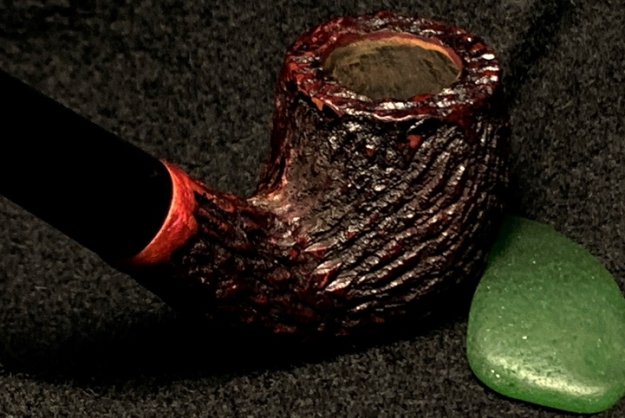
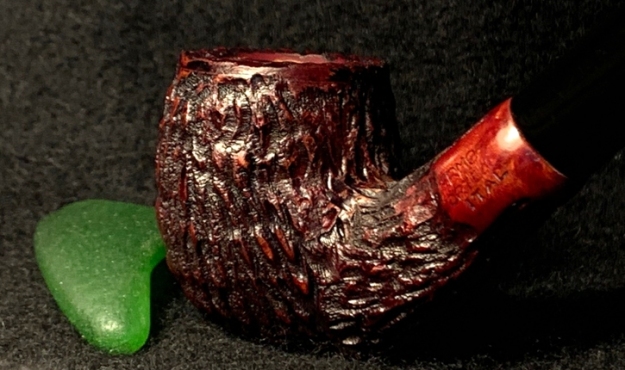
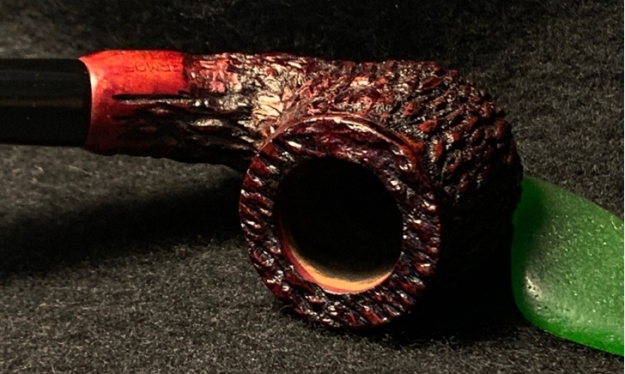
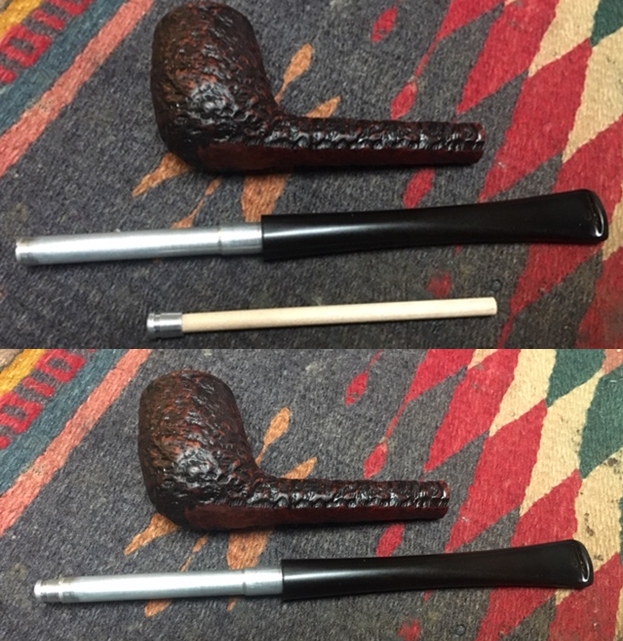
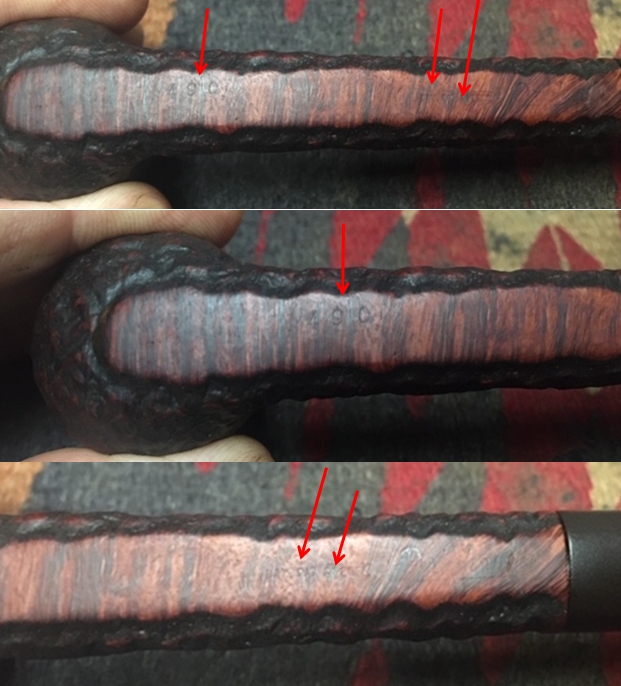
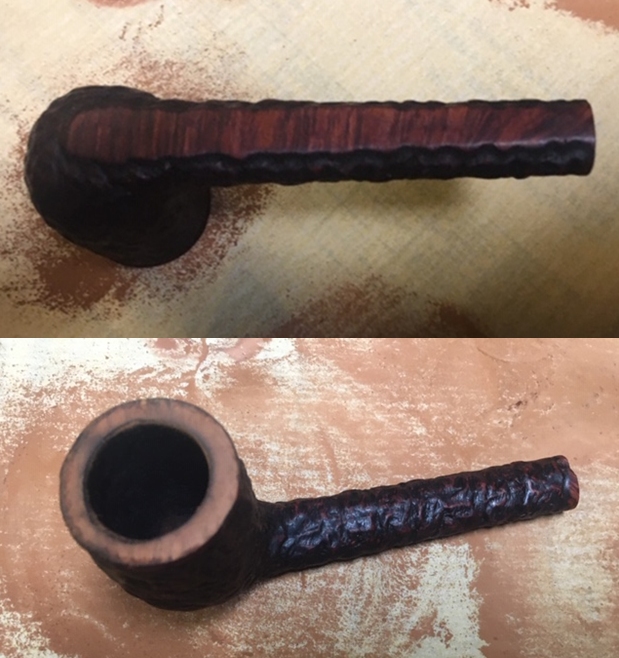
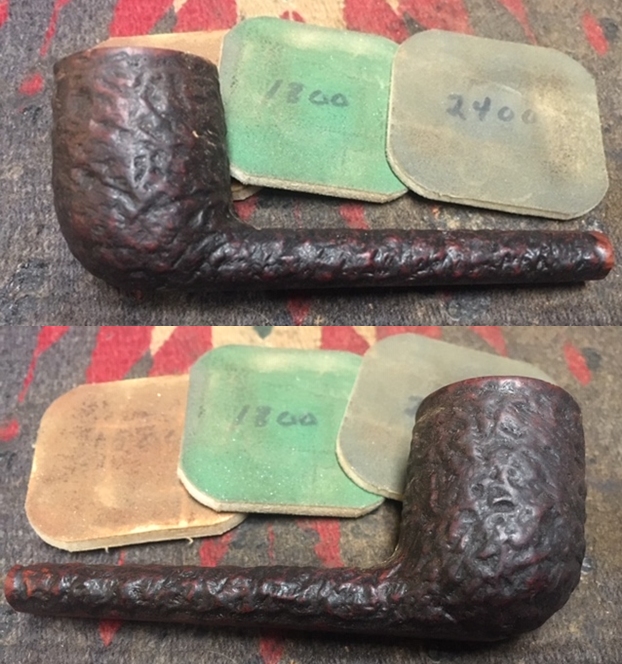
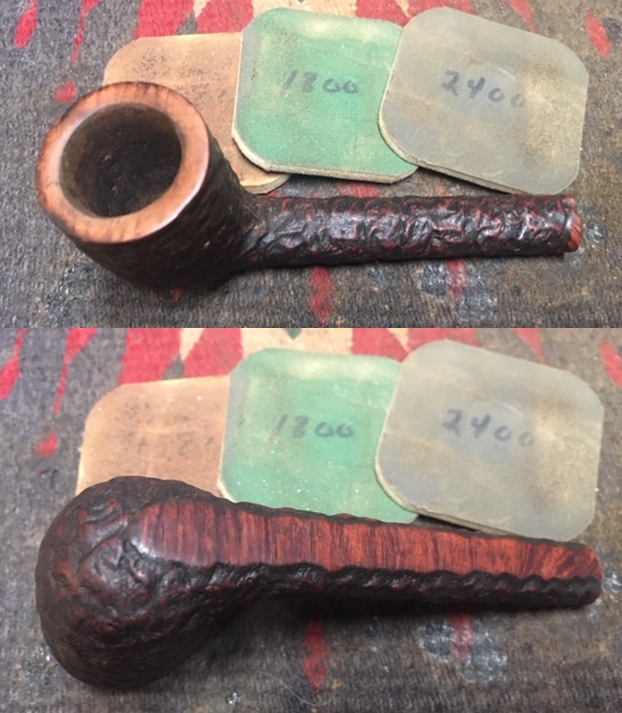
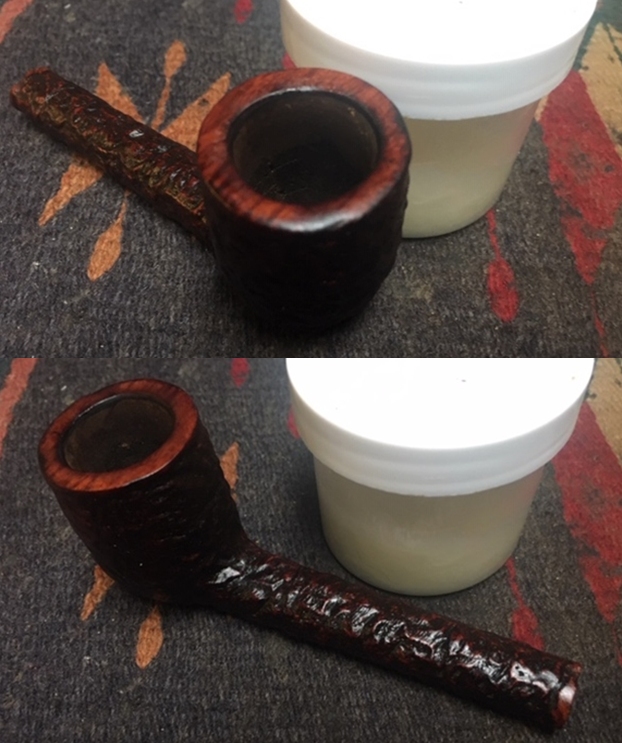
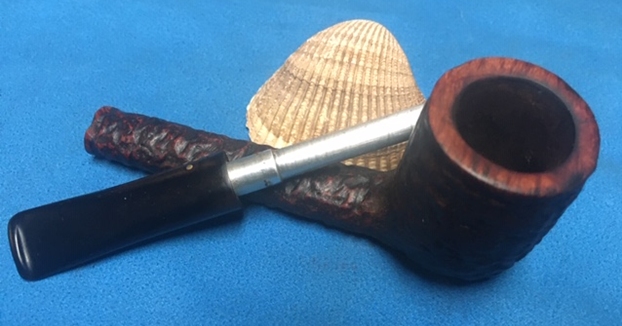
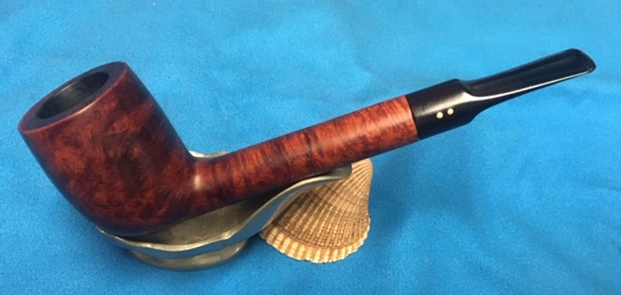
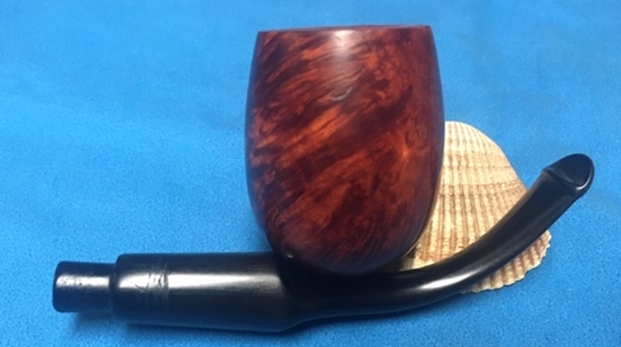
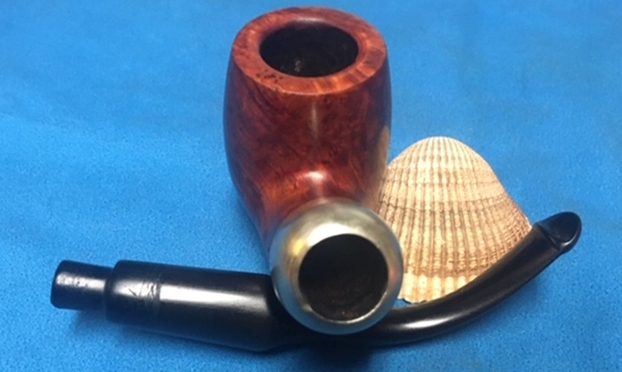
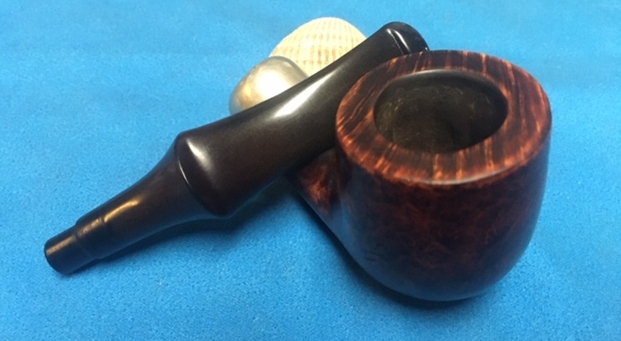
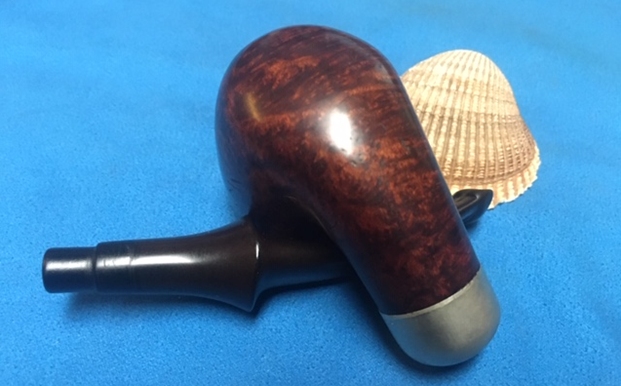
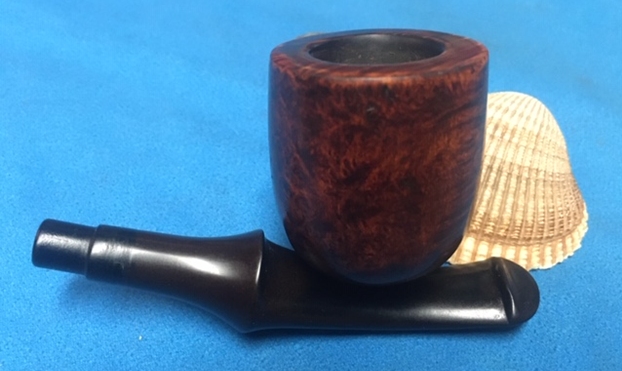
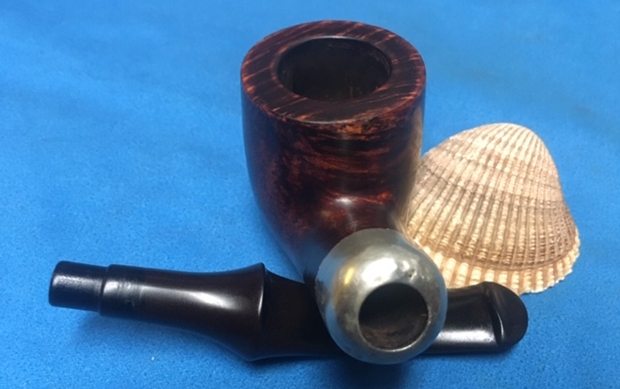
For this Christmas, a Churchwarden will be fashioned for Josiah.  I enjoy repurposing forgotten bowls to give them new life by simply mounting them to a long, flowing Warden stem.  The uniqueness of the Churchwarden is that it is not primarily the style of bowl that makes it a Churchwarden, but the length and style of the stem.  From Bill Burney’s description in Pipedia we discover this information.I found two bowls in my box that held CW potential.  A petite ‘Made in England’ Bent Billiard with the shape number 950 on the shank.  No other markings.  It’s a classic petite English pipe which is attractive by itself, but so far, no one has shown interest in adopting him from the ‘For “Pipe Dreamers” Only!’ online collection where pipe men and women commission pipes for restoration benefitting our work here in Bulgaria with women and girls who have been trafficked and sexually exploited – the Daughters of Bulgaria (Incidentally, if you go to this link you will see our daughter, Johanna, a few years ago painting a picture depicting our work with the Daughters).  I believe this bowl will serve as a gift for my son-in-law, Niko – next in queue.  The other bowl is a rusticated bowl with the sloppy stamping not fitting the smooth panel on the shank’s left flank.  Here are the candidates.As I evaluated the two, I decided on the rusticated bowl for my son, that is rustic and will give the newly fashioned CW an ‘Ole World’ feel.  I take a closer look at the ‘Rustic’s’ nomenclature.  The sloppy stamping shows ‘ERMOFILTER’ – with ‘’ER” running over onto the metal stem facing and stem, [over] ‘ORTED BRIAR’ (with the ‘IAR’ running over!) [over] ‘ITALY’, the COM.  Undoubtedly, the stamping’s aim was to reveal the name, ‘Thermofilter’ which is not found in Pipedia but Pipephil.eu has this panel of information with a ‘?’ indicating the COM.  The Thermofilter on my work desk adds Italy as the country of origin.I acquired this pipe while in the US a few years back at Madeline’s Antique Store in Manchester, Tennessee, just off Interstate 24.  It was a quick stop as we were traveling through and saw the billboard and decided to stop.  It was a very fruitful detour as I found a Dunhill in the wild and purchased it for a pittance.  In the picture below, the Dunhill (see link for this restoration: Another Wedding Trip Pick: A 1961 DUNHILL EK Shell Briar Made in England 1 4S) is visible (3rd from the bottom) and reminded me that this was on the trip when Johanna and Niko were married!  The Thermofilter is barely visible on the right edge in the pipe stand.I take some pictures of the rusticated bowl to get a closer look and to mark the start. The bowl is a perfect size for a Churchwarden, which tend to be on the diminutive side.  The half bend will provide a great sweeping trajectory for the Warden stem.  The rusticated surface is dirty and needs a thorough cleaning of the crevasses. I’m attracted to the deep burgundy red finish of the briar.  It should clean up very nicely.  To begin the project, an inspection of the chamber reveals almost no cake at all, if any.  I go directly to the Savinelli Fitsall Tool to scrape the sides and then sand the chamber using 240 grade paper wrapped around a Sharpie Pen.  To clean the chamber of debris, I wipe it with a cotton pad wetted with isopropyl 95%.After cleaning the chamber, an inspection reveals no problems with heating cracks or fissures.  Yet, I discover something strange.  On opposite sides of the chamber wall I discover stampings of numbers and perhaps some letters.  I’ve never seen this before and I decide to send a note to Steve to find out if his rebornpipes experience would lend any help. Steve’s response to my inquiry was brief:

Nope never seen that. I have seen small numbers in the bottom of the bowl. Maybe heated like a branding iron. What is the nomenclature?

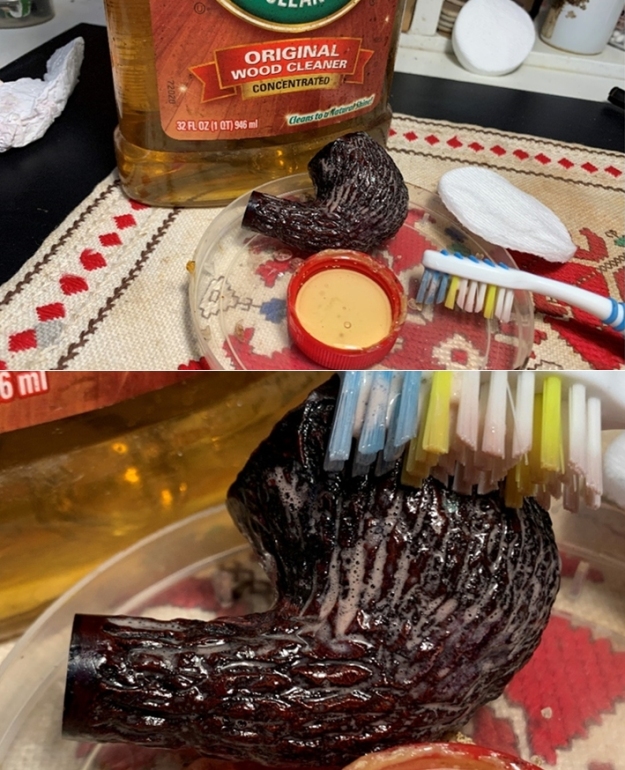
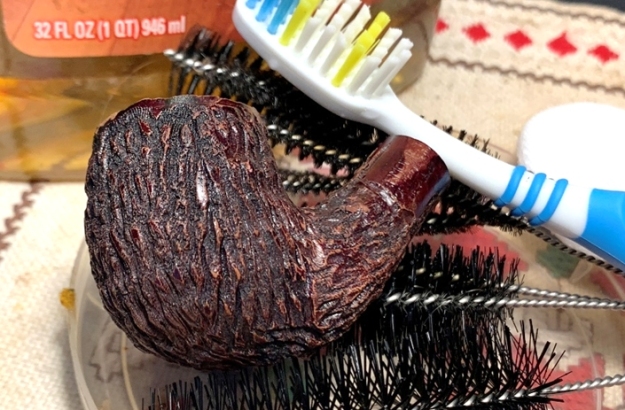
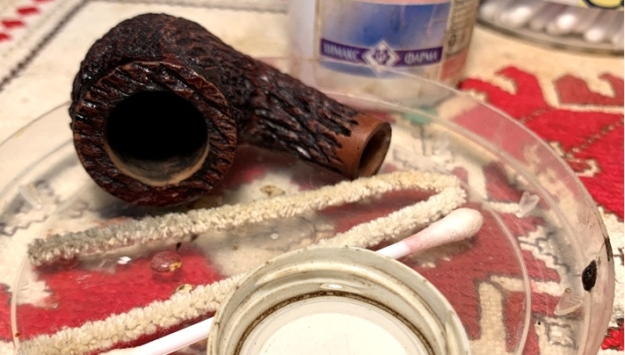
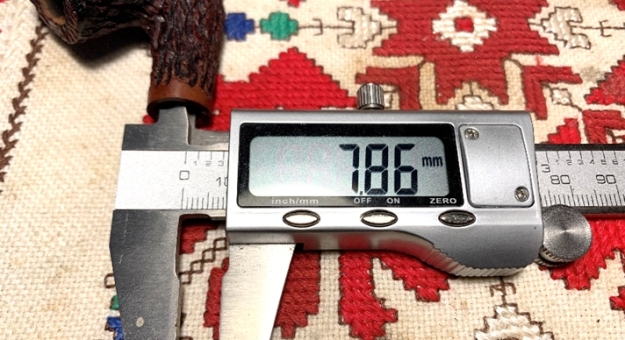
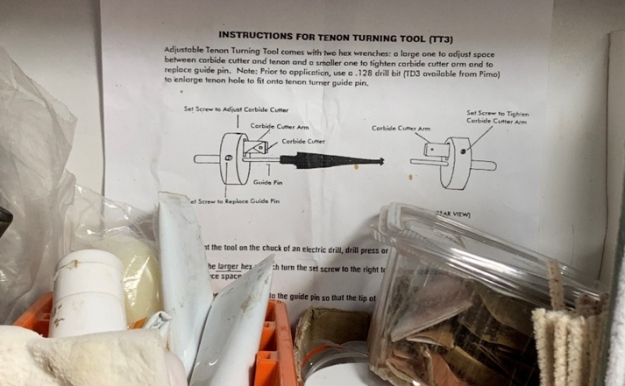
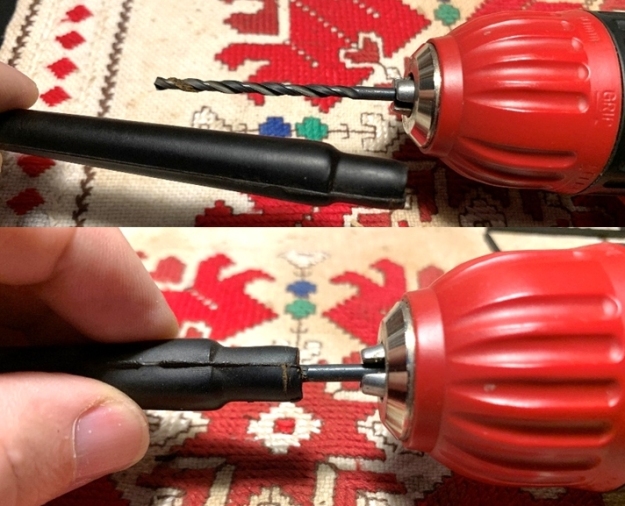
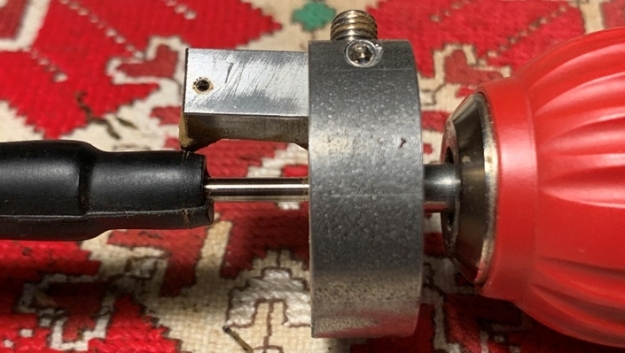
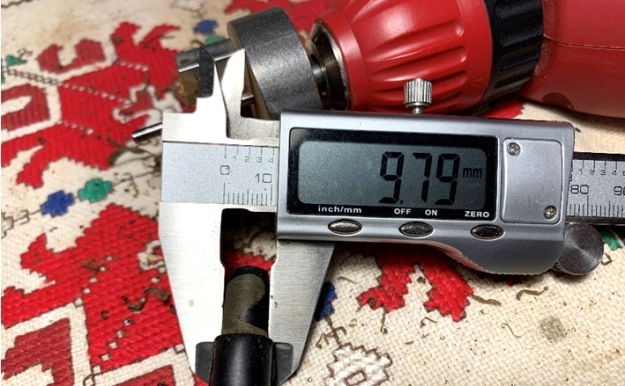
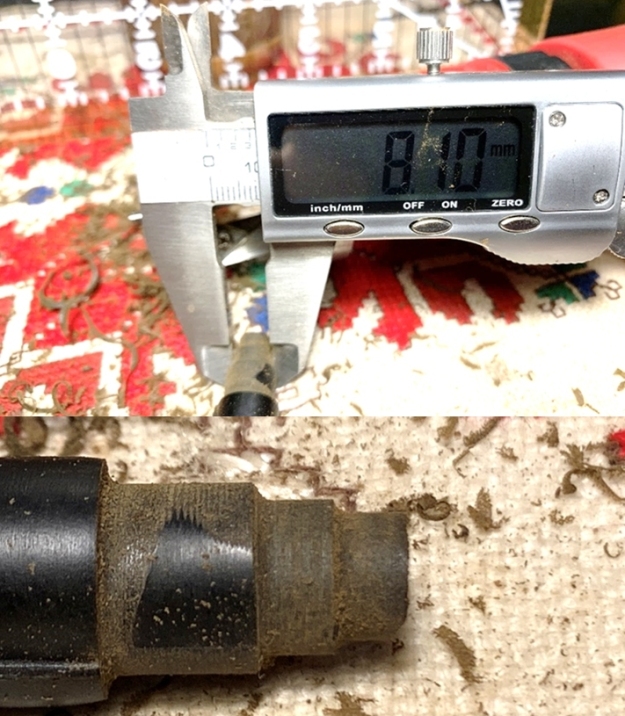
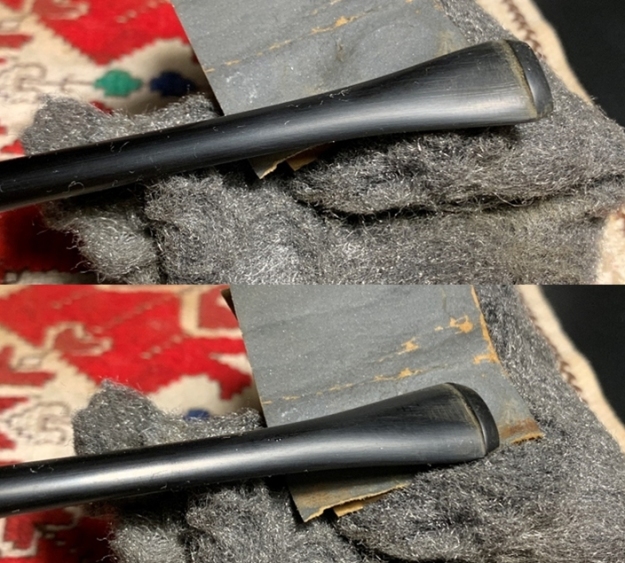
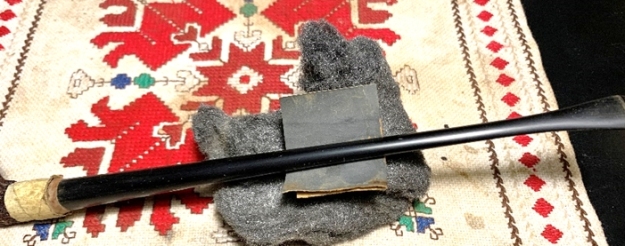
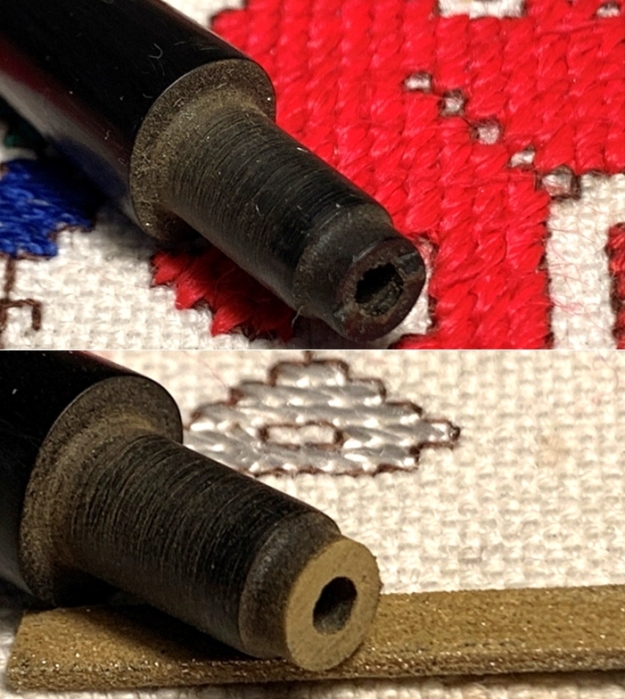
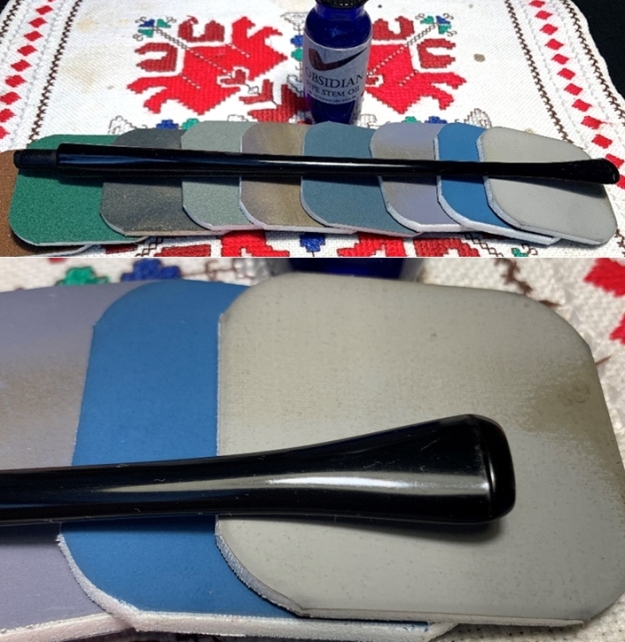
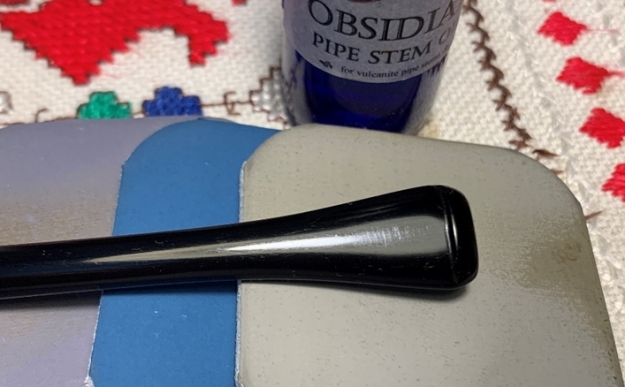
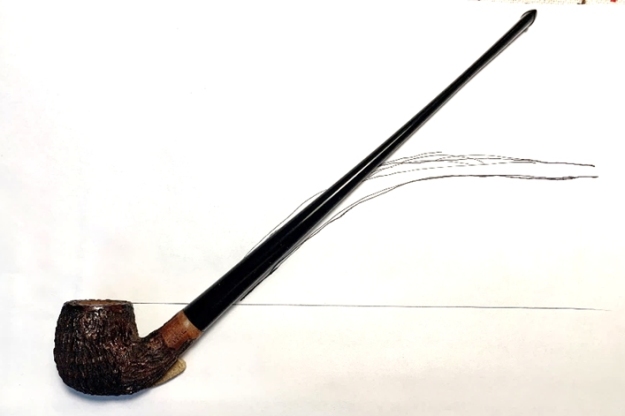
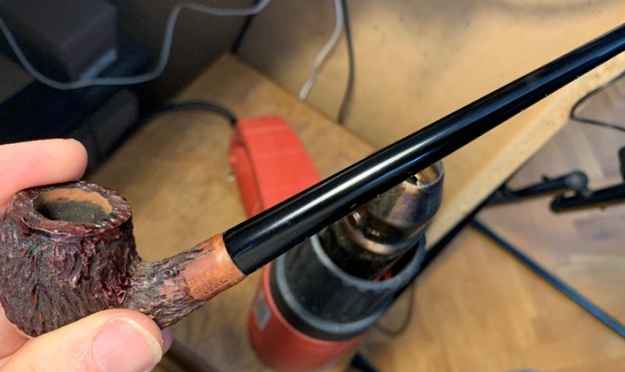
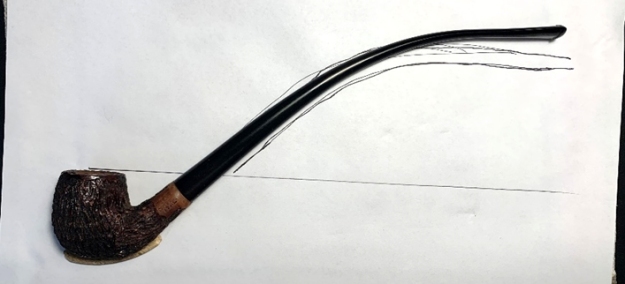
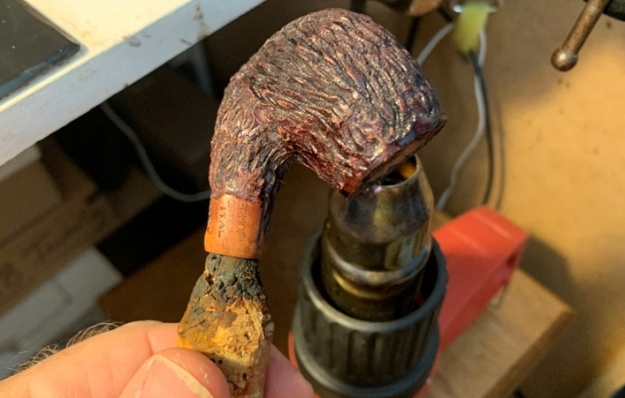
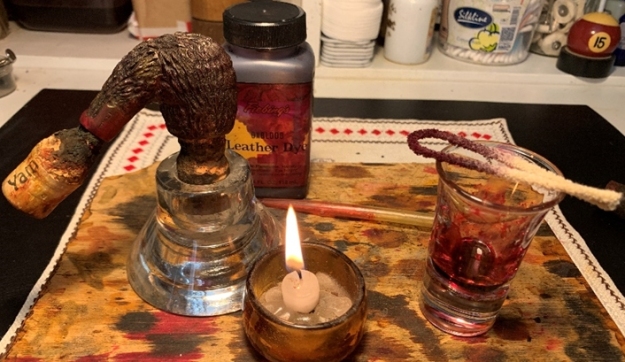
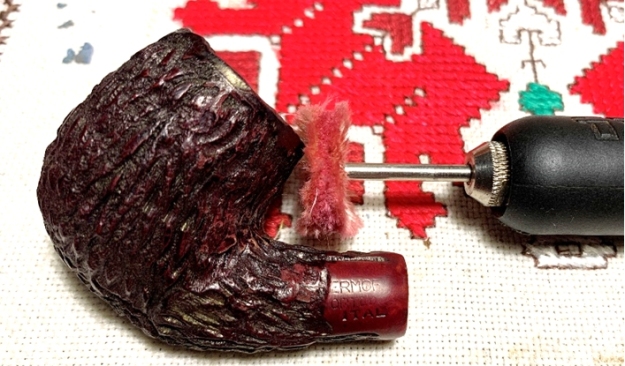
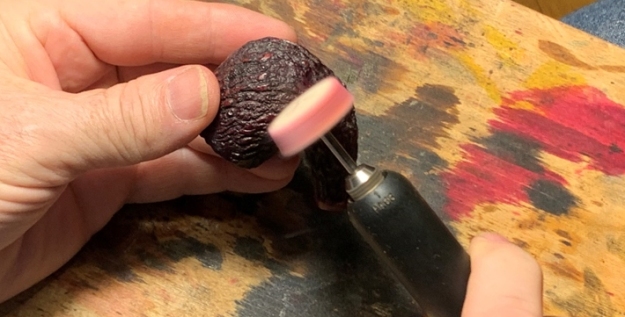
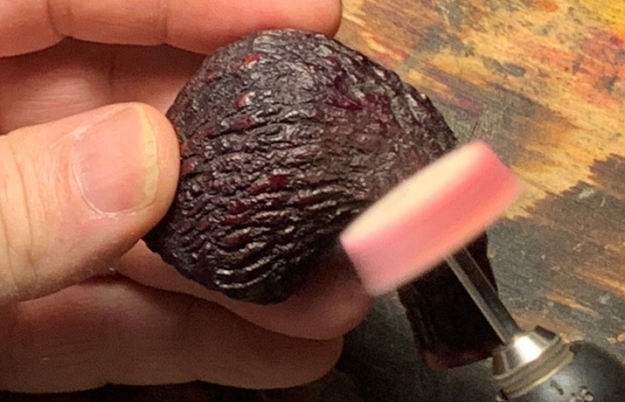
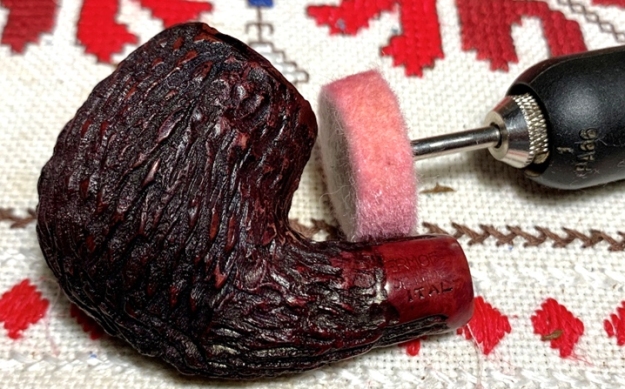
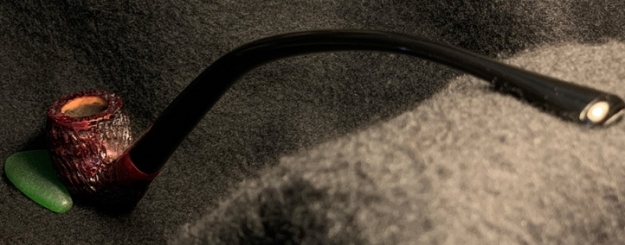
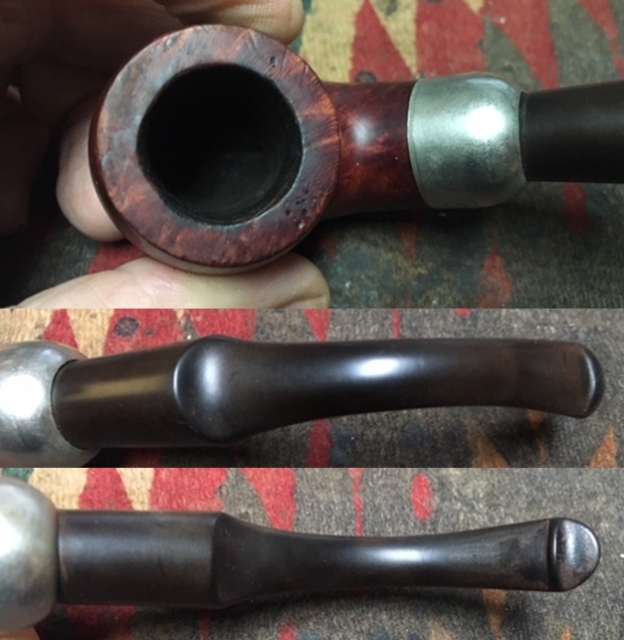
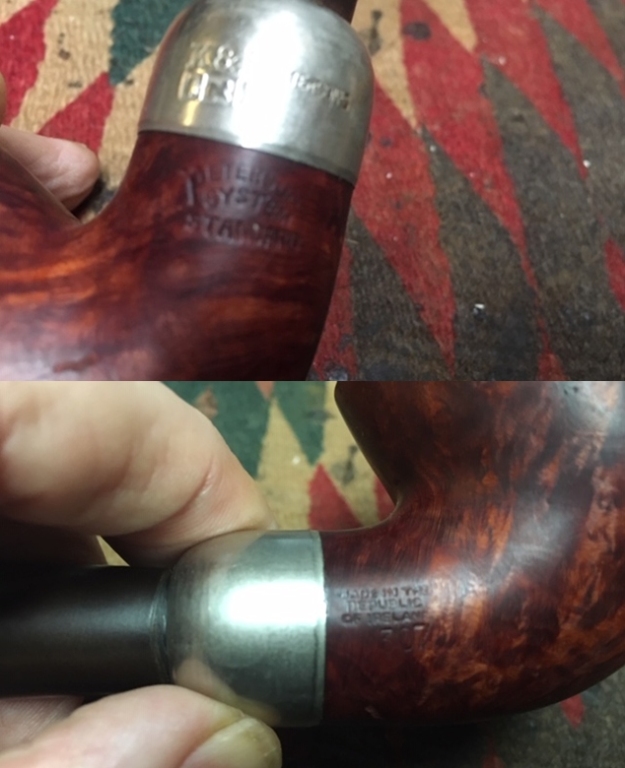
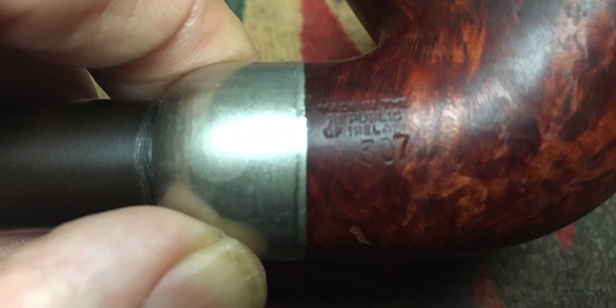
With no resolution to this mystery, I move on to cleaning the external surface. I clean the rusticated surface with undiluted Murphy’s Oil Soap.  A cotton pad starts the process, but I transition to a bristled toothbrush quickly to clean in the craggy cuts of the rusticated surface.   From the worktable scrubbing, I transfer the stummel to the kitchen sink where I continue to rinse the stummel with warm water and clean the internals using long shank brushes.  With warm water, I add anti-oil dish liquid soap and scrub using the shank brushes.  After rinsing again, returning to the worktable I take the following picture of the cleaned stummel.  I notice that the finish is partially removed from the smooth briar panel holding the nomenclature.To complete the removal of the finish on the panel, I wet a cotton pad with isopropyl 95% and rub the smooth briar panel as well as the smooth briar ring circling the shank end.  This will provide a distinct contrast later during the finishing stage. What I also notice from the soiled cotton pad is that the finish color appears to be an Oxblood hue.     Moving now to cleaning the internals in earnest with cotton buds and pipe cleaners wetted with isopropyl 95%, I find that the mortise is clean!  This doesn’t happen often and I’m thankful for the shortened work!I now transition to fashioning the Churchwarden stem.  The first step is to fashion the oversized tenon of the precast Warden stem.  Using the electronic caliper – which was one of the best additions to my tool chest! – I take a measurement of the mortise diameter which is 7.86mm.  This represents the eventual sizing diameter of the tenon after sanding it down to size.The next step is to cut a starting test cut on the tenon using another great addition to my tool chest – the PIMO Tenon Turning Tool that I acquired from Vermont Freehand (https://vermontfreehand.com/).  I keep the directions on the wall in front of me for easy reference!  Before using the tool, the PIMO kit provides a drill bit to pre-drill the airway of the precast stem to fit the Tool’s guide pin.  After mounting the bit on the hand drill, I drill the airway.  Next, I mount the stem onto the PIMO tool which has replaced the drill bit on the hand drill.  Opening the carbon cutting arm to just a bit smaller than the diameter of the raw tenon, I make an initial cut of the tenon for measurement purposes.  The sizing is 9.79mm.  This is the starting point for sizing down the tenon.  Generally, it’s not a good idea to cut the tenon with the PIMO tool aiming for an exact finished target size (7.86) because of the danger of taking off too much.  It is also true that each fitting tends to be different.  So, the approach is to come to the target sizing in a more patient, conservative pace.  I add about .40 mm to the target size of 7.86 which identifies what I call the ‘fat’ target to aim for with the PIMO tool then transitioning to sanding by hand.  Adding .40mm to 7.86 results in a fat target of about 8.26mm.  This means I need to remove additionally about 1.50mm (9.79 minus 8.26) with the PIMO tool.Using the Allen wrenches to adjust the carbide cutting arm to a tighter cut, I first cut a test and measure.  I want to make sure I’m not over cutting before traversing the entire length of the tenon. And I’m glad that I did the test cut!  The test cut measured 6.72 – smaller than the target size!  The second test cut measures at 8.10mm – falling between the fat target and the target size – I go with it.  I cut the entire tenon as well as cutting into the stem facing just a bit to make sure that the edge is squared and not shouldered from the original precast stem.The cut is ideal.  The tenon is still larger than the mortise so that sanding now will ease into the fit and make it more customized.It doesn’t take too long with sanding for the mortise fully to receive the newly shaped tenon.  A coarse, 120 grade paper is used initially to do the heavy lifting then 240 follows to fine tune.  The fit is good.There is no perfect union and this picture shows the shank facing extending a bit beyond the stem facing.I wrap the shank with masking tape to provide some protection to the rusticated finish as I sand to bring the shank facing and stem into alignment.  As before, focusing on the fitting first, I start with coarse 120 and follow with 240 to sand the junction.    When the junction transitions smoothly from the shank to the stem, I transition to the stem proper.  The picture below shows the casting seam down the side of the stem.  This seam as well as the ripples that are always present in a precast stem are sanded out.After some effort, and a lot of rubber dust(!), the ripples and seams are sanded with coarse 120 grade paper.  These pictures are not easy to see detail, but if ripples remained, they would be evident with the different hues on the stem.Next, I work on the bit and button shaping.  You can see the rough condition of the button and the vulcanite excess on the slot.  The darkening of the vulcanite forming a ‘V’ in the middle of the bit shows how the surface of the precast stem dips as it flares out to the stem edge. This will be filed out and the button shaped using a flat needle file.   The following two pictures show the progress of filing.  To remove the valley dip of the surface, I file down the outside valley ridges that are higher.  At the same time, the filing sharpens the button lip.  The first picture shows the initial lateral filing to bring the bit surface into a more level state.The next picture shows the leveled bit surface after the outer quadrants have been rounded and shaped toward the stem edges.The final filing for the lower bit completed.The slot is rough.  After filing the excess vulcanite to level the slot facing, I see a small divot in the inner edge of the slot which I didn’t picture!  A round pointed needle file fits nicely into the slot allowing uniform filing of the inner slot edges – upper and lower.  With the heavy-duty sanding and filing completed. I use 240 paper to fine tune the bit and button shaping.  At this point, the button perimeter is sanded.I follow the fine tune sanding of the button by sanding the entire stem with 240 grade paper.The next picture was to remind me to remark about how nasty working in rubber dust is!  It, without question, is the least desirable part of fashioning new Churchwardens!  This Bulgarian designed work cloth will be going into the soak tonight!The Warden stem is transitioned to the kitchen sink where 600 grade paper is employed to wet sand the entire stem. During the entire sanding process, the stem and stummel remain joined so that the sanding creates a perfectly uniform union with stem and shank. Before transitioning to the micromesh phase, I file the end of the tenon where excess and rough vulcanite persists.  Using the flat needle file, it is dispatched quickly.The question in my mind is whether to bend the stem now or go directly into the micromesh phase.  By leaving it unbent at this point makes continued sanding easier, and this is what I do. Using 1500 to 2400 grade micromesh pads I wet sand the stem followed by dry sanding with pads 3200 to 4000 and 6000 to 12000.  Between each set of 3 pads I apply Obsidian Oil to condition the vulcanite.  I only show one picture of this process instead of the usual 3 because capturing the detail with the long stem is not possible. I do, however, take close-ups of the upper and lower bit. The next step is to bend the Churchwarden stem.  The goal is to bend the stem so that the end of the stem, the bit, is on a parallel trajectory with the plane of the rim of the stummel.  I sketch a template to help visualize and compare.I use a hot air gun to heat the vulcanite.  I continually rotate and move the stem over the hot air to avoid scorching the stem and to heat more evenly a section of the stem.  To begin, I focus the bend more toward the middle of the stem, where the stem is thicker.  If I heat the entire stem at once the thinner portion at the end of the stem will heat and bend first creating a sharper angle – which I am trying to avoid.  A sweeping bend is what I like best.As the stem is heated, gentle pressure is applied so I know when it becomes supple enough to start bending.  The first step focusing on the middle bend is below.  After I bend it, I hold it in place until I run it under cold water in the kitchen sink to hold the bend.  As expected, the trajectory of the end of the stem is still a little high.  The next step of heating I avoid the middle of the stem and heat the section about 3/4 up the stem – the thinner section.  After heating and bending more, again I take the stem to the sink to cool the stem with water to hold the angle.  The template shows that I’m in the sweet spot.  Notice I inserted a pipe cleaner in the end of the stem to be on the safe side – guarding the integrity of the airway as it bends.  It looks good and I move on. Next, the stummel awaits attention.  After removing the freshly bent CW stem and putting it to the side, I take a fresh look at the rusticated stummel that, to me, resembles craggy tree bark.  I like it! Before addressing the stummel, I first run the smooth briar nomenclature panel and ring around the end of the shank though the full battery of micromesh pads, 1500 to 12000. I like the craggy/smooth contrast.My aim with the stummel is to refresh the hue, which appears to be a subtle Oxblood.  Using Fiebing’s Oxblood aniline dye, I will apply it like I usually do – painting and flaming with a lit candle.  Then, during the following ‘unwrapping’ stage, I will not use Tripoli compound as I usually do.  The reason for this is that the compound will get caught in the crags and that would not be fun to remove.  I think the felt buffing wheel on the Dremel will be enough by itself to effectively unwrap and abrasively buff to remove excess crusty flamed dye.  Creating more contrast in the craggy landscape of the rusticated surface and the smooth peaks of the rustication is the aim.  At least this is my hope!  I assemble my desktop staining kit.  After wiping the stummel with a cotton pad wetted with alcohol to clean it, I warm the stummel over the hot air gun to expand the pores in the briar to help it be more receptive to the dye.  Then, using a bent over pipe cleaner, I apply the Oxblood dye in sections and flame the wet dye with a lit candle.  The alcohol in the dye combusts with the flame and sets the dye in the briar surface. After working through the entire stummel painting and flaming, I set the stummel aside to rest for several hours allowing the dye to set.Later, with a cotton cloth wheel mounted onto the Dremel and the speed set to 40% full power, I apply Tripoli compound only to the smooth briar nomenclature panel and ring around the shank end.Next, I mount a felt cloth buffing wheel onto the Dremel, setting the speed to the slowest possible, and go over the entire surface working the edges of the buffing wheel in the valleys and ridges of the rusticated surface.  The slower speed is to avoid over heating – I don’t want to start a fire with the coarser buffing wheel!I also concentrate on the upper peaks of the ridges that present very small smooth briar surfaces that are buffed.I like the contrasting effect of this process – the changing hues of the Oxblood from valleys to peaks with the smooth briar and rough briar – nice.Not pictured is mounting another cotton cloth buffing wheel onto the Dremel, setting the speed at 40%, and applying Blue Diamond compound only to the smooth briar nomenclature panel and ring around the end of the shank and to the Warden stem remounted to the stummel.  Finally, with another cotton cloth buffing wheel mounted onto the Dremel, set at the same speed, I apply carnauba wax to the entire pipe – stem and stummel. Over the rusticated surface, I increase the speed of the Dremel to about 60% full power to create more heat to dissolve the wax in the rusticated landscape.  This helps in keeping the wax from caking in the rough surface. I finish the newly formed Churchwarden by hand buffing with a micromesh cloth and brushing the stummel with a horsehair brush to raise the shine.

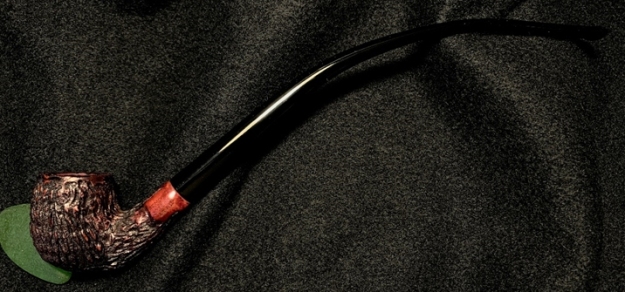
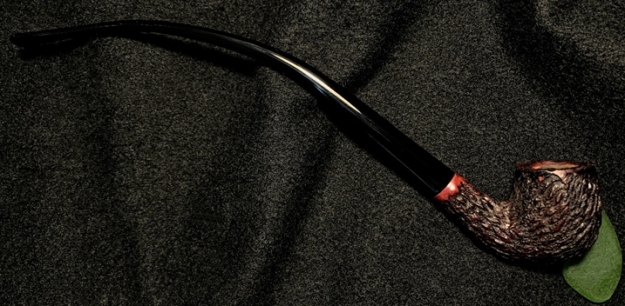
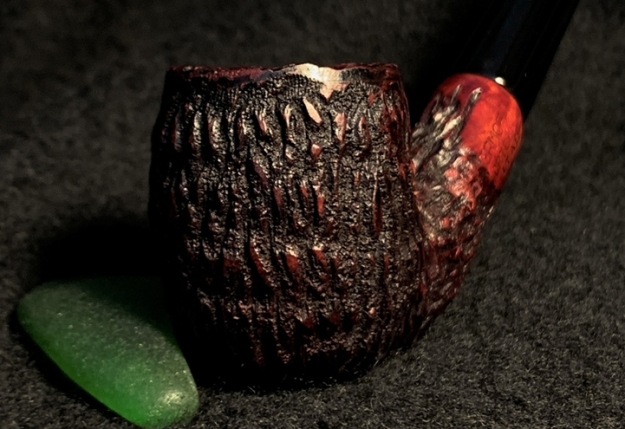
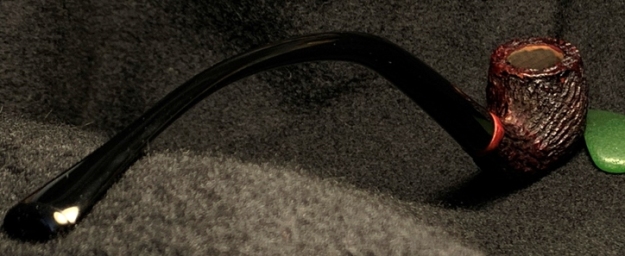
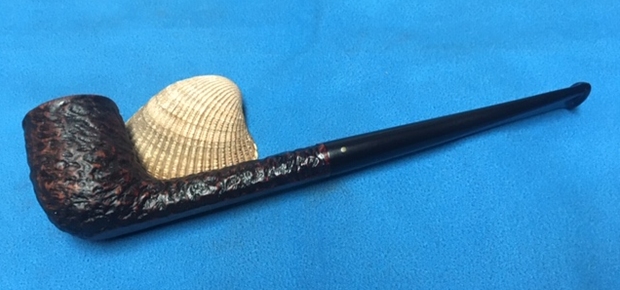
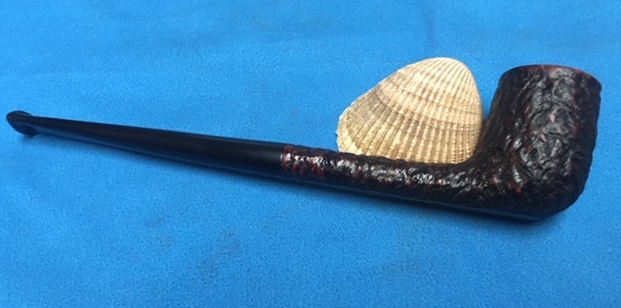
The Oxblood coloring of this rusticated bowl came out exceptionally well. My eyes are drawn to the contrasting of the flecks of smooth reddish briar populating the rusticated landscape.  The rustic feel of the bowl is enhanced by the ring of Oxblood smooth briar transitioning from the rough bowl to the long, black Warden stem.  The Oxblood shank ring contrasting with the stem simply pops.  Of course, the long, sweeping bend of the stem is why every pipe man or woman wants at least one Churchwarden in their collection.  This Churchwarden is heading under the Christmas tree here in Bulgaria as a gift for my son. My joy is completed knowing that in the future, when he pulls it out and fills it with his favorite blend and settles in to have some moments of reflection that he will reflect on this special Christmas in Bulgaria!  Thanks for joining me!  Merry Christmas!

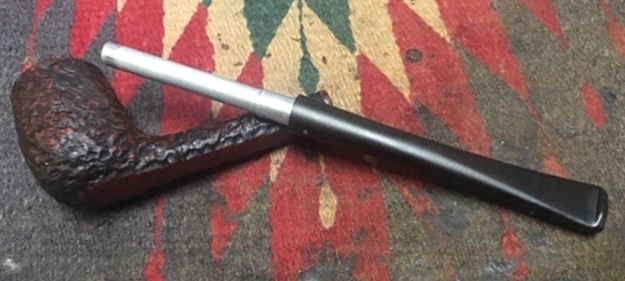
A Brigham Patent Era Standard 102 Rusticated Crosby from Bob Kerr’s Estate


Blog by Steve Laug

As I continue to work through the pipes in Bob Kerr’s Estate I am enjoying choosing different brands that he had to focus on for a bit. He had six different pipes from Brigham in his collection so I decided to work my way through that sub collection of the estate. Out of the 6 pipes, #5 has a ruined bowl with a crack all the way around it as well as a cut off aluminum tenon. #6 went to Paresh Deshpande in India for his collection. That left behind four pipes for me to restore – #1, #2, #3 and #4. Here is the list of what I saw when I examined the 6 pipes. I have already restored #1, #2 and #3 and included the link to the appropriate blog.

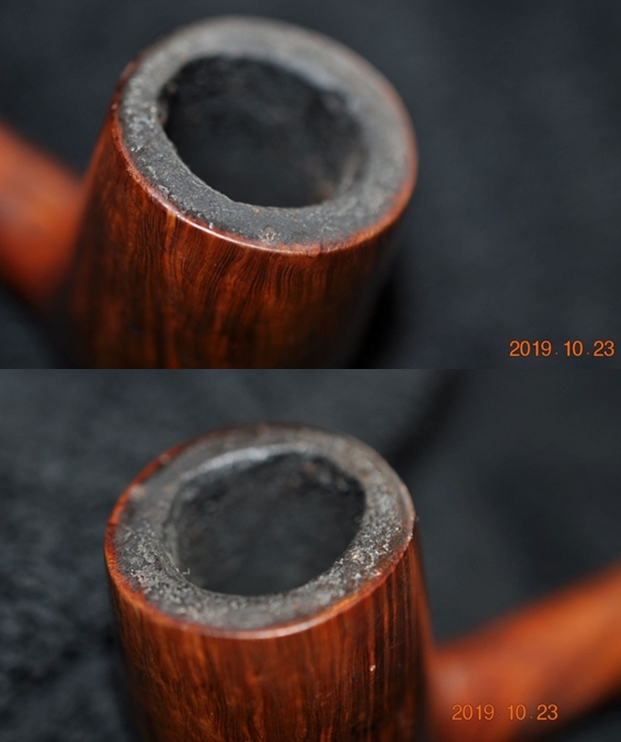
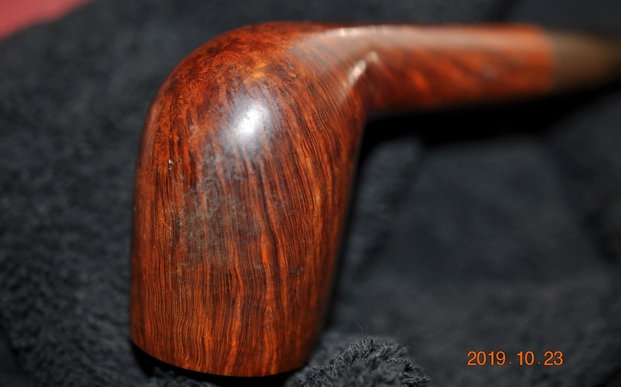
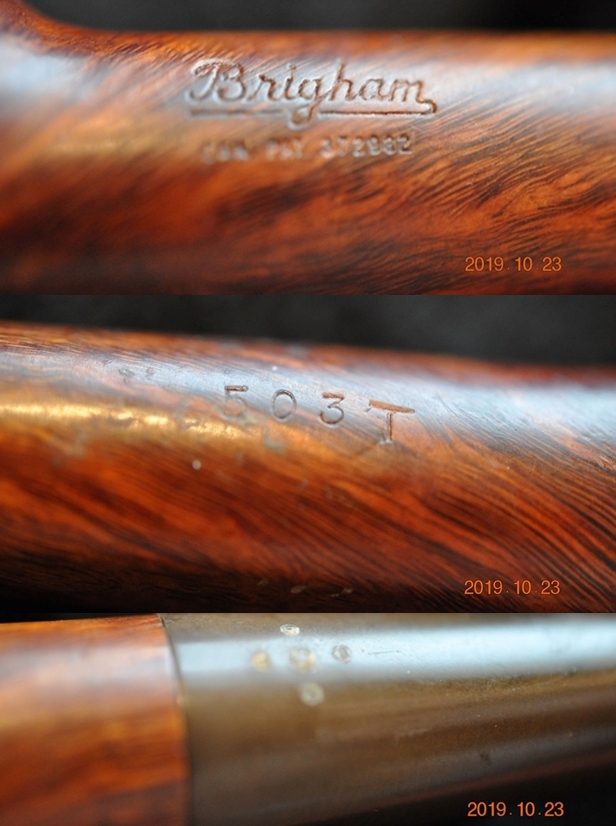
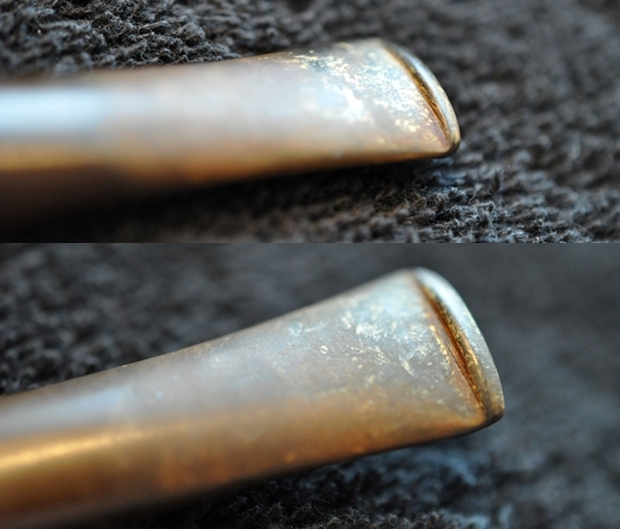
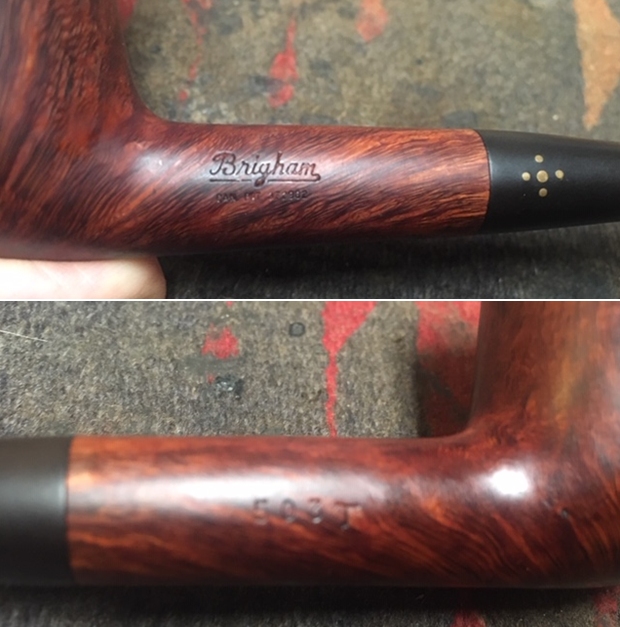
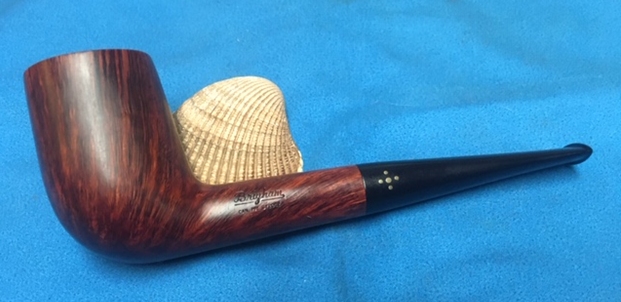
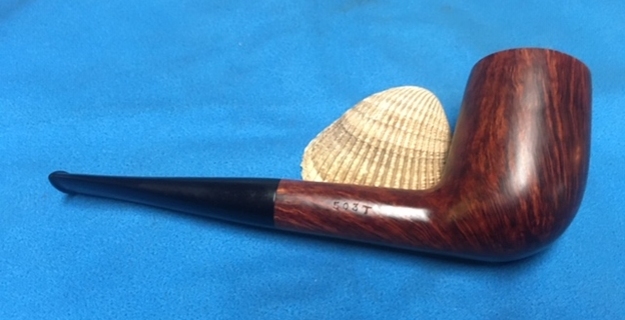
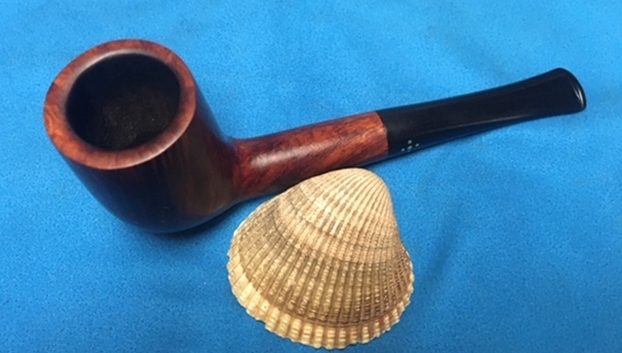
  1. Brigham 503T Can. Pat. 372982 5 Dot Stack. Stem is oxidized, tooth marks and chatter near the button, some calcification with damage to the button. Finish is dirty, thick cake and lava overflow on the rim top. Rim top has is worn and damage on the back edge. I have finished restoring this one. Here is the link: (https://rebornpipes.com/2019/12/21/a-brigham-patent-era-special-grain-stack-from-bob-kerrs-estate/).
  2. Brigham Made In Canada 490 4 Dot Canadian. Stem is oxidized, tooth marks and chatter near the button, some calcification with damage to the button. Finish is dirty, thick cake and lava overflow on the rim top. Rim top is worn and damaged. I have finished restoring this one. Here is the link: (https://rebornpipes.com/2019/12/22/a-brigham-patent-era-director-490-rusticated-canadian-from-bob-kerrs-estate/).
  3. Brigham Made In Canada 2199 2 Dot Club/Lovat. Stem is oxidized, tooth marks and chatter near the button, some calcification with damage to the button. Finish is dirty and worn. Stamping is worn. There is a thick cake and lava overflow on the rim top. Rim top is worn and damaged. I have finished restoring this one. Here is the link: (https://rebornpipes.com/2019/12/21/a-brigham-patent-era-select-601-club-lovat-from-bob-kerrs-estate/).
  4. Brigham Made In Canada 102 1 Dot Bing Crosby Style Pipe/Small Billiard. Stem is oxidized, tooth marks and chatter near the button, some calcification with damage to the button. Finish is dirty, thick cake and lava overflow on the rim top. Rim top is worn and damage on the back edge.
  5. Brigham Made In Canada 6 Dot Bent Billiard. Stem is oxidized, tooth marks and chatter near the button, some calcification with damage to the button. The aluminum tenon has been cut off. Finish is dirty and worn with paint on the bowl. There is a thick cake and lava overflow on the rim top. Rim top has a crack on the right side. CRACKED BOWL
  6. Brigham Made In Canada 4 Dot Canadian. Stem is oxidized, tooth marks and chatter near the button, some calcification with damage to the button. Finish is dirty and stamping is worn. There is a thick cake and lava overflow on the rim top. Rim top is worn and edges are damaged. SENT TO PARESH

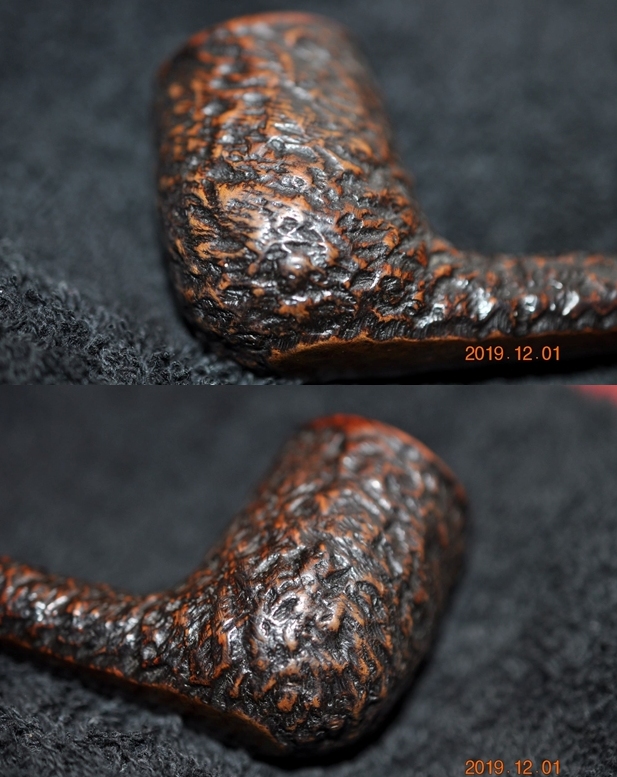
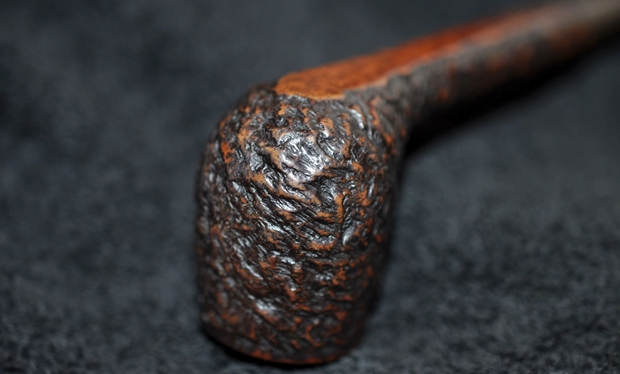
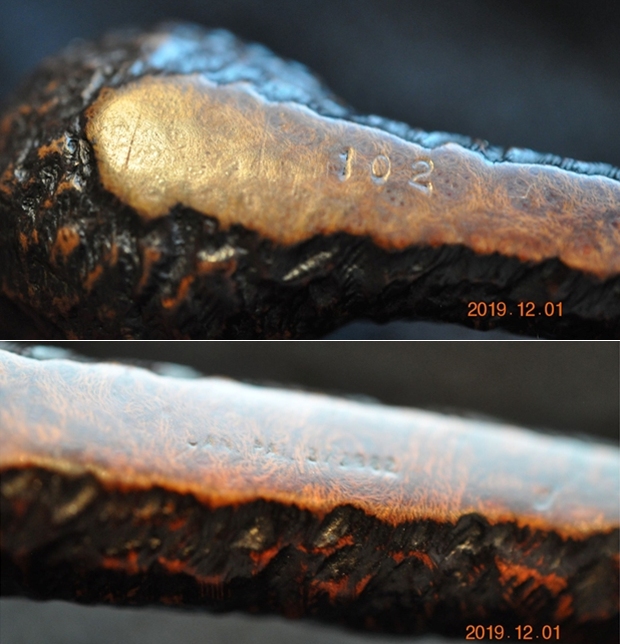
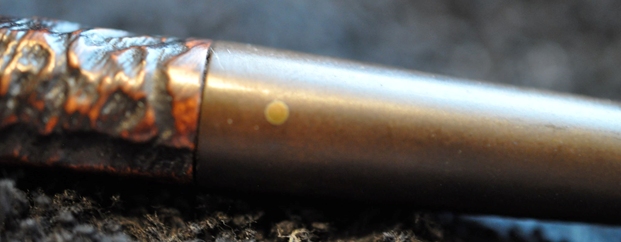
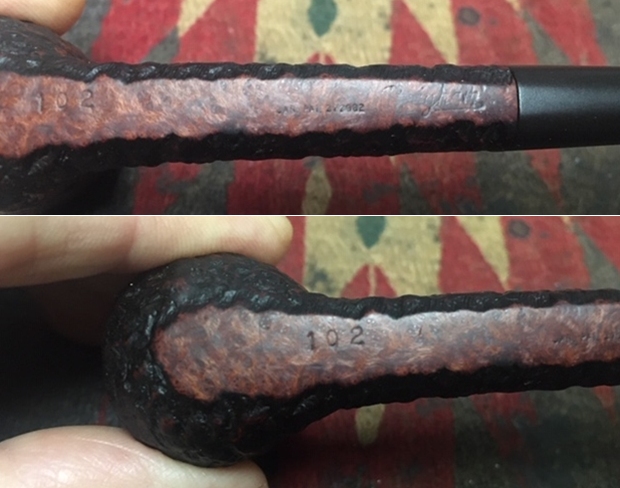
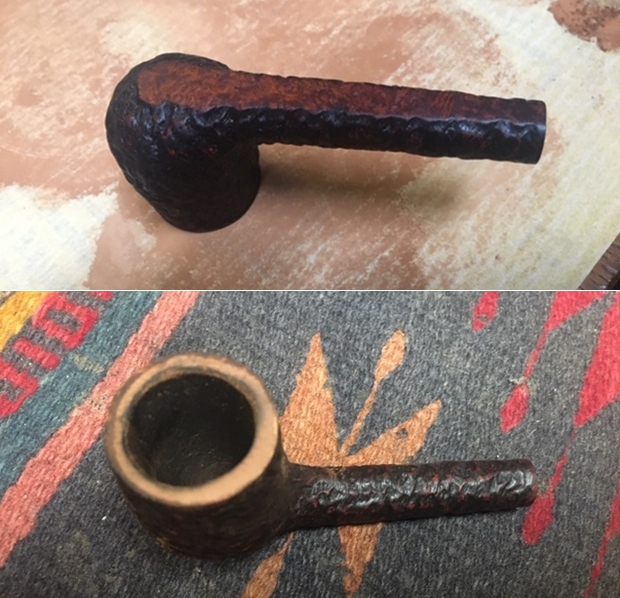
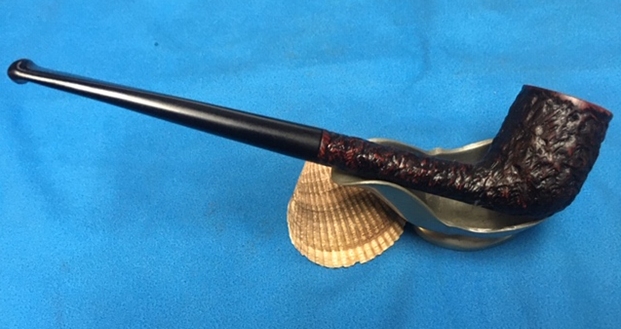
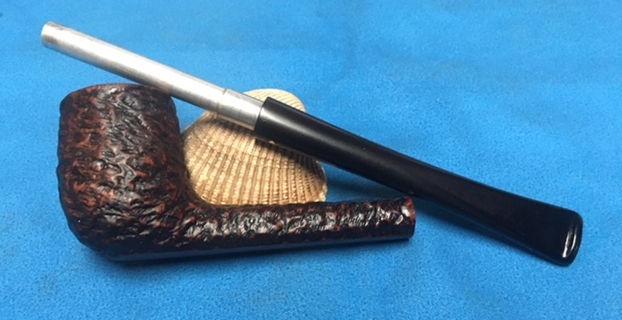
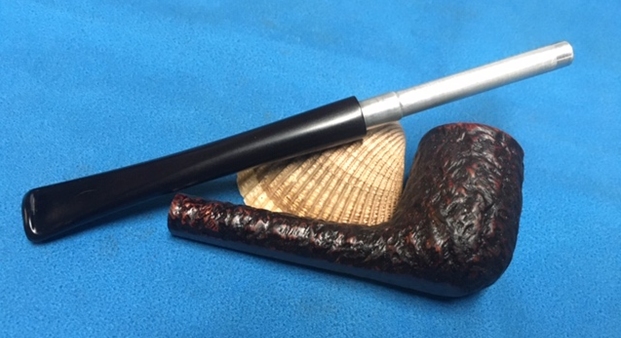
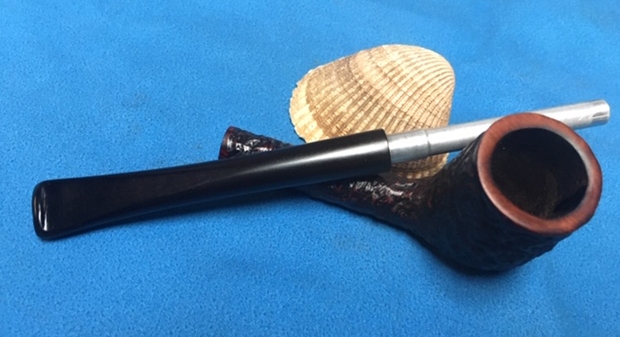
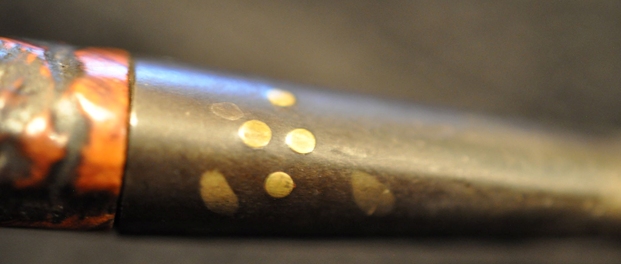
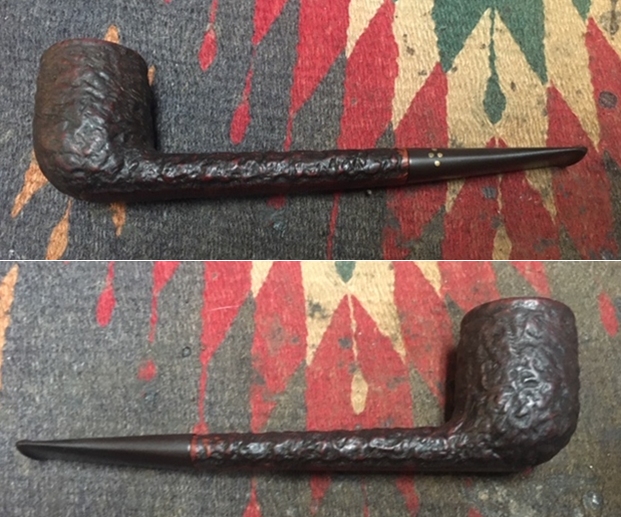
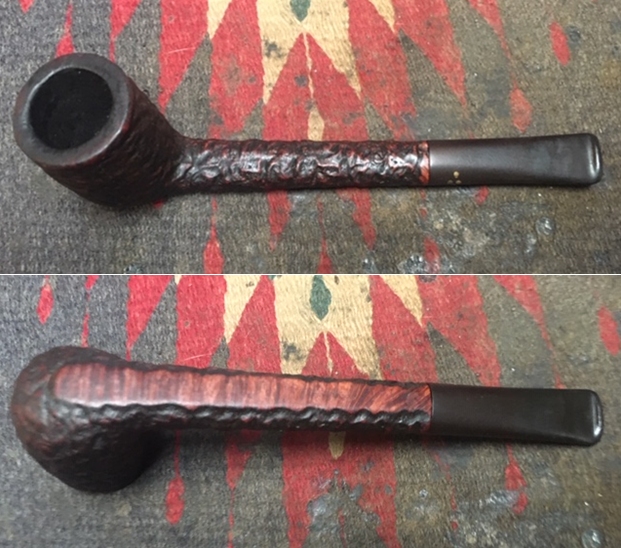
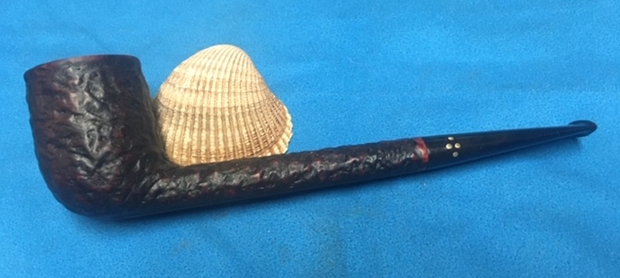
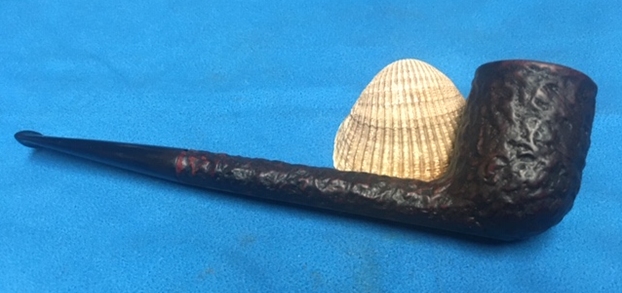
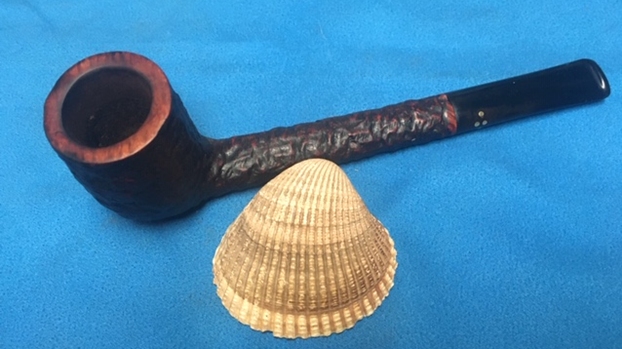
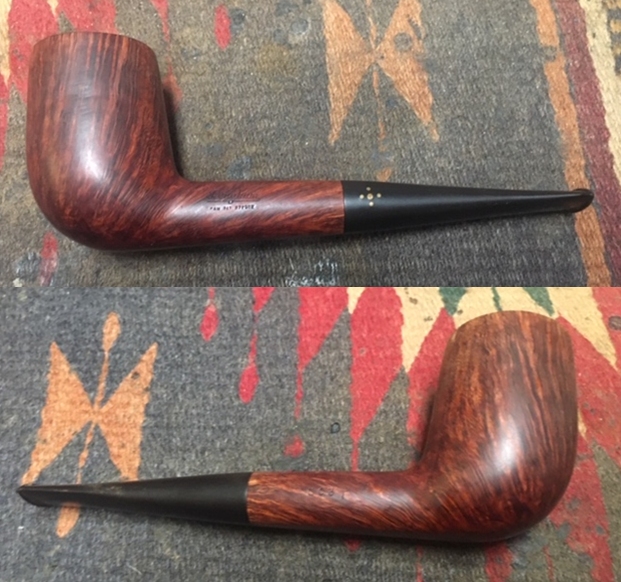
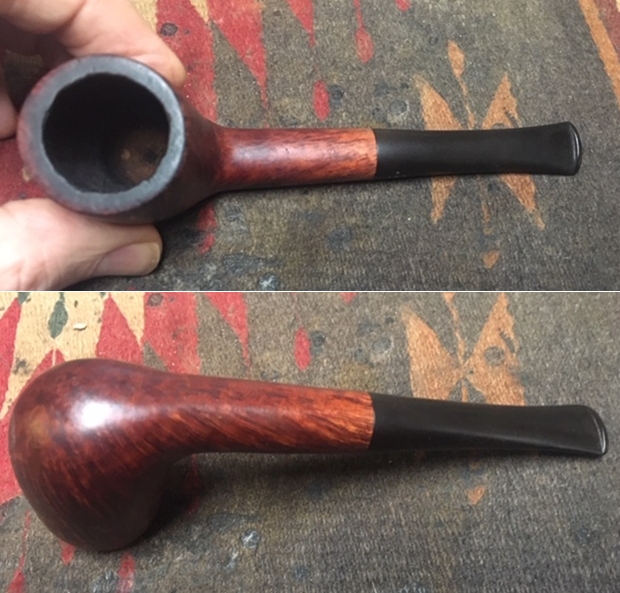
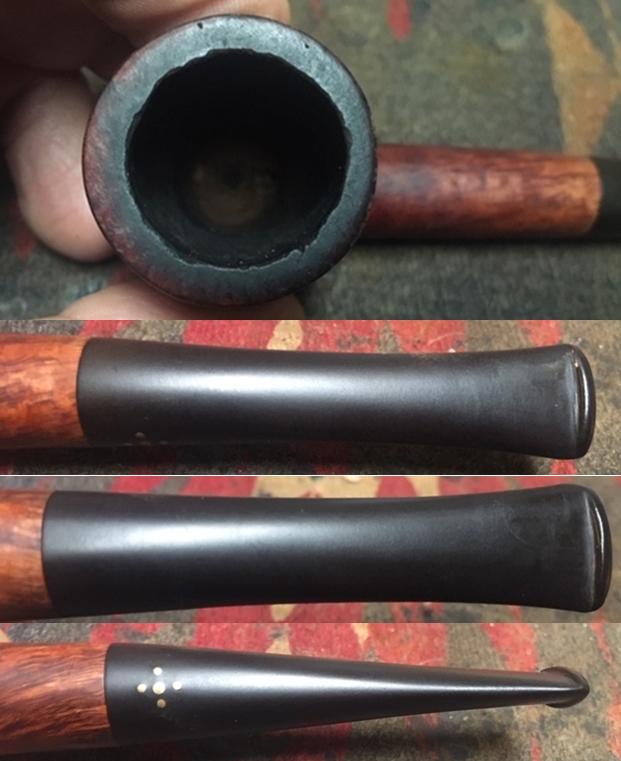
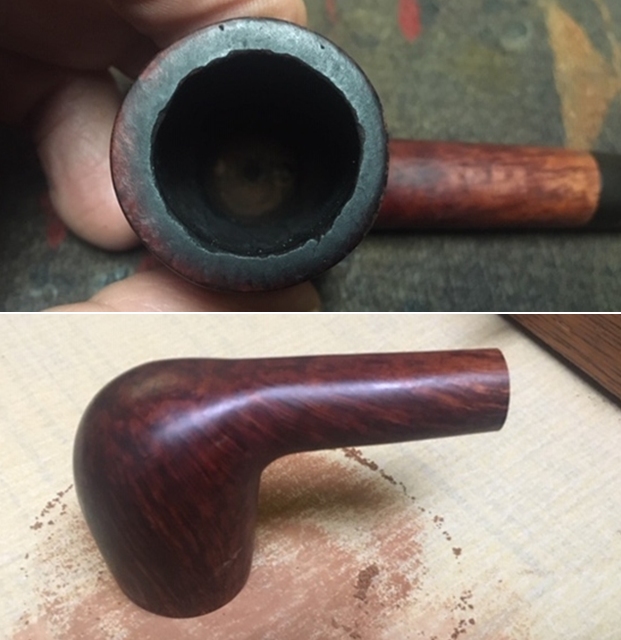
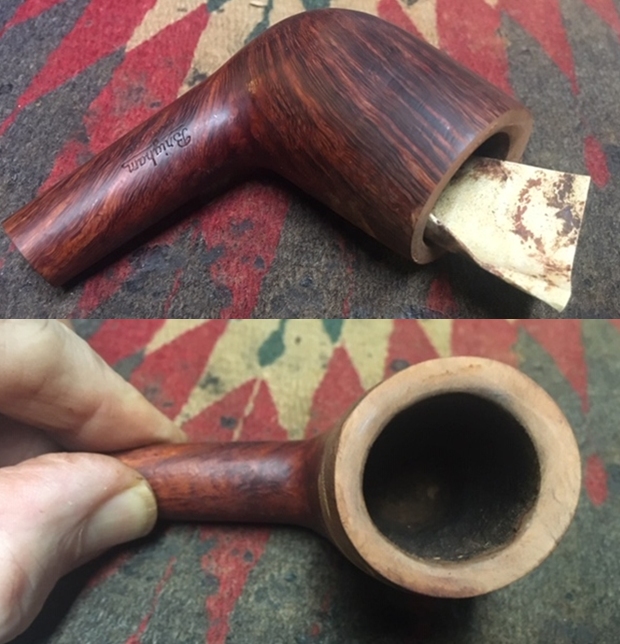
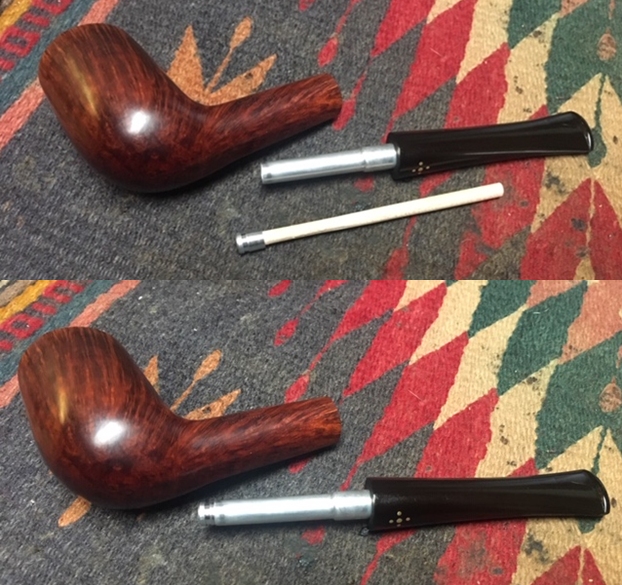
I chose to work on #4 next, the second rusticated pipe in the collection. It is a Brigham Rusticated Crosby or what Brigham calls a small billiard. To me the long stem will forever remind me of Bing Crosby and White Christmas. It was stamped on the underside of the shank with faint stamping visible with a lens under light. It reads Brigham over Can. Pat. 372982. On the heel of the bowl it was stamped with the shape number 102. There was a thick cake in the bowl with remnants of tobacco stuck on the walls. There was a lava overflow on the rim. The top and edges of the rim appear to have some damage all the way around the bowl. The rustication was the pattern I have become accustomed to on Brigham pipes. Once again, I think that there was a beautiful pipe underneath all of the buildup of years of use. The stem was oxidized and calcified toward the end with some tooth chatter. There were also some tooth marks on both sides of the stem ahead of the button. There was a pattern of four brass dots on the left side of the tapered stem. Jeff took photos of the pipe before he started his cleanup work on it. Jeff took photos of the bowl and rim top to show the thick, hard cake in the bowl with remnants of tobacco stuck on the walls of the bowl. There was a lava build up on the smooth rim top and the edges of the bowl. The rim top looked pretty good but it was hard to know for sure but it appeared that there was damage all around the inner edge. The outer edges looked good.  Jeff took a photo of the side and heel of the bowl to show the condition of the finish. You can see the beautiful rustication patterns around the side of the bowl and shank. Even under the dirt and debris of the years it looked very good.    The stamping is very faint. With a light and lens the stamping Brigham is visible. The first photo shows the shape number on the heel of the bowl. The second photo shows the Can. Pat. Number that is underneath the Brigham stamp. He included a pic of the 1 brass dot on the stem.  Jeff took photos of the top and underside of the stem showing the tooth chatter, scratching and oxidation on the stem surface and wear on the edges of the button.I am also including the information from Pipedia’s article on Brigham pipes. It is a great read in terms of the history of the brand (https://pipedia.org/wiki/Brigham_Pipes). Charles Lemon (Dadspipes) is currently working on a book on the history of the brand. Until that is complete this article is a good summary. I have included it below.

Roy Brigham, after serving an apprenticeship under an Austrian pipesmith, started his own pipe repair shop in Toronto, in 1906. By 1918 the business had grown to include five other craftsmen and had developed a reputation across Canada for the high quality of workmanship. After repairing many different brands of pipes over the years, Roy noted certain recurring complaints by pipe smokers, the most common referred to as “tongue bite”. Tongue bite is a burning sensation on the smoker’s tongue, previously thought to be due to the heat of the smoke (i.e. a “hot smoking pipe”).

He soon began manufacturing his own pipes, which were lightweight, yet featured a more rugged construction, strengthening the weak points observed in other pipes. The problem of tongue bite intrigued him, and he decided to make overcoming it a future goal.

About 1938, Roy’s son Herb joined him to assist in the business. The business barely survived the great depression because pipes were considered to be a luxury, not a necessity, and selling pipes was difficult indeed. In approximately 1937 [1], after some experimentation, Roy and Herb discovered that tongue bite was in fact a form of mild chemical burn to the tongue, caused by tars and acids in the smoke. They found that by filtering the smoke, it was possible to retain the flavour of the tobacco and yet remove these impurities and thereby stop the tongue bite.

Just as Thomas Edison had searched far and wide for the perfect material from which to make the first electric light bulb filaments, Roy & Herb began experimenting with many materials, both common and exotic, in the quest for the perfect pipe filter. Results varied wildly. Most of the materials didn’t work at all and some actually imparted their own flavour into the smoke. They eventually found just two materials that were satisfactory in pipes: bamboo and rock maple. As bamboo was obviously not as readily available, rock maple then became the logical choice.

They were able to manufacture a replaceable hollow wooden tube made from rock maple dowelling, which when inserted into a specially made pipe, caused absolutely no restriction to the draw of the pipe, yet extracted many of the impurities which had caused tongue bite. The result was indeed a truly better smoking pipe…

I wrote to Charles Lemon (Dadspipes) and asked him about the stamping on the pipe. He responded with information on all of the foursome. I am including the information on this particular pipe.

Hey Steve! Good to hear from you.

Lastly, the 102 is a Small Billiard- not the smallest Brigham (the 01 shape is an even smaller billiard) but pretty compact…As these are all Patent pipes, it’s more accurate to refer to their grade by name (the post 1980 grading scheme refers to Dots). Here is the original scheme:With the information from Charles’ message and the chart above that he included I knew what I was dealing with in terms of the stamping and the age of this pipe. I learned that this Patent Era 102 is a Brigham Standard (1-Dot) Small Billiard, though I would call the long shanked bowl a Crosby. It was made between 1938 and 1955. Most of Bob’s pipes were purchased in the 50s and 60s so my guess is that this is fits that time frame well. Now it was time to work on the pipe.

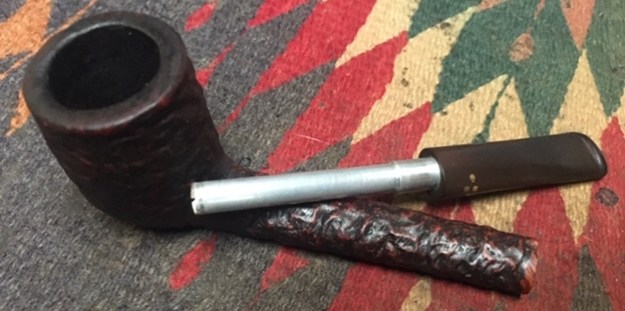
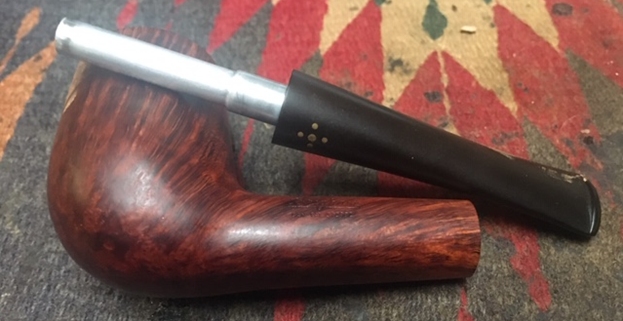
I am really happy to have Jeff’s help on cleaning up the pipes from Bob’s estate as the 125+ pipes were taking me a long time to do alone. He cleaned this filthy pipe with his usual penchant for thoroughness that I really appreciate. This one was a real mess and I did not know what to expect when I unwrapped it from his box. He reamed it with a PipNet pipe reamer and cleaned up the reaming with a Savinelli Fitsall Pipe Knife. He scrubbed out the internals with alcohol, pipe cleaners and cotton swabs until the pipe was clean. He scrubbed the exterior of the bowl with Murphy’s Oil Soap and a tooth brush to remove the grime and grit on the briar and the lava on the rim top. The finish looks very good with great looking grain around the bowl and shank. Jeff soaked the stem in Before & After Deoxidizer to remove the oxidation on the rubber. When the pipe arrived here in Vancouver for the second stop of its restoration tour I was amazed it looked so good. I took some close up photos of the rim top and also of the stem surface. I wanted to show what an amazing job Jeff did in the cleanup of the rim top. The rim top was darkened with nicks and damage to the rim top and inner edge of the bowl. The outer edge looked very good.  I also took close up photos of the stem to show the tooth marks and chatter on the stem surface.I took the stem off the shank to show the aluminum tenon/tube that was used to hold the Brigham Rock Maple Distillator. The original Distillator (filter) had been filthy so after Jeff had cleaned the pipe up he threw it away. I will replace it once I have finished with the restoration.This was a tough pipe to photograph the stamping on because it was very faint. When it starts out faint it is very easy to lose even that remnant of a stamp. But one of the things I appreciate about Jeff’s cleanup is that he works to protect and preserve the nomenclature on the shank of the pipes that he works on. I took some photos to show the stamping. In the first photo shows the shape number on the left side 102 and the Patent number mid shank followed by Brigham. The second photo gives a close-up of the shape number.   Since this is another pipe Bob’s estate I am sure that some of you have read at least some of the other restoration work that has been done on the previous pipes. You have also read what I have included about Bob Kerr, the pipeman who held these pipes in trust before I came to work on them (see photo to the left). Also, if you have followed the blog for long you will already know that I like to include background information on the pipeman whose pipes I am restoring. For me, when I am working on an estate I really like to have a sense of the person who held the pipes in trust before I worked on them. It gives me another dimension of the restoration work. Bob’s daughter wrote a short tribute to her father. I thank you Brian and tell your wife thank you as well.

I am delighted to pass on these beloved pipes of my father’s. I hope each user gets many hours of contemplative pleasure as he did. I remember the aroma of tobacco in the rec room, as he put up his feet on his lazy boy. He’d be first at the paper then, no one could touch it before him. Maybe there would be a movie on with an actor smoking a pipe. He would have very definite opinions on whether the performer was a ‘real’ smoker or not, a distinction which I could never see but it would be very clear to him. He worked by day as a sales manager of a paper products company, a job he hated. What he longed for was the life of an artist, so on the weekends and sometimes mid-week evenings he would journey to his workshop and come out with wood sculptures, all of which he declared as crap but every one of them treasured by my sister and myself. Enjoy the pipes, and maybe a little of his creative spirit will enter you!

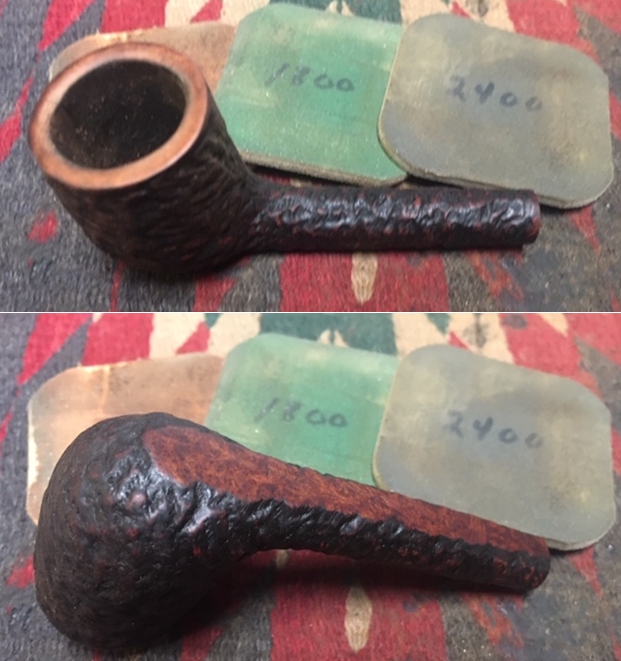
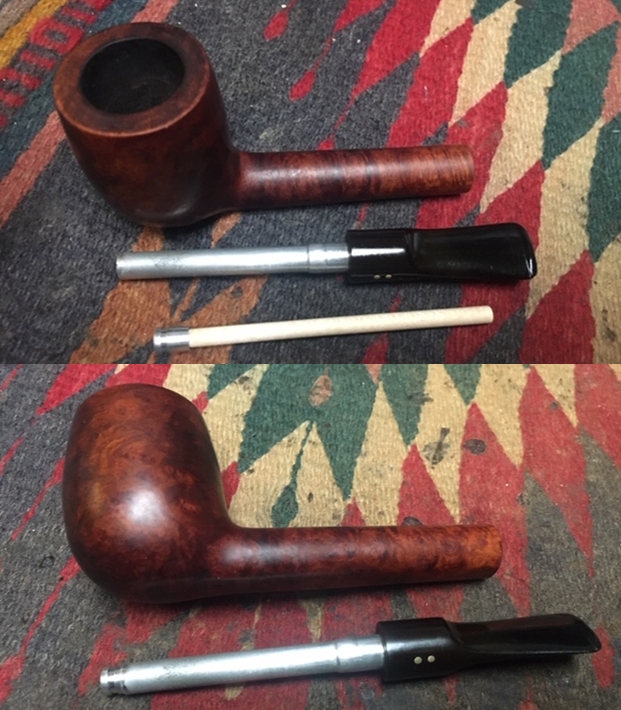
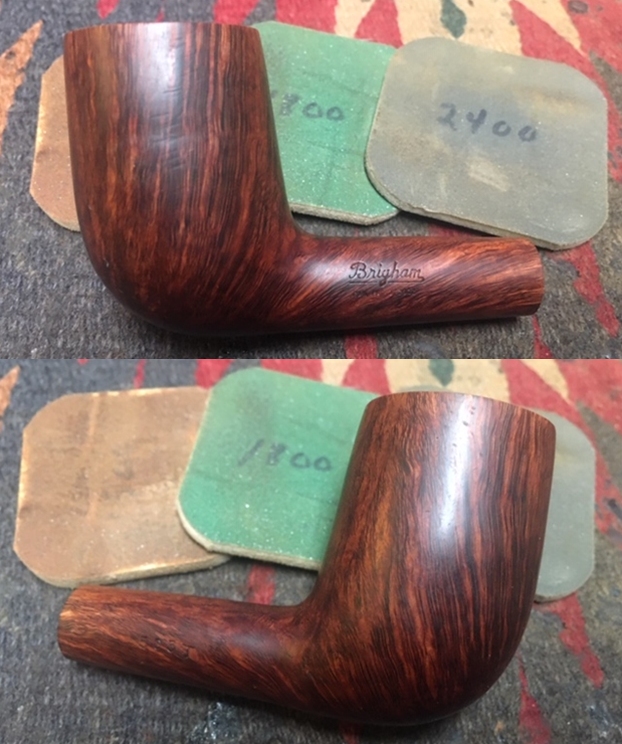
Now with all of the background on the line and the background on Bob Kerr it was time to get on with the restoration of this rusticated Brigham Standard Crosby/Small Billiard. I really appreciate the hard cleanup work that Jeff did on these pipes. They were a real mess when I sent them to Jeff and I have to tell you it was great that I did not need to clean this pipe. I decided to start the process by dealing with the damage to the rim top and edges of the bowl. I topped it on a topping board with 220 grit sandpaper. I worked on the inner edge with a folded piece of 220 grit sandpaper and gave it a very slight bevel so that it took care of the damage on the inner edge. The photos show the progress. I polished the briar on the rim top with micromesh sanding pads – wet sanding it with 1500-12000 grit pads and I wiped the bowl down after each sanding pad with a damp cloth.  The grain progressively stood out as I polished the pipe with the pads. I rubbed the bowl and rim down with Before & After Restoration Balm. I worked it into the surface of the briar with my fingertips and a horsehair shoe brush to clean, enliven and protect it. I let the balm sit for a little while and then buffed with a cotton cloth to raise the shine. I really like watching the Balm do its magic and bring the briar alive.  With the bowl done it was time to address the stem. The dents in the top and underside were the right depth for me to lift them. I “painted” the surface of the stem with the flame of a Bic lighter to raise the dents in the surface. I was able to lift them to the point that a repair would be a simple sanding job. I sanded the surface of the stem with 220 grit sandpaper to remove the remaining oxidation in the vulcanite. I polished it with 400 grit wet dry sand paper.   I rubbed the stem down with Denicare Mouthpiece Polish. I have a few tins of this laying around so I am trying to use them up. It does a pretty good job polishing the stem. I polished the stem with micromesh sanding pads – wet sanding with 1500-12000 grit sanding pads. I wiped it down after each pad with a damp cloth to remove the sanding dust. I polished it further with Before & After Pipe Polish – both Fine and Extra Fine. I finished by rubbing the stem down with some “No Oxy Oil” to protect the vulcanite. I am experimenting with the product from Briarville and tracking how it works so I can write a review of it.  With the pipe cleaned and ready to polish I put a new Brigham Distillator filter in the stem. The photos show the Distillator out of the tenon and in place in the tenon. It is a Maplewood tube that collects the moisture from the smoke and delivering a dry, cool smoke sans tongue bite.  Once again at this point in the restoration process I am excited to be on the homestretch. This is the last Brigham from the four that are in Bob’s estate so I look forward to the final look when it is put back together, polished and waxed. I put the bowl and stem back together. I polished the bowl and stem with Blue Diamond to polish out the scratches in the briar and the vulcanite. I gave the bowl and the stem multiple coats of carnauba wax. I buffed the pipe with a clean buffing pad to raise the shine. I hand buffed it with a microfiber cloth to deepen the shine. The pipe polished up pretty nicely. The rustication is worn but still stands out with the wax and polish. The black of the tapered vulcanite stem along with the four brass pins is a beautiful contrast to the browns of the rusticated bowl and shank. This is a beautiful Patent Era Standard Small Billiard/Crosby that was another fun pipe to work on thanks to Jeff’s cleanup work. The pipe is comfortable pipe to hold in the hand. The finished pipe is shown in the photos below. The dimensions of the pipe are Length: 7 inches, Height: 1 ½ inches, Outside diameter of the bowl: 1 1/8 inches, Chamber diameter: ¾ of an inch. This interesting long Crosby will be going on the rebornpipes store very soon. I have a lot more of Bob’s estate to work on of various brands. Perhaps one of those will catch your attention. Thanks for reading this blog and my reflections on the pipe while I worked on it. This is an interesting estate to bring back to life.
A Brigham Patent Era Director 490 Rusticated Canadian from Bob Kerr’s Estate


Blog by Steve Laug

As I continue to work through the pipes in Bob Kerr’s Estate I am enjoying choosing different brands that he had to focus on for a bit. He had six different pipes from Brigham in his collection so I decided to work my way through that sub collection of the estate. Out of the 6 pipes, #5 has a ruined bowl with a crack all the way around it as well as a cut off aluminum tenon. #6 went to Paresh Deshpande in India for his collection. That left behind four pipes for me to restore – #1, #2, #3 and #4. Here is the list of what I saw when I examined the 6 pipes. I have already restored #1 and #3 and included the link to the appropriate blog.

  1. Brigham 503T Can. Pat. 372982 5 Dot Stack. Stem is oxidized, tooth marks and chatter near the button, some calcification with damage to the button. Finish is dirty, thick cake and lava overflow on the rim top. Rim top has is worn and damage on the back edge. I have finished restoring this one. Here is the link: (https://rebornpipes.com/2019/12/21/a-brigham-patent-era-special-grain-stack-from-bob-kerrs-estate/).
  2. Brigham Made In Canada 490 4 Dot Canadian. Stem is oxidized, tooth marks and chatter near the button, some calcification with damage to the button. Finish is dirty, thick cake and lava overflow on the rim top. Rim top is worn and damaged.
  3. Brigham Made In Canada 2199 2 Dot Lovat. Stem is oxidized, tooth marks and chatter near the button, some calcification with damage to the button. Finish is dirty and worn. Stamping is worn. There is a thick cake and lava overflow on the rim top. Rim top is worn and damaged. I have finished restoring this one. Here is the link: (https://rebornpipes.com/2019/12/21/a-brigham-patent-era-select-601-club-lovat-from-bob-kerrs-estate/).
  4. Brigham Made In Canada 1 Dot Bing Crosby Style Pipe. Stem is oxidized, tooth marks and chatter near the button, some calcification with damage to the button. Finish is dirty, thick cake and lava overflow on the rim top. Rim top is worn and damage on the back edge.
  5. Brigham Made In Canada 6 Dot Bent Billiard. Stem is oxidized, tooth marks and chatter near the button, some calcification with damage to the button. The aluminum tenon has been cut off. Finish is dirty and worn with paint on the bowl. There is a thick cake and lava overflow on the rim top. Rim top has a crack on the right side.
  6. Brigham Made In Canada 4 Dot Canadian. Stem is oxidized, tooth marks and chatter near the button, some calcification with damage to the button. Finish is dirty and stamping is worn. There is a thick cake and lava overflow on the rim top. Rim top is worn and edges are damaged.

I chose to work on #2 next as it was the first rusticated pipe in the collection. It is a Brigham Rusticated Canadian. It was stamped on the underside of the shank with faint stamping visible with a lens under light. It reads Brigham over Can. Pat. 372982. On the underside of the bowl it was stamped with the shape number 490. There was a thick cake in the bowl with remnants of tobacco stuck on the walls. There was a lava overflow on the rim. The top and edges of the rim appear to have some damage all the way around the bowl. The rustication was the pattern I have become accustomed to on Brigham pipes. Once again, I think that there was a beautiful pipe underneath all of the buildup of years of use. The stem was oxidized and calcified toward the end with some tooth chatter. There were also some tooth marks on both sides of the stem ahead of the button. There was a pattern of four brass dots on the left side of the tapered stem. Jeff took photos of the pipe before he started his cleanup work on it. Jeff took photos of the bowl and rim top to show the thick, hard cake in the bowl with remnants of tobacco stuck on the walls of the bowl. There was a lava build up on the smooth rim top and the edges of the bowl. The rim top looked pretty good but it was hard to know for sure but it appeared that there was damage all around the inner edge. The outer edges looked good.  Jeff took a photo of the side and heel of the bowl to show the condition of the finish. You can see the beautiful grain around the side of the bowl and shank. Even under the dirt and debris of the years it looked very good.    The stamping is very faint. With a light and lens the stamping Brigham is visible. I have included the first red arrow on the left of the photo below to point out that stamp. The second arrow points to the Can. Pat. Number that is underneath the Brigham stamp. In the second photo I have used a red arrow to point out the shape number 490. He included a pic of the 4 brass dots on the stem. Jeff took photos of the top and underside of the stem showing the tooth chatter, scratching and oxidation on the stem surface and wear on the edges of the button. I am also including the information from Pipedia’s article on Brigham pipes. It is a great read in terms of the history of the brand (https://pipedia.org/wiki/Brigham_Pipes). Charles Lemon (Dadspipes) is currently working on a book on the history of the brand. Until that is complete this article is a good summary. I have included it below.

Roy Brigham, after serving an apprenticeship under an Austrian pipesmith, started his own pipe repair shop in Toronto, in 1906. By 1918 the business had grown to include five other craftsmen and had developed a reputation across Canada for the high quality of workmanship. After repairing many different brands of pipes over the years, Roy noted certain recurring complaints by pipe smokers, the most common referred to as “tongue bite”. Tongue bite is a burning sensation on the smoker’s tongue, previously thought to be due to the heat of the smoke (i.e. a “hot smoking pipe”).

He soon began manufacturing his own pipes, which were lightweight, yet featured a more rugged construction, strengthening the weak points observed in other pipes. The problem of tongue bite intrigued him, and he decided to make overcoming it a future goal.

About 1938, Roy’s son Herb joined him to assist in the business. The business barely survived the great depression because pipes were considered to be a luxury, not a necessity, and selling pipes was difficult indeed. In approximately 1937 [1], after some experimentation, Roy and Herb discovered that tongue bite was in fact a form of mild chemical burn to the tongue, caused by tars and acids in the smoke. They found that by filtering the smoke, it was possible to retain the flavour of the tobacco and yet remove these impurities and thereby stop the tongue bite.

Just as Thomas Edison had searched far and wide for the perfect material from which to make the first electric light bulb filaments, Roy & Herb began experimenting with many materials, both common and exotic, in the quest for the perfect pipe filter. Results varied wildly. Most of the materials didn’t work at all and some actually imparted their own flavour into the smoke. They eventually found just two materials that were satisfactory in pipes: bamboo and rock maple. As bamboo was obviously not as readily available, rock maple then became the logical choice.

They were able to manufacture a replaceable hollow wooden tube made from rock maple dowelling, which when inserted into a specially made pipe, caused absolutely no restriction to the draw of the pipe, yet extracted many of the impurities which had caused tongue bite. The result was indeed a truly better smoking pipe…

I wrote to Charles Lemon (Dadspipes) and asked him about the stamping on the pipe. He responded with information on all of the foursome. I am including the information on this particular pipe.

Hey Steve! Good to hear from you.

Shape 490 is actually called a Canadian, and in my opinion is a bit rare. Perhaps due to its prodigious length 😁!…As these are all Patent pipes, it’s more accurate to refer to their grade by name (the post 1980 grading scheme refers to Dots). Here is the original scheme:

With the information from Charles’ message and the chart above that he included I knew what I was dealing with in terms of the stamping and the age of this pipe. I learned that this Patent Era 490 is a Brigham Director (4-Dot) 90 Canadian. Charles said that the shape was pretty rare. It was made between 1938 and 1955. Most of Bob’s pipes were purchased in the 50s and 60s so my guess is that this is fits that time frame well. Now it was time to work on the pipe.

I am really happy to have Jeff’s help on cleaning up the pipes from Bob’s estate as the 125+ pipes were taking me a long time to do alone. He cleaned this filthy pipe with his usual penchant for thoroughness that I really appreciate. This one was a real mess and I did not know what to expect when I unwrapped it from his box. He reamed it with a PipNet pipe reamer and cleaned up the reaming with a Savinelli Fitsall Pipe Knife. He scrubbed out the internals with alcohol, pipe cleaners and cotton swabs until the pipe was clean. He scrubbed the exterior of the bowl with Murphy’s Oil Soap and a tooth brush to remove the grime and grit on the briar and the lava on the rim top. The finish looks very good with great looking grain around the bowl and shank. Jeff soaked the stem in Before & After Deoxidizer to remove the oxidation on the rubber. When the pipe arrived here in Vancouver for the second stop of its restoration tour I was amazed it looked so good. I took some close up photos of the rim top and also of the stem surface. I wanted to show what an amazing job Jeff did in the cleanup of the rim top. The rim top was darkened with nicks and a slight burn mark on the inner edge toward the front of the bowl. The outer edge looked very good.  I also took close up photos of the stem to show the tooth marks and chatter on the stem surface.I took the stem off the shank to show the aluminum tenon/tube that was used to hold the Brigham Rock Maple Distillator. The original Distillator (filter) had been filthy so after Jeff had cleaned the pipe up he threw it away. I will replace it once I have finished with the restoration.This was a tough pipe to photograph the stamping on because it was very faint. When it starts out faint it is very easy to lose even that remnant of a stamp. But one of the things I appreciate about Jeff’s cleanup is that he works to protect and preserve the nomenclature on the shank of the pipes that he works on. I took some photos to show the stamping. In the first photo the arrow on the left is pointed to where Brigham shape number 490 is stamped and the next arrow is pointing to Brigham number. The final arrow points to the Can. Pat. Number. In the second and third photo the arrows point at an enlargement of the same areas as the first.  Thanks Jeff for being so careful in the cleanup. Much appreciated. Since this is another pipe Bob’s estate I am sure that some of you have read at least some of the other restoration work that has been done on the previous pipes. You have also read what I have included about Bob Kerr, the pipeman who held these pipes in trust before I came to work on them (see photo to the left). Also, if you have followed the blog for long you will already know that I like to include background information on the pipeman whose pipes I am restoring. For me, when I am working on an estate I really like to have a sense of the person who held the pipes in trust before I worked on them. It gives me another dimension of the restoration work. Bob’s daughter wrote a short tribute to her father. I thank you Brian and tell your wife thank you as well.

I am delighted to pass on these beloved pipes of my father’s. I hope each user gets many hours of contemplative pleasure as he did. I remember the aroma of tobacco in the rec room, as he put up his feet on his lazy boy. He’d be first at the paper then, no one could touch it before him. Maybe there would be a movie on with an actor smoking a pipe. He would have very definite opinions on whether the performer was a ‘real’ smoker or not, a distinction which I could never see but it would be very clear to him. He worked by day as a sales manager of a paper products company, a job he hated. What he longed for was the life of an artist, so on the weekends and sometimes mid-week evenings he would journey to his workshop and come out with wood sculptures, all of which he declared as crap but every one of them treasured by my sister and myself. Enjoy the pipes, and maybe a little of his creative spirit will enter you!

Now with all of the background on the line and the background on Bob Kerr it was time to get on with the restoration of this rusticated Brigham Director Canadian. I really appreciate the hard cleanup work that Jeff did on these pipes. They were a real mess when I sent them to Jeff and I have to tell you it was great that I did not need to clean this pipe. I decided to start the process by dealing with the damage to the rim top and edges of the bowl. I topped it on a topping board with 220 grit sandpaper. I worked on the inner edge with a folded piece of 220 grit sandpaper and gave it a very slight bevel so that it took care of the damage on the inner edge. The photos show the progress. I polished the briar on the rim top with micromesh sanding pads – wet sanding it with 1500-12000 grit pads and I wiped the bowl down after each sanding pad with a damp cloth.  The grain progressively stood out as I polished the pipe with the pads.  I stained the rim top and edges with a Walnut Stain pen to blend in the colour with the rest of the bowl. It is a good match and once it is polished it will work well!I rubbed the bowl and rim down with Before & After Restoration Balm. I worked it into the surface of the briar with my fingertips and a horsehair shoe brush to clean, enliven and protect it. I let the balm sit for a little while and then buffed with a cotton cloth to raise the shine. I really like watching the Balm do its magic and bring the briar alive.  With the bowl done it was time to address the stem. The dents in the top and underside were the right depth for me to lift them. I “painted” the surface of the stem with the flame of a Bic lighter to raise the dents in the surface. I was able to lift them to the point that a repair would be a simple sanding job. I sanded the surface of the stem with 220 grit sandpaper to remove the remaining oxidation in the vulcanite. I polished it with 400 grit wet dry sand paper.   I polished the stem with micromesh sanding pads – wet sanding with 1500-12000 grit sanding pads. I wiped it down after each pad with a damp cloth to remove the sanding dust. I polished it further with Before & After Pipe Polish – both Fine and Extra Fine. I finished by rubbing the stem down with some “No Oxy Oil” to protect the vulcanite. I am experimenting with the product from Briarville and tracking how it works so I can write a review of it. With the pipe cleaned and ready to polish I put a new Brigham Distillator filter in the stem. The photos show the Distillator out of the tenon and in place in the tenon. It is a Maplewood tube that collects the moisture from the smoke and delivering a dry, cool smoke sans tongue bite.  Once again at this point in the restoration process I am excited to be on the homestretch. This is the third Brigham from the four that are in Bob’s estate so I look forward to the final look when it is put back together, polished and waxed. I put the bowl and stem back together. I polished the bowl and stem with Blue Diamond to polish out the scratches in the briar and the vulcanite. I gave the bowl and the stem multiple coats of carnauba wax. I buffed the pipe with a clean buffing pad to raise the shine. I hand buffed it with a microfiber cloth to deepen the shine. The pipe polished up pretty nicely. The rustication is worn but still stands out with the wax and polish. The black of the tapered vulcanite stem along with the four brass pins is a beautiful contrast to the browns of the rusticated bowl and shank. This is a beautiful Patent Era Director Canadian that was another fun pipe to work on thanks to Jeff’s cleanup work. The pipe is comfortable pipe to hold in the hand. The finished pipe is shown in the photos below. The dimensions of the pipe are Length: 6 ¼ inches, Height: 1 ¾ inches, Outside diameter of the bowl: 1 ¼ inches, Chamber diameter: ¾ of an inch. This interesting and rare according to Charles Lemon will be going on the rebornpipes store very soon. I have a lot more of Bob’s estate to work on of various brands. Perhaps one of those will catch your attention. Thanks for reading this blog and my reflections on the pipe while I worked on it. This is an interesting estate to bring back to life.
A Brigham Patent Era Select 2199 Club (Lovat) from Bob Kerr’s Estate


Blog by Steve Laug

As I continue to work through the pipes in Bob Kerr’s Estate I am enjoying choosing different brands that he had to focus on for a bit. He had six different pipes from Brigham in his collection so I decided to work my way through that sub collection of the estate. Out of the 6 pipes, #5 has a ruined bowl with a crack all the way around it as well as a cut off aluminum tenon. #6 went to Paresh Deshpande in India for his collection. That left behind four pipes for me to restore – #1, #2, #3 and #4. Here is the list of what I saw when I examined the 6 pipes.

  1. Brigham 503T Can. Pat. 372982 5 Dot Stack. Stem is oxidized, tooth marks and chatter near the button, some calcification with damage to the button. Finish is dirty, thick cake and lava overflow on the rim top. Rim top has is worn and damage on the back edge. I have finished restoring this one. Here is the link: (https://rebornpipes.com/2019/12/21/a-brigham-patent-era-special-grain-stack-from-bob-kerrs-estate/).
  2. Brigham Made In Canada 691 3 Dot Canadian. Stem is oxidized, tooth marks and chatter near the button, some calcification with damage to the button. Finish is dirty, thick cake and lava overflow on the rim top. Rim top is worn and damaged.
  3. Brigham Made In Canada 2199 2 Dot Lovat. Stem is oxidized, tooth marks and chatter near the button, some calcification with damage to the button. Finish is dirty and worn. Stamping is worn. There is a thick cake and lava overflow on the rim top. Rim top is worn and damaged.
  4. Brigham Made In Canada 1 Dot Bing Crosby Style Pipe. Stem is oxidized, tooth marks and chatter near the button, some calcification with damage to the button. Finish is dirty, thick cake and lava overflow on the rim top. Rim top is worn and damage on the back edge.
  5. Brigham Made In Canada 6 Dot Bent Billiard. Stem is oxidized, tooth marks and chatter near the button, some calcification with damage to the button. The aluminum tenon has been cut off. Finish is dirty and worn with paint on the bowl. There is a thick cake and lava overflow on the rim top. Rim top has a crack on the right side.
  6. Brigham Made In Canada 4 Dot Canadian. Stem is oxidized, tooth marks and chatter near the button, some calcification with damage to the button. Finish is dirty and stamping is worn. There is a thick cake and lava overflow on the rim top. Rim top is worn and edges are damaged.

I chose to work on #3 next because of the issue with the stem. It is a Brigham Mixed Grain Lovat. It was stamped on the left side of the shank with faint stamping visible with a lens under light. It reads Brigham over Can. Pat. 372982. On the right side of the shank it was stamped with the shape number 2199. There was a thick cake in the bowl with remnants of tobacco stuck on the walls. There was a lava overflow on the rim. The top and edges of the rim appear to have some damage all the way around the bowl. The grain on the shank and bowl was a combination of grains. Once again, I think that there was a beautiful pipe underneath all of the buildup of years of use. The stem was oxidized and calcified toward the end with some tooth chatter. There were also some tooth marks on both sides of the stem ahead of the button. There was a bite through in the underside of the stem next to the button. There was a pattern of two brass dots on the left side of the saddle stem. Jeff took photos of the pipe before he started his cleanup work on it. Jeff took photos of the bowl and rim top to show the thick, hard cake in the bowl with remnants of tobacco stuck on the walls of the bowl. There was a lava build up on the top of the rim and the edges of the bowl. The rim top looked pretty good but it was hard to know for sure but it appeared that there was damage all around the inner edge. The outer edges of the rim looked to be in decent condition.  Jeff took a photo of the side and heel of the bowl to show the condition of the finish. You can see the beautiful grain around the side of the bowl and shank. Even under the dirt and debris of the years it looked very good. The stamping is very faint and cannot be captured even with a flash. He included a pic of the two brass dots on the stem and a few nicks in the shank edge.Jeff took photos of the top and underside of the stem showing the tooth chatter, scratching and oxidation on the stem surface and wear on the edges of the button. The second photo also shows the bite through on the underside near the button.  The third photo shows a close-up of the hole. I am also including the information from Pipedia’s article on Brigham pipes. It is a great read in terms of the history of the brand (https://pipedia.org/wiki/Brigham_Pipes). Charles Lemon (Dadspipes) is currently working on a book on the history of the brand. Until that is complete this article is a good summary. I have included it below.

Roy Brigham, after serving an apprenticeship under an Austrian pipesmith, started his own pipe repair shop in Toronto, in 1906. By 1918 the business had grown to include five other craftsmen and had developed a reputation across Canada for the high quality of workmanship. After repairing many different brands of pipes over the years, Roy noted certain recurring complaints by pipe smokers, the most common referred to as “tongue bite”. Tongue bite is a burning sensation on the smoker’s tongue, previously thought to be due to the heat of the smoke (i.e. a “hot smoking pipe”).

He soon began manufacturing his own pipes, which were lightweight, yet featured a more rugged construction, strengthening the weak points observed in other pipes. The problem of tongue bite intrigued him, and he decided to make overcoming it a future goal.

About 1938, Roy’s son Herb joined him to assist in the business. The business barely survived the great depression because pipes were considered to be a luxury, not a necessity, and selling pipes was difficult indeed. In approximately 1937 [1], after some experimentation, Roy and Herb discovered that tongue bite was in fact a form of mild chemical burn to the tongue, caused by tars and acids in the smoke. They found that by filtering the smoke, it was possible to retain the flavour of the tobacco and yet remove these impurities and thereby stop the tongue bite.

Just as Thomas Edison had searched far and wide for the perfect material from which to make the first electric light bulb filaments, Roy & Herb began experimenting with many materials, both common and exotic, in the quest for the perfect pipe filter. Results varied wildly. Most of the materials didn’t work at all and some actually imparted their own flavour into the smoke. They eventually found just two materials that were satisfactory in pipes: bamboo and rock maple. As bamboo was obviously not as readily available, rock maple then became the logical choice.

They were able to manufacture a replaceable hollow wooden tube made from rock maple dowelling, which when inserted into a specially made pipe, caused absolutely no restriction to the draw of the pipe, yet extracted many of the impurities which had caused tongue bite. The result was indeed a truly better smoking pipe…

I wrote to Charles Lemon (Dadspipes) and asked him about the stamping on the pipe. He responded with information on all of the foursome. I am including the information on this particular pipe.

Hey Steve! Good to hear from you.

Shape 2199 is what most would call a Lovat. Brigham called it a Club for whatever reason- just to be different, perhaps!…As these are all Patent pipes, it’s more accurate to refer to their grade by name (the post 1980 grading scheme refers to Dots). Here is the original scheme:With the information from Charles’ message and the chart above that he included I knew what I was dealing with in terms of the stamping and the age of this pipe. I learned that this Patent Era 2199 is a Brigham Select (2-Dot) 01 Lovat or what they call a Club. It was made between 1938 and 1955. Most of Bob’s pipes were purchased in the 50s and 60s so my guess is that this is fits that time frame well. Now it was time to work on the pipe.

I am really happy to have Jeff’s help on cleaning up the pipes from Bob’s estate as the 125+ pipes were taking me a long time to do alone. He cleaned this filthy pipe with his usual penchant for thoroughness that I really appreciate. This one was a real mess and I did not know what to expect when I unwrapped it from his box. He reamed it with a PipNet pipe reamer and cleaned up the reaming with a Savinelli Fitsall Pipe Knife. He scrubbed out the internals with alcohol, pipe cleaners and cotton swabs until the pipe was clean. He scrubbed the exterior of the bowl with Murphy’s Oil Soap and a tooth brush to remove the grime and grit on the briar and the lava on the rim top. The finish looks very good with great looking grain around the bowl and shank. Jeff soaked the stem in Before & After Deoxidizer to remove the oxidation on the rubber. When the pipe arrived here in Vancouver for the second stop of its restoration tour I was amazed it looked so good. I took some close up photos of the rim top and also of the stem surface. I wanted to show what an amazing job Jeff did in the cleanup of the rim top. The rim top was darkened with nicks and notches around the top and inner edge. There is a deep scratch in the rim top that looks almost like a crack. I have drawn an arrow to the spot on the rim top. The inner edge was a little rough and looked like the bowl had burned at some time in its life. I also took close up photos of the stem to show the tooth marks and chatter on the stem surface. There was a bite through on the underside of the stem near the button.  I took the stem off the shank to show the aluminum tenon/tube that was used to hold the Brigham Rock Maple Distillator. The original Distillator (filter) had been filthy so after Jeff had cleaned the pipe up he threw it away. I will replace it once I have finished with the restoration.This was a tough pipe to photograph the stamping on because it was very faint. When it starts out faint it is very easy to lose even that remnant of a stamp. But one of the things I appreciate about Jeff’s cleanup is that he works to protect and preserve the nomenclature on the shank of the pipes that he works on. I took some photos to show the stamping. In the first photo the arrow on the left is pointed to where Brigham is stamped and the arrow on the right is pointing to the Can. Pat. Number. In the second photo the arrow points at the shape number.  Thanks Jeff for being so careful in the cleanup. Much appreciated.Since this is another pipe Bob’s estate I am sure that some of you have read at least some of the other restoration work that has been done on the previous pipes. You have also read what I have included about Bob Kerr, the pipeman who held these pipes in trust before I came to work on them (see photo to the left). Also, if you have followed the blog for long you will already know that I like to include background information on the pipeman whose pipes I am restoring. For me, when I am working on an estate I really like to have a sense of the person who held the pipes in trust before I worked on them. It gives me another dimension of the restoration work. Bob’s daughter wrote a short tribute to her father. I thank you Brian and tell your wife thank you as well.

I am delighted to pass on these beloved pipes of my father’s. I hope each user gets many hours of contemplative pleasure as he did. I remember the aroma of tobacco in the rec room, as he put up his feet on his lazy boy. He’d be first at the paper then, no one could touch it before him. Maybe there would be a movie on with an actor smoking a pipe. He would have very definite opinions on whether the performer was a ‘real’ smoker or not, a distinction which I could never see but it would be very clear to him. He worked by day as a sales manager of a paper products company, a job he hated. What he longed for was the life of an artist, so on the weekends and sometimes mid-week evenings he would journey to his workshop and come out with wood sculptures, all of which he declared as crap but every one of them treasured by my sister and myself. Enjoy the pipes, and maybe a little of his creative spirit will enter you!

Now with all of the background on the line and the background on Bob Kerr it was time to get on with the restoration of this next mixed grain Brigham Select Lovat or Club as they call the shape. I am really coming to appreciate the hard cleanup work that Jeff did on these pipes. They were a real mess when I sent them to Jeff and I have to tell you it was great that I did not need to clean this pipe. I decided to start the process by dealing with the damage to the rim top and edges of the bowl. I topped it on a topping board with 220 grit sandpaper. I topped it to remove the deep scratch on the surface of the rim at the front. I was able to remove the scratch. What was left behind was a dark mark on the rim top. Once I stained the rim top that should disappear. I worked on the inner edge with a folded piece of 220 grit sandpaper and gave it a very slight bevel so that it took care of the damage on the inner edge. The photos show the progress. I stained the rim top and edges with a Walnut Stain pen to blend in the colour with the rest of the bowl. It is a good match and once it is polished it will work well!I polished the briar with micromesh sanding pads – wet sanding it with 1500-12000 grit pads and I wiped the bowl down after each sanding pad with a damp cloth.  The grain progressively stood out as I polished the pipe with the pads. I rubbed the bowl and rim down with Before & After Restoration Balm. I worked it into the surface of the briar with my fingertips to clean, enliven and protect it. I let the balm sit for a little while and then buffed with a cotton cloth to raise the shine. I really like watching the Balm do its magic and bring the briar alive.  With the bowl done it was time to address the issues with the stem. The deep dents in the top and underside with a bite through in the middle of the underside would make this a stem with multiple issues to deal with. The first photo shows the bite through. I “painted” the surface of the vulcanite to soften the rubber and then used the tip of a needle file to lift the deepest tooth marks and seek to flatten the stem surface (second and third photos). I was able to lift the tooth dents quite a bit on both sides but I would need to build up the stem surface on both sides.To prepare for the repair I wiped down the surface with alcohol on a cotton pad. I folded a pipe cleaner in half and coated it with Vaseline to make sure that the repair would not fill in the airway in the stem. I inserted it in the slot and slid it under the bit through.I mixed batch of charcoal powder and black superglue putty together on a piece of card. I learned from Dal to put a patch of tape on the card first so that the mix would not harden as quickly. It works like a charm by the way. I mixed the powder and black glue together with a dental spatula to get a thick putty/paste. I applied the putty to the top of the stem on both sides and pressed it into the bite through area. I sprayed the repaired areas on both sides of the stem with an accelerator so that the surface of the repair would be hard.  I slid the pipe cleaner out of the airway and set the stem aside to let the glue cure. When the repair had cured I used a needle file to reshape the button and smooth out the repair. More work would need to be done for it to be correct but the bite through was gone!   I sanded the repaired areas smooth with 220 grit sandpaper to blend them into the rest of the stem surface. As I sanded some small air bubbles appeared in the surface of the repair. I filled them in with clear Krazy Glue and once it had cured sanded the surface again. I started the polishing process with 400 grit wet dry sandpaper. It is starting to look pretty good!  I polished the stem with micromesh sanding pads – wet sanding with 1500-12000 grit pads. I wiped the stem down after each sanding pad with Obsidian Oil. I polished it with Before & After Pipe Stem Polish – both Fine and Extra Fine. Once I had finished the polishing I gave it a coat of a new product I am experimenting with from Briarville Pipe Repair. It is called “No Oxy Oil” and it is made to protect the stem from oxidizing. I set it aside to dry. With the pipe cleaned and ready to polish I put a new Brigham Distillator filter in the stem. The photos show the Distillator out of the tenon and in place in the tenon. It is a Maplewood tube that collects the moisture from the smoke and delivering a dry, cool smoke sans tongue bite. Once again at this point in the restoration process I am excited to be on the homestretch. This is the second Brigham from the four that are in Bob’s estate so I look forward to the final look when it is put back together, polished and waxed. I put the bowl and stem back together. I polished the bowl and stem with Blue Diamond to polish out the scratches in the briar and the vulcanite. I gave the bowl and the stem multiple coats of carnauba wax. I buffed the pipe with a clean buffing pad to raise the shine. I hand buffed it with a microfiber cloth to deepen the shine. The pipe polished up pretty nicely. The grain is quite stunning and really pops with the wax and polish. The repair to the stem surface looked really good and blended into the shiny black vulcanite stem. The black of the vulcanite stem along with the two brass pins is a beautiful contrast to the browns of the bowl and shank. This was another fun pipe to work on thanks to Jeff’s cleanup work. It really is a quite stunning piece of mixed grained briar whose shape follows the flow of the briar. The pipe is comfortable pipe to hold in the hand. The finished pipe is shown in the photos below. The dimensions of the pipe are Length: 5 ¾ inches, Height: 1 ¾ inches, Outside diameter of the bowl: 1 ¼ inches, Chamber diameter: ¾ of an inch. This beautiful pipe will be going on the rebornpipes store in the near future. I have a lot more of Bob’s estate to work on of various brands. Perhaps one of those will catch your attention. Thanks for reading this blog and my reflections on the pipe while I worked on it. This is an interesting estate to bring back to life.

A Brigham Patent Era Special Grain Stack from Bob Kerr’s Estate


Blog by Steve Laug

As I continue to work through the pipes in Bob Kerr’s Estate I am enjoying choosing different brands that he had to focus on for a bit. He had six different pipes from Brigham in his collection so I decided to work my way through that sub collection of the estate. Out of the 6 pipes, #5 has a ruined bowl with a crack all the way around it as well as a cut off aluminum tenon. #6 went to Paresh Deshpande in India for his collection. That left behind four pipes for me to restore – #1, #2, #3 and #4. Here is the list of what I saw when I examined the 6 pipes.

  1. Brigham 503T Can. Pat. 372982 5 Dot Stack. Stem is oxidized, tooth marks and chatter near the button, some calcification with damage to the button. Finish is dirty, thick cake and lava overflow on the rim top. Rim top has is worn and damage on the back edge.
  2. Brigham Made In Canada 691 3 Dot Canadian. Stem is oxidized, tooth marks and chatter near the button, some calcification with damage to the button. Finish is dirty, thick cake and lava overflow on the rim top. Rim top is worn and damaged.
  3. Brigham Made In Canada 601 2 Dot Lovat. Stem is oxidized, tooth marks and chatter near the button, some calcification with damage to the button. Finish is dirty and worn. Stamping is worn. There is a thick cake and lava overflow on the rim top. Rim top is worn and damaged.
  4. Brigham Made In Canada 1 Dot Bing Crosby Style Pipe. Stem is oxidized, tooth marks and chatter near the button, some calcification with damage to the button. Finish is dirty, thick cake and lava overflow on the rim top. Rim top is worn and damage on the back edge.
  5. Brigham Made In Canada 6 Dot Bent Billiard. Stem is oxidized, tooth marks and chatter near the button, some calcification with damage to the button. The aluminum tenon has been cut off. Finish is dirty and worn with paint on the bowl. There is a thick cake and lava overflow on the rim top. Rim top has a crack on the right side.
  6. Brigham Made In Canada 4 Dot Canadian. Stem is oxidized, tooth marks and chatter near the button, some calcification with damage to the button. Finish is dirty and stamping is worn. There is a thick cake and lava overflow on the rim top. Rim top is worn and edges are damaged.

I chose to work on these in the order above. The first pipe I tackled was #1 which was a beautifully grained Brigham 503T Stack. It was stamped on the left side of the shank with clear stamping Brigham over Can. Pat. 372982. On the right side of the shank it was stamped with the shape number 503T. There was a thick cake in the bowl with remnants of tobacco stuck on the walls. There was a lava overflow on the rim. The top and edges of the rim appear to have some damage all the way around the bowl. The grain on the shank and bowl was a combination of flame and straight grain. There was a dent mid bowl on the left side of the bowl. I think that there was a beautiful pipe underneath all of the buildup of years of use. The stem was oxidized and calcified toward the end with some tooth chatter. There were also some tooth marks on both sides of the stem ahead of the button. There was a pattern of five brass dots on the left side of the tapered stem. Jeff took photos of the pipe before he started his cleanup work on it. Jeff took photos of the bowl and rim top to show the thick, hard cake in the bowl with remnants of tobacco stuck on the walls of the bowl. There was a lava build up on the top of the rim and the edges of the bowl. The rim top looked pretty good but it was hard to know for sure but it appeared that there was damage all around the inner edge. The outer edges of the rim had some damage on the back side where it appeared to have been hit against a hard surface and left behind a rough edge.    Jeff took a photo of the side and heel of the bowl to show the condition of the finish. You can see the beautiful grain around the side of the bowl and shank. Even under the dirt and debris of the years it looked very good. Jeff took photos of the stamping on the left side of the bowl and shank. It read Brigham over Can. Pat 372982. The stamp on the right side of the shank read 503T which was the shape number.  The last photo shows the five brass dots on the left side of the tapered stem.  Jeff took photos of the top and underside of the stem showing the tooth chatter, scratching and oxidation on the stem surface and wear on the edges of the button. I am also including the information from Pipedia’s article on Brigham pipes. It is a great read in terms of the history of the brand (https://pipedia.org/wiki/Brigham_Pipes). Charles Lemon (Dadspipes) is currently working on a book on the history of the brand. Until that is complete this article is a good summary. I have included it below.

Roy Brigham, after serving an apprenticeship under an Austrian pipesmith, started his own pipe repair shop in Toronto, in 1906. By 1918 the business had grown to include five other craftsmen and had developed a reputation across Canada for the high quality of workmanship. After repairing many different brands of pipes over the years, Roy noted certain recurring complaints by pipe smokers, the most common referred to as “tongue bite”. Tongue bite is a burning sensation on the smoker’s tongue, previously thought to be due to the heat of the smoke (i.e. a “hot smoking pipe”).

He soon began manufacturing his own pipes, which were lightweight, yet featured a more rugged construction, strengthening the weak points observed in other pipes. The problem of tongue bite intrigued him, and he decided to make overcoming it a future goal.

About 1938, Roy’s son Herb joined him to assist in the business. The business barely survived the great depression because pipes were considered to be a luxury, not a necessity, and selling pipes was difficult indeed. In approximately 1937 [1], after some experimentation, Roy and Herb discovered that tongue bite was in fact a form of mild chemical burn to the tongue, caused by tars and acids in the smoke. They found that by filtering the smoke, it was possible to retain the flavour of the tobacco and yet remove these impurities and thereby stop the tongue bite.

Just as Thomas Edison had searched far and wide for the perfect material from which to make the first electric light bulb filaments, Roy & Herb began experimenting with many materials, both common and exotic, in the quest for the perfect pipe filter. Results varied wildly. Most of the materials didn’t work at all and some actually imparted their own flavour into the smoke. They eventually found just two materials that were satisfactory in pipes: bamboo and rock maple. As bamboo was obviously not as readily available, rock maple then became the logical choice.

They were able to manufacture a replaceable hollow wooden tube made from rock maple dowelling, which when inserted into a specially made pipe, caused absolutely no restriction to the draw of the pipe, yet extracted many of the impurities which had caused tongue bite. The result was indeed a truly better smoking pipe.

As a result, sales of Brigham pipes climbed briskly afterwards, and by the 1960’s there were well over 40 full time production staff. For over four decades now, the company has been the leading Canadian pipe manufacturer, producing more than three quarters of all the pipes made in Canada.

In 1978, Roy’s grandson Mike joined the firm and together with Herb (now in his 80s) they still produce pipes and wooden filters according to long established techniques, resulting in consistently high quality products. Several pipe makers who learned the craft of pipe making here at Brigham went on to make a name for themselves in Canada and internationally including Philip Trypis and Julius Vesz.

I wrote to Charles Lemon (Dadspipes) and asked him about the stamping on the pipe. He responded with information on all of the foursome. I am including the information on this particular pipe.

Hey Steve! Good to hear from you.

The ‘T’ suffix to the Brigham 3-digit shape number indicates a Tall bowl (ie taller than the standard shape). Thus your Patent Era 503T is a Brigham Special Grain Shape 03 (Medium Billiard) with a Tall bowl, made between 1938 and 1955…

…As these are all Patent pipes, it’s more accurate to refer to their grade by name (the post 1980 grading scheme refers to Dots). Here is the original scheme:With the information from Charles’ message and the chart above that he included I knew what I was dealing with in terms of the stamping and the age of this pipe. I learned that the ‘T’ suffix to the Brigham 3-digit shape number indicated a Tall bowl (i.e. taller than the standard shape). This Patent Era 503T is a Brigham Special Grain Shape 03 (Medium Billiard) with a Tall bowl, made between 1938 and 1955. Most of Bob’s pipes were purchased in the 50s and 60s so my guess is that this is fits that time frame well. Now it was time to work on the pipe.

I am really happy to have Jeff’s help on cleaning up the pipes from Bob’s estate as the 125+ pipes were taking me a long time to do alone. He cleaned this filthy pipe with his usual penchant for thoroughness that I really appreciate. This one was a real mess and I did not know what to expect when I unwrapped it from his box. He reamed it with a PipNet pipe reamer and cleaned up the reaming with a Savinelli Fitsall Pipe Knife. He scrubbed out the internals with alcohol, pipe cleaners and cotton swabs until the pipe was clean. He scrubbed the exterior of the bowl with Murphy’s Oil Soap and a tooth brush to remove the grime and grit on the briar and the lava on the rim top. The finish looks very good with great looking grain around the bowl and shank. Jeff soaked the stem in Before & After Deoxidizer to remove the oxidation on the rubber. When the pipe arrived here in Vancouver for the second stop of its restoration tour I was amazed it looked so good. I took some close up photos of the rim top and also of the stem surface. I wanted to show what an amazing job Jeff did in the cleanup of the rim top. The rim top was darkened with nicks and notches around the top and inner edge. The inner edge was very rough and looked like the bowl had been reamed with a knife at some time in its life. I also took close up photos of the stem to show the lack of tooth marks and chatter on the stem surface. It was very clean.I took the stem off the shank to show the aluminum tenon/tube that was used to hold the Brigham Rock Maple Distillator. The original Distillator (filter) had been filthy so after Jeff had cleaned the pipe up he threw it away. I will replace it once I have finished with the restoration.One of the things I appreciate about Jeff’s cleanup is that he works to protect and preserve the nomenclature on the shank of the pipes that he works on. The stamping on this one was very faint to start with so I was worried that it would disappear altogether with the cleanup. He was not only able to preserve it but it is clearer than shown in the earlier photos. I took some photos to show the clarity of the stamping. I have noticed that many restorers are not careful to protect the stamping in their cleaning process and often by the end of the restoration the nomenclature is almost destroyed. I would like to encourage all of us to be careful in our work to preserve this as it is a critical piece of pipe restoration! Since this is another pipe Bob’s estate I am sure that some of you have read at least some of the other restoration work that has been done on the previous pipes. You have also read what I have included about Bob Kerr, the pipeman who held these pipes in trust before I came to work on them (see photo to the left). Also, if you have followed the blog for long you will already know that I like to include background information on the pipeman whose pipes I am restoring. For me, when I am working on an estate I really like to have a sense of the person who held the pipes in trust before I worked on them. It gives me another dimension of the restoration work. Bob’s daughter wrote a short tribute to her father. I thank you Brian and tell your wife thank you as well.

I am delighted to pass on these beloved pipes of my father’s. I hope each user gets many hours of contemplative pleasure as he did. I remember the aroma of tobacco in the rec room, as he put up his feet on his lazy boy. He’d be first at the paper then, no one could touch it before him. Maybe there would be a movie on with an actor smoking a pipe. He would have very definite opinions on whether the performer was a ‘real’ smoker or not, a distinction which I could never see but it would be very clear to him. He worked by day as a sales manager of a paper products company, a job he hated. What he longed for was the life of an artist, so on the weekends and sometimes mid-week evenings he would journey to his workshop and come out with wood sculptures, all of which he declared as crap but every one of them treasured by my sister and myself. Enjoy the pipes, and maybe a little of his creative spirit will enter you!

Now with all of the background on the line and the background on Bob Kerr it was time to get on with the restoration of this beautiful straight grained Brigham Special Grain Tall Billiard. I am really coming to appreciate the hard cleanup work that Jeff did on these pipes. They were a real mess when I sent them to Jeff and I have to tell you it was great that I did not need to clean this pipe. I decided to start the process by dealing with the damage to the rim top and edges of the bowl. I topped it on a topping board with 220 grit sandpaper. I worked on the inner edge with a folded piece of 220 grit sandpaper and gave it a very slight bevel so that it took care of the damage on the inner edge. The photos show the progress. I polished the briar with micromesh sanding pads – wet sanding it with 1500-2400 grit pads and I wiped the bowl down after each sanding pad with a damp cloth. There were some scratches in the bowl on both sides and there appeared to be a dent in the left side mid-bowl.  I interrupted the polishing of the briar to deal with the dent in the bowl side. I heated a knife and used it and a wet cloth to steam the dent out of the surface of the briar. The first photo shows the process while the second shows the bowl after the steaming. The dent is gone.   With the dent removed I went back to polishing the briar with the remaining micromesh sanding pads – wet sanding it with 3200-12000 grit pads and I wiped the bowl down after each sanding pad with a damp cloth.  I rubbed the bowl and rim down with Before & After Restoration Balm. I worked it into the surface of the briar with my fingertips to clean, enliven and protect it. I let the balm sit for a little while and then buffed with a cotton cloth to raise the shine. I really like watching the Balm do its magic and bring the briar alive. The stem was in great condition so I did not need to sand out tooth marks or chatter. I polished the stem with micromesh sanding pads – wet sanding with 1500-12000 grit pads. I wiped the stem down after each sanding pad with Obsidian Oil. I polished it with Before & After Pipe Stem Polish – both Fine and Extra Fine. Once I had finished the polishing I gave it a coat of a new product I am experimenting with from Briarville Pipe Repair. It is called “No Oxy Oil” and it is made to protect the stem from oxidizing. I set it aside to dry.   With the pipe cleaned and ready to polish I put a new Brigham Distillator filter in the stem. The photos show the Distillator out of the tenon and in place in the tenon. It is a Maplewood tube that collects the moisture from the smoke and delivering a dry, cool smoke sans tongue bite. Once again at this point in the restoration process I am excited to be on the homestretch. This is the first Brigham from the four that are in Bob’s estate so I look forward to the final look when it is put back together, polished and waxed. I put the bowl and stem back together. I polished the bowl and stem with Blue Diamond to polish out the scratches in the briar and the vulcanite. I gave the bowl and the stem multiple coats of carnauba wax. I buffed the pipe with a clean buffing pad to raise the shine. I hand buffed it with a microfiber cloth to deepen the shine. The pipe polished up pretty nicely. The grain is quite stunning and really pops with the wax and polish. The shiny black vulcanite stem with the five brass pins is a beautiful contrast to the browns of the bowl and shank. This was another fun pipe to work on thanks to Jeff’s cleanup work. It really is a quite stunning piece of straight and flame grained briar whose shape follows the flow of the briar. The Brigham 503T Patent Era Special Grain Stack is a comfortable pipe to hold in the hand. The finished pipe is shown in the photos below. The dimensions of the pipe are Length: 5 ¾ inches, Height: 2 inches, Outside diameter of the bowl: 1 ¼ inches, Chamber diameter: ¾ of an inch. I am a bit undecided on this pipe. I am thinking of holding onto it for a while but I am still not sure. If I decide to let it go this beautiful pipe will be going on the rebornpipes store. I have a lot more of Bob’s estate to work on of various brands. Perhaps one of those will catch your attention. Thanks for reading this blog and my reflections on the pipe while I worked on it. This is an interesting estate to bring back to life.

The Second of Two Republic Era Peterson’s 307 System Standards from Bob Kerr’s Estate


Blog by Steve Laug

I am working on the last Peterson’s System Standard pipe from Bob Kerr’s collection of 9 Peterson’s System pipes. I have restored quite a few of his Petersons already so this is kind of subset of the Peterson Collection. You can read about those restorations in previous blogs. To be honest with you I have been dreading working on these 9 because when they arrived they were absolutely filthy and the reservoir in the shank was filled with tars and oils. It looked to me that they had never been cleaned. Jeff cleaned them for me and because of that I have been enjoying working on these Peterson’s particularly because Jeff has done such a thorough cleanup of them before I receive them. When I took it out of the box of the pipes that Jeff had cleaned up and sent back to me, I could see that it was stamped Peterson’s System Standard vertically on the left side of the shank next to the band. The right side of the shank was stamped Made in the Republic of Ireland over the shape number 307. It has some stunning grain around the bowl and shank like the first one that I worked on that can be seen under the thick grime.

There was a thick cake in the bowl with remnants of tobacco stuck on the walls. There was a lava overflow on the rim. The top and edges of the rim appear to have some damage all the way around the bowl. I think that there was a beautiful pipe underneath all of the buildup of years of use. The nickel ferrule on the shank end was oxidized and is stamped on the top and left side K&P Petersons. It is not dented or damaged. The stem was oxidized and calcified toward the end with some tooth chatter. There were also some tooth marks on both sides of the stem ahead of the “P-lip’. Jeff took photos of the pipe before he started his cleanup work on it. Jeff took photos of the bowl and rim top to show the thick, hard cake in the bowl with remnants of tobacco stuck on the walls of the bowl. There was a lava build up on the top of the rim and the edges of the bowl. The rim top looked pretty good but it was hard to know for sure but it appeared that there was damage all around the inner edge. The outer edges of the rim had some damage on the back side where it appeared to have been hit against a hard surface and left behind a rough edge.    Jeff took photos of the sides and heel of the bowl to show the condition of the finish. You can see the swirling grain around the sides of the bowl and shank. Even under the dirt and debris of the years it looked very good. Jeff took photos of the stamping on the left side of the bowl and shank. The vertical stamping on the left side was readable as you can see from the photos. It read Peterson’s System Standard. He did not take a photo of the stamp on the right side of the shank but it read Made in the Republic of Ireland with the shape number 307 underneath. The nickel ferrule on the shank end is stamped on the top and left side K&P Peterson’s. Jeff took photos of the top and underside of the stem showing the tooth chatter, scratching and oxidation on the stem surface and wear on the edges of the button. There were two deep dents on the top of the stem just ahead of the P-lip. I have included the information on the shape number on this pipe that I picked up on researching the previous pipes. This is the second of two Peterson’s System Standard pipes in Bob’s collection marked with the 307 shape number. I have included a page from a Petersons Catalogue that I have on rebornpipes (https://rebornpipes.com/tag/peterson-hallmark-chart/). I have put a red box around the 307 shown in the catalogue page shown below. That should give a clear picture of the size and shape of the pipe.I am also including the information from Pipedia’s article on Peterson pipes. It is a great read in terms of the history of the brand (https://pipedia.org/wiki/Peterson). I have included a bit of the pertinent history here.

1950 – 1989 The Republic Era  – From 1950 to the present time, the stamp for this era is “Made in the Republic of Ireland” in a block format generally in three lines but two lines have been used with or without Republic being abbreviated.

During the 1950’s and 60’s the Kapp & Peterson company was still in the ownership of the Kapp family. However 1964 saw the retiral of the company Managing Director Frederick Henry(Harry) Kapp.

Pipedia also included a section of information on the System pipes including a diagram of the sytems look (https://pipedia.org/wiki/Peterson#Republic_Era_Pipes). I quote a section of the article in part and include a link to another article on Pipedia on the System pipe.

The Peterson System pipes are the standard bearers of the Peterson pipe family, famous for the excellent smoking pleasure they provide. Often imitated but never equaled, the Peterson System smokes dry, cool and sweet, thanks to the scientific effectiveness of the original design. The heart of the System is the unique graduated bore in the mouthpiece. This makes the suction applied by the smoker 15 times weaker by the time it reaches the tobacco chamber. The result is that all the moisture flows into the reservoir and, thus cannot reach the smoker’s mouth. The Peterson Lip further enhances the effectiveness of the graduated bore by directing the flow of smoke upwards and away from the tongue. This achieves a uniquely even distribution of smoke and virtually eliminates any chance of tonguebite or bitterness. Furthermore, the shape is contoured so that the tongue rests comfortably in the depression under the opening. Each “PLip” mouthpiece is made from Vulcanite. For the Peterson System pipes to work properly, the stem/tenon has to have an extension, the tip of which will pass by the draft hole from the bowl and into the sump. Upon the smoker drawing in smoke, this extension then directs the smoke down and around the sump to dispense a lot of the moisture before the smoke enters the extension and stem. On the System Standards and other less expensive systems, this extension with be made of Vulcanite turned integrally with the stem. On the more expensive System pipes this extension will be made of metal which screws into the Vulcanite stem. This extension on the earlier pipes will be of brass and the newer pipes will be of aluminium. Most smokers not knowing this function of the metal extension, assumes that it is a condenser/stinger and will remove it as they do with the metal condensers of Kaywoodie, etc. Should you have a System pipe with this metal extension, do not remove it for it will make the System function properly and give you a dryer smoke (https://pipedia.org/wiki/A_closer_look_at_the_famous_Peterson_Standard_System_Pipe).

With that information in hand I knew what I was dealing with in terms of the stamping and the age of this pipe. I knew from the information that the pipe was made during the Republic Era between 1950 and 1989. Most of Bob’s pipes were purchased in the 60s so my guess is that this is also a 60’s era pipe. Now it was time to work on the pipe.

I am really happy to have Jeff’s help on cleaning these Peterson’s System Standard pipes as they are a real pain to get clean. He cleaned this filthy pipe with his usual penchant for thoroughness that I really appreciate. This one was a real mess and I did not know what to expect when I unwrapped it from his box. He reamed it with a PipNet pipe reamer and cleaned up the reaming with a Savinelli Fitsall Pipe Knife. He scrubbed out the internals with alcohol, pipe cleaners and cotton swabs until the pipe was clean. He scrubbed the exterior of the bowl with Murphy’s Oil Soap and a tooth brush to remove the grime and grit on the briar and the lava on the rim top. The finish looks very good with great looking grain around the bowl and shank. Jeff soaked the stem in Before & After Deoxidizer to remove the oxidation on the rubber. When the pipe arrived here in Vancouver for the second stop of its restoration tour I was amazed it looked so good.    I took some close up photos of the rim top and also of the stem surface. I wanted to show what an amazing job Jeff did in the cleanup of the rim top. The rim top was darkened with nicks and notches around the top and inner edge. The inner edge was very rough – but not as bad as the other System pipes in the estate. I also took close up photos of the stem to show the tooth marks and chatter on the stem surface. The majority of the marks were on the underside.    One of the things I appreciate about Jeff’s cleanup is that he works to protect and preserve the nomenclature on the shank of the pipes that he works on. The stamping on this one was very faint to start with so I was worried that it would disappear altogether with the cleanup. He was not only able to preserve it but it is clearer than shown in the earlier photos. I took some photos to show the clarity of the stamping. I have noticed that many restorers are not careful to protect the stamping in their cleaning process and often by the end of the restoration the nomenclature is almost destroyed. I would like to encourage all of us to be careful in our work to preserve this as it is a critical piece of pipe restoration!Since this is another pipe Bob’s estate I am sure that some of you have read at least some of the other restoration work that has been done on the previous pipes. You have also read what I have included about Bob Kerr, the pipeman who held these pipes in trust before I came to work on them (see photo to the left). Also, if you have followed the blog for long you will already know that I like to include background information on the pipeman whose pipes I am restoring. For me, when I am working on an estate I really like to have a sense of the person who held the pipes in trust before I worked on them. It gives me another dimension of the restoration work. I asked Brian if he or his wife would like to write a brief biographical tribute to her father, Bob. His daughter worked on it and I received the following short write up on him and some pictures to go along with the words including one of Bob’s carvings. Once again I thank you Brian and tell your wife thank you as well.

I am delighted to pass on these beloved pipes of my father’s. I hope each user gets many hours of contemplative pleasure as he did. I remember the aroma of tobacco in the rec room, as he put up his feet on his lazy boy. He’d be first at the paper then, no one could touch it before him. Maybe there would be a movie on with an actor smoking a pipe. He would have very definite opinions on whether the performer was a ‘real’ smoker or not, a distinction which I could never see but it would be very clear to him. He worked by day as a sales manager of a paper products company, a job he hated. What he longed for was the life of an artist, so on the weekends and sometimes mid-week evenings he would journey to his workshop and come out with wood sculptures, all of which he declared as crap but every one of them treasured by my sister and myself. Enjoy the pipes, and maybe a little of his creative spirit will enter you!

Now with all of the background on the line and the background on Bob Kerr it was time to get on with the restoration of this next mixed grain Peterson’s System Standard 307 Bent Billiard. I am really coming to appreciate the hard cleanup work that Jeff did on these pipes. They were a real mess when I sent them to Jeff and I have to tell you it was great that I did not need to clean this pipe. I decided to start the process by dealing with the damage to the rim top and edges of the bowl. I topped it on a topping board with 220 grit sandpaper. I worked on the inner edge and gave it a very light bevel so that it took care of the damage on the inner edge. The photos show the progress.   There were two deep chips on the right side of the bowl. I wiped the chip out with alcohol on a cotton swab and then filled it in with clear Krazy Glue. I let it cure and then sanded the repair smooth with 220 grit sandpaper to blend it into the rest of the surrounding area.I restained the rim top with a Walnut stain pen to match the colour of the bowl and shank. There was still a little darkening on the right side but the top looked really good. Once I polish it the blend will be perfect.I polished the briar with micromesh sanding pads – wet sanding it with 1500-12000 grit pads and I wiped the bowl down after each sanding pad with a damp cloth. The bowl began to take on a finished shine. I rubbed the bowl and rim down with Before & After Restoration Balm. I worked it into the surface of the briar with my fingertips to clean, enliven and protect it. I let the balm sit for a little while and then buffed with a cotton cloth to raise the shine. I really like watching the Balm do its magic and bring the briar alive. I sanded the stem with 220 grit sandpaper to remove the oxidation that remained in the vulcanite and also the tooth marks on the top and underside near the button. I polished it with 400 grit wet dry sandpaper. I rubbed the stem down with Denicare Mouthpiece Polish. I have a few tins of this laying around so I am trying to use them up. It does a pretty good job polishing the stem. I polished the stem with micromesh sanding pads – wet sanding with 1500-12000 grit pads. I wiped the stem down after each sanding pad with Obsidian Oil. I polished it with Before & After Pipe Stem Polish – both Fine and Extra Fine. Once I had finished the polishing I gave it a coat of a new product I am experimenting with from Briarville Pipe Repair. It is called “No Oxy Oil” and it is made to protect the stem from oxidizing. I set it aside to dry.   Once again at this point in the restoration process I am excited to be on the homestretch. This is the second of the two 307’s from Bob’s pipes so I look forward to the final look when it is put back together, polished and waxed. I put the bowl and stem back together. I polished the bowl and stem with Blue Diamond to polish out the scratches in the briar and the vulcanite. I gave the bowl and the stem multiple coats of carnauba wax. I buffed the pipe with a clean buffing pad to raise the shine. I hand buffed it with a microfiber cloth to deepen the shine. The pipe polished up pretty nicely. The grain is quite stunning and really pops with the wax and polish. The shiny black vulcanite stem is a beautiful contrast to the browns of the bowl and thick shank. This is the second of Bob’s Peterson’s System Standard 307 Bent Billiards and it was another fun pipe to work on thanks to Jeff’s cleanup work. The polished nickel Ferrule works as a contrast between the stem and the briar and binds it all together. It really is a quite stunning piece of briar whose shape follows the flow of the briar. The pipe is comfortable pipe to hold in the hand. The finished pipe is shown in the photos below. The dimensions of the pipe are Length: 6 ½ inches, Height: 2 inches, Outside diameter of the bowl: 1 3/8 inches, Chamber diameter: ¾ of an inch. This beautiful pipe will be going on the rebornpipes store if you would like to add it to your collection and carry on Bob’s legacy. If not, I have a lot more of Bob’s estate to work on of various brands. Perhaps one of those will catch your attention. Thanks for reading this blog and my reflections on the pipe while I worked on it. This is an interesting estate to bring back to life.

The First of Two Republic Era Peterson’s 307 System Standards from Bob Kerr’s Estate


Blog by Steve Laug

I am working on the last two Peterson’s System Standard pipes from Bob Kerr’s collection of 9 Peterson’s System pipes. I have restored quite a few of his Petersons already so this is kind of subset of the Peterson Collection. You can read about those restorations in previous blogs. To be honest with you I have been dreading working on these 9 because when they arrived they were absolutely filthy and the reservoir in the shank was filled with tars and oils. It looked to me that they had never been cleaned. Jeff cleaned them for me and because of that I have been enjoying working on these Peterson’s particularly because Jeff has done such a thorough cleanup of them before I receive them. When I took it out of the box of the pipes that Jeff had cleaned up and sent back to me, I could see that it was stamped Peterson’s System Standard vertically on the left side of the shank next to the band. The right side of the shank was stamped Made in the Republic of Ireland over the shape number 307. It has some stunning grain around the bowl and shank like the first one that I worked on that can be seen under the thick grime.

There was a thick cake in the bowl with remnants of tobacco stuck on the walls. There was a lava overflow on the rim. The top and edges of the rim appear to have some damage all the way around the bowl. I think that there was a beautiful pipe underneath all of the buildup of years of use. The nickel ferrule on the shank end was oxidized and is stamped on the top and left side K&P Peterson’s over three hallmarks. It is not dented or damaged. The stem was actually one from the Deluxe System Pipe so I swapped the two stems earlier in the restoration process once it arrived in Vancouver. Both stems were oxidized and calcified toward the end with some tooth chatter. There were also some tooth marks on both sides of the stem ahead of the “P-lip’. Jeff took photos of the pipe before he started his cleanup work on it. Jeff took photos of the bowl and rim top to show the thick, hard cake in the bowl with remnants of tobacco stuck on the walls of the bowl. There was a lava build up on the top of the rim and the edges of the bowl. The rim top looked pretty good but it was hard to know for sure but it appeared that there was damage all around the inner edge. The outer edges of the rim appeared to be in good condition.    Jeff took photos of the sides and heel of the bowl to show the condition of the finish. You can see the swirling grain around the sides of the bowl and shank. Even under the dirt and debris of the years it looked very good. Jeff took photos of the stamping on the left side of the bowl and shank. The vertical stamping on the left side was readable as you can see from the photos. It read Peterson’s System Standard. He did not take a photo of the stamp on the right side of the shank but it read Made in the Republic of Ireland with the shape number 307 underneath. The nickel ferrule on the shank end is stamped on the top and left side K&P Peterson’s over three hallmarks – a Shamrock, a shape that looks like a reclining lion and a tower. Typically these hallmarks are not like those in silver that help to date a pipe but are rather marks that make it clear that the pipe was made in Ireland. Jeff took photos of the top and underside of the stem showing the tooth chatter, scratching and oxidation on the stem surface and wear on the edges of the button. There were two deep dents on the top of the stem just ahead of the P-lip.   I have included the information on the shape number on this pipe that I picked up on researching the previous pipes. It is one of two Peterson’s System Standard pipes in Bob’s collection marked with the 307 shape number. I started my hunt for information by turning to a Peterson Catalogue that I have on rebornpipes and looked up the System Standard pipes (https://rebornpipes.com/tag/peterson-hallmark-chart/). I have put a red box around the 307 shown in the catalogue page shown below. That should give a clear picture of the size and shape of the pipe.I am also including the information from Pipedia’s article on Peterson pipes. It is a great read in terms of the history of the brand (https://pipedia.org/wiki/Peterson). I have included a bit of the pertinent history here.

1950 – 1989 The Republic Era  – From 1950 to the present time, the stamp for this era is “Made in the Republic of Ireland” in a block format generally in three lines but two lines have been used with or without Republic being abbreviated.

During the 1950’s and 60’s the Kapp & Peterson company was still in the ownership of the Kapp family. However 1964 saw the retiral of the company Managing Director Frederick Henry(Harry) Kapp.

Pipedia also included a section of information on the System pipes including a diagram of the sytems look (https://pipedia.org/wiki/Peterson#Republic_Era_Pipes). I quote a section of the article in part and include a link to another article on Pipedia on the System pipe.

The Peterson System pipes are the standard bearers of the Peterson pipe family, famous for the excellent smoking pleasure they provide. Often imitated but never equaled, the Peterson System smokes dry, cool and sweet, thanks to the scientific effectiveness of the original design. The heart of the System is the unique graduated bore in the mouthpiece. This makes the suction applied by the smoker 15 times weaker by the time it reaches the tobacco chamber. The result is that all the moisture flows into the reservoir and, thus cannot reach the smoker’s mouth. The Peterson Lip further enhances the effectiveness of the graduated bore by directing the flow of smoke upwards and away from the tongue. This achieves a uniquely even distribution of smoke and virtually eliminates any chance of tonguebite or bitterness. Furthermore, the shape is contoured so that the tongue rests comfortably in the depression under the opening. Each “PLip” mouthpiece is made from Vulcanite. For the Peterson System pipes to work properly, the stem/tenon has to have an extension, the tip of which will pass by the draft hole from the bowl and into the sump. Upon the smoker drawing in smoke, this extension then directs the smoke down and around the sump to dispense a lot of the moisture before the smoke enters the extension and stem. On the System Standards and other less expensive systems, this extension with be made of Vulcanite turned integrally with the stem. On the more expensive System pipes this extension will be made of metal which screws into the Vulcanite stem. This extension on the earlier pipes will be of brass and the newer pipes will be of aluminium. Most smokers not knowing this function of the metal extension, assumes that it is a condenser/stinger and will remove it as they do with the metal condensers of Kaywoodie, etc. Should you have a System pipe with this metal extension, do not remove it for it will make the System function properly and give you a dryer smoke (https://pipedia.org/wiki/A_closer_look_at_the_famous_Peterson_Standard_System_Pipe).

With that information in hand I knew what I was dealing with in terms of the stamping and the age of this pipe. I knew from the information that the pipe was made during the Republic Era between 1950 and 1989. Most of Bob’s pipes were purchased in the 60s so my guess is that this is also a 60’s era pipe. Now it was time to work on the pipe.

I am really happy to have Jeff’s help on cleaning these 9 Peterson’s System Standard pipes as they are a real pain to get clean. He cleaned this filthy pipe with his usual penchant for thoroughness that I really appreciate. This one was a real mess and I did not know what to expect when I unwrapped it from his box. He reamed it with a PipNet pipe reamer and cleaned up the reaming with a Savinelli Fitsall Pipe Knife. He scrubbed out the internals with alcohol, pipe cleaners and cotton swabs until the pipe was clean. He scrubbed the exterior of the bowl with Murphy’s Oil Soap and a tooth brush to remove the grime and grit on the briar and the lava on the rim top. The finish looks very good with great looking grain around the bowl and shank. Jeff soaked the stem in Before & After Deoxidizer to remove the oxidation on the rubber. When the pipe arrived here in Vancouver for the second stop of its restoration tour I was amazed it looked so good.   I took some close up photos of the rim top and also of the stem surface. I wanted to show what an amazing job Jeff did in the cleanup of the rim top. The rim top was darkened with nicks and notches around the top and inner edge. The inner edge was very rough – but not as bad as the other System pipes in the estate. I also took close up photos of the stem to show the tooth marks and chatter on the stem surface. The majority of the marks were on the underside.  One of the things I appreciate about Jeff’s cleanup is that he works to protect and preserve the nomenclature on the shank of the pipes that he works on. The stamping on this one was very faint to start with so I was worried that it would disappear altogether with the cleanup. He was not only able to preserve it but it is clearer than shown in the earlier photos. I took some photos to show the clarity of the stamping. I have noticed that many restorers are not careful to protect the stamping in their cleaning process and often by the end of the restoration the nomenclature is almost destroyed. I would like to encourage all of us to be careful in our work to preserve this as it is a critical piece of pipe restoration!     Since this is another pipe Bob’s estate I am sure that some of you have read at least some of the other restoration work that has been done on the previous pipes. You have also read what I have included about Bob Kerr, the pipeman who held these pipes in trust before I came to work on them (see photo to the left). Also, if you have followed the blog for long you will already know that I like to include background information on the pipeman whose pipes I am restoring. For me, when I am working on an estate I really like to have a sense of the person who held the pipes in trust before I worked on them. It gives me another dimension of the restoration work. I asked Brian if he or his wife would like to write a brief biographical tribute to her father, Bob. His daughter worked on it and I received the following short write up on him and some pictures to go along with the words including one of Bob’s carvings. Once again I thank you Brian and tell your wife thank you as well.

I am delighted to pass on these beloved pipes of my father’s. I hope each user gets many hours of contemplative pleasure as he did. I remember the aroma of tobacco in the rec room, as he put up his feet on his lazy boy. He’d be first at the paper then, no one could touch it before him. Maybe there would be a movie on with an actor smoking a pipe. He would have very definite opinions on whether the performer was a ‘real’ smoker or not, a distinction which I could never see but it would be very clear to him. He worked by day as a sales manager of a paper products company, a job he hated. What he longed for was the life of an artist, so on the weekends and sometimes mid-week evenings he would journey to his workshop and come out with wood sculptures, all of which he declared as crap but every one of them treasured by my sister and myself. Enjoy the pipes, and maybe a little of his creative spirit will enter you!

Now with all of the background on the line and the background on Bob Kerr it was time to get on with the restoration of this next mixed grain Peterson’s System Standard 307 Bent Billiard. I am really coming to appreciate the hard cleanup work that Jeff did on these pipes. They were a real mess when I sent them to Jeff and I have to tell you it was great that I did not need to clean this pipe. I decided to start the process by dealing with the damage to the inner edge and top of the rim. I sanded it with 220 grit sandpaper and worked on the flat surface as well as the inner edge. I gave it a very light bevel so that it took care of the damage on the inner edge. The second photo shows the rim top after the shaping.   There was a deep chip in the shank near the bowl/shank junction on the left side of the shank. It was probably a fill that had fallen out. I wiped the chip out with alcohol on a cotton swab and then filled it in with clear Krazy Glue. I let it cure and then sanded the repair smooth with 220 grit sandpaper to blend it into the rest of the surrounding area. I filled in the deeper nicks on the rim top with Krazy Glue as well and sanded them smooth. I stained the area with a Maple stain pen to match the bowl. I polished the briar with micromesh sanding pads – wet sanding it with 1500-12000 grit pads and I wiped the bowl down after each sanding pad with a damp cloth. The bowl began to take on a finished shine.  I rubbed the bowl and rim down with Before & After Restoration Balm. I worked it into the surface of the briar with my fingertips to clean, enliven and protect it. I let the balm sit for a little while and then buffed with a cotton cloth to raise the shine. I really like watching the Balm do its magic and bring the briar alive.    I sanded the stem with 220 grit sandpaper to remove the oxidation that remained in the vulcanite and also the tooth marks on the top and underside near the button.  I polished it with 400 grit wet dry sandpaper.I rubbed the stem down with Denicare Mouthpiece Polish. I have a few tins of this laying around so I am trying to use them up. It does a pretty good job polishing the stem.  I polished the stem with micromesh sanding pads – wet sanding with 1500-12000 grit pads. I wiped the stem down after each sanding pad with Obsidian Oil. I polished it with Before & After Pipe Stem Polish – both Fine and Extra Fine. Once I had finished the polishing I gave it a coat of a new product I am experimenting with from Briarville Pipe Repair. It is called “No Oxy Oil” and it is made to protect the stem from oxidizing. I set it aside to dry.    Once again at this point in the restoration process I am excited to be on the homestretch. This is the first of two 307’s from Bob’s pipes so I look forward to the final look when it is put back together, polished and waxed. I put the bowl and stem back together. I polished the bowl and stem with Blue Diamond to polish out the scratches in the briar and the vulcanite. I gave the bowl and the stem multiple coats of carnauba wax. I buffed the pipe with a clean buffing pad to raise the shine. I hand buffed it with a microfiber cloth to deepen the shine. The pipe polished up pretty nicely. The grain is quite stunning and really pops with the wax and polish. The shiny black vulcanite stem is a beautiful contrast to the browns of the bowl and thick shank. This is the first of two of Bob’s Peterson’s System Standard 307 Bent Billiards and it was another fun pipe to work on thanks to Jeff’s cleanup work. The polished nickel Ferrule works as a contrast between the stem and the briar and binds it all together. It really is a quite stunning piece of briar whose shape follows the flow of the briar. The pipe is comfortable pipe to hold in the hand. The finished pipe is shown in the photos below. The dimensions of the pipe are Length: 6 ½ inches, Height: 2 inches, Outside diameter of the bowl: 1 3/8 inches, Chamber diameter: ¾ of an inch. This beautiful pipe will be going on the rebornpipes store if you would like to add it to your collection and carry on Bob’s legacy. If not, I have a lot more of Bob’s estate to work on of various brands. Perhaps one of those will catch your attention. Thanks for reading this blog and my reflections on the pipe while I worked on it. This is an interesting estate to bring back to life.
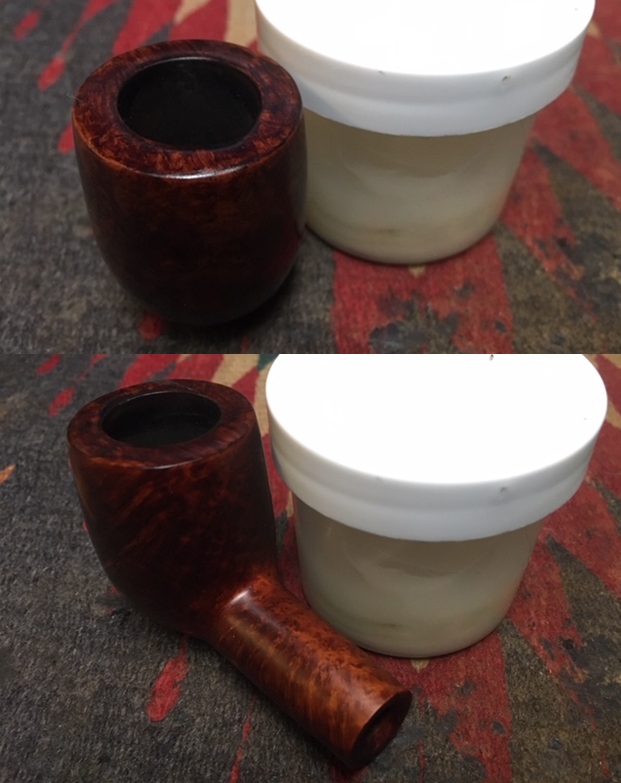
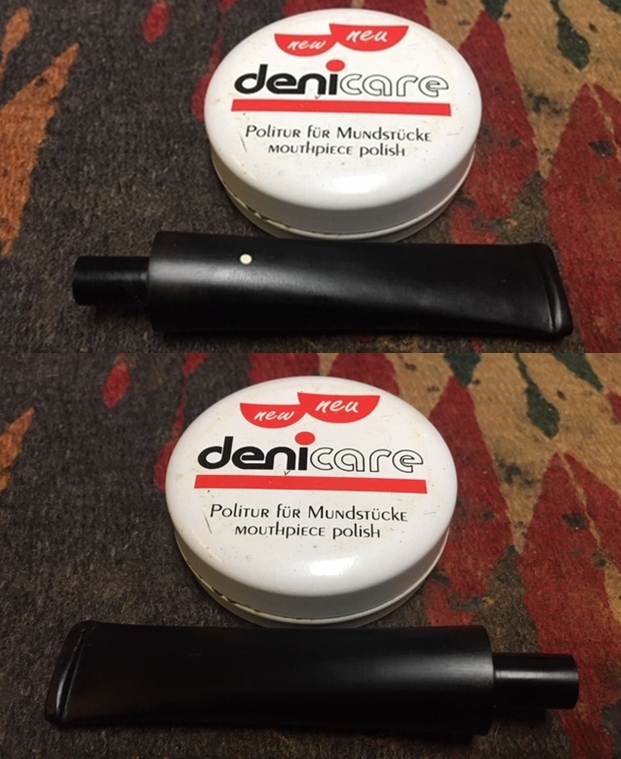
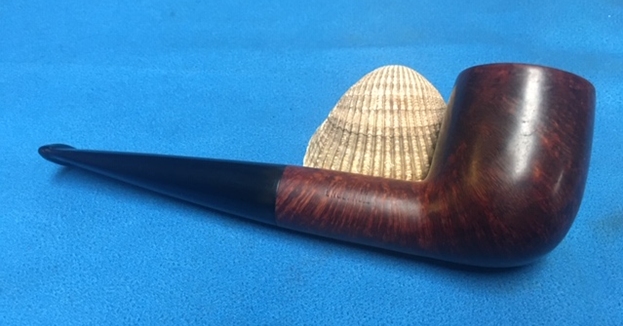
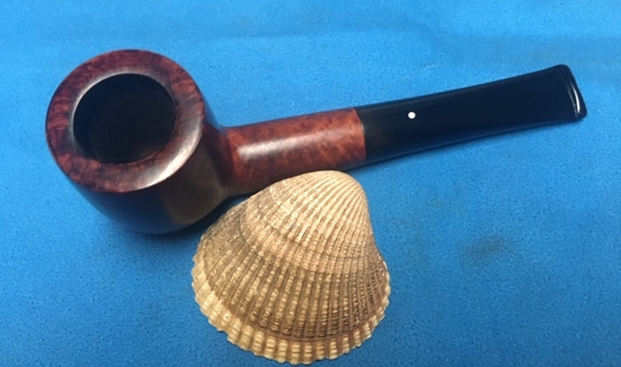
 

A Republic Era Peterson’s 1312 System Standard from Bob Kerr’s Estate


Blog by Steve Laug

I am continuing to work on Bob Kerr’s collection of 9 Peterson’s System pipes that are ready to be restored. This pipe is another System Standard pipe that I have in his estate. I have restored quite a few of his Petersons already so this is kind of subset of the Peterson Collection. You can read about those restorations in previous blogs. To be honest with you I have been dreading working on these 9 because when they arrived they were absolutely filthy and the reservoir in the shank was filled with tars and oils. It looked to me that they had never been cleaned. Jeff cleaned them for me and because of that I have been enjoying working on these Peterson’s particularly because Jeff has done such a thorough cleanup of them before I receive them. When I took it out of the box of the pipes that Jeff had cleaned up and sent back to me, I could see that it was stamped Peterson’s System Standard vertically on the left side of the shank next to the band. The right side of the shank was stamped Made in the Republic of Ireland over the shape number 1312. It has some stunning grain around the bowl and shank like the first one that I worked on that can be seen under the thick grime.

There was a thick cake in the bowl with remnants of tobacco stuck on the walls. There was a thick lava overflow coating the rim. The top and edges of the rim appear to have some damage all the way around the bowl but it is really hard to know for certain until the bowl is cleaned and the rim scrubbed. I think that there was a beautiful pipe underneath all of the buildup of years of use. The nickel ferrule on the shank end was oxidized and is stamped on the top and left side K&P over three hallmarks. That is followed by Petersons. It is not dented or damaged. The stem was oxidized and calcified toward the end with some tooth chatter. There were also some tooth marks on both sides of the stem ahead of the “P-lip”. Jeff took photos of the pipe before he started his cleanup work on it. Jeff took photos of the bowl and rim top to show the thick, hard cake in the bowl and the lava build up on the top of the rim and the edges of the bowl. The rim top looked pretty good but it was hard to know for sure but it appeared that there was damage all around the inner edge. The outer edges of the rim appeared to be in good condition.Jeff took a photo of the side and heel of the bowl to show the condition of the finish. You can see the interesting birdseye grain on the sides of the bowl and shank. Even under the dirt and debris of the years it looked very good.   Jeff took photos of the stamping on the left side of the bowl and shank. The vertical stamping on the left side was readable as you can see from the photos. It read Peterson’s System Standard. He did not take a photo of the stamp on the right side of the shank but it read Made in the Republic of Ireland with the shape number 1312 underneath. The nickel ferrule on the shank end is stamped on the top and left side K&P over three hallmarks – a Shamrock, a shape that looks like a reclining lion and a tower. Typically these hallmarks are not like those in silver that help to date a pipe but are rather marks that make it clear that the pipe was made in Ireland.  Following the hallmarks it is stamped Petersons.   Jeff took photos of the top and underside of the stem showing the tooth chatter, scratching and oxidation on the stem surface and wear on the edges of the button. There were two deep dents on the top of the stem just ahead of the P-lip.   I have included the information on the shape number on this pipe that I picked up on researching the other pipes. It is another of the Peterson’s System Standard pipes from Bob’s collection – with a 1312 shape. There was a 312 that is virtually identical in shape, size and marking. I started my hunt for information by turning to a Peterson Catalogue that I have on rebornpipes and looked up the System Standard pipes (https://rebornpipes.com/tag/peterson-hallmark-chart/). I have put a red box around the 312 shown in the catalogue page shown below. That should give a clear picture of the size and shape of the pipe. But there was nothing to give me any information on what the first number 1 meant in the shape number 1312 that I am working on.Since this is stamped with the same “1” as the previous 1307 pipes, I am including the information on the unique numbering. Mark pointed me in the direction that I needed. I quote the pertinent part of his email. The highlighted portion was the clue I was looking for on this pipe. I have already cleaned up several of Bob’s pipes that were sold through GT&C (Genin, Trudeau and Company, Montreal, Quebec).

The index at the back of the book is pretty good, and points you to all the GT&C goodies, but 155 has a photo from the catalog with your 1307, while 318 and 323 explain the rationale for the “1” prefix. In a nutshell, just drop the “1” and you’ve got the shape. My theory is that GT&C added this to aid them in warranty work, so they’d know the pipe was bought on Canadian soil.

I turned then to a previous blog I had written on a Kapruf 54 that had an odd shape number stamp and referred to the Canadian numbering system used by GT&C. Here it the link to that blog (https://rebornpipes.com/2019/08/09/back-to-bob-kerrs-estate-another-canadian-import-petersons-kapruf-a-54/). In the blog I included a link to a blog I did on the GT&C Catalogue that came to me in some paperwork the family gave me. I have included the cover of the catalogue and the page on the system pipes showing the 1312 shape. I have put a red box around the shape for ease of reference (https://rebornpipes.com/2016/09/13/petersons-pipes-brochure-from-genin-trudeau-co-montreal-quebec/). Be sure to check out the rest of the document on the link.

The GT&C Catalogue combined with the earlier Peterson Pipe Catalogue page make the link definitive. I am also including the information from Pipedia’s article on Peterson pipes. It is a great read in terms of the history of the brand (https://pipedia.org/wiki/Peterson). I have included a bit of the pertinent history here.

1950 – 1989 The Republic Era  – From 1950 to the present time, the stamp for this era is “Made in the Republic of Ireland” in a block format generally in three lines but two lines have been used with or without Republic being abbreviated.

During the 1950’s and 60’s the Kapp & Peterson company was still in the ownership of the Kapp family. However 1964 saw the retiral of the company Managing Director Frederick Henry(Harry) Kapp.

Pipedia also included a section of information on the System pipes including a diagram of the sytems look (https://pipedia.org/wiki/Peterson#Republic_Era_Pipes). I quote a section of the article in part and include a link to another article on Pipedia on the System pipe.

The Peterson System pipes are the standard bearers of the Peterson pipe family, famous for the excellent smoking pleasure they provide. Often imitated but never equaled, the Peterson System smokes dry, cool and sweet, thanks to the scientific effectiveness of the original design. The heart of the System is the unique graduated bore in the mouthpiece. This makes the suction applied by the smoker 15 times weaker by the time it reaches the tobacco chamber. The result is that all the moisture flows into the reservoir and, thus cannot reach the smoker’s mouth. The Peterson Lip further enhances the effectiveness of the graduated bore by directing the flow of smoke upwards and away from the tongue. This achieves a uniquely even distribution of smoke and virtually eliminates any chance of tonguebite or bitterness. Furthermore, the shape is contoured so that the tongue rests comfortably in the depression under the opening. Each “PLip” mouthpiece is made from Vulcanite. For the Peterson System pipes to work properly, the stem/tenon has to have an extension, the tip of which will pass by the draft hole from the bowl and into the sump. Upon the smoker drawing in smoke, this extension then directs the smoke down and around the sump to dispense a lot of the moisture before the smoke enters the extension and stem. On the System Standards and other less expensive systems, this extension with be made of Vulcanite turned integrally with the stem. On the more expensive System pipes this extension will be made of metal which screws into the Vulcanite stem. This extension on the earlier pipes will be of brass and the newer pipes will be of aluminium. Most smokers not knowing this function of the metal extension, assumes that it is a condenser/stinger and will remove it as they do with the metal condensers of Kaywoodie, etc. Should you have a System pipe with this metal extension, do not remove it for it will make the System function properly and give you a dryer smoke (https://pipedia.org/wiki/A_closer_look_at_the_famous_Peterson_Standard_System_Pipe).

With that information in hand I knew what I was dealing with in terms of the stamping and the age of this pipe. I knew from the information that the pipe was made during the Republic Era between 1950 and 1989. Most of Bob’s pipes were purchased in the 60s so my guess is that this is also a 60’s era pipe. I also knew that the pipe was brought into Canada by the Canadian importer, Genin, Trudeau & Co. in Montreal, Quebec. Noting above that the catalogue postal code puts it in the late 60s early 70s which also fits the story. Now it was time to work on the pipe.

I am really happy to have Jeff’s help on cleaning these 9 Peterson’s System Standard pipes as they are a real pain to get clean. He cleaned this filthy pipe with his usual penchant for thoroughness that I really appreciate. This one was a real mess and I did not know what to expect when I unwrapped it from his box. He reamed it with a PipNet pipe reamer and cleaned up the reaming with a Savinelli Fitsall Pipe Knife. He scrubbed out the internals with alcohol, pipe cleaners and cotton swabs until the pipe was clean. He scrubbed the exterior of the bowl with Murphy’s Oil Soap and a tooth brush to remove the grime and grit on the briar and the lava on the rim top. The finish looks very good with great looking grain around the bowl and shank. Jeff soaked the stem in Before & After Deoxidizer to remove the oxidation on the rubber. When the pipe arrived here in Vancouver for the second stop of its restoration tour I was amazed it looked so good.     I took some close up photos of the rim top and also of the stem surface. I wanted to show what an amazing job Jeff did in the cleanup of the rim top. The rim top was darkened with nicks and notches around the top and inner edge. The inner edge was very rough – almost looked like a knife had been used on it.  I also took close up photos of the stem to show the tooth marks and chatter on the stem surface. The majority of the marks were on the underside.   One of the things I appreciate about Jeff’s cleanup is that he works to protect and preserve the nomenclature on the shank of the pipes that he works on. The stamping on this one was very faint on the left side to start with so I was worried that it would disappear altogether with the cleanup. He was able to preserve it. I took some photos to show the clarity of the stamping. I have noticed that many restorers are not careful to protect the stamping in their cleaning process and often by the end of the restoration the nomenclature is almost destroyed. I would like to encourage all of us to be careful in our work to preserve this as it is a critical piece of pipe restoration!      Since this is another pipe Bob’s estate I am sure that some of you have read at least some of the other restoration work that has been done on the previous pipes. You have also read what I have included about Bob Kerr, the pipeman who held these pipes in trust before I came to work on them (see photo to the left). Also, if you have followed the blog for long you will already know that I like to include background information on the pipeman whose pipes I am restoring. For me, when I am working on an estate I really like to have a sense of the person who held the pipes in trust before I worked on them. It gives me another dimension of the restoration work. I asked Brian if he or his wife would like to write a brief biographical tribute to her father, Bob. His daughter worked on it and I received the following short write up on him and some pictures to go along with the words including one of Bob’s carvings. Once again I thank you Brian and tell your wife thank you as well.

I am delighted to pass on these beloved pipes of my father’s. I hope each user gets many hours of contemplative pleasure as he did. I remember the aroma of tobacco in the rec room, as he put up his feet on his lazy boy. He’d be first at the paper then, no one could touch it before him. Maybe there would be a movie on with an actor smoking a pipe. He would have very definite opinions on whether the performer was a ‘real’ smoker or not, a distinction which I could never see but it would be very clear to him. He worked by day as a sales manager of a paper products company, a job he hated. What he longed for was the life of an artist, so on the weekends and sometimes mid-week evenings he would journey to his workshop and come out with wood sculptures, all of which he declared as crap but every one of them treasured by my sister and myself. Enjoy the pipes, and maybe a little of his creative spirit will enter you!

Now with all of the background on the line and the background on Bob Kerr it was time to get on with the restoration of this mixed grain Peterson’s System Standard 1312 Bent Billiard. I am really coming to appreciate the hard cleanup work that Jeff did on these pipes. They were a real mess when I sent them to Jeff and I have to tell you it was great that I did not need to clean this pipe. I decided to start the process by dealing with the damage to the inner edge and top of the rim. The first photo below shows what the rim looked like when I started. I sanded it with 220 grit sandpaper and gave it a very light bevel so that it took care of the damage on the inner edge. The third photo shows the rim top after the shaping. I polished the briar with micromesh sanding pads – wet sanding it with 1500-12000 grit pads and I wiped the bowl down after each sanding pad with a damp cloth. The bowl began to take on a finished shine.  I rubbed the bowl and rim down with Before & After Restoration Balm. I worked it into the surface of the briar with my fingertips to clean, enliven and protect it. I let the balm sit for a little while and then buffed with a cotton cloth to raise the shine. I really like watching the Balm do its magic and bring the briar alive.   I set the bowl aside and turned my attention to the stem. I sanded out the oxidation and tooth chatter on the stem surface on both sides. I worked on the button top and edges. This first step in the process was with a folded piece 220 grit sandpaper. I polished it with 400 grit wet dry sandpaper. I rubbed the stem down with Denicare Mouthpiece Polish. I have a few tins of this laying around so I am trying to use them up. It does a pretty good job polishing the stem.  I polished the stem with micromesh sanding pads – wet sanding with 1500-12000 grit pads. I wiped the stem down after each sanding pad with Obsidian Oil. I polished it with Before & After Pipe Stem Polish – both Fine and Extra Fine. Once I had finished the polishing I gave it a coat of a new product I am experimenting with from Briarville Pipe Repair. It is called “No Oxy Oil” and it is made to protect the stem from oxidizing. I set it aside to dry.   Once again I am excited to be on the homestretch with yet another one of Bob’s estate Petersons. I look forward to the final look when it is put back together, polished and waxed. I put the bowl and stem back together. I polished the bowl and stem with Blue Diamond to polish out the scratches in the briar and the vulcanite. I gave the bowl and the stem multiple coats of carnauba wax. I buffed the pipe with a clean buffing pad to raise the shine. I hand buffed it with a microfiber cloth to deepen the shine. The pipe polished up pretty nicely. The grain is quite stunning and really pops with the wax and polish. The shiny black vulcanite stem is a beautiful contrast to the browns of the bowl and thick shank. Bob’s Peterson’s System Standard 1312 Bent Billiard was another fun pipe to work on thanks to Jeff’s cleanup work. The polished nickel Ferrule works as a contrast between the stem and the briar and binds it all together. It really is a quite stunning piece of briar whose shape follows the flow of the briar. The pipe is comfortable pipe to hold in the hand. The finished pipe is shown in the photos below. The dimensions of the pipe are Length: 6 inches, Height: 2 inches, Outside diameter of the bowl: 1 ¼ inches, Chamber diameter: ¾ of an inch. This beautiful pipe will be going on the rebornpipes store if you would like to add it to your collection and carry on Bob’s legacy. If not, I have a lot more of Bob’s estate to work on of various brands. Perhaps one of those will catch your attention. Thanks for reading this blog and my reflections on the pipe while I worked on it. This is an interesting estate to bring back to life.

A Republic Era Peterson’s 301 System Standard Pot from Bob Kerr’s Estate


Blog by Steve Laug

I am continuing to work on Bob Kerr’s collection of 9 Peterson’s System pipes that are ready to be restored. The next pipe on the table is a bit different from the other Standard System pipes that I have worked on from his estate. It is a pot shaped bowl with a different style stem. I have restored quite a few of his Petersons already so this is kind of subset of the Peterson Collection. You can read about those restorations in previous blogs. To be honest with you I have been dreading working on these 9 because when they arrived they were absolutely filthy and the reservoir in the shank was filled with tars and oils. It looked to me that they had never been cleaned. Jeff cleaned them for me and because of that I have been enjoying working on these Peterson’s particularly because Jeff has done such a thorough cleanup of them before I receive them. When I took it out of the box of the pipes that Jeff had cleaned up and sent back to me, I could see that it was stamped Peterson’s System Standard vertically on the left side of the shank next to the band. The right side of the shank was stamped Made in the Republic of Ireland over the shape number 301. The stamping is very faint but readable with a lens. It has some stunning grain around the bowl and shank that can be seen under the thick grime. There are also some deep nicks or flaws in the left and front sides of the bowl.

In many ways this was one of the dirtier System pipes if that is possible. There was a thick cake in the bowl with remnants of tobacco stuck on the walls. There was a lava overflow on the rim. The top and edges of the rim appear to have some damage all the way around the bowl. There was some damage on the back outer edge of the rim that looked as if it had been dropped. I think that there was a beautiful pipe underneath all of the buildup of years of use. There was some interesting grain poking through. The nickel ferrule on the shank end was oxidized and dented. The band was loose so it turned on the shank end. It is stamped K&P Petersons. The stem was oxidized and calcified toward the end with some tooth chatter. There were also some tooth marks on both sides of the stem ahead of the “P-lip”. There was also a deep mark mid stem on the underside. Jeff took photos of the pipe before he started his cleanup work on it. Jeff took photos of the bowl and rim top to show the thick, hard cake in the bowl and the lava build up on the top of the rim and the edges of the bowl. The rim top looked pretty good but it was hard to know for sure but it appeared that there was damage all around the inner edge. The outer edges of the rim appeared to have some serious damage on the back of the bowl. It is rough and could have been dropped or knocked out against a hard surface. Jeff took photos of the sides and heel of the bowl to show the condition of the finish. You can see the nicks and pits in the briar around the bowl.  It does have some interesting mixed grain on the sides of the bowl and shank. There is also some cross grain and birdseye for those who love grain. Even under the dirt and debris of the years it looked very good.    Jeff took photos of the stamping on the sides of the bowl and shank. The vertical stamping on the left side was faint but readable as you can see from the photo. It read Peterson’s System Standard. The stamping on the right side of the shank is also faint but it read Made in the Republic of Ireland with the shape number 301 underneath. The nickel ferrule on the shank end is stamped on the top and left side K&P Petersons.  The ferrule has some dents and nicks in it that will need to be addressed.   Jeff took photos of the top and underside of the stem showing the tooth chatter, scratching and oxidation on the stem surface and wear on the edges of the button. You can see the scratch in the vulcanite mid stem in the second photo.   I am including the information from Pipedia’s article on Peterson pipes. It is a great read in terms of the history of the brand (https://pipedia.org/wiki/Peterson). I have included a bit of the pertinent history here.

1950 – 1989 The Republic Era  – From 1950 to the present time, the stamp for this era is “Made in the Republic of Ireland” in a block format generally in three lines but two lines have been used with or without Republic being abbreviated.

During the 1950’s and 60’s the Kapp & Peterson company was still in the ownership of the Kapp family. However 1964 saw the retiral of the company Managing Director Frederick Henry(Harry) Kapp.

Pipedia also included a section of information on the System pipes including a diagram of the sytems look (https://pipedia.org/wiki/Peterson#Republic_Era_Pipes). I quote a section of the article in part and include a link to another article on Pipedia on the System pipe.

The Peterson System pipes are the standard bearers of the Peterson pipe family, famous for the excellent smoking pleasure they provide. Often imitated but never equaled, the Peterson System smokes dry, cool and sweet, thanks to the scientific effectiveness of the original design. The heart of the System is the unique graduated bore in the mouthpiece. This makes the suction applied by the smoker 15 times weaker by the time it reaches the tobacco chamber. The result is that all the moisture flows into the reservoir and, thus cannot reach the smoker’s mouth. The Peterson Lip further enhances the effectiveness of the graduated bore by directing the flow of smoke upwards and away from the tongue. This achieves a uniquely even distribution of smoke and virtually eliminates any chance of tonguebite or bitterness. Furthermore, the shape is contoured so that the tongue rests comfortably in the depression under the opening. Each “PLip” mouthpiece is made from Vulcanite. For the Peterson System pipes to work properly, the stem/tenon has to have an extension, the tip of which will pass by the draft hole from the bowl and into the sump. Upon the smoker drawing in smoke, this extension then directs the smoke down and around the sump to dispense a lot of the moisture before the smoke enters the extension and stem. On the System Standards and other less expensive systems, this extension with be made of Vulcanite turned integrally with the stem. On the more expensive System pipes this extension will be made of metal which screws into the Vulcanite stem. This extension on the earlier pipes will be of brass and the newer pipes will be of aluminium. Most smokers not knowing this function of the metal extension, assumes that it is a condenser/stinger and will remove it as they do with the metal condensers of Kaywoodie, etc. Should you have a System pipe with this metal extension, do not remove it for it will make the System function properly and give you a dryer smoke (https://pipedia.org/wiki/A_closer_look_at_the_famous_Peterson_Standard_System_Pipe).

With that information in hand I knew what I was dealing with in terms of the stamping and the age of this pipe. I knew from the information that the pipe was made during the Republic Era between 1950 and 1989. Most of Bob’s pipes were purchased in the 60s so my guess is that this is also a 60’s era pipe. Now it was time to work on the pipe.

I am really happy to have Jeff’s help on cleaning these 9 Peterson’s System Standard pipes as they are a real pain to get clean. He cleaned this filthy pipe with his usual penchant for thoroughness that I really appreciate. This one was a real mess and I did not know what to expect when I unwrapped it from his box. He reamed it with a PipNet pipe reamer and cleaned up the reaming with a Savinelli Fitsall Pipe Knife. He scrubbed out the internals with alcohol, pipe cleaners and cotton swabs until the pipe was clean. He scrubbed the exterior of the bowl with Murphy’s Oil Soap and a tooth brush to remove the grime and grit on the briar and the lava on the rim top. The finish looks very good with great looking grain around the bowl and shank. Jeff soaked the stem in Before & After Deoxidizer to remove the oxidation on the rubber. When the pipe arrived here in Vancouver for the second stop of its restoration tour I was amazed it looked so good.  Forgive the poor quality pics I took of the pipe at this point… not sure what happened. I took some close up photos of the rim top and also of the stem surface. I wanted to show what an amazing job Jeff did in the cleanup of the rim top. The rim top was darkened with nicks and dents in the top. There were notches around the inner edge almost looked like a knife had been used on it. The back outer edge was worn and rough. I also took close up photos of the stem to show the tooth chatter on the stem surface. There was also the scratch on the underside. It was still lightly oxidized. The P stamp on the left was faint but visible.  You can also see the dents around the nickel ferrule. One of the things I appreciate about Jeff’s cleanup is that he works to protect and preserve the nomenclature on the shank of the pipes that he works on. The stamping on this one was very faint to start with so I was worried that it would disappear altogether with the cleanup. I took some photos to show the clarity of the stamping had neither worsened nor improved. Since this is another pipe Bob’s estate I am sure that some of you have read at least some of the other restoration work that has been done on the previous pipes. You have also read what I have included about Bob Kerr, the pipeman who held these pipes in trust before I came to work on them (see photo to the left). Also, if you have followed the blog for long you will already know that I like to include background information on the pipeman whose pipes I am restoring. For me, when I am working on an estate I really like to have a sense of the person who held the pipes in trust before I worked on them. It gives me another dimension of the restoration work. I asked Brian if he or his wife would like to write a brief biographical tribute to her father, Bob. His daughter worked on it and I received the following short write up on him and some pictures to go along with the words including one of Bob’s carvings. Once again I thank you Brian and tell your wife thank you as well.
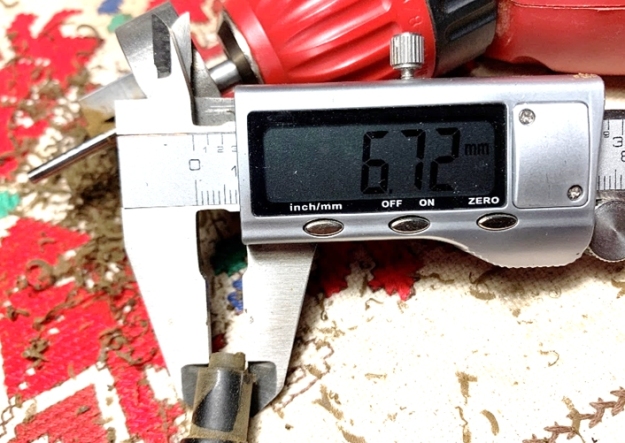
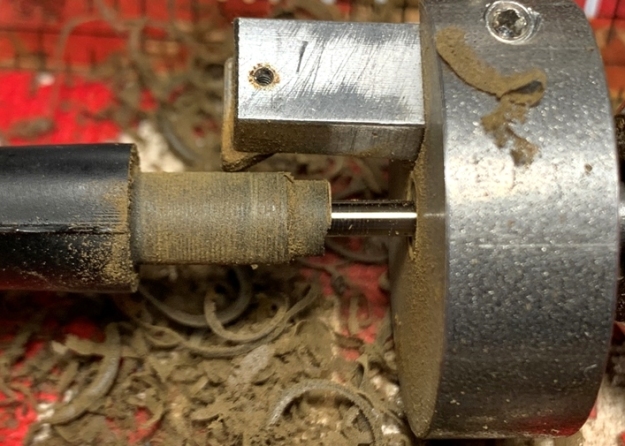
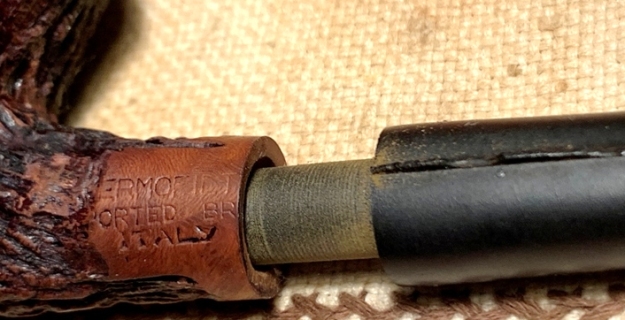
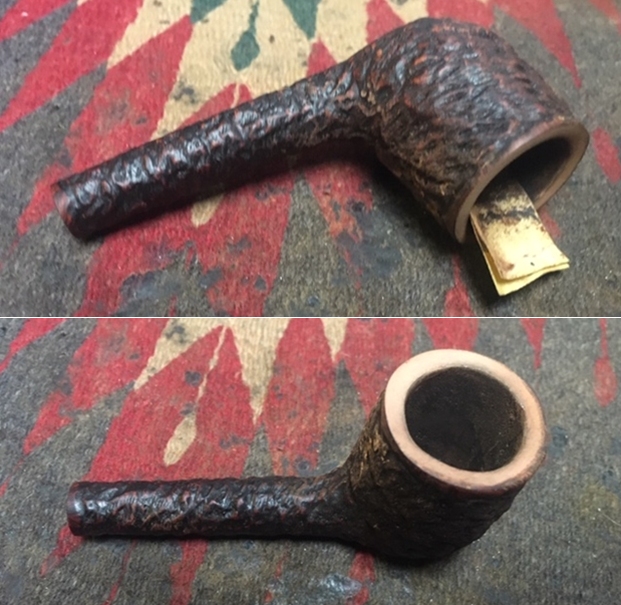
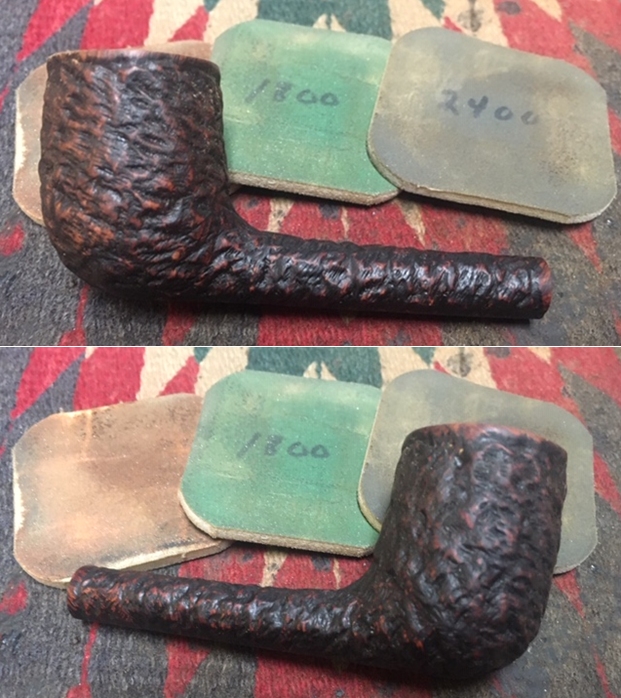
I am delighted to pass on these beloved pipes of my father’s. I hope each user gets many hours of contemplative pleasure as he did. I remember the aroma of tobacco in the rec room, as he put up his feet on his lazy boy. He’d be first at the paper then, no one could touch it before him. Maybe there would be a movie on with an actor smoking a pipe. He would have very definite opinions on whether the performer was a ‘real’ smoker or not, a distinction which I could never see but it would be very clear to him. He worked by day as a sales manager of a paper products company, a job he hated. What he longed for was the life of an artist, so on the weekends and sometimes mid-week evenings he would journey to his workshop and come out with wood sculptures, all of which he declared as crap but every one of them treasured by my sister and myself. Enjoy the pipes, and maybe a little of his creative spirit will enter you!

Now with all of the background on the line and the background on Bob Kerr it was time to get on with the restoration of this next mixed grain Peterson’s System Standard 301 Bent Pot. I am really coming to appreciate the hard cleanup work that Jeff did on these pipes. They were a real mess when I sent them to Jeff and I have to tell you it was great that I did not need to clean this pipe. I decided to start the process by dealing with the damage to the inner edge and top of the rim. The first photo below shows what the rim looked like when I started. I sanded it with 220 grit sandpaper and worked on the flat surface as well as the inner edge. I gave it a very light bevel so that it took care of the damage on the inner edge.I filled in the damage on the back edge of the rim and the deep pits in briar on the front and left side with briar dust and clear Krazy Glue. Once the repair had cured I sanded the spots of the repair and topped the bowl with 220 grit sandpaper on a topping board. Unfortunately I did not document what the repairs looked like after sanding or topping but that will become clear in the photos that follow. I heated the briar with a flame of a lighter and stained it with Fiebing’s Dark Brown aniline stain. I applied it and flamed it to burn off the alcohol. I took photos of the bowl after staining. You can see the repaired areas as dark spots on the side and the top of the bowl. These will need to be sanded more but the pipe is looking pretty good at this point. I set the bowl aside to cure for the night, turned out the lights and headed to bed. In the morning I removed the nickel ferrule and buffed the bowl with red Tripoli on the buffing wheel to remove the “crust” on the stain. It was dark but otherwise it looked good. I wiped the bowl down with alcohol on cotton pads to make it more transparent. It is hard to see from the photos but the repairs actually looked good at this point.  To further make the stain transparent I polished the briar with micromesh sanding pads – wet sanding it with 1500-12000 grit pads and I wiped the bowl down after each sanding pad with a damp cloth. The bowl began to take on a finished shine. You can see the repaired area on the rim top and left side of the bowl but they look and feel better to the touch than before.   I used the head of a Robertson style screwdriver to work on the dents in the ferrule. I usually use a piece of broom stick that has the rounded head on it but did not have one here at the moment. I place the head against the inside of the dent and tapped it with a small hammer to smooth it out. I was able to remove the majority of the dents around the ferrule. There are still small spots but it is significantly better than before.I spread some WellBond all purpose glue on the inside of the ferrule with a dental spatula and pressed it in place on the shank. I aligned the K&P Petersons stamp on the left side of the shank with the stamping.I rubbed the bowl and rim down with Before & After Restoration Balm. I worked it into the surface of the briar with my fingertips to clean, enliven and protect it. I let the balm sit for a little while and then buffed with a cotton cloth to raise the shine. I really like watching the Balm do its magic and bring the briar alive. I wiped off the scratch in the vulcanite with alcohol and filled it in with clear Krazy Glue. Once the glue cured I smoothed out the repair on the underside of the stem with 220 grit sandpaper.  I polished it with 400 grit wet dry sandpaper.   I rubbed the stem down with Denicare Mouthpiece Polish. I have a few tins of this laying around so I am trying to use them up. It does a pretty good job polishing the stem.  I used some Papermate Liquid Paper to touch up the stamping on the left side of the saddle stem. I pressed it into the stamped letter “P” and let it dry. I scraped it off with a tooth pick and took a photo of the re-whitened letter.   I polished the stem with micromesh sanding pads – wet sanding with 1500-12000 grit pads. I wiped the stem down after each sanding pad with Obsidian Oil. I polished it with Before & After Pipe Stem Polish – both Fine and Extra Fine. Once I had finished the polishing I gave it a coat of a new product I am experimenting with from Briarville Pipe Repair. It is called “No Oxy Oil” and it is made to protect the stem from oxidizing. I set it aside to dry.    Once again at this point in the restoration process I am excited to be on the homestretch. This is the only Peterson’s System Standard 301 Pot from Bob’s pipes so I look forward to the final look when it is put back together, polished and waxed. I put the bowl and stem back together. I polished the bowl and stem with Blue Diamond to polish out the scratches in the briar and the vulcanite. I gave the bowl and the stem multiple coats of carnauba wax. I buffed the pipe with a clean buffing pad to raise the shine. I hand buffed it with a microfiber cloth to deepen the shine. The pipe polished up pretty nicely. The grain is quite nice and really pops with the wax and polish. The shiny black vulcanite stem is a beautiful contrast to the browns of the bowl and thick shank. This was another fun pipe to work on thanks to Jeff’s cleanup work. The polished nickel Ferrule works as a contrast between the stem and the briar and binds it all together. It really is a quite stunning piece of briar whose shape follows the flow of the briar. The pipe is comfortable pipe to hold in the hand. The finished pipe is shown in the photos below. The dimensions of the pipe are Length: 6 inches, Height: 2 inches, Outside diameter of the bowl: 1 ½ inches, Chamber diameter: 7/8 of an inch. This beautiful pipe will be going on the rebornpipes store if you would like to add it to your collection and carry on Bob’s legacy. If not, I have a lot more of Bob’s estate to work on of various brands. Perhaps one of those will catch your attention. Thanks for reading this blog and my reflections on the pipe while I worked on it. This is an interesting estate to bring back to life.