Tag Archives: bite marks

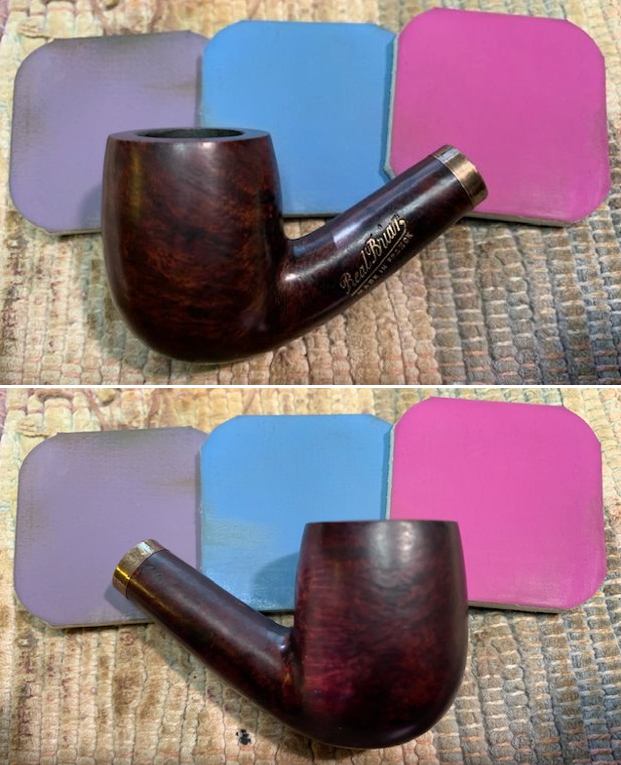
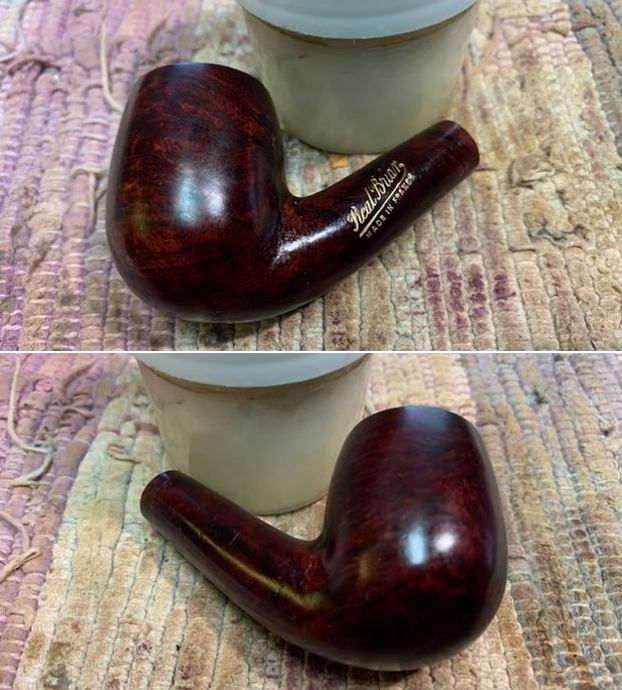
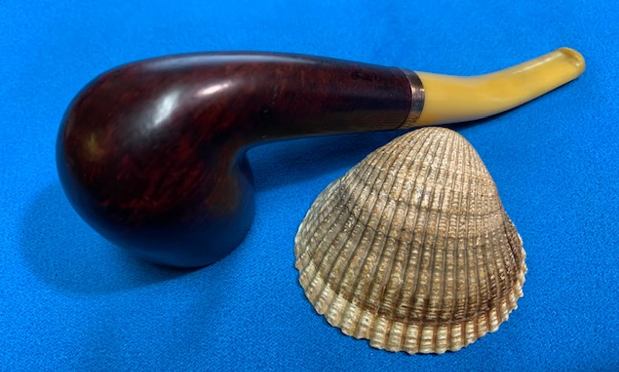
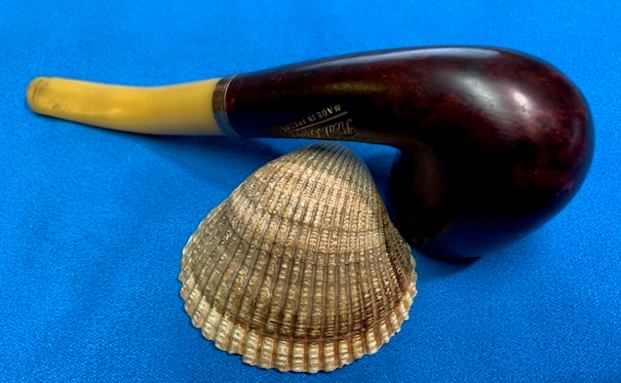
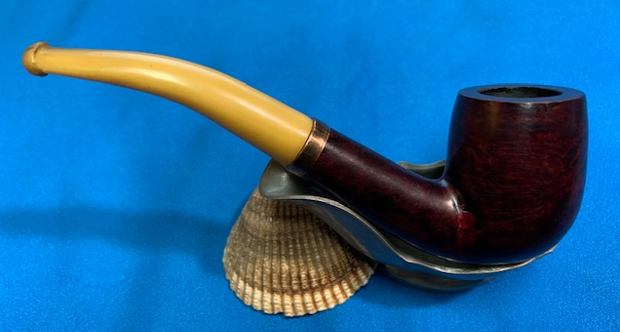
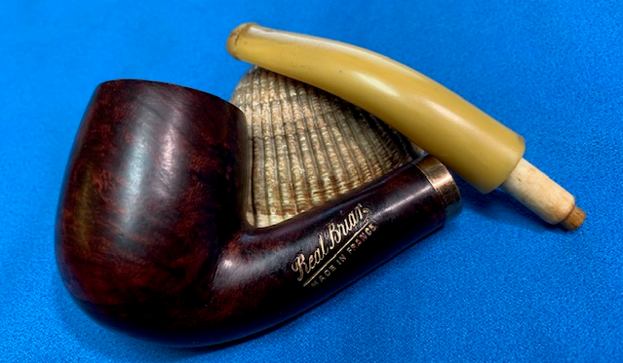
Reviving another Old Timer – a French Made Real Briar Bent Billiard


Blog by Steve Laug

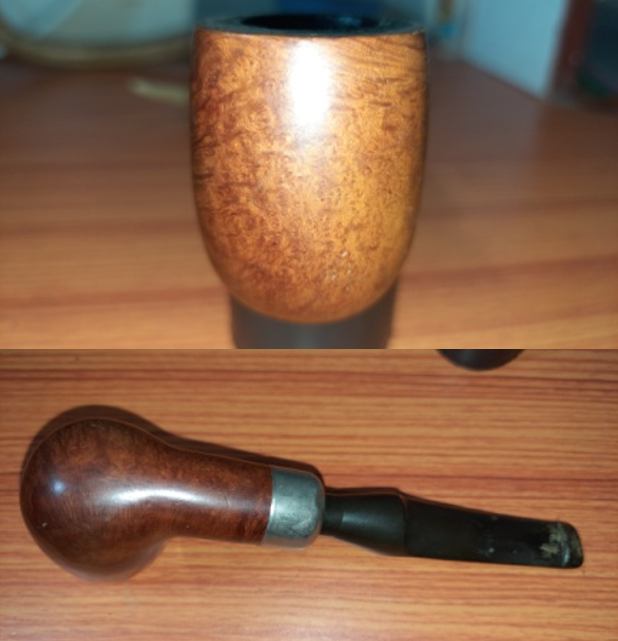
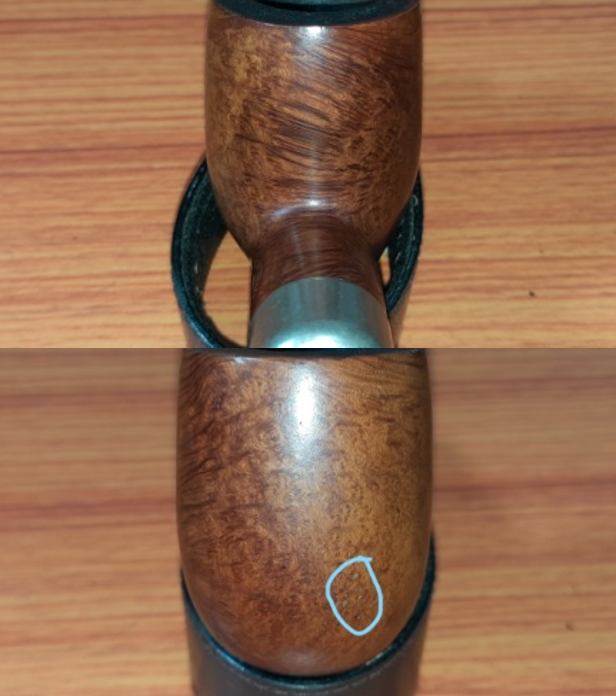
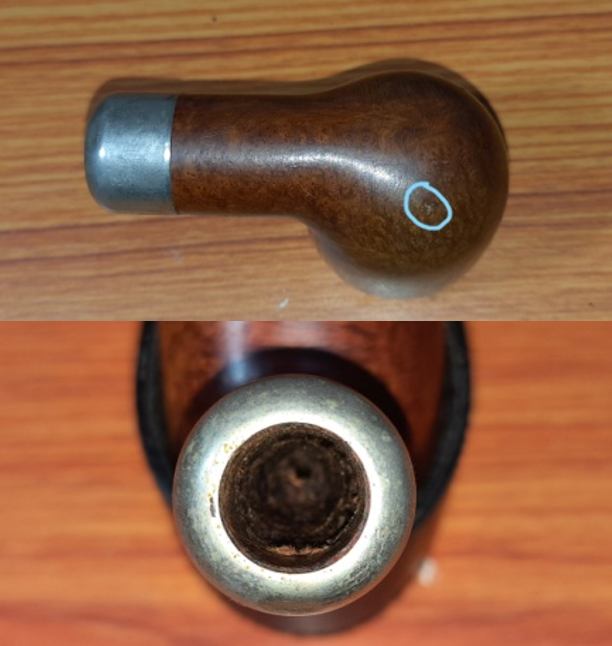
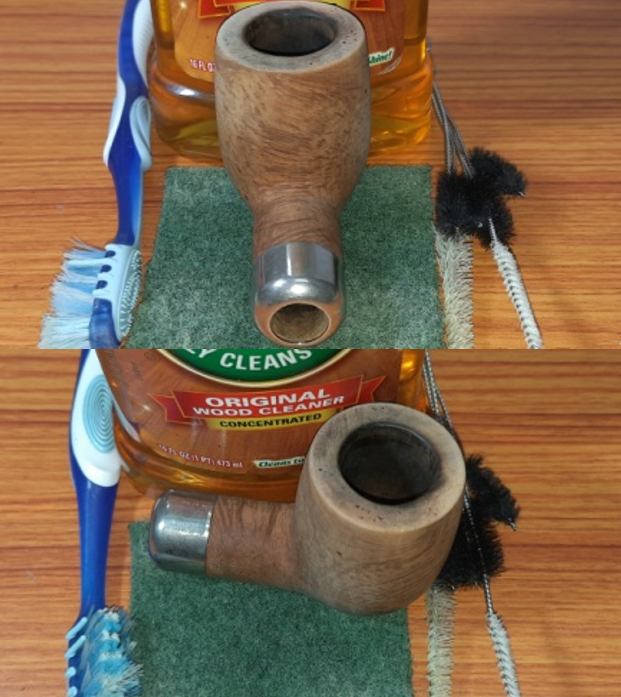
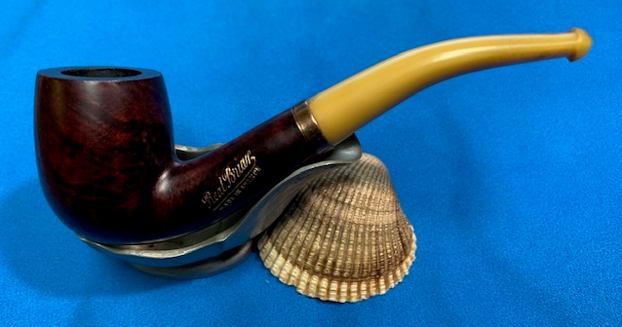
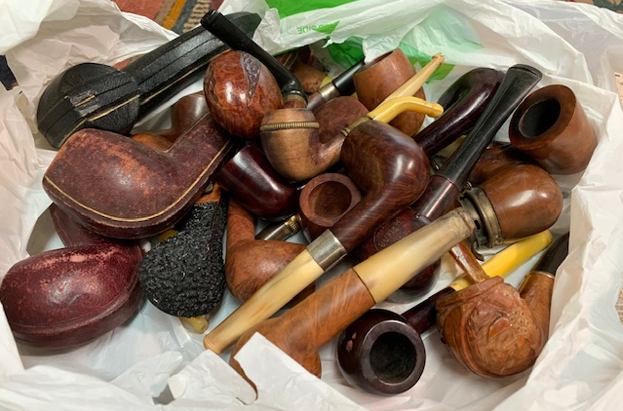
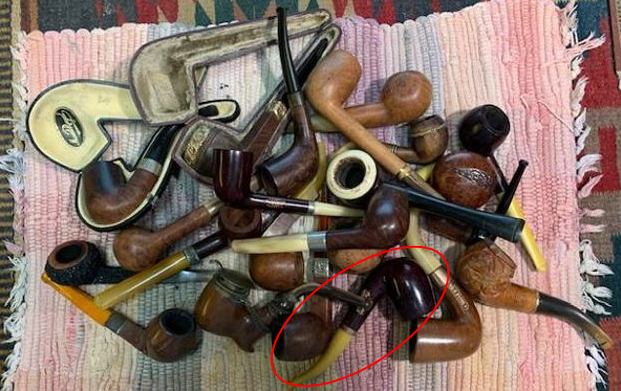
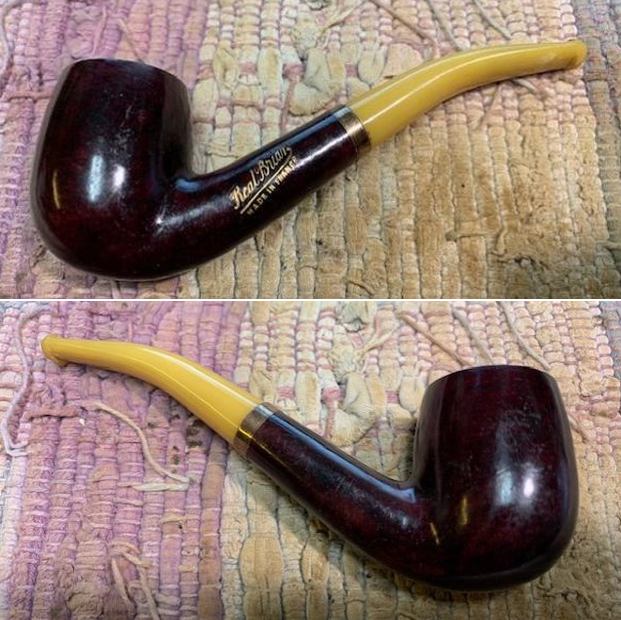
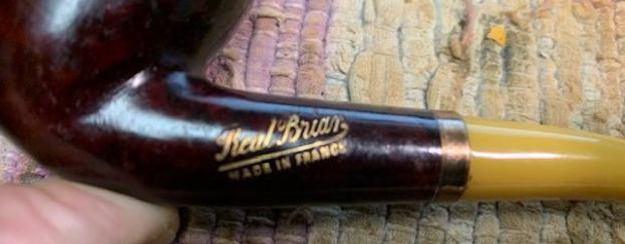
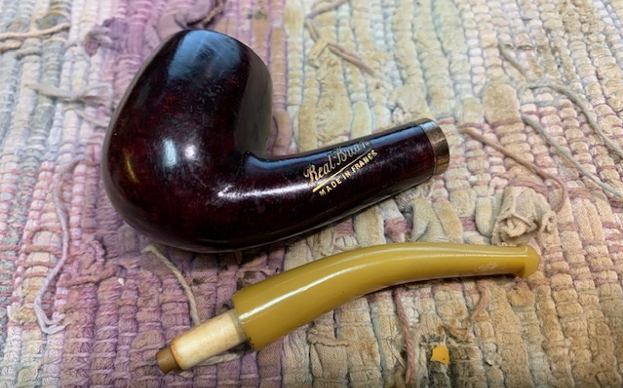
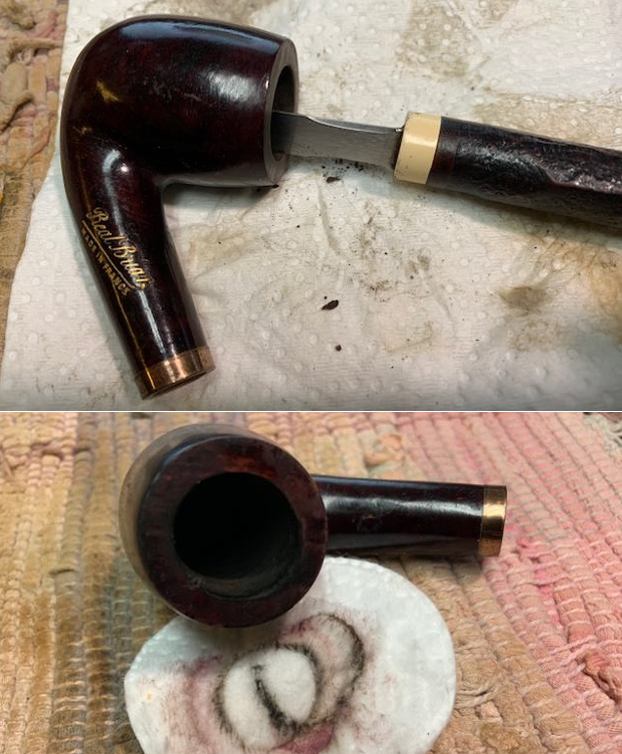
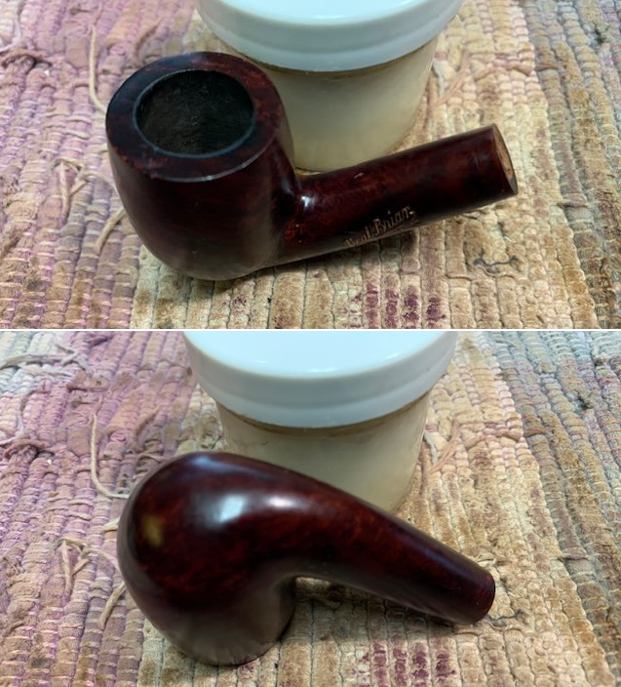
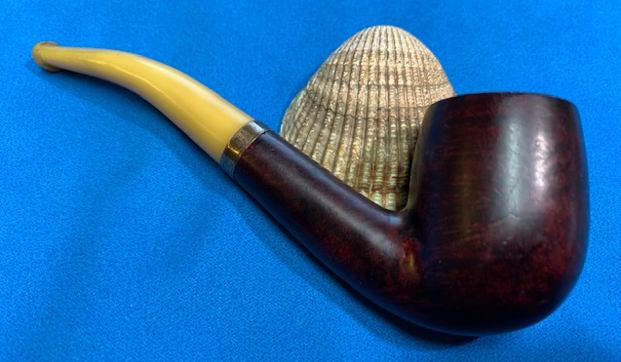
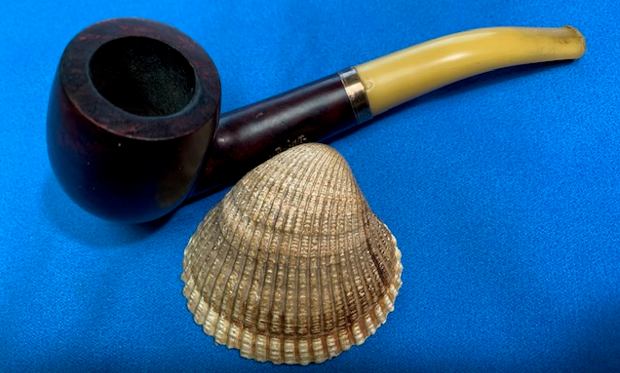
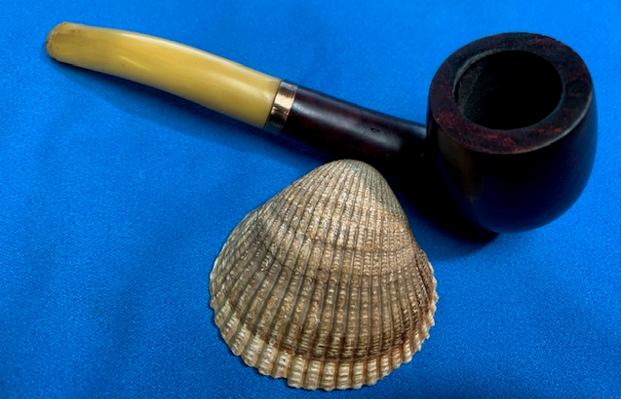
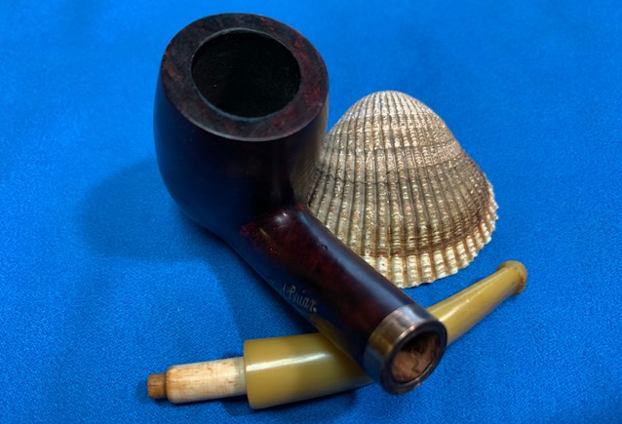
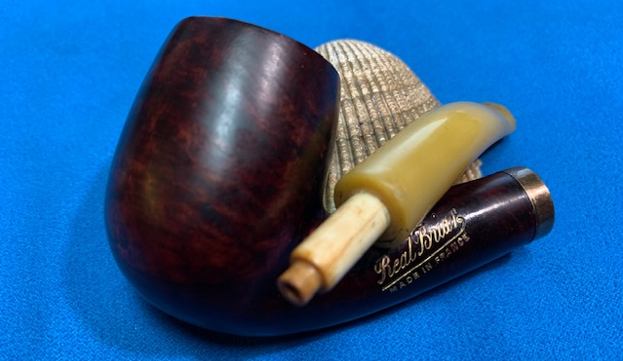
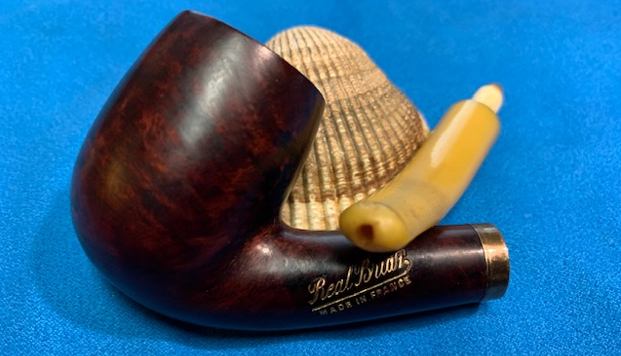
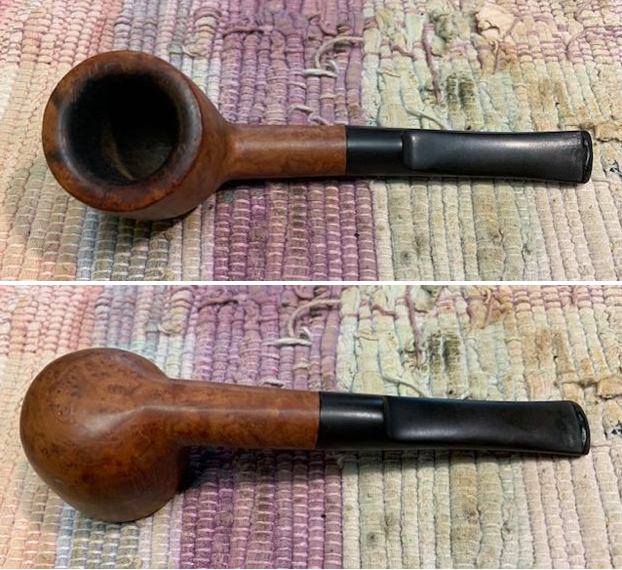
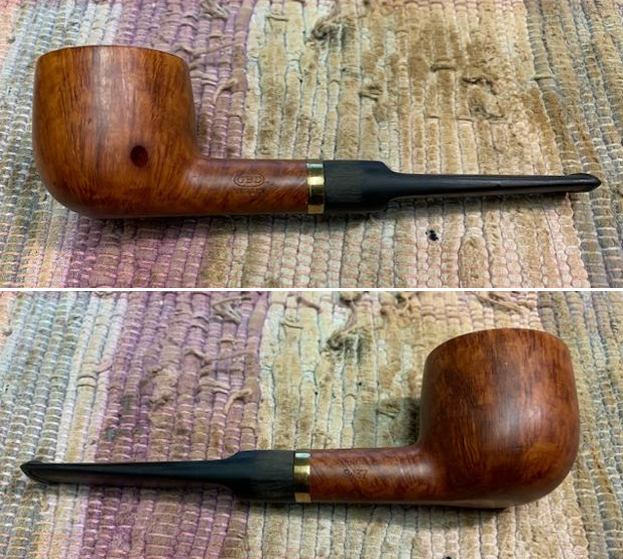
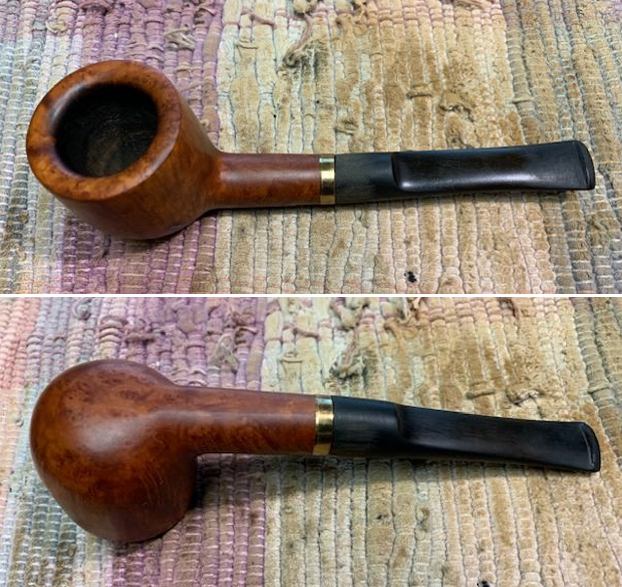
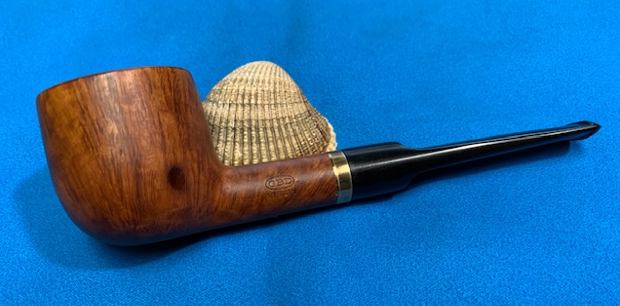
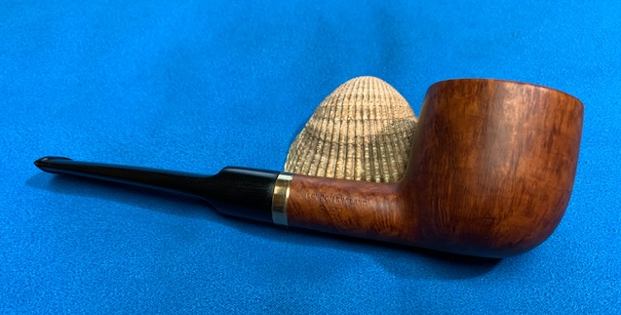
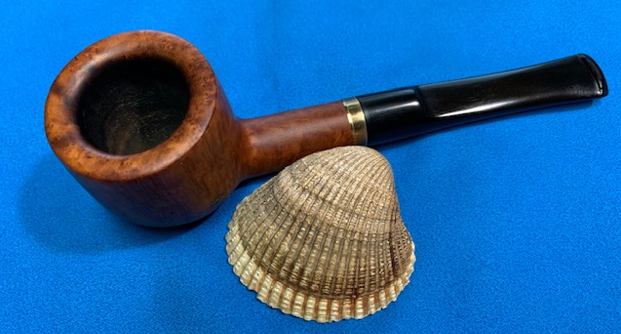
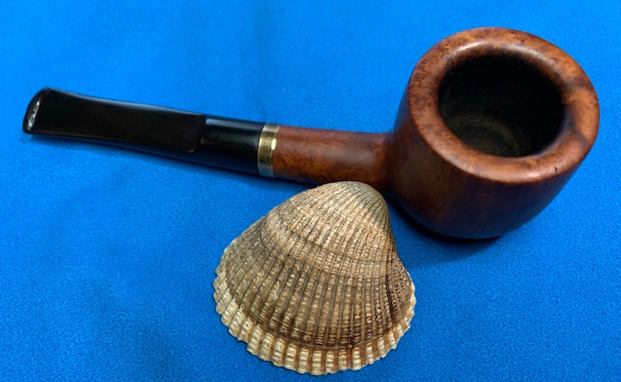
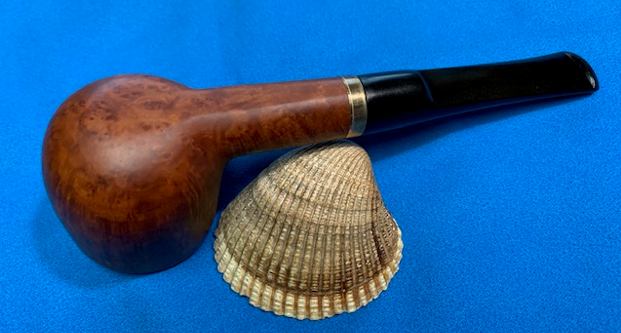
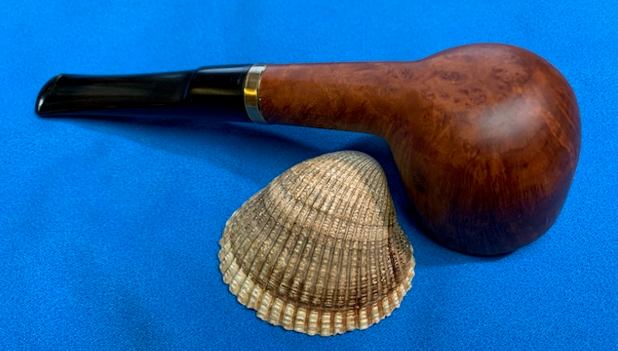
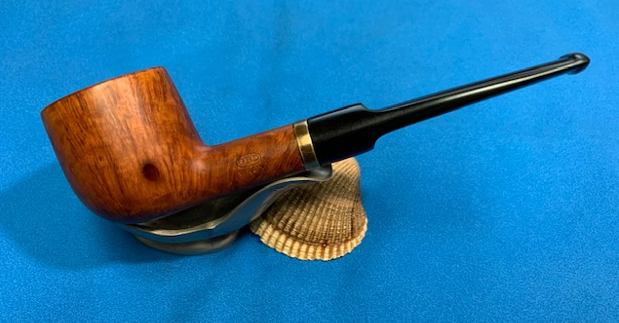
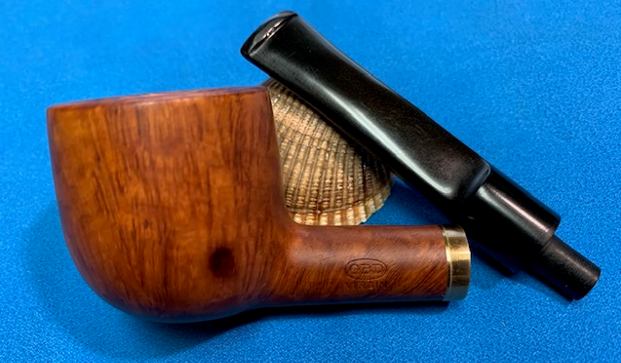
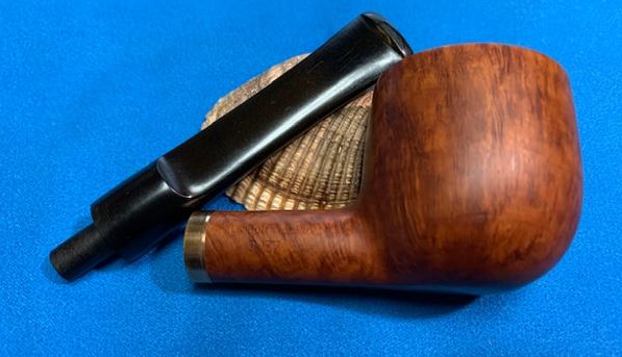
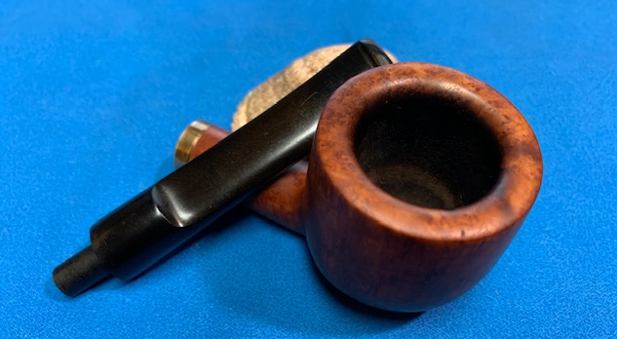
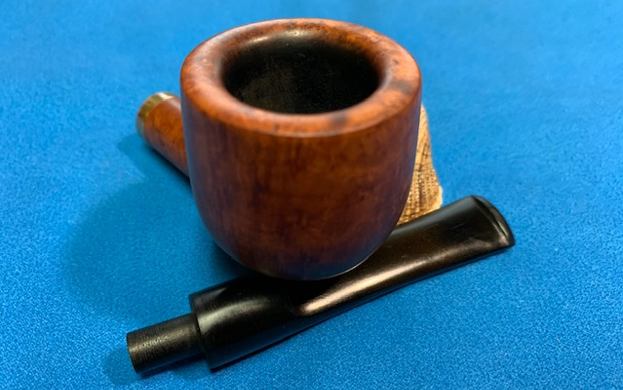
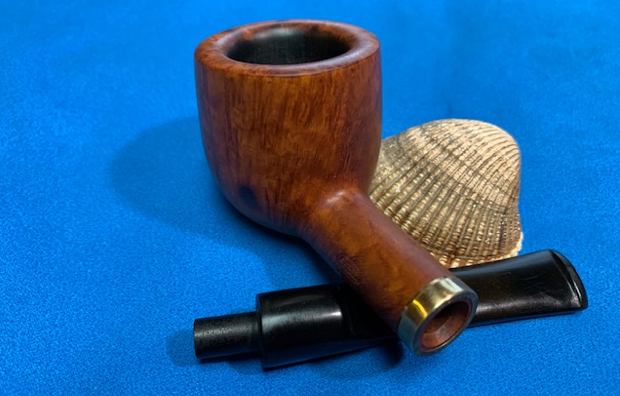
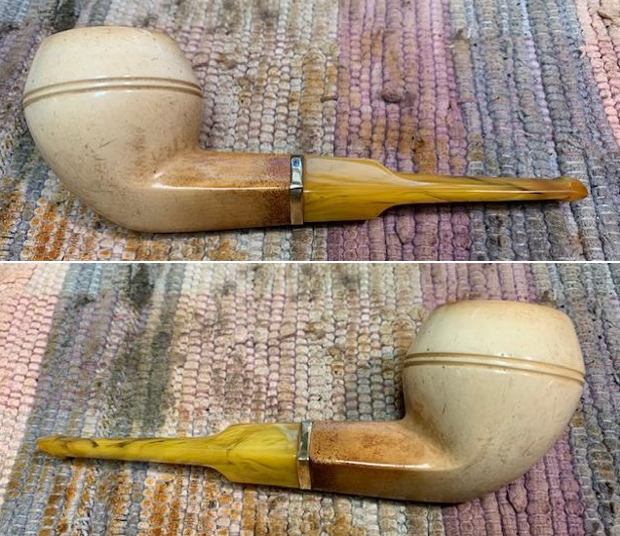
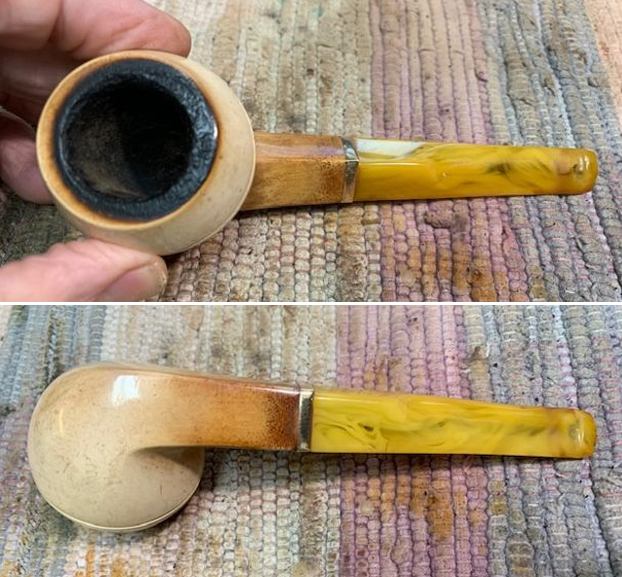
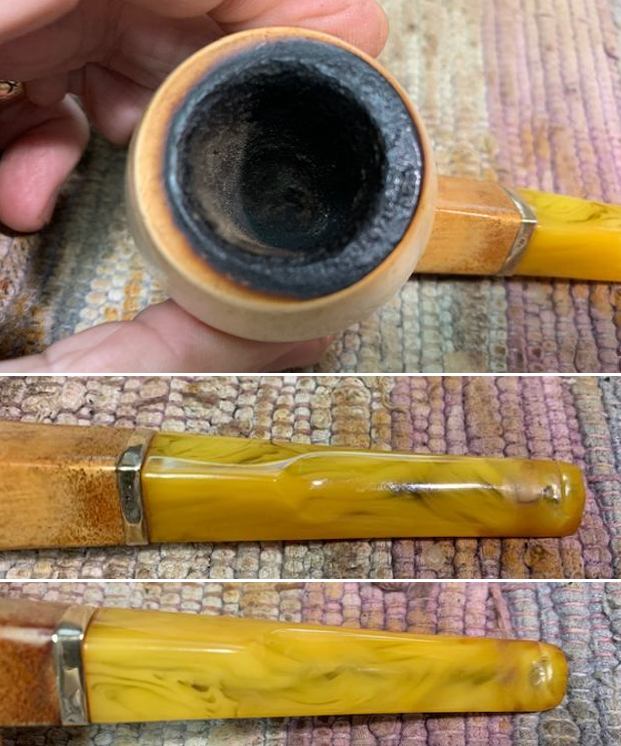
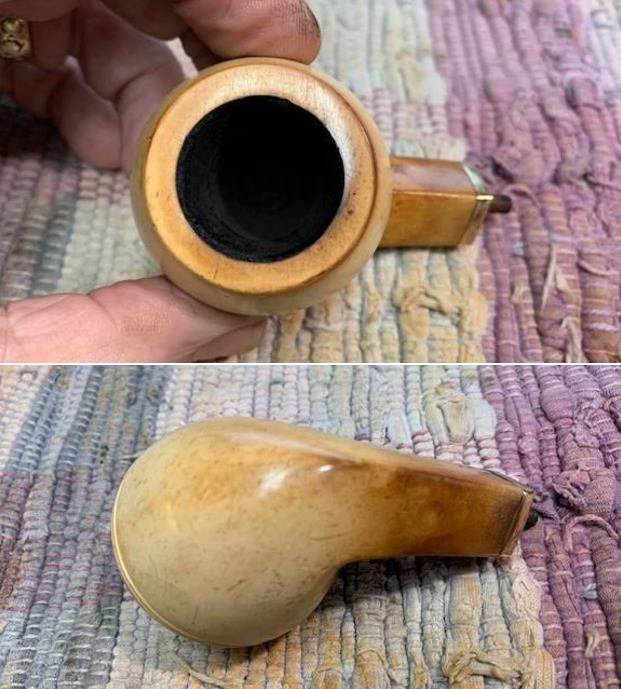
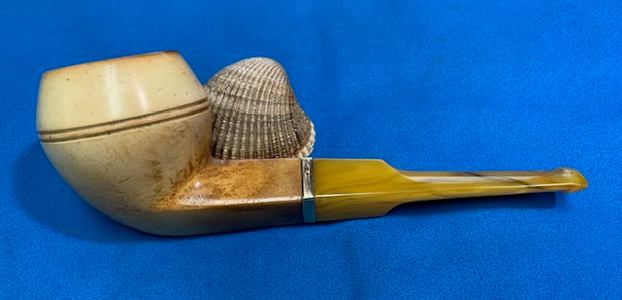
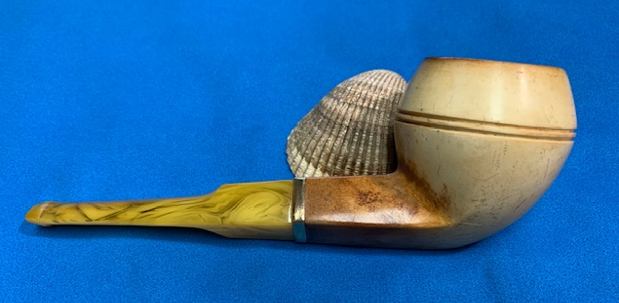
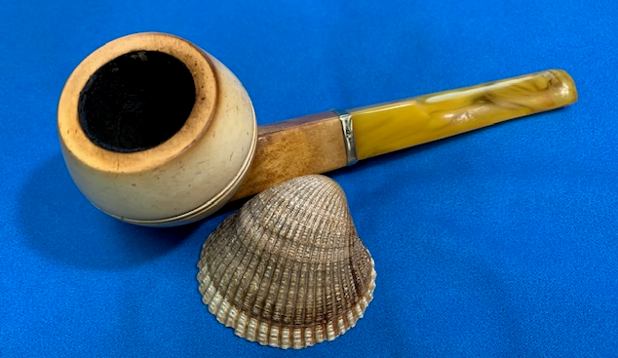
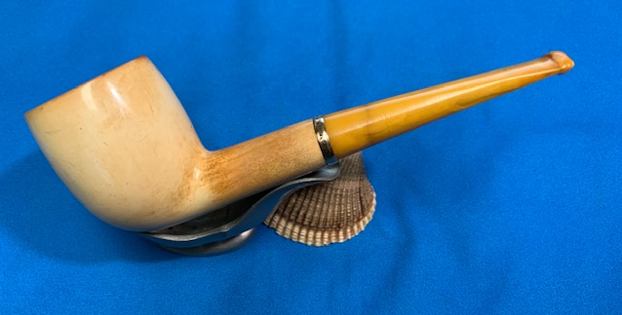
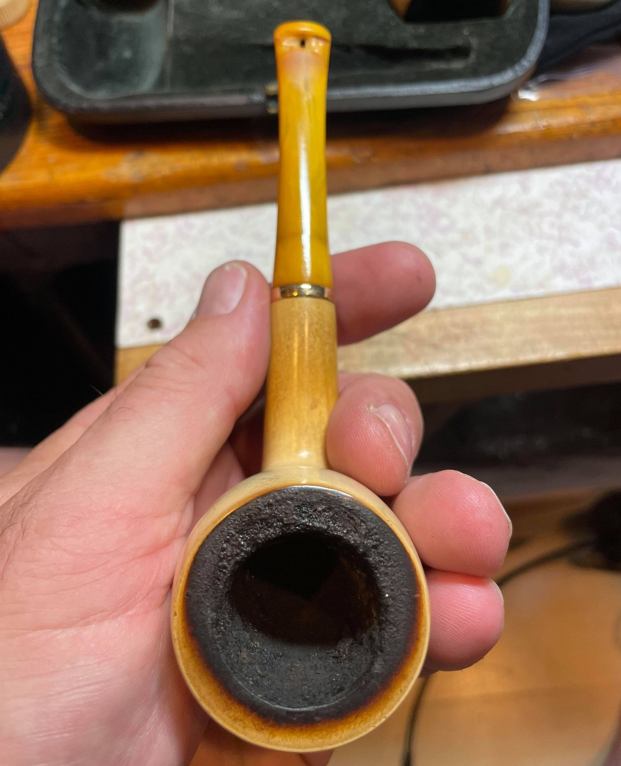
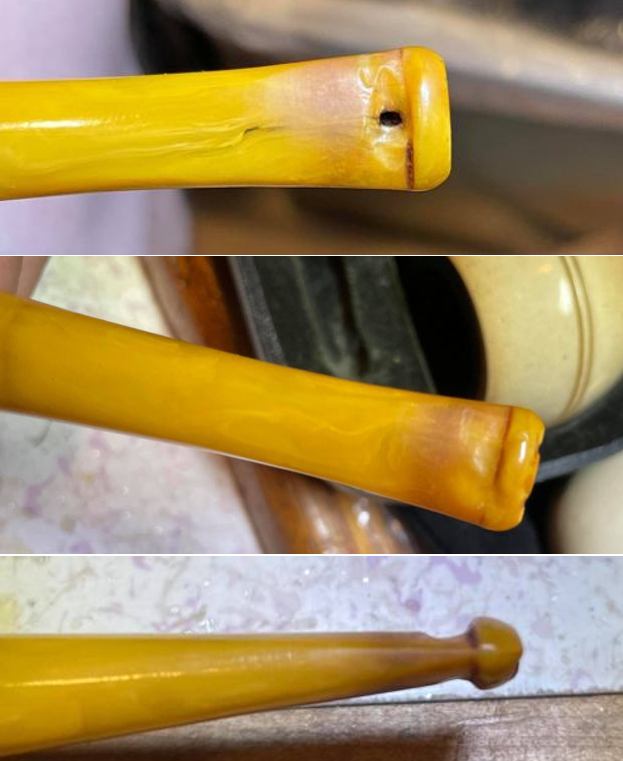
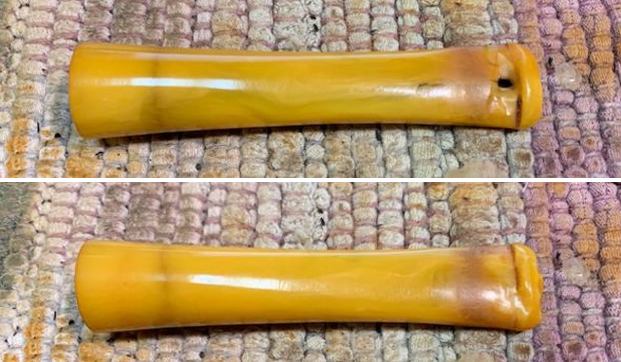
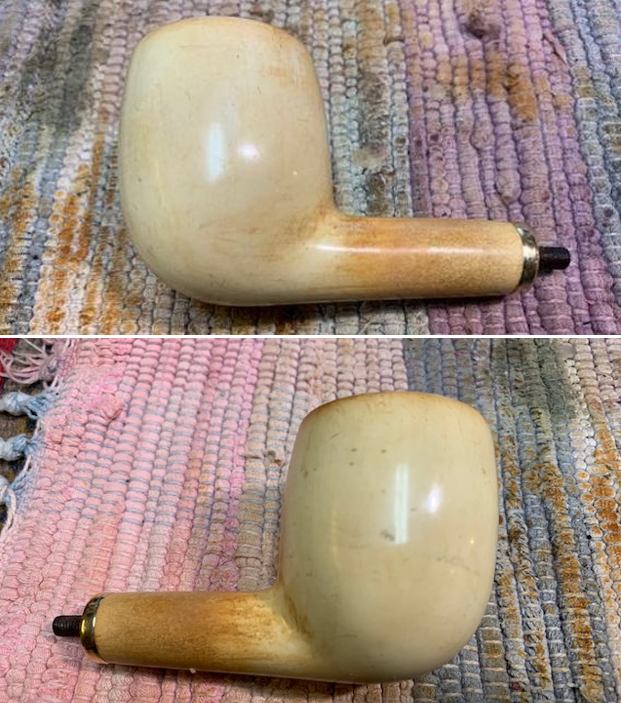
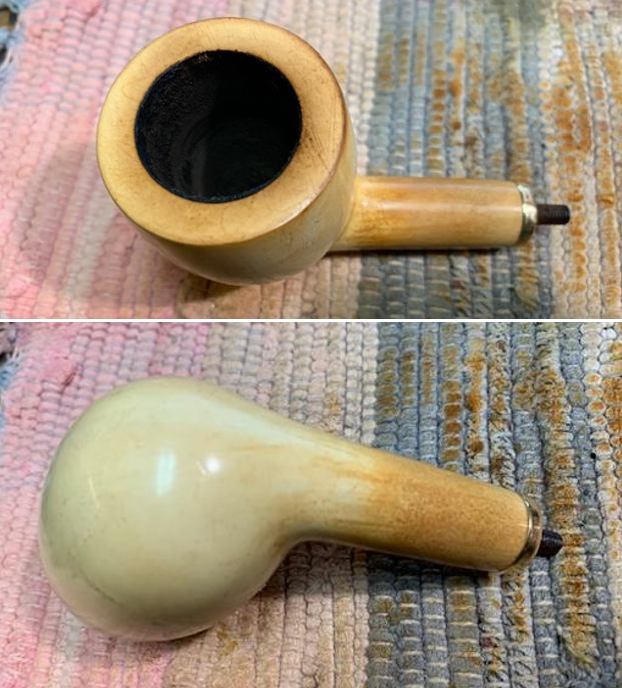
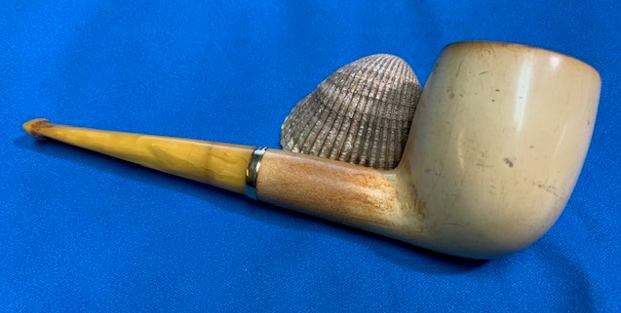
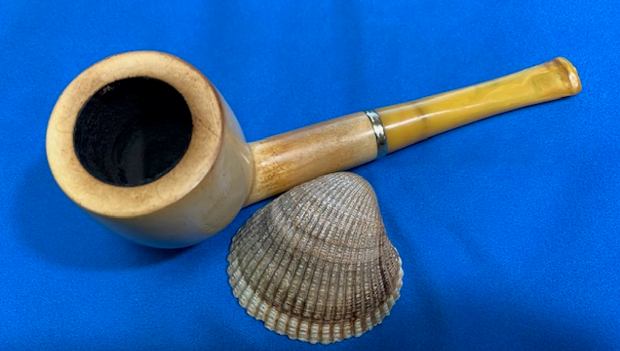
With the completion of the three pipes I just restemmed and wrote about I am returning to work on the bag of older NOS/unsmoked and lightly smoked pipes. I chose another old timer from the lot and this time picked another French Made pipe. It is buried in the pile in the photo below but it is clear in the second photo.In the photo of the poured out bag on my desk top I have circled the pipe that is next on the table. This was a lightly smoked Bent Billiard shaped pipe with a smooth finish that was dirty. The rim top had some light lava but there was minimal cake in the bowl. This little Bent Billiard really intrigued me, so it was next. The Bent Billiard was stamped in gold on the left side of the shank and read Real Briar [at an angle over] Made in France. The brass/nickel shank band was oxidized but still in decent condition. The bowl was lightly smoked and dusty but there was no cake. There was light lava on rim top toward the backside. The inner and outer edges looked good. The finish was dirty and the varnish top coat was spotty and peeling. The pipe had a Bakelite or Amberoid stem that was in good condition. There was one chip on the top near the shank joint. There were some light tooth marks and chatter on the stem. The button was orific – a round hole in the button end. The button had some wear and darkening but was in good condition. It has a push tenon that appears to be a synthetic material as well. Here are a few photos of the pipe before I did anything to it. I took photos of the bowl and stem. You can see the condition of the bowl. It is lightly cake and there is slight lava coat on the rim top. The edges look to be in good condition. The drilling is centered in the bottom of the bowl. It is a good sized bowl. The interior walls of the pipe are smooth and do not have drilling marks or checks or chips. The Bakelite/Amberoid stem is in good condition and has a push tenon and an orific button. There is a small chip in the Bakelite stem near the shank band and there are tooth marks on both sides near the button.I took a photo of the stamping on the left side of the shank. It reads as noted above. I removed the stem from the shank. You can see the brand new threaded bone tenon in the photo below. The proportions of this pipe are well done. The grain around the bowl is very nice. I knew from work on other older pipes that had the same stamp as this- Real Briar Made in France that there was not any clear cut information on that stamping on any of the usual sites. I also knew that the C.P.F. (Colossus Pipe Factory) that I had worked on bore this same stamp. My guess is that the pipe may have been made by them but I could not be sure.

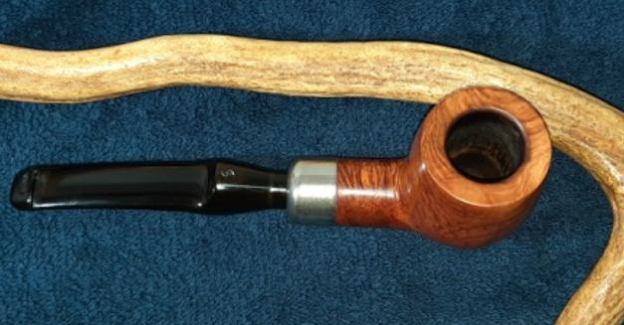
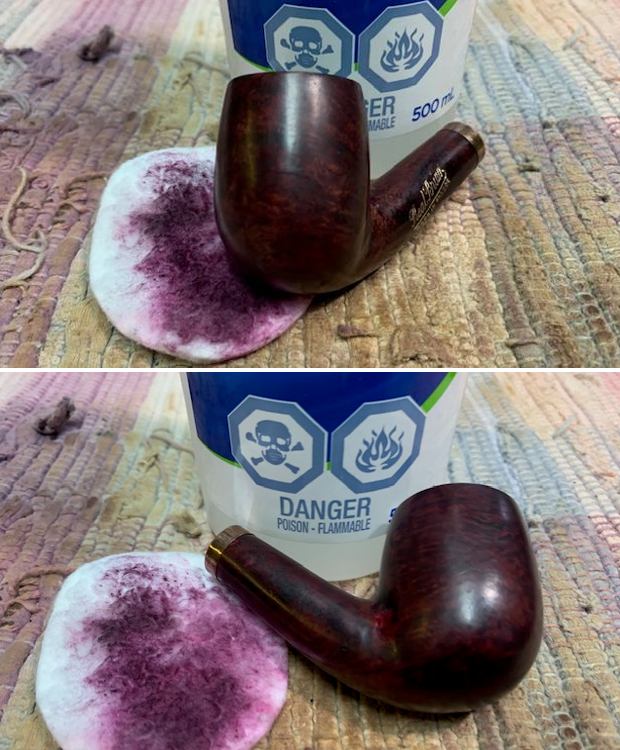
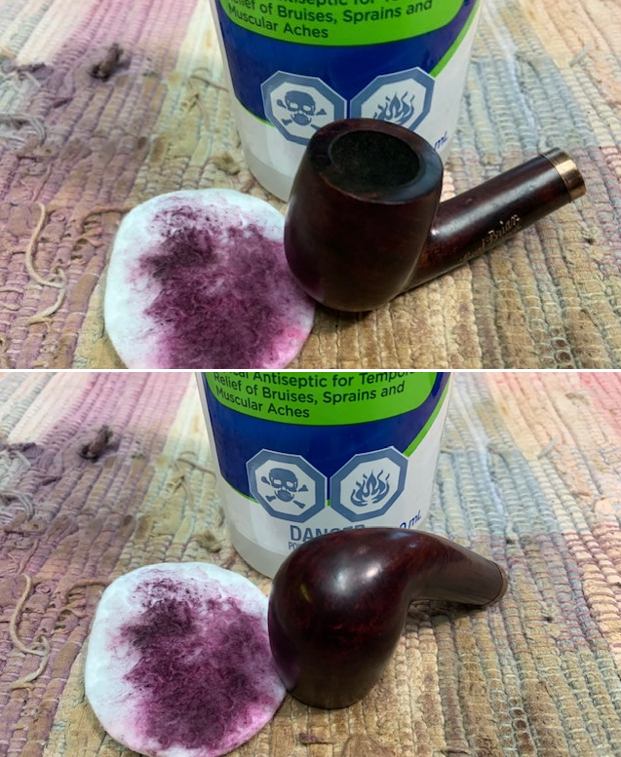
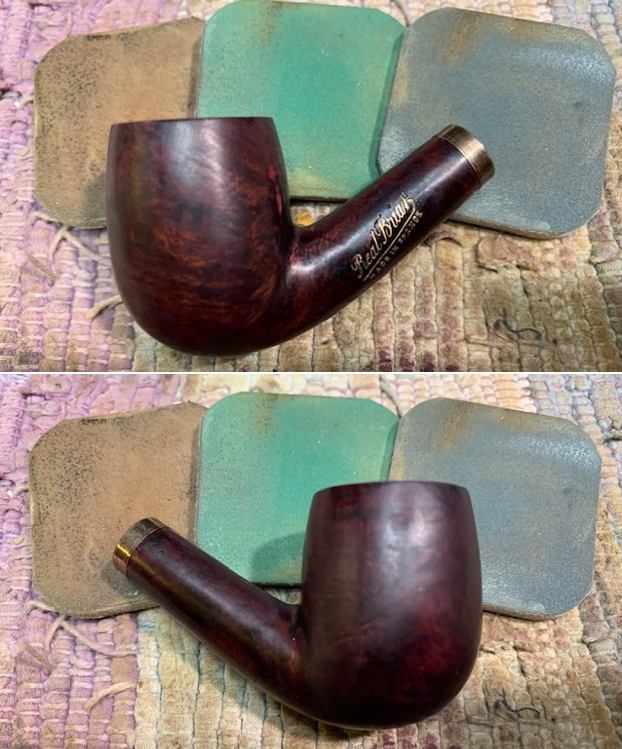
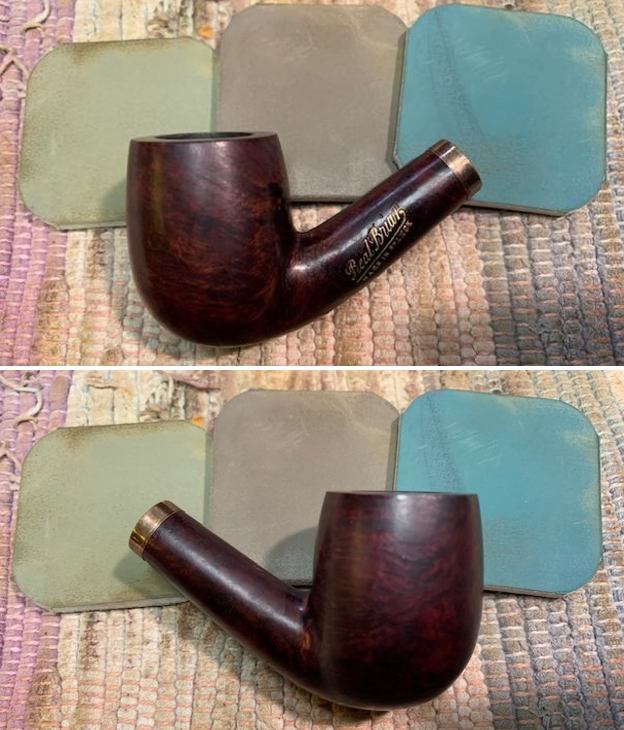
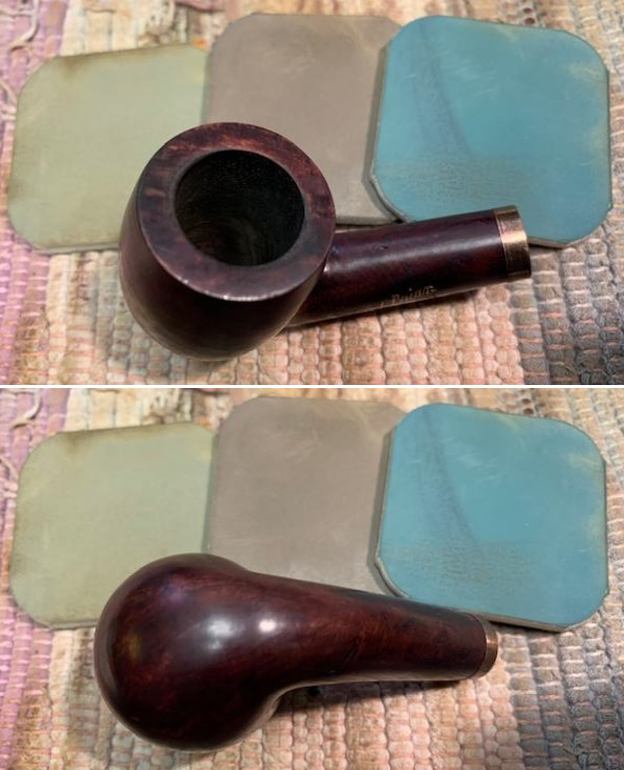
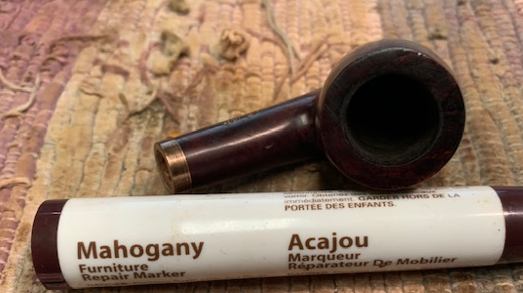
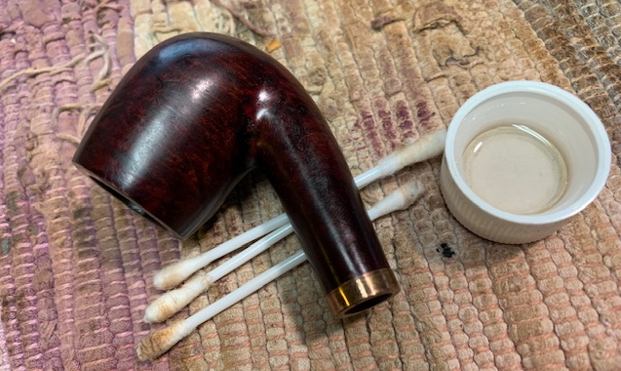
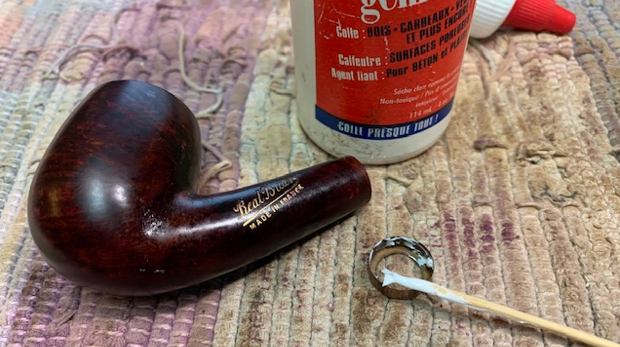
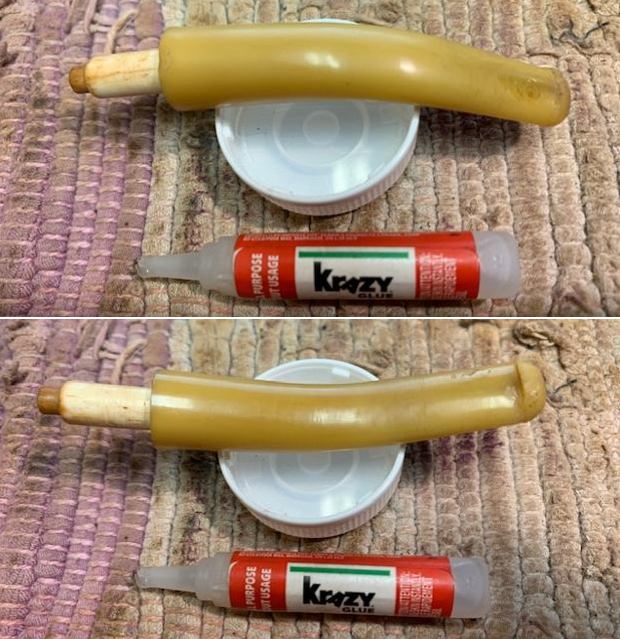
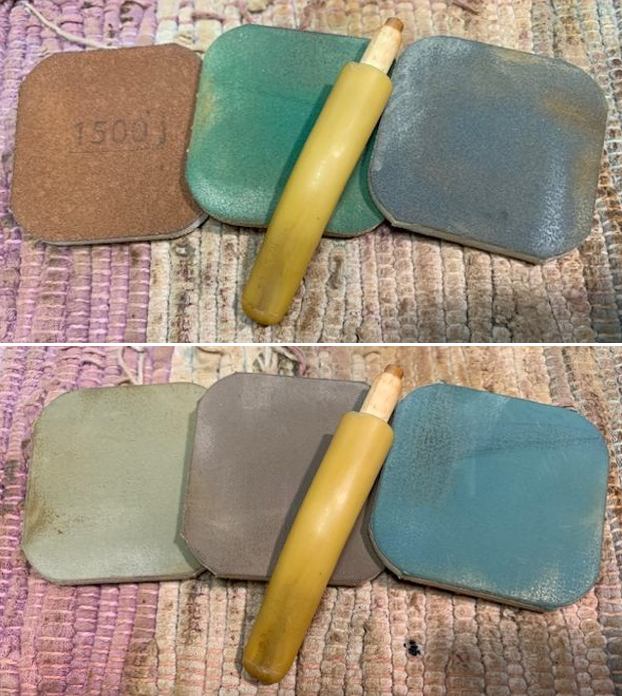
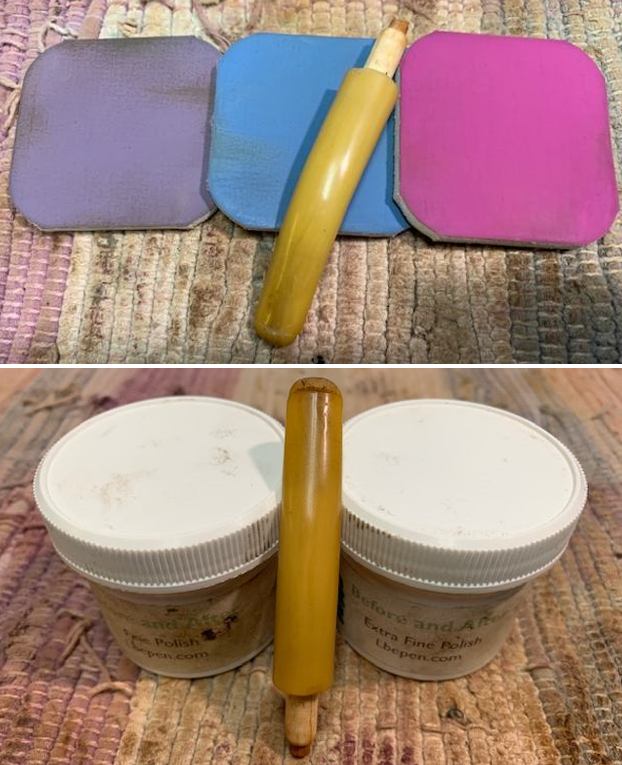
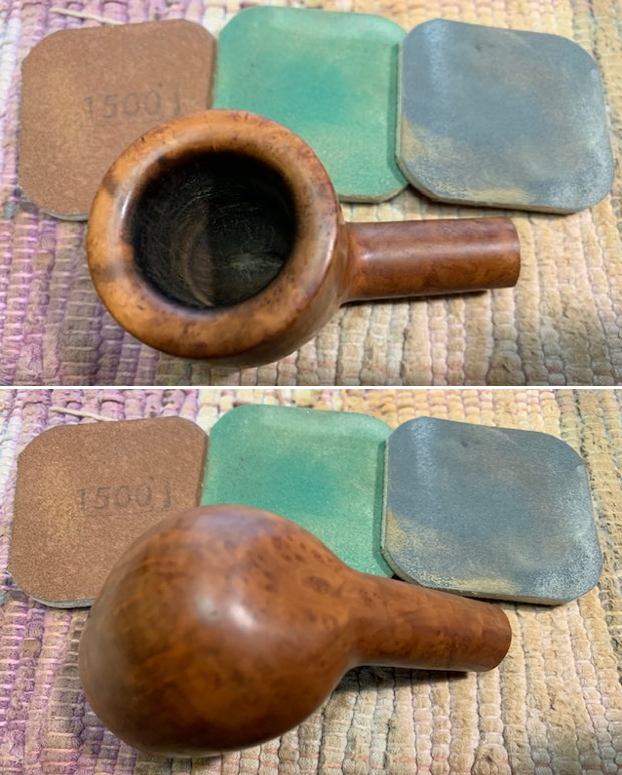
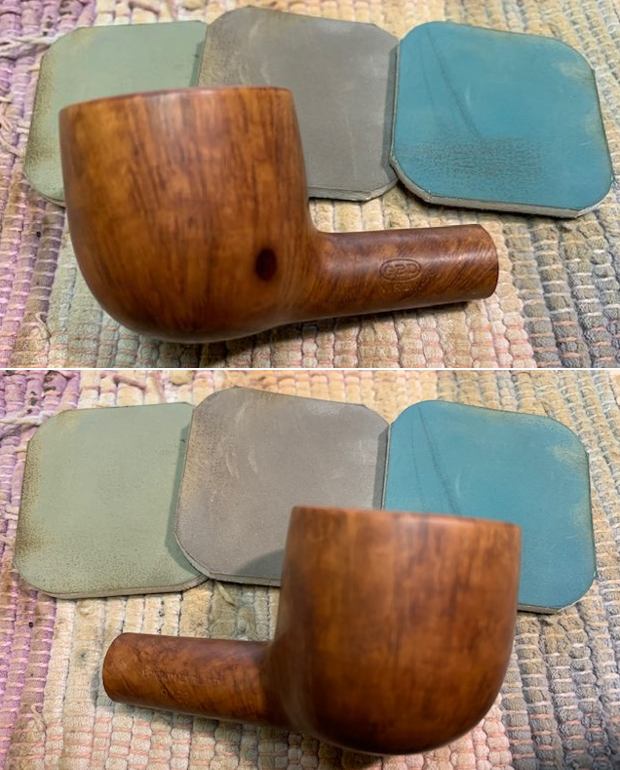
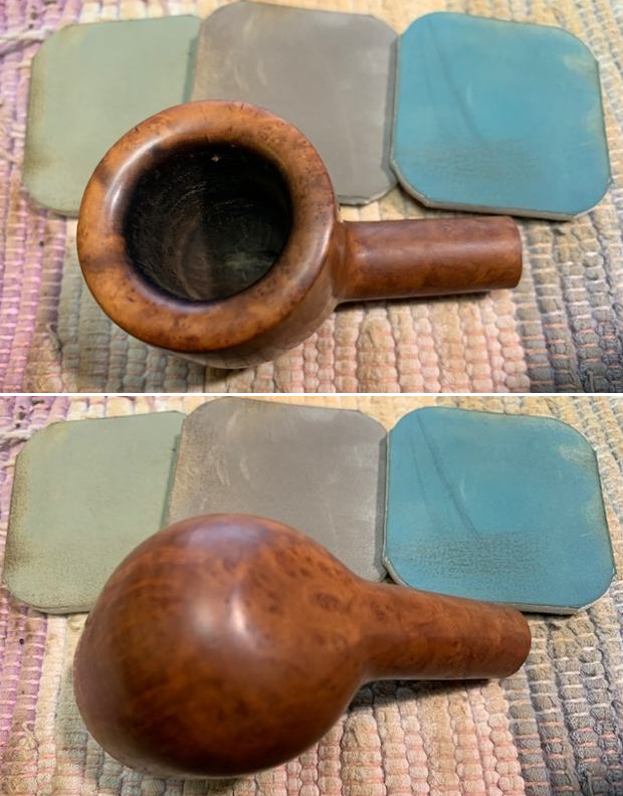
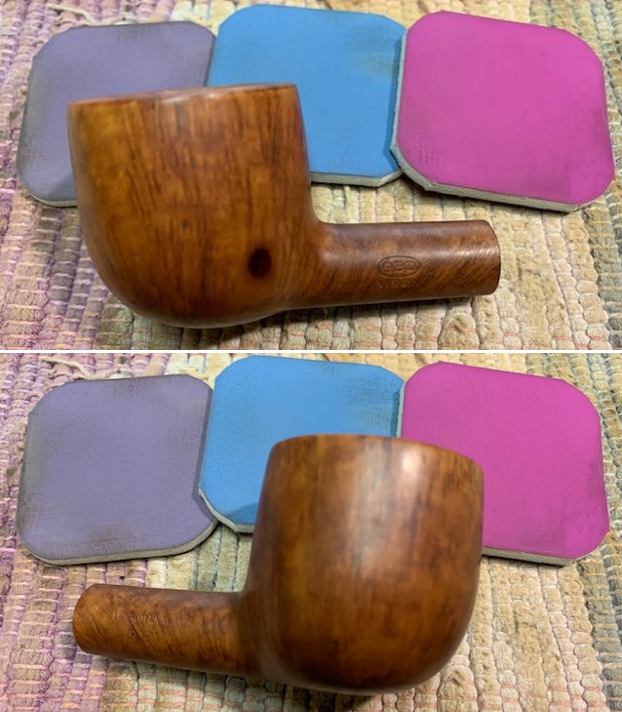
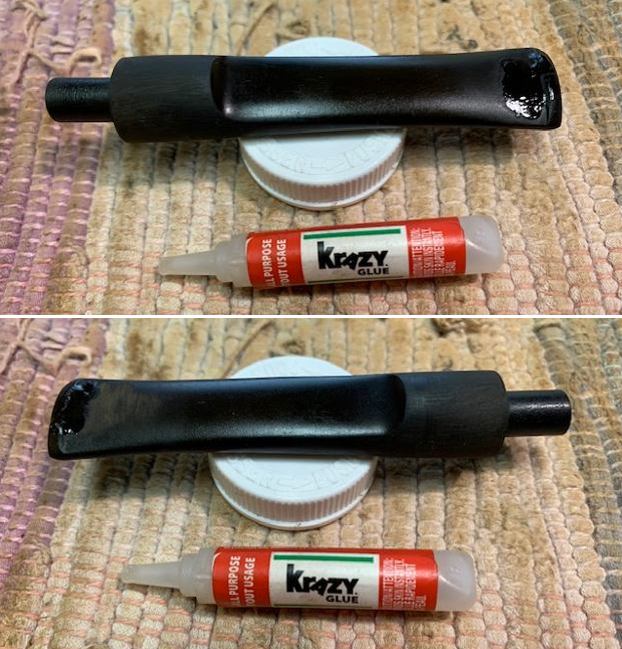
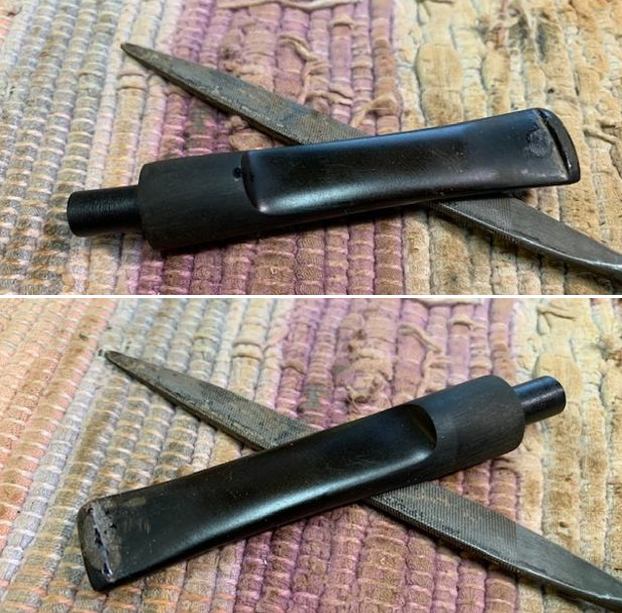
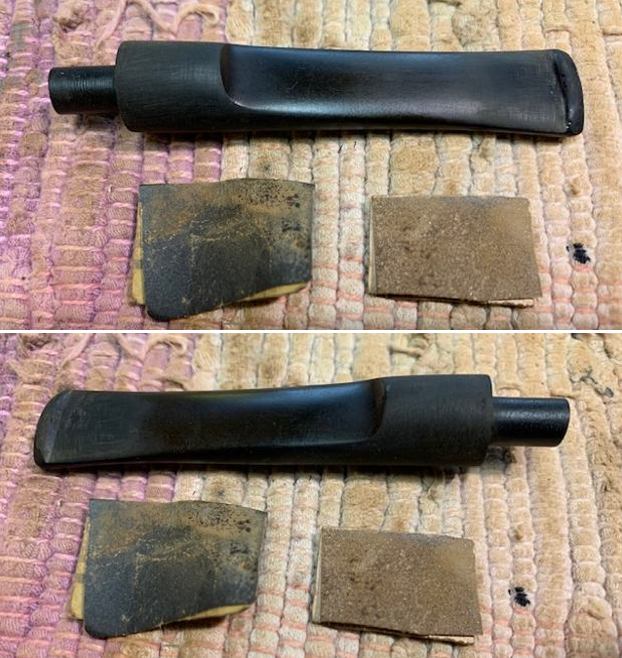
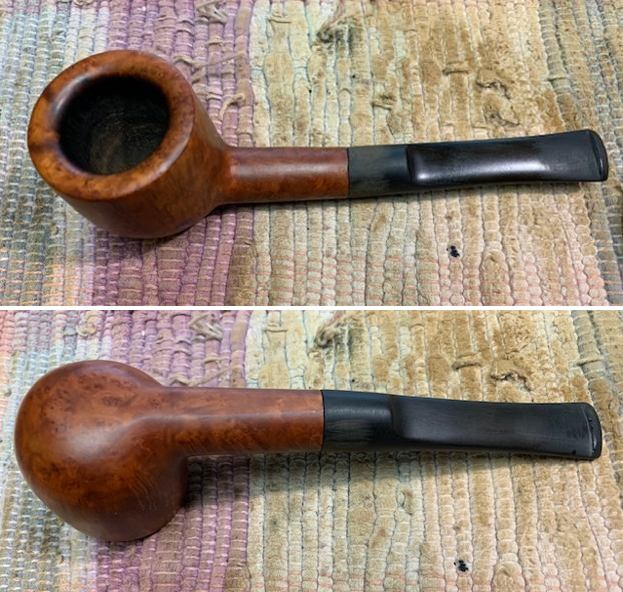
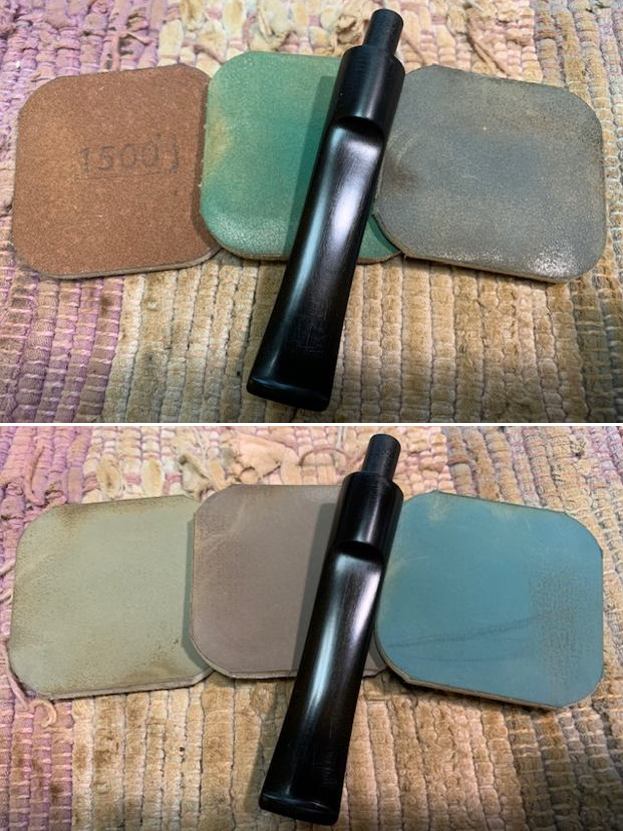
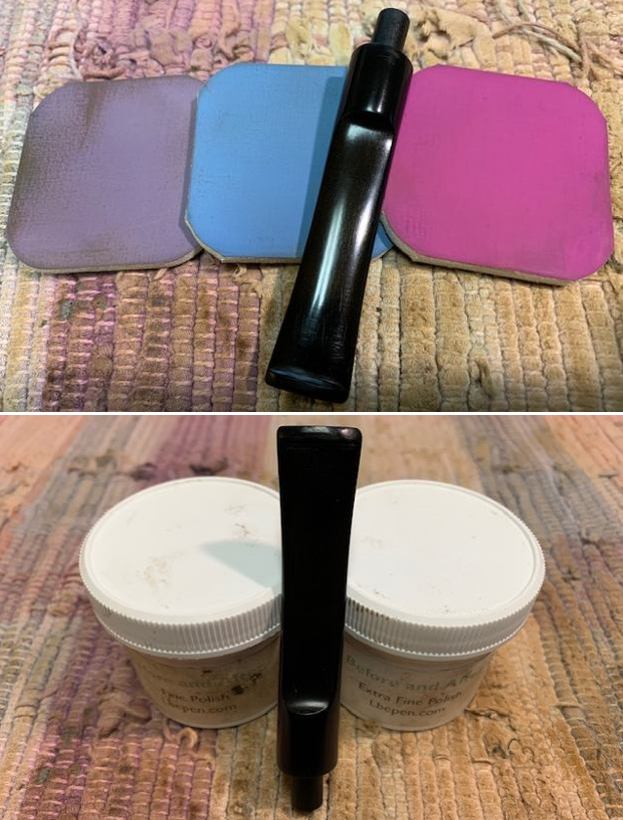
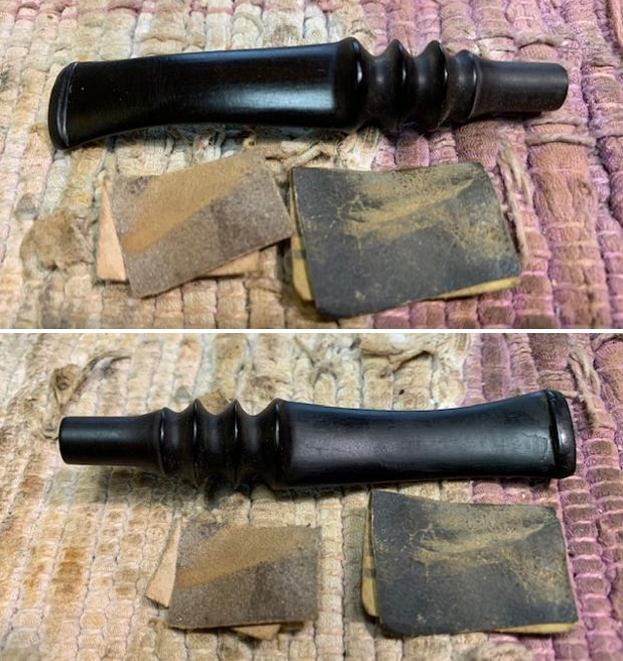
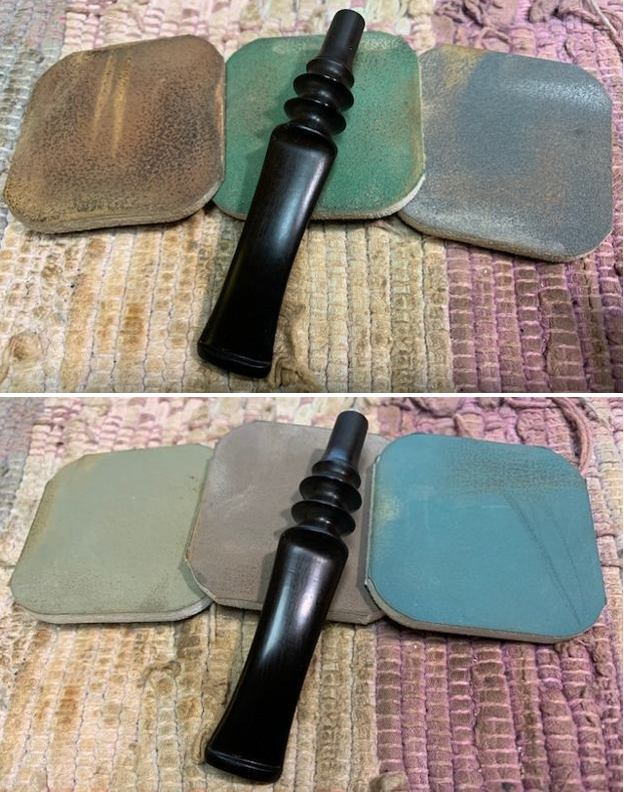
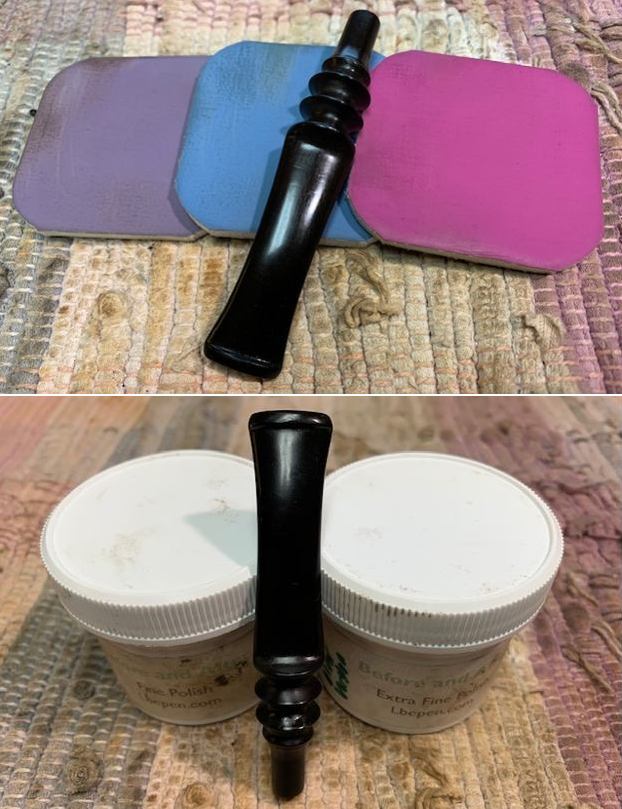
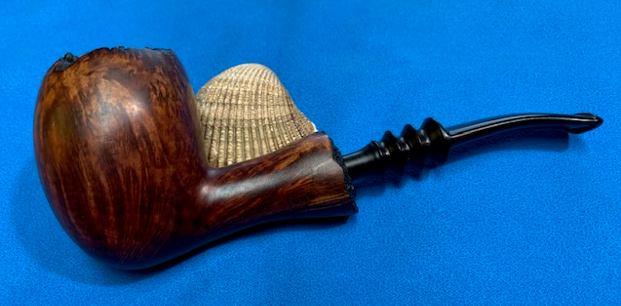
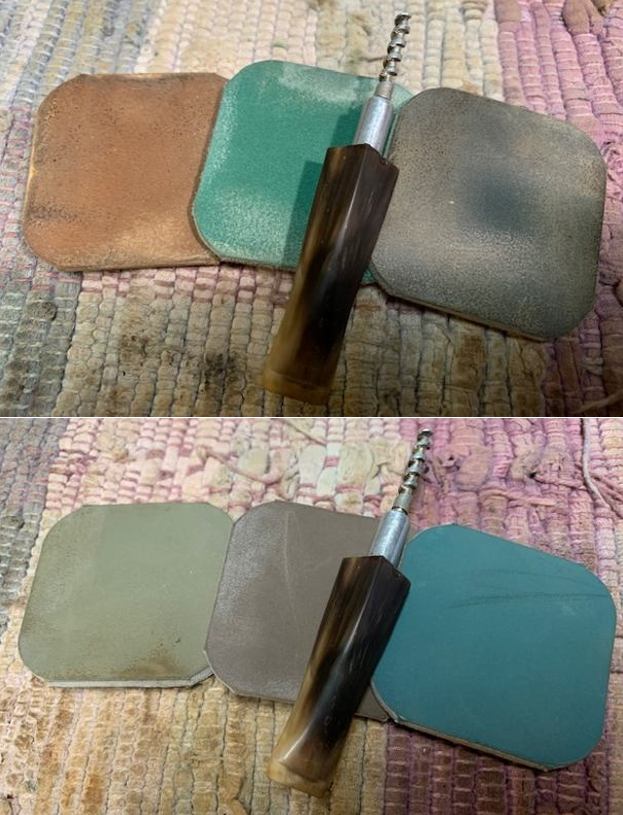
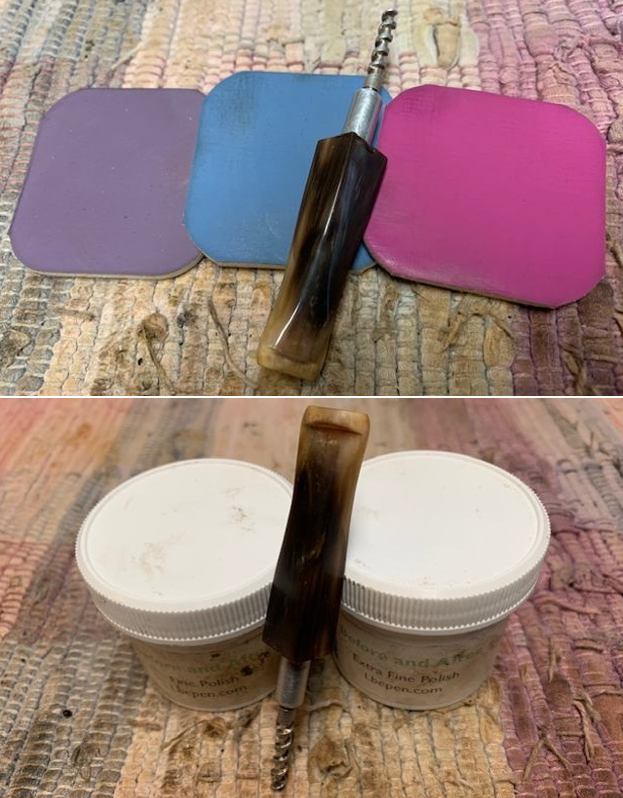
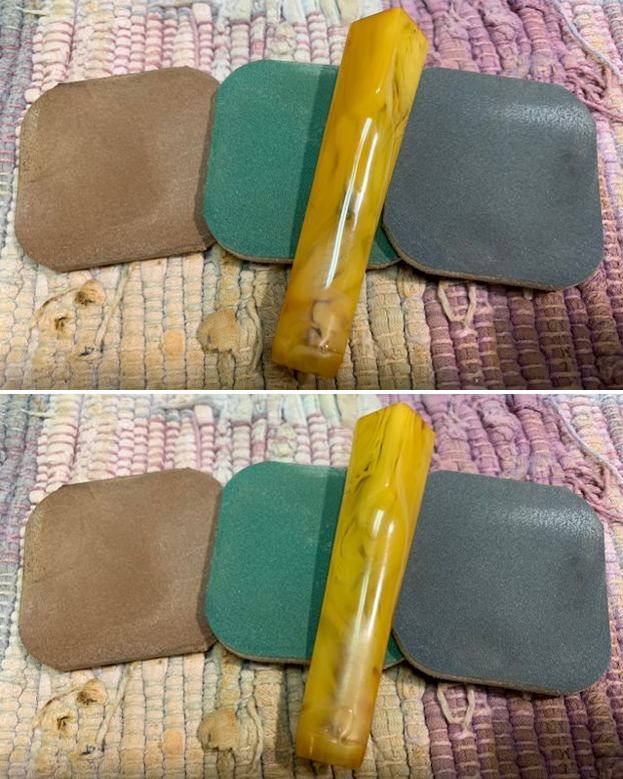
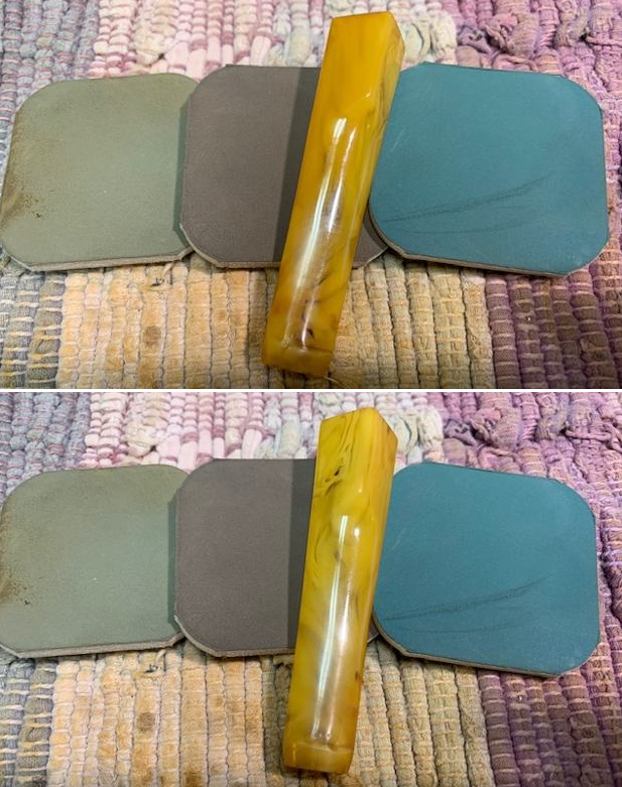
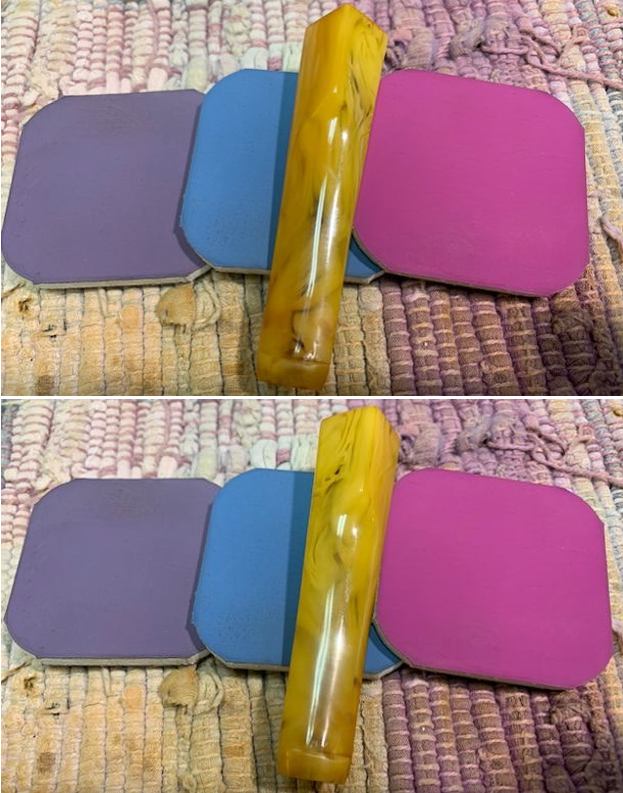
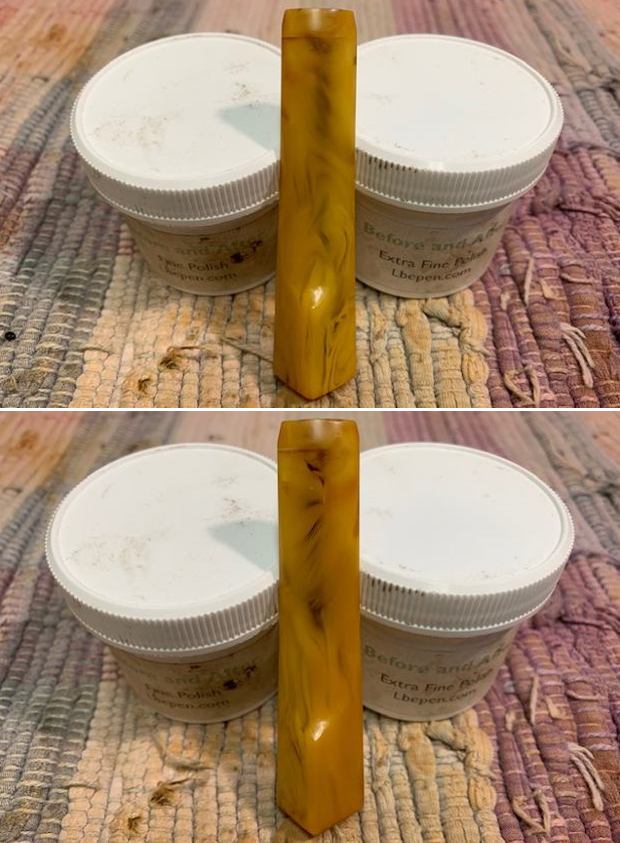
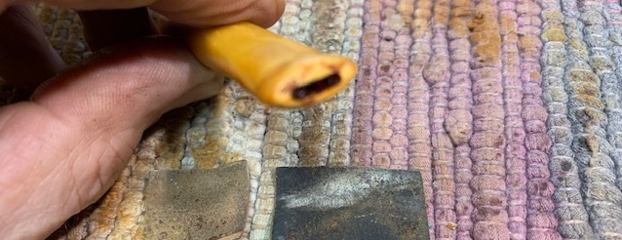
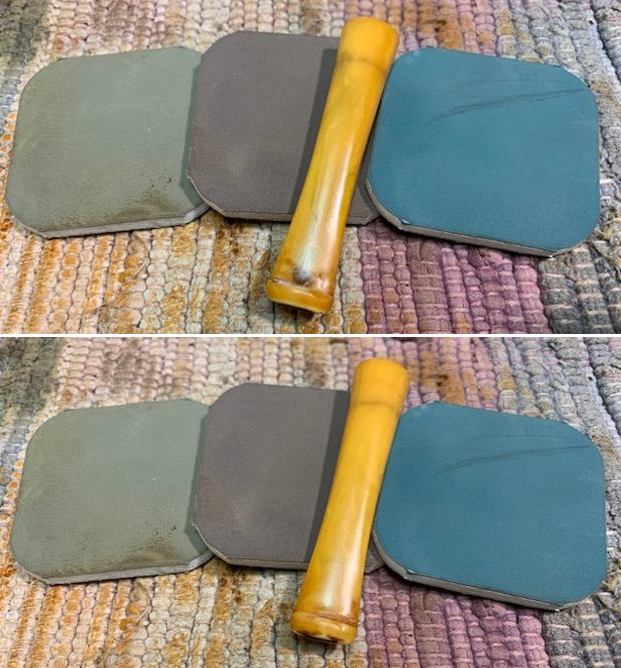
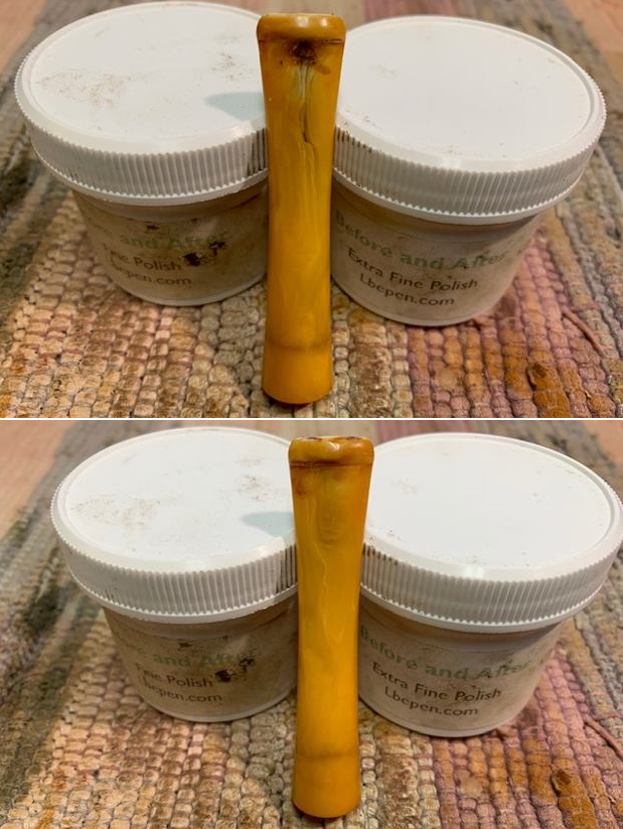
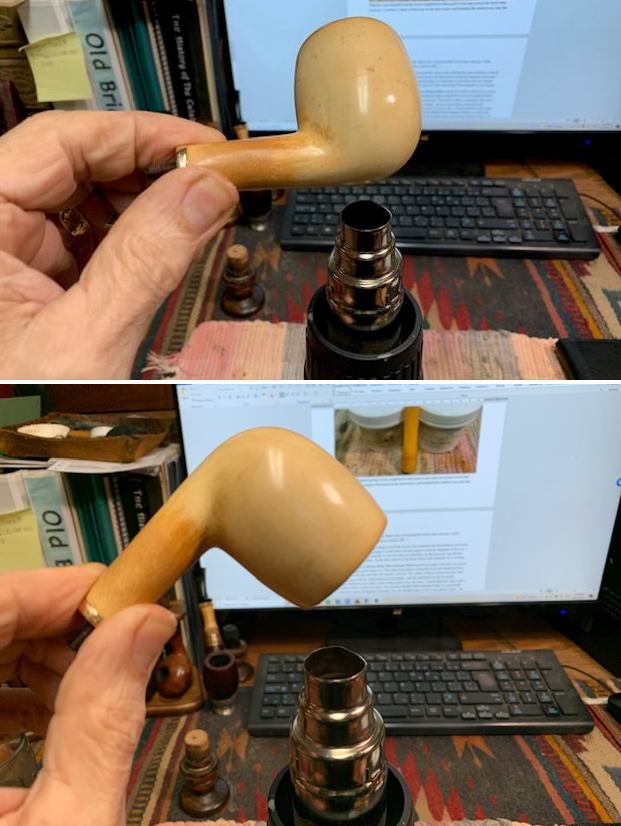
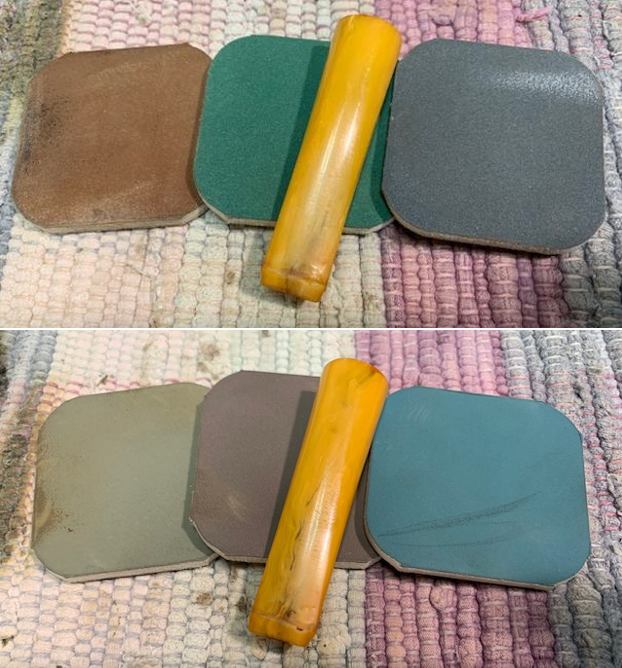
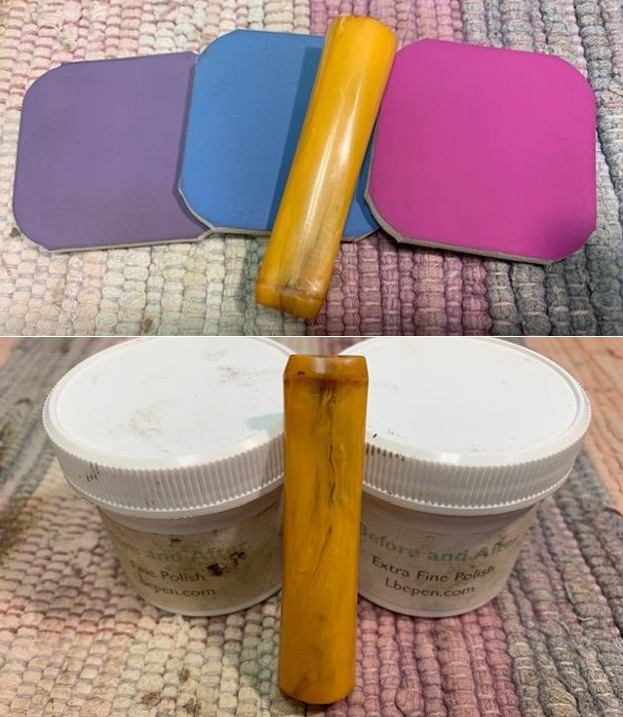
Now it was time to work on the pipe. I started my work on the pipe by scraping out the light cake in the bowl with a Savinelli Fitsall Pipe Knife. I also scrubbed off the lava on the rim top with a damp cotton pad.I wiped down the bowl with 99% Isopropyl alcohol on a cotton pad to remove the peeling varnish coat and grime on the finish of the bowl sides. Wiping it down revealed some great grain around the bowl and shank sides. I polished the briar and the nickel plated band with micromesh sanding pads. I dry sanded with 1500-12000 grit pads and wiped the bowl down with a damp cloth after each sanding pad. The briar began to really come alive. I touched up the stain on the rim top using a Mahogany stain pen and used a Black Sharpie Pen on the fills that became evident on the back of the bowl. I was able to blend the stain and pen into the surrounding briar and it looked very good.I used alcohol and cotton swabs to clean out the shank of any debris that may have gotten in from the reaming of the bowl. It was still quite clean.I rubbed the briar down with Before & After Restoration Balm. I worked it into the finish with my fingertips. The product works to clean, enliven and protect briar finished. I let it sit for 10 minutes then buffed it off with a cotton cloth. The grain on the bowl really came alive with the buffing. It is really a beautiful pipe.While working on the bowl the band came off the shank. It was loose so while it was off I polished it with a jewelers cloth to remove the oxidation and protect the finish on it. I used a tooth pick to put all purpose glue on the inside of the band and pressed it back in place on the shank.I set the bowl aside and filled in the chip on the top shank end edge and the tooth mark on the top and underside of the stem near the button. I used clear CA glue. Once it cured I polished it with micromesh sanding pads.I polished the vulcanite stem with micromesh sanding pads – 1500-12000 grit pads. I wiped the stem down after each pad with Obsidian Oil to protect and enliven the stem. I finished the polishing with Before & After Pipe Stem polish – both Fine and Extra Fine. I gave it a final coat of Obsidian Oil and set it aside to dry.This another interesting older pipe – Real Briar Made in France Bent Billiard turned out really well and it is a great looking pipe with a great shape to it. Once the varnish coat was removed the grain on the briar and the sheen on the stem really popped when the pipe was buffed with blue diamond on the buffing wheel. The brass/nickel band also took on a sheen. I gave the bowl and stem multiple coats of carnauba wax and buffed it with a clean buffing pad. I hand buffed the pipe with a microfiber cloth to deepen the shine. The finished French Made Real Briar Bent Billiard is comfortable to hold and is quite distinguished looking. Give the finished pipe a look in the photos below. The dimensions of the pipe are Length: 5 inches, Height: 1 ¾ inches, Outside diameter of the bowl: 1 inches, Chamber diameter: 5/8 of an inch. The weight of the pipe is 34 grams/1.20 ounces. It is a really beautiful pipe that I will be putting on the rebornpipes store in the French Pipe Makers section if you want to add it to your collection. Thanks for reading this blog and my reflections on the pipe while I worked on it. Keep an eye out on the blog as I have several other older pipes that I will be working on.

Restemming & Restoring a GBD Virgin London England 9437 Pot


Blog by Steve Laug

Sometimes the repetitive work on similar pipes and stems gets tiring to me and to alleviate the inevitable boredom I change things up a bit to refresh me. I have a box of stummels (bowls) here that I periodically go through and see if I have a potential stem that would fit them. Yesterday when I finished the old timer on my work I went through the box and picked out three bowls and found workable stems for them. All were in different states of need but all had been thoroughly cleaned before I boxed them up. The first restemmed and restored was a ZETTERVIG Copenhagen Handmade 900 Egg (https://rebornpipes.com/2021/09/04/restemming-restoring-a-zettervig-copenhagen-hand-made-900-egg/). The second pipe was a nice Malaga Lumberman (https://rebornpipes.com/2021/09/05/restemming-restoring-a-malaga-lumberman/). The next one was the last of the bowls I had chosen – a nicely grained GBD Virgin 9437 Pot.

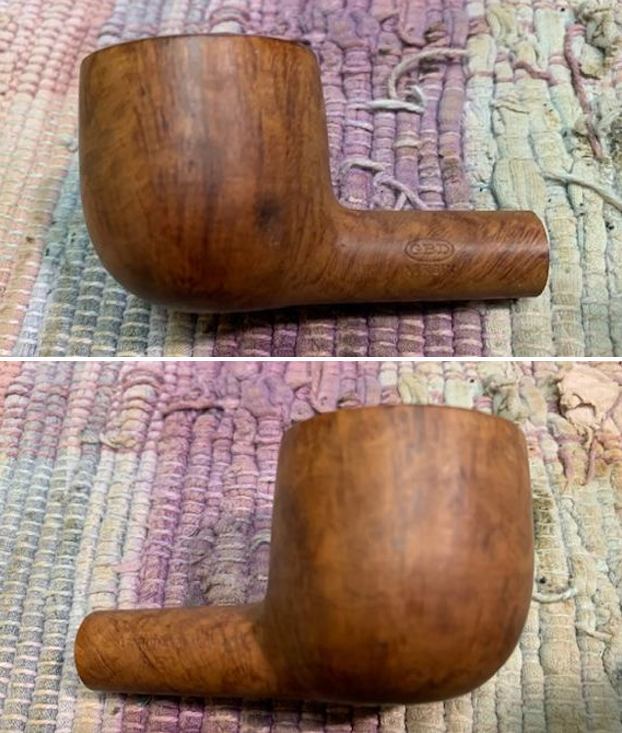
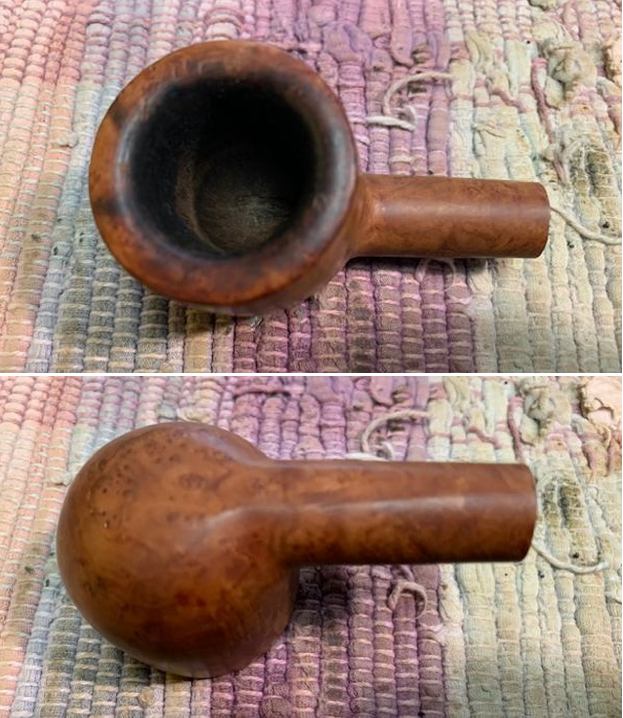
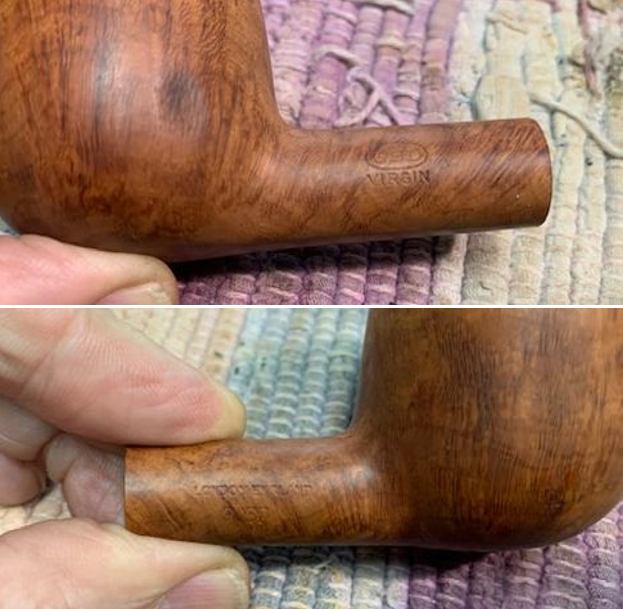
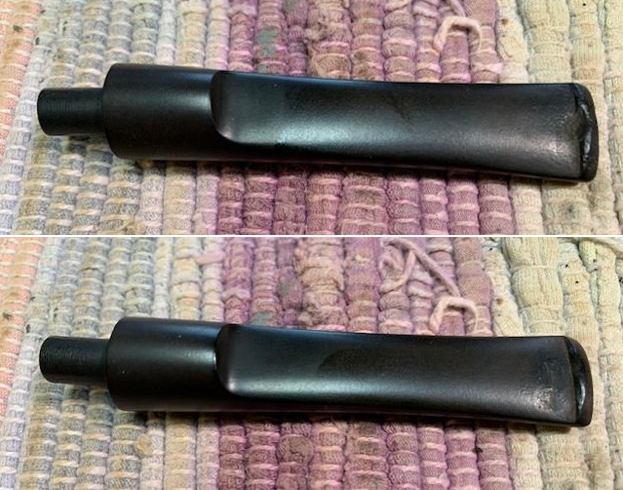
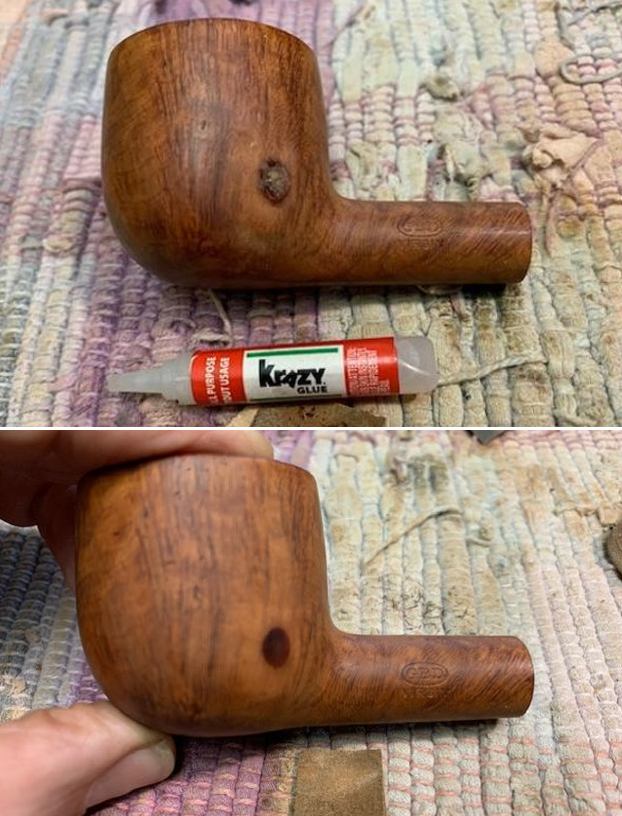
The bowl looked very good. The grain around the sides was quite nice and a mix of flame and straight grain around the bowl sides and birdseye grain on the bottom of the bowl. The rim top had some darkening on the top and inner edges. There was a small burned divot low on the left side of bowl near the shank. It looked as if the pipe had been set in an ashtray on a cigarette or a live ash. It was not deep but it was very present on the bowl side. The interior of the bowl was clean and there were not any chips, cracks or checking on the walls. Examining the mortise it was clean and well drilled with no issues. The finish was washed out and bit and tired but still quite redeemable. The stamping on the pipe was clear and readable. On the left side it read GBD in an oval [over] VIRGIN and on the right side it read London England [over] 9437. I took some photos of the bowl before I started to work on it. I took a photo of the stamping on the sides of the shank. It reads as noted above and is clear and readable.I went through some of stems and found this saddle style stem that perfectly fit the shank. The diameter of the shank and the diameter of the saddle were not quite even. The saddle on the right half of the saddle was slightly larger than the shank. The left side was perfect. It had a few tooth marks and chatter near and on the button but it would clean up well. I put it on the shank and took some pictures of the look before my work on it.I addressed the burn damage dip in the lower left side of the bowl. I sanded it and filled it in with a drop of clear CA glue. I smoothed it out with a folded piece of 220 grit sandpaper. It is smooth too touch but it is definitely darker than before I filled it in. At this point it was smooth and clean feeling.With that repaired I turned to deal with the rim top issues. I sanded the beveled rim top with 220 grit sandpaper and smoothed out the damage – both burns and nicks. I polished the briar with micromesh sanding pads – dry sanding with 1500-12000 grit pads and wiping it down with a damp cloth after each pad. It really began to shine. I worked some Before & After Restoration Balm into the surface of the smooth briar with my finger tips. The product is amazing and works to clean, enliven and protect the briar. I let it sit on the briar for 10 or more minutes and then buff it off with a soft cloth. It really makes the grain sing. I set the bowl aside and turned my attention to the stem. I filled in the tooth marks and rebuilt the edge of the button with clear CA glue. Once it cured I used a small file to recut the edge of the button and flatten the repairs. I smoothed out repairs with 220 grit sandpaper to blend them in further to the stem surface. I started polishing the stem with 400 grit wet dry sandpaper.I fit the stem on the shank. It looked pretty good but seemed to be a bit blah. I took a set of photos to show the look of the new stem on the shank. For the fun of it I put a band on the shank and refit the stem on the shank. The shank is perfect there were no cracks and no issues so the band was just adding a touch of bling that works with the pipe. What do you think? With or without the band? I am leaning toward the banded version to be honest. I think it looks really good.

Without the band? With the band? I left the band on the shank but it is not glued in place and can be removed. Let me know what you think – one way or the other.

I polished the stem with micromesh sanding pads – dry sanding with 1500-12000 grit pads. I wiped the stem down after each pad with a cloth and Obsidian Oil. I finished the polishing with Before & After Pipe Stem Polish – both Fine and Extra Fine. I gave it a final coat of Obsidian Oil. I put the pipe back together – the bowl with its new stem. This restored & restemmed GBD Virgin 9437 Pot turned out really well. The pipe (even with the burn mark on the left side of the bowl) really is a beauty and I think the brass band and the chosen stem works well with it. Remember I have not set the band in place so it can be removed. What do you think of it? Yea or Nay? The grain on the bowl came alive with the buffing. I used Blue Diamond on the buffing wheel on both the bowl and stem. I gave both multiple coats of carnauba wax on the wheel then buffed it with a clean buffing pad to raise the shine. I hand buffed it with a microfibre cloth to deepen the shine. The GBD Virgin Pot feels great in the hand. It is lightweight and the contrast in the browns of the briar, the brass of the band and the polished vulcanite stem with the popping grain on the mixed brown stained bowl is quite amazing. The dimensions of the pipe are Length: 6 inches, Height: 1 ½ inches, Outer diameter of the bowl: 1 ½ inches, Chamber diameter: 1 inch. The weight of the pipe is 1.45 ounces/41 grams. It really is a beauty. I will be putting it on the rebornpipes store in the British Pipe Makers section shortly if you are interested in adding it to your collection. Thanks for walking through the restemming and the restoration with me. Cheers.

Restemming & Restoring a Zettervig Copenhagen Hand Made 900 Egg


Blog by Steve Laug

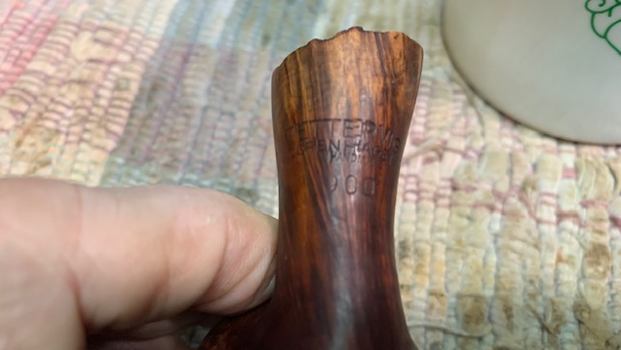
Sometimes the repetitive work on similar pipes and stems gets tiring to me and to alleviate the inevitable boredom I change things up a bit to refresh me. I have a box of stummels (bowls) here that I periodically go through and see if I have a potential stem that would fit them. This morning when I finished the last old timer I went through the box and picked out three bowls and found workable stems for them. All were in different states of need but all had been thoroughly cleaned before I boxed them up. The first of these was an interesting egg shaped freehand. It is stamped on the underside of the shank and reads ZETTERVIG (double stamped) [over] Copenhagen (also double stamped) [over] Handmade [over] 900. It had some great grain around the bowl and plateau on the rim top and shank end that was interesting.  I have worked on other Zettervig pipes in the past so I am not a stranger to the brand. I have included links to two different pipes that I worked on (https://rebornpipes.com/2013/12/05/a-complete-reworking-of-a-zettervig-freehand/)(https://rebornpipes.com/2018/07/28/restoring-and-restemming-a-zettervig-handmade-351-freehand/).

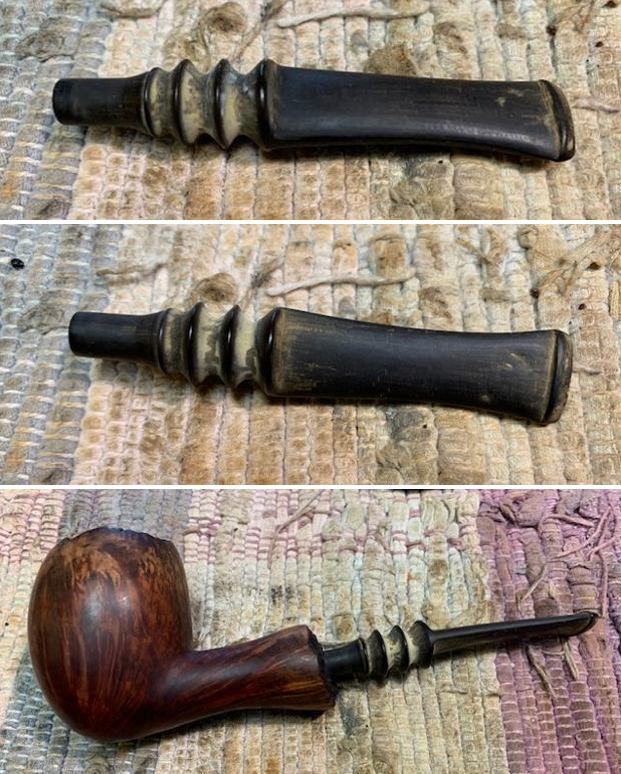
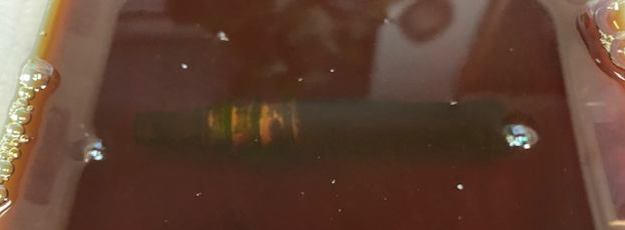
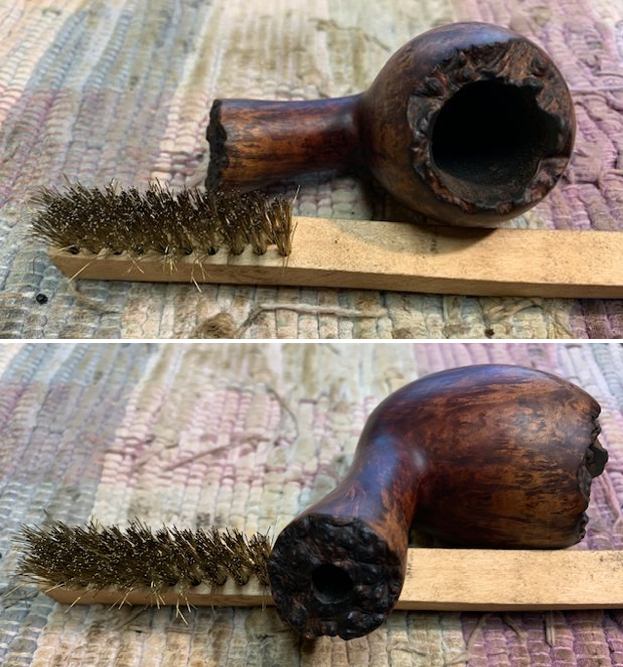
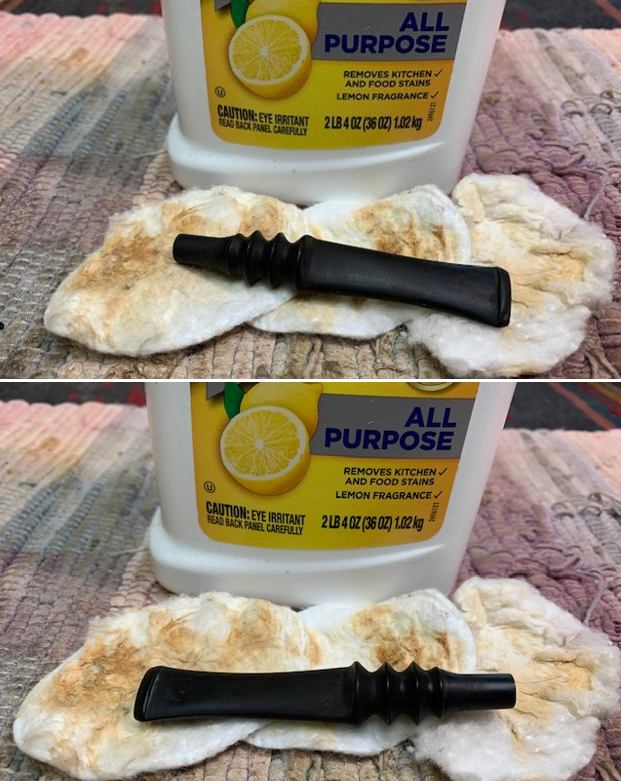
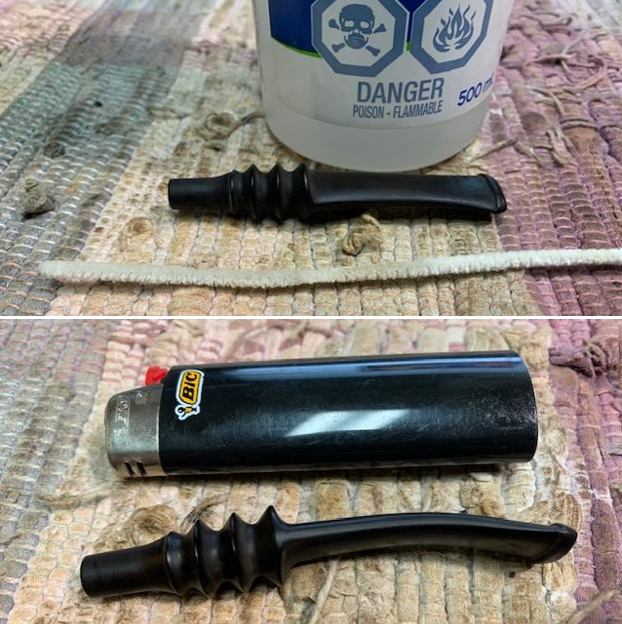
The bowl looked very good. The grain around the sides was quite nice and a mix of flame and straight grain. The plateau on the rim top and shank end looked good but the rim top was faded and worn. The shank end was black and looked very good. The bowl was clean and there were not any chips, cracks or checking on the walls. Examining the mortise it was clean and well drilled with no issues. The finish was washed out a bit and tired but still quite redeemable. I took some photos of the bowl before I started to work on it. I took a photo of the double stamping on the underside of the shank. It reads as noted above and is surprisingly clear and readable.I went through some of the fancy, turned freehand style stems and found this old timer. It is quite heavily oxidized and has some deep tooth marks but I think it will work with the Zettervig. I put the stem in place and took a photo to have a look at it in situation. What do you think? With the stem chosen I dropped it in a bath of Briarville’s Pipe Stem Deoxidizer that I have here. It is getting a bit tired but it still works. I let it sit while I worked on the bowl.While the stem soaked in the bath and before I started to work on the bowl I decided that I would look up some information on the Zettervig brand before I started the clean up on the pipe. I looked up information on two of my favourite sites. The first was Pipedia. Here is the link: https://pipedia.org/wiki/Zettervig. I quote in full:

In the 1960’s and into the early 1970’s Ole Zettervig had a shop in Copenhagen, Denmark where he was carving high quality pipes equal to Stanwell, Larsen, Anne Julie, Thurmann, Bang and others. These early pipes were marked “Copenhagen” and are very collectible. He sold his shop at some point in the 70’s and moved to Kolding and continued to produce pipes as a hobby, but the quality of briar and workmanship is said to not equal the early production. The later pipes he now marked as Kobenhaven rather than Copenhagen, and these were sold by Ole at flea markets throughout Europe.

That information told me I was working on an early one of his pipes from the 1960s to early 1970s as it is stamped Copenhagen.

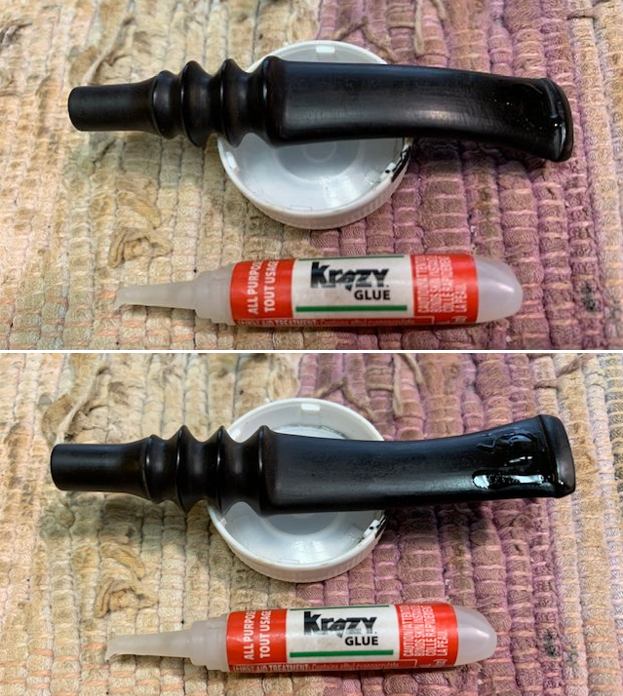
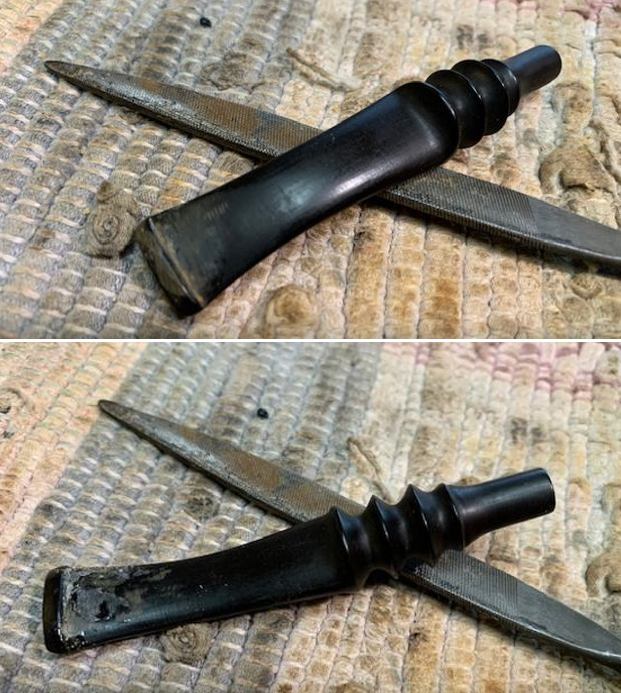
I turned to Pipephil’s site and did a screen capture of the information that was there. There was no addition info but it did show one of the pipes (http://www.pipephil.eu/logos/en/logo-z.html). You can also see the style of the stem and the Z on the top of the stem. The one I have chosen is very different but I think it will still work.With that information in hand I turned to work on the bowl. I used a brass bristle wire brush to clean out the remaining debris and lava in the grooves of the plateau rim top and to remove the dust from the plateau shank end. Once it was clean I used a Black Stain Pen to stain it black as it was originally. I polished the briar with micromesh sanding pads – dry sanding with 1500-12000 grit pads and wiping it down with a damp cloth after each pad. It really began to shine. I worked some Before & After Restoration Balm into the surface of the smooth briar with my finger tips and into the plateau rim top and shank end with a horsehair shoe brush. The product is amazing and works to clean, enliven and protect the briar. I let it sit on the briar for 10 or more minutes and then buff it off with a soft cloth. It really makes the grain sing. With the bowl finished I turned my attention to the stem. It had been sitting in the bath for several hours. I removed it and ran a pipe cleaner and alcohol through the airway to remove any remaining soak. I wiped the stem down with a paper towel to remove the oxidation that had been loosened. It looked much better than when I put it in the bath.I “painted” the stem surface with a Bic lighter flame to raise the tooth marks. I was able to lift many of them to the surface. What remained I would fill in later. I scrubbed the stem surface with cotton pads and Soft Scrub to remove the remaining oxidation. The stem was really starting to look very good. I cleaned out the ends of the stem and button with a pipe cleaner and alcohol to remove the bits of Soft Scrub that had gotten into the airway. I heated the stem and gave it a slight bend to fit the flow of the pipe better.I filled in the remaining divots and marks in the stem with clear CA glue. Once it had cured used a small file to flatten the repair and sharpen the edge of the button. I sanded it smooth with 220 grit sandpaper to blend it into the stem. I started the polishing with 400 grit wet dry sandpaper. I polished the stem with micromesh sanding pads – dry sanding with 1500-12000 grit pads. I wiped the stem down after each pad with a cloth and Obsidian Oil. I finished the polishing with Before & After Pipe Stem Polish – both Fine and Extra Fine. I gave it a final coat of Obsidian Oil. I put the pipe back together – the bowl with its new stem. This restored Zettervig Copenhagen Handmade 900 Egg is a real beauty and I think the chosen stem works well with it. The grain on the bowl came alive with the buffing. I used Blue Diamond on the buffing wheel on both the bowl and stem. I gave both multiple coats of carnauba wax on the wheel then buffed it with a clean buffing pad to raise the shine. I hand buffed it with a microfibre cloth to deepen the shine. The Zettervig Freehand Egg feels great in the hand. It is lightweight and the contrast in the blacks of the plateau and the polished vulcanite stem with the popping grain on the mixed brown stained bowl is quite amazing. The dimensions of the pipe are Length: 5 ¾ inches, Height: 2 inches, Outer diameter of the bowl: 1 ½ inches, Chamber diameter: ¾ of an inch. The weight of the pipe is 2.05 ounces/59 grams. It really is a beauty. I will be putting it on the rebornpipes store in the Danish Pipe Makers section shortly if you are interested in adding it to your collection. Thanks for walking through the restemming and the restoration with me. Cheers.

Restoring a Diamond Black Extra Squat Bulldog


Blog by Steve Laug

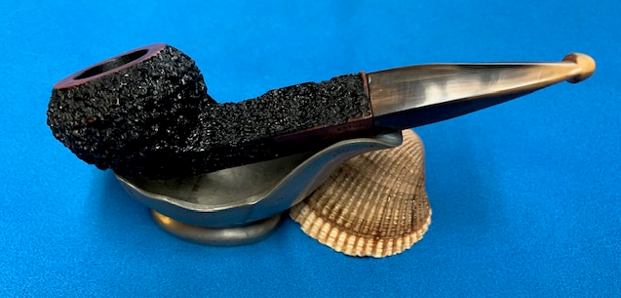
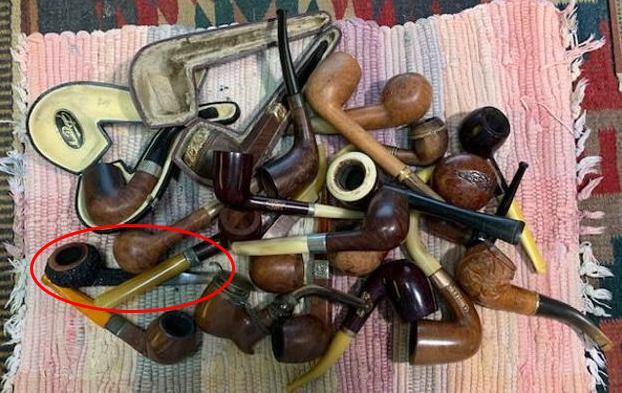
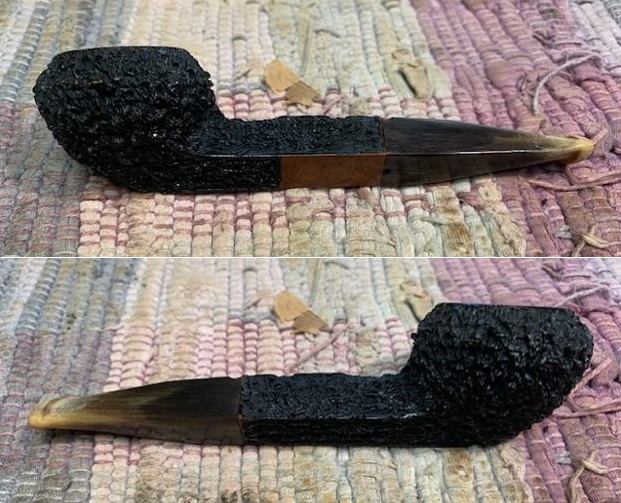
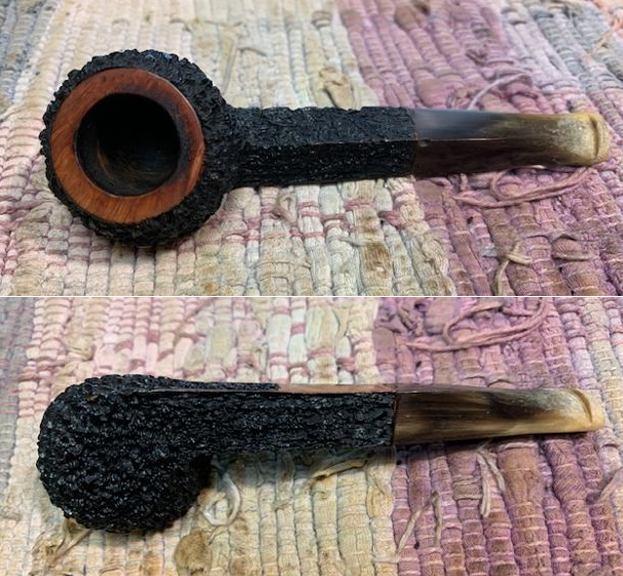
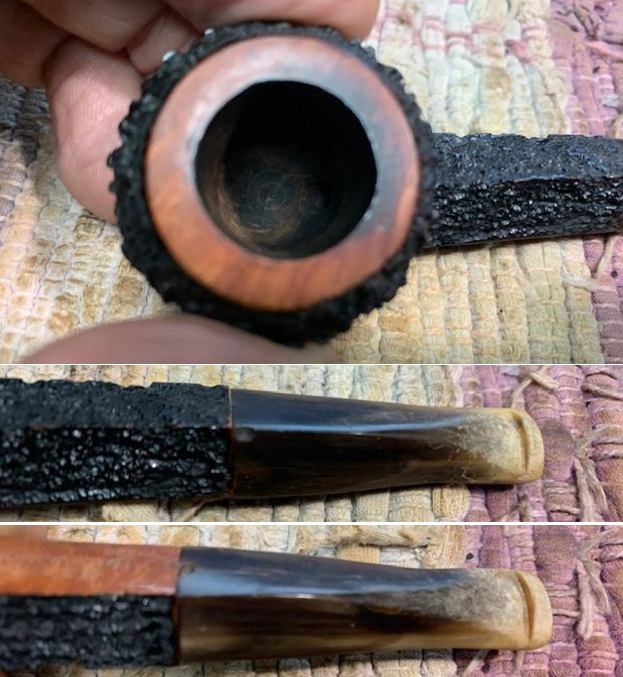
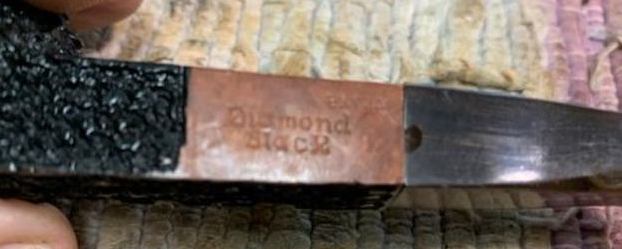
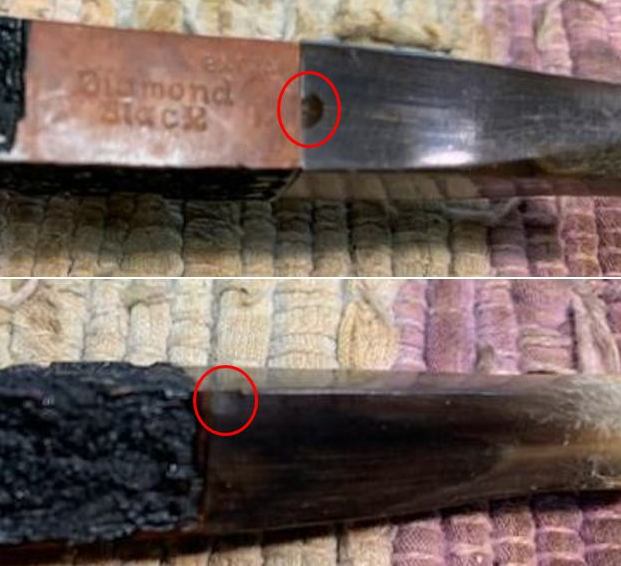
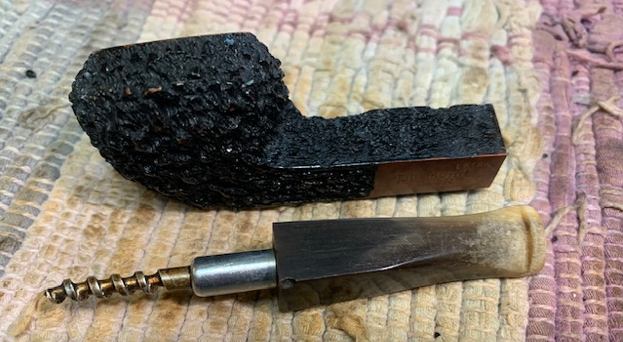
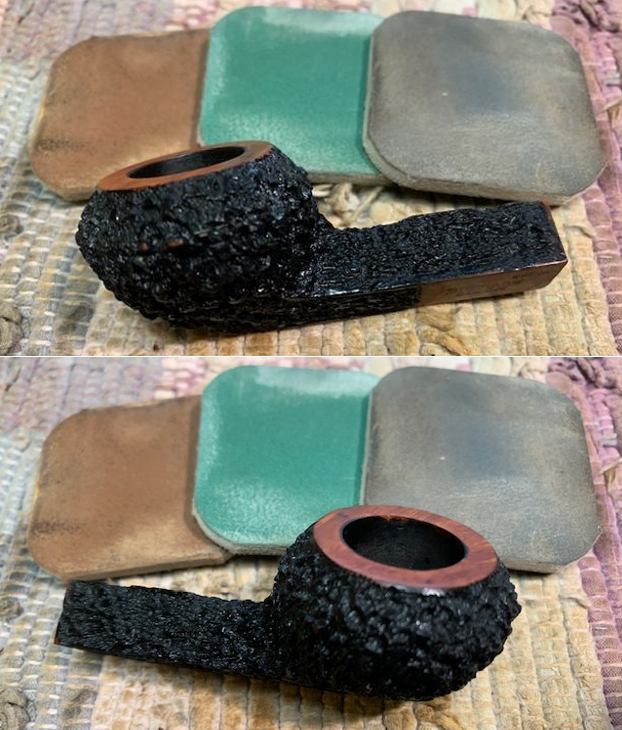
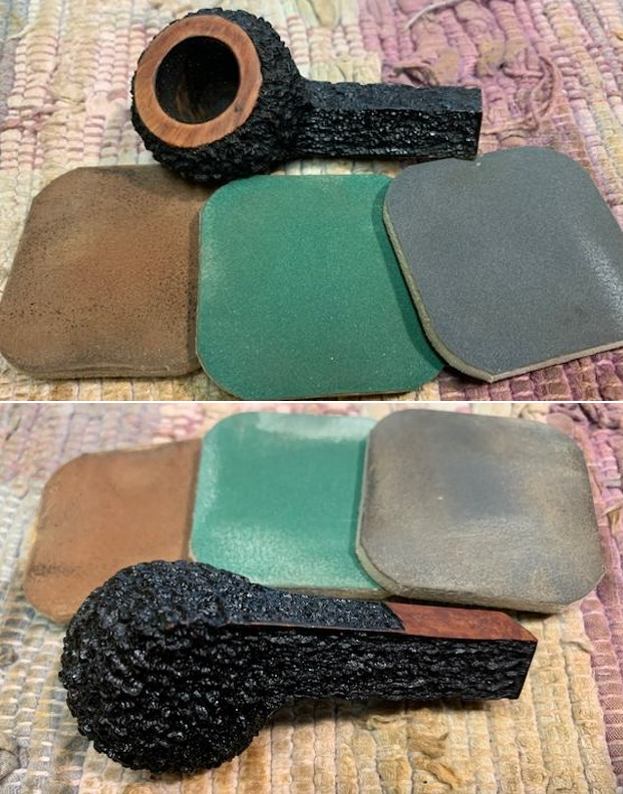
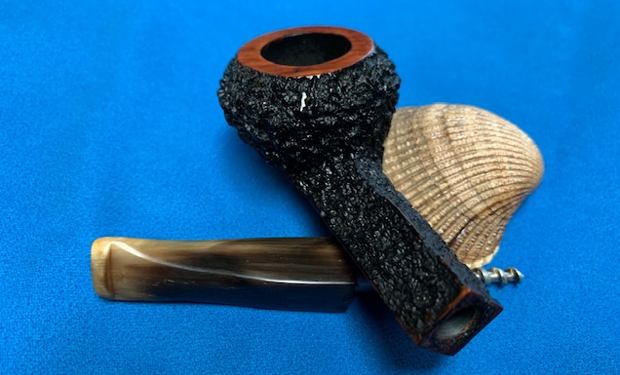
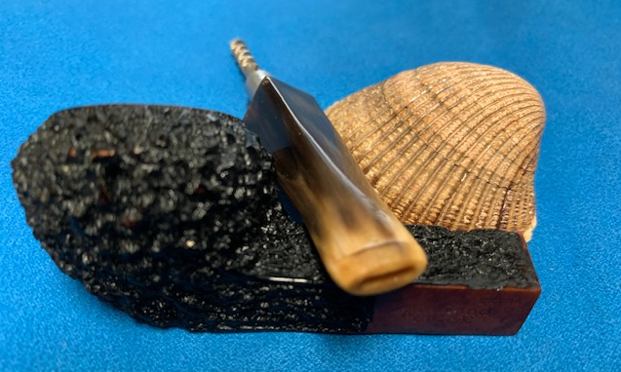
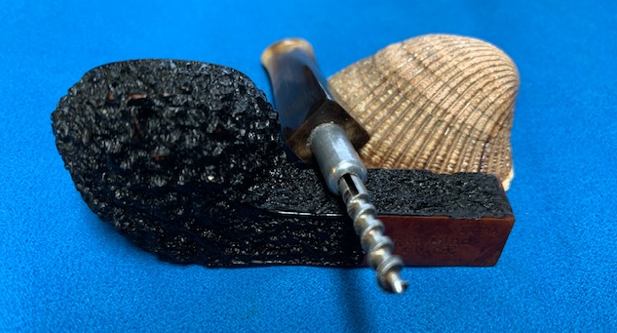
I finished the restoration of four of the older horn stem pipes that I have posted the blogs about on rebornpipes, the first was a beautiful early 1900s KB&B Horn Stemmed Italian Billiard (https://rebornpipes.com/2021/08/29/reviving-another-older-horn-stemmed-pipe-my-next-choice/) then an early French made JSN Racine Bruyere Dublin with a horn stem (https://rebornpipes.com/2021/08/29/reviving-another-older-horn-stemmed-pipe-from-the-bag-of-old-timers/), then a lightly smoked GVG Liverpool made by the founder of Genod (https://rebornpipes.com/2021/08/31/reviving-a-lightly-smoked-horn-stem-gvg-extra-9745-liverpool/) and fourth a Belle D’ Or Vielle Bruyere “Double Or” French Made Bent Dublin (https://rebornpipes.com/2021/09/01/restoring-a-la-belle-dor-vielle-bruyere-double-or-horn-stem-bent-dublin/). I decided to keep working on the bag of older NOS/unsmoked and lightly smoked pipes. I chose another horn stemmed pipe from the lot and this time picked a bit of a mystery pipe. It is buried in the pile in the photo below but it is clear in the second photo.In the photo of the poured out bag on my desk top I have circled the pipe that is next on the table. This was a lightly smoked pipe with a cut glass rustication stained black. The rim top is smooth as is the panel where it is stamped. This squat Bulldog really intrigued me so it was next. I sat at my desk went over the pipe I had chosen. It is lightly smoked squat Bulldog with a diamond shank and a taper stem. It is stamped on the left underside of the shank on a smooth panel and reads Diamond [over] Black. Just above that toward the shank/stem junction it is also stamped Extra. The pipe is a bit of a mystery as there is no country of origin. The finish is rusticated with a cut glass style rugged rustication that is stained black. The rim top is smooth and stained with a medium brown. There was some thin lava on the back top and edge of the rim. The stem is horn and has tooth chatter on the top and underside ahead of the button. There were worm holes on the point of the diamond on the underside and on the top right side at the joint of the stem and shank. The tenon is metal/aluminum with twisted stinger in place. It is a push stem. The button end is slotted. Typically these metal tenon pipes came out during the war or directly after when horn was brought back into use when rubber was short. It really is a beautiful pipe. Here are a few photos of the pipe before I started my cleanup and restoration. I took photos of the bowl and stem. You can see the condition of the bowl and the rim top and edges. The drilling is centered in the bottom of the bowl. It is a good sized bowl. The interior walls of the pipe are smooth and do not have drilling marks or checks or chips. There was some lava on the rim top at the back of the inner edge of the bowl along with darkening and burn damage. The horn stem is in excellent condition other than a worm hole on the top and underside near the shank. The button has a slotted opening and is quite clean. I took a photo of the stamping on the left underside of the diamond shank. It reads as noted above.I took some photos of the worm holes in the stem surface. I have circled them in red in the photos below. I removed the stem from the shank. You can see the metal tenon and the turned stinger in the photo below. The proportions of this pipe are well done. The rustication around the bowl is very nice. I used a folded piece of 220 grit sandpaper to smooth out the inner edge and then polished the smooth rim top with micromesh sanding pads. I dry sanded with 1500 -12000 grit pads and wiped the bowl down with a damp cloth after each sanding pad. It began to really come alive. I rubbed the briar down with Before & After Restoration Balm. I worked it into the finish with my fingertips and a horsehair shoe brush. The product works to clean, enliven and protect briar finished. I let it sit for 10 minutes then buffed it off with a cotton cloth. The rustication on the bowl sides and the smooth rim top really came alive with the buffing. It is really a beautiful pipe.I set the bowl aside and turned my attention to the stem. I filled in the worm holes in the stem surface with clear CA glue. I layered it in until the surface was smooth. Once the repairs cured I sanded them smooth with 220 grit sandpaper and started polishing with 400 grit wet dry sandpaper. I also sanded the tooth chatter on the top and underside near the button. I cleaned up the twisted stinger apparatus with alcohol and cotton swabs until it was clean. It is removable which mean it can be smoked with it in place or removed.I polished the horn stem with micromesh sanding pads – 1500-12000 grit pads. I wiped the stem down after each pad with Obsidian Oil to protect and enliven the horn. It came out looking very good. This another interesting pipe – a ruggedly rusticated Diamond Black Extra Horn Stem Squat Bulldog. It turned out really well and it is a great looking pipe with a great shape to it. The rusticated finish on the briar and the sheen on the horn stem really popped when the pipe was lightly buffed with blue diamond on the buffing wheel. I gave the bowl multiple coats of Conservator’s Wax and the stem multiple coats of carnauba wax and buffed it with a clean buffing pad. I hand buffed the pipe with a microfiber cloth to deepen the shine. The Diamond Black Extra Squat Bulldog is tactile and comfortable to hold and is quite distinguished looking. Give the finished pipe a look in the photos below. The dimensions of the pipe are Length: 5 inches, Height: 1 ½ inches, Outside diameter of the bowl: 1 ½ inch, Chamber diameter: ¾ of an inch. The weight of the pipe is 29 grams/1.02 ounces. This is a beautiful pipe that I will soon be putting on the rebornpipes store in the French Pipemakers Section. Thanks for reading this blog and my reflections on the pipe while I worked on it. Keep an eye out on the blog as I have several other older horn stemmed pipes that will be coming up soon.

Resurrecting A Dreary No Name Briar Calabash Shaped Pipe


Blog by Paresh Deshpande

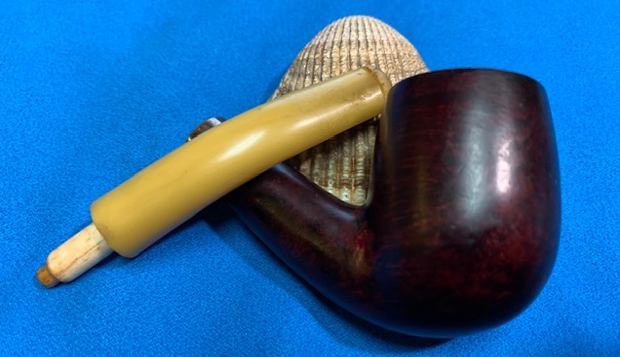
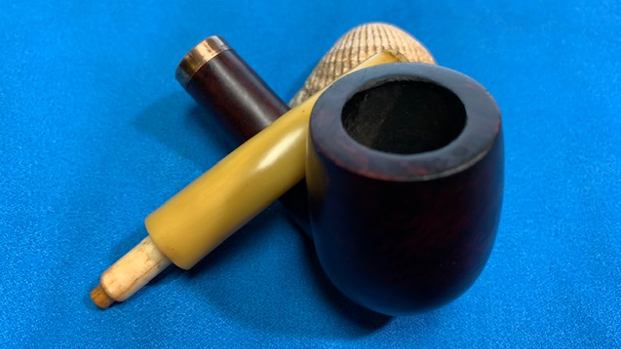
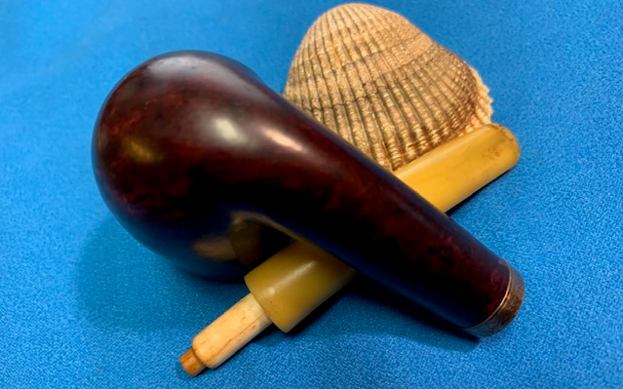
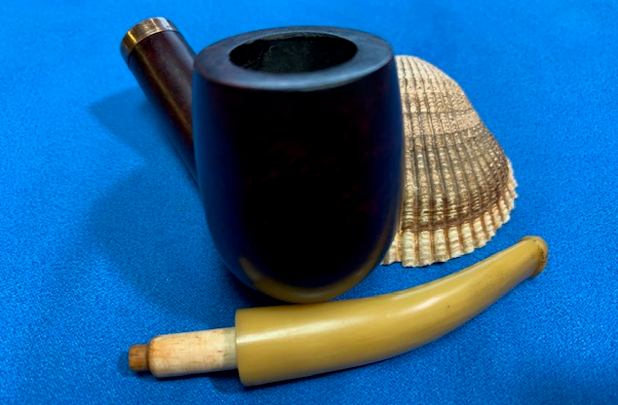
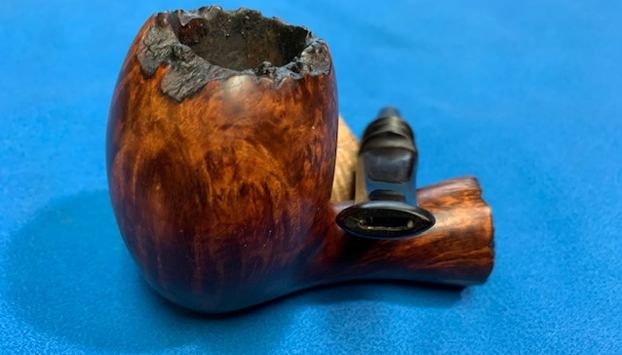
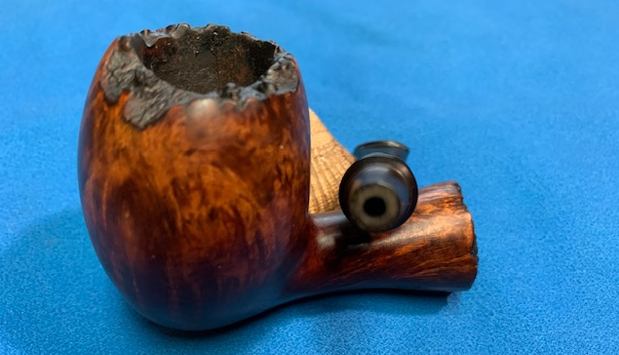
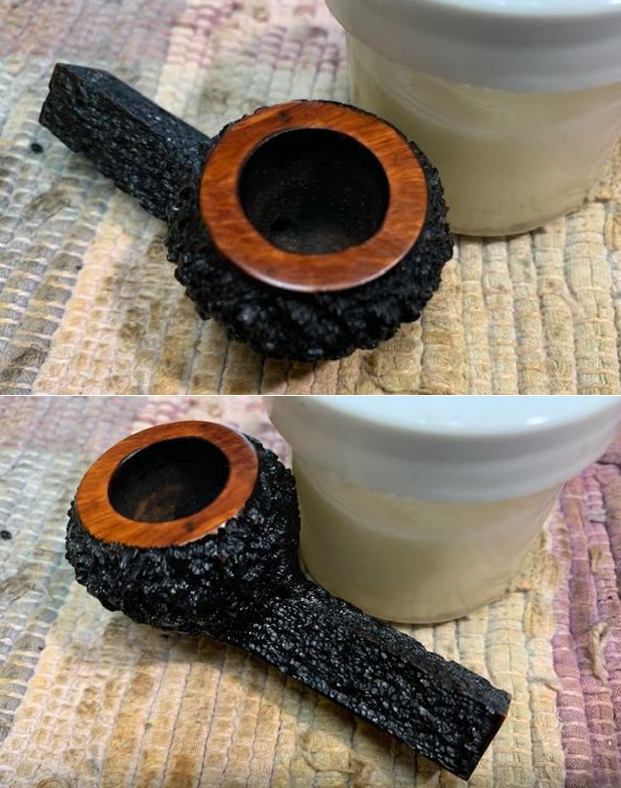
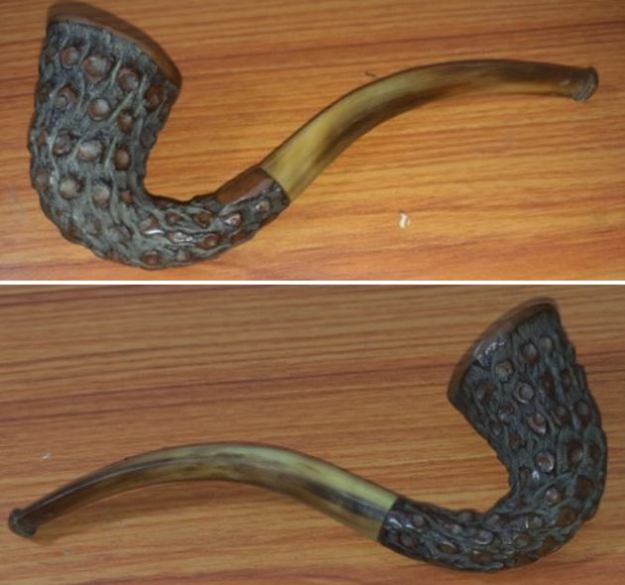
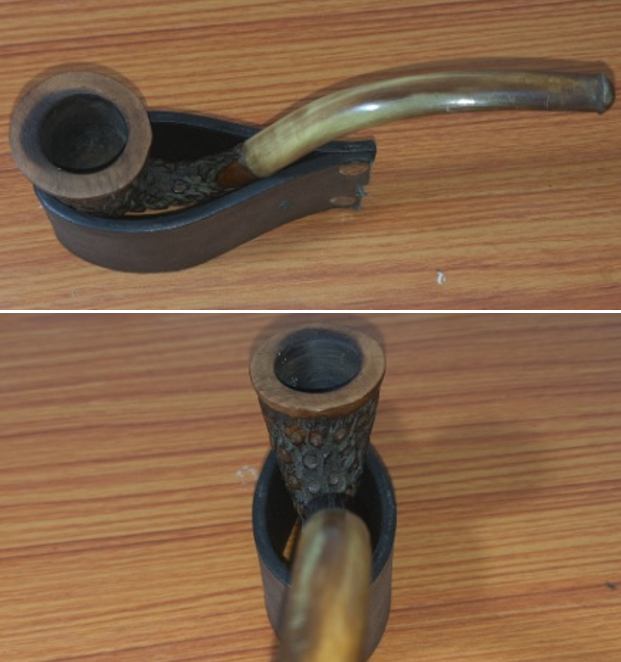
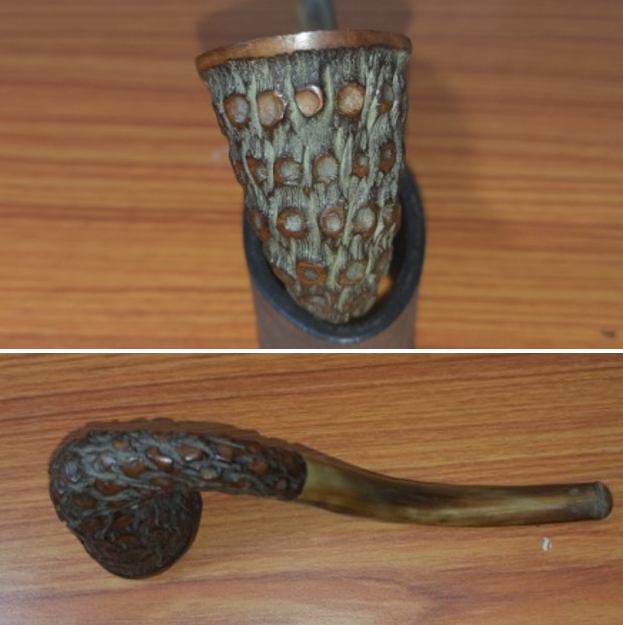
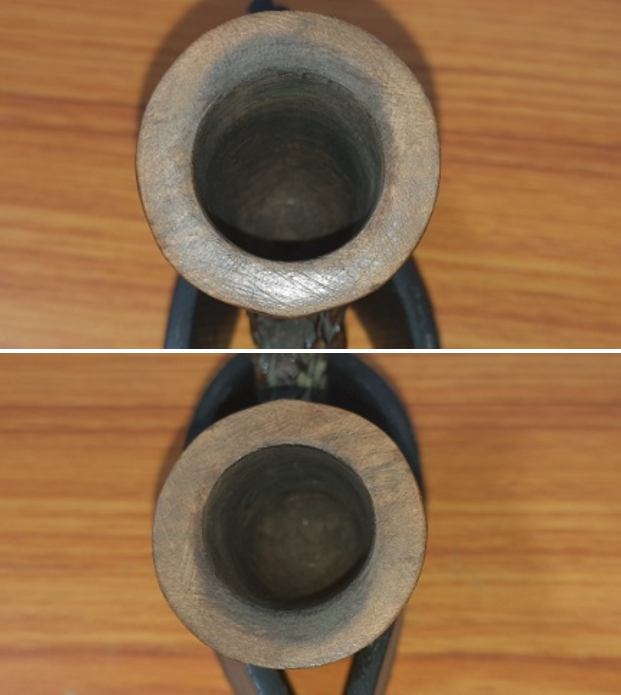
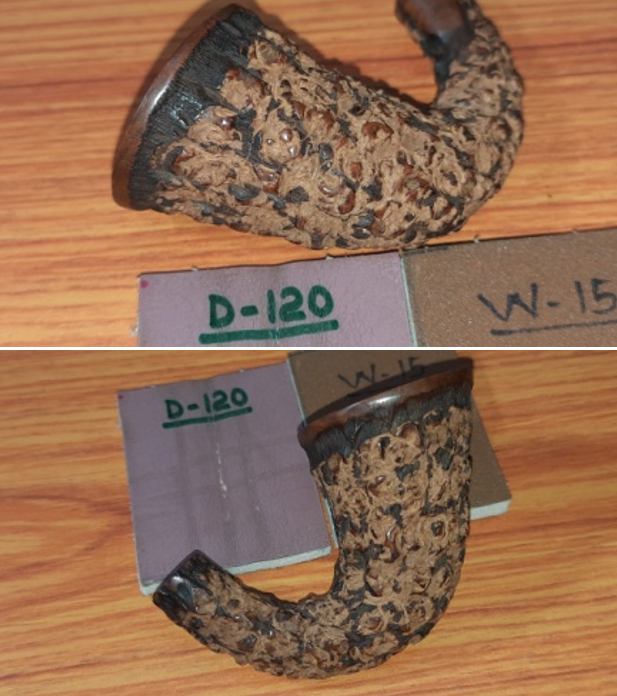
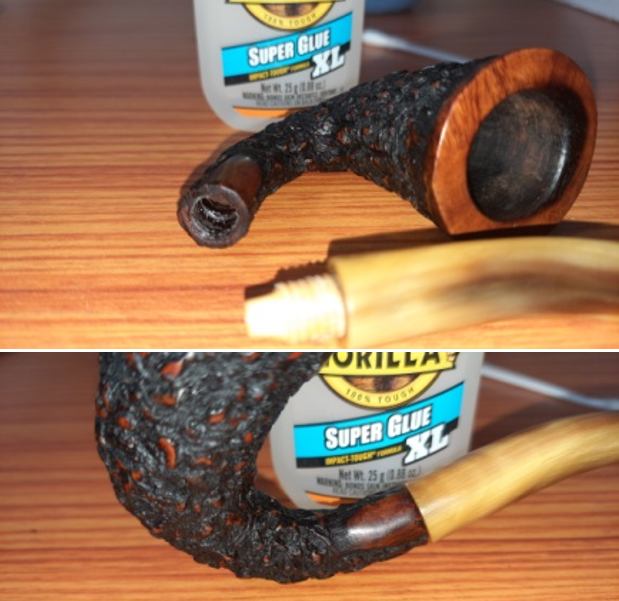
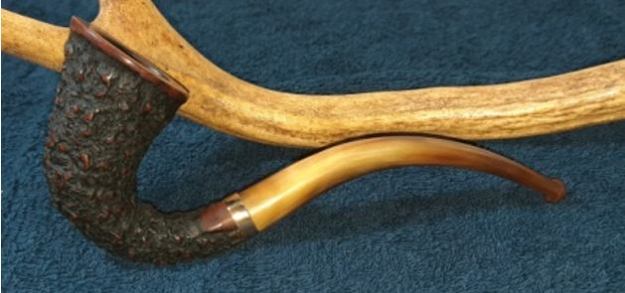
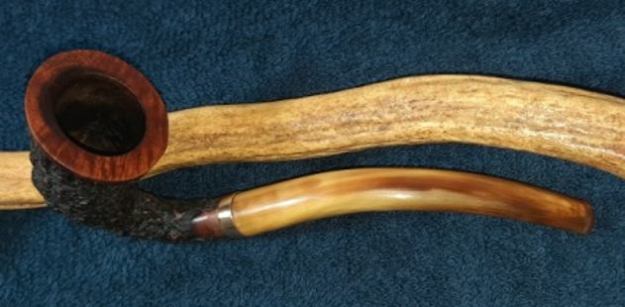
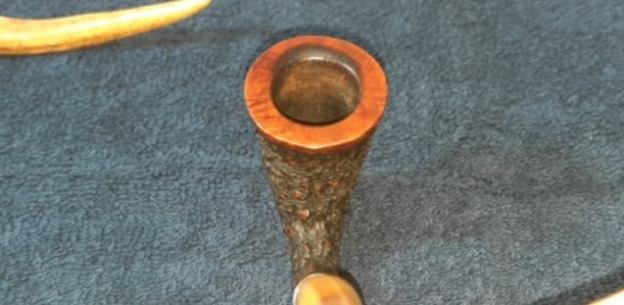
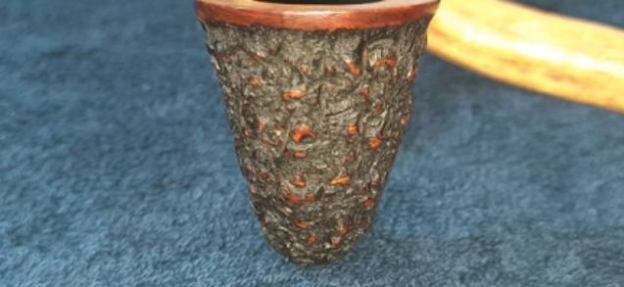
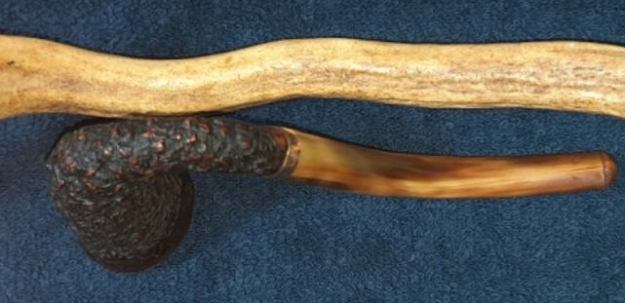
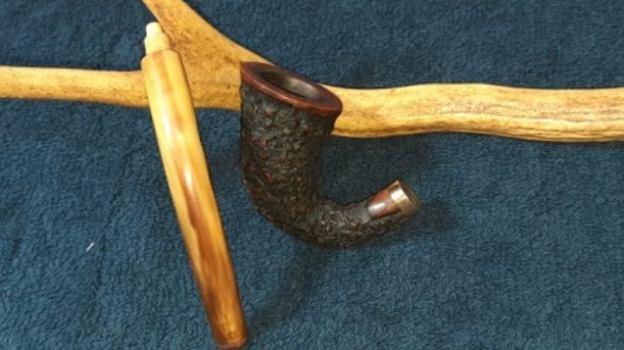
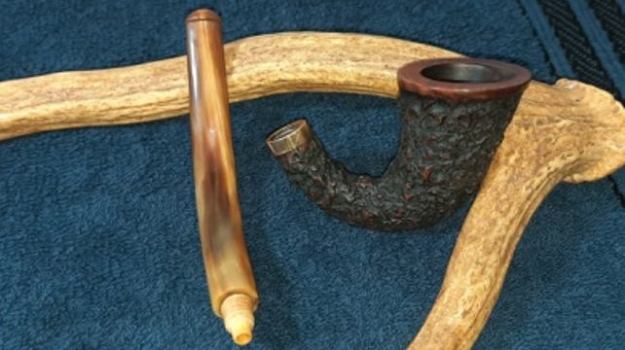
While surfing eBay for estate pipes, I came across this one ‘no name’ pipe with a horn stem and beautiful flowing calabash shape. The beautiful curvy shape apart, the pipe had some really hideous (IMHO) rustication on the stummel surface, a semblance of widely spaced scales with thin vertical lines. The perfect shape and spacing of the scales over the stummel surface points to machined and not hand crafted rustications. Notwithstanding the rustications on the stummel, I fell in love with the pipe and had already chalked out a plan for its transformation even before I had won the auction. As I had expected, there was only a couple of other bids and the pipe soon made its way to me. A month and a half later, the pipe had reached me and now it is on my work table.

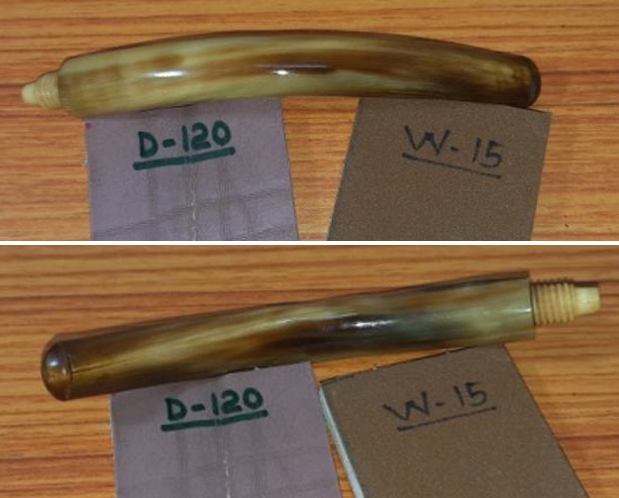
As mentioned by the seller, the stummel and the stem are devoid of any stampings and there is absolutely no clue for me to establish the provenance of this beautiful pipe. However, the threaded bone tenon, horn stem and round orifice are indicative of this pipe being from the period 1900s to 1950s. It would be interesting if further light could be shed on this pipe as regards its origin, vintage etc by the esteemed readers of rebornpipes.

Initial Visual Inspection
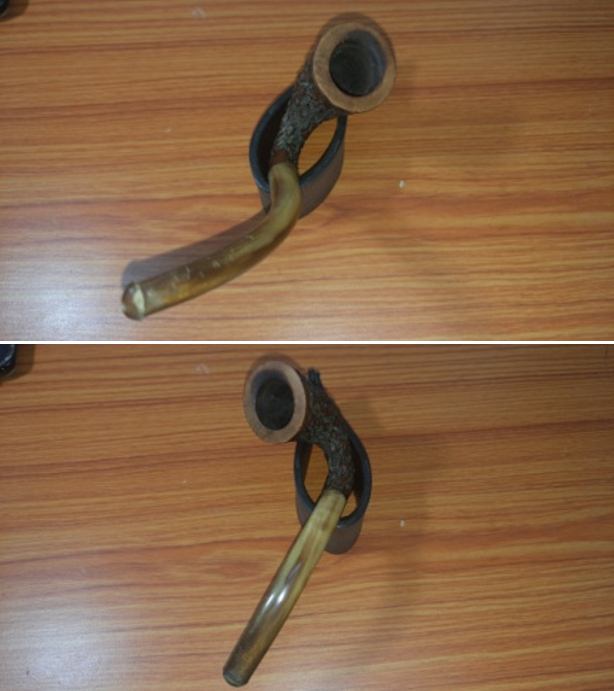
The first thing one can notice is the lovely shape of the pipe and the second is its ultra light weight. The chamber has been neatly reamed and the rim top surface is devoid of any lava overflow. There is severe charring to the inner edge in 12 o’clock direction. There are a couple of minor tooth indentations in the bite zone of the otherwise pristine stem. The stem is overturned to the right and not in alignment with the shank/ stummel. The stummel is dirty, dull and lifeless to look at. Overall, it is in decent condition as can be seen from the pictures below. Dimensions Of The Pipe
(a) Overall length of the pipe: –          5 3/4 inches.

(b) Bowl height: –                               1.5 inches.

(c) Inner diameter of chamber: –         0.7 inches

(d) Outer diameter of chamber: –        1.3 inches

Once The Pipe Is On My Work Table……
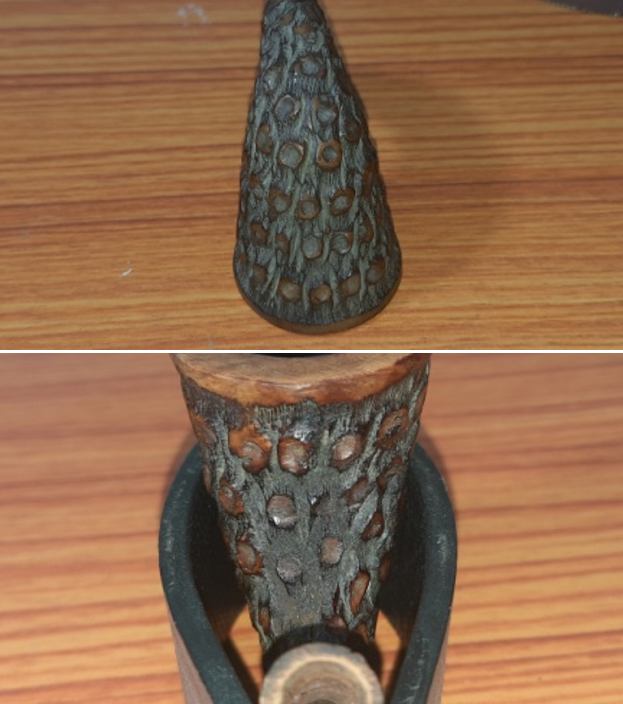
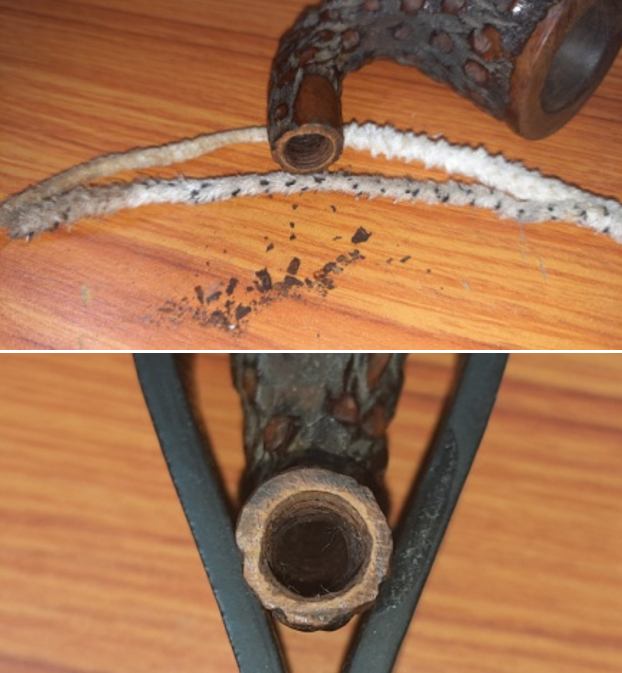
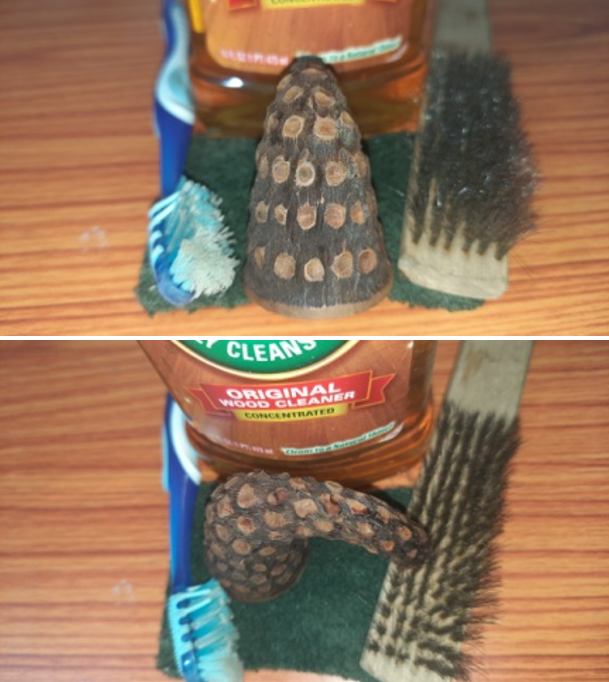
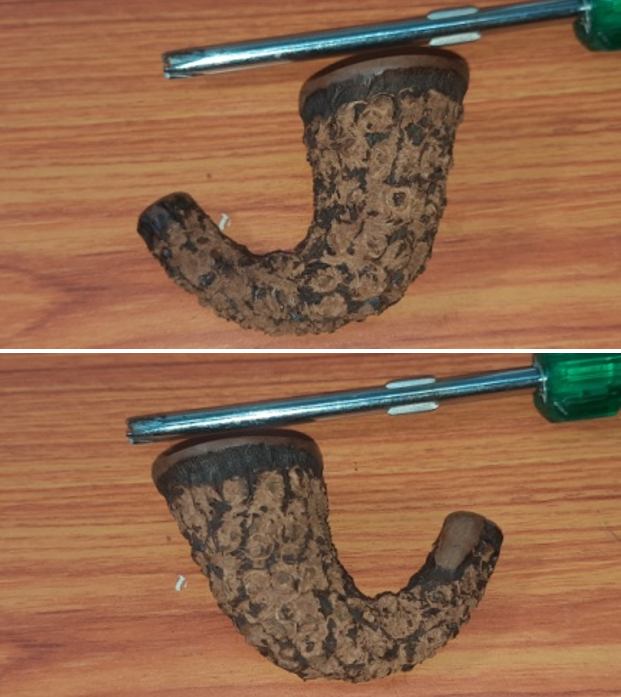
It appears that an attempt has been made to refurbish this pipe, but for reasons best known to the previous restorer, it was abandoned. Save for a little dust and soot, the chamber is nicely reamed back to the bare briar. The chamber walls, though not very thick, are without any heat fissures or pits and that’s a big relief. The rim top surface is peppered with numerous minor hairline scratches. The inner rim edge shows severe charring at 12 o’clock direction (encircled in yellow) and it extends over more than half way towards the outer edge. There is a smooth band of briar wood below and adjoining the outer rim edge. There are no ghost smells in the chamber. Addressing the charred inner rim edge is going to be tricky as the topping required would be extensive to the extent that the profile of the stummel and pipe as a whole, would be considerably altered. I would top the rim surface well within the limits of the smooth briar band below the outer rim edge and up to the point where I reach solid, albeit darkened briar. I would, thereafter polish it and attempt to blend the darkened areas by a applying a dark stain to the rest of the rim top surface. The stummel surface is without any damage. There is dust and dirt embedded in to the rusticated nooks and crannies giving the briar an old and lifeless look. The patterned scaled rustications also do not help in the overall appearance of the stummel. The mortise is threaded into which seat the threaded bone tenon of the stem and appears to be clean. I plan on complete rustication of the stummel and thereafter contrast staining with black and brown stains. The only issue I need to keep in mind is that the walls of the stummel are not very thick and thus I need to be cautious least I end up gouging too deep into the chamber wall. The tapered horn stem is clean with no major issues. The upper stem surface has a couple of minor bite marks at the base of the button and also over the button edge. The lower surface has some minor tooth indentations in the bite zone. The button edges on both the surfaces need to be sharpened. The round orifice and the tenon end are clean.The seating of the stem in to the mortise is overturned to the right by a huge margin and is very loose. This would need something more permanent than the clear nail polish coat application. The following pictures will give the readers a correct perspective of the issue.The Process
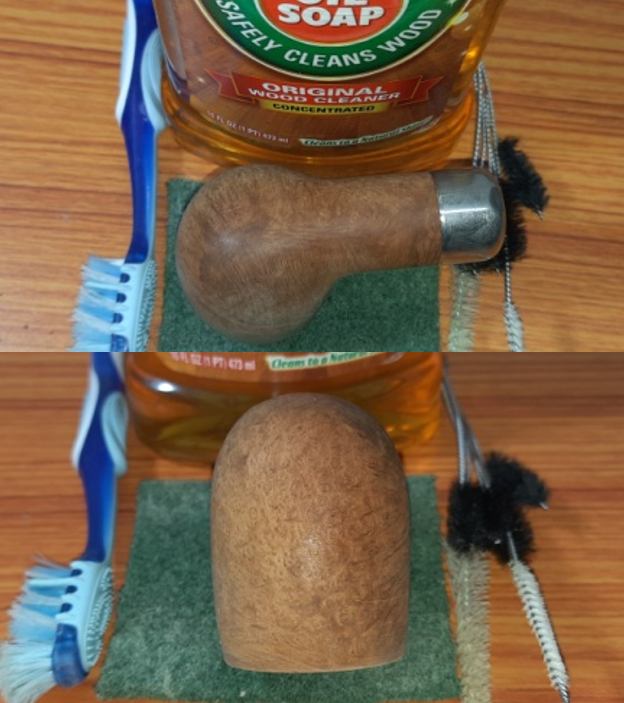
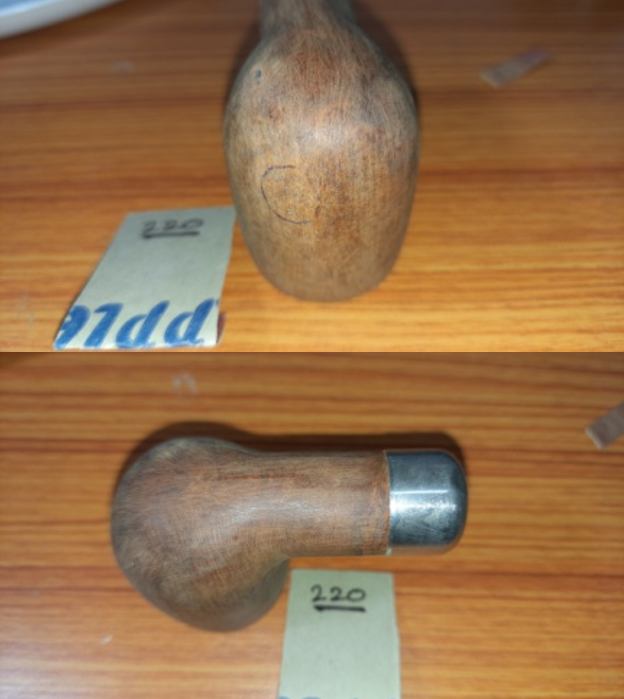
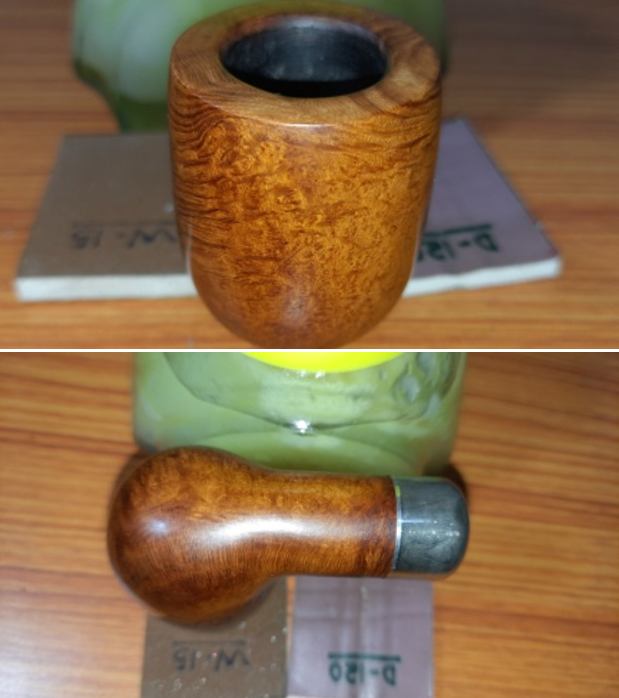
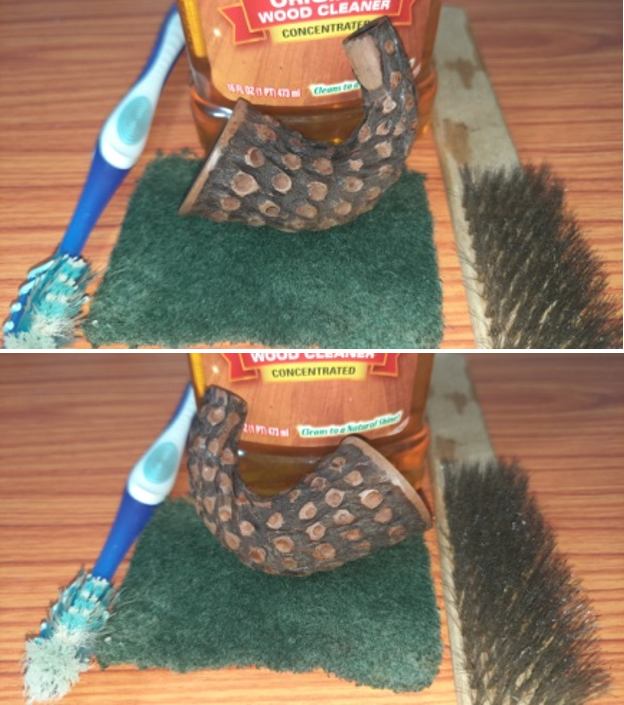
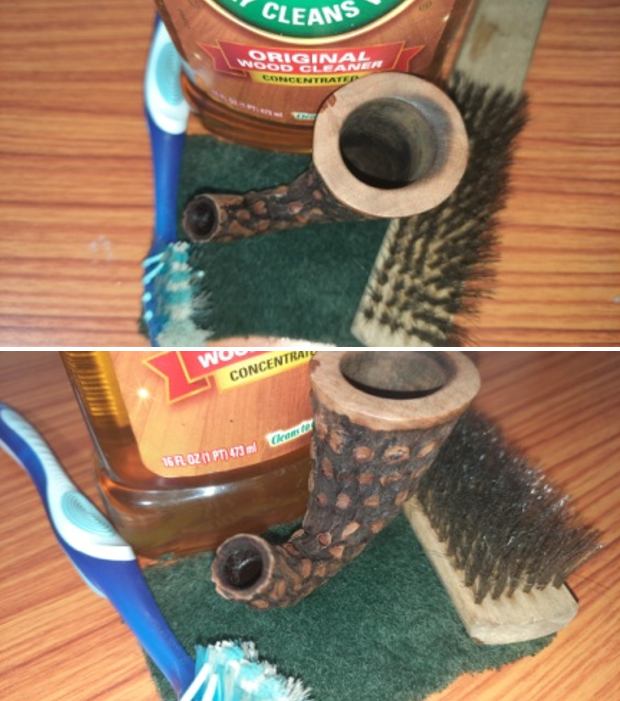
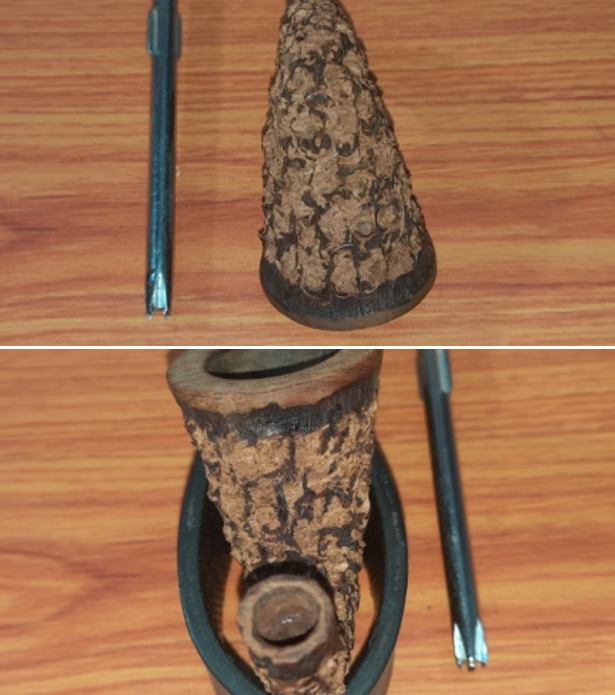
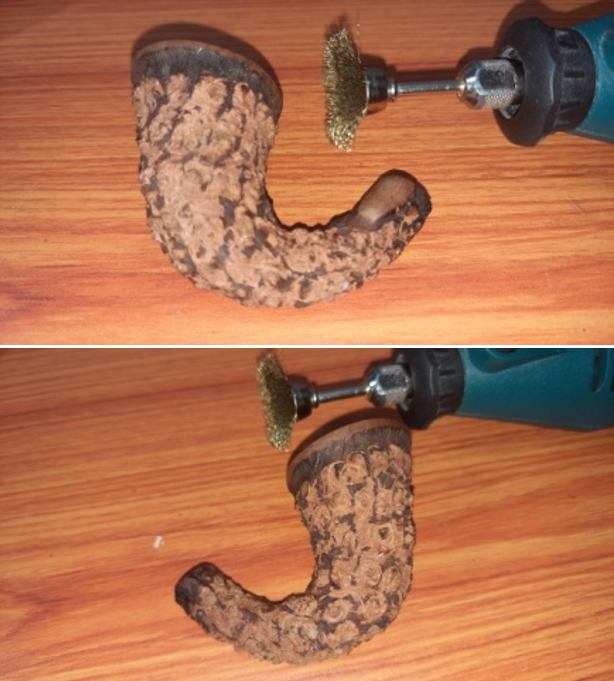
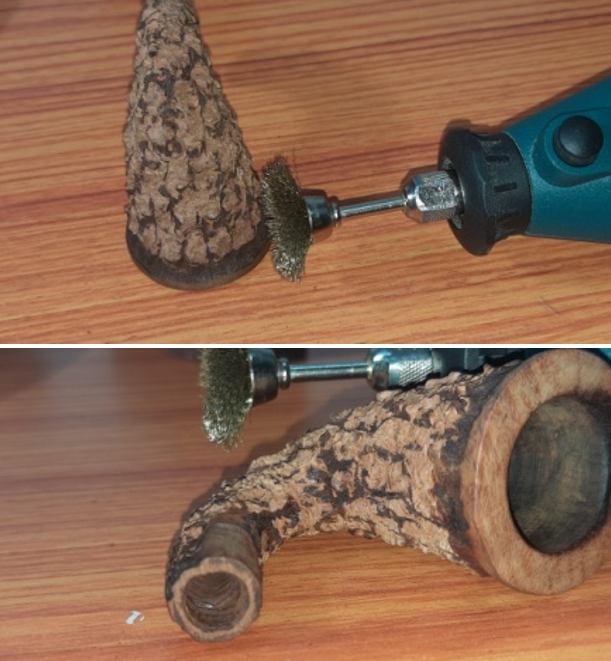
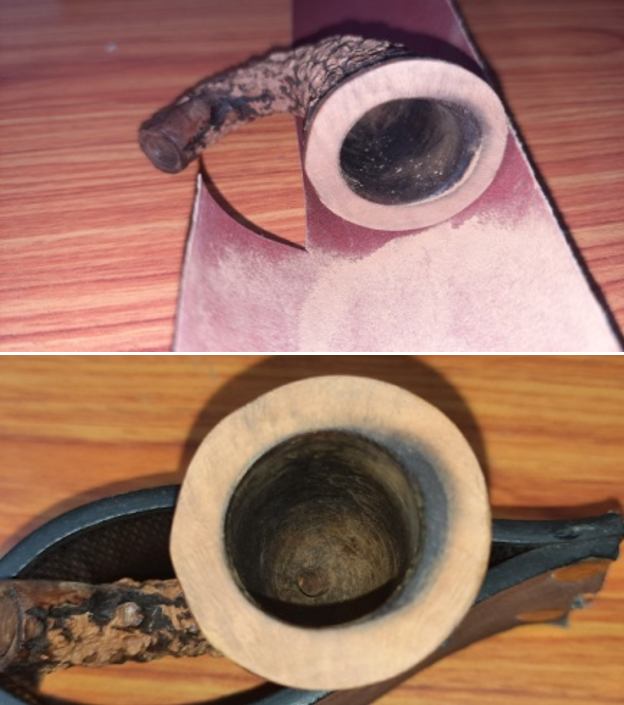
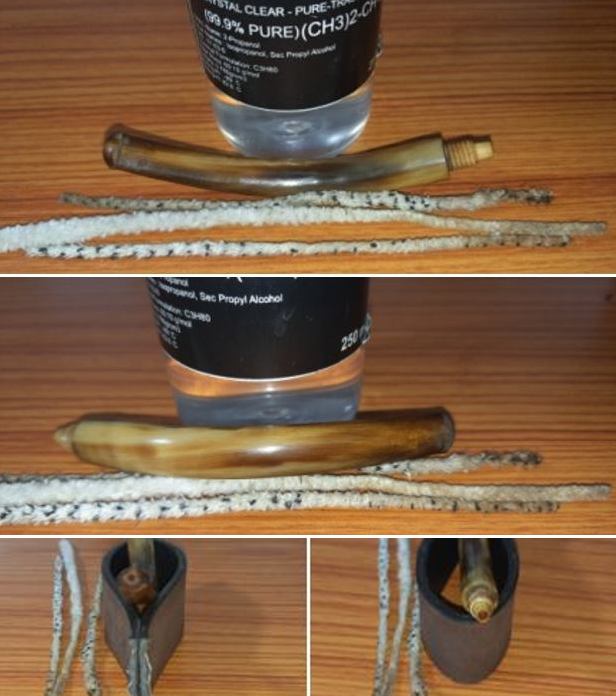
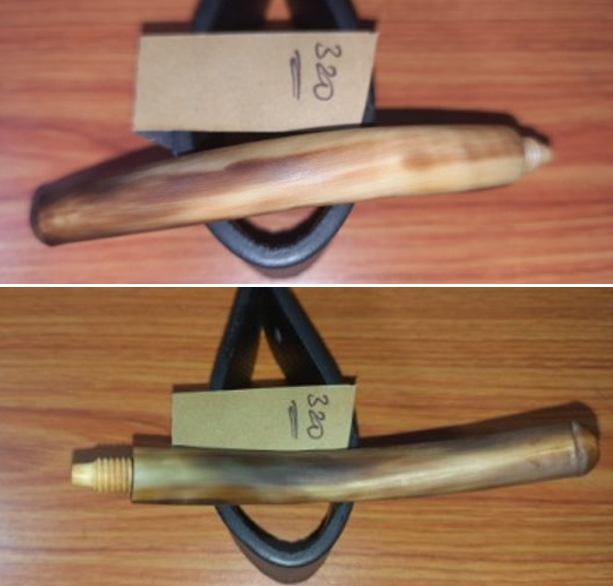
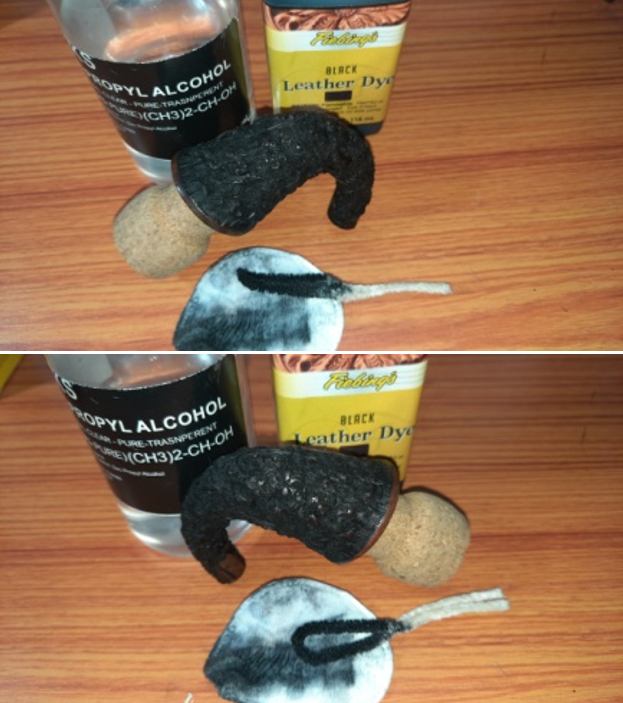
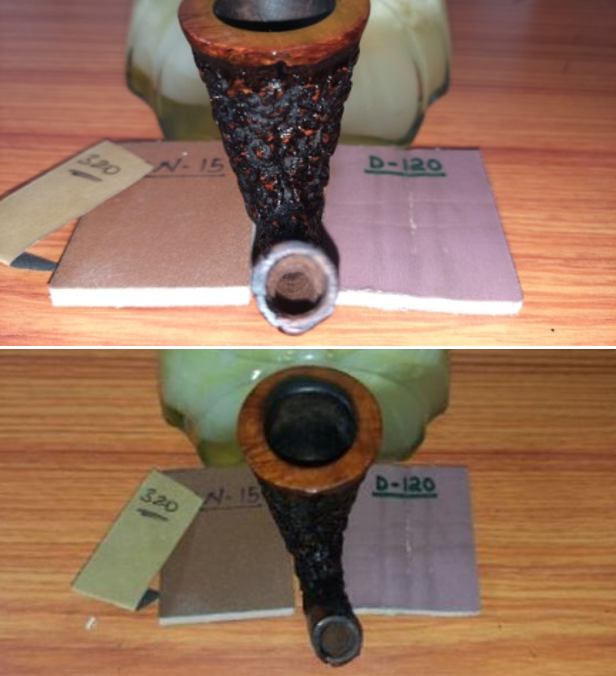
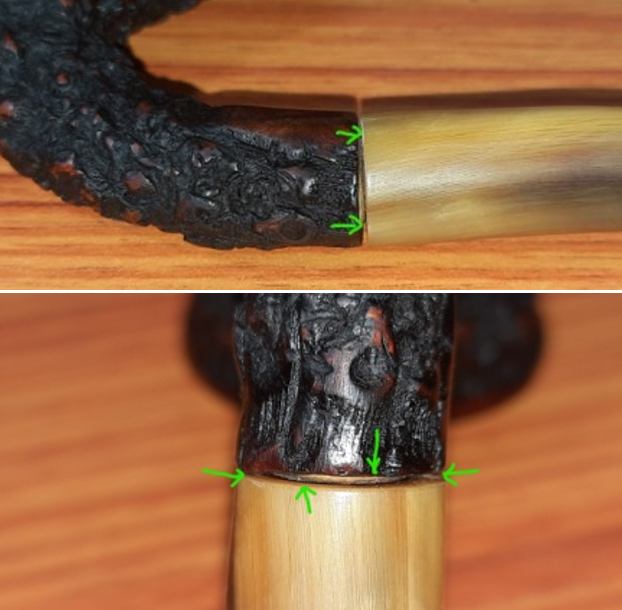
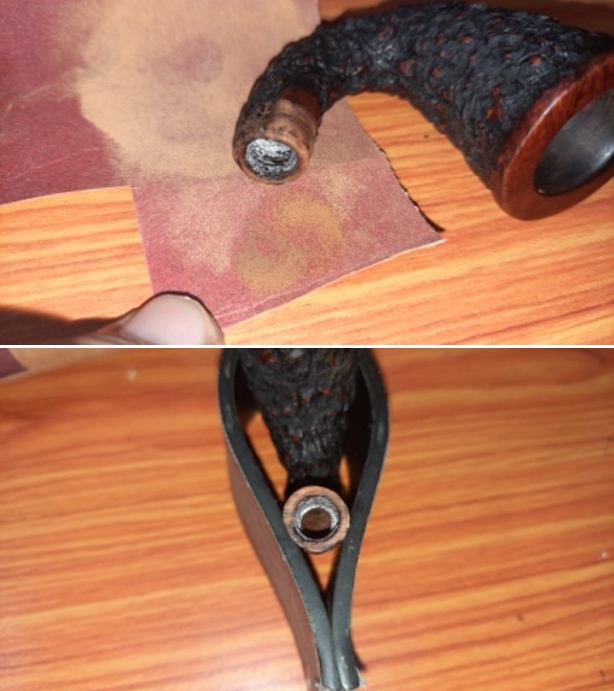
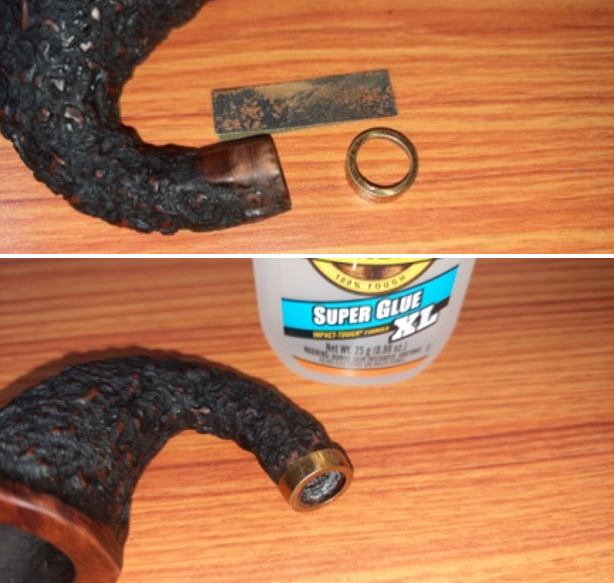
The process of transforming this pipe began with cleaning the chamber that had been reamed and cleaned before it reached me. With my fabricated knife, I completely removed the dust and little residual carbon from the walls of the chamber. I further cleaned the walls with a folded piece of 220 grit sand paper to completely remove the carbon from the walls and wiped the chamber with a cotton pad and alcohol. The charred surface at the inner rim edge was also gently scraped with the knife and sandpaper to remove the burnt briar till I reached solid briar underneath. Next, I cleaned the mortise and shank with regular and bristled pipe cleaners dipped in alcohol. At first I just could not get the pipe cleaner to pass through the mortise and out through the draught hole. I then inserted the pipe cleaner through the draught hole and with some efforts; it came out through the mortise dislodging some dried gunk from the air way as it came out. Other than the stuck dried gunk, the mortise was clean and just a couple of pipe cleaners were put to use. I was particularly deliberate in cleaning the threads in the mortise in preparation of further repairs to improve the seating of the threaded tenon, the process for which will be covered subsequently.After I was done with the internal cleaning of the stummel, I cleaned the external surface. I generously applied Murphy’s oil soap with a hard bristled tooth brush and scrubbed the stummel and rim top with the soap. I washed the stummel under running warm water with anti oil dish washing detergent and brass wired brush till the stummel surface was clean and dried it using paper towels and soft cotton cloth. The rim top surface was deliberately cleaned with a Scotch Brite pad to further remove the charred wood from the rim edge. I simultaneously cleaned the shank internals with the detergent and hard bristled shank brush. The stummel surface has cleaned up nicely with the scaly and thin lined rustication plainly visible. Truth be told, the stummel now appear more dull and unattractive to my eyes! Once the internals and the external surface of the stummel had been cleaned, I progress to rusticating the stummel. To rusticate, I firmly held the stummel in my left hand and using my right hand began gouging out the briar with my fabricated rusticating tool. The technique is to firmly press the pointed four prongs of the modified Philips screwdriver into the surface, rotate and gouge out the removed chunk of briar. I worked diligently till I was satisfied with the rustications and the appearance of the stummel. I was careful to avoid gouging too deep as the walls are not very thick and I feared that deep rustications will lead to further thinning of the walls and subsequent burn out. As I reviewed the rusticated stummel, the rustication is prominent while the thickness of the wall is not compromised at all. I am very pleased with the progress thus far. I cleaned the stummel surface with a brass wired wheel brush mounted on a handheld rotary tool. While cleaning the surface of all the debris, this rotating brass brush wheel also creates subtle patterns of its own and this adds an additional dimension to the appearance of the stummel. I sanded down the jagged high points in the rustication to a smooth and even surface using a worn out piece of 150 grit sand paper without compromising on the tactile feel to the hand.Next I decided to work on the damage to the rim top and inner rim edge. I topped the rim on a piece of 220 grit sand paper, checking frequently till I was satisfied that the darkened surface is addressed to an acceptable extent without compromising on the stummel profile and the rim top surface is nice, smooth and even. The darkened rim is still evident but the briar in this area is nice and solid and so I shall leave it be. All this while that I was working on the stummel, Abha quietly worked on the stem. She cleaned the stem internals with regular and bristled pipe cleaners dipped in alcohol. It didn’t take many pipe cleaners to get the stem air way clean.Next she sanded the stem surface with a 320 grit paper. This addressed the minor tooth indentations and bite marks on either surface in the bite zone. She progressively moved to polishing the stem through 400, 600, 800 and 1000 grit sand paper. She finished the stem refurbishing by wet sanding the stem with 1500 to 12000 grit micromesh pads. She rubbed a little Extra Virgin Olive oil into the stem surface to hydrate it and set it aside to be absorbed into the bone. Next I polished the rim top and the high spots in the rustication using micromesh pads, wet sanding with 1500 to 12000 grit pads. I wiped the bowl with a moist cloth after each pad to clean the surface. I am happy with the appearance of the stummel at this point in the restoration. The stummel is now ready for a fresh coat of stain.I wanted to highlight the difference between the rusticated and the smooth stummel surface. I decided to stain the rusticated surface with a black dye which would contrast beautifully with the browns of the rim top and the raised knobs of the rustications. I heated the rusticated portion of the stummel surface with my heat gun to open up the pores on the stummel so that the stain is well absorbed. I used Fiebing’s Black Leather dye and liberally applied it over the heated surface, flaming it with a lighter as I went ahead to different self designated zones on the surface. This helps in the setting of the stain in the grain of the briar. I ensured that every inch of the rusticated surface is coated with the dye. I immediately followed it by wiping the raised portions of the rustication with cotton pad and alcohol to lighten the knobs. Once polished, these will contrast with the black of the rest of the stummel surface. I set the stummel aside overnight for the dye to set into the briar surface.  The following day, I again wiped the stummel with a cotton swab and alcohol to remove any excess stain and followed it up by sanding the raised rustication with a folded piece of 320 grit sand paper. This was followed up by careful dry sanding of the entire stummel, especially the raised rustications with 1500 to 12000 grit micromesh pads. This lightens and highlights the high spots in the rustications. Next, I rubbed a small quantity of “Before and After Restoration Balm” in to the briar with my finger tips, working it deep into the rustications and let it rest for a few minutes. The balm almost immediately works its magic and the briar now has a nice vibrant appearance over the smooth surface with the beautiful rusticated patterns on full display. I further buffed it with a horse hair shoe brush. The only issue that remains unaddressed at this stage is the issue of loose and overturned seating of the stem into the mortise. I had the option of using the clear nail polish to tighten the seating but that would have been a temporary solution as the threaded bone tenon was way too loose fitting in to the mortise and no amount of smoking would have tightened the mortise to the required extent and hence was dropped. I decided on using CA superglue for the purpose. I applied a coat of superglue over the threads of both the mortise and tenon and let it set for a few seconds.  Thereafter, I threaded the tenon in to the mortise till the stem was perfectly aligned and again held it in place for a few seconds for the superglue to take the shape of the threads. I repeated the process once over and achieved a perfectly aligned and snug seating of the stem in to mortise. It was at this juncture that a new issue came to the fore as I was taking pictures of the stem and shank junction under magnification. The green arrows tell the story!Closer inspection revealed that the cause of this gap was the uneven shank end and the tenon was not flush with the stem face (which by the way is also not perfectly shaped). The gap was more on the lower surface than the upper. To address these issues, I firstly topped the shank face on a piece of 220 grit sandpaper till it was even. I was extremely careful while topping so that there was minimum loss of briar as the tenon was already slightly long and I had no desire to increase this gap any further. Secondly, I bridged the gap between the shank face and stem by using a brass band. This also added a nice touch of bling to the entire pipe. I like the way the pipe has shaped up. To complete the restoration, I first mounted a cotton cloth buffing wheel that is dedicated for use with Blue Diamond, onto my hand held rotary tool.  I set the speed at about half of the full power and polished the stem. The Blue Diamond compound helps to erase the minor scratches that are left behind even after micromesh polishing cycle and followed it by applying several coats of carnauba wax with a cotton cloth buffing wheel dedicated to Carnauba Wax. I finished the restoration by giving the entire pipe a rigorous hand buffing using a microfiber cloth to deepen the shine further. The finished pipe looks amazingly beautiful and has undergone quite a transformation. With its perfectly balanced weight, a nice full bent shape and light weight, this is a perfect pipe for clenching while working. This is one pipe that will I feel will not disappoint either aesthetically or functionally. In case this beauty calls out to you, please let me know and we shall work out a mutually beneficial deal. I wish to thank our esteemed readers for sparing their valuable time to read through and any input or advice is always welcome. And how can I not thank Abha, my wife for her patient efforts in imparting glass like finish to the stem and rim top surface!

Praying for the safety and well being of you and yours…stay home, stay safe and get your vaccines please.

A 3 Pipe Reclamation Project – The next is a D.P. Ehrlich & Co. Meerschaum Bulldog


Blog by Steve Laug

With the completion of a beautiful Octagonal, horn stemmed billiard as another  break from the routine of these meerschaums (https://rebornpipes.com/2021/08/28/reviving-an-unsmoked-nos-octagonal-billiard-with-a-horn-stem/) it was time to go back to the D.P. Ehrlich Meerschaum reclamation work. I will quote the next paragraphs to give context to the pipes that I am working on in this project.

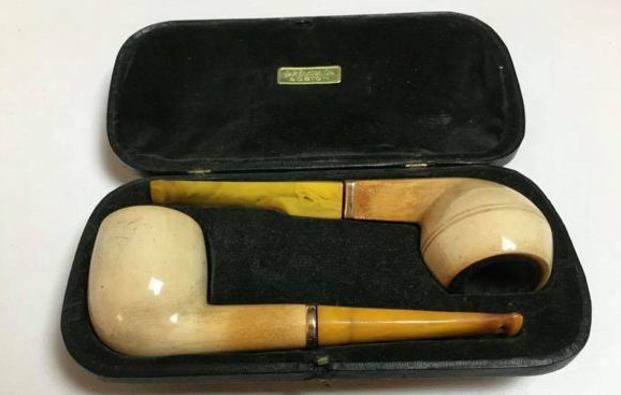
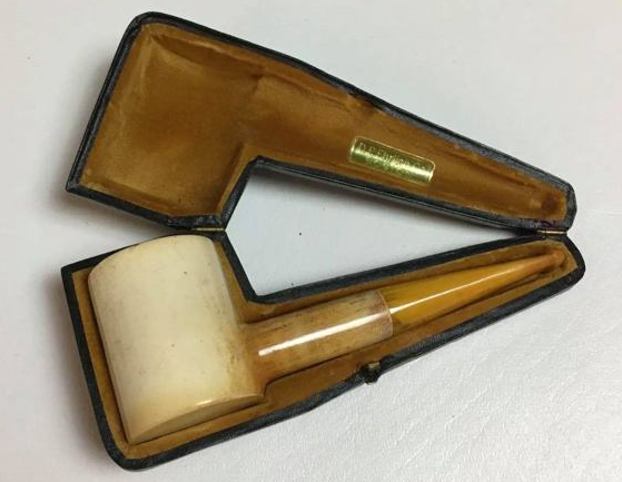
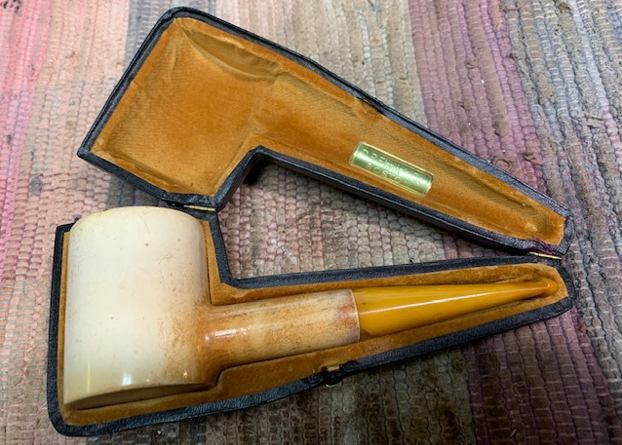
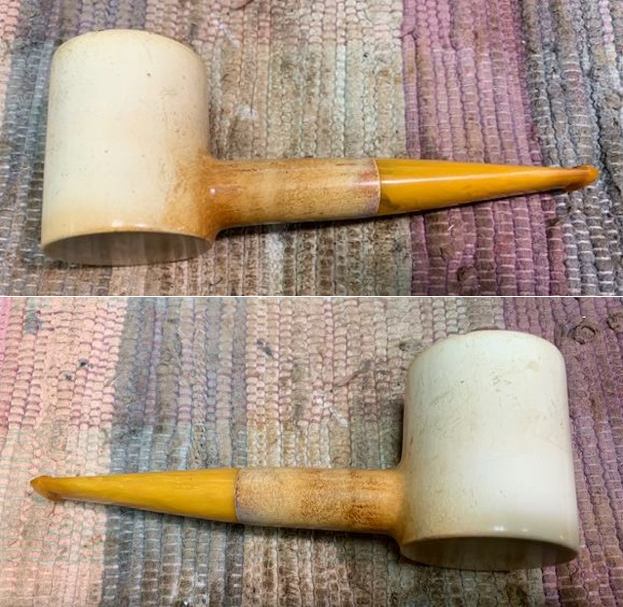
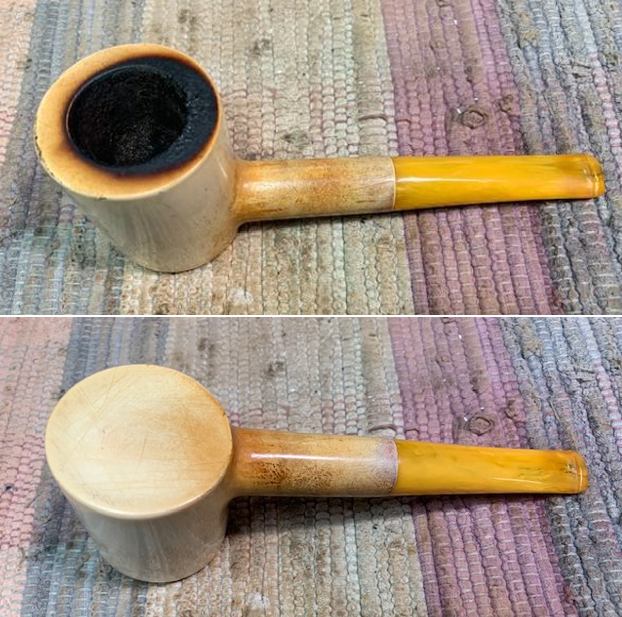
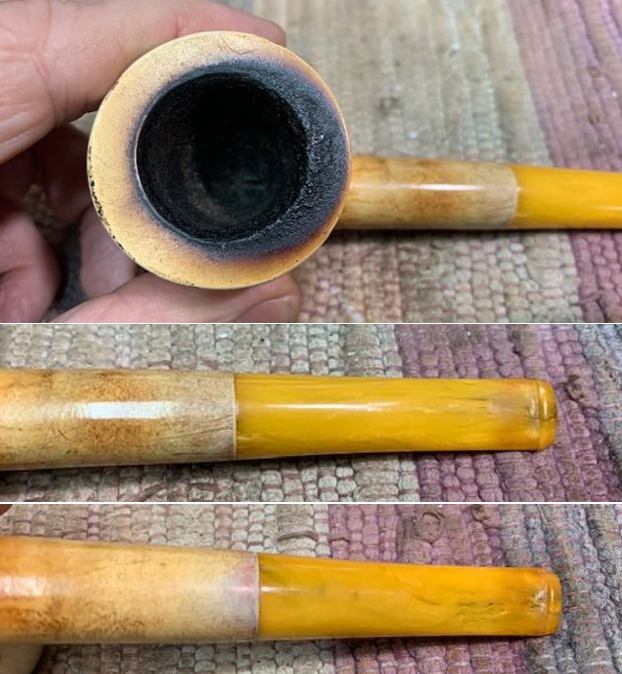
Not long ago I received a Facebook Message from a friend asking if I would consider restoring three Ehrlich meerschaums that he had. He spoke about first, then sent photos as he knew I was not presently taking on any new work due to my heavy schedule. He described the first cased set – which contained a Bulldog and a Billiard with great patina and cloudy acrylic stems. It sounded amazing. He described the second cased single – a Poker with the same kind of stem. At least one of the stems had a bite through on it. All were heavily smoked and dirty. From his reckoning the pipes came from at least two different time periods in D. P. Ehrlich of Boston’s long life. I thanked him for thinking of me and gently said I would not be able to do the work.

He understood but wanted me to have a look at them anyway. He sent these photos of the pipes in their cases on Messenger. They were indeed beautiful pipes. They were also very tempting. I really like these cased older style, smooth, classic shaped meerschaums. I did not reply to him for a bit and thought it over. I looked over my schedule and calendar for the next two months and it was very heavy. But… I was hooked. I finally answered him and basically said if he was not in a hurry I would be willing to take them on. He replied that he was in no hurry. You have to understand when I have pipes to work on here I squeeze them in somehow but I wanted freedom.Once I gave my answer he sent a few more photos of each of the pipes so that I could have a look at what was coming my way. He sent the tracking number of the pipes as well. They arrived safely and I went over them and called him to talk about what I saw. I restored the Poker first and then the Billiard. I have written about the restoration of both on rebornpipes. Here is the link to those blogs (https://rebornpipes.com/2021/08/26/reclamation-project-an-older-d-p-ehrlich-co-cased-meerschaum-poker/ and https://rebornpipes.com/2021/08/27/a-3-pipe-reclamation-project-next-a-d-p-ehrlich-co-meerschaum-billiard/).

Now to have a look at the Bulldog (the second pipe in the cased 2 pipe set). He took some photos of the bowl, rim top and stem so I could assess the condition they were in. I have included them below. The lava on the rim top and cake in the bowl are very thick and I am hoping they have protected the inner edge and top from damage. The 14K gold ring on the shank looked very good. The stem had tooth marks and chatter on both the top and underside near the button. It is by far the best looking stem of the threesome. The fit at the shank is very good. The cloudy gold stem material looks good. This stem material can be problematic in that the yellow colour often is on the top surface and once there are repairs done or sanding they are visible and significantly different in colour from the rest of the stem. Once I had it in hand and checked it out I would know more.While I have worked on a significant number of Ehrlich briar pipes over the years I have not tackled a meerschaum let alone three older ones. I have worked on a lot of meers but not Ehrlich meers (with this one I have worked on three). I actually knew very little about them. They looked like European made meers that come out of Austria but I was unclear of where Ehrlich got these pipes. I was time to due some work on this. I checked first on Pipephil and found only information on the briar pipes. Then I turned to Pipedia and was more successful (https://pipedia.org/wiki/Ehrlich%27s). I quote a portion of that article below that gives a bit of history and more importantly cleared up where the pipes came from for me.

The David P. Ehrlich story – Pipemakers and Tobacconists for a Hundred Years, 1868-1968.

The David P. Ehrlich Company has remained solely in the hands of one family during its century of business, yet it has had several firm names and locations. David P. Ehrlich went to work in 1881 at the age of twenty for Ferdinand Abraham, who dealt in cigars and tobacco and who had begun business in 1868 at 1188 Washington Street in the South End, but in 1880 moved to the center of the city, where the firm has been ever since. David Ehrlich married the boss’s daughter. In 1916 the name became the David P. Ehrlich Company and Mr. Ehrlich devoted the rest of his life to this business. Since David’s death in 1912 it has been owned by – his nieces and nephews including Richard A. and William Ehrlich.

Ehrlich shop has since 1880 had a predilection for historic sites. 25 Court Street was close to the spot where from 1721-1726 James Franklin had, with the assistance of his brother Benjamin, published The New-England Courant. In 1908 the firm moved a few doors up Court Street to number 37, on the opposite corner of the alley that is grandiloquently named Franklin Avenue. This new location was on the site of the one-time printing office of Edes and Gill, publishers of the Boston Gazette, in whose back room some of the “Indians” of the Boston Tea Party assumed their disguises. Soon after the end of World War II at which time the store was located at 33 Court Street a move around the corner to 207 Washington Street brought the shop diagonally across from the Old State House and onto the site occupied from 1610-1808 by the First Church of Boston. The demolition of 207 Washington Street in 1967 caused still another move to 32 Tremont Street, adjoining King’s Chapel burying Ground, which is the oldest cemetery in Boston.

The David P. Ehrlich Co. has not just occupied sites intimately associated with Boston history and institutions; it has in the past century become a Boston institution in its own right. It has specialized in fine cigars, pipes, and pipe tobacco. In addition to the retail business, the firm has long specialized in the manufacture of pipes, both from Algerian briar root and from meerschaum, a beautiful white fossilized substance, mined from the earth in Turkish Asia Minor. Meerschaum lends itself to carving, and in the nineteenth century there developed in Austria a fashion for carving pipes from it with formidably intricate decoration.

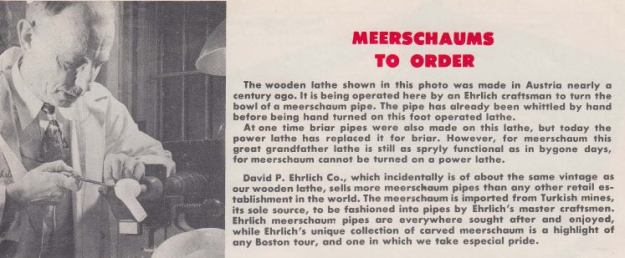
The Ehrlichs have long had meerschaum carvers, who ply their craft in the shop window to the delight of passersby. For years the bearded Gustave Fischer was a familiar figure in the window at 33 Court Street. A succession of craftsmen have continued the tradition. and still make and repair pipes in the window of the new Tremont Street shop. They still turn their meerschaum pipes by hand on a foot operated wooden lathe made in Austria about 1871. Although briars are today turned on power lathes, meerschaum can only be turned on a foot-operated lathe.

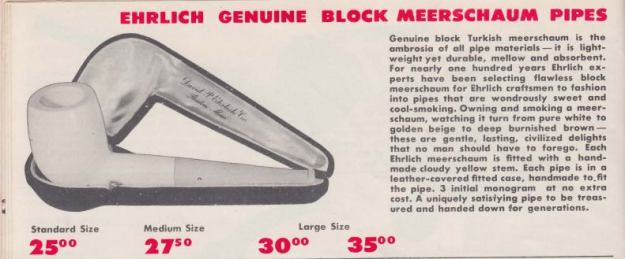
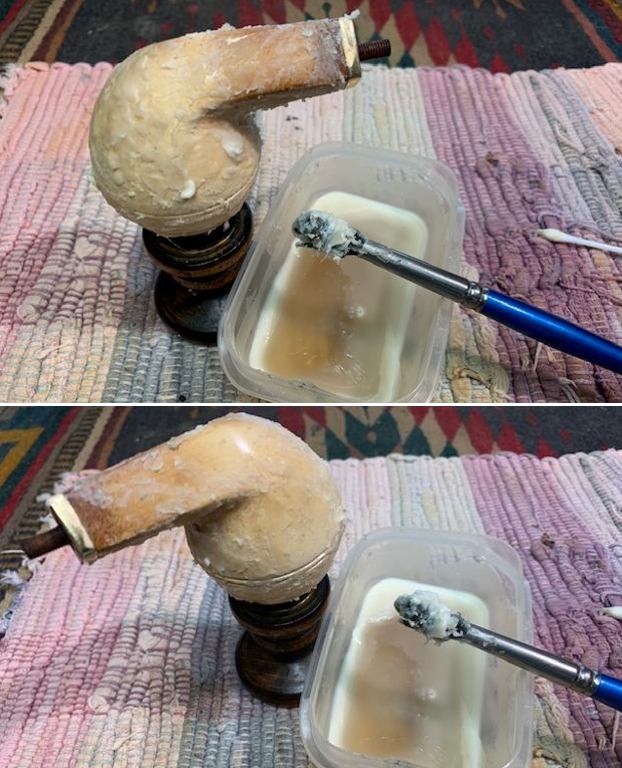
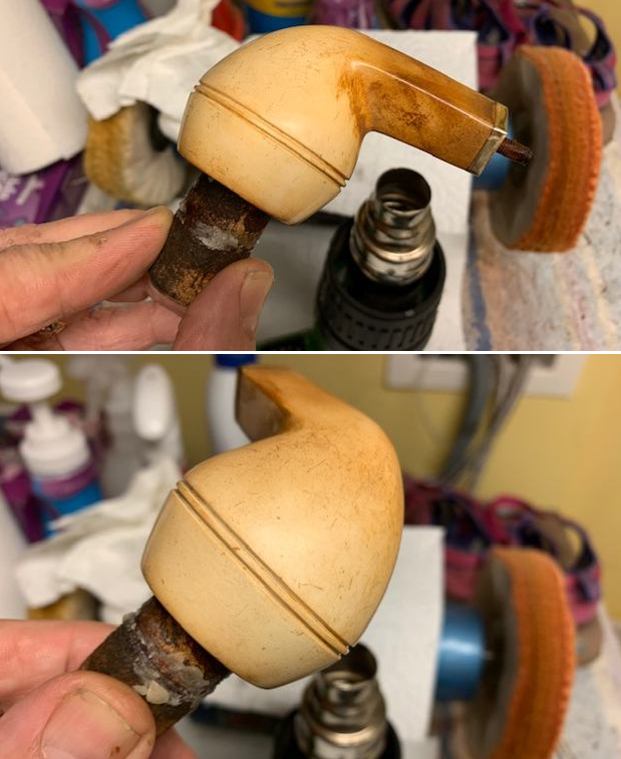
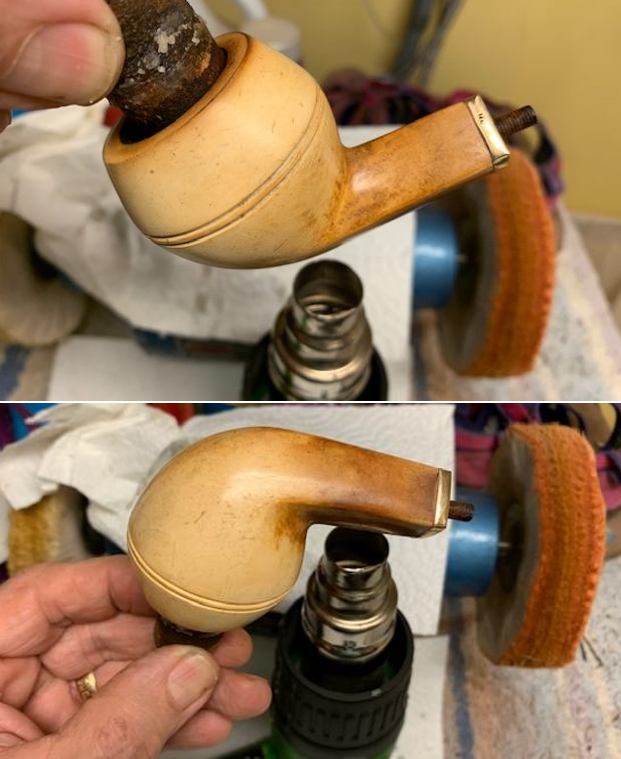
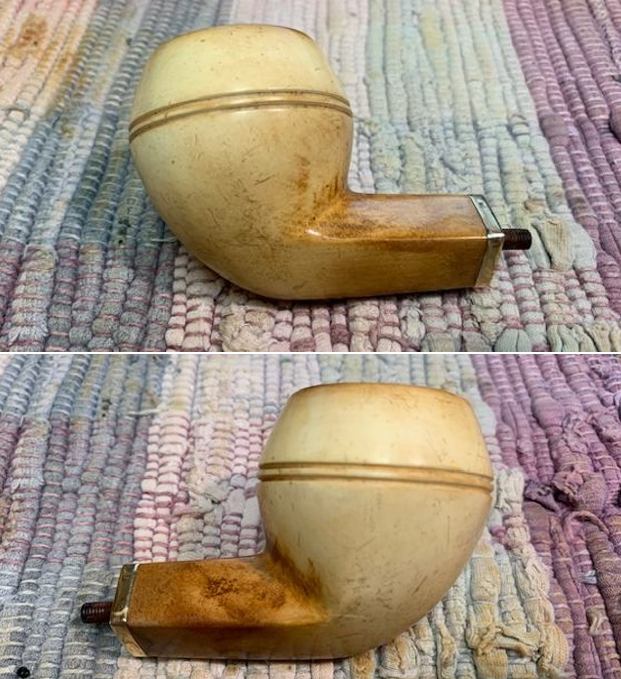
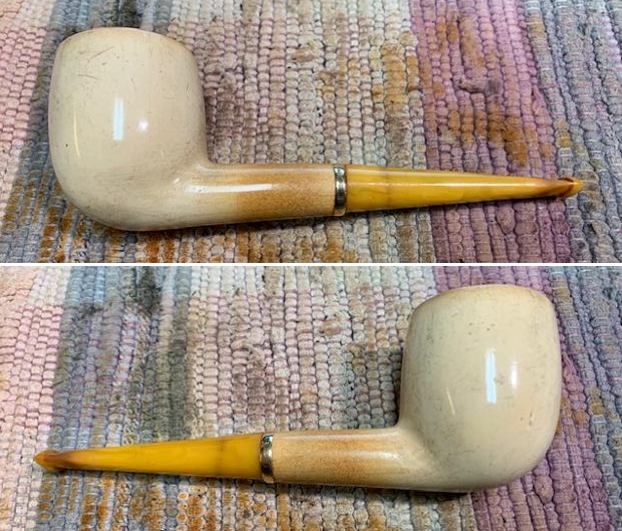
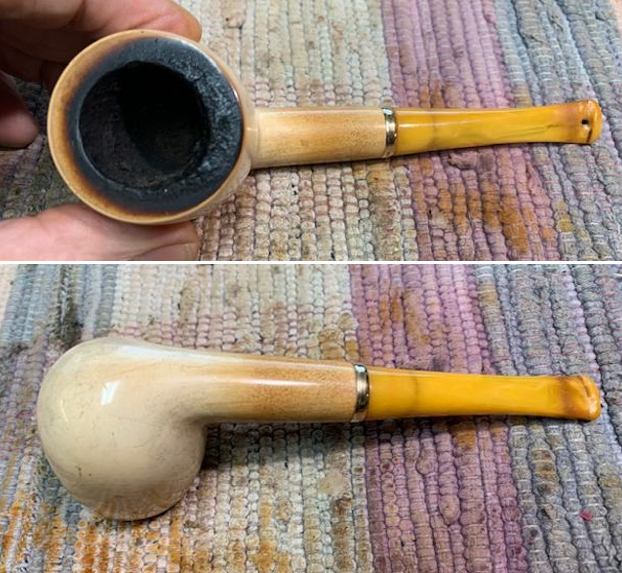
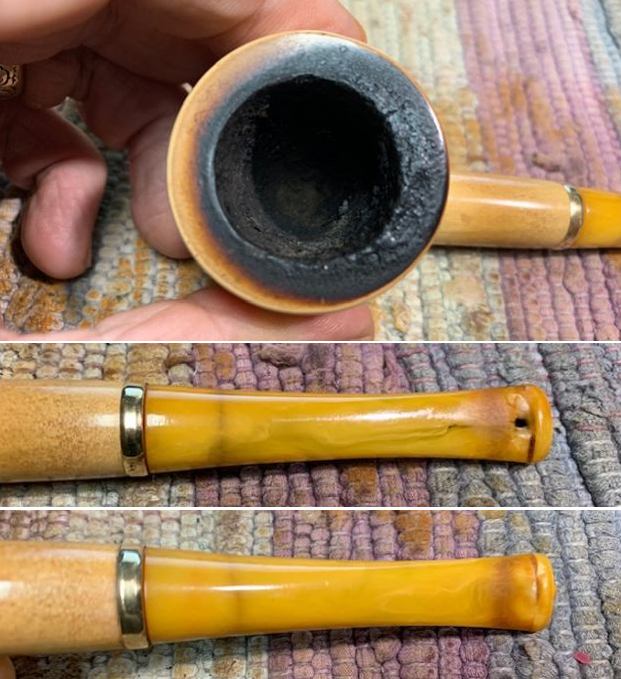
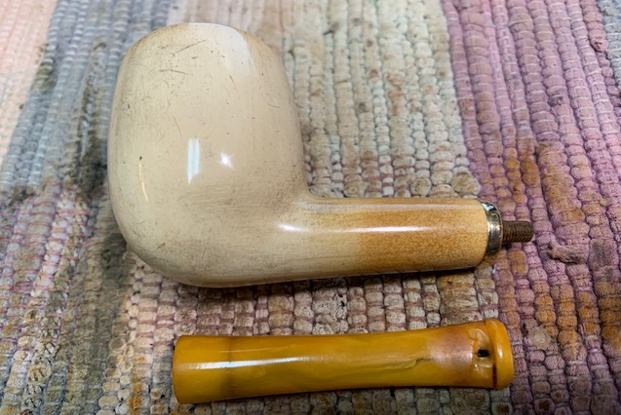
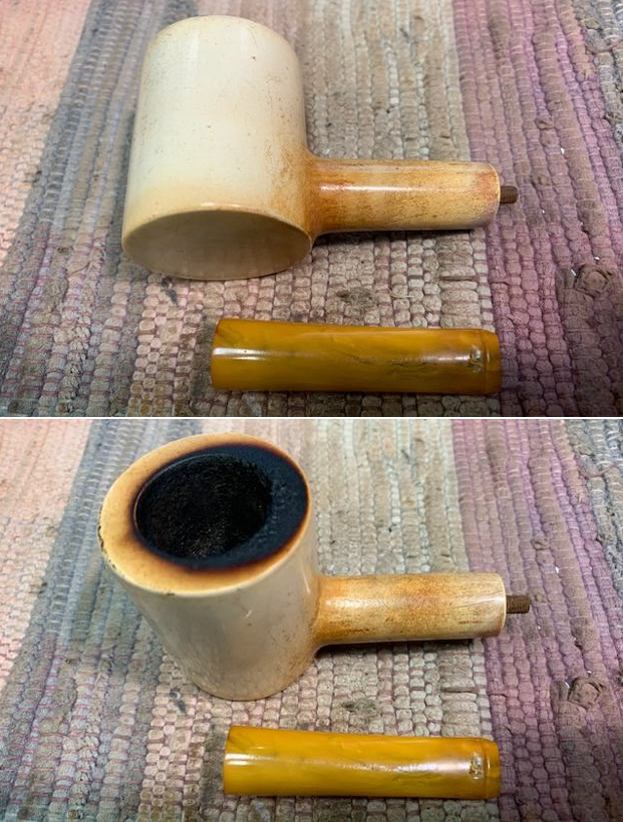
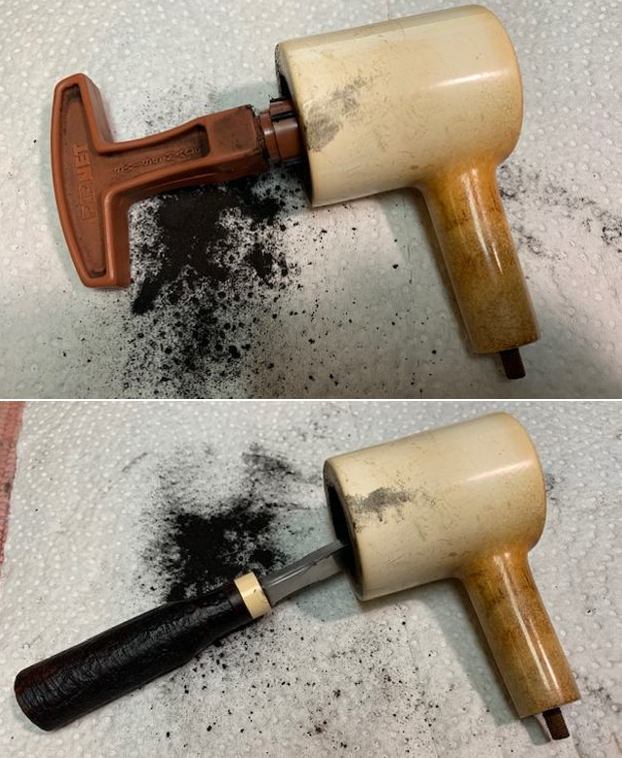
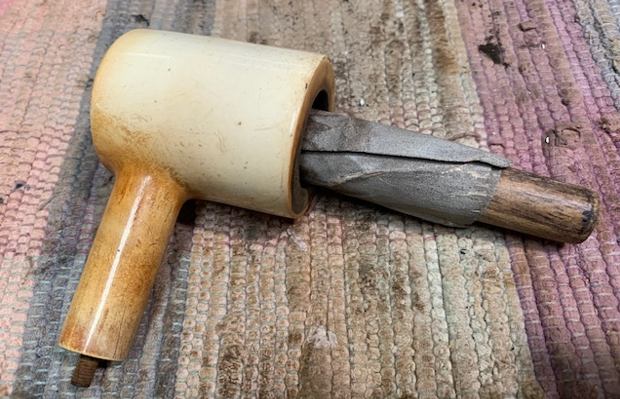
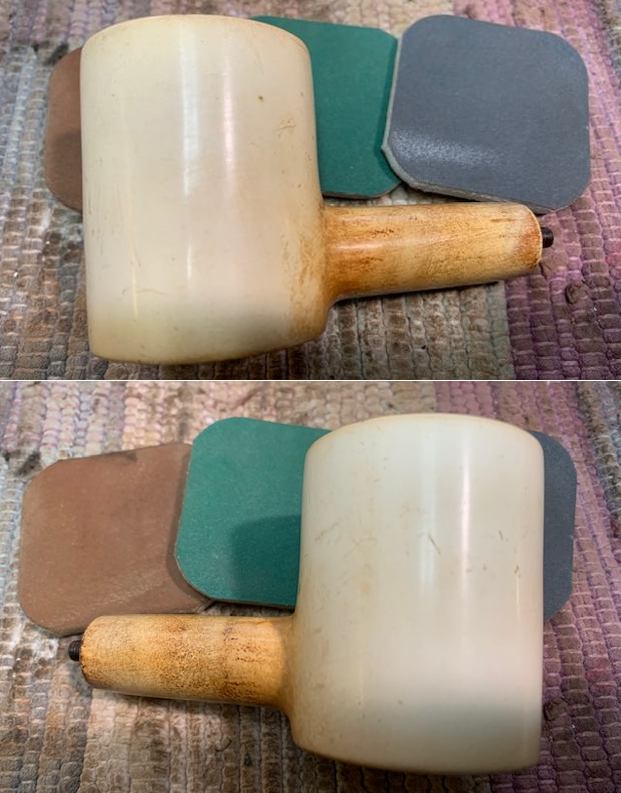
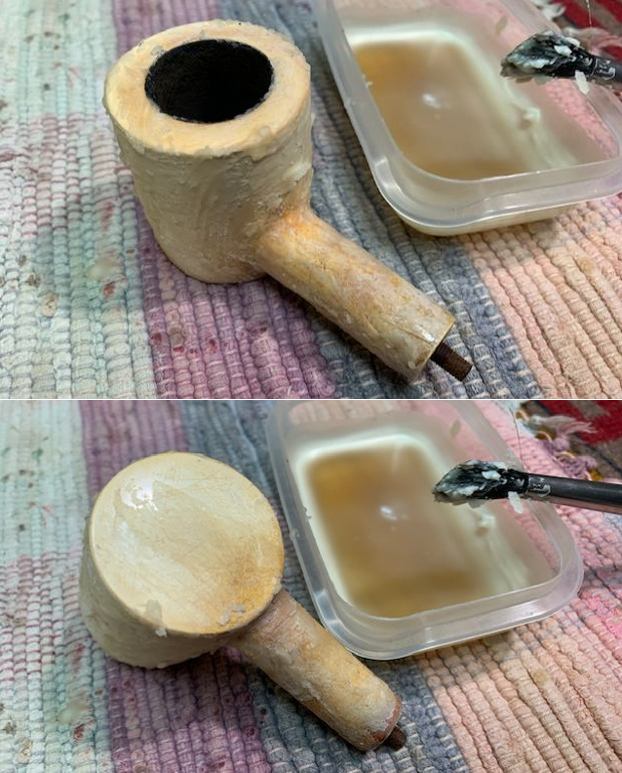
I did a search on Google to see if I could find further documentation on the Ehrlich Meerschaum pipes. I came across a PDF of a 1960s Ehrlich Catalogue that had some helpful sections on the pipes(https://docs.google.com/file/d/0B0xEzQgGtOv8LXNhLUNJQUJrU1U/edit?resourcekey=0-I8eh7aQxyrEcmVW7-SKjFw). I did a screen capture of two of those sections. The first is a great descriptive paragraph on the pipe regarding both the meerschaum and what they call a handmade cloudy yellow stem. The prices are astonishingly low even for those days. The second screen capture is about how the pipes were made on a wooden lathe made in Austria and operated by Ehrlich craftsmen in the window of the Boston shop. It is also a great read.I took the pipe out of the case and took some photos of it to chronicle the condition it was in when I received it. It is another large pipe. I would say it is another large pipe – at least a Dunhill Group 4 or larger. I spent some time going over it carefully. The bowl indeed had a thick cake and the lava coat on the edge and rim was thick as well. It was in worse condition than either the Poker or Billiard had been. There were light surface scratches in the meerschaum all around the bowl and shank sides. The meerschaum was dirty with smudges and dust but underneath it had a nicely developing patina on the shank and heel of the bowl and was beginning to get some colour on the bowl. The stem was the best of the lot. It had tooth marks on the top and underside ahead of the button. I removed the stem from the shank and had a look at the parts. The threaded metal tenon was inset permanently in the shank of the pipe. It was dirty and the pipe had a musty/old tobacco smell. There was a 14K gold wedding ring style band on the shank for decoration. The shank was filthy as was the airway in the stem. The good news for me was that the stem material was solid yellow all the way through so repairing the tooth marks and chatter would be easier. The slot in the stem was filled in partially with debris. Overall it was a great looking pipe that would clean up well. Here is what I saw. I took a close up photo of the bowl and rim top to capture the condition of both. You can see the thick cake in the bowl and the lava on the inner edge and thick on the top and inner edge of the rim. It is by far the most caked and lava covered of all of them. I took photos of the shank and stem as well. You can also see the tooth damage on both sides ahead of the button. I removed the stem from the shank and took a photo of the proportions of the pipe. You can see that it is a large bowl but well proportioned with the stem. I like the looks of it.I started my clean up work on the pipe by reaming the bowl. I wanted to remove the cake completely from the walls of the bowl and clean it thoroughly. I began the reaming with a PipNet pipe reaming set. The bowl is quite large so I used the second and third cutting head. I took it back to the walls. I cleaned it up further with a Savinelli Fitsall Pipe knife. I finished by sanding the interior of the bowl with 220 grit sandpaper wrapped around a dowel. I used the Fitsall knife to carefully scrape off some of the lava on the rim top. It is very thick. I used micromesh sanding pads to remove the remaining lava coat on the rim top and to polish the light scratching around the bowl. I polished the meerschaum with 1500-12000 grit pads wiping it down after each pad with a damp cloth to remove the debris and dust. The bowl and shank began to really take on a shine as I worked on it. (As I mentioned in the previous blogs, my friend and I spoke on the phone and the decision was made to leave the light scratching as part of the story of the pipe.) With the exterior clean I worked on the inside of the shank and stem. The airway on the bottom of the bowl was plugged so I needed to get the airflow open again. I used a curved dental pick to open the airway in bowl bottom. I used isopropyl alcohol, pipe cleaners and cotton swabs to open the airway in the shank and into the bowl and to remove the debris and oils. I cleaned out the end of the stem where the tenon screwed in with cotton swabs and alcohol. Once finished the pipe smelled clean. I filled in the tooth marks on the top and underside of the stem near the button with clear CA glue. Was aiming for smoothing out the tooth marks and making them invisible.Once the repair cured I smoothed out the repair and worked to blend it into the stem with micromesh sanding pads. I smoothed it out with a 1500 grit pad first the polished it with the remaining pads 1800-12000 grit. I wiped it down with a bit of Obsidian Oil to remove the debris after each pad. I was quite pleased with the look of the repaired stem. With the stem finished and the bowl completed to this point it was time recoat the bowl with beeswax. I melted a chunk of beeswax in the microwave and brushed the melted wax onto the bowl and shank. I took photos of the thick wax coat around the bowl sides and top. I look forward to seeing what happens when I melt it off! I used my heat gun on the low setting to melt the excess wax and heat the meerschaum to absorb the wax. I put a thick layer of paper towels below the heat gun to catch the dripping of the wax. I used a cork in the bowl as a handle to turn the pipe over the heat. As the heat and wax did the work the bowl began darken. I took some photos of the bowl when I had finished. It is a beauty. This D.P. Ehrlich Co, Boston Made Meerschaum Straight Bulldog turned out really well and it is a great looking pipe with a great shape to it. The deepening patina around the bowl and shank has been highlighted by the wax and will only deepen with use. The smoky yellow coloured acrylic stem looks good with the darkening bowl and shank. I put the stem back on the bowl and carefully buffed the pipe with a clean buffing pad to raise the shine. I hand buffed the pipe with a microfiber cloth to deepen the shine. The finished Ehrlich Meerschaum Bulldog is comfortable to hold and is quite distinguished looking. Give the finished pipe a look in the photos below. The dimensions of the pipe are Length: 6 inches, Height: 2 inches, Outside diameter of the bowl: 1 ½ inches, Chamber diameter: 1 inch. The weight of the pipe is 50 grams/1.76 ounces. This is the third D.P. Ehrlich Co. Meerschaum I have finished. Now that the last one is finished I will be packing them carefully and sadly saying farewell to some beautiful pieces. I think the pipeman who is carrying on the trust of these beauties will thoroughly enjoy them. Thanks for reading this blog and my reflections on the pipe while I worked on it.

A 3 Pipe Reclamation Project – Next a D.P. Ehrlich & Co. Meerschaum Billiard


Blog by Steve Laug

With the completion of the latest Frankenpipe (https://rebornpipes.com/2021/08/27/it-is-about-time-to-breath-life-into-a-new-frankenpipe/), a break from the routine, it was time to go back to the D.P. Ehrlich Meerschaum reclamation work. I will quote the next paragraphs to give context to the pipes that I am working on in this project.

Not long ago I received a Facebook Message from a friend asking if I would consider restoring three Ehrlich meerschaums that he had. He spoke about first, then sent photos as he knew I was not presently taking on any new work due to my heavy schedule. He described the first cased set – which contained a Bulldog and a Billiard with great patina and cloudy acrylic stems. It sounded amazing. He described the second cased single – a Poker with the same kind of stem. At least one of the stems had a bite through on it. All were heavily smoked and dirty. From his reckoning the pipes came from at least two different time periods in D. P. Ehrlich of Boston’s long life. I thanked him for thinking of me and gently said I would not be able to do the work.

He understood but wanted me to have a look at them anyway. He sent these photos of the pipes in their cases on Messenger. They were indeed beautiful pipes. They were also very tempting. I really like these cased older style, smooth, classic shaped meerschaums. I did not reply to him for a bit and thought it over. I looked over my schedule and calendar for the next two months and it was very heavy. But… I was hooked. I finally answered him and basically said if he was not in a hurry I would be willing to take them on. He replied that he was in no hurry. You have to understand when I have pipes to work on here I squeeze them in somehow but I wanted freedom.Once I gave my answer he sent a few more photos of each of the pipes so that I could have a look at what was coming my way. He sent the tracking number of the pipes as well. They arrived safely and I went over them and called him to talk about what I saw. I restored the Poker first and have written about the restoration of it on rebornpipes. Here is the link to that blog (https://rebornpipes.com/2021/08/26/reclamation-project-an-older-d-p-ehrlich-co-cased-meerschaum-poker/).

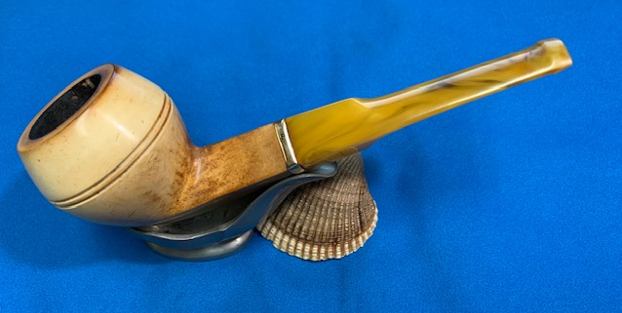
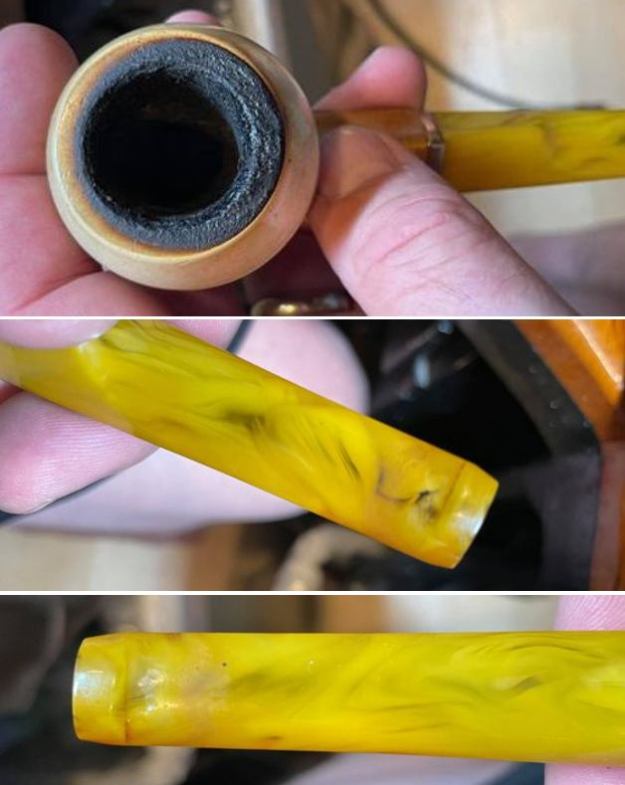
Now to have a look at the Billiard (the pipe of the threesome in the worst condition). He took some photos of the bowl, rim top and stem so I could assess the condition they were in. I have included them below. The lava on the rim top and cake in the bowl are quite thick and I am hoping they have protected the inner edge and top from damage. The 14K gold ring on the shank looked very good. The stem had deep tooth marks on both the top and underside near the button. There was also a bite through on the top side of the stem. The profile definitely shows the condition of the stem. I am quite certain from looking at the photos of the pipe that this is a replacement stem. The fit at the shank is not as good as expected and the material does not appear to be the same as the other two Ehrlich meerschaums. The stem material can be problematic in that the yellow colour often is on the top surface and once there are repairs done or sanding they are visible and significantly different in colour from the rest of the stem. Once I had it in hand and checked it out I would know more. While I have worked on a significant number of Ehrlich briar pipes over the years I have not tackled a meerschaum let alone three older ones. I have worked on a lot of meers but not Ehrlich meers. I actually knew very little about them. They looked like European made meers that come out of Austria but I was unclear of where Ehrlich got these pipes. I was time to due some work on this. I checked first on Pipephil and found only information on the briar pipes. Then I turned to Pipedia and was more successful (https://pipedia.org/wiki/Ehrlich%27s). I quote a portion of that article below that gives a bit of history and more importantly cleared up where the pipes came from for me.

The David P. Ehrlich story – Pipemakers and Tobacconists for a Hundred Years, 1868-1968.

The David P. Ehrlich Company has remained solely in the hands of one family during its century of business, yet it has had several firm names and locations. David P. Ehrlich went to work in 1881 at the age of twenty for Ferdinand Abraham, who dealt in cigars and tobacco and who had begun business in 1868 at 1188 Washington Street in the South End, but in 1880 moved to the center of the city, where the firm has been ever since. David Ehrlich married the boss’s daughter. In 1916 the name became the David P. Ehrlich Company and Mr. Ehrlich devoted the rest of his life to this business. Since David’s death in 1912 it has been owned by – his nieces and nephews including Richard A. and William Ehrlich.

Ehrlich shop has since 1880 had a predilection for historic sites. 25 Court Street was close to the spot where from 1721-1726 James Franklin had, with the assistance of his brother Benjamin, published The New-England Courant. In 1908 the firm moved a few doors up Court Street to number 37, on the opposite corner of the alley that is grandiloquently named Franklin Avenue. This new location was on the site of the one-time printing office of Edes and Gill, publishers of the Boston Gazette, in whose back room some of the “Indians” of the Boston Tea Party assumed their disguises. Soon after the end of World War II at which time the store was located at 33 Court Street a move around the corner to 207 Washington Street brought the shop diagonally across from the Old State House and onto the site occupied from 1610-1808 by the First Church of Boston. The demolition of 207 Washington Street in 1967 caused still another move to 32 Tremont Street, adjoining King’s Chapel burying Ground, which is the oldest cemetery in Boston.

The David P. Ehrlich Co. has not just occupied sites intimately associated with Boston history and institutions; it has in the past century become a Boston institution in its own right. It has specialized in fine cigars, pipes, and pipe tobacco. In addition to the retail business, the firm has long specialized in the manufacture of pipes, both from Algerian briar root and from meerschaum, a beautiful white fossilized substance, mined from the earth in Turkish Asia Minor. Meerschaum lends itself to carving, and in the nineteenth century there developed in Austria a fashion for carving pipes from it with formidably intricate decoration.

The Ehrlichs have long had meerschaum carvers, who ply their craft in the shop window to the delight of passersby. For years the bearded Gustave Fischer was a familiar figure in the window at 33 Court Street. A succession of craftsmen have continued the tradition. and still make and repair pipes in the window of the new Tremont Street shop. They still turn their meerschaum pipes by hand on a foot operated wooden lathe made in Austria about 1871. Although briars are today turned on power lathes, meerschaum can only be turned on a foot-operated lathe.

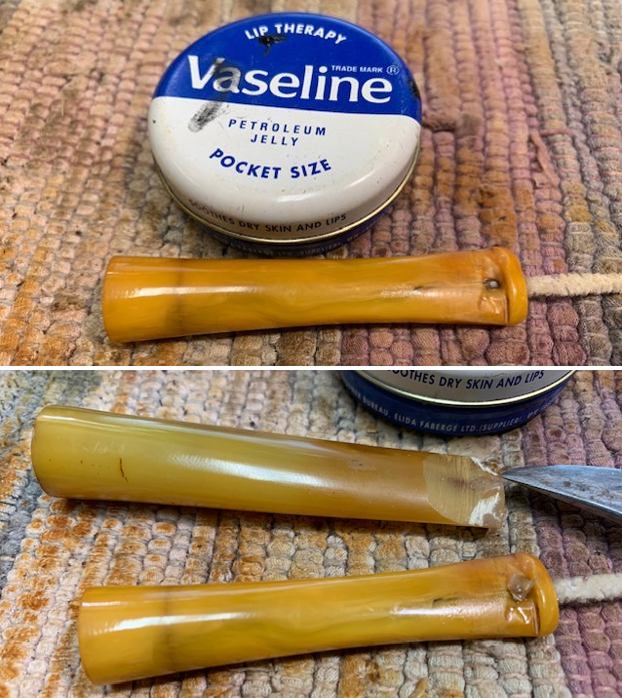
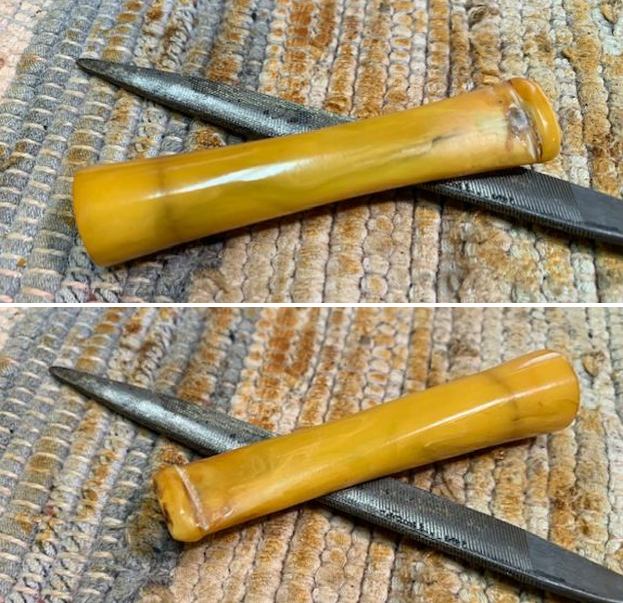
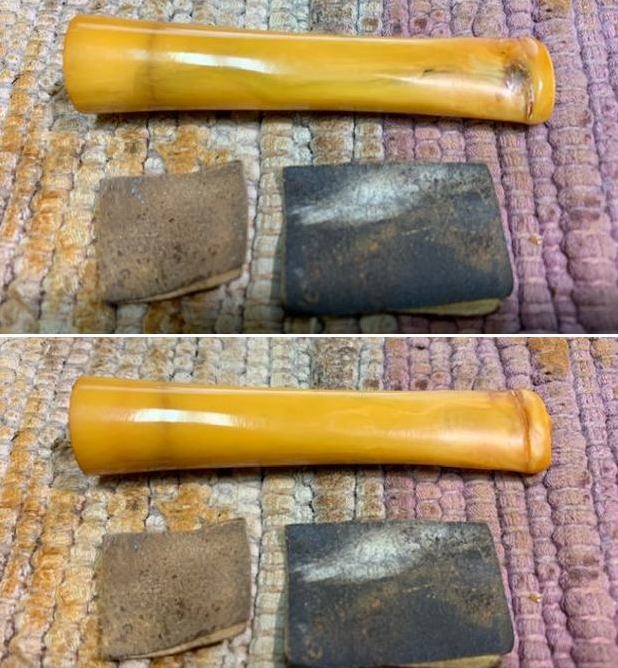
I did a search on Google to see if I could find further documentation on the Ehrlich Meerschaum pipes. I came across a PDF of a 1960s Ehrlich Catalogue that had some helpful sections on the pipes(https://docs.google.com/file/d/0B0xEzQgGtOv8LXNhLUNJQUJrU1U/edit?resourcekey=0-I8eh7aQxyrEcmVW7-SKjFw). I did a screen capture of two of those sections. The first is a great descriptive paragraph on the pipe regarding both the meerschaum and what they call a handmade cloudy yellow stem. The prices are astonishingly low even for those days.The second screen capture is about how the pipes were made on a wooden lathe made in Austria and operated by Ehrlich craftsmen in the window of the Boston shop. It is also a great read.I took the pipe out of the case and took some photos of it to chronicle the condition it was in when I received it. It is another large pipe. I would say it is at least a Dunhill Group 4 or larger pipe. I spent some time going over it carefully. The bowl indeed had a thick cake and the lava coat on the edge and rim was thick as well. It was in worse condition than the Poker had been. There were light surface scratches in the meerschaum all around the bowl and shank sides. The meerschaum had a nicely developing patina on the shank and heel of the bowl and was beginning to get some colour on the bowl. The stem was the worst of the lot. I had tooth marks on the top and underside and a bite through on the top of the stem ahead of the button. I removed the stem from the shank and had a look at the parts. The threaded metal tenon was inset permanently in the shank of the pipe. It was dirty and the pipe had a musty/old tobacco smell. There was a 14K gold wedding ring style band on the shank for decoration. The shank was filthy as was the airway in the stem. The good news for me was that the stem material was solid yellow all the way through. Repairing it would be easier, though the stem had its own darkening patina at the button end. The slot in the stem was filled in partially with debris. Overall it was a great looking pipe that would clean up well. Here is what I saw. I took a close up photo of the bowl and rim top to capture the condition of both. You can see the thick cake in the bowl and the lava on the inner edge and thick on the top and inner edge of the rim. I took photos of the shank and stem as well. You can also see the tooth damage on both sides ahead of the button. The bite-through is clearly visible on the top of the stem at the button.I removed the stem from the shank and took a photo of the proportions of the pipe. You can see that it is a large bowl with a relatively shorter stem. I like the looks of it however.I started my clean up work on the pipe by reaming the bowl. I wanted to remove the cake completely from the walls of the bowl and clean it thoroughly. I began the reaming with a PipNet pipe reaming set. The bowl is quite large so I used the second and third cutting head. I took it back to the walls. I cleaned it up further with a Savinelli Fitsall Pipe knife. I finished by sanding the interior of the bowl with 220 grit sandpaper wrapped around a dowel. I used the Fitsall knife to carefully scrape off some of the lava on the rim top. It is very thick. I used micromesh sanding pads to work on the light scratching around the bowl and to remove the thick lava coat on the rim top. I removed the sharpness of the nicks on the front of the bowl at the same time. I polished the meerschaum with 1500-12000 grit pads wiping it down after each pad with a damp cloth to remove the debris and dust. The bowl and shank began to really take on a shine as I worked on it. (As I mentioned in the previous blog, my friend and I spoke on the phone and the decision was made to leave the light scratching as part of the story of the pipe.) With the exterior clean I worked on the inside of the shank and stem. The airway on the bottom of the bowl was plugged so I needed to get the airflow open again. I used isopropyl alcohol, pipe cleaners and cotton swabs to open the airway into the bowl and to remove the debris and oils. I cleaned out the end of the stem where the tenon screwed in with cotton swabs and alcohol. Once finished the pipe smelled clean.I still need to wax the bowl but I set it aside for now and turned my attention to the stem. I cleaned off the surface of the acrylic with alcohol to remove and debris from the tooth dents. I took some photos of the stem as it was after cleaning. The dents and hole are very clear in the photos.I greased a pipe cleaner with Vaseline and inserted it in the stem below the hole to protect the airway from the glue hardening and closing it off. Now I was ready to do the patch. I decided to try a bit of a new method (at least for me) on this repair. I have ground up dust from donor stem and mixed that with the CA glue to do the repair. The issue has always been that when you sand the yellow acrylic stem the dust is always white. That just does not work. So today I decided to cut a chunk of the acrylic stem off the donor stem and fill in the hole with that and CA glue around it to hold it in place. We shall see if it works. I also filled in the tooth marks on the underside and the chips on the edges and end of the button with the CA glue at the same time. I used just glue there and no chips.The repair cured and it filled in the hole very well. As it dried the piece of yellow stem turned dark (brownish yellow) and it did not match. The repair on the underside worked very well and the rebuild on the button did as well using just the clear CA glue. I used a small file to flatten out the repaired hole and recut the button. As I smoothed out the repaired hole with 220 grit sandpaper, the yellow of the original stem lightened. On the end of the button it turned almost white. It is definitely not the same material as the original stems of the other Ehrlich pipes I am working on.I worked on it to blend it into the stem with micromesh sanding pads. It worked well on the underside but the top still is a bit of an eyesore. I worked it smooth with a 1500 grit pad first the polished it with the remaining pads 1800-12000 grit. I wiped it down with a bit of Obsidian Oil to remove the debris after each pad. I was quite pleased with the look of the repaired stem. With the stem finished and the bowl completed to this point it was time recoat the bowl with beeswax. I melted a chunk of beeswax in the microwave and brushed the melted wax onto the bowl and shank. I took photos of the thick wax coat around the bowl sides and top. I look forward to seeing what happens when I melt it off!I used my heat gun on the low setting to melt the excess wax and heat the meerschaum to absorb the wax. I put a thick layer of paper towels below the heat gun to catch the dripping of the wax. I used a cork in the bowl as a handle to turn the pipe over the heat. As the heat and wax did the work the bowl began darken. I took some photos of the bowl when I had finished. It is a beauty.This D.P. Ehrlich Co, Boston Made Meerschaum Billiard turned out really well and it is a great looking pipe with a great shape to it. The deepening patina around the bowl and shank has been highlighted by the wax and will only deepen with use. The smoky yellow coloured acrylic stem looks good with the darkening bowl and shank. I put the stem back on the bowl and carefully buffed the pipe with a clean buffing pad to raise the shine. I hand buffed the pipe with a microfiber cloth to deepen the shine. The finished Ehrlich Meerschaum Billiard is both comfortable to hold and is quite distinguished looking. Give the finished pipe a look in the photos below. The dimensions of the pipe are Length: 5 ¾ inches, Height: 2 inches, Outside diameter of the bowl: 1 ½ inches, Chamber diameter: 1 inch. The weight of the pipe is 50 grams/1.76 ounces. This is the second D.P. Ehrlich Co. Meerschaum I have finished. Once finish the last one I will be packing them carefully and sadly saying farewell to some beautiful pieces. Thanks for reading this blog and my reflections on the pipe while I worked on it. Keep an eye out for the final one.

It is about time to Breath Life into a new Frankenpipe


Blog by Steve Laug

I have not created a Frankenpipe for a long time. I call them Frankenpipes with a tip of the hat to Mary Shelley’s grand creation Frankenstein. These remind me of her story what with the gathering of parts, “stitching” them together and breathing life into them. It is a thoroughly creative process I enjoy and I suppose there is always the possibility of crafting of a monster. Over the years I have crafted quite a few of these pipes and they tend to stay in my collection. You can search on the blog and see the variety of Frankenpipes that have come together. I find them incredibly enjoyable because they are very different from a restoration. Truly it is looking at a bunch of parts and imagining combining them into something that reflects the parts but as a whole it very different from any of them.

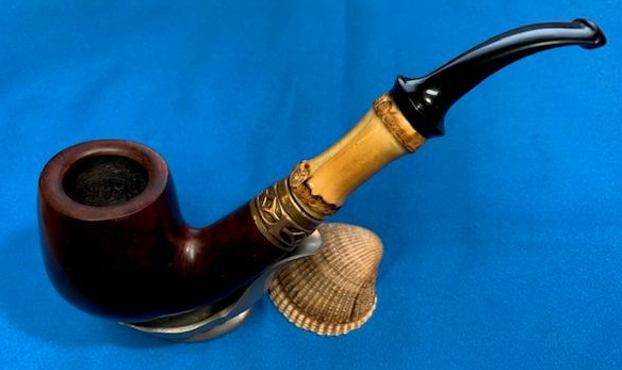
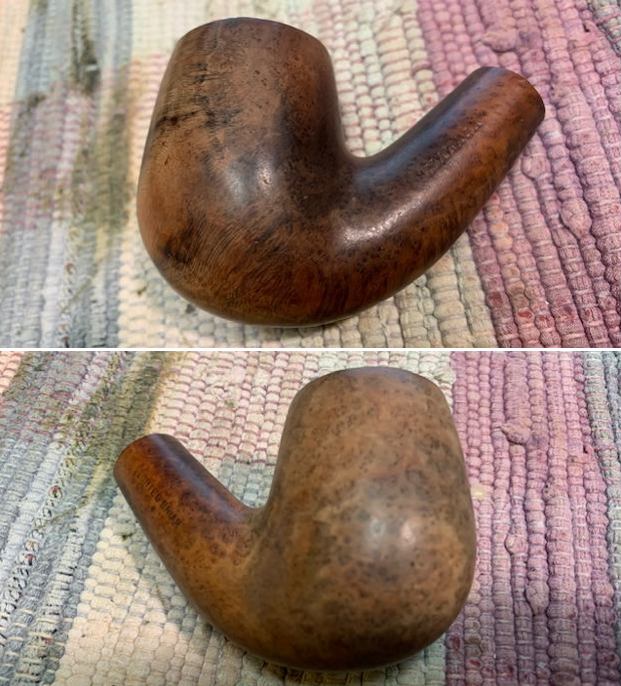
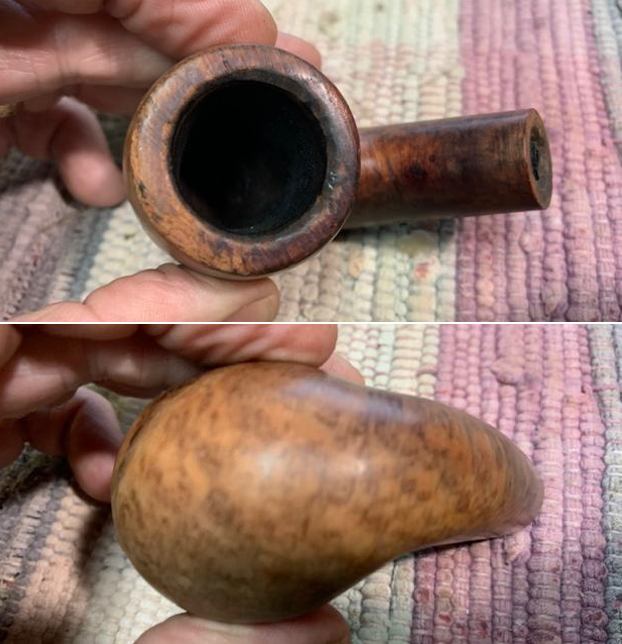
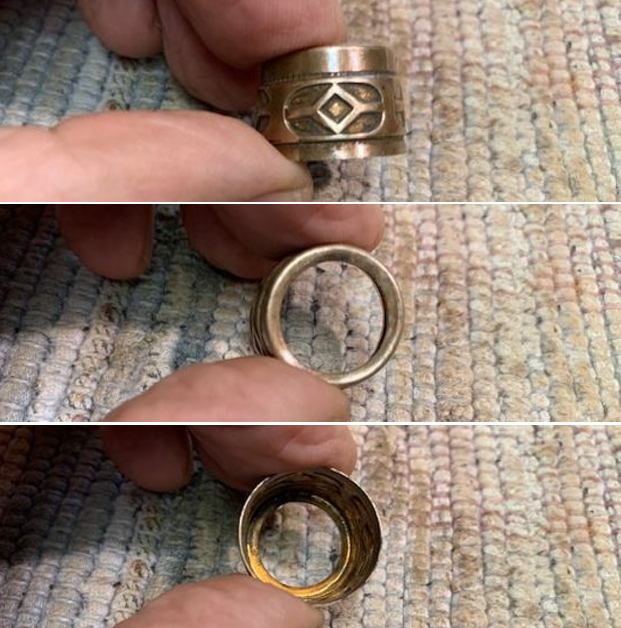
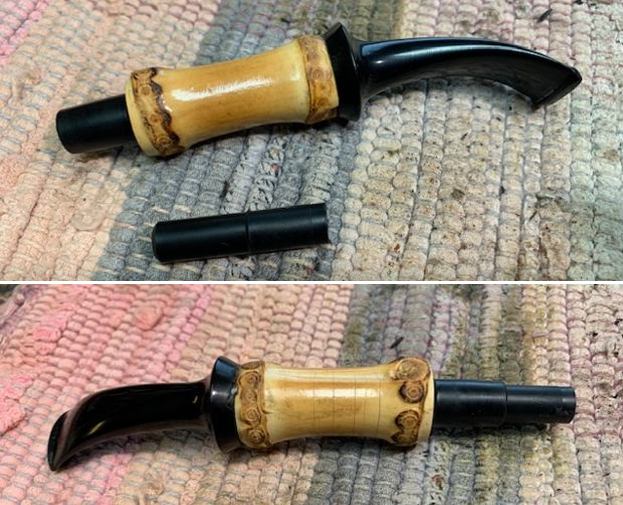
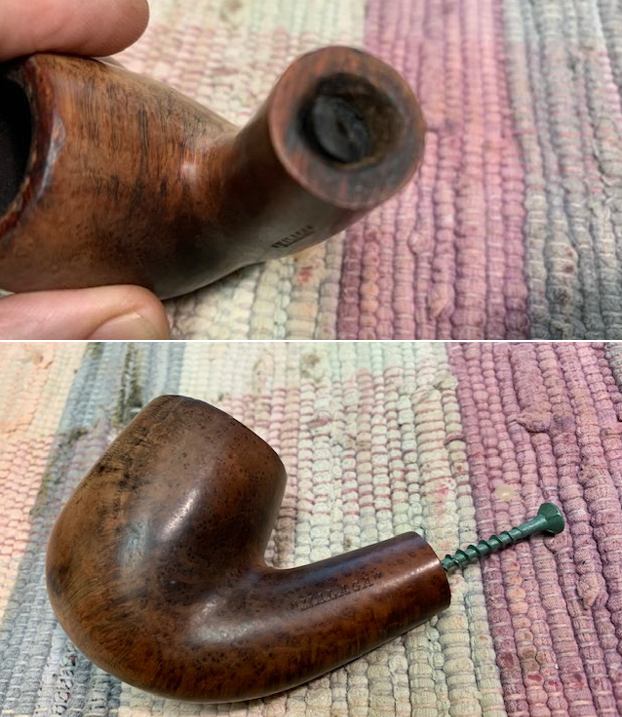
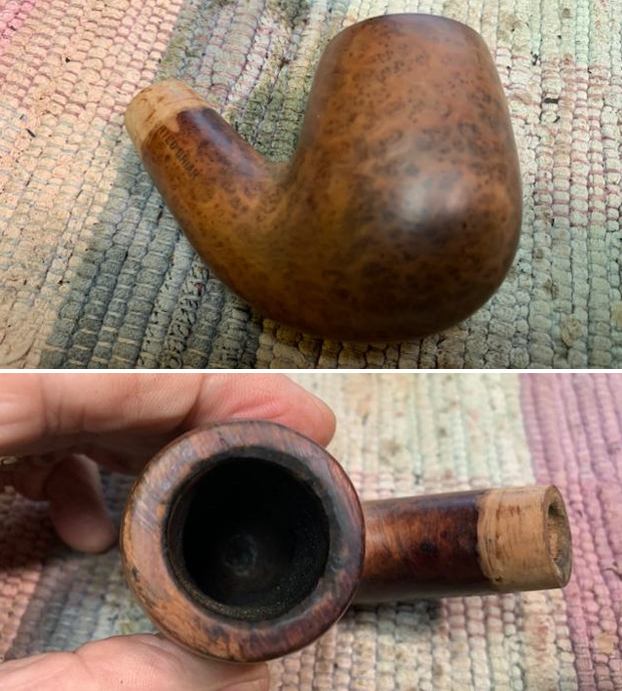
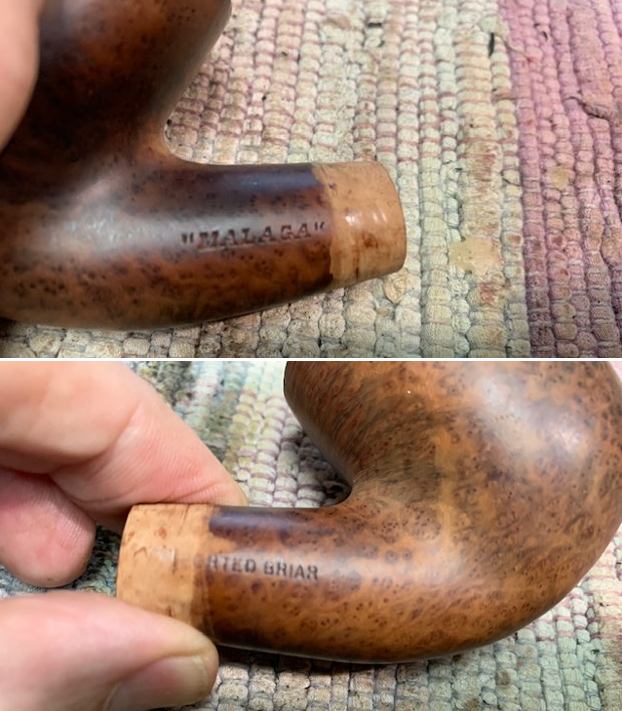
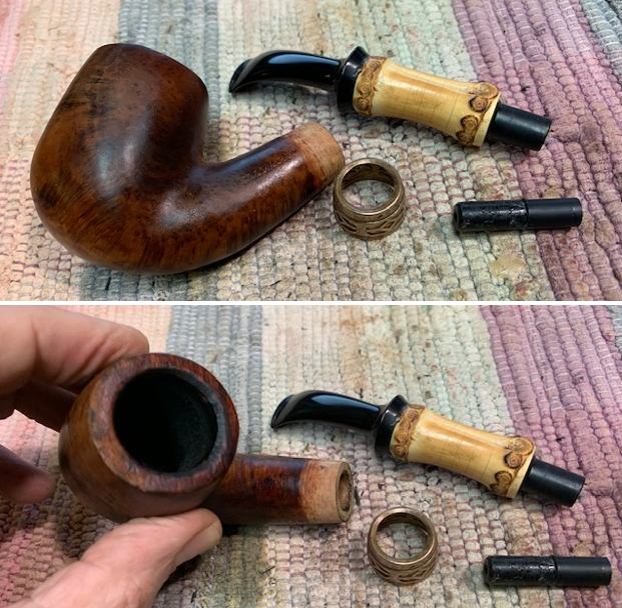
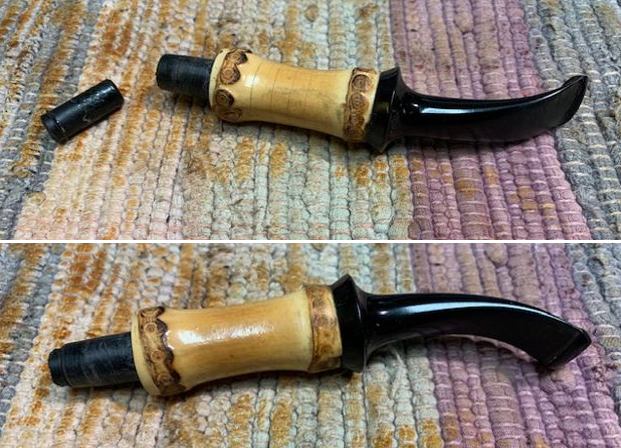
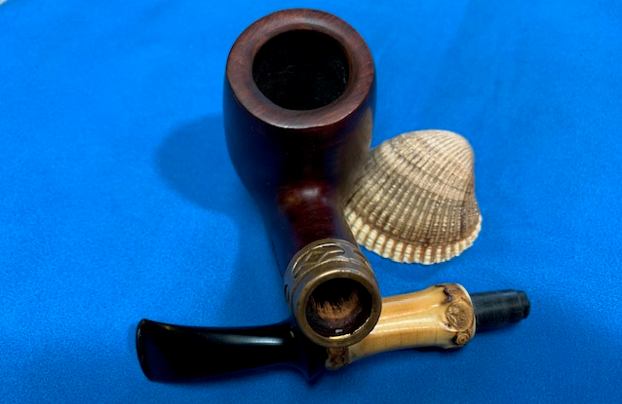
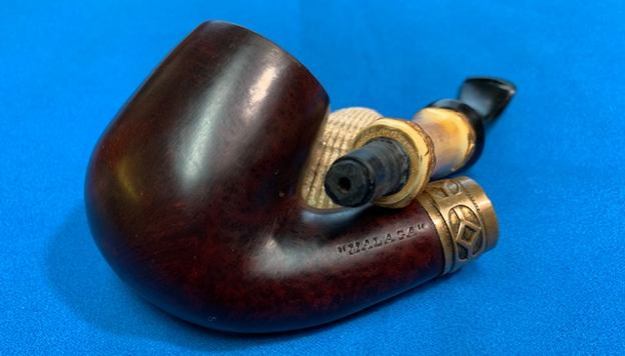
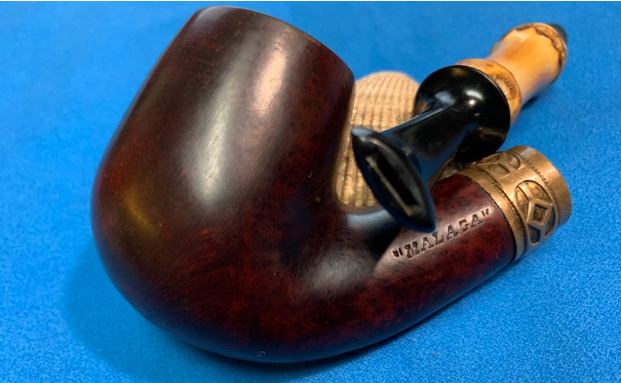
This afternoon I had an urge to make a Frankenpipe so after work I went through my parts. I found some parts that with some imagination could make an interesting looking pipe – at least in my mind’s eye. The parts for this Frankenpipe have all been around for a long time. The bowl is one I have had in a box here that had a snapped tenon in the shank. The stem had disappeared a long time ago and I did not have a stem for it that interested me. It is a large magnum sized “Malaga” bowl. It is far from a perfect piece of briar with a bald spot on the front left of the bowl. The rim top has burn marks and the bowl is out of round – thicker on the front side of the bowl than either side of the back of the bowl. The inner edge had a burned in “bevel” on the back right. The finish was worn and tired with black streaks over the bald spot on the left front of the bowl. It needed some serious TLC to bring life to it. Jeff had done his thorough clean up on the bowl so it was ready to work on. Here is what I saw with the bowl! As I stared at the bowl I thought that a band might look interesting on it. Don’t ask me why because as yet I had not chosen a stem for the bowl. I just thought a band would work. I went through my box of bands and nothing turned my crank or caught my eye. Then I remembered a bag of parts that I have from the mid to late 1800s. In that bag were several unique and original bands. There was one that caught my eye and I really thought it had promise. I took it out of the bag and found that it was in excellent condition and was probably never used. Here are some pictures of the decorative brass band.At that point I had an aha moment. I remembered an odd stem that I had in my collection of stems that just might be the thing that I was looking for on this Frankenpipe. It was unique and one that Jeff had picked up and save for me. I had never found a use for it but now I thought I might have. The two knuckle bamboo shank and acrylic stem is a single that has bend bonded together. The stem is thus a unit with the bamboo and the Delrin tenon on the other end is also integrated. It is drilled for a filter so I found a repair tenon that I could craft into an adapter to convert the tenon to a regular pipe sans filter. It would be removable if needed. Here is what it looked like with and without the tenon adapter. (The adapter would need to be shortened but you get the idea.)All of the parts have been here for quite a while. All of them give silent testimony to my crazy propensity to collect parts!! And all of them would finally come together to form a new Frankenpipe that was more than the sum of its parts. Read along as I walk through my process.

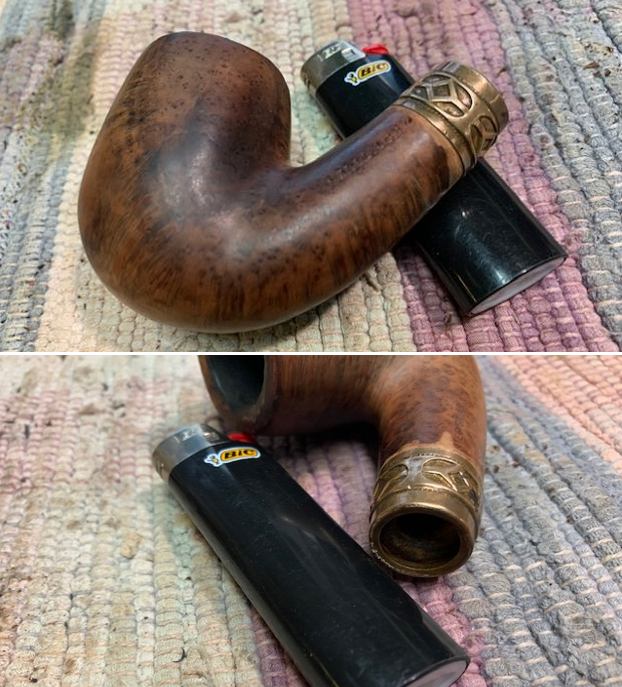
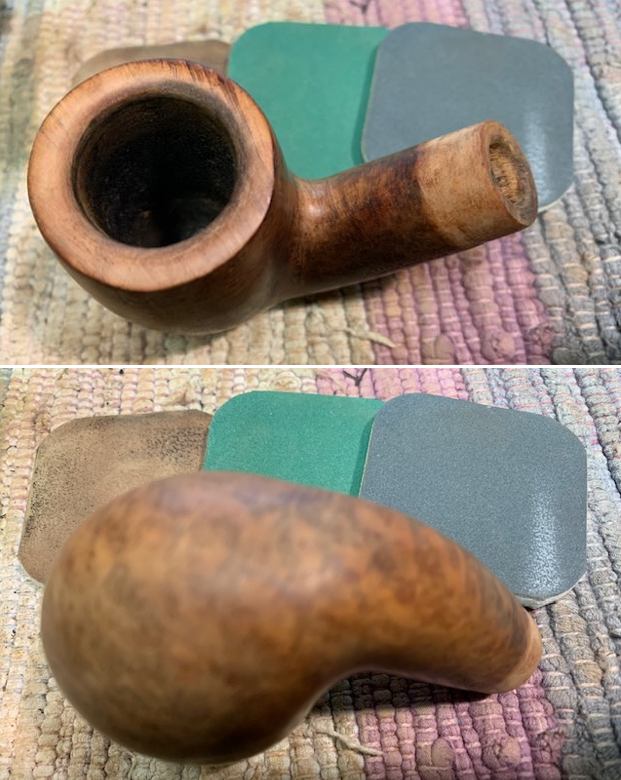
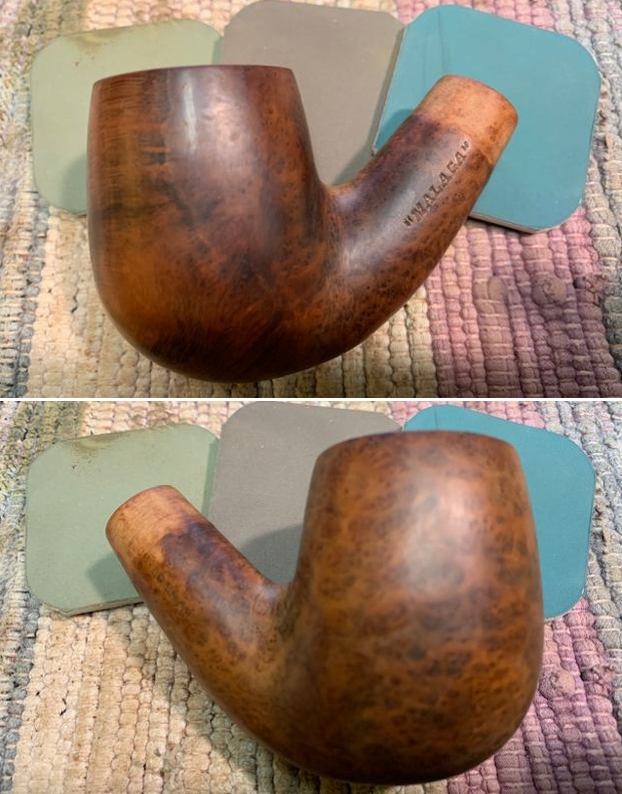
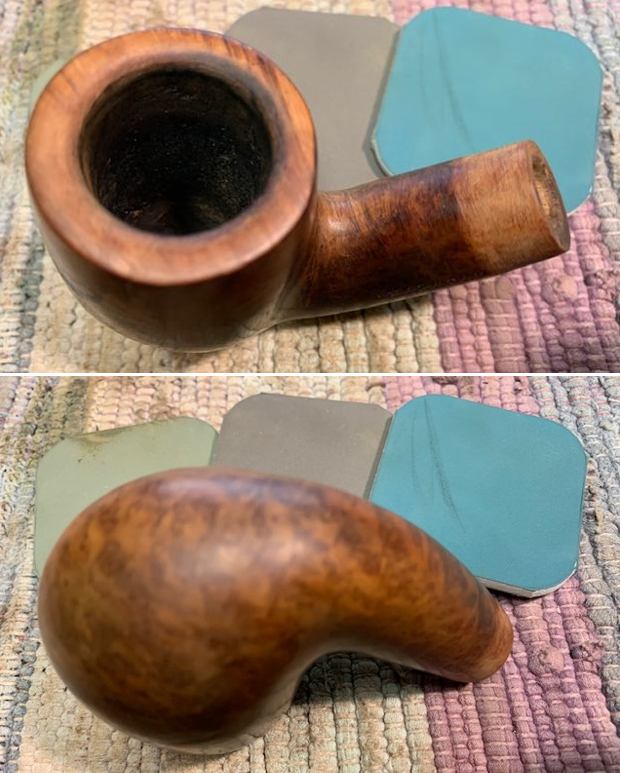
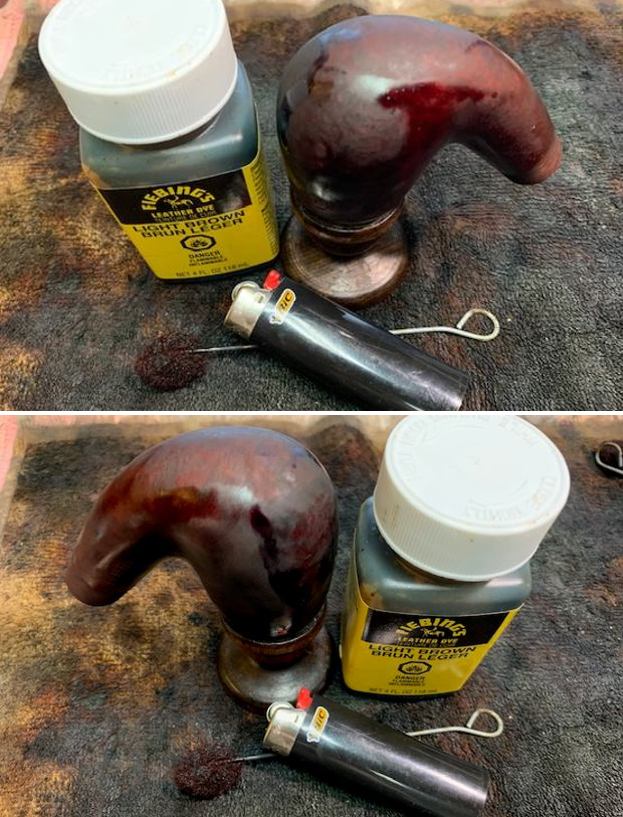
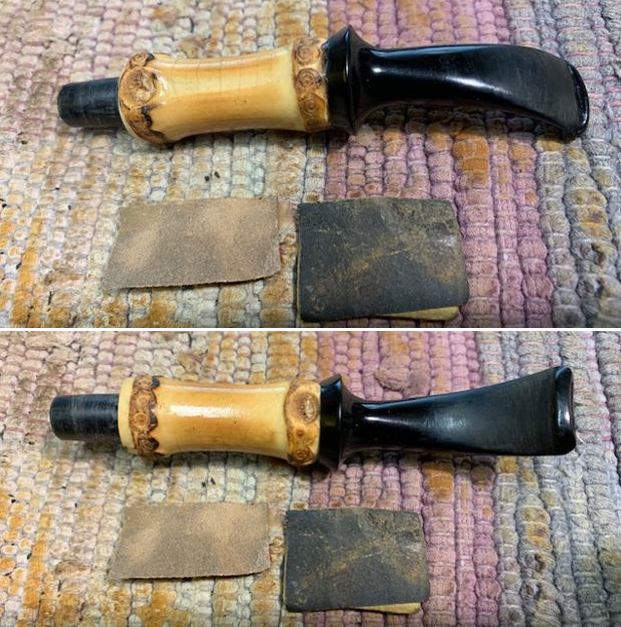
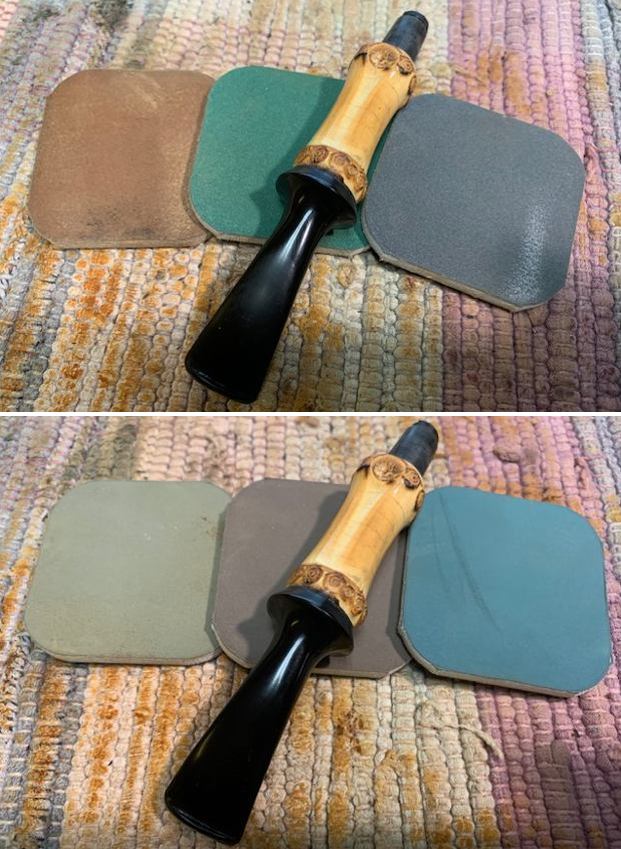
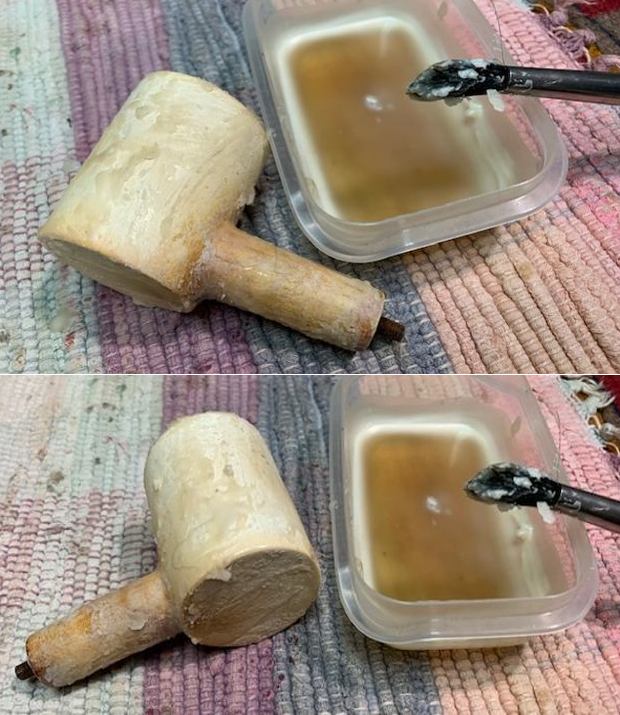
I began the work by addressing the issues with the bowl. I tried to pull the broken tenon with a screw. It was stuck so I put the bowl in the freezer for a little while. After about 10 minutes I tried again and was successful pulling the tenon out of the shank.With that finished I need to address the shank of the pipe to fit the conical ferrule/band that I had chosen. In the next photos you can see that I have chosen to shape the shank end to match the flow of the band. I did this with a Dremel and sanding drum and smooth it out with files and sandpaper. I was careful to leave the original Malaga stamp intact. I was not as concerned with the Imported Briar stamp on the right side of the shank. Progress is being made.I did a bit more shaping on the shank end. The decorative band now fit it quite well. I put the parts side by side and took some photos of the parts of the pipe. I took photos from various angles and sides. Can you begin to see what I am seeing with this pipe? I think it is going to work. Do you? Now back to work on the bowl! I decided to deal with the rim top damage by topping the bowl. It was in rough shape so I used 150 grit sandpaper on a topping board and remove the damaged parts of the rim top. It looked better. I worked over the inner edge of the rim with a folded piece of 150 sandpaper to give it all a bevel to match the burn damage at the back of the bowl. At this point I wanted to try the fit of the band on the shank. I heated it slightly with a lighter and pressed in place. I like what I am seeing. I removed the band once it cooled and went to work some more on the bowl. It needed to be polished and stained before I set the band in place but I wanted to have a look. Didn’t you? I wiped the bowl and shank down with acetone on a cotton pad to try to remove the dark patches and the remnants of the stain. All of this was in preparation for the future staining of the bowl. I polished the bowl with micromesh sanding pads – dry sanding with 1500-12000 grit pads to prepare it for staining. I wiped it down with a damp cloth to remove the debris after each pad. I stained the polished bowl with Fiebings Light Brown aniline stain. I applied the stain, flamed it and repeated the process until I was happy with the coverage. I set it aside to dry.Once the stain dried I wiped the bowl down with alcohol to make the stain more transparent. I buffed the pipe on the buffer with both Red Tripoli and Blue Diamond to further reduce the heaviness of the colour. I worked some Before & After Restoration Balm into the surface of the briar with my finger tips. The product works to clean, enliven and protect the briar. I let it sit on the briar for 10 minutes then buffed it off with a soft cloth. With the bowl finished and the stain cured it was time to press the band in place. I gave it a thin layer of white all purpose glue on the inside of the band and pressed it onto the shank end. It looks quite fetching to me. I set it aside to let the glue cure but I like it! I set the bowl aside and worked on the tenon adapter and the stem surface. I used the Dremel and sanding drum to shorten the adapter until the fit in the tenon allowed the shank to fit snug against the shank end.With the internals finished it was time to work on the tooth marks and chatter on the surface of the acrylic stem. I sanded them smooth with a folded piece of 220 grit sandpaper. I started polishing the stem surface with 400 grit wet dry sandpaper.I polished the stem with micromesh sanding pads – 1500-12000 grit pads. I dry sanded the stem with the pads and wiped it down with a damp cloth after each pad. I finished the polishing with Before & After Pipe Stem Polish – both Fine and Extra Fine. I gave it a final buff with a cloth and Obsidian Oil. I put the parts of the Frankenpipe together and took the pipe to the buffer. I buffed it with Blue Diamond and really like the way the brass and bamboo polished up. They looked great after buffing. The bowl and stem also shone but I expected that really. The combination of the darker stain on the bowl, the antique brass band, the 2 knuckle bamboo with developing patina and the black acrylic stem came together even better than expected. I gave the pipe several coats of carnauba wax on the buffing wheel. I buffed it with a clean buffing pad to raise the shine and hand buffed it with a microfibre cloth to deepen the shine. The finished pipe really shone with rich hues. The dimensions of this Frankenpipe are Length: 5 ½ inches from the front of the bowl to tip of the stem, Height: 2 inches, Outer diameter of the bowl: 1 ¾ inches, Chamber diameter: 7/8 of an inch. The weight of the pipe is 69 grams/ 2.47 ounces. It really surprised me as it looks to be a much bigger pipe than it is. I would say it is Dunhill Group 5 pipe at least in terms of bowl size. It really is a beautiful pipe in person and it will be staying with me along with the other Frankenpipes I have crafted. I am looking forward to enjoying a bowl shortly. It was a fun pipe to work on. I hope you enjoyed the process as you read about it. Thank you for taking time to read about it. As Paresh says – Stay safe/Stay healthy.

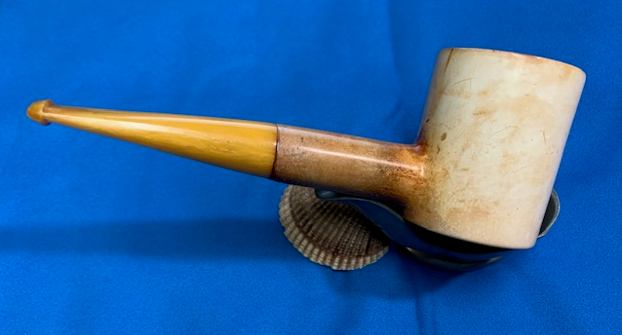
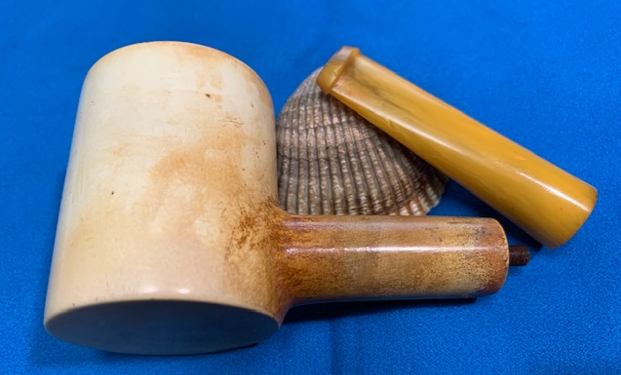
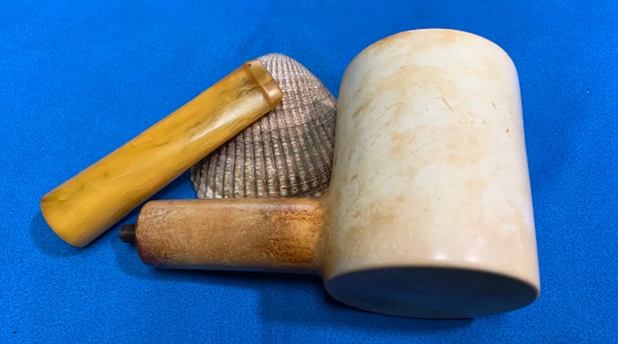
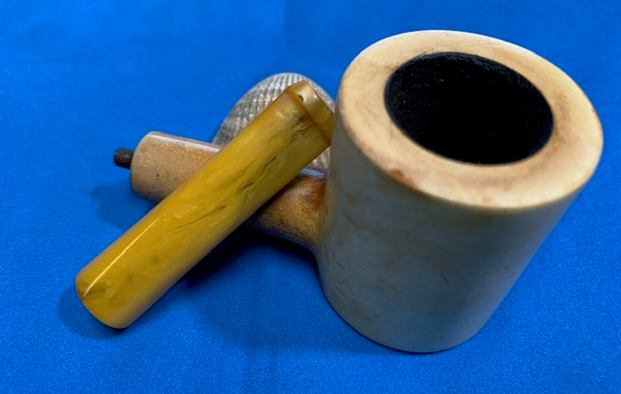
Reclamation Project – an older D.P. Ehrlich & Co. Cased Meerschaum Poker


Blog by Steve Laug

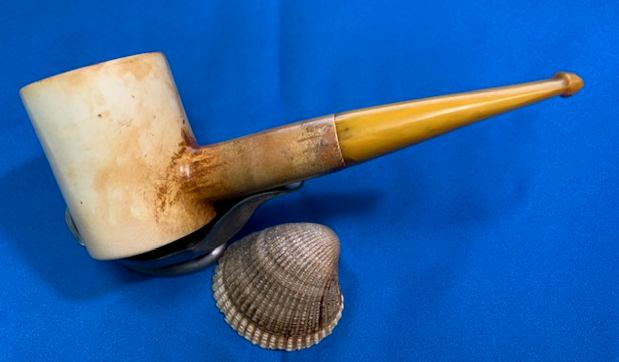
It was not too long ago that I received a Message on Facebook from a friend asking me if I would consider restoring three Ehrlich cased meerschaums that he had. He spoke about them before he sent photos as he knew I was not presently taking on any new work due to my heavy schedule. He described the first cased set – which contained a Bulldog and a Billiard with great patina and cloudy acrylic stems. It sounded amazing. He then described the second cased single – a Poker with the same kind of stem. At least one of the stem had a bite through on it. All were heavily smoked and dirty. All were purchases that he had made. From his reckoning the pipes came from at least two different time periods in D. P. Ehrlich of Boston’s long life. I thanked him for thinking of me and gently said I would not be able to do the work.

He understood but wanted me to have a look at them anyway. He sent these photos of the pipes in their cases on Messenger. They were indeed beautiful pipes. They were also very tempting. I really like these cased older style, smooth, classic shaped meerschaums. I did not reply to him for a bit and thought it over. I looked over my schedule and calendar for the next two months and it was very heavy. But… I was hooked. I finally answered him and basically said if he was not in a hurry I would be willing to take them on. He replied that he was in no hurry. You have to understand when I have pipes to work on here I squeeze them in somehow but I wanted freedom.Once I gave my answer he sent along a few photos of each of the pipes so that I could have a look at what was coming my way. Then he sent the tracking number of the pipes as well. I decided that would tackle the Poker first. I believe it is a bit newer than the others and the stem material is slightly different. Here are some photos of the pipe that he sent me. You can see the thick cake in the bowl and the overflow of lava on the rim top. The finish is quite scratched but nothing deep so those present were part of the story of the pipe. The exterior and the interior of the pipe was really dirty with use and also from sitting and not being used.He took some photos of the bowl, rim top and stem so I could assess the condition they were in. I have included them below. You can see that the outer edge of the bowl has some nicks in the meerschaum on the front side. The lava and cake are quite thick and I am hoping they have protected the inner edge and top from damage. The stem had deep tooth marks on both the top and underside near the button but the profile looked promising. This stem material can be problematic in that the yellow colour often is on the top surface and once there are repairs done or sanding they are visible and significantly different in colour from the rest of the stem. Once I had it in hand and checked it out I would know more.While I have worked on a significant number of Ehrlich briar pipes over the years I have not tackled a meerschaum let alone three older ones. I have worked on a lot of meers but not Ehrlich meers. I actually knew very little about them. They looked like European made meers that come out of Austria but I was unclear of where Ehrlich got these pipes. I was time to due some work on this. I checked first on Pipephil and found only information on the briar pipes. Then I turned to Pipedia and was more successful (https://pipedia.org/wiki/Ehrlich%27s). I quote a portion of that article below that gives a bit of history and more importantly cleared up where the pipes came from for me.

The David P. Ehrlich story – Pipemakers and Tobacconists for a Hundred Years, 1868-1968.

The David P. Ehrlich Company has remained solely in the hands of one family during its century of business, yet it has had several firm names and locations. David P. Ehrlich went to work in 1881 at the age of twenty for Ferdinand Abraham, who dealt in cigars and tobacco and who had begun business in 1868 at 1188 Washington Street in the South End, but in 1880 moved to the center of the city, where the firm has been ever since. David Ehrlich married the boss’s daughter. In 1916 the name became the David P. Ehrlich Company and Mr. Ehrlich devoted the rest of his life to this business. Since David’s death in 1912 it has been owned by – his nieces and nephews including Richard A. and William Ehrlich.

Ehrlich shop has since 1880 had a predilection for historic sites. 25 Court Street was close to the spot where from 1721-1726 James Franklin had, with the assistance of his brother Benjamin, published The New-England Courant. In 1908 the firm moved a few doors up Court Street to number 37, on the opposite corner of the alley that is grandiloquently named Franklin Avenue. This new location was on the site of the one-time printing office of Edes and Gill, publishers of the Boston Gazette, in whose back room some of the “Indians” of the Boston Tea Party assumed their disguises. Soon after the end of World War II at which time the store was located at 33 Court Street a move around the corner to 207 Washington Street brought the shop diagonally across from the Old State House and onto the site occupied from 1610-1808 by the First Church of Boston. The demolition of 207 Washington Street in 1967 caused still another move to 32 Tremont Street, adjoining King’s Chapel burying Ground, which is the oldest cemetery in Boston.

The David P. Ehrlich Co. has not just occupied sites intimately associated with Boston history and institutions; it has in the past century become a Boston institution in its own right. It has specialized in fine cigars, pipes, and pipe tobacco. In addition to the retail business, the firm has long specialized in the manufacture of pipes, both from Algerian briar root and from meerschaum, a beautiful white fossilized substance, mined from the earth in Turkish Asia Minor. Meerschaum lends itself to carving, and in the nineteenth century there developed in Austria a fashion for carving pipes from it with formidably intricate decoration.

The Ehrlichs have long had meerschaum carvers, who ply their craft in the shop window to the delight of passersby. For years the bearded Gustave Fischer was a familiar figure in the window at 33 Court Street. A succession of craftsmen have continued the tradition. and still make and repair pipes in the window of the new Tremont Street shop. They still turn their meerschaum pipes by hand on a foot operated wooden lathe made in Austria about 1871. Although briars are today turned on power lathes, meerschaum can only be turned on a foot-operated lathe.

I did a search on Google to see if I could find further documentation on the Ehrlich Meerschaum pipes. I came across a PDF of a 1960s Ehrlich Catalogue that had some helpful sections on the pipes(https://docs.google.com/file/d/0B0xEzQgGtOv8LXNhLUNJQUJrU1U/edit?resourcekey=0-I8eh7aQxyrEcmVW7-SKjFw). I did a screen capture of two of those sections. The first is a great descriptive paragraph on the pipe regarding both the meerschaum and what they call a handmade cloudy yellow stem. The prices are astonishingly low even for those days.The second screen capture is about how the pipes were made on a wooden lathe made in Austria and operated by Ehrlich craftsmen in the window of the Boston shop. It is also a great read.Now it was time to bring out the pipes that arrived today. I took out the cased Poker from the well packed box it came in and had a look. I took a photo of the pipe in the case to show the setting of the pipe. You can see the D.P. Ehrlich Co. Boston label in the cover of the hand made case. The lining is soft and made to fit the pipe perfectly. The pipe shows some developing patina.I took the pipe out of the case and took some photos of it to chronicle the condition it was in when I received it. It is a large Dunhill Group4 or more sized pipe. I spent some time going over it carefully. The bowl indeed had a thick cake and the lava coat on the edge and rim was thick as well. There were nicks around the front outer edge of the bowl. There were light surface scratches in the meerschaum all around the bowl sides. The shank had the deepest scars that seemed to run horizontally along all sides of the shank. The meerschaum ha a nicely developing patina on the shank and heel of the bowl. The stem had tooth marks on the top and underside that were not as deep as I had originally thought from the photos. I removed the stem from the shank and had a look at the parts. The threaded metal tenon was inset permanently in the shank of the pipe. It was dirty and the pipe had a musty/old tobacco smell. The shank was filthy as was the airway in the stem. The good news for me was that the stem material was solid yellow all the way through. Repairing it would be easier though the stem had its own darkening patina at the button end. The slot in the stem was filled in partially with debris. Overall it was a great looking pipe that would clean up well. Here is what I saw. I took a close up photo of the bowl and rim top to capture the condition of both. You can see the thick cake in the bowl and the lava on the inner edge and thick on the back side of the rim. You can also see the nicks on the outer edge of the bowl at the front. I took photos of the shank and stem as well. You can see the scratches in the shank that run horizontally along it. You can also see the tooth damage on both sides ahead of the button.I removed the stem from the shank and took a photo of the proportions of the pipe. You can see that it is a large bowl with a relatively shorter stem. I like the looks of it however.I started my clean up work on the pipe by reaming the bowl. I wanted to remove the cake completely from the walls of the bowl and clean it thoroughly. I began the reaming with a PipNet pipe reaming set. The bowl is quite large so I used the second and third cutting head. I took it back to the walls. I cleaned it up further with a Savinelli Fitsall Pipe knife. I finished by sanding the interior of the bowl with 220 grit sandpaper wrapped around a dowel. I used micromesh sanding pads to work on the light scratching around the bowl and to remove the thick lava coat on the rim top. I removed the sharpness of the nicks on the front of the bowl at the same time. I polished the meerschaum with 1500-12000 grit pads wiping it down after each pad with a damp cloth to remove the debris and dust. The bowl and shank began to really take on a shine as I worked on it. (The owner and I spoke on the phone and the decision was made to leave the light scratching as part of the story of the pipe.) With the exterior clean I worked on the inside of the shank and stem. I used isopropyl alcohol, pipe cleaners and cotton swabs to remove the debris and oils. I cleaned out the end of the stem where the tenon screwed in with cotton swabs and alcohol. Once finished the pipe smelled clean.I still need to wax the bowl but I set it aside for now and turned my attention to the stem. I cleaned off the surface of the acrylic with alcohol to remove and debris from the tooth dents. Once it was clean I carefully filled in the indentations with a drop of clear CA glue. Once the repair had cured I blended it in with micromesh sanding pads. I worked it smooth with a 1500 grit pad first the polished it with the remaining pads 1800-12000 grit. I wiped it down with a bit of Obsidian Oil to remove the debris after each pad. I was quite pleased with the look of the repaired stem. With the stem finished and the bowl completed to this point it was time recoat the bowl with beeswax. I melted a chunk of beeswax in the microwave and brushed the melted wax onto the bowl and shank. I took photos of the thick wax coat around the bowl sides and top. I look forward to seeing what happens when I melt it off! I used my heat gun on the low setting to melt the excess wax and heat the meerschaum to absorb the wax. I put a thick layer of paper towels below the heat gun to catch the dripping of the wax. I used a cork in the bowl as a handle to turn the pipe over the heat. As the heat and wax did the work the bowl began darken. I took some photos of the bowl when I had finished. It is a beauty. This D.P. Ehrlich Co, Boston Made Meerschaum Poker turned out really well and it is a great looking pipe with a great shape to it. The deepening patina around the bowl and shank has been highlighted by the wax and will only deepen with use. The smoky yellow coloured acrylic stem looks very good with the darkening bowl and shank. I put the stem back on the bowl and carefully buffed the pipe with a clean buffing pad to raise the shine. I hand buffed the pipe with a microfiber cloth to deepen the shine. The finished Ehrlich Meerschaum Poker is comfortable to hold and is quite distinguished looking. Give the finished pipe a look in the photos below. The dimensions of the pipe are Length: 6 inches, Height: 2 inches, Outside diameter of the bowl: 1 ¾ inches, Chamber diameter: 1 inch. The weight of the pipe is 58 grams/2.01 ounces. Once finish his other two D.P. Ehrlich Co Meerschaums I will be packing them carefully and sadly saying farewell to some beautiful pieces. Thanks for reading this blog and my reflections on the pipe while I worked on it. Keep an eye out for the next two.

Refurbishing System Pipe From Savinelli…A “Dry System” # 2101


Blog by Paresh Deshpande

Since the time I completed the pipes selected by Karthik, last of the lot was a lattice design meer (Refurbishing Karthik’s Second Selection – A Stacked Lattice Design Meerschaum | rebornpipes), I have completed another 13 odd pipes that had reached me for repairs and restoration. Each had its own set of challenges which were relatively easy to overcome. What was difficult, however, was dealing with the owner’s instructions as to how I should carry out the repairs, which were very frustrating. Just imagine, a beautiful Brakner that required a tenon replacement to maintain its originality and value and the owner wanted me to replace the stem as it would be cheaper and faster!! Of course, the heart of a restorer won over the mind of repairman and I did a tenon replacement.

Moving on, the next pipe that I chose to work on came to me from Steve!! SURPRISED? Well, the truth is that I was on a lookout for a Savinelli Dry System pipe as I was keen to try one and experience the difference between the Pete System pipe and the Savinelli System pipe. Steve and Jeff had been on a road cum pipe hunting trip and had come up with a rich haul of some cool pipes. We worked out a mutually beneficial deal and just when Steve was to send the parcel, COVID happened….. A wait of more than a year and the parcel with selected pipes reached me when I was under shifting to present location. Another wait of settling down period and the pipe finally made its way to my work table.

I love classic shaped pipes and this one has a classic Billiard shape with a substantial sized chamber and thick walls. Save for a bald patch that is seen at the lower half over the right side of the stummel, the stummel boasts of plenty of Bird’s eye and cross grain across the surface. It is stamped on the left side over the shank as arched “SAVINELLI” over “DRY” over reverse arched “SYSTEM” forming the shape of a rugby ball. The right side of the shank bears the shape code # 2101 over the COM stamp “ITALY” towards the bowl while the Savinelli trademark “S” in shield is to the left of the shape code towards the ferrule end. The nickel ferrule is stamped on the left as “SAVINELLI” in capital letters. Letter “S” adorns the top face of the saddle of the vulcanite stem. The stampings are all crisp and easily discernible. I searched rebornpipes to see if I could find any information on this pipe, as I invariably always do, to save time in digging out information about the brand. And true enough, my friend Dal Stanton, aka The Pipe Steward, had worked on a Dry System pipe from Savinelli, albeit a sandblasted one. The research done by Dal is always very detailed and comprehensive to an extent that there is hardly any information that he has missed out. To avoid the proverbial reinvention of the wheel, I have included the link here for those interested in knowing more about this offering from Savinelli (and a big thank you to Dal goes without saying!)
Recommissioning a Smart Savinelli Dry System 3621 Bent Dublin | rebornpipes

With a better understanding of this line from Savinelli, I move ahead with my visual inspection of the pipe.

Initial Visual Inspection
The first thing that you notice is the size and heft of the pipe in hand; it’s a lot of pipe for sure! The chamber walls are nice and thick with a thin layer of cake in the chamber. The rim top surface has thick layer of lava overflow, which given the layer of cake in the chamber is mystifying. The flow of air through the pipe is not very smooth and full. The interestingly grained stummel surface is covered in dirt, dust and grime with a number of dents and dings signifying extensive and uncared for usage. The vulcanite saddle stem is heavily oxidized with damage to the button and in the bite zone. The following pictures will give the readers a rough idea to the general condition of the pipe. Dimensions Of The Pipe
(a) Overall length of the pipe: –          6 inches.

(b) Bowl height: –                               1.9 inches.

(c) Inner diameter of chamber: –         0.7 inches

(d) Outer diameter of chamber: –        1.3 inches

Detailed Inspection Of The Pipe And Observations
The chamber has a thin crust of carbon over the chamber walls suggesting that the chamber had been reamed in the recent past. The chamber walls are sans any damage and has years of smoke left in it. However, the thick layer of lava crust over the rim top surface has me surprised as it is an indicator of heavy usage while the chamber is neatly reamed! Through the lava crust, suspected charring to the inner rim edge is observed in the 12 and 6 o’clock direction (encircled in yellow). A number of dents are visible over the rim top surface (encircled in green), probably a result of knocking against a hard surface edge. The exact extent of damage and the condition of the rim surface will be apparent once the lava crust is completely eliminated from the top surface. The geometry of the pipe is spot on with the draught aperture in dead center and at the bottom of the chamber and that makes me believe that it should smoke smoothly. The ghost smells of the previous tobacco is not very strong and should be completely eliminated once the cake has been removed and the shank internals are thoroughly cleaned. The substantial briar estate is sans any fills and boasts of beautiful Bird’s eye grain to the sides and cross grain to the front and aft of the stummel. The only sore spot over the entire stummel surface is the bald patch that is seen to the right bottom portion. There are numerous dents/ dings over the surface (encircled in pastel blue); a testimony of all the falls this pipe has endured during its existence. The surface is mired in grime and dirt and appears dull and lackluster. The well and mortise is not very dirty and should clean up easily. The nickel ferrule has absolutely no damage but is oxidized with age. This should clean up nicely. The high quality vulcanite stem is so heavily oxidized that it appears dirty green in color! Some minor tooth chatter and deep bite marks are seen on either surfaces of the stem in the bite zone. This issue should not be a major headache to address. The upper surface edge of the large horizontal slot appears damaged, extent of which can be ascertained after the clogged slot has been cleaned up. The lip edge on both sides has bite marks and would need to be reconstructed and reshaped. The wide tenon that houses a 6mm Balsa filter has accumulated oils and tars that have dried out on the inside. The bite zone has calcium deposits which will have to be cleaned. The Process
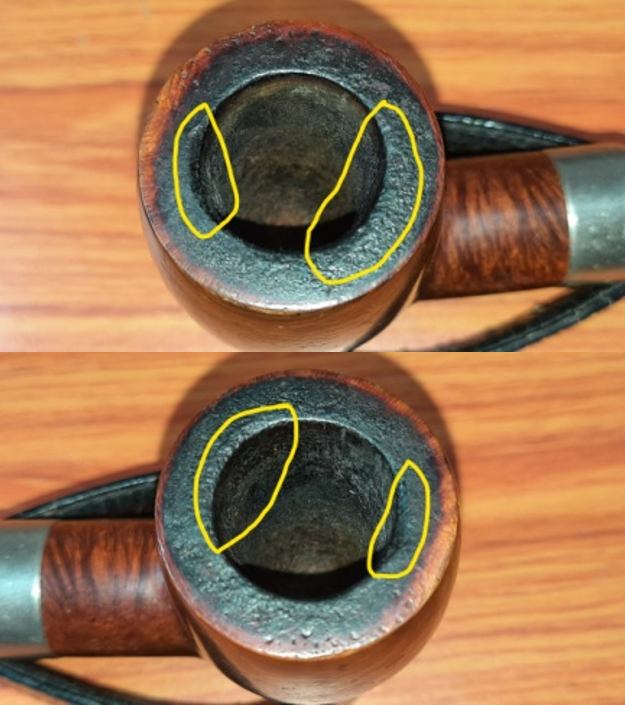
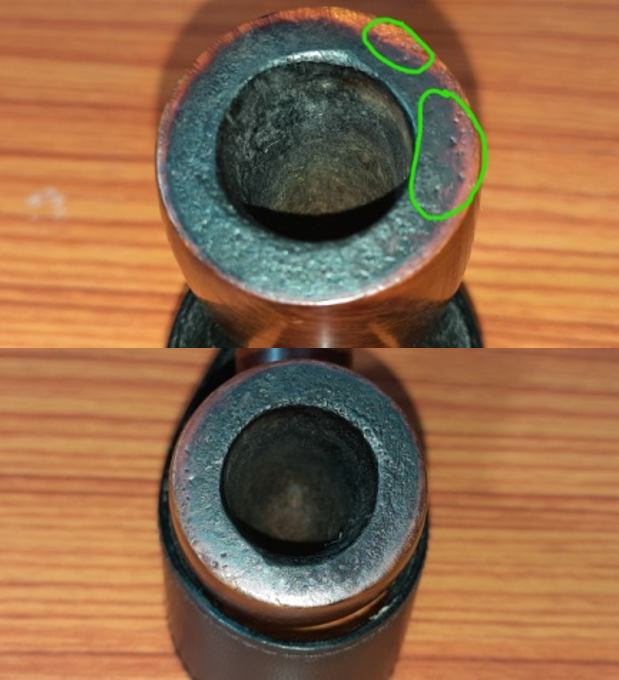
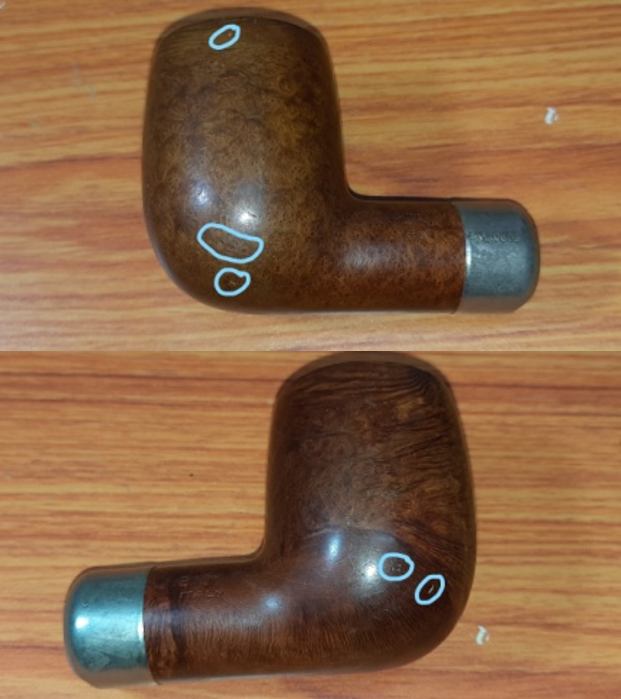
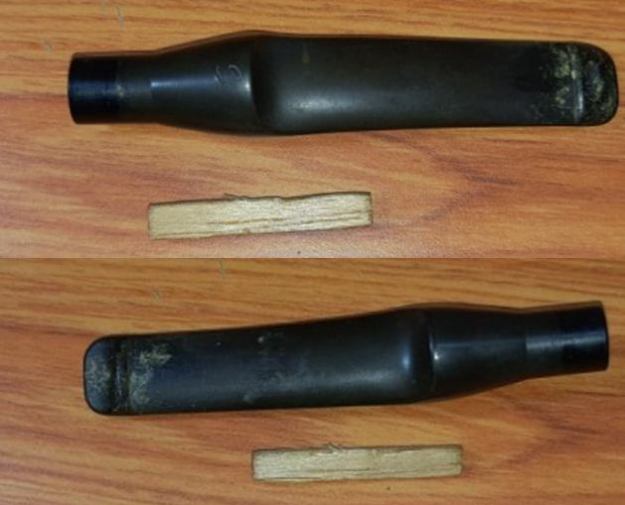
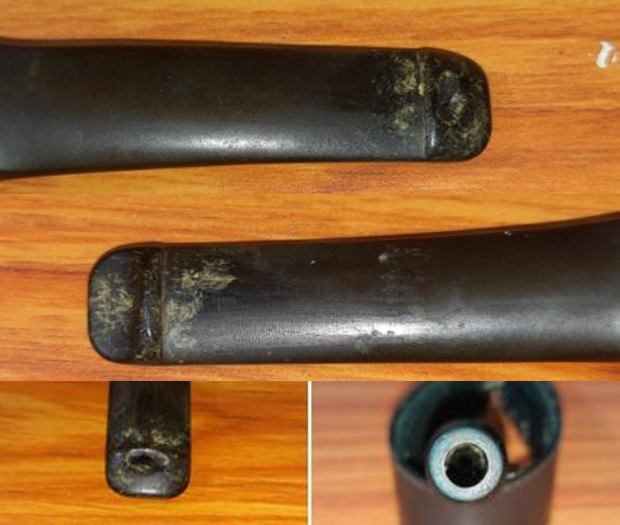
I started the restoration of this pipe by first reaming the chamber with size 2 head of a PipNet reamer followed by scraping with my fabricated knife to remove the carbon deposits. I scraped off the crusted lava from the rim surface with the fabricated knife. Once the cake was scraped back to the bare briar, I used a 220 grit sand paper to remove all the traces of remaining cake and also to smooth out the inner walls of the chamber surface. Finally, to remove the residual carbon dust, I wiped the chamber with a cotton pad wetted with 99.9% pure isopropyl alcohol. The chamber walls are in pristine condition. The char to the inner rim edge in the 12 o’clock direction is severe and would need to be addressed. The smells from the chamber have greatly reduced. The walls are nice and stout and should provide a cool smoke. The dents/ dings to the rim surface are now amply evident and the best way to address this would be to top the surface.This was followed by cleaning the mortise with pipe cleaners and q-tips dipped in isopropyl alcohol. I scraped the walls of the mortise with my dental tool to remove the dried oils and tars. The mortise needs further cleaning with anti-oil dish washing detergent and shank brush and will be done once the external surface of the stummel is cleaned. This helps me in saving a heap of pipe cleaners, which is a very precious commodity here in India.Next, I cleaned out the stem internals. I ran a couple of pipe cleaners dipped in isopropyl alcohol through the stem air way. Unfortunately the pipe cleaner couldn’t pass through completely. I realized that the large slot on the upper surface was clogged and the airway compressed due to tooth indentation. Using a dental tool, I tried prying out the blockage from the slot and realized that there was broken edge of the slot that was glued back and the reason for the blockage. With a bit of effort and lots of care, the broken piece was removed. I would now have to rebuild the top surface of the large horizontal slot. I would later try to open the airway by heating and thus expanding the compressed area with the flame of a lighter.I sanded the entire stem surface with a 220 grit sand paper in preparation for subjecting it to the deoxidizer solution treatment. It has been our experience that the deoxidizer solution works most efficiently in removing oxidation when a stem has been sanded prior to immersion in the solution. I immersed the stem in the deoxidizer solution developed by Mark and set it aside overnight for the solution to do its intended job.The next step was to clean the exterior surface of the stummel. I generously applied Murphy’s oil soap with a hard bristled tooth brush and scrubbed the stummel and rim top with the soap. I washed the stummel under running warm water with anti oil dish washing detergent till the stummel surface was clean and dried it using paper towels and a soft cotton cloth. I deliberately cleaned the rim top with a piece of Scotch Brite pad and set the stummel aside to dry out naturally. The stummel surface has cleaned up nicely with the intricate grain patterns on full display. The brown hues of the rest of the stummel contrast beautifully with the black of the briar grains. These contrasting hues will be further accentuated once the briar is rehydrated and rejuvenated using the balm and subsequent wax polishing. I simultaneously cleaned the shank internals with the detergent and hard bristled shank brush. The ghosting is completely eliminated and the pipe now smells fresh and clean.Staying with the stummel, I decided to address the issues with the rim top surface. The first issue to be addressed was the numerous dents and dings over the rim top. I rotated the rim top on a piece of 220 grit sand paper, checking ever so frequently for the progress being made. Once, I was satisfied that the rim top was an even and smooth surface, I stopped. This topping also helped in reducing the charred surface over the inner rim edge. Here is how the rim top appeared at this stage in restoration.The charring to the inner rim in 12 o’clock direction was still evident, albeit greatly reduced and lent the chamber an out of round appearance. To correct this, I created a bevel to the inner edge with a 220 grit sand paper.The third issue with the stummel was that of the numerous dents and dings over the surface which I have marked over the stummel. I steamed out all these dents and dings by heating my fabricated knife on a candle and placing it on a wet towel covering the dents. The generated steam expands the wood fibers and fills the dents up to, or as close as possible to the surface. The steam leaves behind a discolored surface as compared to the rest of the stummel surface. To address this issue and also to even out and match the raised dings with the rest of the surface, I sanded the entire stummel with a folded piece of 220 grit sandpaper. This also evened out the other minor scratches and dings from the surface. I set the stummel aside and turned to address the stem repairs. I removed the stem from the deoxidizer solution and scrubbed it with a Scotch Brite pad followed by a 0000 grade steel wool scrub. This helps to remove the oxidation that is raised to the surface by the solution. Patches of deep seated oxidation over the stem surface could still be seen as dirty brownish green color and would be addressed by subjecting the stem to further sanding by progressively higher grit sand papers.Next, I used a 220 grit sand paper to sand the stem and removed all the oxidation from the surface. Using a lighter, I flamed the surface of the stem. This helped in raising some of the tooth chatter and bite compression from the slot to the surface as vulcanite has a property to regain its original shape on heating. I wiped the stem with Murphy’s Oil soap on a cotton swab. This cleaned up the stem surface while removing the loosened oxidation.I reconstructed the broken slot end with a filling of CA superglue and activated charcoal after I had inserted a folded plastic coated visiting card. This prevented the fill from seeping in to the air way and clogging it once it had cured. I set the stem aside for the fill to harden before I could proceed with the sanding, shaping and polishing of the stem. While I worked the stem, Abha polished the stummel with micromesh pads, wet sanding with 1500 to 12000 pads. She polished the freshly topped rim surface to a nice luster, wiping the surface with a soft cloth at the end of the micromesh cycle. The stummel looks amazing with a deep shine and beautiful grains popping over the stummel surface. She massaged a small quantity of “Before and After Restoration Balm” with her fingers into the briar. The immediate and incredible transformation that takes place is a worthy reward for all the efforts!!! She let the balm sit on the surface to be absorbed in to the briar for about 20 minutes. The bowl now looks fresh and attractive with the grains popping out any which way you look at the briar. She polished off the balm with a soft cloth to a lovely shine. I am surprised that the rim top surface has the same deep brown coloration as the rest of the stummel surface and that the use of a stain pen was not required. With the stummel rejuvenation almost complete, save for the final wax polish, I worked the stem. The fills had cured and with a flat head needle file, I worked on the fill till I had achieved a rough match with the surrounding surface and had sufficiently sharpened the button edges. For a better blending, I further sand the entire stem with 220 followed by 400, 600, 800 and 1000 grit sand paper. This helps to reduce the scratch marks left behind by the more abrasive 220 grit paper. Even the best of my efforts at the repairs, these did not blend in to the rest of the stem surface and can be noticed with a keen eye. There are stems which do not take to repairs easily and seamlessly and this definitely is one of those.To bring a deep shine to the vulcanite stem, I went through the complete set of micromesh pads, wet sanding with 1500 to 2000 grit sandpapers and dry sanding with 3200 to 12000 grit pads. At the end of micromesh cycle, I polished the stem with “Before and After Fine & Extra Fine” paste. The finished stem is shown below.This now gets me to that part of the process where I get to savor the fruits of our labor until this point. The final polishing with Blue Diamond and Carnauba wax!
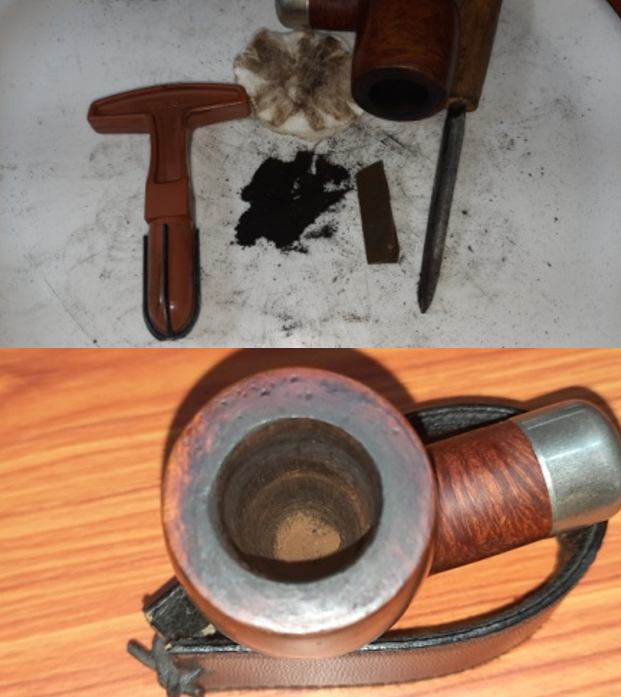
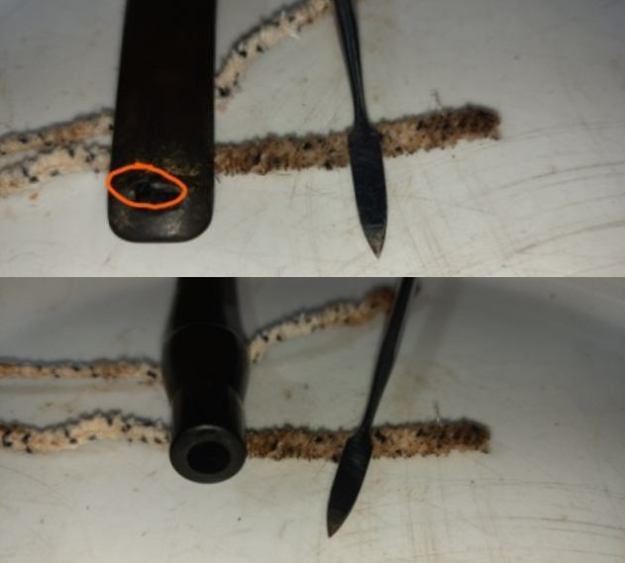
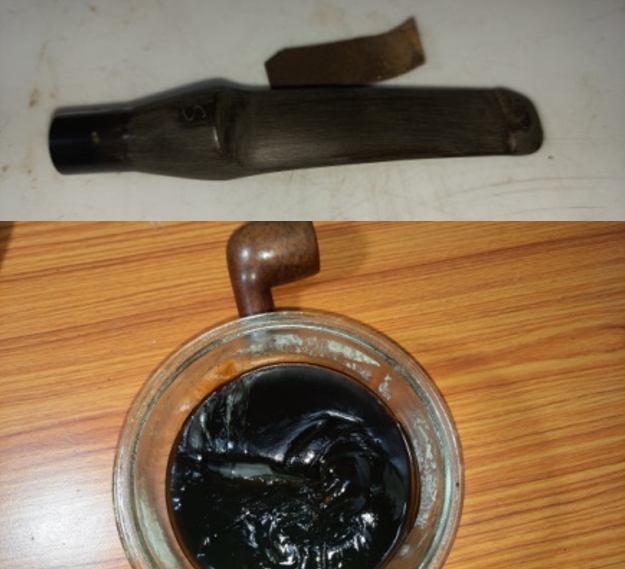
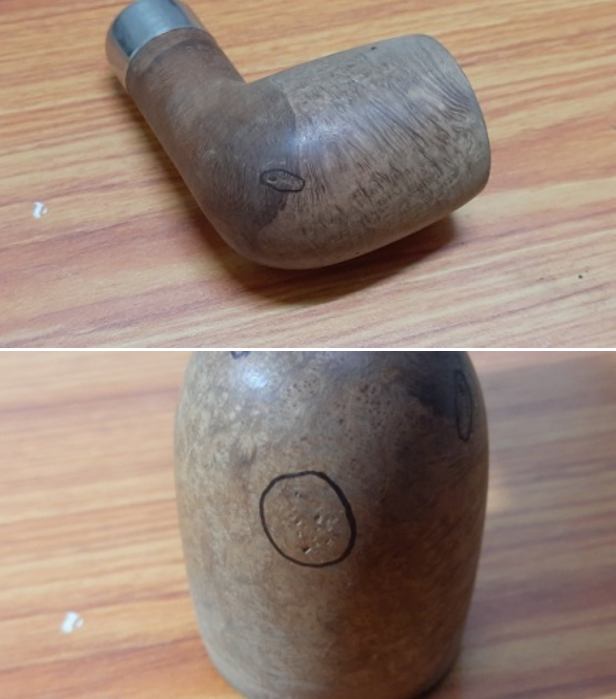
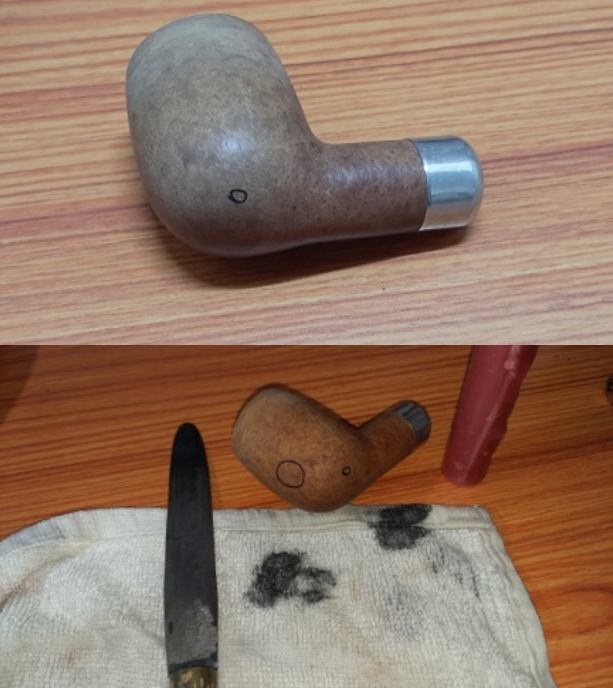
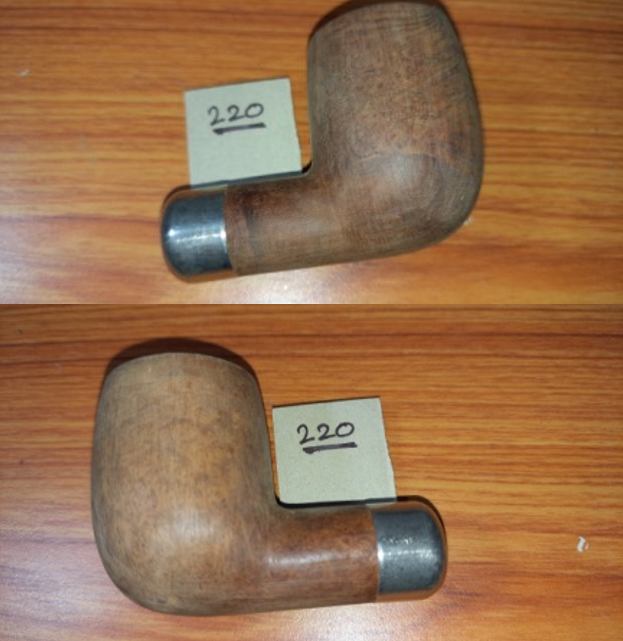
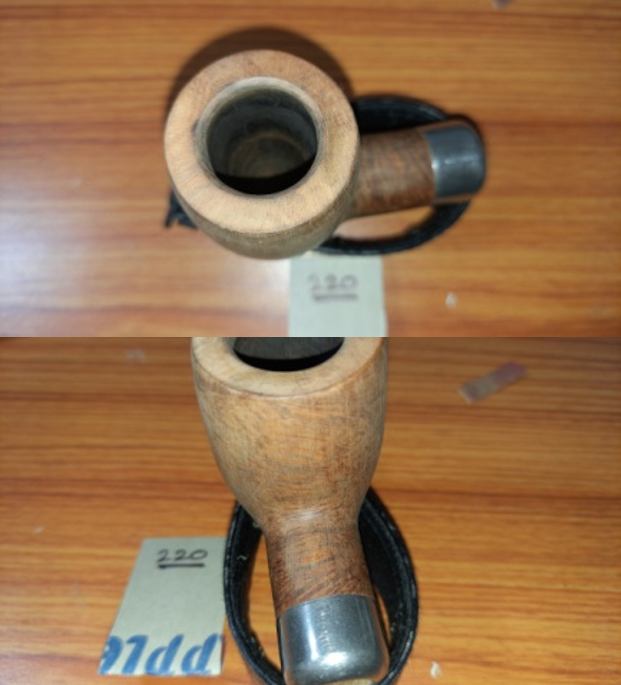
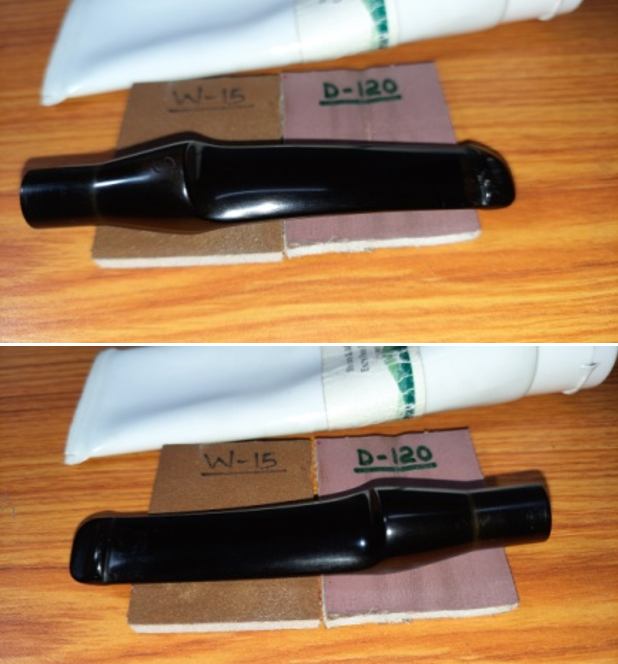
I began the final polishing cycle by mounting a cotton cloth buffing wheel on to my hand held rotary tool and applied a coat of Blue Diamond to the stummel and the stem to polish out the minor scratches.With a cotton buffing wheel that I use for carnauba wax, I applied a coat of carnauba wax and continued to work on it till the complete coat of wax had been polished out. I mounted a clean cotton cloth buffing wheel and gave the pipe a once over buff. I finished the restoration by giving the entire pipe a rigorous hand buff using a microfiber cloth to raise the shine further. The finished pipe is as shown below 🙂 P.S. I enjoyed working on this pipe alongside my wife, Abha. Her expertise and dedication in polishing the stummel and stem lends a finish that I always seek in all my restorations. And not to forget her editing of the write up to eliminate all the spelling and grammatical errors!
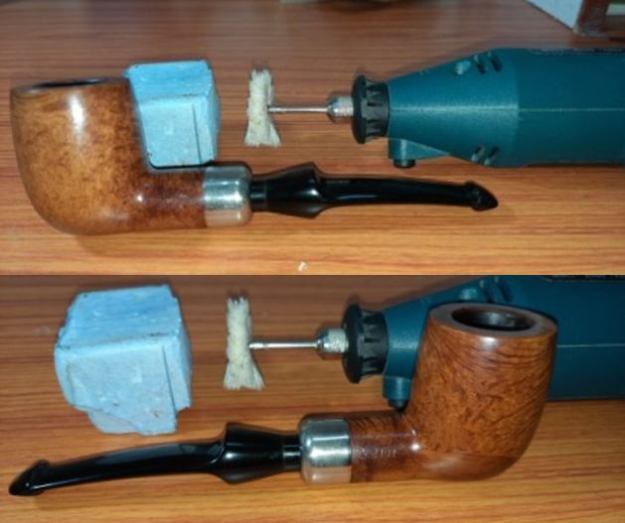
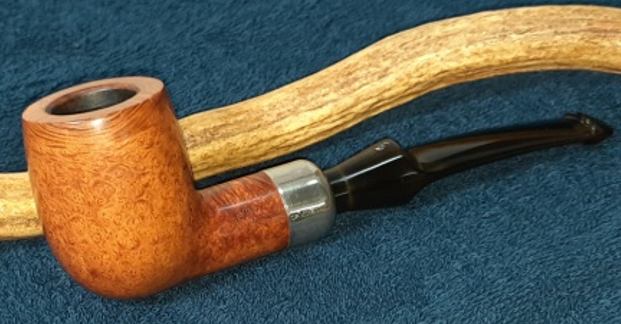
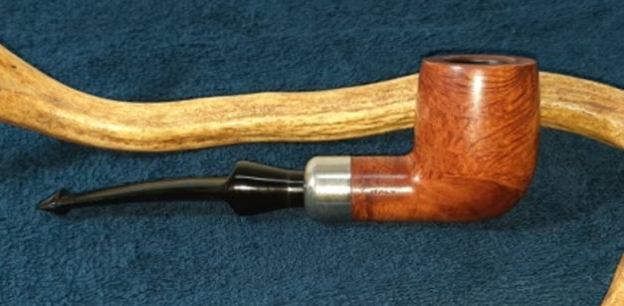
Well, as for this handsome pipe, I am not very sure if I want to hold on to it as since receiving this Savinelli System pipe from Steve, I have acquired another similar pipe with a Cumberland stem. Do let me know if this pipe interests you and we can take it further from thereon.
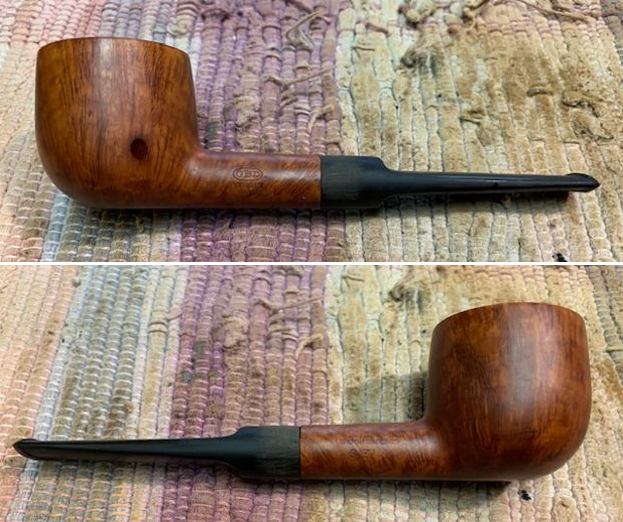
I wish to thank each one for sparing their valuable time to read through this write up while also praying for the health and safety of entire mankind. Stay home…stay safe!!