Tag Archives: article by Kenneth Lieblich

A Labour of Love


Blog by Kenneth Lieblich

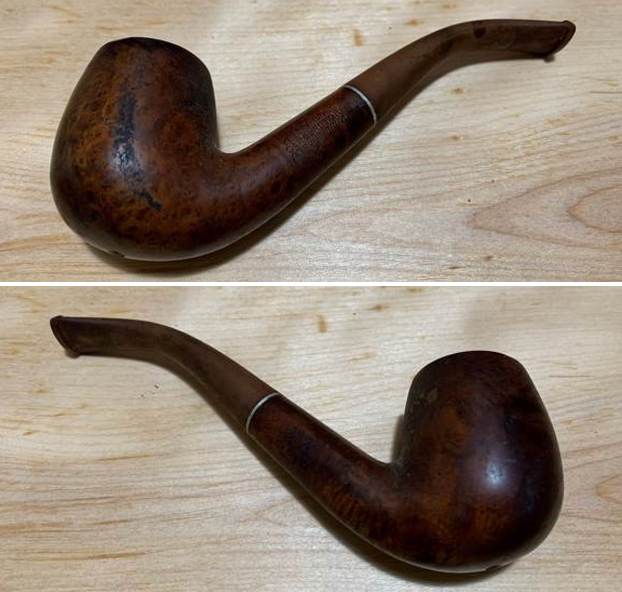
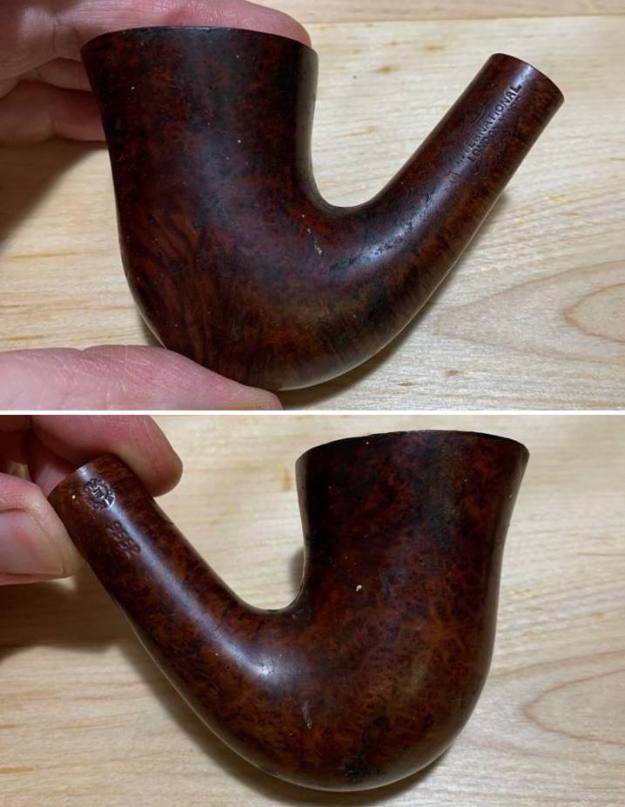
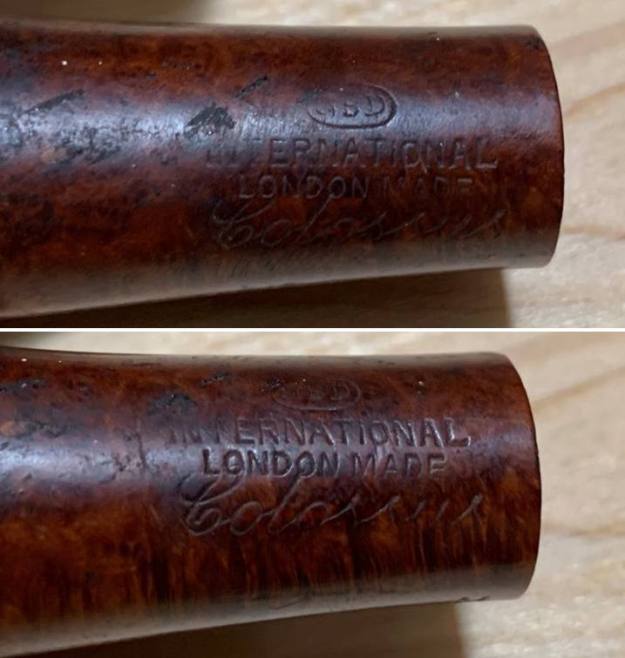
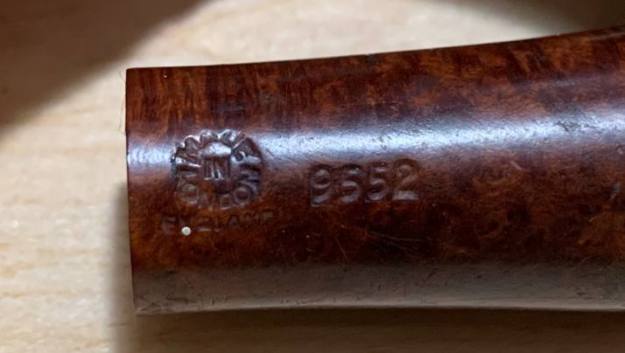
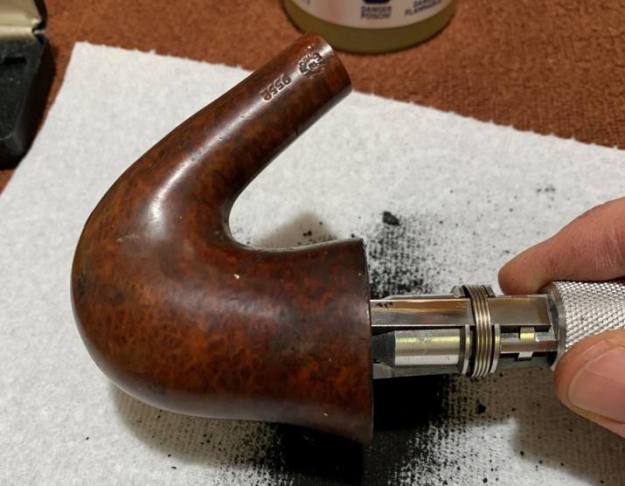
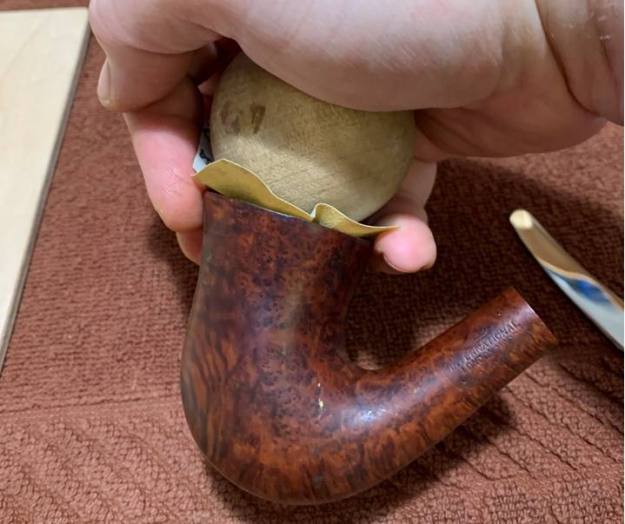
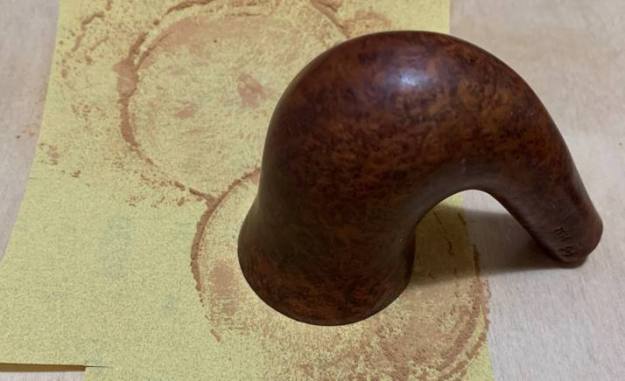
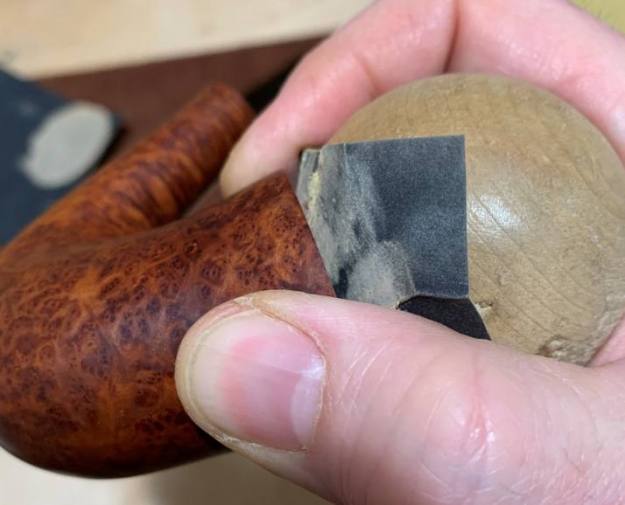
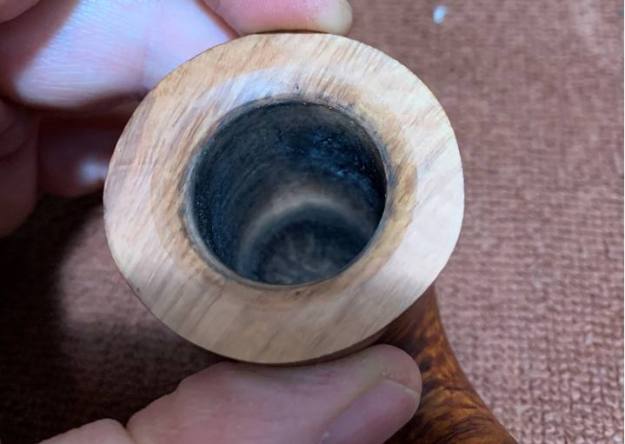
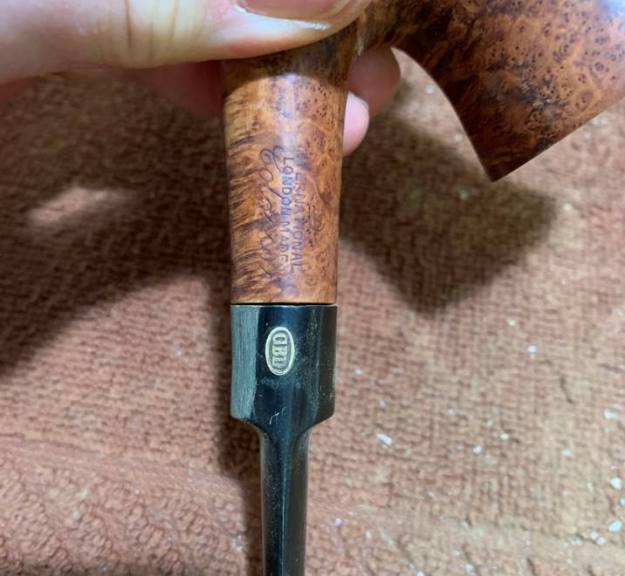
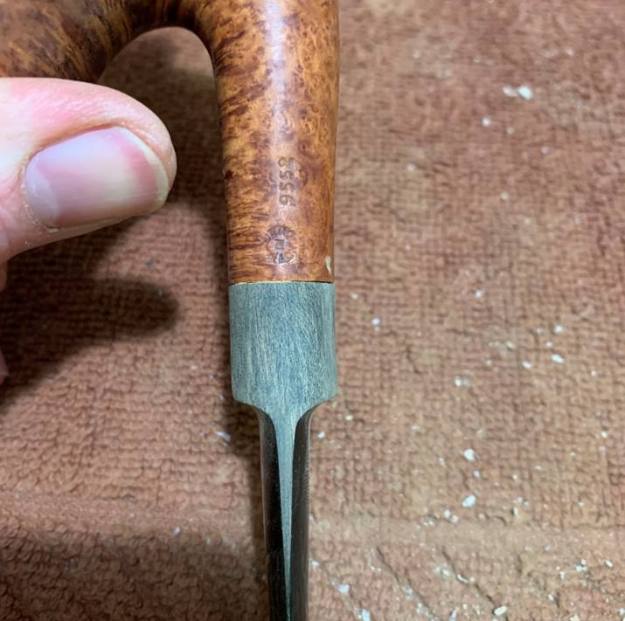
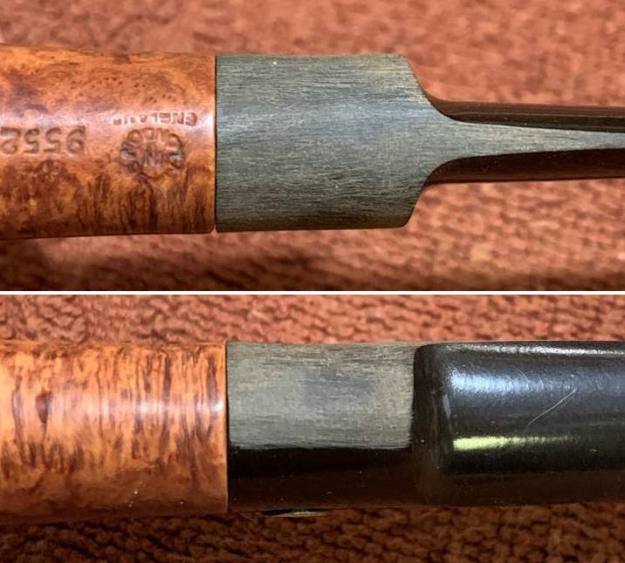
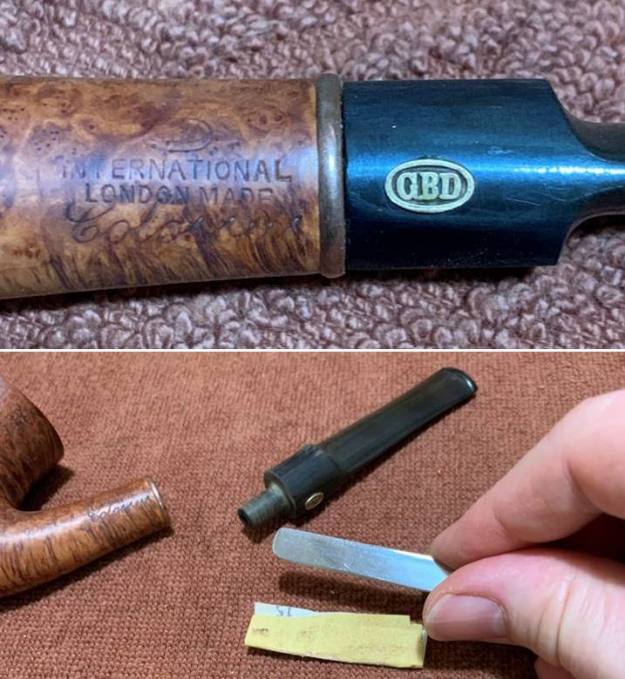
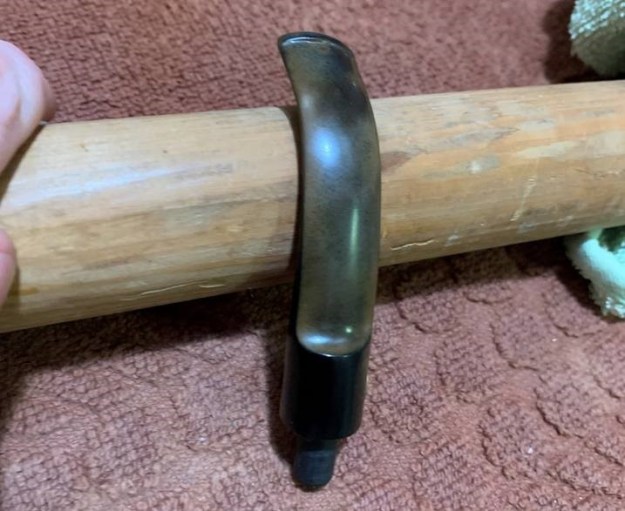
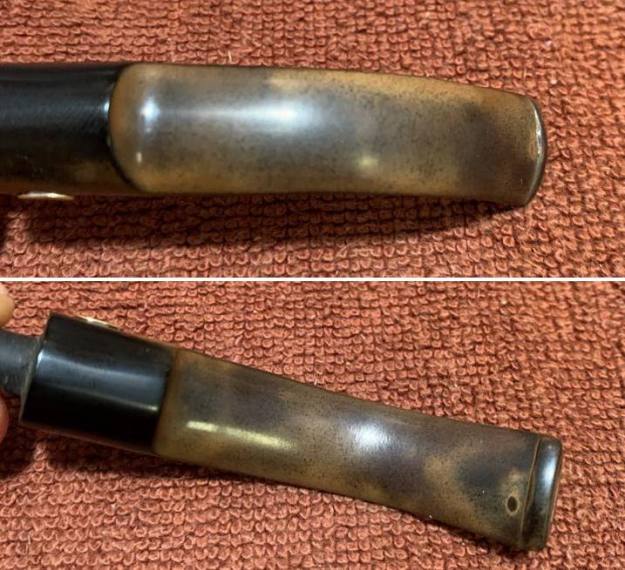
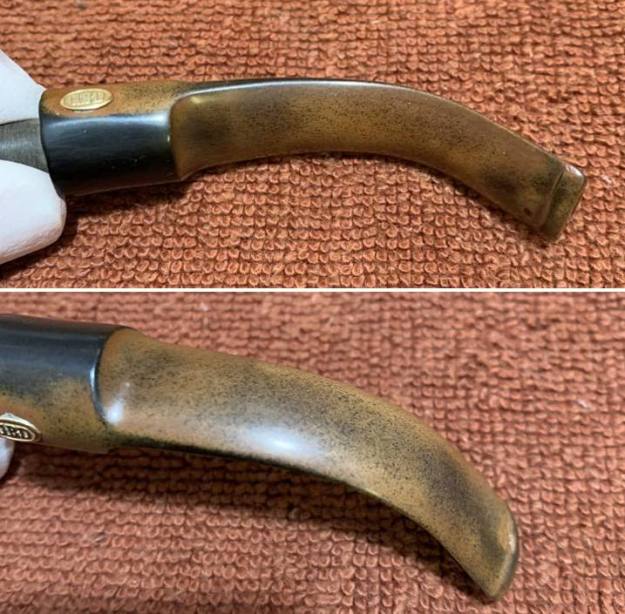
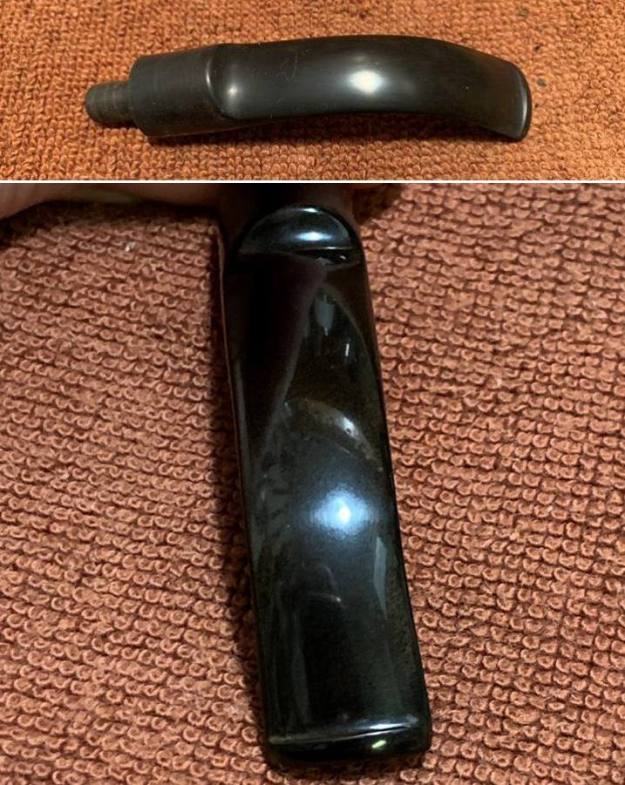
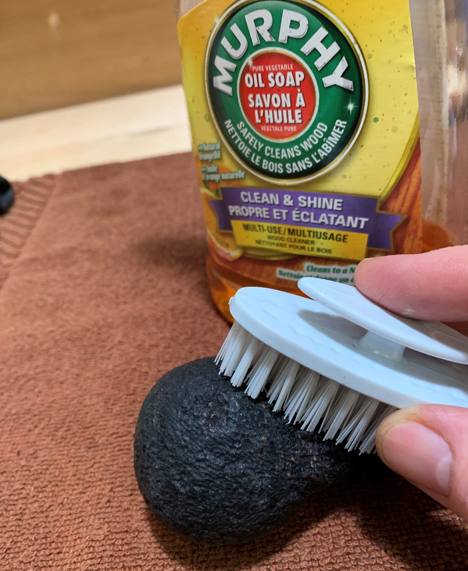
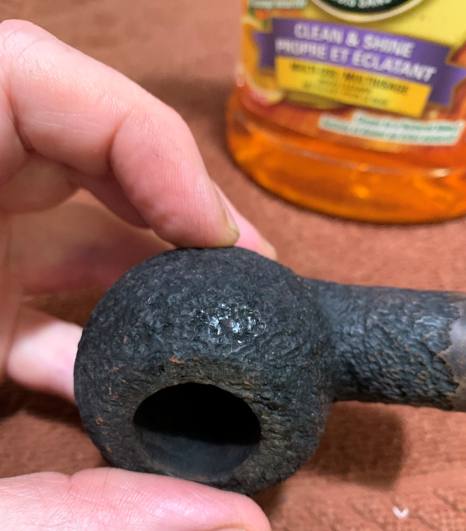
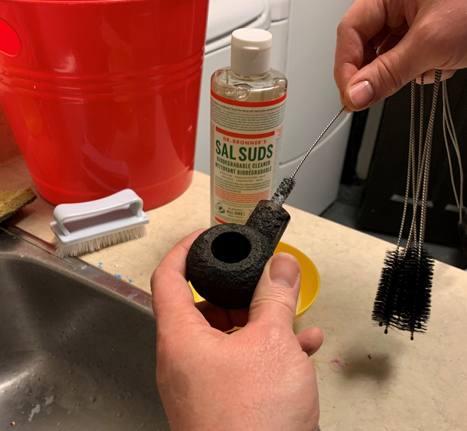
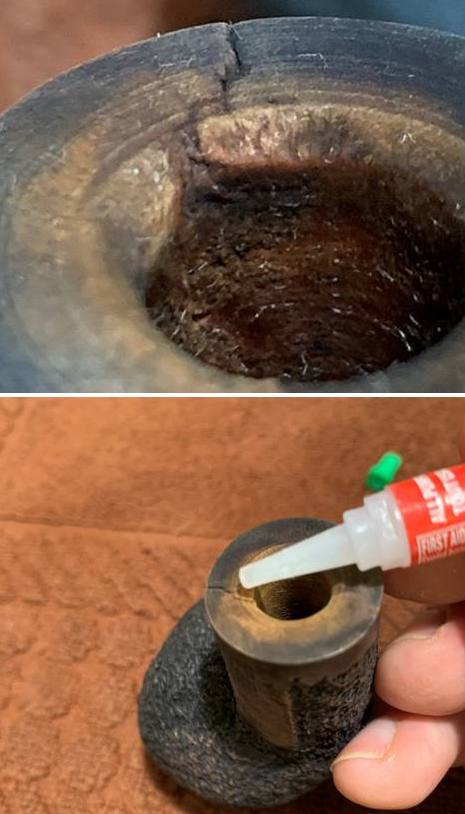
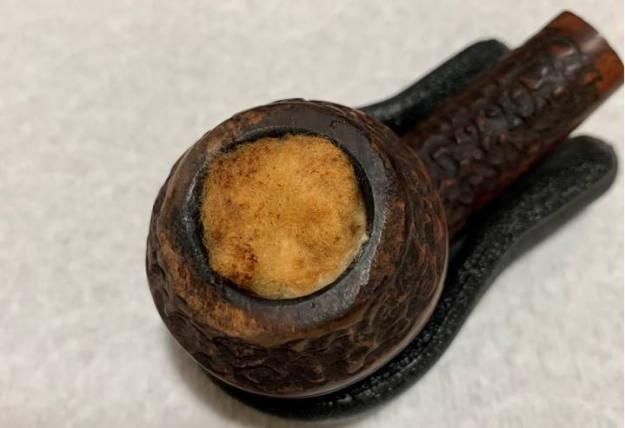
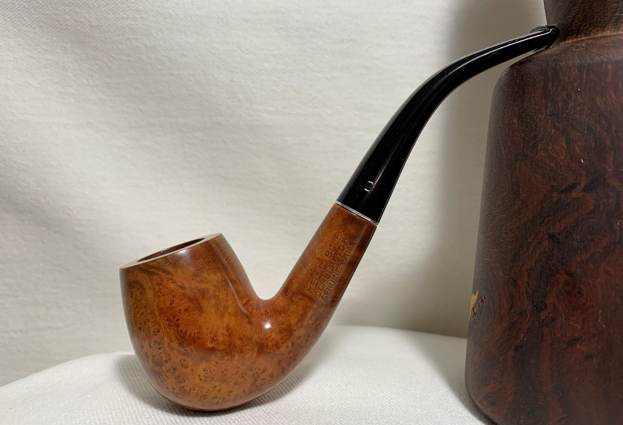
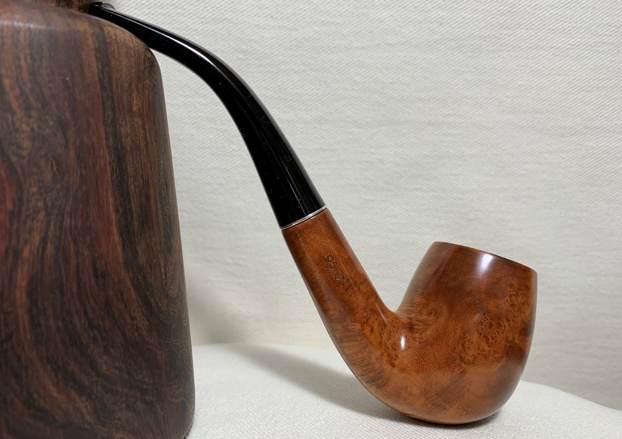
Next on the chopping block is the very first GBD I have had the pleasure of restoring. I titled this story A Labour of Love because the work involved was far more than I could have imagined for such a beautiful pipe. The pipe is a GBD Colossus and I acquired it in a group of pipes I purchased from a fellow in the Eastern US. It was definitely a mixed bag of very good and very bad. Some pipes were destroyed beyond repair, some pipes were filthy but repairable, some stems were missing their stummels, and some stummels were missing their stems. This was one of those – a stummel without a stem. Makes it a bit tricky to smoke, methinks. This pipe is a calabash-shaped GBD Colossus. As the photos show, it is stamped on the left side of the shank with GBD [over] International [over] London Made [over] Colossus. On the right side it is stamped Made in London [over] England [next to] 9552 – this, of course, is the shape number. There is quite a bit of information on GBD on the Internet – they have a long and storied history in pipemaking. In this case, I was curious about International and Colossus. The main Pipepedia article on GBD tells us about their origins:

In 1850 three gentlemen got together in Paris to establish a firm dedicated to the fabrication of Meerschaum pipes – a courageous step in politically restless times. Ganneval probably came from the area of Saint-Claude where he had learned making wooden pipes. Bondier’s family obviously came from Paris and had emigrated in 1789 to Geneva. He himself had worked as a wood turner in the clay and china pipe industry in and around Saint-Claude making stem extensions etc. Donninger was an Austrian or Swiss and had worked in Vienna, the world’s center of the Meerschaum pipe. They agreed on the acronym GBD selecting the initials of their surnames.

The Pipedia article provides a lot more information on their interesting history. I would encourage you to read on here. The shape number 9552 corresponds correctly with GBD’s identification of this pipe as a calabash. The page on GBD models states the following concerning the International line and the Colossus size:

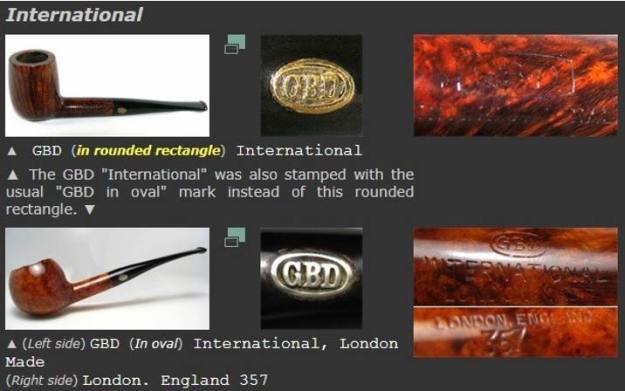
International – France and England made: medium brown smooth, carved top rim, rim stained black. In addition to the pipe line and shape information stamped on the pipe, GBD also had codes for plus sized pipes. These codes in ascending order of size were Conquest, Collector, Colossus.

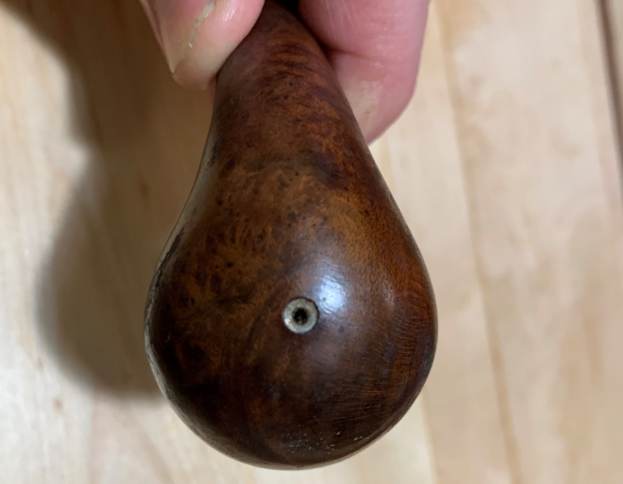
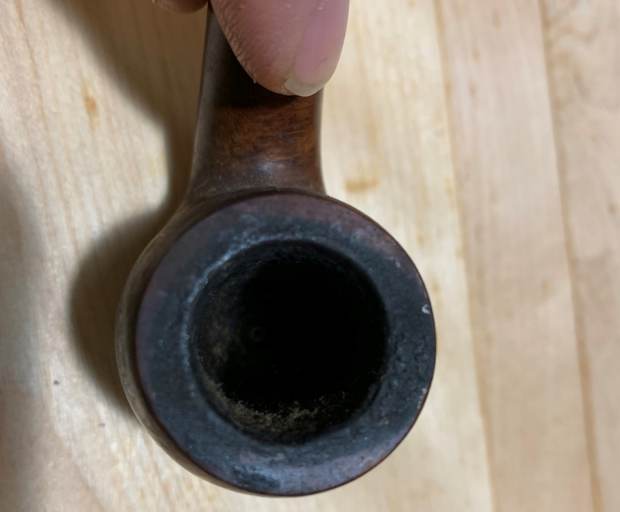
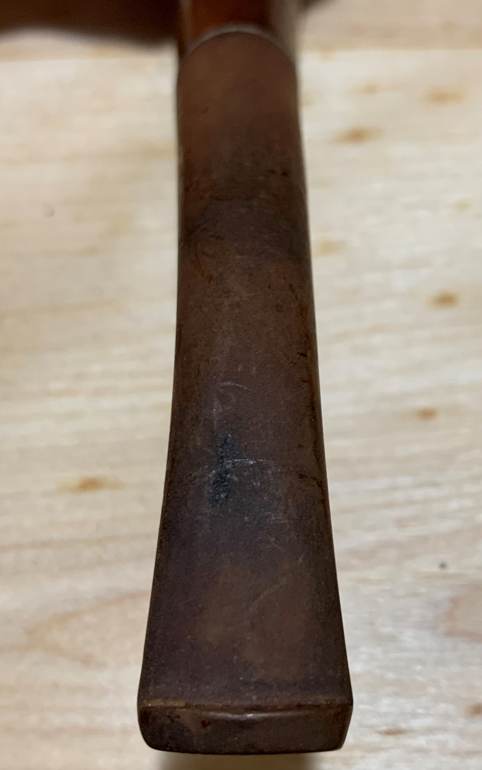
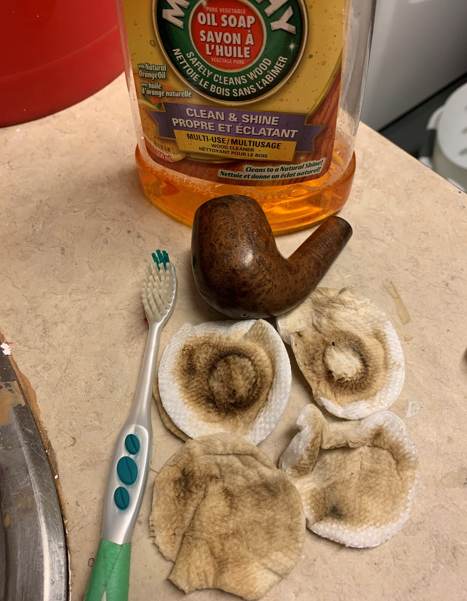
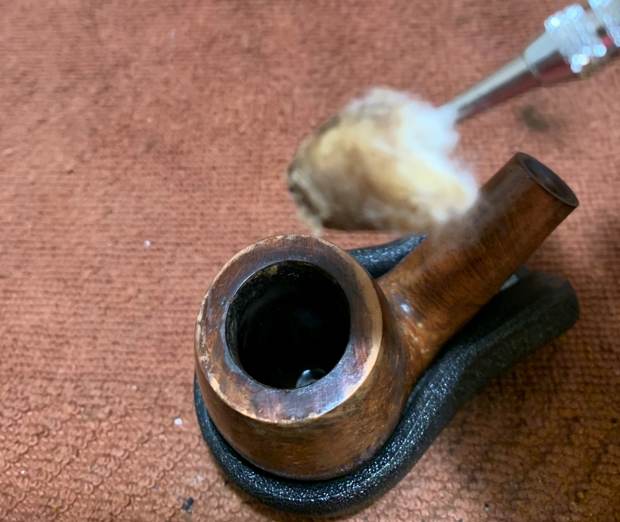
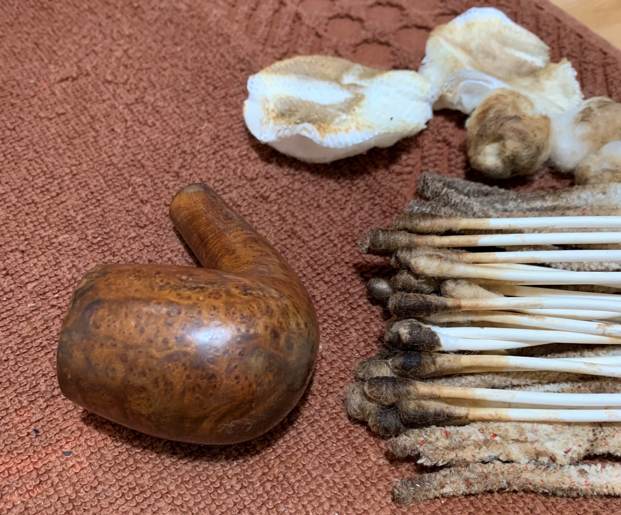
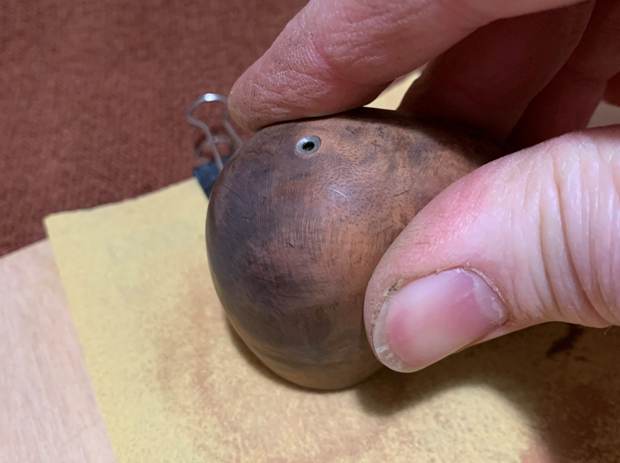
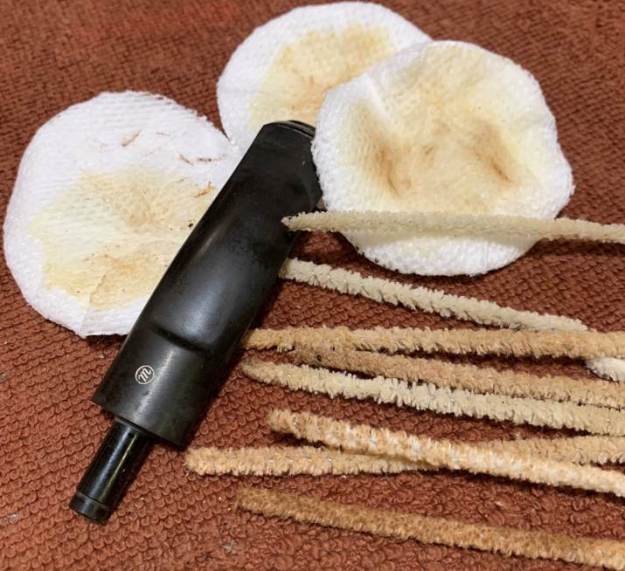
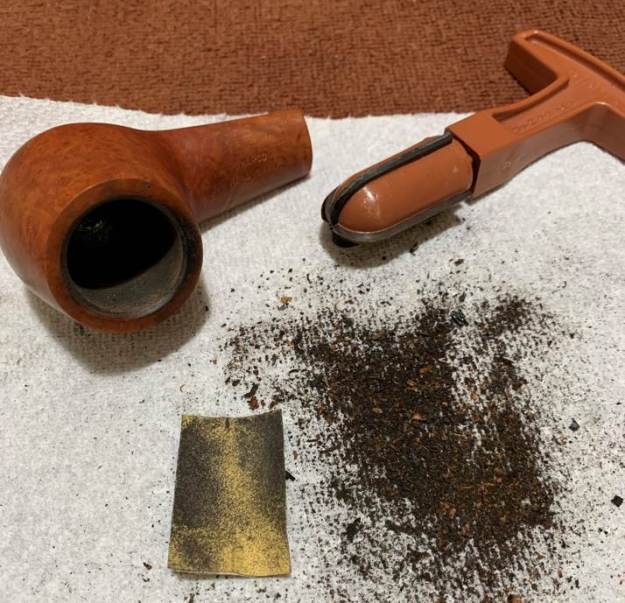
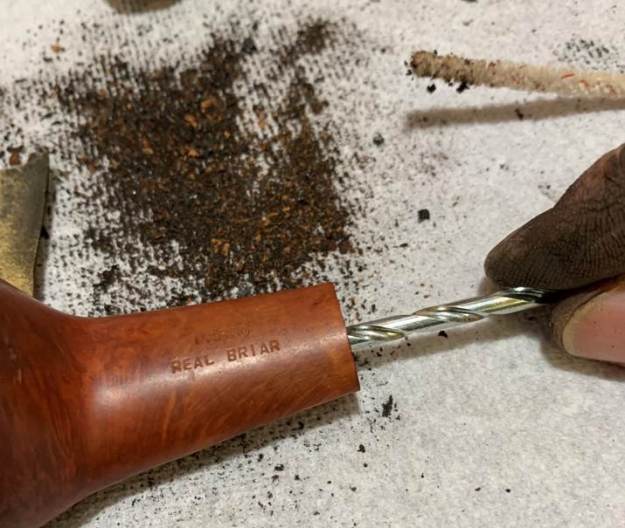
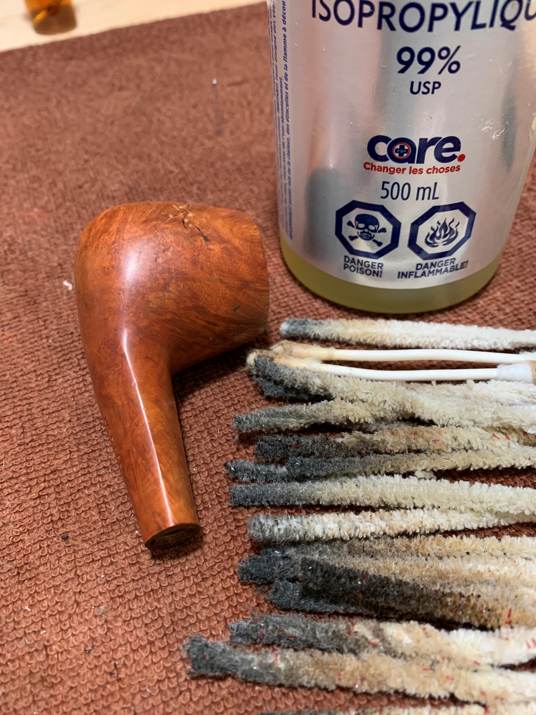
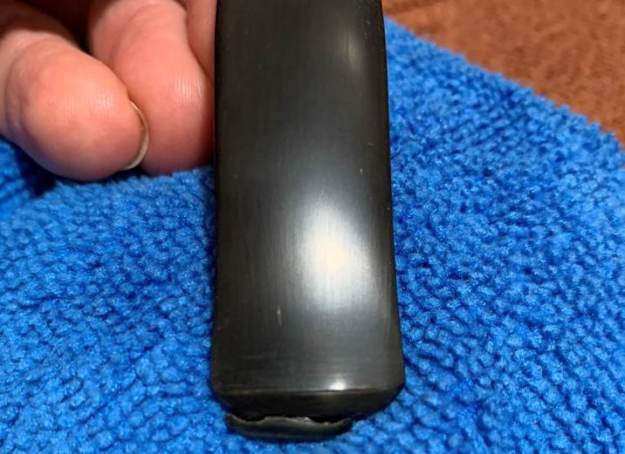
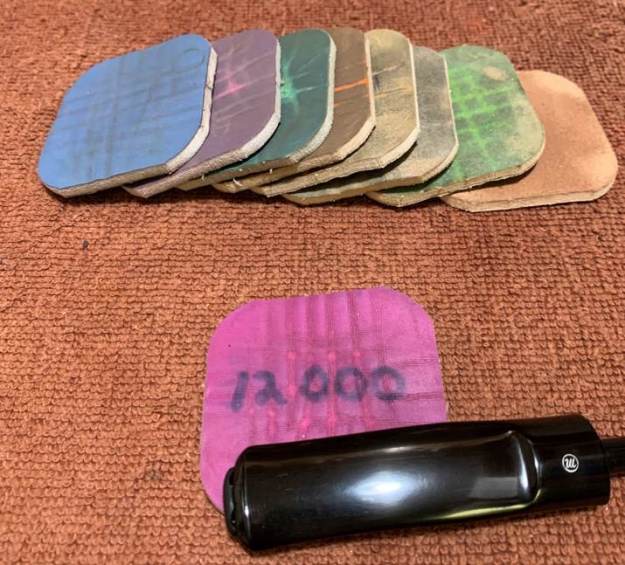
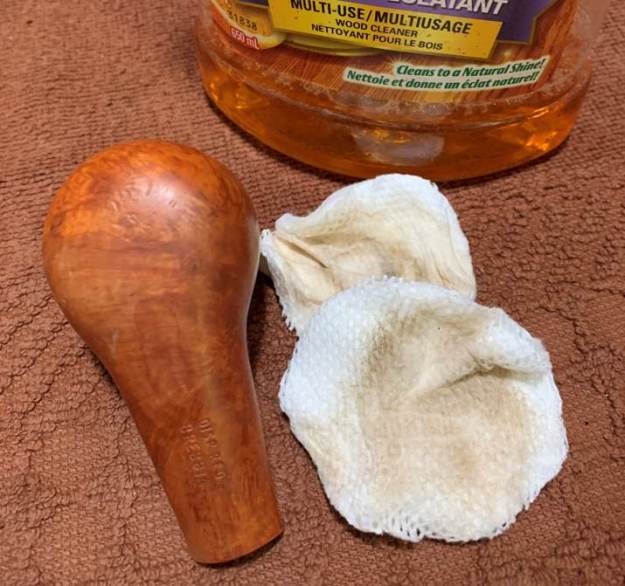
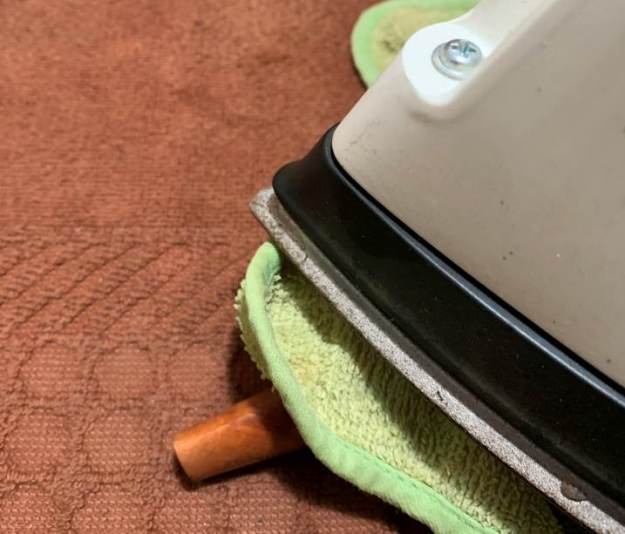
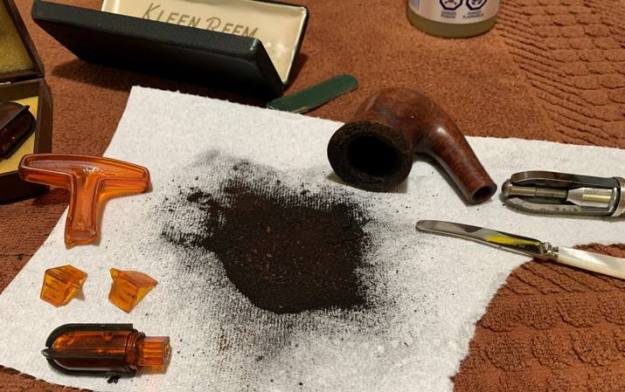
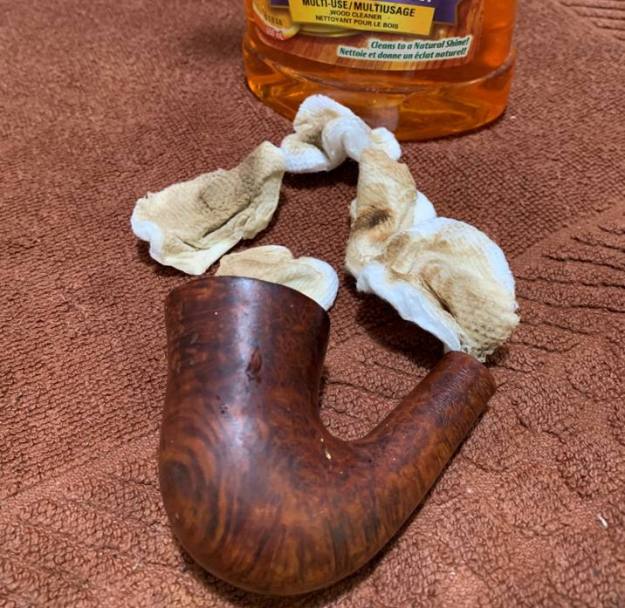
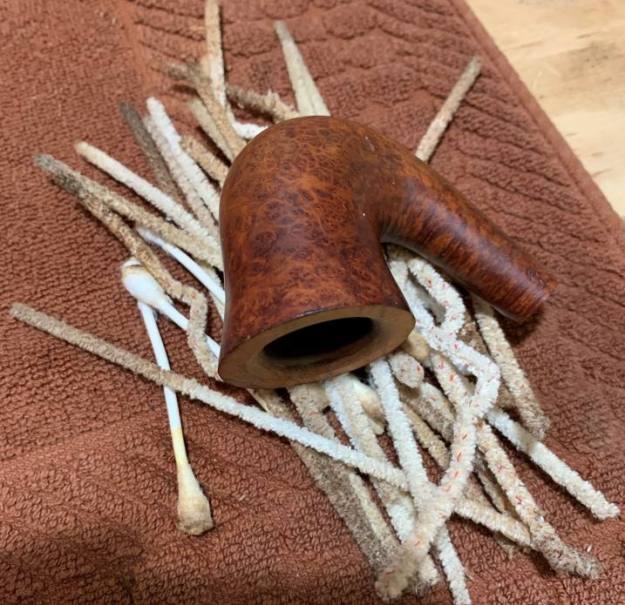
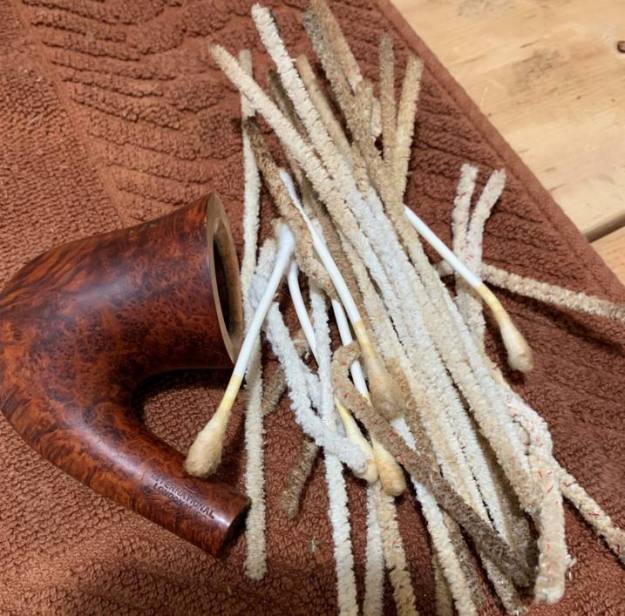
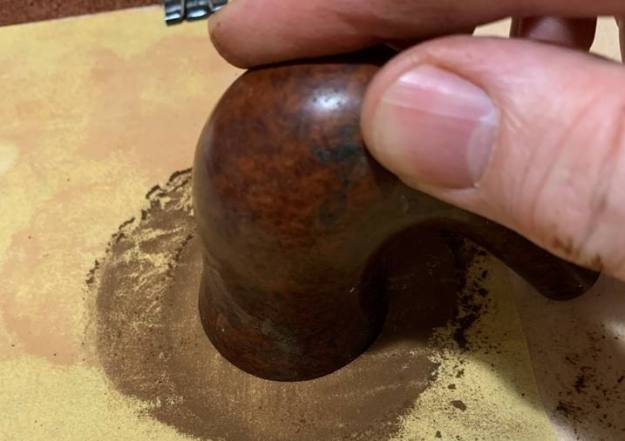
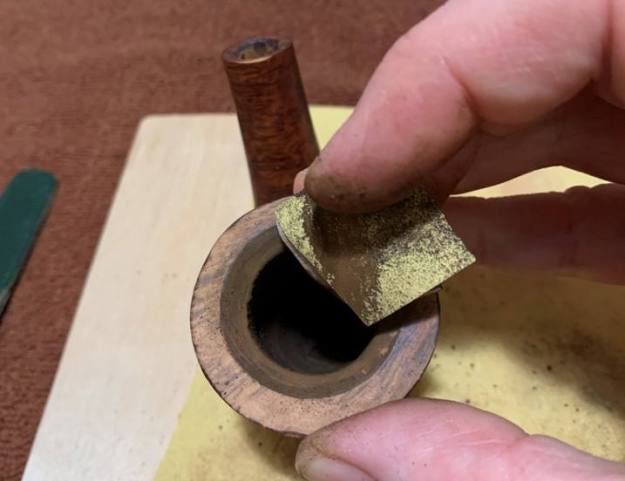
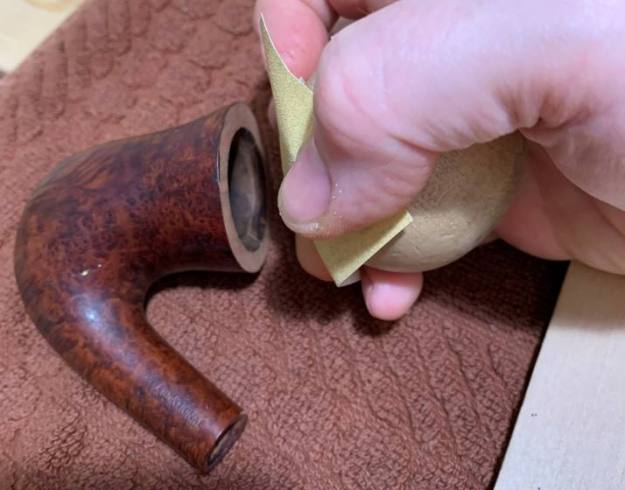
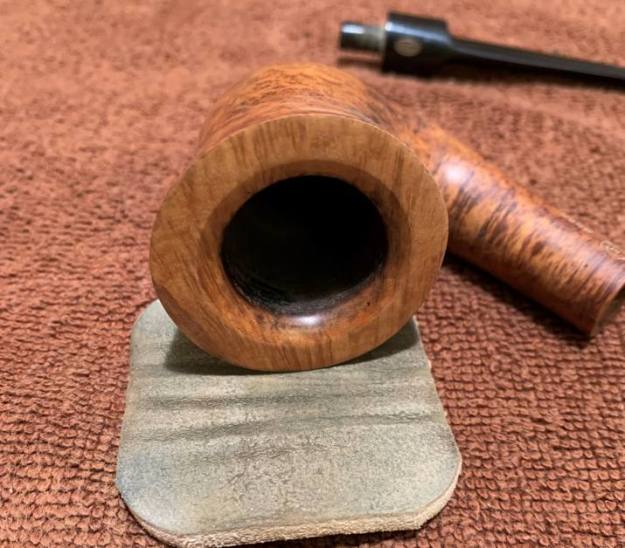
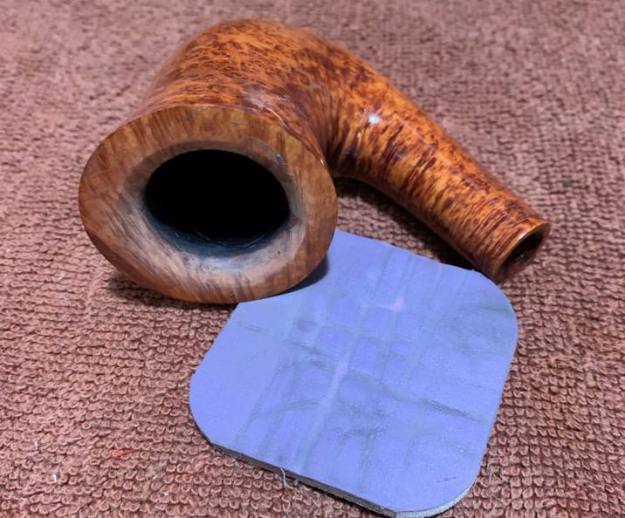
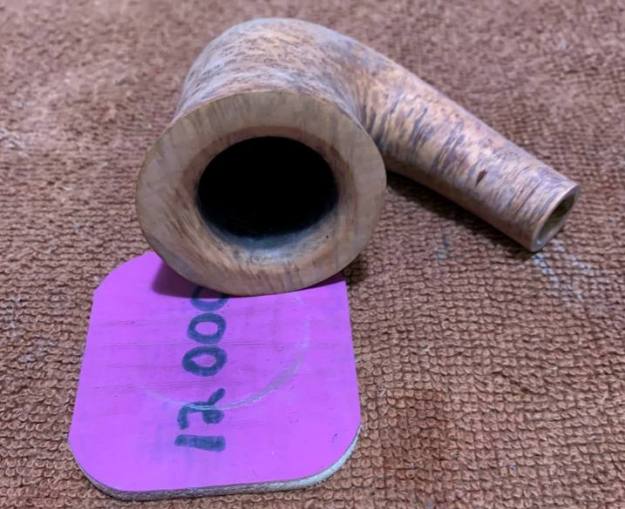
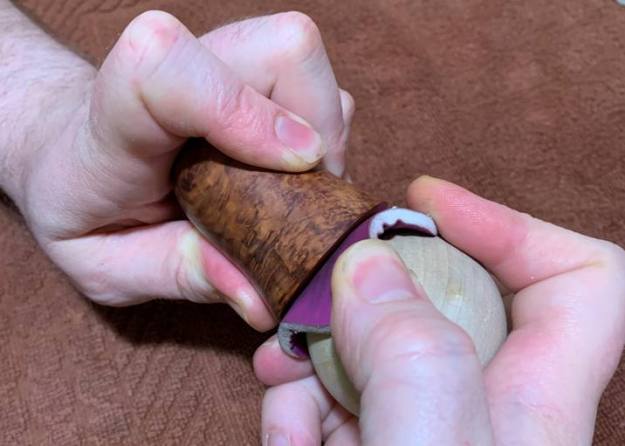
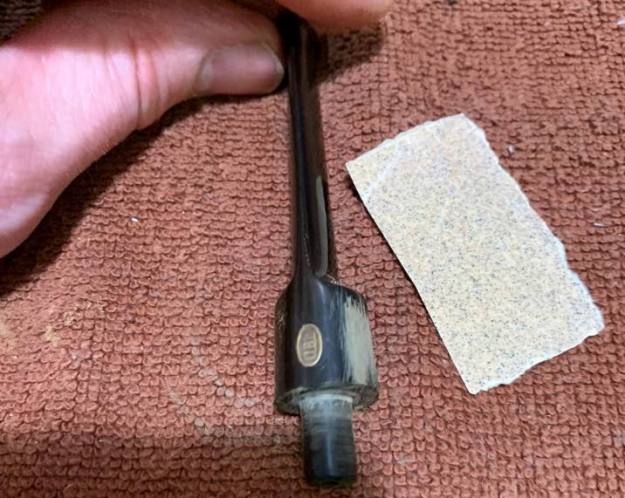
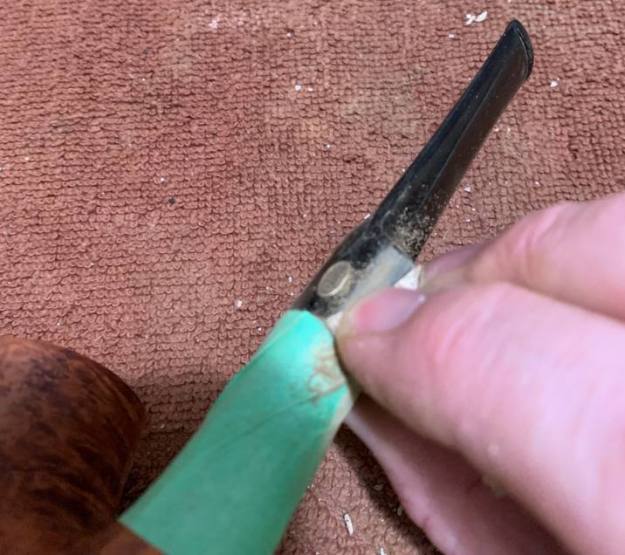
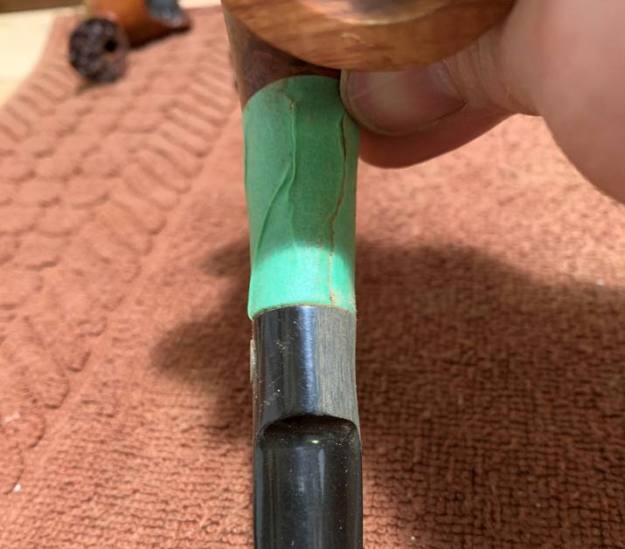
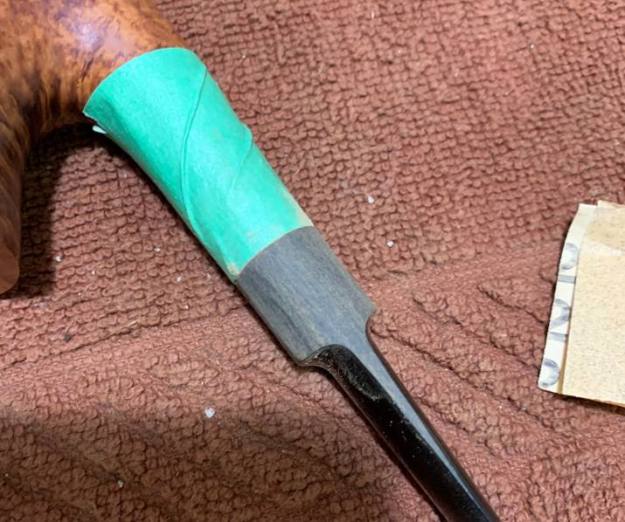
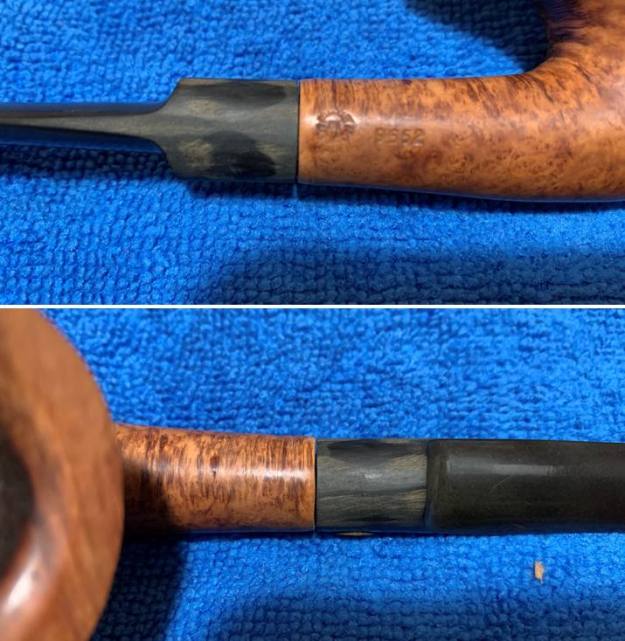
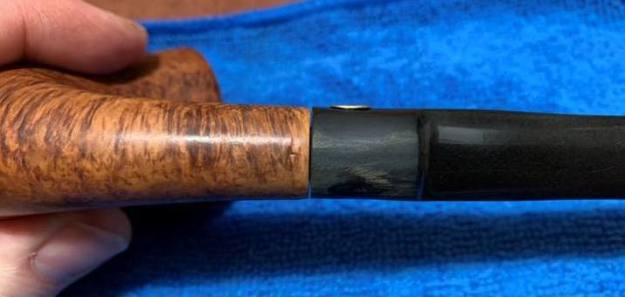
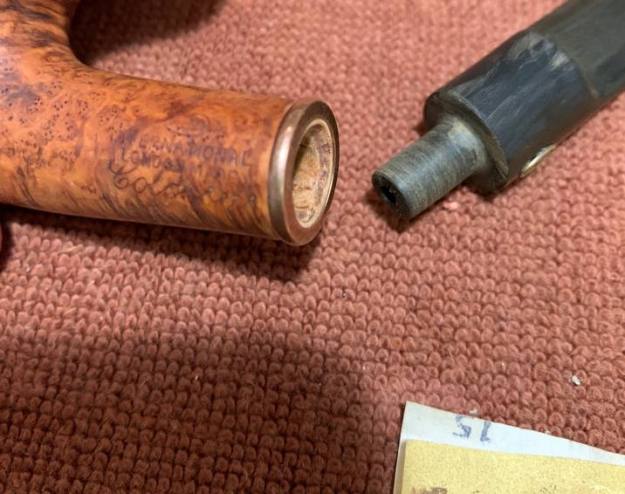
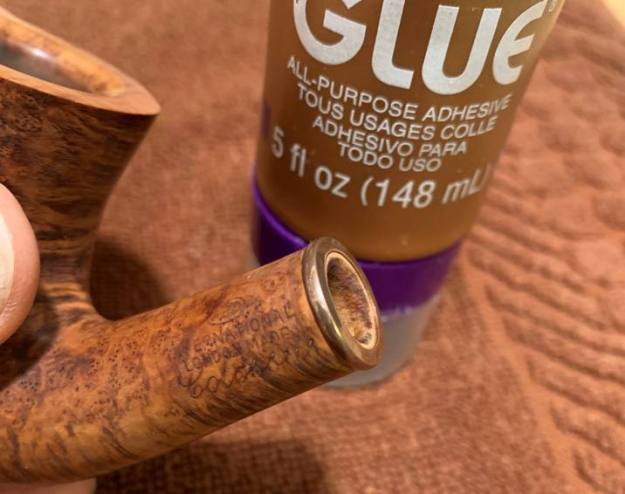
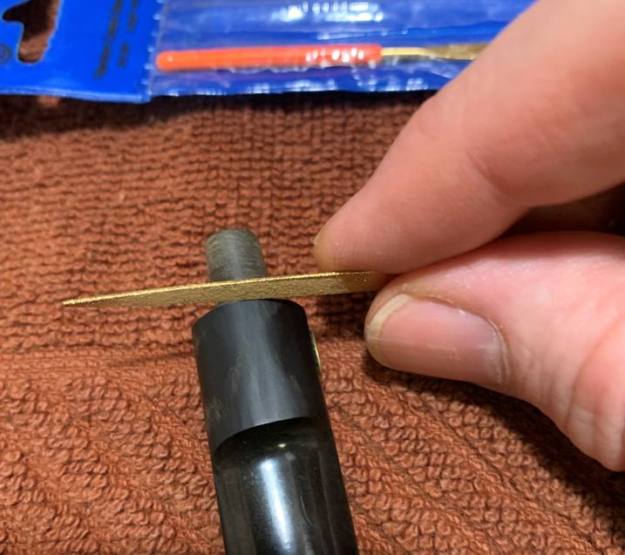
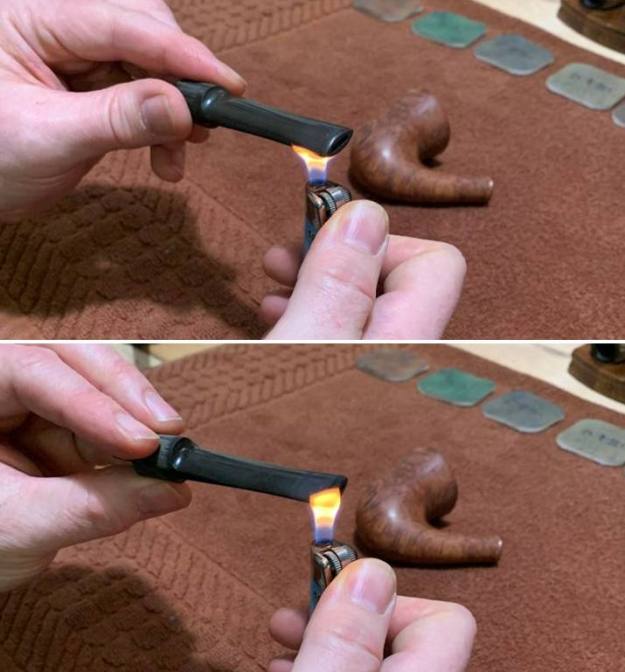
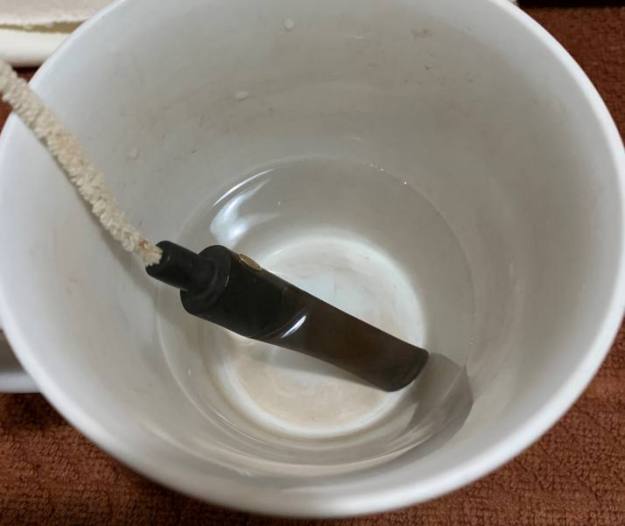
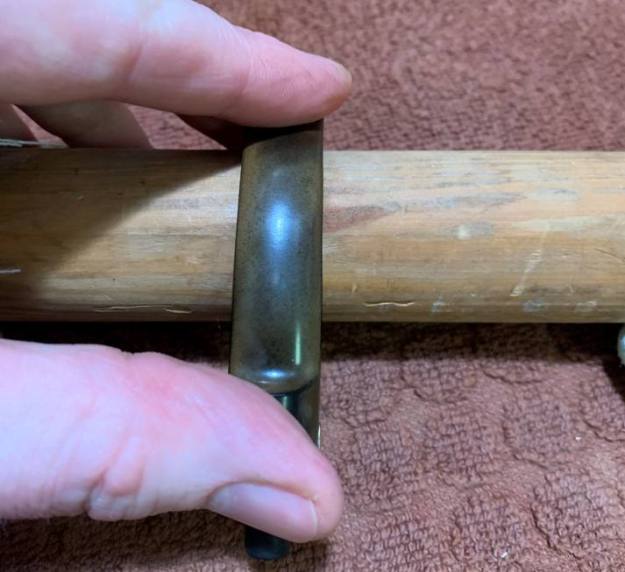
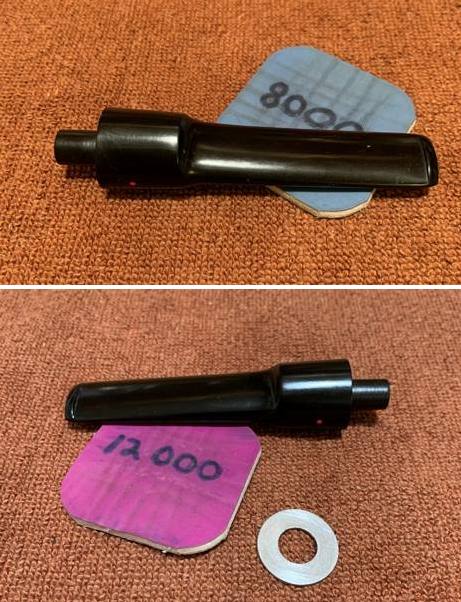
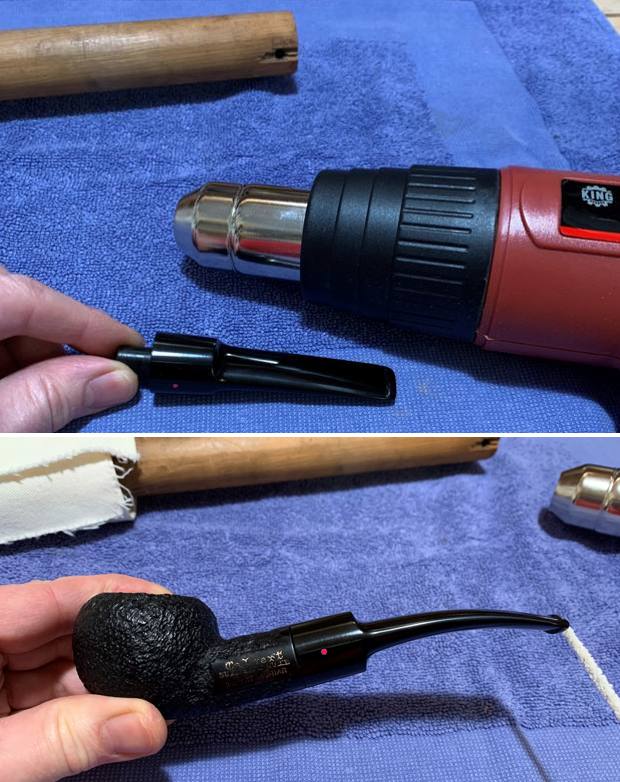
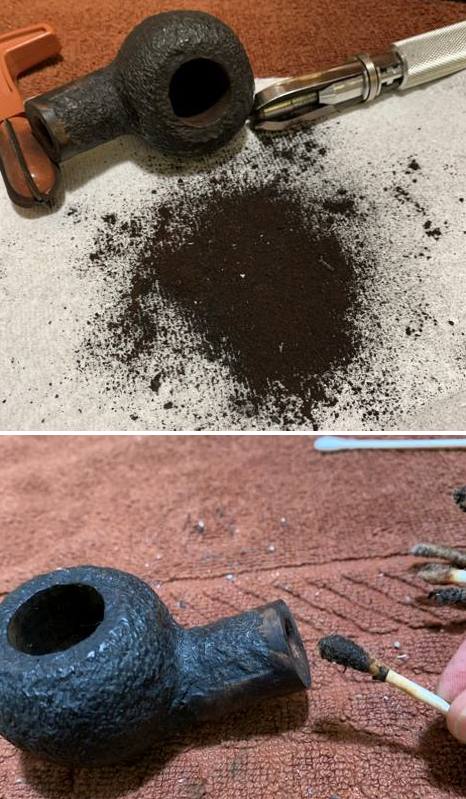
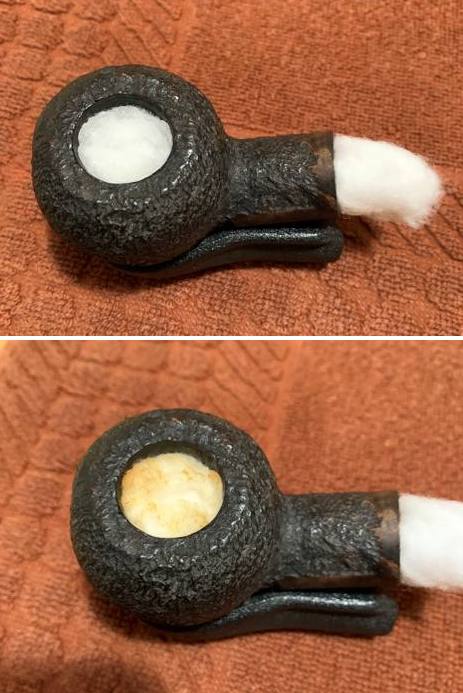
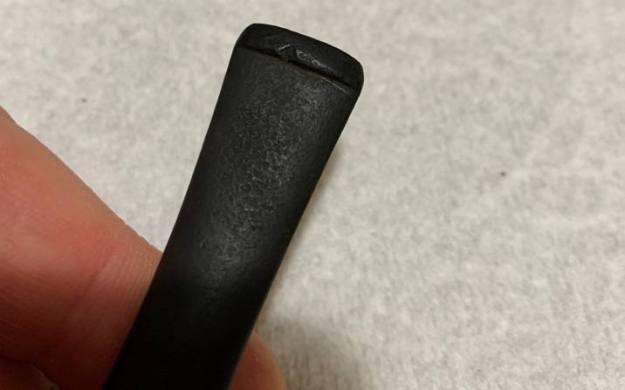
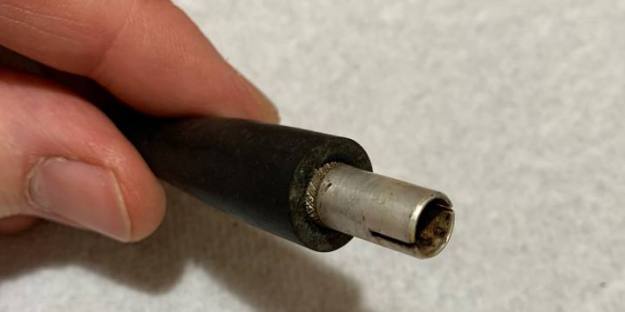
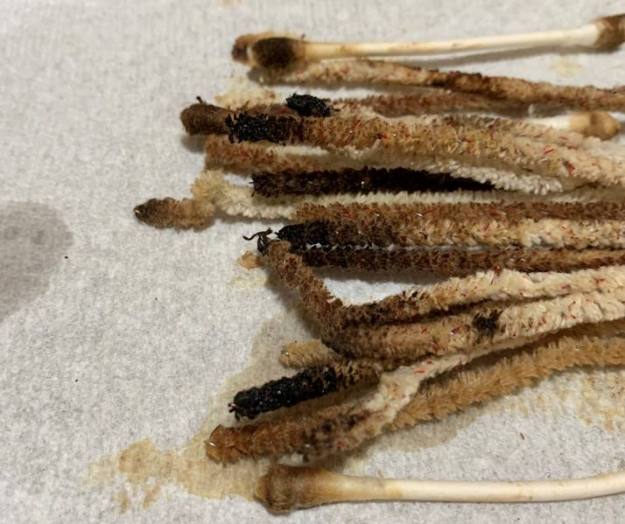
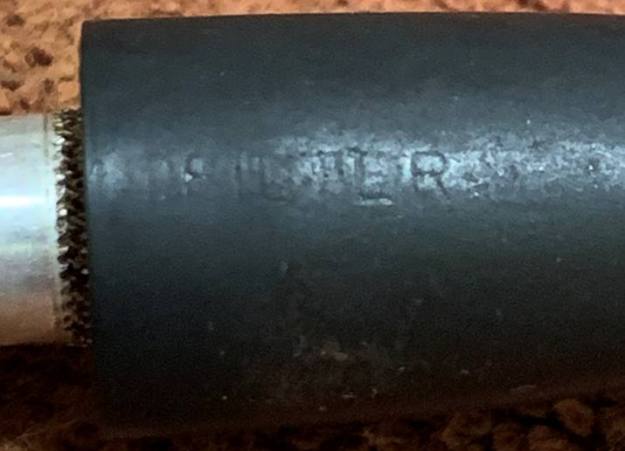
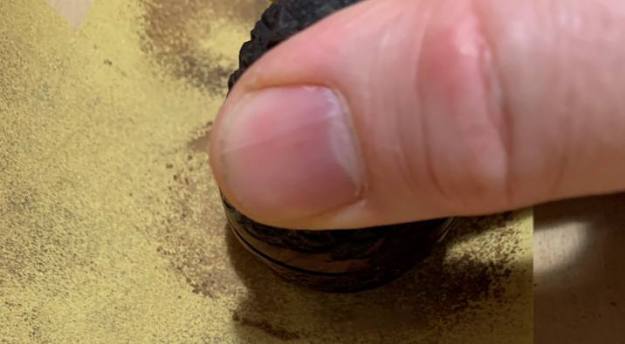
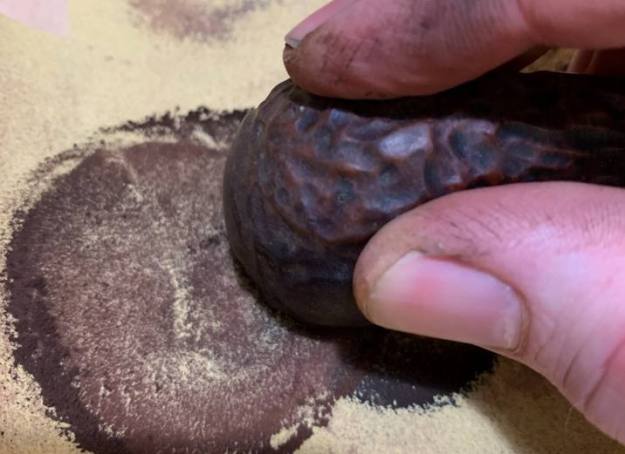
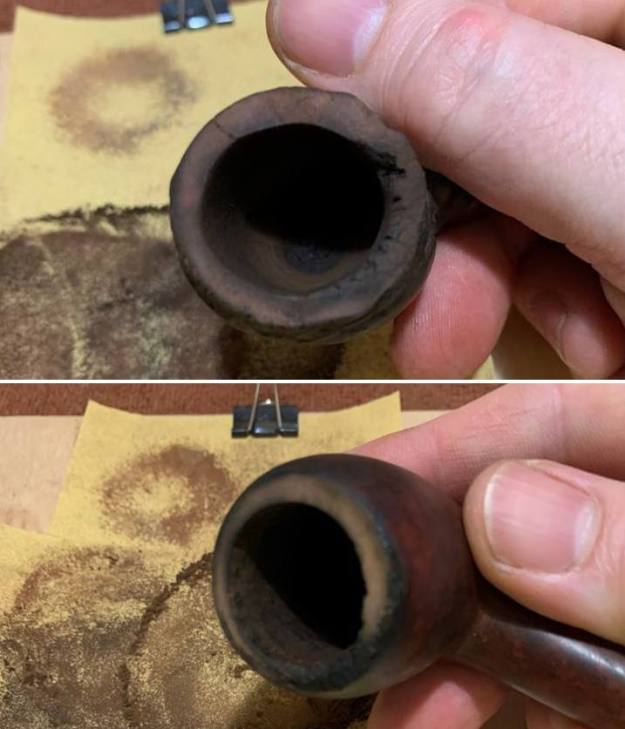
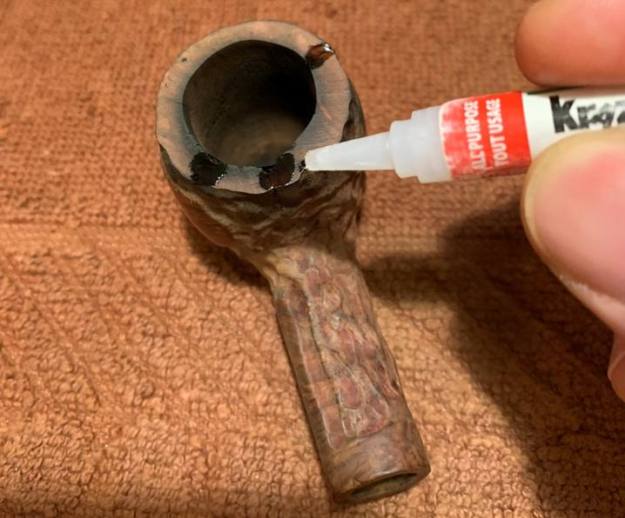
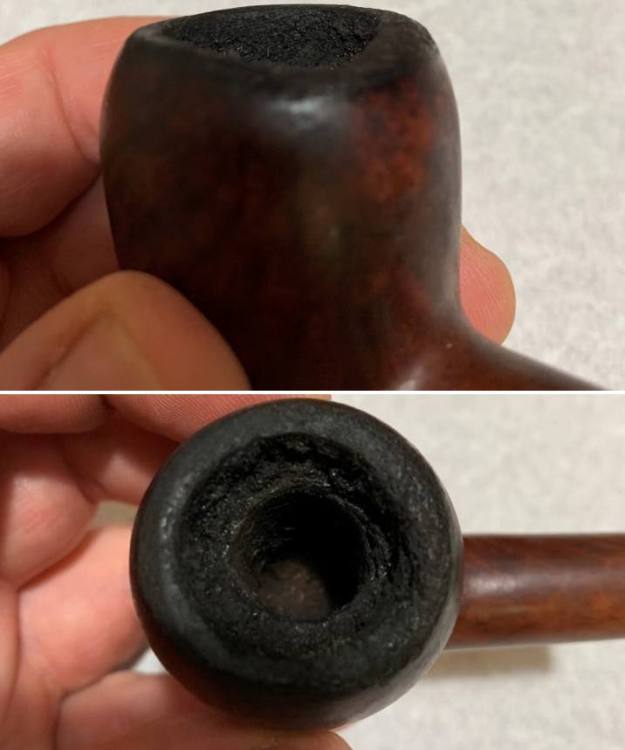
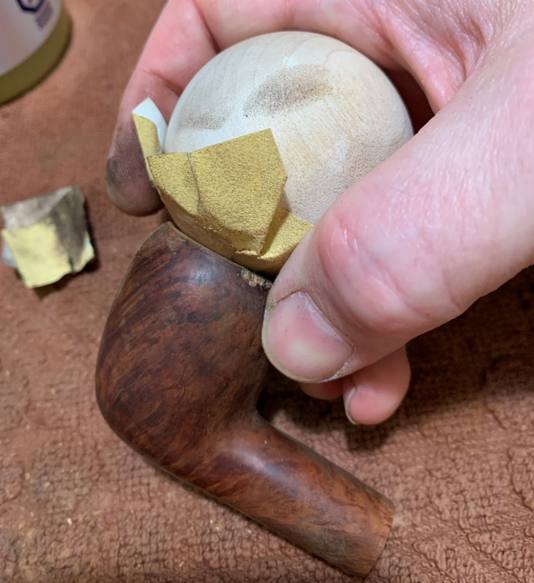
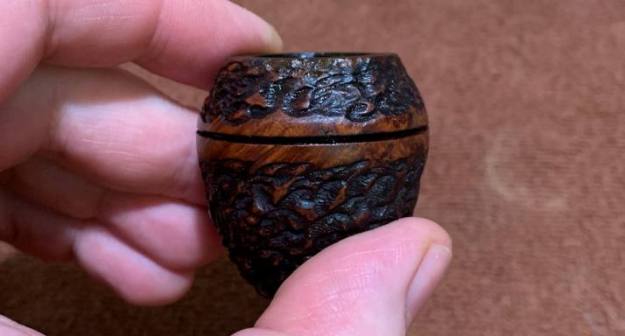
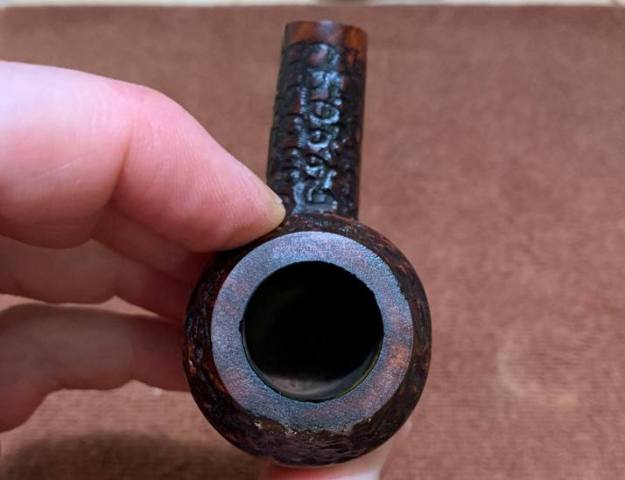
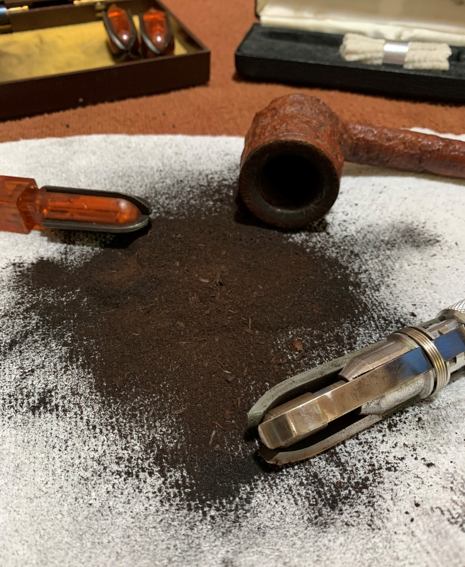
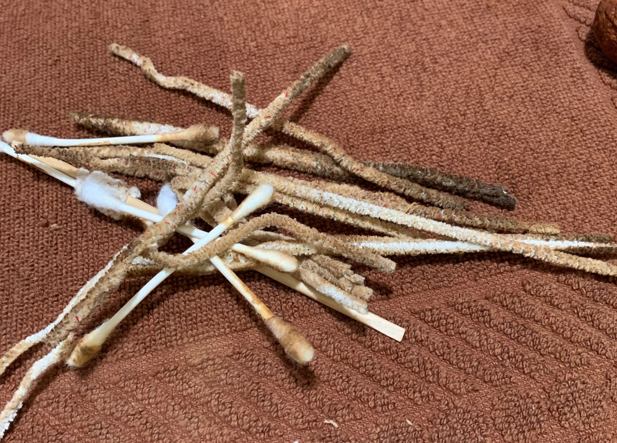
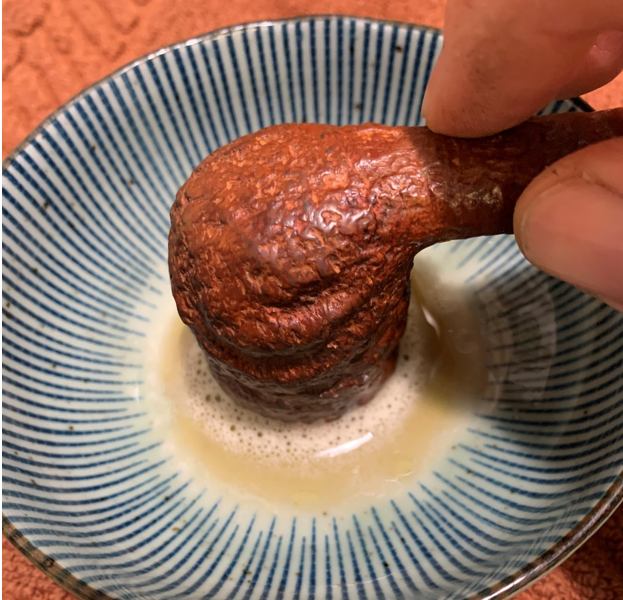
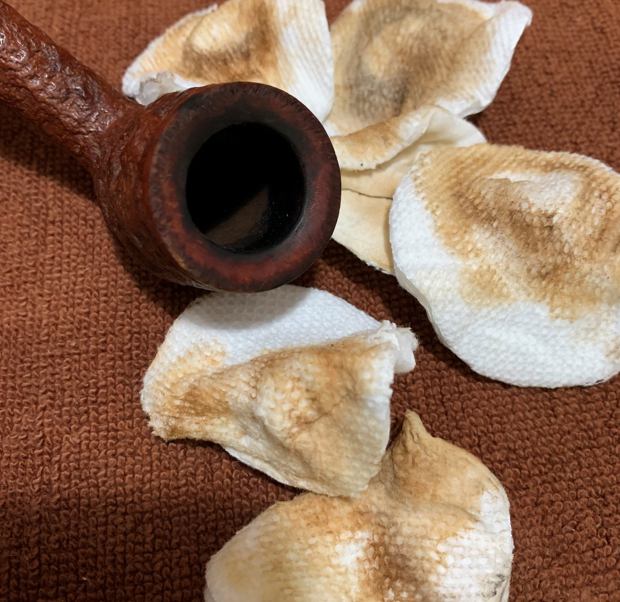
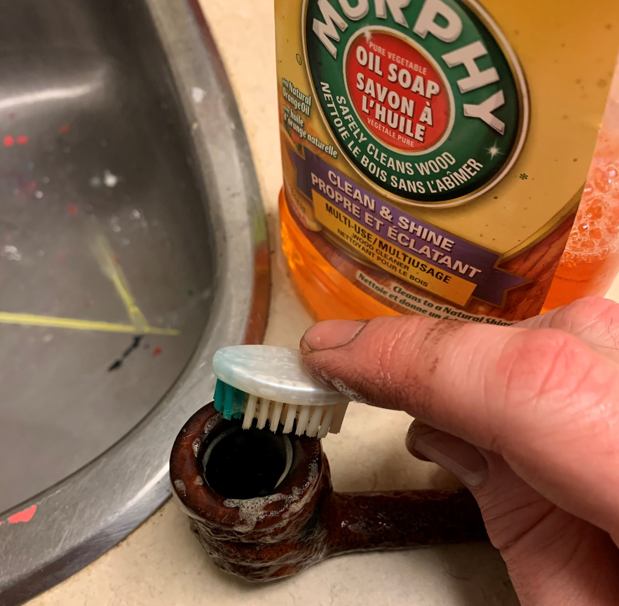
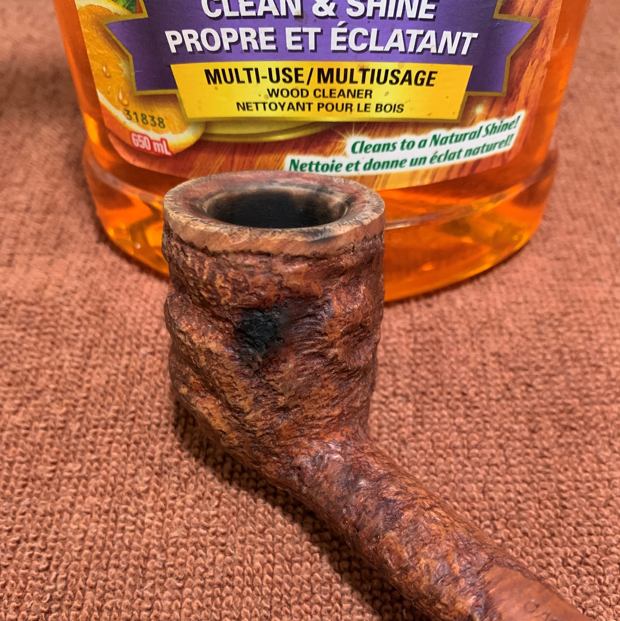
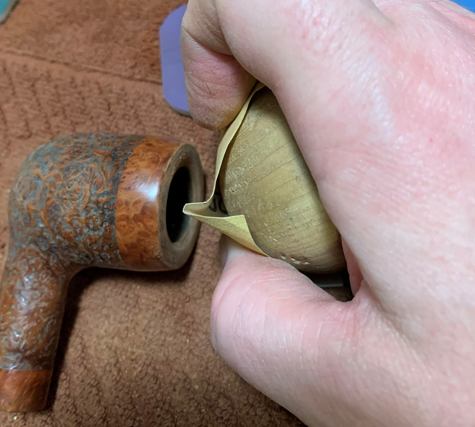
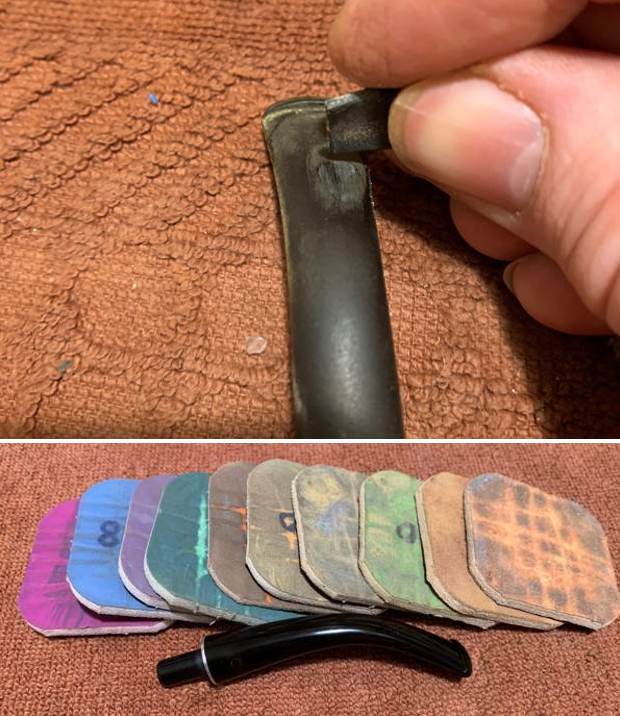
I also took this screenshot from Pipephil:Anyway, on to the pipe – and what a gorgeous pipe it was (and such a big bowl)! However, it was absolutely filthy and had a few issues. The stummel had the following problems: tons of lava on the rim, notable greasy/sticky stains to the bowl and shank, plenty of cake in the bowl, a few scratches here-and-there, and a few small burns on the rim. Meanwhile, the stem had a few problems of its own. Oh wait. No stem. Umm, yeah, that is going to be an issue. This pipe was going to require some considerable work, but I was really looking forward to restoring this one. Well, suffice it to say that first on my list of tasks was to find a stem for this beauty. However, GBD stems are not just lying around, sad to say. In this case, Superman Steve came to my rescue. He had a spare GBD stem that suited my pipe very well. I was (and still am) deeply grateful to him for getting that stem for me. I will come back to the story of how I fit the stem a bit later. By the way, here is a photo of Superman Steve:This stummel was quite a mess. I first decided to ream out the bowl. I used both the PipNet Reamer (which I broke in the process) and the KleenReem to remove the built-up cake and followed that with 220-grit sandpaper to eliminate as much as I could. I took it down to bare briar, as I wanted to ensure there were no hidden flaws in the walls of the bowl. Fortunately, there were none. I then proceeded to clean out the insides of the shank with cotton swabs, pipe cleaners, and lemon isopropyl alcohol. There was a lot of nastiness inside this stummel and – boy-oh-boy – it took a lot of cotton to get this thing clean! As I mentioned earlier, the rim of the stummel was pretty ugly and also needed to be addressed. A combination of techniques was used to sort this out. In order to remove the lingering bits of lava and fix the nicks, I “topped” the pipe – that is to say, I gently and evenly sanded down the rim on a piece of 220-grit sandpaper. This effectively removed the lava and the damage, without altering the look of the pipe. I then took a solid wooden sphere, wrapped sandpaper around it, and sanded the inner bevel thoroughly. This was to achieve on the inner part of the rim the same thing that I achieved by “topping” the rim on sandpaper. A de-ghosting session seemed in order, so I thrust cotton balls in the bowl and the shank, and saturated them with 99% isopropyl alcohol. I let the stummel sit for 24 hours. This caused the oils, tars and smells to leech out into the cotton. Finally, a relatively clean and fresh-smelling bowl emerged. I followed that up by cleaning the insides with some dish soap and tube brushes. I then moved on to cleaning the outside of the stummel with Murphy’s Oil Soap and some cotton pads. Some stains were pretty stubborn and I had to scrub hard, but this did eventually remove the remaining dirt. After that, a light application of Before & After Restoration Balm brought out the best in the stummel’s grain. Having completed that, I was able to address a small nick on the shank. I dug out my iron and a damp cloth to try and raise the nicks. The hot and moist steam created can often cause the wood to swell slightly and return to shape. There was some movement – not a lot, but it was better than doing nothing. I filled the remaining divot with cyanoacrylate adhesive and let it cure. Now, with the nick filled, it was time to sand down the stummel. I used all nine Micromesh pads (1,500 through 12,000 grit) to wet/dry sand everything smooth. Then I added a bit more Before & After Restoration Balm. On to the stem, and what a trial it was. As mentioned, Superman Steve got me a GBD stem and that was terrific: the stem was clean and in nice shape. So what is the problem? Well, its width did not quite match the width of the shank. The stem was slightly wider. So, with 200-grit sandpaper in hand, I began removing the excess vulcanite. As silly as it sounds, this took a couple of hours of work to get this right. The photos below detail the lengthy process to both remove the excess and ensure evenness all around the stem face. At long last, I managed to get the size and shape just right, but the faces of both the shank and stem were not matching in the way that one would want. I took the decision that this pipe would benefit from a thin – emphasis on thin – band around the end of the shank. My jar of bands proffered a lovely, thin band that perfectly suited this pipe. With a quick application of glue, the band was on and things were looking much improved. I used some of my Micromesh pads to give that extra shine. In order to finish up the stem, I took a BIC lighter and ‘painted’ it with its flame in order to lift the slight tooth marks. This was reasonably successful in raising the dents. Before I moved on to the Micromesh pads, I built up the small dents on the stem with cyanoacrylate adhesive and let them fully cure. I then sanded it down with 220-, 400-, and 600-grit sandpapers to meld the repair seamlessly into the stem. This ensures that it keeps its shape and looks like it should. I then used all nine Micromesh pads (1,500 through 12,000 grit) to bring out the lovely black lustre on the stem. I also used Obsidian Pipe Stem Oil in between each pad scrubbing. Of course, since the stem was straight, it did not suit the pipe and needed to be bent. The end of the stem needed to be parallel with the rim of the bowl. I did not have a heat gun at the time, so I brought out a hair drier and heated the vulcanite stem in order to make it malleable. After heating it for 90 minutes (yes, you read that correctly), it became obvious that the hair drier just did not generate enough heat to bend the stem. I then realized that I was going to have to use the nuclear option: dipping the stem in boiling hot water. This is a nuclear option because the water added an horrific oxidation to the stem – the worst I have ever seen. When it was finally soft, I gently curved the stem over a wooden dowel. The dowel provided a firm surface and a proper curve. Once I had the bend I wanted, I left the stem to cool and set itself in place. I then had to go back and use all nine Micromesh pads (and the Obsidian Pipe Stem Oil) again to restore the black lustre. A few four-letter words might have been silently uttered in the process, but I digress… Then it was off for a trip to the buffer. A dose of White Diamond and a few coats of carnauba wax were just what this pipe needed. The lovely shine made the wood look absolutely beautiful.
This is a wonderfully crafted pipe and has a very elegant feel to it. Steve told me from the beginning that this was a pipe I should keep for myself. So, this one is being added to my collection – and I am pleased to say that it smokes beautifully. I am sure that I will be enjoying this one for many years to come. I hope you enjoyed reading the story of these pipes as much I as I did restoring them. If you are interested in more of my work, please follow me here on Steve’s website or email me directly at kenneth@knightsofthepipe.com. Thank you very much for reading and, as always, I welcome and encourage your comments.

The Apple of My Eye


Blog by Kenneth Lieblich

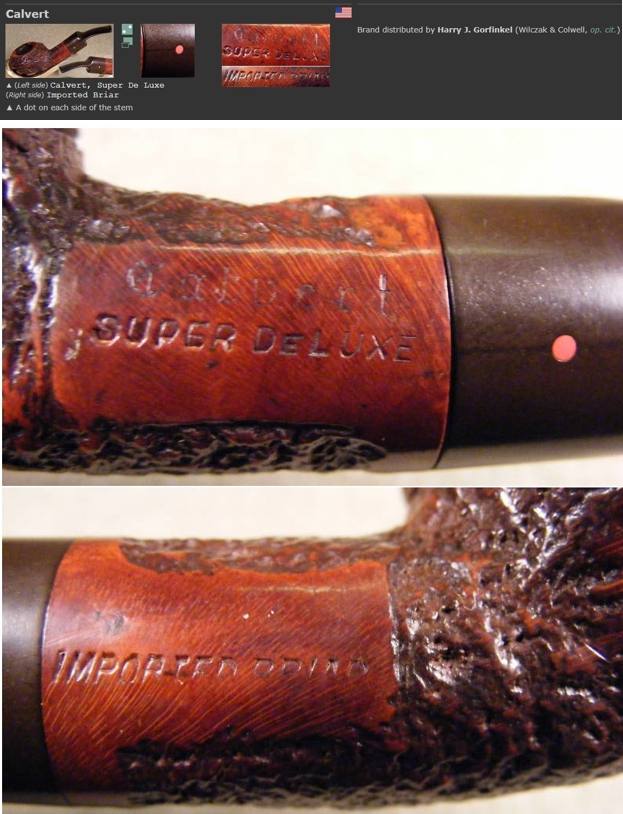
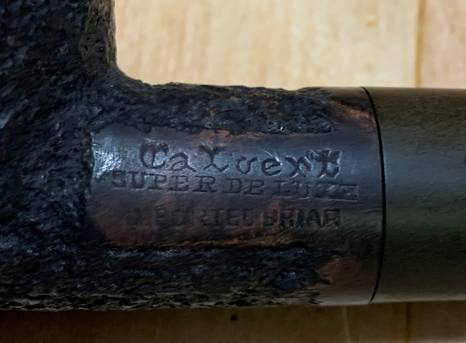
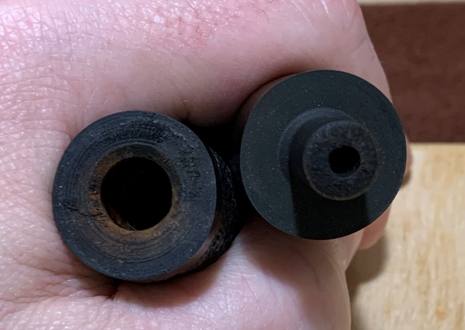
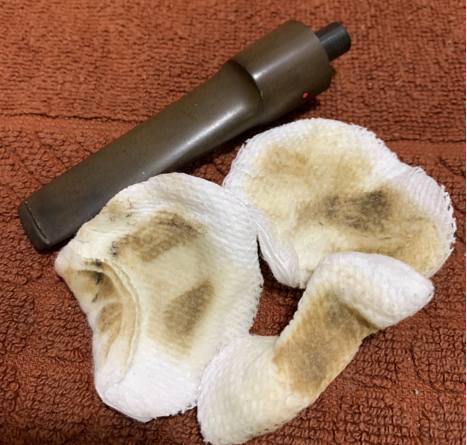
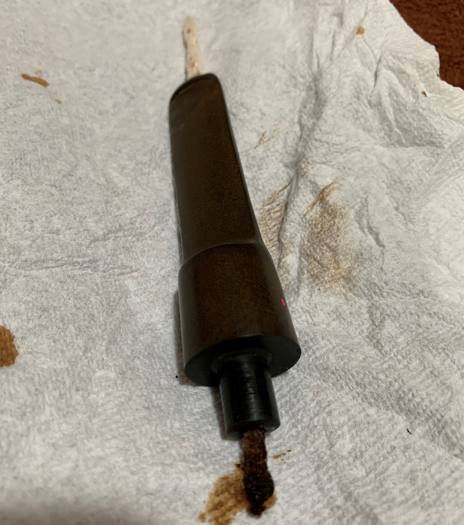
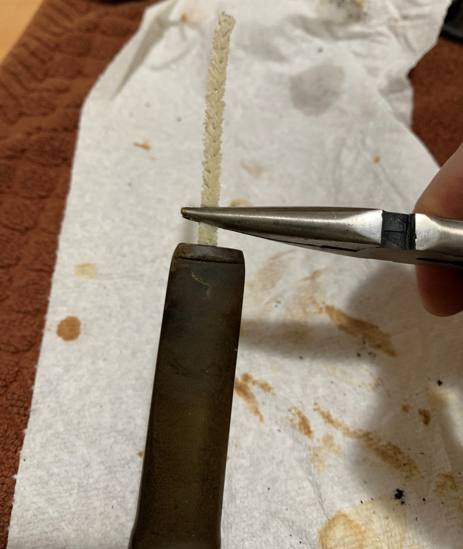
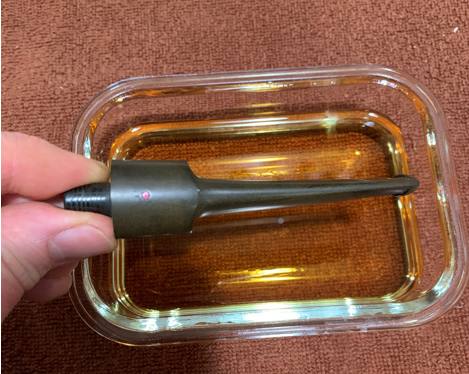
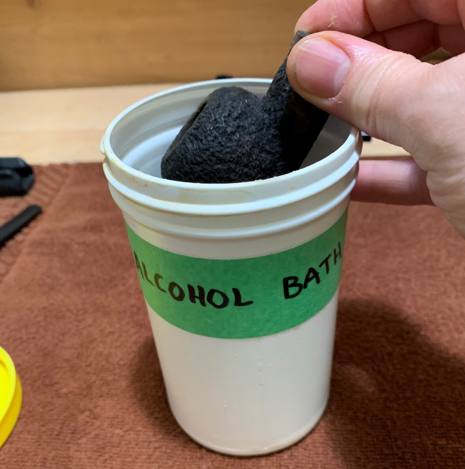
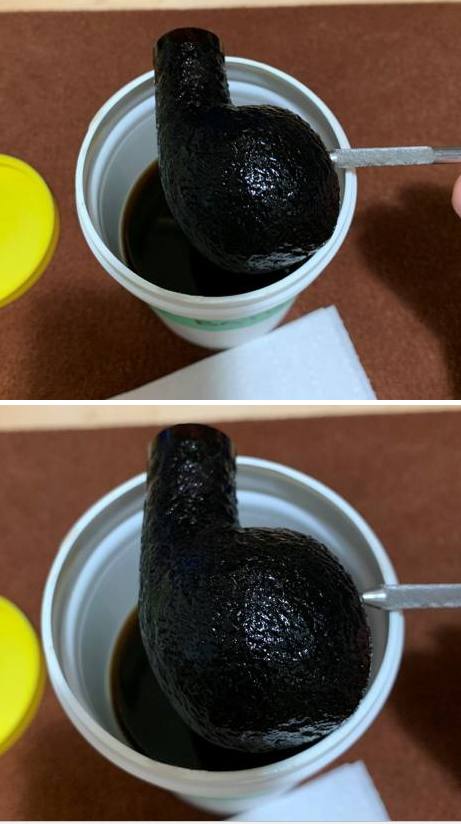
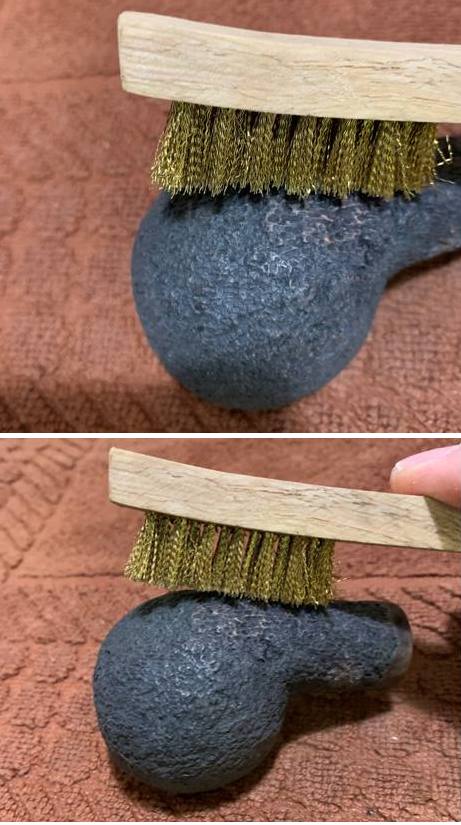
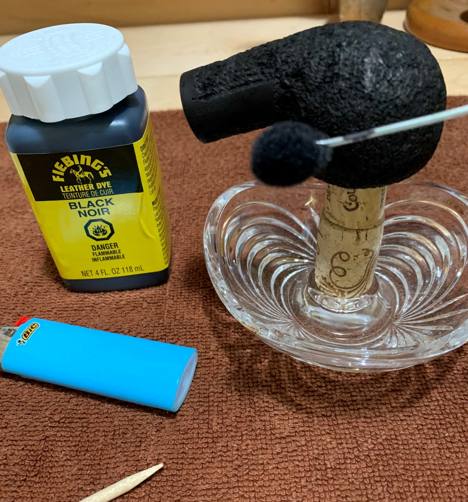
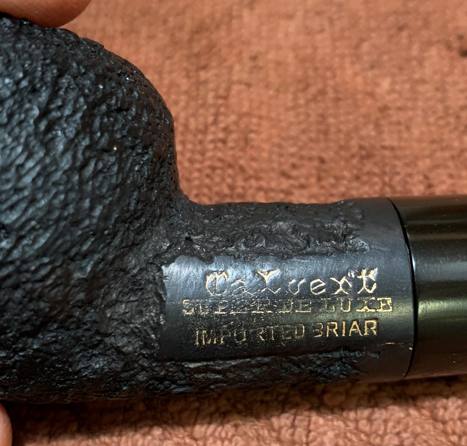
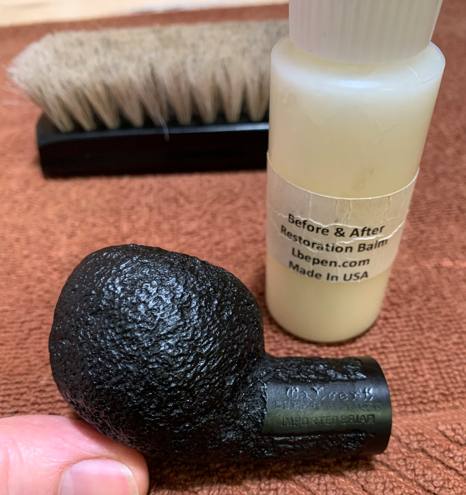
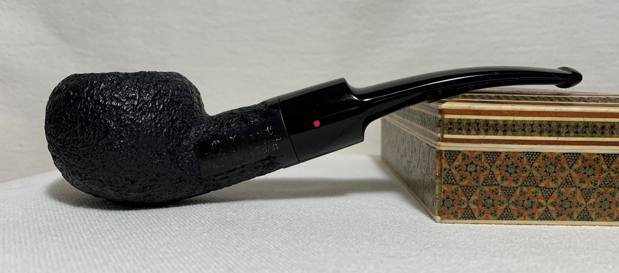
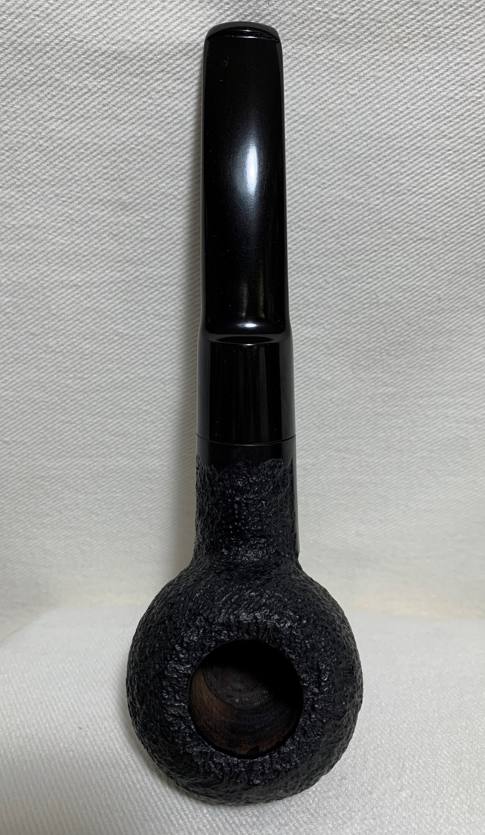
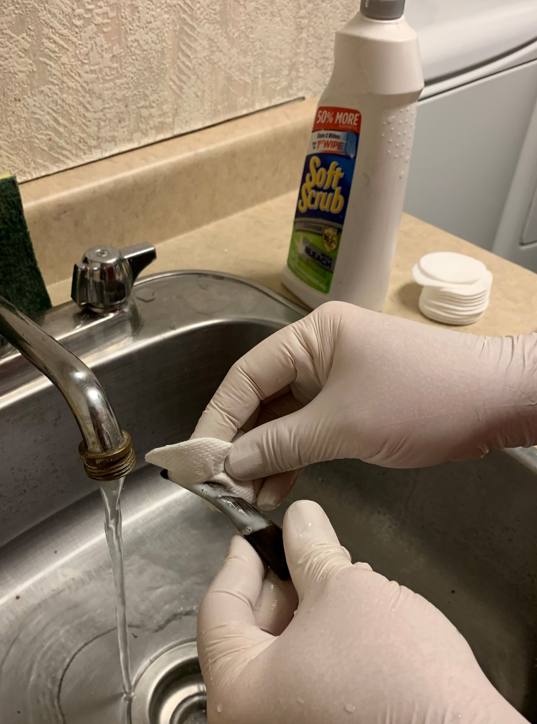
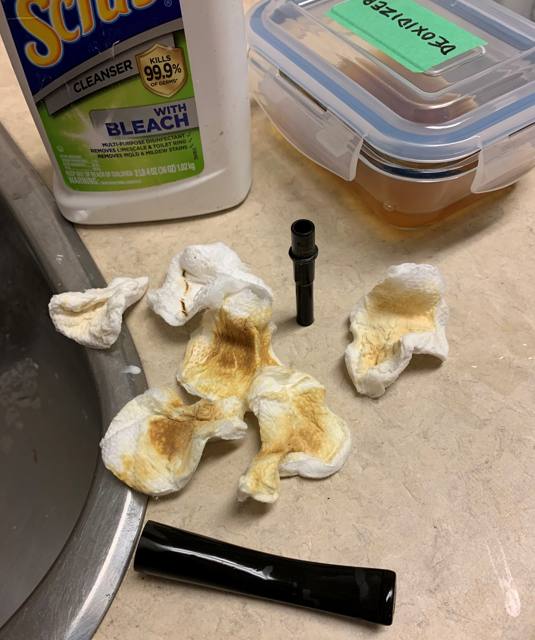
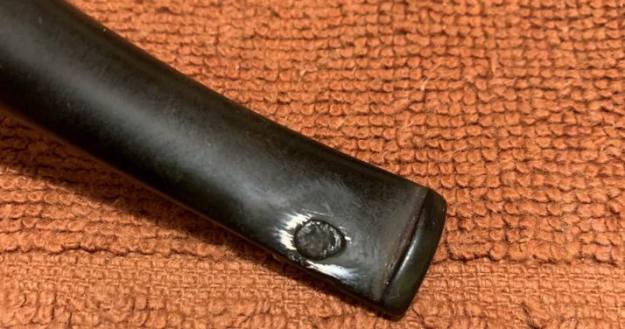
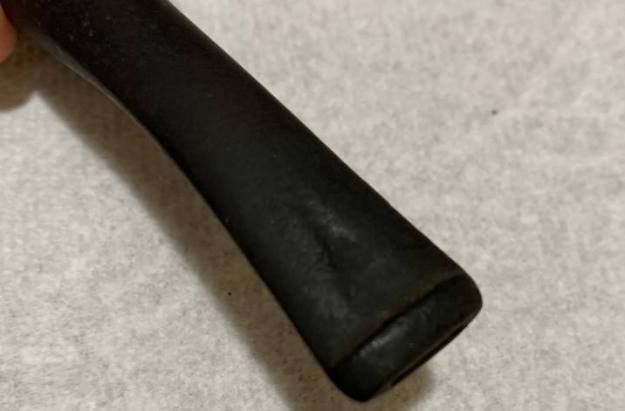
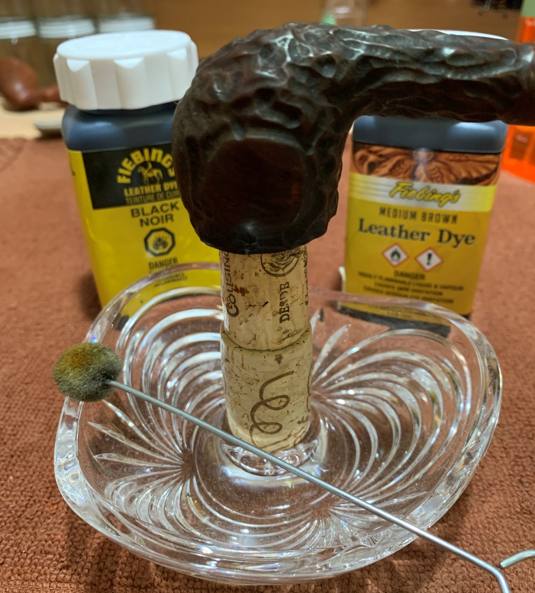
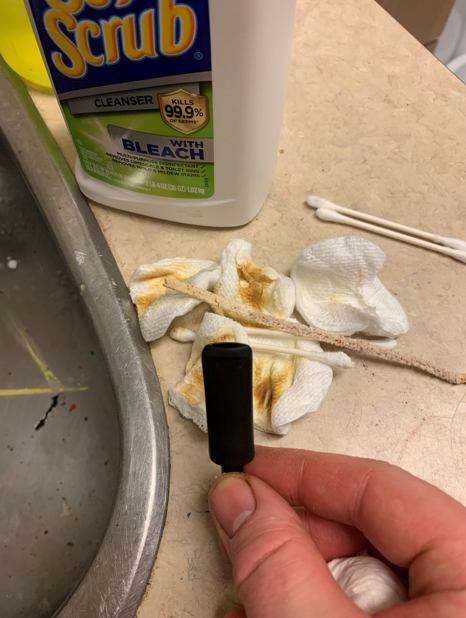
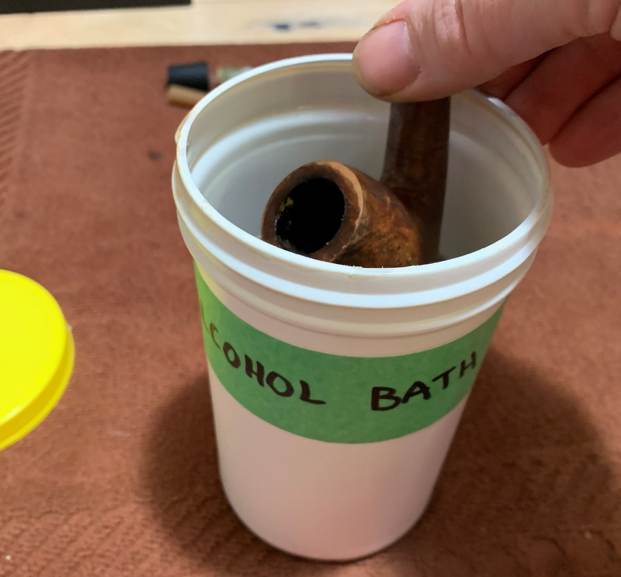
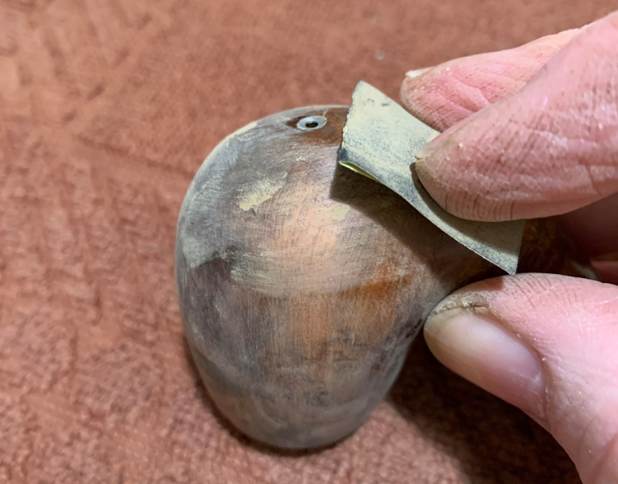
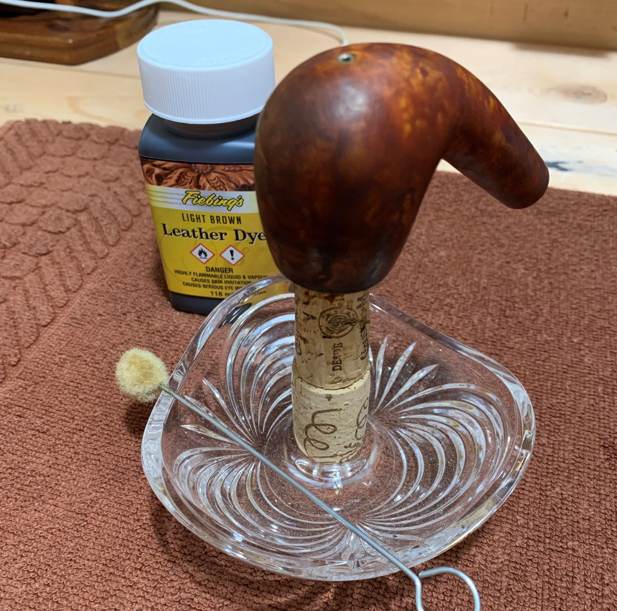
Next on the chopping block is as robust an apple-shaped pipe as you are likely to see. It is a beautiful and chunky Calvert Super De Luxe sort-of apple. It was one of a large lot of pipes that I acquired many months ago. It was a group of pipes off of eBay, but the seller was local to me so I picked them up in person. I do not remember the exact number, but there were 50-odd pipes. I have been making my way through them over the months. This pipe just spoke to me – I liked its powerful, rugged features and thought it would make a terrific restoration. Indeed, it might even be a good smoker too. There is not a lot of information to be had about Calvert pipes. The brand is listed on www.pipephil.eu and they quote Herb Wilczak and Tom Colwell’s book, Who Made That Pipe?, as saying that the brand was distributed by Harry J. Gorfinkel. Meanwhile, www.pipedia.com makes reference to the name Calvert in connection with Fader’s Tobacconists of Maryland. Apparently, they had a line of pipes called Calvert after the street that the shop was located. I am quite sure that this is not my pipe and is completely unrelated to the Calvert mentioned by Wilczak and Colwell. The photos of the markings provided on www.pipephil.eu match perfectly with my pipe, so there it is.Fortunately, this pipe did not have too many problems. The stummel was mostly just drab and grubby. It also had a bit of cake in the bowl and a few scratches here-and-there. The colouring of the wood needed to be redone too. Meanwhile, the stem had a few problems of its own: there was some oxidation and calcification, and minor tooth marks and dents. The stem also looked weird to me: it was straight, but I thought it would be improved with a slight bend. I really like the shape and I was looking forward to working on this one. It just needed a new lease on life.The stem was first on my list. I took a BIC lighter and ‘painted’ the stem with its flame in order to lift the marks. This was only modestly successful in raising the dents. I wiped down the outside of the stem with Murphy’s Oil Soap on some cotton pads. Then, I cleaned out the insides with pipe cleaners and isopropyl alcohol. Have a look at the photo showing the pipe cleaner sticking out of the end of the tenon – it was pretty yucky. Once this process was done, the stem went for an overnight soak in the Before & After Hard Rubber Deoxidizer. The following day, I cleaned all of the de-oxidizing sludge off with alcohol, pipe cleaners, et cetera. The oxidation had migrated to the surface and would be fairly straightforward to remove. I scrubbed vigorously with SoftScrub on cotton pads to remove the leftover oxidation. I built up some tiny dents on the stem with cyanoacrylate adhesive and let it fully cure. I then sanded it down with 220-, 400-, and 600-grit sandpapers to meld seamlessly into the stem. This ensures that it keeps its shape and looks like it should. I then used all nine Micromesh pads (1,500 through 12,000 grit) to bring out the lovely black lustre on the stem. I also used Obsidian Pipe Stem Oil in between each pad scrubbing. Once I was done with the polishing, I noticed a tiny piece of metal on the underside of the stem. I asked Steve about it and he said that he had heard that it was an indication that the stem was made from old tires. This is actually fortunate because it allows us to date the pipe to World War II or shortly thereafter (according to Steve’s memory). I mentioned earlier that I thought the stem did not look quite right. I asked Steve about it and he had the same impression. Essentially, I wanted the end of the stem to be parallel with the rim of the bowl. I brought out my heat gun and heated the vulcanite stem in order to make it malleable. The heat gun is very powerful – it does not take long! When it was soft, I gently curved the stem over a wooden dowel. The dowel provides a firm surface and a proper curve. Once I had the bend I wanted, I left the stem to cool and set itself in place.On to the stummel, and the usual cleaning procedures were in order for this pipe. I used both the PipNet Reamer and the KleenReem to remove the built-up cake, and followed that with 220-grit sandpaper to remove as much as I could. I wanted to take the bowl down to bare briar to ensure there were no hidden flaws in the walls of the bowl. Fortunately, there were none. I then proceeded to clean out the insides of the shank with Q-tips, pipe cleaners, and isopropyl alcohol. There was quite a bit of nastiness inside this stummel – it took many pipe cleaners et cetera to sort that out. A de-ghosting session seemed in order, so I thrust cotton balls in the bowl and the shank, and saturating them with 99% isopropyl alcohol. I let the stummel sit for 24 hours. This caused the oils, tars and smells to leech out into the cotton. Finally, a relatively clean and fresh-smelling bowl emerged. I followed that up by cleaning the insides with some dish soap and tube brushes. I then moved on to cleaning the outside of the stummel with Murphy’s Oil Soap and a scrub brush. That removed any remaining dirt. There was a small crack in the shank, but, thankfully it was minor and I addressed it effectively with some cyanoacrylate adhesive. The repair worked beautifully and quickly. Since this pipe is rusticated, I was not going to sand down the stummel with my Micromesh pads, but I did do it to the small sections that were smooth (i.e. where the markings were located). In order to avoid disturbing the rusticated sections, I masked these areas off with painter’s tape. This simplified the process a great deal.On to another problem: the colour. During the course of its previous life and my vigorous cleaning, this pipe had lost some vibrancy of colour. So, in order to accentuate the external beauty of this pipe, I opted for aniline dye. However, I noticed that there were some gooey marks on the stummel that needed to be removed before I stained the pipe. So, I opted to soak the stummel in isopropyl alcohol for a few hours beforehand. This will usually remove the sort of goo I was faced with. When I took it out of the bath, I scrubbed the wood with a metal brush (to remove any remnants) and left it to dry. Once dry, I applied some of Fiebing’s Black Leather Dye. As usual, I applied flame from a BIC lighter in order to set the colour. What a difference that made! It looked so much better with a fresh coat of stain. I then embellished the stummel markings with some gold Rub’nBuff – just to add some flair. Since the markings were quite worn (and, therefore, shallow), the paint did not illuminate everything, but I still liked the effect a lot. I applied some Before & After Restoration Balm and then it was off for a trip to the buffer. A dose of White Diamond and a few coats of Halcyon II wax were just what this pipe needed. The lovely shine made the wood very attractive. This is a very handsome pipe and will provide many years of smoking pleasure.This Calvert Super De Luxe is back to its old glory and ready to be enjoyed again by the next owner. I am pleased to announce that this pipe is for sale! If you are interested in acquiring it for your collection, please have a look in the ‘American’ pipe section of the store here on Steve’s website. You can also email me directly at kenneth@knightsofthepipe.com. The approximate dimensions of the pipe are as follows: length 6½ in. (165 mm); height 1¾ in. (44 mm); bowl diameter 1⅞ in. (48 mm); chamber diameter ⅞ in. (21 mm). The weight of the pipe is 2¼ oz. (65 g). I hope you enjoyed reading the story of this pipe’s restoration as much I as I did restoring it. If you are interested in more of my work, please follow me here on Steve’s website or send me an email. Thank you very much for reading and, as always, I welcome and encourage your comments.
Five for the Price of One


Blog by Kenneth Lieblich

Next on the chopping block is a quintet of pipes. Word has been getting around! My barber’s boss approached me recently about restoring his late grandfather’s pipes. Of course, I was only too happy to oblige. The fellow told me that his grandfather did not have fancy pipes, but he just wanted them to look good. Interestingly, he also asked that I not clean the pipes too much – he wanted some of the olfactory memories to remain. When I got my hands on the pipes, I realized what I was up against. These five pipes were really a mess. Quite frankly, if I had these pipes for myself, I would have tossed some on the firewood pile. But my customer wanted these pipes restored as a nice remembrance of his grandfather – and I completely understand and respect that. Since I restored these pipes all together, I thought I would write up their story altogether too – with a tip of my hat to my customer’s late grandfather.

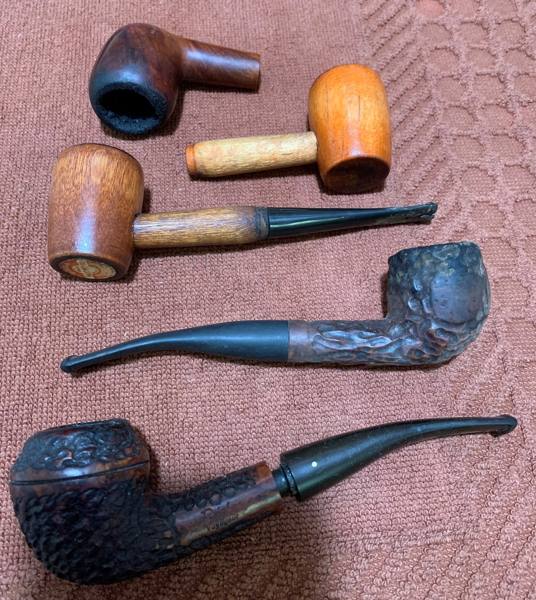
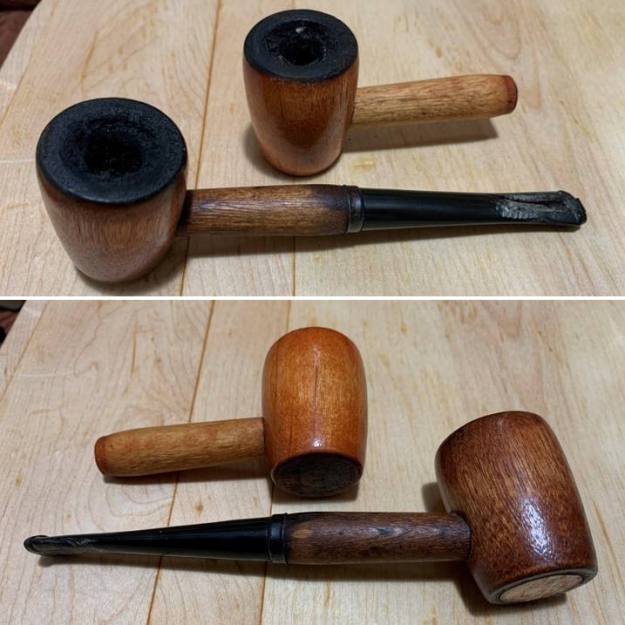
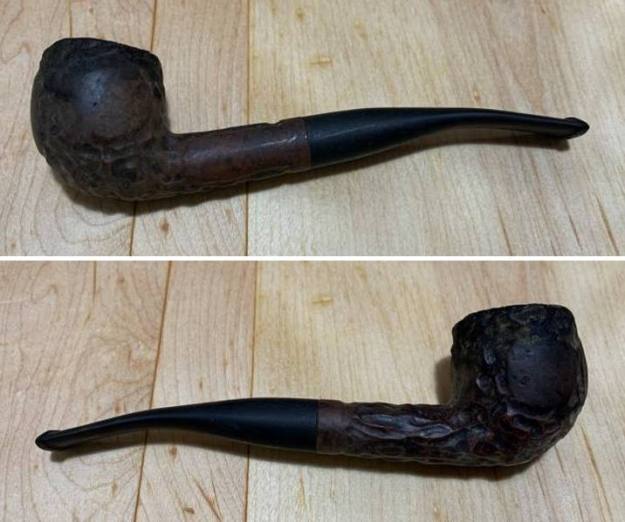
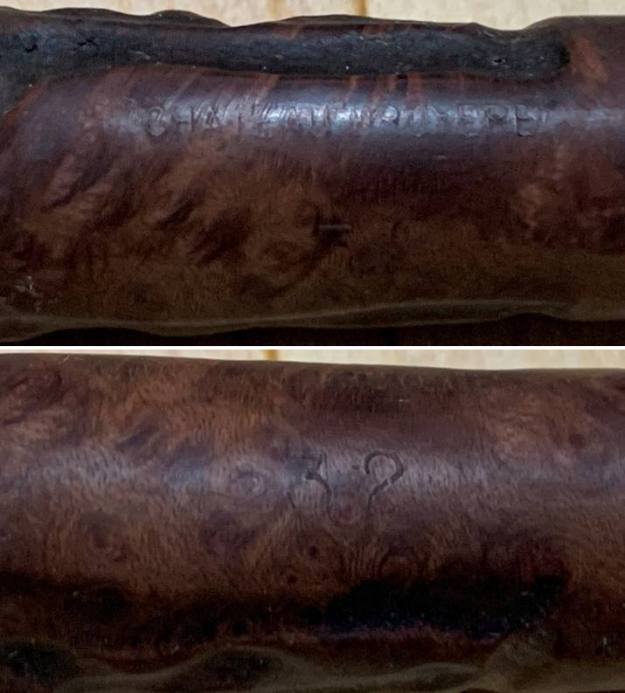
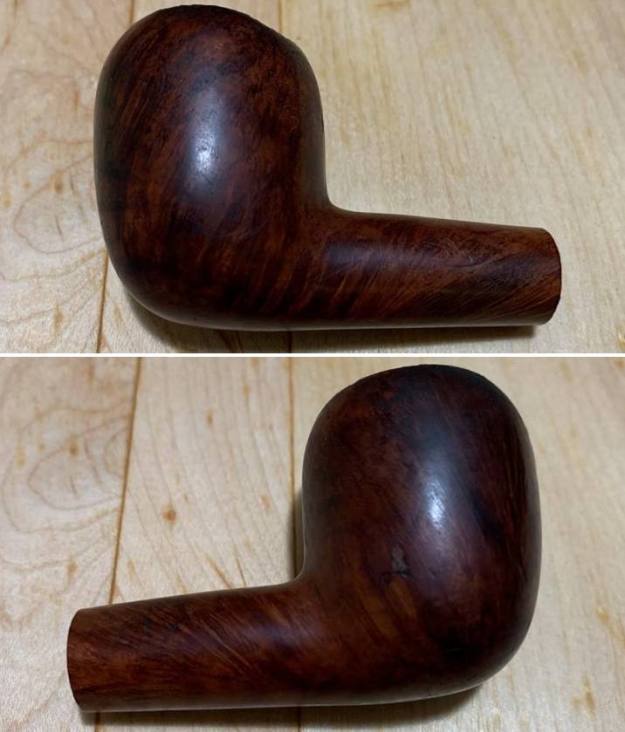
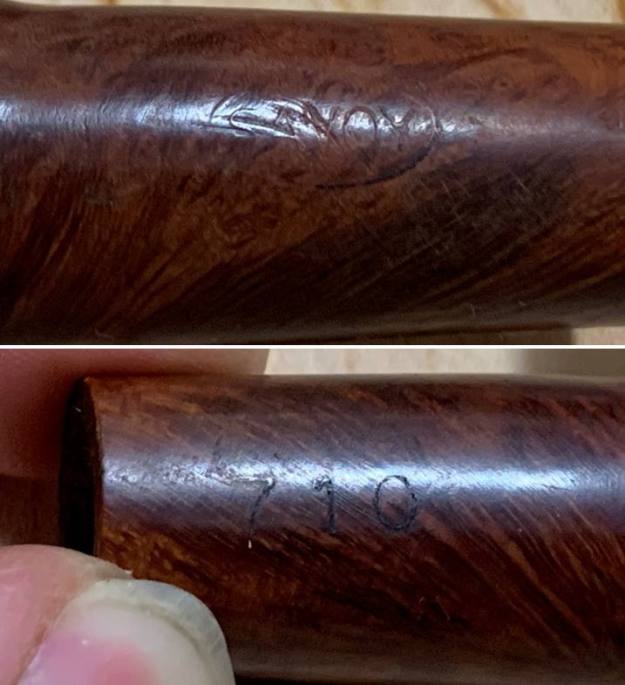
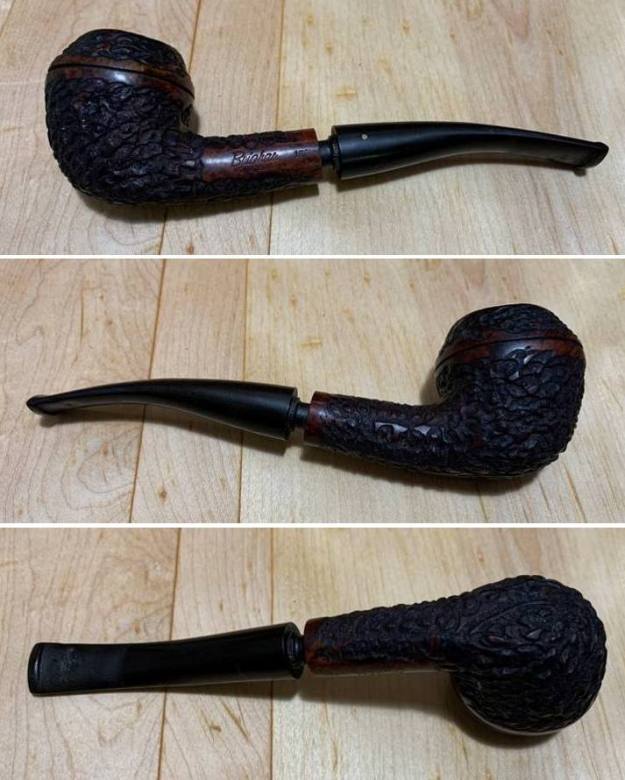
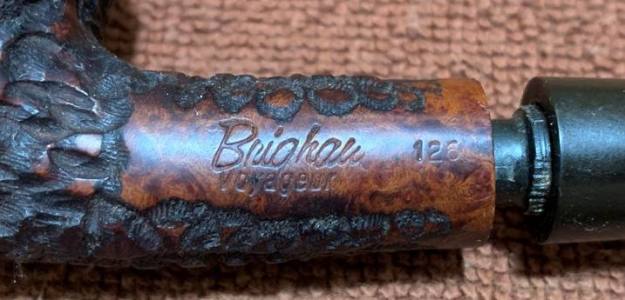
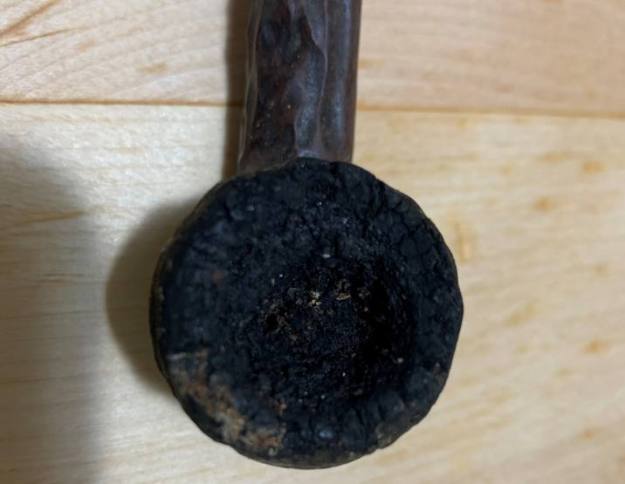
Well, what have we got here? (1) A cherrywood pipe from Missouri Meerschaum, missing its stem; (2) another cherrywood pipe from Missouri Meerschaum; (3) a briar bent pot, marked Château Bruyère 32; (4) a briar egg, marked Savoy 710, missing its stem; and (5) a Brigham Voyageur 126 bent Rhodesian. Missouri Meerschaum is, of course, most famous for being the largest corncob manufacturer in the world – although they do make hardwood pipes too. Herb Wilczak and Tom Colwell’s book, Who Made That Pipe? states that Château Bruyère (as its name suggests) is made in France by an unknown manufacturer. Pipedia tells us that Savoy is a brand of Oppenheimer Pipe/Comoy’s, which was also sold by M. Linkman & Co. Finally, Brigham is the famous Canadian pipe manufacturer. The markings suggest that this Brigham was made after the move of production to Italy.

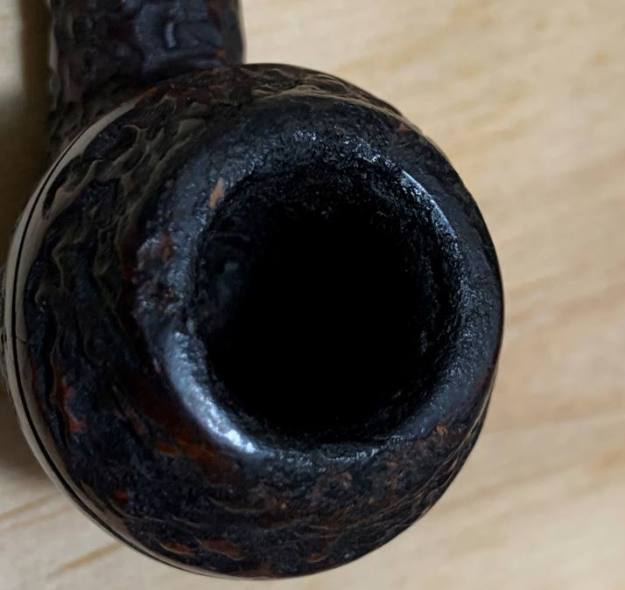
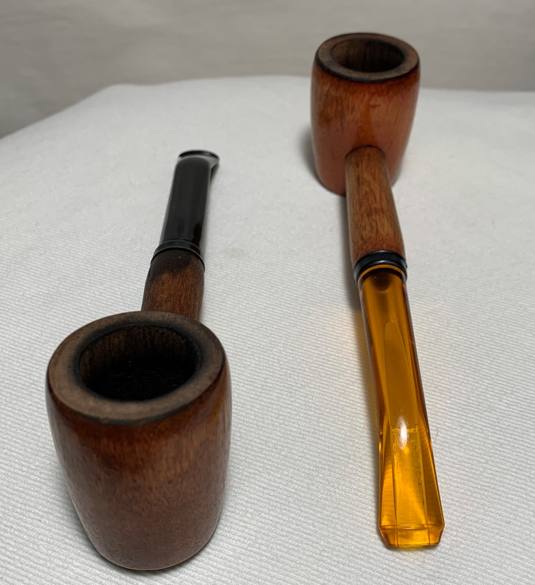
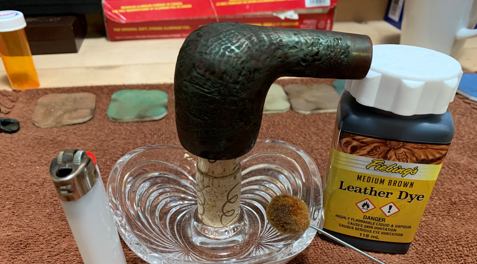
Problems with these pipes? Wow – where to begin? Both cherrywoods needed new stems. After all, one was cracked beyond repair and the other was missing altogether. They had lava and burns all over, and plenty of cake in the bowl. Besides that, the stummels were just a bit grimy. The Château Bruyère was in really bad condition: tons of lava, cake, and serious burning; cracks galore on the rim; but at least the stem had only minor tooth marks and dents. The Savoy would, of course, also need a new stem, but its stummel was also a disaster: some fills; tons of lava and cake; and (worst of all) an enormous burn gouge on the rim. The Brigham was not too bad (compared with the others), but it still had the usual cake and lava. It also looked like the rim had been used to hammer nails! The stems were first on my list. Fortunately, Steve had a couple of new Missouri Meerschaum stems for me to use on the cherrywood pipes. That was the easiest part of this whole restoration! I also had to sculpt a new stem for the Savoy. Stupidly, I forgot to take photos of this procedure, but, suffice it to say, it was tricky getting the tenon to fit correctly and getting the edges of the new stem to match with the existing stummel. On the two pre-existing stems, I took a BIC lighter and ‘painted’ them with flame in order to lift the tooth marks. This was reasonably successful in raising the dents. Then, I cleaned out the insides of the stems with pipe cleaners and isopropyl alcohol. They were terribly dirty and I went through a large number of pipe cleaners in order to clean them up. Once this process was done, the stems went for an overnight soak in the Before & After Hard Rubber Deoxidizer. The following day, I cleaned all of the de-oxidizing sludge off with alcohol, pipe cleaners, et cetera. The oxidation had migrated to the surface and would be fairly straightforward to remove. I scrubbed vigorously with SoftScrub on cotton pads to remove the leftover oxidation. On the Brigham, the tenon had come loose from the stem and needed to be repaired. I used my cyanoacrylate adhesive to sort that problem out and let it set. I also built up the small dents on the Brigham and Château Bruyère stems with cyanoacrylate adhesive and let them fully cure. I then sanded the repairs down with 220-, 400-, and 600-grit sandpapers to meld the repair seamlessly into the stems. This ensured that they keep their shape and look like they should. I then used all nine Micromesh pads (1,500 through 12,000 grit) to bring out the lovely black lustre on the stems. I also used Obsidian Pipe Stem Oil in between each pad scrubbing. I should make quick mention of the stem I made for the Savoy. I had a blank and an old, spare stem to potentially use. I ended up using the blank because it fit better. Making a new stem is tricky and messy business, and Steve is far better (and more experienced) than I am at it. Basically, I used some 220-grit sandpaper to remove the excess material from the tenon (to ensure it fit into the stummel’s mortise) and from the tenon-end of the stem (to ensure that this end matches the shape and thickness of the shank). Once the basic shape is achieved, I use progressively finer sandpaper (and then the MicroMesh pads) to make the stem look just as it should. In this end, I was pleased with the results and I wish I had photos to show you of the process!All five stummels were a terrible mess: loaded with cake, filth, and an overall yucky feel. They had obviously been thoroughly smoked and enjoyed. Quite frankly, the grandfather must have smoked them until there was no more draw! Anyway, I first decided to ream out all of the bowls. I used both the PipNet Reamer and the KleenReem to remove most of the built-up cake – but not all. I didn’t take the cake down to bare briar, as my customer wanted some essence of his grandfather left in the bowls. The one exception to this was the Brigham, and I did ream it completely and brought it down to bare briar. My customer wanted only this pipe to be completely cleaned out. On all five, however, I did clean out the insides of the shanks with Q-tips, pipe cleaners, and isopropyl alcohol. There was a lot of nastiness inside the shanks and it took a lot of cotton to get them clean! I then moved on to cleaning the outside of the stummels with Murphy’s Oil Soap on some cotton pads and also used a tooth brush to get into the crevasses of the Brigham and the Château Bruyère. I actually soaked the rims in Murphy’s for a while, just to loosen up the lava. I followed that up by cleaning the insides of the Brigham with some dish soap and tube brushes. A de-ghosting session seemed in order for the Brigham. The de-ghosting consisted of thrusting cotton balls in the bowl and the shank, and saturating them with 99% isopropyl alcohol. I let the stummel sit for 24 hours. This caused the oils, tars and smells to leech out into the cotton. Finally, a relatively clean and fresh-smelling bowl emerged. There was a great deal of damage to the rims of all the stummels – and that also needed to be addressed. In order to remove the lingering bits of lava, fix any nicks, and tidy up the look, I “topped” the pipes – that is to say, I gently and evenly sanded down the rims on a piece of 220-grit sandpaper. This effectively removed the lava and the damage, without altering the look of the pipes. However, some needed more attention than others. The two cherrywood pipes were straightforward enough, but a fair amount of work was needed on the other three. The Château Bruyère, as you will have seen, had fairly horrific damage to the wood of the bowl. There were so many cracks and burns that I was not sure if anything meaningful could be done. I did top the bowl, but stopped before I took too much off. There was no getting around the fact that this pipe was not going to be like new. I was comforted by the fact that this pipe was simply being cleaned up and was not going to be smoked again. I sealed off the cracks with cyanoacrylate adhesive, let them cure, and then sanded them smooth. It made a huge difference.But the Château Bruyère still needed a bit more help: re-staining. In order to create some external beauty to this pipe, I opted for aniline dye. I applied my own mixture of some of Fiebing’s Medium Brown Leather Dye and some Fiebing’s Black Leather Dye. I then applied flame in order to set the colour. Worked like a charm! The pipe looked so much better after this.The Savoy had a large valley running along the rim of the bowl (not to mention some considerable burning). A combination of techniques was used to sort this out. I topped the stummel to start, but then I took a solid wooden sphere, wrapped sandpaper around it, and sanded it thoroughly. This was to achieve on the inner part of the rim the same thing that I achieved by “topping” on sandpaper. I then built up the remaining wound with a mixture of briar dust and cyanoacrylate adhesive. I was quite pleased with the results. Finally, I added a brass ferrule to the end of the shank and glued it in place. It gave the pipe a snazzy look. The Brigham was also tricky, but for a different reason. The Brigham had what I like to call a “broken nose”. The front edge was smashed in and would need to be built up. More than that, the repair would need to be rusticated so as to match the original rustication of the pipe. I am always worried about this sort of work because I dread the possibility of not getting the match right. In this case, I topped the Brigham first, but only slightly – just enough to make it neat and tidy. Then I built up the edge with a mixture of briar dust and cyanoacrylate adhesive. Then, I topped it a second time in order to even out the repair with the rim. Finally, I got out my Dremel and used that to rusticate the pipe’s “nose”. The results were quite good. Now, with the damage repaired on all five pipes, it was time to sand down the stummels. Just like the stems, I used all nine Micromesh pads (1,500 through 12,000 grit) to sand everything smooth on the three briar pipes (I did not sand the cherrywoods). A light application of Before & After Restoration Balm brought out the best in the stummels’ grain

Then it was off for a trip to the buffer. A dose of White Diamond and a few coats of carnauba wax were just what these pipes needed to shine (literally and figuratively). The polishing was the cherry on top of a long road of recovery for these five pipes. The pipes began in the hands of a man who clearly loved smoking them. His grandson, honouring his grandfather’s memory, wanted them to look good again – but not so new that the essence of his grandfather was lost. It was my job to make sure that his grandfather was still in those pipes. I know that my customer will enjoy looking at those pipes (and remembering) for many years to come. I hope you enjoyed reading the story of these pipes as much I as I did restoring them. If you are interested in more of my work, please follow me here on Steve’s website or email me directly at kenneth@knightsofthepipe.com. Thank you very much for reading and, as always, I welcome and encourage your comments.

How Long Can A Canadian Be?


Blog by Kenneth Lieblich

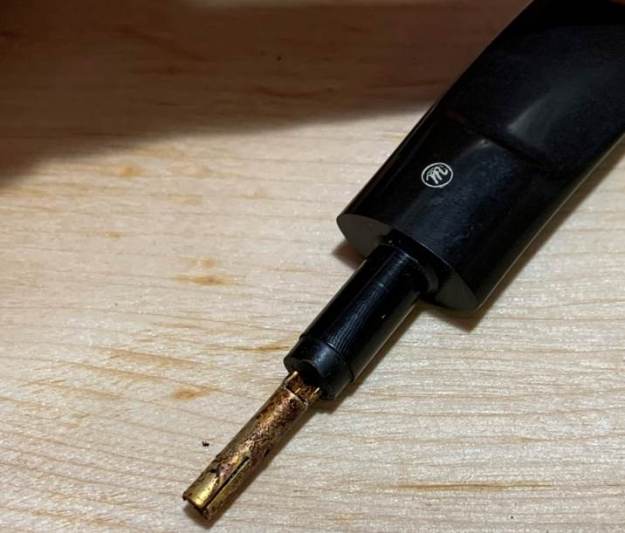
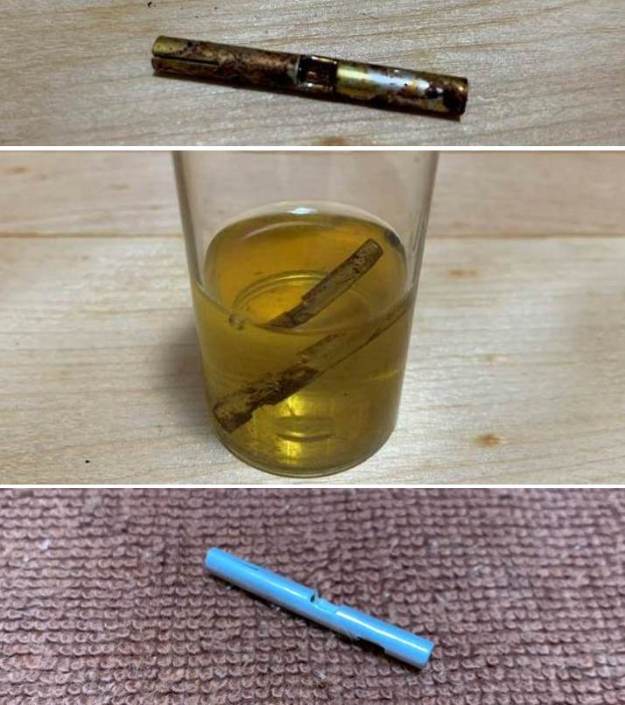
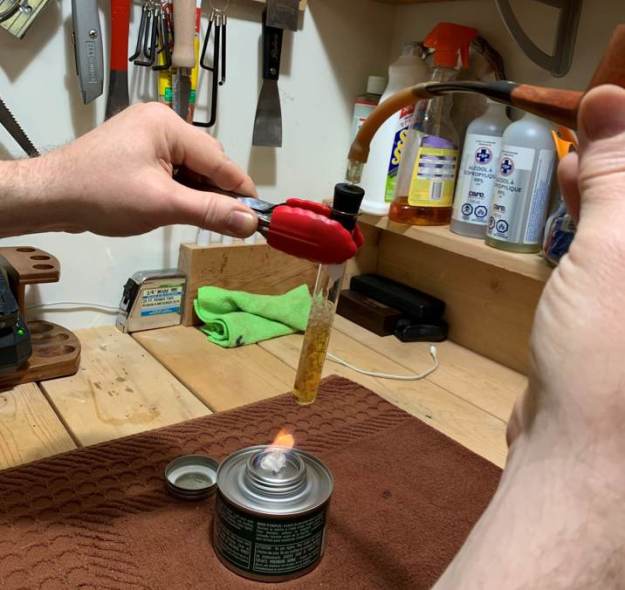
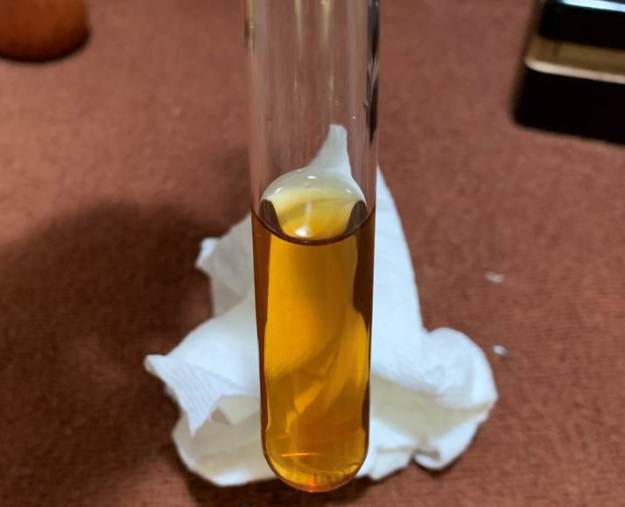
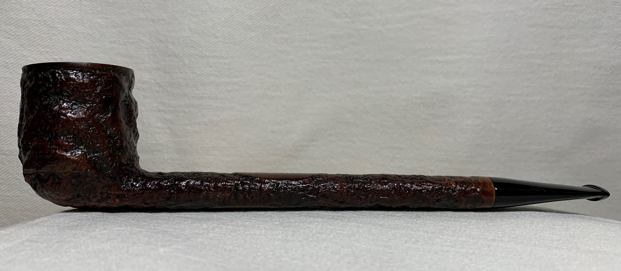
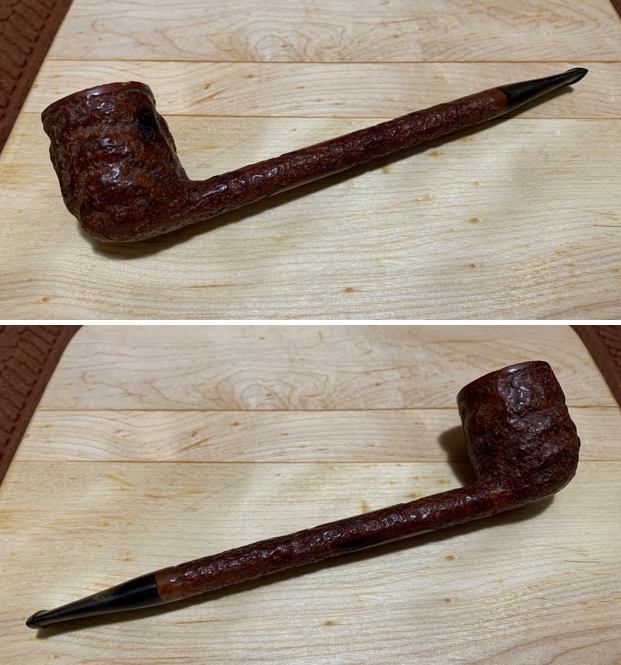
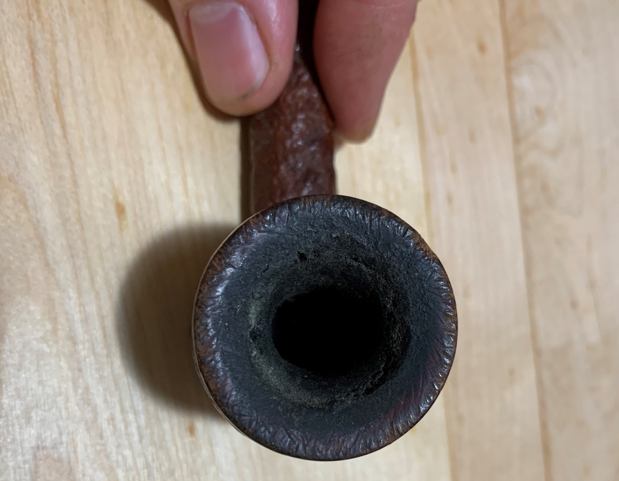
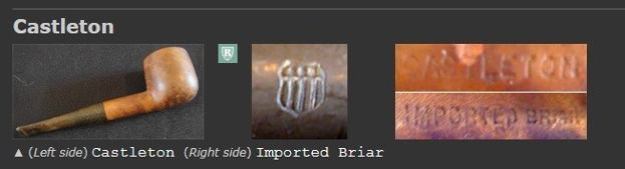
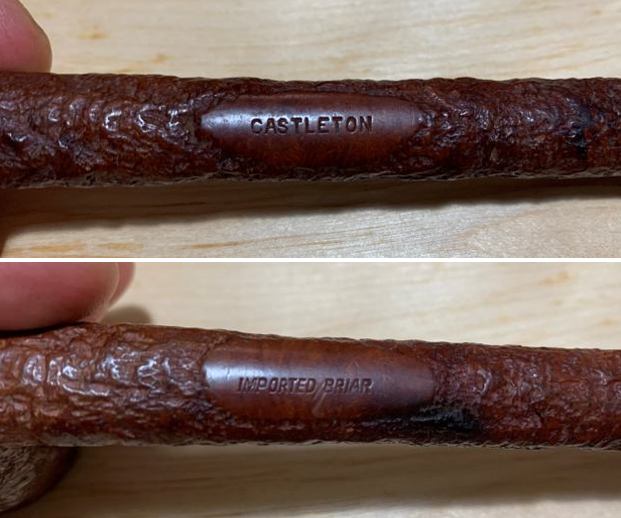
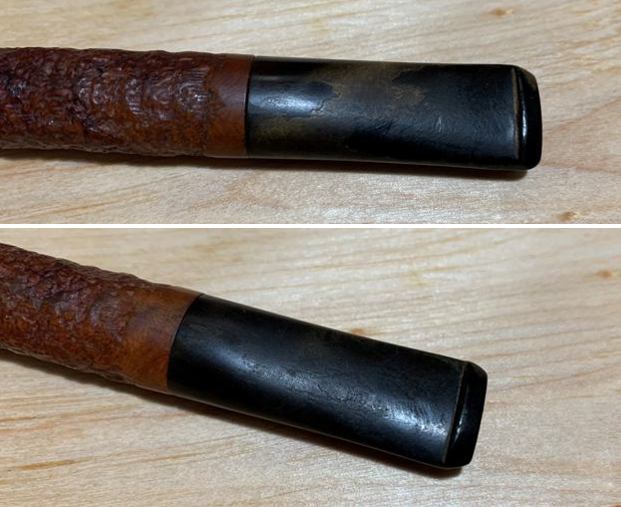
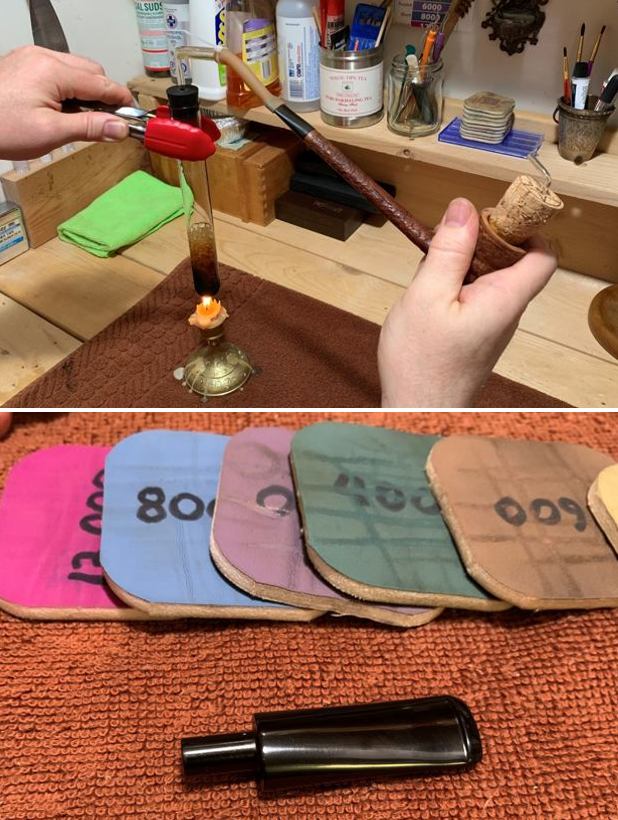
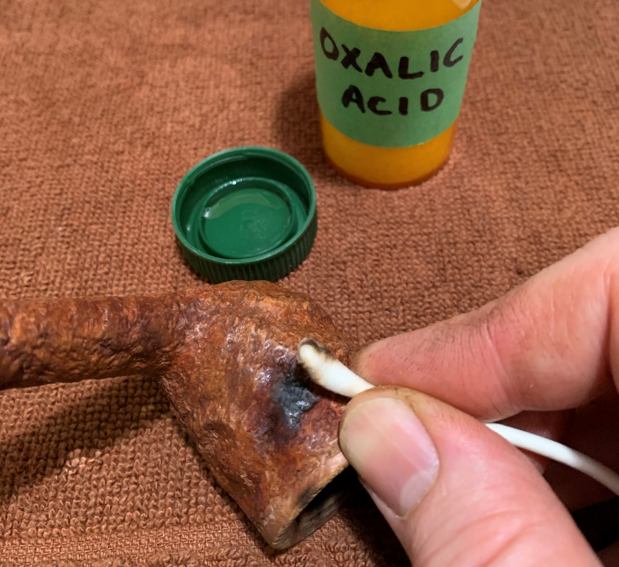
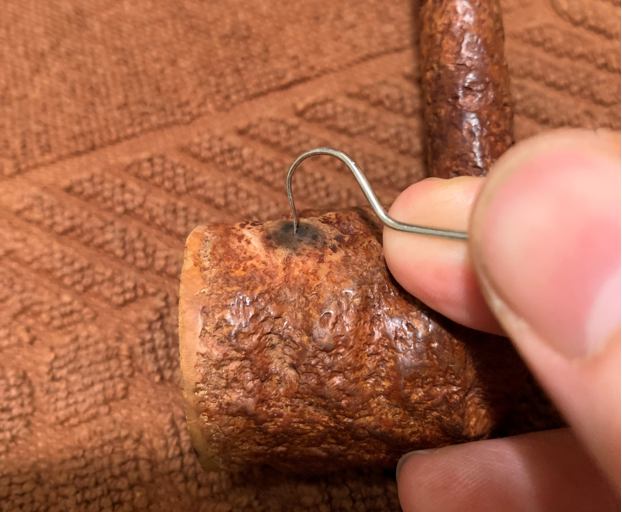
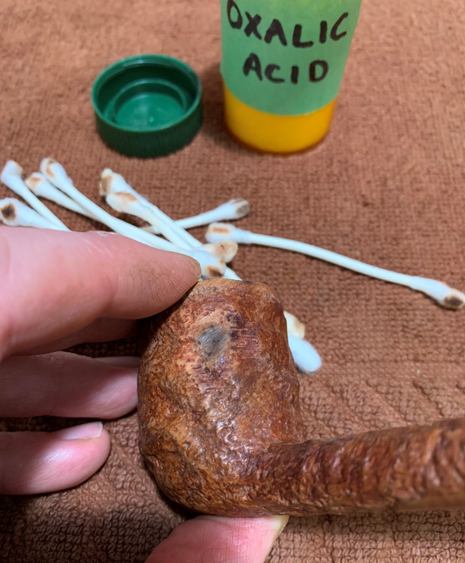
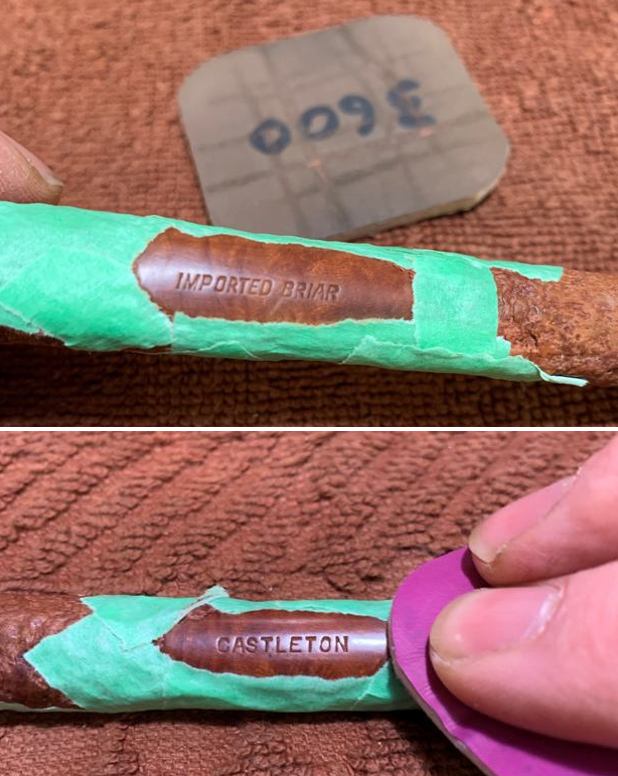
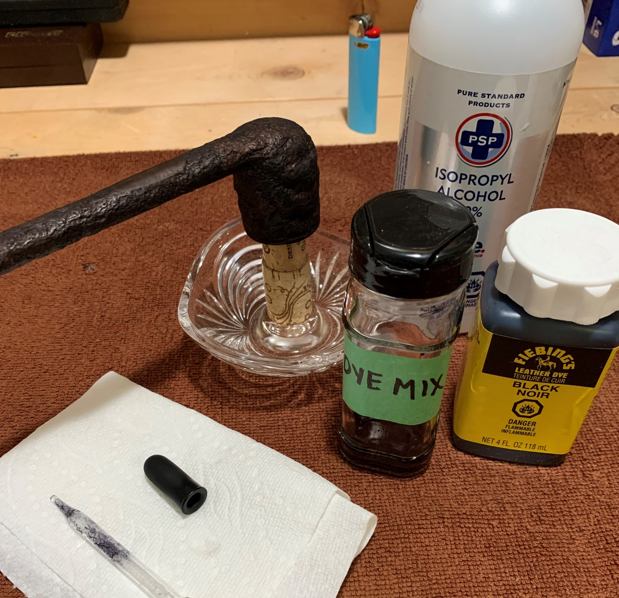
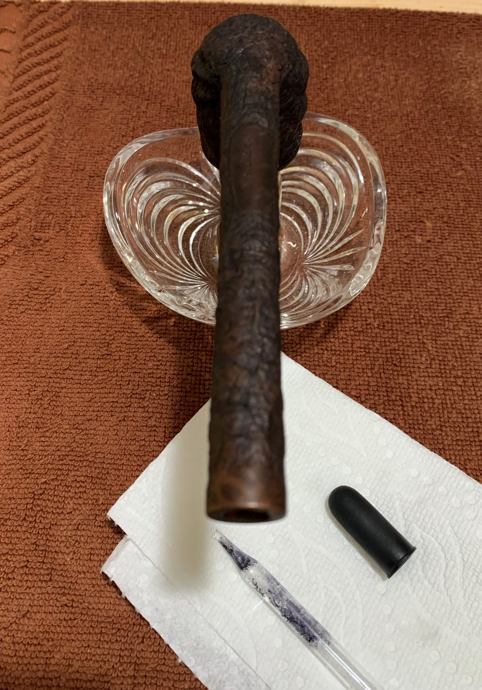
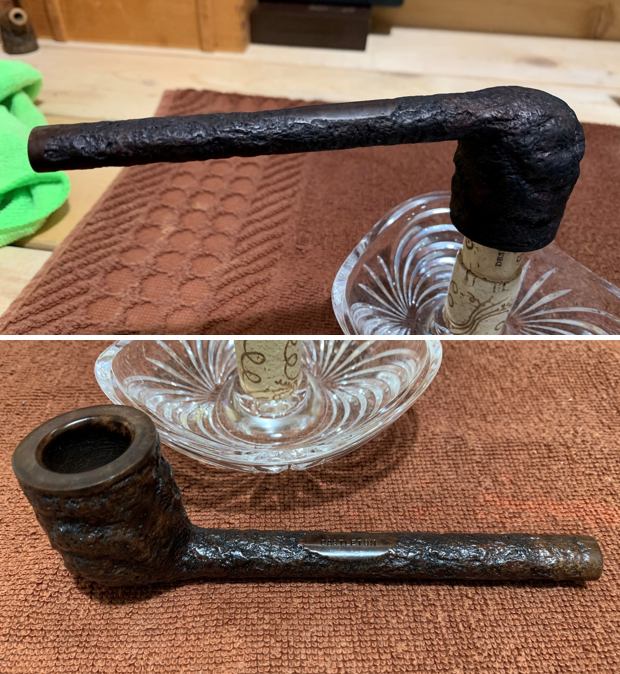
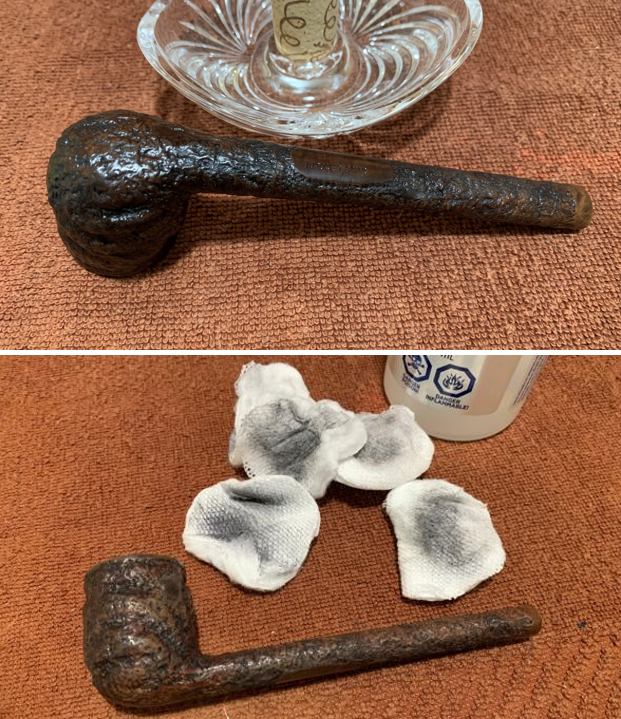
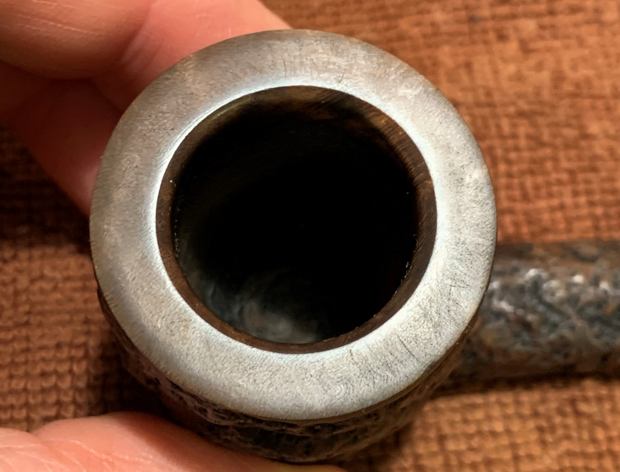
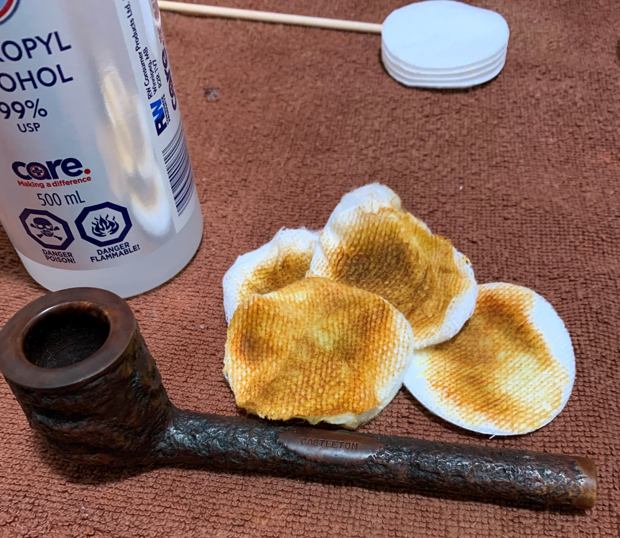
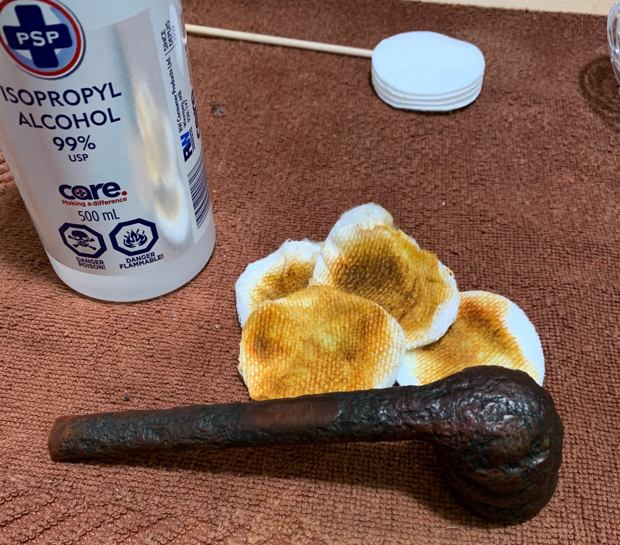
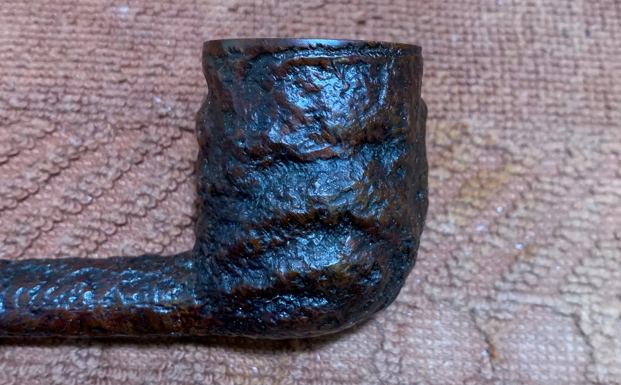
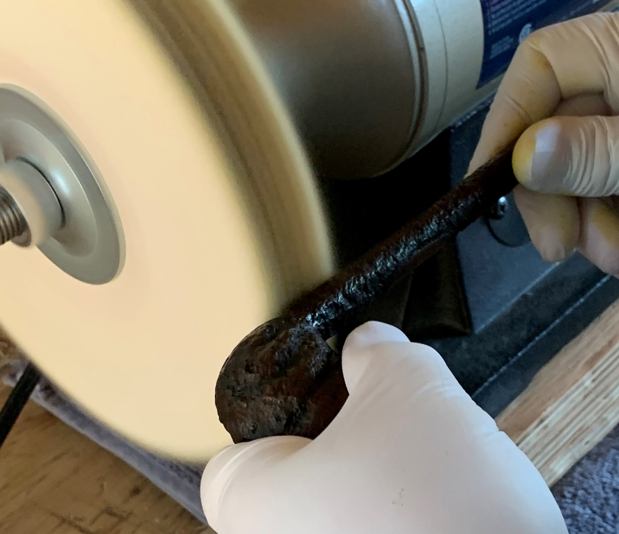
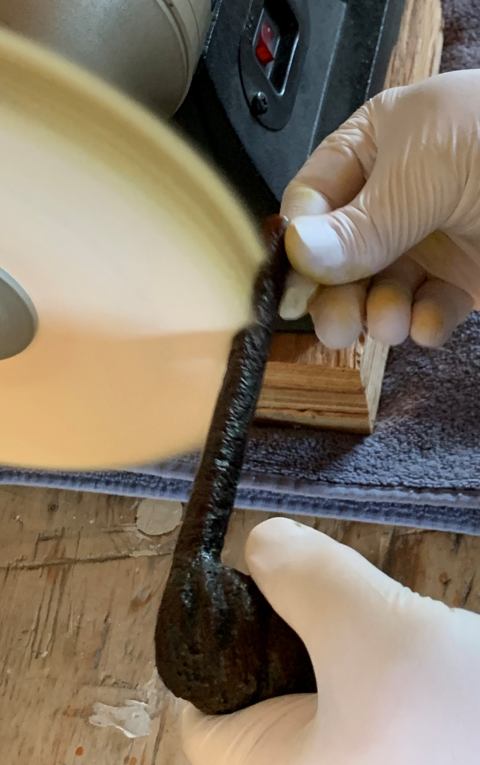
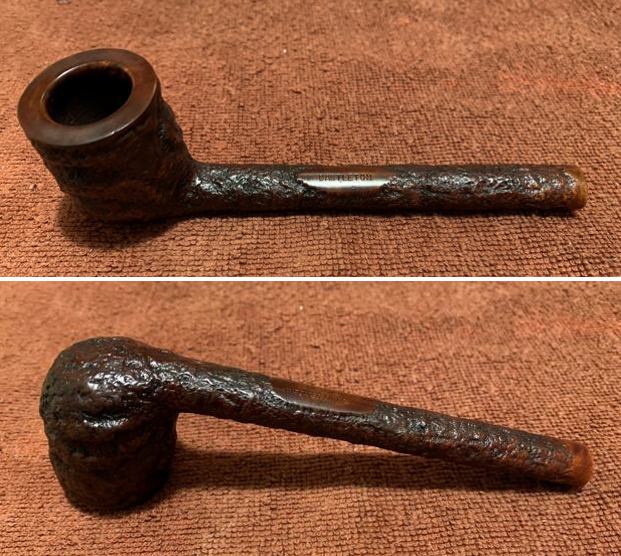
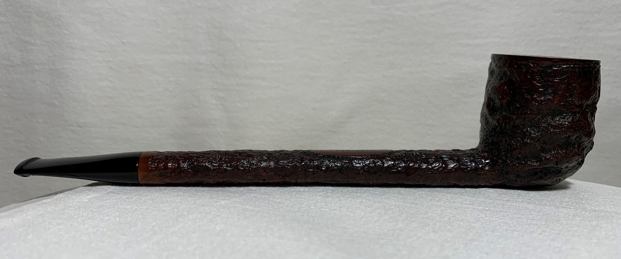
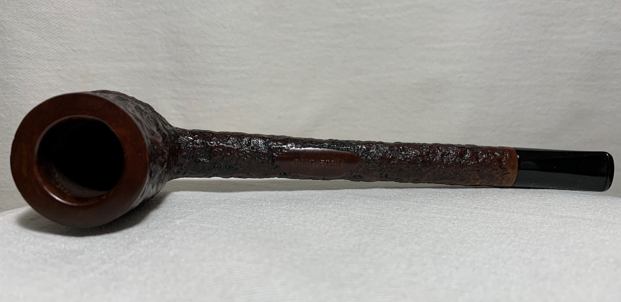
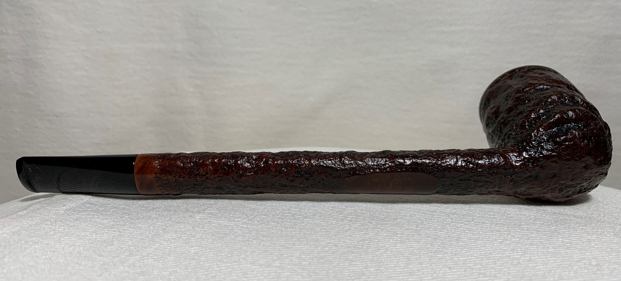
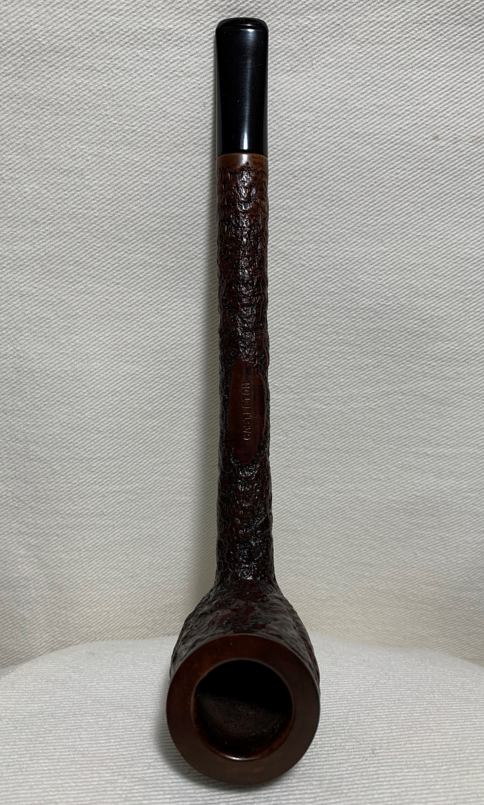
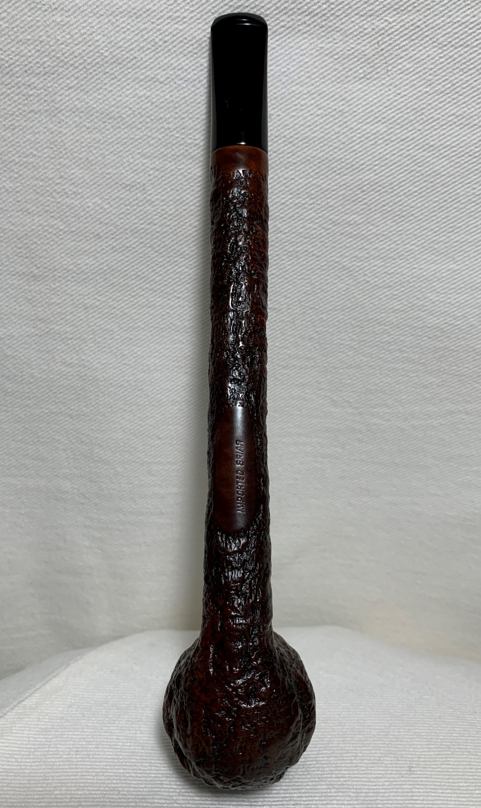
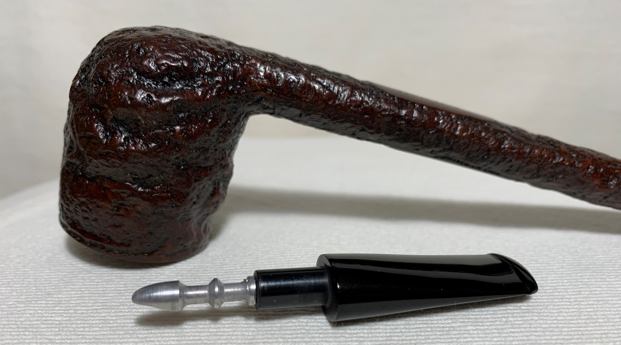
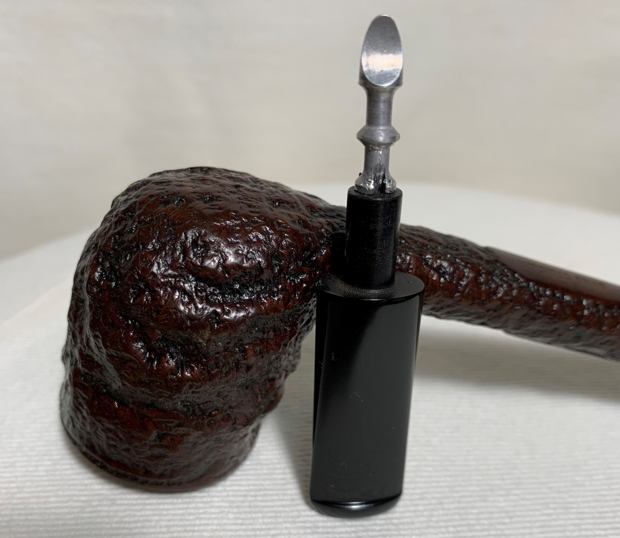
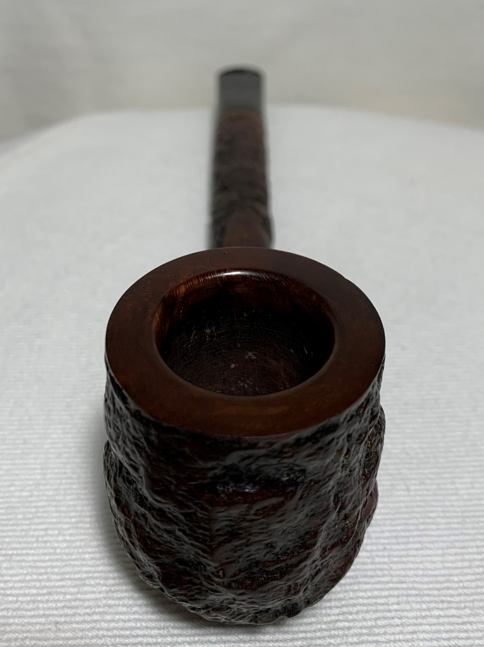
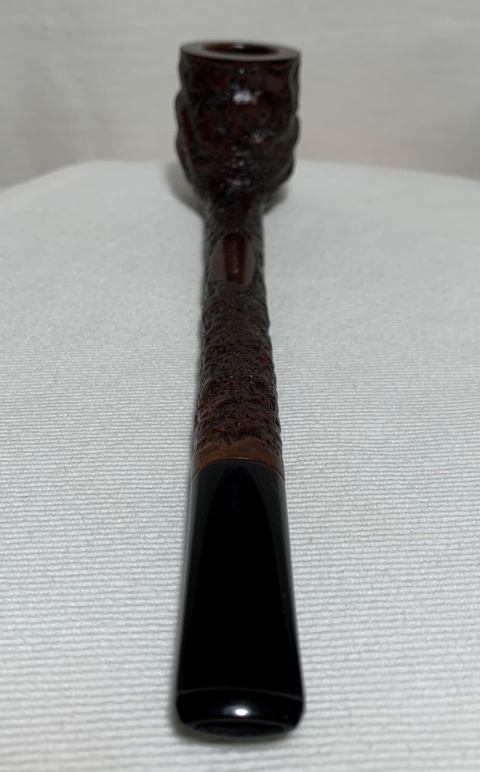
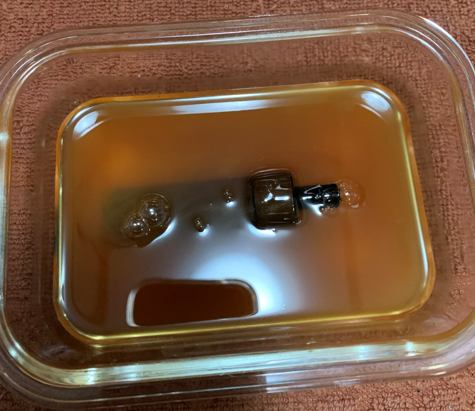
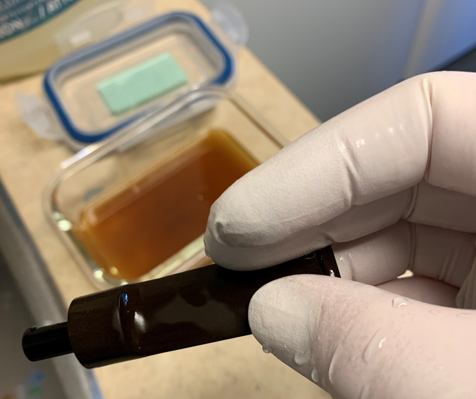
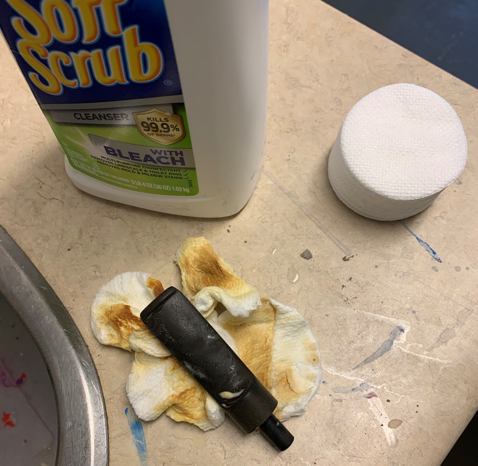
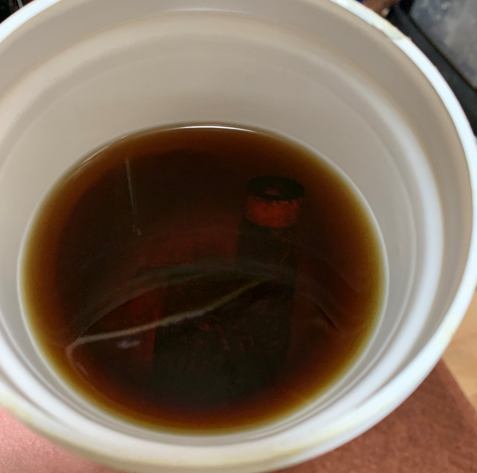
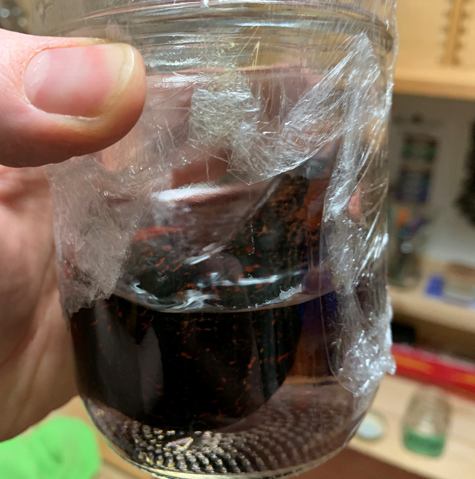
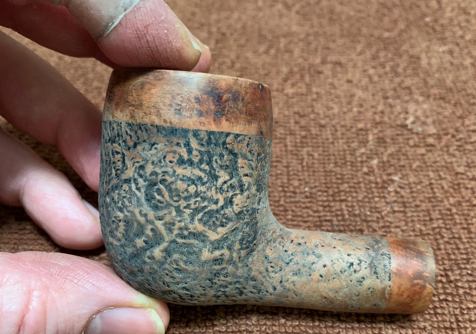
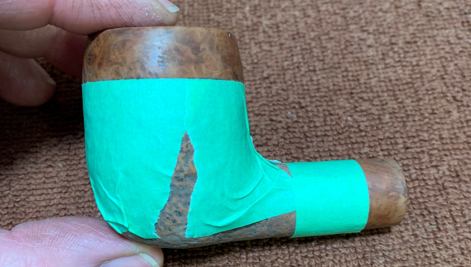
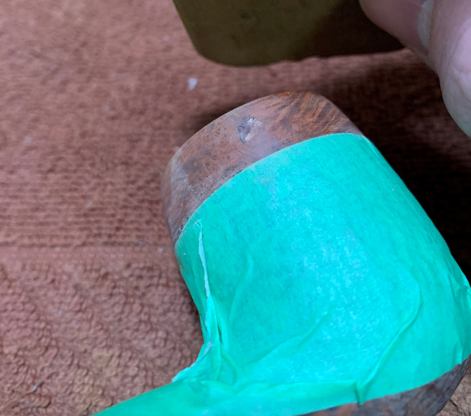
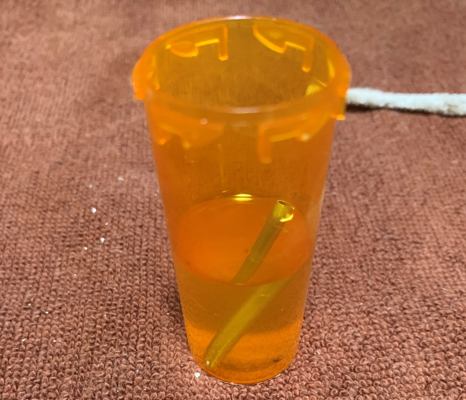
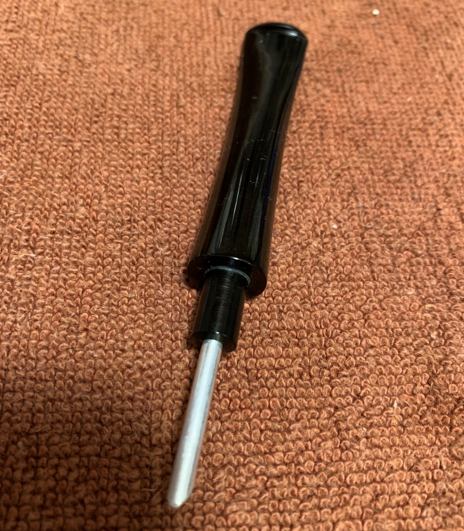
Next on the chopping block is one of the longest pipes I have ever worked on (excluding churchwardens, etc.). It is a wonderful, rusticated Canadian-shape, with the name Castleton marked on it. Its strong, light, and rugged nature seemed to fit its Canadian moniker perfectly. I acquired a small collection of pipes from West Virginia off of Facebook a few months back and I am just beginning to work my way through them. There were a lot of very interesting pipes there and this one was certainly no exception. I like the look of Canadian pipes in general, and the length of this one was certainly notable– it is nearly eight inches long, yet incredibly light! As it turned out, this pipe ended up beautifully, but it required much more toil that I had initially anticipated. This pipe had only two markings: Castleton on top of the shank; and Imported Briar on the underside of the shank. No logos, nothing else. The name, Castleton, was a bit of a problem. Herb Wilczak and Tom Colwell’s book, Who Made That Pipe?, mentions the name, Castleton, in connection with Comoy’s. Pipedia also confirms that Castleton was a model of Comoy’s. The only problem is that I am fairly sure this pipe is not from Comoy’s. The pipe does not say Comoy’s and does not have the logo – nor does it have a Comoy’s feel about it. Sadly, Steve does not have a Castleton pipe listed on Reborn Pipes, so I did not have a reference there. There are several towns called Castleton – one in Ontario, one in Vermont, one in England (and doubtless others) – but these do not seem related to the pipe. However, Pipephil has a tantalizing bit of information on its site:The lettering of the word Castleton on Pipephil is identical to that on my pipe. Although the lettering of Imported Briar is not identical, the words themselves obviously are and the only difference in the lettering is the italicization on my pipe. Pipephil does not offer any information about this pipe’s country of origin. However, I did a little supplementary research (which I will not bore you with) which suggests that the pipe is probably of English origin, using French briar.Anyway, on to the pipe – and what an attractive pipe it was! However, it was not without its issues. The stummel had the following problems: lava on the rim, notable burns to the bowl and shank, plenty of cake in the bowl, a few scratches here-and-there, and lots of small gouges to the rim. The staining of the wood needed to be revivified too. Meanwhile, the stem had a few problems of its own: there was some oxidation and calcification, and minor tooth marks and dents. This pipe was going to require some considerable elbow grease, but I was particularly looking forward to working on this one. It is a pipe that still has many decades of use in it. The stem was first on my list. This stem has a stinger in it – and it was being quite stubborn about coming out of the tenon! I opted to warm the stem and stinger with a hair dryer and this provided just enough softening of the internal goo to allow me to pull it out. The stinger then went for a soak in some lemon-infused isopropyl alcohol. I let it set for several hours and then cleaned it off and it looks much improved. I wiped down the outside of the stem with Murphy’s Oil Soap on some cotton pads. Then, I cleaned out the insides with pipe cleaners and isopropyl alcohol. Once this process was done, the stem went for an overnight soak in the Before & After Hard Rubber Deoxidizer. The following day, I cleaned all of the de-oxidizing sludge off with alcohol, pipe cleaners, et cetera. The oxidation had migrated to the surface and would be fairly straightforward to remove. I scrubbed vigorously with SoftScrub on cotton pads to remove the leftover oxidation. Before I moved on to the Micromesh pads, I built up some tiny dents on the stem with cyanoacrylate adhesive and let it fully cure. I then sanded it down with 220-, 400-, and 600-grit sandpapers to meld seamlessly into the stem. I will come back to the stem in a bit, but there are other issues to be addressed first!This stummel was quite a mess. I first decided to ream out the bowl. I used both the PipNet Reamer and the KleenReem to remove the built-up cake and followed that with 220-grit sandpaper to eliminate as much as I could. I took it down to bare briar, as I wanted to ensure there were no hidden flaws in the walls of the bowl. Fortunately, there were none. I then proceeded to clean out the insides of the shank with Q-tips, pipe cleaners, and isopropyl alcohol. There was a lot of nastiness inside this stummel and – boy-oh-boy – it took a lot of cotton to get this thing clean! In fact, this pipe’s great length proved to be a problem because I could not get the pipe cleaners all the way down the shank (and I did not, at that time, have churchwarden pipe cleaners). So, channeling my inner MacGyver, I tried to build myself some contraptions which would allow me to clean all the way down the shank. Unfortunately, these worked with very limited success.I was not to be deterred. I decided to build my own pipe retort system. This system uses boiling isopropyl alcohol and a vacuum (a void space, not the household item) to clean the interior wood of a pipe. I won’t describe the whole thing, but you can read Steve’s article about it here. As you can see by the revolting colour of the alcohol, the retort worked very well. I managed to extract lots of otherwise inaccessible filth from inside the pipe. After the retort (definitely not before), I then used all nine Micromesh pads (1,500 through 12,000 grit) to bring out the lovely black lustre on the stem. I also used Obsidian Pipe Stem Oil in between each pad scrubbing.I then moved on to cleaning the outside of the stummel with Murphy’s Oil Soap on some cotton pads and also used a tooth brush to get into the crevasses. I actually soaked the rim in Murphy’s for a while just to loosen up the lava. I followed that up by cleaning the insides with some dish soap and tube brushes.As I mentioned earlier, there were many nicks on the rim of the stummel that also needed to be addressed. In order to remove the lingering bits of lava and fix the nicks, I “topped” the pipe – that is to say, I gently and evenly sanded down the rim on a piece of 220-grit sandpaper. This effectively removed the lava and the damage, without altering the look of the pipe.As I also mentioned, there was a burn on the side of the bowl and a burn on the shank that also needed to be addressed. I took some oxalic acid, used several Q-tips, and rubbed and rubbed. The burn did improve considerably but never fully disappeared. I gently poked at it with a dental tool in order to assess the wood. I took solace from the fact that the burn was very superficial and did not affect the integrity of the wood at all. A light application of Before & After Restoration Balm brought out the best in the stummel. What a difference that made! There is some beautiful wood under the grime!Since this pipe is rusticated, I was not going to sand down the stummel with my Micromesh pads, but I did do it to the small sections that were smooth (e.g. where the markings were located). In order to avoid disturbing the rusticated sections, I masked these areas off with painter’s tape. This simplified the process a great deal.On to another problem: the colour. During the course of its previous life and my vigorous cleaning, this pipe had lost some vibrancy of colour. So, in order to accentuate the external beauty to this pipe, I opted for aniline dye. In this case, I did it in two stages. I first applied some of Fiebing’s Black Leather Dye (diluted with isopropyl alcohol) with a dauber to act as a sort of “wash” for the pipe. I wanted the dark colour to remain in the recessed areas of the stummel to contrast with the primary colour. As usual, I applied flame from a BIC lighter in order to set the colour.The following day, I wiped down the stummel with cotton pads dipped in isopropyl alcohol to remove any blackness from the high points. I then applied some of Fiebing’s Medium Brown Leather Dye with a dauber and removed the excess with cotton pads dipped in isopropyl alcohol. Once again, I applied flame from a BIC lighter in order to set the colour and let it sit overnight. Oof – it is really looking good! The contrast in colours worked just as I had hoped. I applied more Before & After Restoration Balm and then it was off for a trip to the buffer. A dose of White Diamond and a few coats of Halcyon II wax were just what this pipe needed. The lovely shine made the wood very attractive. This Castleton was in need of a reminder of its original beauty. The pipe began its restoration journey looking as though it had been left for firewood. Now, it can show its true self – a very handsome Canadian pipe.This Castleton is back to its old glory and ready to be enjoyed again by the next owner. I am pleased to announce that this pipe is for sale! If you are interested in acquiring it for your collection, please have a look in the ‘British’ pipe section of the store here on Steve’s website. You can also email me directly at kenneth@knightsofthepipe.com. The approximate dimensions of the pipe are as follows: length 197 mm/7 3/4 inches; height 56 mm/2 13/64 inches; bowl diameter 34 mm/1 11/32 inches; chamber diameter 21 mm/3/4 of an inch. The mass of the pipe is 37 grams/1.30 ounces. I hope you enjoyed reading the story of this pipe’s restoration as much I as I did restoring it. If you are interested in more of my work, please follow me here on Steve’s website or send me an email. Thank you very much for reading and, as always, I welcome and encourage your comments.
Saving a Parker


Blog by Kenneth Lieblich

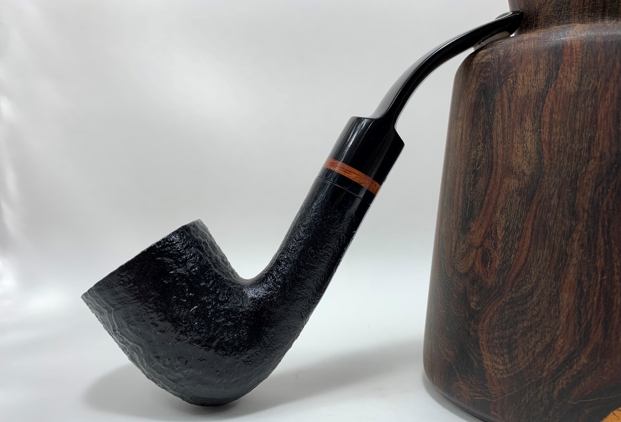
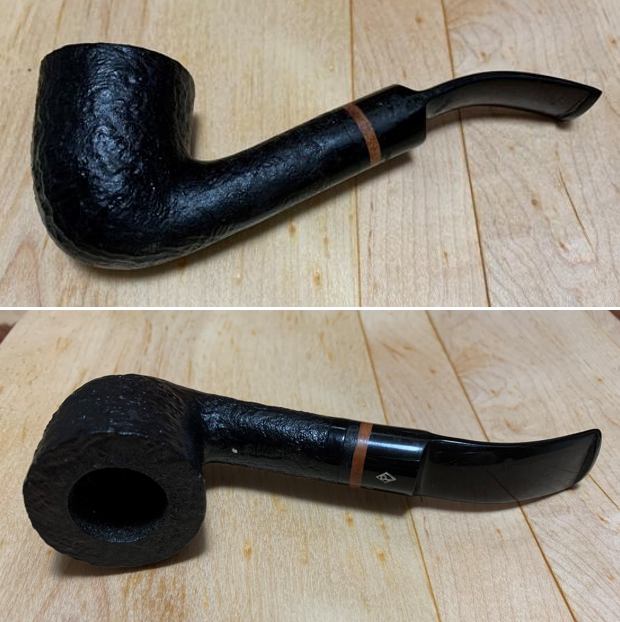
Next on the chopping block is a beautiful sandblasted pipe by Parker of London. I purchased a group of pipes from a fellow in the Eastern US. It was definitely a mixed bag of very good and very bad. Some pipes were destroyed beyond repair, some pipes were filthy but repairable, some stems were missing their stummels, and some stummels were missing their stems. However, there were a handful that were in decent condition when I found them and they just needed a helping hand – this Parker was one of those. Apologies in advance for the paucity of photographs. I guess I just got carried away with the work! Parker of London has an interesting history. Our friends over at Pipedia have provided this information:

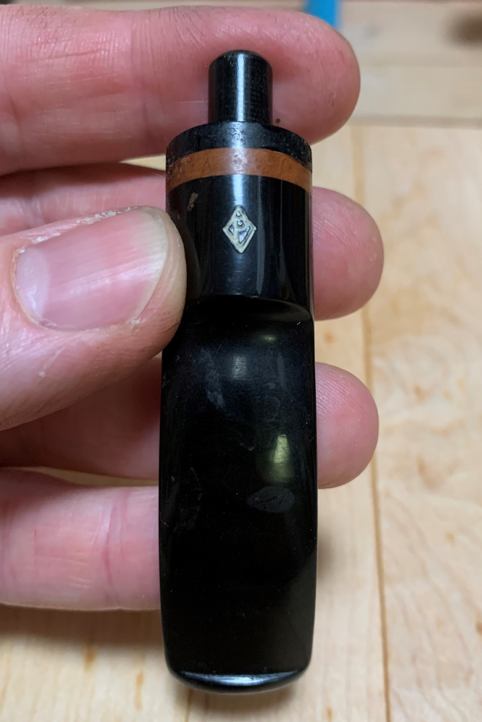
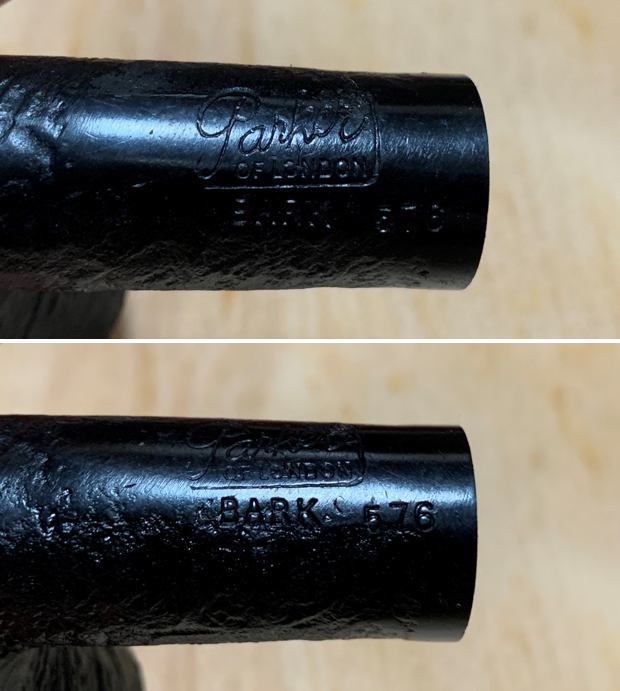
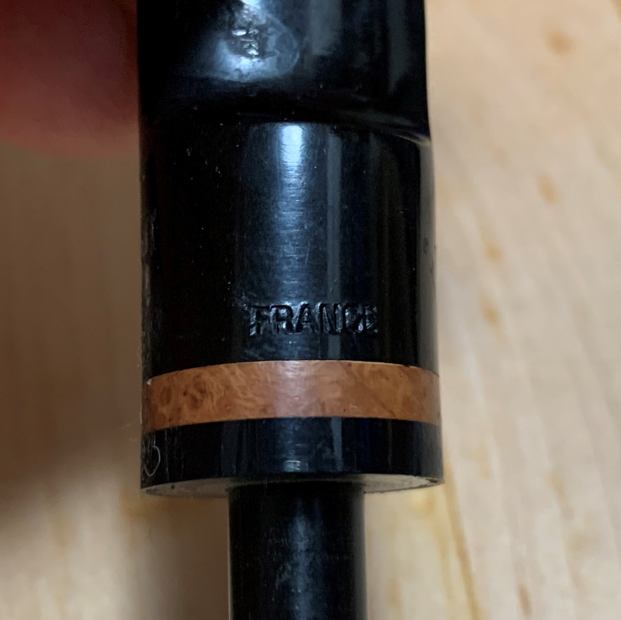
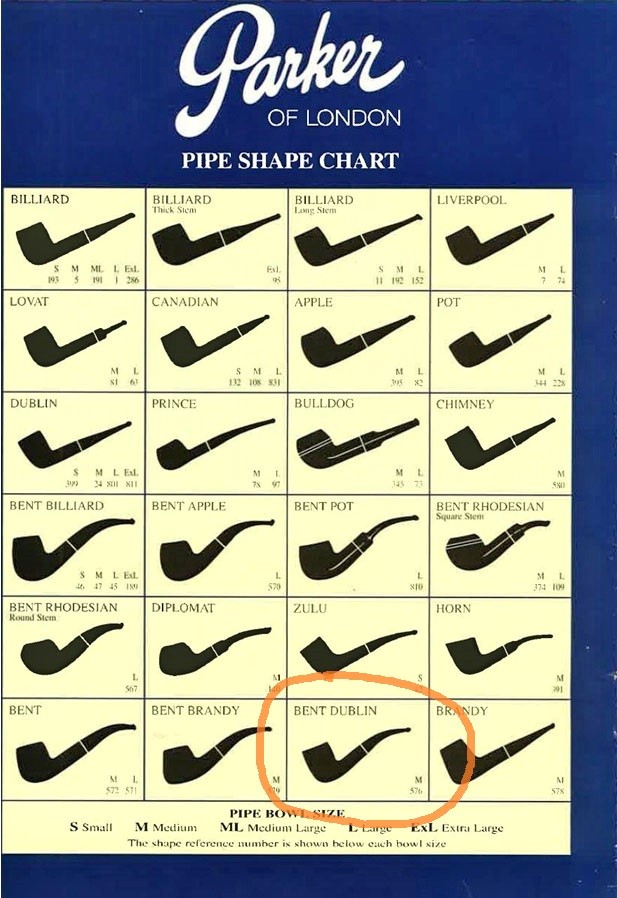
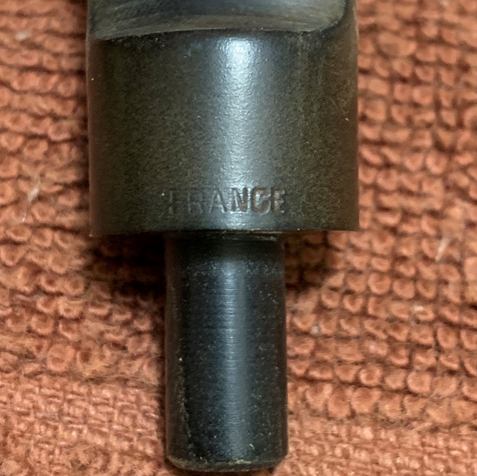
In 1922 the Parker Pipe Co Limited was formed by Alfred Dunhill to finish and market what Dunhill called its “failings” or what has come to be called by collectors as seconds. Previous to that time, Dunhill marketed its own “failings”, often designated by a large “X” over the typical Dunhill stamping or “Damaged Price” with the reduced price actually stamped on the pipe. While the timing and exact nature of the early relationship remains a bit of mystery, Parker was destined to eventually merge with Hardcastle when in 1935 Dunhill opened a new pipe factory next door to Hardcastle, and purchased 49% of the company shares in 1936. In 1946, the remaining shares of Hardcastle were obtained, but it was not until 1967 when Parker-Hardcastle Limited was formed. It is evident through the Dunhill factory stamp logs that Parker and Dunhill were closely linked at the factory level through the 1950s, yet it was much more than a few minor flaws that distinguished the two brands. After the war, and especially after the mid 1950s the differences between Parker and Dunhill became even more evident, and with the merger of Parker with Hardcastle Pipe Ltd, in 1967 the Parker pipe must be considered as an independent product. There is no record of Parker ever being marketed by Dunhill either in its retail catalog or stores. Parker was a successful pipe in the US market during the 1930s up through the 1950s, at which point it faded from view in the US, while continuing to be popular in the UK. Pipedia goes on to say that the old Parkers had a patent number and dating code, but these were gone by 1957. I do not know the specific age of this pipe, but since it is missing both a patent number and dating code, it is safe to say that it was made after 1957. This sandblasted Parker has the following markings on the stummel: Parker of London [over] Bark 576. The stem has the letter P inside a diamond on the topside and it also has the word France on the underside. Furthermore, the following photo, showing one of Parker’s brochures, indicates that the model number 576 is a bent Dublin.Fortunately, this Parker was in pretty good shape when it came to me and that certainly made my job easier. There were a few small discolourations to the stummel and the overall colour was dull, but nothing too serious. The stem had a few nicks and dents, but I was not concerned. Really, this pipe just needed a day at the salon in order to look its best.

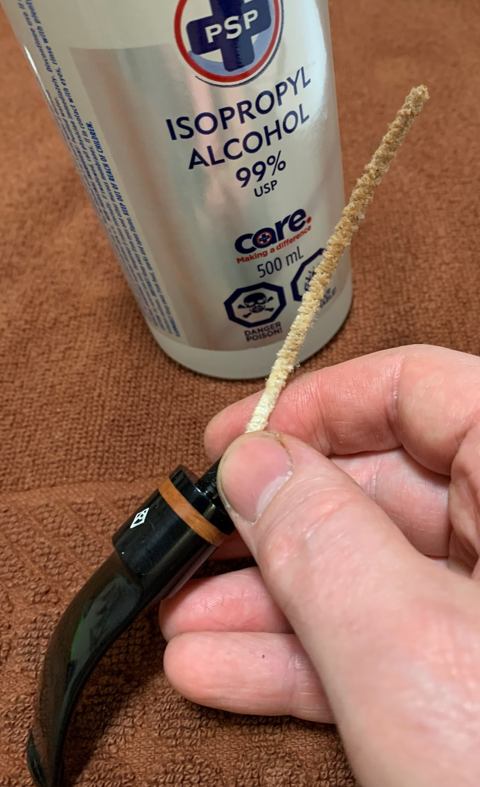
The stem was first on my list. I took a BIC lighter and ‘painted’ the stem with its flame in order to lift the marks. This was only modestly successful in raising the dents. Then, I cleaned out the insides of the stem with pipe cleaners and isopropyl alcohol. It was a bit dirty, but not too bad and I only went through a few pipe cleaners in order to clean it up.I then scrubbed then stem vigorously with SoftScrub to clean it up nicely. Before I moved on to the Micromesh pads, I built up the small dents on the stem with cyanoacrylate adhesive and let them fully cure. I then sanded it down with 220-, 400-, and 600-grit sandpapers to meld the repair seamlessly into the stem. This ensures that it keeps its shape and looks like it should. I then used all nine Micromesh pads (1,500 through 12,000 grit) to bring out the lovely black lustre on the stem. I also used Obsidian Pipe Stem Oil in between each pad scrubbing.

On to the stummel, and the usual cleaning procedures were in order for this pipe. I used both the PipNet Reamer to remove the built-up cake and followed that with 220-grit sandpaper to remove as much as I could. I wanted to take the bowl down to bare briar to ensure there were no hidden flaws in the walls of the bowl. Fortunately, there were none. I then proceeded to clean out the insides of the shank with Q-tips, pipe cleaners, and isopropyl alcohol. There wasn’t too much nastiness inside this stummel – it only took a handful of pipe cleaners etc. to sort that out. I followed that up by cleaning the insides with some dish soap and tube brushes. I then moved on to cleaning the outside of the stummel with Murphy’s Oil Soap, a toothbrush, and some cotton pads. That removed any remaining dirt. Fortunately, there was no notable damage to the stummel, so I didn’t have to address that. However, I did do some touch ups to the black stain with my furniture pens. Since the pipe had a sandblast finish, I obviously did not use the Micromesh pads to sand everything. Instead, a light application of Before & After Restoration Balm brought out the best in the stummel’s grain.

Then it was off for a trip to the buffer. A dose of White Diamond and a few coats of Halcyon II wax were just what this pipe needed. The lovely shine gave the wood a deep black look.

In the end, what a beauty this pipe is! It is back to its old glory and ready to be enjoyed again by the next owner. I am pleased to announce that this pipe is for sale! If you are interested in acquiring it for your collection, please have a look in the ‘British’ pipe section of the store here on Steve’s website. You can also email me directly at kenneth@knightsofthepipe.com. The approximate dimensions of the pipe are as follows: length 145 mm/ 5 ¾ inches; height 50 mm/ 2 inches; bowl diameter 38 mm/ 1 ½ inches; chamber diameter 21 mm/ .80 inches. The mass of the pipe is 47 grams/ 1.65 ounces. I hope you enjoyed reading the story of this pipe’s restoration as much I as I did restoring it. If you are interested in more of my work, please follow me here on Steve’s website or send me an email. Thank you very much for reading and, as always, I welcome and encourage your comments.
The Mystery of Blue Hill


Blog by Kenneth Lieblich

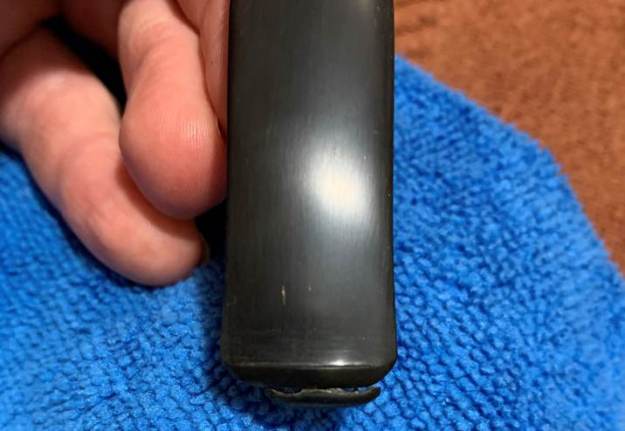
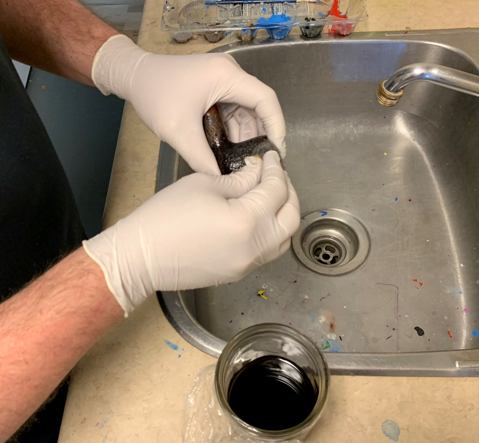
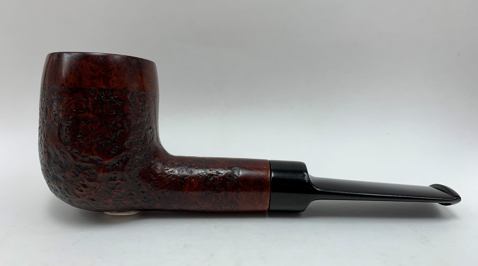
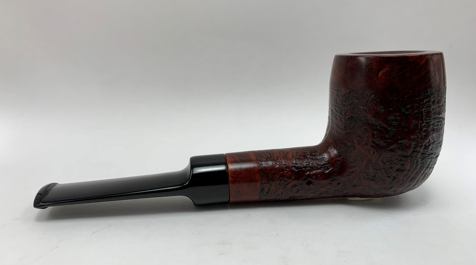
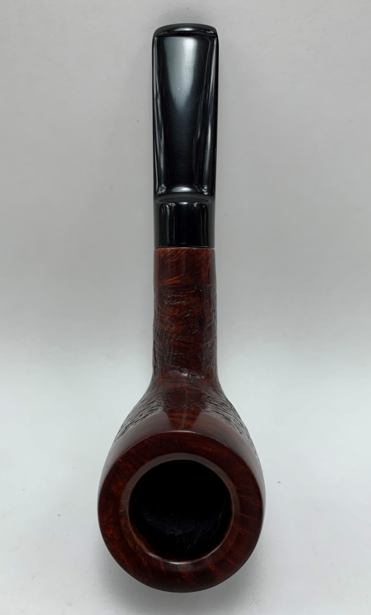
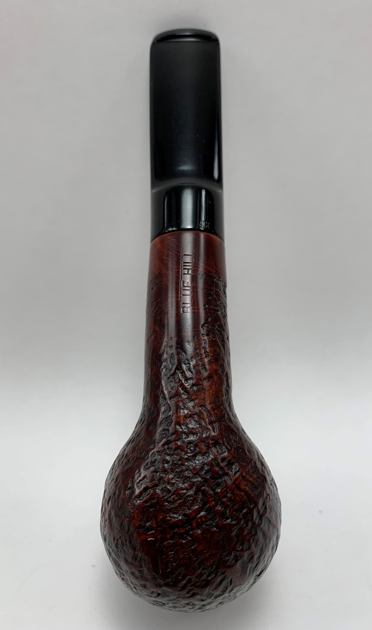
The title sounds like a Hardy Boys story, does it not? Well, it is not that exciting. Next on the chopping block is a peculiar pipe: it is both superbly made and unattractively painted. In addition, its true origin is unknown. I actually acquired the pipe from Steve. I bought a grab bag of pipes from him a long time ago and this was among them. Fortunately for me, Steve’s legendary pipe-cleaning brother, Jeff, had already done his work on this. Although I do not care for the paint scheme, this is a beautiful pipe: excellent proportions, handsome manufacture, and undoubtedly a good smoker.There is one other peculiarity about this pipe: no information about its history and origins! The has a clear marking of “Blue Hill” on the shank of the stummel and the word “France” on the stem. Yes, we can obviously assume that the pipe was made in France, but there is nothing to be found on the name “Blue Hill”. My uneducated guess is that it was made for an English or American company – perhaps even a tobacco shop. As an aside, there is a different pipe maker who uses the name “Blue Hill Crafts”, but he has no connection to this pipe. All the usual sources (Pipedia, Pipephil, et cetera) have no listing for “Blue Hill”. Even rebornpipes had nothing. Alas, we do not know who made this pipe, but whoever it was – they did a good job. If you have any information about Blue Hill, please do let me know.Thanks to Jeff’s stellar clean-up work, there were not too many issues that needed to be addressed. The stem had a few nicks and dents, but nothing catastrophic. Similarly, the stummel had a bump or two, here and there, but the only major problem was the two-tone colour pattern. I think two-tones can and do work well on some pipes, but I felt that this pipe needed a deep, rich brown to make it look its best. The photos of the original colour do not show the reddish tinge very well. Trust me, the pipe looked much more red than it does here. The stem was first on my list. I took a BIC lighter and ‘painted’ the stem with its flame in order to lift the tooth marks. This was reasonably successful in raising the dents. I did not need to clean the insides of the stem (thanks again, Jeff), so the stem went straight for an overnight soak in the Before & After Hard Rubber Deoxidizer. The following day, I cleaned all of the de-oxidizing sludge off with alcohol, pipe cleaners, et cetera. The oxidation had migrated to the surface and would be fairly straightforward to remove. I scrubbed vigorously with SoftScrub to remove the leftover oxidation. Before I moved on to the Micromesh pads, I built up the small dents on the stem with cyanoacrylate adhesive and let them fully cure. I then sanded it down with 220-, 400-, and 600-grit sandpapers to meld the repair seamlessly into the stem. This ensures that it keeps its shape and looks like it should. I then used all nine Micromesh pads (1,500 through 12,000 grit) to bring out the lovely black lustre on the stem. I also used Obsidian Pipe Stem Oil in between each pad scrubbing. On to the stummel, and I figured that it would be fairly straightforward to remove the old, ugly stain. Boy, was I mistaken! My first plan was to dunk the stummel in an alcohol bath overnight. This will often loosen, thin, or remove stains from pipes. Twenty-four hours later, nothing happened! The stain looked just as it did when it went into the bath. That was not in the plans. So, time to escalate the situation: I used acetone and rubbed it vigorously into the stain. After many minutes of scrubbing, nothing happened (again)! I then realized that I was going to have to use the nuclear option: soaking overnight in acetone. The next day dawned and there was, at long last, some evidence of progress on the stain. Not a lot had been shed, but enough to show me that I was on the right track. I then went to the sink with the stummel, some acetone, a wire brush, and some gloves. I set about scrubbing the dickens out of that pipe and finally succeeded in getting that silly stain off. Most of the black remained in the lower recesses of the rustication, but I actually liked that – it added some character. Having completed that, I was able to address a couple of small nicks on the side of the stummel, just below the rim. I dug out my iron and a damp cloth to try and raise the nicks. The hot and moist steam created can often cause the wood to swell slightly and return to shape. There was some movement – not a lot, but it was better than doing nothing. I filled the remaining divots with cyanoacrylate adhesive.

Now, with the nicks filled, it was time to sand down the stummel. Just like the stem, I used all nine Micromesh pads (1,500 through 12,000 grit) to sand everything smooth – although, as the photos show, I masked the rusticated parts so as not to disturb them. A light application of Before & After Restoration Balm brought out the best in the stummel’s grain. Whoops! I then noticed that the opening of tobacco chamber was not in perfect shape. It required some “rounding”. I took a solid wooden sphere, wrapped sandpaper around it, and gently sanded the opening of the tobacco chamber. This both corrected the problem and added a beautiful beveled edge to the pipe. I went back over it with the Micromesh pads and made everything lovely again. Naturally, one of the main purposes of this pipe restoration was to correct the colour problem. In order to create some external beauty to this pipe, I opted for aniline dye. I applied some of Fiebing’s Medium Brown Leather Dye and then applied flame in order to set the colour. In fact, I added a second helping of the dye, just to make sure the colour was nice and rich. Worked like a charm! This lovely, warm brown is just what I was hoping for. Then it was off for a trip to the buffer. A dose of White Diamond and a few coats of Halcyon II wax were just what this pipe needed. The lovely shine made the wood look quite spiffy. This is a wonderfully crafted pipe and somehow has a very masculine feel to it. Although I never did find out who made it, clearly the pipe was superbly completed. The draught hole has been bored perfectly; the heel of the bowl is exacting; the wood is thick and solid (but not heavy). In short, this is a pipe worth owning, so I am pleased to announce that this pipe is for sale! If you are interested in acquiring it for your collection, please have a look in the American (US) pipe section of the store here on Steve’s website. You can also email me directly at kenneth@knightsofthepipe.com. The approximate dimensions of the pipe are as follows: length 142 mm/5 1/2 inches; height 52 mm/2 inches; bowl diameter 35 mm/ 1 1/3 inches; chamber diameter 21 mm/3/4 of an inch. The mass/weight of the pipe is 53 grams/1.86 ounces. I hope you enjoyed reading the story of this pipe’s restoration as much I as I did restoring it. If you are interested in more of my work, please follow me here on Steve’s website or send me an email. Thank you very much for reading and, as always, I welcome and encourage your comments.
Kenneth’s Pipe Incident Report #1


Blog by Kenneth Lieblich

Today, I thought I would try something a bit different. This is the first installment of what I am arbitrarily calling, Pipe Incident Report. My idea is to provide a brief write-up – focusing on a particular pipe-related problem and/or solution, rather than an entire restoration story. These reports will be intermittent and, hopefully, instructive. Please let me know what you think.

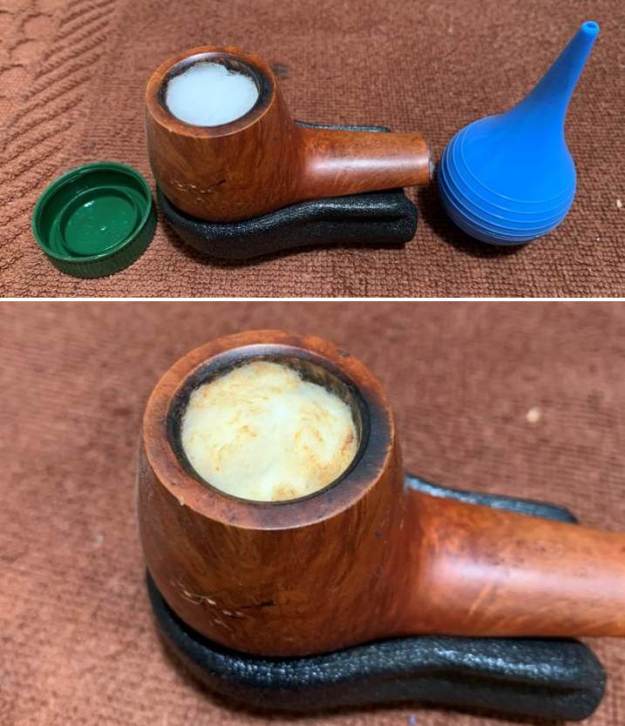
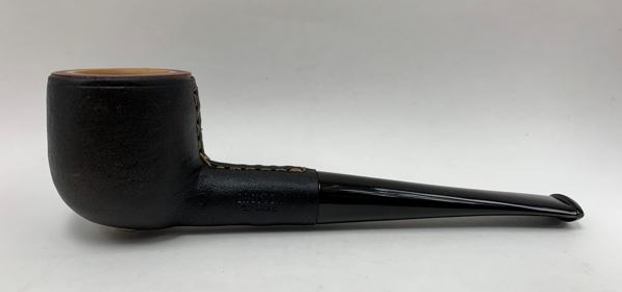
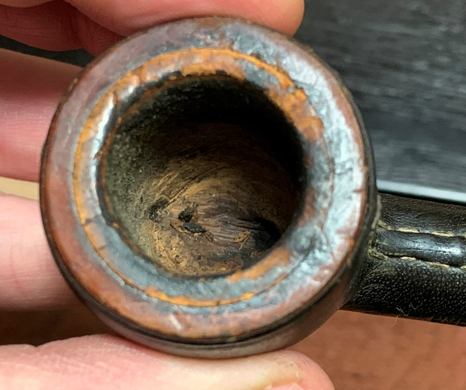
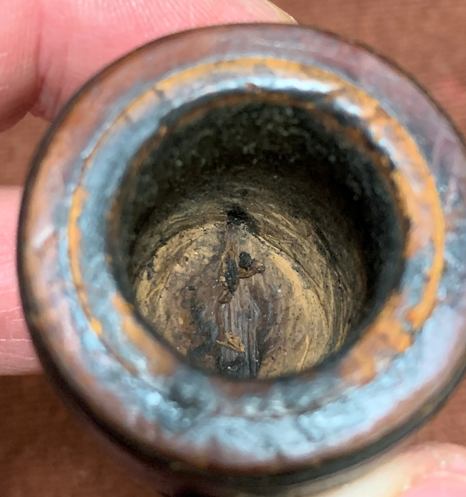
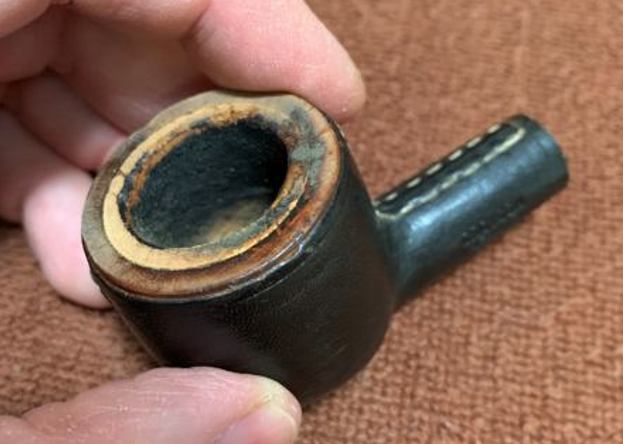
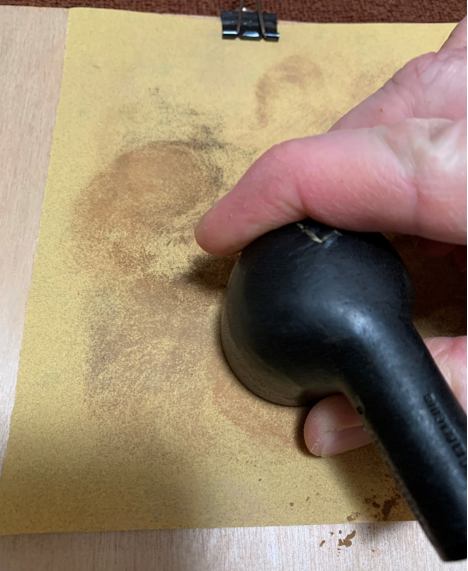
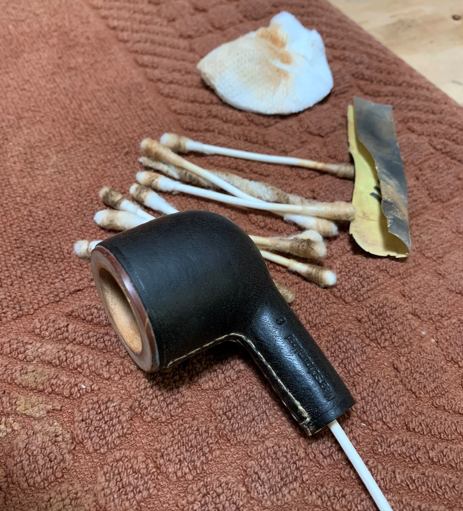
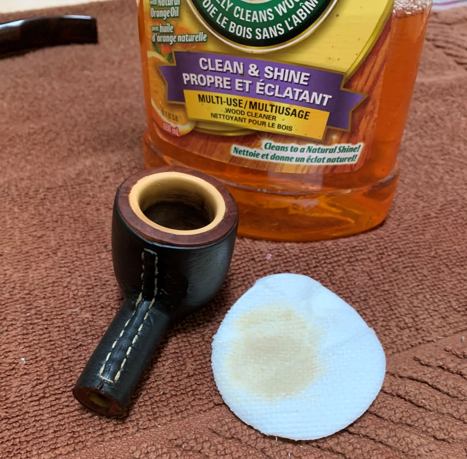
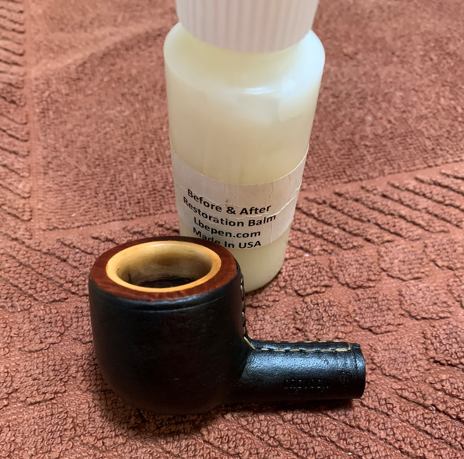
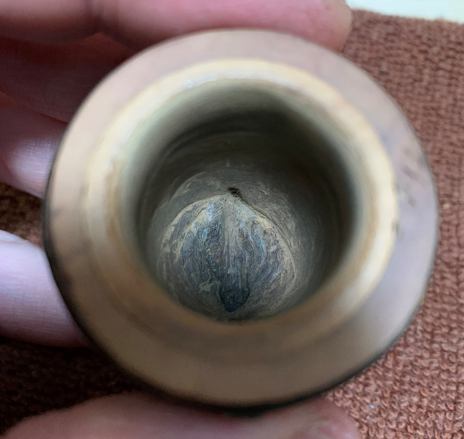
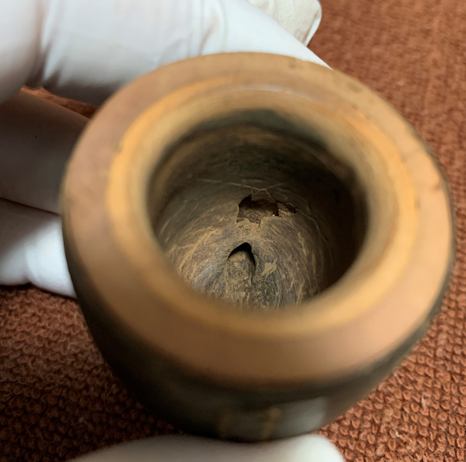
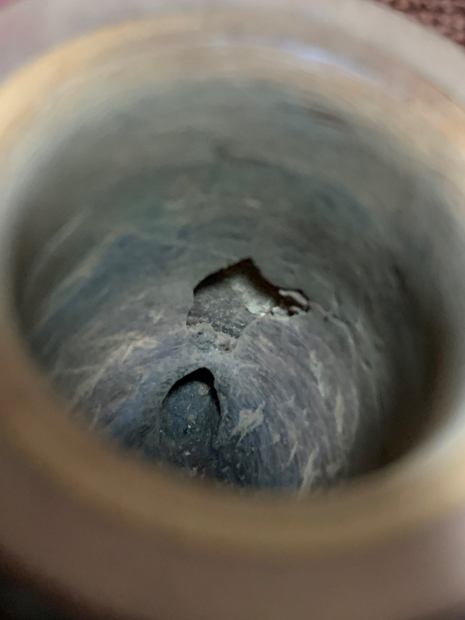
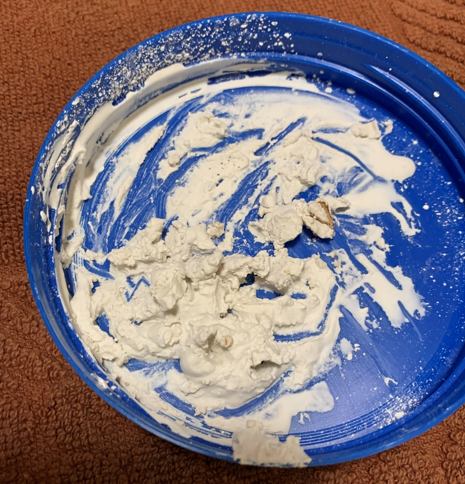
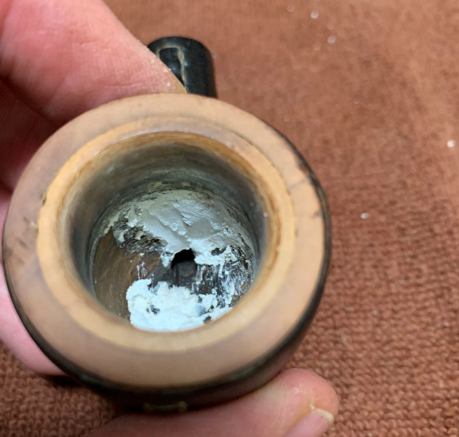
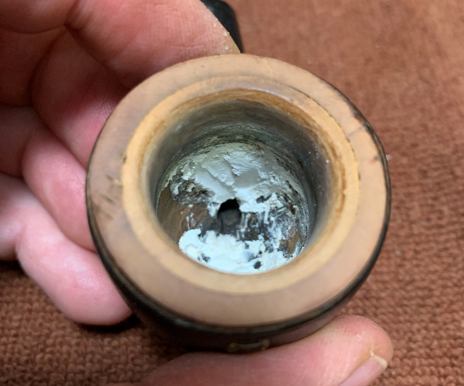
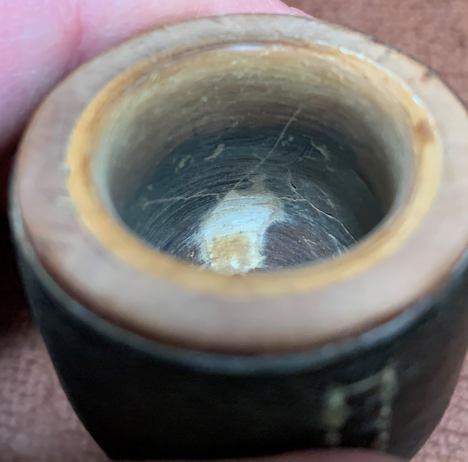
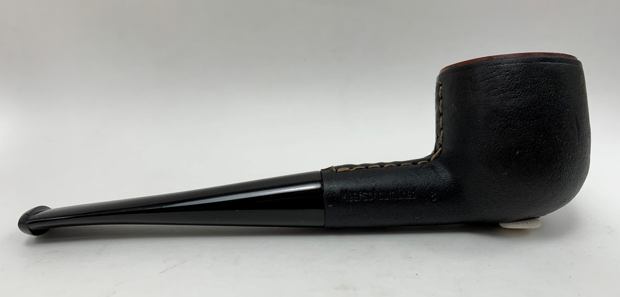
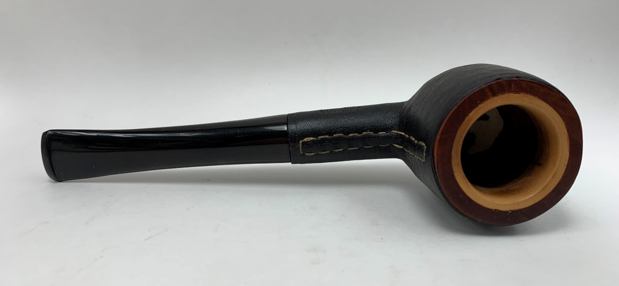
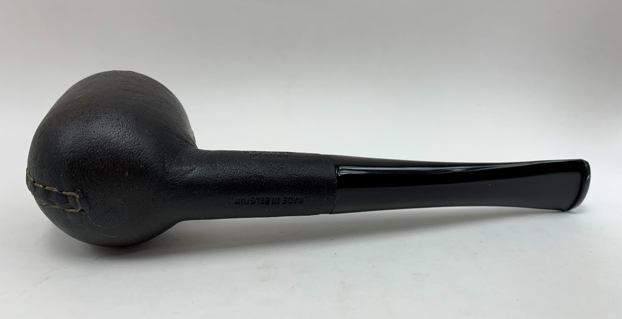
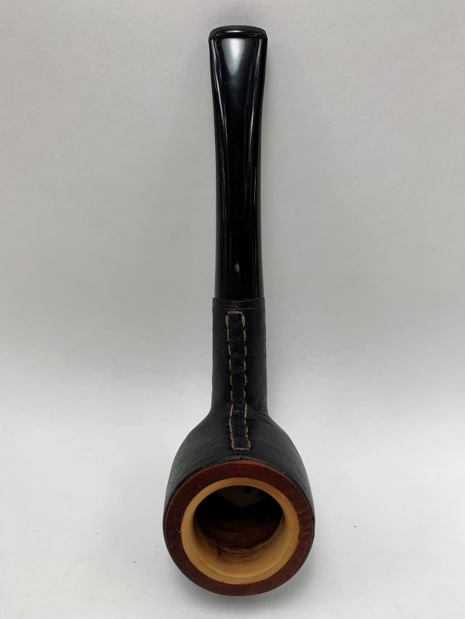
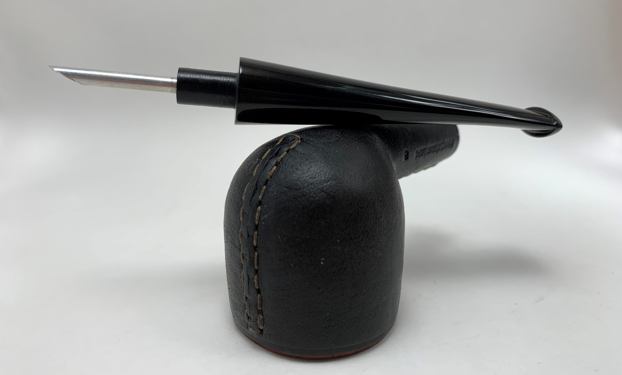
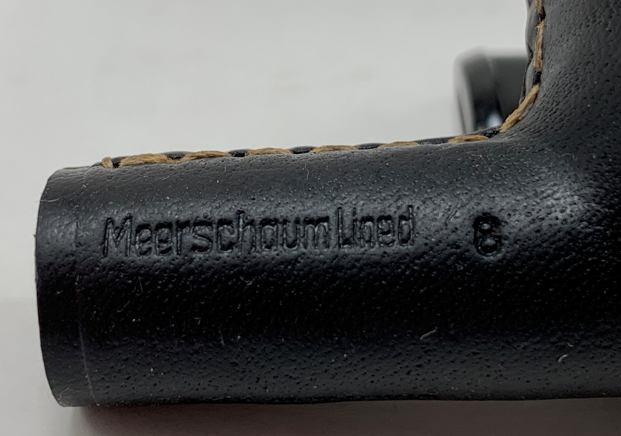
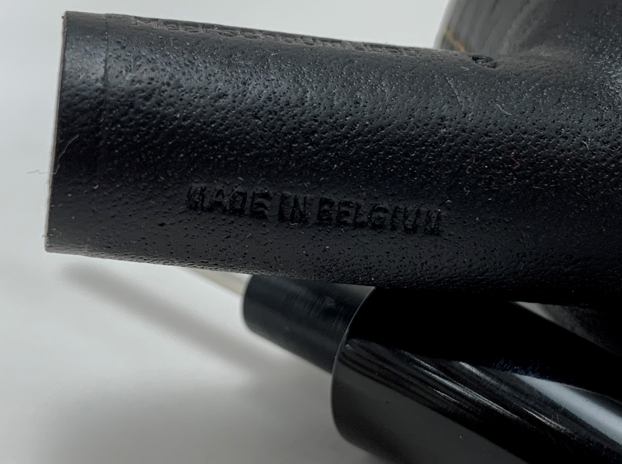
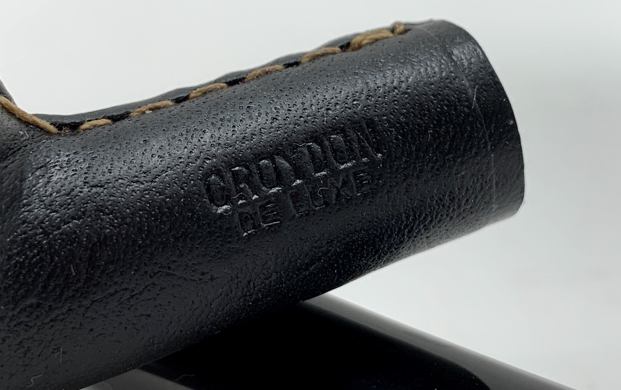
The pipe in question today is a leather-wrapped, meerschaum lined, pot billiard by Croydon. The pipe was made in Belgium, but, other than that, there is not a whole lot of information to be had about this company. Steve has restored a few over the years (and I checked his previous posts), but he had not gleaned any significant information either. The “incident” we will address in this report is some unexpected damage to the inside of the meerschaum bowl. We will get to that shortly – first some background. A friend of mine wanted this pipe – somehow, it spoke to him – so I was happy to bring it back to life for him. The pipe was in decent enough shape: the stem was well-used but not damaged, the leather was sound, the rim was a bit of a mess, and the bowl looked as though it had been reamed with a boat hook. Although it is difficult to make out in the photos, the bottom of the bowl was quite badly gouged and I wondered whether I should fill in the gouge or leave it as is. Steve had told me in the past about making a paste of egg white and chalk dust. Something for me to consider… Anyway, I began with the stem and inner tube, which I resolved fairly quickly. The leather enveloping the bowl was quite clean and in good shape, so that was also a quick fix. I then moved on to the rim of the pipe. As the photos show, it was filthy and slightly damaged.  I “topped” the pipe – that is to say, I gently and evenly sanded down the rim on a piece of 220-grit sandpaper. This was done with even greater care than usual, as I did not want to scuff the leather. I finished up the top with all nine of the MicroMesh pads to make a lovely surface and then used one of my furniture pens to liven up the colour of the rim. That done, I moved on to the inside of the bowl. Meerschaum does not do well with traditional reaming processes – it needed to be sanded. This was required – not just to clean things up – but also as there was a distinct aromatic ghost left behind. Well, I went sanding away happily, when – lo! and behold – a flaw or cavity appeared in the wall of the meerschaum bowl. Yikes!This is obviously a serious concern for this pipe. One is tempted to wonder: was there a manufacturing flaw? Not sure. Did I sand too hard and cause the breakage? Definitely not. Could there be other flaws? Not as far as I could tell, but it was difficult to be sure. This repair was going to need something more than egg white and chalk dust. After consulting with Steve, his recommendation was to repair both the gouge in the heel and the wall cavity with plaster of Paris. I agreed since plaster of Paris has the virtues of binding well to the meerschaum, resisting heat nicely, and (best of all) drying rock hard. I rushed out to buy some and started making my mix. In order to ensure that it works correctly in this context, the plaster of Paris must be much thicker than usual. Normally, the consistency would be something like thick pancake batter, whereas the mix I made was closer to cream cheese.As you can well imagine, actually applying the plaster of Paris properly to the inside of the bowl was a bit of a challenge. I used a dental spatula, which made the job much easier. First, I placed the plaster carefully in the gouge at the heel of the bowl. Next, I delicately filled in the cavity on the wall by inserting as much plaster as possible behind the intact areas of meerschaum. This would provide added strength and support to the repair. Finally, I filled in the hole itself and let all of the plaster harden overnight. On the morrow, the repair looked sound. The next step was to sand the plaster of Paris down to make it smooth and even with the surrounding meerschaum-lines bowl. I used 200- and 400-grit sandpaper to make this happen. I was very pleased with the way it looked in the end. As the photographs show, the plaster and meerschaum merged very well. I should add that the craze lines that you can see were also addressed, but I neglected to take a photo of that. In the end, the pipe was successfully restored and, what looked at first to be a fatal flaw in the meerschaum, turned out to be an educational and enjoyable repair. I was originally tempted to call this blog post “I got plastered in Paris”, but that seemed too cheeky in the end. It is a nice pipe and its new owner is very pleased with the results. I hope you enjoyed reading this first installment of Pipe Incident Report – I look forward to writing more. If you are interested in my work, please follow me here on Steve’s website or email me directly at kenneth@knightsofthepipe.com. Thank you very much for reading and, as always, I welcome and encourage your comments.
The Prince of Pipes


Blog by Kenneth Lieblich

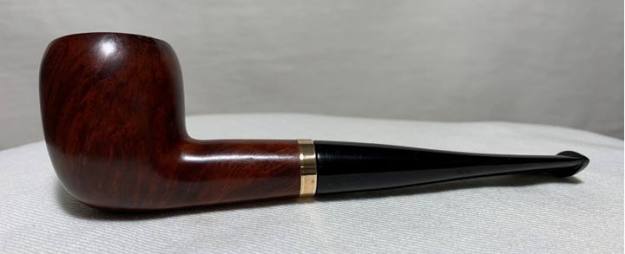
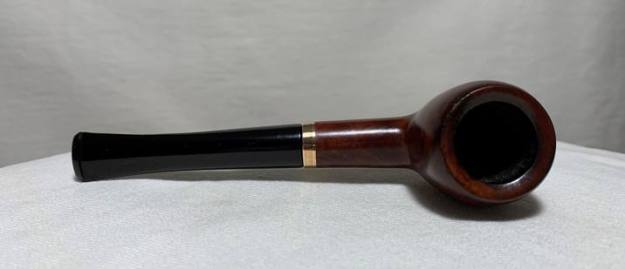
One of my dearest friends contacted me recently to inquire if I could repair and restore a pipe that belongs to his father. His father told me that the pipe had been given to him by his wife (my friend’s mother) as a graduation gift in 1967. I was only too happy to oblige – not just to help my friend, but to raise this beautiful pipe back to life. The pipe is from The House of Bewlay and is a Prince shape. Just as an aside, the shape was named after Prince Albert, the Prince of Wales, who later became King Edward VII (1841–1910). What a gorgeous pipe! I must admit that the prince is one of my favourite pipe shapes (and possibly my outright favourite). This one is the epitome of elegance in pipe smoking. The pipe’s markings read Bewlay [over] Deluxe [over] London Made. The other side of the pipe read Made in [over] England and the shape number, 258. This corresponds nicely with a Bewlay catalogue from the late 60s, as you can see in the photo below. One additional piece of information that was useful was the date of the gift: 1967. This certainly gives us a good idea of the time period from which this pipe dates. Let us read a bit more about Bewlay from the Pipedia article:

The English brand of Bewlay & Co. Ltd. (formerly Salmon & Gluckstein Ltd.), was in business from the early 20th century until the 1950s. The brand ended up being sold and taken over by Imperial Tobacco Co. The shop chain closed in the 1980s but there seems to be one shop still in business on Carr Lane in the city of Hull. Bewlay pipes were made by prestigious firms. Notably Barling, Charatan, Loewe & Co., Sasieni, Huybrecht, and Orlik. So understandably, the English considered a Bewlay pipe a quality pipe.Anyway, on to the pipe – and what a beauty it was. However, it was not without its issues. The stummel had the following problems: lava on the rim, a notable burn to the rim, plenty of cake in the bowl, strange stain patterns, and – most serious of all – a nasty crack to the shank. Meanwhile, the stem had its own set of problems: the ‘B’ logo was nearly obliterated, some oxidation and calcification, and minor tooth marks and dents. This pipe was not going to be too tough, but I needed to be especially careful to ensure the crack would be repaired perfectly – so it could be used for many years to come. The stem was first on my list. I took a BIC lighter and ‘painted’ the stem with its flame in order to lift the tooth marks. This was reasonably successful in raising the dents. Then, I cleaned out the insides of the stem with pipe cleaners and isopropyl alcohol. It was dirty, but not too bad and I went through a decent number of pipe cleaners in order to clean it up. I also soaked the stinger in lemon-infused isopropyl alcohol. This loosened everything up and I was able to clean it up very nicely. Once this process was done, the stem went for an overnight soak in the Before & After Hard Rubber Deoxidizer. The following day, I cleaned all of the de-oxidizing sludge off with alcohol, pipe cleaners, et cetera. The oxidation had migrated to the surface and would be fairly straightforward to remove. I scrubbed vigorously with SoftScrub to remove the leftover oxidation. Before I moved on to the Micromesh pads, I built up the small dents on the stem with cyanoacrylate adhesive and let them fully cure. I then sanded it down with 220-, 400-, and 600-grit sandpapers to meld the repair seamlessly into the stem. This ensures that it keeps its shape and looks like it should. I then used all nine Micromesh pads (1,500 through 12,000 grit) to bring out the lovely black lustre on the stem. I also used Obsidian Pipe Stem Oil in between each pad scrubbing.I then took the opportunity to repair the “B” logo on the stem. It had faded – both by loss of paint over time and also by fingers inadvertently smoothing out the “B” over time. So, I added some acrylic paint with a paint brush, let it dry, and buffed it to make it look good. The “B” is back, but, as later photos reveal, a little bit has disappeared into history.

On to the stummel, and the usual cleaning procedures were in order for this pipe. I used both the PipNet Reamer and the KleenReem to remove the built-up cake and followed that with 220-grit sandpaper to remove as much as I could. I wanted to take the bowl down to bare briar to ensure there were no hidden flaws in the walls of the bowl. Fortunately, there were none. I then proceeded to clean out the insides of the shank with Q-tips, pipe cleaners, and isopropyl alcohol. There was some nastiness inside this stummel, but fortunately not too much – it only took a handful of pipe cleaners etc. to sort that out. I followed that up by cleaning the insides with some dish soap and tube brushes. I then moved on to cleaning the outside of the stummel with Murphy’s Oil Soap and some cotton pads. That removed any latent dirt. By the way, I deliberately did not de-ghost this pipe – I wanted to leave as much of the original tobacco essence as I could for the owner.As I mentioned earlier, there was some lava and a substantial burn on the rim of the stummel that also needed to be addressed. In order to minimize the impact of both, I “topped” the pipe – that is to say, I gently and evenly sanded down the rim on a piece of 220-grit sandpaper. This effectively removed the lava and most the damage, without altering the look of the pipe. However, I had to stop short of removing it all, otherwise the look of the pipe would have been altered. For the remaining bits of burn, I took some oxalic acid on a Q-tip and rubbed and rubbed and rubbed! The burn site did improve but never fully disappeared. It would be a permanent feature of the pipe going forward. I took solace from the fact that the burn did not affect the integrity of the wood. I then took a solid wooden sphere, wrapped sandpaper around it, and gently sanded the opening of the tobacco chamber. This was to achieve on the inner part of the rim the same thing that I achieved by “topping” on sandpaper. On to the major issue with this pipe: the crack in the shank. Naturally, Steve had the answers to all of this pipe’s problems. He explained that my first step was to ensure that the crack would not continue to creep after I had repaired it. To that end, I took a micro-drill bit, inserted it in my Dremel, and very carefully drilled a hole right through the wall of the shank. This was quite nerve-wracking, but it worked perfectly. I then needed to apply cyanoacrylate adhesive to the crack in order to seal and repair it. First, however, I used a Q-tip and a folded pipe cleaner to coat the inside of the shank with petroleum jelly. This would prevent the adhesive from dripping inside the shank and creating further problems. That done, I carefully applied a bead of adhesive to the tiny hole and the length of the crack. Finally, I clamped it shut and let it sit overnight to cure. This was a great success – obviously, the crack would always be visible, but I was really pleased with how the repair looked.Before moving on to sanding, there were a couple of small nicks on the underside of the stummel that I needed to sort out. I dug out my iron and a damp cloth to try and raise the nicks. The hot and moist steam created can often cause the wood to swell slightly and return to shape. There was some movement – not a lot, but it was better than doing nothing. I filled the remaining divots with cyanoacrylate adhesive. Now, with the crack repaired and the nicks filled, it was time to sand down the stummel. Just like the stem, I used all nine Micromesh pads (1,500 through 12,000 grit) to sand everything smooth. A light application of Before & After Restoration Balm brought out the best in the stummel’s grain. All of the work I had done to this point had taken its toll on the colour of the wood. Originally, there was a lovely sort of brownish-Burgundy colour on this pipe, and I wanted to restore this as best I could – and I also wanted to ensure that we got rid of that weird mottling. In order to bring back some life to this pipe, I opted for aniline dye. I dragged out some of Fiebing’s Oxblood Leather Dye, but it looked too reddish to me. Instead, I experimented with mixing to see what I could come up with. I made my own concoction of Oxblood and Medium Brown dyes, painted the stummel, and then applied flame in order to set the colour. Furthermore, since it is an alcohol-based dye, I was able to adjust the colour to my liking by applying my own isopropyl alcohol to the colour. Let it sit overnight and it worked like a charm!Then it was off for a trip to the buffer. A dose of White Diamond and a few coats of carnauba wax were just what this pipe needed. Now that the wood was looking all spiffy, I had to circle back and complete the repair on the crack in the shank. It needed a tight-fighting band to ensure that the crack would never open up again. I went to my jar of bands and picked one that looked good. I heated it up and then messed it up! See the photos. I did not apply even pressure as I was attaching the band, so it went mush. Fortunately, I had more bands and I did a much better job of getting the next one on. I glued it in place and let that set. It looked very dapper. I polished up the band with a 12,000-grit MicroMesh pad. I also went back to the buffer with both the stem and stummel, gave them a final application of White Diamond and carnauba wax, and brought out that lovely shine.In the end, what a beauty this pipe is! It is an elegant pipe, from a very fine maker. It obviously meant a great deal to its owner, and I was delighted to bring it back to life. Once the pipe was returned to its owner, he told me that it looked better than when it was new! Although I am not sure I agree with that, I am very pleased that he is very pleased. As I mentioned before, the prince is one of my favourite shapes and it was great fun to work on this one. I hope you enjoyed reading the story of this pipe as much I as I did restoring it. If you are interested in more of my work, please follow me here on Steve’s website or email me directly at kenneth@knightsofthepipe.com. Thank you very much for reading and, as always, I welcome and encourage your comments.
A New Solution to an Old Problem


Blog by Kenneth Lieblich

Welcome to my first meerschaum restoration! In fact, it is not just a meerschaum pipe, but it is also a Peterson pipe. This came out of lot of pipes from eBay some months ago, but it took me a while to get to it – I was a bit daunted. Even though it looked rough to start, it ended up as a very handsome pipe. Please read on… This is a rusticated, African block meerschaum, made on the Isle of Man. The stem has a push-style tenon. Like many of the meerschaum pipes of this era, this one has a factory-stained rim – to give it that sort of ‘broken in’ look. How do I know it is a Peterson? Because it has the distinctive, stylized ‘P’ on the left side of the stem, near the shank. Similar to other pipes that Steve has restored, this one seems likely to have been produced by Laxey Pipes Ltd. on the Isle of Man for Peterson Pipes. Here is the Pipedia article about them (I hasten to add that the various errors below are in the original text and are not mine):

Laxey Pipes Ltd. resided in a historical 19th century four-storey Man stone building at The Quay, Old Laxey, Isle of Man, which thankfully has been preserved.

The company specialised in the production of meerschaum pipes using the Meerschaum mined by the Tanganyika Meerschaum Corporation in the Amboseli basin in Tanganyika (since 1964 part of the United Republic of Tanzania). 

Please note: you may often find names like “Manx Pipes Ltd.”, “Man Pipe Co.” and others more, but there is no indication of another Isle of Man pipe producer other than Laxey Pipe Ltd. at any time! 

Laxey Pipes Ltd. marketed own brands like “Manxpipe”, “Manxman”, “Manxland” e.c. Names like “John Bull”, “White Knight” (unwaxed), “Domino” (black, or lined) indicated some shapes / colours of Laxey’s own series. The stems either showed the astronomical sign for “male” or “man” (circle + arrow), or the crest of the Isle of Man, the 3-legged X in a circle. Manxpipes and Laxey’s other brands were available through pipe retailers in general, but also were sold (mainly) to tourists through their own shop in Laxey. 

Furthermore Laxey Pipes Ltd. manufactured the meer bowls for Peterson, Barling, Nørding and others from the later 1960’s until 2001. Man Pipe e.g. was a brand distibuted by Comoy’s. The bowls usually showed no nomenclature indicating the orderer. “Genuine Block Meerschaum” was engraved frequently. Often, just the stems were different, while bowls were the same.

Supply of meerschaum from East Africa run out (Kenya / Tanzania exhausted, Somalia inaccessible), and thus the last Laxey meers were supplied to trade in May, 2001. Laxey Pipes Ltd. tried to survive continuing with briar pipes – mainly in the Danish style -, but to no success. It closed down business in July, 2002.

Anyway, on to the pipe – and what a mess it was. The stummel had the following problems: a nasty ghost, filth embedded in the rustication, a creepy and unnatural yellow tinge to the meerschaum, lots of lava on the rim, lots of cake in the bowl, and – worst of all – chunks missing from the rim. Meanwhile, the stem had its own set of problems: the ‘P’ logo was nearly obliterated, heavy oxidation and calcification, and tooth marks and dents. In fact, even my wife commented that this pipe might be the proverbial ‘bridge too far’ – but, like the stereotypical, stubborn husband, I was not to be deterred! I decided to start on them stem, as I still was not sure how to resolve the chunks missing from the rim. I broke out the isopropyl alcohol and pipe cleaners, and got to work on the inside of the stem. Predictably, it was pretty dirty and I went through a good number of pipe cleaners in order to clean it up. Then I had to tackle the overwhelming oxidation and calcification – yuck. I took a blade (an old butter knife, actually) and began gently scraping at all that build-up. Obviously, I took it easy, as I did not want to damage the stem’s vulcanite any further. The butter knife worked quite well and I got a good amount loose. I followed that up with some lemon-infused isopropyl alcohol on some cotton rounds to try and scrub the rest away. This worked quite well and I noted some improvement. There were quite a few dents in the stem. Some were obviously tooth marks, but other dents looked like blunt force trauma! Time to break out the BIC lighter to see if it could raise some of these dents. Quite frankly, it did not do much – this repair was going to require some considerable sanding etc. Before that, however, the stem went for an overnight soak in the Before & After Hard Rubber Deoxidizer. The following day, I cleaned all of the de-oxidizing sludge off with alcohol, pipe cleaners, et cetera. The oxidation had migrated to the surface and would be fairly straightforward to remove. I scrubbed vigorously with SoftScrub to remove the leftover oxidation.Before I moved on to the Micromesh pads, I built up the dent damage on the stem with cyanoacrylate adhesive and let it fully cure. It turned out that this was not as straightforward as I had hoped. It took more than one application of adhesive to sort this problem out. I then sanded it down with 220-, 400-, and 600-grit sandpapers to make the stem look normal. I then used all nine Micromesh pads (1,500 through 12,000 grit) to bring out the lovely black lustre on the stem. I also used Obsidian Pipe Stem Oil in between each pad scrubbing.

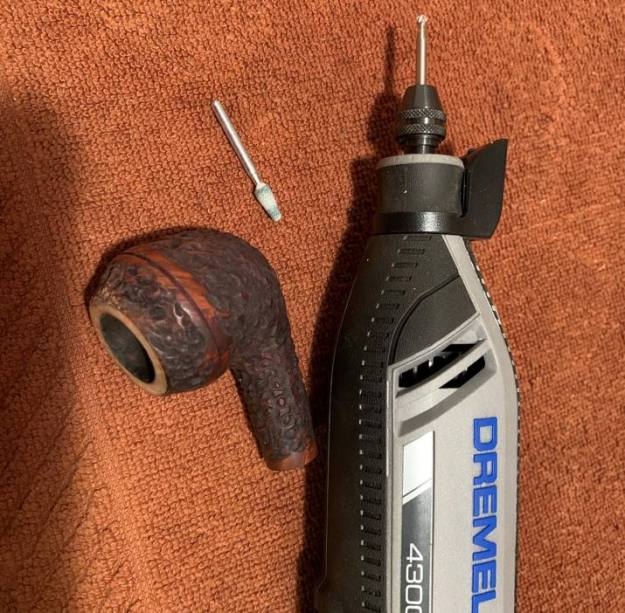
The stummel was next, and the usual cleaning procedures were in order for this pipe. I used both the PipNet Reamer and the KleenReem to remove the built-up cake and followed that with 220-grit sandpaper to remove as much as I could. The meerschaum cannot take the usual de-ghosting process of soaking cotton balls in isopropyl alcohol, so sanding was a way to reduce the old ghost in the pipe. I also wanted to ensure there were no hidden flaws in the interior walls of the meerschaum. Fortunately, there were none. Truth be told, I actually also tried to use a bit of ground coffee in the bowl to remove the ghost, but that was not very successful.I then proceeded to clean out the insides of the shank with Q-tips, pipe cleaners, and isopropyl alcohol. There was quite a bit of nastiness inside this stummel – it took a lot of pipe cleaners etc. to sort that out. I then moved on to cleaning the outside of the stummel with Murphy’s Oil Soap and some cotton pads. That worked very well at removing any latent dirt and that weird yellow tinge that I mentioned earlier. I followed that up by quickly cleaning the insides with some dish soap and tube brushes. The meerschaum cannot be left wet for long – it will turn to mush otherwise. Before & After Restoration Balm does not make the same kind of difference on meerschaum as it does on briar, but it still works – so light coating was applied, followed by my horsehair shoe-brush. On to the inevitable repairs: this is where the nightmares begin. Honestly, it was not immediately clear to me how I was going to make the stummel look decent. Sure, I had cleaned it, etc., but what about the obvious chunks missing from the side? I considered sanding it all down, but I feared this would alter the shape of the pipe beyond reason and repair. I figured that, at very least, this pipe needed to be topped. That is to say, the rim had to be inverted and sanded down on a piece of 220-grit sandpaper. By doing this, it would remove some of the lighter damage altogether and would improve the state of the heavier damage. But the old problem remained: how was I going to repair the chunks of missing meerschaum on this pipe?I then realized that the solution was as obvious as the nose on my face: I would take a piece of meerschaum from another pipe and fashion a repair. I grabbed one of my sacrificial meerschaum pipes (a dreadfully ugly horse’s head) and used a pair of end-cutting nippers to break off a couple of pieces. Having done that, I used cyanoacrylate adhesive to fix them in place on the stummel. I was feeling pretty good about this solution, but knew that there was still a long row to hoe. Obviously, I needed to sand down and shape the new pieces of meerschaum, but I also needed to make the rim as rusticated as the rest of the stummel. Enter the Dremel (with accompanying angelic voices). Yes, I first used a sanding drum on the Dremel to remove excess material from the repair (but not too much), then I used a high-speed engraving cutter to rough up the surface of both the rim and the repair. So far, so good. The engraving cutter had worked – to a point – but it had not really resulted in the sort of rustication I was looking for. My solution came from the Dremel again, but only indirectly. Steve reminded me of his trick of using an old Philips-head screwdriver as a rustication device (you can read about that here). Whereas Steve used Dremel grinding stones to make his rustication device, I used a metal cutting disc on the Dremel. As you can see, my screwdriver came out looking quite good and the stummel came out looking even better. I was definitely pleased with the roughened surface of the stummel, but I next needed to address the lack of colour. This, of course, was a direct result of my topping of the rim – it removed the patina. The solution must have come to me in the mid-afternoon: tea. Yes, I used black tea to provide a beautiful stain to the meerschaum that gave it a really good look. I went and added some more Before & After Restoration Balm and, once again, used my horsehair shoe-brush to work it in.Meerschaum does not really do well on a high-speed buffer, so I used a microfibre cloth to achieve the same effect. I did, however, take the stem to the buffer, where I applied White Diamond and some wax to give it that lovely shine.

In the end, what a beauty this pipe is! It is back to its old glory and ready to be enjoyed again by the next owner. I am pleased to announce that this pipe is for sale! If you are interested in acquiring it for your collection, please have a look in the ‘Irish’ pipe section of the store here on Steve’s website. You can also email me directly at kenneth@knightsofthepipe.com. The approximate dimensions of the pipe are as follows: length 154 mm; height 47 mm; bowl diameter 34 mm; chamber diameter 20 mm. The mass of the pipe is 40 grams. Thank you very much for reading and, as always, I welcome and encourage your comments.
How about a Danish for Breakfast?


Blog by Kenneth Lieblich

This spectacular pipe came in a lot of freehand pipes that I bought recently. It seemed to me that I needed to restore a Danish freehand pipe in order to earn my pipe-restoring stripes, so-to-speak. The pipe is absolutely beautiful and a superb example of Danish pipe-making craftsmanship. But right at the start, I want to apologize for the dearth of photographs in this post. I guess I was so delighted at the prospect of working on this pipe that I occasionally forgot to capture the moment on camera.The pipe is a Danish freehand pipe by the esteemed pipemaker, Bjørn Thurmann. The gorgeous briar wood transitions seamlessly into the horn ferrule. It really makes an impression. I am not able to date the pipe, as the photo shows all of the markings to be seen. Thurmann passed away a few years ago, but his company, Thurmann Piber, is still well known in Copenhagen for the fine quality of his work. The reference book, Scandinavian Pipemakers by Jan Andersson, provides us with a nice overview of his background and work. I will quote a bit of it here:

Bjørn Thurmann was born in 1946 – some would say, born into the tobacco trade. In 1953, his parents opened a pipe shop in central Copenhagen and Bjørn helped them there from the beginning, mainly by sorting pipes. Initially, the pipes were bought from a firm called Larsen & Stigart, but eventually they decided to start their own production.

Bjørn’s parents thought that their son ought to widen his views and get some international experience, so, in 1968, he was sent to London to work in different tobacconists shops, a period of learning that ended at Dunhill’s famous shop on Duke Street. After returning home, he almost immediately received an offer to work for Iwan Ries & Co. in Chicago, an offer that was hard to resist, so off he went.

In 1976, Bjørn established himself as an independent pipemaker, and since then he has had shops in several places in Copenhagen. Bjørn has also written a book called Pibemagerens Handbog (The Pipemakers Handbook), which tells how to make pipes using simple tools most people have at home.Clearly, Thurmann was a vastly experienced and talented pipe man. I am delighted to be able to work on a pipe like this. One can not only see, but also feel, the quality of the briar. First of all, I am pleased to report that the stummel of this pipe was in good condition. There was some burning around the rim and there was a small nick along one edge of the rim and another small nick on the top of the rim. Otherwise, the wood just needed to be made a bit more spiffy. Meanwhile, the stem needed some attention. It showed signs of oxidation and had been well chewed. The stem was first on my list. I took a BIC lighter and ‘painted’ the stem with its flame in order to lift the tooth marks. This was only slightly successful in raising the dents. Then, I cleaned out the insides of the stem with pipe cleaners and isopropyl alcohol. Once this process was done, the stem went for an overnight soak in the Before & After Hard Rubber Deoxidizer. The following day, I cleaned all of the de-oxidizing sludge off with alcohol, pipe cleaners, et cetera. The oxidation had migrated to the surface and would be fairly straightforward to remove. I scrubbed vigorously with SoftScrub to remove the leftover oxidation. Before I moved on to the Micromesh pads, I built up both dents and the squashed button on the stem with cyanoacrylate adhesive and let them fully cure. I used my miniature files to do a proper cutting of the new button – this ensures that it keeps its shape and looks like it should. I then sanded it down with 220-, 400-, and 600-grit sandpapers to meld seamlessly into the stem. I did the same to the remaining tooth marks. I then used all nine Micromesh pads (1,500 through 12,000 grit) to bring out the lovely black lustre on the stem. I also used Obsidian Pipe Stem Oil in between each pad scrubbing.On to the stummel, and the usual cleaning procedures were in order for this pipe. I used both the PipNet Reamer and the KleenReem to remove the built-up cake and take the bowl down to bare briar, as I wanted to ensure there were no hidden flaws in the walls of the bowl. Fortunately, there were none. I then proceeded to clean out the insides of the shank with Q-tips, pipe cleaners, and isopropyl alcohol. There was some nastiness inside this stummel, but fortunately not too much – it only took a handful of pipe cleaners etc. to sort that out. I followed that up by cleaning the insides with some dish soap and tube brushes. I then moved on to cleaning the outside of the stummel with Murphy’s Oil Soap and some cotton pads. That removed any latent dirt. As I mentioned earlier, there were some small burn marks on the rim of the stummel that also needed to be addressed. A lot of this was removed by the Murphy’s. For the burns that remained, I took some oxalic acid on a Q-tip and rubbed and rubbed. As you will see, the treatment worked very well and the rim is much improved. I completed this part by gently sanding the rim edge to remove the roughness that remained.Then I addressed the two nicks on the rim – both were relatively straightforward. The first one required a touch of light sanding with the Micromesh pads and then the merest bit of stain with one of my furniture pens. Looks fantastic now. The other nick was solved by filling it with cyanoacrylate adhesive and letting it fully cure. After this, the entire stummel was treated to a rub-down with all nine Micromesh pads (1,500 through 12,000 grit). A light application of Before & After Restoration Balm brought out the best in the stummel’s grain. There is some beautiful wood on this Danish pipe! Now it was off for a trip to the buffer. A dose of White Diamond and a few coats of carnauba wax were just what this pipe needed. I had to be especially careful with the bench polisher, since the sharp edges had a tendency to catch on the buffing wheels. I have to admit, this did put my heart in my throat a few times!
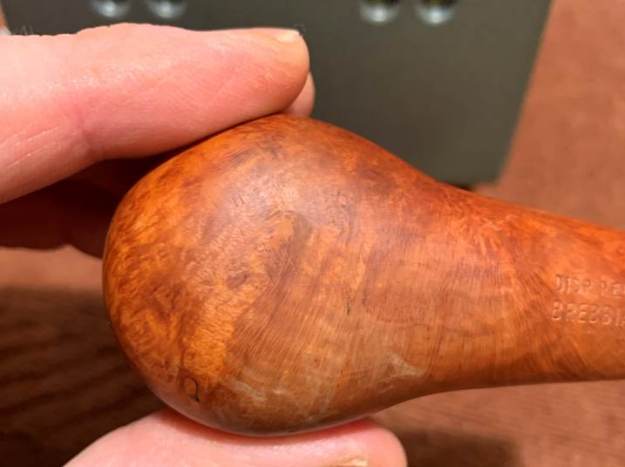
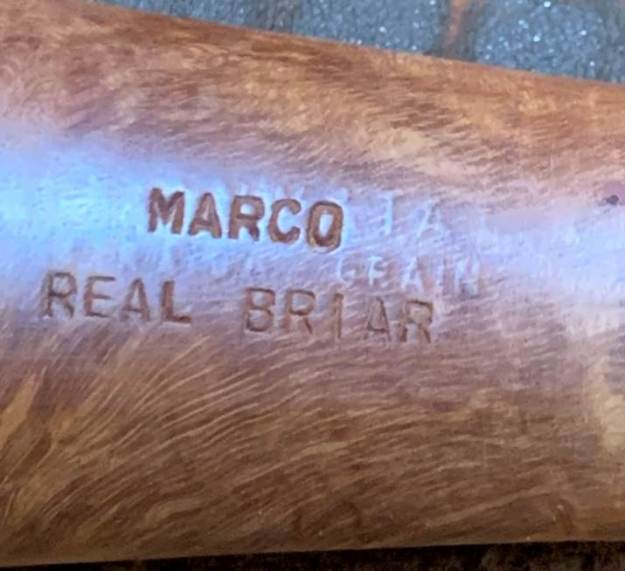
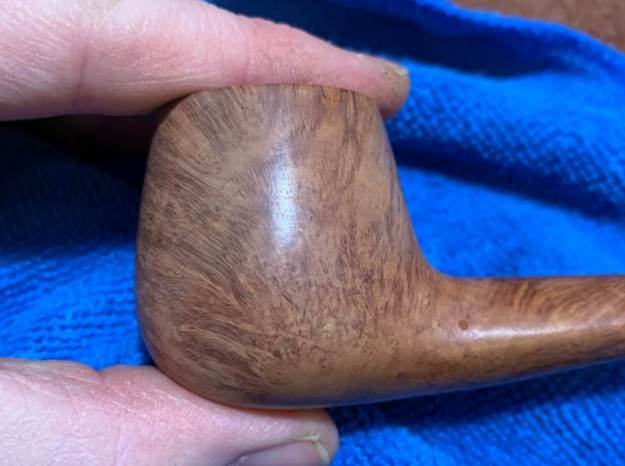
This pipe was a delight from the start and its beauty only increased through the restoration process. Finally, I am pleased to announce that this pipe is for sale! If you are interested in acquiring it for your collection, please have a look in the ‘Danish’ pipe section of the store here on Steve’s website. You can also email me directly at kenneth@knightsofthepipe.com. The approximate dimensions of the pipe are as follows: length 180 mm; height 55 mm; bowl diameter 55 × 39 mm; chamber diameter 25 × 21 mm. The mass of the pipe is 77 grams. Thank you very much for reading and, as always, I welcome and encourage your comments.