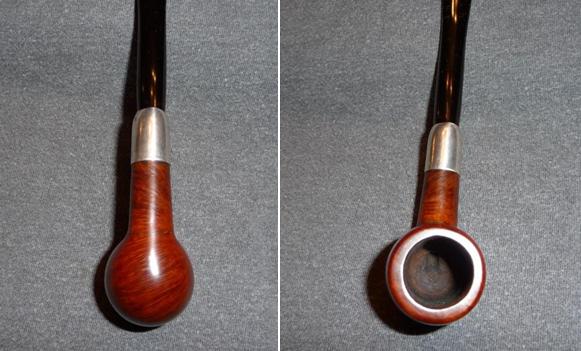
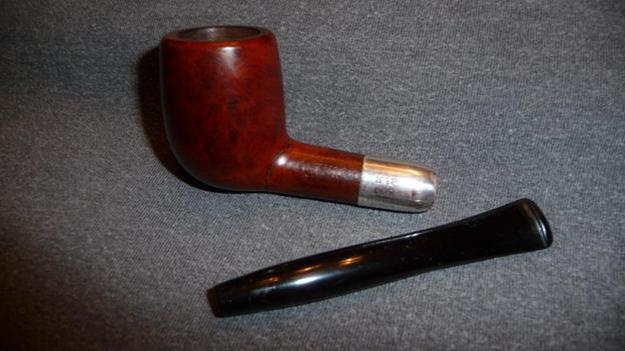
Tag Archives: Aaron Henson article

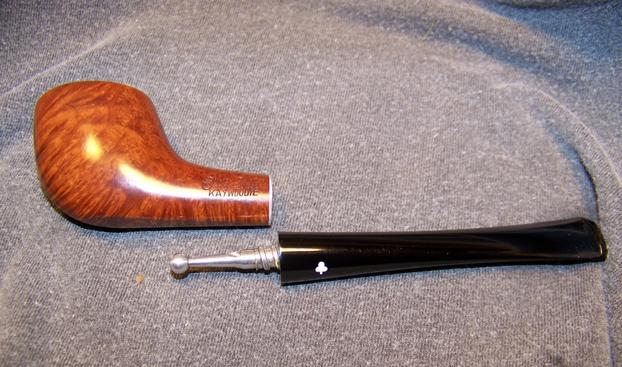
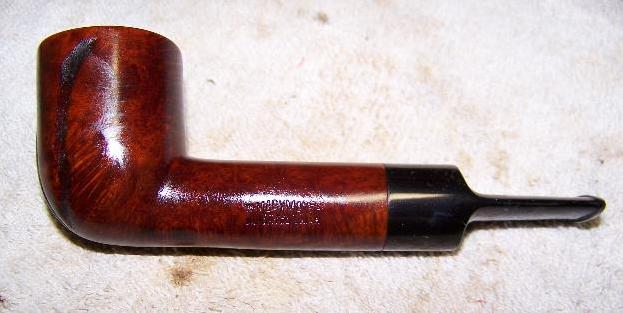
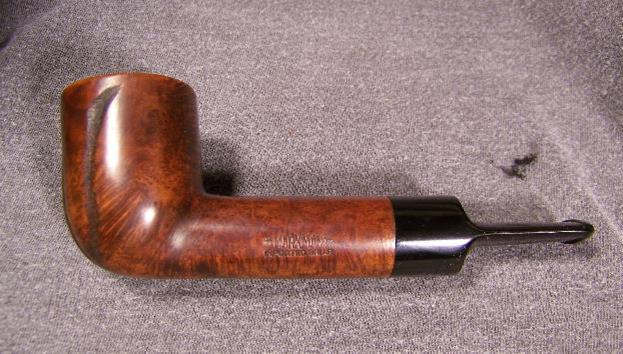
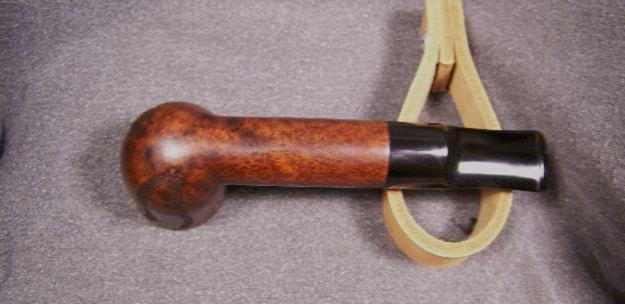
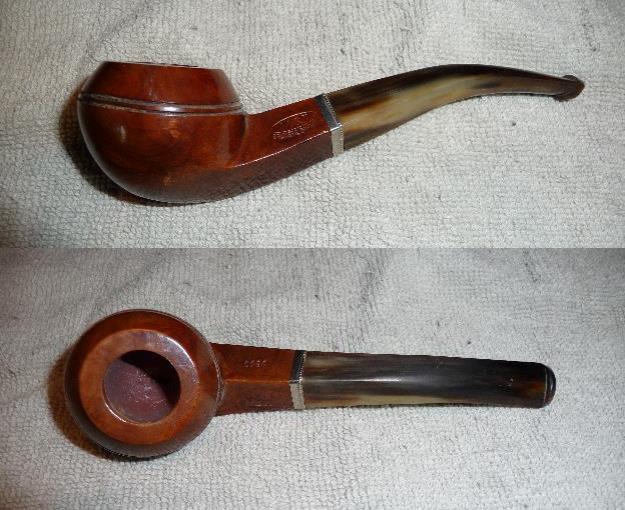
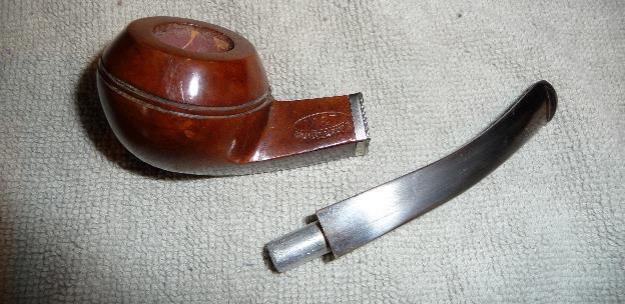
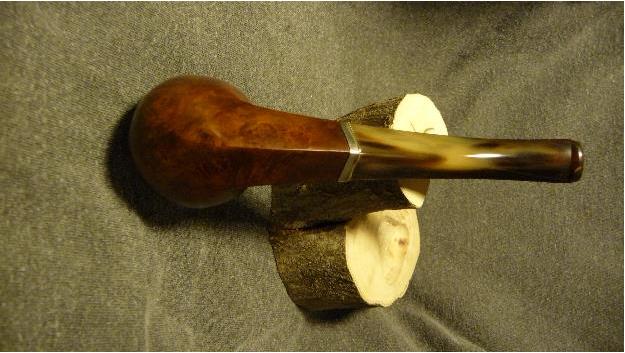
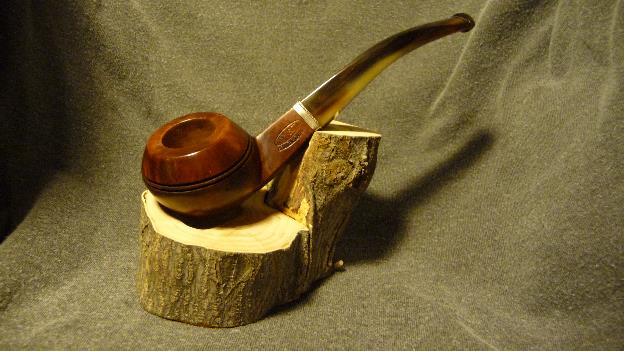
A Few Firsts on a GBD Garland II Calabash 9552


Blog by Aaron Henson

Before you get into this write up, I need to confess that despite my best efforts, I did a poor job of photo documenting this repair and restoration.  I had good intentions, but the project was spread out over two months, working on it as I had time. Because of this, some of the pictures were taken out of sequence and others were chosen that best show a repair but also show repairs that have not yet been covered in the write up.

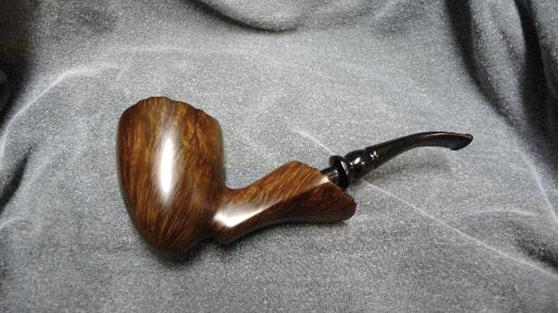
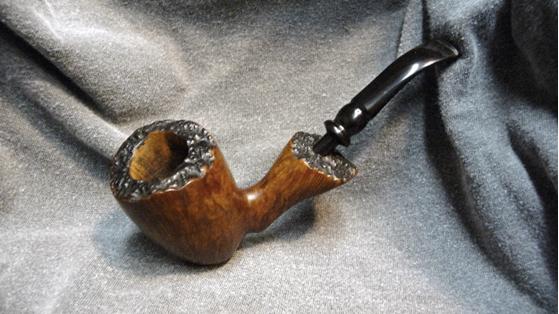
I realized a while back, that I had not restored a pipe recently that I was really excited about.  There have been a number pipes that have crossed my work table and some have even posed some new challenges but the pipes themselves were hardly memorable. With the pickings at the second hand store in my area being slim – I turned to eBay to see if I could find a project pipe that would peak my interest.  After a few hours of browsing I, found just what I was after: a stemless, GBD Garland II stummel – shape 9552.  I submitted my bid and picked it up for a price that I thought was reasonable.

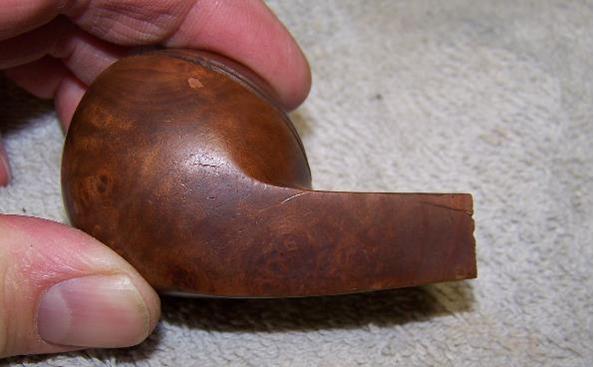
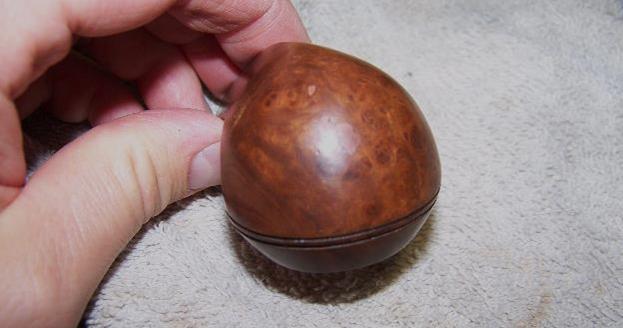
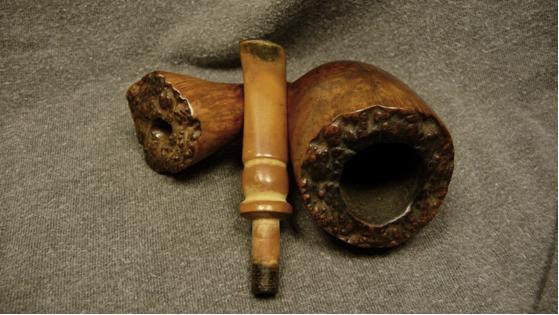
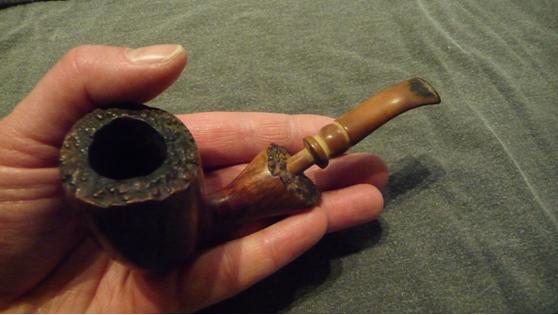
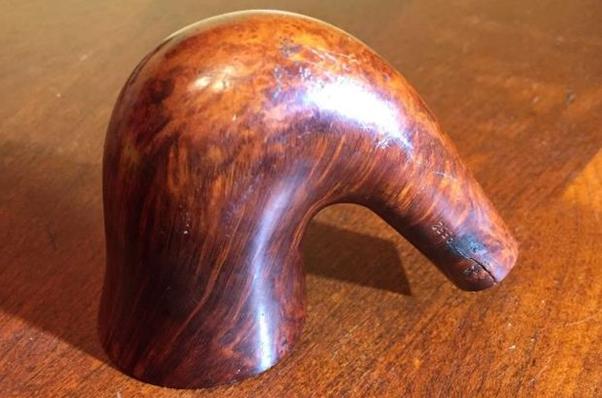
I don’t typically like to buy pipes on eBay.  I prefer to be able to see them first hand so I know what I am getting myself into.  But in this case the seller was forthcoming in the auction description, revealing that the pipe had a major crack in the bowl and another in the shank and of course, it lacked a stem.  But what really fascinated me was the shape of the stummel and what promised to be some beautiful grain patterns.

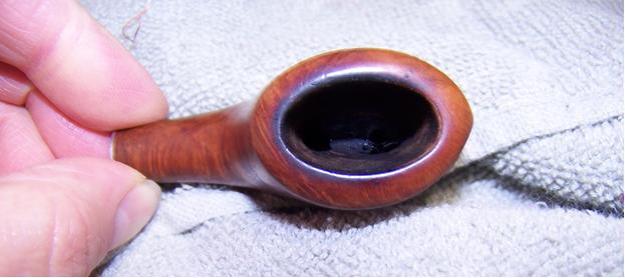
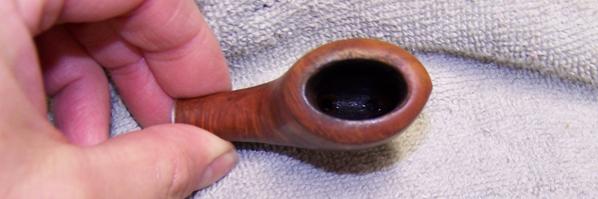
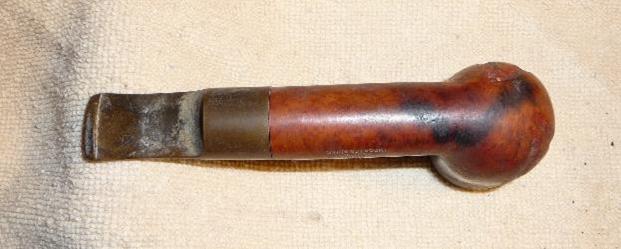
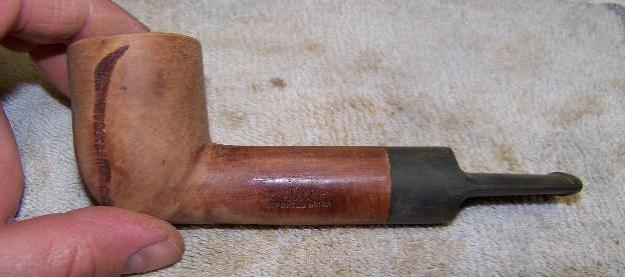
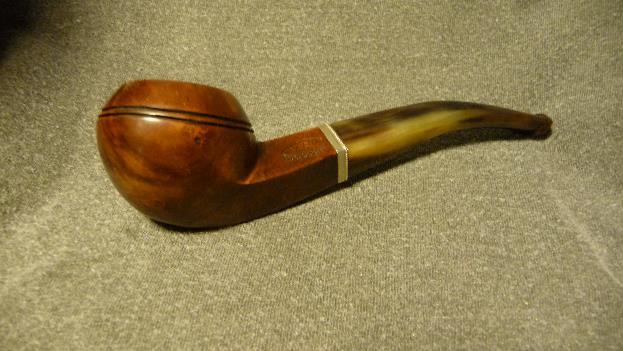
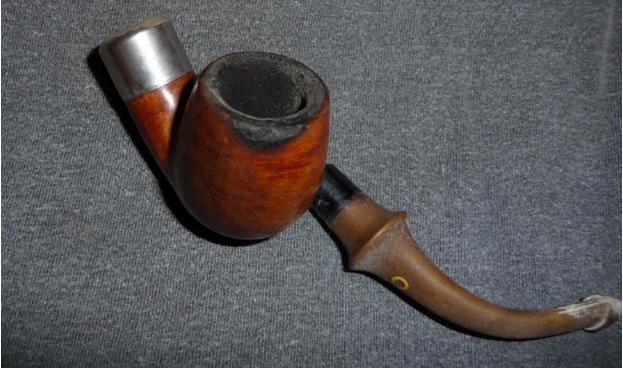
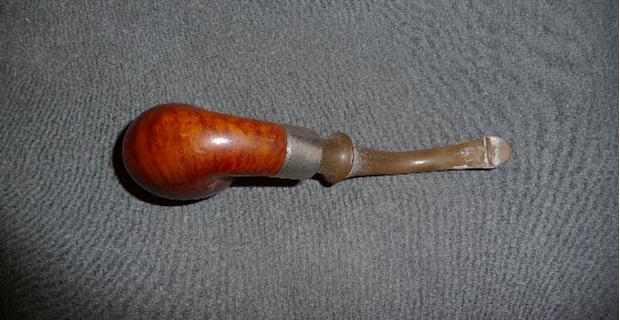
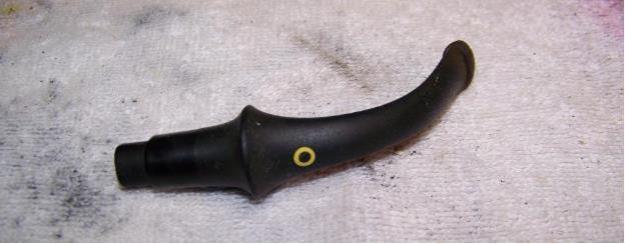
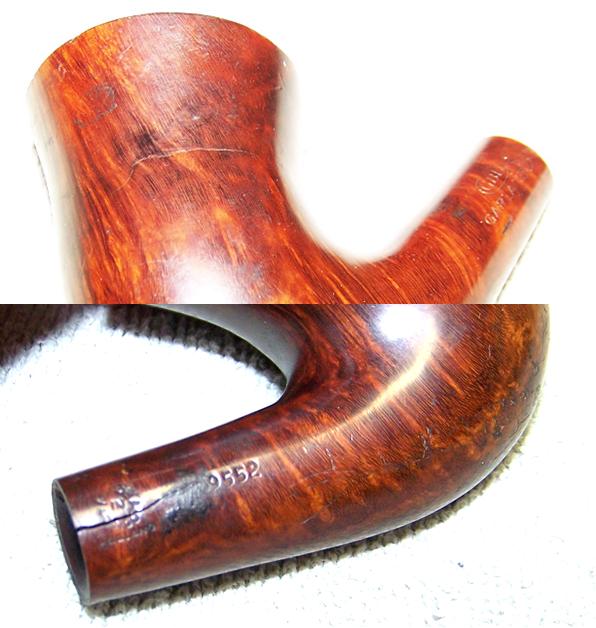
The following pictures were from the seller auction page: Wanting an idea of what kind of stem was originally on the pipe, I headed on-line to see what I could find.  My first stop was here at Reborn Pipes.  In a 2016 article, our host, Steve, restored a GBD Colossus Fantasy 9552.  I found additional examples of the 9552 shape in the GBD’s Prehistoric, Prestige and Virgin lines.  In all cases the 9552 originally came with a bent saddle bit – some fancier than others.
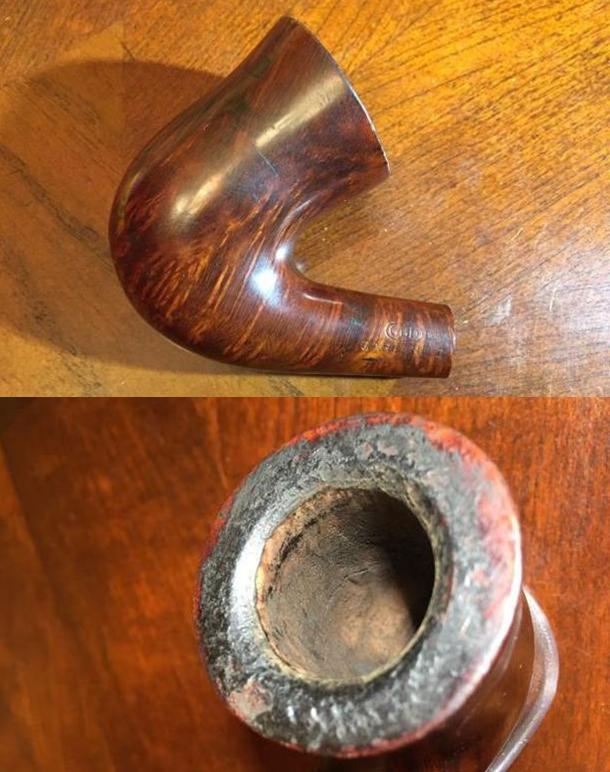
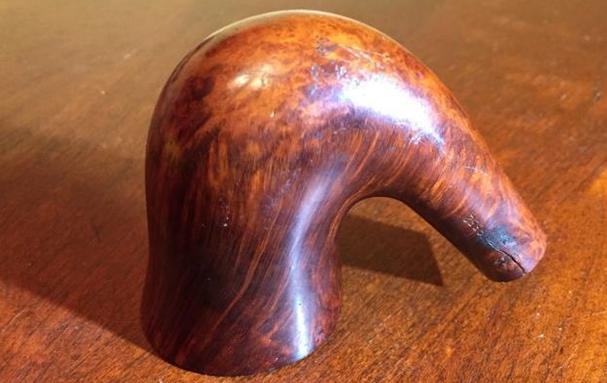
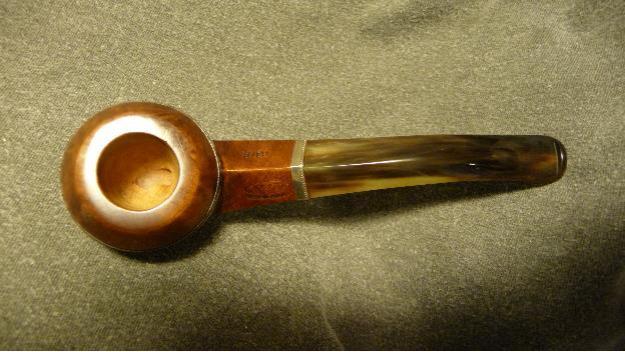
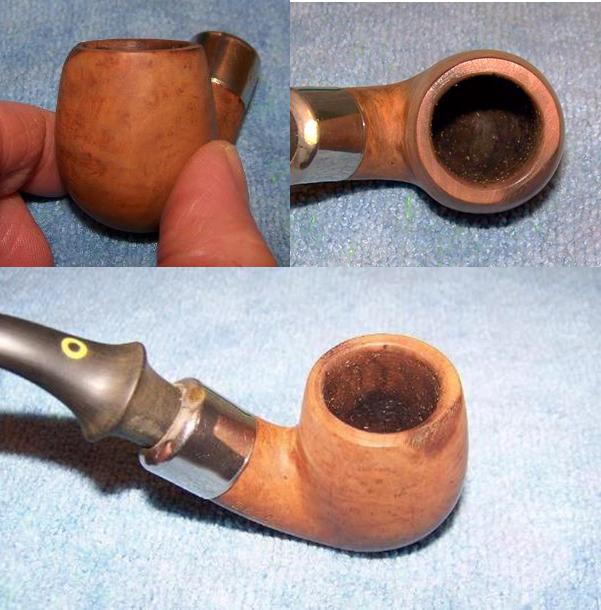
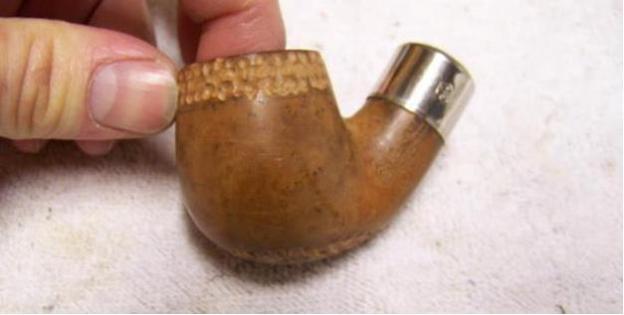
These next two pictures are of a Garland II I found online.  I was not going to try to duplicate the band in the stem, but knew I was going to need a band on the shank and that wouldn’t look too bad. Then I ended up at a Pipedia article for GBD Models where I learned that the Garland is a seconds line from GBD. I found this surprising because the Garland that I have and the ones I have seen online are excellent specimens of briar.  Admittedly, my eye is not that experienced, but just from the quality of the briar and the lack of fills and pitting I would guess that the Garland line is GBD’s higher end seconds consisting more of fabrication errors rather than materials flaws.  Can anyone confirm my guess?
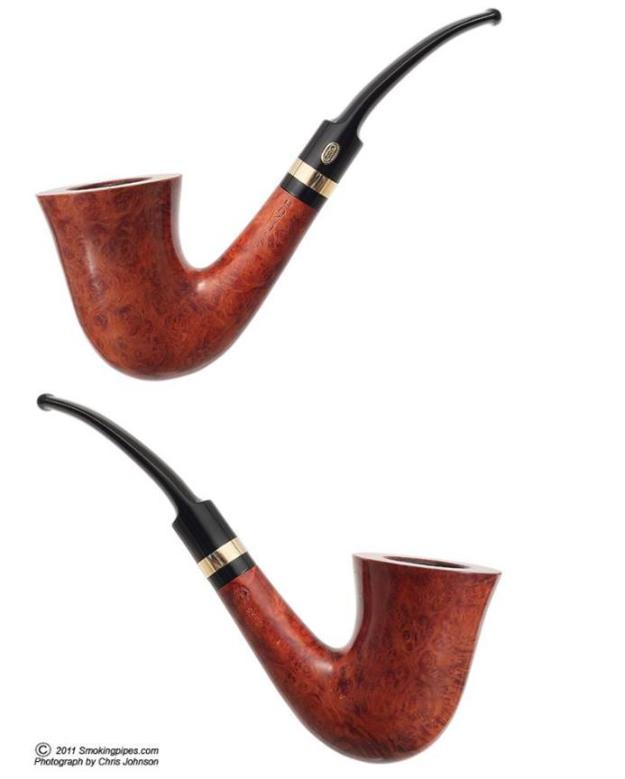
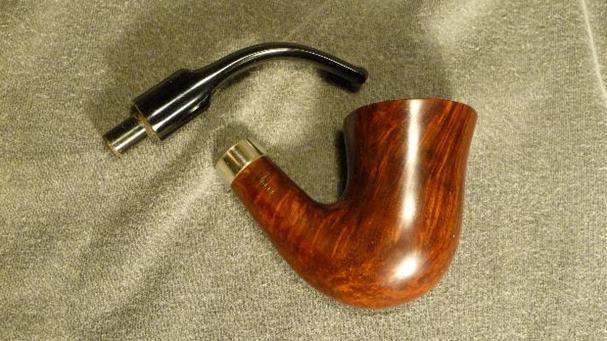
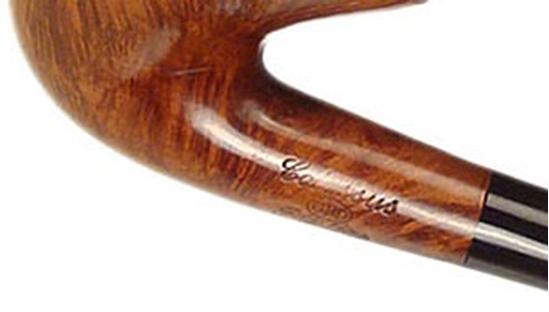
Another interesting fact that I note is that the 9552 shape is often stamped with “Colossus”.  The term Colossus was used by GBD as plus sized pipe designation.  This size designation is used on all the GBD lines of pipes, but is lacking on this particular Garland II stummel. When the stummel arrived, I eagerly open the package and began to inspect the damage up close, fearing that some of the worst damage may not have been disclosed.  But the seller’s pictures and description were accurate and I didn’t find hidden issues.  The pipe was indeed big; the bowl height is 2.4 inches and the outside diameter is 1.75 inches. The chamber is 0.96 of an inch in diameter and 1.9 inches deep.
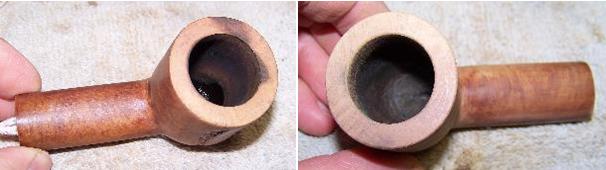
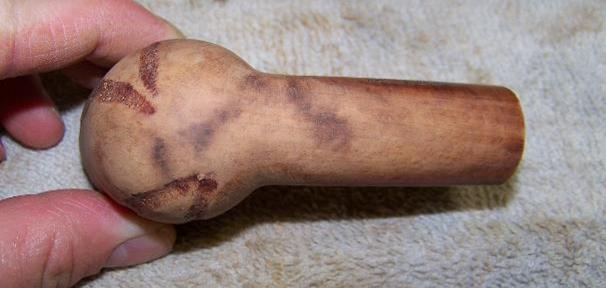
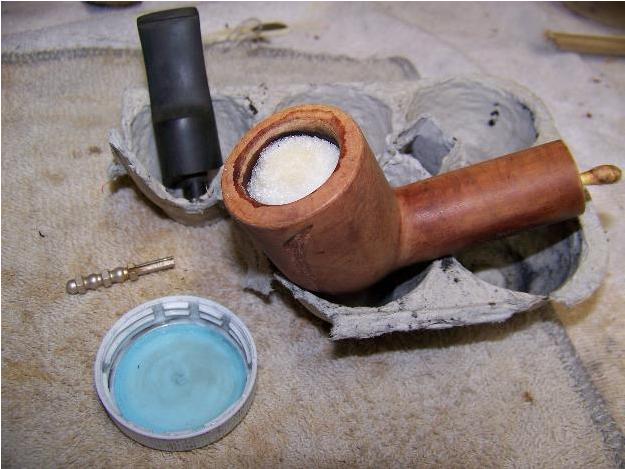
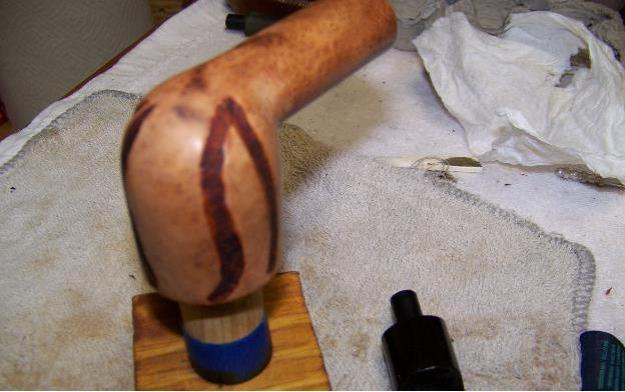
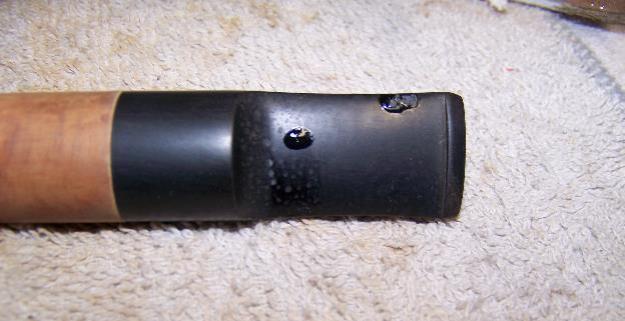
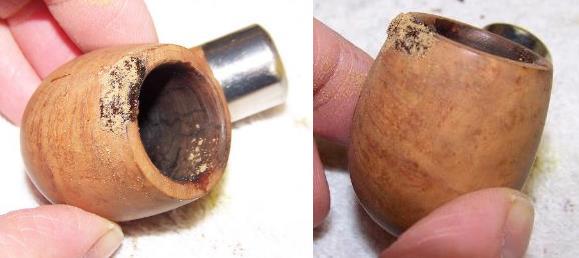
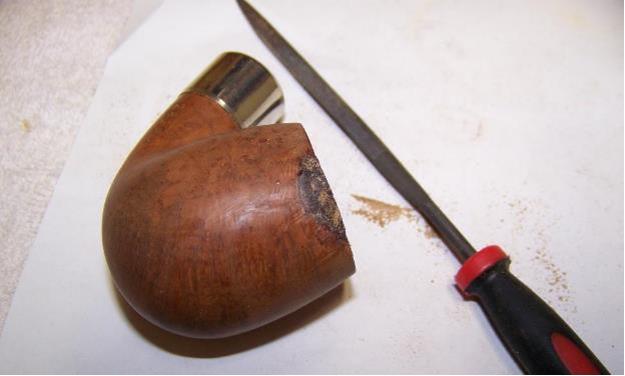
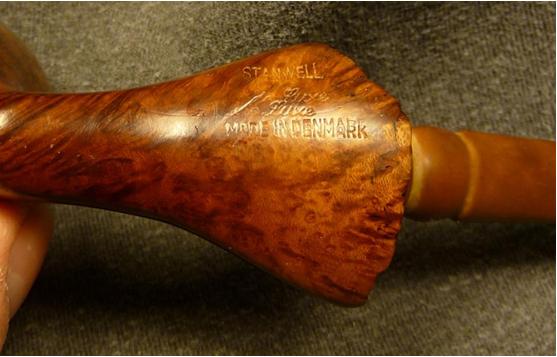
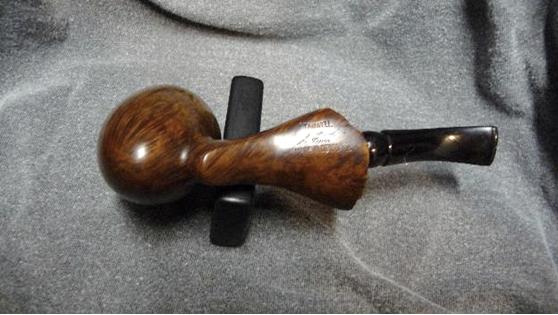
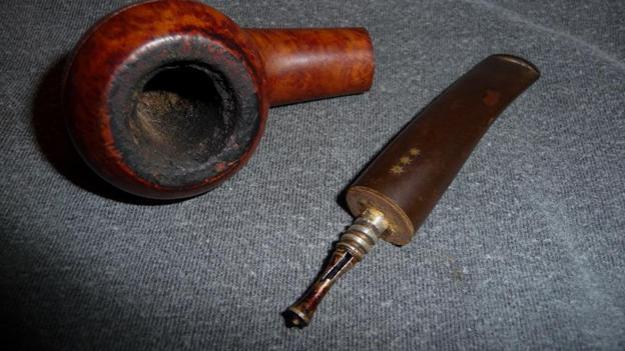
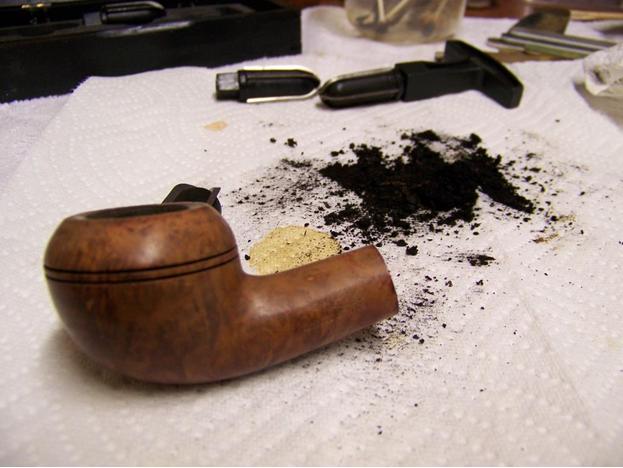
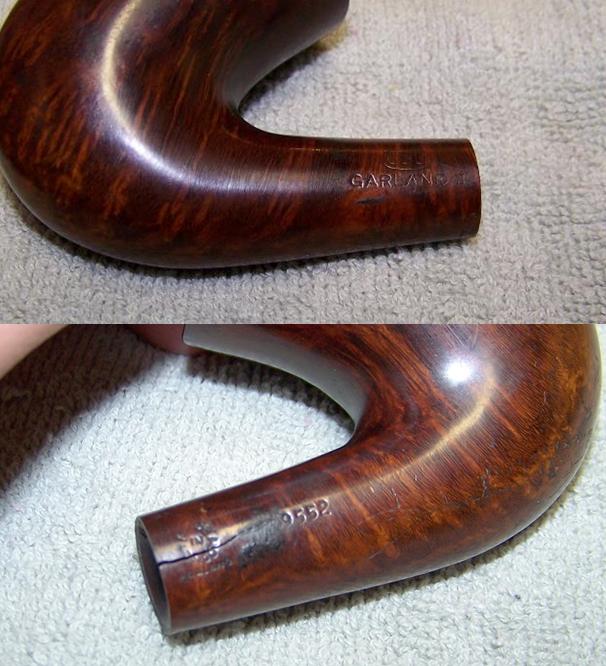
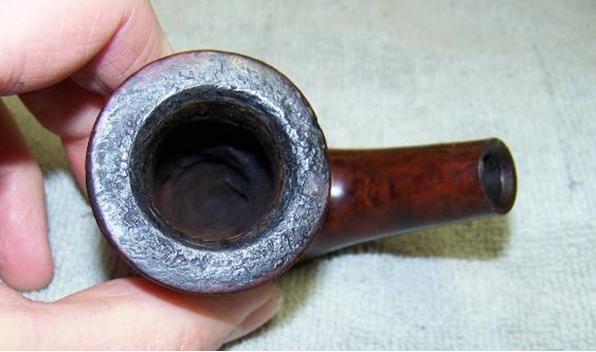
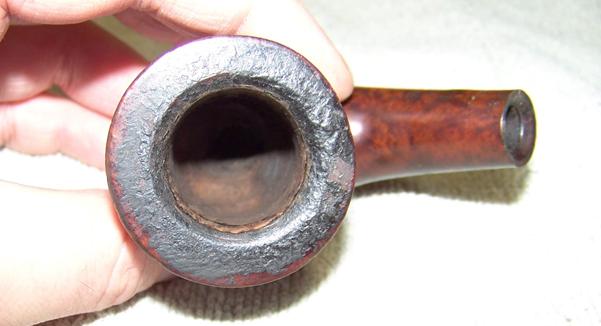
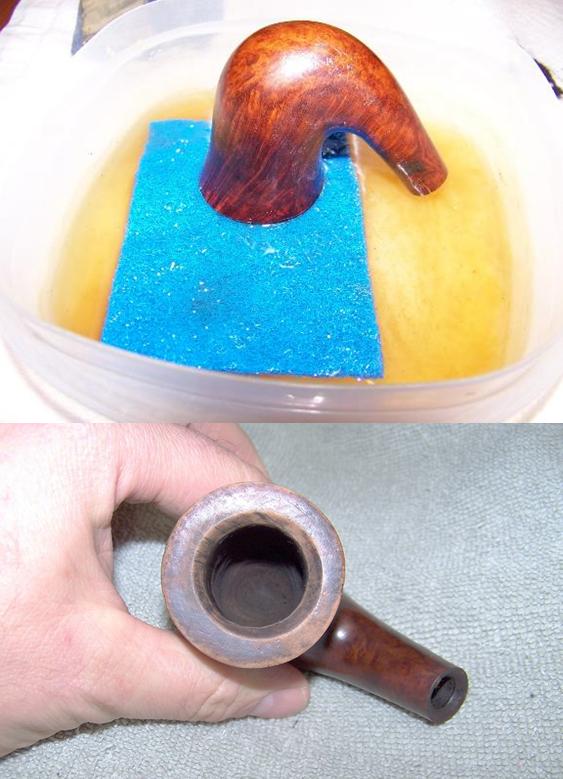
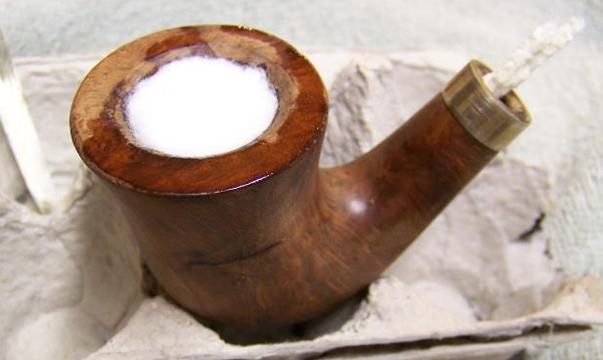
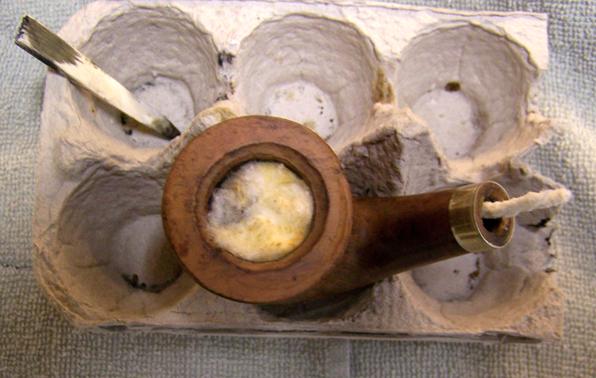
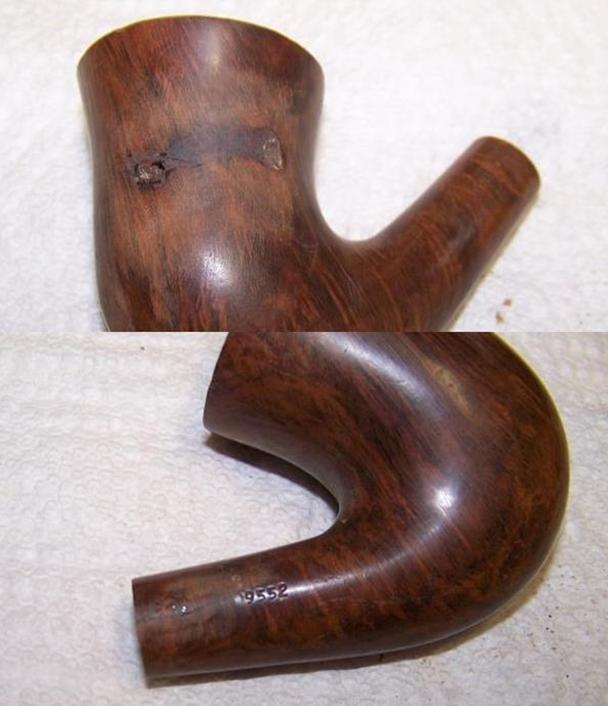
The left side of the shank is stamped GBD in an oval over Garland II.  The left side has the COM (Country of Manufacture) stamp: MADE IN LONDON in a circle over ENGLAND and the shape number to the right: 9552. There was a heavy amount of the lava on the rim and the bevel at the edge of the chamber was a little distorted.  The chamber too seemed to be drilled a little off center.  Perhaps this was the why it was a second?  The chamber had been reamed but not back to briar. The horizontal crack in the bowl was located on the left side and was a little over an inch long.  I suspected that it went all the way through bowl wall but I could not be certain until I finished reaming the chamber.  The crack in the stem was about half an inch long from the end of the shank right through the COM stamp but missing the shape number. Looking the pipe over closely, I noted quite a few dents in the heel of the stummel and handling scratches on the sides of bowl and the rim.  I guessed that this piece of briar had been rattling around in a drawer for some time.Now that I had the stummel in hand I could measure the shank diameter (.610” at the end) and estimate the length that I wanted the new stem to be; about 3-1/4 inches. I took these measurements to the Vermont Freehand website and selected a stem that best fit.  I chose the vulcanite stem blank number 722, a round saddle bit 21/32” diameter and 3-1/16” inches long.  I always order two in case I ruin the first one.  I also ordered four nickel plated shank rings, two 15.5 mm and two 16 mm not being sure which would be the better fit. With the parts on order, I started cleaning up the interior of the stummel.  I reamed the chamber back to bare wood with my Castleford reamer and Decatur pipe knife. I also cleaned the shank alternating with bristled and soft pipe cleaners dipped in 91% isopropyl alcohol.  The last person who tried reaming the chamber must have also ran a pipe cleaner or two through it because it only took five or six pipe cleaners before they started coming out as clean as they went in. The mortise I cleaned with cotton swabs. In all, the stummel was relatively clean. I wiped down the outside of the stummel with alcohol and acetone to remove the grime.  Underneath the dirt and oils was some beautiful straight grain with a birds-eye heel.  I looked closely and could not find any fills.  Next, I addressed the thin crust of dried tars on the rim.  I wetted down a green pad (mine was actually blue and did not work as well as the original green ones) with a mixture of tap water and granulated Oxy-clean.  Placing the pad in a shallow dish, I pressed the rim of the pipe down on the pad and scrubbed in a circular motion.  A little elbow grease and the moist Oxy-clean solution did its job. I dried the stummel with a paper towel and set it aside to dry for a bit.Next, I wanted to remove the ghosts of the previous tobacco that I could still smell in the chamber with an alcohol soak.  I use the cotton ball method because it seems to do the job and is easier to clean up than the salt method. This chamber needed three cotton balls and I used 98% grain alcohol for the soak. I placed a cap over the top of the bowl for the first couple of hours to keep the alcohol from evaporating too fast then I removed the cap so the evaporative action can draw out the tars from the briar.When I got back to it the next day I was disappointed (though not surprised) that the crack in the bowl was wet where alcohol had been seeping through.  At lease now I knew for sure that the crack went all the way through the bowl wall.  The good news was I could easily see the ends of the hairline crack.  I used a dental pick to mark the ends so I could find them later, then I removed the cotton balls and wiped out the chamber with a dry paper towel. I began the crack repair by using a small drill bit (0.5 mm) and hand drilled the stopper holes at the location I marked with the dental pick. Since the crack went completely trough the chamber wall I also drilled the hole all the way through the wall.  I have not dealt with a crack that was this deep before so I was on unfamiliar ground.  I packed the hole the half full with briar dust using a tooth pick then placed a drop of clear CA glue into the hole – coaxing it in with the tooth pick.  I filled the holes up the rest of the way and dripped more glue.  I used a magnifying glass to locate the end of the shank crack and gave it the same treatment.
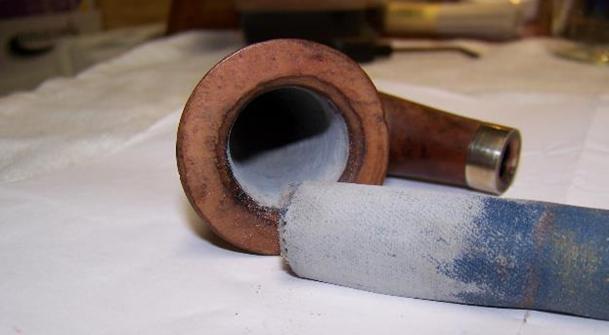
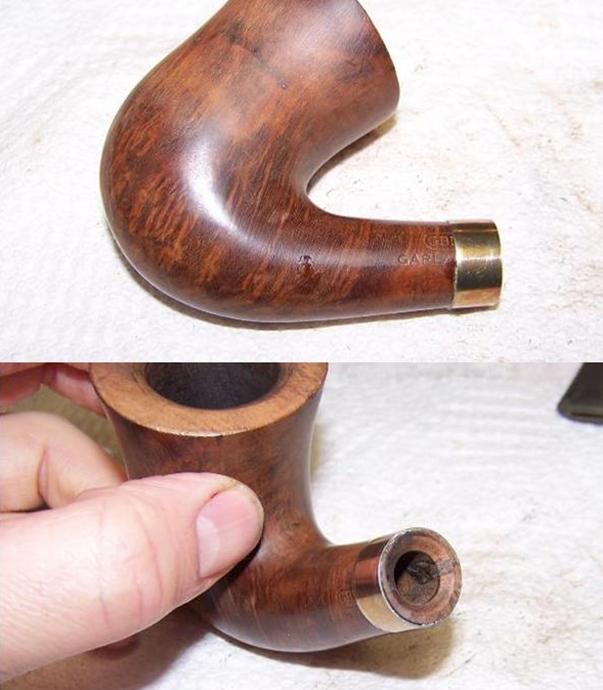
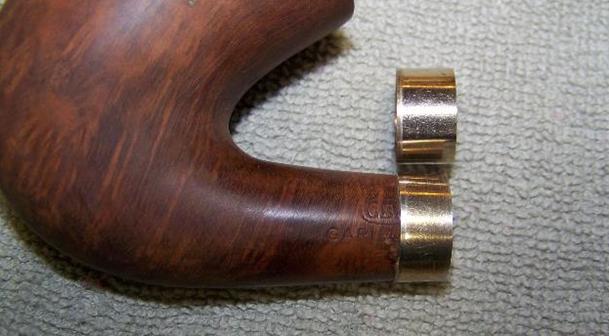
I unsuccessfully tried working some CA glue into the bowl crack. The glue just seemed to set too fast and did not penetrate the crack.  The shank crack on the other hand I could work open and get the glue to flow into it.  I put a clamp on the shank while the glue set.  Then when dry, I sanded the glued repairs smooth with 220 grit paper, careful not to over sand and change the shape of the pipe or damage the stamping on the shank. I resolved to repair the bowl crack by applying coat of heat resistant epoxy to the inside of the chamber.  In this case I used the two part JB Weld – not the Quick Weld, which is useful for other pipe repairs.  For pipe chamber repairs, I like the original JB Weld epoxy, it is easy to use and when cured it has a 550 degree (F) heat resistance.  It is also easy to sand smooth.  I apply it with my finger because it is much easier to get an even coat.  I highly recommend wearing a pair of powder free Nitrile blue gloves for this operation! By this time the parts from Vermont Freehand arrived and wanted to band the shank. I have fixed a few banded pipes before but never put a band on an unbanded pipe. I tried dry fitting the two different sized bands I had bought.  The smaller band would only just slip on the first fraction of an inch so I was glad I had ordered the next size up. The bands were a bit wider than I wanted because I did not want it to cover up too much of the stamping.  Not sure what to do about the band width, I kept focusing on the seating of the band.  I used a heat gun to heat up the band and get it to expand.  Then with the band resting on a wood block, I pressed the shank down into the ring. The first attempt didn’t go well. The band was a bit cocked and only seated about a quarter of an inch.  I realized that the shank’s taper was going to prevent the band from going on much farther and that was going to resolve the width issue; I was going to have to trim the band.
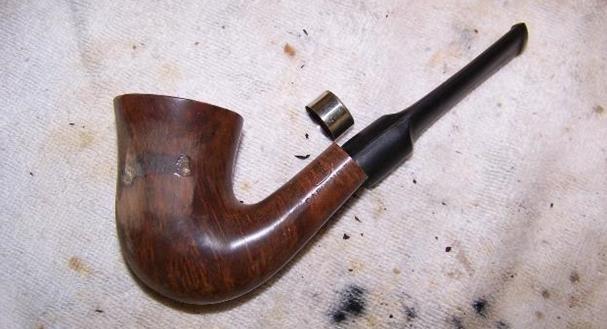
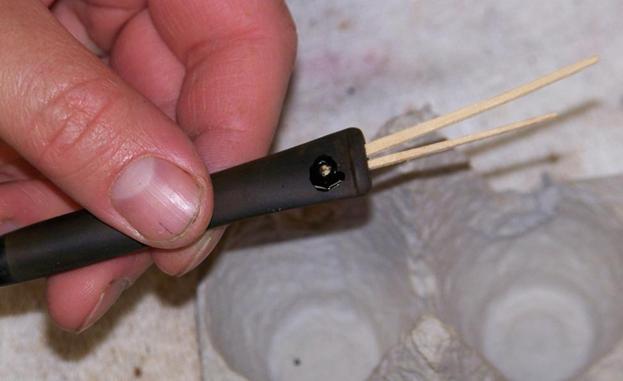
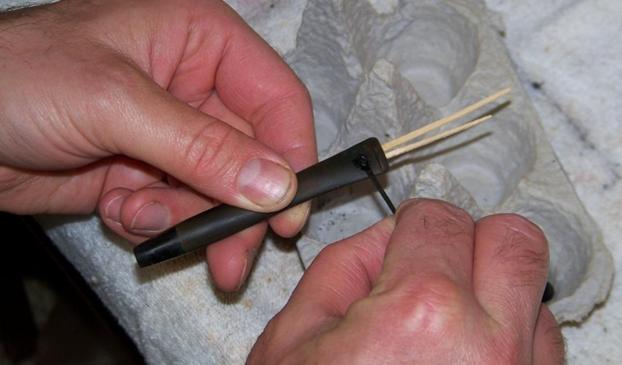
I removed the band and heated it up again.  I smeared a little CA glue around the end of the shank and was able to seat the band squarely.  This time about 3/8” onto the shank.  Once cool, I used a skinny wheel on a rotary tool to trim of the excess band material and flush it up to the end of the shank.  Although the band covered up the COM stamp and ‘AND II’ of ‘GARLAND II’ it was necessary and it gives the stummel a touch of class. I was pleased that the replacement stem I had chosen seemed to be a good fit although it was going to need some work.  I started by using a fine tooth file to square up the face of the stem so it sits flush to the shank and removing the casting burrs.The tenon on the blank was way oversized as was the body of the stem.  I don’t have a tenon turning tool, so I use my drill press to turn the stem.  Wedging a bamboo skewer into the air hole at the tenon end, I leave about an inch of skewer exposed that I can secure into the chuck of the drill.  Setting the drill to about 1300 RPM I use small pieces of 60 grit sand paper to slowly reduce the diameter of the tenon and the stem until it the correct size. The drill press method works well in theory.  Once in a while the stem slips loose from its friction fit with the skewer and I have to reseat it.  I work the vulcanite with 60, 120 and 220 grit sand paper, leaving the polishing to be done by hand with micromesh pads.
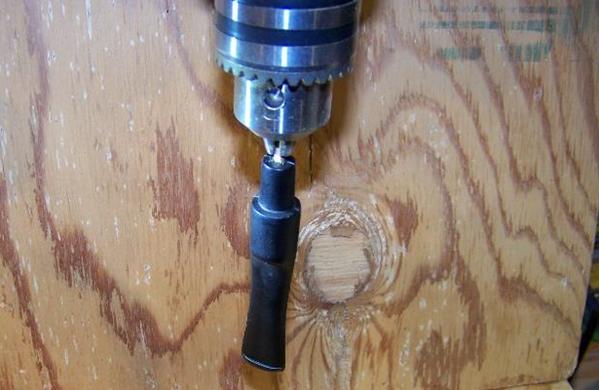
I kept a caliper nearby set at the correct tenon diameter to check my progress.  As I got closer to the correct size, I switched to 120 and 220 grit paper.  But I didn’t switch soon enough!  By the time I got some of the deep scratches of the 60 grit out I had overturned the tenon and it was a hair too small.  I finished turning the body of the stem before addressing the tenon issue.I thought at first that a little bee’s wax on the tenon would be enough to tighten the fit but in the end I had enlarge the tenon.  To do this, I heated the tenon and inserted a drill bit into the air hole to enlarge the tenon.  Letting the tenon cool with the bit in it I checked the fit:  A little too big.  I didn’t want to take anymore material off the tenon because if the tenon gets hot during a smoke it will return to its original size, vulcanite has a memory.  I looked around my tool box and found a small punch that had a slightly smaller diameter than the drill bit and repeated the heating process.  This time the fit was much better.
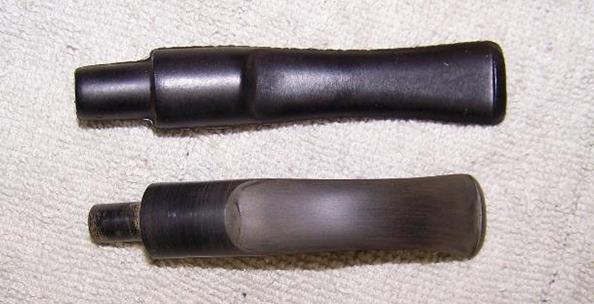
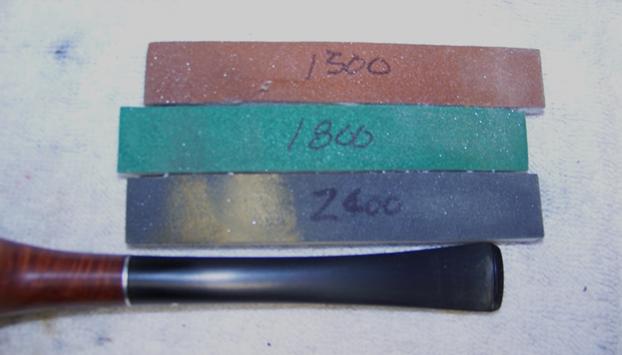
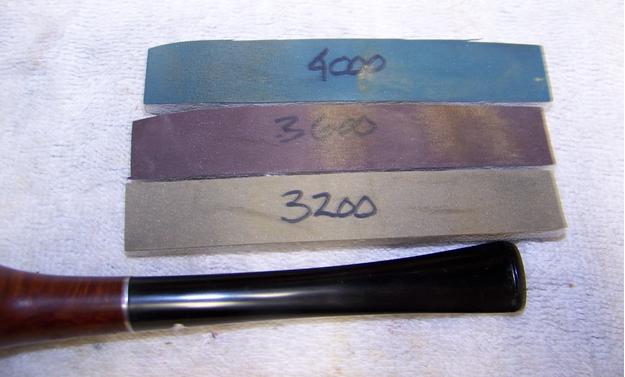
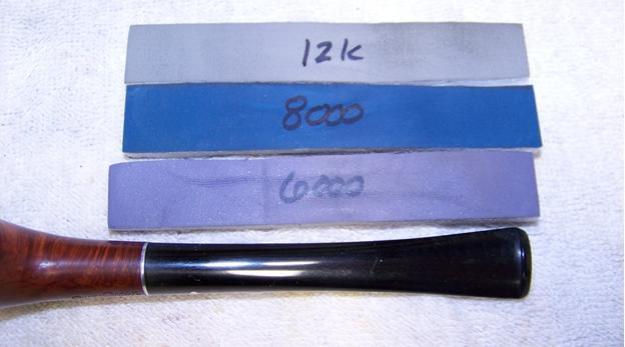
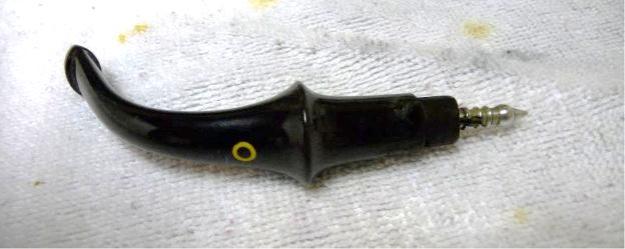
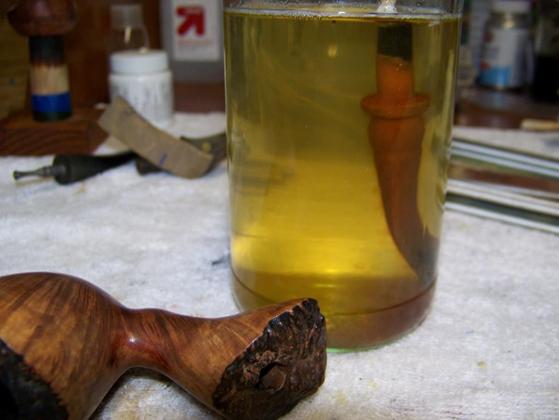
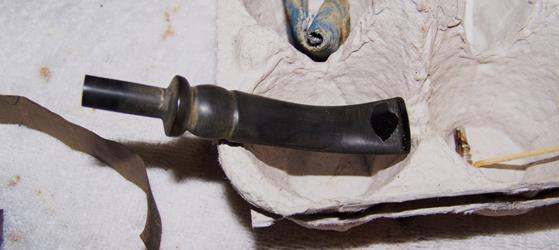
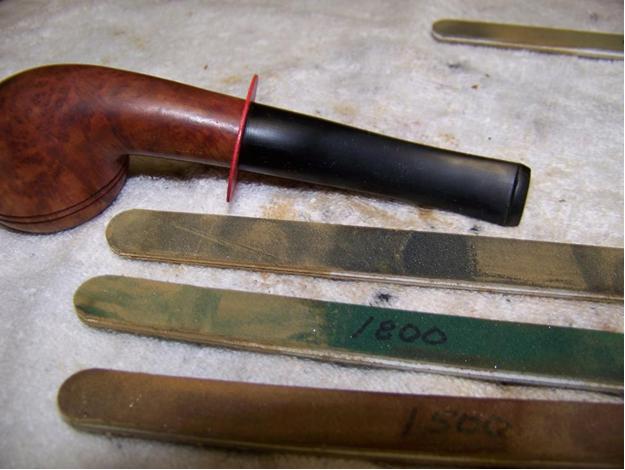
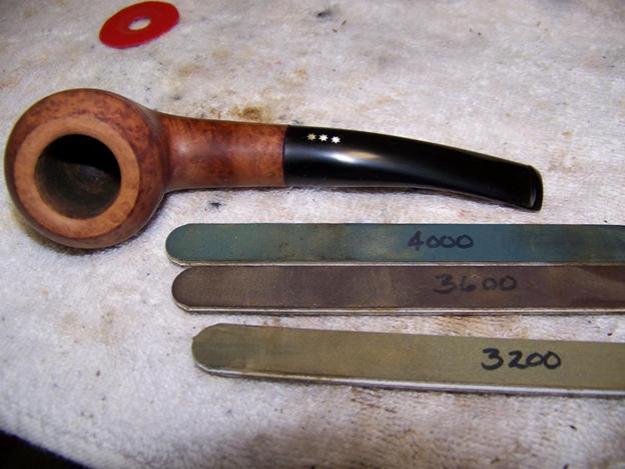
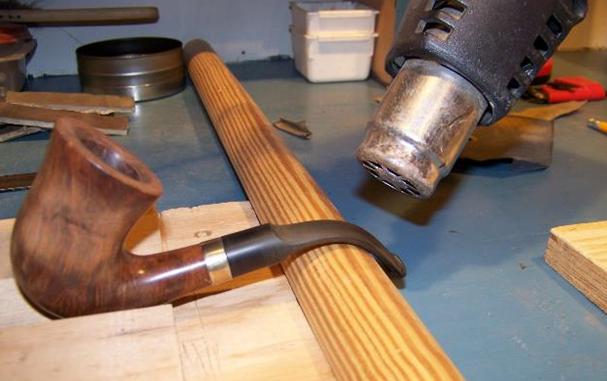
With the stem fitted it was time to bend the stem.  I have jig for holding round stock and I used this to hold the assembled pipe steady with the bit resting on a 1-1/4” round dowel.  Using my heat gun, I heated the bit until it draped over the dowel.  I dipped the bent stem in water to cool the vulcanite and set the shape.  Then I checked the angle of the bend and had to repeat the process a couple of times until I had what I thought was the original stem shape just right.Stem polishing started with 220 grit to remove the remainder of the casting burrs.  Then I wet sand with micromesh pads 1500 – 4000.I removed the plastic guard after the 2400 pad.  I used the 3200 and higher micromesh pads to also polish the band.After the 4000 pad I coated the stem with mineral oil and let it sit for a few hours.  Then I finish polishing with pads 6000 to 12000. I started finishing the stummel by giving it a steam treatment to raise the dents and handling damage.  Holding a wet terry cloth rag on the briar I press a hot iron on to it.  This method works very well but I have two points of caution: 1) don’t burn your fingers in the steam; and 2) do not press the iron near the stamping, it will ruin stamping very quickly.  I only apply the iron around the bowl body and the heel where the dents are the worst anyway.
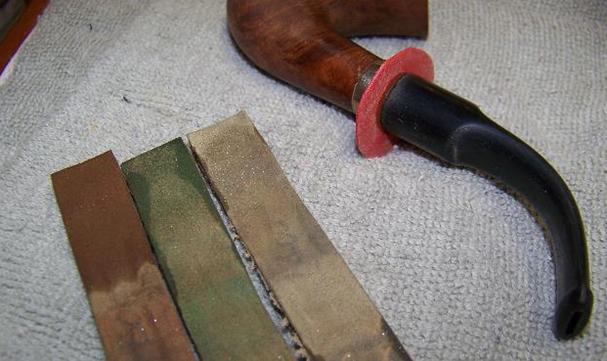
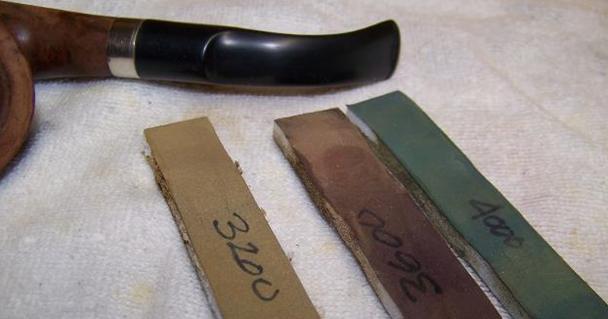
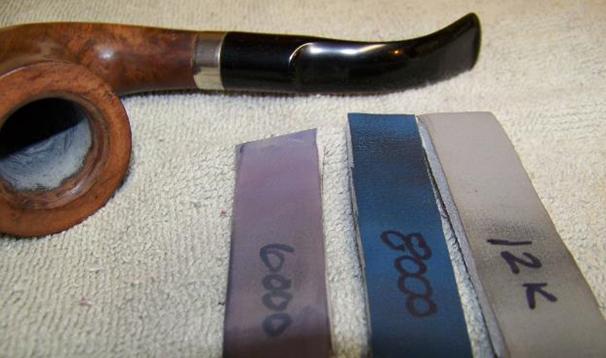
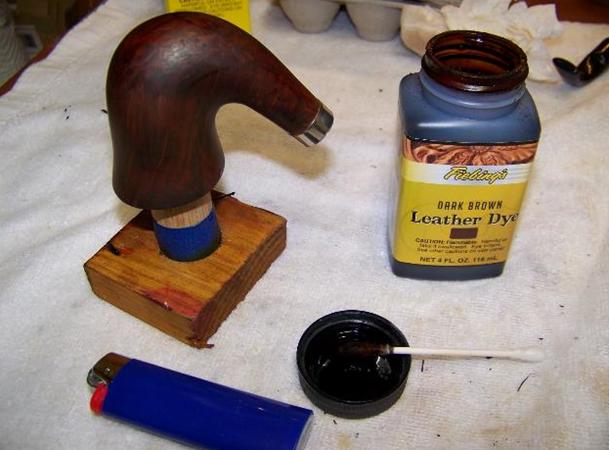
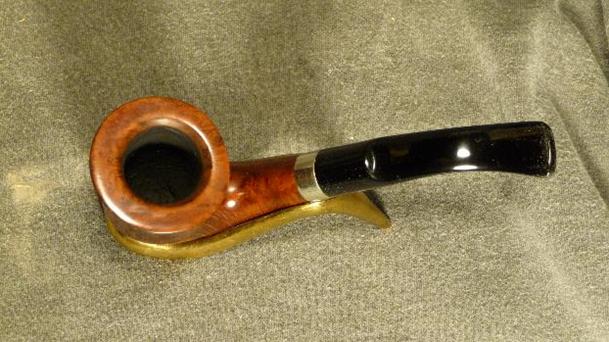
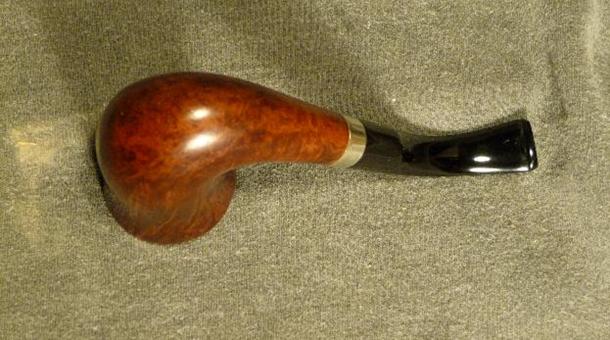
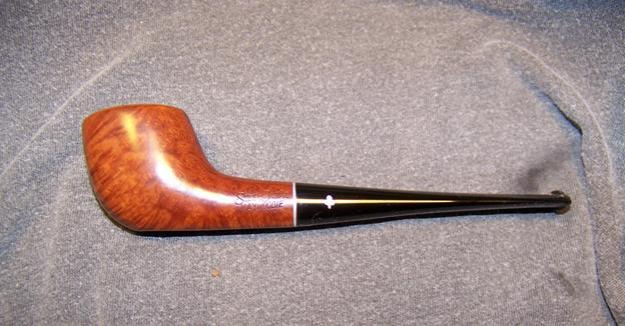
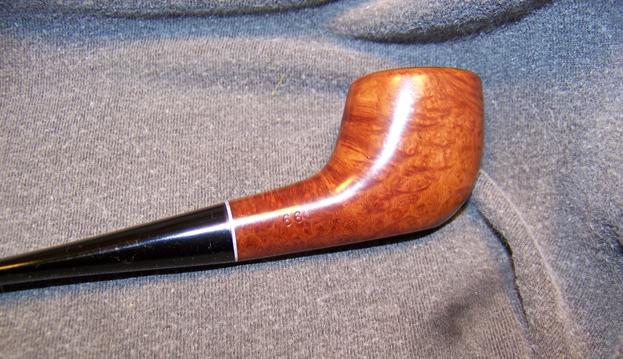
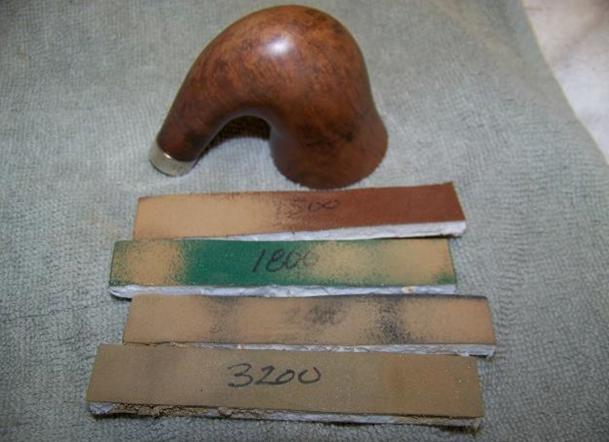
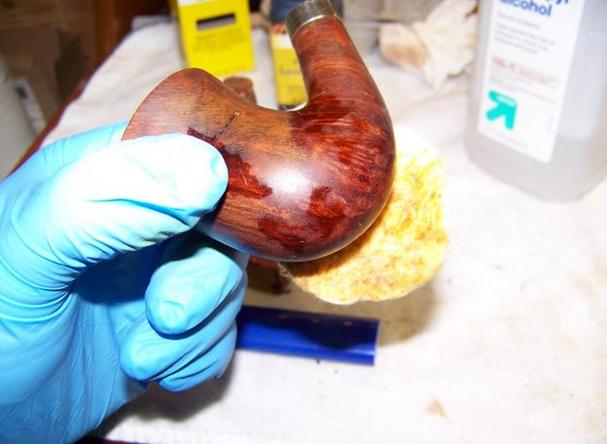
I sanded the stummel with micromesh pads 1500 through 3200, with special attention paid to the rim to make sure it was smooth.  I selected Fiebing’s dark brown aniline dye to better hide the repairs and applied the stain, without dilution, using a cotton swab straight from the bottle.  I used a flame to heat and set the stain.  I wiped down the stummel with isopropyl alcohol on a cotton pad to remove the excess stain.  I kept wiping it down until the level of color was what I thought it should be. After staining the stummel I like to refresh the briar with a light coat of mineral oil and let the oil soak in overnight.  All of the alcohol in the stain and the wiping down tends to dry out the stummel and I find the mineral oil helps to bring some of the life back to the briar.  It also seems to give the finished pipe a healthy look.After the oil soaked in, I polished the briar with the 3200 – 6000 micromesh pads.  Wiping it down with a clean cloth when finished.I took the assembled pipe back to my drill press/buffing station and ran over the entire pipe with red diamond polishing compound.  Two or three passes of the pipe seems to prepare the pipe well for the final finish.  I wiped the pipe down with a microfiber cloth to remove the buffing compound and then changed the buffing wheel for the waxing wheel.  Three coats of carnauba wax put a nice shine on the pipe.
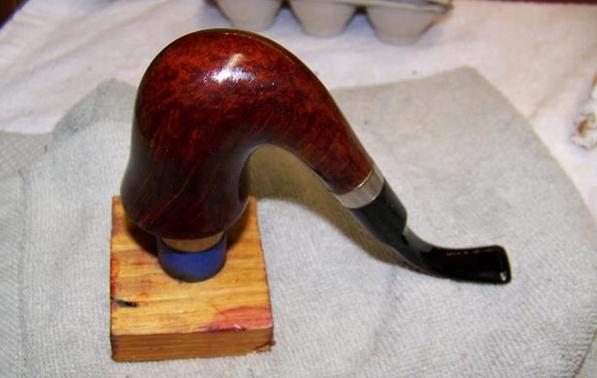
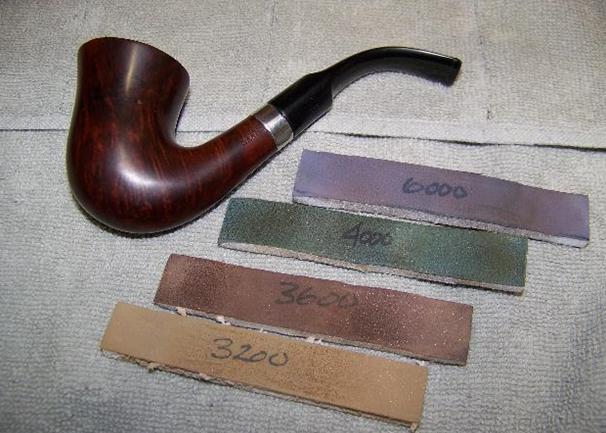
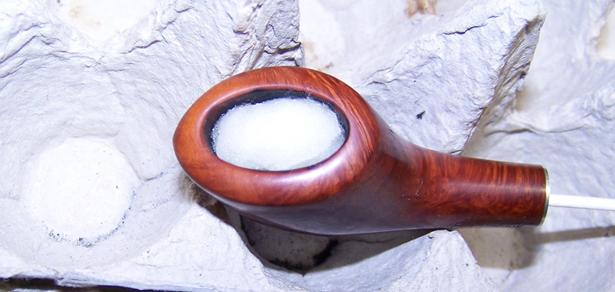
The last step in this restoration was the bowl coat.  I had earlier sanded the epoxy chamber repair and wiped out the bowl with alcohol so the inside was relatively smooth.  I mixed up a small batch of bowl coat using 2 teaspoons of sour cream and about three activated charcoal capsules.  This made a thick, black, creamy paste that I spooned into the chamber with a wood spatula made from a popsicle stick. Donning the Nitrile gloves again, I used my finger to evenly spread the coating around the inside of the chamber. Wiping the excess coating off the rim with a cotton pad I set the pipe aside to dry for a few days.

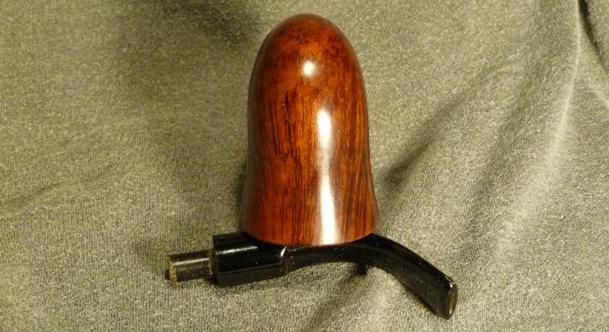
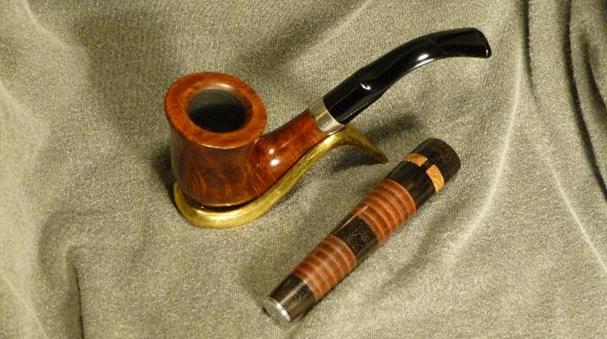
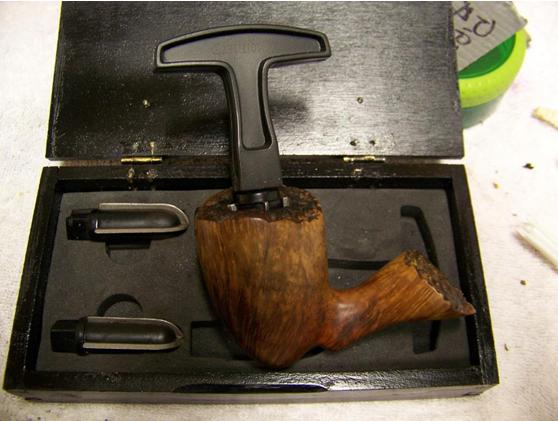
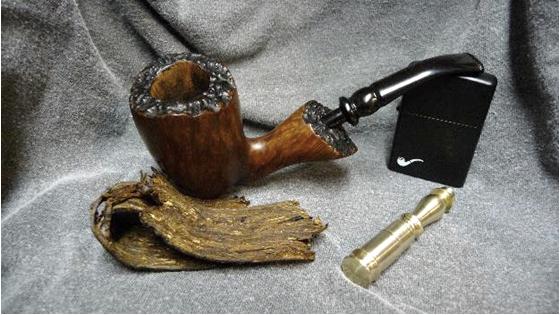
Now am I looking forward to the weather warming up so I can break in this pipe.  I think it might become one in my regular rotation. Thank you for sharing in my adventure. If you like the tamper in the picture above, it is one that I made and is for sale.  Please see the Reborn Pipes Store page for it and other tampers.  All proceeds go to charity.
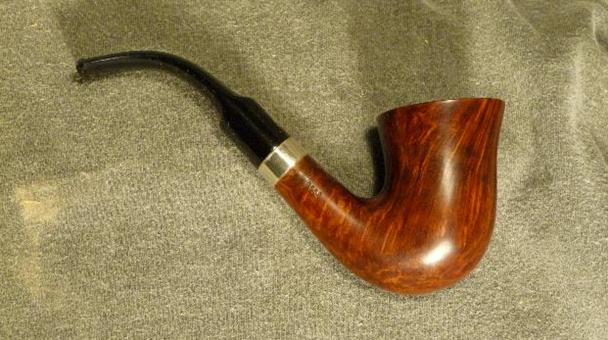
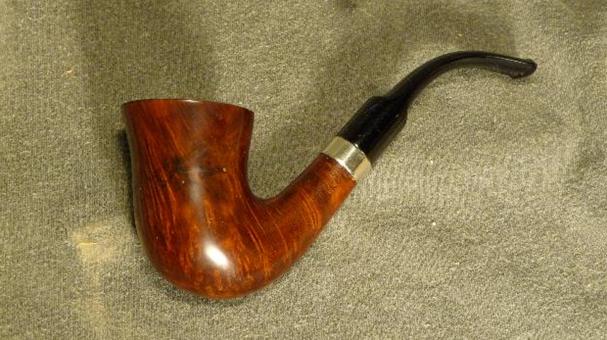
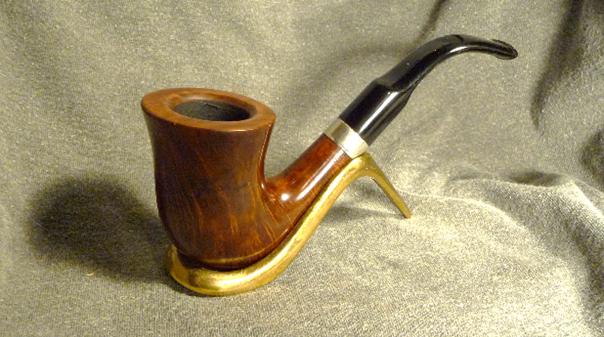


The Berwyck Poker Compromise


Blog by Aaron Henson

Last summer’s tip to Dallas netted me several great pipes. One of which was my first poker.  It was in a basket in an out of the way corner of a second hand store.  Very dirty and grimy but I could tell the grain underneath was beautiful with a nice contracting stain.  The stem was broke off about half way but I thought I could turn it into a nice stubby.  I looked forward getting it home and start working on it.ber1 ber2The stem had a heavy amount of oxidation and a buildup of white near the broken end.  This leads me to guess that the previous owner had used a softy bit to compensate for the broken stem.  I set the stem to soak in a mild Oxi-clean bath to raise the oxidation. After 24 hours I removed the oxidation with a magic eraser and an application of Walker Briar Works Pipe stem cleaner.ber3 ber4I wiped down the outside of the stummel with 91% on a cotton pad to remove the dirt and oils.  I was looking for any hidden issues that might be need to be addressed.  Thankfully there were none just a few handling dents/scuffs.  In fact, there weren’t even any fills.  The grain was beautiful and the existing contracting stain really made it stand out.

There was a healthy buildup of tars on the rim but not a lot of cake in the bowl.  What little cake there was came out easily with my reaming tool.  I smoothed out the interior of the bowl with 80-grit paper wrapped around a ½ inch dowel.ber5I like to clean the inside of the pipe before working on the outside so next came the interior of the shank. Lots of cotton swabs dipped in alcohol eventually saw it clean.

Next, I finished the bowl by doing a salt and alcohol soak.  I plugged the shank with a cotton swab and filled the bowl with salt.  Sometimes I use cotton balls but this time I chose salt – no reason why.  I filled the bowl to the top with grain alcohol and let it soak 24 hours.  This leached out a lot of the leftover tars and removed the smell of the old tobacco from the bowl.

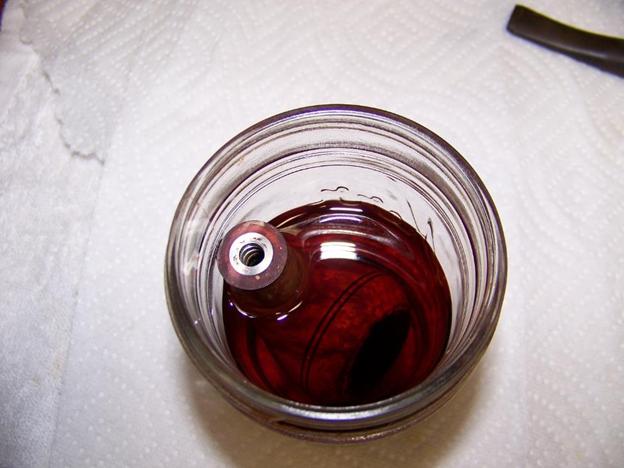
Not wanting to top the bowl, I tried something new.  I placed a little Oxi-clean powder on a green pad in a shallow dish of water. Inverting the bowl, I worked it in a circular motion on the pad.  This had the desired effect and only a little bit of sanding was required on the rim.ber6Returning to the stem I began work on a new button. I taped off the end and mixed up a slurry of black super glue and charcoal powder using a tooth pick to apply it to the stem.  Several coats of slurry were needed to build up the button.ber7 ber8After the slurry dried, I used a flat file to rough out the shape of a new button.  Trying it out, I realized that the stem was too thick and narrow to be comfortable.  So I began to file the top and bottom of the stem to make it a more comfortable fit.  But as I did so, I had another revelation: the Berwyck was a filtered pipe.  The filter chamber extends back to where I was trying to shape a flat spot in the stem. ber9While I didn’t file into the airway I decided not to continue for fear that I would.  It was at this point that I decided to abandon the idea of a stubby and start looking for a replacement stem.  I figured I had a few of options: 1) I could buy an old stem that matched, 2) I could make my own stem using the tenon of the old stem, 3) I could splice a fish tail onto the existing stem (this would allow me to keep the spade trademark – thank you, Dal for this idea), or 4) I could try Dr. Grabow and see if the factory could supply me with a new stem.

I started with the last option first.  I figured if I was willing to buy and old stem, why not buy a new stem with a better chance of a good fit.  I sent an email off to International Pipes & Accessories, the Dr. Grabow factory in Sparta, North Carolina, but received a disappointing response.  So my next course of action was to begin a search online for someone with an old stem to sell that would fit.  I eventually posted the story of my quest on the Dr. Grabow Collectors Facebook page.  It was not long before I was contacted by Joe Mansueto, the moderator for the Dr. Grabow Collectors Forum.  Joe very kindly offered to use his contacts at International Pipes and too my surprise he was told that I should send the pipe to them.

I had not completed the work on the stummel and I wanted to have it at the 95% complete point before sending to the factory.  So, steamed out the dents using a wet terry cloth rag and my wife’s clothes iron.  Next came a light sanding with 1500-3200 grit micro mesh pads.

The rim was is in need of some stain and I had just received a set of Guardsman stain pens I bought from Amazon.  This was my chance to try the out.  I was very happy with the way they worked.  I have used other stain pens in the past but with less than satisfactory results.  Blending the three pens I got a good color match with the rest of the stummel.

With the stummel done, I packaged up the pipe with a hand written letter describing the situation and my connection with Joe.  I included a $15 check ($12 for the stem and $3 for return shipping) and sent the pipe off to Sparta.  The pipe left on a Thursday and arrived in North Carolina on Monday.  I had no idea what to expect for timing so I determined to wait as patiently as I could, figuring it would be 3-4 weeks.

To my pleasant surprise it was just a week and a half later.  I was on the road in Texas again when my son told me that a package had arrived from Dr. Grabow.  When I got home I was like a kid at Christmas wanting to get the pack open and see what Santa sent me.  I was not disappointed.  The new nylon stem looked great.  It returned all the grandeur and dignity that the pipe once had.  I was glad now that the stubby conversion had not worked out.

Although I am not a big fan of nylon stems, mostly to the fact that they are a pain to repair, clean and polish.  But this one being new was not a problem.  I did polish the stem using 6000-12000 grit micromesh.  The stem also needed a little deburring at the air hole and smoothing out on the face of the button.  All of which was done in short order.

I finished the pipe at the buffing station while smoking a bowl of McClelland’s Stave Aged in a Yello-bole Chesterfield – a previous repair.  I started with red diamond rouge on a rag wheel then finished with three coats of carnauba wax.  I could not be happier with the results.  Thank you for taking the time to read this.ber10 ber11 ber12


Kaywoodie SuperGrain Streamliner 66


Blog by Aaron Henson

In June of 2016, Steve posted a great restoration of a Kaywoodie 61 by Lance Leslie.  Lance referred to the 61 as “the circus pipe”, a name his Grandfather had given it, no doubt because of the unique shape and the oval bowl.  At the time, I thought Lance had done a great restoration but I was not moved by the shape of the pipe.  Little did I know that in about a month’s time I would stumble upon its cousin, the 66, in a second hand store in Dallas.

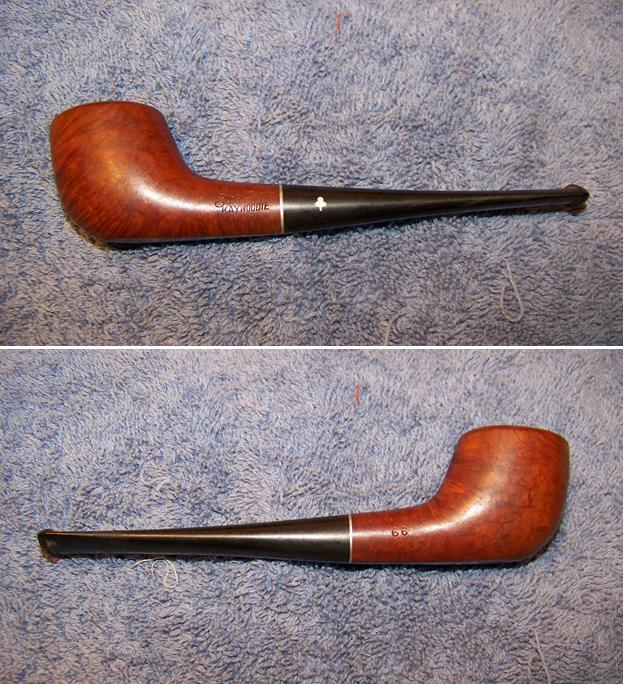
The Kaywoodie shapes 61, 64 and 66 are EZ-set pipes (flat bottom) that are known as “Streamliner” shapes (pipedia).  I assume that the ‘streamline’ name comes from the oval shaped bowl that gives the pipe a slim profile and made it easy to fit into a vest pocket.  Although Kaywoodie had several other shapes that were “vest pocket” shapes, only the 61, 64 and 66 were called Streamliner shapes.

The Kaywoodie shape list further describes the 66 as a “forward leaning apple” and indicates that this shape was manufactured during the following two periods: 1935-1937, 1952-1960.  I was not able to pin down the manufacturer date any closer but based on its condition, I suspect it to be in the latter, post war, time period.

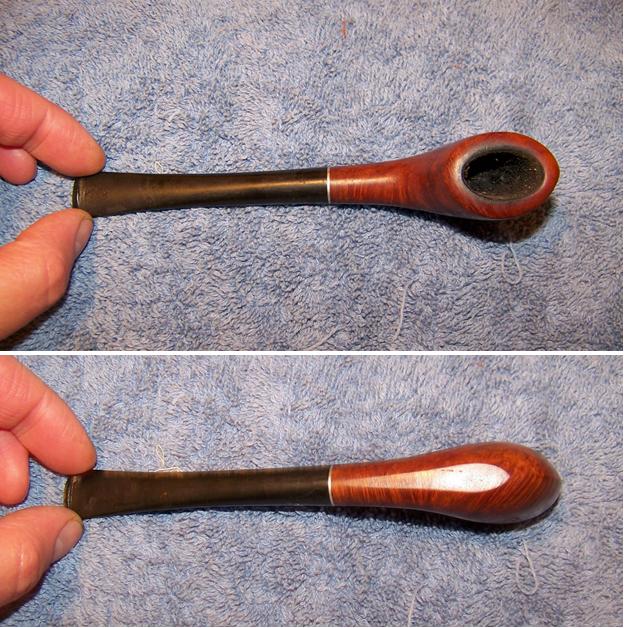
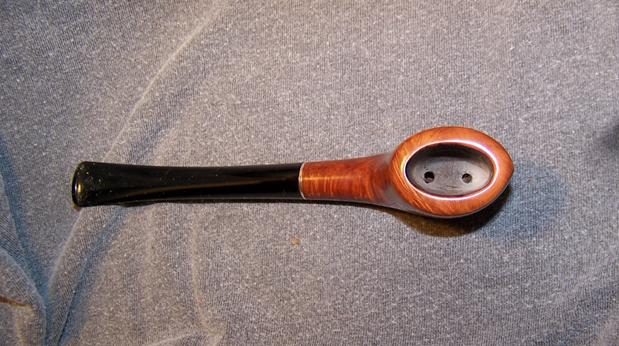
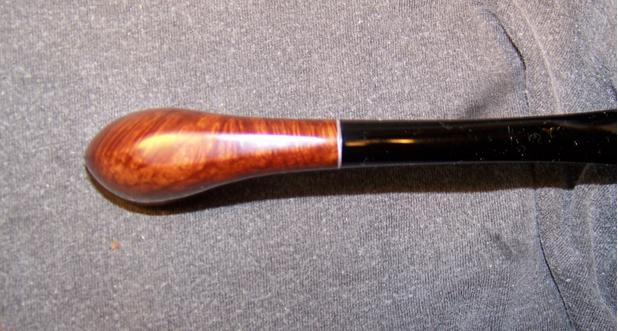
Once I had the pipe in hand I was drawn to it unique shape; kind of a boat shape with a curved prow.  Although a little odd feeling in the hand, I found it appealing.  Additionally, I could see that the quality of the briar under the grime was fantastic.  Of course, the pipe came home with me.kw1 kw2Inspecting the pipe at the workbench, there was a light build up on the rim with some under laying burn marks.  There was a medium cake formed in the bowl but it was not overly hard.  The stummel had some handling dings and scratches but none were very deep.  I looked for fills but found none and confirmed that the grain was superb.kw3The stem had a light amount of oxidation and a deep scratch about halfway down in the underside.  There was a little chatter around the button and a moderate tooth dent in the bottom side of the stem.  Removing the stem revealed the threads and the aluminum stinger to be in good condition, albeit covered in dried tars.kw4I began working on the stem by applying heat from a lighter to raise dent and even out the tooth chatter.  This was very effective but had the added effect of bring out some oxidation around the bit.  I set the stem to soak in a mild Oxi-clean bath and turned my attention to the stummel.

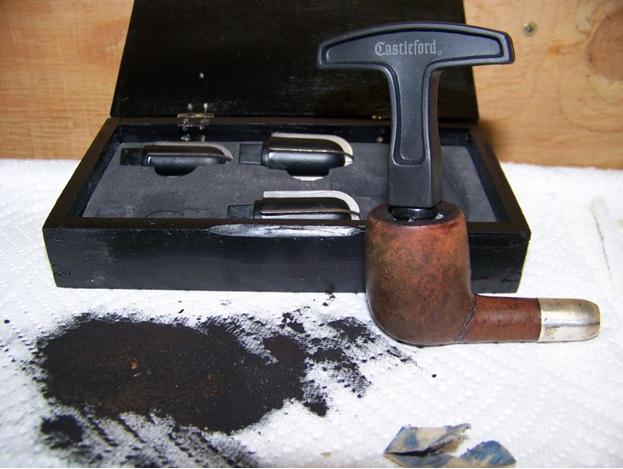
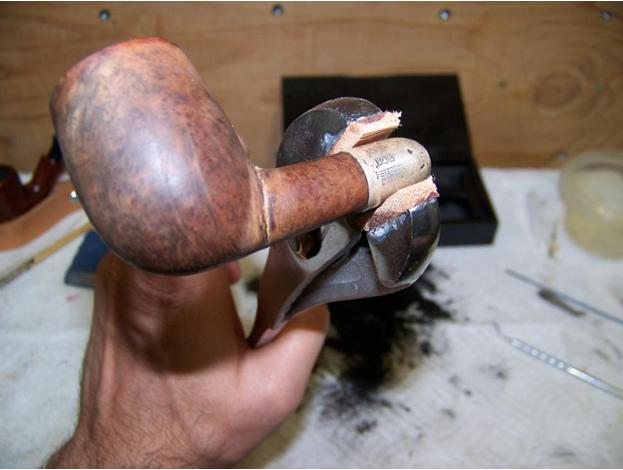
The first thing I like to do is clean out the bowl.  This gives me a good feel for the true condition of the briar.  Because of the narrow oval shape, I could not get any of the Castleford reamer heads to fit.  So I resorted to carefully scraping out the cake with a dull jackknife and finishing with a rolled piece of 80-grit sand paper.kw5With the cake gone, I discovered something that I was not expecting.  There were two air holes in the bottom of the bowl; one at either narrow end of the oval.  Inserting a pipe cleaner into the shank I could see that the airway extended straight under the bowl and both holes opened down into it.kw6Using a cotton pad and alcohol, I scrubbed the rim and was able to remove most of the tar.  I was happy to see that the much of what I thought was burn came off with the alcohol pad.  The burn marks that remained were on the inside of the rim and not very deep.kw7Before doing any other work on the stummel I wanted to try to lift any handling damage with steam.  I laid a clean, damp terry cloth rag over the wood then applied at clothes iron on high to the damp cloth.  The resulting steam will often lift the dents and shallow scratches that comes with handling or rattling around in a box or drawer.  It will also lift and remove the manufacturer’s stamps so be careful around those.

After steaming I used 320 grit paper I carefully sanded the rim trying to keep the original rounded shape while removing the burn marks.  Then I scrubbed the internals of the shank with cotton swabs until the swabs came out clean.kw8I wanted to sweeten the bowl and remove any ghosts of the former owner’s tobacco so I decided to do a bowl soak.  I plugged the shank with a cotton swab and packed the bowl with a cotton ball.  Then I filled the bowl with Isopropyl alcohol.  The alcohol draws out the old tobacco oils trapped in the briar from the briar and they in turn get trapped in the cotton.  While the bowl soaking, it was time to work on the stem.kw9Taking the stem out of the Oxi-clean bath I lightly sanded the stem with 500 then 1000 grit paper to remove the remaining oxidation and to smooth out the remaining tooth marks.  I cleaned the stinger with some 0000 steel wool and ran pipe cleaners through the internals until all was cleaned.  I polished the stem with the full range of micro mesh pads.  I apply a bit of mineral oil to the stem every few pads. This seems to help in the polishing process.kw10 kw11 kw12I finished the stummel by sanding with 1500 – 4000 micro mesh pads then wiped everything down with a light coat of mineral oil and let it set over night.  The next day, after work, I took the pipe to the buffing station and finished the polishing with red diamond compound.  Wiping off the excess rouge with a cotton cloth I changed buffing pads and sealed the pipe with three coats of carnauba wax.

Overall this was another easy cleanup, but I am very happy with the results. The more I worked on the 66 the more I came to like the shape.  Thank you for taking a look!kw13 kw14 kw15 kw16 kw17


Space Age Technology for a Better Smoke?


Blog by Aaron Henson

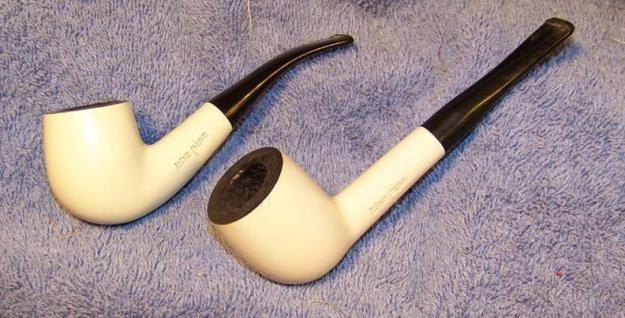
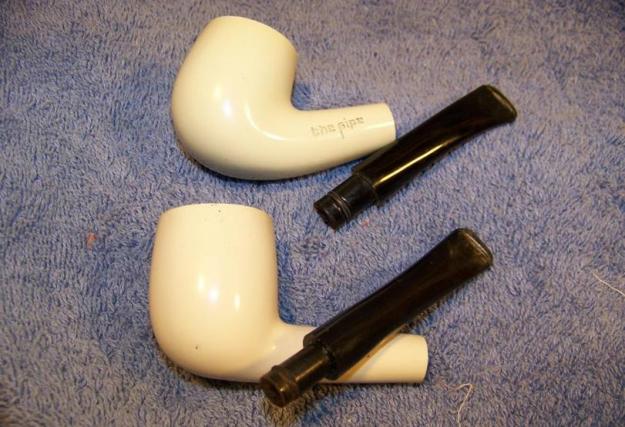
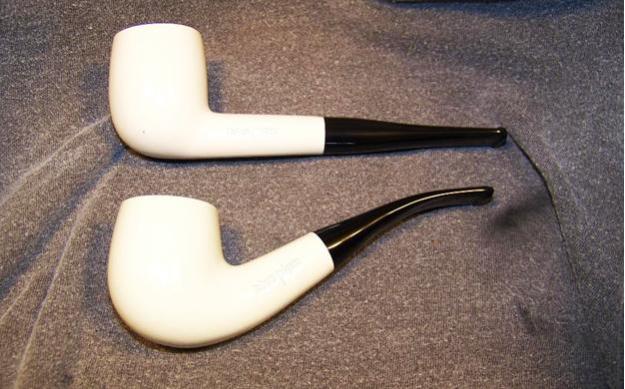
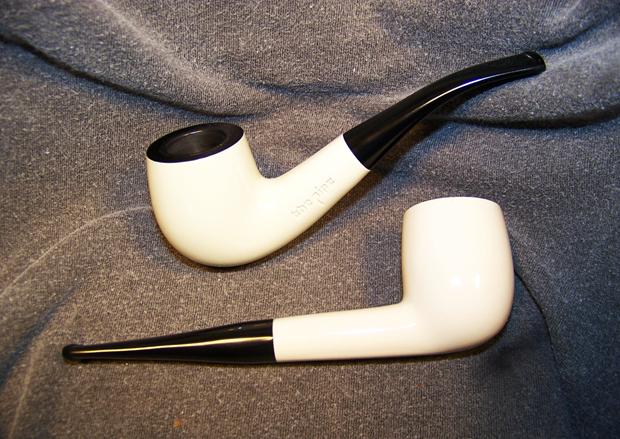
There is a small antique store located along highway 195 in Eastern Washington that I have driven past many times on my way to job sites or family functions but never had the opportunity to stop. This past week I had little spare time on my way home and took the opportunity to stop in.  Sitting on a table by the door were the only two pipes in the shop: a matching pair of white billiards – one bent and one straight – both in good exterior condition.  Both pipes, and the stand they were on, came as a set and the price was such that I could not pass them up – I would have paid list price for just the stand.  I knew nothing about the name stamped on the shank– the pipe – but I thought I would take the chance…. What could go wrong?

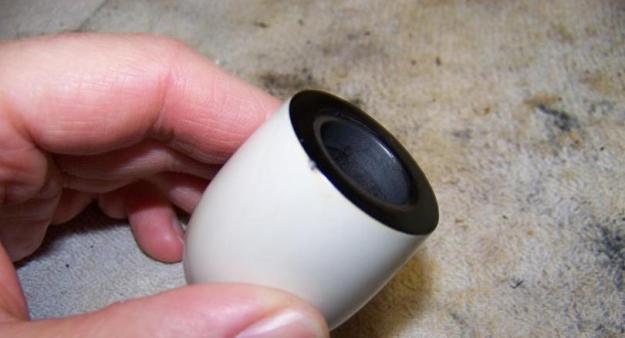
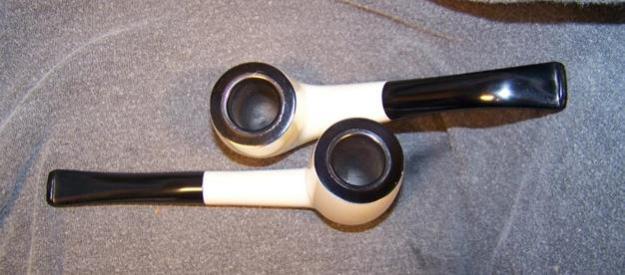
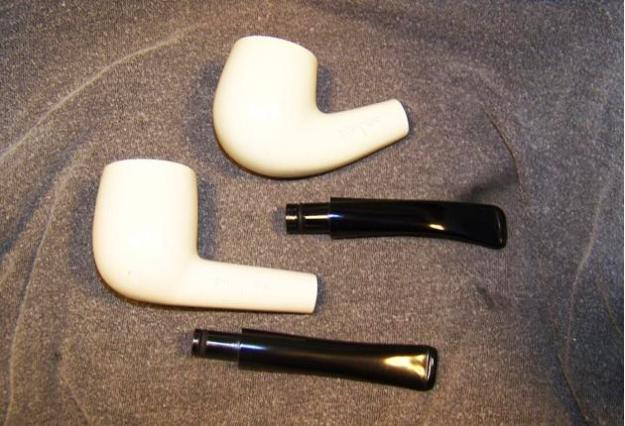
Once home, I was able to do a more thorough review of their condition.  Both pipes were in about the same condition, the rims were covered with a heavy crust of lava and the bowls had a nice thick cake built up on the sides.  And they both had a strong smell of aromatic tobacco.  The outside of the both bowls were in very good condition considering the painted finish; no worn spots, dents or discolorations.  The straight billiard has a very small chip in the rim and had two pin-point sized flaws in the paint but the paint on the bent was flawless.aaron1 aaron2 aaron3The stems are nylon and had some tooth dents around the button.  The dents were deep but not to the point of needing filled.  Both airways were clear, but were restricted with a thick layer of tar.  Removing the stem revealed an o-ring set in a groove in the tenon.  Looking into the shank I saw no briar only plastic. aaron4Even more intrigued now, I searched for the pipe on-line and I found the following on Pipedia:

In 1963, Super-Temp Corporation began making plastic pipes with pyrolytic graphite bowl liners. They were called the pipe. In 1965, Super-Temp contracted to market their unique pipes through Venturi, Inc., the company which sold Tar Gard cigarette filters. Colors and stripes began to be offered circa 1967. About 1970, THE SMOKE pipes were added to the line – they were non-traditional shapes with a less expensive bowl liner. Venturi pipes were added around 1972 – they had no liner in the bowls at all. The pipes were out of production by 1975.

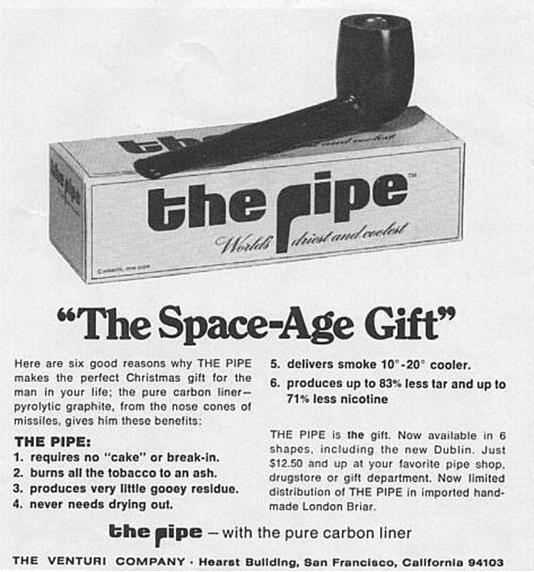
Plastic pipes?  Pyrolytic graphite bowl liners?  Granted, I missed out on the 1960’s, but I did get to live through the aftermath and I remember the cultural fascination with space-age materials as they tried to find a place in our daily lives… but I had no idea they made space-age pipes.  An ad in the December 1967 issue of Esquire, captures this fascination. aaron5I felt that I needed to do a little more research and found that the pipe has a small following of dedicated fans.  I eventually came across a web site authored by Billie W. Taylor II, PhD that is dedicated to the history and novelty of these pipes.  He has amassed what could easily be called the definitive work on the pipe: http://www.thepipe.info/sitemap.html

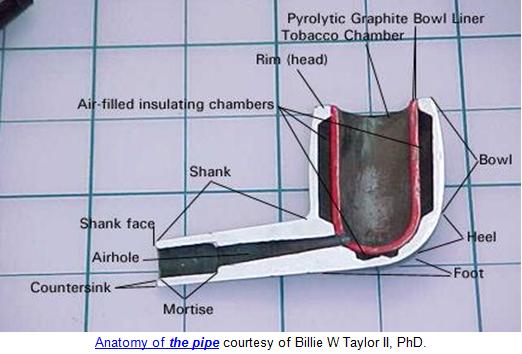
While there is no way I could (or would) share all the information in Dr. Taylor’s website, there are a couple of things I think worth sharing.  The first is the pipe’s unique anatomy.  The body is made of compression molded Bakelite stummel with a graphite bowl insert.  There is an insulating air gap between the bowl insert and the bowl body.aaron6Pyrolytic graphite has been manufactured since the 1950s and is used as heat shields in rockets and reactors, it being an excellent conductor of heat.  As the story goes, in 1963, a machinist at Super-Temp was machining graphite rods into cups to be used in the nuclear power industry.  Being an avid pipe smoker and seeing the cups were about the size of his pipe, he made one that fit into the bowl of his pipe.  Finding that is smoked well, he took the idea to his management and the pipe was born.

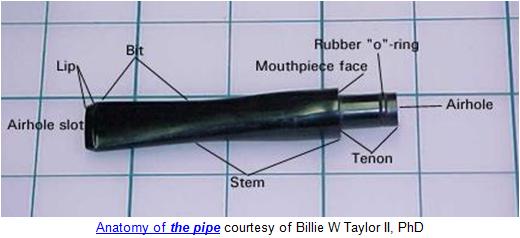
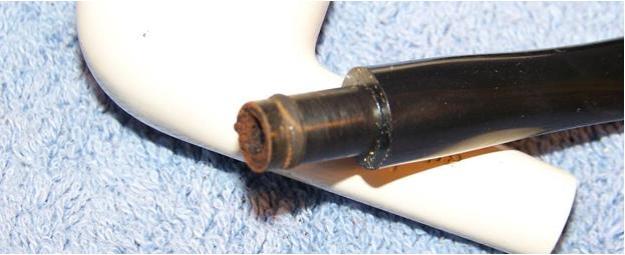
Early stems for the pipe were made of nylon while many stems made after the first year were made of Bakelite – addressing complaints that the nylon was too soft.  The tenon has an o-ring set in a groove to ensure a seal between stem and stummel.aaron7Although it was originally offered only in black, in 1967 the pipe came in nine different shapes and offered in standard red, green, blue and white.  The pre 1970’s pipes were coated with a two-part epoxy paint while those after 1970 used an acrylic paint. Additional colors and color schemes were offered throughout the life of the brand but some of the ‘unique’ colors were the result of fading of the acrylic paint.

Other than stem material, I did not have much to go on to date these two pipes.  But because both stems are nylon I will estimate that they were early runs and date to the mid-1960’s.

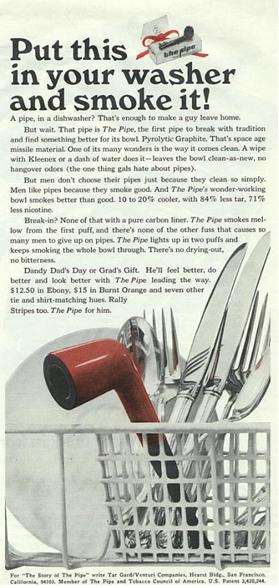
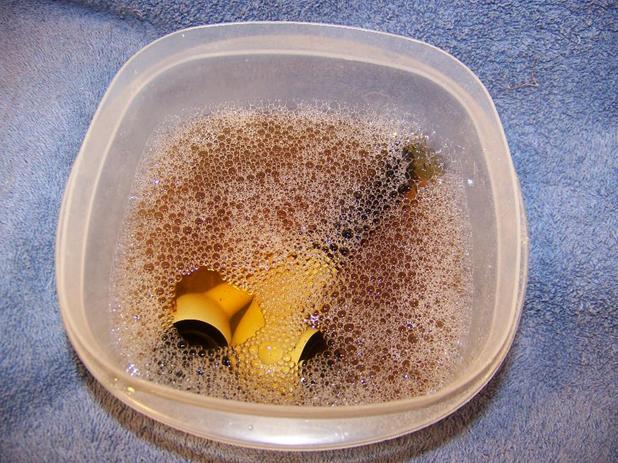
After what I read, I assumed that the typical briar pipe restoration techniques would apply.  I was worried about damaging the graphite liner and not sure what chemicals might do to it.  I also assumed that the bowls should not be scraped or sanded.  Since both of the pipes I had bought had nylon stems, using alcohol on them was out.  I kept researching and found a 1969 magazine ad that gave me an idea:aaron8Putting the pipes in my wife’s dishwasher was out of the question… I didn’t even ask!  Additional reading through thepipe.info website I found a cleaning guide that began with a soak in warm water with a small amount of mild dish soap.  This began to loosen the hardened tars and lava.aaron9

I used the paper stick of a cotton swab, cut at an angle, to remove much of the buildup in the corners of the mortise and the airway. The remainder of the buildup required half a dozen soaks in soapy water and a lot of cotton swabs and pipe cleaners.  I finally got the internals cleaned and in the end I didn’t use anything more abrasive than a paper towel.aaron10The shank still had the ghosts of the old tobacco.  So I went back with an alcohol soaked cotton swab and wiped down the inside of the shank again.  Surprise, surprise, it came out dirty.  Nothing seems to cut though the old tobacco oils and residue like alcohol.
I also soaked the stems in warm soapy water.  Using a small nylon bottle brush I was able to soak and scrub repeatedly until the bulk of the crud was removed.  I continued on with bristled pipe cleaners but even after the pipe cleaners came out clean I could still smell the old tobacco smell.  I could not figure out where it was coming from until I removed the o-rings.  I didn’t think about this at right away, but of course there was a lot of build-up in the grooves.aaron11To raise the tooth dents, I placed the stems in some near boiling water.  I have tried to use direct flame or a heat gun in the past but have found them to be too hot and they melt the nylon.  The hot water did raise the dents some but it also straightened the stem of the bent pipe.  Another dip in hot water and molding the stem over a large diameter dowel restored the stem’s shape.  No pictures of this…. I am afraid that both hands were busy.
To completely remove the tooth marks I needed to sand them with 220 grit paper.  I removed the deeper scratches of the 220 grit with 500 grit and 1000 grit paper.  I finished up the stems by wet sanding with 1500 – 2400 micro mesh pads.   The nylon is soft and the scratches hard to remove.  Several times I had to drop back to a courser pad to remove a stubborn scratch.  I finished polishing with the 3200 – 12000 pads and a light amount of mineral oil. aaron12 aaron13 aaron14 aaron15I took the pipes to the buffing station and used red diamond on the stems only, – I didn’t want to risk damaging the paint with even a light abrasive.  Dr. Taylor’s website suggested auto wax as a finish but I opted for the more traditional three coats of carnauba wax over all.

The end of the pipe of occurred in about 1975 with complications of corporate business plans and a lack of following.  Estimates say that approximately three million units were sold during the ten year life of the pipe. My own inexpert opinion, nothing will ever truly compete with briar for a good smoke.aaron16 This is the best pictures I got of the graphite bowl liners.aaron17 aaron18 aaron19


Marxman Jumbo Lovat


Blog by Aaron Henson

Several years ago when I was first getting into our hobby, I stopped into a local antique store looking for practice pipes.  This particular store did not have much and what few they did were dirty, heavily caked and $25 each. The dirt and the heavy cake didn’t bother me but dropping 25 clams on an old briar pipe for practice was not going to happen.

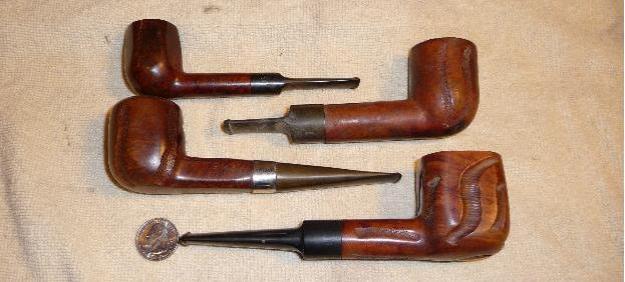
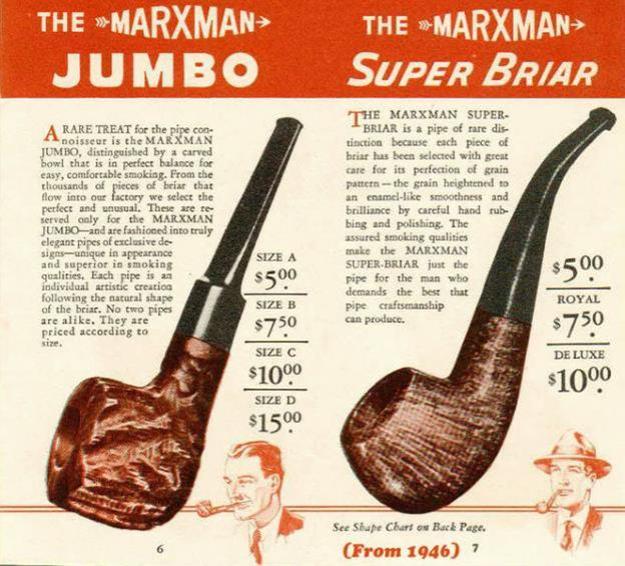
A few weeks ago, one of my jobs happened to take me past this same store. It had been two years since I had been in so I thought it might be time for another look.  After my last visit I wasn’t expecting much.  When I asked the gentleman behind the counter about pipes he directed me to the same old display case at the back of the store.  The same pipes were on display but this time the price tag had been changed.  Clearly the pipes had been in inventory too long and he wanted to move them because now they were two for $10.   Not one to pass on a deal this good, I selected four large bowl pipes including the Marxman below (shown second from the top) as well as a large caliber Emperor and an unmarked Custombilt look-alike. L1The Marxman is a truly large pipe (and not the largest of the three) with a bowl diameter of 1 1/2”, chamber diameter of 1” and a depth of 1 5/8”.  The shank is a whopping 7/8” in diameter and the bit is that same width. The following page from a 1946 ad for Marxman calls the large size a “Jumbo” but I do not have any way of telling what letter size it might be.L2For background, Marxman only made pipes from 1934 until 1953 before being bought out by Mastercraft.  But Bob Marx’s short run made an impact on Hollywood and on US pipe makers in general. Pipedia has a short article on Marxman.L3Taking the pipe to the work bench I started by cataloging the things that needed to be done.  The bowl had a thick cake built up. So much so that I had to start with the smallest head on my Castleford reamer (and the largest head was too small to be effective to finish reaming the bowl).  The rim had a significant buildup of tars and a couple burn marks.  The outside of the stummel was grimy and had some dents but nothing too devastating.  On the bottom of the bowl there were two dark burn marks.  They were located on the bottom side of the shank which made me think they were not burn-outs but with the bowl cake so thick I could not be sure.  When I removed the stem, I could see that the end of the tenon, the stinger and the inside of the shank were all coated with a heavy tar.  This was going to be an arduous cleaning job. L4 L5For as much build up as there was in the stummel there was little in the way of tooth chatter or marks on the stem.  One small tooth dent on the top side of the stem was all. The button was quite small but the slot was nicely formed. Aside from some oxidation, all in all the stem was in great shape.

I set the stem to soak in an Oxiclean bath to loosen the oxidation and the tar build up in the air way and turned my attention to the stummel. First I reamed the cake out of the bowl. I could not believe just how much there was!  I took it back to clean briar to make sure there was no burn through. After the largest reaming head, I still needed to finished off the chamber with 80 grit sand paper wrapped around a dowel. There was a slight loss of briar about half way down the bowl but no burn through. If I had to guess, the previous owner may have been in the habit of half loading the pipe early in its life.

I shaped a soft wood stir stick into a narrow spatula shape and used it to clean out the caked gunk in the shank. I also need a short piece of wire coat hanger to open the air way. I finished scrubbing the internals of the shank with bristled pipe cleaners dipped in alcohol and cotton swabs until they came out clean.

Now that the insides were clean I turned to the outside of the pipe.  The rim was heavily coated with crusted tar/lava.  I had hoped to clean up the rim without needing to top the bowl but that was not the case. There were some burn marks in the rim under the tar build up that were best removed at the topping board. When topping a bowl, I use 100 grit paper on a smooth flat surface and work the bowl in a circular motion. I have recently started rotating the bowl a quarter turn every 10 passes. This helps me keep the topped bowl level by ensuring I don’t put too much pressure on one side of the bowl all the time.L6I started cleaning the outside of the pipe by wiping down the briar with acetone. This removed the wax and grime build up. I had hoped that the burn marks on the bottom of the shank were superficial and would be removed with a light sanding but I was mistaken.  I am not sure what happens to the pipe but it appeared to have been exposed to a significant heat source because the burns were deep. The wood was not damaged, that is to say there was no charring.  After a significant amount of sanding with 220 grit I had removed as much of the burn as possible without significantly impacting the shape of the pipe. I was careful to sand the entire area around the burn to blend, or feather, the repair.  Even so, it did not completely remove all of the burn mark.L7Next I steamed out dents by wrapping the bowl with a wet terrycloth rag and applying a clothes iron. The important thing here is to keep your fingers away from the steam and the iron away from any stamping.

I finished the bowl by sanding the outside with 1500 – 3200 micro mesh pads. I also took the liberty of beveling the inside of the rim which I thought gave the large bowl some visual character.L8Even though I sanded the chamber back I could still smell some ghosts of the old tobacco so thought I would give the pipe a salt and alcohol soak. I let sit for 24 hours but there was still a residual odor.  Before I was done with the restoration, I had to run three tubes of grain alcohol in a retort through the pipe before the pipe was truly clean (sorry no pictures). L9

The original finish was very light colored, almost a natural. To hide the remnants of the burn I decided to go with a light brown stain and contract the worm grooves with a slightly darker stain to make them stand out.  This would also help hide the burn.L10The stem was an easy clean for a saddle bit. The Oxiclean bath had loosened the crud in the airway and a few passes with bristled than soft pipe cleaners took care of the internals. The outside I sanded with 1500 grit micro mesh then added a small drop of black super glue to the one small tooth mark and a another dent that I didn’t want to sand out. I had tried to raise both with heat first but with little success hence the super glue.  Continued sanding with micro mesh pads up through 12,000 grit. I kept the pipe assembled during this process in order to keep the shank-stem connection flush.L11

With sanding and polishing complete I coated the entire pipe in mineral oil and let sit overnight. The mineral oil seems to help hydrate the briar and vulcanite of the stem.L12After 12 hours I wiped off any remaining oil and took the pipe to the buffer.  I went over the whole pipe with red diamond then applied multiple coats of carnauba wax.  As a finishing touch I decided to apply a bowl coating to the chamber.  I wiped the inside with maple syrup then add a table spoon of charcoal powder.  Placing the heel of my palm over the rim I shake the pipe until the charcoal evenly coats the inside.  I let the pipe dry for a week before dumping out the excess charcoal.

Now it’s time to “Relax with a Marxman”.  Thank you for taking the time to look.L13 L14 L15


Easy Cleanup of a M&T Bent Horn Bulldog


Aaron Henson – 7/23/16

I have not been very good at documenting my last few restorations. Once I get into a project I tend to get so focused I forget to take pictures, especially if it’s a repair that is technically challenging or that I have not done before. The most recent example of this was an unsmoked M&T bent bulldog with a horn stem.  Even though it had never been used (it still had the factory purple putty bowl coating) it had a few issues to be addressed from its 40+ years of tumbling around in a drawer.M1When I saw the pipe in the case at the antique store the first thing that caught my eye was the horn stem and I knew I wanted it. In all honesty, I wasn’t one hundred percent sure that it was horn until I got it home. A couple of passes with a 2400 micro mesh pad and a sniff test confirmed my suspicions – it’s the same smell as when you use an emery board on a finger nail. M2I started with a little research into the brand.  The only M&T that I could find was the German pipe maker Müllenbach & Thewald.  They made pipes from 1830 until the 1972.  The company still exists but is solely devoted to mineral mining.  You might think this strange but M&T was known originally for clay pipes. In 1860 they branched into making wood pipes.  A short article on M&T can be found on Pipedia.

I began the restoration by performing triage of the issues to be addressed. The bowl was clean but had a dull finish that was marred with some dents and minor scratches. The factory bowl coating was starting to chip and a there were three small fills on the outside of the bowl that needed to be repaired. A close inspection of the shank revealed a small crack where the aluminum tenon inserted (seen in the picture below). I had assumed the narrow band was original to the pipe but perhaps it had been added to reinforce the shank?  I may never know the answer to that.  All in all the bowl was very good condition.M3The stem too was in almost “like new” condition.   A few scratches but the button was well define and, of course, no tooth chatter. The aluminum tenon was a little rough around the edges but the fit to the shank was fine.

I started by applying a thin coat of mineral oil on the stem. This seemed to ‘hydrate’ the horn and give some bite to the micro mesh pads. I worked through the 1500 to 12000 pads stopping to apply oil as the horn dried out. The button was quite large and the edges sharp, a bit more than I like. But I kept it original and only slightly smoothed the corners while polishing. I smoothed up the edges of the tenon and set the stem aside.

The first order of business was the cracked shank. Using a 1/64 drill bit, I drilled a hole at the end of the crack to stop its spread then filled the crack with clear supper glue.  Then I picked out the three putty fills and using a super glue and briar dust mixture, refilled the pits. Once cured I sanded the repair smooth.M4I steamed the dents out of the briar with a clothes iron applied to a wet cloth wrapped around the stummel – keeping away from the stampings and fingers.  I sanded the entire stummel up to the 3200 micro mesh then wipe down with alcohol before I stained.  In this case I tried to match the original color with several coats of different browns aniline dyes.

Before reassembling I decide to remove the factory bowl coat and leave it bare briar. Then I wiped the whole outside of the pipe with mineral oil and set it aside for twelve hours before taking to the buffer.  The oil seems to hydrate the briar and brings out a nice shine when waxed.  I first buff with red diamond, wipe off the residue with a soft cotton cloth then apply three coats of carnauba wax giving the pipe a little rest between each coat.

The bent bulldog is one of my favorite shapes and I love the horn stem.  I’m not sure when I will get around to breaking it in.  It might just stay unsmoked for a while.M5 M6 M7 M8

A Challenging Yello-Bole Chesterfield


Blog by Aaron Henson

Although this is a standalone write up, it is also part 2 of an adventure I started with the rustication of a bent billiard about a month ago.

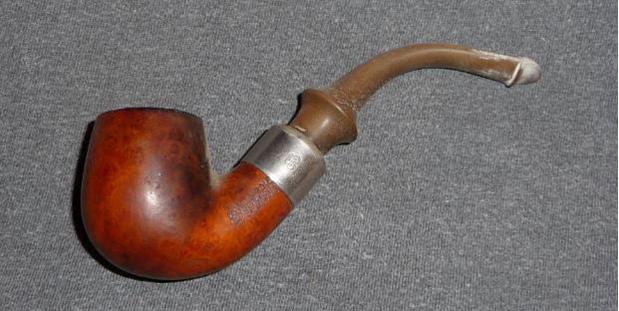
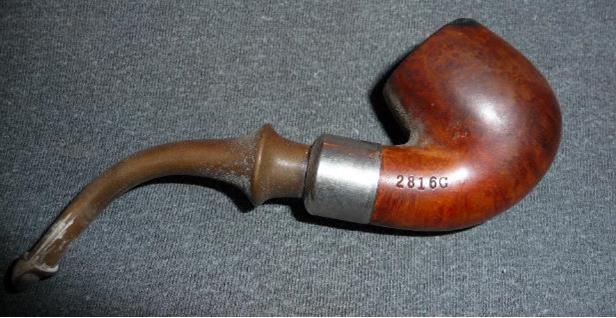
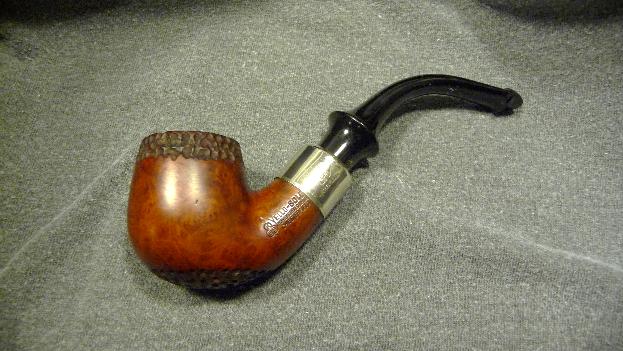
I found this Yello-Bole Chesterfield at a local flea market in town. It was part of a large estate collection, most of which were unsmoked uniquely carved pipes. My eye, however, was immediately attracted to the Peterson-like shape with military bit and P-lip stem and I was surprised to see that it was a Yello-Bole. The pipe was a bit grimy and oxidized with burn marks but after some talking we agreed on a price and I took it home.Chesterfield1The stampings on the bowl were very clear and deep, some of the nicest I have seen on an estate pipe that is as well used as this one. The left side shank read YELLO-BOLE over HONEY CURED BRIAR over CHESTERFIELD with the KBB inside the clover leaf on the left. The band was stamped with KB&B inside the clover leaf over NICKEL PLATED. The right side shank was stamped with shape number 2816C. The stem had the Yello-Bole yellow circle inset in the top and SOLID RUBBER stamped deep into the underside of the stem.

A quick search online and I was able to use the markings to date the pipe to the 1933-1936 time manufacturing period.

The briar was in great shape with beautiful bird’s eye pattern. The pipe was dusty and grimy and after wiping down with an alcohol soaked cotton pad I continued with my assessment. The rim was coated with a heavy crust of tar and there was a deep burn mark on the outside of the rim (major issue number 1). The bowl did not have a large amount of cake so I had to assume that the previous owner had reamed out at some point. And perhaps it had been over reamed, because the air hole entered the bowl about 2/3 the way down the chamber wall. This would lead to a mouth full of hot ash when you were half way through the bowl (major issue number 2). There were some minor bumps and scratches in the surface of the bowl but nothing that could not be buffed out.Chesterfield2 Chesterfield3The stem was in great shape. It was heavily oxidized with some minor tooth chatter but the airway was clear and the stinger was intact and in great condition.Chesterfield4I set the stem to soak in a Oxiclean solution and turned to the stummel. First I reamed the chamber back to bare wood. Next, I tried to clean the rim with Oxiclean on a wet green pad but the tar was just too stubborn so I resorted to a topping board and lightly sand away the tar build up. This is where I made my first mistake: I scuffed off a bit of the nickel plating when topping the bowl (I still don’t have a fix for this!). I have thought about taking the ring off and having it re-plated but several attempts to remove the ring with heat have not been successful.

To address the burn mark on the rim I used a worn piece of 220 grit sand paper I removed the burned wood trying not to remove any of the sound briar under the burn. I was surprised to see how deep the burn went and was at a bit of a loss on how to address it. As you can see below, a significant amount of wood as damaged.Chesterfield5I figured I had two options: 1) replace the burned material with glue/briar dust or 2) sand the rest of the rim to match and change the shape of the pipe. In either case I was going to need to refinish the briar so I wiped it down with acetone to remove as much of the finish as I could while I decided what I was going to do.

Looking into the chamber again, I listed out my options for addressing the air way issue. Again I came up with two options; 1) fill in the bottom 1/3 of the bowl with pipe mud, or 2) drill a new airway that comes out at the bottom of the chamber. I didn’t like either option. The first would have been a very large fill and volume change for the pipe and the second was fraught with potential problems – chiefly aligning the drill bit to come out at just the right point in the bottom of the bowl

So I figured it was time for some consultation. I outlined the issue in an email and included some picture and sent them off to Steve – our worthy “Professor of Pipe-ology” and blog host.

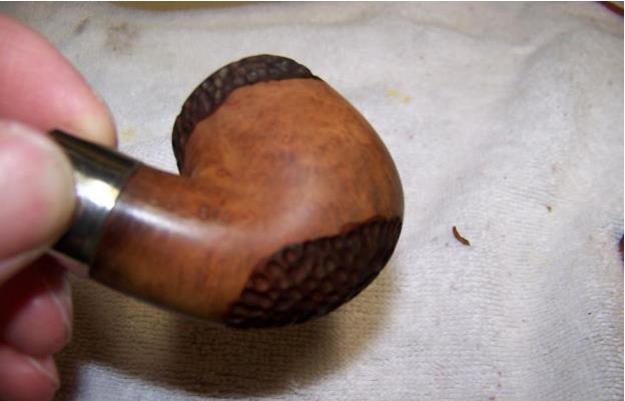
While I waited for Steve’s response I cleaned the inside of the shank and with alcohol soaked cotton swabs and pipe cleaners until then came out as clean as they went in. I also took the stem from the Oxiclean bath and removed the loose oxidation with a magic eraser. I cleaned the internals of the stem then polished it with micromesh pads 1500 – 12000. I used mineral oil every three pads to freshen the vulcanite and give the pads some traction. There was only one minor tooth mark that didn’t raise with heat and I filled it with a dab of black super glue and sanded it smooth with the 1500 mirco-mesh pad.Chesterfield6 Chesterfield7Steve responded with the recommendation of building up the burn spot with super glue and briar dust confirmed that I had the right idea. I was hoping that he had another trick up his sleeve because I knew that the repair would have to be covered up with either a very dark stain or rusticated. I applied three separate layers of clear super glue and briar dust to build up the rim then carefully sanded the repair to blend it into the shape of the rim. Chesterfield8 Chesterfield9I came across and older post where Kirk Fitzgerald rusticated a Peterson that looked very similar to my Chesterfield. Taking some note, I decided to try a similar type rustication. I lightly mark a ½” band around the top of the bowl with a pencil and corresponding area on the bottom of the bowl to balance the appearance. Using the 1/8” carving tool on a Dremel I added a dimpled texture in offset rows. I was glad I had tried using this tool on the previous project because the carving tool did have a tendency to skip on the harder grain. Chesterfield10The final texture hid the repair and was not so extensive as to hide the grain. I sanded the outside of the bowl with micro mesh pads 1500 – 3600 to smooth out the scratches.

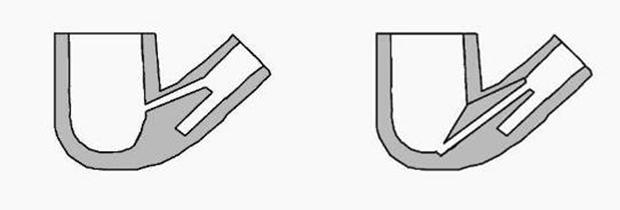
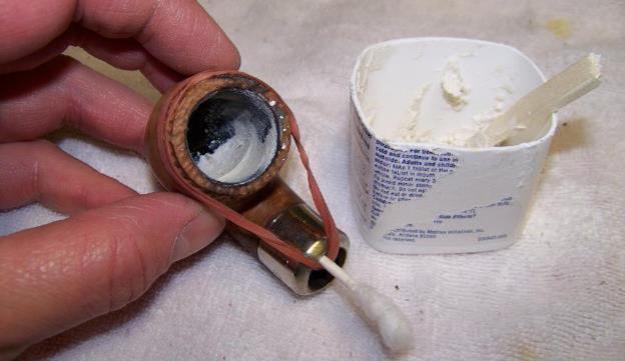
Instead of drilling a new airway, which posed the risk of additional misalignment, Steve recommended using a needle file to elongate the opening so it extended to the bottom of the bowl. The excess space could then be filled with plaster creating a new airway. This proved to be tedious work. Below are two rough cross-section of the pipe. On the left is the airway as it was and on the right is the revised airway (in theory).Chesterfield11Filing was a slow process and it took some effort to keep the elongated hole from drifting off course. I went slow and checked the progress often. Once the hole was about where I thought it should be I used the stick of a cotton swab as the place holder for the new airway. It was the rolled paper type stick that could be bent to match the curve of the bowl. Holding stick in place with a rubber band around the rim I mixed a batch of thick plaster and pushed it into the elongated hole with my finger. When plaster came out the top of the hole I removed the excess from inside the bowl and set it aside to dry for 24 hours. Chesterfield12In my first attempt at this repair, I did not have plaster so I used pipe mud (a slurry of cigar ash and water). This did not work at all. It is great for filling in the bottom of a bowl but it was too loose to stand on its own as a fill/patch. I removed the pipe mud and started over with the plaster.

The next evening, I used 100 grit sand paper wrapped around a ¼” dowel to remove the excess plaster and smooth out the repair. I carefully twisted the swab stick and it came free without damage to the patch. The next time I do this I will coat the stick with wax before securing it in place. The wax should help the stick pull free without bonding to the plaster.

It was time to finish the bowl. I chose to use straight Fiebing’s dark brown stain on the rusticated areas and then wiped it down with alcohol pad. Chesterfield13Next I applied straight light brown to the rest of the bowl. After setting the color with heat I wiped the entire bowl with an alcohol pad to blend the colors. Happy with the results I took the pipe to the buffing station. I buffed the stem and stummel separately so I could get to all the area a little more easily. I started with white buffing compound then finished with multiple coats of carnauba wax.

With the outside of the pipe complete I wanted to cover up the plaster patch inside the bowl so I applied a bowl coating. Using my finger I spread a thin coat of maple syrup evenly over the inside of the bowl then poured in the contents of a dietary charcoal capsule. I put my palm over the top of the pipe and shook the pipe so the charcoal powder covered the inside of the bowl. I set the pipe aside to dry for 5 days before emptying out the loose powder.

I want to say “Thank you” to Steve for his advice on this one… and thank you for reading.Chesterfield14 Chesterfield15 Chesterfield16 Chesterfield17 Chesterfield18

Simple Restoration of a Stanwell Freehand


Blog by Aaron Henson – 2/20/16

I have had my eye on this pipe for several months. It has been languishing in a local antique shop since last summer and was priced as if it were fully restored. To my surprise it was still there at the end of January and the shop had lowered the price. I talked with the owner for a while and eventually got his rock bottom price (which was my top end price). After all, it is a beautiful piece of briar.Stan1

Stan2 This is big pipe: the chamber is 7/8” (22 mm) diameter and 1¾” (45 mm) deep and the walls are more than 3/8” (10mm) thick.Stan3 Inspecting the pipe I did not find much wrong. The stem was heavily oxidized and had very little tooth chatter. The briar was free from dent, gouges and the like. A few minor scratches and the worn stain was all that needed to be addressed. And there was only a light cake in the bowl. As for markings, there were none on the stem and some double markings on the bottom of the shank. It read STANWELL over de Luxe (double stamped) over MADE IN DENMARK (also double stamped). From what I could find, I estimate this pipe was made sometime in the 1970’s. If anyone can date it better please let me know.Stan4 I set the stem to soak in an Oxyclean solution and began working on the stummel. I cleaned the outside of the briar with a tooth brush and Murphy’s oil soap, rinsing with water then quickly drying with a paper towel. I repeated the process on the plateaux several times. Next I reamed the chamber back to bare wood and inspected the internals. Then the internals of the shank cleaned up easily with cotton swaps and bristled pipe cleaners.

All-in-all, other than a micro crack on the outer surface, the briar was in great shape. There was one long scratch near the stamping but I didn’t want to touch that and risk damaging the stamps. I wanted a very smooth finish so I sanded the outside of the pipe with 1500 – 3200 micromesh pads and set it aside.Stan5

Stan6 Returning to the stem, I scrubbed off the oxidation with a green pad and scrubbed the airway with a series of alcohol soaked pipe cleaners – bristled then soft. The tooth chatter was raised with heat from a lighter and the deepest tooth mark was filled with black superglue. When cured, the stem was sanded and polished with 1500 – 12000 micromesh pads. I wet sand with the first six pads and dry polish with the last three. A little mineral oil between sets of three pads seems to help too.Stan7

Stan8 Next the pipe was assembled and taken to the alcohol retort. Even thought I had scrubbed the internals thoroughly, it took 3 test tubes of Everclear until I no longer smell the ghosts of the previous owner’s tobacco.Stan9 In my research of the Stanwell pipes, I found that Stanwell used a walnut stain. This was consistent with the remnants of stain that I found on this pipe and I wanted to restore the original look. I began by applying and undiluted Feibing’s dark brown. After it set I realized that Feibing’s brown dye have too much of a red base and it was not direction I wanted to go.

I wiped as much off as I could with an alcohol soaked cotton pad and sanded the surface with the 2400 micromesh pad again to remove a bit more. Returning to my local Tandy Leather, I searched for a walnut stain. After looking at stain samples on leather (which responds much differently than briar) I placed my bets on Eco-Flo’s Bison Brown. This time the results were much more like what I had seen in pictures of similar Stanwell pipes. I applied the stain at full strength and flamed it. After the second coat dried I wiped the excess off with an alcohol soaked pad.

With the smooth surfaces done I stained the plateaux with Feibing’s black dye. Once it dried, I wiped the entire wipe down with mineral oil then set it aside to soak in. It was two days later that I found time to return and take the pipe to the buffing station. I buffed the entire pipe with red diamond then applied three coats of carnauba.

Thanks for reading and I would like to hear your comments.Stan10

Stan11

Stan12

Stan13

Easy Restoration of a 3-Star Pipes by Lee Rhodesian


Blog by Aaron Henson – 2/20/16

Aaron1I have found that writing up my pipe restorations is handicapped by my in-ability to remember to take pictures as I am working. On this Pipes by Lee Rhodesian I did a little better job at taking pictures. Although this was a simple restoration I thought I would take the opportunity to share my experience.

I found this 3-star Lee with two other pipes (a Mastercraft and a Grabow) in a lot at a local antique shop. I wanted to know more about the Lee brand but I found there is not much out there. But here is what I found:

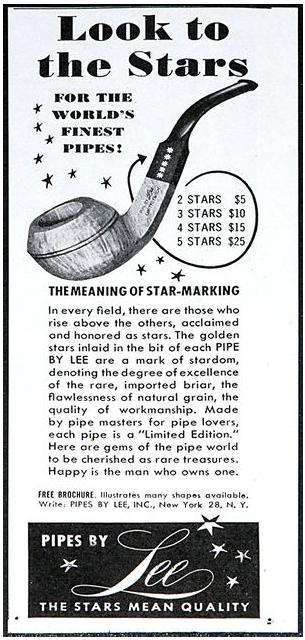
The Pipes by Lee brand was distributed by Stewart-Allen Co, Inc., NY. The pipes were graded by stars: 1 to 5 stars (5 being the high end). Early pipes have seven pointed stars; the middle run have five pointed stars and later pipes are stamped with colored gold stars. (the preceding content from the “Pipes: Logos & Markings” website and the 1947 Ad, courtesy Doug Valitchka).

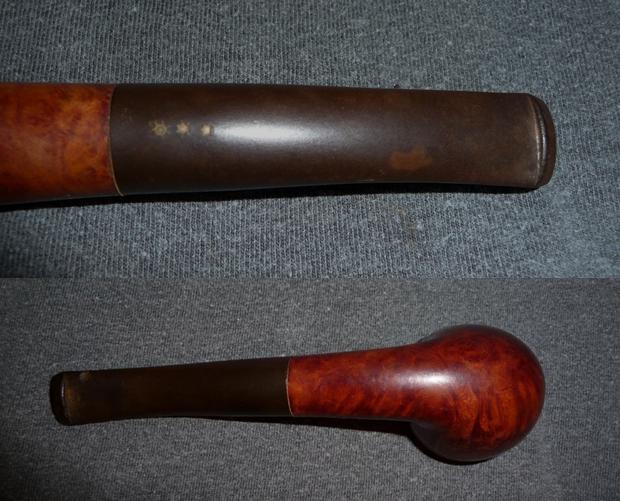
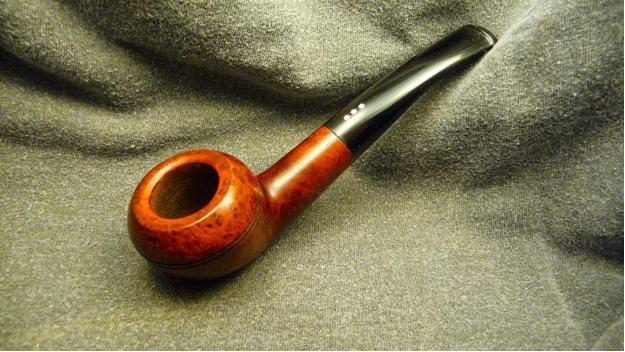
This pipe has three 7-point gold/brass stars set in a line in the top of the stem. I could not find the dates of the different runs/eras mention above but based on the ad I would have to guess my pipe dates to the late 1940’s to 1950’s.

The Pipe
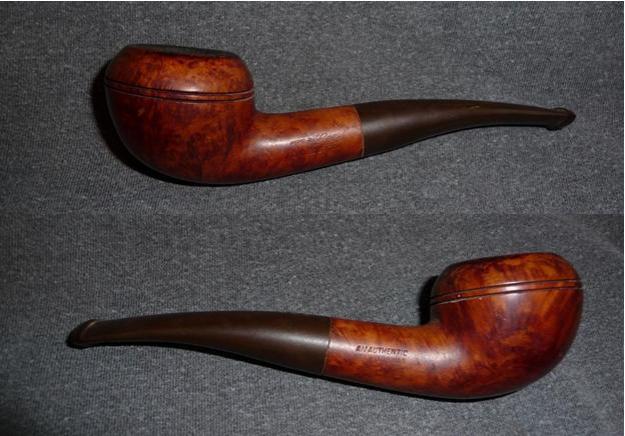
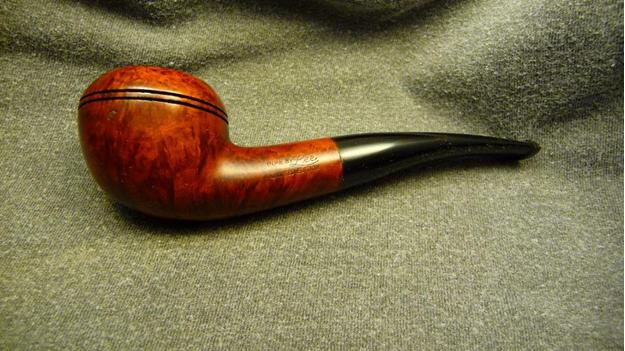
The outside of the pipe was in very good condition. The briar was clean and the stem was moderately oxidized. The stamps on the shank were very clear: left side read ‘Pipe by Lee’ over ‘Limited Edition’. The right side of the shank is stamped ‘An Authentic’ over ‘Imported Briar’.Aaron2 Aaron3The stem was slightly over-clocked and the previous owner had placed a couple of sheets of paper between the stem and shank to act as a spacer. There was one divot in the bottom stem near the button but otherwise was free from tooth chatter.

The internals were a different story; the chamber had a healthy cake buildup and good amount of tar on the rim. The shank was full of tar and the stinger was coated in dried tar. The internals of the stem itself were not as bad as the shank and I will attribute this to the removable filter/stinger. Aaron4I began the restoration by cleaning the rim. I moistened a little powdered Oxyclean and placed it on a damp green-pad. I laid the pad on a flat surface and worked the bowl much like I was topping it. I don’t have a picture of the result but this worked very well.

The cake was very hard and resisted my attempts with the reamer so set the bowl to soak in alcohol overnight. I also set the stem to soak in an Oxyclean bath using a pipe cleaner to hold the stinger out of the solution.Aaron5With the cake nice and soft, I reamed the bowl back to bare wood with little difficulty. An inspection of the inside of the chamber showed that the briar to be sound and without burnouts or cracks. The airway was clear and located precisely at the bottom center of the chamber. The alcohol soak also removed much of the stain and revealed three small pink fills that would have to be addressed.Aaron6I finished up the internals by cleaning the shank with cotton swabs and pipe cleaners until they came out as clean as they went in.
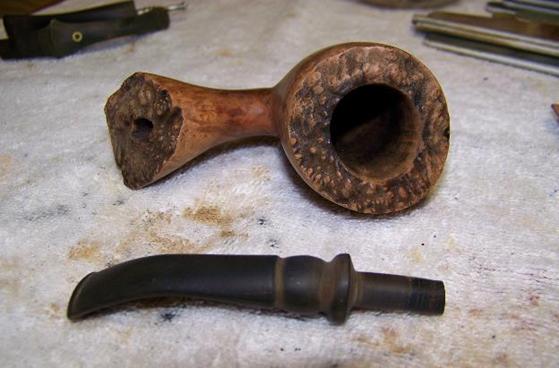
I neglected the pictures during this next part but in summary I used a dental pick to remove fills and packed the voids with briar dust. A dab of clear CA (cyanoacrylate) glue set the dust in place. After drying, the fills were sanded smooth. I also sanded the entire bowl (except around the stamps) with 1500-3200 micromesh pads.

Returning to the stem, I removed the aluminum ‘filter’ and cleaned it and the threads with 0000 steel wool and alcohol. Then I tried to raise the divot out of the stem with flame from a lighter. I didn’t expect to completely eliminate the divot but wanted to reduce it as much as possible before filling it. The fill was made with black CA glue and charcoal powder then sanded smooth when cured.

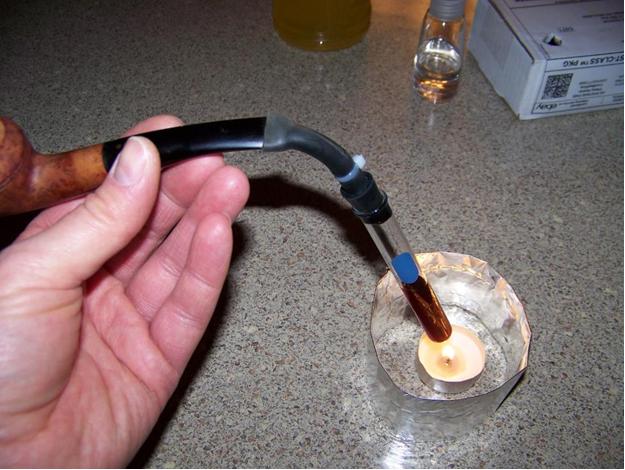
I polished the stem by wet sanding with 1500-4000 micromesh pads, rubbing down with mineral oil after each group of the three pads. A plastic washer was placed between the stem and the stummel at this stage to prevent damaging the wood and to keep from rounding the shoulder of the stem.Aaron7 Aaron8At this point I set up the alcohol retort. It took three test tubes until the alcohol was clean; note that I left the filter off during the retort. I won’t describe the retort process because that can be found in other posts but I do want to comment on one point. I have found that heating the alcohol often time lead to an explosive boiling – not a very controlled process. The smooth surface of the test tube and purity of the alcohol does not provide a surface for bubble to form on. However, if I add a small foreign object to the bottom of the tube the boil is much more controlled. I small piece of cake or charred candle wick gives the bubbles a place to form and eliminate the possibility of super-heating the alcohol.Aaron9Now that the pipe was cleaned and sanitized I finished the stummel by applying two coats of Feibing’s light brown aniline stain. I flamed the stain to set it and then wiped off the excess with a cotton pad and alcohol. While reassembling the pipe I heated the threaded tenon and re-align the stem. Then I coated the entire pipe with mineral oil and set it aside to soak in before applying three coats of carnauba wax.

Thanks for reading and please let me know what you think.Aaron10 Aaron11 Aaron12 Aaron13 Aaron14 Aaron15

Repairing and Restoring a1929 Irish Free State Billiard


Blog by Aaron Henson – 11/29/15

I think the thrill of the hunt is part of what makes this hobby so enjoyable. Going into a new store or happening upon a pipe in an unlikely place, never knowing just exactly what you are going to find and always keeping a lookout for that forgotten gem.

This past summer I was on vacation with my family in Seaside, Oregon. Between Seaside and Astoria I visited 14 different antique stores and only two had any pipes at all. And of those, they were all on the pricy side; too rich for me.

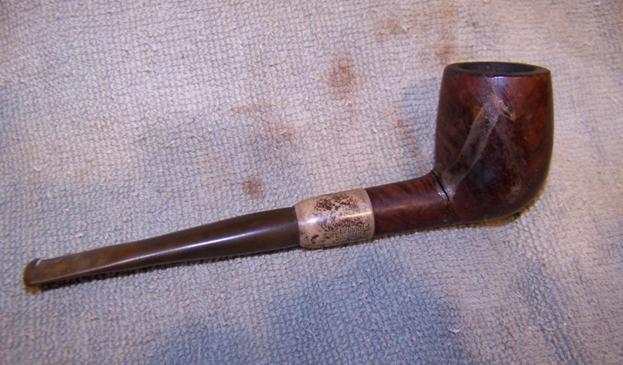
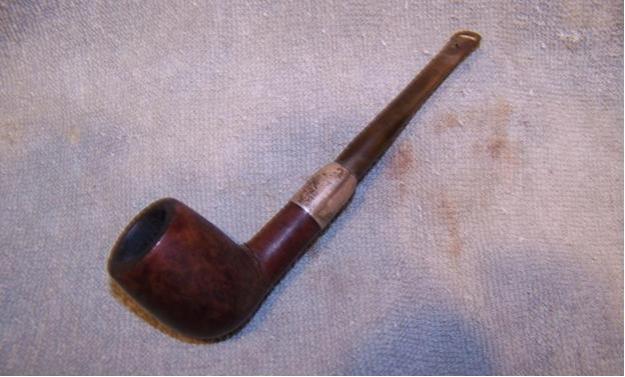
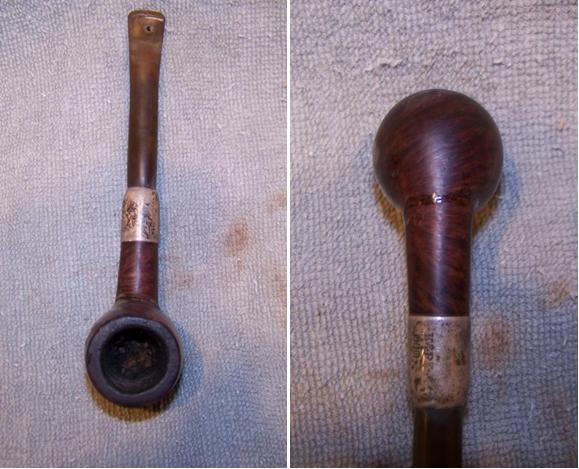
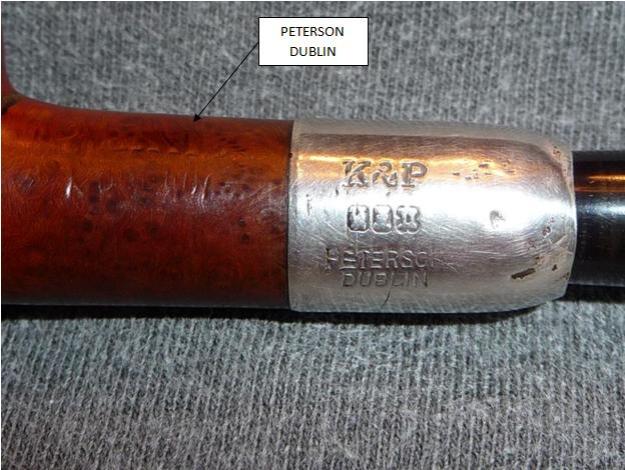
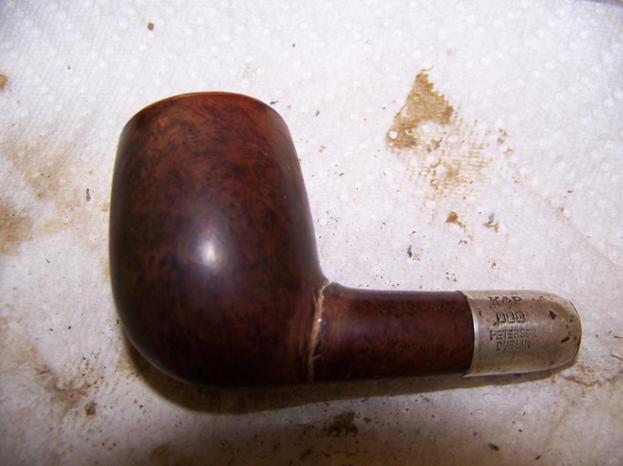
Partly on a whim and partly out of desperation, I went into a second-hand store that I had passed by several times. It was more “junk” than “antique” and of course that is where I made my score although I didn’t think so at first. Three pipes: the first was a non-briar volcano with “Italy” stamped on the bottom, the second was a Medico that was in such bad shape it could only be used for parts but the third was intriguing with a silver band. I could not read the markings for all the filth on the pipe. I negotiated with guy behind the counter and walked out will all three for $15.Aaron1 It was clear that this had been a very nice pipe in its day. The wood grain that could be seen through the grime was beautiful and the Army Style push stem I thought gave the pipe a classy feel. When I got it back to the house and looked it over in better light, I noticed that the band had been rotated on the shank so the writing was upside down and in the dim light of the store I could not read it. Now I could see that it clearly said “Peterson” and “Dublin” stamped in the silver band.
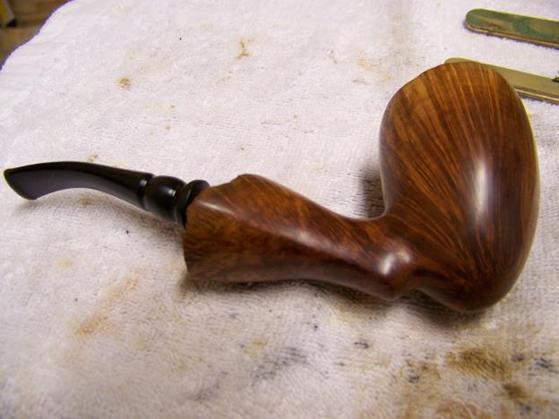
A Peterson, my heart skipped a beat. I was well aware of Peterson’s long history of making quality pipes and now I had picked up an early model for 5-bucks!Aaron2

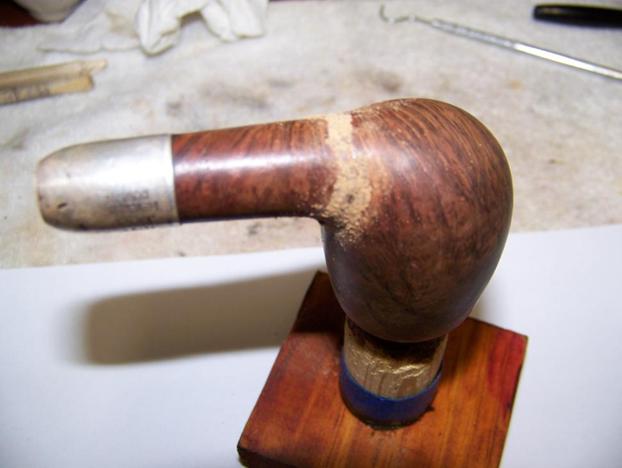
Aaron3 The bowl had a good build up of cake and a fair amount of unburned tobacco in the bottom. Some build up of tars on the rim but otherwise seemed to be in good condition. The shank had clearly been broken, however and the glue used for the repair was spread all over one side of the bowl. The stamping on the band, as stated before, were worn and not very readable. The stem was oxidized and had a hole in the top near the button. This must have been a favorite pipe of the previous owner.

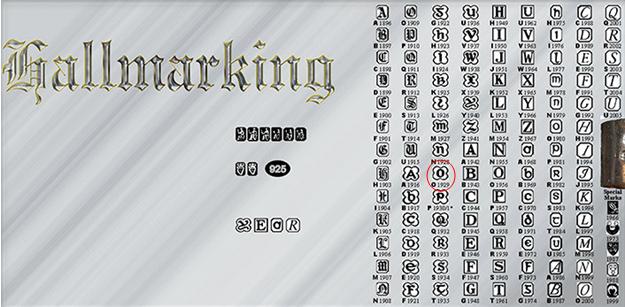
When I got home from vacation, I tried to understand the symbolic hallmarks on the band. Not being familiar with Peterson marking I sent a picture to Steve Laug to ask his opinion. Steve very graciously referred me to his Peterson expert, Mark Irwin. With Mark’s help I was able to understand Peterson’s hallmarking and dated the pipe as 1929 – placing it in the Irish Free State era: 1922 – 1937. At least, that was my interpretation of the third hallmark, an “O”.Aaron4

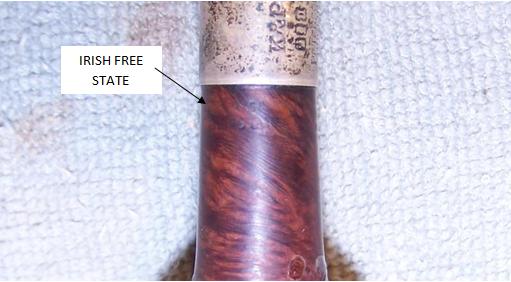
Aaron5 I began by reaming out the cake with a Castleford reamer and took the interior back to bare wood. There were some burn marks under the tar on the rim so I elected to top the bowl with some 220 grit paper laid on the flat work bench.Aaron6 Next I heated the band with a flame and then using leather jawed pliers and carefully rotated the band back into correct alignment.Aaron7 The outside of the bowl I wiped down with a cotton pad soaked in acetone. This removed the grime and the glue. I had been worried that the glue was covering a crack in the bowl but it turned out that the person doing the shank repair had just been sloppy. The glue came away and revealed pristine briar underneath. In just the right light, I also could see a very faint IRISH FREE STATE stamped into the bottom side of the shank – Confirmation!Aaron8 The break between the bowl and the shank had been complete. I could see the seam all the way around the shank but it had been a clean break. There were no gaps, rounded edges nor missing pieces; so far, so good.

At this point I turned my attention to the stem. I put the stem to soak in a mild chlorine bath to raise the oxidation. A light sanding with some worn 400 grit paper removed the oxidation completely. I picked the loose material out of the hole, made backing plug out of toothpicks and slipped it into the airway. This would hold my patching material in place. Next I mixed up some StewMac black super glue with some activated charcoal powder and worked it into the hole with another tooth pick. I set the stem aside to cure over night.Aaron9

Aaron10 When I came back to the stem I sanded down the fill with 220 grit paper. The plug blended nicely and I proceeded to polish the stem with 1500 – 12000 micromesh pads. Cleaning the inside of the stem was quite simple, four of alcohol soaked pipe cleaners (2 bristled and 2 soft) took care of the insides and the stem was done.Aaron11 Returning to the stummel, I began to work the bowl-shank joint back and forth with ever increasing force. I caught myself holding my breath, afraid of breaking the pipe beyond repair but dismissed that thought as fear of the unknown and pushed on. Eventually the crack began to open up and the shank and bowl were separated. I was surprised to see that the original repair had included two small brads – or pins – set on either side of the air hole to strengthen the break. Since the brads were already in proper alignment I decided to reuse them in my repair.Aaron12 After some research, I settled on the J-B Kwik Weld as my epoxy of choice. Its resistant temperature is less than that of original J-B Weld (300 vs 550 degrees); however, I do not think the shank should reach 300 degrees during a smoke. But the real advantage in my minds was that the set time is only 6 minutes compared to 4-6 hours. I didn’t want to have to come up with a way to hold the two parts together for several hours and risk the parts slipping.

In order to keep the airway clear during the repair, I pushed a pipe cleaner through the airway before smearing the epoxy on the both surfaces with a tooth pick. With the clock running on the set time, I pushed to the two parts together using the old brads as alignment pins. Looking back I think it would have been better if I had only used one of the pins. The fit was tight and I was fighting against the pins to get the two parts tight together when the time ran out on the epoxy. I was left with a larger gap between the pieces than I thought was right; I had been hoping for a flush fit. Before setting the pipe aside to cure I wiped off the excess epoxy and removed the pipe cleaner.Aaron13 I let the pipe sit overnight and the next day I used a dental pick to remove some of the epoxy from the gap between the stummel and bowl. The gap was very small, less than a 1/32 of an inch on top and near flush on the bottom. When the crack was as clean as I could get it, I filled it with briar dust and placed drops of clear super glue on top to hold the dust in place. When the super glue dried I smoothed out the repair with 220 grit sand paper.Aaron14 There were some minor dents in the bowl and I decided to steam them out by wrapping the bowl with a damp terry cloth rag and going over the rag with a clothes iron set on high. If you used this method I would advise keeping your figures well clear of the iron. Speaking from personal experience, you don’t have to be very close to the iron get burned by the steam. Fortunately, I did not drop bowl!

I sanded the entire bowl with 400 – 2000 grit paper to remove all the dents and scratches but being sure to stay clear of the marking on the shank. The markings were faint but I wanted to preserve as much of them as I could.

The bowl had beautiful grain and I wanted to use a light brown stain to highlight it. I used one part Fiebing’s light brown mixed with 2 parts isopropyl alcohol applied with a cotton swab in layers until the color looked just right. I flaming each layer and wiped off the excess with a cotton pad moistened with alcohol.

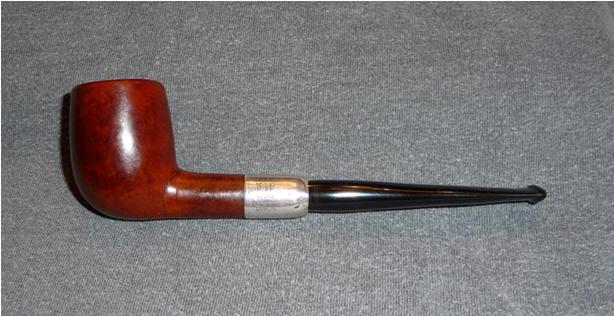
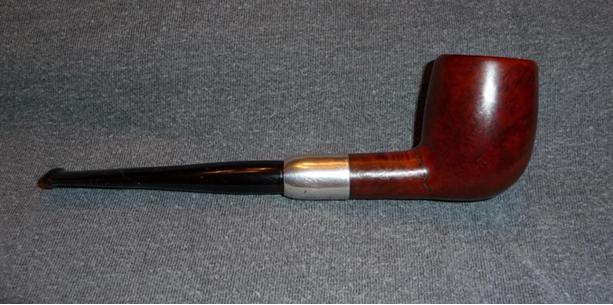
The next to last step was to polish the sterling silver band. For this I tried a new technique that I had recently learned on this blog using a small amount of cigar ash and saliva. I was careful not to polish too much – or at all – around the hallmarks. The final step was a trip to the buffer for three coats of carnauba wax on the briar and stem. I hand applied a light coat of Walker Briar Works carnauba wax sealer on the silver band and I buffed the pipe with a micro fiber cloth to bring up the shine.Aaron15

Aaron16

Aaron17

Aaron18