Refurbed Rutledge Author


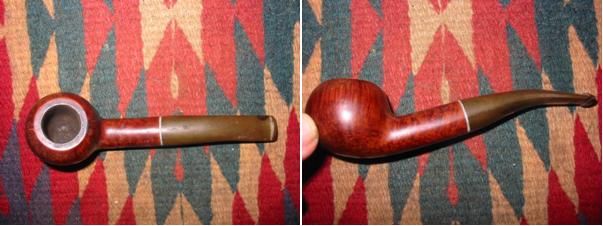
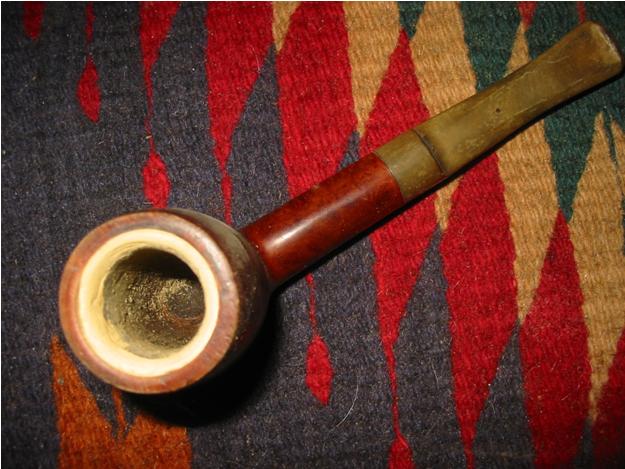
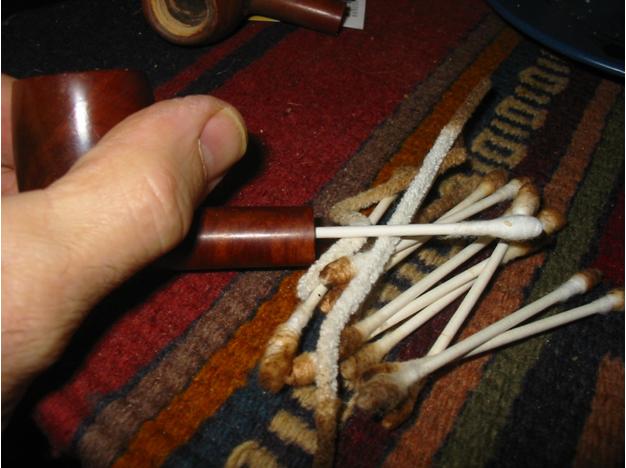
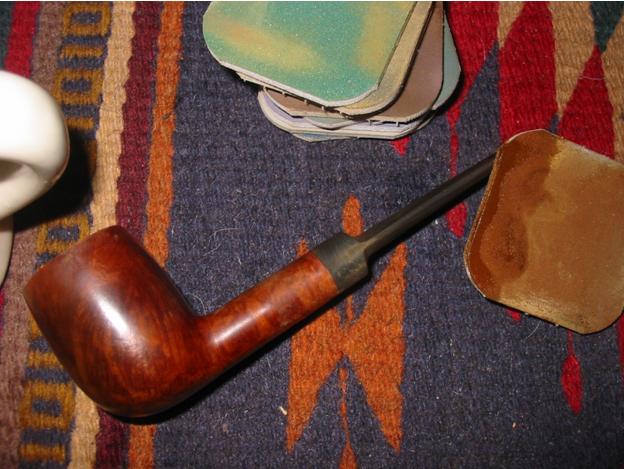
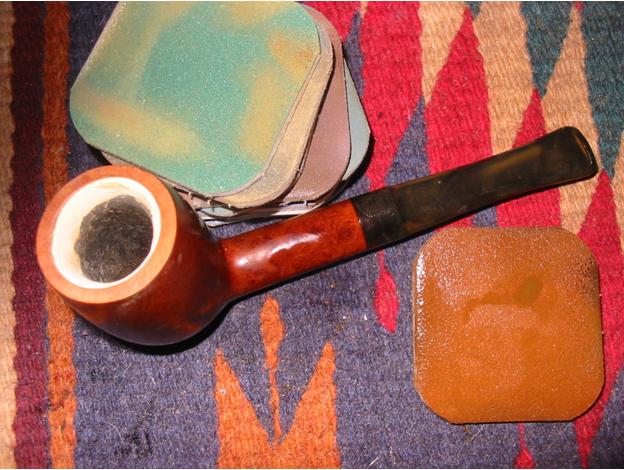
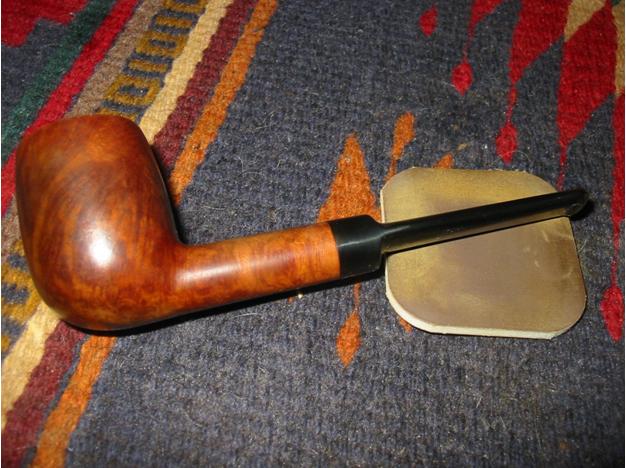
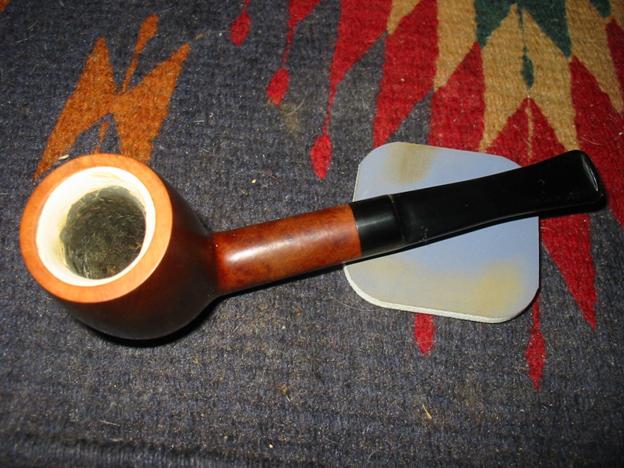
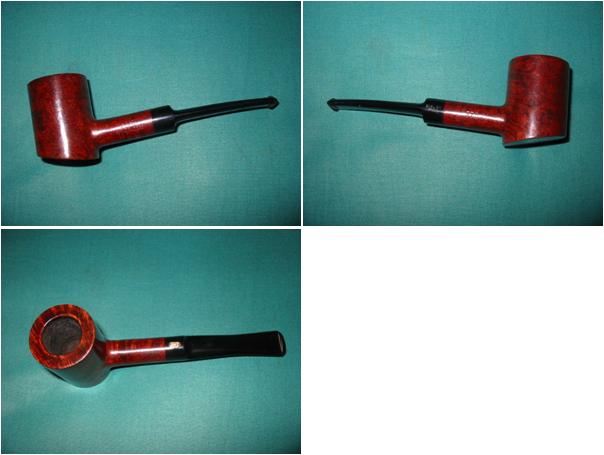
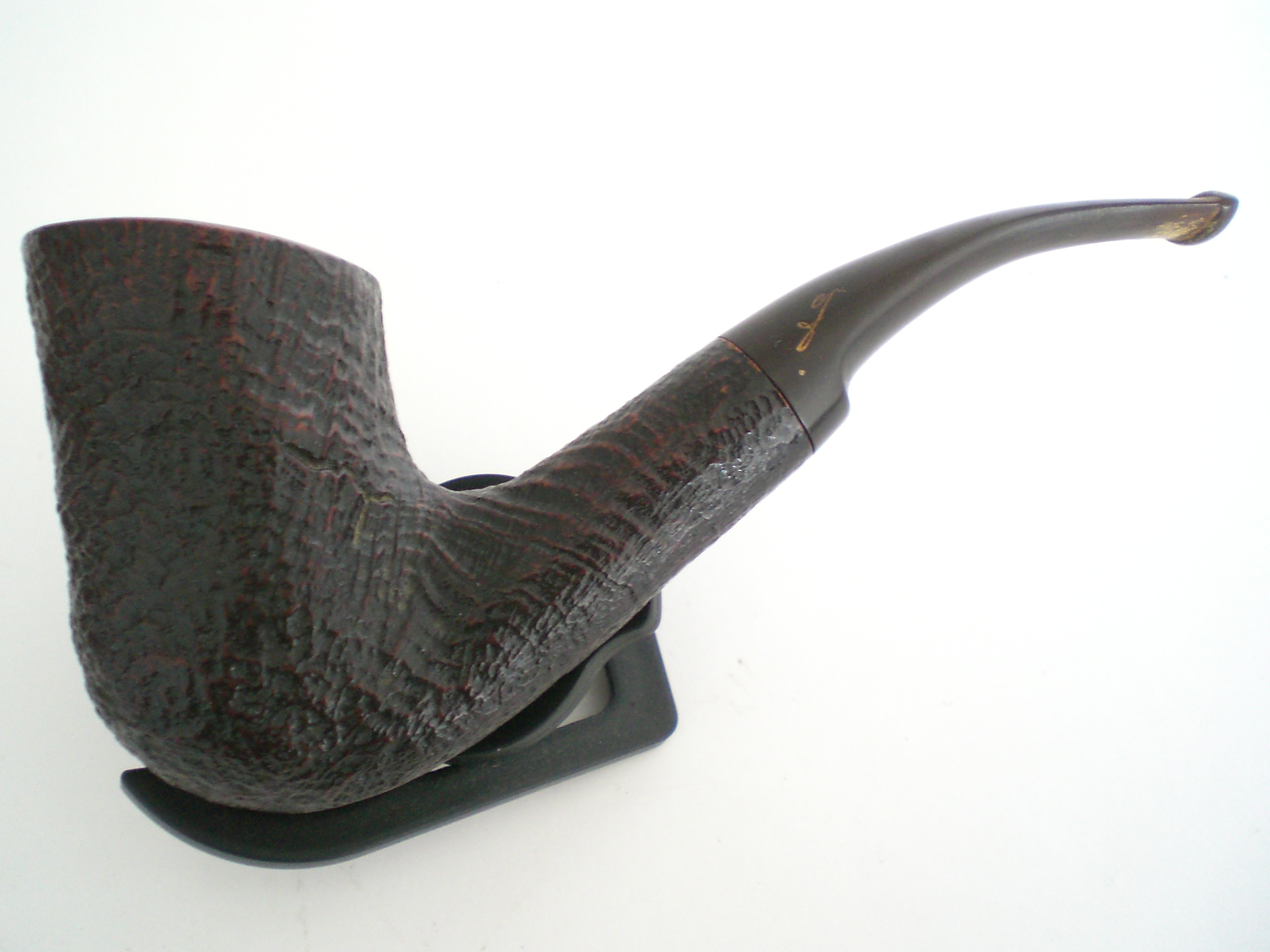
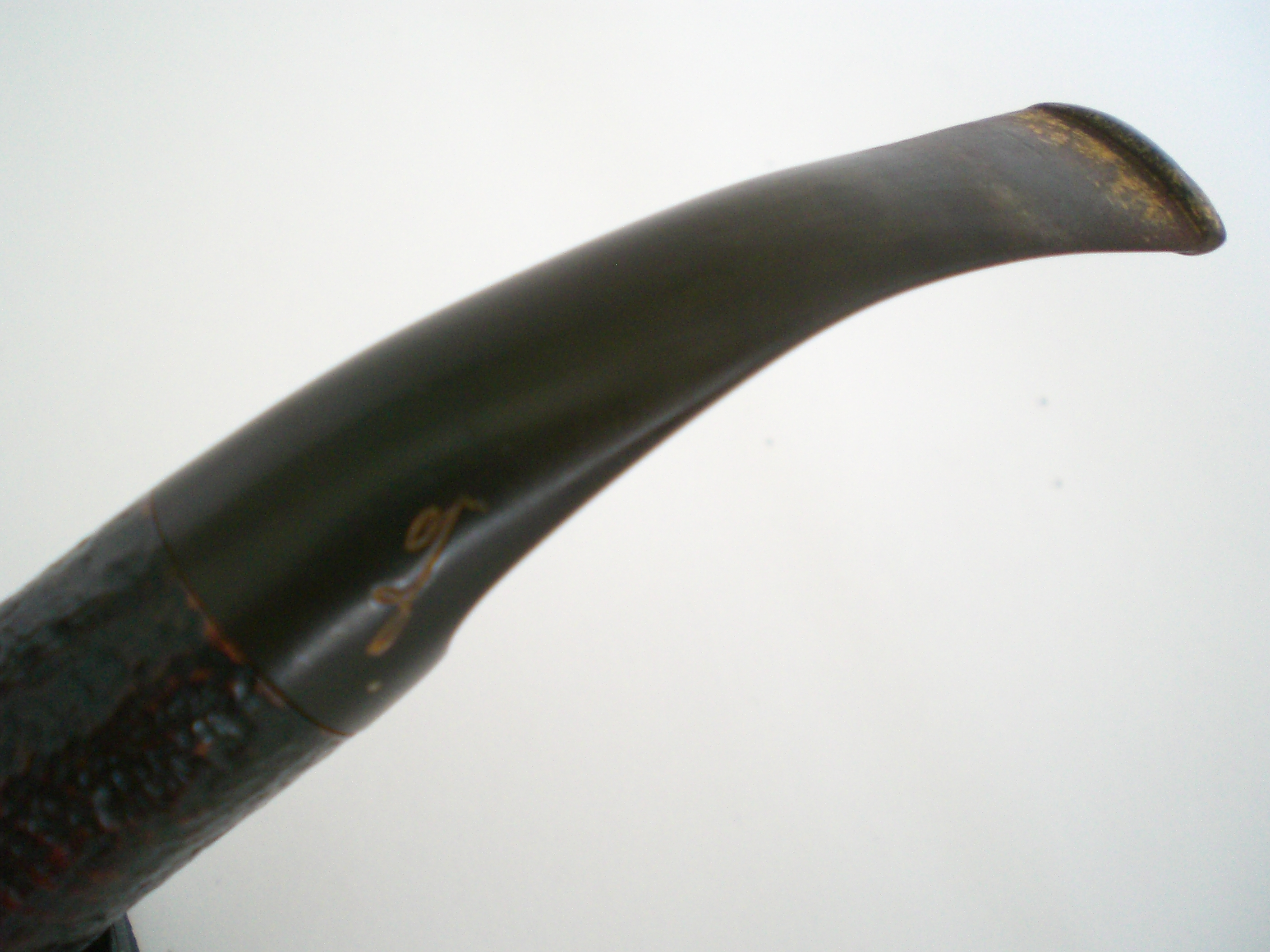
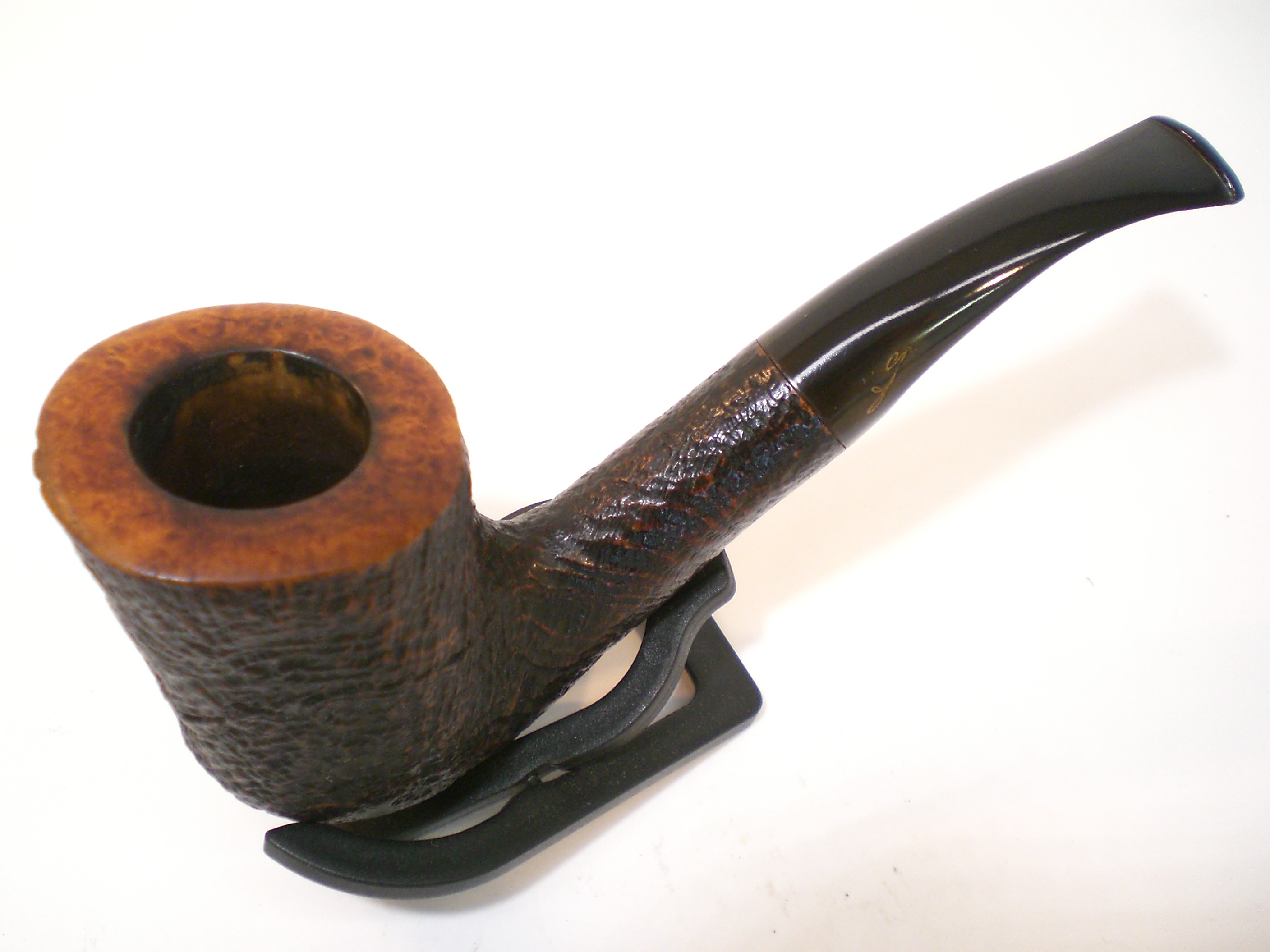
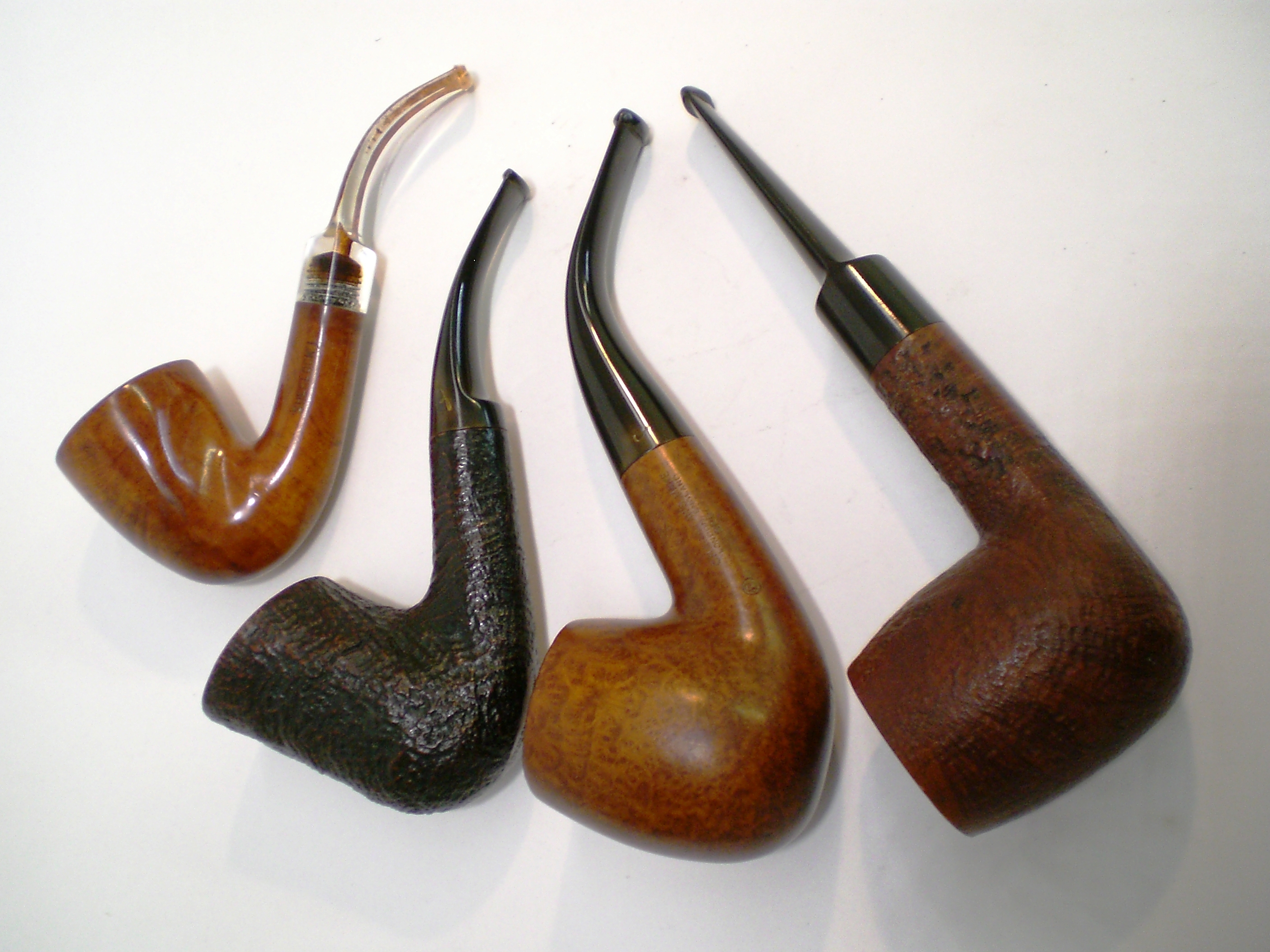
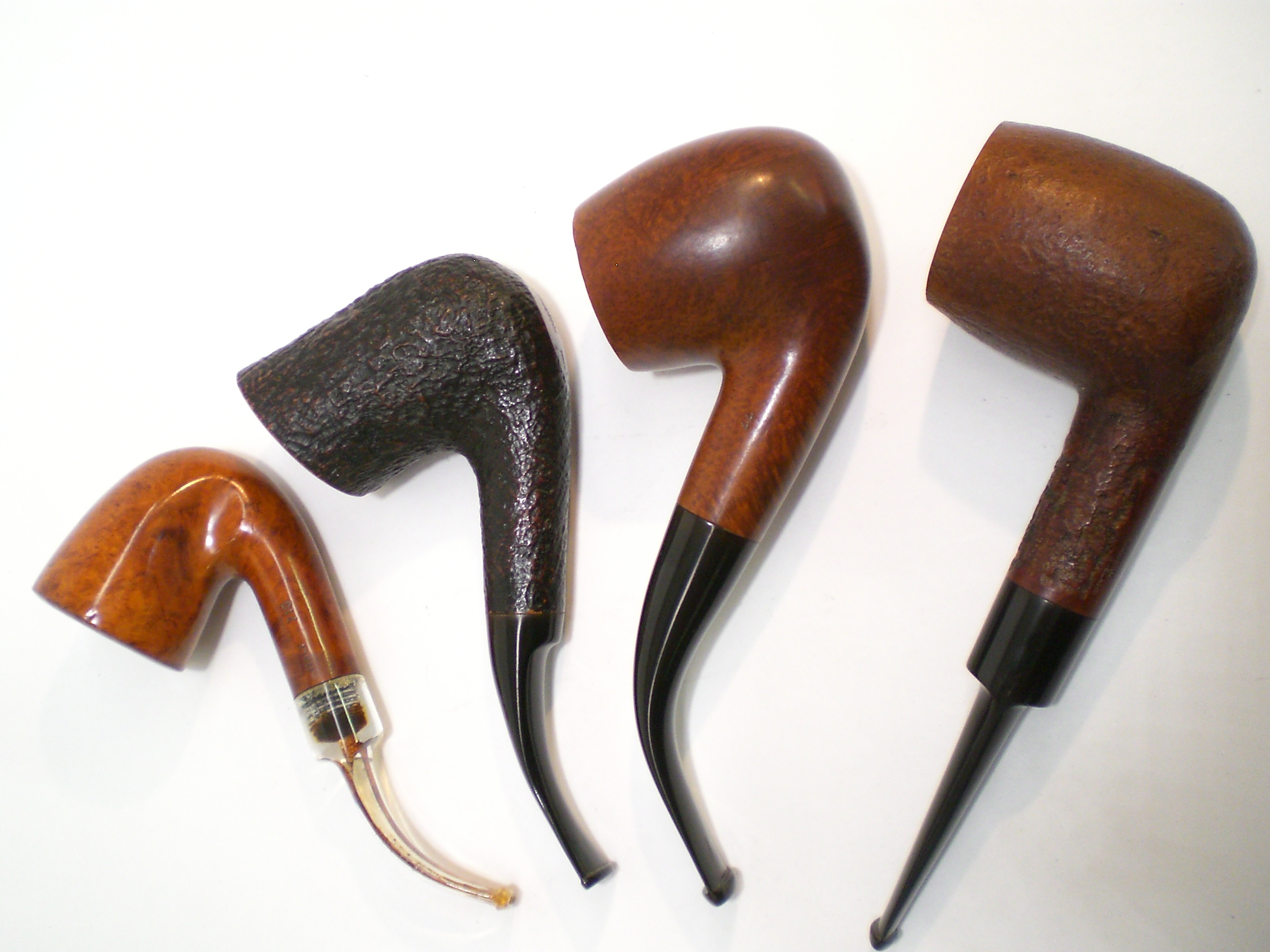
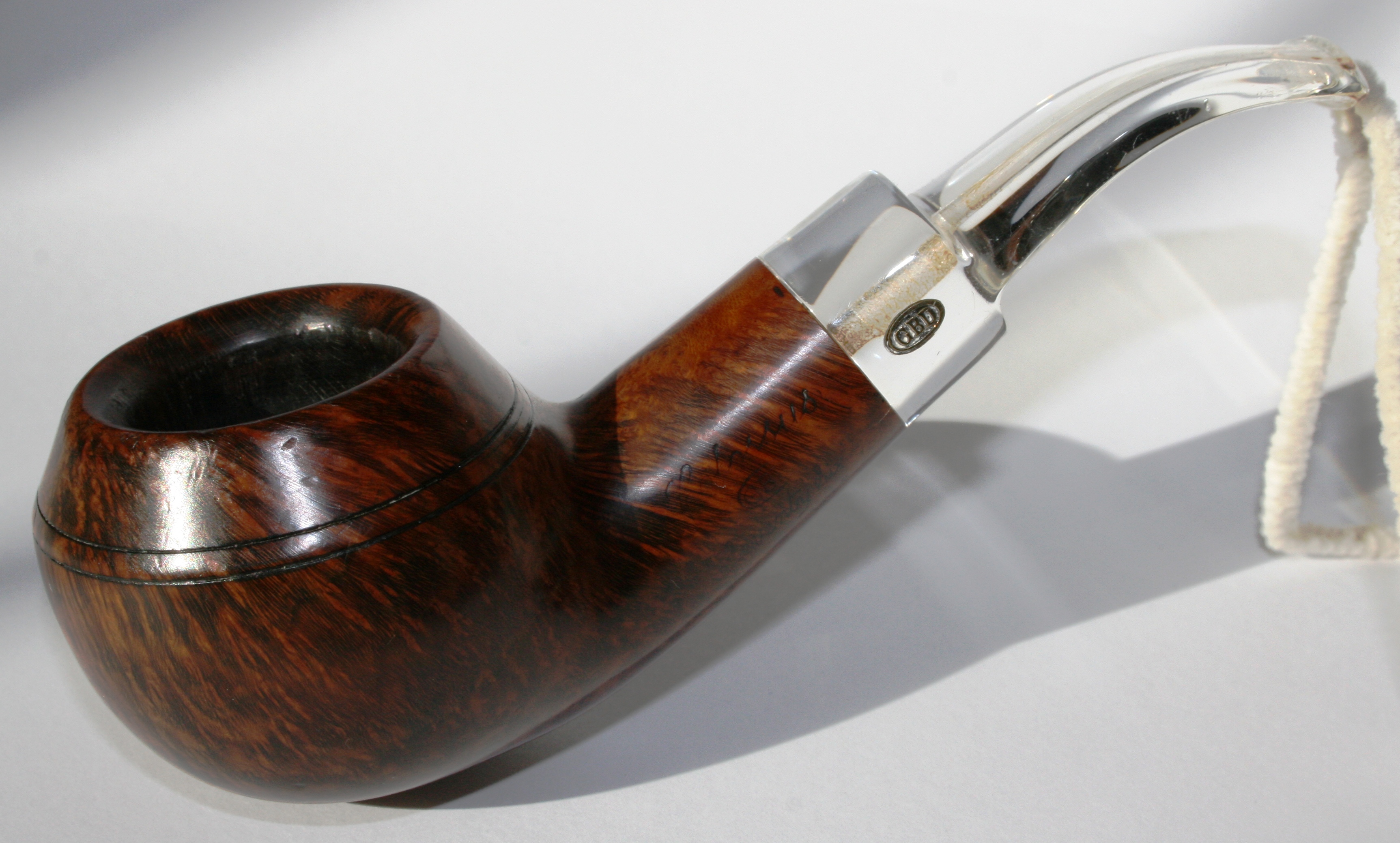
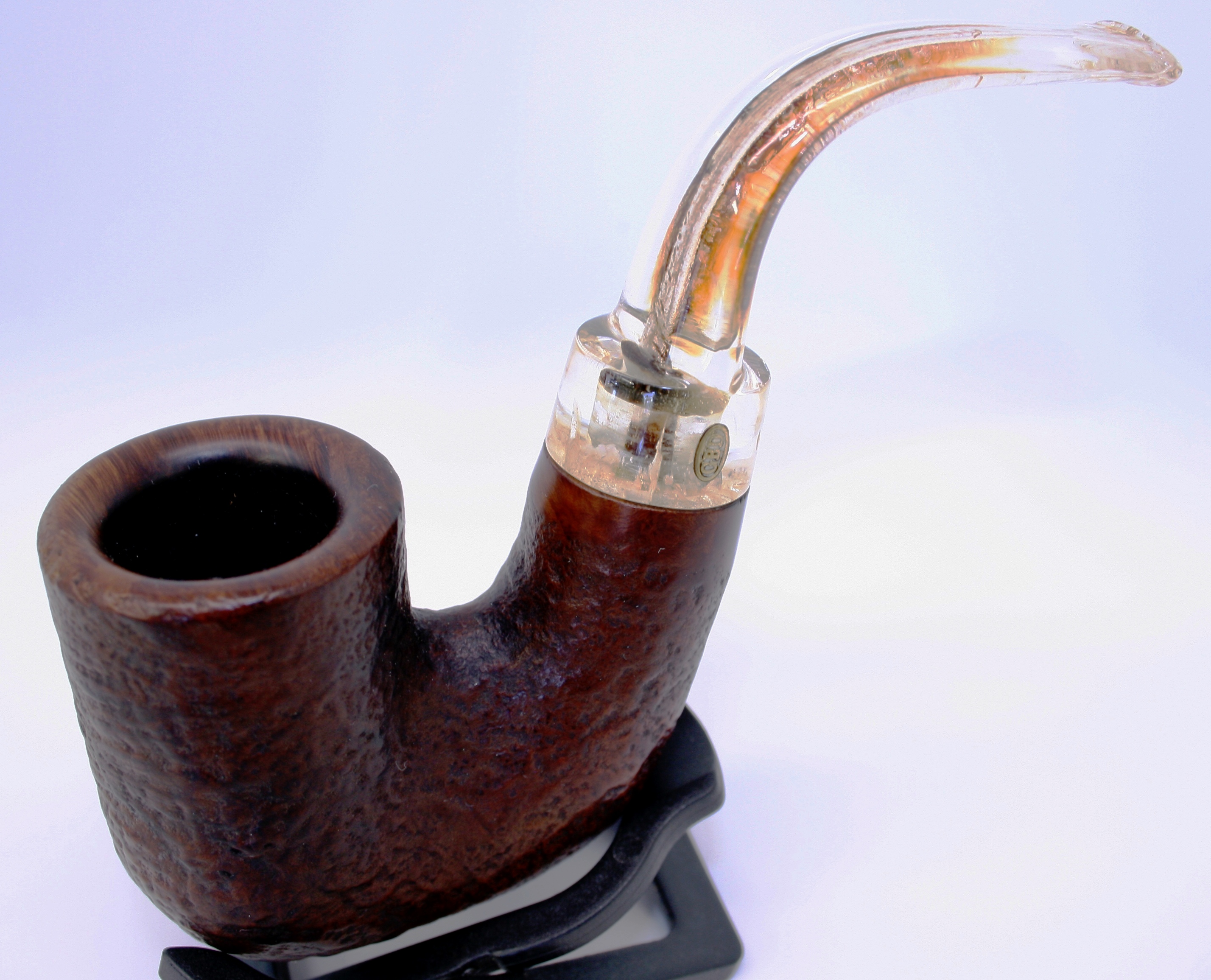
This old Rutledge pipe is the one that came with the Beuchner Ashtray Reamer that I wrote about in an earlier blog post. I have not found a lot of information about the brand or the maker of this pipe so it is a mystery that remains for me. However, the author shape is one that I particularly like so it finally got the attention needed to clean it up. You can see from the first two pictures the state of the pipe. The stem was badly oxidized and needed some work. The bowl was clean but dusty and even had a cobweb or two in it. The rim had some tar build up but was not dented or dinged. When I removed the stem – a screw mount stem – I found that it had originally had a KW stinger that had been clipped. It was fairly oxidized as well and the aluminum on the threads was pitted and darkened with tars and oils.
rut1

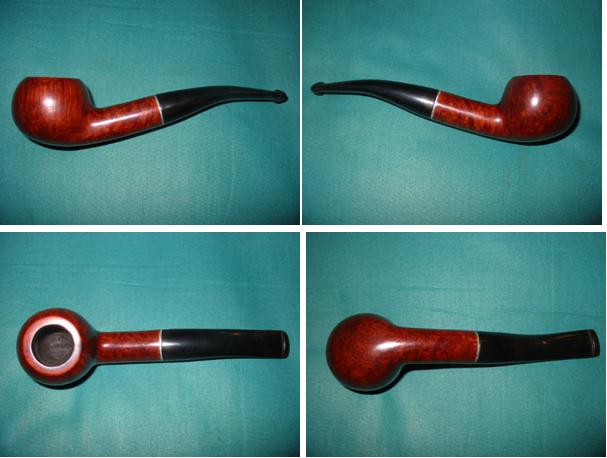
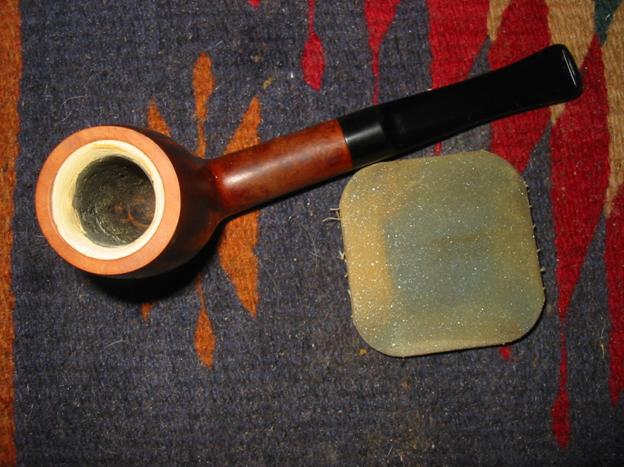
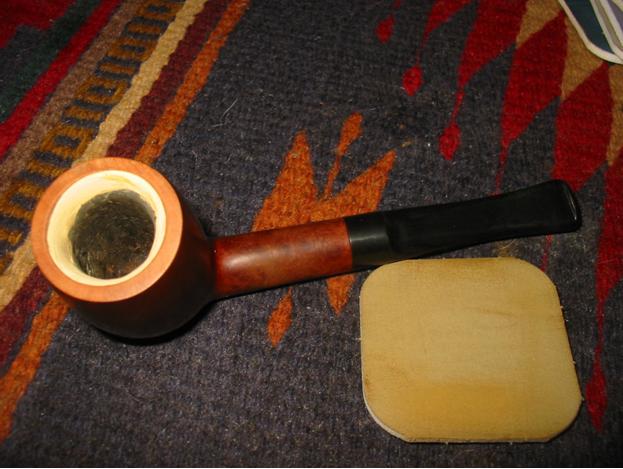
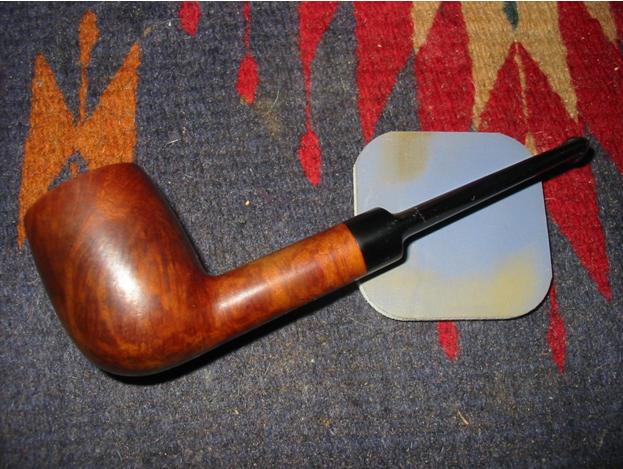
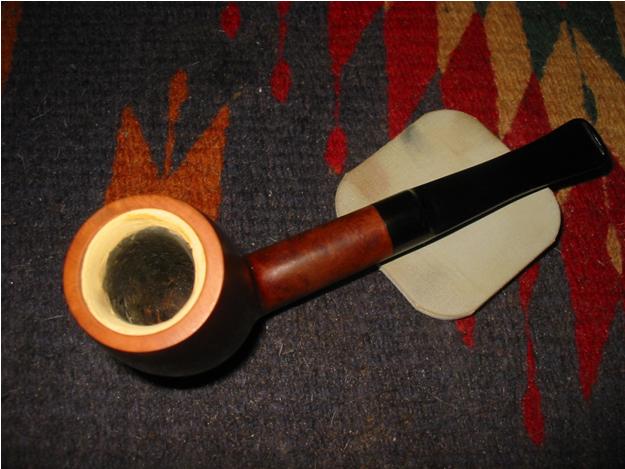
I unscrewed the stem and cleaned it out and used 0000 steel wool on that to clean the tenon and remove the oxidation and grime. I also used it to smooth out the pitting. One it was clean I dropped it in a bath of Oxyclean and warm water to soak while I worked on the bowl. I gave the bowl a light reaming and scrubbed the rim with a soft cloth and some Murphy’s Oil Soap. I wiped the entirety down with a cotton pad and some acetone and then buffed the bowl on my buffer with White Diamond and Carnauba wax. The metal band at the end of the shank made this quite easy to do without the stem attached. I never do that with a regular shank as it can round the edges and ruin smoothness of the shank stem junction. With the bowl finished I took the stem out of the Oxyclean bath and began to work it over with micromesh sanding pads from 1500-12,000 grit. I polished the stem with plastic polish after that and reattached it to bowl and gave the whole pipe several coats of carnauba wax and buffed with a clean flannel buffing pad to polish it.
rut2

A Journey from Oxidation to Shine – Refurbishing a Wally Frank Meerlined Billiard


I have had this old meerlined billiard in my box for refurbishing for quite awhile. The stamping on it says Made in London England on the right side of the shank. On the underside of the shank it is stamped Wally Frank Limited. The finish on the bowl was cloudy from many coats of wax and there was a gummy substance on the front of the bowl from a sales label. The rim was dented and the inner edge of the meer lining was damaged. There was a heavy buildup of cake on the meer. The stem was badly oxidized.
ox1
ox2
ox3
ox4

ox5 I decided to work on the interior first so I used a plumbers wire brush (used for smoothing the edges of a newly cut pieces of pipe or tubing). It is a ¾ inch brush (see the photo to the left of this text) and I have found that if it is used carefully it is good at removing the initial cake build up on the interior of a meerlined bowl. I say carefully because too much and the brush scratches the meer lining. In this case I ran it through one time and then dumped out the ash and carbon buildup. The two photos below show the brush inserted in the bowl and give an idea of the tool itself.
ox6
ox7

Once the brush has done its work I use a blunt edge letter opener/knife to smooth out the rest of the cake that is still present. The next photo gives a clear picture of the pipe bowl after I have used the brush in it and just inserted the knife. There was still some stubborn cake left that I used the knife to scrape away. The second photo below shows the bowl after I have finished with the knife. Once the bowl was at this point it was time to use sandpaper in the bowl to smooth out the edges and rough spots.
ox8

The next photo shows the bowl after the initial sanding on the cake. I had lots more to sand at this point but I wanted to document the process. At this point in the process I removed the stem and put it in a jar of Oxyclean to soak and soften the oxidation while I continued to work on the bowl.
ox9

I used many cotton swabs on the inside of the bowl to remove the sanding dust and to clean out the inside of the shank once the stem was removed. The mortise had a thick coating of tars and the airway into the bowl was constricted with tars as well. It took many swabs and about the same number of pipe cleaners to get the interior clean. I dipped the swabs and pipe cleaners in 99% Isopropyl alcohol and washed out the inside. The first swabs came out almost black with the tars. I did some more sanding on the rim and the inner edge of the rim and meer lining. The rim was quite dented and had some chunks missing so I topped it lightly using the methods I have written about in other articles on the blog. I also used a folded piece of sandpaper to bevel the edge of the meer lining inward to take care of the damaged edge of the meer.
ox10

Once the bowl was finished I wiped it down with some acetone on a cotton pad to remove the wax buildup and give me a clean surface to work with. I took the stem out of the soak and went to work on it. I wiped it down with a soft cotton cloth to dry it and to remove the softened oxidation. I then filled a cup with warm water and began to work on the stem with the micromesh sanding pads 1500-12,000. I took pictures of each successive micromesh pad and the result of using it to show the progression of the polishing.

The first four pictures below show the stem after wet sanding with the 1500 rust coloured sanding pad. You can also see the inner rim and bowl top after my work on them as well. The first sanding took what remained of the majority of the oxidation off the stem and gave it a dull matter finish. I wet the sanding pad down and sanding with it wet. I repeated the sanding of the stem repeatedly until the oxidation was gone. Then I wiped it down before the picture to show the progress.
ox11

ox12

ox13

ox14

Once I was satisfied that the majority of the oxidation was gone I move on to the green 1800 grit micromesh sanding pad. I also used this pad with water and wet sanded the stem repeatedly. You can see the remaining oxidation still showing up on the wet sanding pad in the two photos below. The two photos show the stem after multiple sanding. I wiped it down with a soft cloth to dry it off and wipe away the grime left behind by the wet sanding. The stem is beginning to take on a bit of a shine. The matte finish of the 1500 grit is getting a polish.
ox15

ox16

The next two photos show the 2400 grit micromesh disk (grey coloured). I used this pad without water to polish and shine away some of the scratches. I found on the left side of the stem near the button there was a fairly deep scratch on the edge. I used some 280 grit sandpaper to remove this scratch and then repeated the 1500 and 1800 grit micromesh sanding. Once finished I gave the entirety of the stem a sanding with the 2400 grit pads to smooth out the finish. I also used the pad to sand the top of the bowl and the edge of the meer lining.
ox17

ox18

A 3200 grit micromesh pad (tan coloured) was used next. I also dry sanded the stem with this one the first few times I sanded it. The last time I wet sanded the stem. The next two photos show the stem after the sanding. I wiped it down with a soft cotton cloth to remove the dust and residue from the wet sanding.
ox19

ox20

Once I got to this point I decided to try some Mequiar’s Scratch X 2.0 fine scratch and blemish remover that I picked up at an auto parts store. It is used to polish headlight lenses. I applied the polish to the stem and let it dry a short time before wiping it down and polishing the stem with the cotton cloth. The first two photos show the application of the white polish. The last two show the result of the polish on the stems at this point in the process.
ox21

ox22

ox23

ox24

At this point in the process I decided to continue with the micromesh sanding pads. I wanted to take them through the 12,000 grit pad and document the progressive shine that comes alive in the stems. The next two photos show the wine/brown 3600 grit sanding pad and the results. I sanded the entirety of the stem repeatedly before wiping it down for the photos below. I dry sanded with this grit pad and also with the remaining micromesh pads.
ox25

ox26

A 4000 grit Teal coloured micromesh pad was next. I also dry sanded with this pad. The next two photos show the shine starting to come alive on the stem.
ox27

ox28

A 6000 grit Purple coloured micromesh pad was next. I dry sanded with this pad as well. The next two photos show the shine after I repeatedly sanded the stem.
ox29

ox30

An 8000 grit Royal Blue micromesh pad was the next in line to be used. The difference in shine between the 6000 and the 8000 grit is quite remarkable. The shine takes on a depth that the early grits did not bring out in the vulcanite. The next two photos show the stem after sanding several times with this grit pad.
ox31

ox32

The final micromesh pad to be used was the Grey coloured 12,000 grit pad. I also dry sanded with this pad. I sanded the stem several times until the vulcanite shine had a depth that was visible. The two photos below show the result of the final sanding.
ox33

ox34

At this point in the process I once again wiped the stem down with the Meguiar’s polish and buffed it off by hand with a soft cotton cloth. I then took it to the buffer and gave it several coats of carnauba wax. I also buffed the bowl with White Diamond and then carnauba wax as well. The finished pipe is in the four photos below.
ox35

ox36

ox37

ox38

Refurb – a Lovely Jobey Poker


This came across my desk as part of a lot I picked up somewhere along the way. It gets pretty bad when you cannot remember where you found a certain pipe. When I picked this up I figured it would be one that came and went. I have bought, sold and traded many Jobey pipes over the years and kept none of them. Nothing personal against Jobey’s I just always used them as a step towards something else I wanted more. This one was a bit unique. I had not had a Jobey like this or a poker before so this one was a new one for me. In terms of a Jobey it does not have the patented Jobey connector for the stem and shank. I was a normal push tenon. The tenon also was stepped down. The pipe is stamped English Para on the stem. The bowl itself is quite a nice piece of briar – no fills. It is stamped Jobey in script and Hand Rubbed under that. The other side of the shank gives the shape number 370.

Its condition was quite easy to work on and needed only to be reamed and cleaned. The finish was only dirty and had become cloudy from the many coats of wax that it carried. I wiped it down with a cotton bad dampened with 99% isopropyl alcohol to remove some of the grime. I do this carefully so as not to remove the underlying finish. In this case it worked beautifully and the finish remained. The grain was once again very clear and had a matte look. I took it to my buffer and used some White Diamond to buff it and then gave it several coats of carnauba wax.
Jobey

Kiseru Pipes – A Unique Experience, But If You Blink You Will Miss It


Blog by Steve Laug

Kis1
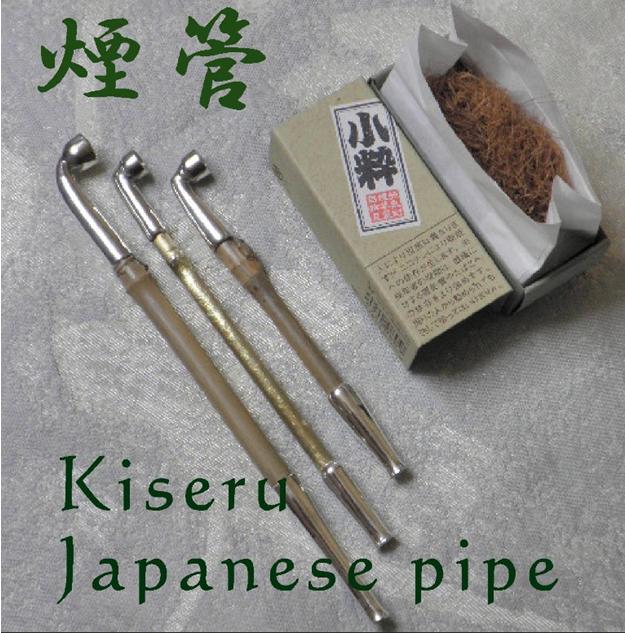
A few years ago a friend of mine called and said that he wanted to stop by for a bowl on the front porch and that he had an interesting gift for me. I don’t know about you but that kind of phone call makes me wonder. I loaded a pipe and sat on the porch to await his arrival. I had no idea what he was bringing. When he arrived he opened his pipe bag and took out the gift he brought for me and another for himself. Until that time I had not heard of the Kiseru pipe and knew nothing about it. Now if you have not smoked a Kiseru you have no idea how small the bowl is or how fine the tobacco is. I personally did not have a clue. So I looked the box and small envelope over before opening either one of them. I did not have the benefit of the photo above that gives you an idea of what to expect.

kis2
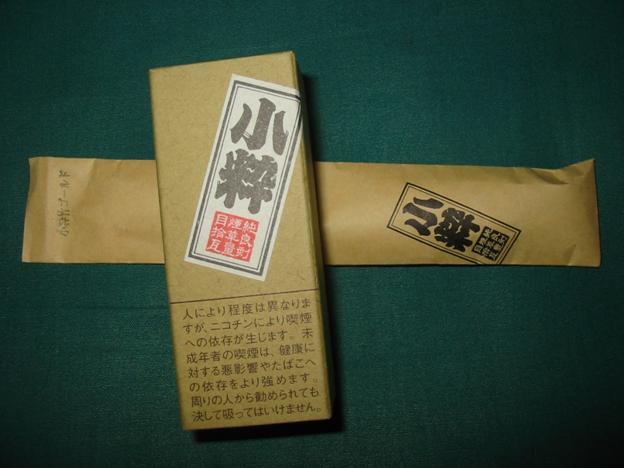
The photo above shows the box of tobacco and the envelope that held the pipe. If you can imagine the small envelope that holds take out chop sticks then you have an idea of the size of this little envelope. The box is also pretty small. I have no idea what the characters say and would love to know what they say. The label on my little box is identical to the one in the opening photo that I took off of a Japanese catalogue of Kiseru pipes.

kis3
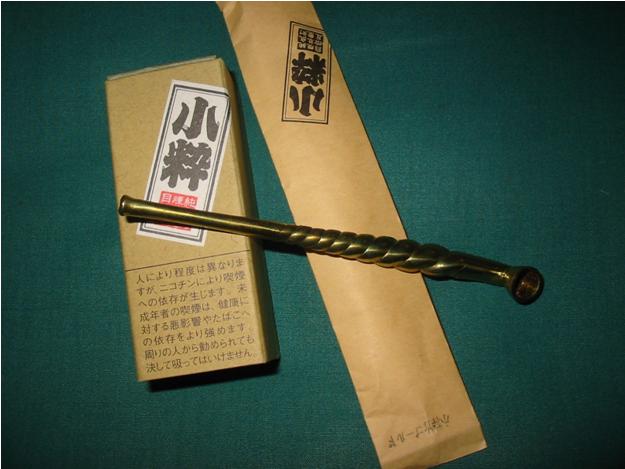
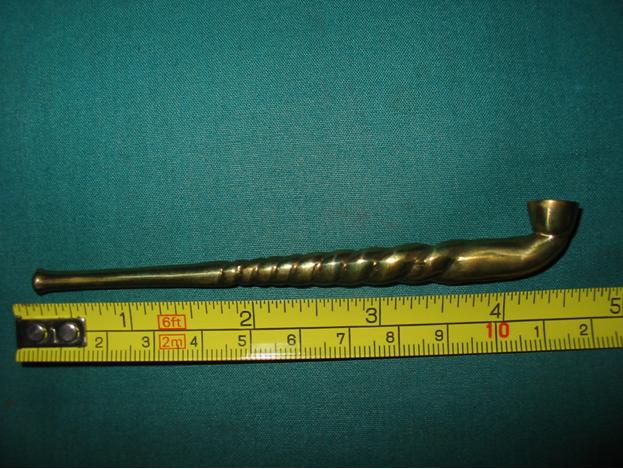
I decided to open the envelope first and took out the spiraled brass pipe. The brass is polished and golden in colour. The airway is very open and the pipe is a solid unit. The tip has a formed button that can be held in the teeth to clench the pipe. The other end of the tube is upturned and flared into a bowl. The spiraling on the shank is actually quite beautiful. In the photo below I took a picture of it with a measuring tape so you can get an idea of the overall size of the pipe. It is about 4 ¼ inches long. The bowl is about a ¼ inch in diameter and height.
kis4

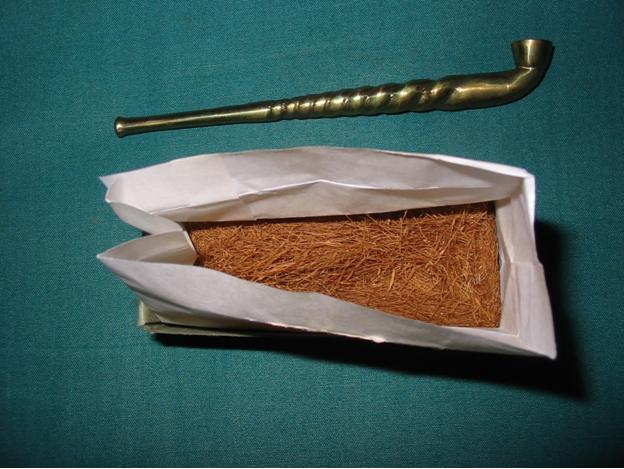
After I had blown through the pipe and looked it over bow to stern I opened the box of tobacco. In the picture below you can see the finely spun tobacco. The smell is of a Virginia tobacco and the cut is a very fine angel hair like cut. It smells grassy and sweet. It is condensed and pressed into the box and held in a waxed paper envelope. The box is about 3 ½ inches long by an inch wide and an inch high. I have smoked probably 20 or more bowls and the tobacco does not seem to disappear. As I pull off a small chunk to roll into a ball the remaining tobac springs into place.
kis5

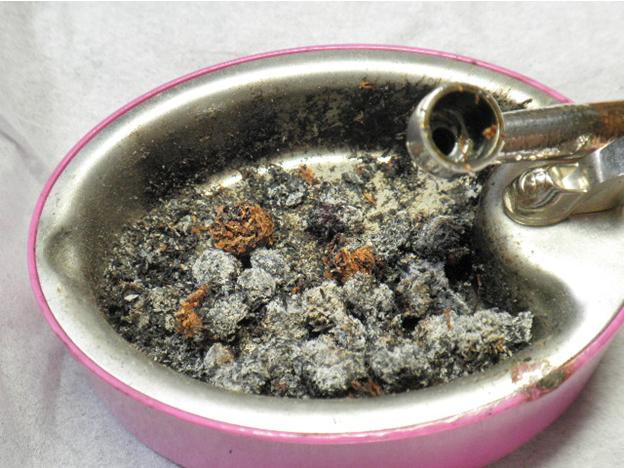
To load the Kiseru you take a small clump of tobacco and roll it into a small ball and press it into the bowl of the pipe. It honestly does not take much so the tobacco that comes with the pipe lasts a long time. My box has been in my humidor for probably 4 or 5 years and is the same moisture level it was when I first opened it. Lighting the bowl is very simple and takes a flick of the lighter and a single light. There is no tamping involved and no fiddling. It is a quick smoke that tastes delightful and burns easily. The flavour is a rich grassy Virginia taste that makes you want to smoke more. The nicotine hit on the bowl is minimal. One day I will have to try it with a small ball brown rope. In the photo below you can see the dottle that is removed from the pipe. There is also a ball of the tobacco in the ashtray that was not smoked for comparison sake.
kis6

If you have not tried a Kiseru it is worth the experience. They do not cost much in the grand scheme of things and they will provide you with an experience that is comparable to nothing else that I am aware of. Now that I have written this I think it is time to go and load the bowl and have a puff. One caution though. Once you have lit the pipe, do not blink or you might very well miss the smoke.

About Stem/Bit Shapes


Blog by Steve Laug

The matter of bit/stem shapes can be confusing when speaking about our pipes to others or inputting information on stems into database programs such as Pipe Smokers Unleashed or P&T Foundations. I have been asked several times to put together a simple article on the shapes of stems. So here it is. It is not rocket science or anything profound, it is just a simple method that I use in differentiating stems. I have found several pictures that are from different websites to help with the explanations.

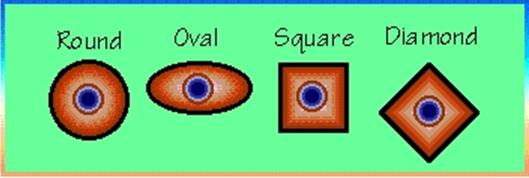
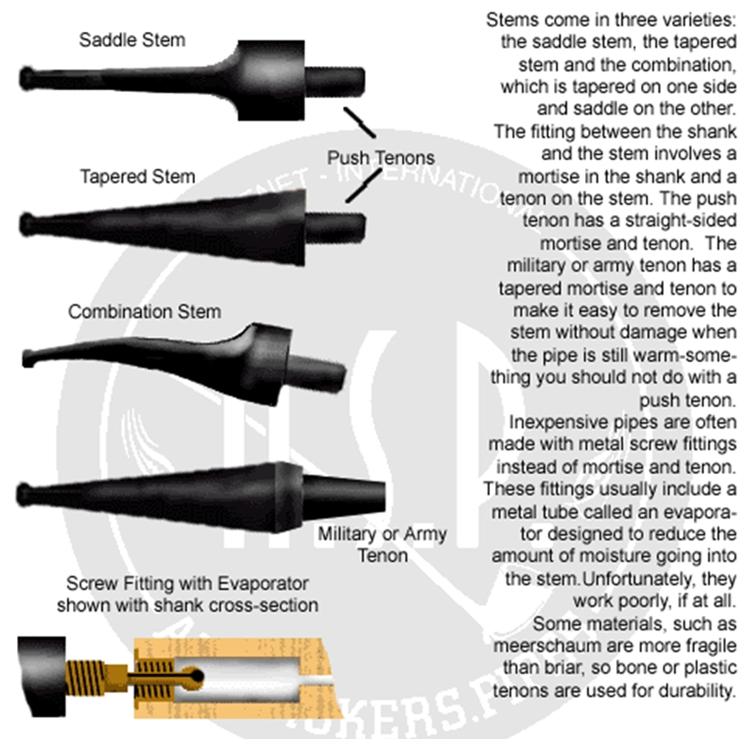
There are three basic stem shapes SADDLE, TAPER AND COMBINATION. The MILITARY OR STICK BIT stem is a variation of one of the other three. The stems can either be straight or bent according to the shape of the pipe. Each stem shape also has variations on the theme – gentle taper, fat taper, long taper, thin taper etc. Same with the saddle there are variations on the saddle – 1/2 saddle, full saddle, etc. Both of these also come in geometric shapes Diamond, Triangle, Square, Round and Oval.
Stem1

The stick bits or military also come in the same shapes though the taper is fairly standard. Add to the confusion regarding bits, the Peterson faux military or stick bits which have a tapered tenon that fits the shank and the various freehand stems that have unique shapes and you get the picture.
Stem2

Tenons are either push style or threaded. The push style can be integral to the stem or can be a Delrin insert. Both hold the shank by friction. I personally find the push tenon more to my liking than the metal or bone threaded tenon. The threaded tenon is screwed into the matching threads in the shank of the pipe. In both the bone and the metal versions these are often over or under turned in estate pipes. Generally, heating the tenon allows the tenon to be readjusted to fit properly.

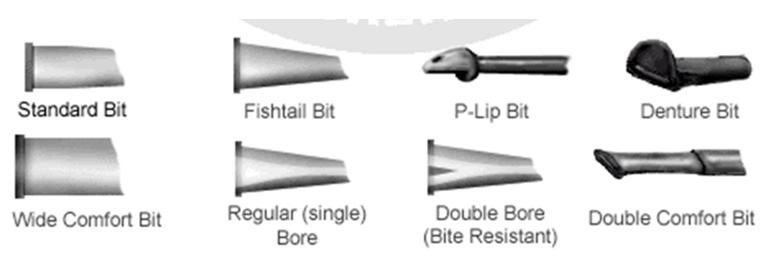
The shape of the bit from the button forward is also varied. I was able to find the following picture that spells out the various shapes of the bits. There are basically five bit shapes that also have variations in their form according to the pipe maker or manufacturer. These are the standard straight bit, fishtail bit, p-lip bit, denture bit, wide comfort bit and the double comfort bit (stepped bit that was developed by Charatan). The bore on the bits is generally a single bore as pictured below. But the double bore or twin bore was also developed to make a bit more bite resistant.
Stem3

The slot or airway in the button also has three variations – the circle or orific hole, the straight slot and the oval. The descriptions are pretty clear from the names of the airway or slot. The orific or circle is exactly as it sounds. It is generally used on older pipe stems – both meerschaum and briar. I have found it on pipes from the 1800’s and early 1900’s. The oval and straight slots are similar. The oval is a reworked and opened slot. The oval gives the opening a wider more open draw.

It would be great to hear if others of you who read this have further explanations that add clarity to the discussion. Please feel free to post a comment to this regard.

The Versatile Dremel Tool


Throughout various articles on the blog I have mentioned the use of the Dremel Tool in my refurbishing and carving of pipes. I thought it would be helpful to write a bit about the ones that I use regularly and refer to often.

I have two Dremels that I use for working on pipes for repair and those I have carved. The first one is a relatively new one that my girls gave me for Christmas last year. It is pictured below and is a MultiPro. It is a variable speed precision handheld rotary tool with ball-bearing motor that drives a wide variety of bits at any speed from 5,000 to 35,000 RPM. The Model 395 Multi-Pro tool came with an assortment of accessories that are pictured below – sanding drums, grinding stones, sanding and cutting disks and polishing disks, a drill bit. The tool itself has carbon motor brush set; keyless chuck, wrench, quick-change collet nut and a Windowed organizer case.
dremel1

dremel2

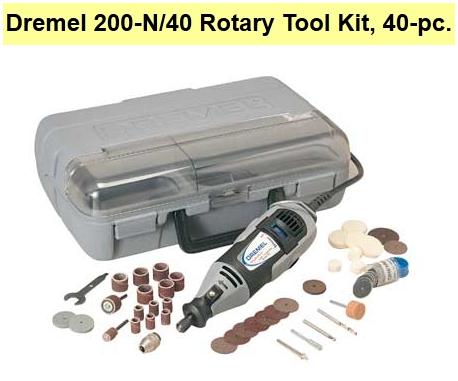
My second Dremel is the one pictured above. I have had this one for over 10 years and it has been trouble free since I purchased it. It has seen a lot of work on stems and briar. I have had to clean out the brushes and opening with an air gun several times over the course of the years but it has become and old standby. It is a Dremel MultiPro 200-N/40 Rotary Tool. It came with a full kit like the first Dremel but includes a few more accessories as listed below.

Kit Accessories:
• Drill Bit
• High speed cutter
• Mandrel
• Coarse 1/2″ sanding drum
• Coarse 1/2″ sanding band (3)
• Emery cut-off wheel (5)
• Coarse sanding discs (36)
• Small felt wheel (4)
• Heavy duty emery cut-off wheel (3)
• Emery wheel (2)
• Fiberglass cut-off wheel
• Large felt wheel
• Coarse 1/4″ sanding drum
• Coarse 1/4″ sanding band (3)
• Fine 1/2″ sanding band (3)
• Fine 1/4″ sanding band
• Aluminum oxide wheel
• Aluminum oxide stone

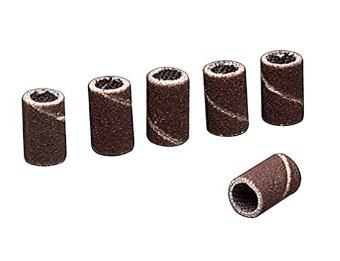
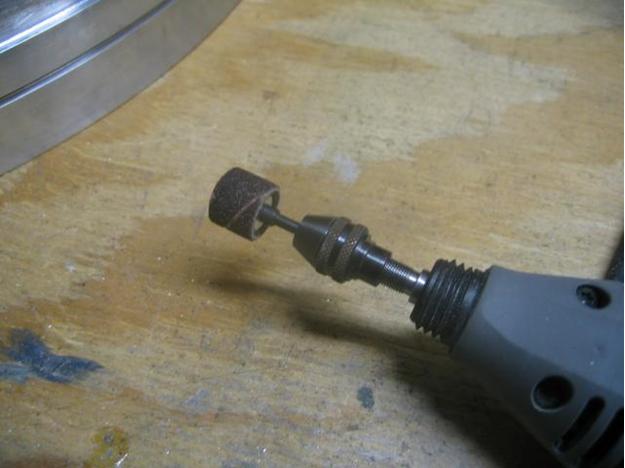
I use many of the accessories in a variety of ways. The one that use the most is the sanding drums like the ones pictured below and on the picture of the Dremel with the sanding drum attached. I have found that in my restoration work I use the sanding drum for shaping a stem and adjusting the diameter of the stem at the shank junction. It takes a steady hand to not nick the shank of the pipe but the tool really makes short work of removing excess vulcanite or Lucite material. I also use it on a low speed to sand out the bowl and remove excess cake. I insert the drum into the bowl before turning it on and then adjust to a low speed on the Dremel to slowly sand away excess cake or smooth out existing cake. It does not work in the heel of the bowl and that work must be done with a reamer or a piece of dowel and sandpaper.
dremel3

I also use the sanding drums when carving briar pipe kits or shaping a drilled block of briar. It quickly and easily removes excess briar and is very maneuverable in shaping the angle and curves of the block into the shape of the pipe I am carving. The sanding drums come in two sizes. The one pictured below is the one I use the most in both refurbishing and carving. It is ½ inch in diameter. The smaller size is half the diameter (1/4 inch) and comes with its own head for holding the sanding drum. I find that I use it when working on more detailed work in refurbishing or shaping a stem. In carving I use it for the bowl shank union.
dremel4

I know others hang the Dremel from a stand and use a long flexible shaft attachment to carve and shape briar and stems. I have not found that I need a flex shaft though I have one in my tool box. I like the up close control of the tool as it is. It is probably a matter of what I have grown accustomed to in my work. I have also had competitor models and lower priced models over the years but have come back to the Dremel as it outlasts all the competition. I believe I have burned through at least two other rotary tools made in China and found that the brushes and motors just do not last for long. They are also very noisy to use in comparison to the Dremel.

Eavesdropping on a Conversation on Manzanita and Mountain Laurel Pipes – Robert Perkins & Mike Leverette


Over the years I have kept this interchange between Robert Perkins and Mike Leverette on my hard drive on the computer. I found it enjoyable and educational at the same time. I wrote Robert and asked for permission to pass this interchange on to readers of this blog. Robert Perkins is a pipe maker http://www.RMPerkins.com and Mike Leverette was a friend and mentor to me with regard to the pipe and its history. There is not a day that goes by that I do not think of Mike and wish I could give him a call.

Here is the interchange between them:

Robert Perkins

You see, when imported briar started getting scarce during WWII, US pipemakers started looking for alternatives, and they were basically split into two camps: those who started using manzanita and those who started using mountain laurel.

Ever hear of a pipemaker called Breezewood? Well, Breezewood was one of the companies using mountain laurel as a substitute for Mediterranean briar, just like Monterey Pipes was one of the companies using manzanita, or “Mission Briar”.

ImageImage

Breezewood quietly closed its doors after the war because, as it turns out, all parts of the mountain laurel (Important: Not Manzanita) are “dangerously poisonous“.

Mountain laurel contains a powerful neurotoxin that, when ingested, causes convulsions, paralysis, and death within a matter of about six hours.

And somewhere along the way — I’m guessing way too late in the game for some — folks using mountain laurel as a substitute for Mediterranean briar figured this out.

I’m just gonna bet money that people started getting sick, maybe even dying: people growing and harvesting mountain laurel, people in pipe factories breathing all that mountain laurel dust, and possibly even folks who smoked those mountain laurel pipes, later on down the line.

People caught on. Maybe there were even some items in the news. And suddenly US pipemakers couldn’t put enough distance between themselves and mountain laurel pipe production fast enough.

The phrase “Imported Briar” became all the rage, and never again did US pipemakers attempt to grow or harvest briar — any kind of briar — ever again.

Just for the sake of reference, though, I should point out that nearly every single product on the market, right up until the 70s contained lead, asbestos, and so on. Heck, doctors used to put mercury thermometers in our mouths and not think a thing about it. A lot of this stuff, we just didn’t know any better.

But anyway, manzanita got caught up in all of this mess. It’s not poisonous, and it makes a fine smoking pipe, but who would want to take the risk, after that mountain laurel fiasco, huh?

You see, it’s kinda like mushrooms and toadstools. Nobody wants to pick mushrooms when there’s the significant risk that you might pick a few toadstools by mistake.

Why not just make soup and let other people worry about which one is a mushroom and which one is a toadstool?

Something like that, anyway.

So, just to recap, here:
* mountain laurel is poisonous;
* manzanita is NOT poisonous (somehow I feel like I am not emphasizing that enough)
* and after the war, the use of manzanita briar ended and the phrase “Imported Briar” became popular because US pipemakers had to disassociate themselves from the wartime practice of using mountain laurel as a substitute for Mediterranean briar.

So what do you think? Does that sound plausible?

And where is my deerstalker hat and my calabash pipe? I think I deserve a smoke.

Mike Leverette replied

Robert, my take on this subject is:

When briar was first used for pipes, everyone heralded it as the ultimate pipe wood and actually went wild over briar. In less than ten years from the first English maker to use briar, there were over a dozen briar pipe makers in London alone and all exclaiming the virtues of briar. Even the great salesman, Alfred Dunhill, exclaimed over the properties briar. So I believe everyone has, more or less, become brainwashed that briar is the only wood worth using for pipes. Surely, it is a great wood for pipes which I cannot say anything against but there are other great woods out there as well. We have been told many times over the past decade or so that briar is best for pipe making because it is A) ‘fire resistant,’ it is B) ‘very hard wood,’ it has C) ‘extremely tight grain,’ etc.

A) “Fire Resistant” – briar is wood and wood burns; there is no ‘fire resistance’ to it!
B) “Very hard wood” – yes it is hard, yet there are many woods out there which are harder per any hardness scale one wishes to use.
C) “Extremely tight grain” – again I agree. Briar has some tight grain, interesting grain and even beautiful grain. Yet there are woods out there with just as beautiful grain as briar.

The two alternative woods mentioned in this topic, manzanita and mountain laurel have been used for centuries, first by the American Indian and then the pioneers. Mountain Laurel was a favorite pipe making wood of soldiers on both sides during the War of Northern Aggression. Yes, before you ask, there were more wood pipes smoked in that war than clay pipes. Actually, the soldiers would make pipes from any wood handy but preferred mountain laurel. I am sure that the local population were using briar long before the fabled pilgrimage to Napoleon’s place of captivity, or was it his birth place? A very interesting article on pipes of other woods is Ben Rapaport’s article “Un-Briars: The Antecedents of Erica Arborea,” Spring 2001 issue of “Pipes and Tobaccos” in which Ben lists 29 different woods used for pipe making through the centuries.

Anyway, to stop preaching and return to the topic, brainwashed is too harsh a word for here but we have been treated to literature, word-of-mouth, etc about briar being the best and only wood for pipes to the point that immediately after WWII, everyone hasten to get briar pipes back on the market; hence forgetting about the two war-time substitutes.

Then again – – –
I wrote the above two days ago while waiting to be activated. During this time I have heard another pipe smoker state that he thought the pipes made from the two alternative woods, manzanita and mountain laurel, were placed into production so fast (because of the sudden stoppage in briar supply) that they were not cured properly which led to pipe smokers having problems with the pipes made from these woods. Therefore, the pipe smoking community of that day wished only for the imported briar after the war. This also makes a lot of sense!

_________________
Happy Puffing
Mike

Savinelli Autograph & Sherlock Restorations (3 & 4 of the Four Pipe group)


Back in September, I documented the restoration of two pipes in a four pipe set belonging to a friend in Ohio.  (Charatan Shape 44 and London Billiard)  Steve reminded me that I hadn’t submitted the final two pipes of that group.

The third pipe was this lovely Savinelli Autograph.  To this point, I had never seen an Autograph model in person and I was very impressed with the pipe.  As with the others in my friends group, this was also a very large pipe.

Here is the pipe as it was delivered to me.

This one definitely felt like a hand-made pipe.  The stem is wonderful and feels good in the hand, so I bet she’s a wonderful smoker.  In this group of pipes, this Autograph was the one least abused. The finish was a little grimy.  Removing the tar build up on the bowl top took some rubbing with first isopropyl  alcohol on a rag.  But, once removed, a beautiful birdseye top was revealed.  The bowl was buffed lightly with Tripoli, than white diamond and finished with several coats of carnuba

The stem took the usual steps and was deeply oxidized with some teeth chatter. I soaked the stem in an oxyclean solution for several hours with a dab of grease over the logo. I was able to preserve Gincarlo Savinelli’s stamp nicely. I sanded the stem (on the pipe) first with 1500 grit and then 2000 grit wet paper.  Next I buffed the stem with the final two grades of micromesh (8000 and 12000).  The stem was then polished on the buffer, with white diamond and then plastic polish.

I learned that Savinelli used vulcanite for the Autograph stem prior to 1982, when they switched to acrylic and 6 mm filters. I believe these pipes came from Smokers Haven in Ohio in the mid 70’s as my friends father lived in this area.

I didn’t weigh the pipe, but estimate it was approximately 90 grams.

Here is the finished pipe.  After handling this pipe, I would one day love to add a vulcanite stemmed Autograph to my collection.

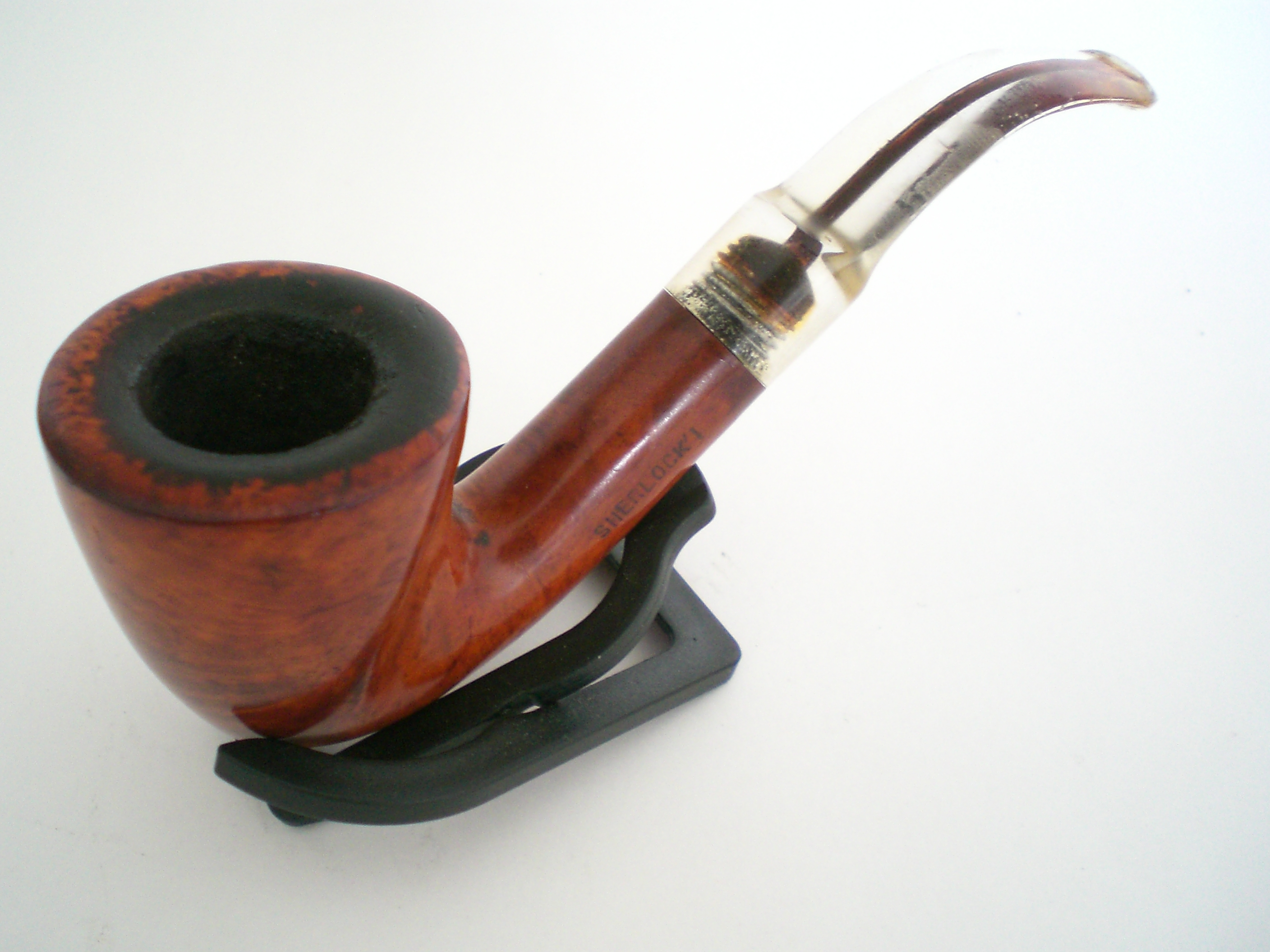
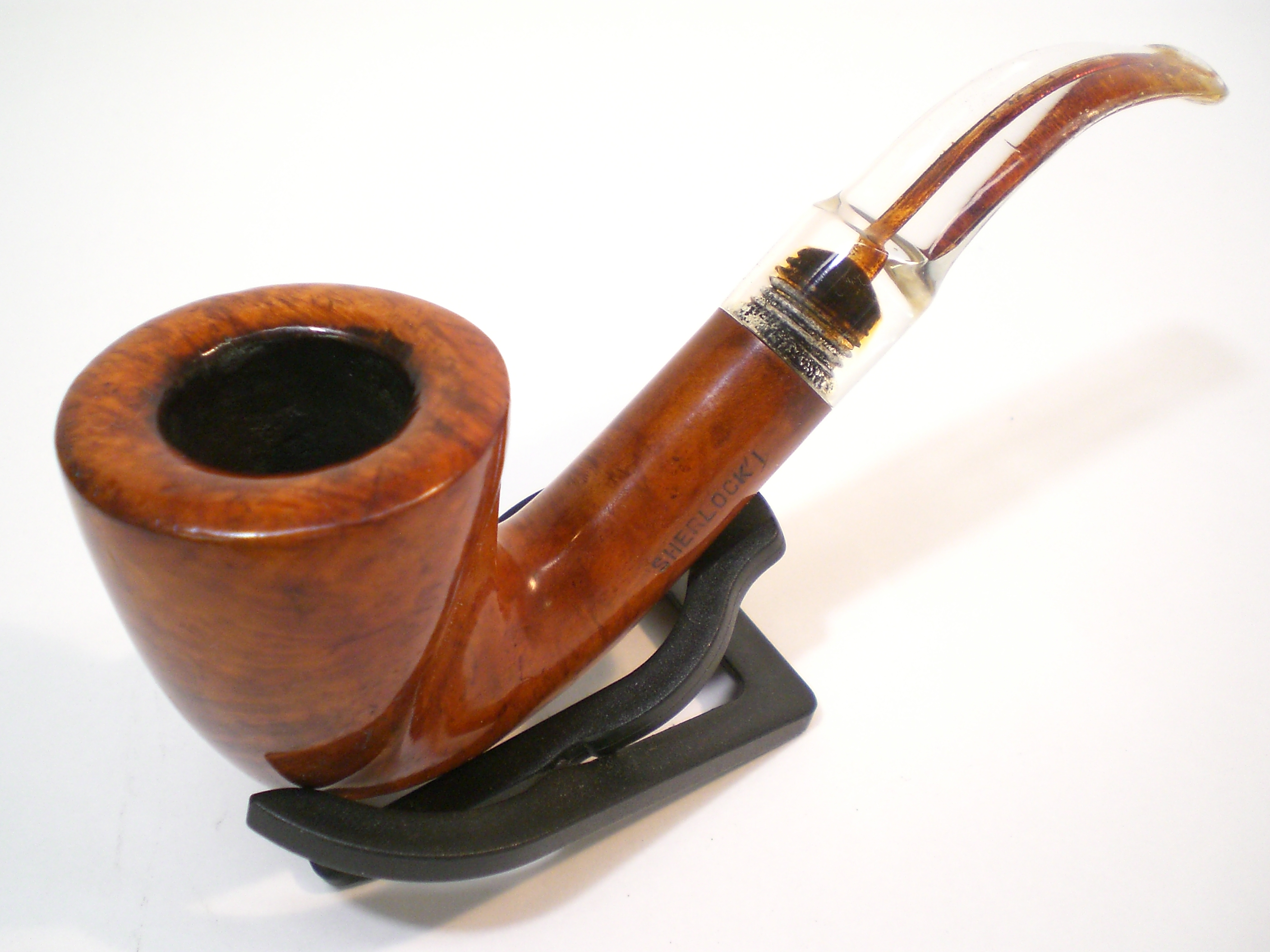
The last pipe in the group was another large pipe, stamped simply “Sherlock”and “Made in Italy”. This one had a perspex stem, that had some stubborn staining but no teeth chatter. I removed a good bit but not all of the stain in the perspex. I use a bristle cleaner soaked in 90% isopropyl alcohol.  You must run a dry cleaner thru the perspex next to remove the alcohol which could fog the clear plastic.  The briar has a lovely golden glow with some faceted features on the bowl (ala Willmer?). I’m not familiar with this brand, but the briar is beautiful. The tars on top came off, just leaving a light scorch mark on the inner bowl rim.   I estimated this pipe weighed approximately 80 grams.


Here is a shot of all four finished pipes.


I also add pictures of these two GBD pipes, both Colossus models as they came from this estate and were gifted to me by this gentleman.  Both are treasured and enjoyed pipes in my collection and I was very happy to restore these other four for my friend.

GBD Seventy-Six Colossus, Shape 9676.

Prehistoric Oom-Paul Colossus:

As you can see, the gentleman who owned all six of these pipes had an affinity for large briar pipes!


Making a Rustication Tool out of a Phillips Screwdriver


Blog by Steve Laug

I have made several rustication tools from screwdrivers in my tool box. It is a pretty simple process so I thought I would document it through text and pictures. Hopefully some of you will find this useful.

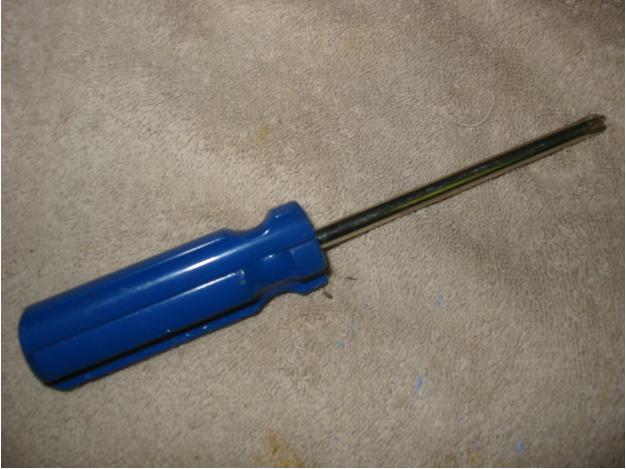
I start with a regular Phillips screwdriver which is a screwdriver with a blunted pointed tip that is shaped to fit the crossed slots in the heads of Phillips screws. It is distinguished from a Reed and Prince screwdriver which has a pointed tip. The photos below show the tip of the screwdriver before I begin working on it.
rust1

Rust2

You can choose any kind of Phillips screwdriver or Reed Prince screwdriver but I would recommend one with a comfortable handle. The one I made in the photos below has a hard plastic handle and when I am pushing and turning it into the briar it is hard on the palm of my hand so I wrap it in a thick cotton cloth for cushioning. You may wish to use one with a softer rubber coated handle to begin with.
rust3

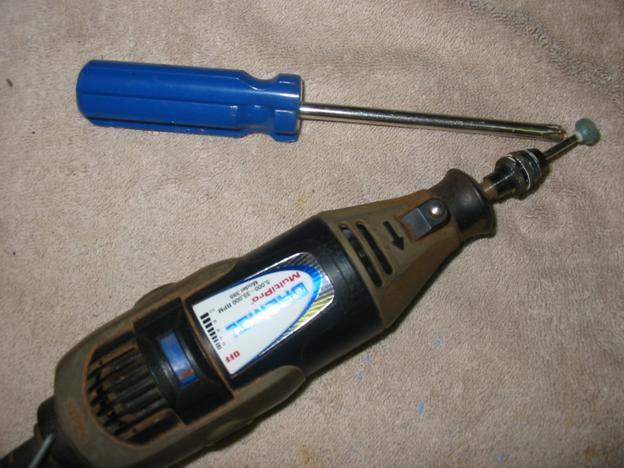
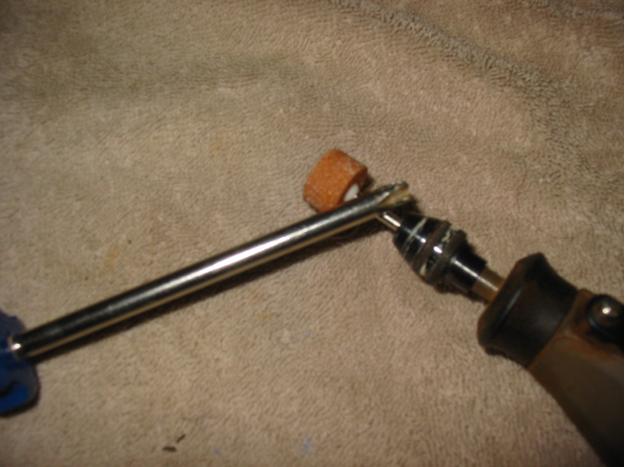
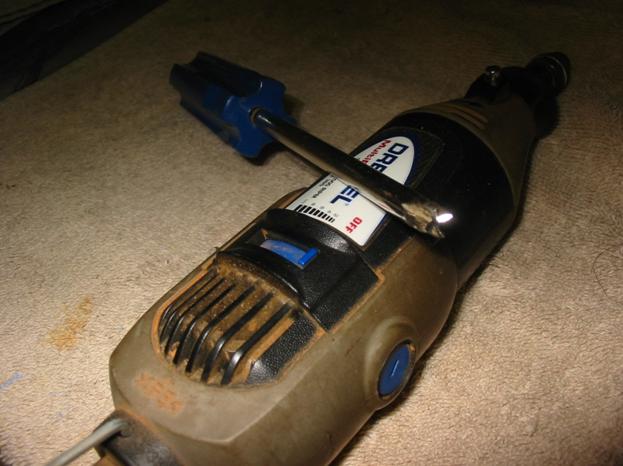
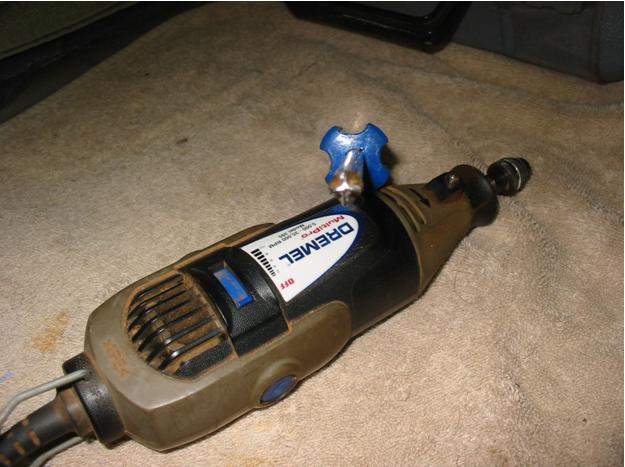
A Dremel makes short work of the shaping and cutting process in crafting this tool. I use several Dremel bits to do the grinding. The first is an 11/16 x 3/8 inch Blue Cobalt Grinding Stone with a 1/8 inch shank. It is 2 inches in length from shaft to tip. The second is a 19/32 x 11/32 inch Brown Aluminum Oxide Cylinder Grinding Stone with a 1/8 inch shank. It is 1 1/2 inches in length from shaft to tip. I finish by polishing it with a sanding drum on my Dremel.

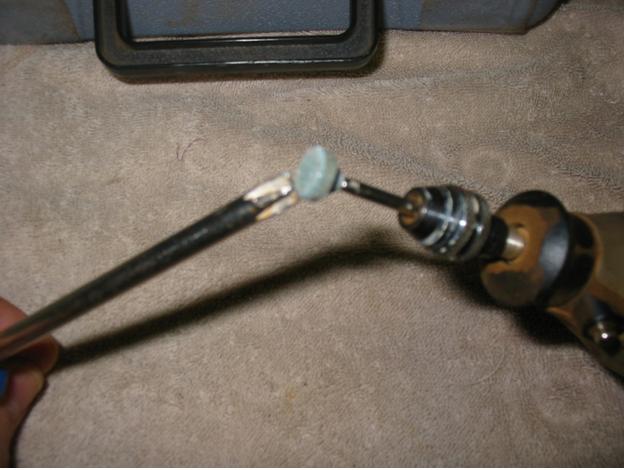
The next two photos show the Cobalt grinding stone on the Dremel and the work of cutting the tip off and then cutting into the grooves of the cross mark.
rust4

rust5

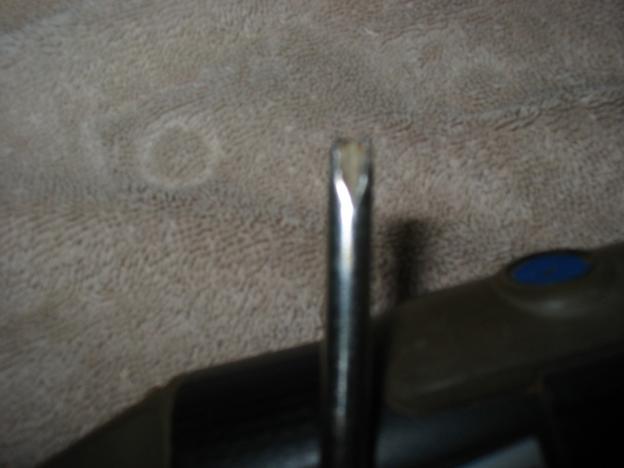
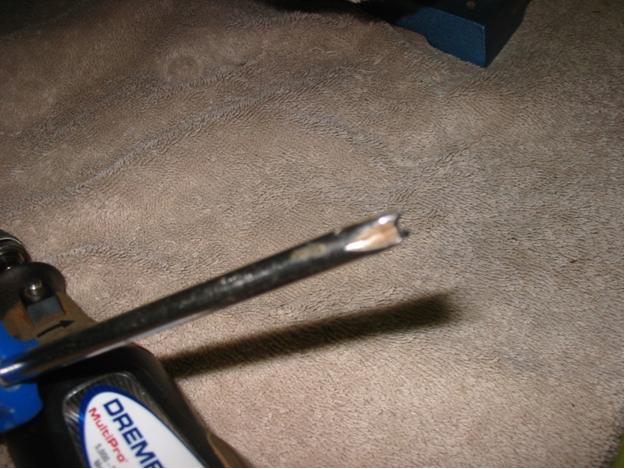
The next four photos show the finished work of the Cobalt grinding stone. I apologize for the poor quality of the photos but they give the idea of the process. The first photo show an end view of the four points beginning to be defined on the tip of the screwdriver. The next three photos show profile views of the tip at this point in the process. Once I get to this point it is time to change the grinding stone for the aluminum oxide stone.
rust6

rust7

rust8

rust9

The next photo shows the aluminum oxide grinding stone in the Dremel and the work ready to begin in grinding the tip to sharper and more defined points. I do this with the grinding stone held at an angle to the tip so that I can cut valleys into the cross point of the tip.
rust10

The next series of photos show the tip of the tool in its finished condition after the aluminum oxide stone has been used to cut the grooves deeply and define the points of the tool. At this point in the process I switch to the sanding drum and polish the tip and burnish the edges of the teeth.
rust11

rust12

rust13

The tool is finished and ready to be used to rusticate the surface of the briar. The method is quite simple. The tip of the tool is pressed into the surface of the briar and then twisted and turned as it cuts grooves and valleys into the briar. This is done over the entire surface of the pipe or in selected areas. The beauty of this tool is that is can be used in very tight areas of the surface such as the angle of the bowl and shank union. You can also work it carefully to leaves unmarked surface as you wish.

Kirsten Generation 1, 1.5, 2, 3


Blog by Dave Whitney and Steve Laug

I wrote Dave Whitney for permission to use his material in this post. He wrote back granting that permission and asked that I credit it as coming from OLD BRIAR by Dave Whitney. Thanks Dave for allowing this information to be posted here. What follows is taken from correspondence with Dave that later became the article in his book.

Over the years I have had several Kirsten pipes of different ages and different composition. I have always found it difficult to tell the difference between the various pipes in terms of their age. I have ordered replacement parts from Kirsten in Seattle and I have also cannibalized older ones that I have here that are not useable. From these I have traded and bought others. One of the early ones I had stumped me in terms of the markings and stampings on the barrel and the bowl. I wrote to a fellow on one of the online pipe forums (I now know that it was Dave Whitney as I have since found an article by him on Kirsten pipes that I have read and have written to him. I kept the information he gave me and finally got around to editing it and putting it on the blog.) My questions to him revolved around how to tell age of Kirsten I had in my hands.

He replied with the below information. I found it very helpful and have not found other places to get this info so I thought I would post it here for all to use. (Since writing this I have found that Dave has developed the material in his book Old Briar – it should be consulted for more information).

“Kirsten’s are fun to try and figure out, especially when trying to buy then on eBay. Years ago, when I first started, I finally got a hold of a fellow who “Restored” Kirsten’s for quite a long time. He taught me about the Generation system, and it immediately made life easier. I could ask the seller to take the pipe apart and tell me about the O-rings. I could even call the company and refer to the Generation parts I wanted, and at that time they knew exactly what I was asking for…the last time I called was three years ago, so who knows now. This is all from memory……”
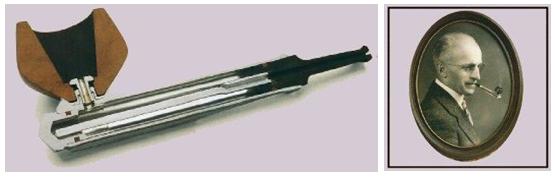
All Kirsten pipes are made up of five basic components – mouthpiece, radiator body or barrel, valve, bowl and bowl screw (a sixth component, the bowl ring, is found in many Kirstens. They were originally designed in 1936 by Professor Frederick Kirsten – the man who invented Boeing’s first wind tunnel – after he has been advised by his physician to stop smoking. Kirsten was looking for a way to trap the tars and moisture from tobacco and the Kirsten pipe was his solution.

Kirsten2

Generation 1 – 1936-1958
The wooden bowl on this generation connects directly to the metal barrel and there is no metal cup spacer. It is a pretty flush fit that goes flat against the barrel. On the underside of the metal barrel it is stamped with one or more of the following “Pat. Appl. For” (1936-38) and “Pats. & Pats. Pending” (1938-1958) over “Made in USA” – S” (or applicable size – S, M, L). There are no O-rings on the bit or metal shank insert. They came in the following models:

Straights

Companion First edition in rough finish.

S Standard 1st generation with full-length cooling fins

M Medium

L Large

A Aristocrat Extra large 1st generation

Generation 1.5 – transitional period – mid to late 50’s
This was an experimental stage. Kirsten realized that the bit and insert were prone to seizure as the condensate dried. This model always has O-rings on the metal insert, and later models can have O-rings on both. Same markings, as I remember it. There is no metal cup spacer under the bowl. This generation has O rings either on the valve or mouthpiece but no O rings on the other end. This transitional period is stamped “Pat. Pending” and “Pats. & Pats. Pending” some with “Made in U.S.A.  It seems like the company was using surplus parts to combine into this series of pipes. They came in the following models:

Straights

K Companion

M Medium

L Large

They came in a polished finish and later white Heritage finish. There were a few other Transition Models:

Thrifty – a nice early model with black offset valve that works in reverse. There is an O ring on valve but none on the stem

No Letter/No Name – This one is an unmarked short pipe with a different valve and O ring. There is not an O ring on stem

Generation 2 – 1958-1985
Markings on underside of metal shank “Made in USA XL” (or app. size) and “Pat. & Pats. Pending”. The presence of O rings on both the valve and the mouthpiece and the metal cup spacer under bowl are the biggest thing that separates the Generation 1 from the Generation 2 pipes. These O rings help provide a tighter seal when the stem and apparatus are inserted into the radiator stem. Instead of “O” rings, the machining of the Generation 1 pipes was so precise the fit was exact. This generation came in the following models:
Straights

K Companion

G Gem

S Sportsman

SX Sportsman Brass

M Mariner

MB Mariner Black

L Lancer

Quarter-Bents

A Aladdin

V Vagabond

CX Cavalier Brass

T Tyrolean

Full bents

W Westerner

B Beau Geste

P Premier

F Firesider

Generation 3 – 1985 to the present                                                                         

All current models stamped “Made in U.S.A.” and all have O rings on both the valve and stem. They come in the following models:

Straights

JX Jewel Brass

M Mariner

L Lancer

Quarter-Bents

RX Regent Brass

H Horizon

Full bents

EX Esquire Brass

DX Designer Brass

FOOTNOTE ON VARIATIONS IN LETTER DESIGNATIONS:  Generally speaking, the X added to a model letter like “S” stands for brass tone finish, i.e., “SX.” There is one exception to this: In the 1960s Kirsten made a brass tone model with an “Eternalum” finish that gave the brass tone an antiqued look. They were marked with a “X” designation following the model letter. The B added to a model letter like “M” stands for black finish, i.e., “MB.”

He ended his answer to the questions with this great note: “Now the fun part….this is how they came from the factory. What people did to them after they got them is what makes it an inexact science. Parts for the different sizes are not interchangeable, except for the bowls. I have a Gen 1 – M and -S…nothing interchanges but the bowls. If you get a Gen 1 that has been badly abused, you can end up losing either the bit or metal insert, or both, no matter what you do or how long you try.”

References used:

Whitney, Dave (2009) Old Briar – Pipe smoking on a budget. pipesbywhitney

http://www.kirstenpipe.com/