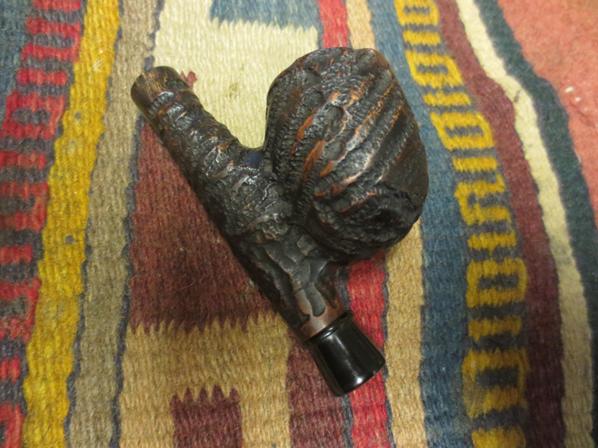
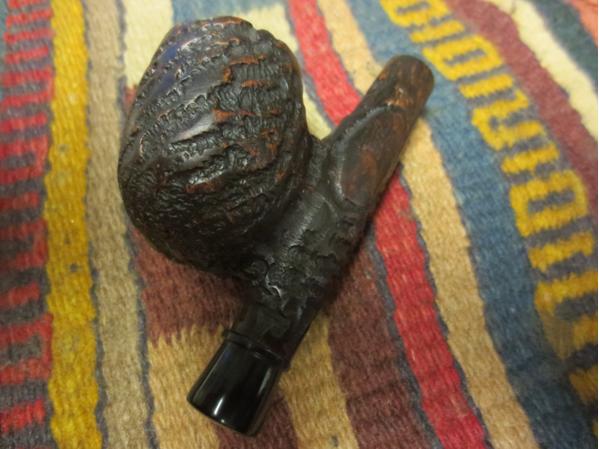
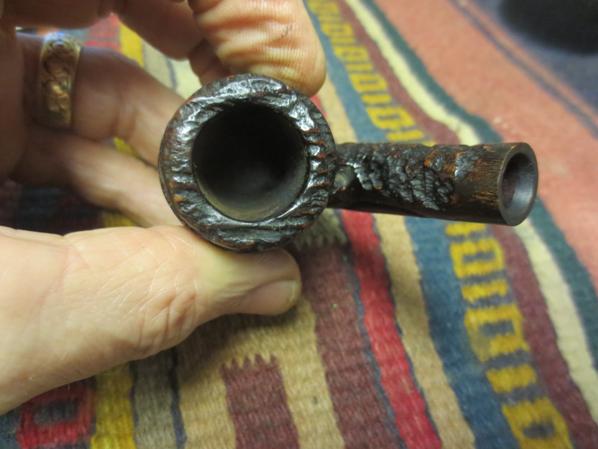
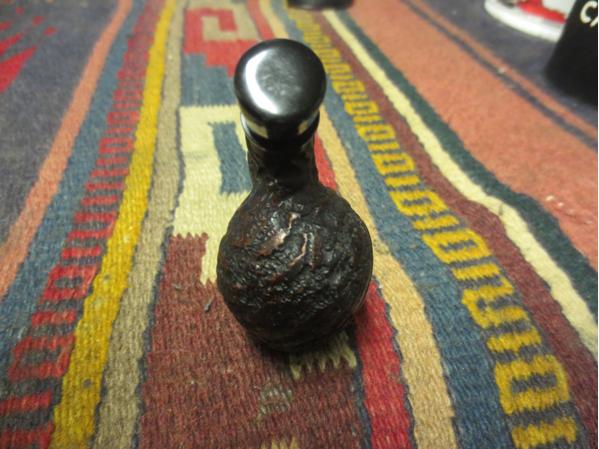
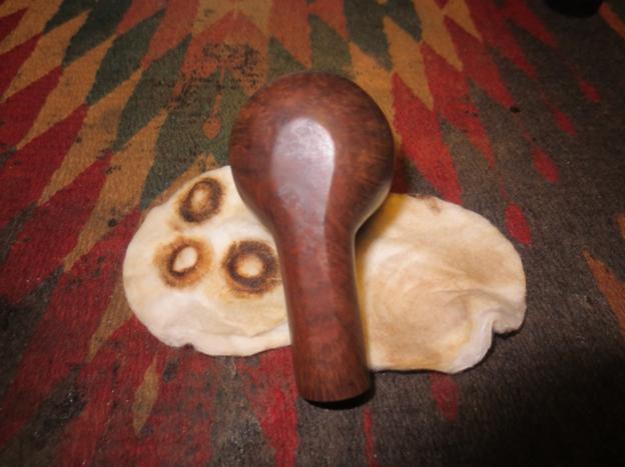
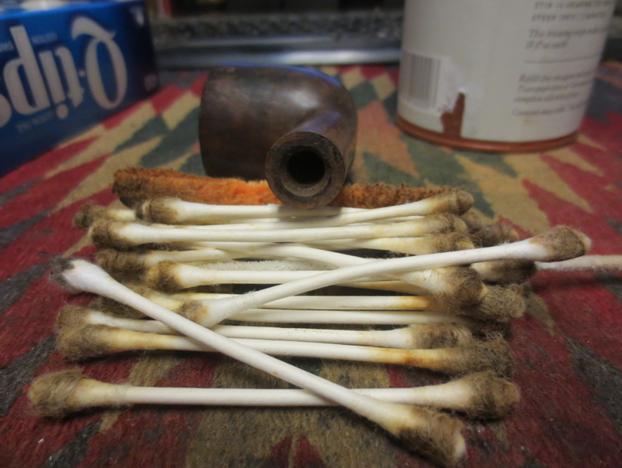
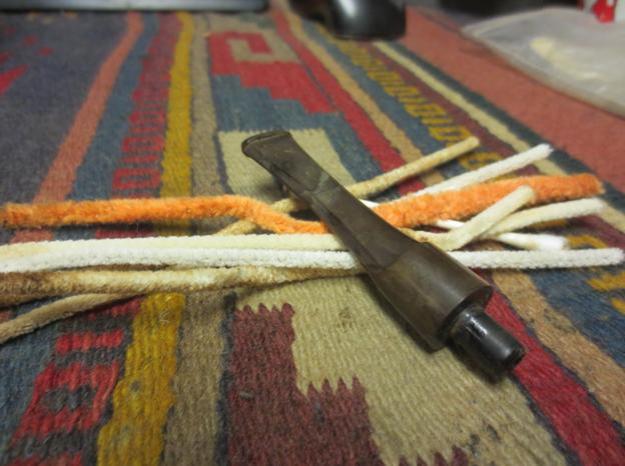
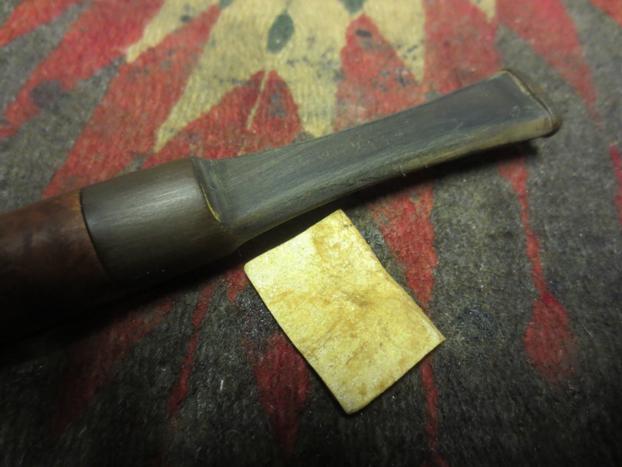
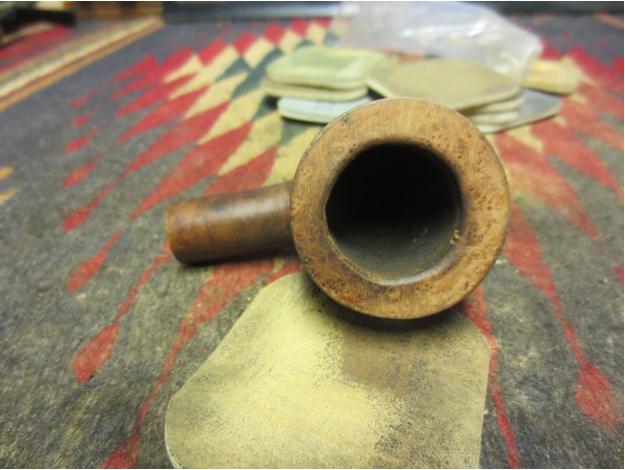
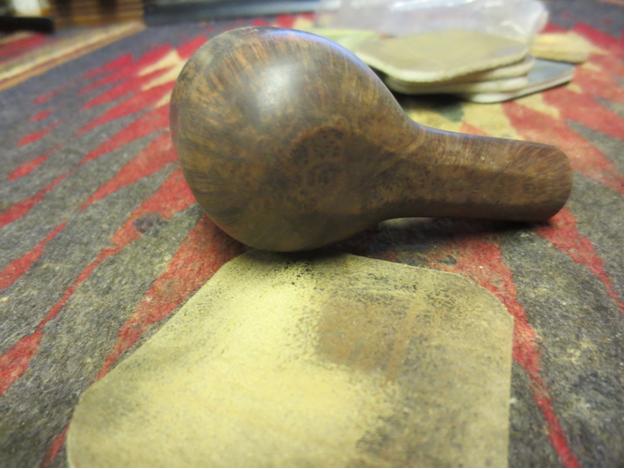
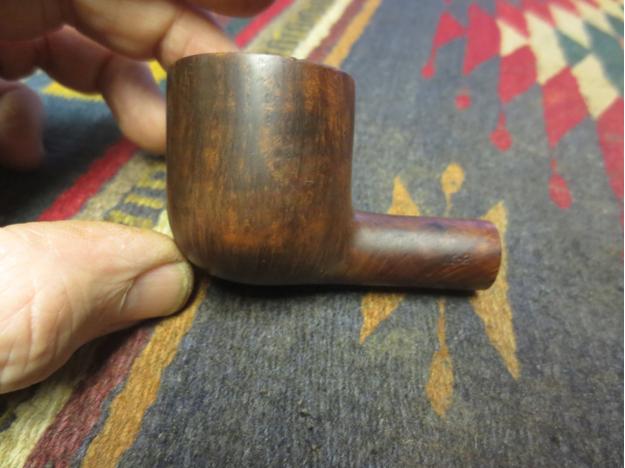
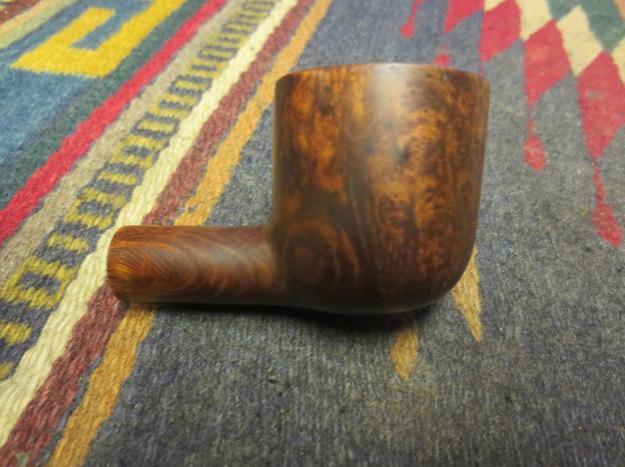
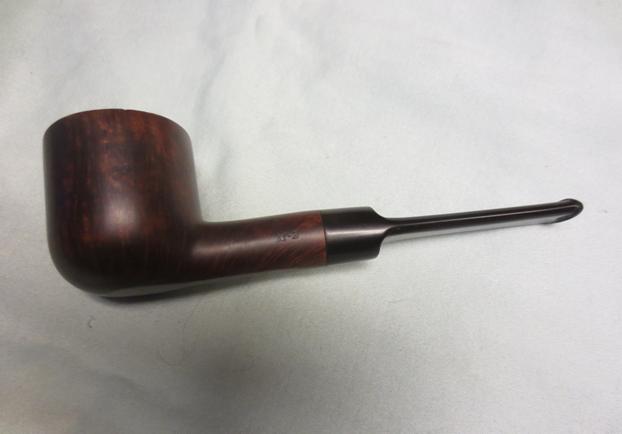
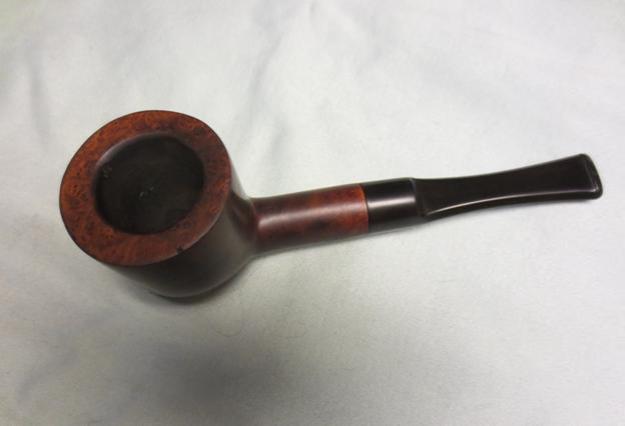
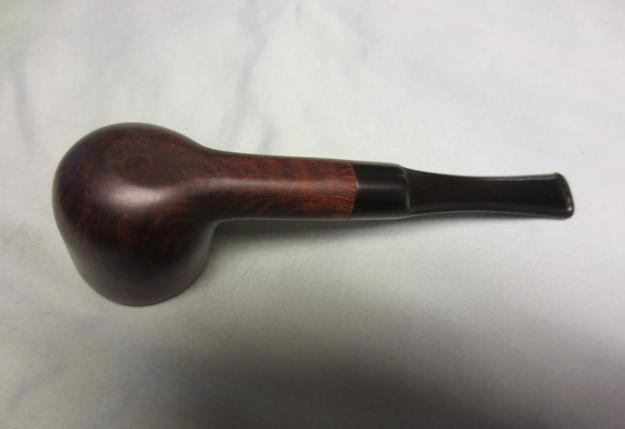
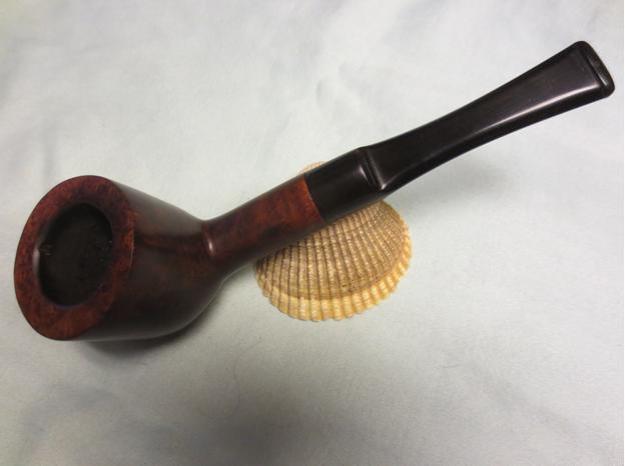
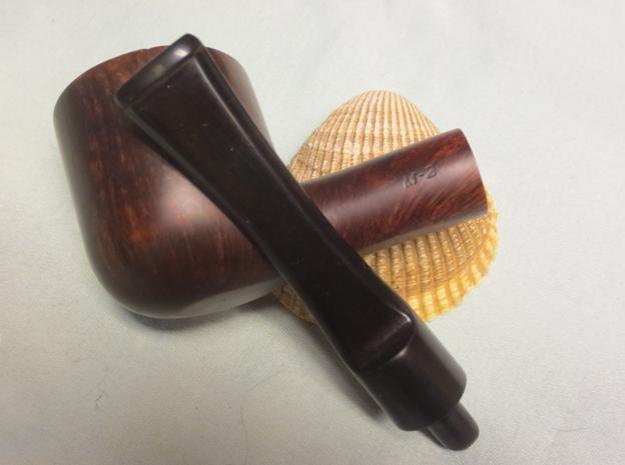
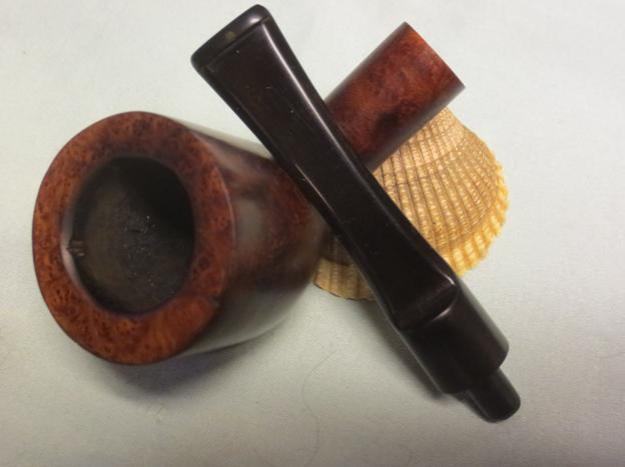
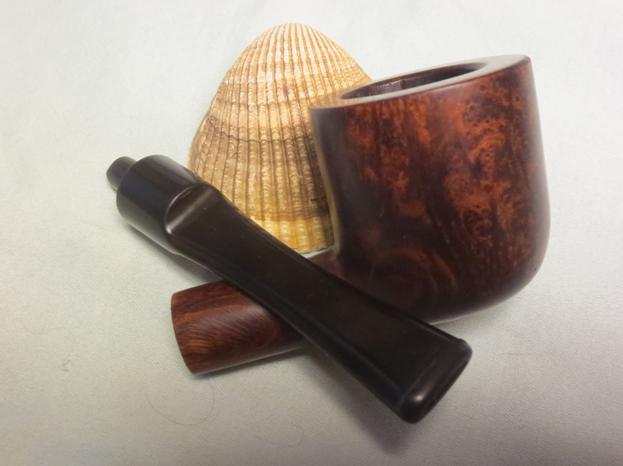
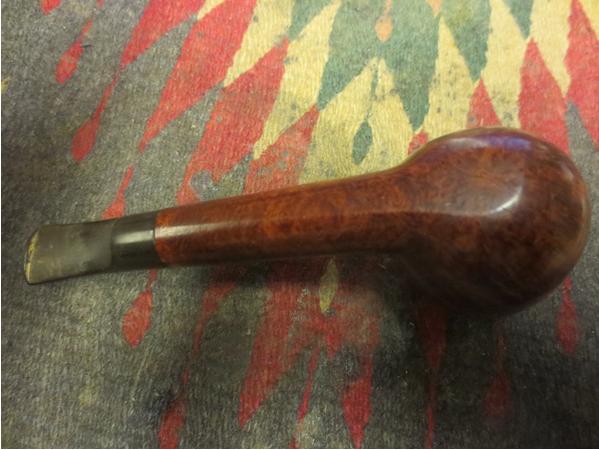
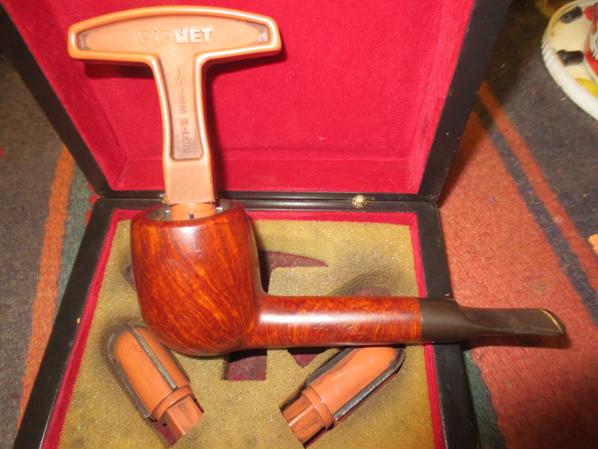
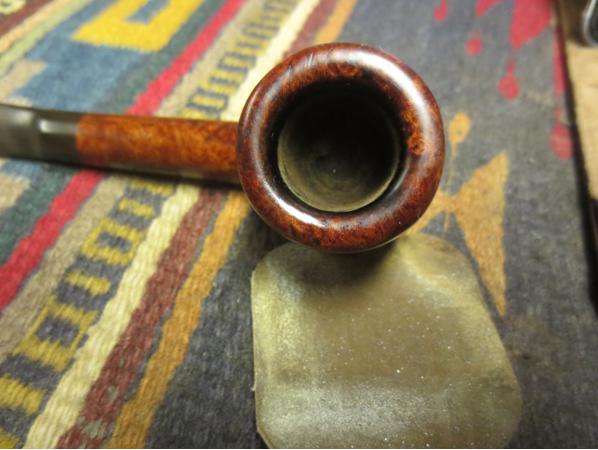
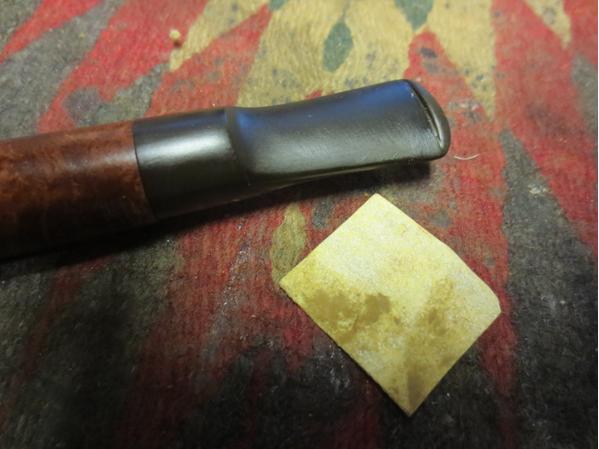
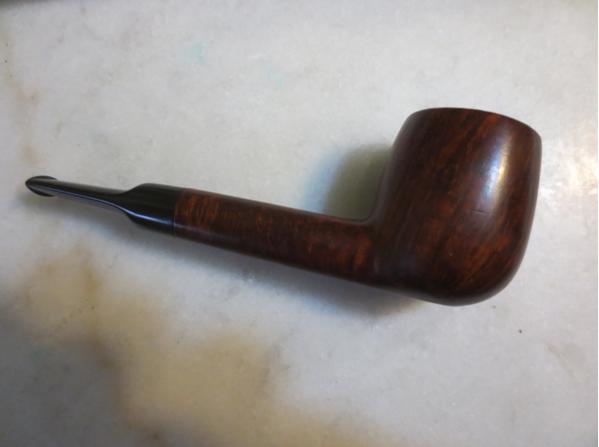
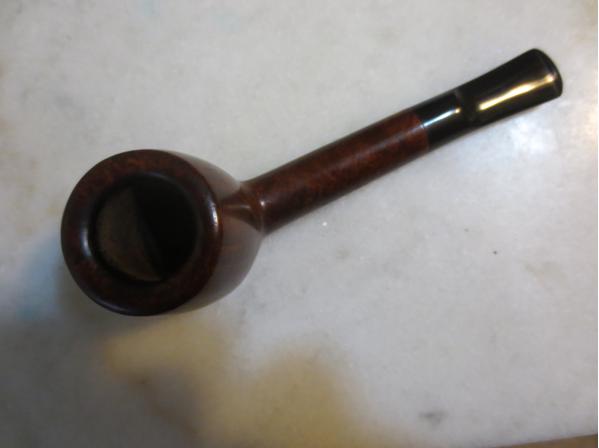
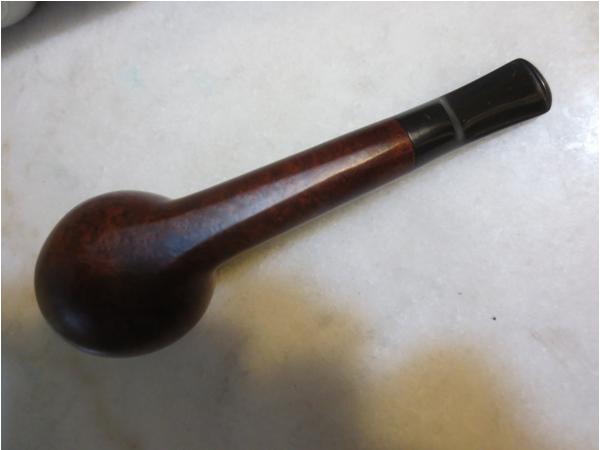
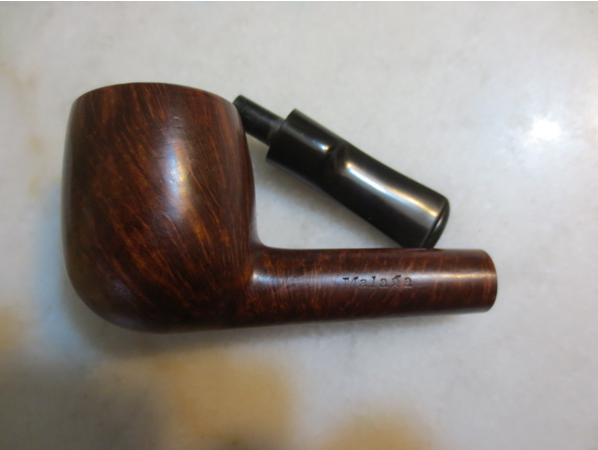
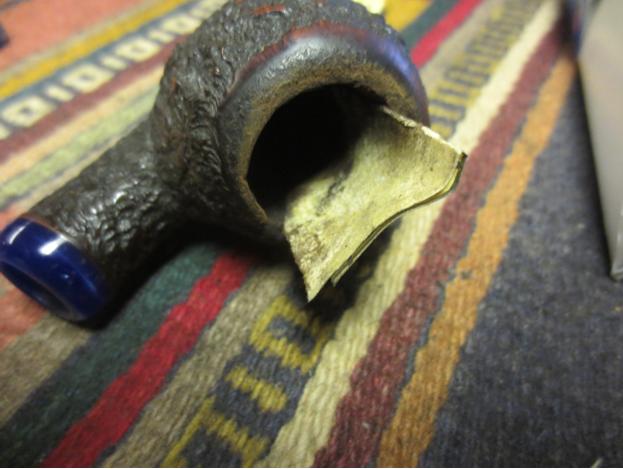
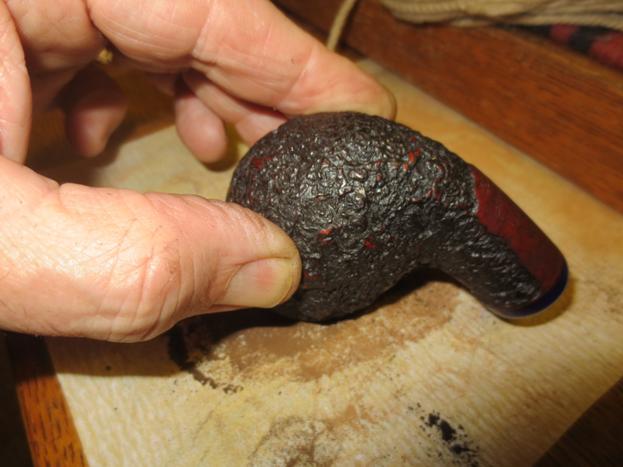
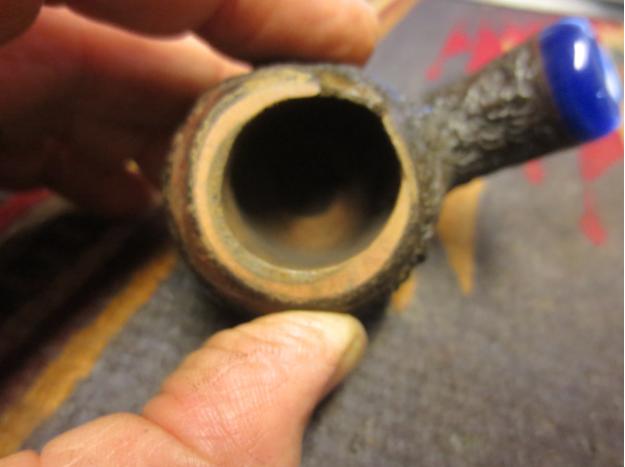
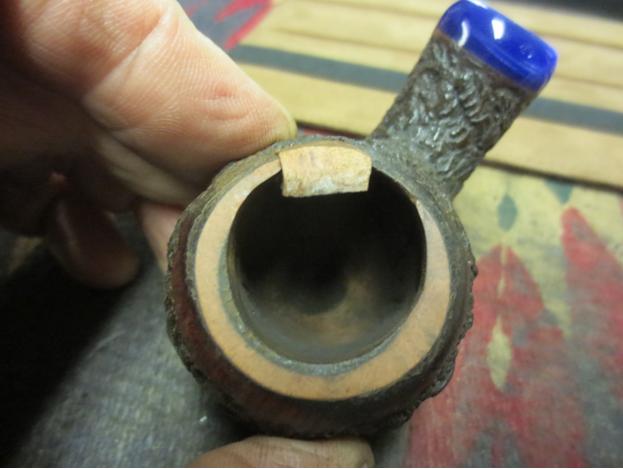
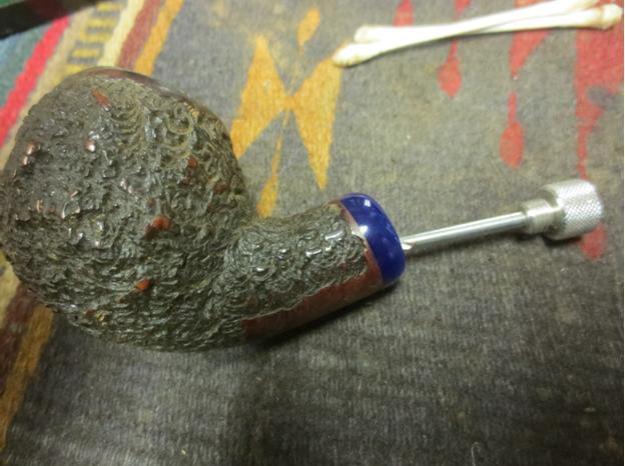
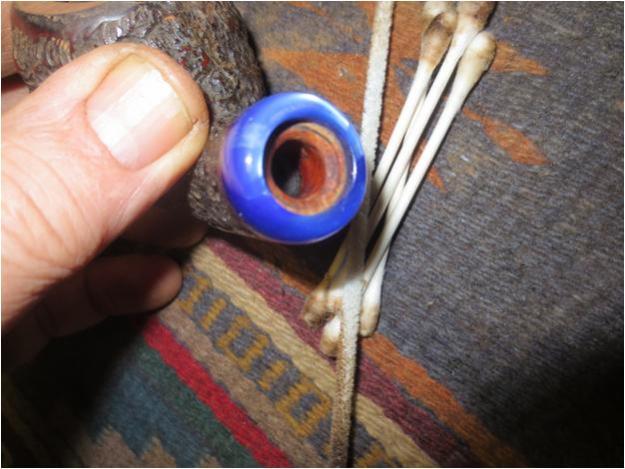
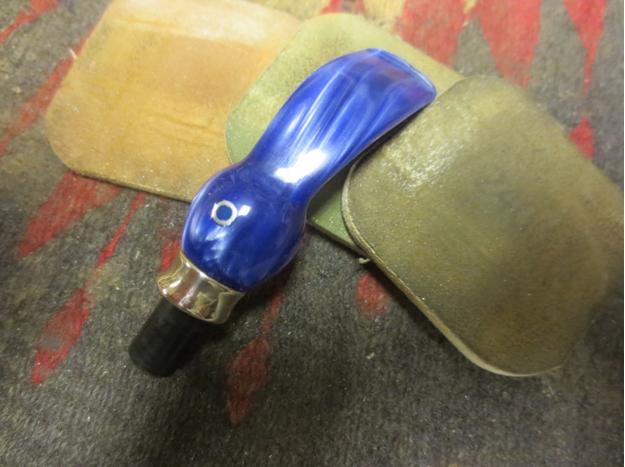
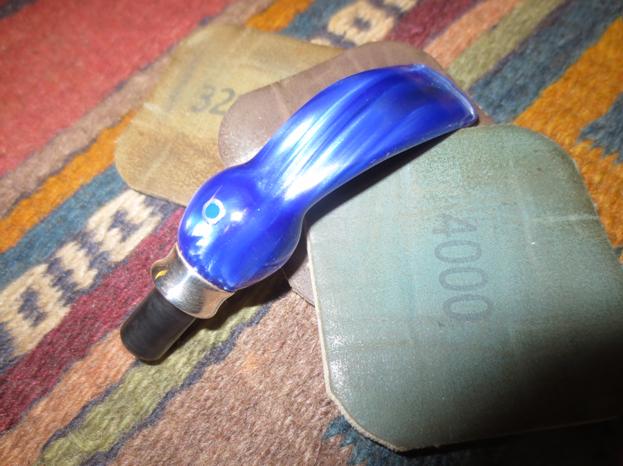
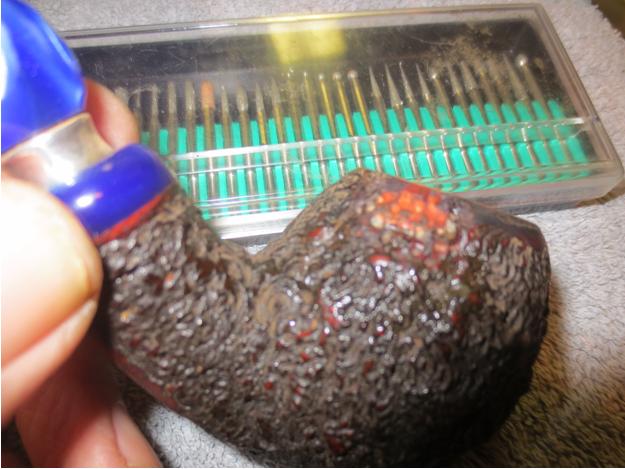
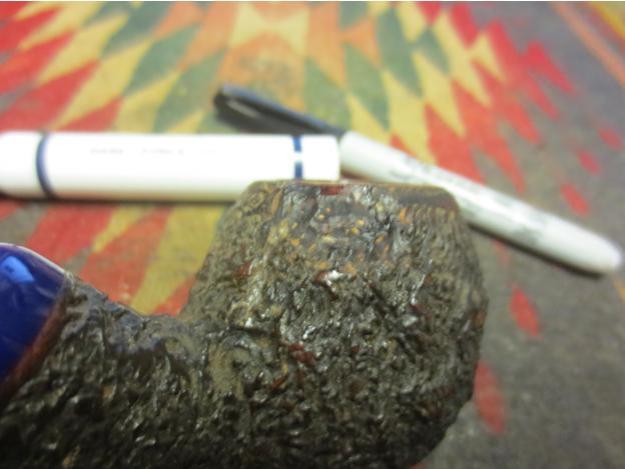
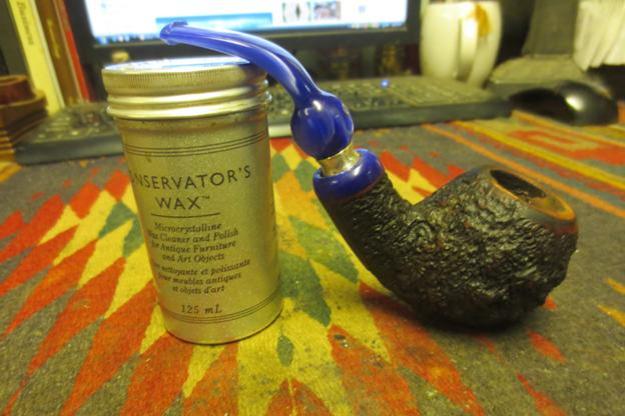
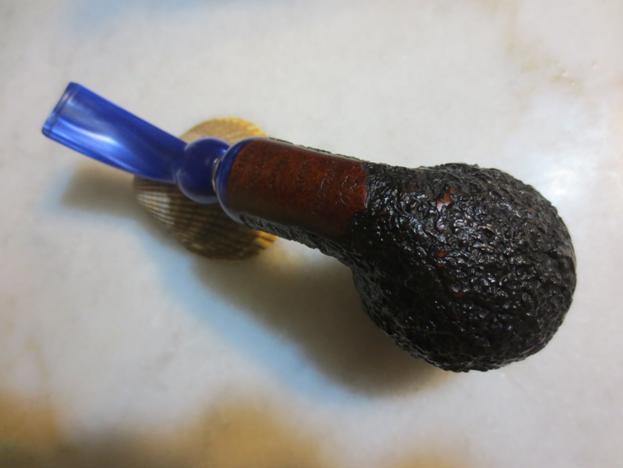
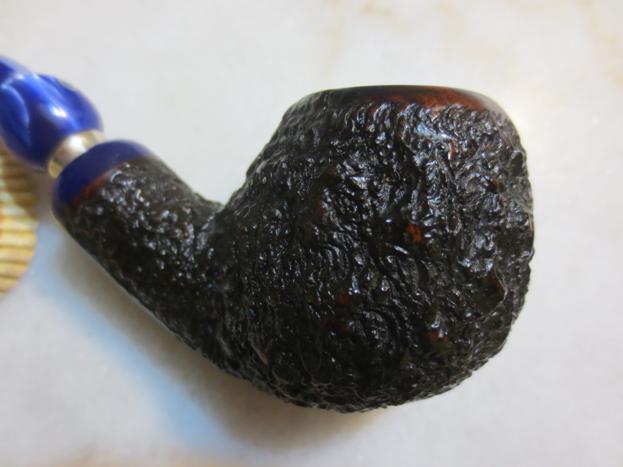
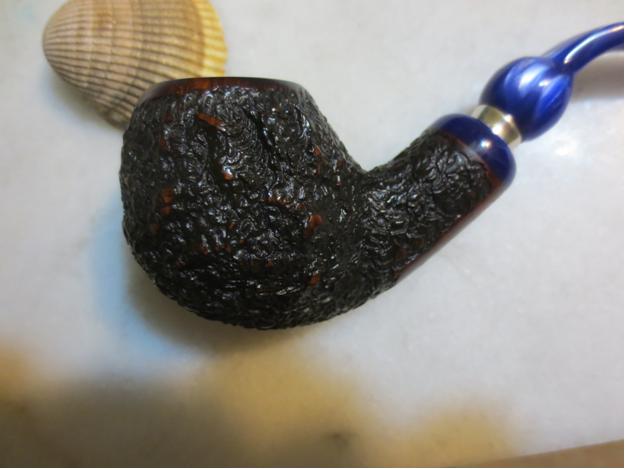
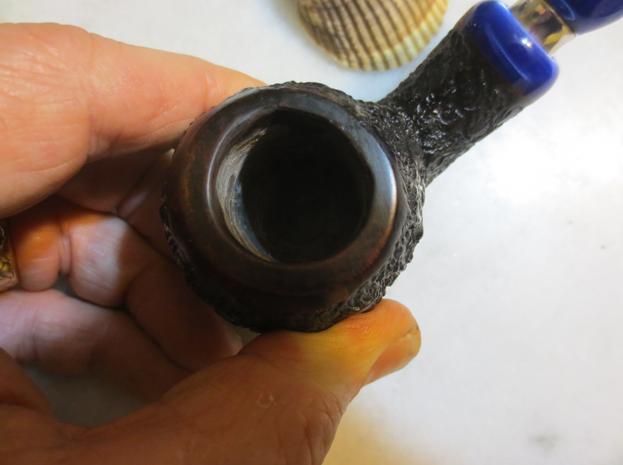
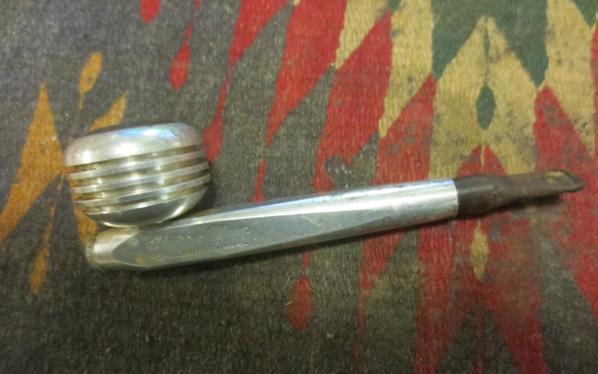
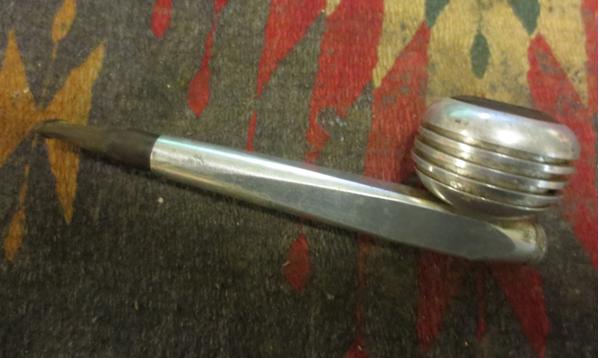
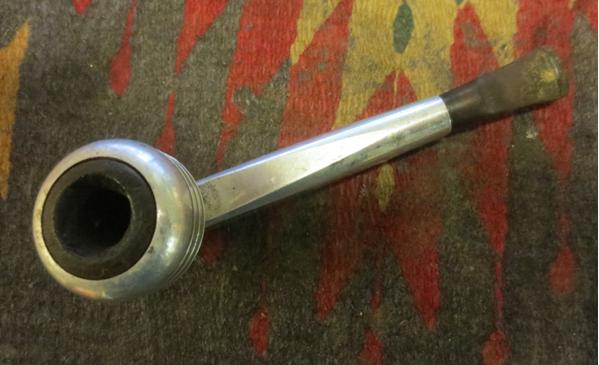
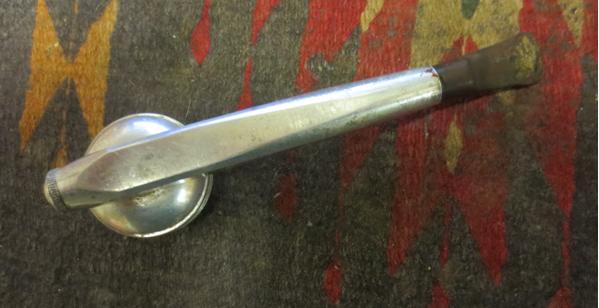
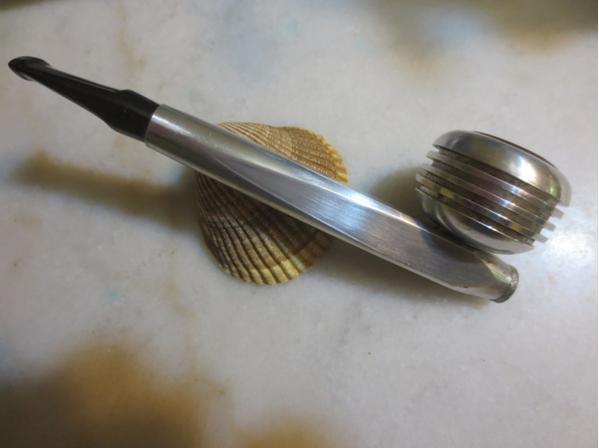
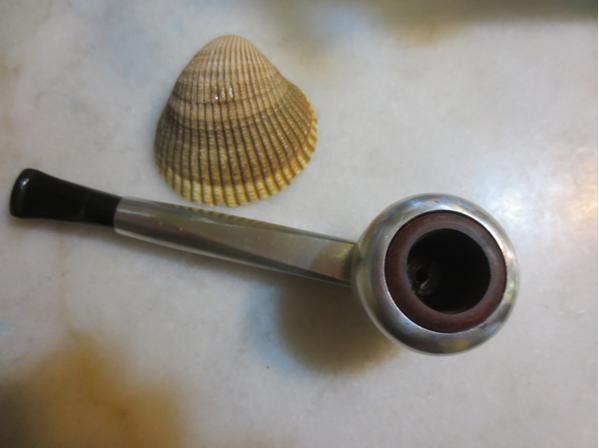
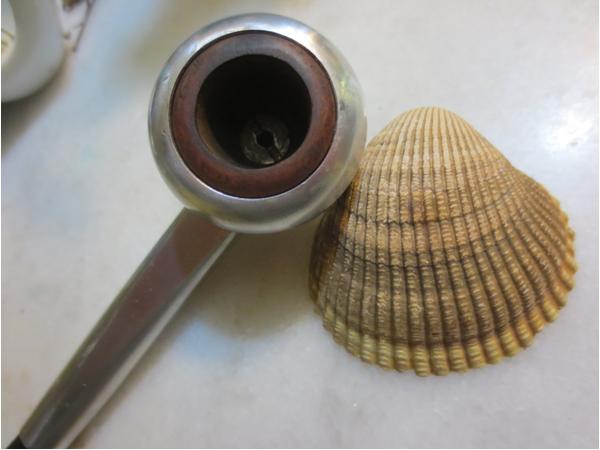
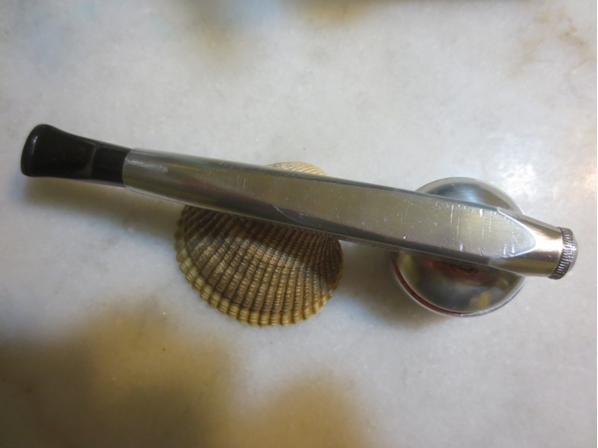
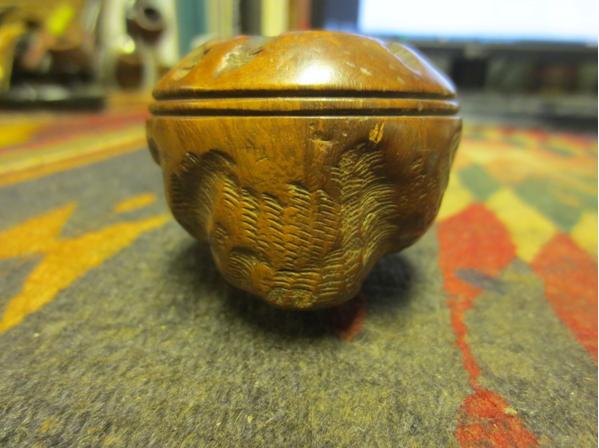
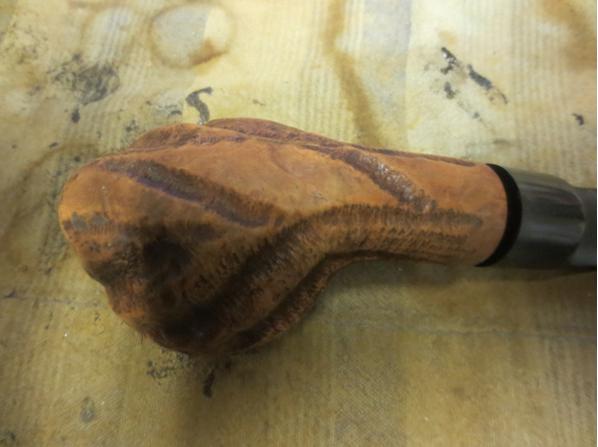
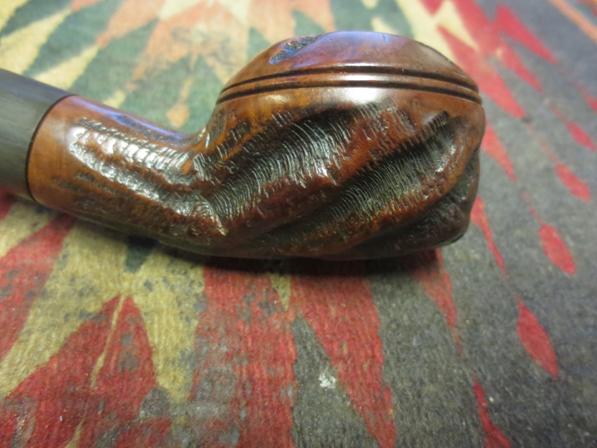
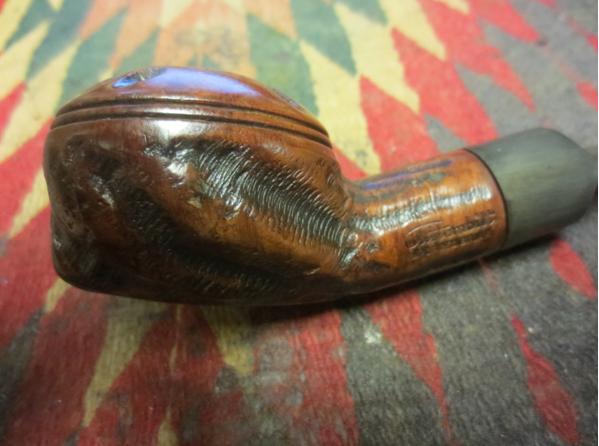
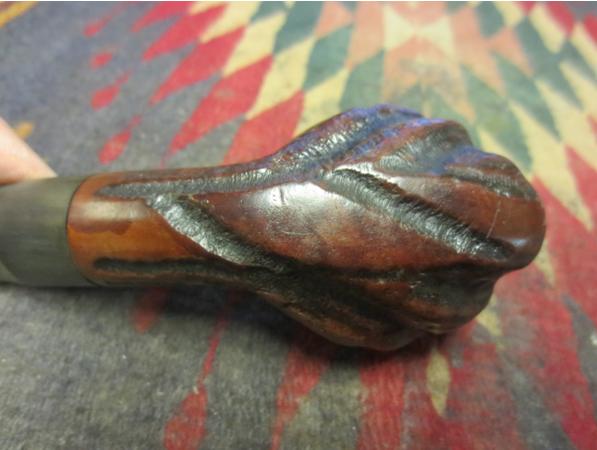
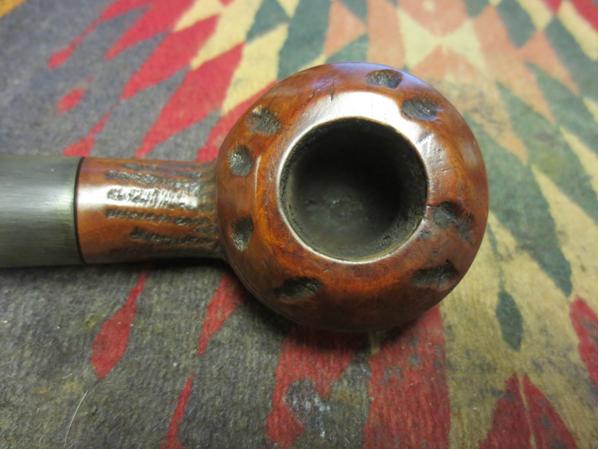
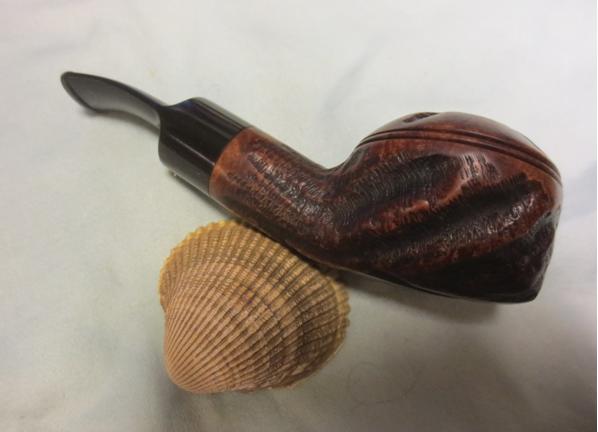
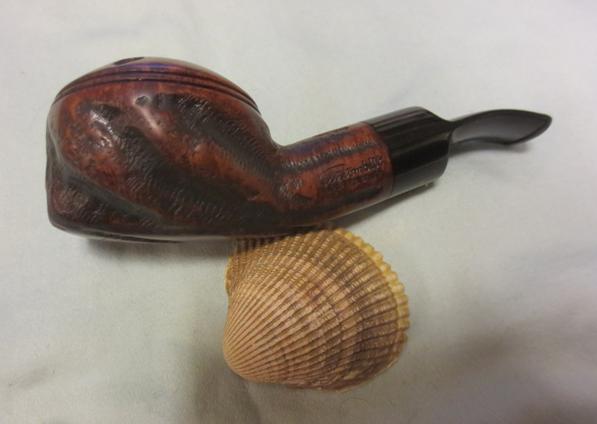
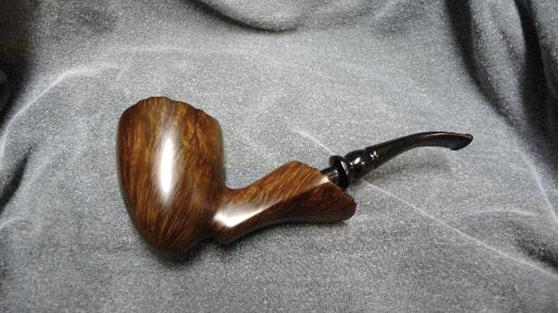
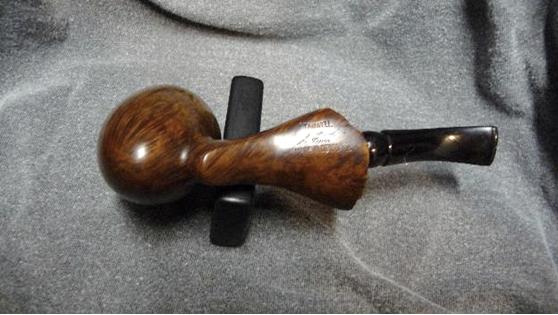
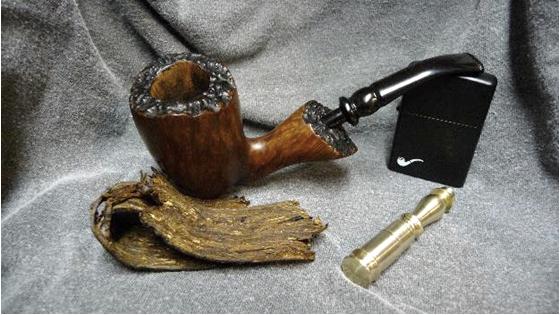
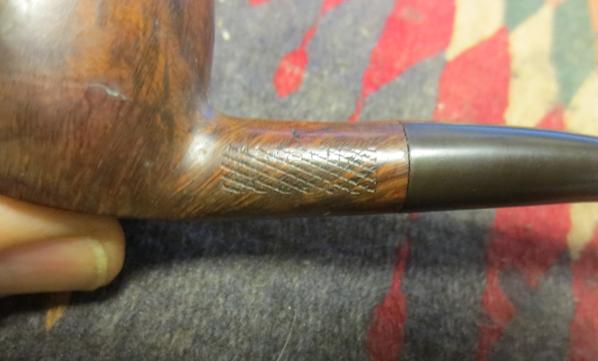
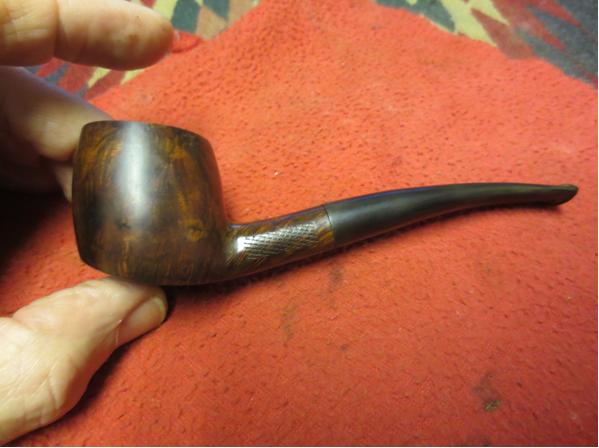
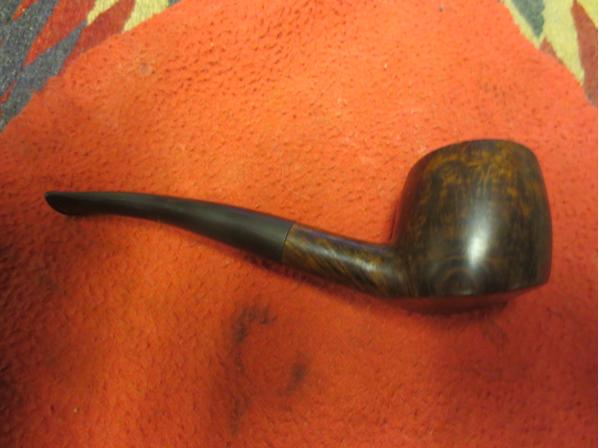
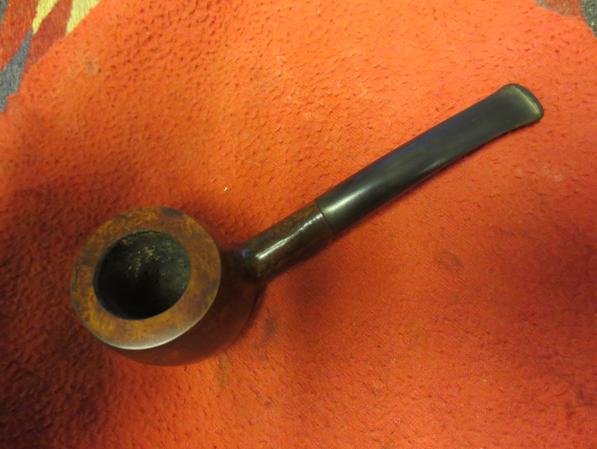
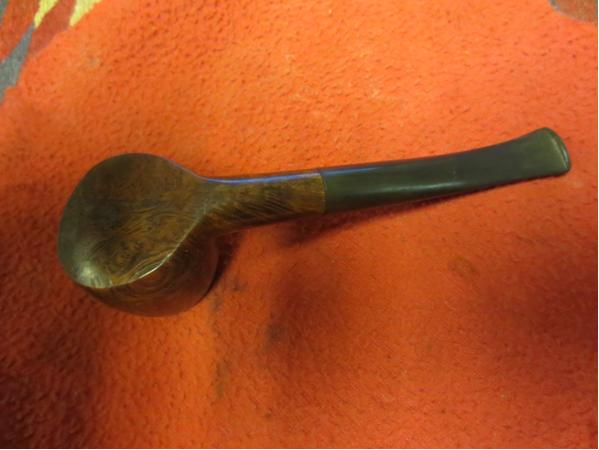
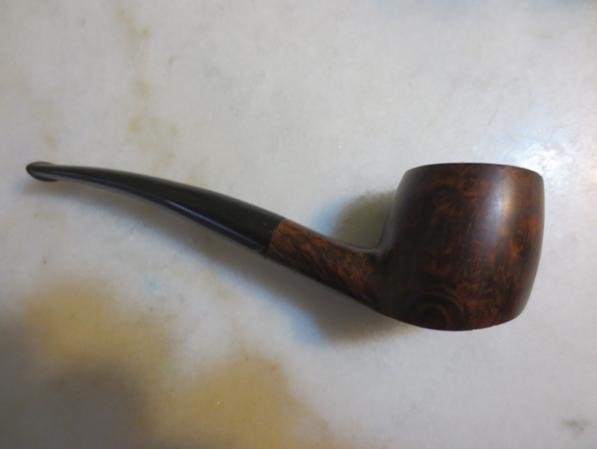
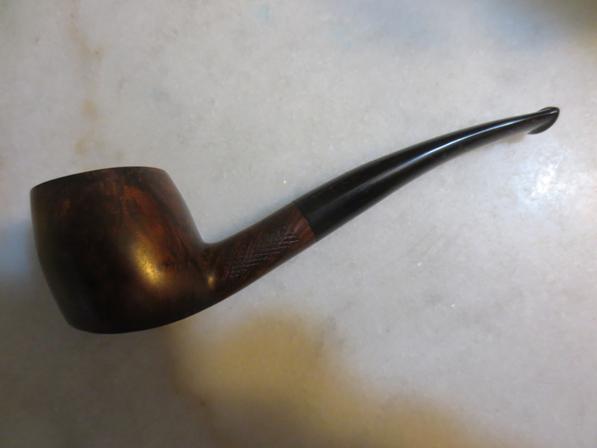
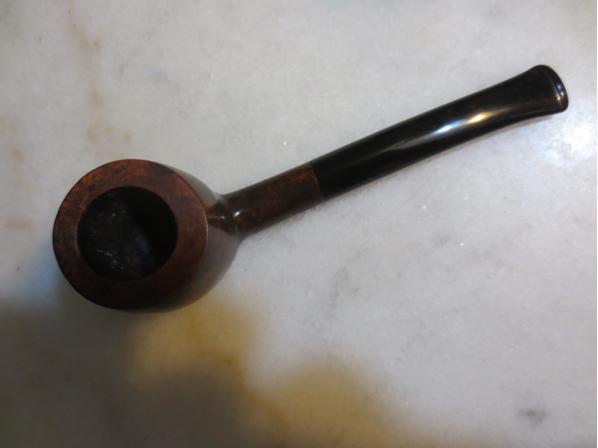
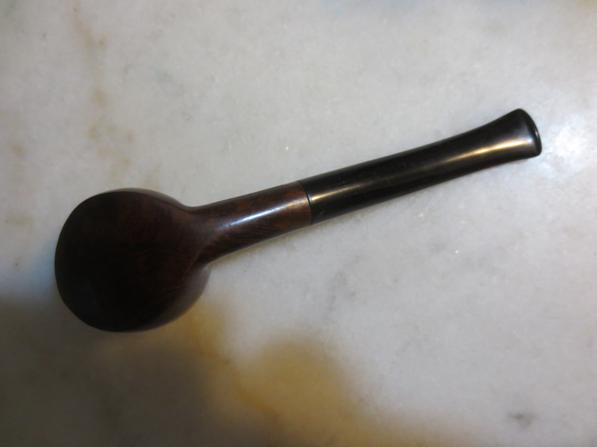
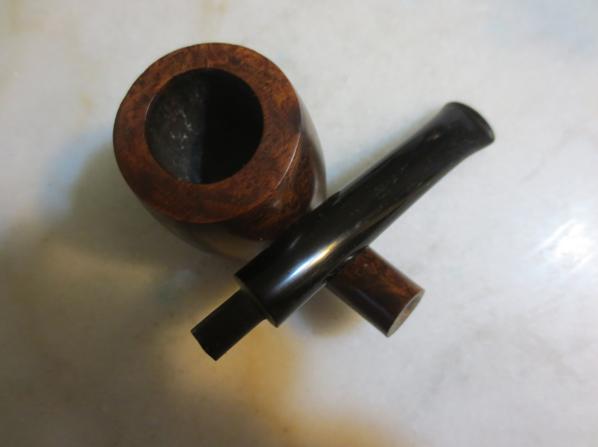
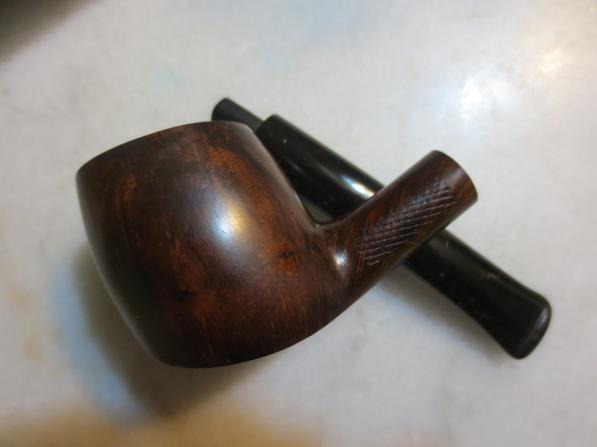
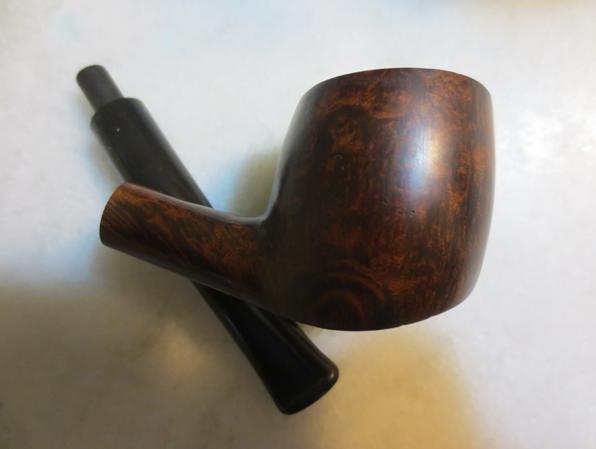
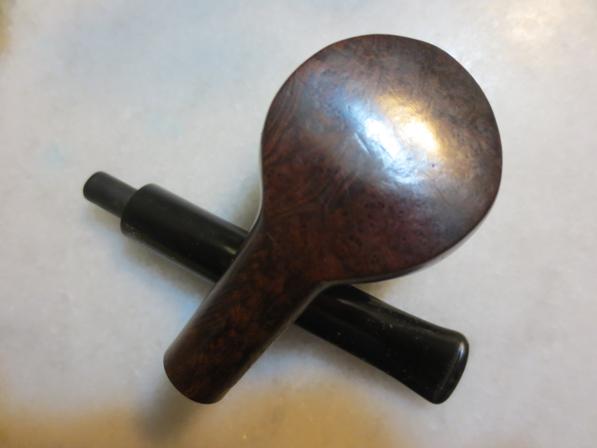
Reborn S.M. Frank Bakelite Bent Billiard


Blog by Pam Otto

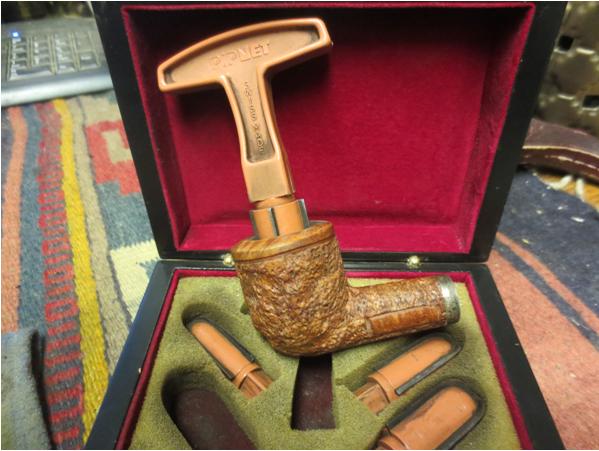
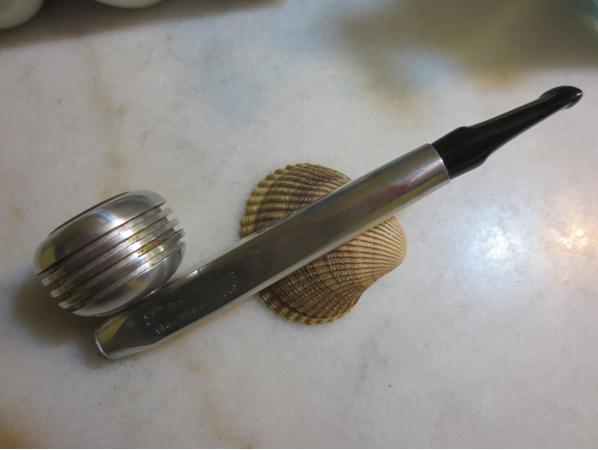
This week’s refurbing adventure comes courtesy of an eBay estate lot, for which the seller accepted my “Best Offer” bid. The transaction occurred on a Sunday and by Wednesday the pipes had arrived. This is the photo that accompanied the listing:Pam1 All of the pipes appeared quite old, with orifice bits, and two of them really jumped out at me: a KB&B Blue Line that would need to be restemmed, but otherwise appeared to be in decent shape, and a C.P.F. Chesterfield that looked to be, and indeed is, positively enormous.

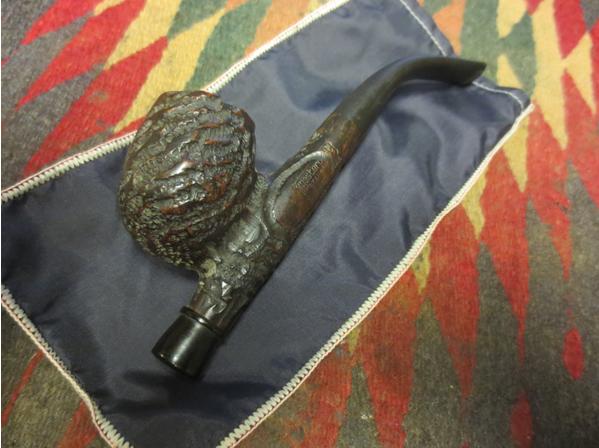
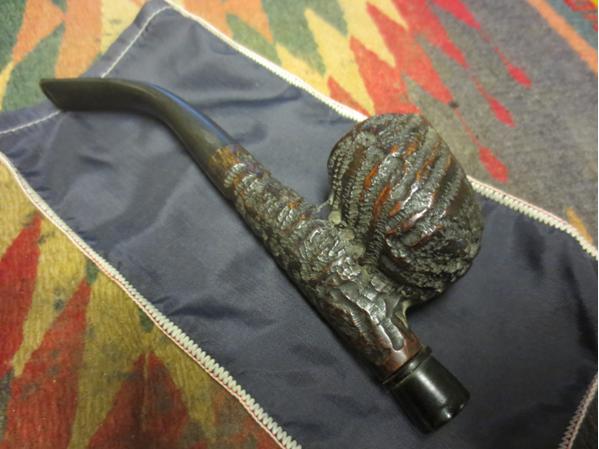
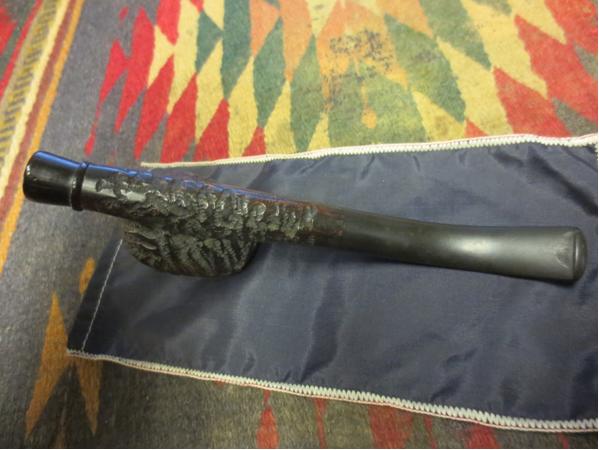
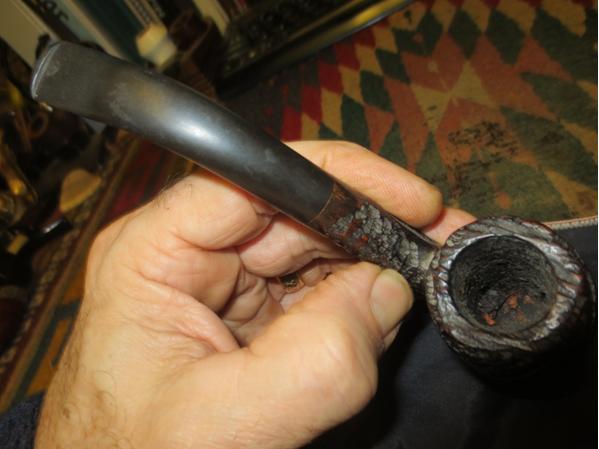
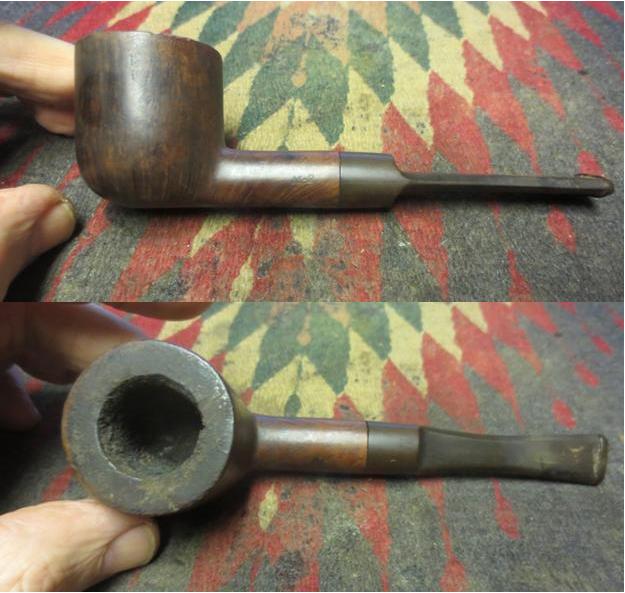
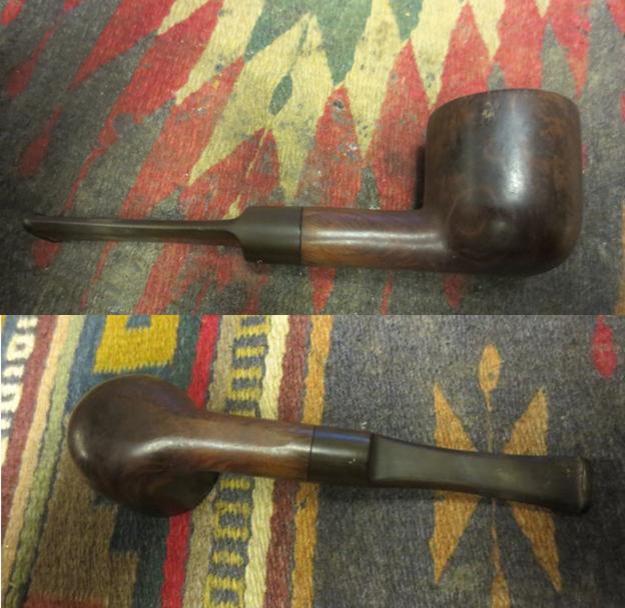
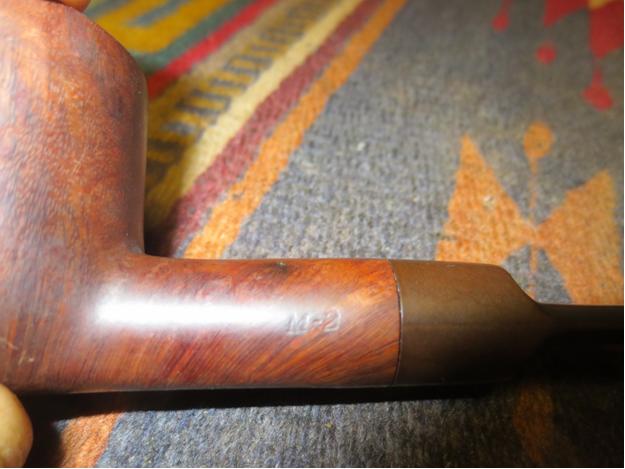
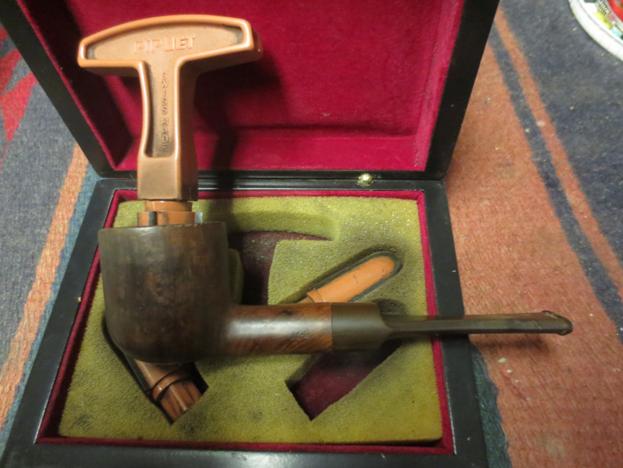
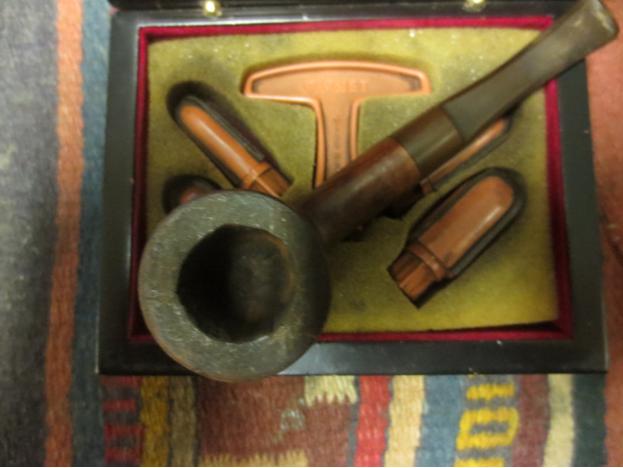
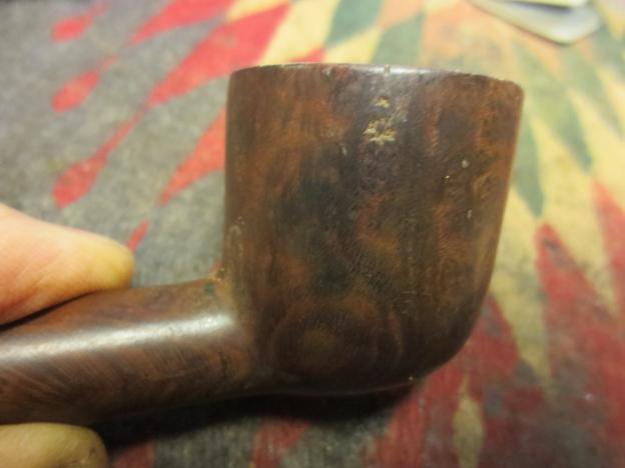
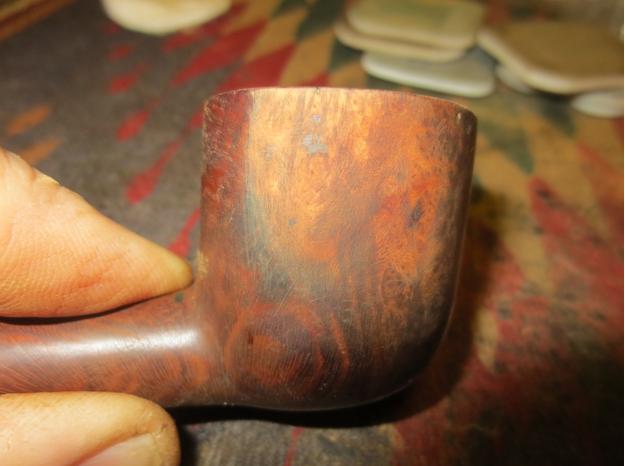
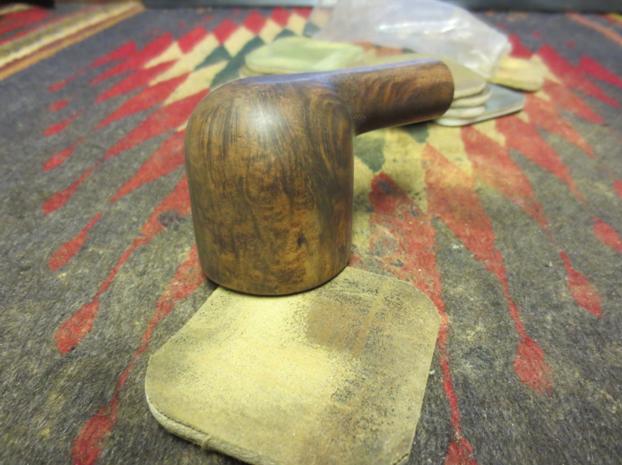
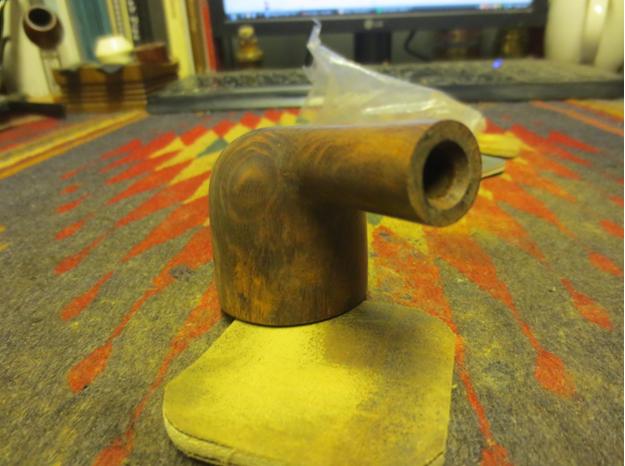
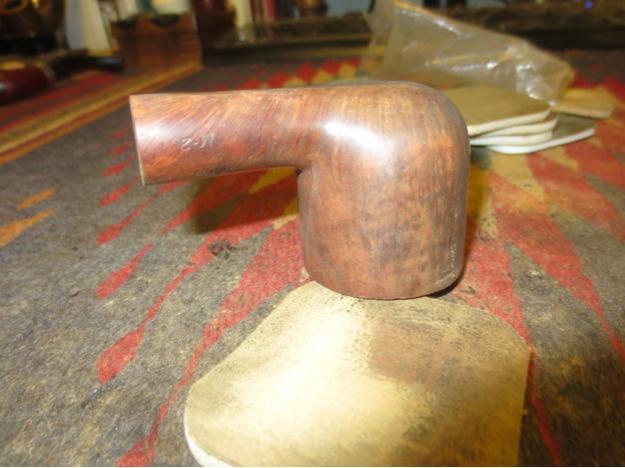
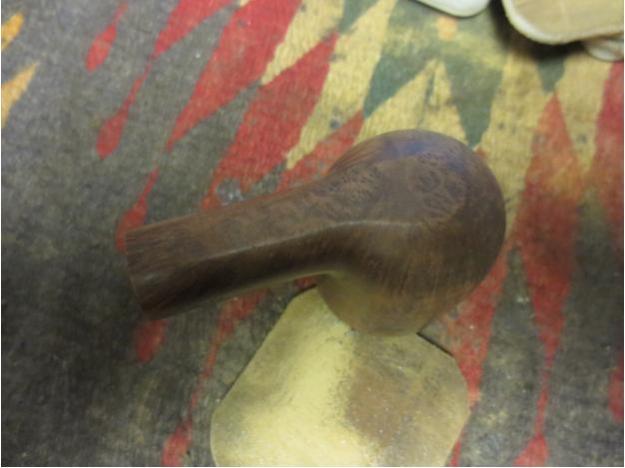
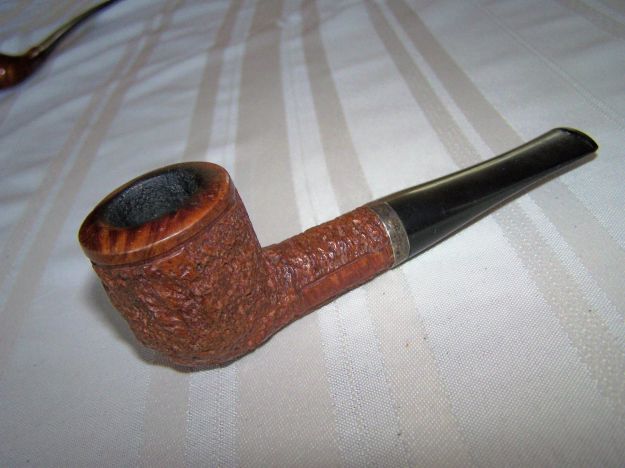
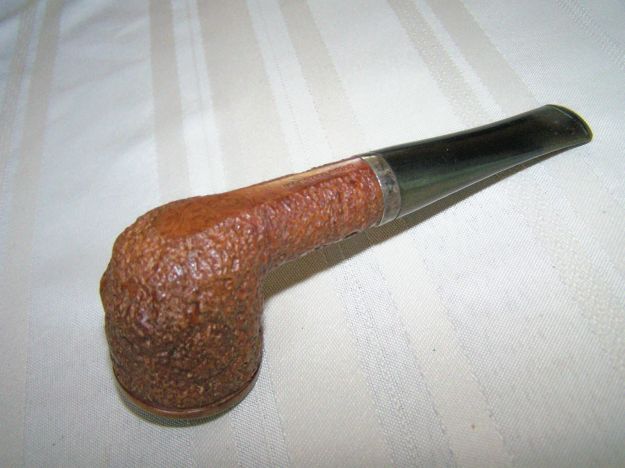
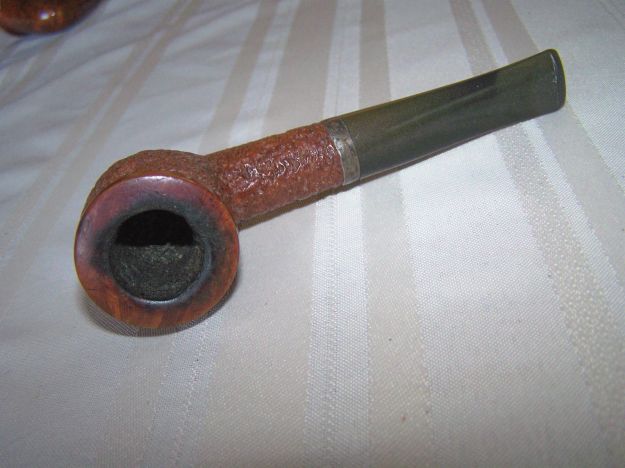
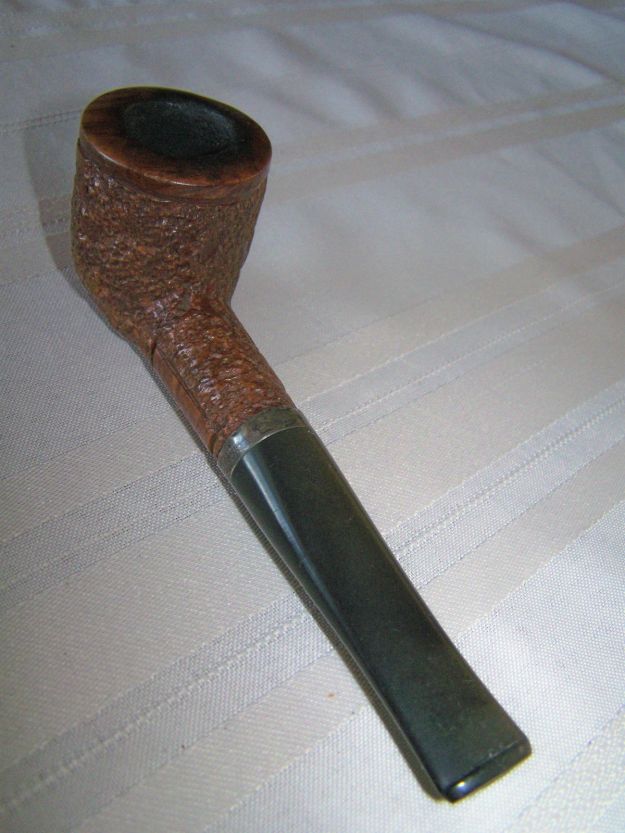
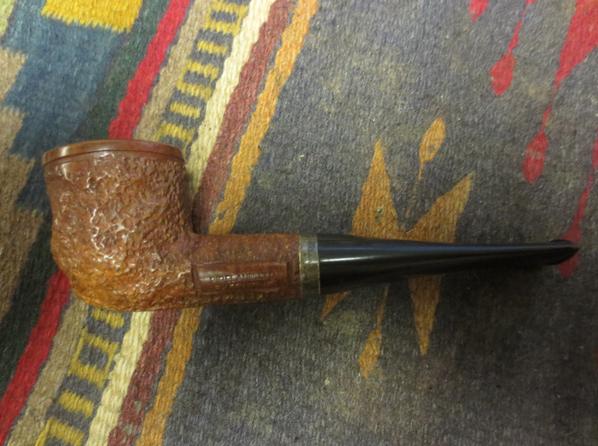
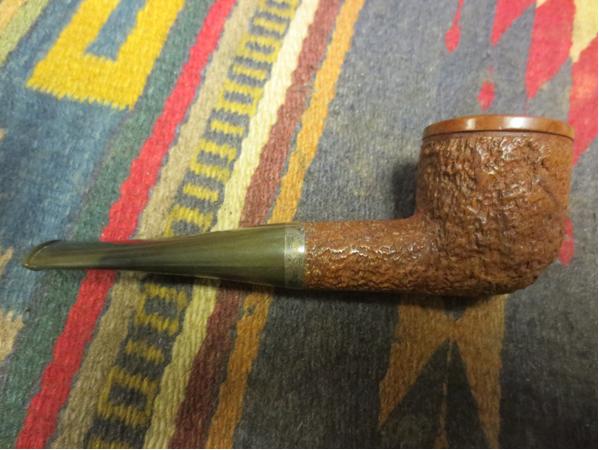
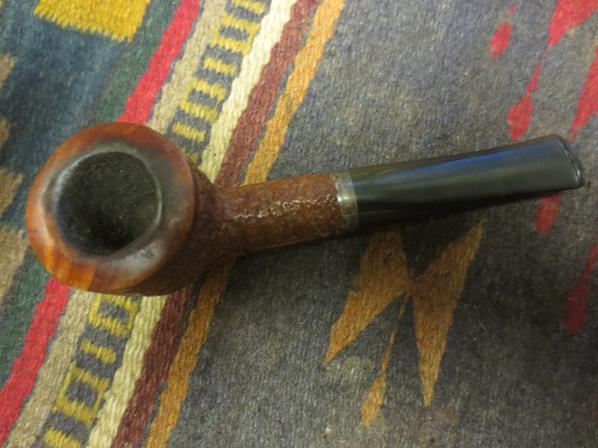
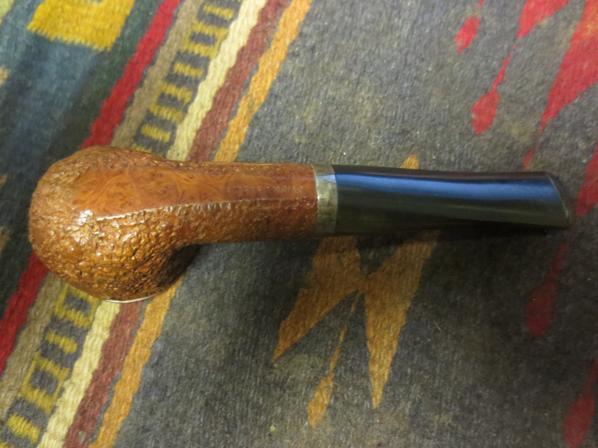
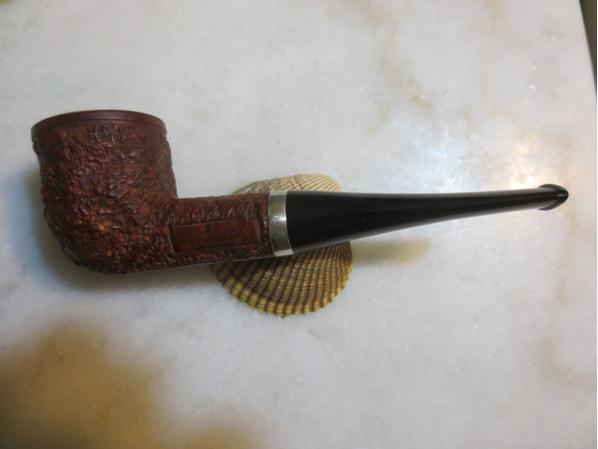
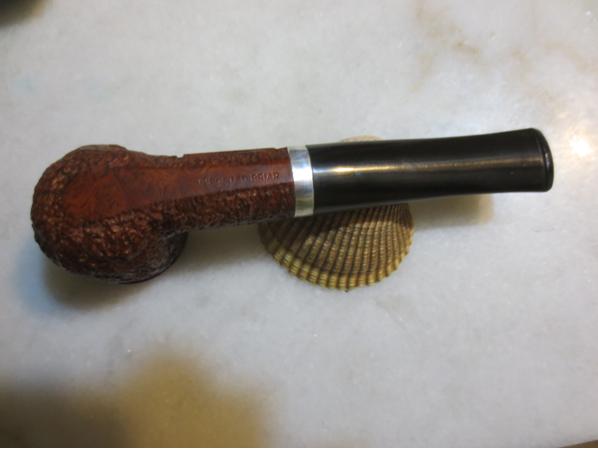
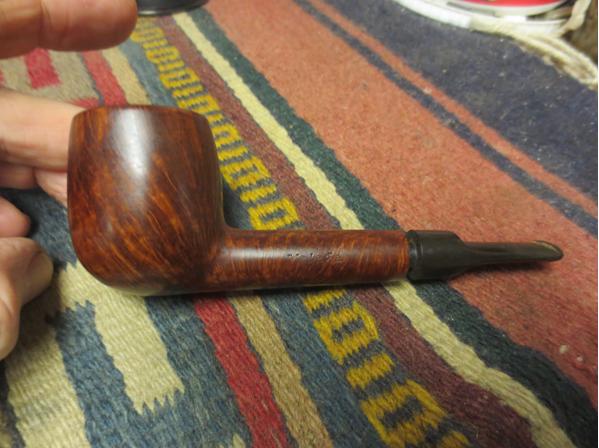
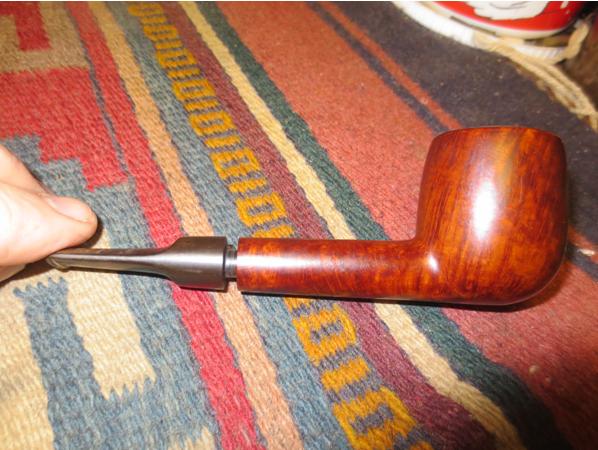
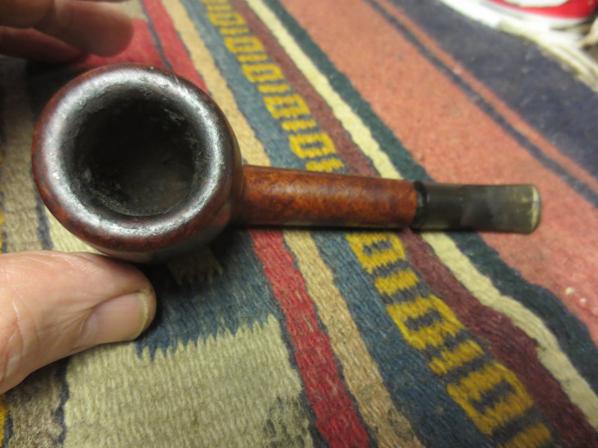
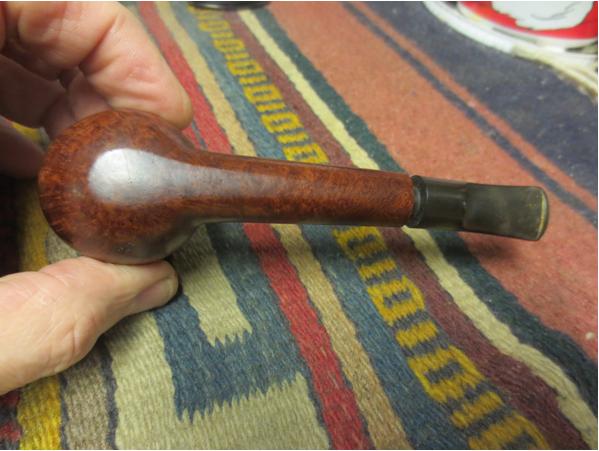
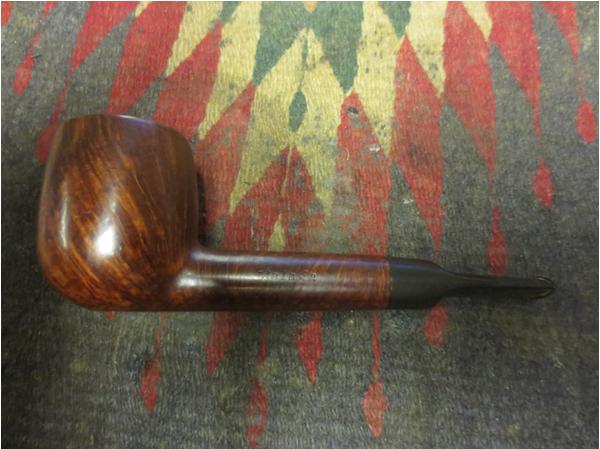
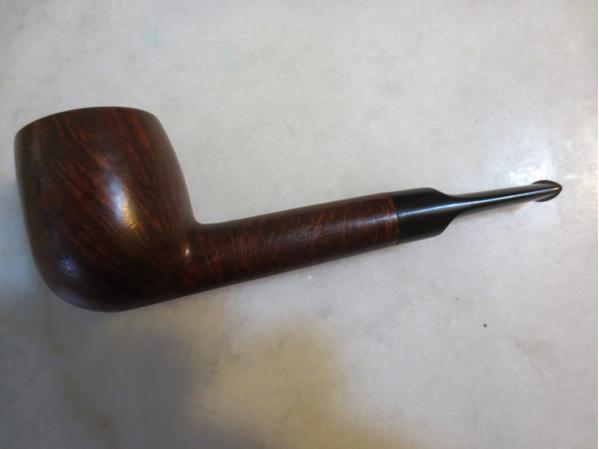
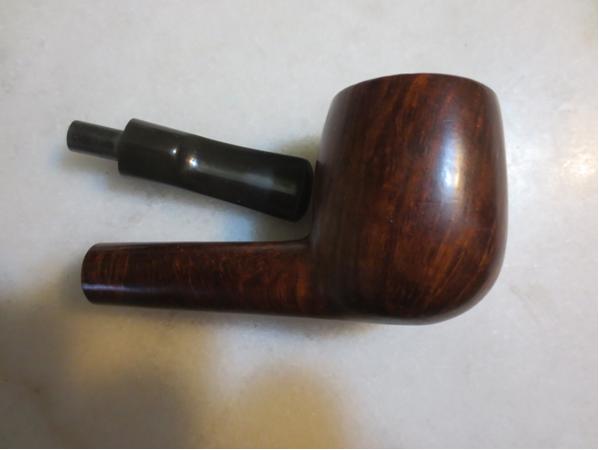
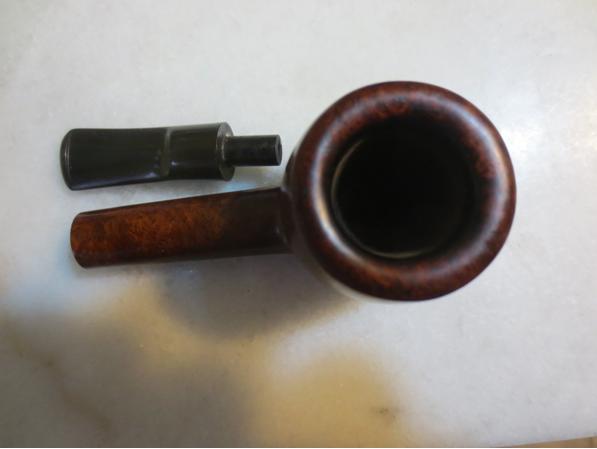
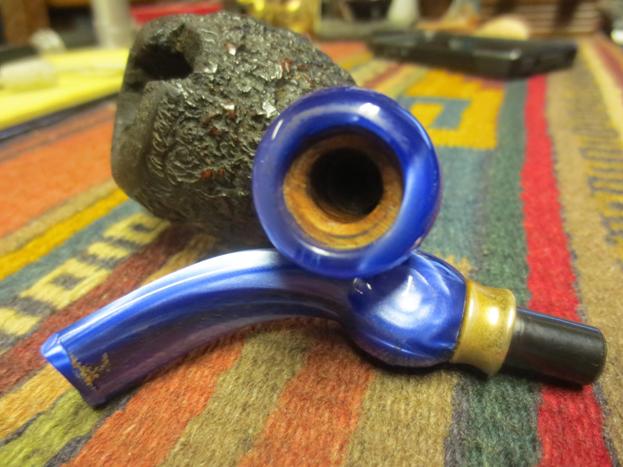
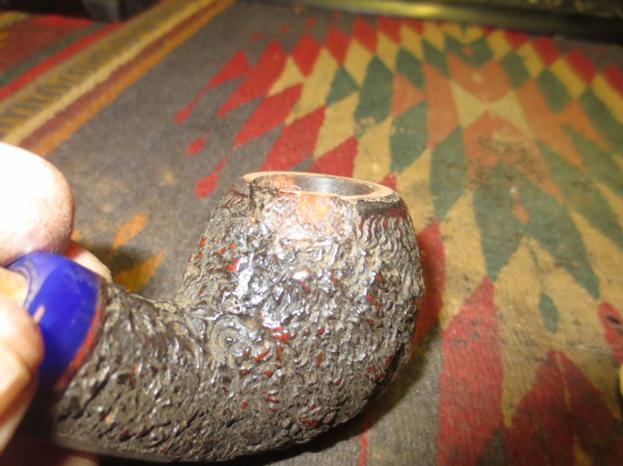
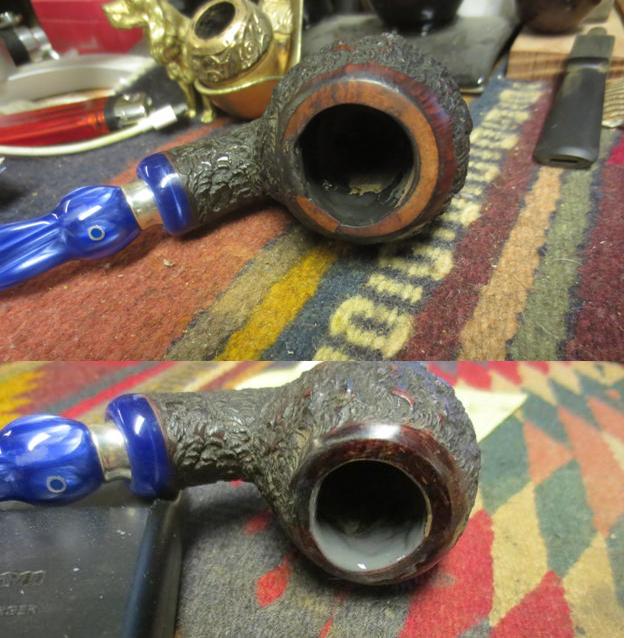
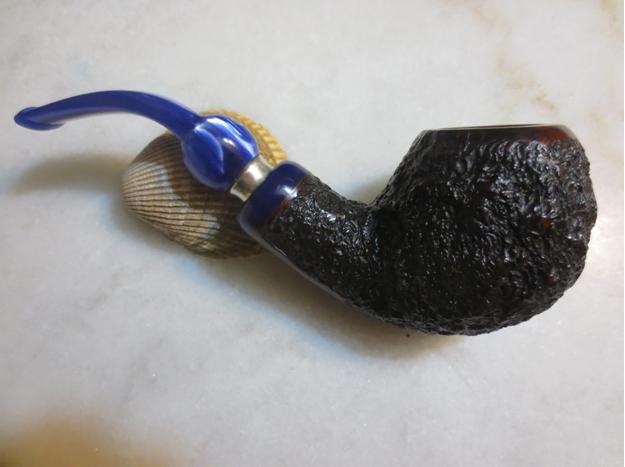
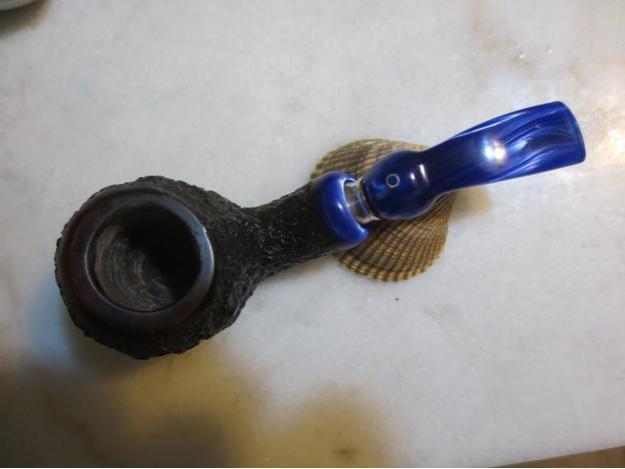
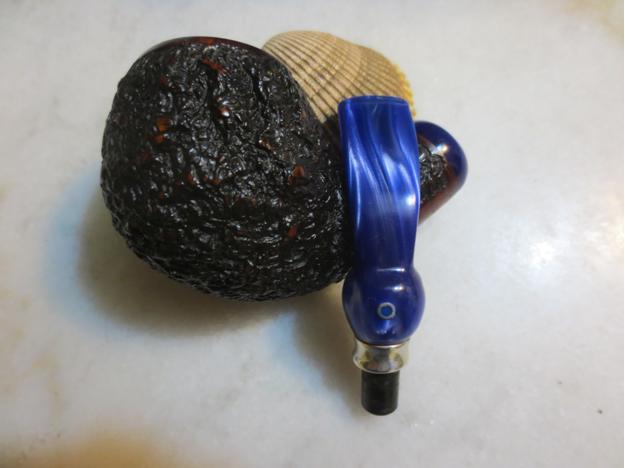
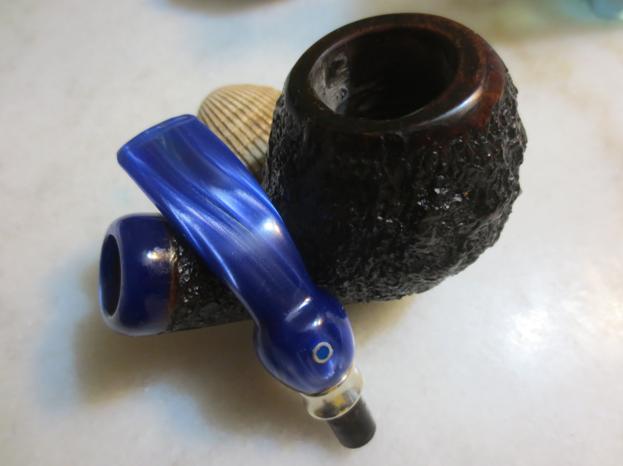
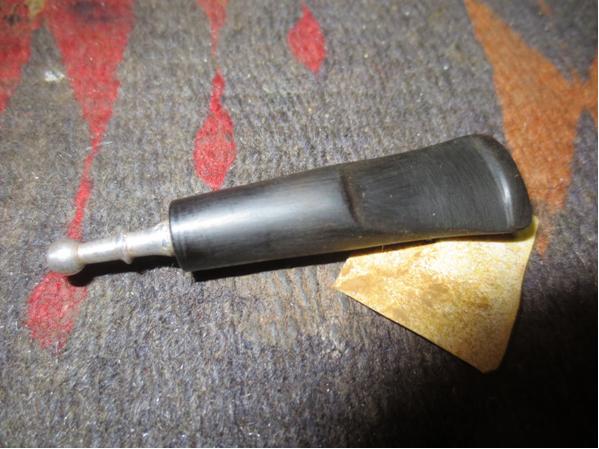
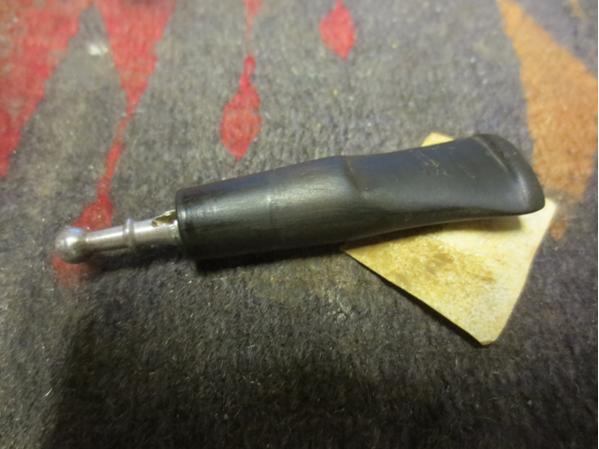
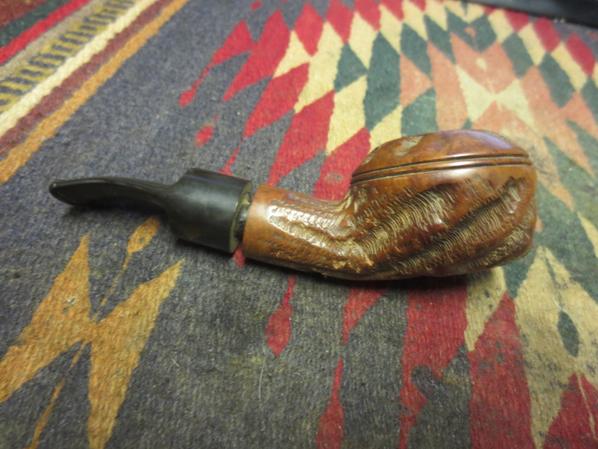
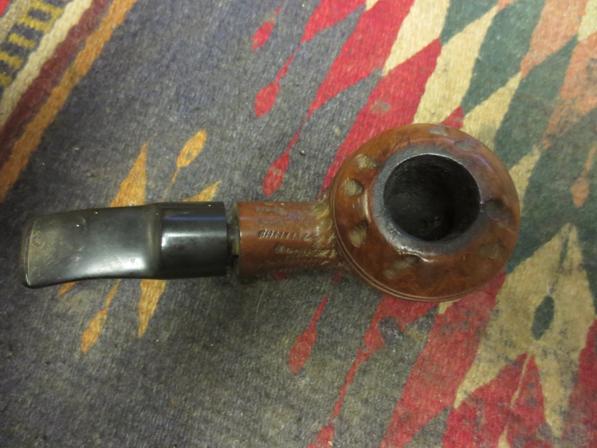
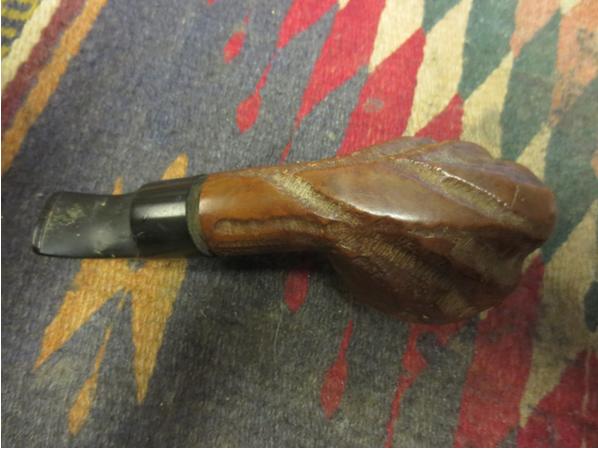
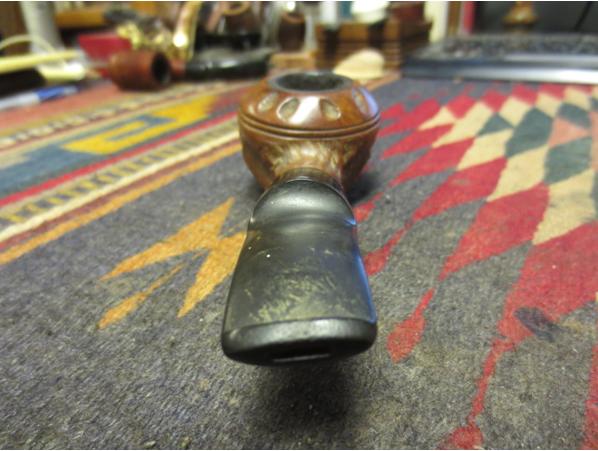
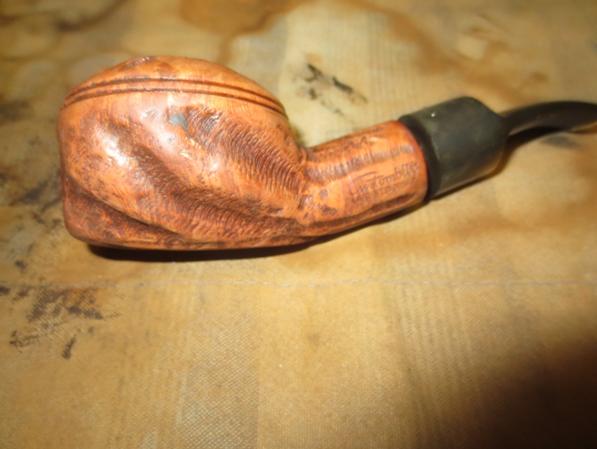
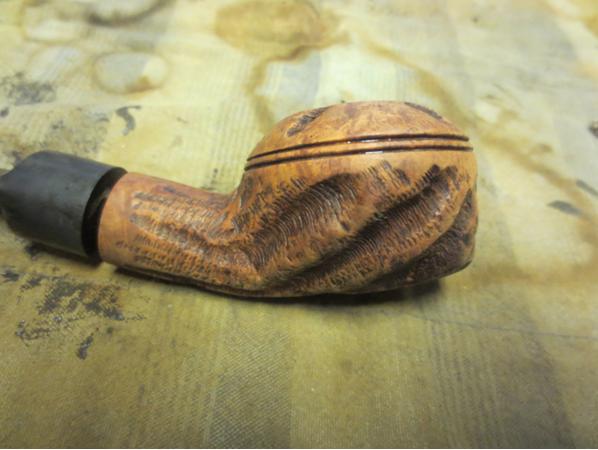
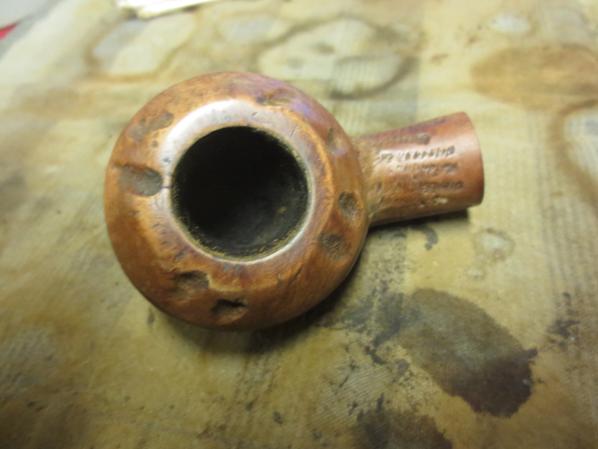
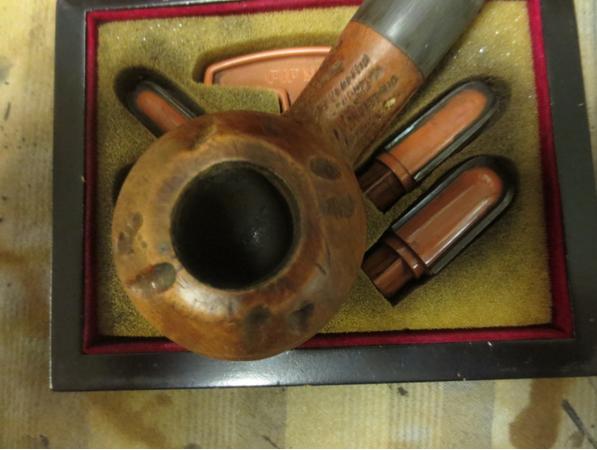
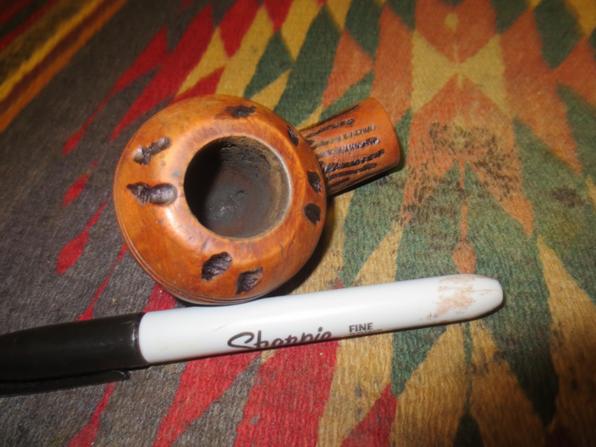
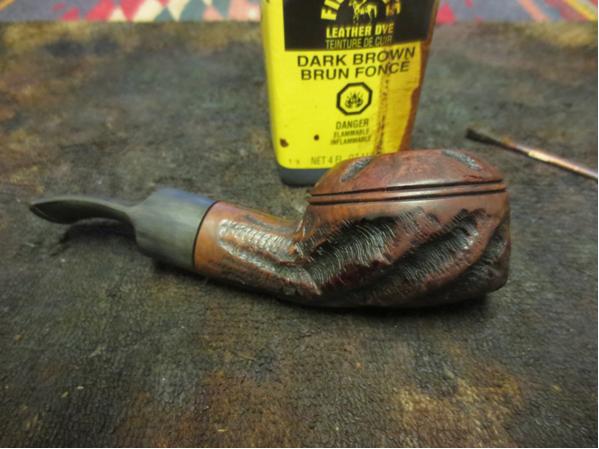
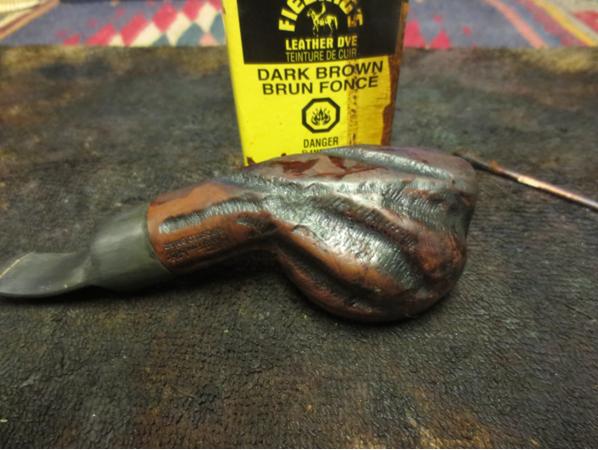
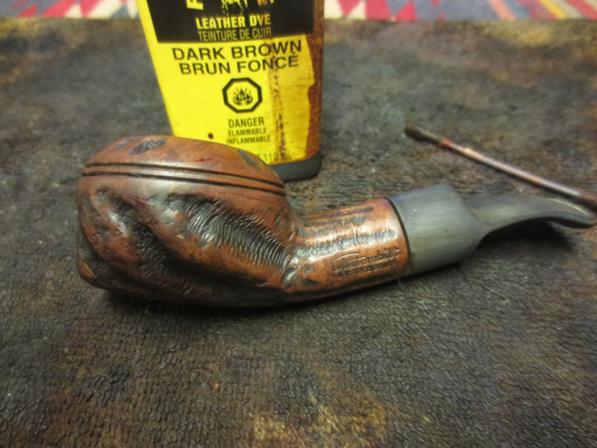
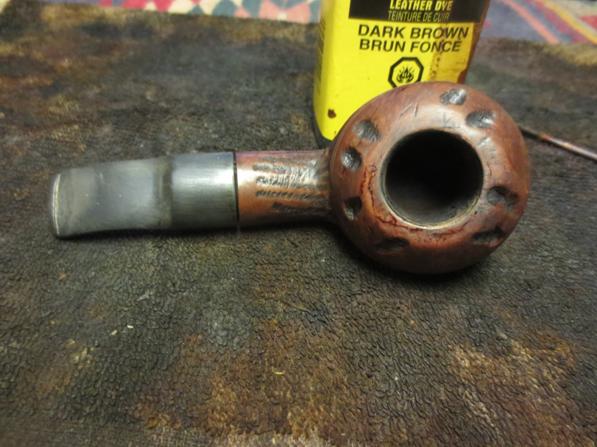
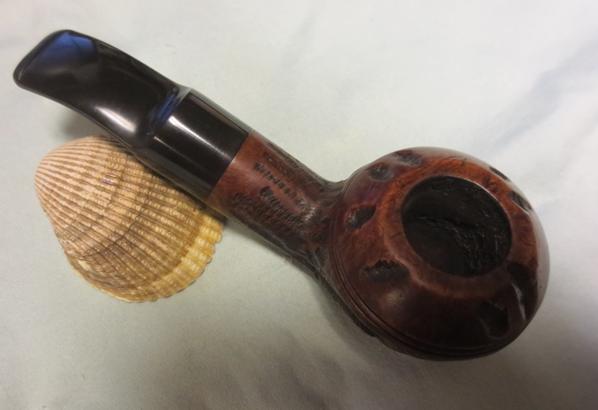
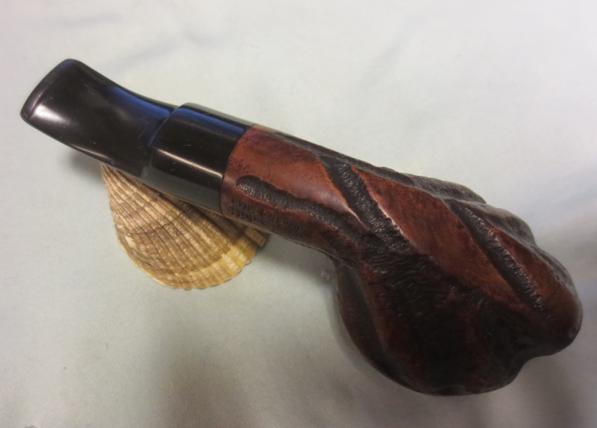
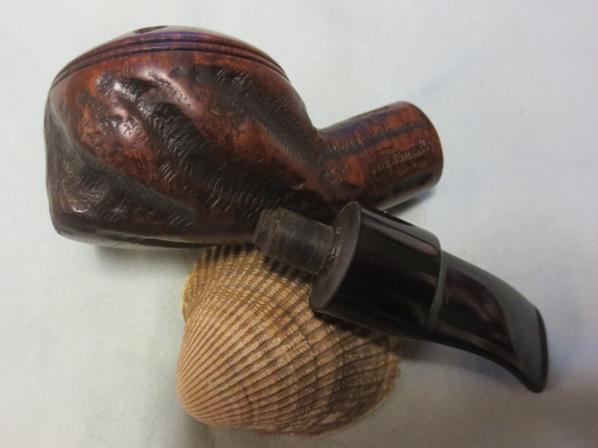
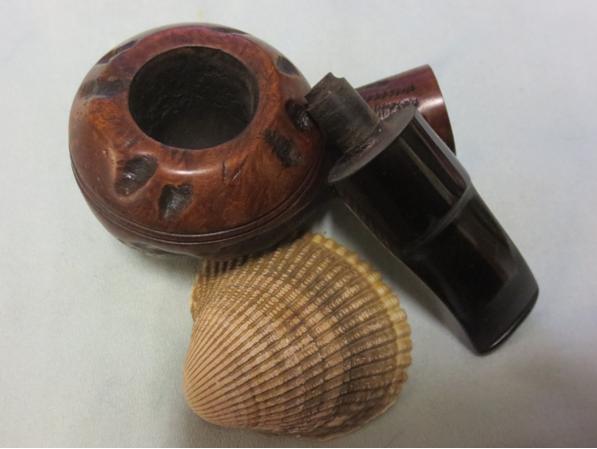
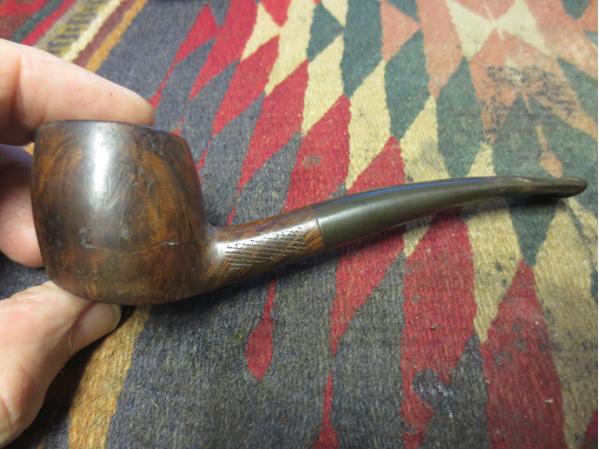
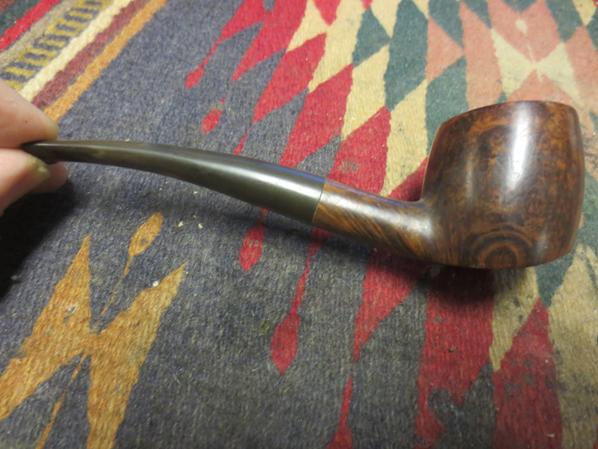
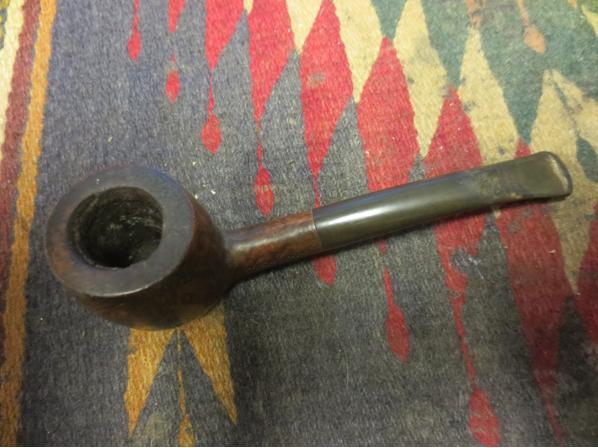
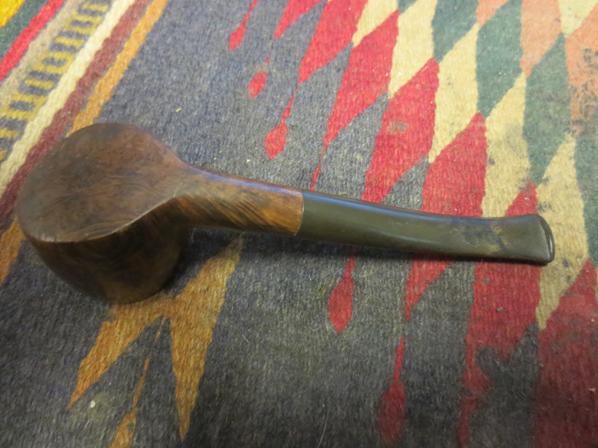
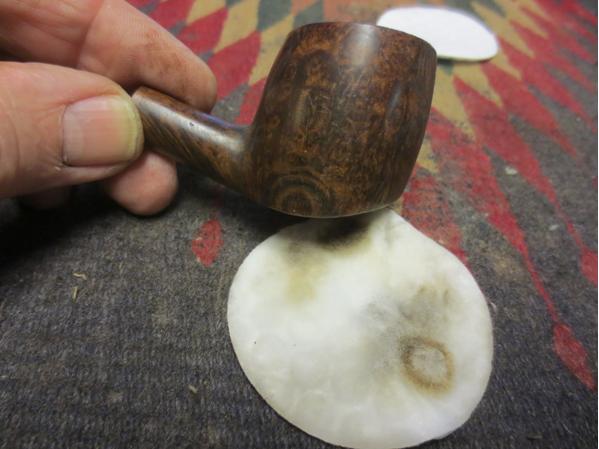
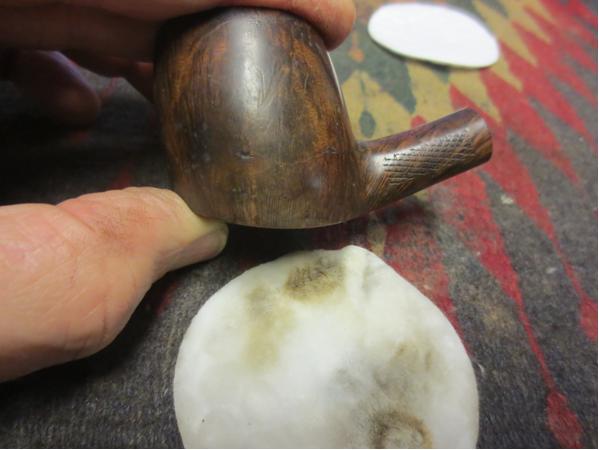
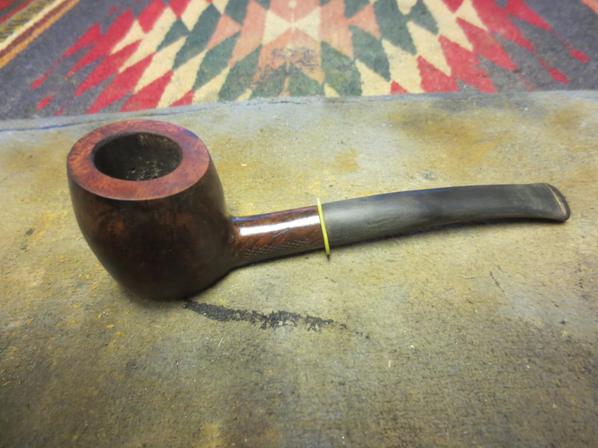
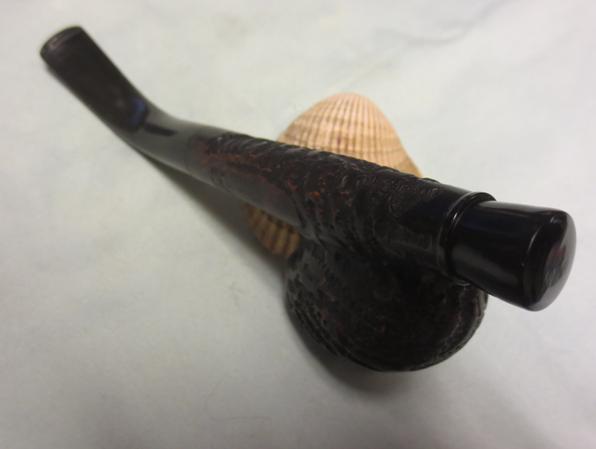
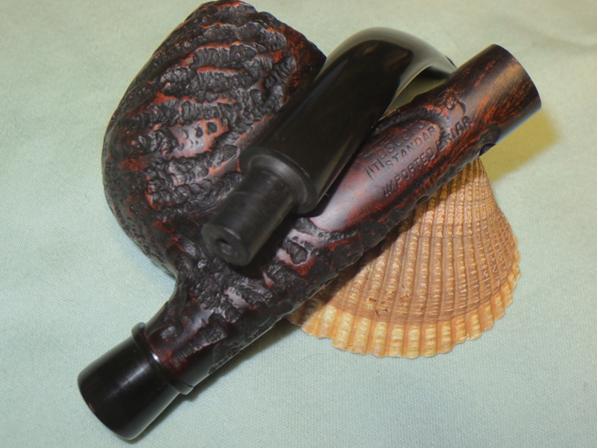
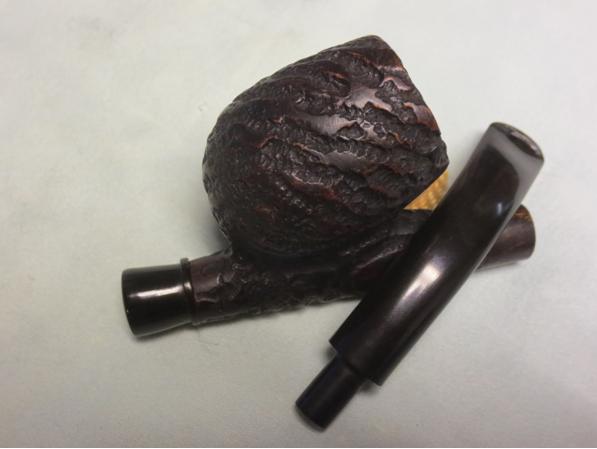
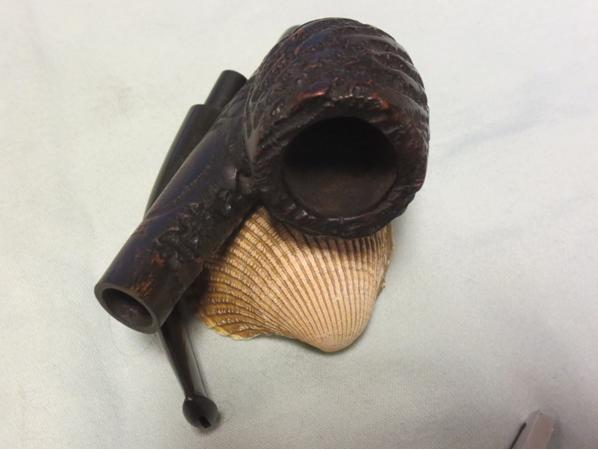
The other two pipes were older S.M. Franks. One is stamped Genuine Amber on the shank but as the stem on it is quite dark I’m going to guess it’s a replacement. The second one is stamped Frank Bakelite on the shank. It has a lovely bent red stem, way overturned, and a metal band stamped EP Silver. A few dings and a couple scratches on the bowl, and no tooth marks on the stem. I’m thinking this one, for whatever reason, was not a favorite.

Even though I’m anxious to get the Blue Line and Chesterfield cleaned up and smokable, the Frank Bakelite, with its simple needs, beckoned. It moved to the front of the queue.

I don’t know old this particular pipe is, but if it dates to the same era as the KB&B Blue Line, it could well be past the century mark. Thoughts, anyone?

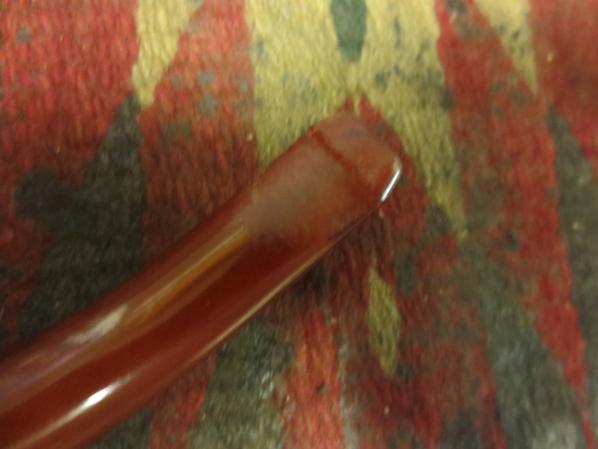
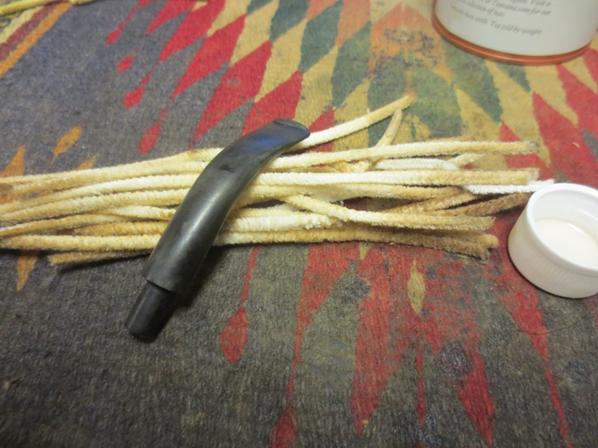
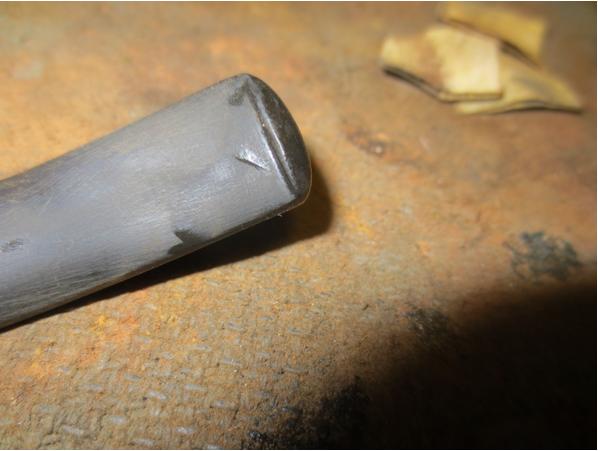
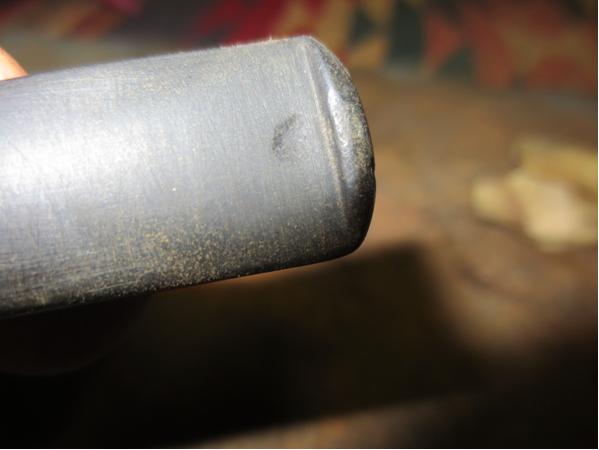
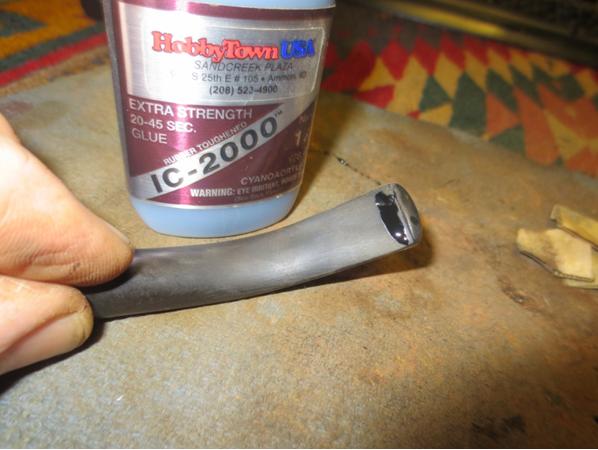
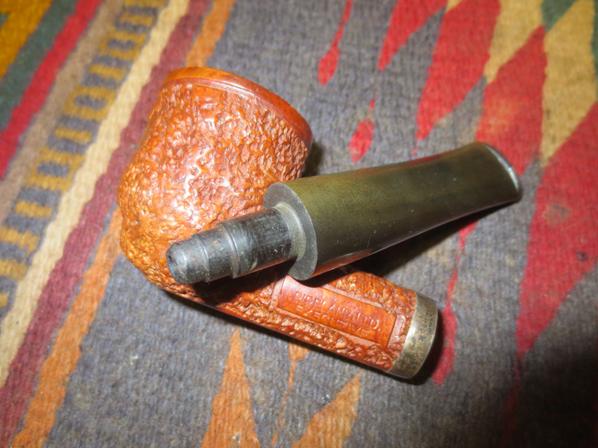
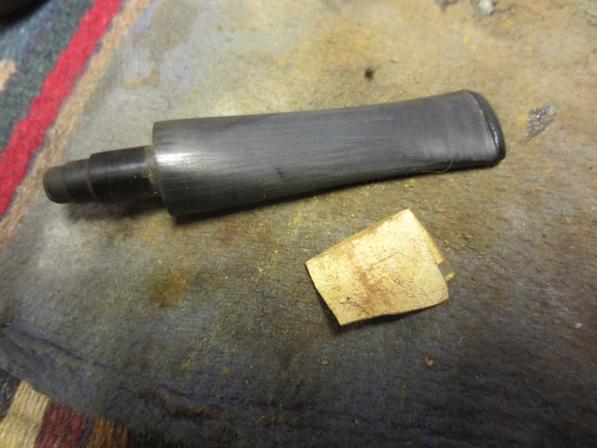
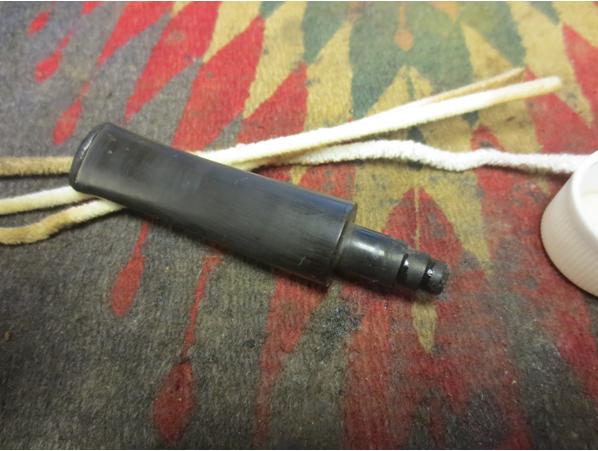
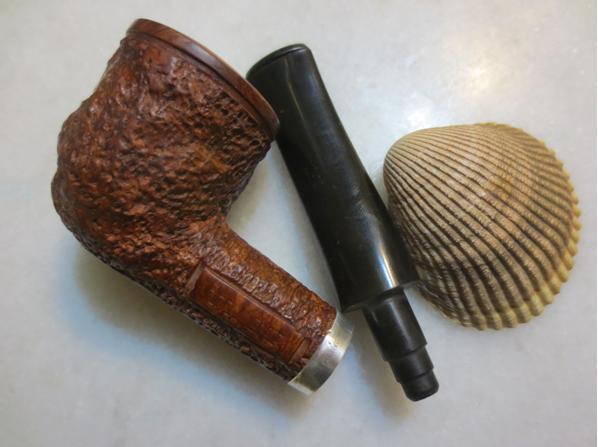
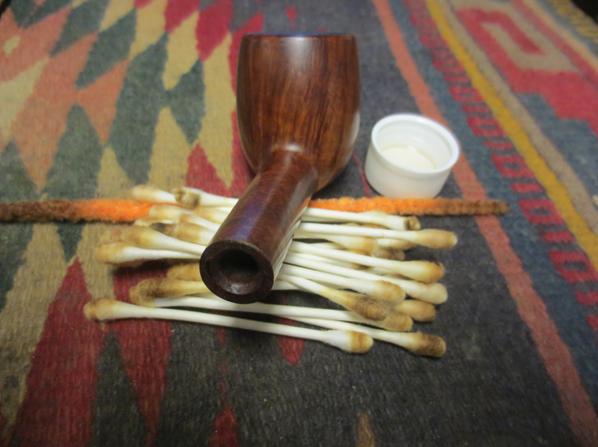
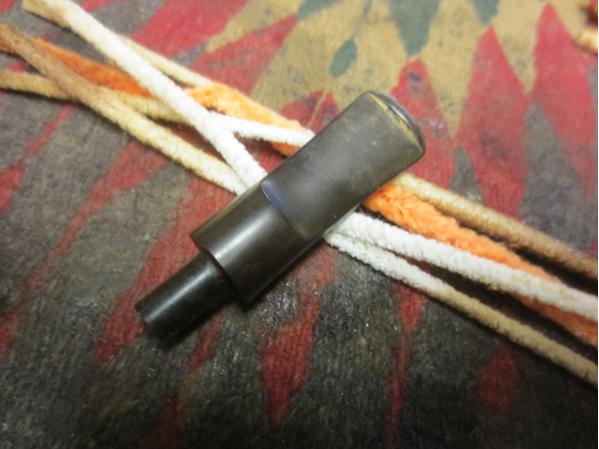
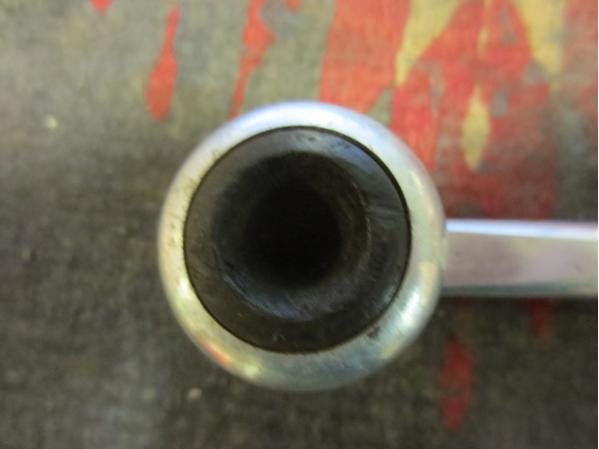
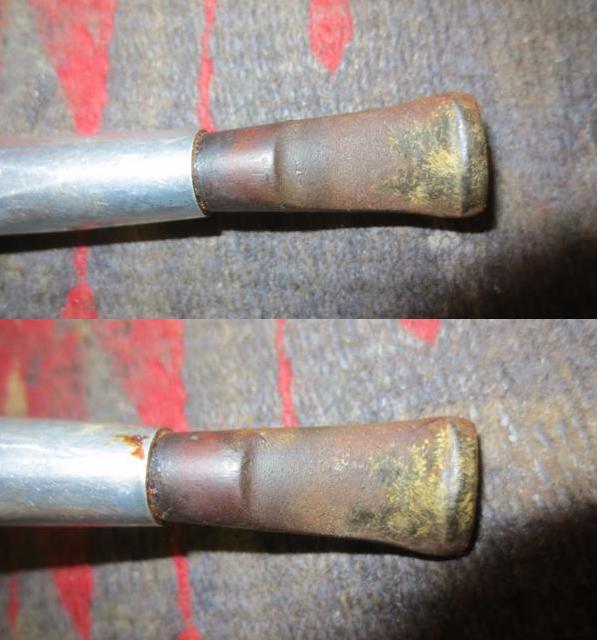
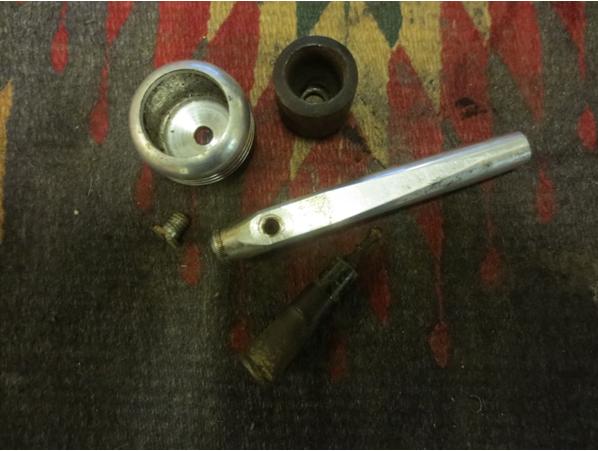
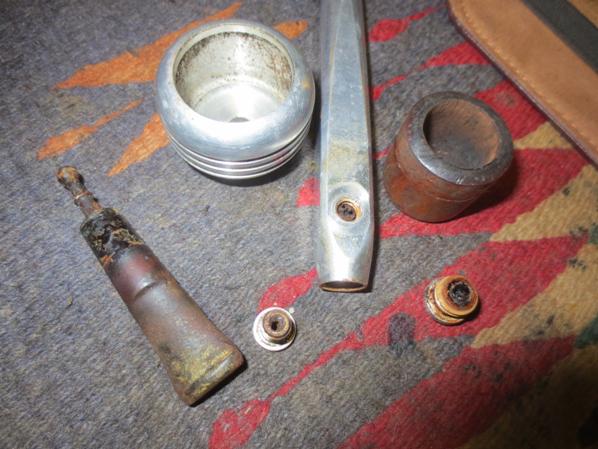
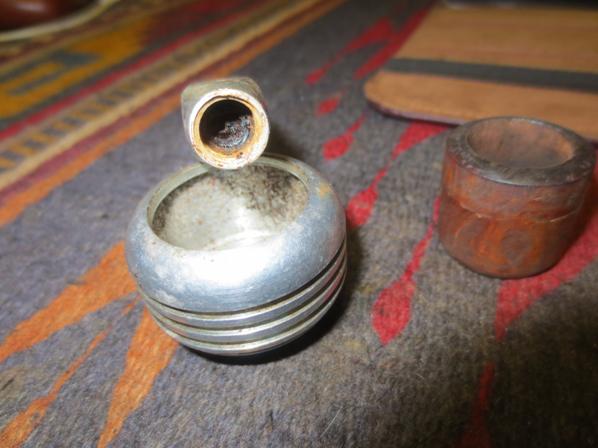
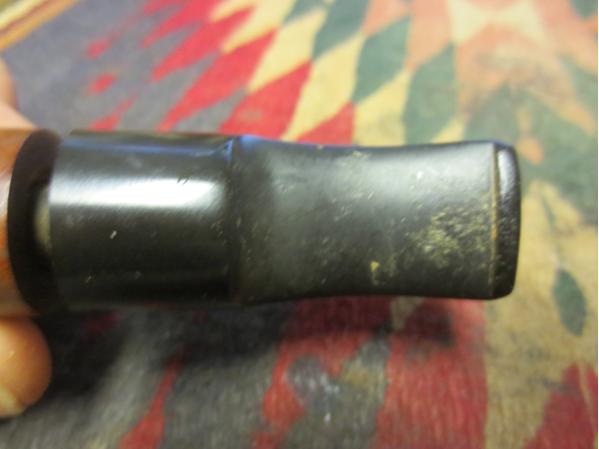
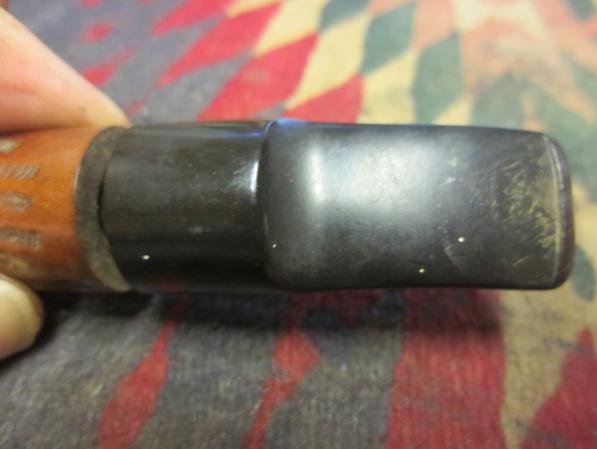
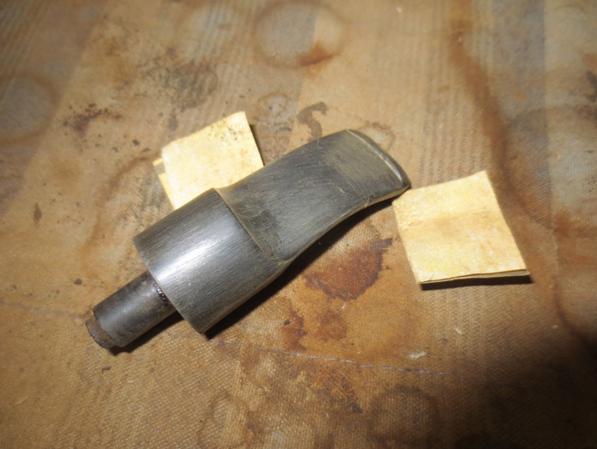
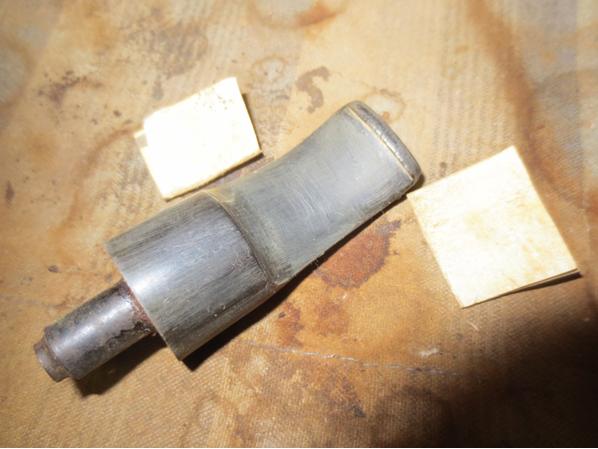
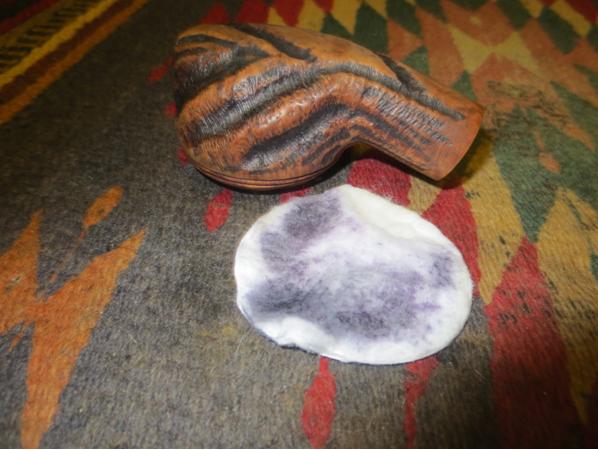
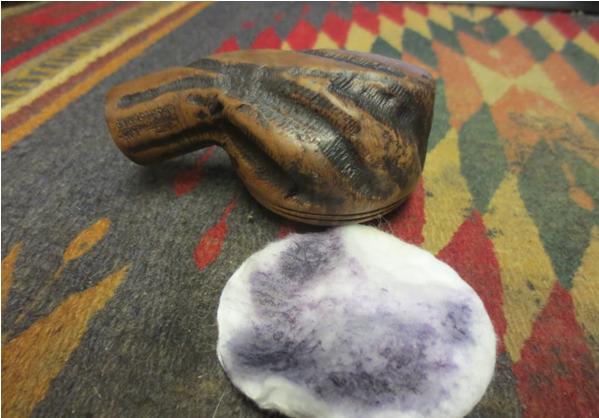
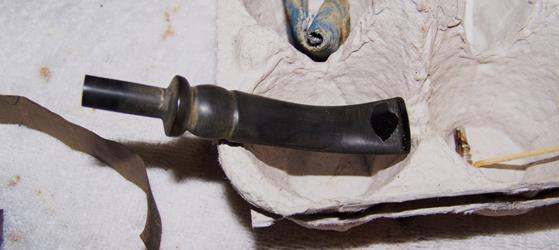
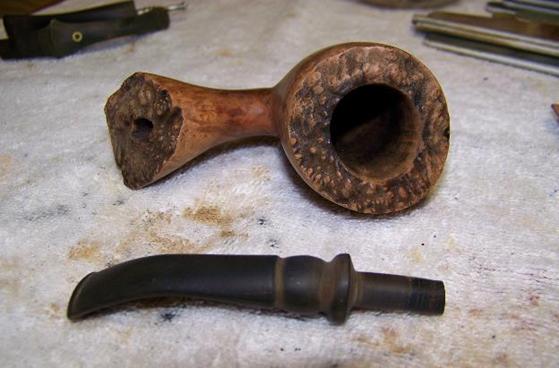
At any rate, the stem of this old boy seemed like a logical place to start. I took a couple of pictures of it in its overturned state, then unscrewed it completely to see if an internal problem was to blame. Thankfully, the bone tenon was clean and solid.Pam2

Pam3

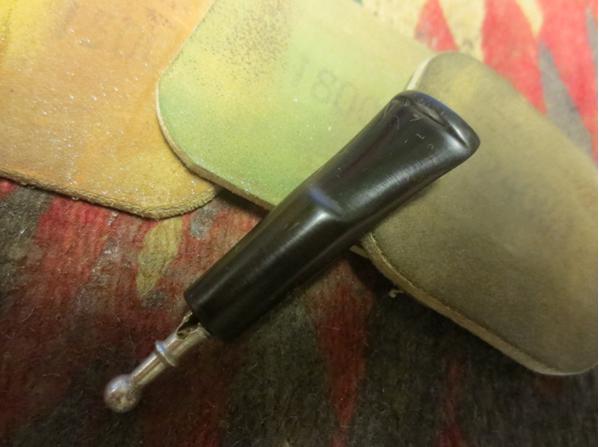
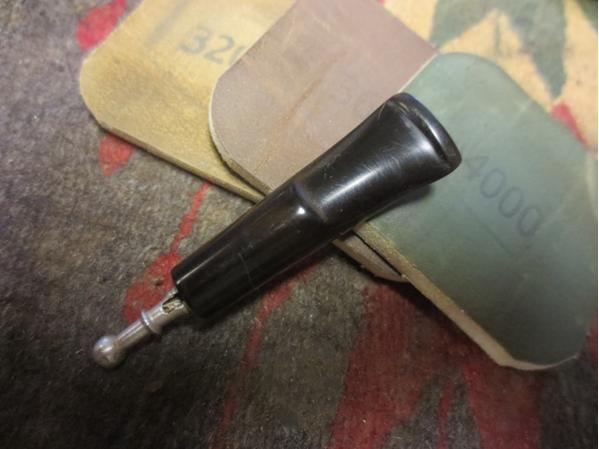
Pam4Knowing I’d read how to tackle overturned stems, I looked to Steve’s blog and, sure enough, there it was in clear, easy-to-follow directions. Following the steps he listed, I filled a cup halfway with water, leaned the stem against the side of the cup and put it in the microwave. I used the highest setting and, because the cup was only half full, set the time for 1 minute—plenty of time to get the water boiling.

In those 60 seconds, two things happened that I hadn’t really counted on. One, it worked (not that I had any doubts in the recommendation; it’s just that I rarely get things right the first time). And two, whether because of the vigorous bubbling of the boiling water, or because my microwave is a carousel, or even because the Bakelite was so smooth, the stem fell all the way into the water.

The material itself was fine; in fact, some of the debris from the airway got cleaned out by the bubbling water. However, the heat caused the bent stem to straighten.

Reheating the stem to restore the curve was no big deal; all I had to do next was re-bend it over a rounded object. But as I hadn’t foreseen this step, I didn’t have many options from which to choose. Paper towel tube? Nope, too flimsy. Peanut butter jar? Too big.

Then I saw it, sitting amid the excelsior of a near-empty holiday gift basket: a small summer sausage. It had a slightly narrower diameter than I’d hoped for, but it was a solid cylinder and certainly convenient. I heated the stem in boiling water again, laid it across the curve of the sausage, and applied slow, steady pressure.Pam5

Pam6

Pam7The results weren’t perfect, but they could be worse. Or wurst, har har. The stem feels good in my mouth, and the curvature looks okay. However, it’s not quite as deep as it was originally, and that bothers me just a wee bit. If I can find the rolling pin I know I used to have, I may try re-curving the stem at some point in the future.

To make the tenon fix on the stem permanent I dunked the tenon-stem assembly once again in boiling water—this time holding onto the stem so it couldn’t submerge completely. I twisted it tightly onto the pipe, counting on the slightly swelled tenon to grab hold inside the shank and the slightly softened glue in the stem to let go. I untwisted and, sure enough, the stem came off while the tenon stayed in the shank.

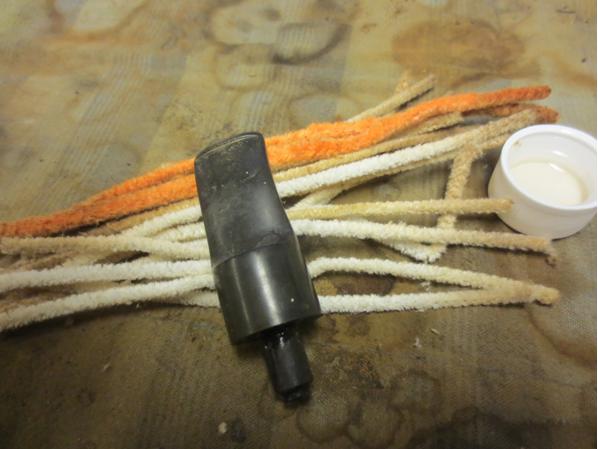
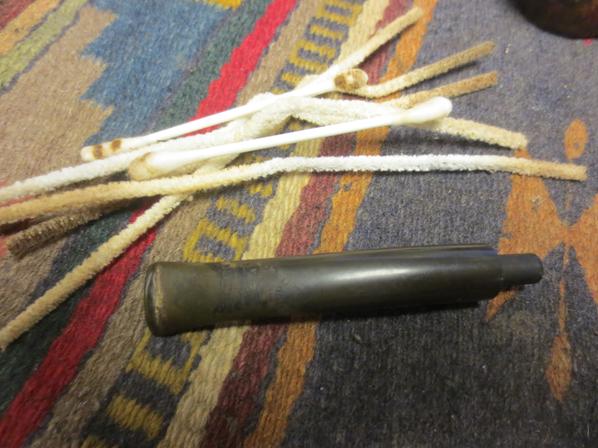
I dried the tenon with a soft pipe cleaner and applied super glue sparingly to the narrow threads, then twisted it back into the stem. Satisfied with the alignment, I put the pipe down to let the glue cure.
The following evening I unscrewed the stem from the bowl and the tenon withdrew from the shank just fine. I screwed it back in to make sure the repair held, then removed it once again and set it aside.
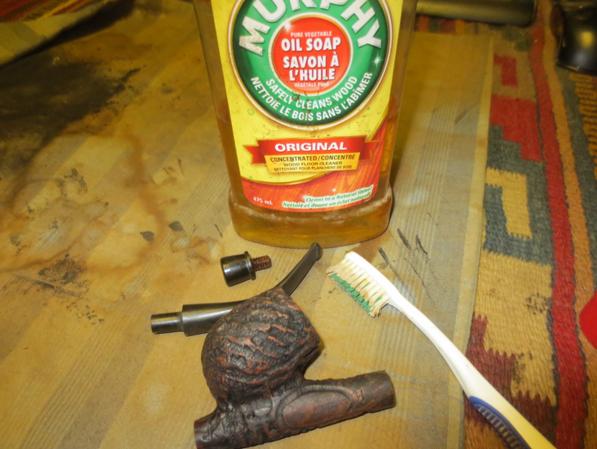
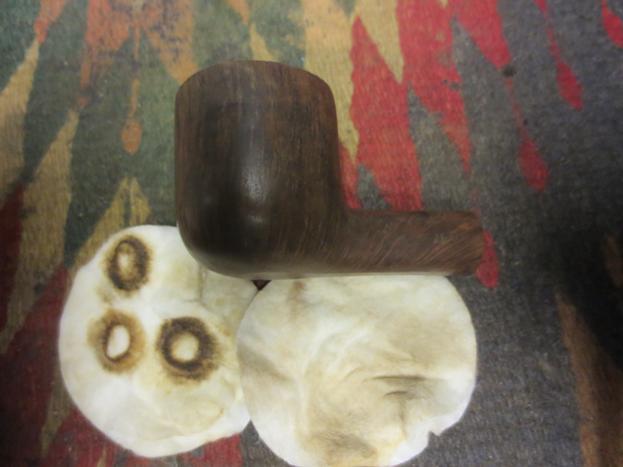
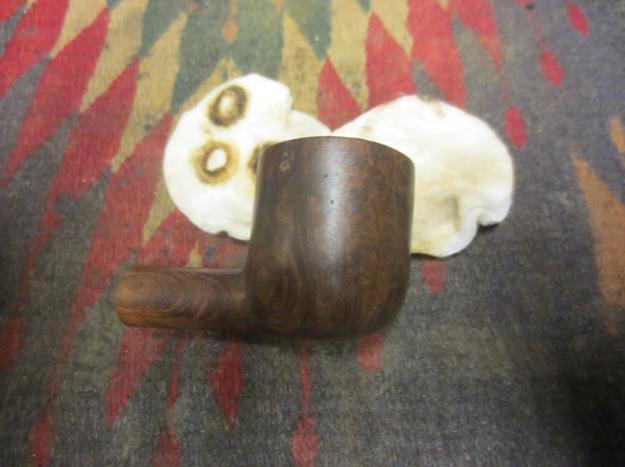
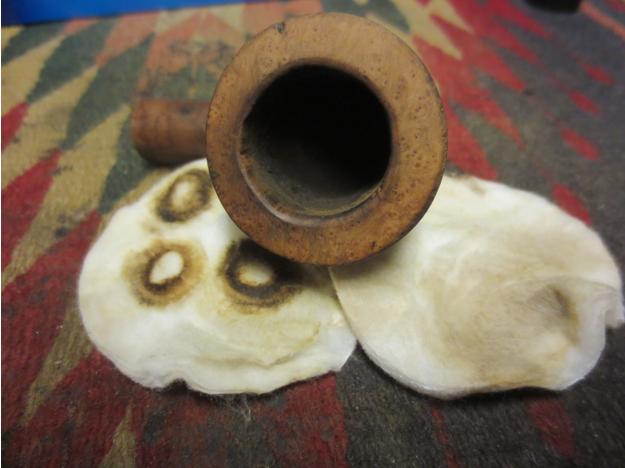
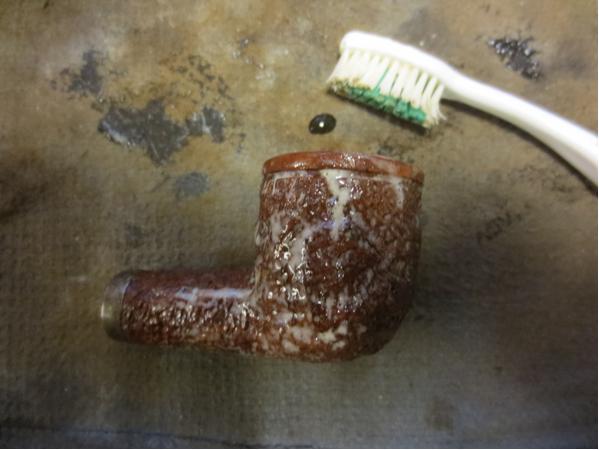
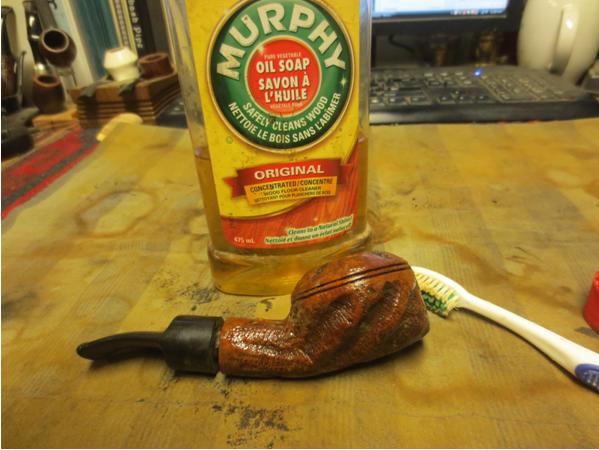
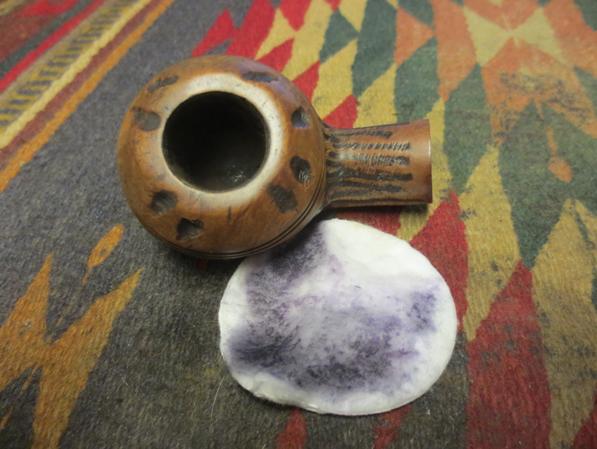
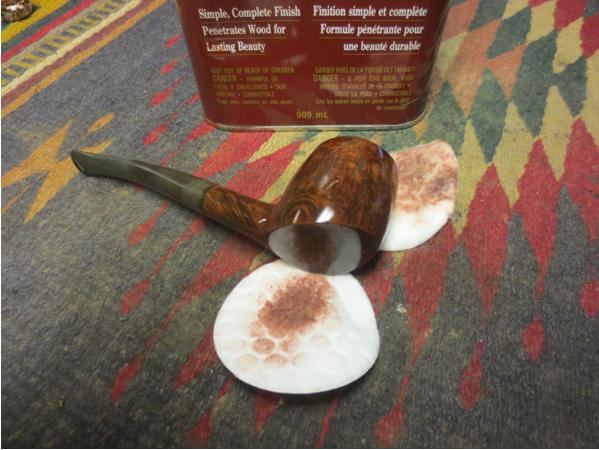
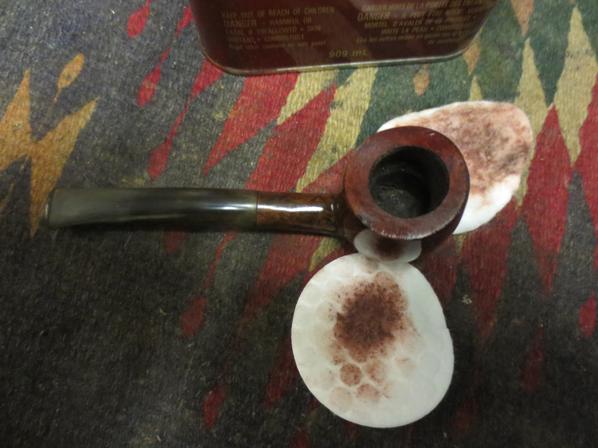
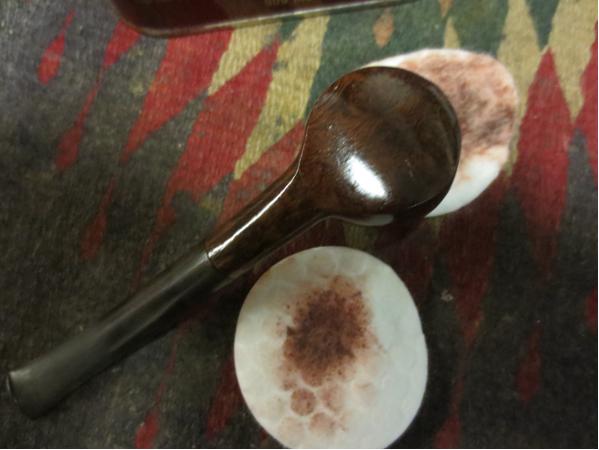
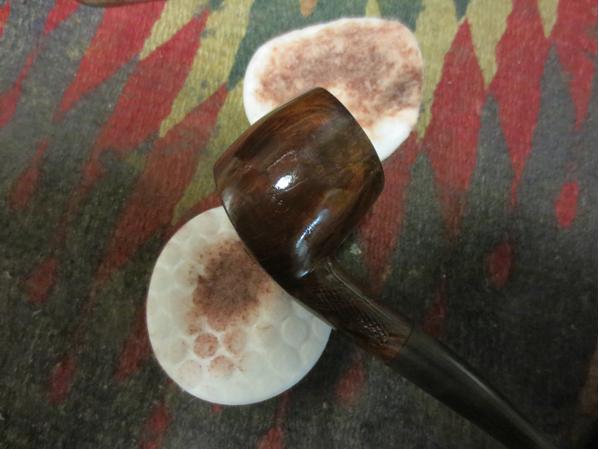
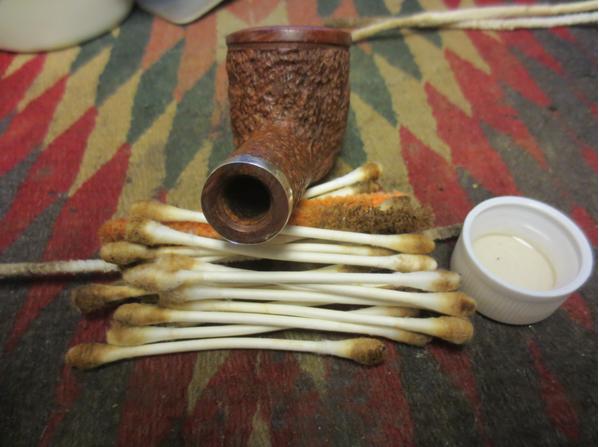
I took the bowl over to the sink and scrubbed the outside with a toothbrush dipped in Murphy’s Oil Soap. I wiped it down, then took it back to the table and rubbed it good with cotton balls soaked in 91% isopropyl alcohol.

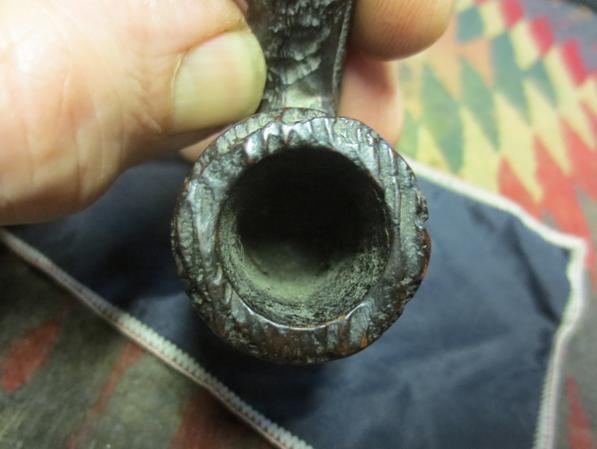
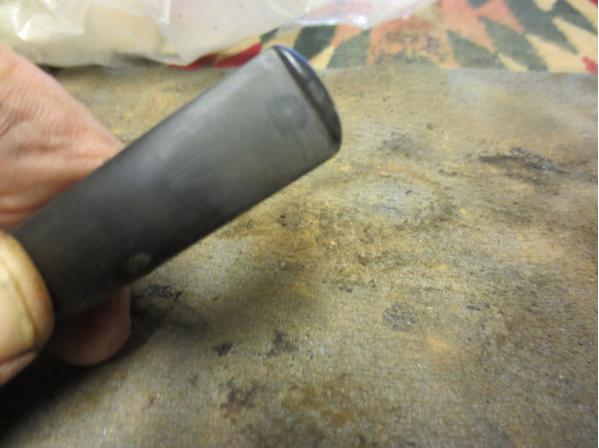
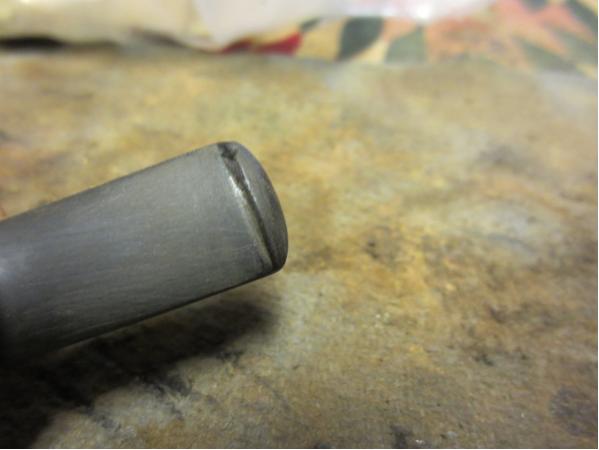
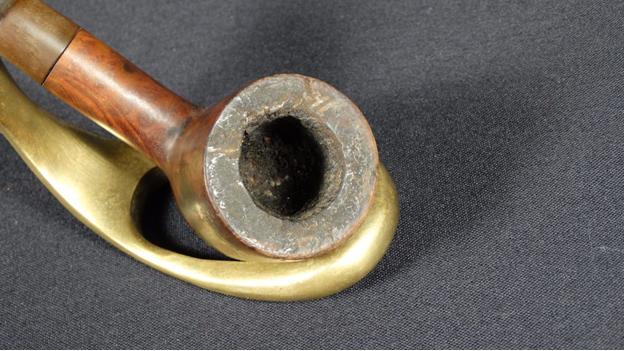
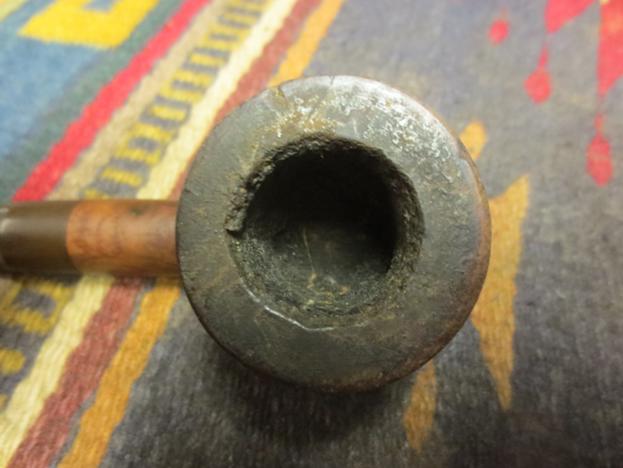
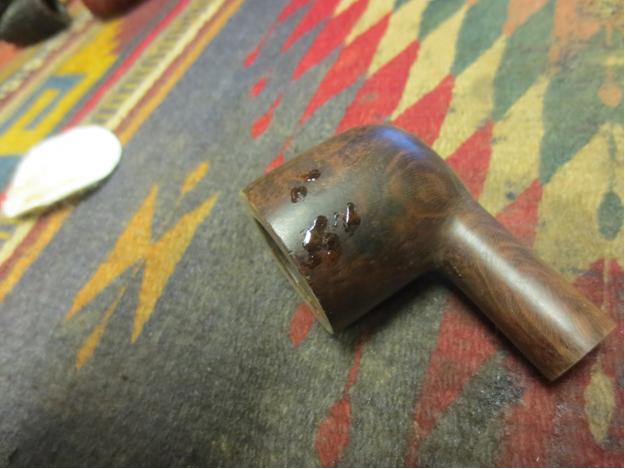
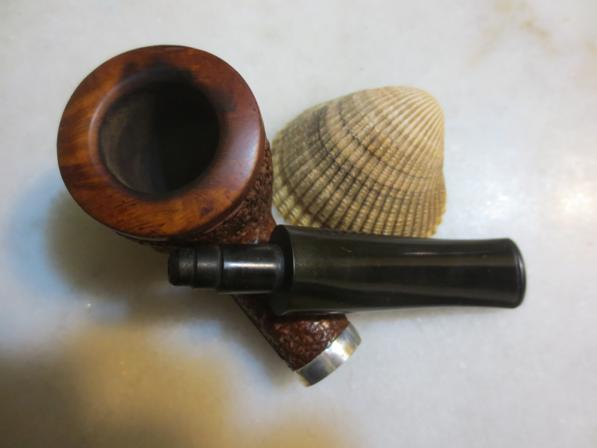
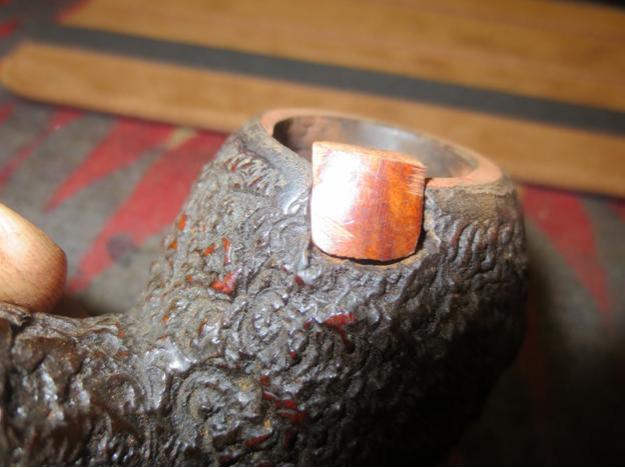
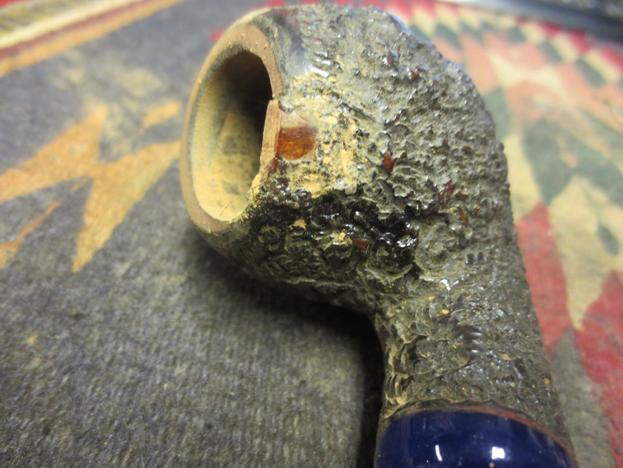
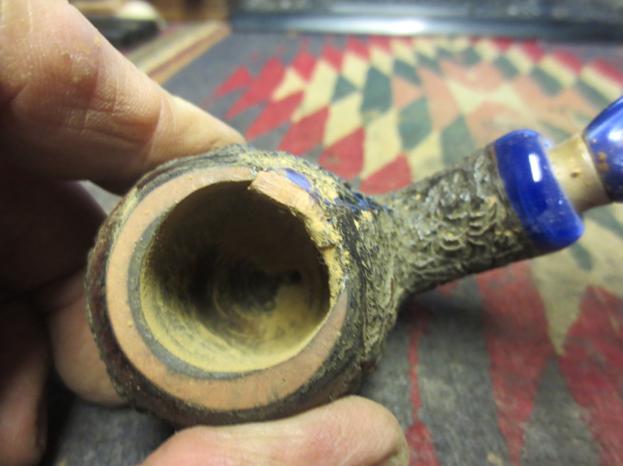
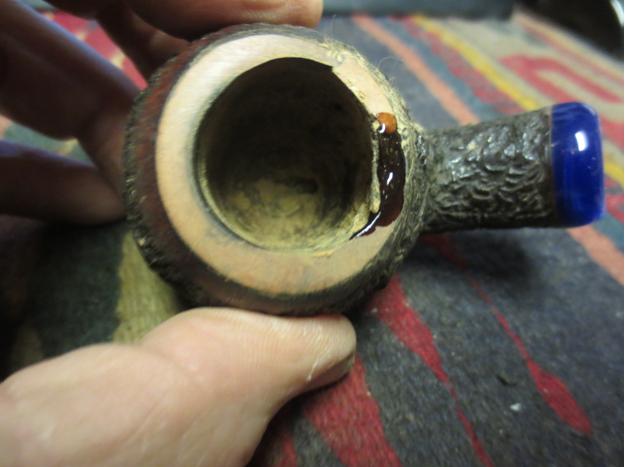
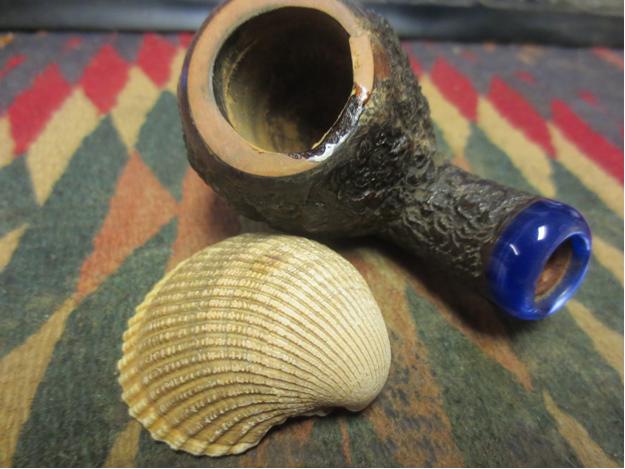
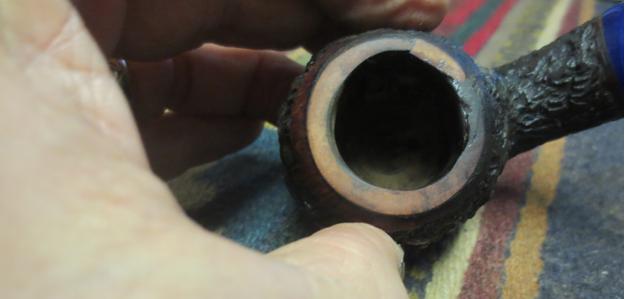
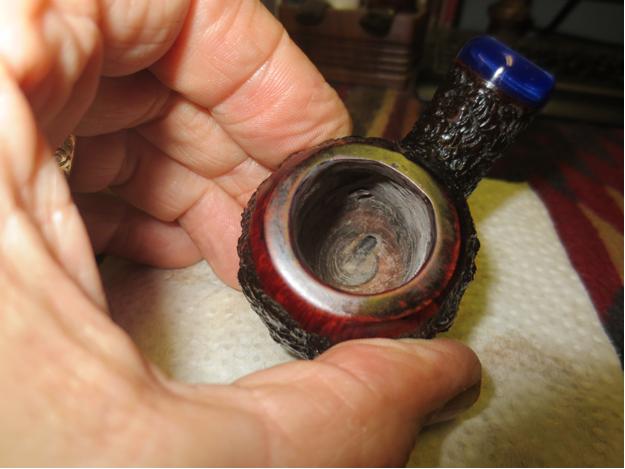
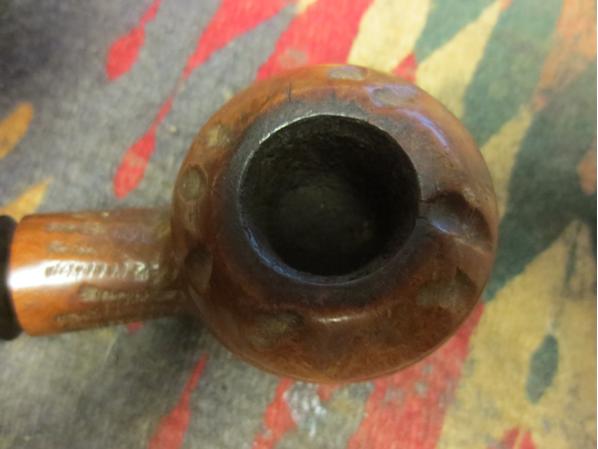
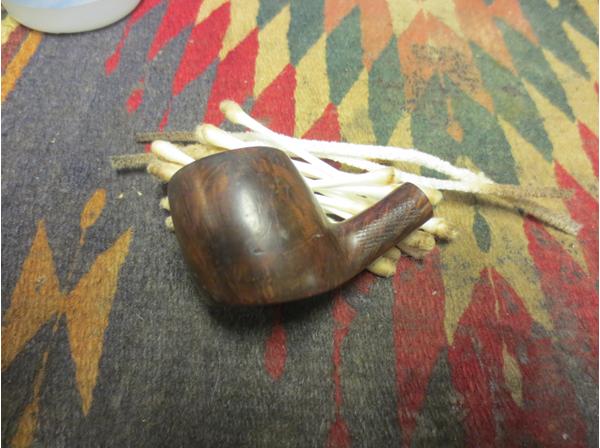
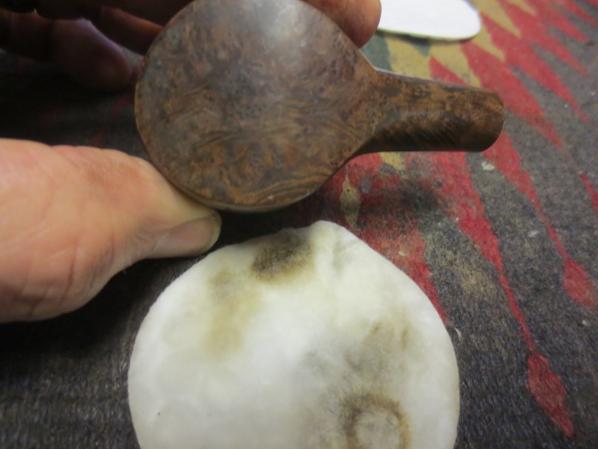
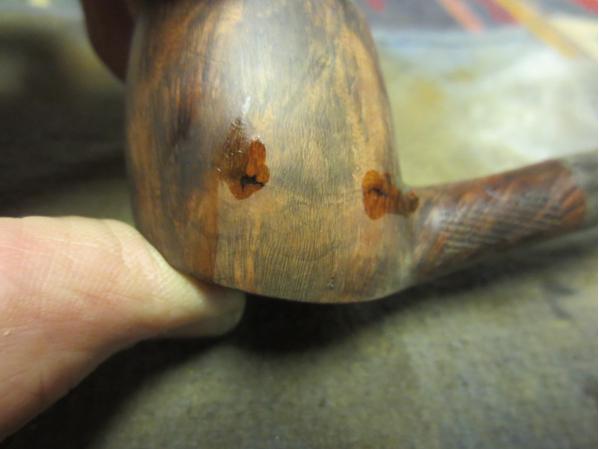
The rim had a pretty good chip—maybe 1mm or so deep–missing at about the 8 o’clock position as you look at the bowl from the shank. While an extreme topping of the bowl would smooth things out, I felt it could also compromise the bowl’s shape. So after sizing it up from all angles, and finding that there really wouldn’t be much chance of tobacco being in contact with that area, I decided to try filling it instead.Pam8

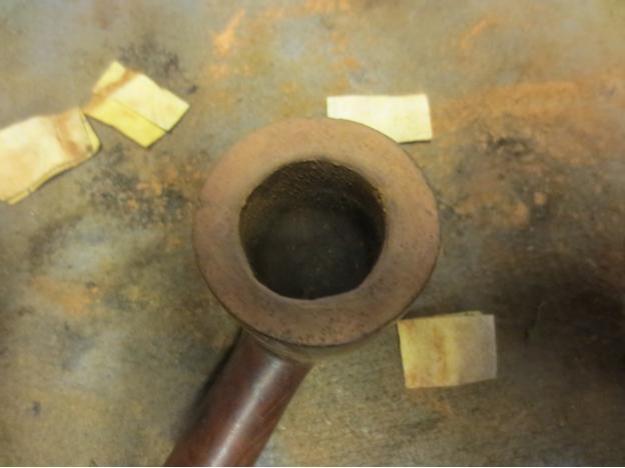
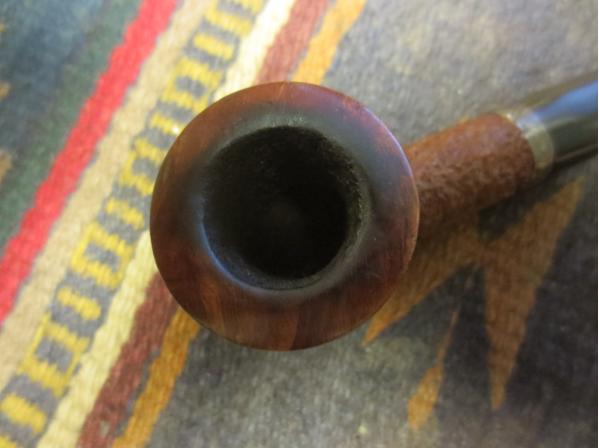
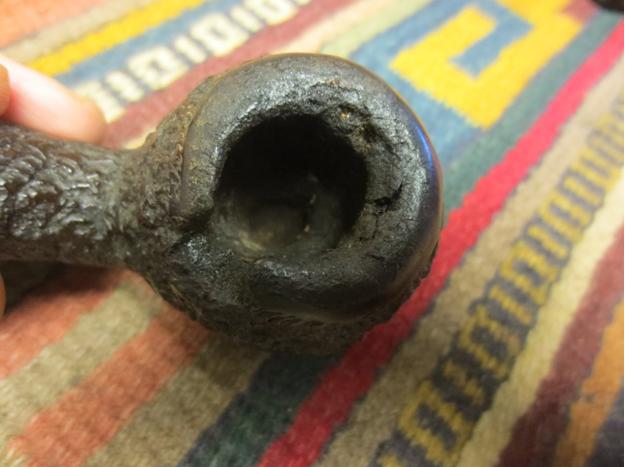
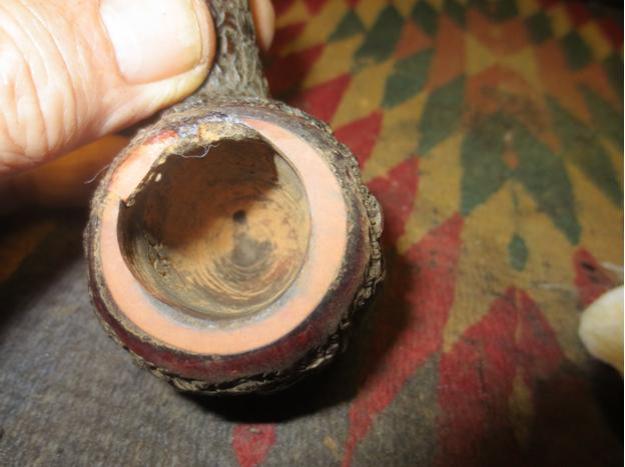
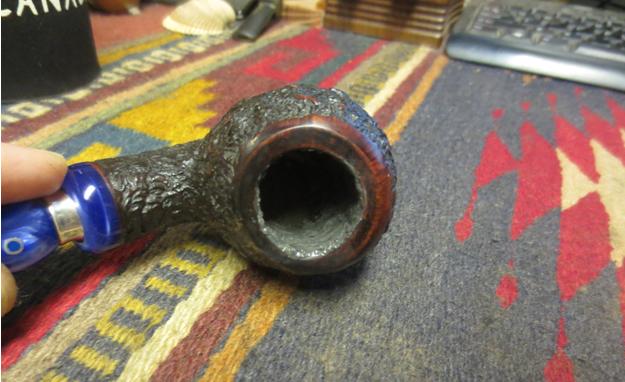
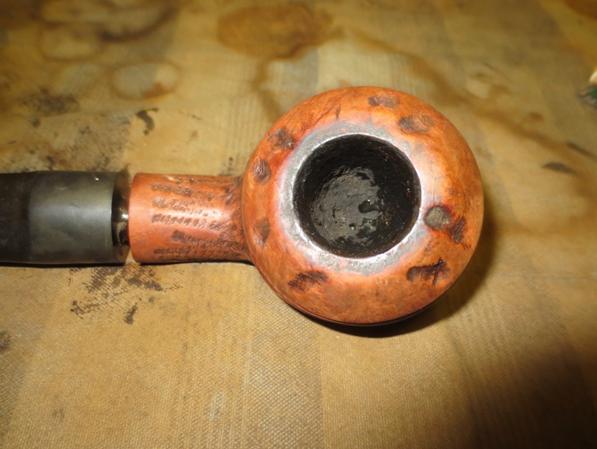
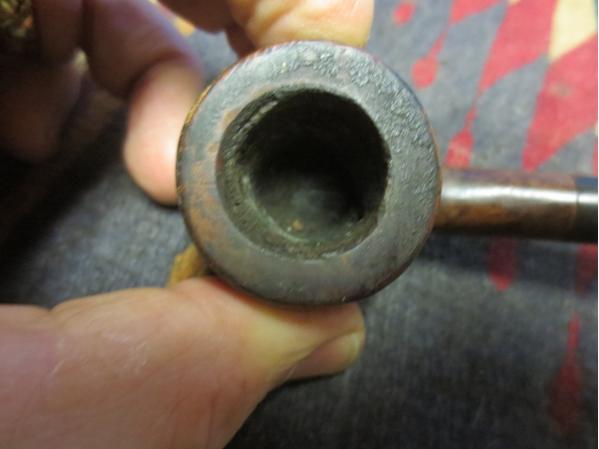
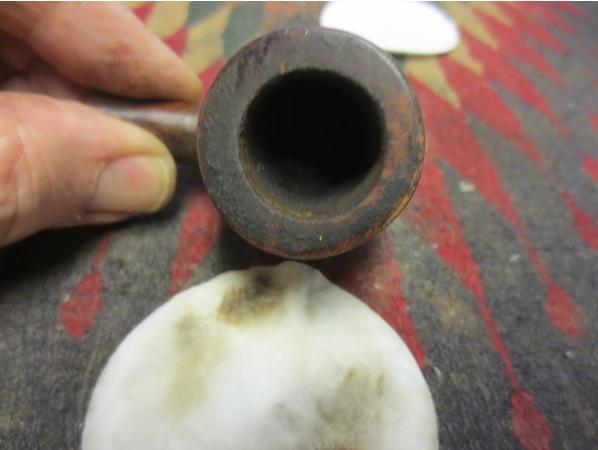
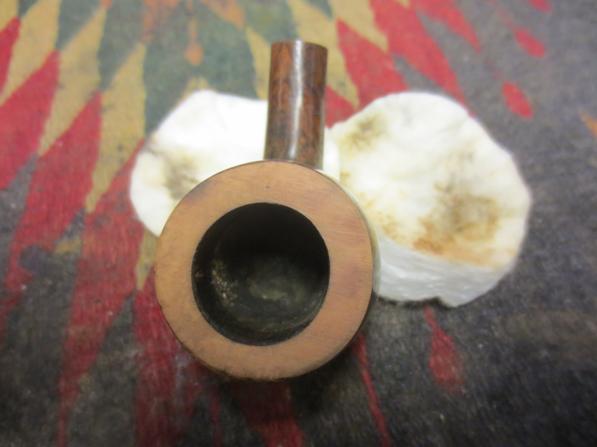
Pam9Before proceeding with the fill, I thought it might be good to first address the inside of the bowl, which had minimal cake but a troubling bit of what looked like fuzzy mold or fungus. I didn’t want any spores getting into the fill, so I wiped everything down with 190 proof alcohol, then wrapped a piece of 220 grit sandpaper around my finger and sanded the interior thoroughly. More alcohol, then the addition of a flame. Take that, moldy fungus! After another heavy swabbing with Everclear I declared the inside done.

Back to the rim patch… I cleaned the area to be filled with alcohol, then scrubbed it with a green Scotch Brite pad to remove any dirt and debris. I was glad I used a wide pad like that because the briar on either side of the chip was loose and came off when I scrubbed.

The fill would need to be a little wider but not any deeper—not a big deal. I packed some briar dust along the rim, then reached for the super glue to drip onto the patch.

I’ve done this many times but am still perfecting the technique. This time I learned an important lesson: Don’t attempt a maneuver like super glue-dripping, which requires a certain degree of precision, with a parrot perched on your shoulder.

(Time out for a side note: I have a large macaw named Tom who is a frequent observer of my pipe renovations. I don’t let him near smoke or fumes but other than that he’s close by pretty much all the time. He normally sits on his stand and looks down on the proceedings, but this particular night he was on my shoulder.)

Anyway, Tom shifted just as I was letting a little drip drop onto the pipe. I totally missed the briar dust and watched as the dribble made its way down the inside of the bowl. Shazbot.

I tried again, Tom shifted again, and I dripped on the outside of the bowl. Arrrr!

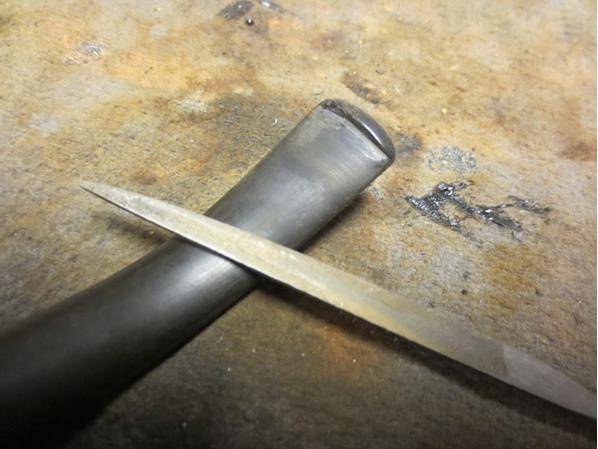
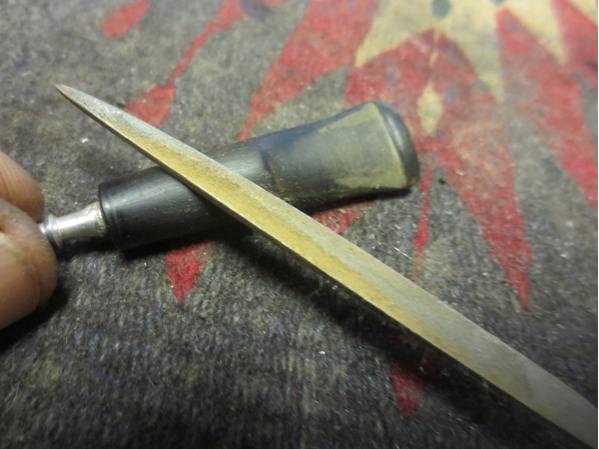
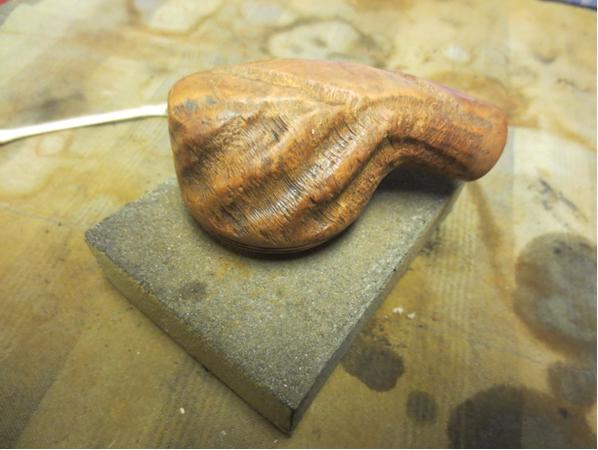
Fool me once, fool me twice… I wiped up the outside drip as best I could and put Tom over on his stand. I sat down and, with steadier hands, I dripped the glue a third time—on target—and after sprinkling on a little more briar dust, set the bowl aside to cure overnight.Pam10 The next morning I took a flat needle file to the overfilled fill to jump start the removal of material. After that a thorough sanding with 220 grit sandpaper, first with the paper in my hand and then on my topping board, got the fill flush with the side of the bowl as well as the adjoining rim surfaces.

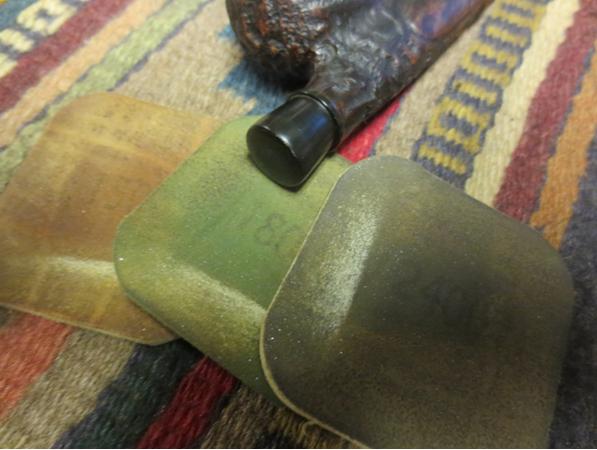
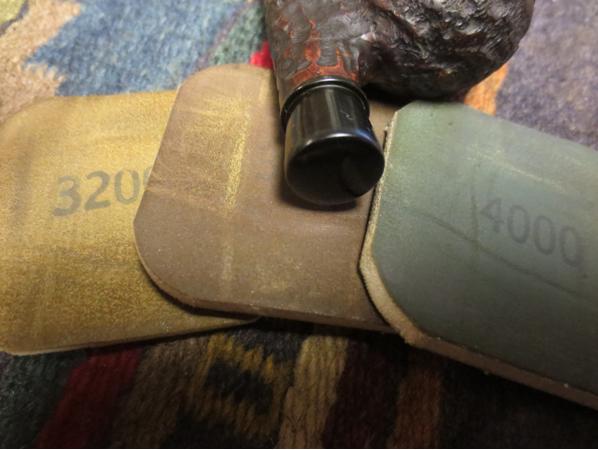
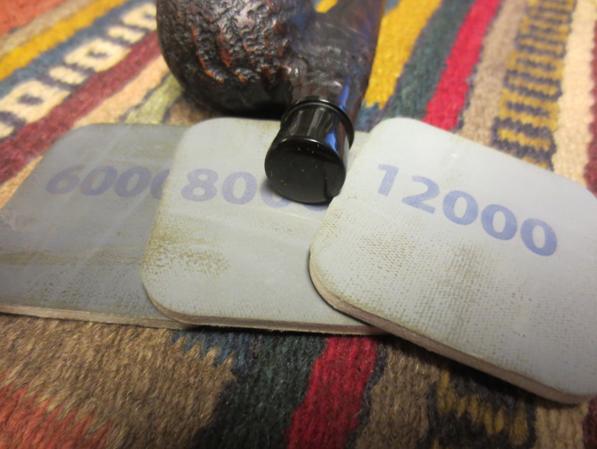
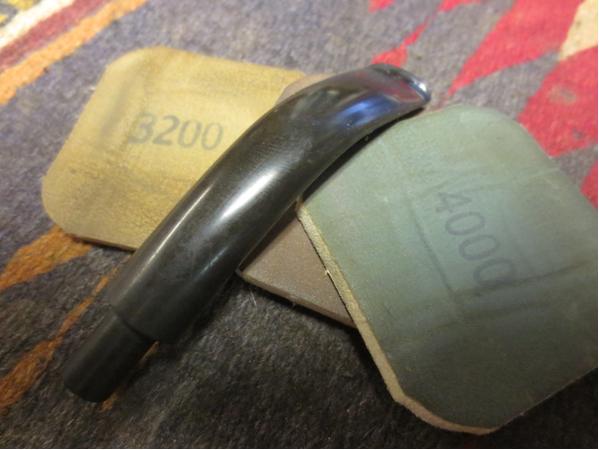
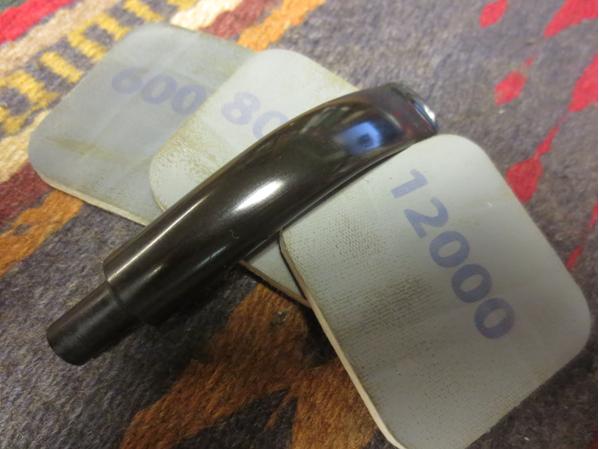
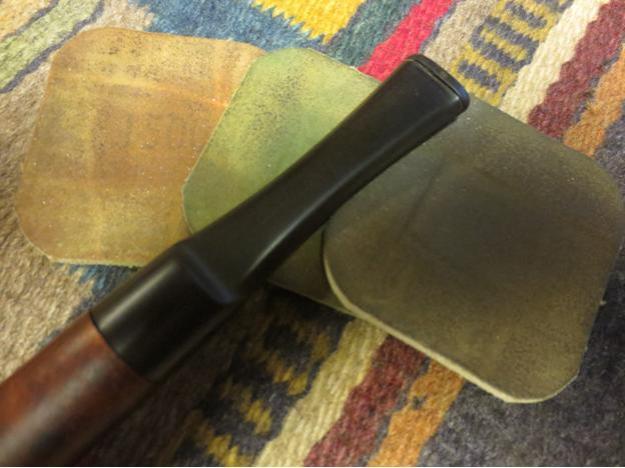
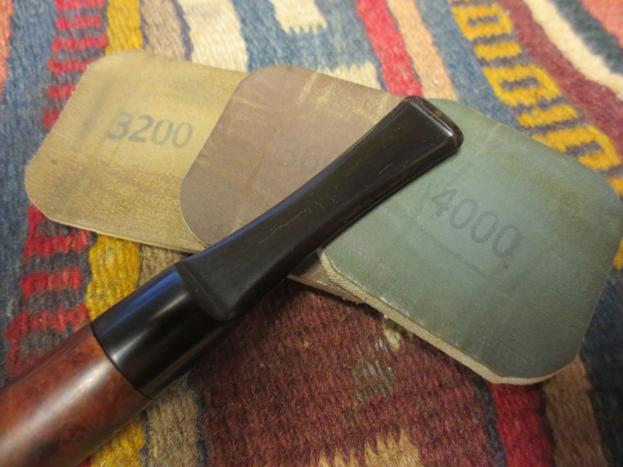
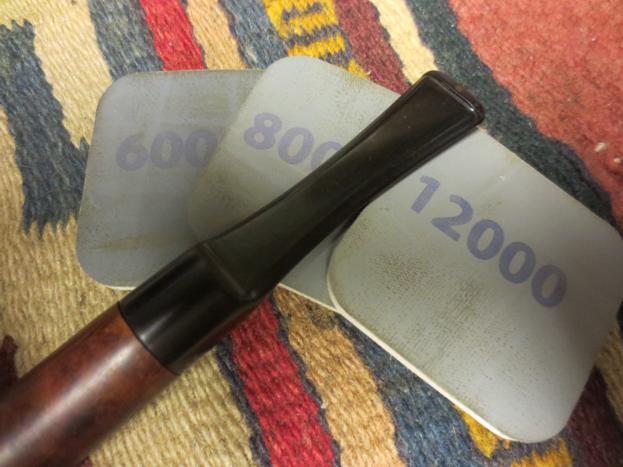
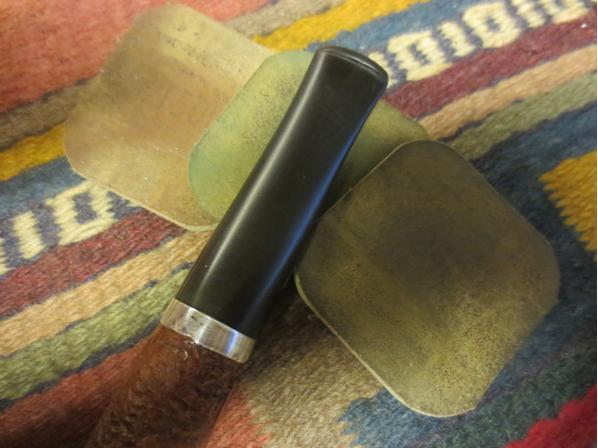
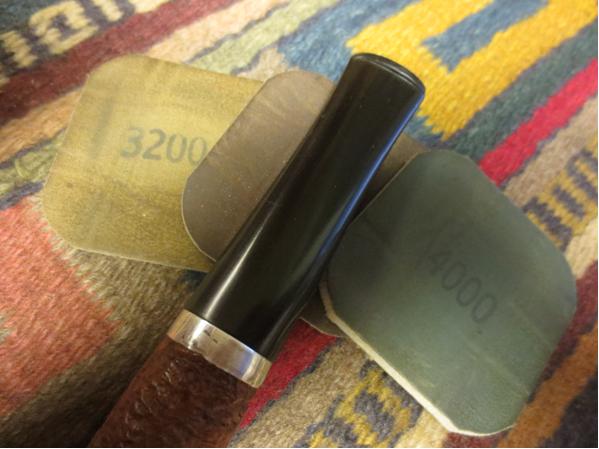
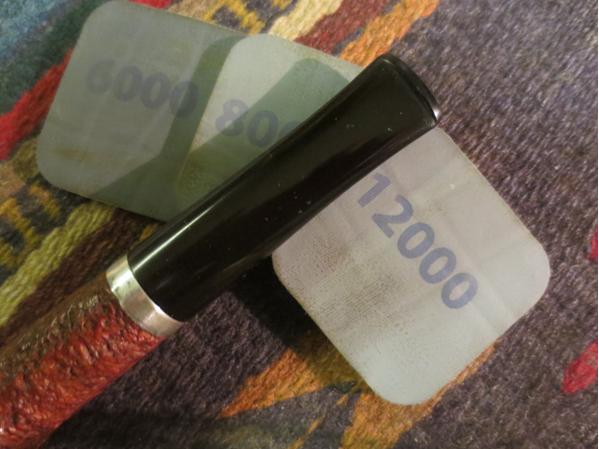
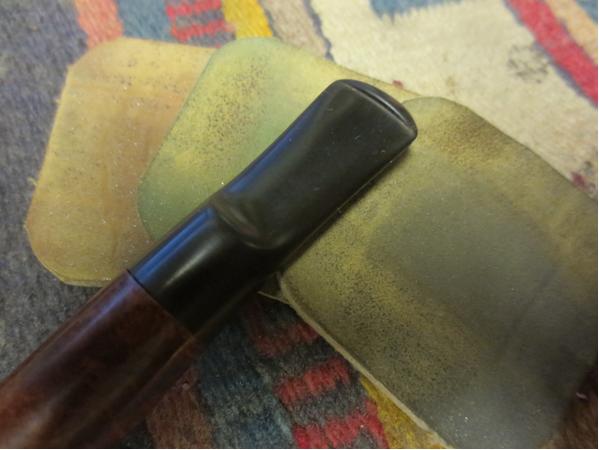
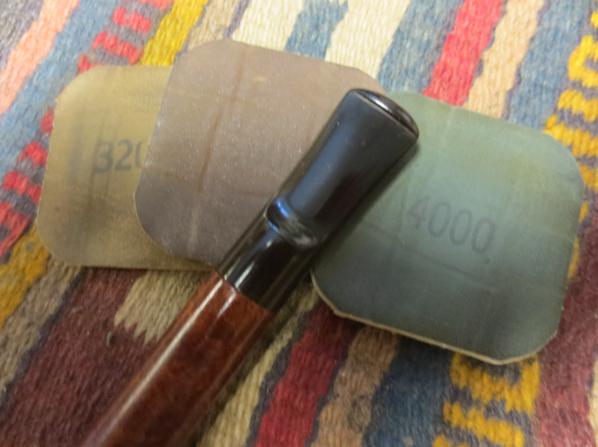
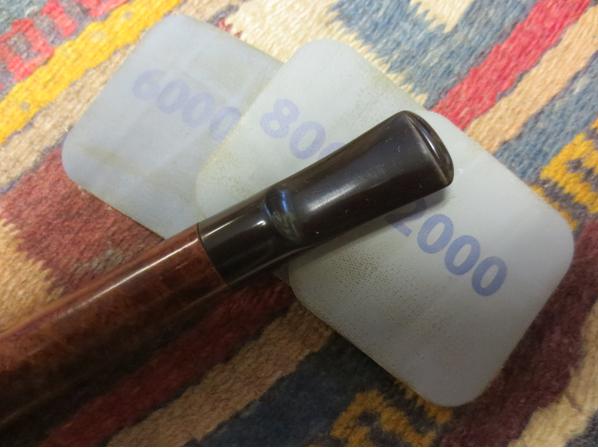
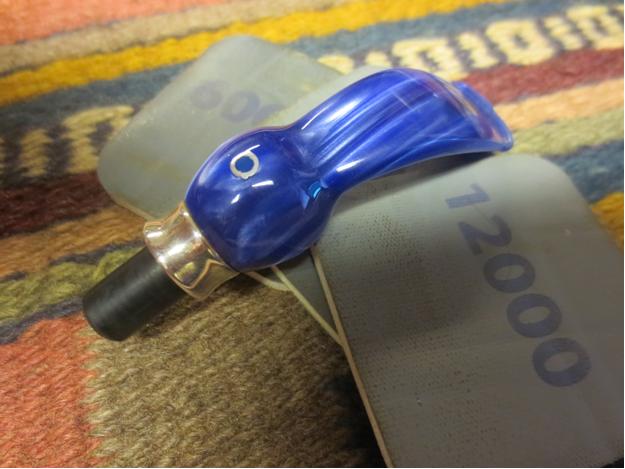
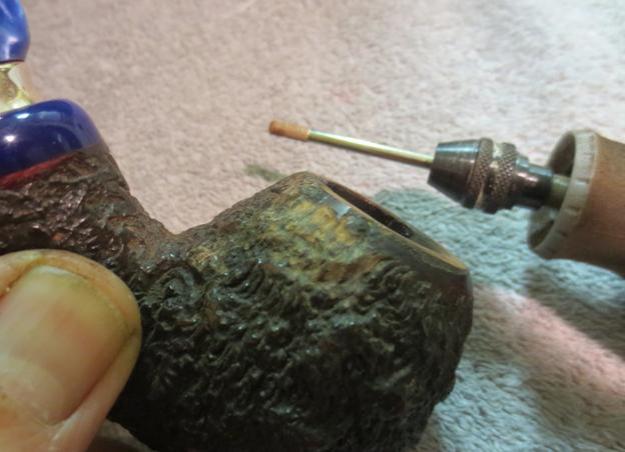
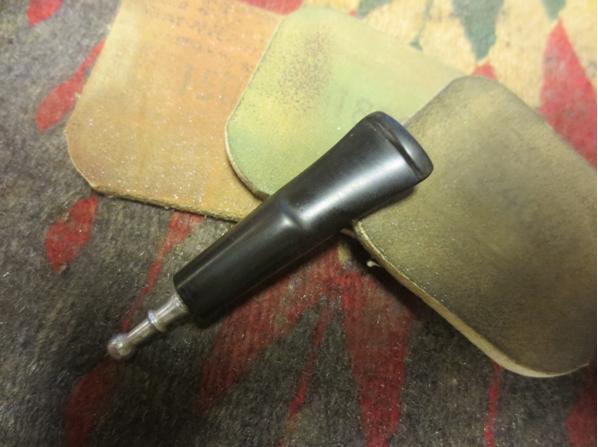
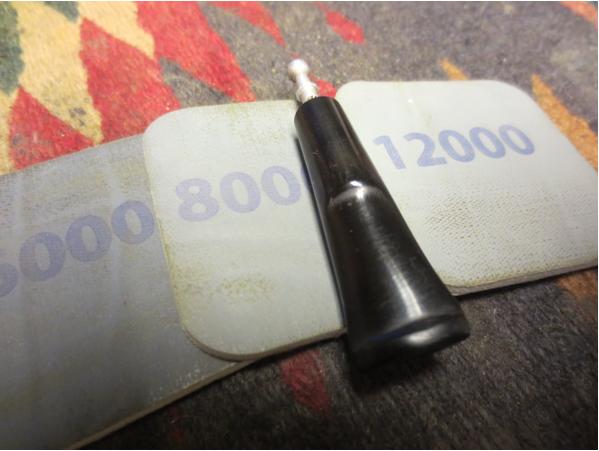
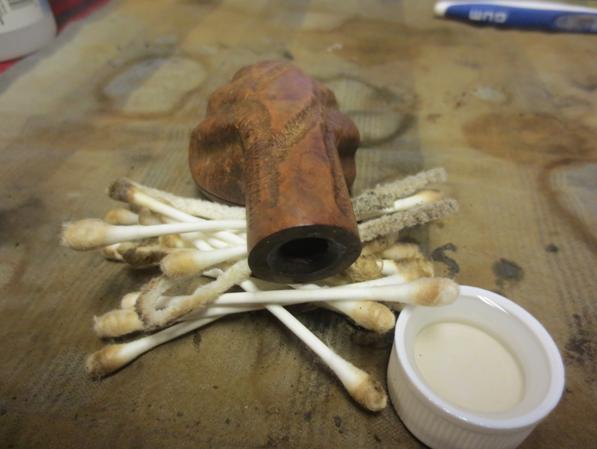
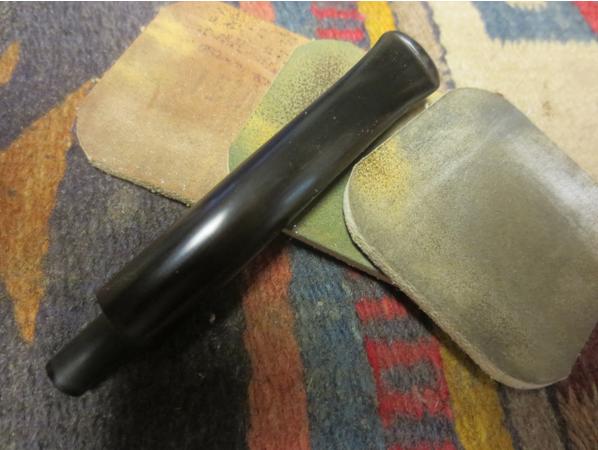
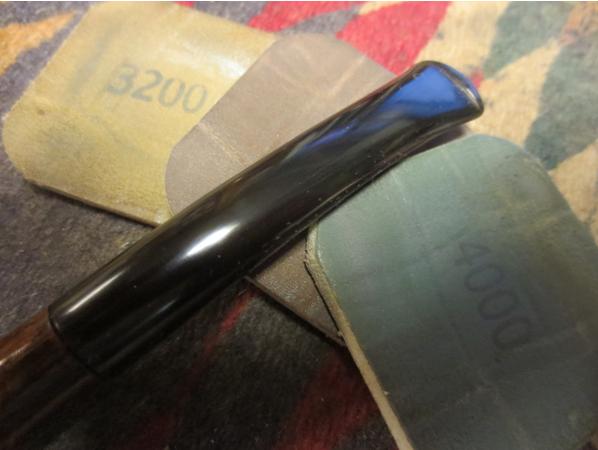
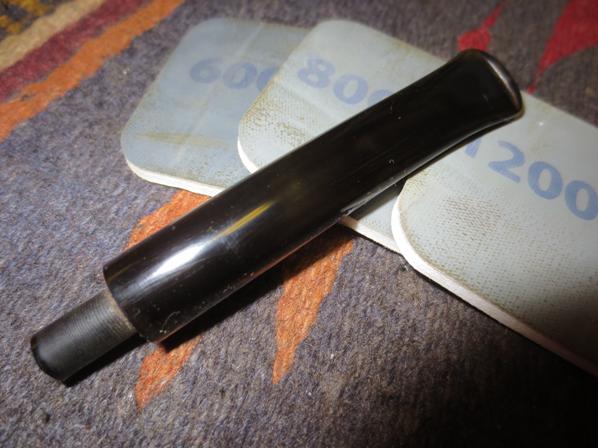
Follow-up sandings with 400 and 600 grit smoothed things out even more, but also revealed a couple of small holes in the fill. I probably had left some small air pockets in the briar dust; I couldn’t pack it down as tightly as I normally would due to its location on the rim. I refilled the fill using minute amounts of briar dust and applying the superglue with a toothpick.Pam11 While these tiny patches dried, I took on the task of shining up the metal band. I wiped it down with white vinegar, then ran through the sequence of 1500-12000 micromesh pads to make it good and shiny. Using the same pads, I polished the stem as well.Pam12 To give the patches a little more time to cure, I set about cleaning out the shank. Two—count ‘em, TWO—pipe cleaners, one bristle and one regular, dipped in alcohol was all it took.

I don’t know why the former owner didn’t smoke this pipe much, but as I set about sanding the patches I started coming up with scenarios. One, maybe it’s a crappy smoker. Only time will tell on that one. But other situations came to mind too. Maybe the stem was a problem from the get-go. Maybe it overturned after only a few smokes. Maybe the bend didn’t feel right. (Not that that will be problem any more. Ha.) Maybe it gurgled.

Whatever the reason for its nearly new condition, the pipe was rapidly coming back together again. Even with a 20 minute detour to sand off my super glue mistake inside of the bowl, the end was in sight.

I sanded the outside of the bowl and shank with 400 and 600 grit paper and followed up with the 1500 micromesh pad to take care of some slight scratches and dings. Next I got out the aniline stains to even up the color of the briar. Although much of the bowl was still quite dark, it was lighter on either side of the rim patch. I wiped on some oxblood stain, flamed it, wiped on dark brown and flamed again. A little bit of dabbing here and there with the dark brown and the staining was complete.

I slipped the metal band on the shank, screwed on the stem, smiled when it stopped right where it should, and headed over to the buffer.

(New development here at Casa Otto: Aided by a couple of gift cards from my brother, I invested in a Foredom M.BL—a small bench lathe with a variable speed motor that tops out at 7,000 rpm. I haven’t gone over what I estimate is about 1,200 rpm, based on the intervals marked on the speed control, and the results have been outstanding. Not only is it a fabulous machine, but it’s also small and fits nicely on the kitchen counter. It’s a huge improvement over my jerry-rigged drill press buffing station in the garage, and on a day like today when the outside temp is 2°F, a heck of a lot warmer too. Next step: Setting up the buffer in a spare bedroom. Upside to this will be getting counter space back. Downside is that the spare room is quite a distance from where the beer and snacks that fuel all good pipe projects are stored.)

I first buffed the assembled pipe with White Diamond, wiped it down with a flannel rag, then gave it three coats of carnauba, buffing with a clean wheel after each application.

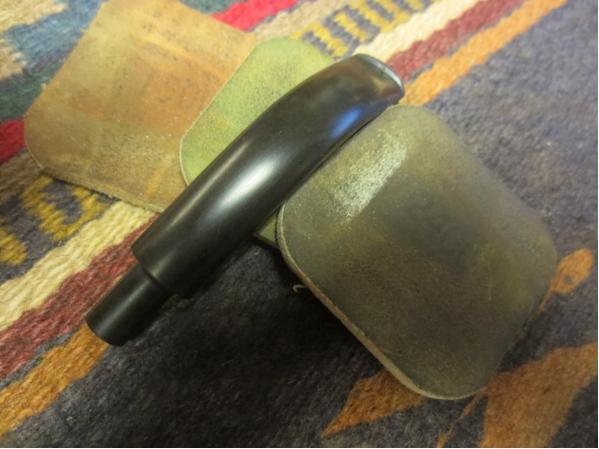
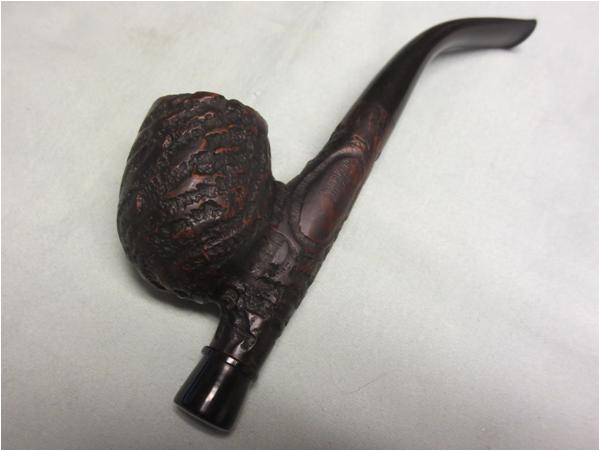
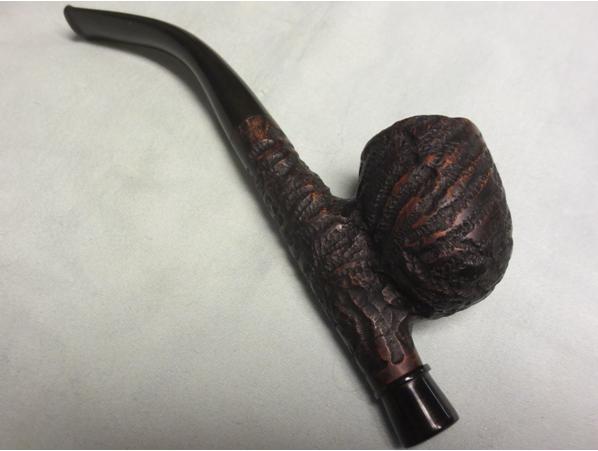
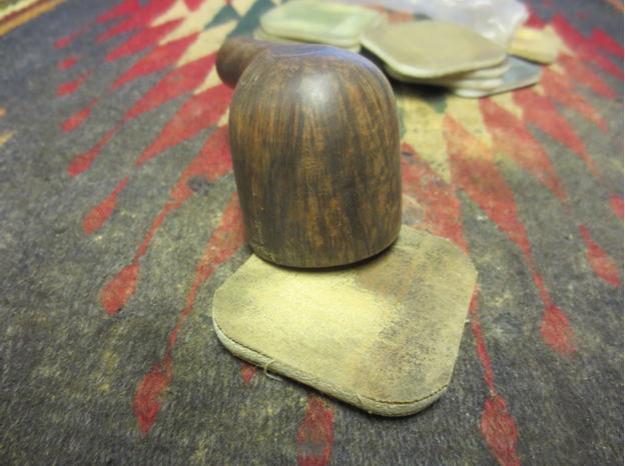
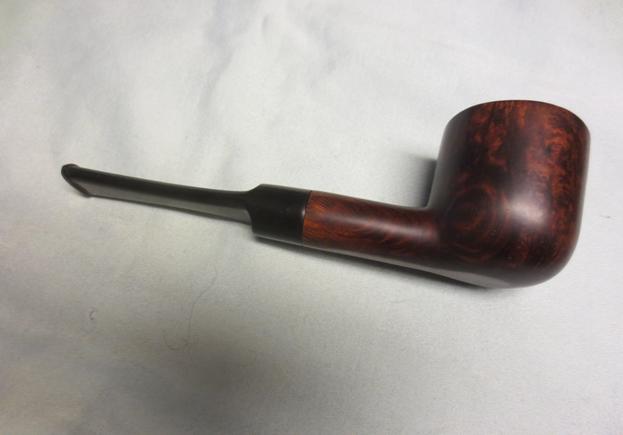
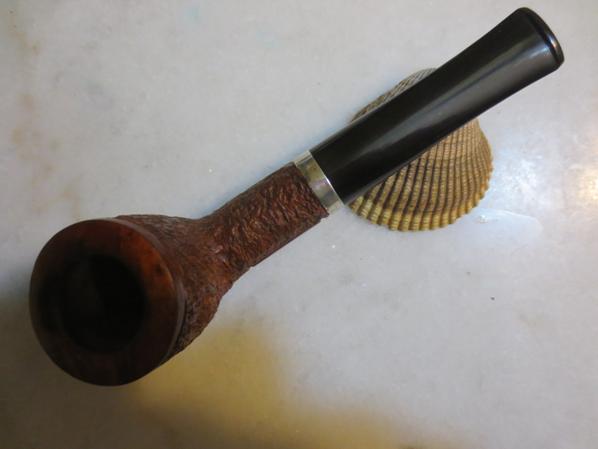
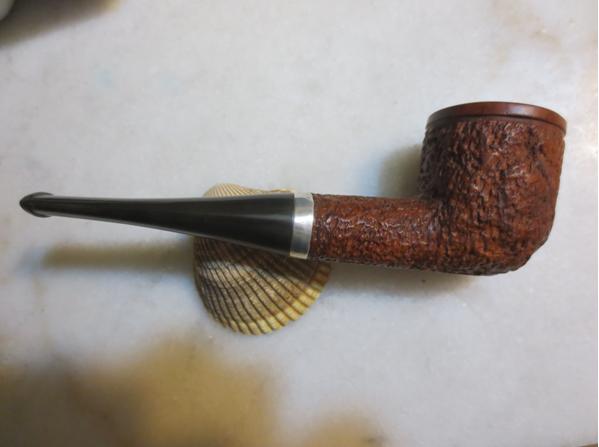
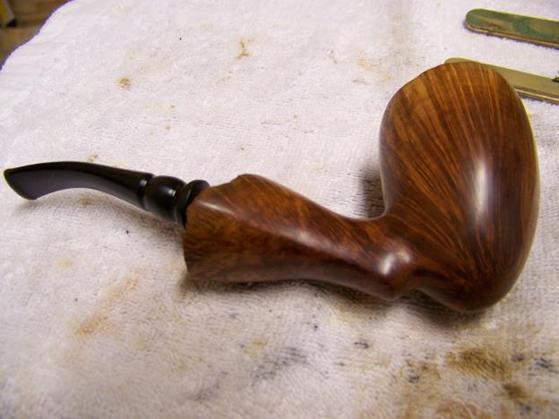
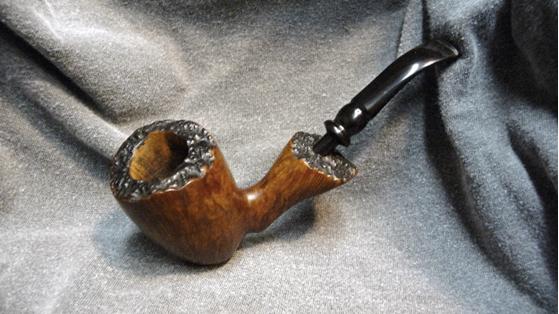
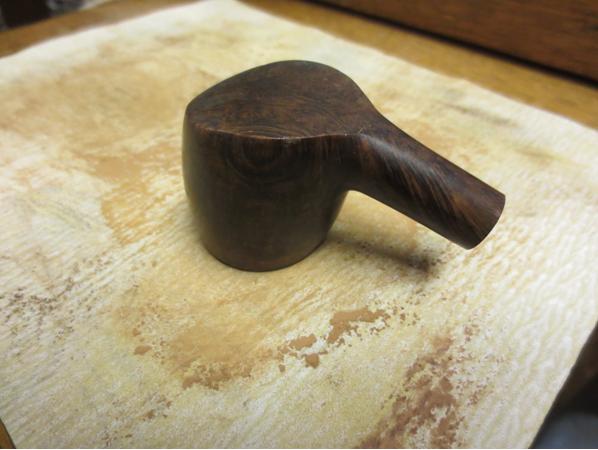
This old pipe didn’t see much action during its go-around. But today, chip-free, moldy fungus-free and with a stem that sits where it should, it stands ready for a new century of service.Pam15Pam14Pam13

What is he looking at? A Portrait of a Pipeman


Blog by Steve Laug

I love looking at old paintings and framed prints while I am out hunting for pipes. I have found some pretty interesting old pieces that are now in various rooms in our home. My brother came across this painting in an antique shop near where he lives in Idaho. He said it just stood out to him while he walked around the shop. It is certainly a picture that I would have spent time looking at and enjoying. I would also have asked the owner what he was willing to sell it for and my brother did the same. The owner quoted him a price and my brother countered with an offer. The seller accepted the offer and my brother walked out as the new owner of the painting.IMG_20160108_192603
He showed it to me on Facetime and I was struck by what a great photo it was. He took a picture of the painting and sent it to me. He said he cut off a bit of the hat and the smoke from the pipe but the general idea was still clear. The great thing to me was that he said that he was going to send it to me. I can’t wait to see the portrait in person.

When I see old paintings like this I always am drawn to reflect on the subject of the painting and the setting. I think it comes from the remnant of those art history courses I took in university some 40 years ago. I like to look at the style of the painting and the perspective of the artist. From there I try to figure out a bit about the person in the painting.

From the angle of the face I wonder if this is not a self portrait of the painter. The perspective of the way he looks out from the painting leads me to think that he was looking at himself as he painted this piece. To me the character of the old man who comes through those eyes. He has a certain whimsical air about him almost as if he is quietly chuckling around the bit of the pipe. The wrinkles around the eyes and the creases in the forehead should a man who loved to laugh. He obviously enjoyed life. The pipe appears to be clay with a reed stem and mouthpiece. To me it looks like a bit of a homemade pipe – using and old bowl and then inserting a hollow reed to make it usable.

Whoever this anonymous painting is by and whoever it is who sat for the portrait – whether the painter himself or a photo or friend it is a well done piece of pipe art. I am looking forward to seeing he print/painting in person one day. I know that it will find itself in a place or prominence in my study overlooking the desk I use as a worktable for pipe restoration. Somehow I think that is a fitting spot. I will have to watch myself as I am sitting under the watchful eye of this old gentleman. He looks like he knows more than he is saying.

My Supply List


This is a well designed list of supplies that are used in refurbishing. My list is much the same. I have blogged it earlier on rebornpipes but this is a great refresher. Thanks

pipesrevival's avatarPipesRevival

PhotoGrid_1452362709014~2


A great post for this site would be one highlighting the different tools, products, etc. that y’all use.

Recently I received a question a on my supplies. Everyone who’s into estate pipe refurbishing has his or her own list if tools and products ,these are the products and tools I reach for in the restoration of my pipes. I try to keep things as cheap as possible. I didn’t list prices as they have changed some since my purchasing them. Also my equipment was purchased over a five year period as it was needed it was added.

PhotoGrid_1452998413734

  1. Castleford Reamer(EBAY)– I started out with this reamer, was on my second when I switched to a Pipnet.
  2. Shank Brushes(plastic tips) – Smokingpipes.com / Pipes&Cigars.com
  3. Retort(EBAY)– seller 4Ziggy20
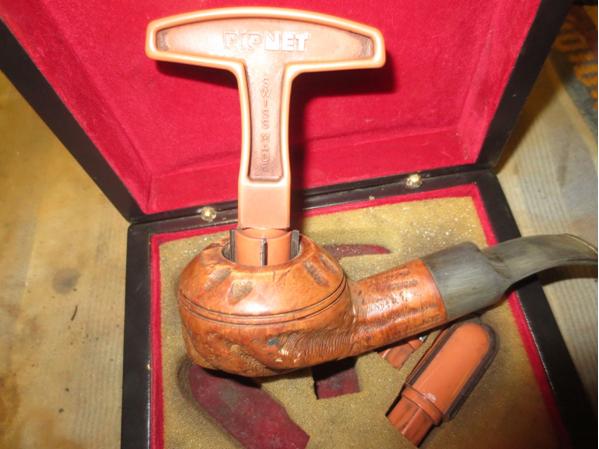
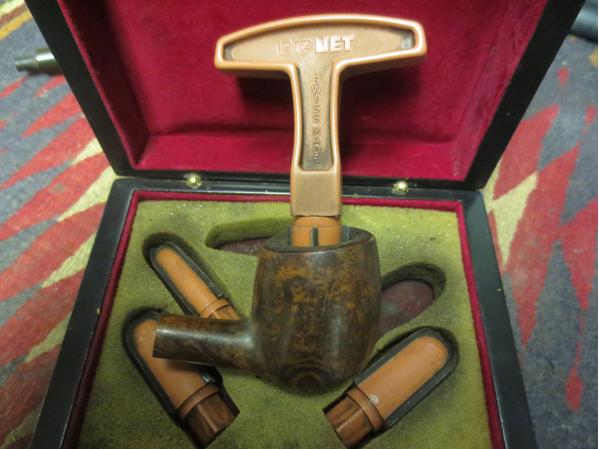
  4. Pipnet Reamer– Smokingpipes.com  I as well as many others recommend this reamer.
  5.  Round Tip Jewelry Pliers– Big box store. I…

View original post 347 more words

A Peterson’s Product 268 Zulu Restemmed and Restored


Blog by Steve Laug

This pipe came to me with the Meerschaum Sultan that I restemmed. It is stamped Shamrock on the top of the shank and “A Peterson’s Product” Made in the Republic of Ireland on the underside. On the right side near the bowl shank union it was stamped 268. I looked the number up and it is the shape number for a Zulu shape. The gentleman in Chile wrote: “I only have the bowl (I’m not acquainted with the minor brand) with an inappropriate mouthpiece which makes it impossible to smoke. I don’t remember how it got into my collection and certainly it’s not a pipe I purchased myself. It has a heavy cake and is a second-hand. If a proper mouthpiece could be made and a proper tune-up, it could make a fine pipe.” He included the following pictures.Shamrock1 When it arrived I took it out of the box to deal with when I had finished repairing the Sultan Meerschaum pipe. It was a nice piece of briar with mixed grain and a worn finish. The stamping on the top of the shank was clear and sharp. The stamping on the underside showed clearly on the left side as you read it but as you got to the right side it was fainter. The rim was dirty and had a flaky coat of lava overflowing from the inside of the bowl and the thick cake there. The inner and outer rim looked good with no dents or chips. The bowl sides, front and back had some light dents in the finish. The stem was a billiard stem that had been stuck in the shank. It fit snugly but absolutely did not match the oval shank.Shamrock2

Shamrock3

Shamrock4

Shamrock5 I took a close up photo of the rim and the bowl to show the thickness of the cake. Toward the bottom of the bowl it got thicker and reduced the size of the bowl at the airway.Shamrock6 I looked at several Peterson shape # 268 Zulus to get an idea of what the stem looked like originally on this pipe. I went through my can of stems and found several that would work on this pipe. The one that was the closest to matching the diameter of the shank of the pipe was a brand new stem blank that still had the castings on the sides and end of the button. The slot was constricted but the length and shape would be easy to match to the shank.Shamrock7 I drilled open the airway to accept the rod of the PIMO tenon tool. And then set up the tenon tool on a cordless drill. The current tenon was too long for the tool to cut all the way to the end of the tenon so I used the Dremel and sanding drum to shorten the tenon. I put it on the tool and adjusted the set screws and took off the first round of material. I did three adjustments to turn the tenon down to a fit in the mortise. I fine tuned the fit with 220 grit sandpaper.Shamrock8

Shamrock9

Shamrock10 The fit in the mortise was snug. The diameter of the new stem was large on the sides and the bottom. The top would take the least adjustment to get the fit correct.Shamrock11

Shamrock12

Shamrock13 I took off the majority of the excess vulcanite with the Dremel and sanding drum. I put it back in the shank and the fit was better. The rest of the work would have to be done by hand sanding.Shamrock14 I hand sanded the stem until it was smooth and the transition between the shank and stem needed some fine tuning then set the stem aside and worked on the bowl. Contrary to my normal pattern I wiped off the outside of the bowl and shank with acetone on cotton pads to remove the finish and the grime that had been ground into the briar. Once it was gone there was some nice grain showing through.Shamrock15

Shamrock16

Shamrock17

Shamrock18 I put the stem in place and took a few photos so that I could see where I stood at this point in the process. The pipe was looking good and with a few tweaks would look even better.Shamrock19

Shamrock20

Shamrock21

Shamrock22 The top of the bowl was caked and the lava was very hard. I tried to scrape it carefully with a pen knife and gave up. I resorted to lightly topping the bowl on the topping board to remove the thick lava build up.Shamrock23

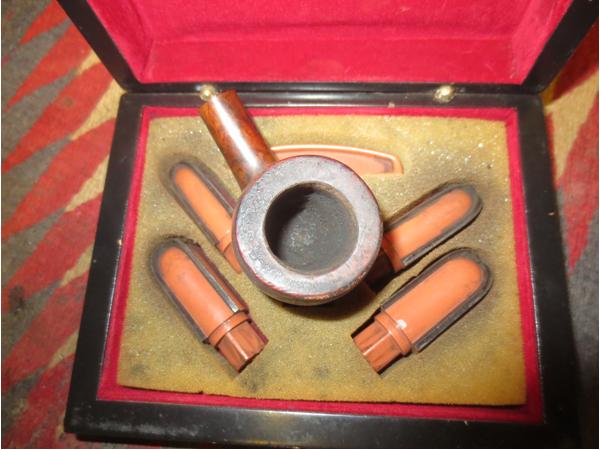
Shamrock24 I reamed the bowl with a PipNet reamer starting with the first cutting head. I finished with the second cutting head which was the same diameter as the inside of the bowl. I cut the cake back to bare briar so I could assess the inner bowl walls. They looked very good with little burn or damage. The cake had protected them.Shamrock25

Shamrock26 I fine tuned the sanding on the stem and shank fit with 220 grit sandpaper and shaped the stem to match the oval of the shank. The flow of the bowl and stem were looking really good at this point in the process.Shamrock27

Shamrock28

Shamrock29

Shamrock30 I cleaned out the inside of the mortise and the airway in the stem and shank with alcohol, cotton swabs and pipe cleaners.Shamrock31 I used the dark brown stain pen to touch up the rim and the end of the shank to match the stain colour on the rest of the pipe. I rubbed it down with a light coat of olive oil to give some life to the dry wood. I gave the bowl a quick buff with Blue Diamond and then gave it one coat of carnauba wax and hand buffed it with a microfibre cloth. The “new” look of the bowl is shown in the photos below.Shamrock32

Shamrock33

Shamrock34

Shamrock35 With the bowl stained and oiled I used a heat gun to bend the stem and get the proper angles that I had found online on the 268 shaped pipes. I heated the stem until it was pliable and then bent it over a round can to get a smooth angle. I took photos of the pipe with a bent stem to give a feel for the finished look.Shamrock36

Shamrock37

Shamrock38 I fine tuned the fit of the stem to the shank by beveling the inner edge of the mortise in the shank and then cleaning the area around the tenon stem joint. I wet sanded the stem with 1500-2400 grit micromesh and then rubbed the stem down with Obsidian Oil. I dry sanded it with 3200-4000 grit micromesh pads and gave it another coat of oil. I finished sanding with 6000-12000 grit micromesh pads and gave it a final coat of Obsidian Oil. I laid the stem aside to dry.Shamrock39

Shamrock40

Shamrock41 I put the stem on the pipe and buffed the entirety with Blue Diamond and then gave it multiple coats of carnauba wax. I buffed it with a clean buffing pad and then by hand with a microfibre cloth. The finished pipe is shown in the photos below. It is ready to go back to Chile. Sometime early this week I will pack the two repaired pipes up and make the trip to FEDEX to send them back. I look forward to hearing what the two of them smoke like for the Chilean pipeman. I like the new looks of both of these pipes and I think he will as well. But I have to tell you I am a sucker for the Zulu shaped Petersons. This one is a beauty!Shamrock42

Shamrock43

Shamrock44

Shamrock45

Shamrock46

Shamrock47

Shamrock48

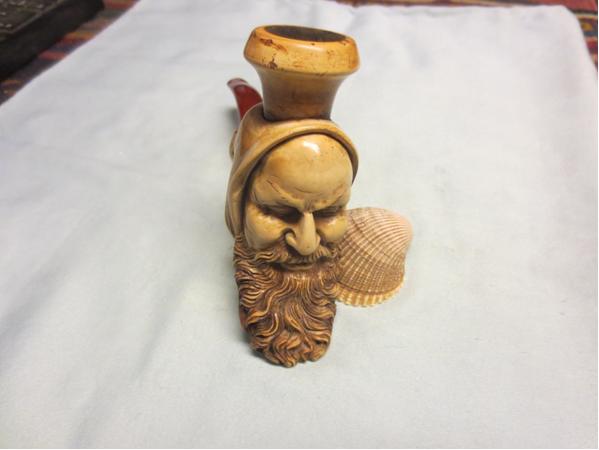
Fixing a Botched Repair on a Bearded Sultan Meerschaum


Blog by Steve Laug

I received and email from a pipe smoker in Chile regarding a meerschaum and a Shamrock pipe that he had that needed repairs and he was wondering if I would be interested in working on them. The Shamrock was straightforward in that all it needed was a cleanup and a new stem. The meerschaum though had some real issues. He wrote me explaining the details of the meerschaum’s problems as follows:

Actually – I now realize – the mouthpiece IS broken at the band. Though the slice seems clean, I realize it is not perfect. The band looks nice though I don’t know if it came that way originally or not. It does cover the slice of the stem. The whole mouthpiece is amber; nothing holds it together except the band. Not glued nor cemented.

The misalignment isn’t only due to the slice but even if I make an effort at aligning the pieces once screwed in, it just won’t be straight.

The pipe needs a new mouthpiece, apart from cleaning. I don’t know if a new beeswax dip is a good idea…It seems dry as marble…no glow… There is a small chip on the rim of the bowl, but the rest seems to be OK.

It’s not your everyday meerschaum but it doesn’t seem unsmokable. I did smoke it once years ago and as I said, it leaks, leaves a mess. I realize why now, but I don’t think it’s only due to the broken stem but also at the screw point.

Can you help me? You tell me. He included the next photos.Sultan1 I wrote him back and said I believed I could help.

He sent the package to me by FEDEX and I picked it up this morning. When I opened the package and looked over the meerschaum pipe that was sent repair. I made a list of the issues that I was looking at with this pipe. It was actually far worse and far better than I thought when we corresponded.
1. The stem indeed was broken about one inch up from the shank. It almost looked like it was sliced rather than broken.

2. The broken piece with the metal stinger apparatus obviously had broken into further pieces when the tenon insert was put into it. There were several smaller chips that had come off the broken piece and had been glued on. The smaller cracks still showed.

3. The stem is not amber at all, but appears to be Bakelite or some kind of acrylic material. That explains the clean break on the piece and the rest of the stem.

4. The stem that I was looking at was not the original stem. It is actually an oval stem while the shank of the meer is round. Someone fiddled with the stem to make a poor fit.

5. The “silver band” serves two purposes on this stem – first it is cosmetic to cover the broken stem and secondly it hides the fact that the stem is not round.

6. The shank had been cut off – probably had cracks in it as there are still several that have been repaired showing. Looking at the end of the shank with a lens shows rough meerschaum.

7. Sometime during the lifetime of the pipe someone had threaded a metal mortise into the shank of the pipe. It is like the ones that can be found in Kaywoodie pipes or Willard pipes – those that have a threaded tenon and a metal shank insert. In turning it into the shank the meerschaum had split on one side and slivered on the other. This had been repaired when the insert was glued in place.

8. The threaded tenon apparatus matches the insert in the mortise but is misaligned. It also has been epoxied in place so it is not movable. It is obviously not the correct tenon for this kind of pipe. I am pretty certain that both the mortise insert and tenon are incorrect and were later additions on this pipe. The original would have had either a threaded tenon or I think, more likely in this pipe due to age, a nylon insert and a push tenon. Both were replaced when the original stem was lost.

9. The carving on the face was actually quite nice but the sides and smooth portions were not nearly as well done. The back edge of the turban and beard still had carving marks that are usually removed by the better carvers.

10. The bowl had a chip out of the front edge of the rim as noted and had scratches and rim darkening.

11. The meerschaum itself was actually very dirty and dry. There was a fine metallic dust on the grooves of the turban and the beard. It was silver coloured and gave the meerschaum a grey look.

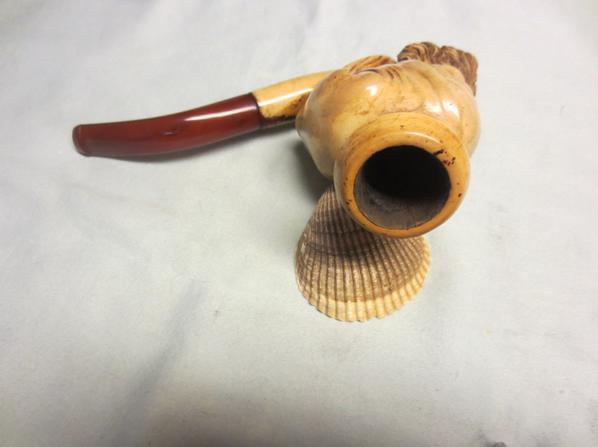
With that long list of issues with the pipe I wrote to the shipper with my suggestion. I concurred with his assessment that it needed to be restemmed. It would be an interesting challenge as I could not remove the metal shank insert without damage to the meerschaum so I would have to figure out some kind of compromise that would work with that mortise. I suggested a stem that I had that came with a meerschaum pipe similar to this one. It is a yellow unique stem with a push tenon. I tried it with the metal mortise insert to see if it would work and it fits really well. The new stem was about an inch longer than the one that arrived with the pipe and looked really good on the pipe.

I took some photos of the pipe with the stem attached so that you could see the state of the fit of the stem when it arrived. You can see that the band is also quite poorly done – all the edges are not even or smooth.Sultan2

Sultan3

Sultan4

Sultan5 I also removed the stem and took the pieces apart. The stem was indeed broken under the band. It definitely was not amber. You can see the sliced piece and the remainder of the stem as well as the metal mortise edges in the shank in the photo below.Sultan6 I took a photo of the end of the broken piece to show that it was oval while the shank was round. The second photo below shows the cracks and chips that had been repaired on the piece underneath the metal band. Obviously this is not the original stem. The third photo shows the end of the shank – it is round – and the metal threaded mortise insert.Sultan7

Sultan8

Sultan9 I took the next two photos to show the damage to the shank and the poorly done job of adding the threaded mortise insert. The small crack is about a half inch long and can be seen running from the metal insert edge about mid-shank edge on the left side. There are also chips of meerschaum that had been reglued.Sultan10

Sultan11 I went through my can of stems and found a new stem whose length and shape was right for this pipe. The diameter of the stem at the shank was slightly larger than the shank on the right side and top. It would also need to be bent slightly more but I liked the look of the pipe with the new stem.Sultan12

Sultan13 I used a topping board to flatten the metal disk on the top of the mortise insert as it had curled at the edges and would not allow the new stem to seat against it properly. I sanded the sides of the stem on the saddle with 220 grit sandpaper to align it with the diameter of the shank of the pipe. I removed the push tenon from the stem and cleaned out the airway with cotton swabs, pipe cleaners and alcohol to remove all of the tars and staining on the inside. It looked like a dark brown striped up the middle of the stem when I started and when I was finished it looked very clean.Sultan14

Sultan15 I heated the stem with a heat gun until it was flexible and then bent it to match the curve of the shank and allowed the pipe to sit horizontally when in the mouth.Sultan16 I set the bend with cool water and then pushed it into the mortise insert and took the following photo to show the new look of the pipe.Sultan17 I scrubbed the meerschaum with a soft tooth brush and Murphy’s Oil Soap. I rinsed it carefully with cool water to remove the soap and scum. I dried it off with cotton pads and was able to remove more of the grime in the grooves.Sultan18

Sultan19

Sultan20

Sultan21

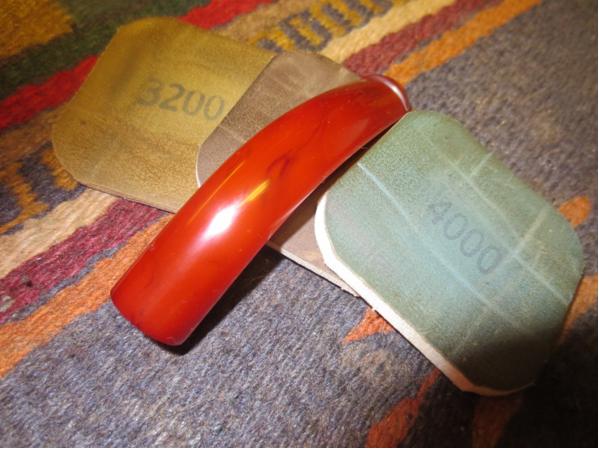
Sultan22 I waxed the meer with white beeswax and hand buffed it with a shoe brush. It has begun to take on the glow that comes to a well waxed meerschaum. I took the full facial photo to show the clean look of the pipe.Sultan23 With the bowl cleaned I turned my attention to the new stem. I had sanded the saddle area with 220 grit sandpaper and needed to polish that portion. I used a medium and a fine grit sanding sponge to remove the scratches. I wet sanded the stem with 1500-2400 grit micromesh and then dry sanded it with 3200-12000 grit pads.Sultan24

Sultan25

Sultan26 I buffed the stem with Blue Diamond and hand buffed the pipe with some beeswax and a shoe brush. I took the photos below of the finished pipe. Considering the many issues of this pipe when I started working on it, the finished pipe looks really good. I left many of the gouges and scratches in the meerschaum as they add character and to remove them would change the shape of the carving. I like the new stem – the bend is perfect for it to hang effortlessly in the mouth when smoking. The draw is wide open and should smoke really well. The push tenon works well with the metal mortise and sits snug against the shank. Soon it will go back to Chile and it owner. He will have the pleasure of finally smoking this old pipe and enjoying it.Sultan27
Sultan28

Sultan29

Sultan30

Sultan31

Sultan32

Sultan33

Restemming and restoring an oval shank billiard with issues


Blog by Steve Laug

I was gifted an oval shank billiard with a broken tenon and no stem by a fellow pipe refurbisher. He knows I like a challenge so he thought that maybe this would be a fun one for me to fiddle with. I looked at it when I unpacked it and spent more time looking at it over the weekend. When I first picked it up I put it in the bin of pipe to be refurbished and pretty much figured it would be one of those that I picked up when I had nothing else to work on. I have a few of those sitting in the bottom of the box. On Sunday I was going through the box trying to decide which pipe I would work on next and picked it up. There was something about it that drew me to work on it next. I can’t tell you what that was; I have no words to describe it. I know though that those of you who refurbish pipes know the feeling and the call of certain pipes. This was one of those. So it came to my work table.

Now that I had made a decision to work on it I took time to look it over and assess it. That is what I always do when I work on a pipe. I look it over and list out what needs to be addressed if I am to bring this pipe back to life. I like to enter into the work with a clear idea of what needs to be done. Doing this keeps me from finding those issues that surprise you in the process – at least most of the time it does. There will always be exceptions to the rule. For this pipe it was pretty straight forward.
Here is a list of the issues:

1. The finish was very rough and the darkening of the briar around the middle of the bowl was worrisome. It was hard to tell if it was potential burnout starting to happen – thus darkening the briar or if it was dirt and grime. I was pretty sure it was just soiled and stained but could not tell for sure until I had reamed the bowl.

2. There were scratches and dents all over the surface of the bowl.

3. There was one large fill on the right side of the bowl, mid-bowl that would need some work. I would either need to pick it out and refill it or repair it.

4. There was a burn mark on the underside of the shank mid-shank.

5. There appeared to be a small crack on the bottom of the shank at the place the stem and shank meet. It extends inward about a quarter inch. It was hard to see as it was hidden in the dings on the bottom of the shank from when the pipe had been dropped and the stem broken.

6. The bowl had a thick cake in it to the point that the tip of my little finger was about all that would fit in the bowl.

7. The rim had nicks and damage to the surface as well as a lava overflow from the cake in the bowl.

8. The stamping was virtually nonexistent. All that remained was a faint stamp on the left top side of the shank near the end – it read Made in London. It would definitely disappear if I banded the pipe to deal with the crack.

9. The airway in the shank and mortise was dirty and clogged. I could push air through it but barely when I blew through the end of the shank.

10. There was a broken tenon stuck in the shank. Generally these are pretty straight forward so I was not too worried about removing it.

11. There was no stem to work from as a model and the oval shank would make matching it a challenge.

Here is what the pipe looked like when I brought it to the work table.Bill1

Bill2

Bill3

Bill4

Bill5 I started the cleanup by pulling the broken tenon. I used the normal drywall screw and had the tools handy. In this case I threaded the screw in gently and was able to pull the tenon out by hand very easily.Bill6

Bill7 I turned to my can of stems for a potential stem. I actually had one that was a decent fit. The tenon was perfect and the fit against the shank end was ideal. The diameter of the stem on the bottom of the oval was too big and would need to be sanded to a correct fit. It happened to be the only oval stem I had at the moment and it was a twin bore bite proof stem. I was careful in fitting the stem because of the small crack in the shank.Bill8

Bill9

Bill10

Bill11 I used the Dremel and sanding drum to take off the excess rubber on the bottom of the stem.Bill12 This may be a funny thing to say but as I examined the stem after I fit it to the shank I noticed it had a small hole near the button. When I turned it over to check it out then I noticed that I was dealing with a bite proof stem – a stem with two airholes coming out of the button from the single airway in the stem. Picture the letter Y and you have a good picture of the stem.Bill13 I inserted a greased pipe cleaner in the airway on left airhole and then repaired the hole in the underside of the stem. I used black super glue to fill it and built it up to give a good base. When it dried I sanded it smooth with 220 grit sandpaper to blend it into the surface of the stem.Bill14

Bill15 Reaming the bowl took some effort and several different reamers. I used the PipNet reamer to start and then worked on the bowl with a KLEENREEM reamer. I finished by using a pen knife to clean out the last remnant of carbon in the bowl. I cleaned out the airway in the shank and the stem with pipe cleaners, cotton swabs and alcohol.Bill16

Bill17 I topped the bowl on my sanding board and lightly sanded the cracked area and damage on the bottom of the shank end.Bill18

Bill19 I sanded the stem with 220 grit sandpaper and then with a medium sanding sponge to smooth out the scratches. I wiped the bowl down with acetone on cotton pads to remove the grime and the remaining finish. The new stem fit really well and I only wished that the shank did not have the small crack that mad banding a necessity.Bill20

Bill21

Bill22

Bill23 I cleaned the area around the fill on the right side and repaired it with super glue. I sanded it smooth and then sanded the bowl with a medium grit sanding sponge.Bill24 I heated the briar with a heat gun and then applied a coat of cherry stain to it. The stain took well and sat deeply in the grain of the bowl.Bill25

Bill26

Bill27 With the stain in place the crack on the underside of the shank was very visible. It was mid shank and extended about ¼ inch. At this point I had to decide how to address this crack. I could do a shank insert and do an internal repair or I could band it. In looking over the shank I realized that the tenon was already quite thin and I would be hard pressed to make it smaller to fit inside of a shank insert. I would need to band the pipe.Bill28 I had a round band that would fit once I flattened it. I opened the crack with a dental pick and filled it with glue to repair the crack and then pressed the band into place on the shank.Bill30

Bill31

Bill32 I lightly sanded the tenon as the band made the fit in the shank too tight. I put the stem in place and took the next photo to get an idea of the new look.Bill33 I set the bowl aside and worked on the stem. I sanded it with micromesh sanding pads. I did my usual routine with the micromesh pads – wet sanding with the 1500-2400 grit and dry sanding with the rest of the pads up to 12000 grit. I used Obsidian Oil as usual.Bill34

Bill35

Bill36 I buffed the nickel band with a jeweller’s cloth and buffed the pipe on the wheel with Blue Diamond polish. I gave the bowl and stem multiple coats of carnauba wax. I buffed it on a clean flannel buffing wheel and then by hand with a microfibre cloth to raise the shine. The finished pipe is shown below. I think that taking the time to recondition and restore this pipe paid off with a beautiful oval shank billiard. Thanks for looking.Bill37

Bill38

Bill39

Bill40

Bill41

Bill42

Bill43

Kaywoodie HandMade


Love this chubby apple shape. This is a great clean up. Good work.

pipesrevival's avatarPipesRevival

Screenshot_2016-01-14-21-46-36~2
I’m a sucker for a fat bottom and that’s exactly what we have here in the Kaywoodie Hand-Made Over-size line of pipes. They’re getting harder to find, so when one pops up I have to jump on it. My search for a chunky Kaywoodie lead me to this line of pipes and about a year ago I had the pleasure of refurbishing two, there thick walls and chunky shape not only make it comfortable in the hand but it produces a cool smoke.
As Received

20160113_082336~2PhotoGrid_1452707950514PhotoGrid_1452708010235

The nomenclature was lightly stamped or worn.

PhotoGrid_1452707970576

Over all she was in nice condition and seemed well cared for. Heavy stem oxidation, chatter and a little rim tar&char.

PhotoGrid_1452708133134

I started by reaming the chamber with my Pipnet reamer, first with the smallest attachment and working up to the third  taking it back to briar, the chamber was free of any imperfections. I smoothed out the…

View original post 652 more words

Who Made Brewster Imported Briar Pipes or Who is the Unknown Italian Maker


Blog by Steve Laug

Robert M. Boughton in his recent blog on Brewster pipes quoted part of my earlier blog on the brand. Here is the link to Robert’s blog: https://rebornpipes.com/2016/01/13/another-brewster-that-looks-better-now-than-when-it-was-made/. In a personal email he suggested that I post the history of the brand in a separate blog to make access to the information accessible to those searching for information on the brand. So I have copied the pertinent material and edited it to read more clearly in the blog below. Thanks for reading.

brewster1bIn February, 2014 I cleaned and restemmed a bowl that was stamped with the stamping on the shank shown in the photo above. If you want to read the details of the restoration you can do so at the following link: https://rebornpipes.com/2014/02/14/giving-a-brewster-round-top-billiard-a-face-lift/ In the course of working on the pipe I did some research to see if I could find out information on the maker. To me everything about it seemed to point to some kind of Dr. Grabow connection. The metal mortise was threaded and Grabow stems fit perfectly. The mortise tenon system was identical. I had a hunch that there was some kind of connection but I wanted to verify what I was thinking.
I looked first in the books I had available here. In “Who Made that Pipe” all I learned that the brand was Italian made followed by the words unknown maker. That was not overly helpful. I suppose some of the pipes were stamped made in Italy. But unknown maker left too much out to me. There had to be more information. I turned to my online sources. I looked on Pipedia and there found much the same information – Italian made followed by question marks as to the maker. The pipephil website (http://www.pipephil.eu/logos/en/logo-b7.html) called “Pipes: Logos and Stampings” had the same information but said that it was an export brand of an unknown Italian company. So far I was coming up empty handed but I was not going to give up on this one. I spent time searching the web with Google and other search engines and came up with no added insight.

Not to be daunted I decided to take a different tack. I found the Dr. Grabow Company website online and wrote an email to their information centre seeking information on the brand. I never received a reply from them. I wanted to follow-up on my hunch from the stamping and the metal insert in the shank that somehow this pipe was related to Dr. Grabow pipes. I had no clue how it was related but it certainly looked like it to meso I went to the Dr. Grabow forum on-line and posted my questions http://drgrabows.myfreeforum.org/index.php. While I waited for a response to my question I read some of the forum of back posts and found a series of posts regarding the brand. I read the following and immediately had more questions. The Grabow connection was not clear but I had found that the pipe may have been a promotional item during the course of one year – 1964. Here is the quote that gave me the information:

“A couple months back, I scored a Brewster off eBay for five bucks. Research on this forum and the wild, untamed internet tells me the Brewster pipes were all made in one batch in 1964 as a promotional item for Sir Walter Raleigh.”

Now I knew that the pipe came from that time period and had been a promo item for a pipe tobacco company.

Later that evening while relaxing, my iPhone vibrated notifying me of a new email. I picked up the phone and saw that I had a response to the questions that I had posted on the forum. Dave Whitney, author of the book on refurbishing called “Old Briar”, had responded to my request for information. What he sent me was extremely helpful and a true goldmine of information. His answer confirmed the Dr. Grabow connection and gave critical information that I had not been able to find anywhere. I have grouped the comments on the brand under three bullets that show three different individual’s comments on Brewster. It is interesting to note that all agree.

Dave Whitney: Here’s what I have from my accumulated notes on Brewster – much of it looks like it came off this forum, ted/td being one of the early ones to help build this forum and a former Sparta CEO.

• All the Brewsters were “made” in about 64’… Brewster… is probably from Fratelli Rossi from 64’… Ted, an older pipe smoker than me, suggested the Brewster pipes are comparable to the Willard pipes, and that Brewsters were often sold either with tobacco, or in a coupon offer. For example Brewster was sold as a redemption offer with Brown and Williamson for Sir Walter Raleigh tobacco.

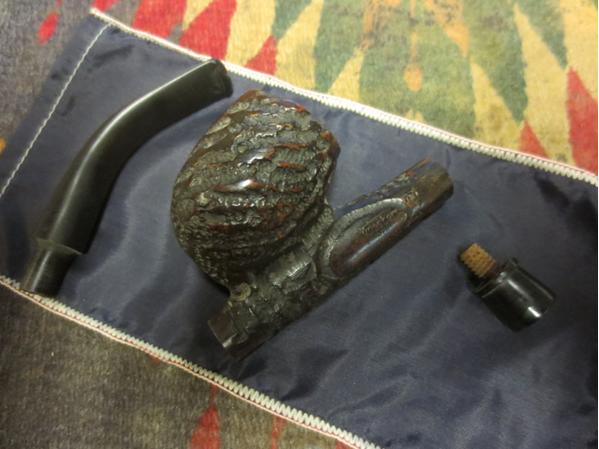
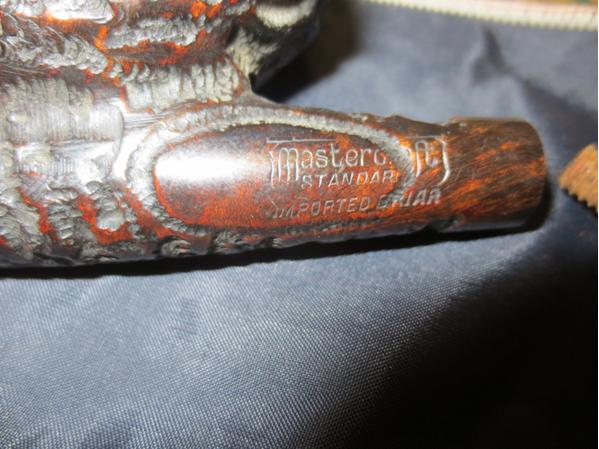
• Further information came from Dr. B… I think (in my feeble state of mind, after today) that Brewster was sold as a redemption offer with Brown and Williamson for Sir Walter Raleigh tobacco. But, Mastercraft in 74 had a LOAD of them left. We (Mastercraft) sold them as closeouts along with several pipes in baskets of 4 dozen at $3.98. We also included a bunch of Mastercraft from F. Rossi at the same price……..Rossi pipes are another story……Remind me of the “sticky lacquer” and I’ll tell it…….ted
Mastercraft was founded by Bernard Hochstein, an Orthodox Jew. Old, White Haired, Santa Claus looking (still alive at 96, last time I knew), and he was REKNOWNED for his ability to “strong arm” the European pipe suppliers into selling pipes to M/C at a bargain. Probably the best (never say nothing) negotiator that I’ve ever met. He sold a business (Mastercraft) to UST for 6 million in STOCK. He’s probably worth 60 million today. Mr. Hochstein could negotiate a peace in the Middle East in a very few days, and talk all parties outta’ their pants in the process.

OK, so Mr H “rapes” the Italian suppliers even up till 1964 when the Surgeon General’s (SG) report comes out. As it turns out, “rape” worked both ways. A supplier, Fratelli Rossi, (still in business) took an order in 1963 for over 1 million pipes at 1/2 dollar (US) per pipe. When the SG’s report comes out, Rossi has filled a small part of the order for Hochstein, and had orders for a great many more pipes than Hochstein ordered. Rossi decided to experiment with his lacquer …Whose pipes did he experiment on? Hochsteins.

When I started at Mastercraft we had 1215 cartons of pipes from Rossi… Mastercraft Standard….72 dozen per carton, with lacquer so “tacky” that if you held the pipe as if you were smoking it, you’d have to “shake” it out of your hand. Rossi left out the curing agent. Ever touched wet paint?……..After 10 years they were still STICKY…..after 20 years, they were still STICKY.

We fought these SOB’s for years, when finally Luther Marlow (you’ll see topics about him) concluded that we could re-spray them with the Grabow lacquer and sell em’ (Ed. Note: Here is the Grabow Connection I smelled). We did, and we did. Through a “drive” by the UST salesforce, we sold every one. So if you have a Mastercraft Standard with what looks to be “heavy” lacquer, you are probably right.

• Hussar…..Rossi also made Brewster. Better lacquer job though… Brewster was sold as a redemption offer with Brown and Williamson for Sir Walter Raleigh tobacco. But, Mastercraft in 74 had a LOAD of them left. We (Mastercraft) sold them as closeouts along with several pipes in baskets of 4 dozen at $3.98.

When I started with Mastercraft in the early 70’s we had over 400 cartons of pipes from Hully. Each carton contained 60 to 80 dozen, most of which were stamped Brewster or Stetson and these had a base cost (from the 60’s or earlier) of $2.80 /dz. Some of the smaller pipes, called Southern Assortment were $1.90 / dz. May be partly to blame for them going out of business.

Dave had supplied some very helpful information on the brand. It gave a definitive date and origin to the pipe. The Italian connection and the Dr. Grabow link were clear in Dave’s answer. Now I wanted to know something about maker, Rossi. Fortunately Dave kindly included that information in his answer as well. It is as follows:

From approximately 1946 up to the end, Ferdinando Rossi II, a grandchild of the founder, headed the company. But after World War II the world of the pipe changed dramatically. Especially in Italy, where those big pipe factories mainly turned out pipes for the lower priced segments of the international mass markets. The demand for these pipes shrunk considerably as more and more smokers turned to cigarettes. Rossi got into this vortex as well. Little by little the number of pipes produced sank. This evolution was accelerated by the upcoming fame of pipes from Denmark. As well, new Italian brands established after the war like Castello, Brebbia or little later Savinelli operated cleverer and thus were more successful.

So the decline went on through the 1960’s and 1970’s, even though Rossi offered more than 800 possible shapes in dozens of lines and uncounted finishes. Besides the completely machine made pipes there were also some lines of semi-freehands and even quite considerable freehands were made. But all these efforts could not stop the fall anyway. Due to increasing financial difficulties Rossi closed down in 1985, just one year before the 100th anniversary.

In the years around 1870 and still later the bulk of Italian pipes was made by time taking and laboriously manual work. Mainly based on families who sold their pipes to travelling purchasers handing them on to some wholesaler. Most pipes were still made of box or olive wood.

Ferdinando Rossi from Milan was one of the most important wholesalers for tobacco related goods of northern Italy. When he attended one of his pipe suppliers in Saint-Claude in 1880 he got hooked on the idea to establish this manner of industrialised briar pipe production in Italy as well. Rossi went abroad several times to buy the hardware here and there because the special features of machines for pipemaking were secrets – well kept by the French in those days. Many machines and tools had to be modified on Rossi’s defaults.

[From the Catalogue “La Regina della Pipa” (1896)] He acquired a large area of land in Barasso in the province of Varese and founded the Fabbrica di Pipe di Radica Rossi in 1886. For sure there was no lack of skilled workers and Rossi personally recruited 30 craftsmen of different occupations from the environment to get started. After a few years the enterprise had developed well and entered into export trades. In 1892 e.g. the ledgers registered the first pipes shipped to Brazil.

One reason of success was the ultramodern conception of the factory and its equipment at the given time. To give an example: a system of canals invented by Rossi drove water to turbines propelling downstream generators, which supplied the entire machinery with electricity. Also lighting and heating were already electrically operated.

In the first years after 1900 Rossi grew steadily and became one of the ten biggest pipe manufacturers of the world. Rossi’s rapid ascent produced further foundations of pipemaking firms in the area.

I love hunting down as much of the old company histories I can find concerning the pipes that I refurbish. For me this information gives a colour and flavour to the pipe I hold in my hands and rework. It gives me the back story on the pipe and adds another dimension to the work of refurbishing. I have reposted the details of the history of Brewster Imported Briar here for those who like me enjoy this kind of thing.
Another Brewster That Looks Better Now Than When It Was Made


Guest Blog by Robert M. Boughton
Member, International Society of Codgers
Member, North American Society of Pipe Collectors
http://www.naspc.org
http://www.roadrunnerpipesnm.biz (Coming Soon)
http://about.me/boughtonrobert
https://roadrunnerpipes.wordpress.com/2016/01/13/about-the-author/
Photos © the Author

Everything has beauty, but not everyone sees it.
― Kong Qui (Confucius), 551-479 BC, Chinese philosopher, teacher and political figure

INTRODUCTION
This Brewster Billiard arrived in one of the many pipe lots I bought online the year before last, at which time I apparently dismissed it as a common Dr. Grabow that could be put off until I had nothing better to clean or restore. Nevertheless, despite the oppressive grime and weariness that lay upon the wretched pipe like a veil of black magic – or maybe because of this gloomy aspect, as a good friend once remarked with acerbic nonchalance that I seem to be attracted to wounded things (his exact words, all the more angering because I knew he was right) – my eyes returned to it many times since it came in the mail. On every occasion except the last, a week or so ago, I made the mental Dr. G. connection and passed it by.

I’m not saying all Dr. G. pipes are worthless; I just seem to be happier when they’re not cluttering up my own collection. But the two I do own are excellent and exceptional, not counting three unusual beauties that were given to me by my friend and mentor, Chuck Richards and which I expect to sell.Brew1

Brew2

Brew3

Brew4

Brew5

Brew6 There is a good reason for all of this talk about Dr. G. pipes, which might seem to some as nothing more than pointless rambling. As I already noted, all but the last time I considered this pipe, I was so certain it was a Dr. G. that I didn’t even bother with more than a glance. Then, not more than 10 days ago, for some reason I will never understand, I picked it up and squinted at the left side of the shank to check the brand. The pipe was so filthy and sticky (remember that last word) that it might have fallen out of a pig farmer’s bib overalls and smack into the trough. It was so bad, at any rate, that I had to take it into the living room where I keep my jeweler’s magnifier headset to begin to decipher the name, which I could see began with a B. Even then some hard rubbing with a thumb was necessary to break on through to the other side.
When I at last made out the word Brewster, all that came to mind was a great old movie, “Brewster’s Millions,” from 1945. Go figure! And so, of course, I took a seat on the couch and consulted my laptop, clicking the speed dial to pipephil.eu. There, sure enough, was Brewster. Made in Italy. Unknown maker. What kind of hogwash was this? I Googled “brewster tobacco pipes” and found only a few identical references. Well, I said to myself, I’m not about to let any lack of preliminary intel stop me from making this wounded or perhaps birth defected little thing better.

Only when I was gearing up for the restoration, and happened to visit my local tobacconist, did I chance to notice a new estate pipe put out by Chuck. You guessed it: a Brewster, made in Italy. What were the odds, I wondered, laughing so loudly that the young lady behind the counter, Candice, looked at me in surprise. I explained myself.

But the real shock came a few days later, when I was nearly done with the restoration and started wondering (worrying is more like it) how I was going to write a blog about a pipe with a clear name on it of which several experts in the pipe community had heard but still had no clue who made it. Being a somewhat persistent little bugger, however, I returned to Google, this time expanding my search to “brewster tobacco smoking pipes.” I will never cease to be amazed how sometimes the computer knows exactly where I’m going with a search and even comes up with the right suggestion, and others it’s a swing and a miss. This time it was out of the ballpark.

The very first link, at the top of the page, was to – where else? BREWSTER PIPES/ REBORN PIPES, https://rebornpipes.com/tag/brewster-pipes/. To say I was beside myself is an idiom that doesn’t begin to describe my sense of amazement. As I wrote to Steve in an email, the Brewster triangle was complete. And there, in the most vindicating black and white letters I have ever read, were the words, “The thread pattern and the look of the metal fitment looked exactly like a Dr. Grabow set up.”

Anyway, the bizarre connection between Brewster and Dr. G. is so thoroughly Italian (read “Machiavellian”) that I haven’t quite processed all of it yet. But it’s all there in Steve’s blog, blow by brutal blow, and as far as I can tell, it’s a Reborn Pipes exclusive. I’m sure those who are interested in the grizzly details will follow the link above. I am not about to try to paraphrase Steve’s incredibly detailed research. All I can say is that congratulations on an investigative job worthy of Woodward and Bernstein are in order. For once I will exercise the better part of valor in not going into details that already took up pages of Steve’s blog.

I will comment that Steve’s history of the Brewster includes one hilarious section on a blunder involving a large shipment of pipes to Mastercraft which were stained but not cured with a drying agent. Hence they remained sticky to the touch for years before they were eventually “fixed.”

RESTORATION
Brew7

Brew8

Brew9

Brew10

Brew11 The first order of business, if only so that I could handle the clinging pieces of wood and Vulcanite, was to clean the outside. I did this with a couple of white cotton gun cleaner cloths and purified water, and while I was at it applied 1800 and 2400 micromesh. Wetting the micromesh pads, I was able to remove all of the char on the rim. The stummel had so many scratches and dings that I doubted the micromesh would be enough, but the immediate difference was striking.Brew12

Brew13

Brew14 Next I chose a fixed, 21mm reamer, 320-grit and 500-grit paper for the chamber, and seeing I was correct about the scratches on the stummel, I tried super fine steel wool, the same sandpaper and steel wool again to work away more of the blemishes. This was an ongoing process.Brew15

Brew16

Brew17

Brew18

Brew19

Brew20

Brew21 An OxiClean bath, for the first time in my experience, was enough to work out all of the mess inside the bit air hole, which, judging from the used, sudsy, murky water, had been somewhat bad.Brew22 I used 320 paper followed by the full gamut of micromesh on the bit, and thought I was done.Brew23 Now, I didn’t actually notice the problem at this stage, but for the sake of uniformity I’ll add it here. In fact, only after I had completed the remainder of the restoration did I notice the turn of the bit was off. Examining the tenon end of the bit, which should have been flat, I saw it had a chip that I hoped – notice I don’t say thought – I could remedy with a little sanding. Luckily I stopped that madness before it was too late. Yes, I’ve utterly destroyed a few bits in my short experience with the treacherous objects, and I’ve learned my lesson! Turning to Black Super Glue, I dabbed a little over the weak spot and let it sit overnight.Brew24 Staining the stummel with Lincoln medium brown boot stain (which is really pretty dark), I flamed it, set it aside to cool, and buffed lightly with 4000 and 6000 micromesh.Brew25
Brew26

Brew27

Brew28 The next day, with the stummel already buffed on the wheels, I had to re-do the entire bit to remove scratches left from my aborted attempt to sand down the lip, and to even out the Black Super Glue. I also heated the tenon, threw a cotton rag over it and clamped it with my grip pliers and turned. It was close, but no cigar, so I repeated the process with less force, and the bit was flush with the shank.

Well, now I looked the two pieces over and was happy with the bit, but there were still fine lines on the wood that I didn’t care for at all. And so, not liking the idea, I used 1800 micromesh to smooth it out, then had to re-buff with white Tripoli, White Diamond and carnauba, and the clean wheel between each.  That did the trick.Brew29

Brew30

Brew31

Brew32

Brew33

Brew34 CONCLUSION
The most difficult part of this task, surprisingly, was the bit, from which, after bringing it to a high shine the first time, I didn’t expect any further problems. It’s taken some time, but I’m finally getting the hang of bits. The easy part of the restore was making the sweet little billiard look better than I expect it ever did out of the factory in Italy, with everyone involved in its creation doing his best to hide the fact!

The When and Zen of Pipe Restoration


Conversation Charles Lemon lives in Eastern Canada and Steve Laug lives in Western Canada. Connecting them across the distance is a common passion for restoring old pipes. Both men find beauty and pleasure in the work of restoration, and share their work on their respective blogs. Charles started and maintains DadsPipes – exploring the art of tobacco pipe restoration and Steve started and maintains rebornpipes – reclaiming old and worn estate pipes. The two restorers sat down recently over Skype for a discussion about their shared hobby. Here is an edited version of that conversation. We invite you into the conversation and to comment at the close of the blog. Let’s carry the dialogue beyond the borders of Canada!

“Other people can talk about how to expand the destiny of mankind. I just want to talk about how to fix a motorcycle. I think that what I have to say has more lasting value.”
― Robert M. Pirsig, Zen and the Art of Motorcycle Maintenance

“Logic presumes a separation of subject from object; therefore logic is not final wisdom. This is Zen. This is my motorcycle maintenance. ”
― Robert M. Pirsig, Zen and the Art of Motorcycle Maintenance

Steve Laug: When has a pipe reached the point that is not repairable or restorable in your opinion? In my experience the answer to that question changes all the time. In the past there were many pipes that I did not pick up because I thought they could not be brought back to life. One thing I have learned over the years is that the definition of no-return has changed as my skills have changed. I have learned new tricks that keep me even taking old bowls and broken shanks and recrafting a new pipe from them. So I would say that my definition of what is not repairable is in a state of flux all the time. How about you?

Charles Lemon: I agree – I’ve tackled some restorations lately that I wouldn’t have touched with a barge pole a year ago. I still ask myself if a restoration is worth it, or advisable, though, even if I know it’s possible. A few situations come to mind. A pipe with great sentimental value to its owner may sometimes be best approached as a preservation effort rather than a restoration. All pipes can benefit from a good cleaning, but I’ve left the pipes inherited from my father in otherwise original condition, tooth dents and all. I don’t smoke most of those pipes, so they’re more memorial items in my collection. On the other end of the stick, a highly collectible pipe can be devalued by an overzealous effort to return it to as-new condition.

SL: True enough Charles. To ask whether a restoration is worth it or even advisable though, is a very different kind of question as to whether it is possible. I think that the cases that you give are good testament to the fact that there are various layers of restoration. To me preservation is also restoration at some level. Think of a beautiful work of art that is cleaned and restored. It is not restored to new condition it is merely brought back to the creator’s intent plus the passage of time. I too have left special pipes from good friends as they came to me in honour of their memory and the gift they were to me. Somehow to remove the dents and dings on them reduces the impact of the gift to me. I smoke them but less frequently than others. The time of smoking is kind of a memorial in fire/smoke. For a moment I join with the person who gave the pipe to me and is no longer present. Those are special times. I leave them for times when there is nothing pressing in my life.

I think the other scenario you put forward is that of the highly collectible pipe. For that I agree with you. Nothing is worse than an overzealous restoration that leaves the stamping reduced and the beauty diminished. I sometimes have the feeling that the restorer who does that really removes the personality of the original. Maybe they should restamp it as their own! LOL.

When I look at a pipe I first ask the question, “Can I restore this?” From there I move to “Should I restore this?” To me once I know it is something that I can tackle then it is easier to choose not to do so.

“An experiment is never a failure solely because it fails to achieve predicted results. An experiment is a failure only when it also fails adequately to test the hypothesis in question, when the data it produces don’t prove anything one way or another.”
― Robert M. Pirsig, Zen and the Art of Motorcycle Maintenance

CL: Knowing your strengths and weaknesses is key. If a project is beyond my grasp I will pass it to someone else or put it away for a while and have another look in a few months or longer. Maybe my skills have caught up, maybe not. When IS a pipe no longer restorable? It seems every time I think I’ve found the limit, I see another refurb online where someone’s done something clever and raised the bar.

SL: I do find that I use junk pipes – those with no inherent value – as training ground for doing work on pipes that matter to me. If I screw up the junk pipe I can laugh and call it education. Far better to learn on those than on ones that matter. One of the first burn outs I tackled was on an absolutely worthless Tinderbox Monza. It was fire wood but it gave me the opportunity to practice cutting briar plugs and fitting them in the bowl. This adds another category to what or what not to refurb. I have learned to tackle even useless pipe as part of my pipe repair university course.

CL: There’s a reason I keep buying auction lots of estate pipes – they provide a fairly steady source of pipes with wide-ranging damage and thus repair needs that I can tinker with more or less risk-free.

SL: The trick is having the eye to know when to do what. That is the hard part to learn I have found. The learning is that old concept of “when less is more”.

CL: I was just thinking the same thing! I’ve had so many “firewood grade” pipes come out of the estate lots around here that I tend to forget that some pipes are actually well cared for and won’t need the Terminator approach to refinishing.
SL: Exactly! The restoration process often is like this conversation, back and forth, debating with yourself and the briar what is needed and then starting. Then more debate and then continuing. It is a dance with the wood. We have similar experience with the firewood grade pipes I think. But that is what builds the creativity for me and gets the juices flowing. What can be done with this piece of kindling.
“Care and Quality are internal and external aspects of the same thing. A person who sees Quality and feels it as he works is a person who cares. A person who cares about what he sees and does is a person who’s bound to have some characteristic of quality.”
― Robert M. Pirsig, Zen and the Art of Motorcycle Maintenance

SL: The more I think about it, the longer I have been in the work of refurbishing the defining feature for me regarding the restorability of a pipe is whether I want to do it. Sounds persnickety but I think it’s really what I have come down to. There seems always to be a work around to bring a damaged pipe back to life. What do you think about the idea that the critical functional feature in restorability is not the ability of the repair person but the desire? Once you have the basic skills mastered the ability issue disappears from the equation for me. It rather becomes an issue of desire. Do I want to restore this? Either as a part of my ongoing education or as a piece of pipe history or beauty. What do you think?

CL: You’ve got something there, Steve. The basic skills are, well, basic – anyone with a will to learn can figure out how to use sandpaper, glue and stain to restore a pipe. Or a coffee table for that matter. Desire or drive is what keeps us doing what we do. I’ve spent more hours than I can count working on a restoration, knowing full well that the resulting pipe, even if functional and maybe even beautiful, will have no greater value than when I started. But I did it anyway because something about the pipe intrigued me – a shape, a maker, a different style of rustication, or just because I wanted to do it. I’ve also got a few pipes in my rack that I know would have turned out better if I had put a little more care, attention – or desire – into the work while it was on my bench.

I also find that restoring a pipe is an organic process. I sometimes have an idea of how the finished pipe will look going in, but usually the pipe decides on its own how the restoration will proceed. Just reaming the bowl of an old estate pipe can reroute a restoration drastically – hey look! A burnout! How’d that get there? And if you’re lucky, that PITA pipe repair is also the job in which you hit the magic and elusive perfect combination of stains that turns an ordinary pipe into a stunning piece of briar.

SL: I don’t know about you Charles, but I have gone back to the rack and redone those I did early in the learning curve. I have reworked them – some of them two or even three times before I am finely happy with them. To me it is like reading a favourite book – I go back to it again and again and there is always something more. Same with reworking a favourite pipe.

I agree the process of restoration is organic – it develops with each stem that you take along the way. I work on trying not to preset the outcome – other than clean and functional. The rest just happens. I think that is why I am willing to take on seeming disasters – the sheer joy of seeing what is reborn in the process – like finding treasure. I think that mysterious happening is part of the charm that keeps me hunting for pipes to refurbish.

“The way to see what looks good and understand the reasons it looks good, and to be at one with this goodness as the work proceeds, is to cultivate an inner quietness, a peace of mind so that goodness can shine through.”
― Robert M. Pirsig, Zen and the Art of Motorcycle Maintenance

CL: There is an undoubtedly spiritual/psychological aspect to restoration work. People talk about being in the groove when they are immersed in the work. Restoring a pipe is oddly restful for me – it’s both a tactile, physical activity and an intellectual pursuit that requires a high degree of focus. On a related note, I find it nearly impossible to be angry or agitated while smoking a pipe, so smoking a pipe while working on a pipe is cheaper than therapy!

SL: The act of restoration is definitely therapeutic. To restore a pipe after work gives me the space to decompress from my day and actually finish something. Sometimes the more complex the restoration is the better it is for me in terms of disconnecting me from the rest of the day. The act of restoration is spiritual at its core it seems to me. The very act of bringing life to a broken and abused thing is spiritual in nature. To me it takes our craft and lifts it to a deeper level. Maybe that is why I find it hard to neglect a sad old pipe that shows promise.

“To live only for some future goal is shallow. It’s the sides of the mountain which sustain life, not the top. Here’s where things grow…..We want to make good time, but for us now this is measured with the emphasis on “good” rather than on “time”….”
― Robert M. Pirsig, Zen and the Art of Motorcycle Maintenance

The conversation wrapped up at this point, but the collaboration will continue with a shared restoration project. Watch for that very special post, in which Steve and Charles put a LOT of miles on an old pipe, coming soon to both rebornpipes and DadsPipes!

Thanks for joining us for this discussion. If you’d like to share your own thoughts and opinions on the craft of pipe restoration, we invite you to continue the conversation through the comments section below.

pipes