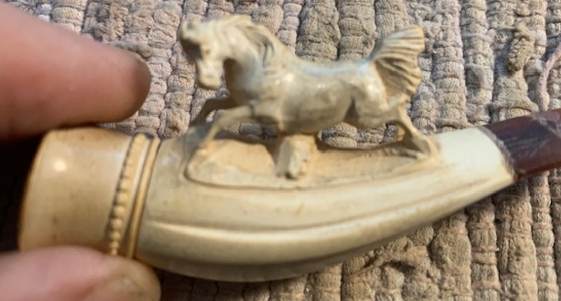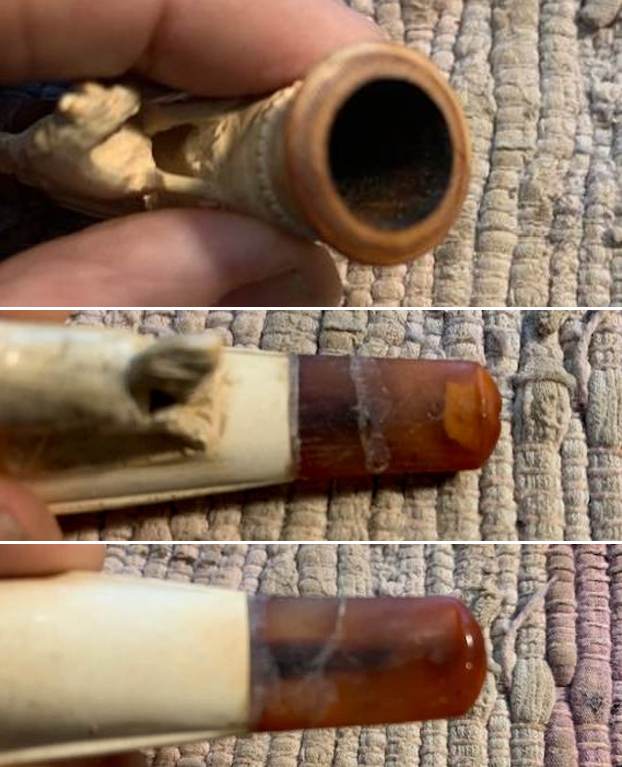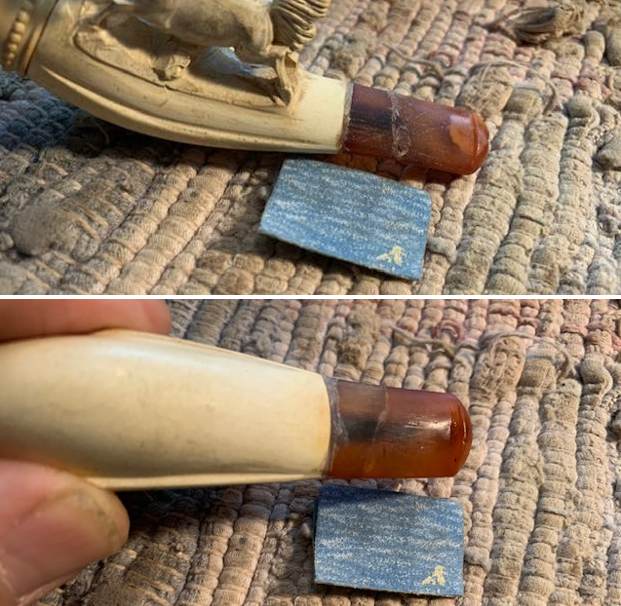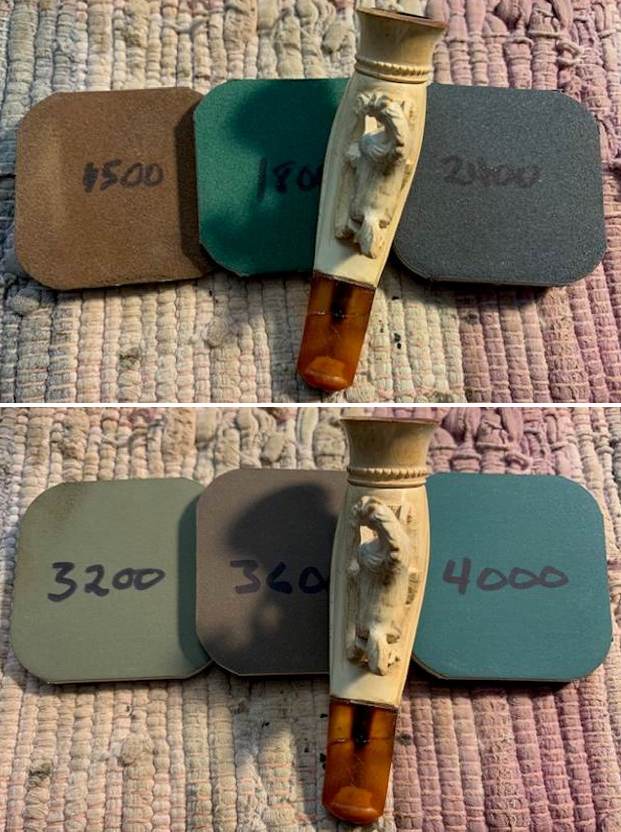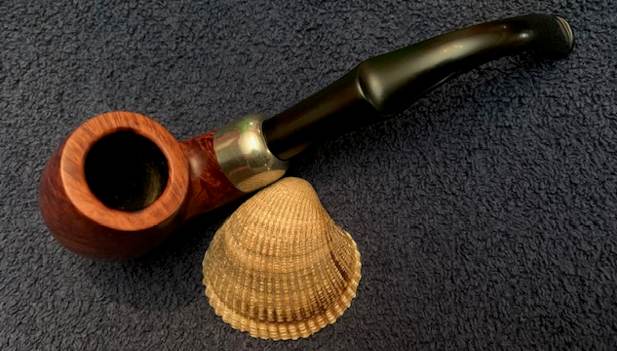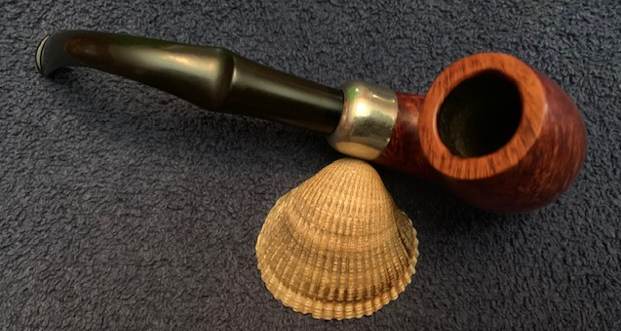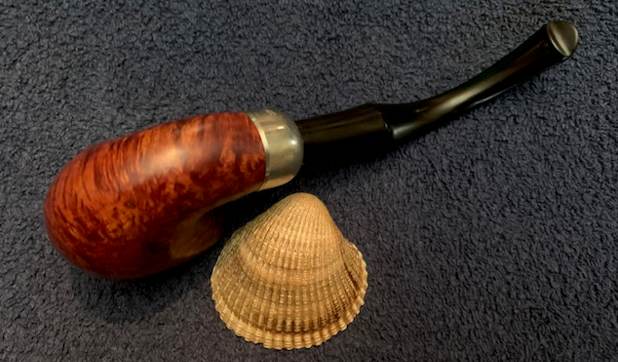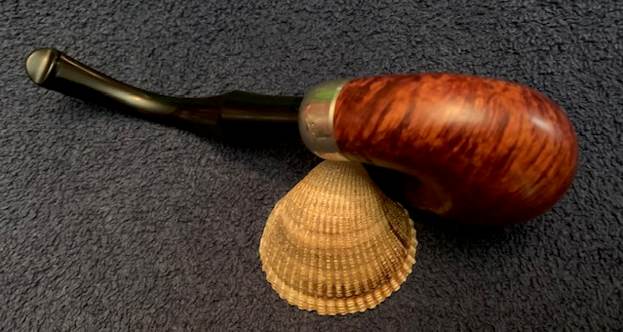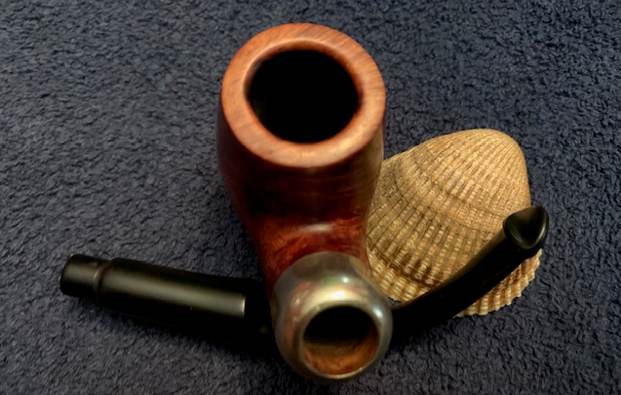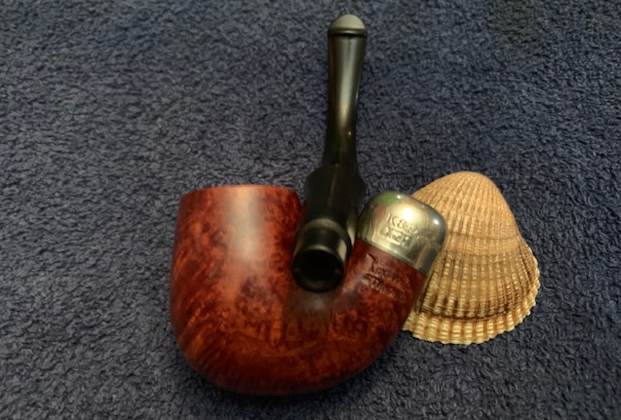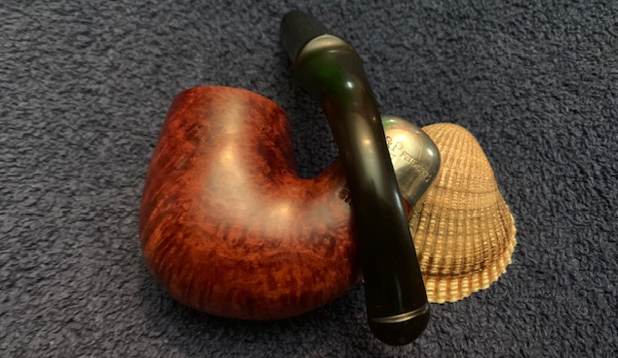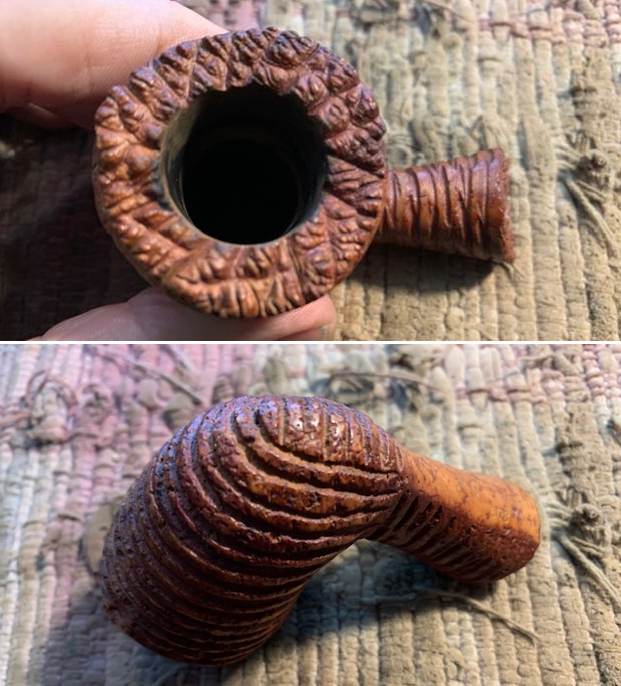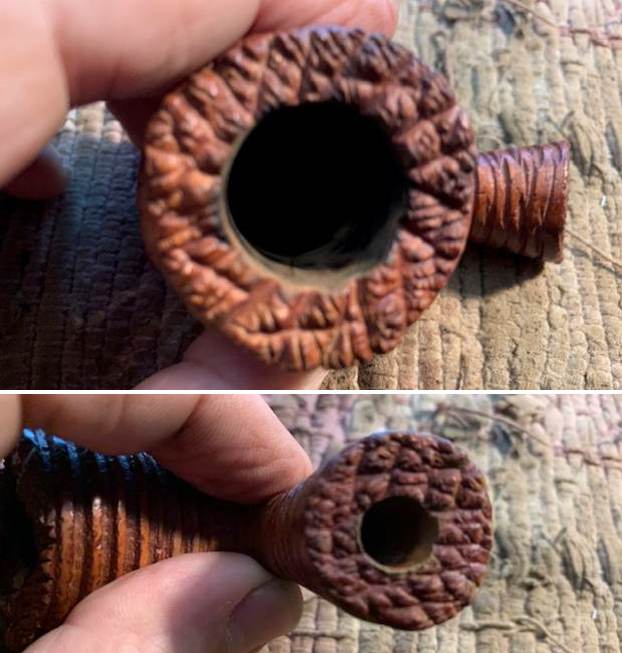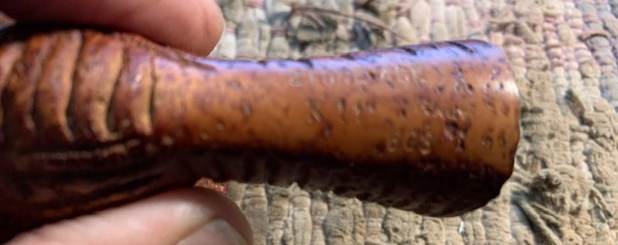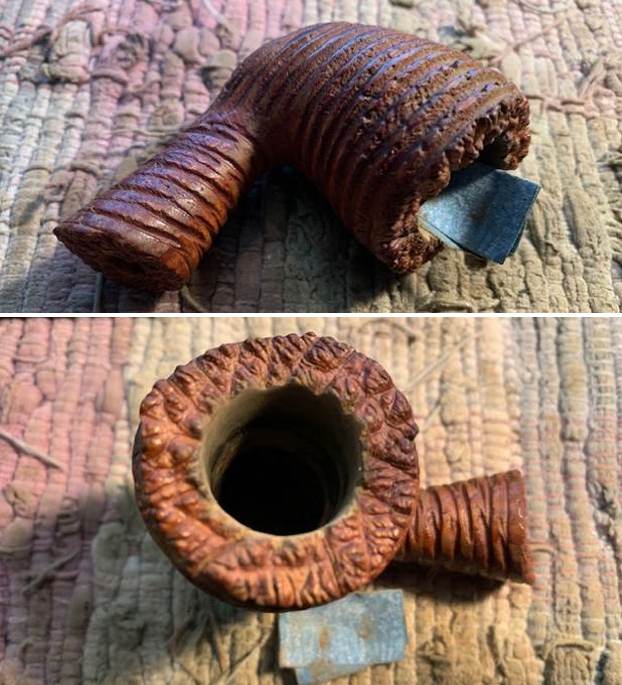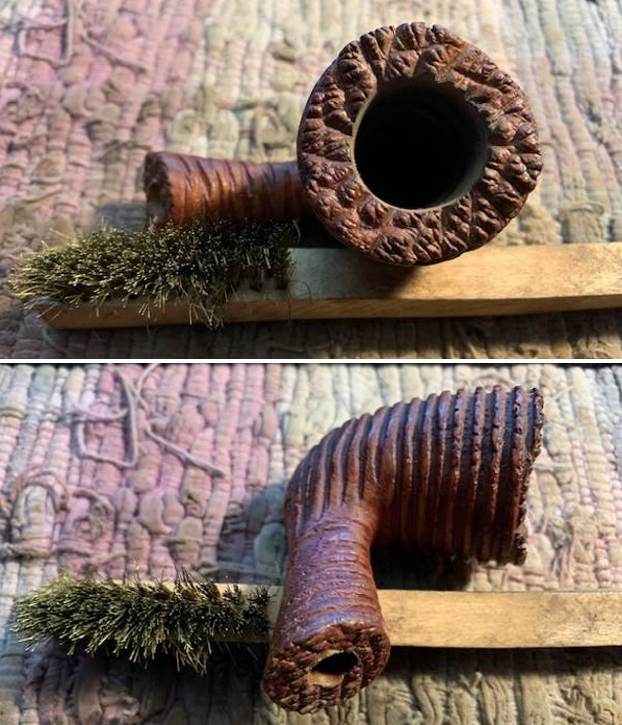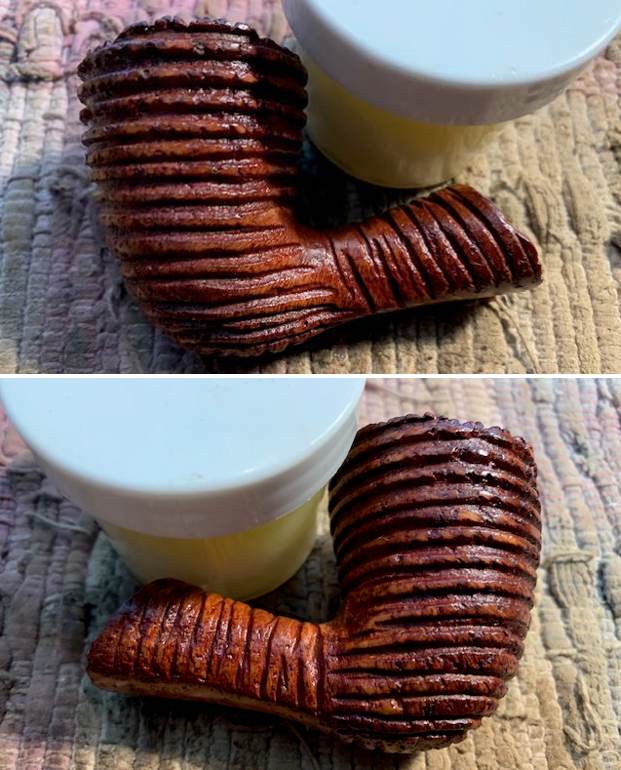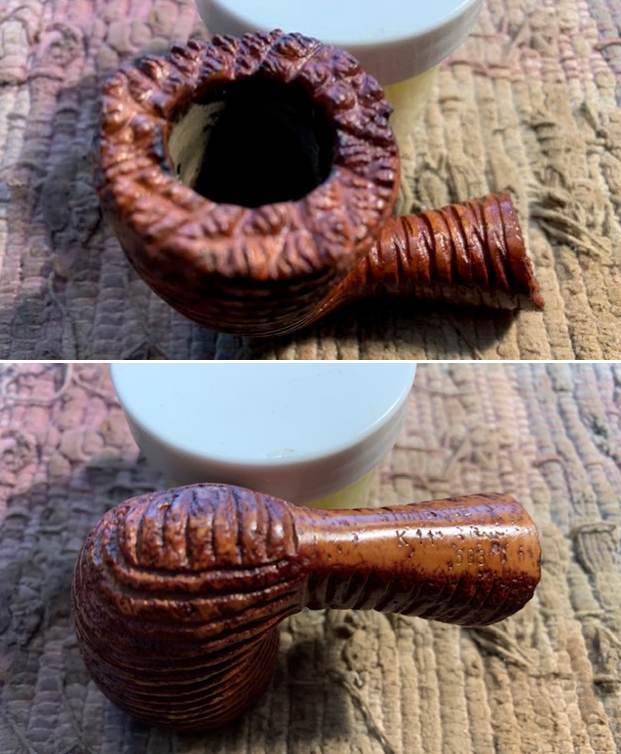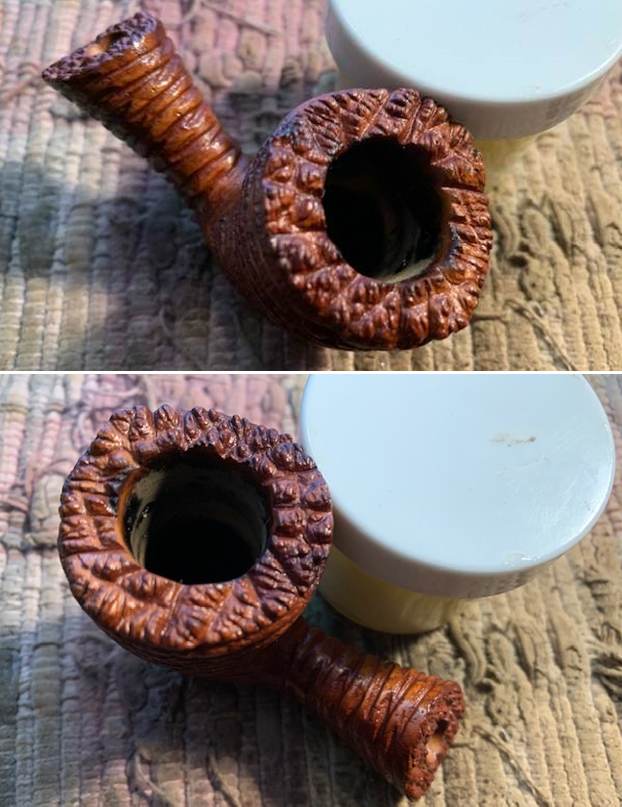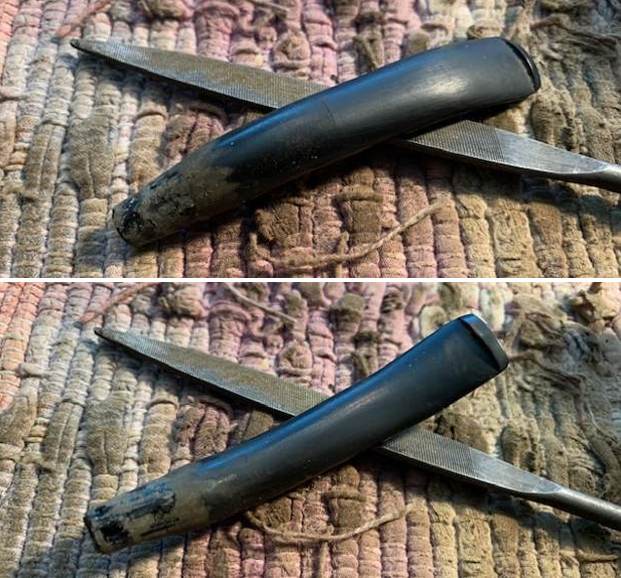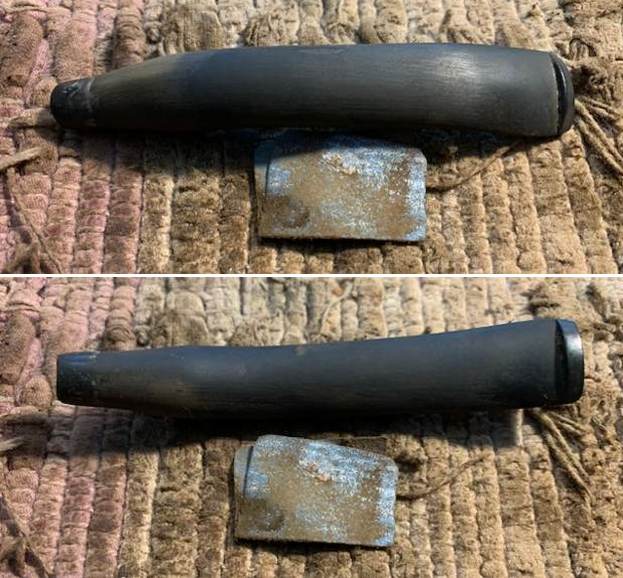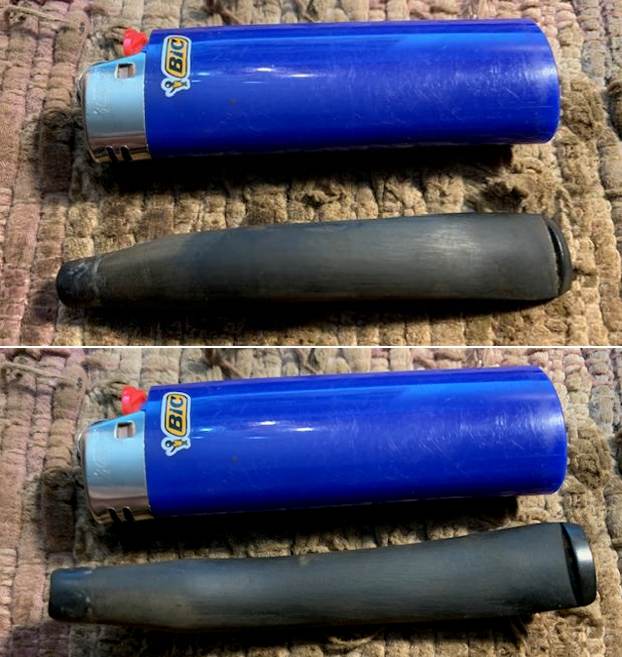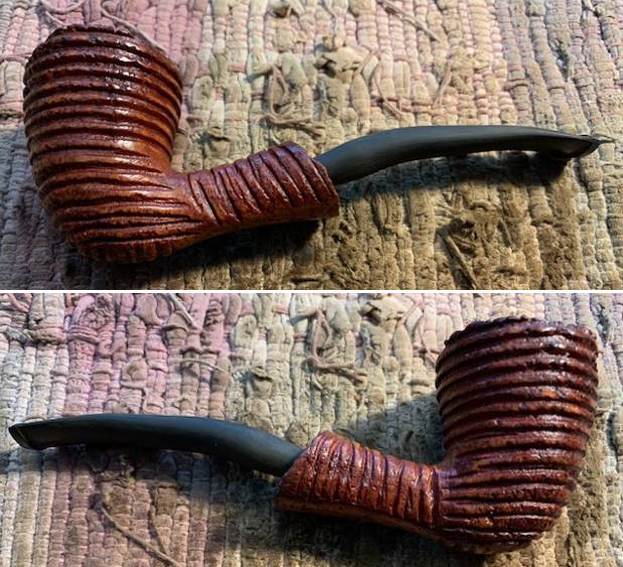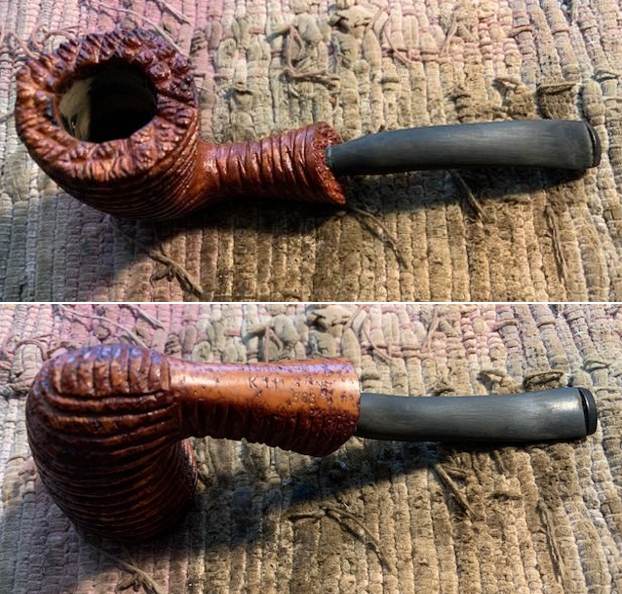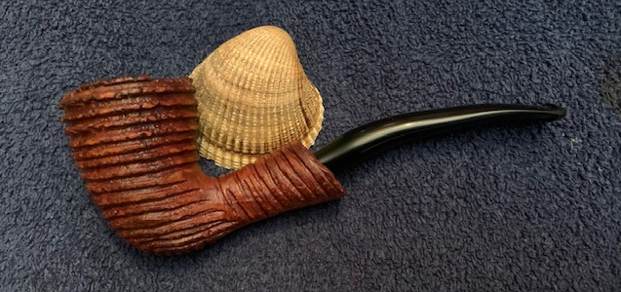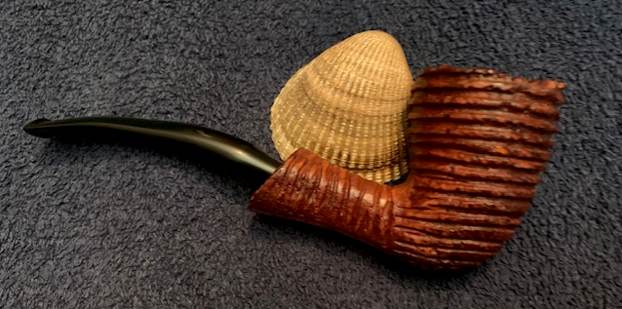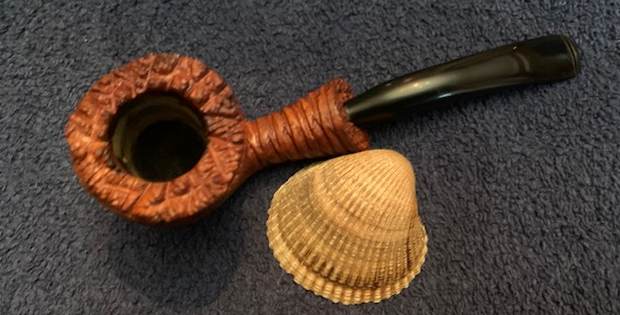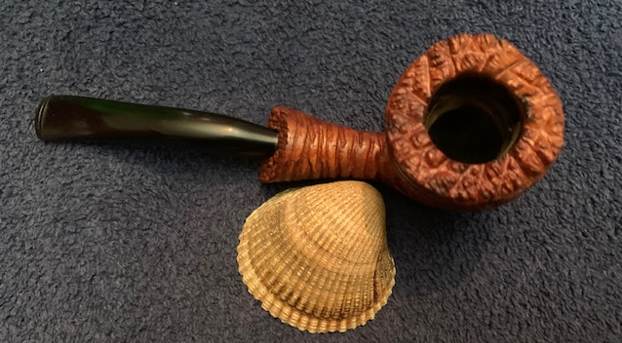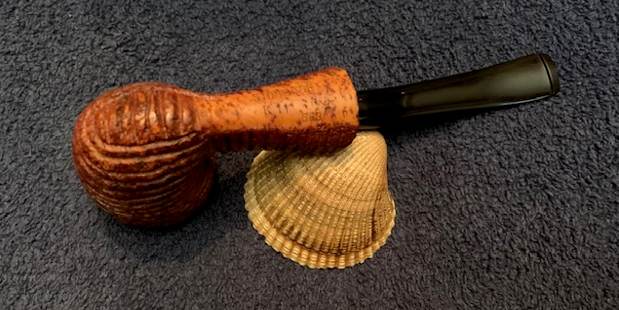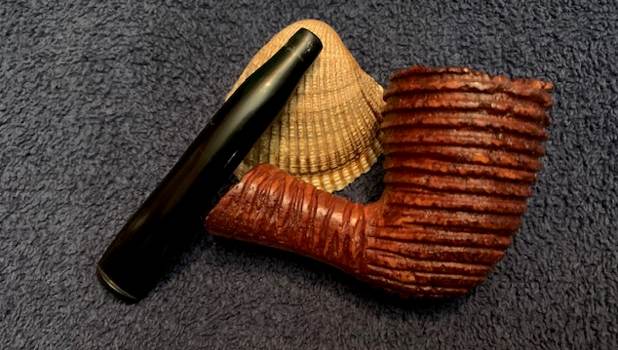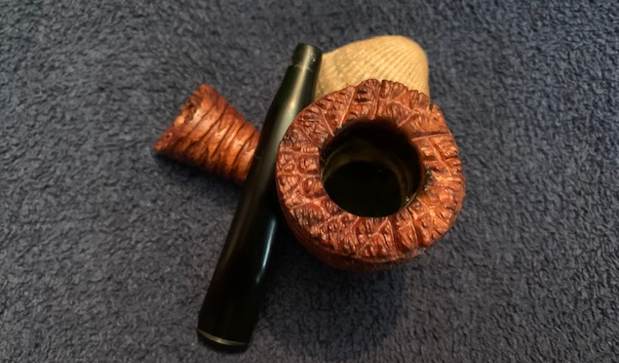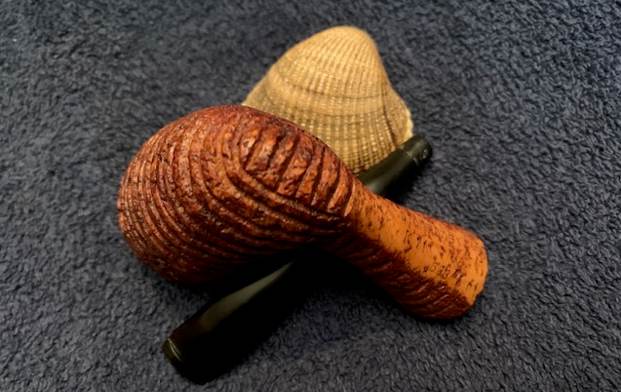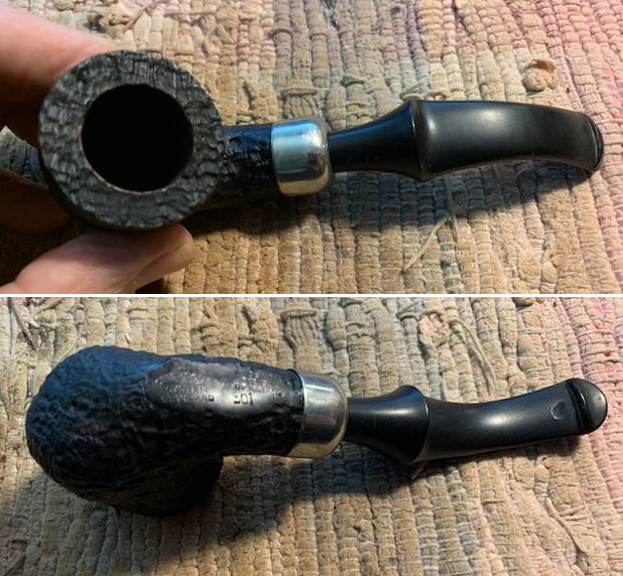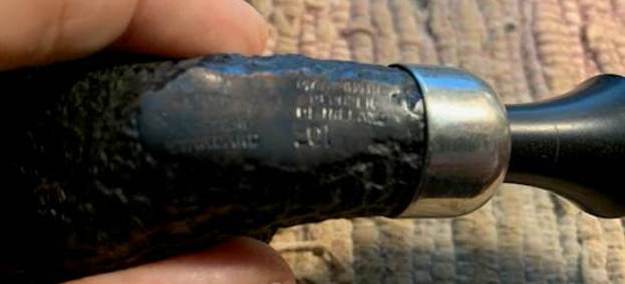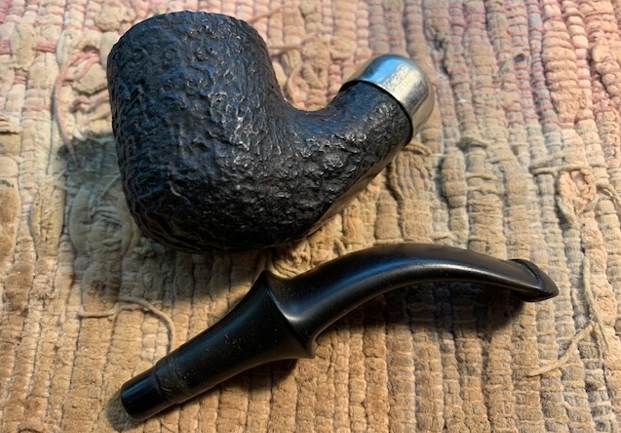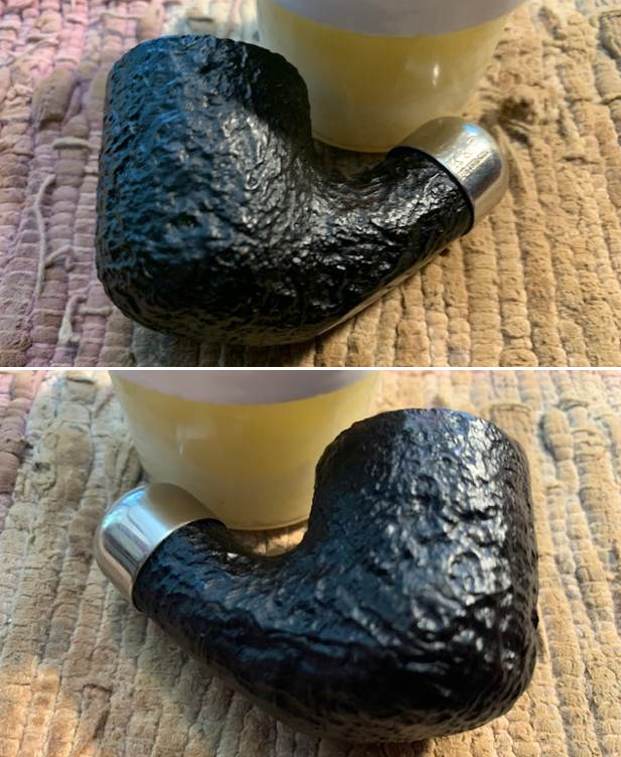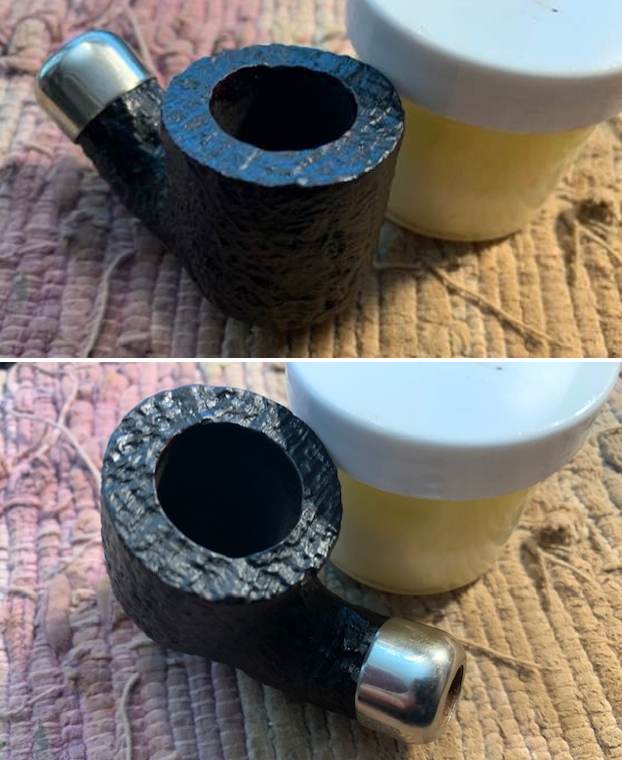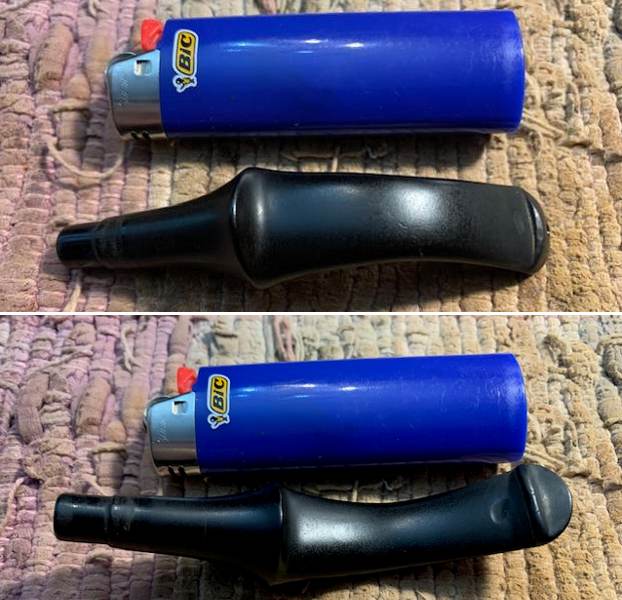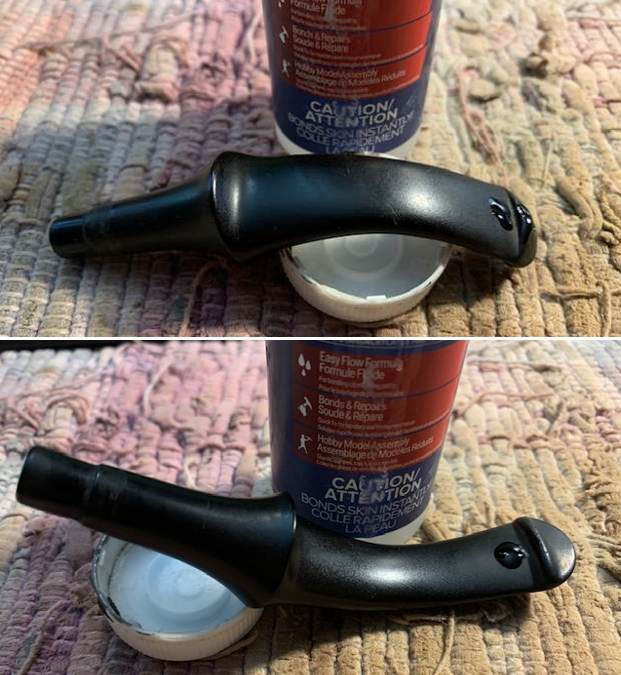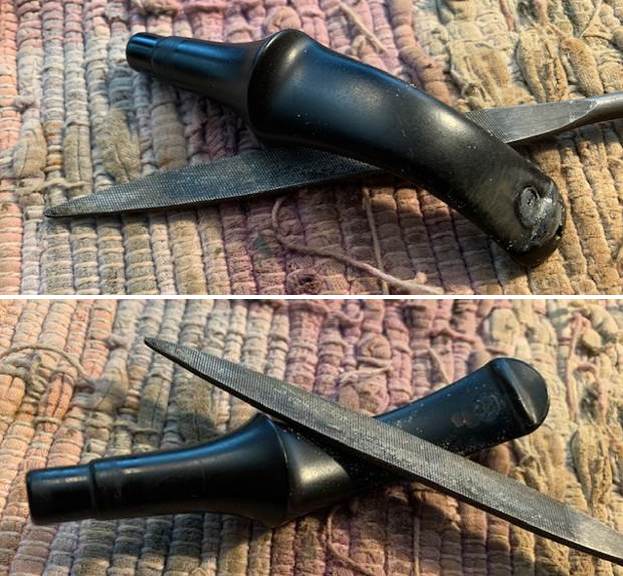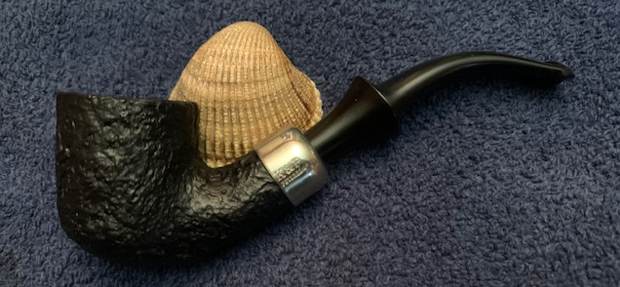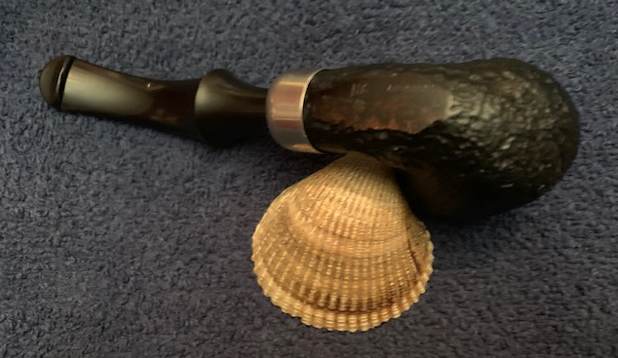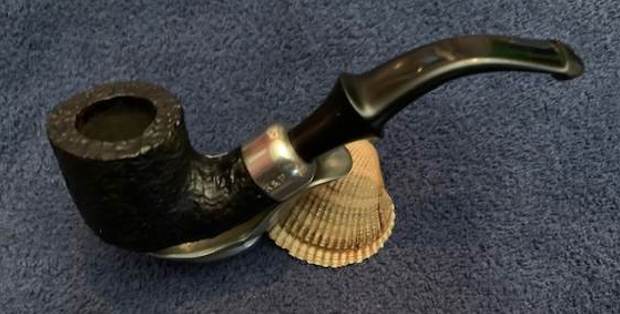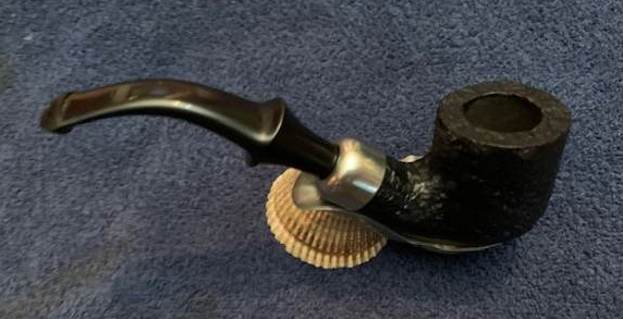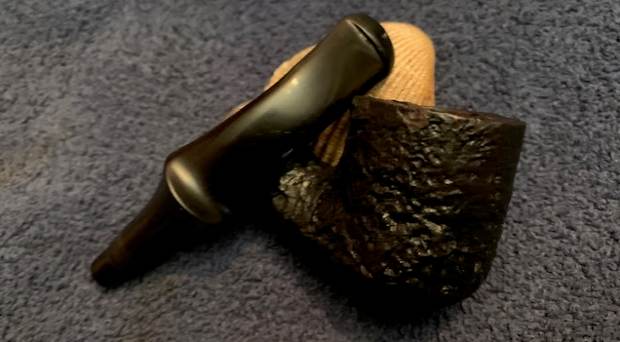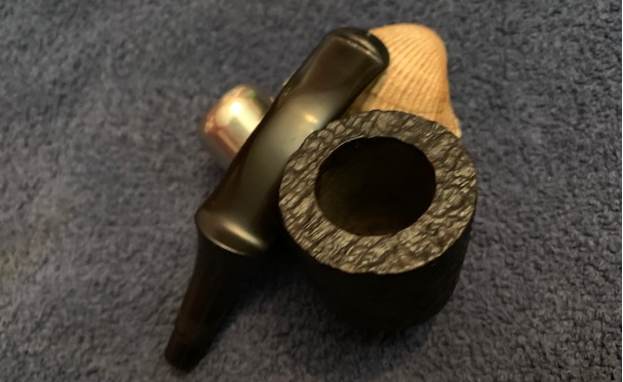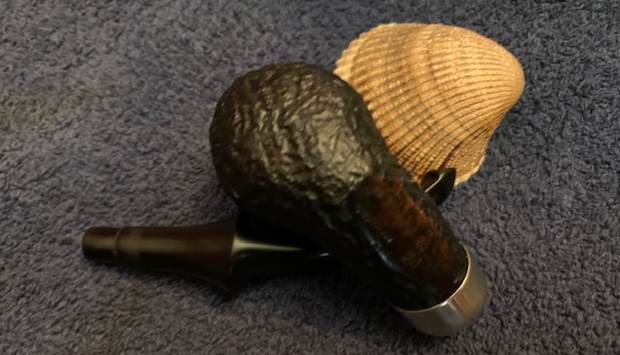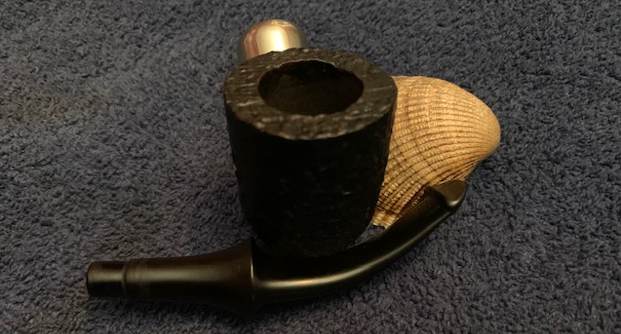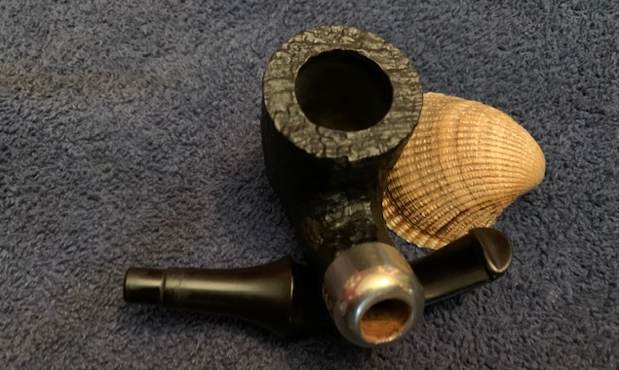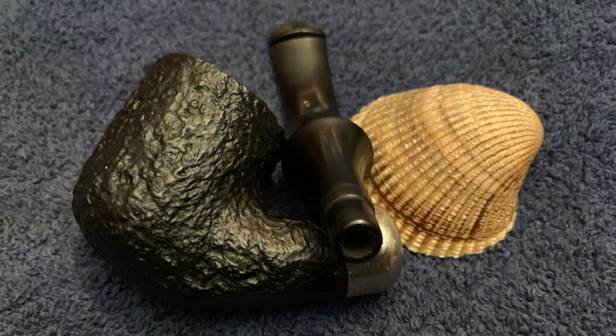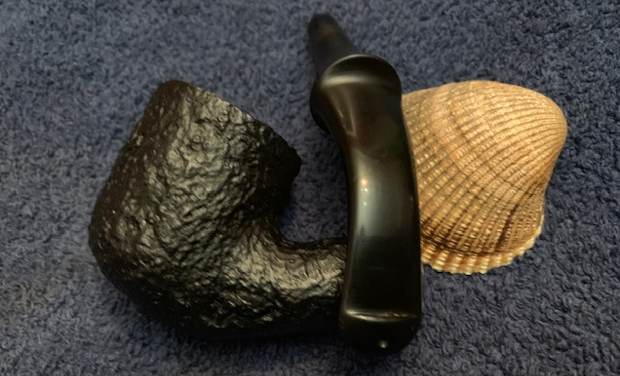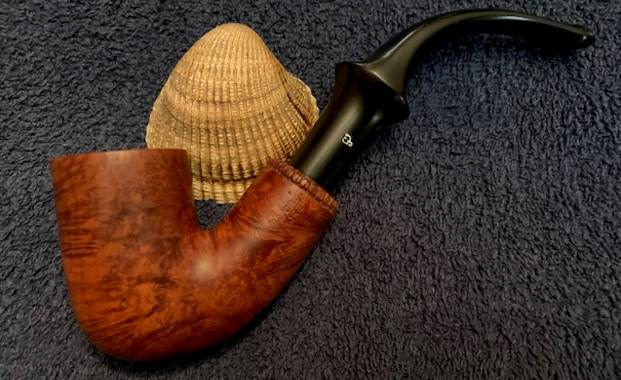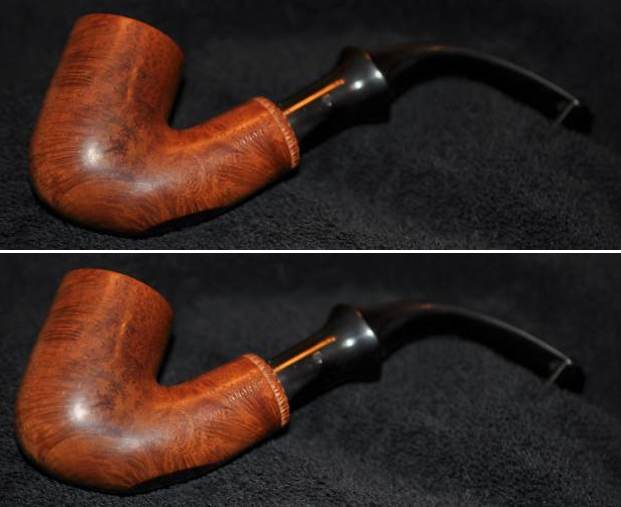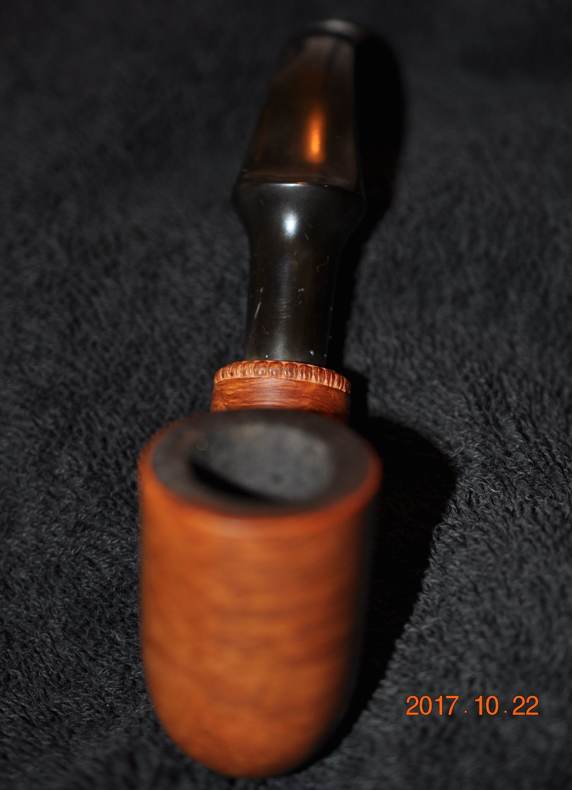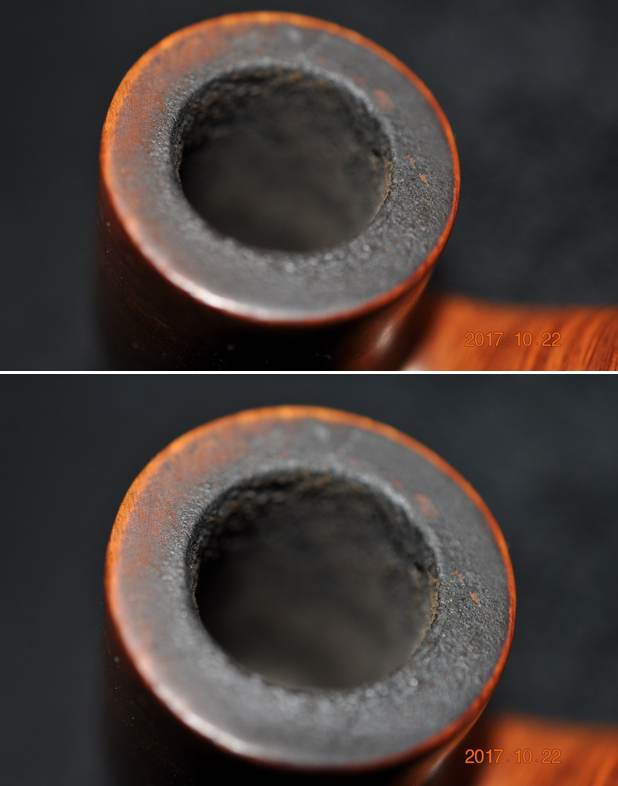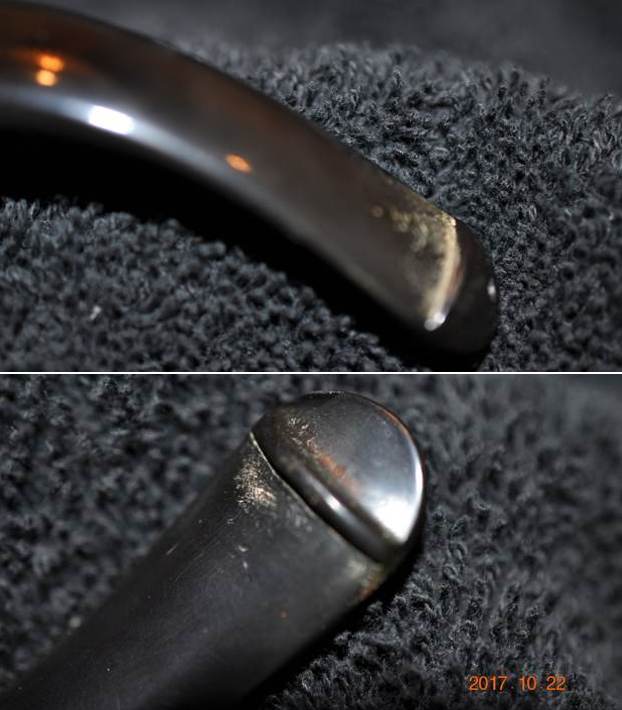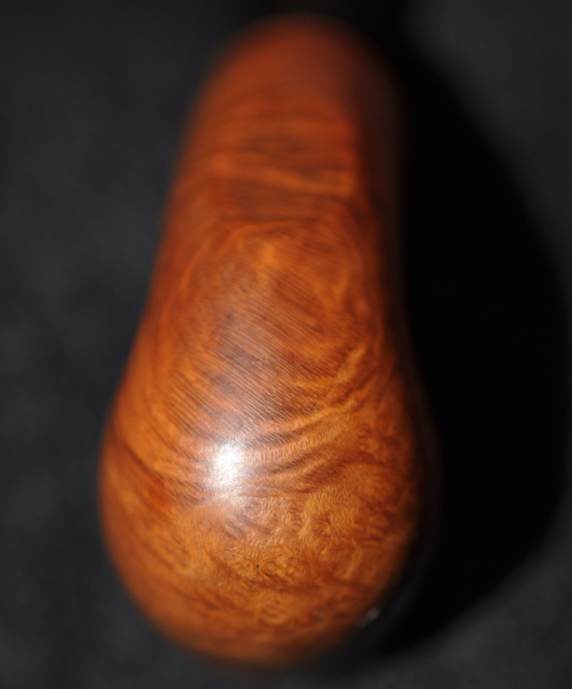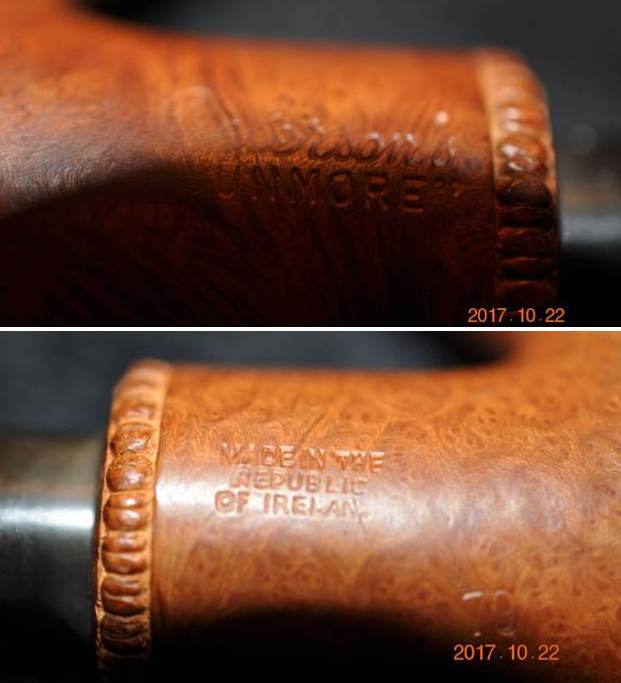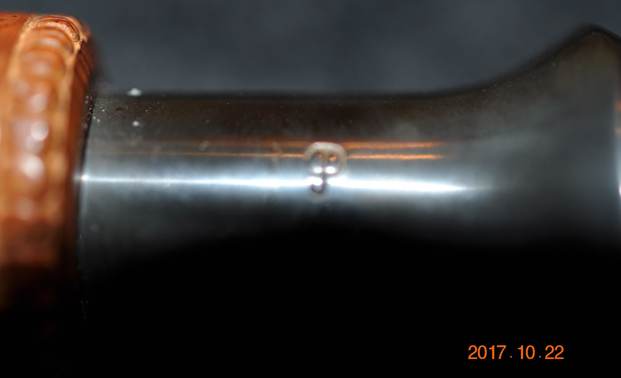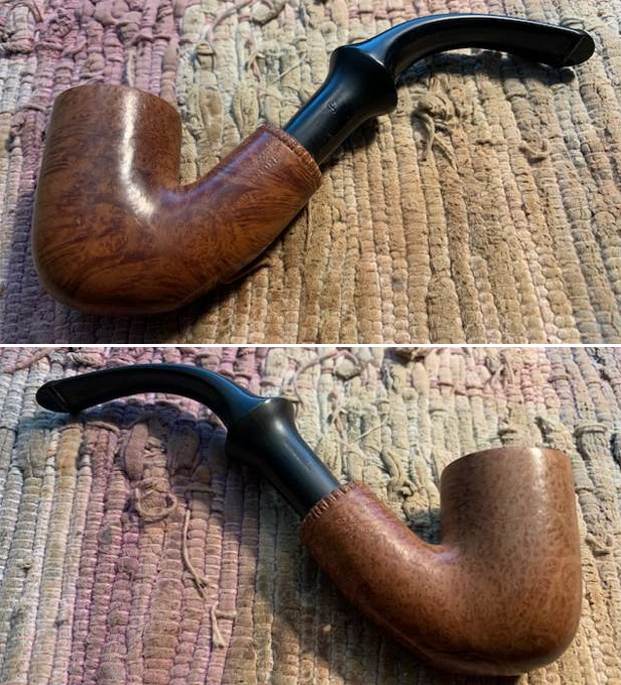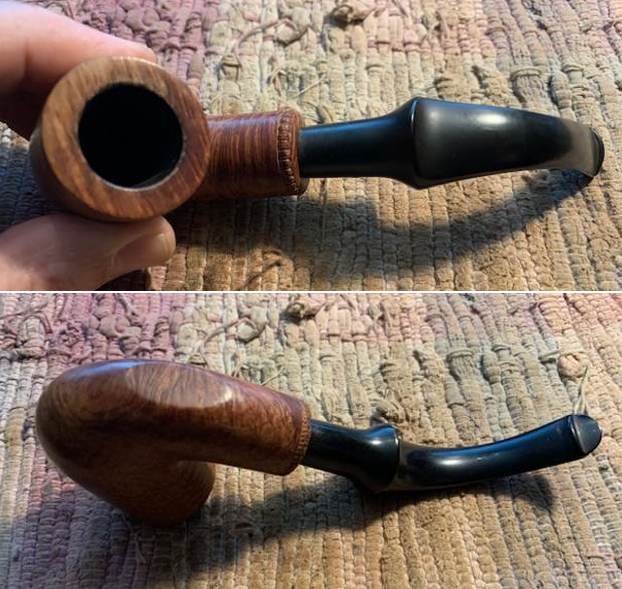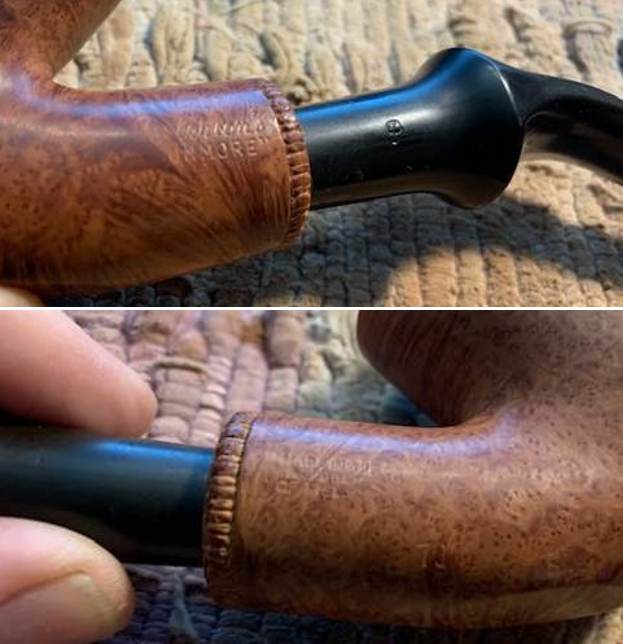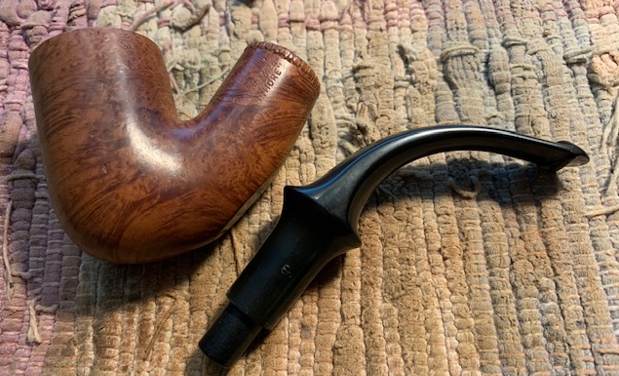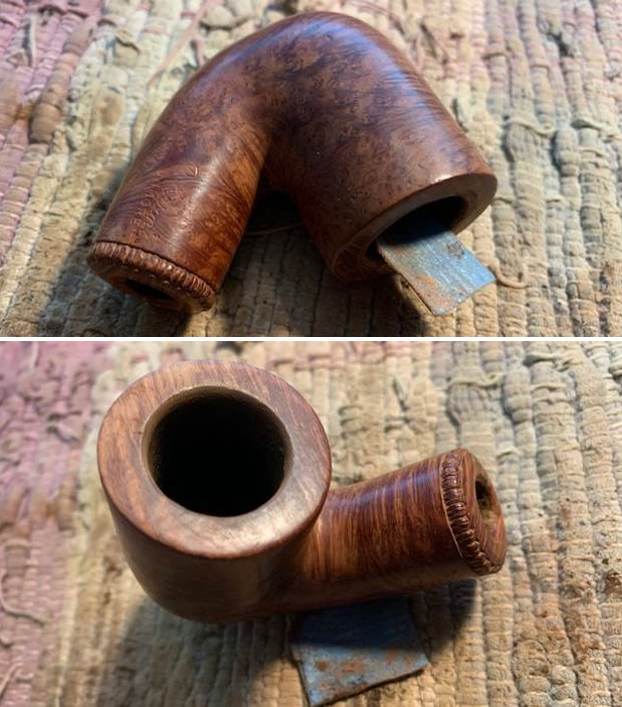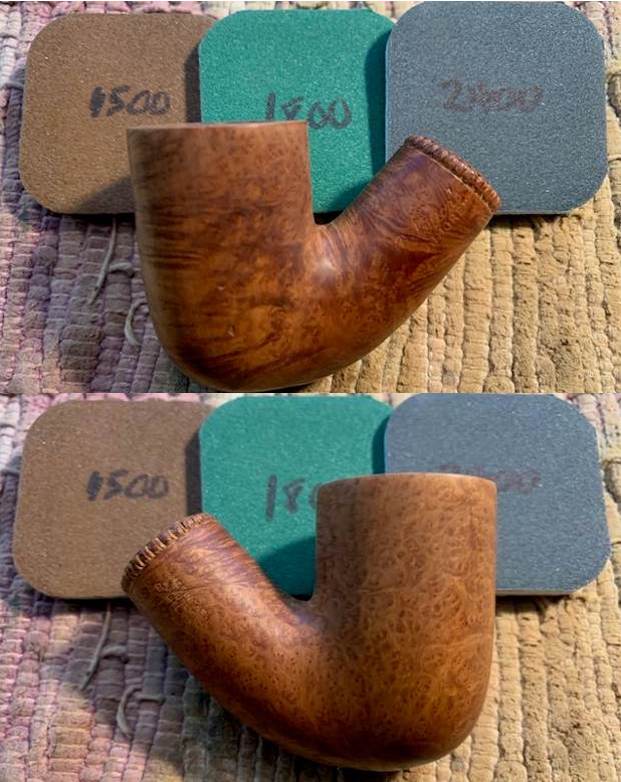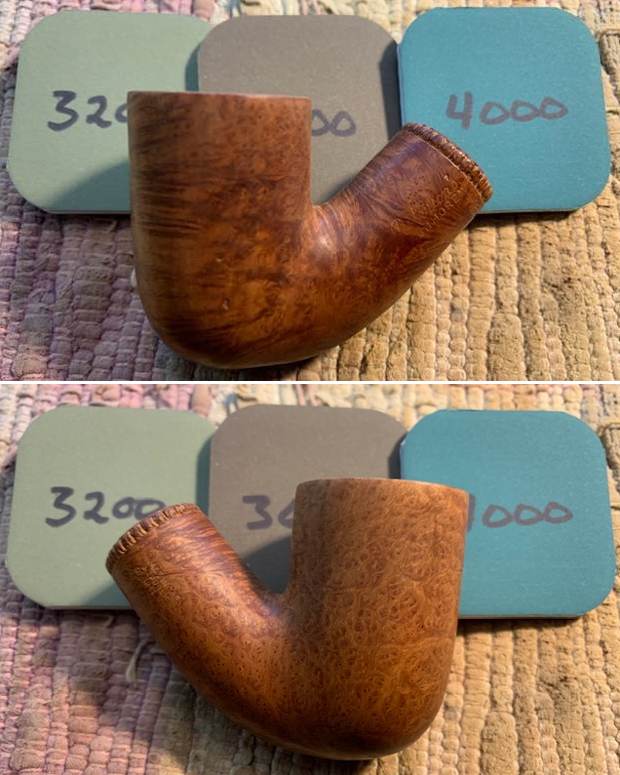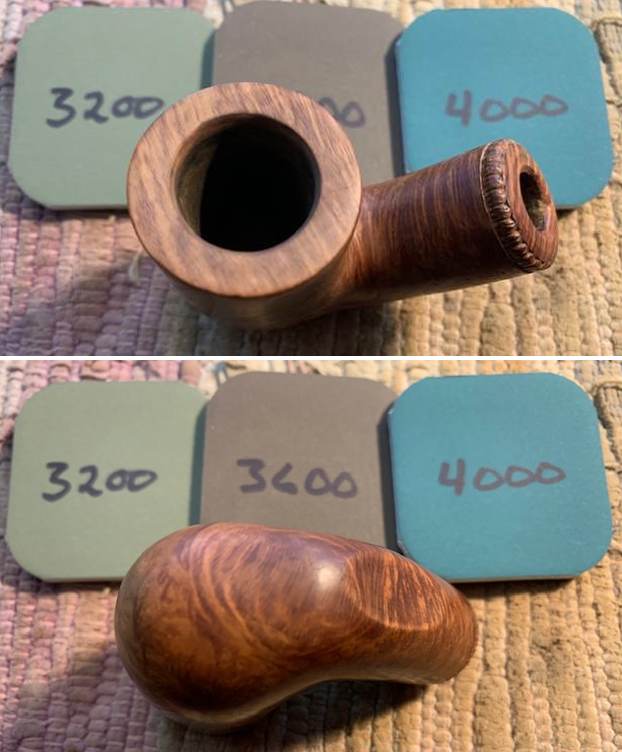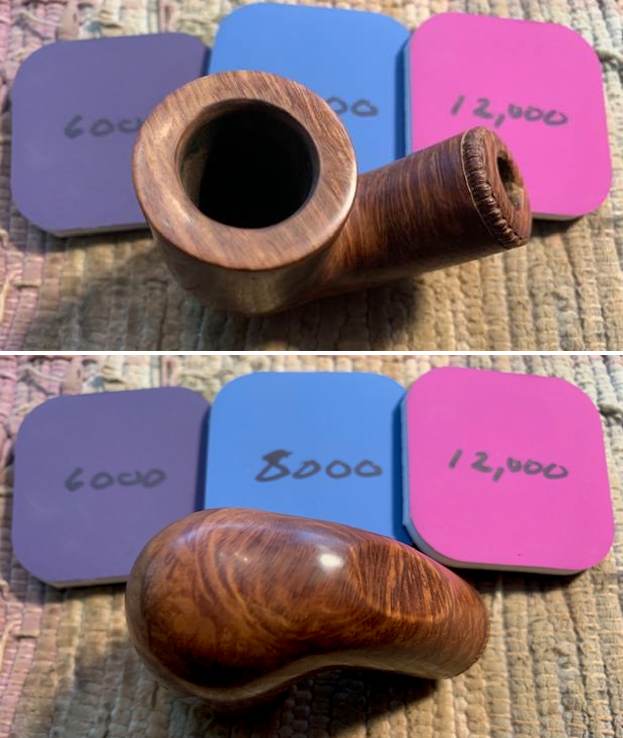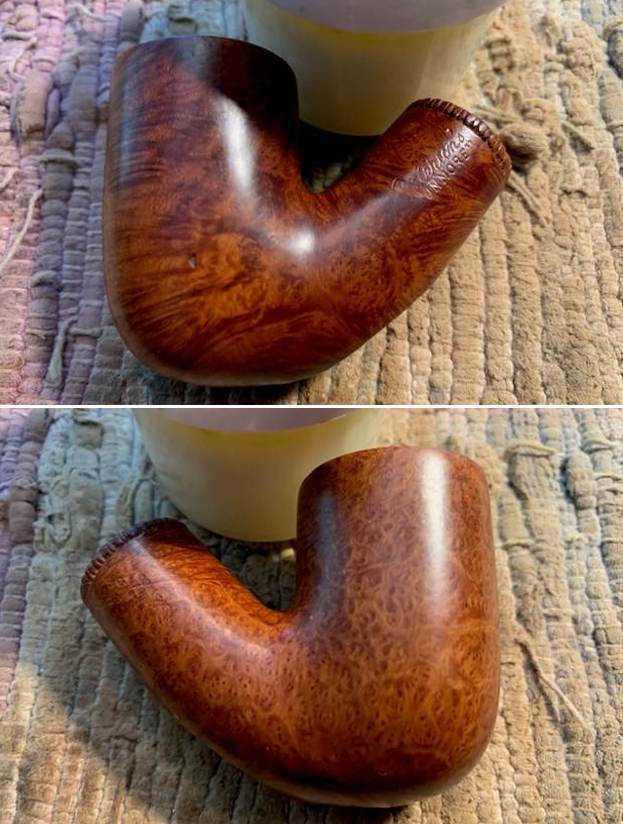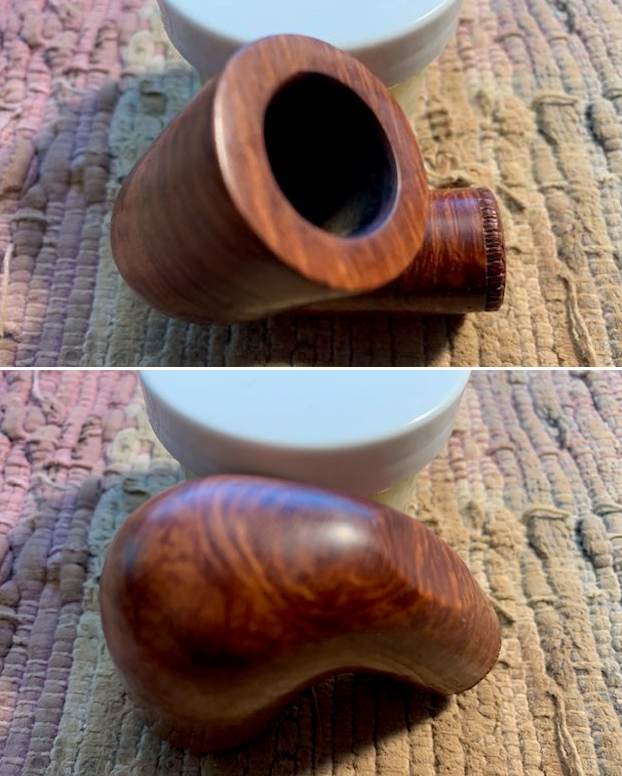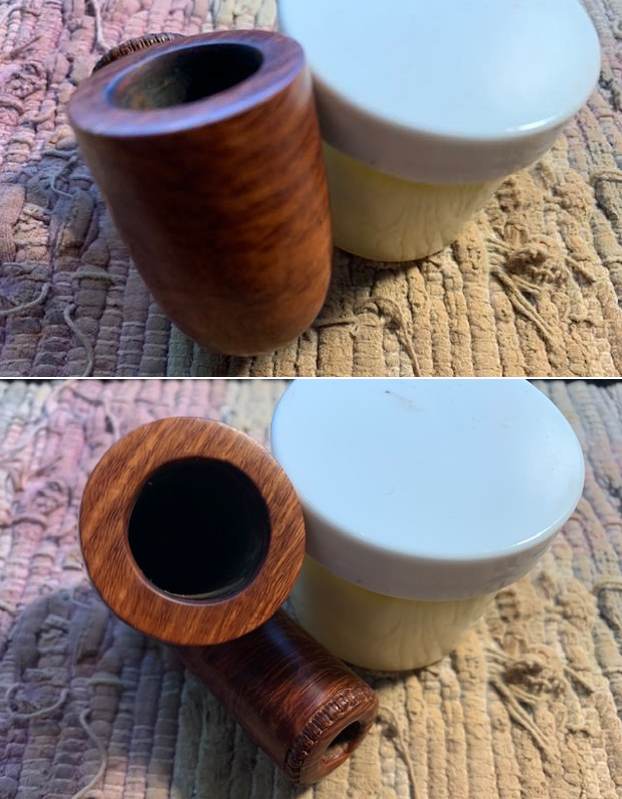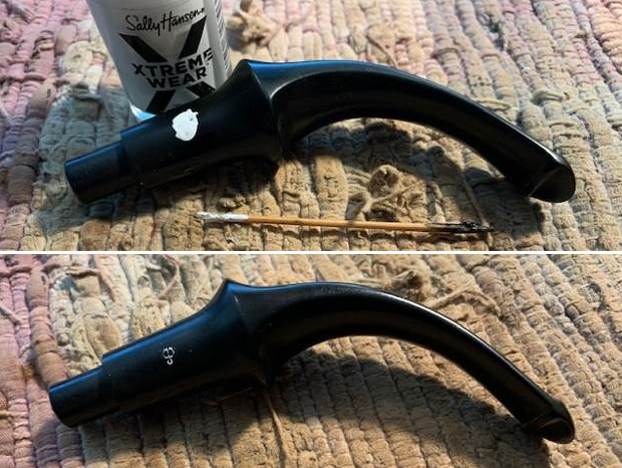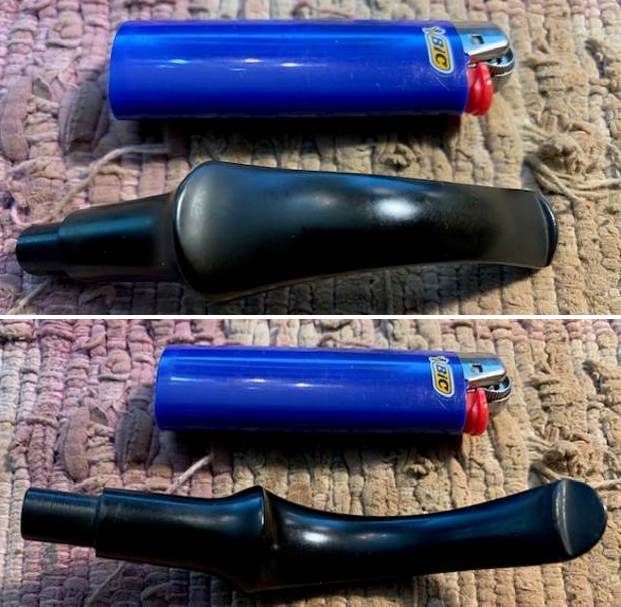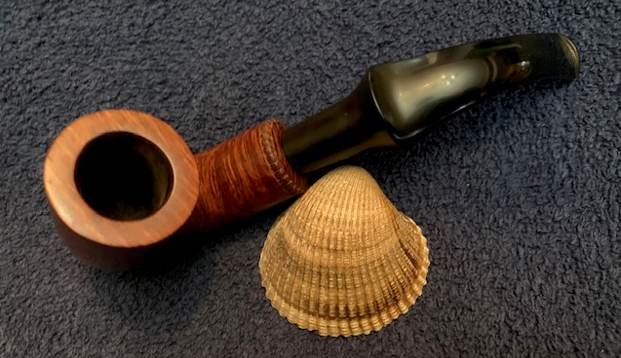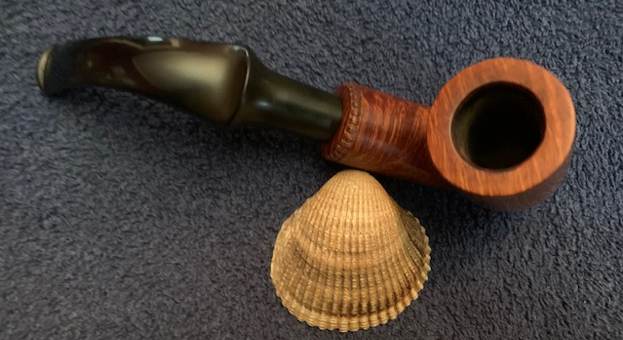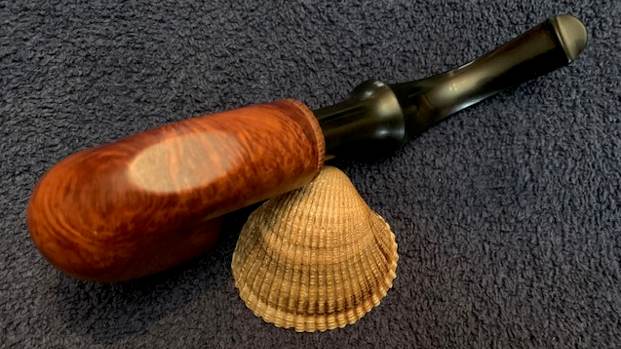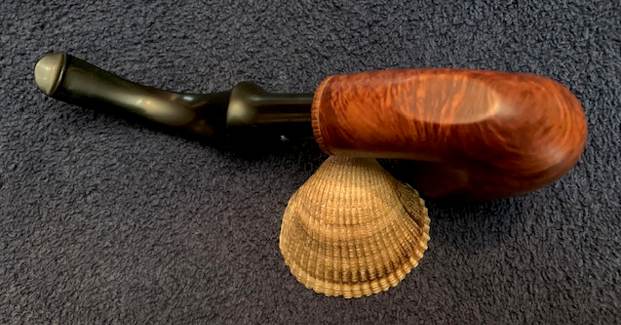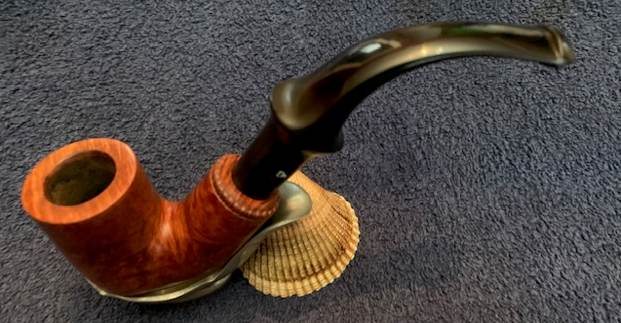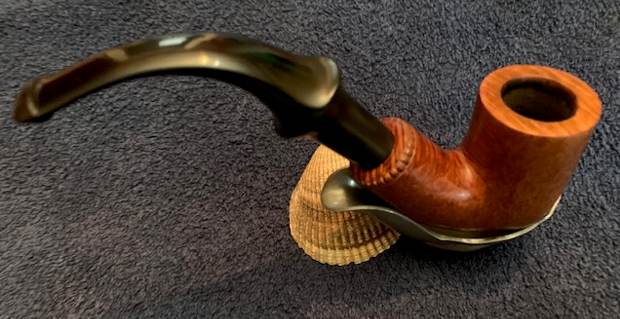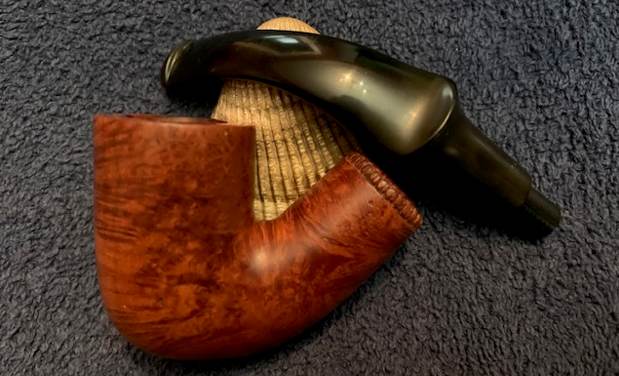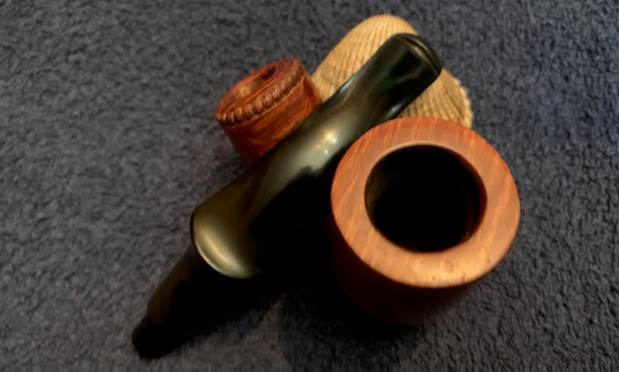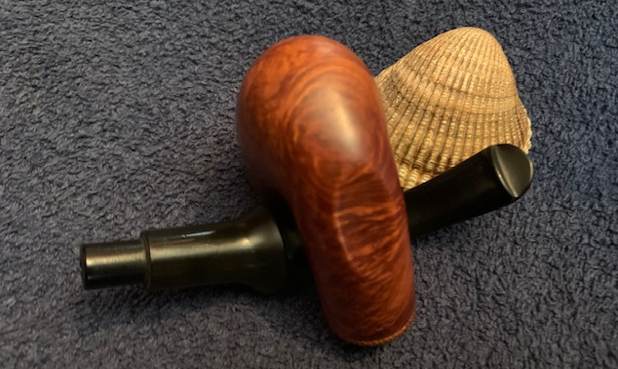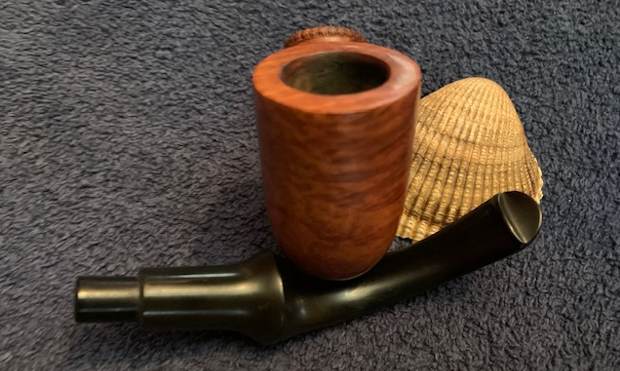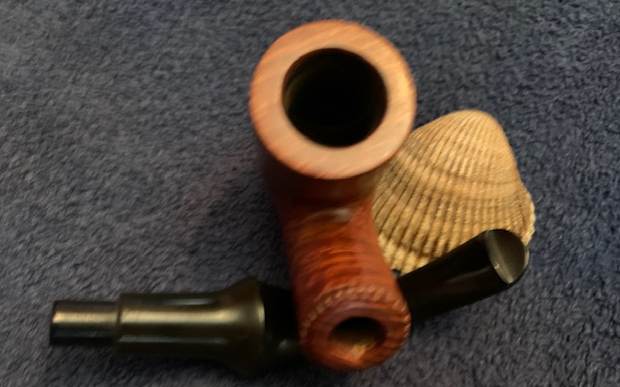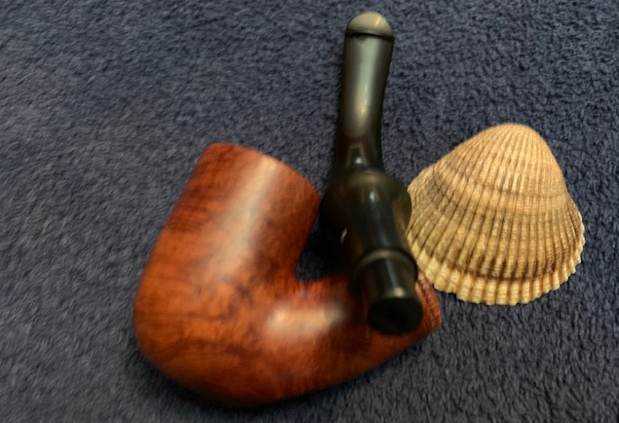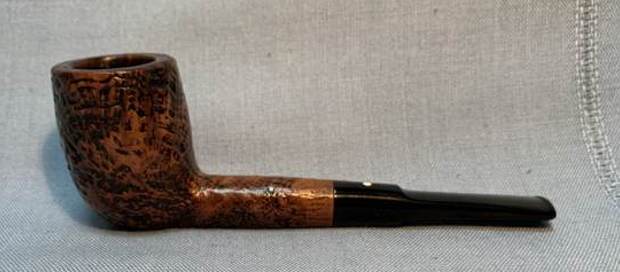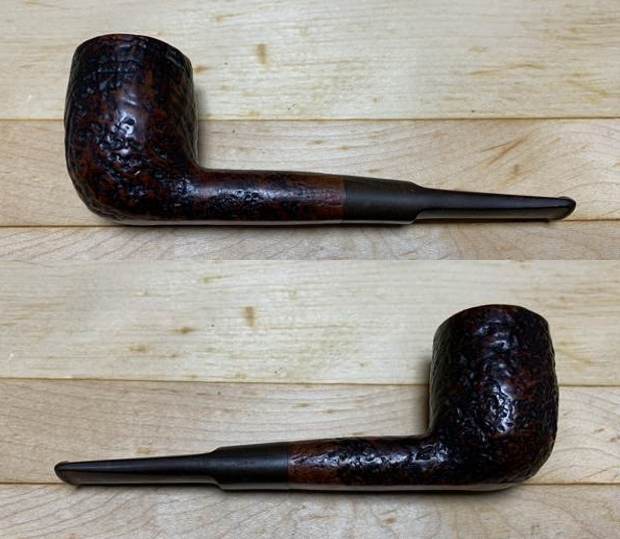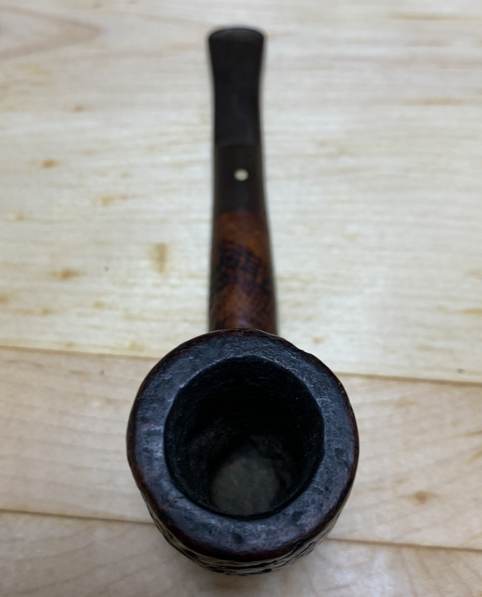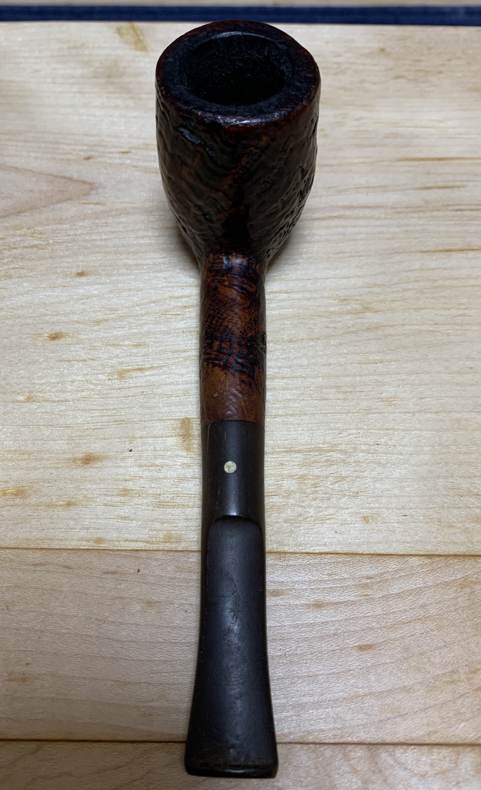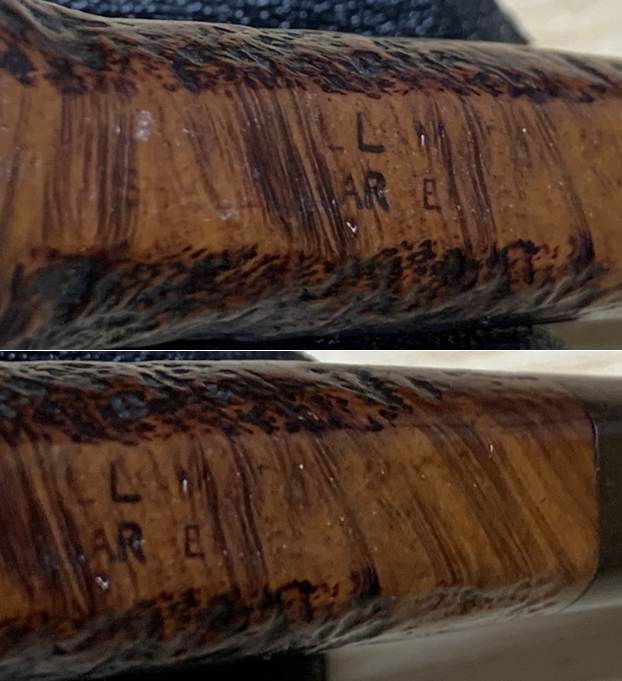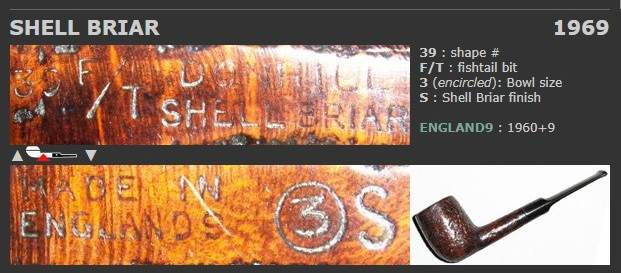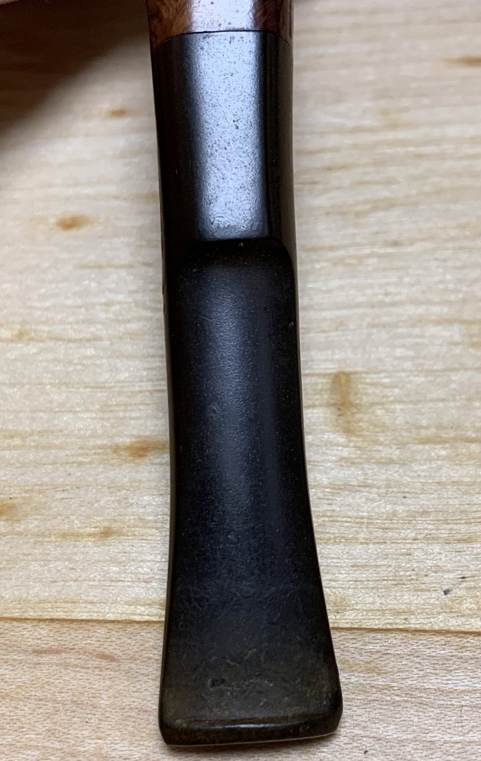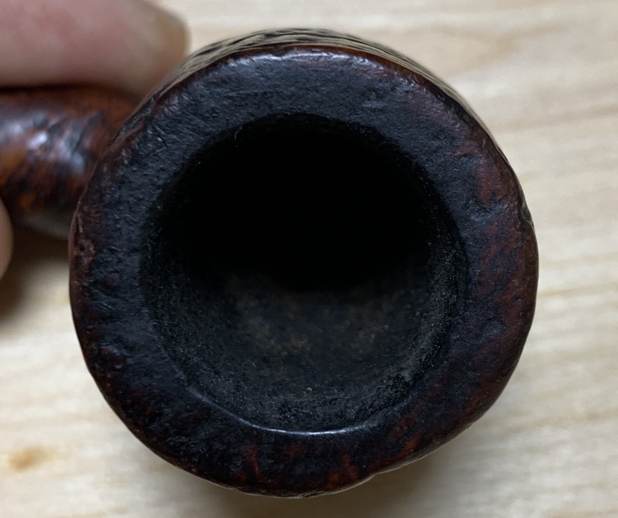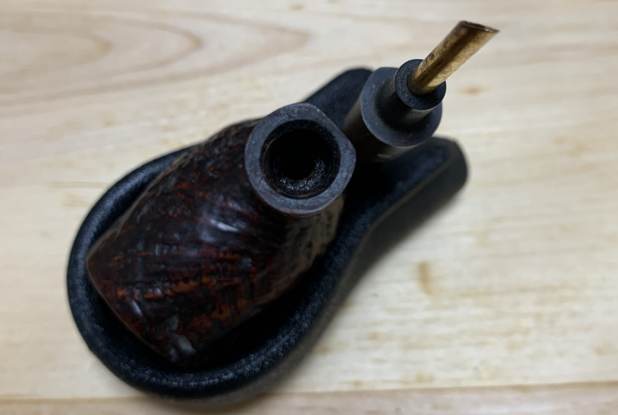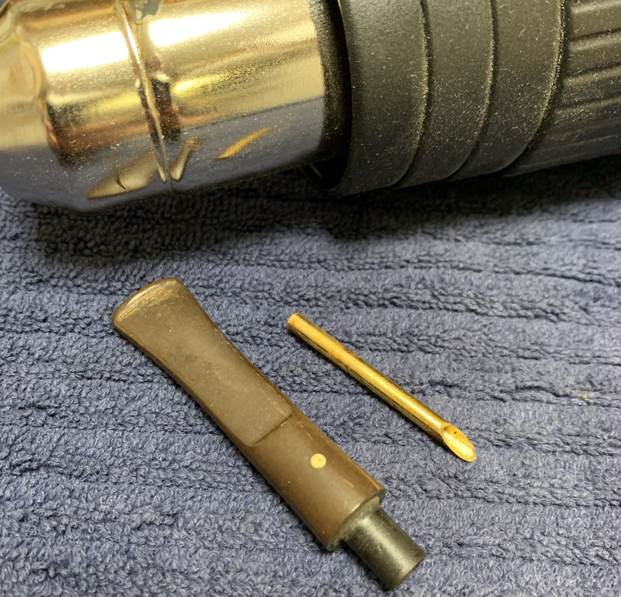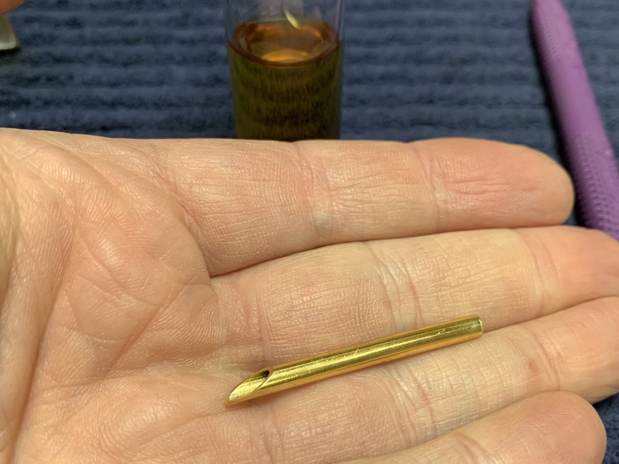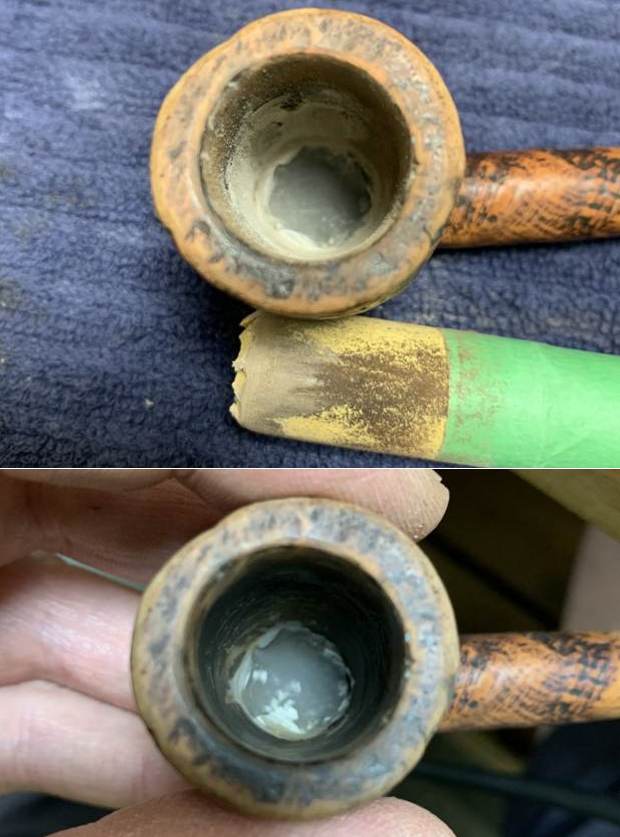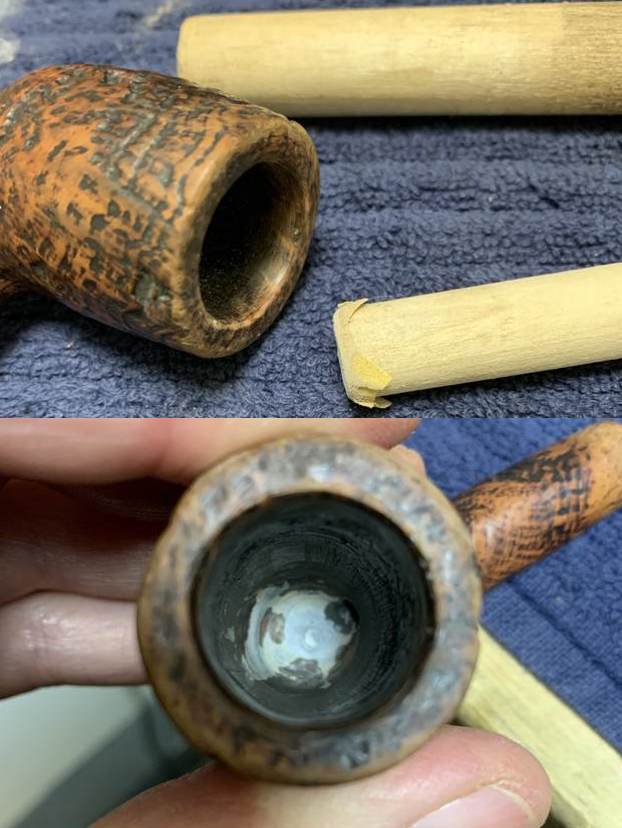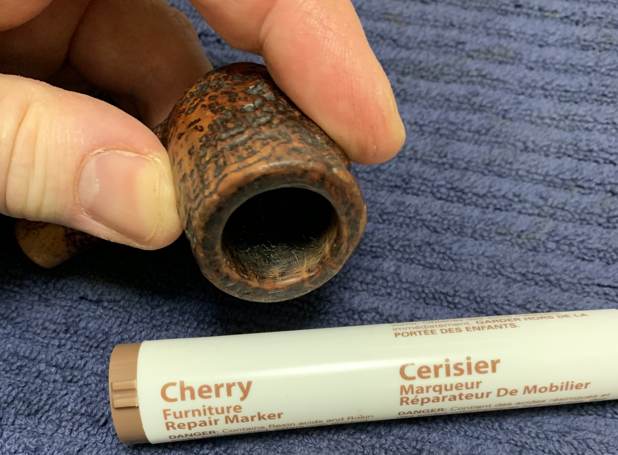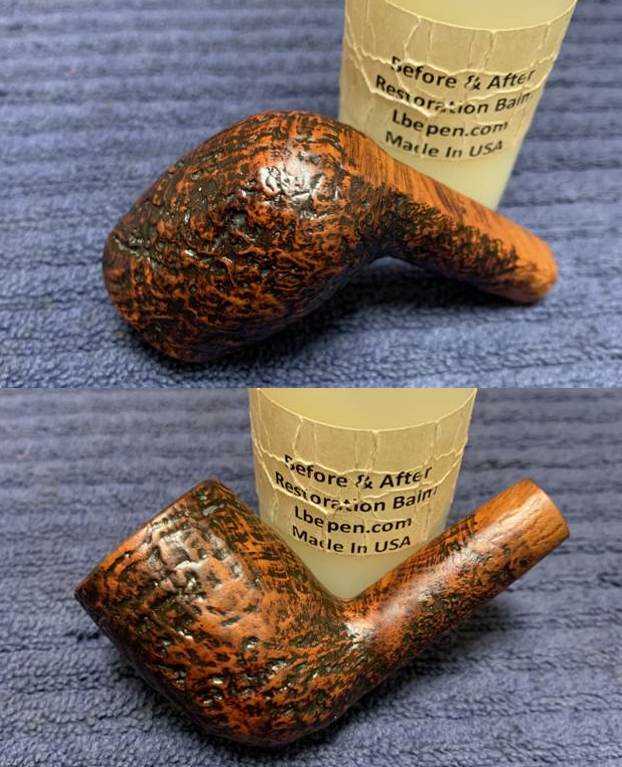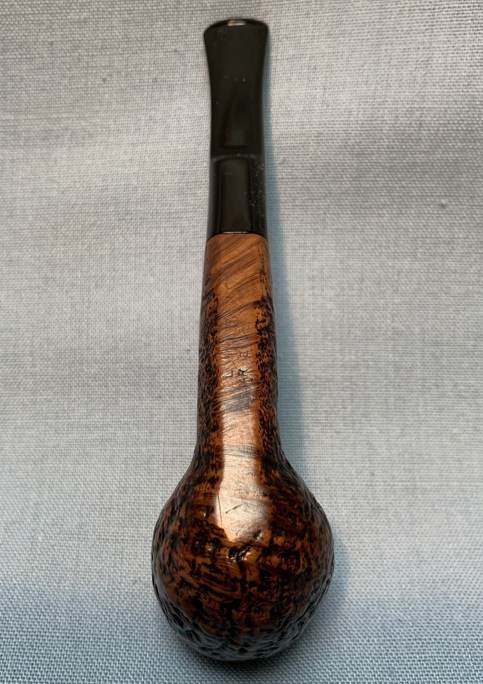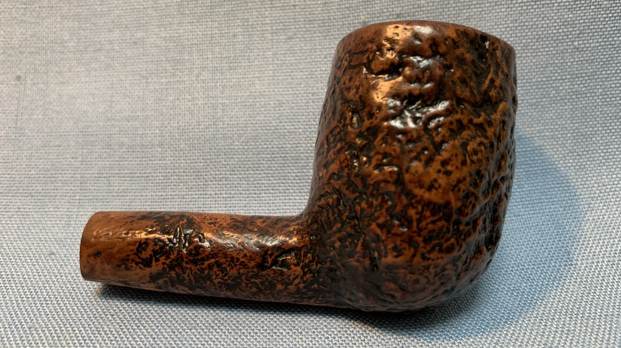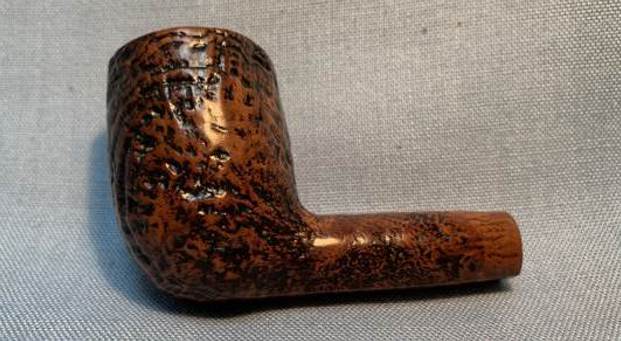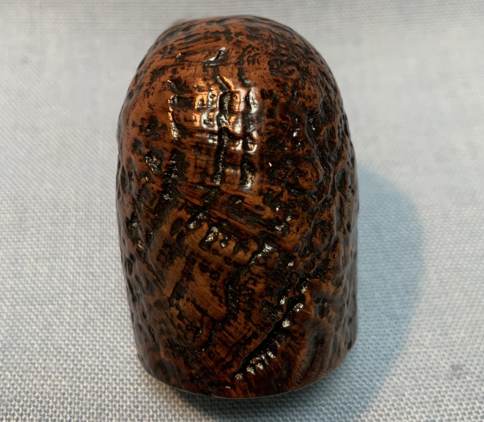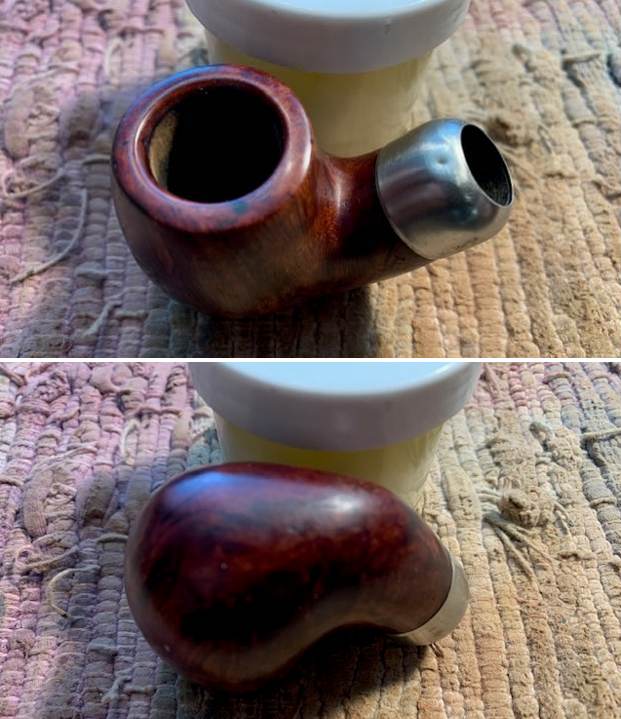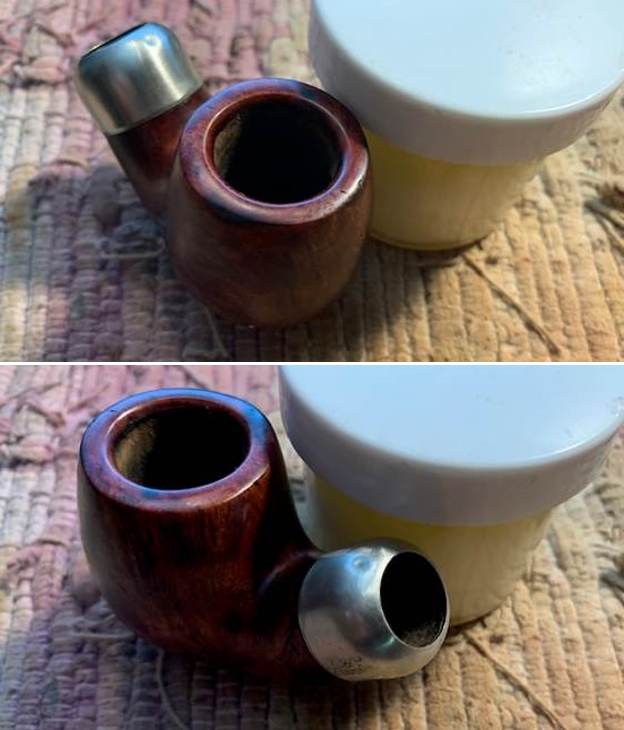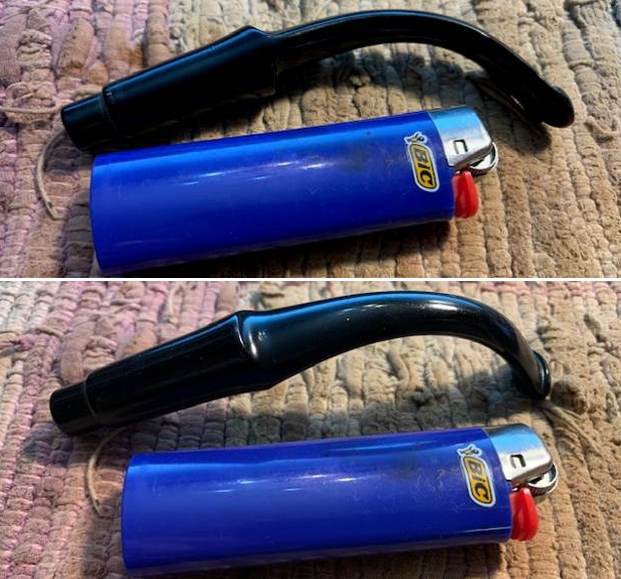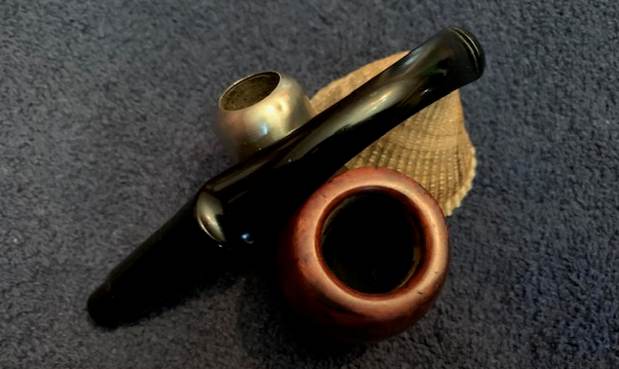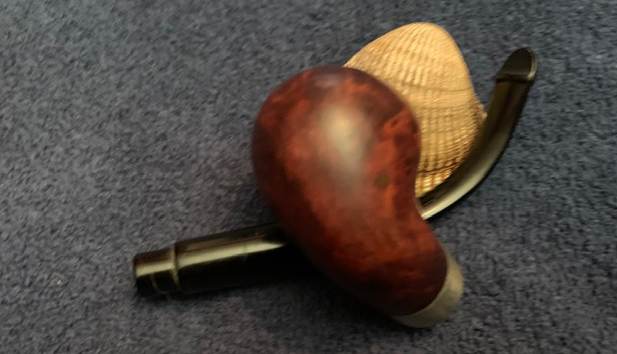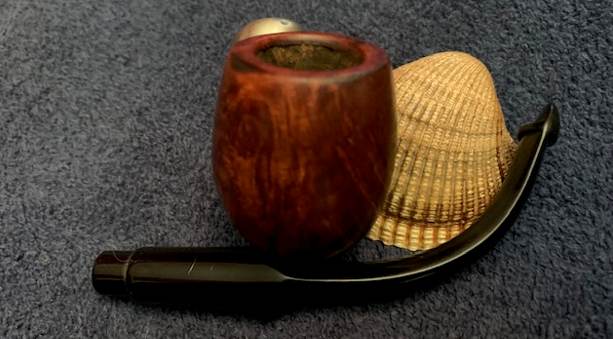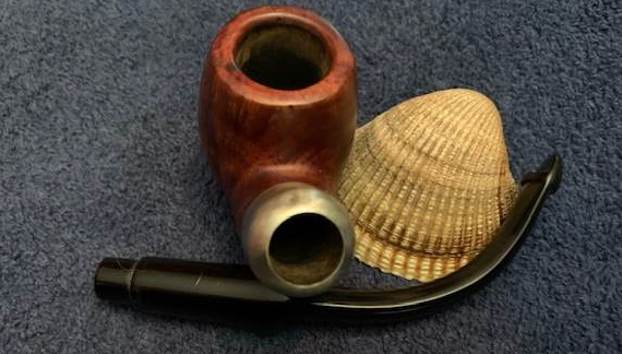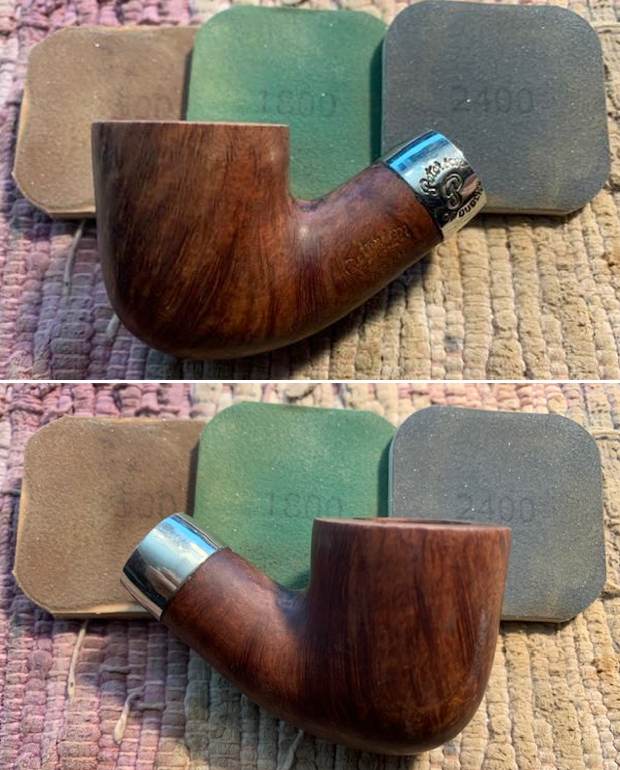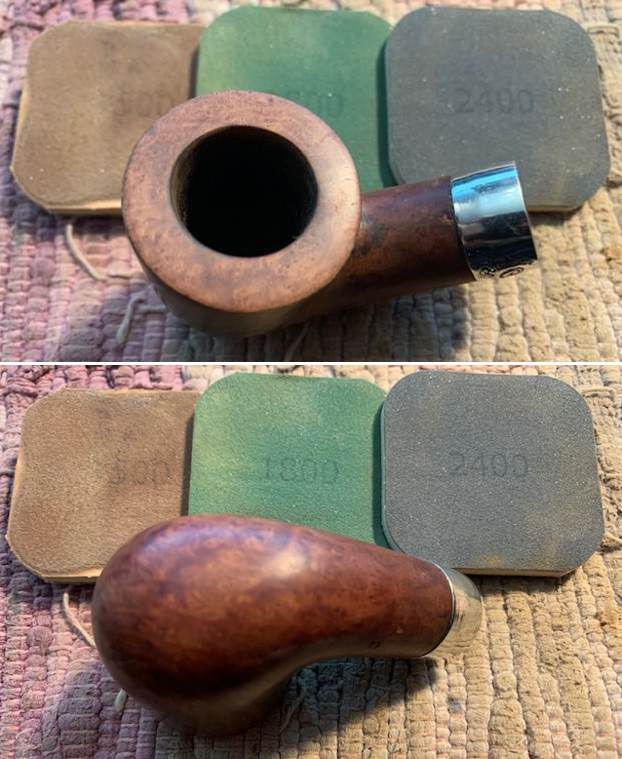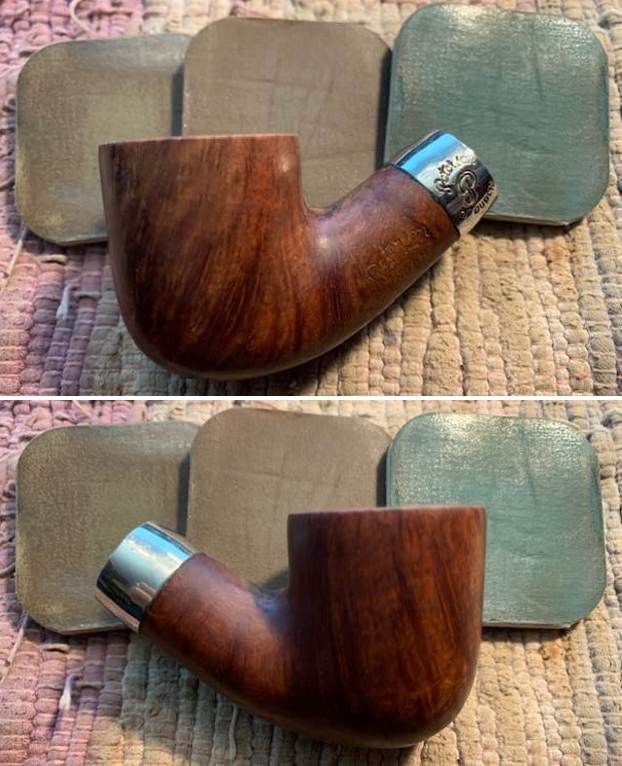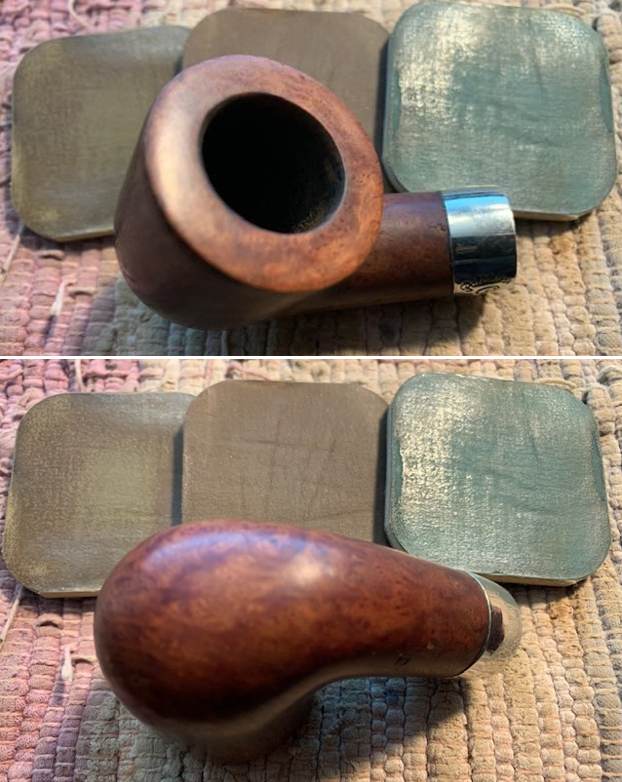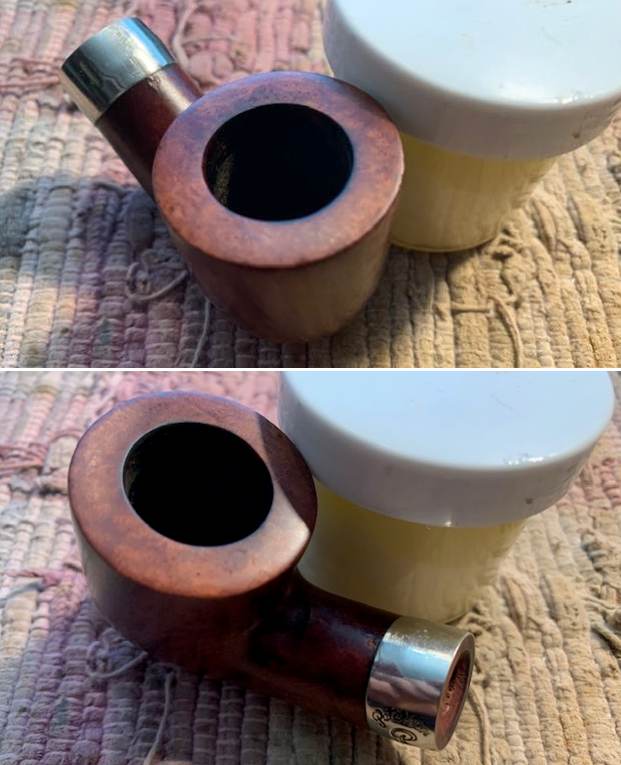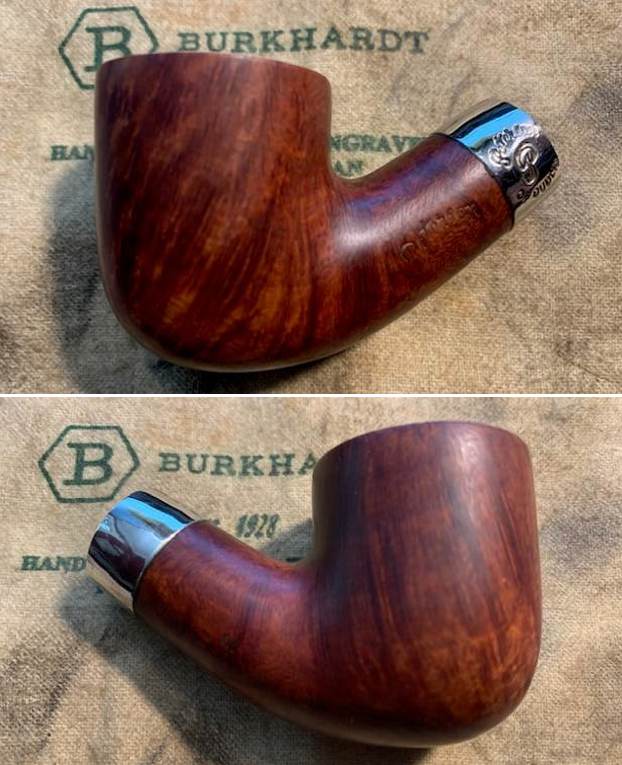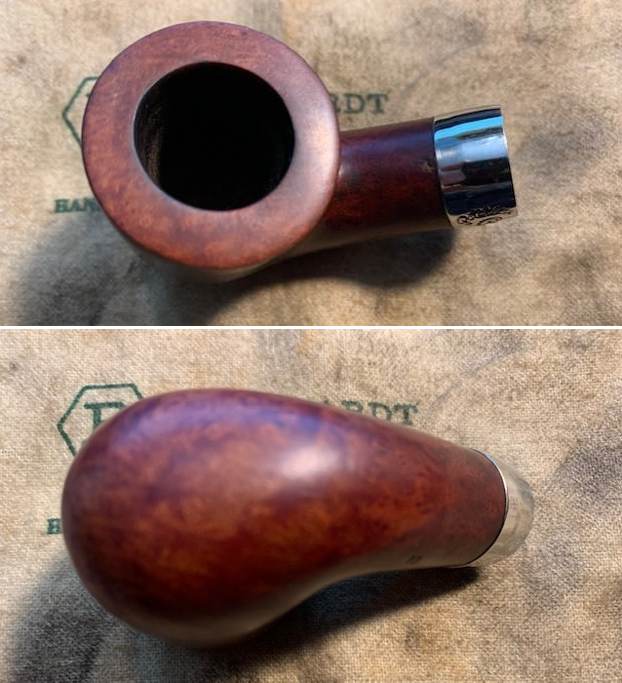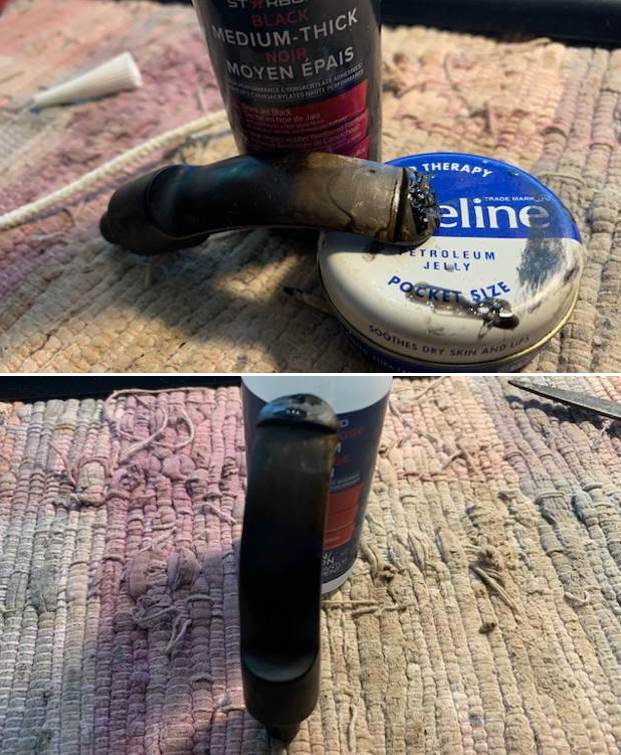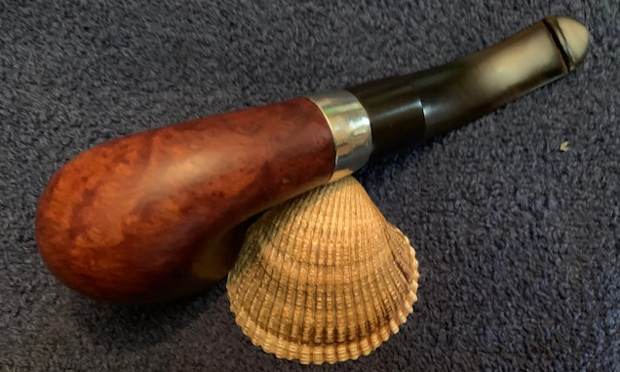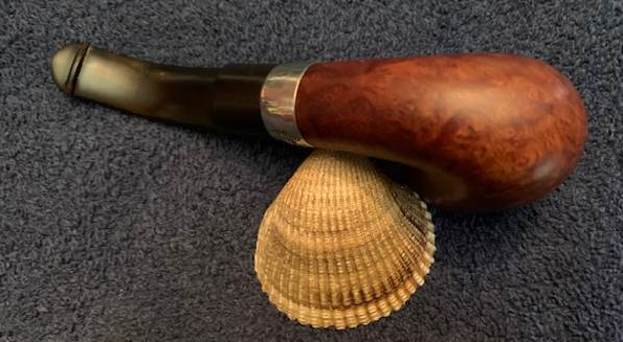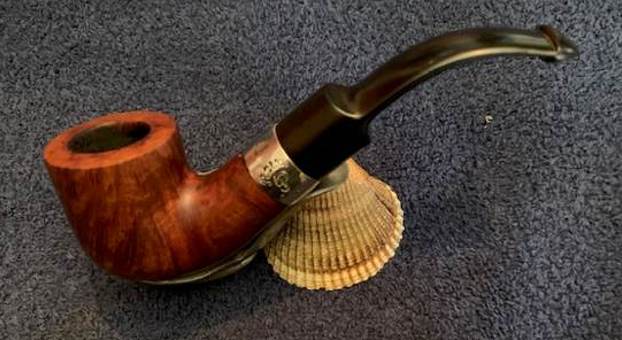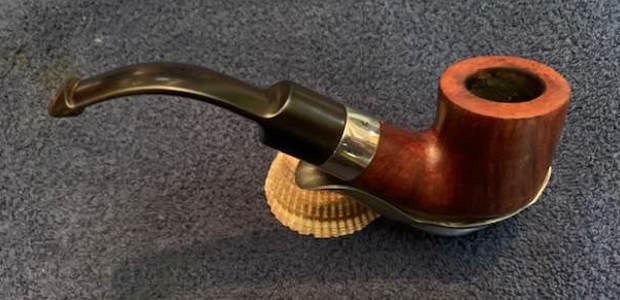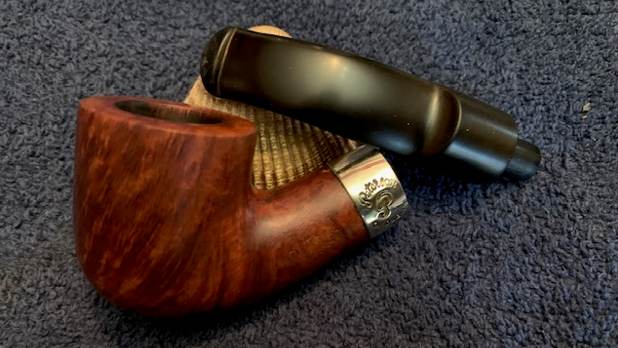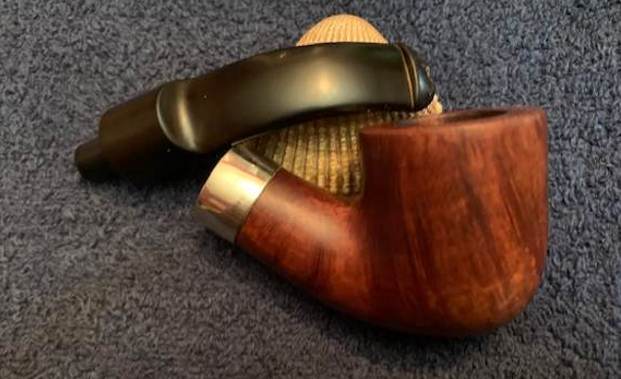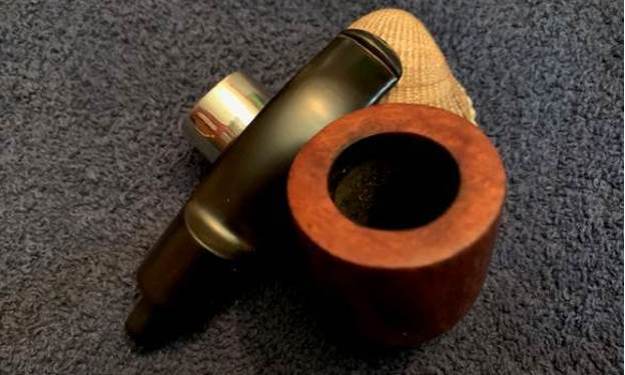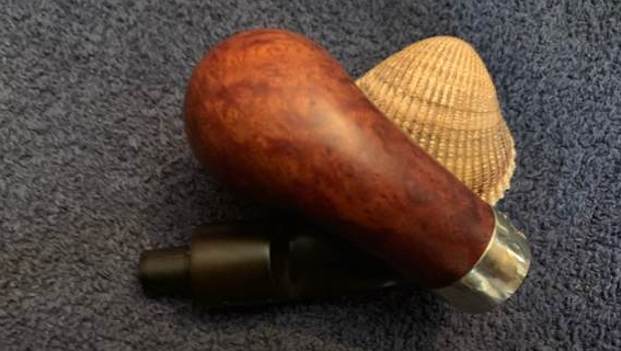
Overcoming a Cracked Bowl and Button Rebuild for a French GEFAPIP 2500 Rusticated Dublin


Dal and I emailed about this restoration and the finished product looks great. Nice work Dal.
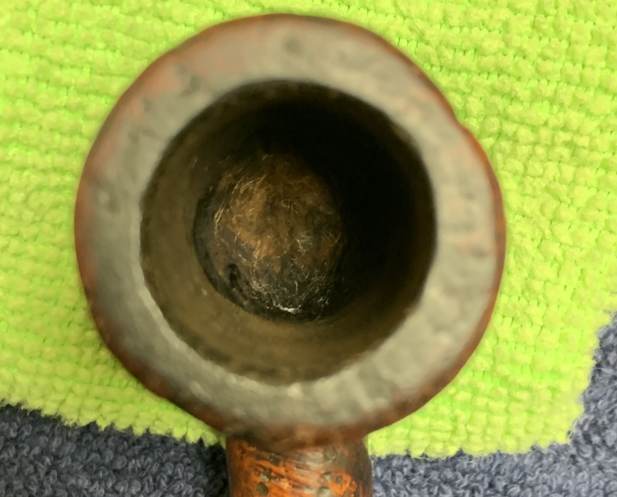
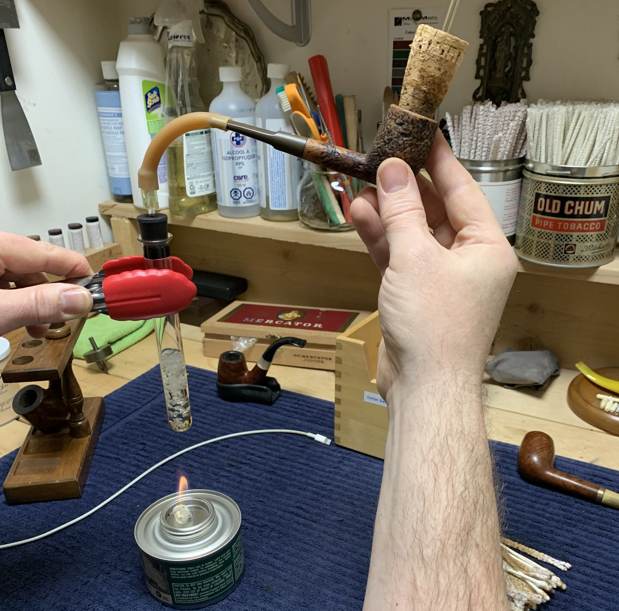
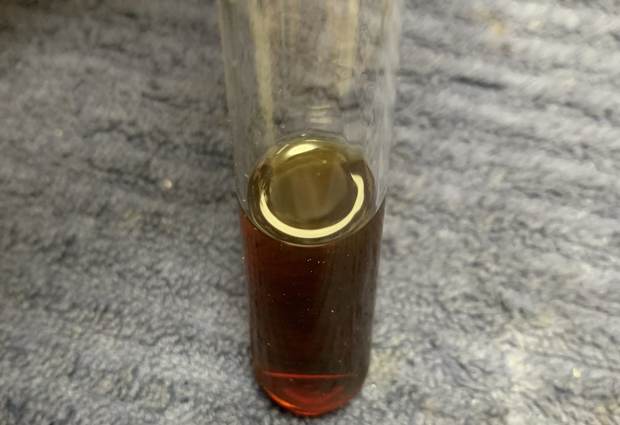
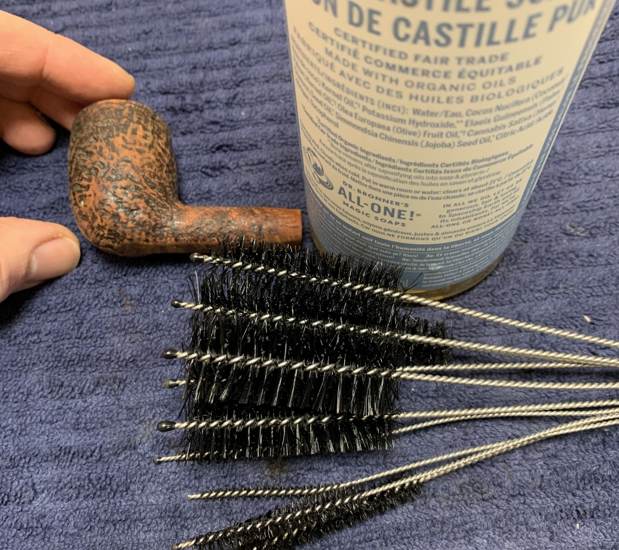
The next pipe on the worktable came to me in what I have called the St. Louis Lot of 26 which my son, Josiah, discovered in a local antique shop.  He…

Overcoming a Cracked Bowl and Button Rebuild for a French GEFAPIP 2500 Rusticated Dublin

Restoring a Peterson’s of Dublin Donegal Rocky 999 Rhodesian


Blog by Steve Laug

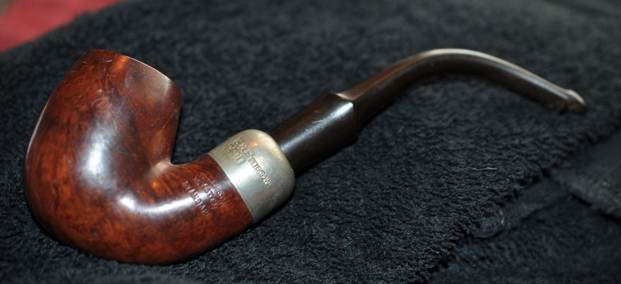
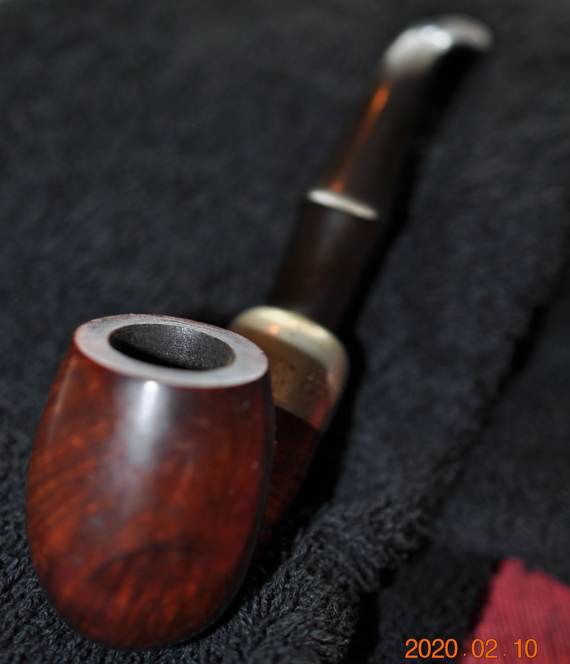
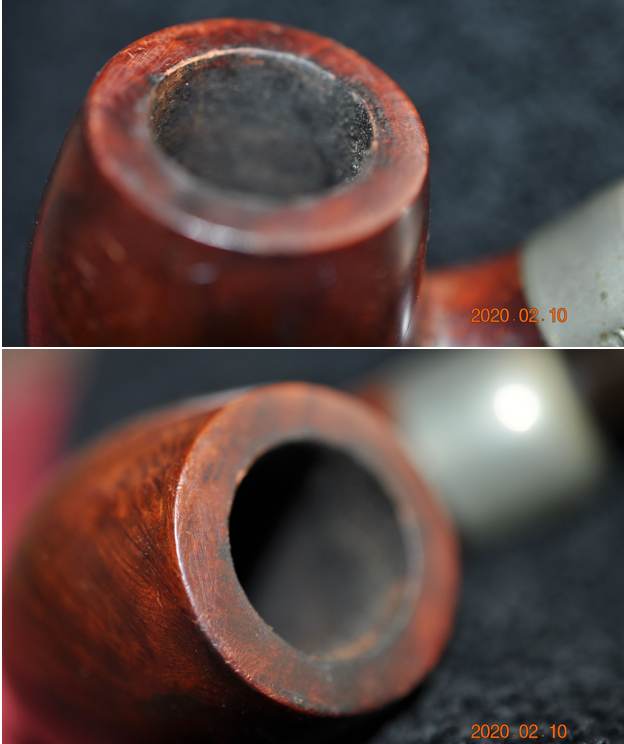
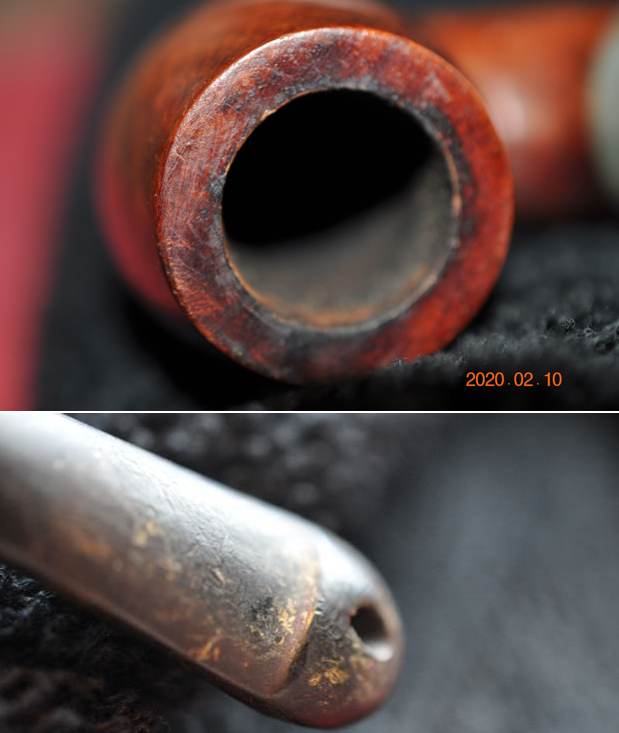
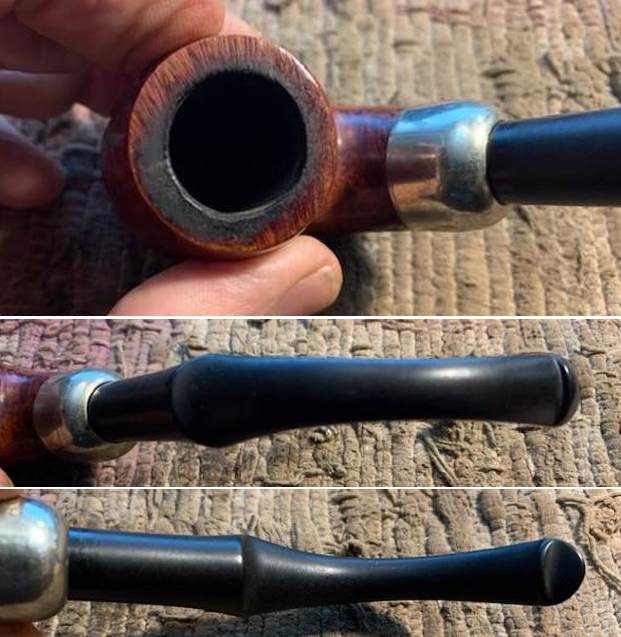
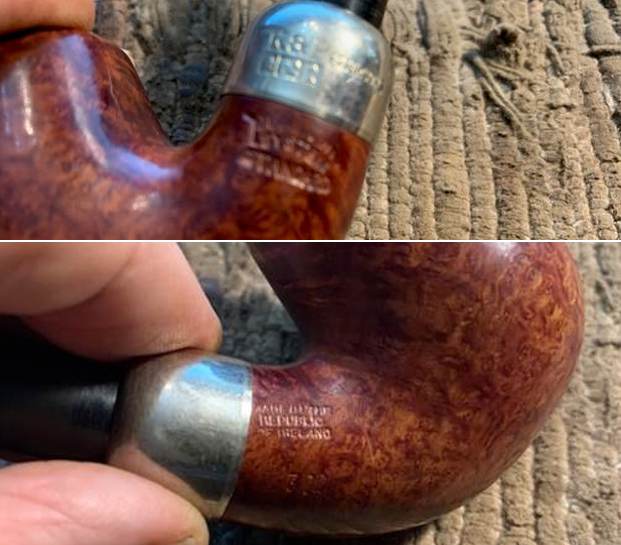
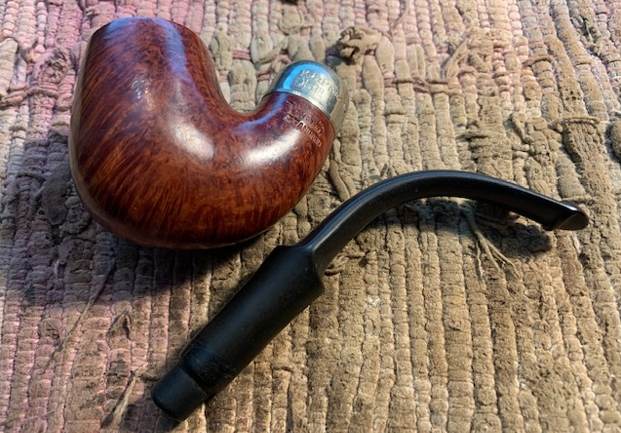
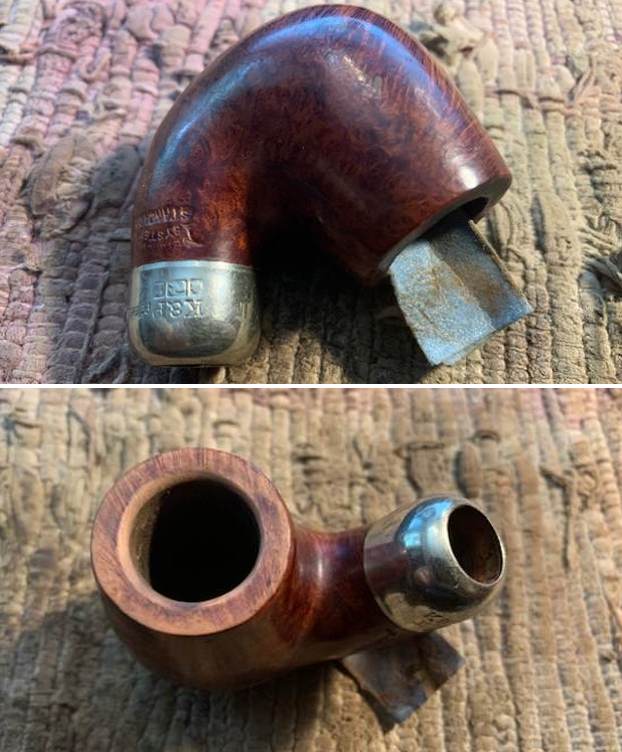
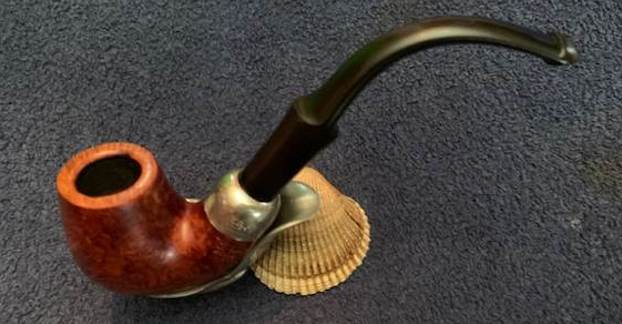
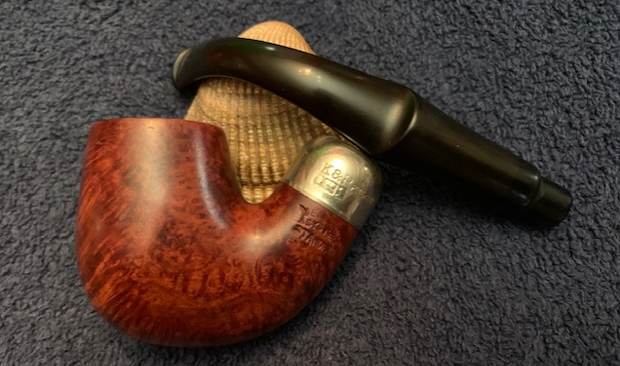
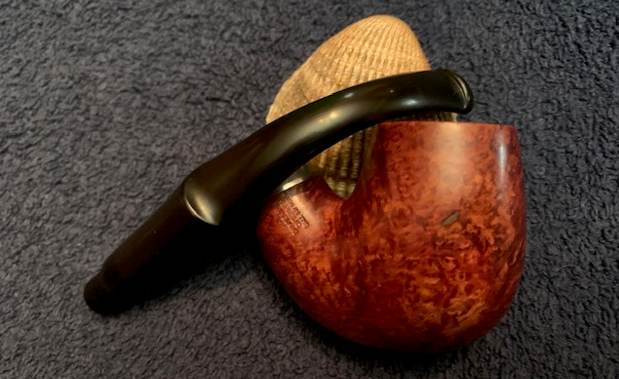
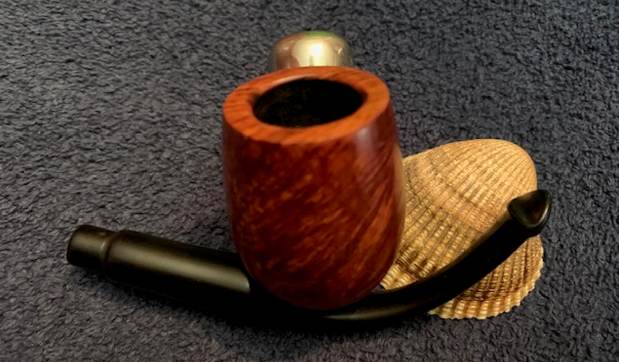
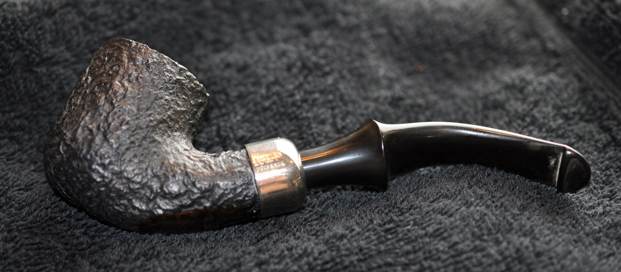
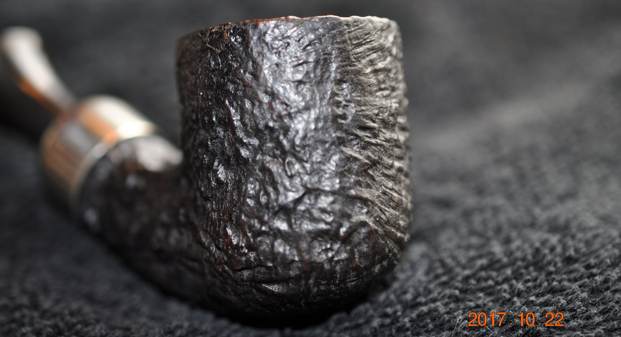
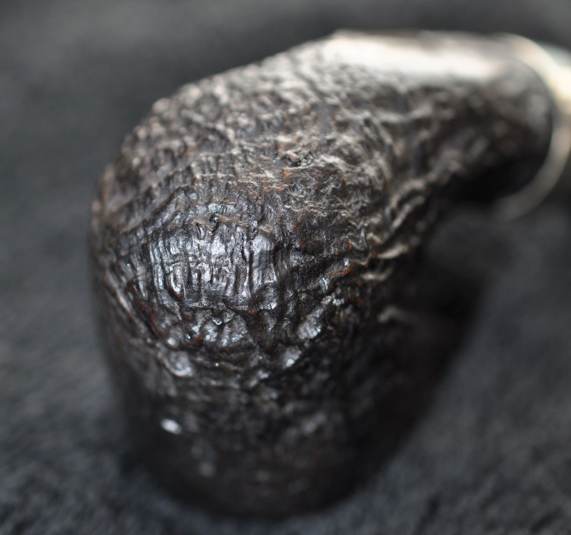
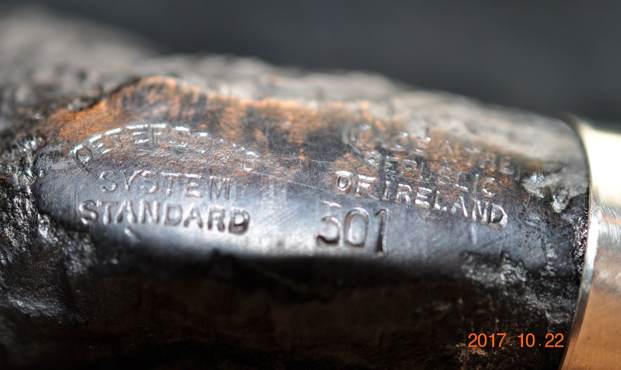
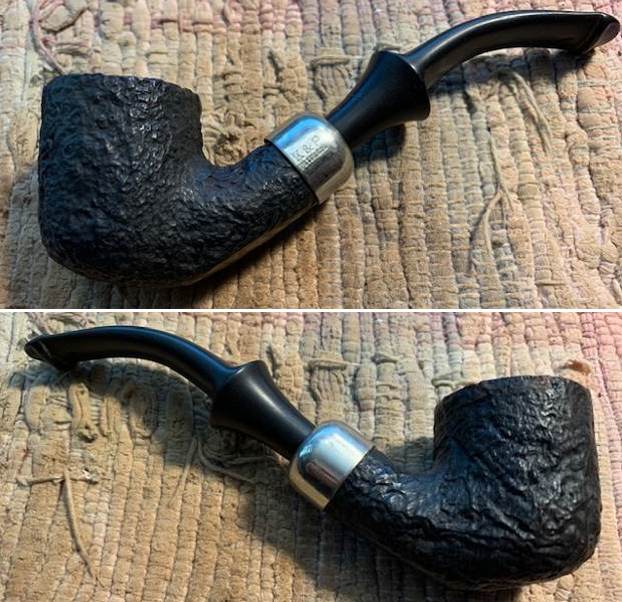
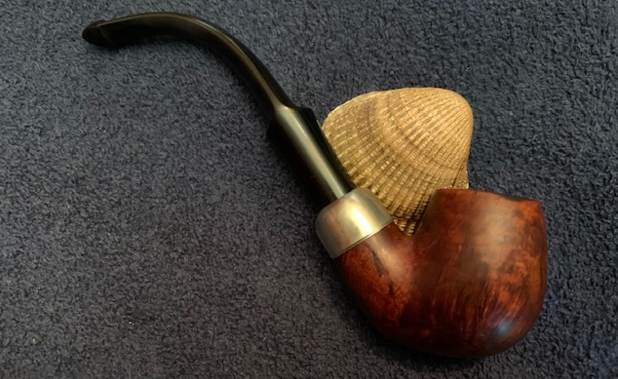
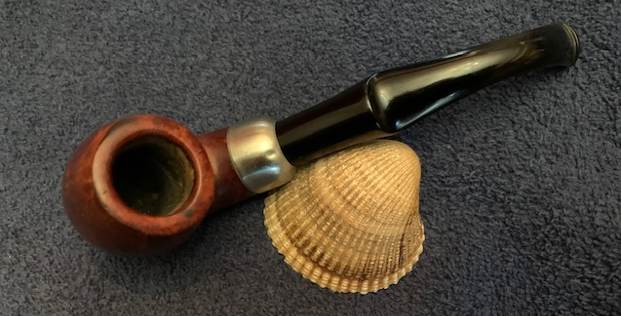
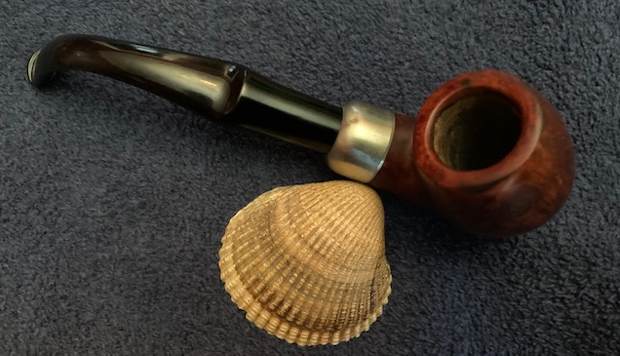
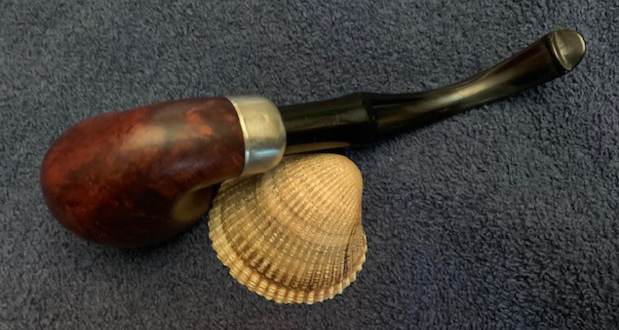
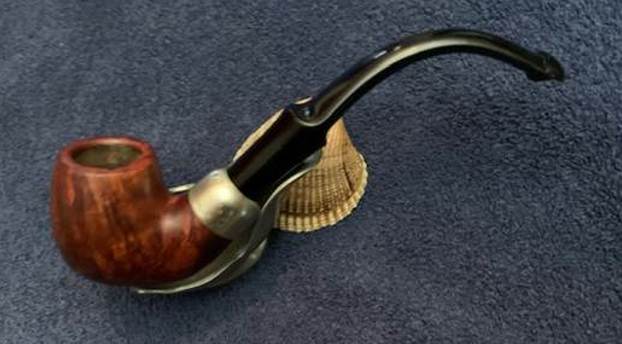
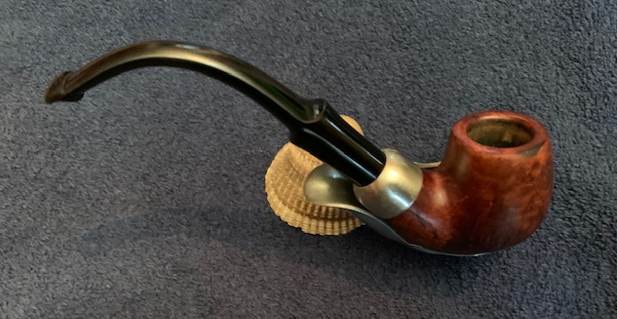
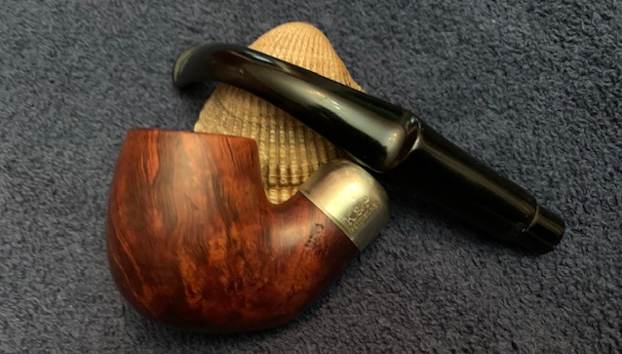
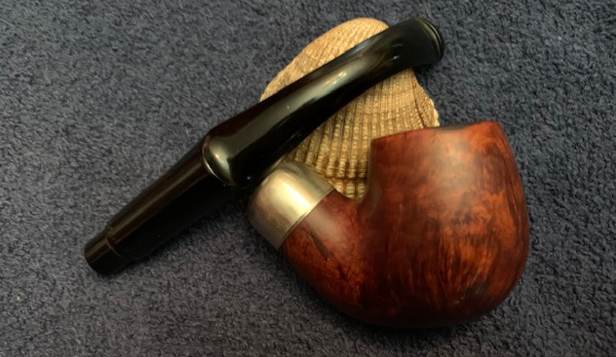
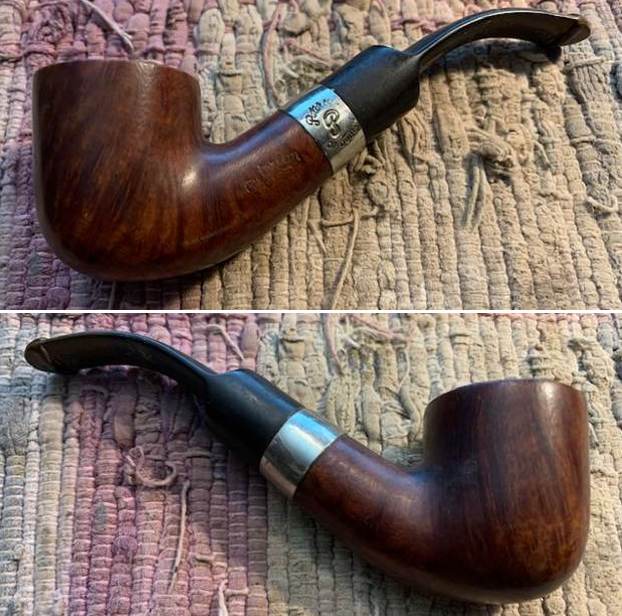
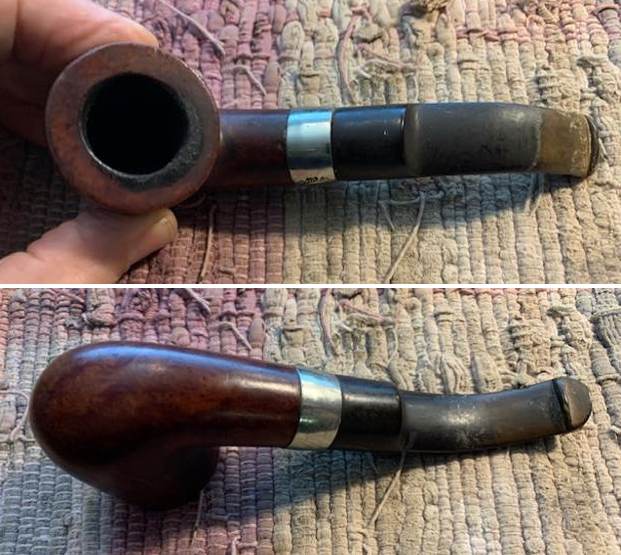
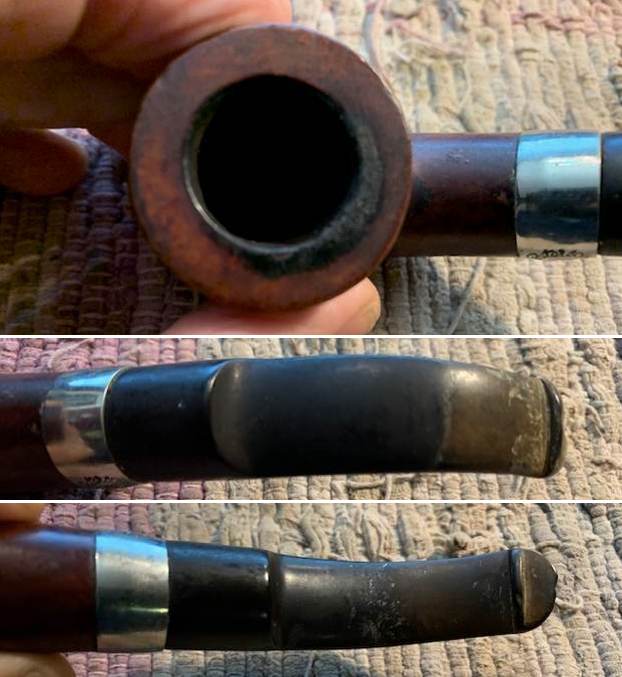
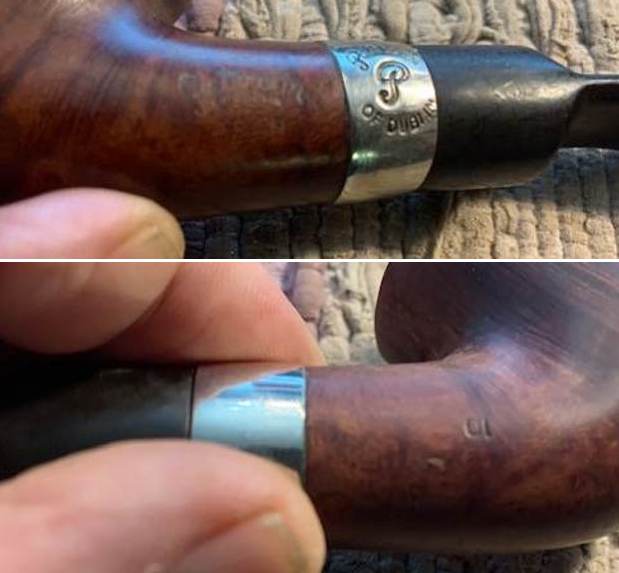
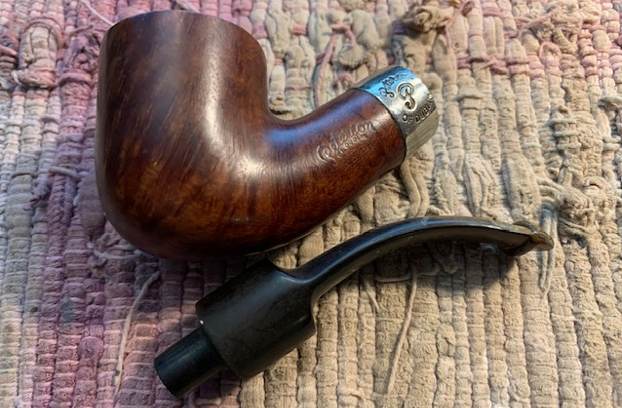
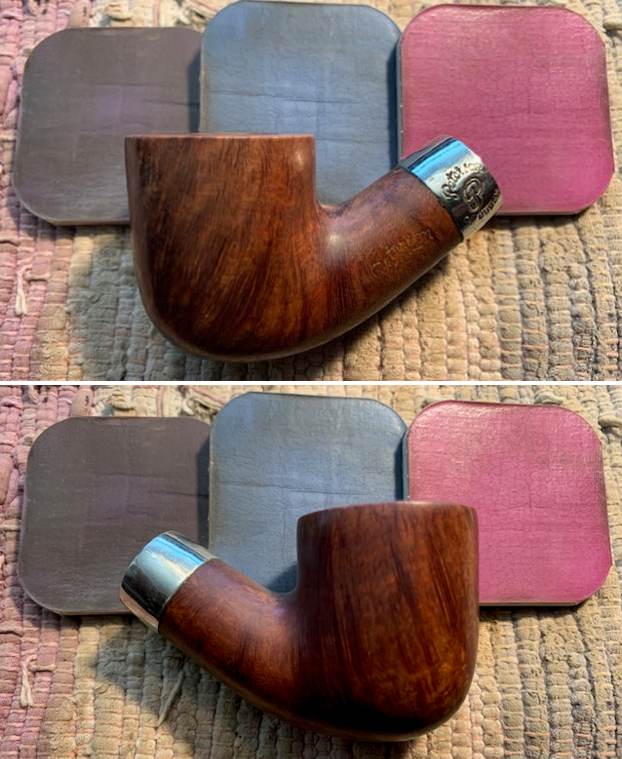
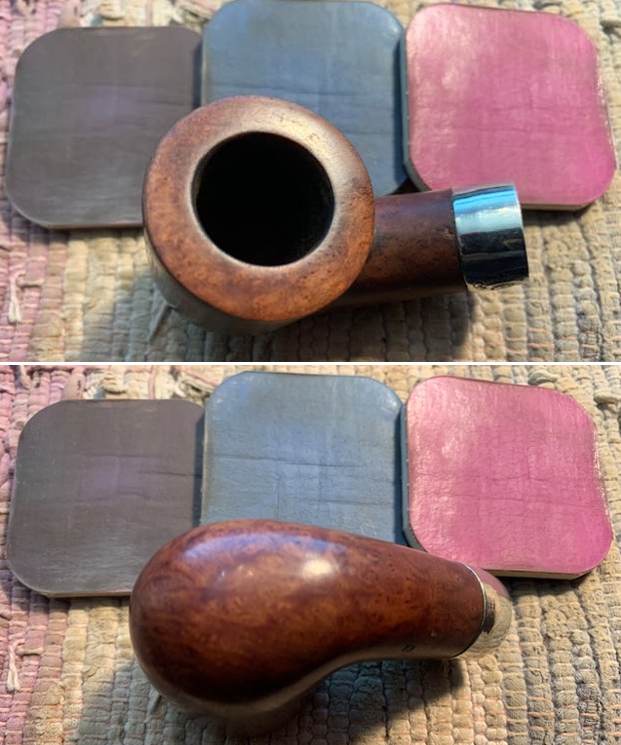
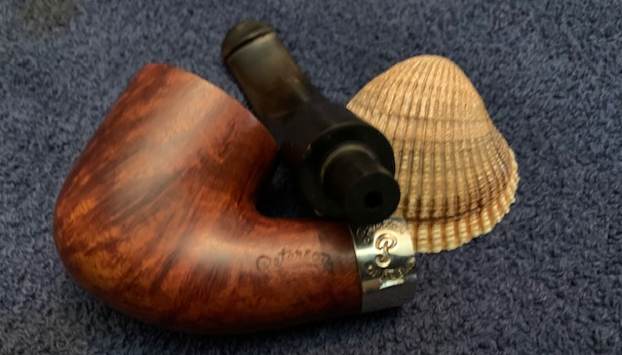
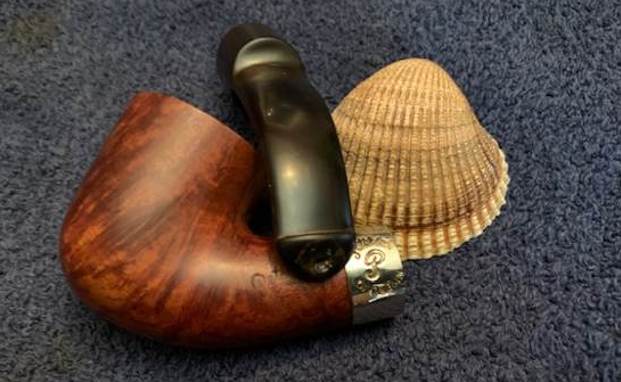
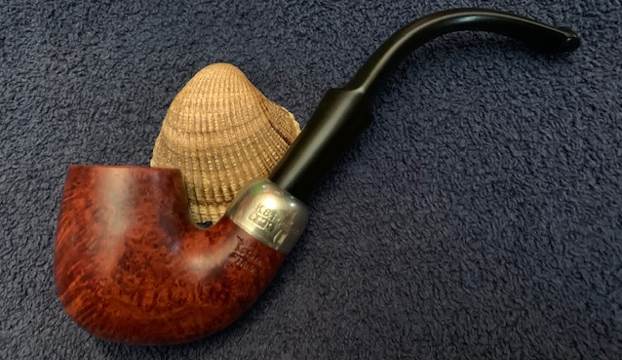
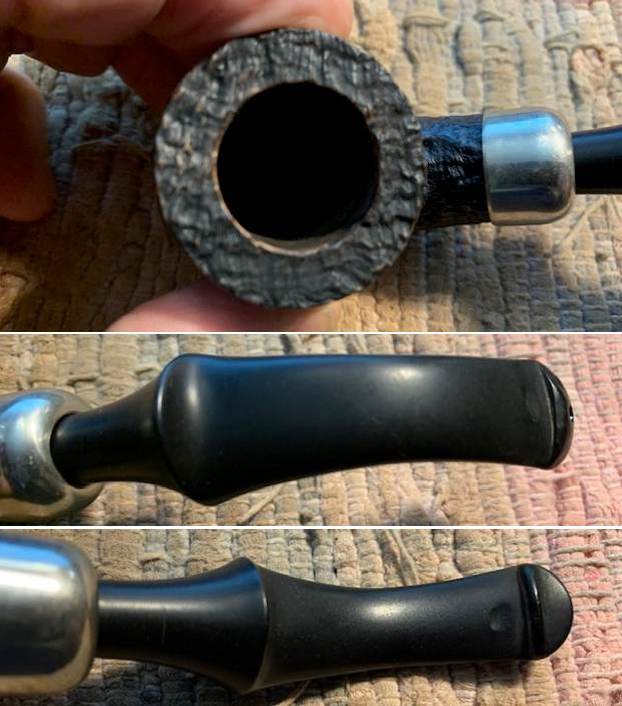
The next pipe on the table came to us from one of our pipe hunts or a trade I just cannot remember. It is a rusticated Peterson’s Donegal Rocky 999 Bent Rhodesian. The finish is quite nice with at that classic Peterson’s rustication pattern. The pipe was filthy with the rusticated exterior filled in in spots with grime and debris. The bowl had a light cake and some roughening on the inner edge of the rim. There was darkening on the rim top but otherwise it looked good. The pipe is stamped on a smooth panel on the underside of the shank and reads Peterson’s [arched over] of Dublin [over] Donegal [over] Rocky with the shape number 999 to the right of that. On the oxidized Sterling Silver band it is stamped K&P in shields over Sterling Silver on the left side. On the right side there are three hallmarks: 1. a seated woman (Hibernia) – the city stamp for Dublin, 2. .926 for the quality of the silver, 3. An upper case “Y” – the date identification of the pipe. The stamping is clear and readable on the pipe and band. The stem was dirty, calcified and oxidized. There were light tooth marks and chatter on the stem near the button on both sides and some on the surface of the button as well. There was the Peterson’s “P” on the left side of the taper stem. I took photos of the pipe before I worked on it.  I took photos of the rim top to show the cake in the bowl, the lava rim top and the damage to the inner edge. The stem was dirty, oxidized, calcified and had chatter and marks on both sides. The stamping on the underside of the shank read as noted above. The photo shows that they are faint but clear and readable. The stamping on the silver is also readable. The P on the left side of the stem is faint but in good condition. I took a photo of the pipe with the stem removed to show the overall look of stem, tenon and profile of the pipe. It is a great looking pipe.I am including the information from Pipedia’s article on Peterson pipes. It is a great read in terms of the history of the brand (https://pipedia.org/wiki/Peterson). I have included a bit of the pertinent history here.

During the 1950’s and 60’s the Kapp & Peterson Company was still in the ownership of the Kapp family. However 1964 saw the retiral of the company Managing Director Frederick Henry(Harry) Kapp.

In 1966 a “Jubilee ” fourth hallmark was introduced, only for that year, to commemorate the fiftieth anniversary of the Easter Rising of 1916. Designed as a hand holding a flaming sword in Irish “an cláiomh solais” or “sword of light” the mark bears the date 1916 to the right above and 1966 to the left below. An Claidheamh Soluis (Old Irish spelling), this was hallmarked with the letter Y. This very unusual and special date mark has in recent years become very scarce, mainly because it was only used for that year. Pipes that were marked thus, are much sought after by Peterson pipe collectors.

The stamping on the band was different than what I had seen before it is three marks as noted above. I do not see the “Sword of Light” stamp though perhaps that is what is in the left stamp in the threesome before the .926 stamp.

I turned then to deal with the Hallmarks. I turned to Pipephil’s site for his quick reference charts on the Peterson’s Hallmarks (http://www.pipephil.eu/logos/en/infos/hallmark-dublin.html). I have included the pertinent charts below. The first chart defines the first two hallmarks on the Sterling Silver Band. The Hibernia/Lady is the Dublin Town Mark. The Harp identifies the fineness of the metal.The second chart pins down the date that this particular pipe was made. The upper case “Y” mark identifies the pipe as being made in 1966. I have drawn a red box around the “Y” on the chart below. With that information in hand I knew what I was dealing with in terms of the stamping and the age of this pipe. I knew from the information that the pipe was made during the Republic Era between 1950 and 1989. Pipedia then qualifies the dating as follows: From 1950 to the present time, the stamp for this era is “Made in the Republic of Ireland”. The “Y” hallmark sets the date at 1966 in the center of the time period. Now it was time to work on the pipe.

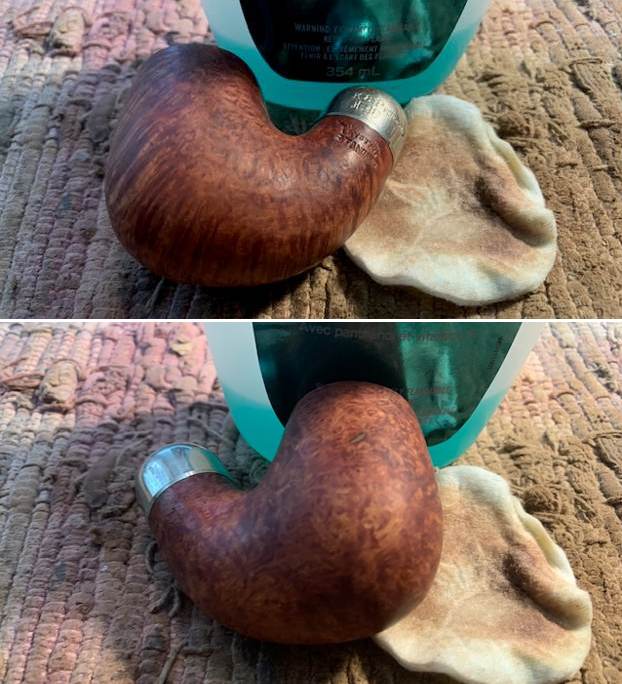
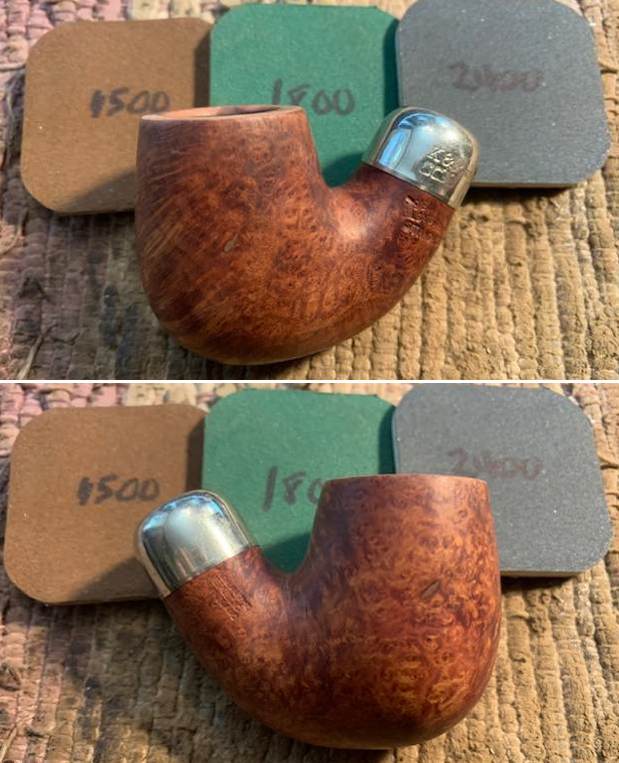
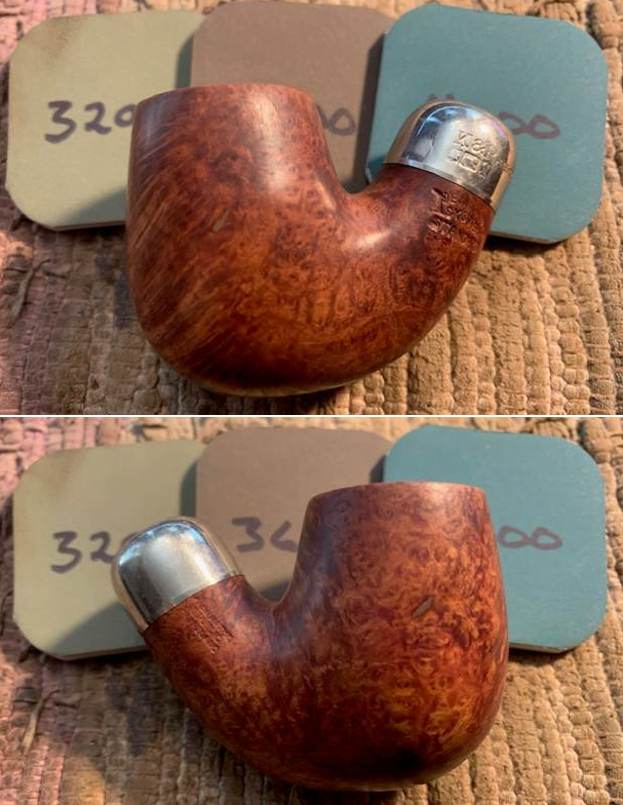
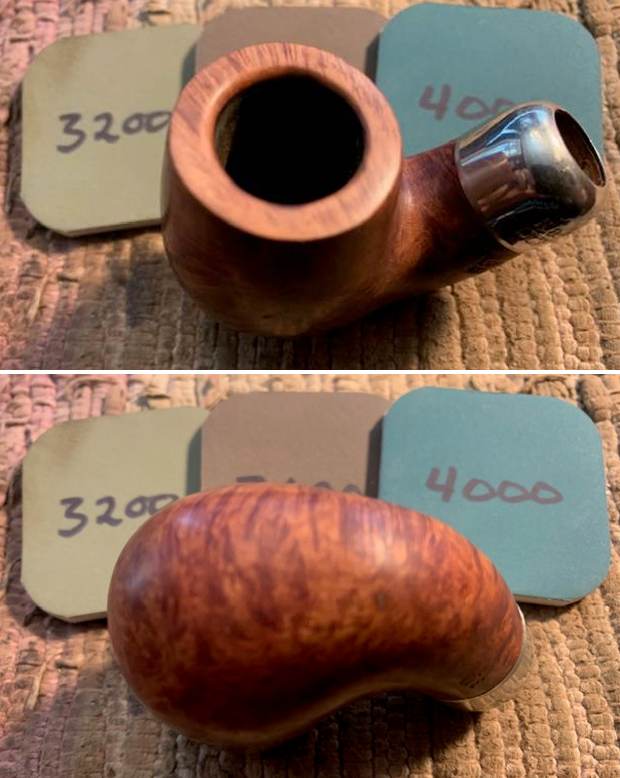
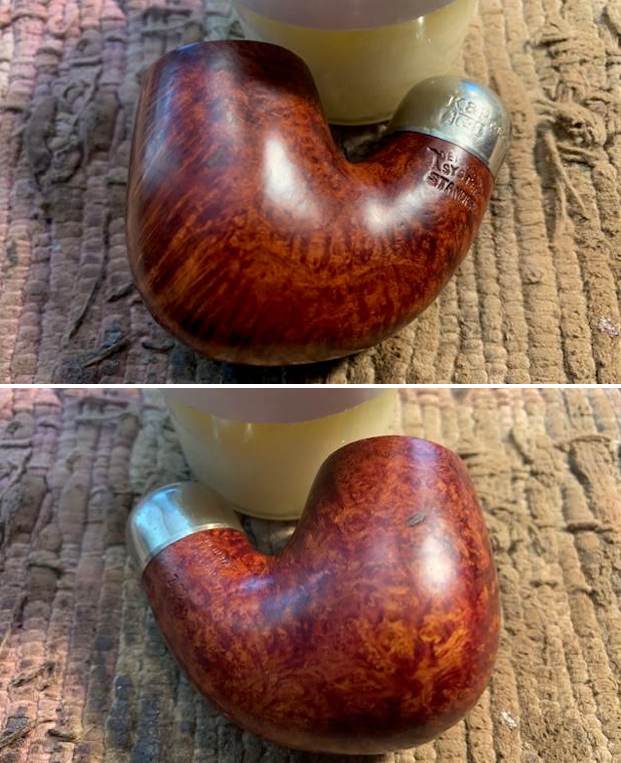
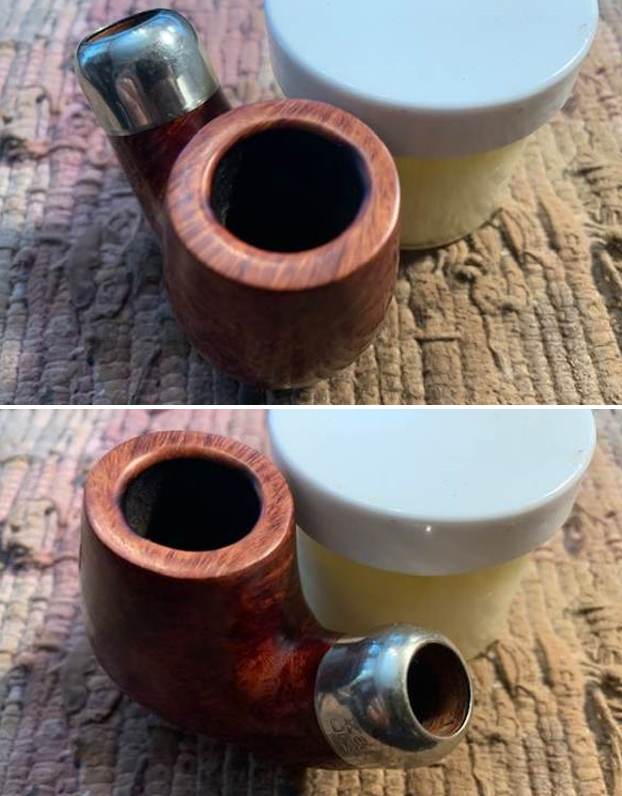
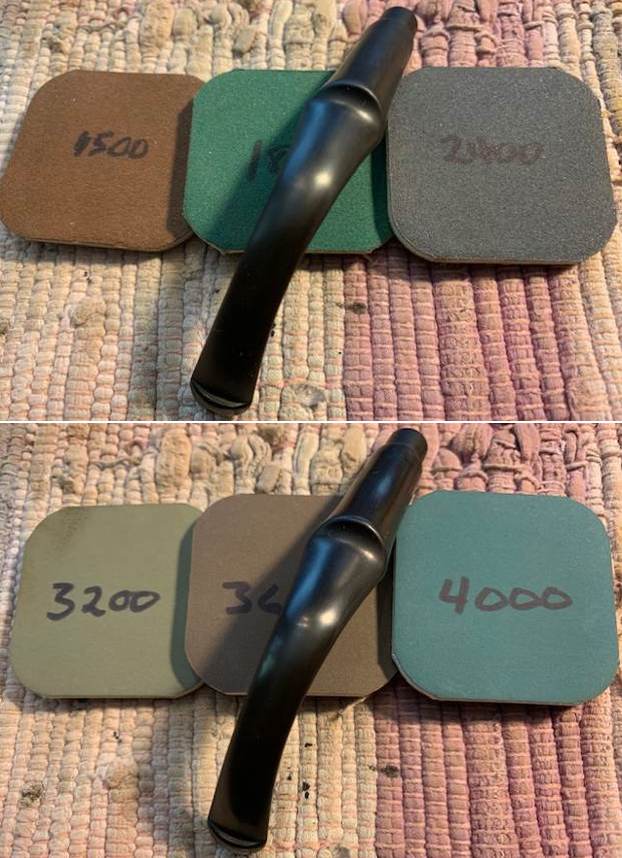
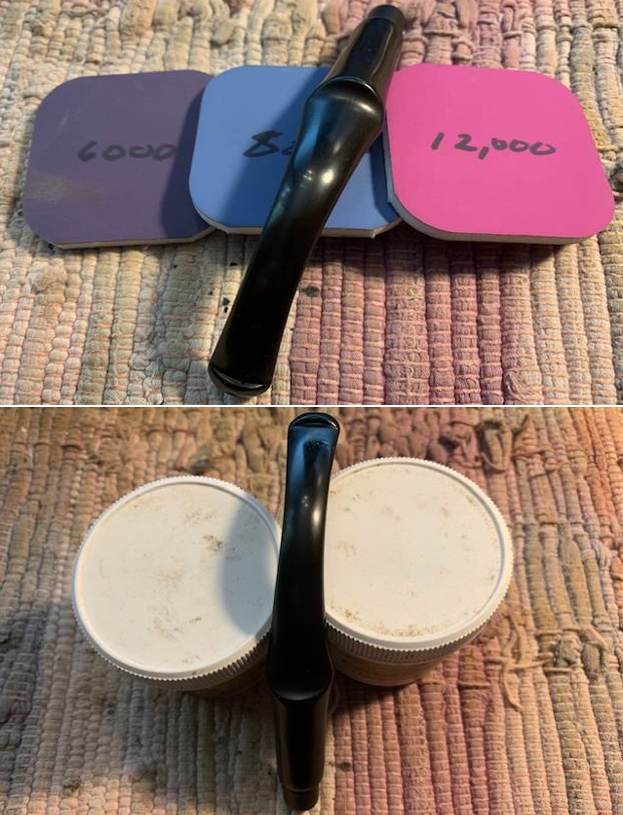
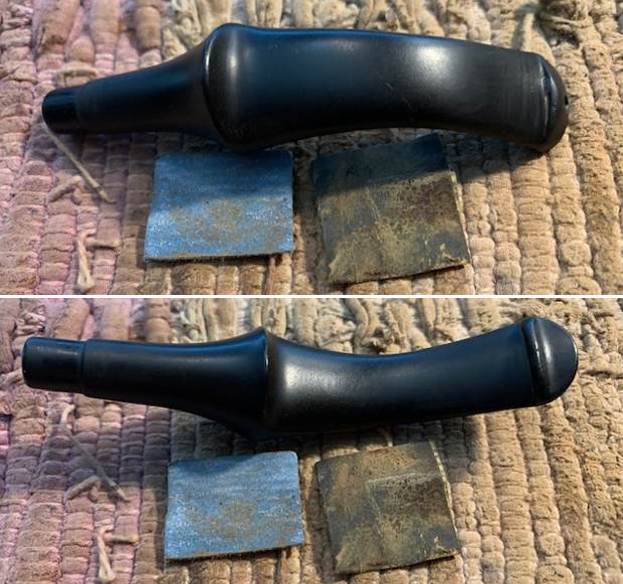
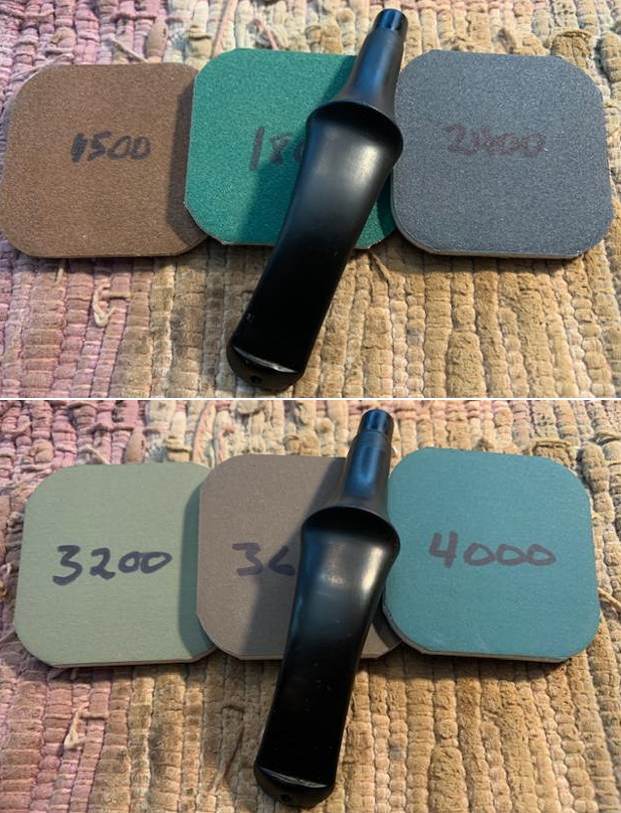
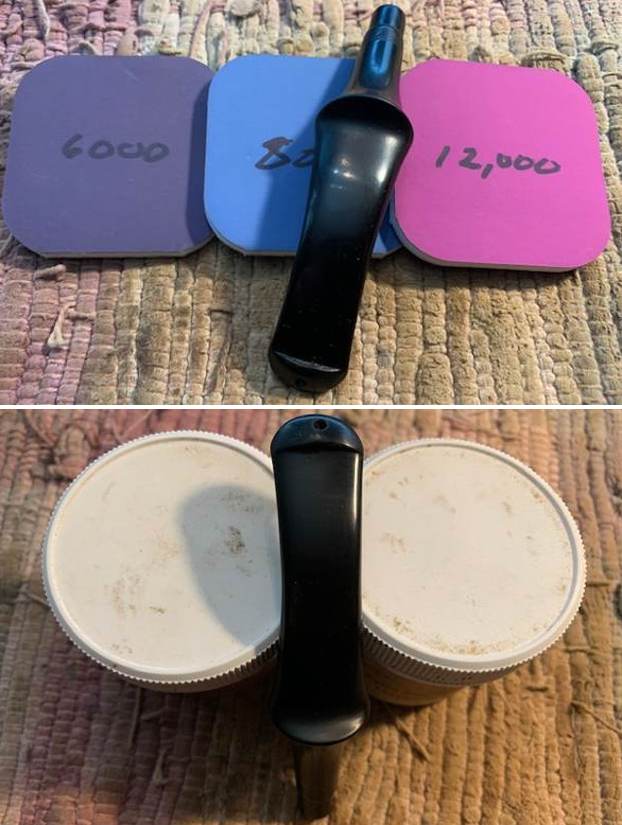
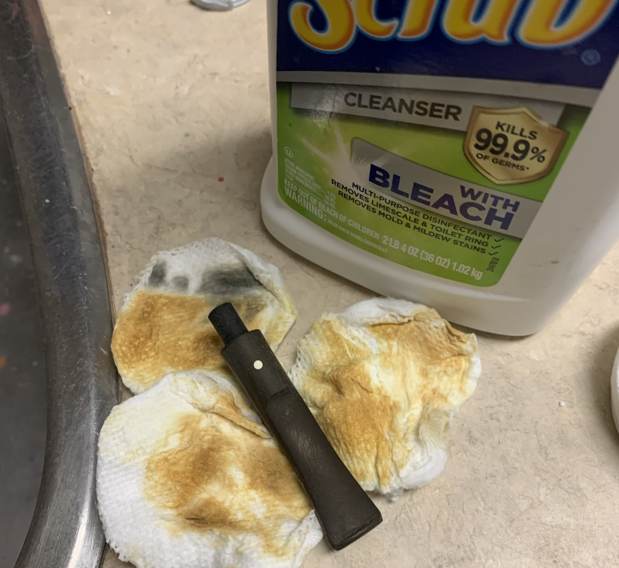
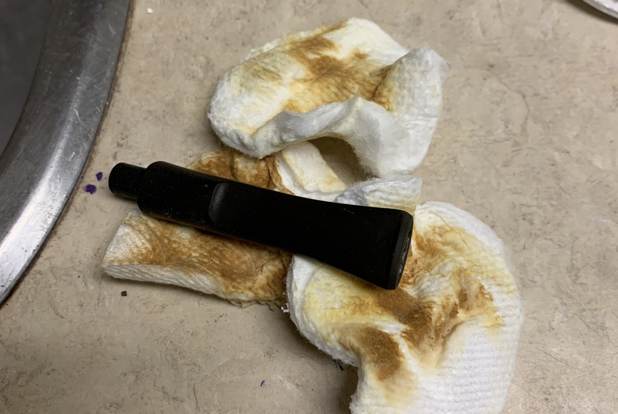
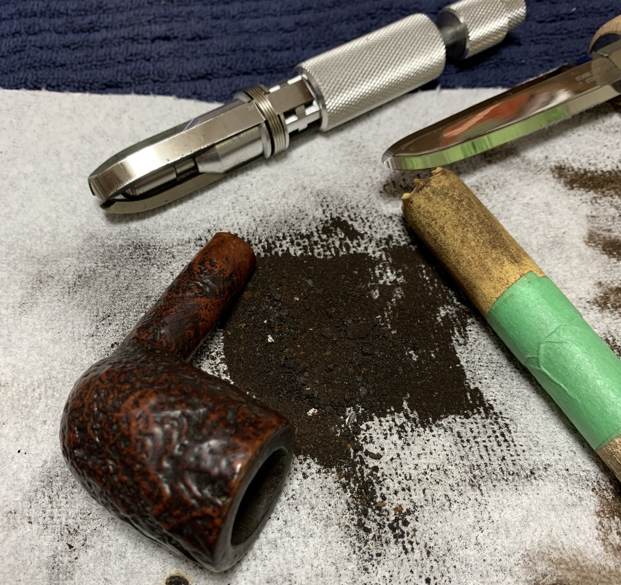
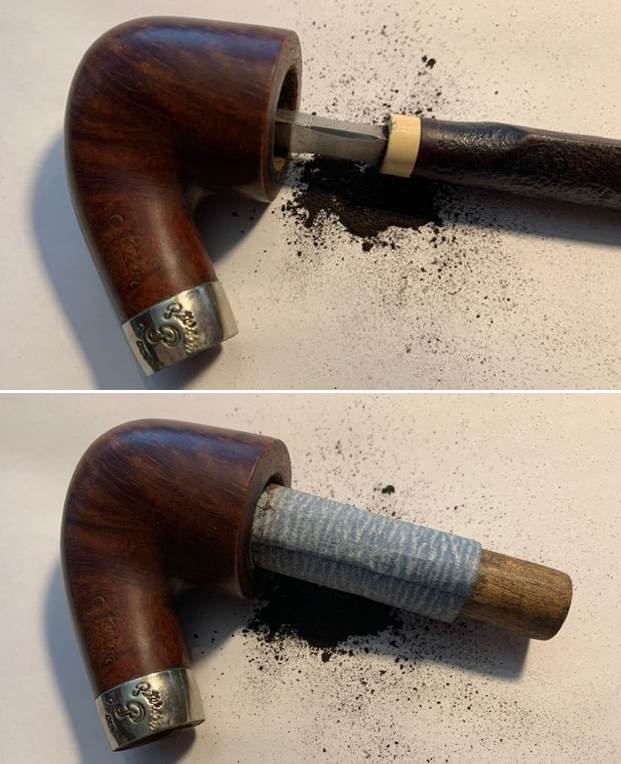
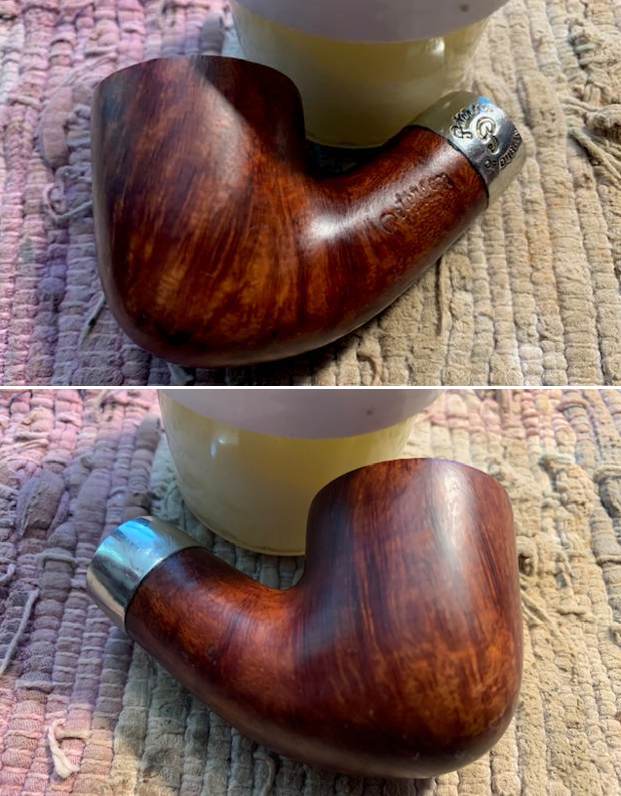
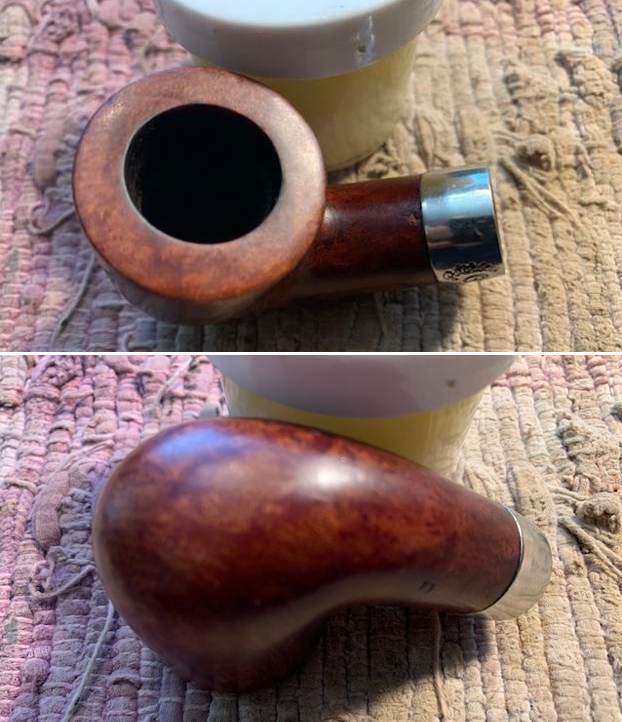
The Sterling Silver Band was upside down and would need to be corrected. I used some acetone on a folded pipe cleaner to soak the glue between the band and the briar. I repeated the process until it suddenly came free. I cleaned off the shank with acetone and reset the band on the shank with the stamping on the correct sides of the shank. I reamed the pipe with a PipNet reamer and cut back the cake back to the bare briar. I cleaned up the walls with a Savinelli Fitsall Pipe Knife. I finished it by sanding the walls smooth with 220 grit sandpaper wrapped around a piece of briar. I cleaned up the debris and lava on the rim top rustication with a brass bristle wire brush. It looked better than before.I scrubbed the exterior of the pipe with Murphy’s Oil Soap and a tooth brush to remove the grime from the finish. I rinsed it off with warm running water to remove the soap and the grime from the finish of the bowl.  I worked over the inner edge of the rim top with a folded piece of 220 grit sandpaper. I gave it a slight bevel and was able to blend in the damaged areas. It looked much better.  I scraped the inside of the shank with a dental spatula and was able to take out a large amount of this build up in the shank. It was a real mess. I then scrubbed the interior of the bowl and shank with pipe cleaners, cotton swabs and alcohol to further remove the tars and oils. I polished the Sterling Silver band on the shank with a jeweler’s cloth to remove the tarnish and protect it.   I worked some Before & After Restoration Balm into the surface of the briar with my fingertips and a horsehair shoe brush to clean, enliven and protect the briar. I let the balm sit for 15 minutes and then buffed with a cotton cloth to raise the shine. The photos show the bowl at this point in the restoration process. I decided to deghost the pipe while I worked on the stem. I filled the bowl with cotton boles and twisted one into the shank. I filled the bowl with 99% isopropyl alcohol using an ear syringe. I set the bowl aside for 5-6 hours while I worked on the stem. After 6 hours the cotton was stained with oils and with some purple stain from the inside of the bowl. The pipe smells clean and fresh. I set the bowl aside and turned my attention to the stem. I scrubbed it with Soft Scrub to remove the oxidation on the stem surface. I worked it over the surface of the stem with cotton pads and removed the deep oxidation on the top side of the stem. I sanded the tooth marks and the remaining oxidation with 220 grit sandpaper and started the polishing with 400 grit wet dry sandpaper. I used white acrylic nail polish to touch up the “P” stamp on the left side of the stem. It came out looking very good.  I polished the stem with micromesh sanding pads – wet sanding with 1500-12000 grit sanding pads. I wiped it down after each sanding pad with Obsidian Oil. I polished it with Before & After Pipe Stem Polish – both Fine and Extra Fine. I am excited to finish this Republic Era Peterson’s “Donegal” Rocky 999 Rhodesian. I put the pipe back together and buffed it with Blue Diamond on the buffing wheel. I gave the bowl multiple coats of Conservator’s Wax and the stem multiple coats of carnauba wax. I hand buffed the pipe with a clean buffing pad to raise the shine. It is fun to see what the polished bowl looks like with the rugged rustication all around it. Added to that the polished Sterling Silver band and the black vulcanite stem was beautiful. This rusticated Classic Peterson’s 999 shape is nice looking and the pipe feels great in my hand. It is light and well balanced. Have a look at it with the photos below. The dimensions are Length: 6 inches, Height: 1 ½ inches, Outside diameter of the bowl: 1 ½ inches, Chamber diameter: ¾ of an inch. The weight of the pipe is 51 grams/ 1.80 ounces. It is a beautiful pipe and one that will be on the Irish Pipe Makers section of the rebornpipes store soon. If you are interested in adding it to your collection let me know. Thanks for walking through the restoration with me as I worked over this pipe. Thanks to each of you who are reading this blog.

Adding Another Jack Howell Pipe to my Collection  – A Great Looking Straight Billiard


Blog by Steve Laug

The second pipe I added after the S. Bang to my collection is also another one that came to me from Robert Lawing of Lawdog’s Pipes. It was also listed on a post I was reading from Robert on Facebook regarding some pipes he worked on that were for sale. It was a beautiful Jack Howell Straight Billiard with a shank ring that was made of vegetable ivory I believe. It caught my eye and I was very interested in adding it to my collection. I have several of Jack’s pipes that I enjoy already so adding another is a pleasure for me. The first is an acorn and the second is a short nosewarmer Lovat. Both are great smoking pipes. I have included the link to my review of those pipes (https://rebornpipes.com/2015/04/27/a-review-two-pipes-by-jack-howell-an-acorn-and-a-lovatnosewarmer/). I copied the photos that Robert sent me to look at. I wrote to Robert and we chatted and I soon was able to purchase it. I had him send it to my brother Jeff along with the S. Bang. Jeff later sent it to me with some other pipes that I would need to work on. Everything about the pipe ticked my boxes. The grain around the pipe, the ivory looking shank band and the size all were what I wanted. It was light weight and comfortable in the hand. The shape is a classic Billiard shape that really highlights the grain around the sides and shank. It is well designed and really shows off the grain. It is a beautiful pipe. I turned to Pipephil to remind myself of the background of the brand and get a sense of the stamping on the pipe (http://pipephil.eu/logos/en/logo-h3.html). I did a screen capture of the material there and also included the side bar information. I remember meeting Jack at the 2004 Pipe Show in Chicago. I have included that below.Artisan: Jack Howell begun to be known after his participation in the 2004 Chicago Pipeshow.

I also turned to the article on Pipedia (https://pipedia.org/wiki/Howell) for more information and background. I quote below.

Jack Howell plays clarinet in the Pittsburgh Symphony and makes pipes part time. Except for when the symphony isn’t playing — vacation, say, or a global pandemic — then pipe production goes into gear. For current production, check out http://www.howellhandmade.com. And maybe have a look at the blog.

The following is Jack’s bio from his website:

Jack Howell, Maker

“Every rabbit needs two holes” — Jack’s Dad

I have early memories of watching my uncles whittle things with their pocketknives. I was, I dunno, six or seven years old when I started asking for a pocketknife so I could whittle. My dad said, no, I’d cut myself. But he gave me a file and access to a pile of cedar shingles that we used for kindling and said when I could make things with a file we would talk.

Perhaps that was meant as discouragement because a regular bastard file isn’t much for wood removal, but it’s not much for skin removal either, so there’s that. I set to with the file. Before too long I’d settled on my first oeuvre, a sort of Easter Island head. Which turned into the pommel of letter openers, and before long my dad gave me a knife, a Cub Scout model with one cutting blade and a can opener. I headed straight for the shingle pile, where it took me about ten minutes to cut myself.

Anyway, I’ve been making things for a long time, gradually getting to the point where I used tools with which I could no longer afford to cut myself. Along the way I became a professional musician, my manual skills coming in handy making clarinet reeds. I’ve also made knives, and bamboo fly rods (you can get a book I wrote about that at http://www.thelovelyreed.com), and other stuff. I started making pipes in 1999 and sold my first one in 2004. I went to a few Chicago and Columbus shows, was pretty visible on the old ASP forum, yada yada yada. My production has gone up and down as my musical employment has gone up and down, but for a number of years it stayed around 50 pipes a year. Once I joined the Pittsburgh Symphony Orchestra as bass clarinetist I only made a few pipes here and there on commission, because, well, I was practicing my ass off.

​Recently my dad’s wisdom has become evident. When I went to dust off my website it had come unhooked from my domain host, no idea how long it had been down and nobody had said anything about it, so . . . ​I’m back.

I have included some shots that Robert included of the pipe from various angles to highlight the grain and the shape of the pipe. It is a real beauty. Robert included a photo of the underside of the shank. It is stamped Howell [over] JH [over] the year the pipe was made – 2008. It is a great looking pipe.Now it was time to enjoy the pipe itself. I loaded a bowl with Seattle Pipe Club’s Deception Pass and sat on my porch and enjoyed a bowl while watching the world pass by on the sidewalk in front of my home. It was a great smoking pipe that met all of my expectations. It is one that I will continue to enjoy for years to come. Thank you Robert for making this possible.

Finally Added an S. Bang Pipe to my Collection


Blog by Steve Laug

Several months ago now I was reading a post that Robert Lawing of Lawdog’s Pipes posted on Facebook regarding some pipes he worked on that were for sale. One of them was a beautiful S. Bang Squat Apple with a Boxwood shank extension. It caught my eye and I was very interested in adding it to my collection. I copied the photos that Robert sent me to look at. I wrote to Robert and we chatted and I soon was able to purchase it. I had him send it to my brother Jeff who later sent it to me with some other pipes that I would need to work on.Everything about the pipe ticked my boxes. The grain around the pipe, the shank extension and the size all were what I wanted. It was light weight and comfortable in the hand. The shape is quite uniquely Bang! I have had an eye on pipes from that brand for several years now and this shape is one that I have had an eye on. The angles of the pipe shape where the bowl and shank join combine a round apple like shape and the rounded rectangular shank and the Boxwood extension. The comfortably shaped, black vulcanite stem was a great contrast with the  Boxwood and the briar. The next photo that Robert sent was of the stamping on the underside of the shank. It reads S Band [arched over] Kobenhavn. Under that it is stamped Handmade [over] In Denmark [over] B. The stamping was clear and readable. To help me understand the stamping a bit more I turned to Pipephil’s site and read what it said about S. Bang pipes (http://pipephil.eu/logos/en/logo-s1.html). I have included a screen capture of the section below as well as the side bar information below the capture.Sven Bang opened his tobacco and pipe shop in 1968 in Copenhagen. He was more a business man than a pipe carver and began to hire pipemakers. About half a dozen succeeded each other in his workshop during the 1970’s (Ivan Holst Nielsen, Jan Wideløv, Phil Vigen…). At least Per Hansen and Ulf Noltensmeier stayed and when Sven retired in 1983 they took over the company (in 1984) keeping its name.

I knew from that the pipe I have was made for the European market and bore a B grading which is quite high. I also knew that it was made after 1984 when Ulf and Per took over the company so it was made by one of them. I am including two final pictures that Robert included for me below.To close my understanding of the pipe I turned to Pipedia (https://pipedia.org/wiki/S._Bang). I quote the section from the article where the company changed hands from S. Bang to Hansen and Noltensmeier in 1984. It is a great read so I have included it below.

Svend Bang retired in 1984. Evidently he felt a great deal of pride in the product that he initiated throughout his career and retirement and until his death in 1993.

Once Hansen and Noltensmeier took over the company (in 1984) they knew it was best to retain the S. Bang name – the two carvers always shared the same philosophy about that. Noltensmeier and Hansen were determined to maintain top quality at the expense of increased numbers. The only change they made concerns the stamping on the pipes changing from the English version “COPENHAGEN” to the Danish “KOBENHAVN”.

Still, they are two separate carvers, with their own styles and preferences. Each makes his own pipes – there is no “assembly line” construction at S. Bang. They bounce ideas off of each other, of course, and admit that when problems arise in a pipe, it is nice to have a partner to discuss them with.

Though they carve pipes as individuals, there are similarities in their work. All Bang pipes are made with black, hand-cut vulcanite stems.

The same engineering is used by both carvers as well. The shape and size of the tobacco chambers vary according to size and design of the pipe, but each carver follows the same design guidelines for choosing the proper chamber dimensions. The smoke channel is always engineered for optimum performance.

Bang pipes are noted for the high definition and fine contrast in the grain. They undergo a double staining process to achieve that effect. The technique makes the grain leap from the bowl of the pipe, making well-grained wood become extra ordinary. The same coloring, however, will produce different results in different pieces of briar, making each pipe truly individual.

Per Hansen is the designated sandblasting artist for the team. He personally takes those pieces that are to be sandblasted to Stanwell, and is permitted to use the sandblasting equipment himself. That is the only S. Bang process, though, that is not executed by the individual carver of each pipe. Everything else, including the famous S. Bang silverwork, is done in the shop by each of the carvers on his own pipes.

Now that I had read through the background it was time to enjoy the pipe itself. I loaded a bowl with Seattle Pipe Club’s Deception Pass and sat on my porch and enjoyed a bowl while watching the world pass by on the sidewalk in front of my home. It was a great smoking pipe that met all of my expectations. It is one that I will continue to enjoy for years to come. Thank you Robert for making this possible.


Restoring and Restemming a Made in Ireland Peterson’s System 313 Bent


Blog by Steve Laug

Jeff and I often purchase pipe bowl/stummels of brands that we like and want to restore. These have included a lot of different bowls. If you have followed us for long you know that some of these have included Peterson’s, Dunhill’s, and a wide range of Danish and English pipes. Awhile ago Jeff and I were sorting through the bowls in our collection and pulled out eight Peterson’s bowls that were dirty and stemless. A friend referred us to a contact named Silas Walls, of Walls Pipe Repair in Wallace, Idaho, USA as he seems to have a good supply of original Peterson’s stems. Our friend has had him fit stems for some of his Petes and was very happy with the work. We made contact with him and sent him eight bowls for restemming.

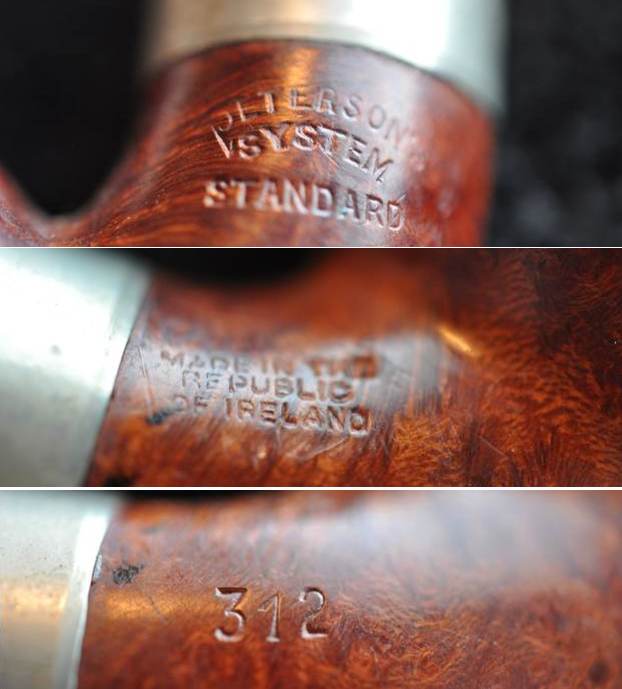
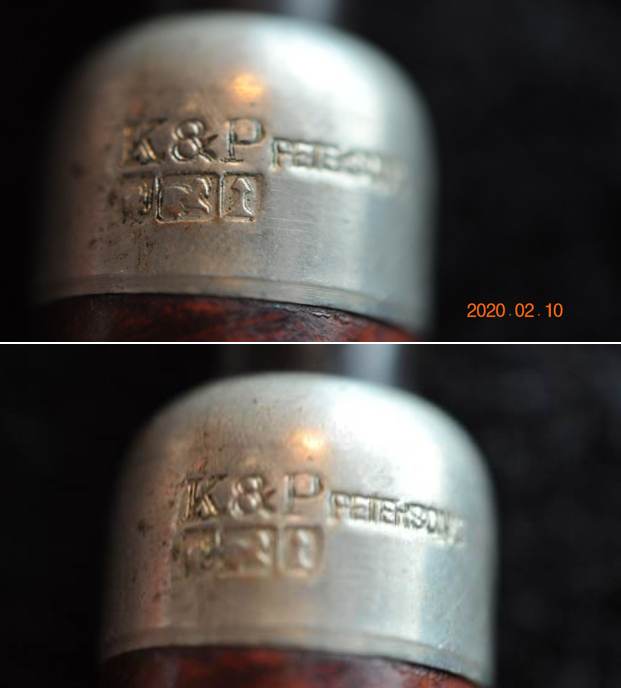
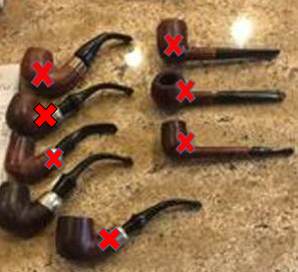
In the photo above I show the 8 restemmed pipes. I have marked the 6 I have worked on already with a red X). This seventh one that we cleaned up before mailing them out was a bowl that we purchased on 08/31/2019 from an auction Nyack, New York, USA. It is stamped on the left side of the shank and reads Peterson’s [arched over] System. On the right side of the shank it is stamped Made in Ireland (two lines) followed by the shape number 313. The ferrule is stamped K&P [over] Sterling Silver. Next to that it reads Peterson [over] Dublin. The bowl was dirty with lava on the rim top and a moderate cake in the bowl. The Sterling Silver ferrule was quite dirty and worn with some small dents in the surface. Jeff took photos of the bowl before he did his cleanup work in preparation for sending them to Walls Pipe Repair for their new stem. Jeff took photos of the stamping on the sides of the shank. It is clear and readable as noted above. There is also some great grain around the bowl and shank. I turned to Pipedia (https://pipedia.org/wiki/Peterson) and read through the article there. I found an interesting note in the middle of the page. I quote the pertinent section below and have highlights some important information in red below.

As usual when trying to get accurate facts in regard to Peterson history, something will jump up and get in the way. They are missing many of their records. The following is the best that we can do for a guide to the myriad markings during the period 1922 – 1949. Prior to 1920 it was rare for a country of origin to be stamped on the pipe, just Peterson’s Dublin on the band. After 1921/22, if it is stamped “MADE IN IRELAND” and the “Made in” is stacked over “Ireland” or “MADE IN EIRE” or several other forms, it was made between 1922 and 1938.  A considerable number of Peterson pipes were stamped “Irish Free State”. From about 1930 to 1949, most of the pipes (those which were stamped) were stamped “Made in Ireland”.” If the stamp reads “MADE IN IRELAND” in a circle, the pipe was made between 1939 and 1948. These are all “pre-republic” pipes. I can tell you that the mark “Irish Free State” was adopted in 1922;and replaced by “Eire” in 1937 and then by “Republic of Ireland” in 1949.

I turned to “The Peterson Pipe” by Mark Irwin and Gary Malmberg to get some background on the Peterson’s System 0 Made in Ireland stamp. On page 126 it had the following information

The stamp reads IRISH over FREE STATE, in small letters, usually perpendicular to the line of the shank, very close to and parallel to the seam where the shank meets the mouth piece. On banded pipe, this often hidden under the band itself. At the same time, they issued a smaller number of pipes stamped MADE IN over IRELAND. Today’s collector may encounter specimens of these with mountings hallmarked for every year from 1922-1937.

The information was very helpful. I have highlighted the pertinent reference to regarding the stamping. I knew that I was dealing with a Pre-Republic period pipe stamped Made in Ireland made between 1922-1938.

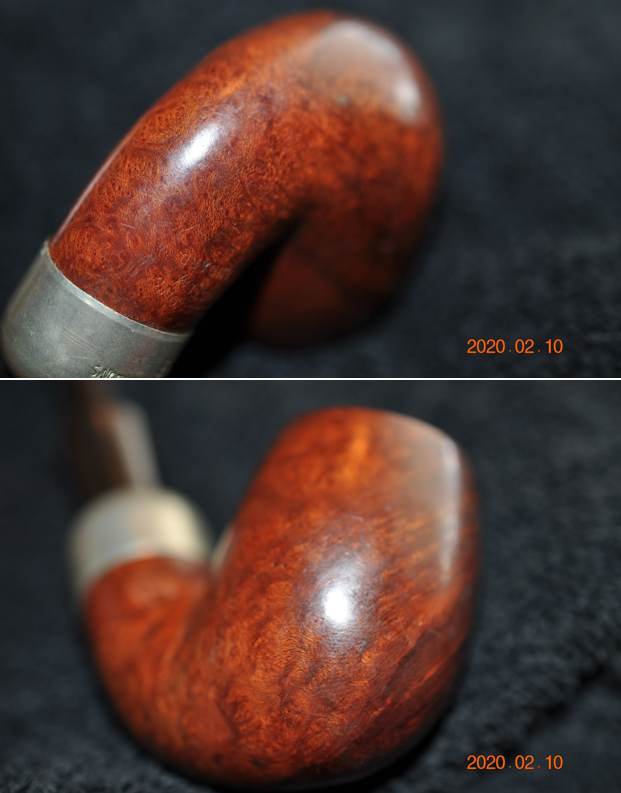
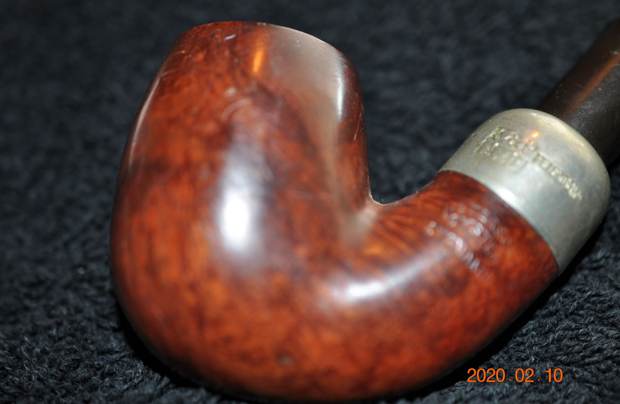
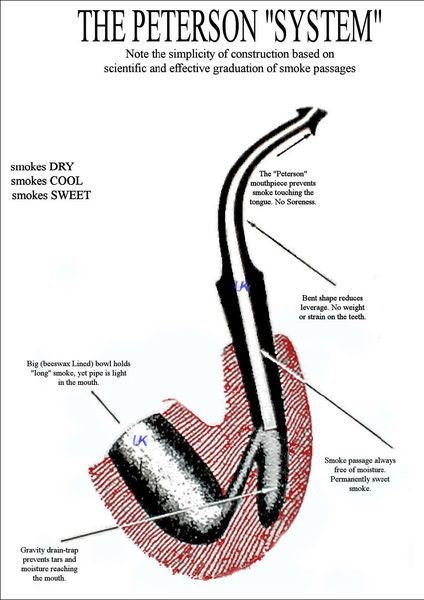
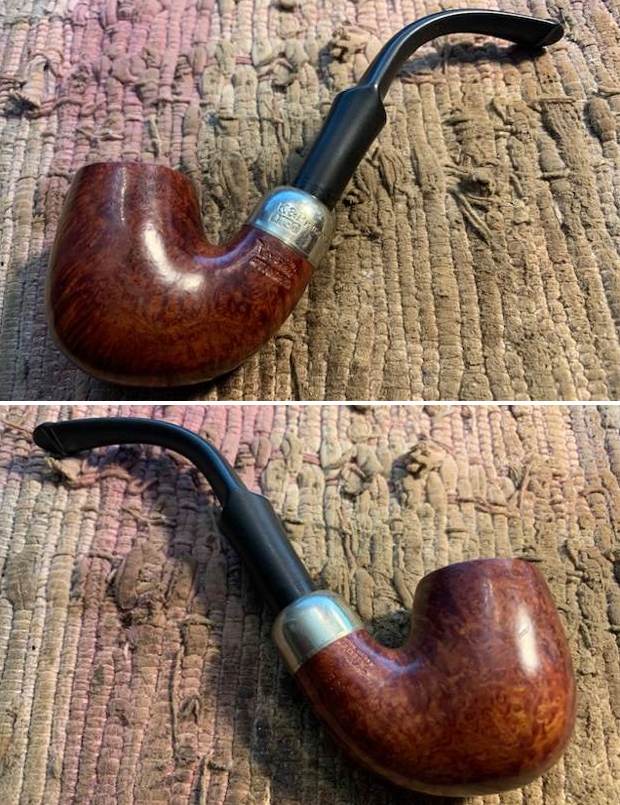
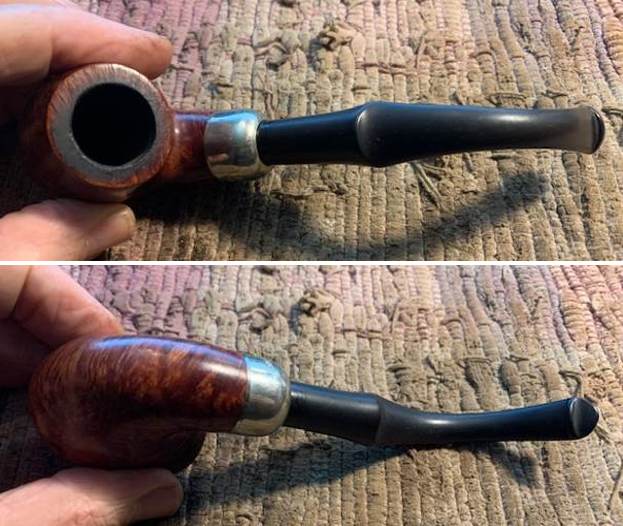
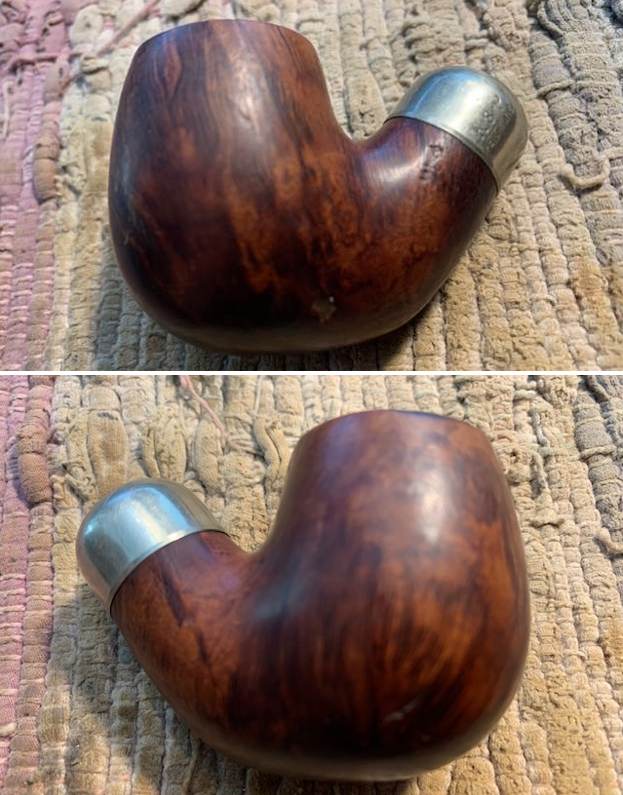
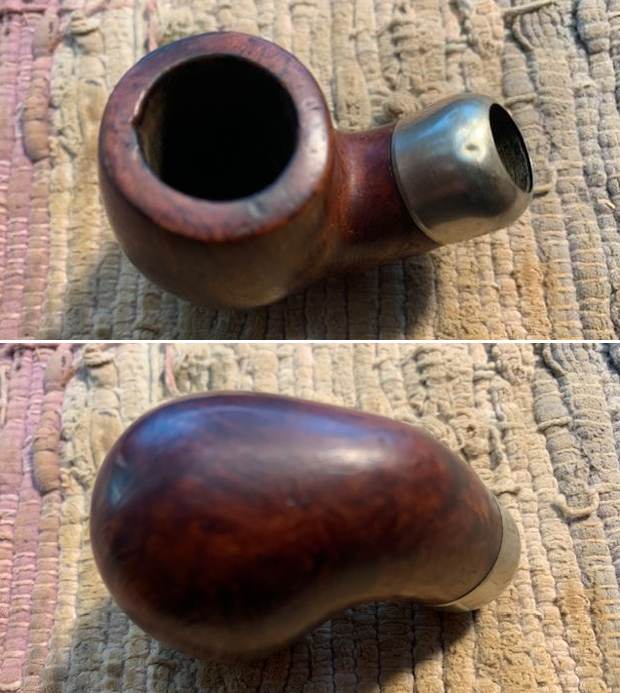
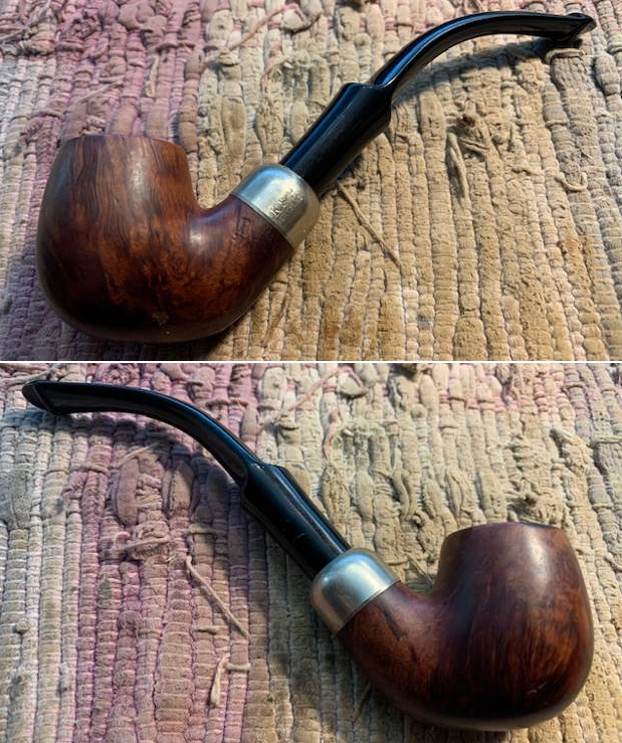
Now it was time to work on the pipe. Jeff had done a great job cleaning up the pipe as usual. He reamed the pipe with a PipNet reamer and cut back the cake back to the bare briar. He cleaned up the walls with a Savinelli Fitsall Pipe Knife. He scrubbed the interior of the bowl and shank with pipe cleaners, cotton swabs and alcohol to remove the tars and oils. He scrubbed the exterior of the pipe with Murphy’s Oil Soap and a tooth brush to remove the grime from the finish. He worked on the rim top lava and darkening with the soap and tooth brush. It looked much better. I took pictures of the bowl without the new stem from Silas Wall. It is a great looking piece of briar and the sterling silver ferrule looks very good. When the pipes came back to Jeff with their new stems they looked great. When the pipe arrived here this week I took photos of it with its stem so you can see what I see. The first six pipes from the lot were flawless and quite beautiful. The last two – this 313 and a 314 looked great at first glance but upon further examination the stems were not correct. The draught on the P-lip portion of the stem usually was on the top of the stem in all Peterson’s pipes but in the case of these two pipes the airway came straight out the end of the stem. Here are the photos of the pipe and stem. I took photos of the flawed stem next to a properly drilled stem. You can see in the photos where the airway exits the stem. In the photos below the new stem is on the left side and an original is on the right side. It is a little hard to see but in the new stem the airway exits at the end of the button and on the original it is on the top. The hole is the same size but the position is wrong. The shape of the button/p-lip is also quite different and more flat. It is obviously the wrong stem. I contacted Walls Pipe Repair about the problem and sadly it took many months to get some resolution. I suggested that they send me two unfinished stems and I would fit them myself. The problem was that these two were also not quite correct. You can see that the shape is very different and the blade itself was significantly thinner that the stem that had been fitted to the bowl. I took a photo of the pair below.I put the two stems aside and went through my cans of stems and found a stem that is quite similar. The blade is slightly longer and thinner than the one from Wall but the shape of the button and the shank end of the stem would work well with a few adjustments. Here are some photos of the stem I chose from a variety of angles. I used a topping board to shorten the extended end of the stem to match the length of the stem fitted by Wall. I fit the new stem to the shank and took photos of the pipe as it looks now.  The fit is good but I will need to polish it and give it a slight bend. With the new stem chosen I turned to work on the out of round and damage inner edge of the bowl. I used a folded piece of 220 grit sandpaper to clean up the inner bevel of the rim edge and remove the damage and bring it back into round. It looked much better. I polished the briar with micromesh sanding pads – dry sanding with 1500-12000 grit pads. I wiped the bowl down after each  pad to remove the grit. The bowl began to take on a rich shine. It is going to be a beauty.   I rubbed the bowl down with Before & After Restoration Balm. I worked it into the briar with my finger tips. I let it sit for 10 minutes and the Balm did its magic. It enlivens, cleans and preserves the briar. It certainly brought this bowl back to life. I buffed it off with a clean cloth and took the following photos.   I set the bowl aside and turned my attention to the stem. I polished it with micromesh sanding pads – 1500-12000 grit pads. I wiped it down with Obsidian Oil after each sanding pad. I used Before & After Pipe Polish – both Fine and Extra Fine to further polish the stem. This Made in Ireland Peterson’s System Bent 313 with a Sterling Silver Ferrule and a vulcanite P-lip stem is a great looking pipe now that it has been restored. The beautiful grain that shines through the polished finish is stunning. As the pipe is smoked the patina should develop and look even better. I put the stem back on the bowl and carefully buffed the pipe with Blue Diamond on the buffing wheel. I gave the bowl and the stem multiple coats of carnauba wax on the buffing wheel and followed that by buffing the entire pipe with a clean buffing pad. I hand buffed the pipe with a microfiber cloth to deepen the shine. The finished Peterson’s System 313 Bent Billiard fits nicely in the hand and feels great. Give the finished pipe a look in the photos below. The dimensions of the pipe are Length: 5 ½ inches, Height: 1 ¾ inches, Outside diameter of the bowl: 1 1/8 inches, Chamber diameter: ¾ of an inch. The weight of the pipe is 37 grams/1.31 ounces. I will be adding the pipe to the Irish Pipe Makers Section of the rebornpipes store. If you are interested in purchasing this pipe send me a message or an email. Thanks for reading this blog and my reflections on the pipe while I worked on it.

The Resurrection of Frog Morton


Blog by Kenneth Lieblich

Beside all the venerable gentlemen in the long history of pipe smoking, I am a but newborn infant. I have only immersed myself in this wonderful hobby in the last few years, and one of things that especially rankles my ever-ravenous brain is learning about wonderful tobacco companies that no longer exist and no longer produce the tobaccos that become semi-mythic to those of us who have never tried them.

McClelland Tobacco Company is a perfect example of the sort of company that no longer exists – but I wish did. I am mildly obsessed with tobaccos from McClelland and I have only tried a couple of their blends — thanks to the kindness of fellow pipe smokers, particularly Steve. My opportunities to try these old tobaccos have been exceptionally few and far between. The one that always springs to mind for me was trying McClelland’s Anniversary blend (from 2002), some twenty years after its release. That was a magnificent experience.I recently came across a post about recreating their legendary Frog Morton tobacco. I wish I could find the post (but can’t), but I will do my best to do it justice here. I’ve never had the chance to try any of the original Frog Morton tobaccos – and there is no question of me affording the prices to buy old, original tins on the secondary market – so this is the best I can do.

This recreation is whimsically called “Ghost of Frog Morton” by its originator, and I was keen to blend it myself to see the results. Allow me, for a moment, to go off on a brief tangent about the name of McClelland’s original Frog Morton. As many of you will already know, Frogmorton (as one word) is the name of a village on the Great Road in J.R.R. Tolkien’s Middle-Earth. It is in Eastfarthing and is not a town of any great significance, but reference is made to it twice in the Lord of the Rings: once in The Fellowship of the Ring, at the end of the Prologue, when it is displayed on a map of the Shire; and later in The Return of the King, when Tolkien writes:

“As evening fell they were drawing near to Frogmorton, a village right on the Road, about twenty-two miles from the [Brandywine] Bridge. There they meant to stay the night; The Floating Log at Frogmorton was a good inn. But as they came to the east end of the village they met a barrier with a large board saying NO ROAD; and behind it stood a large band of Shirriffs with staves in their hands and feathers in their caps, looking both important and rather scared.”Many books about Middle-Earth include minor references to Frogmorton, including Day’s A Tolkien Bestiary, Fonstad’s The Atlas of Middle-Earth, Foster’s The Complete Guide to Middle-Earth, Hammond and Scull’s The Lord of the Rings: A Reader’s Companion, Strachey’s Journey’s of Frodo, and Tyler’s The Tolkien Companion – among others.

Back to the tobacco: it is a Virginia-Latakia mix. On the original tins, Frog Morton is described as “An exceptionally rich, smooth and dark Latakia mixture for the pipe”. Well, I love Latakia and Virginia, so this resurrected “Ghost of Frog Morton” should be a winner for me.The procedure to make it couldn’t be easier, and it is certainly worth a try. To begin, I ordered the ingredients from my preferred tobacco merchant. The two components of this blend are Peter Stokkebye English Luxury PS 17 and Lane Limited HGL. I ordered four ounces of each, figuring that half-a-pound would be good enough to start with and share with friends.I emptied the contents of the two tobacco bags into a large, glass salad bowl – incurring raised eyebrows from my beloved wife. I took several minutes to thoroughly mix the tobaccos together. I did not want hidden chunks of one tobacco or another persisting in this blend. With gloved hands, I mixed and separated and tossed and blended and turned over all eight ounces. I hummed and hawed for some time about how to store it. Normally, I cellar tobaccos in Mason jars in two-ounce increments. However, I wanted to keep this batch all together, so I used a canning funnel and put it all in one large Mason jar.Voilà – my first quasi-blending! I obviously don’t have the real Frog Morton to compare it too, but reports suggest that it is a very good imitation of the original. I’m going to let it sit for a while and I’ll get back to you all once I’ve tried it.I hope you enjoyed reading this brief tale of bringing a classic tobacco back to life. If you are interested in my work, please follow me here on Steve’s website or email me directly at kenneth@knightsofthepipe.com. Thank you very much for reading and, as always, I welcome and encourage your comments.


Stepping into a Mysterious Small Pipe Shop in Bologna Italy – Bonfiglioli Pipes


Blog by Steve Laug

When I am traveling to visit sites in Europe I am always on the look out for a pipe shop that piques my interest. Before I left for Bologna, Italy I did a quick search of pipe shops there that might warrant my attention and found the Bonfiglioli Pipes Since 1967 Shop. I made a plan to visit it one evening once I finished the work I was doing there. I went on the evening of Oct. 6, 2022 with one of my friends from work. Here is what we saw when we got to the shop that evening. It is in one of the many portico’s of Bologna and is a bright yellow from the lights on the outside. It is a small shop with tables and chairs outside and inside where the Bonfiglioli Pipe Club of Bologna can enjoy a bowl of their favourite tobacco or a good cigar. Next door there is a small café with wine, beer and snacks that can also be enjoyed. The front window of the shop to the left of the font door was packed with a lot of signs and paraphernalia of Bonfiglioli’s travels. There are books, antique tobacco tins and even a few Trump memorabilia that I was not expecting to see in Europe. There were hand made pipes by Alberto himself as well as pipe from other Italian Pipe makers and some nice meerschaum pipes. It is a motley assortment of old things and new pipes that take a lot of time to process as you peer through the window in to the shop. It also gives a hint of the crazy disarray of the shop itself once you enter the front door. The front door is shown in the second photo below. The door says Bonfiglioli and Sons and sports a pipe with the shop logo on it over the date the shop opened 1965. There were also some funny signs about Beware the Owner. Take your time to read through the signs and look at the photos as they truly and odd and mysterious assortment of historical pieces. If I thought that the window display was eclectic and random the interior was even more so. It was a motley assortment of pipes, posters, Route 66 US highway signs, political posters and wares as well as photographs and news clippings from around the world. There were also bumper stickers stuck on the walls and counters. The most surprising thing to me was the thick coat of dust on everything. On the display counters were old pipe racks with absolutely destroyed pipes that were set up as a deterrent to shoplifting. There were also boxes of Bonfiglioli pipes scattered on the front and back counters. The buffing wheels, lathe, band saw, sandblasting machine and other tools of the trade were scattered in the midst of the collection of paraphernalia. You can see the buffing wheels in the first photo below with a box to collect the threads as pipes are buffed each marked VIRTUS. Looking toward the back of the shop was more of a visual cacophony of conflicting scenes and displays (I know the word is often used of sounds but to me the sights in this place were loud!). You can see the lathe on the left side inserted under photos, hats and American flags. You can also see more buffing wheels next to it. Further back are more buffing wheels and pipe racks on the wall above. There is a dining room table and chairs under a piece of briar and a collection of    briar pipes in process. Over all the back wall is a RAVENS banner. It really is a scene that takes a lot of time to study and take in. On the right side, which is mid shop there is a drill press with cardboard boxes stacked underneath. The shop apron is hanging on the wheel of the press.To the right of the drill press is the work bench against the wall. There it is inserted underneath the the US Flag and a lot of American memorabilia from US Route 66. There is also a Pittsburgh Steelers sign in the middle and an I heart VIRTUS sign. On the left was a sign that read WARNING GENIUS AT WORK. The wall above the desk is covered with drawers that held tools and papers for sanding and stem work as well as a mess of files and partially finished pipes. On the right wall of the picture is also the sandblast cabinet and even more memorabilia and a very prominent Trump hat among the bottles of oils and drawings for pipes. Once again the full array needs to be studied to see all that is present in the photo. It is quite mind boggling to take in.At this point I paused and asked Alberto if he would be willing to pose for a photo holding one of his pipes. He was happy to do so and struck a pose behind the sales counter. I love the signs on the wall that read Let me Smoke my Pipe In Peace and This is the Pipe Smoke (could not read it all). The range of stickers on the counter below that are broad in terms of their coverage from Smokers have rights too to God Bless America. Even this picture is full of objects to study and take in. We had a great visit over the counter as we spoke about different pipes and tobaccos. We compared our ages – he was 73 and I am almost 69 so he called me young man! I think I like him!He spoke of pipes he had made for prizes for the Seattle Pipe Club as well as other clubs. He showed me one that was the Seattle Pipe. It is a great looking pipe.From there we went on to talk about tobacco and he told me about a blend that he does that is Dark Fired Kentucky and Virginia. He had a bowl of it behind the counter that was weighed out so I smelled it and he packed it in a pouch and bag that he had there from other tobacco. I am looking forward to trying it out. I looked through some pipes he had in the window that caught my eye. They were part of a line of pipes he called Cheap Bastards. They tended to have flaws in the briar that he proudly said he did not fill. I chose a rusticated bent apple that caught my eye. He packed the pipe in a Bonfiglioli box and autographed the lid with a date for me. He put a Czech pipe tool in and a leather pouch he had made filled with pipe cleaners to go with the new pipe. The pipe was put in a heavy felt (?) bag with draw strings that was stamped with a pipe and bonfigliolipipe.it over since 1967. The pipe itself is quite a beauty. It is a bent apple shape with a taper acrylic stem bearing the Bonfiglioli logo on the top side. The finish is heavily rusticated and hides the flaw that is on the mid right side of the bowl. There is a smooth band at the shank end and the rim top is also smooth. The colour of the pipe is hard to see in the photos below but it is a mix of medium and dark brown. It is stamped on a smooth panel on the underside of the bowl and shank and has a tower on the bowl bottom stamped with the year 2022 when the pipe was made. That is followed by Made in the City [over] of Bologna [over] Italy. To the left of that it is stamped U.S. Patent [over]73/802348 and to the right with a triangle with an AI inside. Following those stampings it read at the shank end Bonfiglioli [over] Cheap [over] Bastard [over] an oval with ADAL. That is followed by a stamped IX [over] an upside down R in a circle. Like the interior of the shop the stamping is a plethora of different parts that are all interesting and must be individually studied to understand them all.   When I return to Bologna next year it is definitely a shop I will revisit. At that time I will enjoy a bowl of shop tobacco in this pipe, or perhaps another, at the tables outside the front door. If you are in Bologna this shop is not one you will want to miss. Check it out and have a visit with the pipe maker and owner Alberto Bonfiglioli. It is certainly a unique shop and not like any others I have visited at home or abroad.

Reviving a Mastercraft Imported Briar Bulldog


January of 2018 was when I saw this Mastercraft Bulldog on the eBay auction block.  The Bulldog seemed to have good ‘bones’ from the seller’s …

Reviving a Mastercraft Imported Briar Bulldog

This old timer Dal restored is a real beauty. Give the blog a read.

Revisiting a Favourite Pipe Shop in Budapest – The Pipatorium (Would it still be there?)


Blog by Steve Laug

When I knew I was heading to Budapest again in September 2022 I was certain that I wanted to visit a shop that had first gone to in October 2010 (twelve years ago now). I have visited and revisited this particular pipe shop in Budapest several times over the years. I have gone there and each time I visited it had been reduced more and more by the restrictive laws and interventions of the Hungarian government. I was not sure the shop would still be there this time as it had been seven years since the last time I had been there. I am including the link to the blog I wrote on the last visit below (https://rebornpipes.com/2015/10/10/will-it-still-be-there-next-time-memories-of-the-pipetorium-in-budapest-hungary/).

It was quite a shop back in 2010 when I made my first visit. To me it was the epitome of the old European Tobacco Shop. It was small and packed with all kinds of pipes and pipe accessories. The back walls behind the counter were packed with tins and pouches of tobaccos and pipe cleaners and tampers and… the list could go on. Everything one needed for smoking – pipes, tobacco, cigars, cigarettes, even books for teaching how to use your pipe lined the shelves. The owner was a hobbitlike fellow that obviously enjoyed his shop and had a keen eye for all things pipe. If you could not figure out what you needed he was a master at it. Along the walls and in the display window were pieces of pipe history from a far removed time period that gave you a glimpse of the way things once were. It was the oldest independent pipe shop in Hungary founded in 1933 and still in operation when I was there in 2010. When I went back in 2015 and it had become significantly less even though the old fellow who ran the shop was still there at that time. It was located at József krt. 38, Budapest, Hungary 1085 and was open from 10am to 6pm during the week. My hope was that the shop would still be there on this visit.

I was hoping that the unique little shop with its hobbit like shop keeper had not changed. The following three photos are pictures of what the shop looked like the first time I visited it in 2010. I have included them to show the stark contrast to what I met on this trip. The building was cut stone and the arched doorway had the words Dohanybolt over the door. There was an awning that had flowers and copper tiles. When I had been there the first time in October 2010 the awning looked as it is in the first photo below. The door itself occupied the right side of the archway and had the words PIPA painted on the glass. The left side of the archway was a display window that I spoke of above. There were pipes and racks, old tins and pouches and pipes from days gone by that I had never seen the likes of. There were old meerschaum and briars and decorative tins and jars of tobacco that no longer was sold. To the left side of the door on there was a rich red sign with a pipe in an oval that had the words Pipatorium across the bottom. Above the Pipatorium sign on the wall there had been an elaborate sign that stood out from the wall on wrought iron braces. It was in Hungarian but left little doubt as to its meaning. The pipe in the middle made it clear that it was a pipe shop and the date at the bottom made clear the date it had been established. To me that sign became the singular memory that stuck in my mind of the outside of the shop. The last time I visited in 2015 all the identifying signs were removed and a sanitized storefront remained. Last time I remember that my friend said that the shop owner was struggling with the oppressive laws regarding tobacco and the signage and frontage of tobacco shops. I included these photos of the amazing sign that I remembered so well even though I knew that it was gone. We turned the corner on József Krt came to the location of the shop. I was surprised. Even though I had been here since it had been sanitized I would easily have walked right by without knowing that I had missed it. All of the unique, classic pipe signage was gone and in their place was the circular government tobacco shop sign. The display window to the left of the door and the window on the door itself had been painted over. The front of the shop looked like the photo below. I don’t know about you but the sanitized look was lacking all of the previous charm of the original shop. From the outside there was no reason to believe that the shop of my memories was still there. Everything I loved about the curb appeal of the place was still gone and as in 2015 the place had a cold sanitized looking frontage. The fancy awning had been removed and in its place above the door a motorized metal shutter had been installed so that when the shop was closed even the door disappeared and in its place was a steel door that made the place not only “safe” in the eyes of the government but also made it disappear. I just paused and shook my head trying to fathom the loss of another of my memories. I wondered what was behind the door. I really wondered if anything would be left.

Honestly, I was expecting the worst. Would the inside of the shop be worse than even the memory of my last visit? Would the sanitizing hand of governmental bureaucracy have even stripped away even more of the inside of the shop? I was not sure. The painted windows and door had darkened what had once been a bright hobbit hole of a shop. I looked at the wall to the right of the counter – yes, it still had the display cases but they were much more empty. I looked at the one to the right and saw that the shelves of older pipes and museum like pieces was gone and not even a remnant of them was present. There were screws in the wall where displays had been. The back wall still held the counter but in this post-COVID world even that had changed and been locked behind a glass wall that not only protected the owner from me but left little sense of the original humanity of the shop. The shelves were lined with tobacco and it seemed to be a large selection but on closer examination  proved to mostly filled with cigarettes and the makings and rolling papers of the same. The right corner of the photo below shows what remained of pipe tobaccos – a mere remnant of what had been there before. In the place of Hungarian and Czech tobaccos were now primarily MacBaren pouches and tins that are now available throughout the EU. Tucked at the bottom of the shelf in the corner were several small pouches of Hungarian tobaccos.        The hobbitlike owner who I had met previously still sat behind his counter. We visited and talked about the state of his shop. He told me that he was saddened by the changes that had been forced upon him by the government regulations. He said that he was still surviving. I shared with him my memories of the way the shop had looked when I had been there previously and the special place it occupied in my mind from that first visit. I could tell that he too missed those days. Sitting in the darkened shop with none of the charm that drew people like me into it interior must have been very difficult for him. I picked up some of the only Hungarian Tobaccos that remained in the shop – one labeled Jacht and the other Primus 1 and both were Virginias. There was nothing left of the Balkan Tobaccos that had special display on the wall. The right wall had a smattering of cigars and a selection of throw away lighters. The shop was a skeleton of what it had once been. I took a photo of him holding my purchases so I would have a clear memory of the visit.I bade him farewell for perhaps the last time and made my way back to the door and out to city beyond. Before leaving the shop I took another look around at the interior of the shop. I took in the now meager displays of pipes and tobaccos and wondered if this would be the last time I came to this shop. If things continued as they had in past seven years then who could truly say if the marvelous Pipatorium would be here on my next visit to Budapest. Time would tell.


Restoring a Payne to Its Former Glory


Blog by Kenneth Lieblich

Next on the chopping block is an interesting pipe of Leonard Payne’s making. I acquired this pipe from an “antique” shop in Cloverdale (just outside Vancouver) – although it is doubtful how many genuine antique things were in the shop. Here’s a photo of me in situ, with the pipe.I love the prince shape, and I was excited to work on this pipe. The gentleman who commissioned this pipe is a regular customer of Steve’s, so I was all the more delighted.

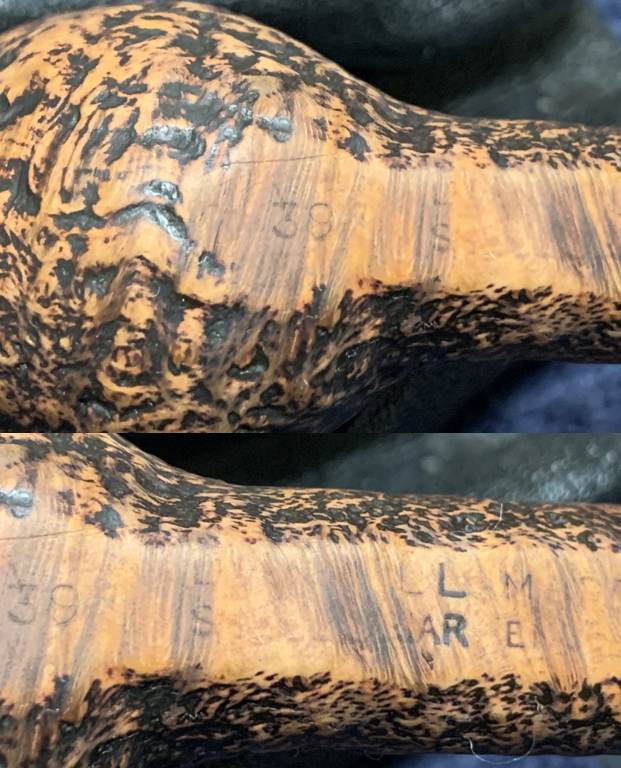
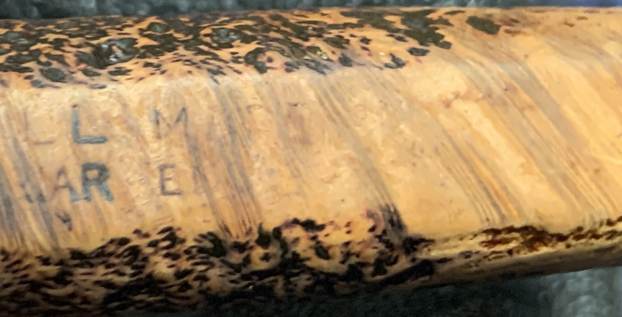
On to the pipe itself! It was certainly a charming pipe, but it was grungy and had an unholy quantity of tooth marks, dents, lava, cake, and just general filth.  The markings on the left side of the shank read Leonard Payne [over] Original. On the left side of the stem, there was a faint capital ‘P’.I little while back, I detailed my restoration of another Payne pipe, in a tale I entitled, The Frog Prince. I will repeat the information I wrote there about Leonard Payne. He was born in England, moved to Canada in the 1950s, and died in the Vancouver area within the last few years. Payne was, to put mildly, an idiosyncratic pipe maker. I can do no better than quote Mike Glukler of Briar Blues (found on Pipepedia):

“Leonard Payne was based in B.C. for many years. He came to Canada from England. He had shops in Surrey, B.C. and Kelowna, B.C. Interesting fellow. Gruff as the day is long. When you bought a pipe, it was handed to you in a paper bag. No sock, no box. Most of his pipes carried a ‘carburetor’ system at the shank/stem junction. Another Payne idea was his shanks. Almost all his pipes were two pieces. He’d turn the bowl and shank, then cut off the shank and reattach with glue (not always with the same piece of briar, so many did not match grains). His thinking was that the shank being the weakest link, if cut and glued would never break and thus ‘correcting’ the weakest link”.In addition, there was a photograph that Steve found of Payne on Reddit that appears to date from the 1960s. The original poster on Reddit told me that the photo comes from the City of Surrey archives. I have no idea why it is in French (or why it’s in the Surrey archives), but here is my translation of the text on the right:

“Pipe makers are not on every street corner in Canada! Leonard Payne, originally from England, didn’t know the challenges he would face and that’s probably what influenced his decision to come and try his luck in Canada. After his arrival in 1957, he and his family settled in Vancouver, where he first found work as a tool maker – and made pipes in his free time. In 1959, he decided to become a full-time pipe maker, and since then he has had department stores in all parts of Canada among his clients. He imports briar blocks from Italy and pipe stems from England.”My customer selected this pipe because (a) he wanted a prince manufactured by Leonard Payne, and (b) he wanted a Payne that didn’t have a carburetor system or the reattached shank. Providentially, this pipe fit the bill on all counts.

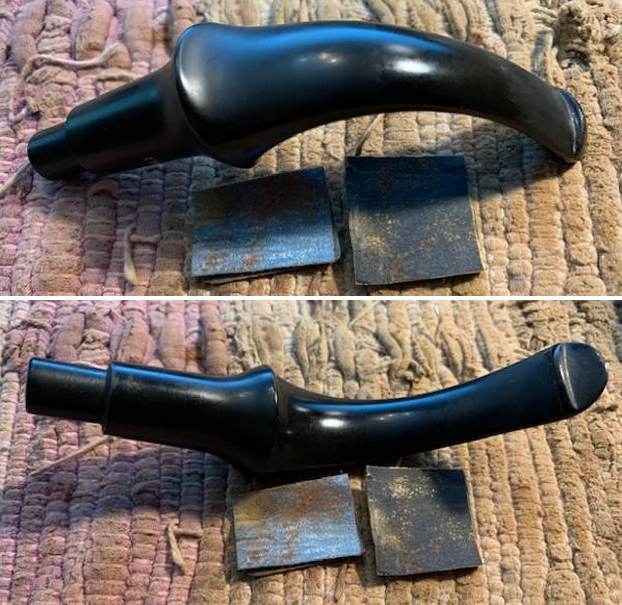
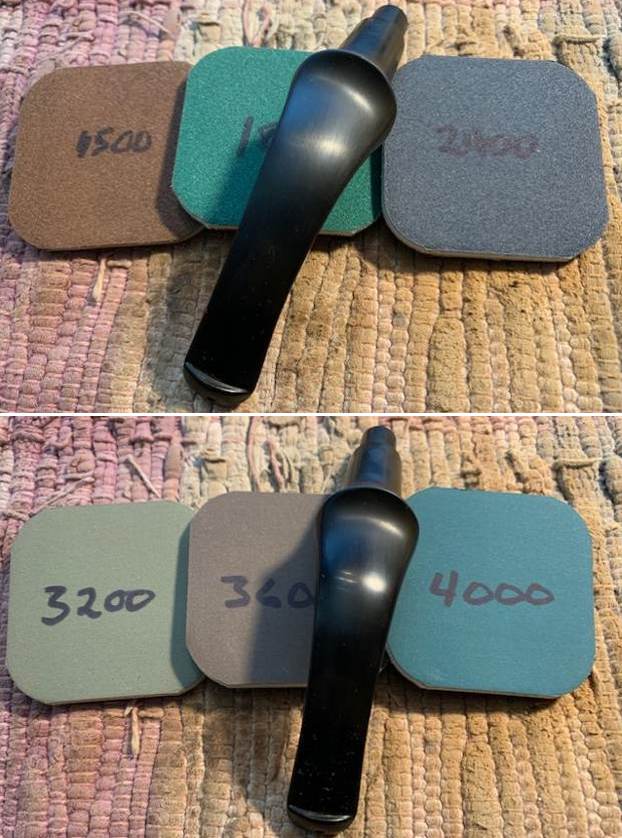
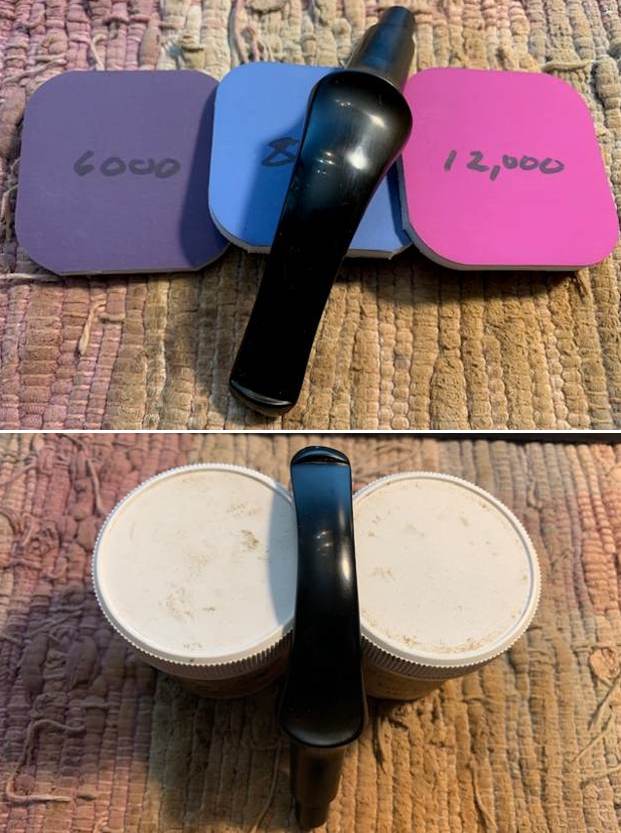
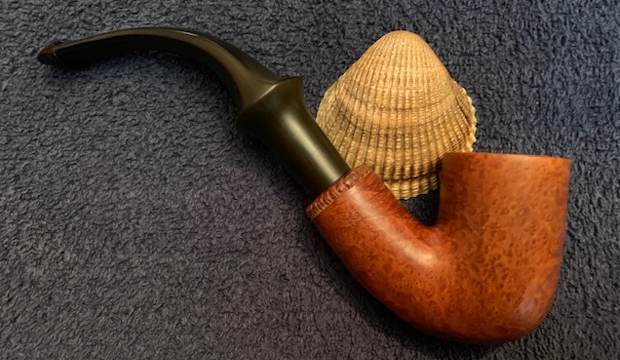
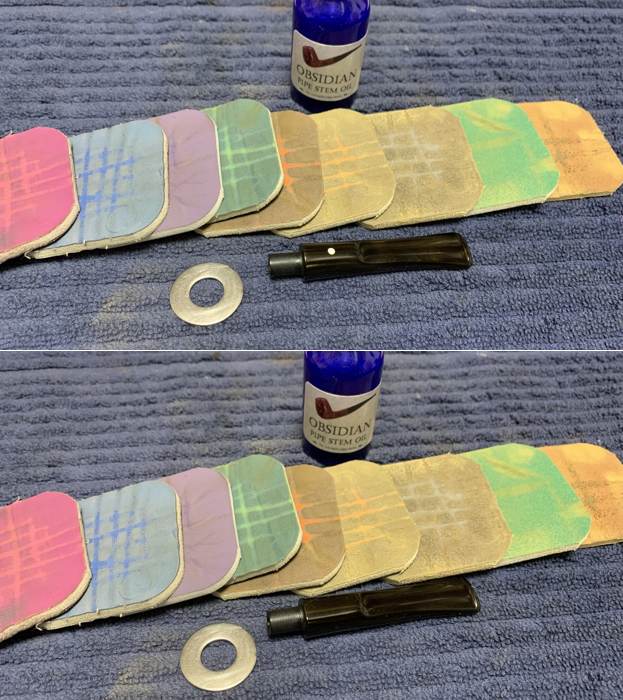
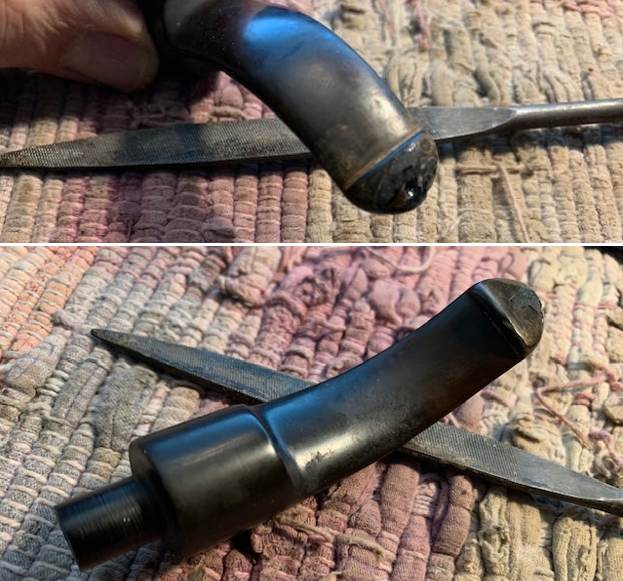
The stem on this pipe was in decent shape, with a small draught hole. But most remarkably, the button had been decapitated or stolen by a goblin. At any rate, the button was not there, and I knew that I would have quite a job on my hands.   Well, to work! I briefly considered finding a new stem for this pipe, but I believed I should try to work with the original parts before seeking a different solution. So, first on the list was constructing a new button for this pipe. I started by sanding off the end of the stem with some 220-grit sandpaper to smooth out the bottom. In order to fashion a new button, I needed to minimize the rounding on the end of the stem and make the face even. Then I took out some small files and began cutting into the vulcanite, carving out a new button. This was a tricky business and it took some real patience and effort to make it work. After much nerve-wracking work, I had successfully carved out a new button and smoothed it with files and sandpaper. The following is a tedious series of photos showing the progress of the stem! Next, I used a thin file to widen the draught hole. The end result is better than what these photos show. Finally, I could move on to the regular cleaning procedures for the stem. First, I cleaned out the inside with pipe cleaners and isopropyl alcohol. Fortunately, it wasn’t overly dirty, and it only needed a handful of pipe cleaners.Then, I wiped down the stem with SoftScrub, before sending it off for a bath in the Pipe Stem Oxidation Remover. The following day, I cleaned all of the de-oxidizing mess off with alcohol, pipe cleaners, et cetera. The oxidation had migrated to the surface and I could easily remove it. Then I scrubbed with more SoftScrub on some cotton pads to remove the leftover oxidation. After this, I used nail polish to restore the logo on the stem. I painted the area carefully and let it fully set before proceeding. I worried that this wouldn’t work, as the ‘P’ was so faint. Fortunately, I ended up being wrong and some of the ‘P’ came back to life.I then used all nine Micromesh pads (1,500 through 12,000 grit) to bring out the lovely black lustre on the stem. I also used Obsidian Pipe Stem Oil in between each pad scrubbing. Hey – this looks like a real stem! I’m quite pleased with how it turned out. I always want to use the original parts of a pipe, if possible, and I’m glad this worked. Setting the stem aside, I moved on to the bowl. I started by reaming it out. I used the PipNet Reamer and the KleenReem to remove the built-up cake inside and followed that with 220-grit sandpaper taped to a dowel to eliminate as much as I could. I took the chamber down to bare briar, as I wanted to ensure there were no hidden flaws in the wall. Fortunately, there were none. After that, I used cotton rounds and some Murphy’s Oil Soap to scrub the outside of the stummel and a toothbrush with Murphy’s for the lava on the rim of the pipe. Oddly, there appeared to be shiny bits of a previous coating on the stummel, left over from some other time; I figured my sanding would remove these marks, so I ignored them for the time being. I then proceeded to clean out the insides of the shank with Q-tips, pipe cleaners, and lemon-infused isopropyl alcohol. There was quite a bit of filth inside this stummel and it took a fair amount of cotton to get it clean. I followed that up by cleaning the insides with some dish soap and tube brushes. Next, I decided to de-ghost the pipe to remove any lingering smells of the past. I thrust cotton balls into the bowl and the shank and saturated them with 99% isopropyl alcohol. I let the stummel sit overnight. This caused any remaining oils, tars and smells to leach out into the cotton. The bowl was nice and clean after this. Here are the “before” and “after” photos: Having completed that, I was able to address the small nicks on the rim and the bowl. I dug out my iron and a damp cloth to try to raise the nicks. The hot and moist steam can often cause the wood to swell slightly and return to shape. There was some movement – not a lot, but it was better than doing nothing. The repair was not perfect, but the remaining scratches would be improved by sanding. To remove the remaining burns and nicks on the rim, I “topped” the pipe – that is to say, I gently and evenly sanded down the rim on a piece of 220-grit sandpaper. This effectively removed the damage, without altering the look of the pipe. After this, I used all nine Micromesh pads (1,500 through 12,000 grit) to remove the frustrating scratches in the wood and make everything smooth. Additionally, a light application of Before & After Restoration Balm brought out the best in the stummel’s grain.  At the buffer, a dose of White Diamond and a few coats of carnauba wax were just what this pipe needed. The lovely shine made the wood look beautiful. I am pleased with this pipe – it was tricky work, but thoroughly enjoyable for me. Best of all, I know that the new owner will enjoy it for many years to come. I hope you enjoyed reading the story of this pipe as much I as I did restoring it. If you are interested in more of my work, please follow me here on Steve’s website or email me directly at kenneth@knightsofthepipe.com. Thank you very much for reading and, as always, I welcome and encourage your comments.