Monthly Archives: April 2024

Restoring a Danish Mystery Panel Plateau Freehand


Blog by Steve Laug

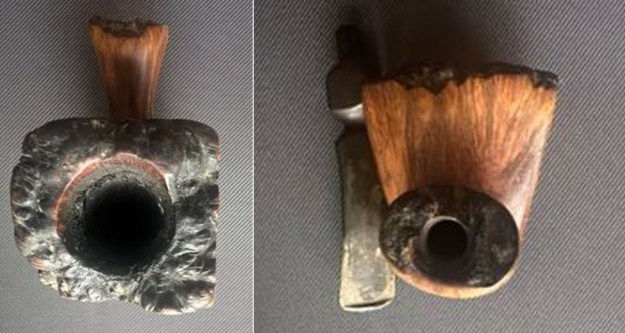
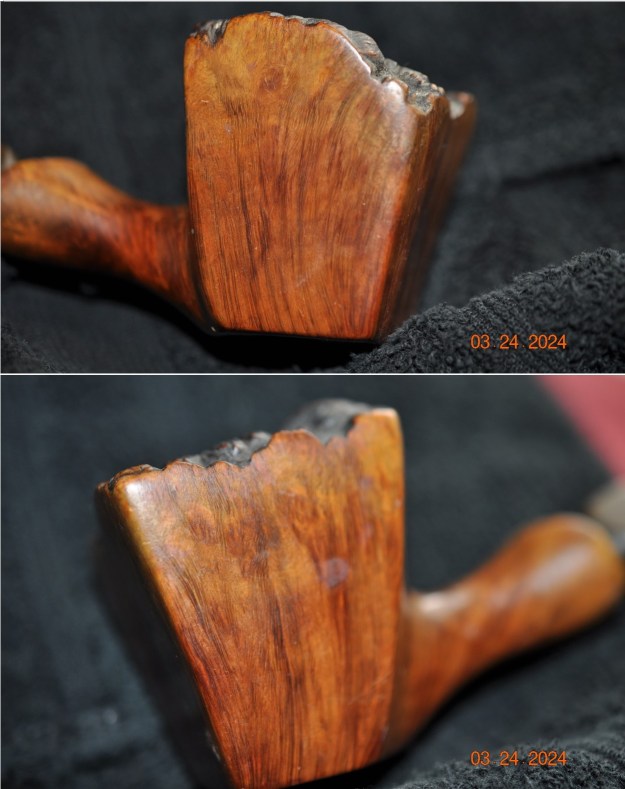
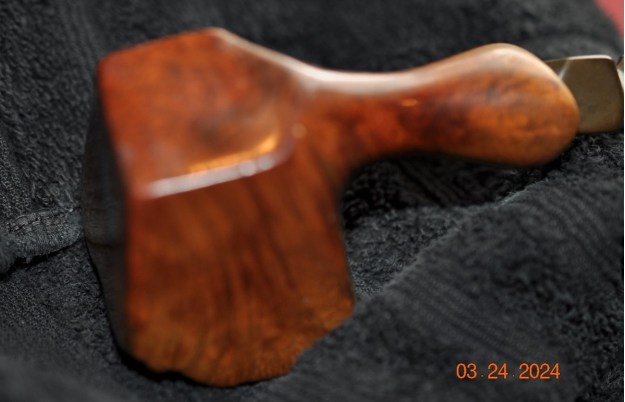
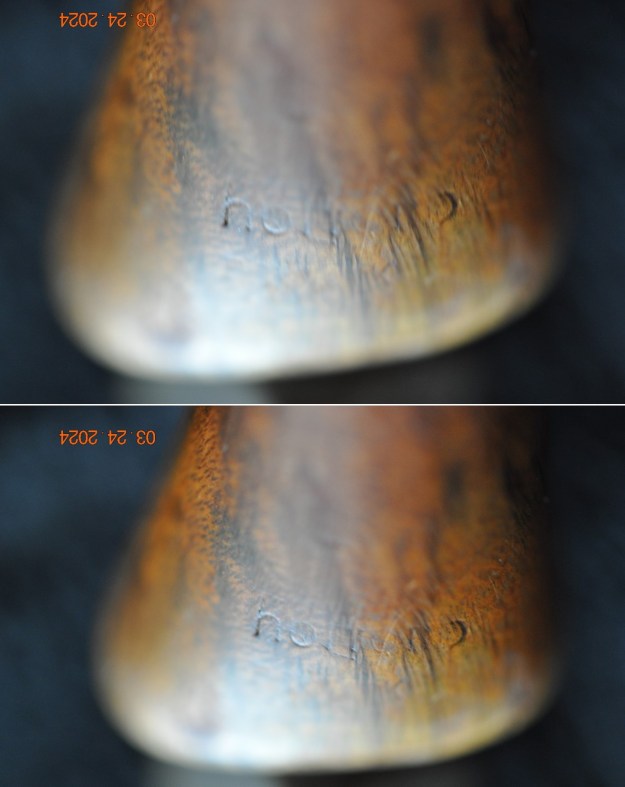
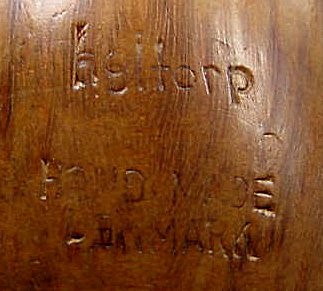
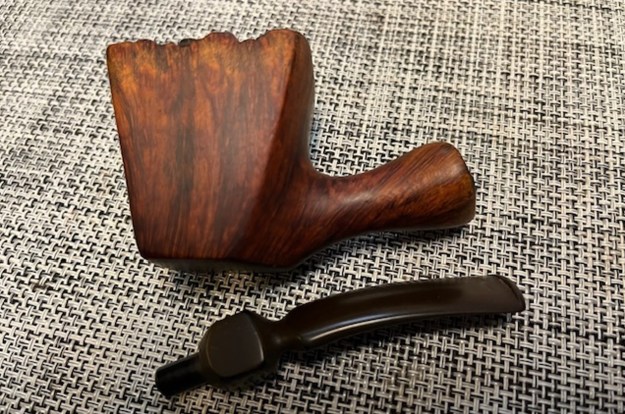
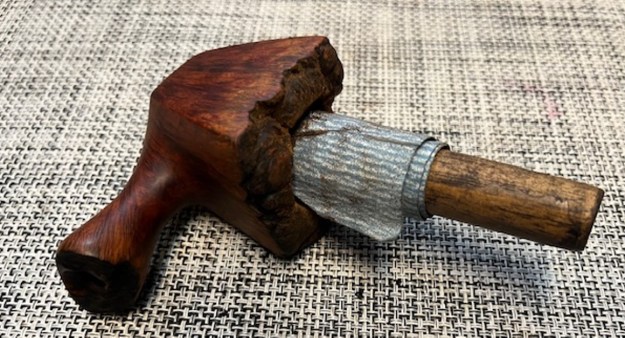
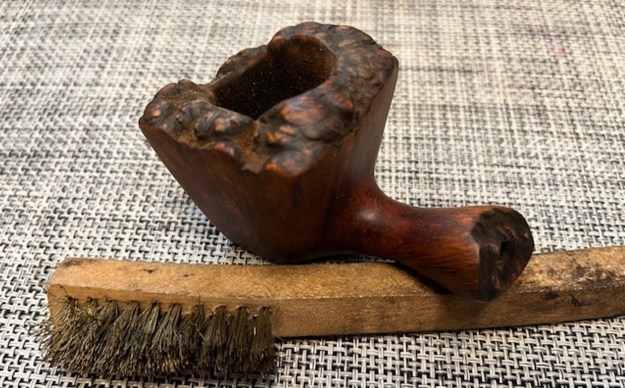
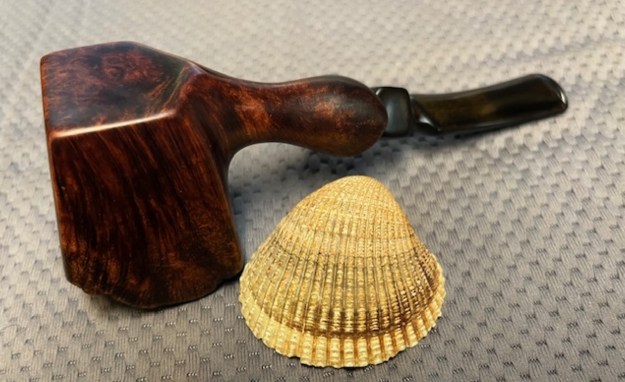
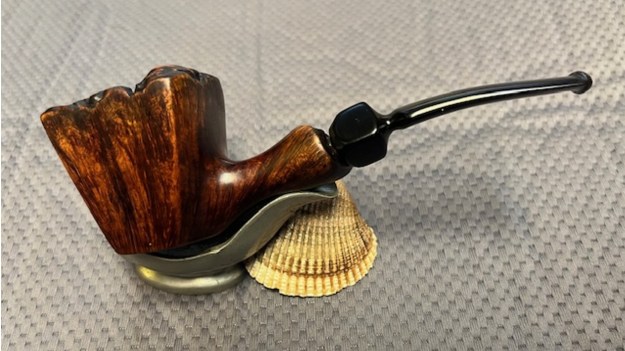
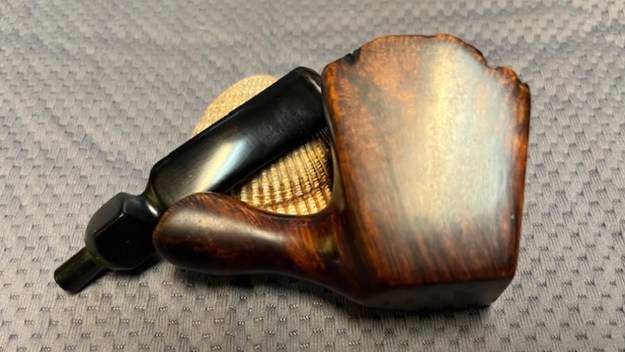
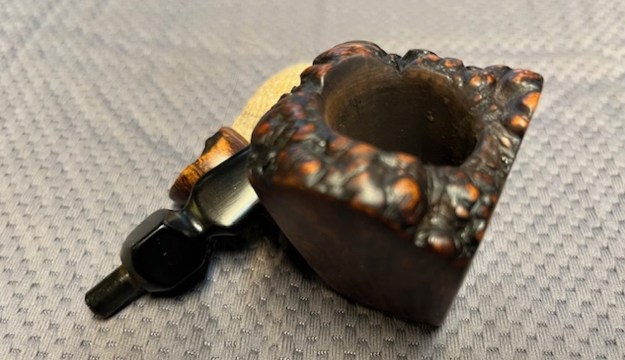
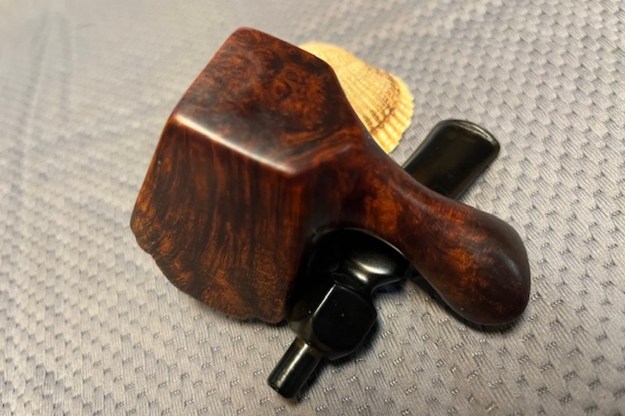
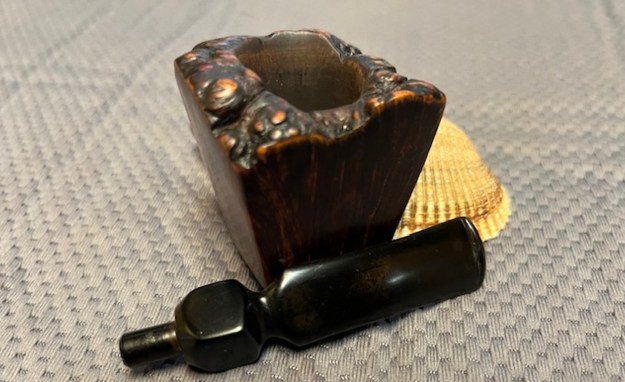
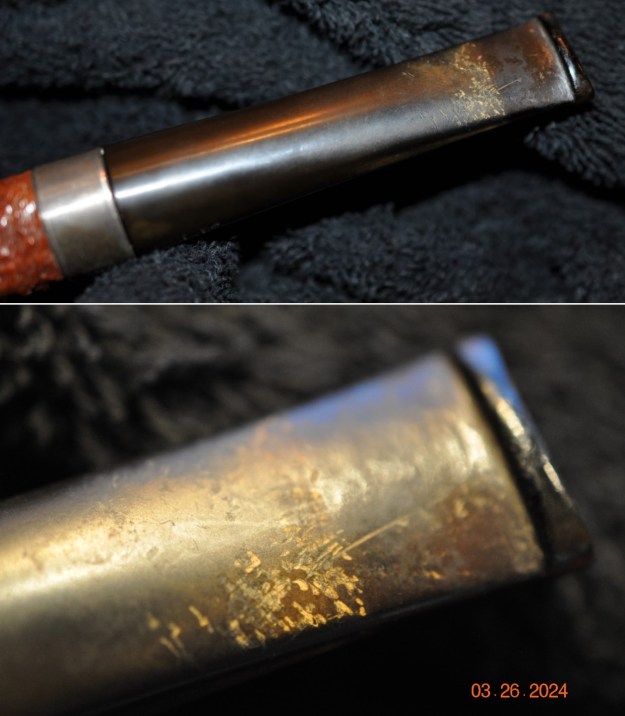
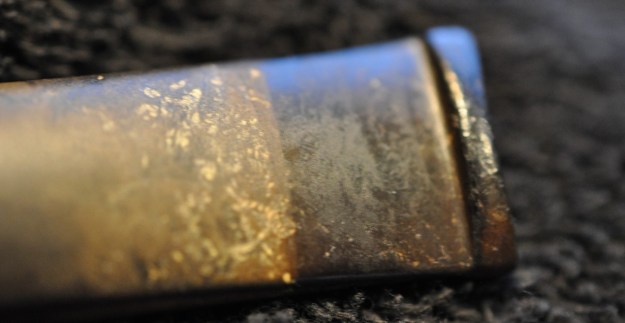
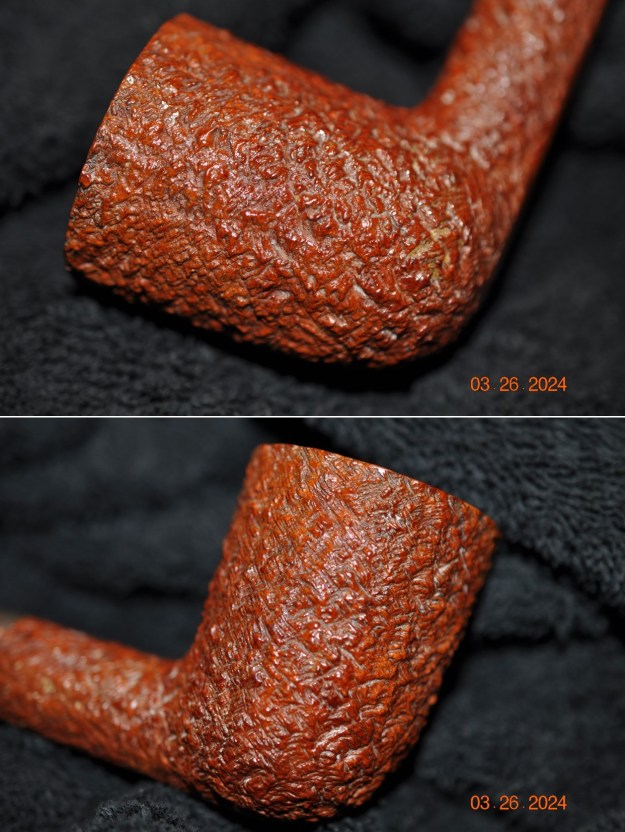
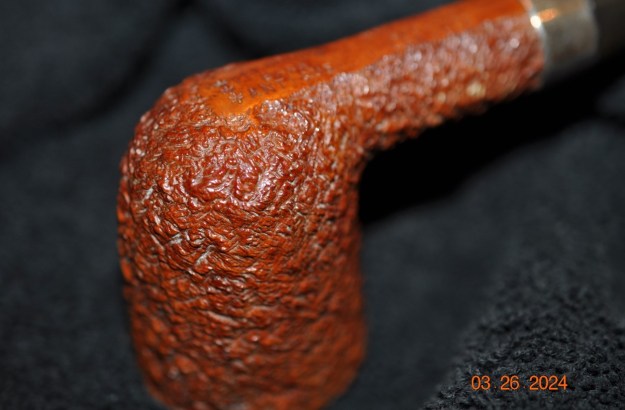
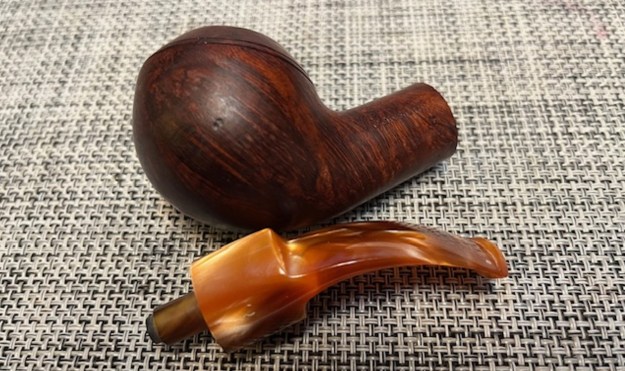
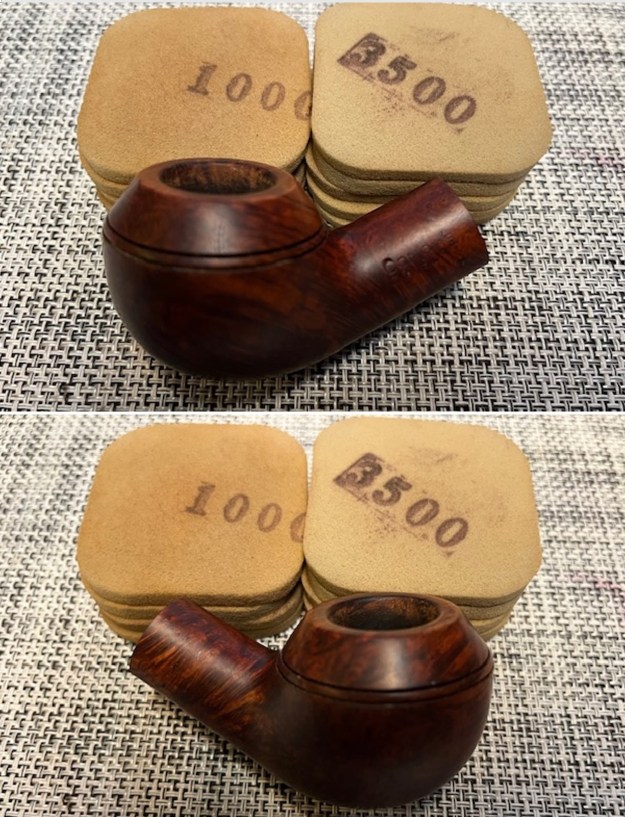
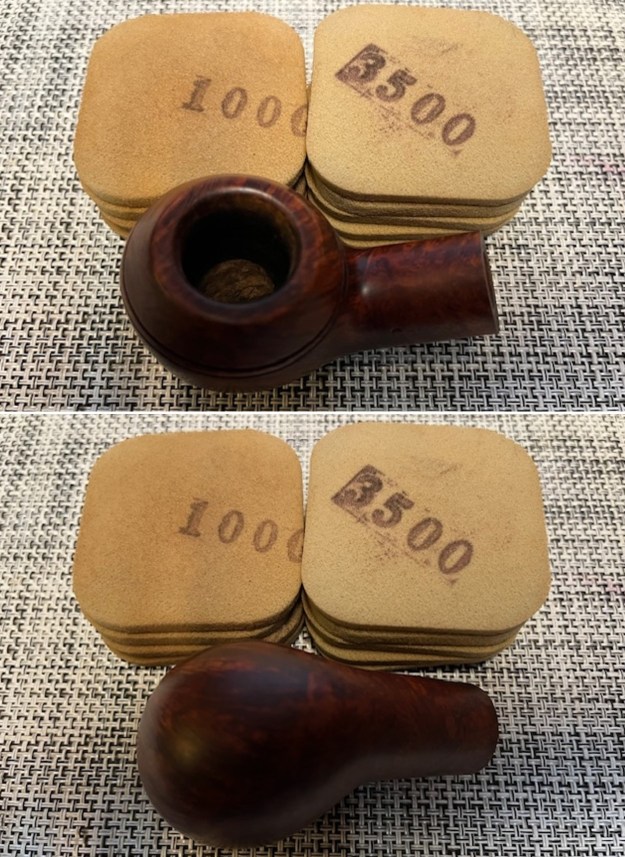
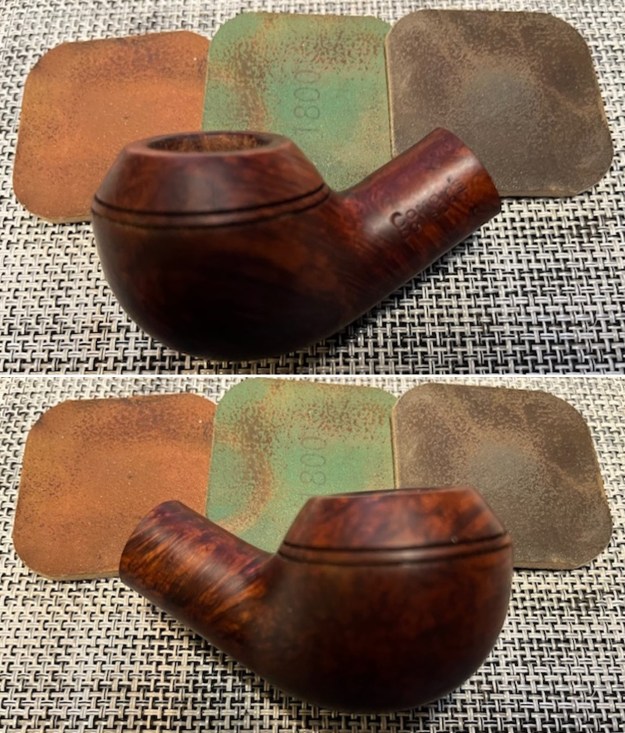
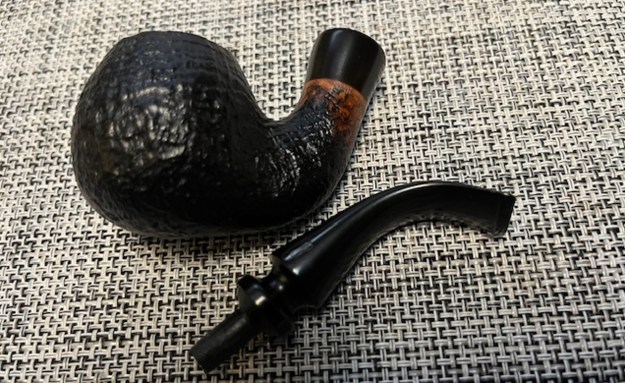
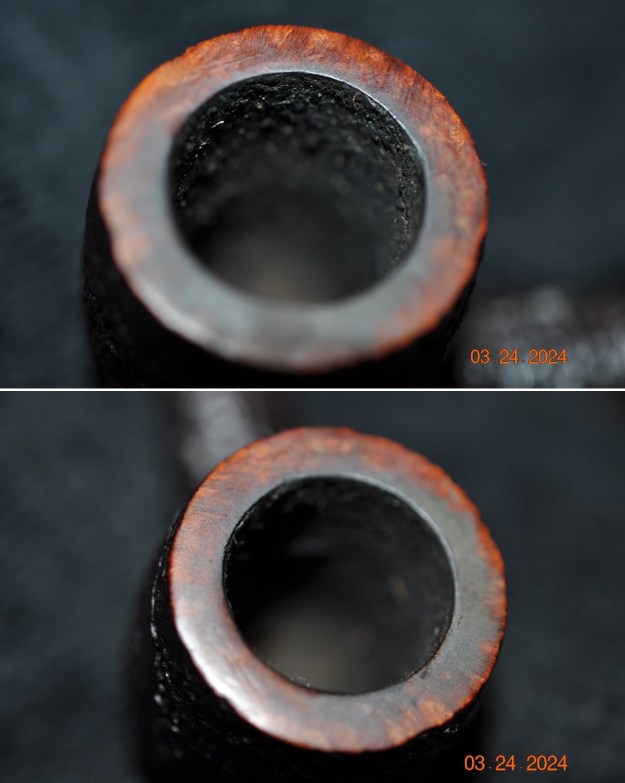
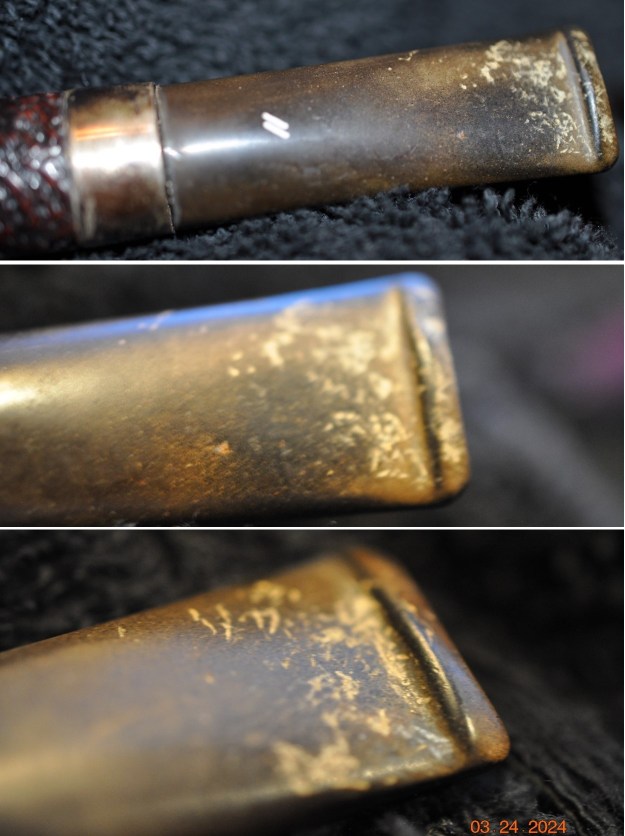
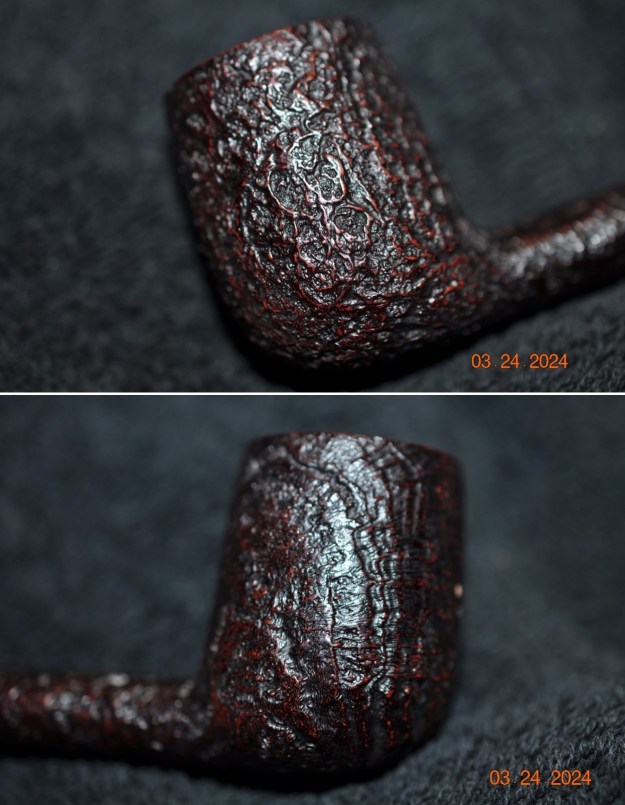
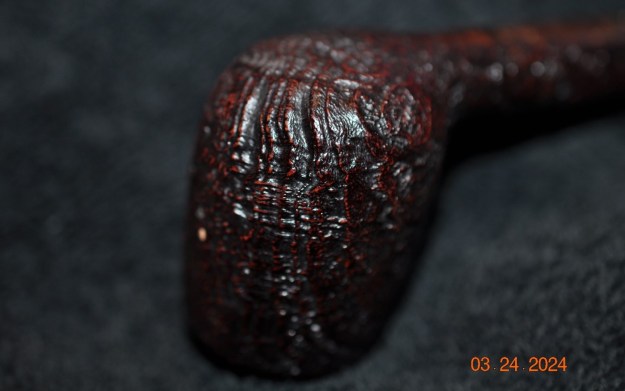
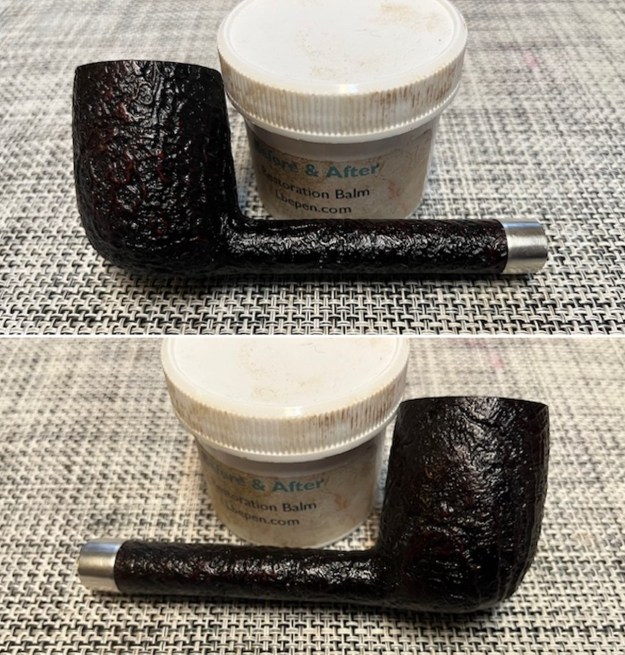
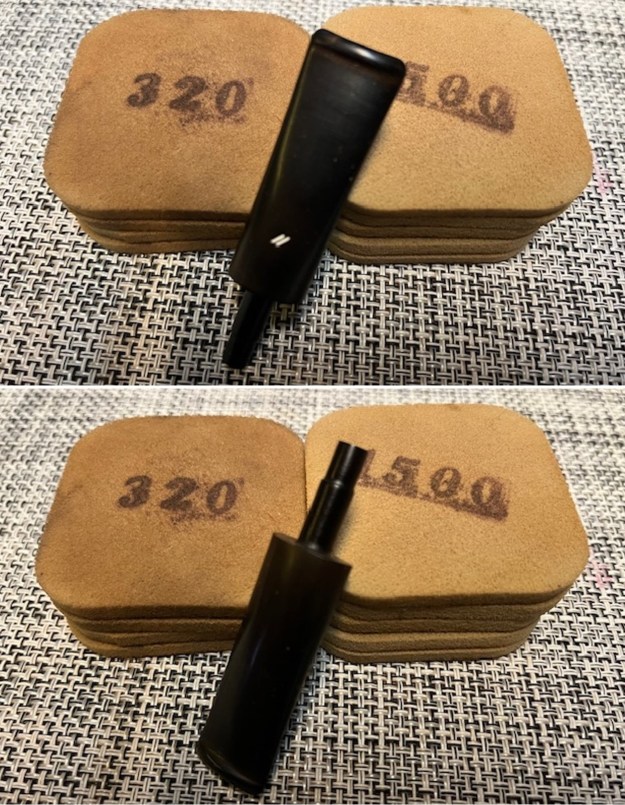
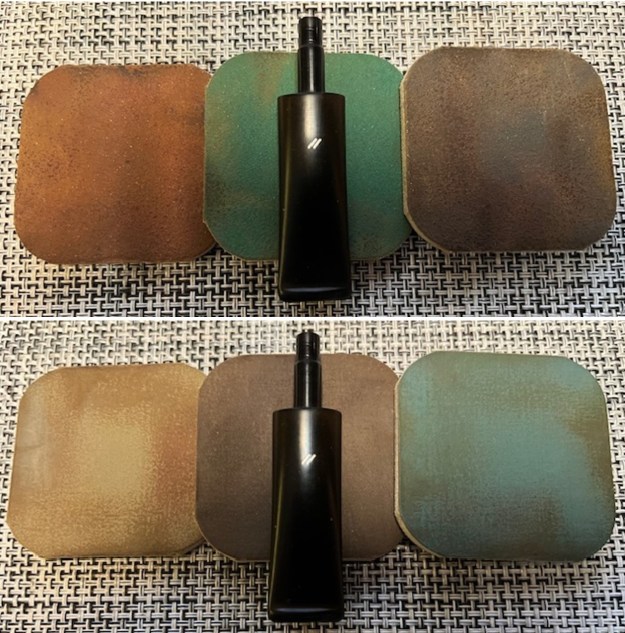
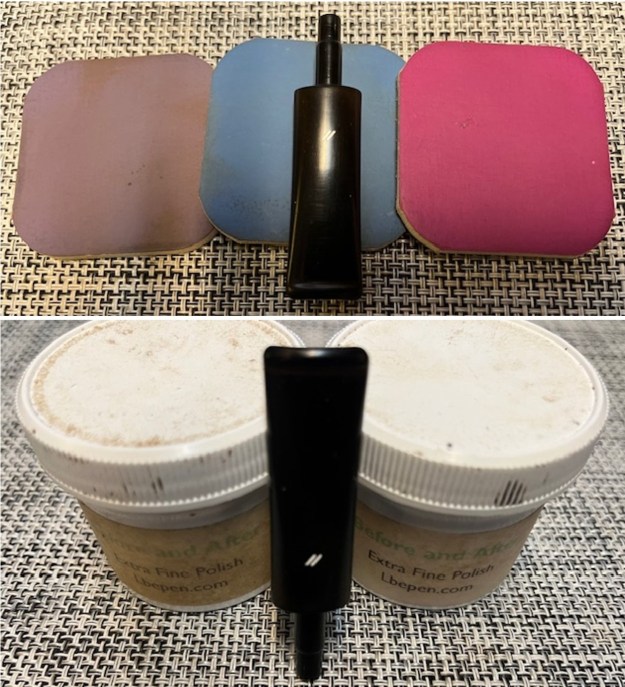
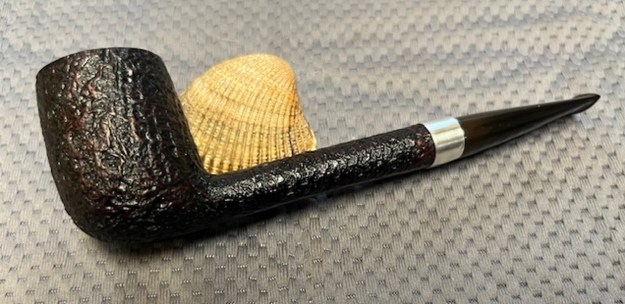
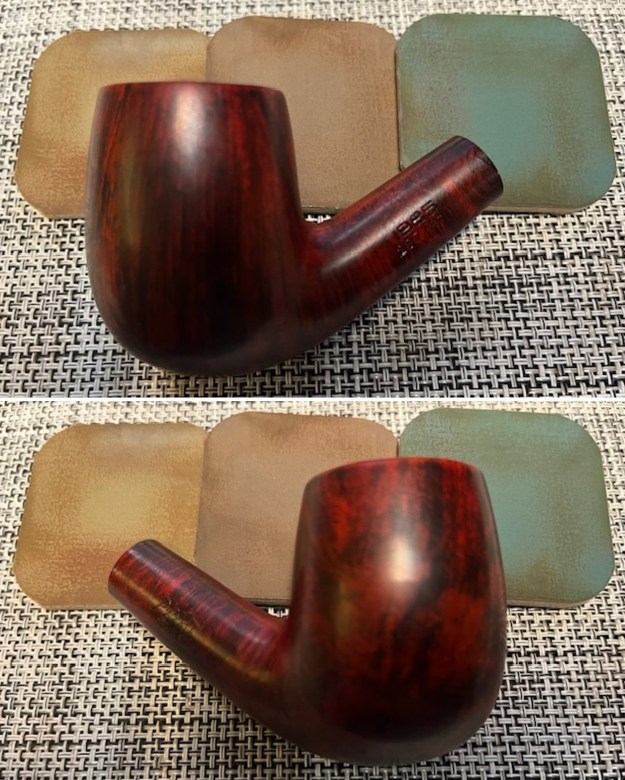
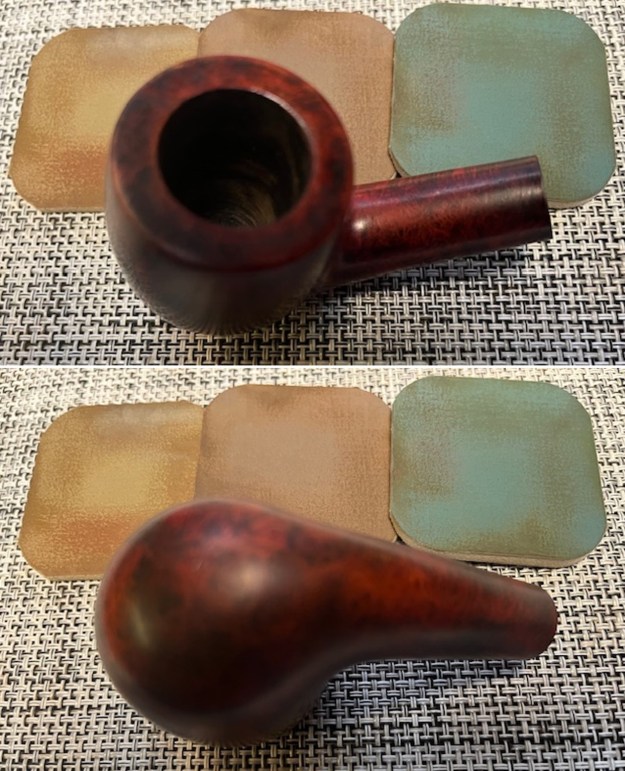
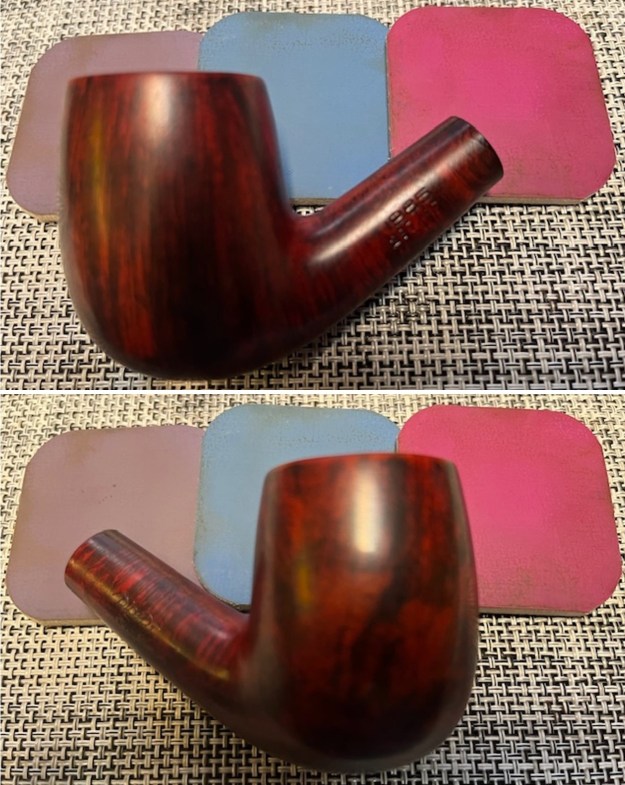
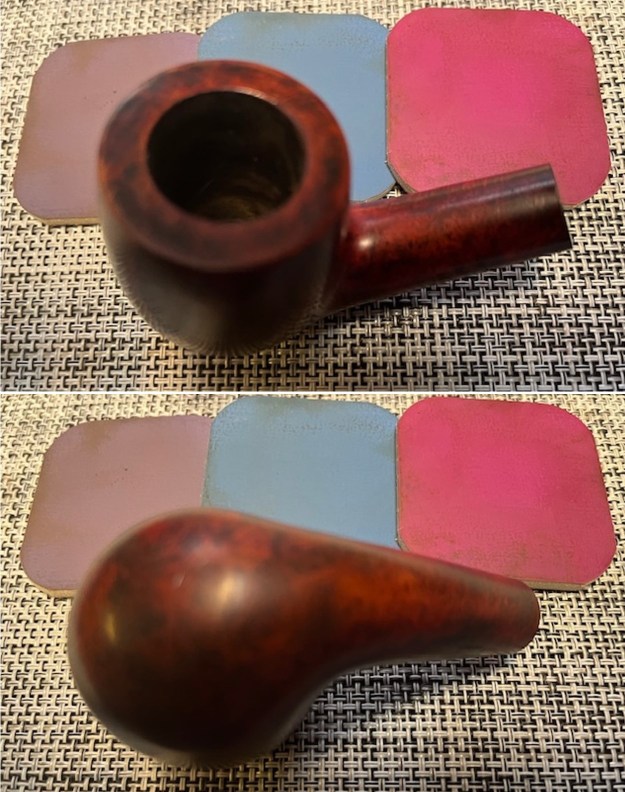
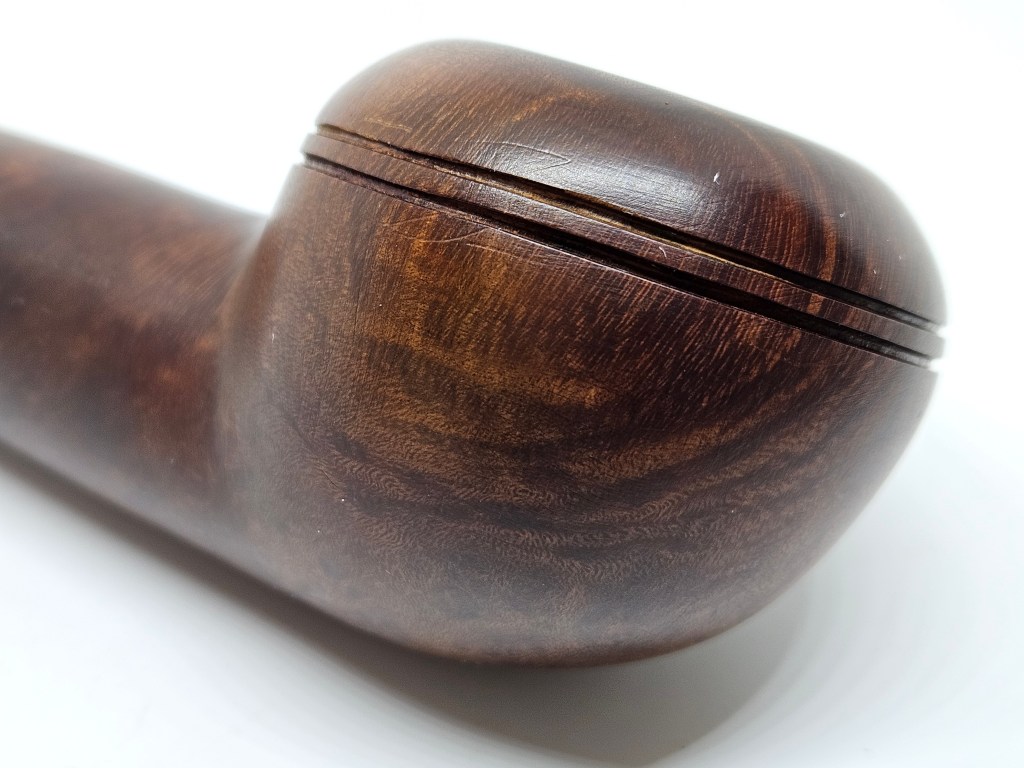
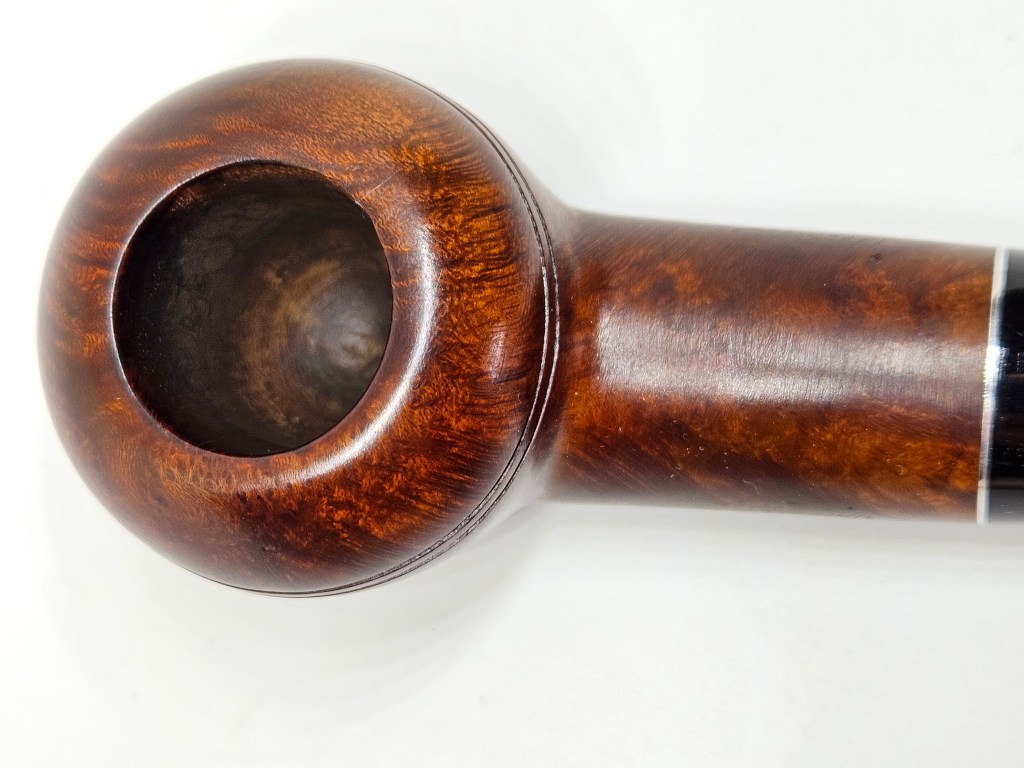
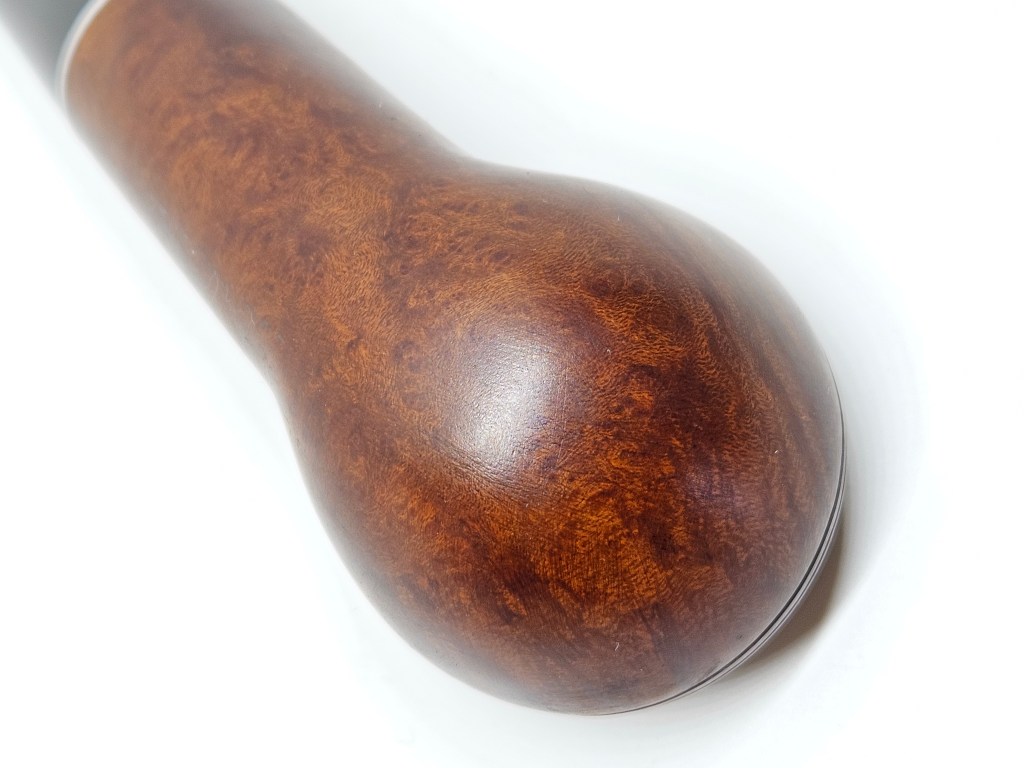
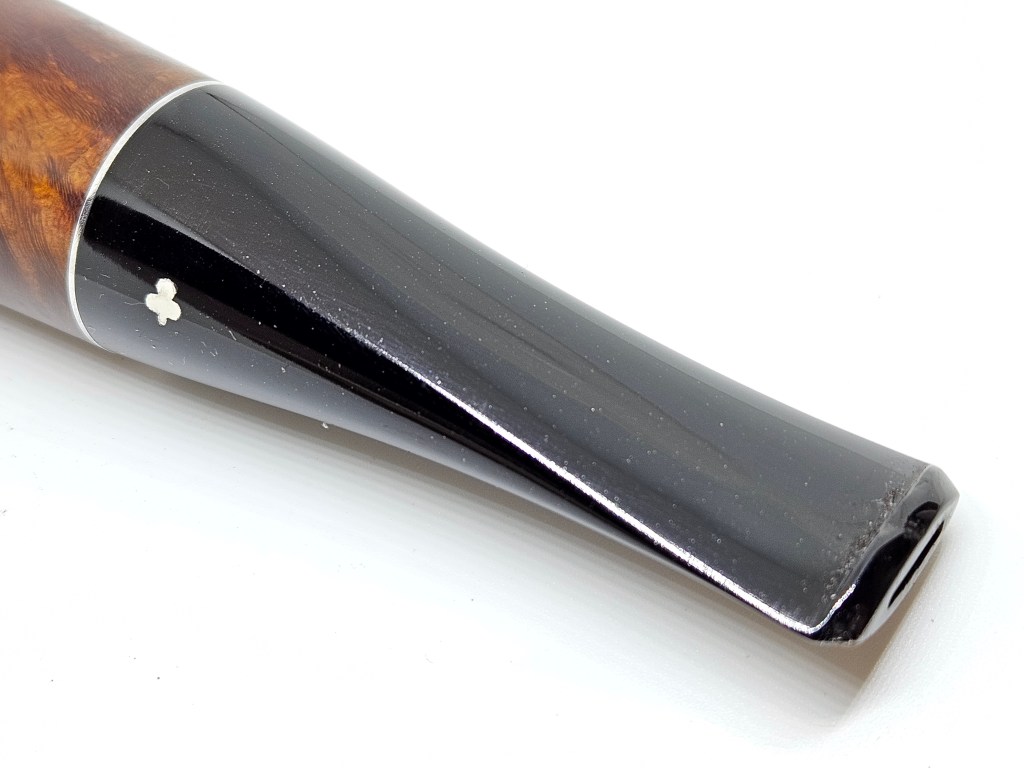
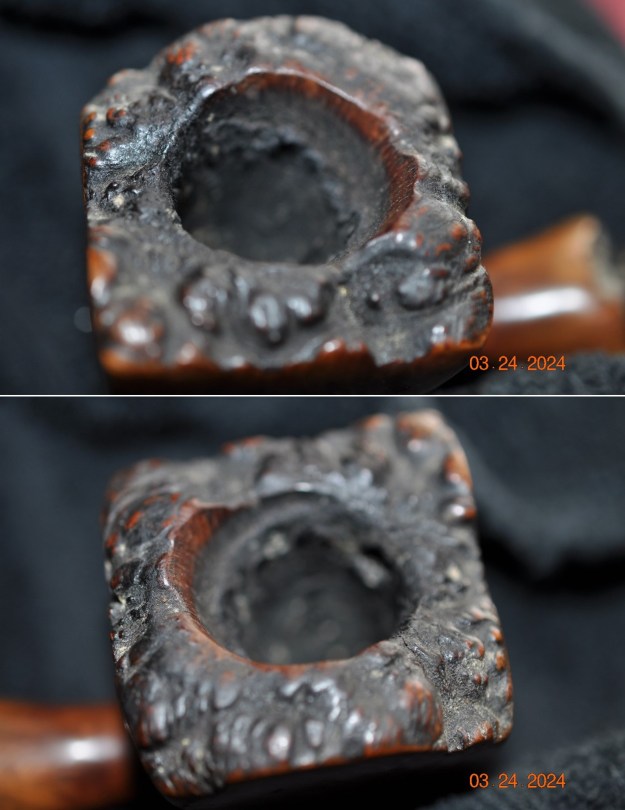
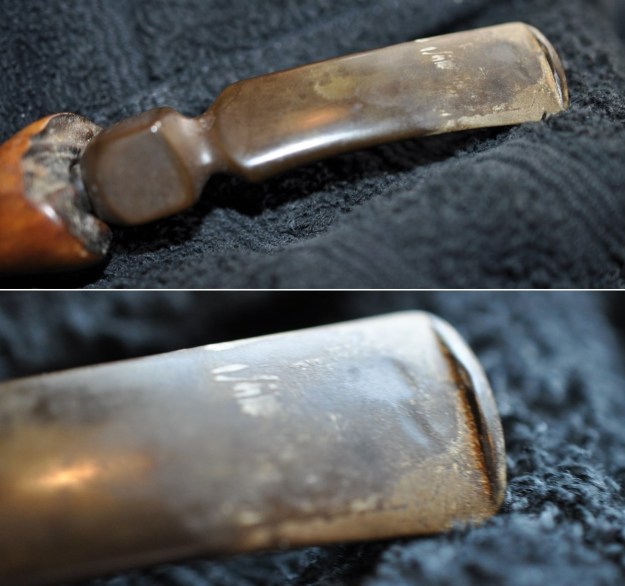
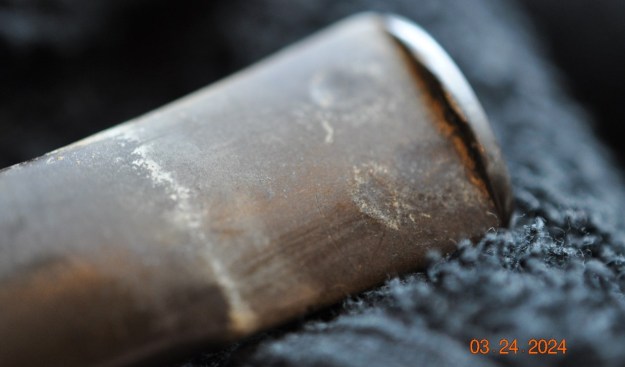
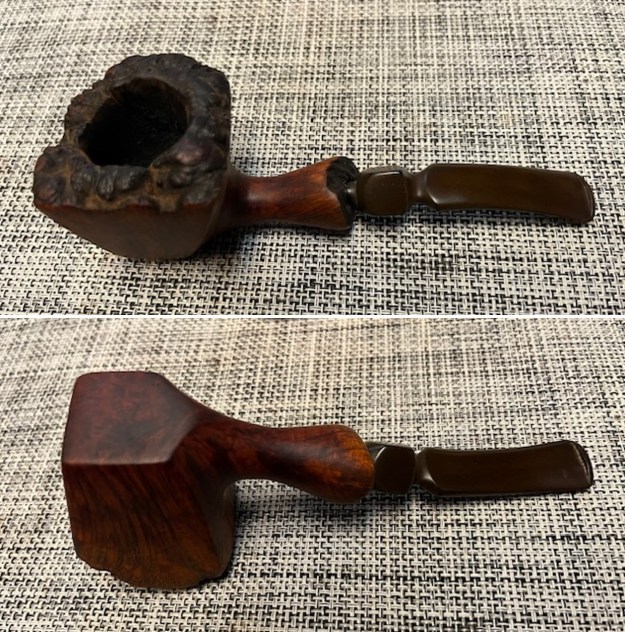
The next pipe on the table is a Danish looking Plateau Panel. We purchased it from fellow in Mount Pleasant, South Carolina, USA on 03/20/2024. He said that as far as he could tell it appeared to be unstamped. To me it looked like a Danish pipe but I could not identify it from the photos he sent me nor could he. There was a thick cake in the bowl with a heavy lava coat around the inner edge and deep in the valleys and crevices on the plateau top. There was grime ground into the rusticated finish around the bowl and shank. The plateau end on the shank end was also dirty. The pipe had been smoked heavily and was someone’s obvious favourite. It was hard to know the condition of the inner edge for certain because of the lava. The stamping on the shank is not visible in the photos and the seller could not read anything. The fancy turned saddle stem is oxidized and calcified. There appears to be some deep tooth marks and chatter on the top and underside of the stem ahead of the button. Jeff took photos of the pipe before he started his clean up work. I have included them below.Jeff took photos of the rim top, bowl and the surfaces of the stem to give a sense of the condition of the pipe. The walls of the bowl had a thick cake which overflowed over the rim edges and onto the rim top. The stem is oxidized, calcified and dirty. There are tooth marks on both sides ahead of the button. He took photos of the sides and heel of the bowl to give a clear picture of the way the shape follows the grain. The grain is really beautiful even showing through the grime filling in the valleys and low spots. The plateau on the rim top and shank end is beautiful but dirty. He took photos of the stamping on the smooth underside of the shank. It is faint but is partial readable. This finally is a lead for the brand on the pipe that was a mystery until this moment. It looks like it says Holtorp [over] Denmark.I did some digging to see what I could learn about the holtorp brand. I turned first to Pipephil’s site (http://www.pipephil.eu/logos/en/logo-h3.html). There was a listing and a photo of the stamping on the stamping on the shank. It matches the one I am working on. I have also included the side bar information below the screen capture.Artisan: P. Holtorp was one of the regular pipe carver at Pipe-Dan in Copenhagen during the 1960’s. Rather massive (sometimes heavy) and well grained flawless pipes.
I turned to Pipedia and found more information that was helpful. It gave some history of the carver and the brand (https://pipedia.org/wiki/Holtorp). I have included it below.

H. Dan-Christensen’s shop Pipe-Dan at Vestergade 13 – just off Copenhagen’s Town Hall Square – was one of the most important turntables for upcoming as well as established pipemakers and pipe enthusiasts from all over the world from the 1960’s to the 1980’s.

P. Holtorp was one of the many artisanal carvers who worked in the periphery of Pipe-Dan. In the 1960’s – maybe up to the early 1970’s – he was one of the in-house pipemakers working together with Sven Knudsen, Gert Holbek, Axel Svend Celius, Tom Eltang – just to name a few. Later he worked from his own shop but still sold most of his pipes via Pipe-Dan.

Holtorp never became as famous as some of the names mentioned. Most probably, because the majority of his pipes was a bit different from the Danish “fancy freehands” and more striving for elegance. The typical Holtorp features bold lines and forms. Some are very manly pipes, so to say, rather made for stronger built pipesters. Accordingly the weight tended to be considerable – e.g. 118g the pipe shown below. Many were versions of earlier Holbek or Pipe-Dan designs. His “Bird” shape pipes for Pipe-Dan are clean simple shapes that have become Danish classics.

Holtorp’s craftsmanship and execution match very high standards. Straight grains from his hands are more than a rarity but the dense and flawless graining of his pipes is remarkable.

Estates by Holtorp don’t ask the prices of some other contemporaneous Danes by far – Thus an excellent buy for those who love a quality pipe if they can find them.

It also included a photo of the stamping and I can definitely confirm that my mystery on the brand is solved. The pipe is a Holtorp.

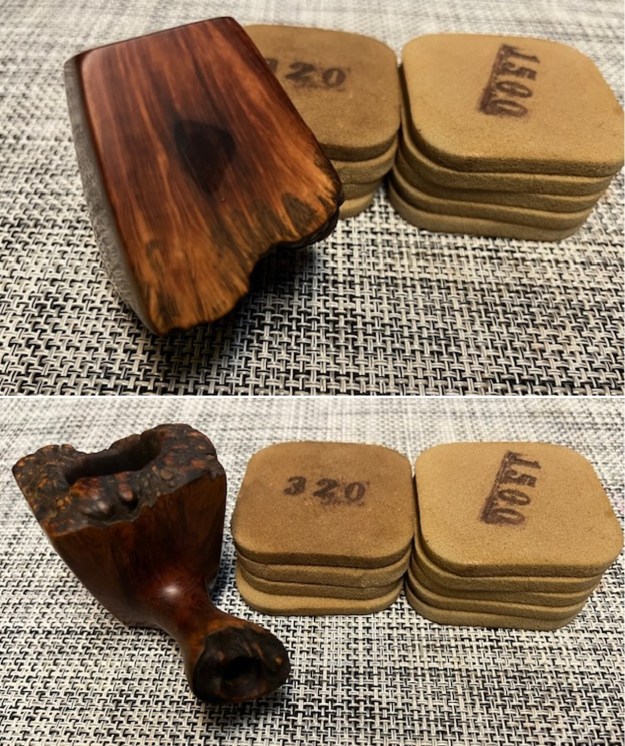
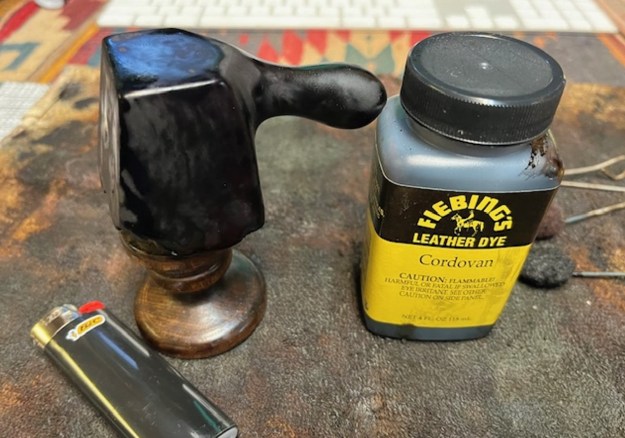
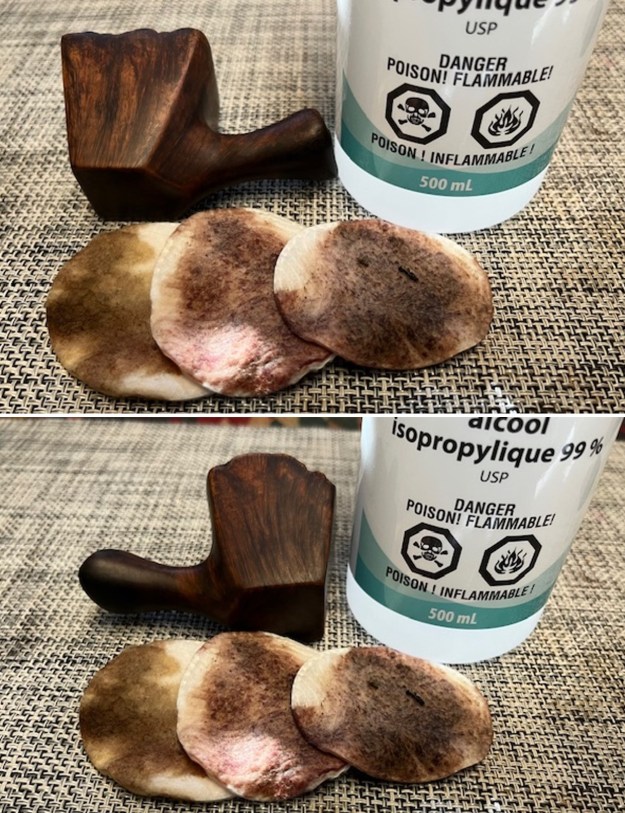
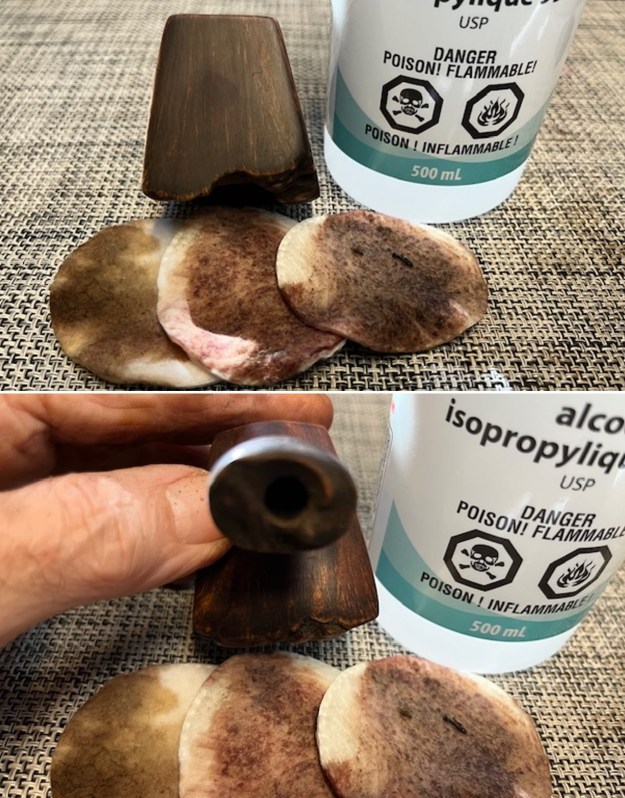
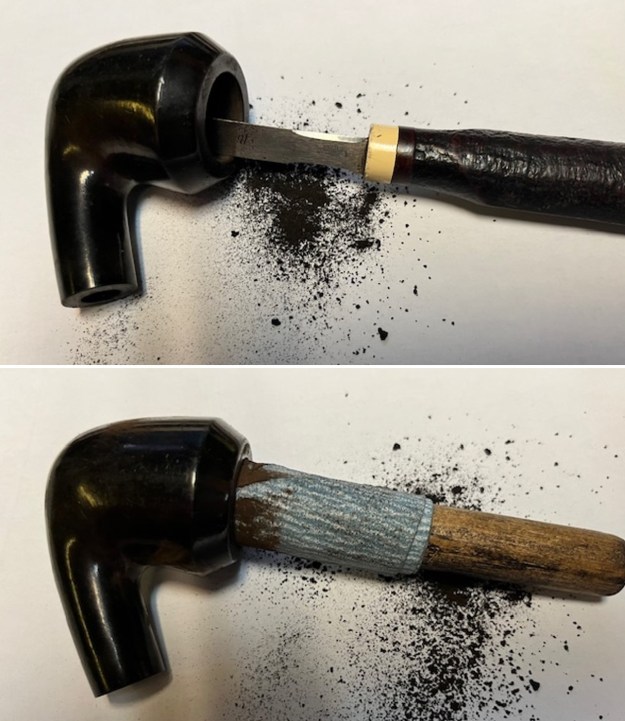
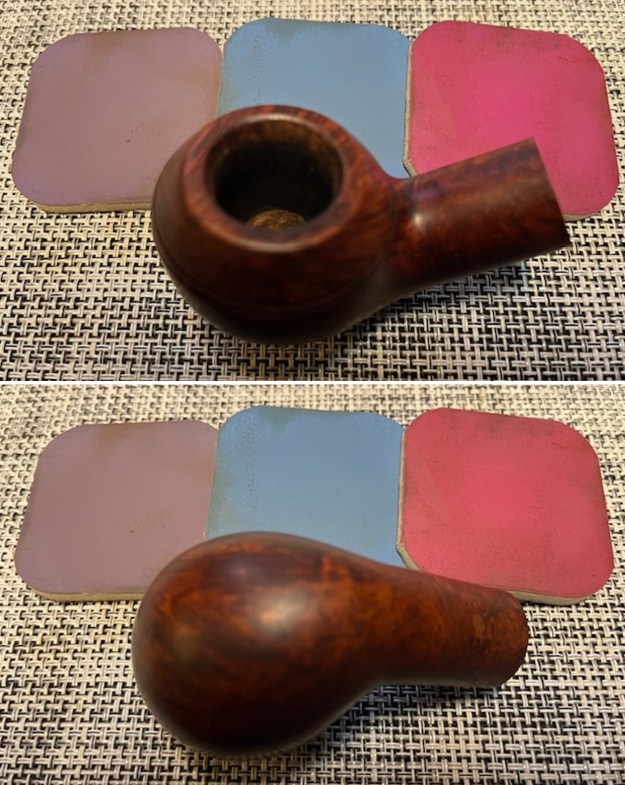
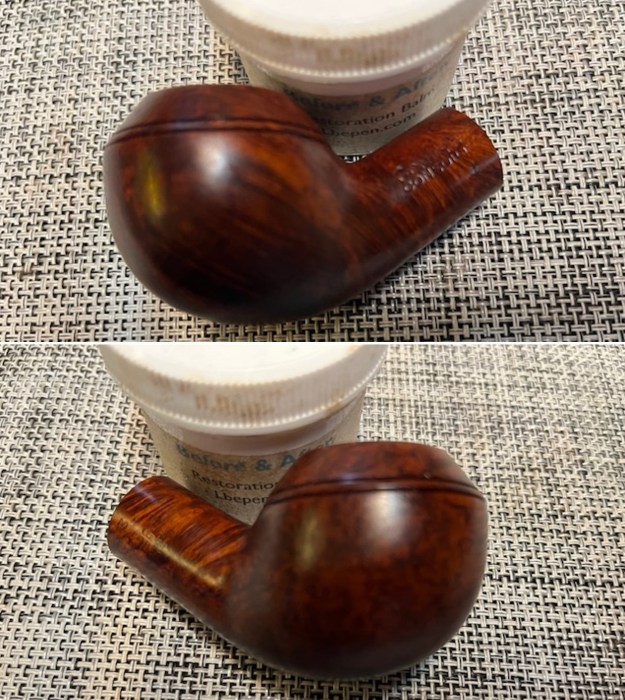
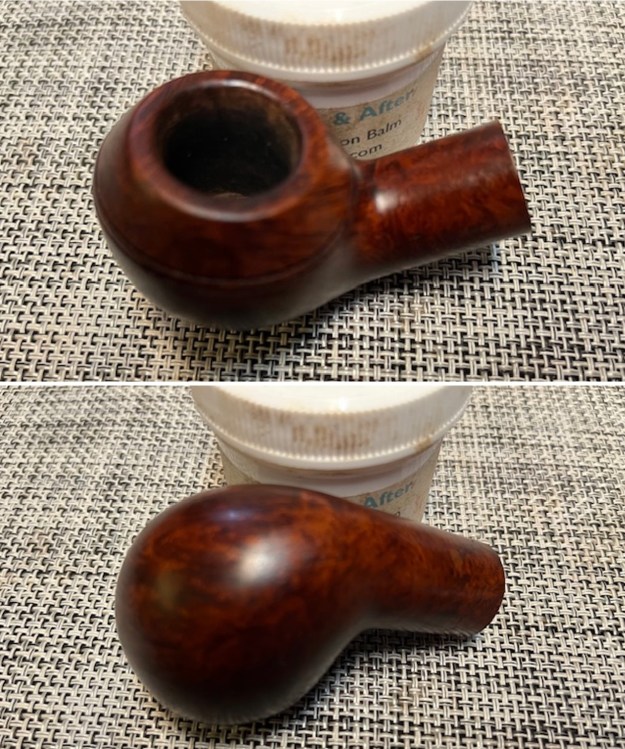
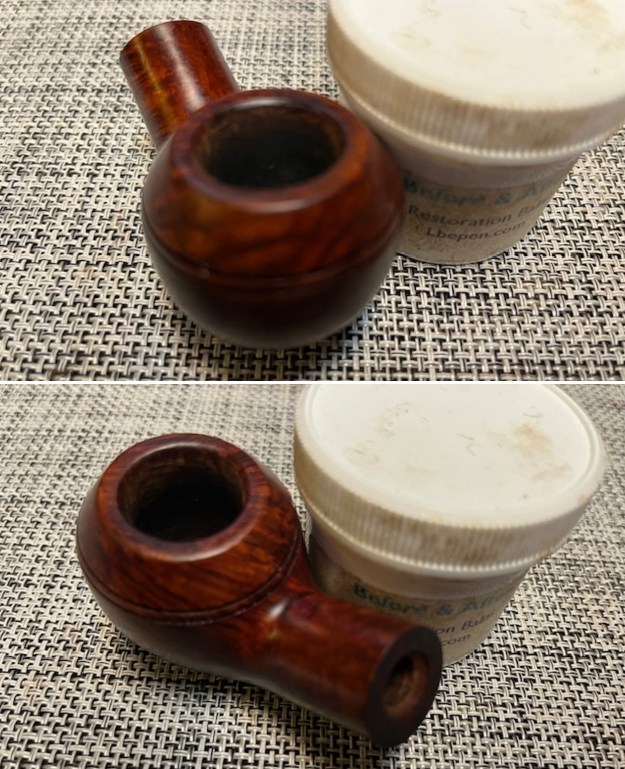
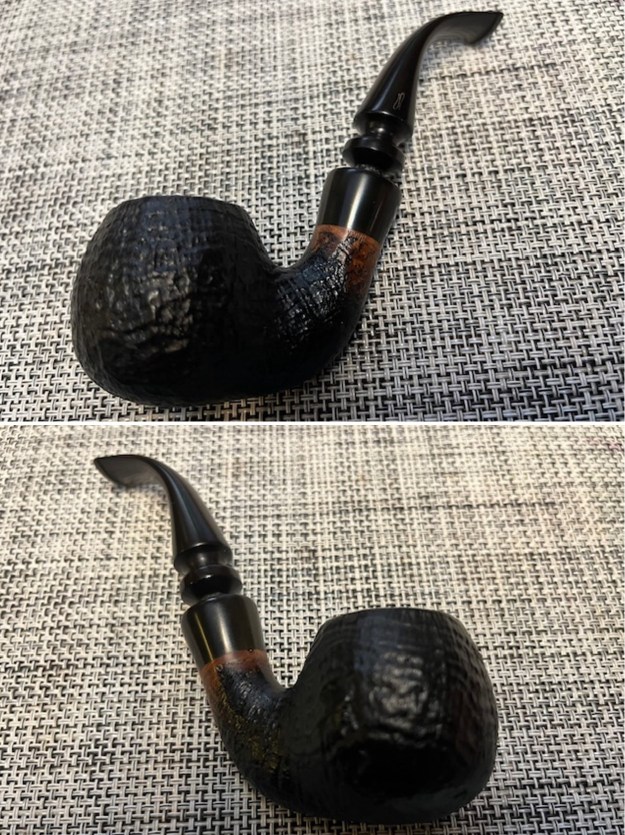
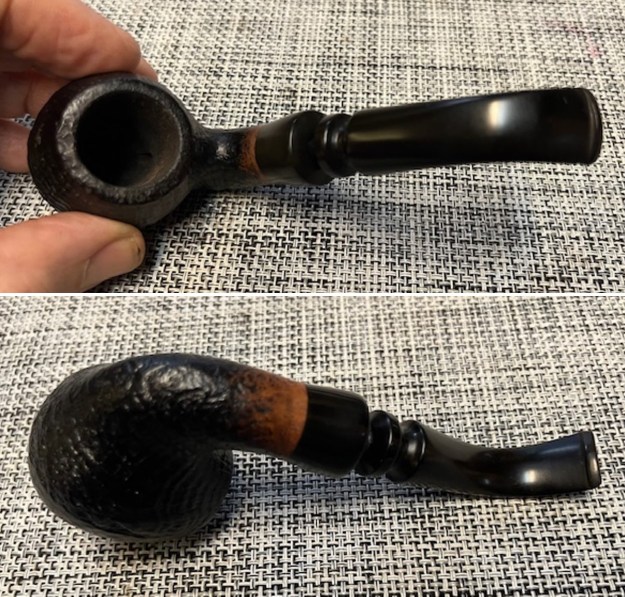
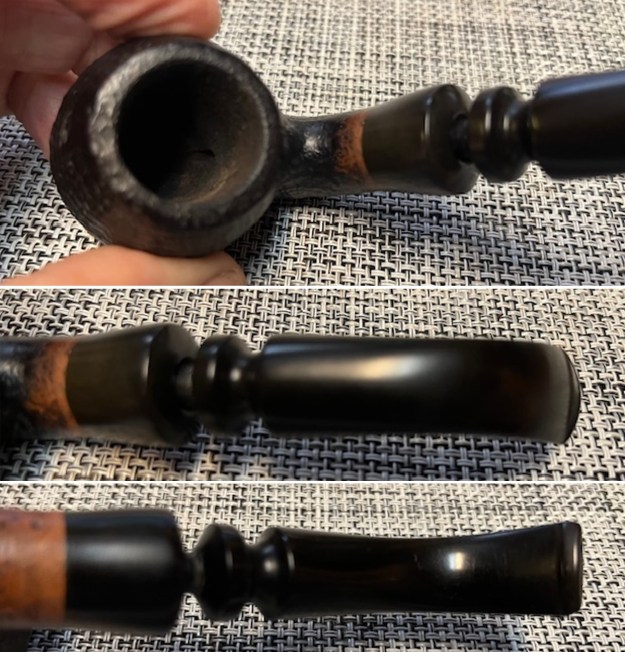
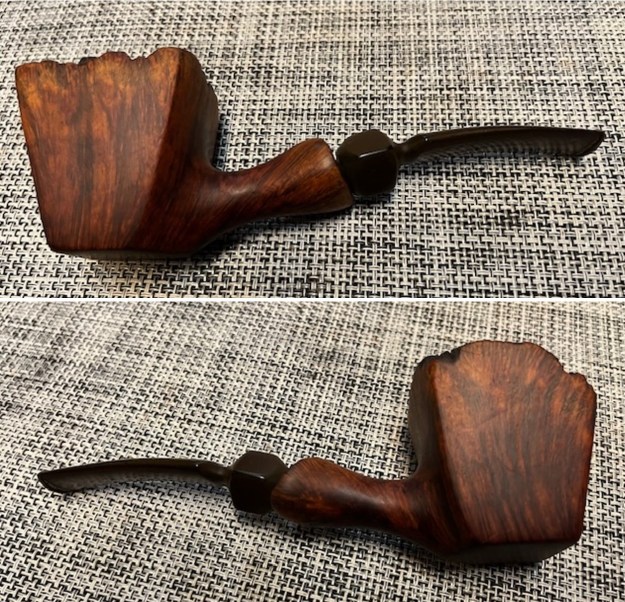
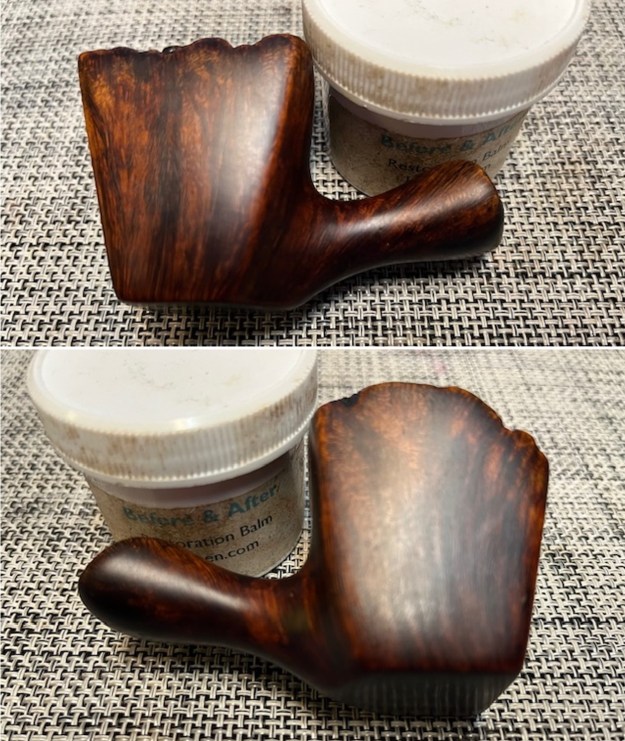
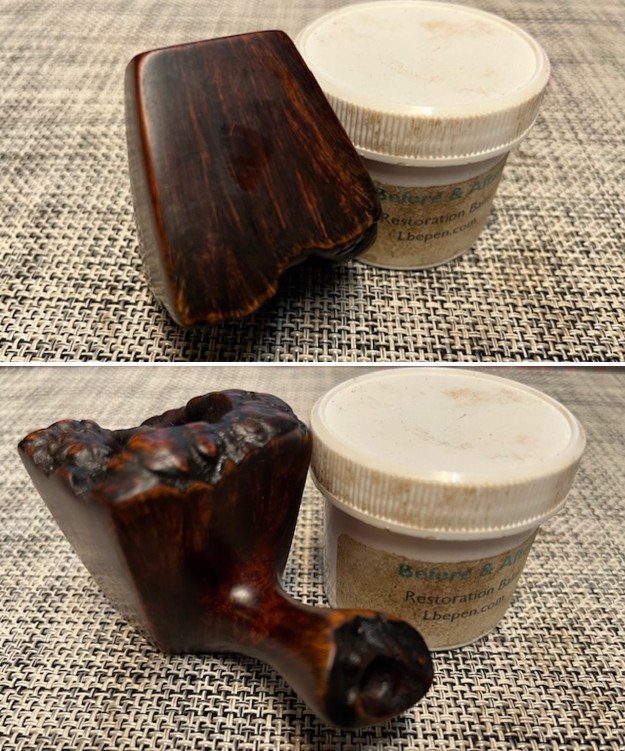
Now it was my turn to work on the pipe. Jeff had done an amazing cleanup of the pipe. He reamed the light cake with a PipNet reamer and cleaned up that with a Savinelli Fitsall Pipe Knife. He scrubbed the internals of the bowl and stem with alcohol, cotton swabs and pipe cleaners. He scrubbed the externals with undiluted Murphy’s Oil Soap and rinsed the bowl off with running water. There were a couple of spots on the front panel of the bowl that looked like flaws and the briar was concave a bit around them. I would need to see what the cause was for that. He soaked the stem in Briarville’s Pipe stem Deoxidizer and once it had soaked rinsed it off with warm water to remove the residual solution. He dried it off and rubbed it down to remove any oxidation that was still on the stem. The pipe looked very good when I received it. I took photos of the bowl and the rim top as well as both sides of the stem to show the condition of the pipe before I started my work. The rim top was very clean and the inner edge and plateau top look much better. The stem showed tooth marks on the top and underside of the stem near the button. I took the stem off the bowl and took a photo of the parts. It is an interesting pipe. I sanded the inside of the bowl to smooth out the walls with 220 grit sandpaper wrapped around a dowel. I was able to remove smooth the residual carbon on the front inner wall of the bowl. There was one small pit mid bowl in the wall at the front that I would need to fill in and repair.I sanded off the stain on the high points on the plateau with 220 grit sandpaper so there would be some contrast between the dark stain in the valleys and matching stain on the high points that is like the rest of the exterior. I did the same on the plateau shank end. It looks very good. I finished working over the plateau with a brass bristle wire brush to further clean it up. There was a divot or dent on the front of the bowl mid-bowl with two small flaws in it. I filled it in with clear CA glue. Once it cured I used the topping board and 220 grit sandpaper to flatten the repair and start the process of blending it into the surface. I further smoothed it out with 320-3500 grit sanding pads. It was looking much better. I sanded the entire bowl with 320-3500 grit sanding pads. I wiped it down with a damp cloth between each sanding pad. It really began to take on a shine. I heated the briar and stained it with a Cordovan stain. I fired it with a lighter to set the stain and burn off the alcohol. I repeated the process until I was happy with the coverage on the pipe. I wiped the bowl down with isopropyl alcohol on cotton pads to remove the excess stain on the briar. It began to look very good. I sanded the bowl with 600-3500 grit sanding pads to even out the stain and smooth the surface of the briar. I rubbed the briar down with Before & After Restoration Balm. I worked it into the plateau rim top surface with my fingertips and a shoebrush. The product works to clean, enliven and preserve the briar. I let it sit for 10 minutes then I buffed it with a cotton cloth to deepen the shine. The briar really comes alive with the balm. I repaired the damaged area on the inside of the bowl with a thin coating of JB Weld. I applied it in the bowl with a pipe cleaner and pushed it into the area with a tooth pick. Once it cured I sanded it smooth with sandpaper wrapped around a dowel leaving only the burned area with the repair. It looked much better and was very smooth. I mixed a batch of bowl coating made of sour cream and activated charcoal powder. I used a pipe cleaner to stir it up and also to apply it to the bowl walls. I wanted to give a coat to protect it until a new cake could be formed. It also covered the repair with the JB Weld and protected it. I set the bowl aside for the bowl coating to cure and turned my attention to the stem. I “painted” it with the flame of a lighter to lift the tooth marks. I was able to lift the majority of them. What remained I filled in with clear CA glue and set it aside to cure. I used a small file to flatten out the repair on the stem and recut the sharp edge of the stem. I sanded out the roughness and smoothed out repaired tooth damage with 320-3500 grit sanding pads. I wiped the stem down after each pad with Obsidian Oil. I was able to remove the roughness and damage and the stem looked better.I polished the vulcanite stem with micromesh sanding pads – 1500-12000 grit pads. I wiped it down with Obsidian Oil after each sanding pad. I used Before & After Pipe Polish – both Fine and Extra Fine to further polish the stem. This nice looking Holtorp Panel Plateau with a taper vulcanite stem is a great looking pipe now that it has been restored. The briar is clean and the grain really came alive. The rich brown stains gave the finish a sense of depth with the polishing and waxing. The grain really popped. I put the stem back on the bowl and buffed the pipe with Blue Diamond on the buffing wheel using a light touch on the briar. I gave the bowl and the stem multiple coats of carnauba wax on the buffing wheel. I buffed the pipe with a clean buffing pad to raise the shine. I hand buffed the pipe with a microfiber cloth to deepen the shine. The finished Holtrop Panel Plateau really is a beauty and feels great in the hand and looks very good. Give the finished pipe a look in the photos below. The dimensions of the pipe are Length: 6 inches, Height: 2 inches, Outside diameter of the bowl: 2 inches x 1 ¾ inches, Chamber diameter: 1 inch. The weight of the pipe is 62 grams/ 2.19 ounces. This beautiful Freehand pipe will soon be on the rebornpipes store in the Danish Pipemakers Secton. It should make a great smoker for the next trustee. Thanks for reading this blog and my reflections on the pipe while I worked on it. It was a fun one to work on.

A Pipe Den Zulu Restoration


Nicely done John. You may be right on the Jobey identification. Looks great

Photographed and written by John M. Young The Pipe Den, the name harkens back to a day of local pipe and tobacco shops which our world appears to …

A Pipe Den Zulu Restoration

Cleaning an El-Is Ferit Orersoy Black Meerschaum Rhodesian with a Yellow Acrylic Stem


Blog by Steve Laug

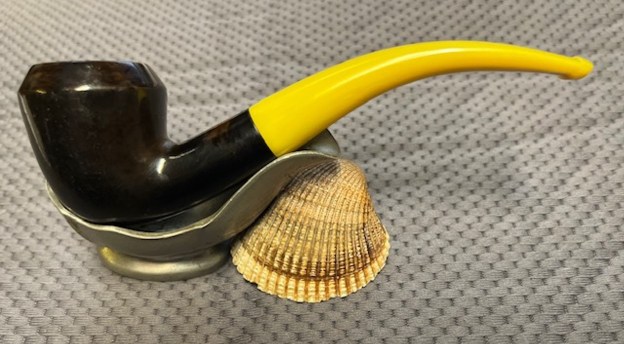
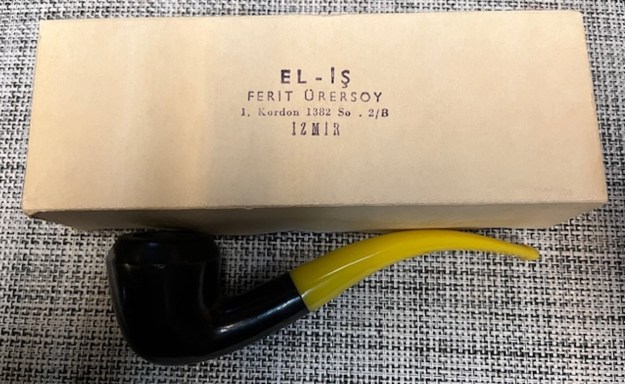
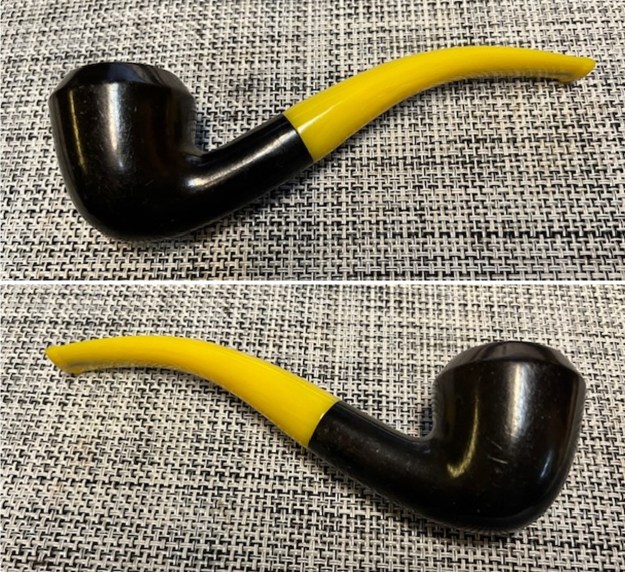
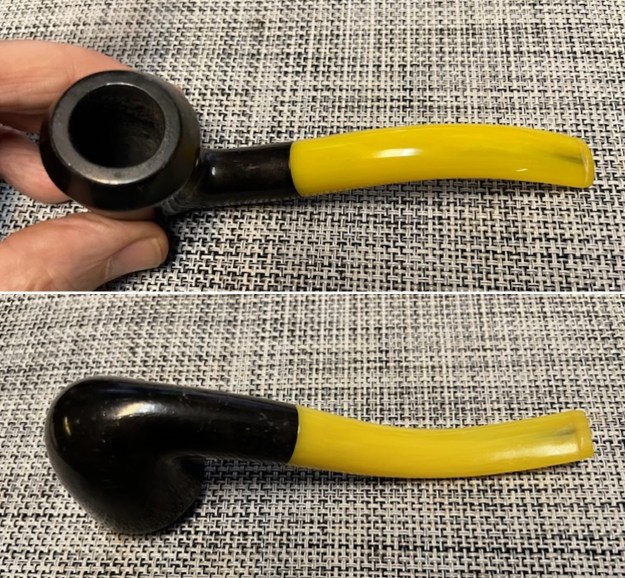
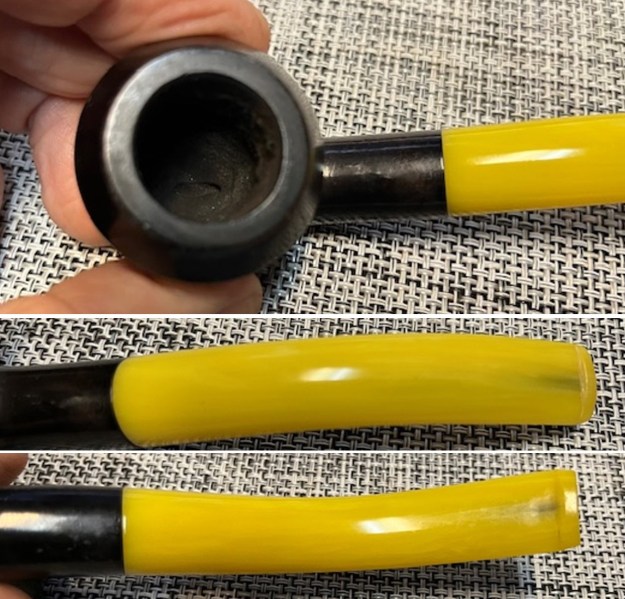
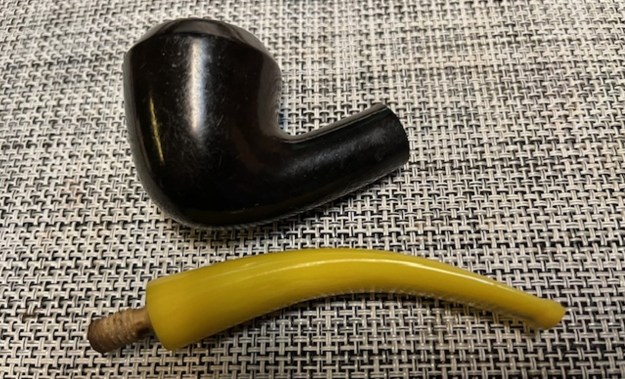
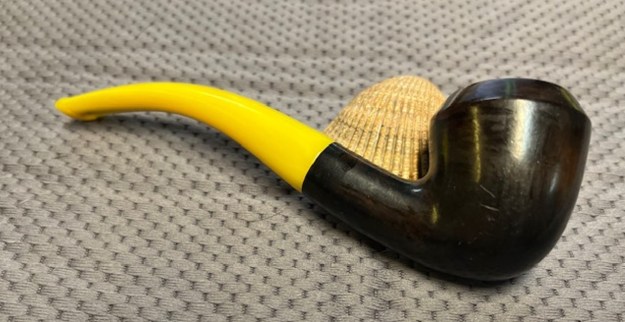
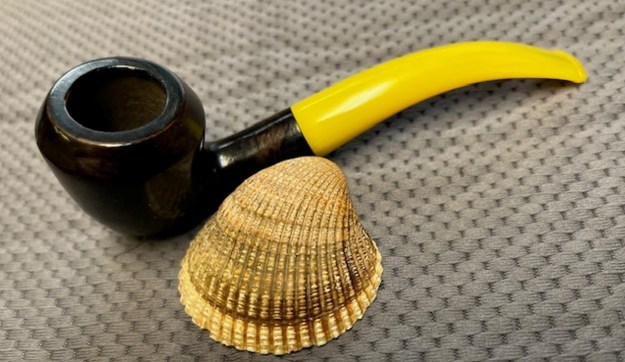
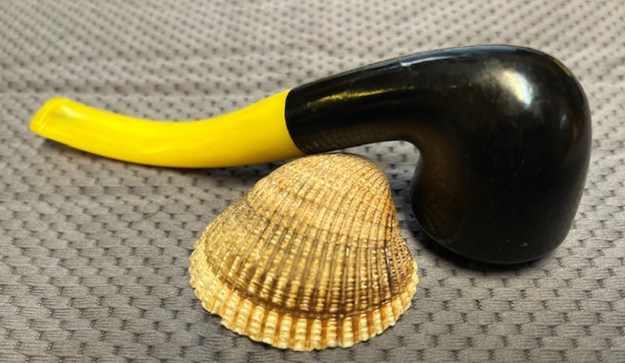
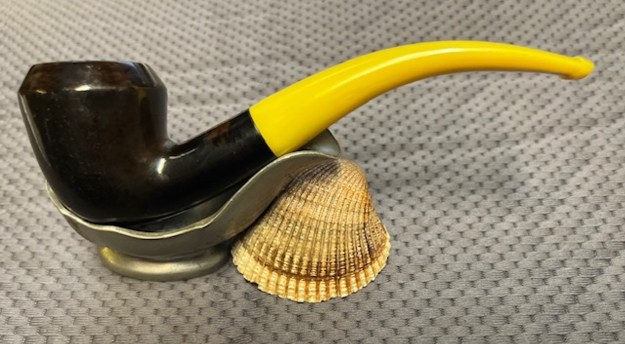
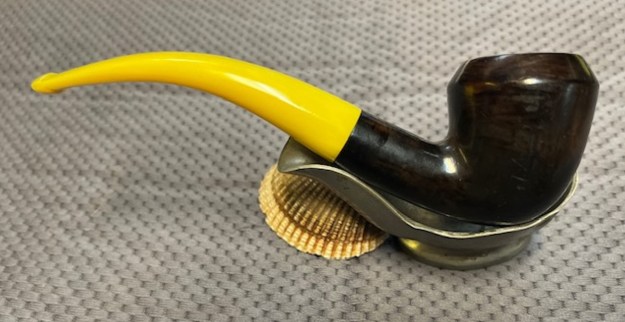
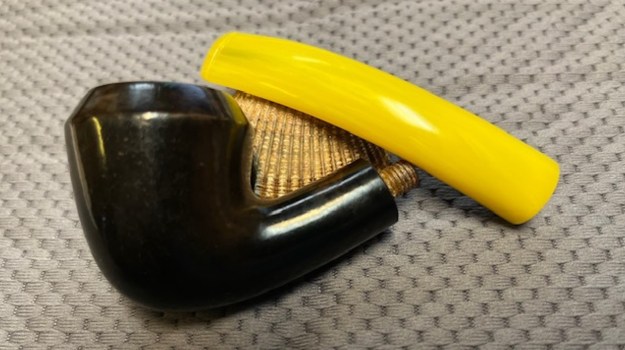
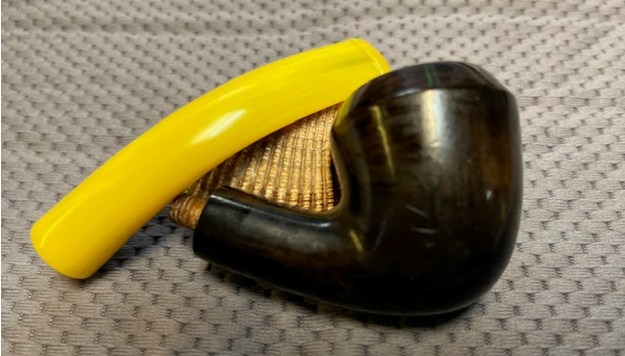
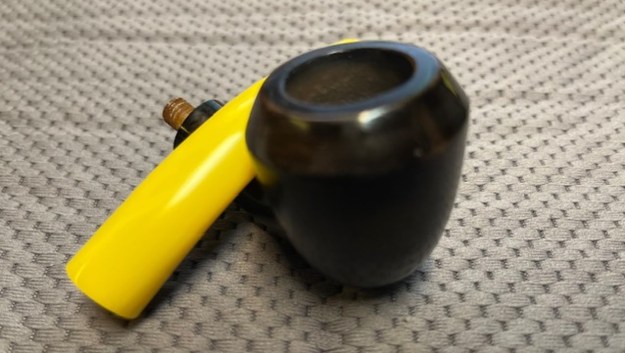
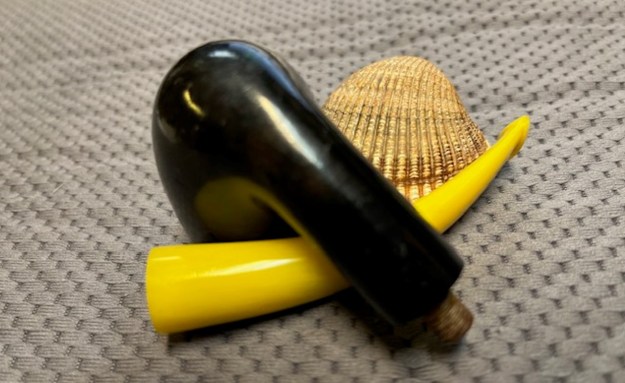
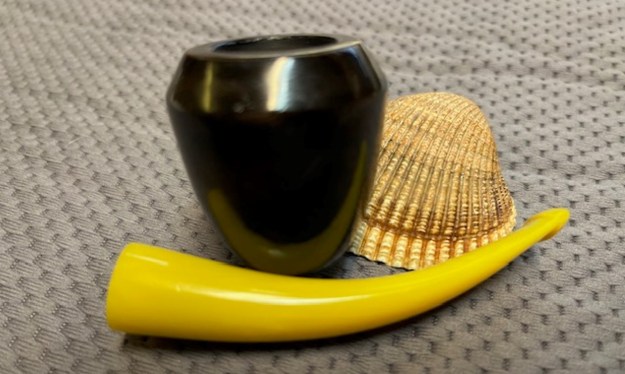
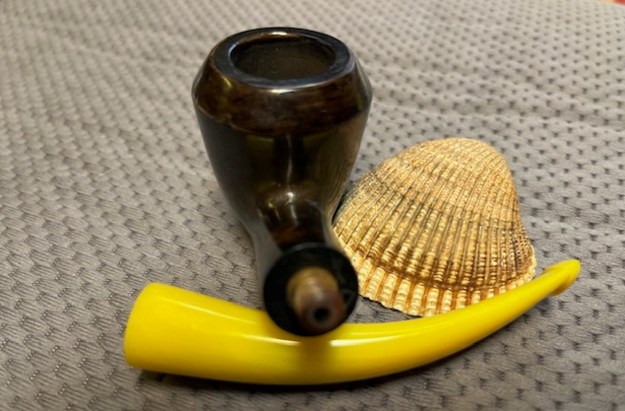
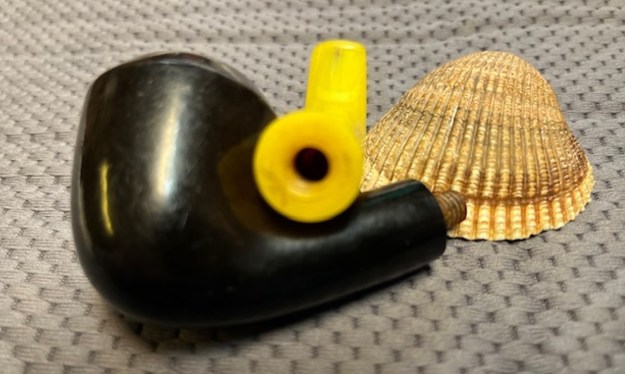
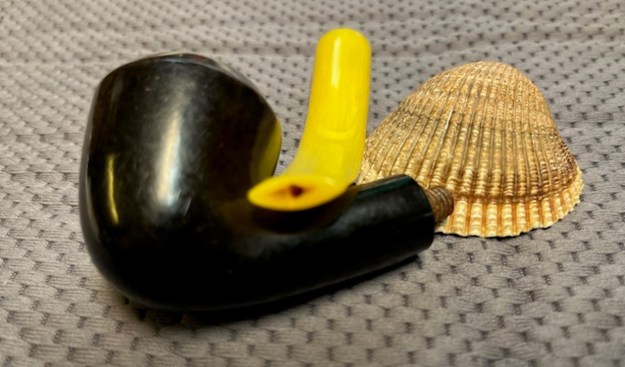
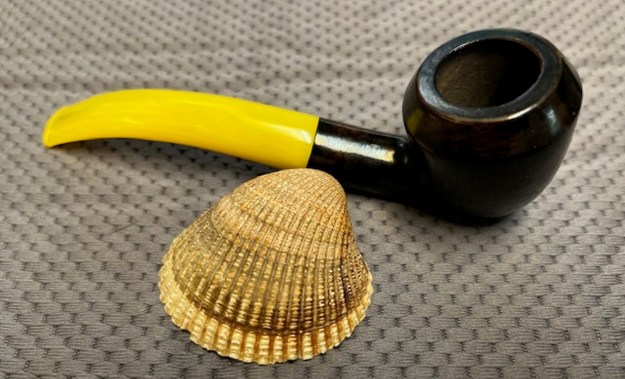
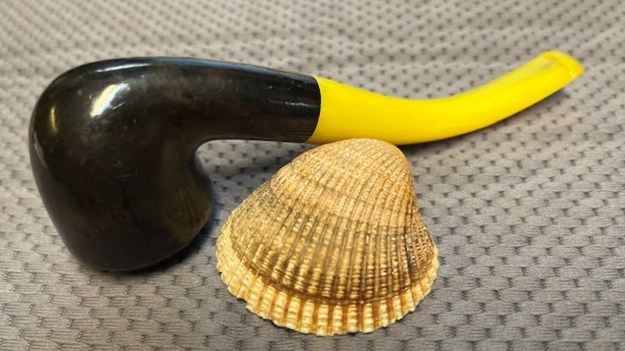
We purchased two of these El-Is Ferit Orersoy Black Meerschaum pipes from a seller in Vilas, North Carolina, USA on 12/01/23. The 2 pipes were both straight Rhodesian style pipes – one with black stem and one with yellow stem. One was smoked and one was clean and unsmoked. Both were boxed in their original cardboard box that is stamped on the top and reads El-Is [over] Ferit Orersoy [over] 1, Kordon 1382 So – 2/8 [over] Izmir. The boxes are light weight and include the original cotton piece the pipe sat on as well as a leaflet on the care of the black meerschaum. The unsmoked pipe will be looked at in the next blog but this one was smoked. It had a light cake in the bowl and some lava overflow on the rim top. The finish was a little spotty where the fingers held it. It would lessen when I cleaned and waxed it. The shank was very dirty as was the bone tenon that held the stem in place. The tenon was threaded into the shank of the pipe first and then the stem screwed onto it to allow for proper alignment. The tenon was lightly stained with tobacco as was the airway in the stem. There was some blackening at the airway’s entrance to the button slot. The pipe smelled dirty and would need to be cleaned up. When I examined it, I noticed a light build up of lava on the rim top. Because of the colour of the meer it is more noticeable to touch than sight. It is a dullness to site. When I was touching it I also felt the inner edge and noticed there was a light cake in the bowl and some tobacco debris. The stem had some darkening in the button area and in the first inch of the airway. There were light tooth marks and chatter on the stem surface. But I knew I would need to give this pipe a good cleaning. I removed the stem to give a sense of the parts and to showing the staining on the bone tenon.I thought I would include the information from the leaflet that is in each box. It is helpful information on the brand and the meerschaum.  I have left out the address on the leaflet as I have included it above. I quote:

THIS PIPE IS MADE FROM PURE BLOCK MEERSCHAUM

Meerschaum is a stone or block mostly found in the Asia Minor. It is imbedded in red clay and usually found 40 to 150 feet under the surface of the ground. Meerschaum is not a clay or mineral but is organic in origin, being fossilized remains of minute sea animals like coral. These little animals died many millions of years ago and the remains of their shells were compressed by earthquakes, washed over repeatedly by the ocean and by floods which deposited earth and rock on top of them, and were moved and shifted by floods and successive glacial movements.

Today, the meerschaum is found only in Asia Minor in sufficient quantity and of quality suitable for commercial use. Meerschaum is very light in weight and is one of the most porous substances found in nature. Consequently, it absorbs nicotine and tobacco is thus filtered in the meerschaum pipe. During the millions of years the outside part of the meerschaum stones or blocks has deteriorated so far that only the kernel of sound meerschaum is left in the middle. The decompose outer parts are 10 to 20 times as much as the sound kernel which is used for pipes.

HAND CARVED

Each pipe is deftly cut by hand and has its own character, and colours gradually as it is smoked, taking on a rich brown colour with the years. The meerschaum is impregnated with wax which helps to give it the beautiful velvety finish for which meerschaum pipes are famous. Each pipe has its own individual character given to it by the artisan who made it.

HOW TO BREAK IN YOUR PIPE

Meerschaum pipes should be broken in much in the same manner as a briar pipe. For the first few smoked, the pipe should be filled only half full and the tobacco packed lightly. This way the outside of the bowl will colour gradually from the bottom up taking on an even, rich brown tone with the years of smoking pleasure. The smoker is cautioned not to touch the warm bowl with his fingers as the moisture left there will affect the eventual colouring.

BLACK MEERSCHAUM PIPES

Not all of us may like a white pipe or some may have preference for the colour of black, so quite rightly they may like to have a black meerschaum pipe. El-Is proudly present black meerschaum pipes. An El-Is specialty, in order to meet its customers demands. These pipes are not painted but given their colour by way of pyrography and then polished. This way, the pipe does not lose its characteristics and retain its colour even after extended usage.

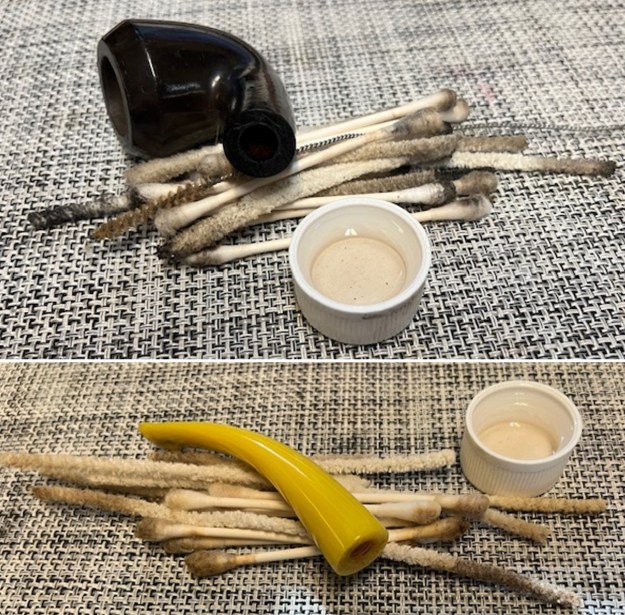
Now it was time to clean up the pipe itself. I carefully scraped the cake out of the bowl with a Savinelli Fitsall Pipe Knife. I took all the cake out then sanded the bowl walls with 220 grit sandpaper wrapped around a piece of dowel. Once I finished the bowl was clean and all cake was a thing of history.I cleaned out the dirty internals in the airway in the shank, the mortise and the airway in the stem with pipe cleaners, cotton swabs and 99% isopropyl alcohol. It took a few to get it cleaned but eventually the cleaners came out clean. I also wiped down the top of the rim with a cotton pad dampened with alcohol and was able to remove the lava coat.I lightly polished the rim top with micromesh sanding pads – dry sanding with 1500-1200 grit pads and lightly wiping the rim top down with a damp cloth after each pad. It cleaned up very well. I rubbed down the surface of the meerschaum with Before & After Restoration balm. I worked it into the surface of the meer to clean, polish and preserve the pipe. It looks good and the spottiness of the black finish looked much better. I applied several coats of Clapham’s Beeswax/Carnauba mix to the surface of the meerschaum. I set it aside to dry between coats and gave it a brisk buff with a soft cloth after each one dried. I set the bowl aside and turned my attention to the stem. There was a deep tooth divot on the underside of the stem ahead of the button. I filled it in with clear CA glue. Once it cured I sanded it smooth with 220 grit sandpaper.I polished the acrylic stem with micromesh sanding pads – dry sanding with 1500-12000 grit pads. I wiped the stem down after each pad with some Obsidian Oil. I finished polishing it with some Before & After Pipe Stem polish – both Fine and Extra Fine. I wiped the stem down with a final coat of Obsidian Oil. The stem took on a rich glow. This nice looking El–Is Black Meerschaum Bent Rhodesian with a yellow acrylic bent taper stem is a great looking pipe now that it has been restored. The black meerschaum is clean and the light weight bowl has a rich glow to it. I put the bone tenon in the shank and then attached the stem to align correctly. If the tenon is in the stem first it does not align with the shank correctly but in the shank it aligns correctly. I put the stem back on the bowl and carefully/lightly buffed the pipe with clean buffing wheel using a light touch on the meer. I gave the bowl and the stem multiple coats of Claphams Beeswax mixed with Carnauba and hand buffed the pipe with a microfiber cloth to deepen the shine. The finished El-Is Black Meerschaum Bent Rhodesian really is a beauty and feels great in the hand and looks very good. Give the finished pipe a look in the photos below. The dimensions of the pipe are Length: 5 ½ inches, Height: 1 ¾ inches, Outside diameter of the bowl: 1 ½ inches, Chamber diameter: ¾ of an inch. The weight of the pipe is 33 grams/21.16 ounces. This beautiful pipe will soon be on the rebornpipes store in the Ceramic & Meerschaum Pipes Section. It should make a great smoker for the next trustee. Thanks for reading this blog and my reflections on the pipe while I worked on it. It was a fun one to work on.

Restoring a Ferndown Bark Antique *** Hand Made in England Les Wood Dublin


Blog by Steve Laug

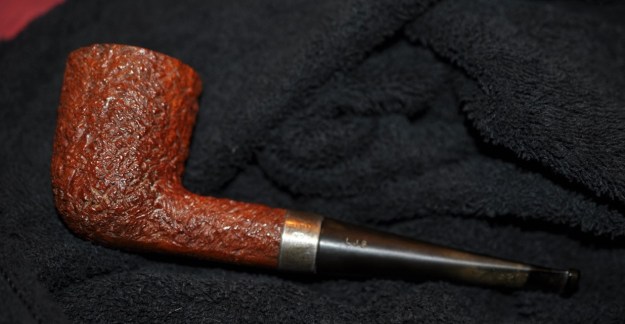
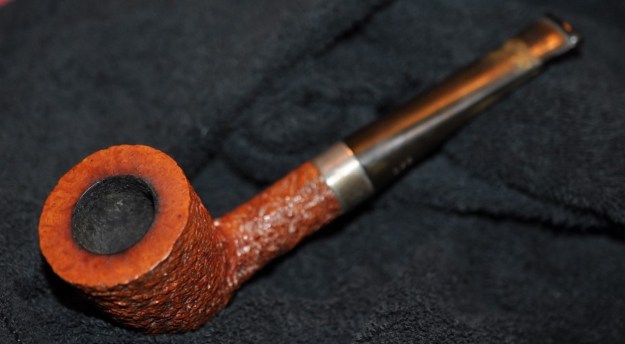
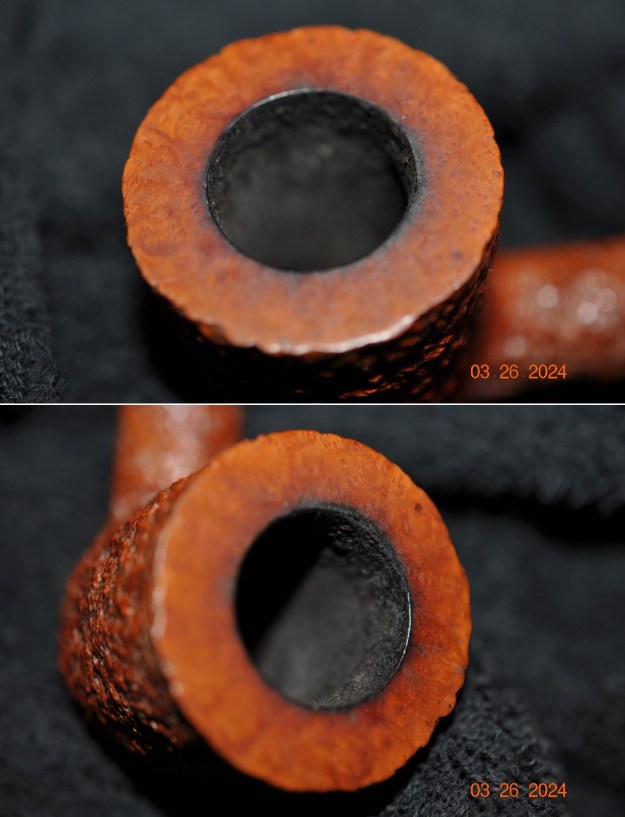
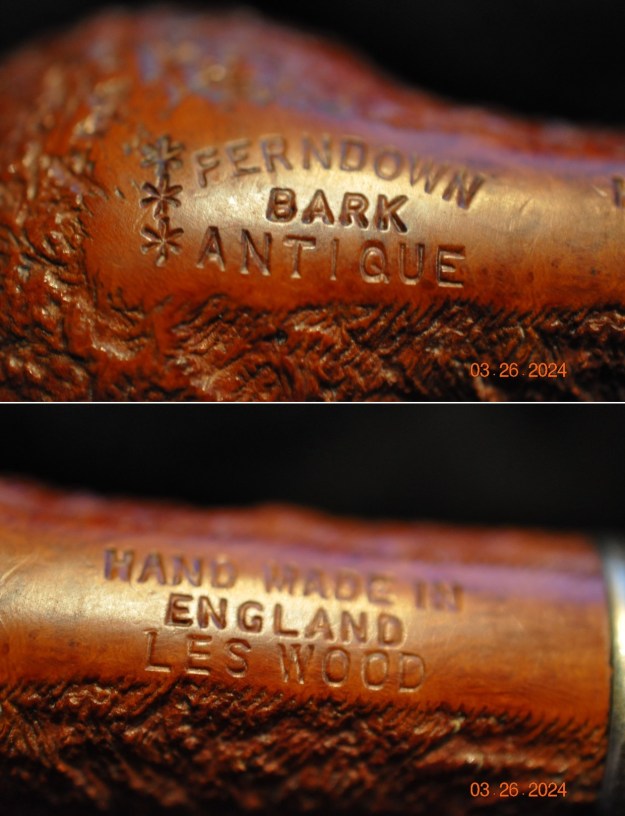
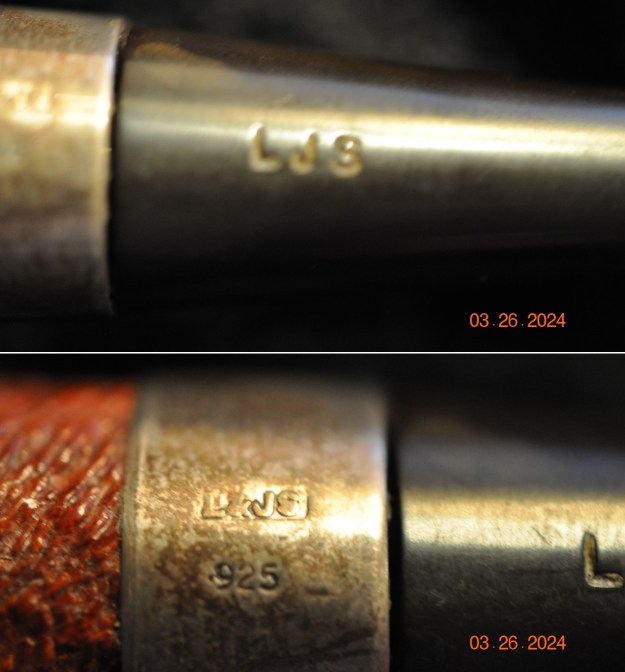
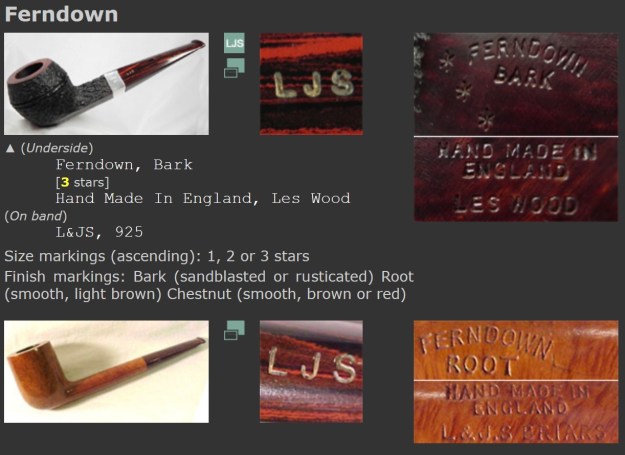
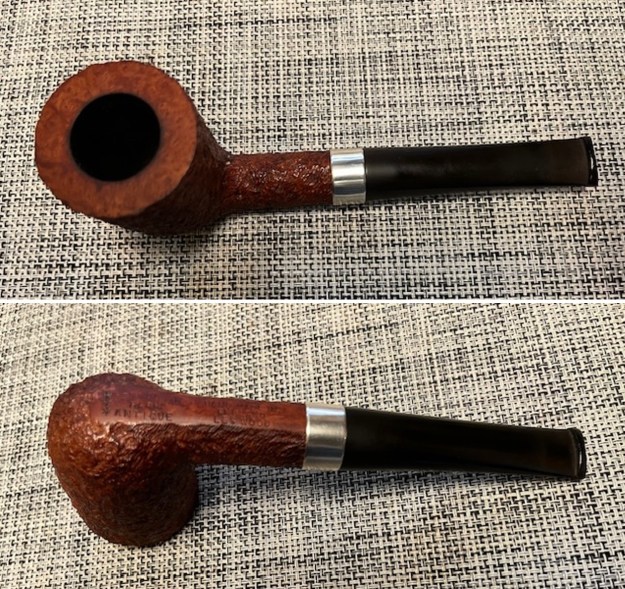
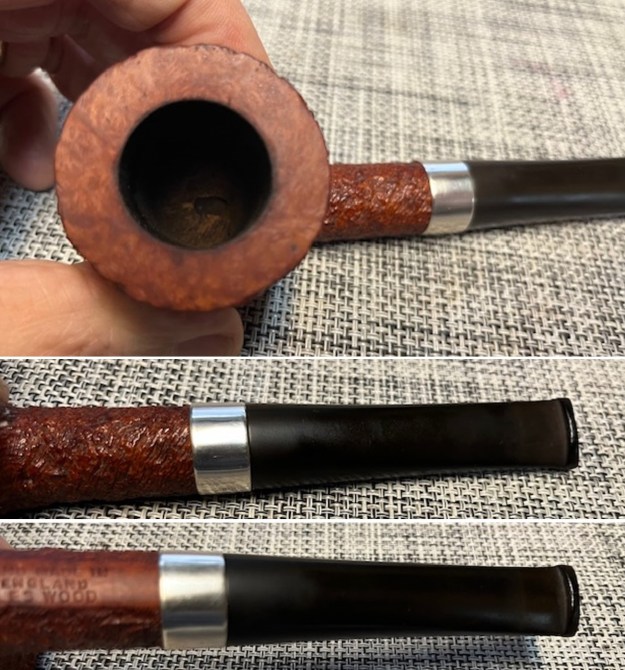
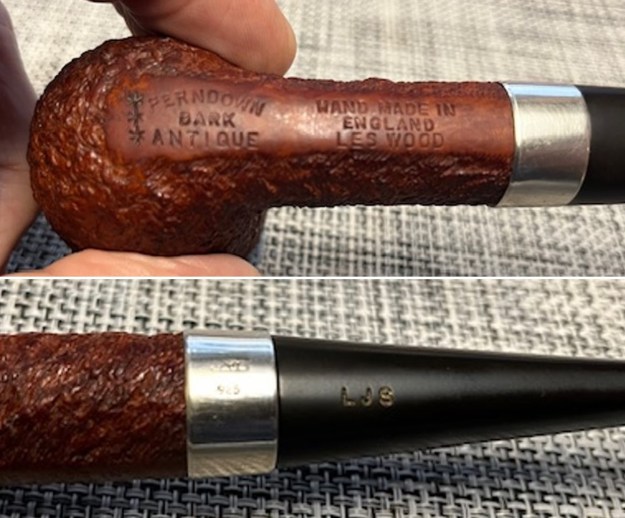
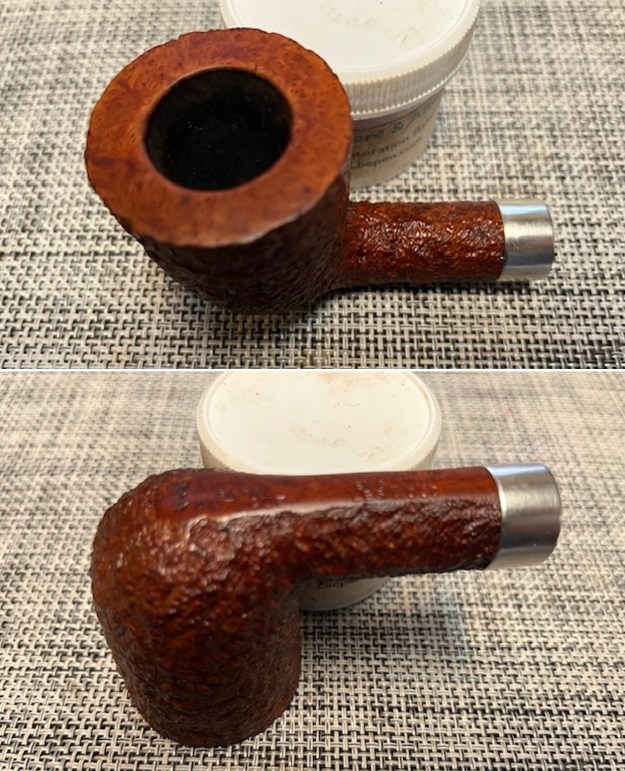
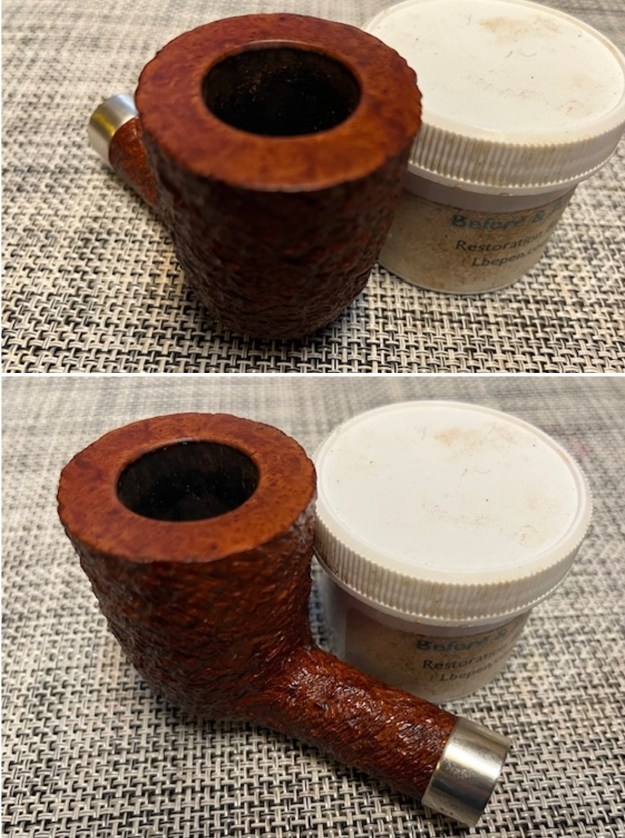
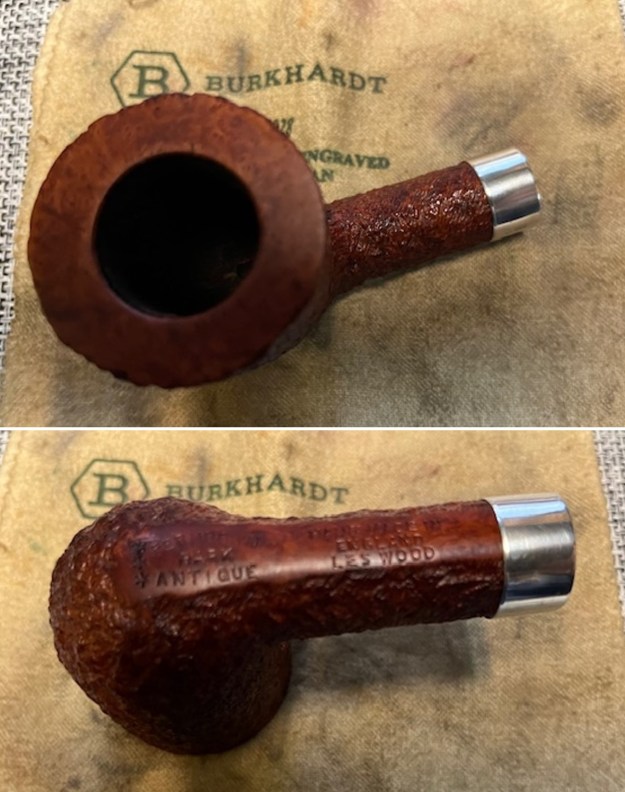
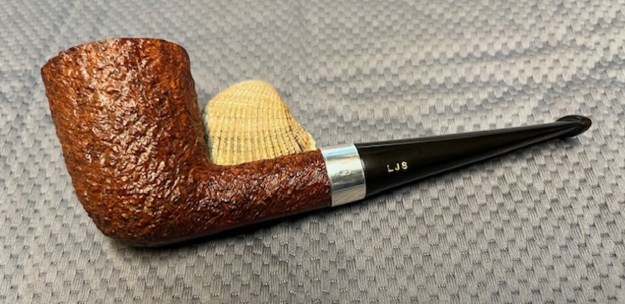
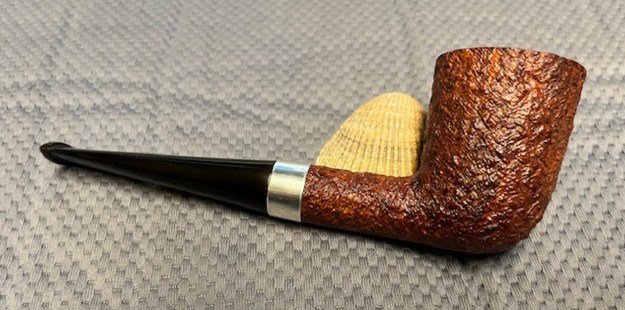
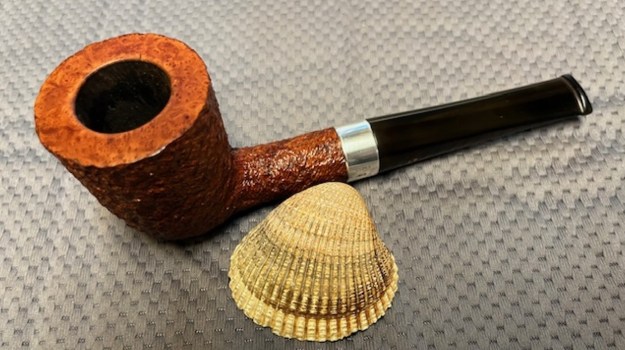
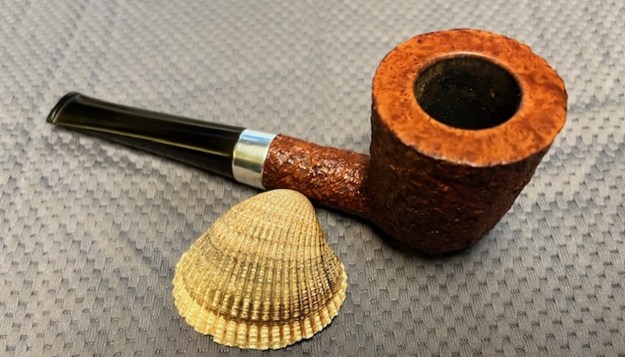
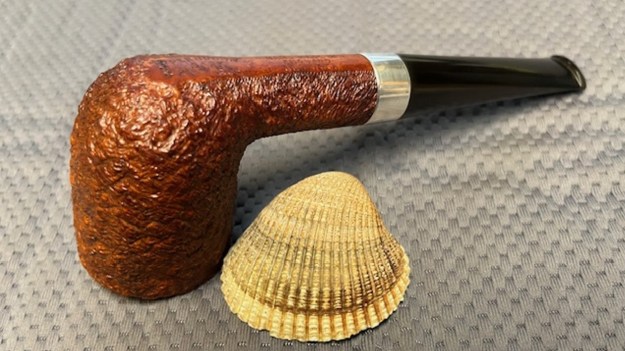
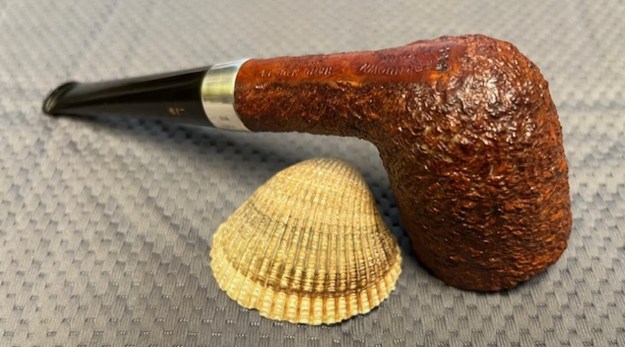
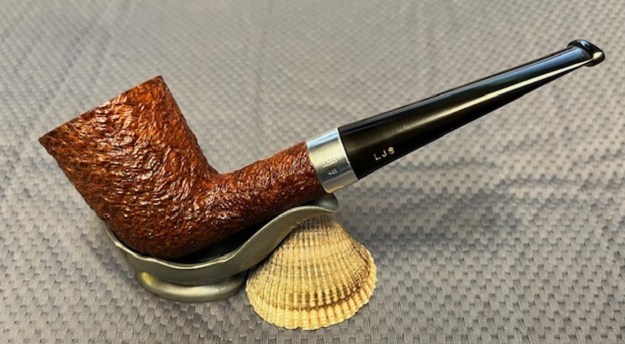
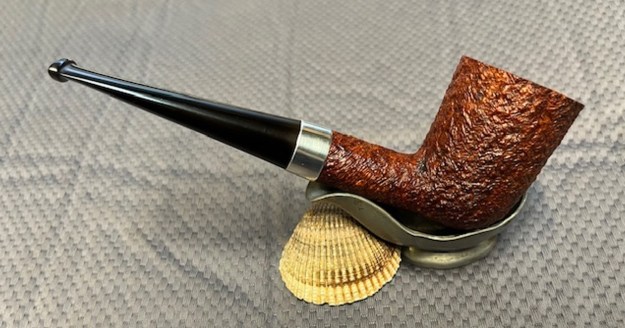
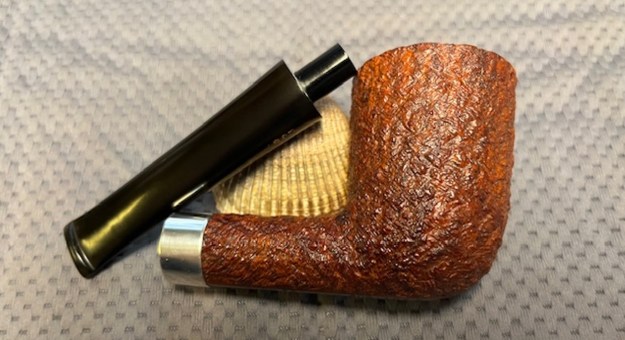
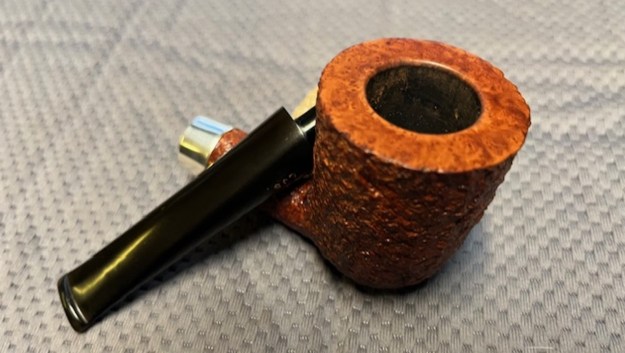
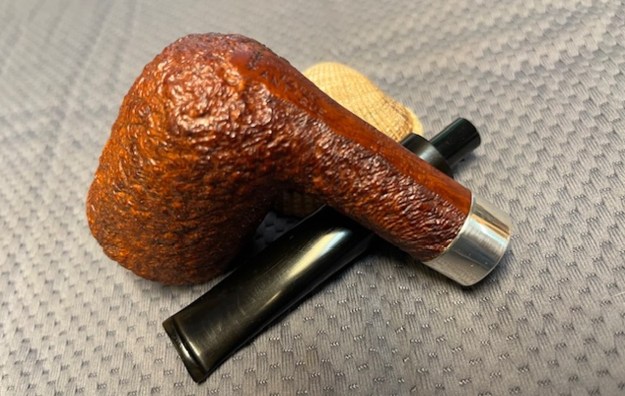
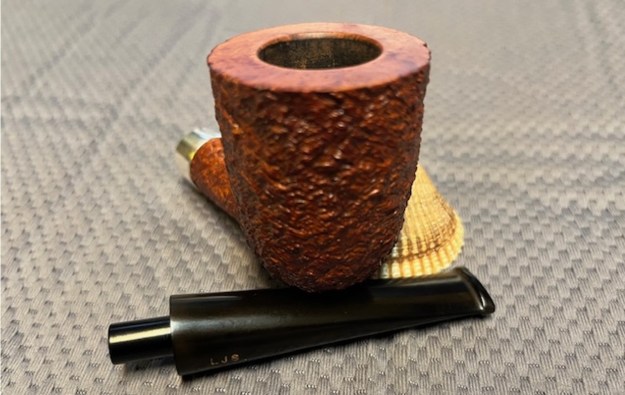
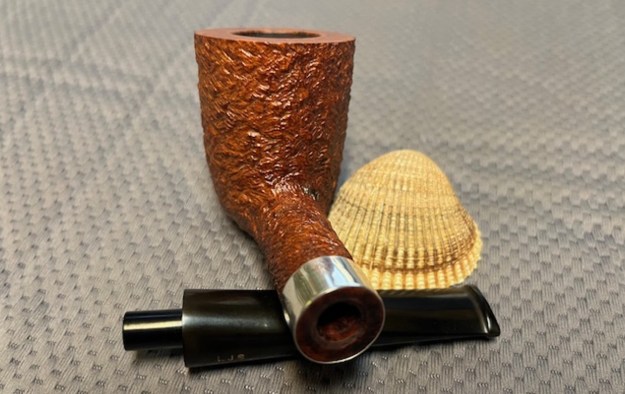
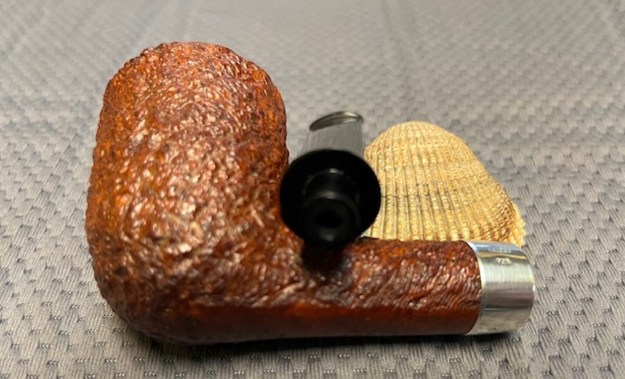
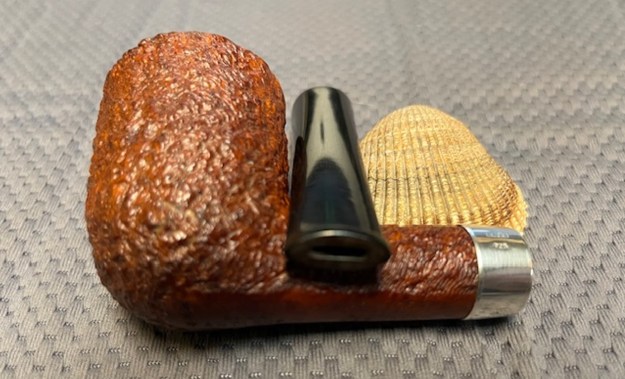
The next pipe on the table is a beautiful rusticated Dublin with a silver band. We purchased it from an estate sale in Oregon City, Oregon, USA on 03/21/2024.The pipe is stamped on a smooth panel on the underside of the shank and reads *** followed by Ferndown [arched over] Bark [over] Antique followed by Hand Made In [over] England [over] Les Wood. There was a thick cake in the bowl with a lava coat around the inner edge and lightly on the top. There was grime ground into the rusticated finish around the bowl and shank. The pipe had been smoked heavily and was someone’s obvious favourite. It was hard to know the condition of the inner edge for certain because of the lava. The oxidized band on the shank is Sterling Silver and bears the stamp L&JS followed by 925 on the left side. There is an LJS logo stamped in gold on the left side of the taper stem. The stem is oxidized and calcified. With a mark left behind on the stem end from a Softee Bit. There appears to be some light tooth chatter on the top and underside of the stem ahead of the button. Jeff took photos of the pipe before he started his clean up work. I have included them below. Jeff took photos of the rim top, bowl and the surfaces of the stem to give a sense of the condition of the pipe. The walls of the bowl had a thick cake which overflowed over the rim edges and onto the rim top. The stem is oxidized, calcified and dirty. There are light tooth marks on both sides ahead of the button. He took photos of the sides and heel of the bowl to give a clear picture of the way the shape follows the grain. The rustication is really beautiful even showing through the grime filling in the valleys and low spots. The depth and randomness of the rustication is very well done. He took photos of the stamping on the smooth panel on the underside the heel and the shank. It is clear and readable and read as noted above. The silver band and the left side of the taper both have clear stamping under the oxidation that reads as noted above. To gather backgound on the brand I turned to Pipephil’s site to see what was included in the listing there (http://www.pipephil.eu/logos/en/logo-f1.html). I have included both the screen capture and also the side bar below the photo I have included.Artisan: Leslie (Les) Wood. He was the master silver smith at Alfred Dunhill Ltd. before starting L. & J.S. Briars. Pipes for the European market are stamped “L. Wood” while those for US are stamped “Ferndown”. Production: ~ 2000 pipes/year (Ferndown + L.Wood) See also Elwood
The first pipe pictured in the screen capture above is stamped similarly to mine. From that listing I learned that the 3 stars was the designation for the size of the pipe. This is largest pipe. The Bark finish is a designation used for both sandblasted and rusticated. I still need to unpack the Antique stamp but it is becoming very clear. The stem on this one is also not Cumberland but rather black vulcanite.

I turned to Pipedia next (https://pipedia.org/wiki/Ferndown). There is a great article there on the carver, the pipes and the workshop. It is worth the time to give it a read. I am quoting the section on the pipes below for the information included.

Due to the vagaries of international trademark law, he sold his earlier pipes as ” L.&J.S Briars”, “Ellwood”, “Les Wood” or “L. Wood”. Until recently, an average of 1500 – 2000 pipes a year were sold as “Ferndown” — named for the mansion he lives in — in the UK and US, but as “L. Wood” pipes in Germany

…To many pipe smokers, Les Wood’s pipes embody the revival of great English pipe making initiated by Ashton in the early 1980s. The high-grade Italian and Spanish plateau he prefers is oil-cured in the tradition of both Dunhill and Ashton. The pipes are renowned for their pleasant, slightly nutty flavor and remarkable smoking characteristics. They feature impeccable craftsmanship extending to very good stem/bit work, though many pipes are often a bit heavier. The hallmark of his work, of course, is the excellent silver work. Almost all of his pipes feature rings or ferules for spigot stems. Grading is by finish: “Bark” (ca. 90%, rusticated, dark brown and black), “Antique Bark” (tan rusticated), “Reo” (brown and red, smooth), “Root” (orange, smooth), and “Tudor Root” (orange and brown smooth) and by size (one to four stars). He also designates straight grains with SG.

The pipe I am working on is as noted above a Ferndown which identifies it as a pipe named after his mansion and as a pipe made for the UK and the US. It is also as noted in red above stamped Antique Bark which identifies it as a tan rusticated pipe.

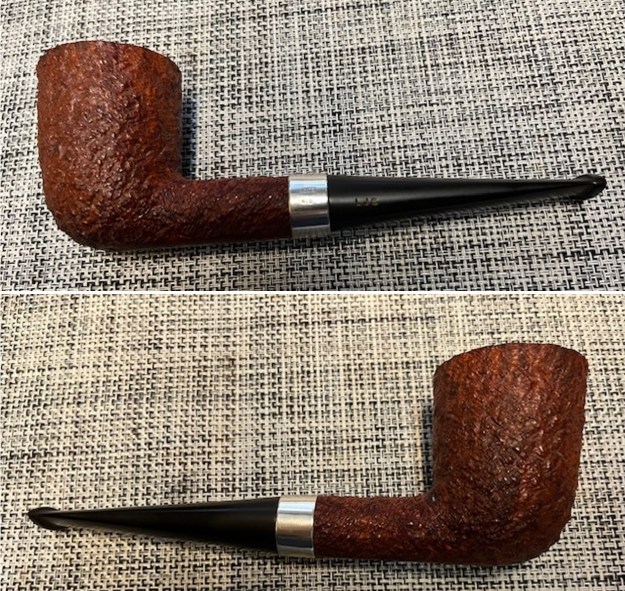
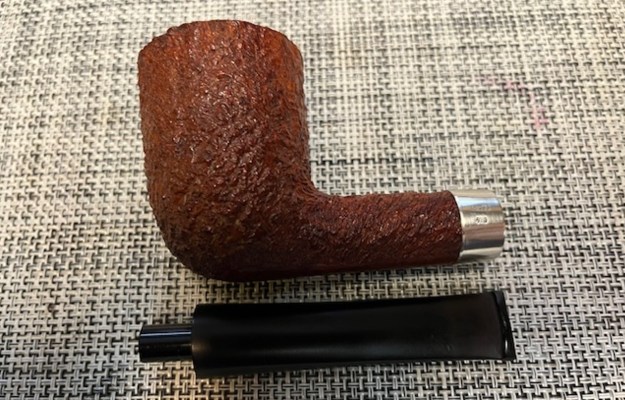
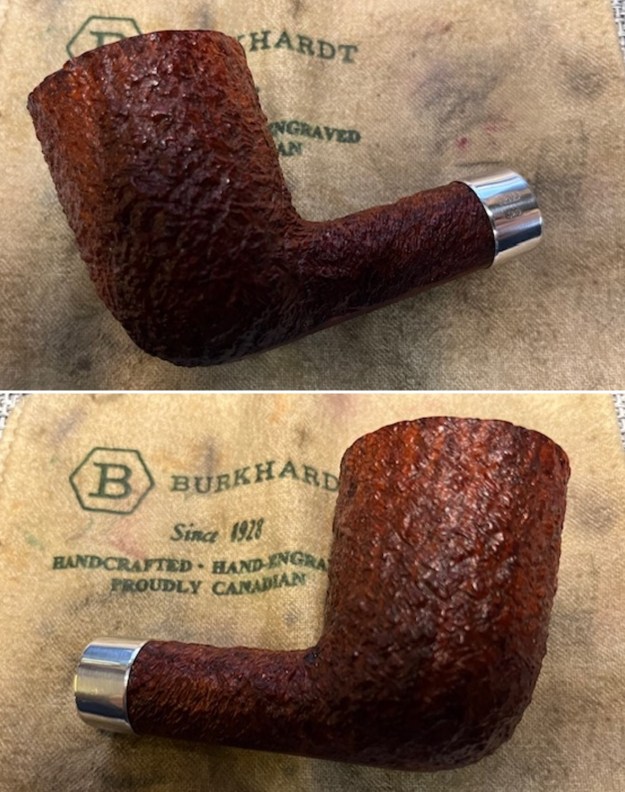
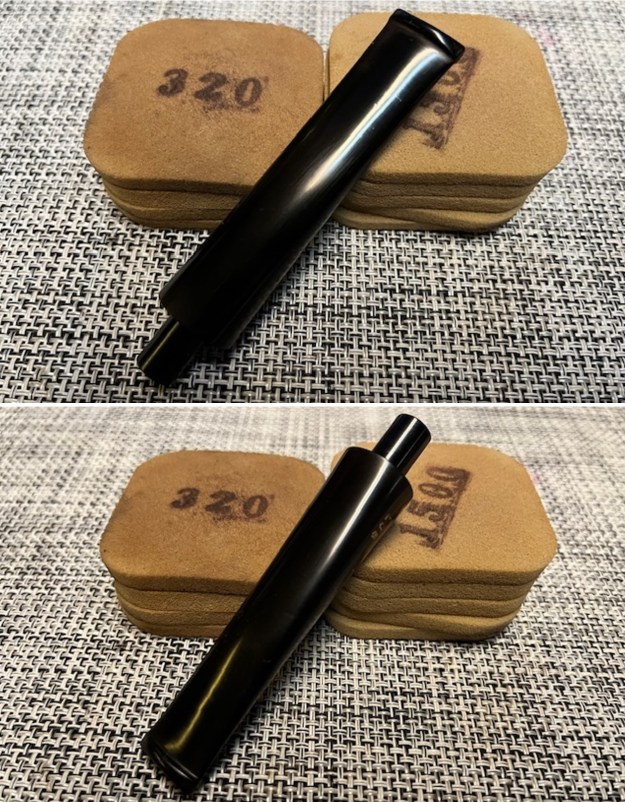
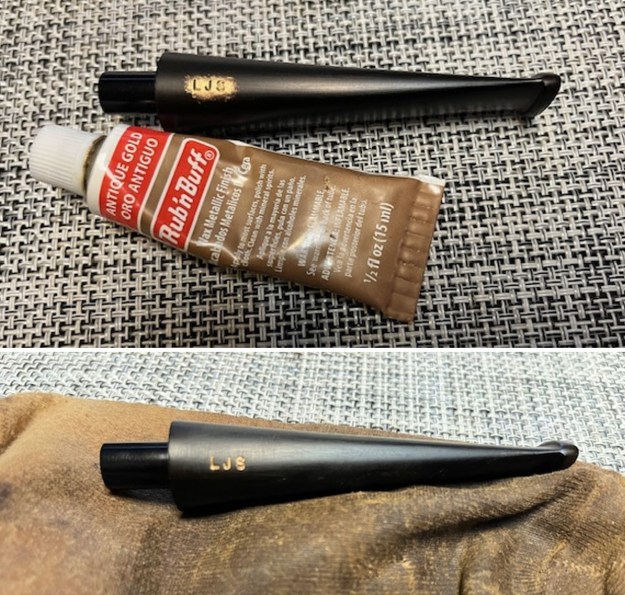
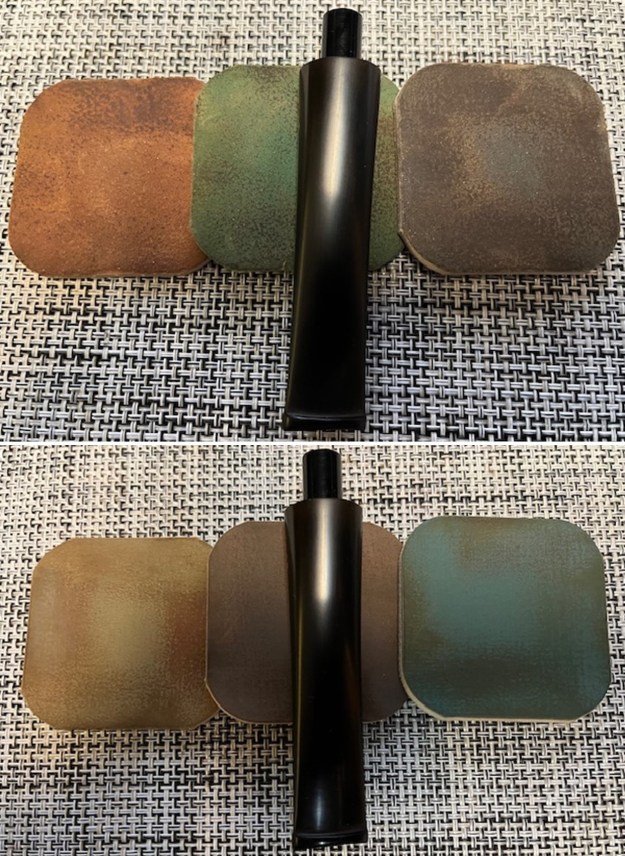
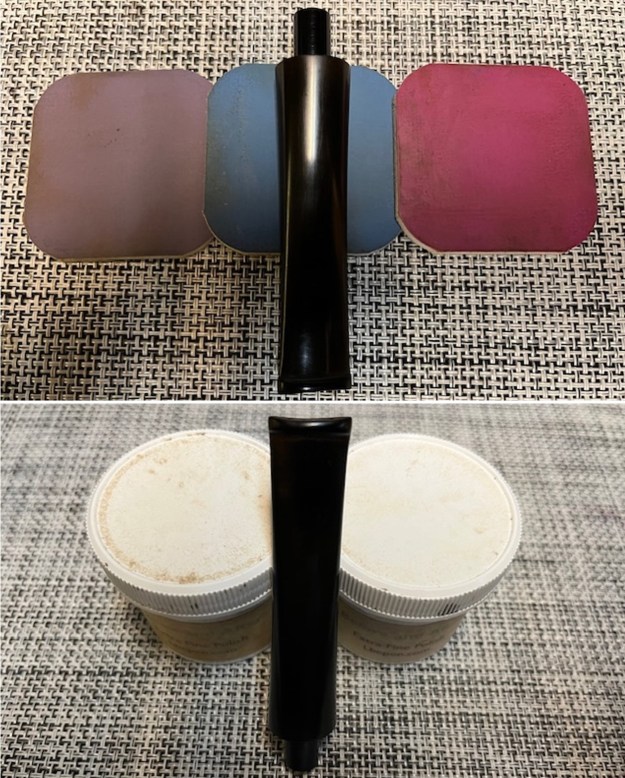
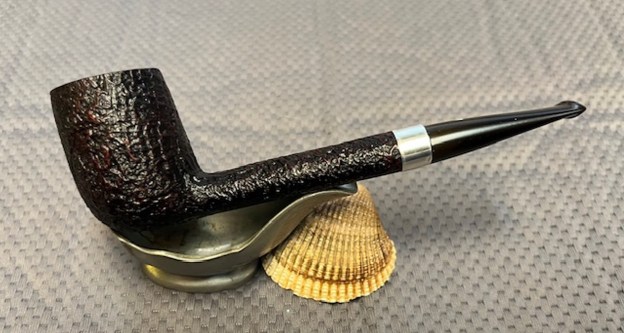
Now it was my turn to work on the pipe. Jeff had done an amazing cleanup of the pipe. He reamed the light cake with a PipNet reamer and cleaned up that with a Savinelli Fitsall Pipe Knife. He scrubbed the internals of the bowl and stem with alcohol, cotton swabs and pipe cleaners. He scrubbed the externals with undiluted Murphy’s Oil Soap and rinsed the bowl off with running water. He soaked the stem in Briarville’s Pipe stem Deoxidizer and once it had soaked rinsed it off with warm water to remove the residual solution. He dried it off and rubbed it down to remove any oxidation that was still on the stem. The pipe looked very good when I received it. I took photos of the bowl and the rim top as well as both sides of the stem to show the condition of the pipe before I started my work. The rim top was very clean but there were scratches on the flat surface and the inner edge showed some nicks, roughness and darkening. The Sterling Silver band looked much better without the oxidation and darkening. The stem showed light tooth marks on the top and underside of the stem near the button. There was a light mark on the top right of the button edge.I took a photo of the stamping on the underside of the shank. The photo of the stamping is clear and readable. I took a photo of the logo on the silver band and on the left side of the taper stem. I removed the stem from the shank and took a photo of the pipe parts. I started my work on the pipe by addressing the darkening to the inner edge of the bowl. I used a folded piece of 220 sandpaper to smooth out the rim edge. Once I was finished it looked much better.I polished the smooth rim top with micromesh sanding pads. I dry sanded it with 1500-12000 grit sanding pads and wiped the bowl down after each pad with a damp cloth. By the final pads the briar really had a shine. I rubbed the briar down with Before & After Restoration Balm. I worked it into the smooth rim top surface with my fingertips and into the heavy rustication with a shoebrush. The product works to clean, enliven and preserve the briar. I let it sit for 10 minutes then I buffed it with a cotton cloth to deepen the shine. The briar really comes alive with the balm. I polished the silver band with a jeweller’s cloth to clean up and prevent further oxidation in the future. The contrast between the silver and the heavy rustication is very nice. I set the bowl aside and turned my attention to the stem. I sanded out the roughness and light tooth damage with 320-3500 grit sanding pads. I wiped the stem down after each pad with Obsidian Oil. I was able to remove the roughness and damage and the stem looked better.I touched up the LJS stamp on the left side of the taper stem with Rub’n Buff Antique Gold. I rubbed it on and worked it into the stamp with a tooth pick. I buffed it off with a Obsidian Oil cloth. It looks very good.I polished the vulcanite stem with micromesh sanding pads – 1500-12000 grit pads. I wiped it down with Obsidian Oil after each sanding pad. I used Before & After Pipe Polish – both Fine and Extra Fine to further polish the stem. This nice looking Les Wood Ferndown Bark Antique *** Rusticated Dublin with a taper vulcanite stem is a great looking pipe now that it has been restored. The briar is clean and the grain really came alive. The rich brown stains gave the finish a sense of depth with the polishing and waxing. The grain really popped. I put the stem back on the bowl and buffed the pipe with Blue Diamond on the buffing wheel using a light touch on the briar. I gave the bowl and the stem multiple coats of carnauba wax on the buffing wheel. I buffed the pipe with a clean buffing pad to raise the shine. I hand buffed the pipe with a microfiber cloth to deepen the shine. The finished Ferndown Bark Antique *** Dublin really is a beauty and feels great in the hand and looks very good. Give the finished pipe a look in the photos below. The dimensions of the pipe are Length: 6 inches, Height: 2 inches, Outside diameter of the bowl: 1 ¾ inches, Chamber diameter: 7/8 of an inch. The weight of the pipe is 66 grams/2.33 ounces. This beautiful rusticated pipe will soon be on the rebornpipes store in the British Pipemakers Secton. It should make a great smoker for the next trustee. Thanks for reading this blog and my reflections on the pipe while I worked on it. It was a fun one to work on.
Restoring a Comoy’s Consort 1057 Rhodesian with an Acrylic Saddle Stem


Blog by Steve Laug

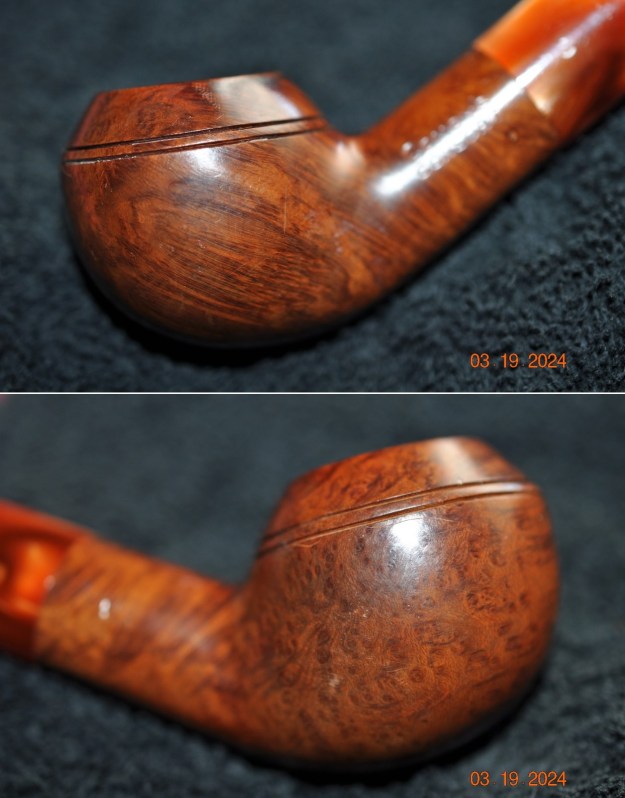
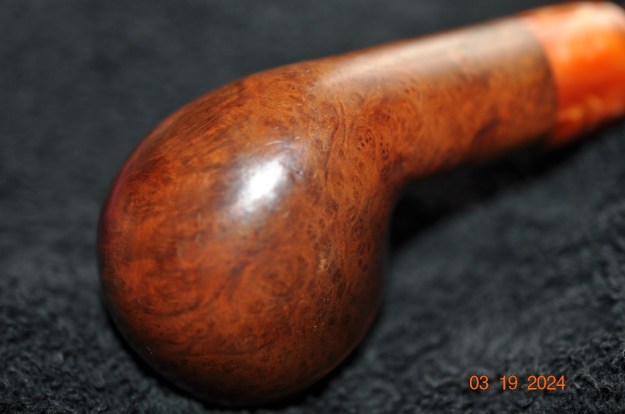
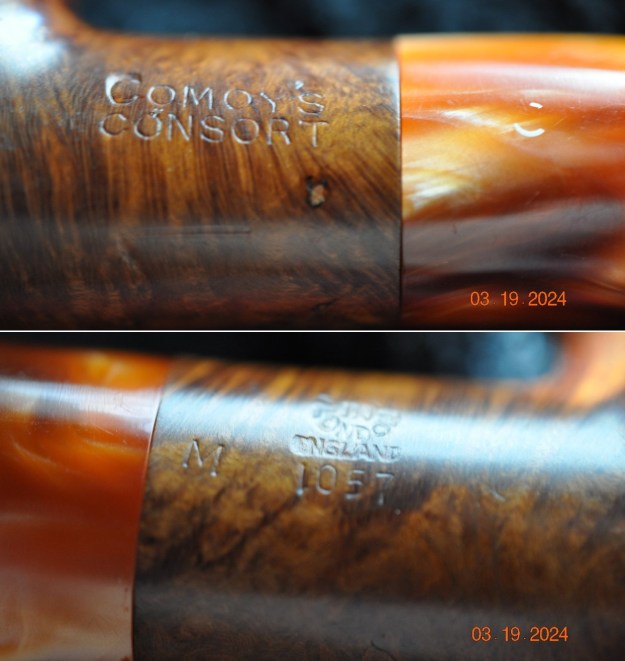
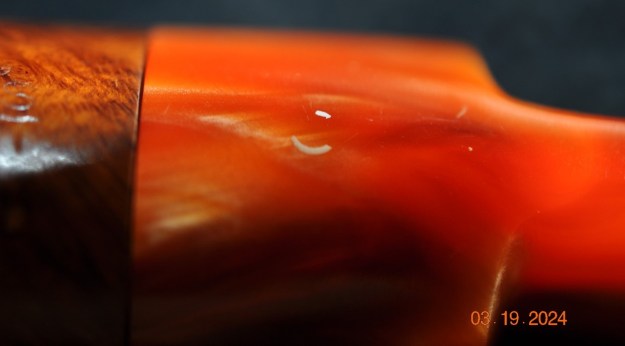
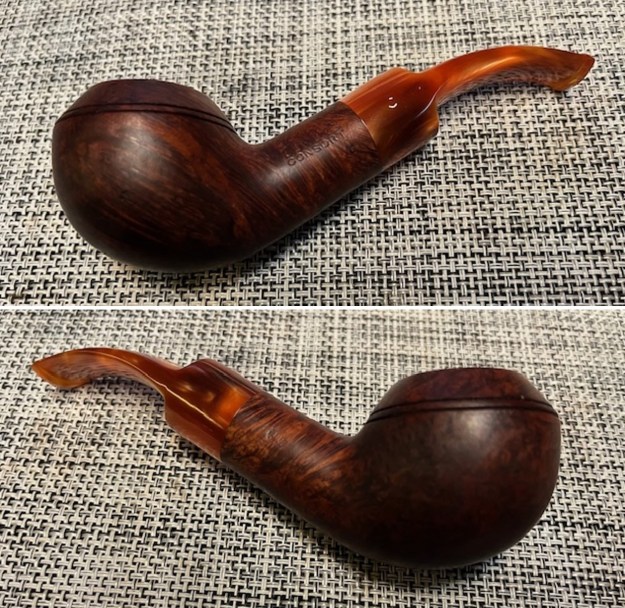
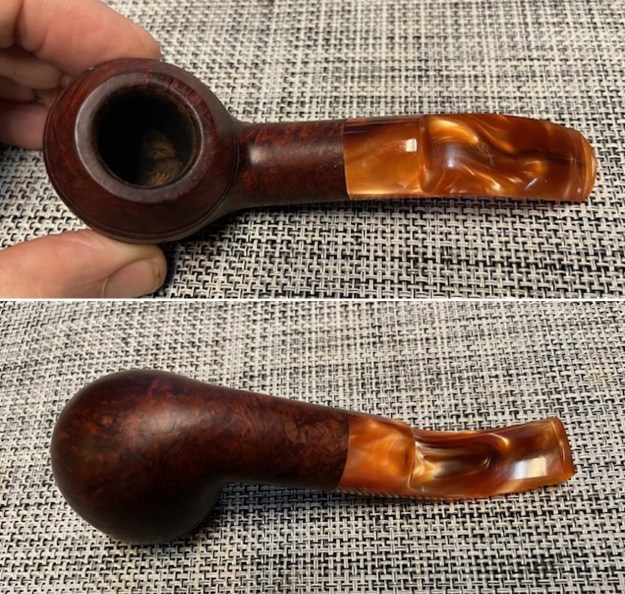
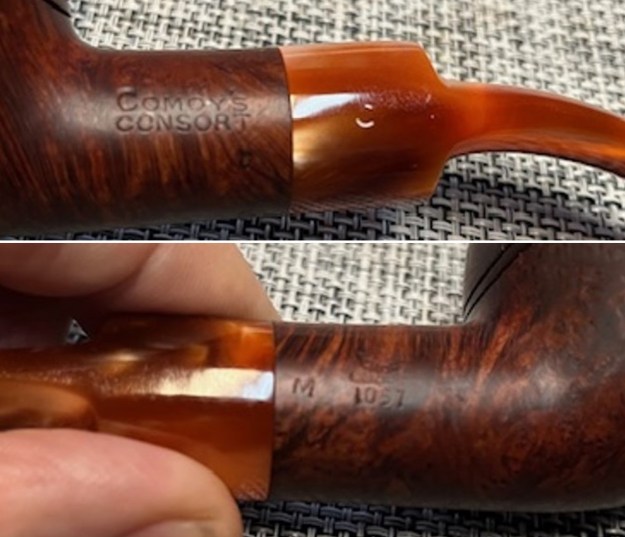
The next pipe on the table is a great looking Bent Rhodesian with great grain around the bowl. It has a well shaped variegated acrylic stem. We purchased it from an estate sale in Spring Branch. Texas, USA on 02/29/2024. I have included the photos below that the seller sent to me so I could see what the pipe looked like. When the pipe arrived Jeff took photos of it before cleaning it up. Here is what we saw. The pipe is stamped on the left side of the shank and reads Comoy’s [over] Consort. On the right side it is stamped Made in London in a circle [over] England. Underneath the COM stamp is the shape number 1057. To the left of that next to the stem shank junction it is stamped with a letter M. The acrylic stem has the newer Comoy’s C logo worn decal on the left side of the saddle. The bowl had been reamed recently and the inner edge of the bowl looked very good. The rim top has some grime and some lava on the surface. There were oils and grime ground into the bowl sides gives the finish a flat look though there is some great grain. The shank has a slight curve to it giving the pipe a Bent Rhodesian shape. The bend of the saddle stem matches the curves of the bowl and shank. The variegated rose acrylic stem is a dirty and has some light tooth chatter on both the top and underside of the stem just ahead of the button.He took photos of the pipe’s bowl and rim top to show the reamed bowl and the spotty lava coat overflowing onto the top. He also took photos of the stem to capture its condition before clean up. He took photos of the sides and heel of the bowl to show the rich grain around the bowl and the amount of grime ground into the surface of the briar.   He took photos of the stamping on the sided of the shank. It is clear and quite readable. It reads as noted above. You can also see the decal of the Comoy’s logo on the side of the stem. It is worn off in places but still identifiable. I knew the pipe was probably newer and a Cadogan period pipe by the style of the stamping, the line and the acrylic stem but I wanted to see if I could get a cleared date on the pipe. I turned to Pipedia’s guide for dating Comoy’s pipes and have included what I found below (https://pipedia.org/wiki/Comoy%27s_Dating_Guide#%E2%80%9CMade_In%E2%80%9D_Stamp). I quote the pertinent section –

Made in London England

Appears in two versions. This is again stamped in a circle with “MADE” at the top, “IN” in the middle, and “LONDON” at the bottom, with “ENGLAND” in a straight line beneath. It can be assumed that this stamp was first used in the export drive in the early 1950s. On a Bulldog Sandblast from the early 50s the Comoy name no. 2 above was used together with “MADE IN LONDON” over “ENGLAND”. There are no known examples of pre-WW II Comoy’s stamped in this way. The second version is the same as above but in a “rugby ball ” shape…

I was correct in assuming it is Cadogan produced the English line. The Rhodesian I am working is a Comoy’s shape 1057. It is a real beauty and the variegated stem looks very good with it. Now it was time to work on it.

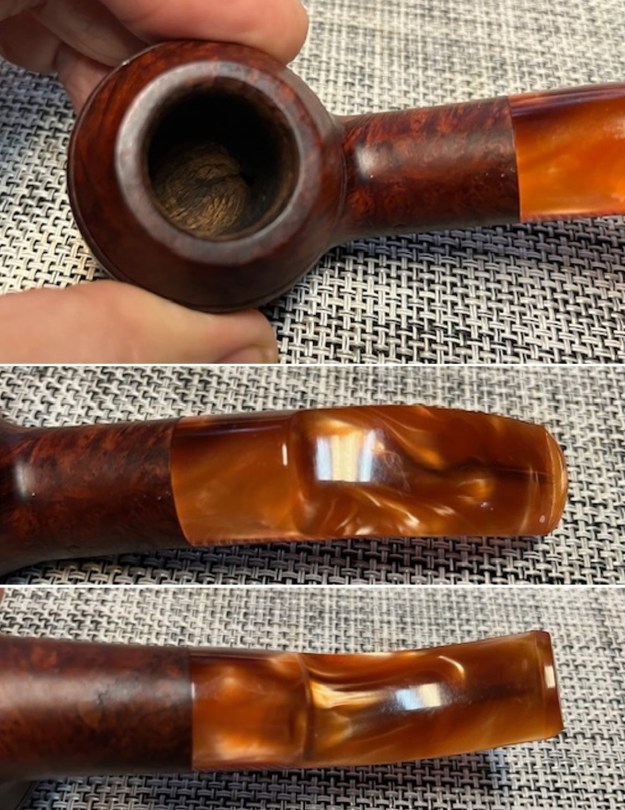
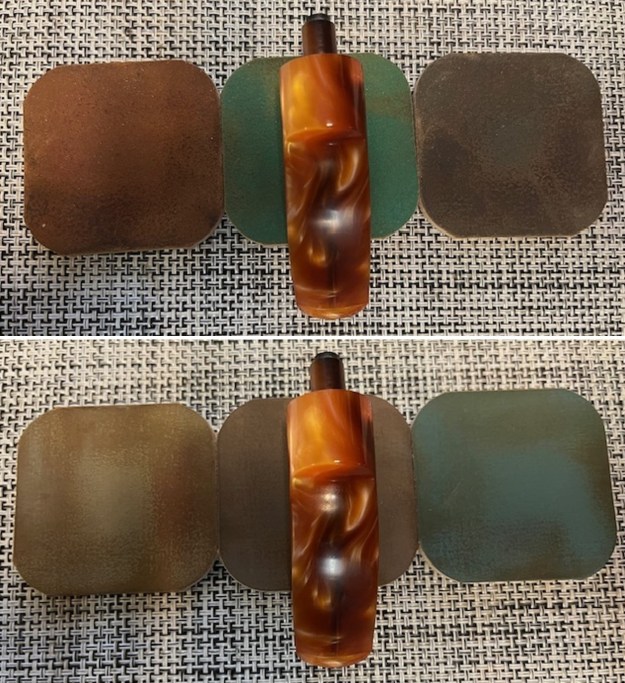
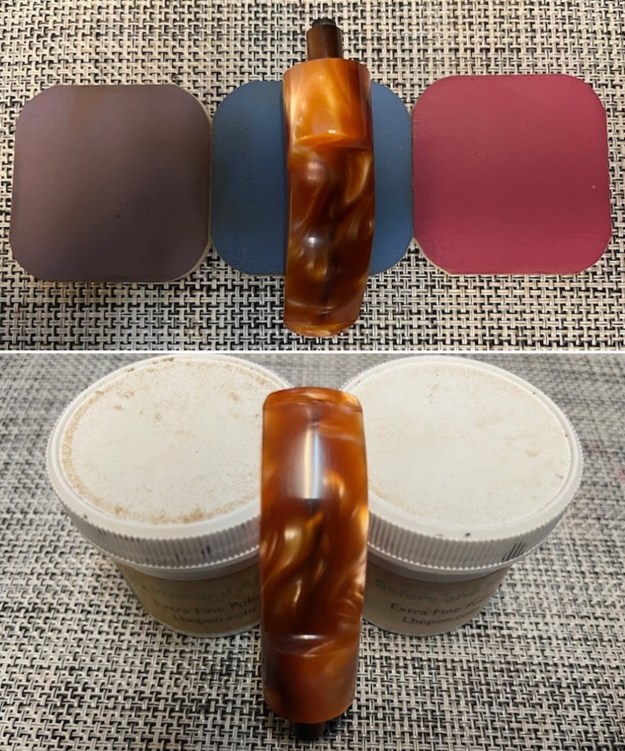
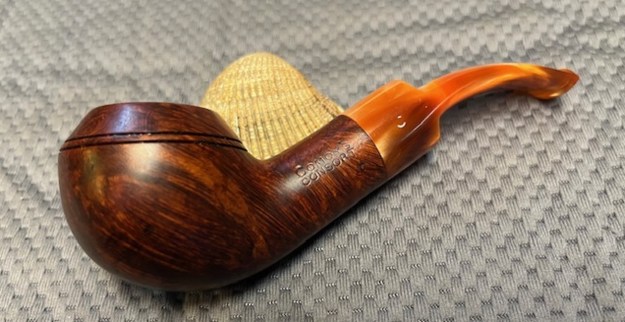
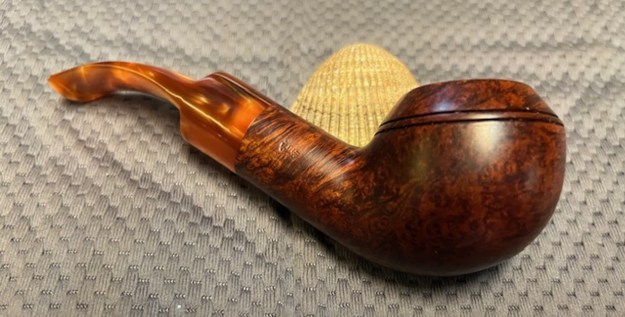
 Jeff had done a great job cleaning up the pipe as usual. He cleaned up the inside of the bowl with a PipNet reamer and a Savinelli Fitsall Pipe Knife. The bowl walls looked very good. He scrubbed the interior of the bowl and shank with shank brushes, pipe cleaners, cotton swabs and alcohol to remove the tars and oils. He scrubbed the exterior of the pipe with Murphy’s Oil Soap and a tooth brush to remove the grime from the finish. He worked on the rim top lava and darkening with the soap and tooth brush. He scrubbed the inside of the stem with alcohol and pipe cleaners. He scrubbed the exterior with Soft Scrub and rinsed it with warm water to remove the soap and debris. The pipe looked far better. I took photos of the pipe when I received it before I started working on it. I took photos of the bowl and rim top to show how clean it was. The top and the inner edge of the rim look quite good with just some small scratches. The stem looks clean of debris and grime. There are light tooth marks and chatter on both sides of the stem.I took photos of the stamping on the sides of shank. The stamping is clear and readable (much clearer in person than the photos show). I took a photo of the pipe with the stem removed to show the overall look of stem, tenon and profile of the pipe. I started polishing the bowl by sanding it with 320-3500 grit sanding pads. I wiped the briar down with a damp cloth after each pad to remove the sanding dust. It looked better and the scratches disappeared. I polished the briar bowl and shank with micromesh sanding pads – dry sanding with 1500-12000 grit sanding pads. I wiped it down with a damp cloth after each pad to remove the debris. The bowl took on a rich glow. I rubbed the bowl down with Before & After Restoration Balm. I worked it into the surface of the briar with my fingertips to clean, enliven and protect it. I let the balm sit for 10 minutes and then buffed with a cotton cloth to raise the shine. Mark Hoover’s Balm is a product that I have come to appreciate and one I use on every pipe I have been working on. I set aside the bowl and turned my attention to the stem. I sanded the stem with 320-3500 grit sanding pads to smooth out the chatter on the surface of the stem.I polished the acrylic with micromesh sanding pads – 1500-12000 grit pads. I wiped it down with a damp cloth after each sanding pad. I used Before & After Pipe Polish – both Fine and Extra Fine to further polish the stem. I put the stem back on the Comoy’s Consort 1057 Rhodesian and took it to the buffer. I worked over the bowl and stem with Blue Diamond to polish out the remaining small scratches. I gave the bowl and the stem several coats of carnauba wax on the wheel and buffed the pipe with a clean buffing pad to raise the shine. I hand buffed it with a microfiber cloth to deepen the shine. The pipe polished up really well and the rim top and edge looked good. I was happy with the look of the finished pipe. The photos below show what the pipe looks like after the restoration. The rich reddish, brown bent Rhodesian is a beautiful take on a classic shape. The polished acrylic saddle stem looks really good with the rich reds of the briar. The dimensions of the pipe are Length: 5 ½ inches, Height: 1 ½ inches, Outside diameter of the bowl: 1 1/8 inches, Chamber diameter: ¾ of an inch. The weight of the pipe is 1.76 ounces/50 grams. I will be putting it on the rebornpipes store in the British Pipe Makers and Companies Section shortly, if you are interested in adding it to your collection. This Bent Rhodesian looks and feels great in the hand. This one should be a great smoker. Thanks for walking through the restoration with me on this beauty!

A Brand-New Jima Pipe


Blog by Kenneth Lieblich

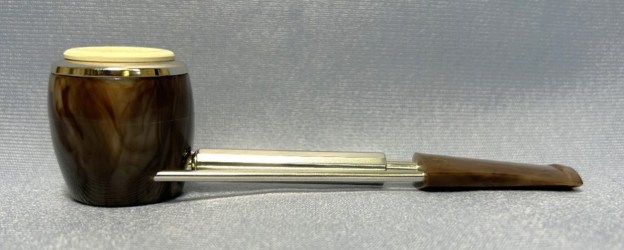
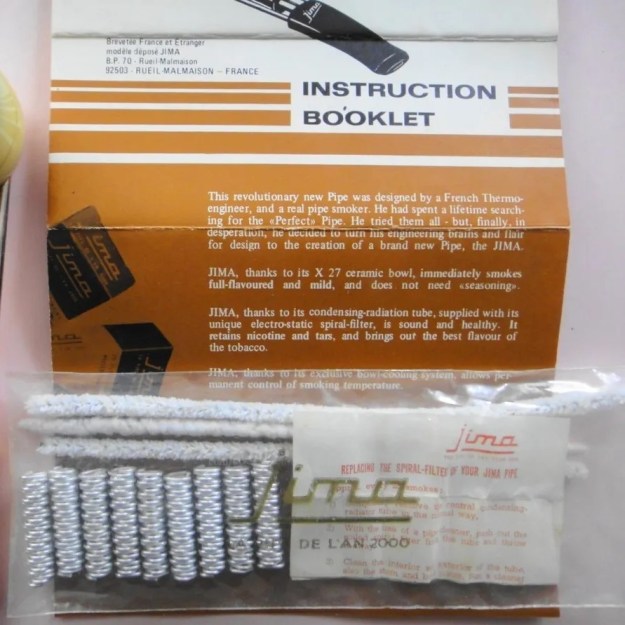
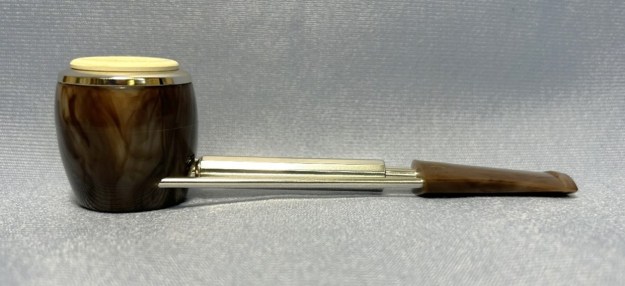
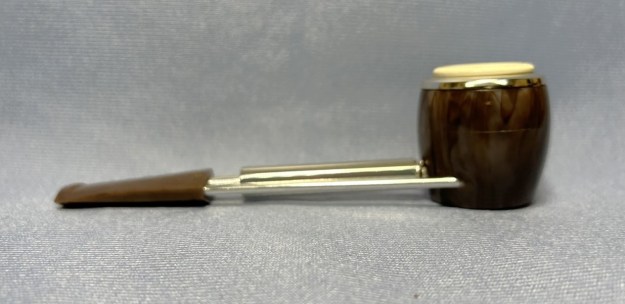
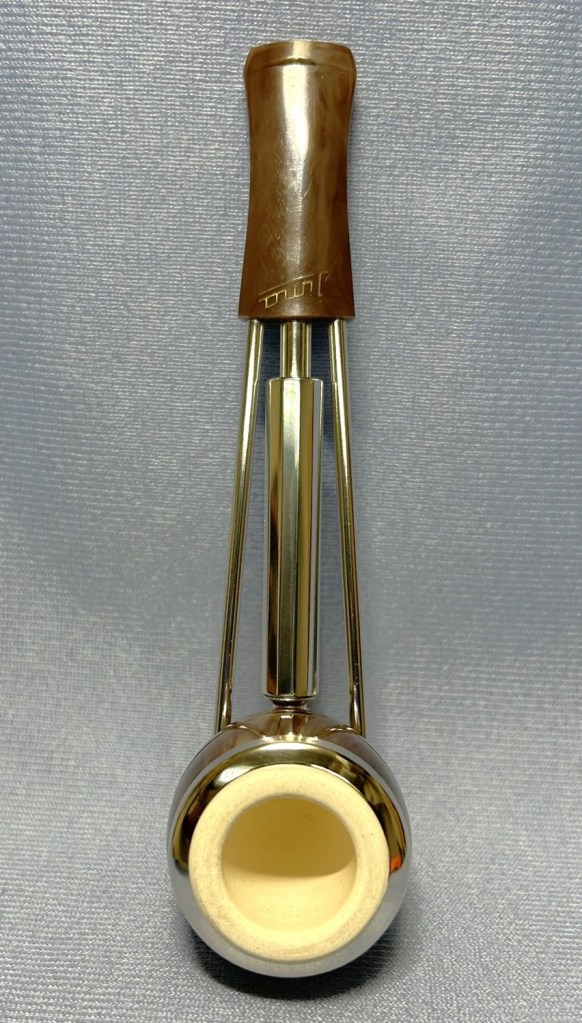
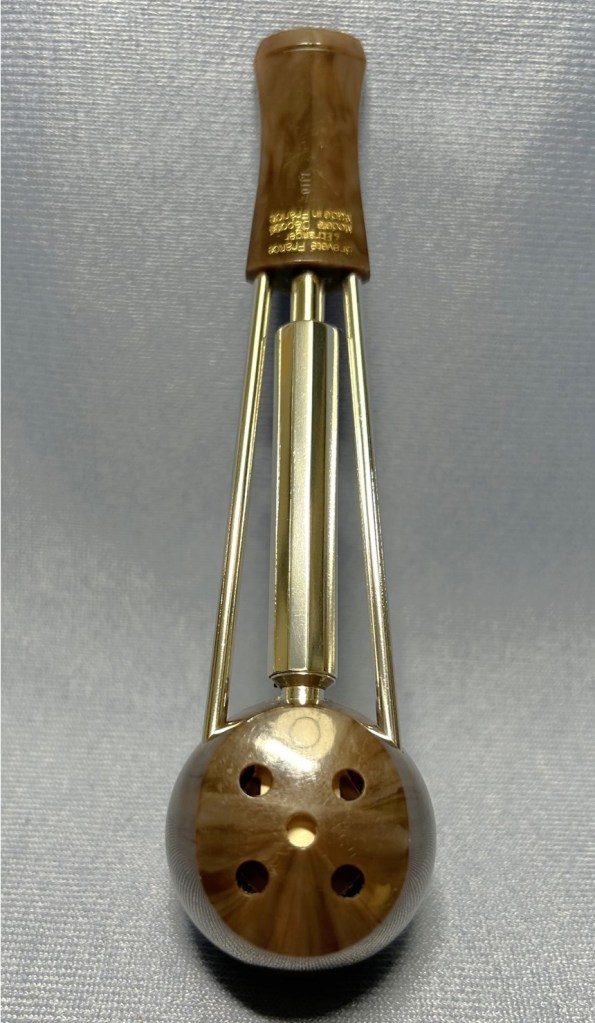
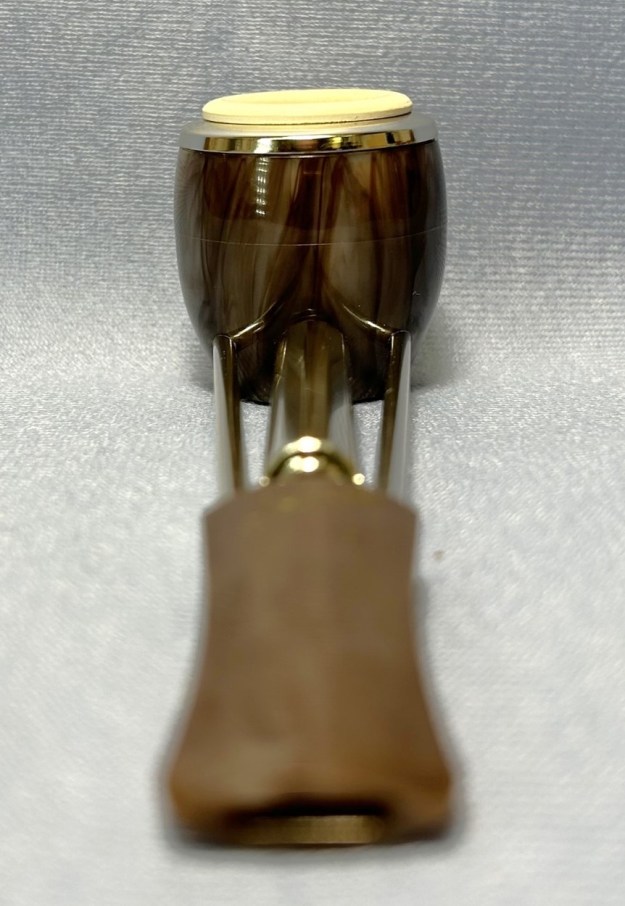
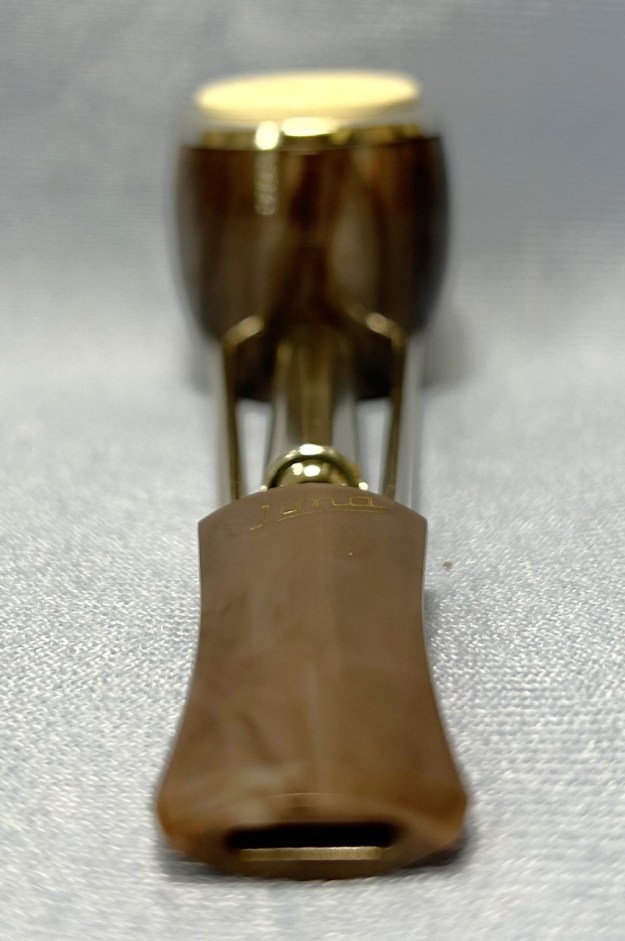
Welcome to the wonderful world of Jima! Are you interested in metal pipes? Are you interested in strange system pipes? Are you interested in French pipes? Are you interested in futuristic designs? Well, have I got a pipe for you! One sees Jima pipes from time to time, but it’s particularly nice to see an unsmoked one. Today, I’m putting this new Jima up for sale. Let me tell you a bit about them. The following information is from Pipedia:

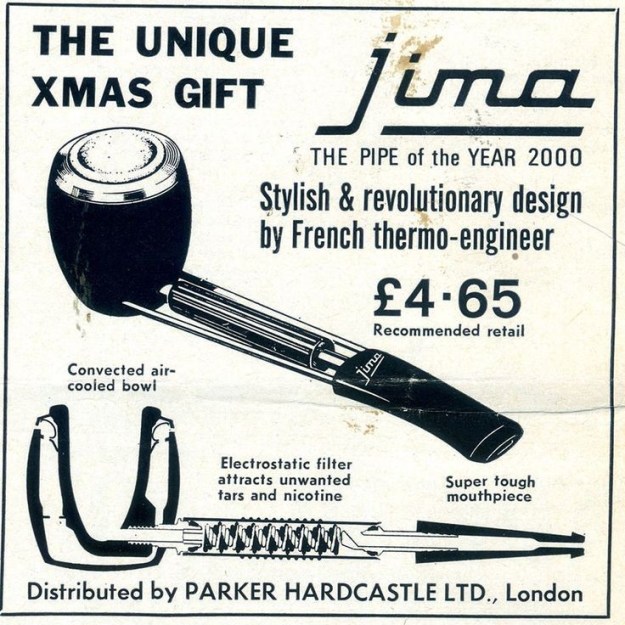
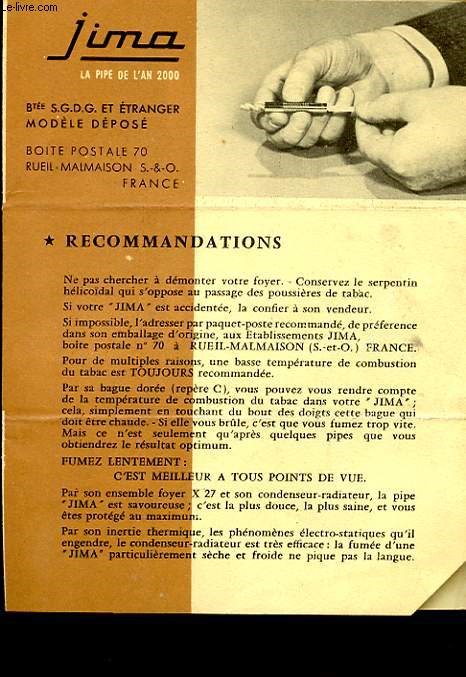
French brand created in the 1960s by Mayeux (editor MAHIEUX) , which had a very modern look. This modern look was emphasized by the manufacturer in the promotion material. The slogan speaks of “La pipe de l’an 2000” or “The pipe of the year 2000”. The factory was sold to Chapel Frères & Cie, which became part of the Berrod-Regad group in 1987. The Jima pipe is no longer made.   Although Pipedia says “created in the 1960s”, I can provide the more exact date of 1963. It was marketed until the mid-1970s. The pipe shown in the above ad is actually a much rarer version of the Jima – it has its metal bars wrapped around the outside of the plastic case.Much of what is written in the Pipedia article is, in fact, blatantly ripped off from the website of the Amsterdam Pipe Museum. The original article from which this is taken was in Dutch, but here is their English translation:

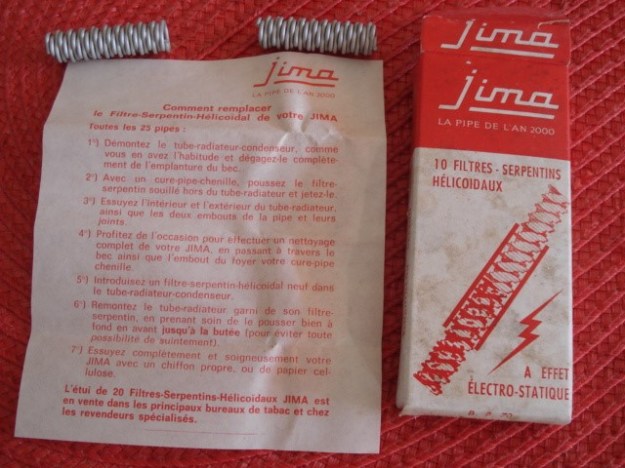
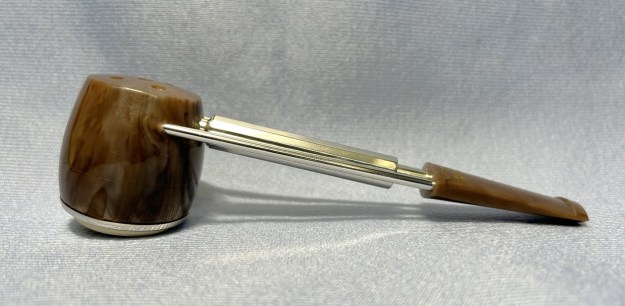
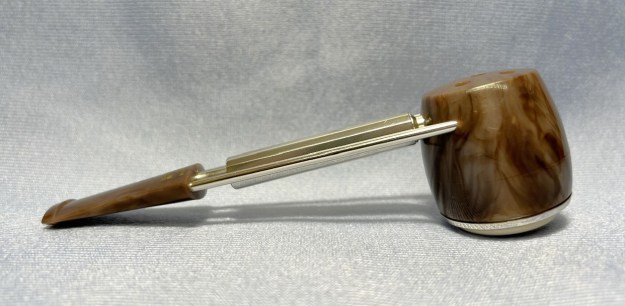
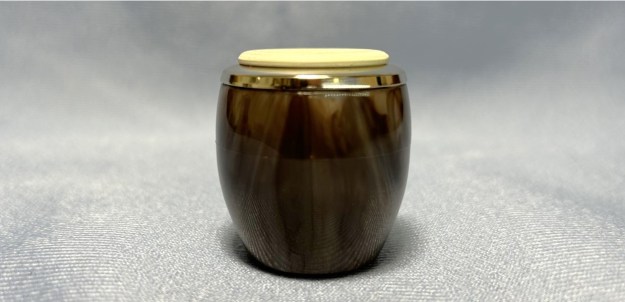
A special product of French origin is the Jima pipe, for export also known under the name Garland. It concerns a pipe having a different shape provided with a silver-plated or gold-plated steel metal frame, connecting a plastic mouthpiece with a plastic outer shell that houses the pipe bowl. This plastic pipe comes in different colours, with black and ivory as the most popular. More modern versions are mottled in pastel shades, whose sales stay far below any level. The inner bowl looks like meerschaum but is actually made of pressed white clay. The stem has a specific filter system which consists of a wound spiral, the so-called “filtres serpentins helicoidaux”, which according to the product information is electrostatic. To access the filter the stem can be unscrewed, although in other instances a user-friendly spring system is applied. At the top of the mouthpiece we often read “Breveté France & Etranger” or “Modèle Deposé Made in France”.

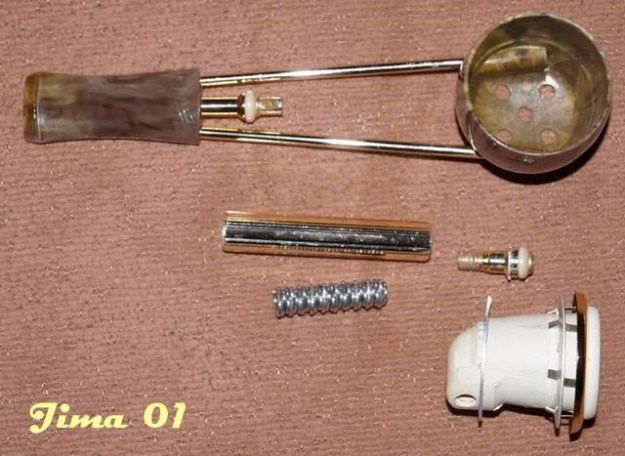
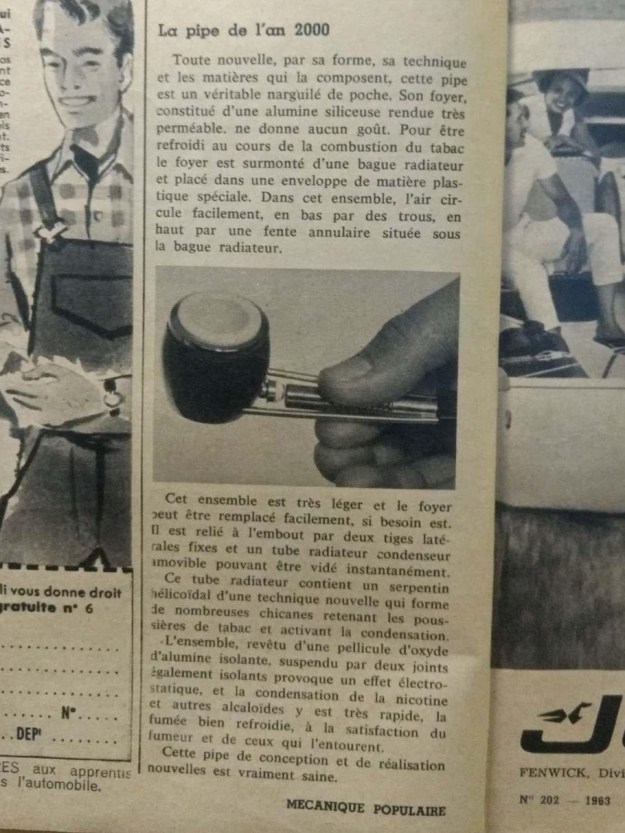
Jima was certainly futuristic looking and, by all accounts, they smoke very well. The Smoking Metal website has also has an entry on Jima pipes, which is worth looking at. Additionally, Elie’s Freehand Pipes has several photos – with this particularly useful photo of a partially disassembled Jima:Even more helpfully, there is a French website called PBMI. This stands for Pipes en Métal à Bol Interchangeable, which, in English, means Metal Pipes with Interchangeable Bowls. They have some interesting information for those who read French and many photos for those who don’t. Most interesting of all, however, is a brief article in the French edition of Popular Mechanics in March 1963. I have translated the article for you all here below:

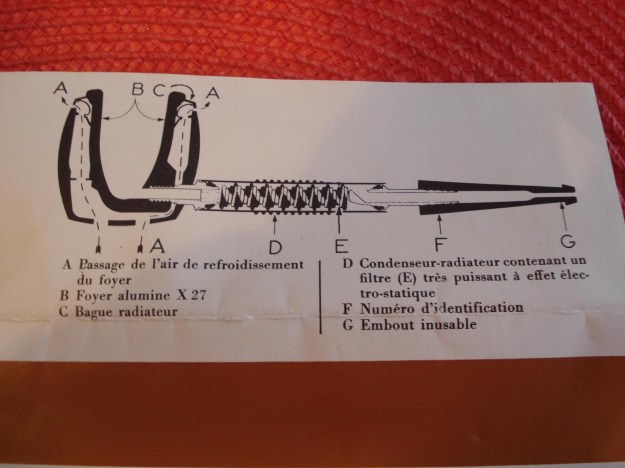
All new in its shape, its technique and the materials that make it, this pipe is like a pocket hookah. The bowl is made of a permeable silica-alumina clay and has no taste. The bowl is cooled during smoking because it is mounted with a radiation ring and housed in a special plastic case. As a result, the air circulates easily, through holes in the bottom and by an annular slit located under the radiation ring.

The pipe is very light and the bowl can be easily replaced, if necessary. It is connected to the tip by two fixed side rods and a removable condenser-radiation tube that can be emptied instantly. This radiation tube contains a newly-developed, electrostatic spiral filter which has many surfaces to trap tobacco tar and condensation. This coil, coated with an insulating aluminum oxide film, suspended by two insulating joints, causes an electrostatic effect, resulting in the quick condensation of nicotine and other alkaloids. The smoke is cooled, to the satisfaction of the smoker and those around him. This newly designed and produced pipe is very healthy.Anyway, all in all, a fascinating piece of pipe history and design. It is bound to be a great smoker and it is available now. If you are interested in acquiring it for your collection, please have a look in the French pipe Section of the store here on Steve’s website. You can also email me directly at kenneth@knightsofthepipe.com. The approximate dimensions of the pipe are as follows: length 5⅔ in. (144 mm); height 1⅝ in. (40 mm); bowl diameter 1½ in. (38 mm); chamber diameter ¾ in. (19 mm). The weight of the pipe is 1¼ oz. (39 g). If you are interested in more of my work, please follow me here on Steve’s website or send me an email. Thank you very much for reading and, as always, I welcome and encourage your comments.

Replacing a Broken Tenon on one of my own – a Svendborg Full Bent Apple


Blog by Steve Laug

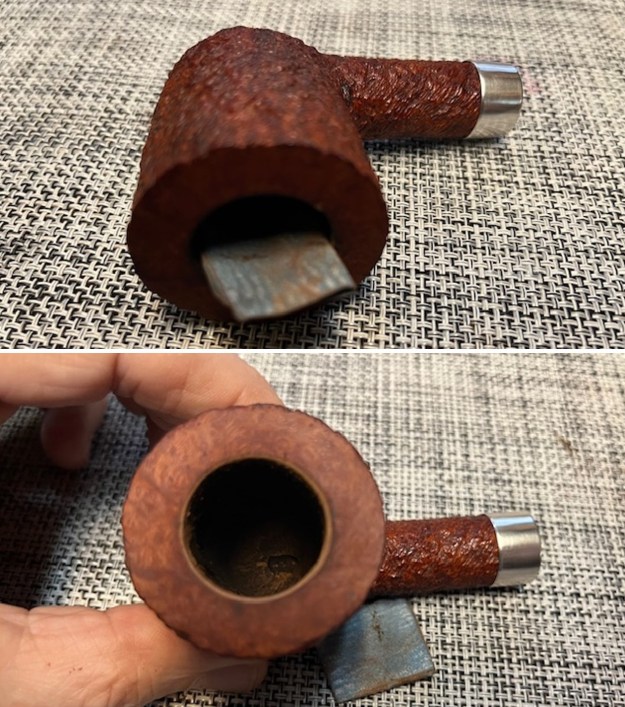
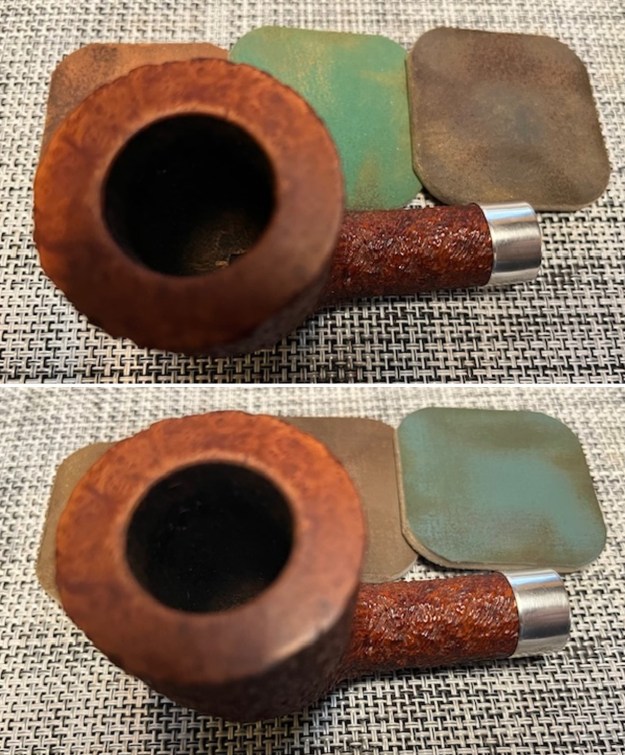
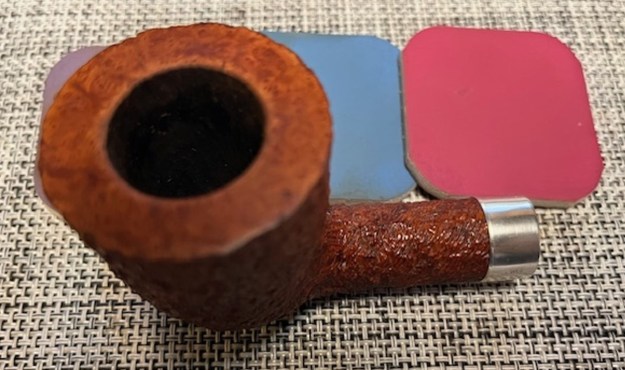
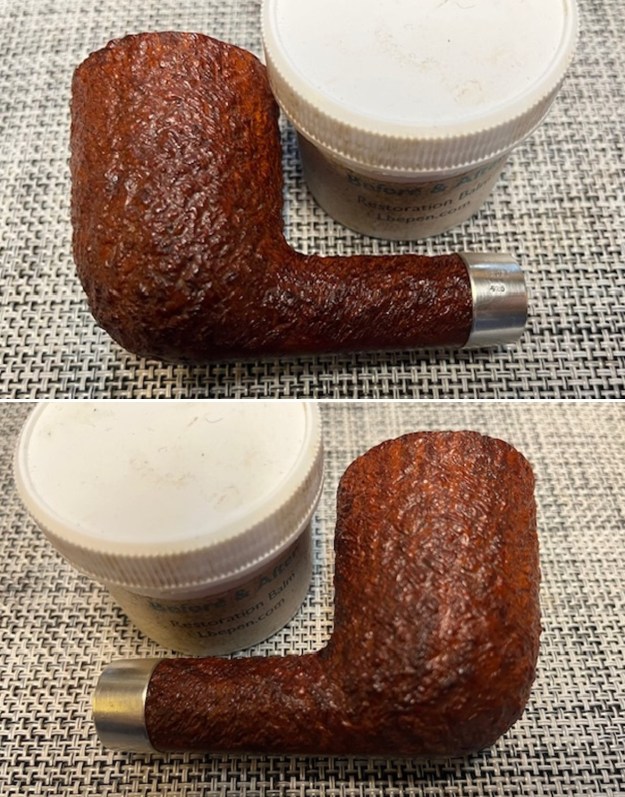
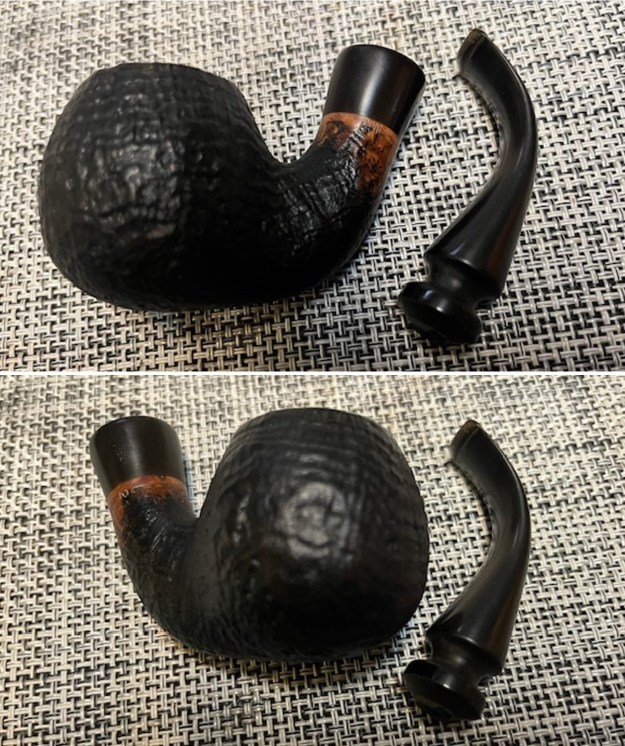
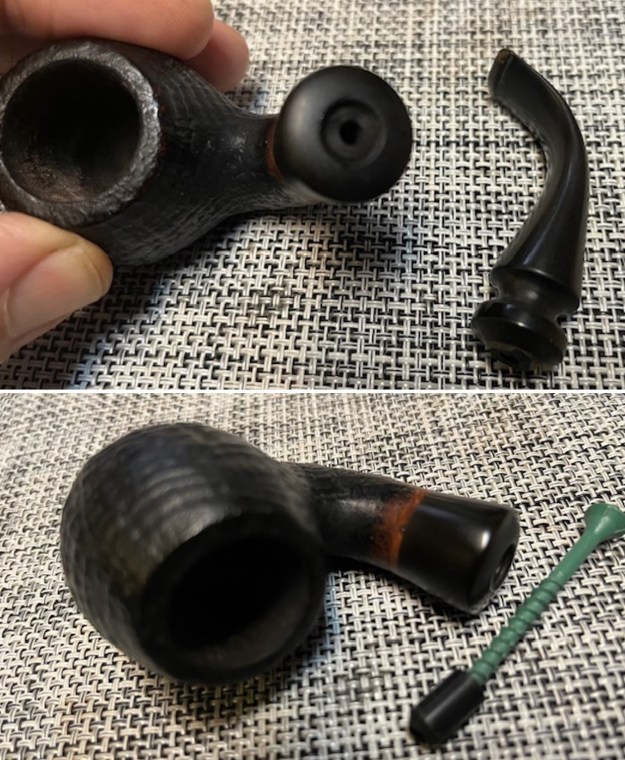
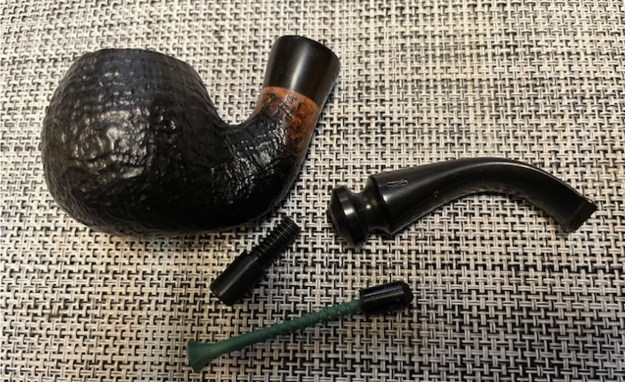
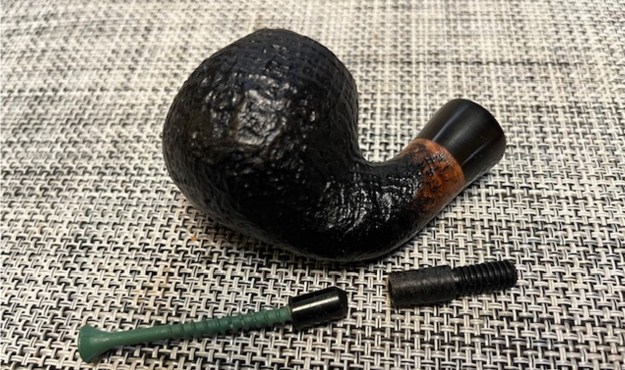
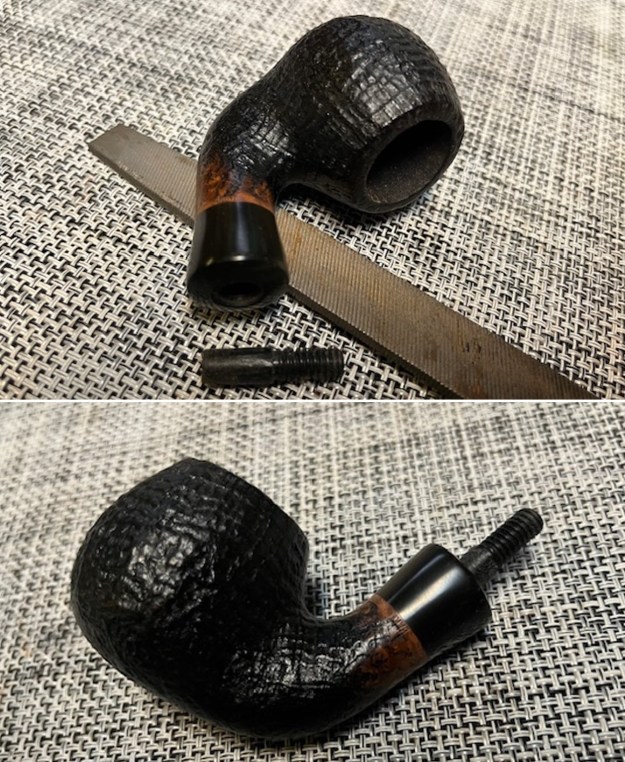
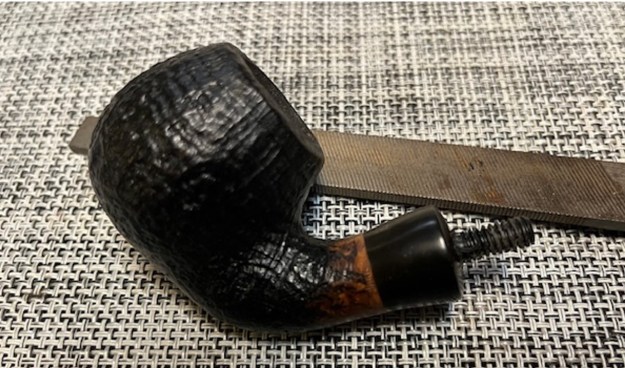
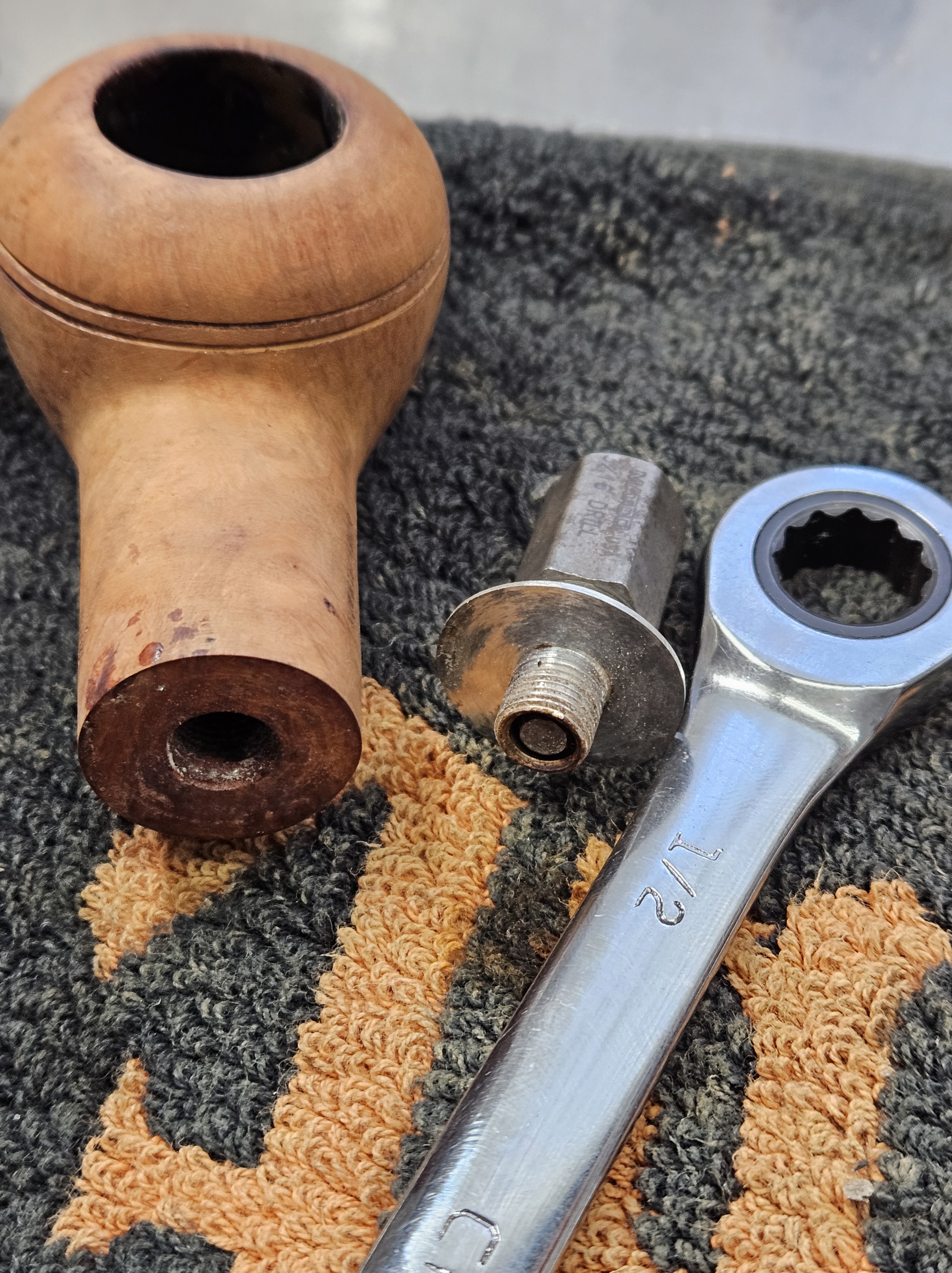
The next pipe on the work table is one that I had restored previously and had really enjoyed smoking. This older Svendborg Bent Apple was a great smoking pipe that is light weight and enjoyable. I had reamed, cleaned, restored and reclaimed a worn bowl and tired vulcanite stem (https://rebornpipes.com/2013/03/04/refurbished-svendborg-full-bent-apple/). It is stamped on the underside of the shank ahead of the vulcanite shank extension. It reads Svendborg [over] Denmark [over] Hand Made. It has a nice looking dark sandblast finish on the bowl culminating in a thin rim top. The fancy turned saddle stem has a Svendborg logo stamped on the left side. About a year ago we had a flood in our basement and the restoration folks packed my pipes and tobacco storage up and took it away. When they brought it back and unpacked it I found that the tenon was snapped off in the shank extension. Fast forward to a year later – today, and you will find it on my work table. After lunch today, I decided to replace the tenon and re-restore the pipe once again. I decided to record the process once more so you can see the steps. Here is what it looked like when I started. I took a photo of the snapped tenon before trying to remove it. I used a drywall screw and tried to pull the broken tenon out of the shank. It was too tight and did not move at all. I put it in the freezer for 20 minutes and once I took it out I tried again to remove the broken tenon. I turned the screw in the airway and it came free of the shank extension without any trouble. It was now ready for a tenon replacement.From the previous restoration I have inserted the following information on the brand. I quote it below:

From http://www.pipephil.eu/logos/en/logo-s8.html I learned the following information: The Svendborg brand founded in 1970s by Henrik Jørgensen, Poul Ilsted and Tao Nielsen. They bought an old factory (Nordisc Pibefabriker) in Svendborg on Funen Island. Poul and Tao gradually bowed out from machine manufactured pipes (1982) and Henrik Jørgensen managed the brand until it was taken over by Design Berlin (D) in the late 90’s. Kaj C. Rasmussen joined the firm for several years. 17 employees worked for this brand under Henrik Jørgensen direction. I was given this pipe by a good friend last weekend when I visited him on Vancouver Island. The bowl was in great shape and the stem merely oxidized. There were no bite marks and some minimal tooth chatter on the underside of the stem near the button. The pipe is stamped on the underside Svendborg over Danish over Hand Made and on the left side of the shank is stamped Bark. The stem has the squashed S logo on the left side. The stem is a chairleg type saddle near the shank. The shank has a vulcanite shank extension.

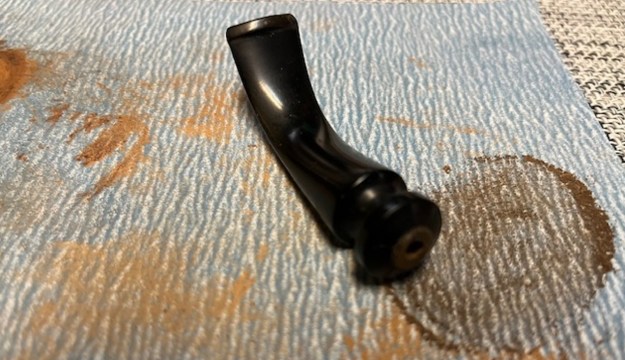
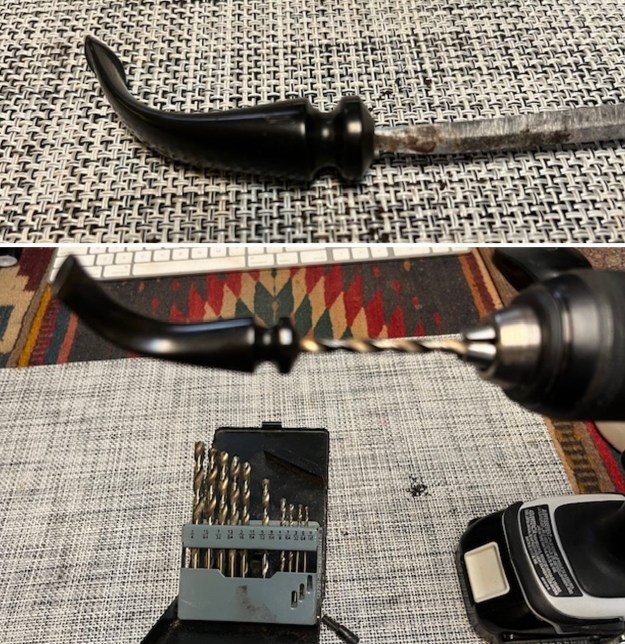
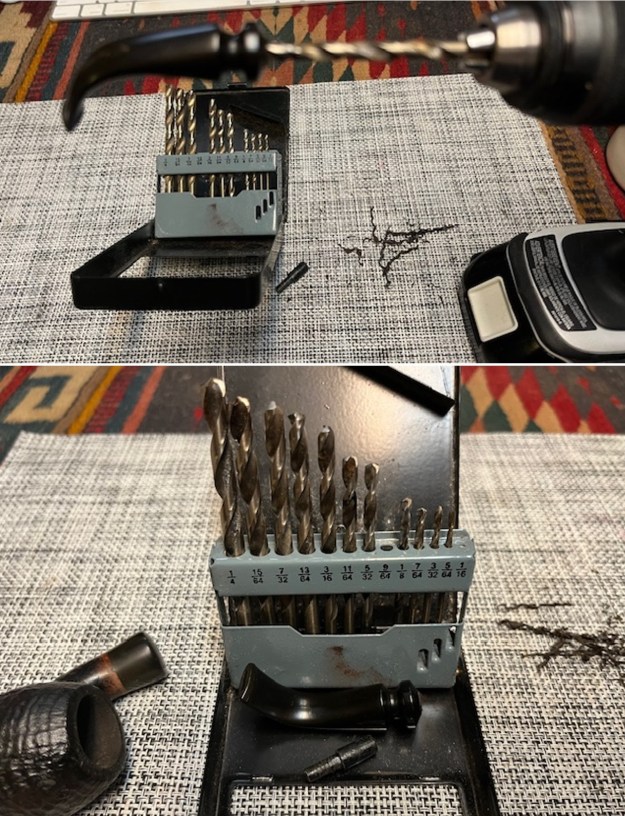
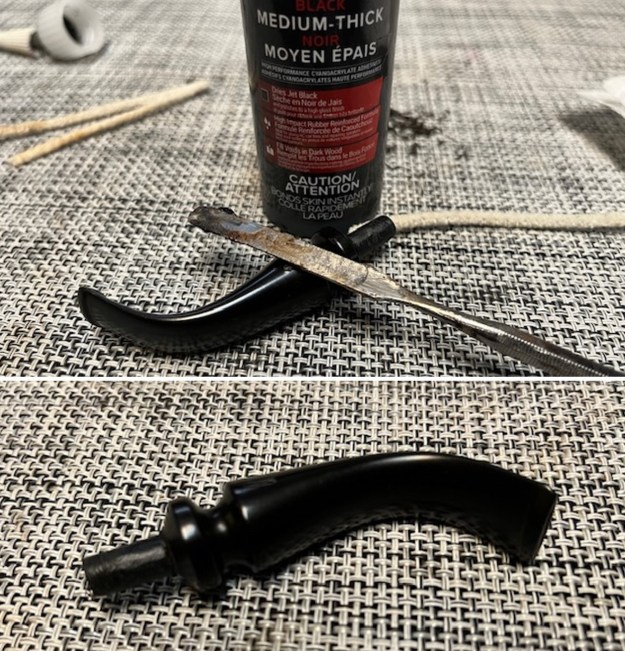
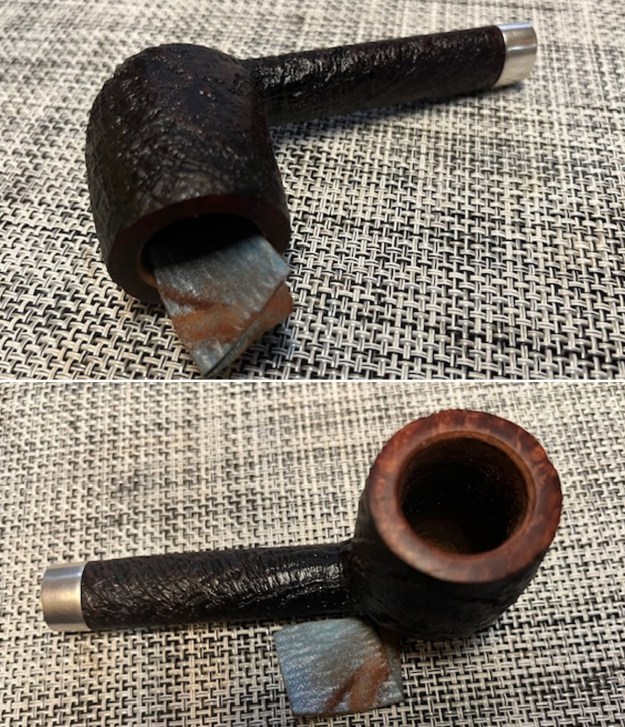
I started the work on the new tenon by flattening the end of the chairleg stem. It was rough from where the tenon had snapped. I used a topping board with 220 grit sandpaper to remove the jagged pieces of vulcanite from the stem end.I went through my tenons and found one that had a similar diameter to the broken tenon piece that I had kept. I would need to be shaped and deduces in diameter to get a snug fit but it was close.I used a sanding drum on my Dremel to start the process and finished up with a rasp. I took off the necessary amount and smoothed out the files marks to make sure it was round. I cleaned up the tenon a bit more and put the tenon in the shank. It fit the shank very well at this point. I set the bowl aside with the tenon and worked on the stem end. I started opening the airway in the tenon with a pen knife. I have found that doing this gives a good guide for the drilling of the opening. Once finished with the knife I started with a drill bit in my cordless drill that was slightly larger than the airway and slowly turned it into the airway. I changed the bits until I used the 11/64 drill bit. I sanded down the threaded portion of the new tenon until the fit was perfect. I painted the threaded end of the tenon with medium thick black CA. I spread it on the tenon with a dental spatula. I pressed it into the stem end and aligned it with a pipe cleaner. I set the stem aside to allow the glue to cure.Once the glue cured and the tenon was solidly anchored in the stem I put it in the shank extension and took photos. The pipe was back to normal and looked great. I took a photo of the bowl and the shank/stem fit. It looked very good and the fit in the shank was snug.I took the stem from the shank and took a photo of the parts. You can clearly see the new tenon in the photo. The bend of the stem matches the curves of the bowl and shank. It is a great looking pipe.I would soon be able to enjoy it once again. I set the pipe aside until the morning. I generally leave a repair like this cure overnight before smoking a bowl. Thanks for following along with the blog. I hope that at least some of the process is helpful to you in your own restoration work. Enjoy your pipes!

New Life For a Made in Italy Becker Musico 5 Years – 3 Canadian


Blog by Steve Laug

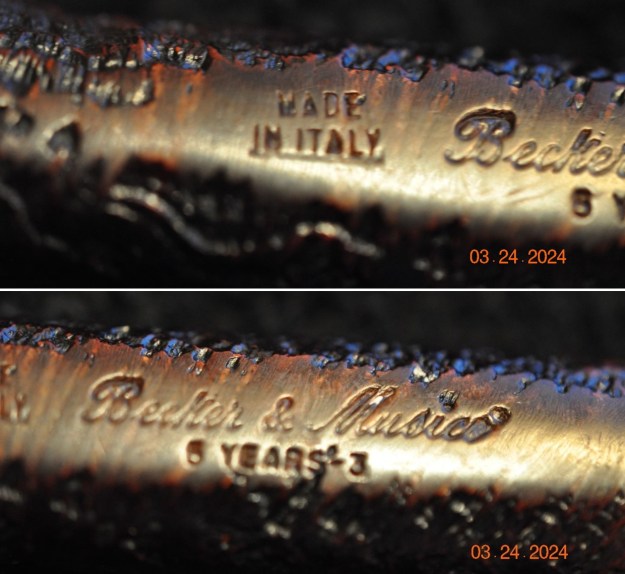
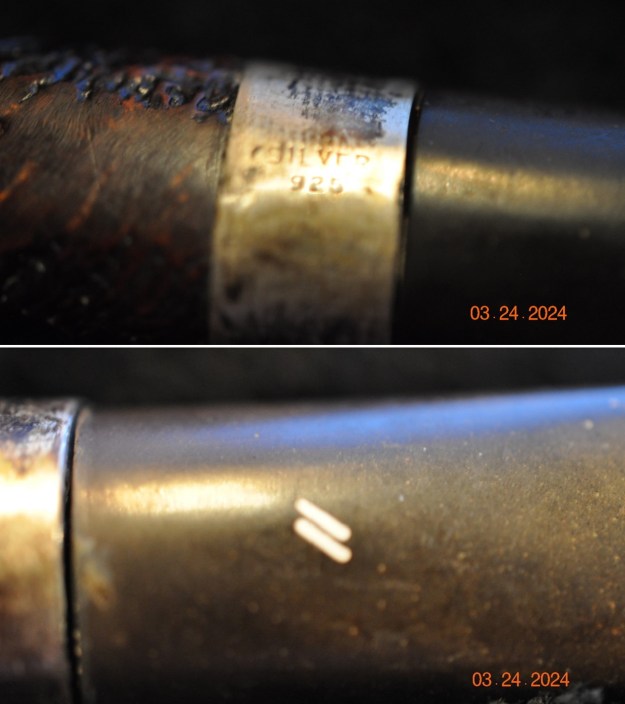
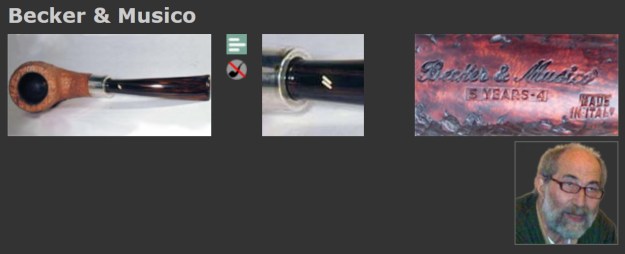
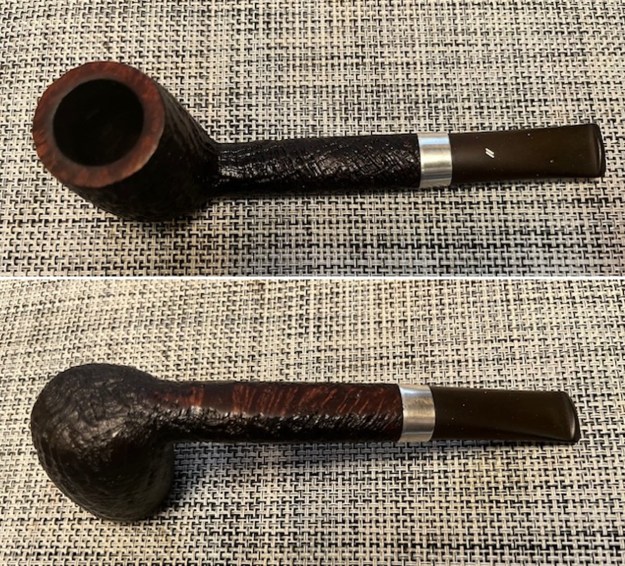
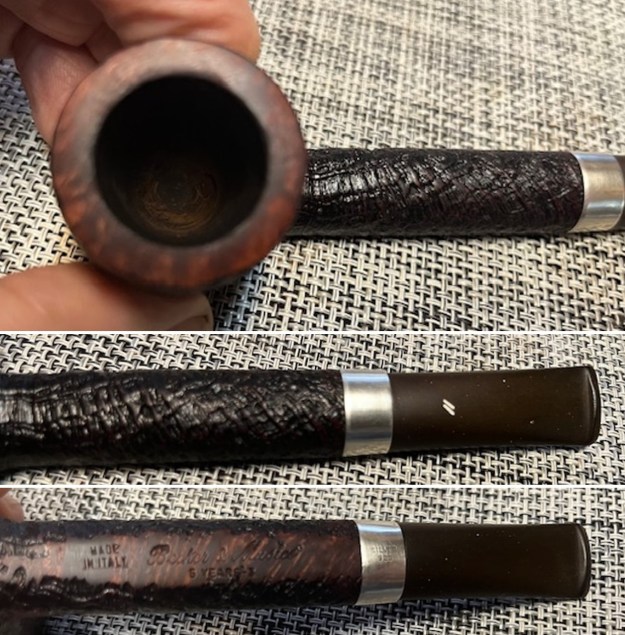
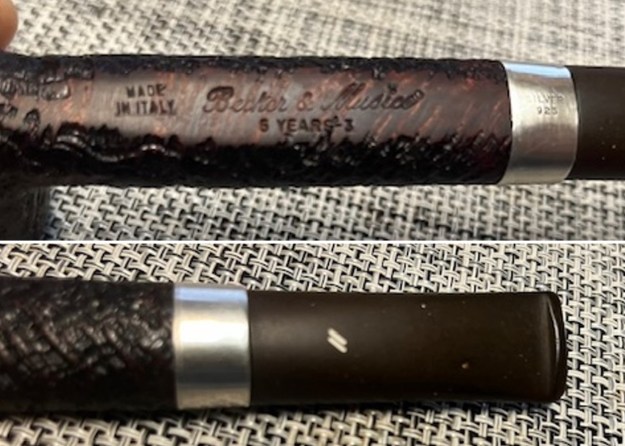
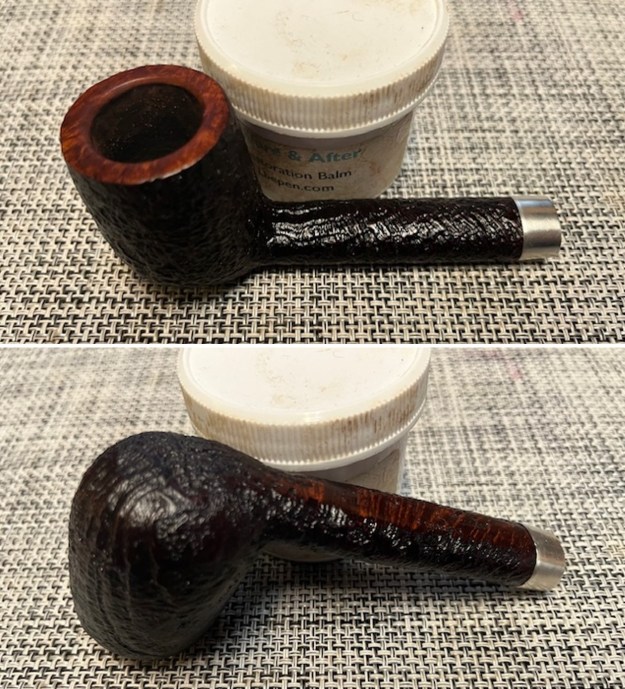
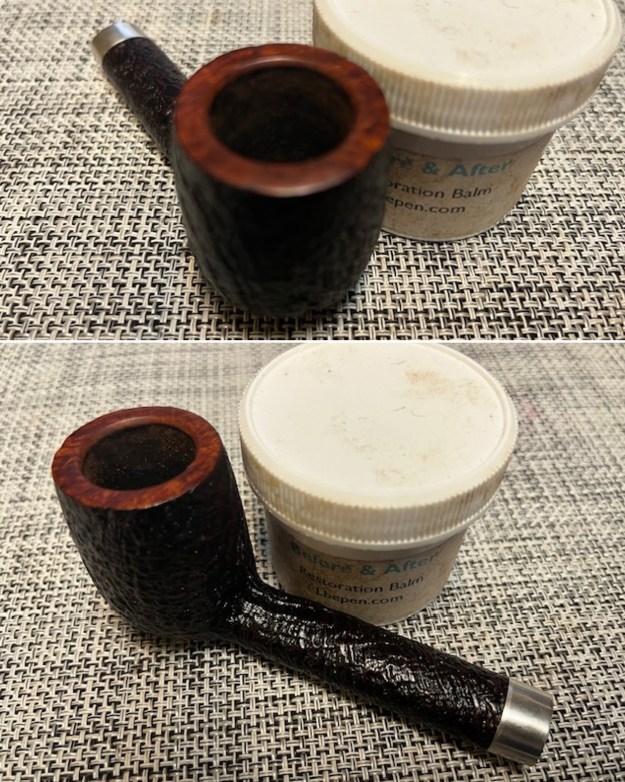
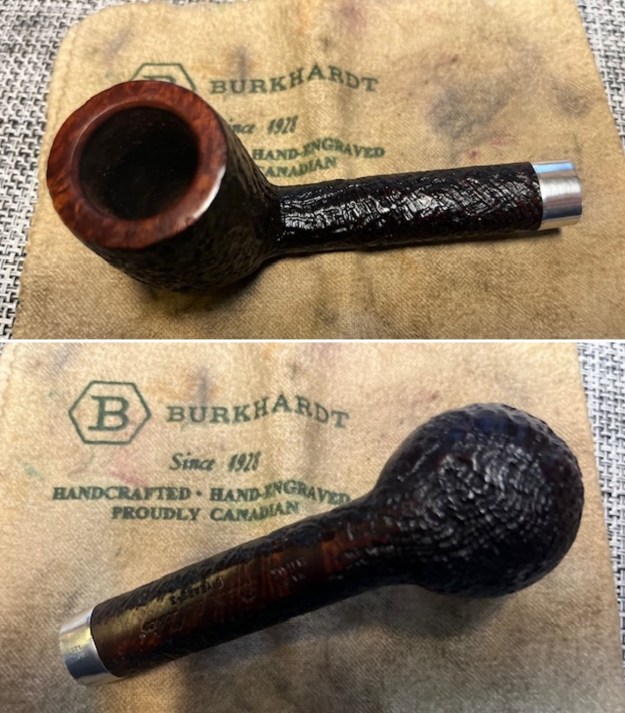
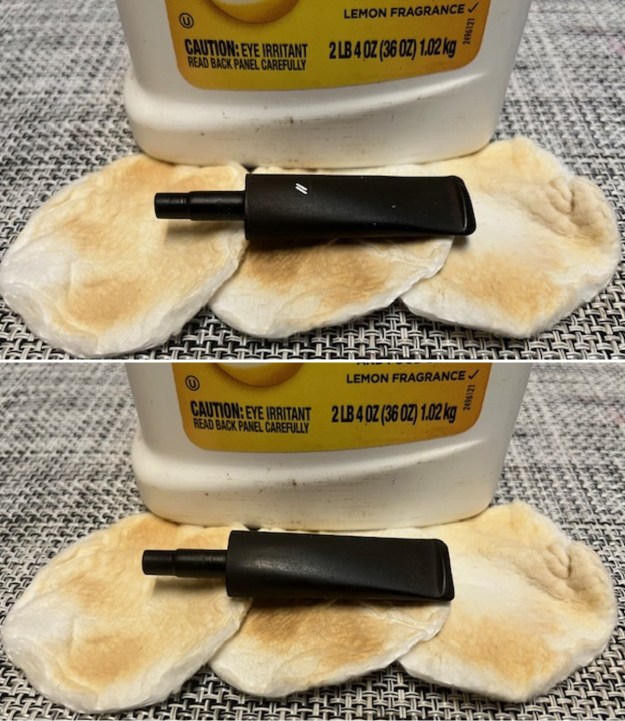
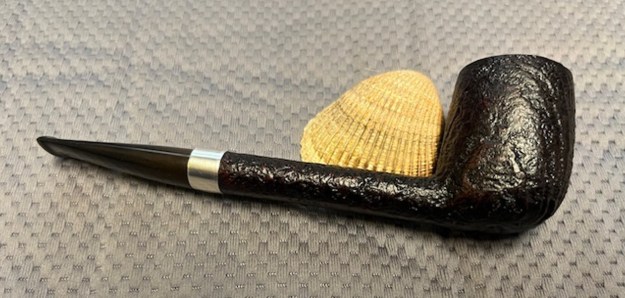
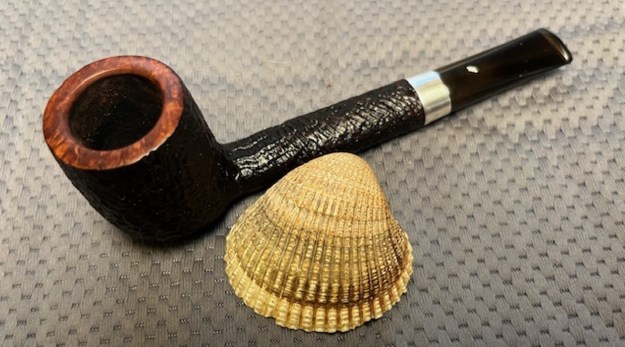
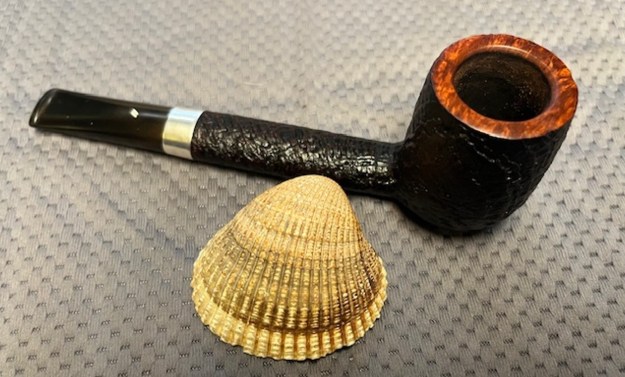
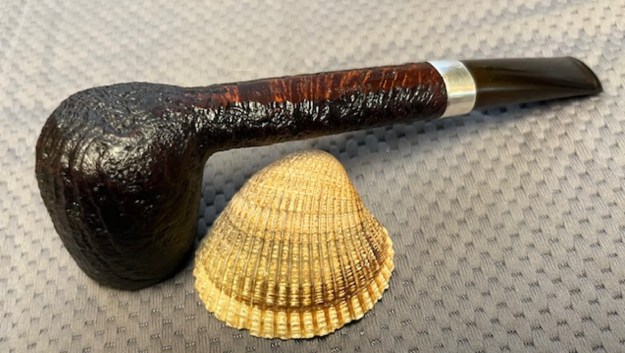
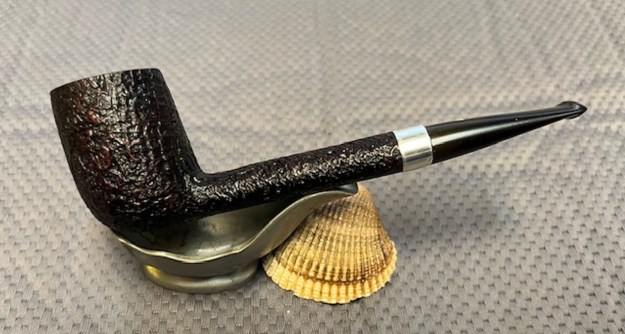
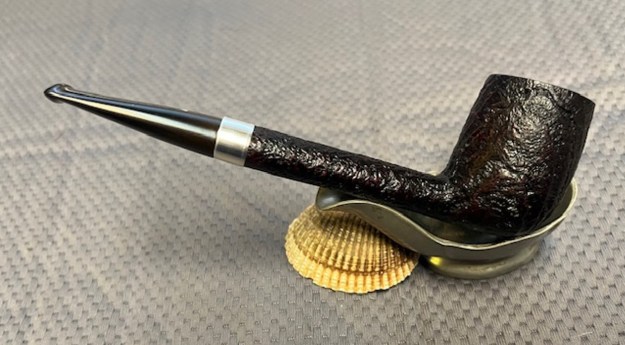
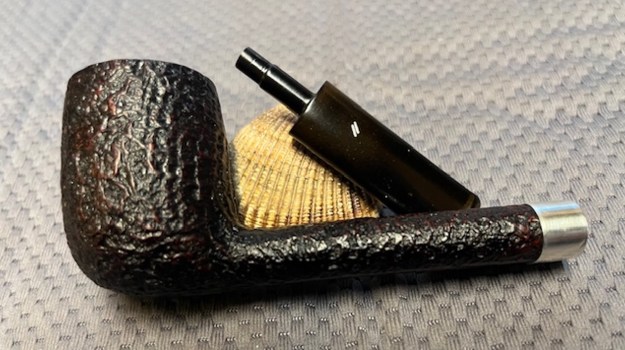
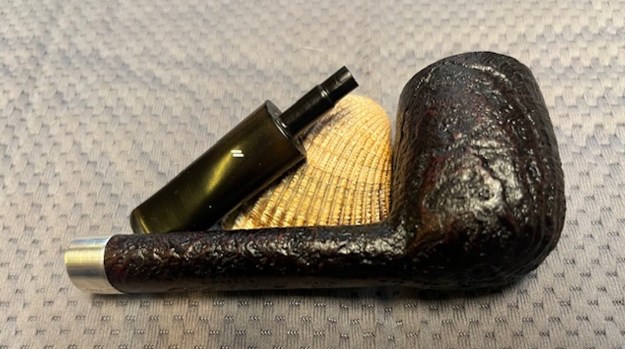
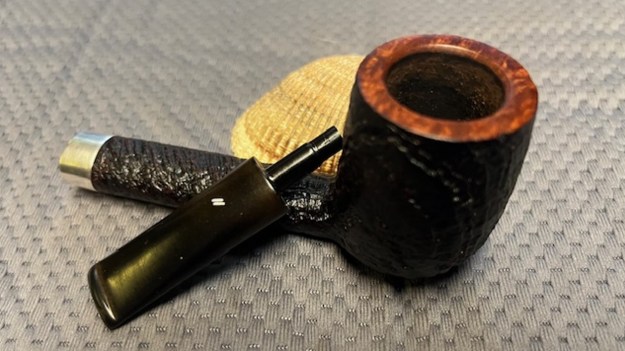
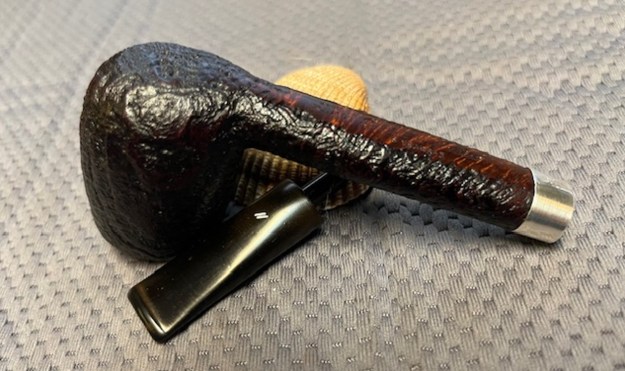
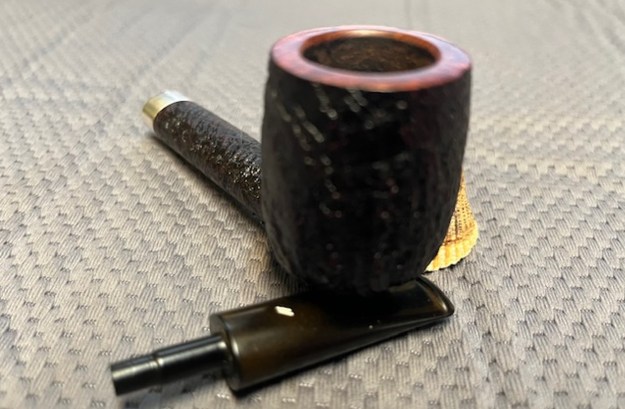
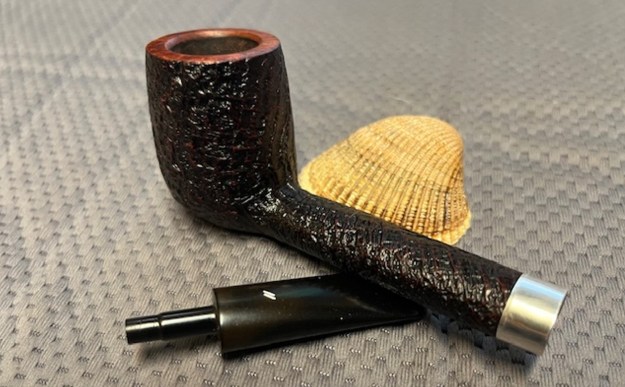
The next pipe on the table is a beautiful sandblast finished Canadian with a silver band. We purchased it from an estate sale in Oregon City, Oregon, USA on 03/21/2024.The pipe is stamped on a smooth panel on the underside of the shank and reads Made [over] Italy followed by Becker & Musico in script [over] 5 years – 3. The smooth rim top is covered with a thick lava coat that is heavier on the left side of the top. There was grime ground into the sandblast around the bowl and shank. The pipe had been smoked heavily and was someone’s obvious favourite. There was a thick cake in the bowl with a thick lava overflow on the rim top. It was hard to know the condition of the inner edge but it appeared to have a bit of darkening and potential burn damage on the left side. The oxidized band on the shank is Sterling Silver and bears the Silver [over] 925 stamp on the underside. There is a // logo stamped on the top of the taper stem. The stem is oxidized and calcified. It had light tooth marks on both the top and underside of the stem ahead of the button. Jeff took photos of the pipe before he started his clean up work. I have included them below. Jeff took photos of the rim top, bowl and the surfaces of the stem to give a sense of the condition of the pipe. The walls of the bowl had a thick cake which overflowed over the rim edges and onto the rim top making a mess. The stem is oxidized, calcified and dirty. There are light tooth marks on both sides ahead of the button. He took photos of the sides and heel of the bowl to give a clear picture of the way the shape follows the grain. The sandblast is really beautiful even showing through the grime filling in the valleys and low spots. It reveals some interesting grain patterns under the blast. Superbly done. He took photos of the stamping on the smooth panel on the underside the shank. It is clear and readable and read as noted above. The silver band has clear stamping under the oxidation that reads as noted above. The // logo on the top of the stem is clear and readable. Over my years of smoking a pipe I have looked for Becker-Musico pipes as there was always something about them that caught my attention. I have never had one to work on in my 30+ years of working on pipes. So in many ways this is a new and a fun pipe for me to work on. I have wanted to work on one and I have wanted to fire one up to smoke! But before I go further on this I decided to do a bit of research on the brand to confirm what I thought I remembered. I turned first to Pipephil’s site (http://www.pipephil.eu/logos/en/logo-b3.html). There was an entry there that I have captured and included below. I have also included the information below the screen capture that was in the sidebar of the entry. To me this is always a great starting point for developing a sense of background on a particular pipe that I am working on.This brand comes from the partnership of Fritz & Paolo Becker and Giorgio Musicò ending up in the Becker & Musicò shop in 1989. When Fritz Becker passed, his son Paolo Becker didn’t continue the collaboration. Massimo Musicò (son of Giorgio) established a new brand: Foundation

I liked the idea that it was a collaborative work between the two Becker (father and son) and Giorgio Musico of Rome. I wanted more information to feed my curiousity so I turned to Pipedia to see what I could find (https://pipedia.org/wiki/Becker_%26_Music%C3%B2). The information is more definitive and helpful. I quote from the article below:

Paolo Becker, son of famed pipemaker Fritz Becker and Massimo Musicò, son of Giorgio Musicò, former manager of the famous Carmignani pipe shop in Rome, joined together in a pipe shop in 1990, and in 1995 began to make pipes together. The pipes were turned by Paolo on the lathe and finished by hand, and Massimo fit the mouthpieces and crafted spigots and silver bands to go with the pipes. Most were sandblasted, and approximately 2,000 pipes a year were made. The blasted pipes were stamped with “Five Years” denoting pipes made in 1995, and an additional number was added for each year, so that 5 years – 3 for example would refer to 1998. Smooth pipes were stamped with the years since 1990, so that a “6 years” pipe would have been made in 1996. The pipes were imported to the United States by R.D. Field, until 2002 when Becker returned to full time pipemaking under his own name. From 2002 on Becker & Musicò pipes were only sold in their shop, if at all.

Sadly, Paolo Becker died in 2014. Massimo Musicò continued to make pipes after the partnership ended under the Foundation name.

I also found a thread on Pipesmagazine forums discussing the brand. A fellow asked about the history of the brand as he purchased two of the pipes. The answer given by “disinformatique” give us an interesting piece of information that came originally from SmokingPipes.com (https://pipesmagazine.com/forums/threads/two-new-pipes-i-acquired.56159/). I quote it below.

Here is some history on Musico pipes. Courtesy SmokingPipes.com
“If you know Becker pipes, well, chances seem slim you wouldn’t also know the name Musico. It was Giorgio Musico who, as an enthusiastic supporter of their work and as the manager of the Carmignani shop in Rome, bought up every pipe Fritz and Paolo Becker could bring him, from the time he first discovered the Beckers in 1979. Later would come both the Becker & Musico pipe shop (a hidden gem still found today on Via di San Vincenzo in Rome) and the Becker & Musico pipe. The latter was a result of collaboration between the son of Giorgio, Massimo Musico, and Paolo Becker, encouraged by Giorgio Musico’s love of classic shapes. These were made in the back workshop of the Becker & Musico shop itself, which Massimo and Paolo also ran together.

In 2002, however, Paolo turned his focus to the creation and development of Becker pipes full-time, while Massimo continued to both run the Becker & Musico shop and create Becker & Musico briars. Without Paolo, production was much more limited; a solution came, however, with Foundation, the name stamped on the Musico pipes you’ll find here. This again was created as a collaboration, but a broader one: Massimo, Giorgio, and a team of hand-picked Italian artisans (Gian Maria Gamboni was one you will surely recognize). That was the beginning of Foundation by Musico.”
Cheers, Chris :puffpipe:

Combining the information above I knew that the classic shaped Canadian by Becker-Musico was a collaboration of Paolo Becker and Massimo Musico. It was made in their shop in Rome. The stamp is 5 Years – 3 and tells us that the sandblast pipes which started in 1995 (5 Years) and added 3 years to that for a date of 1998.

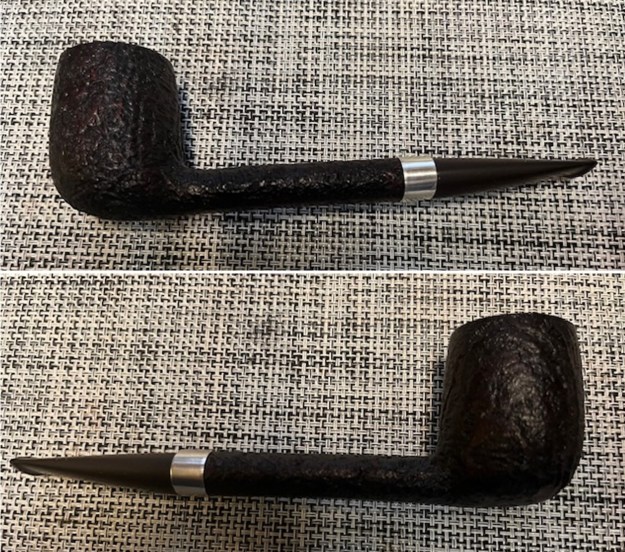
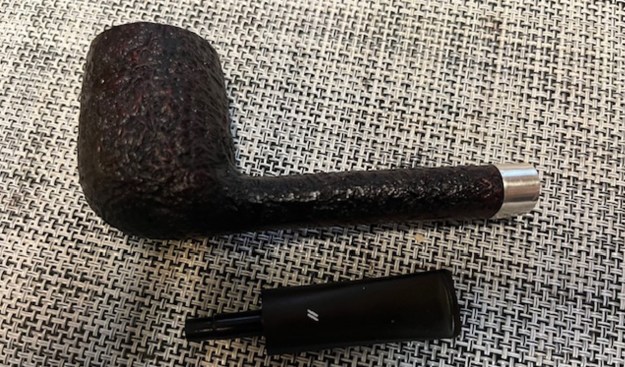
Now it was my turn to work on the pipe. Jeff had done an amazing cleanup of the pipe. He reamed the light cake with a PipNet reamer and cleaned up that with a Savinelli Fitsall Pipe Knife. He scrubbed the internals of the bowl and stem with alcohol, cotton swabs and pipe cleaners. He scrubbed the externals with undiluted Murphy’s Oil Soap and rinsed the bowl off with running water. He soaked the stem in Briarville’s Pipe stem Deoxidizer and once it had soaked rinsed it off with warm water to remove the residual solution. He dried it off and rubbed it down to remove any oxidation that was still on the stem. The pipe looked very good when I received it. I took photos of the bowl and the rim top as well as both sides of the stem to show the condition of the pipe before I started my work. The rim top was very clean but there were scratches on the flat surface and the inner edge showed some nicks, roughness and burn damage. The Sterling Silver band looked much better without the oxidation and darkening. The stem showed light tooth marks on the top and underside of the stem near the button. There was a light mark on the top right of the button edge.I took a photo of the stamping on the shank. The photo of the stamping is clear and readable. I took a photo of the logo on the top of the short taper stem. I removed the stem from the shank and took a photo of the pipe parts. I started my work on the pipe by addressing the damage to the inner edge of the bowl. I used a folded piece of 220 sandpaper to smooth out the roughness of the rim edge. Once I was finished it looked much better.I polished the smooth rim top with micromesh sanding pads. I dry sanded it with 1500-12000 grit sanding pads and wiped the bowl down after each pad with a damp cloth. By the final pads the briar really had a shine. I rubbed the briar down with Before & After Restoration Balm. I worked it into the smooth rim top surface with my fingertips and into the sandblast with a shoebrush. The product works to clean, enliven and preserve the briar. I let it sit for 10 minutes then I buffed it with a cotton cloth to deepen the shine. The briar really comes alive with the balm. I polished the silver band with a jeweller’s cloth to clean up and prevent further oxidation in the future. The contrast between the silver and the dark sandblast is very nice. I set the bowl aside and turned my attention to the stem. I scrubbed the stem surface with Soft Scrub cleanser to remove the oxidation. It took the majority of the oxidation off the stem and left behind just a bit of pitting and roughness on the vulcanite surface. It looked much better after the cleaning.I sanded out the roughness and light tooth damage with 320-3500 grit sanding pads. I wiped the stem down after each pad with Obsidian Oil. I was able to remove the damage and the stem looked better.I polished the vulcanite stem with micromesh sanding pads – 1500-12000 grit pads. I wiped it down with Obsidian Oil after each sanding pad. I used Before & After Pipe Polish – both Fine and Extra Fine to further polish the stem. This Becker-Musico 5 years – 3 Sandblast Canadian has a beautiful, reddish brown finish on the smooth rim top and a dark brown/black stain on the sandblast bowl and shank. The sandblast is well done and really highlights some beautiful grain. The polished vulcanite stem adds to the mix. I put the stem back on the bowl and buffed the pipe with Blue Diamond on the buffing wheel being careful to not buff the stamping. I gave the bowl multiple coats of Conservator’s Wax and the stem multiple coats of carnauba wax on the buffing wheel and followed that by buffing it with a clean buffing pad. I hand buffed the pipe with a microfiber cloth to deepen the shine. The finished Becker-Musico Sandblast Canadian is quite stunning and feels great in my hand. Give the finished pipe a look in the photos below. The dimensions of the pipe are Length: 6 inches, Height: 1 ¾ inches, Outside diameter of the bowl: 1 ¼ inches, Chamber diameter: ¾ of an inch. The weight of the pipe is 1.38 ounces/39 grams. Thanks for walking through the restoration with me as I worked over another beautiful pipe. I am going to keep this one around for awhile to try it out as I have wanted one for a long time. Thanks for your time.
New Life for a Pipe Pub France 1985 297/350 Bent Billiard


Blog by Steve Laug

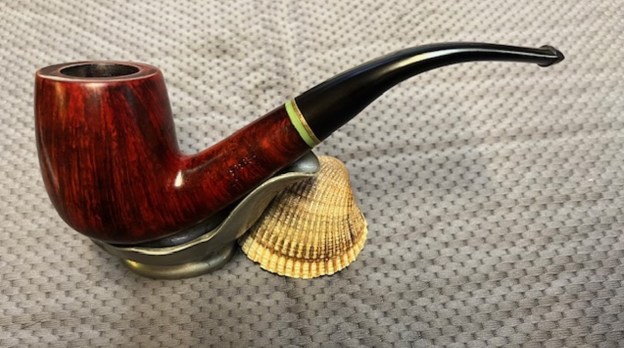
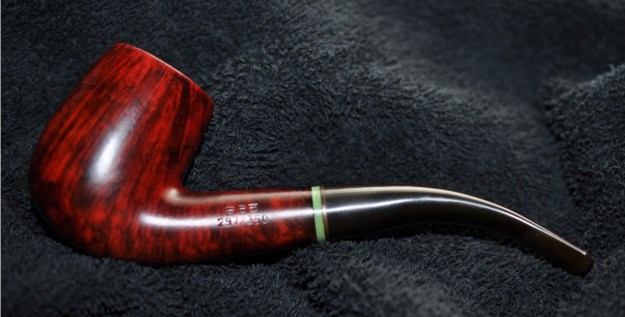
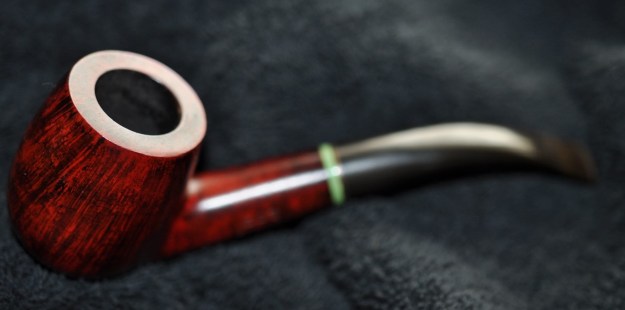
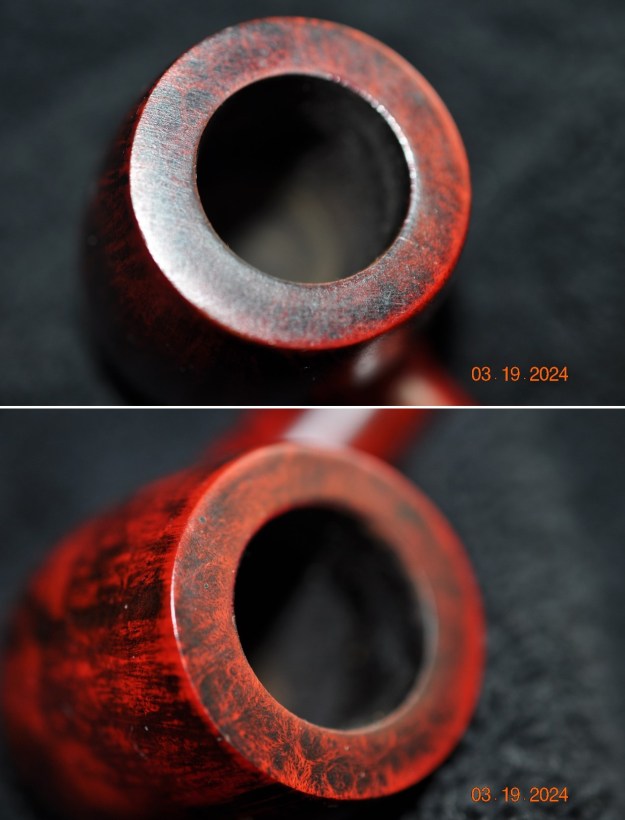
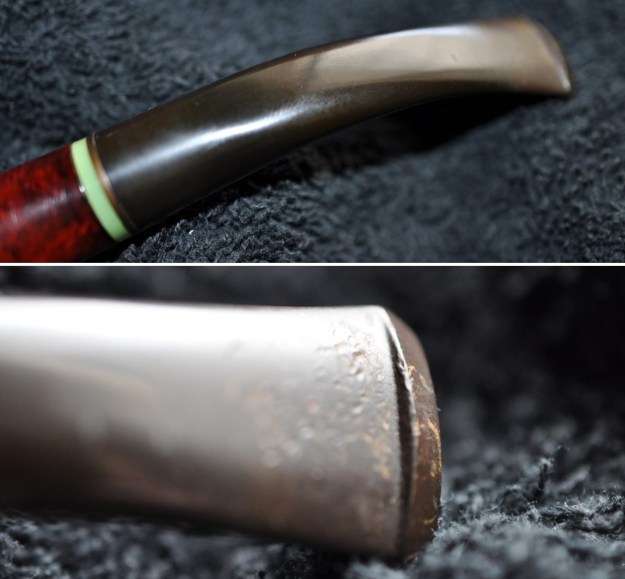
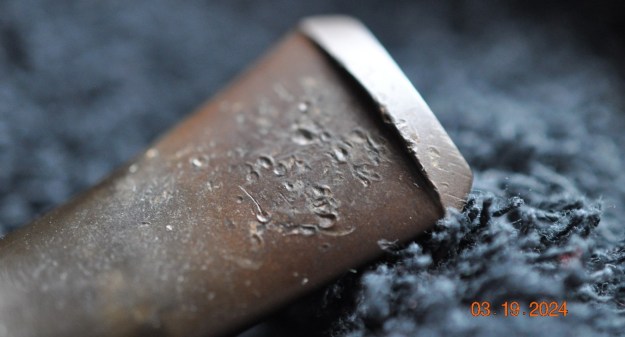
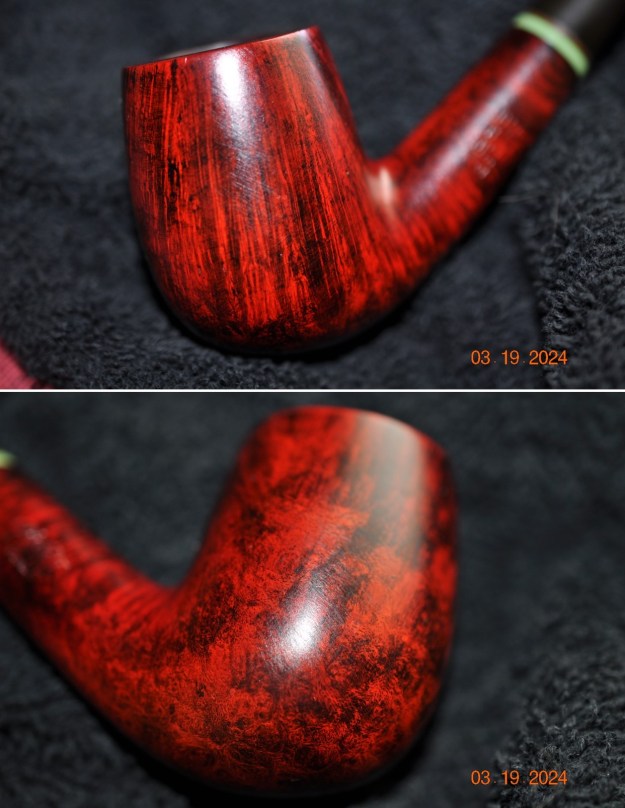
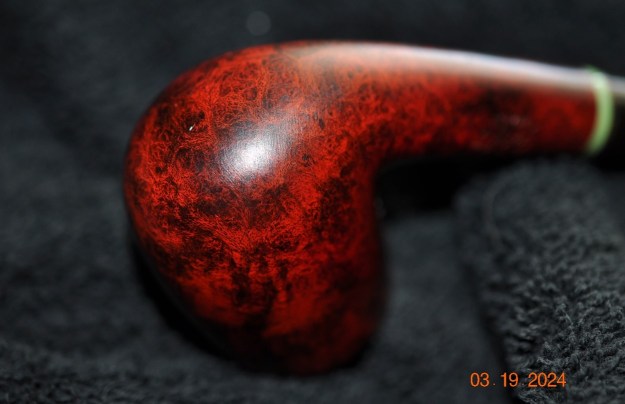
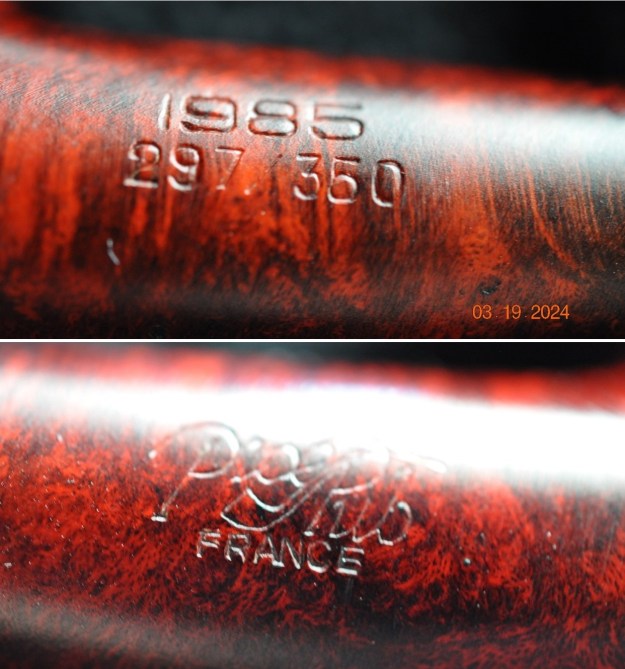
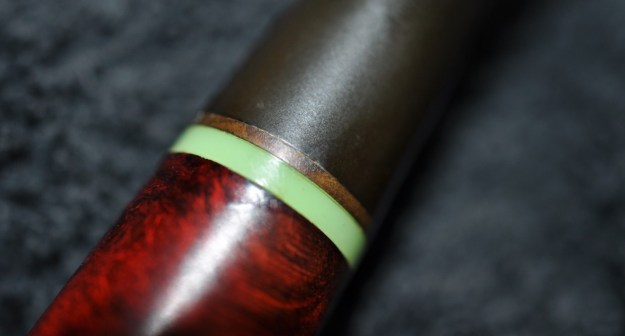
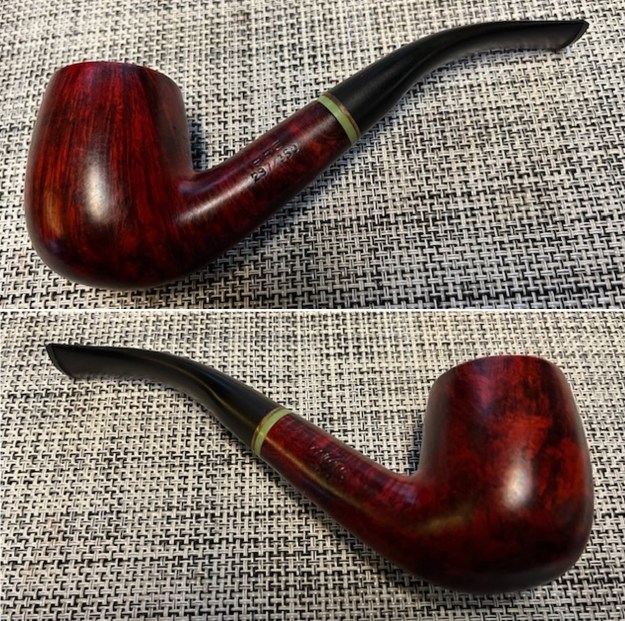
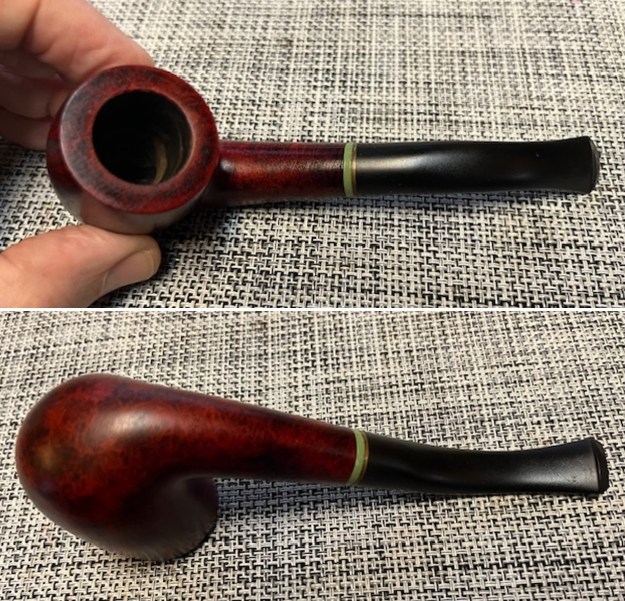
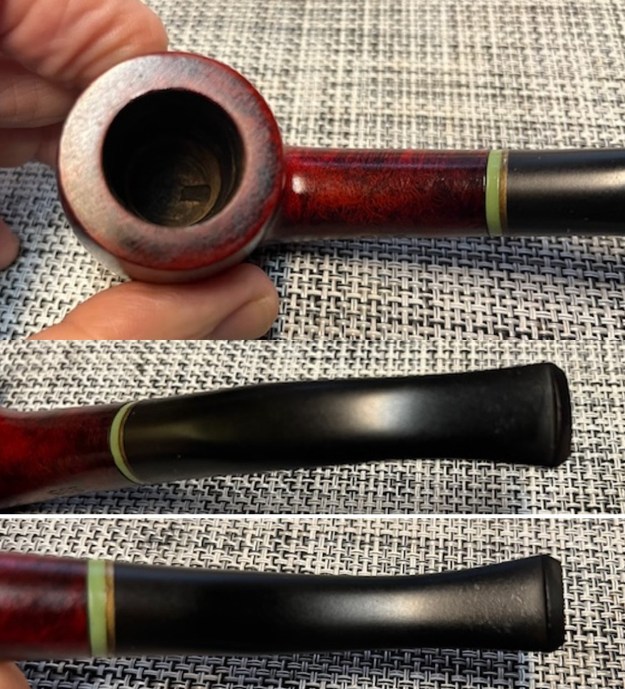
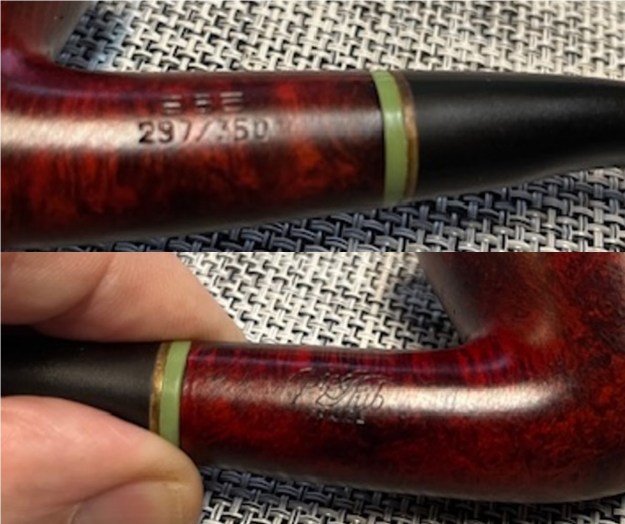
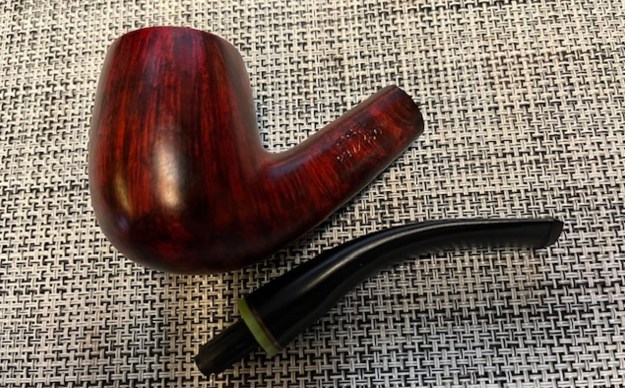
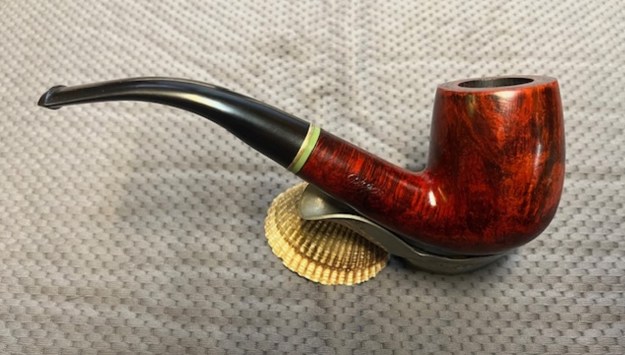
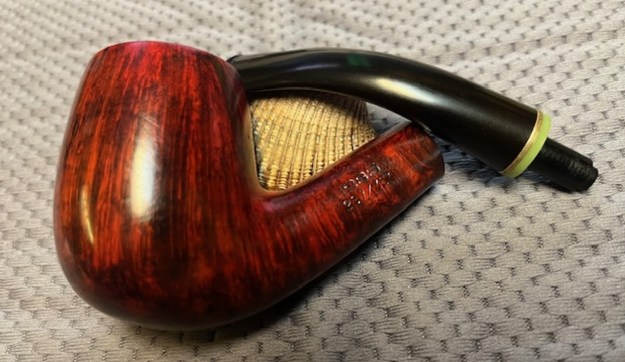
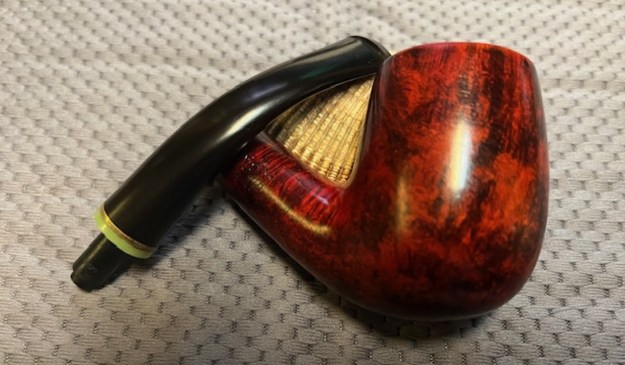
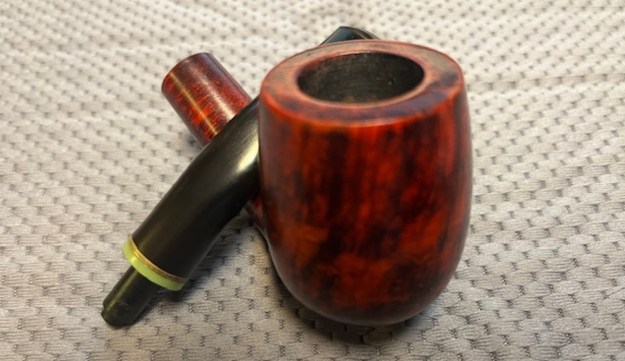
The next pipe on the table is a great looking Bent Billiard with great grain around the bowl. It has a well shaped vulcanite taper stem. We purchased it from an estate sale in Spring Branch. Texas, USA on 02/29/2024. The pipe is stamped on the left side of the shank and reads 1985 [over] 297/350 setting this pipe aside as #297 out of 350 Pipes made in 1985. On the right side it is stamped Pipe Club (separated by a pipe) [over] France. There was a thick cake in the bowl and some darkening and lava on the inner edge of the bowl and some spots of lava on the rim top. It was hard to know for certain the condition of the inner edge though it appeared to be in good condition. There were oils and grime ground into the bowl sides gives the finish a flat look though there is some great grain. The shank has a slight curve to it giving the pipe a Bent Billiard shape. The taper stem matches the curves of the bowl and shank. It has what looks like a pair of bands on the end of the stem – green acrylic and brass. The vulcanite stem is a dirty with some calcification, oxidation, grime, grit on the surface and also light tooth marks on both the top and underside of the stem just ahead of the button. Jeff took photos of the pipe before he started his clean up work. I have included them below. He took photos of the pipe’s bowl and rim top to show the cake in the bowl, the darkening on the inner edge and the spotty lava coat overflowing onto the top. It is another dirty pipe. He also took photos of the stem to capture the oxidation, calcification and the light tooth marks on the top and underside of the stem near the button. He took photos of the sides and heel of the bowl to show the rich grain around the bowl and the amount of grime ground into the surface of the briar.   He took photos of the stamping on the sided of the shank. It is clear and quite readable. It reads as noted above. He also took a photo of the twin bands on the stem end – the brass and green acrylic band. I remembered that Dal had worked on a Pipe Pub pipe so did a quick search of my site and found the blog (https://rebornpipes.com/tag/pipe-pub-pipes/) that I remembered that Dal had written on the brand. What was fascinating was a conversation that he and I had via email that led him to some helpful information. I quote the majority of his research section from the blog below:

To learn more about the provenance of the Pipe Pub name I started my search in my regular go to sites – Pipedia.com and Pipephil.eu and came up with absolutely nothing.  I broadened my search on the internet by simply searching ‘Pipe Pub’ and ‘Pipe Pub Brigade’.  My initial findings had more to do with bagpipers, bagpipe brigades, Irish pubs and pipes…, all of these go well together!  Yet, I wasn’t finding anything that helped me with the Canadian looking back at me on my worktable.  I looked in my copy of Wilczak and Colwell’s ‘Who Made that Pipe?’ and found nothing giving me a direction.  Usually, when I face the brick wall my response is to send Steve an email.  With all his vast rebornpipes experience, surely, he’ll know something.  Steve’s response was quick and helpful:

Hi Dal

I have heard of it. Here is a link to one on Smoking pipes.com

https://www.smokingpipes.com/pipes/estate/england/moreinfo.cfm?product_id=200834

I would try to ferret out the shape number. For instance, on the one from Smoking pipes it is a 124… which interestingly is a GBD shape number for a Billiard. I wonder if the brand was not made by special order for pipe shops and stores. — Steve

I looked at the link and saw my first example another Pipe Pub pipe – a very nice classic Billiard.  I immediately looked again to see if I missed a shape number on the Canadian – I still saw no number.  But the other piece of information that Steve gave was helpful – the brand was perhaps a special order for pipe shops and stores.  I went back to Google not looking for pipes but for places named ‘Pipe Pub.’  I hit pay dirt and the dirt was surprising!  With the COM of the Canadian stamped indicating London, England, I had been expecting to find something that was UK based but instead, I found a reference for Pipe Pub that was based in the great US state of Texas – who would have thought?  Through several iterations of search parameters, I came across a Google Group chat stream that started in 1998 entitled, “Pipe Pub?” .  The question posed was about a Pipe Pub “almost Canadian” pipe that had the same nomenclature and stem ‘PP’ as mine, but the COM was stamped, ‘Italy’.  The questioner in the stream proposed a correlation with the Italian Savinelli name wondering if Pipe Pub might be a second of that well-known Italian pipe house?

The next response to Bro. R from Larry introduced the Texas connection:

Bro. R,

Back in the 70’s the mall tobacconists here in Austin, TX, were named Pipe Pub; they became Pipe World a little later.  I don’t know if, then or now, these businesses were strictly local or part of a larger chain.  I’m pretty sure they sold a store brand with their name on the pipes.  Today, Pipe World’s store brand pipes *are* made by Savinelli.

Larry

With these two entries, I knew that we were talking about the same pipe name – the ‘PP’ on the stem was the clincher.  Pipe Pub is a local Texas tobacconist which had pipes manufactured with the Pipe Pub name.  But there was more information that perhaps should be submitted to Pipedia!   The next entry I’m including in its entirely because it brings in much of the historical context with much color and the source of the information is a Jon Carter, who is described by Don Schram as a manager of Pipe Pub in the 80s.

Here’s the skinny on Pipe Pub, as related to me by Jon Carter, former manager of Pipe Pub from 1983 to 1987, who isn’t online as of yet. (Messages will be relayed to him through me at: dsc…@bigfoot.com ,however.)

Pipe Pub was started in the Houston area of Texas in the early 70’s with a single downtown store.  It was joined a short time later by a store located in the Austin, TX, area, which was owned and operated by a brother-in-law of the original founders (whose name escapes Jon for the moment).  While Pipe Pub wasn’t nationwide, they owned approx. 14 stores throughout Texas, primarily in the Houston area, and were much in competition with Tinderbox. (Comparable to Churchill’s in the S.E. Michigan area.)

The Pipe Pub pipe in question was confirmed by Jon to be a pipe from this chain.  The letters ‘PP’ in script on the stem indicate that the bit is original, and you are correct in that it stands for Pipe Pub.  As far as the age, there is no definite method of dating this pipe, however; Pipe Pub only carried their own line of ‘Private Label’ pipes between the early 70’s and 1983 when they were phased out in favor of higher grade (and higher priced) pipes, to coincide with the Texas oil boom of the 80’s.  Jon was not able to confirm positively that the pipe is indeed of Savinelli make (second or otherwise), however, he did point out that Pipe Pub did have an excellent relationship with the Savinelli company, as they were allowed to carry and sell the rare Savinelli 0000 (Quadruple-ought) Autograph, of which only 3 have been produced in the last century.  Jon also pointed out that he and another manager sold it to a gentleman who worked for the telephone company to complete a collection of Savinelli Autographs.  (He went to the bank and took out a $5000 loan for it.  The bank, initially thought he was purchasing ‘oil drilling pipe’, but gave him a personal loan for the tobacco pipe anyways.  He kept it in a lock box for a while, then finally broke it out and smoked it for the first time during the 1986 or 1987 Superbowl.)

To round out the history of Pipe Pub, the chain was bought out, save one store, in 1985 by a family, by name of Kowalski, who turned the tobacco chain into a chain of mall knick-knack stores.  (Sound all-too familiar Churchill’s customers?)  The one store, Pipe Pub in Austin, run by the brother-in-law, was not included in the deal, but it was agreed that he would change the name of the store.  Jon commented that the lone store may have changed its name to Pipe World, but wasn’t really privy to such information, as it was, more or less, operated as a renegade store.  The Kowalski’s opened one additional store in Louisiana, their home state, and promptly ran the chain right into the ground after one Christmas season, due to poor ownership and product focus.  Jon pointed out, “They carried vibrating pillows, for God’s sake!”  Forcing the company into bankruptcy, the Kowalski’s sold the chain back to the original owners, whom to his knowledge, still own it today.

For more information, Jon recommends calling down to Houston and asking information for their main office, which was on Mitchelldale.  [A search of Yahoo Yellow Pages came up empty, however there is a Carol’s Pipe Pub in Bacliff, TX, a suburb of Houston.  Phone (281) 488-7300.  It’s unknown if they’re related.]– DS (Don Schram.)

This information-filled post is dated, 1998.  On a hunch, I google the name of the offshoot store characterized as the ‘renegade’ store that wasn’t part of the reported 1985 Pipe Pub acquisition described in stream above.  As part of the legal agreement this store was required to change the name without further association with the Pipe Pub name.  Pipe World, based in Austin, and run by a “brother-in-law” family member came into existence – or, more accurately, carried on the original legacy of Pipe Pub under a different name because it seems that the new owners of Pipe World ran the company off the rails.  I found http://pipeworld.com/ with different locations in Texas and wondered if this was the same ‘Pipe World’ referenced above.

As I’ve done in the past with surprising success, I go directly to the front door and knock.  I went to the ‘Contact Us’ section on the Pipe World site and sent an email asking if anyone had been around long enough to know something about the history of the former, Pipe Pub Tobacconist out of which Pipe World came.  You never know what will happen! 

I received a reply to my email the same day from Pipe World – from Kyle who asked me to call directly if I had any questions.  Thankfully, I have an internet phone from Bulgaria and I called Kyle in Texas.  Kyle answered the phone and was extremely helpful.  His grasp of the history was amazing – he had been there during the whole transition.  I was totally taken off guard when I discovered through our conversation, that he was the owner of Pipe World.  His name is Kyle Haas.  He was the ‘brother-in-law’ referenced above who opened the new Pipe World and held firm to the values that had been true historically of Pipe Pub.

I enjoyed talking with Kyle, his recall of the events and his grasp of all the many moving parts of the tobacco industry fascinated me.  He was able to answer the primary question I had about the origin of the Pipe Pub pipes.  Definitively according to Kyle, during the 70s and early 80s, GBD/Comoy’s was producing the English line of pipes with the Pipe Pub name out of the London factory.  Pipe Pub pipes marked ITALY were all produced by the well-known Italian house of Savinelli.  He said that he doubted that Savinelli continued to do sub-contract work because they sell enough of their own pipes today to make it worthwhile.  He said that they had to order a lot of each shape as part of the requirements – I believe he said that they introduced a new shape each year.  He mentioned that the pipes that were produced in England and Italy with the Pipe Pub label were done with higher quality in mind.  I said that I could attest to this as I looked at the GBD/Comoy’s factory made Pipe Pub Canadian on my worktable.

Armed with Dal’s helpful information I now knew that my pipe was made for Pipe Pub as one of the yearly pipes for the shop. In this case it is a 1985 pipe and was #297 of 350 pipes which also fits the information above. In the last paragraph above Dal mentions that Kyle said that during the 70s and early 80s GBD/Comoy’s which I assume is Cadogan produced the English line of Pipe Pub pipes out of the London Factory. The Pipe I am working on definitely looks like a Comoy’s shape and I would bet that the France Stamp ties it to the Chacom factory (Chapuis-Comoy) in France.

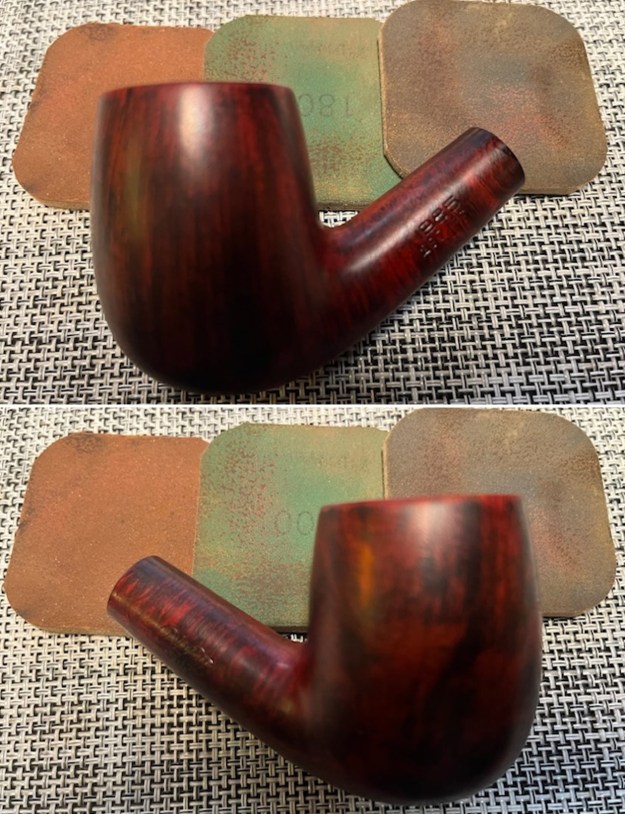
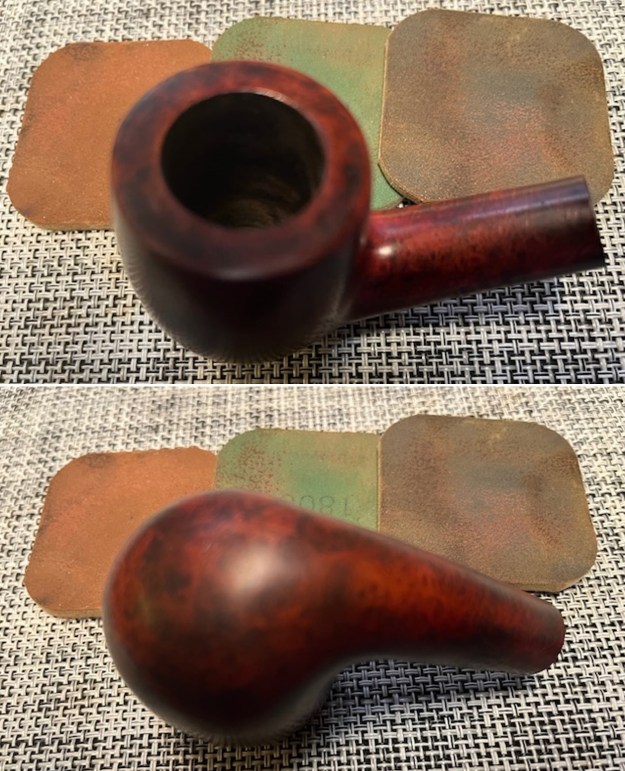
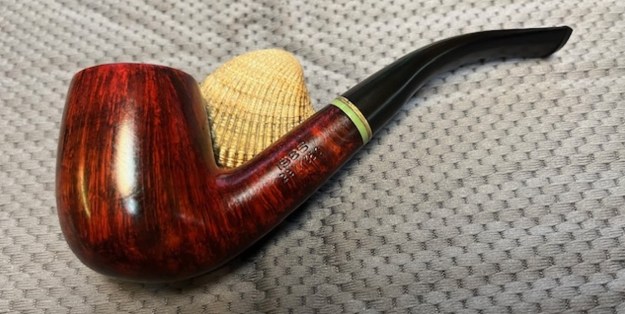
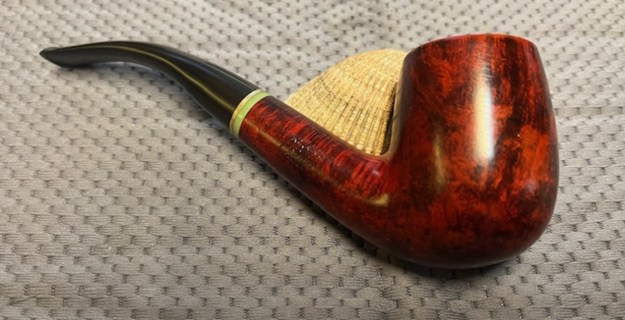
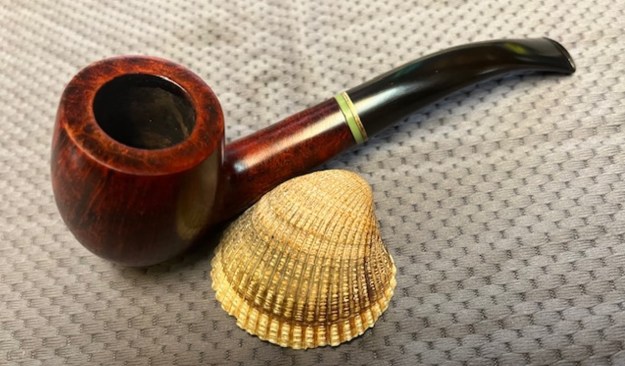
Armed with that information I turned to work on the pipe itself. Jeff had done a great job cleaning up the pipe as usual. He cleaned up the inside of the bowl with a PipNet reamer and a Savinelli Fitsall Pipe Knife. The bowl walls looked very good. He scrubbed the interior of the bowl and shank with shank brushes, pipe cleaners, cotton swabs and alcohol to remove the tars and oils. He scrubbed the exterior of the pipe with Murphy’s Oil Soap and a tooth brush to remove the grime from the finish. He worked on the rim top lava and darkening with the soap and tooth brush. He scrubbed the inside of the stem with alcohol and pipe cleaners. He scrubbed the exterior with Soft Scrub and then soaked it in Briarville’s Pipe Stem Deoxidizer. He washed it off with warm water to remove the deoxidizer. The pipe looked far better. I took photos of the pipe when I received it before I started working on it.  I took photos of the bowl and rim top to show how clean it was. The top and the inner edge of the rim show some darkening, nicks and scratches. The stem looks clean of debris and grime. There are light tooth marks and chatter on both sides of the stem.I took photos of the stamping on the sides of shank. The stamping is clear and readable (much clearer in person than the photos show). I took a photo of the pipe with the stem removed to show the overall look of stem, tenon and profile of the pipe. I polished the briar bowl and shank with micromesh sanding pads – dry sanding with 1500-12000 grit sanding pads. I wiped it down with a damp cloth after each pad to remove the debris. The bowl took on a rich glow. I rubbed the bowl down with Before & After Restoration Balm. I worked it into the surface of the briar with my fingertips to clean, enliven and protect it. I let the balm sit for 10 minutes and then buffed with a cotton cloth to raise the shine. Mark Hoover’s Balm is a product that I have come to appreciate and one I use on every pipe I have been working on. I set aside the bowl and turned my attention to the stem issues. I painted the surface of the stem with the flame of a Bic lighter to lift the tooth marks. I was able to lift all of them enough that sanding would finish blending them. I sanded the stem with 320-3500 grit sanding pads to further blend them in and smooth out the surface of the stem. I polished the vulcanite with micromesh sanding pads – 1500-12000 grit pads. I wiped it down with a damp cloth after each sanding pad. I used Before & After Pipe Polish – both Fine and Extra Fine to further polish the stem. I put the stem back on the Pipe Club 1985 Bent Billiard France and took it to the buffer. I worked over the smooth portions with Blue Diamond to polish out the remaining small scratches. I gave the bowl and the stem several coats of carnauba wax on the wheel and buffed the pipe with a clean buffing pad to raise the shine. I hand buffed it with a microfiber cloth to deepen the shine. The pipe polished up really well and the rim top and edge looked good. I was happy with the look of the finished pipe. The photos below show what the pipe looks like after the restoration. The oxblood stained Bent Billiard that is a beautiful and unique take on a classic shape. The polished vulcanite taper stem with the twin bands of brass and green acrlyic looks really good with the rich reds of the briar. The dimensions of the pipe are Length: 5 ¾ inches, Height: 2 inches, Outside diameter of the bowl: 1 ¼ inches, Chamber diameter: ¾ of an inch. The weight of the pipe is 1.94 ounces/55 grams. This is another pipe that I will be putting it on the rebornpipes store in the American Pipe Making Companies Section shortly, if you are interested in adding it to your collection. This Bent Billiard looks and feels great in the hand. This one should be a great smoker. Thanks for walking through the restoration with me on this beauty!

1936-1938 Kaywoodie Bulldog Restored


By Al Jones

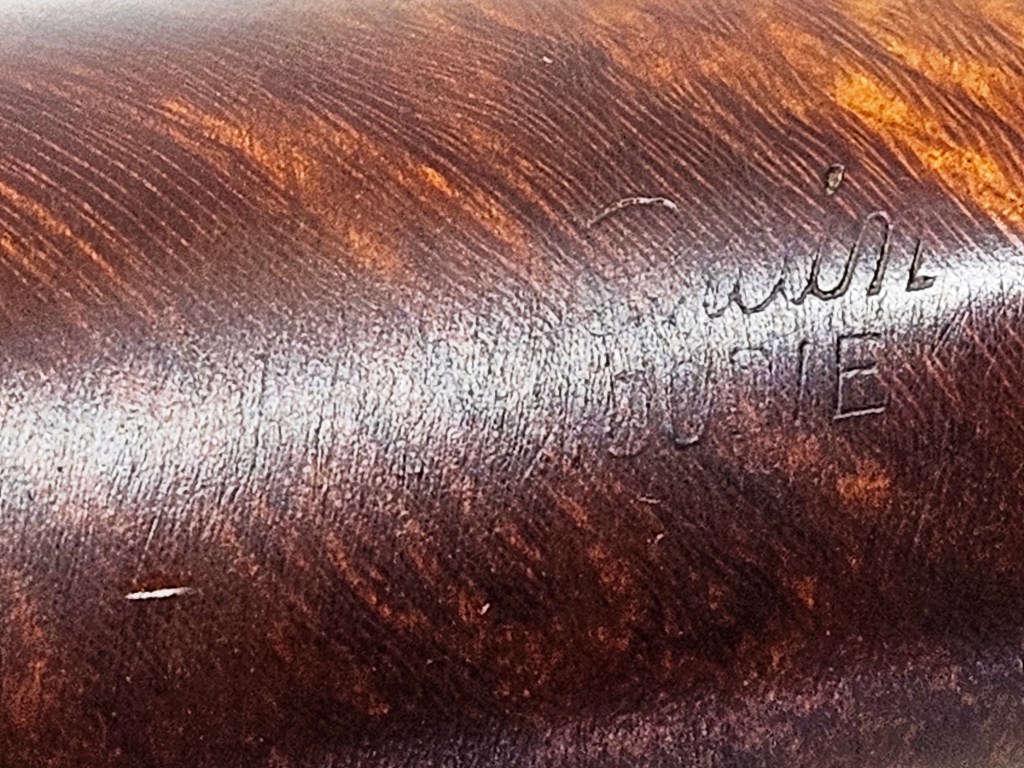
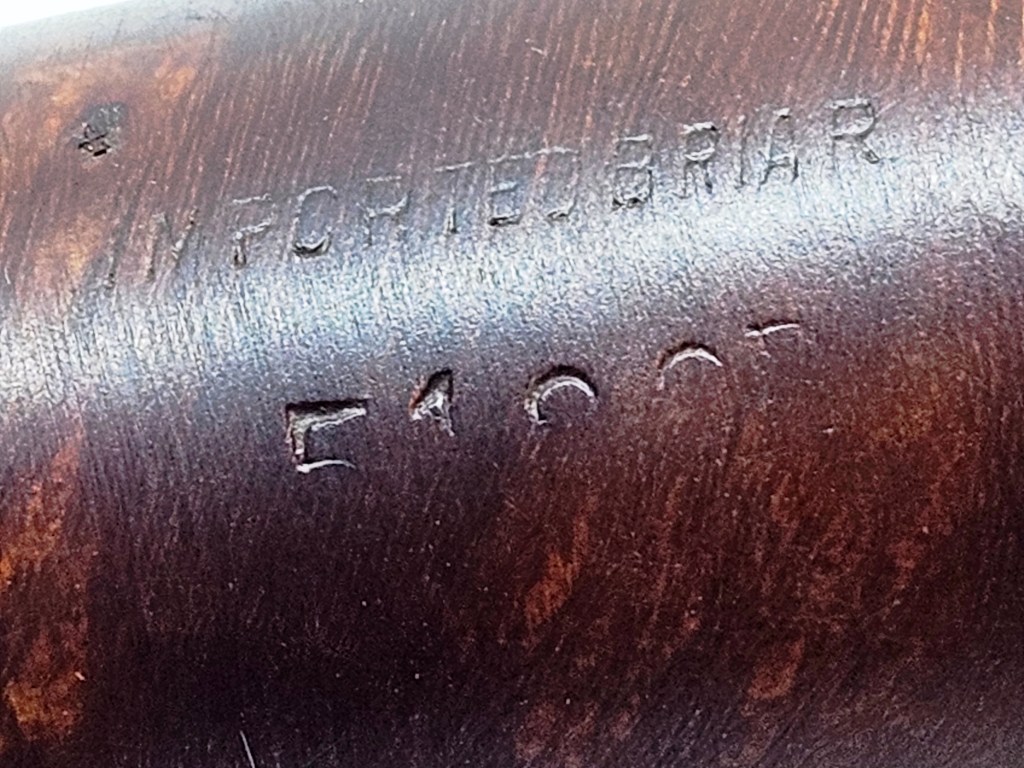
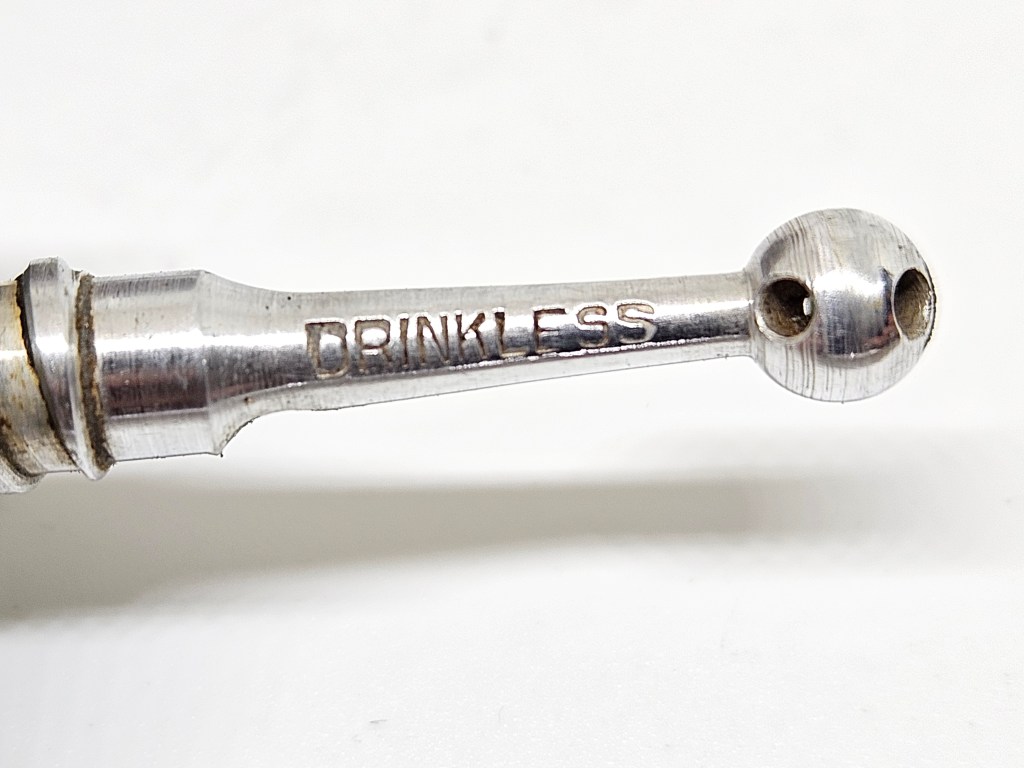
It has been four or five years since I last had a vintage Kaywoodie on my workbench. This one caught my eye on eBay and the seller confirmed the stinger was intact, and had four holes. I thought it was made before WWII, and after evaluating the pipe on my bench, I believe the pipe was made between 1936 and 1938. Information and documents gleaned from several Kaywoodie collector site documents I saved over the years were very helpful. Unfortunately, the Kaywoodie forum is no longer active. We used to be able to contact the owner of Kaywoodie and ask the owner himself, Bill Feurbach. (he was ill, and hopefully, recovering) The stamping was worn, but visible just enough to help me identify the era it would have been produced. The details that helped me were:

  • “Imported Briar” was used in starting in 1936
  • Four digit pipe shapes were not used after 1938
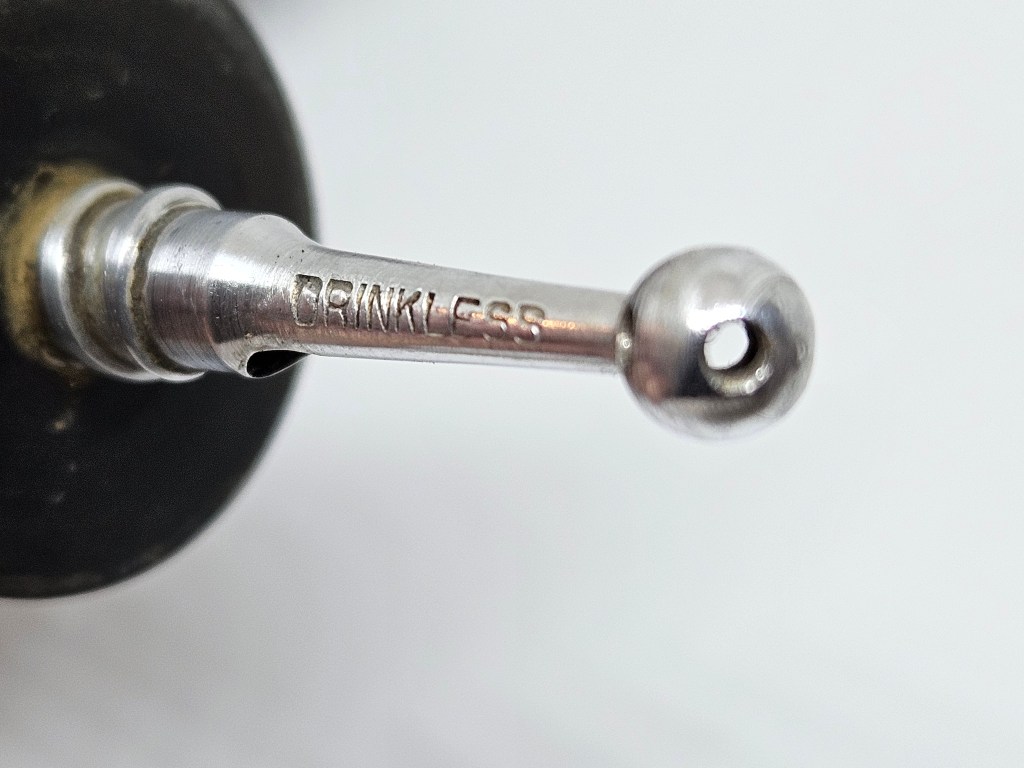
  • Just prior to WWII, the four-hole stinger ball was downsized and the shaft only said “Drinkless” (no “Reg” number)

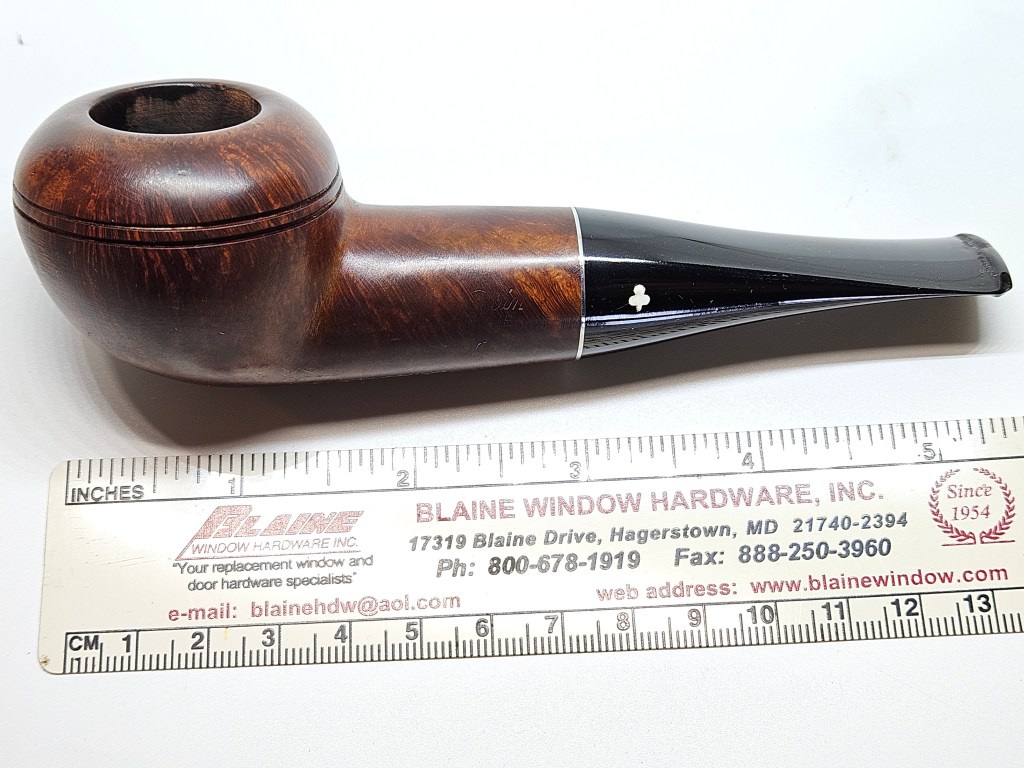
Kaywoodie identifies the 5189B shape as a “Squat Heavy Bulldog”, and apt shape name for this chunky pipe that weighs in at 55 grams. When I told my wife how old it was, she reminded me of the Potomac River flood of 1936, that impacted her family in nearby West Virginia (we live in Maryland, about two miles from the river). Did someone who was worried about their home chew on this pipe stem? Or as World War II was starting? Perhaps in joy hearing the news that the war had ended. I wish these pipes could talk.

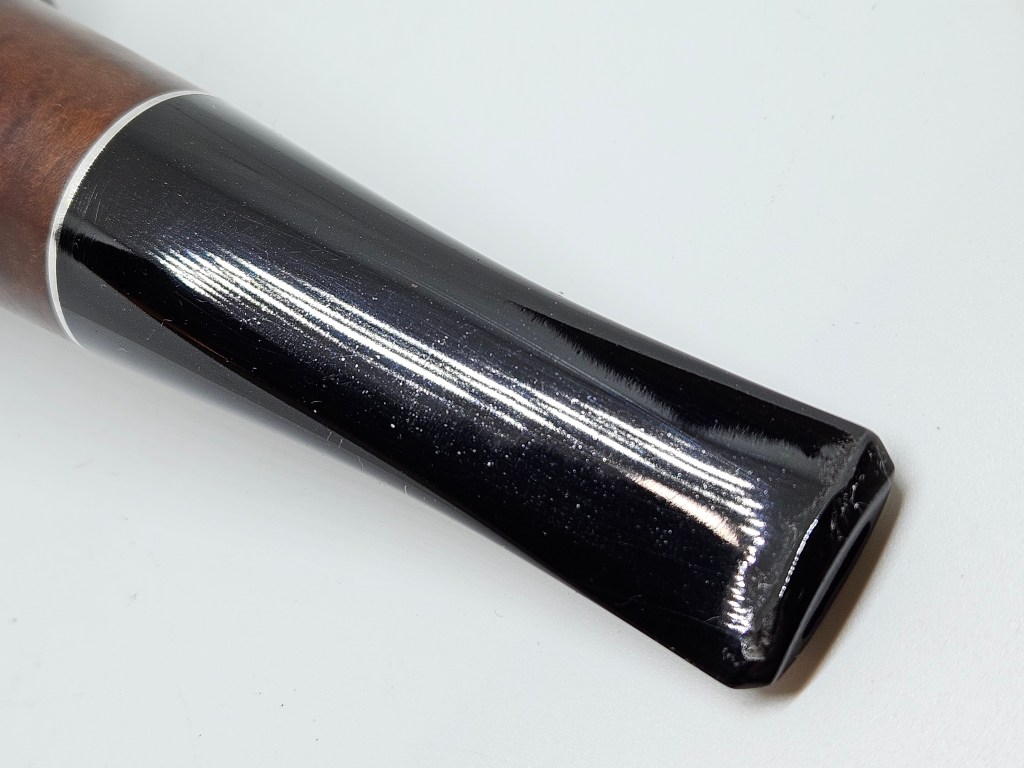
The pipe was in good condition, with some wear on the stem. The bowl appeared to be in very good condition, with only a very slight cake. The stem was “clocked” to the correct line-up. The stain was very faded, and I have a feeling someone removed the factory finish, perhaps starting, but not finishing a restoration. Below is the pipe as it was received.

I used some 2000 grade wet paper to remove the darkening around the rim. My Pipenet reamer was used to remove the very slight cake. I found that with older Kaywoodies often have build-up stuck behind the “stinger” insert in the briar, which can create ghosting problems. I used a screw-extractor to carefully remove the insert and thoroughly scrubbed shank. When I was satisfied the shank was clean, I soaked the bowl with sea salt and alcohol.

I used a very heavily diluted solution of Feiblings Medium Brown stain to refresh the briar. The bowl was then buffed with White Diamond and several coats of carnuba wax.

Following the alcohol soak, the stem was screwed back on. I used heat to lift some of the teeth indentions, but a few minor marks remain. I removed the oxidation with 800, 1,500 and 2,000 grade wet paper. The stem was then buffed with White Diamond rouge and Meguiars plastic polish.
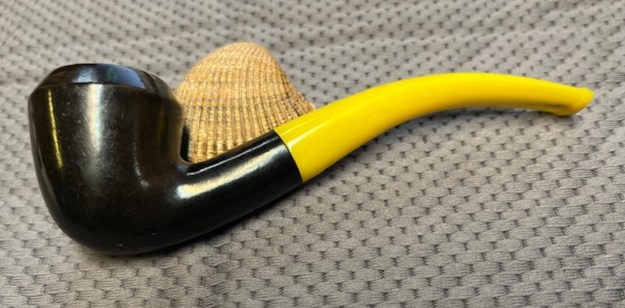
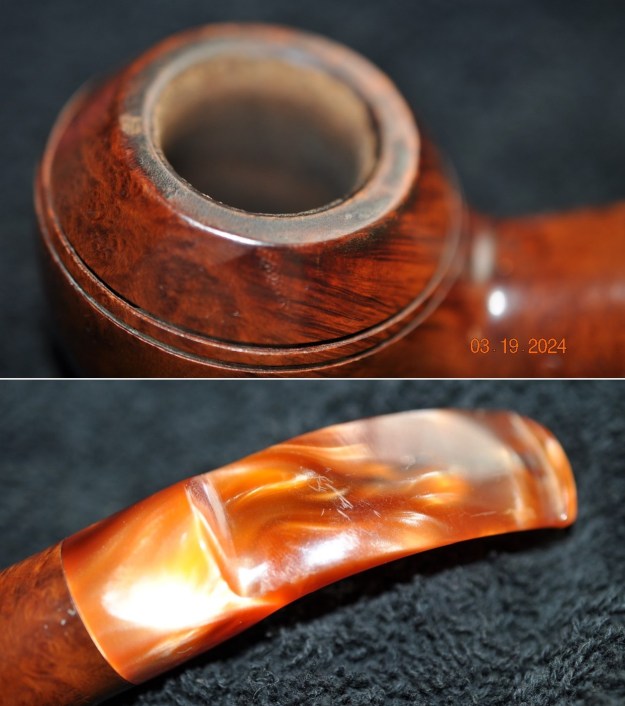
Below is the finished pipe, ready for another 80 plus years of service: