Monthly Archives: May 2022

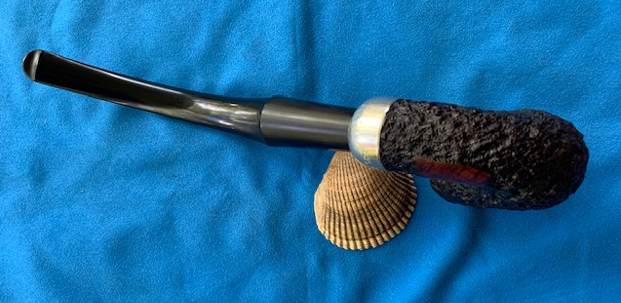
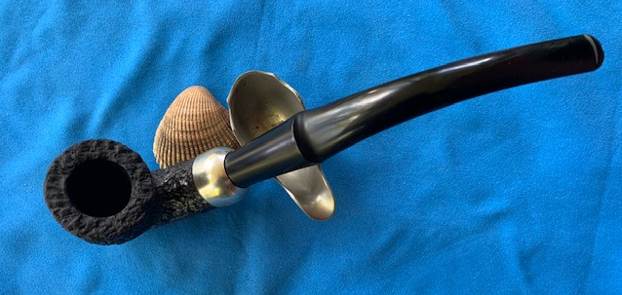
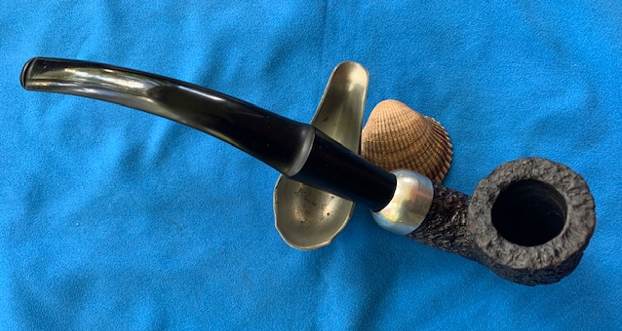
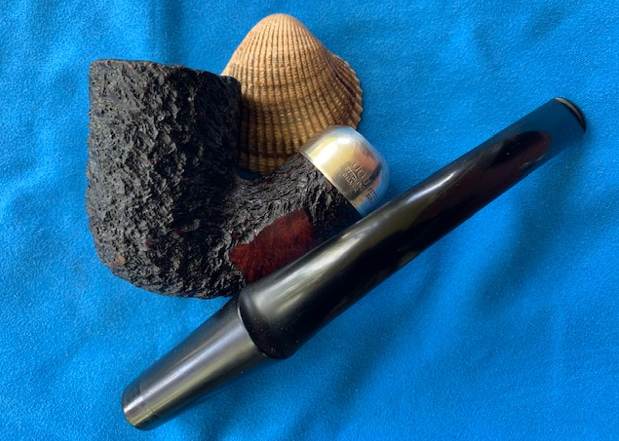
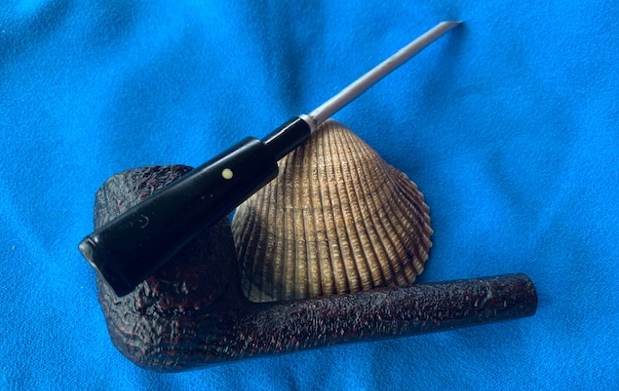
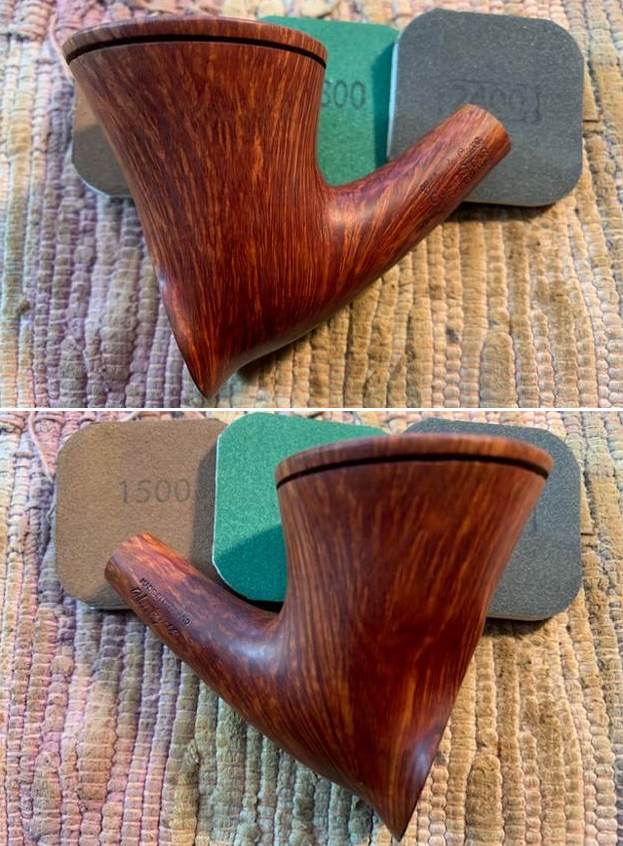
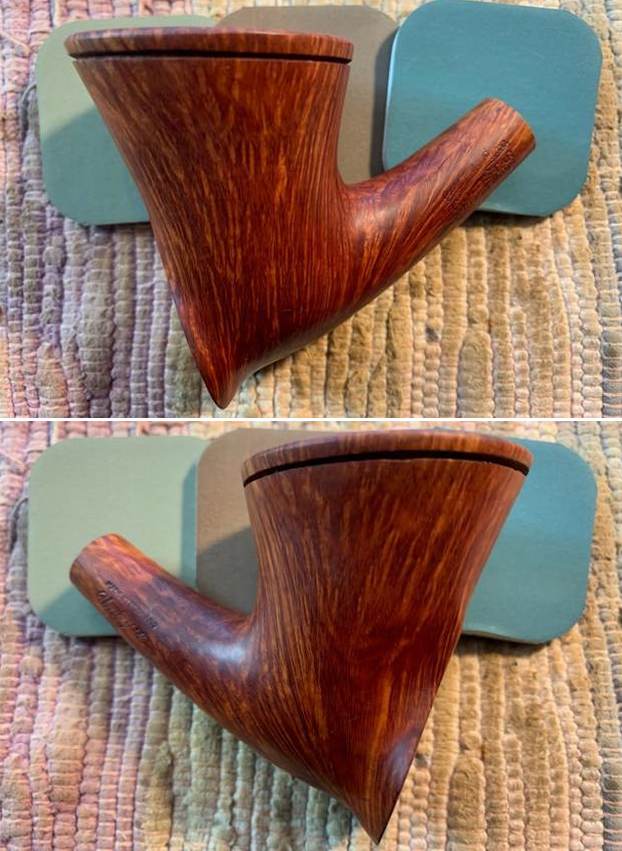
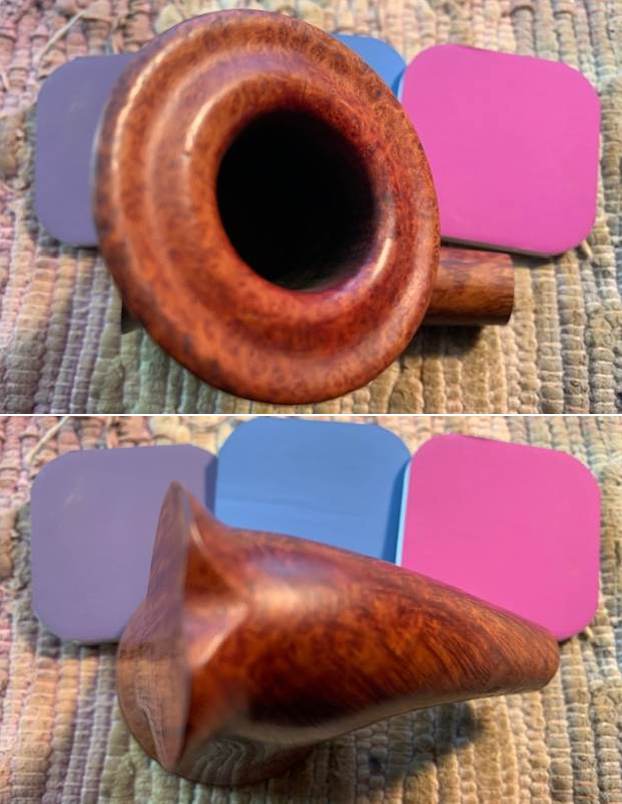
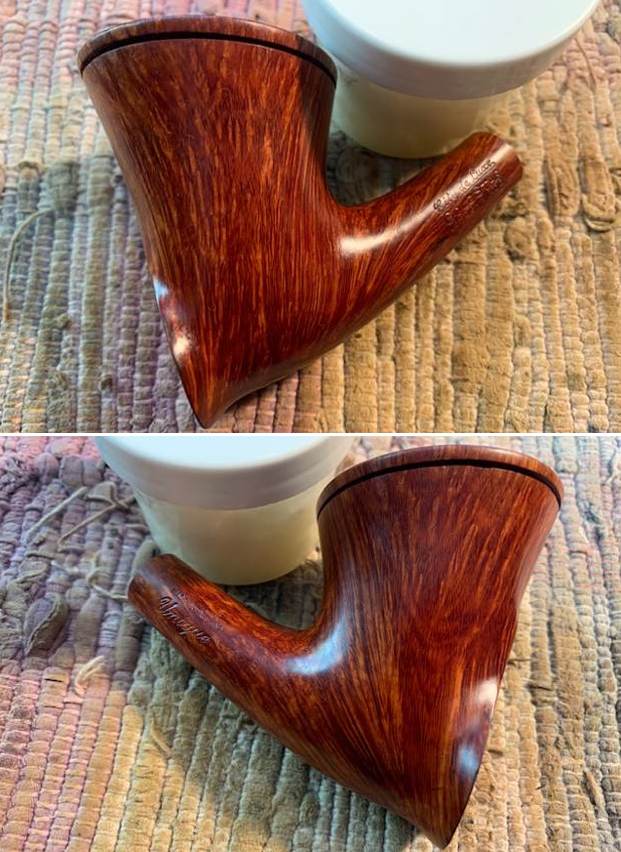
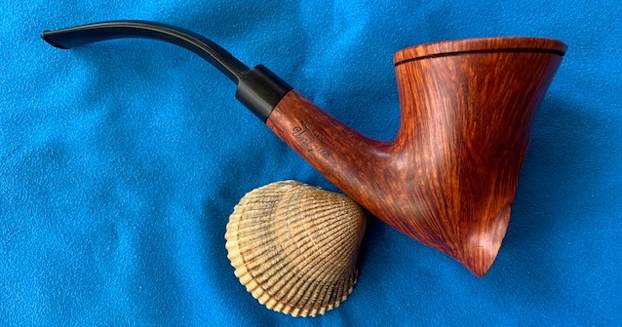
Sasieni Four Dot Ashford “Ruff Root” Restoration


By Al Jones

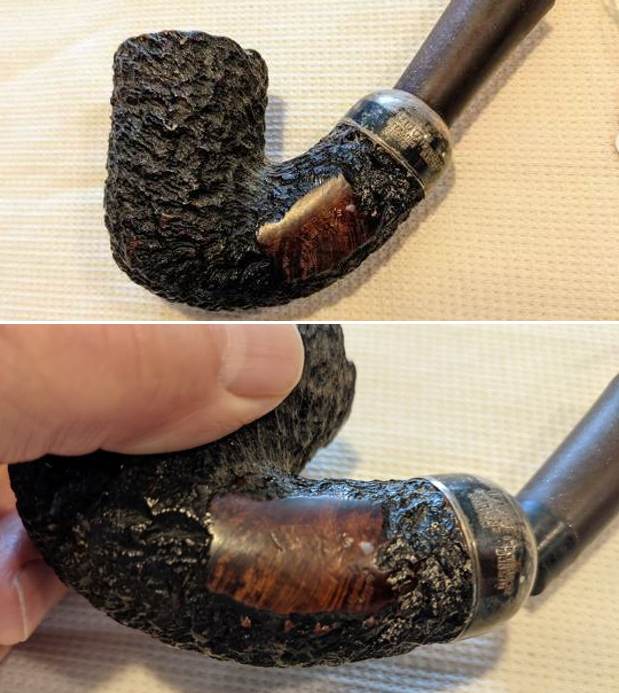
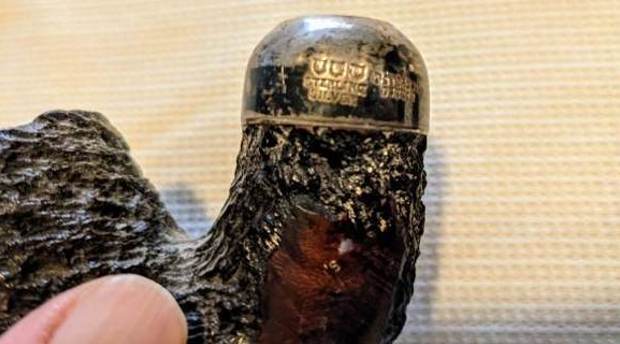
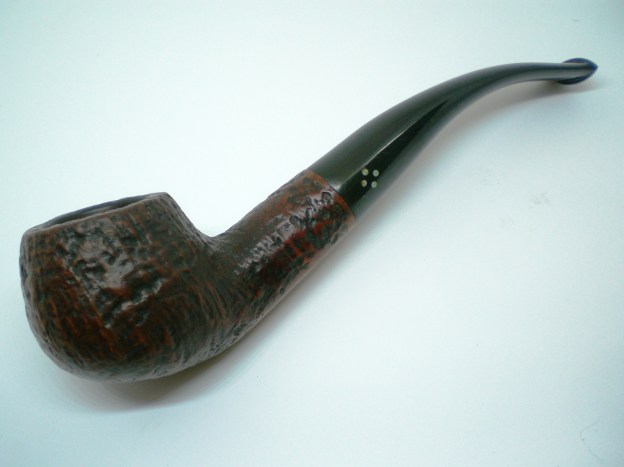
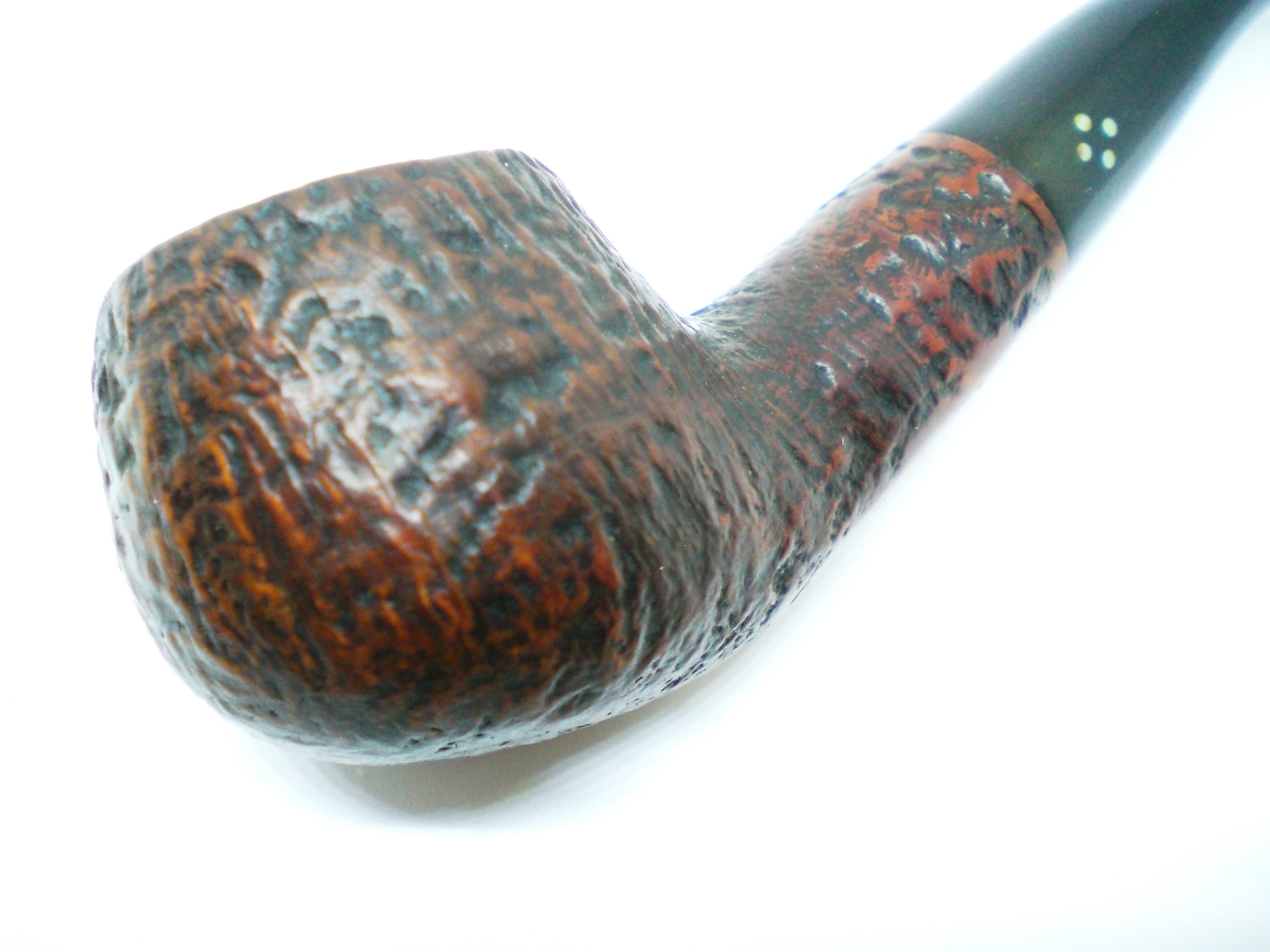
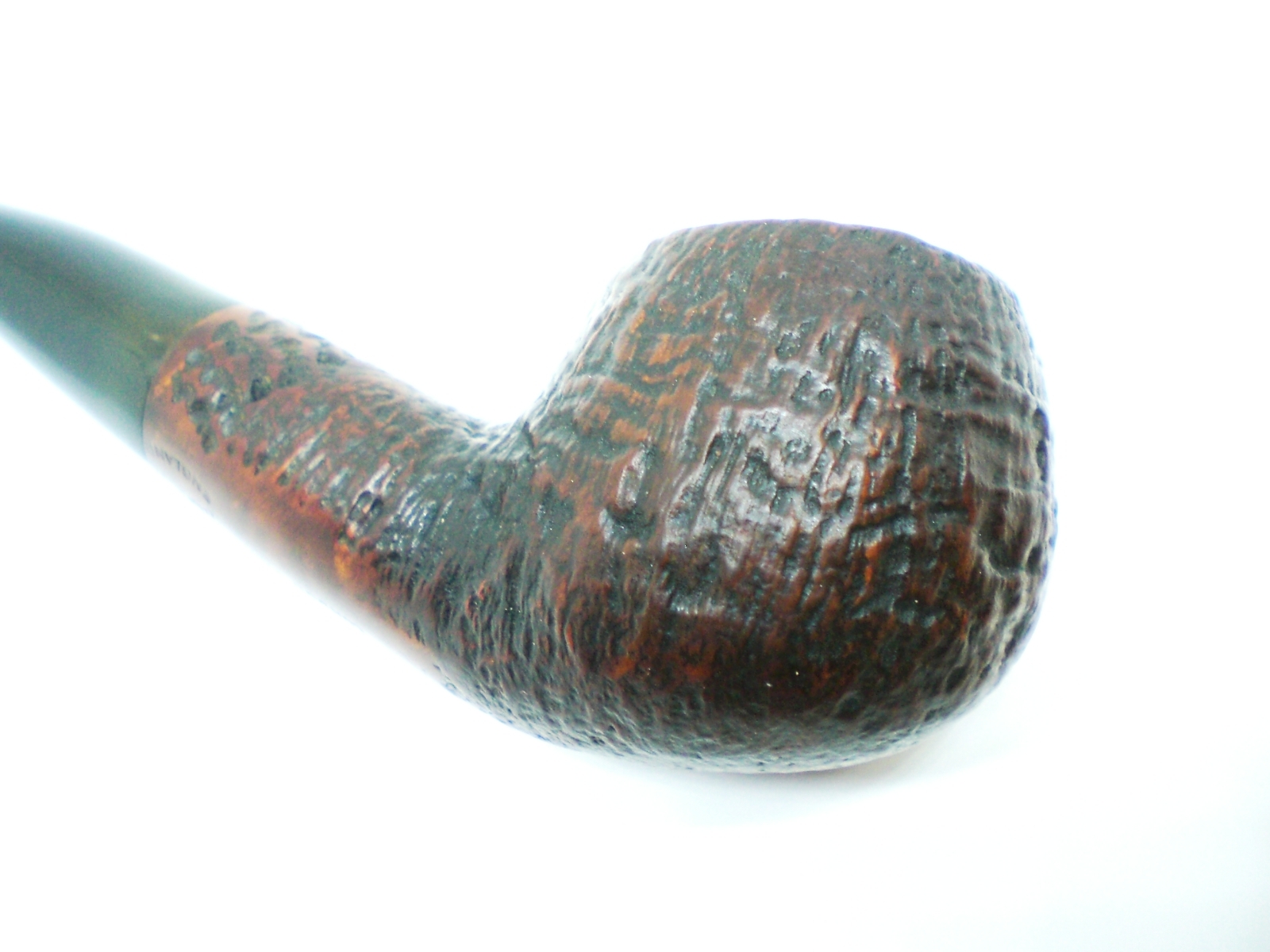
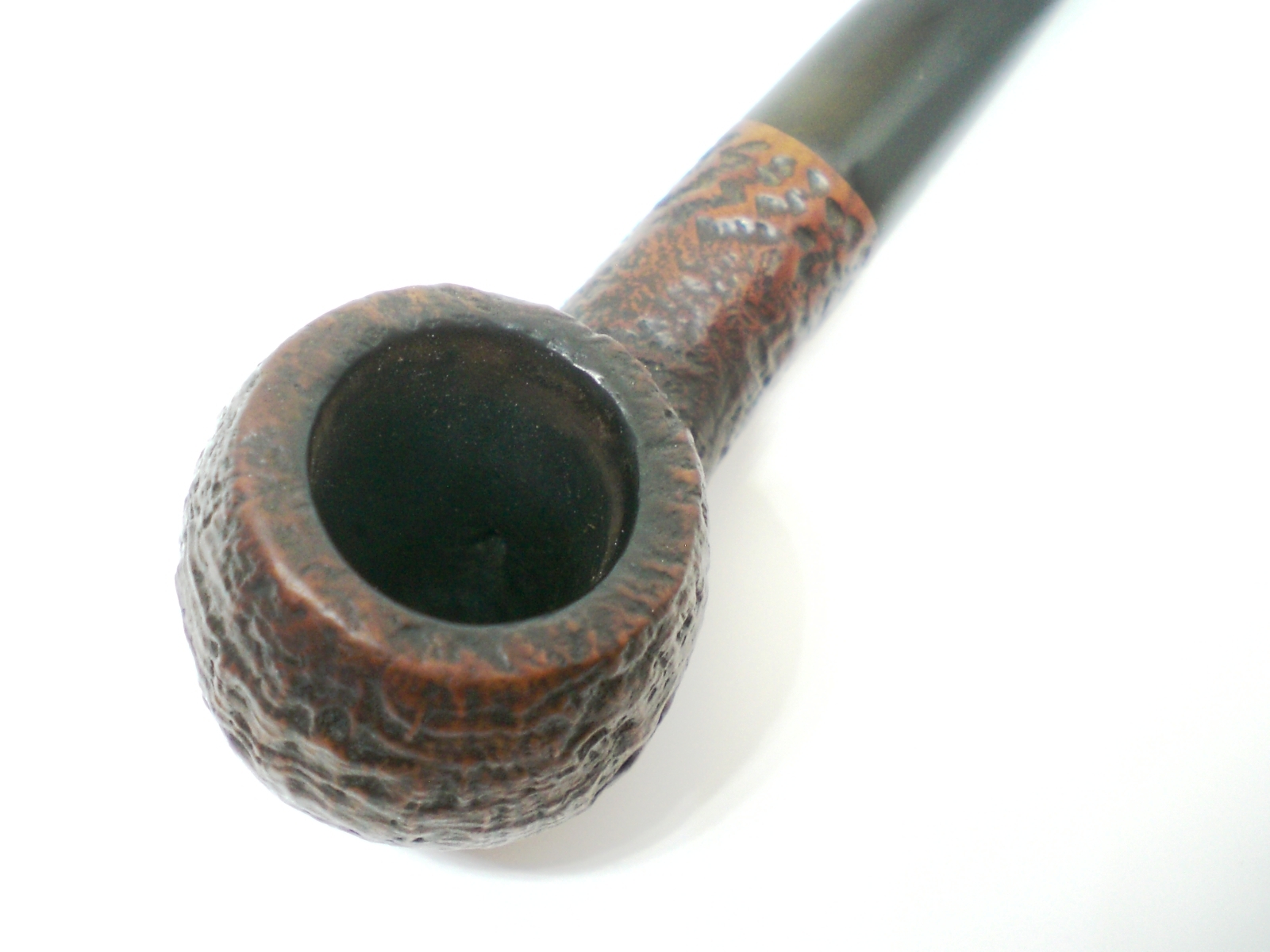
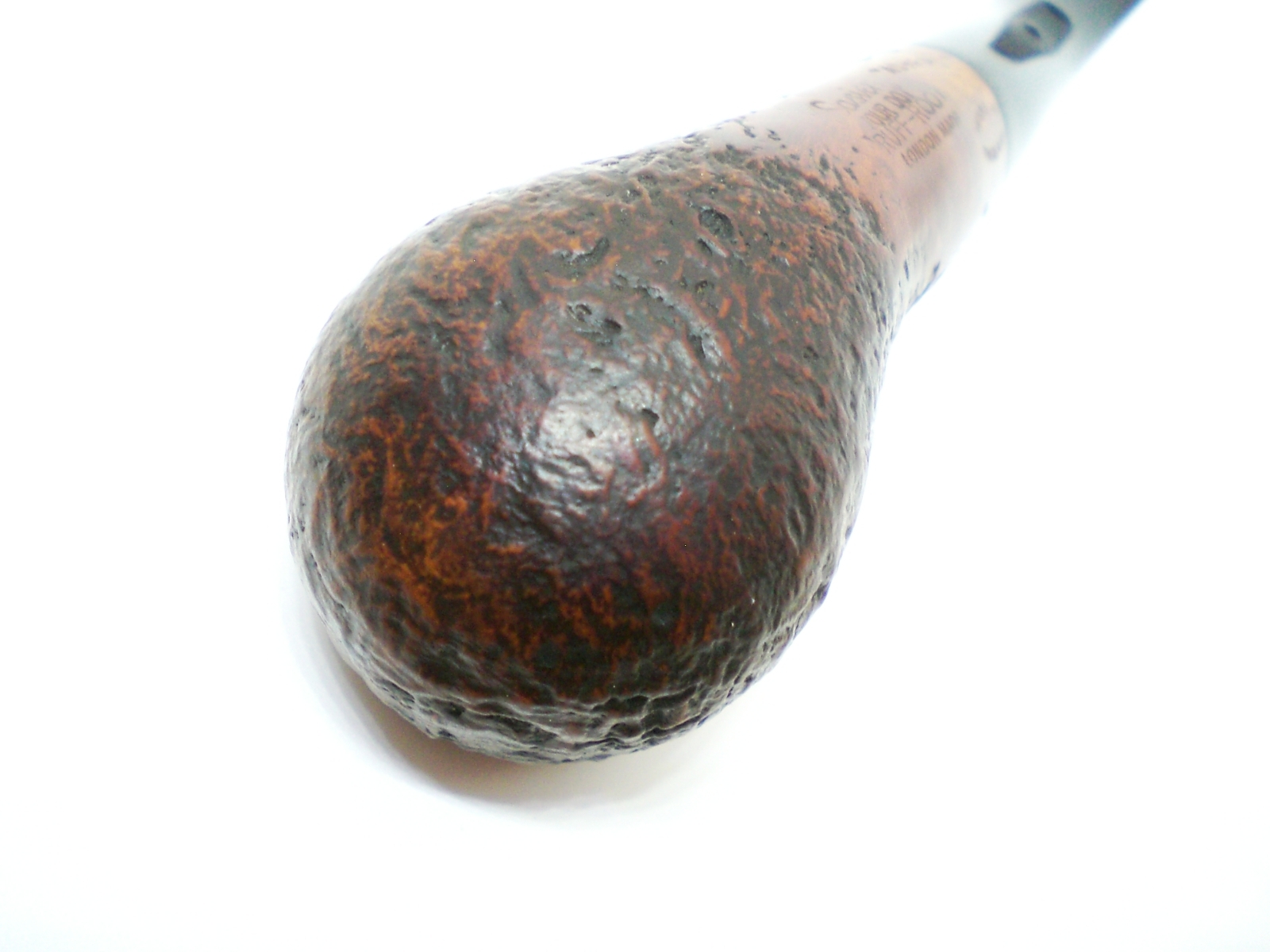
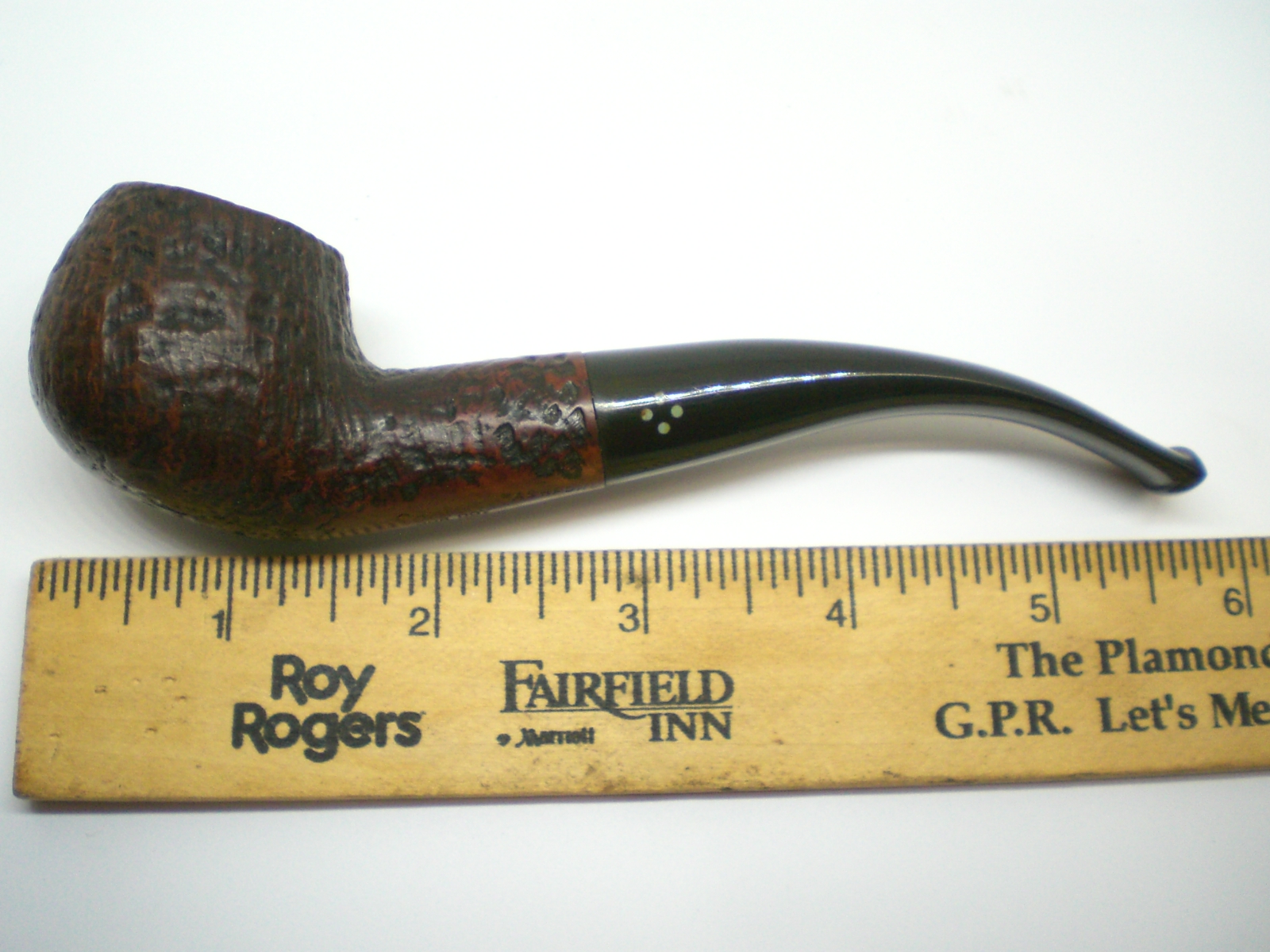
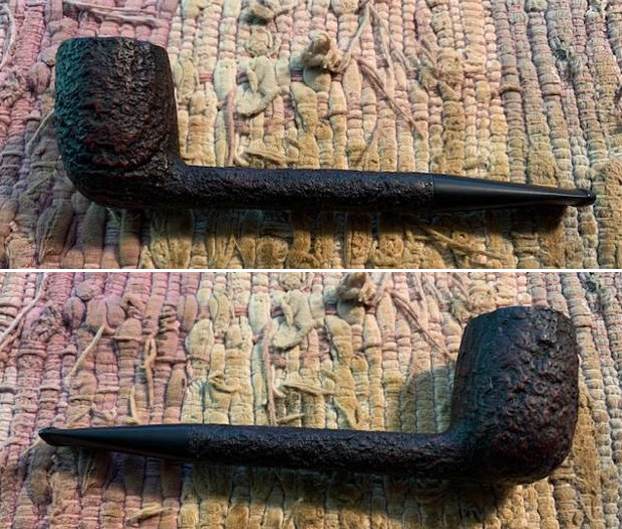
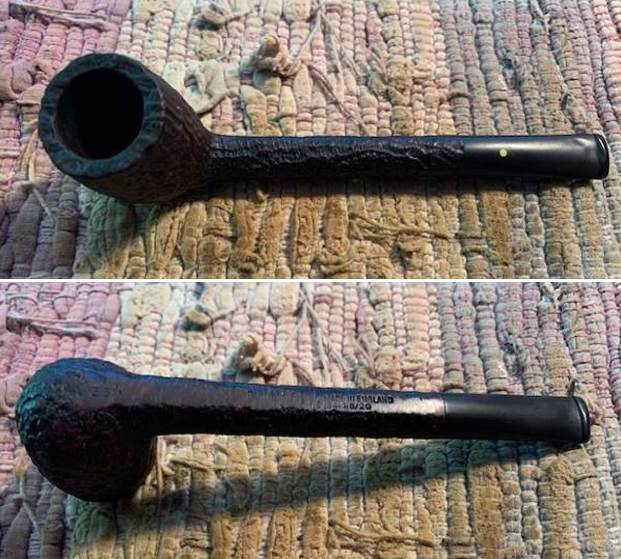
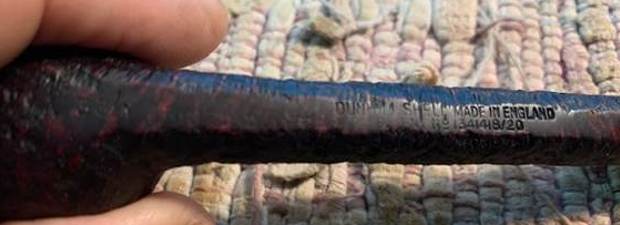
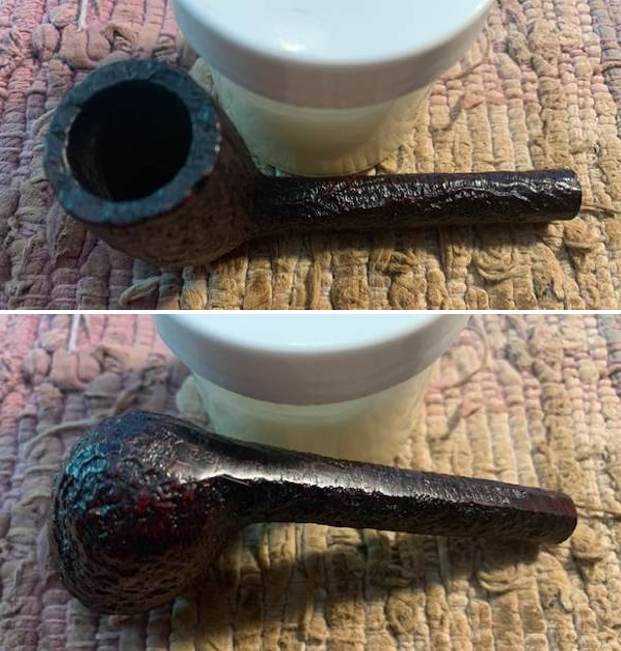
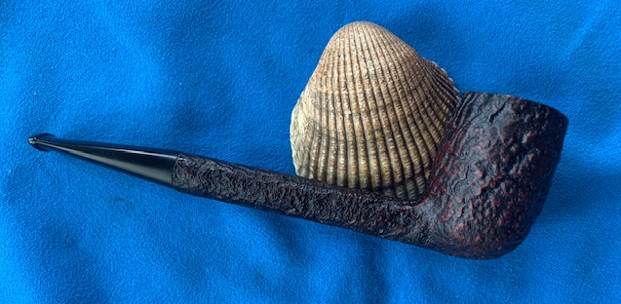
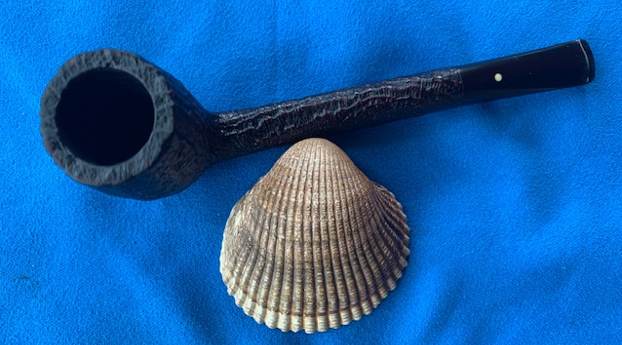
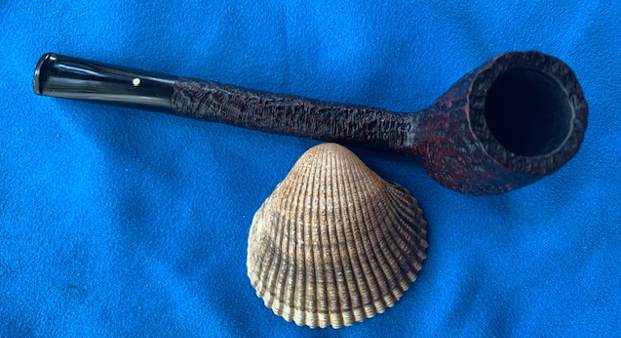
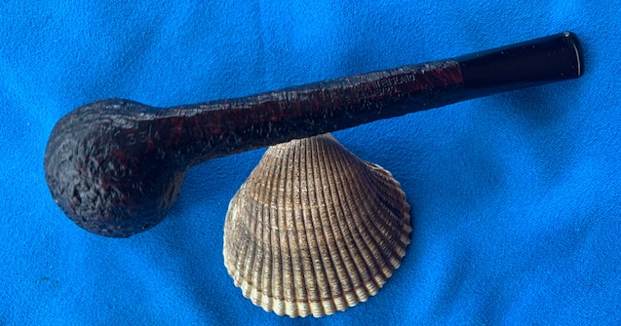
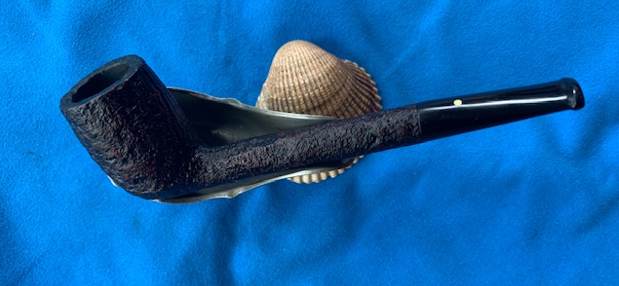
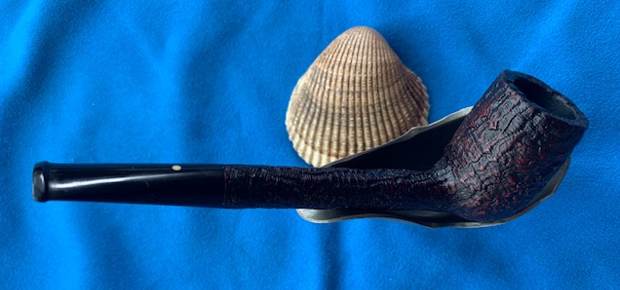
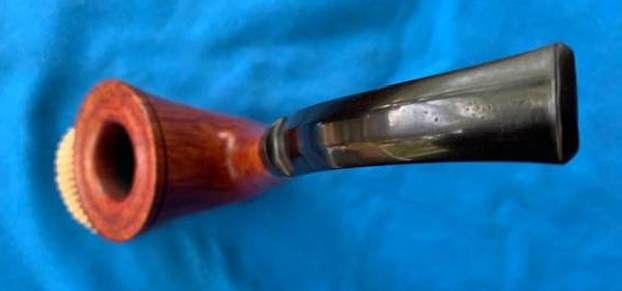
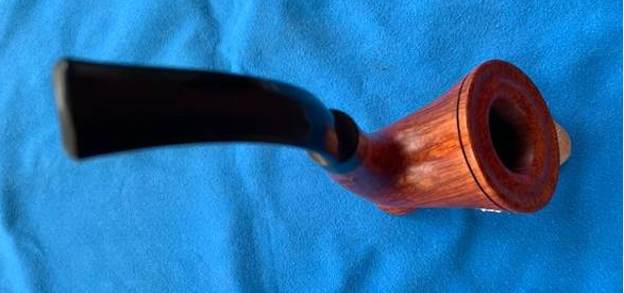
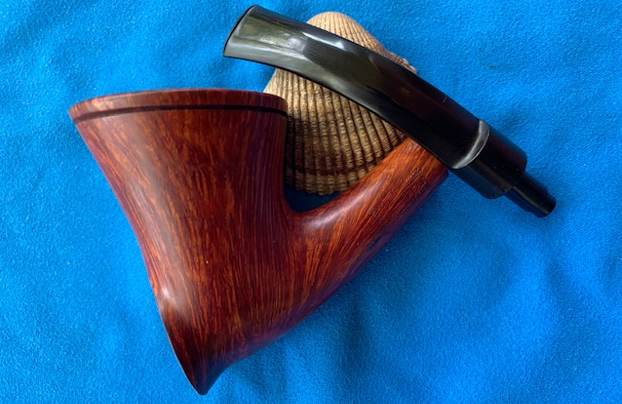
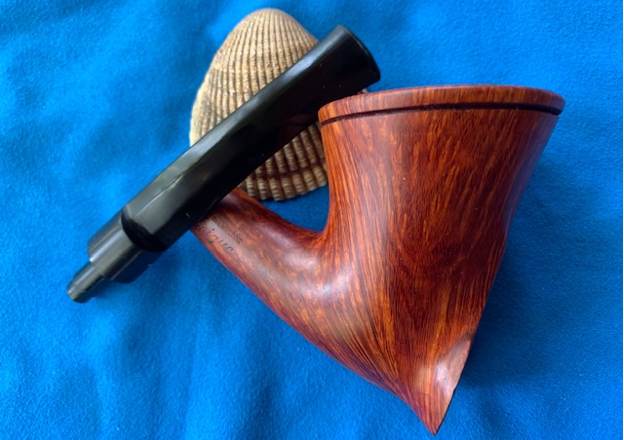
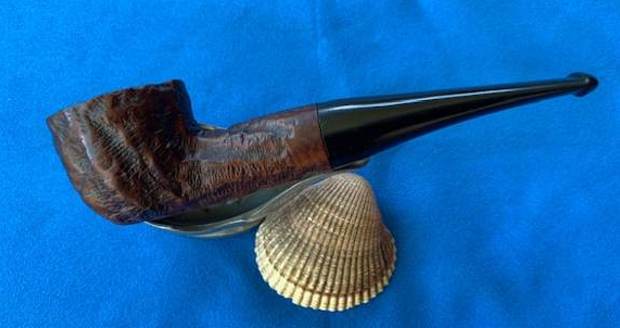
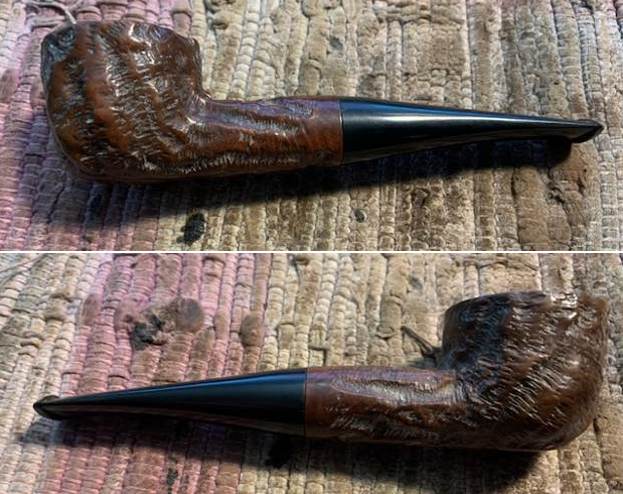
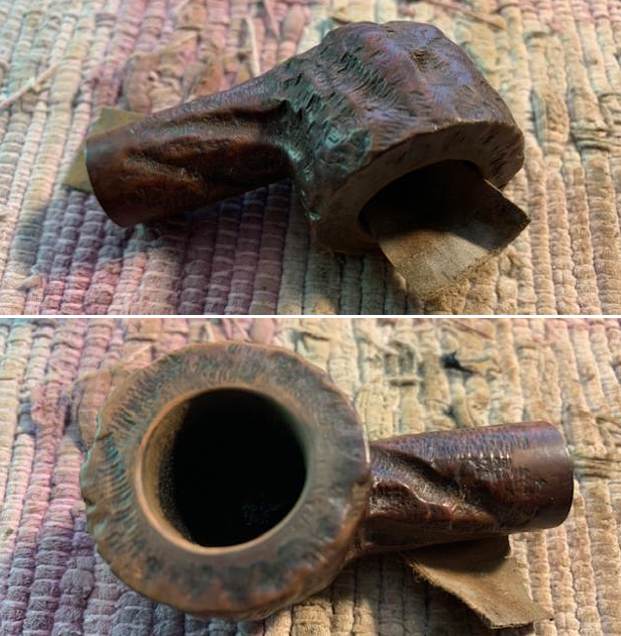
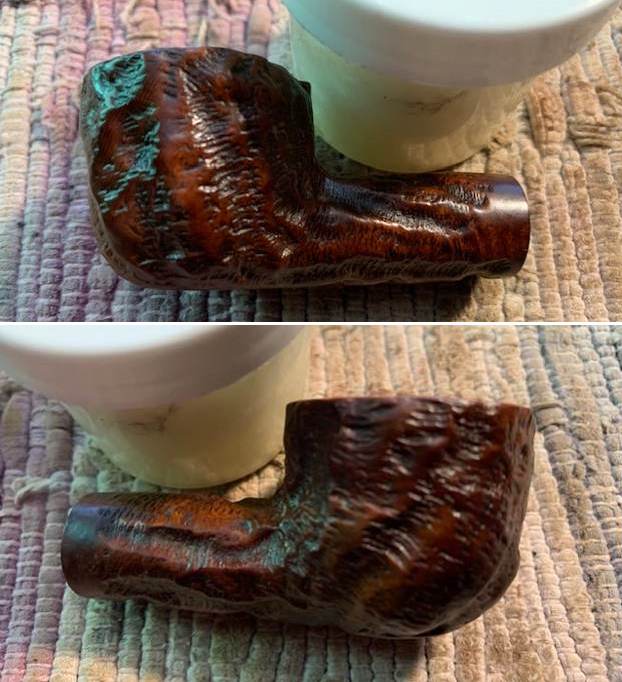
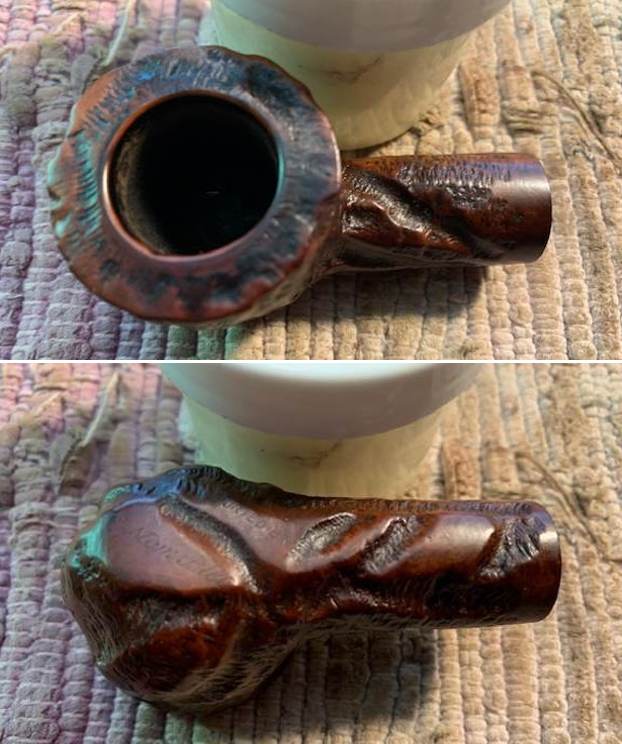
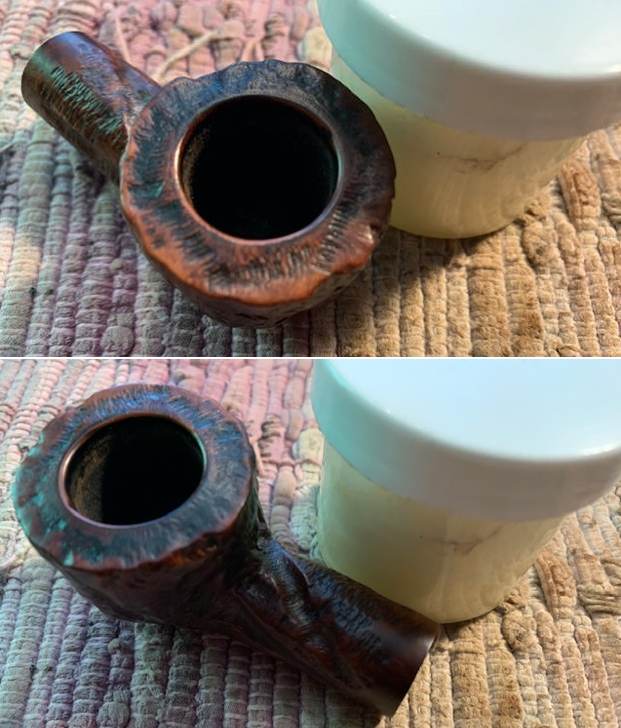
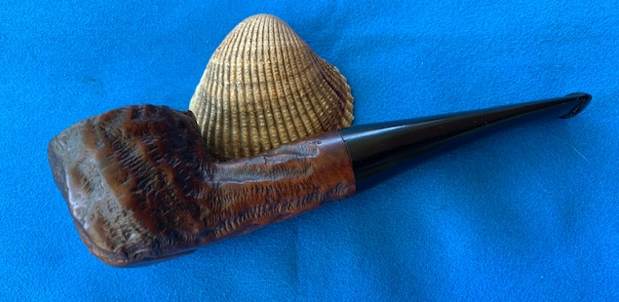
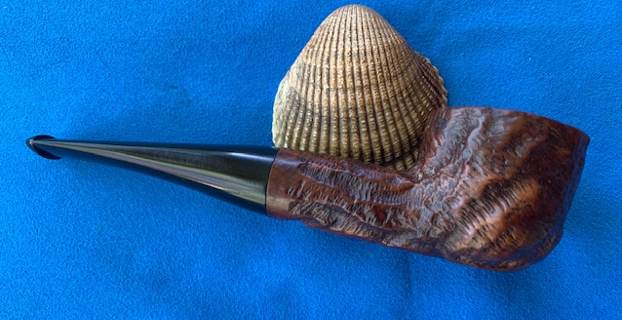
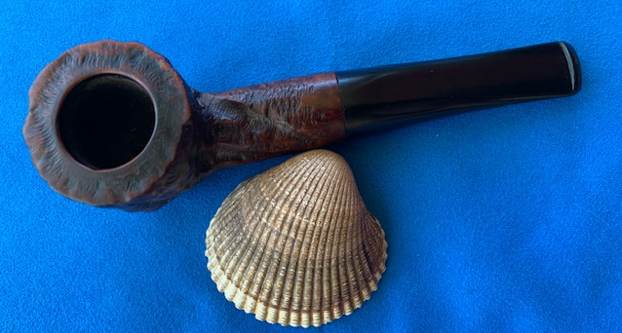
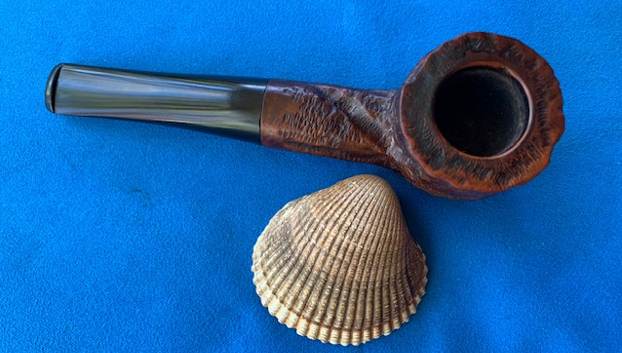
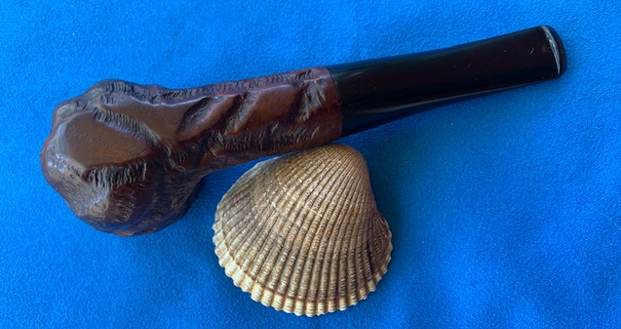
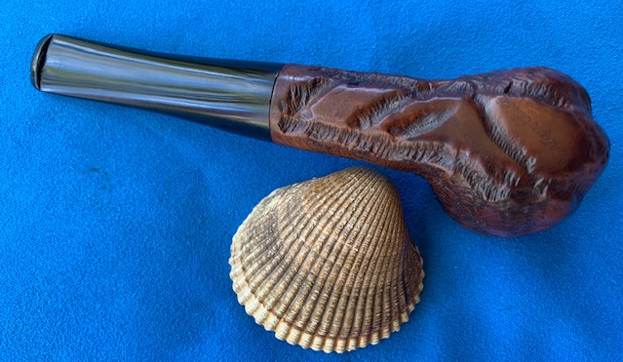
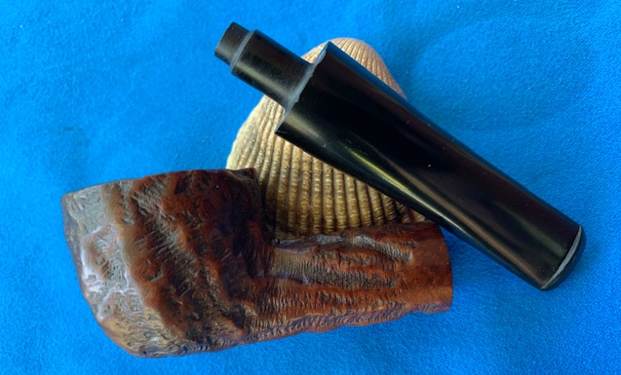
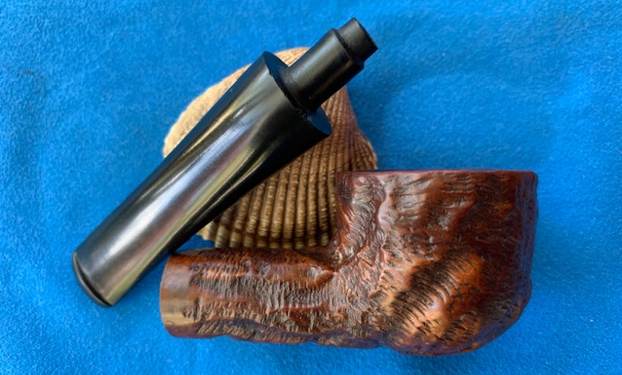
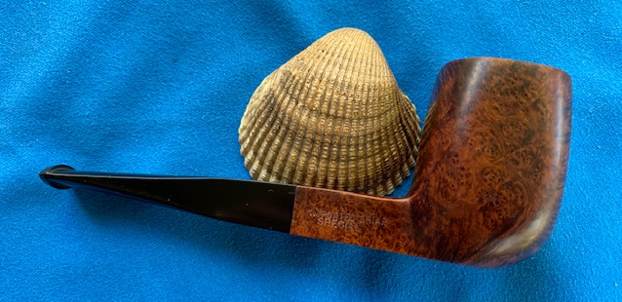
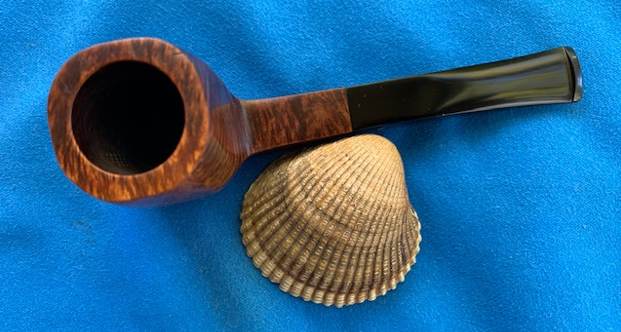
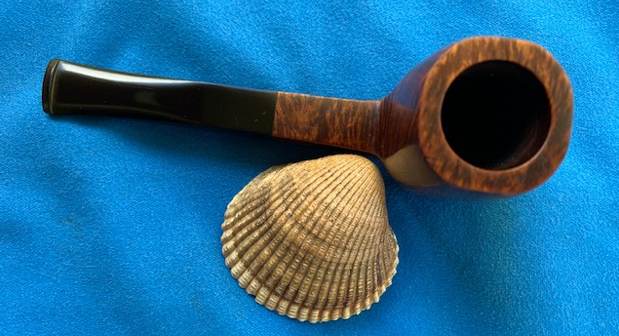
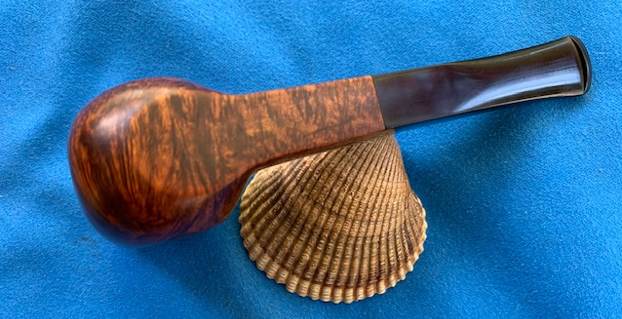
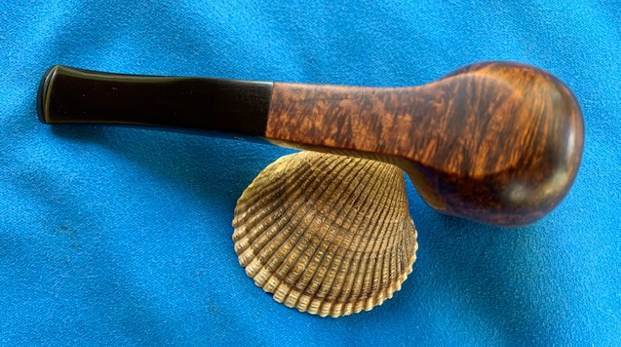
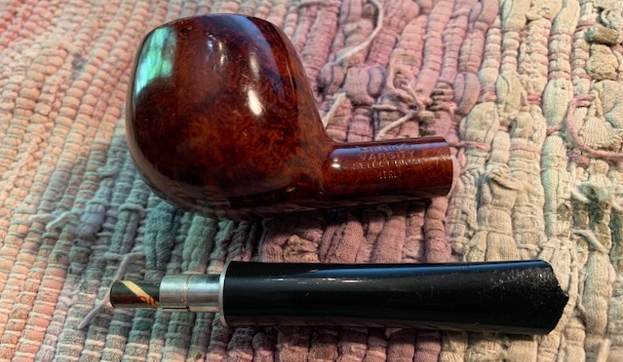
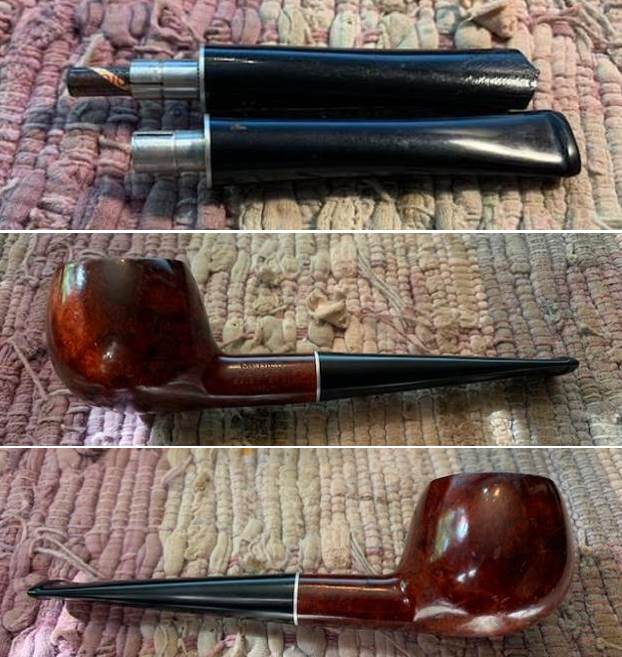
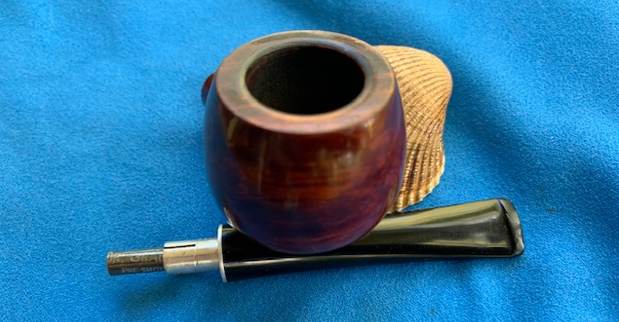
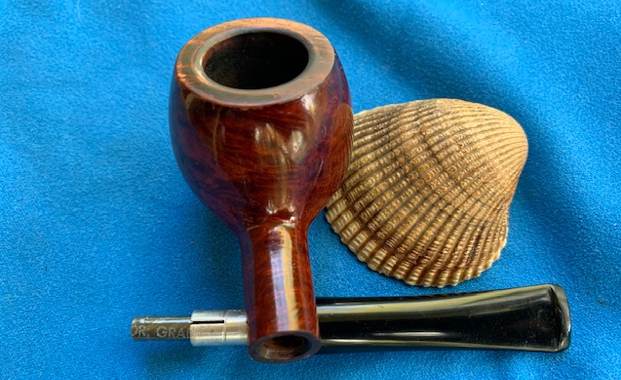
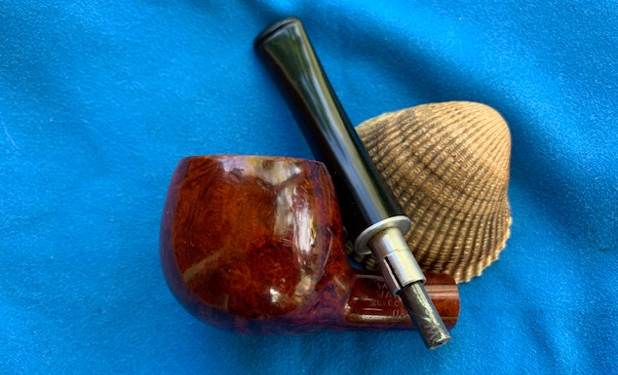
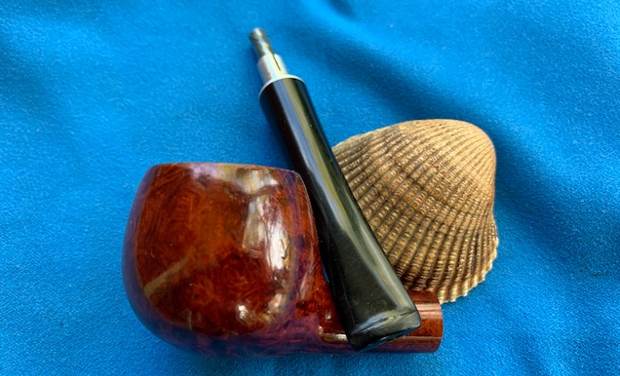
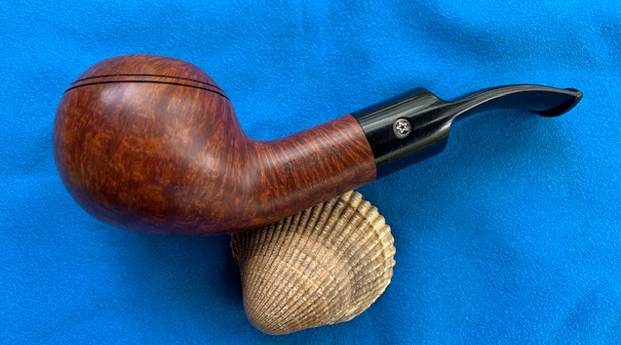
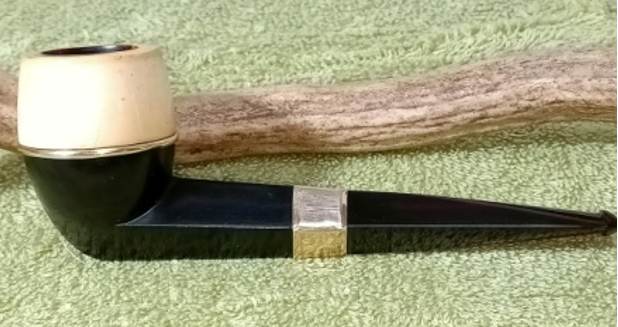
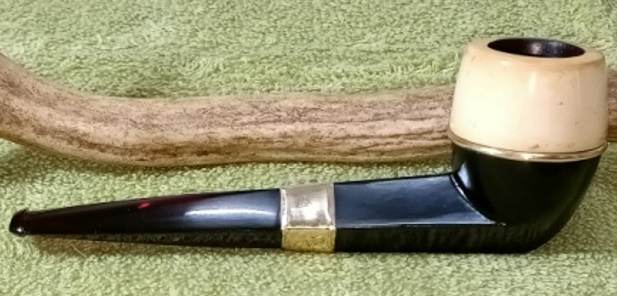
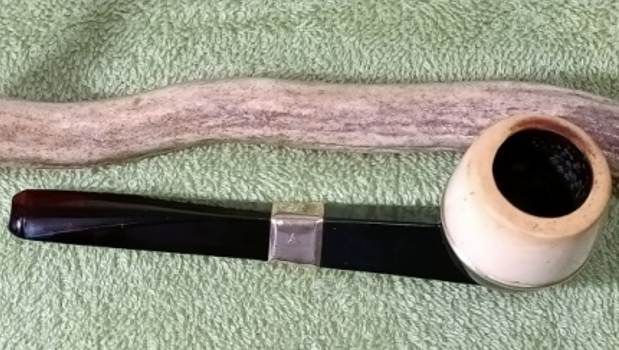
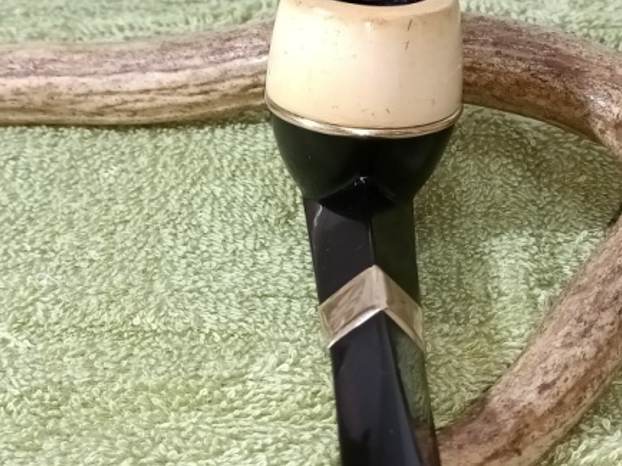
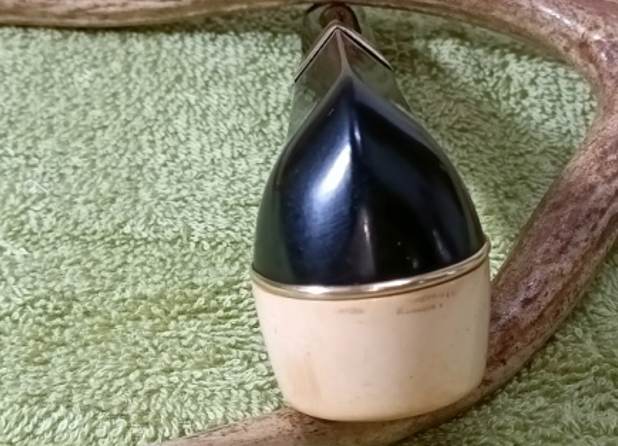
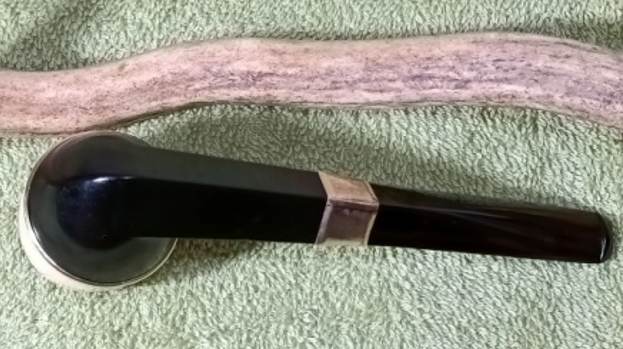
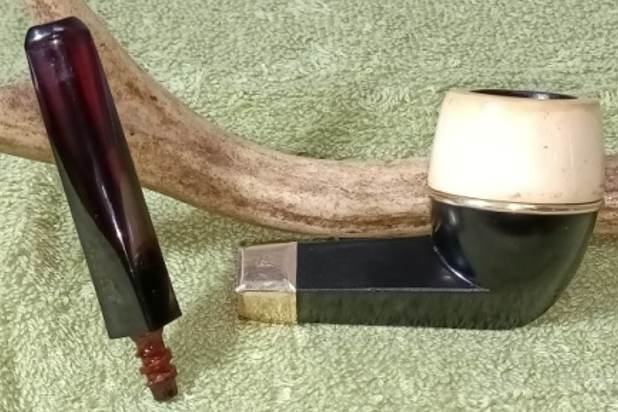
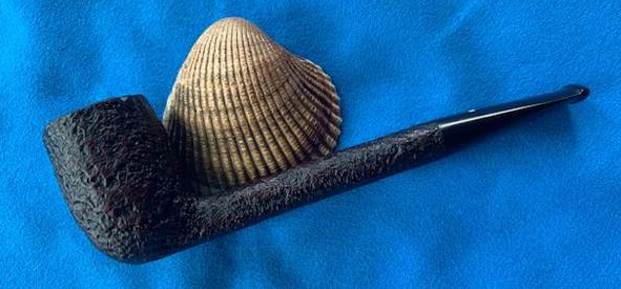
The Sasieni Ashford author is a favorite shape from the classic British makers. This one is in Ruff Root finish, which is Sasieni’s sandblast finish. Since the pipe has the town name, but no patent number, it is from the 1946 to 1979 era. Like the Peterson 999, the shape evolved slightly over the decades it was made by Sasieni. This one is a bit longer than some of my other Ashfords, and my hunch is that it was from the end of the family era. I have nothing to prove that statement – it is just a hunch.

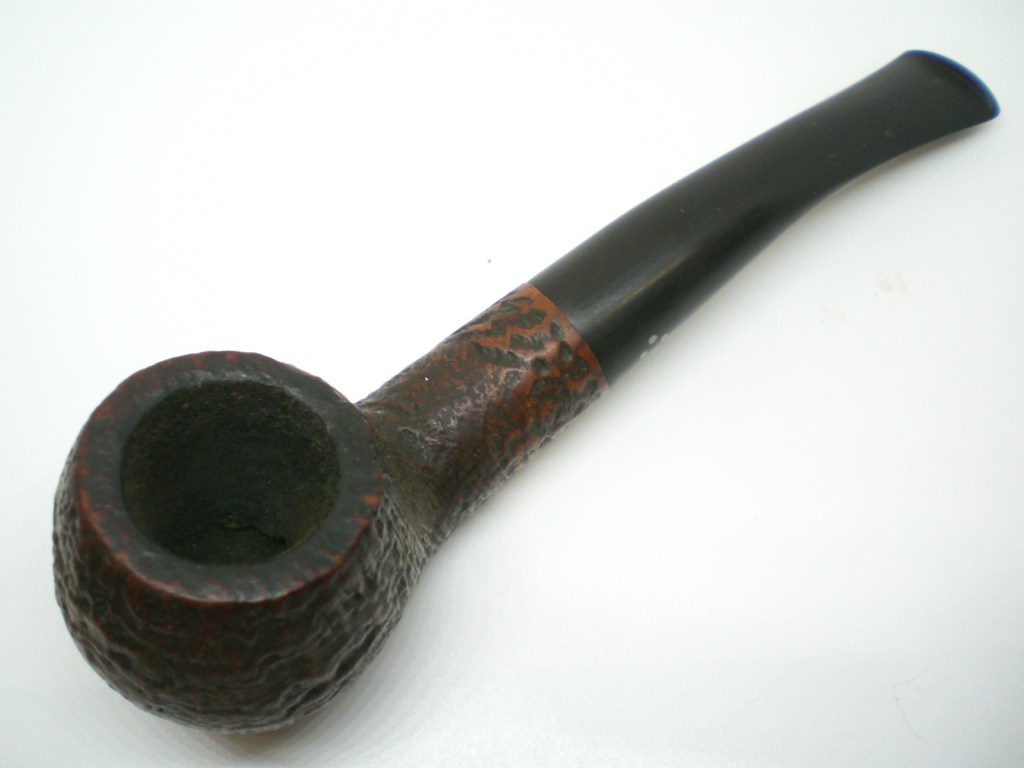
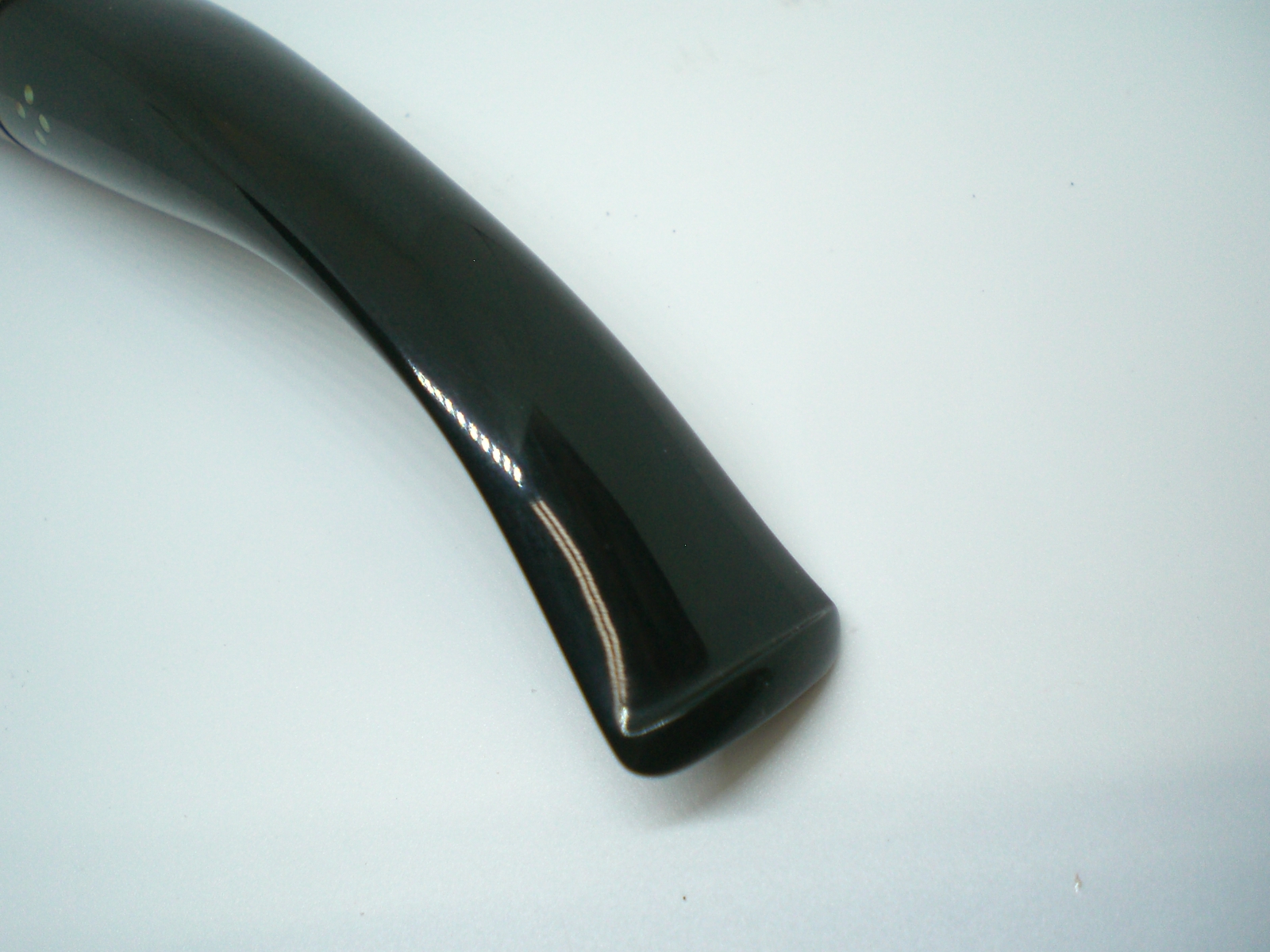
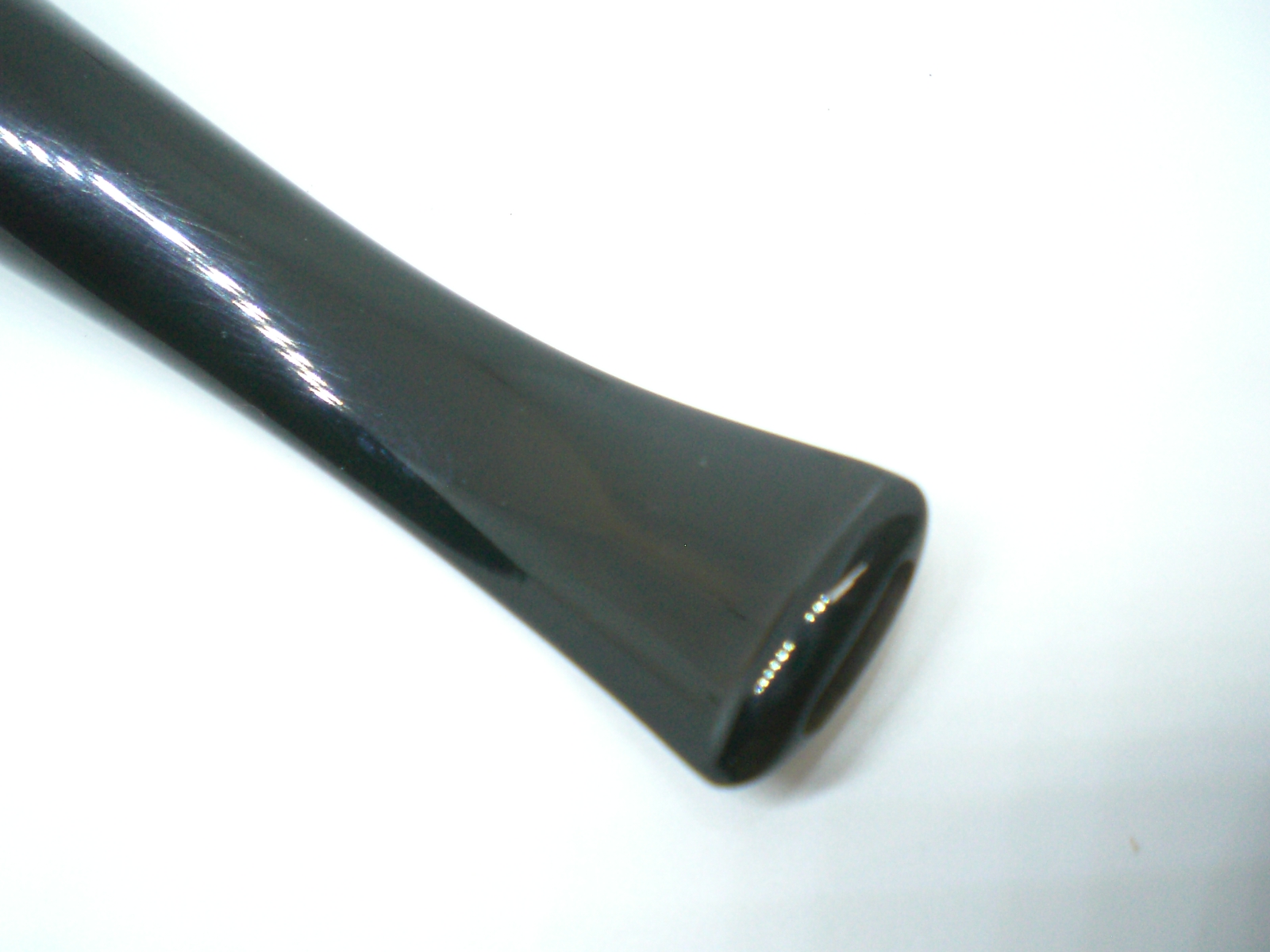
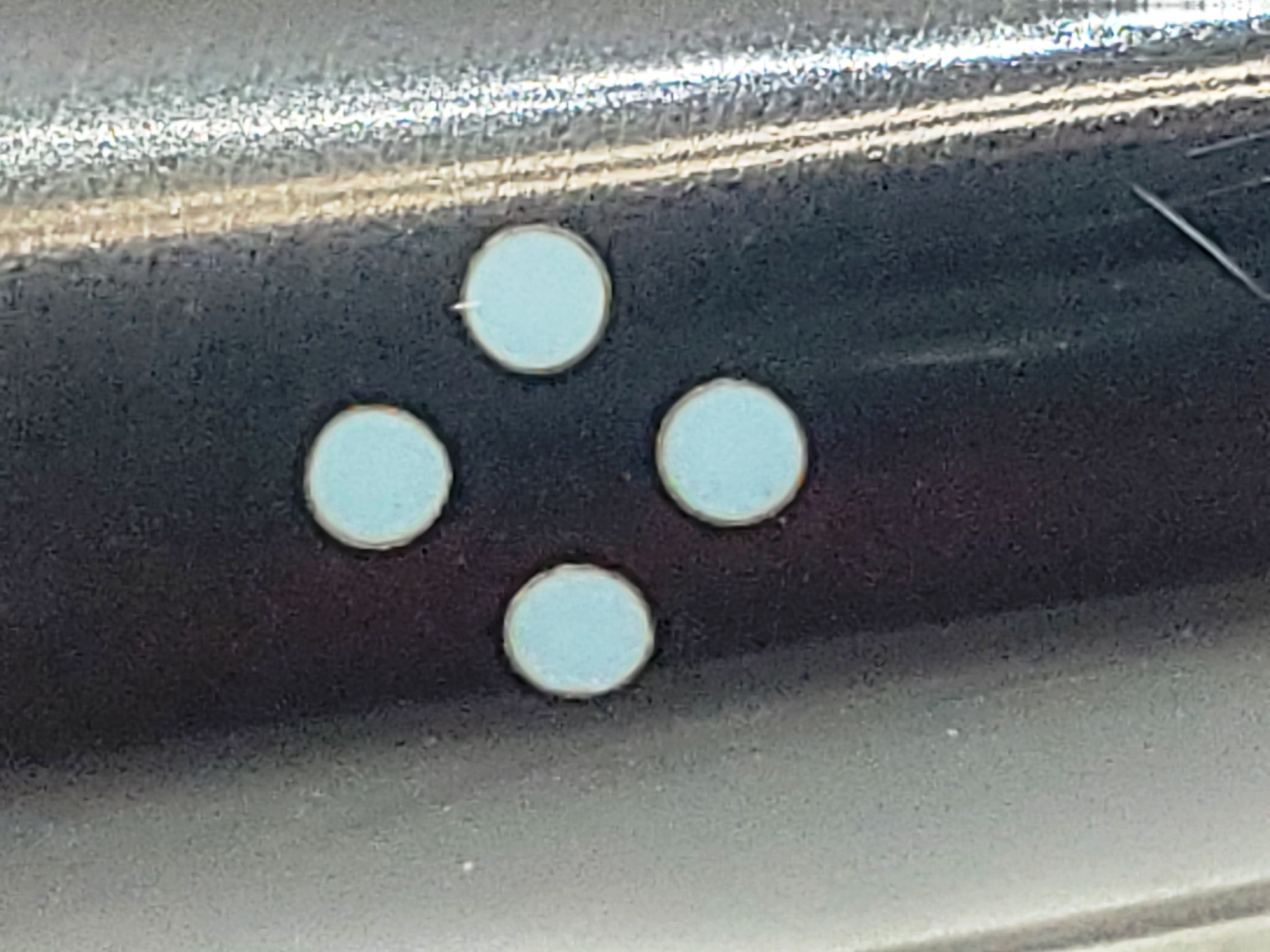
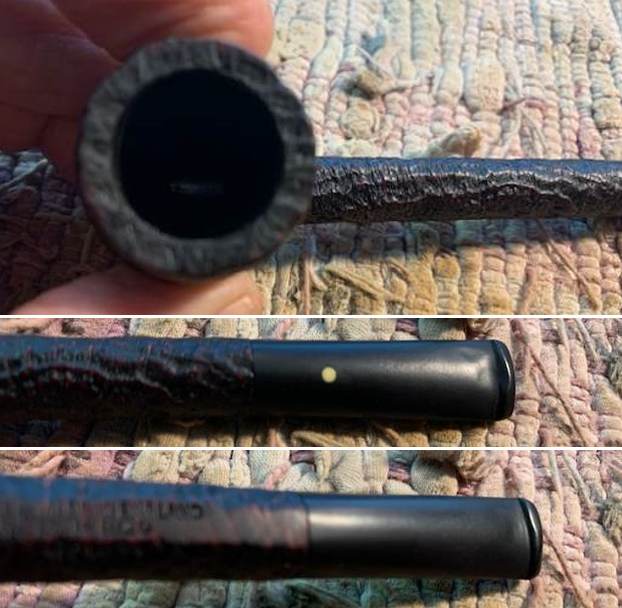
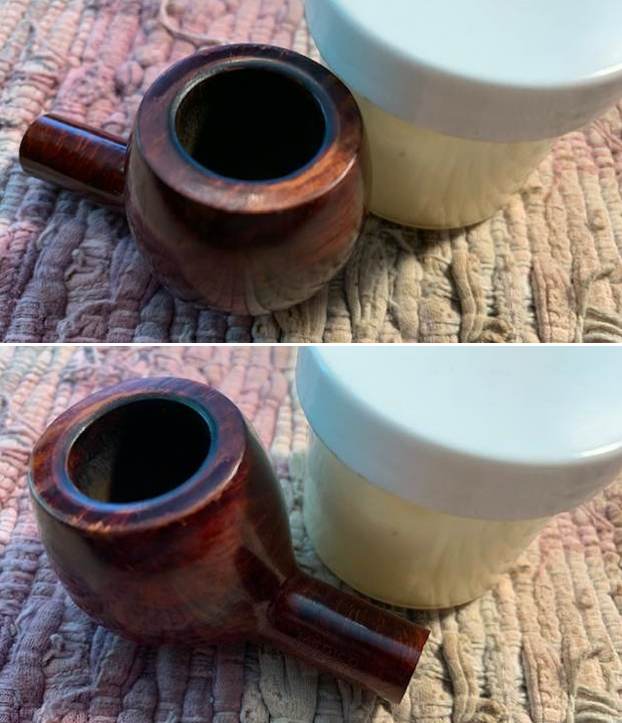
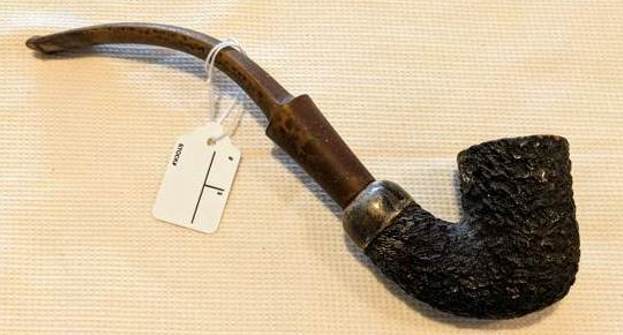
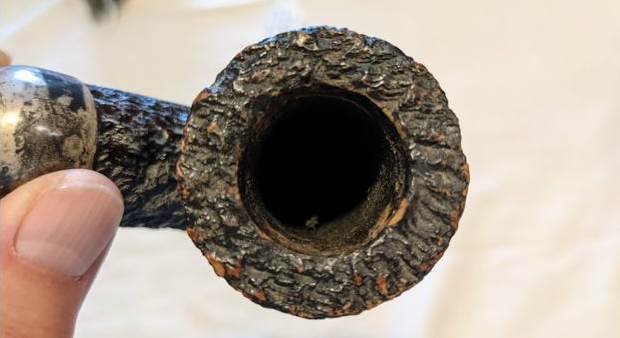
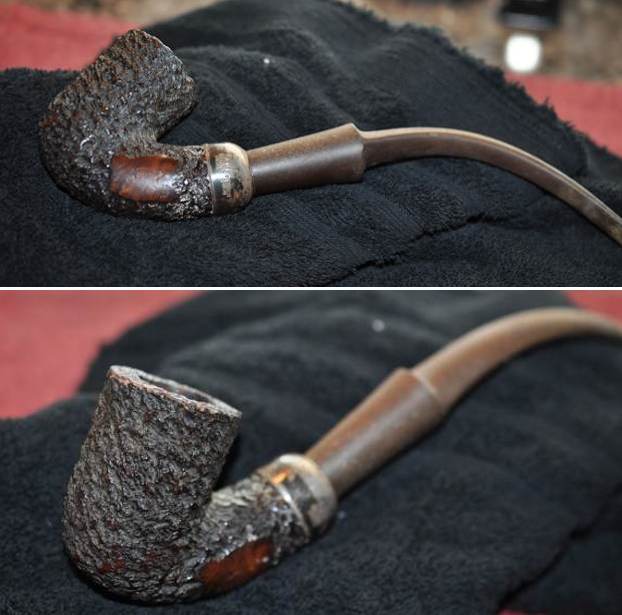
The pipe was in decent shape on delivery, some light oxidation on the stem. The classic Four Dots were a lovely shade of robin’s egg blue, a plus. On many older Sasieni’s, the color fades. There was very slight cake and the stem had lost some of the sensuous curve. Below is the pipe as it was received.

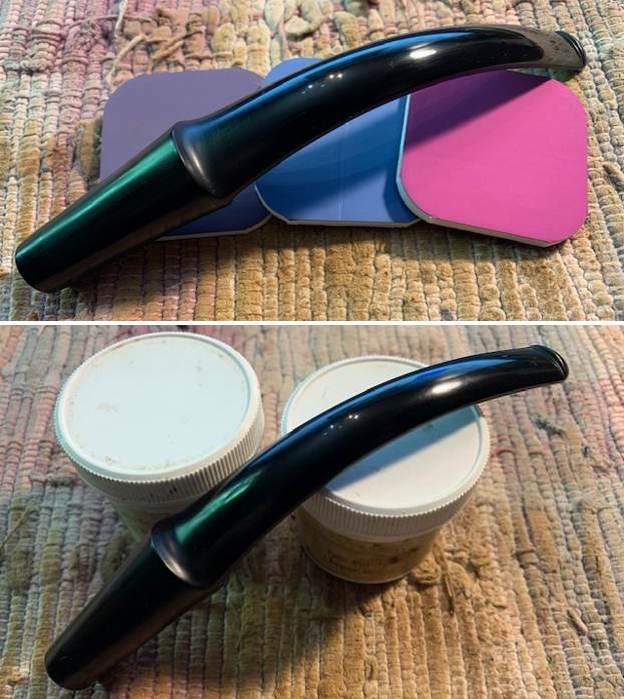
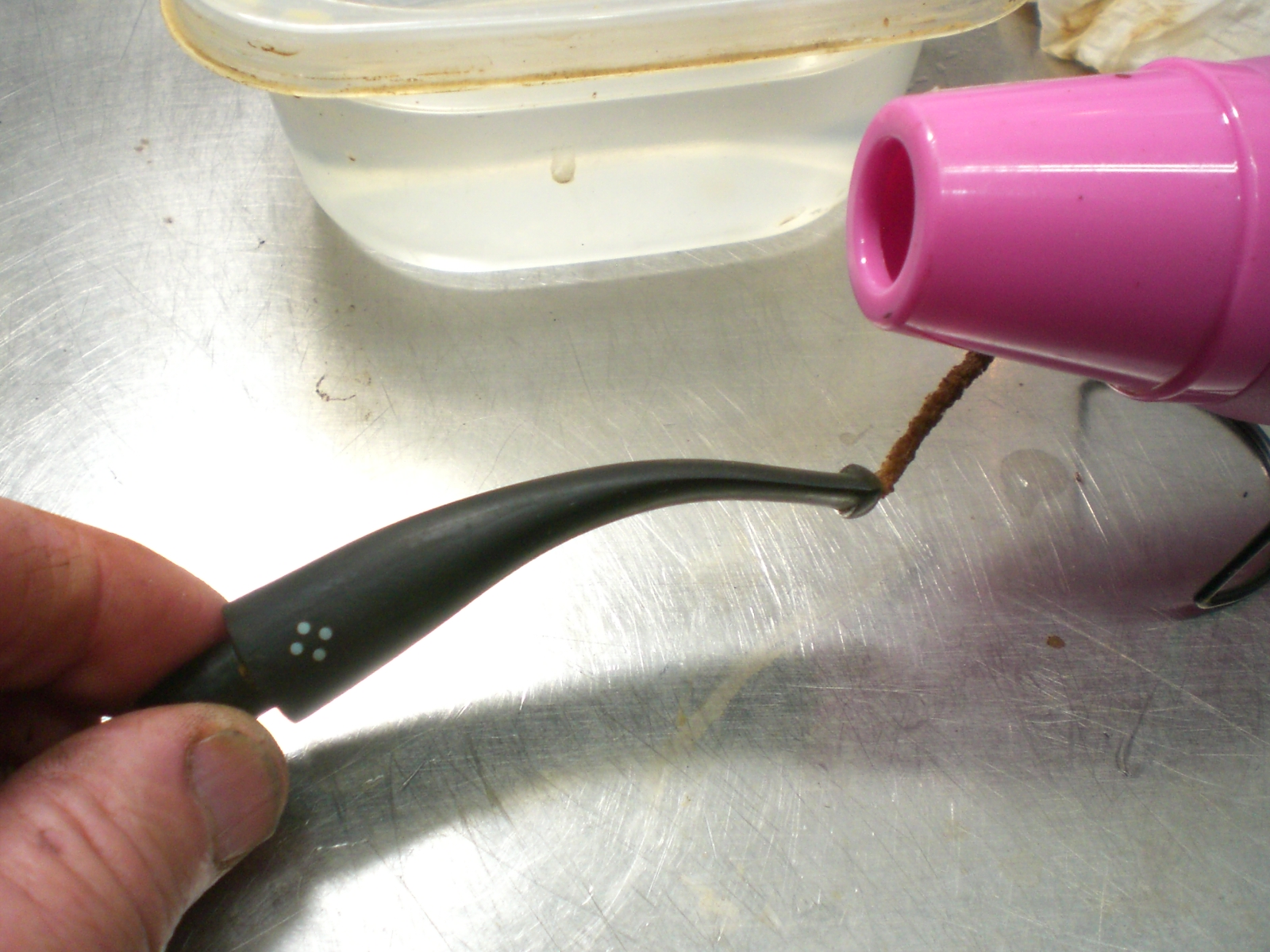
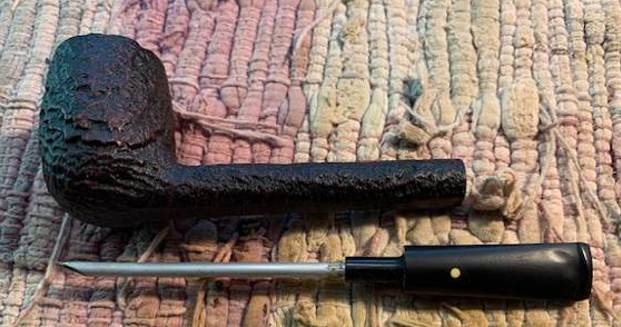
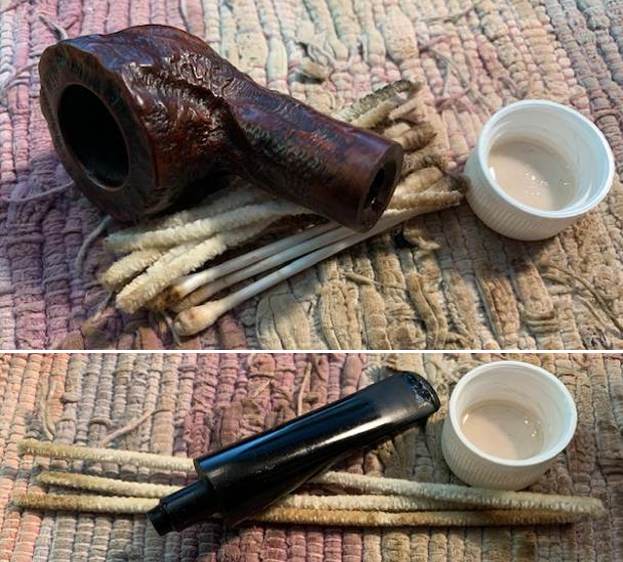
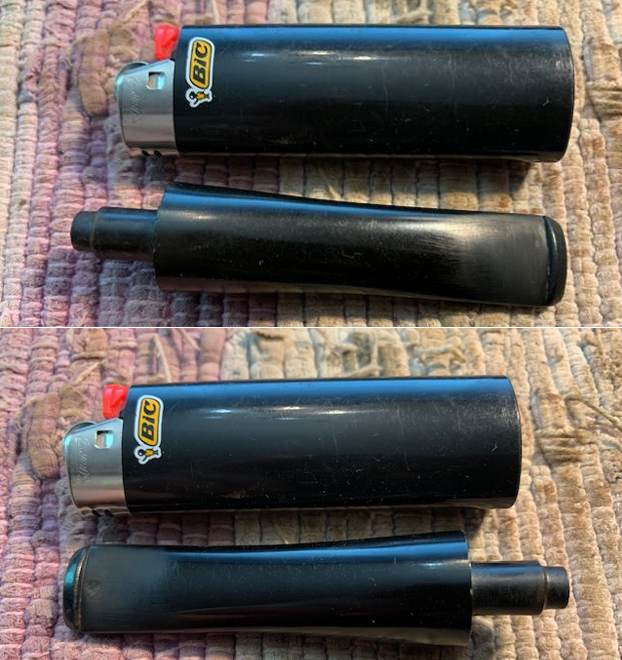
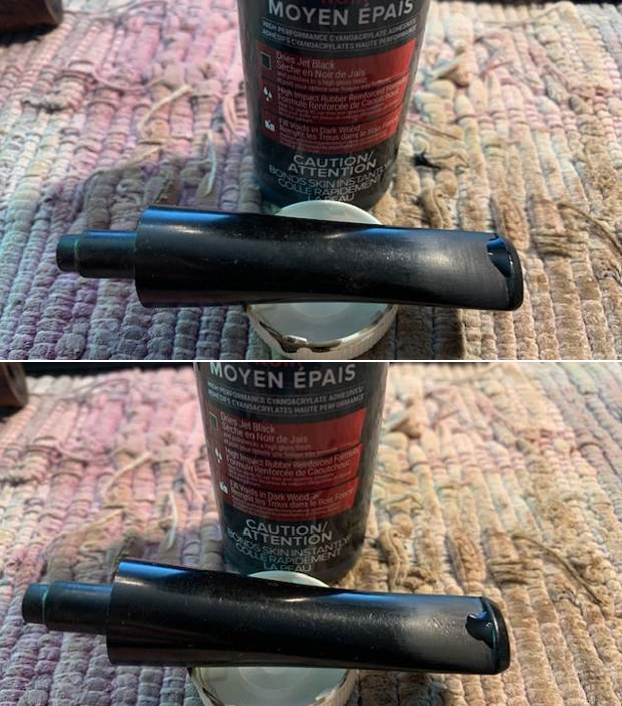
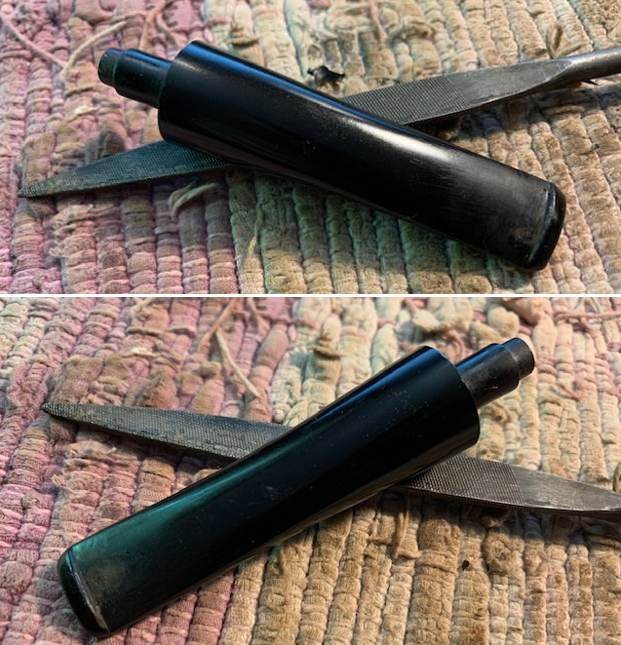
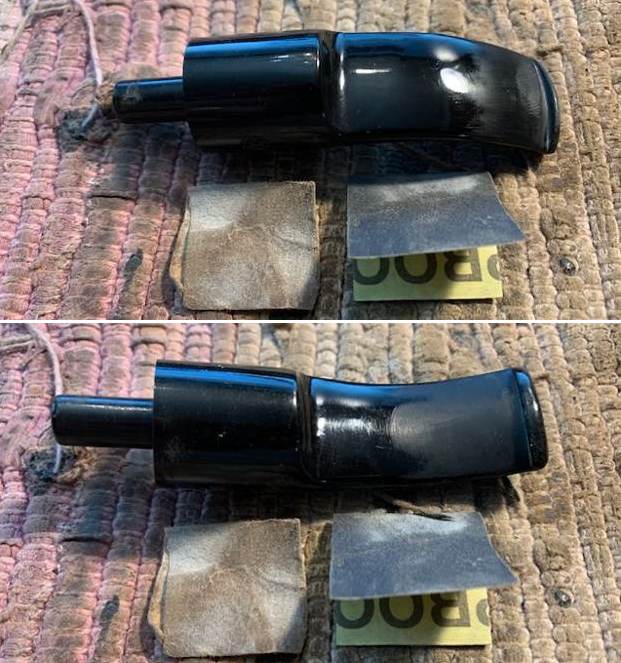
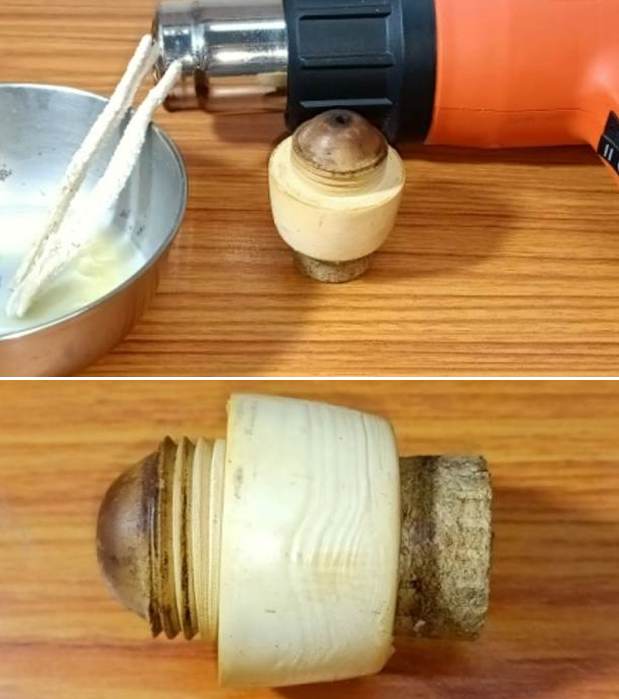
I put a bristle cleaner in the stem, and heated it with a hobby heat gun. I used a piece of briar to put the factory bend back in the stem, then dipped it in cold water to set the shape.

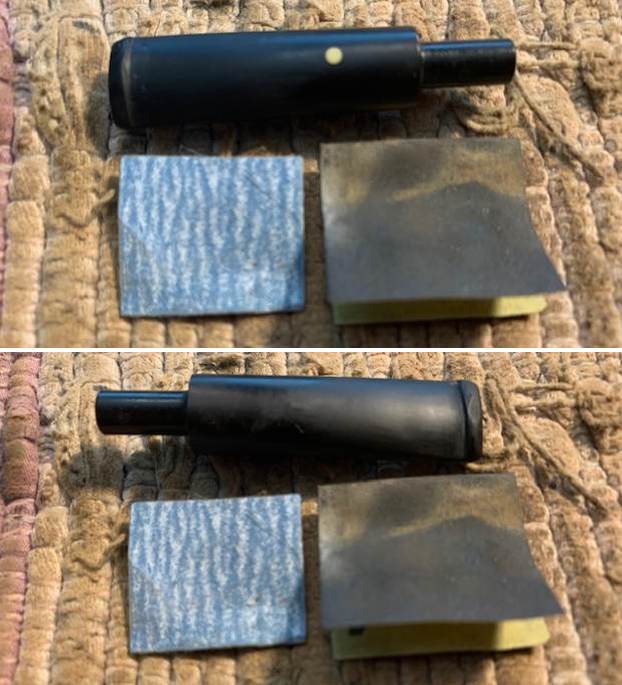
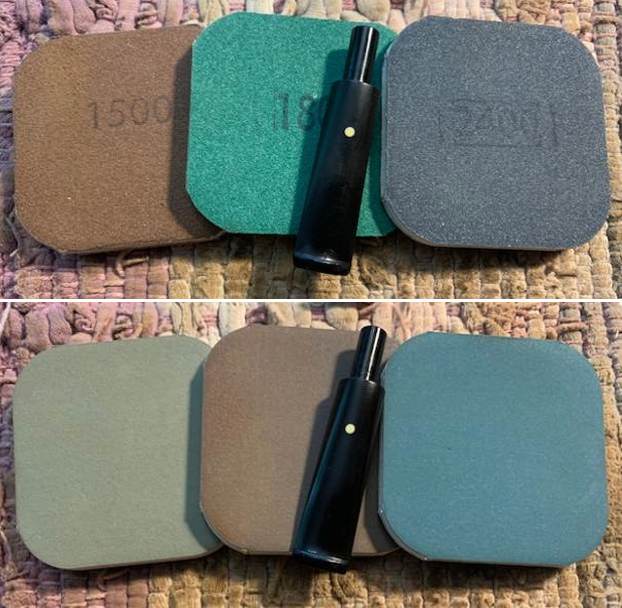
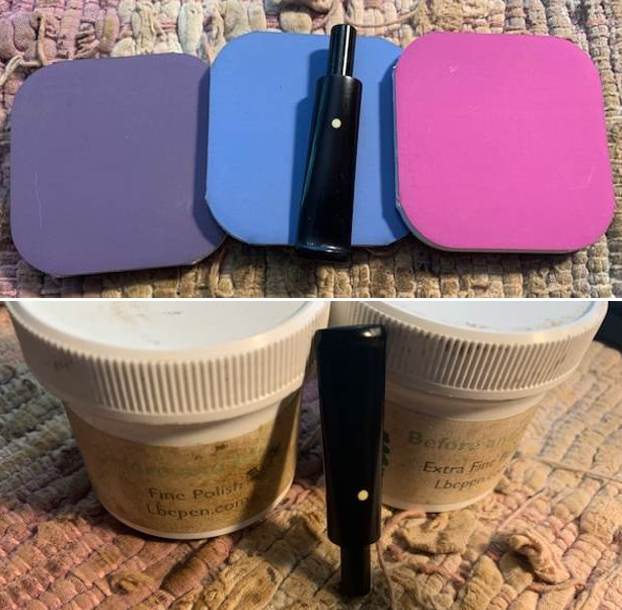
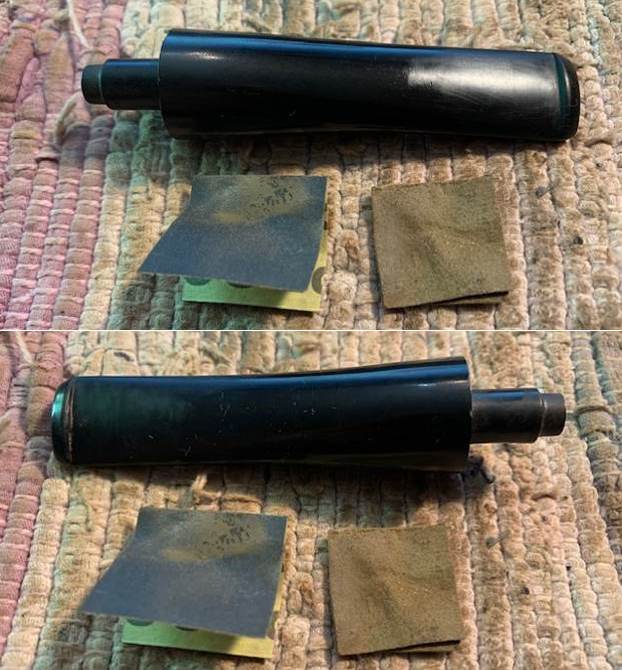
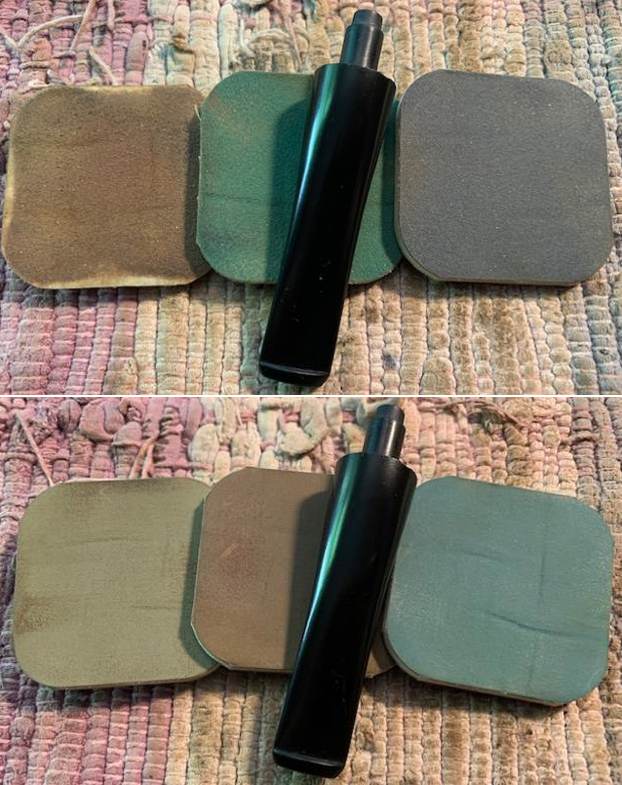
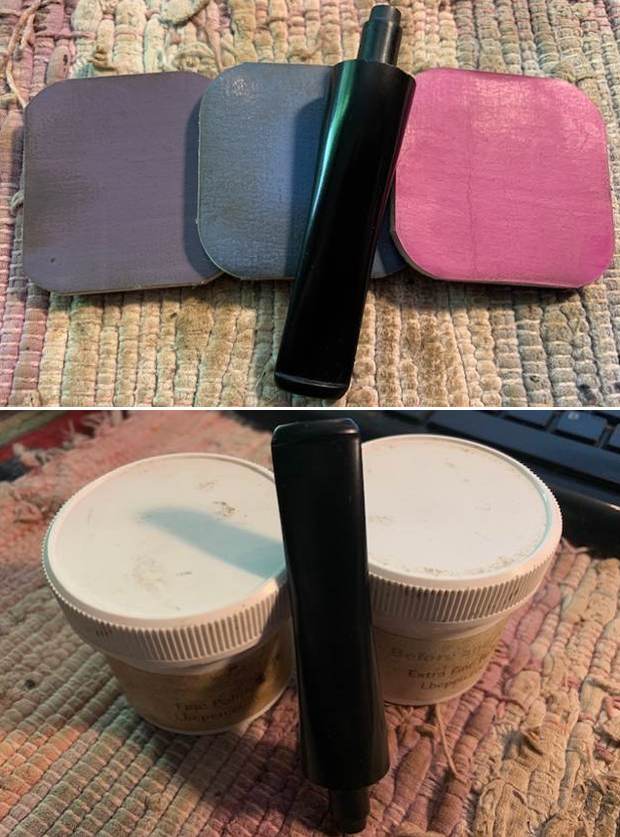
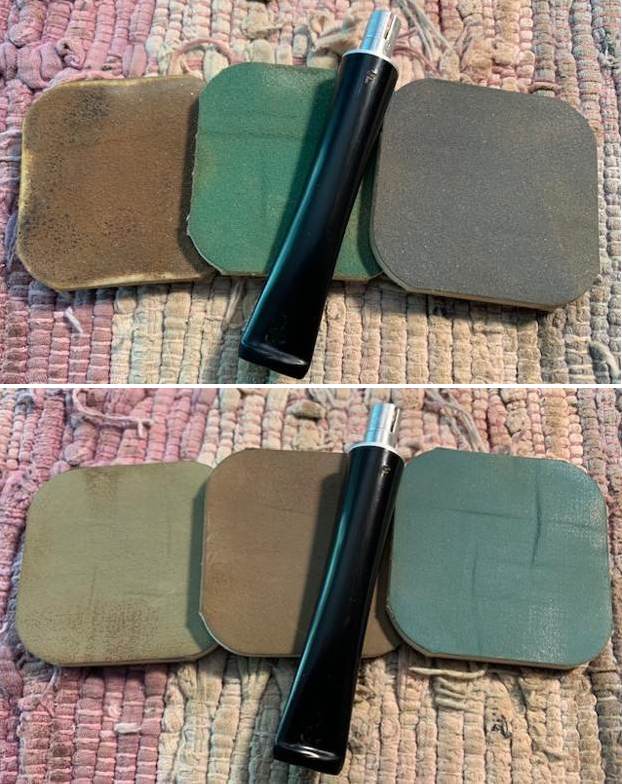
With the stem mounted, I removed the slight oxidation with 800, 1500, and 2000 grit wet paper, followed by 8,000 and 12,000 micromesh sheets. The stem was then buffed with White Diamond rouge and Meguiars plastic polish.

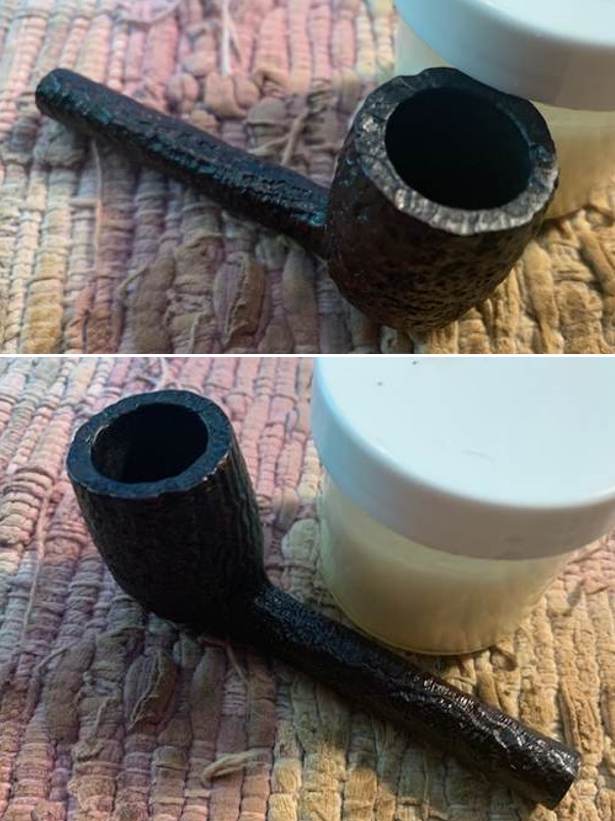
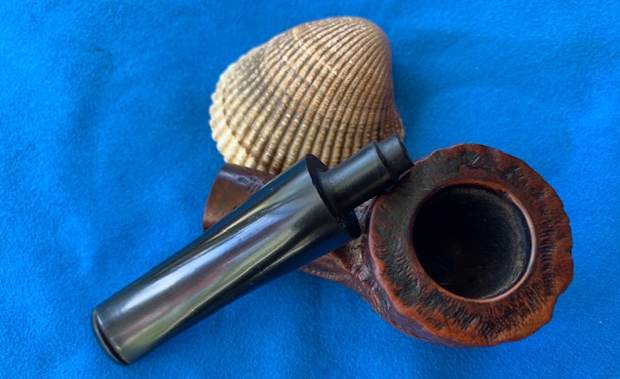
I removed the cake in the bowl with my reamer set, and finished with a piece of 320 grit paper wrapped around a reamer bit. The bowl was soaked with sea salt and alcohol. I hand polished the briar with Halycon wax.

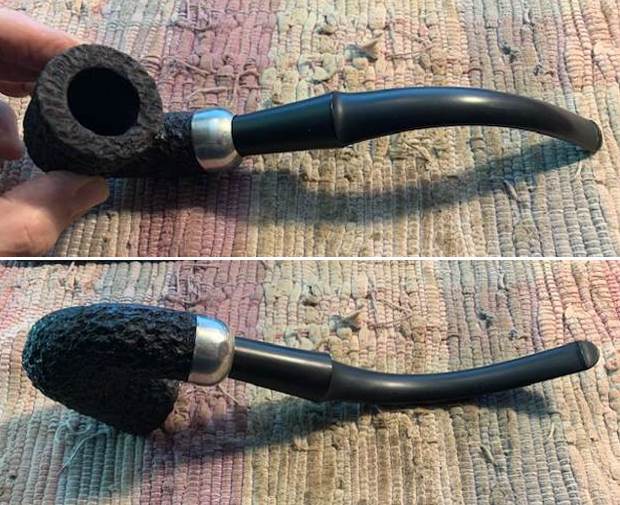
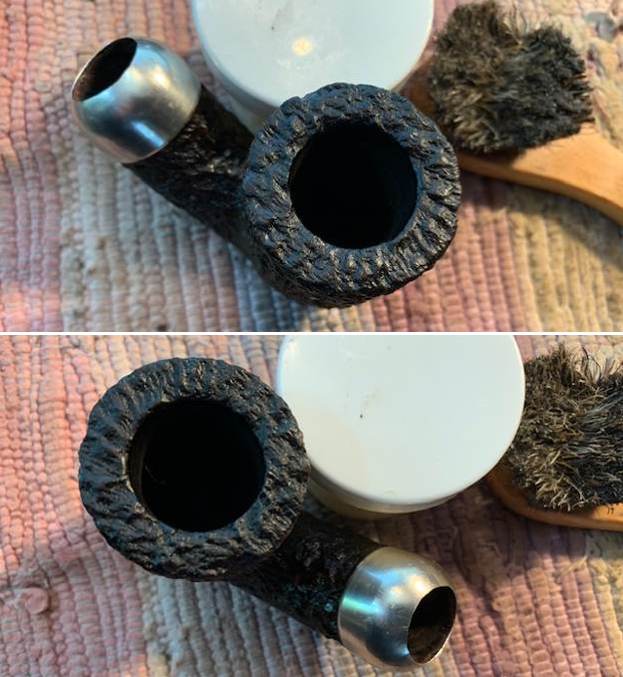
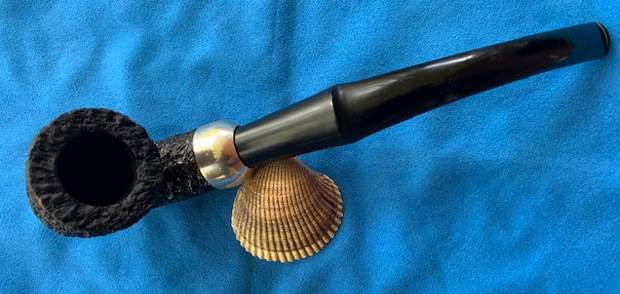
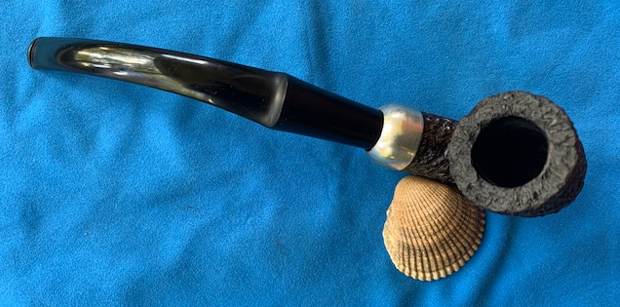
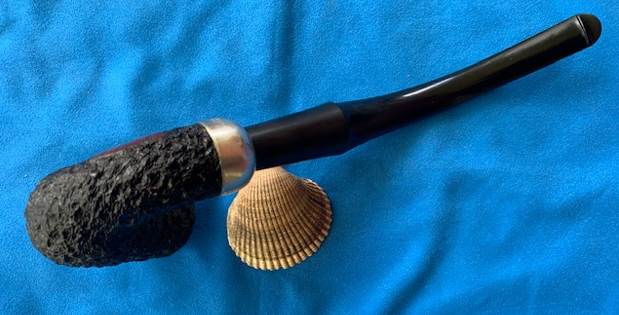
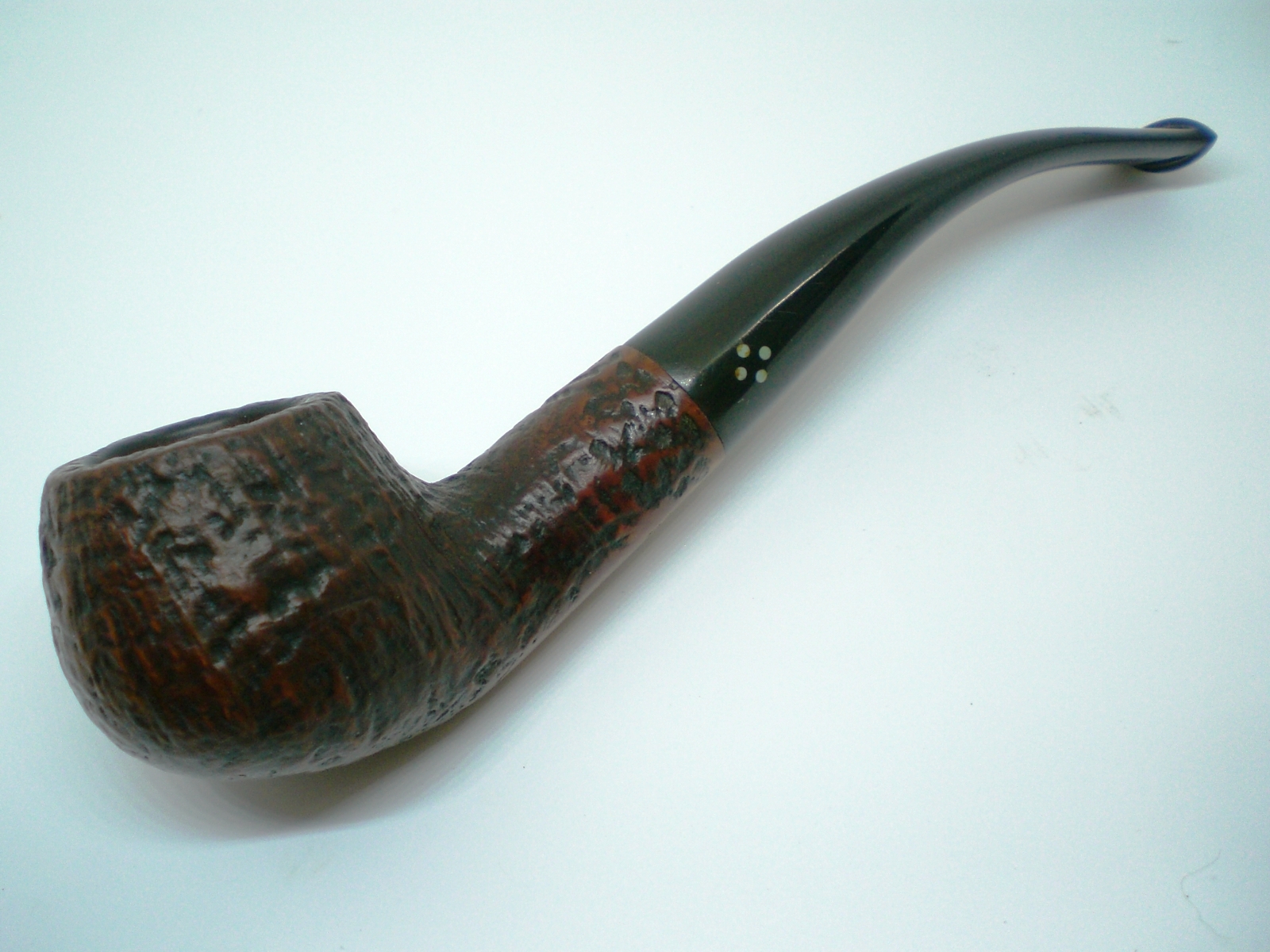
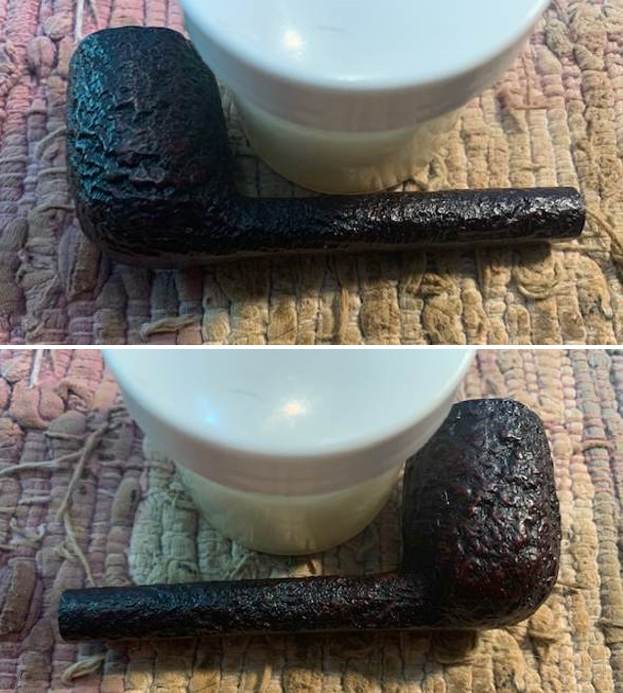
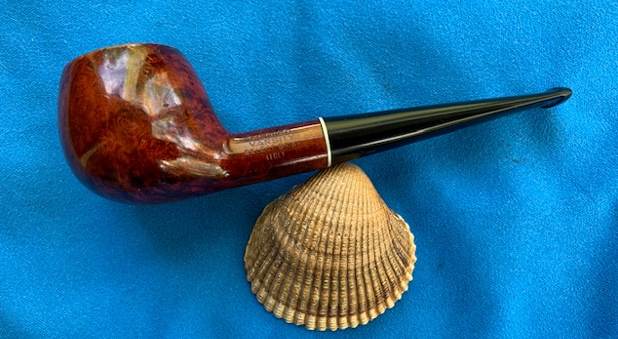
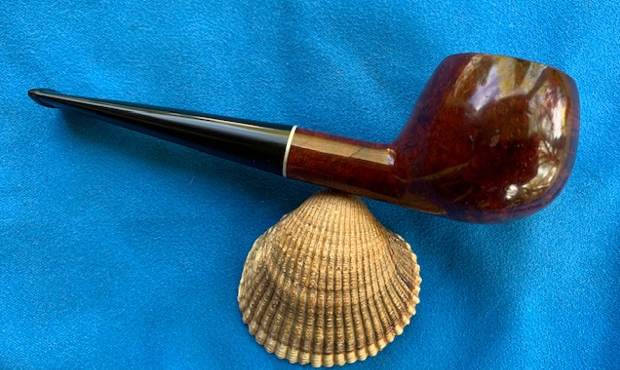
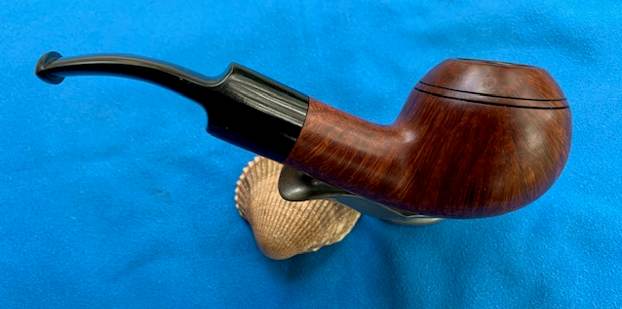
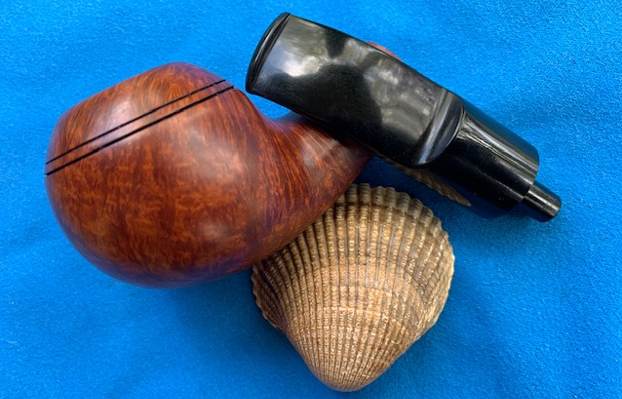
Below is the finished pipe.

A Dunhill Shell Liverpool with a scratched in story on underside of the shank


Blog by Steve Laug

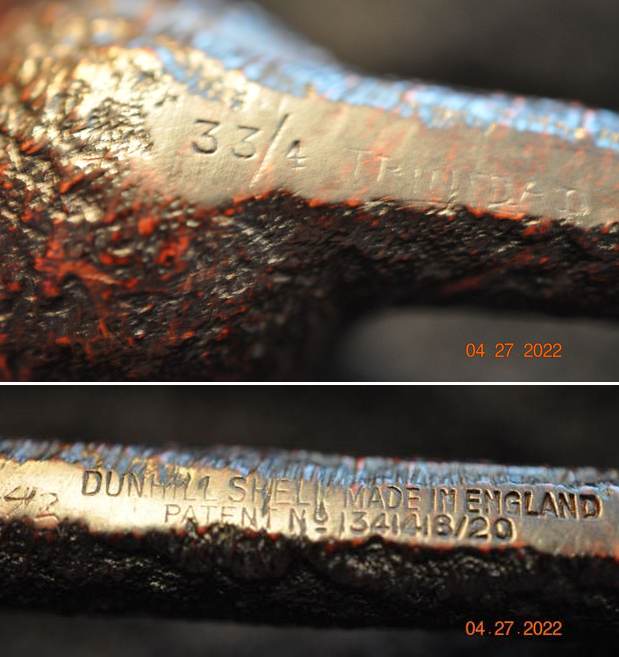
Sometimes when you see a pipe you just need to pull the trigger and buy it. We put in a bid and picked up the pipe from an online auction on 02/02/22 in Cottage Grove, Minnesota, USA. It is a petite Dunhill Shell Liverpool. It is stamped on the heal of the bowl and reads 33/4 which is the shape number. Following that Trinidad 1942 scratched in. That is followed by Dunhill Shell Made in England over Pat. No.1341418/20. It is going to be fun figuring out the dating on the pipe as there is no date stamp on the pipe. The Patent No. should help but we shall see. To me what is interesting is the information scratched into the shank – Trinidad 1942. I will need to have a look at what happened there in 1942. Obviously the previous owner was there at that time and either purchased the pipe there or brought it with him to that moment.

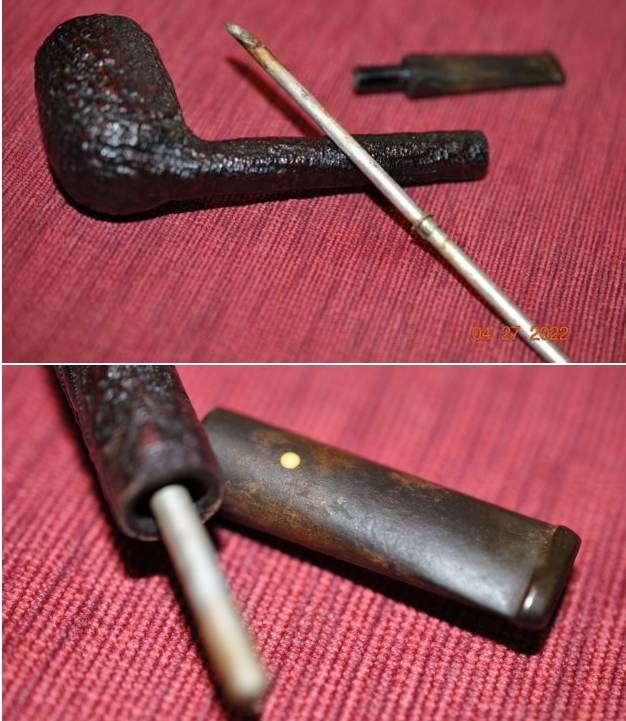
Now for the condition of the pipe itself. It is a small pipe with a rugged blast. The finish was very dirty but no damage showed on the sides or shank. The rim top was lightly covered with lava but it did not show damage to the surface of the rim or the outer and inner edges. There was a moderate cake in the bowl with some tobacco debris in the cake. The stem was oxidized, calcified and had tooth marks on both the top and underside near the button. There was an aluminum inner tube in the shank that extended from the tenon to the entry of the airway at the bottom of the bowl. It was dirty and tarry looking. There was an aluminum washer on the tube that sat at the point it entered the tenon. It was a great looking pipe and once it was cleaned and restored it would be quite stunning. Jeff took photos of the pipe when it arrived in Idaho and before he started his clean up work. He took close up photos of the rim top and stem to give a clear idea of the condition of the pipe. You can see the items I pointed out regarding both in the above paragraphs. He took photos of the bowl from various angles to show the condition of the briar and the beautiful sandblast finish on the pipe. It is a beautiful old pipe under the grime and grit of the years.   Jeff captured the stamping on the heel of the bowl and the underside of the shank. It is clear and readable as noted above. You can also see the Trinidad 1942 stamping between the two.He removed the inner tube from the shank and stem and took photos of it. It extends the length of the shank with the angled end extending into the bottom of the bowl. Before I started my work on the pipe I wanted to try and establish the date it was made. I turned to John Loring’s, The Dunhill Briar Pipe – the Patent Years and After to see what I could learn from John’s work. Since there was no date stamp the Patent No. would help me at least give a time frame. I am thinking the Trinidad 1942 mark might also help with that.

On the Back cover there is a summary of the stamping on the shank. The one that applied is shown below 1935-1951 DUNHILL SHELL MADE IN ENGLAND. I have included that in a screen capture below. I drew a red box around the pertinent section below.I turned to Page 59 to follow up on the Patent No. 1341418/20. That points to a time period between 1941-?1943. I have drawn a red box around the section that matches the stamping on this pipe in the screen capture below.That 1941-43 time period fits the scratched Trinidad 1942 date as well. I did some reading on what happened in 1942 in Trinidad. I turned to Google and found several links to what was happening in Trinidad in 1942. The first of these gives an overview of what was happening there (https://ww2db.com/country/trinidad). I quote:

Trinidad, located just off South America, was a British Crown Colony since 1802 through the Treaty of Amiens. It was originally an agricultural colony (sugar cane, cocoa, among other products). In 1889, the nearby island of Tobago was placed within Trinidad’s borders. In 1857, oil was discovered in Trinidad, and major oil drilling operation began in 1907. In 1925, Trinidad held its first elections for the local Legislative Council. In 1941, during WW2, German submarines were detected in waters surrounding Trinidad, which intended on attacking Allied shipping. US Army personnel arrived on the island in Apr 1941 through the US-UK Destroyers for Bases Agreement. In early 1942, plans for establishing major air presence on Trinidad began to take shape, and before long, units on Trinidad and elsewhere in the Caribbean Sea and Gulf of Mexico regions could effectively stave off most German efforts at disruptions. After WW2, bases on Trinidad were disbanded by 1950. Trinidad and Tobago obtained self-governance in 1958 and independence in 1962.

The second link referred to an article by Annette Palmer entitled “Black American Soldiers in Trinidad, 1942-44: Wartime Politics in a Colonial Society”. The article give a focus on the need of Trinidad in 1942 (https://www.tandfonline.com/doi/abs/10.1080/03086538608582720?journalCode=fich20). I quote from that article below.All of that information made me wonder if the pipe had traveled to or been purchased in Trinidad. Could it have traveled there with the Black American 99th Coastal Artillery Regiment who came there in May of 1942? Or perhaps the pipe came with other American soldiers white or black in 1942. We will probably never know for sure but it is an interesting piece of history.

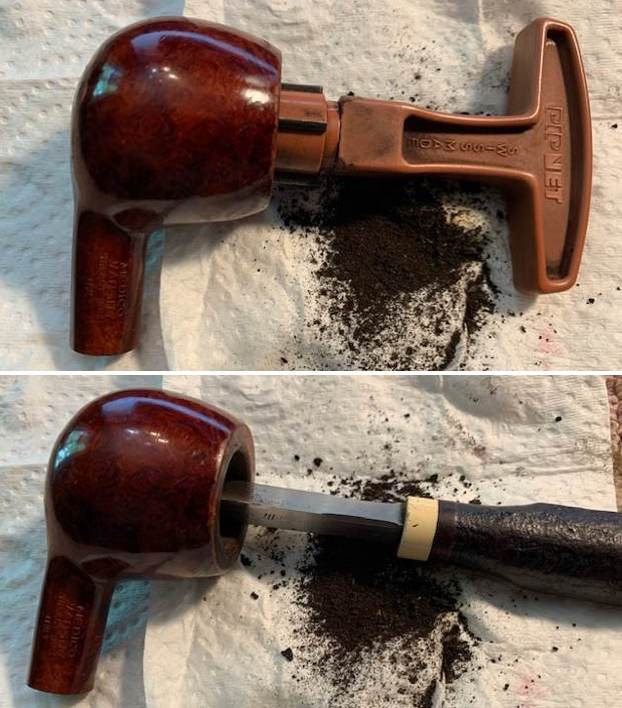
Armed with that information I turned to work on the pipe itself. Before he sent it to me, Jeff had cleaned up the pipe with his usual procedure. He reamed the pipe with a PipNet pipe reamer and removed the rest of it with a Savinelli Fitsall Pipe Knife.  He scrubbed the bowl with undiluted Murphy’s Oil Soap with a tooth brush. He rinsed it under running warm water to remove the soap and grime. He cleaned out the inside of the shank and the airway in the stem with isopropyl alcohol, cotton swabs and pipe cleaners. He soaked the stem in Briarville’s Pipe Stem Deoxidizer and then rinsed it off with warm water. He scrubbed the stem with Soft Scrub and a tooth brush and rinsed it off with warm water. It looked amazing when I took it out of the package of pipes he shipped me. So much so that it is the first of those pipes that I chose to work on. I took photos of the pipe before I started my part of the restoration work.  The rim top and the inner and outer edges of the bowl all look very good. The stem surface looked good with the oxidation gone and light tooth marks and chatter on either side of the stem. The stamping on the heel and underside of the shank is clear and readable as noted above.I removed the stem and took a photo of the pipe to give a sense of the whole. It is a proportionally pleasing pipe. The bowl looked very good after Jeff’s cleanup work so I rubbed it down with Before & After Restoration Balm. I worked it into the surface of the bowl and shank with my fingertips and a horsehair shoe brush to clean, enliven and protect the briar. I let the balm sit for about 10-15 minutes and buffed with a cotton cloth to raise the shine. I set the bowl aside and turned to work on the stem. I “painted” the stem surface to try and raise the tooth marks on both sides. I was able to raise them a little but the deeper ones remained. I filled them in with Black Super Glue and set them aside to cure. Once the glue cured I used a small file to flatten the repairs and reshape the button edge. I sanded the stem surface with 220 grit sandpaper and started the polishing it with 400 grit wet dry sandpaper.I polished the vulcanite stem with micromesh sanding pads – 1500-12000 grit pads. I wiped it down with Obsidian Oil after each sanding pad. I used Before & After Pipe Polish – both Fine and Extra Fine to further polish the stem. This Beautiful, petite Dunhill Shell 33/4 Pat. No.1341418/20 Liverpool is a great looking pipe now that it has been restored. The deep sandblast that is used around the bowl is highlighted by the dark, rich stains and works well with both the polished vulcanite stem. I put the stem back on the bowl and carefully buffed the pipe with Blue Diamond on the buffing wheel using a light touch on the briar. I gave the bowl multiple coats of Conservator’s Wax and the stem multiple coats of carnauba wax on the buffing wheel and followed that by buffing the entire pipe with a clean buffing pad. I hand buffed the pipe with a microfiber cloth to deepen the shine. The finished Dunhill Shell 33/4 Liverpool is petite pipe that will be great for enjoying a nice Virginia or Virginia/Perique blend. Give the finished pipe a look in the photos below. The dimensions of the pipe are Length: 5 ¼ inches, Height: 1 ½ inches, Outside diameter of the bowl: 1 inch, Chamber diameter: ¾ of an inch. The weight of the pipe is 20 grams/.71 ounces. This pipe will stay with me for now as the history of it intrigues me. I hope to enjoy it many times on the front porch over the summer ahead. I take a moment to remind myself and each of us that we are trustees of pipes that will outlive us and the lives of many other pipe men and women who carry on the trust of their care and use. Thanks for reading this blog and my reflections on the pipe while I worked on it.

What is a City de Luxe Gold Star Unique Freehand?


Blog by Steve Laug

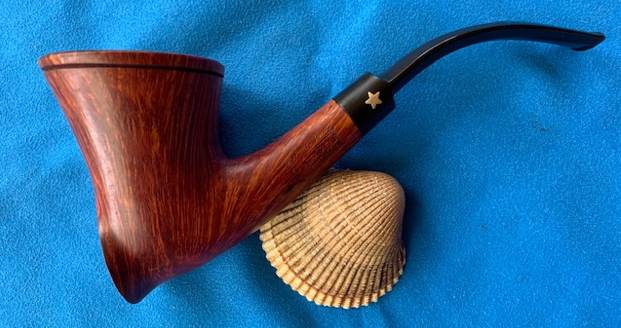
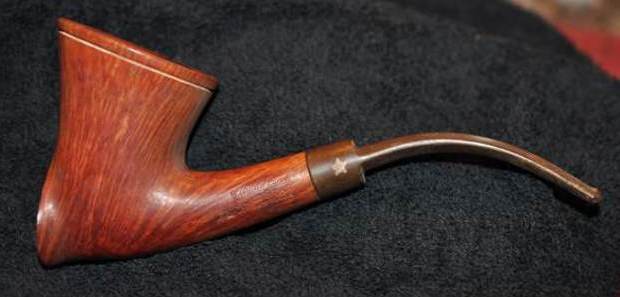
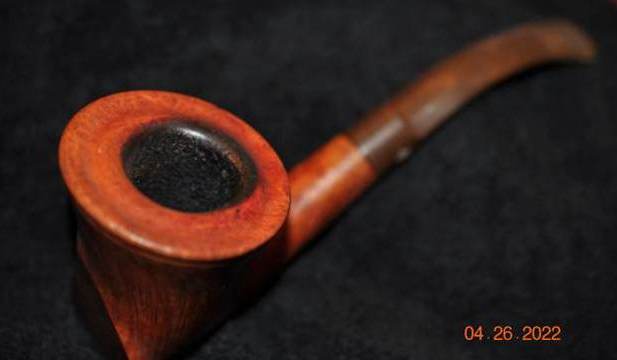
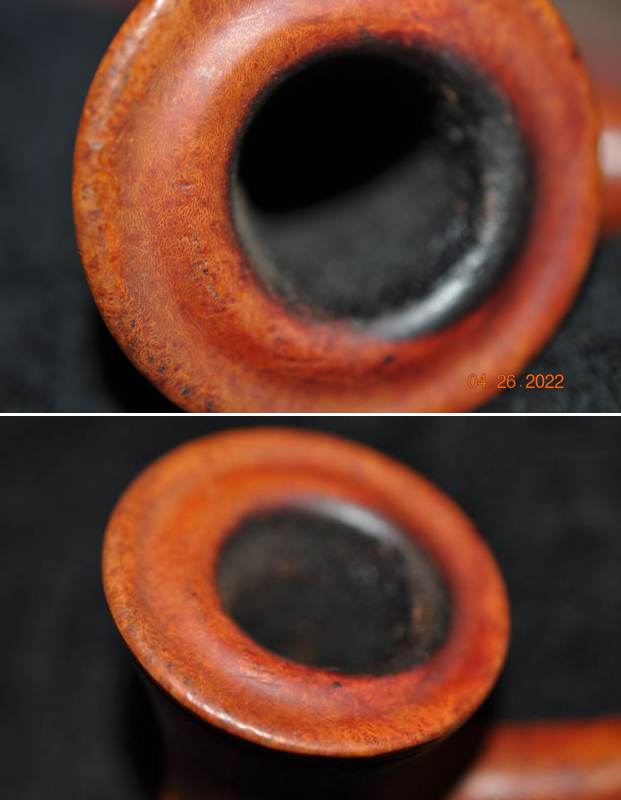
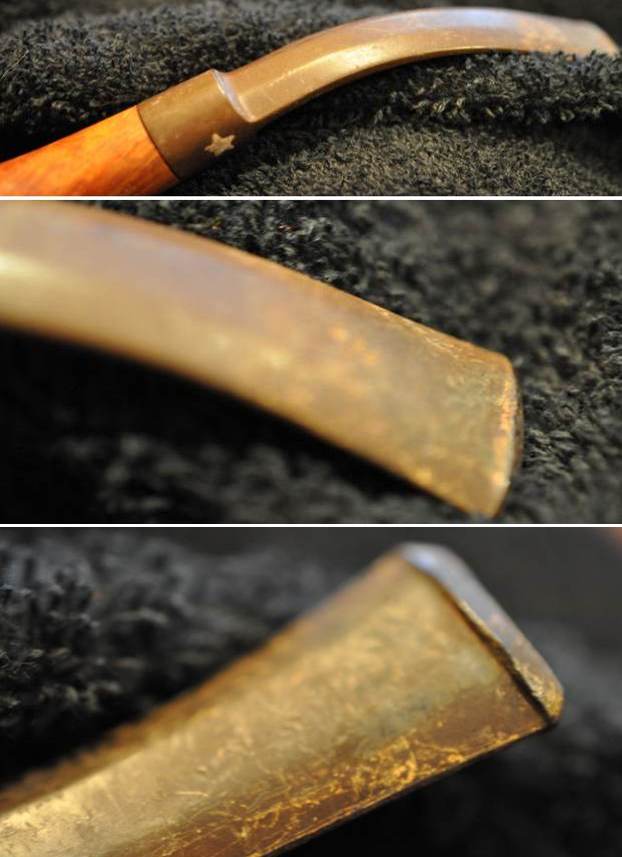
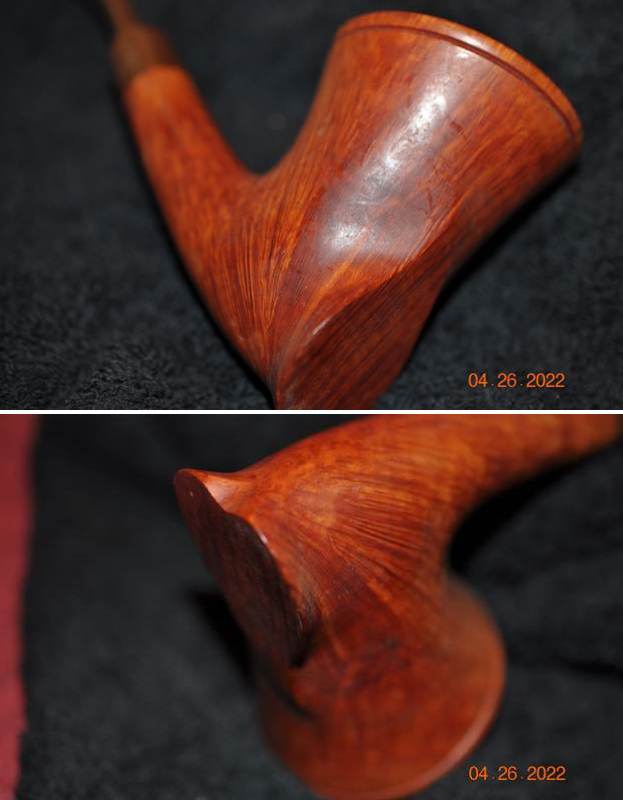
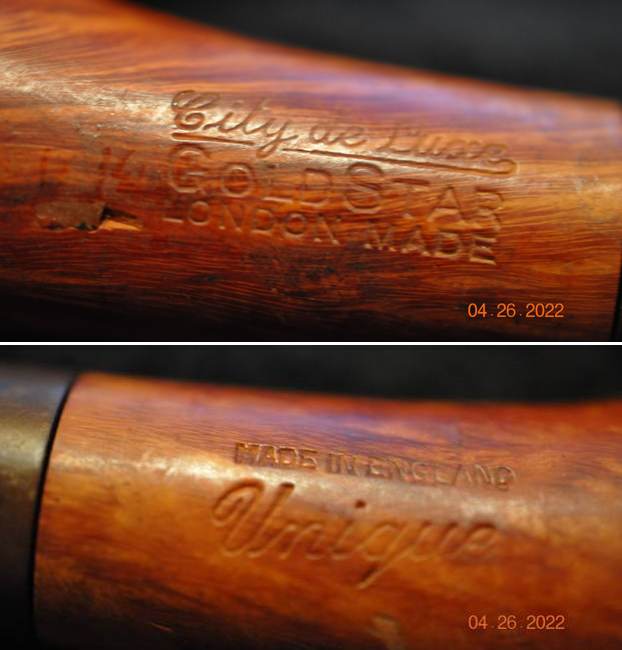
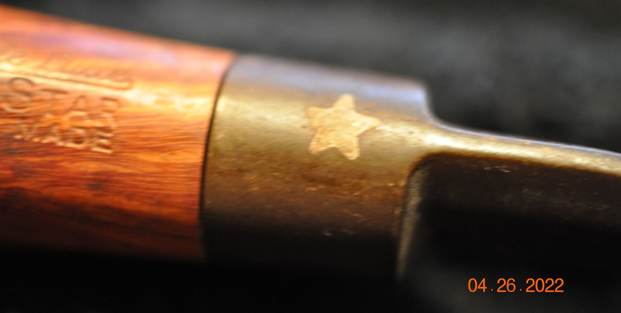
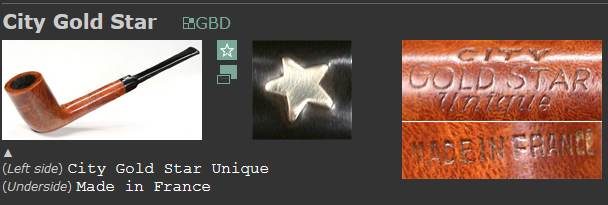
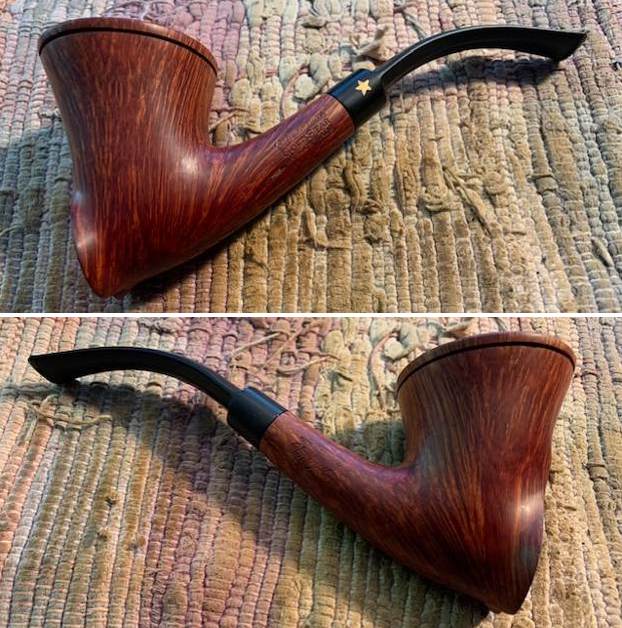
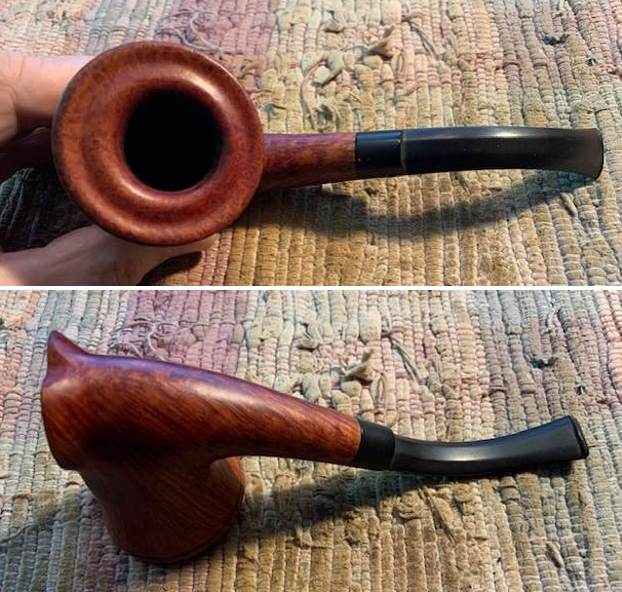
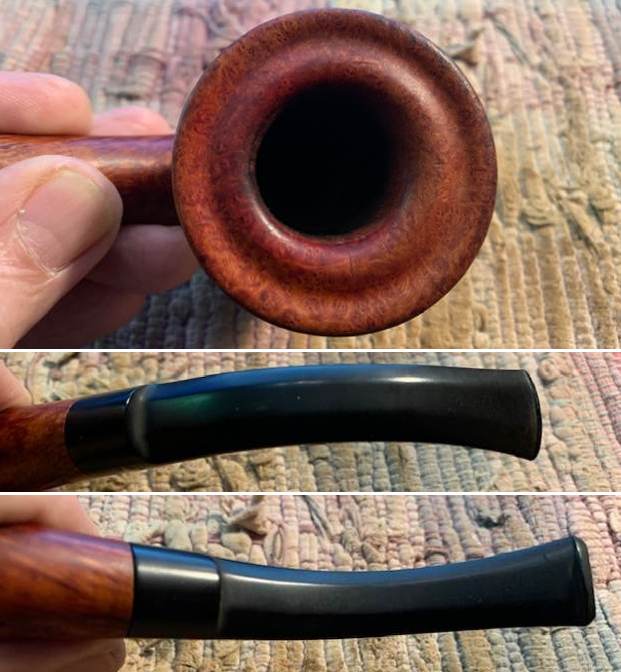
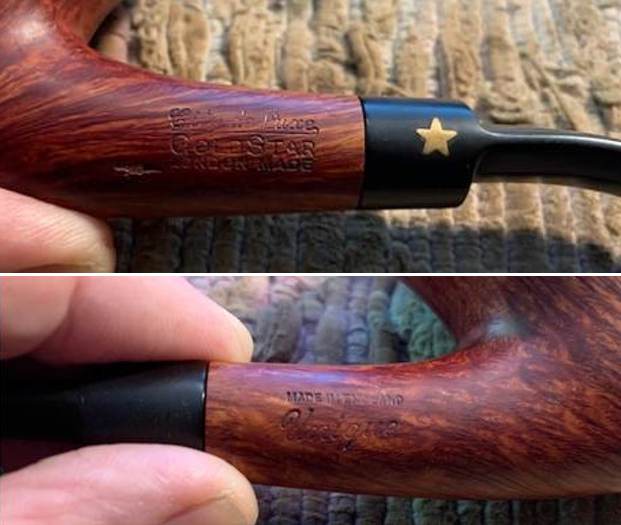
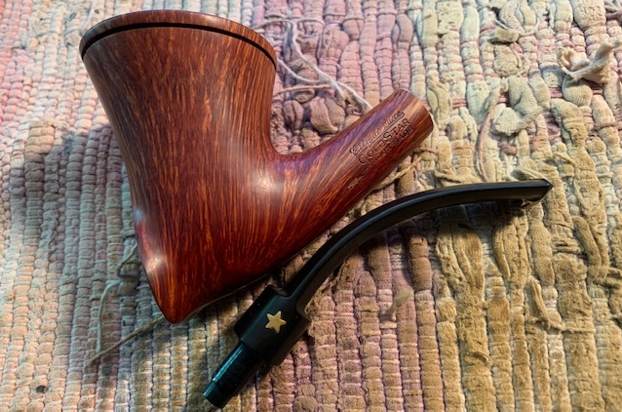
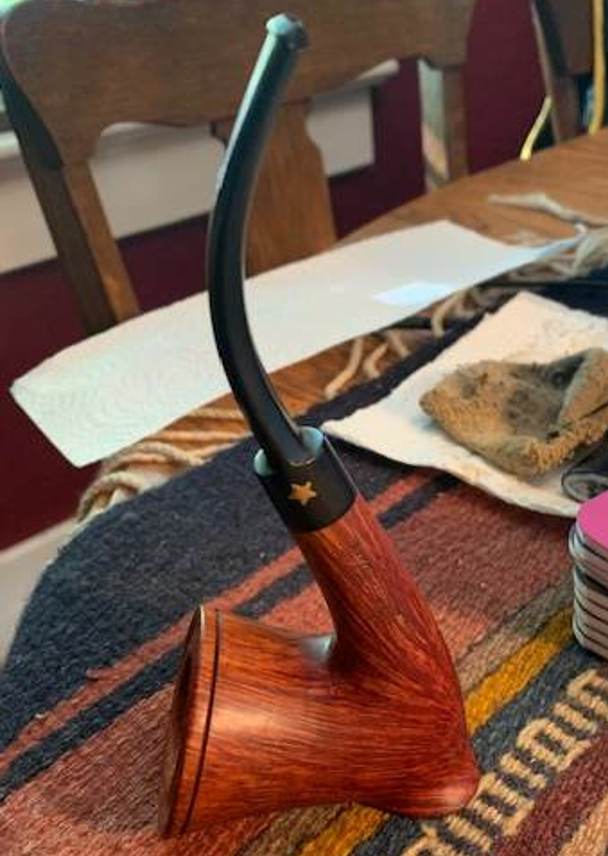
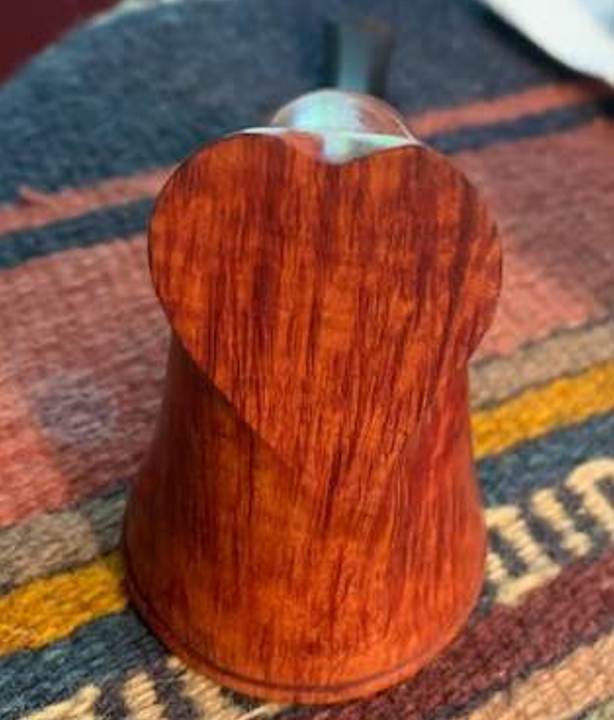
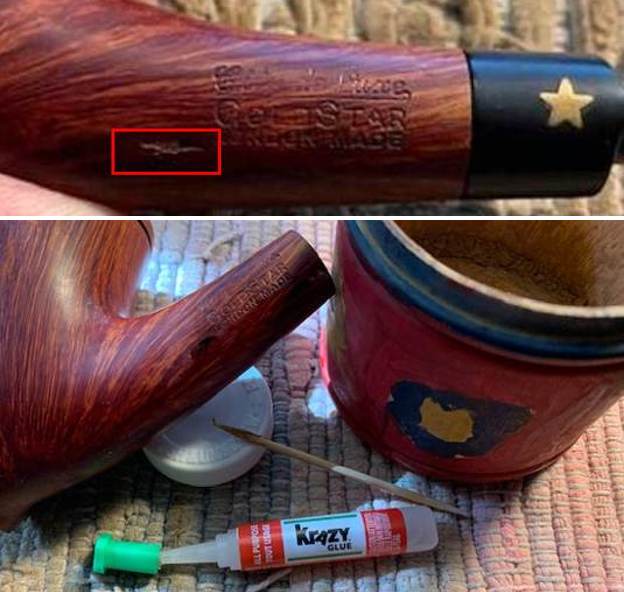
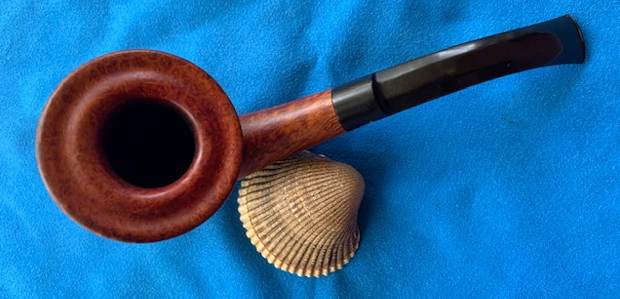
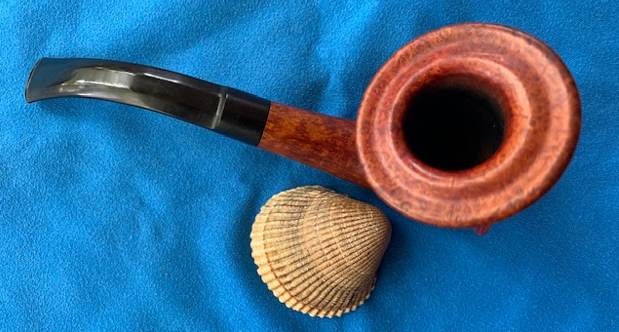
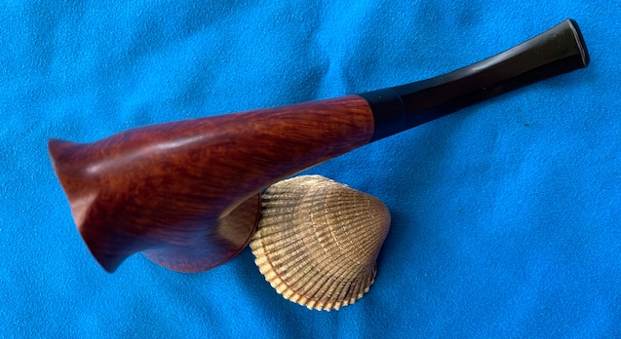
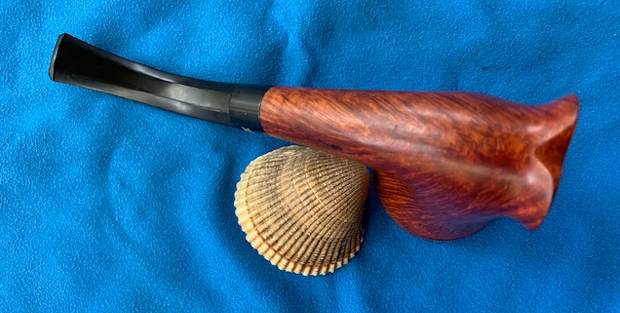
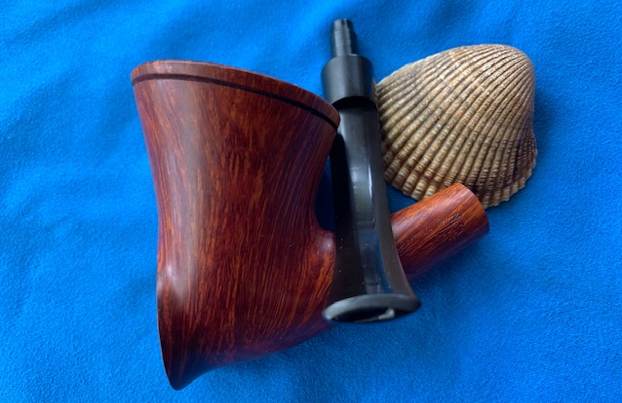
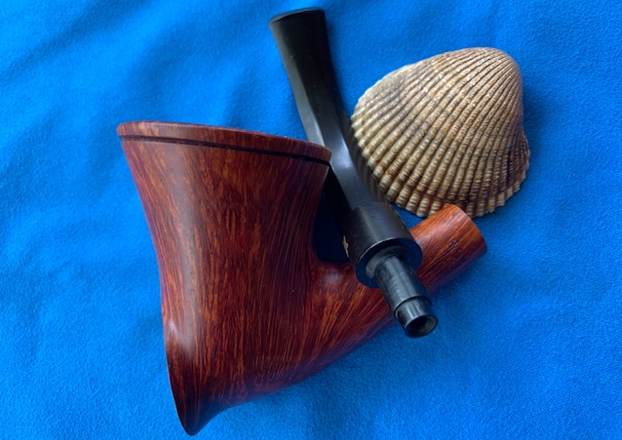
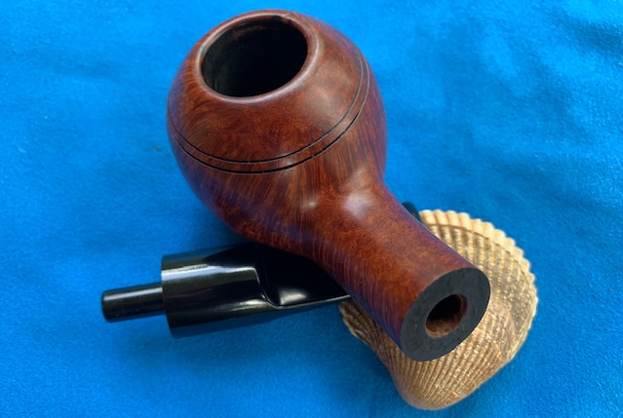
Jeff and I have been picking up pipes from a fellow in Los Angeles, California for a few years. We have picked up some excellent pipes from him. This one came to us in September, 2020 (though the photos are stamped April of 2022). It took us awhile to get to the pipe and clean it up. It was a uniquely shaped Freehand that caught our eye. The shape is partially a Dublin but with a pointed heel. There is a carved ring around the top of the bowl setting of a cap. The top of the bowl is almost like a flat hat with a crowned centre portion and small trough between the bowl edge and the crown. The bottom portion of the front of the bowl is flat and shaped like a heart and allows the pipe to be stood on a desk top. The grain on it is stunning with only one small fill/flaw on the left side of the shank ahead of the stamping. It is stamped on the left side and reads City de Luxe [over] GOLD STAR [over] London Made. It is stamped on the right side and reads Made in England [over] UNIQUE in script. There is no shape number on the shank. The stem has an inlaid gold star on the left side of the saddle stem. Jeff took photos of the pipe when it arrived before he started his clean up work. He took close up photos of the rim top and stem to give a clear idea of the condition of the pipe. The bowl had a thick cake and a heavy overflow of lava on the inner edge and top of the rim at the back of the bowl. The stem is heavily oxidized and had tooth chatter and marks on both sides ahead of the button. Jeff took photos of the bowl from various angles to show the condition of the briar and the style of the pipe. It is a beautiful pipe under the grime and grit of the years.   Jeff captured the stamping on the shank sides and the left side of the stem. It is clear and readable as noted above. You can see the fill/flaw in the first photo to the left of the London Made stamp. There is a fill there that is partially missing and will need to be replaced.  This pipe was quite stunning under the grime and has beautiful straight grain. From what I can see there is one small flaw with a damaged fill on the left side of the shank and otherwise nothing else. I decided to do some digging into the City Gold Star stamp and see what I could learn. I turned first to Pipephil (http://pipephil.eu/logos/en/logo-c5.html). There was an example of the City Gold Star but it was a French Made pipe while the one I am working on is Made in England. The example is stamped Unique like the one I have. There are no shape numbers on it either. There is a tie to GBD and generally the pipe is a second for that brand. Perhaps the flaw that I mention above is what kept it from being a GBD Unique and relegated it to City de Luxe status. Truly though it is a small flaw on an otherwise stunning pipe. I have included a screen capture of the pipe from PipePhil below.I am also including information from the side bar. I wonder if the Gold Star is a step up from the normal City de Luxe. If so that would explain the stamping on this pipe.

While the City de Luxe logo is a silver outline star, this one is a solid gold color star. This GBD second was crafted in the French facilities of the brand.

I turned then to the article on Pipedia about GBD pipes (https://pipedia.org/wiki/GBD). I quote a section from the article that talked about the introduction of the City Deluxe sub brand.

The solid demand for GBD pipes also encouraged the management to introduce a number of sub brands designed to win new buyers. We can list such sub brands as follows:

  • The City de Luxe (1921) had an inserted star on the stem as trademark and were marketed in England and in France. These pipes were the bestseller of the 5½ Shilling class in the 1930s in Great Britain.
  • Reserved for the French market remained the even more favorable GBD brand Marcee, a derivative of Marechal Ruchon & Co. Ltd. that was offered until the 2nd World War and for another one or two years afterwards.
  • The Camelia – made in London as a 2½ Shilling line – was only around for a few years.
  • Important to mention is also the Riseagle—completely produced in Paris before the wartime for England’s smokers who wanted “a cheap but dependable British made pipe”… one of the most successful 1 Shilling pipes until 1939! The introduction of the luxury impact on the excise tax for pipes after the war put an end to this cheap brand.

The section on City de Luxe had a link to another article on Pipedia specifically on the brand so I followed the link (https://pipedia.org/wiki/City_de_Luxe). There was a short article and I quote from it below.

City De Luxe was a sub brand of GBD and Oppenheimer Pipe started in 1921 and for a time the most popular pipe in the 5/6 shilling range of pipes in Britain in the 1930s.

The trademark of the line was an inserted star on the stem, and pipes were made with both English and French markings. For more information see GBD.

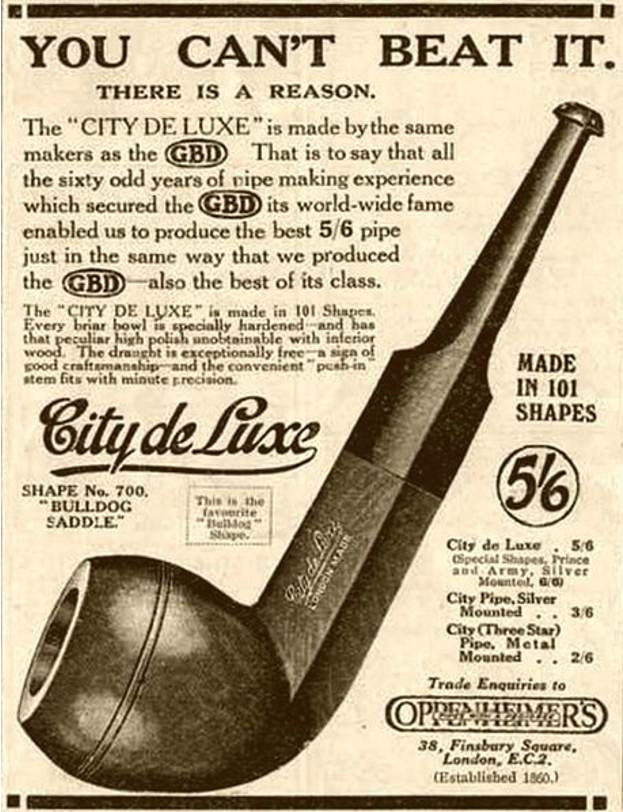
I knew that the brand started in 1921 and hit is height in the 1930s. I have included an advertisement from the page below that has some great lines about the brand.With that information I knew what I was working on – a sub brand of GBD and a step up from the City de Luxe – a City Gold Star. Now I wanted to know about the Unique stamp on the shank side. What did it mean? There was nothing on either the City de Luxe article or on the City Gold Star article that referred to that. There was a photo of a pipe stamped City Gold Star but no data regarding the Unique. So I went back to the GBD article and followed the link to GBD Model Information (https://pipedia.org/wiki/GBD_Model_Information). I found the unique listed there and quote that below.

Unique — England, unknown if also made in France: smooth freehand shapes, mostly large/oversized pipes. Possible made by the Jameson brothers. –TH

This led me to more questions so I turned back to the GBD article to see if I could find some answers to those questions (https://pipedia.org/wiki/GBD). The major questions I had were as follows.

  1. Where did the Uniques fit in the hierarchy of GBD pipes?
  2. When did they come out?
  3. Who carved them? (Remember the quote above that they were possibly made by the Jameson brothers.)

I found a section on that hidden in the middle of the article. I quote the pertinent paragraphs below.

The premium lines of GBD offered very good values, and are considered amongst the most affordable high end pipe of the 1960’s and earlier and a rival in quality, design, and price to Dunhill. Smokers’ Haven was the main retail supplier for GBD’s in the US until the early 1980’s.

GBD produced consistently well made pipes, almost entirely of Algerian or Grecian briar. In the late 1960’s to late 1970’s, they introduced the “Collector” and “Unique” lines, made primarily by Horry Jamieson, who had carved for Barling for many years, and was skilled in freehand design. Older GBD pieces are excellent smokers and unique in design. They did an excellent executions of classic pipe shapes, as well as some beautiful freehands in the “Unique” line. [2]

These paragraphs answered my questions. The Unique line was made in the late 1960s to late 1970s and were primarily carved by Horry Jameson. The line was created at the height of the Freehand craze in the US and introduced some beautiful GBD Freehands. Now I knew that I working on a pipe from that time period, carved by Jameson. The fact that it was not a GBD Unique but lower in the hierarchy in the City de Luxe line was because of the small flaw/fill on the left side of the shank ahead of the stamping. The grain otherwise is stellar and the shape is worthy of the UNIQUE stamping.

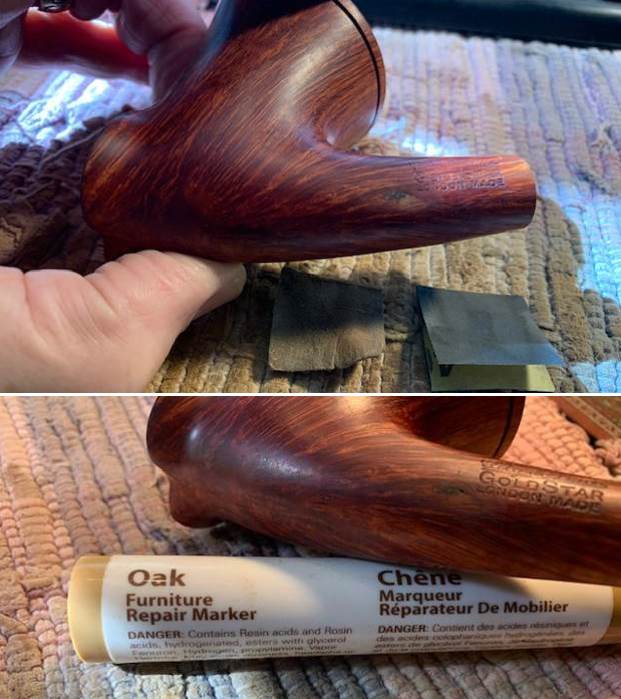
Armed with that information I turned to work on the pipe itself. Before he sent it to me, Jeff had cleaned up the pipe with his usual cleaning process. He reamed the pipe with a PipNet pipe reamer and removed the rest of it with a Savinelli Fitsall Pipe Knife.  He scrubbed the bowl with undiluted Murphy’s Oil Soap with a tooth brush. He rinsed it under running warm water to remove the soap and grime. He cleaned out the inside of the shank and the airway in the stem with isopropyl alcohol, cotton swabs and pipe cleaners. He soaked the stem in Briarville’s Pipe Stem Deoxidizer and then rinsed it off with warm water. He scrubbed the stem with Soft Scrub and a tooth brush and rinsed it off with warm water. It looked amazing when I took it out of the package of pipes he shipped me. So much so that it is the second of those pipes that I chose to work on. I took photos of the pipe before I started my part of the restoration work.    The rim top and the inner and outer edges of the bowl all look very good. The lava on the surface and inner edge is gone. It was thick enough that it protected the rim and edges from damage. The stem surface looked good with the oxidation gone and light tooth chatter on either side of the stem. The stamping on the sides of the shank and on the gold star is clear and readable as noted above.I removed the stem and took a photo of the pipe to give a sense of the whole. It is a beautiful pipe that really flows with the grain on the briar.I took some photos of the uniqueness of the sitter shape and the flat heart on the front of the bowl. It is a nice looking pipe. I started my work on the pipe by addressing the flaw/fill on the left side of the shank. I have drawn a red box around it to clearly identify it for you. I filled in the area and repaired the fill with clear CA glue and briar dust working it into the area with a toothpick. I set it aside to cure and once the glue hardened I sanded it smooth with 220 grit sandpaper to blend it in. I started polishing that area with 400 grit wet dry sandpaper. I touched up the area around the repaired fill with an Oak Stain Pen to blend it into the shank colour. I polished the briar with micromesh sanding pads – dry sanding with 1500-12000 grit pads. I wiped the bowl down after each pad to remove the sanding dust. The bowl looked very good at this point so I rubbed it down with Before & After Restoration Balm. I worked it into the surface of the bowl and shank with my fingertips to clean, enliven and protect the briar. I let the balm sit for about 10-15 minutes and buffed with a cotton cloth to raise the shine. I set the bowl aside and turned to work on the stem. I polished the vulcanite stem with micromesh sanding pads – 1500-12000 grit pads. I wiped it down with Obsidian Oil after each sanding pad. I used Before & After Pipe Polish – both Fine and Extra Fine to further polish the stem. This Beautifully Grained GBD Made City de Luxe Gold Star Unique is a great looking pipe now that it has been restored. The shape of the bowl follows the grain and highlights the beauty of the briar. The rich brown stain works well with the polished vulcanite stem. I put the stem back on the bowl and carefully buffed the pipe with Blue Diamond on the buffing wheel using a light touch on the briar. I gave the bowl and the stem multiple coats of carnauba wax on the buffing wheel and followed that by buffing the entire pipe with a clean buffing pad. I hand buffed the pipe with a microfiber cloth to deepen the shine. The finished GBD Made Unique Freehand is a large pipe that will be great for sitting and reading on the porch. Give the finished pipe a look in the photos below. The dimensions of the pipe are Length: 6 ¾ inches, Height: 2 ¾ inches, Outside diameter of the bowl: 2 inches, Chamber diameter: 1 inch. The weight of the pipe is 73 grams/2.54 ounces. This is one gorgeous pipe. It is one that I will be adding shortly to the British Pipe Makers section of the rebornpipes store. I take a moment to remind myself and each of us that we are trustees of pipes that will outlive us and the lives of many other pipe men and women who carry on the trust of their care and use. Thanks for reading this blog and my reflections on the pipe while I worked on it.

Restoring an Pre-Republic Era Peterson’s System House Pipe


Blog by Steve Laug

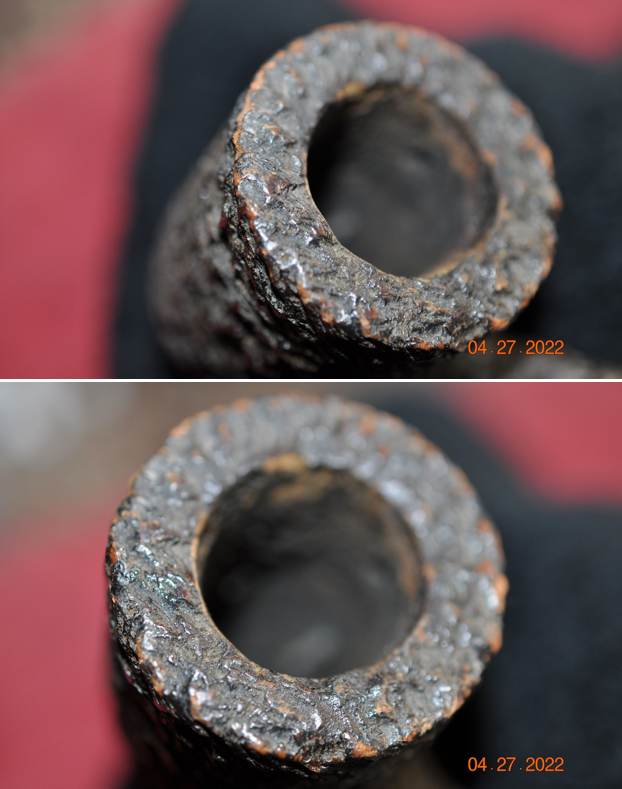
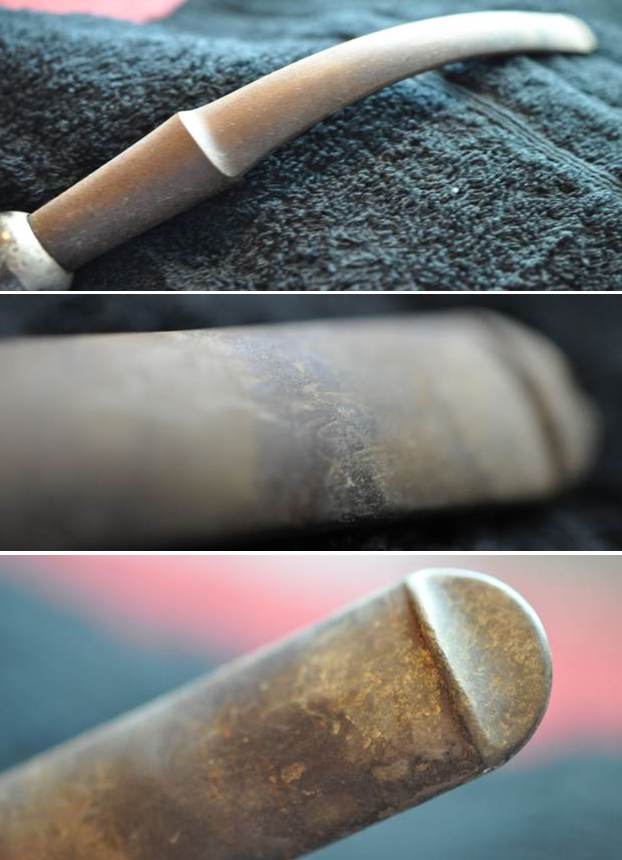
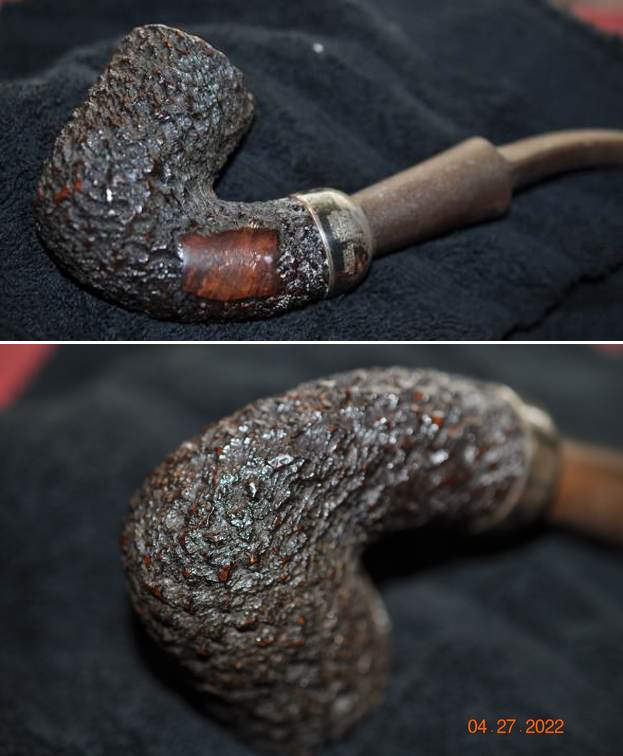
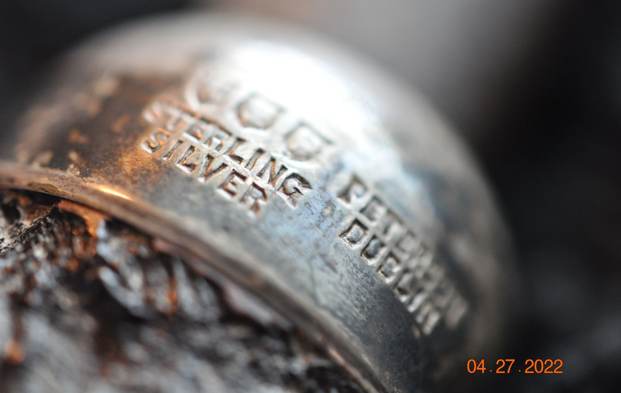
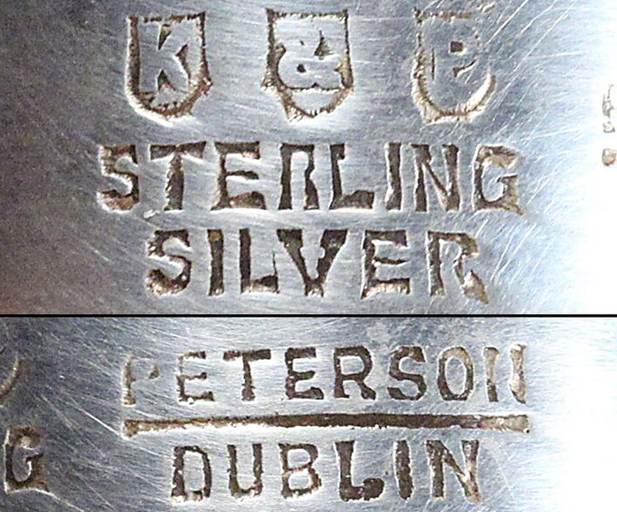
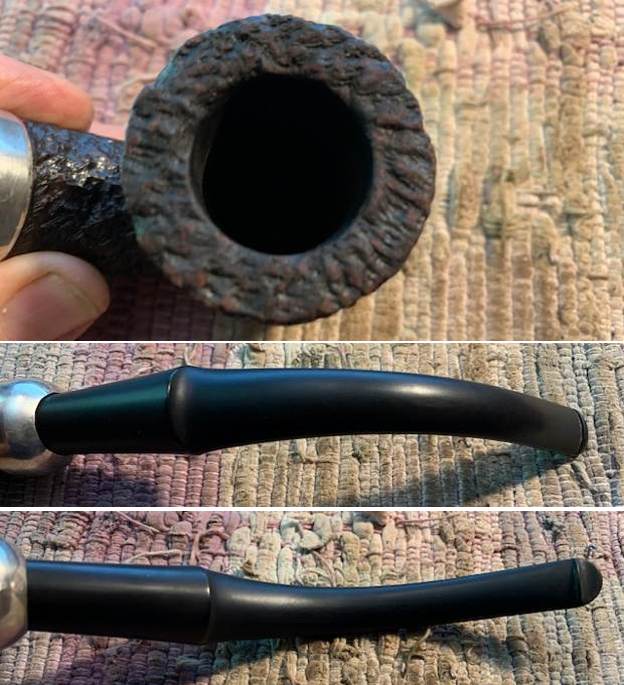
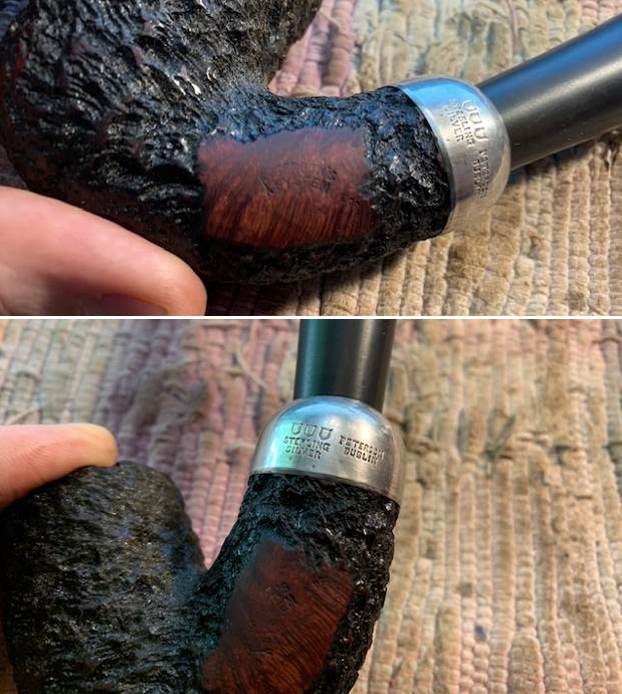
Jeff and I have been picking up pipes from an older Eastern European Professor who lives in the LA area. Over the past few years we have picked up a large number of pipes from him. Included in the last lot was a Peterson’s System pipe that intrigued us. We had no idea how big the pipe was until it arrived. It is a huge rusticated pipe. To me it is a house pipe but not sure. It is 9 inches long and the bowl is 2 1/2 inches tall. Rim diameter is 1 3/4 inches and chamber is 1 inch diameter. It is stamped on the left side and reads Peterson’s (with a forked tail P) over System. Below that and to the right it is stamped Made in Ireland in a circle. The ferrule is sterling silver and rounded. It is stamped with K&P each in its own cartouche over Sterling Silver. That is followed by Peterson over Dublin. The Professor and his friend included the following photos for us to have a look. You can see why we had no idea of the size of the pipe. He also included photos of the bowl and rim top as well as the sides to show the general condition of this pipe. I was well smoked and showed wear and tear of the years of the Professor’s travels and use.The pipes arrived in Idaho after some time spent negotiating a price and then waiting for the shipping. When they arrived in April he took photos of the pipe before he cleaned it up. You can see the style of the rustication on the bowl – rugged and really a lot like the finish on a Rocky Donegal. It is dirty with dust and debris deep in the rustication on the rim top, bowl sides and shank. The bowl has a remnant of cake in the bowl and shows signs of being recently reamed. The finish has some worn spots on the sides and rim top. The silver ferrule is oxidized and dark from tarnish. The stamping on the silver and the briar is very readable. The stem is oxidized but does not appear to have any tooth marks or chatter. Jeff sent me photos so I could have a sense of the pipe.He took close up photos of the rim top and stem to give a clear idea of the condition of the pipe. He took photos of the bowl from various angles to show the condition of the briar and the style of the pipe. It is a beautiful old pipe under the grime and grit of the years.   Jeff captured the stamping on the shank side. It is clear and readable as noted above. There are some spots on the stamp that are more faint than others but it is still clear. The silver stamping is very clear. I turned to the Pipedia article for confirmation of my thinking about it being a Pre-Republic Period pipe (https://pipedia.org/wiki/Peterson#1950_-_1989_The_Republic_Era). I quote the section on the Pre-Republic Period that confirms my thoughts. I have highlighted the portion in red regarding the COM stamp on this pipe.
1915 – 1949 The Pre Republic Period — This was a turbulent period for the company with the outbreak of World war 1 and the start of the Easter uprising in 1916. The K&P shop was extensively damaged during the military action at this time ( see attached newspaper report). Following quote by Kapp & Peterson.-

“Kelly’s, the well known Dublin landmark at the corner of Sackville Street and Bachelor’s Walk, one of the most shot at and fully punctured premises in Dublin, was in our possession practically before the smoke ceased over the ashes of our fine shop under the Metropole Hotel. This was one of the most sensational business captures arising out of the Rebellion.”

Around 1916, Peterson began stamping their pipes “Made in Ireland” in what is referred to as a block format. Charles Peterson died shortly after retiring and moving to Hamburg in Germany in 1919 where he is buried.

The original 1890 ‘system’ pipe patent expired at around this time. The Irish free state came into being in December 1922. The Free State Era was from 1922 through to 1937.

Peterson followed with a stamp of “Irish Free State” in either one or two lines, either parallel or perpendicular to the shanks axis and extremely close to the stem. Ireland was a republic in all but name. Eventually the Irish people voted for a new constitution in 1937 and Ireland then formally became Eire (Ireland in Irish). The Made in Eire era stamps were from 1938 through till 1941. Peterson now stamped their pipes with “Made in Eire” in a circle format with “Made” and “Eire” in a circle with the “in” located in the centre of the circle. This was used during the years of 1938 – 41. Later they stamped their pipes with “Made in Ireland” in a circle format 1945-1947 and still later with “Made in Ireland” in a block format 1947-1949. The “Made in Ireland” block format came in either one line or two lines.
The Republic of Ireland was formed on 17 April 1949.

Further down in the article there was some more interesting information on the brand and the time period of this particular pipe.

The pre-republic Peterson’s are often considered to be rather special by Peterson pipe smokers. They hark back to a time when quality briar was in abundance and craftsmanship was of the highest level.

Like all collecting desirables, pre-republic pipes are now relatively hard to come by, with availability declining with each passing year. The amazing thing that I find with pre-Republic’s is the consistently high smoking qualities that they show, regardless of being a high or low grade issue. No it is not that I am looking through rose tinted glasses and being sentimental, they really were very well made. I base my judgement on owning and smoking quite a few of them.

For the purpose of this exercise and bearing in mind the eccentric vagaries of Peterson nomenclature, I am suggesting that an acceptable criteria or starting point for when the Pre- Republic era begins and ends, requires a short historical resume.:-

The Irish Free State came into being in December 1922. The British sovereign, as King of Ireland, was nominal head of state, but Ireland was a republic in all but name.

An entirely new constitution was voted by the Irish people in 1937, with provision for a President Of Ireland as head of state. Therefore, Ireland became a republic in 1937, but was not called that. It was called simply EIRE (Ireland in Irish.)

When, in 1945, the British government inquired of prime minister Eamon de Valera whether he intended to proclaim a republic, his answer was: “we are a republic”, having refused to say so before for eight years. This was news to the British: when George VI ascended the British throne in 1936, he had been crowned King of Ireland, as well, little knowing that there no longer was a Kingdom of Ireland!

As usual when trying to get accurate facts in regard to Peterson history, something will jump up and get in the way. They are missing many of their records. The following is the best that we can do for a guide to the myriad markings during the period 1922 – 1949.

Prior to 1920 it was rare for a country of origin to be stamped on the pipe, just Peterson’s Dublin on the band. After 1921/22,If it is stamped “MADE IN IRELAND” and the “Made in” is stacked over “Ireland” or “MADE IN EIRE” or several other forms, it was made between 1922 and 1938. A considerable number of Peterson pipes were stamped “Irish Free State”. From about 1930 to 1949, most of the pipes (those which were stamped) were stamped “Made in Ireland”.” If the stamp reads “MADE IN IRELAND” in a circle, the pipe was made between 1939 and 1948. These are all “pre republic” pipes. I can tell you that the mark “Irish Free State” was adopted in 1922;and replaced by “Eire” in 1937 and then by “Republic of Ireland” in 1949…

The site also had a photo of the exact stamping that was on the ferrule of this pipe so I am also including that photo below.There was also a section in the Pipedia article on House Pipes. I include that below as I am pretty certain that the pipe I have is one of them. I have highlighted a section in red below that gives a sense of finishes and costs of these large pipes.
House pipes: Another popular Peterson system pipe variant, is the huge House Pipe. I believe the term house pipe, has come from the fact that they are just too big to carry around for some and too heavy to hold in one’s mouth. The pipes are so large that you’ll want to smoke them at home, settled into a comfortable chair for a very long session with a good book! I remember seeing them referred to as ‘systems on steroids’!

These large hand made pipes normally retail for around $200 $ 400 depending on shape and finish. Varying from Smooth, Sandblast and Rustic finishes and Straight Billiard and Bent shapes. Extra large bowls. All with sterling silver bands. Finishes include terracotta and oak colours.

Over the years there have been a few large System pipes Produced by Peterson which could be considered to be included as ‘House’ pipes. In the early Peterson catalogues, circa 1900,they were advertising XXL systems which were similar in size to the modern ‘House’ pipes. Around 1990 Peterson were asked by a large UK retailer, i.e. Bonds of Oxford St. London, to commission the making of a special giant classic bent pipe, with dimensions of, length 17cms, bowl height,6.1cm, bowl chamber depth 5.5cms, internal bowl diameter 2.1cm. This is a classic shaped Peterson with hallmarked silver ferrule in smooth and rustic finishes, plus options of tapered and saddle stems. In the early 1990s Kapp & Peterson made this giant, classic full bent, smooth pipe exclusively for Bonds of Oxford Street London. Bonds seem to have an endless source of New Old Stock Peterson pipes. I am always intrigued by these pipes when they arrive by post. Inevitably they come in their original packaging and to my mind, are a window back in time. I enjoy the box and contents as much as the pipe.

I had seen this pipe on many occasions when I had previously visited Bonds E bay site. I have always been attracted to it and admired the classic shape ,size and finish. They were offering the same pipe in various finishes and stem fittings. However I preferred the smooth tapered fishtail. I am a sucker for large bent Pete’s. Just my taste. However it was not cheap at around $355. Having had the opportunity to see the pipe ‘in the flesh’, I am amazed at the quality, feel, looks and the smoking performance. Yes you heard right I smoked it! Normally with the newer unsmoked high grades that come into my collection, they remain unsmoked. However I made an exception with this beauty and boy it was worth it.

I wrote to Mark Irwin and sent some photos of the pipe to see what he could tell me. Unfortunately in my first email the photos did not include any profile shots. I sent him those in subsequent emails and also order a copy of the 1896 K&P Catalog from Smokingpipes. Here is what Mark wrote in the emails.

FIRST

Hey Steve,

Without seeing a perfect flanking shot, I can’t be 100% sure here, but I can tell you it is either the shape 1 or shape 3 straight-sided (“dutch billiard”) from the 1906 and 1896 catalogs. Not seen in K&P catalogs after 1906, like other magnums it remained in the shadows but surfaced from time to time. The rustication is excellent, dating it to the late 1940s or early 1950s when this type of work was routine at the factory. The sterling mount was given to it because of the unusual size as well as the good blast. With a flanking shot, I can determine whether it is the 1 or the 3.

I just thought of something: if you have the restoration of the 1896 K&P catalog I released not long ago through Smokingpipes, you can simply lay your bowl on top of shape 1 and shape 3 and *presto* you’ll know. The original scaled illustrations are quite useful in this way.

Happy Smokes,

Mark

SECOND

It’s the 1. How very cool. Is this pipe going in your collection, is it someone’s your working on or do you intend to sell it? Great piece!

Yes, I think with your enjoyment of the history of pipes you’d love the catalog and the historical commentary.

Mark

Mark’s information confirmed what I had learned from my research and gave me additional information. Mark notes that the rustication dates it to the late 1940s or early 1950s. The COM stamp had helped me date it between 1945-1947 so that fits!  He also confirms that it a Shape 1, straight-sided (“Dutch Billiard”).

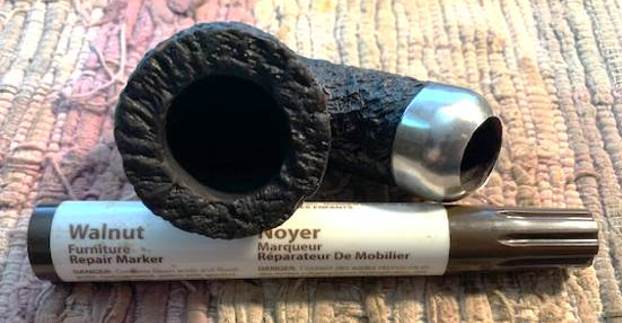
Armed with that information I turned to work on the pipe itself. Before he sent it to me, Jeff had cleaned up the pipe with his usual procedure. He reamed the pipe with a PipNet pipe reamer and removed the rest of it with a Savinelli Fitsall Pipe Knife.  He scrubbed the bowl with undiluted Murphy’s Oil Soap with a tooth brush. He rinsed it under running warm water to remove the soap and grime. He cleaned out the inside of the shank and the airway in the stem with isopropyl alcohol, cotton swabs and pipe cleaners. He soaked the stem in Briarville’s Pipe Stem Deoxidizer and then rinsed it off with warm water. He scrubbed the stem with Soft Scrub and a tooth brush and rinsed it off with warm water. It looked amazing when I took it out of the package of pipes he shipped me. So much so that it is the first of those pipes that I chose to work on. I took photos of the pipe before I started my part of the restoration work.   The rim top and the inner and outer edges of the bowl all look very good. The stem surface looked good with the oxidation gone and no visible tooth marks and chatter on either side of the stem. The stamping on left side of the shank and on the silver ferrule is clear and readable as noted above.I took a photo of the pipe with a regular sized Peterson System 312 to give a sense of the size of this pipe. It really is a big pipe. I then removed the stem and took a photo of the pipe to give a sense of the whole. It is a proportionally pleasing pipe.I started my work on the pipe by addressing the fading of the finish on the rim top and edges. I used a Walnut Stain Pen to match the color of the rest of the bowl. The finished rim top and edges look better. The bowl looked very good at this point so I rubbed it down with Before & After Restoration Balm. I worked it into the surface of the bowl and shank with my fingertips and a horsehair shoe brush to clean, enliven and protect the briar. I let the balm sit for about 10-15 minutes and buffed with a cotton cloth to raise the shine. I set the bowl aside and turned to work on the stem. I polished the vulcanite stem with micromesh sanding pads – 1500-12000 grit pads. I wiped it down with Obsidian Oil after each sanding pad. I used Before & After Pipe Polish – both Fine and Extra Fine to further polish the stem. This Beautiful Rustic Peterson’s Pre-Republic System House Pipe Shape 1 “Dutch Billiard” is a great looking pipe now that it has been restored. The style of rustication that is used around the bowl is highlighted by the dark, rich stain application and works well with both the polished Sterling Silver ferrule and vulcanite stem. I put the stem back on the bowl and carefully buffed the pipe with Blue Diamond on the buffing wheel using a light touch on the briar. I gave the bowl multiple coats of Conservator’s Wax and the stem multiple coats of carnauba wax on the buffing wheel and followed that by buffing the entire pipe with a clean buffing pad. I hand buffed the pipe with a microfiber cloth to deepen the shine. The finished Rustic Peterson’s System House Pipe is a large pipe that will be great for sitting and reading on the porch. Give the finished pipe a look in the photos below. The dimensions of the pipe are Length: 9 inches, Height: 2 ½ inches, Outside diameter of the bowl: 1 ¾ inches, Chamber diameter: 1 inch. The weight of the pipe is 101 grams/3.56 ounces. This is a pipe that I am adding to my own collection for now. I hope to enjoy it many times on the front porch over the summer ahead. I take a moment to remind myself and each of us that we are trustees of pipes that will outlive us and the lives of many other pipe men and women who carry on the trust of their care and use. Thanks for reading this blog and my reflections on the pipe while I worked on it.
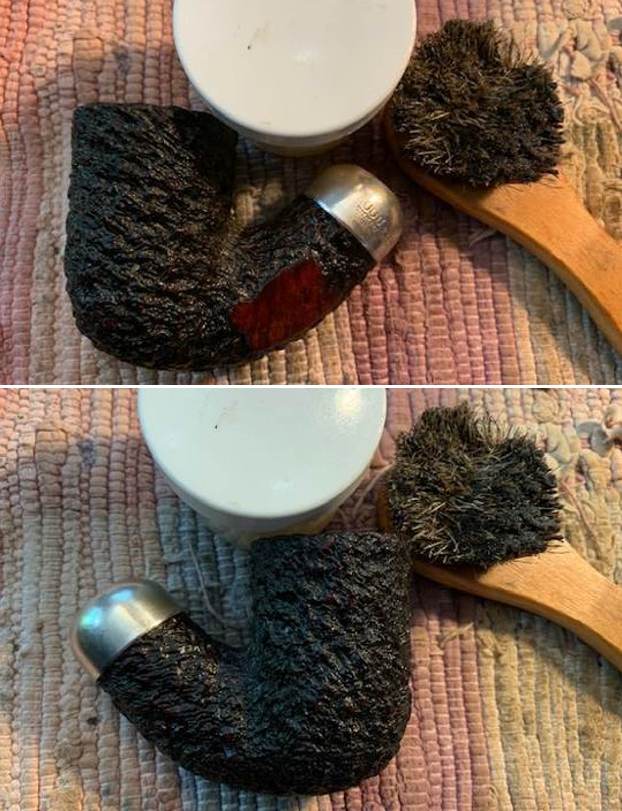
A Chunky and Squat Custom-Bilt Pot


Blog by Steve Laug

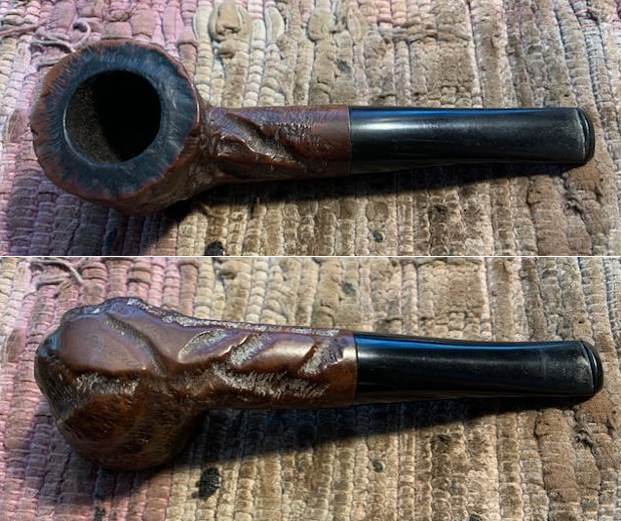
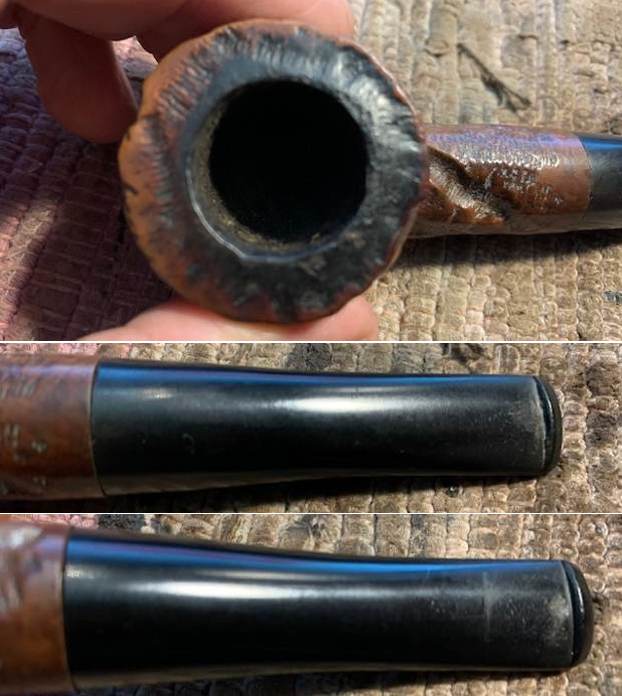
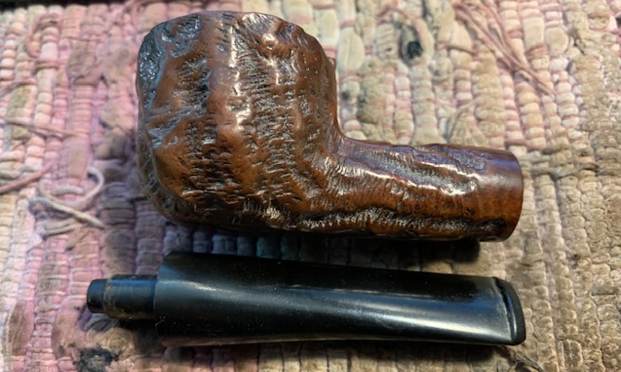
The next pipe I chose to work on is one that has been here in my box to work on since around 2016. It is a well made, interesting looking Custom-Bilt chunky Pot. The more I looked at it the more I thought that it had not gone through Jeff’s cleaning before it came here. I actually have no idea where it was from and when it came us. The bowl had moderate cake and the inner edge had damage and the rim top was darkened. The pipe is a classic Custom-Bilt piece – a rusticated Chubby shank Pot shaped pipe with some deep carving around the bowl. The pipe is stamped on the heel of the bowl and reads Imported Briar [over] Custom-Bilt. On the right side of the shank it bears a carved circle near the stem/shank junction. Looking at the pipe you can see signs that the bowl had been heavily caked with an overflow of lava on the rim top and the inner edge. The bowl and shank smelled dirty and seemed to be oily. The stem looked good and had tooth chatter and marks on the top and underside near the button. There were no markings or a logo on the taper stem. It looked pretty good when I brought it to the worktable. I took photos of the rim top and bowl to give a clear picture of the appearance of the rim top and edges of the bowl. There was some darkening on the rustication on the top and some lava in the grooves. There was also some damage to the inner edge of the bowl. I took photos of the top and underside of the stem to show the chatter and tooth marks. The stamping on the heel of the bowl is faint but still readable and read as noted above. I removed the stem and took a photo of the pipe to give a sense of the whole. It is a stubby pipe.I turned to Pipephil (http://www.pipephil.eu/logos/en/logo-c8.html) to get a quick view of the brand once again. I knew that I was working with one of the older pipes and probably made by Tracy Mincer himself. He stopped making the Custom-Bilt pipes in the early 1950s. The screen capture I included below shows a brief history of the brand. It also has a comment on the symbols stamped on the shank near the stem including the square that is stamped on this one.I turned to Pipedia (https://pipedia.org/wiki/File:CustomBilt_Stamp1.jpg) for a quick read. The majority of the information there included two book reviews of the “Custom-Bilt Story” by Bill Unger.

The one line I culled was the following: “Tracy Mincer started the original Custom-Bilt pipes it appears in 1934”.

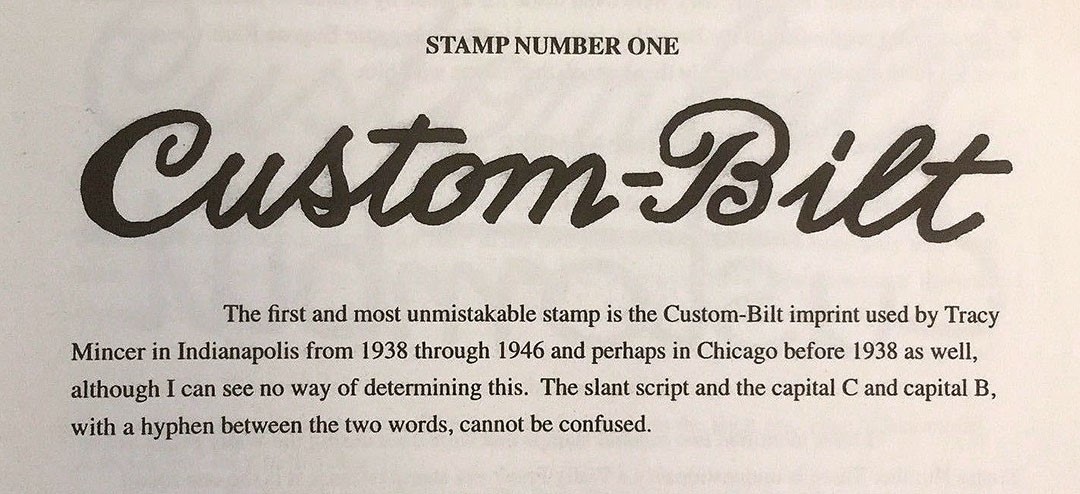
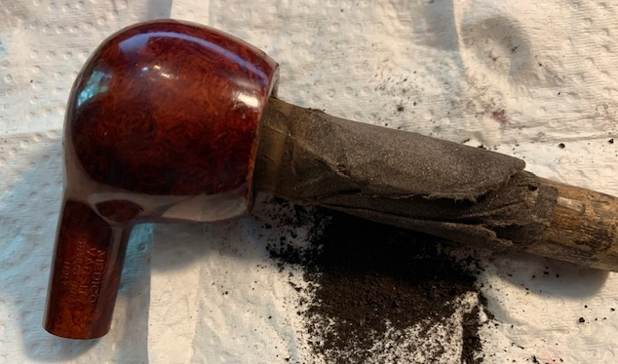
I did a screen capture of the stamping that matched the stamping on the pipe that I am working on. What I learned from that is that the stamp was used by Tracy Mincer in Indianapolis in the US from 1938-1946 and possibly in Chicago before 1938 as well. So now I had a possible date for this pipe. It was an old timer and it was well worth working on.Armed with that information I turned to work on the pipe itself. I started my work on the pipe by cleaning up the reaming in the bowl with a PipNet pipe reamer. I used a Savinelli Fitsall Pipe Knife to remove the remainder and then sanded the bowl walls with 220 grit sandpaper wrapped around a piece of dowel. The bowl walls looked very good. I scrubbed the externals with undiluted Murphy’s Oil Soap and a tooth brush. I worked over the rim top and the rest of the bowl and rinsed it off with warm water. I dried off the briar with a cotton towel.   I turned next to the remaining darkening on the rim top and used a brass bristle brush and worked it over to remove the grime and debris that was still present there. It looked better when I finished.  I cleaned up the damage to the inner edge of the rim. I used a folded piece of 220 grit sandpaper to reshape the edge. The finished rim top and edge looks better. I wiped the rim top down with alcohol to remove the sanding dust. Once I had dried it off I rubbed it down with Before & After Restoration Balm. I worked it into the surface of the bowl sides and shank with my fingertips and a horsehair shoe brush to clean, enliven and protect the briar. I let the balm sit for about 10-15 minutes and buffed with a cotton cloth to raise the shine.  While I was buffing it I found that I had forgotten to clean the insides of the shank and stem. I cleaned it with isopropyl alcohol, pipe cleaners and cotton swabs. It smelled much better.    I set the bowl aside and turned to work on the stem. I “painted” the stem with the flames of a lighter to lift them as much as possible. I filled in the remaining tooth marks with black super glue.     Once the repair cured I flattened the repair on the topside and shaped the button edge on both sides with a small flat file. I sanded the button edges and the repairs on the stem with 220 grit sandpaper to blend them into the surface of the vulcanite. I started polishing it with 400 grit wet dry sandpaper. It is starting to look very good.    I polished the vulcanite stem with micromesh sanding pads – 1500-12000 grit pads. I wiped it down with Obsidian Oil after each sanding pad. I used Before & After Pipe Polish – both Fine and Extra Fine to further polish the stem. This Custom-Bilt Pot is a great looking pipe now that it has been restored. The style of rustication that is used around the bowl is highlighted by the stain application and works well with both the shape and the polished vulcanite stem. I put the stem back on the bowl and carefully buffed the pipe with Blue Diamond on the buffing wheel using a light touch on the briar. I gave the bowl multiple coats of Conservator’s Wax and the stem multiple coats of carnauba wax on the buffing wheel and followed that by buffing the entire pipe with a clean buffing pad. I hand buffed the pipe with a microfiber cloth to deepen the shine. The finished Custom-Bilt is another pipe that fits nicely in the hand and feels great. Give the finished pipe a look in the photos below. The dimensions of the pipe are Length: 5 ½ inches, Height: 1 ½ inches, Outside diameter of the bowl: 1 ½ inches, Chamber diameter: 7/8 of an inch. The weight of the pipe is 42 grams/1.48 ounces. I will be putting it on the rebornpipes store in the American Pipemakers Section shortly. If you are interested in adding this pipe to your collection send me a message or an email. Thanks for reading this blog and my reflections on the pipe while I worked on it. There are many more to come!
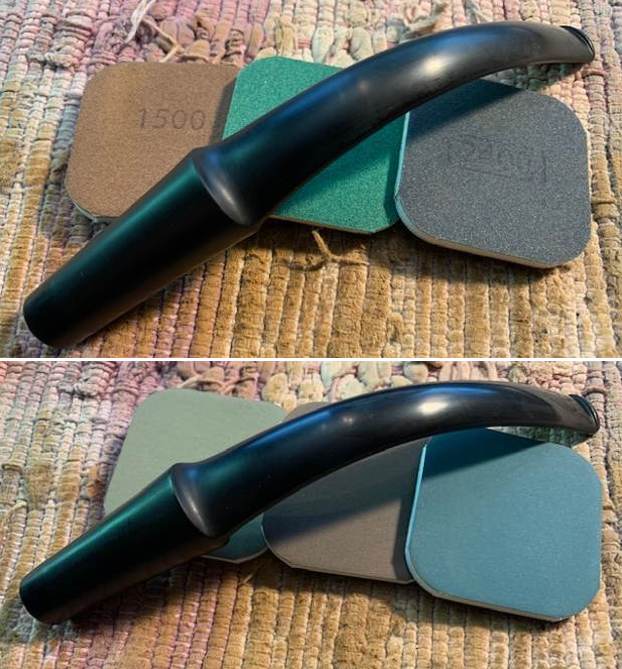
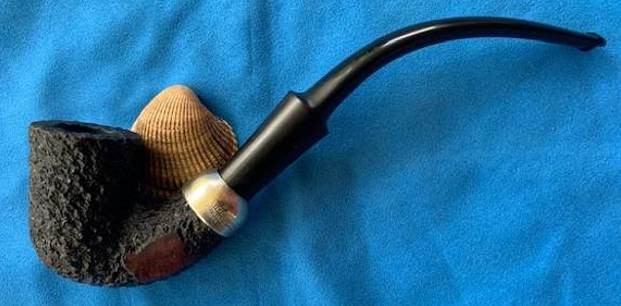
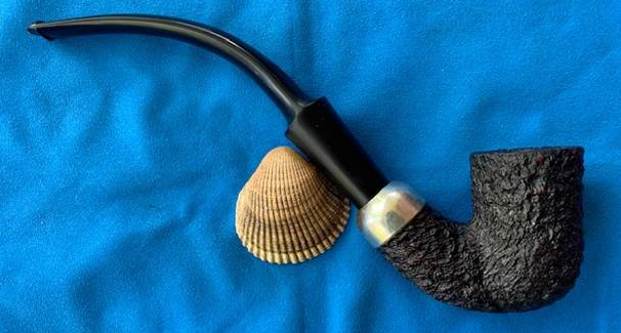
Cleaning up an Ehrlich Special Panel Billiard


Blog by Steve Laug

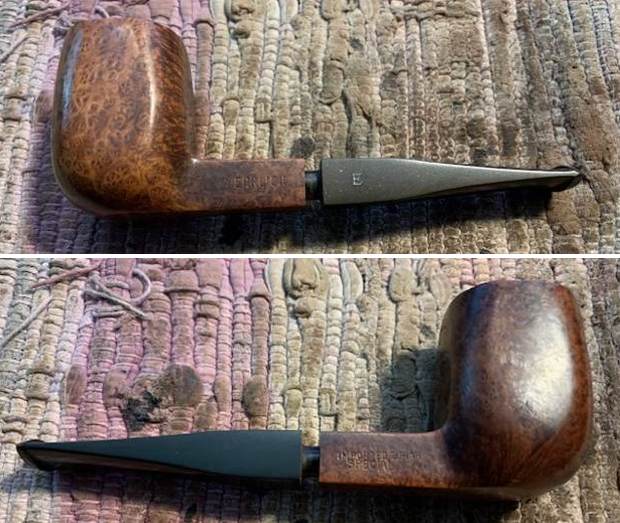
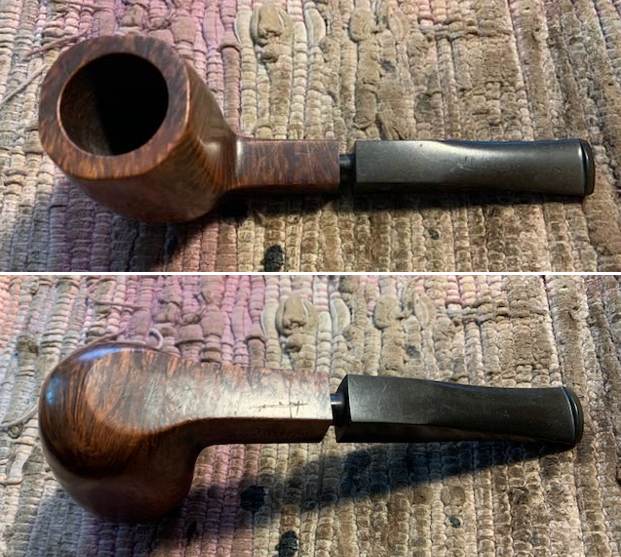
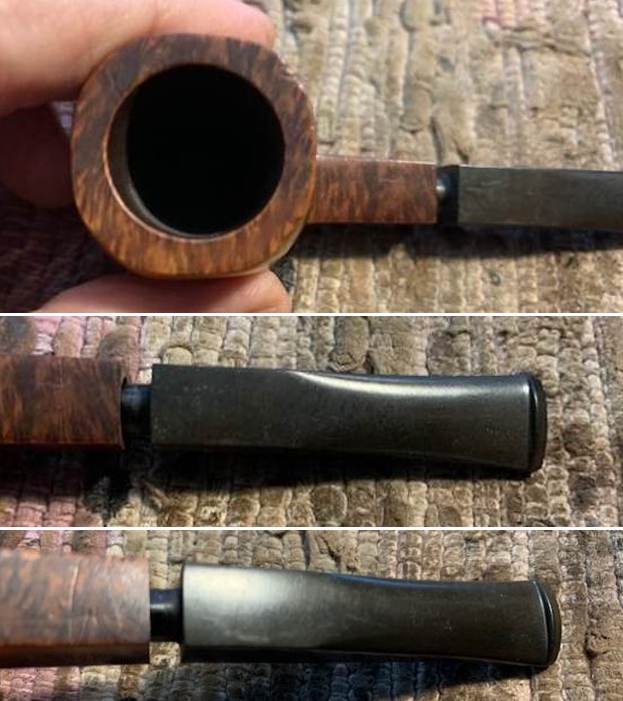
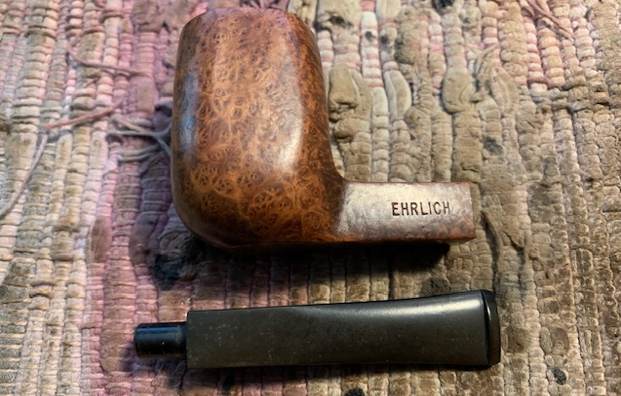
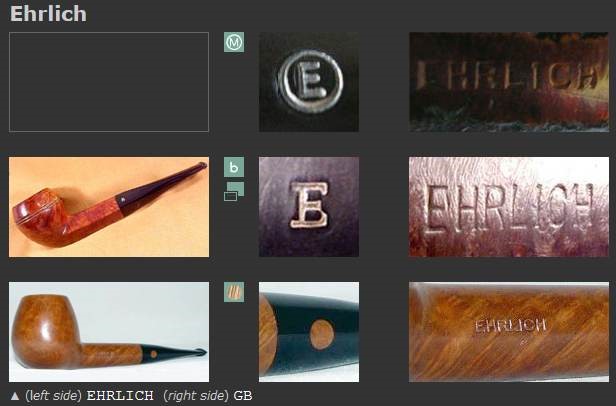
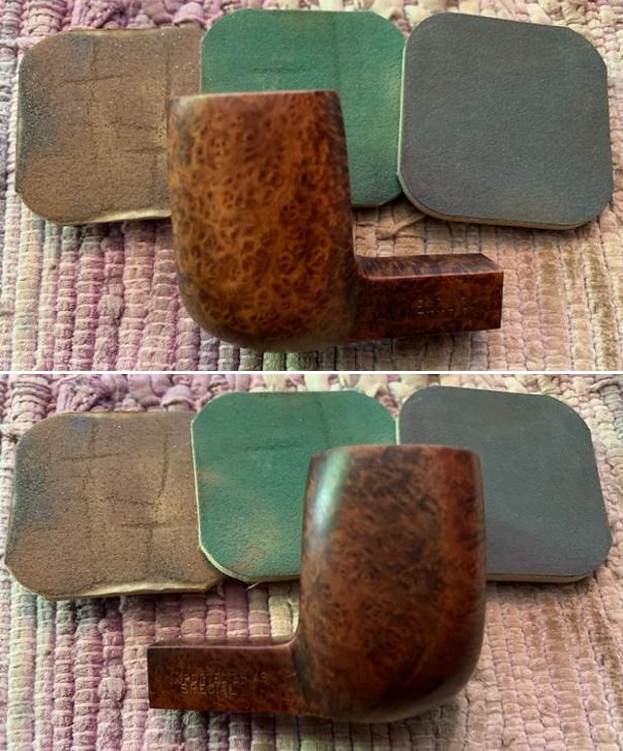
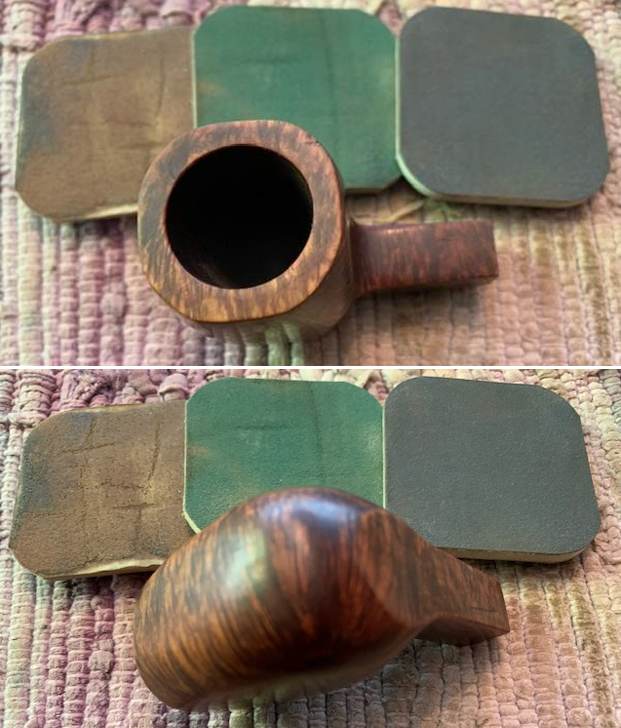
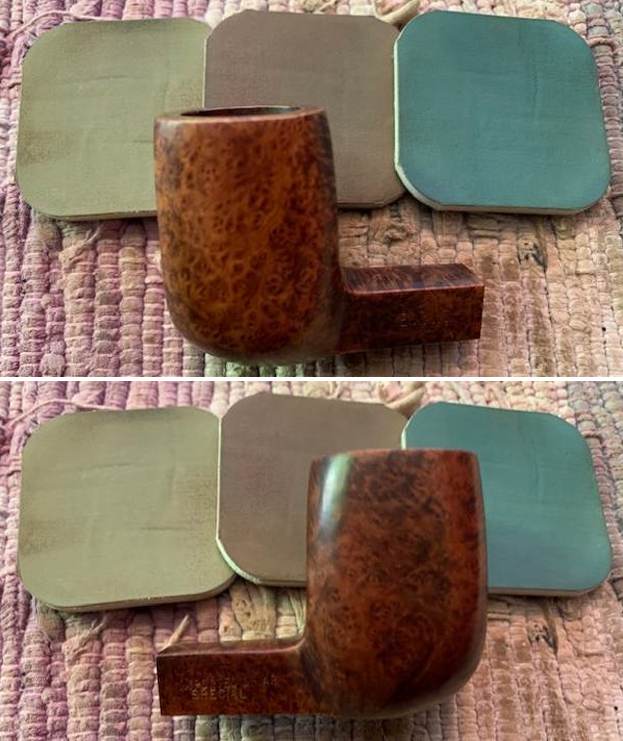
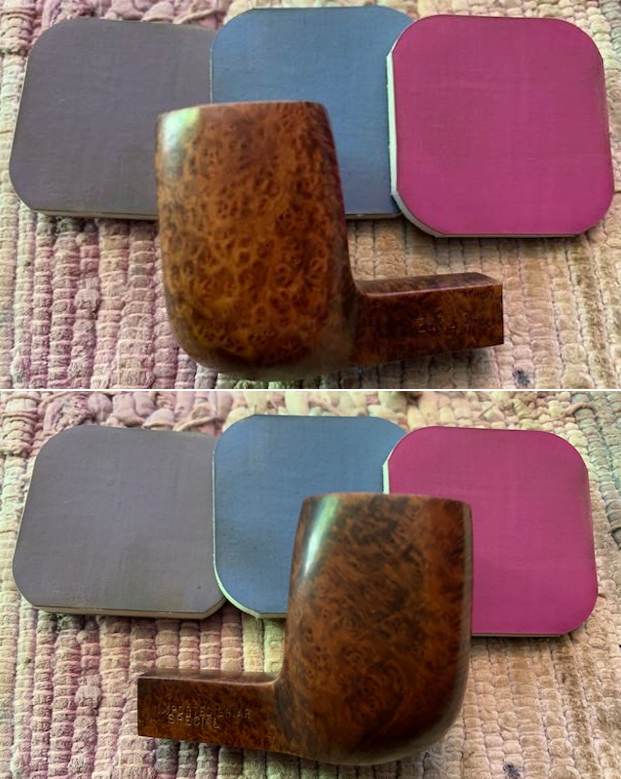
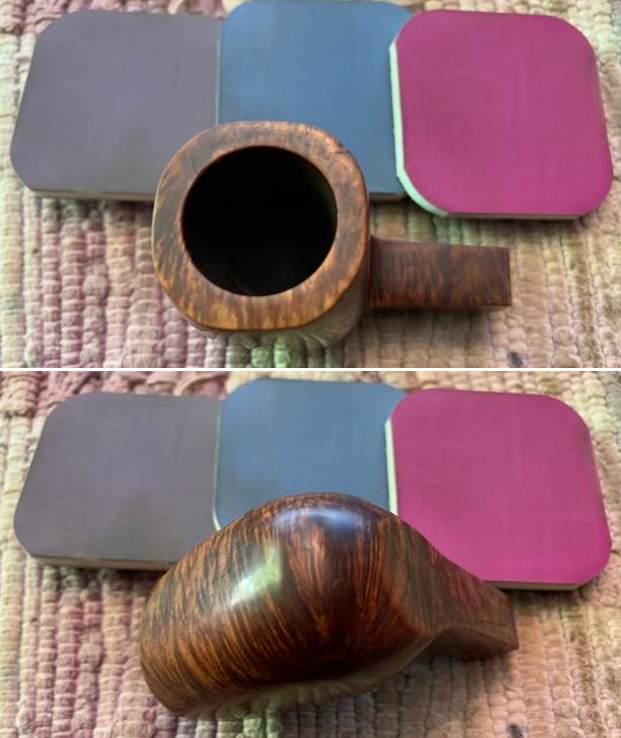
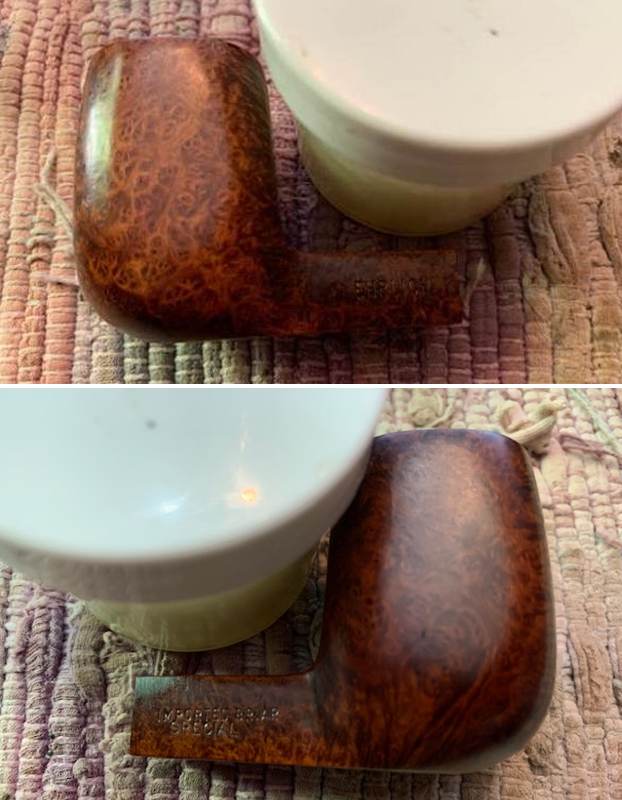
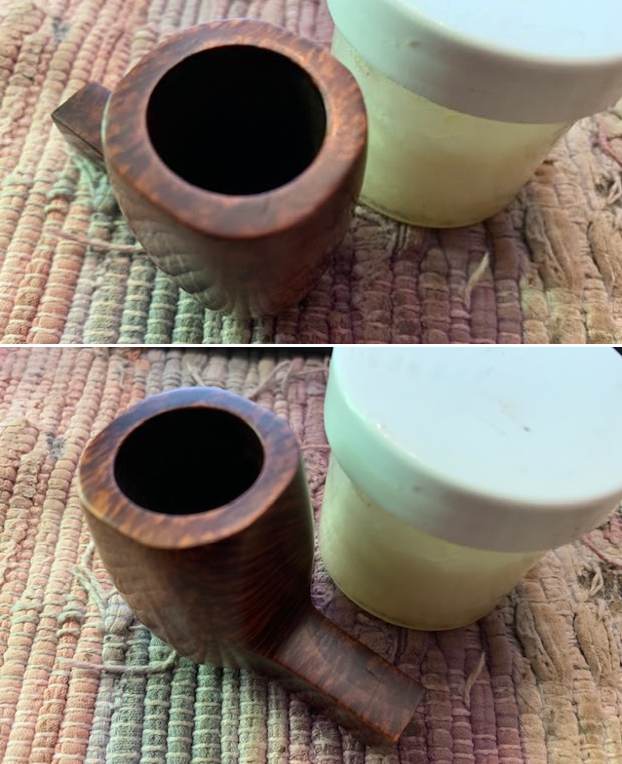
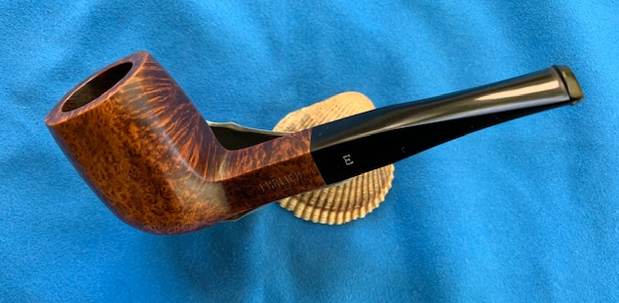
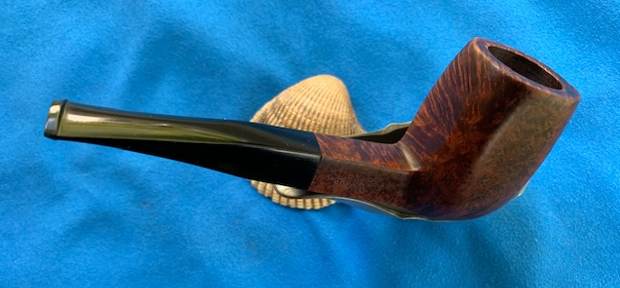
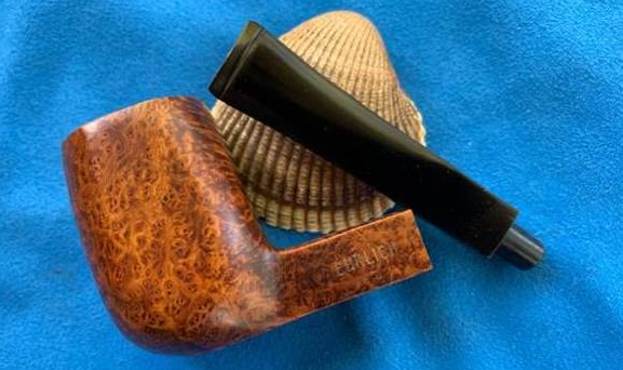
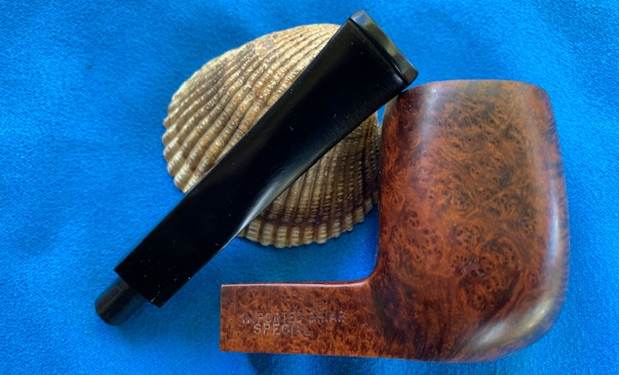
The next pipe I chose to work on is one that has been here in my box to work on since around 2016. It is a well made, beautifully grained Panel Billiard with a square shank and taper stem. It had gone through Jeff’s cleaning before it came here so it was quite clean. The bowl had been reamed and the rim top scrubbed. The stem was still oxidized so I would guess that we picked it up before we started using Mark Hoover’s Before & After Stem Deoxidizer. The finish looked very good with amazing cross grain on the front and back of the bowl and birdseye on the bowl sides. It was very beautiful under the dull finish at this point. It was stamped on the left side of the shank and read Ehrlich in block caps. On the right side it was stamped Imported Briar [over] Special. It has a vulcanite square taper stem that is oxidized and is very tight in the shank. The stem bears Ehrlich “E” logo on the left side. I took photos of the pipe when I brought it to the work table.  I took photos of the bowl and rim top and the stem surfaces to show the condition of both. The bowl, rim top and edges look very good. There was some darkening on the op and inner and outer edges look very good. The stem is also in great condition other than the oxidation and speckles of grime stuck to the surface of the stem.I took photos of the stamping on the sides of the shank. It is clear and readable as noted above. The Ehrlich logo of E is on the left side of the stem is also in good condition. I took the stem off the shank to show the overall look of this interesting panel pipe. It really is a beautiful piece of briar.I set the pipe aside to do a bit of reading on the history of the brand before I worked on it. I have worked on quite a few Ehrlich pipes in the past and wanted to refresh my memory of the back story of the brand. I checked first on Pipephil (http://pipephil.eu/logos/en/logo-e1.html) and found photos of various pipes. The picture of the second pipe is stamped similarly to the one I am working on. The EHRLICH is stamped the same way and the E logo is the same. There are no photos of the SPECIAL. I am including a screen capture of the pertinent information. There was no other information in the sidebars.Then I turned to Pipedia and was more successful (https://pipedia.org/wiki/Ehrlich%27s). I quote a portion of that article below that gives a bit of history and more importantly cleared up where the pipes came from for me.

The David P. Ehrlich story – Pipemakers and Tobacconists for a Hundred Years, 1868-1968.

The David P. Ehrlich Company has remained solely in the hands of one family during its century of business, yet it has had several firm names and locations. David P. Ehrlich went to work in 1881 at the age of twenty for Ferdinand Abraham, who dealt in cigars and tobacco and who had begun business in 1868 at 1188 Washington Street in the South End, but in 1880 moved to the center of the city, where the firm has been ever since. David Ehrlich married the boss’s daughter. In 1916 the name became the David P. Ehrlich Company and Mr. Ehrlich devoted the rest of his life to this business. Since David’s death in 1912 it has been owned by – his nieces and nephews including Richard A. and William Ehrlich.

Ehrlich shop has since 1880 had a predilection for historic sites. 25 Court Street was close to the spot where from 1721-1726 James Franklin had, with the assistance of his brother Benjamin, published The New-England Courant. In 1908 the firm moved a few doors up Court Street to number 37, on the opposite corner of the alley that is grandiloquently named Franklin Avenue. This new location was on the site of the one-time printing office of Edes and Gill, publishers of the Boston Gazette, in whose back room some of the “Indians” of the Boston Tea Party assumed their disguises. Soon after the end of World War II at which time the store was located at 33 Court Street a move around the corner to 207 Washington Street brought the shop diagonally across from the Old State House and onto the site occupied from 1610-1808 by the First Church of Boston. The demolition of 207 Washington Street in 1967 caused still another move to 32 Tremont Street, adjoining King’s Chapel burying Ground, which is the oldest cemetery in Boston.

The David P. Ehrlich Co. has not just occupied sites intimately associated with Boston history and institutions; it has in the past century become a Boston institution in its own right. It has specialized in fine cigars, pipes, and pipe tobacco. In addition to the retail business, the firm has long specialized in the manufacture of pipes, both from Algerian briar root…

That gave the history of the brand and was written in a way that fascinated me. I included a lot of because of that. I knew that the pipe I was working on was stamped Imported Briar which generally points to a pipe made elsewhere for Ehrlich and brought to the US.

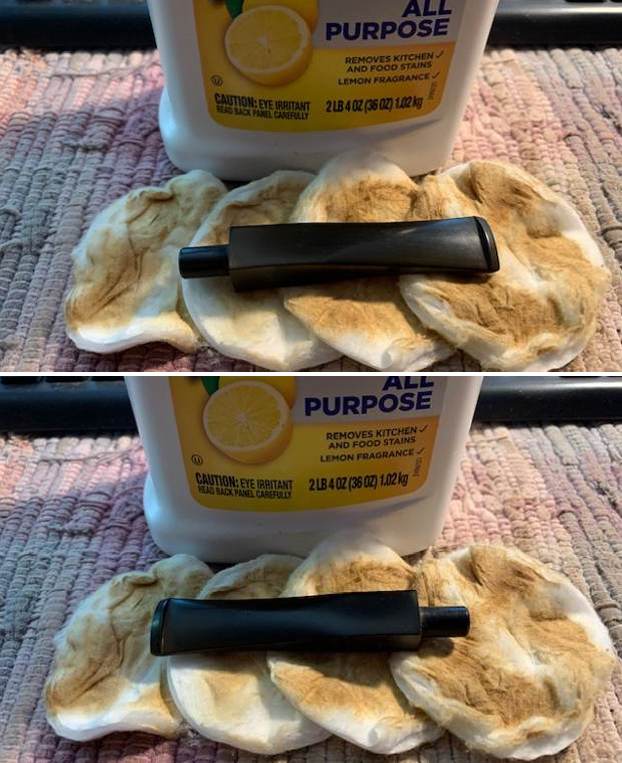
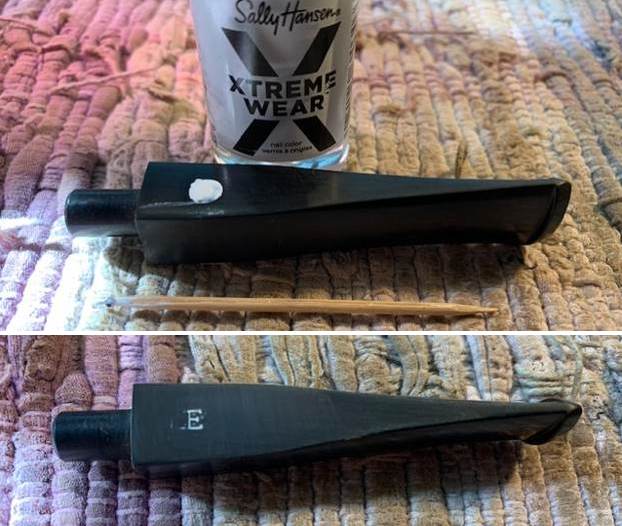
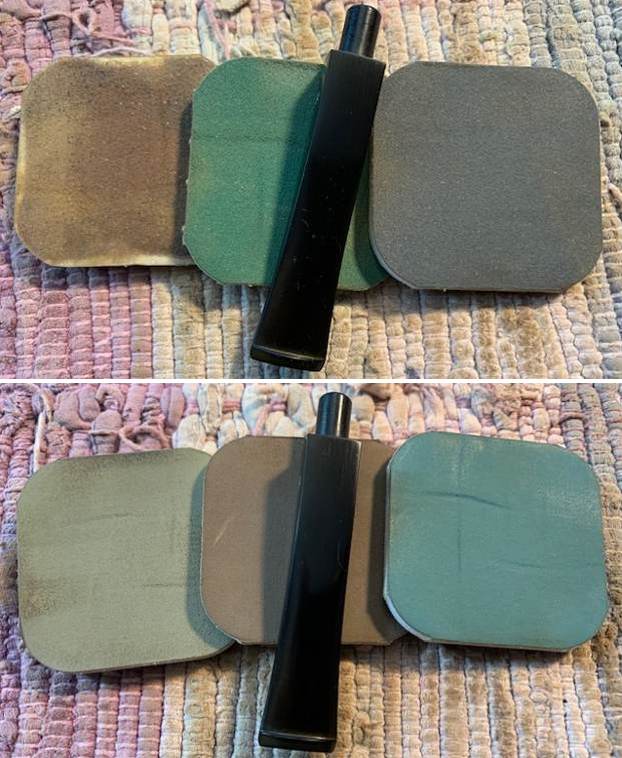
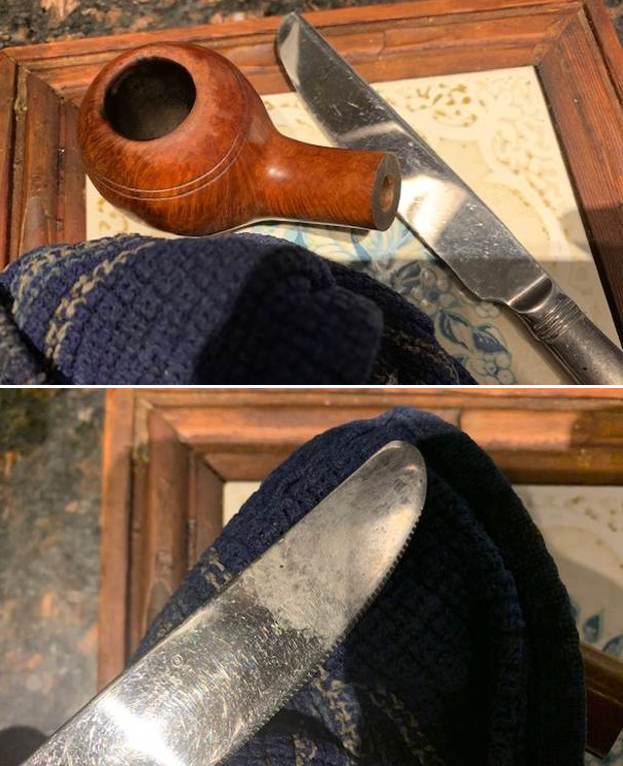
There were some deep scratches on the underside of the shank that I decided to steam out. I used a flat table knife, a damp cloth and the flame from my gas range to heat and create steam to raise the scratches. It worked quite well and removed some and minimized the others.  I polished the briar with micromesh sanding pads – dry sanding with 1500-12000 grit sanding pads. I was able to remove the varnish coat on the bowl and shank with the pads. I wiped the briar down with a damp cloth between each sanding pad. The briar took on a rich shine and there was some nice grain around the bowl and shank sides. I rubbed some Before & After Restoration Balm into the finish of the pipe. I worked it into the briar because the product cleans, enlivens and protects the briar. I let the pipe sit with the Balm for 10 minutes then buffed it off with a soft towel. The Balm did its magic and the pipe looked really good. I turned my attention to the stem. It was oxidized but did not have any tooth marks or chatter on either side. I scrubbed it with cotton pads and Soft Scrub all purpose cleanser. I worked on it until the stem surface was clean and ready polish.I touched up the E stamp on the side of the stem with white acrylic nail polish. I worked it into the E stamp with a tooth pick to get it into the grooves of the stamp. It was deep enough that it looked very good.I polished the stem with micromesh sanding pads – dry sanding with 1500-12000 grit pads. I wiped the stem down after each pad with a cloth impregnated with Obsidian Oil. I polished it with Before & After Stem Polish – both Fine and Extra Fine then gave it a final coat of Obsidian Oil and set it aside to dry. This Ehrlich Special Imported Briar Panel Billiard with a Taper Vulcanite stem looks really good. The grain around the bowl and shank stands out with the contrasting brown stains. I put the pipe back together and buffed the pipe with Blue Diamond on the wheel (being careful of the stamping on the stem so as not to damage it). I gave the bowl and stem multiple coats of carnauba wax and buffed the pipe with a clean buffing pad to raise the shine. I hand buffed it with a microfiber cloth to deepen the shine. The dimensions of this pipe are – Length: 5 inches, Height: 1 ¾ inches, Outside diameter of the bowl: 1 ¼ inches, Chamber diameter: ¾ of an inch. The weight of the pipe is 1.34 ounces/38 grams. It is a great looking pipe and one that will be going on the rebornpipes store in the American Pipe Makers section. If you want to add it to your collection let me know via email to slaug@uniserve.com or by message. Thanks for walking through the cleanup with me.

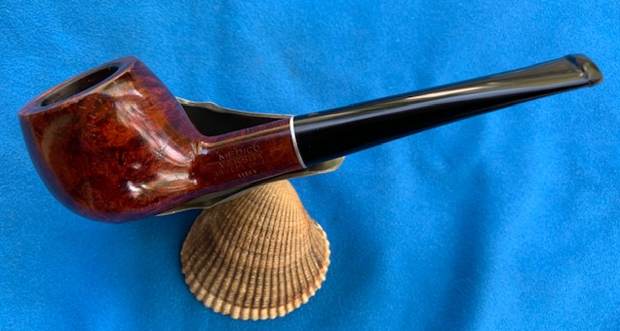
Restemming and Restoring a Medico Varsity Italian Made Apple


Blog by Steve Laug

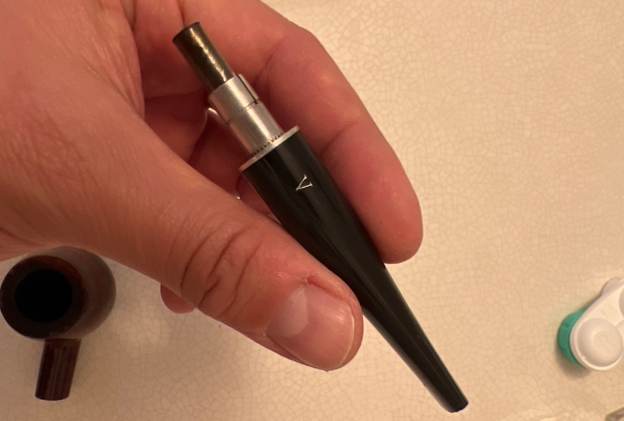
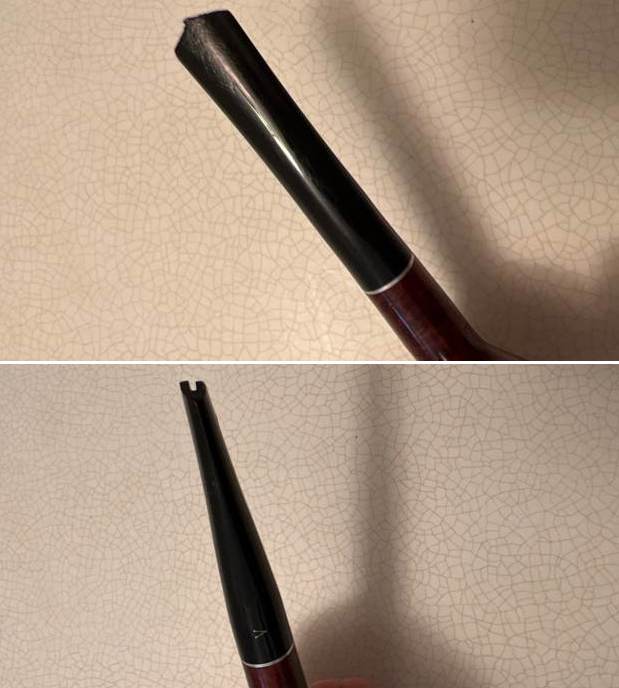
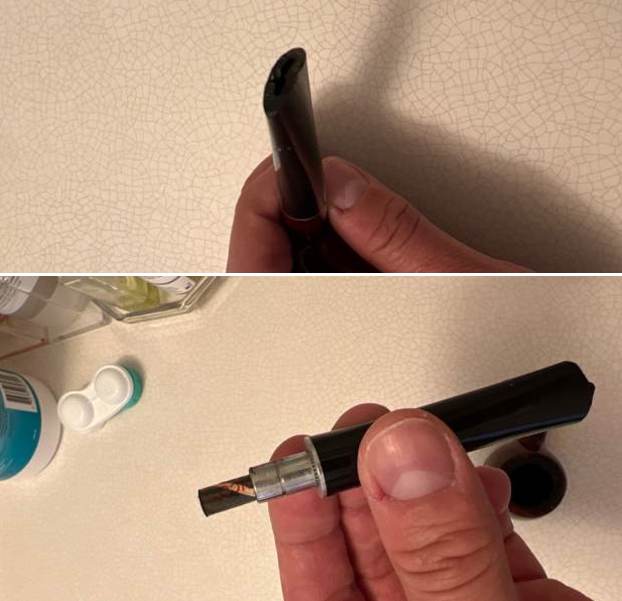
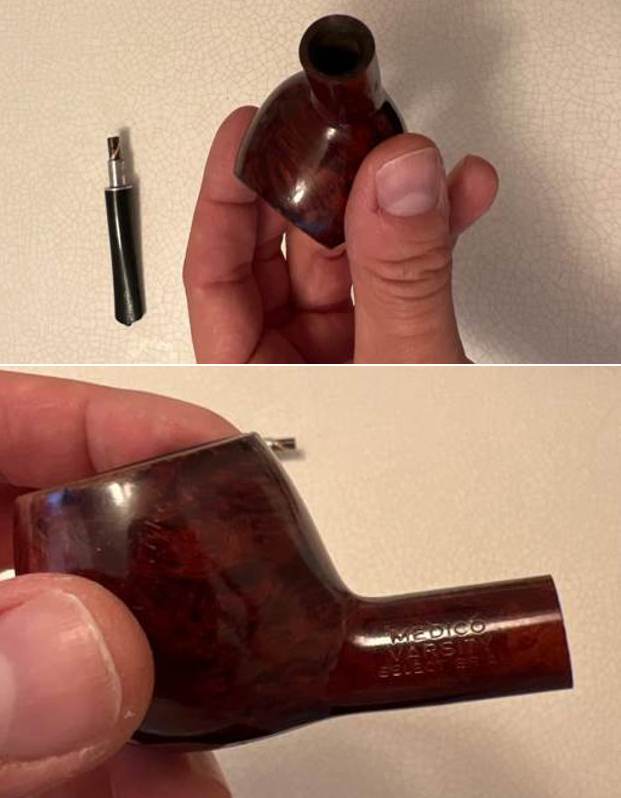
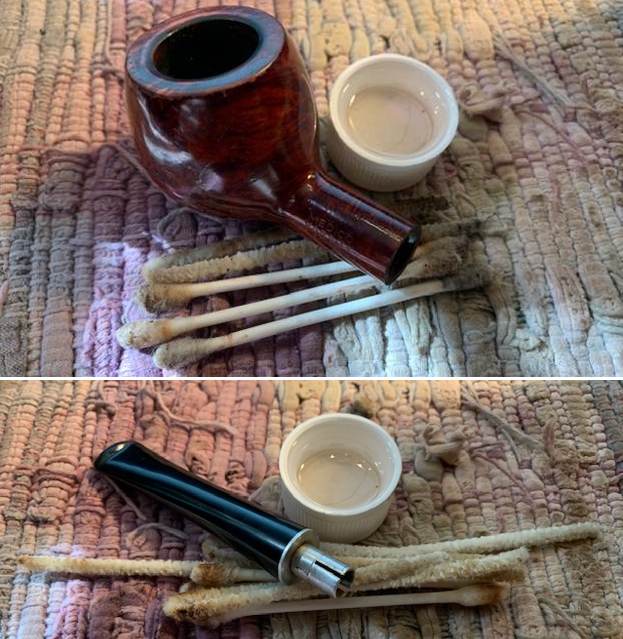
While I am not taking on new work as a general rule I am still doing repairs for a couple of the local pipe and cigar shops. That works well as it trickles in slowly and folks do not see to be in too much of a hurry to get the pipes back. It has made for some interesting repairs ranging from stems for cobs to replacement tenons for higher end pipes. I never know when they will come but they do come. I received a series of emails from a fellow referred to me by the local shop asking about a replacement stem/repair for his pipe. I asked for pictures of the pipe and a description of what he wanted done. He sent me  a few photos of the condition of the pipe. I have included them below for you to see and assess what is needed. If you assessed that it called for a new stem you were absolutely correct. The stem on the pipe was broken off from both directions. It was missing almost a ¼ inch of the stem length and the entirety of the button. It is obviously a Medico pipe with a filter – in this case a charcoal one. The last of his photos shows the bowl side and the stamping on the shank. It reads Medico [over] Varsity [over] Select Briar [over] Italy. The finish on the bowl looks pretty good – shiny with its thick varnish coat. I have no idea what the bowl and rim top look like at this point but I knew it needed a stem and that he wanted a filter stem. I told him to stop by and drop off his pipe as I probably had a stem that would work on it in my collection of stems. He was pretty pumped.

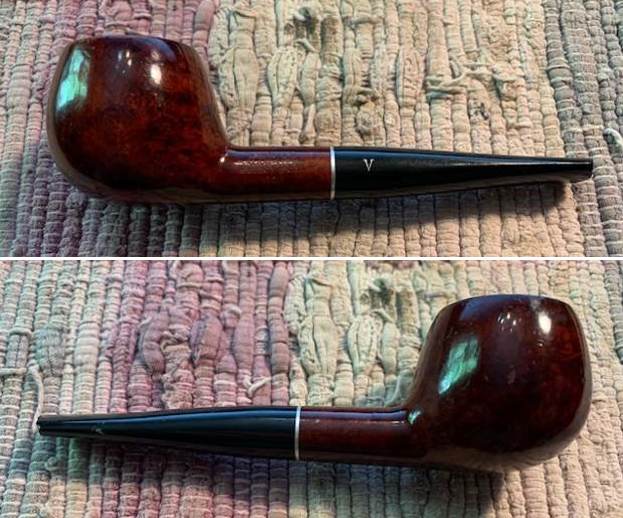
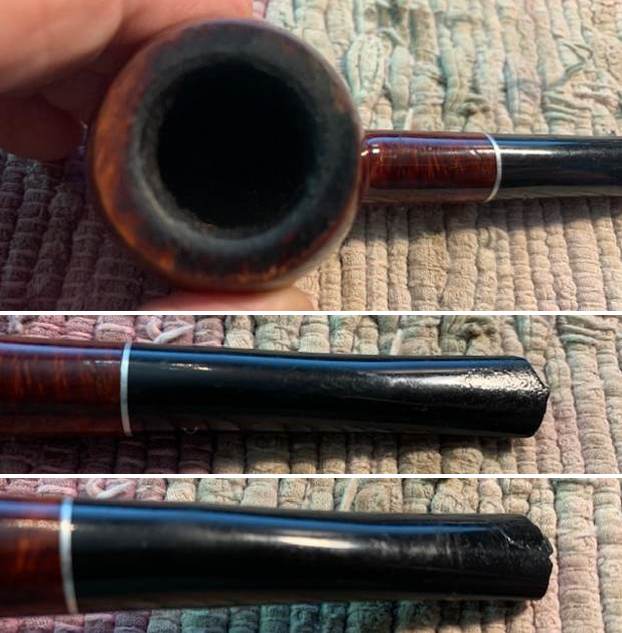
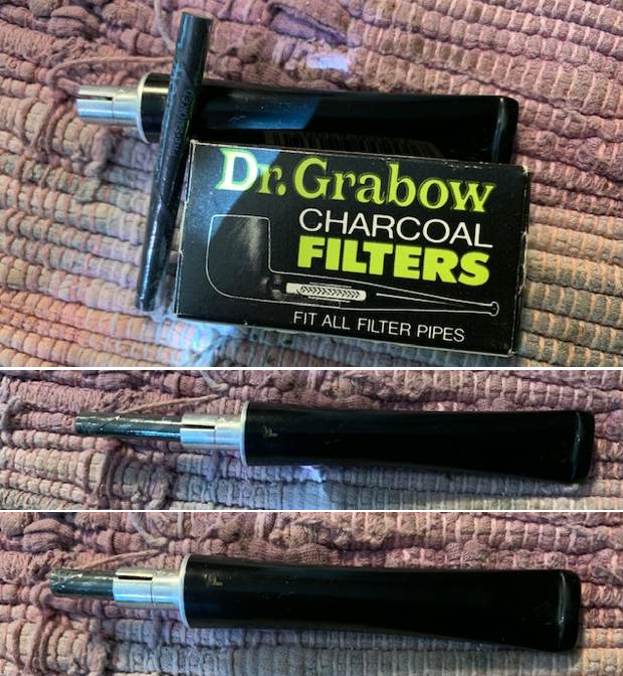
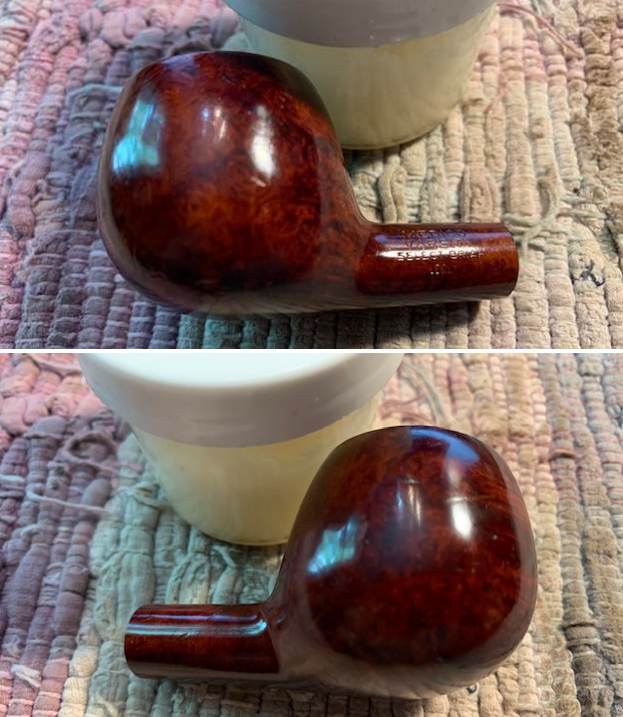
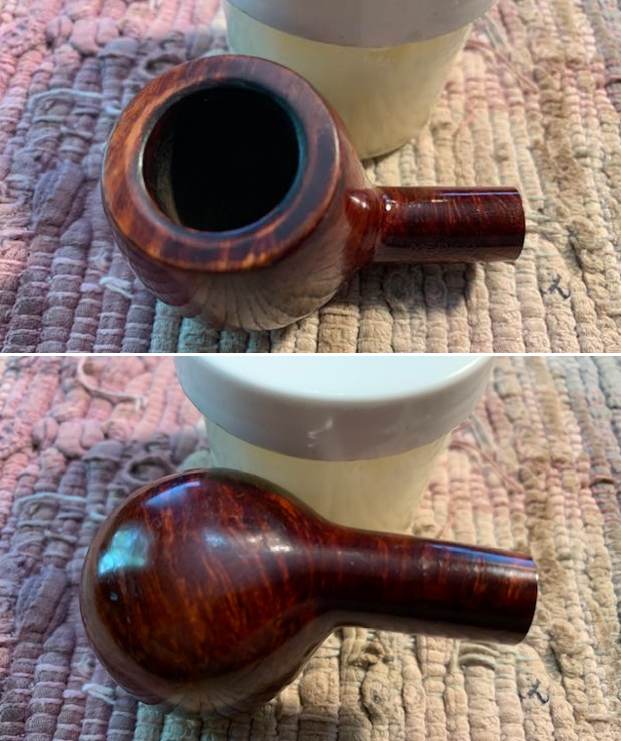
This afternoon a fellow dropped off the pipe and we talked for a bit about it. I would clean it and restore it for him. He liked the shiny coat so I would leave that intact depending on what was under the thick lava coat on the rim top. I would ream and refurbish the pipe for him. I had my mandate and he left the pipe with me. I took some photos of the pipe to show what it looked like when I received it. What do you think of it? It has a great apple shape and looks very Italian to me which the stamping confirms. I took a picture of the rim top to give you an idea of the thickness of the cake and the lava buildup on the rim top. While the rest of the pipe is shiny this is a mess. I captured the stem surface as well to show the damage to the stem. It is a definite stem replacement.I tried to capture the stamping on the shank side. It reads as noted above and there is a V logo on the side of the stem. The new stem will not have the logo.I took a photo of the pipe with the stem removed to get a sense of the proportions and look of it. I actually quite like the shape.I went through my can of stems to see what I could find that would fit the shank. I had several Medico stems but I chose this relatively new looking stem that fit quite well and had the same diameter as the old one and had the aluminum spacer. I fit the stem on the bowl and took photos of the look of the pipe with the new stem. It worked perfectly. I took the stem off the bowl and set it aside. I reamed the bowl with a Pipnet pipe reamer and took the cake back to bare walls. I cleaned up the reaming with a Savinelli Fitsall Pipe Knife. I sanded the bowl walls with 220 grit sandpaper wrapped around a dowel. The walls were in good condition. I cleaned out the internals of the mortise/shank/ and airway in the shank and stem with pipe cleaners, cotton swabs and isopropyl alcohol.  I have several boxes of Dr. Grabow and Medico Filters. I pulled out a new charcoal filter made by Grabow to replace the one that was in the old stem.I rubbed the bowl down with Before & After Restoration Balm. I worked it into the briar with my finger tips. It works to clean, enliven and preserve the briar. I let it sit on the pipe for 10 minutes and then buffed it off with a clean cloth. The bowl has a rich look to it now and the rim top is clean. I set the bowl aside and turned my attention to the new stem. It was in great condition so it just needed to be polished. I polished the stem with micromesh sanding pads – wet sanding with 1500-12000 grit sanding pads. I wiped it down after each sanding pad with Obsidian Oil. I polished it with Before & After Pipe Stem Polish – both Fine and Extra Fine and wiped it down with Obsidian Oil one more time. I am glad to finish this Italian Made Medico Varsity Apple. I put the pipe back together and buffed it with Blue Diamond on the buffing wheel. I gave the bowl and the stem multiple coats of carnauba wax. I hand buffed the pipe with a clean buffing pad to raise the shine. It is fun to see what the polished bowl looks like with beautiful mixed grain all around it. The polished grain on the pipe looks great with the black taper stem. This smooth Medico Varsity Apple is great looking and the pipe feels great in my hand. It is light and well balanced. Have a look at it with the photos below. The dimensions are Length: 5 ½ inches, Height: 1 ½ inches, Outside diameter of the bowl: 1 ¼ inches, Chamber diameter: ¾ of an inch. The weight of the pipe is 39 grams/1.38 ounces. It turned out to be a beautiful pipe. I have called the pipeman who owns it and he will be picking it up on the weekend. Thanks for your time reading this blog and as Paresh says each time – Stay Safe.  

Restoring a Mark Tinsky American Pristine 5 Rhodesian


Blog by Steve Laug

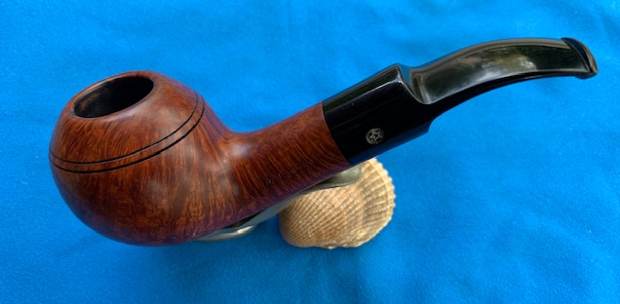
I have worked on several pipes for a fellow in Israel over the past few months and he is great to work with. He has great taste in pipes and the ones he has purchased from me have also been beautiful. Periodically I receive an email from him about another pipe he was interested in purchasing EBay. This next one was one that caught my attention. He sent me the link and wanted my opinion on it. It was a nice Mark Tinsky signed American Pristine 5 Rhodesian. I really liked the look and the Rhodesian with a twin ring cap around the rim top. The pipe appeared to be in decent condition. Not too many days after that he wrote me to say he had won it and he had it shipped to me rather than to him in Israel. We chatted back and forth about it via email and I would let him know when I received it. Here are the pictures that the EBay seller included with the advertising.  The seller took several photos of the stamping on the left and underside of the shank. It is faint on the left side in the photo but is very readable on the underside. The inlaid American Smoking Pipe Five Point Star in a brass circle is visible in the first photo.I have collected and smoked Mark Tinsky’s pipes for over 30 years now and thoroughly enjoy them. I cannot speak highly enough about the quality and craftsmanship of his pipe. I have pipes made by Mark and by Curt Rollar in my collection and both are great smokers and pipes that reach for regularly in my choice of pipes. I turned to his website for a quick summary of the history of the brand (http://www.amsmoke.com/Index%20Folder/PipeHist.html). I quote from the site as it is a short, concise history.
The American Smoking Pipe Co. was formed in 1978 by Mark Tinsky and Curt Rollar. Both started making pipes for Jack Weinberger ( JHW Pipes ) while in high school and throughout college. Determined to blaze their own path, they formed their own company- its goal to create unique pipes, lightweight and comfortable, where attention to detail was the rule not the exception. Exulting in their new freedom, they carved out new shapes that were balanced between the radical freehand era of the 70’s and the board pipe look of other conservative companies. Hungry for recognition, they stormed the Eastern and Southern shops looking for markets to sell their pipes. Many hidebound retailers refused to try something new, preferring to sell, well, what has always sold before. However, their pipes did take root in many shops and the business thrived.

They continued expanding their pipe making capabilities, adding employees to help finish the pipes. In 1990, over a disagreement over how much to expand, Curt Rollar left the company. This put a break on expansion and coupled with a U.S. recession and rising anti-smoking fervor served to limit production to supplying existing retailers, thus ending a decade of growth. With pipes sales in decline, we turned to pipe repair as a way to supplement revenues. Finding that we liked fixing things, American concentrated on pipe repair. While working hard at repair and manufacture American is ready once again to expand its markets through its existing network of shops serviced by pipe repair.

With the advent of the Internet, we are exploring marketing pipes directly to consumers in markets not covered by retail accounts. Feel free to e-mail us at MT@MT.NET

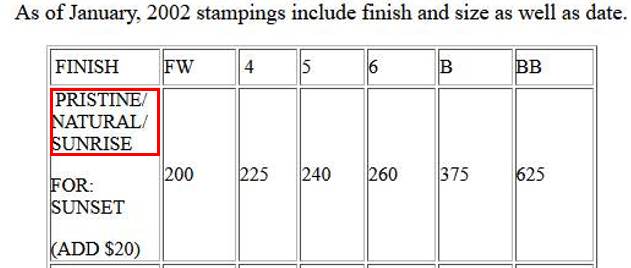
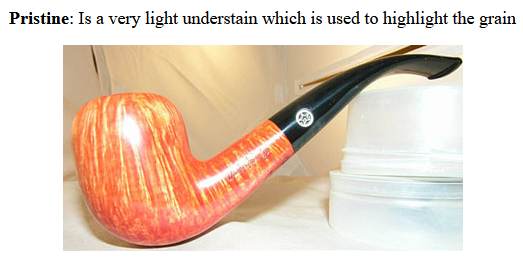
From the history reminder, I turned to the section of the site that gave the price breakdown and information on the finishes and stamping of the pipes and stems. I have included that below (http://www.amsmoke.com/Index%20Folder/PRICE.html). The pipe I am working on is noted below with a red square – PRISTINE and the size is a 5 which sells for around $240USD.He also included a description of the Pristine finish and a photo below that is helpful to me as I restore this pipe.I am also including Mark’s description of the stamping and logo on the stem below.

Stamping:

Pipes are stamped with :
My signature
The American logo : with the year it was made( starting from 2000) This year reads 00
A Finish stamp
Size indication
Stars for straight grain rating
Special Orders are stamped SO, Special orders are priced using the above structure with possible some additional charge for a very difficult shape.

Difficulty of Shape:. A size six billiard is the same price as the same size hawkbill, which is a lot harder to make.Pipes that are more difficult to make now carry an “X” next to the Size designation. If a pipe is extremely difficult it may carry an XX, tho those are extremely rare.

Logos

Silver Star: All pipes except freehands & pipes with very thin stems carry a handmade sterling silver star logo with a black enamel backing.

Gold Star: A grade of pipes that will carry a solid gold star as the logo. So far only three have been made and if I get one every couple years I d consider it lucky.

The pipe I am working on has Mark’s signature as noted above. The American logo with the 00 under the American in the oval tells me that the pipe was made in 2000. The finish is  Pristine and the size is a 5 in a circle. There are no stars for a straight grain rating.

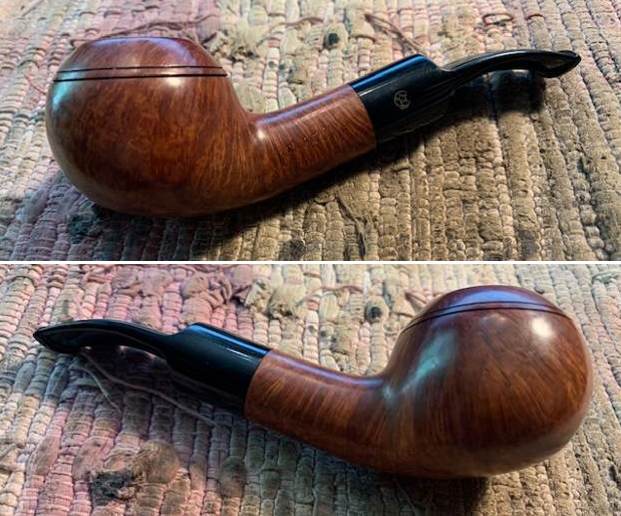
The pipe arrived this week in a Bubble Mailer from the seller. To me it is a questionable way to ship pipes as they can be easily damaged. I was concerned when I opened the mailer to examine the pipe inside. Fortunately the seller had separated the stem and bowl and wrapped each in thick bubble wrap which certainly helped. I examined the pipe carefully to assess both the condition of the pipe and what I needed to do with it. There was a light cake in the bowl and no lava on the rim top or edges. There was a nick in the rim top and inner edge on the right side in the middle. Otherwise the rim top looked quite good. The pipe was stamped on the on the sides the shank and on the left side was the Mark Tinsky signature. On the underside it was stamped American in an oval [over] Pristine [over] 5 in a circle. The finish was surprisingly clean but dull with some great grain hiding in the dullness. The stem had the inlaid metal five point star in a circle logo on the left side of the saddle. The acrylic was fairly clean and there were tooth marks and chatter on the top and underside. I took some photos of the pipe before I started my work on it. I have included them below. I took a photo of the bowl and rim top to show the thickness of the cake in the bowl and the slight darkening on the inner edges of the bowl. The nick on the rim top and edge on the right is visible in the photo. I took photos of the stem surface to show the condition and tooth marks and chatter on both sides ahead of the button. I took photos of the stamping on the shank sides (left and underside). It is readable as noted above and though faint is clear. I took a photo of the Silver Star with a black background logo on the stem as well. It is in excellent condition.I removed the stem from the shank and took a photo of the pipe parts. It is quite a stunning piece.I started my work on the pipe by reaming the bowl with a PipNet pipe reamer and took the cake back to bare walls. I cleaned up the reaming with a Savinelli Fitsall Pipe Knife. I sanded the bowl walls with 220 grit sandpaper wrapped around a piece of dowel. I examined the walls with a lens and they were solid and undamaged. I worked over the darkening on the inside edge of the bowl and the rim top with a folded piece of 220 grit sandpaper. It began to look a lot better.I used a butter knife, wet cloth and the flame of our gas stove to steam out the dent on the top right of the rim edge. I heated the knife with the flame on the stove and put the wet cloth on the dent. I touched the area of the dent with the hot knife. It came out easily and looks great. I cleaned out the airway in the shank and the stem as well as the mortise with isopropyl alcohol, cotton swabs and pipe cleaners. It was surprisingly quite clean.I scrubbed the exterior of the bowl with Murphy’s Oil Soap and a tooth brush to remove the grime from the finish of the bowl and rim top. I rinsed off the bowl with warm water and then dried the bowl with a cotton cloth. The grain that came to the surface once it was clean is quite stunning. I polished the briar with micromesh sanding pads – dry sanding with 1500-12000 grit pads. After each pad I wiped the bowl down with a damp cloth to remove the sanding debris. It really took on a shine by the last three sanding pads. I rubbed the bowl down with Before & After Restoration Balm. I worked it into the surface of the briar with my fingertips and a shoe brush to get it in the grooves. It works to clean, restore and preserve the briar. I let it do its magic for 15 minutes then buffed it off with a cotton cloth. The pipe looks incredibly good at this point in the process.  With that the bowl had come a long way from when I started working on it. I set it aside and turned my attention to the stem. I filled in the few deep tooth marks in the acrylic with clear CA glue. Once the repairs cured I sanded them smooth with 220 grit sandpaper and started polishing them with 400 grit wet dry sandpaper. I continued to polish the stem with micromesh sanding pads – wet sanding with 1500-12000 grit sanding pads. I wiped it down after each sanding pad with Obsidian Oil. I polished it with Before & After Pipe Stem Polish – both Fine and Extra Fine and wiped it down with Obsidian Oil one more time. I am excited to finish this beautiful Mark Tinsky American Pristine Rhodesian size 5. I put the pipe back together and buffed it with Blue Diamond on the buffing wheel. I gave the bowl and the stem multiple coats of carnauba wax. I hand buffed the pipe with a clean buffing pad to raise the shine. It is fun to see what the polished bowl looks like with beautiful mixed grain all around it. The polished grain on the pipe looks great with the black acrlyic stem. This smooth Tinsky American Pristine Rhodesian is great looking and the pipe feels great in my hand. It is light and well balanced. Have a look at it with the photos below. The dimensions are Length: 5 ½ inches, Height: 1 ¾ inches, Outside diameter of the bowl: 1 ¾ inches, Chamber diameter: ¾ of an inch. The weight of the pipe is 72 grams/2.54 ounces. It turned out to be a beautiful pipe. I will be packing it up and sending it to my friend in Israel. I think he will enjoy this beauty once it is in his hands. Thanks for your time reading this blog and as Paresh says each time – Stay Safe.
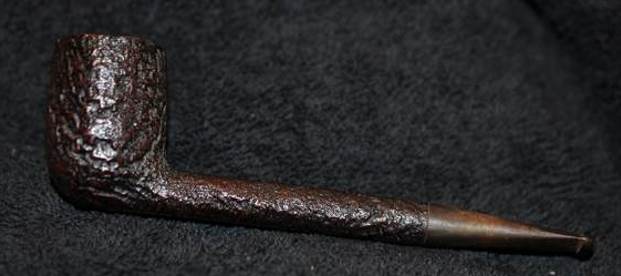
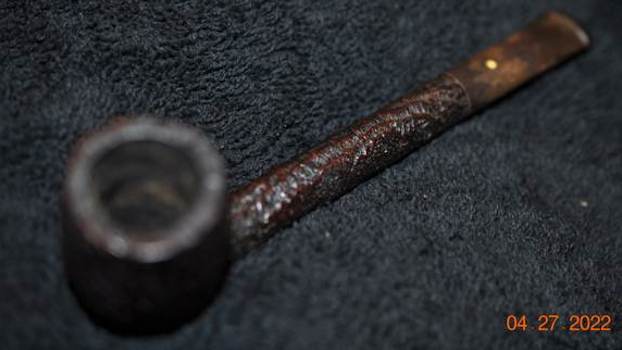
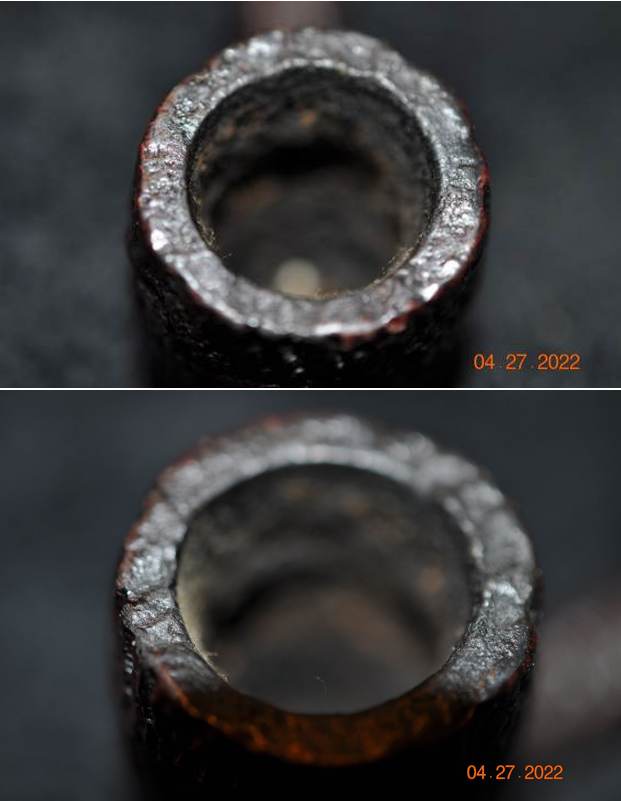
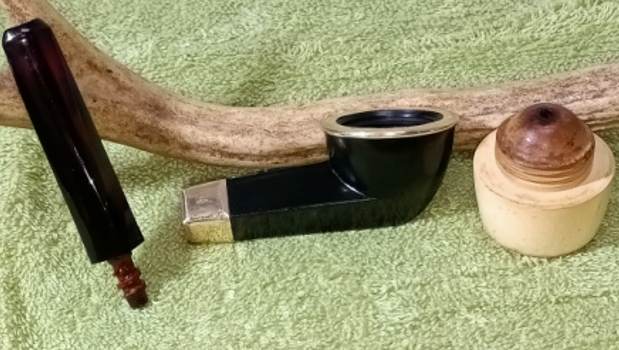
Freshening Up A Pair Of WDC Meerschaum Bowl, Bakelite Base And Redmanol Stem Pipes In A Presentation Case Continued…


Blog by Paresh Despande

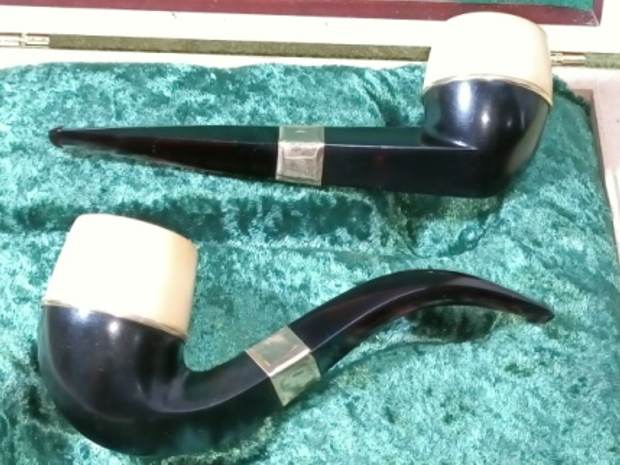
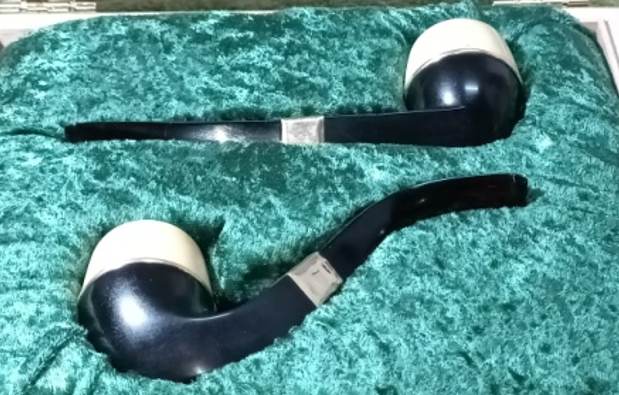
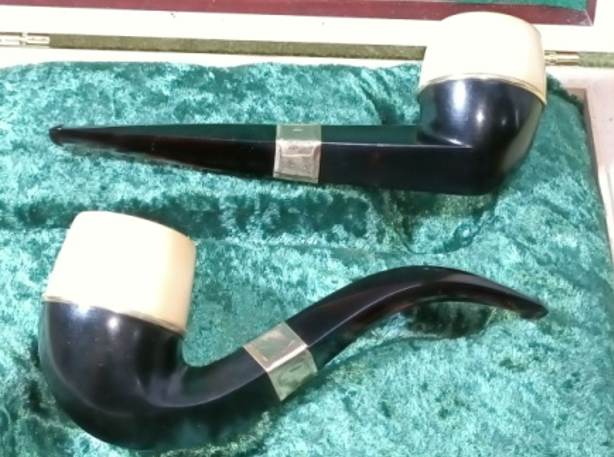
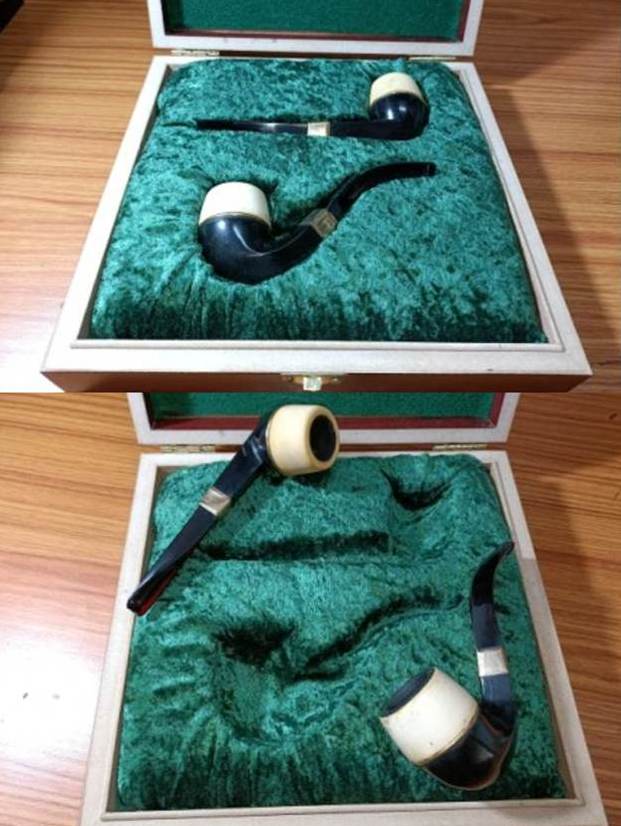
I had been working on a pair of WDC pipes that came in a beautiful well preserved Presentation case. I have completed researching and refurbishing the first pipe, a straight Bulldog. Though I had worked on both these pipes simultaneously, I have done the write up in two parts.

For detailed information on the brand and other general information about the pipe and material used here, please read PART I of this series.

PART II: – BENT BULLDOG

Initial Visual Inspection

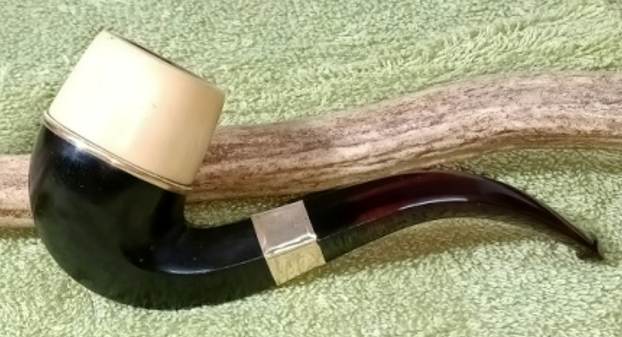
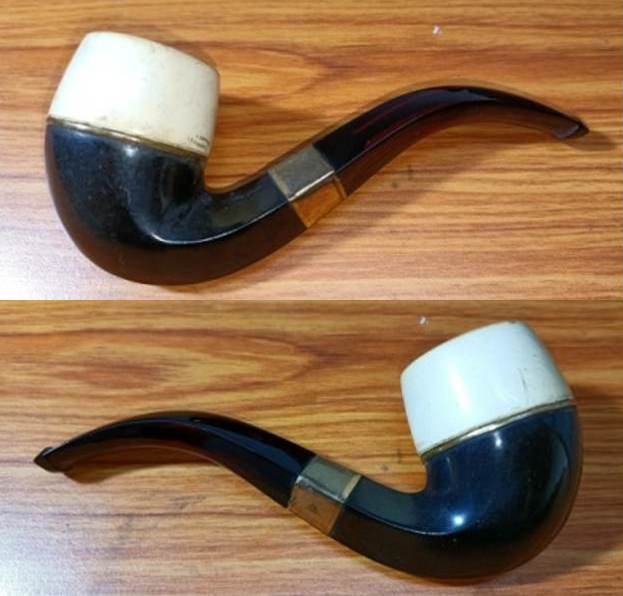
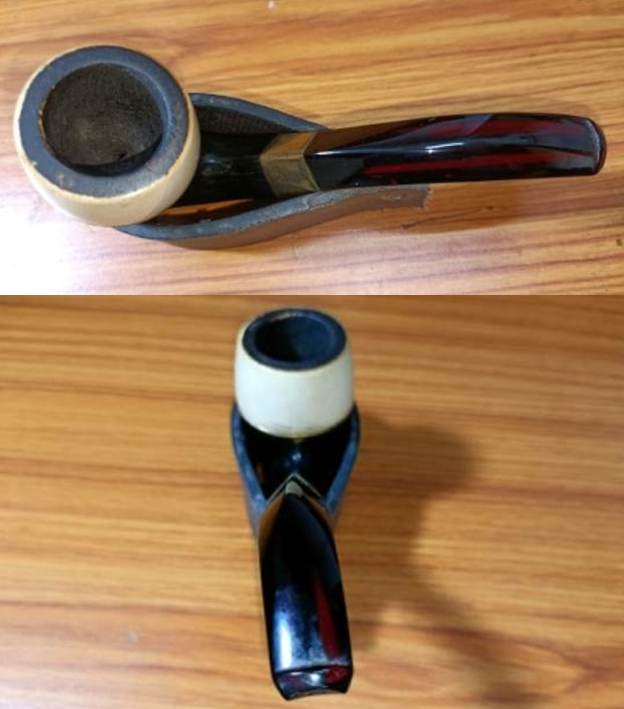
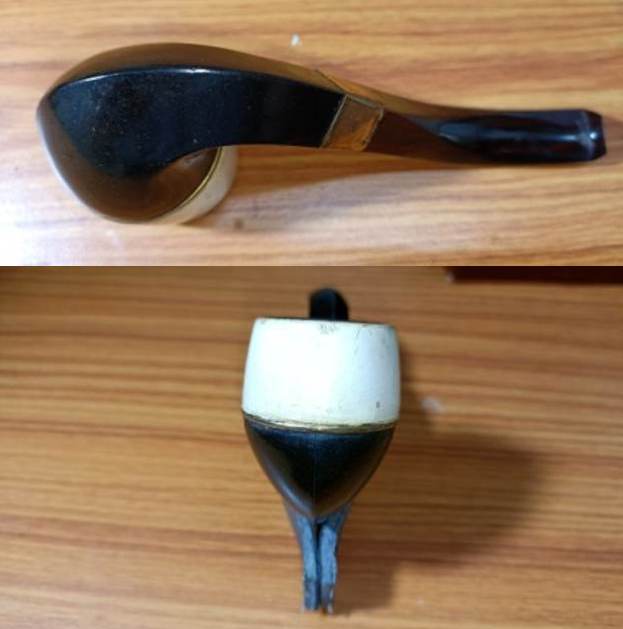
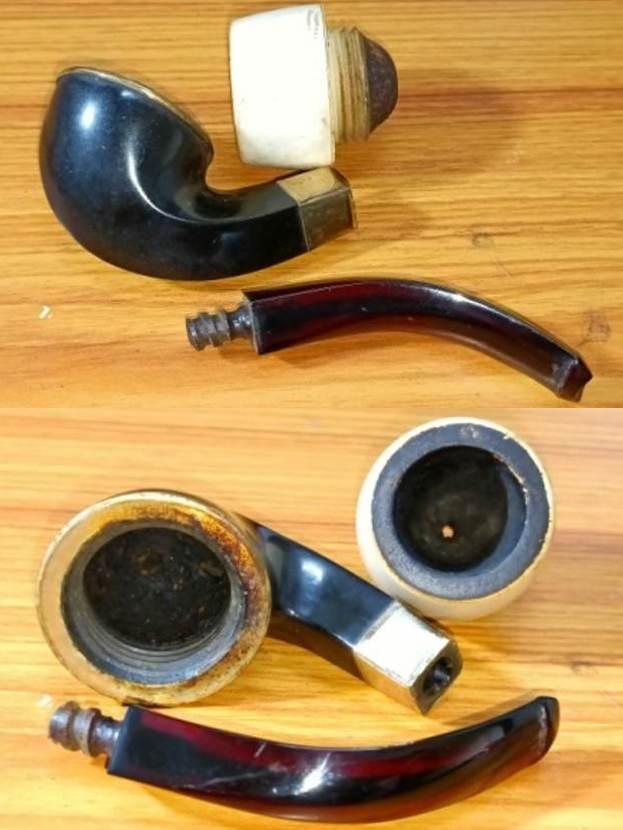
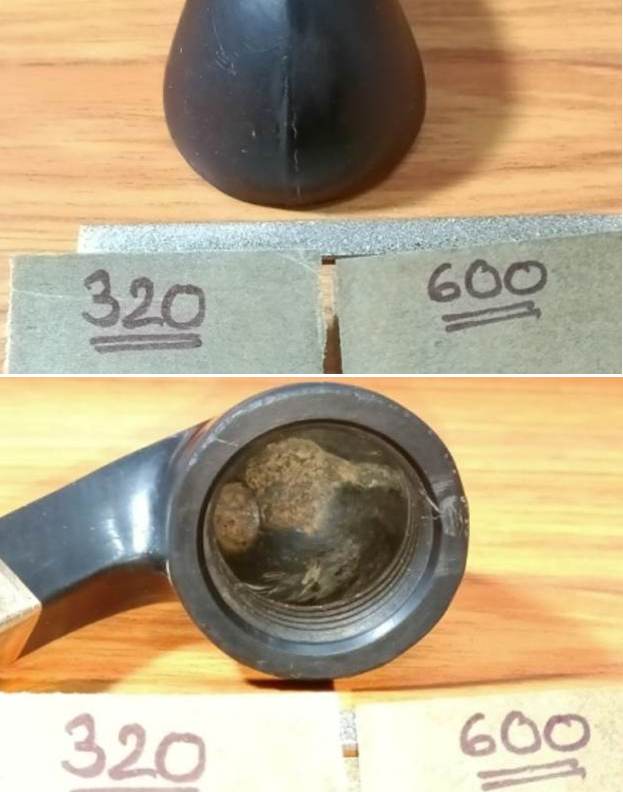
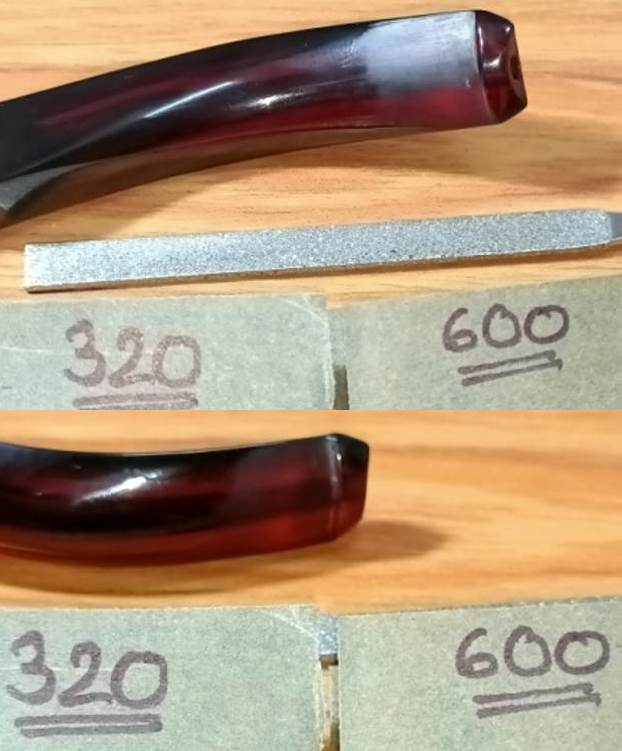
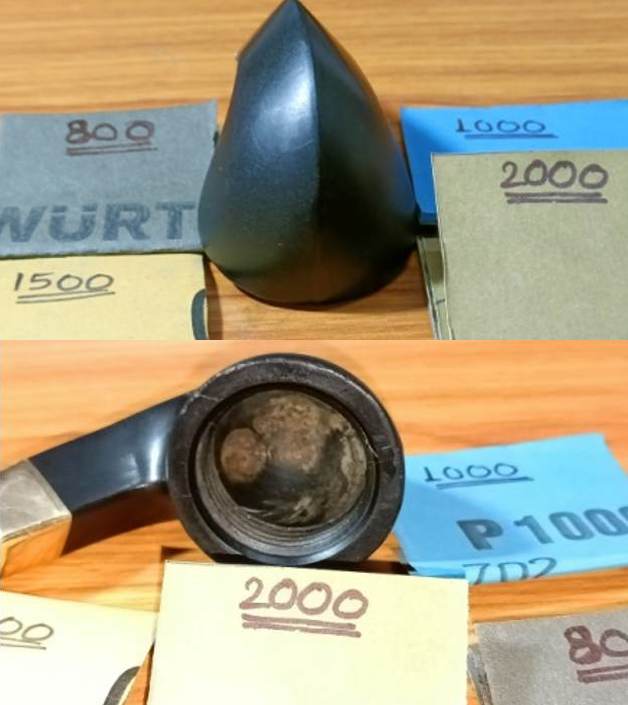
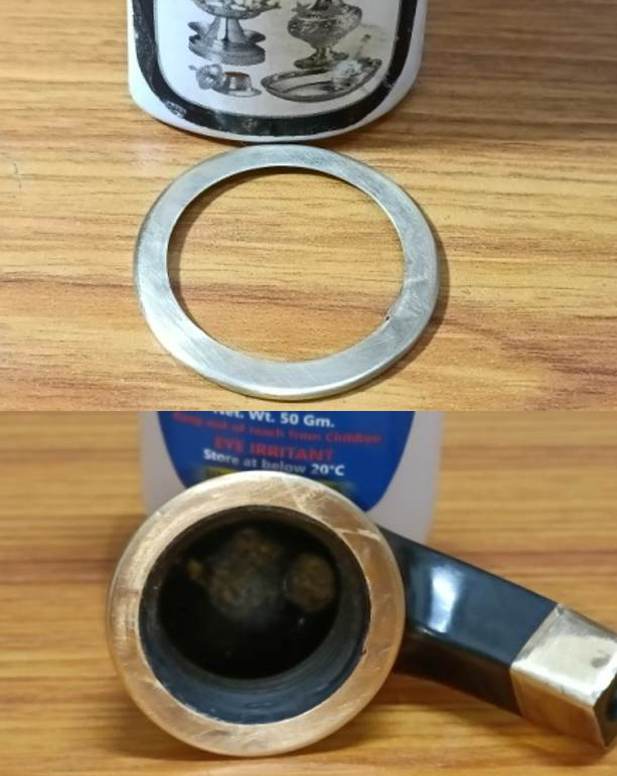
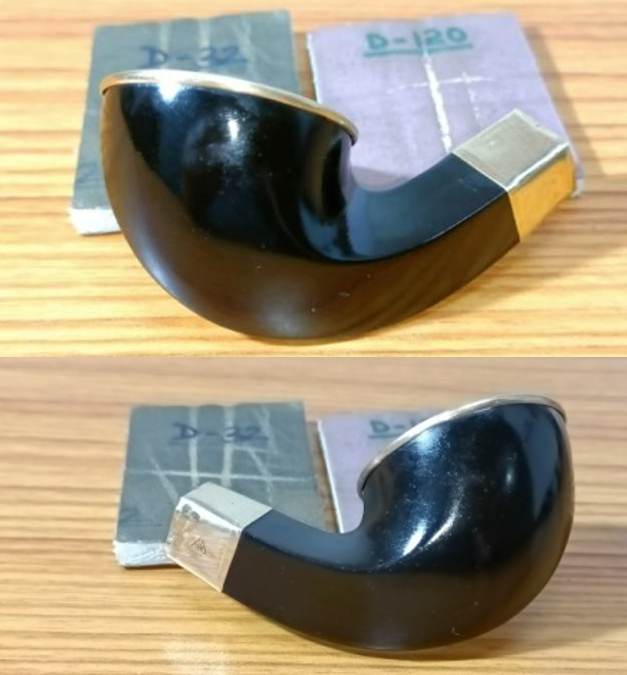
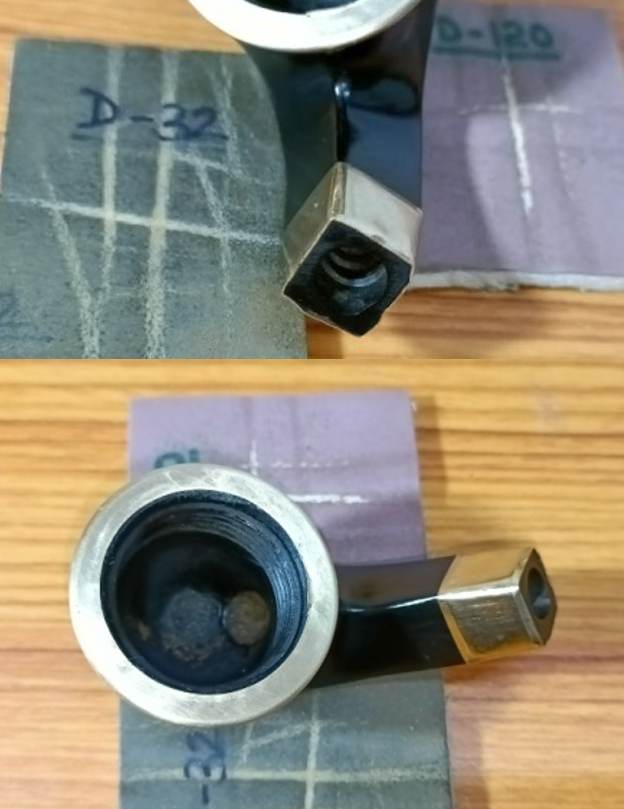
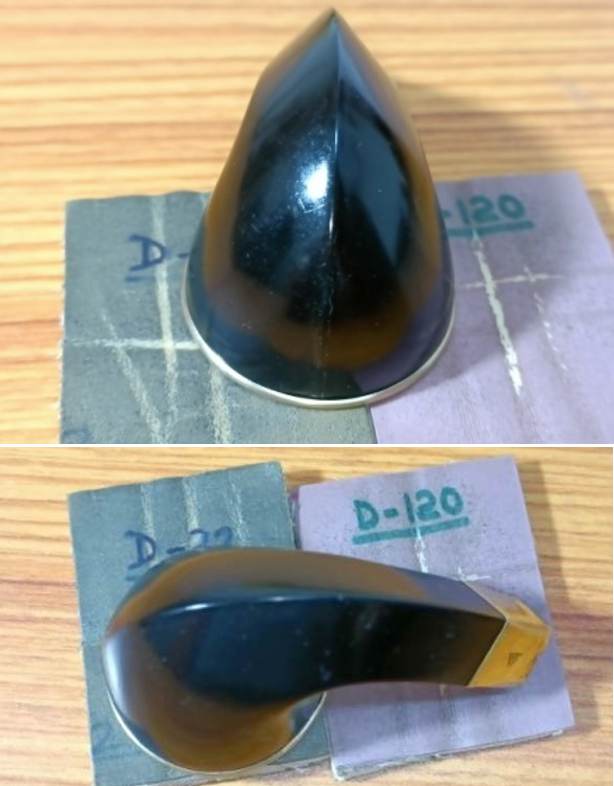
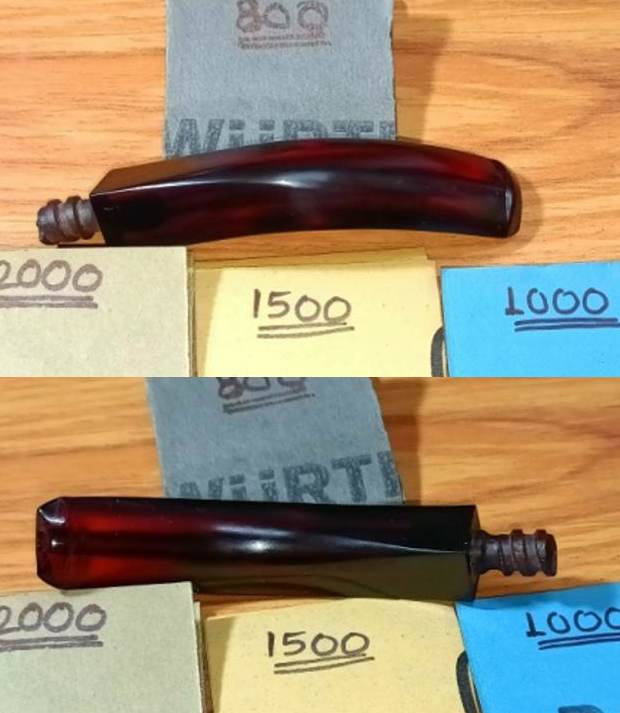
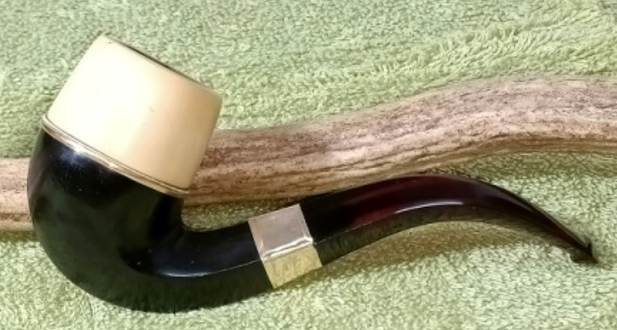
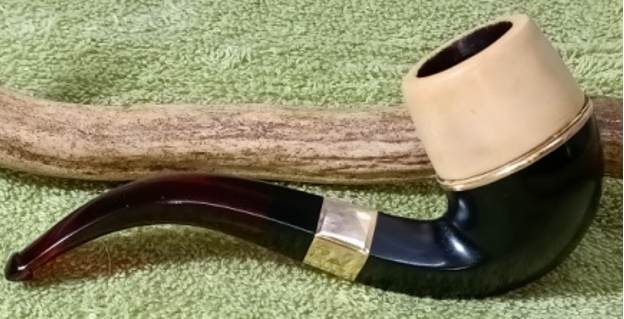
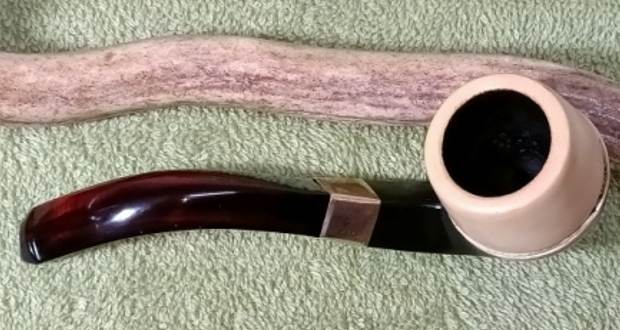
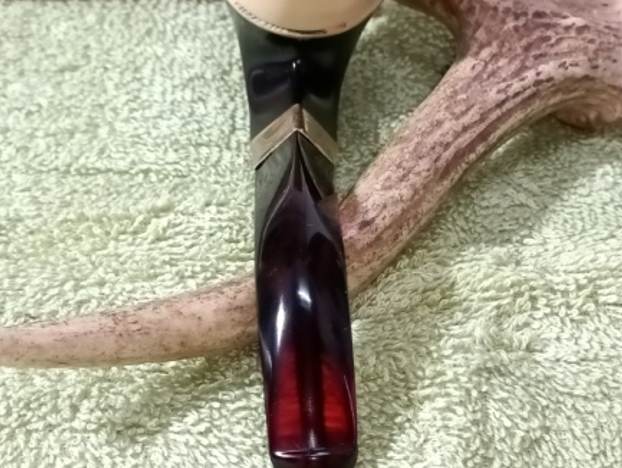
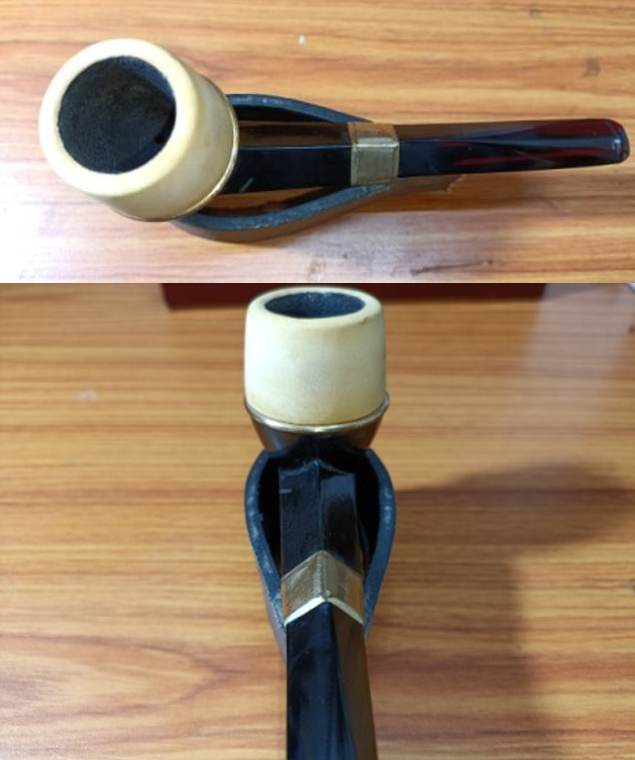
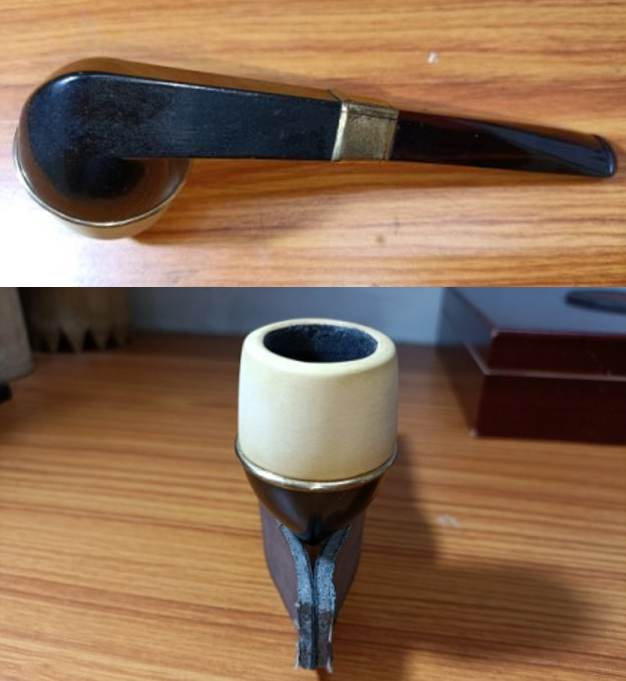
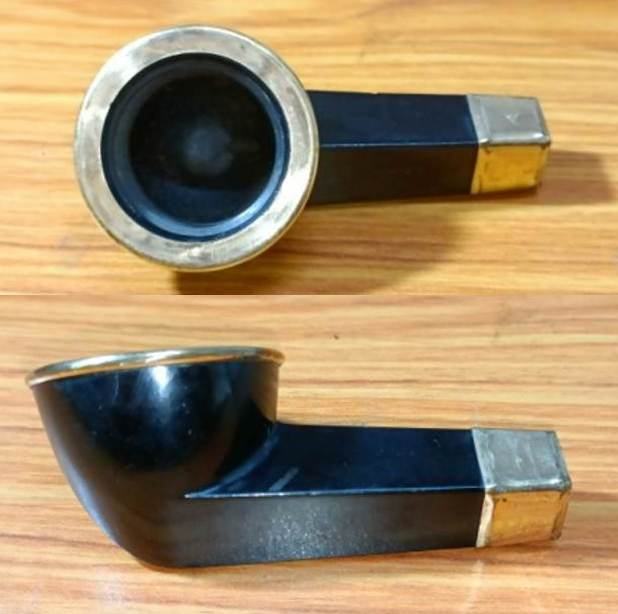
The condition of the pipe points to the fact that this pipe has seen significantly more use than the straight Bulldog. There is a thick cake in the chamber with lava overflow over the rim top surface. The base and shank shows heavy accumulation of tars and crud. The brass rim top cover over the Bakelite base/ shank is also covered in dried oils and tars. The Bakelite shank is dull and covered in completely dried out dirt and grime. The brass shank band at the shank end shows signs of wear but not badly damaged. The Redmanol stem is dull and lackluster with a few tooth indentations on either surface in the bite zone. All said, the condition of the pipe is not bad at all. Detailed Inspection
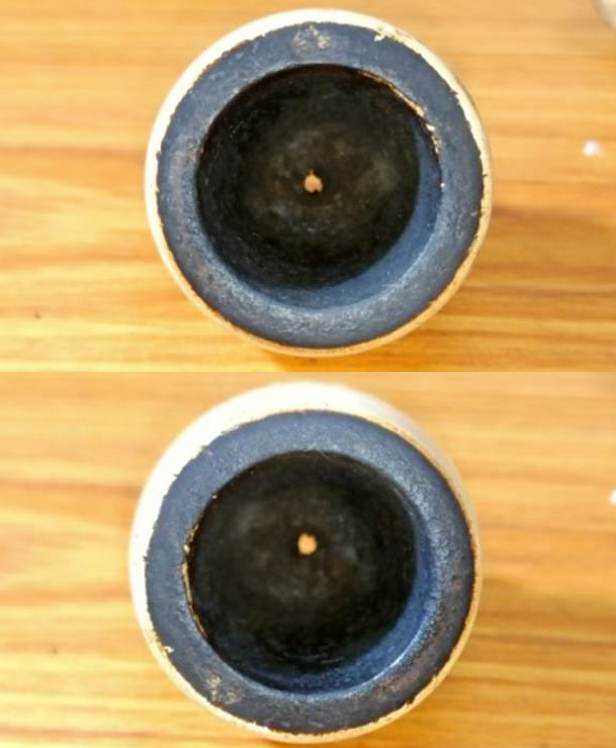
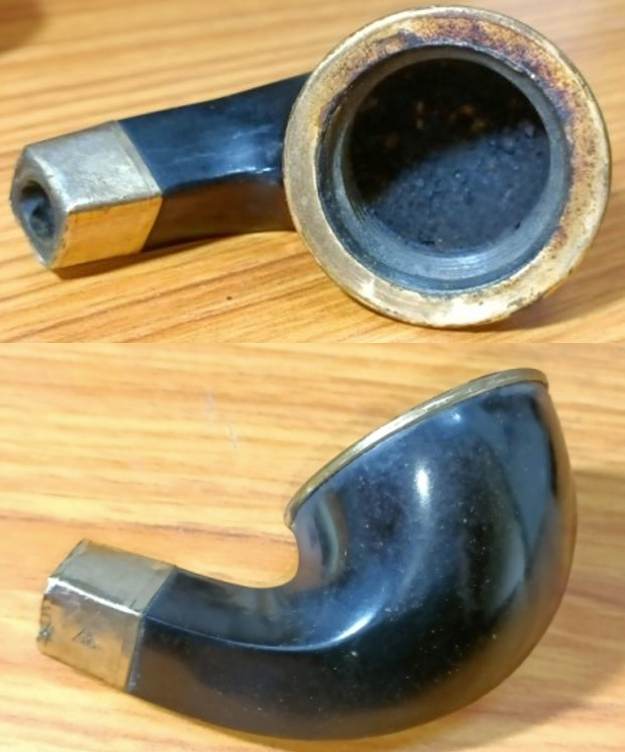
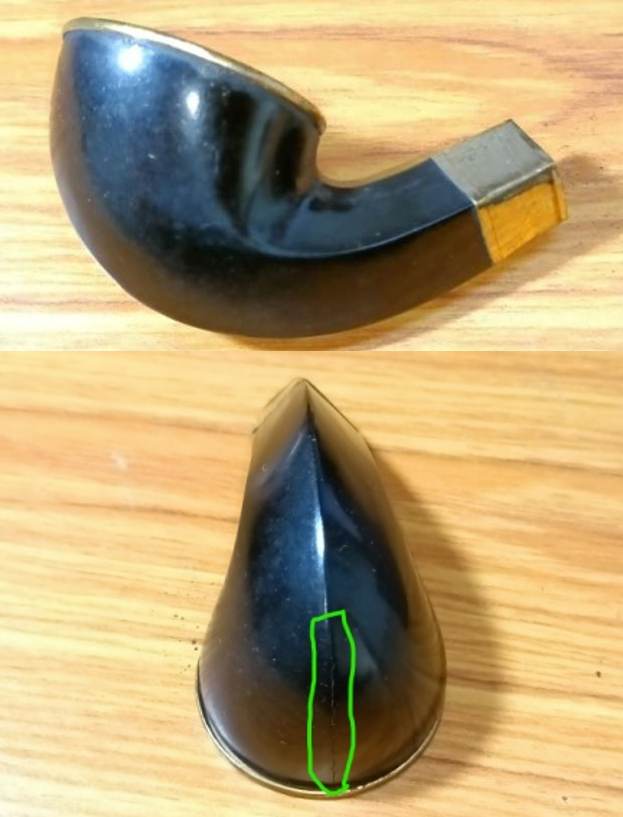
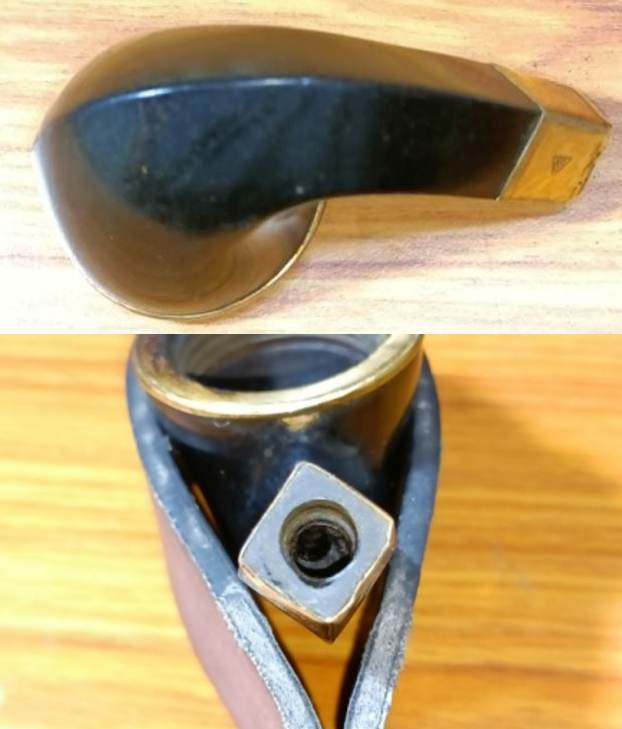
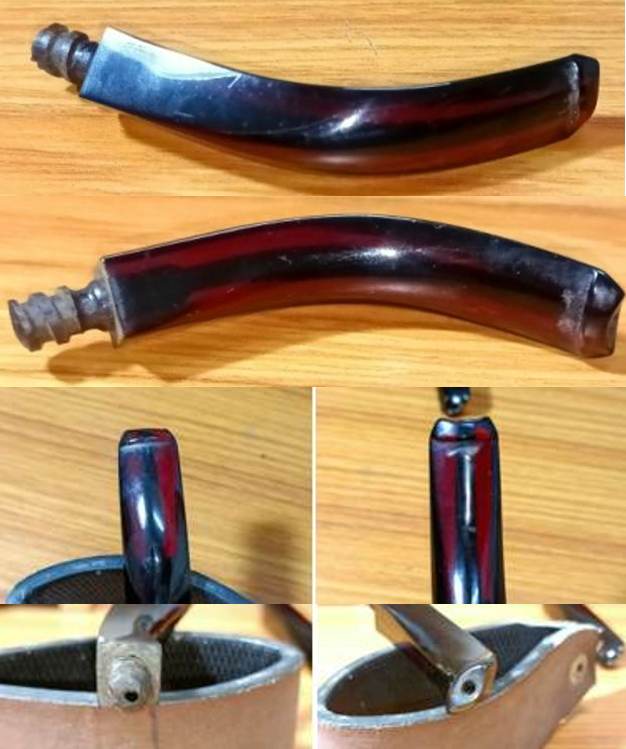
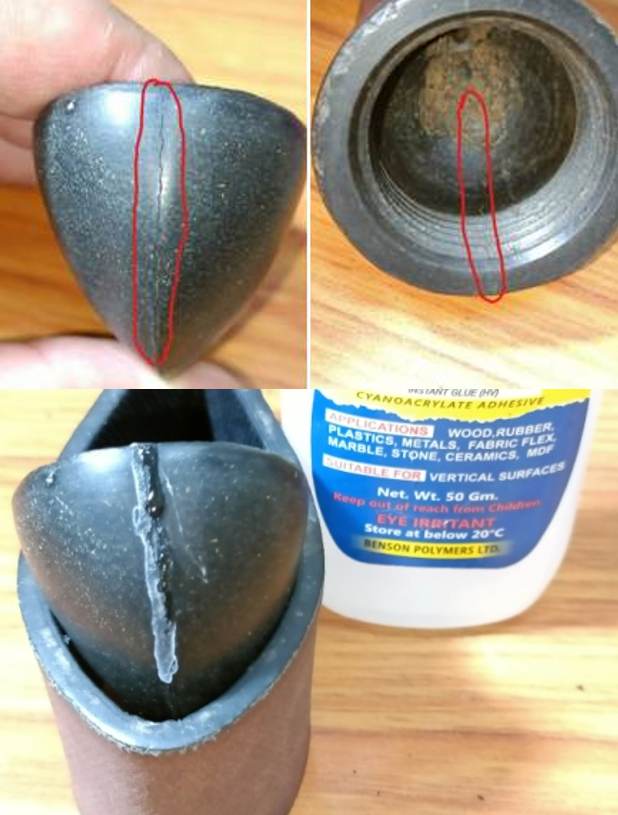
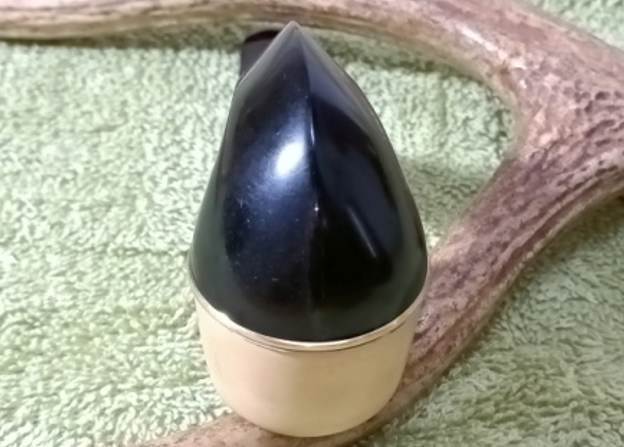
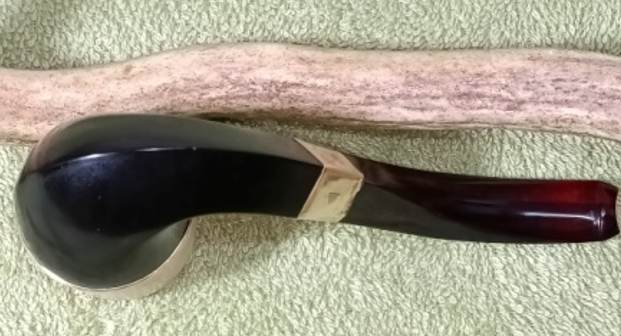
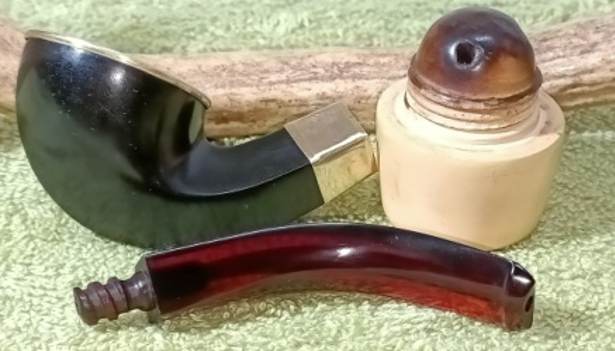
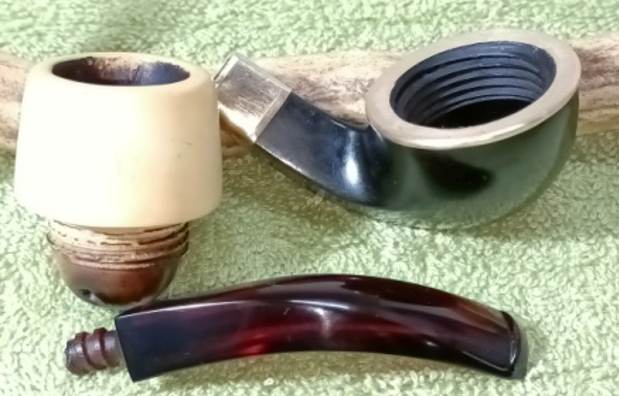
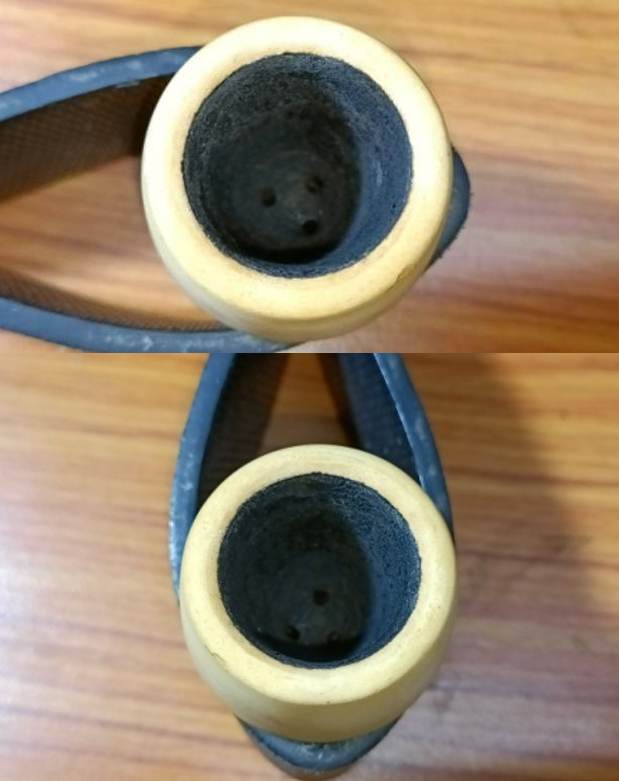
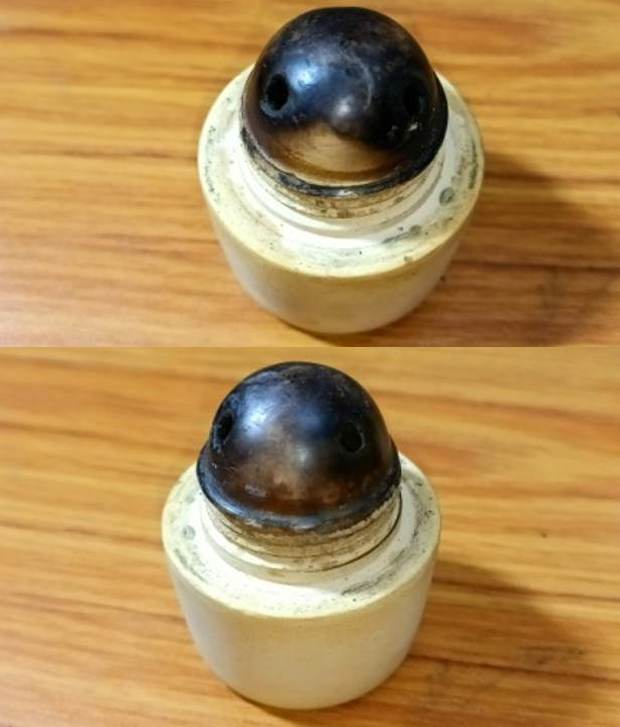
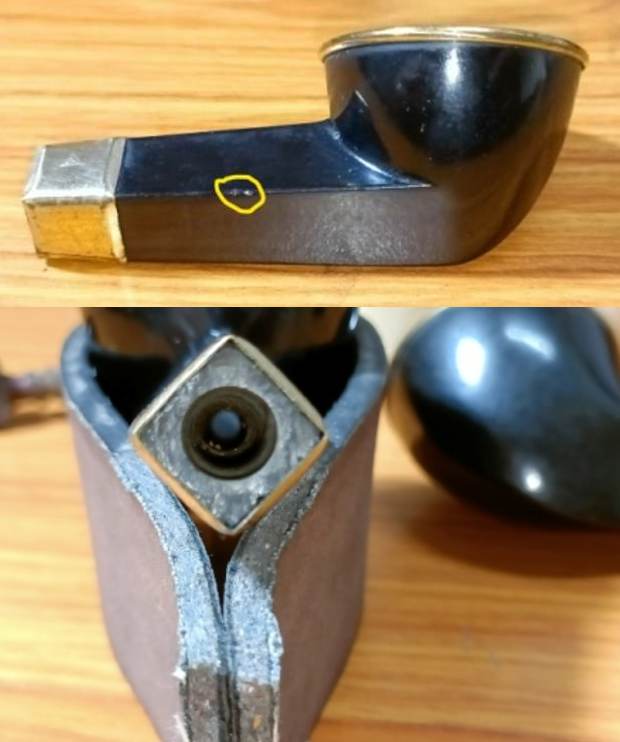
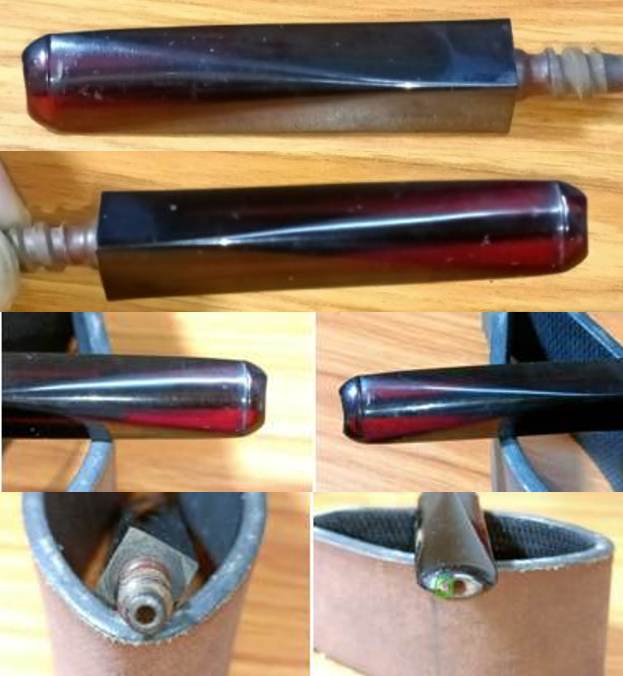
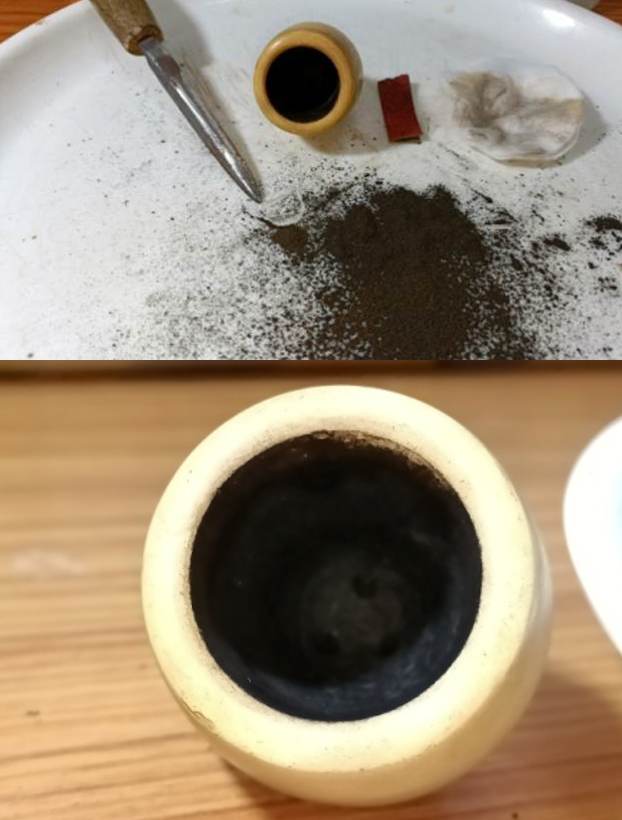
The three parts of the pipe are as shown below. The condition of the short threaded meerschaum bowl, filthy Bakelite shank and the bent Redmanol stem with threaded tenon all point to heavy use.The Meerschaum bowl has a thick layer of carbon in the chamber. The cake is soft and dry. The single draught hole at the heel of the bowl is partially clogged restricting the aperture opening. There is a thick layer of lava overflow on the rim top surface. There are a couple of spots where the white of the Meerschaum peeks out of the rim top surface but these are just spots from where the dry soft carbon cake had peeled off. The threads at the bottom of the bowl have worn out a bit but still firmly threads in to the Bakelite shank without any give or play. The convex bottom of the bowl is covered in dried ash and crud. There are a few scratches, nicks and dings over the surface but they are all very minor and do not detract from the beauty of the bowl.   The Bakelite base/shank shows heavy accumulation of old dried oils, tars and ash in the trough that houses the Meerschaum bowl. The threads in the base are all intact but covered in oils and grime. The brass rim top ring is covered in grime. Close scrutiny of the shank surface under magnification revealed a crack (indicated in green) along the seam running from the top front of the bowl to about half way to the foot of the Bakelite base. I would first need to clean the internals of the base to ascertain if this crack extends inside. This was an unanticipated damage, but one that would need to be addressed. The mortise is clogged with dried oils and gunk making the draw laborious and constricted. The bent Redmanol stem is dull looking but with a nice cleaning and polishing will add to the visual treat of the completed pipe. The stem airway has darkened considerably due to dried gunk that accumulated along the walls of the airway. There is some minor tooth chatter and couple of deeper tooth indentations on either surface of the stem. The round orifice and the threaded tenon are covered in gunk. Overall, there is not much damage to the stem and should clean up nicely.The Process
In normal course, I would have addressed the shank repairs first. However, since I worked on the pair concurrently, I first reamed the chamber with my smaller fabricated knife followed by sanding the walls with a folded piece of 220 grit sandpaper. This removes cake completely and evens out the chamber wall surfaces. I scraped off the dried oils and tars from the bottom of the bowl and also from in between the threads. A wipe using isopropyl alcohol on a cotton swab ensured that the carbon dust that remained is completely lifted from the wall surface and the ghost smells are eliminated. I was pleased to find smooth and solid chamber walls. With the sharp knife, I gently scraped off the lava overflow from the rim top surface. I would continue further cleaning of the rim top during the refurbishing process. As I working the Meerschaum bowl, out of the blue, a round thin ring come off the bottom of the bowl and my heart sank… Did the bottom of the bowl just break in my hand? I heaved a sigh of relief when I realized that it was nothing more than a spacer that was cut out of a Greeting card. But it was so well cut and matched, that it missed my inspection. Now I am beginning to understand why the bowls were interchanged on the pipes in the first place. The long neck Meerschaum bowl with three draught holes should belong to this bent Bulldog but was switched with the shorter neck bowl with single hole. The crack along the seam must have been opening up as the Meerschaum bowl was threaded in to the base, pushing the bowl further down in to the base. The long neck of the bowl scraped the heel of the base, restricting the air flow. Thus, the short neck bowl from the straight Bulldog was swapped with this long neck and the paper washer was installed to make the seating of the short neck Meerschaum bowl in to the base airtight. With this modification, the bent Bulldog became a better smoker than the straight Bulldog and hence was more extensively used.I wiped the external surface of the bowl with Murphy’s Oil soap on a cotton swab. While cleaning, I was especially deliberate around the threads and over the rim top surface as I wanted to get rid of the entire gunk from those areas. Though the bowl cleaned up well, the rim remains darkened, akin to burning marks. This would need more invasive methods to clean away. The scratches and dings that are now visible will be left as they are for being a part of the journey of this pipe till date. I wiped the bowl with a moist cloth to remove the soap and grime that was left behind. Using folded piece 220 grit sandpaper, I sand the rim top to remove the darkening over the surface. Though not completely eliminated, the rim surface looks now looks much better. I handed over the cup to Abha, my wife, to work her magic in polishing the cup. She polished the rim top surface and rim edges with micromesh pads. She then went on to dry sand the entire stummel with 1500-12000 grit pads and wiped the bowl down with a damp cloth to remove the dust that was left behind by the sanding. I had requested her to minimize the scratches but not necessarily remove them. These lacerations and dings must have had a history and I wanted to preserve it. She did a fantastic job of polishing the meerschaum cup to a nice deep shine.  As Abha was polishing the Meerschaum bowl, I worked on the stem repairs. I first cleaned the stem surface and airway using anti-oil dish cleaning soap and thin shank brush and rinsed it under warm running water to remove the entire gunk from the airway. I also cleaned up the threaded tenon with a tooth brush and soap. To finish the cleaning, I ran a few bristled and regular pipe cleaners dipped in alcohol to remove the residual gunk from the airway and dry it out.   I next sand the bite zone with a 320 grit sandpaper to address the minor tooth chatter on either surface. I filled the deeper tooth indentations with clear CA superglue and set the stem aside for the glue to cure completely.  With the Meerschaum bowl polished by Abha and the stem repairs set aside for the fills to cure, I worked the Bakelite shank. With a fabricated tool, I scraped all the dried oils, tars and ash from the trough of the Bakelite base. I also cleaned the mortise by scraping out the dried gunk using my fabricated tool. As I was working on the shank, the brass cap over the shank rim top came free. I would need to reattach it once I was done with internal and external cleaning of the shank.Next, I cleaned the Bakelite shank with anti oil dish soap and tooth brush. I cleaned the shank internals and the mortise with shank brush and anti oil soap and rinsed it under warm water. The brass cap was scrubbed clean with the soap and Scotch Brite pad. The shank is now clean both from the inside and the outside. With the external and internal surface of the Bakelite shank cleaned up, the crack at the seam is now clearly visible. As I had expected, this crack extends to the inside of the shank also. Both these are encircled in red. I discussed with Steve and he advised that drilling of counter holes to arrest the spread of these cracks should be avoided as the Bakelite could shatter due to the impact of the drill machine. The best way to ensure a robust and lasting repair would be to lay a fine bead of CA superglue along the crack. The glue would seep into the crack and once hardened, would form a strong joint along the seam. I did just that and set the shank aside for the glue to cure.By next day afternoon, the fills had completely hardened. With a flat head needle file, I sand the fills to achieve a rough match with the rest of the shank surface. To further fine tune the match, I sand the fill with a 320 followed by 600 grit sandpapers. I sand the fill inside the Bakelite trough with the sandpapers only as it was not possible to use the needle file. I am quite happy with these repairs at this junction. The Redmanol stem fills too had hardened and I worked the fills with a needle file to match it with the rest of the stem surface. I fine tuned this match further by sanding it with a 320 followed by 600 grit sandpapers. The fills have blended in perfectly with the stem surface. Thereafter, I handed the stem over to Abha to polish it to a high gloss. After the stem was handed over to Abha, I polished the Bakelite base/ shank by wet sanding the surface with 800, 1000, 1500 and 2000 grit sandpapers. The Bakelite is now beginning to take on a nice shine.  Before moving on to final polish using micromesh pads, I decided to reattach the brass cap first. I polished the brass cap with a polishing compound that we get in India here. I rubbed the compound over the rim cap and wiped it using a soft cloth. I applied a small quantity of superglue along the rim top surface and pressed the rim cap over the rim top. I wiped the excess glue with a cotton swab wetted with alcohol.Next I polished the shank by dry sanding with 3200 to 12000 grit micromesh pads. I applied a little Extra Virgin Olive oil to the surface just to enhance the shine. All this while, Abha was quietly busy polishing the stem. She wet sanded the entire stem with 800, 1000, 1500 and 2000 grit sandpapers and followed it up by dry sanding with 3200 to 12000 grit micromesh pads. The stem looks fabulous and I cannot thank Abha enough for the help and support she extends in this hobby of mine. Next I gave a beeswax polish to the meerschaum bowl. The process that I followed for this polish has been explained in Part- I and not being repeated here. The following pictures will give you an idea of the process and also of the end results. It was here that I had swapped the Meerschaum bowls and correctly matched them with their original pipes. While the Meerschaum bowl was soaking in the beeswax, I cleaned the external surface of the Presentation Box with Murphy’s Oil soap and cotton swab. I wiped the surface with a moist cloth to remove any residual soap from the surface. Next I applied some “Before and After” Restoration balm to the surface to rehydrate the wood and polished it with a microfiber cloth. To finish, I re-attach the Redmanol stem with the Bakelite shank. I mount a cotton cloth buffing wheel on to my hand held rotary tool and setting the speed at 50% RPM, applied Blue Diamond compound over the shank and the stem surface. I wiped/ buffed the parts with a soft cotton cloth to clear it of any leftover compound dust. I then mounted another cotton cloth wheel on to the polishing machine and applied several coats of carnauba wax over the shank and the stem of the pipe. I finished the restoration by giving the pipe a rigorous hand buffing using a microfiber cloth to raise the shine further. Have a look at the completed pipe below. And here are a couple of pictures of both the pipes in their Presentation Case. Thank you all for joining me on this path as I repaired and restored this fabulous piece of pipe history to its former glory and functionality.
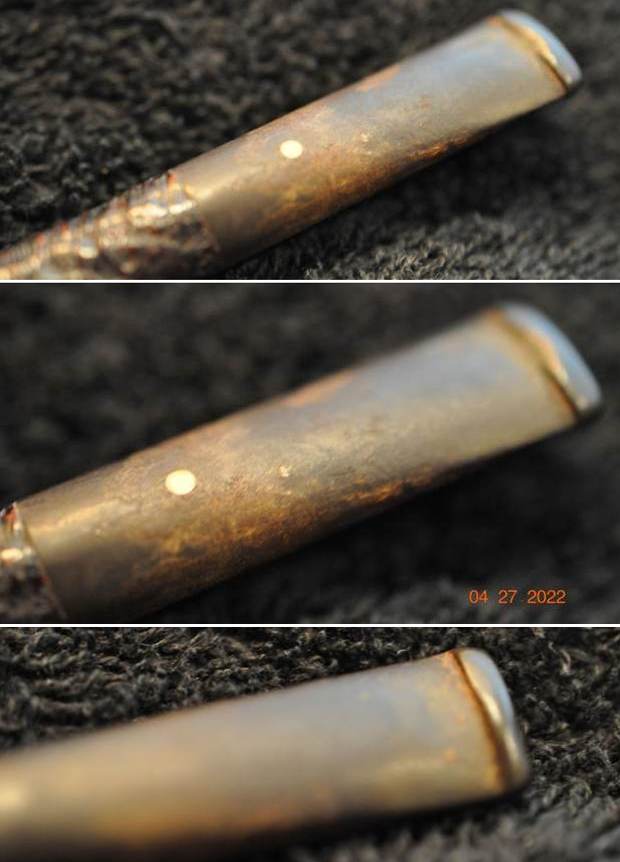
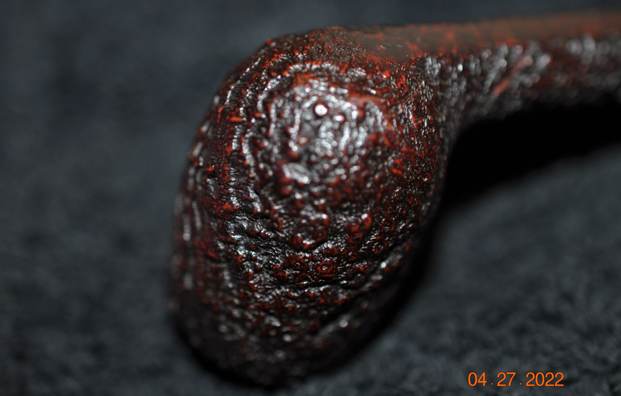
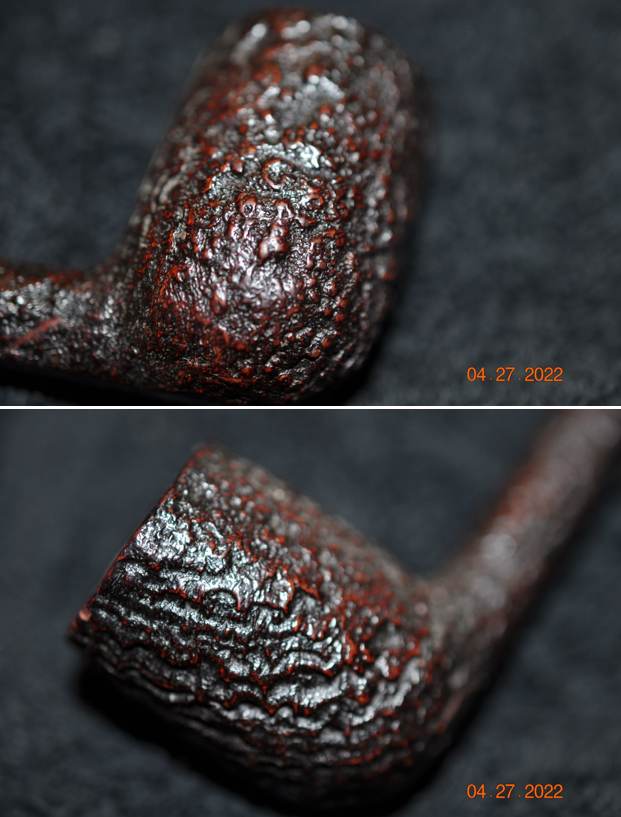
Freshening Up A Pair Of WDC Meerschaum Bowl, Bakelite Base And Redmanol Stem Pipes In A Presentation Case


Blog by Paresh Deshpande

It’s been a while since I have sent Steve any write ups for posting on rebornpipes and it’s not because I have not been working on any. As a matter of fact, I had completed re-stemming and refurbishing of 4 un-smoked vintage bowls. These were c.1897 BBB OWN MAKE Billiard with long pencil shank that came with its original shop stickers on it, the second was a c.1901 A.D.P (Adolph Posener), the third was a c.1904 Imperial ITC bent billiard and the fourth was c.1911 A.O KEYSTONE (Adolphe Oppenheimer & Co). Unfortunately, I lost the photographs that I had taken of all the pipes during their refurbishing process and as such there was nothing for me to base my write ups on (yeah…I know even Steve has been suggesting that I do the write up simultaneously as I work!!).

Moving ahead, the next project that I selected to lift up my spirits was a pair of WDC Meerschaum bowled Bulldog pipes that came in its beautiful Presentation case. Both pipes appeared to be in a very good condition and should clean up well. Here are a few pictures of the pair and its case as it sat on my work table. This pair of pipes has three different materials used in its manufacture and that is what makes it unique and interesting. The chamber/bowl are made from Meerschaum which threads in to a Bakelite shank that has a brass (?) band at its end and bears its trademark inverted triangle stamped with as “WDC”. The stems are made of Redmanol, a beautiful translucent material that was widely used in the early part of the 20th century. I have worked on a few WDCs earlier and am pretty familiar with the brand’s history. I revisited rebornpipes where I had posted my previous WDC projects. Here is the link to the write up which will give readers a fairly detailed idea about the brand and a rough estimate as to the vintage of the pair of pipes on my work table.

https://rebornpipes.com/2019/04/05/sprucing-up-another-wdc-a-cased-bakelite-briar-dublin/

I visited rebornpipes.com and came across an interesting article on materials used in pipe making (https://rebornpipes.com/2014/08/09/hard-rubber-and-other-early-plastic-used-in-pipes-ronald-j-de-haan/)

It is here that I found the following information on “BAKELITE”:

These qualities made Bakelite the most successful synthetic material in the first half of the 20th century. From 1928 it was also produced as molded resin. Both the pressed and the molded forms were suitable for the pipe making industry. Pipes were made from Bakelite and molded phenol-resin. Complete pipes of Bakelite are very rare because of its lack of heat resistance. Phenol-resin however was frequently used for pipe mouthpieces and cigarette holders because it imitated amber.

Further search on rebornpipes got me to a write up that Steve had done on a Redmanol WDC pipe. Given below is the link to the referenced article.

https://rebornpipes.com/2020/05/26/life-for-a-wdc-redmanol-dublin-with-a-removable-redmanol-bowl/

I quote from the article…..

“I turned to Wikipedia for an article on Bakelite and Redmanol to remind myself of the connection between the companies (https://en.wikipedia.org/wiki/Bakelite).

As the sales figures also show, the Bakelite Company produced “transparent” cast resin (which did not include filler) “artificial amber”, were machined and carved to create items such as pipe stems, cigarette holders and jewelry.[11][12] However, the demand for molded plastics led the Bakelite company to concentrate on molding, rather than concentrating on cast solid resins.[11]:172–174…

…The Bakelite Corporation was formed in 1922 after patent litigation favorable to Baekeland, from a merger of three companies: Baekeland’s General Bakelite Company; the Condensite Company, founded by J.W. Aylesworth; and the Redmanol Chemical Products Company, founded by Lawrence V. Redman.[13] Under director of advertising and public relations Allan Brown, who came to Bakelite from Condensite, Bakelite was aggressively marketed as “the material of a thousand uses”.[7]:58–59[14] A filing for a trademark featuring the letter B above the mathematical symbol for infinity was made August 25, 1925, and claimed the mark was in use as of December 1, 1924. A wide variety of uses were listed in their trademark applications.[15]

I also read a brief article on Redmanol on Wikipedia and the link was clear as the companies joined in 1922 (https://en.wikipedia.org/wiki/Redmanol_Chemical_Products_Company).

Redmanol Chemical Products Company was an early plastics manufacturer formed in 1913. Lawrence V. Redman was its president. In 1922, the Redmanol Company, the Condensite Company of America, and General Bakelite were consolidated into the Bakelite Corporation.[1]” ….unquote.

From the above gleaned information, it is safe to conclude that the pipe now on my worktable is of 1920s and early 1930s vintage.

Though I had simultaneously worked on this pair, I have divided the write up in two parts where I have dealt with each pipe separately. In PART I, I shall deal with the straight Bulldog of the pair and in PART II, I shall describe the process on the bent Bulldog.

PART I:- STRAIGHT BULLDOG

Initial Visual Inspection
The straight bulldog pipe is in great condition given its 90 odd year age. It appears to have been well smoked given the decent layer of cake in the chamber. The rim top is clean without any lava overflow. The meerschaum bowl has a few superficial scratches from being used. The Bakelite diamond base and shank is dull in appearance, but intact. The translucent Redmanol stem is slightly oxidized and appears dull and lackluster. There is a deep tooth indentation over the upper surface and a chipped surface near the round orifice. The pictures below give a fair idea of the condition of the pipe in its present state. Detailed Inspection
The pipe consists of three parts, a Meerschaum bowl, Bakelite base and shank and the Redmanol straight stem with a round orifice. These three parts come together as an instrument of smoking by means of threads at the bowl and stem ends.The meerschaum bowl is in very good condition with just a few scratches over the sides. The chamber has a thick layer of dried and crumbling cake. The rim top is in pristine condition and does not have any overflow of carbon deposits. The thread on the cup is slightly worn only at a small section and the attaches securely with the Bakelite shank. The bottom of the meerschaum cup has three draught holes and shows a couple of dents/ dings. The draw on the pipe was not very smooth and open. Close observation of the depth of the meerschaum cup made me realize that it touched the heel of the Bakelite base and constricted the air flow. I shall deal with this issue subsequently. The Bakelite base is clean with no traces of old oils and tars in the trough that houses the meerschaum cup. The brass rim cap at the top of the Bakelite base is firmly fixed and is nicely clean and shining. The mortise shows some traces of gunk but should clean up nicely. There are a couple of minute chipped spots over the right side of the diamond shank edge (encircled in yellow). The brass band at the shank end shows some signs of brassing and should polish up to nice shine. The brass rim cap and the shank band coupled with the translucent Redmanol stem add a nice bling to the appearance of the pipes. The diamond Redmanol stem has a rounded orifice which also points to its vintage. It has a rich translucent red color and the light really plays through. I cannot wait to see the stem clean up. Minor tooth chatter is seen on the upper and lower surface. The pointed corner edge of the lip on the left is broken (encircled in green) and will either have to be reconstructed or filed away to a straight profile. The stem airway has darkened due to accumulation of saliva, oils and tars and would need to be thoroughly cleaned. The screw-in tenon is of the same Redmanol material and is covered with dried oils and tars.   The Process
I started this project by reaming the chamber with my smaller fabricated knife and scraped out all the carbon from chamber. I used a 220 grit sand paper, pinched between my thumb and forefinger, to sand the inner walls of the chamber of the pipe. Once I had reached the bare walls, I wiped the chamber with a cotton pad dipped in isopropyl alcohol. This removed all the residual carbon dust and also rid the chamber of all ghost smells. The walls of the chamber are nice and solid with no signs of cracks.I cleaned the external surface of the Meerschaum cup with Murphy’s Oil soap and cotton swabs. I also cleaned the threads at the foot of the cup with tooth brush and oil soap. I wiped the bowl surface with a moist cloth to remove the soap and grime that remained on the surface. The stummel surface cleaned up nicely. The scratches and dents and dings over the stummel surface are now clearly visible.Once I was done with cleaning the external surface of the meerschaum cup, I handed over the cup to Abha, my wife, to work her magic in polishing the cup. She polished the rim top surface and rim edges with micromesh pads. She then went on to dry sand the entire stummel with 1500-12000 grit pads and wiped the bowl down with a damp cloth to remove the dust that was left behind by the sanding. I had requested her to minimize the scratches but not necessarily remove them. These lacerations and dings must have had a history and I wanted to preserve it. She did a fantastic job of polishing the meerschaum cup to a nice deep shine.While Abha was busy with polishing the meerschaum bowl, I addressed the stem repairs. I first cleaned the stem surface and the stem airway using anti-oil dish cleaning soap and thin shank brush and rinsed it under warm running water to remove the entire gunk from the airway. I also cleaned up the threaded tenon with a tooth brush and soap. To finish the cleaning, I ran a few bristled and regular pipe cleaners dipped in alcohol to remove the residual gunk from the airway and dry it out.To address the minor tooth chatter on both upper and lower surfaces, I sand the bite zone with a folded piece of 320 grit sandpaper. However, there was one tooth indentation in the bite zone and the chipped corner of the lip still remained an eyesore. I spot filled these with clear CA superglue and set the stem aside for the glue to cure. I cleaned the mortise by scraping out the dried gunk using my fabricated tool. Next, I cleaned the Bakelite shank with anti oil dish soap and tooth brush. I cleaned the shank internals and mortise with shank brush and anti oil soap and rinsed it under warm water. The shank is now clean both from the inside and the outside. Once the stem fills had cured, I sand the fills with a flat head needle file to roughly match the fill with the rest of the stem surface. I further fine tune the match by sanding the bite zone with 320 grit sandpaper followed by 600 grit sandpaper.  Following the sanding with a piece of 600 grit sandpaper, I began the process of polishing by wet sanding the entire stem with 800, 1000, 1500 and 2000 grit sandpapers. I completed the polishing of the stem by dry sanding the stem with 3200 to 12000 grit micromesh pads. The translucent red of the Redmanol stem just shines through.   With the Meerschaum bowl and the Redmanol stem polished, I turned my attention to the Bakelite shank. I polished the shank by wet sanding with 1500 to 2400 followed by dry sanding with 3200 to 12000 grit micromesh pads. Next I gave a beeswax polish to the meerschaum bowl. I assembled the equipment and materials that would be needed during the process viz heat gun, paper towels, q-tips and a Katori, a steel container graciously lent by Abha from the kitchen and of course, beeswax. I stuffed the chamber with cork to prevent inadvertent seepage of the melted beeswax into either. Next, I melted a sufficient quantity of beeswax in the katori using my heat gun and thereafter heated the stummel. Using the a folded pipe cleaner, I completely coated the stummel with the wax and continued the application till the surface was saturated and set the stummel aside to absorb the wax. I reheated the stummel with the heat gun about 20 minutes later and let the excess wax either be absorbed or drip off from the stummel surface. I rubbed off the excess wax with a soft cotton cloth and brought a deep shine to the surface with a microfiber cloth. To finish, I re-attach the Redmanol stem with the Bakelite shank. I mount a cotton cloth buffing wheel on to my hand held rotary tool and setting the speed at 50% RPM, applied Blue Diamond compound over the shank and the stem surface. I wiped/ buffed the parts with a soft cotton cloth to clear it of any leftover compound dust. I then mounted another cotton cloth wheel on to the polishing machine and applied several coats of carnauba wax over the shank and the stem of the pipe. I finished the restoration by giving the pipe a rigorous hand buffing using a microfiber cloth to raise the shine further. Have a look at the completed pipe below. P.S. – Readers must have noticed that the meerschaum bowl has been changed from three holed one to one hole. Well, if you recollect I had made a mention of draw on this pipe being constricted. It turns out that the meerschaum bowl on this pipe was a long neck one and the one on the bent bulldog had a shorter neck. The Bakelite base of the straight pipe is shallow as compared to the bent bulldog and accommodated the short neck meerschaum bowl better than the long neck bowl. Once the switch was made, the draw on both the pipes was open, full and smooth as silk.
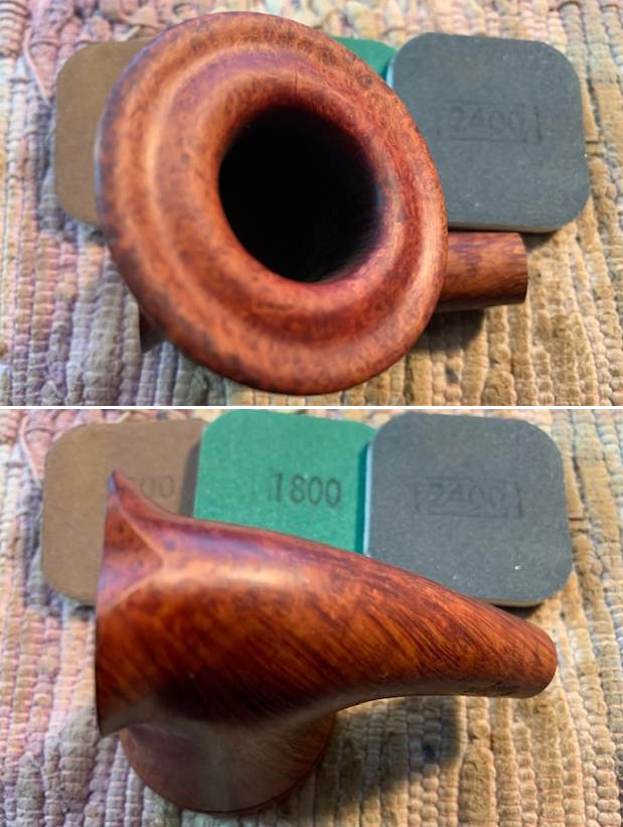
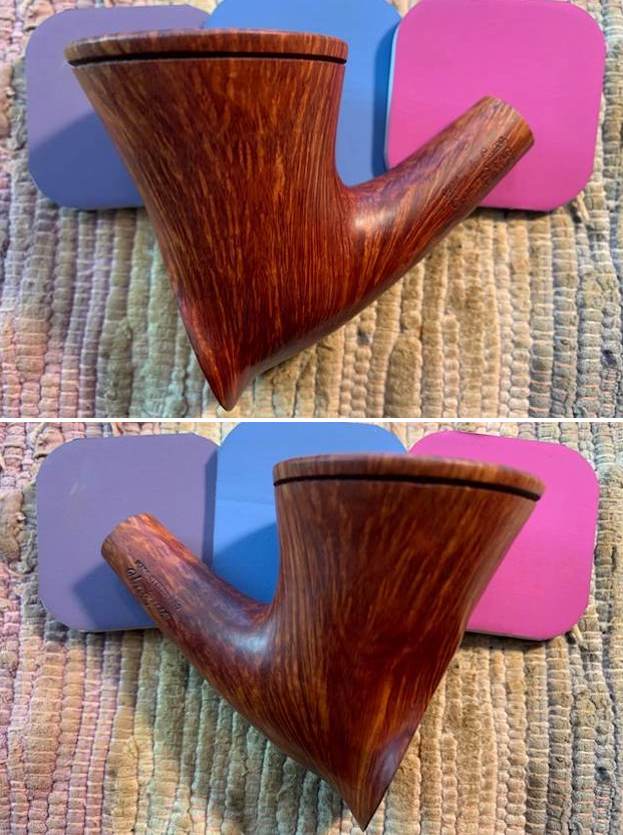
Now, why the bowls were switched in the first place? The answer to this intriguing question will be given in the next part…

Thank you all for being with me as I walk the path of learning nuances of pipe restoration.