Monthly Archives: February 2018

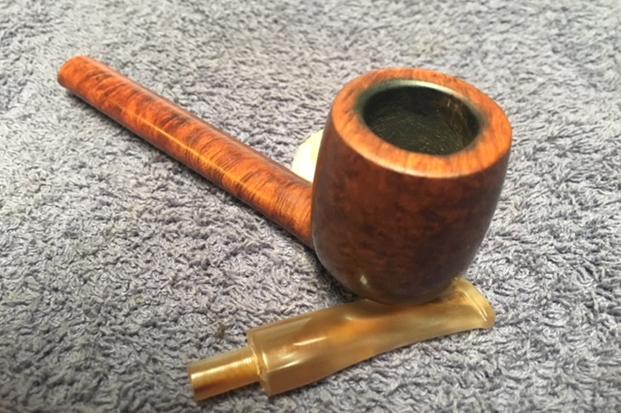
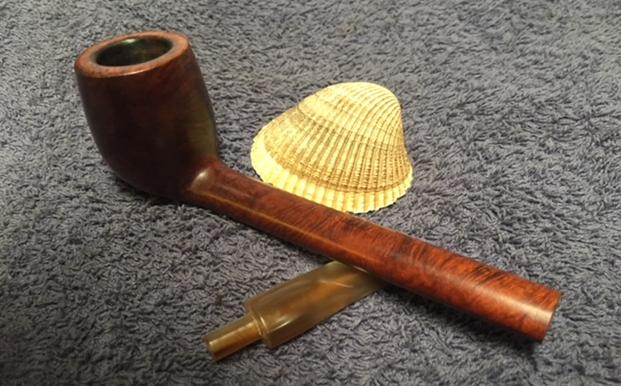
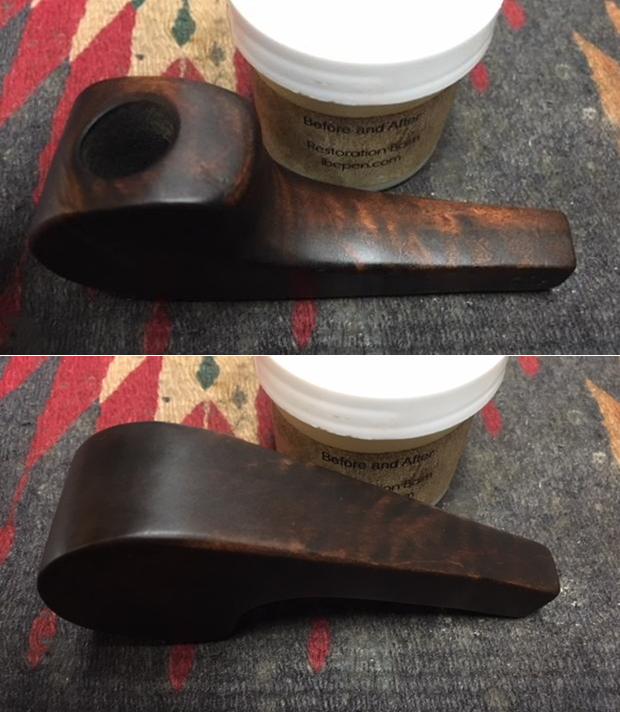
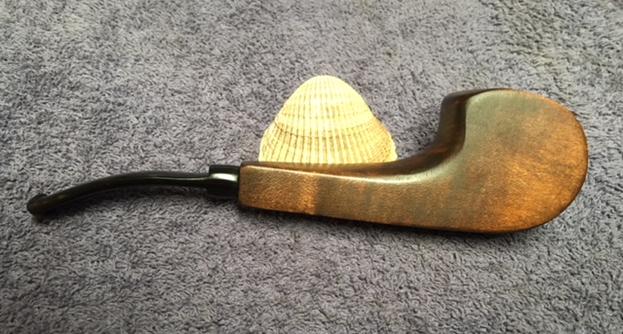
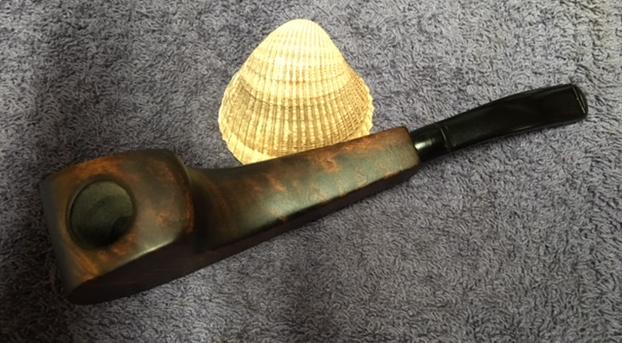
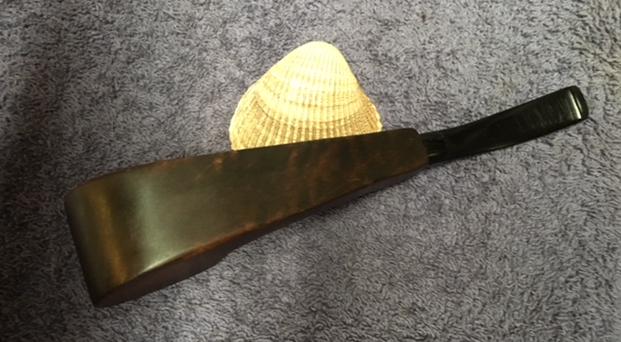
Kathy’s Dad’s Pipes #1 -Restoring George Koch’s “Malaga” Canadian


Blog by Steve Laug

Last fall I received a contact email on rebornpipes from Kathy asking if I would be interested in purchasing her late Father, George Koch’s estate pipes. He had predominantly been a lover of “Malaga” pipes – all shapes and sizes and she wanted to move them out as she cleaned up the estate. We emailed back and forth and I had my brother Jeff follow-up with her as he also lives in the US and would make it simpler to carry out this transaction. The long and short of it is that we purchased her Dad’s “Malaga” pipes. There are some beautiful pipes in that lot. I have never seen this many “Malagas” together in one place in all of my years of pipe restoring and refurbishing. They varied from having almost pristine stems to having gnawed and damaged stems that will need to be replaced. Many of the pipes already had replacement stems or maybe George had the staff at the Malaga shop in Michigan put Lucite stems on them because he was such a gnawer. I don’t know if we will ever know the answer to that as Kathy did not know for sure. She did know though that he loved the brand and that most of the pipes he smoked he purchased from the shop. These were some well used and obviously well loved pipes. Cleaning and restoring them will be a tribute to this pipeman. (Here is a link to some history of the Malaga Brand if you are interested: https://rebornpipes.com/tag/malaga-pipes/. There are also links there to a catalogue and the maker George Khoubesser.)

When working on an estate where I can know about the pipeman who the pipes belonged to, I like to have some background on the person. It just adds another dimension to the restoration work. I know I might be alone in this but when I know about the person it is almost as if he or she is with me as I walk through the restoration process on his or her pipes. In this case Kathy was more than happy to send us not only information on her dad but also a photo of him enjoying his “Malagas”. I am including that information now so you can know a bit about the pipeman who held these pipes in trust before they are passed on to some of you. I include part of Kathy’s correspondence with my brother as well…

Jeff… Here is a little about my dad, George P. Koch…I am sending a picture of him with a pipe also in a separate email.

Dad was born in 1926 and lived almost all his life in Springfield, Illinois. He was the youngest son of German immigrants and started grade school knowing no English. His father was a coal miner who died when Dad was about seven and his sixteen year old brother quit school to go to work to support the family. There was not much money, but that doesn’t ruin a good childhood, and dad had a good one, working many odd jobs, as a newspaper carrier, at a dairy, and at the newspaper printing press among others. He learned to fly even before he got his automobile driver’s license and carried his love of flying with him through life, recertifying his license in retirement and getting his instrumental license in his seventies and flying until he was grounded by the FAA in his early eighties due to their strict health requirements. (He was never happy with them about that.) He was in the Army Air Corps during World War II, trained to be a bomber, but the war ended before he was sent overseas. He ended service with them as a photographer and then earned his engineering degree from University of Illinois. He worked for Allis Chalmers manufacturing in Springfield until the early sixties, when he took a job at Massey Ferguson in Detroit, Michigan. We lived in Livonia, and that’s where his love for Malaga pipes began. After a few years he returned to Allis Chalmers and we moved back to Springfield. I remember that when we went back to Michigan to visit friends, Dad had to go to the Malaga store and acquire a few new pipes. Many a year I wrote to Malaga and they picked out a pipe for me to purchase that I could give Dad for a Christmas or birthday present. He was always pleased. His favorites were the straight stemmed medium sized bowl pipes, but he liked them all.  He had some other pipes, but the Malagas were his favorites. I remember him smoking them sitting in his easy chair after work, with feet up on the ledge by the fire burning in the fireplace.  Growing up it was my job to clean them and he liked the inner bowl and stem coated with Watkins vanilla, leaving a little of that liquid in the bowl to soak in when I put them back on the rack. Dad quit smoking later in life and so they’ve sat on the racks for many years unattended, a part of his area by his easy chair and fireplace. Dad passed when he was 89 years old and it finally is time for the pipes to move on. I’m very happy they are being restored by you and your brother and hope they find homes who enjoy them as much as Dad did. Thank-you for your care and interest. — Kathy, the oldest daughter

Kathy, thank you for providing this beautiful tribute to your Dad. We will take your trust to clean and restore these pipes. I am also trusting that you who are reading this might carry on the legacy of her Dad’s pipes as they will be added to the rebornpipes store once they are finished.

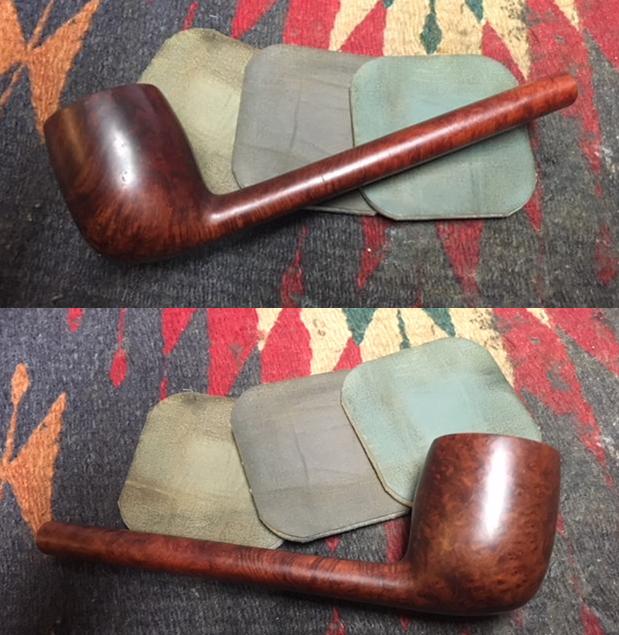
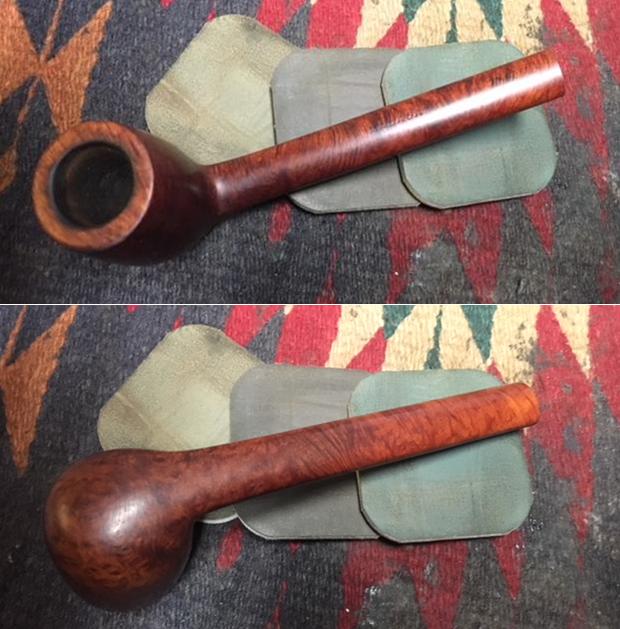
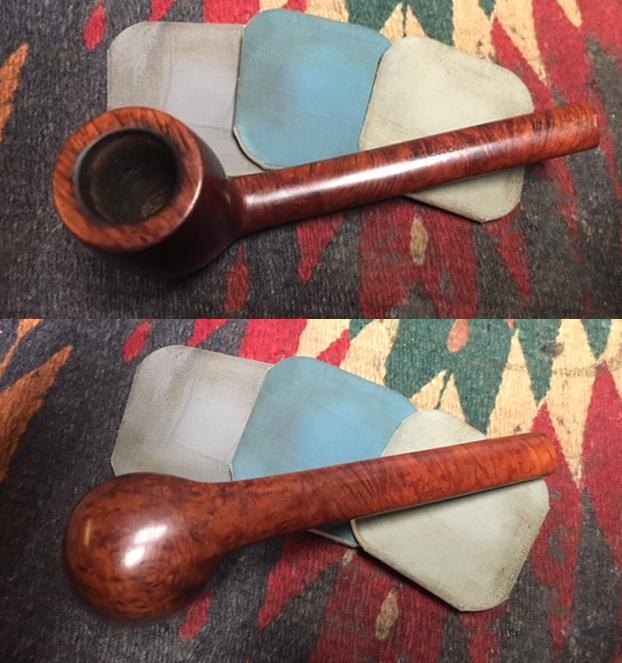
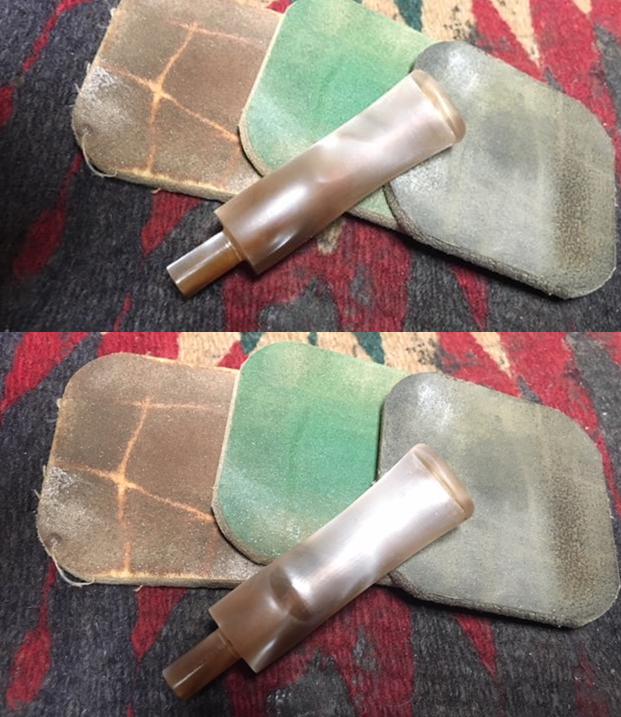
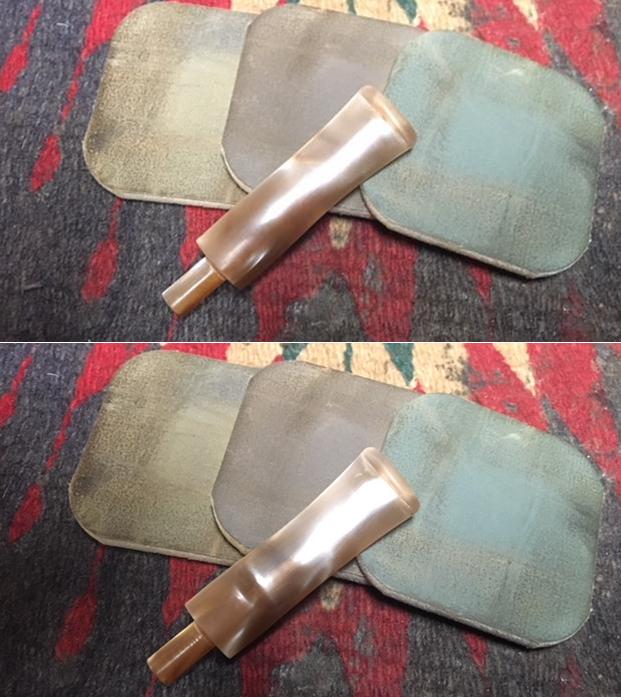
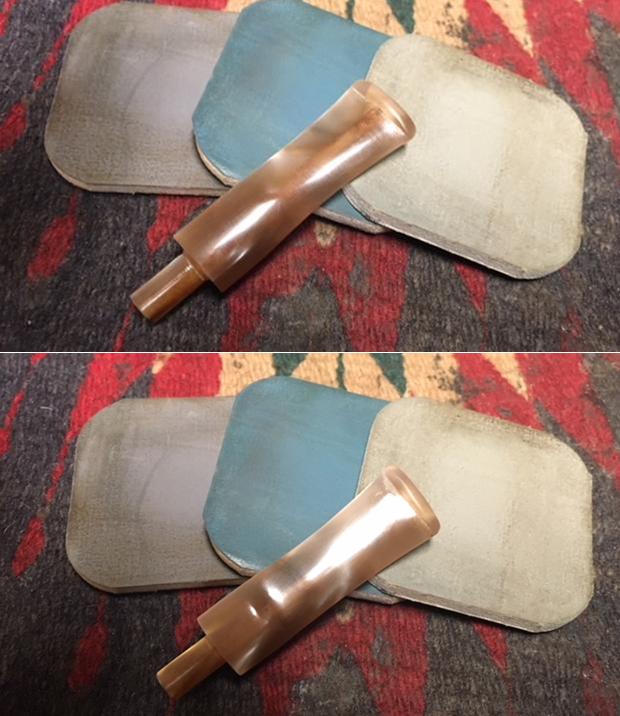
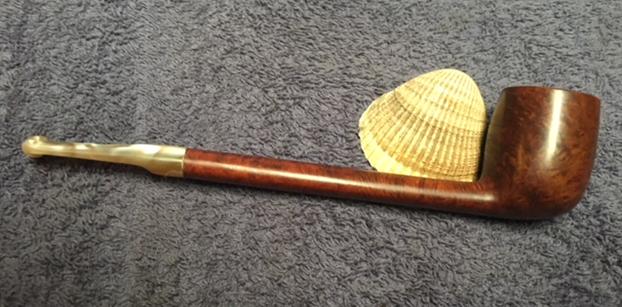
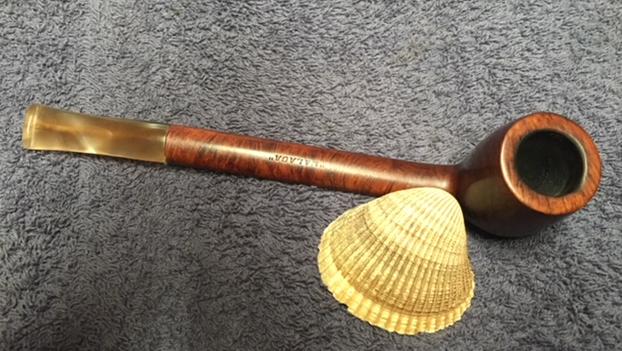
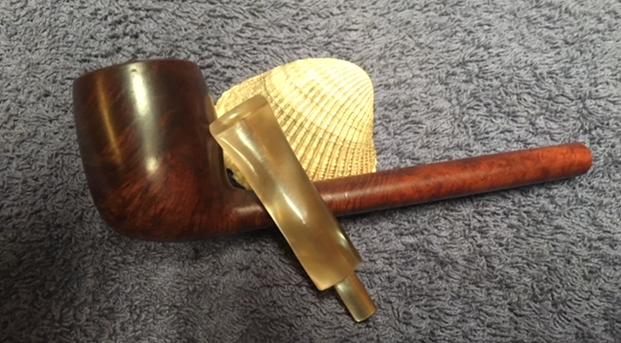
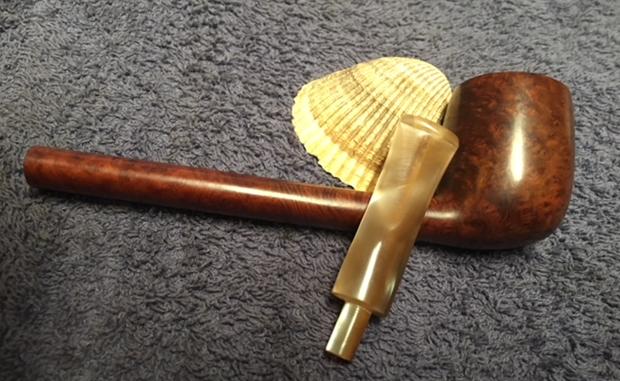
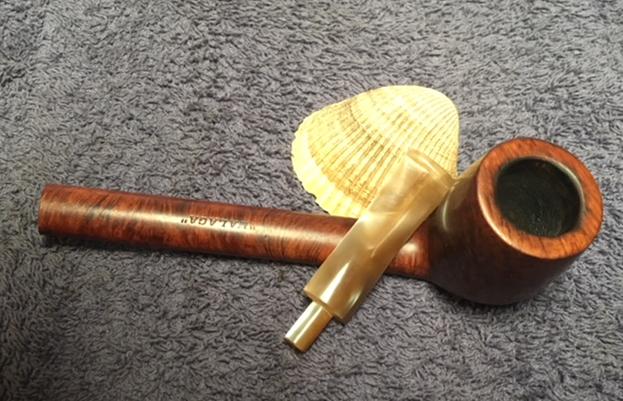
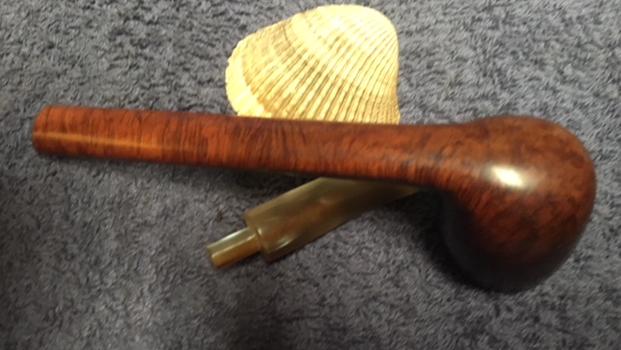
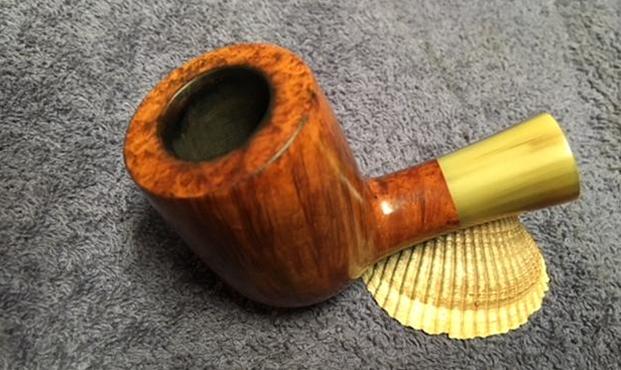
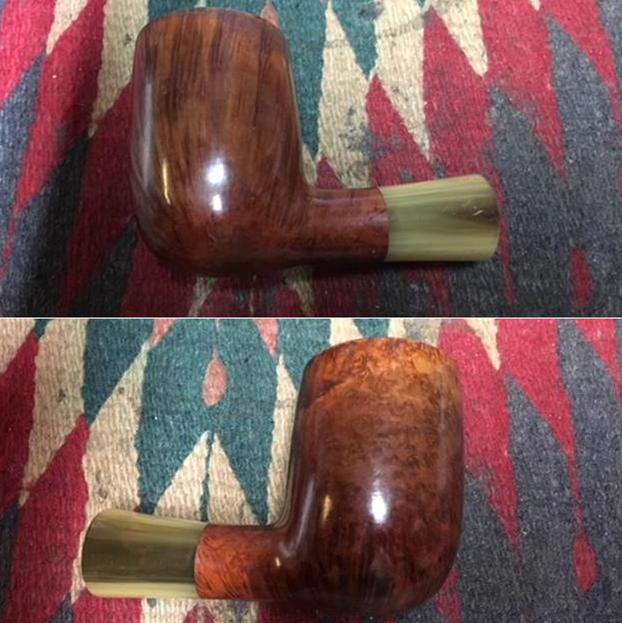
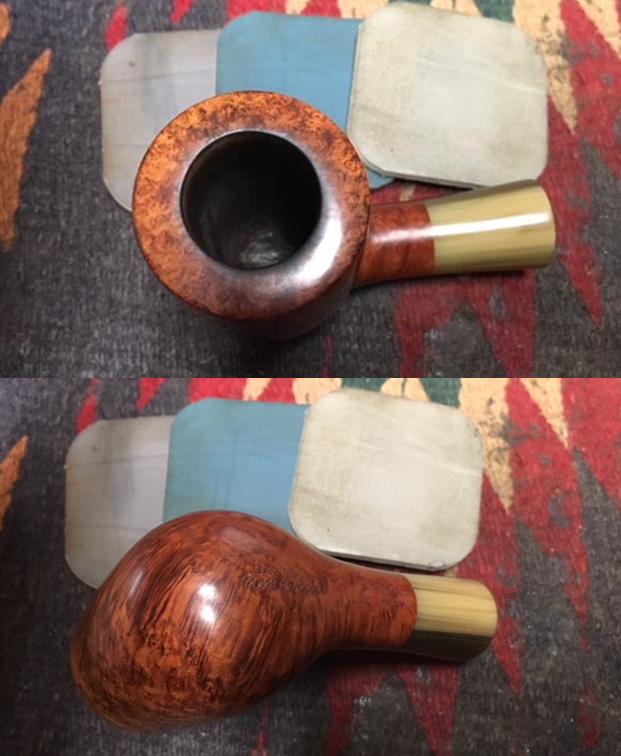
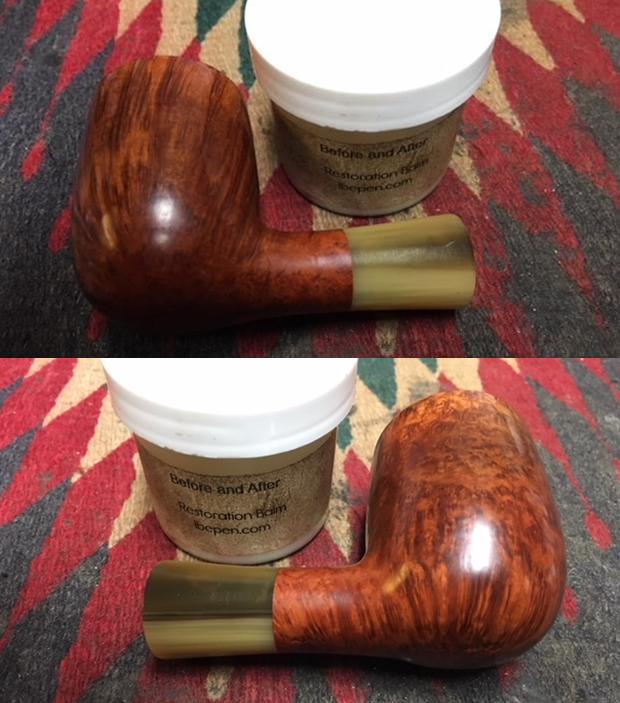
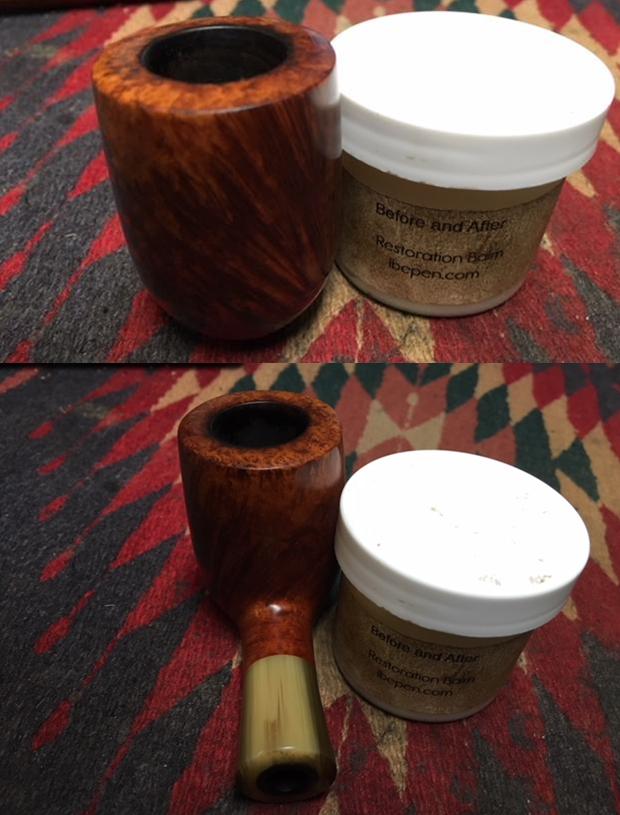
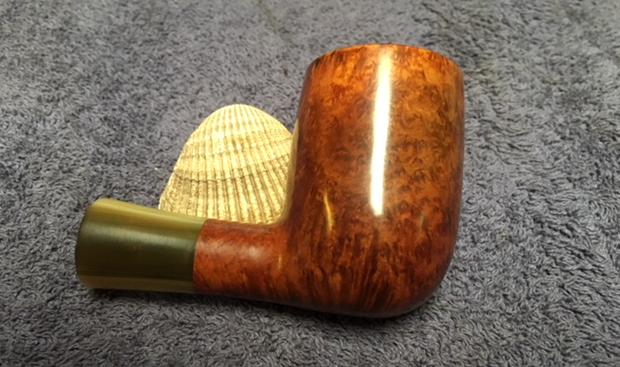
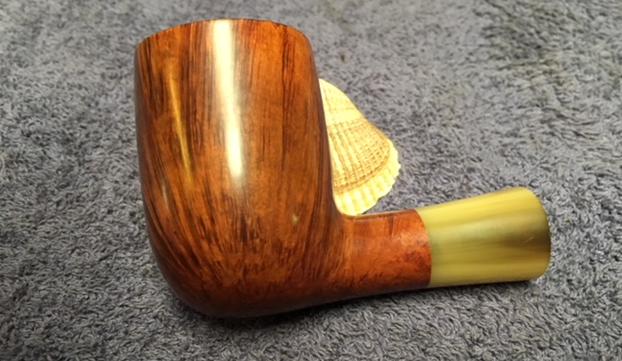
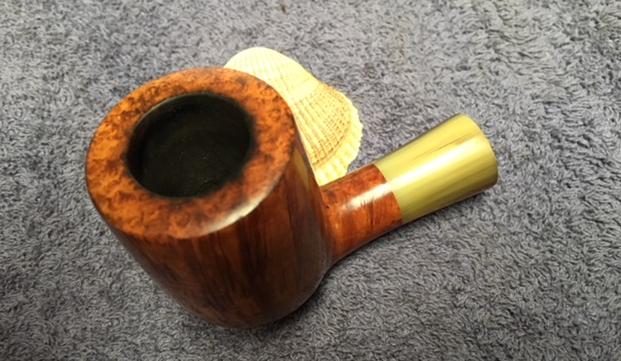
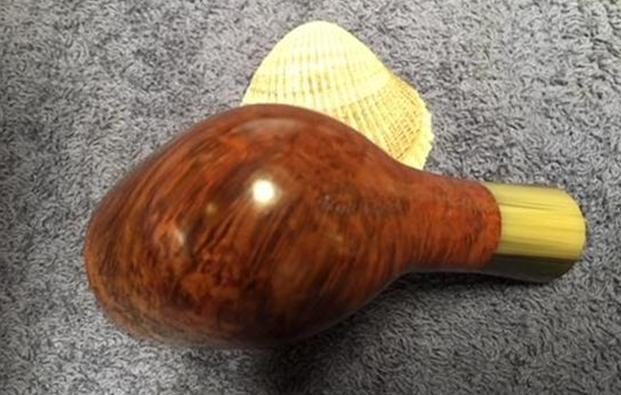
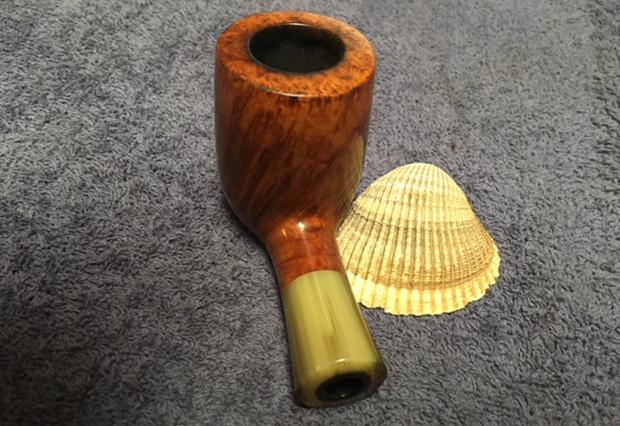
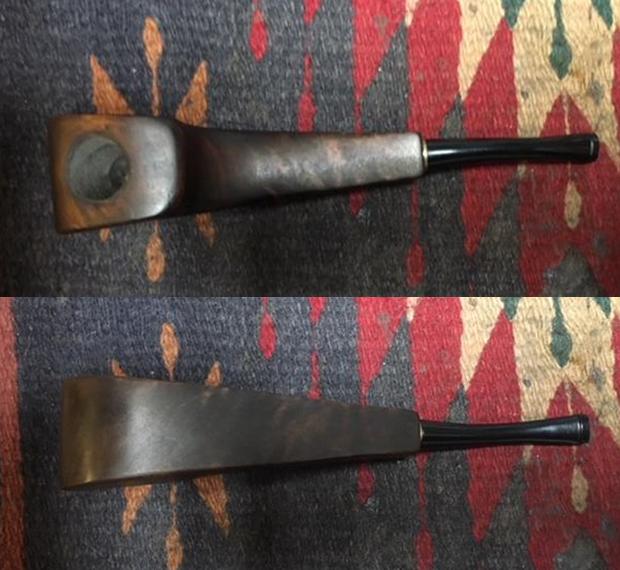
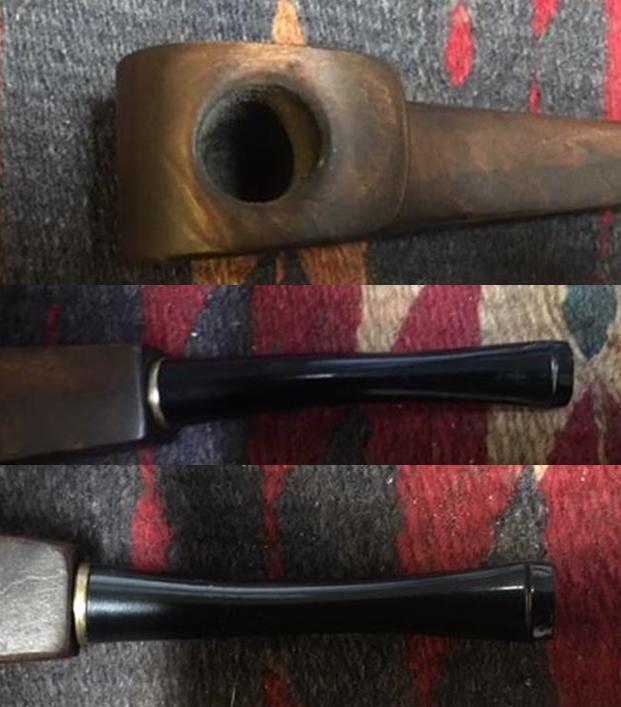
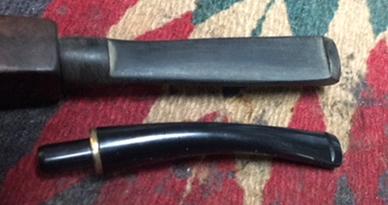
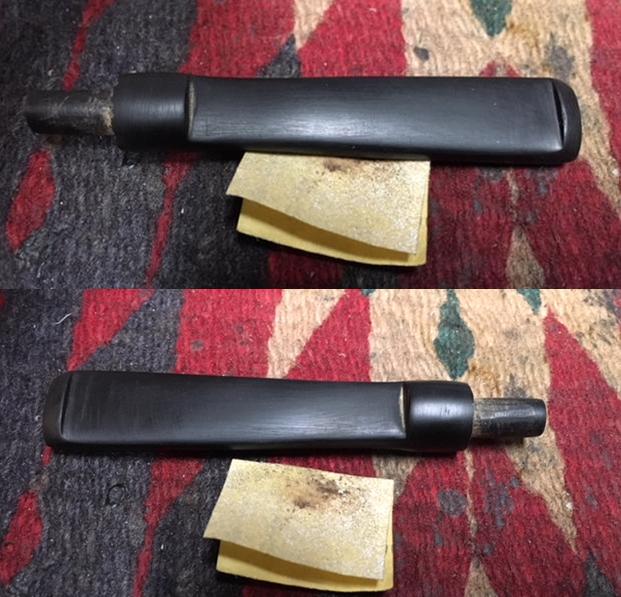
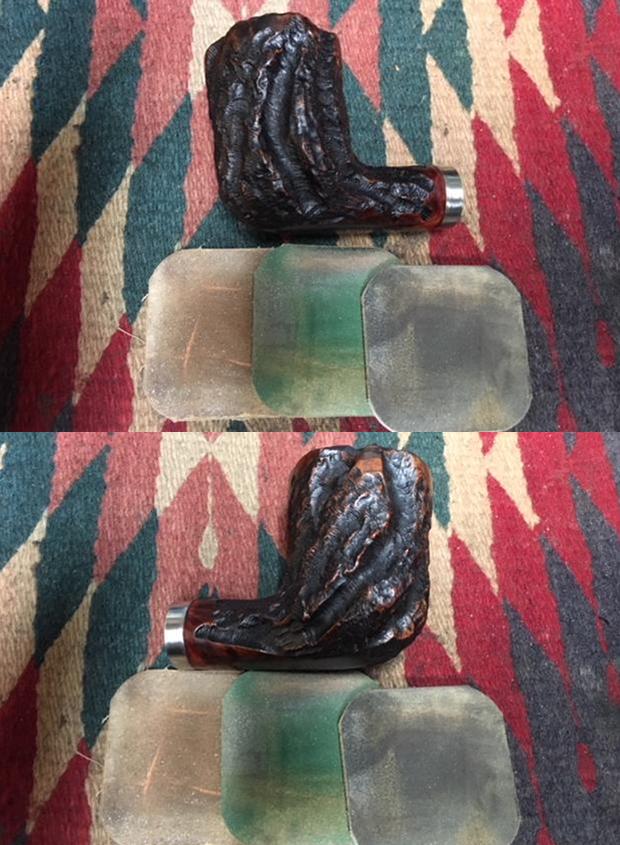
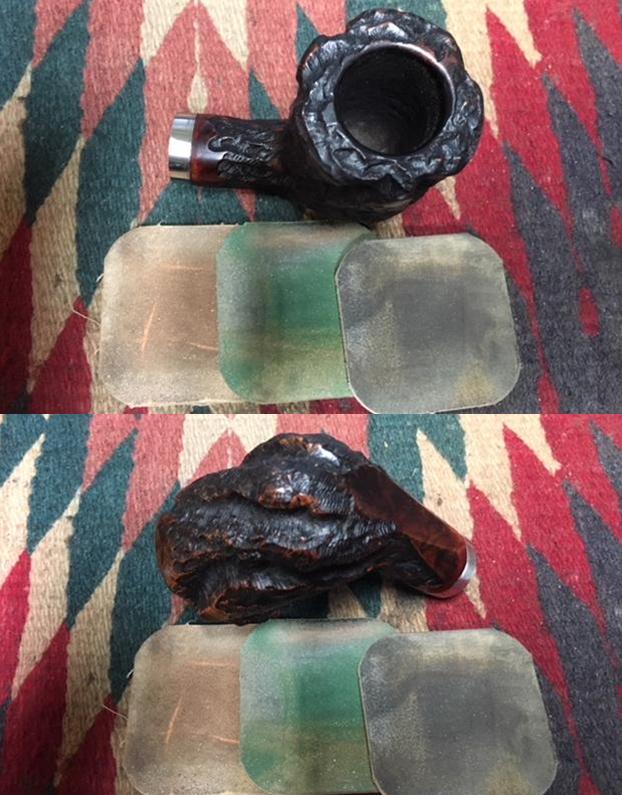
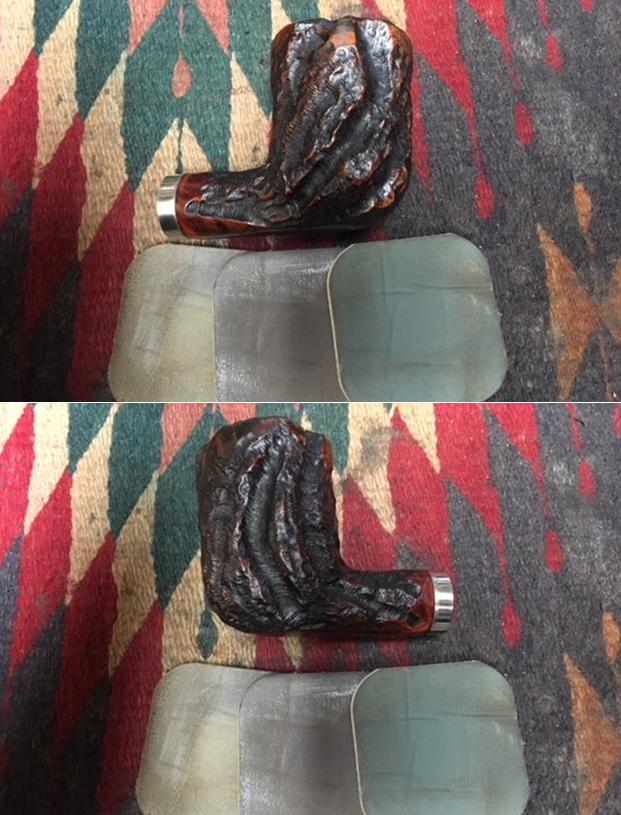
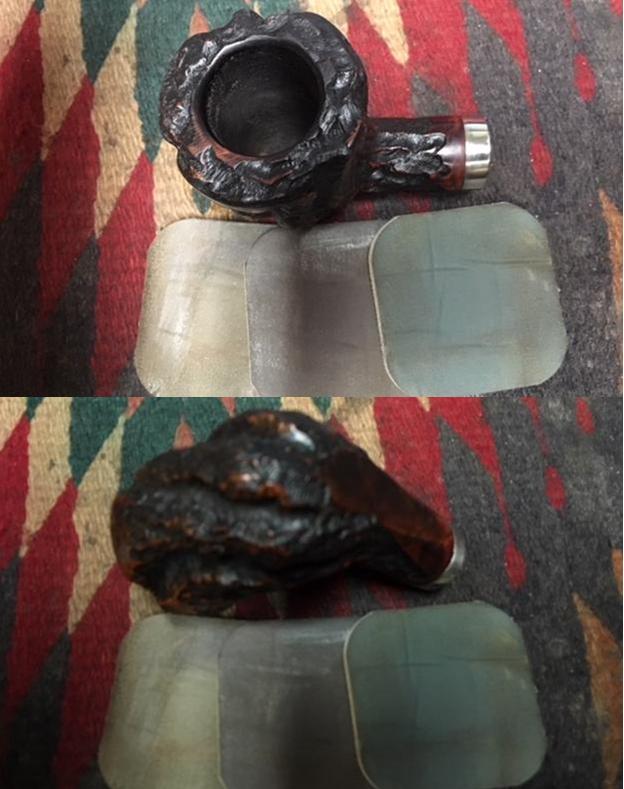
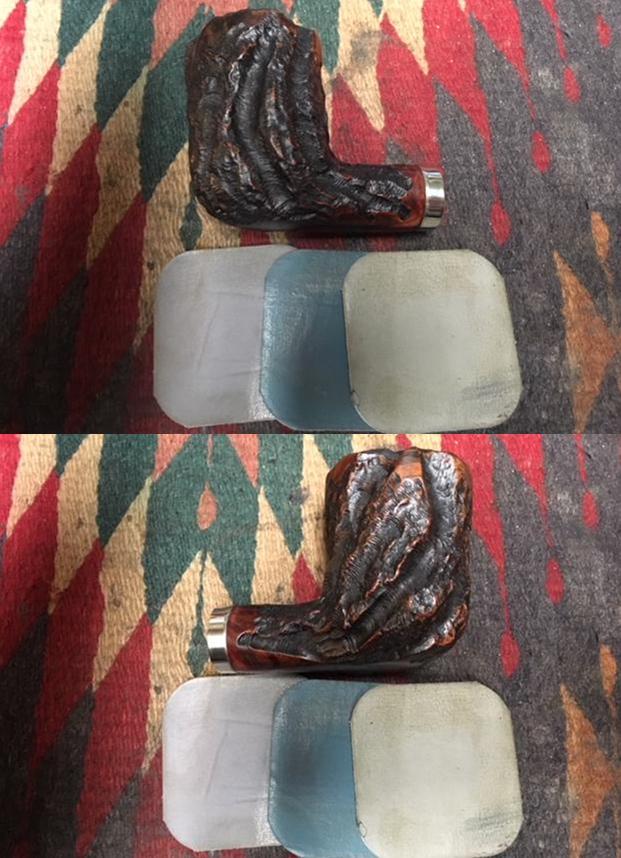
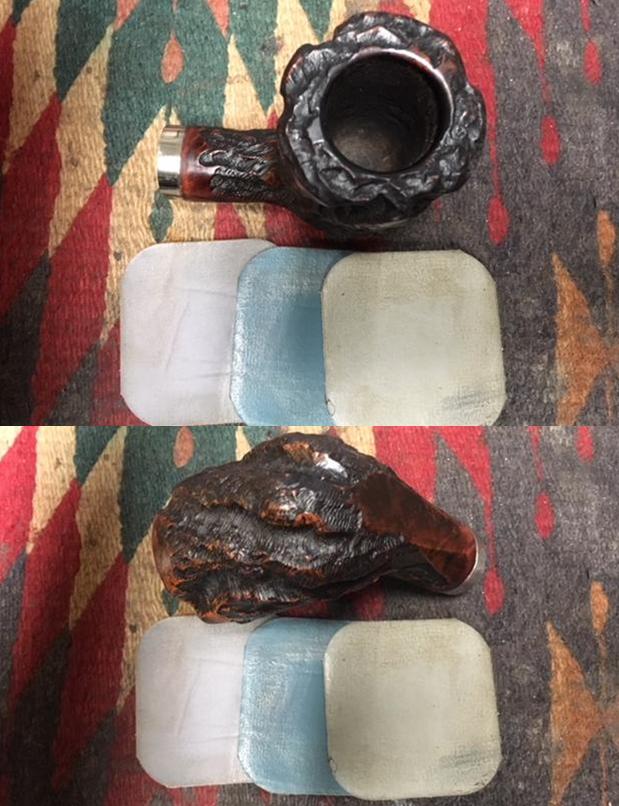
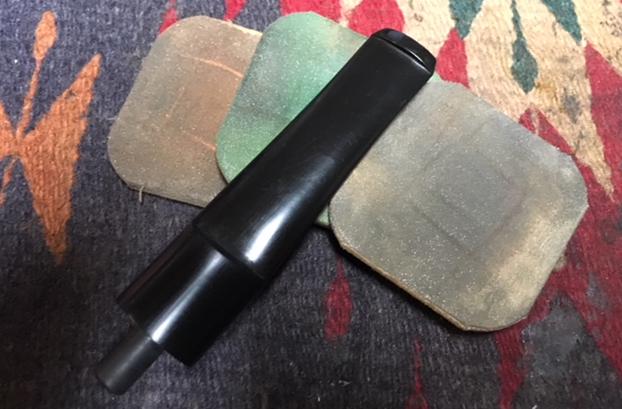
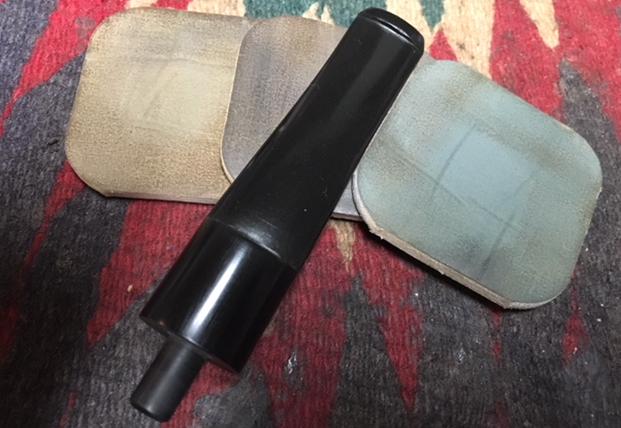
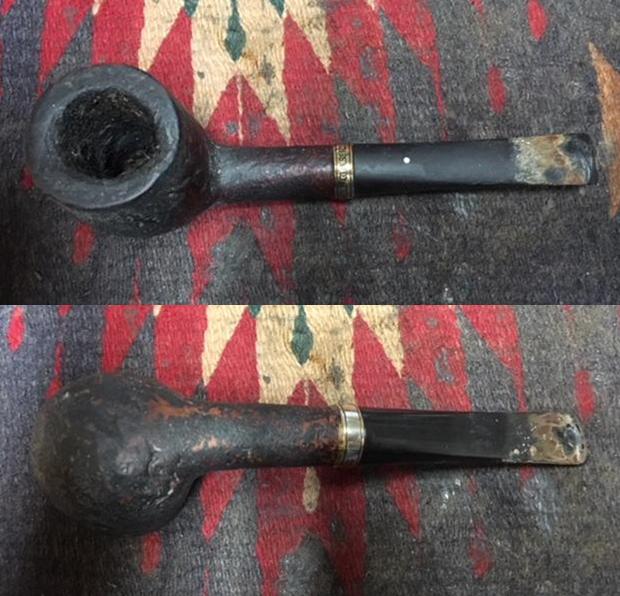
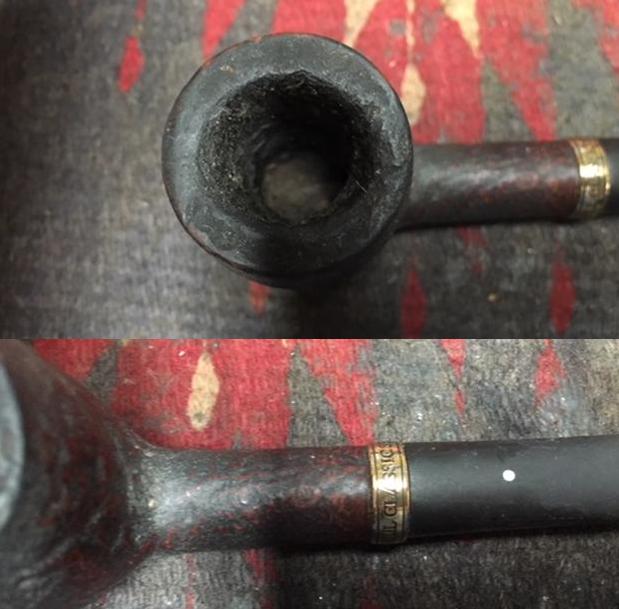
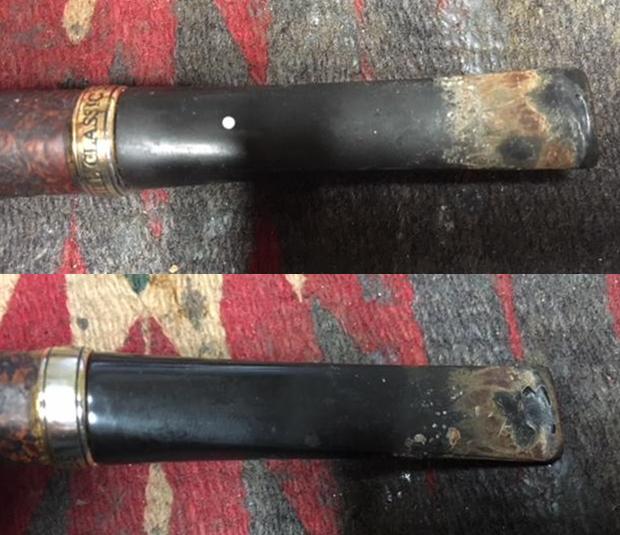
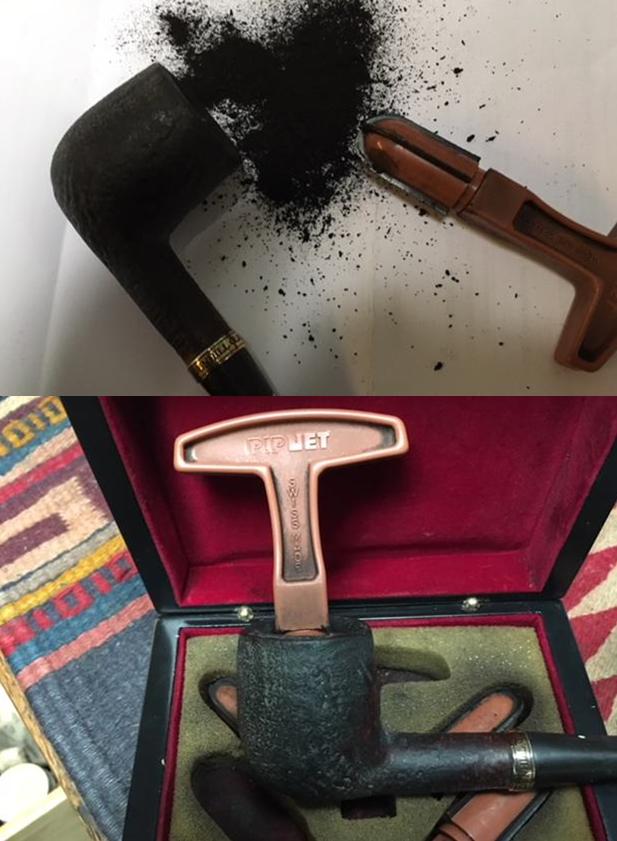
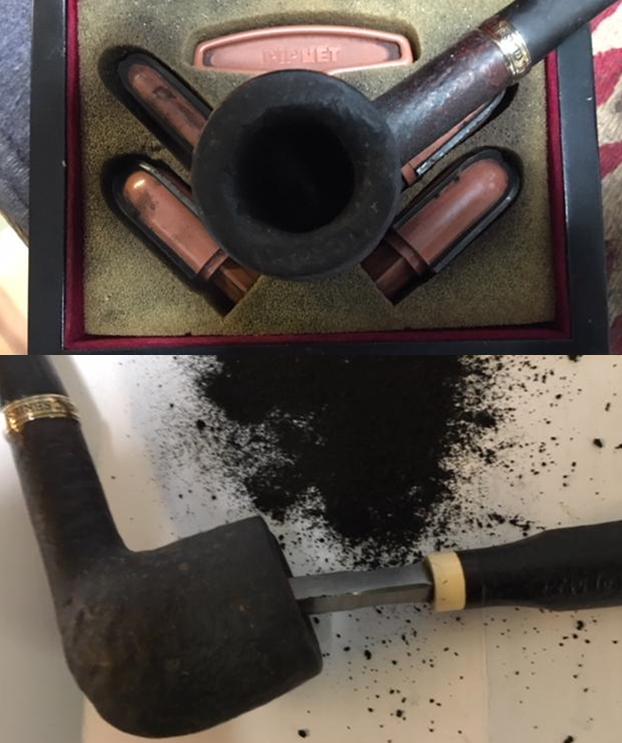
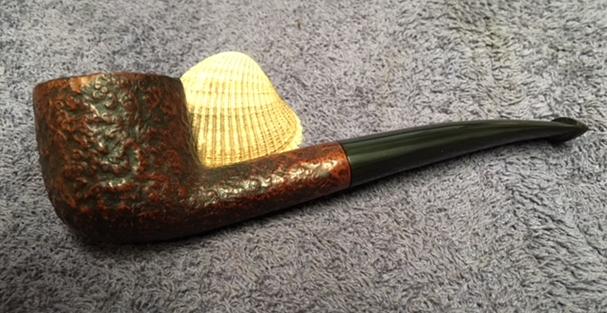
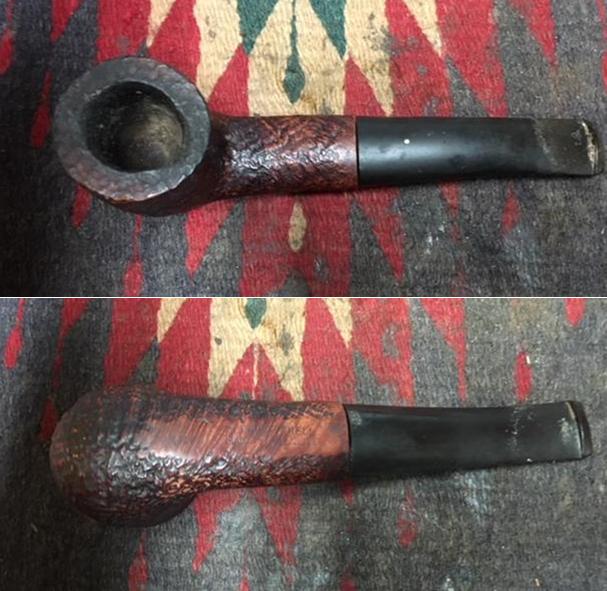
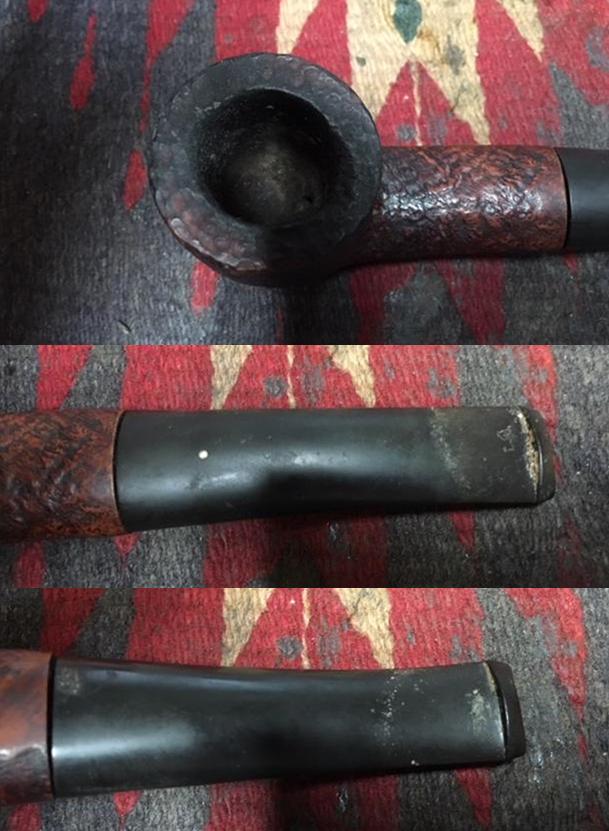
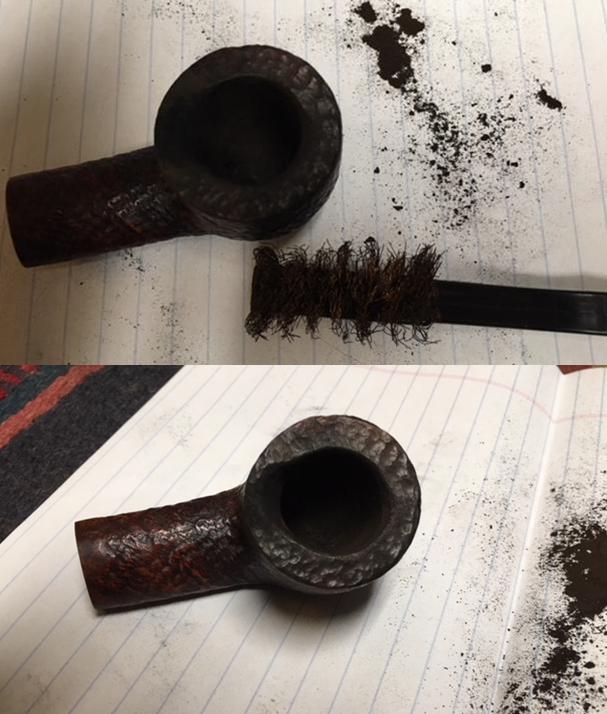
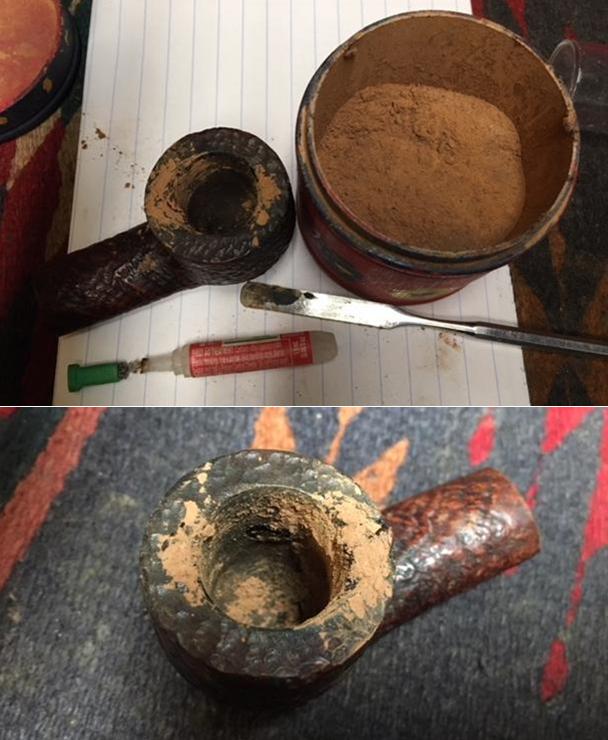
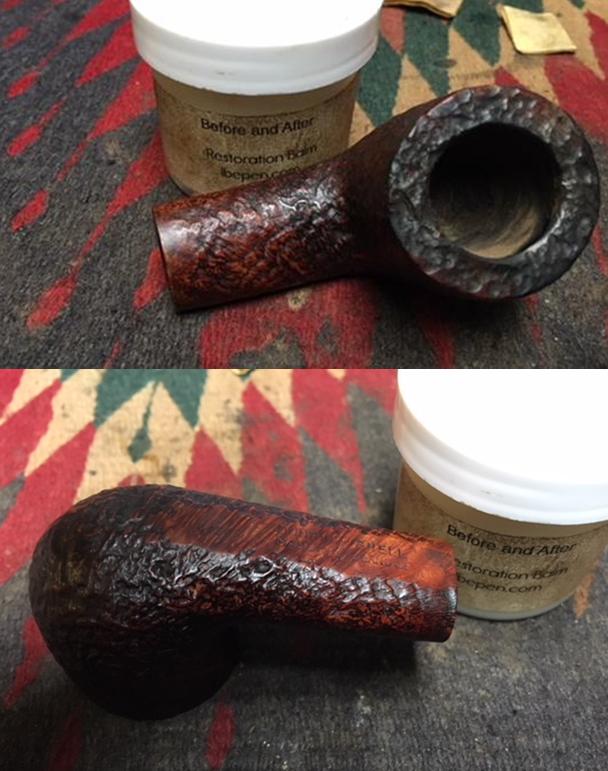
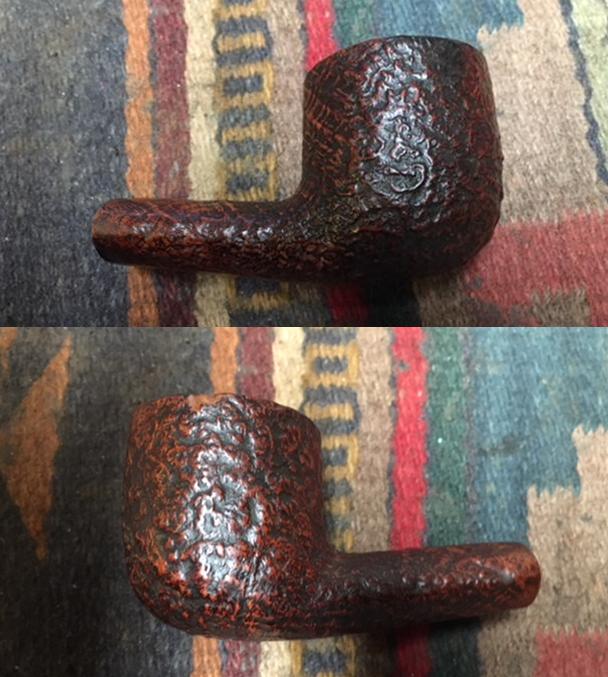
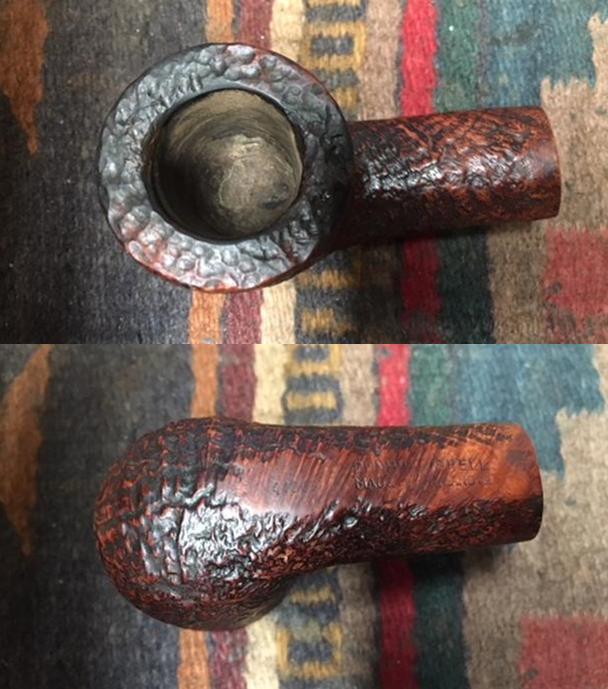
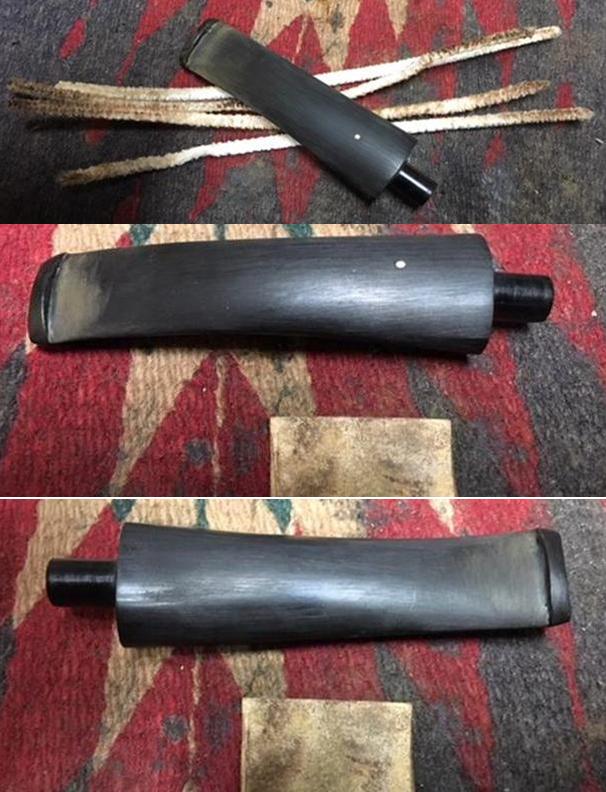
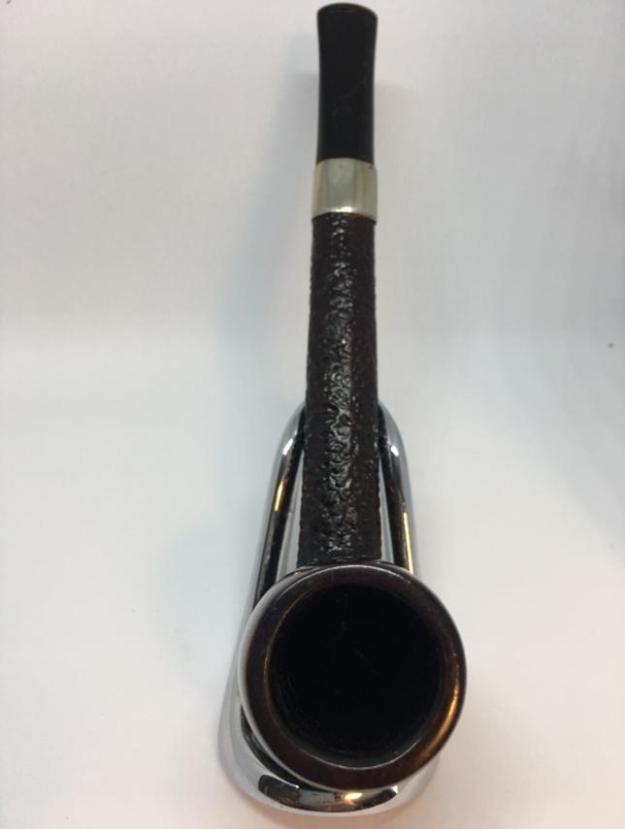
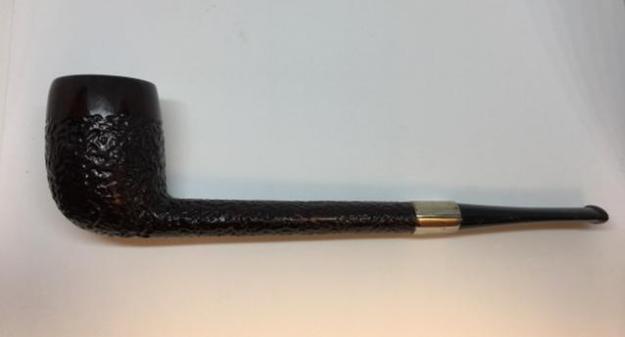
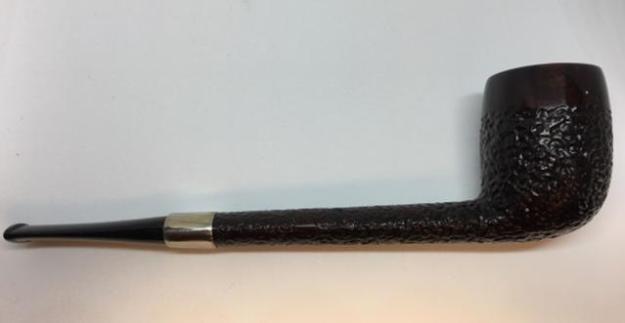
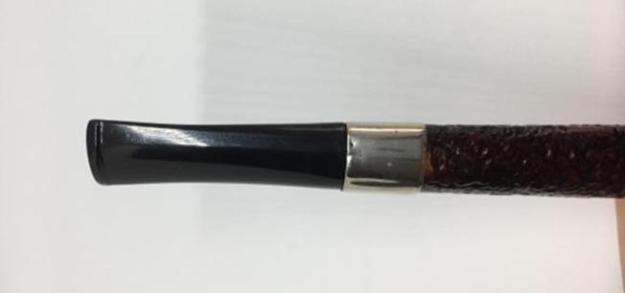
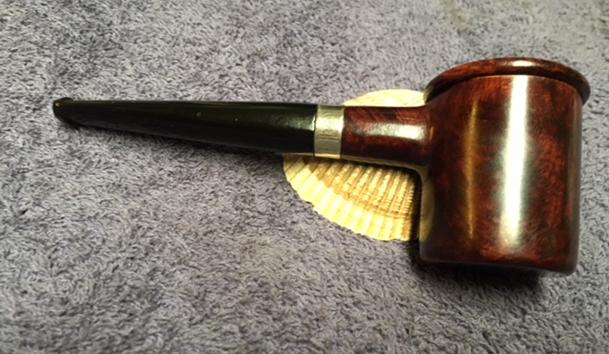
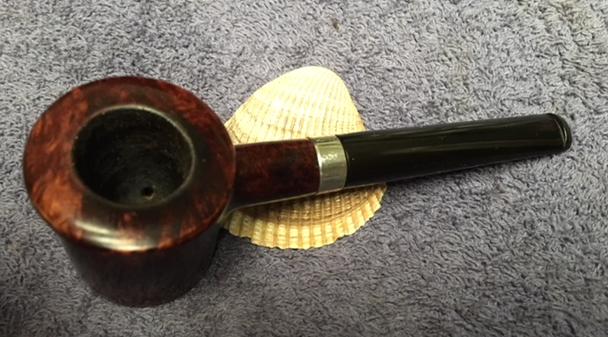
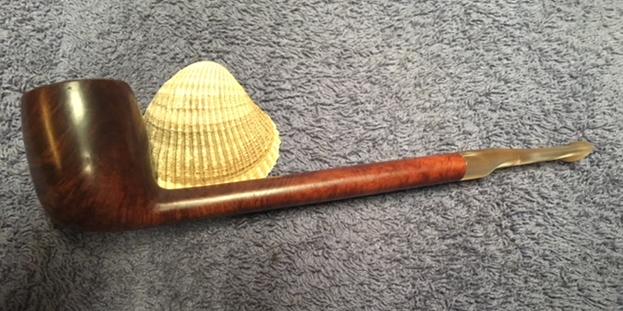
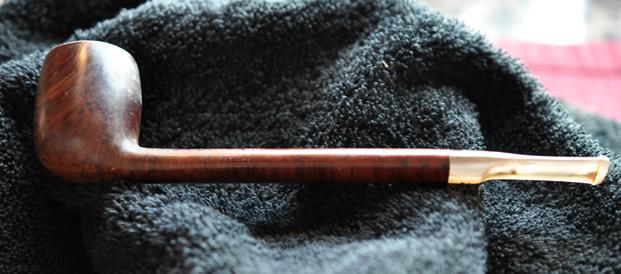
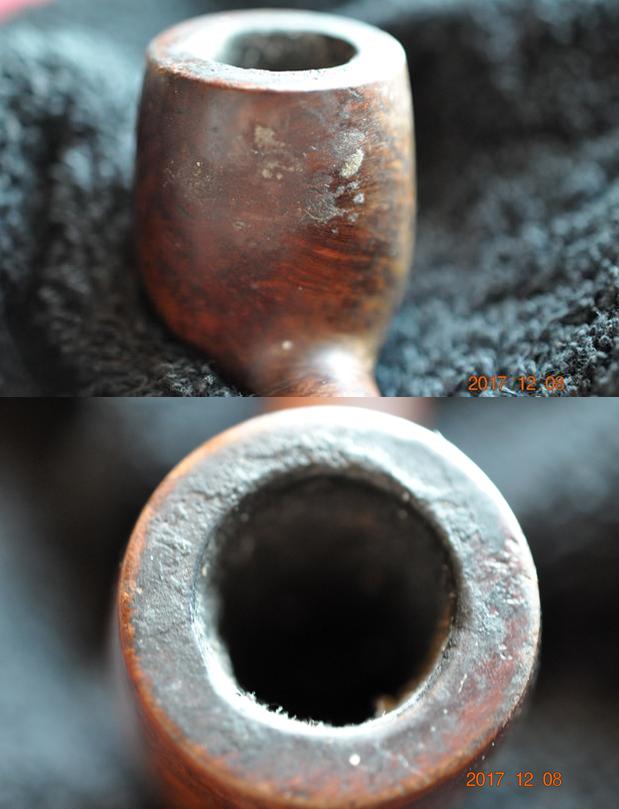
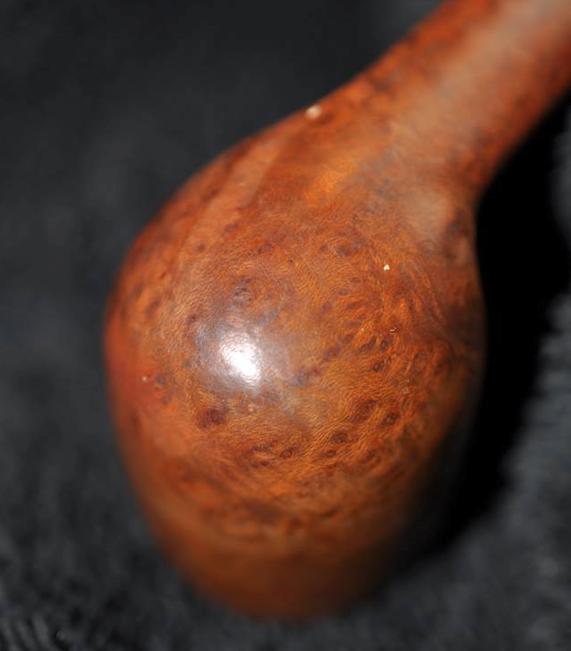
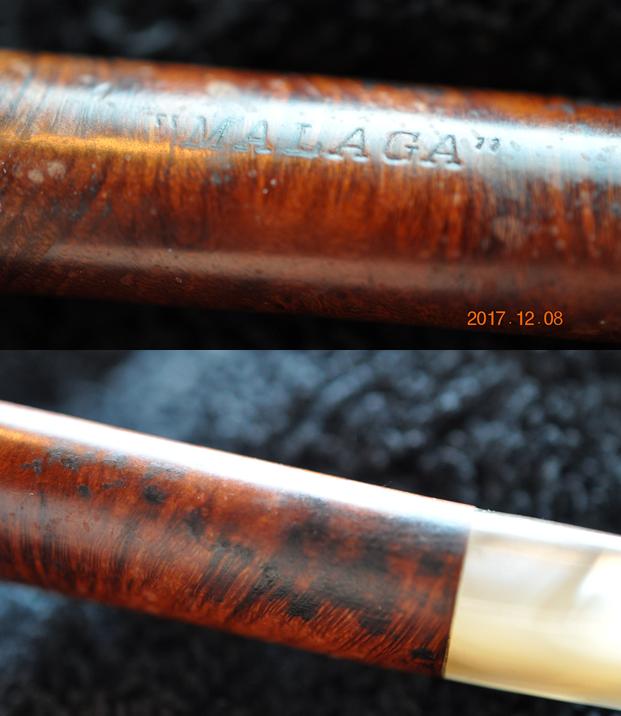
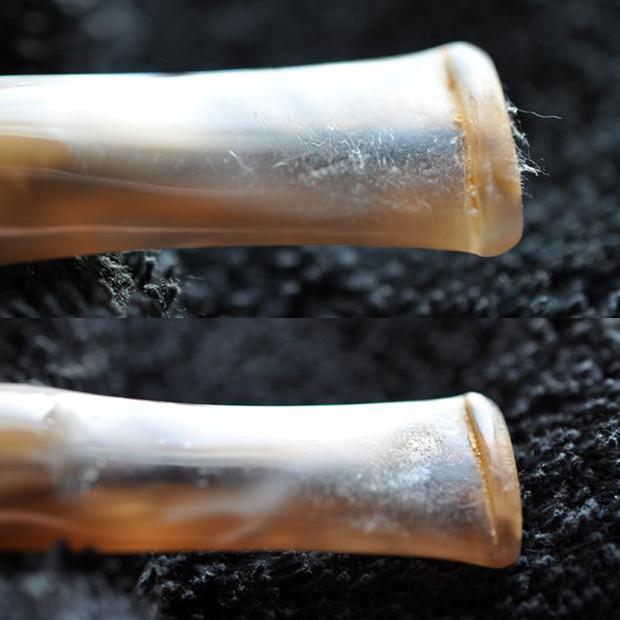
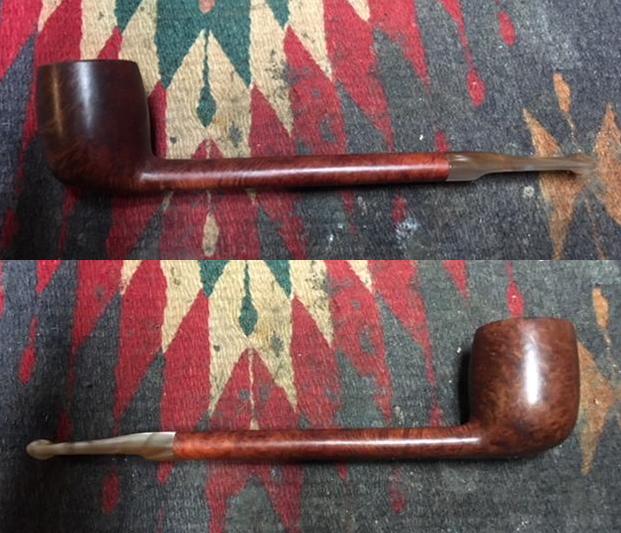
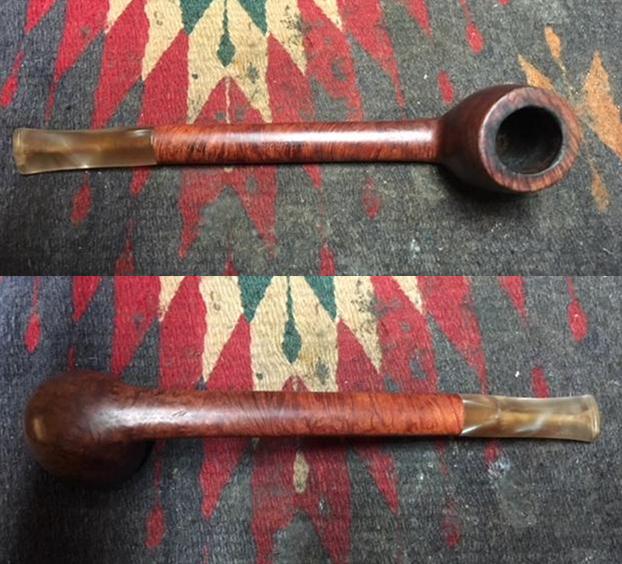
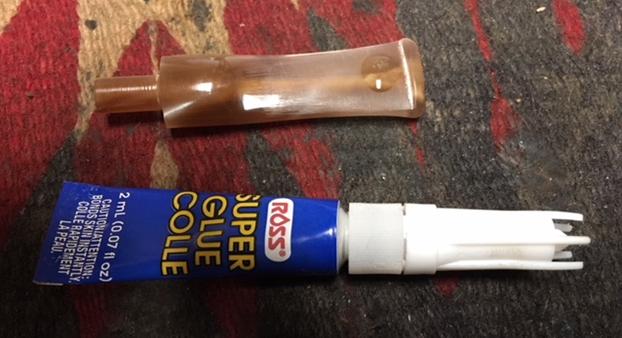
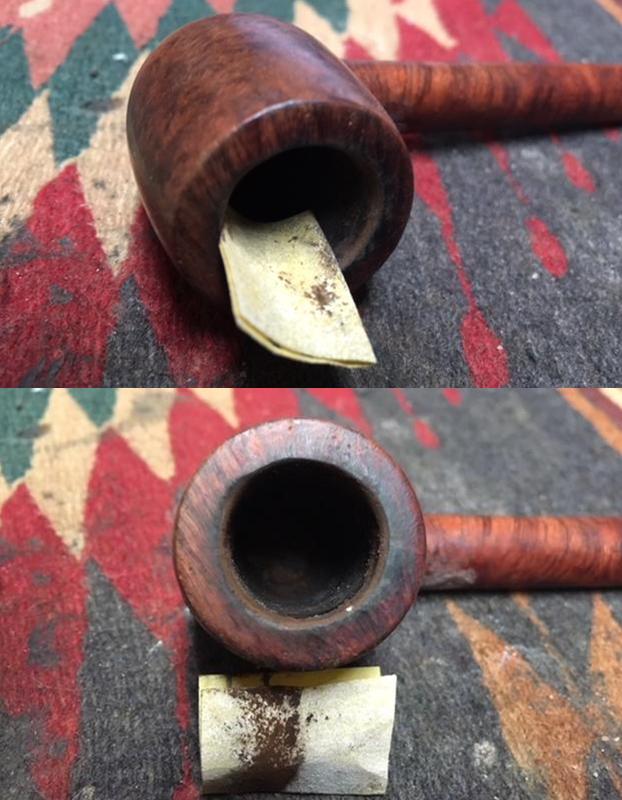
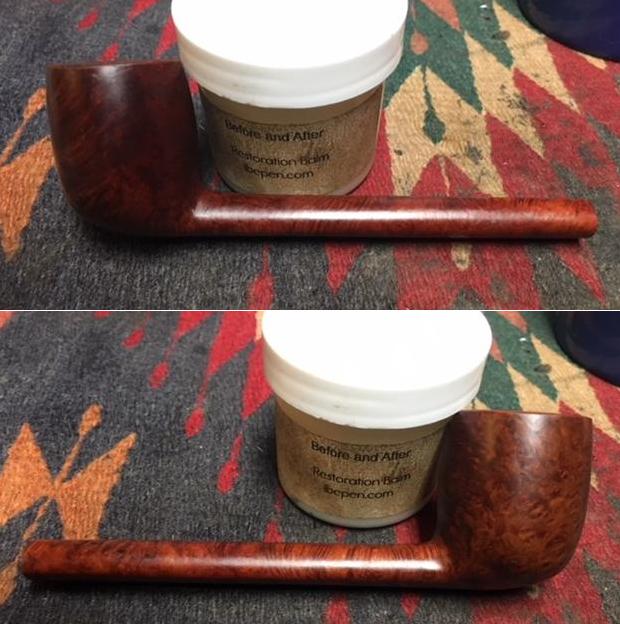
The first of the pipes that I chose to work on is a long shank “Malaga” Canadian with a variegated Lucite half saddle stem. It is really a beautiful pipe underneath the grime and debris of the years. The warm brown finish on the bowl was in good condition under the dust and tars of time. The rim top was covered with an overflow of lava from the cake in the bowl. The inner and outer edge of the bowl had damage. The inner edge was out of round on the right side and the outer edge showed signs of being knocked against a hard surface to empty the dottle from the bowl. The stamping on the shank was clear and read “Malaga” on the top of the oval shank. There were no other markings of shape numbers on the pipe. The Lucite stem fit the shank quite well and was worn. There was tooth chatter on both sides at the button and a large shallow tooth mark on the underside. The interior of the pipe was dirty. I often talk about the wear and tear on the pipes I work on… this is not a bad thing. It actually shows that this was a well loved pipe and that the pipeman who used it held it often and enjoyed its company. Jeff took these photos before he started the cleanup work on the pipe. He took close up photos of the bowl and rim to show the condition of the pipe before he started to work his magic on it. The exterior of the bowl and shank were dirty and you can see from the first photos how it had stuck to the sides. On the second photo you can see the lava on the rim, the cake in the bowl and the damage to the inner and outer edge of the rim. The third photo shows the underside of the bowl. It is dirty but in otherwise good condition. He also took photos of the shank to show the stamping and the condition of the overall shank so you could have an idea of where things were at before he cleaned it up.The photos of the stem show the fuzz of dust and the chatter and marks of teeth near the button. None of them are a real issue as much of the debris will wash away in the cleanup and the tooth chatter and marks will disappear in the restoration process.I can’t tell you how much I have missed working on the pipes that Jeff has cleaned. I think I got used to working on clean pipes so the last little while I have been working on pipes that I had to clean up. With this “Malaga” I am reminded of the work that he does every time before I even see the pipe. Jeff out did himself on the cleanup of this pipe. He reamed the bowl with a PipNet pipe reamer and followed up with a Savinelli Fitsall pipe knife to remove the cake. He scrubbed out the mortise and the airway in the shank and the stem with alcohol, cotton swabs and pipe cleaners. He scrubbed the exterior of the bowl, rim, shank and stem with a tooth brush and Murphy’s Oil Soap to remove the oils and tars on the bowl, rim and shank. He rinsed it under running water. He dried it off with a soft cloth. The lava mess on the rim was thoroughly removed without harming the finish underneath it. Once the grime was removed the finish actually looked it was in excellent condition. I took photos of the pipe to show its condition before I started my work on it. I took a photo of the rim top to show the condition it was in after the cleanup. Jeff was able to remove all of the darkening and tar on the rim top and edges. You can see the damage from knocking out the pipe on a hard surface on the top and outside edges of the bowl. You can also see the damage to the inner edge of the rim. There is damage on the front right side and toward the rear of the bowl. There is general darkening and slight burn damage as well. The stem was clean and you can see the tooth chatter and marks on the surface near the button.Because the stem was already clean I lightly sanded the tooth mark on the underside and wiped it off with a damp cotton pad. I used a drop of clear super glue to fill the divot. The glue came out a bit excessively but I figured I had to sand it anyway so I left it to dry.While the stem dried I worked on the rim top and the inner edge of the bowl. I used a folded pied of 220 grit sandpaper to smooth out the damage around the edge. I gave the rim a light bevel to remove the damage on the front side of the bowl. More of the damage would be removed when I topped the bowl.I lightly topped the bowl on my topping board using 220 grit sandpaper. It did not take too much work to remove the nicks and damage to the rim top and edges. Once it was complete I topped it on a medium grit sanding sponge to smooth the surface even more.I rubbed the bowl down with Before & After Restoration Balm to deep clean the pores and grain of the smooth finish as well as to enliven and protect the briar. I hand rubbed it with my fingers and wiped it off with a soft cloth. I buffed the bowl with a horsehair shoe brush to polish it. The briar really began to have a rich shine. I took some photos of the bowl at this point to mark the progress in the restoration. The repair on the Lucite stem had hardened at this point so I set the bowl aside and worked on the stem. I sanded the repair with 220 grit sandpaper to smooth and blend it into the surface of the rest of the stem. I sanded out the tooth chatter on the topside of the stem and smooth out the surface of the button to remove the marks.I ran a pipe cleaner dipped in alcohol through the airway in the shank to clean out the sanding dust and any reaming debris. I cleaned out the slot and made sure the corners were all clean. I also ran pipe cleaners through the shank and used cotton swabs and alcohol in the mortise to remove any of the sanding dust from the rim work. I also found that the entrance of the airway into the bowl had some hardened tars that came out as I cleaned the shank.I polished the briar with micromesh sanding pads – wet sanding with 1500-2400 grit pads and dry sanding with 3200-12000 grit pads. I wiped the briar down after each pad with a damp cloth to remove the sanding dust. I set the bowl aside and polished the stem with micromesh sanding pads – wet sanding with 1500-2400 grit pads and dry sanding with 3200-12000 grit pads. I wiped the stem down after each pad with a damp cloth to remove the sanding dust. With the stem polished I put it back on the pipe and buffed it with Blue Diamond. I gave the bowl and the stem several coats of carnauba wax and buffed the pipe with a clean buffing pad to raise the shine. I hand buffed it with a microfiber cloth to deepen the shine. The pipe polished up pretty nicely. The finished pipe is shown in the photos below. This is the first of many “Malaga” pipes that I am restoring from Kathy’s Dad’s collection. I am looking forward to hearing what Kathy thinks once she sees the finished pipe on the blog. I will be posting it on the rebornpipes store very soon. It should make a nice addition to another pipeman’s rack that can carry on the trust from her father. The dimensions are Length: 7 inches, Height: 1 3/4 inches, Outside diameter of the bowl: 1 1/4 inches, Chamber diameter: 3/4 inches. Thanks for walking through the restoration with me as I worked over this first Malaga of his estate. More will follow in a variety of shapes and sizes.
 

Refurbishing a Savinelli Nonpareil 9111 Billiard Bowl


Blog by Steve Laug

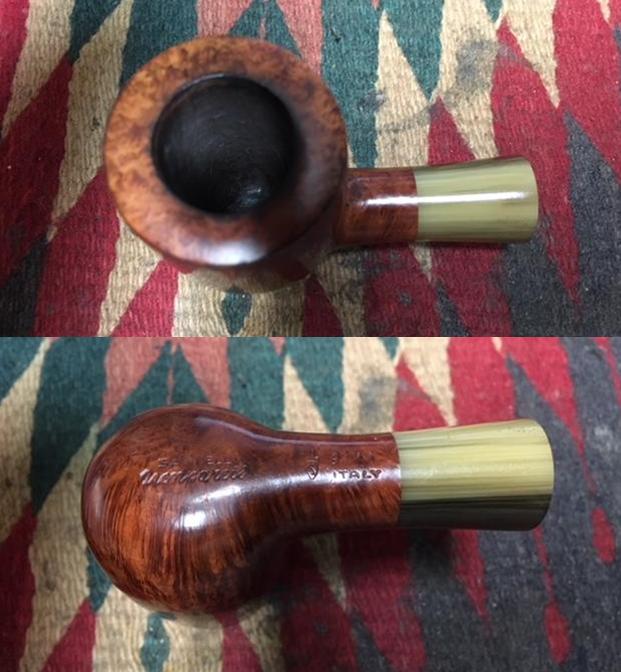
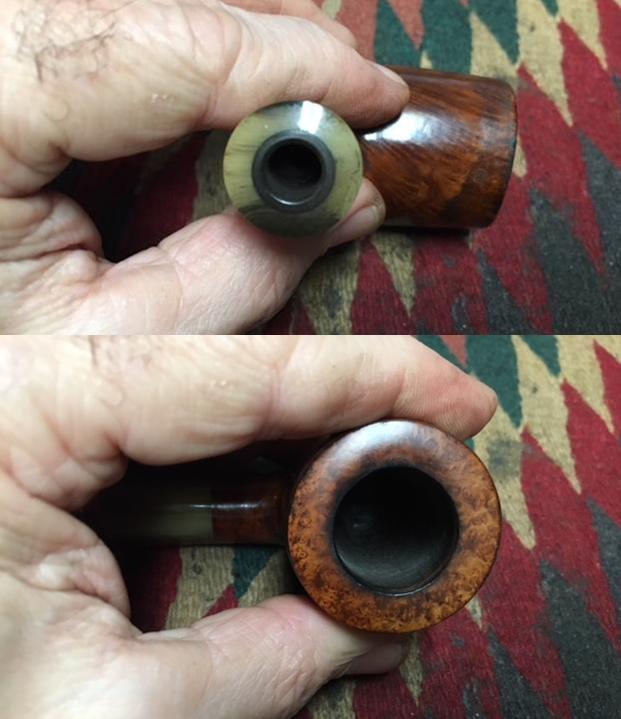
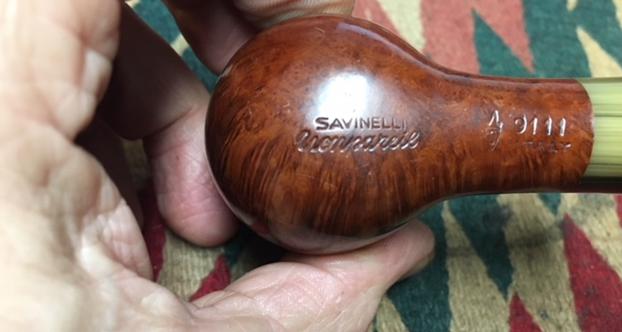
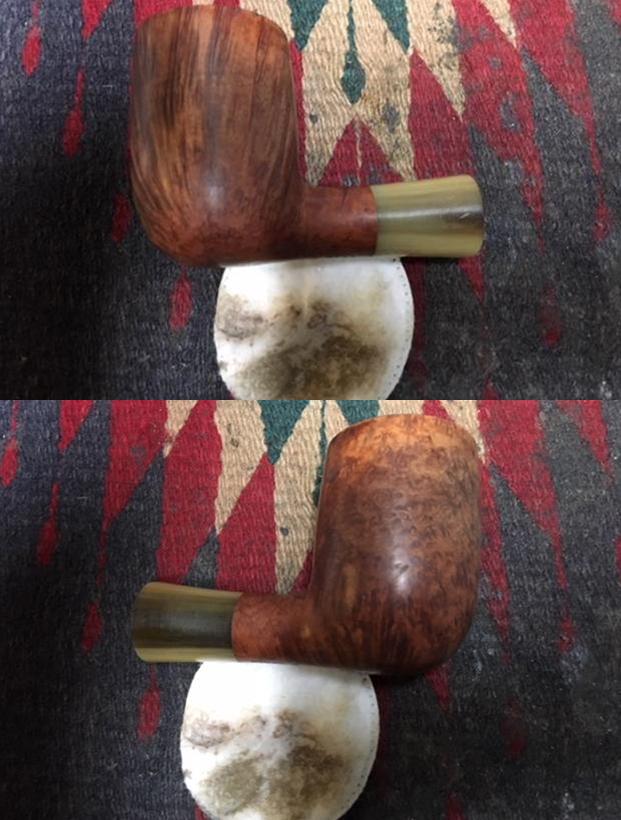
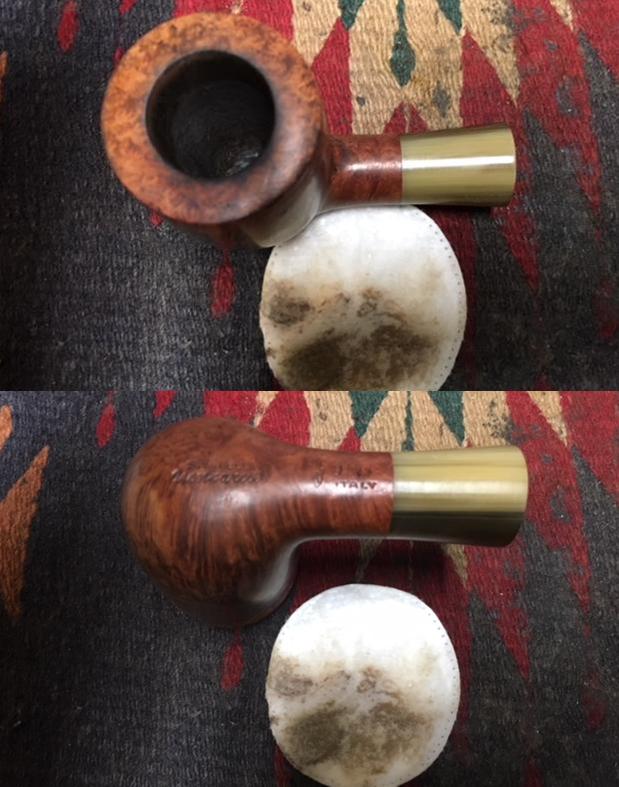
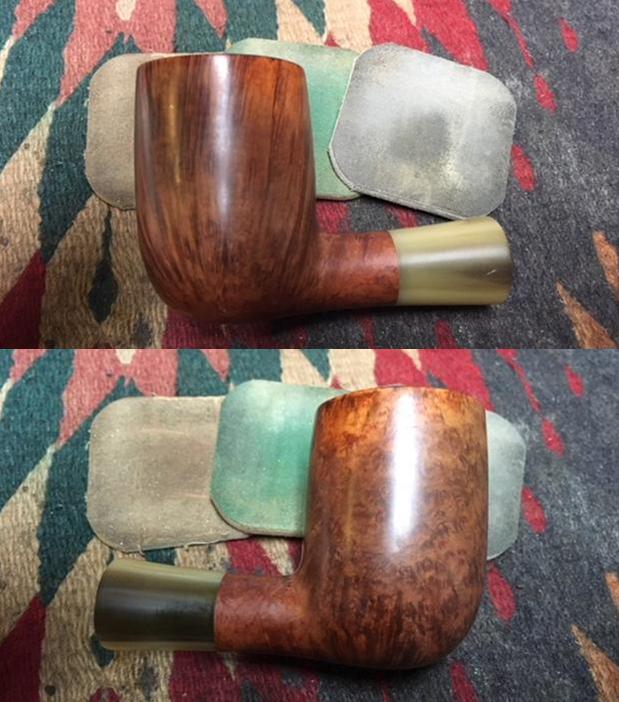
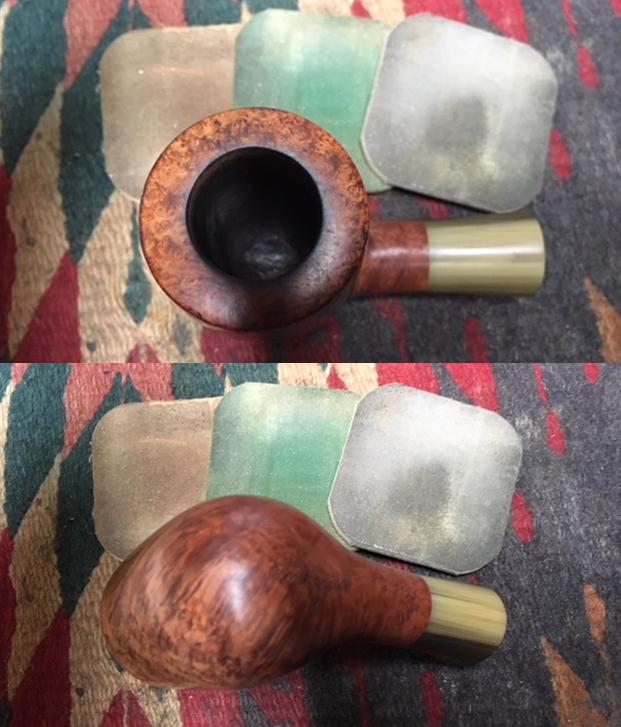
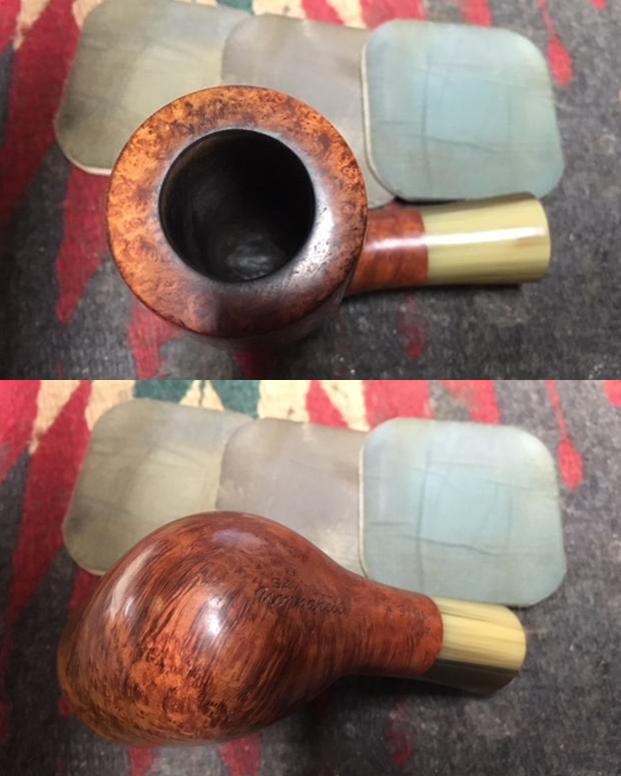
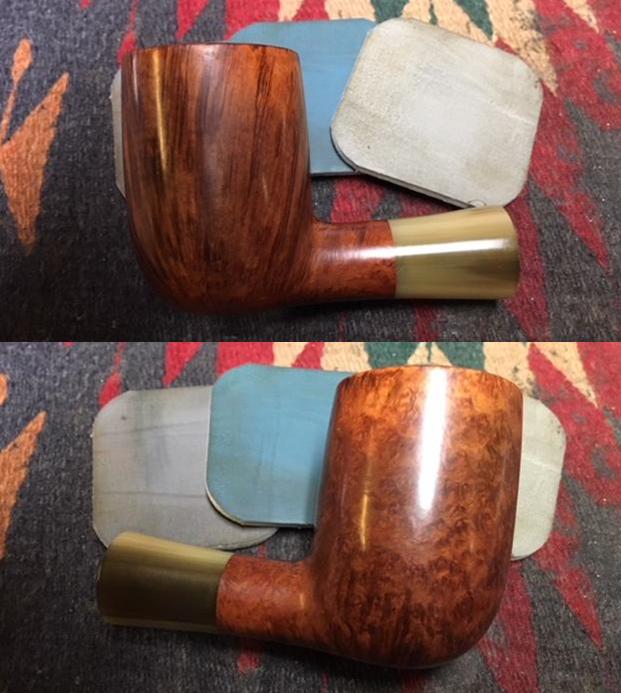
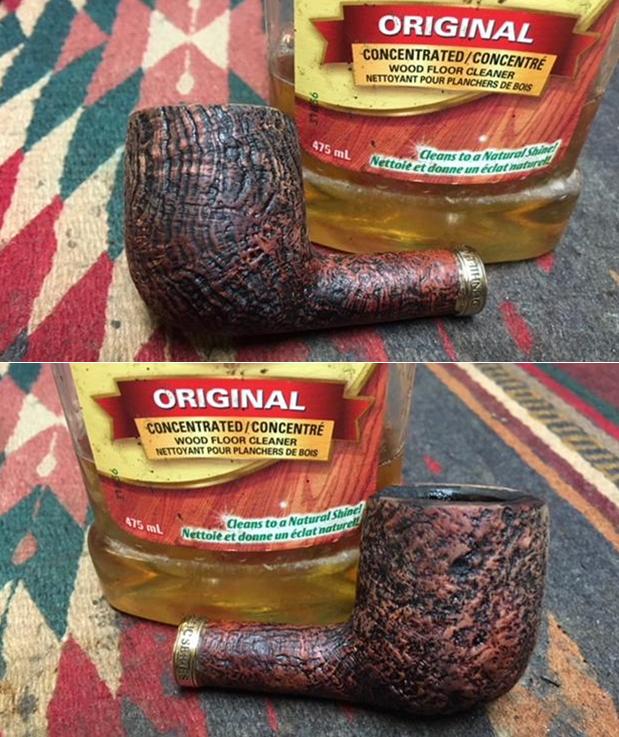
I received a private message on Facebook from Doug, a friend in the US about refurbishing the bowl on a pipe he just picked up. He would do the stem he said so there was no need for me to even worry about that so I sent him a message and the deal was done. The package arrived in Vancouver not long after that message exchange. When I opened the box there was a large beautiful briar pipe inside. It had amazing grain on it and a polished horn shank extension. The bowl had a very light cake in it and the rim had some darkening around the inner edge and a small nick on the back right side of the inner edge. The finish was dirty and there were some areas on the bowl just below the rim where there was some sticky substance and buildup. There was a small nick in the horn extension on the left side. The pipe was stamped on the underside of the bowl Savinelli over Nonpareil. Next to that was the Savinelli S shield logo and next to that it bore the shape number 9111 over Italy. In the Savinelli Grading Hierarchy the Nonpareil was just below the Giubileo d’Oro. It is thus one of the higher grade lines that Savinelli produces. The Nonpareil line has the shape number stamped using a 3 or a 4 digits shape code which is an exception to Savinelli’s routine 3 digits shape code. The 9111 is a beautiful shape in the line.

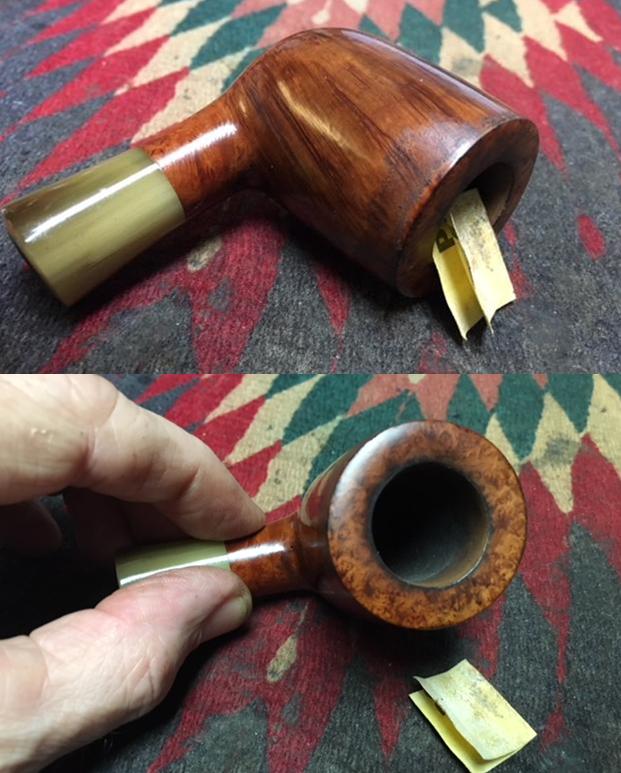
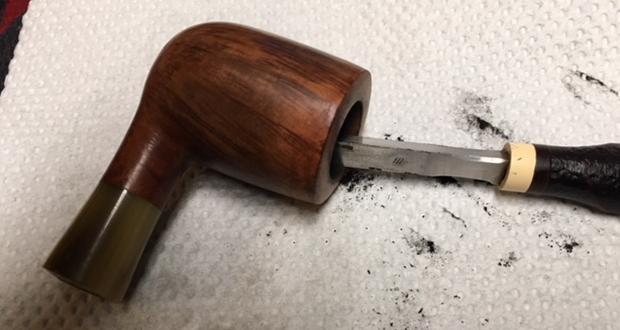
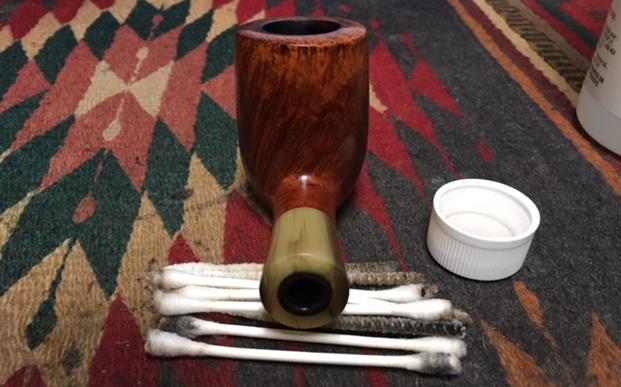
I took a close up photo of the shank end to show the darkened metal inset that runs the length of the horn extension. This added touch adds stability to the horn and seems to add protection that keeps it from splitting over time. The close up of the rim top shows the lightly caked bowl, the darkening on the inner edge of the rim and a small nick in the edge at about 7 o’clock in the photo. You can also see the sticky buildup on the backside of the bowl just below the rim in the first photo. The pipe really has some stunning grain under the grime on the surface. The final close up photo shows the stamping on the underside of the bowl and shank. I used a folded piece of 220 grit sandpaper to clean up the inside edge of the rim. I was able to minimize the nick on the rear right edge and also some of the darkening on the inner edge with the sandpaper. (Note the sticky substance on the side of the bowl just below the top of the rim. This extends all the way around the bowl.)I cleaned off all of the stickiness and grime with a cotton pad and alcohol. I figured it would remove the debris and help the grain to really show up. I carefully wiped off the horn with just a dampened cotton pad. Once I was finished I was rewarded with some beautiful grain and some deep shine on the horn extension. I cleaned up the thin cake in the bowl with a Savinelli Fitsall Pipe Knife and took out the ragged edges of the cake.With the bowl cleaned I cleaned out the internals – the mortise and the airway in the shank with pipe cleaners, cotton swabs and alcohol.I polished the briar and horn with micromesh sanding pads – wet sanding with 1500-2400 grit pads and dry sanding with 3200-12000 grit pads. I wiped the bowl down after each pad with a damp cotton pad to remove the sanding dust. I rubbed some Before & After Restoration Balm into the briar to lift out the dust in the grain, enliven and protect the bowl and horn shank. I let it sit for a little while then buffed it off with a soft cloth. I really like the way the grain stands out in some amazing contrast now. With the bowl cleaned and polished I buffed it with Blue Diamond to polish out any remaining scratches. I gave the bowl several coats of carnauba wax and buffed the pipe with a clean buffing pad to raise the shine. I hand buffed it with a microfiber cloth to deepen the shine. The briar polished up pretty nicely. The finished bowl is shown in the photos below. Next week I will box the pipe up and put it back in the mail to Doug. I look forward to hearing what he thinks one he has it in hand. I can’t wait to see the bowl with the stem polished and in place. I have to remember to have Doug send me a finished picture of the pipe once he reunites the bowl and stem. Thanks for walking through the refurb with me. I am really pleased with the way it turned out. It is truly a beautiful piece of briar.


Replacing the stem on a Der Unique Alternative Wood Pipe


Blog by Steve Laug

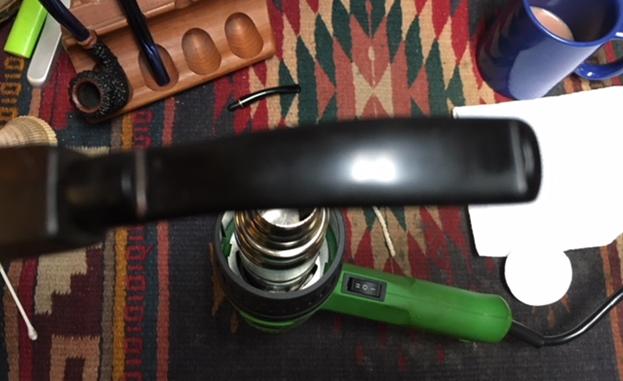
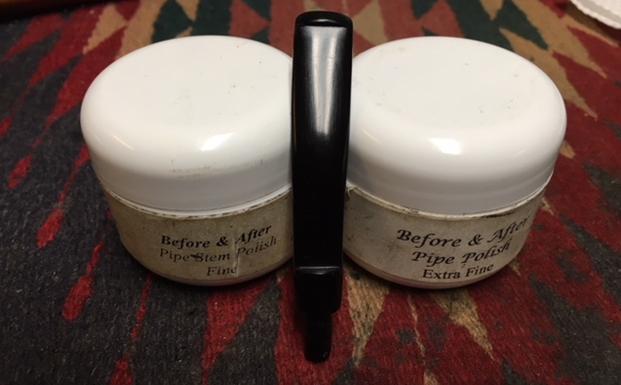
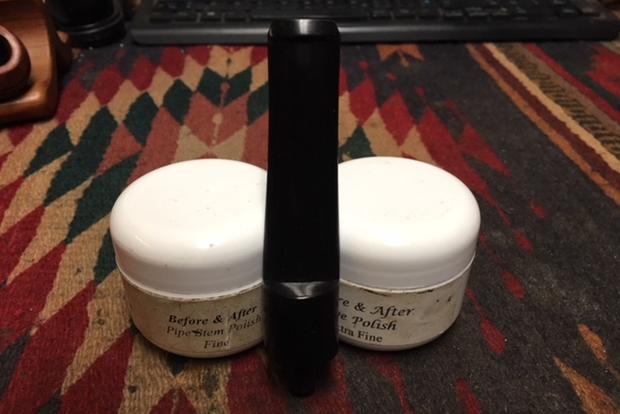
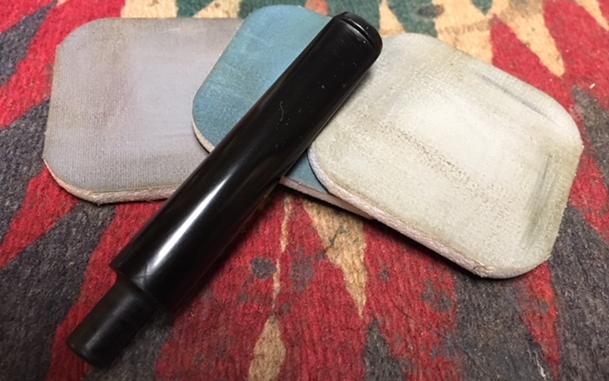
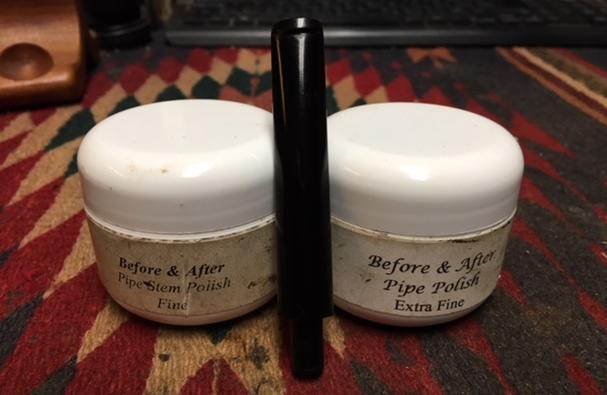
I have been corresponding with Paresh for some time now and have repaired and restored two of his pipes and sent him others as well. We carry on conversation via WhatsApp on the internet and discuss the various pipes he is purchasing as well as ones that he has inherited from his grandfather. This is the second pipe he sent me from India to work on. It took a long time to arrive. When it did it appeared as shown in the photos below. It was stamped with what looks like the word Der on the left side of the shank. There is no other stamping on the pipe. The mortise is lined with a brass tube. The wood is either fruitwood or some other hardwood. The stem is plastic and has a brass spacer on the end of the tenon. When Paresh was cleaning the pipe a pipe cleaner was stuck in the airway in the stem. The tenon was quite small and thin and had a slight bend in it. I heated it with a heat gun to soften the stem – nothing happened no how long I heated it. The stem was hard and immovable. I decided it had to go. It was hard and very small in diameter. To me it would have been very uncomfortable in the mouth. Paresh says the pipe smokes very well. I took a close up photos of the rim top and the stem. The bowl is quite small with a diameter of 5/8 inches. The airway is well drilled and comes out the bottom of the bowl. The plastic stem is shown in the second and third photos. It was in decent condition with little or no bite marks or chatter. The only thing wrong with it was the broken pipe cleaner in the airway of the stem.I went through my can of stems and found one with a tenon that was the right diameter and that would work sitting against the shank. It was a saddle stem so it was slightly different from the taper that had been there. It also had a flat blade portion of the stem and was wider than the original. It was more comfortable than the previous stem.I sanded the scratches and marks out of the surface of the stem. They were on the saddle portion and the blade. I used 220 grit sandpaper and worked over until the surface was smooth. The tenon still had scratches that needed to be worked out but the fit was very snug.I polished the stem with micromesh sanding pads. When sanding Lucite it is important to wash the pads repeatedly to remove the fine sanding dust that otherwise clogs the pads. I wet sanded it with 1500-2400 grit pads and wiped it down with Obsidian Oil. I used a heat gun to put the same bend in the stem as was in the original one. I dry sanded with 3200-12000 grit pads. I wiped the stem down after each pad with Obsidian Oil. I polished the stem with Before & After Pipe Stem Polish – Fine and Extra Fine to remove the tiny scratches in the surface of the rubber. I gave it a final coat of oil and set it aside to dry. I set the new stem aside and scrubbed the bowl with Before & After Restoration Balm to clean and enliven the wood. I rubbed it into the wood with my fingers and let is it sit for a few minutes. I wiped it off with a cloth and buffed it lightly with a shoe brush. With the new stem reshaped and polished I put it back on the pipe and buffed the bowl and stem with Blue Diamond to polish out any remaining scratches. I gave the bowl and the stem several coats of carnauba wax and buffed the pipe with a clean buffing pad to raise the shine. I hand buffed it with a microfiber cloth to deepen the shine. The pipe polished up pretty nicely. The finished pipe is shown in the photos below. This is the sixth pipe I have worked over for Paresh. Once I finish the last one of the pipes I will pack them up and send them to India. I look forward to hearing what he thinks once he has them in hand. Thanks for walking through the restoration of this alternative wood pipe. It was straight forward and simple but interesting nonetheless.


Repairing and Restoring an Aldo Velani Fumata Bulldog


Blog by Steve Laug

I have been corresponding with Paresh for some time now and have repaired and restored two of his pipes and sent him others as well. We carry on conversation via WhatsApp on the internet and discuss the various pipes he is purchasing as well as ones that he has inherited from his grandfather. This little Aldo Velani was one of the first pipes that he sent me from India to work on. It took a long time to arrive. When it did it appeared as shown in the photos below. It was stamped Aldo Velani on the left side of the shank and Fumata on the underside of the right of the shank. It also had Italy stamped on the underside of the left of the shank next to the shank/stem union. I am assuming that the Fumata referred to the black paint like finish on the cap and partway down the bowl and the shank. It was flaking off and really did not look good. Paresh had reamed the bowl and cleaned the rim and in doing so did a great job removing the flaking finish on the rim. The bowl was clean as were the internals of the shank. When he was working on the acrylic stem the entire upper portion of the button broke off leaving the button top missing. I took close up photos of the rim top and the stem to show the condition it was in when it arrived in Vancouver. You can see the rim is quite clean there are a few stubborn spots that will need to be worked on. You can also see the chipped portion missing from the button on the topside of the stem and the tooth marks in the underside of the button.The grain on the bowl was quite nice so I decided to remove the paint from the cap and the shank. I used acetone on a paper towel to work over the bowl. As you can see from the following photos the finish came off quite easily. There were some nicks and dents in the sides of the bowl and the twin rings around the cap were very dirty. I buffed the bowl once I had removed the finish to get a better idea of what I was working on and to see what the grain looked like at this point in the process. It really was a pretty little bulldog and with some sanding and polishing it would really look good. Personally I like the pipe better without the black rim cap. I sent pictures to Paresh on WhatsApp to show him the progress at this point and he also liked the new look of the bowl. I used the Dremel and sanding drum to cut off the damaged portion of the stem and give me solid material to work with to reshape and rebuild the button.I put the stem back on the bowl to have a look at what the pipe would be like now that the bowl was stripped and the stem was cut back. I sent the photos to Paresh on WhatsApp as a progress report. He liked the new look and said he could not wait to see what the stem looked like with the new button cut. I set the bowl aside and worked on the stem. I cut the new button in the surface of the acrylic stem with a needle file. I did not worry about shaping it yet, I was more interested in getting the sharp edge defined. I matched the two sides of the button so that both sides would be equal. I sanded the surface of the stem on both sides with 220 grit sandpaper to further define the edge of the button. Once the edge was defined I built up the top and bottom surface of the button. I used clear super glue to add more definition to the button. I checked out the inside of the shank and noticed that there was a build up of hardened tars and oils on the walls of the mortise. I scraped them out with a dental spatula. I was able to remove a lot of hardened tars with the spatula. Once the inside was scraped clean I scrubbed the mortise and airway in the shank with alcohol, cotton swabs and bristle and smooth pipe cleaners until they came out clean. I cleaned out the airway in the stem with bristle pipe cleaners to remove more of the oils on the inside of the airway. Once the inside of the stem was clean I build up the newly cut button with clear super glue. It would take a lot of thin layers to get it to the point that I would be happy with it but it was starting to look like a button. When the repair had hardened I cleaned up the edges and the stem with 220 grit sandpaper. I used needle files to funnel the slot in the end of the new button. The stem is definitely beginning to take shape at this point.I polished the stem with micromesh sanding pads. When sanding Lucite it is important to wash the pads repeatedly to remove the fine sanding dust that otherwise clogs the pads. I wet sanded it with 1500-2400 grit pads and dry sanded with 3200-12000 grit pads. I wiped the stem down after each pad with a damp cloth. The briar on the bowl has some nicks that are really character marks. I chose to leave them and not fill them in and sand them. To me they are parts of the story of the pipe. I decided to polish the briar and raise a shine. I wet sanded it with 1500-2400 grit micromesh sanding pads and dry sanded it with 3200-12000 grit pads. I wiped it down after each pad with a damp cloth to remove any sanding dust. The grain in the briar really began to stand out. I rubbed some Before & After Restoration Balm into the briar to lift out the dust in the grain, enliven and protect the newly stripped bowl. I let it sit for a little while then buffed it off with a soft cloth. I like the way the grain stands out now. I am not going to stain the pipe as I like the way it looks at this point. I will check with Paresh and see if he wants me to darken it at all, but to me it looks grand. With the stem reshaped and polished I put it back on the pipe and buffed the bowl and stem with Blue Diamond. I used a light touch on the stem to polish out any remaining scratches. I gave the bowl and the stem several coats of carnauba wax and buffed the pipe with a clean buffing pad to raise the shine. I hand buffed it with a microfiber cloth to deepen the shine. The pipe polished up pretty nicely. The finished pipe is shown in the photos below. This is the fifth pipe I have worked over for Paresh. Once I finish the other two pipes that he has in the queue I will pack them up and send them to India. I look forward to hearing what he thinks one he has them in hand. Thanks for walking through the restoration with me as this one provided a few different challenges to the restoration craft. Cheers.

Crafting a thin band for a cracked shank in a Tracy Mincer Large Billiard


Blog by Steve Laug

A good friend from New York, who I met over email and I have talked about all things pipes and tobaccos over the months. We have Skyped together and compared notes on our favourite pipes and tobaccos as well as the aging process in our lives. We have become pretty good friends sending tobaccos and pipes back and forth across the continent and chatting together regularly. A month or so ago he showed me one of his favourite old Tracy Mincer billiards. It was a beautiful pipe that only bore the Tracy Mincer stamp on the underside of the shank. He told me that he was cleaning it and removed the stem and heard that fearsome crack sound that pipemen have come to know as a shank cracking. Sure enough the shank cracked on his beautiful pipe. We spoke of options that were available for a repair. One of those was to insert a Delrin or stainless tube in the shank, reduce the tenon diameter and the repair would be complete. Another option would be to band the shank. He wanted me to have a go at the repair so he shipped it to me to work on. He did not want a band on the shank as he liked the original look of the pipe.

When the pipe arrived it was far larger than I imagined. It really was well rusticated and beautiful. The rim top, the rustication on the sides and shank as well as the smooth band around the shank/stem union really stood out against the rustication. The high quality vulcanite had some light tooth marks and a light oxidation in the surface. I removed the stem and measured the shank with a micrometer to see what I needed in terms of an insert tube. I opted for a stainless tube. I drilled it out and smoothed out the inside of the tube. It was ready to be inserted and set in the mortise. I set it aside and picked up the stem. That is when I realized that there was a problem. Airway in the tenon was drilled off centre to the top left. If that was not bad enough it was drilled at a bit of an angle. The combination of the off centre drilling and the angle of the airway meant that if I reduced the diameter of the tenon I would end up opening up the airway on the upper left side and essentially destroying the tenon. I thought about removing the tenon, drill the airway open and replacing it but that was problematic because of the angled drilling.

With the facts in hand I did a Skype call with New York and explained the issues and showed my friend the airway in the stem and tenon. I showed him the off centeredness and the angular drilling and told him that I would send the pipe back to him as he did not like metal bands. We spent some time talking about options – even leaving it as it was with the crack and just enjoying it while being careful. He said that he knew it was there and it would bother him. We went online and looked at some of the bands available – all of them were too large and covered too much of the shank. They just would not do on this particular pipe. At that point I had an idea – I could cut the band down so that it was a much thinner band and the profile would actually work well with the look of the pipe. We discussed the pros and cons of that solution and he gave the go ahead. I ordered a 20.5mm nickel band for the shank of his pipe. It was the largest band available and it was a close fit to the shank. It would need some work but it would look good I thought once it was completed.

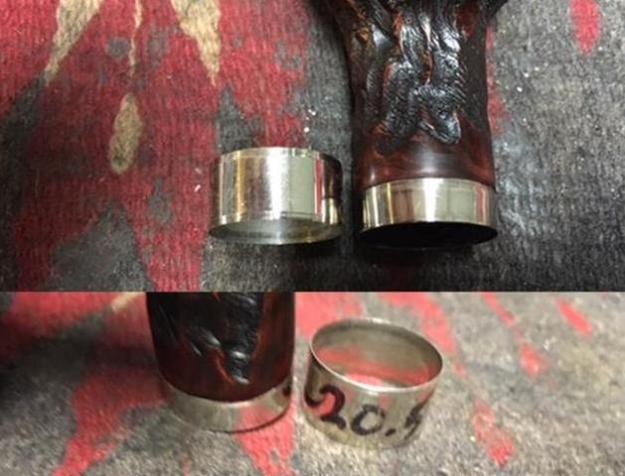
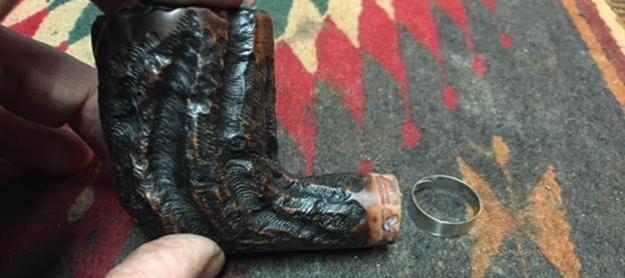
When the bands arrived I was so anxious to get started on the repair of the pipe that I forgot to take photos of the pipe. I sent a message to my friend and asked if he had any photos of the pipe before he sent it to me. He laughed and said he too forgot to follow his normal habit of taking a full set of photos before he mailed it. He did have one photo of the pipe that I could use. He sent it to me and I have included it below.I cleaned up the end of the shank and used a Dremel and sanding drum and a small flat needle file to cut a channel in the shank end for the band to rest in once it was in place. The diameter of the band was slightly smaller than the shank so this was necessary. I sanded the area smooth with 220 grit sandpaper to fit the band in place. I pressed the band on the shank and used a Dremel and sanding drum to remove over half of the depth of the band. I wanted it to be significantly thinner and cover less of the briar. When I got close to the right depth I used a topping board and 220 grit sandpaper to take it down even more. With the band on the shank I wanted the edge of the band and the shank end to be flush so that the stem sat firmly in place as it had before. The next two photos show an original 20.5mm band with the one that I cut down. You can see from the photo how high on the shank the band would have gone. The new band was less than half the size of the original band.Once the band was the right height I smoothed out the cut off edge to take away the sharpness of the metal. I rubbed some white all-purpose glue on the cracked area and on the freshly sanded area that the band would sit on and pressed the band onto the shank. I wiped off the excess glue that was squeezed out but the band with a damp cotton pad and took the following photos. I polished the area in front of the band where I has sanded it smooth using micromesh sanding pads – wet sanding with 1500-2400 grit pads and dry sanding with 3200-6000 grit pads. Once it was smooth I restained it by mixing a medium and a dark brown stain pen to match the colour of the rest of the pipe. The colour was good. I took photos of the pipe at this point before I buffed and polished it. I polished the nickel band and the restained shank with micromesh sanding pads. I dry sanded with 1500-12000 grit pads. I wiped it down with a damp cloth after each pad. I wiped it down after the final set of pads one more time. I buffed the bowl and shank with Blue Diamond on the buffing wheel to raise a shine and blend the stains together. There were some tooth marks and tooth chatter on both sides of the stem just ahead of the button. I sanded out the chatter in the vulcanite with 220 grit sandpaper. It did not take too much work to remove all of the marks. I polished the stem with micromesh sanding pads – wet sanding with 1500-2400 pads and dry sanding with 3200-12000 grit pads. I wiped the stem down after each sanding pad with Obsidian Oil. I polished it with Before & After Pipe Polish Fine and Extra Fine. I wiped it down a final time with the oil and put it aside to dry. With the stem polished I put it back on the pipe and lightly buffed the bowl with Blue Diamond being careful to not fill the grooves in the blast with the polishing compound. I used a regular touch on the stem to polish out any remaining scratches. The bowl had a good coat of wax when it arrived so I gave the stem several coats of carnauba wax and buffed the pipe with a clean buffing pad to raise the shine. I hand buffed it with a microfiber cloth to deepen the shine. The pipe polished up pretty nicely. The finished pipe is shown in the photos below. I will get it in the mail to my friend in New York on the weekend. I am looking forward to hearing what he thinks once he sees the finished pipe both on the blog and in hand. Thanks for walking through the banding process with me. This was a pipe that I really enjoyed working on. Cheers.

\\

ANSWERS TO QUESTIONS – What do I look for when buying estate pipes?


Blog by Steve Laug

I remember when my brother got bit by the pipe hunting bug and just about picked up every pipe he saw because they looked good, or were unique, or just because… I remember doing the same thing when I first started going through antique malls or rummage shops. I just purchased what I found because they were there. Jeff and I sat down and talk through what I looked for and how to sort through all the brands of pipes that are in the sales. We spoke of brands and my process for sorting through the options. I don’t remember how long we took but he wrote down the brand names that I look for and asked questions about the details of knowing what was workable and what was not. This for me was the part of the process that was not logical it was merely a matter of preference. I have a lot of pipes to work on so I have become very selective over the years as the bins and boxes have filled up.

Since we had talked about this it dawned on me that it might be helpful to walk those of you who are interested through my process. It is here for you to use if you want to. If you don’t want to, just skip this blog and carry on. You will eventually develop your own hunting regimen and methodology. This one is mine and it has worked for me for many years now.

When I look at estate pipes, whether online, on eBay or in person at an estate sale, auction or in my visits to antique shops and malls, I have an internal checklist that I work through. I used to have to think about it and methodically work my way through the process but no longer. It is now a part of the warp and weave of my thinking when I am in the pipe hunting mode. I had to step back and think through it again as I write this blog because I just automatically do it now. Here is my list.

  1. Who made that pipe – my first question is one of the ways I eliminate pipes from my purchase. I have become more selective, as I mentioned above, so I quickly move through the pipes in a display. After a while you learn to recognize shapes, markings, finishings etc. so it is pretty quick. If the pipe is a drugstore pipe (think Medico, corn cob), then I skip over it. If is an older one – Kaywoodie, KBB or KB&B, Yell-bole I will often put it aside or add it to my mental list. Personally I pass up many Medicos, Carey Magic Inch pipes, Grabows and Willards. I skip most is not all of the Imported Briar no name pipes and all no name Italian pipes that have flooded the inexpensive baskets by pipe store cash registers.
  2. What is the general condition of the pipe – Again this review is almost automatic. Last weekend my brother was in an antique mall in Montana and we Facetimed for a bit and he showed me pipes. It seems I can see cracks, nicks, holes, breaks, wrong stem and misfit stems with broken tenons without taking a lot of time. I look at the rim top and check for lava, damage to the inner and outer rim, burn marks and charred areas. I quickly eye-ball the finish and see if there is a heavy varnish coat of varathane coat. I typically do not take a pipe apart at this point. I am merely eliminating the ones that I am not interested in working on. The ones I want are now added to my growing pile to be examined more thoroughly.
  3. Let’s take it apart (if I am able) – This is the time for a closer inspection of the pipes in hand. I scrutinize them at all levels in this step. I look at the stamping to see if it is readable and/or damaged. I look at the stem to check if it is original and the markings match the shank stamp. I remove the stem if I am able without breaking the pipe and check out the internals. He I am examining the inside of the mortise, holding it up to the light to see if the shank is clogged. I look for broken inner tubes or stinger apparatuses in the shank or the stem. I check the shank end to see if there are any signs of cracks that don’t show up on the exterior of the shank. I look for burn marks internally in the mortise as I have seen burn through areas even there. I check out the inside of the bowl as much as I can and the outside looking for burn marks or checking or charring. I am not too worried about fissures in the bowl I am more concerned with the condition of the wood around them. Those that make this final cut are the ones I purchase the rest are left behind. I do not hesitate to walk away from these pipes. Even the chosen few can be left behind if the price cannot be agreed upon between the seller and me.

Often folks will assume that I will not buy damaged pipes – broken shanks, cracked shanks, stems that are chewed up, etc. That is not necessarily so. I assess what work will need to be done and if it will reduce the value of the pipe or if I am not in the mood to work on that kind of issue (yes there are times that I just don’t want to look at another cracked shank). If the pipe is repairable and will look good when fixed then it remains in my purchase pile. Oh, there is also another exception I tend to also scavenge pipes for parts – stems, bands even briar for other repairs so some of the pipes I purchase may be for my bone pile. I gather my purchases, pay my bill and add them to my restoration bins.

I thought it might also be helpful to some of you to have an idea of the brands I look for on my hunts. I know that this highly subjective (at least to some degree) but I think it illustrates a point in terms of how my head works when I am hunting. The brands that make up this list are not exhaustive as there are many that may have escaped my memory as I write this but you will catch the pattern. I have organized them by region in the list below.

  1. Danish or Scandinavian – these include Stanwell, Kriswill, Jarl, Nordings (I have found many of each of these brands on my hunts).
  2. English and Irish – Dunhill, BBB, GBD, GW Sims, Barlings, Comoy’s, Charatan, Lowes, Petersons and all of the sub brands and seconds of each of these (check out the Pipephil.eu site to figure out these).
  3. French and Belgian – Hilsons, GBD early pipes, Comoy’s, Butz Choquin, Chacom and some of the earlier St. Claude made pipes (again check the Pipephil.eu site).
  4. Italian – I have found that other than Savinellis the estate market on these is limited. I have picked up some nice Castellos, Brebbias, Acortis, Radicis, and even an occasional le Nuvole pipe. I leave behind some of the other brands such as Lorenzo or Lorenzetti as well as the no name basket pipes that bear the Italy stamp.
  5. North American – Tracy Mincer, Custombilt, Custom-Bilt, CPF, National, Manhattan, Linkmanns, older Yello-Boles, KB&B pipes, KBB pipes, Kaywoodies, SM Frank, some Wally Frank pipes, Canadian made Brighams, Trypsis, Calich, and even the occasional artisan pipe from both countries – such as Tinskys, von Ercks, Wests, Buraks and the list can go on.
  6. Meerschaums – Generally I am not a big fan of facial meerschaums. I like classic shapes, lattice meers and sometimes well executed faces. I probably pass over more meerschaum pipes than I purchase. If I take one I want the carving to be really well done. I really dislike poorly carved faces with poorly executed features.

I am sure that each of you who are reading this could add more to the list but this is a bare bones list that I work with. It is meant to be a starting point. Add your own brands to the list as I am sure I will as more come to mind. I think that summarizes my thoughts on the original question. As with most things in our hobby there are questions behind the questions. There are multiple levels of answers but at the same time it really boils down to what you individually want to do. It comes down to your aesthetic and your willingness to take the time to work on an estate pipe. What I find ugly and worthless may well turn your crank and be on your wish list. No problem with that because that is what makes this hobby the amazing thing it is. Hopefully you have found this blog helpful as you make your own choices. Thanks for humouring this old pipeman in his ramblings. Cheers.


Farida’s Dad’s Pipes #2 – Restoring a 1990 LBS Classic Series Dunhill Shell Billiard


Blog by Steve Laug

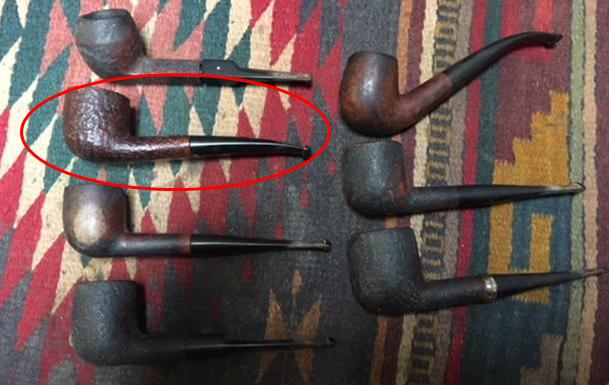
The next collection of pipes that I am working on comes from the estate of an elderly gentleman here in Vancouver. I met with his daughter Farida last summer and we looked at his pipes and talked about them then. Over the Christmas holiday she brought them by for me to work on, restore and then sell for her. There are 10 pipes in all – 7 Dunhills (one of them, a Shell Bulldog, has a burned out bowl), 2 Charatans, and a Savinelli Autograph. His pipes are worn and dirty and for some folks they have a lot of damage and wear that reduce their value. To me each one tells a story. I only wish they could speak and talk about the travels they have had with Farida’s Dad.

Dad in the Antarctic in 54/55.

In the midst of restoring this Classic Series Dunhill and thinking about its travels, Farida sent me an email with a short write up on her Dad. She remembered that I had asked her for it so that I could have a sense of the stories of her Dad’s pipes. Here is what she wrote: My dad, John Barber, loved his pipes. He was a huge fan of Dunhill and his favourite smoke was St. Bruno. No one ever complained of the smell of St. Bruno, we all loved it. I see the bowls and they’re large because he had big hands. When he was finished with his couple of puffs, he would grasp the bowl in the palm of his hand, holding the warmth as the embers faded. The rough bowled pipes were for daytime and especially if he was fixing something. The smooth bowled pipes were for an evening with a glass of brandy and a good movie. In his 20s, he was an adventurer travelling the world on ships as their radio operator. He spent a year in the Antarctic, a year in the Arctic and stopped in most ports in all the other continents. He immigrated to Canada in the mid-fifties, working on the BC Ferries earning money to pay for his education. He graduated from UBC as an engineer and spent the rest of his working life as a consultant, mostly to the mining companies. Whatever he was doing though, his pipe was always close by. 

Thanks Farida that explains a lot about their condition. If your Dad was rarely without a pipe I can certainly tell which pipes were his favourites. As I looked over the pipes I noted that each of them had extensive rim damage and some had deeply burned gouges in the rim tops. The bowls seemed to have been reamed not too long ago because they did not show the amount of cake I would have expected. The stems were all covered with deep tooth marks and chatter and were oxidized and dirty. The internals of the mortise, the airway in the shank and stem were filled with tars and oils. I took pictures of the Dunhill pipes in the collection. These were some nice looking pipes when her Dad bought them and they would be nice looking one more when I finished.

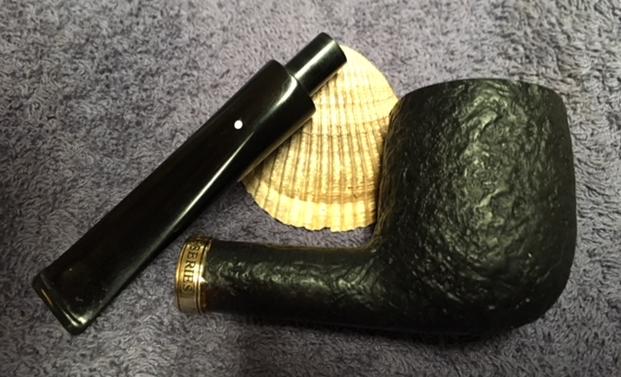
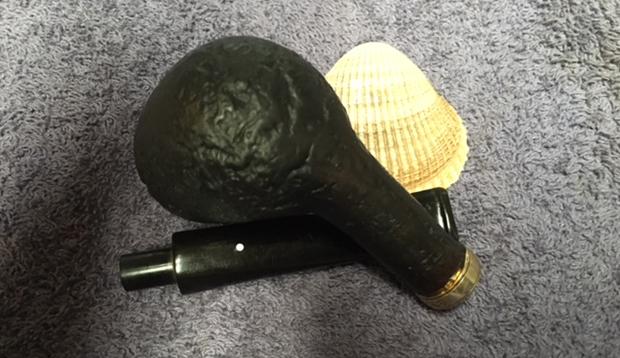
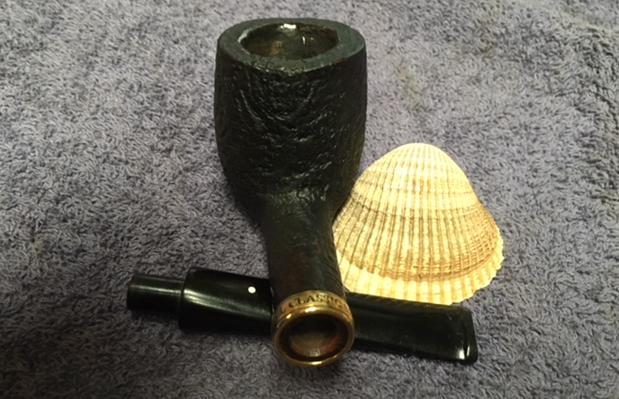
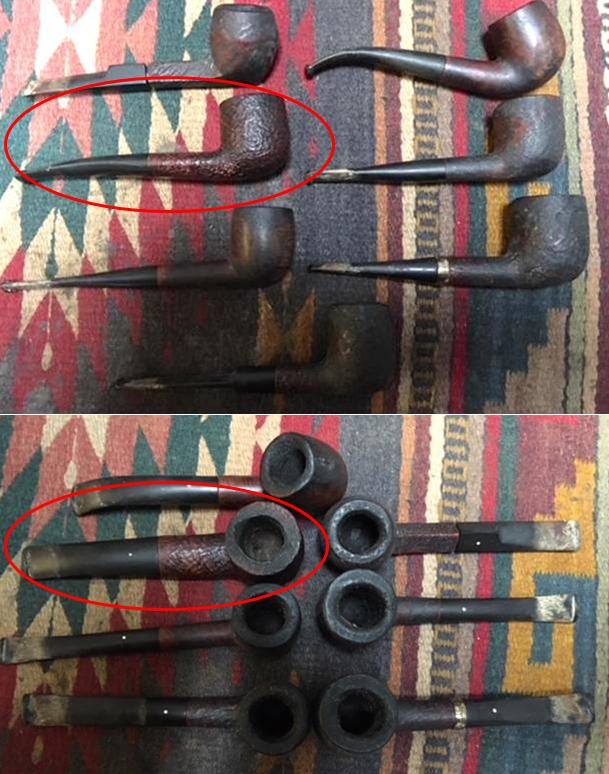
The second pipe that I am working on is a large Group 5 S Shell Billiard. I have circled in the above three photos in blue to identify it for you. It has a gold band that reads Dunhill Classic Series. It is good looking billiard. The Classic Series was produced by Dunhill in 199O as part of homage to their heritage and would make a great pipe for when you are out and about in the evening. When it was released it was a classic black Shell Briar in an equally classic shape, complete with a distinctive gold colored band. The pipe is stamped on the underside of the shank with the shape number LBS F/T. The first digit of the number is missing because of the sandblast, but it is a shape LBS and F/T for Fish Tail stem. Next to that it read Dunhill Shell over Made in England 30. There is a shape number after the Made in England stamping 997 (987?). Dating this pipe is a fairly easy proposition. You take the two digits following the D in England and add them to 1960. In this case it is 1960+30= 1980. (Pipephil’s site has a helpful dating tool for Dunhill pipes that I use regularly http://www.pipephil.eu/logos/en/dunhill/shell-briar1.html).

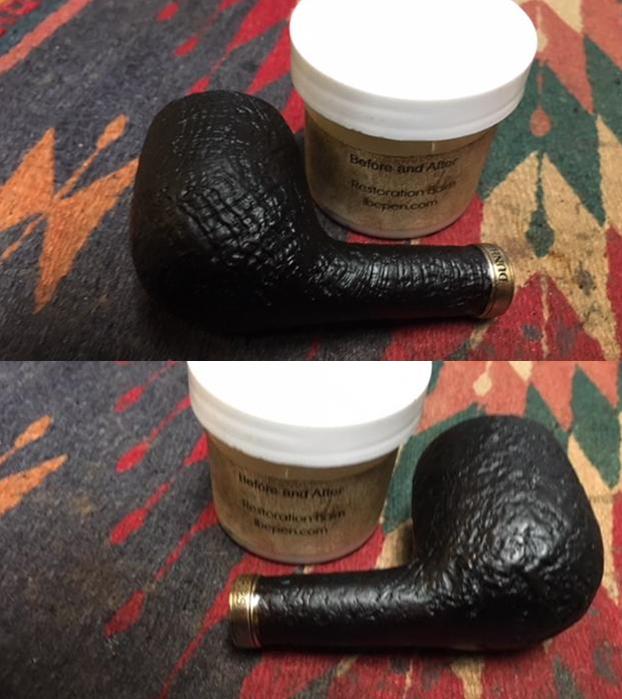
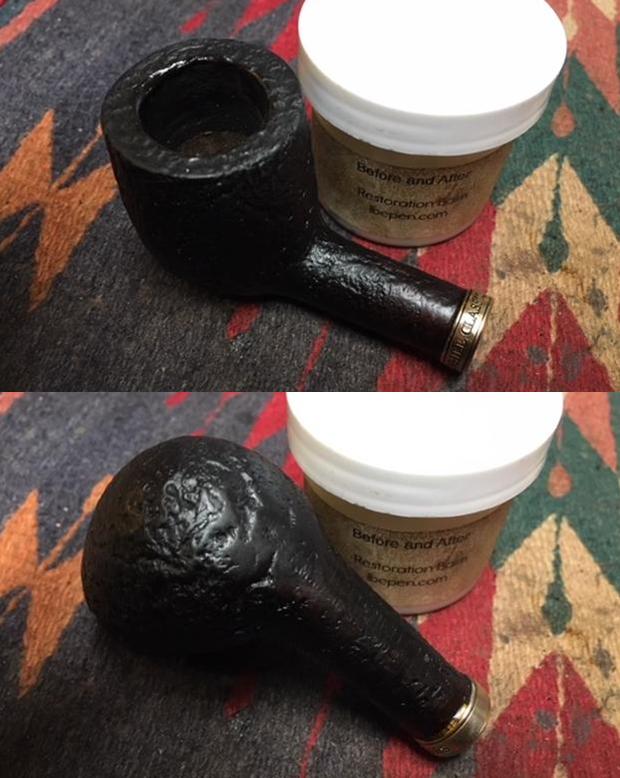
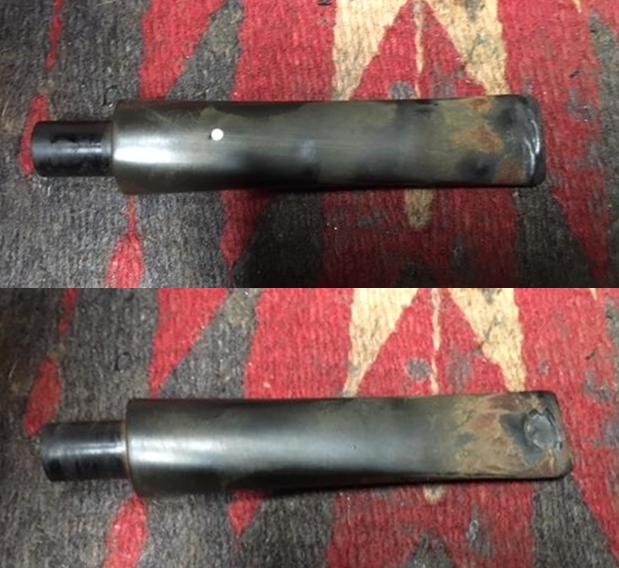
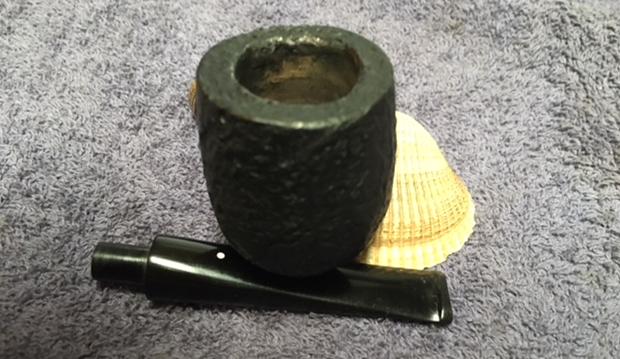
It was in pretty rough shape. The bowl was so dirty and caked with grime that it was very hard to tell what condition it was in. The finish was dull and caked with oils in all of the grooves and valleys of the sandblast. The top of the rim was rough and the inner edge was badly damaged. There were spots on the front of the rim top and at the rear that had deep burns into the briar just like the first pipe from this estate. The briar was burned to a point where I could pick it out with my fingernail. The shank was so dirty that the stem would not properly seat in the mortise. The stem was also a little rough – tooth marks on both sides near and in the button itself. The top side the button is quite thin and worn down. There is a deep tooth mark on the underside near the button and lots of chatter on both sides. It was oxidized and there was some calcification on the first inch of the stem. I took some photos of the pipe before I started to clean it up. I took close up photos of the rim top, the gold band and the stem. You can see from the photo the thick cake I the bowl overflowing lava onto the rim top. You can also see damage to the front, inner edge of the rim and the back left inner edge. There appears to be some serious gouges in those areas and also along the entire inner edge. The amount and extent of the damage will only be clear once the bowl is reamed and cleaned. The gold band on the shank says Dunhill Classic Series and it is in excellent condition. The stem has some deep bite marks on the top edge of the button and on the underside of the stem just ahead of the button. There is a lot of calcification and wear on the rest of the stem as well. I reamed the bowl with PipNet pipe reamer starting with the smallest cutting head and working my way up the third sized head. I took the cake back to bare briar. I used a Savinelli Fitsall Pipe Knife to finish up the reaming and also to clean up the damaged areas. They turned out to be burn damage so I scraped out the damaged briar until I got to a solid base. The bowl exterior was so encrusted in grime and oils that it was hard to see the sandblast finish. All of the grooves, nooks and crannies of the Shell finish were not visible due to the coating filling them in. I scrubbed the exterior of the pipe with a tooth brush and Murphy’s Oil Soap under warm running water to flush away the grime as the soap loosened it from the finish. I scrubbed until the finish was clean. The draw back in this case was that it removed the black Classic stain. The good news was that I could see some amazing grain in the sandblast. I knew that restaining it would not be an issue so it was good to see what was present. The damage to the rim top and inner edge is very visible in the third photo below. The heaviest damage is to the back edge of the rim top and it extends almost to the outer edge of the rim. I had several options to consider in repairing the damage. I could top the bowl and lose the rest of the nice blast on the rim top or I could repair and buildup the rim top with briar dust and super glue. To top it would require remove a lot of briar due to the depth of the damage on the back side. I decided to go with rebuilding the rim top and edges. I layered on clear super glue and briar dust with a dental spatula on both damaged areas until I had it built up even with the rest of the rim. I rebuilt the inner edge of the rim the same way keeping the super glue out of the bowl itself. You will notice in the three pictures that follow that I don’t worry too much about the dust in the bowl as I will sand it out once the repair is hardened. I scraped out the inside of the bowl with the edge of the spatula to knock off high spots along the inside edge. I sanded the bowl with a piece of 220 grit sandpaper to smooth out the inner edge and to sand down the walls of the bowl. I blew out the sanding dust through the shank. I also scraped the top of the rim with the edge of the spatula and knocked off high spots. The first three photos below show the repair rim top and edge. I put a dental burr in the Dremel and copied the sandblast pattern that was on the rest of the rim onto the repaired areas. I ran the Dremel at just below the 10 marker in terms of speed and carefully etched the surface of the briar. The fourth photo shows the rim top after I had used the Dremel on it. I used a brass bristle wire brush to clean up the surface of the rim and it was ready to stain. I put a cork in the bowl to hold on to and stained the entire pipe with a black aniline stain to bring it back to match the colour of the pipe in photos. I applied the stain with a dauber and flamed it. I repeated the process until the coverage was even all over the bowl. I set aside the bowl to let the stain dry overnight. In the morning I worked some Before & After Restoration Balm into the surface of the sandblast with my finger tips to deep clean the finish, enliven and protect the wood. I buffed the pipe with a horsehair shoe shine brush to get it into the grooves of the plateau. I let it sit for a few minutes and then buffed it with a cotton cloth. The pipe came alive and there was a rich shine to the briar. I took some photos of the bowl at this point to mark the progress in the restoration. With the bowl finished (except for buffing) I set it aside and worked on the stem. The stem was dirty and had some significant damage to the top side on the button and a large deep tooth mark on the underside. I cleaned up the damaged areas with alcohol and cotton pads. Once the areas were clean I built up the damaged areas on both sides of near the button with black super glue. I rebuilt the button on both sides as well. I set the stem aside to let the glue cure. Once the super glue patch had dried I sanded it with 220 grit sandpaper to smooth out the surface of the repairs. The topside of the button was far better than when I started. The tooth mark in the underside was filled in and smoothed out. More sanding and filling to do to cover the air bubbles but it was looking good.I decided to take a break from the sanding for a bit and cleaned out the stem and the shank. I cleaned out the airway and the slot in the stem and the mortise and airway in the shank with pipe cleaners, cotton swabs and alcohol. I worked them over until they were clean.I polished the stem with micromesh sanding pads – wet sanding with 1500-2400 grit pads and dry sanding with 3200-12000 grit pads. I wiped them down after each pad with Obsidian Oil after each pad. I polished it with Before & After Pipe Stem Polish – both fine and extra fine to take out some of the tiny scratches in the vulcanite. I finished by rubbing it down with a final coat of Obsidian Oil and set it aside to dry. With the stem polished I put it back on the pipe and lightly buffed the bowl with Blue Diamond being careful to not fill the grooves in the blast with the polishing compound. I used a regular touch on the stem to polish out any remaining scratches. I gave the bowl several coats of Conservator’s Wax and the stem several coats of carnauba wax and buffed the pipe with a clean buffing pad to raise the shine. I hand buffed it with a microfiber cloth to deepen the shine. The pipe polished up pretty nicely. The finished pipe is shown in the photos below. This is the second of six Dunhill pipes that I am restoring from Farida’s Dad’s collection. I am looking forward to hearing what Farida thinks once she sees the finished pipe on the blog. I will be posting it on the rebornpipes store as she wants to sell them for the estate. It should make a nice addition to a new pipeman’s rack that can carry on the trust from her father. The dimensions are; Length: 6 inches, Height: 2 inches, Outside diameter of the bowl: 1 ½ inches, Chamber diameter: 7/8 inches. Thanks for walking through the restoration with me it was a challenging and worthwhile pipe to work on. Cheers.
Restoring a 1983 Dunhill Shell 41009 Oval Shank Pot


Blog by Steve Laug

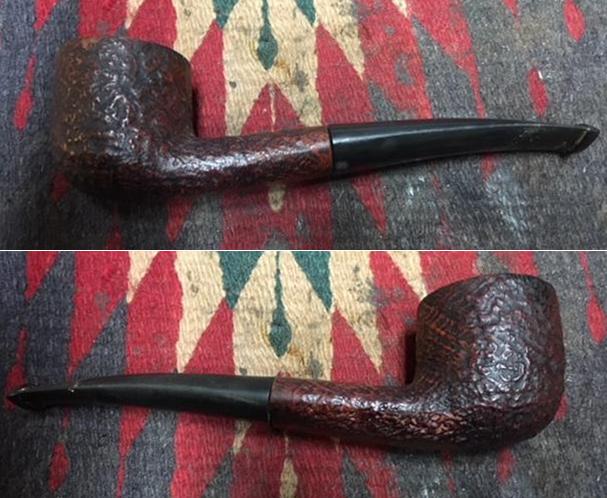
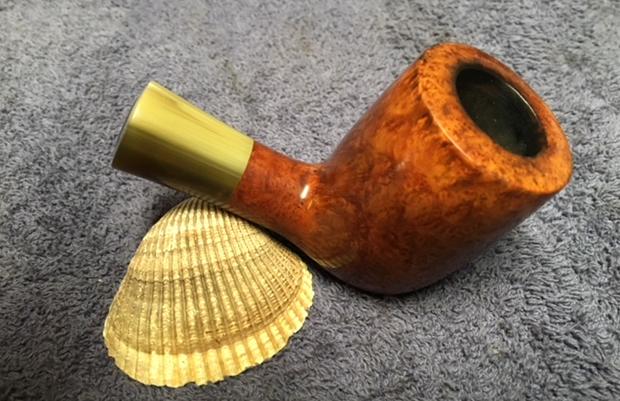
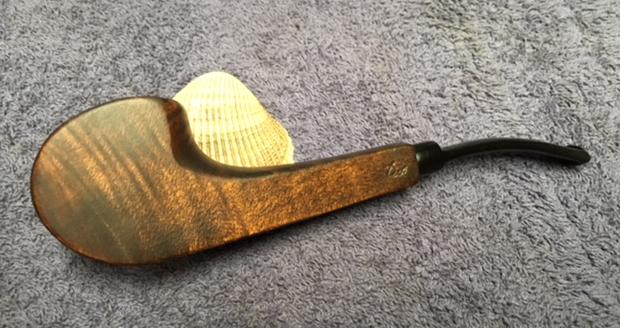
The next collection of pipes that I am working on comes from the estate of an elderly gentleman here in Vancouver. I met with his daughter Farida last summer and we looked at his pipes and talked about them then. Over the Christmas holiday she brought them by for me to work on, restore and then sell for her. There are 10 pipes in all – 7 Dunhills (one of them, a Shell Bulldog, has a burned out bowl), 2 Charatans, and a Savinelli Autograph.  He loved his pipes and she said that he was rarely seen without a pipe in his mouth. He traveled a lot and she remembers him having one of these pipes with him in the far north of Canada. His pipes are worn and dirty and for some they have a lot of damage and wear that reduce their value. To me each one tells a story. I only wish they could speak and talk about the travels they have had with Farida’s dad. Each of them has extensive rim damage and some have deeply burned gouges in the rim tops. The bowls were actually reamed not too long ago because they do not show the amount of cake I would have expected. The stems are all covered with deep tooth marks and chatter and are oxidized and dirty. The internals of the mortise, the airway in the shank and stem are filled with tars and oils. I took pictures of the Dunhill pipes in the collection. There are some nice looking pipes in the lot. The first pipe that I am working on is a Shell Oval Pot. I have circled in the above three photos in red to identify it for you. It is an interesting shape. The pipe is stamped on the underside of the shank with the shape number 41009 next to Dunhill Shell over Made in England 23. Dating this pipe is a fairly easy proposition. You take the two digits following the D in England and add them to 1960. In this case it is 1960+23= 1983. (Pipephil’s site has a helpful dating tool for Dunhill pipes that I use regularly http://www.pipephil.eu/logos/en/dunhill/shell-briar1.html). It was in pretty rough shape. The bowl itself looked good and the finish was in decent condition. The top of the rim was rough and the inner edge was badly damaged. There were spots on the front of the rim top and at the rear that had deep burns into the briar. The briar was burned to a point where I could pick it out with my fingernail. The shank was so dirty that the stem would not properly seat in the mortise. The stem was not too bad – tooth marks on the underside near the button and lots of chatter on both sides. It was lightly oxidized and there was some calcification on the first inch of the stem. I took some photos of the pipe before I started to clean it up. I took close up photos of the rim top, bowl and the stem to show the condition the pipe was in before I started my clean up. The first photo shows the damage on the top of the rim and particularly the inner edge of the bowl. You can see the damage on the front edge and the back edge of the bowl. There was some major burn damage on the inner edge of the bowl. The rim top also had some tars and lava on the surface that would need to be addressed before I could work on the burned areas. The surface of the bowl was dirty and grimy with dust and oils ground into the grooves of the sandblast. The photos show the light cake in the bowl and the dust and grime on the finish. The stem photos show the oxidation and the tooth chatter and tooth marks on the stem surface. You can also see that the stem does not seat in the shank well.I reamed the bowl with a PipNet pipe reamer to cut back the cake to bare briar. I finished cleaning up the remnants with a Savinelli Fitsall Pipe Knife. I used the knife to scrape away the soft briar from the burned areas of the rim top. I used a brass bristle wire brush to clean up the grooves in the good portion of the rim top. I also cleaned out the burned areas. I wiped out the burned areas with cotton swabs and alcohol to clean out the remaining dust and leave it clean. I built up both areas with briar dust and super glue. I used a dental spatula to apply the briar dust to the glue. I built it up in layers until it was level and the inner walls were round.I used a folded piece of 220 grit sandpaper to smooth out the inner edge of the bowl. I worked on it to round the edges. I used a Dremel and sanding drum to smooth out the hard spots of dried glue and dust. I used the brass bristle wire brush to clean out the grooves in the rustication on the rim top. With the rim top basically finished (other than rusticating it with a Dremel and burr) I worked on cleaning out the internals in the shank. I used a dental spatula to scrape out the hard tars and oils that had lined the walls in the mortise. I cleaned out the mortise and the airway in the shank with alcohol, pipe cleaners and cotton swabs until the shank was clean.I used a dental burr in my Dremel to rusticate the top of the rim. I wanted to match the repaired areas to the rest of the rim top. I slowly and carefully put divots in the surface to match the rest of the surface of the rim. I restained the rim with a dark brown aniline stain and a cotton swab to get the stain deep in the recesses of the repaired rim top.I rubbed Before & After Restoration Balm into the deep grooves and crevices of the sandblast on the rim and the rest of the bowl. I rubbed it until it was deep in the briar. It was amazing to see the grime and dirt on the cotton pad that I wiped it down with. The balm brought life and a rich glow to the briar. I rubbed the bowl down with Conservator’s Wax and buffed the pipe with a shoe brush. I took it to the buffer and buffed it with a clean buffing pad to raise the shine. I hand buffed it with a clean microfiber cloth to deepen the shine. The photos below show the repaired and restored bowl. It has come a long way from the damaged pipe I started with when I began. I laid the bowl aside and turned my attention to the stem. I cleaned the surface with alcohol and a cotton pad and cleaned out the airway with alcohol, cotton swabs and pipe cleaners. I scrubbed until the cleaners came out white. I sanded the stem with 220 grit sandpaper to smooth out the tooth chatter and remove the tooth marks. Fortunately they were not too deep so they came out with a little elbow grease.I polished the stem with micromesh sanding pads – wet sanding with 1500-2400 grit pads and dry sanding with 3200-12000 grit pads. I wiped them down after each pad with Obsidian Oil after each pad. I polished it with Before & After Pipe Stem Polish – both fine and extra fine to take out some of the tiny scratches in the vulcanite. I finished by rubbing it down with a final coat of Obsidian Oil and set it aside to dry. With the stem polished I put it back on the pipe and lightly buffed the bowl with Blue Diamond being careful to not fill the grooves in the blast with the polishing compound. I used a regular touch on the stem to polish out any remaining scratches. I gave the bowl several coats of Conservator’s Wax and the stem several coats of carnauba wax and buffed the pipe with a clean buffing pad to raise the shine. I hand buffed it with a microfiber cloth to deepen the shine. The pipe polished up pretty nicely. The finished pipe is shown in the photos below. This is the first of six Dunhill pipes that I am restoring from Farida’s dad’s collection. I am looking forward to hearing what Farida thinks once she sees the finished pipe on the blog. I will be posting it on the rebornpipes store as she wants to sell them for the estate. It should make a nice addition to a new pipeman’s rack that can carry on the trust from her father. The dimensions are; Length: 6 inches, Height: 1 ¾ inches, Outside diameter of the bowl: 1 ½ inches, Chamber diameter: 7/8 inches. Thanks for walking through the restoration with me it was a fun pipe to work on. Cheers.

Reworking and Restemming What Looked Like a Lost Cause


Blog by Ryan Thibodeau

I have been following Ryan’s work on FaceBook’s Tobacco Pipe Restorers Group and have been impressed with his work. When he posted the work on this old Canadian stummel with a lot of issues I wrote and asked if he would be willing to post it on rebornpipes. He said sure and sent me the following write up. I am happy to welcome Ryan to the pages of the blog. It is a pleasure to have you here. Without further ado I will let Ryan introduce himself to you all. — Steve

My name is Ryan Thibodeau, I live in the Hamilton Ontario region I stumbled upon this hobby by accident. When my Father learned of my new hobby, he gave me his 1959 Dunhill shell briar pipes. They hadn’t been smoked in 38 years and needed some TLC. I had them restored and they were the first two pipes in my rack.

From there I joined various Facebook Groups and happened upon Steve’s blog “Reborn Pipes”, I was inspired immediately. Since that time I’ve been collecting tired worn out pipes and testing my ability to return them to a condition that I would be proud of. It is a wonderful hobby, that doesn’t require a lot of space to do.

Every pipe has a story! Usually the smoker who owned it, and their story, is more interesting than the pipe itself.

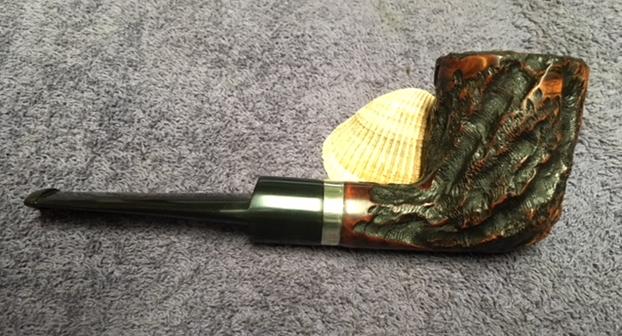
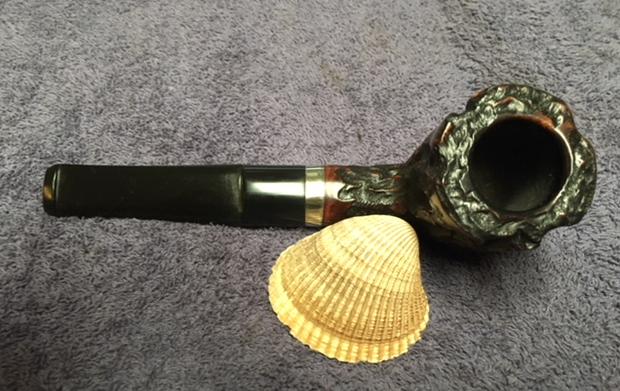
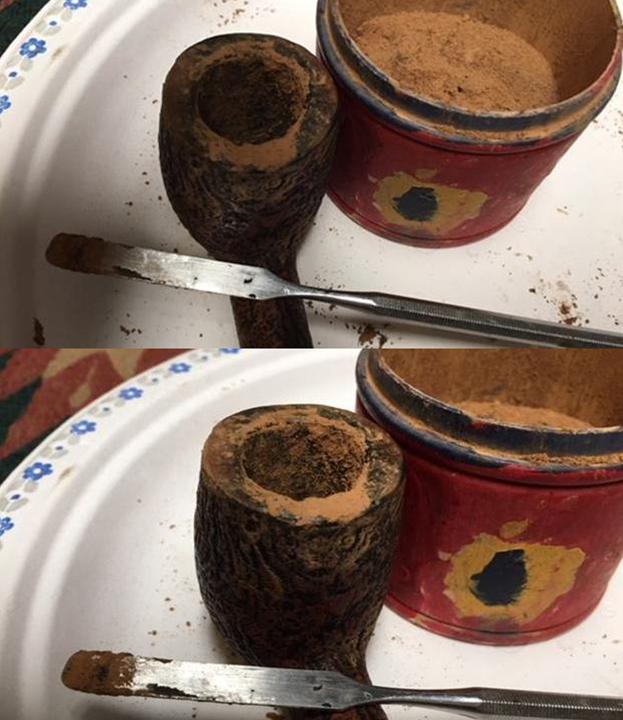
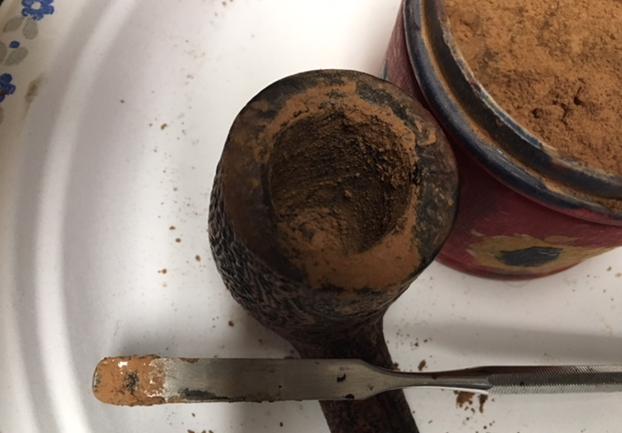
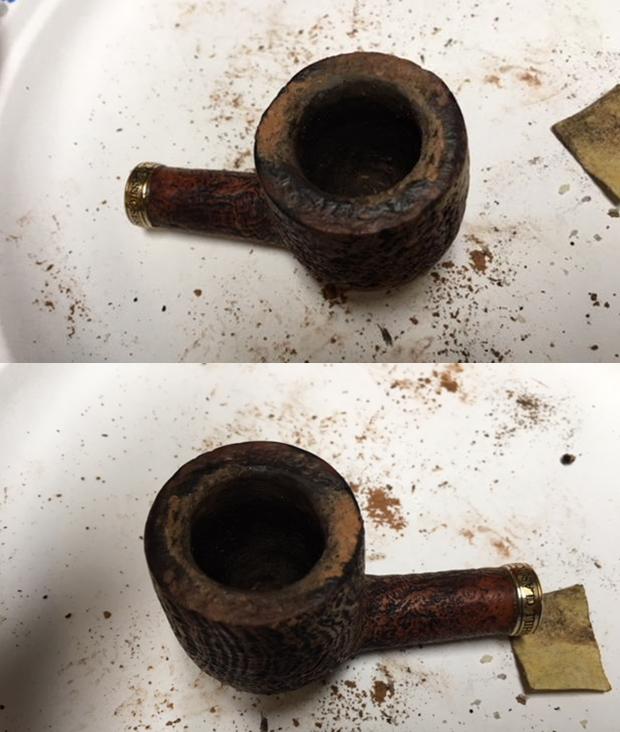
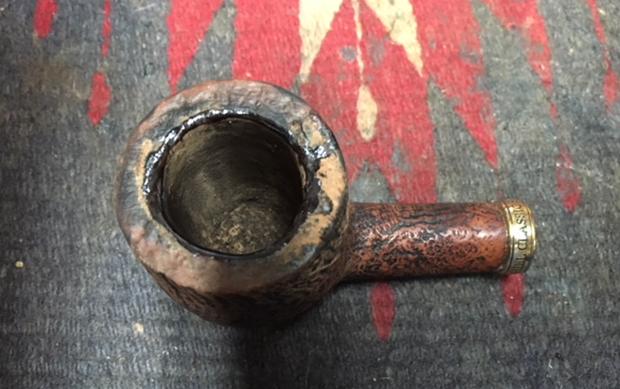
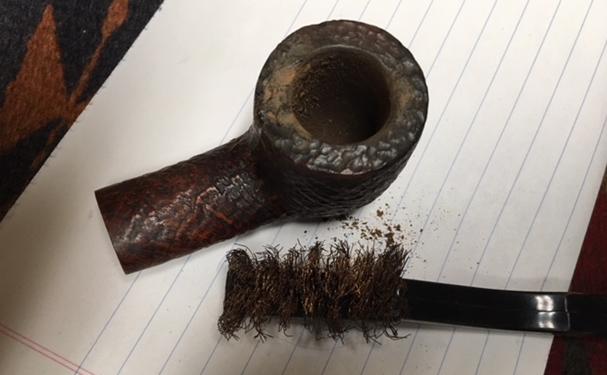
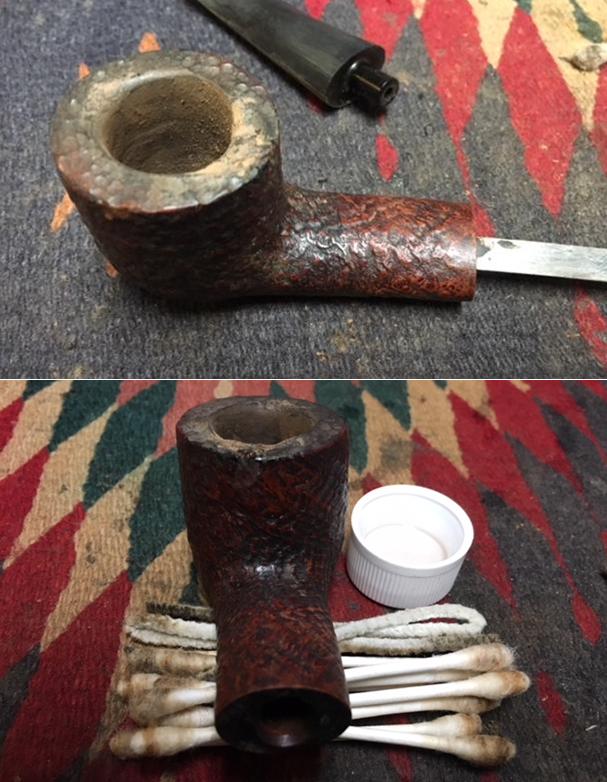
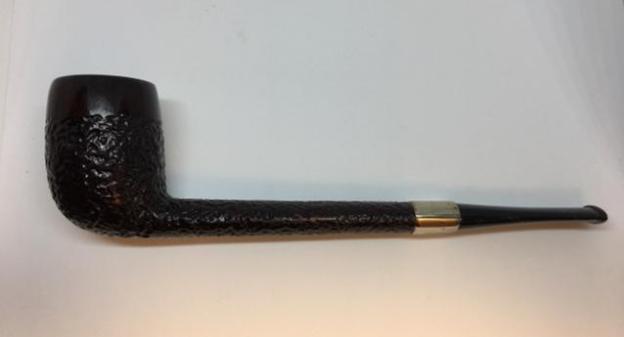
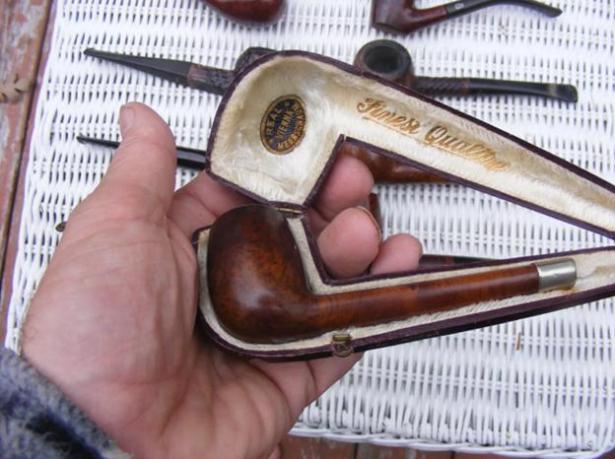
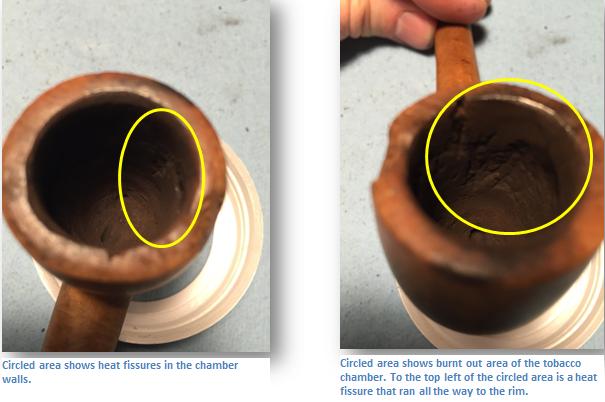
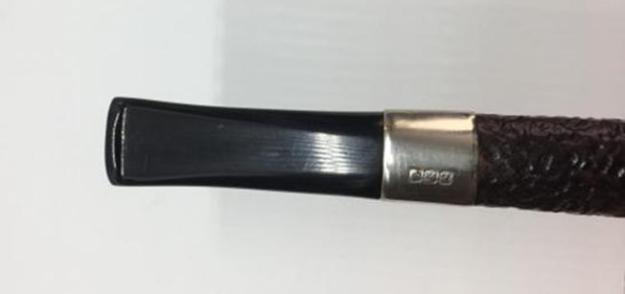
I purchased this pipe in a lot of 12. There were only one or two pipes in the lot that I really wanted and the price was right, so I wasn’t heartbroken if the rest came to rest in the bottom of my box of pipes. One of them came in a case that was meant for a meerschaum, and it looked decent when in the picture, but further investigation revealed a lot of issues that would need to be repaired. I started by removing the silver band, which came off without any effort and used Heirloom Stripper to remove all the dirt, grime, old finish and lift some of the stain. This allowed me to get a real good look at the damage to this pipe. Next I used my Castleford reamer to remove all the cake out of the bowl. There was very little cake lining the bowl, however; once I removed the cake I found that walls of the tobacco chamber were severely charred. I suspect this pipe was smoked very hot and the briar was charred to charcoal. I wanted to see how much of the chamber was damaged ( I prefer to ream my bowls right back to fresh briar. This way I can see if there are any heat fissures or major issues that would make a restoration go sour after the first smoke)

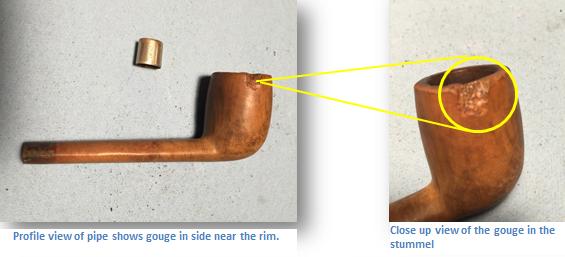
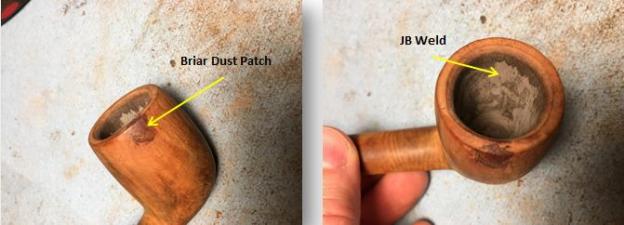
I removed the charred wood. The reamers will shave away the charred wood, once you feel the resistance of the blades rubbing the fresh briar you know you’ve removed the charring.I used a combination of Briar dust and CA Glue to create a patch for the gouge on the side of the bowl. Using a flat file, I filed the patch down to the profile of the pipe. Afterwards I topped the bowl to level out the rim and the patch. The bowl was also over reamed by its previous owner so I added a bevel to the inside of the bowl at the rim to blend everything in.

There was a lot of filing and sanding through this process to get it just right. Unfortunately I get hyper focused during this process and forgot to take step-by-step pictures.

The grey patches you see inside the bowl is a product called JB Weld. I mixed up a batch and filled the problem areas in the chamber, afterwards I sanded it down to blend with the rest of the chamber. In my experience the product is completely inert once cured. It is handy for a reconstruction of this kind, but I’d recommend adding a bowl coating as an added barrier.This pipe came to me without a stem. Fortunately I had a stem that would be the perfect length, I just needed to shape the tenon to fit the pipe. For this I used the Pimo Tenon cutter from Vermont Freehand.

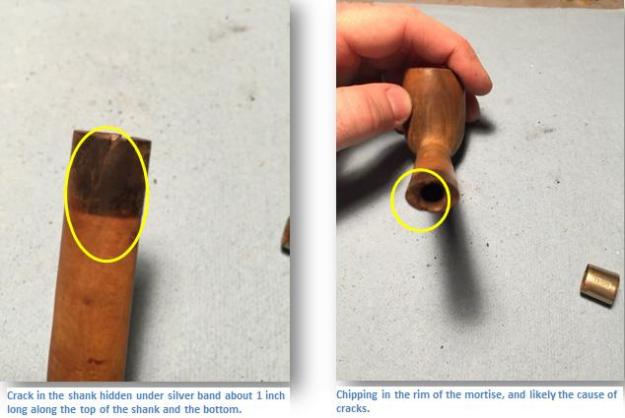
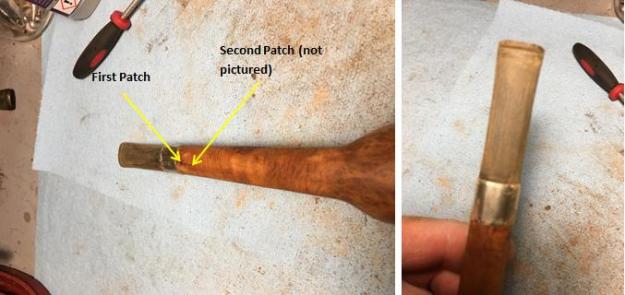
I also used the opportunity while I was at this end of the pipe to drill a hole ahead of the crack in the shank and filled used briar dust and CA Glue. As sometimes happens with restorations, I thought I stopped the crack from spreading, well I was wrong and it continued from the patch further up the shank about ¼ of an inch. So I drilled another hole and patched it again. This time I seemed to have everything under control.

The stem was quite simple to shape to the profile of the pipe and was a welcome change from the frustrations of the other repairs that didn’t go according to plan.

Once I had all the parts and repairs completed. I sanded the entire pipe and stem with 320 grit sandpaper up to 8000 grit (1500-8000 with micro mesh pads) Rustication

At this point I had to consider how I was going to finish this pipe. Originally this was a smooth finish Canadian Billiard, but those days were long behind this tired old pipe. I originally thought of using a really dark stain to hide all the imperfections, polish it and call it a day, then I thought I’d take a risk and create something new, and breath new life into this pipe. For all the effort I put into this pipe up to this point I figured I’d let my creativity flow.

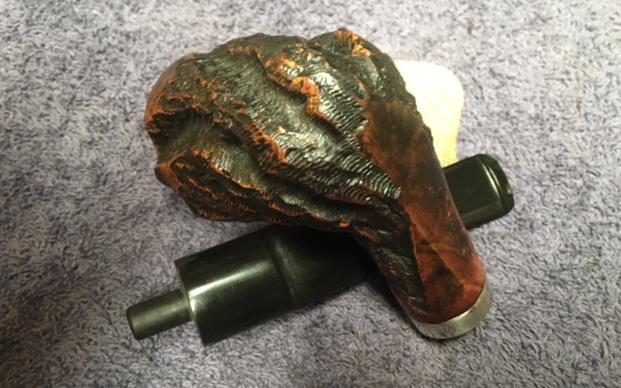
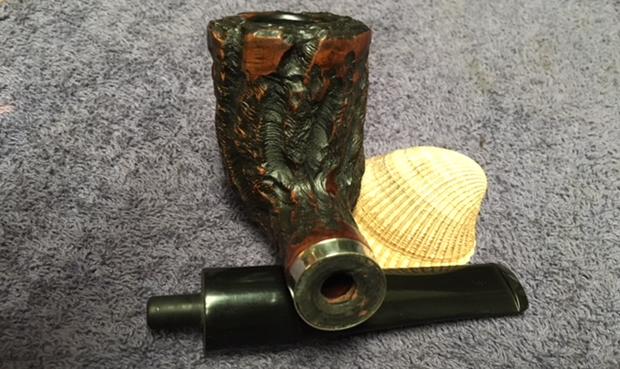
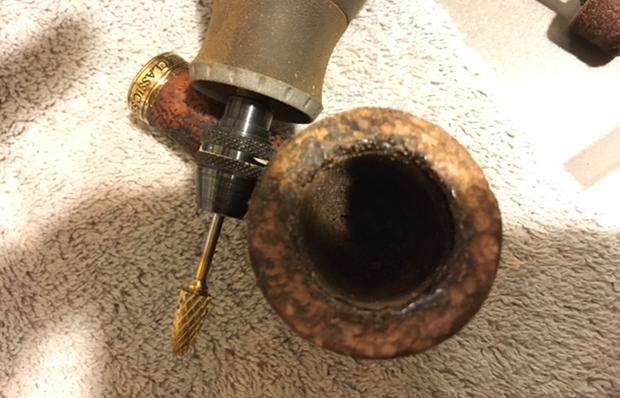
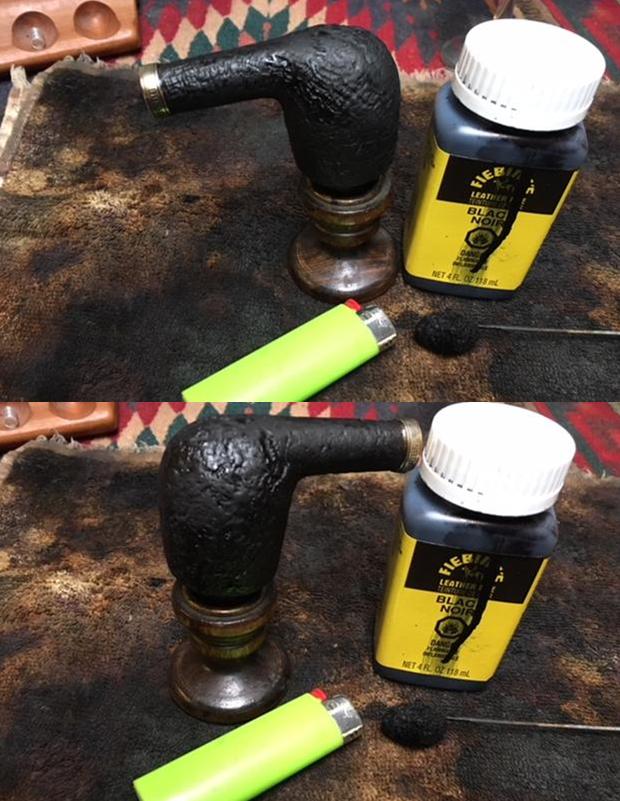
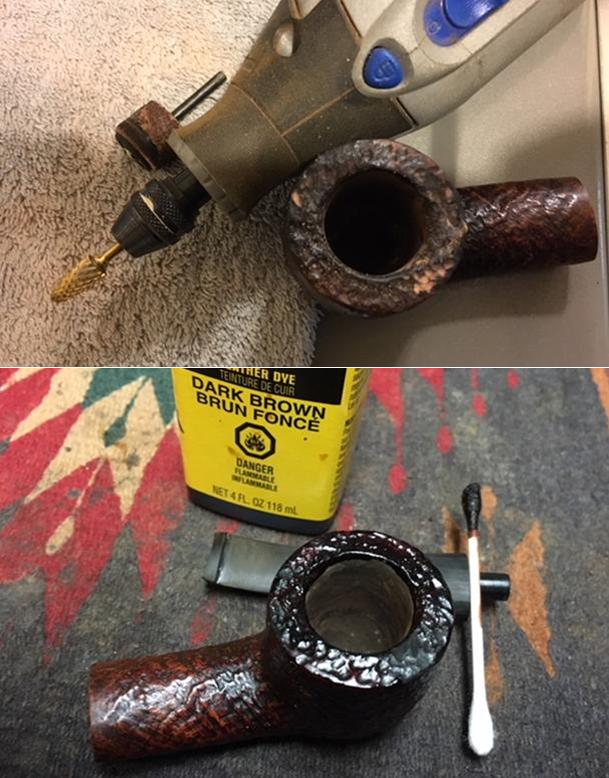
I decided that I would rusticate this pipe and leave a smooth patch somewhere, where I hadn’t determined yet. Using a Dremel and a 107 Carving bit I started to rusticate the shank and worked my way to the heel, then up the stummel. Halfway up the stummel the pipe revealed its final design-leave the top of the bowl smooth! I wasn’t sure at first because it would mean I had to blend in that CA patch, but I now avoided trying to rusticate it.

I was very pleased with the result.

Staining & Finishing

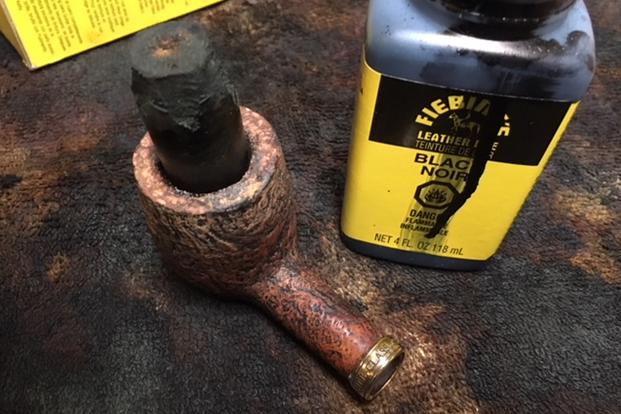
I used Fiebings Dark Brown alcohol based dye over the entire pipe as a base, then wiped on Fiebings Oxblood till I achieved the colour I wanted. To seal the stain in the pipe I applied a thin layer of shellac which gave it a glossy look I didn’t like. I left it, and just stayed the course with this experiment to see how it turned out.

In the morning the Shellac had cured. I began the polishing process at this point. I don’t have a buffing wheel yet, so I use cotton wheel buffing bits that fit to my dremel.

I started with Tripoli and thoroughly went over the entire pipe and stem. The tripoli did a good job of taking down the shellac, and making it less pronounced. I followed that up with white diamond and then finally carnauba wax.  I used a fluffy felt bit to polish the whole pipe.

Bowl Coating

You will find a variety of recipes and opinions on bowl coatings. I use them when needed and I prefer the waterglass recipe that a pipe maker shared with me. It is a combination of Sodium Silicate, Activated Charcoal and White Pumice. Once cured it provides a refractory layer on the inside of the bowl, and it feels like 800 grit sandpaper which promotes new cake build up without putting a lot of heat stress on the worn out briar.

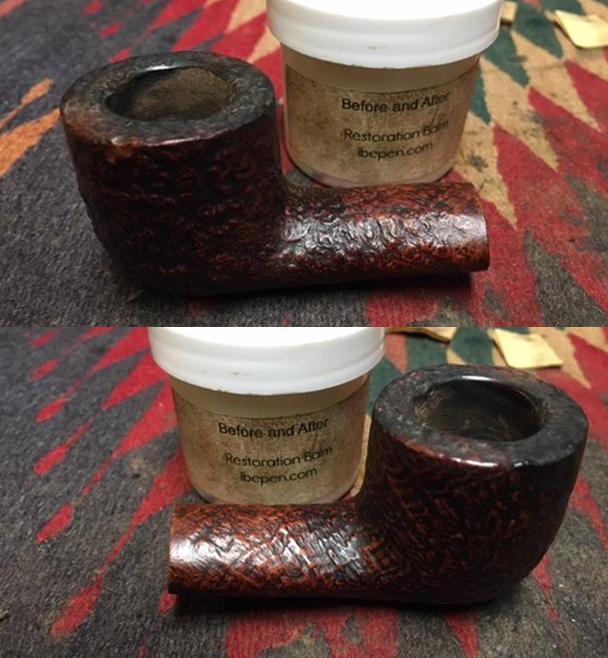
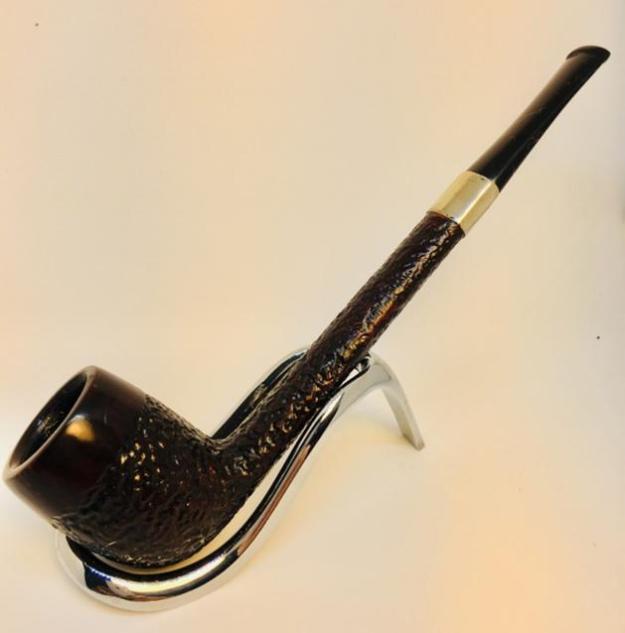
This pipe definitely tested the limits of my abilities  and I learned some new techniques that I had only seen others use. Here’s the finished pipe!


Craig’s Pipes #5 Restoring a William Demuth and Company (WDC) Campaign Calabash


Blog by Steve Laug

In my previous 4 blogs on Craig’s pipes I spoke of the five pipes that I am working on for him. In this blog I am taking on the fifth of his pipes – a WDC Campaign Calabash. It was another one with a cake in the bowl that was thick and hard. For the last time I am going to include what Craig wrote me about his pipes. I have included it in the previous four blogs but I think it adds context to the bunch.

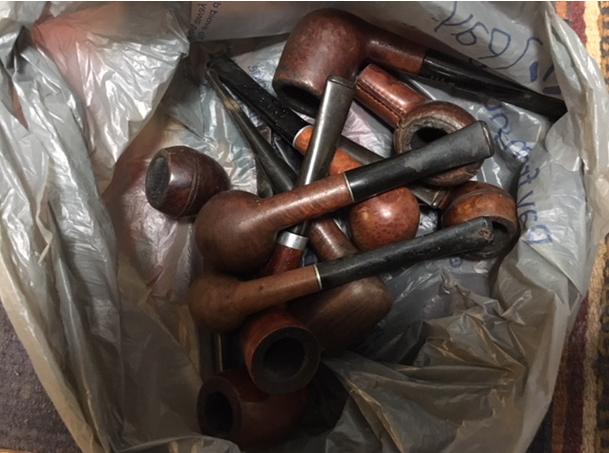
I was recently given a bag of pipes…literally, a BAG of 20 or so pipes that are 50+yrs in age and VERY used. I was wondering if you would have time to either Skype or FaceTime with me, and go through what I have in order to determine which are worth sending to you to have them refurbished. If you would be so kind, I’d really appreciate it.

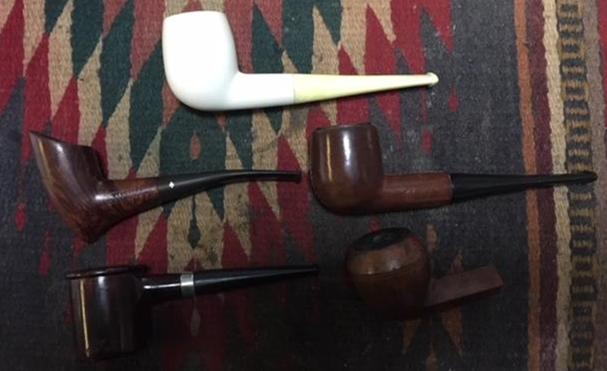
We met on FaceTime and he pulled out a grocery bag with no rhyme or reason to it. It was filled with a jumble of no name or low-end drug store pipes. This last pipe is one of the two pipes that stood out for me – the old WDC Campaign pipe and a Grabow Starfire. He had several others that he liked. But we excluded all but five of the pipes. The amount of work necessary to bring them back was not worth the price. These are the five that we chose to work on. I have included the links to the blog covering each pipe. I am finally addressing the last one.

– A No Name Meerschaum that looked interesting – https://rebornpipes.com/2018/01/31/is-it-a-meerschaum-looks-like-one-feels-like-one-but/

– A leather clad billiard marked R20 and bearing a shield – https://rebornpipes.com/2018/02/01/rejuvenating-a-leather-clad-billiard/

– A Wally Frank Bulldog marked Natural Unvarnished lacking a stem https://rebornpipes.com/2018/02/02/craigs-pipes-3-restemming-and-restoring-a-wally-frank-natural-bulldog

– A Dr. Grabow Starfire 39 that had great grain – https://rebornpipes.com/2018/02/03/craigs-pipes-4-restoring-a-dr-grabow-starfire-39/

– A WDC Campaign underslung pipe

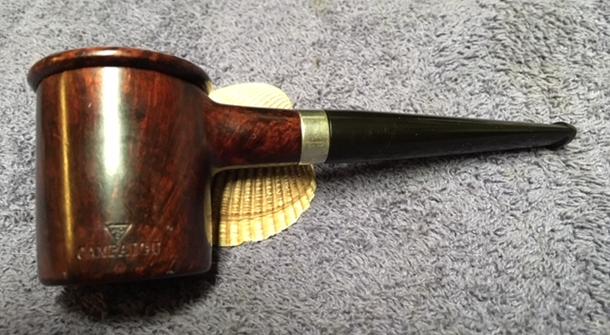
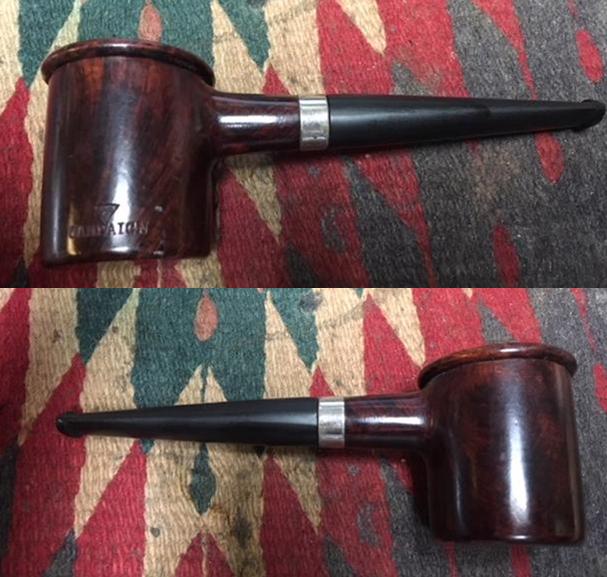
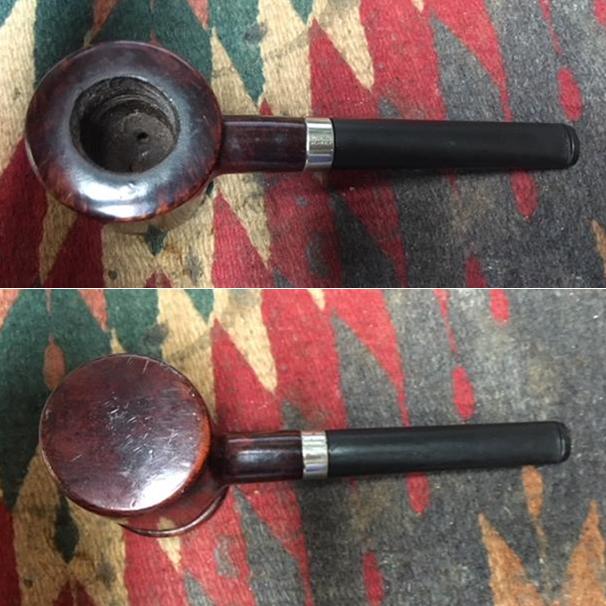
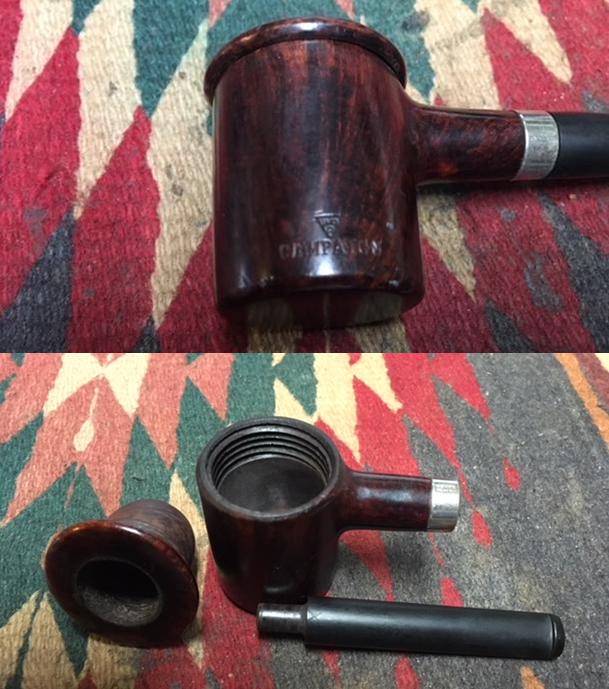
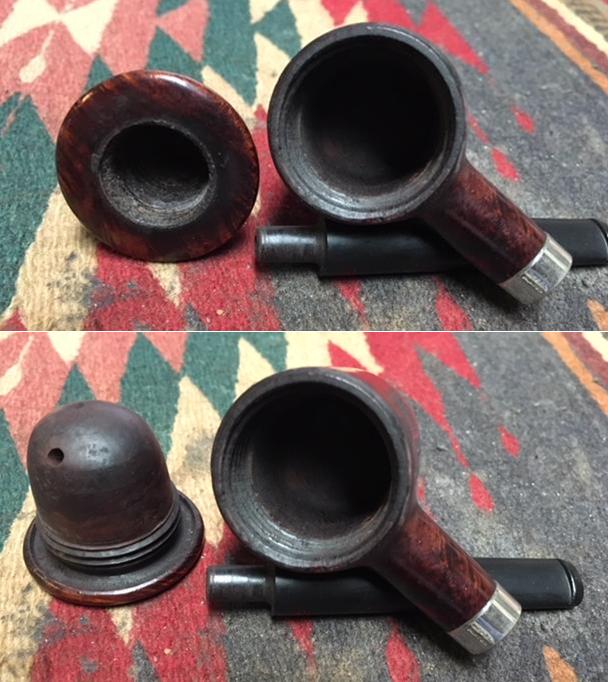
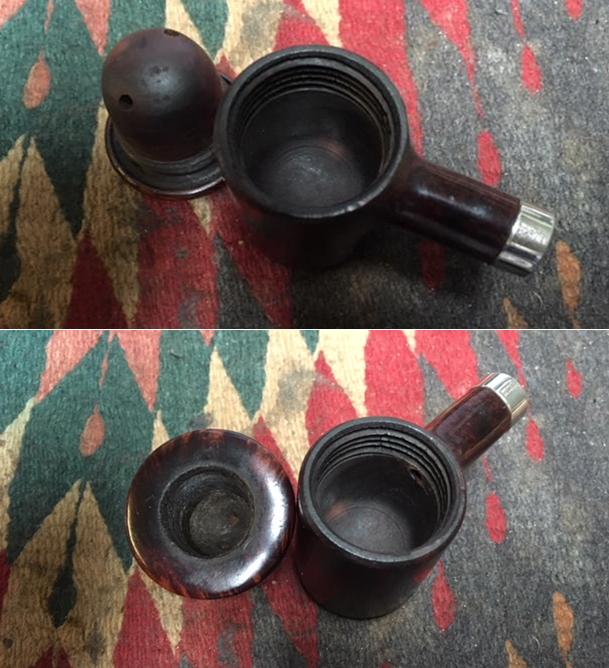
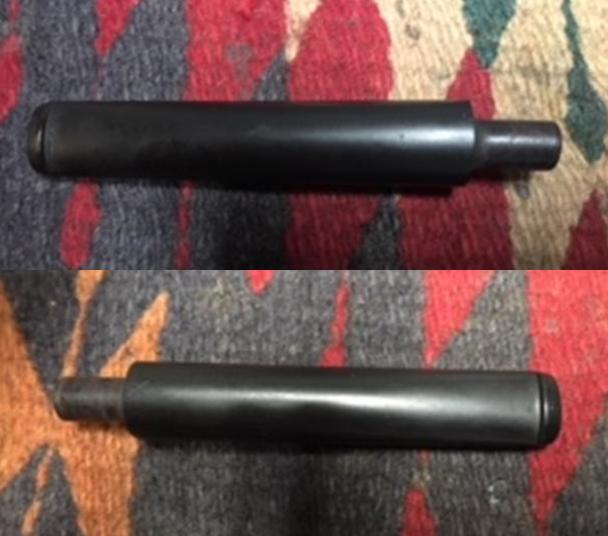
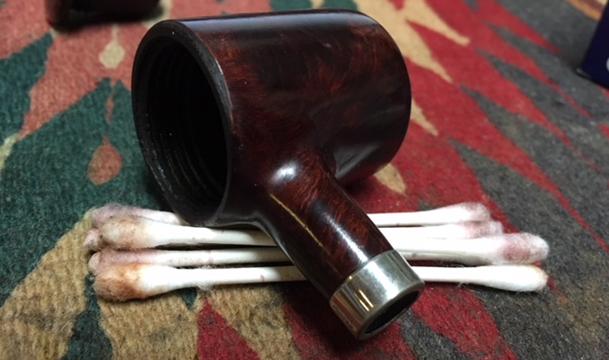
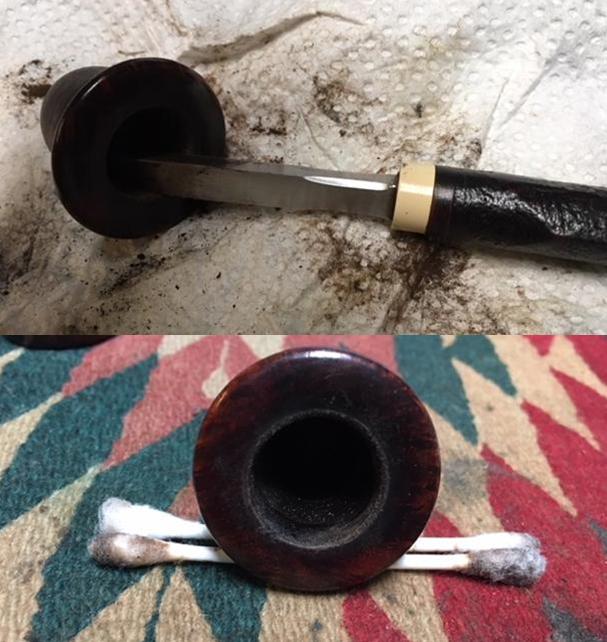
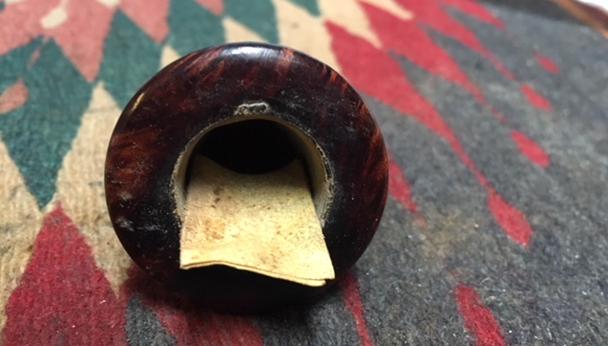
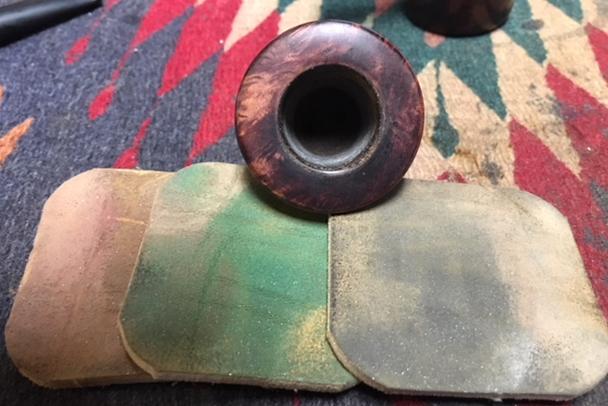
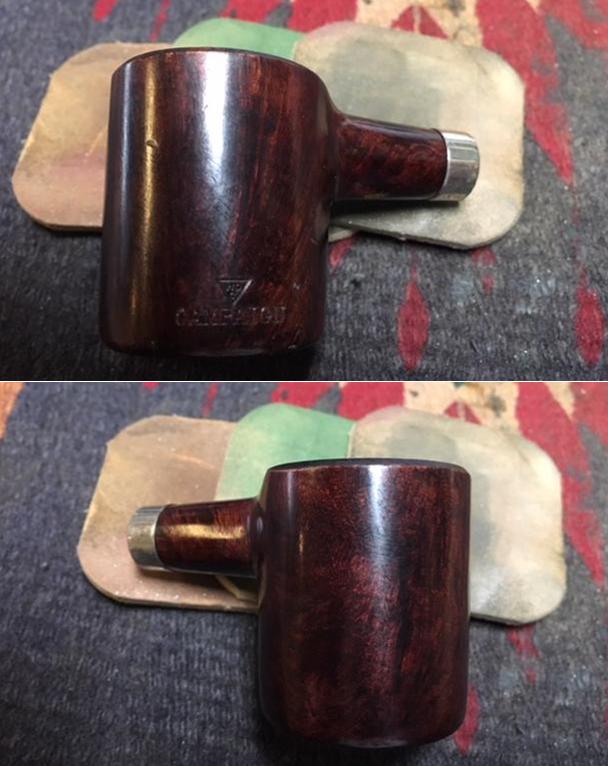
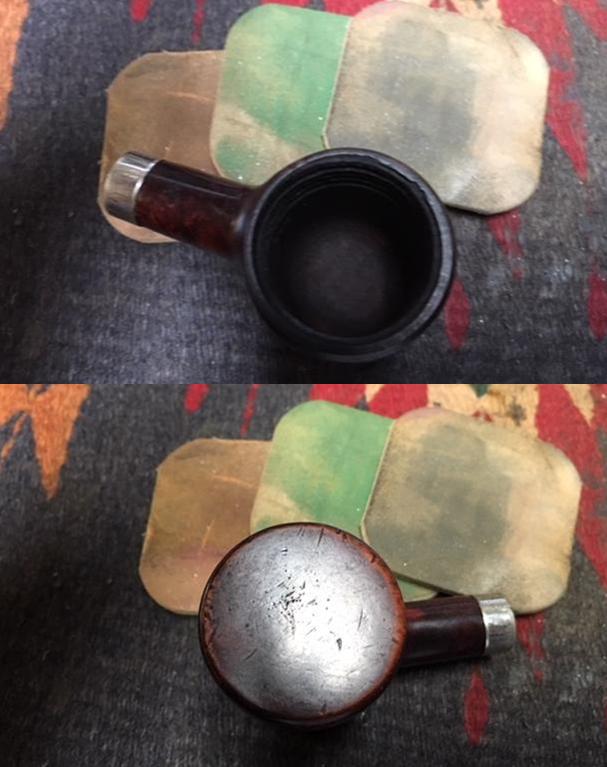
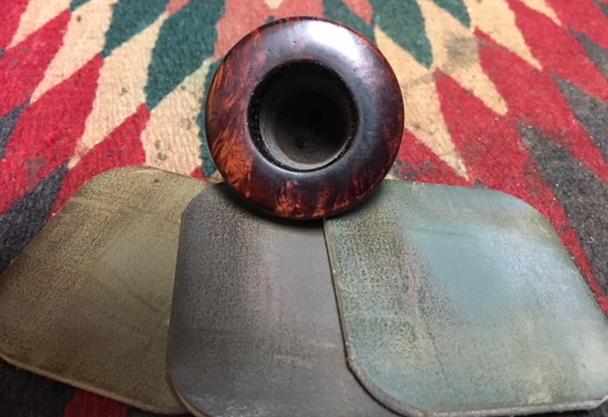
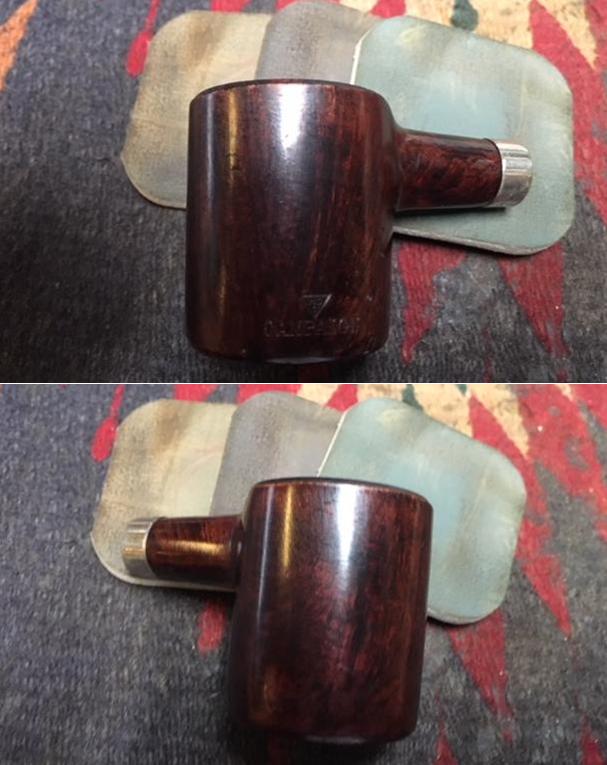
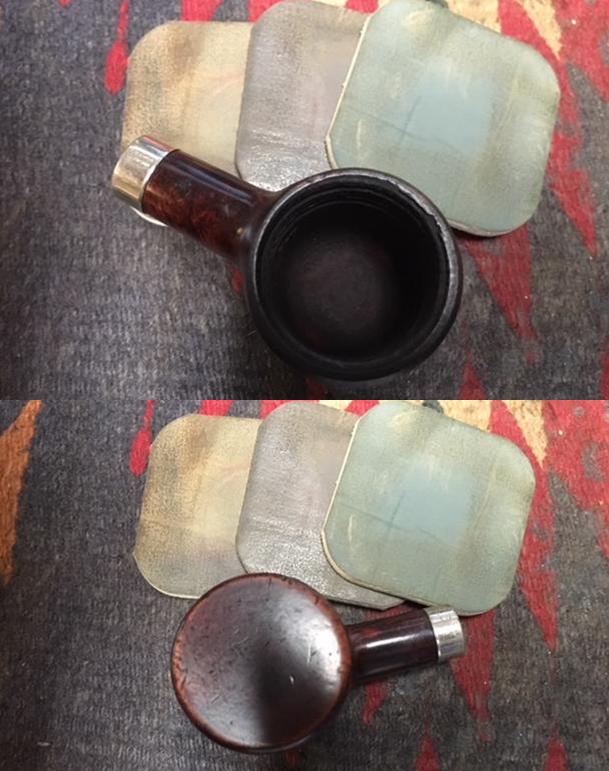
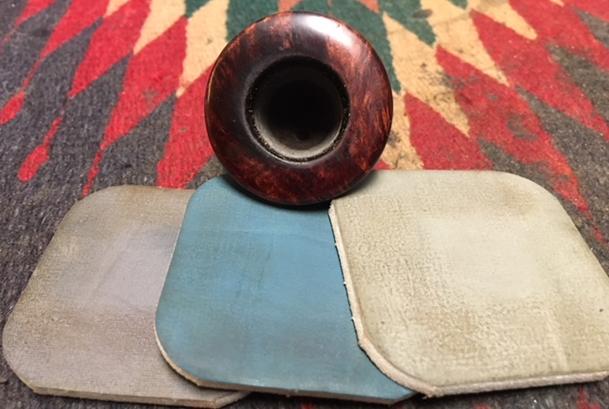
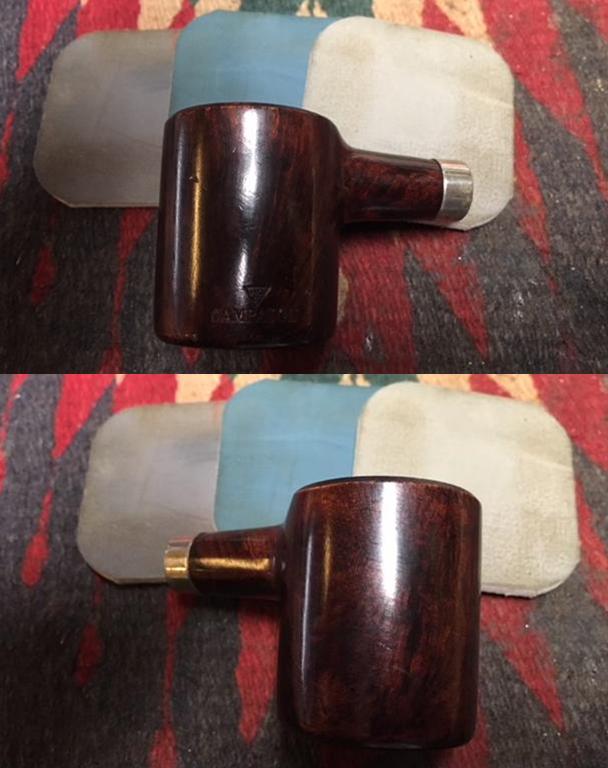
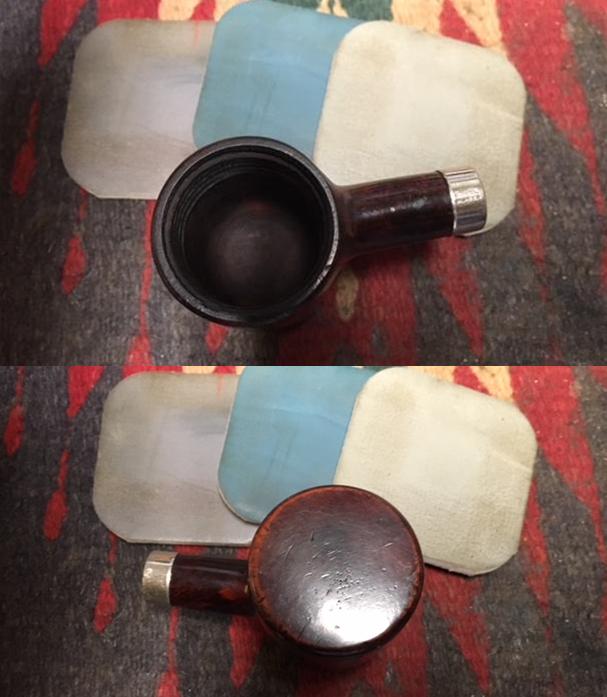
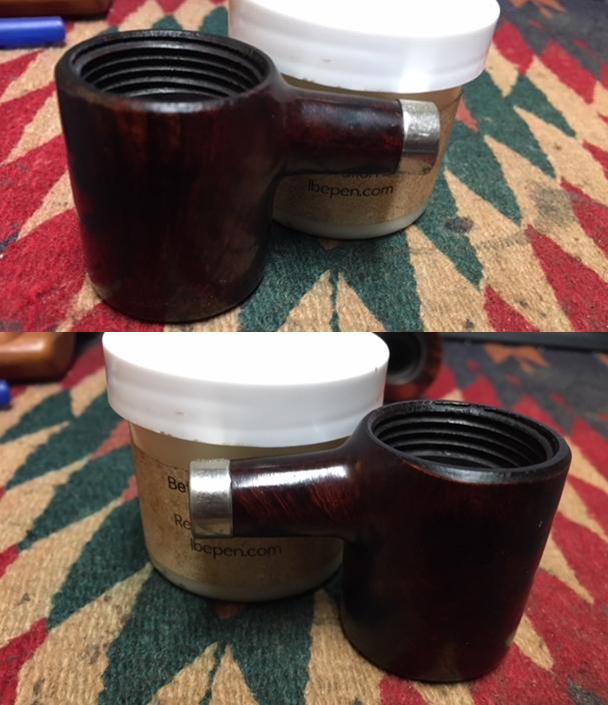
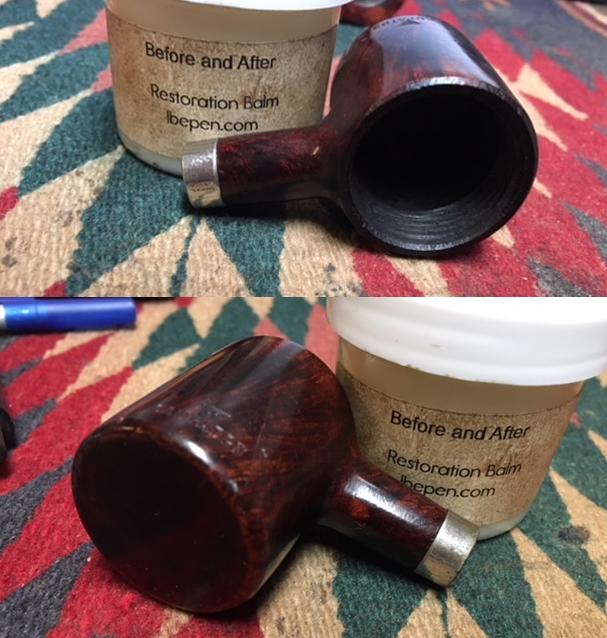
After our conversation, he packed up the pipes and threw the rest of the pipes in a separate bag for me to scavenge parts. The box did not take too long to get to Vancouver and when it did I opened the box and had a look. Here are pics of what I saw – there were two bags inside. One bag held the discards for the scrap pile and the other held the five pipes he wanted restored.  This is last of Craig’s five pipes. It is the second WDC Campaign that I have worked on. It is stamped on the lower left side of the outer bowl with the WDC triangle logo over the word CAMPAIGN. There was no other stamping on the pipe. The bowl was like a calabash bowl and screwed into the outer bowl. The entirety was made out of briar. The grain on the bowl and rim top is mixed grain with straight, flame, swirled and a bit of birdseye thrown in as well. The briar was very dirty and there were some sticky spots around the sides of the bowl. The rim top had some lava on the surface and there was an uneven cake in the bowl. There was a polished nickel band on the shank but there was no shank stamping. The band was stamped NICKEL PLATED. The stem was lightly oxidized and the fit against the end of the shank was snug. I took photos of the pipe before I started my cleanup work. I took close up photos of the bowl, rim top and all of the parts of the pipe. The first photo shows the stamping on the left side of the bowl. You can see the WDC triangle over the word Campaign. The surface of the outer bowl was dirty and grimy. The rim top had some tars and lava on the surface and a few nicks along the outer edge of the bowl. I unscrewed the cup from the outer bowl and took photos of the parts. It was actually surprisingly clean. The photos show the cake in the bowl and the dust and grime between the bowls. The stem had some minor tooth chatter and marks on both sides near the button and scratching on the surface. There were some small nicks on the top side of the stem. There was an X on the underside of the stem at the shank/stem junction. The surface of the stem was lightly oxidized and dirty.The previous Campaign pipe that I restored was posted on the blog earlier. I am attaching the link to that blog and some of the information that I found in researching the brand at that time. (https://rebornpipes.com/tag/wdc-campaign-calabash-pipe/). In my online research I found a brief interchange on a Google group. I include the link if you would like to read it in context and its entirety. It gives some helpful information regarding this particular pipe. https://groups.google.com/forum/#!topic/alt.smokers.pipes/kpkpd3zXoiwExcerpt from pipedia.org

To a request for information regarding the WDC Campaign pipe on the Google Group there was quite a long string of answers. I am quoting two of those in full…

Respondent 1: While I can’t say anything about this pipe specifically, I have a hazy memory of that shape listed in a book about pipes; (I may be totally misremembering this, but here goes) the shape being called the “Dawes”, named after Harding’s Vice President?  Anyone else remember this? Sounds like an interesting pipe, whatever it’s called…

Respondent 2: From Weber’s Guide to Pipes: “The Dawes Pipe (more correctly named the Lyons, after its inventor, Charles Herbert Lyons) happened to be the favorite pipe of General Charles G. Dawes, Vice-President of the USA from 1925 to 1929. General Dawes smoked the curious pipe incessantly and it became popularly known as the Dawes Underslung, because the shank joined the bowl near its rim.”

I looked on Pipedia, (https://pipedia.org/wiki/William_Demuth_Company) and I quote in part from the article on the William Demuth Company.

The Demuth Company is probably well known for the famous trademark, WDC in an inverted equilateral triangle. William commissioned the figurative meerschaum Presidential series, 29 precision-carved likenesses of John Adams, the second president of the United States (1797-1801) to Herbert Hoover, the 30th president (1929-1933), and “Columbus Landing in America,” a 32-inch-long centennial meerschaum masterpiece that took two years to complete and was exhibited at the World’s Columbian Exposition in Chicago in 1893.

The Presidential series was the result of Demuth’s friendship with President James A. Garfield, a connoisseur of meerschaum pipes. Demuth presented two pipes to Garfield at his inauguration in 1881, one in his likeness, the other in the likeness of the President’s wife. Later, Demuth arranged for another figurative matching the others to be added to the collection as each new president acceded to the White House, terminating with President Hoover.

From the above information I learned some significant details about the Campaign pipe. It was invented by Charles Herbert Lyons and was the favourite pipe of General Charles G. Dawes who was the Vice President of the USA under President Harding from 1925-1929. It fits nicely into that period when WDC was having Presidential Pipes commissioned ending in 1933. That places this old pipe in the time period between the late 1920s and early 1930s.

Reminded of the history of the brand and the provenance of this particular pipe it was time to begin working on the cleanup. I removed bowl cup and cleaned out the shank with pipe cleaners, cotton swabs and alcohol. I cleaned out the inside of the outer cup with cotton swabs and alcohol to remove the buildup of tars and oils in the threads and sides and bottom of the bowl.I reamed the inner bowl/cup with a Savinelli Fitsall Pipe Knife to scrape away the remaining cake that was in the bowl. I scraped it back to bare briar. I scrubbed out the outside and the inside of the bowl with cotton swabs and alcohol to remove the remaining oil and tars. I used a folded piece of 220 grit sandpaper to clean up the inner edge of the cup. I worked on the edge until it was clean. I polished the bowl and rim with micromesh sanding pads – wet sanding it with 1500-2400 grit pads and dry sanding with 3200-12000 grit pads. I wiped the bowl down after each pad with a damp cotton pad to clean off the sanding dust. The photos show the progress of the polishing. Once again I decided to do this before the deep cleaning with Before & After Restoration Balm. I worked some Before & After Restoration Balm into the surface of the briar on the bowl and the rim top with my finger tips to deep clean the finish, enliven and protect the wood. I let it sit for a few minutes and then buffed it with a cotton cloth. The grain in the wood came alive and there was a rich shine to the briar. I took some photos of the bowl at this point to mark the progress in the restoration. I sanded the band with 6000-12000 grit micromesh sanding pads. I polished the nickel band with a jeweler’s polishing cloth.I set the bowl aside in my rack and worked on the stem. I started by sanding it with 220 grit sandpaper to remove the light oxidation, tooth chatter and nicks in the surface.I cleaned the stem with alcohol and pipe cleaners to remove the debris and tars in the airway from the tenon to the slot in the button. I worked over the stem with micromesh sanding pads. I polished out the sanding scratches and marks from the reshaping work. I wet sanded it with 1500-2400 grit pads and dry sanded it with 3200-12000 grit pads and wiped it down with Obsidian Oil after each one. When I finished with the last micromesh pad I gave it a final coat of oil and let it dry. I polished the stem with Before & After Pipe Stem Polish – both the fine and the extra fine polishes. I wiped it down with a final coat of Obsidian Oil and set it aside to dry. With the stem polished I put it back on the pipe and buffed the entire pipe with Blue Diamond polish on the buffing wheel. I buffed it with the polishing compound until it was shiny. I gave the entire pipe several coats of carnauba wax and buffed it with a clean buffing pad to raise the shine. I hand buffed it with a microfibre cloth to deepen the shine. The stem and the bowl polished up pretty nicely. The finished pipe is shown in the photos below. This is the final pipe of Craig’s five. Now that I have finished the last of the pipes it is time to pack them up and get them out to him. I am looking forward to hearing what he will think once he has them in hand. Thanks for walking through these restorations with me. Once again I can’t help thinking that the pipeman who gave Craig these pipes would be happy that they are back in service and that Craig is carrying on the pipeman’s trust with them. Cheers.