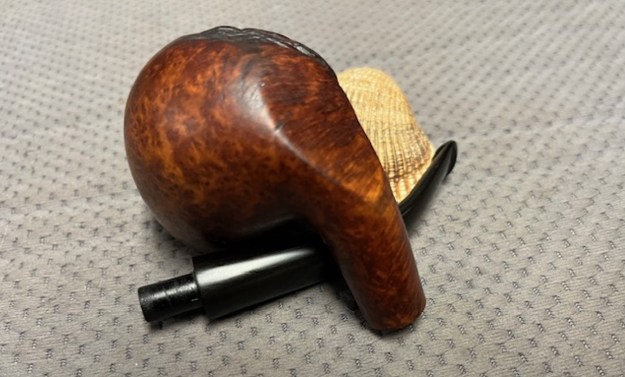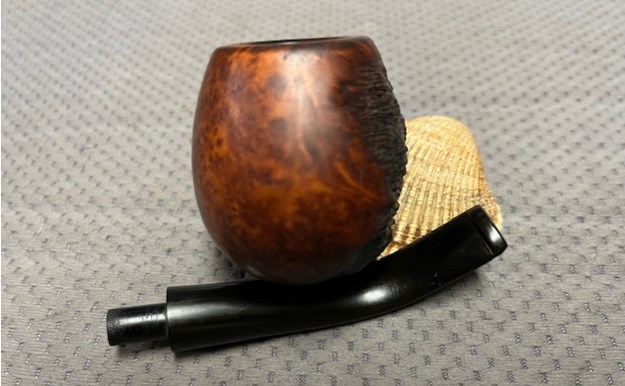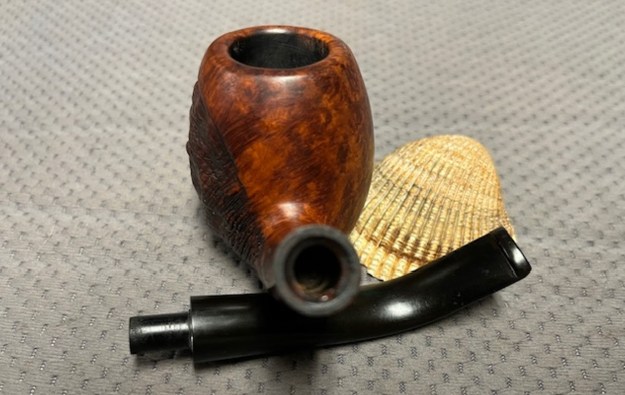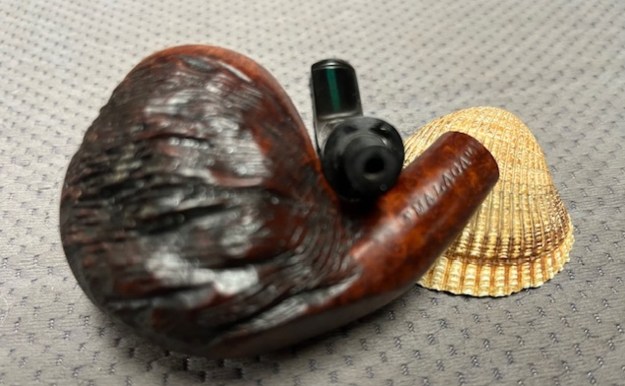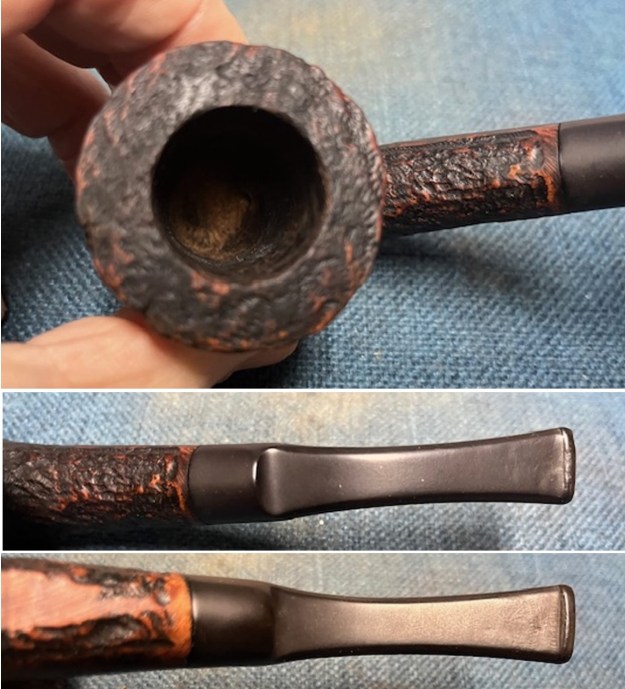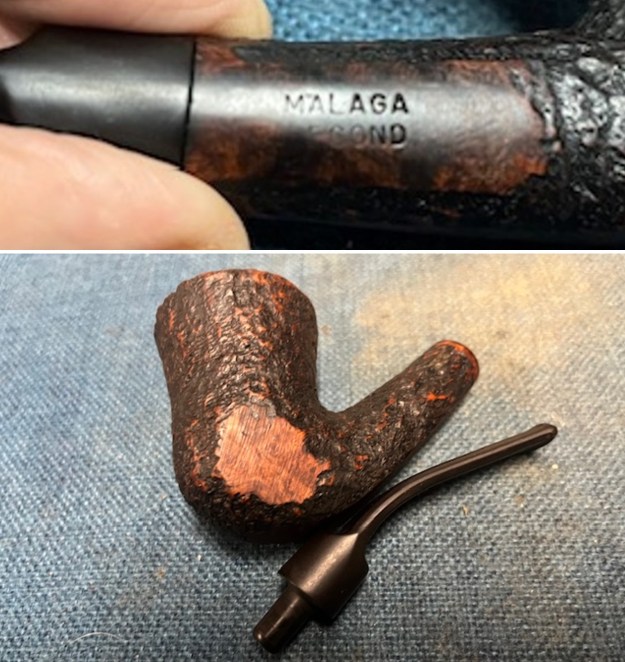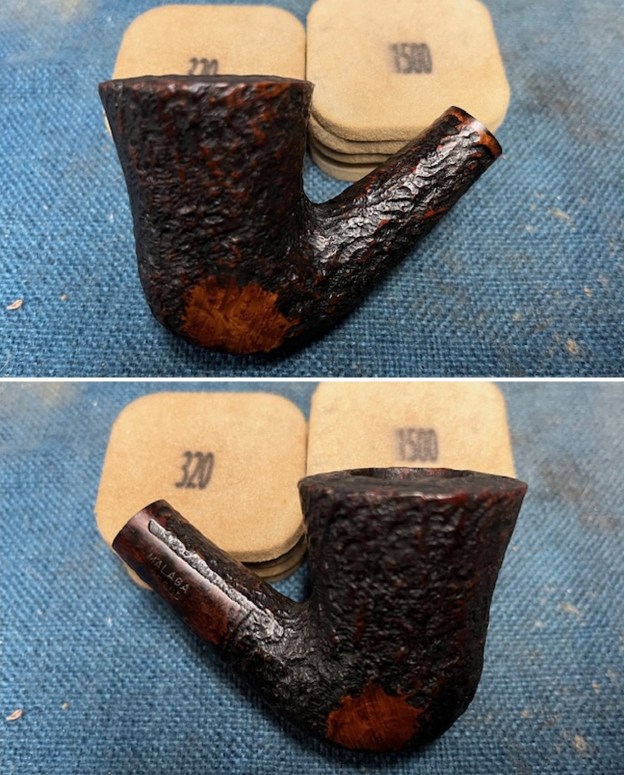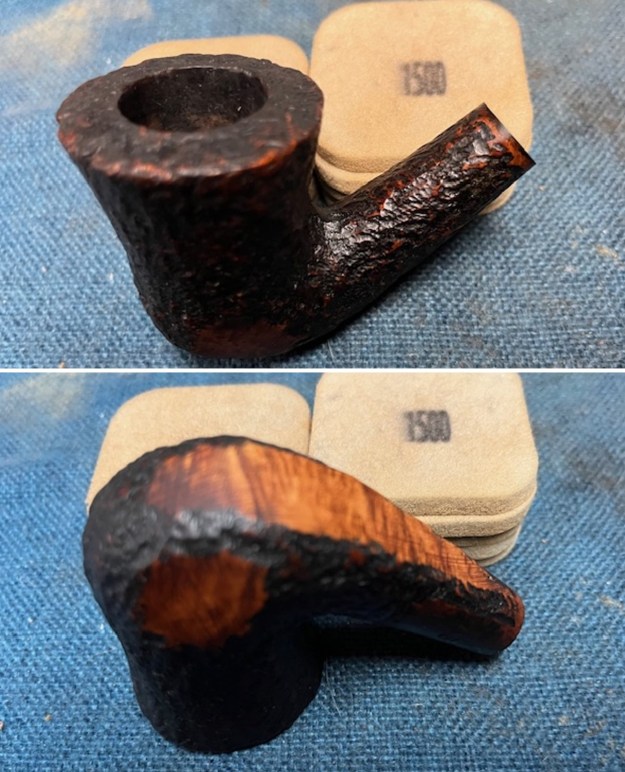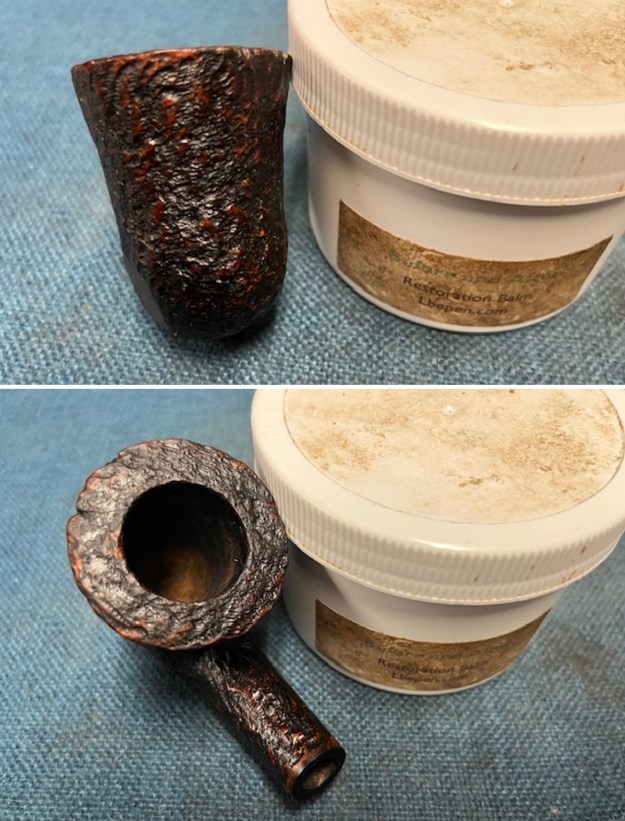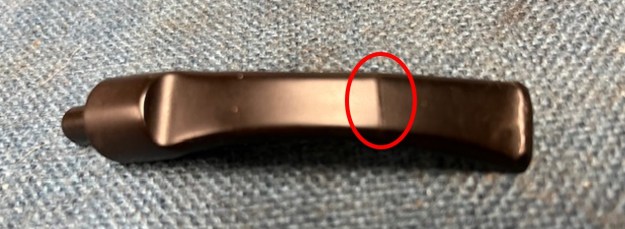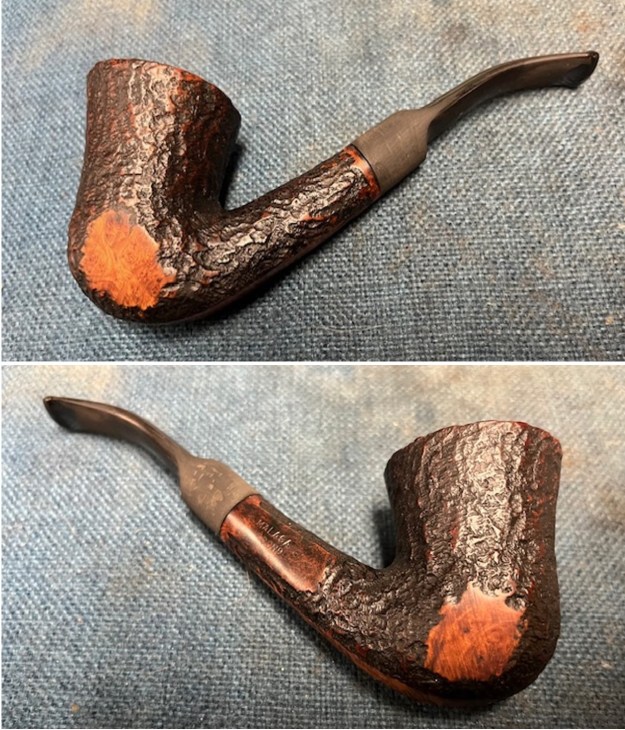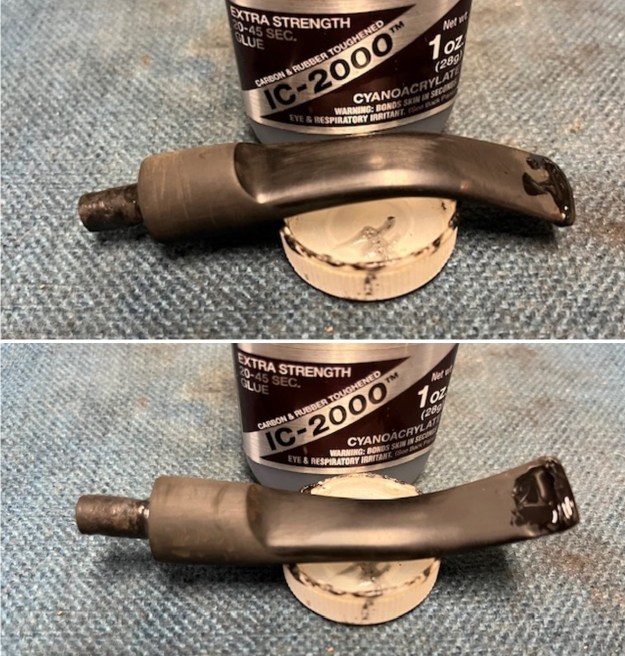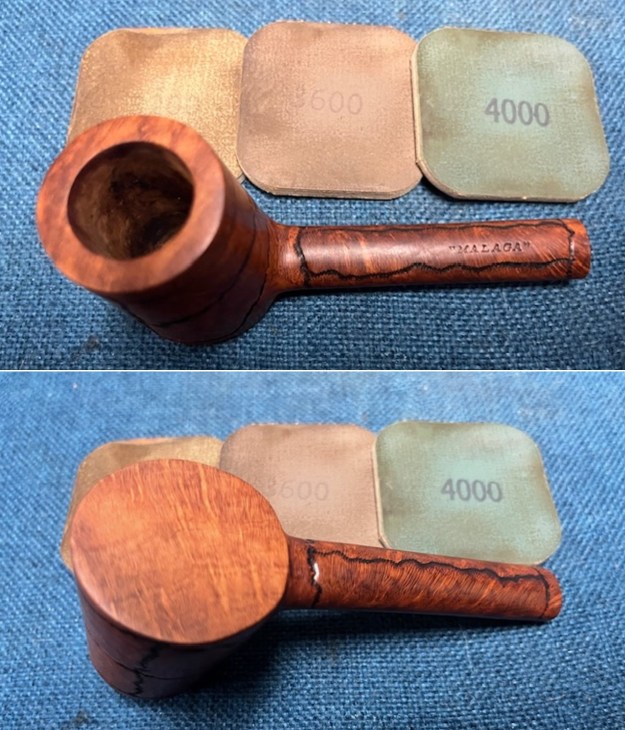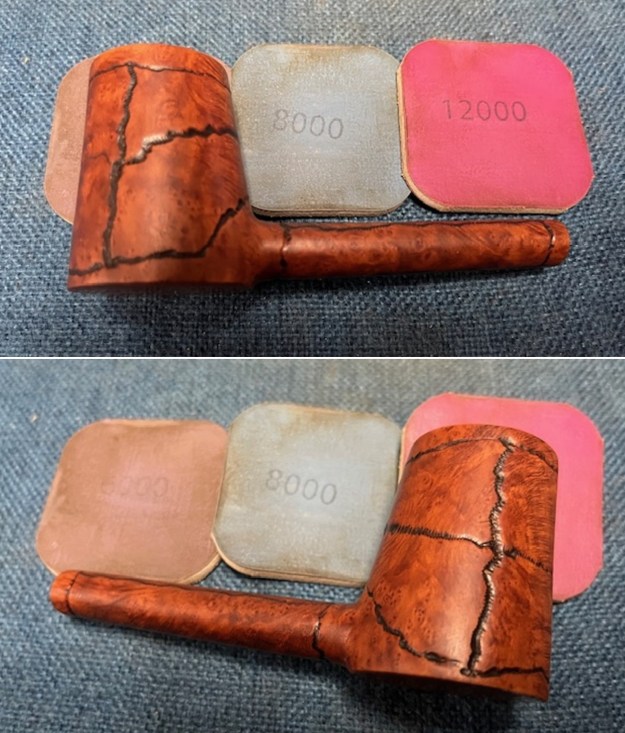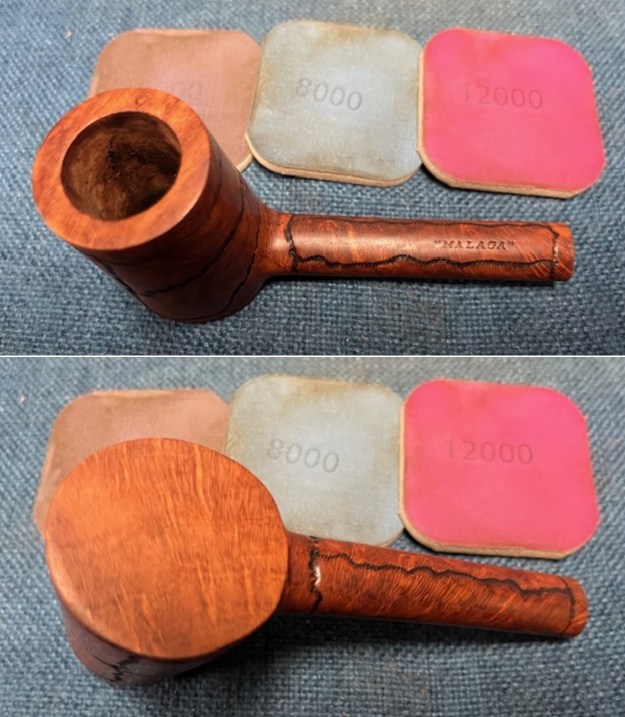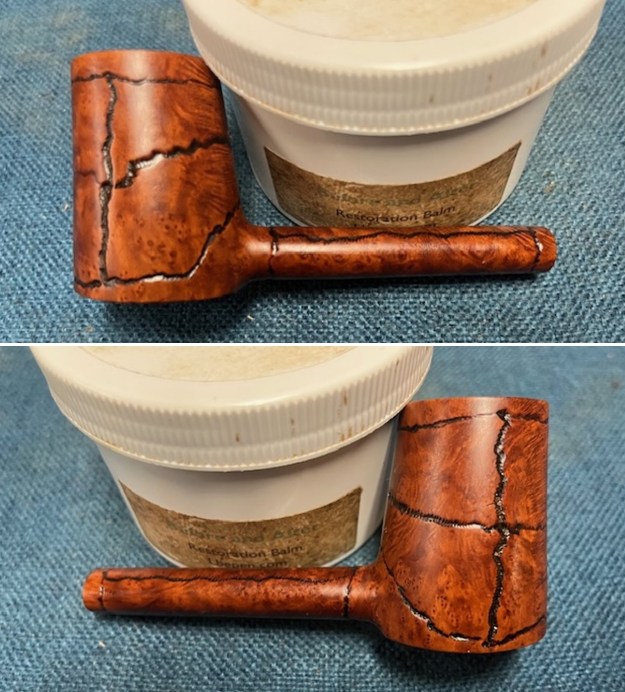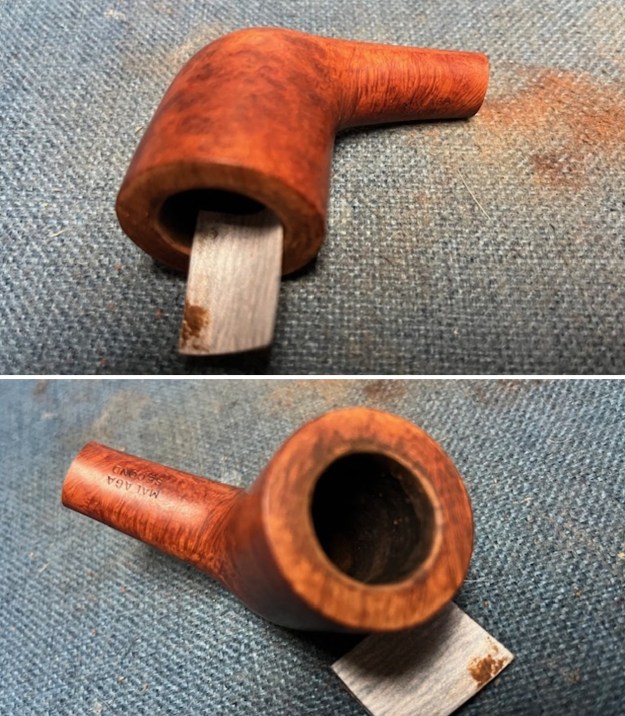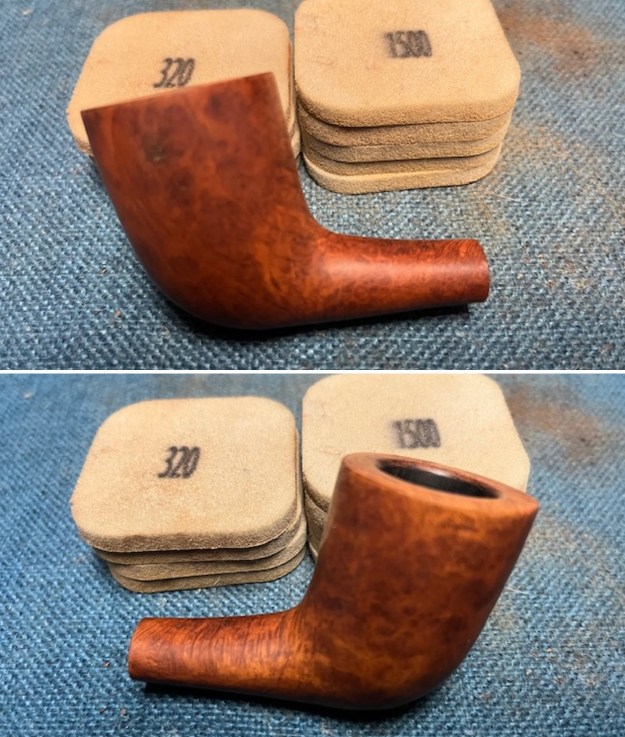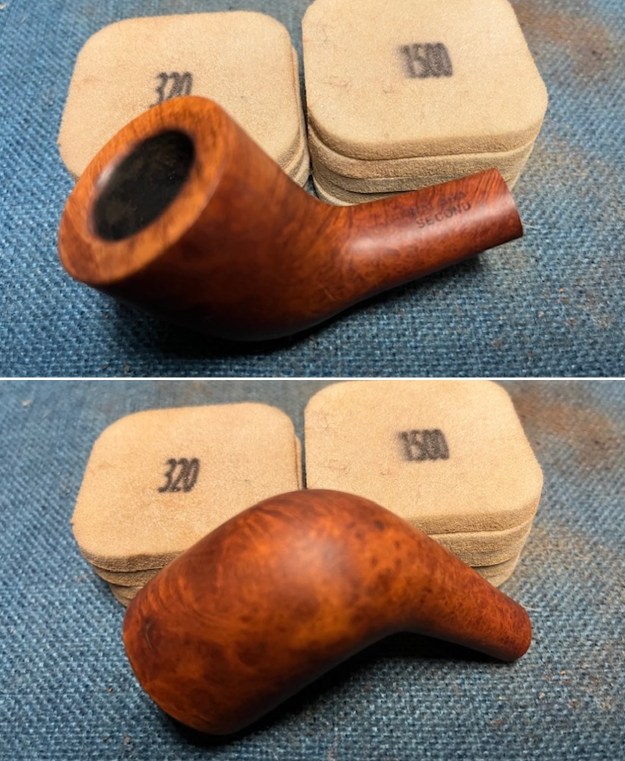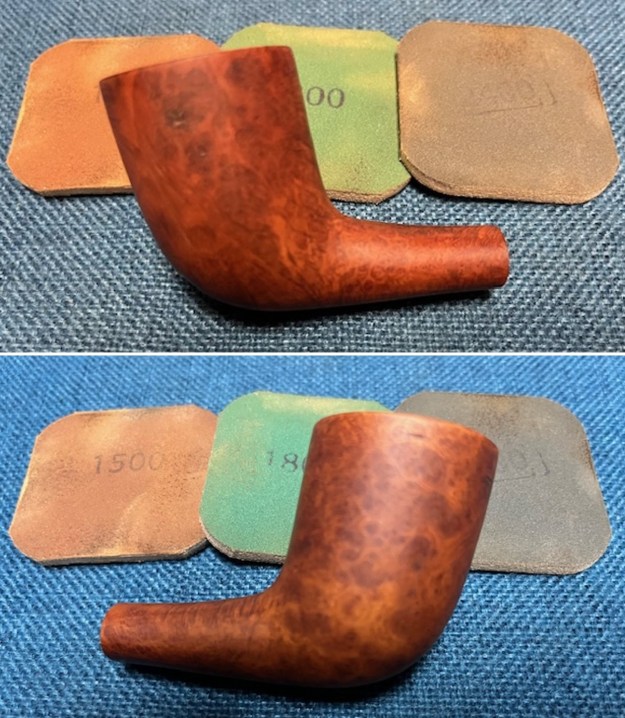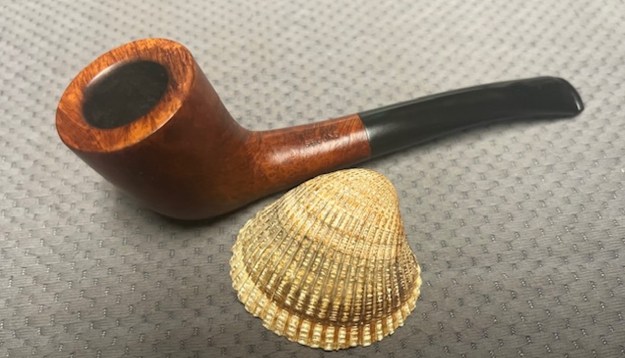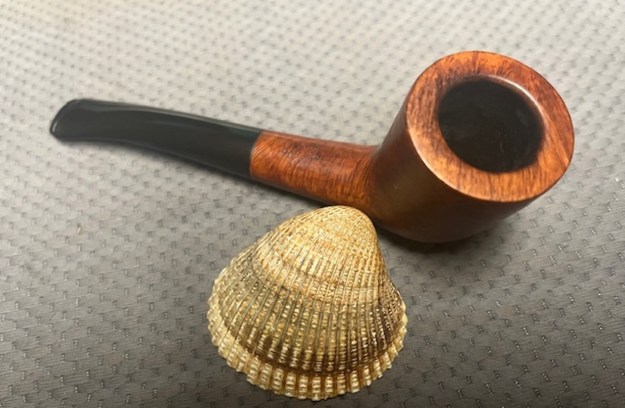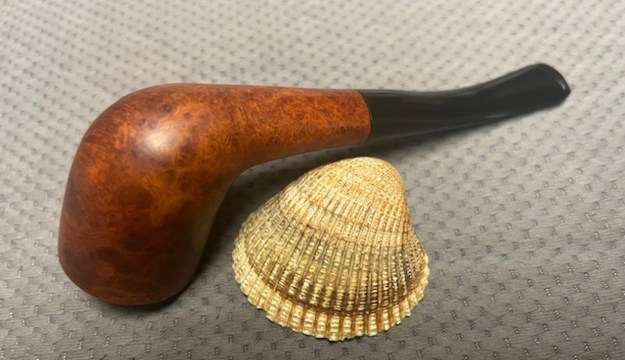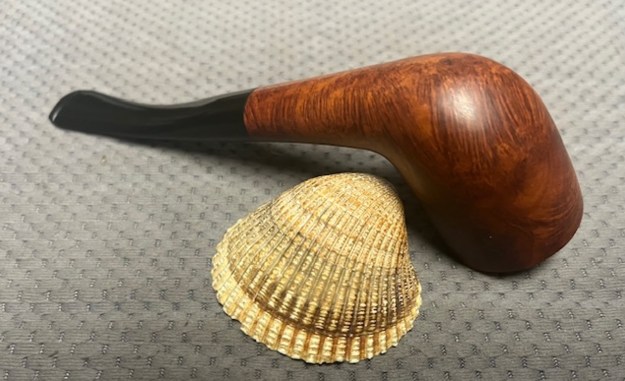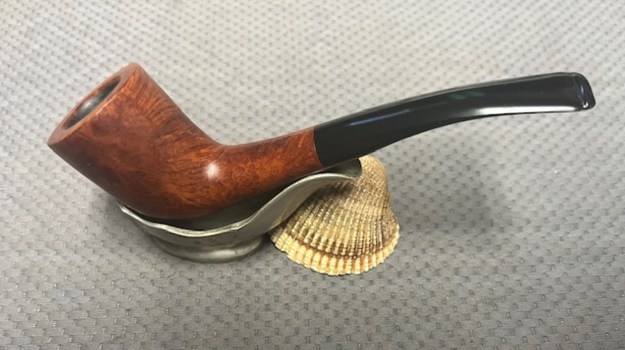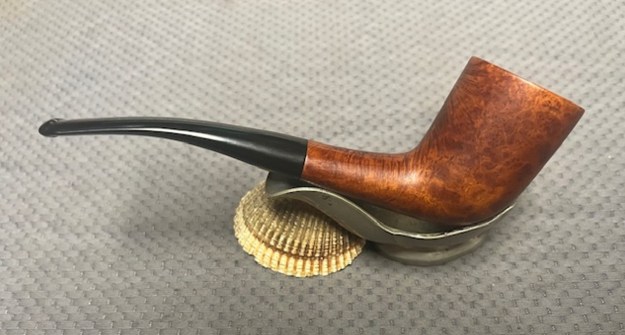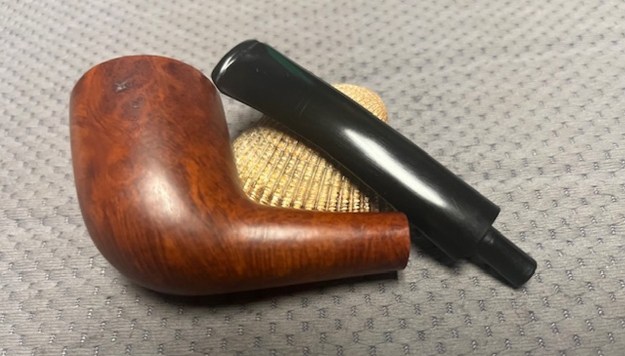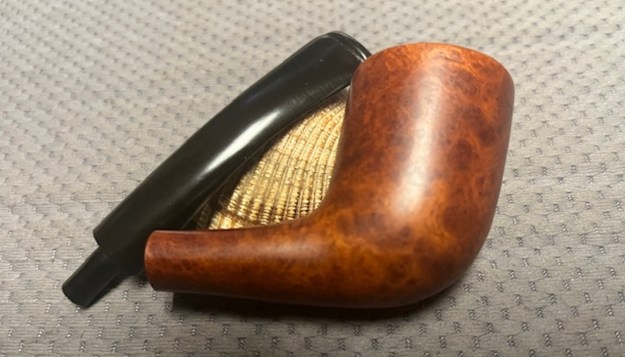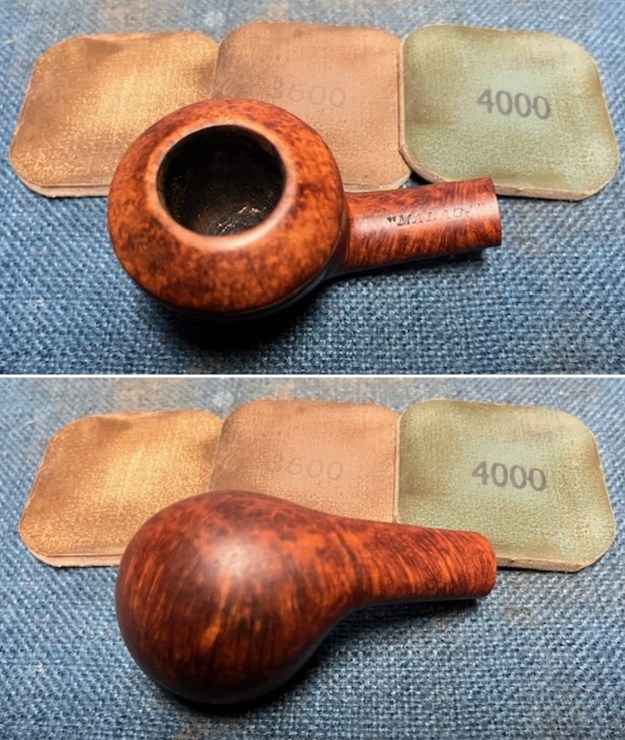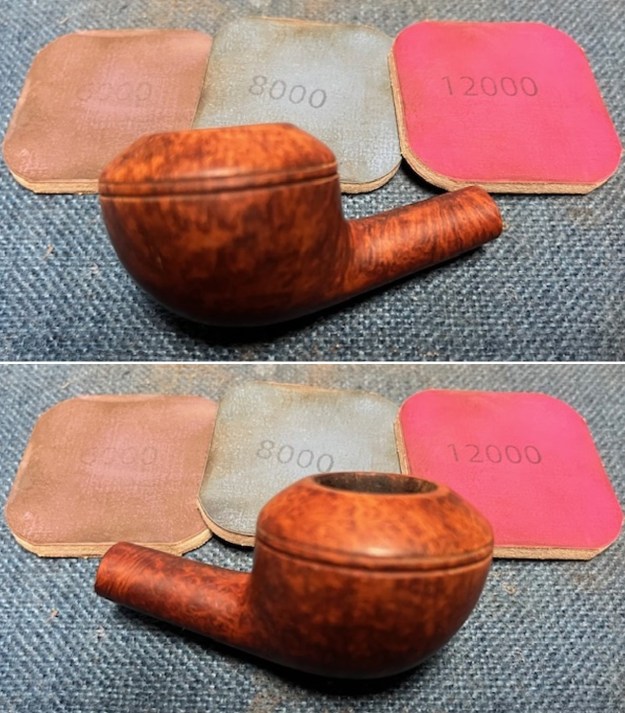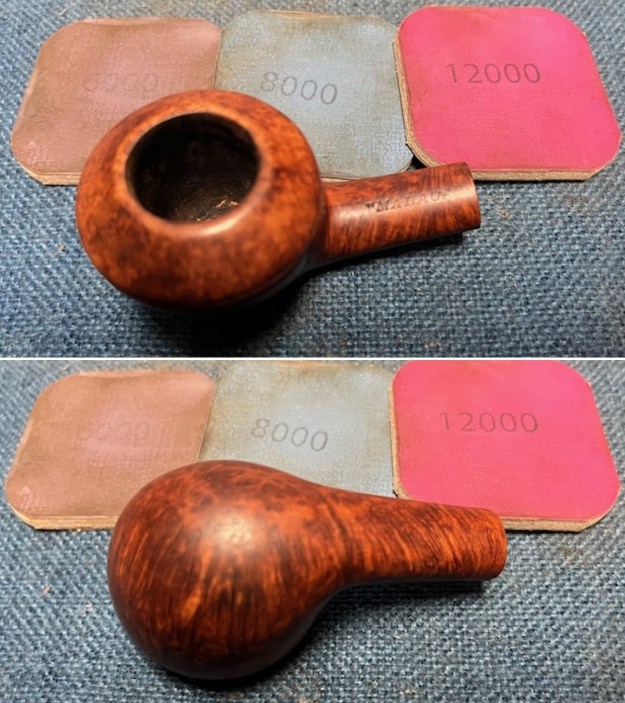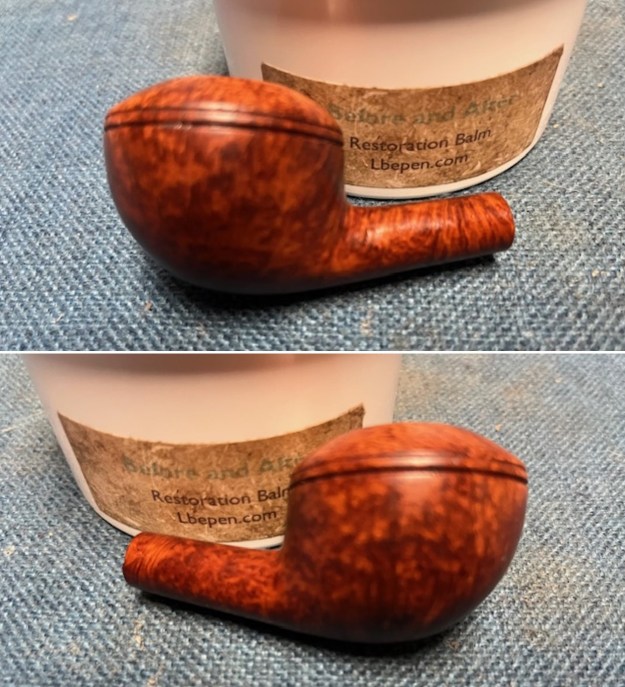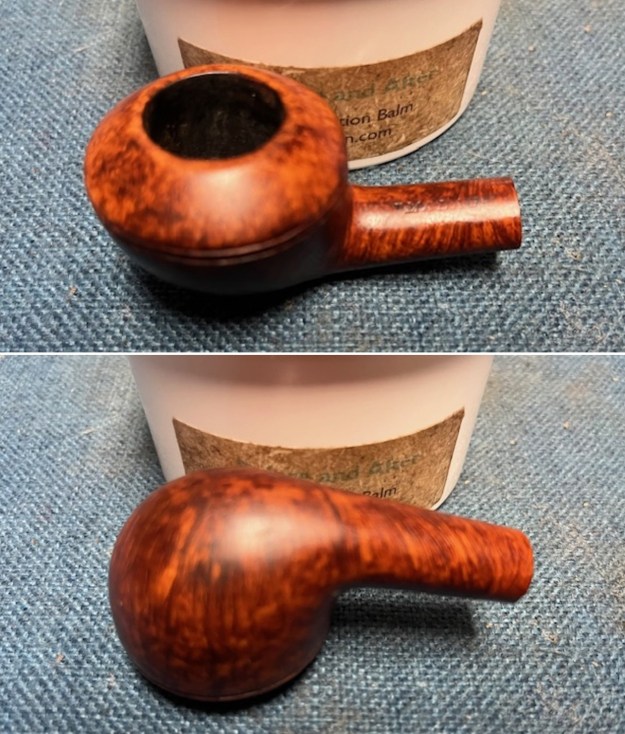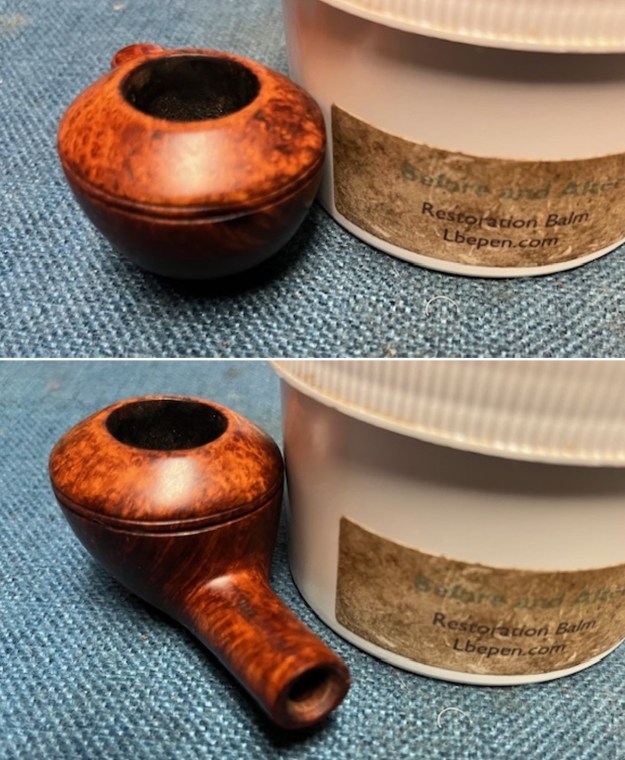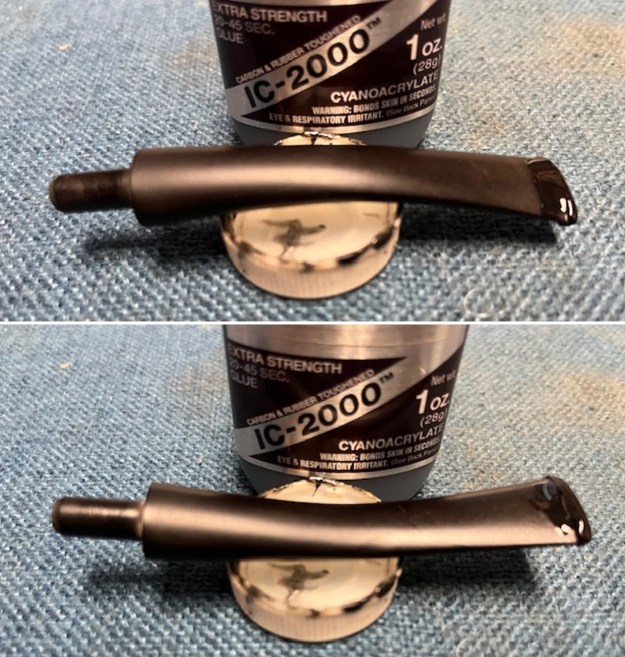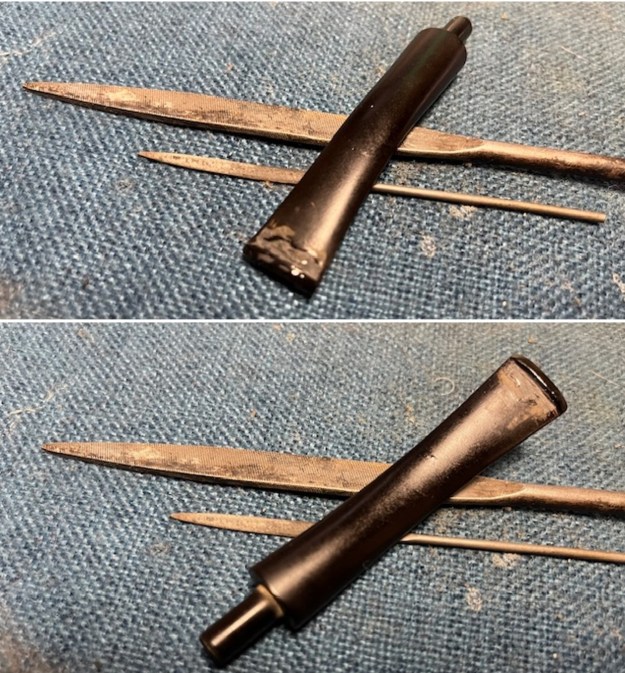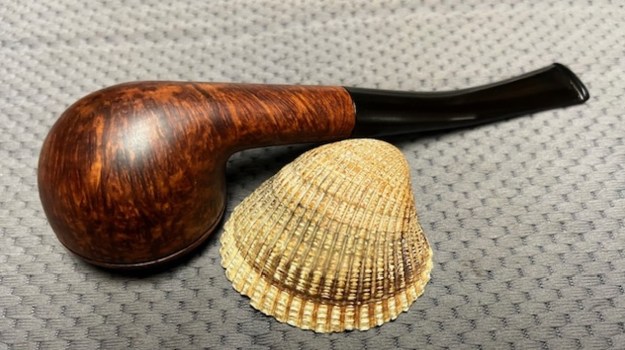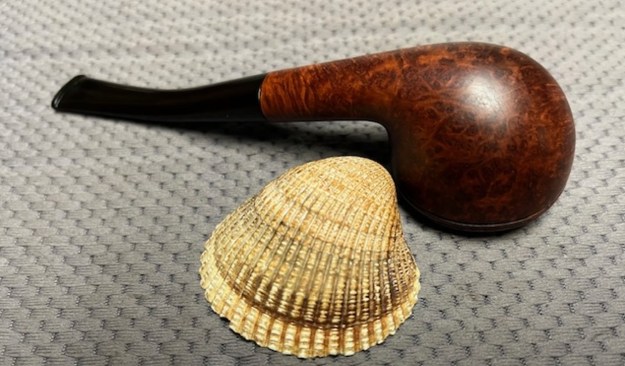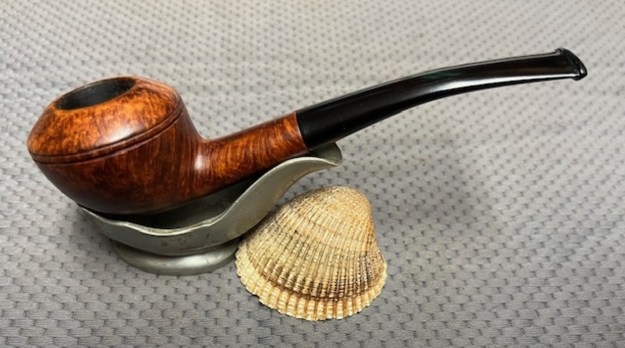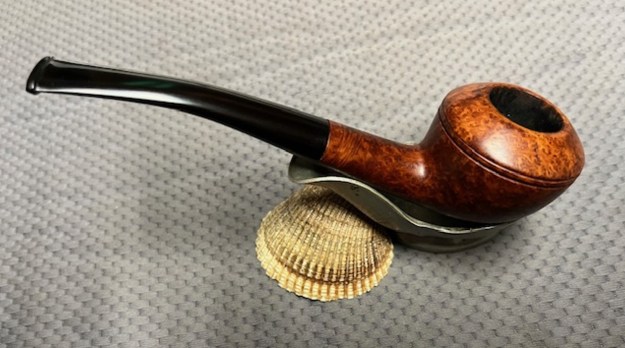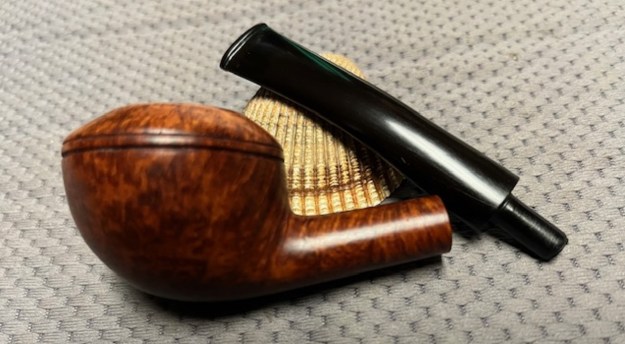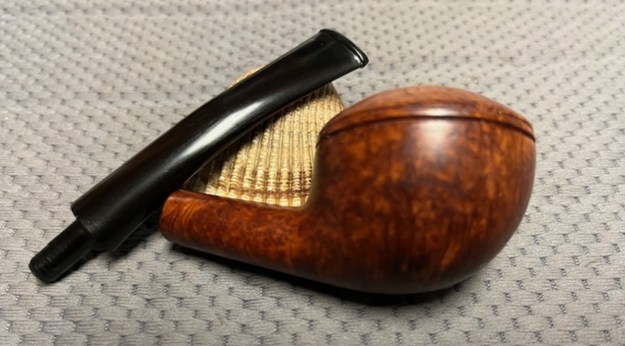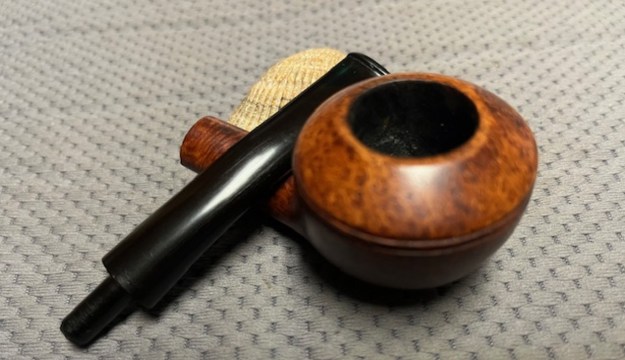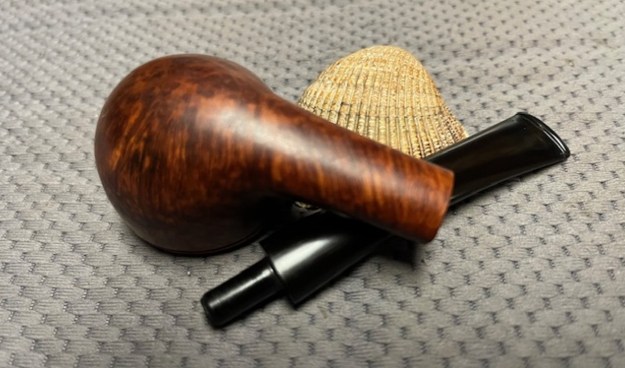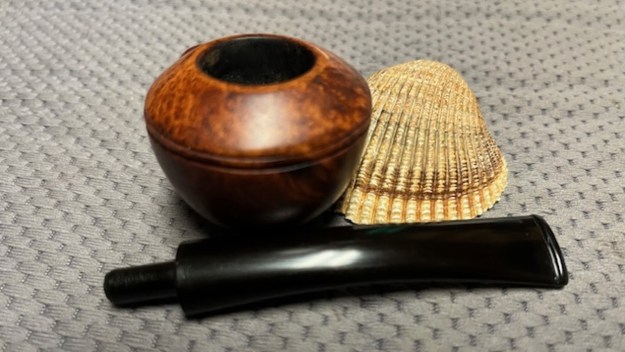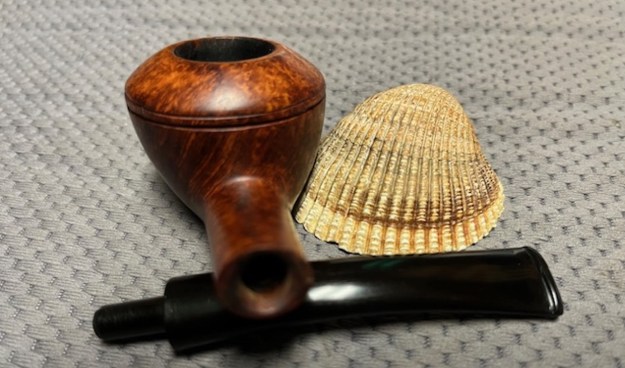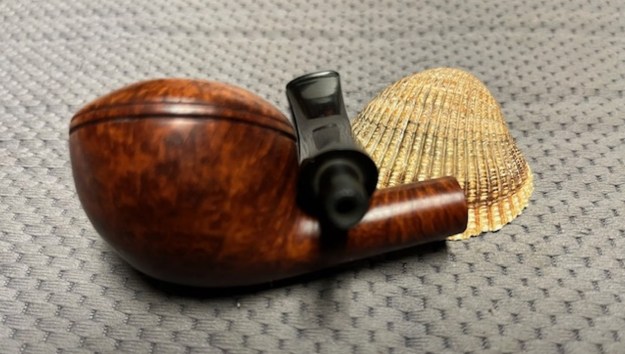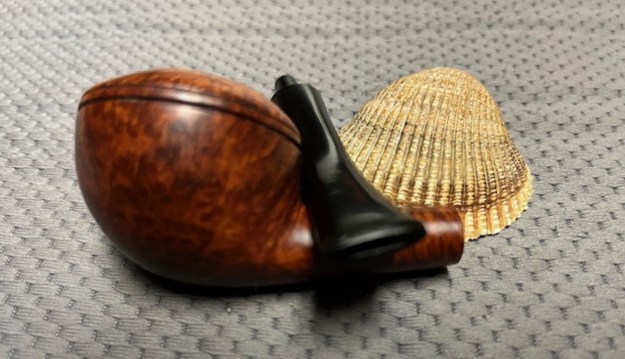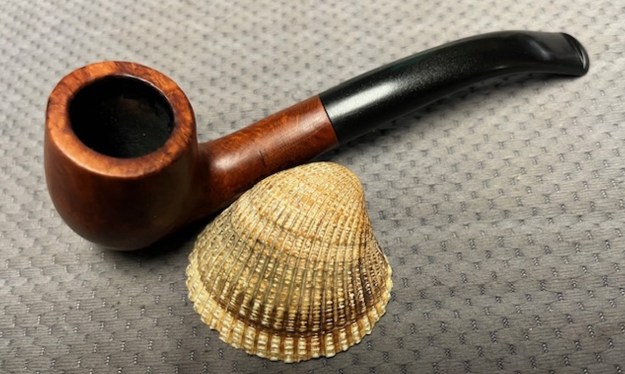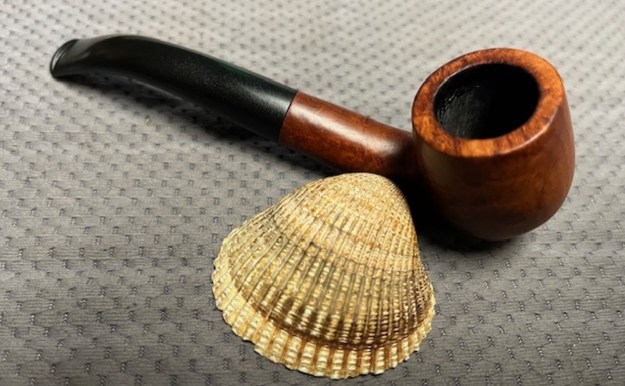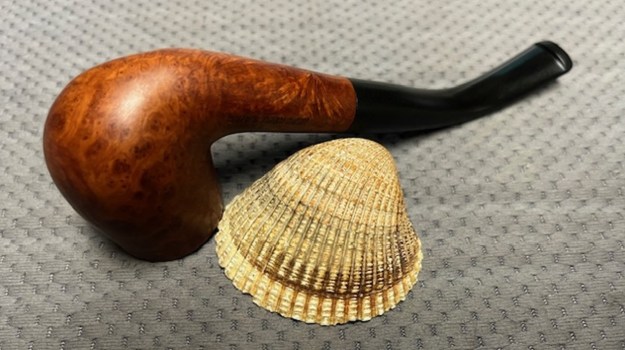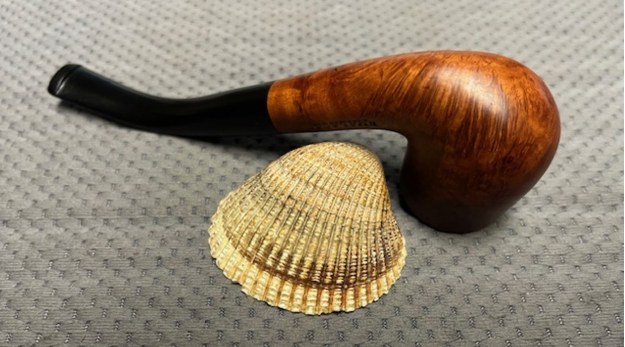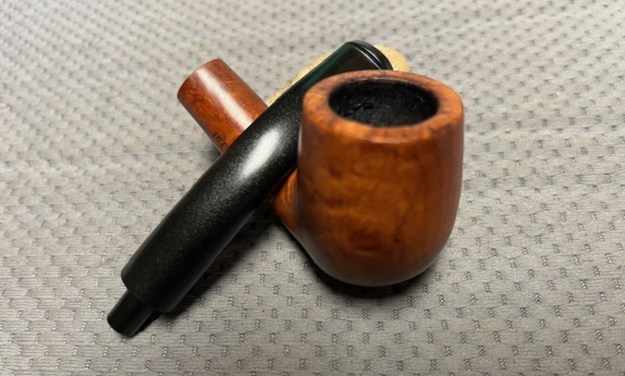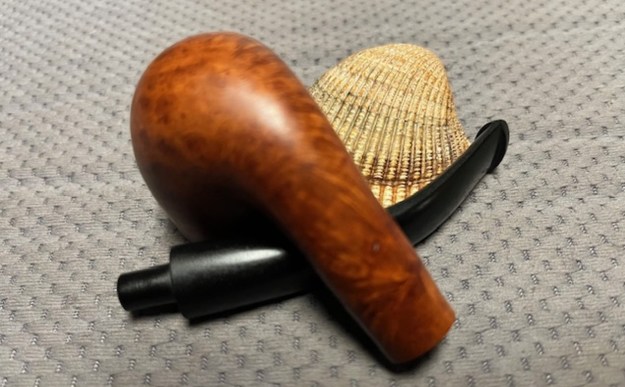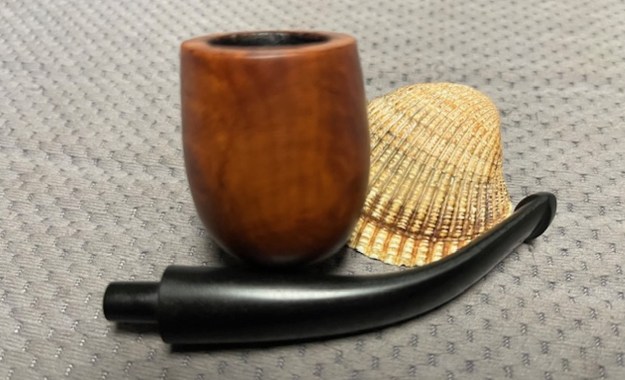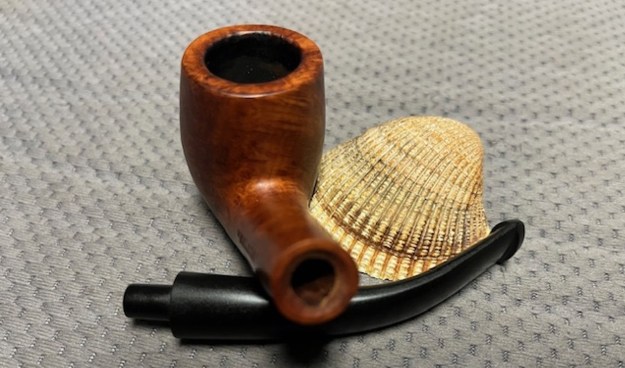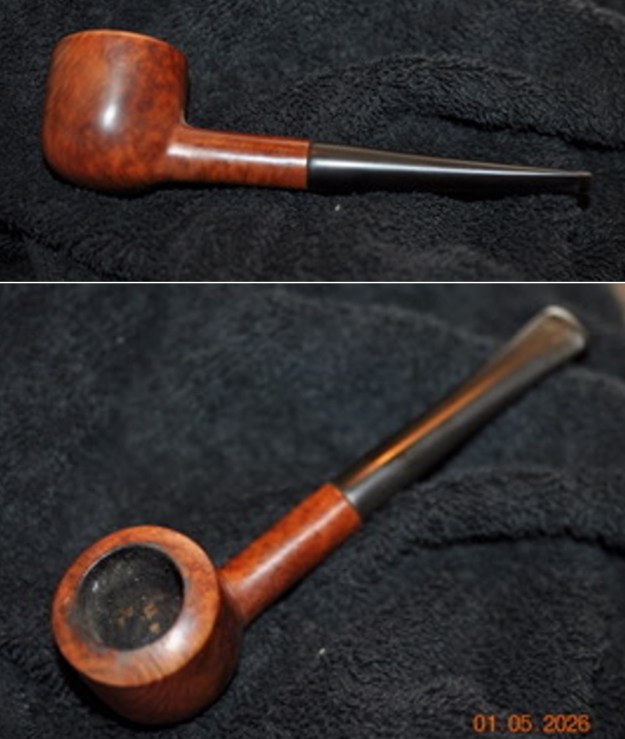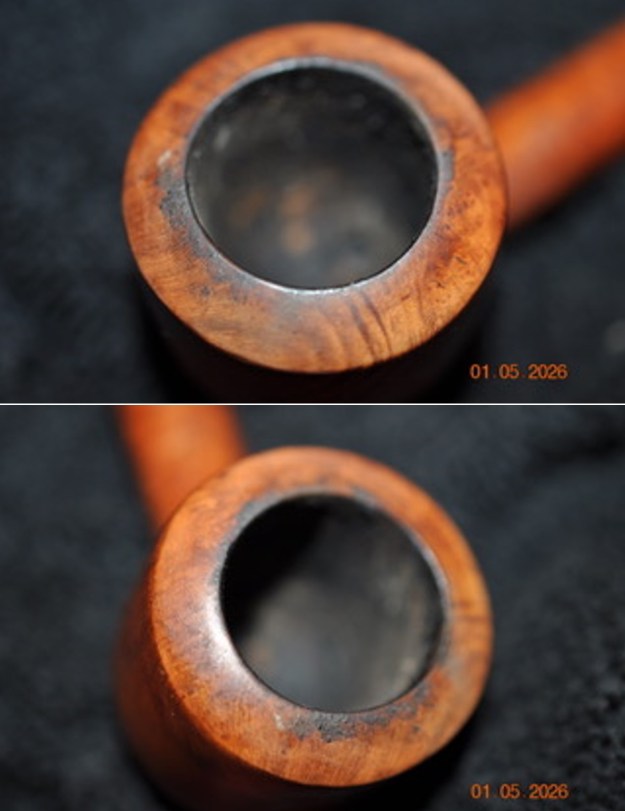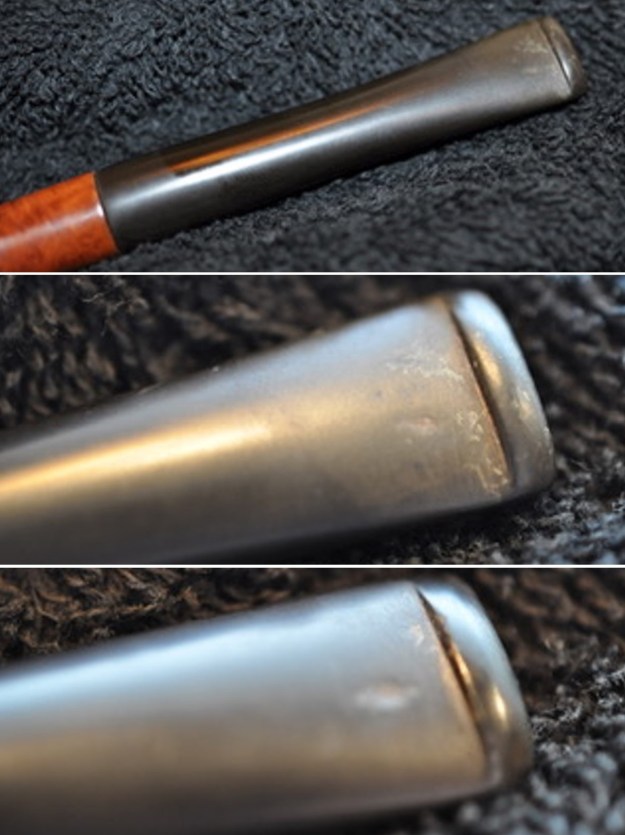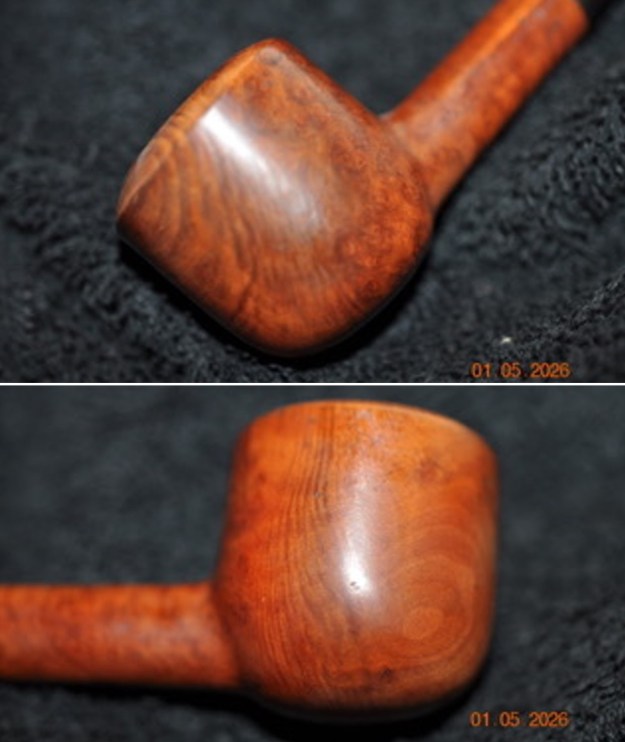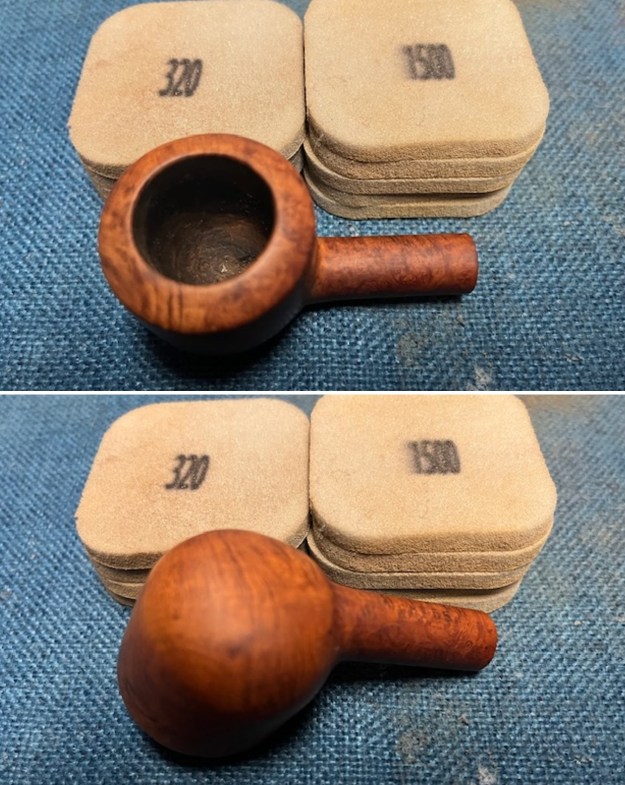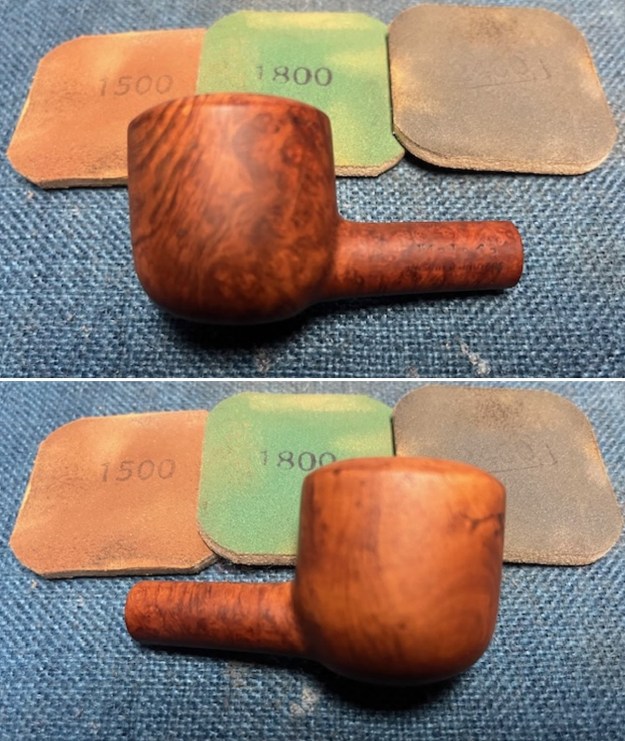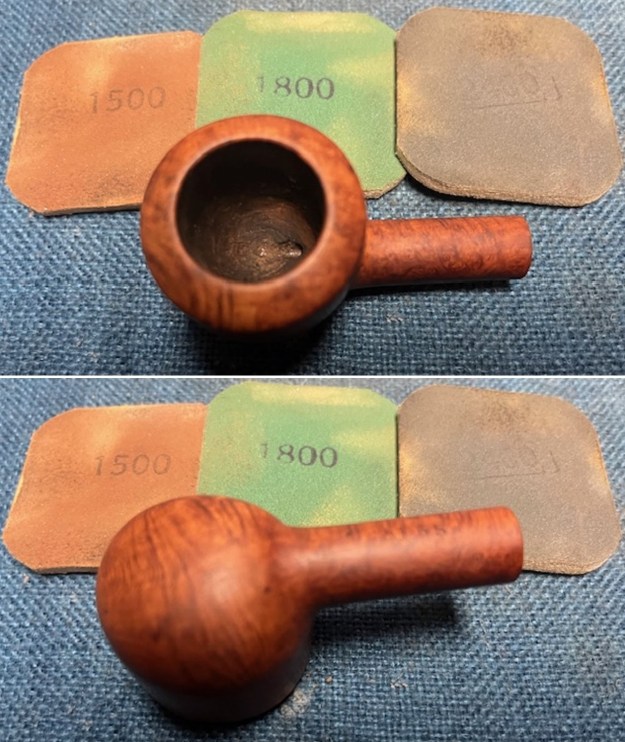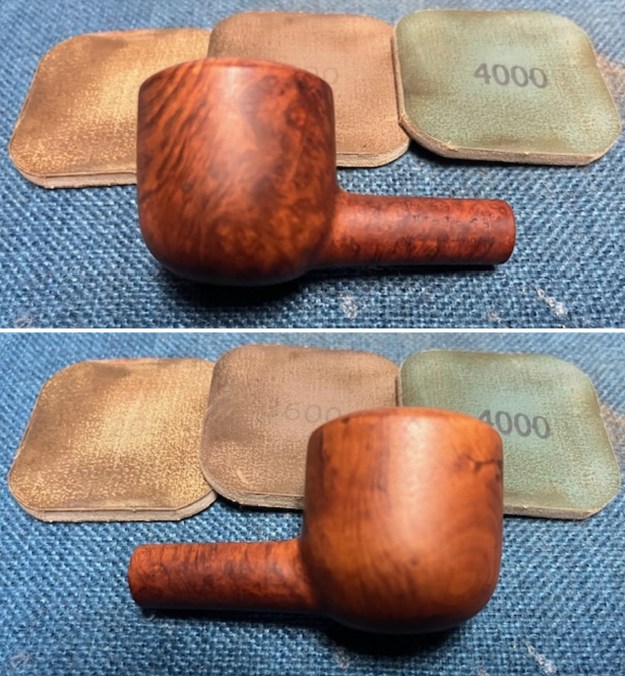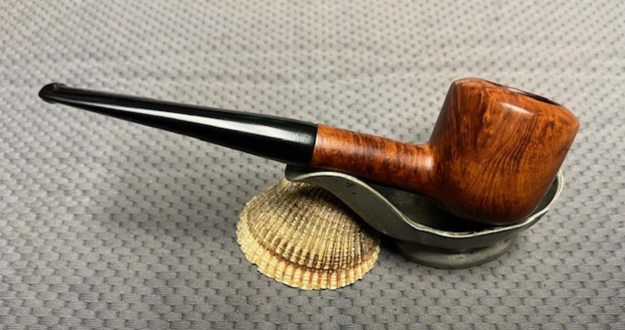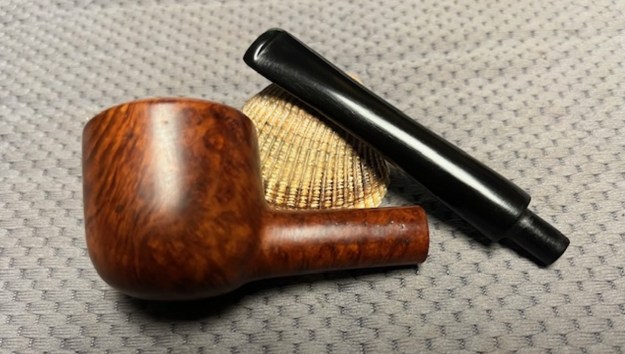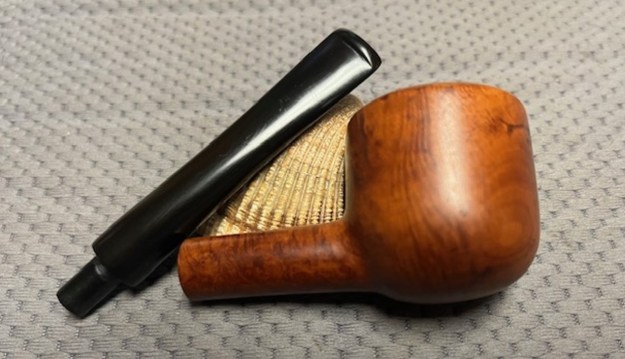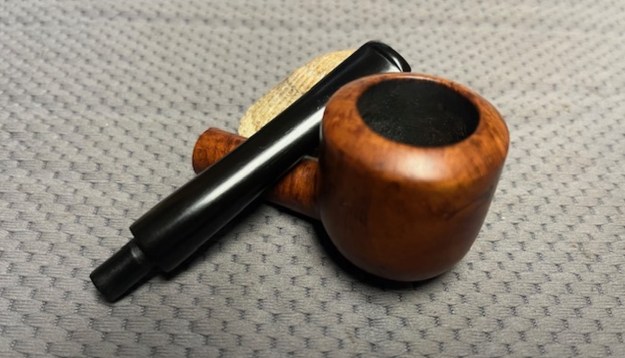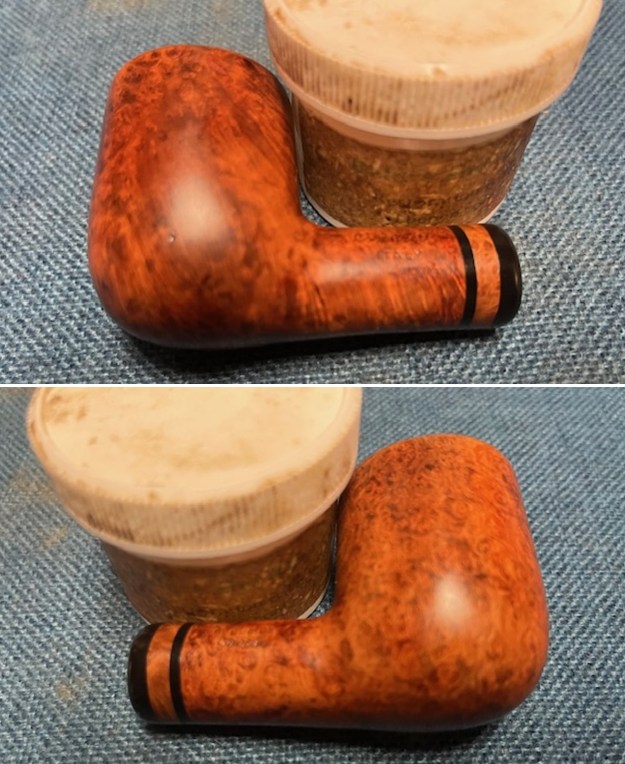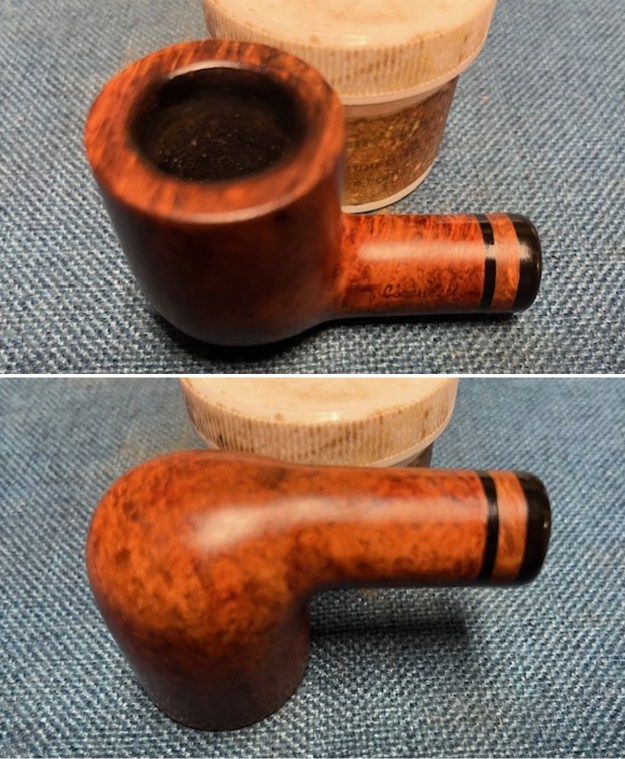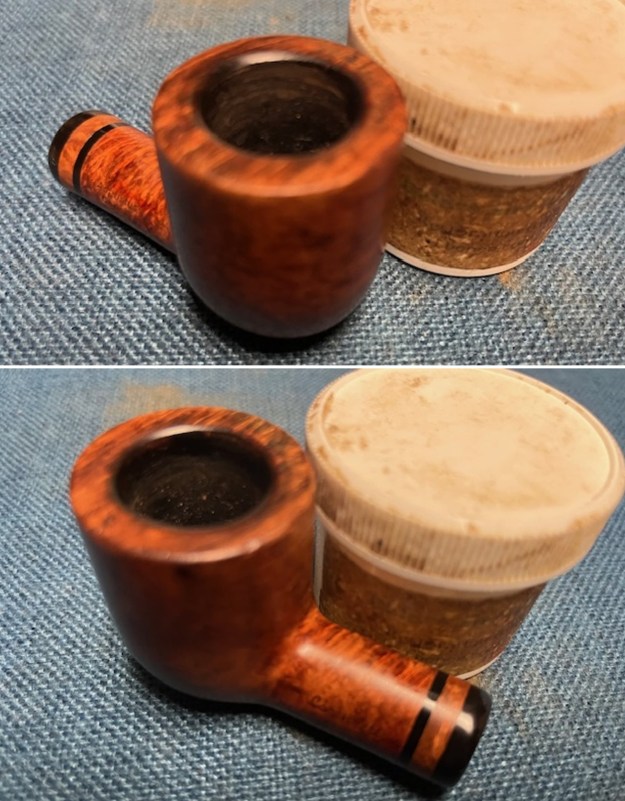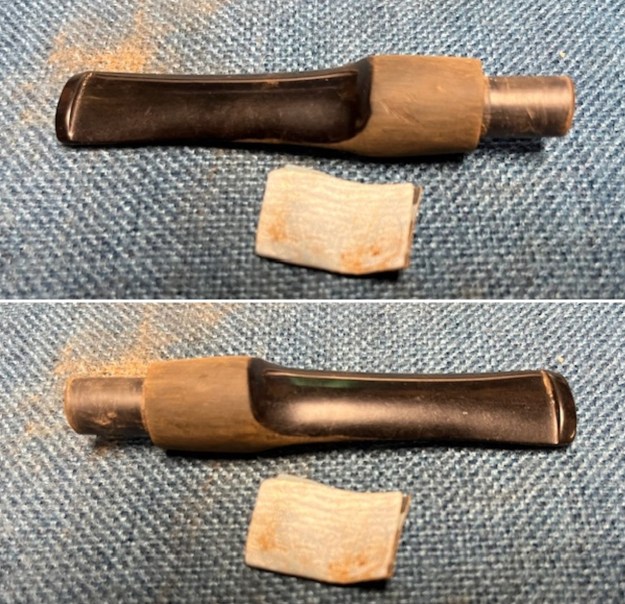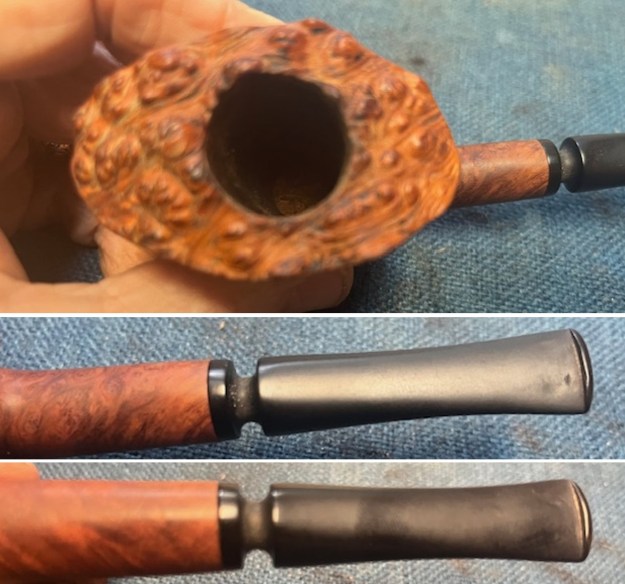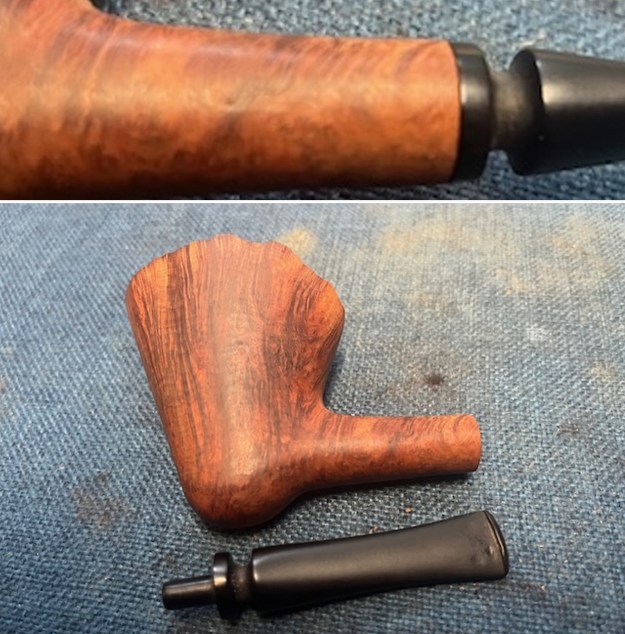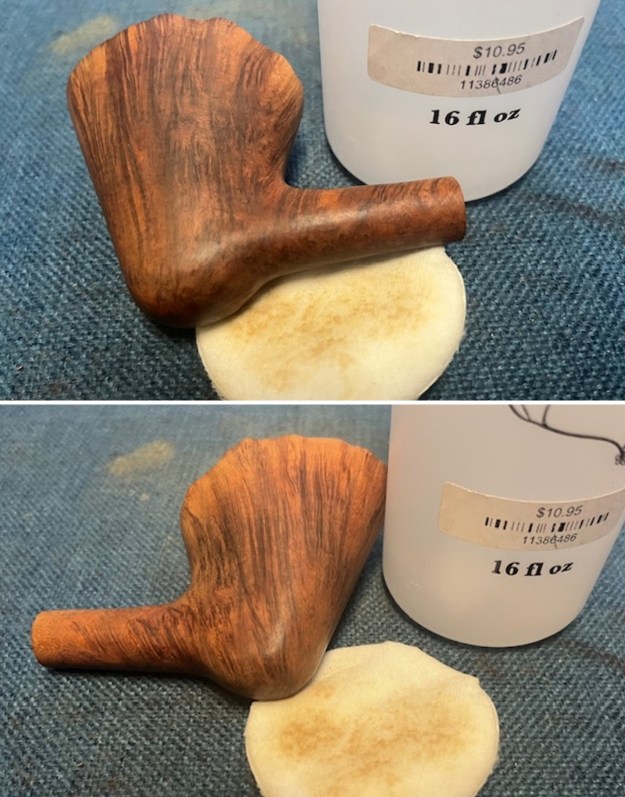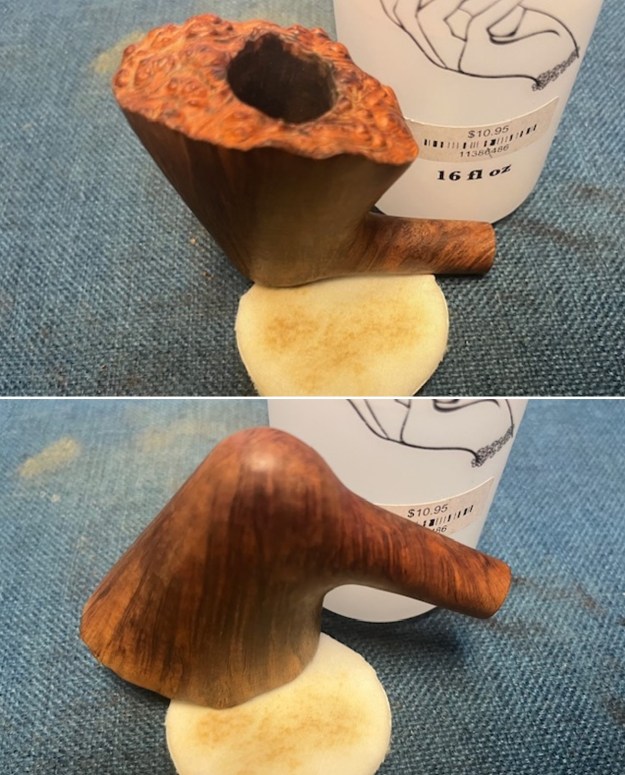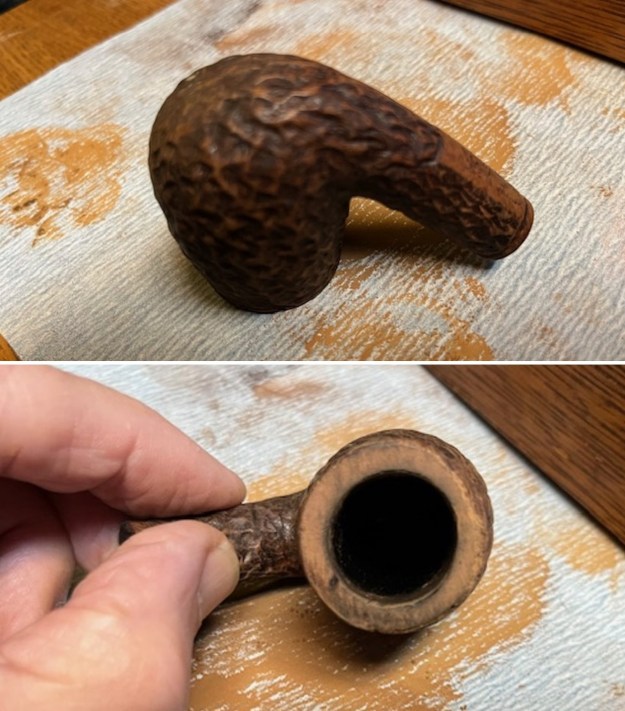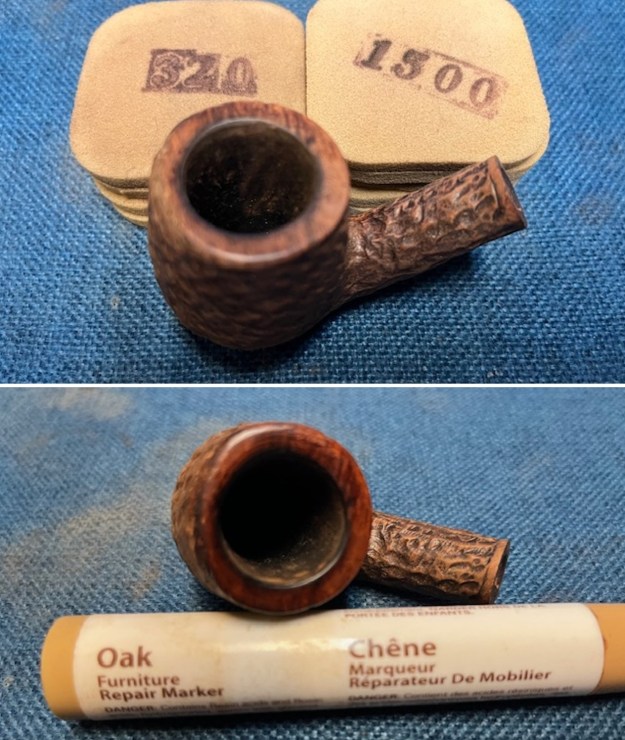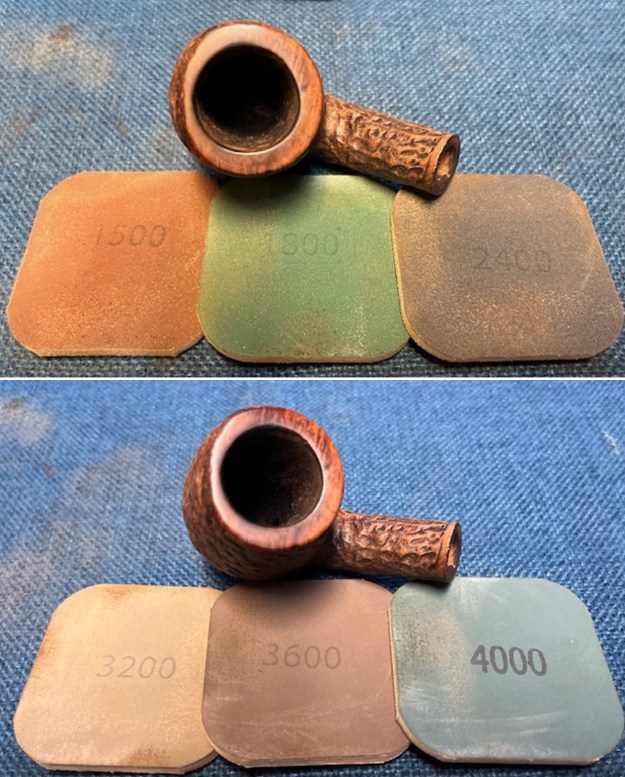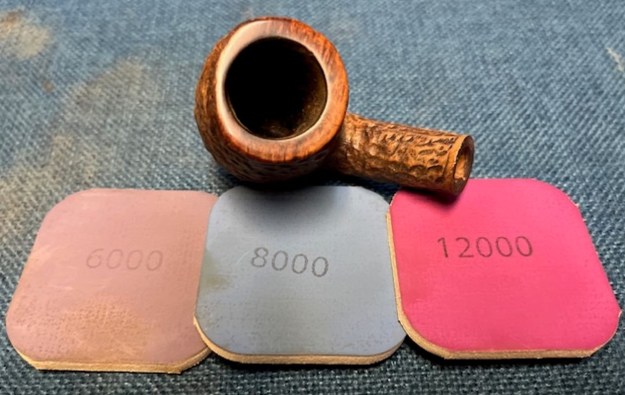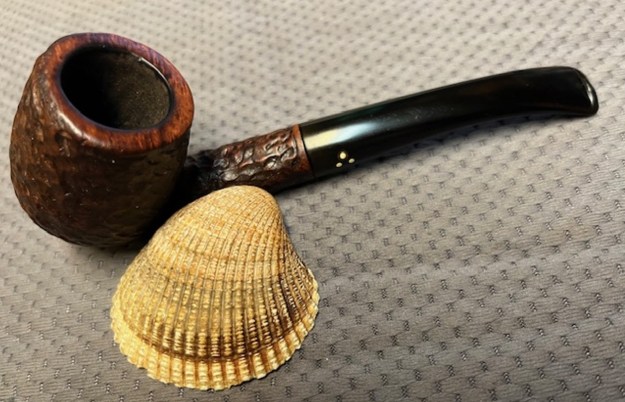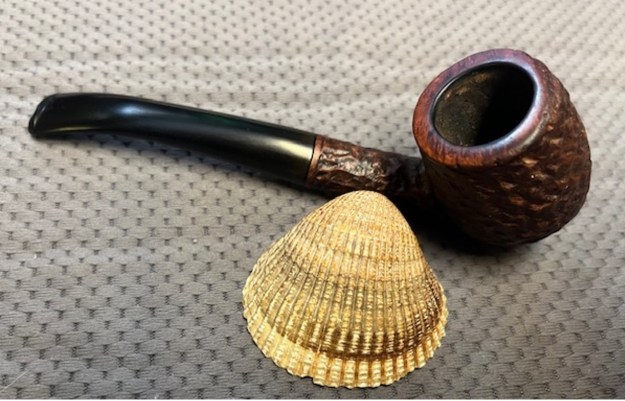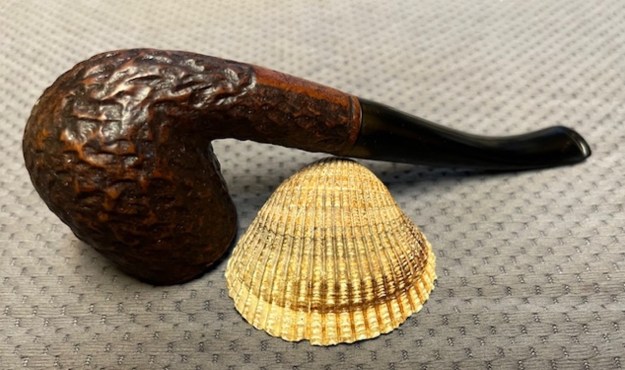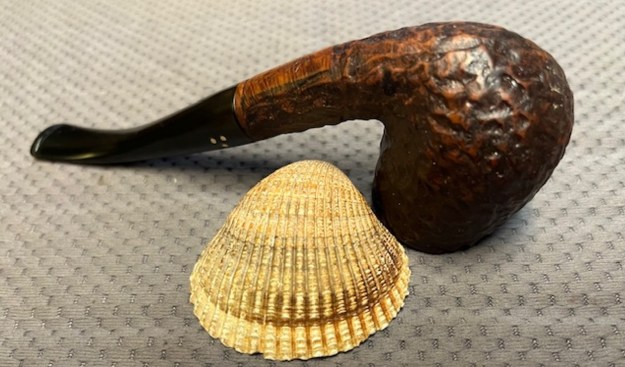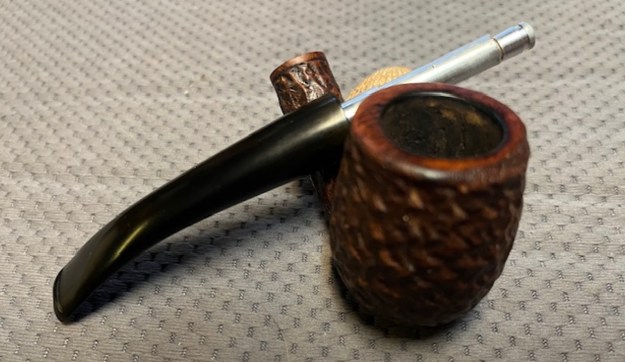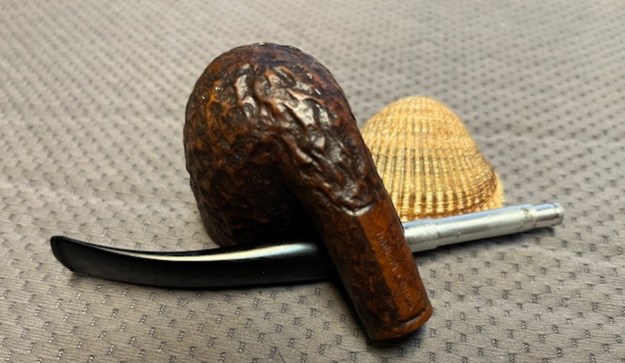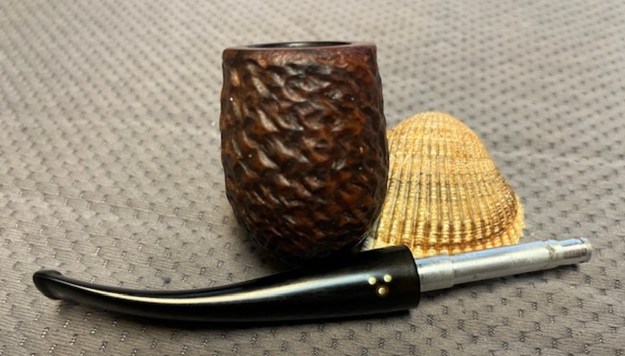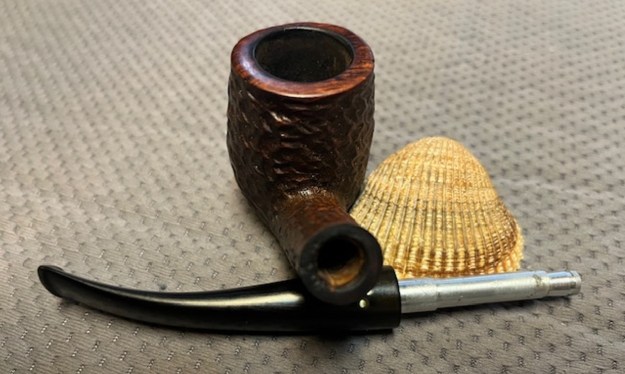
Tag Archives: vulcanite stems

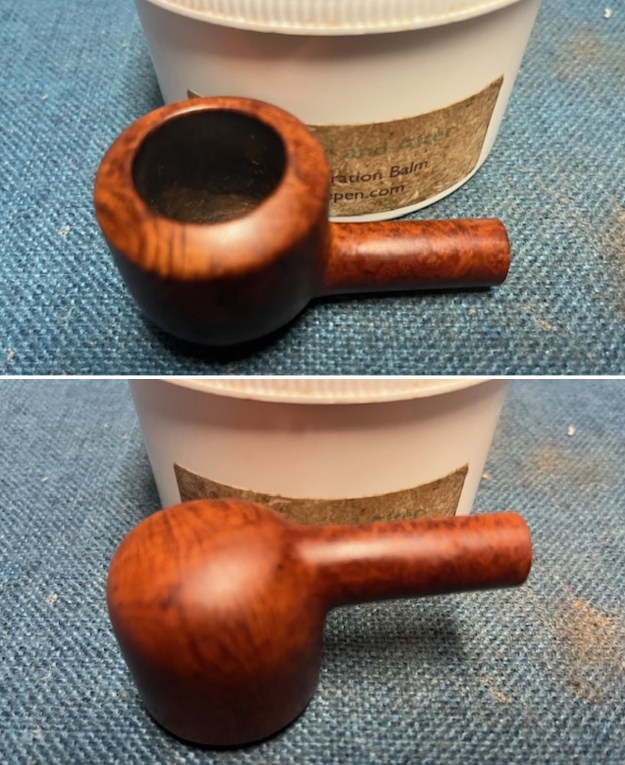
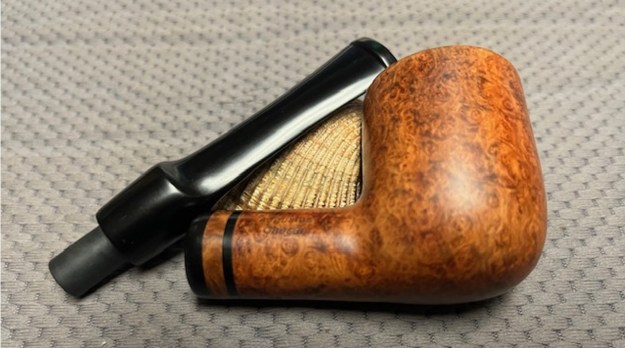
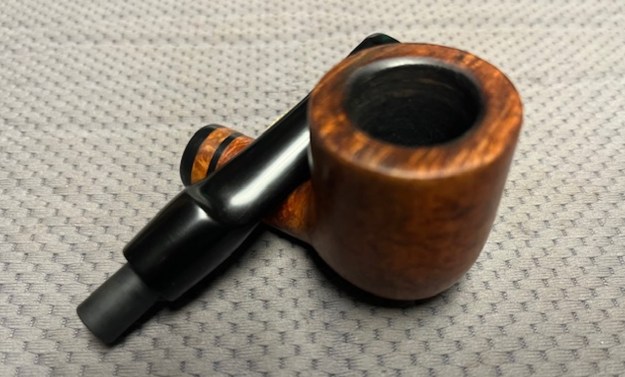
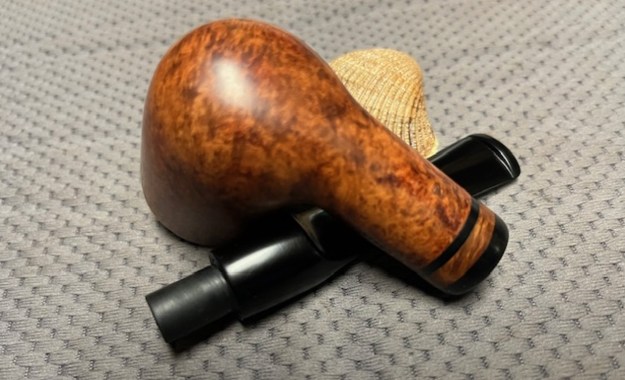
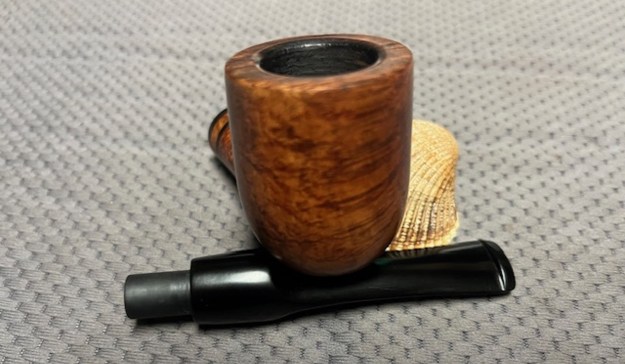
Restoring and Restemming a Clogged and Filthy Italian Lorenzetti Billiard


by Steve Laug

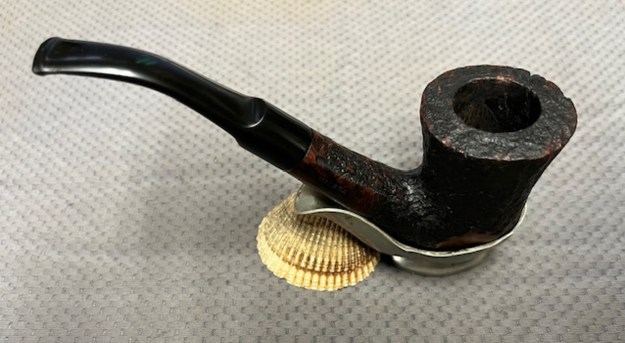
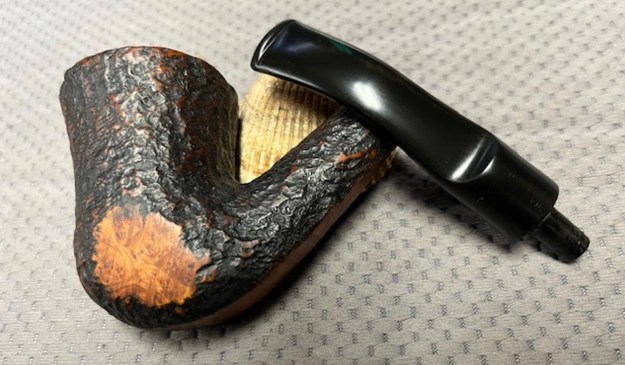
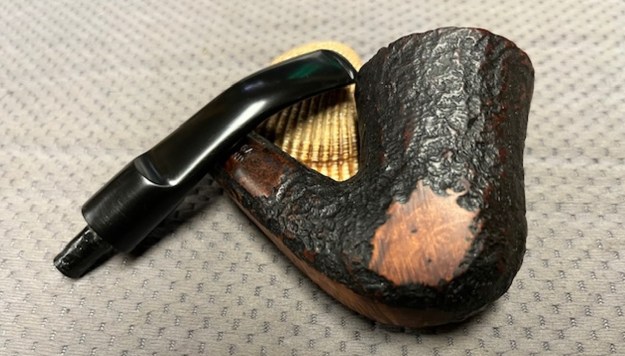
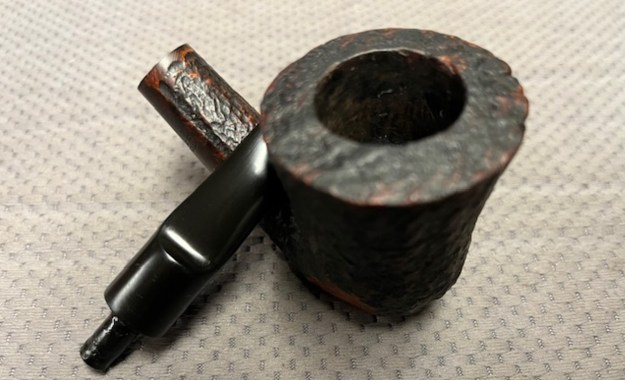
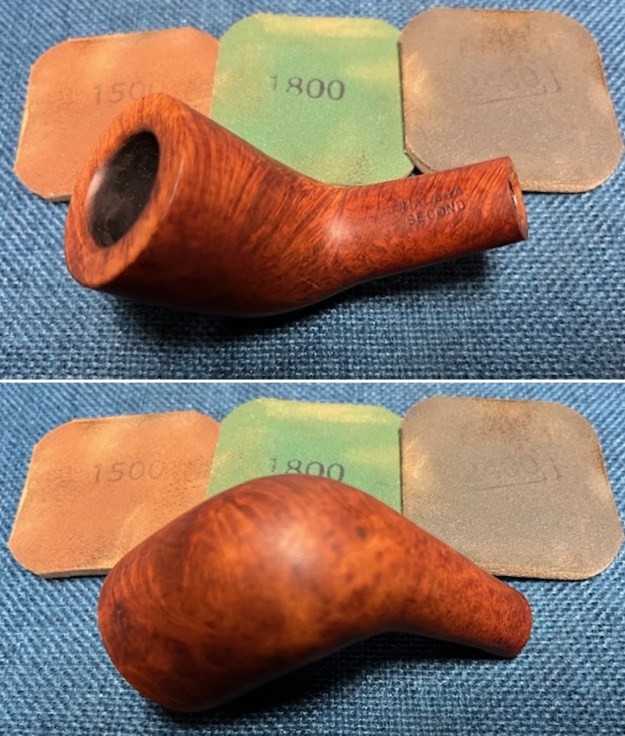
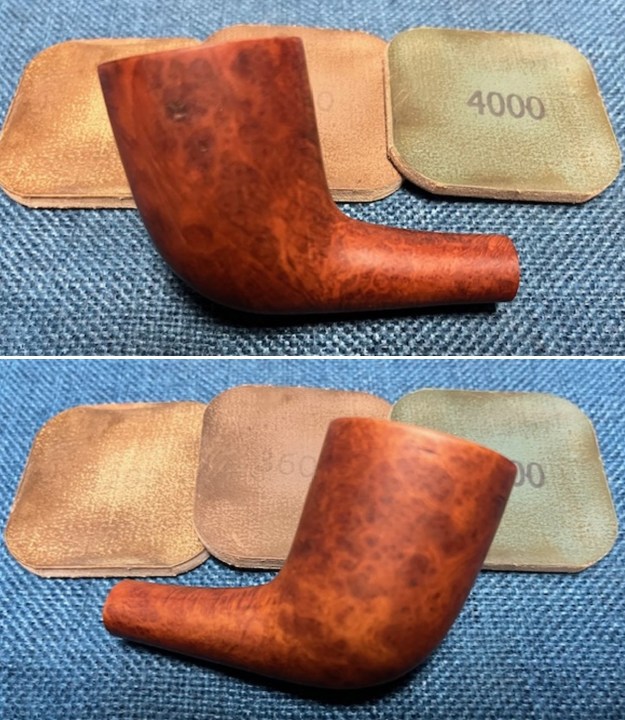
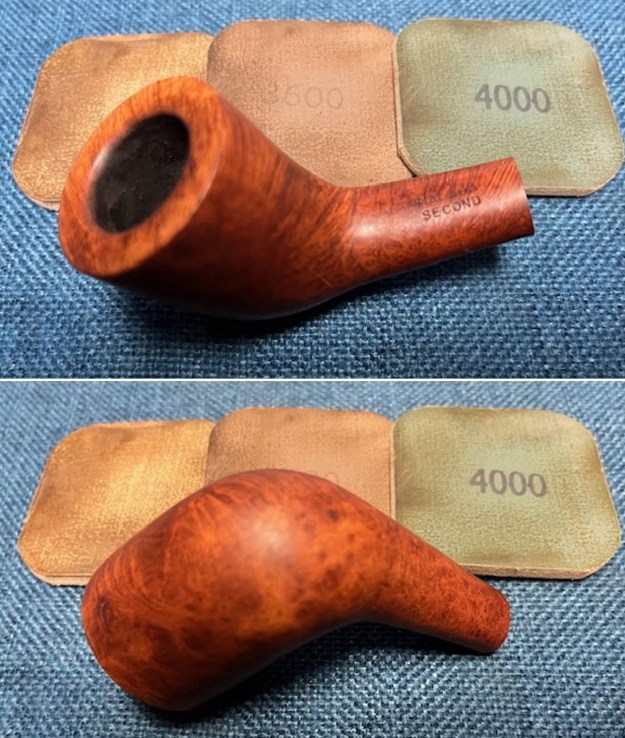
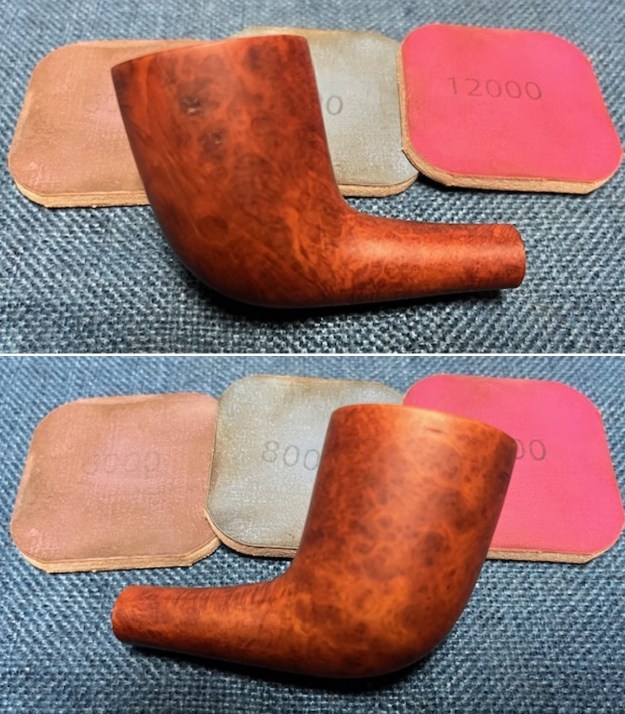
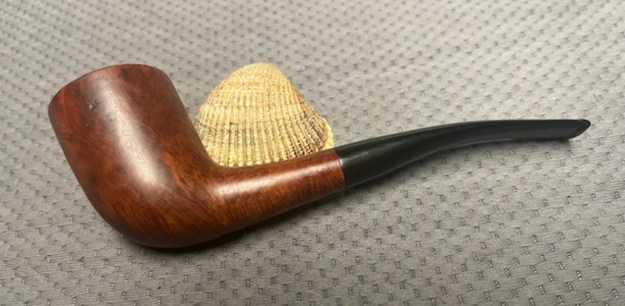
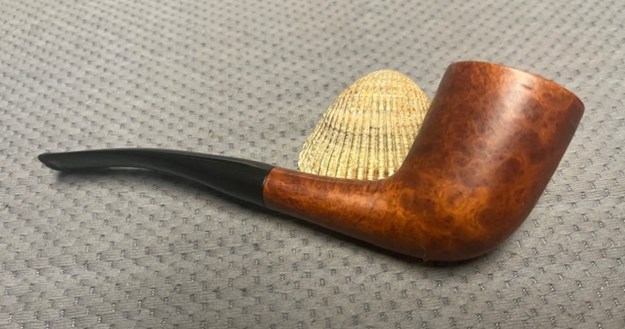
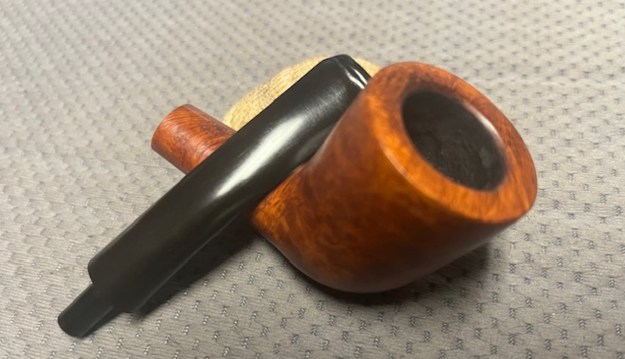
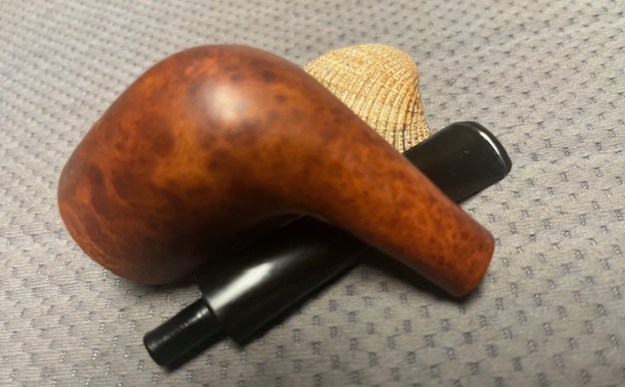
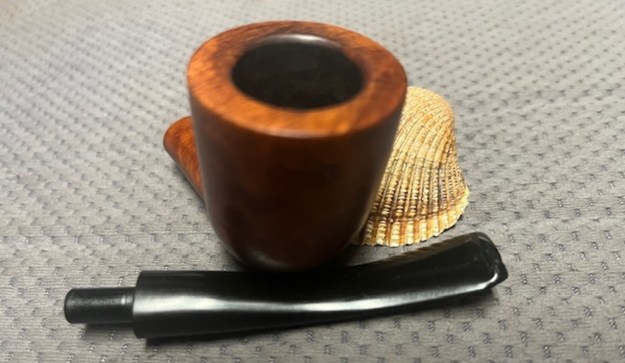
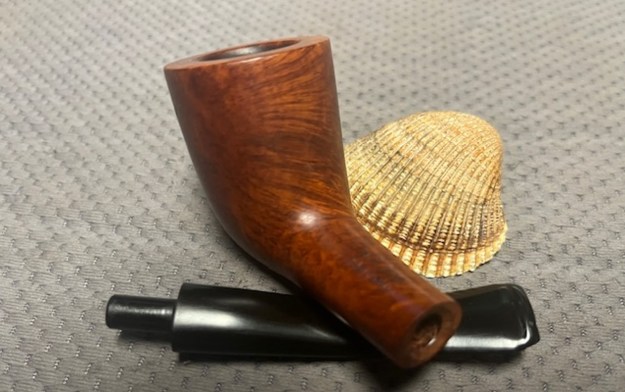
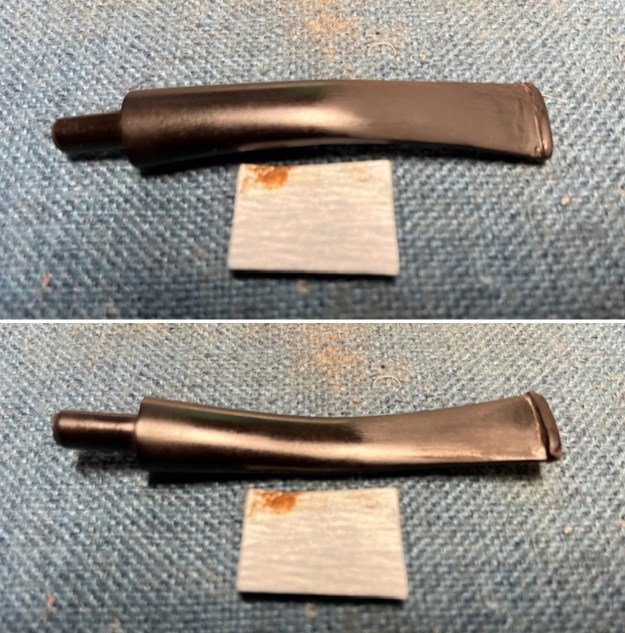
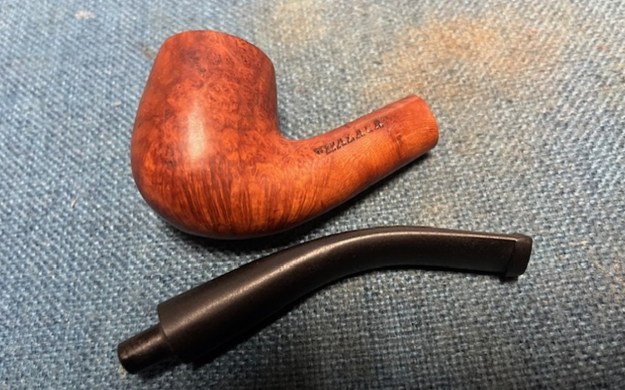
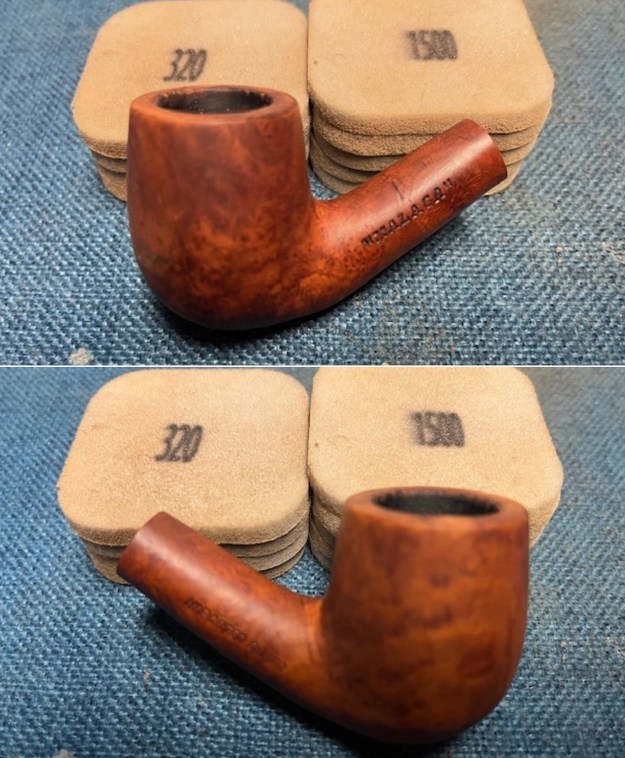
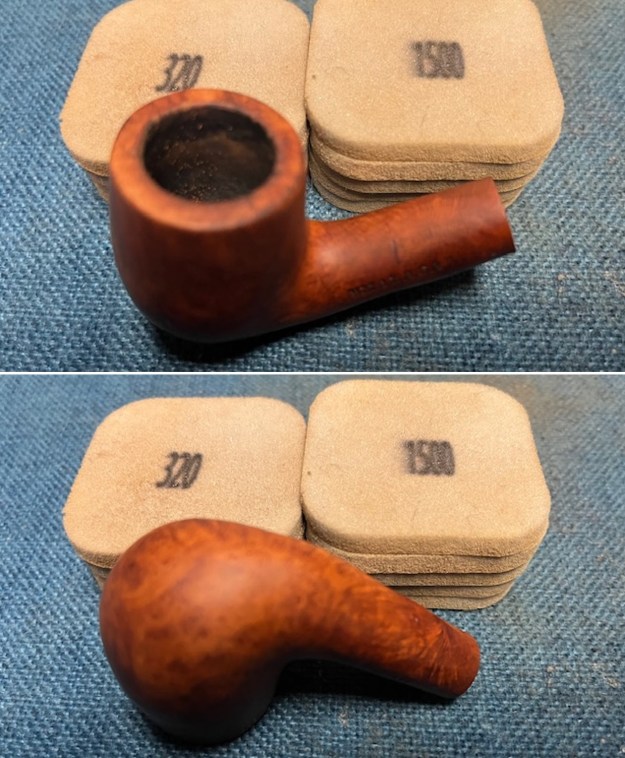
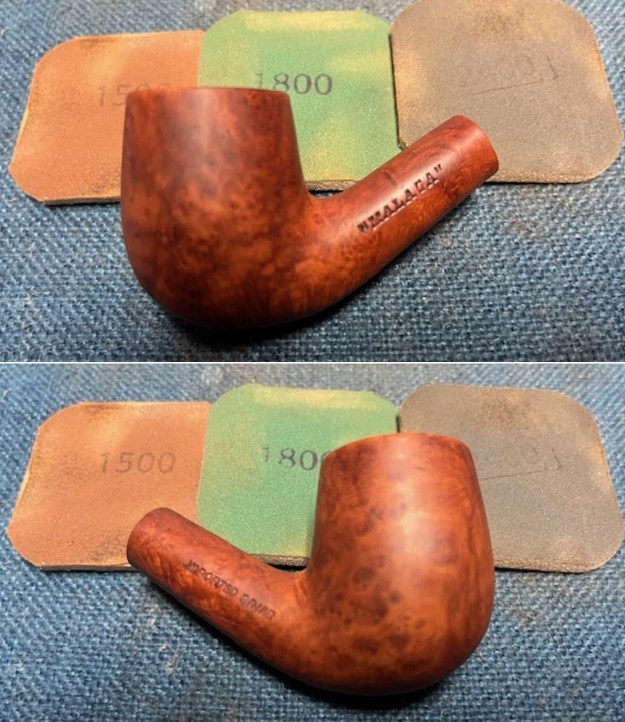
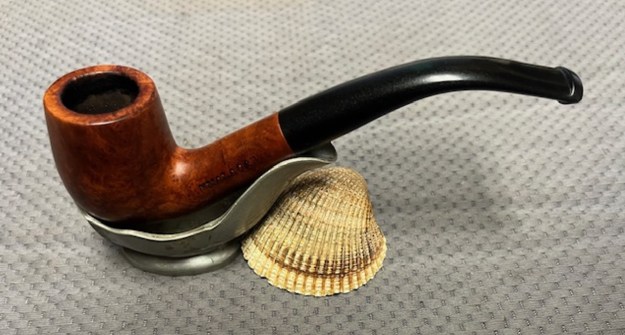
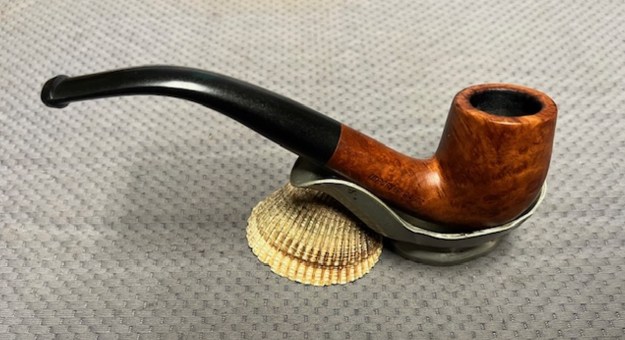
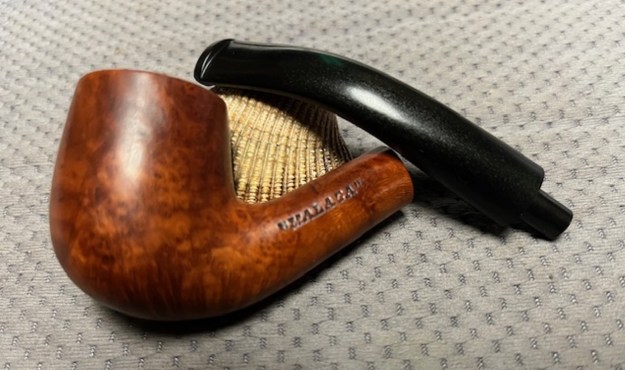
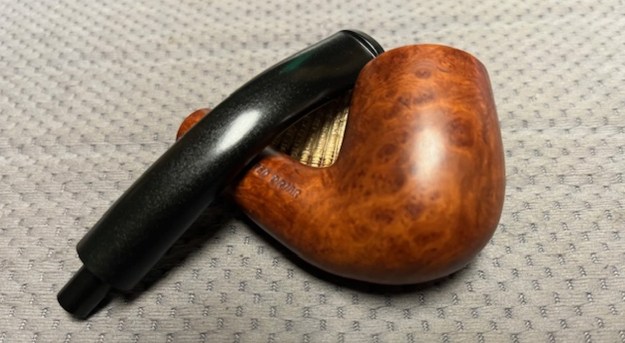
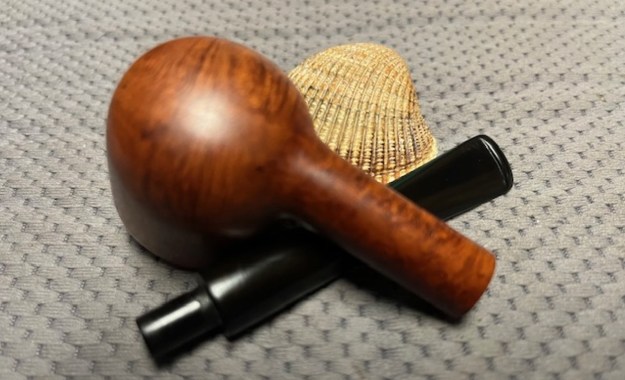
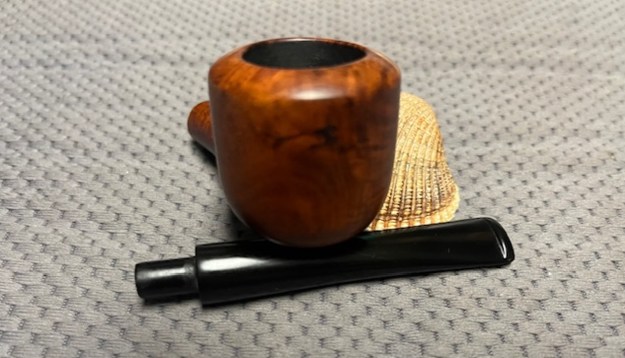
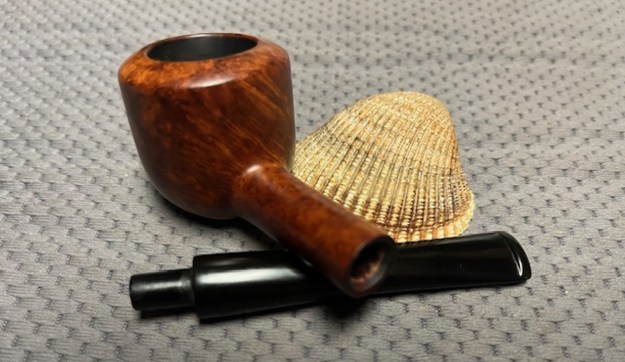
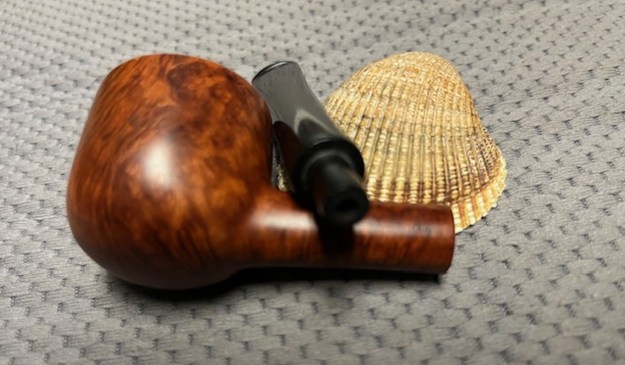
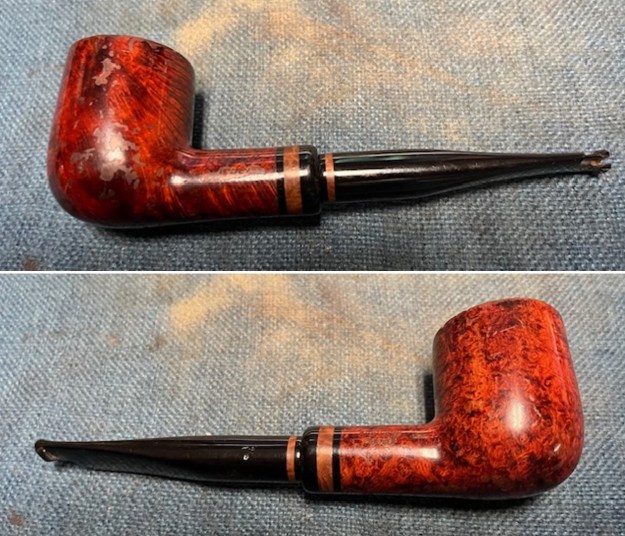
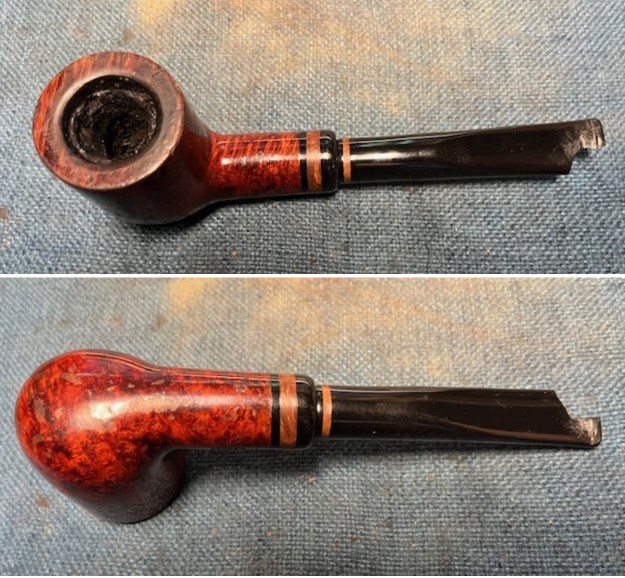
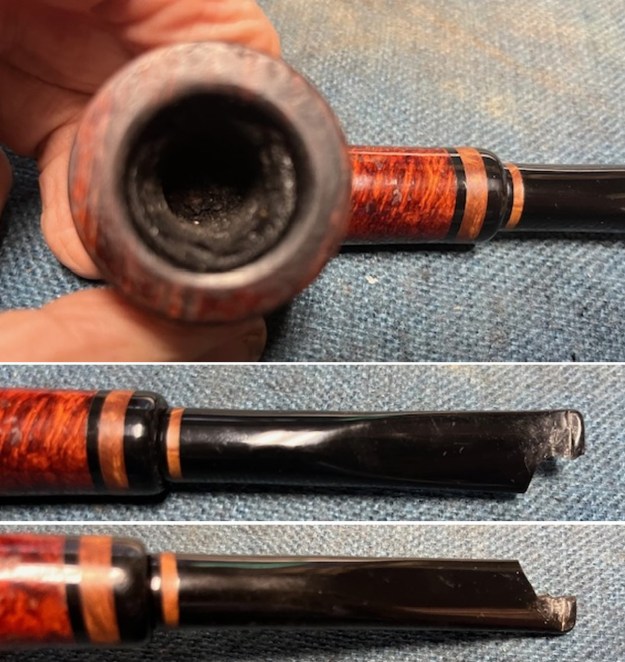
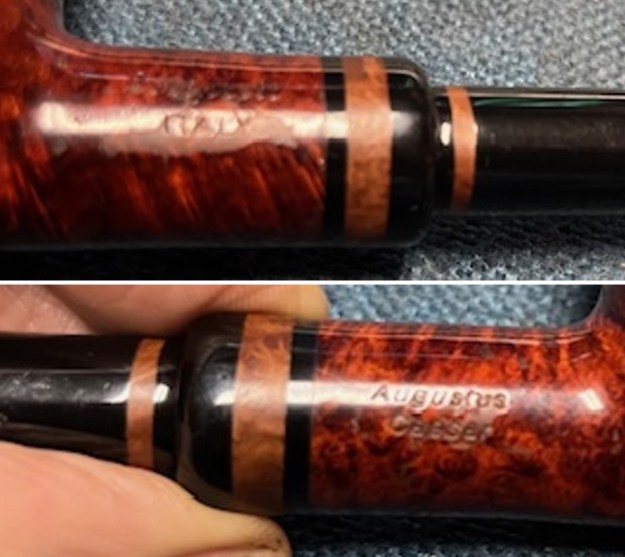
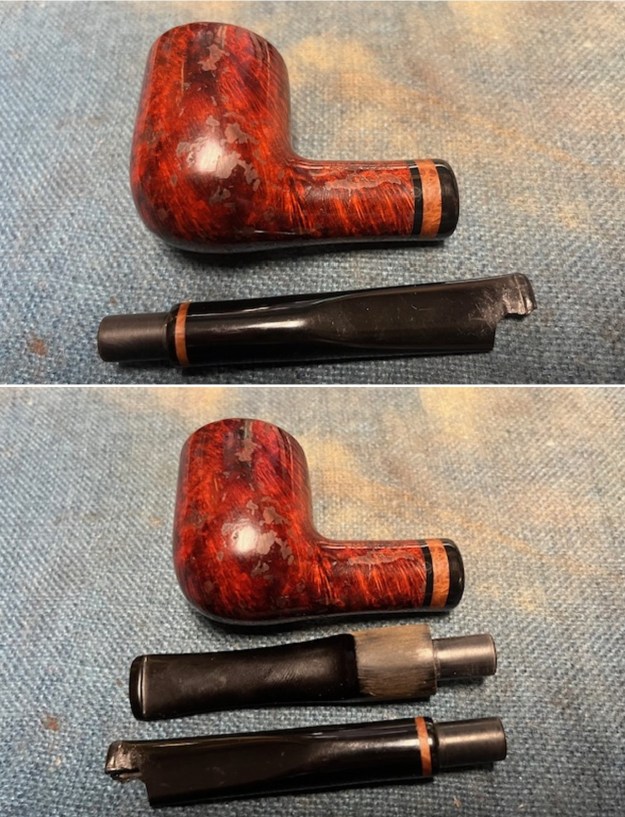
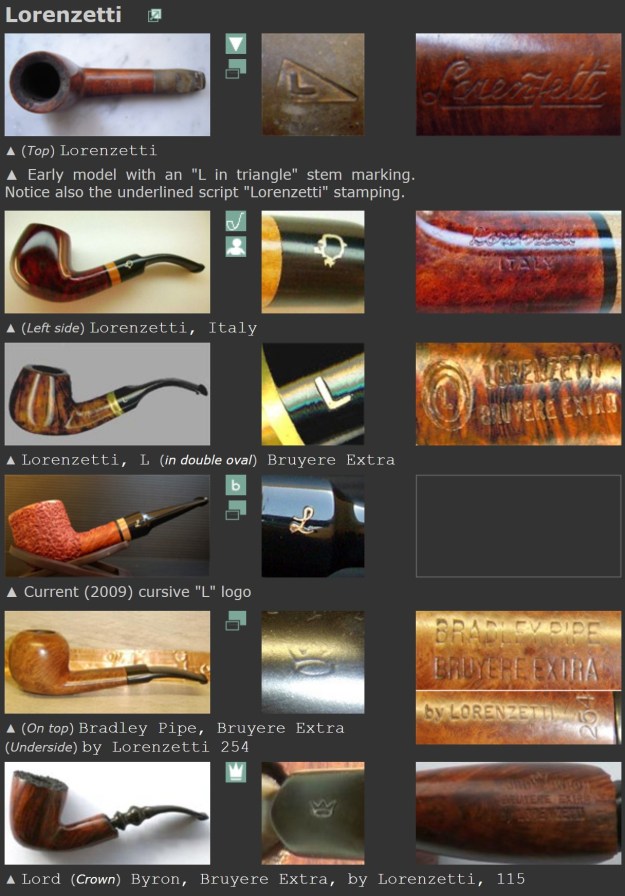
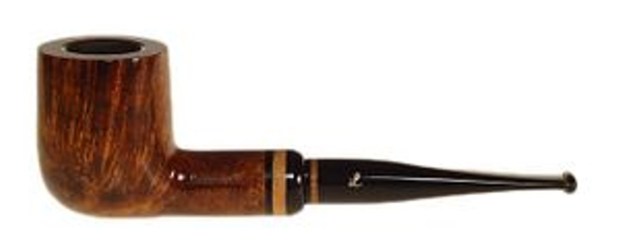
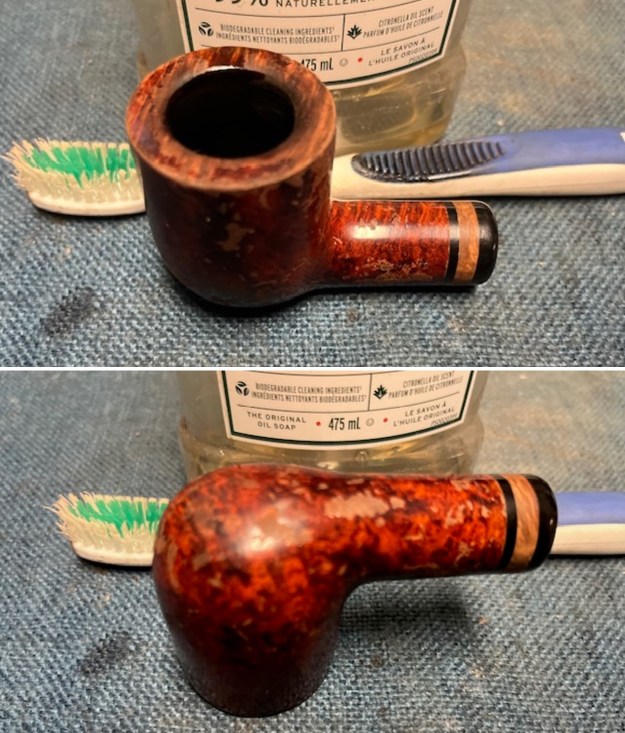
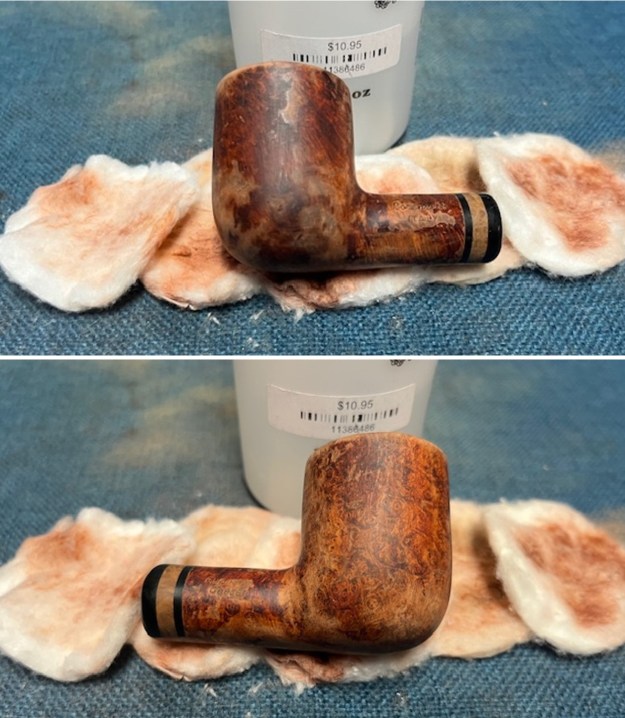
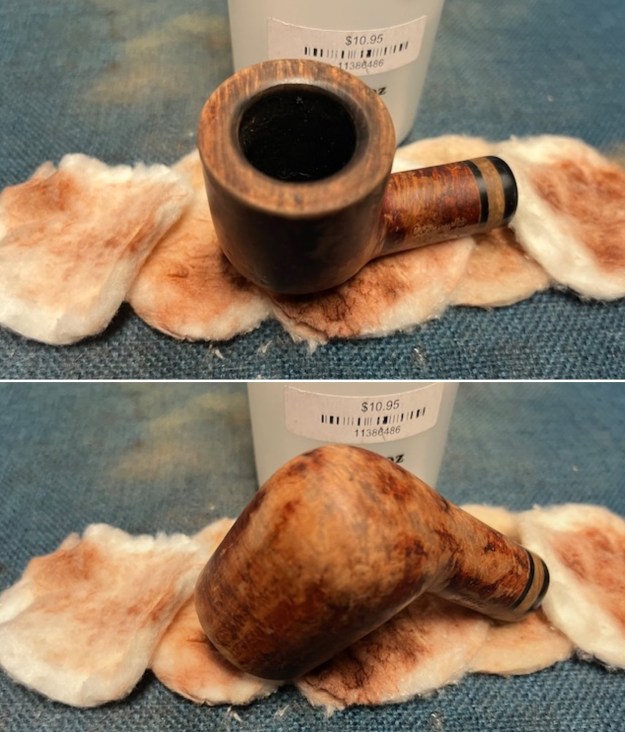
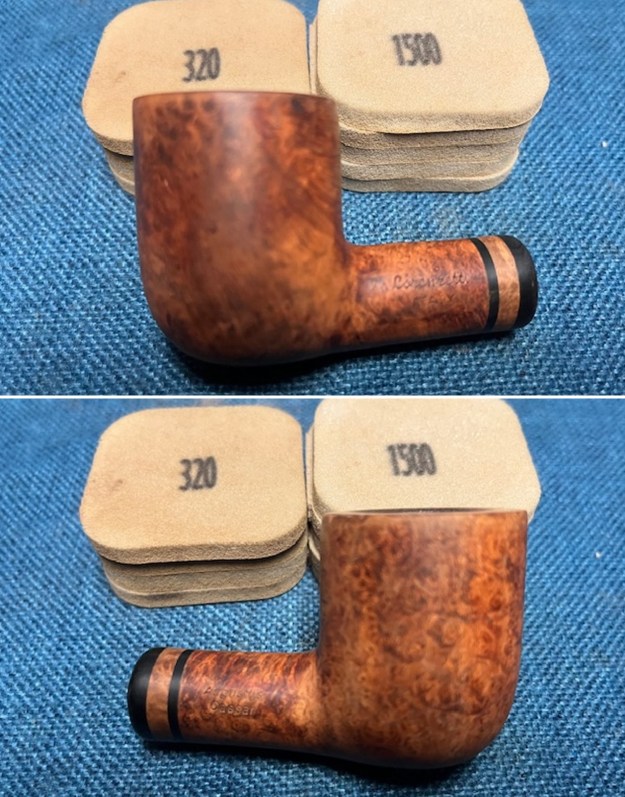
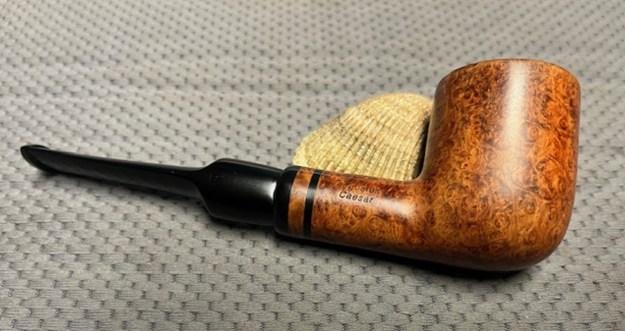
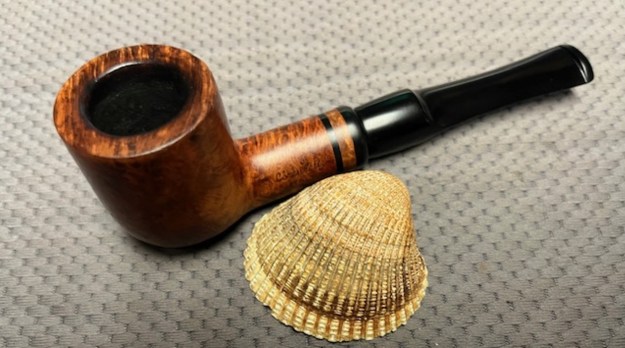
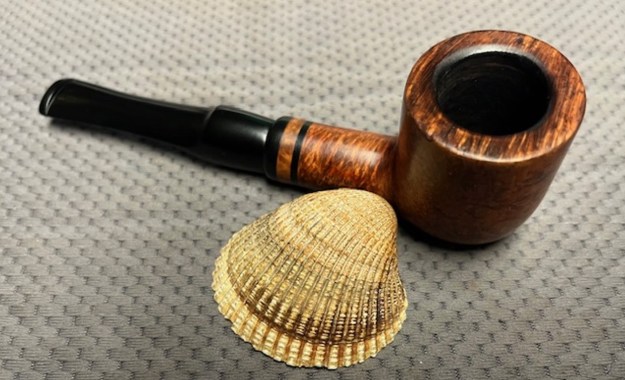
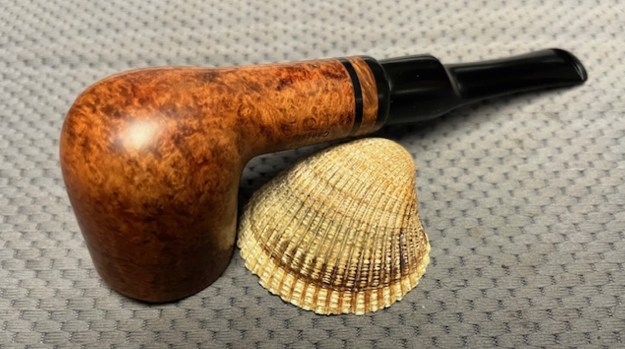
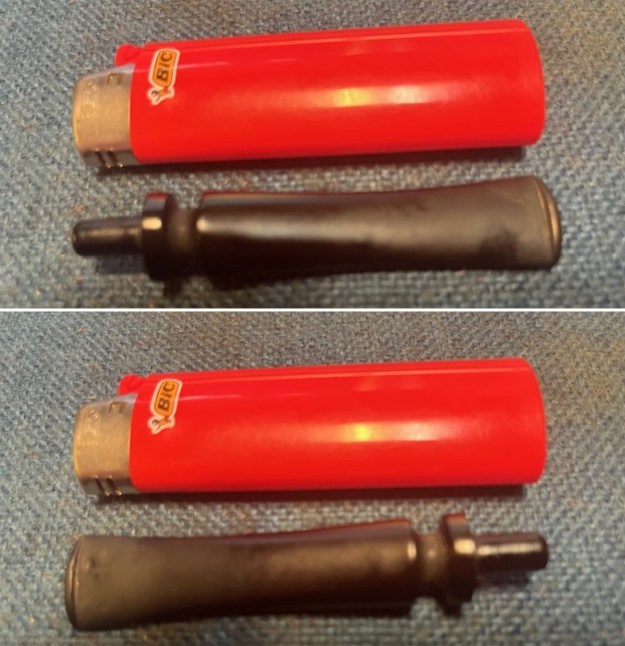
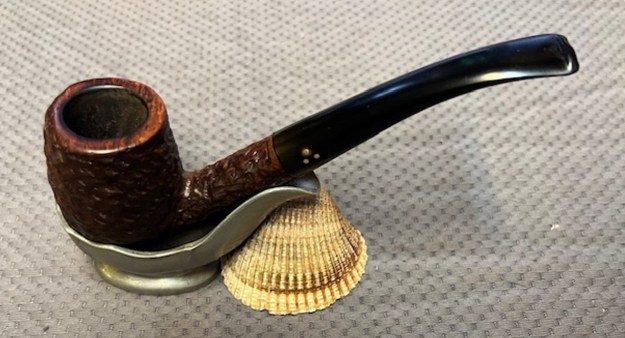
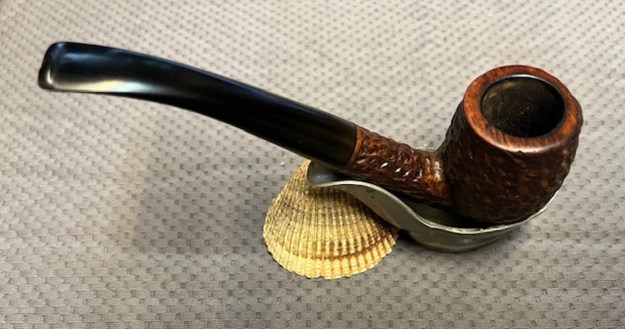
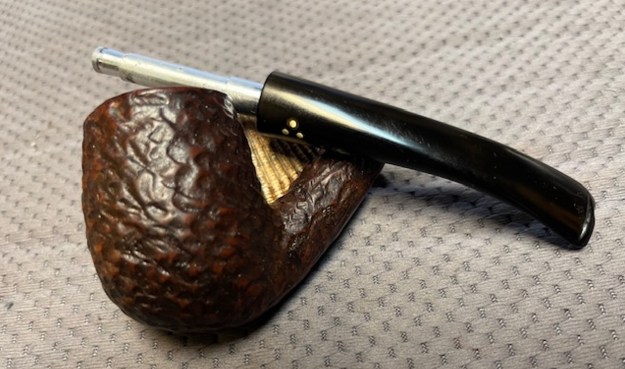
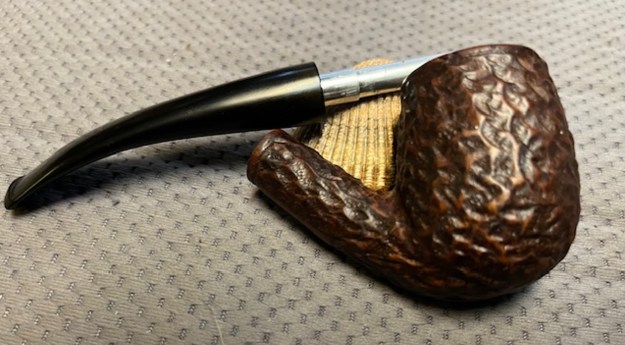
A fellow in Victoria, Brian has had me work on a few of his pipes this past few months. The pipes are generally very dirty with plugged airways and a thick damp, tarry mess in the heel of each bowl. The airway in the shank was also clogged so there was no exchange of air going through the pipe. The pipe was stamped on the left side of the shank and reads Lorenzetti in script [over] Italy and on the right side it is stamped Augustus [over] Caesar. On the underside it is stamped 03. There is a thick cake in the bowl that is wet in the bottom 1/3 of the bowl. The rim top was quite clear of heavy lava. The finish on the bowl and shank has a thick peeling coat of varnish on the bowl that looks terrible. There is an acrylic shank end with an insert of briar between the acrylic pieces. The stem acrylic stem is a filter stem and the button end has a large chunk missing that is severely damaged. I will need to restem the pipe. But I have included photos of the pipe before I started working on it. I took photos of the rim top and stem to show the general condition of the pipe. The bowl is heavily caked and the rim top and edges have a thick lava overflow. The photos of the stem show the damage and broken part of the stem. It really is a mess and the acrylic is not repairable.I took photos of the stamping on the sides of the shank. It is clear and readable and reads as noted above. I took a photo of the pipe without the stem to show the proportions of the bowl and stem. I also went through my stems and had a saddle stem that was made for a filter. I called Brian and asked if this would work for him and he was happy with the options. I wanted to gather some background information on the brand. I turned first to Pipephil’s site to see what I could learn (http://www.pipephil.eu/logos/en/logo-l6.html). I was able to get a screen capture of information on the brand. I have included that below along with the sidebar info.Brand created 1934 by Otello Lorenzetti.Currently (2009) the company is managed by Alessandro Lorenzetti. Address: via A.Giunta, 51, 62019 Recanati (MC) – Italy.

I turned to Pipedia to gather more information on the brand. It gives some great history of how the brand developed (https://pipedia.org/wiki/Lorenzetti). I quote some portions of the article below. There was also a photo of the same pipe that I am working on the site. I have included that below.

Smooth Pot, courtesy SmokersHaven.com

Otello Lorenzetti, the founder of our manufacture, was born in Castelnuovo, Recanati in 1911. He is the fifth of five children from a modest, but enterprising family, in fact they own a tavern where the young Otello, already at the age of seven, actively collaborates. He goes on his own, with a small handcart, to S. Agostino di Recanati where he purchases fizzy drinks and other soft drinks and then resells them with his mother in their small family run tavern….

After the precocious interruption of his studies he begins to work as an employee at “Catena Remigio” an old pipe manufacture in Recanati. The grand personality of Otello, who is inclined to make any art a passion, does not delay in emerging. In 1934, after having concluded 18 months of military service in Cividale, in Friuli Venezia Giulia, he decides to work on his own pondering the first bases of the actual pipe manufacture, that, in this period, operates under the company name “Otello Lorenzetti.” At that time the capital of our actual company, that was and still is his house, was constituted by: “A few rented tools and my own hands” – as Otello himself tells us. The production consists of 20-30 pipes per day. Every morning, in company of his bicycle, he tries to sell them to the tobacco shops in the area or as he says the “neighbouring shops”. With only the strength of his legs he goes to Macerata, San Severino and Civitanova Marche. His pipes are appreciated, so much so that he decides to work more than 12 hours a day to be able to increase the production. This does not constitute a sacrifice for him as his neighbours remember hearing him tirelessly working and singing everyday.

Two brisk interruptions mark the history of our pipe manufacture: the first was in 1935 -in the summer of this year Otello was enrolled in the army and then left for “the African Campaign” from which he returned in January of 1937; the second was in October of 1940, other long months spent in the service of the Italian Army after which he returned home in 1943 the year of Armistice. In 1940 Otello got married to Marinella who became, other than his wife, a great and indispensable business collaborator.

In 1947 Otello succeeded in building, alone, machines the same as the ones he used to rent up until that moment. Many of the pieces most difficult to mould by hand were designed by him and were made in a craftsman workshop in Civitanova Marche. Production increased and permitted Otello and Marinella to buy a “Vespa” helping them to, a part from the province of Macerata, also reach Abruzzo in order to successfully sell their pipes.

The Sixties-Seventies bring on the beginning of exportation abroad (Europe, Africa, America). The company begins to expand, now a part from Marinella, with the help of their children Luciano, Gabriella, Alessandro and some employees. The production begins to perfect itself to the point of being appreciated in almost all the world and by one of the biggest and most famous pipe collectors of all times: our ex-president of the Republic Sandro Pertini.

I knew that I was dealing with a Lorezetti that was probably a recent manufacture. It had some great shape and form and should clean up well once I have the varnish coat removed. Now it was time to work on the pipe.

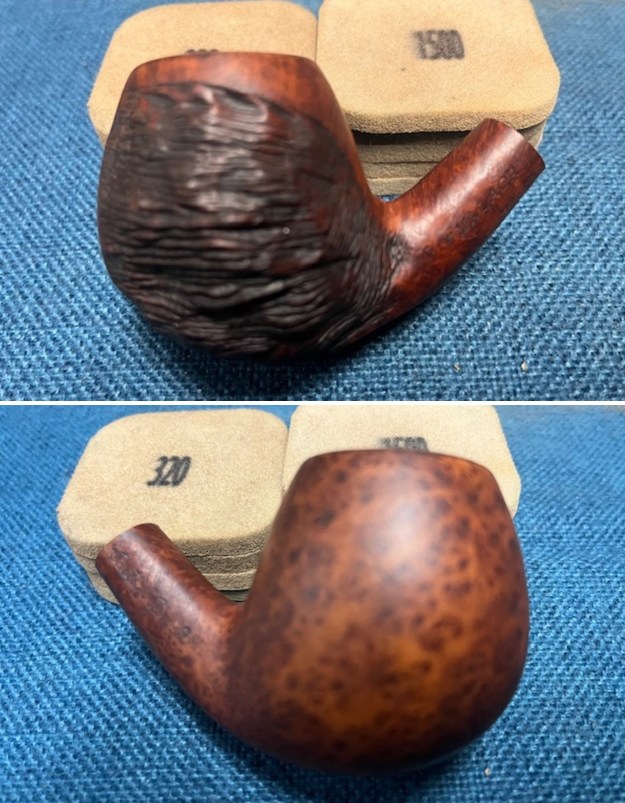
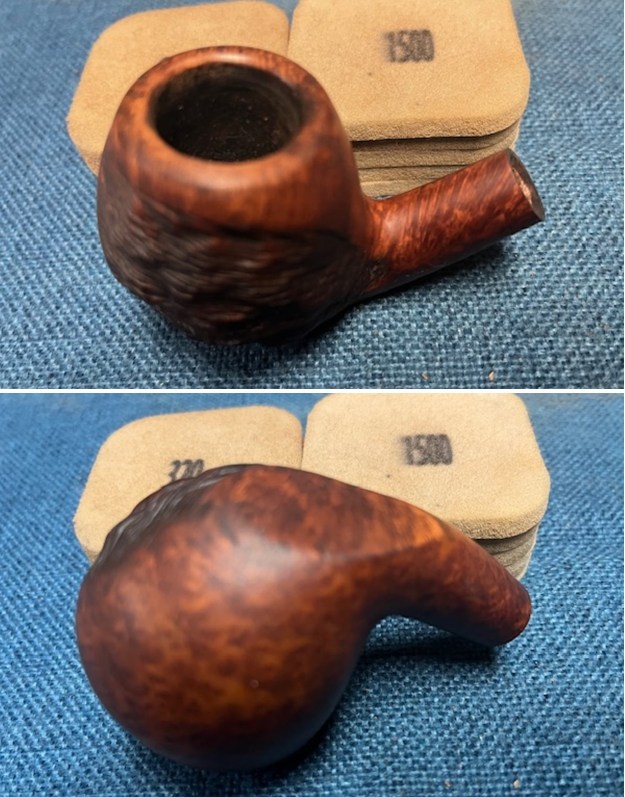
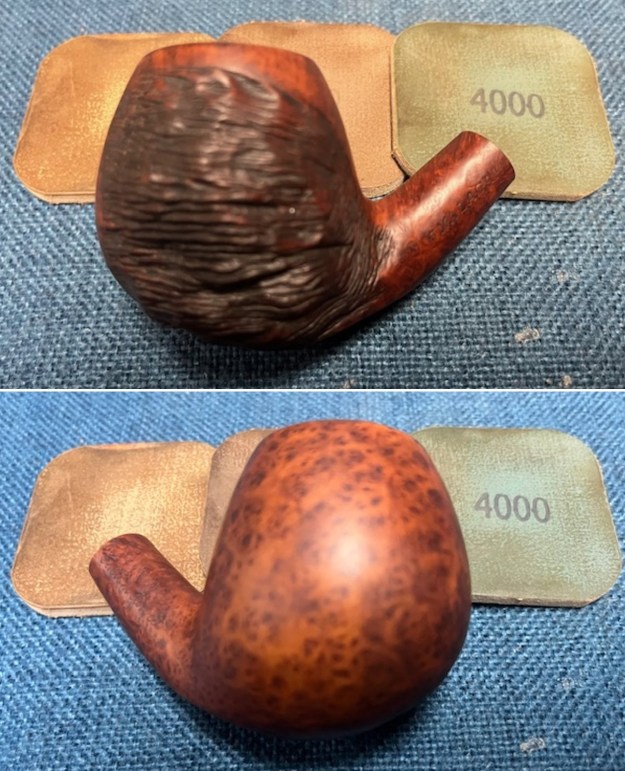
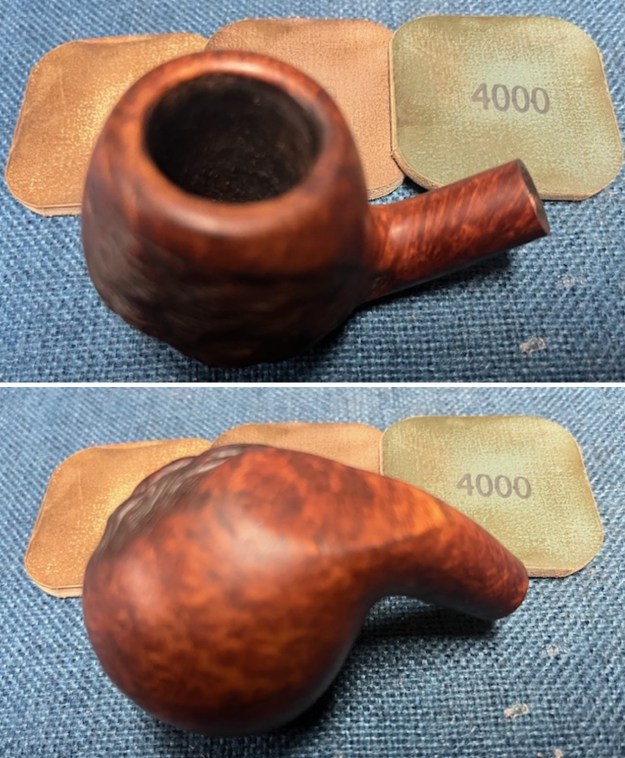
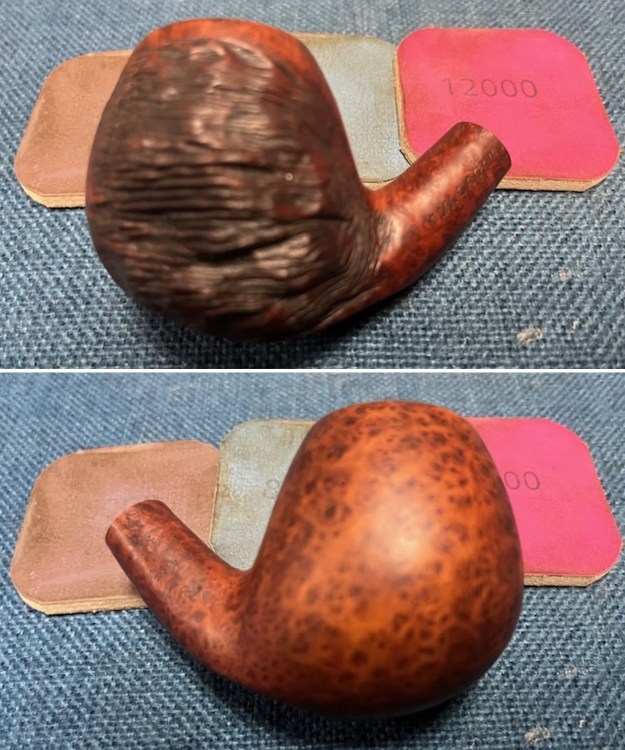
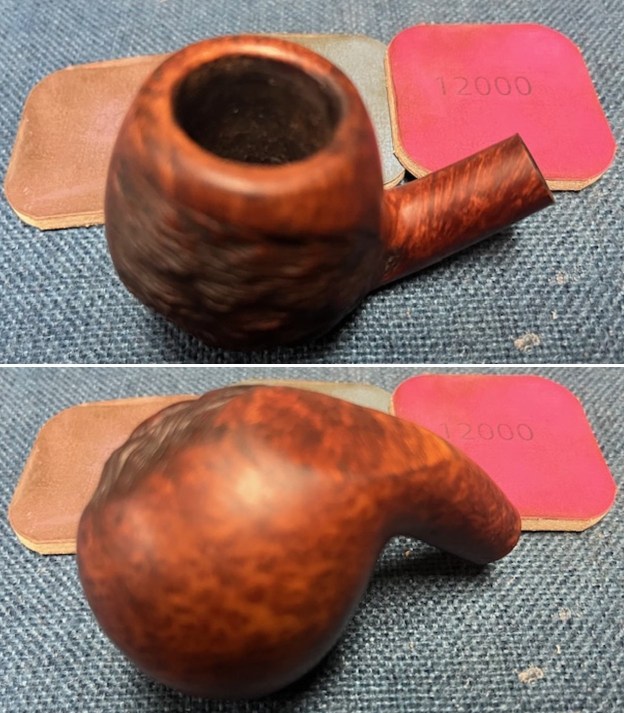
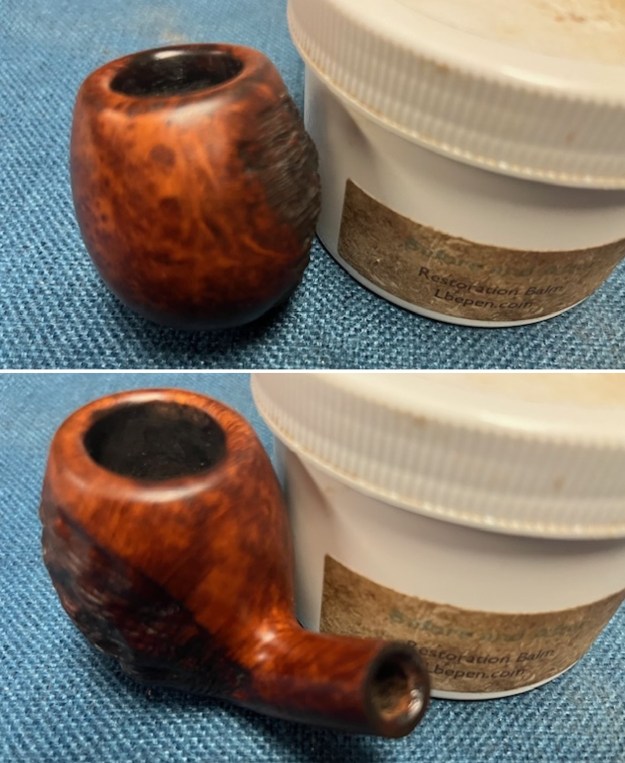
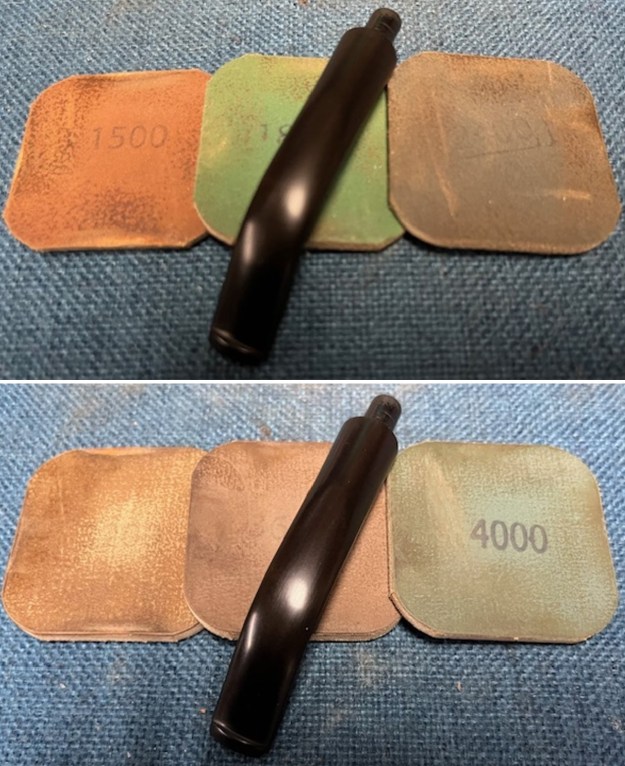
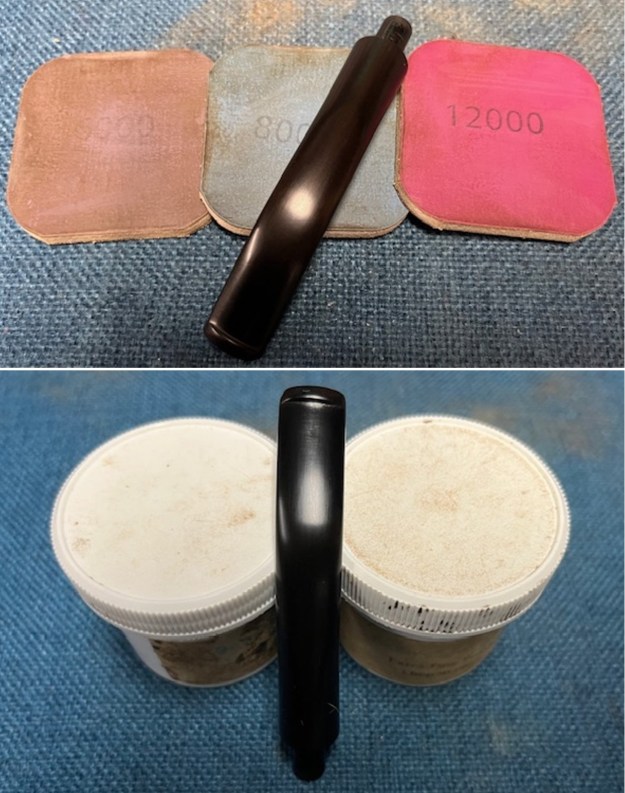
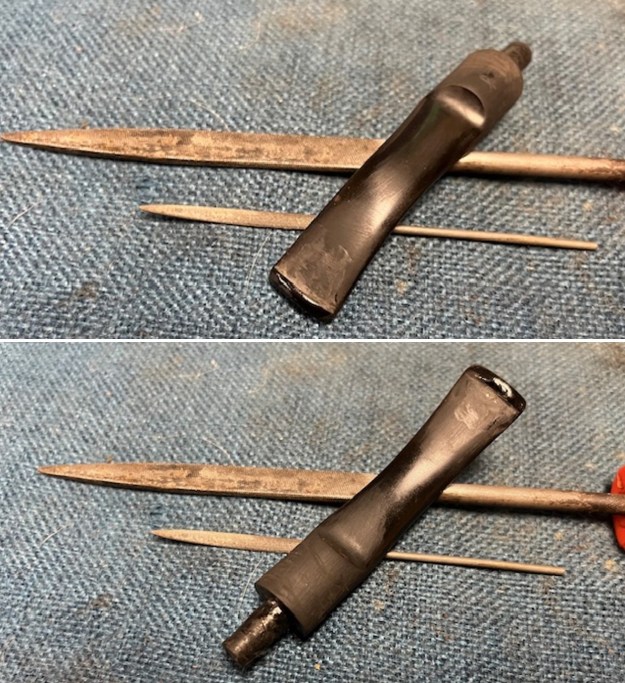
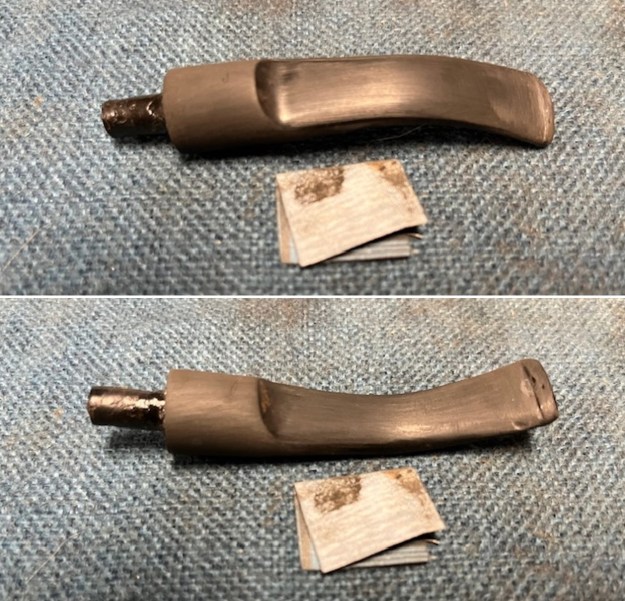
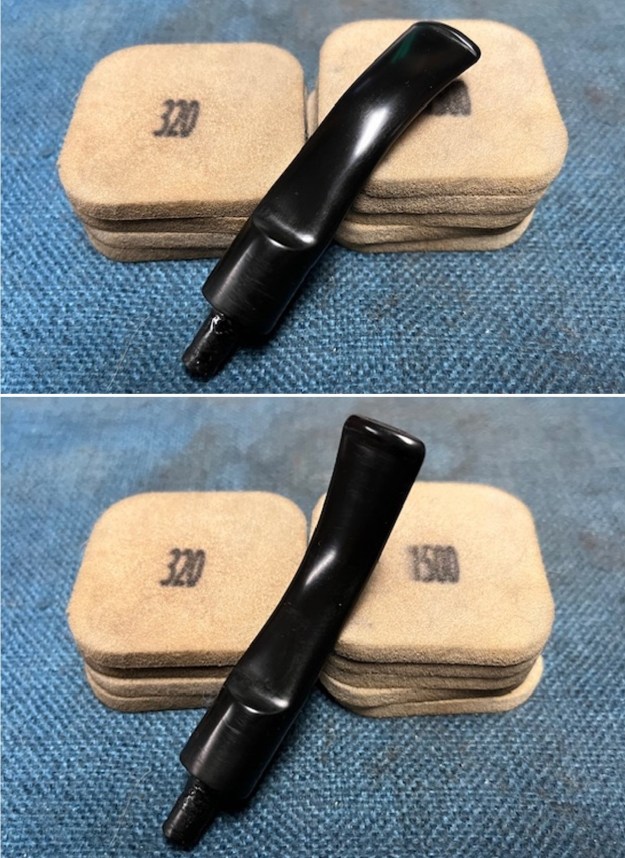
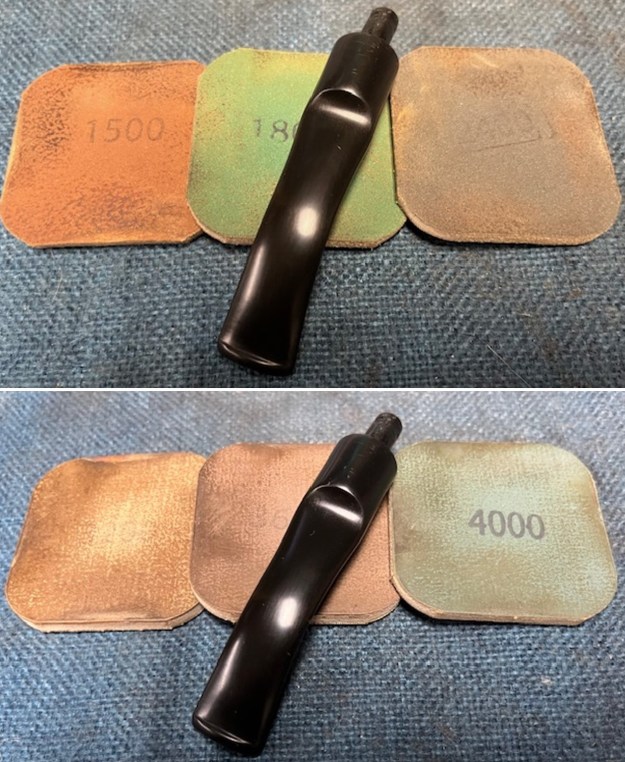
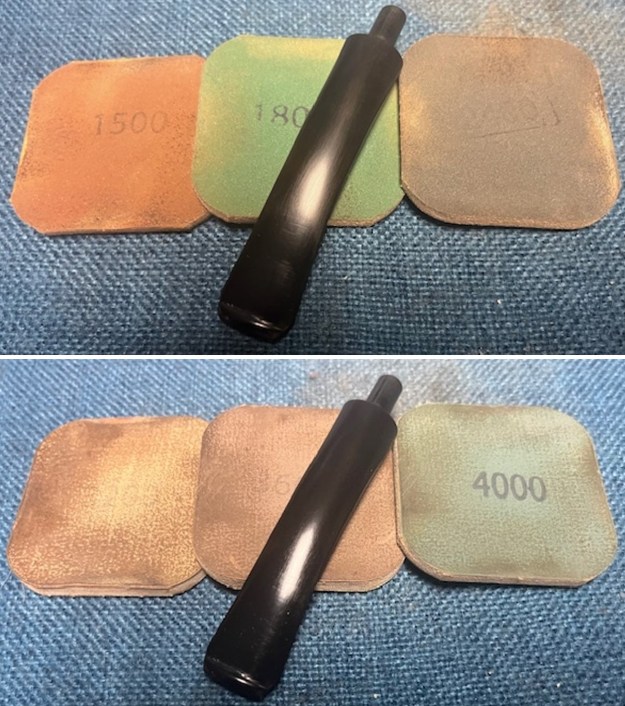
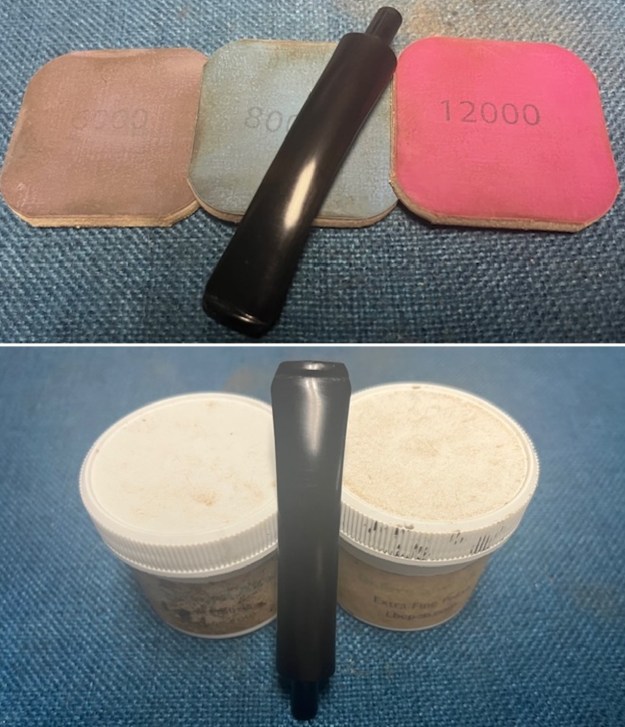
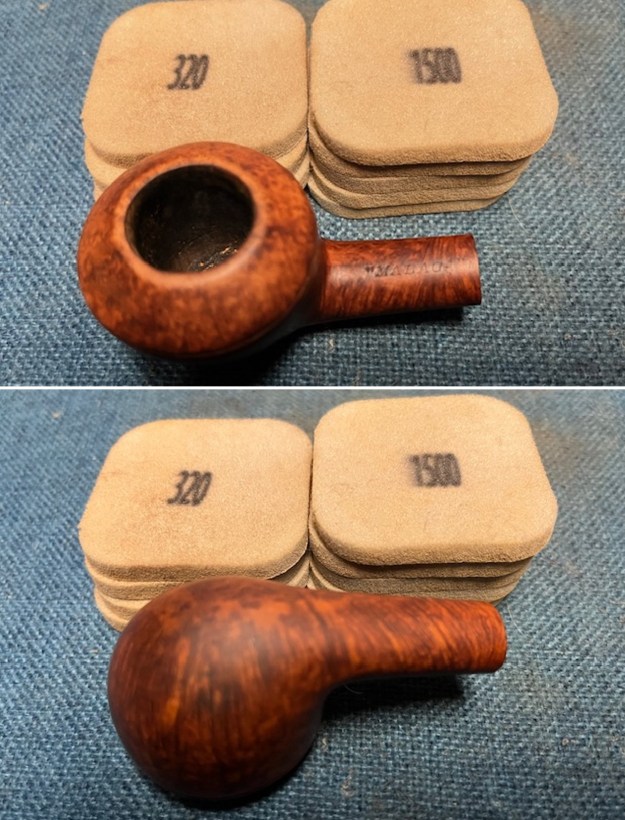
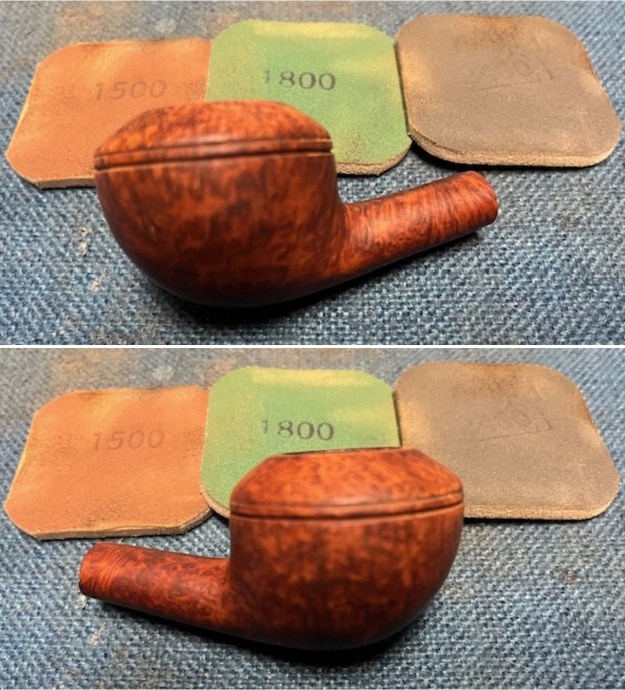
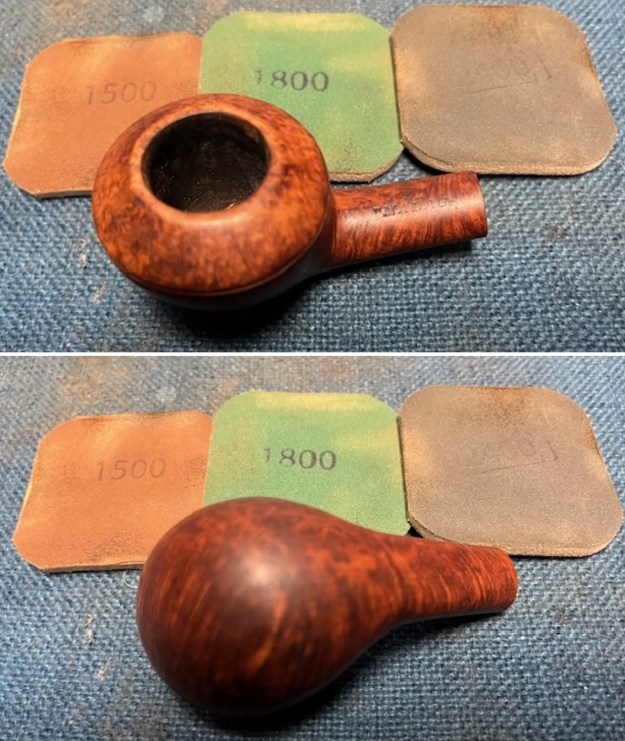
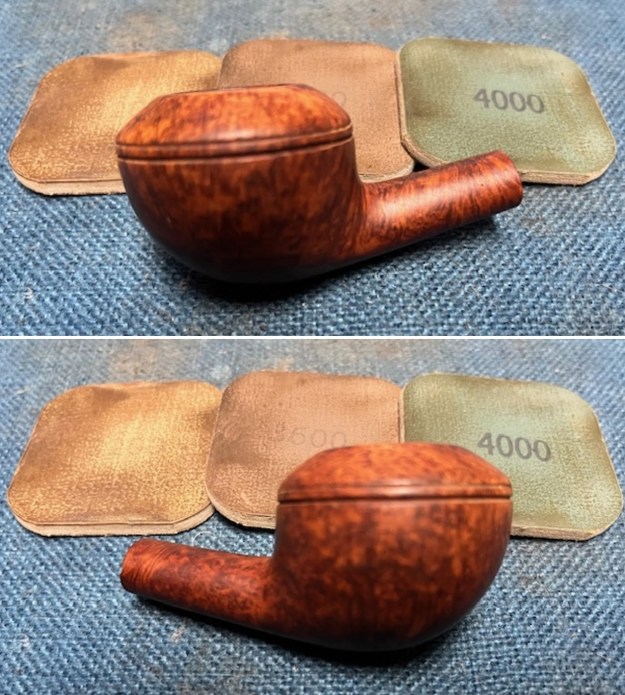
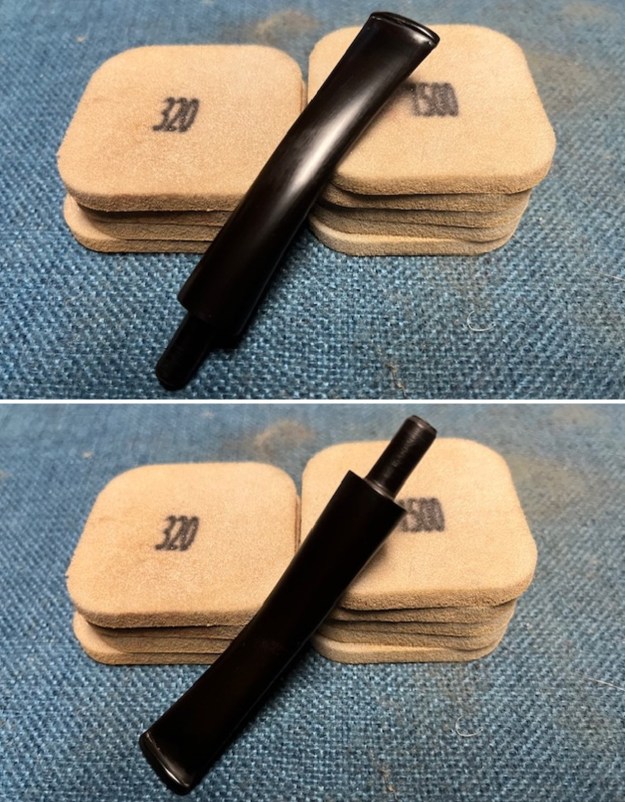
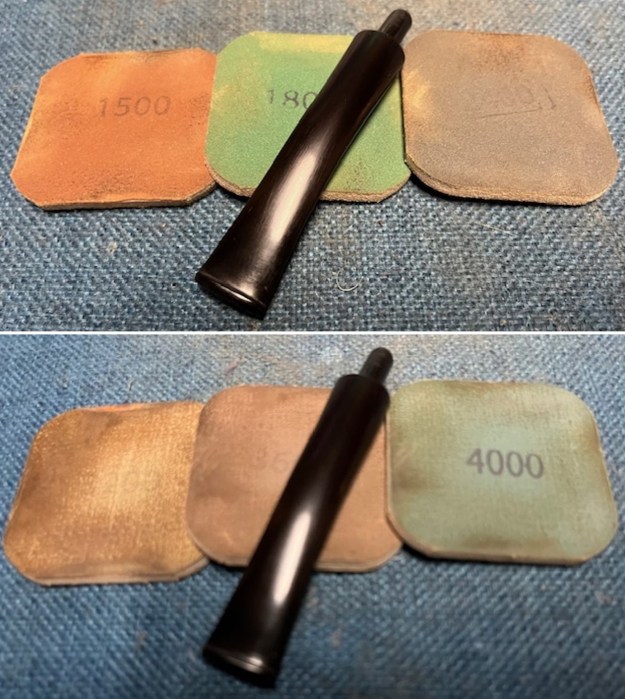
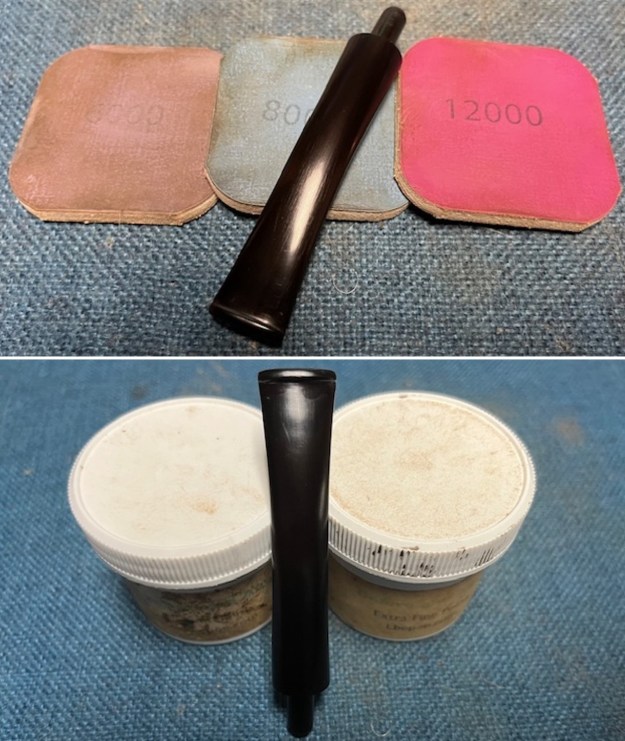
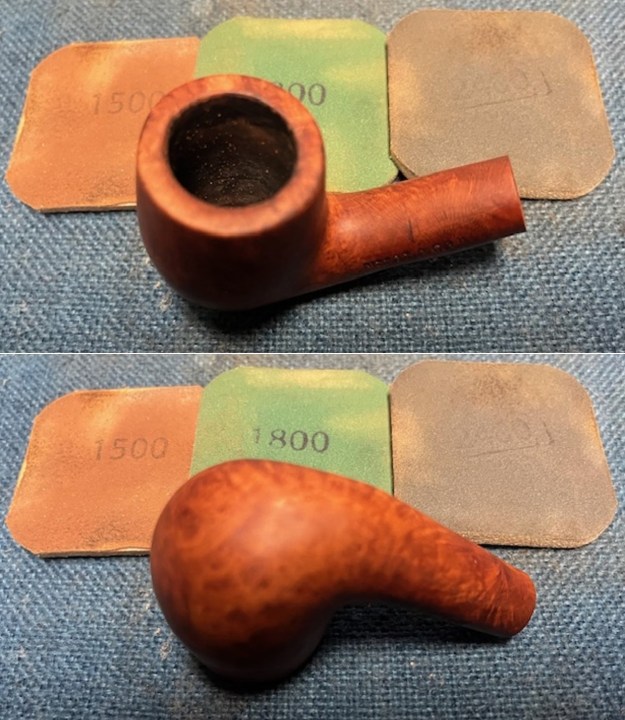
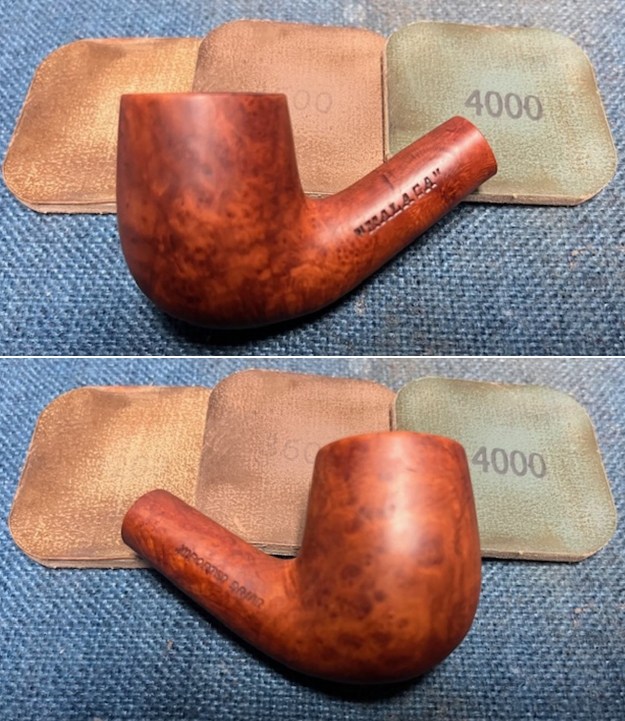
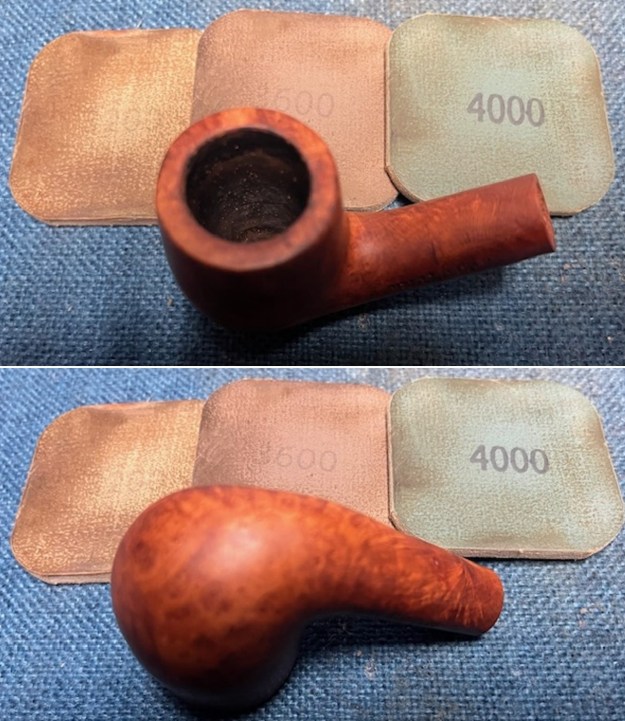
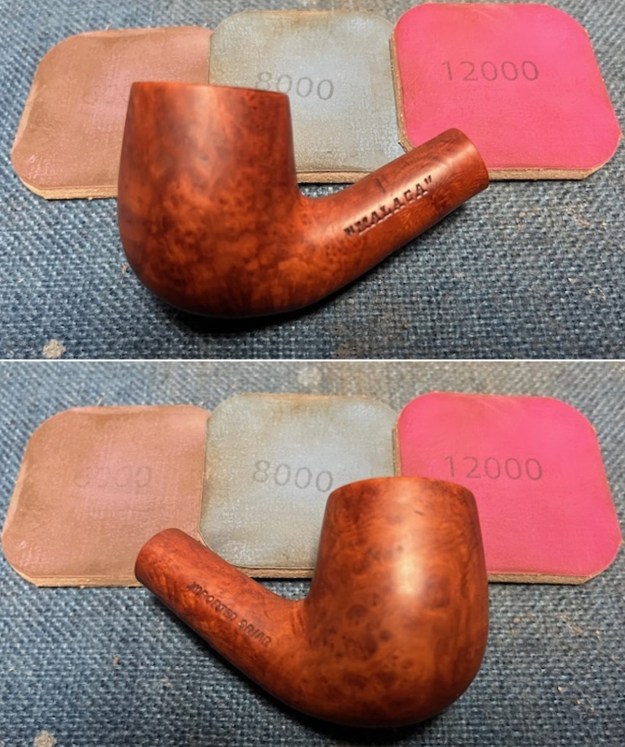
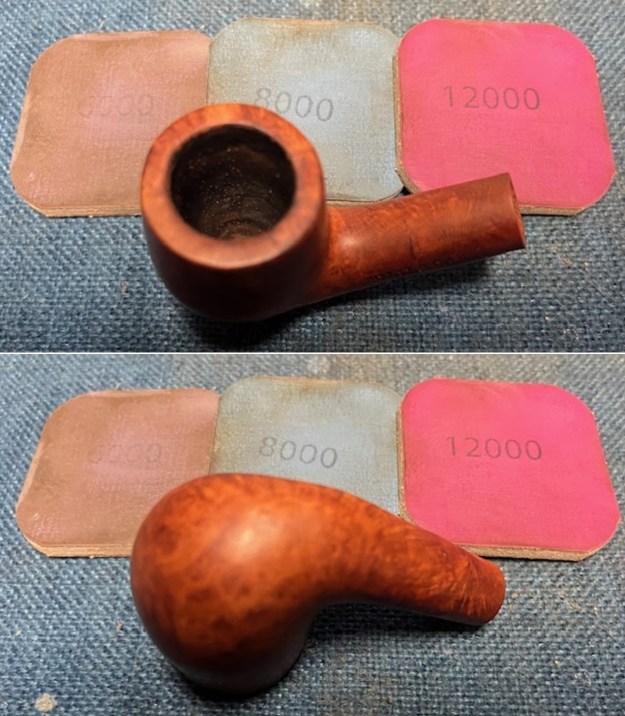
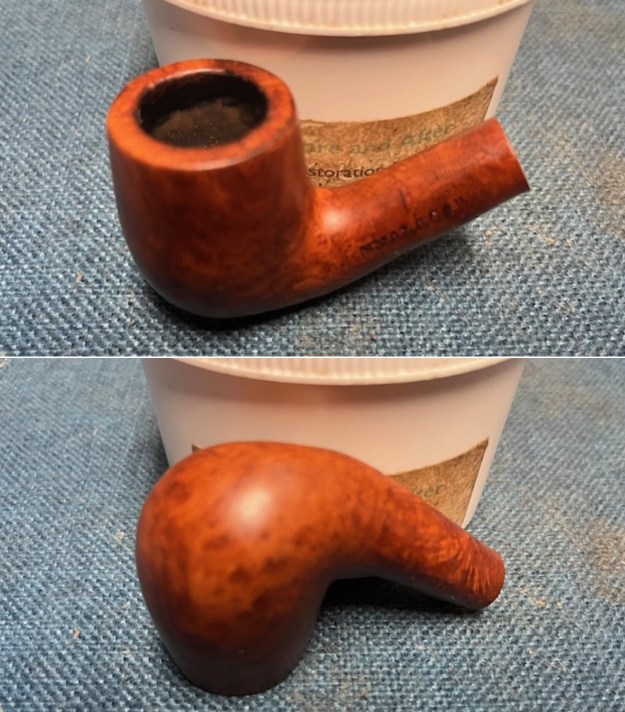
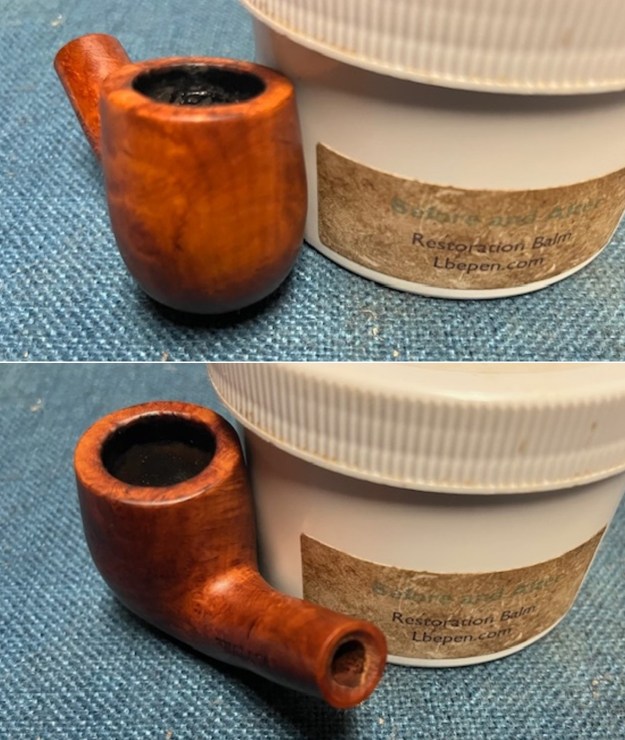
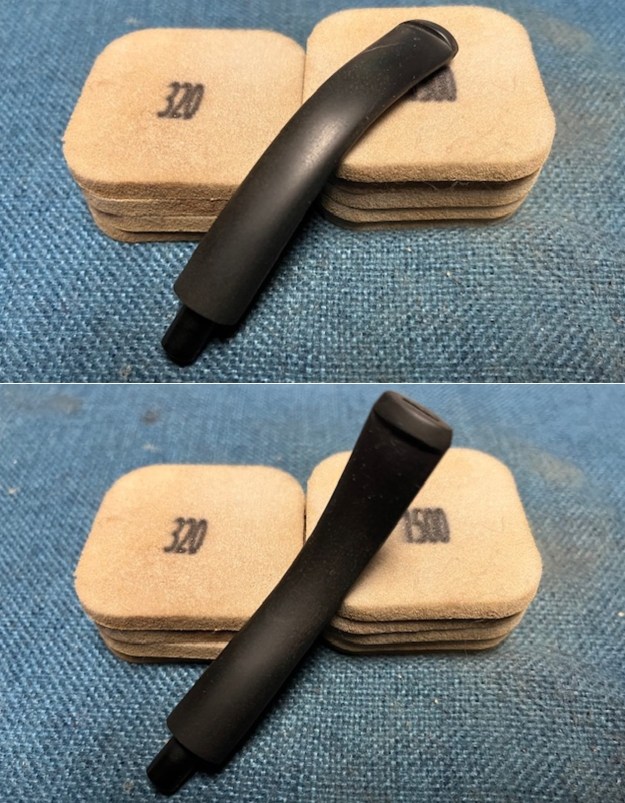
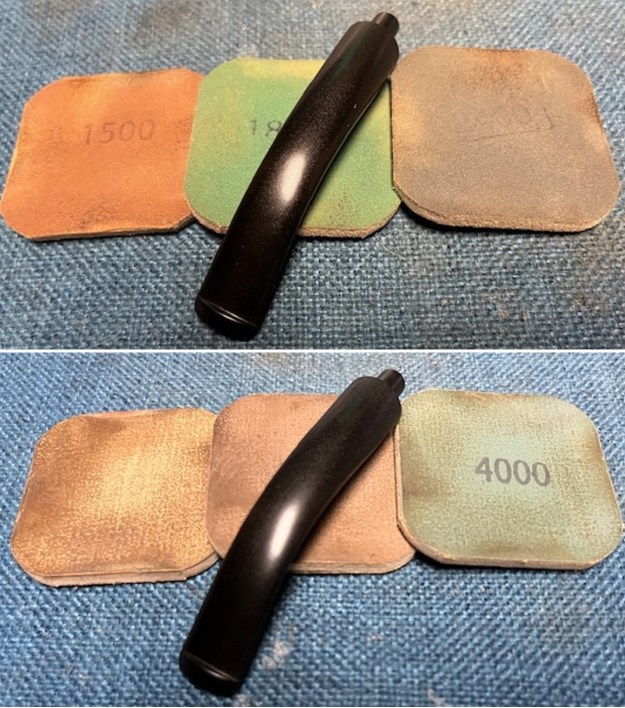
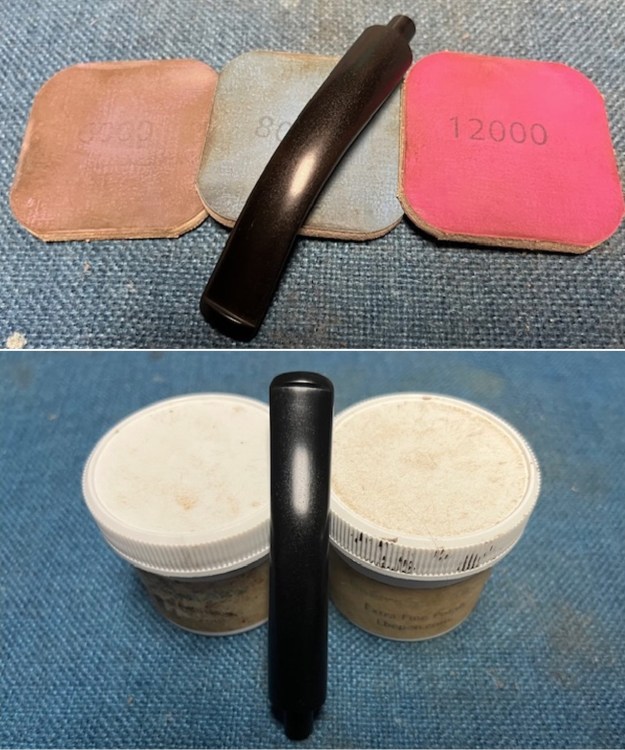
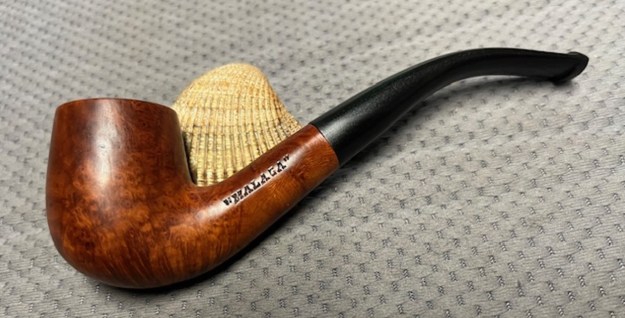
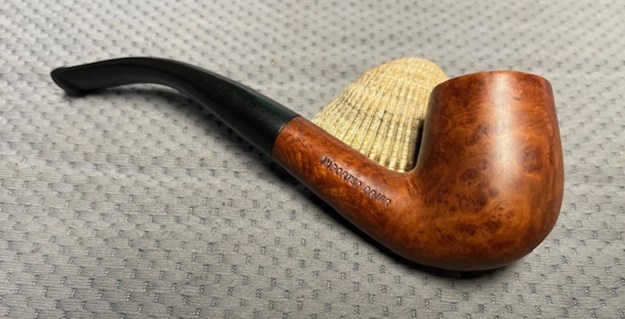
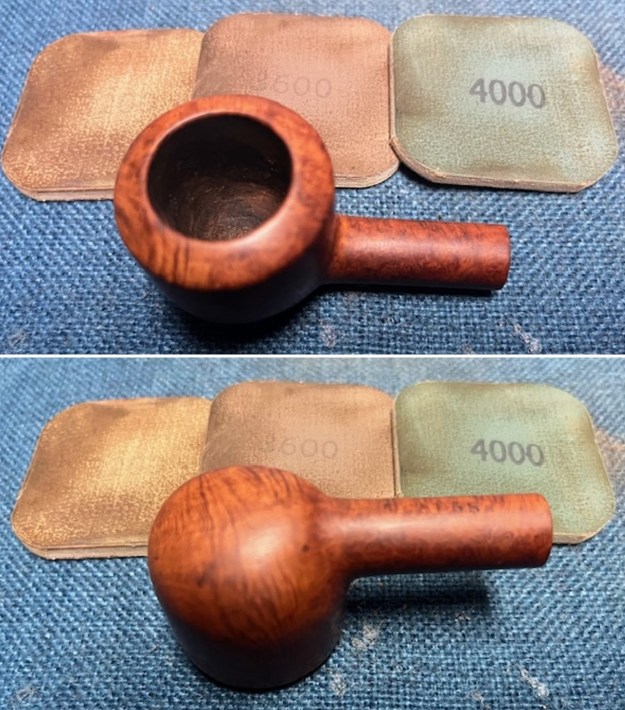
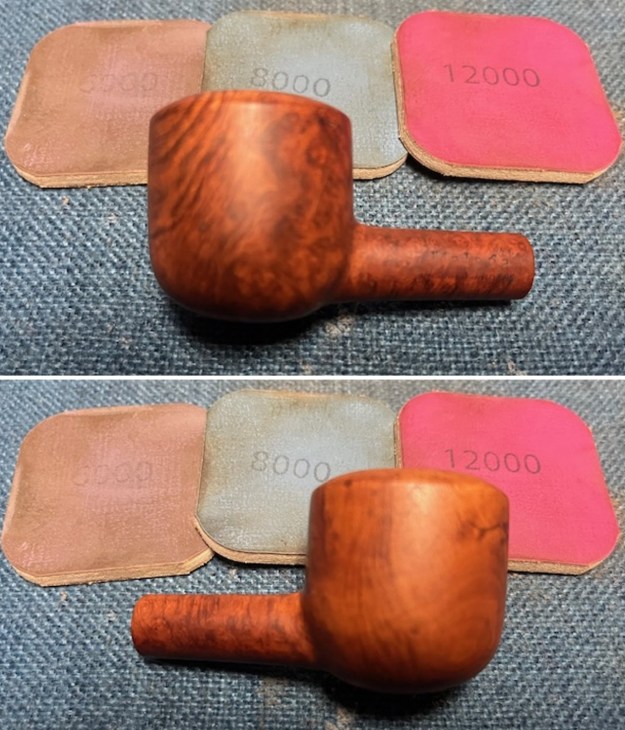
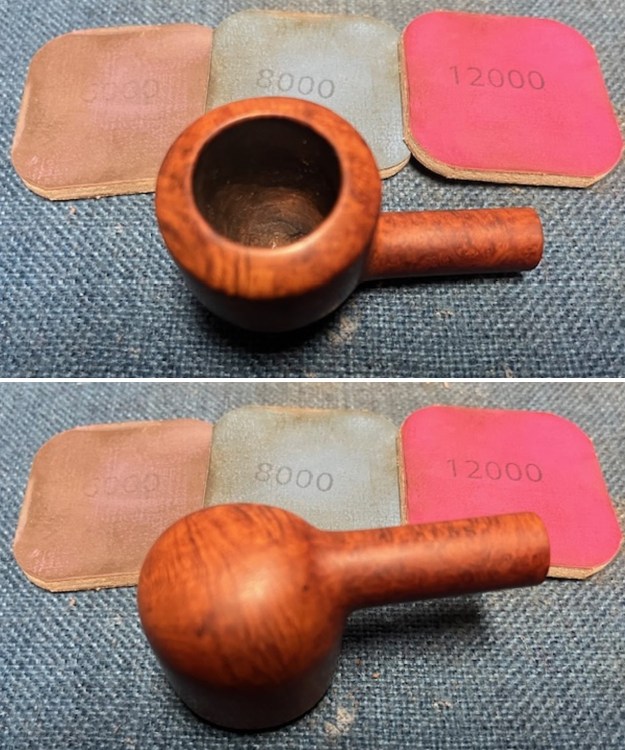
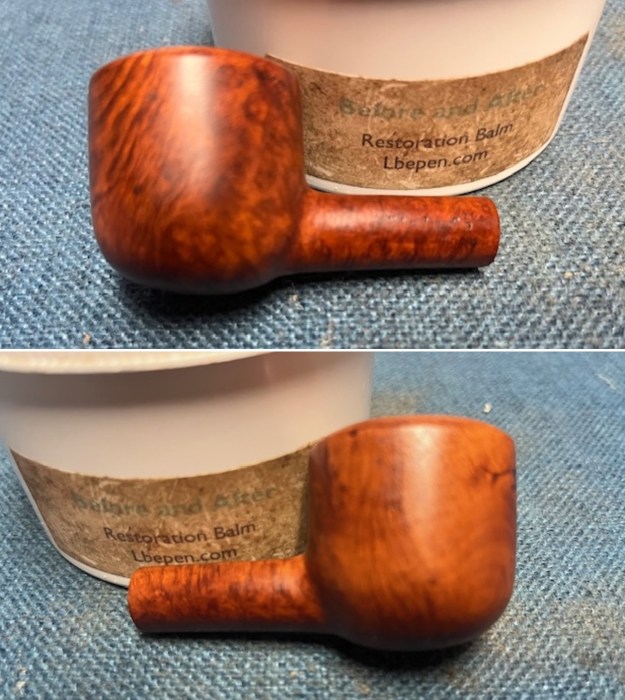
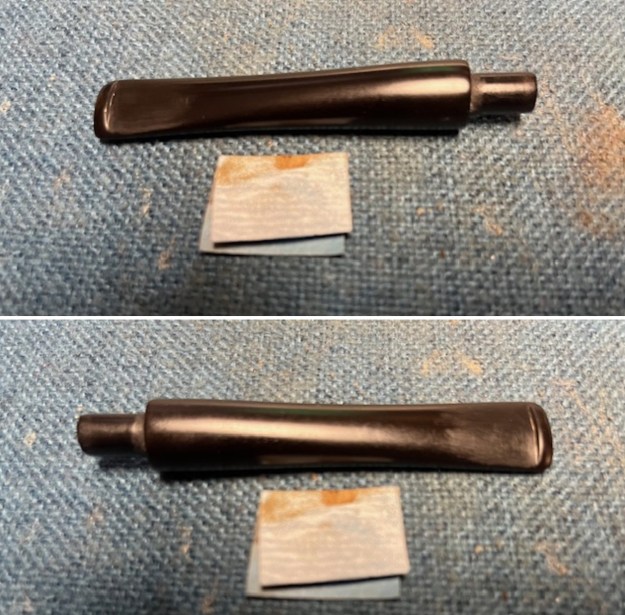
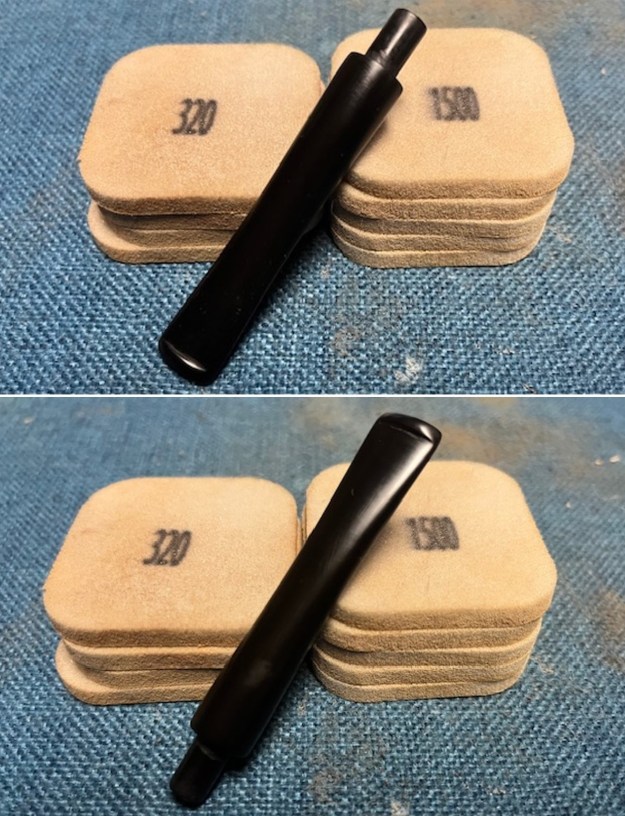
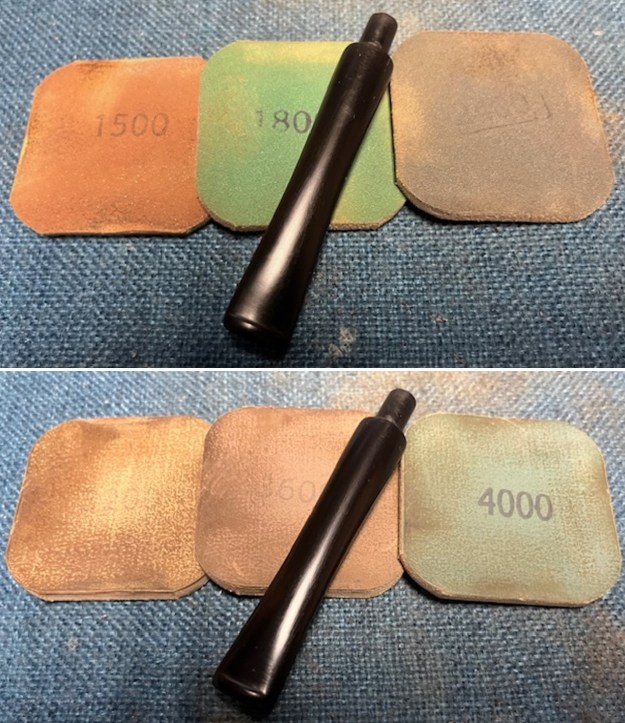
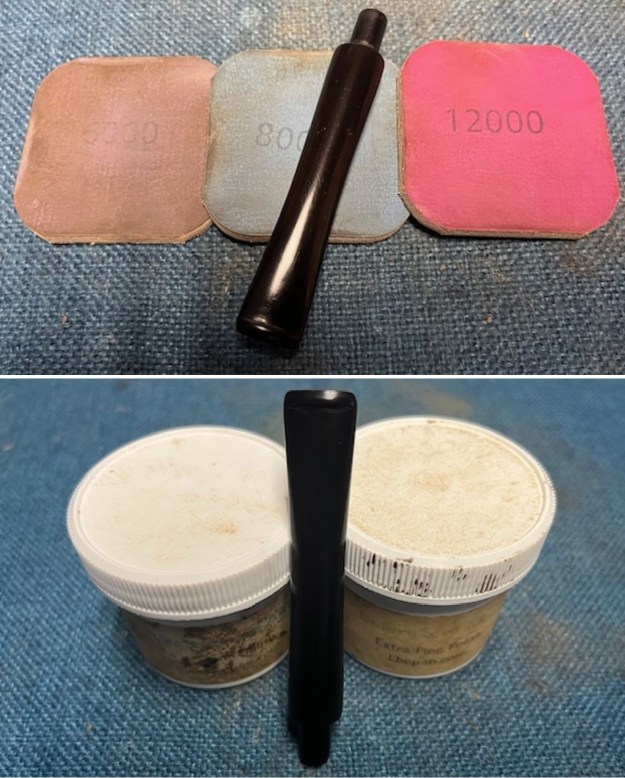
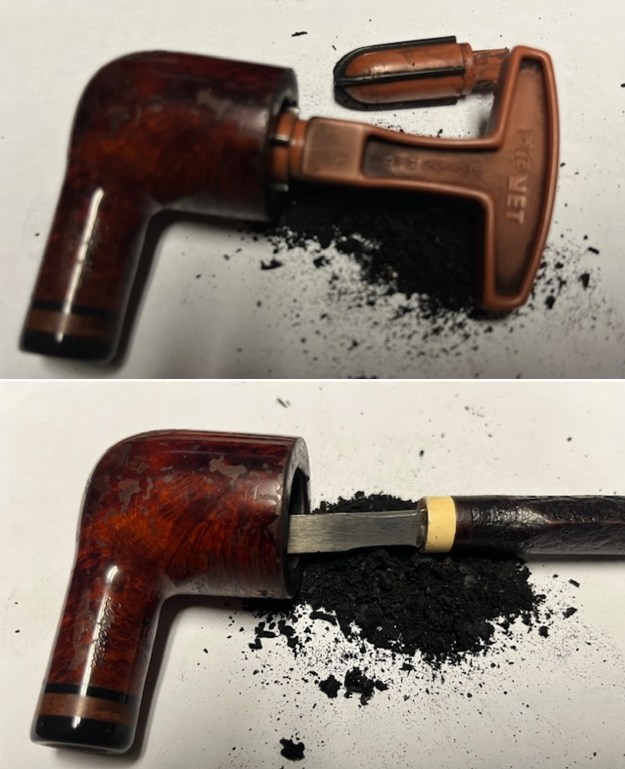
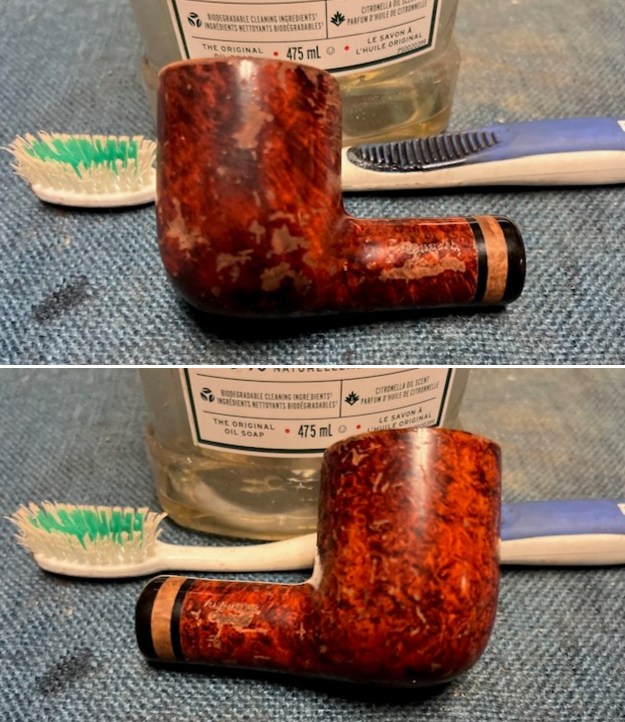
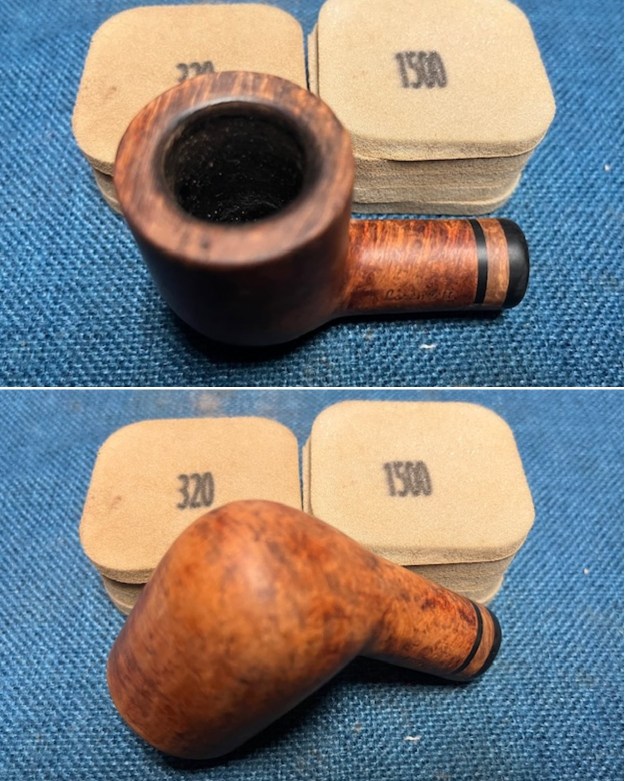
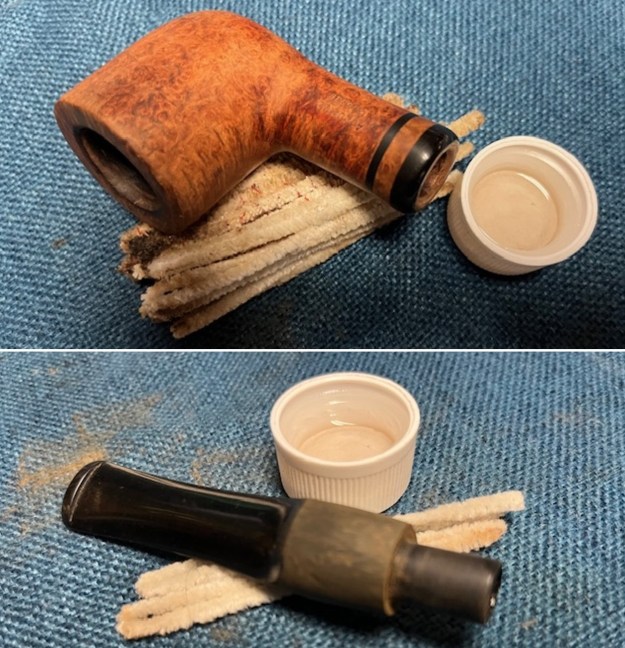
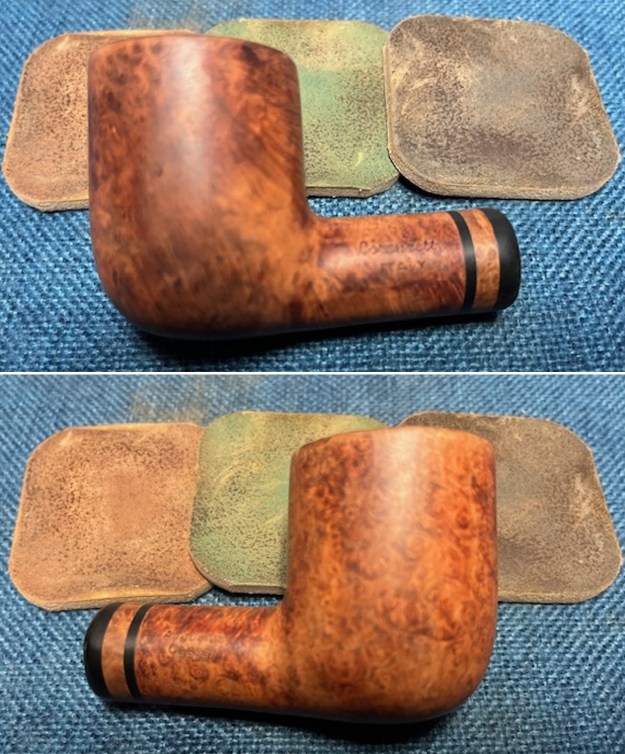
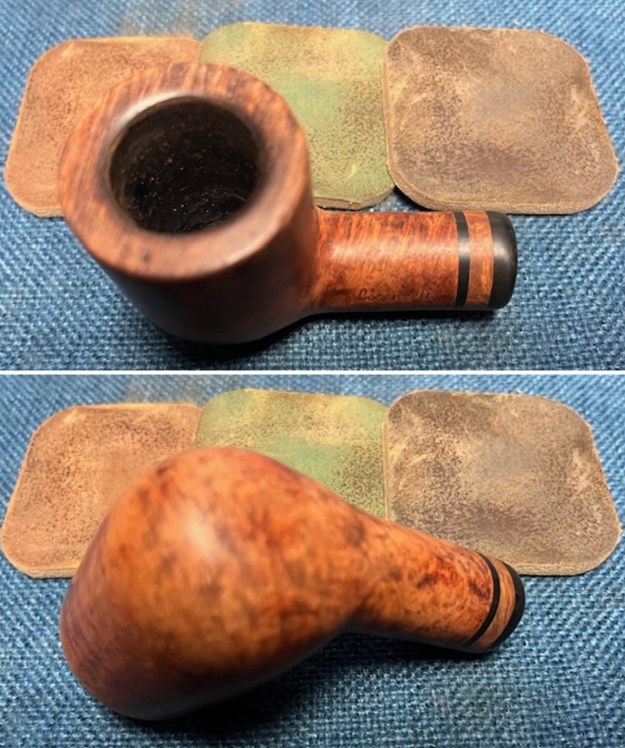
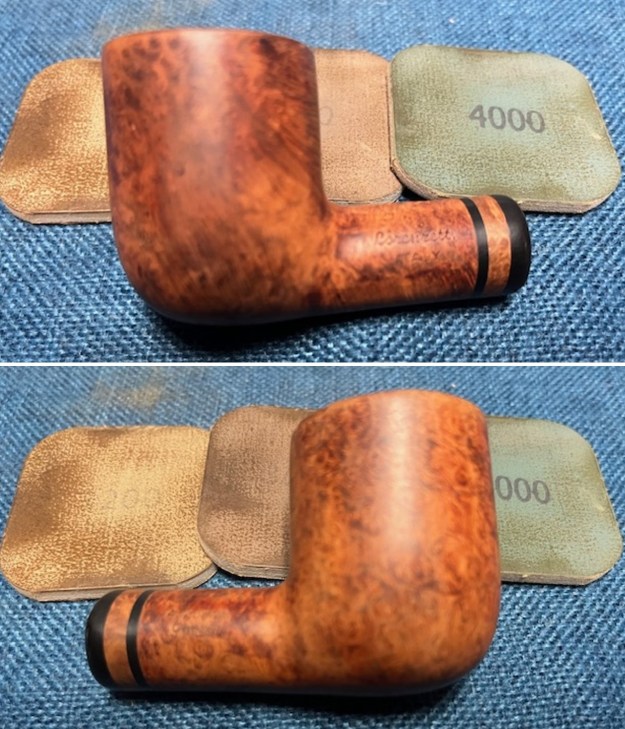
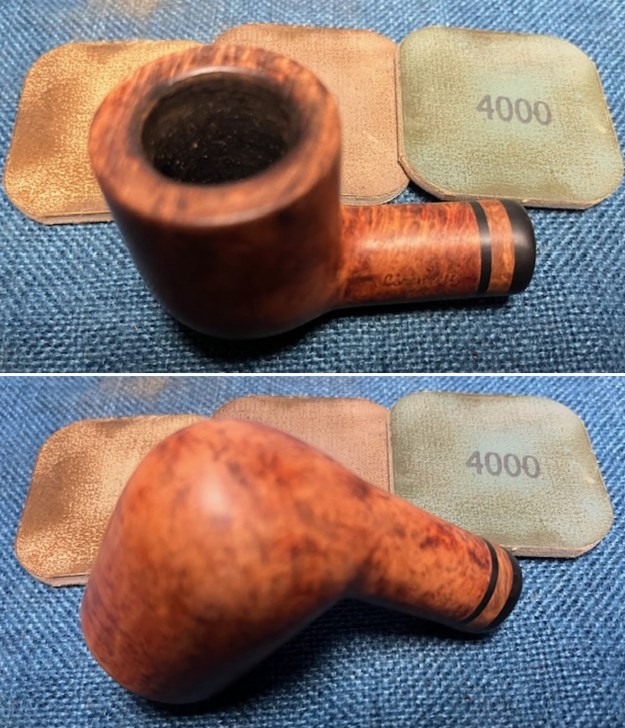
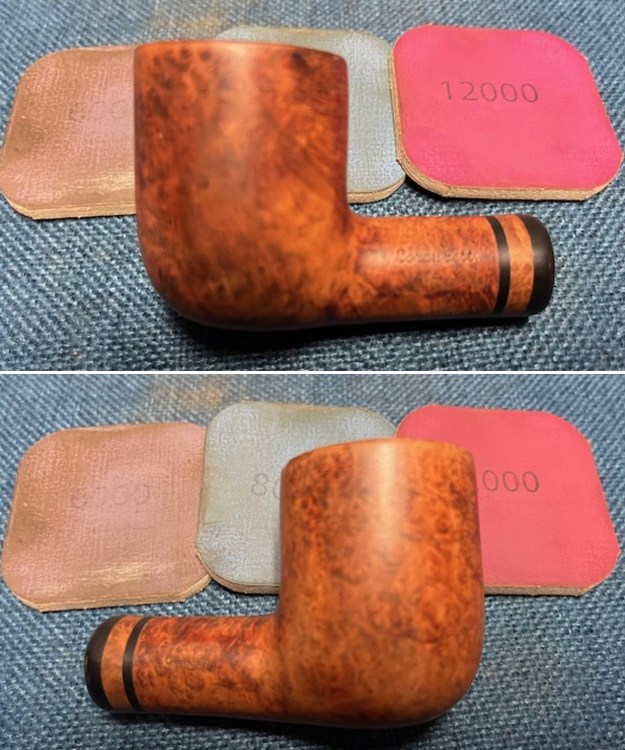
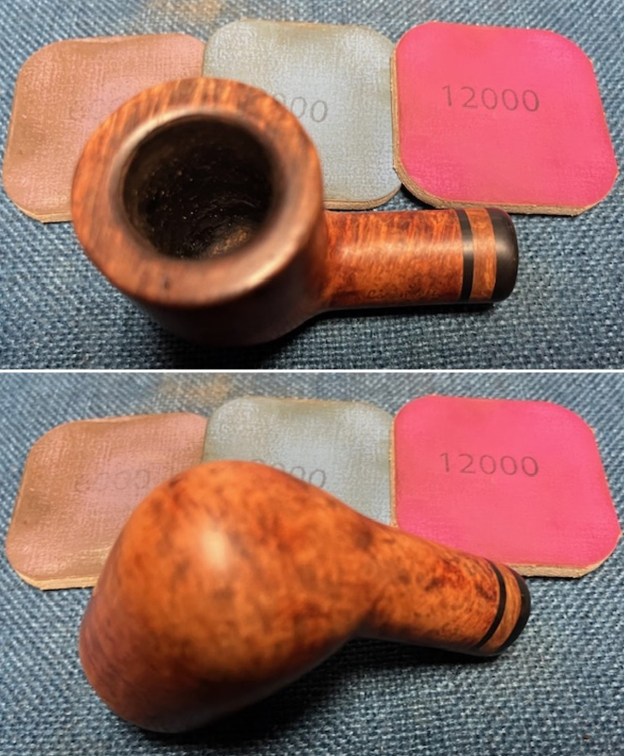
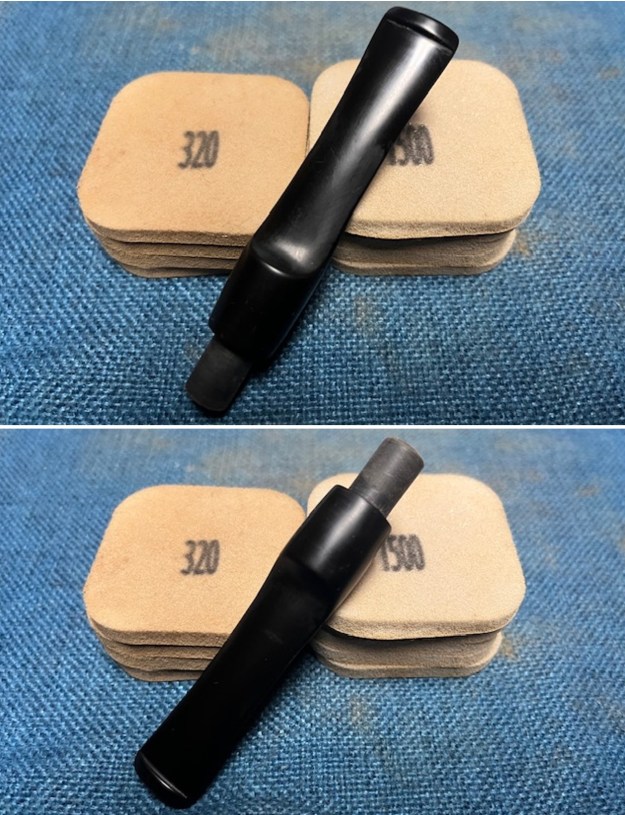
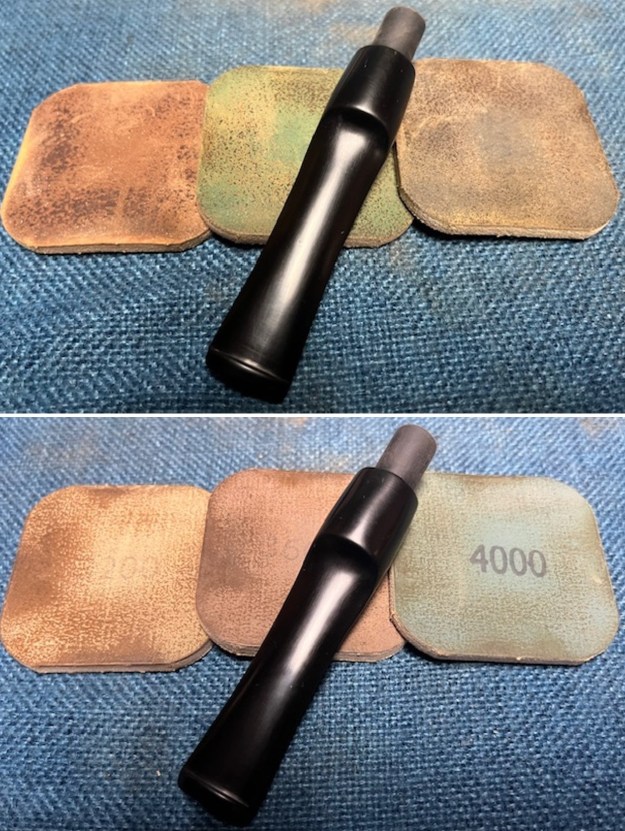
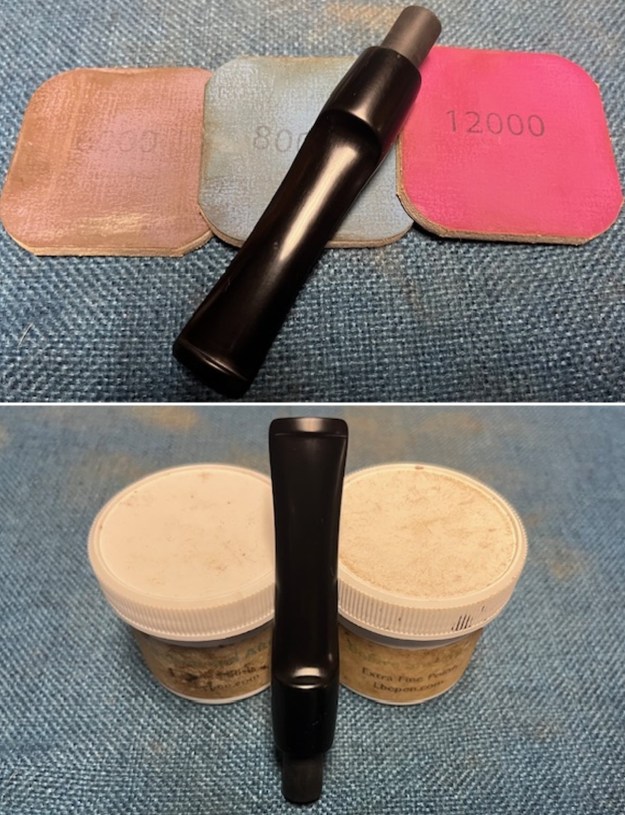
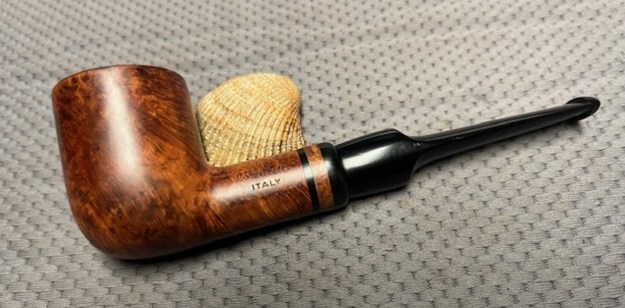
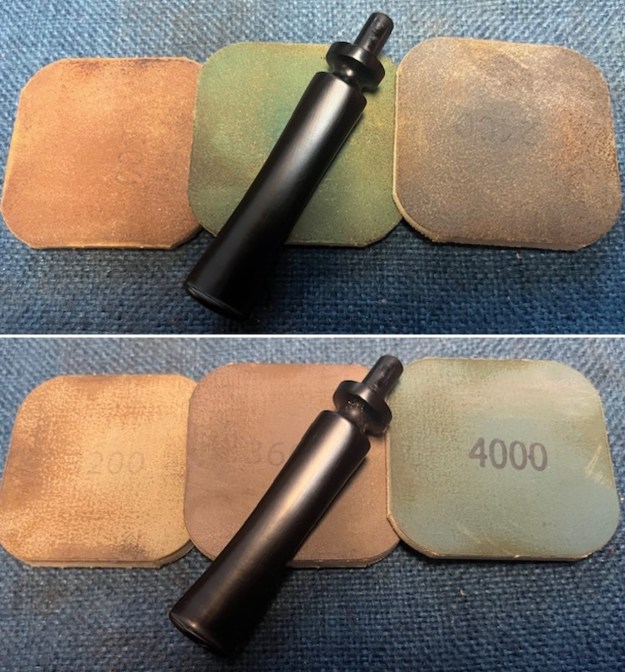
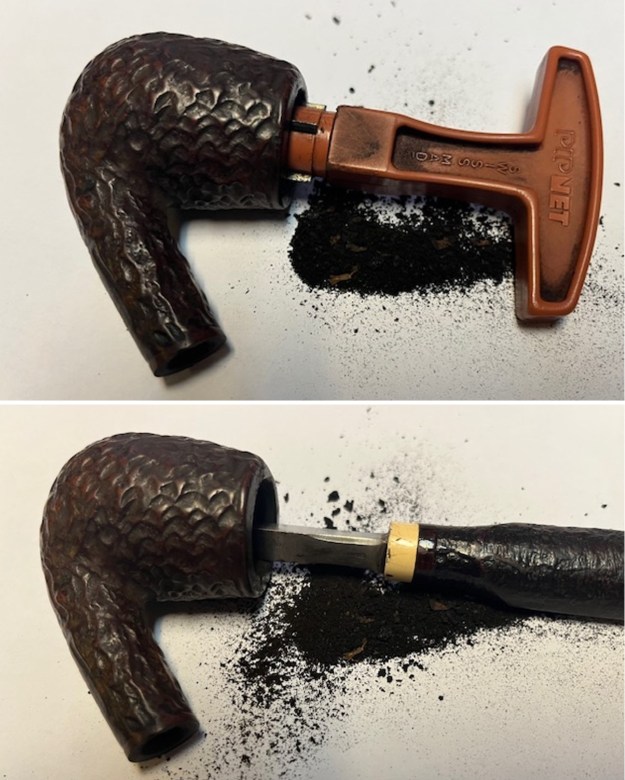
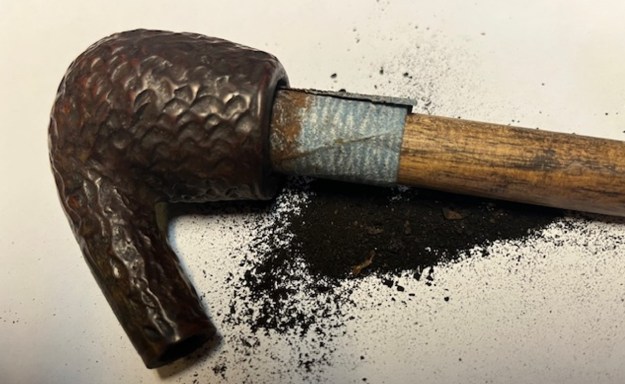
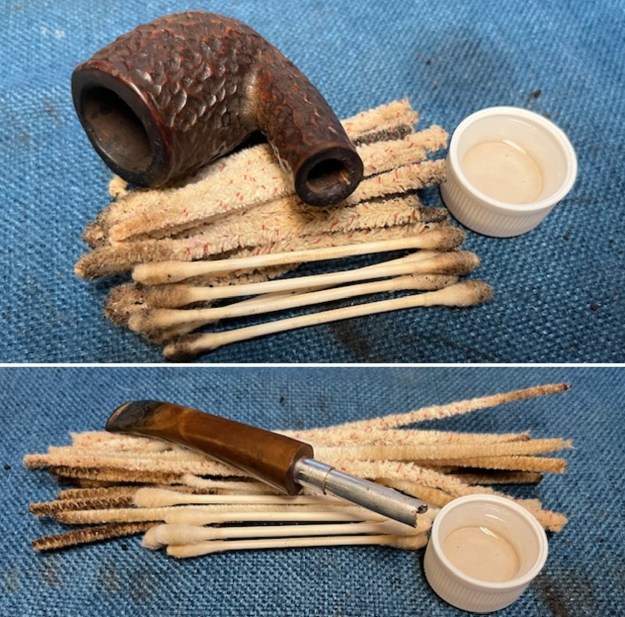
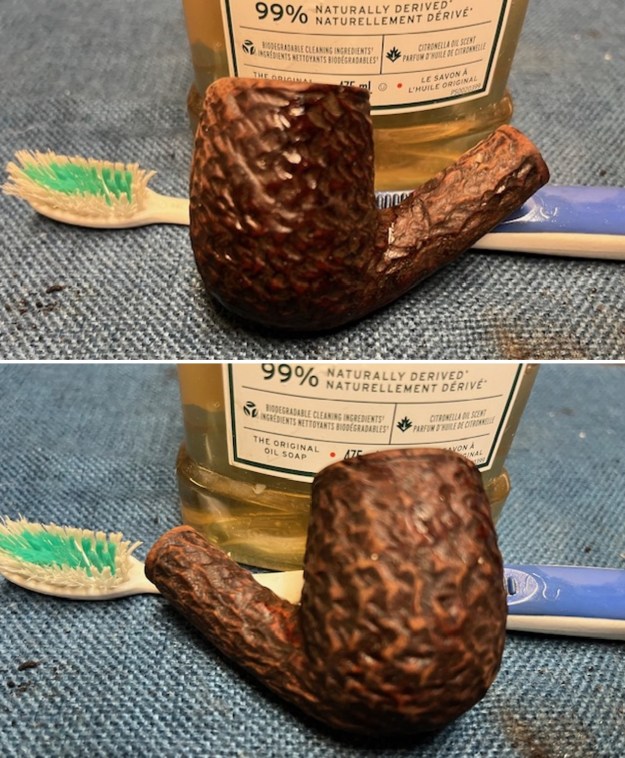
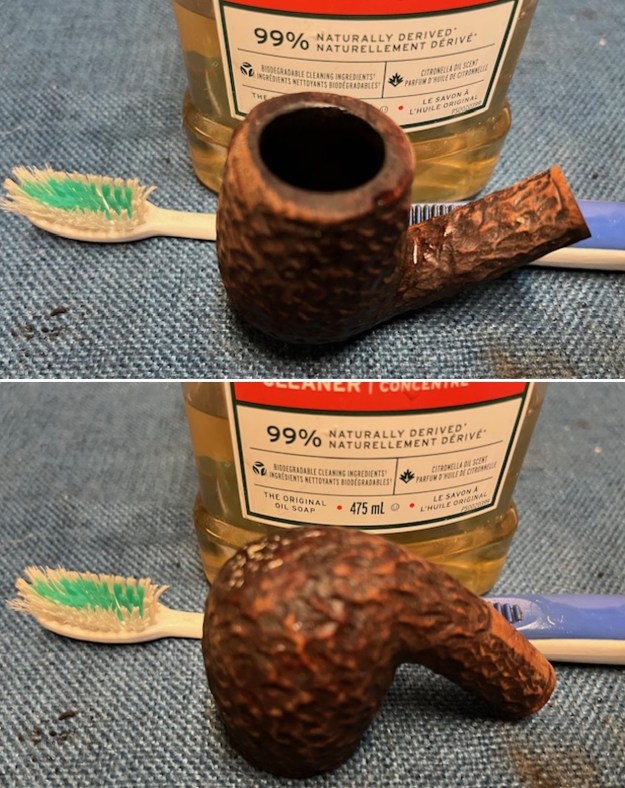
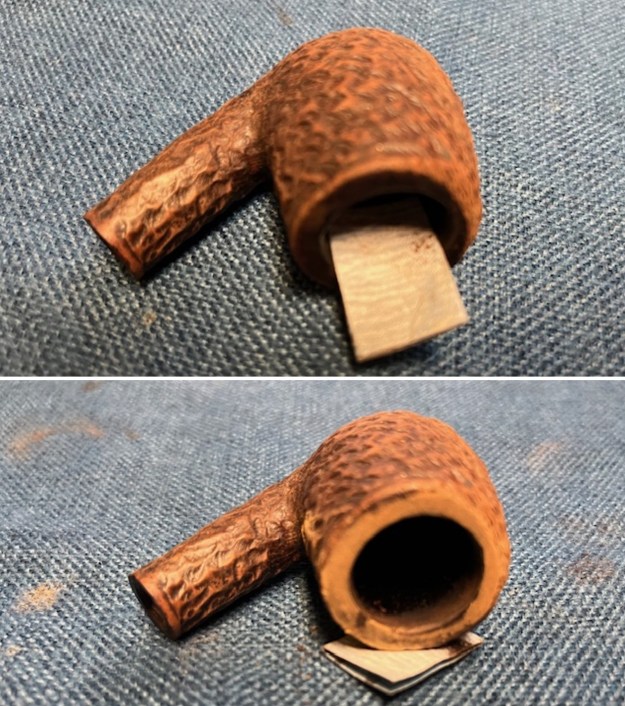
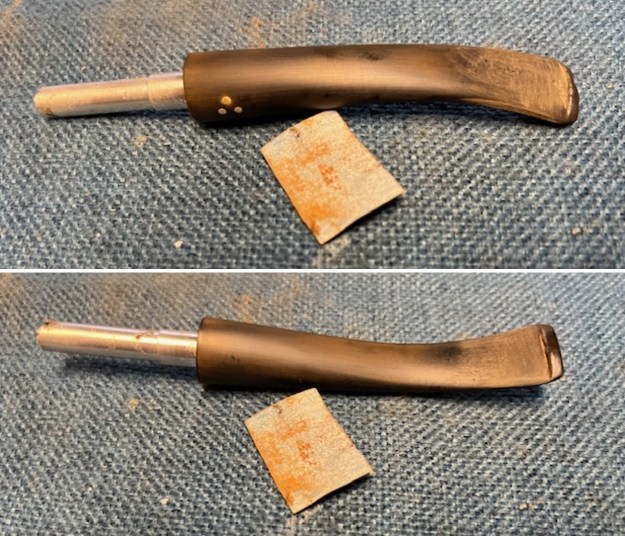
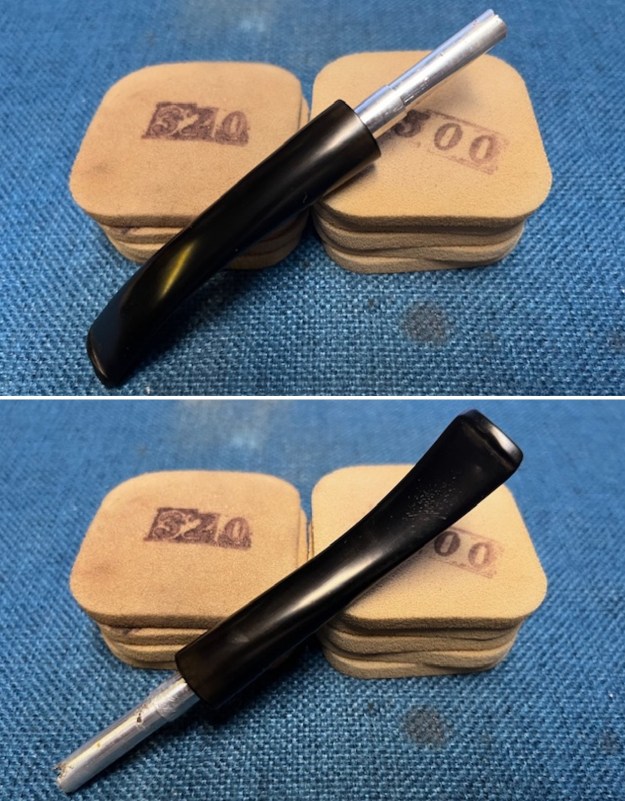
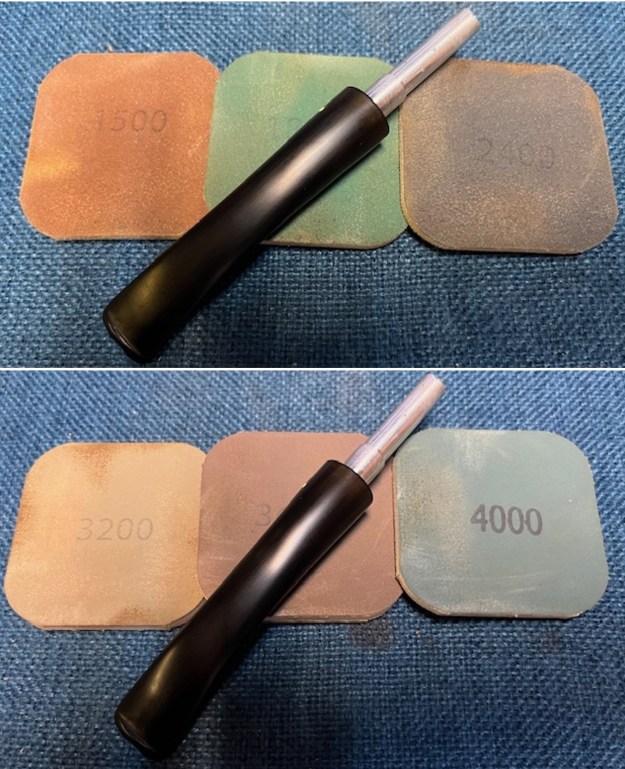
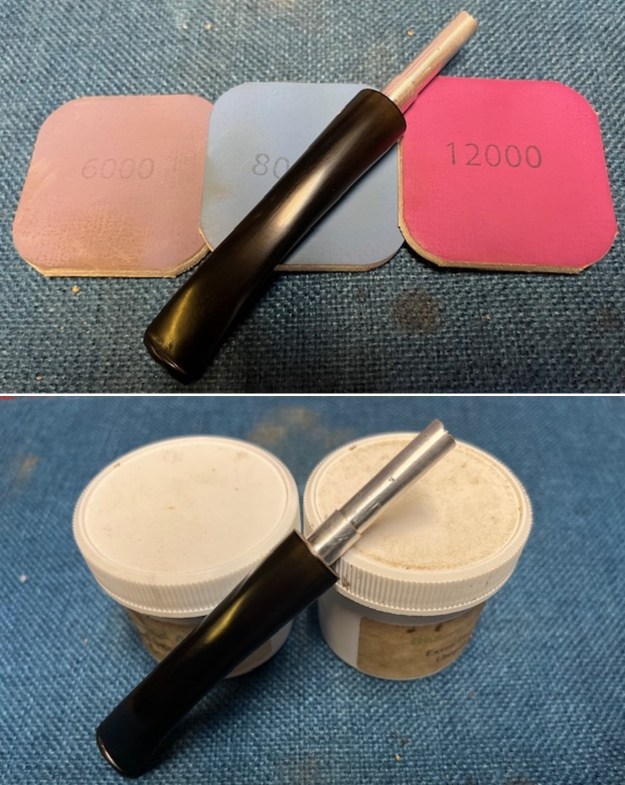
I reamed the bowl with a PipNet pipe reamer and the 2nd and 3rd cutting heads to remove the heavy cake. I took it back to bare briar and then cleaned up the reaming with a Savinelli Fitsall Pipe Knife. I sanded the bowl with a piece of dowel wrapped in 220 grit sandpaper. I scrubbed the exterior of the bowl and shank with undiluted Murphy’s Oil Soap and a tooth brush. It took some scrubbing to clear off the debris on the rim top and the surface of the bowl and shank. I rinsed the bowl off with warm water to remove the grime and debris along with the soap on the pipe. It looked much better. To begin the process of breaking through the peeling varnish coat I wiped the bowl and shank down with acetone on cotton pads. It broke through a lot of the varnish and I began to see what was underneath the varnish. I sanded the bowl with 320-3500 grit 2×2 inch sanding pads. I wiped the briar down with a damp cloth to remove the sanding debris. By the final pad it was looking much better. I cleaned out the mortise and airway in the shank as well as the airway in the newly chosen stem with pipe cleaners, cotton swabs and alcohol. It was a dirty bowl and shank.I polished the bowl and the shank with micromesh sanding pads – dry sanding it with 1500-12000 git sanding pads. I wanted to make the new stain coat a bit more transparent. I wiped it down with a cloth and some Obsidian Oil. I worked some Before & After Restoration Balm into the surface of the briar with my fingertips to clean, enliven and protect the briar. I let the balm sit for 15 minutes and then buffed with a cotton cloth to raise the shine. The photos show the bowl at this point in the restoration process. I set the bowl aside and turned my attention to the stem. I sanded the stem to reduce the diameter of the saddle portion and give it a slight slope or taper. I used my Dremel and sanding drum to start the process. I cleaned up the sanding marks from the Dremel with a folded piece of 220 grit sandpaper. I smoothed out the marks and the stem started to look better.I sanded the stem with 320-3500 grit 2×2 inch pads to further smooth out the surface and remove the light residual oxidation. I wiped the stem down after each pad with an Obsidian Oil cloth to remove the debris and further protect the stem.I polished the stem with micromesh sanding pads – dry sanding with 1500-12000 grit sanding pads. I wiped it down after each sanding pad with Obsidian Oil.I polished the finished Lorenzetti Italy Augustus Caesar Billiard with Blue Diamond to polish out the remaining small scratches. I gave the bowl and the newly fit saddle stem multiple coats of carnauba wax and buffed the pipe with a clean buffing pad to raise the shine. I hand buffed it with a microfiber cloth to deepen the shine. The pipe polished up pretty nicely. The smooth briar with the medium the brown stain wash works very well with the black stem. The finished pipe is shown in the photos below. I have worked on several Lorenzetti’s over the years and I have always been impressed by his ability to a craft a comfortable and functional smoking pipe. It looks far better with the varnish coat removed. The beautiful Lorenzetti Augustus Caesar had the following dimensions. The Length: 6 inches, Height: 1 ¾ inches, Outside diameter of the bowl: 1 3/8 inches, Chamber diameter: 7/8 inches. The weight of the pipe is 51 grams/ 1.69 ounces. I have two more of Brian’s pipes to work on and then they will go back to him. This is an interesting group of three pipes to bring back to life.

As always, I encourage your questions and comments as you read the blog. Thanks to each of you who are reading this blog. Remember we are not pipe owners; we are pipe men and women who hold our pipes in trust until they pass on into the trust of those who follow us.

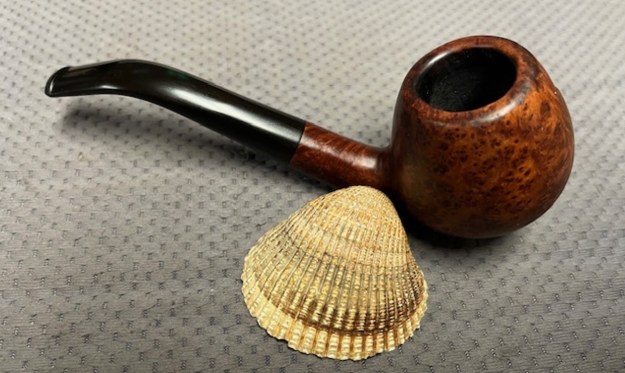
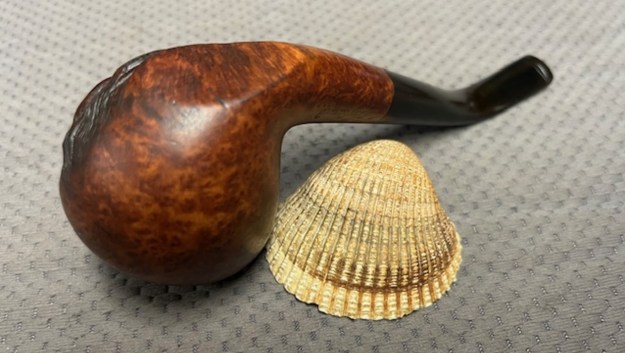
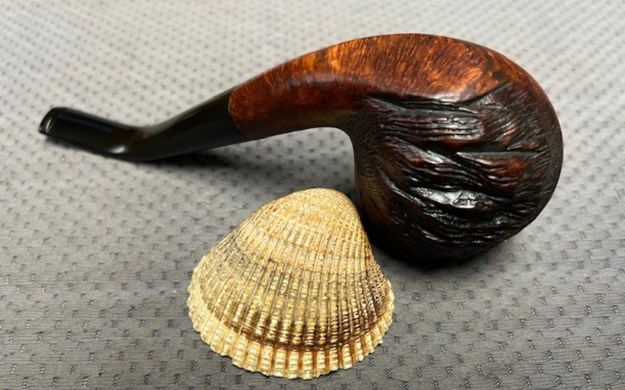
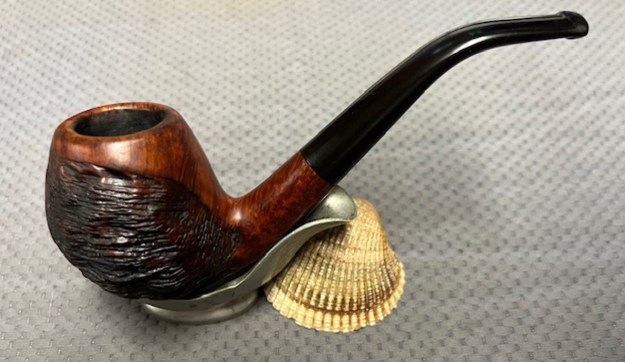
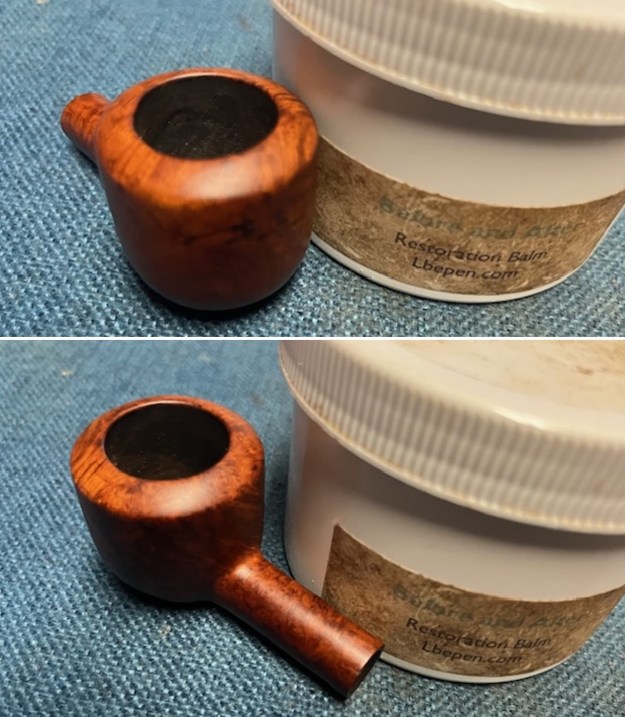
New Life for beautiful JHW Oval Bowl Plateau Freehand with Saddle Stem


by Steve Laug

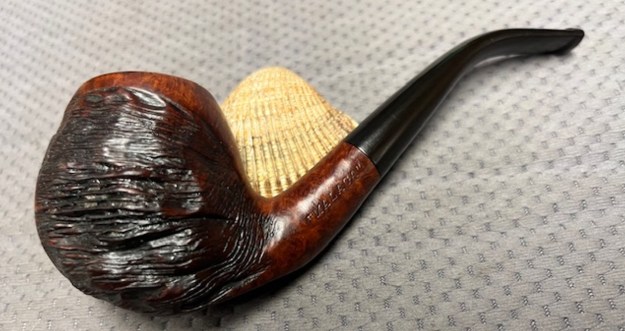
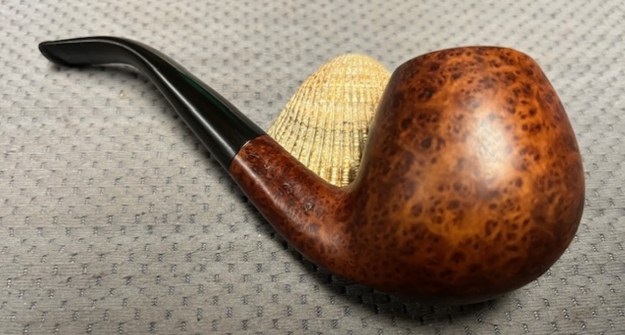
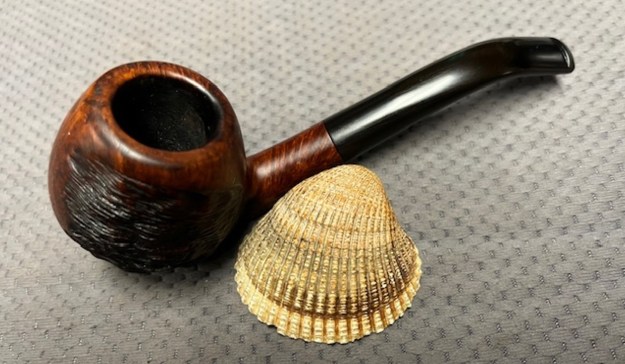
I am excited to be working on another uniquely beautiful pipe stamped JHW. But maybe you don’t know why I am excited about a pipe stamped with these three initials, Well I have to tell you right up front that JHW is Jack H. Weinberger. Who is that? That does not help either? Jack H. Weinberger was a pipe maker in West Caldwell, New Jersey. Still not helping? He hired young lads from the local high school to help him out as he carved 10-12 hours a day. Two of these were none other than Curt Rollar and Mark Tinsky who went on to become the American Pipe Company. There was a long list of pipe carving luminaries who came through Jack’s shop and JHW pipes but these two you probably have heard of. So JHW or Jack H. Weinberger was an important part of the American Pipemaking scene and gave many carvers a start and they have continued to this day. Now maybe you understand my excitement – being able to work on another of Jack’s pipes and bring it back to its former glory.

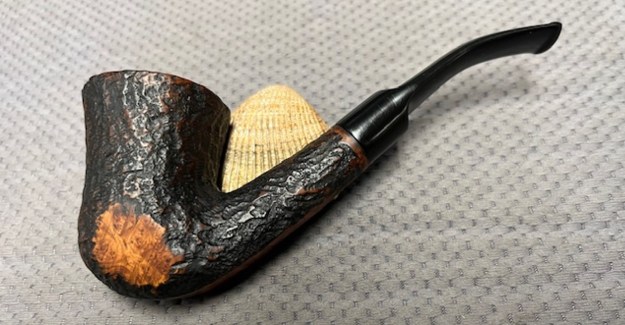
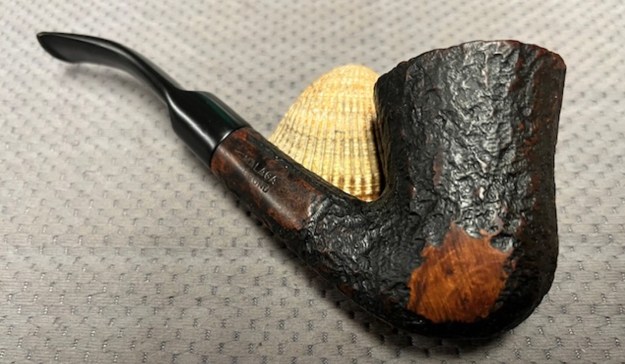
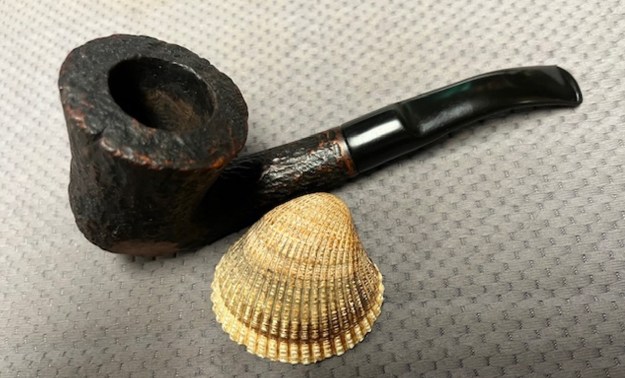
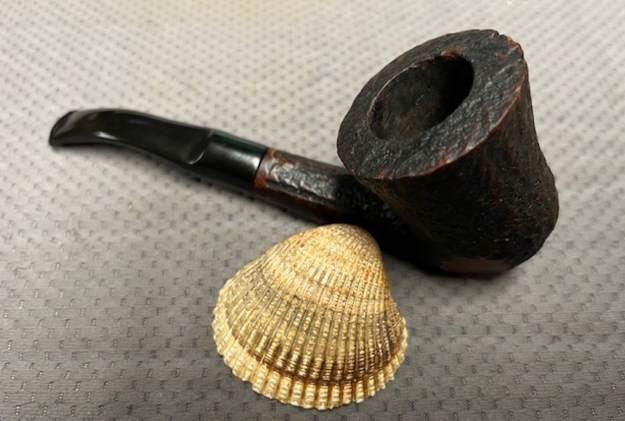
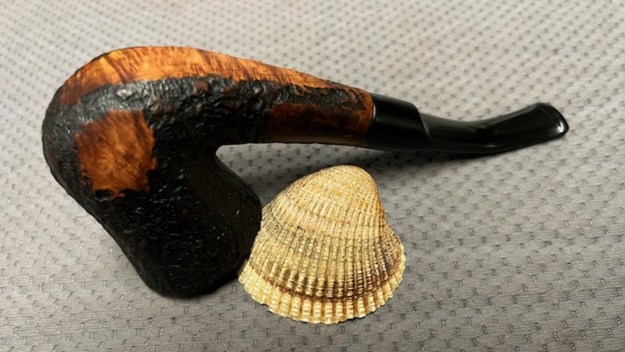
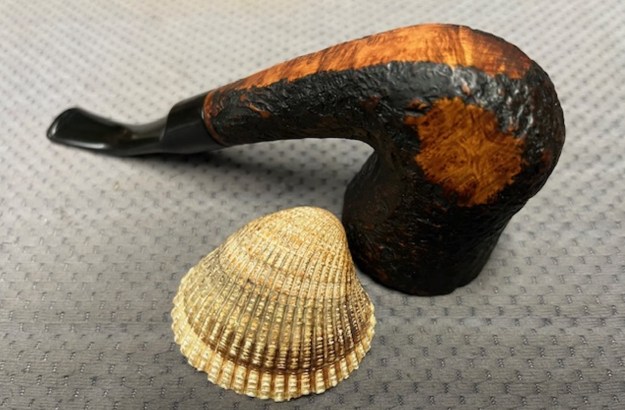
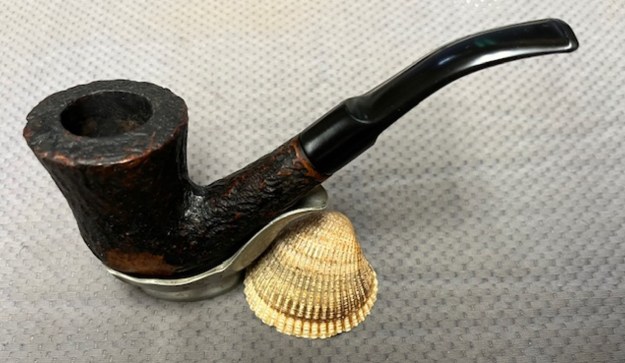
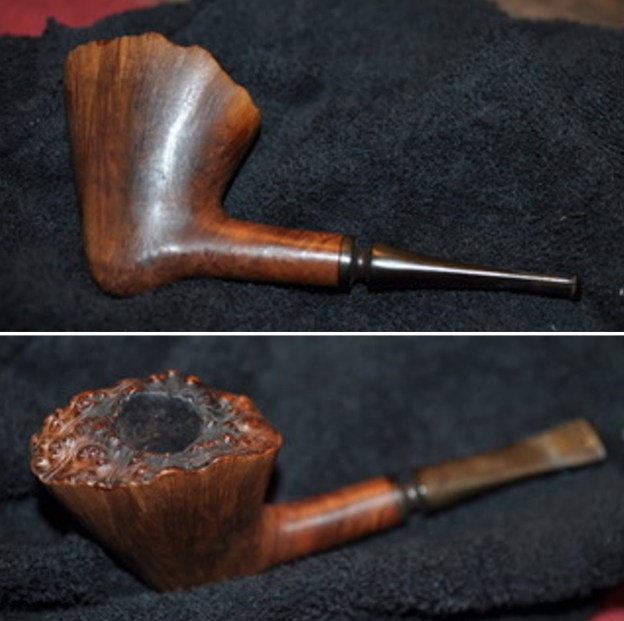
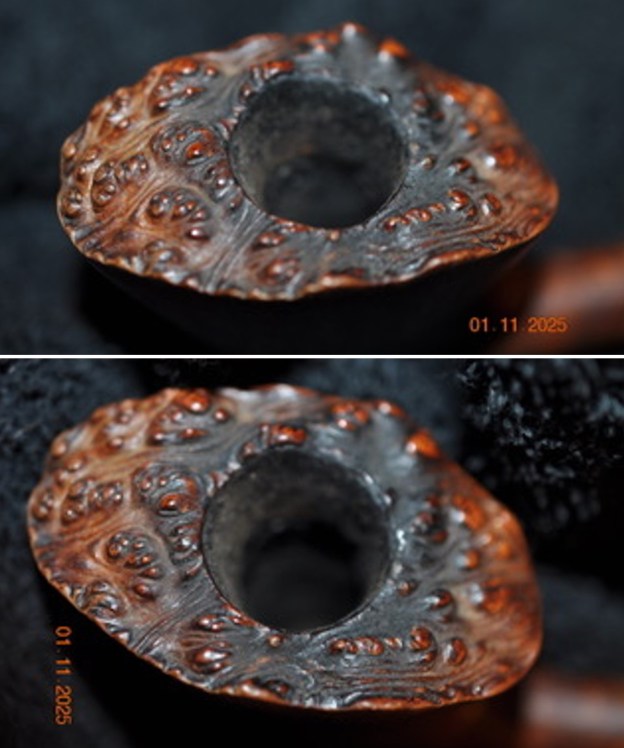
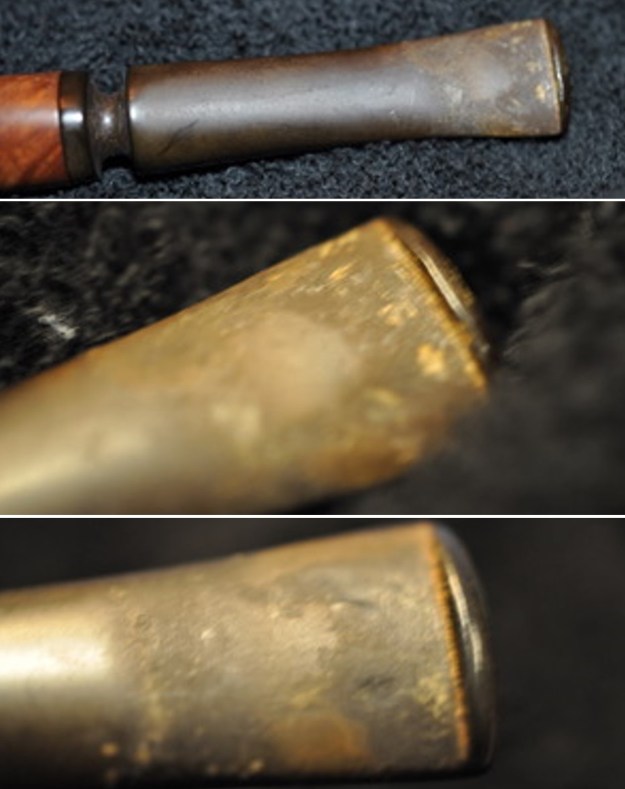
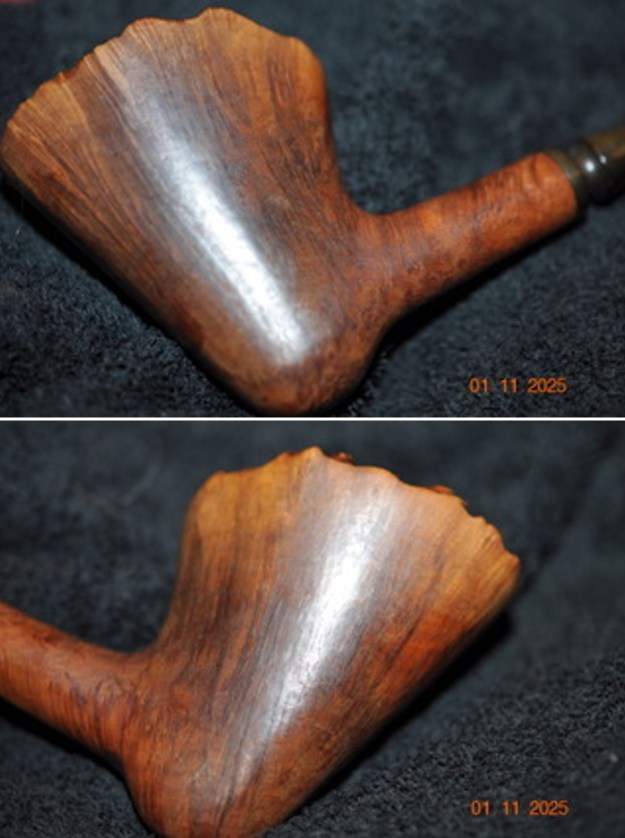
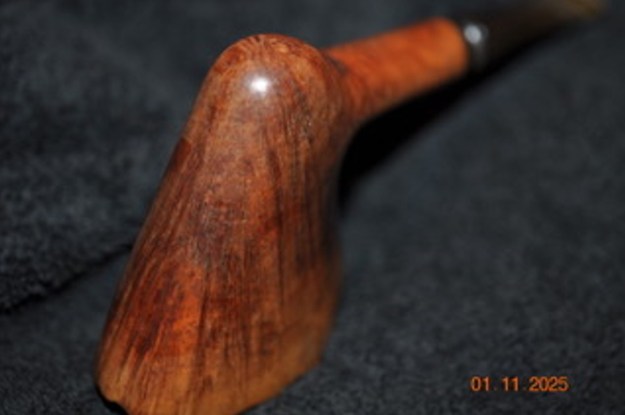
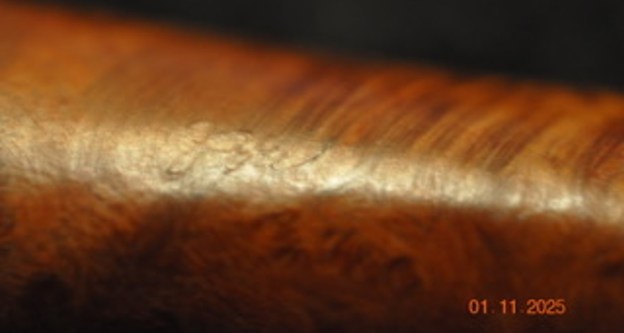
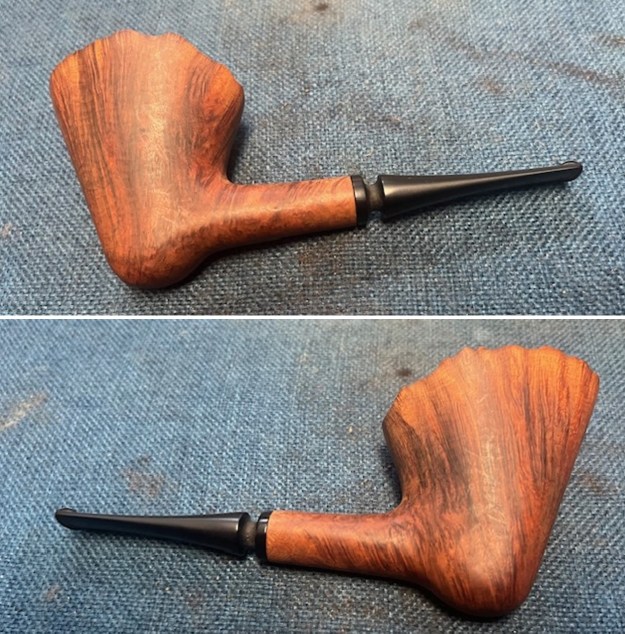
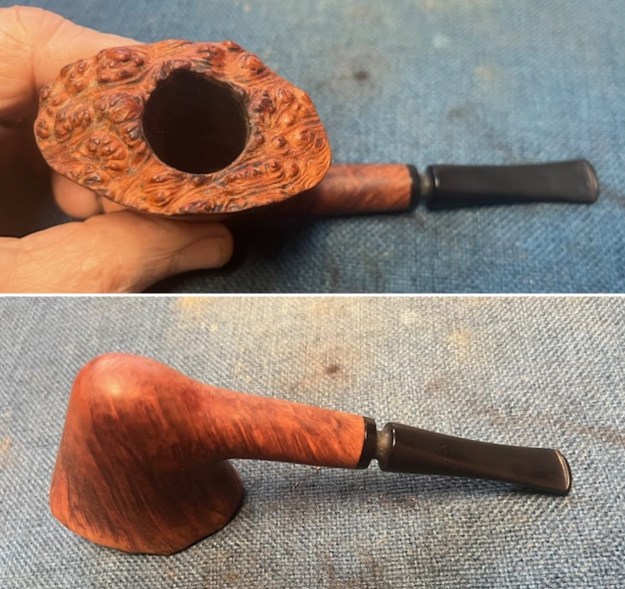
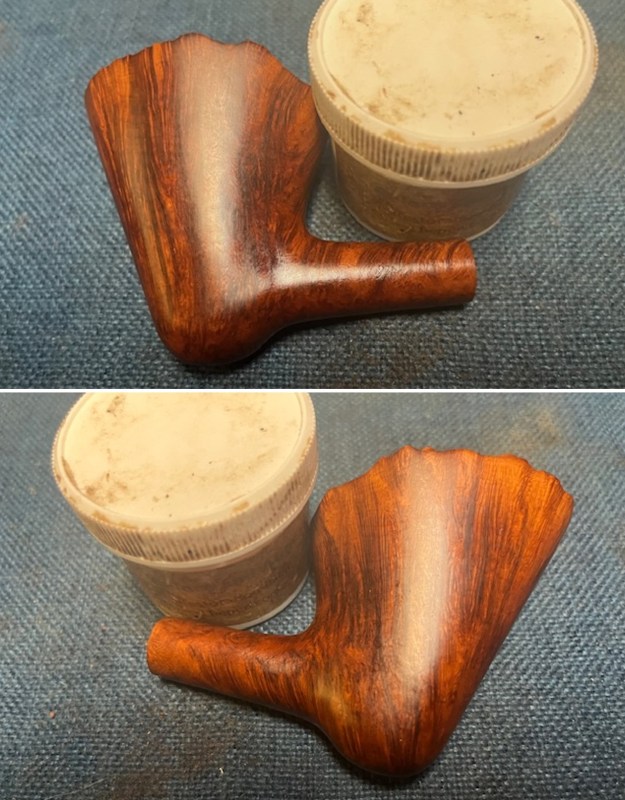
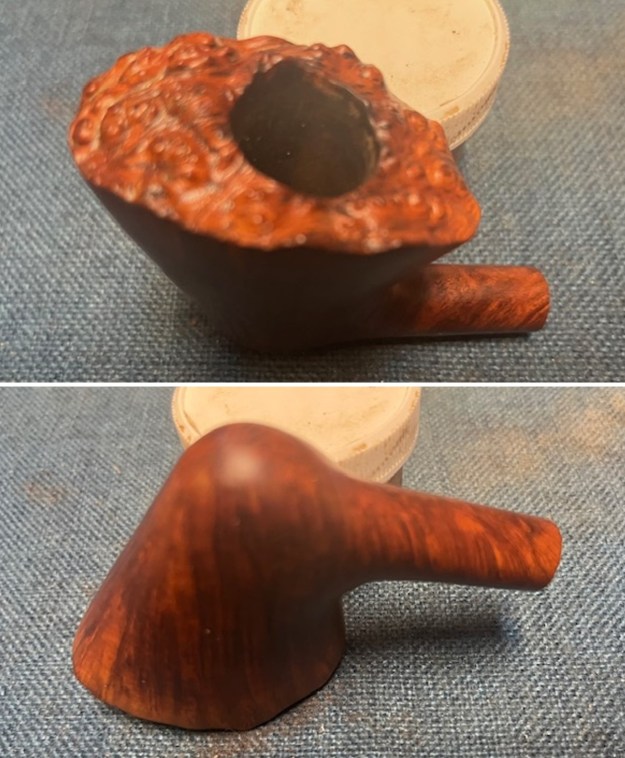
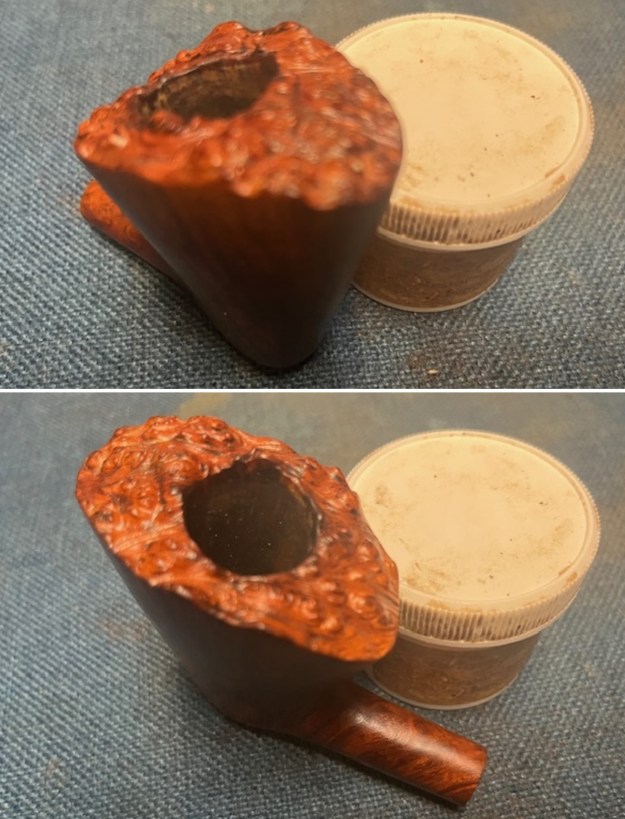
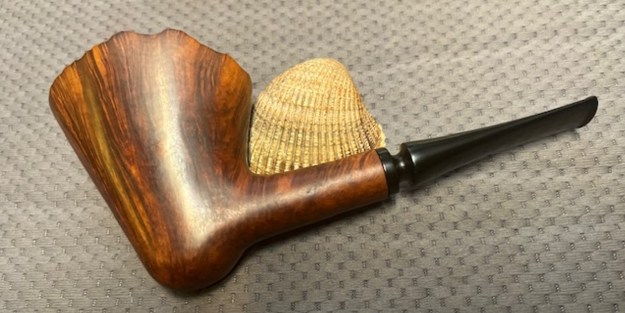
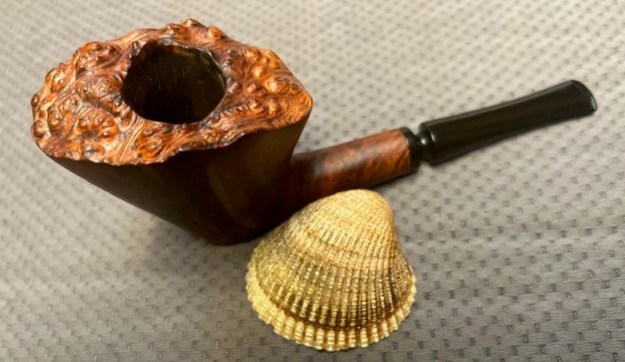
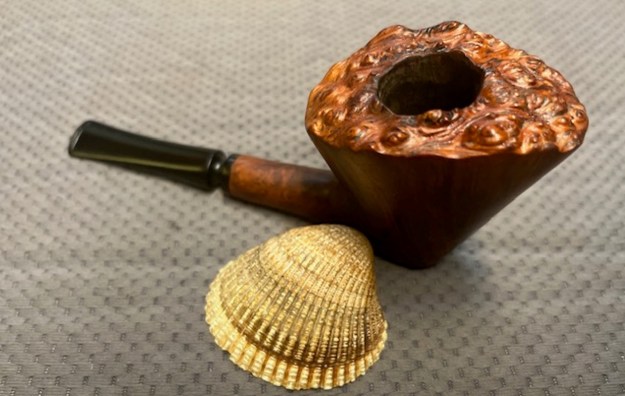
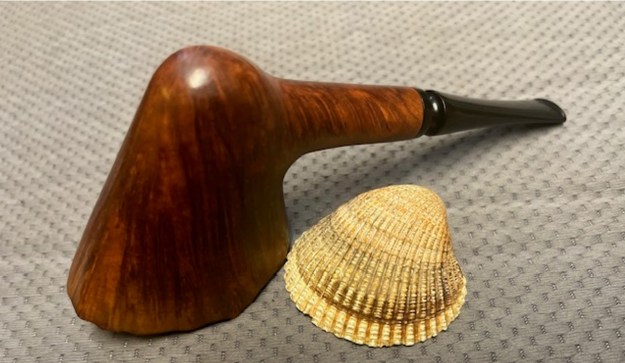
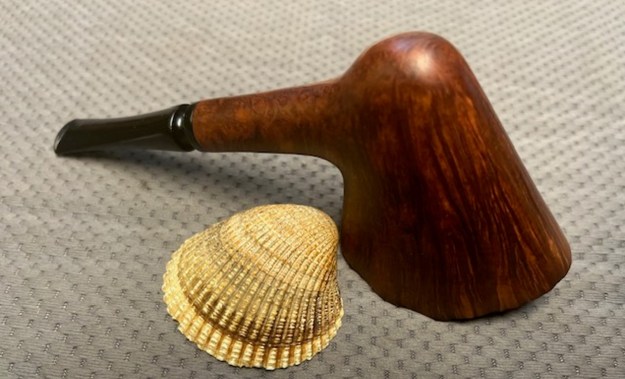
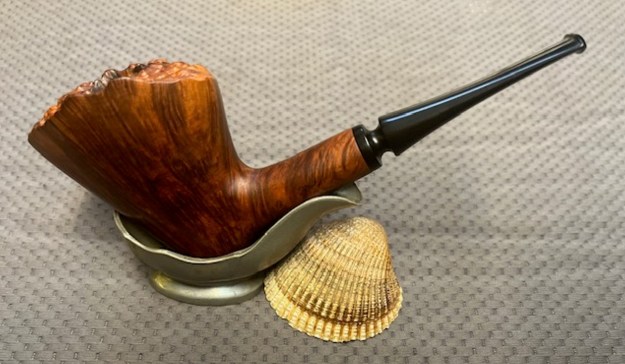
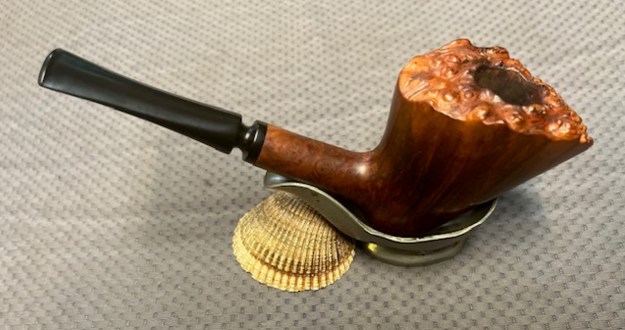
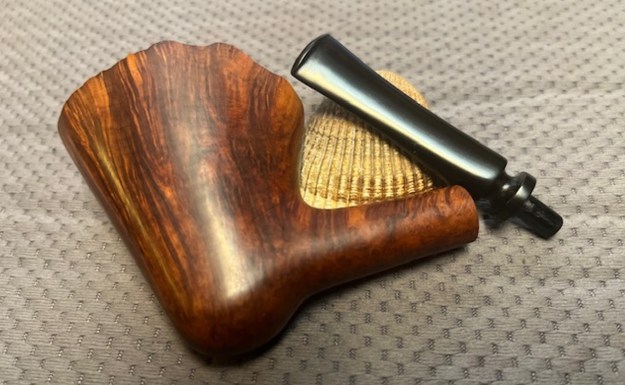
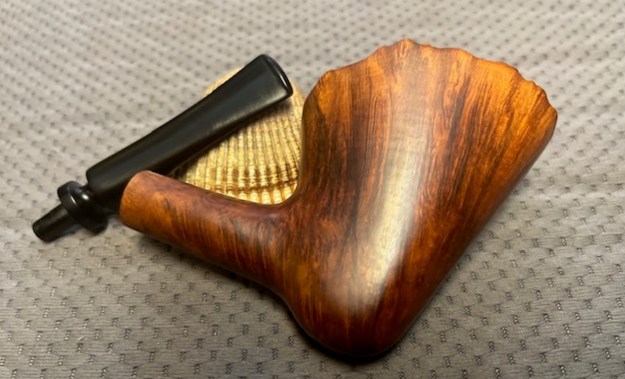
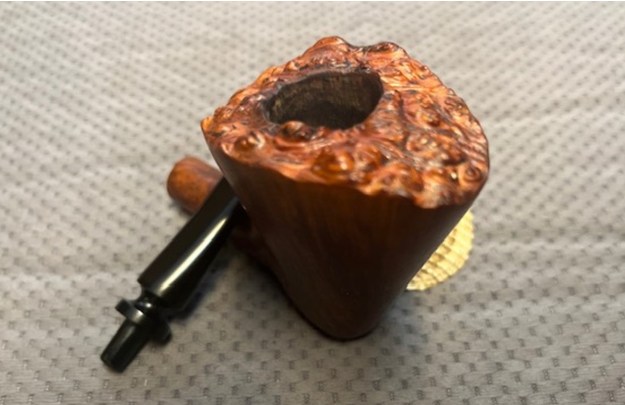
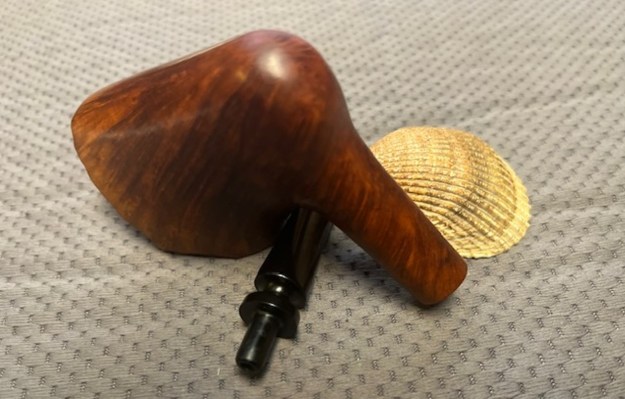
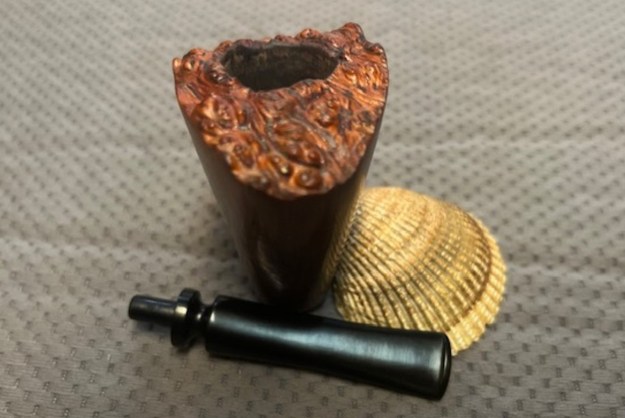
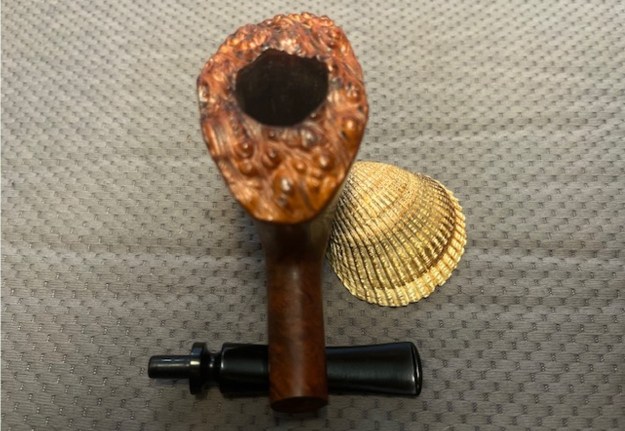
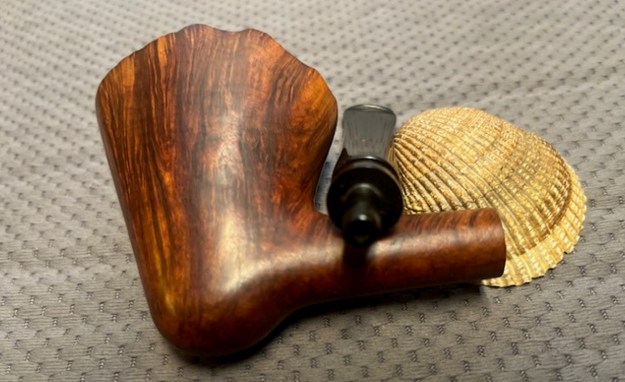
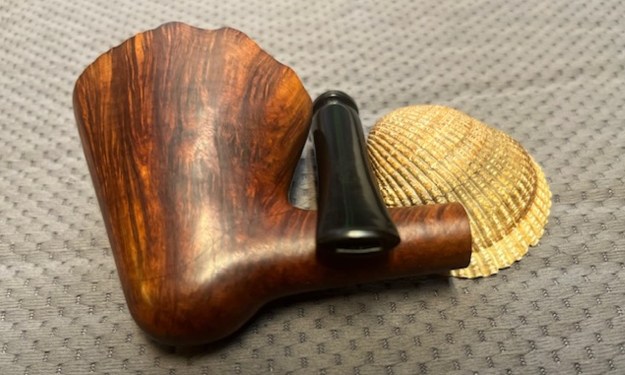
This pipe I chose to work on was another unusual one. It came to us from a seller in Santa Cruz, California, USA on 05/28/2024. It is a great piece of briar with great straight grain all the way around the bowl and shank and a plateau rim top on the bowl. It is a beautiful piece of briar! He made a carved, fan shaped Freehand pipe. The front, back and sides of the bowl have some nice straight grain. Very unique but something just calls out to you. When the pipe came to us it was dirty with grime ground into the finish. There was a thick cake in the bowl and heavy lava in the valleys of the plateau rim top and inner edge. There was grime and oils darkening the sides of the bowl. It was dirty but that did not hide the beauty of the grain on this briar. The stem is a saddle made out of vulcanite. There were tooth marks and light chatter on both sides just ahead of the button. Jeff took photos of the pipe as a whole before he started his cleanup work. I include them below. Jeff took some close up shots of the rim top to show the bowl and cake. You can see the cake in the bowl and the thick lava on the rim top and the inner edge. The stem photos also show the condition it was in when we received it. Lots of promise with the pipe but some work too! Jeff took some photos of the sides – left and right sides and the heel of the bowl to give a sense of the lay of the pipe on the block of briar. It is certainly beautiful. Here are some photos of the stamping on the left side of the shank. I think this must be an older stamp of JHW as the J is a part of the uppercase HW. It is the only one I have that has this stamping. Otherwise the J is a stylized pipe followed by the HW.Take some time to read the great writeup on Pipedia and JHW pipes and influence the carver had on the American pipe making scene. It is a well written and enjoyable read. Here is the link: (https://pipedia.org/wiki/JHW_Pipes).

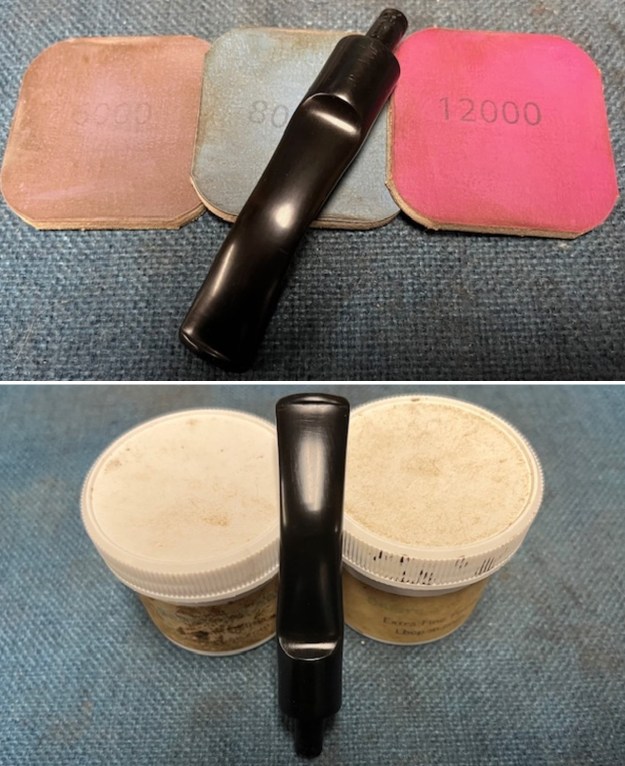
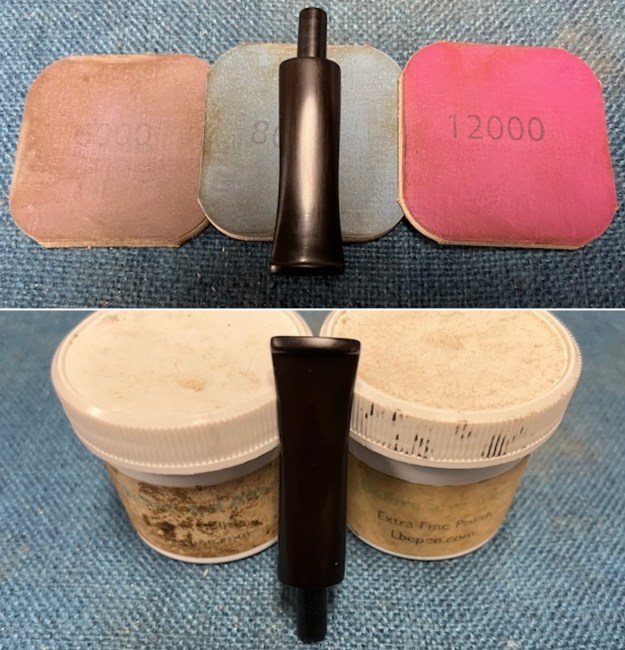
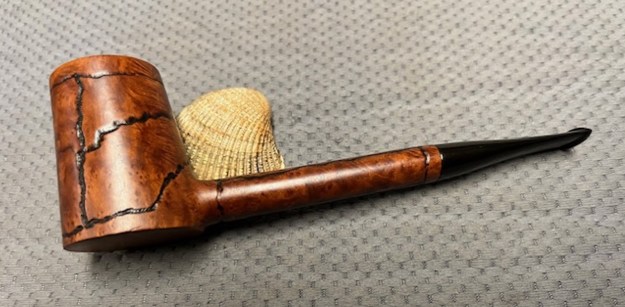
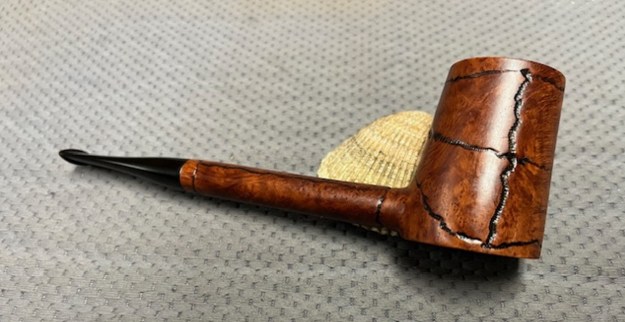
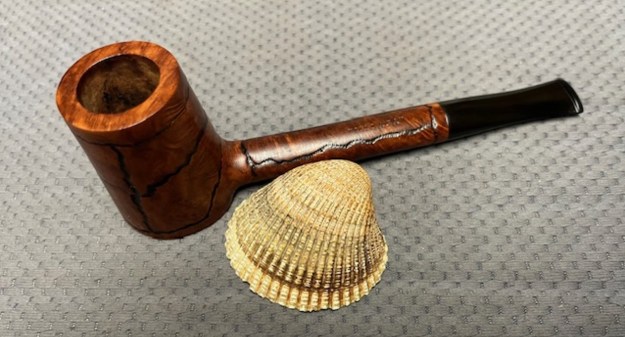
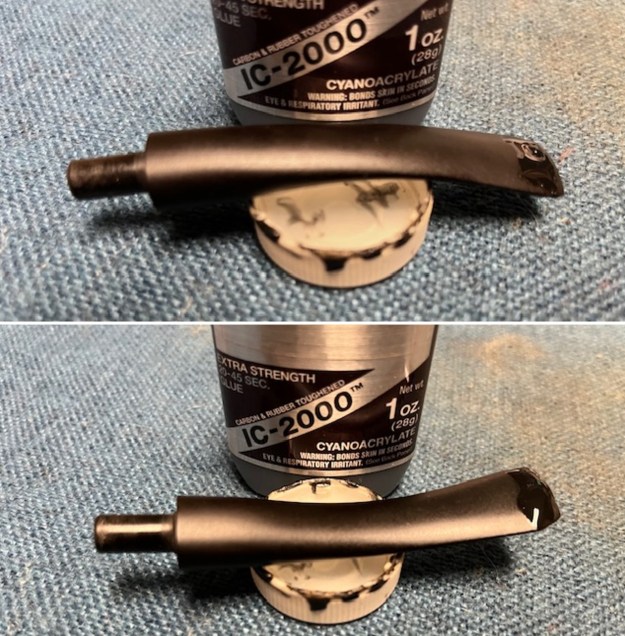
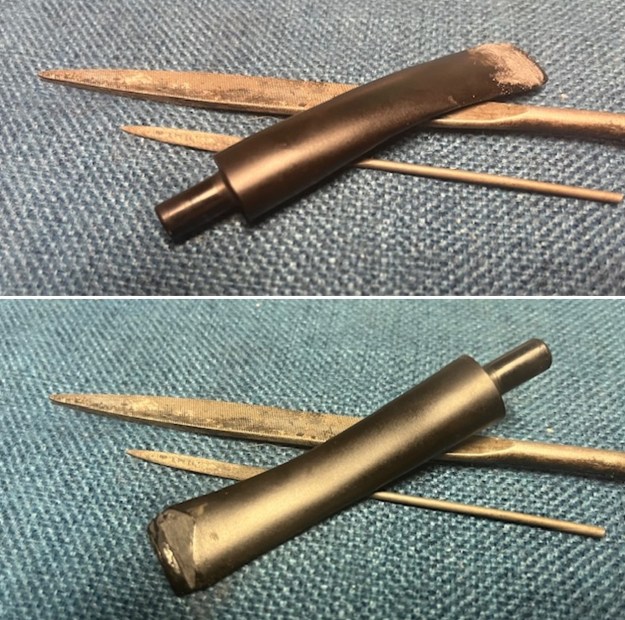
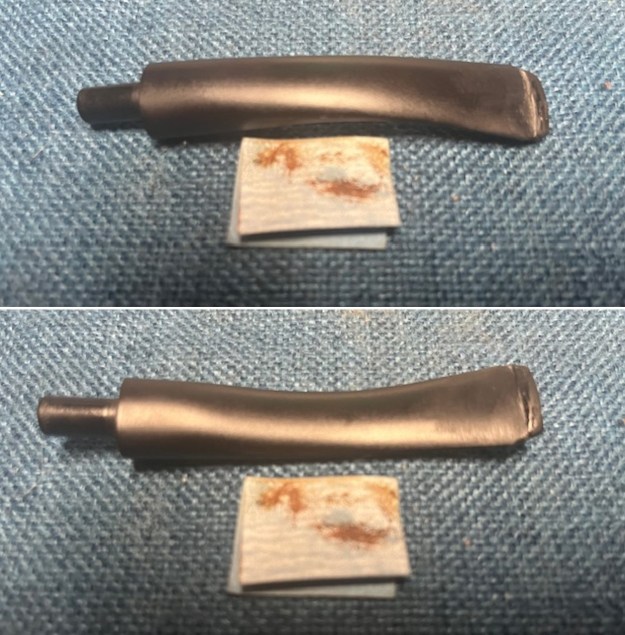
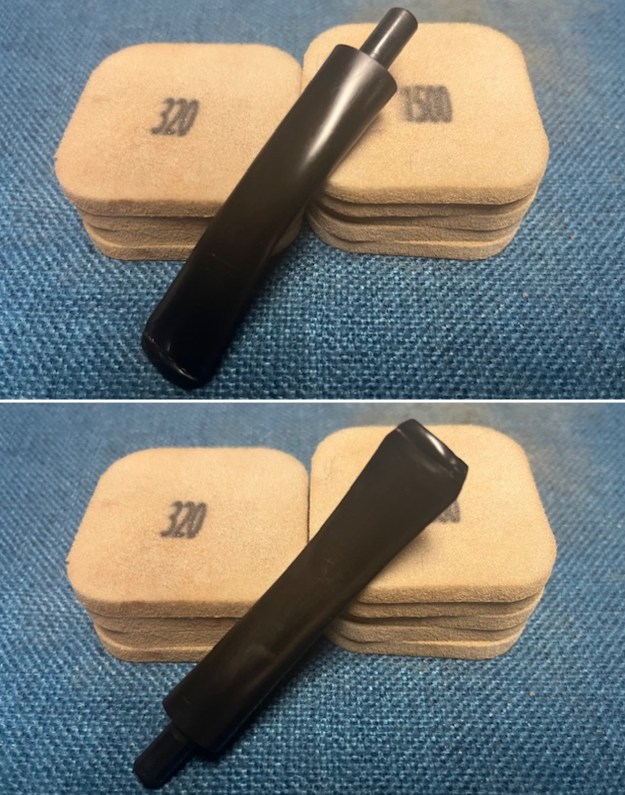
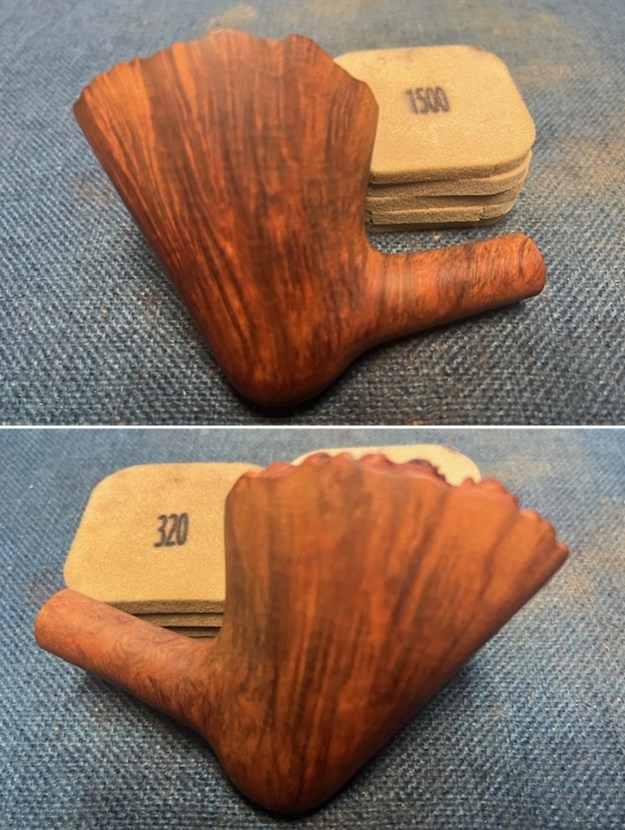
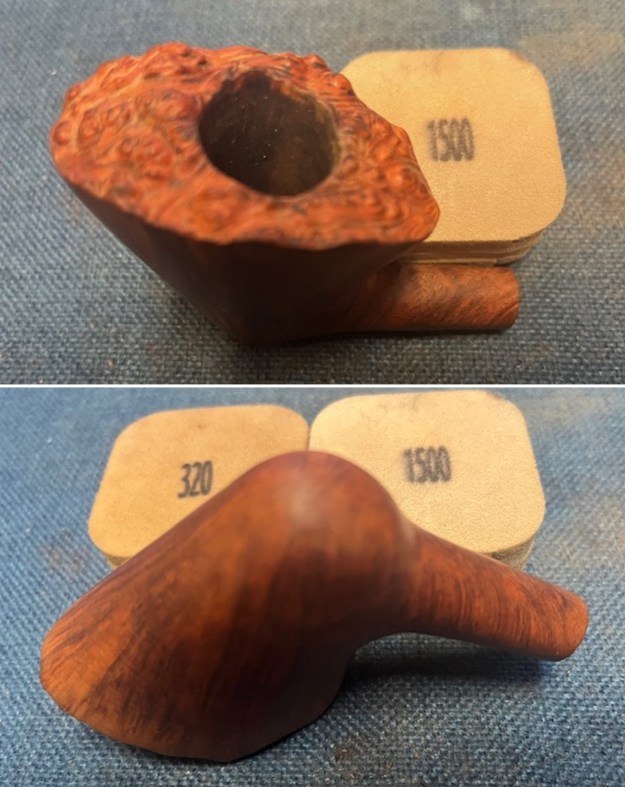
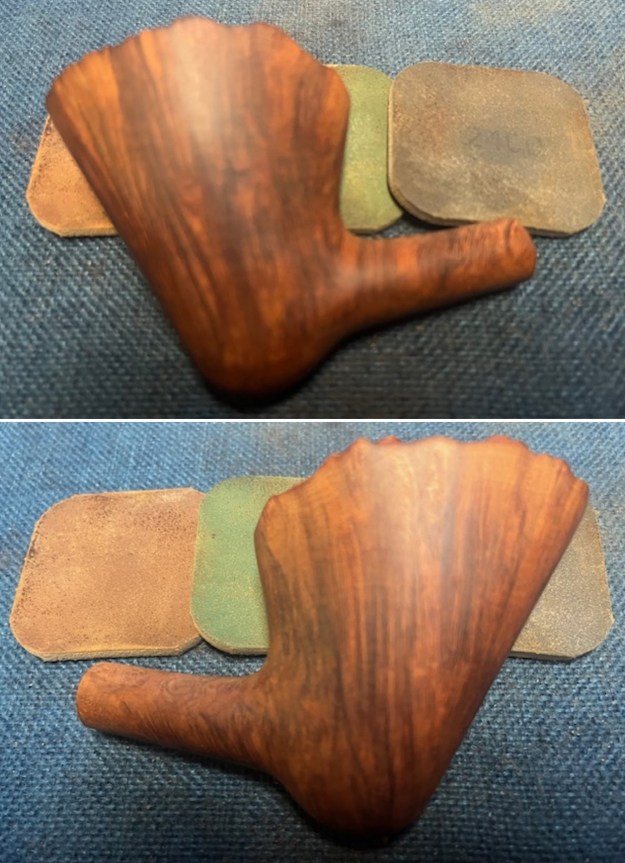
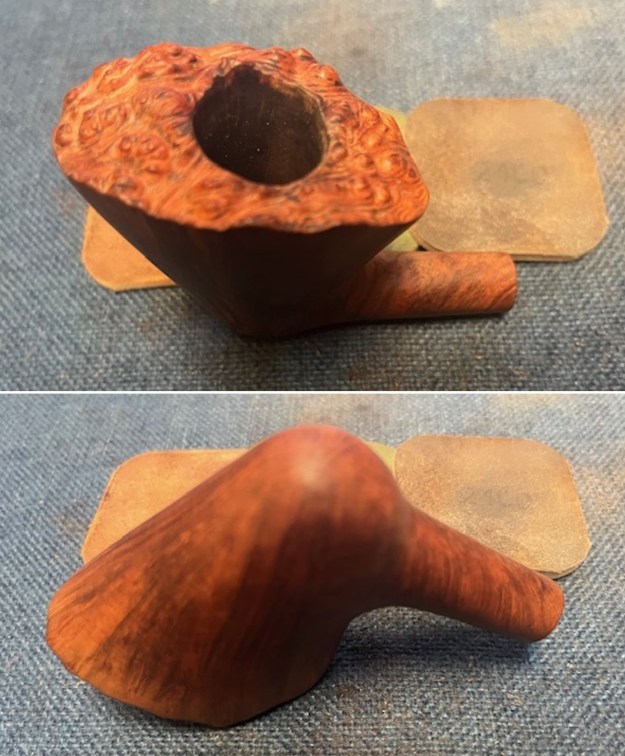
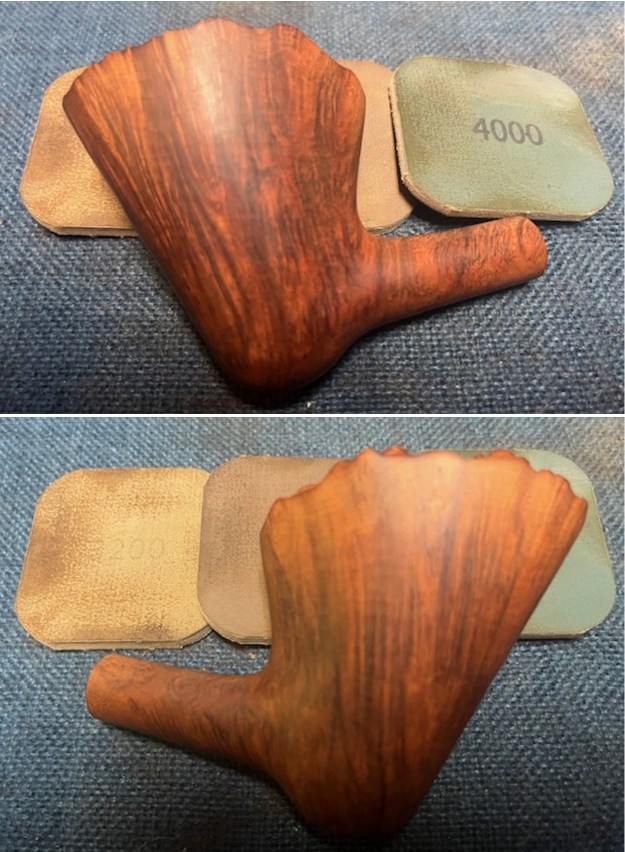
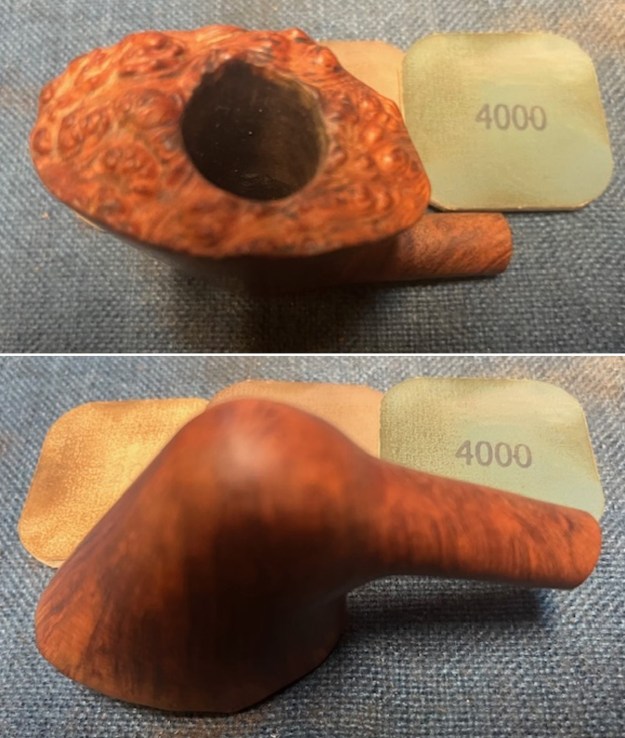
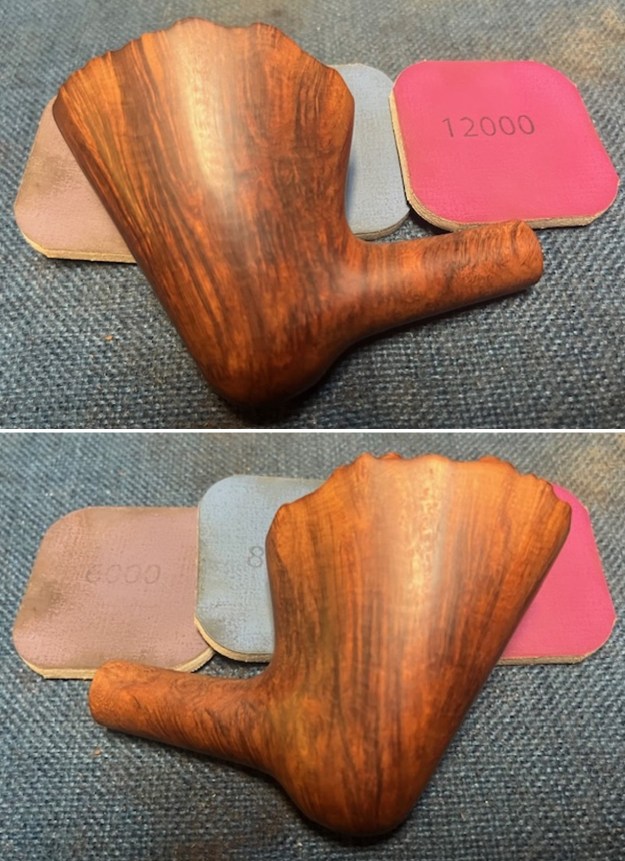
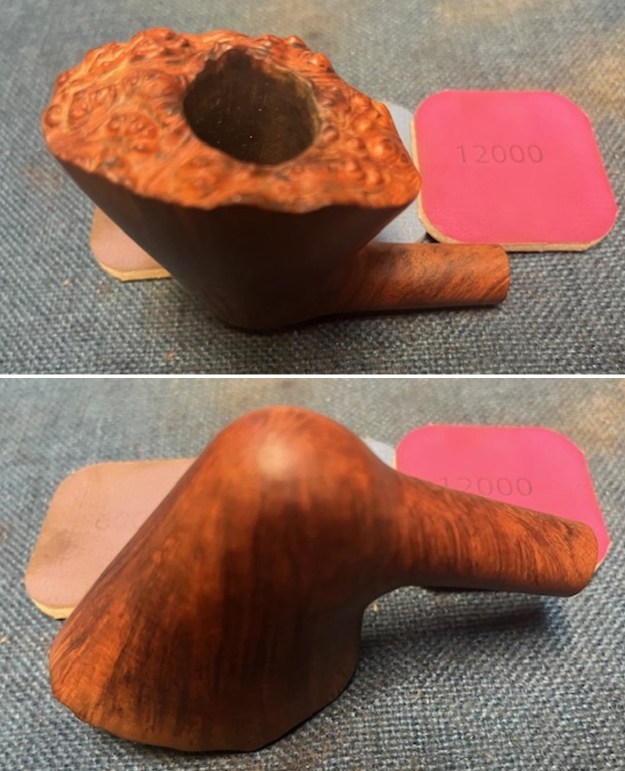
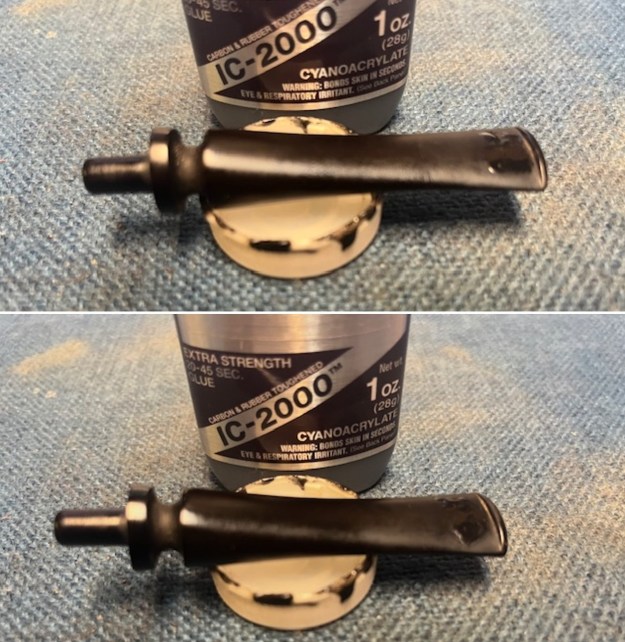
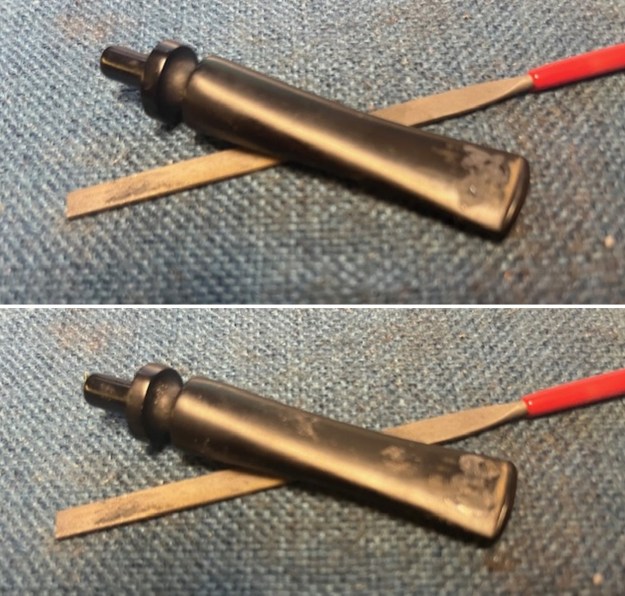
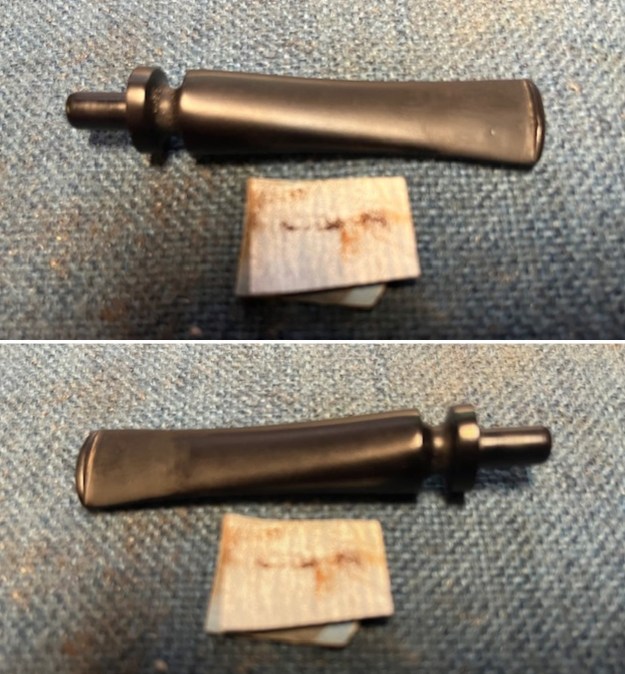
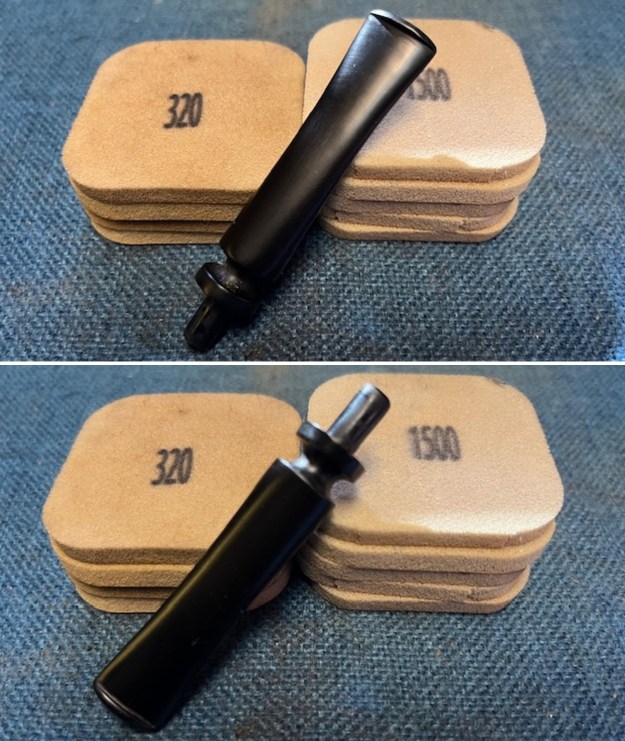
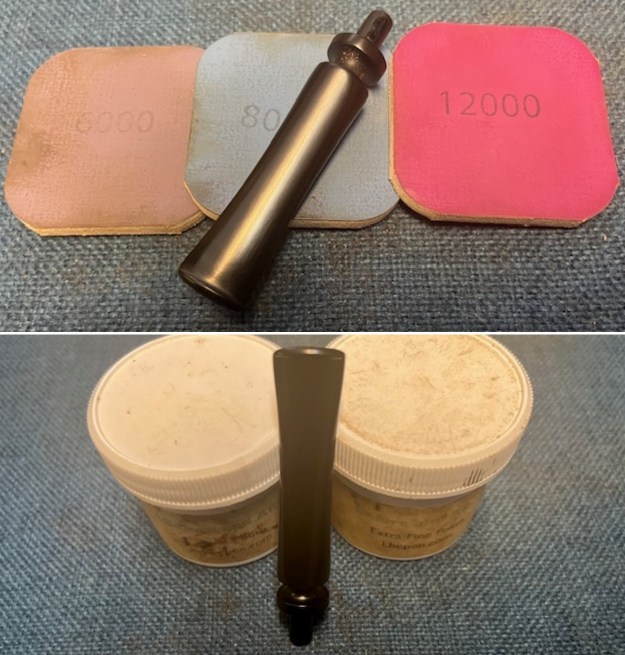
Armed with that information I turned to work on the pipe itself. Jeff had cleaned up the pipe with his usual thoroughness. He reamed the pipe with a PipNet pipe reamer and removed the rest of it with a Savinelli Fitsall Pipe Knife. He scrubbed the bowl with undiluted Murphy’s Oil Soap with a tooth brush. He rinsed it under running warm water to remove the soap and grime. He cleaned out the inside of the shank and the airway in the stem with alcohol, cotton swabs and pipe cleaners and shank brushes. He soaked the stem in Briarville’s Pipe Stem Deoxidizer and rinsed it off with warm water. I took photos of the pipe before I started my part of the restoration work. The rim top cleaned up really well. The rim top and inner edge of the bowl look good. The plateau rim top looks very good. There is a slight darkening on the inner edge of the bowl. The bowl itself was very clean and the pipe smelled fresh. The stem surface had light tooth chatter on both sides near the button.The stamping on the left side of the shank is faint but still readable. It is stamped as noted above. I removed the stem and took a photo of the pipe to give a sense of the whole.I wiped the bowl down with some acetone to see if I could lighten the darkening around the bowl sides. It worked quite well. I sanded the sides of the bowl and shank with 320-3500 grit sanding pads. There were also some scratches in the briar on the sides, but nothing too deep so this process would take care of the issues. I polished the briar with micromesh sanding pads – dry sanding with 1500-12000 grit sanding pads. I wiped the bowl down with a damp cloth after each pad. I take photos of the three groups of pads for my own viewing primarily as I am looking for progress in polishing. Once again, by the end of the process it looked quite good. I rubbed the bowl and shank down with Before & After Restoration Balm. I worked it into the surface of the bowl sides and shank with my fingertips. i worked it into the plateau on the rim top with a shoe brush. The product works to clean, enliven and protect the briar. I let the balm sit for 15 minutes and buffed with a cotton cloth to raise the shine. The grain came alive. I set the bowl aside and turned my attention to the stem. I “painted” the surface of the stem to raise the tooth marks on the vulcanite. I filled in what remained in the surface with black CA glue and set it aside to cure. Once the repair cured I used a flat needle file to smooth out the repairs on the stem surface. I followed that up with a folded piece of 220 grit sandpaper to blend them into the surface of the stem. I sanded the stem with 320-3500 grit sanding pads. I wiped the stem down after each pad with an Obsidian Oil soaked cloth. The process helped remove the lingering oxidation.I polished the stem with micromesh sanding pads – 1500-12000 grit pads to remove them. I wiped the stem down with Obsidian Oil after each sanding pad. I used Before & After Pipe Polish – both Fine and Extra Fine to further polish the stem. I rubbed it down with a final coat of Obsidian Oil and let it dry. This Jack H. Weinberger (JHW) Fan Shape Oval Freehand with a vulcanite saddle stem is a great looking pipe with some beautiful grain around the front and sides of the bowl. The grain around the bowl is quite stunning and works well with both the shape and the polished vulcanite saddle stem. I put the stem back on the bowl and carefully buffed the pipe with Blue Diamond on the buffing wheel using a light touch on the briar. I gave the bowl and the stem multiple coats of carnauba wax on the wheel and followed by buffing the pipe with a clean buffing pad. I hand buffed the pipe with a microfiber cloth to deepen the shine. The finished Jack H. Weinberger (JHW) Fan Freehand fits nicely in the hand and feels great. Give the finished pipe a look in the photos below. The dimensions of the pipe are Length: 6 ½ inches, Height: 3 inches, Outside diameter of the bowl: 2 ½ inches long x 1 ½ inches wide, Chamber diameter: ¾ of an inch. The weight of the pipe is 2.26 ounces/64 grams. I will be putting it on the rebornpipes store in the American Pipemakers Section shortly. If you are interested in adding this pipe to your collection send me a message or an email. Thanks for reading this blog and my reflections on the pipe while I worked on it. I appreciate your support and time!

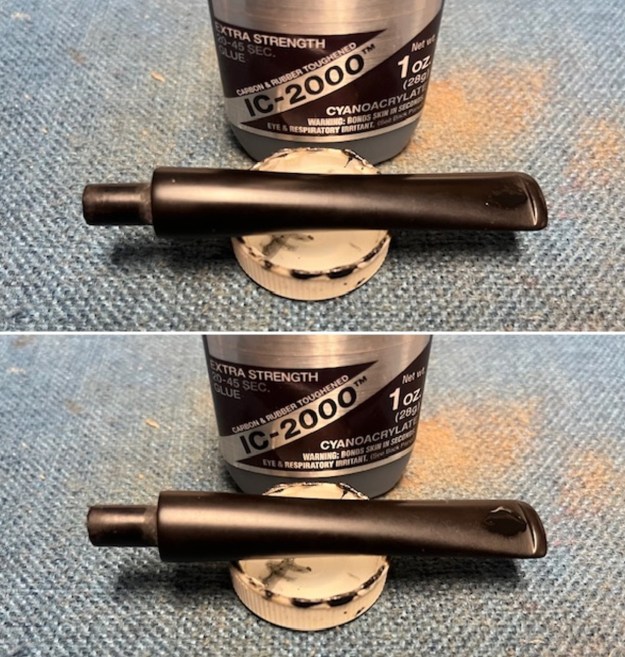
Clearing and Restoring a Clogged Brigham Made in Canada Bent Billiard


by Steve Laug

The next pipe on the table was one that the local pipe shop contacted me about repairing. I have included the email from the shop regarding this pipe. I quote:

Good evening Steve! Hope all is well. I’ve got yet another pipe here in need of your expertise! It’s a beautiful hundred year old (according to our client) Brigham 3 dot with something stuck in the stem. I included a few photos showing the issue and some of the more unique features of the pipe. If you’re available in the next little while, would it be possible to drop by? Cheers, Joe.

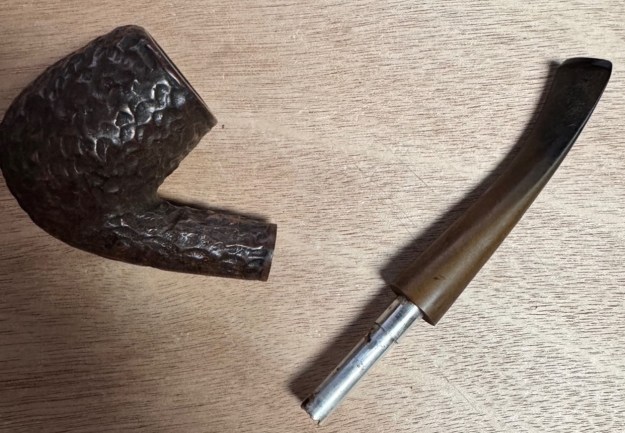
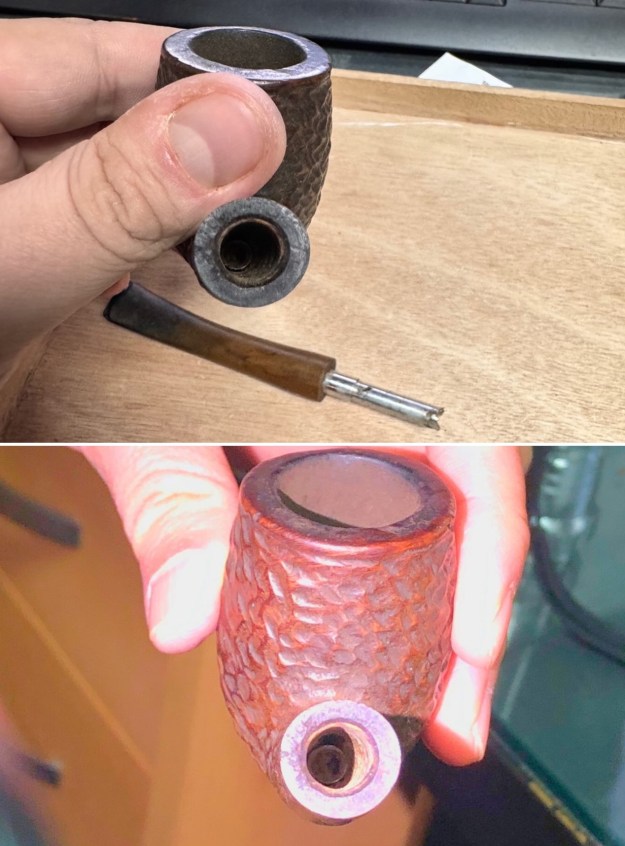
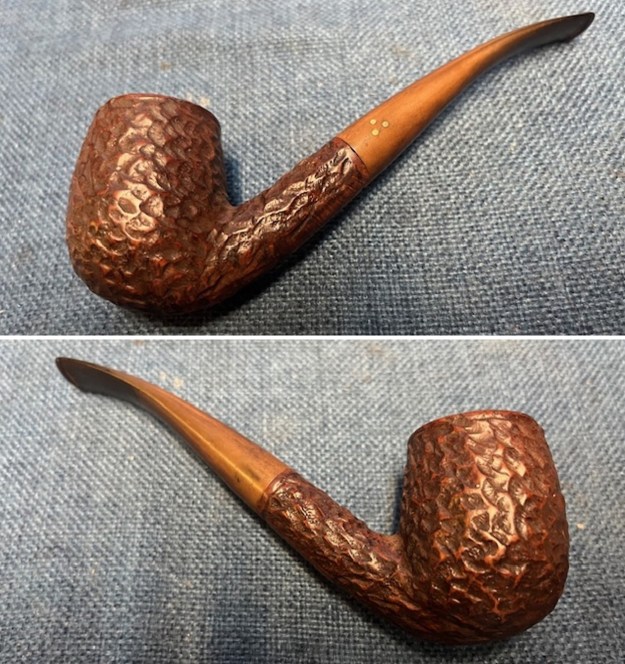
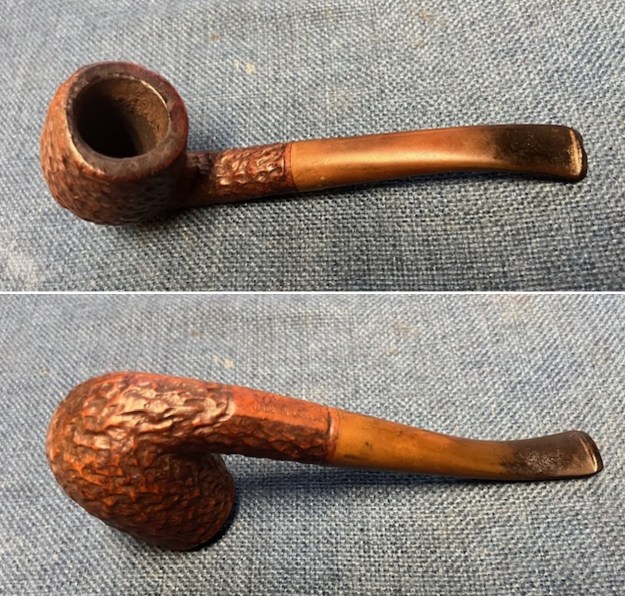
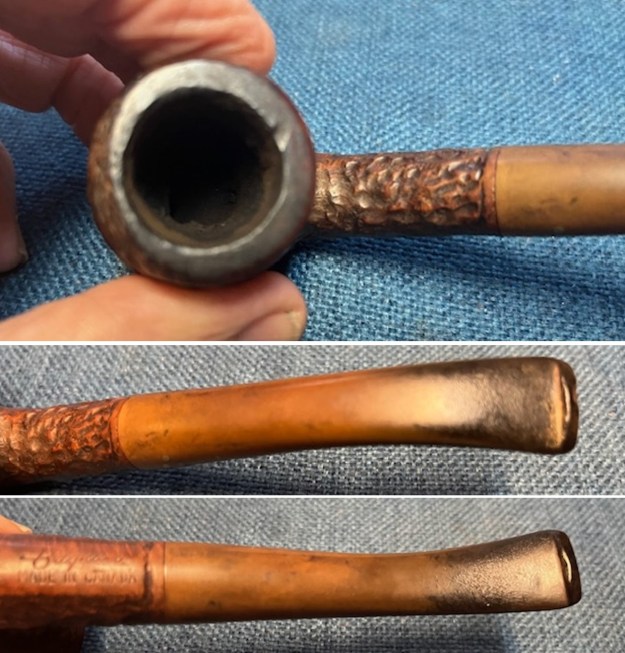
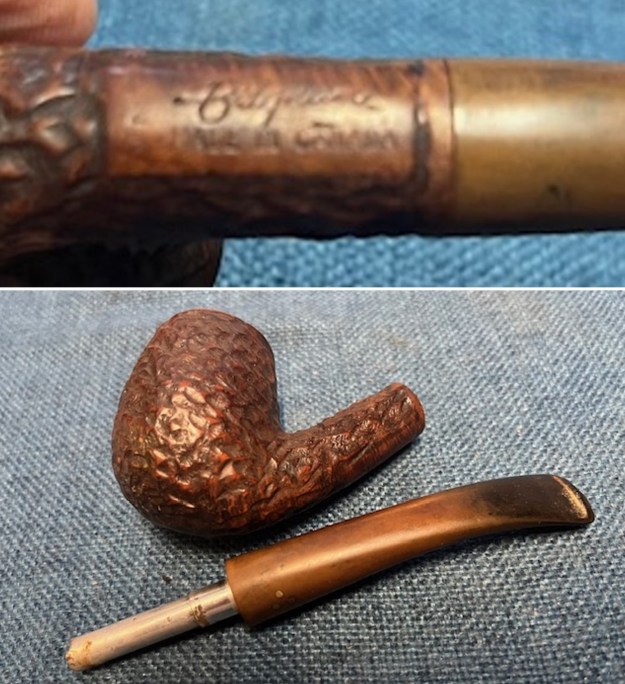
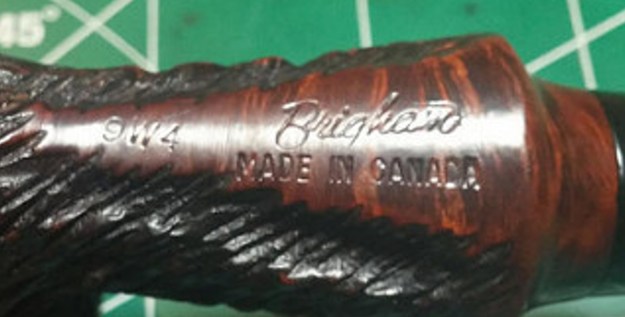
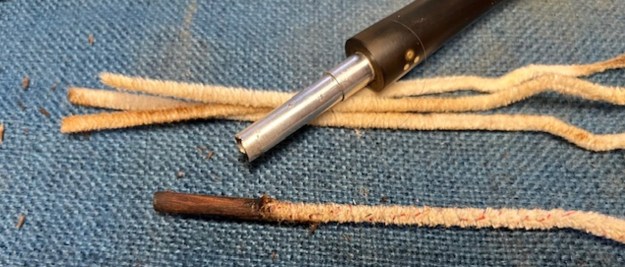
He included the following photos of the pipe. The third photo shows the item stuck in the shank. From the photo it appears to be the metal end of the Brigham Rock Maple Distillator. I have seen this happen before when the aluminum breaks off the wooden distillator. I could also see some corrosion to the aluminum tenon that held the distillator. I let Joe know that once I returned from my visit to my Father in the US I would let him know. Today, Joe dropped pipe by for my work. It was stamped on the underside of the shank and read 323 [followed by] Brigham [over] Made in Canada. The 323 was the shape number of the pipe. The style of the stamping would also help me identify when the pipe was made. The rusticated finish was classic Brigham. There was a thick cake in the bowl and some lava on the rim top. The rim top also had some nicks in the top and the front edge was damaged from knocking the pipe out against a hard surface. The bowl was slightly out of round. The clog in the shank did not allow the shank to be cleaned of the tars and oils and it was very dirty. The stem was oxidized and had tooth marks and chatter on both sides ahead of the button. The end of the metal tenon was also corroded and damaged. I would need to either smooth it out or replace the stem if I could. It had three brass dots on the left side of the taper. I took photos of the pipe before I worked on the pipe. I took close up photos of the bowl and rim top to show the condition of the bowl and damage to the rim edge as well as the cake and lava overflowing onto the rim top. I also took close up photos of the stem to show its condition as mentioned above.I took a photo of the stamping on the underside of the shank and it is very clear and readable. I took the stem off the shank and took a photo of the pipe to show the overall look of the pipe.For the needed background I am including the information from Pipedia on Brigham pipes. It is a great read in terms of the history of the brand (https://pipedia.org/wiki/Brigham_Pipes). Charles Lemon (Dadspipes) has written book on the history of the brand. This article is a good summary. I have included it below.

Roy Brigham, after serving an apprenticeship under an Austrian pipesmith, started his own pipe repair shop in Toronto, in 1906. By 1918 the business had grown to include five other craftsmen and had developed a reputation across Canada for the high quality of workmanship. After repairing many different brands of pipes over the years, Roy noted certain recurring complaints by pipe smokers, the most common referred to as “tongue bite”. Tongue bite is a burning sensation on the smoker’s tongue, previously thought to be due to the heat of the smoke (i.e. a “hot smoking pipe”).

He soon began manufacturing his own pipes, which were lightweight, yet featured a more rugged construction, strengthening the weak points observed in other pipes. The problem of tongue bite intrigued him, and he decided to make overcoming it a future goal.

About 1938, Roy’s son Herb joined him to assist in the business. The business barely survived the great depression because pipes were considered to be a luxury, not a necessity, and selling pipes was difficult indeed. In approximately 1937 [1], after some experimentation, Roy and Herb discovered that tongue bite was in fact a form of mild chemical burn to the tongue, caused by tars and acids in the smoke. They found that by filtering the smoke, it was possible to retain the flavour of the tobacco and yet remove these impurities and thereby stop the tongue bite.

Just as Thomas Edison had searched far and wide for the perfect material from which to make the first electric light bulb filaments, Roy & Herb began experimenting with many materials, both common and exotic, in the quest for the perfect pipe filter. Results varied wildly. Most of the materials didn’t work at all and some actually imparted their own flavour into the smoke. They eventually found just two materials that were satisfactory in pipes: bamboo and rock maple. As bamboo was obviously not as readily available, rock maple then became the logical choice.

They were able to manufacture a replaceable hollow wooden tube made from rock maple dowelling, which when inserted into a specially made pipe, caused absolutely no restriction to the draw of the pipe, yet extracted many of the impurities which had caused tongue bite. The result was indeed a truly better smoking pipe…

I then turned to a second article by Charles Lemon called, “A Closer Look at the Dots, Dates, and Markings of Brigham Pipes” to be able to pin down the time frame that the pipe was made in and to help interpret the stampings and shape number on the pipe. Here is the link to his article (https://pipedia.org/wiki/Brigham_Pipes_%E2%80%93_A_Closer_Look_at_Dots,_Dates_and_Markings). I quote the pertinent information below to establish the date on the pipe.

Around the late 1960s or early 1970s, at the beginning of what I’ve called the Canadian Era (roughly 1970 – 1980), the stampings changed again as Brigham moved to modernize its logo. Pipes are stamped with the 3-digit shape number and “Brigham” over “Made in Canada”. Note these two variants of this stamping.

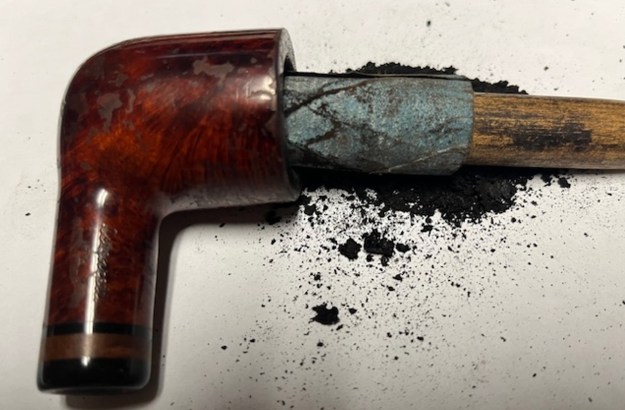
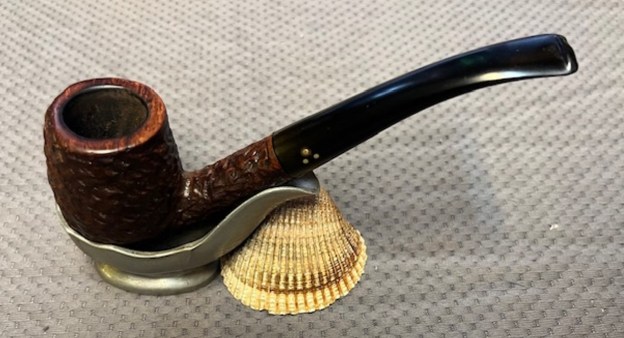
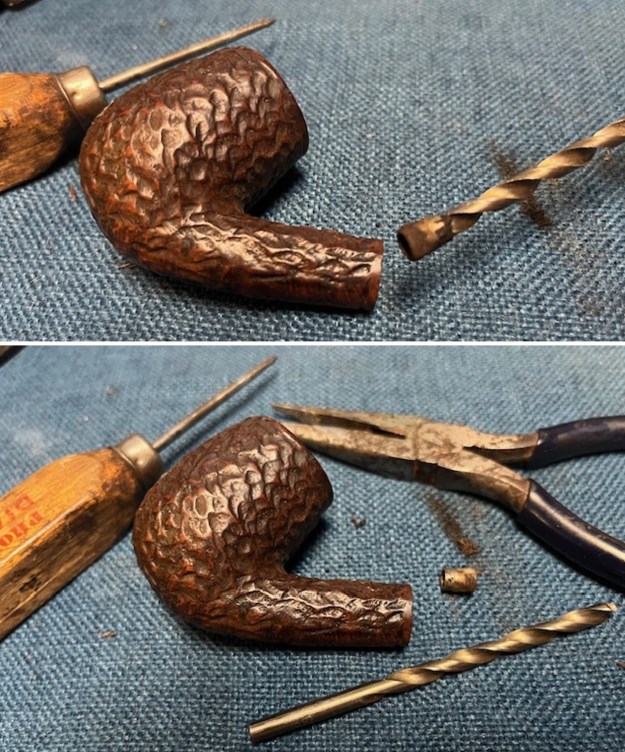
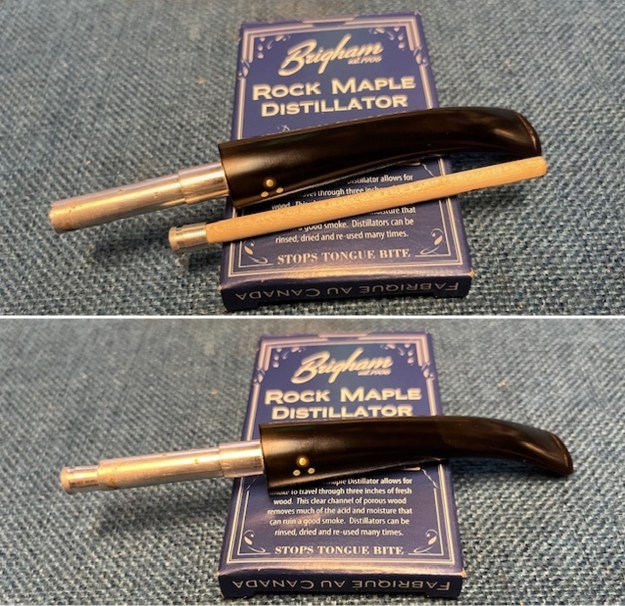
The stamping on the one I am working on is like that shown in the photo below. From the information above I know that the pipe I am working on was made between the late 1960s and the 1980s which makes the pipe approximately 45-65 years old. Now it was time to work on the pipe. I decided to pull the metal blockage in the shank end. I knew it was broken off the Hard Maple Distillator. I tried to pull the metal piece with an ice pick and it was too tight in the shank to come out that easily! Always seems to be the case for me. I used drill bit slightly larger than the airway in the metal piece. I carefully turned it into the metal with a cordless drill. Once it bit I was able to pull it free from the shank. It is shown on the end of the drill bit in the first photo below and free of the bit in the second photo below.I reamed the bowl with a PipNet reamer. I used the first and second cutting heads and took the cake back to bare briar. I cleaned up the reaming with a Savinelli Fitsall Pipe Knife and removed all the remnants of the cake. I scraped the rim top with the flat edge of the blade at the same time and removed most of the thick lava build up. I sanded the walls of the bowl with a piece of dowel wrapped in 220 grit sandpaper. The walls look very good at this point in the process. I cleaned out the shank, the airway and the deep mortise with alcohol, cotton swabs, hard bristle and soft bristle pipe cleaners. It was a very dirty pipe which just meant that it had really been enjoyed and used. I cleaned the inside of the aluminum tenon and the airway in the stem with alcohol, cotton swabs and pipe cleaners in the same way as I did the shank. It was clogged with debris and there was no airflow. It took some work with a paper clip but eventually it opened up so I could clean it well.I scrubbed the exterior of the bowl and shank with a tooth brush and undiluted Murphy’s Oil Soap. I scrubbed the lava on the rim top and overflow on the outside of the bowl with the soap. I rinsed the briar with warm water to remove the grime and debris of the scrubbing. It looked significantly better after the scrubbing. I cleaned up the inner edge of the rim and the rim top with a folded piece of 220 grit sandpaper. I removed the darkening as much as possible and smoothed out the top of the rim. I lightly topped the bowl on a topping board with 220 grit sandpaper to smooth out the damage on the top and minimize the damage on the front outer edge. I sanded the rim top with 320-3500 grit sanding pads to remove the marks, scratches and darkening and to help shrink and minimize the damage on the front outer edge of the bowl. I used an oak stain pen to blend the top colour into the finished colour of the bowl once polished. It looks a bit darker at this point but it will match very well.I polished it with micromesh sanding pads – dry sanding it with 1200-15000 grit pads. I wiped the bowl down with a damp cloth after each sanding pad. It began to look very good. While the damage on the front of the bowl is visible, in person it is less so. I rubbed the bowl and shank down with Before & After Restoration Balm to deep clean the finish on the bowl and shank. The product works to clean, enliven and protect the briar. I worked it in with my fingers to get it into the briar. I used a horsehair shoe brush to work it into the rustication around the bowl and shank. I let it sit for 10 minutes then I wiped it off and buffed it with a soft cloth. The briar really began to have a rich shine. I took some photos of the bowl at this point to mark the progress in the restoration. It is a beautiful bowl. I set the bowl aside and turned my attention to the stem. I scrubbed the oxidation on the stem with Soft Scrub cleanser and was able to remove a large amount of it. Even after cleaning the inside of the stem the airflow was still quite restricted. I had a hunch the other end of the hard Maple Distillator was stuck in the stem. It made sense. I worked on it with the wire and some bristle pipe cleaners and finally the piece of maple came free and the stem was open as it should have been.I sanded the area around the button edge and the remaining oxidation with a folded piece of 220 grit sandpaper. Progress was happening!I sanded the surface of the vulcanite with the 2 x 2 inch sanding pads. I dry sanded with each pad between the grits 320-3500. I worked on the surface until I had removed all of the oxidation and the stem started to really shine.I polished the stem with micromesh sanding pads – dry sanding with 1500-12000 grit pads. I wiped the stem down after each sanding pad with Obsidian Oil. I polished the stem with Before & After Pipe Stem Polish – both Fine and Extra Fine. I gave it a coat of Obsidian Pipe Stem Oil. It works to protect the stem from oxidizing. I set it aside to dry. I refit the damaged aluminum tenon with the new Brigham Rock Maple Distillator. It is a unique and cool smoking experience.The final steps in my process involve using the buffer. I buffed the bowl and stem with Blue Diamond to polish out the light scratches in the briar and the vulcanite. I gave the bowl and the stem multiple coats of carnauba wax. I have found that I can get a deeper shine if I follow up the wax buff with a buff with a clean buffing pad. It works to raise the shine and then I hand buff with a microfiber cloth to deepen the shine. It is always fun for me to see what the polished bowl looks like with the polished stem. It really is a nice pipe. The smooth tall bowl sides and the rusticated blaze on the left shank side looks great with the yellow acrylic stem. The Brigham 323 Bent Billiard with a vulcanite taper stem feels great in my hand. It is a well-balanced pipe. Have a look at it with the photos below. The dimensions are Length: 5 ½ inches, Height: 2 inches, Outside diameter of the bowl: 1 ¼ inches, Chamber diameter: ¾ of an inch. The weight of the pipe is 1.62 ounces/46 grams. It is a beautiful pipe that I will soon be sending back to the local shop to give back to the owner. It is obviously one that he enjoys.

As always, I encourage your questions and comments as you read the blog. Thanks to each of you who are reading this blog. Remember we are not pipe owners; we are pipe men and women who hold our pipes in trust until they pass on into the trust of those who follow us.

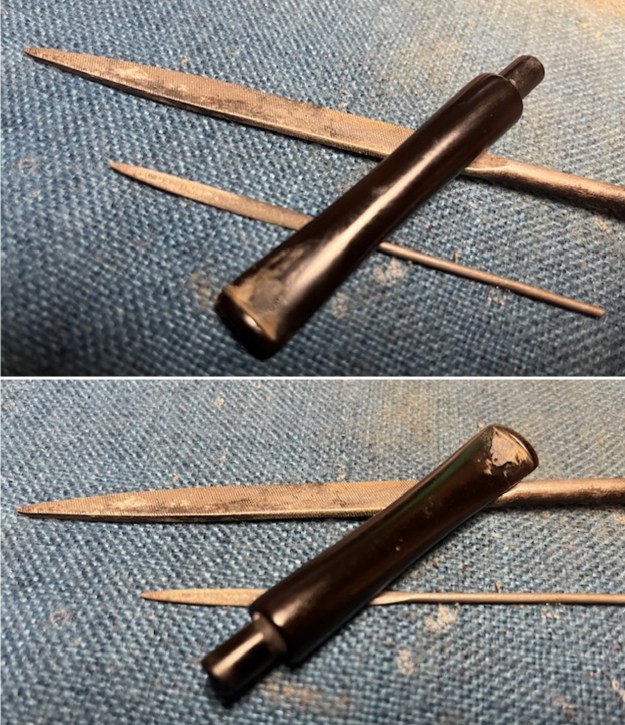
Restoring a Father’s Legacy of 10 Brigham Pipes Gathered throughout his life #7


by Steve Laug

Last month I was contacted by Donna to see if I knew anyone interested in purchasing her father’s pipes. She wrote as follows: “I am wondering if you would be interested in my father’s collection of Brighams.” She further spelled out what he had in the collection. He had 1 – 2 dot pipe, 3 – 3 dot pipes, 2 – 4 dot pipes and 4 – 5 dot pipes. There was a total of 10 pipes. I asked for a photo of the pipes and she sent the photo below. I was very interested.We emailed back and forth and the short story is that I paid for the collection and she shipped the pipes to me. On Tuesday after Easter the box arrived and I was happy to be able to see them up close. They were obviously well-loved pipes and in varying degrees of needing work. I wrote her and told I received them and that I was pleased with the lot. I was looking forward to working on them. She aske me to send her photos along the way as I finished the pipes. I will be sending her the links to the blog so she can see the work and the process of bringing them back to a semblance of their original beauty. Thanks Donna for the opportunity to work on your Dad’s pipes.

The seventh pipe I have chosen to work on from the lot was the one sitting three down on the left column in the photo above. I would call the pipe a Bent Billiard shaped pipe with a vulcanite taper stem. It is stamped on the underside of the shank and reads Brigham in script on the rustication. There is no shape number that I can see. It appears to be a Brigham Sportsman pipe – rough finished or even a bit unfinished in carving. From the cake in the bowl and the other pipes I could tell her Dad loved aromatic tobaccos. This pipe was heavily caked with an overflow of lava on the rim top and on the inner and outer edges of the bowl. There was burn damage on the rim top and inner edge on the front of the bowl. The rim top had some rustication areas on the front and back that are dark in the photos. The shank end even that had a coating of tar build up. The finish was smooth with a rusticated panel on the left side of the bowl. The finish was incomplete – rusticated, smooth, rough and uncarved portions. The stem did not sit all the way in the shank so I assumed it was very dirty in the shank. I removed the stem and the Hard Rock Maple Distillator that was missing from the tenon. The shank was black, tarry and oily. The stem was dirty, calcified and oxidized with thick oil and tar in the airway from the tenon to the button. There were light tooth marks and chatter on both sides ahead of the button. The left side of the taper stem bore three brass. That would also help with identifying the pipe. I took some photos of the pipe before I started my work on it. I took a photo of the bowl and rim top to show the cake in the bowl. The rim top had a thick coat of lava overflowing down the crowned top with heavy burn damage around the top, inner and outer edge. I took photos of the top and underside of the stem showing the light tooth chatter on the vulcanite stem surface. It is heavily oxidized and calcified and is quite dirty on the surface of the vulcanite.The stamping is very, very faint and hard to read in the photo below. With a bright light and lens, it reads as noted above. I removed the stem from the shank and took a photo of the parts to show the parts of the pipe. The finish on the pipe is very worn and tired looking. The brass dots on the stem are hidden under the grime and oxidation.For the needed background I am including the information from Pipedia on Brigham pipes. It is a great read in terms of the history of the brand (https://pipedia.org/wiki/Brigham_Pipes). Charles Lemon (Dadspipes) has written book on the history of the brand and well worth the price. The Pipedia article is a good summary.

I turned to Charles Lemon’s book, Brigham Pipes A Century of Canadian Briar, page 24-25. I quote the section on Brigham Sportsman Pipes below:

The Toronto Sportsman’s Show has been an annual tradition since the late 1940s, catering to all manner of outdoor pursuit. Brigham began renting a booth at the show in the early 1950’s and created the Sportsman series of rugged, rough-and-ready pipes available exclusively at the Sportsman’s Show.

The Sportsman pipes were essentially semi-shaped (or half-finished) briar bowls with vulcanite stems, complete with the Brigham System. The smoking characteristics of the Sportsman models were identical to regular Brigham pipes, and the rough exterior and simple wax finish gave the series a rugged, outdoorsy appearance that many pipe smokers found appealing.

Special show prices allowed pipe smokers to buy a 4-Dot pipe for the price of a 3-Dot pipe, a 3-Dot pipe for the price of a 2-Dot pipe, or a 2-Dot pipe for the price of a 1-Dot pipe. Soon Sportsman pipes could be found in golf bags, backpacks, tackle boxes, and camping trailers across the country.

Initially available only at the annual Toronto Sportsman Show, retailers began requesting Sportsman models to sell in their shops. Alphie’s in Timmons, ON, has claimed the honour of being the first retail shop to carry the semi-finished Sportsman line. Others soon followed, including Albion Smoke and Gift Shop, though the pipes remained available only for a short period in the Spring of each year.

A good number or Brigham Sportsman pipes can be found on the estate market, in a multitude of shapes and sizes ranging from the basic Billiards to rough-carved versions of Brigham’s freehand-style pipes.

Brigham continued to sell Sportsman pipes at both the Toronto Sportsman’s Show and through its independent retailers until the late 1990s when the company began winding down domestic production. Demand for the rugged, semi-shaped pipes remained strong, however, and in 2011, Brigham relaunched the line using rough-carved pipes from its European producers.

I then turned to the Pipedia article by Charles Lemon called, “A Closer Look at the Dots, Dates, and Markings of Brigham Pipes” to be able to pin down the time frame that the pipe was made in and to help interpret the stampings and shape number on the pipe. Here is the link to his article (https://pipedia.org/wiki/Brigham_Pipes_%E2%80%93_A_Closer_Look_at_Dots,_Dates_and_Markings). I quote the pertinent paragraphs below.

I have dubbed the decades between 1980 and 2000 the Late Canadian Era, a period that saw several changes at Brigham that are of note to the collector. First, the traditional 8-grade pinning system (the famous Brigham “Dots” which denoted the quality of the pipe) was changed to a 7-grade system to simplify pinning (more on this below), and the Norsemen and Valhalla series were merged to form the President Series, which represented the very finest pipes coming out of the Toronto factory. Early pipes from this era (left, below) are stamped with a shape number and “Brigham” over “Canada”; later pipes (late 1980s+, on right below) are stamped simply with a shape number and the Brigham logo.

I knew that the pipe I was working on was from the Sportsman Line and was probably made between the 1980s-1990s. It sports 3 dot Sportsman Series pipe which gives the grade of the pipe. There is not a shape number on the pipe. Now to do a bit of spiffing with the pipe itself.

I started my work on the pipe by reaming the bowl with a PipNet reamer. I used the first and second cutting heads and took the cake back to bare briar. I cleaned up the reaming with a Savinelli Fitsall Pipe Knife and removed all the remnants of the cake. I scraped the rim top with the flat edge of the blade at the same time and removed most of the thick lava build up. I sanded the walls of the bowl with a piece of dowel wrapped in 220 grit sandpaper. The walls look very good at his point in the process. I cleaned out the shank, the airway and the deep mortise with alcohol, cotton swabs, hard bristle and soft bristle pipe cleaners. It was a very dirty pipe which just meant that Donna’s Dad had really enjoyed and used this pipe. I cleaned the inside of the aluminum tenon and the airway in the stem with alcohol, cotton swabs and pipe cleaners in the same way as I did the shank. It also was very dirty.I scrubbed the exterior of the bowl and shank with a tooth brush and undiluted Murphy’s Oil Soap. I scrubbed the lava on the rim top and overflow on the outside of the bowl with the soap. I rinsed  the briar with warm water to remove the grime and debris of the scrubbing. It looked significantly better after the scrubbing. The damage on the bowl front and rim top is very clear. The burn damage on the front of the rim top, the outer and the inner bevelled edge were going to take a lot of shaping work. There was a spot on the top of the rim toward the front appeared to be a flaw in the briar. I cleaned up the inner edge with a piece of sandpaper. I topped the bowl on a 220 grit sheet of sandpaper on a topping board. I used a piece of 220 grit sandpaper and a half wooden sphere to clean up the inner and bevel it slightly. I finished that and moved on to it with 320-3500 grit sanding pads to finish minimizing the burn damage and reshape the rim top and the top half of the bowl. The briar began to take on a rich shine and the burn damage was by and large gone. The photos tell the story. I polished the smooth rim top with micromesh sanding pads – dry sanding it with 1200-15000 grit pads. I wiped the bowl down with a damp cloth after each sanding pad. The grain started to rise to the surface as I polished it. The rusticated portions looked very good as well. I rubbed the bowl and shank down with Before & After Restoration Balm to deep clean the finish on the bowl and shank. The product works to clean, enliven and protect the briar. I worked it in with my fingers to get it into the briar. I used a horsehair shoe brush to work it into the rusticated portions. I let it sit for 10 minutes then I wiped it off and buffed it with a soft cloth. The briar really began to have a rich shine. I took some photos of the bowl at this point to mark the progress in the restoration. It is a beautiful bowl. I sanded the calcification, oxidation and tooth chatter with a folded piece of 220 grit sandpaper. Progress was happening! I sanded the surface of the vulcanite with the 2 inch sanding pads – 320-3500 grit pads to remove the remaining oxidation. I dry sanded the surface until I have removed all of the oxidation and the stem started to really shine.I refit the aluminum tenon with the new Brigham Rock Maple Distillator. It is a unique and cool smoking experience. I polished the stem with micromesh sanding pads – dry sanding with 1500-12000 grit pads. I wiped the stem down after each sanding pad with Obsidian Oil. I polished the stem with Before & After Pipe Stem Polish – both Fine and Extra Fine. I gave it a coat of Obsidian Pipe Stem Oil. It works to protect the stem from oxidizing. I set it aside to dry. The final steps in my process involves using the buffer. I buffed the bowl and stem with Blue Diamond to polish out the light scratches in the briar and the vulcanite. I gave the bowl and the stem multiple coats of carnauba wax. I have found that I can get a deeper shine if I follow up the wax buff with a buff with a clean buffing pad. It works to raise the shine and then I hand buff with a microfiber cloth to deepen the shine. It is always fun for me to see what the polished bowl looks like with the polished stem. It really is a nice pipe. The smooth, nicely grained bowl sides and the rusticated blaze on the left bowl side looks great with the vulcanite stem. The Brigham Sportsman Bent Billiard with a vulcanite taper stem feels great in my hand. It is a well balanced pipe. Have a look at it with the photos below.  The dimensions are Length: 6 inches, Height: 1 ¾ inches, Outside diameter of the bowl: 1 ¼ inches, Chamber diameter: ¾ of an inch. The weight of the pipe is 1.45 ounces/41 grams. It is a beautiful pipe that I will soon be adding to the rebornpipes store in the Canadian Pipemakers Section. If you would like to add it to your collection let me know. It should be a great smoking pipe.

As always, I encourage your questions and comments as you read the blog. Thanks to each of you who are reading this blog. Remember we are not pipe owners; we are pipe men and women who hold our pipes in trust until they pass on into the trust of those who follow us.

Restoring a Father’s Legacy of 10 Brigham Pipes Gathered throughout his life #6


by Steve Laug

Last month I was contacted by Donna to see if I knew anyone interested in purchasing her father’s pipes. She wrote as follows: “I am wondering if you would be interested in my father’s collection of Brighams.” She further spelled out what he had in the collection. He had 1 – 2 dot pipe, 3 – 3 dot pipes, 2 – 4 dot pipes and 4 – 5 dot pipes. There was a total of 10 pipes. I asked for a photo of the pipes and she sent the photo below. I was very interested.We emailed back and forth and the short story is that I paid for the collection and she shipped the pipes to me. On Tuesday after Easter the box arrived and I was happy to be able to see them up close. They were obviously well-loved pipes and in varying degrees of needing work. I wrote her and told I received them and that I was pleased with the lot. I was looking forward to working on them. She asked me to send her photos along the way as I finished the pipes. I will be sending her the links to the blog so she can see the work and the process of bringing them back to a semblance of their original beauty. Thanks Donna for the opportunity to work on your Dad’s pipes.

The sixth of the pipes I have chosen to work on from the lot was the one sitting three down on the right column in the photo above. I would call the pipe a Bent Billiard shaped pipe with a vulcanite taper stem. It is stamped on the underside of the shank and reads Brigham in script. To the left of that it is stamp with the shape number 523. The stamping will help me date the pipe. From the cake in the bowl and the other pipes I could tell her Dad love aromatic tobaccos. This pipe was heavily caked with an overflow of lava on the rim top and on the inner and outer edges of the bowl. There was burn damage on the rim top and inner edge and down the right side of the bowl. The shank end even that had a coating of tar build up. The finish was smooth with a rusticated panel on the left side of the bowl. The finish was washed out and very worn. It was probably the most worn of the lot of 10. The stem did not sit all the way in the shank so I assumed it was very dirty in the shank. I removed the stem and the Hard Rock Maple Distillator that was sitting in the tenon. The shank was black, tarry and oily. The stem was dirty, calcified and oxidized with thick oil and tar in the airway from the tenon to the button. There were light tooth marks and chatter on both sides ahead of the button. The left side of the taper stem bore five brass pins though I had to clean that area to even find them. That would also help with identifying the pipe. I took some photos of the pipe before I started my work on it. I took a photo of the bowl and rim top to show the cake in the bowl. The rim top had a thick coat of lava overflowing down the crowned top with heavy burn damage around the top, inner and outer edge. I took photos of the top and underside of the stem showing the light tooth chatter on the vulcanite stem surface. It is heavily oxidized and calcified and is quite dirty on the surface of the vulcanite.The stamping is very, very faint and hard to read in the photo below. With a bright light and lens, it reads as noted above. I removed the stem from the shank and took a photo of the parts to show the parts of the pipe. The finish on the pipe is very worn and tired looking. The brass dots on the stem are hidden under the grime and oxidation. For the needed background I am including the information from Pipedia on Brigham pipes. It is a great read in terms of the history of the brand (https://pipedia.org/wiki/Brigham_Pipes). Charles Lemon (Dadspipes) has written book on the history of the brand. This article is a good summary. I have included it below.

Roy Brigham, after serving an apprenticeship under an Austrian pipesmith, started his own pipe repair shop in Toronto, in 1906. By 1918 the business had grown to include five other craftsmen and had developed a reputation across Canada for the high quality of workmanship. After repairing many different brands of pipes over the years, Roy noted certain recurring complaints by pipe smokers, the most common referred to as “tongue bite”. Tongue bite is a burning sensation on the smoker’s tongue, previously thought to be due to the heat of the smoke (i.e. a “hot smoking pipe”).

He soon began manufacturing his own pipes, which were lightweight, yet featured a more rugged construction, strengthening the weak points observed in other pipes. The problem of tongue bite intrigued him, and he decided to make overcoming it a future goal.

About 1938, Roy’s son Herb joined him to assist in the business. The business barely survived the great depression because pipes were considered to be a luxury, not a necessity, and selling pipes was difficult indeed. In approximately 1937 [1], after some experimentation, Roy and Herb discovered that tongue bite was in fact a form of mild chemical burn to the tongue, caused by tars and acids in the smoke. They found that by filtering the smoke, it was possible to retain the flavour of the tobacco and yet remove these impurities and thereby stop the tongue bite.

Just as Thomas Edison had searched far and wide for the perfect material from which to make the first electric light bulb filaments, Roy & Herb began experimenting with many materials, both common and exotic, in the quest for the perfect pipe filter. Results varied wildly. Most of the materials didn’t work at all and some actually imparted their own flavour into the smoke. They eventually found just two materials that were satisfactory in pipes: bamboo and rock maple. As bamboo was obviously not as readily available, rock maple then became the logical choice.

They were able to manufacture a replaceable hollow wooden tube made from rock maple dowelling, which when inserted into a specially made pipe, caused absolutely no restriction to the draw of the pipe, yet extracted many of the impurities which had caused tongue bite. The result was indeed a truly better smoking pipe…

I then turned to a second article by Charles Lemon called, “A Closer Look at the Dots, Dates, and Markings of Brigham Pipes” to be able to pin down the time frame that the pipe was made in and to help interpret the stampings and shape number on the pipe. Here is the link to his article (https://pipedia.org/wiki/Brigham_Pipes_%E2%80%93_A_Closer_Look_at_Dots,_Dates_and_Markings).

I have dubbed the decades between 1980 and 2000 the Late Canadian Era, a period that saw several changes at Brigham that are of note to the collector. First, the traditional 8-grade pinning system (the famous Brigham “Dots” which denoted the quality of the pipe) was changed to a 7-grade system to simplify pinning (more on this below), and the Norsemen and Valhalla series were merged to form the President Series, which represented the very finest pipes coming out of the Toronto factory. Early pipes from this era (left, below) are stamped with a shape number and “Brigham” over “Canada”;later pipes (late 1980s+, on right below) are stamped simply with a shape number and the Brigham logo.

I read further in the article to the section entitled Revised Dot System 1980. I quote from that below.

Brigham changed the Dot system in 1980, adding a 7 Dot at the top of the line, dropping the names of each series and eliminating the confusing vertical and horizontal 3 Dot configurations. The Norsemen and Valhalla series were combined to form the President series of freehand pipes, which adopted a 3 Dot pattern with a larger dot on the right as shown below. The 7- grade pinning system stayed in place from 1980 to 2001.

With the information from article and the chart above I knew what I was dealing with in terms of the stamping and the age of this pipe. I learned that this Late Canadian Era was made between 1980-2000. The pipe is a Brigham (5-Dot) 523, a Bent Billiard to my mind. The Brigham Canada stamping pins it down to the period between 1990-2001 when the aluminum tenon was replaced.

I started my work on the pipe by reaming the bowl with a PipNet reamer. I used the first and second cutting heads and took the cake back to bare briar. I cleaned up the reaming with a Savinelli Fitsall Pipe Knife and removed all the remnants of the cake. I scraped the rim top with the flat edge of the blade at the same time and removed most of the thick lava build up. I sanded the walls of the bowl with a piece of dowel wrapped in 220 grit sandpaper. The walls look very good at his point in the process. I cleaned out the shank, the airway and the deep mortise with alcohol, cotton swabs, hard bristle and soft bristle pipe cleaners. It was a very dirty pipe which just meant that Donna’s Dad had really enjoyed and used this pipe. I cleaned the inside of the aluminum tenon and the airway in the stem with alcohol, cotton swabs and pipe cleaners in the same way as I did the shank. It also was very dirty.I scrubbed the exterior of the bowl and shank with a tooth brush and undiluted Murphy’s Oil Soap. I scrubbed the lava on the rim top and overflow on the outside of the bowl with the soap. I rinsed  the briar with warm water to remove the grime and debris of the scrubbing. It looked significantly better after the scrubbing. The damage on the bowl front and rim top is very clear. The burn damage on the right side of the bowl, the rim top and inner bevelled edge were going to take a lot of shaping work. There was also a place on the right side about 2/3 up from the bottom that appeared to be a flaw in the briar. I topped the bowl on a 220 grit sheet of sandpaper on a topping board. I also used my Dremel and sanding drum at a slow speed to work over the burn damage on the right side of the bowl. I was able to remove most of it.Once I had sanded the rim top smooth and the right side of the bowl with the Dremel I sanded it with 220 grit sandpaper. I filled in the flaw with clear CA glue and pressed briar dust into the flaw. I continued my sanding and shape of the rim top and side with the sandpaper until I had removed the majority of the damage. It looks much better in the photo below. I also sanded the repair at the same time.I forgot to take photos of the bowl after I had sanded it with the 220 grit sandpaper. I finished that and moved on to it with 320-3500 grit sanding pads to finish minimizing the burn damage and reshape the rim top and the top half of the bowl. The briar began to take on a rich shine and the burn damage was by and large gone. The photos tell the story.I polished the briar with micromesh sanding pads – dry sanding it with 1200-15000 grit pads. I wiped the bowl down with a damp cloth after each sanding pad. The grain really started to rise to the surface as I polished it. The depths of the rustication looked very good as well. I rubbed the bowl and shank down with Before & After Restoration Balm to deep clean the finish on the bowl and shank. The product works to clean, enliven and protect the briar. I worked it in with my fingers to get it into the briar. I used a horsehair shoe brush to work it into the rusticated portions. I let it sit for 10 minutes then I wiped it off and buffed it with a soft cloth. The briar really began to have a rich shine. I took some photos of the bowl at this point to mark the progress in the restoration. It is a beautiful bowl. I scrubbed the oxidation on the stem with Soft Scrub cleanser and was able to remove a large amount of it. I sanded the area around the button edge and the remaining oxidation with a folded piece of 220 grit sandpaper. Progress was happening! I sanded the surface of the vulcanite with the 2 inch sanding pads – 320-3500 grit pads to remove the remaining oxidation. I dry sanded the surface until I have removed all of the oxidation and the stem started to really shine.I refit the aluminum tenon with the new Brigham Rock Maple Distillator. It is a unique and cool smoking experience. I polished the stem with micromesh sanding pads – dry sanding with 1500-12000 grit pads. I wiped the stem down after each sanding pad with Obsidian Oil. I polished the stem with Before & After Pipe Stem Polish – both Fine and Extra Fine. I gave it a coat of Obsidian Pipe Stem Oil. It works to protect the stem from oxidizing. I set it aside to dry. The final steps in my process involve using the buffer. I buffed the bowl and stem with Blue Diamond to polish out the light scratches in the briar and the vulcanite. I gave the bowl and the stem multiple coats of carnauba wax. I have found that I can get a deeper shine if I follow up the wax buff with a buff with a clean buffing pad. It works to raise the shine and then I hand buff with a microfiber cloth to deepen the shine. It is always fun for me to see what the polished bowl looks like with the polished stem. It really is a nice pipe. The smooth, nicely grained bowl sides and the rusticated blaze on the left bowl side looks great with the vulcanite stem. The Brigham 523 Bent Billiard with a vulcanite taper stem feels great in my hand. It is a well balanced pipe. Have a look at it with the photos below.  The dimensions are Length: 6 inches, Height: 1 ¾ inches, Outside diameter of the bowl: 1 ¼ inches, Chamber diameter: ¾ of an inch. The weight of the pipe is 1.45 ounces/41 grams. It is a beautiful pipe that I will soon be adding to the rebornpipes store in the Canadian Pipemakers Section. If you would like to add it to your collection let me know. It should be a great smoking pipe.

As always, I encourage your questions and comments as you read the blog. Thanks to each of you who are reading this blog. Remember we are not pipe owners; we are pipe men and women who hold our pipes in trust until they pass on into the trust of those who follow us.

Restoring a Father’s Legacy of 10 Brigham Pipes Gathered throughout his life #5


by Steve Laug

Last month I was contacted by Donna to see if I knew anyone interested in purchasing her father’s pipes. She wrote as follows: “I am wondering if you would be interested in my father’s collection of Brighams.” She further spelled out what he had in the collection. He had 1 – 2 dot pipe, 3 – 3 dot pipes, 2 – 4 dot pipes and 4 – 5 dot pipes. There was a total of 10 pipes. I asked for a photo of the pipes and she sent the photo below. I was very interested.We emailed back and forth and the short story is that I paid for the collection and she shipped the pipes to me. On Tuesday after Easter the box arrived and I was happy to be able to see them up close. They were obviously well-loved pipes and in varying degrees of needing work. I wrote her and told I received them and that I was pleased with the lot. I was looking forward to working on them. She asked me to send her photos along the way as I finished the pipes. I will be sending her the links to the blog so she can see the work and the process of bringing them back to a semblance of their original beauty. Thanks Donna for the opportunity to work on your Dad’s pipes.

The fifth of the pipes I have chosen to work on from the lot was the one sitting at the top of the right column in the photo above. I would call the pipe a Billiard shaped pipe with a vulcanite taper stem. It is stamped on the underside of the shank and reads Brigham in script [over] Canada. On the heel it has the shape number 303. The stamping will help me date the pipe. From the cake in the bowl and the other pipes I could tell her Dad love aromatic tobaccos. This pipe was heavily caked with an overflow of lava on the rim top and on the inner and outer edges of the bowl. There was burn damage on the rim top and inner edge. The shank end even that had a coating of tar build up. The finish was smooth with three rusticated panels shaped like leaves on the right and left side. The stem did not sit all the way in the shank so I assumed it was very dirty in the shank. I removed the stem and the Hard Rock Maple Distillator was missing in the tenon. The shank was black, tarry and oily. The stem was dirty, calcified and oxidized with thick oil and tar in the airway from the tenon to the button. There were light tooth marks and chatter on both sides ahead of the button. The left side of the taper stem bore three brass pins in a triangle or pyramid format. That would also help with identifying the pipe. I took some photos of the pipe before I started my work on it. I took a photo of the bowl and rim top to show the cake in the bowl. The rim top had a thick coat of lava overflowing down the crowned top with some possible damage around the inner edge. I took photos of the top and underside of the stem showing the light tooth chatter on the vulcanite stem surface. It is heavily oxidized and calcified and is quite dirty.The stamping is very clear and it reads as noted above. I removed the stem from the shank and took a photo of the parts to show the look of the pipe. I have captured the pattern of the three brass dots on the stem. For the needed background I am including the information from Pipedia on Brigham pipes. It is a great read in terms of the history of the brand (https://pipedia.org/wiki/Brigham_Pipes). Charles Lemon (Dadspipes) has written book on the history of the brand. This article is a good summary. I have included it below.

Roy Brigham, after serving an apprenticeship under an Austrian pipesmith, started his own pipe repair shop in Toronto, in 1906. By 1918 the business had grown to include five other craftsmen and had developed a reputation across Canada for the high quality of workmanship. After repairing many different brands of pipes over the years, Roy noted certain recurring complaints by pipe smokers, the most common referred to as “tongue bite”. Tongue bite is a burning sensation on the smoker’s tongue, previously thought to be due to the heat of the smoke (i.e. a “hot smoking pipe”).

He soon began manufacturing his own pipes, which were lightweight, yet featured a more rugged construction, strengthening the weak points observed in other pipes. The problem of tongue bite intrigued him, and he decided to make overcoming it a future goal.

About 1938, Roy’s son Herb joined him to assist in the business. The business barely survived the great depression because pipes were considered to be a luxury, not a necessity, and selling pipes was difficult indeed. In approximately 1937 [1], after some experimentation, Roy and Herb discovered that tongue bite was in fact a form of mild chemical burn to the tongue, caused by tars and acids in the smoke. They found that by filtering the smoke, it was possible to retain the flavour of the tobacco and yet remove these impurities and thereby stop the tongue bite.

Just as Thomas Edison had searched far and wide for the perfect material from which to make the first electric light bulb filaments, Roy & Herb began experimenting with many materials, both common and exotic, in the quest for the perfect pipe filter. Results varied wildly. Most of the materials didn’t work at all and some actually imparted their own flavour into the smoke. They eventually found just two materials that were satisfactory in pipes: bamboo and rock maple. As bamboo was obviously not as readily available, rock maple then became the logical choice.

They were able to manufacture a replaceable hollow wooden tube made from rock maple dowelling, which when inserted into a specially made pipe, caused absolutely no restriction to the draw of the pipe, yet extracted many of the impurities which had caused tongue bite. The result was indeed a truly better smoking pipe…

I then turned to a second article by Charles Lemon called, “A Closer Look at the Dots, Dates, and Markings of Brigham Pipes” to be able to pin down the time frame that the pipe was made in and to help interpret the stampings and shape number on the pipe. Here is the link to his article (https://pipedia.org/wiki/Brigham_Pipes_%E2%80%93_A_Closer_Look_at_Dots,_Dates_and_Markings).

I have dubbed the decades between 1980 and 2000 the Late Canadian Era, a period that saw several changes at Brigham that are of note to the collector. First, the traditional 8-grade pinning system (the famous Brigham “Dots” which denoted the quality of the pipe) was changed to a 7-grade system to simplify pinning (more on this below), and the Norsemen and Valhalla series were merged to form the President Series, which represented the very finest pipes coming out of the Toronto factory. Early pipes from this era (left, below) are stamped with a shape number and “Brigham” over “Canada”; later pipes (late 1980s+, on right below) are stamped simply with a shape number and the Brigham logo.

I read further in the article to the section entitled Revised Dot System 1980. I quote from that below.

Brigham changed the Dot system in 1980, adding a 7 Dot at the top of the line, dropping the names of each series and eliminating the confusing vertical and horizontal 3 Dot configurations. The Norsemen and Valhalla series were combined to form the President series of freehand pipes, which adopted a 3 Dot pattern with a larger dot on the right as shown below. The 7- grade pinning system stayed in place from 1980 to 2001. With the information from article and the chart above I knew what I was dealing with in terms of the stamping and the age of this pipe. I learned that this Late Canadian Era was made between 1980-2000. The pipe is a Brigham (3-Dot) 303, a Crowned Rim Billiard to my mind. The Brigham Canada stamping pins it down to the period between 1990-2001 when the aluminum tenon was replaced.

I started my work on the pipe by reaming the bowl with a PipNet reamer. I used the first and second cutting heads and took the cake back to bare briar. I cleaned up the reaming with a Savinelli Fitsall Pipe Knife and removed all the remnants of the cake. I scraped the rim top with the flat edge of the blade at the same time and removed most of the thick lava build up. I sanded the walls of the bowl with a piece of dowel wrapped in 220 grit sandpaper. The walls look very good at his point in the process. I cleaned out the shank, the airway and the deep mortise with alcohol, cotton swabs, hard bristle and soft bristle pipe cleaners. It was a very dirty pipe which just meant that Donna’s Dad had really enjoyed and used this pipe. I cleaned the inside of the aluminum tenon and the airway in the stem with alcohol, cotton swabs and pipe cleaners in the same way as I did the shank. It also was very dirty.I scrubbed the exterior of the bowl and shank with a tooth brush and undiluted Murphy’s Oil Soap. I scrubbed the lava on the rim top and overflow on the outside of the bowl with the soap. I rinsed  the briar with warm water to remove the grime and debris of the scrubbing. It looked significantly better after the scrubbing. The damage on the bowl front and rim top is very clear. The rim top and inner bevelled edge were going to take a lot of shaping work. I also cleaned up the front of the bowl to remove the darkening and reshape the top edge with a piece of 220 grit sandpaper.I cleaned the briar again with Before & After Briar Cleaner from Mark Hoover. I worked it into the briar to remove more of the dark spots after sanding and rinsed it off with warm water. I dried if off with a soft cloth. It looks better. I sanded the smooth parts of the bowl and rim to remove the damage from the burns and to minimize the darkening on the front of the bowl. I sanded it with 320-3500 grit sanding pads to remove the sanding and shaping marks as well as the darkening on the rim top. I polished it with micromesh sanding pads – dry sanding it with 1200-15000 grit pads. I wiped the bowl down with a damp cloth after each sanding pad. The grain really started to rise to the surface as I polished it. I rubbed the bowl and shank down with Before & After Restoration Balm to deep clean the finish on the bowl and shank. The product works to clean, enliven and protect the briar. I worked it in with my fingers to get it into the briar. I used a horsehair shoe brush to work it into the sand blast. I let it sit for 10 minutes then I wiped it off and buffed it with a soft cloth. The briar really began to have a rich shine. I took some photos of the bowl at this point to mark the progress in the restoration. It is a beautiful bowl. I scrubbed the oxidation on the stem with Soft Scrub cleanser and was able to remove a large amount of it. I sanded the area around the button edge and the remaining oxidation with a folded piece of 220 grit sandpaper. Progress was happening! I sanded the surface of the vulcanite with the 2 inch sanding pads – 320-3500 grit pads to remove the remaining oxidation. I dry sanded the surface until I have removed all of the oxidation and the stem started to really shine.I refit the aluminum tenon with the new Brigham Rock Maple Distillator. It is a unique and cool smoking experience. I polished the stem with micromesh sanding pads – dry sanding with 1500-12000 grit pads. I wiped the stem down after each sanding pad with Obsidian Oil. I polished the stem with Before & After Pipe Stem Polish – both Fine and Extra Fine. I gave it a coat of Obsidian Pipe Stem Oil. It works to protect the stem from oxidizing. I set it aside to dry. The final steps in my process involve using the buffer. I buffed the bowl and stem with Blue Diamond to polish out the light scratches in the briar and the vulcanite. I gave the bowl and the stem multiple coats of carnauba wax. I have found that I can get a deeper shine if I follow up the wax buff with a buff with a clean buffing pad. It works to raise the shine and then I hand buff with a microfiber cloth to deepen the shine. It is always fun for me to see what the polished bowl looks like with the polished stem. It really is a nice pipe. The smooth tall bowl sides and the rusticated blaze on the left shank side looks great with the yellow acrylic stem. The Brigham 303 Crowned Rim Billiard with a vulcanite taper stem feels great in my hand. It is a well balanced pipe. Have a look at it with the photos below. The dimensions are Length: 6 inches, Height: 2 inches, Outside diameter of the bowl: 1 1/4 inches, Chamber diameter: 3/4 of an inch. The weight of the pipe is 1.66 ounces/47 grams. It is a beautiful pipe that I will soon be adding to the rebornpipes store in the Canadian Pipemakers Section. If you would like to add it to your collection let me know. It should be a great smoking pipe.

As always, I encourage your questions and comments as you read the blog. Thanks to each of you who are reading this blog. Remember we are not pipe owners; we are pipe men and women who hold our pipes in trust until they pass on into the trust of those who follow us.

Restoring a Father’s Legacy of 10 Brigham Pipes Gathered throughout his life #4


by Steve Laug

Last month I was contacted by Donna to see if I knew anyone interested in purchasing her father’s pipes. She wrote as follows: “I am wondering if you would be interested in my father’s collection of Brighams.” She further spelled out what he had in the collection. He had 1 – 2 dot pipe, 3 – 3 dot pipes, 2 – 4 dot pipes and 4 – 5 dot pipes. There was a total of 10 pipes. I asked for a photo of the pipes and she sent the photo below. I was very interested.We emailed back and forth and the short story is that I paid for the collection and she shipped the pipes to me. On Tuesday after Easter the box arrived and I was happy to be able to see them up close. They were obviously well-loved pipes and in varying degrees of needing work. I wrote her and told I received them and that I was pleased with the lot. I was looking forward to working on them. She aske me to send her photos along the way as I finished the pipes. I will be sending her the links to the blog so she can see the work and the process of bringing them back to a semblance of their original beauty. Thanks Donna for the opportunity to work on your Dad’s pipes.

The fourth of the pipes I have chosen to work on from the lot was the one sitting at the bottom of the left column in the photo above. I would call the pipe a Bent Cherrywood or Poker Sitter shaped pipe with a vulcanite saddle stem. It is stamped on the left side of the shank and reads Brigham in script. On the underside it has the shape number 363. The stamping will help me date the pipe. From the cake in the bowl and the other pipes I could tell her Dad love aromatic tobaccos. This pipe was heavily caked with an overflow of lava on the rim top and on the inner and outer edges of the bowl. There was burn damage on the rimtop and inner edge.The shank end even that had a coating of tar build up. The finish was smooth with two rusticated panels on the right and left side. There were some nicks on the edge of the heel on the right underside. The stem did not sit all the way in the shank so I assumed it was very dirty in the shank. I removed the stem and the Hard Rock Maple Distillator was missing in the tenon. The shank was black, tarry and oily. The stem was dirty and oxidized with thick oil and tar in the airway from the tenon to the button. There were light tooth marks and chatter on both sides ahead of the button. The left side of the taper stem bore three brass pins in a triangle or pyramid format. That would also help with identifying the pipe. I took some photos of the pipe before I started my work on it. I took a photo of the bowl and rim top to show the cake in the bowl. The rim top looked to have a coat of lava overflowing down the crown with some possible damage around the inner edge. I took photos of the top and underside of the stem showing the light tooth chatter on the vulcanite stem surface. It is heavily oxidized and calcified and is quite dirty on the surface of the vulcanite.The stamping is very clear and it reads as noted above. I removed the stem from the shank and took a photo of the parts to show the look of the pipe. I have captured the pattern of the three brass dots on the stem. For the needed background I am including the information from Pipedia on Brigham pipes. It is a great read in terms of the history of the brand (https://pipedia.org/wiki/Brigham_Pipes). Charles Lemon (Dadspipes) has written book on the history of the brand. This article is a good summary. I have included it below.

Roy Brigham, after serving an apprenticeship under an Austrian pipesmith, started his own pipe repair shop in Toronto, in 1906. By 1918 the business had grown to include five other craftsmen and had developed a reputation across Canada for the high quality of workmanship. After repairing many different brands of pipes over the years, Roy noted certain recurring complaints by pipe smokers, the most common referred to as “tongue bite”. Tongue bite is a burning sensation on the smoker’s tongue, previously thought to be due to the heat of the smoke (i.e. a “hot smoking pipe”).

He soon began manufacturing his own pipes, which were lightweight, yet featured a more rugged construction, strengthening the weak points observed in other pipes. The problem of tongue bite intrigued him, and he decided to make overcoming it a future goal.

About 1938, Roy’s son Herb joined him to assist in the business. The business barely survived the great depression because pipes were considered to be a luxury, not a necessity, and selling pipes was difficult indeed. In approximately 1937 [1], after some experimentation, Roy and Herb discovered that tongue bite was in fact a form of mild chemical burn to the tongue, caused by tars and acids in the smoke. They found that by filtering the smoke, it was possible to retain the flavour of the tobacco and yet remove these impurities and thereby stop the tongue bite.

Just as Thomas Edison had searched far and wide for the perfect material from which to make the first electric light bulb filaments, Roy & Herb began experimenting with many materials, both common and exotic, in the quest for the perfect pipe filter. Results varied wildly. Most of the materials didn’t work at all and some actually imparted their own flavour into the smoke. They eventually found just two materials that were satisfactory in pipes: bamboo and rock maple. As bamboo was obviously not as readily available, rock maple then became the logical choice.

They were able to manufacture a replaceable hollow wooden tube made from rock maple dowelling, which when inserted into a specially made pipe, caused absolutely no restriction to the draw of the pipe, yet extracted many of the impurities which had caused tongue bite. The result was indeed a truly better smoking pipe…

I then turned to a second article by Charles Lemon called, “A Closer Look at the Dots, Dates, and Markings of Brigham Pipes” to be able to pin down the time frame that the pipe was made in and to help interpret the stampings and shape number on the pipe. Here is the link to his article (https://pipedia.org/wiki/Brigham_Pipes_%E2%80%93_A_Closer_Look_at_Dots,_Dates_and_Markings).

I have dubbed the decades between 1980 and 2000 the Late Canadian Era, a period that saw several changes at Brigham that are of note to the collector. First, the traditional 8-grade pinning system (the famous Brigham “Dots” which denoted the quality of the pipe) was changed to a 7-grade system to simplify pinning (more on this below), and the Norsemen and Valhalla series were merged to form the President Series, which represented the very finest pipes coming out of the Toronto factory. Early pipes from this era (left, below) are stamped with a shape number and “Brigham” over “Canada”; later pipes (late 1980s+, on right below) are stamped simply with a shape number and the Brigham logo.

I read further in the article to the section entitled Revised Dot System 1980. I quote from that below.

Brigham changed the Dot system in 1980, adding a 7 Dot at the top of the line, dropping the names of each series and eliminating the confusing vertical and horizontal 3 Dot configurations. The Norsemen and Valhalla series were combined to form the President series of freehand pipes, which adopted a 3 Dot pattern with a larger dot on the right as shown below. The 7- grade pinning system stayed in place from 1980 to 2001.

With the information from article and the chart above I knew what I was dealing with in terms of the stamping and the age of this pipe. I learned that this Late Canadian Era was made between 1980-2000. The pipe is a Brigham (3-Dot) 363, a Poker Sitter to my mind. The Canada stamping pins it down to the period between 1990-2001 when the aluminum tenon was replaced.

I started my work on the pipe by reaming the bowl with a PipNet reamer. I used the first and second cutting heads and took the cake back to bare briar. I cleaned up the reaming with a Savinelli Fitsall Pipe Knife and removed all the remnants of the cake. I scraped the rim top with the flat edge of the blade at the same time and removed most of the thick lava build up. I sanded the walls of the bowl with a piece of dowel wrapped in 220 grit sandpaper. The walls look very good at this point in the process. I cleaned out the shank, the airway and the deep mortise with alcohol, cotton swabs, hard bristle and soft bristle pipe cleaners. It was a very dirty pipe which just meant that Donna’s Dad had really enjoyed and used this pipe. I cleaned the inside of the aluminum tenon and the airway in the stem with alcohol, cotton swabs and pipe cleaners in the same way as I did the shank. It also was very dirty.I scrubbed the exterior of the bowl and shank with a tooth brush and undiluted Murphy’s Oil Soap. I scrubbed the lava on the rim top and overflow on the outside of the bowl with the soap. I rinsed  the briar with warm water to remove the grime and debris of the scrubbing. It looked significantly better after the scrubbing. The damage on the bowl front and rim top is very clear. The rim top and inner bevelled edge were going to take a lot of shaping work. I topped the flat portion of the rim top on a topping board with a piece of 220 grit sandpaper. I used a wooden sphere and a piece of 220 grit sandpaper to smooth out the bevel on the rim top and remove the darkening. I also cleaned up the front of the bowl to remove the darkening and reshape the top edge with a piece of 220 grit sandpaper.I sanded the smooth parts of the bowl and rim to remove the damage from the burns and to minimize the darkening on the front of the bowl. I sanded it with 320-3500 grit sanding pads to remove the sanding and shaping marks as well as the darkening on the rim top. I polished it with micromesh sanding pads – dry sanding it with 1200-15000 grit pads. I wiped the bowl down with a damp cloth after each sanding pad. The grain really started to rise to the surface as I polished it. I rubbed the bowl and shank down with Before & After Restoration Balm to deep clean the finish on the bowl and shank. The product works to clean, enliven and protect the briar. I worked it in with my fingers to get it into the briar. I used a horsehair shoe brush to work it into the sand blast. I let it sit for 10 minutes then I wiped it off and buffed it with a soft cloth. The briar really began to have a rich shine. I took some photos of the bowl at this point to mark the progress in the restoration. It is a beautiful bowl. I scrubbed the oxidation on the stem with Soft Scrub cleanser and was able to remove a large amount of it. I sanded the area around the button edge and the remaining oxidation with a folded piece of 220 grit sandpaper. Progress was happening! I sanded the surface of the vulcanite with the 2 inch sanding pads – 320-3500 grit pads to remove the remaining oxidation. I dry sanded the surface until I have removed all of the oxidation and the stem started to really shine.I refit the aluminum tenon with the new Brigham Rock Maple Distillator. It is a unique and cool smoking experience. I polished the stem with micromesh sanding pads – dry sanding with 1500-12000 grit pads. I wiped the stem down after each sanding pad with Obsidian Oil. I polished the stem with Before & After Pipe Stem Polish – both Fine and Extra Fine. I gave it a coat of Obsidian Pipe Stem Oil. It works to protect the stem from oxidizing. I set it aside to dry. The final steps in my process involve using the buffer. I buffed the bowl and stem with Blue Diamond to polish out the light scratches in the briar and the vulcanite. I gave the bowl and the stem multiple coats of carnauba wax. I have found that I can get a deeper shine if I follow up the wax buff with a buff with a clean buffing pad. It works to raise the shine and then I hand buff with a microfiber cloth to deepen the shine. It is always fun for me to see what the polished bowl looks like with the polished stem. It really is a nice pipe. The smooth tall bowl sides and the rusticated blaze on the left shank side looks great with the yellow acrylic stem. The Brigham 363 Bent Poker Sitter with a vulcanite saddle stem feels great in my hand. It is a well balanced pipe. Have a look at it with the photos below. The dimensions are Length: 6 inches, Height: 2 ½ inches, Outside diameter of the bowl: 1 ½ inches, Chamber diameter: 7/8 of an inch. The weight of the pipe is 2.29 ounces/65 grams. It is a beautiful pipe that I will soon be adding to the rebornpipes store in the Canadian Pipemakers Section. If you would like to add it to your collection let me know. It should be a great smoking pipe.

As always, I encourage your questions and comments as you read the blog. Thanks to each of you who are reading this blog. Remember we are not pipe owners; we are pipe men and women who hold our pipes in trust until they pass on into the trust of those who follow us.

Restoring a Father’s Legacy of 10 Brigham Pipes Gathered throughout his life #3


by Steve Laug

Early this month I was contacted by Donna to see if I knew anyone interested in purchasing her father’s pipes. She wrote as follows: “I am wondering if you would be interested in my father’s collection of Brighams.” She further spelled out what he had in the collection. He had 1 – 2 dot pipe, 3 – 3 dot pipes, 2 – 4 dot pipes and 4 – 5 dot pipes. There was a total of 10 pipes. I asked for a photo of the pipes and she sent the photo below. I was very interested.We emailed back and forth and the short story is that I paid for the collection and she shipped the pipes to me. On Tuesday after Easter the box arrived and I was happy to be able to see them up close. They were obviously well-loved pipes and in varying degrees of needing work. I wrote her and told I received them and that I was pleased with the lot. I was looking forward to working on them. She asked me to send her photos along the way as I finished the pipes. I will be sending her the links to the blog so she can see the work and the process of bringing them back to a semblance of their original beauty. Thanks Donna for the opportunity to work on your Dad’s pipes.

The third of the pipes I have chosen to work on from the lot was the one sitting alone on the left side of photo above. I would call the pipe a Rhodesian shaped pipe with a vulcanite stem. It is stamped on the underside of the shank and reads Brigham in script. To the left, mid shank it has the shape number 527. The stamping will help me date the pipe. From the cake in the bowl and the other pipes I could tell her Dad love aromatic tobaccos. This pipe was heavily caked with an overflow of lava on the rim top and on the inner and outer edges of the bowl. The shank end even that had a coating of tar build up. The stem did not sit all the way in the shank so I assumed it was very dirty in the shank. I removed the stem and found a Hard Rock Maple Distillator in the aluminum tenon. The shank was black, tarry and oily. The stem was dirty and oxidized with thick oil and tar in the airway from the tenon to the button. There were light tooth marks and chatter on both sides ahead of the button. The left side of the taper stem bore five brass pins in a cross format with a larger pin in the centre. That would also help with identifying the pipe. I took some photos of the pipe before I started my work on it. I took a photo of the bowl and rim top to show the cake in the bowl. The rim top looked to have a coat of lava overflowing down the crown with some possible damage around the inner edge. I took photos of the top and underside of the stem showing the light tooth chatter on the vulcanite stem surface. It is heavily oxidized and calcified and is quite dirty on the surface of the vulcanite.The stamping is very clear and it reads as noted above. I removed the stem from the shank and took a photo of the parts to show the look of the pipe. I have captured the pattern of the four brass dots on the stem. For the needed background I am including the information from Pipedia on Brigham pipes. It is a great read in terms of the history of the brand (https://pipedia.org/wiki/Brigham_Pipes). Charles Lemon (Dadspipes) has written book on the history of the brand. This article is a good summary. I have included it below.

Roy Brigham, after serving an apprenticeship under an Austrian pipesmith, started his own pipe repair shop in Toronto, in 1906. By 1918 the business had grown to include five other craftsmen and had developed a reputation across Canada for the high quality of workmanship. After repairing many different brands of pipes over the years, Roy noted certain recurring complaints by pipe smokers, the most common referred to as “tongue bite”. Tongue bite is a burning sensation on the smoker’s tongue, previously thought to be due to the heat of the smoke (i.e. a “hot smoking pipe”).

He soon began manufacturing his own pipes, which were lightweight, yet featured a more rugged construction, strengthening the weak points observed in other pipes. The problem of tongue bite intrigued him, and he decided to make overcoming it a future goal.

About 1938, Roy’s son Herb joined him to assist in the business. The business barely survived the great depression because pipes were considered to be a luxury, not a necessity, and selling pipes was difficult indeed. In approximately 1937 [1], after some experimentation, Roy and Herb discovered that tongue bite was in fact a form of mild chemical burn to the tongue, caused by tars and acids in the smoke. They found that by filtering the smoke, it was possible to retain the flavour of the tobacco and yet remove these impurities and thereby stop the tongue bite.

Just as Thomas Edison had searched far and wide for the perfect material from which to make the first electric light bulb filaments, Roy & Herb began experimenting with many materials, both common and exotic, in the quest for the perfect pipe filter. Results varied wildly. Most of the materials didn’t work at all and some actually imparted their own flavour into the smoke. They eventually found just two materials that were satisfactory in pipes: bamboo and rock maple. As bamboo was obviously not as readily available, rock maple then became the logical choice.

They were able to manufacture a replaceable hollow wooden tube made from rock maple dowelling, which when inserted into a specially made pipe, caused absolutely no restriction to the draw of the pipe, yet extracted many of the impurities which had caused tongue bite. The result was indeed a truly better smoking pipe…

I then turned to a second article by Charles Lemon called, “A Closer Look at the Dots, Dates, and Markings of Brigham Pipes” to be able to pin down the time frame that the pipe was made in and to help interpret the stampings and shape number on the pipe. Here is the link to his article (https://pipedia.org/wiki/Brigham_Pipes_%E2%80%93_A_Closer_Look_at_Dots,_Dates_and_Markings).

I have dubbed the decades between 1980 and 2000 the Late Canadian Era, a period that saw several changes at Brigham that are of note to the collector. First, the traditional 8-grade pinning system (the famous Brigham “Dots” which denoted the quality of the pipe) was changed to a 7-grade system to simplify pinning (more on this below), and the Norsemen and Valhalla series were merged to form the President Series, which represented the very finest pipes coming out of the Toronto factory. Early pipes from this era (left, below) are stamped with a shape number and “Brigham” over “Canada”; later pipes (late 1980s+, on right below) are stamped simply with a shape number and the Brigham logo.

I read further in the article to the section entitled Revised Dot System 1980. I quote from that below.

Brigham changed the Dot system in 1980, adding a 7 Dot at the top of the line, dropping the names of each series and eliminating the confusing vertical and horizontal 3 Dot configurations. The Norsemen and Valhalla series were combined to form the President series of freehand pipes, which adopted a 3 Dot pattern with a larger dot on the right as shown below. The 7- grade pinning system stayed in place from 1980 to 2001.

With the information from article and the chart above I knew what I was dealing with in terms of the stamping and the age of this pipe. I learned that this Late Canadian Era was made between 1980-2000. The pipe is a Brigham (5-Dot) 527, a Rhodesian to my mind. The Canada stamping pins it down to the period between 1990-2001 when the aluminum tenon was replaced.

I started my work on the pipe by reaming the bowl with a PipNet reamer. I used the first and second cutting heads and took the cake back to bare briar. I cleaned up the reaming with a Savinelli Fitsall Pipe Knife and removed all the remnants of the cake. I scraped the rim top with the flat edge of the blade at the same time and removed most of the thick lava build up. I sanded the walls of the bowl with a piece of dowel wrapped in 220 grit sandpaper. The walls look very good at this point in the process. I cleaned out the shank, the airway and the deep mortise with alcohol, cotton swabs, hard bristle and soft bristle pipe cleaners. It was a very dirty pipe which just meant that Donna’s Dad had really enjoyed and used this pipe. I cleaned the inside of the aluminum tenon and the airway in the stem with alcohol, cotton swabs and pipe cleaners in the same way as I did the shank. It also was very dirty. I scrubbed the exterior of the bowl and shank with a tooth brush and undiluted Murphy’s Oil Soap. I scrubbed the lava on the rim top and overflow on the outside of the bowl with the soap. I rinsed  the briar with warm water to remove the grime and debris of the scrubbing. It looked significantly better after the scrubbing. I used a Walnut stain pen to touch up the depths of the rusticated portions of the bowl on the sides, the rim cap and the patch on the side of the shank. I used a dental tool with a thin blade to scrape out the twin rings around the bowl cap. It had a lot of debris in it but looked better when I finished. I cleaned up the inner edge of the rim and the rim top with a folded piece of 220 grit sandpaper. I removed the darkening as much as possible and smoothed out the top of the cap.I sanded the smooth portions of the bowl and rim with 320-3500 grit sanding pads to remove the marks, scratches and darkening on the rim top. I polished it with micromesh sanding pads – dry sanding it with 1200-15000 grit pads. I wiped the bowl down with a damp cloth after each sanding pad. The grain really started to rise to the surface as I polished it. I rubbed the bowl and shank down with Before & After Restoration Balm to deep clean the finish on the bowl and shank. The product works to clean, enliven and protect the briar. I worked it in with my fingers to get it into the briar. I used a horsehair shoe brush to work it into the sand blast. I let it sit for 10 minutes then I wiped it off and buffed it with a soft cloth. The briar really began to have a rich shine. I took some photos of the bowl at this point to mark the progress in the restoration. It is a beautiful bowl. I set the bowl aside and turned my attention to the stem. The fit of the stem to the shank was off – it was wider in diameter than the end of the shank. I measured and looked and found out it was the wrong stem. I found the other 5 dot stem and checked the fit of the stem to the shank and it was the correct diameter. I will need to clean it up and fit it to the shank.I cleaned out the new/correct stem with alcohol, pipe cleaners and cotton swabs. It took quite a few cleaners to get rid of the tars and oils. It looked much better.I scrubbed the oxidation on the stem with Soft Scrub cleanser and was able to remove a large amount of it. I sanded the area around the button edge and the remaining oxidation with a folded piece of 220 grit sandpaper. Progress was happening! I sanded the surface of the vulcanite with the 2 inch sanding pads – 320-3500 grit pads. I dry sanded the surface until I have removed all of the oxidation and the stem started to really shine.I refit the aluminum tenon with the new Brigham Rock Maple Distillator. It is a unique and cool smoking experience. I polished the stem with micromesh sanding pads – dry sanding with 1500-12000 grit pads. I wiped the stem down after each sanding pad with Obsidian Oil. I polished the stem with Before & After Pipe Stem Polish – both Fine and Extra Fine. I gave it a coat of Obsidian Pipe Stem Oil. It works to protect the stem from oxidizing. I set it aside to dry. The final steps in my process involve using the buffer. I buffed the bowl and stem with Blue Diamond to polish out the light scratches in the briar and the vulcanite. I gave the bowl and the stem multiple coats of carnauba wax. I have found that I can get a deeper shine if I follow up the wax buff with a buff with a clean buffing pad. It works to raise the shine and then I hand buff with a microfiber cloth to deepen the shine. It is always fun for me to see what the polished bowl looks like with the polished stem. It really is a nice pipe. The smooth tall bowl sides and the rusticated blaze on the left shank side looks great with the yellow acrylic stem. The Brigham 527 Bent Rhodesian with a vulcanite taper stem feels great in my hand. It is a well balanced pipe. Have a look at it with the photos below. The dimensions are Length: 6 inches, Height: 2 ½ inches, Outside diameter of the bowl: 1 ½ inches, Chamber diameter: 7/8 of an inch. The weight of the pipe is 2.29 ounces/65 grams. It is a beautiful pipe that I will soon be adding to the rebornpipes store in the Canadian Pipemakers Section. If you would like to add it to your collection let me know. It should be a great smoking pipe.

As always, I encourage your questions and comments as you read the blog. Thanks to each of you who are reading this blog. Remember we are not pipe owners; we are pipe men and women who hold our pipes in trust until they pass on into the trust of those who follow us.

Restoring a 1923 cased Finest H.G. London Quality Briar Bulldog


by Steve Laug

One of the things I love about pipe hunting – whether in person in a shop or online at a sale. This is one of those interesting pipes that we picked up on 12/09/2024 from a seller on Facebook Pipe Exchange. It came from Wellsville, Kansas, USA. It is a smooth Bulldog with a Sterling Silver Band on the shank. It is faintly stamped on the top left side of the diamond shank and reads H.G. in an oval [over] London. The silver band is stamped H.G. in a lozenge followed by three hallmarks. The first cartouche holds an anchor which is the mark for Birmingham. The second cartouche holds a rampant lion which is the mark for Sterling Silver. The third cartouche holds a lower case y which gives the date of the pipe. The pipe was in good condition in terms of the finish on the bowl. The bowl had been reamed quite recently and there was some slight checking on the bowl walls. The rim cap was quite clean with some wear around the top and on the inner edge. Otherwise it was a beautiful pipe. There vulcanite saddle stem had light oxidation on the surface and some tooth marks and chatter on the surface. Jeff took photos of the case which bears a stamp that reads Finest Quality Briar in the outer ring of the oval. On the inside of the oval it is stamped H.G. He also took photos of the pipe before he started his clean up to capture the condition of the pipe when it arrived. It is a real beauty. He took photos of the bowl and rim top to show the damage on the top and inner edge of the bowl. It looks like a combination of burn damage and over reaming damage on the front and back mid bowl. The stem was very dirty with grime and sludge build up from the button forward on both sides of the stem. Jeff captured the smooth finish around the bowl sides of the bulldog and it is stunning. There are twin bands below the rim cap. The bowl shows some great grain. He captured the stamping on the top left side of the shank. The stamping is faint but readable. It read as noted above.  He took a photo of a the silver band on the shank with the hallmarks that I noted above.I did some checking online on Pipedia and Pipephil for the HG brand and could not find anything about the stamping. I did however, find a silver Hallmark chart. I have included that below. I drew a red box around the section that includes the year stamp “y” on the band. It identifies the date as 1923. This is an old timer.Armed with that information I turned to work on the pipe itself. Jeff had done a great job cleaning up the pipe as usual. He cleaned up the inside of the bowl with a PipNet reamer and a Savinelli Fitsall Pipe Knife. The bowl walls looked very good. He scrubbed the interior of the bowl and shank with pipe cleaners, cotton swabs and alcohol to remove the tars and oils. He scrubbed the exterior of the pipe with undiluted Murphy’s Oil Soap and a tooth brush to remove the grime from the finish. He worked on the rim top lava and darkening with the soap and tooth brush. He scrubbed the inside of the stem with alcohol and pipe cleaners. He scrubbed the stem exterior with Soft Scrub and then soaked it in Briarville’s Pipe Stem Deoxidizer. He washed it off with warm water to remove the deoxidizer. The pipe looked far better. I took photos of the pipe when I received it before I started working on it. I took photos of the bowl and rim top to show how clean it was. The top and the inner edge of the rim show the damage that I mention above. It definitely has burn damage and also reaming damage on the front and back inner edge. The stem looks clean of debris and grime. The tooth marks and chatter are clear in the photos of each side ahead of the button.I took photos of the stamping on the top left side of the shank – it was faint but it read as noted above. I removed the stem from the shank to show the look of the pipe.I set the stem aside and started working on the bowl. I used a folded piece of 220 grit sandpaper to smooth out the nicks on the inner edge of the bowl and the top of the cap. It was looking better when I finished.I sanded briar bowl with 320-3500 sanding pads. I wiped the briar down with a damp cloth after each sanding pad. It began to look very good. I polished the bowl with micromesh sanding pads – wet sanding with 1500-12000 grit pads and wiping it down after each sanding pad with a damp cloth. The grain of the briar began to shine. I worked some Before & After Restoration Balm into the surface with my finger tips. I let it sit on the bowl for 10 minutes and then buffed it off with a paper towel and soft cloth. The product is a great addition to the restoration work. It enlivens, enriches and protects the wood while giving it a deep glow. It is a product I use on every pipe I restore. I set the bowl aside and worked on the stem. I “painted” the tooth marks with the flame of a lighter to lift them. They come up very little. I filled in the remaining two deep marks with black rubberized CA glue and set it aside to cure. I recut the button edge with a small file and sanded the repairs smooth with a folded piece of 220 grit sandpaper. I continued to sand the stem with 320-3500 grit sanding pads. I wiped the stem down with an Obsidian Oil cloth after each sanding pad. The stem looked better at this point. I polished the stem with micromesh sanding pads – wet sanding with 1500-12000 grit sanding pads. I wiped it down after each sanding pad with Obsidian Oil. I polished it with Before & After Pipe Stem Polish – both Fine and Extra Fine. I buffed the stem with a soft cloth to raise the shine. I gave it a final wipe down with Obsidian Oil to protect the stem from UV and slow down future oxidation. I don’t know what it is about finishing a restoration but I have to tell you that it is my favourite part of the process. It is the moment when everything that I have worked on comes together. I can compare it to where I started and there is always satisfaction that it does indeed look better than when we picked it up. As always, I put this Cased 1923 H.G. London Finest Quality Briar Bulldog back together and buffed it with Blue Diamond on the buffing wheel. I gave the bowl and the stem multiple coats of carnauba wax. I buffed the pipe with a clean buffing pad and hand buffed it to raise the shine. It is fun to see what the polished bowl looks like along with the polished clear acrylic stem. This 1923 H.G. London Bulldog is a great looking pipe and I am sure that it will be comfortable in hand when smoking as it is light and well balanced for a pipe of this size. Have a look at it with the photos below. The dimensions are Length: 5 inches, Height: 1 ¾ inches, Outside diameter of the bowl: 1 ¼ inches, Chamber diameter: ¾ of an inch. The weight of the pipe is .92 ounces/26 grams. It is another beautiful pipe and one that will be on the rebornpipes store soon. You can find it in the section of Pipes by British Pipe Makers. If you are interested in adding it to your collection let me know. Thanks for walking through the restoration with me as I worked over this pipe. Thanks to each of you who are reading this blog.

As always, I encourage your questions and comments as you read the blog. Thanks to each of you who are reading this blog. Remember we are not pipe owners; we are pipe men and women who hold our pipes in trust until they pass on into the trust of those who follow us.

Restoring a Strangely, Unique Metal Pipe – a Regal Poker


by Steve Laug

In the latest box of pipes, I received from Jeff was interesting and somewhat strange Pipe to work on. The pipe on the table has a briar bowl with the shank going through it. The shank has cooling fins and the briar bowl has rustication. It is a shape that I would call a Poker with a crowned rim top and unique rustication pattern. We purchased it on 12/12/24 from a seller in Ogden, Utah, USA. The grain on the smooth portions of this pipe is beautiful on the crowned rim top and the heel of the bowl. It was obviously a favourite of the previous pipeman. It is stamped on the left side of the shank and read Regal. The finish was dirty and worn. There were tars and oils ground into the surface of the briar. The bowl had a moderate cake that flowed over the top of the rim top. There was lava flowing over the inner edge. It was hard to clearly assess the damage to the inner edge. The condition of the rim edge and top would become clear in the cleaning process. The vulcanite fancy saddle stem was oxidized, calcified and there was chatter and heavy tooth marks on the top and the underside of the stem ahead of the button. Jeff took photos of the pipe before he started his clean up on the pipe. You can see the condition and the uniqueness of the pipe in the photos below. Jeff took photos of the rim top and bowl to give a sense of the thickness of the cake and the lava overflow on the rim top. It should clean up well as the edges do not seem damaged. The stem photos also show the tooth chatter and marks on the stem. I think it is vulcanite but I am unsure. He took photos of the rustication around the Poker shaped bowl sides. Both the rim top and heel of the bowl were smooth. The rustication is almost “Tracy Mincer” like in it patter in each groove. It is a unique finish. Jeff took a photo of the stamping on the metal shank Barrel of the pipe. It is readable though the RE are a bit faint. The next two photos show the part of the pipe. It has some unique plumbing. There is a plunger tube not unlike the plunger in Kirstens. However, the end of the plunger has a fitting that serves to close off the shank and has two rubber o-rings around it. It is quite different. The plunger and o-rings are very tarry and grimy.Before I started my clean up work on the pipe I wanted to know more about the brand. I turned to my go to site on metal pipes – Smokingmetal to see if they listed it and what information they gave on it (http://www.smokingmetal.co.uk/pipe.php?page=137). I have included the photos and the information below.
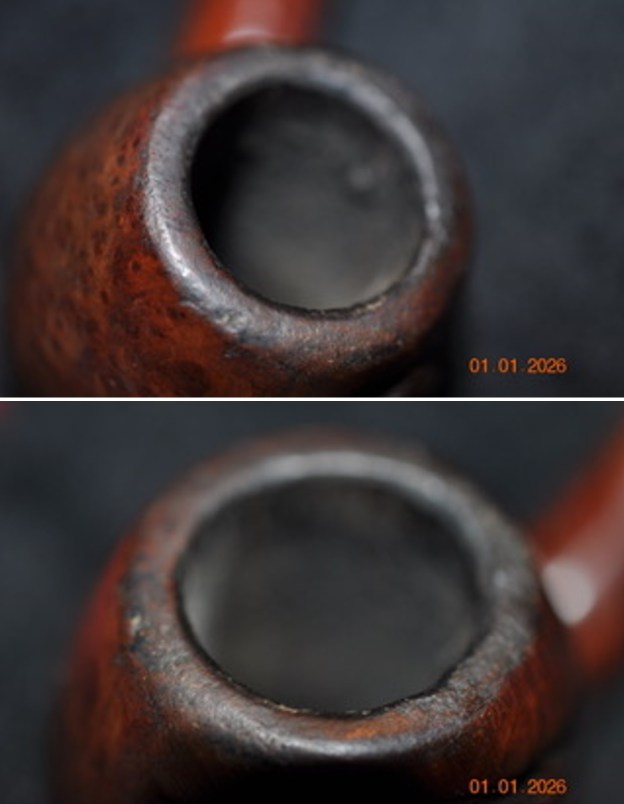
REGAL – Department : METAL STEM & Plug in bowls

Whilst not strictly speaking an easily replaceable bowl pipe, the principle is the same for cooling the smoke, a two cycle radiator stem of machined Dural with cooling vanes. The pipe is cleaned after the manner of the Spiral Kool, i,e, the bit is pulled out and with it comes a plunger with neoprene wedge shaped piston rings, cleaning the cylinder in one movement.

The Sportsman, in the lower image advert is a version that incorporates its own lighter. Jeff had cleaned up the pipe using his usual procedure. He reamed the pipe with a PipNet pipe reamer and removed the rest of it with a Savinelli Fitsall Pipe Knife. He scrubbed the bowl with undiluted Murphy’s Oil Soap with a tooth brush. He rinsed it under running warm water to remove the soap and grime from around the bowl sides. It looked better but the rim top and outer edge was darkened and burned. He cleaned out the inside of the shank and the airway with alcohol, cotton swabs and pipe cleaners. The stem looked better but there were a lot of tooth marks on both sides were still visible and would need work. I took photos of the pipe once I received it. I took a photo of the rim top and the stem to show their condition. Jeff was able to clean up the cake and the lava overflow that was shown in the rim and bowl photos above. The rim top and edges looked very good. The stem looked better, though there were many tooth marks and much chatter on both sides ahead of the button.I removed the stem and plunger and took photos of it from various angles. It is truly unique with the rubber o-rings on the end of the plunger. It is very clean now. The barrel has some darkening and wear on the inside but is clean. I started my work on the pipe by addressing the bowl. I sanded the rim top and inner edge with 320-3500 sanding pads. I wiped the briar down after each sanding pad. By the end it looked very good and the rim top really had some great grain. I polished the bowl sides and the smooth rim top with micromesh sanding pads. I dry sanded it with 1500-12000 grit micromesh pads. I wiped it down after each pad. It really began to be beautiful. I rubbed the bowl and shank down with Before & After Restoration Balm to deep clean the finish on the bowl and shank. The product works to clean, enliven and protect the briar. I worked it in with my fingers to get it into the briar. I worked it into the plateau on the rim top and shank end with a shoe brush to get deep in the valleys. I let it sit for 10 minutes then I wiped it off and buffed it with a soft cloth. The briar really began to have a rich shine. I took some photos of the bowl at this point to mark the progress in the restoration. It is a beautiful bowl. I set the bowl aside and turned my attention to the stem. I sanded the stem surface with 220 grit sandpaper to blend them into the stem.I sanded the stem with the 2 inch square 320-3500 grit sanding pads to remove the remnants of oxidation on the vulcanite. I wiped down the stem after each sanding pad with Obsidian Oil. I was able to remove the majority of the oxidation on both sides with the pads. The stem looked very good.I polished the stem with micromesh sanding pads – dry sanding with 1500-12000 grit pads. I wiped the stem down after each sanding pad with Obsidian Oil. I did a final hand polish of the stem with Before & After Pipe Stem Polish – both Fine and Extra Fine. I gave it a coat of Obsidian Pipe Stem Oil. It works to protect the stem from further oxidizing. I set it aside to dry. I put the stem and plunger back on the Regal Metal Poker with a rusticated Briar Bowl and took it to the buffer. I buffed the bowl and stem with Blue Diamond to polish the briar and the vulcanite. Blue Diamond does a great job on the smaller scratches that remain in both. I gave the bowl and the stem several coats of carnauba wax and buffed the pipe with a clean buffing pad to raise the shine. I hand buffed it with a microfiber cloth to deepen the shine. I am amazed at how well it turned out. The finished pipe is shown in the photos below. This is beautiful smooth finished Regal Metal Poker, the metal barrel, and vulcanite saddle stem combine to give the pipe a great look. The dimensions of the pipe are Length: 5 ½ inches, Height: 2 inches, Outside diameter of the bowl: 1 ½ inches, Chamber diameter: ¾ of an inch. The weight of the pipe is 1.55 ounces/44 grams. This is another pipe that I will be putting on the rebornpipes online store in the American Pipe Makers and Pipemaking Companies Section shortly, if you are interested in adding it to your collection. Thanks for walking through the restoration with me on this beauty!
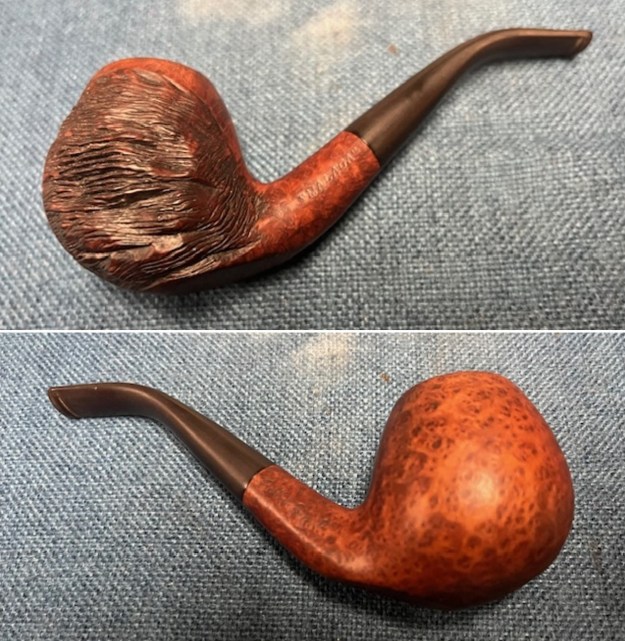
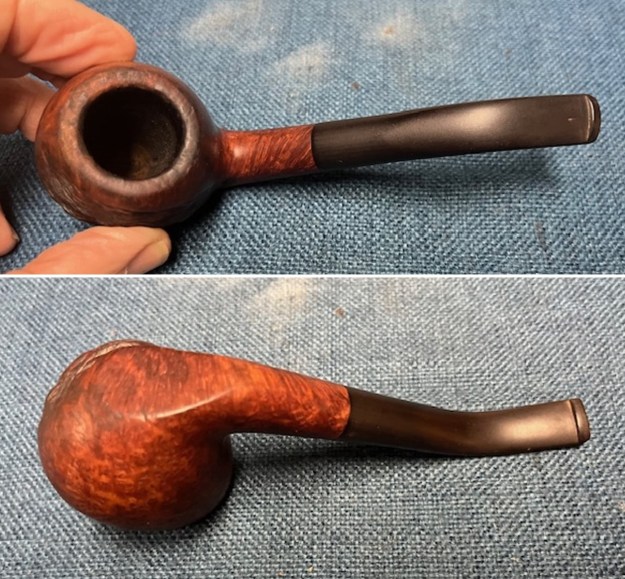
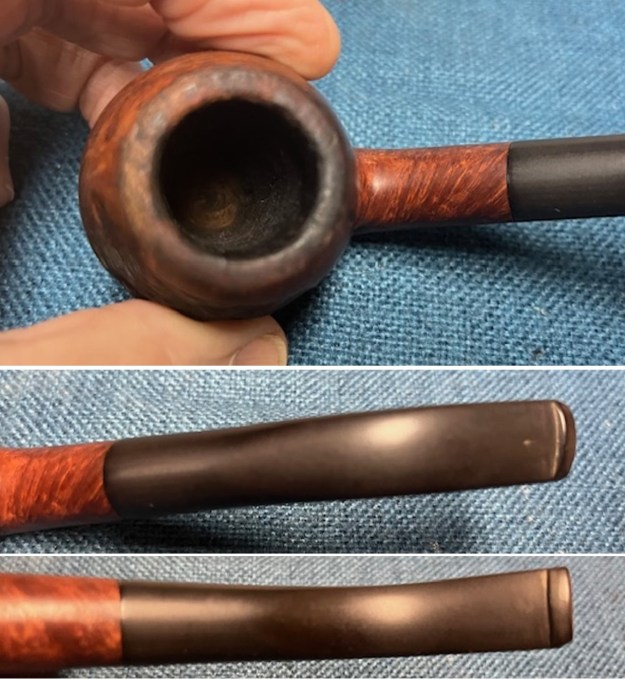
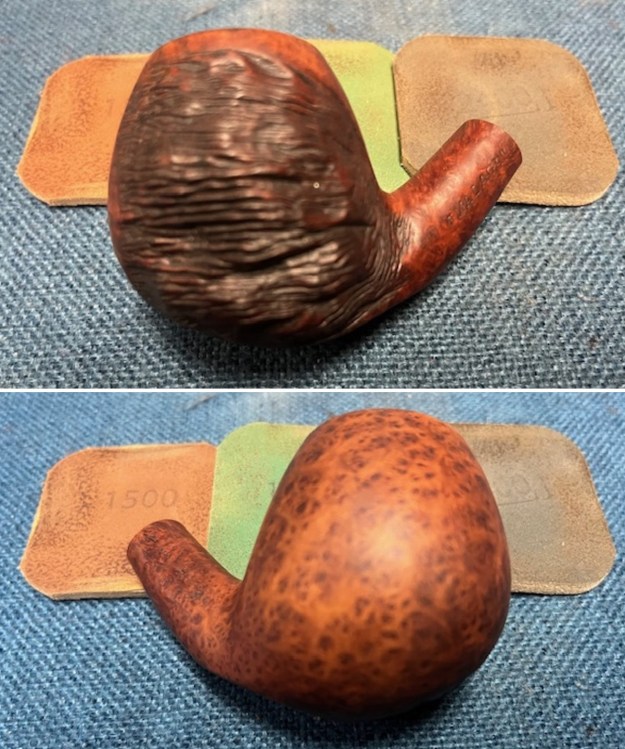
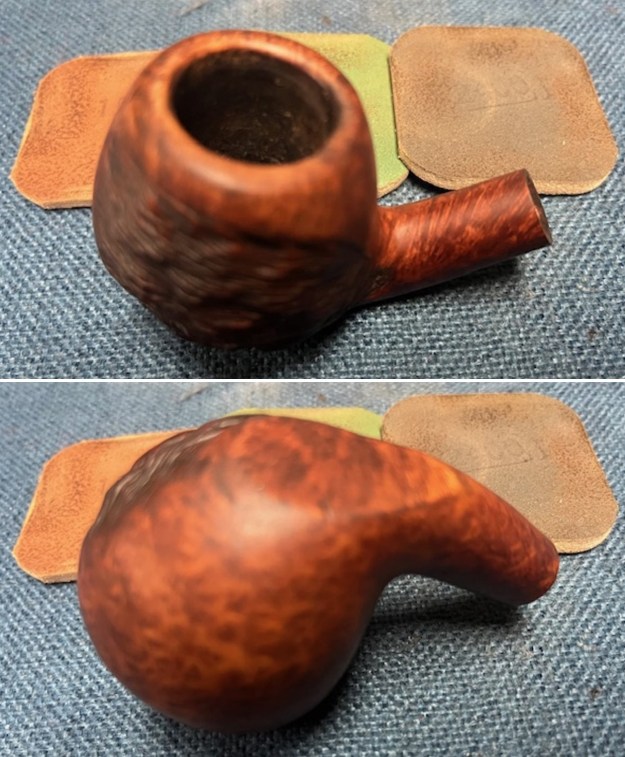
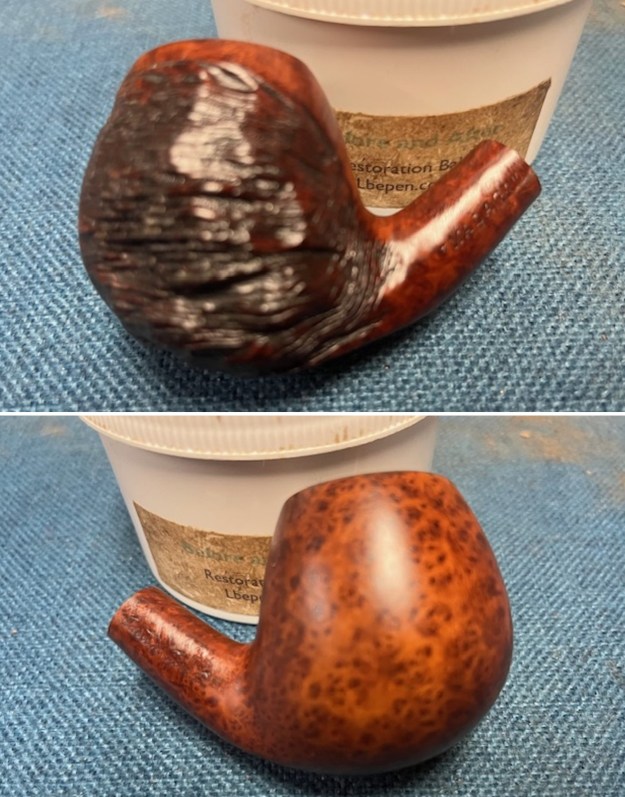
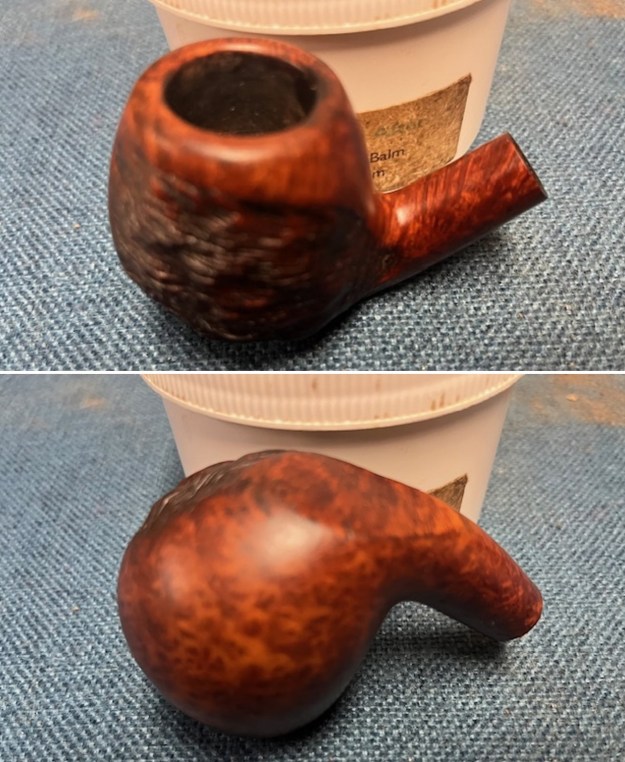
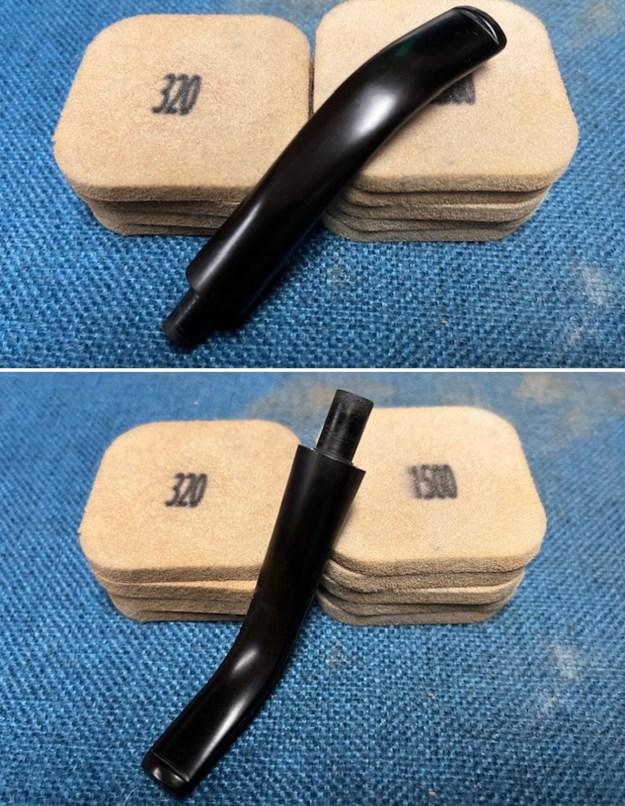
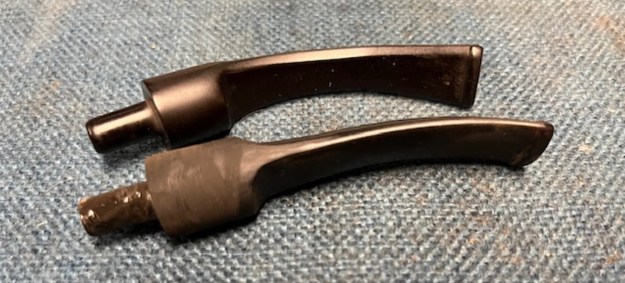
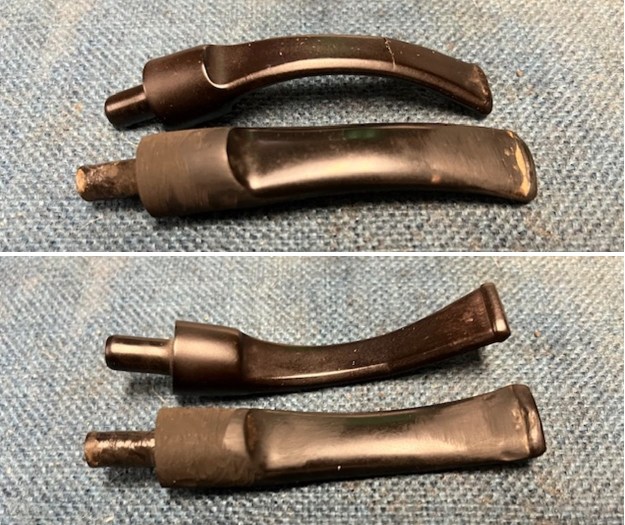
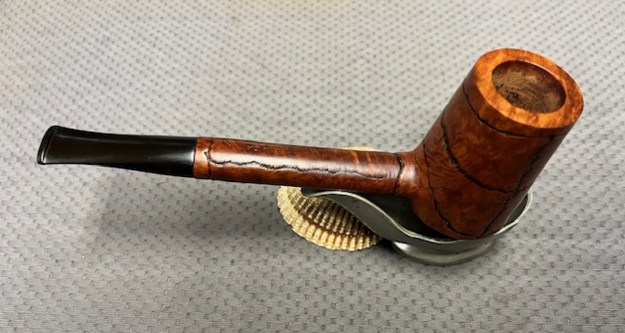
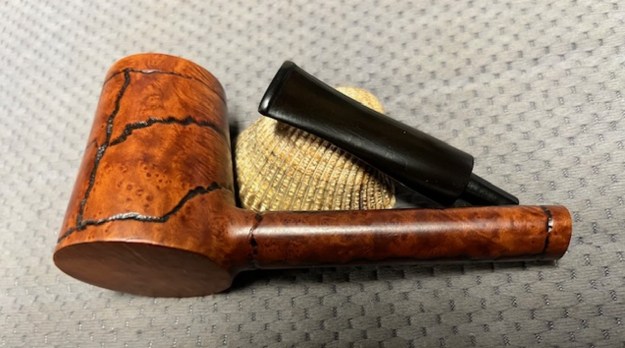
As always, I encourage your questions and comments as you read the blog. Thanks to each of you who are reading this blog. Remember we are not pipe owners; we are pipe men and women who hold our pipes in trust until they pass on into the trust of those who follow us.