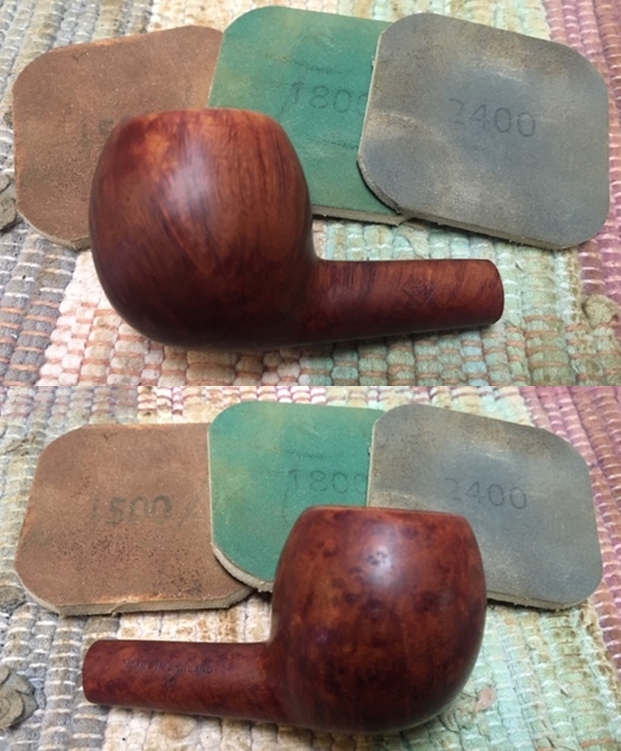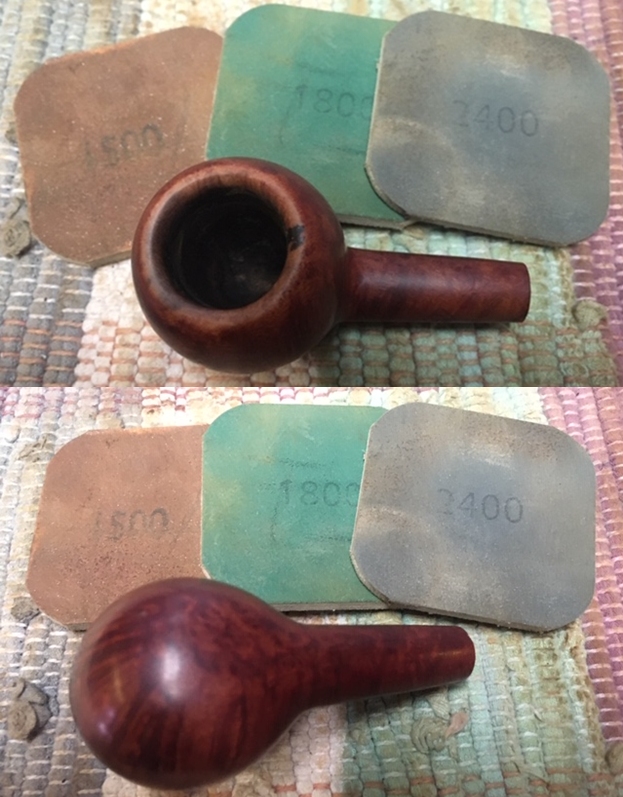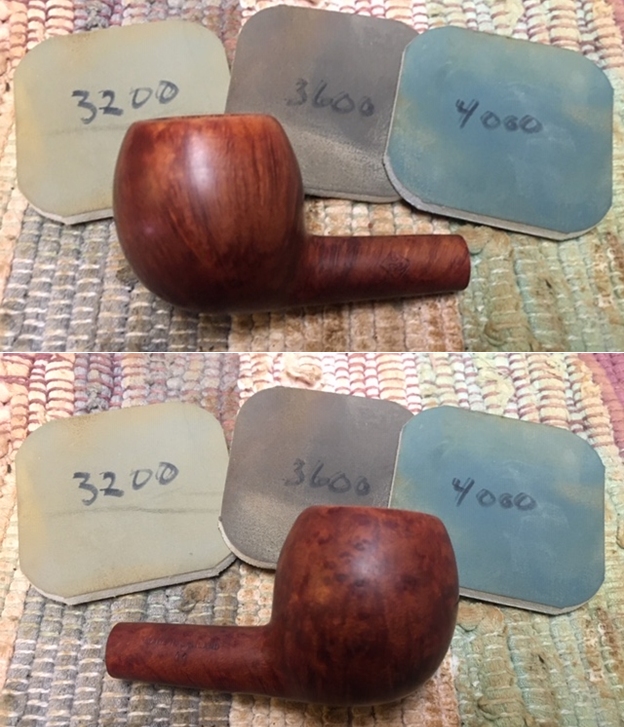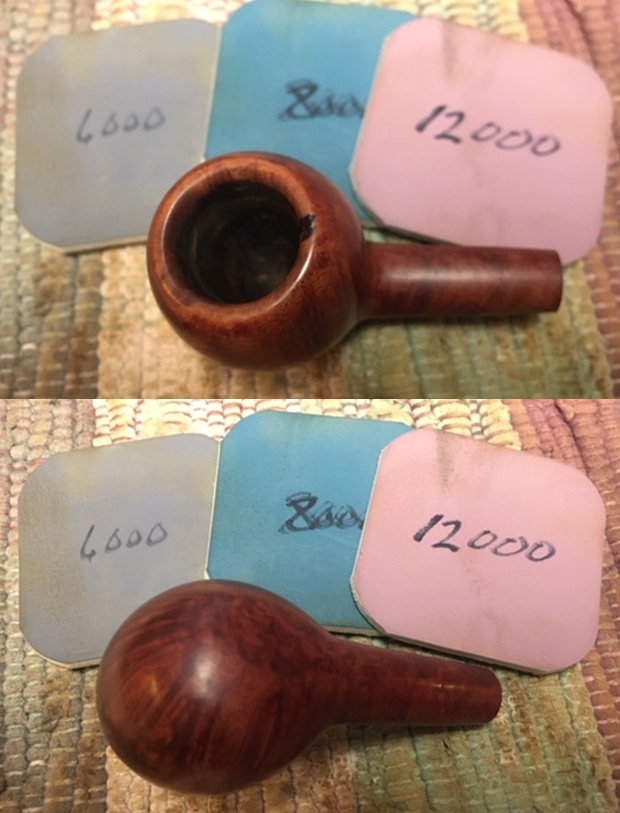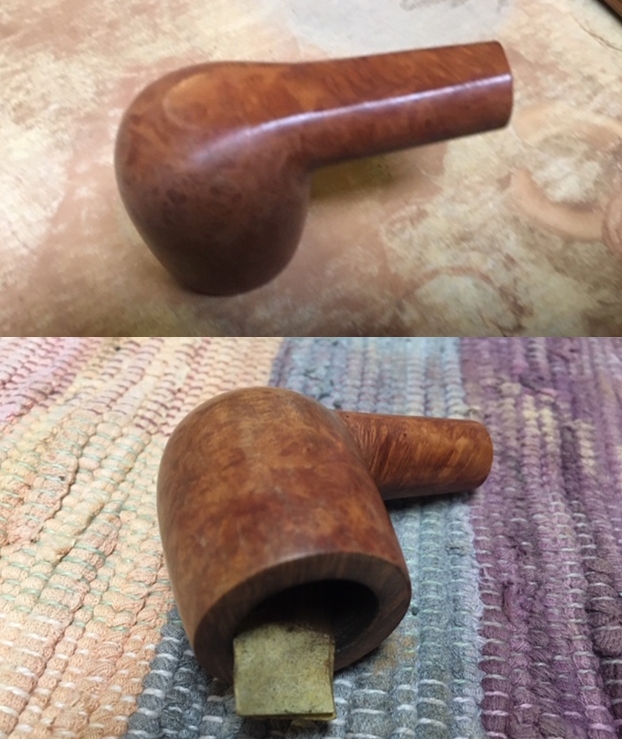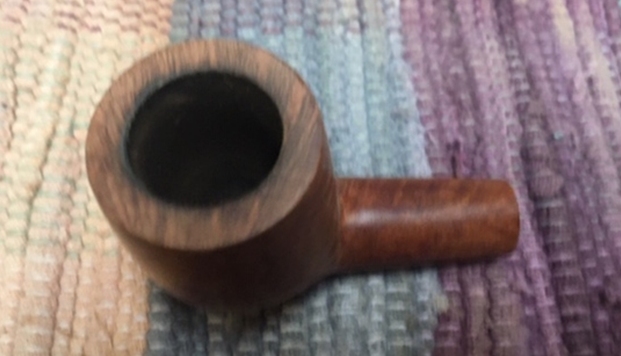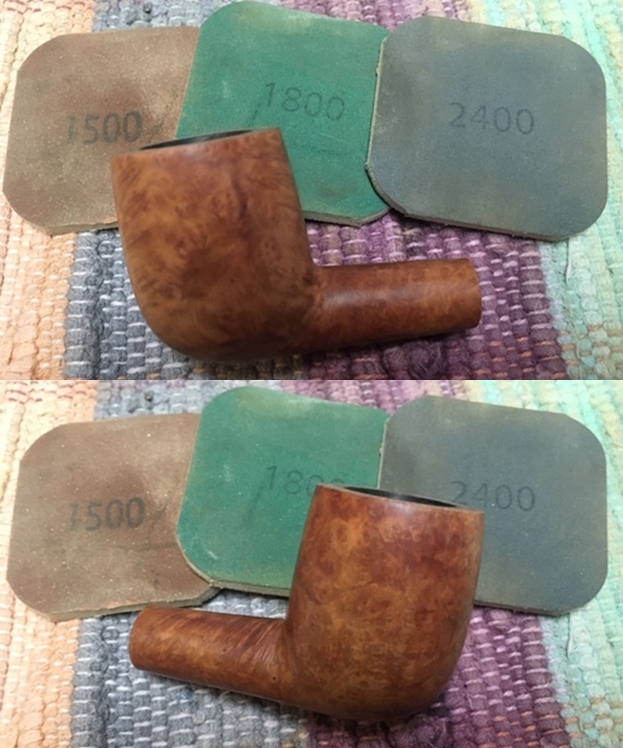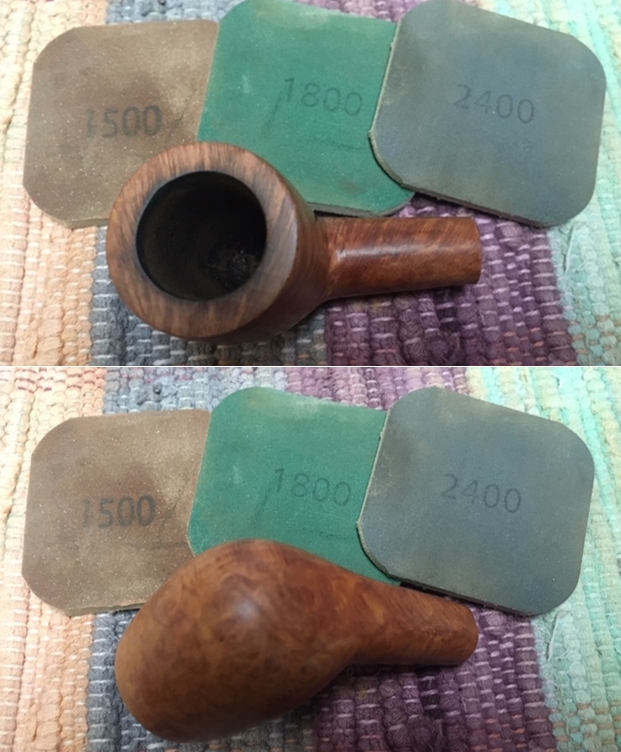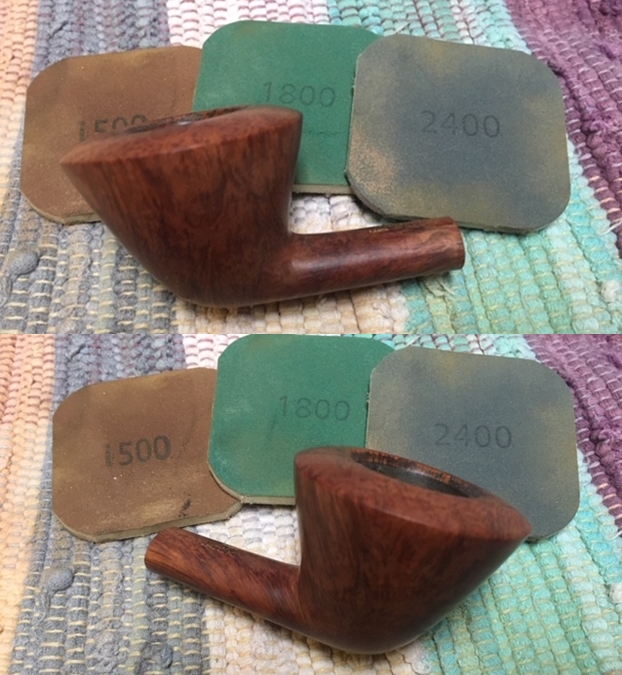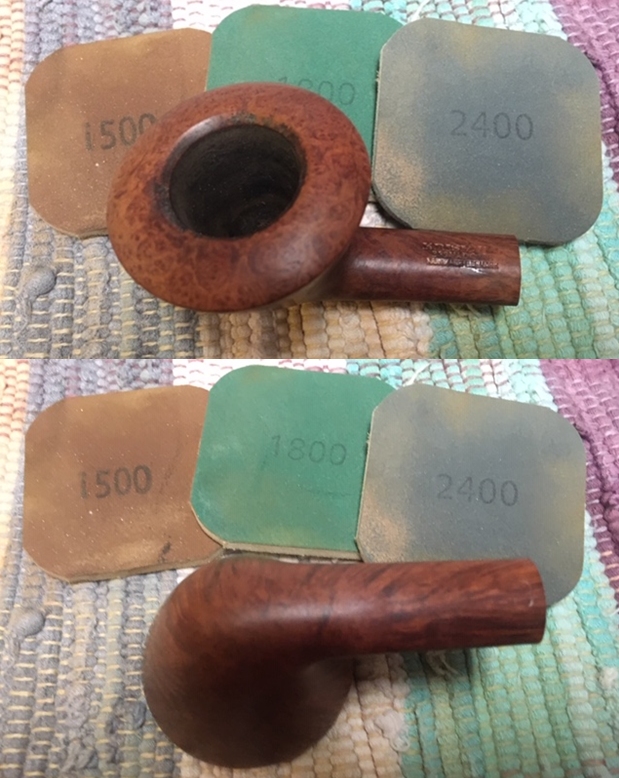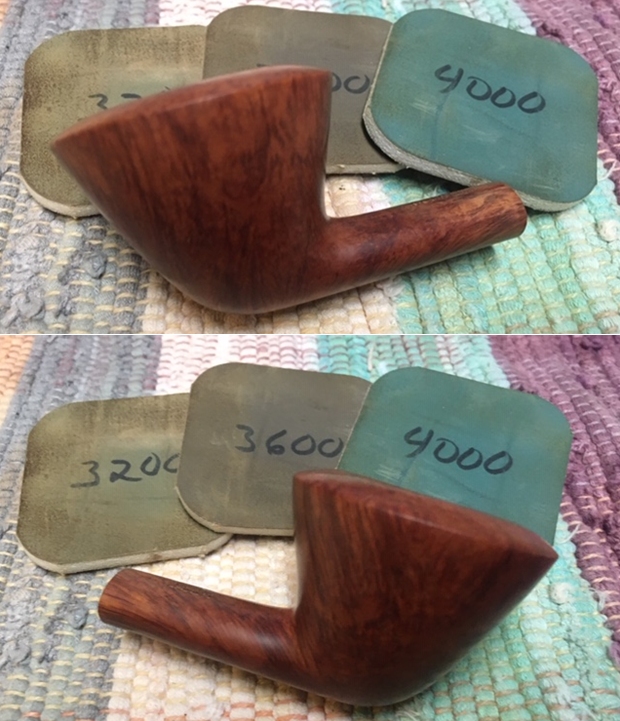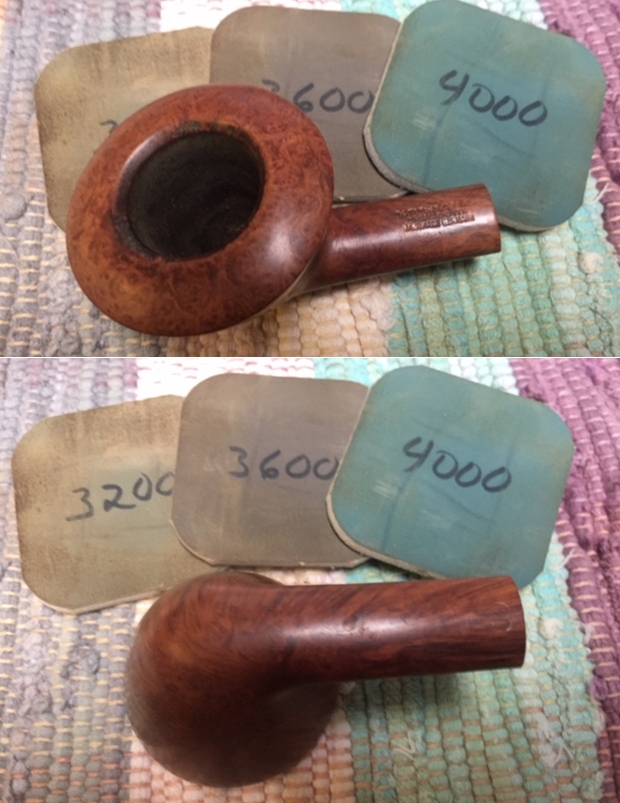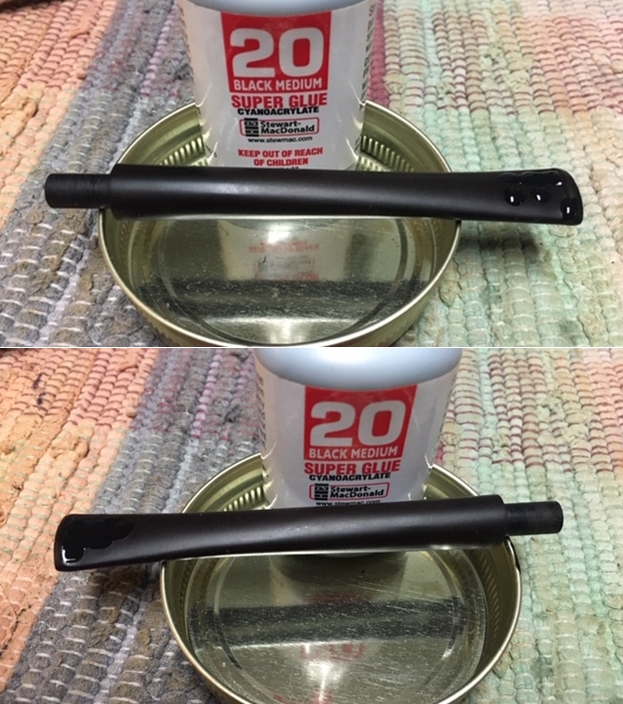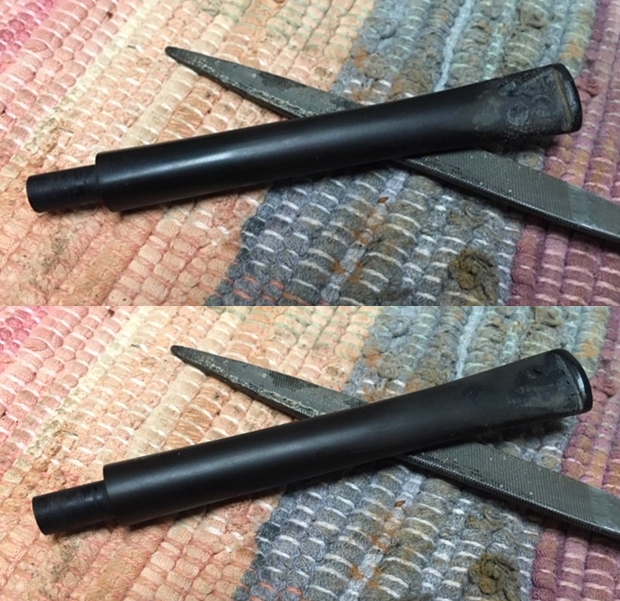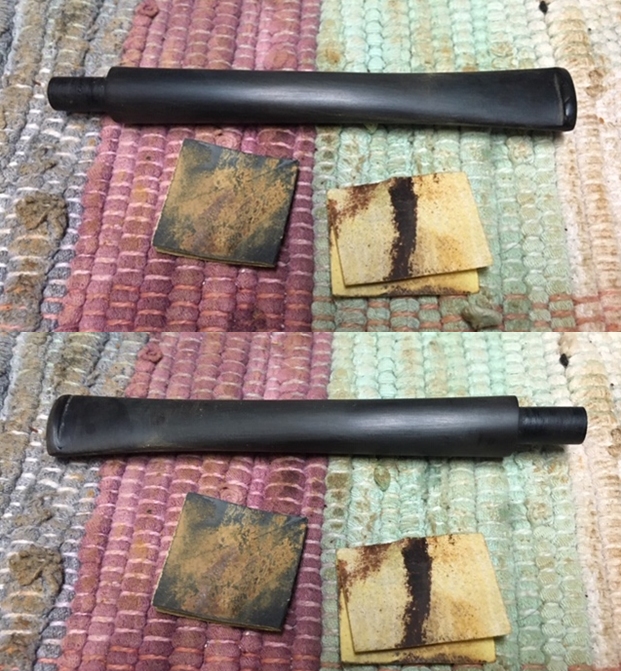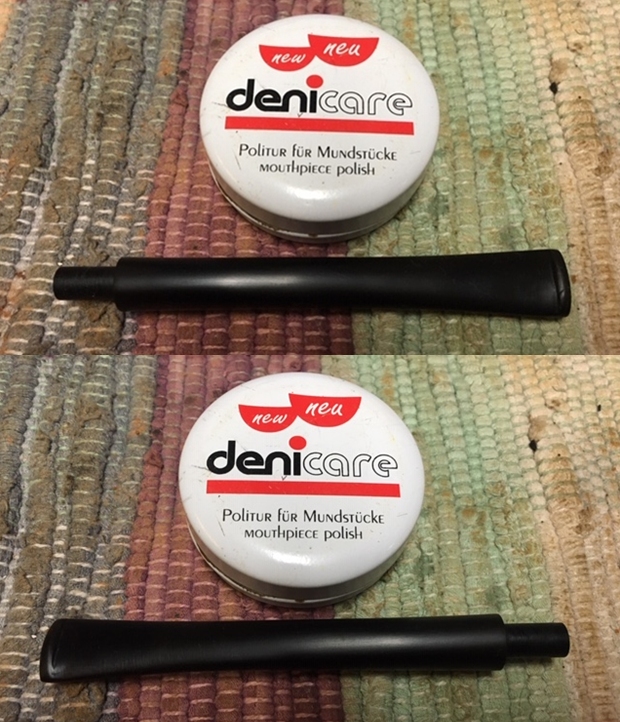
Tag Archives: super glue

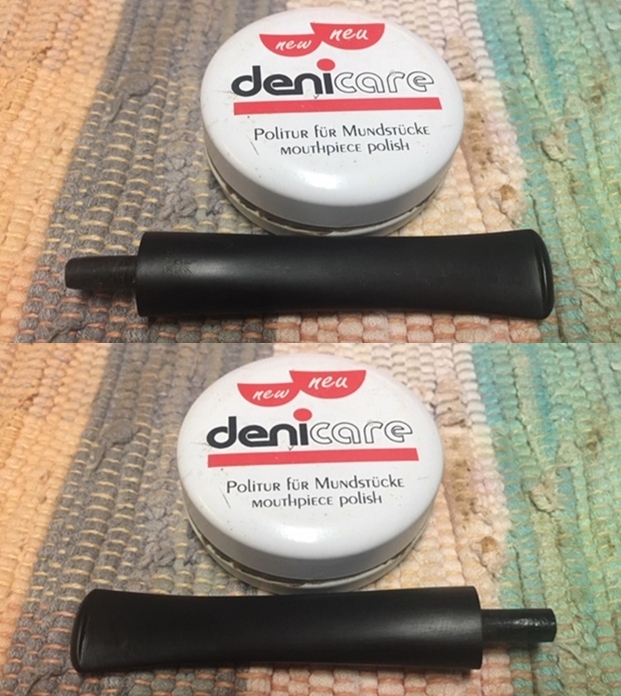
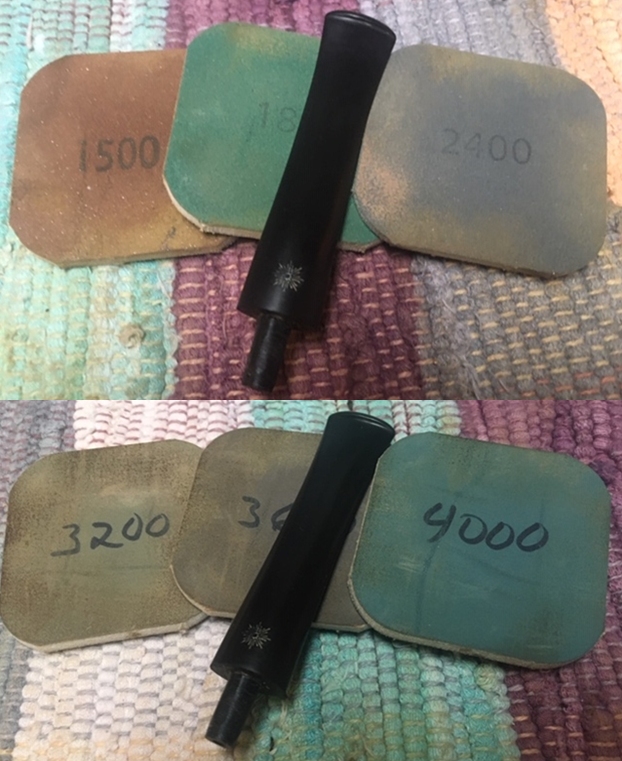
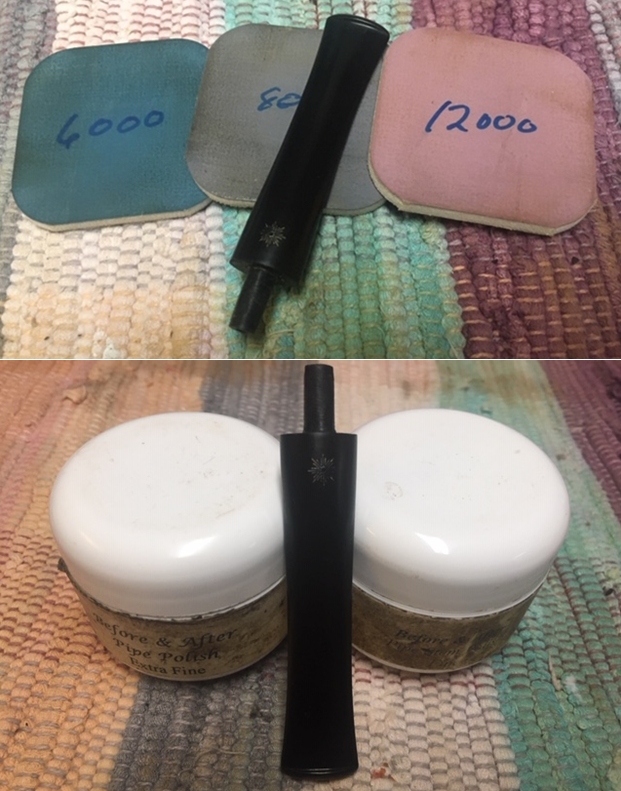
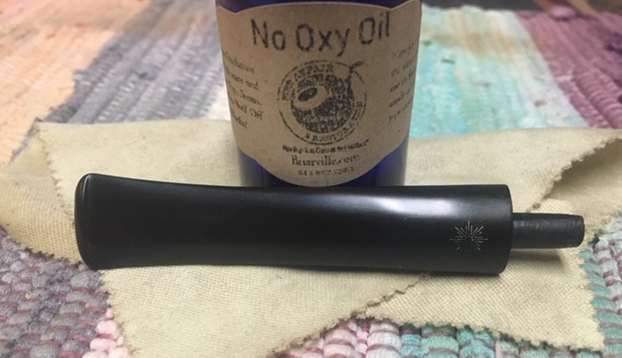
Restoring a Beautiful St. Claude Ben Wade Calabash


Blog by Steve Laug

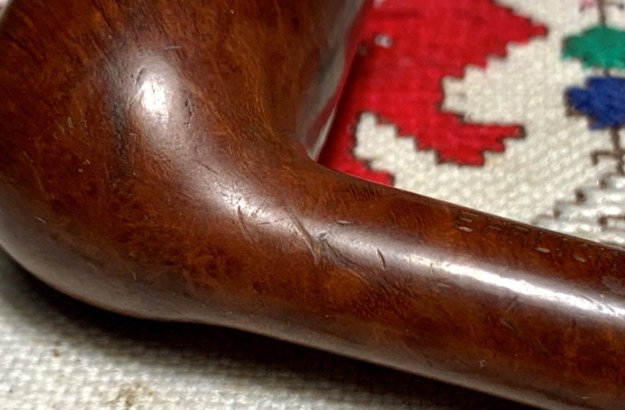
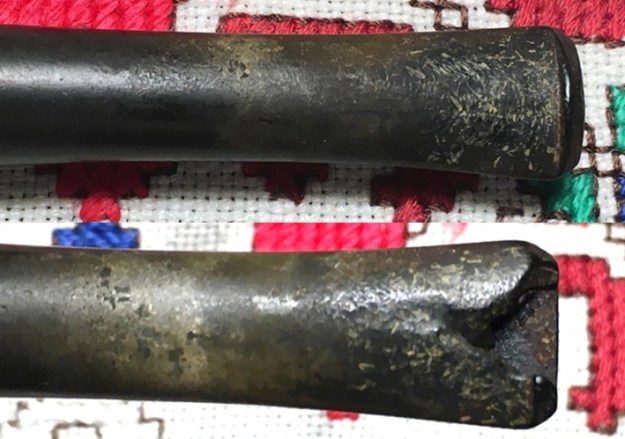
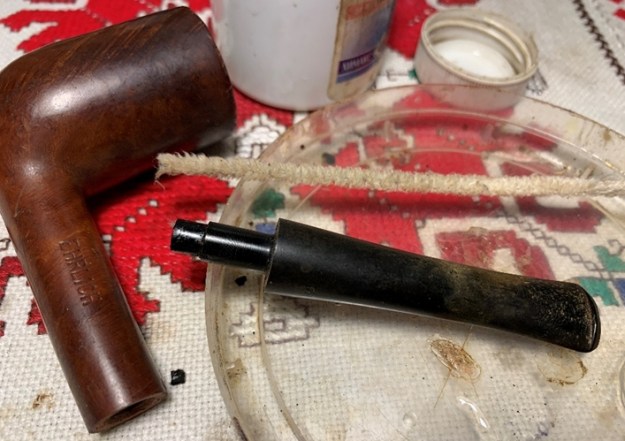
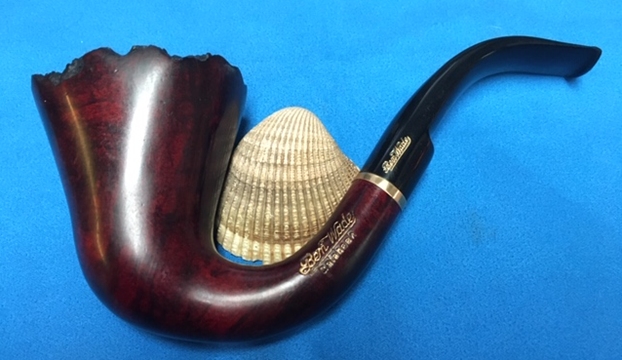
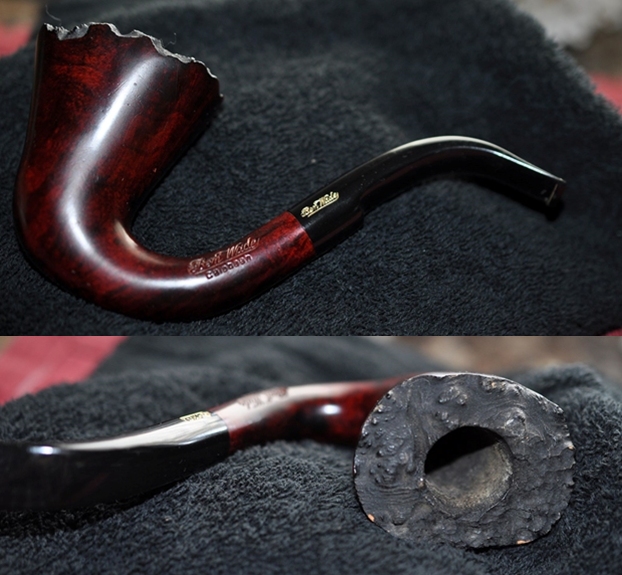
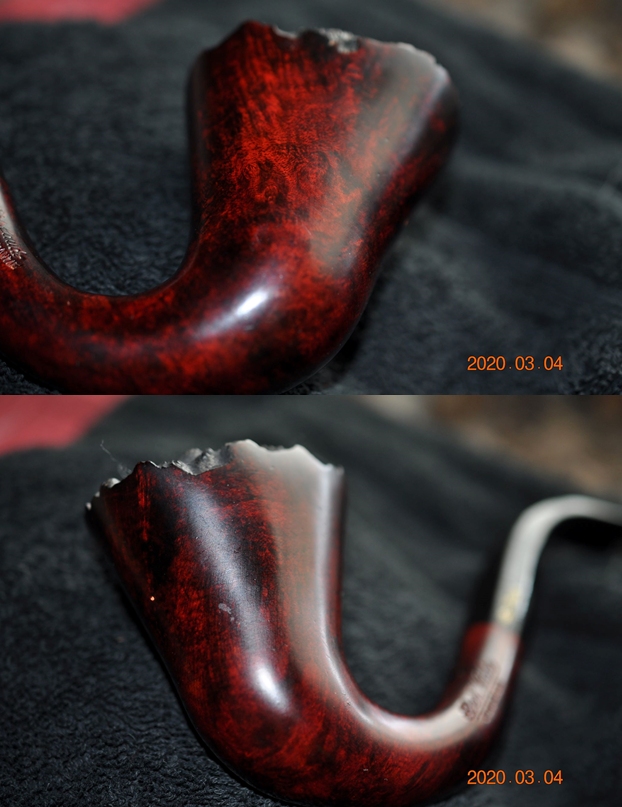
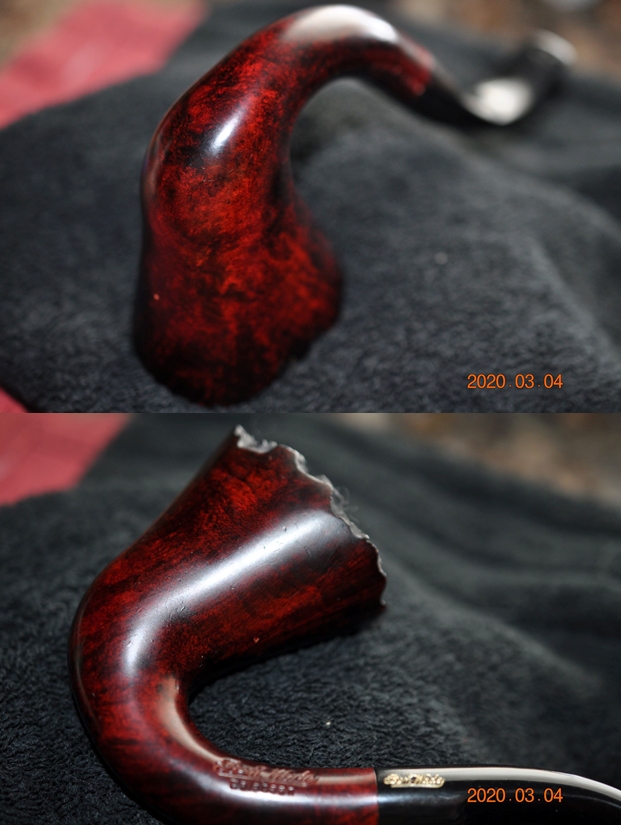
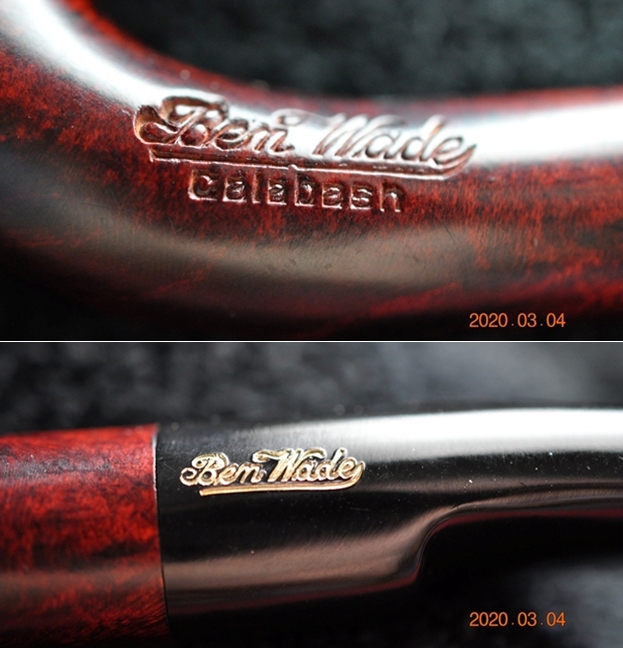
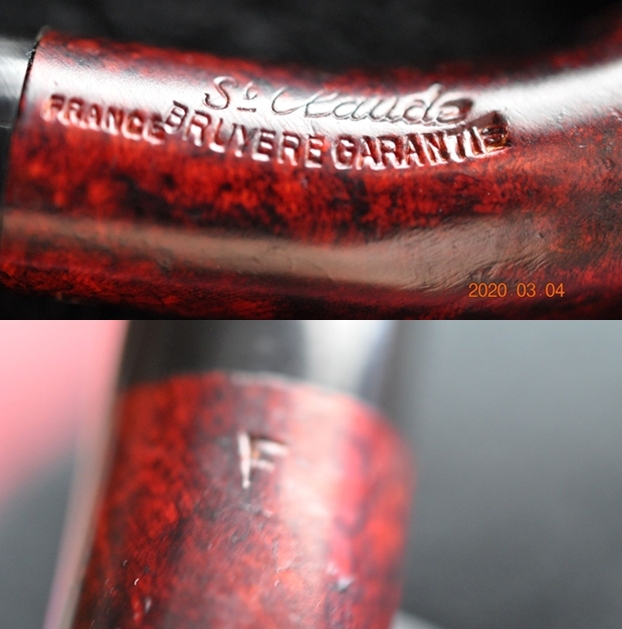
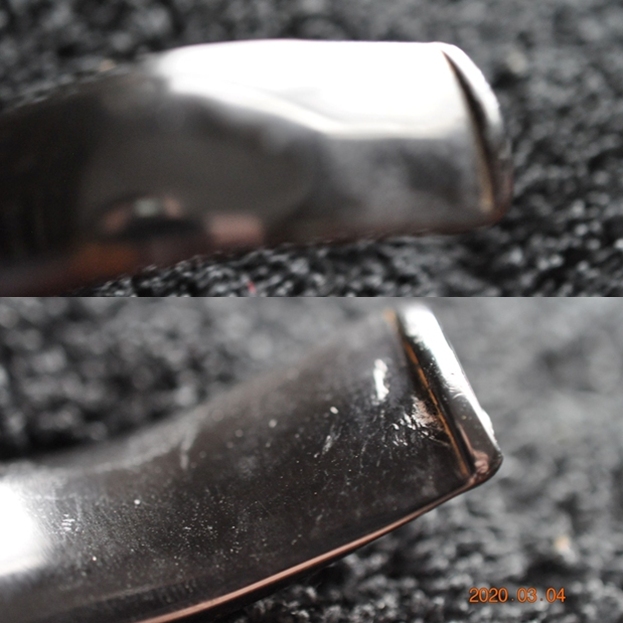
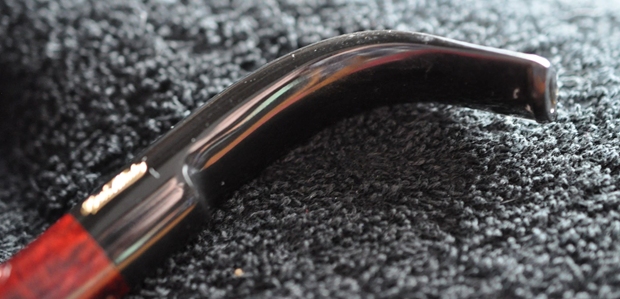
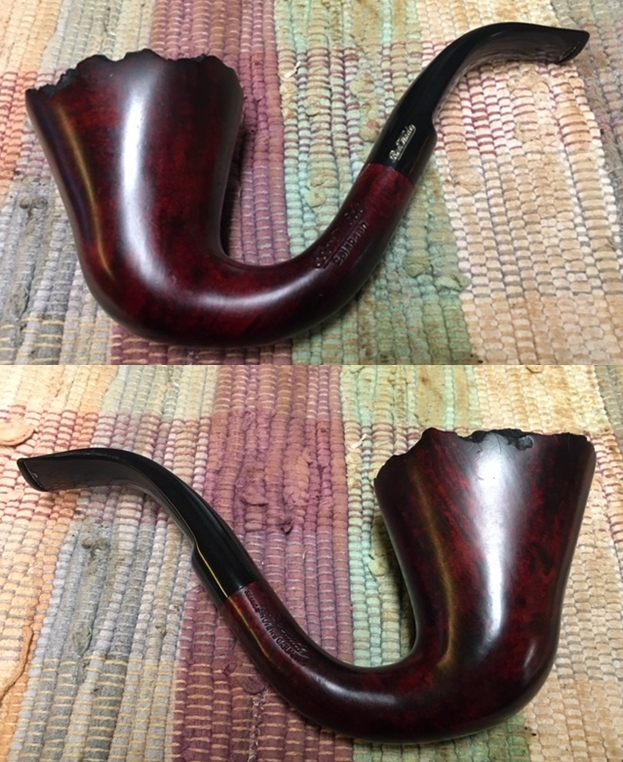
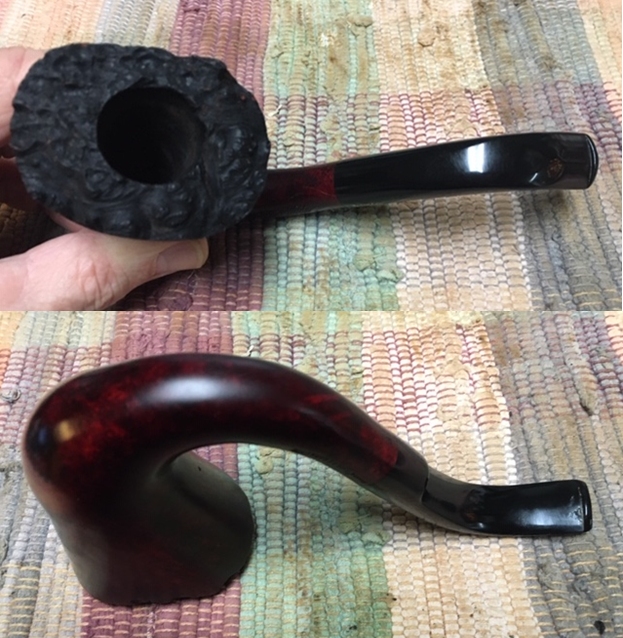
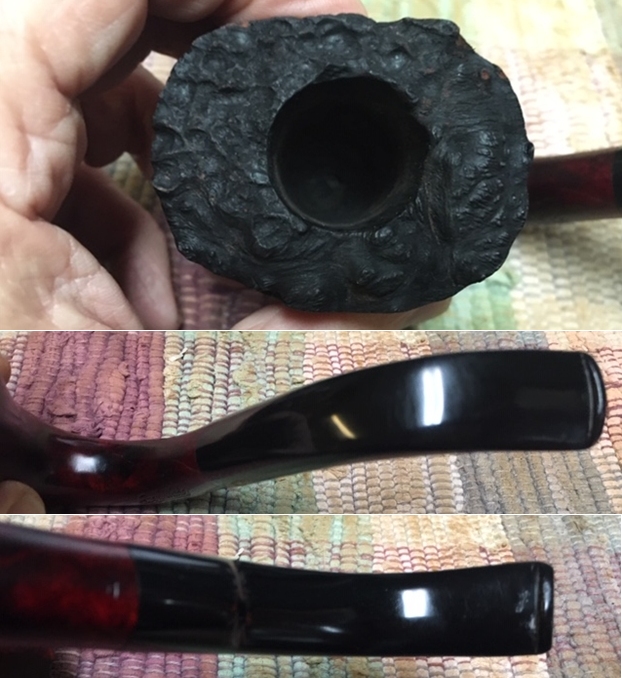
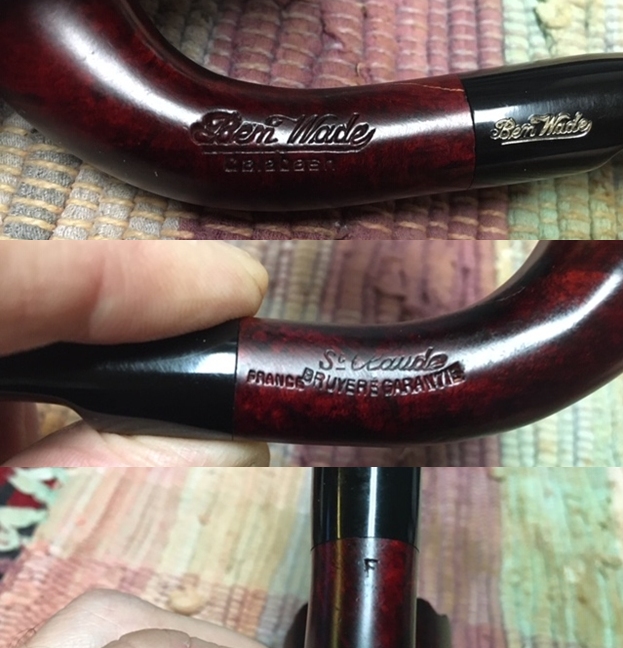
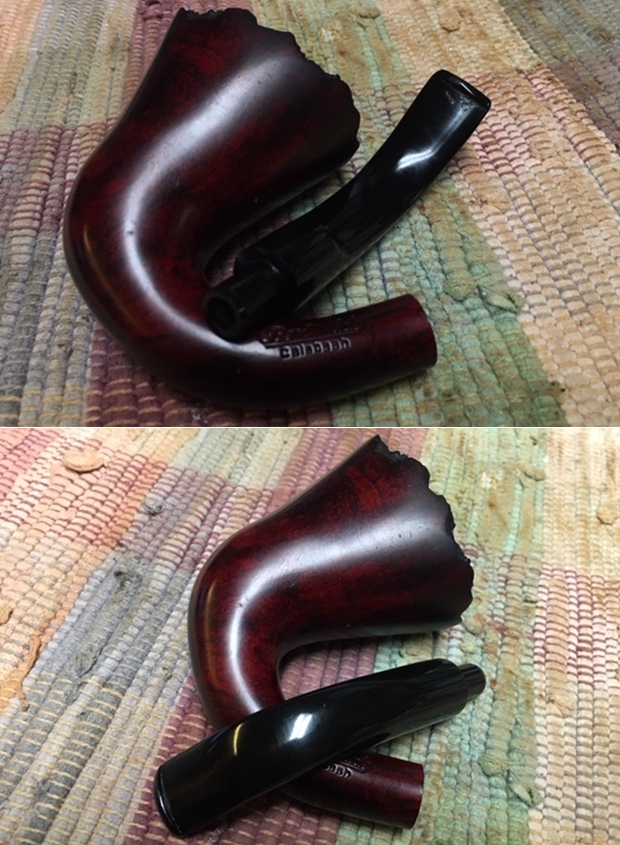
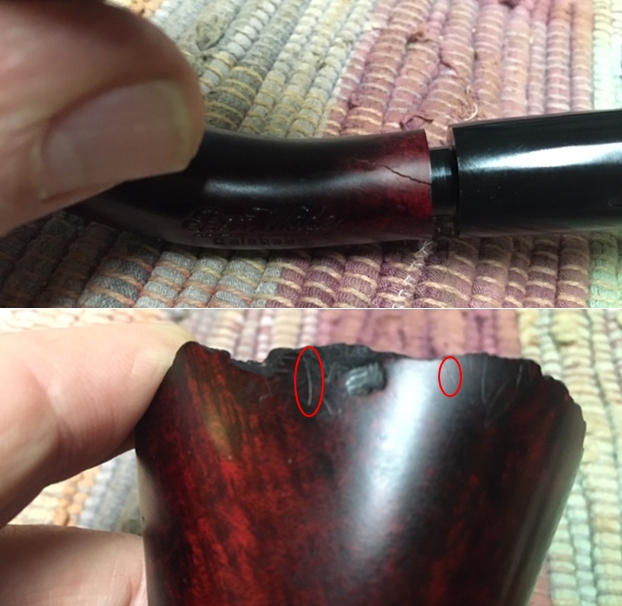
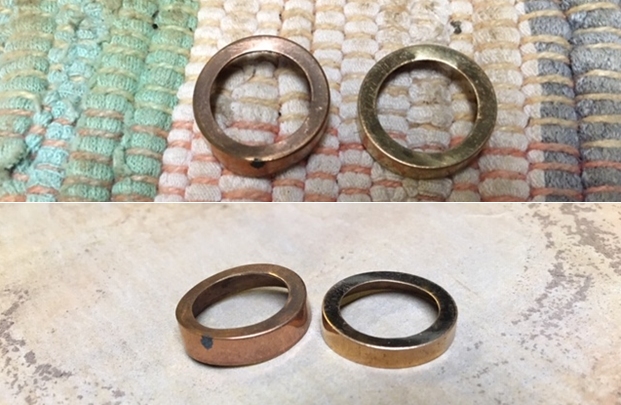
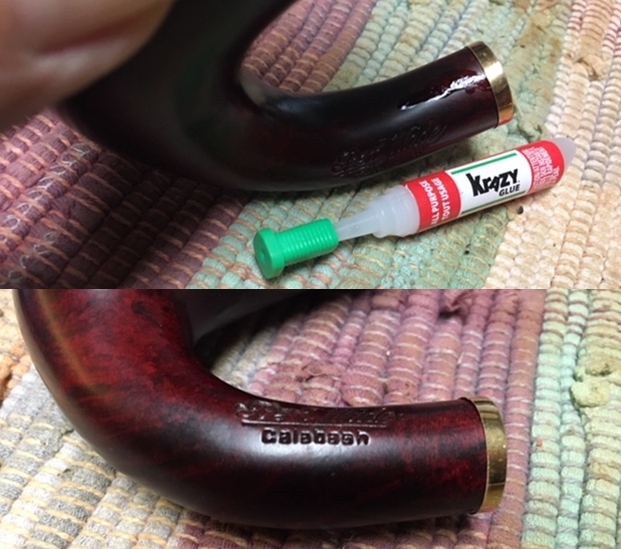
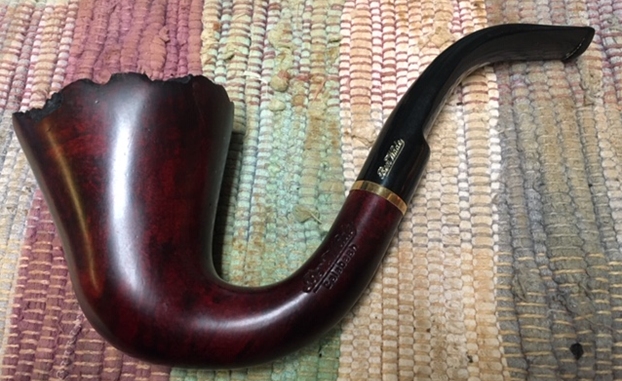
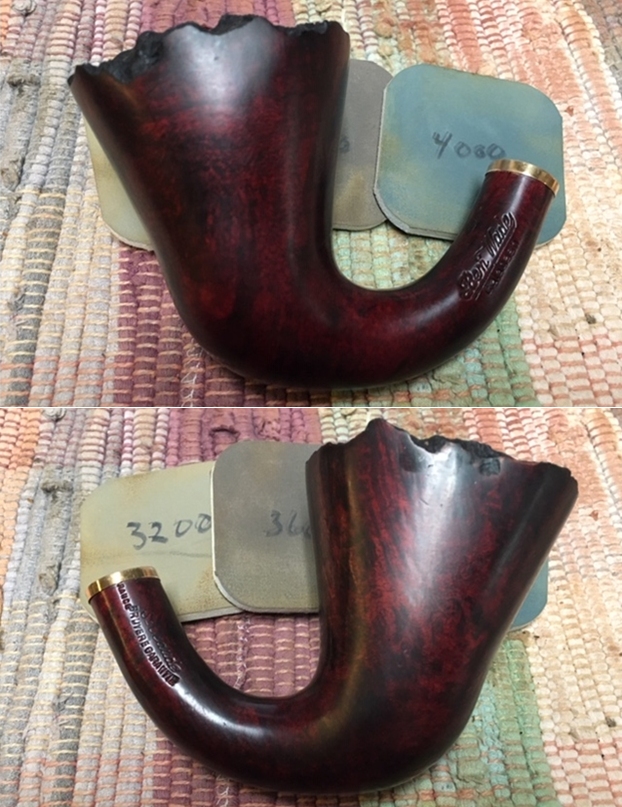
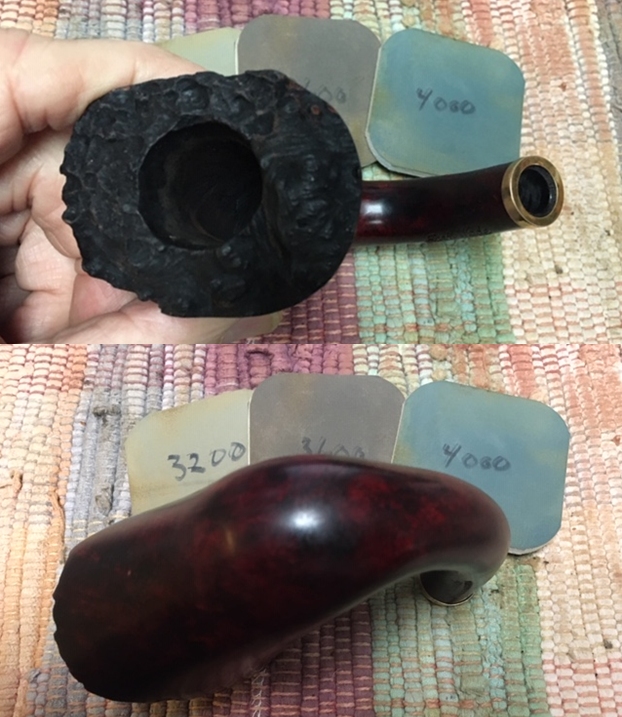
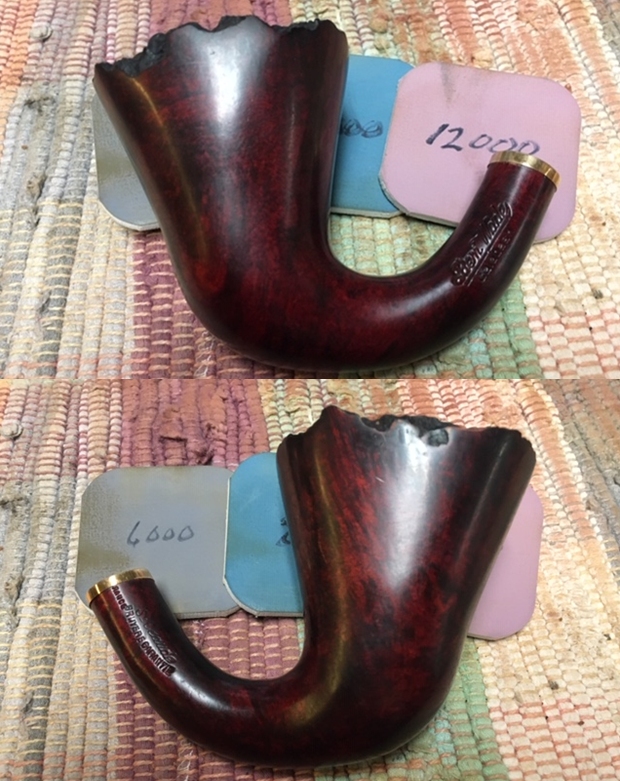
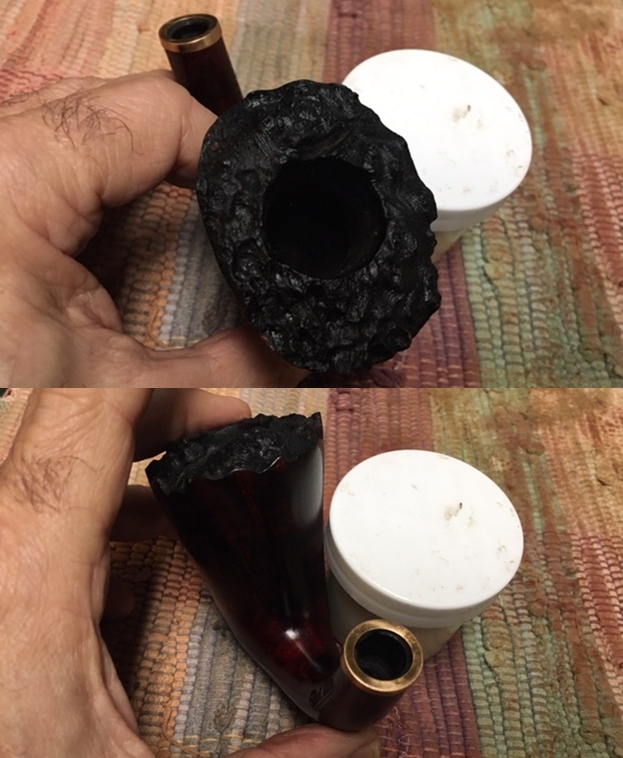
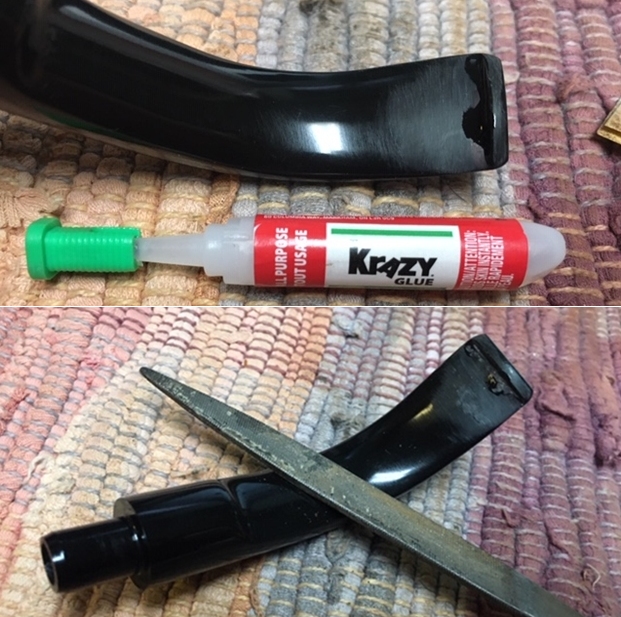
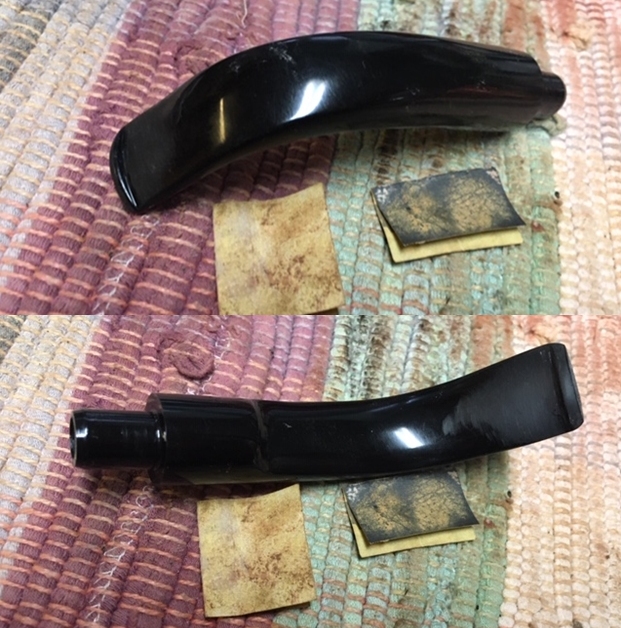
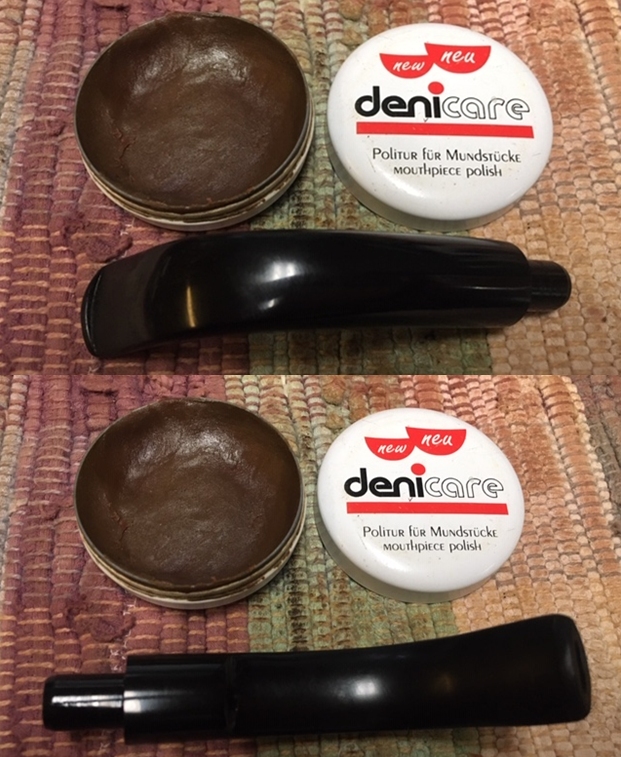
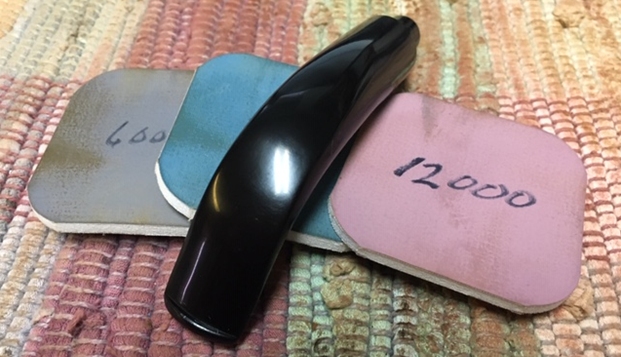
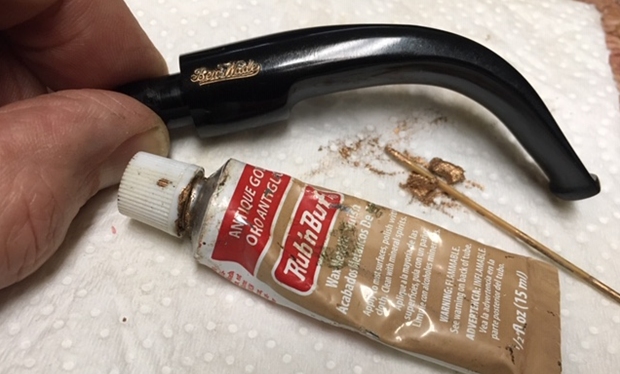
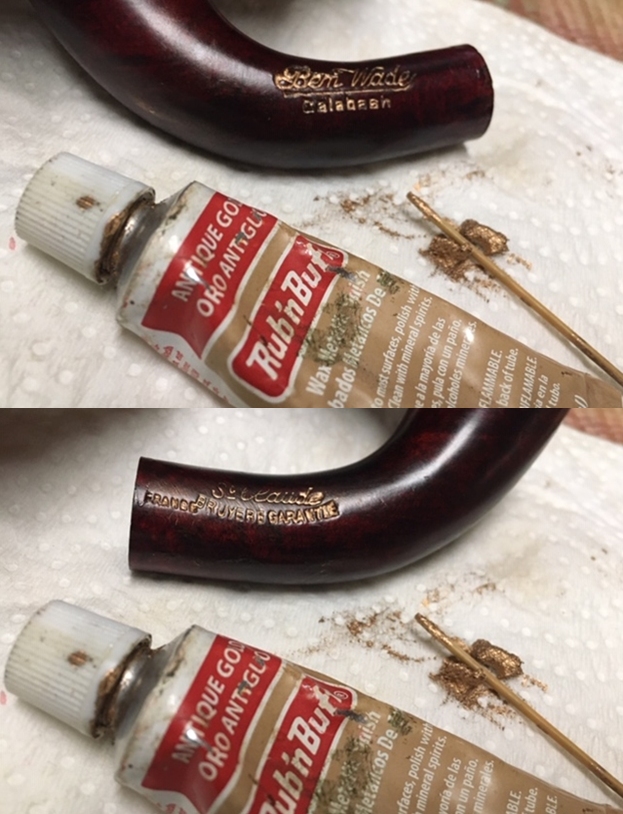
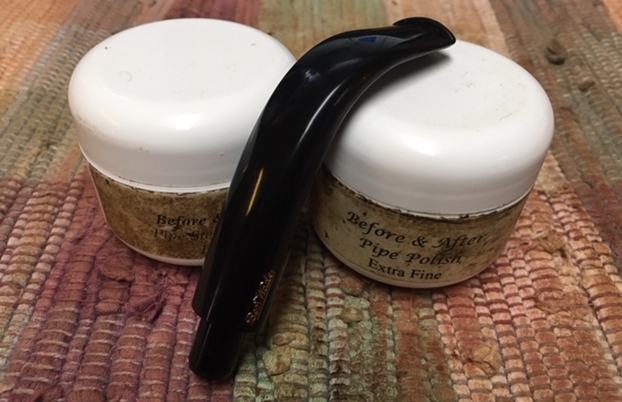
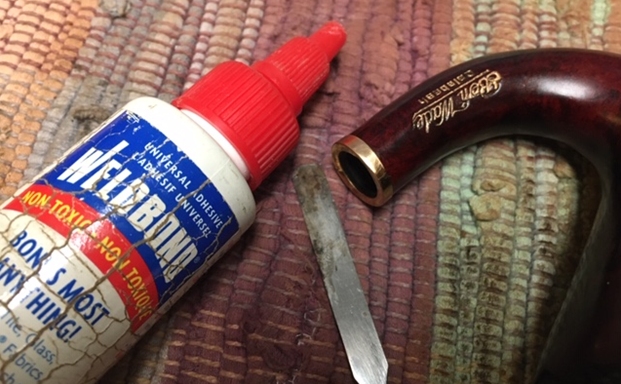
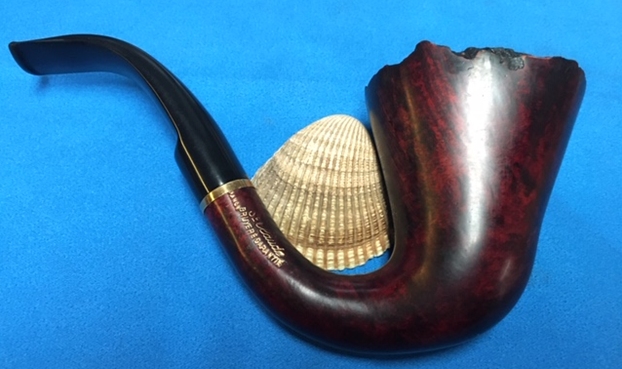
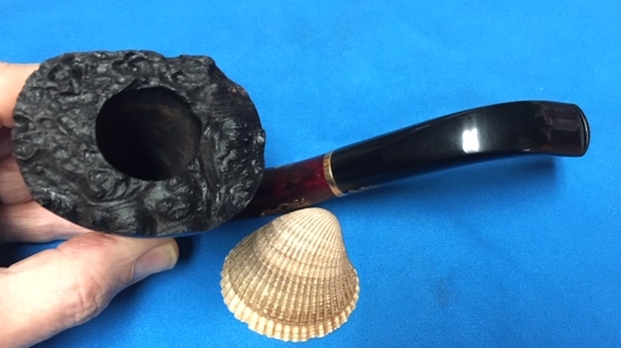
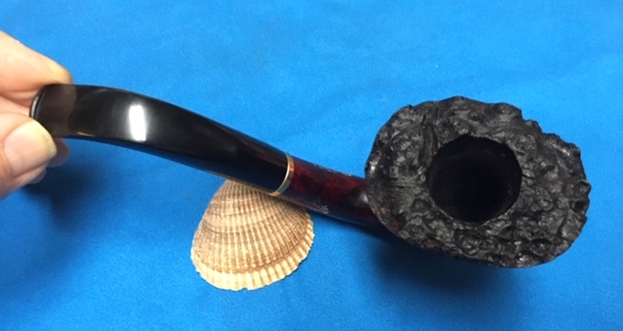
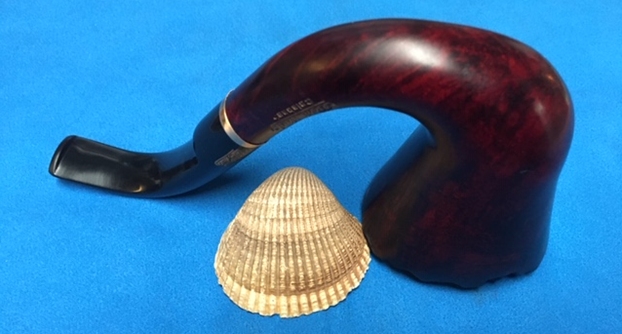
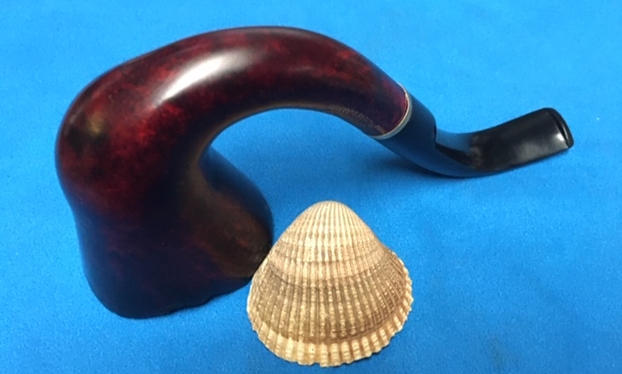
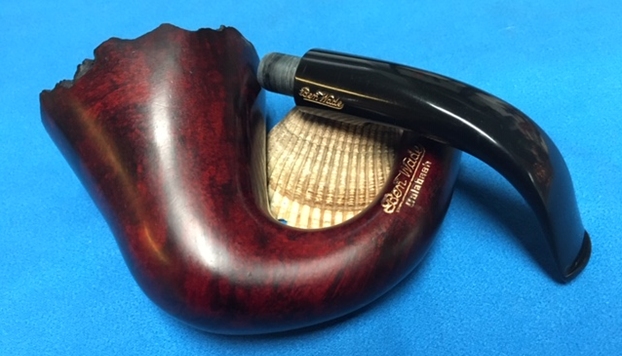
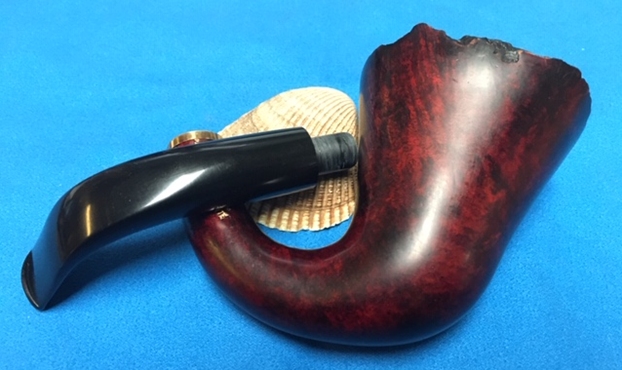
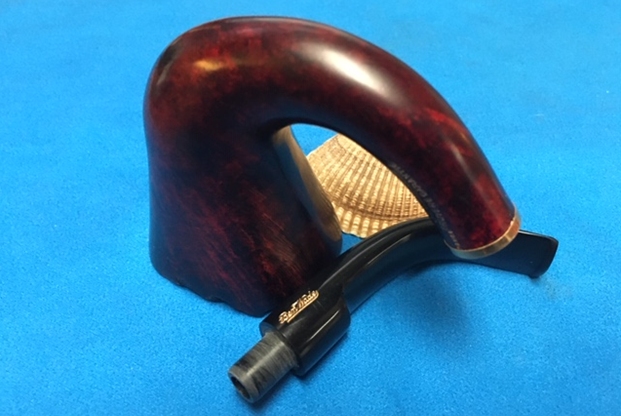
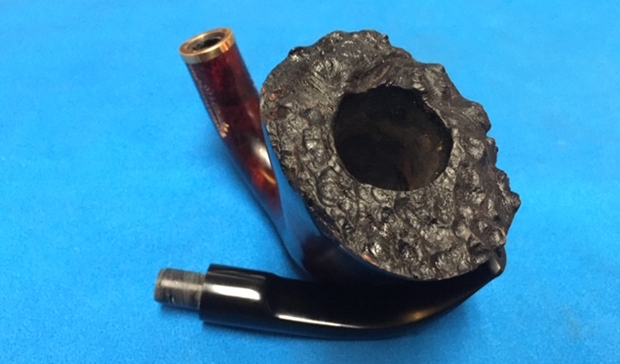
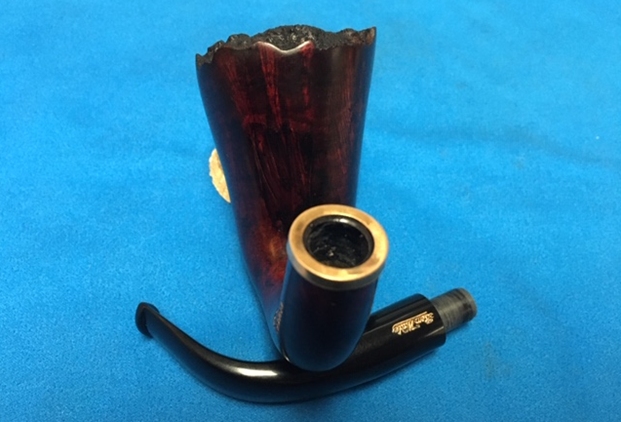
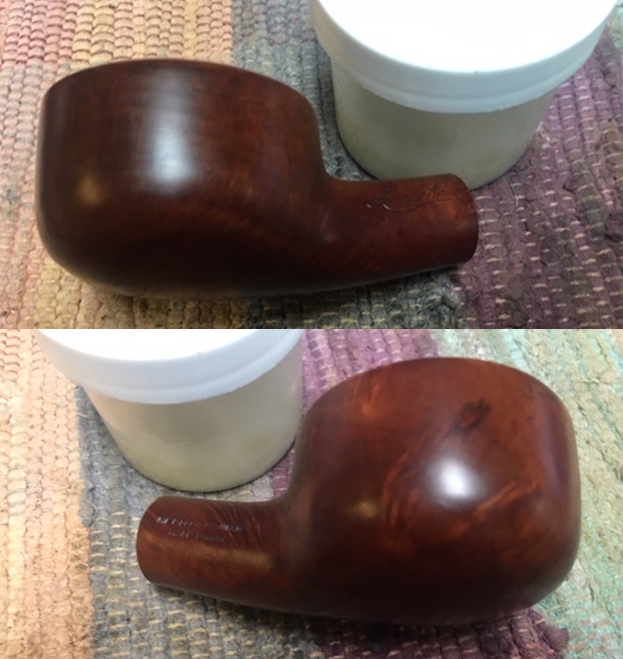
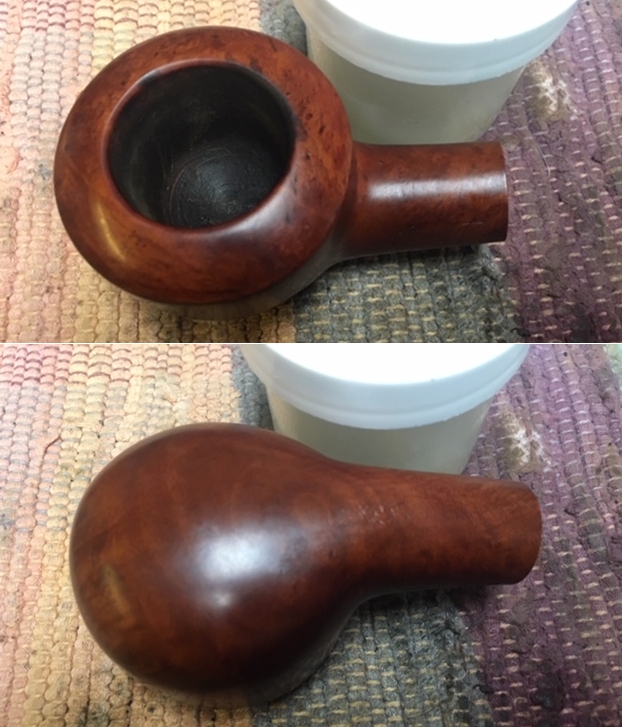
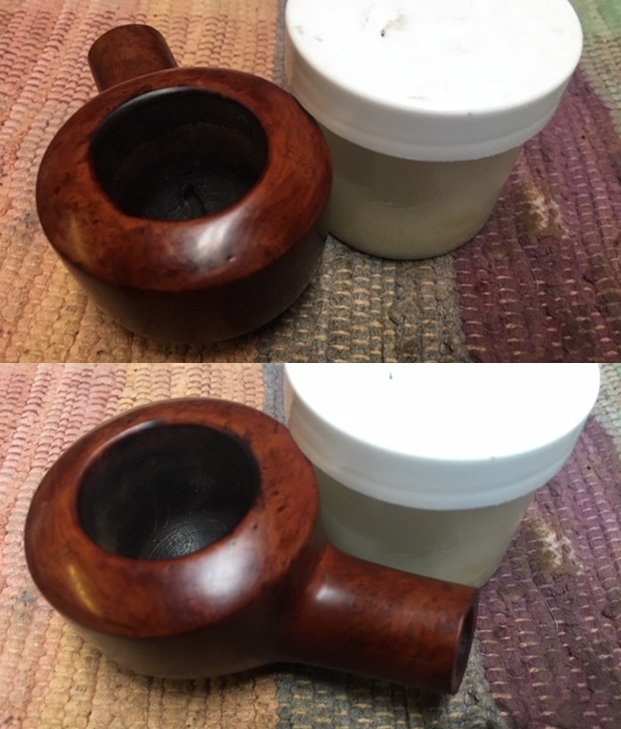
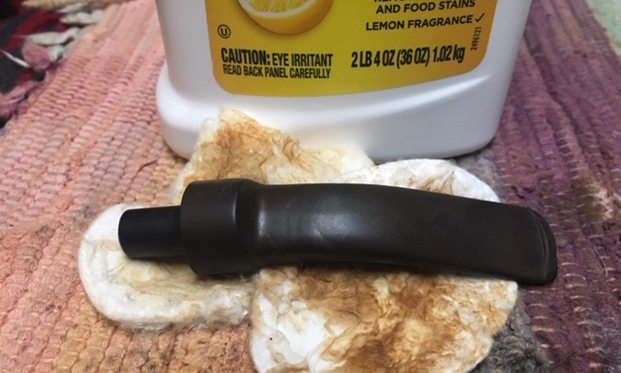
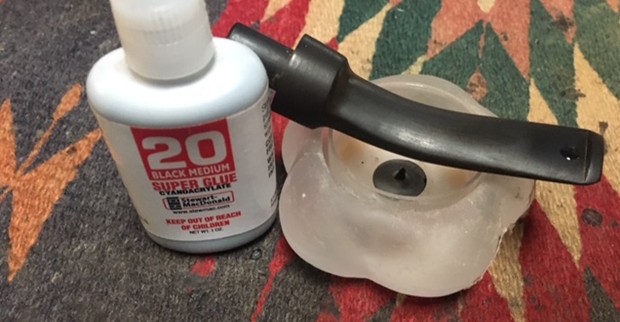
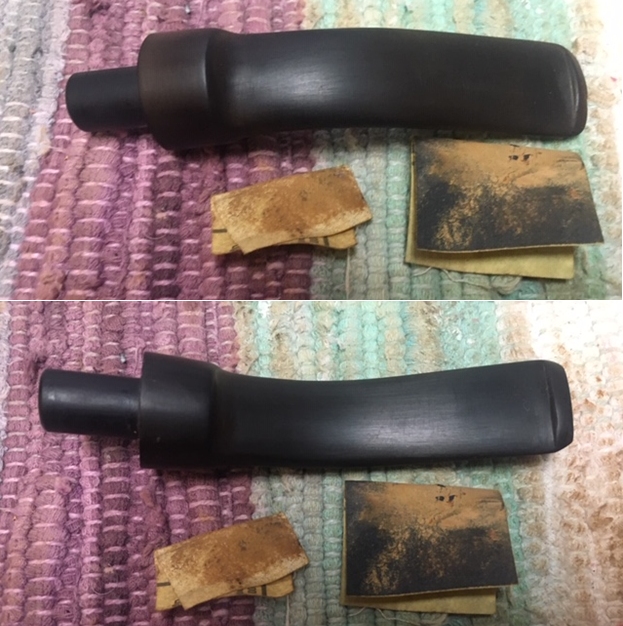
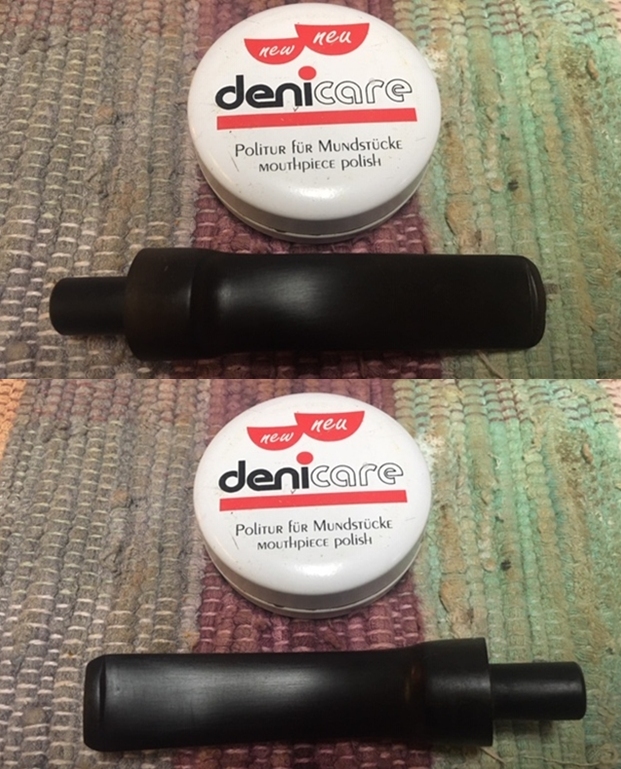
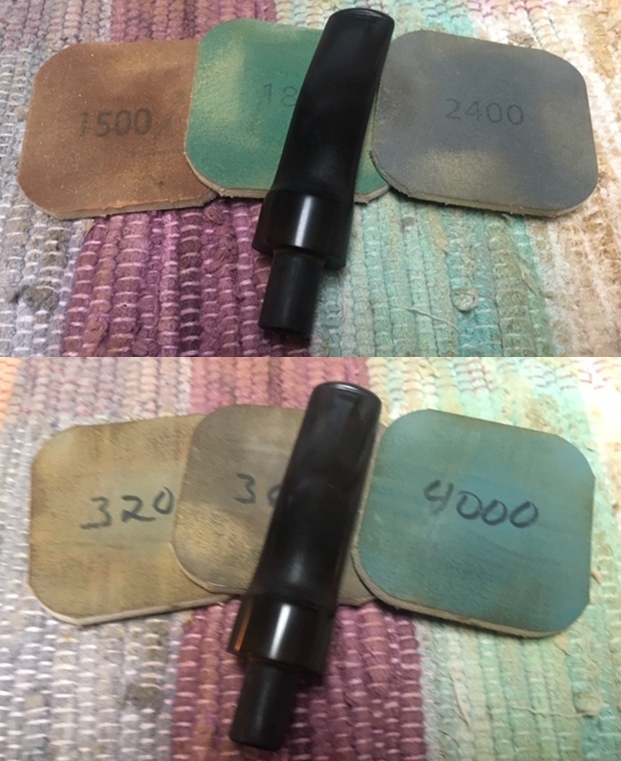
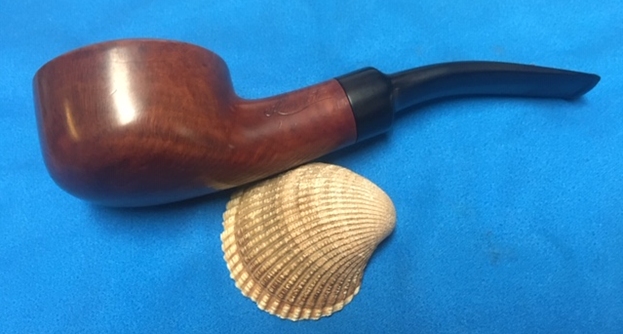
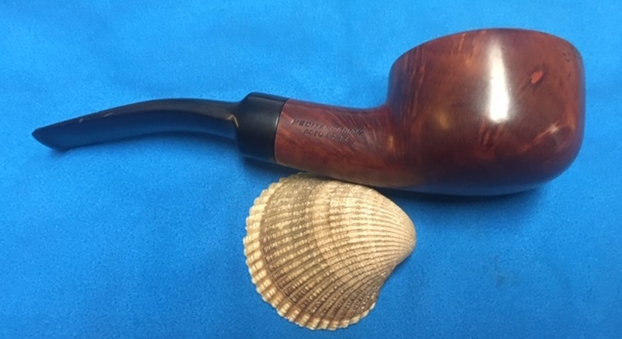
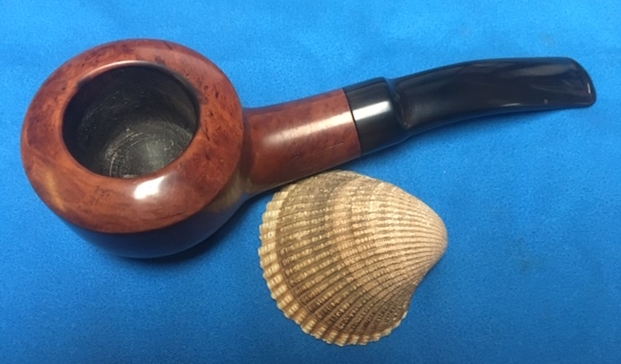
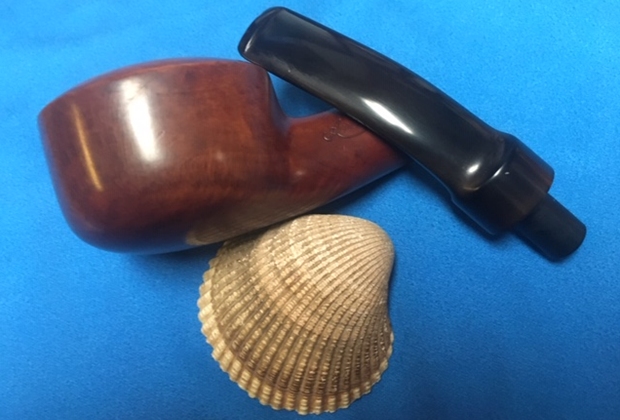
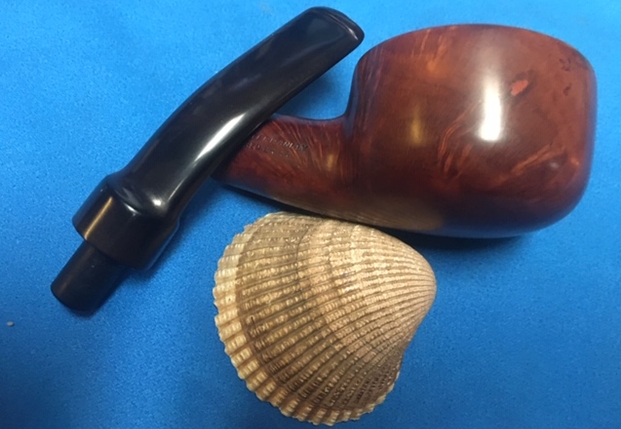
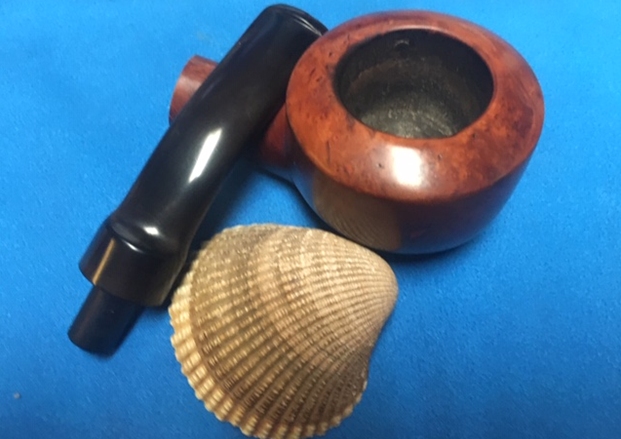
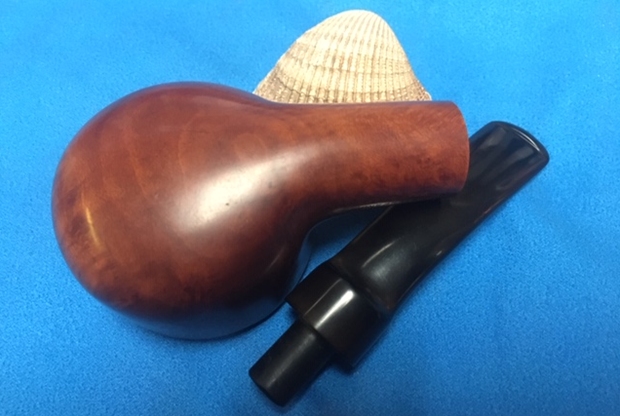
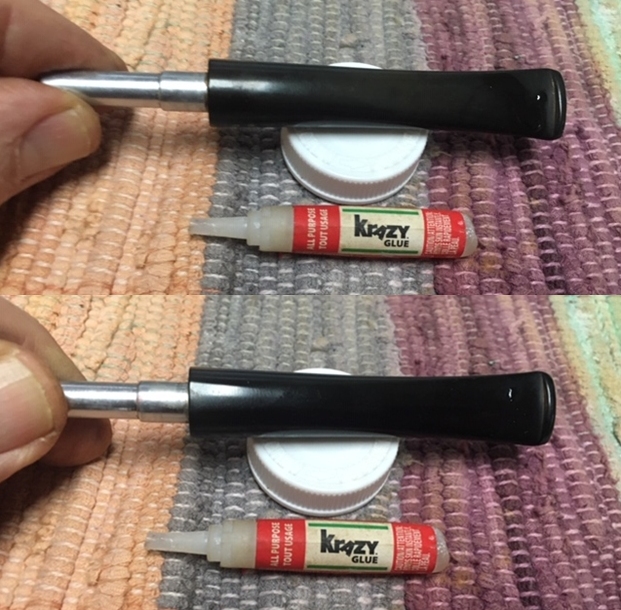
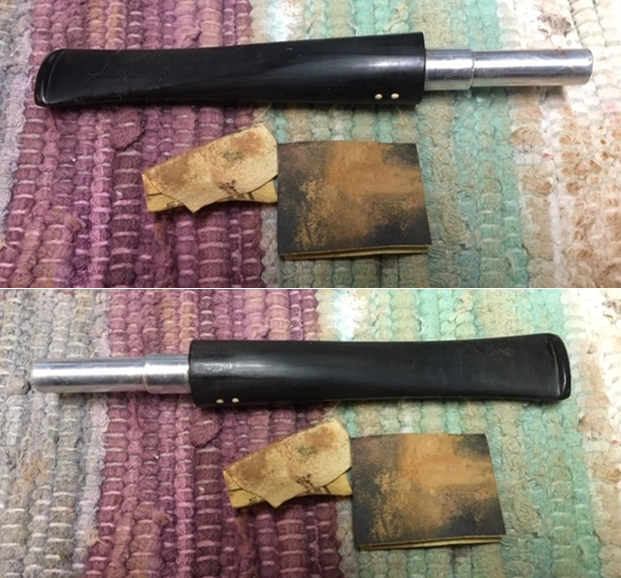
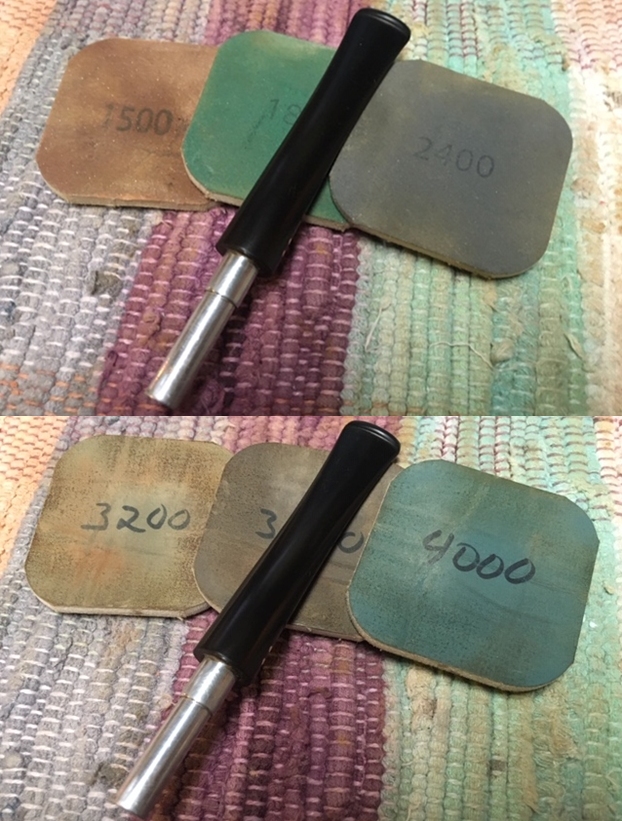
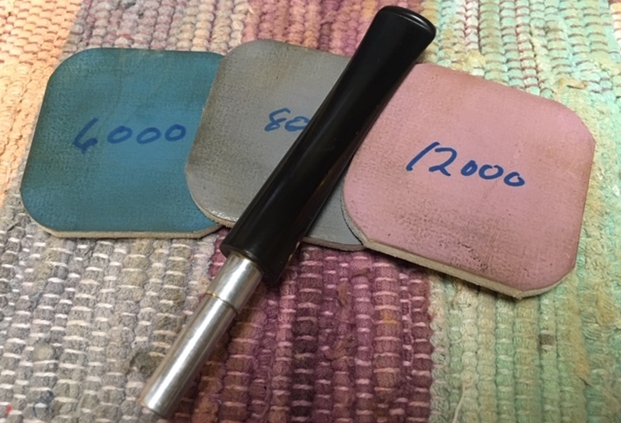
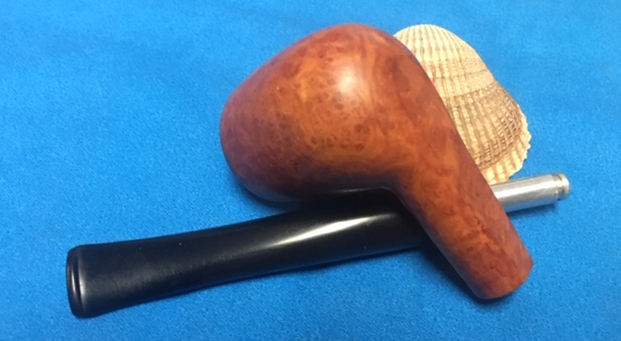
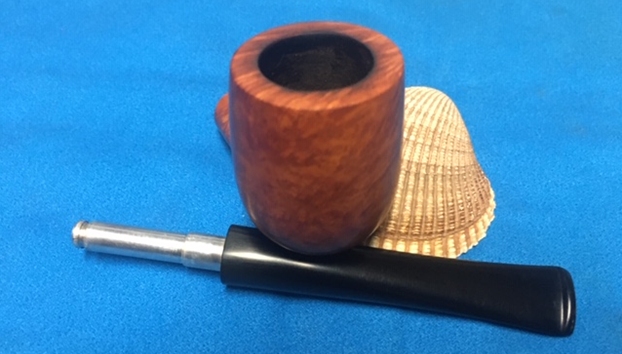
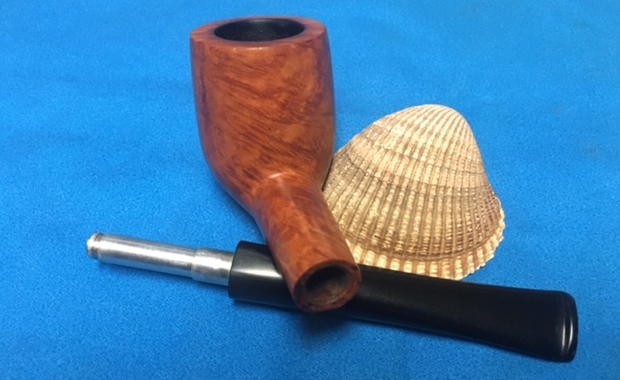
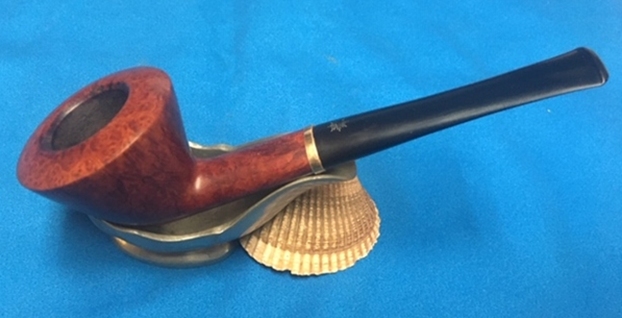
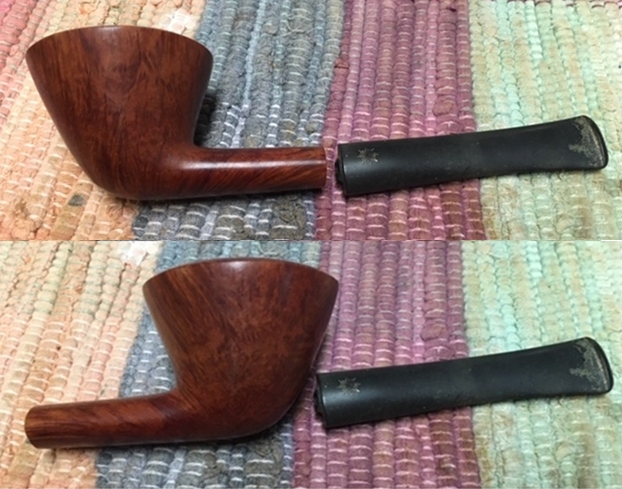
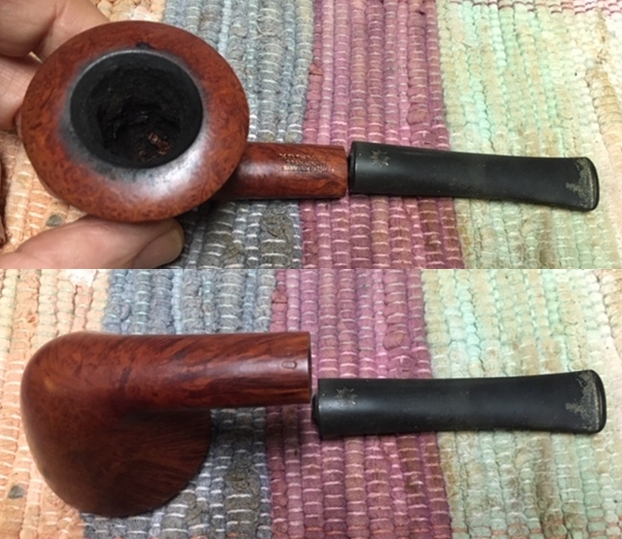
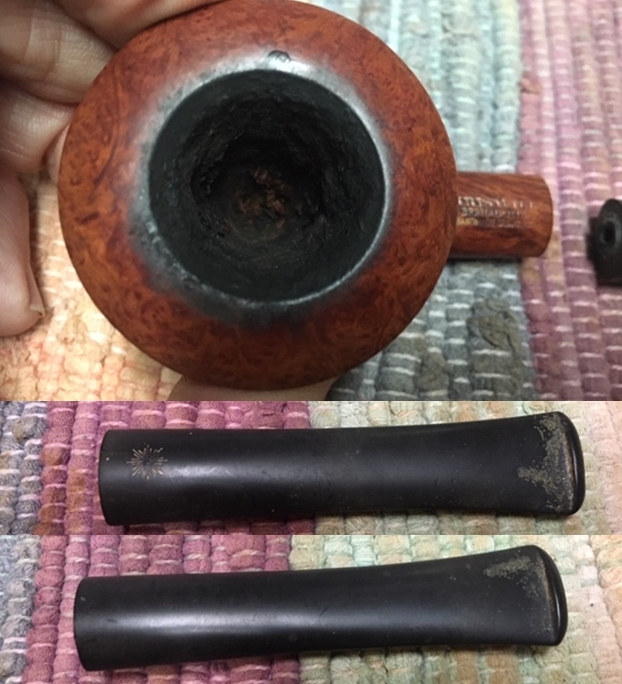
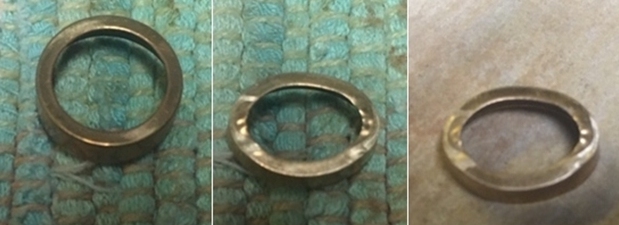
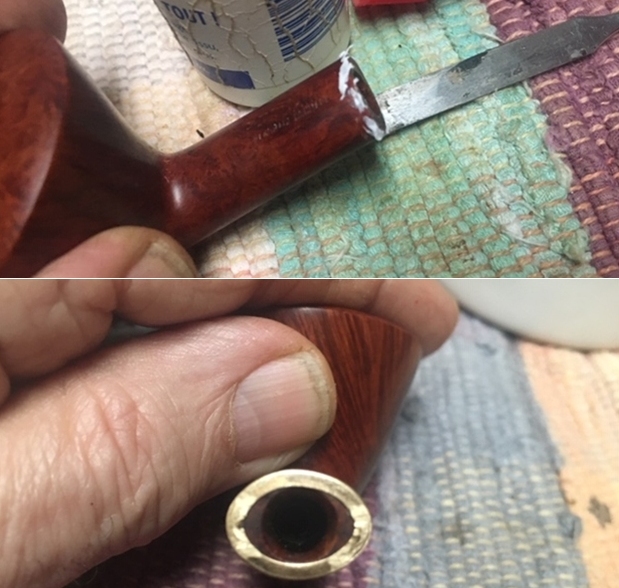
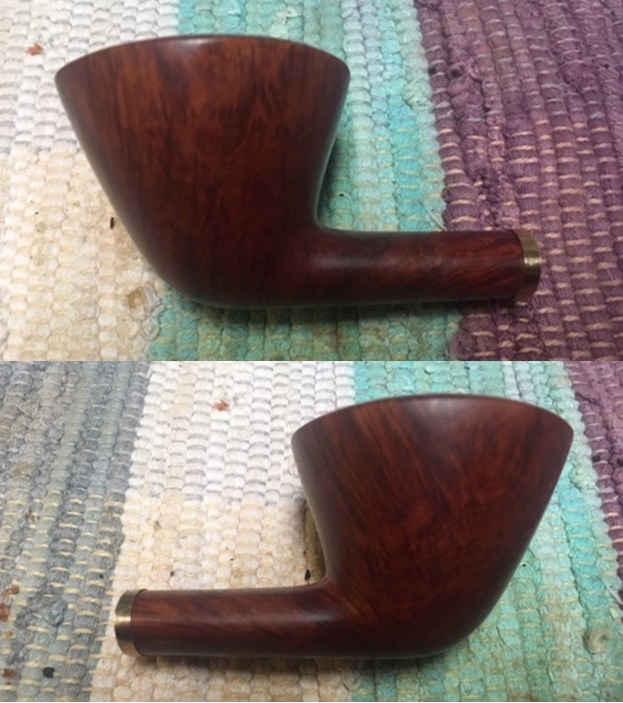
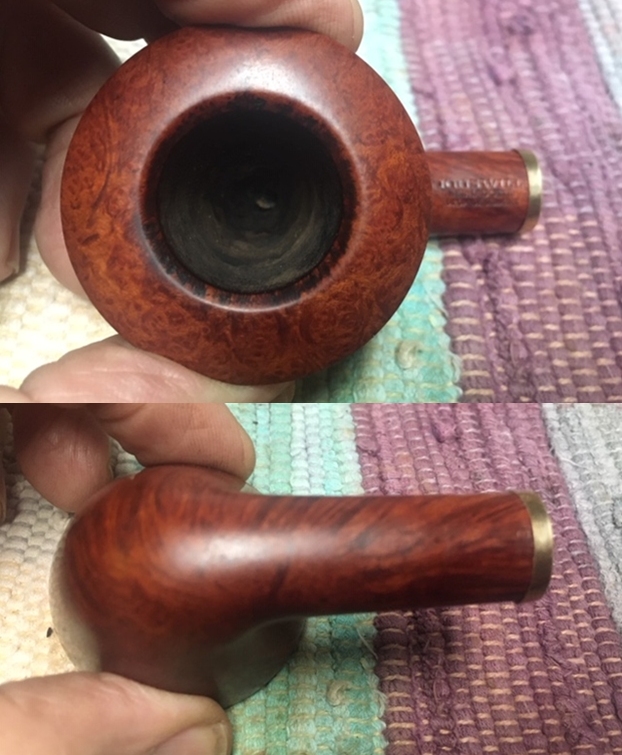
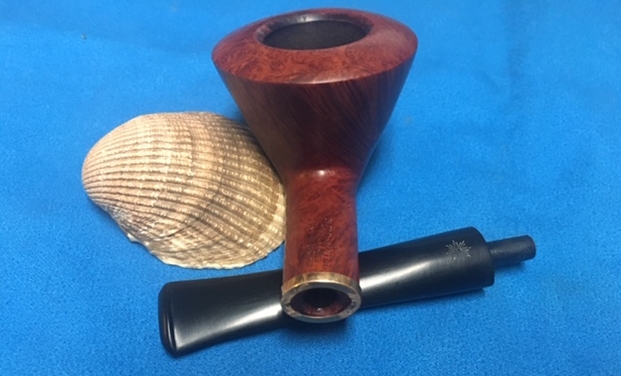
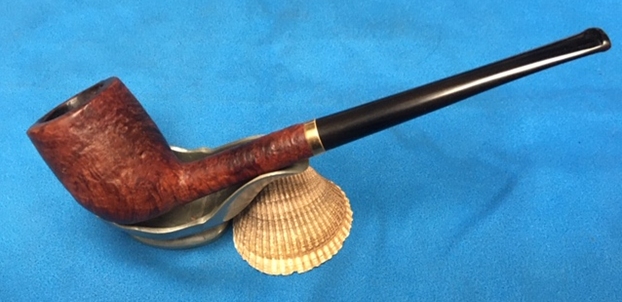
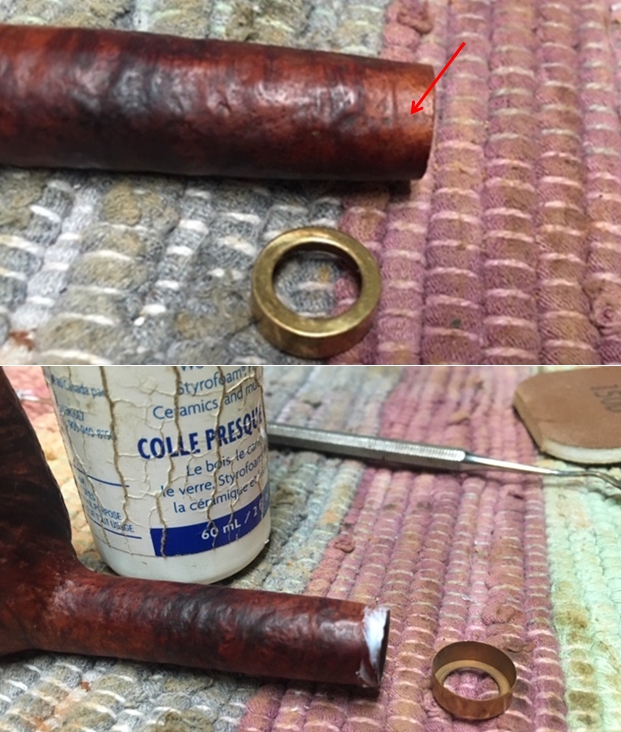
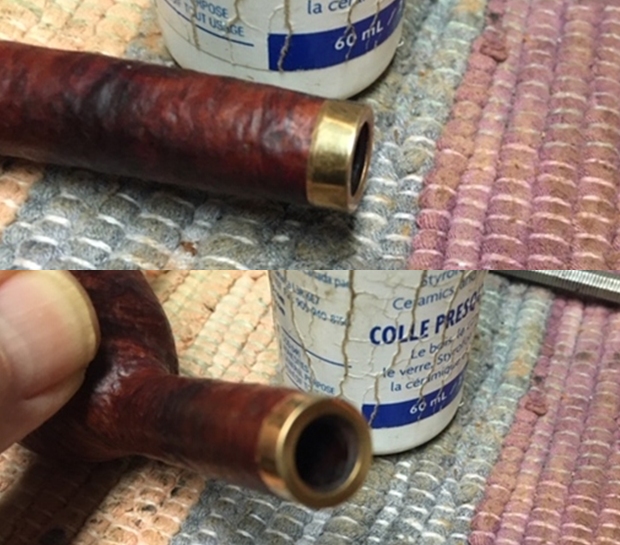
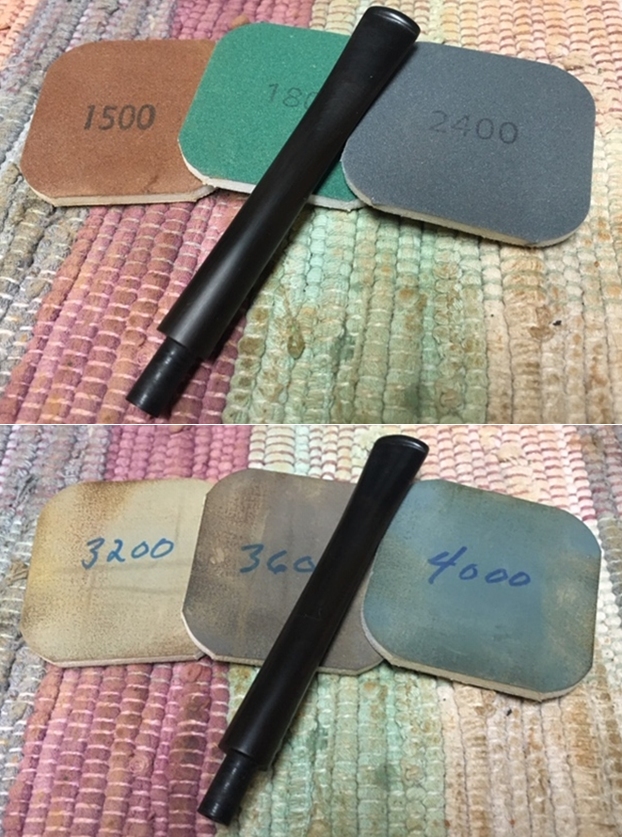
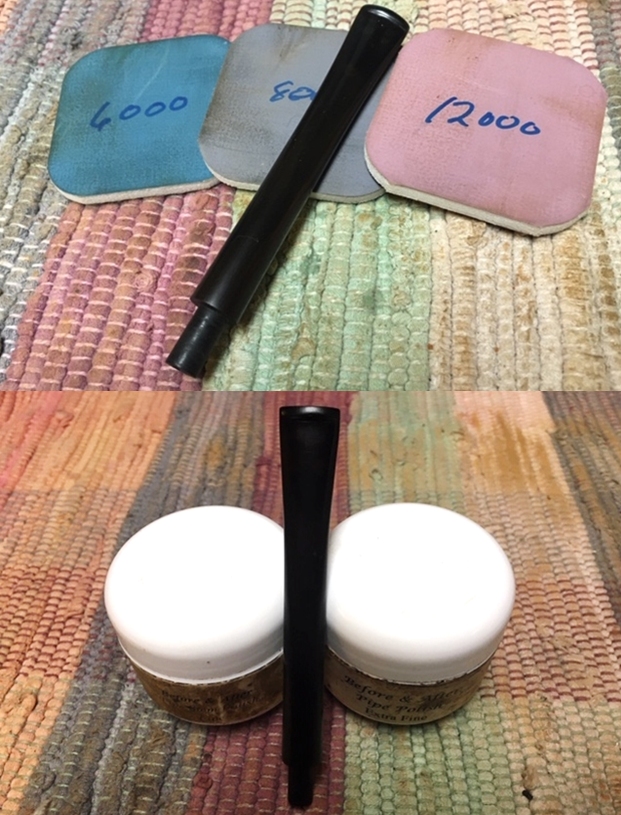
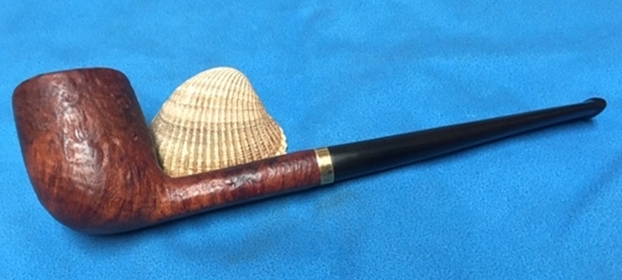
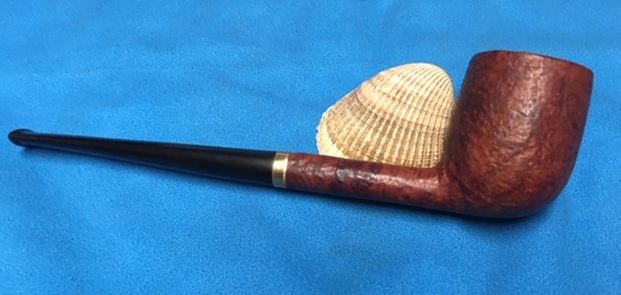
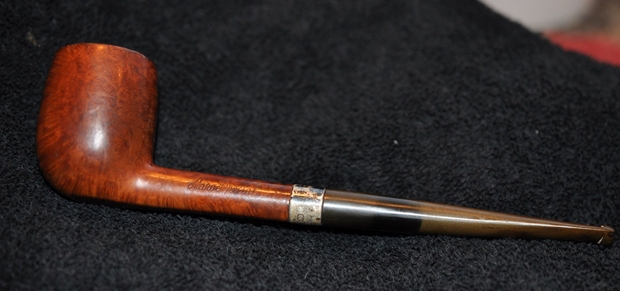
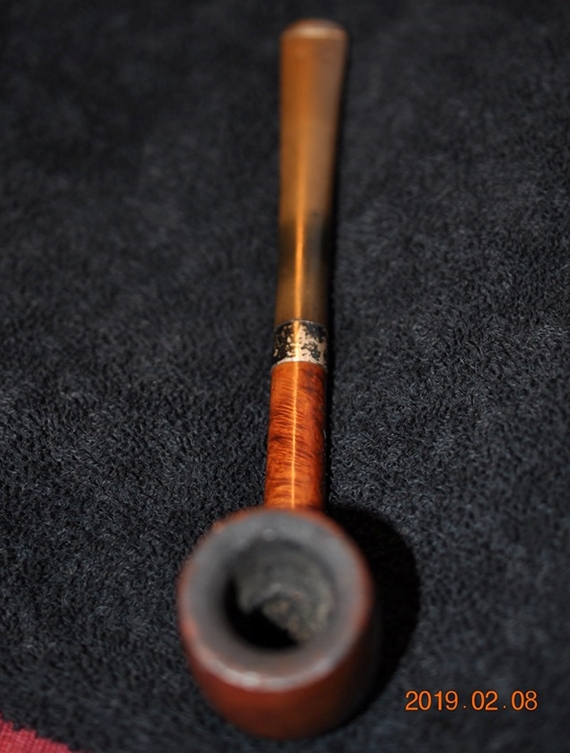
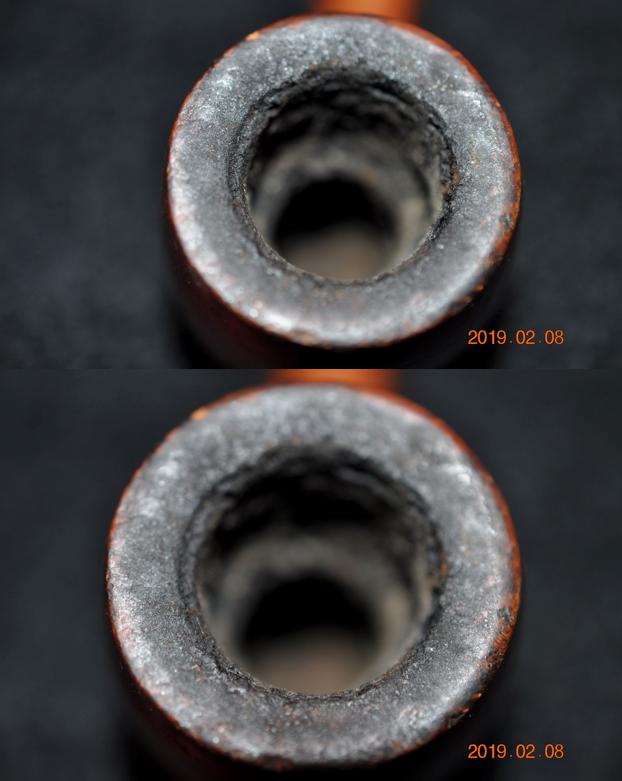
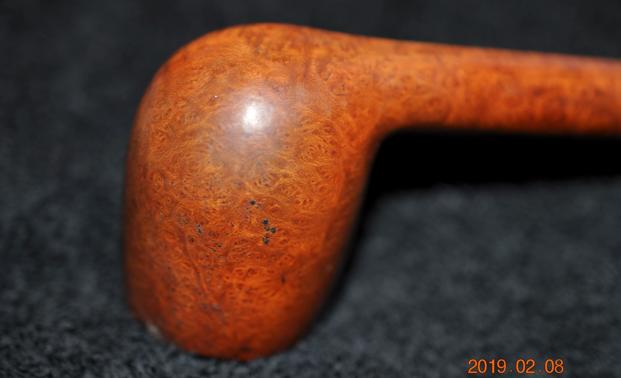
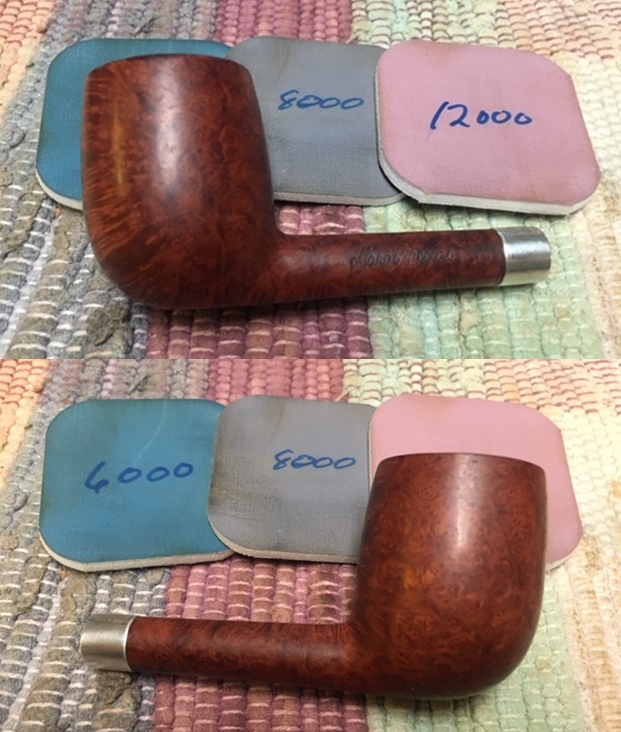
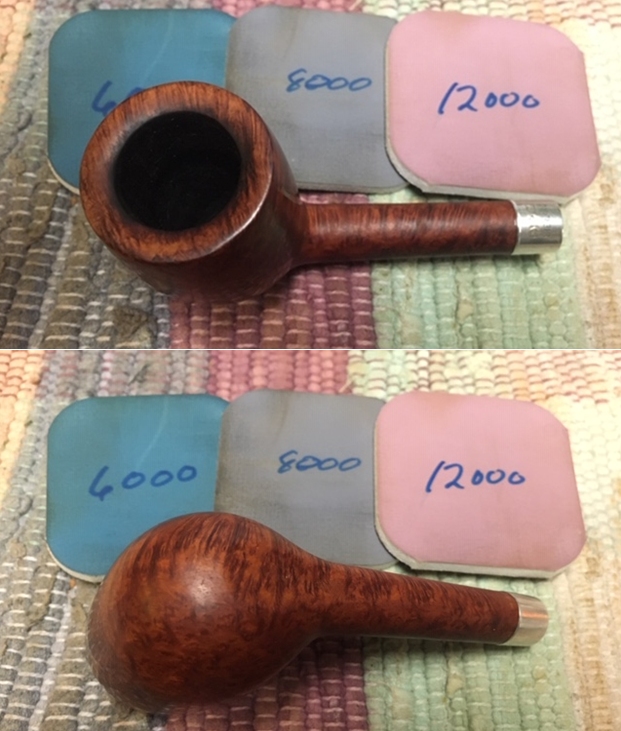
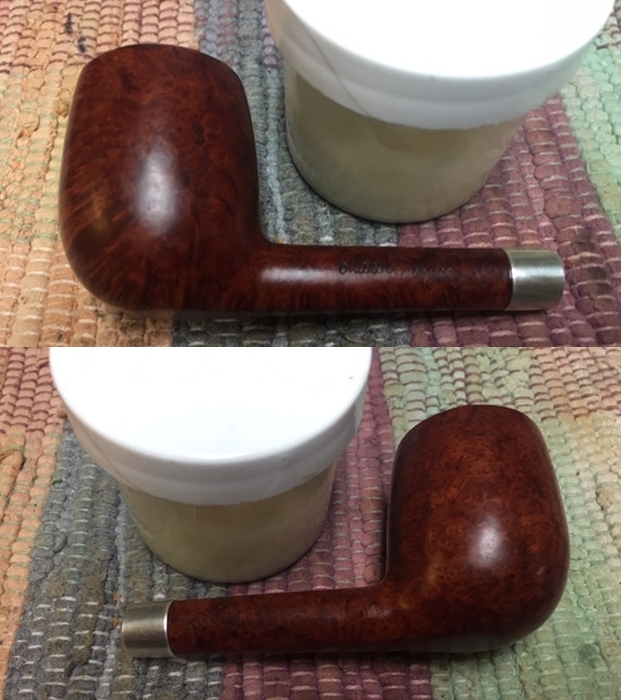
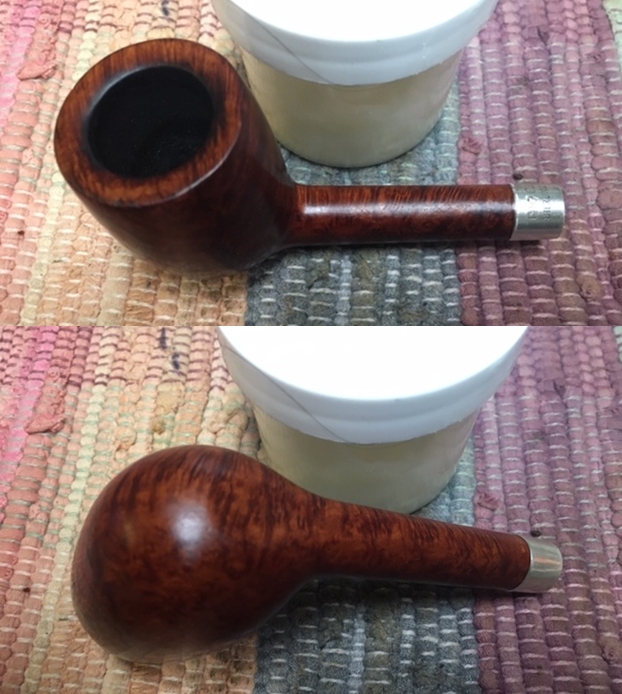
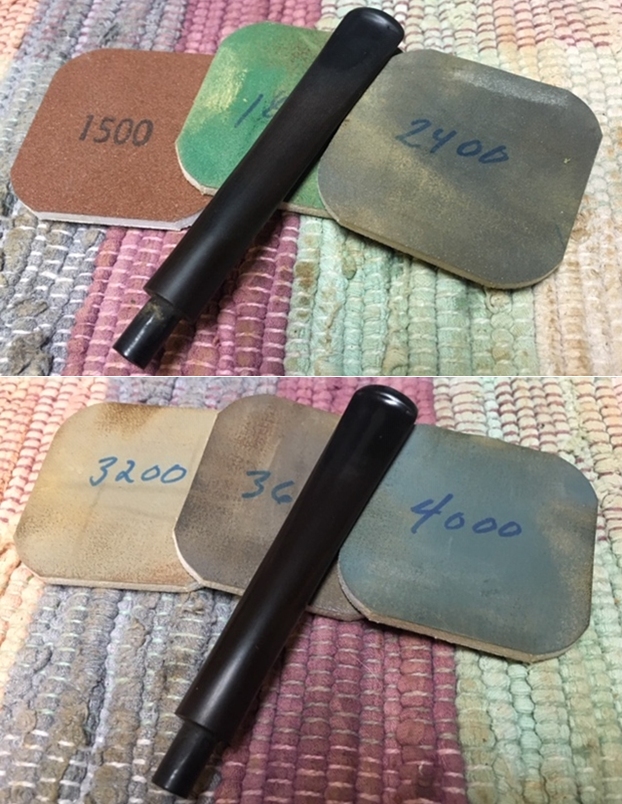
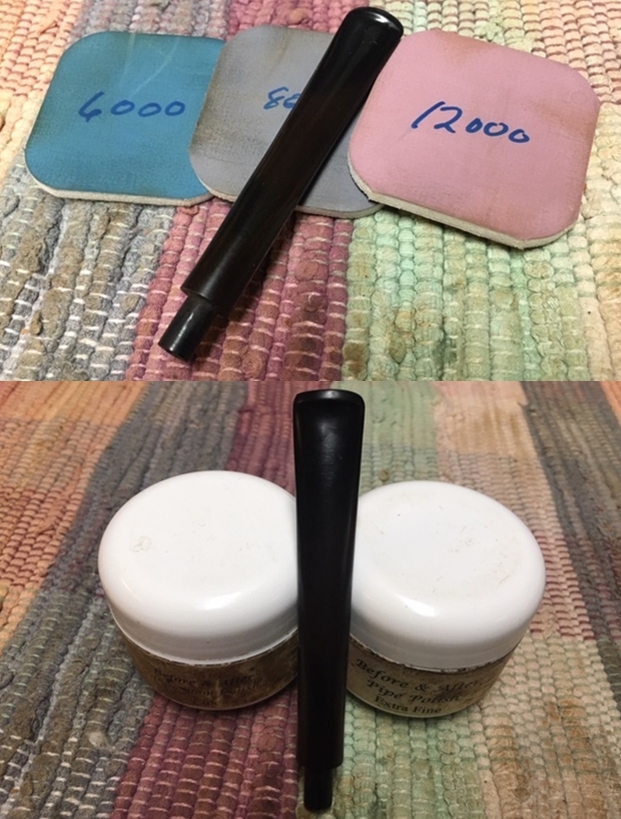
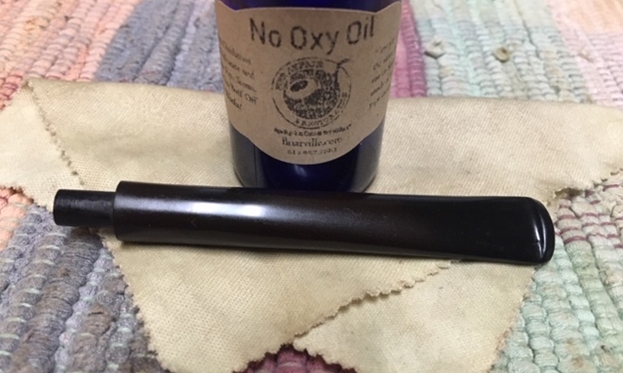
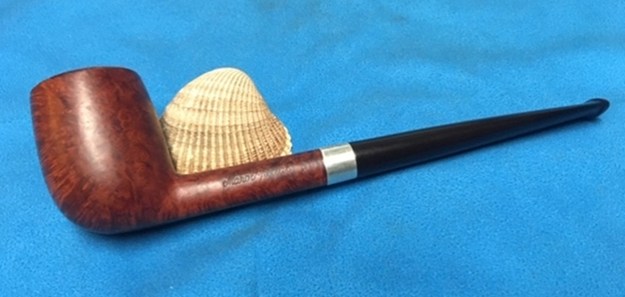
This St. Claude, France Ben Wade Calabash is quite stunning. The shape and flow of the briar, the rich red stains and the curve of the Lucite stem all combine to create a shape that is elegant and beautiful. Jeff picked this pipe up from a favourite shop in Utah. I have never seen one of these before even though I have worked on a lot of both English and Danish Ben Wade pipes. This one is a French Made Ben Wade. It is stamped on the left side of the curved shank with the words Ben Wade in script over Calabash. The name is also stamped on the left side of the half saddle stem. On the right side it is stamped St. Claude arched over Bruyere Garantie. To the left is a very tight stamp France. On the underside of the shank it is stamped with the letter F. There appears to be remnants of gold leaf in the stamping on both sides of the shank. It can be seen in the photos below. Jeff took some photos of the pipe before he began his cleanup work on it.The pipe was dirty and there were some worn spots on the plateau rim top. The original colour had been black but the dust had turned it almost grey. There was a cake in the bowl and some lava overflow on the plateau. The finish on the bowl was cordovan or oxblood. It was dirty as well with some nicks in the finish. You can see the chipped areas around the rim top and the lava in the plateau in the photos below.Jeff took photos of the bowl from various angles to give a picture of the grain and the condition on the finish of the pipe. It is a beautifully grained and finished pipe. The oxblood stain really works well to highlight and showcase the grain. Jeff also took photos of the stamping on the shank and the stem. The first two photos show the left side of the shank and stem. The third photo shows the stamping on the right side and the fourth shows the stamping on the underside. The acrylic/Lucite stem was dirty and there were tooth marks and chatter on the top and underside. There was one deep tooth mark on the underside up against the button edge. The flat surface of the button had tooth chatter and wear on both sides. Jeff also took a photo of the gentle curve of the half saddle stem and I have included that below. Jeff did his usual extensive cleanup of the pipe. He reamed it with a PipNet pipe reamer removing the cake from the bowl so that we could see what was going on underneath the surface. The interior of the bowl looked very good. He cleaned the internals of the pipe and stem with alcohol, cotton swabs and pipe cleaners until it was very clean. He scrubbed the externals with undiluted Murphy’s Oil Soap and a tooth brush. He worked over the plateau rim and edges with the brush and the soap and rinsed the pipe down with warm water. He cleaned the stem as well so that the externals and internals were clean. He did scrub the stem with Soft Scrub on cotton pads to remove the grime on the surface. It was acrylic so it was not oxidized so it was not necessary to soak it in a deoxidizer. I took photos of the pipe when I unpacked it and brought it to my work table. I took close up photos of the stem and the rim top to show the condition. The cragginess of the plateau is clean and shows the peaks and valleys in their fullness. You can also see some of the worn spots on the rim top where the finish has been removed. The stem looks good. The photo of the underside shows the deep tooth marks next to the button (third photo).I took some photos of the stamping on the sides of the shank to confirm what I mentioned above. The stamping is crisp and readable.I took the stem off the shank and took two photos to give a clear idea of the gentle curves of the pipe and the look of the rugged plateau rim on the delicate bowl. It really is a beauty! The tenon is drilled for a 6mm filter but could easily be smoked without one or with an adapter.Jeff and I were talking on Facetime and he was showing me how well the pipe had cleaned up. We do that often as he is in Idaho and I am in BC Canada. While he was carefully turning the stem into the shank we both heard and audible “POP”. That sound is a pipe restorer’s nightmare. If you have not heard that sound I can guarantee you will one day. Jeff groaned and showed me the crack in the shank. So when it arrived here in Vancouver I had a look. I took a photo of the crack and have included it below. It is on the top left side of the shank and is a good ½ inch long. That would need to be repaired. I also found some small hairline cracks on the top right side near the plateau top. They were not deep or serious but nonetheless they were present.I decided to deal with the cracked shank first. I went through some brass bands that I have that are polished gold in colour and would go well with the gold stamping on the stem and shank. They were quite thin and some have an inward bevel on the shank cover. I chose the band on the right and used my topping board to reduce the depth of the band by half. I wanted to retain as much of the stamping as possible and still bind the cracked shank together.I spread the crack in the shank and pushed some CA Glue into the space. Because of the way the curve in the shank I could not drill and hole at the end of the crack. I clamped it together until the glue cured. I did not glue the band on at this point because I wanted to touch up the gold stamping before I put it in place. Once the repair cured I put the stem on the shank and took a photo to give an idea of what the band looked like with the stem in place.   With that repair complete it was time to deal with the hairline cracks on rim edge. I used a tiny bit to put a hole at the end of each crack and filled them in with a bead of CA glue. The photo below is very blurry but shows the glued are well enough(I apologize for the lousy picture). I also filled in some of the pits in the back side of the bowl.Once the repairs had cured I sanded them smooth with a 1500 grit micromesh pad to blend them into the surface of the surrounding briar.I have found that the Mahogany stain pen I have blends really well with oxblood or cordovan stain. I touched up the sanded areas on the shank top, right side of the bowl at the topo and the back of the bowl with the pen and let it cure. I polished the briar with micromesh sanding pads – 1500-12000 grit pads. I wiped the bowl down with a damp cloth after each sanding pad to remove the debris. The bowl began to look very good. I also really like the look of the polished brass band on the shank end. I rubbed the bowl down with Before & After Restoration Balm. I worked it into the briar with my fingertips and into the plateau with a horsehair shoe brush. I let it sit for about 10 minutes and buffed it off with a soft cotton cloth. The product cleans, protects and preserves the briar and leaves it enriched and beautiful. I set the bowl aside and turned to the stem. I sanded the tooth chatter on both sides of the stem with particular attention to the large tooth mark on the underside of the stem just ahead of the button. I cleaned the tooth mark with alcohol on a cotton swab. I filled it in with a bead of clear CA glue and set it aside to cure. When the repair cured I used a needle file to sharpen the edge and flatten the repair.I sanded the repaired area and the rest of the tooth chatter areas on both sides of the stem with 220 grit sandpaper and followed up with a piece of 400 grit wet dry sandpaper.I polished the stem with Denicare Mouthpiece Polish from a tin of it I have in the drawer here. It is a gritty red paste that I rub on with my finger tips and work into the surface of the stem and button and buff off with a cotton pad. It gives me a bit of a head start on the polishing work.I polished the stem with micromesh sanding pads – wet sanding with 1500-12000 grit sanding pads. I wiped it down after each sanding pad with Obsidian Oil. I polished it with Before & After Pipe Stem Polish – both Fine and Extra Fine. I buffed the stem with a soft cloth to raise the shine. I paused in my polishing of the stem to touch up the gold leaf on the stem side and the sides of the shank. I used Rub’n Buff Antique Gold and pressed it in the stamping with the end of a tooth pick. I let it sit for a few minutes then buffed it off with a soft damp cloth to remove the excess. I went back to polishing the stem with Before & After Pipe Polish – both Fine and Extra Fine and buffed the stem with a clean cotton rag. The stem looks really good at this point.I used a dental spatula to spread some white glue around the shank end. Once the glue was evenly spread I pressed the band in place. I adjusted it so that it fit well. I set it aside to cure for a while as I wanted the band to be permanent. It looks very good now.I am excited to finish this beautiful Ben Wade Calabash from St. Claude France. It is both a rare one in terms of availability but also for me as I have never seen one before. I put the pipe back together and buffed it with Blue Diamond on the buffing wheel. I gave the bowl and the stem multiple coats of carnauba wax. I hand buffed the pipe with a clean buffing pad to raise the shine. It is fun to see what the polished bowl looks like with the grain popping through on the bowls sides and the contrast of the black plateau rim top. The brass band on the shank adds a touch class to the overall look in my opinion. When you add to that the polished black acrylic stem with the shining gold stamping you have a winning combination. The gold stamping also looks great on the shank and stem. This grain on the smooth finish Ben Wade Calabash is nice looking and the pipe feels great in my hand. It is light and well balanced for a large pipe. Have a look at it with the photos below. The dimensions are Length: 6 ¾ inches, Height: 3 inches, Outside diameter of the bowl: 2 inches, Chamber diameter: 7/8 of an inch. It is a beautiful pipe and one that will be on the rebornpipes store soon. If you are interested in adding it to your collection let me know. Thanks for walking through the restoration with me as I worked over this pipe. Thanks to each of you who are reading this blog. Remember we are not pipe owners; we are pipemen and women who hold our pipes in trust until they pass on into the trust of the next pipeman or woman.    

Another Fun Restore from Bob Kerr’s Estate – A BBB 2 Star Apple 11


Blog by Steve Laug

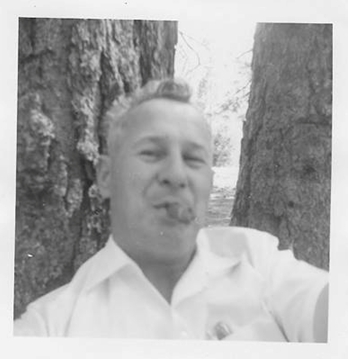
Even with the COVID-19 warnings rolling in incessantly I am still working on pipes! It keeps my mind busy and focused and not to get carried away with the sense of powerlessness. There is no reason to not enjoy the time alone at the work table bringing these old-timers back to life. After brief foray restoring pipes referred to me by my local pipe shop I am back to Bob Kerr’s estate (his photo is to the left). If you have not “met” the man and would like to read a bit of the history of the pipeman, his daughter has written a great tribute that is worth a read. Because I have included it in over 60 restorations to date I thought that I would leave it out this time. Be sure to check out some of the recent Dunhill restoration blog (https://rebornpipes.com/2020/01/01/restoring-the-last-of-bob-kerrs-dunhills-a-1962-dunhill-bruyere-656-f-t-bent-billiard/).

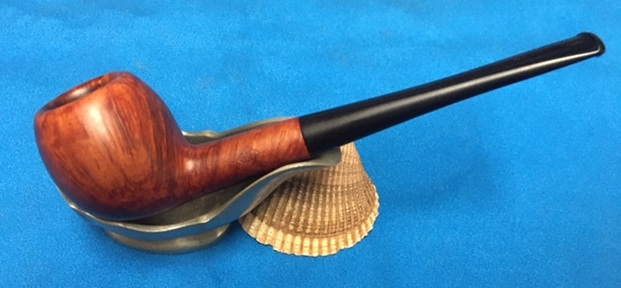
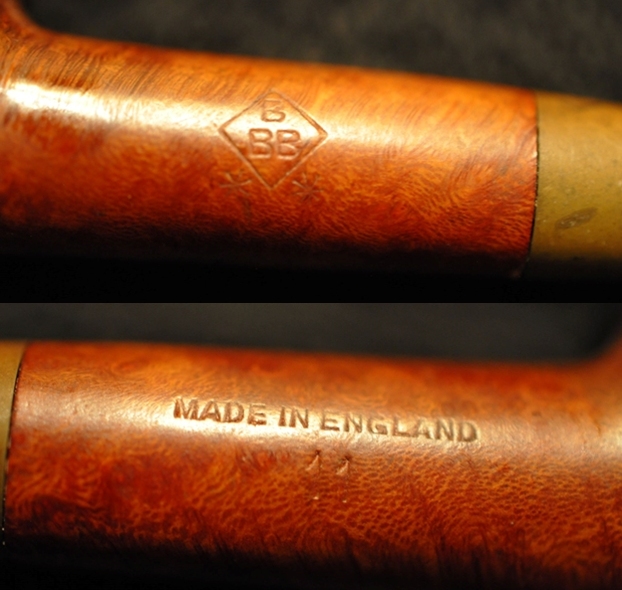
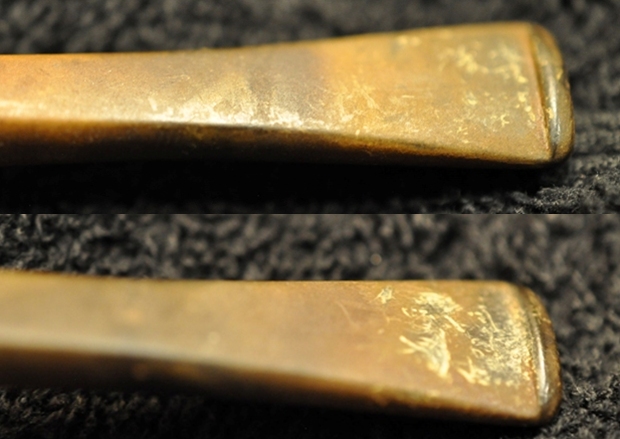
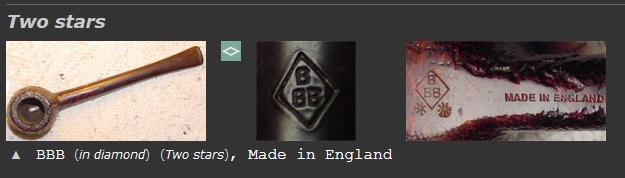
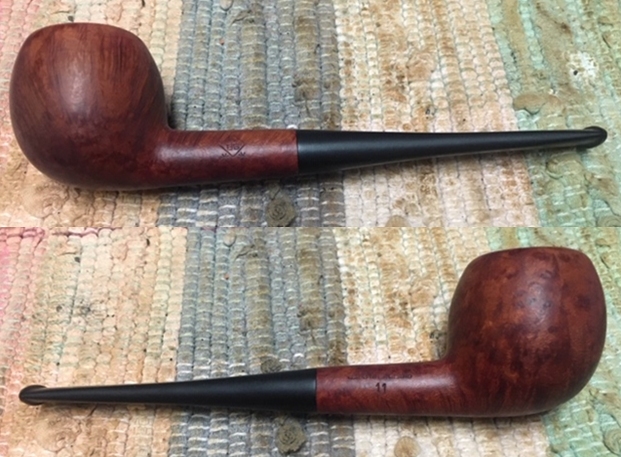
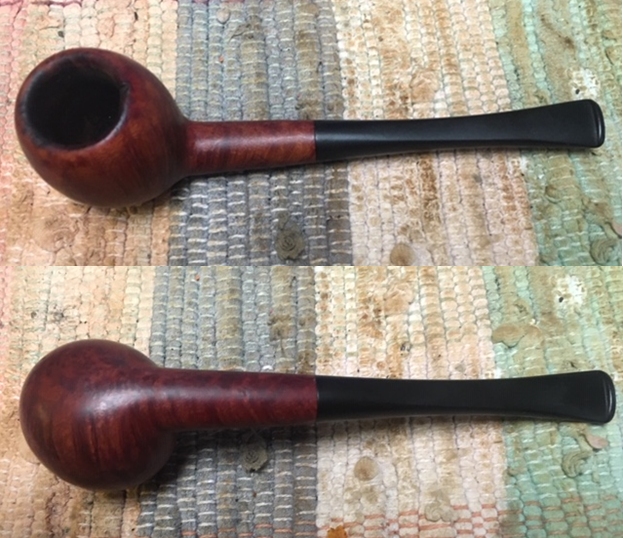
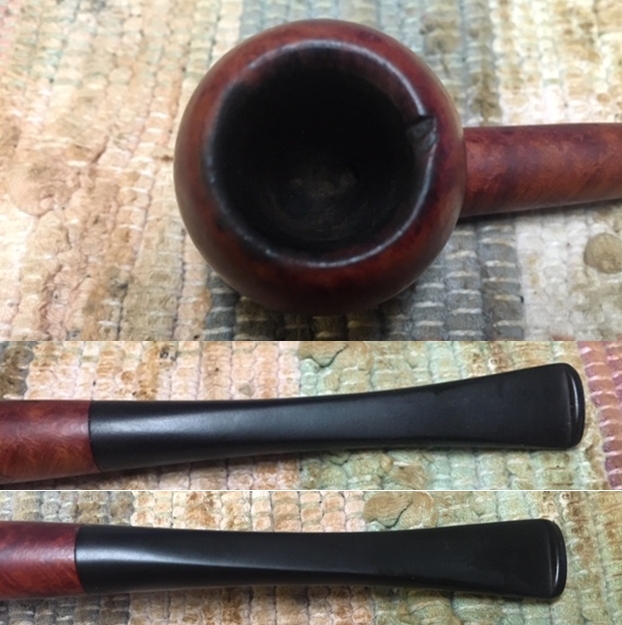
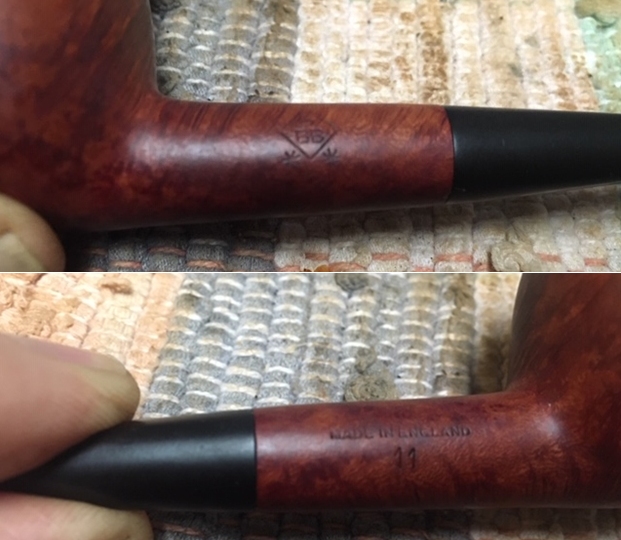
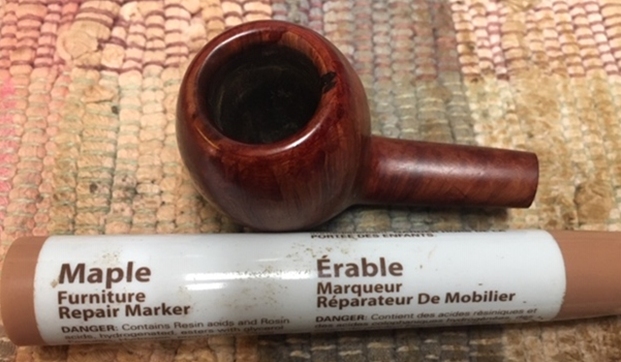
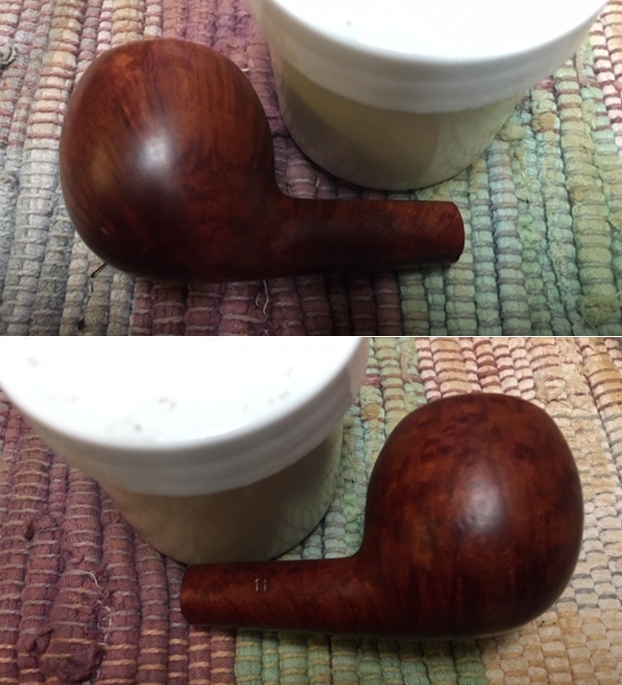
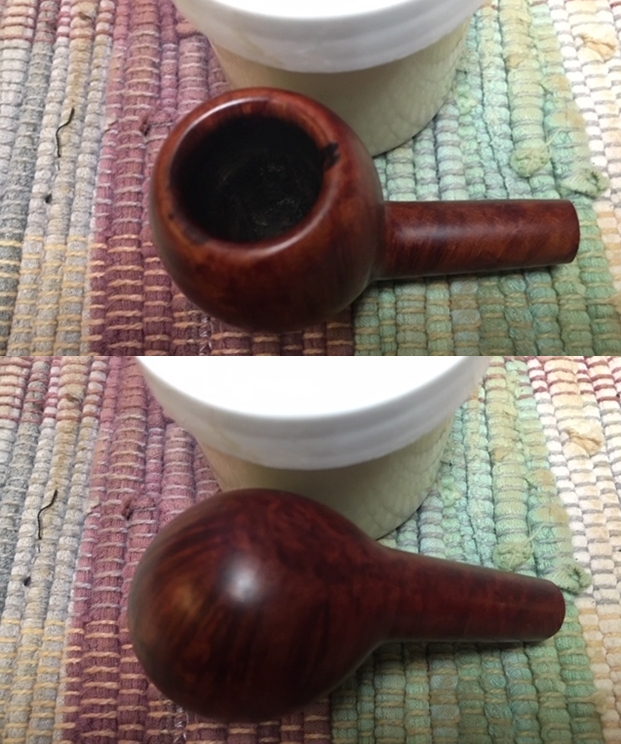
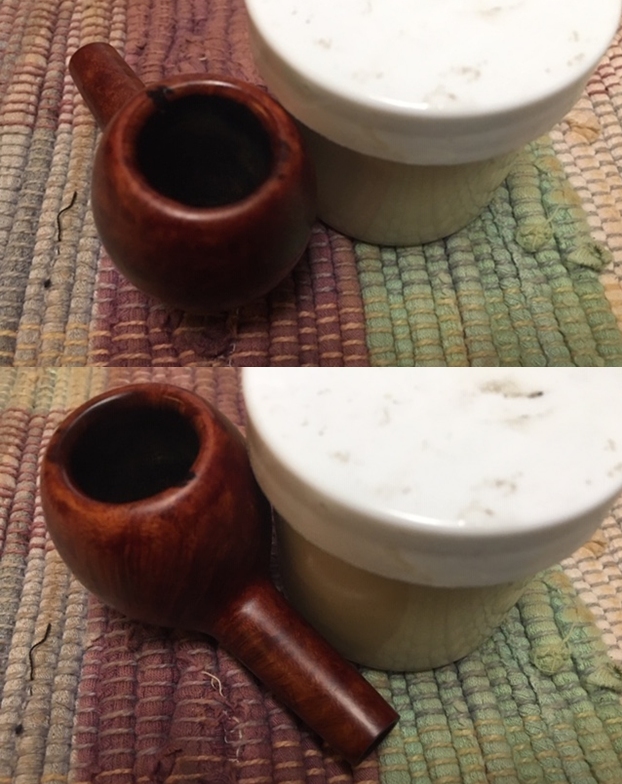
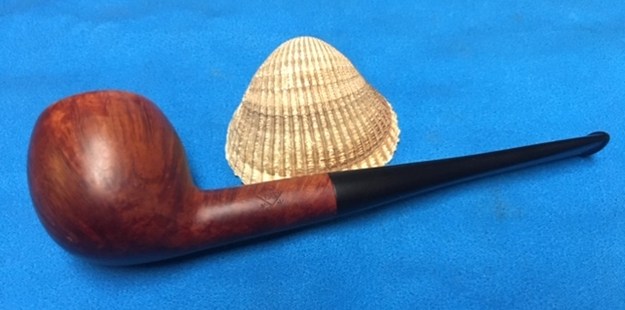
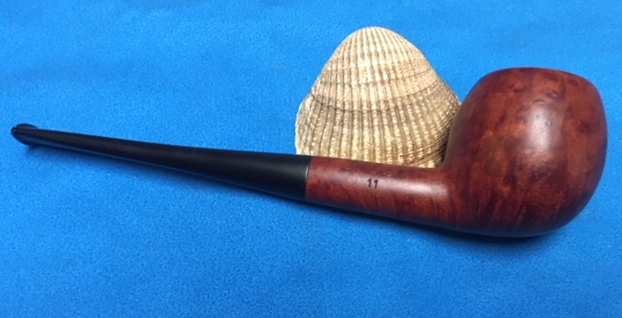
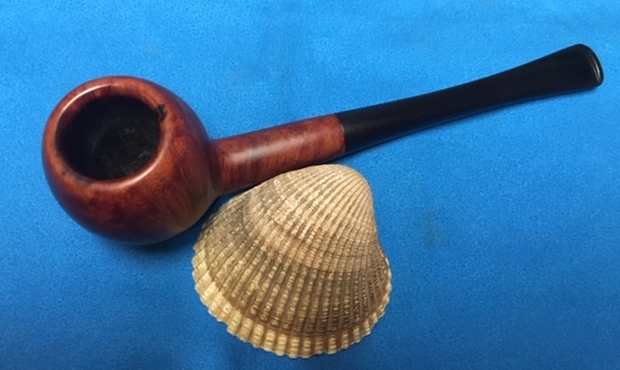
The next pipe I have chosen from his estate is an interesting looking Apple with a slender stem. It is stamped BBB in a diamond on the left side of the shank with a Star on each side of the diamond. On the right side of the shank it is stamped Made in England over the shape number 11. The slender stem does not bear the BBB brass logo. The tapered stem is oxidized and has tooth marks and chatter on both sides near the button. There is some calcification on the stem with damage to the button. The finish is worn and dirty. There is a thick cake and lava overflow on the rim top. There is some damage on top & edges. There appears to be some chips out of the thin rim top/edge that will need to be addressed in the restoration. Jeff took photos of the pipe to show its general condition before he did his cleanup. The finish on the pipe was very dirty – grime and grit from years of use and sitting fill the crevices in the rustication. The rim top was covered with a coat of thick lava that overflowed the bowl. There was also some darkening and chipping damage on the rim top. The bowl itself had a thick cake with flecks of tobacco stuck in the cake on the sides.Jeff took photos of the sides and the heel of the bowl to give a better feel for the grain around the bowl. He took a photo of the stamping on the sides of the. You can see that the stamping is very clear. On the left side it reads BBB in a diamond with a star on each side of the base. On the right side it reads Made in England over the shape number 11.The stem was dirty and extremely oxidized. Once again the stem appeared to be a replacement as I have learned Bob was a chewer and his stems seemed to have been replaced often. This one at least fit well to the shank and did not yet have the chew marks that were a norm on Bob’s pipes.Before I started my work on the pipe I decided to read a bit of BBB history to remind myself how the two stars fit into the hierarchy of BBB pipes. I turned first to Pipephil’s site (http://www.pipephil.eu/logos/en/logo-bbb.html). I have included a screen capture to show the stamping on the pipe. At this point I still did not know how it fit. Also the pipe I was working on did not have the BBB Diamond or Brass logo on the stem.I turned to Pipedia to see what I could gather there about the hierarchy of the Two Star pipe (https://pipedia.org/wiki/BBB). I read through the page and found some more information. I quote a pertinent section of the article that give the information that I was hoping for and expecting.

…In the Thirties, the top-of-the-range one becomes “BBB Best Make” with alternatives like “Super Stopping” and “Ultonia Thule”. The BBB Carlton, sold with the detail with 8/6 in 1938, is equipped with a system complicated out of metal, system which equipped the BBB London Dry too. Blue Peter was not estampillées BBB but BBB Ultonia, and the BBB Two Star (* *) become the bottom-of-the-range one.

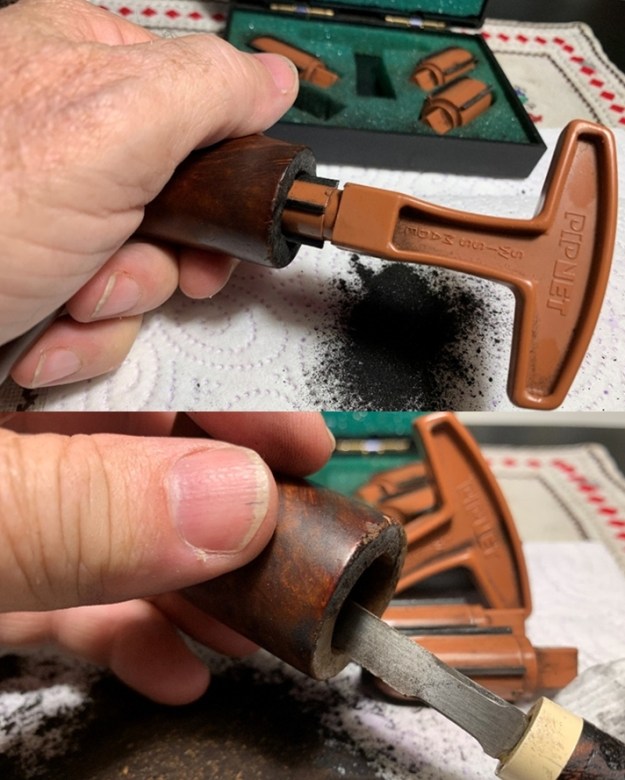
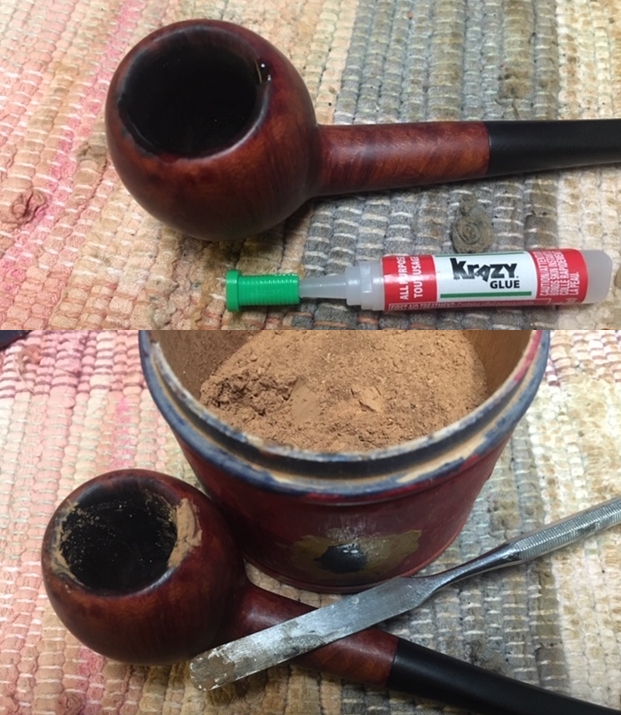
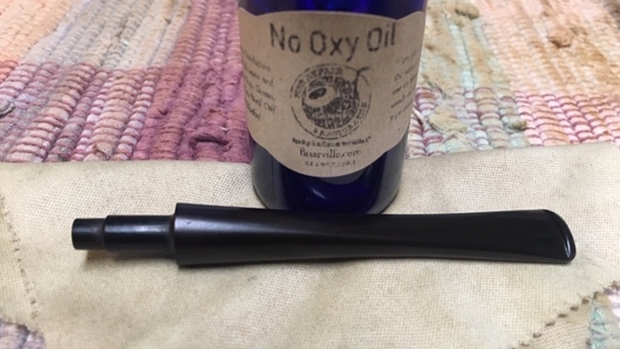
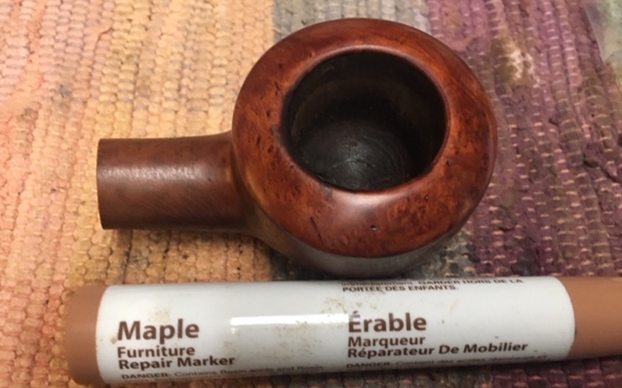
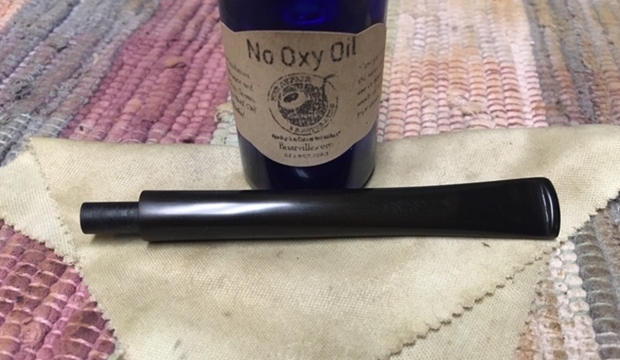
Now I knew about where the Two Star fit – at the bottom of the range. Armed with that information it was time to work on the pipe. Jeff cleaned this filthy pipe with his usual penchant for thoroughness that I really appreciate. This one was a real mess and I was looking forward to seeing what he had done with this one when I took it out of his box. It looked amazing and CLEAN and other than the stem work needing a little effort on my part. He reamed the bowl with a PipNet pipe reamer and cleaned up the reaming with a Savinelli Fitsall Pipe Knife. He scrubbed out the internals with alcohol, pipe cleaners and cotton swabs until the pipe was clean. He scrubbed the exterior of the bowl with Murphy’s Oil Soap and a tooth brush to remove the grime and grit on the briar and the lava on the rim top. The finish looks good with great looking grain around the bowl and shank. The rim top and front of the bowl was severely damaged with burns. The condition of the inner and outer edges was rough. The stem looked a lot better but damage was evident on the button. Jeff soaked the stem in Before & After Deoxidizer to remove the oxidation on the rubber. The pipe was ready for me to carry on the next part of the process. I took some close up photos of the rim top and also of the stem surface. I wanted to show how well it had cleaned up. The rim top was clean and the damage was very evident. There were several chips on the edge of the rim top with the largest being at the back of the bowl.  I also took close up photos of the stem to show how well surface looked on both sides. I took a photo of the stamping on the sides of the shank. You can see that it is stamped as noted above.I decided to start my restoration work on this one by dealing with the damaged rim top. I filled in the damaged areas with a drop of clear Krazy Glue (CA) and then pressed some briar dust into the glued areas with a dental spatula. I set the bowl aside to dry overnight.   I sanded the repaired areas with 220 and 400 grit sandpaper to shape the repaired areas and blend them into the rest of the bowl. I also worked over the edge and top to minimize the darkening to the edges.I polished the briar with micromesh sanding pads – wet sanding it with 1500-12000 grit pads. After each pad I wiped the briar down with a damp cloth. I touched up the rim top colour with a Maple Stain Pen to match the colour of the rest of the bowl. I let it dry and buffed it by hand.I worked some Before & After Restoration Balm into the surface of the briar with my fingertips to clean, enliven and protect the briar. I let the balm sit for a little while and then buffed with a cotton cloth to raise the shine. The photos show the bowl at this point in the restoration process. With that done the bowl was finished other than the final buffing. I set it aside and turned my attention to the stem. I sanded out the remaining tooth marks and chatter with 220 grit sand paper to blend them into the rest of the stem surface. I started to polish it with a folded piece of 400 wet dry sandpaper. Once it was finished it had begun to shine.        I polished the stem with Denicare Mouthpiece Polish from a tin of it I have in the drawer here. It is a gritty red paste that I rub on with my finger tips and work into the surface of the stem and button and buff off with a cotton pad. It gives me a bit of a head start on the polishing work.  I polished the stem with micromesh sanding pads – wet sanding with 1500-12000 grit sanding pads. I wiped it down after each sanding pad with Obsidian Oil. I polished it with Before & After Pipe Stem Polish – both Fine and Extra Fine. I am continuing to experiment with Briarville Pipe Repairs new product, No Oxy Oil so I rubbed the stem down with the oil on the cloth that was provided with it. This BBB Two Star 11 Apple was another interesting pipe to work on. It is a classic shaped Apple. It has a tapered vulcanite stem that I am pretty certain is a replacement stem. The grain on the pipe is very nice and the shape has a great look and feel in the hand. The smooth finish is beautiful and highlights the grain. The repaired rim top looks very good and blends in well. I polished stem and the bowl with Blue Diamond polish on the buffing wheel. I gave the bowl and the stem multiple coats of carnauba wax. I buffed the pipe with a clean buffing pad to raise the shine. I hand buffed it with a microfiber cloth to deepen the shine. The pipe polished up pretty nicely. The deeply grained briar took on life with the buffing. The rich browns of the briar works well with the polished vulcanite stem. The finished pipe has a rich look that is quite catching. Have a look at it with the photos below. The shape, finish and flow of the Apple are very well done even with the replacement stem. The dimensions are Length: 5 ½ inches, Height: 1 ½ inches, Outside diameter of the bowl: 1 ¼ inches, Chamber diameter: ¾ of an inch. It is a beautiful pipe and one that will be on the rebornpipes store soon. If you are interested in adding it to your collection let me know. Thanks for walking through the restoration with me as I worked over this pipe. 

The 18th Pipe from the 19 Pipe Eastern Canada Lot – a GBD Popular 12 Dublin


Blog by Steve Laug

With two pipes left to finish for the fellow in Kitchener, Ontario I decided to work on one more of them. He had been referred to me by my local pipe and cigar shop. While I am not currently adding more pipes to my queue of repairs I have made a commitment to the shop to work on pipes for their customers. Generally they have one or two pipes that need a bit of work. This fellow sent me the following email:

I just came across my smoking pipes that I’ve had in storage for about 40 years. I’m wondering what you’d charge to have them refurbished. There are 17 in total (11 are Brighams and 6 are various).

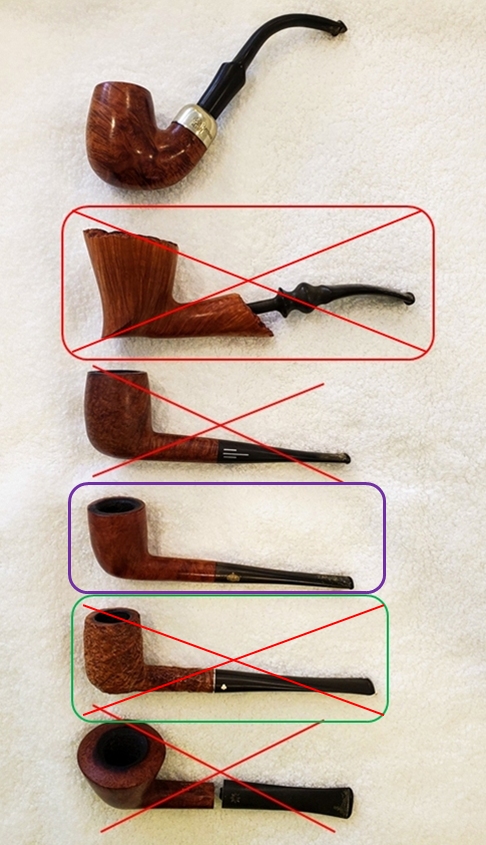
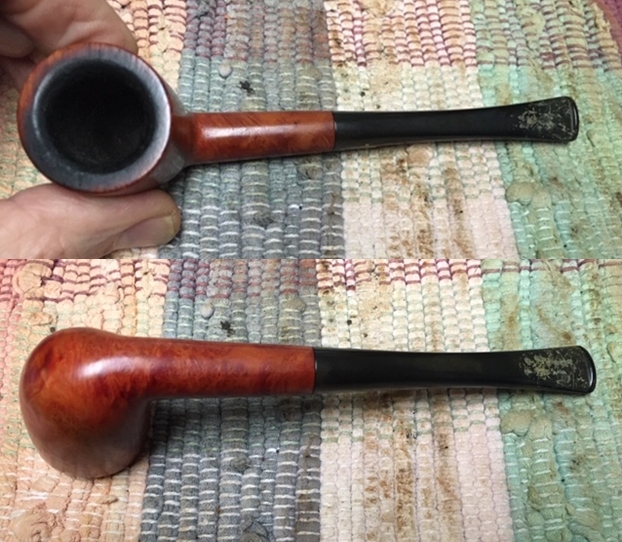
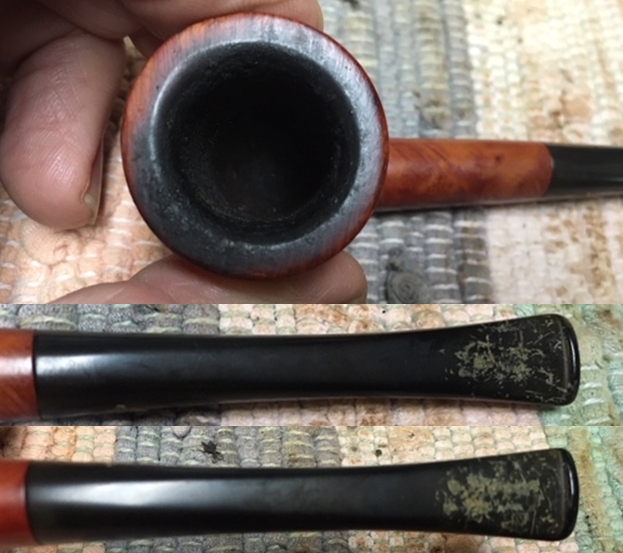
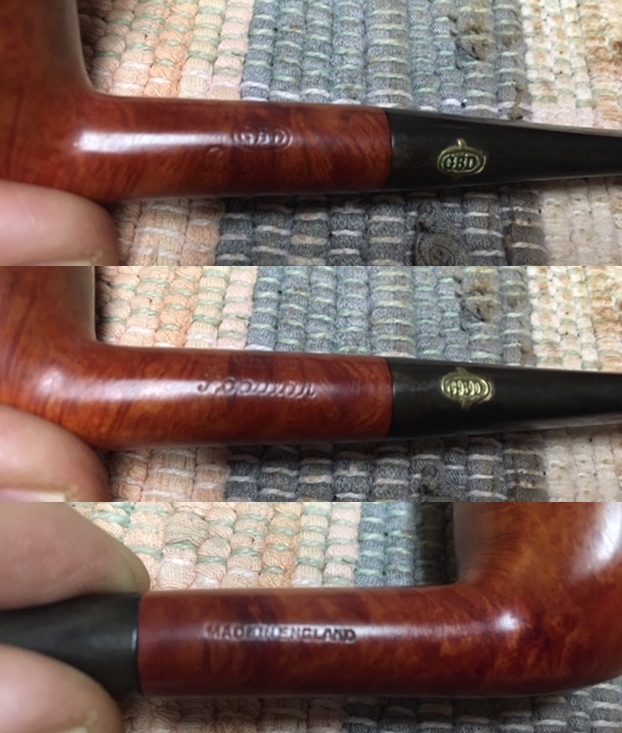
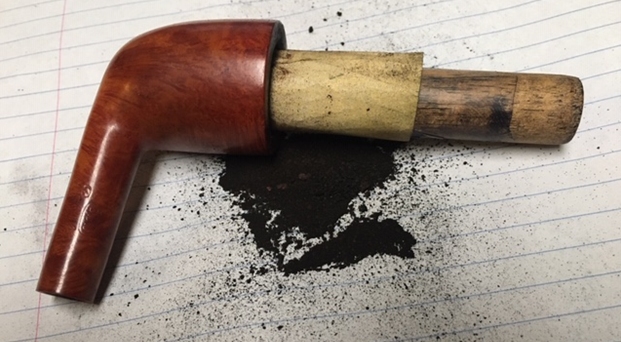
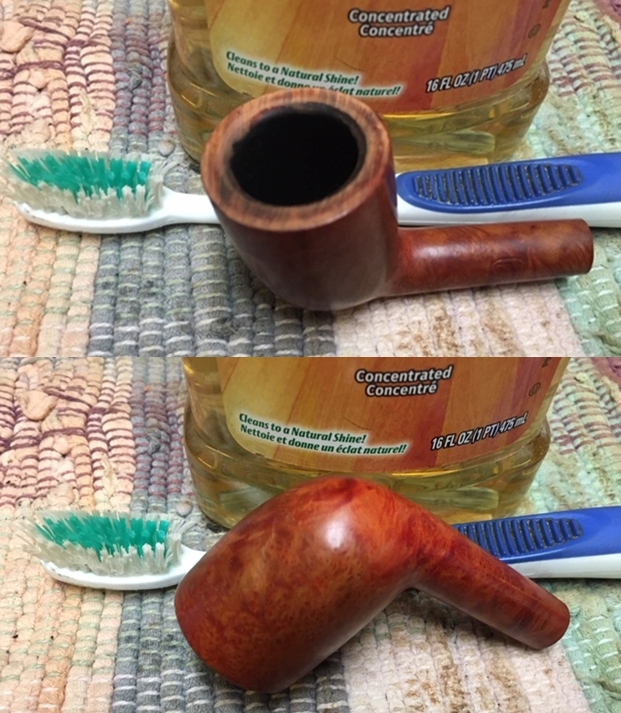
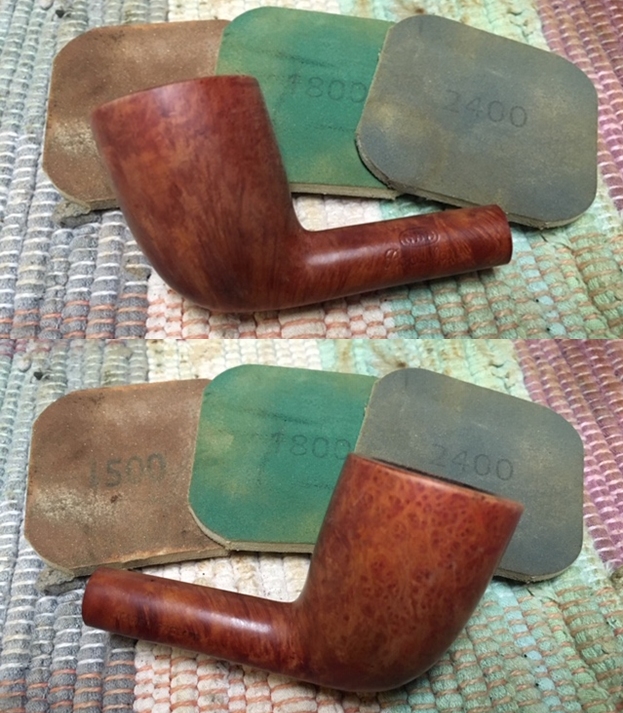
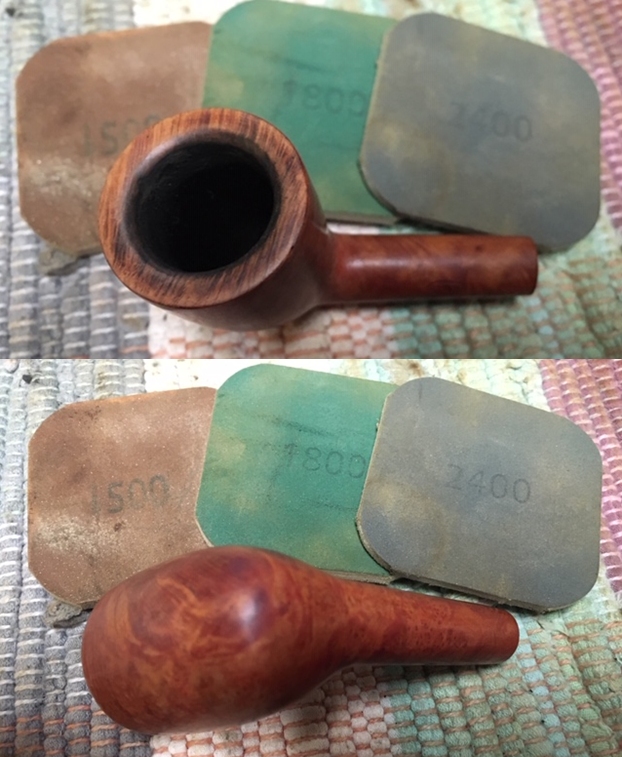
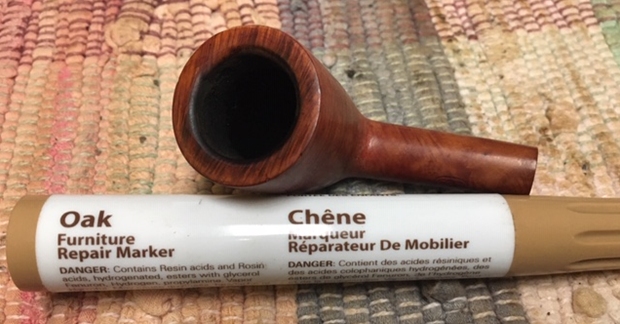
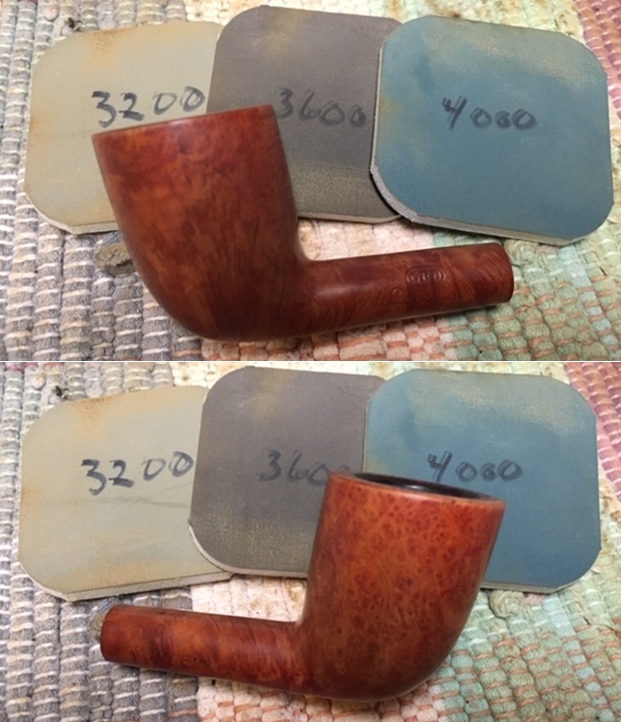
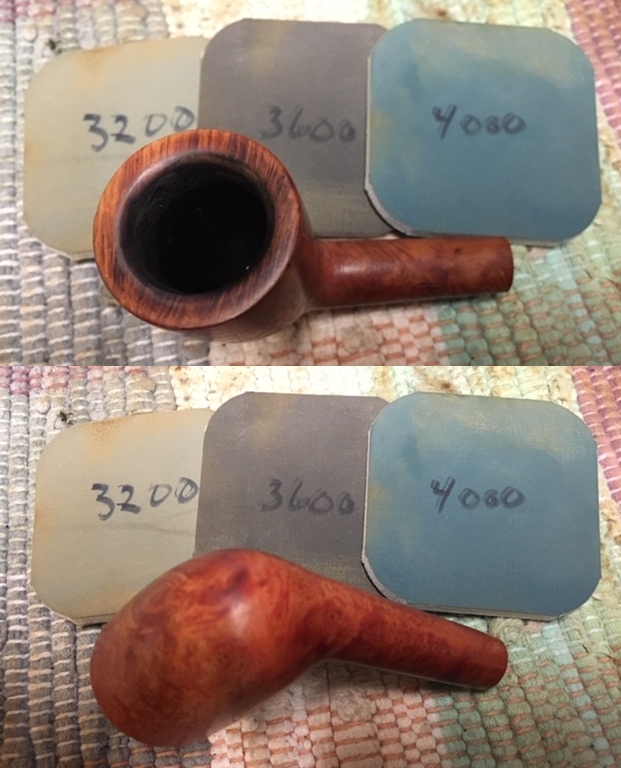
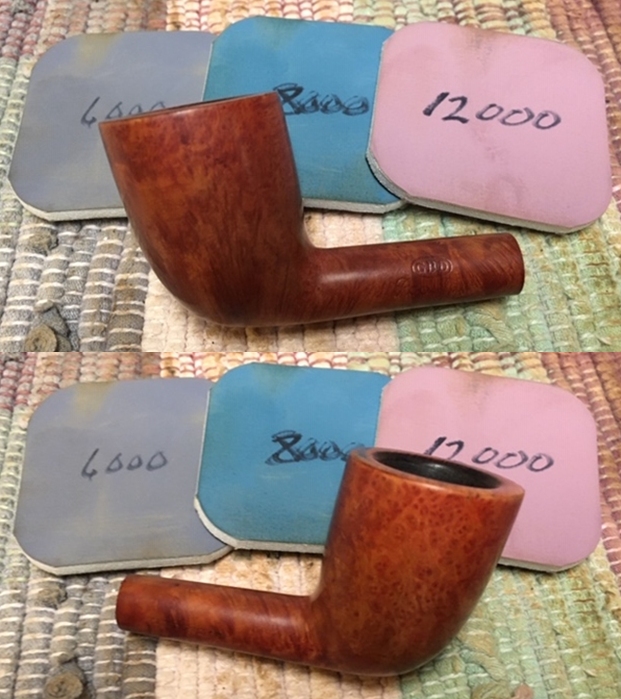
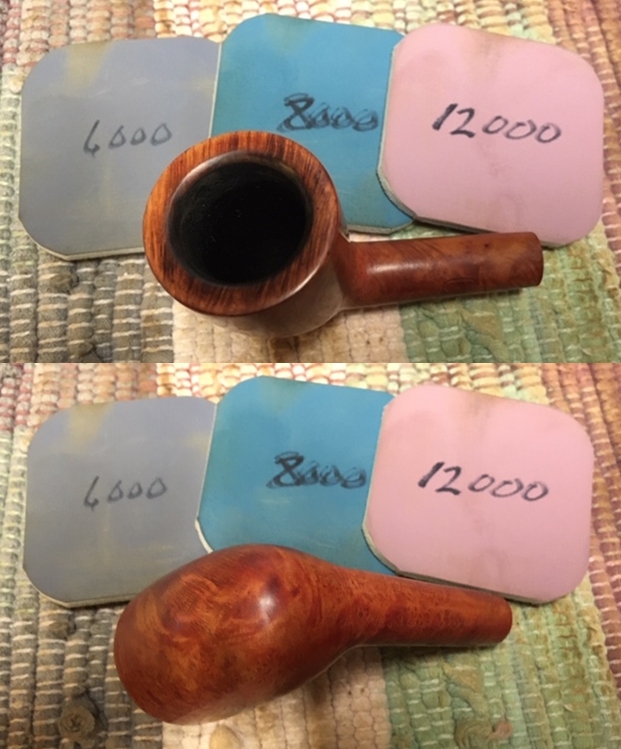
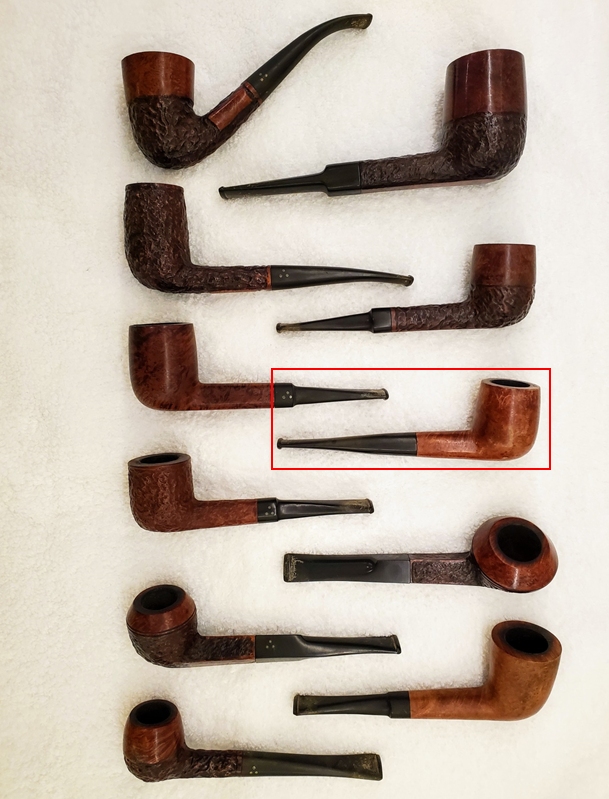
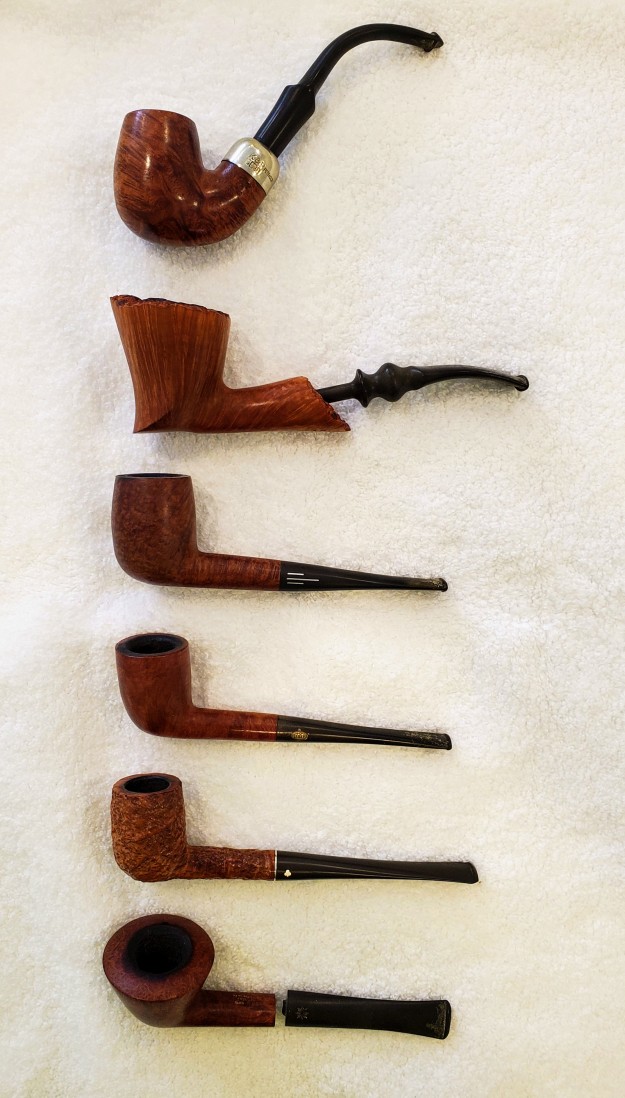
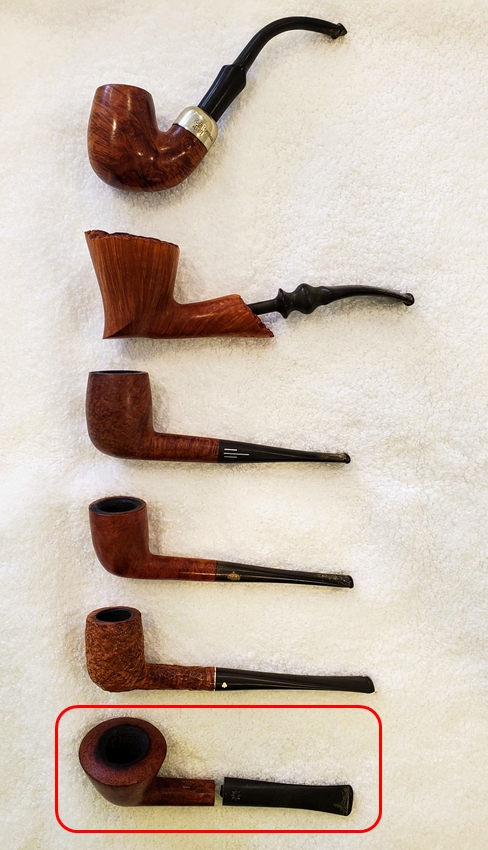
It turns out he said he had 17 pipes. That was certainly more than I expected but I communicated that there was a large queue ahead of him and I would have to fit them in as I could. He was fine with whatever time it took. He sent me the following photos of his collection that he wanted restored. The first photo shows his eleven Brigham pipes – all very interesting shapes. The second photo shows the six various pipes in the collection – A Republic Era Peterson’s System 1312 (Canadian Import), A Bjarne Hand Carved Freehand, a Comoy’s Everyman London smooth billiard, a GBD Popular Dublin 12, an English made Kaywoodie Rustica 72B, a Kriswill Bernadotte 60 with a broken tenon. When the box arrived there were two additional pipes included for a total of 19 – a Ropp 803 Deluxe Cherrywood Poker and a Comoy’s Sandblast Everyman Canadian 296. It was a lot of pipes! I have been randomly choosing the next pipe to work on and chose the Bjarne Hand Carved Freehand that is shown in the second photo below. I have drawn a purple box around the GBD Popular 12 Dublin in the photo below. I have also put and X through all of the pipes that I have finished. I am making progress on the lot – I have finished 17 pipes now and this is the 18th.The 18th pipe that I took out of the box was a GBD Popular. It had a smooth finish. It was stamped on both sides of the shank. On the left side it read GBD in an oval over Popular in script. On the right side it was stamped Made in England and under that was the shape number 12. The finish was really dirty and spotty looking. The rim top had a thick coat of lava on the flat surface and the beveled inner rim. The bowl had a thick cake in it that was hard and crumbling. The vulcanite stem was lightly oxidized and had tooth marks and chatter near the button on both sides. The GBD roundel on the left side of the stem looked good. It seemed to have tabs around the edges that held it on the stem surface.   I took close up photos of the bowl and rim top to show the condition of the bowl and the darkening and damage to the inner edge as well. You can also see the cake in the bowl. I also took close up photos of the stem to show its condition as mentioned above. I took photos of the stamping on both sides of the shank to show what I was speaking about above. It is very readable. On the left side it reads GBD in an oval over Popular.  On the right side it read Made in England over the shape number 12.  The stem also had a GBD Roundel on the left side of the taper.   Before doing cleanup work on the pipe I decided to do some research on the pipe. I looked first on the Pipephil website and found nothing on the Popular line. I turned to Pipedia and also was disappointed to find nothing on the line. Hitting the dead end I decided to turn to working on the pipe. I reamed the bowl with a PipNet pipe reamer to remove the cake. I cleaned up the remaining cake with a Savinelli Fitsall Pipe Knife. I sanded the bowl walls with 220 grit sandpaper on a piece of dowel to smooth them out. I was happy that the walls looked very good.   I scraped off the lava on the rim top with the edge of the Fitsall Pipe Knife. I used a folded piece of 220 grit sandpaper to clean up the top of the rim and the bevel on the inner edge. I was able to make it look significantly better. I cleaned the mortise and the airway in the shank and stem with alcohol, cotton swabs and pipe cleaners. They were dirty but the pipe is clean now.   I scrubbed the surface of the bowl and rim top with undiluted Murphy’s Oil Soap to remove the grimes, oils and tars and leave the surface clean. I rinsed it off with warm running water to remove the grime and the soap.   I polished the bowl and rim top with micromesh sanding pads – wet sanding with 1500-12000 grit pads. I wiped the rim down after each sanding pad to remove the dust and debris from the sanding. The rim top was looking very good after the final polishing pad.     Once I had finished with the 2400 grit pad I touched up the colour of the rim top using an Oak Stain Pen. It blended very well with the colour of the bowl and shank. Once it cured I went on with the polishing with the remaining micromesh pads. I rubbed the bowl and shank down with Before & After Restoration Balm. I worked it into the surface of the briar with my fingertips to clean, enliven and protect it. I let the balm sit for a little while and then buffed with a cotton cloth to raise the shine.     I set the bowl aside and turned my attention to the stem. I rubbed the stem down with Soft Scrub on with a cotton pad and it removed the oxidation. It was looking better.     I sanded out the remaining tooth marks, chatter and oxidation with 220 grit sandpaper and started the polishing with 400 grit wet dry sandpaper.     I rubbed down the stem with Denicare Mouthpiece Polish, a red gritty paste and a cotton pad to remove the remnants of oxidation and to blend in the sanding. The stem is starting to show promise at this point in the process.  I polished the stem with micromesh sanding pads – wet sanding it with 1500-12000 grit pads. I wiped the stem down after each sanding pad with a cotton pad to remove the sanding debris.  I finished polishing the stem with Before & After Pipe Stem Polish – both fine and extra fine. I finished by wiping it down with Briarville’s No Oxy Oil and buffing it to a shine.   It feels good to be one pipe away from finishing the restoration of this 19 pipe lot from Eastern Canada. With the completion of this one I have finished 18 of the pipes. I put the English Made GBD Popular 12 Billiard back together and buffed it with Blue Diamond on the buffing wheel. I gave the bowl and the stem multiple coats of Conservator’s Wax. I buffed the pipe with a clean buffing pad to raise the shine. It is fun to see what the polished bowl looks like with the grain showing through the rustication on both sides and the smooth rim top. Added to that the polished black vulcanite stem was beautiful. This nicely finished GBD Popular Billiard is nice looking and feels great in my hand. Have a look at it with the photos below. The dimensions are Length: 5 ¾ inches, Height: 1 ¾ inches, Outside diameter of the bowl: 1 ¼ inches, Chamber diameter: ¾ of an inch. Once again I am looking forward to what the pipeman who sent it thinks of this restoration. Only 1 more pipe to do in this lot! Thanks to each of you who are reading this blog. Remember we are not pipe owners; we are pipemen and women who hold our pipes in trust until they pass on the trust to the next pipeman or woman.

Refurbishing A Preben Holm # 3 Freehand Pipe


Blog by Paresh Deshpande

The first ever Preben Holm in my collection was from eBay about two years back. It came to me with a broken stem and tenon stuck in to the mortise. This pipe received a new lease on life in the month of May last year when Steve, Jeff and Dal Stanton visited me here in India. I learned the process of tenon replacement along with many other tips and processes in pipe restoration. Here is the link to the informative write up by Steve on this pipe; https://rebornpipes.com/2019/05/14/restoring-a-preben-holm-hand-cut-sandblast-freehand-in-pune-india/

The second Preben Holm in my collection came from my Mumbai Bonanza, which I really enjoyed working on; (https://rebornpipes.com/2019/08/12/refurbishing-a-tired-preben-holm-1-from-the-mumbai-bonanza-lot/) .

The Preben Holm, currently on my work table, came to me from a seller on eBay along with another Preben Holm. Both these pipes had some serious stem issues which really kept other buyers away from placing their bids and lucky me, I got both these pipes for a really good price. Even though both pipes came to me together, I shall be working on them separately since they each have different set of issues involved.

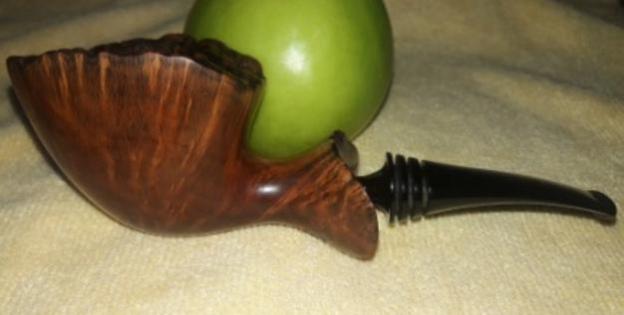
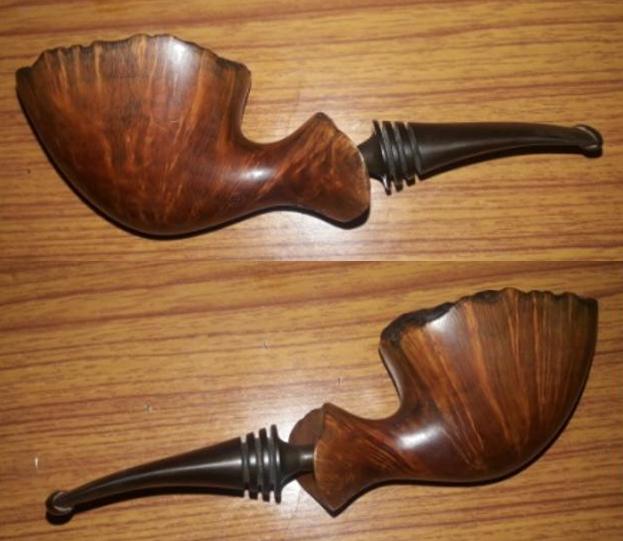
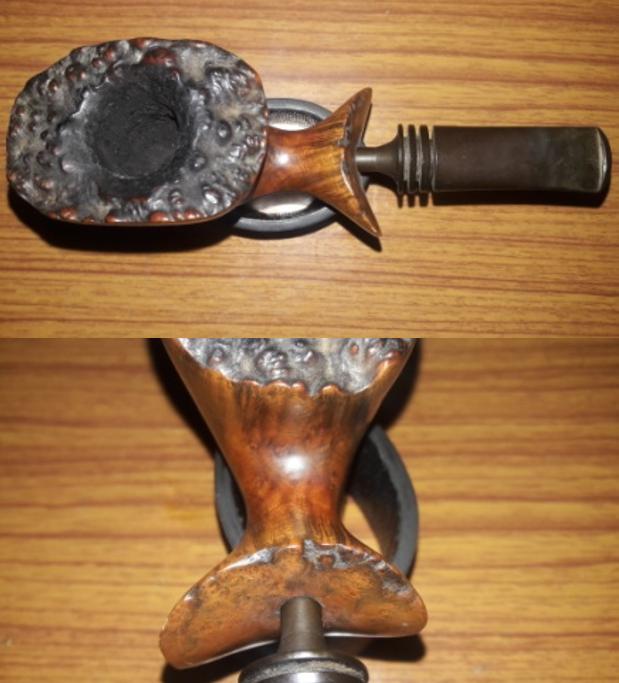
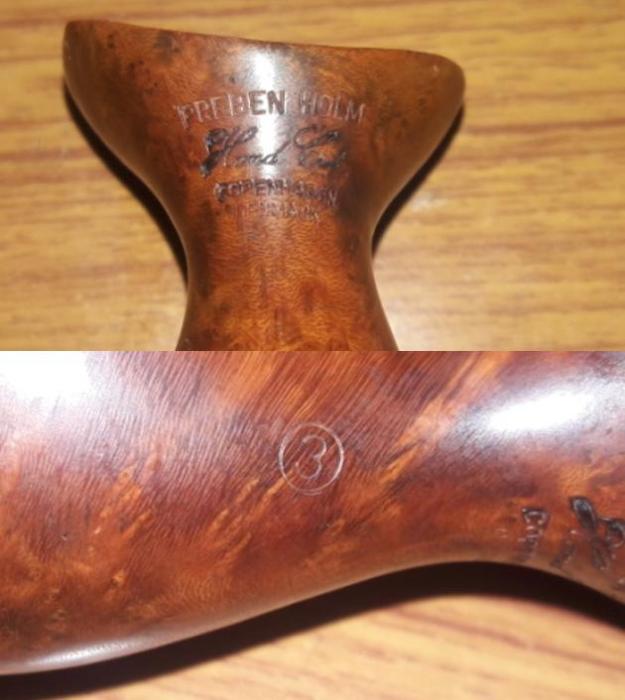
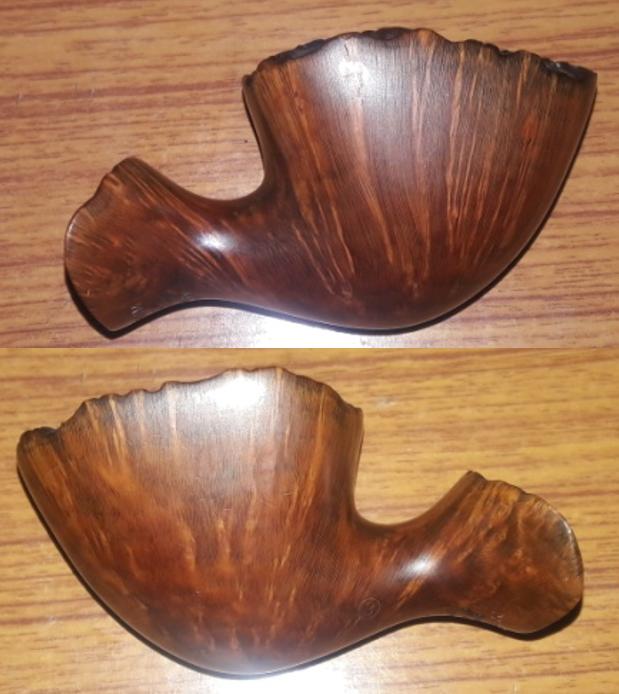
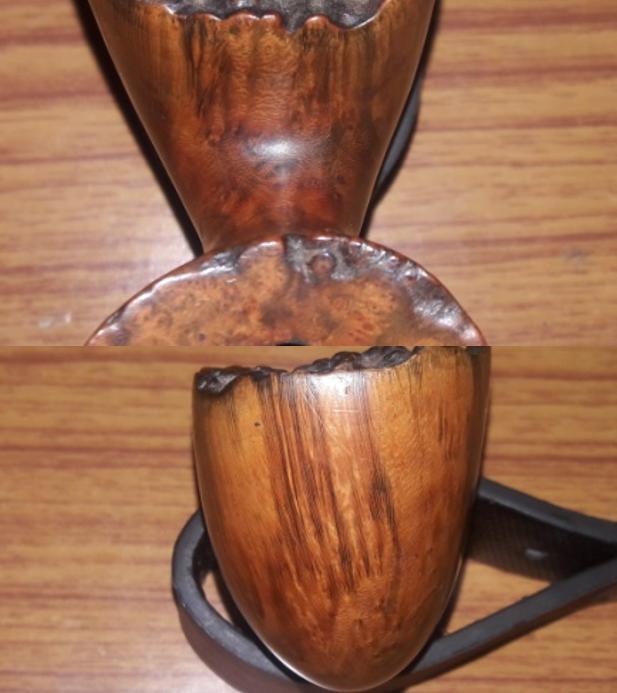
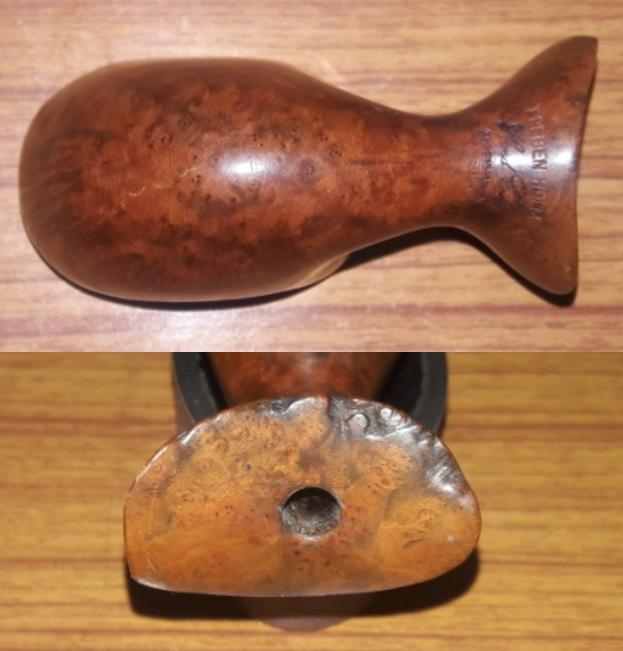
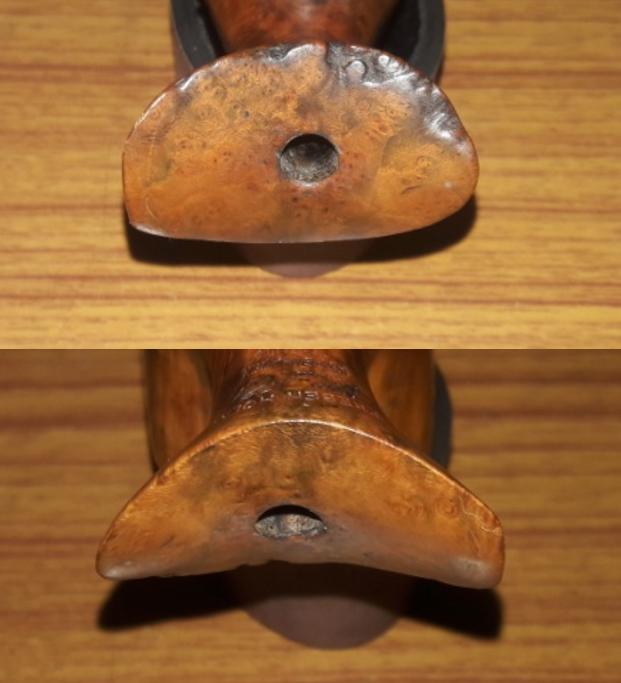
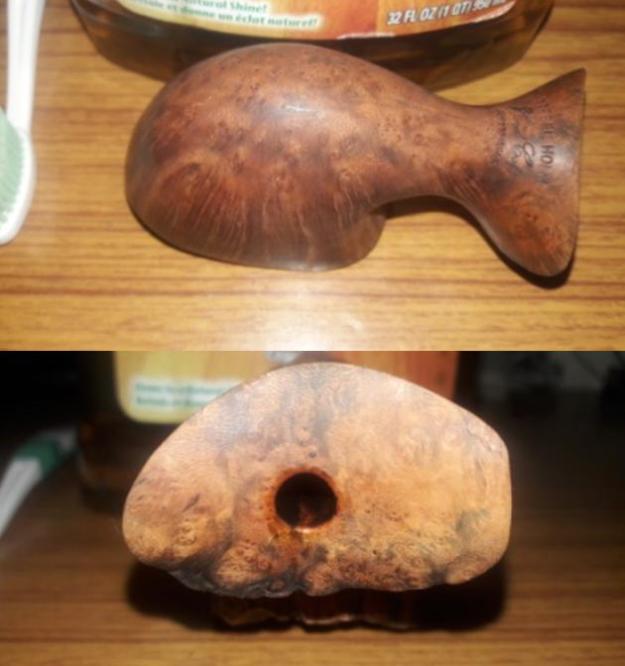
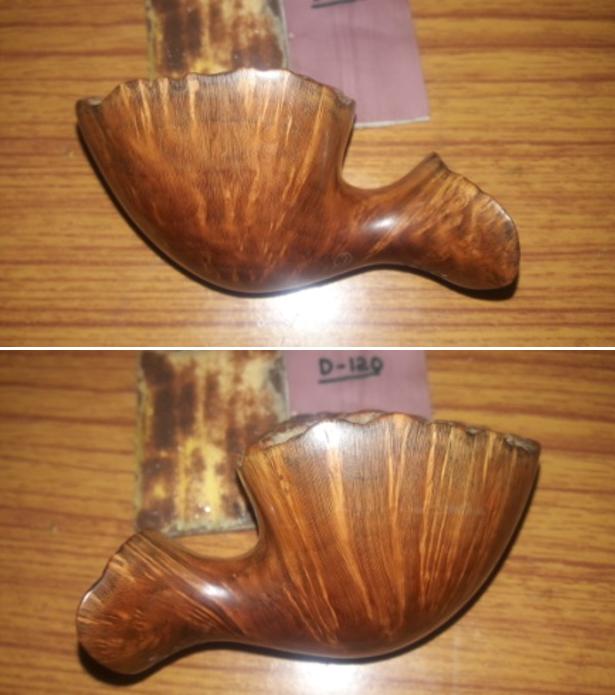
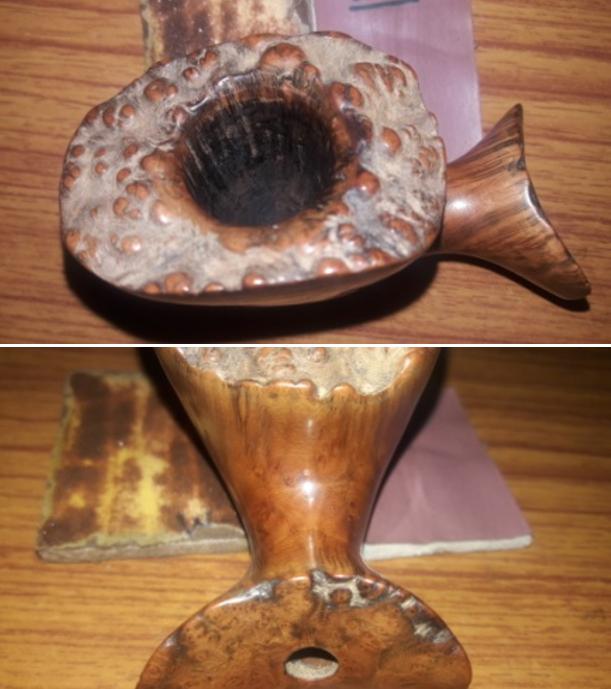
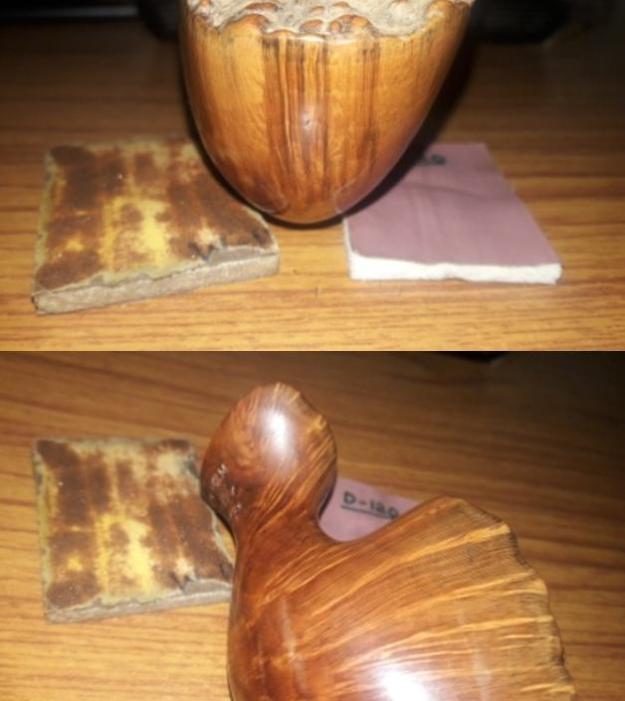
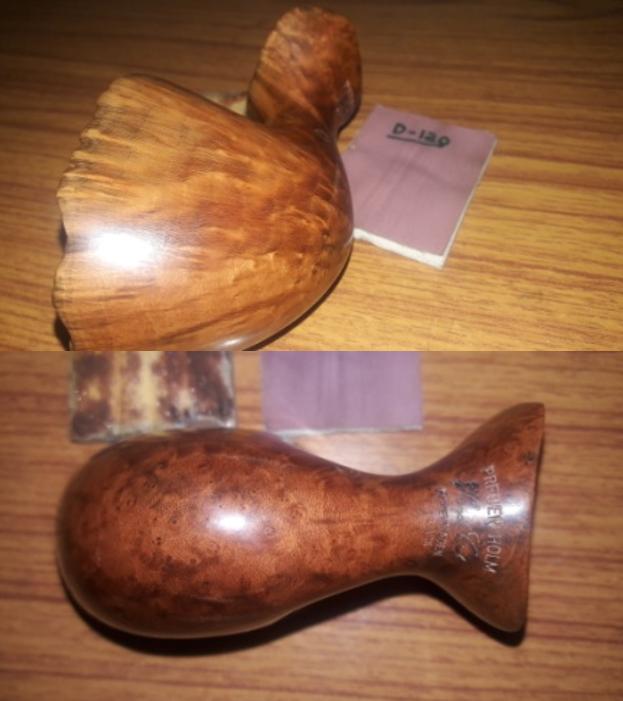
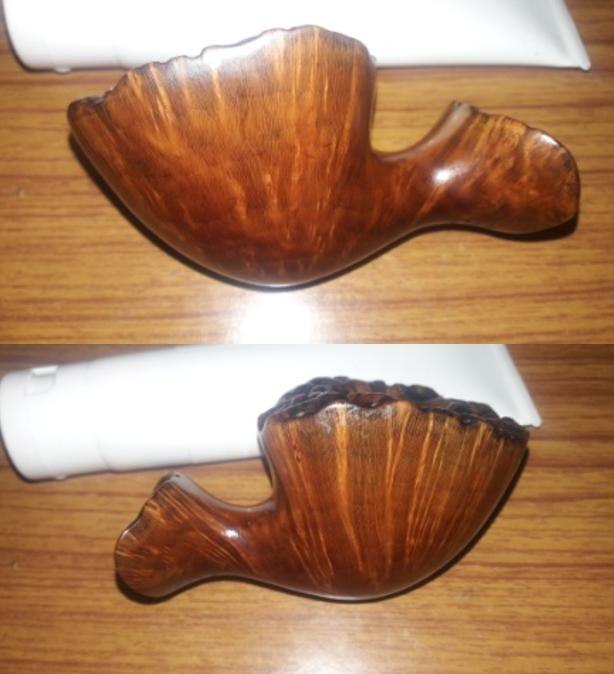
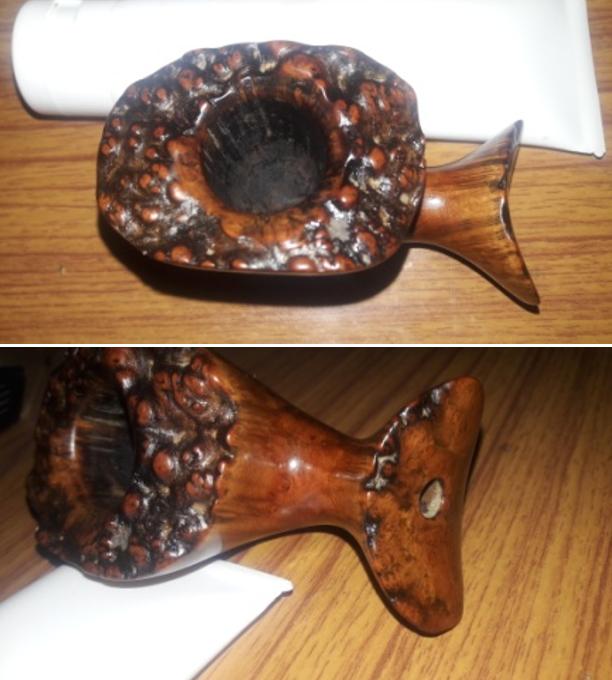
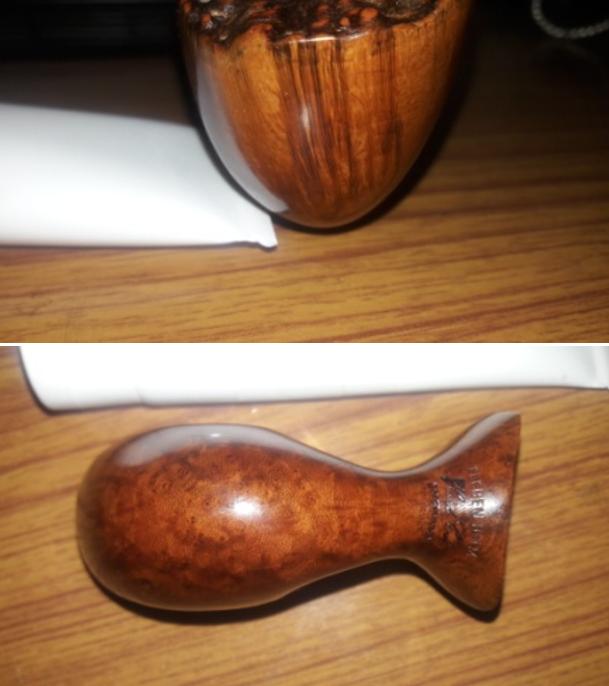
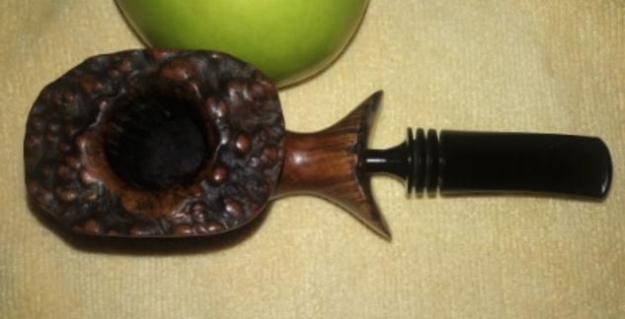
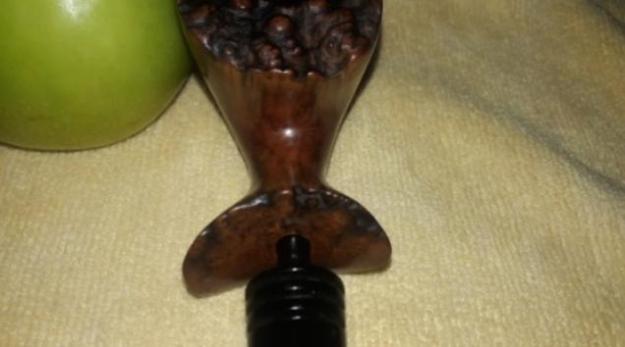
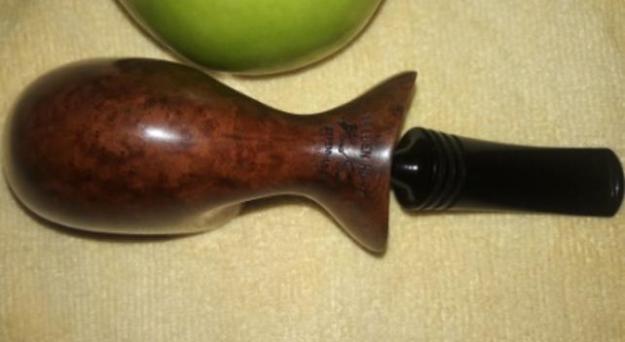
The first PH that I selected to work on is a beautiful freehand with some great flame grains all around the stummel and shank and bird’s eye at the foot of the stummel. The shank end has a nice large outward flare with a flattened lower edge, akin to a large whale tail fin. The rim top is a nice plateau with the shank end flare showing minor plateau along the upper outer edge, similar to the scars on a tail fin of a whale that has seen a few skirmishes in its lifetime. Here are the pictures of the pipe as it sits on my work table.   The pipe is stamped on the bottom of the flared shank end as “PREBEN HOLM” in block capital letters over “Hand Cut” in a cursive artistic hand over “COPENHAGEN” over “DENMARK”, all in block capitals. The left side of the shank bears the encircled numeral “3”. All the stampings are crisp and easily readable. The fancy vulcanite stem is devoid of any stampings.There is a lot of interesting information on the carver, Preben Holm, on pipedia.org (https://pipedia.org/wiki/Holm,_Preben) which makes for an interesting read, however, as before when I had worked on a PH from my Mumbai Bonanza, I still could not find any information on dating this particular piece of briar and also the significance of the # 3!!   I had made a humble appeal to all the readers then and making one again, to please share any information on this system of numbering followed by Preben Holm and also method of dating PH pipes.

Initial Visual Inspection
I am making a slight deviation from my usual process that I follow for my write ups in that, in this case, I shall first address an issue that I was aware of from the description given by the seller and thereafter continue with my initial inspection. The seller had advertised that the stem was stuck in to the pipe (mortise) and would not budge. True enough, when the pipe arrived, the stem was firmly stuck in to the mortise and no amount of twists and turns loosened the seating of the stem. I did not wrestle too hard with it as I did not want to have another broken tenon on my hands. I chucked the complete pipe in to the freezer and let it sit for 3-4 hours. Once I removed the pipe from the freezer, I heated the shank a little with my heat gun and gave it a gentle twist and the stem came out intact quite easily. I was very pleased with this progress. I sincerely apologize for not taking any pictures of this process. Now that the stem has been separated from the mortise, I proceed to complete my initial inspection.

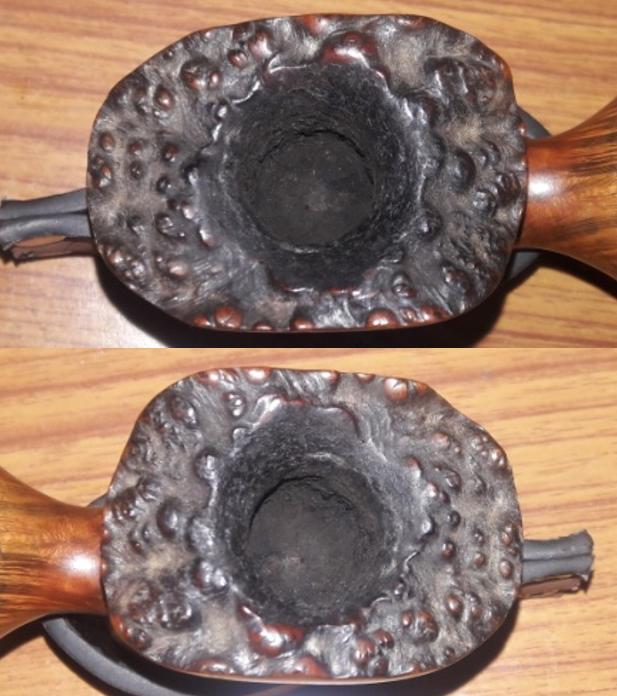
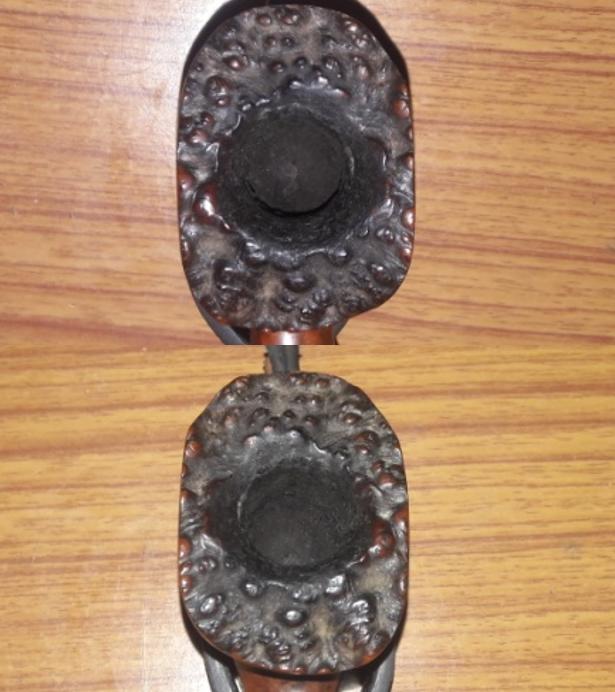
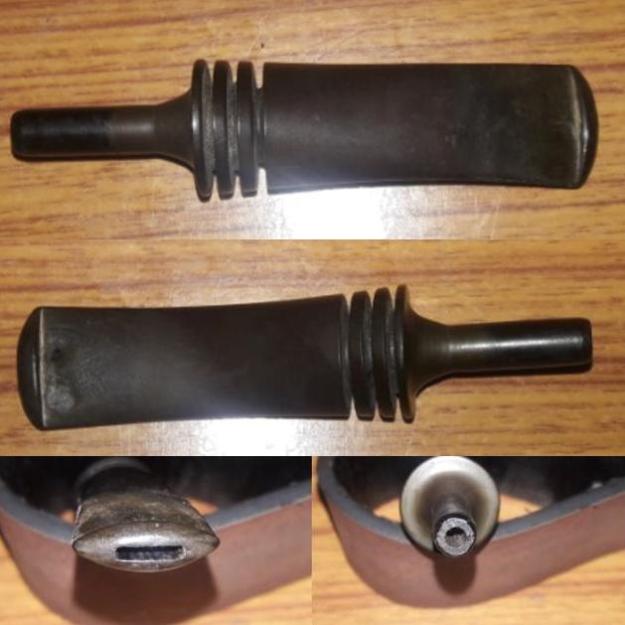
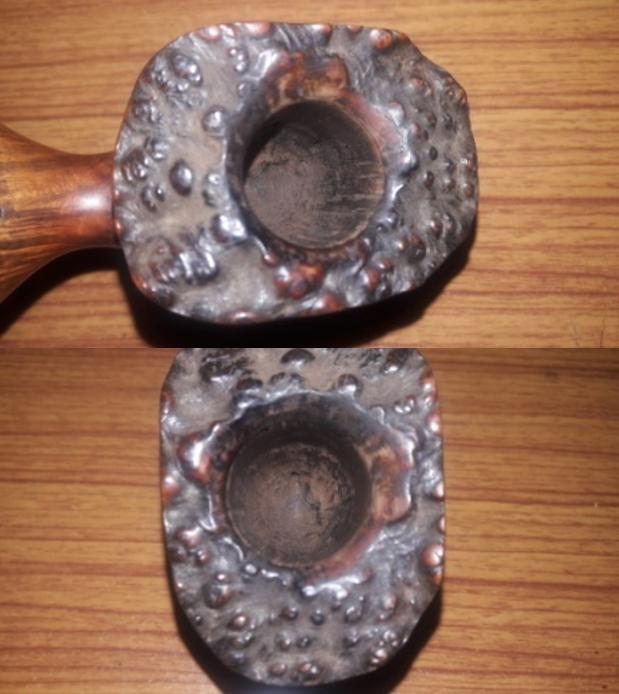
The chamber has a thick layer of dry and hard cake with heavy overflow of lava on to the platue rim top surface. The slightly outward flared inner rim edge is covered in oils and tars, but there are no apparent signs of charring. The condition of the inner walls of the chamber can be checked and ascertained only after the cake has been taken down to the bare briar. The stummel boasts of beautiful flame grains all around and extends over the shank surface too!! The surface is relatively clean and without any fills save for a few scratches that could have been caused during routine use. The flared end of the shank is clean with the partial plateau top edge showing accumulated dust and dirt which should be a breeze to clean. The foot of the stummel shows beautiful bird’s eye grains and is sans any damage. Overall, the stummel presents a well cared for pipe. The mortise is clogged with accumulated oils and tars. That the draw is not as smooth and full was expected, given that the stem was firmly stuck in. With a through leaning, this issue should be resolved.The fancy vulcanite stem is where maximum damage is seen on this pipe. It is heavily oxidized and is peppered with deep tooth chatter/ indentations on either surface of the stem. The lower button edge has a bite through and will need to be repaired. The horizontal slot end of the stem is heavily oxidized to a dark brown coloration while the tenon end is covered in dried oils and tars. The button edges on either surface have worn down and will need to be sharpened. The fancy stem, though looks beautiful when black and shiny, is a bear to clean with all the dips and narrow gaps between the beads and rings etc.The Process
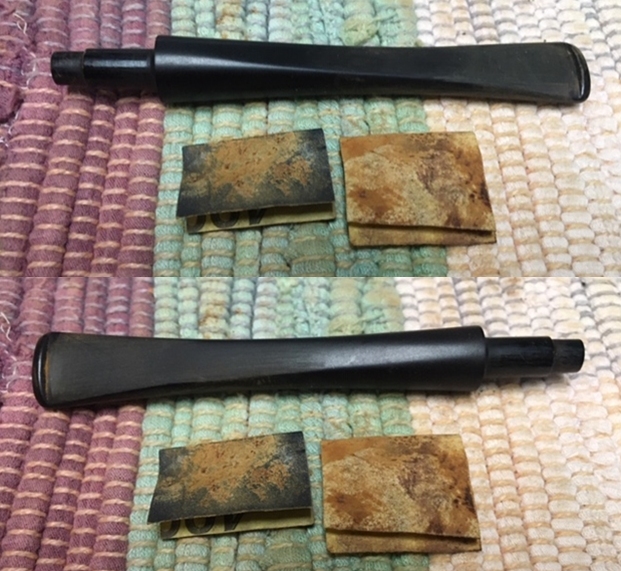
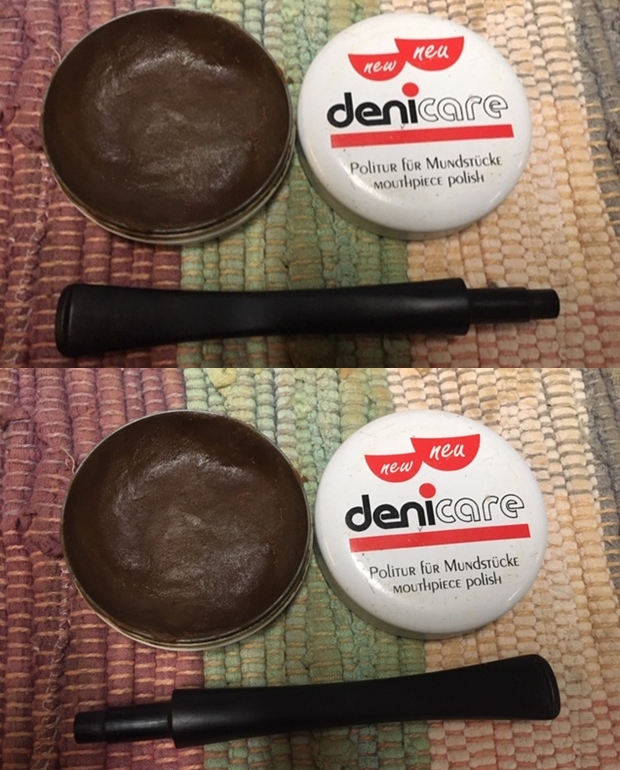
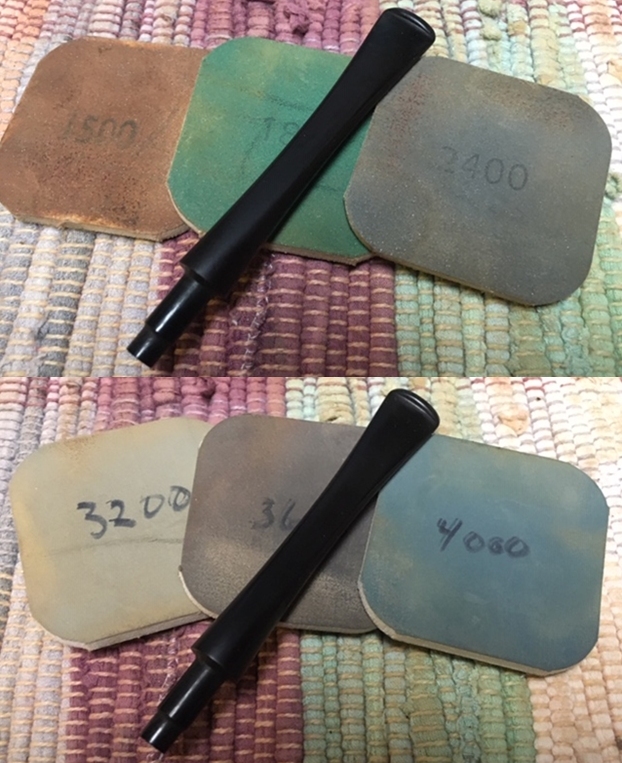
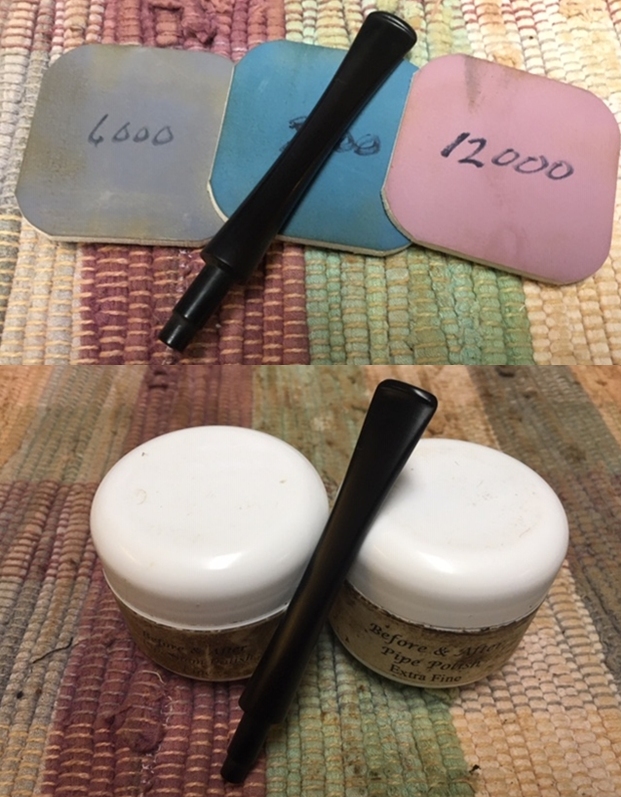
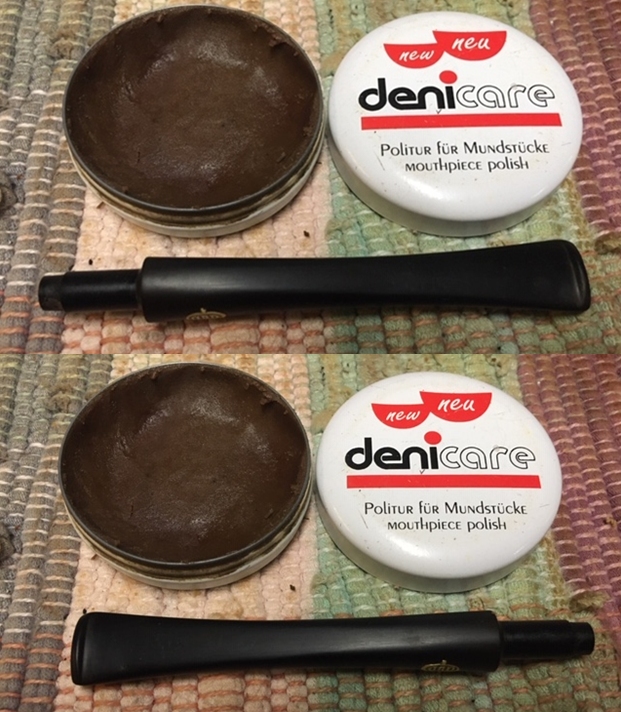
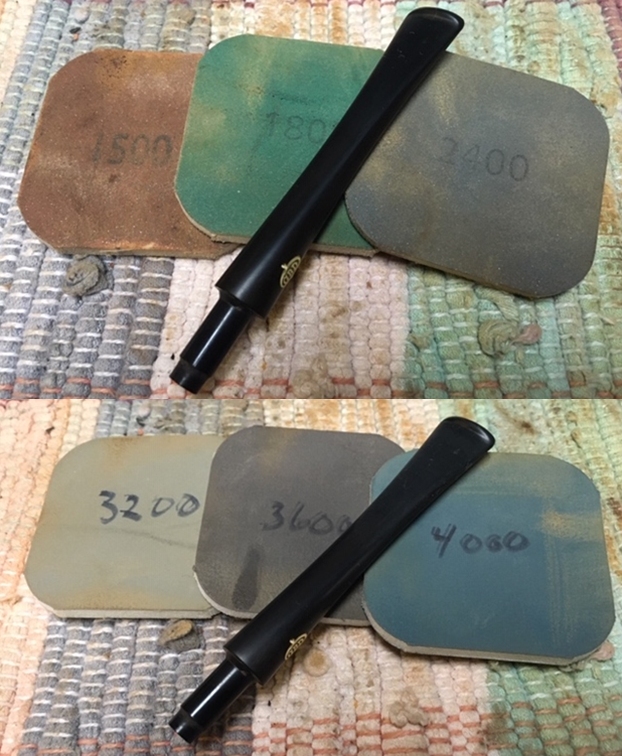
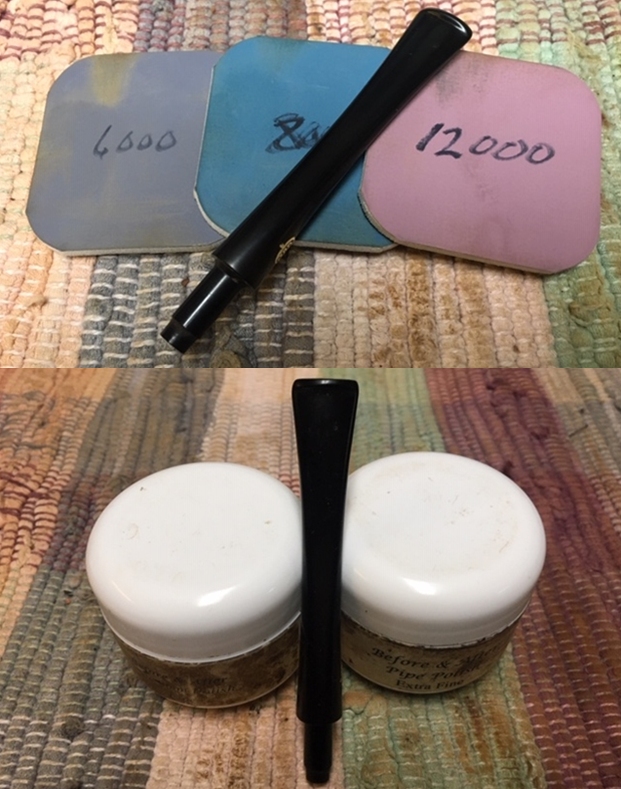
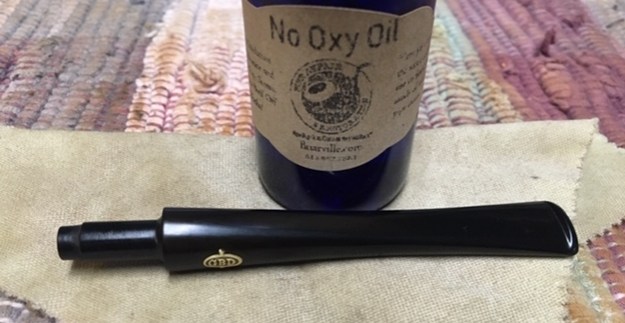
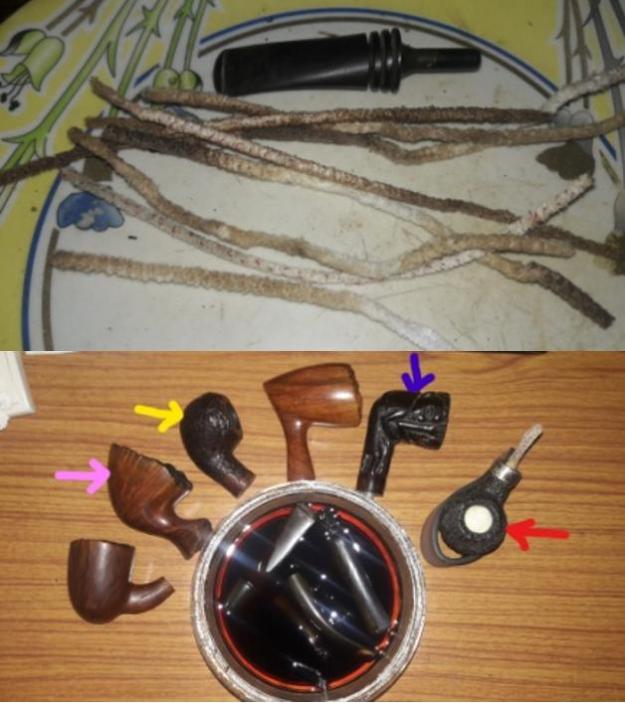
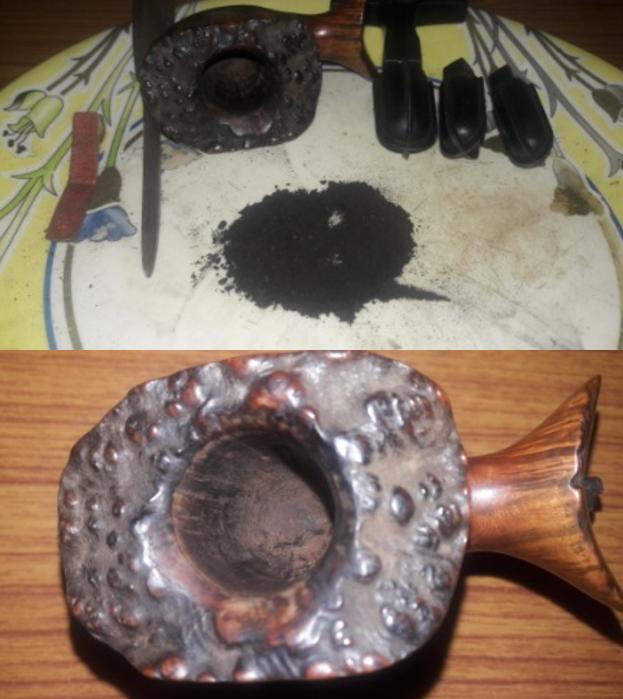
I began the process of refurbishing this pipe with cleaning the internals of the stem using pipe cleaners with isopropyl alcohol (99.9% pure) and dunking the stem in to “Before and After Deoxidizer” solution developed by my friend Mark Hoover. The solution helps to draw out heavy oxidation to the surface making its further removal a breeze, while the minor oxidation is eliminated to a very great extent. I usually dunk stems of 5-7 pipes that are in-line for restoration and this pipe is marked in pastel pink arrow. I generally allow the stems to soak in this solution overnight for the solution to do its work.With the stem soaking in the deoxidizer solution, I worked the stummel starting with reaming the chamber with a Castleford reamer tool, using the second, third and fourth head of the tool. Using my fabricated knife; I further take the cake down to the bare briar. With a 150 grit sand paper, the walls of the chamber were rid of all the remnants of the cake, revealing smooth and solid chamber walls. I further wiped the chamber with a cotton swab wetted with isopropyl alcohol to completely remove the sanding dust. Next, I tried cleaning the mortise with hard bristled and regular pipe cleaners dipped in isopropyl alcohol. However, the pipe cleaners would not pass through the draught hole and in to the chamber. I used my fabricated tool, a simple straightened cloth hanger, and pried clear the chunk of dried gunk. This was followed by cleaning the shank internals with pipe cleaners and isopropyl alcohol. I further scrapped out the entire moistened gunk with a dental tool. The shank internals cleaned up nicely with a smooth and full draw.I scrubbed the external surface of the bowl with undiluted Murphy’s oil soap and hard bristled tooth brush and dried it using paper towels and soft cotton cloth. I deliberately cleaned the plateau rim top to clean the entire lava overflow from the surface. The entire stummel cleaned up nicely. I set the stummel aside to dry out naturally. Staying with the stummel restoration, I polished the stummel with micromesh pads, wet sanding with 1500 to 12000 pads. I polished the raised surfaces on the plateau rim top surface. I wiped the surface with a soft cloth at the end of the micromesh cycle. The stummel looks amazing with a deep shine and beautiful grains popping over the stummel surface. However, I am not very happy with the way the rim top appears at this stage. No amount of wiping with a moist cloth could address this issue. If I wash it again with Murphy’s oil soap, it will be like going back to square one!! I would request all the esteemed readers to suggest remedial methods to this issue and help me learn. I rubbed a small quantity of “Before and After Restoration Balm” in to briar. I rubbed this balm deep in to the nooks and crannies of the plateau rim top surface with my fingers and let it rest for a few minutes. The balm almost immediately works its magic and the briar now has a nice vibrant appearance with the dark brown hues of the grain contrasting with the rest of the stummel surface. I further buff it with a horse hair shoe brush. The rim top has now taken on dark hues which is an eye sore at this stage. As mentioned in the write up on refurbishing S & R, Donegal Rocky # 999 and Countryman, I had worked on all the stems that had been soaking in the deoxidizer solution overnight. I fished out all the stems and cleaned them under running warm water and scrubbed the raised oxidation from the stem surface using Scotch Brite pad. I further removed the oxidation by scrubbing the stems with 0000 grade steel wool and applied a little olive oil to rehydrate the stems and set them aside for the oil to be absorbed. Unfortunately, I did not click any pictures of these stems at this stage.

This is how the stem of this pipe came out after the stem cleaning described above. Deep tooth indentations are visible at the base of upper and lower button edges with heavy tooth chatter visible in the bite zone on the lower surface. Complete oxidation was removed on this stem by the process described above.

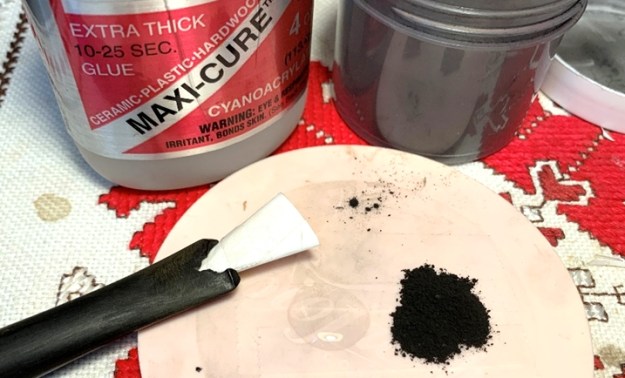
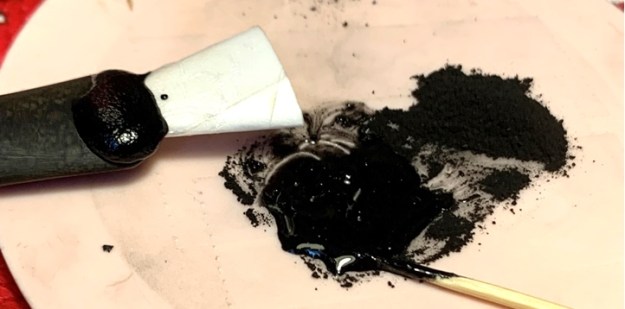
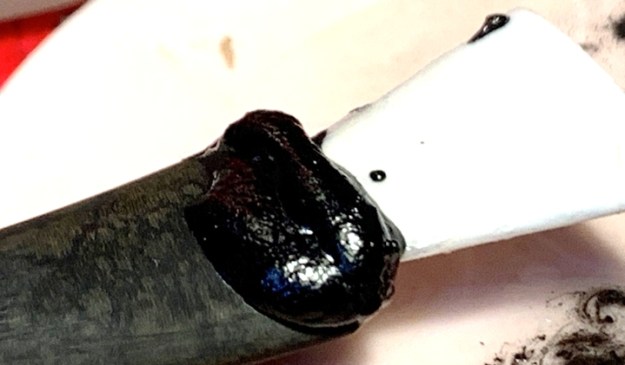
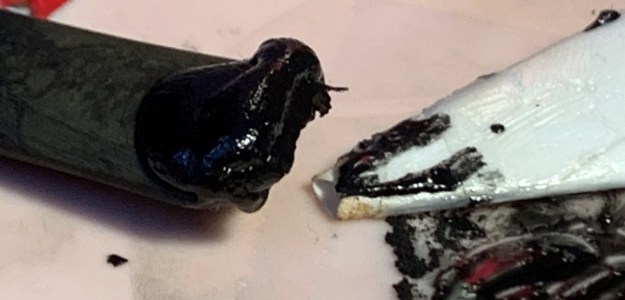
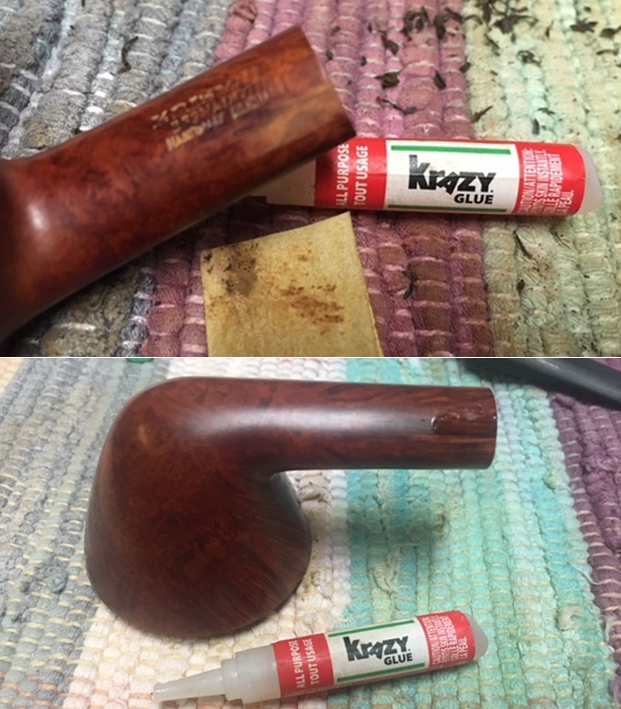
I painted both surfaces of the stem with the flame of a lighter to raise the tooth indentations to the surface. This also helps in loosening minor oxidation from the stem surface. I sand the entire stem surface with a folded piece of a 220 grit sand paper to even out the raised tooth chatter and the tooth indentations to a degree and also to remove the loosened oxidation. I wiped the stem with a cotton swab and Murphy’s oil soap to further remove the oxidation. Even though the most of the tooth chatter has been addressed by heating the damaged stem portion with the flame of a lighter, couple of deeper indentations and bite marks/ deformation to the button edges is still visible on both upper and lower surface in the bite zone. At this stage in stem repairs, I now had a clear idea as to the extent of the through hole in the bottom surface of the stem. I also realized that the surrounding stem surface around the hole has thinned out and is brittle. However, I am happy with the way this stem appears at this stage and also with the deoxidizer solution. I filled the tooth indentation in the button edge on both lower and upper stem surfaces with a mix of activated charcoal and CA superglue and set it aside for the fill to cure. Once the fill had cured sufficiently, with flat needle file I sanded the fills to match with rest of the stem surface. With the same file, I sharpened the button edge on both the upper and lower surface. I fine tuned the blending of the fill with the rest of the stem surface using a 220 grit sand paper and also sanded down the entire stem to remove the stubborn residual oxidation. I further sand the stem with 600 and 800 grit sand paper and wiped the stem with cotton pad dipped in alcohol to remove the resultant dust. I rubbed some extra virgin olive oil in to the stem and set it aside to be absorbed in to stem. I polished the stem with micromesh pads, wet sanding with 1500 to 12000 grit pads. I rubbed a little extra virgin olive oil in to the stem at the end of the micromesh pads polishing cycle. I completed the polishing regime of the stem by rubbing a small quantity of Paragon wax and giving it a final polish with a soft cotton cloth. The stem is now nice, smooth and shiny.To apply the finishing touches, I mount a cotton cloth buffing wheel on to my hand held rotary tool and apply a coat of Blue Diamond to the stem to polish out the minor scratches. With a cotton buffing wheel that I use for carnauba wax, I apply a coat of carnauba wax to the stummel and stem and continued to work on it till the complete coat of wax had been polished out. I mount a clean cotton cloth buffing wheel and gave the entire pipe a once over buff. I finished the restoration by giving the entire pipe a rigorous hand buffing using a microfiber cloth to deepen the shine further. The finished pipe is shown below. P.S. – This was an indeed an easy restoration. The issue of the stem being stuck inside the mortise had driven bidders away from this beautiful pipe and it proved to be my gain. I am really fortunate to be in the process of learning the nuances of pipe restoration and cannot thank Steve enough for his support and guidance.

I wish to request all the experienced readers to shed some light on the numbering system followed on Preben Holm pipes and also on dating these pipes for the larger good of our fraternity.

Thanks for your patience and looking forward to input about the write up. Cheers…

New Life for an Anscot Bullmoose


Blog by Steve Laug

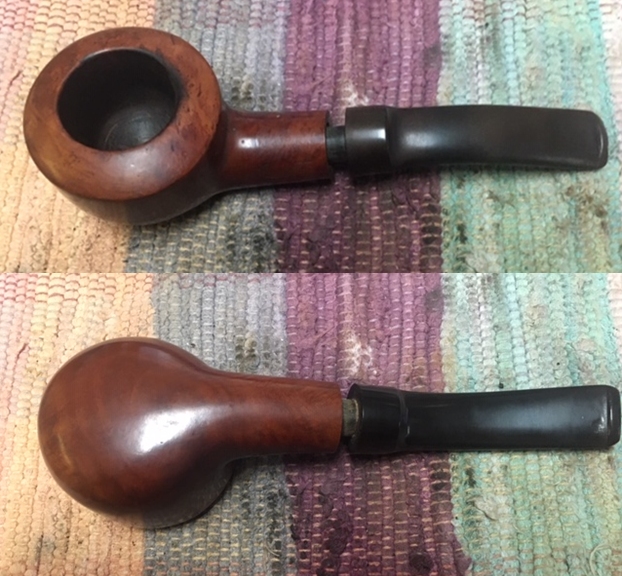
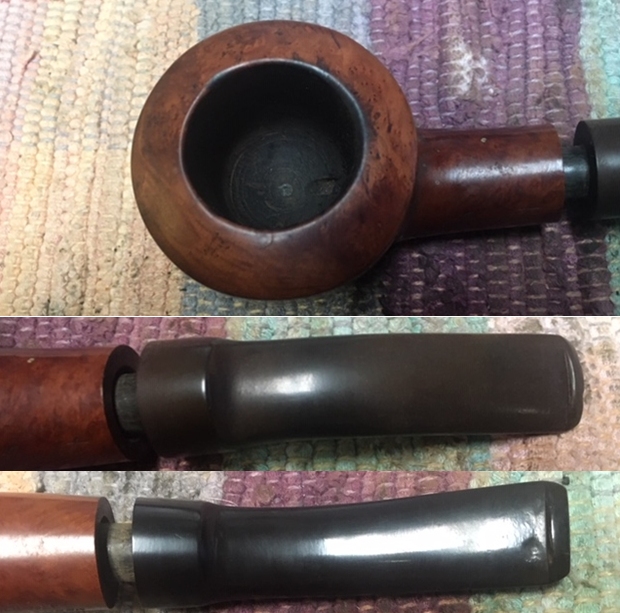
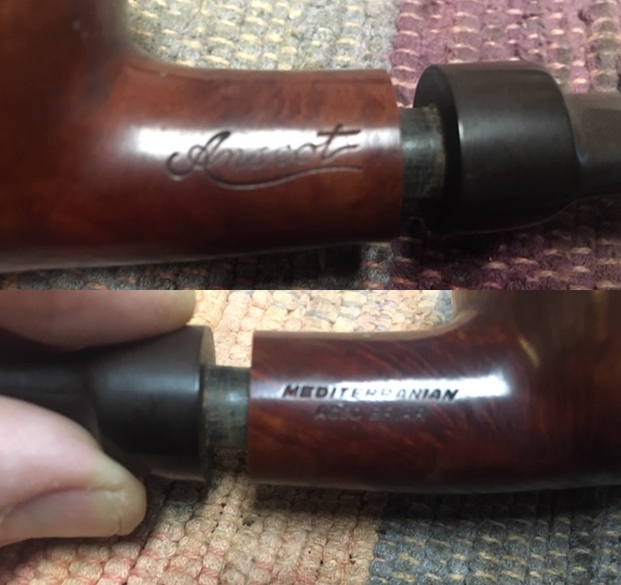
I just finished working on the Marxman Jumbo Bench Made Poker for the fellow in Quebec. I wrote a blog about it (https://rebornpipes.com/2020/02/28/restoring-an-obstinate-marxman-jumbo-war-club/). When he sent the Marxman he included another pipe that he wanted to donate for the support of the SA Foundation. I am always glad to work on those and pass them on to others who not only want a good pipe but want to donate to a worthy cause – the restoration and recovery of women and children who have escaped sexual exploitation and trafficking. It’s a large pipe stamped on the left side of the shank in script and read Anscot. On the right side it is stamped Mediterranean Aged Briar. The stamping is clear and readable. The stem did not seat in the shank completely and was very tight. The finish was shiny and dirty like it had been coated with varnish or shellac. There was one large fill on the front of the right side mid-bowl. The bowl had been cleaned and there was a small bit of cake in the base of the chamber near the entrance of the airway. The rim top had some burn damage on the inner edge of the bowl toward the front of the bowl. The inner edge of the chamber was out of round and damaged. The stem was high quality vulcanite and had tooth chatter and marks on both sides near the button. The stem would not seat against shank. The photos show what I saw as I examined the pipe. I took close up photos of the rim top and the stem. The photos confirm the condition of the pipe that I described in the paragraphs above. You can see the darkening on the inner edge of the rim top. There were also scratches and nicks all around the rim top. The stem is also lightly oxidized and has some deep tooth marks on the top and underside near the button.I took a photo of the stamping on the left side of the shank. It is stamped Anscot in script with the leg of the A extended in a swirl under the whole word. On the right side of the shank it is stamped Mediterranean Aged Briar.I looked up the brand on Pipephil and found nothing there. I did a search for the brand and found a link to a connection between Abraham & Straus, Inc. to Anscot in Brooklyn, New York. There was also a link to picclick (https://picclick.com/Superb-Lh-Stern-anscot-Large-Bull-Moose-Vintage-302658878312.html) where the author linked the brand to LH Stern. That link was tenuous as the photo on the link showed the same stamping that I showed in the photos above.

From the search I did the most I could find out was the link to the pipe shop in Brooklyn, New York. The tie to LHS was not reliable as I could not see any link to the LHS Company. I looked up LH Stern on Pipedia and read through that article but there was no link to Anscot. So the mystery remains. Now it was time to clean up the pipe and restore it. I removed the stem from the shank and saw an interesting stinger inserted in the shank. I took a photo of the pipe at this point.I took the bowl to the work table and reamed it. I used a Savinelli Fitsall Pipe Knife to clean up the light cake in the bowl. I cleaned up the inner edge of the rim with a folded piece of 220 grit sandpaper. I was able to remove the damage to the inner edge and the top of the bowl.I wiped the bowl down with acetone on a cotton pad to break through the thick varnish coat on the bowl. It took a bit of scrubbing but it looked far better. I cleaned the interior of the shank/mortise and the airway in the shank and the stem with pipe cleaners, cotton swabs and alcohol. I removed the stinger from the tenon so that I could clean the airway in the stem. The airway in both and the mortise were dirty and after I had scoured them the pipe was clean and smelled better. With that finished I moved on the polishing the bowl and the rim top with micromesh sanding pads. I polished them with 1500-12000 grit sanding pads and wiped the bowl down with damp cloth to remove the sanding dust. I used a Maple stain pen to touch up the sanded rim top and edges. Once the stain had dried I polished the rim top with micromesh sanding pads to blend it into the rest of the bowl. I rubbed the bowl down with Before & After Restoration Balm. I worked it into the finish with my fingertips. I set it aside to absorb into the briar for ten minutes. Once it had been sitting I polished the bowl surface with a soft cotton cloth. At this point in the process the briar is looking very good. I set the bowl and I turned my attention to the stem. I scrubbed the stem with Soft Scrub and a cotton pad to remove the oxidation and debris on the stem surface. The tooth marks were clearer and the chatter was ready to be polished out.The tooth marks on the top were light and would sand out later. There was one deep tooth mark on the underside of the stem. I cleaned it out with alcohol and a cotton swab. I filled it in with black super glue and let it cure.Once the glue repair cured I sanded it with 220 grit sandpaper to blend it into the surface of the vulcanite. I sanded out the tooth chatter and marks on both sides with 220 grit sandpaper and 400 grit wet dry sandpaper.I polished the stem with Denicare Mouthpiece Polish to remove the light scratching and the light oxidation on the stem surface. The product is a red paste that is gritty and when rubbed with a cotton pad it removes many of the scratches and remaining oxidation.I polished the stem with micromesh sanding pads – polishing it with 1500-12000 grit micromesh sanding pads. I wiped it down with cloth between each sanding pad. I polished it with Before & After Pipe Stem Polish – both Fine and Extra Fine. I gave it a rub down with Briarville’s No Oxy Oil to protect the stem from oxidizing. It was looking very good at this point.   I was looking forward to this part of the restoration when all the pieces are put back together so I can send a photo back to the fellow in Quebec. I put the pipe back together and buffed it with Blue Diamond on the buffing wheel. I gave the bowl and the stem multiple coats of carnauba wax. I hand buffed the pipe with a clean buffing pad to raise the shine. It is fun to see what the polished bowl looks like with the polished black vulcanite stem. This Anscot Mediterranean Aged Briar Bullmoose looks far better than it did when I started. The fill on the right side is present but has blended in very well. The rim top looks much better than when I began. The stem fits well in the shank. The pipe is nice looking and feels great in my hand. The pipe is a sitter so that it can be laid down on a desk top while the pipeman is working on something else. Have a look at it with the photos below. The dimensions are Length: 6 inches, Height: 1 ½ inches, Outside diameter of the bowl: 2 inches, Chamber diameter: 1 1/8 inches. This old Anscot is a beauty and I look forward to what the pipeman buys it thinks of it. Thanks to each of you who are reading this blog. Remember we are not pipe owners; we are pipemen and women who hold our pipes in trust until they pass on into the trust of the next pipeman or woman.

New Life for a Patent Era Brigham Select Billiard Sitter


Blog by Steve Laug

Not too long ago I received an email from a fellow in Kitchener, Ontario regarding some pipes he needed cleaned up. He had been referred to me by my local pipe and cigar shop. While I am not currently adding more pipes to my queue of repairs I have made a commitment to the shop to work on pipes for their customers. Generally they have one or two pipes that need a bit of work. This fellow sent me the following email:

I just came across my smoking pipes that I’ve had in storage for about 40 years. I’m wondering what you’d charge to have them refurbished. There are 17 in total (11 are Brighams and 6 are various).

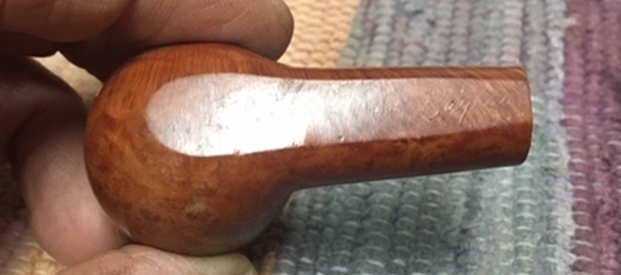
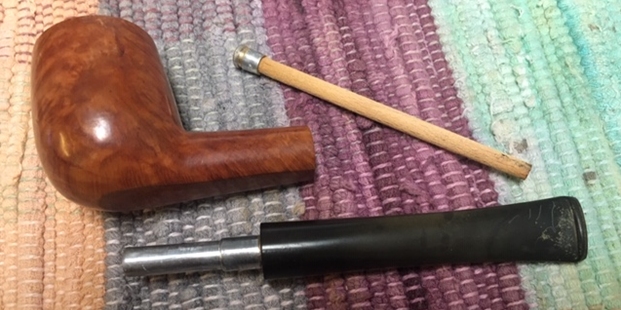
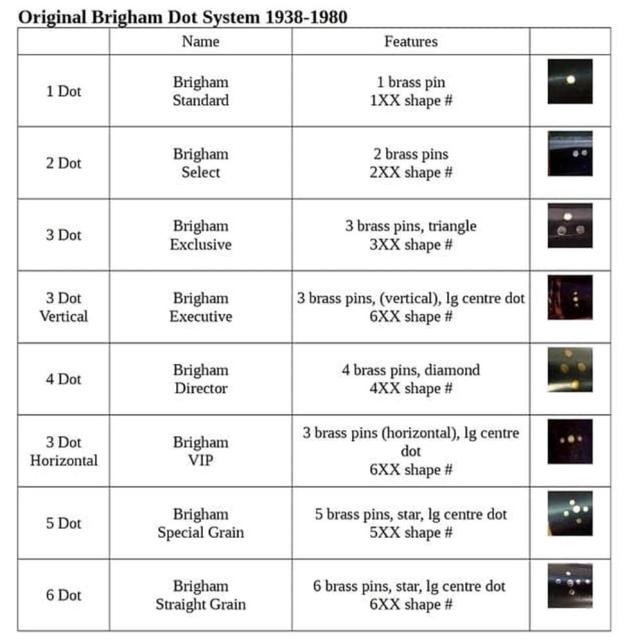
It turns out he said he had 17 pipes. That was certainly more than I expected but I communicated that there was a large queue ahead of him and I would have to fit them in as I could. He was fine with whatever time it took. He sent me the following photos of his collection that he wanted restored. The first photo shows his eleven Brigham pipes – all very interesting shapes. The second photo shows the six various pipes in the collection – A Republic Era Peterson’s System 1312 (Canadian Import), A Bjarne Hand Carved Freehand, a Comoy’s Everyman London smooth billiard, a GBD Popular Dublin 12, an English made Kaywoodie Rustica 72B, a Kriswill Bernadotte 60 with a broken tenon. When the box arrived there were two additional pipes included for a total of 19 – a Ropp 803 Deluxe Cherrywood Poker and a Comoy’s Sandblast Everyman Canadian 296. It was a lot of pipes! I have been randomly choosing the next pipe to work on and chose the Brigham that I have drawn a red box around in the first photo below. When I unwrapped the next pipe it was a flat bottomed Brigham Billiard sitter without clear number stamp. The smooth finish looked like it had a varnish coat and that was spotty around the sides of the bowl. There is a faint Made in Canada with Brigham in a script on the flat bottom of the shank. It looked like it could also have had the Can. Pat. stamp but I could not read it for sure. The rim top has some darkening, nicks and the inner edge is out of round. There is a light cake in the bowl. The 2 Dot tapered stem is oxidized and has tooth marks and chatter near the button and some calcification. I took close up photos of the bowl and rim top to show the condition of the bowl and rim. I also took close up photos of the stem to show its condition as mentioned above.   I took a photo of the stamping on the underside of the shank to try and capture what I was speaking about above.I removed the stem from the shank to reveal the aluminum tube/tenon that held the Rock Maple Distillator. The distillator was was missing in this pipe so I would need to replace it with a new one once I had cleaned it. Before starting my clean up work on the pipe I turned to a chart that Charles Lemon of Dad’s Pipes sent to me on the patent era Brighams. There were made from 1938-1980. As the pipe I am working on is a Patent pipe, it’s more accurate to refer to its grade by name (the post 1980 grading scheme refers to Dots). Here is the  chart that Charles sent me. The pipe I am working on is thus a Brigham Select with two brass pins.It is helpful having this chart and getting a quick picture of where the pipe fits in the Brigham line. Now it was time to work on the pipe.

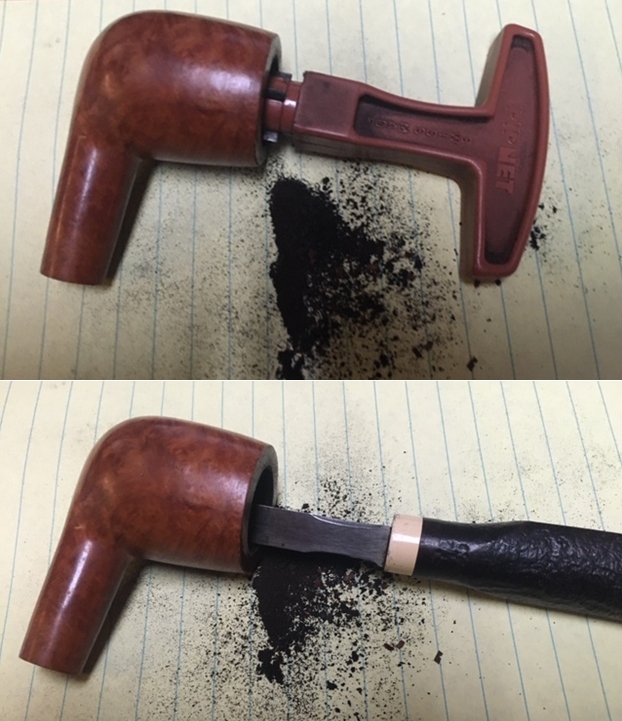
I reamed the bowl with a PipNet pipe reamer using the first and second cutting head to take the cake back to bare briar so I could inspect the walls. I cleaned up the remnants with a Savinelli Fitsall Pipe Knife. I sanded the bowl walls with 220 grit sandpaper on a piece of dowel to smooth them out and further examine them. I was happy that the walls looked very good. I cleaned out the mortise area and airway to the bowl and the interior of the metal tube and airway in the stem with pipe cleaners, cotton swabs and alcohol. I scrubbed the surface of the bowl with acetone to remove the varnish coat from the bowl. When I had finished it looked far better.   I worked on the darkening on the rim top and the rough inner edge of the bowl by first lightly topping the bowl with 220 grit sandpaper. I used a folded piece of 220 grit sandpaper to remove the darkening and smooth out the inner edge of the bowl. I wet sanded the rim top and the smooth portions on the bowl sides with micromesh sanding pads – 1500-12000 grit sanding pads. I wiped the bowl surface down with a damp cloth after each sanding pad to remove the sanding dust. Once I finished the bowl looked good. I rubbed the bowl and shank down with Before & After Restoration Balm. I worked it into the surface of the briar with my fingertips and a horsehair shoe brush to clean, enliven and protect it. I let the balm sit for a little while and then buffed with a cotton cloth to raise the shine. Mark Hoover’s Balm is a product that I have come to appreciate and one I use on every pipe I have been working on. It really makes the grain stand out on this pipe. I set the bowl aside and turned my attention to the stem. When I was in the US visiting Jeff and his wife I picked up some Soft Scrub. Jeff swears by this stuff as the first tool to use to remove a lot of the oxidation on the stem. I rubbed it on with a cotton pad and sure enough it removed the oxidation and the calcification build up. It looked a lot better.    I cleaned out the marks with alcohol and a cotton swab. I filled them in with clear super glue and set the stem aside to cure.    I smoothed out the repairs and sanded out the remaining oxidation with 220 grit sandpaper and started the polishing with 400 grit wet dry sandpaper. I polished the stem with micromesh sanding pads – wet sanding it with 1500-12000 grit pads. I wiped the stem down after each sanding pad with a cotton pad to remove the sanding debris.   Before I finished the last polishing touches on the stem I decided to fit it with a new Rock Maple Distillator.  I finished polishing the stem with Before & After Pipe Stem Polish – both fine and extra fine. I finished by wiping it down with Briarville’s No Oxy Oil and buffing it to a shine.  I always look forward to this part of the restoration when all the pieces are put back together. I put the pipe back together and buffed it with Blue Diamond on the buffing wheel. I gave the bowl and the stem multiple coats of carnauba wax. I hand buffed the pipe with a clean buffing pad to raise the shine. It is fun to see what the polished bowl looks like with the polished black vulcanite stem and the shining brass pins. This Brigham Select Billiard sitter is nice looking and feels great in my hand. The pipe is one that is light enough that it could be clenched and smoked while doing other things as it is very light weight and well balanced. Have a look at it with the photos below. The dimensions are Length: 5 ½ inches, Height: 1 5/8 inches, Outside diameter of the bowl: 1 ¼ inches, Chamber diameter: ¾ of an inch. This is the sixth of the pipes sent to me from Eastern Canada for restoration. Once again I am looking forward to what the pipeman who sent it thinks of this restoration. Lots more to do in this lot! Thanks to each of you who are reading this blog. Remember we are not pipe owners; we are pipemen and women who hold our pipes in trust until they pass on into the trust of the next pipeman or woman.

Replacing a Broken Tenon and Restoring a Kriswill Bernadotte Dublin


Blog by Steve Laug

This is another one of the pipes that came to me from a fellow in Kitchener, Ontario that needed some cleaning and in this case a tenon replacement. He had been referred to me by my local pipe and cigar shop. While I am not currently adding more pipes to my queue of repairs I have made a commitment to the shop to work on pipes for their customers. Generally they have one or two pipes that need a bit of work. This fellow sent me the following email:

I just came across my smoking pipes that I’ve had in storage for about 40 years. I’m wondering what you’d charge to have them refurbished. There are 17 in total (11 are Brighams and 6 are various).

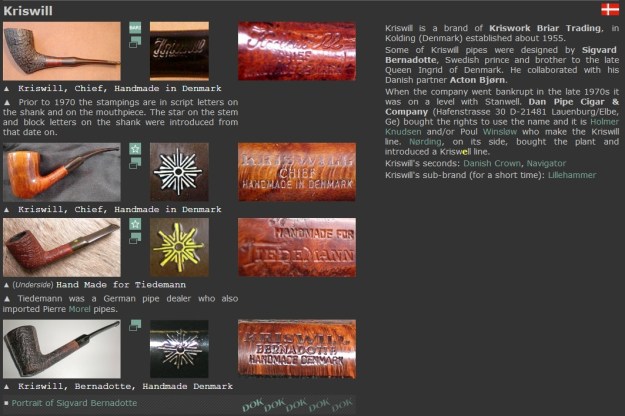
It turns out he said he had 17 pipes. That was certainly more than I expected but I communicated that there was a large queue ahead of him and I would have to fit them in as I could. He was fine with whatever time it took. He sent me the following photos of his collection that he wanted restored. The first photo shows his eleven Brigham pipes – all very interesting shapes. The second photo shows the six various pipes in the collection – A Republic Era Peterson’s System 1312 (Canadian Import), A Bjarne Hand Carved Freehand, a Comoy’s Everyman London smooth billiard, a GBD Popular Dublin 12, an English made Kaywoodie Rustica 72B, a Kriswill Bernadotte 60 with a broken tenon. When the box arrived there were two additional pipes included for a total of 19 – a Ropp 803 Deluxe Cherrywood Poker and a Comoy’s Sandblast Everyman Canadian 296. It was a lot of pipes! I have been randomly choosing the next pipe to work on and chose the Kriswill that needed a tenon replacement and general over haul. I have drawn a red box around it in the photo below.Unlike the other pipes that I unwrapped this one needed much more work than the Brighams that I had worked on so far. It was a Kriswill Bernadotte Oval Shank Dublin. It was stamped on the top of the shank Kriswill over Bernadotte over Hand Made Denmark. On the underside of the shank next the shank/stem junction it bears the shape number 60. It had great grain that the shape not only followed but captured. The rim top had a lava overflow from the thick cake in the bowl and some darkening and lava on the beveled inner edge of the rim. It was a dirty pipe but appeared to be in okay condition under the grime. There was some shiny substance in the stamping of the portion that read Hand Made Denmark. As I examined it I saw a small hairline crack in the shank area just below the stamping and into that portion noted above. It appeared to have been glued. I would need to clean that up and re-glue it. The tapered stem was oxidized and had tooth marks and chatter near the button on both sides. There was a classic Kriswill snowflake logo on the top of the stem. The tenon was snapped off cleanly in the shank and was stuck there. I took close up photos of the bowl and rim top to show the condition of the bowl and rim as well as the thick cake and lava overflowing onto the rim top. I also took close up photos of the stem to show its condition as mentioned above.   I took a photo of the stamping on the top and underside of the shank to show what I was speaking about above. It is very clear and readable. You can see the shiny substance in the Hand Made Denmark portion of the stamp. I have also drawn an oval around the hairline crack in the shank in the photos below. The repair seems to have left glue in the stamping as the crack is not that long. I also have included a photo of the shape number stamp on the underside of the shank. There was also a hairline crack in the underside of the shank to the right of the shape number.I remembered that Pipephil had a great summary of the brand so I turned to that site and reviewed the history (http://www.pipephil.eu/logos/en/logo-k3.html). It was much as I expected but there was a part of the history there that I had not noted before. I have included a screen capture of the section on the site regarding Kriswill pipes.I quote the new information (at least for me) regarding the Bernadotte line. Kriswill is a brand of Kriswork Briar Trading, in Kolding (Denmark) established about 1955. Some of Kriswill pipes were designed by Sigvard Bernadotte, Swedish prince and brother to the late Queen Ingrid of Denmark. He collaborated with his Danish partner Acton Bjørn.

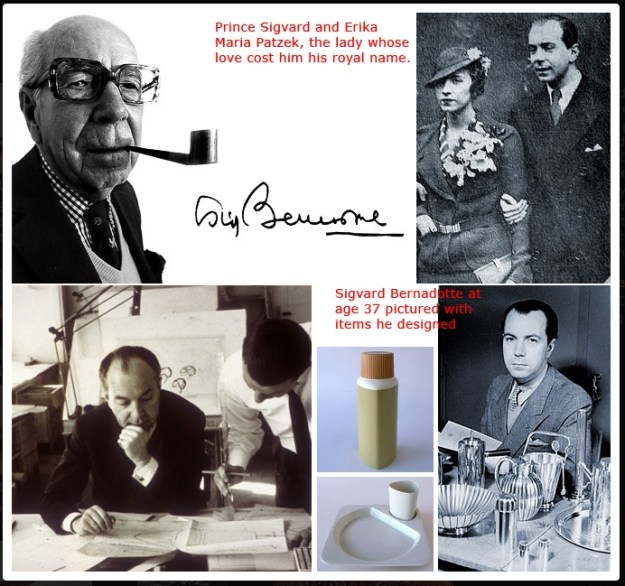
There was a small line at the bottom of the section that said Portrait of Sigvard Bernadotte. I clicked on it and was taken to the second screen capture I have included.From the site and the information on Sigvard Bernadotte I learned that the pipe I had in hand was designed for Kriswill by Sigvard Bernadotte, Swedish prince and brother to the late Queen Ingrid of Denmark. That was new information to me. I have worked on a lot of Kriswill pipes before but never made that connection. But now I knew… a pipe designed by royalty! I would never have guessed that prior to reading this.

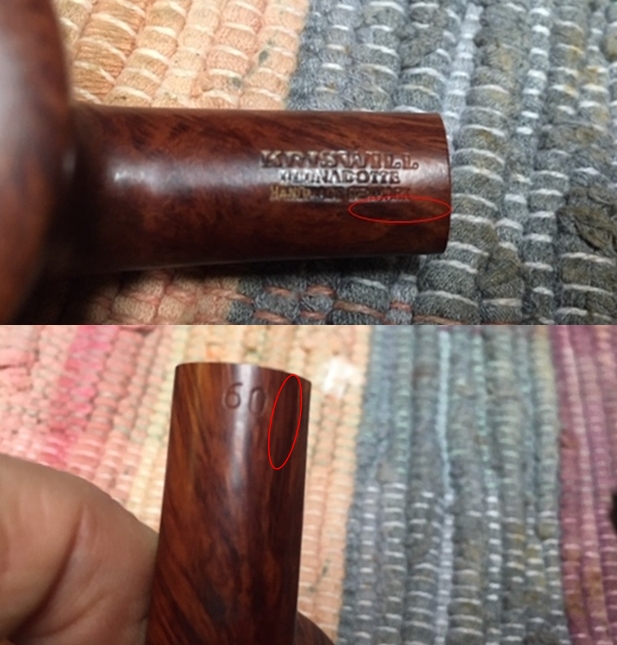
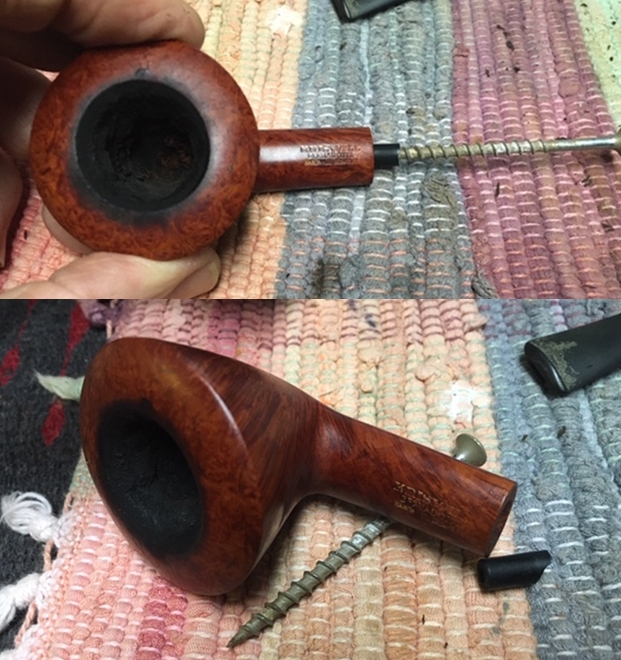
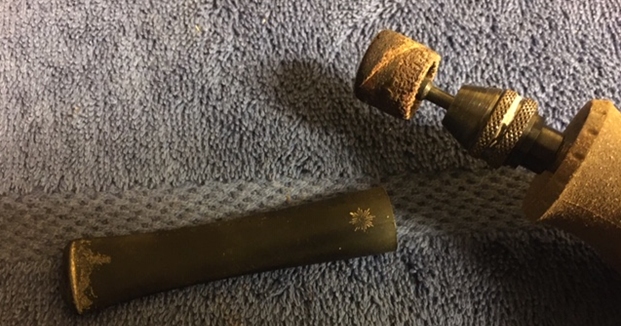
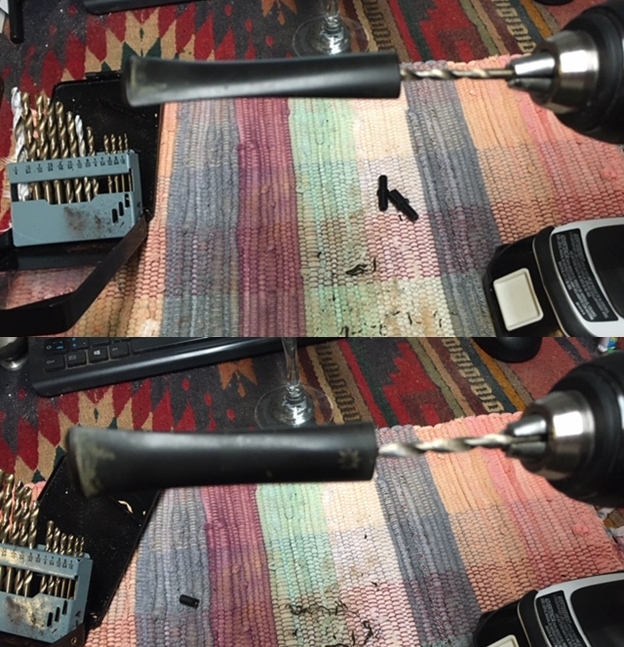
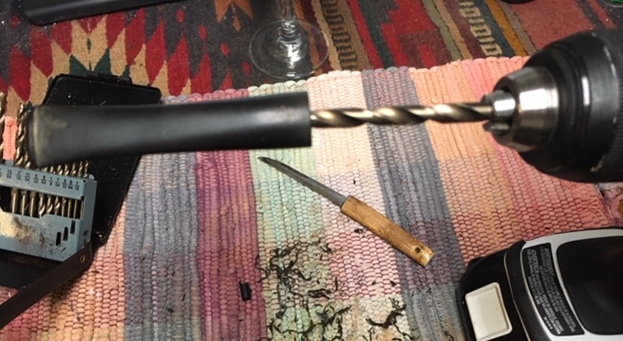
Armed with that information I was ready to start on the Bernadotte pipe. I decided to start my work by addressing the broken tenon. I put the bowl in the freezer for about 10 minutes and then pulled the broken tenon from the shank with drywall screw. It was an easy pull. I then cleaned up the glue on the stamping with acetone on a cotton pad. I opened the hairline crack on both sides of the shank and put clear superglue in the crack. I pressed it together and clamped it until it cured. With the crack on both sides I am going to recommend to the pipeman that we put an elegant thin band on the shank. I set the bowl aside to let the repairs cure while I waited to hear from the pipeman regarding possible banding of the pipe. I turned my attention to replacing the tenon. I used the Dremel and sanding drum to flatten the face of the stem and remove the broken bits of vulcanite from the broken tenon.I started drilling out the airway with a bit slightly larger than the existing airway in the stem. I complication was that the airway was not centered in either the broken tenon or the stem at this point. I used a sharp pen knife to funnel the airway and straighten it out before I drilled. I was able to center the airway. I worked my way through three different drill bits to get the airway open enough to receive the new tenon. The next photo shows the threaded tenon before I went to work on it with the Dremel. My issue with this replacement was that the stem tapered quickly and did not allow much room. I used the Dremel and sanding drum to remove the hip on the new tenon and reduce the diameter of the portion going into the stem. I glued it into the stem with thick super glue. In the photo it looks like it is tapered a bit. I cleaned that up with a file so that the flow was smooth and the fit was snug in the airway.Once I made the flow of the tenon straight and smooth I slid it into the repaired shank to have a look. Some fine tuning to do for sure but I like the look of the new fit.I set the stem aside to let the tenon cure. I turned back to the bowl. I reamed it with a PipNet pipe reamer. The bowl was conical so I started with the small reaming head to take care of the bowl and worked my way up to the third head. I cleaned up the transitions with a Savinelli Fitsall Pipe Knife and trimmed the cake back so I could examine the walls. I sanded the walls of the bowl with 220 grit sandpaper on a piece of dowel. I scraped off the lava on the inner beveled rim with the Savinelli Fitsall knife. I worked on the inner beveled edge with a folded piece of 220 grit sandpaper to smooth it out and clean off the darkening.I scrubbed the bowl with a tooth brush and some of Mark Hoover’s new Briar Cleaning product. He sent me some to experiment with so this was the first test. I tried the Extra Strength version. It worked fairly well. The verdict is still out for me whether it is better than Murphy’s Oil Soap. I rinsed it off with warm water and dried the bowl off with a cotton cloth. I cleaned out the mortise area and airway to the bowl and the stem with pipe cleaners, cotton swabs and alcohol.I wet sanded the rim top and the bowl sides with micromesh sanding pads – 1500-12000 grit sanding pads. I wiped the bowl surface down with a damp cloth after each sanding pad to remove the sanding dust. Once I finished the bowl looked good.   I rubbed the bowl and shank down with Before & After Restoration Balm. I worked it into the surface of the briar with my fingertips to clean, enliven and protect it. I let the balm sit for a little while and then buffed it with a cotton cloth to raise the shine. It really makes the grain stand out on this pipe. I set the bowl aside and turned my attention to the stem. When I was in the US visiting Jeff and his wife I picked up some Soft Scrub. Jeff swears by this stuff as the first tool to use to remove a lot of the oxidation on the stem. I rubbed it on with a cotton pad and sure enough it removed the oxidation and the calcification build up. It looked a lot better.I cleaned out the marks with alcohol and a cotton swab. I filled them in with clear super glue and set the stem aside to cure.   While the repairs to the stem surface were curing I made a call to Neil in Eastern Canada to talk with him about banding the shank on this beautiful little pipe. I have some small brass bands that I can reduce to 1/8 of an inch in height that will allow me to band the pipe and still keep the stamping free and readable. He gave the go ahead so I worked on the band. I found a band that was the right diameter in my collection of bands. I tapped it with a small hammer to make it oval and put it on the shank. I tapped around the shank to smooth out the fit. I tapped the end of the shank to smooth out the small dents. I took it off and used the topping board to reduce the depth of the band to just under 1/8 of an inch. I topped the dented top of the band as well.Once I had it smoothed out and the shape correct for the shank I spread some all-purpose glue on the shank and pressed the band in place on the shank. The band looks great to me and should do the job in binding the cracked shank together.I took photos of the newly banded shank to give and idea of the new look to the pipe. What do you think? I set the bowl aside and returned to the stem. I smoothed out the repairs and sanded out the remaining oxidation with 220 grit sandpaper and started the polishing with 400 grit wet dry sandpaper.  I rubbed down the stem with Denicare Mouthpiece Polish and a cotton pad to remove the remnants of oxidation and to blend in the sanding. The stem is starting to show promise at this point in the process.  I polished the stem with micromesh sanding pads – wet sanding it with 1500-12000 grit pads. I wiped the stem down after each sanding pad with a cotton pad to remove the sanding debris. I finished polishing the stem with Before & After Pipe Stem Polish – both fine and extra fine. I finished by wiping it down with Briarville’s No Oxy Oil and buffing it to a shine. I always look forward to this part of the restoration when all the pieces are put back together. I put the pipe back together and buffed it with Blue Diamond on the buffing wheel. I gave the bowl and the stem multiple coats of carnauba wax. I hand buffed the pipe with a clean buffing pad to raise the shine. It is fun to see what the polished bowl looks like with the new brass band on the shank end. The combination of grain and the thin band add some elegance to the pipe when combined with the polished black vulcanite stem. This royalty designed Kriswill Bernadotte 60 Dublin is nice looking and feels great in my hand. The pipe is another light weight that could be clenched and smoked while doing other things as it is very well balanced. Have a look at it with the photos below. The dimensions are Length: 5 ¾ inches, Height: 1 ½ inches, Outside diameter of the bowl: 2 inches, Chamber diameter: 7/8 of an inch. This is the fifth of the pipes sent to me from Eastern Canada for restoration. Once again I am looking forward to what the pipeman who sent it thinks of this restoration. Lots more to do in this lot! Thanks to each of you who are reading this blog. Remember we are not pipe owners; we are pipemen and women who hold our pipes in trust until they pass on into the trust of the next pipeman or woman.

A New Beginning for Jennifer’s Dad’s E—-rum Cured Italy Crosby Long Billiard


Blog by Steve Laug

I decided to change things up a bit and work on another of Jennifer’s Dad’s pipes. For the next pipe from the estate of George Rex Leghorn I have chosen another long shank/stem Billiard (Crosby style) with a sandblast finish. You may not have read about this estate before, so I will retell the story. I received an email from Jennifer who is a little older than my 64+ years about whether I would be interested in her Dad’s pipes. My brother Jeff and I have been picking up a few estates here and there, so I was interested. Here is the catch – she did not want to sell them to me but to give them to me to clean up, restore and resell. The only requirement she had was that we give a portion of the sales of the pipes to a charity serving women and children. We talked about the organization I work for that deals with trafficking and sexual exploitation of women and their children and she decided that would be a great way to carry on the charitable aspect of her Dad’s character. With some great conversation back and forth she sent the pipes to Jeff and he started the cleanup process on them. Once he had finished cleaning them all he sent them to me to do my work on them.

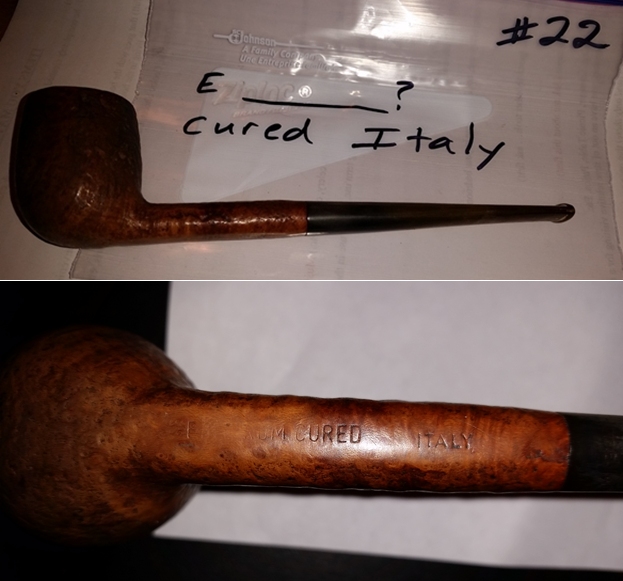
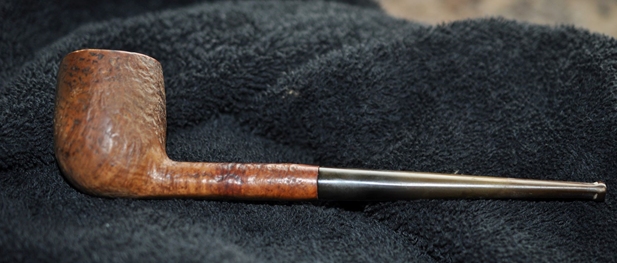
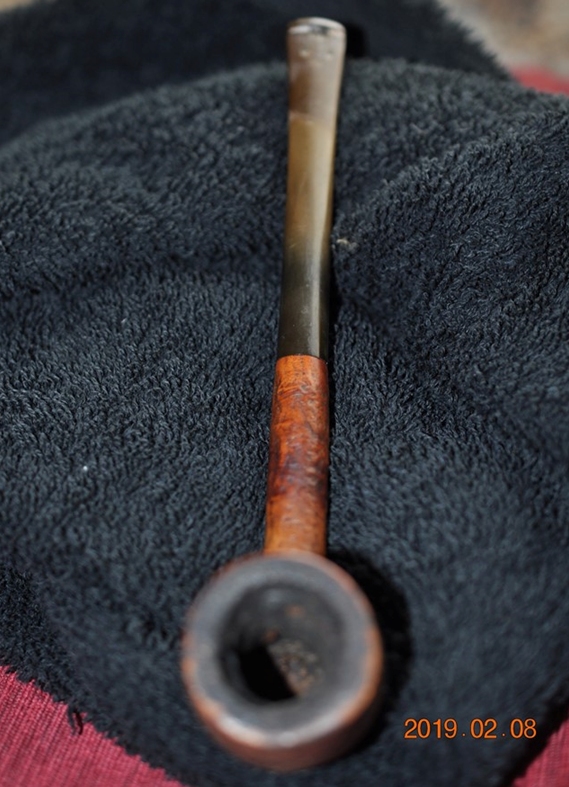
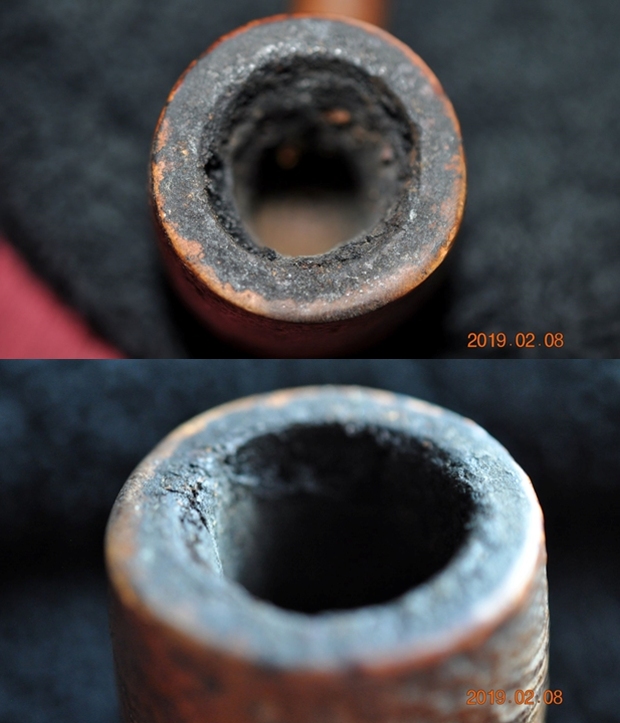
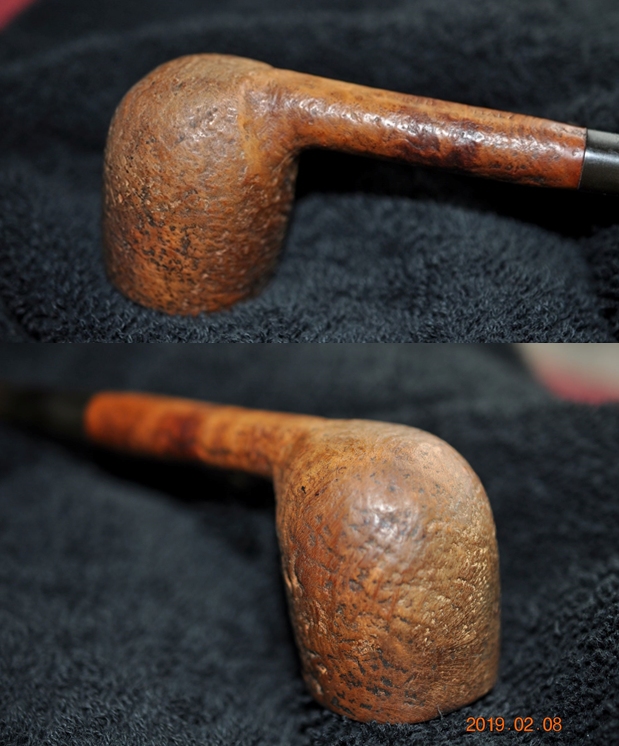
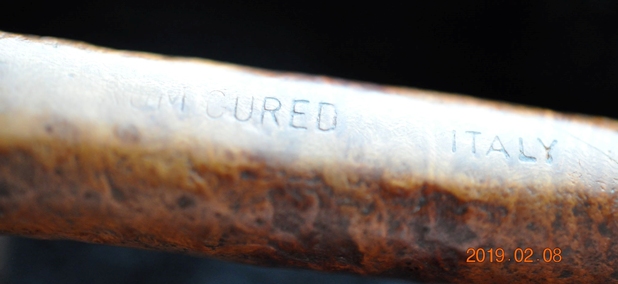
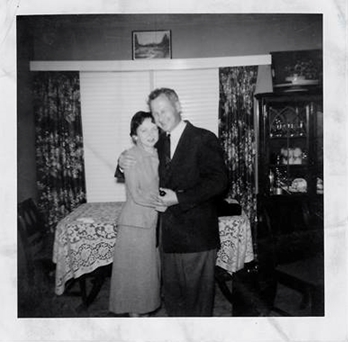
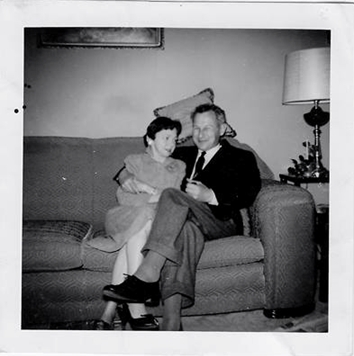
Using a lens and a bright light I could see that the mystery long shank/stem billiard is stamped on a smooth panel on underside of the shank E—–RUM CURED  ITALY. The bowl had nice grain on the sides, front, back and rim top that is visible through the sandblast finish. The finish is very dirty making it hard to see beyond that to the nice grain underneath that. There was a thick cake in the bowl and it had overflowed with lava onto the rim top. It was a dirty and tired looking old pipe. The stem was badly oxidized and there were George’s usual tooth marks and chatter on both sides just ahead of the button. The button was also damaged. It had been sitting in boxes for a lot of years and it was time to move ahead with the restoration. Jennifer took photos of the pipes she was sending. I have included the three photos of this pipe below.   When the box arrived from Jennifer, Jeff opened it and took photos of each pipe before he started his cleanup work on them. This mystery long stem/shank billiard was a nicely shaped pipe and that caught our attention. This was going to be an interesting restoration. When I work on pipes that I can find little information about the mystery adds a different element to the pleasure of working on them. The shape on the mystery pipe seems to really capture the flow of the grain on the briar. The briar appeared to be in good condition underneath the grime. The finish looked intact under the grime and oils on the bowl sides from George’s hands. The bowl had a thick cake that had hardened with time. The lava overflow on the rim top was very thick but it could very well have protected the rim from damage. We won’t know what is under it until Jeff had cleaned it off. The stem was oxidized and also had some calcification on the surface. There were deep tooth marks on both sides just ahead of the button. Jeff took photos of the pipe before he started working on it. I include those below. Jeff took photos of the bowl and rim top to show the cake in the bowl and the lava build up on the plateau rim top and dust and grime in the shank end as well. It was thick and hard but hopefully it had protected the rim and edges from damage. The lava coat looks horrible but it points to a well-used, favourite smoking pipe. George must have enjoyed this old timer a lot judging from the condition of the pipe.Jeff took photos of the sides and heel of the bowl to show the condition of the finish – the grime and grit all over the sides and bottom of the bowl. It is a dirty pipe but it has a stunning grain around the bowl sides and cross grain on the front and back. Jeff took a photo of the stamping on the underside of the shank. Half of it is blurred and worn. The readable part looks like it reads Rum Cured Italy. There is a capital E on the front of the stamp but the rest is unreadable.Jeff took photos of the top and underside of the stem showing the scratching, oxidation and tooth marks on the stem surface. The tooth marks are quite deep on both sides of the stem.I did as much digging as I could in Pipedia, Pipephil and Who Made That Pipe and came up empty handed. This one was truly a mystery. But even though I had no information I could start my restoration of this beautiful long billiard. But before I get on to restoring the pipe I thought I would once again include the tribute that Jennifer wrote to her Dad for the blog. She also sent some photos and an article that her Dad wrote for Jeff and me to be able to get a feel for him. I have included those below. Note in each of them that he is holding a pipe in his left hand. I asked her to also send me an email with a brief tribute to her Dad. Here is her tribute from an email to me.

Steve, I want to thank you again for accepting my dad’s pipes.  They were so much a part of my dad’s life that I could not simply discard them. But as his daughter, I was not about to take up smoking them either. *laughing* I think my dad would like knowing that they will bring pleasure to others.  I know that I do.

I’m not sure what to say about his pipes. I always remember Daddy smoking pipes and cigars.

First a bit about my dad. Though my father, George Rex Leghorn, was American (growing up in Alaska), he managed to join the Canadian Army at the beginning of WWII, but in doing so lost his American citizenship.  He was fortunate to meet a Canadian recruiting officer who told him the alphabet began with “A” and ended with “Zed” not “Zee”, and also told him to say that he was born in a specific town that had all its records destroyed in a fire.  When the US joined the war my dad, and thousands of other Americans who had made the same choice*(see the link below for the article), were given the opportunity to transfer to the US military, and regain their citizenship.

After WWII, my dad, earned his degree at the University of California Berkeley and became a metallurgist. There is even a bit about him on the internet.

He loved taking the family out for a drive, and he smoked his cigars on those trips. (As a child, those were troubling times for my stomach.)

I most remember my father relaxing in his favorite chair with a science fiction book in one hand and a pipe in the other… Sir Walter Raleigh being his favorite tobacco… and the pipes themselves remind me of him in that contented way.  If I interrupted his repose, he’d look up, with a smile on his face, to answer me.

It seemed he smoked his Briarwood pipes the most, though he had others.  At the time, it was only the Briarwood I knew by name because of its distinctive rough shaped bowl.  And it was the Anderson Free Hand Burl Briar, made in Israel, which I chose for his birthday one year, because I thought he might like that particular texture in his hand.

At least two of his pipes, he inherited from his son-in-law, Joe Marino, a retired medical laboratory researcher (my sister Lesley’s late husband)… the long stemmed Jarl (made in Denmark), and the large, white-bowled, Sherlock Holmes style pipe.  I believe Joe had others that went to my dad, but Lesley was only sure about those two.

The Buescher, corncob pipe my older sister Lesley bought for Daddy while on one of her travels around the States.

A note on the spelling of my sister’s name…

My dad met my mother, Regina, during WWII and they married in Omagh, Ireland.  My mother was English and in the military herself.  The English spelling of Lesley is feminine, and Leslie masculine, in the UK… just the opposite of here in the United States.  I guess my mom won out when it came to the spelling of the name…

This pipe was a real mess just like the other ones in the collection. I did not know what to expect when I unwrapped it from his box. Jeff reamed it with a PipNet pipe reamer and cleaned up the reaming with a Savinelli Fitsall Pipe Knife. He scrubbed out the internals with alcohol, pipe cleaners and cotton swabs until the pipe was clean. He scrubbed the exterior of the bowl with Murphy’s Oil Soap and a tooth brush to remove the grime and grit on the briar and the lava on the rim top. The finish looked really good when I got it. The rim top looked much better but had some darkening on the inner and outer edges. There was a small fill on the left side of the bowl high and toward the front. It would need to be dealt with (I circled it in red in the photo below). He had cleaned the internals and scrubbed the exterior of the stem and soaked them in Before & After Deoxidizer bath to remove the oxidation. The stem looked very good other than the deep tooth marks in the surface. When the pipe arrived here in Vancouver for the second stop of its restoration tour it looked very good. I took photos of the pipe before I started my part of the restoration.    I took close up photos of the rim top and bowl to show the condition of the bowl and the darkening on the rim top. You can see the light damage on the front inner edge of the bowl that was covered by the thick lava coat. The stem looks much better but the tooth marks are visible in the vulcanite. The button looks very good.I took a photo of the stamping on the shanks as it looks the same even after Jeff’s cleanup work.I decided to address the damage to the top of the bowl first. I sanded the inner edge of the rim top with a folded piece of 220 grit sandpaper to give the rim a slight inward bevel. The slight bevel took care of the charring on the front inner edge and cleaned up the rest of the inner edge as well.I picked out the small fill on the bowl with a dental pick. The fill was bright white and it just stuck out too much for me. Once I had cleaned out the pit I filled it in with clear super glue and briar dust. When the fill cured I used a brass bristle wire brush to blend it into the surface of the surrounding briar. The second photo shows the area that is filled. It is virtually invisible.I worked some Before & After Restoration Balm into the finish of the bowl and the rim top and shank with my fingertips and a horsehair shoe brush to clean, enliven and protect it. I find that the balm really makes the briar come alive again. The contrasts in the layers of stain really made the grain stand out. I let the balm sit for a little while and then buffed with a cotton cloth to raise the shine. The pipe really looks good at this point. It was getting late so I set the bowl aside and turned my attention to the stem. The sharp edges of the tooth marks made it clear that heat would not lift them so I decided to repair them instead. I filled them in with black super glue and set the stem aside to dry over night. The next morning when the repair had cured, I used a needle file to redefine the sharp edge of the button and begin to flatten out the repaired areas.  I sanded the stem with 220 grit sandpaper and 400 grit wet dry sandpaper to smooth out the repair and blend it into the stem surface. I rubbed the stem down with Denicare Mouthpiece Polish and a cotton pad to remove remnants of oxidation and to further blend in the sanding. The stem was showing some promise at this point in the process. At this point in the process I wanted to see how the stem looked on the bowl. I picked up the bowl and lightly buffed it with a cloth. In doing so I noticed what looked like a hairline crack on the topside of the shank. I examined it with a lens and sure enough there was a tiny crack in the groove of a sand blast groove. It was not large and extended about 1/8 of an inch up the shank (I have inserted a red arrow to identify the crack in the shank). I went through my small brass/rose gold coloured bands thinking that if I had one it would be a perfect look on this pipe. I found the perfect band shaped to cover the shank end as well! I cleaned the shank end with a cotton pad and alcohol and put a thin coat of all-purpose glue on the shank and end. I pressed the band in place and wiped off the excess glue with a damp cloth. The photos show the process. I set the bowl aside once again to let the glue set and went back to the stem. I polished it with micromesh sanding pads – wet sanding it with 1500-12000 grit pads. I polished it further with Before & After Pipe Stem Polish – both fine and extra fine. I finished by wiping it down with Briarville’s No Oxy Oil and set it aside to dry.  I always look forward to this part of the restoration when all the pieces are put back together. I put the pipe back together and buffed the bowl and stem with Blue Diamond on the buffing wheel. I gave the bowl multiple coats of Conservator’s Wax and the stem multiple coats of carnauba wax. I buffed the pipe with a clean buffing pad to raise the shine. I hand buffed it with a microfiber cloth to deepen the shine. It is fun to see what the polished bowl looks like with the grain popping, the new band on the shank shining and the black vulcanite almost glowing. The long stemmed billiard is beautiful and feels great in my hand. It is one that could be clenched and smoked while doing other things as it is very light weight and well balanced. It must have been a fine smoking pipe judging from the condition it was when we received it from Jennifer. There should be a lot of life left in this old mystery pipe. The band adds a touch of understated elegance to the long shank and stem. Have a look at it with the photos below. The dimensions are Length: 6 ¾ inches, Height: 1 7/8 inches, Outside diameter of the bowl: 1 ¼ inches, Chamber diameter: 7/8 of an inch. This is one that will go on the rebornpipes online store shortly. If you want to carry on the pipe trust of George Rex Leghorn let me know. Thank you Jennifer for trusting us with his pipes. Thanks to each of you who are reading this blog. Remember we are not pipe owners; we are pipemen and women who hold our pipes in trust until they pass on into the trust of the next pipeman or woman.

New Life Jennifer’s Dad’s Maro Special Crosby Style Pipe


Blog by Steve Laug

I decided to change things up a bit and work on another of Jennifer’s Dad’s pipes. For the next pipe from the estate of George Rex Leghorn I have chosen a nicely shaped Maro Special long shank billiard. You may not have read about this estate before, so I will retell the story. I received an email from Jennifer who is a little older than my 64+ years about whether I would be interested in her Dad’s pipes. My brother Jeff and I have been picking up a few estates here and there, so I was interested. Here is the catch – she did not want to sell them to me but to give them to me to clean up, restore and resell. The only requirement she had was that we give a portion of the sales of the pipes to a charity serving women and children. We talked about the organization I work for that deals with trafficking and sexual exploitation of women and their children and she decided that would be a great way to carry on the charitable aspect of her Dad’s character. With some great conversation back and forth she sent the pipes to Jeff and he started the cleanup process on them. Once he had finished cleaning them all he sent them to me to do my work on them.

The Crosby style pipe with the Sterling silver band is stamped on the left side of the shank Maro Special in script. This was different than Jennifer had marked on the bag containing the pipe. There were no other markings on the briar. The silver band was stamped Sterling and had three hallmarks – an anchor, a letter “T” in a diamond shaped cartouche and a rampant lion. These will enable me to date the pipe as I restore it. The bowl had birdseye grain on the sides and cross grain on the front and back. The shank matched the grain pattern. The sterling band was oxidized and loose on the shank and had turned over. The finish is very dirty. There was a thick cake in the bowl and it had overflowed with lava onto the inward beveled rim top. It was a dirty and tired looking old pipe. The stem was badly oxidized and there were George’s usual tooth marks and chatter on both sides just ahead of the button. The button was in good shape. It had been sitting in boxes for a lot of years and it was time to move ahead with the restoration. Jennifer took photos of the pipes she was sending. I have included the three photos of this pipe below.When the box arrived from Jennifer, Jeff opened it and took photos of each pipe before he started his cleanup work on them. There were two long shank Crosby style billiards in the lot. The first was this smooth Maro and the second one a sandblast that has worn stamping. Both are the same shape and size and both have the thin pencil shank and long stem that I have come to associate with the Crosby shape. There is something about these long billiards that I like. I enjoy working on them. The shape on the Maro seems to really capture the flow of the grain on the briar. The briar appeared to be in good condition underneath the grime. The finish looked intact under the grime. The bowl had a thick cake that had hardened with time. The lava overflow on the rim top was very thick but it could very well have protected the rim from damage. We won’t know what is under it until Jeff had cleaned it off. The stem was oxidized and also had some calcification on the surface. There were tooth marks on both side just ahead of the button. Jeff took photos of the pipe before he started working on it. I include those below. Jeff took photos of the bowl and rim top to show the cake in the bowl and the lava build up on the rim top. It was thick and hard but hopefully it had protected the rim and edges from damage. The lava coat looks horrible but it points to a well-used, favourite smoking pipe. George must have enjoyed this old timer a lot and turned to this old, light weight long billiard for a cool smoke.Jeff took a photo of the side and heel of the bowl to show the condition of the finish – the grime and grit all over the sides and bottom of the bowl. It is a dirty pipe but it has a stunning birdeye grain around the bowl sides and cross grain on the front and back. Jeff took a photo of the stamping on the left side of the shank. It is very clear and readable. It reads Maro Special. There is no other stamping on the pipe. You can also see the characters on the Sterling silver band in the second photo below. Jeff took photos of the top and underside of the stem showing the scratching, oxidation and tooth marks on the stem surface. The tooth marks are quite deep on both sides of the stem.I turned to Pipedia to see what I could learn about the brand. I looked under the English pipe brands section first to see if I could find anything that would tie it to the Sterling Silver band on the shank. There were no makers from Great Britain with that name. On a hunch I checked the American maker section (https://pipedia.org/wiki/American_Pipe_Brands_%26_Makers_L_-_M) and sure enough under MARO found that the brand was made or at least attributed to the distributor Hollco International. I turned to the page on that brand to see if there was any more information (https://pipedia.org/wiki/Hollco_International). I quote in full from that site:

Hollco International of Chatsworth, California, formerly known as Hollco-Rohr, purchased the Wally Frank company in 1969 and at the same time became the US importer for Castello, Comoy, and the producer of Pioneer and other pipes. For more information see Wally Frank.

At this point the contradictions start rolling in. On Smokingpipes.com they listed the pipe as a French Made brand and showed a pipe remarkably similar to the one I am working on now. Here is the link to the pipe that they sold: (https://www.smokingpipes.com/pipes/estate/france/moreinfo.cfm?product_id=30391).

Smokingpipes.com had a second one listed under French Estates that is stamped the same as the one I am working on: Maro Special Billiard. Here is the link to the pipe and their description: (https://www.smokingpipes.com/pipes/estate/france/moreinfo.cfm?product_id=219942). I am including the photo as it was posted on the site. Quite a trim and slender take on the Billiard shape, this piece from Maro bears a striking resemblance to those long-stemmed Billiards favored by Bing Crosby. It’s finished in a warm walnut contrast stain with a bright metal band to accent.

I traced down quite a few Maro pipes online and all were attributed to France. So it appears I am dealing with one of several possibilities here. Either 1 – the pipe was made by Maro in France and sold through Hollco International or Wally Frank as the US distributor  or 2 – the pipe is legitimately a French made pipe that George Leghorn got a hold of somewhere in his journeys. Personally I am inclined to 1 – the pipe is a Hollco International import. Now I had some idea of the provenance of the pipe I could start with reasonable assurance that I was dealing with a French made briar. But before I get on to cleaning up the pipe I thought I would once again include the tribute that Jennifer wrote to her Dad for the blog. She also sent some photos and an article that her Dad wrote for Jeff and me to be able to get a feel for him. I have included those below. Note in each of them that he is holding a pipe in his left hand. I asked her to also send me an email with a brief tribute to her Dad. Here is her tribute from an email to me.

Steve, I want to thank you again for accepting my dad’s pipes.  They were so much a part of my dad’s life that I could not simply discard them. But as his daughter, I was not about to take up smoking them either. *laughing* I think my dad would like knowing that they will bring pleasure to others.  I know that I do.

I’m not sure what to say about his pipes. I always remember Daddy smoking pipes and cigars.

First a bit about my dad. Though my father, George Rex Leghorn, was American (growing up in Alaska), he managed to join the Canadian Army at the beginning of WWII, but in doing so lost his American citizenship.  He was fortunate to meet a Canadian recruiting officer who told him the alphabet began with “A” and ended with “Zed” not “Zee”, and also told him to say that he was born in a specific town that had all its records destroyed in a fire.  When the US joined the war my dad, and thousands of other Americans who had made the same choice*(see the link below for the article), were given the opportunity to transfer to the US military, and regain their citizenship.

After WWII, my dad, earned his degree at the University of California Berkeley and became a metallurgist. There is even a bit about him on the internet.

He loved taking the family out for a drive, and he smoked his cigars on those trips. (As a child, those were troubling times for my stomach.)

I most remember my father relaxing in his favorite chair with a science fiction book in one hand and a pipe in the other… Sir Walter Raleigh being his favorite tobacco… and the pipes themselves remind me of him in that contented way.  If I interrupted his repose, he’d look up, with a smile on his face, to answer me.

It seemed he smoked his Briarwood pipes the most, though he had others.  At the time, it was only the Briarwood I knew by name because of its distinctive rough shaped bowl.  And it was the Anderson Free Hand Burl Briar, made in Israel, which I chose for his birthday one year, because I thought he might like that particular texture in his hand.

At least two of his pipes, he inherited from his son-in-law, Joe Marino, a retired medical laboratory researcher (my sister Lesley’s late husband)… the long stemmed Jarl (made in Denmark), and the large, white-bowled, Sherlock Holmes style pipe.  I believe Joe had others that went to my dad, but Lesley was only sure about those two.

The Buescher, corncob pipe my older sister Lesley bought for Daddy while on one of her travels around the States.

A note on the spelling of my sister’s name…

My dad met my mother, Regina, during WWII and they married in Omagh, Ireland.  My mother was English and in the military herself.  The English spelling of Lesley is feminine, and Leslie masculine, in the UK… just the opposite of here in the United States.  I guess my mom won out when it came to the spelling of the name…

Jennifer

*https://www.thestar.com/news/world/2013/10/22/the_americans_who_died_for_canada_in_wwii.html

I am getting more and more spoiled on working on pipes that Jeff cleaned up. So much so that when I have to clean them it is a real chore! This pipe was a real mess just like the other ones in the collection. I did not know what to expect when I unwrapped it from his box. He reamed it with a PipNet pipe reamer and cleaned up the reaming with a Savinelli Fitsall Pipe Knife. He scrubbed out the internals with alcohol, pipe cleaners and cotton swabs until the pipe was clean. He scrubbed the exterior of the bowl with Murphy’s Oil Soap and a tooth brush to remove the grime and grit on the briar and the lava on the rim top. The finish looked really good when I got it. The rim top looked much better but had scratches and nicks in the surface and some darkening on the inner and outer edges. The silver band was oxidized and tarnished. Jeff had cleaned the internals and scrubbed the exterior of the stem and soaked them in Before & After Deoxidizer bath to remove the oxidation. The stem looked very good other than the deep tooth marks in the surface. When the pipe arrived here in Vancouver for the second stop of its restoration tour it looked very good. I took photos of the pipe before I started my part of the restoration. I took close up photos of the rim top and bowl to show the condition of the bowl and the damages to the rim top. You can see the nicks and scratches in the briar that were under the thick lava coat. The stem looks much better but the tooth marks are visible in the vulcanite. The button looks very good.I took a photo of the stamping on the shanks as it is very clear and readable even after Jeff’s cleanup work.I took the stem off the bowl and the Sterling Silver band slid off in my fingers. I took a photo of the pipe taken apart.I polished the silver band with Silver polish to remove the tarnish and polish out the scratches in the metal. The band definitely looks better.
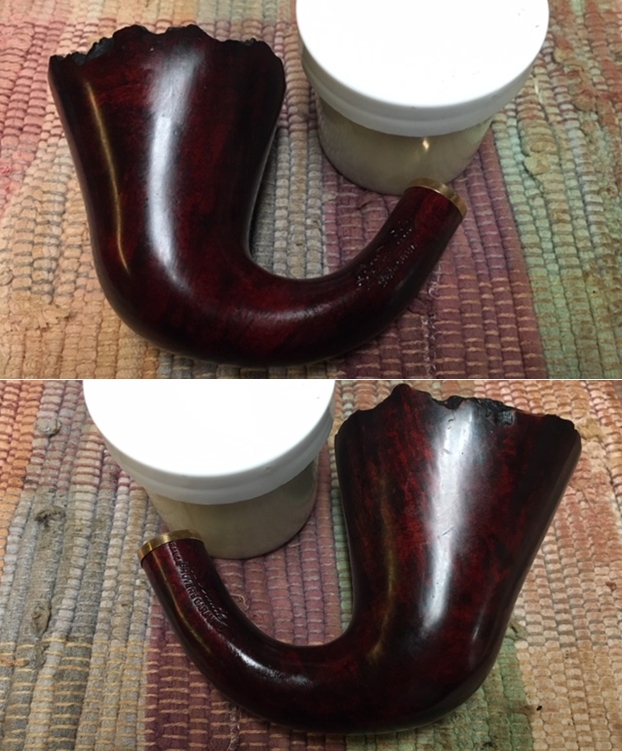
The order of the hallmarks from left to right are an Anchor (identifying the city of the hallmark as Birmingham, England), T (which gives the year code) and the last one is the rampant lion (identifying the silver as Sterling). The letter T is in a diamond shaped cartouche. From what I can find it seems to fit somewhere between 1943 and 1968. None of the stamps is identical but they are close. So now I knew that the band was made in Birmingham, England between 1943 and 1968. Now the issue was clear to me – according to everything I had found the Maro Special was made in France and the band was made in England. It seems the band was added later. All of the photos I have found of the Maro Special showed the pipe with a silver band but none of them had Birmingham hallmarks so it seems that George had the original band replaced with this one. It might also explain why it had been glued on the shank upside down with the hallmarks on the bottom of the shank. There are no cracks in the shank so it is not a repair band.

Knowing that I now knew that I had a mystery in my hands and that I would likely never fully know how the band and the pipe met! Ah well such is the life of working on estate pipes. Now on to the restoration work.
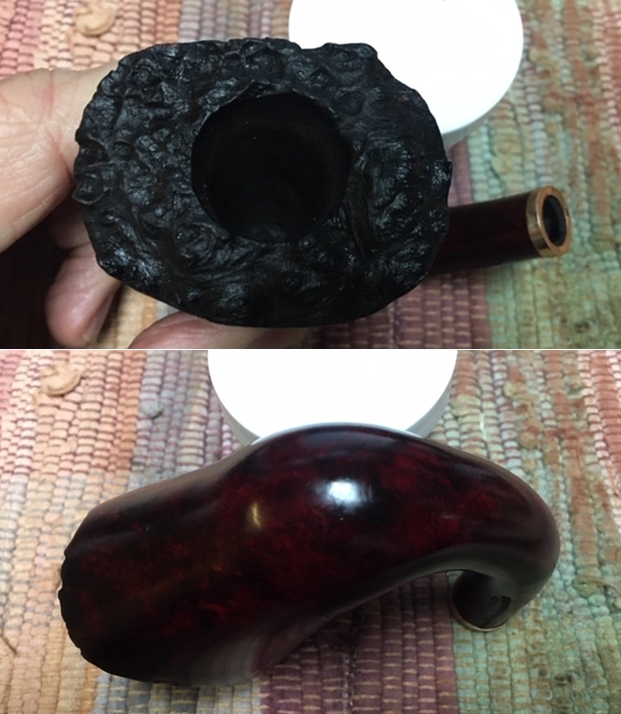
Once the band was polished I put it back on the end of the shank and lined up the hallmarks with the top edge of the shank. I decided to address the damage to the top of the bowl first. I sanded the rim top with a folded piece of 220 grit sandpaper to remove the scratches and pits in the surface of the rim. I polished it further with a piece of 400 grit wet dry sandpaper. I wiped the rim down with a damp cloth and took the photo below.I polished the bowl and rim with micromesh sanding pads. I wet sanded it with 1500-12000 grit pads and wiped it down between pads with a soft cotton cloth. You can see the progress in the shine as you go through the photos. I worked some Before & After Restoration Balm into the finish of the bowl and the rim top and shank with my fingertips to clean, enliven and protect it. I find that the balm really makes the briar come alive again. The contrasts in the layers of stain really made the grain stand out. I let the balm sit for a little while and then buffed with a cotton cloth to raise the shine. The pipe really looks good at this point. I am very happy with the way the pipe is looking at this point in the process.  I set the bowl aside and turned my attention to the stem. I inserted a pipe cleaner in the stem to protect the airway from collapsing when I heated it. I painted the surface of the stem with the flame of a BIC lighter to raise the tooth marks in the surface. I was able to bring the marks up with the heat. I filled them in with super glue and set it aside to dry.Once the repair had cured I used a needle file to smooth out the surface of the stem. I could see that there were still areas that needed a bit more glue to fill them in. I used a thin coat of black super glue to fill in the remaining dents and nicks and set the stem aside overnight to cure. The surface looked much better once the repair had cured. Rather than sanding it down with 220 grit sandpaper I decided to go straight to the micromesh sanding pads. I wet sanded the stem with 1500-12000 grit pads. I polished it further with Before & After Pipe Stem Polish – both fine and extra fine. I finished by wiping it down with Briarville’s No Oxy Oil and set it aside to dry. I always look forward to this part of the restoration when all the pieces are put back together. I put the pipe back together and buffed the bowl and stem with Blue Diamond on the buffing wheel. I gave the bowl and the stem multiple coats of carnauba wax. I buffed the pipe with a clean buffing pad to raise the shine. I hand buffed it with a microfiber cloth to deepen the shine. It is fun to see what the polished bowl looks like with the grain popping, the silver shining and the black vulcanite almost glowing. The long stemmed billiard is beautiful and feels great in my hand. It is one that could be clenched and smoked while doing other things as it is very light weight and well balanced. It must have been a fine smoking pipe judging from the condition it was when we received it from Jennifer. There should be a lot of life left in this French made Maro Special. Have a look at it with the photos below. The dimensions are Length: 6 ¾ inches, Height: 2 inches, Outside diameter of the bowl: 1 ¼ inches, Chamber diameter: ¾ of an inch. This is one that will go on the rebornpipes online store shortly. If you want to carry on the pipe trust of George Rex Leghorn let me know. Thank you Jennifer for trusting us with his pipes. Thanks to each of you who are reading this blog. Remember we are not pipe owners; we are pipemen and women who hold our pipes in trust until they pass on into the trust of the next pipeman or woman.

Recommissioning a Mysterious Freehand, Made in Denmark – Preben Holm?


Blog by Dal Stanton

I came into possession of this attractive Danish Freehand when I acquired what I call the St. Louis Lot of 26 which my son, Josiah, helped me secure when he was a student in St. Louis.  He texted me from St. Louis about this box of pipes that were for sale at an antique shop he found.  Josiah wanted to split the cost of the Lot with me so that I could pick out a pipe in the Lot that would join my personal collection and would be his gift to me. The rest of the pipes would benefit the Daughters of Bulgaria – our work here in Bulgaria with women and girls who have been trafficked and sexually exploited.  It was a win/win proposition!  I chose as his gift to me the Champion Churchwarden in the center of the picture below.  The rest of the Lot of 26 went to my online collection I call For “Pipe Dreamers” Only! where pipe men and women can choose a pipe – or a pipe chooses them – to be commissioned for restoration.

Andy has commissioned pipes from The Pipe Steward before and I love it when pipe men (and women) keep coming back!  The pipe calling his name from the St. Louis Lot of 26 is the Danish Freehand marked in the picture below.As a return patron of The Pipe Steward which benefits the Daughters of Bulgaria, Andy’s contribution has been appreciated.  His first commission was a striking Monarch Bent Ball (see: Link) and then a Churchwarden I fashioned from a throw-away bowl (see: Link) which was on his list to add to his personal collection.  Andy came back again and commissioned a Trent Lev-O-Lator Half Bent Billiard (see: Link) that turned out beautifully.  His three previous restorations are pictured below. Now, the striking Danish Freehand now on the worktable. Here are pictures of the Freehand that got Andy’s attention. When I first acquired this Lot of 26 and it made its way here to Bulgaria, I was anxious to get a closer look at this Freehand.  When I first saw it in the pictures that Josiah sent, I thought that it might be a Karl Erik.  When I finally looked at the Freehand on the worktable here in Sofia, I had to work hard to find any identifying markers.  With the help of a magnifying glass and carefully angled lighting, I could only make out with certainty extremely ghosted lettering, ‘Made in Denmark’.  The next two pictures show this ghosted lettering.Yet, in the two pictures following with the light angled differently, the second picture being a blow-up of the first, I can make out just above the ‘Made’, I think I can see two letters: ‘N’ and possibly another ‘N’ or a ‘W’?  And to the far right, possibly the number ‘5’ or another letter?  Often these are phantom letters that form from the grain and our desire to see something that’s not there!  Phantom or not, there’s not a lot to go on.With this meager information I looked at Pipephil.eu where you can search by country.  I clicked on Denmark and as you might expect, several options surfaced of Danish pipe names and carvers.  With the possibility of the phantom ‘N’ being the first letter of a name, I looked at the N section to see if any of the names and pipes made by these might resemble the Danish Freehand on my worktable – reaching at straws!With no leads, I sent a note and pictures of this Freehand off to Steve with his rebornpipes.com depth of experience to draw upon again!  Perhaps there was something he would see in the pipe that would lean toward a Danish style and maker.  The next day I received Steve’s reply which was encouraging:
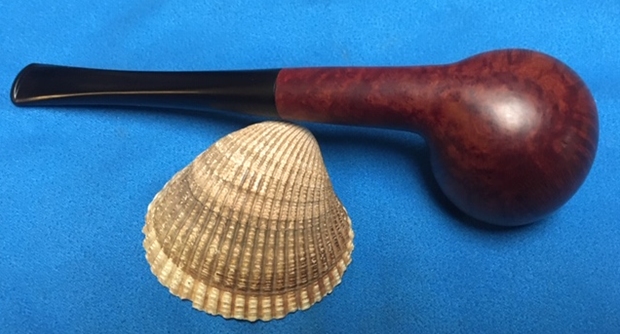
It has the look of a Preben Holm… under the pipes he made is a group of them – freehands labeled Monte Verde I wonder if that is not what is there.

Steve included the Pipephil.eu link that took me to the Monte Verde panel attributed to Preben Holm.  Wow! Again, I look at the lettering on the lower panel of the Freehand and it could be….  The ‘Made in Denmark’ looks like the same, all cap letters.  With Steve’s input the likelihood of Freehand being a Preben Holm is enhanced.Not long ago, wishing to add to my personal collection a Freehand with Preben Holm’s name on it, I landed on eBay a beautiful piece of his workmanship. This Freehand is still in need of restoration but putting it along side of the smaller Freehand on my worktable, one can easily see why Steve says that it has the ‘look of a Preben Holm’.  Looking at the curves, the angles of the cuts, even the grain pattern presentation – the resemblance is there. I’m looking forward to restoring this big boy one of these days!The Pipedia ‘Preben Holm’ article is full of information and examples of his work.  The opening paragraph is enough to capture the impact that his work has had – why, like me, adding a Preben Holm Freehand to one’s collection checks a box on most pipe men and women’s pipe bucket list:

Preben Holm (1947 – 1989) has set some marks in pipe history. Just before his 16th birthday in 1963 he sold pipes to the legendary Pipe-Dan shop and at the age of only 22 he headed 45 employees. He was among the first Danish artisans who made “Danish pipe design” famous in the USA in the 1960’s. More than that he was one of the very first carvers who exceeded this moderate Danish design which based on the classical shapes. “Chaising the grain” they turned out wild and dramatic fancy pipes. Combining smooth with blasted surfaces, showing big areas of the original bark at the top of the bowl and at the end of the stem, these pipes were quite shocking to many elder and more conservative pipesmokers.

When he started to sell his pipes to Lane Ltd. under the Ben Wade label, he caused a hype fairly beyond comparison. Especially in the U.S., as most of his pipes were sold there.

Looking now more specifically at the ‘possible’, perhaps probable, Preben Holm on my worktable, the 1 5/8-inch-deep chamber has a light to moderate layer of cake and the plateau is full of grime and lava flow.I am struck by the vertical grain that the carver took advantage of as he shaped the pipe. In the Pipedia Preben Holm article quoted above, I took special note of the phrase, ‘“Chaising the grain” [sic].  Breaking out of the classic shape mold where shape dictated the pipe, in the Freehand movement Preben Holm revolutionized, ‘chasing the grain’ challenged the carver to allow the grain to shape the pipe’s presentation.  This Freehand definitely chased the grain!  The large briar landscape of the peaked stummel is dirty with thick grime as well as some minor dings and scratches from normal use. The fancy stem has deep oxidation and calcium build-up on the bit.  The bit and button have been mercilessly chewed like cud!  The former steward saved money on not purchasing bite guards but it’s obvious this pipe was loved!  To smoke the pipe hands-free would require this kind of clenching with the size of the stummel.To begin the restoration, using pipe cleaners wetted with isopropyl 95%, the fancy stem airway is cleaned.With the oxidation so thick and with calcium caked on the mouthpiece, before putting the stem into a soak of Before & After Deoxidizer, I decide to get a head start on breaking up the crud.  I use 000 grade steel wool on the stem.  I recently read Jeff Laug’s rebornpipes blog on his cleaning methods (Got a filthy estate pipe that you need to clean?) which is very helpful.  One thing he mentions about stem cleaning is to use ‘Soft Scrub’ which unfortunately I didn’t have for this stem.  I used alcohol with the steel wool, but next time I’ll try to find a comparable product to use here in Bulgaria.After attacking the oxidation and calcium build-up with the steel wool, I’m hopeful that the Before & After Soak will prove to be more productive than in the past with heavily oxidized stems.  The Danish Freehand joins other stems of pipes in the queue for a soak of several hours.After soaking for some time, I use a stiff wire to fish the fancy stem out of the Deoxidizer and allow the fluid to drain.  Notice that I have surgical gloves on – I squeegee the excess fluid off the stem with my fingers.I then wipe/scrub the surface with a cotton pads wetted with isopropyl 95% to remove the raised oxidation.  The Before & After Deoxidizer seems to have done a good job after prepping the oxidation first with the steel wool.At this point, I apply paraffin oil to the stem to begin the rejuvenation of the vulcanite.  I put the stem aside and turn to the stummel.With the stummel in hand, I take a closer look at the conical chamber and the minor/moderate carbon cake build-up.  I’m not sure how well the Pipnet Reaming Tool’s blade heads will fit this chamber, but I’ll give it a go. I use the first two smaller blade heads, but as I suspected, the chamber narrows too much for the blades to reach the floor of the chamber, so I use the blades simply to scrape the walls. It was then that I remembered a reamer that I picked up a few years ago at a flea market somewhere in Kentucky when my wife and I were in the States.  The Kleen Reem Pipe Tool has some years on it.  I remember when I found it, I thought that it might come in handy. I love old boxes and paraphernalia.  The company printed underneath the name is W. J. Young Co. Peabody.  A quick look on the internet revealed that Peabody is in the US state of Connecticut.  The reamer is in a case with several shortened pipe cleaners.  I’m not sure what the function is of the pipe cleaners. Taking a closer look at the reamer I discover the smaller knob on the end unscrews and sheathed inside I withdraw a drill bit.  As I rotate the end knob of the reamer, the three blades expand in unison as a metal cylinder pushes the blades open.  The workings are solid. With my curiosity piqued, I dig a bit more on the internet to see if I can find more information.  I find a classic owner’s leaflet (See: LINK) extolling the benefits of keeping one’s pipe clean and the benefits of the Kleen Reem Pipe Tool. Below the text, a schematic of the reamer clearly describes the critical working parts.The next page of the leaflet solved the mystery of the miniature pipe cleaners.  The picture shows a pipe cleaner hooked on the end of the shank reamer.  I look at mine and discover that its not a hook, but a small hole through the pipe cleaner is threaded.  I would imagine that it puts a lot of torque on the crud in the airway when the shank reamer is rotating. After reading the ‘Directions for Use’ below, I decide to see for myself if the claim holds true: ‘The Kleen Reem Pipe Tool fits any pipe….’ The claim held true, at least for this Danish Freehand!  The end of the reamer blades reached down to the floor of the chamber and I expanded the blades gradually as I rotated the reamer moving up the chamber.  A great debut for this vintage old boy Kleen Reem Pipe Tool!  I follow the Kleen Reem by scraping the walls further with the Savinelli Fitsall Tool and finish by sanding the chamber with 240 grade paper wrapped around a Sharpie Pen. After wiping the chamber with a cotton pad wetted with alcohol to clean the carbon dust, I inspect the chamber walls to find everything looking great.Transitioning to cleaning the external briar surface, using undiluted Murphy’s Oil Soap, I scrub the surface using a cotton pad as well as a bristled toothbrush on the plateaus – rim and shank. I then transfer the stummel to the kitchen sink where I continue the cleaning using shank brushes with anti-oil dish liquid soap (out of Jeff Laug’s Playbook!) and using warm to hottish water, I clean the mortise and airway.  I also use the brass wire brush on the rim plateau where the lava overflow is still hanging on.  After the cleaning, a few pictures show the results.  The plateau is cleaned of the caked crud and most of the dark color is gone.  The old wax build-up and finish, if there was much of a finish, seems now to be gone.  Fresh briar. Continuing the internal cleaning, pipe cleaners and cotton buds wetted with isopropyl 95% go to work on the mortise and airway. I also employ a small dental spoon to scrape the mortise walls.  When I was doing this I suddenly thought, ‘Why am I not testing out the Kleen Reem shank reamer?’  I pull it out of the Kleen Reem case again and rotate it into the airway.  The reamer grabs with traction and begins to move slowly through the airway as I rotate the reamer.  It makes it through to the draft hole and I retract it without difficulty.  It works!I decide to drink the Kool Aide and try out the miniature pipe cleaners.  I thread one through the hole on the tip of the reamer per the directions I read earlier.  I’m wondering to myself, how is all of this going to fit and move through the airway??  I decide to wet the pipe cleaner some with isopropyl 95% as I do regular pipe cleaners.  I push it into the mortise and the halves of the pipe cleaner fold back like slanted wings as I begin rotating the reamer as I did before.  As before, the reamer grabs and gains purchase while the rotation of the reamer pulls the tool into the airway.  It makes it to the draft hole and as before, before trying with the pipe cleaner, I retract it without trouble.I am amazed!  When I extract the reamer, I discover that the pipe cleaner was neatly embedded in the troughs of the reamer – sweet!  The pipe cleaner provides a slightly expanded ‘brushing’ activity while the reamer does the plowing with its blades.  The second picture below shows the pipe cleaner unwrapped a bit.  I’m impressed with the engineering of this tool. After several more cotton buds and pipe cleaners, they begin to emerge lighter and cleaner and I call it ‘cleaned’ for the moment.The hour is late and before the lights go out, I’ll continue the internal cleaning with a kosher salt and alcohol soak.  This both continues to clean the internal briar walls, but also refreshes the bowl for the new steward’s enhanced enjoyment!  I first fashion a mortise ‘wick’ by pulling and twisting a cotton ball.  The wick serves to help draw the tars and oils out of the briar. I then guide the wick down the mortise into the airway with the aid of a stiff wire.  With the wick in place, the chamber is filled with kosher salt.  Kosher salt leaves no aftertaste unlike iodized salt. With the bowl in an egg crate to keep it stable, I add isopropyl 95% to the chamber with a large eyedropper until it surfaces over the salt.  After a few minutes the alcohol is drawn into the pipe and I again add some alcohol to top it off.  I put it aside, turn out the lights and let it soak through the night! The next morning the soak has done the job.  The soiling of the wick and salt indicates the absorbing action of drawing the tars and oils out of the briar.  After tossing the expended salt in the waste, a paper towel and blowing through the airway clears the pipe of salt crystals.I put the stummel aside to address the chewed-up stem.  I take a few pictures to show the upper, lower then a lateral view of the button.  The results of the biting and clenching are not only the severe teeth damage but also that the button is so compressed, there’s essentially no lip left to hang the pipe normally.  This is not good even when you’re not a clencher.  My approach will first seek to expand and raise the tooth compressions and chatter as much as possible on the upper and lower bit.  I’ll attempt this using the heating method with a Bic lighter.  I don’t believe there’s any way to avoid having to rebuild the button to restore a proper lip to hang the Freehand.  First, using a Bic lighter, I paint the upper and lower bit with the flame.  My hope is to minimize the compressions so that sanding is all that will be necessary on the bit. I take a start picture of upper and lower, then after using the Bic lighter for comparison.

I believe the process did minimize the damage as the heated vulcanite expanded toward its pre-damage condition, but we’re a long way from where we need to be! The button was so thin on the top that the flame burned a small bit of the upper lip in the center and it broke off leaving a divot in the middle of the upper lip. To rebuild the button, I mix activated charcoal with BSI Extra Thick Maxi-Cure CA glue.  To help in cleaning, I put scotch tape down on a plastic disk that serves as my mixing pallet, and then clean the bit with a cotton pad and alcohol.  I place a small pile of charcoal on the disk and then a dollop of the glue next to it.  I gradually mix as I pull charcoal into the glue using a toothpick.As the mixture thickens, I trowel the charcoal/CA mixture onto the button to build a mound over the repair site for the button and on the bit area to fill tooth compressions remaining in the vulcanite.  An accelerator is used on each side of the bit to quicken the curing time.After cleaning up, the flat needle file is first used to begin the rough shaping of the button.Starting with the upper side, I file and gradually shape the button.After making progress on the upper bit and button, the patch just above the small air slot that was thin earlier and burned some, is not adequately filled.  With a magnifying glass I see a gap in the patch.To do a quick patch fill above the slot, I fashion a piece of index card into a sharp point that will fit into the slot to form a mold barrier.  I cover the tip of the card stock with a piece of scotch tape to keep the glue from sticking. Using a medium-thick black CA glue, I spot drop the glue in the center above the slot and spray it with accelerator.After waiting a few minutes for the black CA glue to thoroughly cure, I wiggle the card stock out of the slot with no problems of sticking.  The patch above the slot looks good and I continue filing.I finish the roughing out of the upper button with the flat needle file.I transition to filing and shaping the lower button and bit.With the lower roughing out completed, I transition to 240 grade paper and sand to smooth more and to erase the scratching left from the file. Next, using 600 grade paper, I wet sand the entire stem.  I follow this by applying 000 grade steel wool to the entire fancy stem.  It takes some time to work sand in the grooves and around the bulges of the stem.Stem work is the most time consuming and meticulous part of a pipe’s restoration, usually.  I look at the possible Preben Holm Freehand stummel waiting for attention and I would rather put the stem aside and switch to the ‘milk and honey’ part of a restoration, but I press on with the stem applying the full battery of micromesh pads starting with wet sanding with pads 1500 to 2400.  I follow this by dry sanding with pads 3200 to 4000 and 6000 to 12000.  In between each set of 3 pads, I apply Obsidian Oil which helps rejuvenate the vulcanite stem as well as helping retard the development of oxidation. After finishing the micromesh process, I note that the button rebuild patch material has air pockets showing.  This happens often with this repair. To remedy this, I use clear acrylic nail polish to paint the button with the small brush that comes with the bottle.  The acrylic fills the pockets.  After applying, I put the fancy stem aside for the acrylic polish to cure.With the stem on the side, I now take another look at the Danish Freehand stummel.  The grain is beautiful, and the surface is in very good shape but shows normal nicks and scratches from normal wear. I will use micromesh pads to refresh the briar surface but first I cover the area of the last vestiges of the nomenclature.  I do not wish to contribute to its demise.Using pads 1500 to 2400, I wet sand the surface.  Following this, using pads 3200 to 4000 and 6000 to 12000, I dry sand the large briar landscape.  It’s exhilarating to see the metamorphosis of the grain through each minute gradation of grade provided by each successive micromesh pad.  It’s as if the grain is coaxed out.  I love the grain on the Danish Freehand.  If this is indeed a work of Preben Holm, it is truly ‘chasing the grain.’ To tease out further the natural hues of the briar, Mark Hoover’s product (www.ibepen.com), Before & After Restoration Balm, does the job well. After putting some Balm on my fingers, I work it into the briar surface including the rim and shank plateaus.  I then put the stummel aside for about 20 minutes, then wipe/buff the excess using a microfiber cloth dedicated to this. I follow with another microfiber cloth to buff the surface further.Next, I use another product of Mark Hoover, Before & After Fine and Extra Fine polishes.  Not only does the polishes revitalize the vulcanite, Mark says that it also has properties that continue to fight or remove oxidation.  Starting with the Fine polish, like the Balm, after placing a small amount on my finger, I work it into the vulcanite and let it set for a few minutes.  With the polishes, I like removing the excess initially with a paper towel – it absorbs and is a bit rougher which seems to help in the polishing at this stage.  I follow the Fine with the Extra Fine polish in the same manner.  The stem looks great.Next, I address the plateaus of rusticated briar – a hallmark characteristic of many Freehand pipes.  This Freehand appears to have had a darkened plateau originally and I use a fine point black Sharpie Pen to do the highlighting and darkening. I also darken and freshen the straight highlight carvings on the heel. I focus on the inner two thirds of the rim plateau intentionally leaving some of the rustication on the outer edge natural briar – I like contrasting and texturing.  I do the same with both plateaus and the heel sculpting. In order to ‘weather’ the freshly darkened plateaus so that the black doesn’t look new, I lightly sand the plateaus with the roughest micromesh pad, 1500 grade.  What this also does is lighten the peaks of the rustication giving more depth of contrast – I like this! The home stretch – after mounting a cotton cloth to the Dremel with the speed set at about 40% full power, Blue Diamond compound is applied to stem and stummel. Following Blue Diamond, another cotton cloth buffing wheel is mounted on the Dremel, and maintaining the same speed, carnauba wax is applied to the Freehand.  After applying the wax, I use a microfiber cloth to give the pipe a rigorous hand buffing to raise the shine.If this Danish Freehand is not a Preben Holm, it’s an excellent facsimile.  The vertical grain is mesmerizing.  It reaches up the 2 1/2 inch height of the Freehand’s front bowed bowl section and culminates in the classic rusticated plateau.  The plateau measures 1 3/4 inches across surrounding a 1 3/4 inch deep chamber that will hold an ample load of tobacco.  The length from the front point to the button is 5 3/4 inches.  The button re-build came out well – I’m pleased.  Andy commissioned this Made in Denmark Freehand and will have the first opportunity to claim it in The Pipe Steward Store benefiting the Daughters of Bulgaria.  Thanks for joining me!