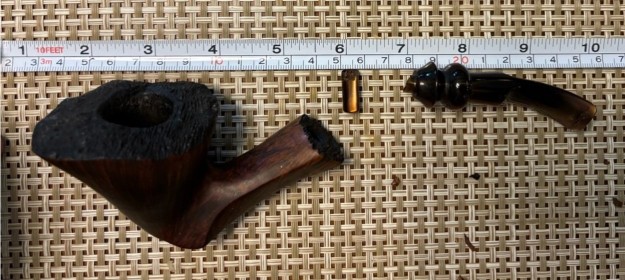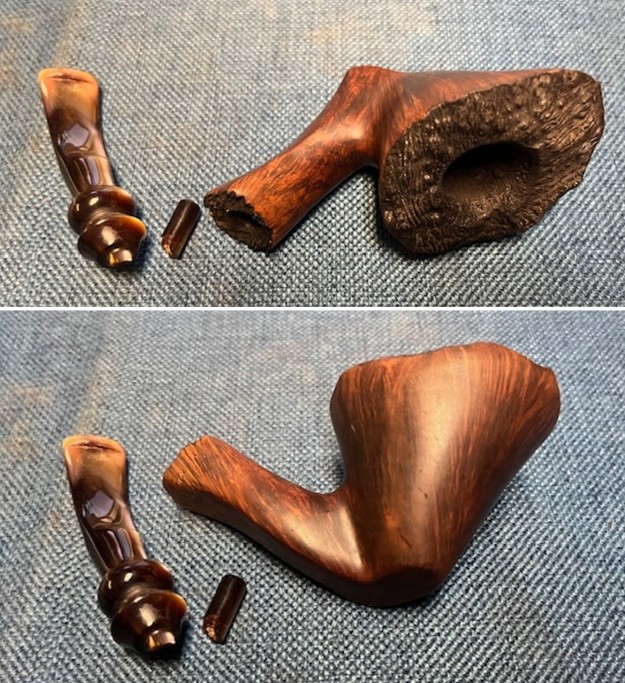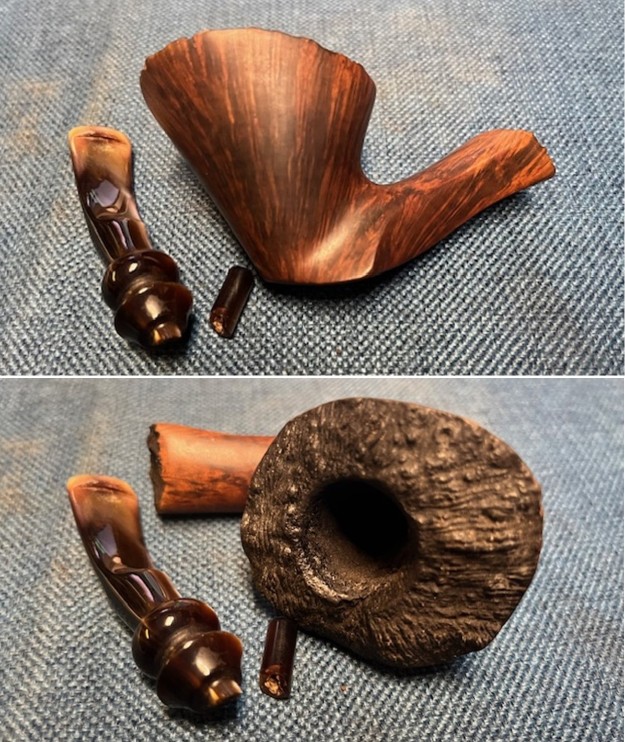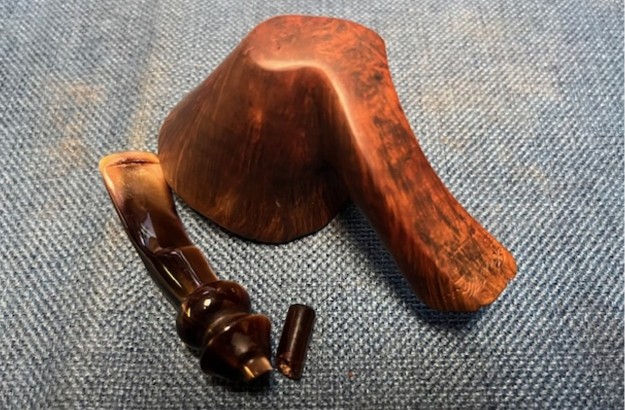
Tag Archives: Stem repairs

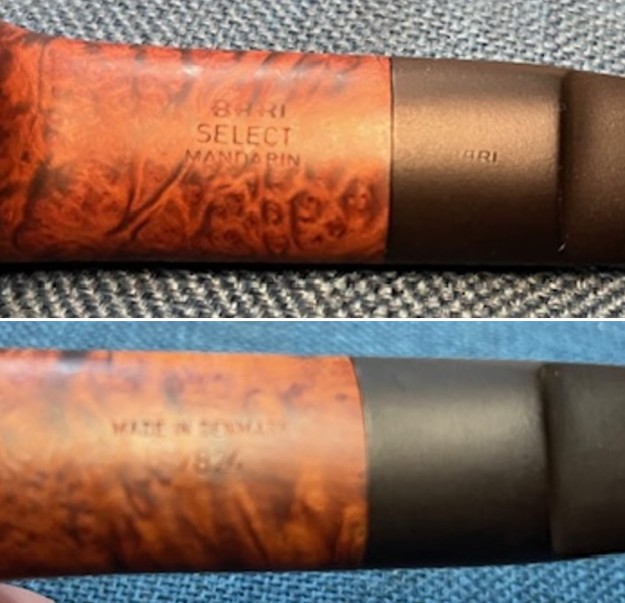
Restoring a beautiful Bari Select Mandarin Made in Denmark 7824


Blog by Steve Laug

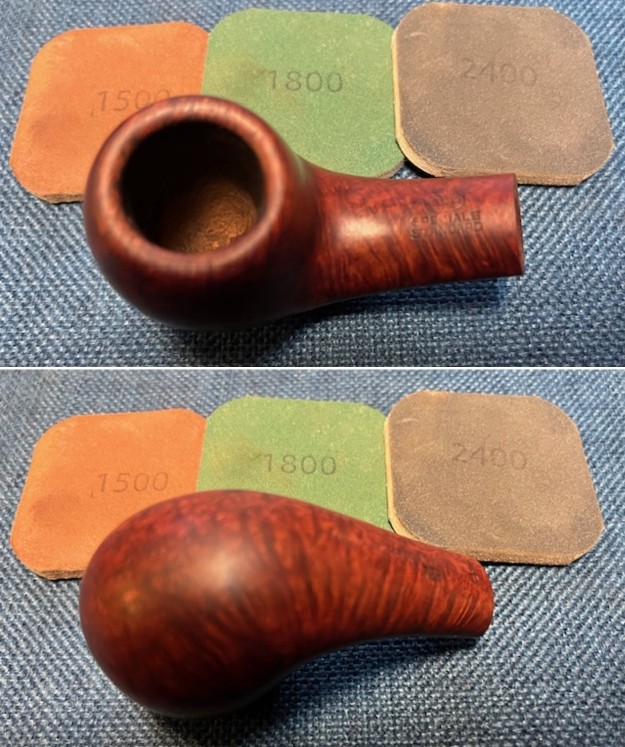
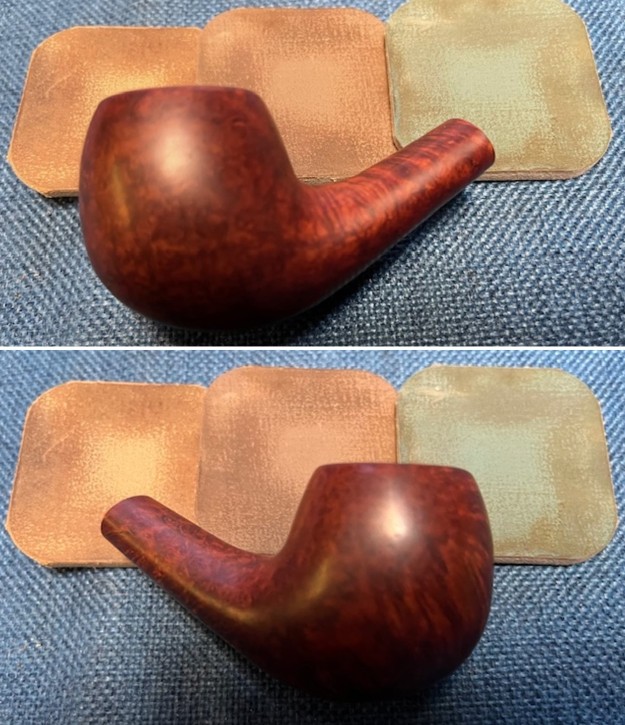
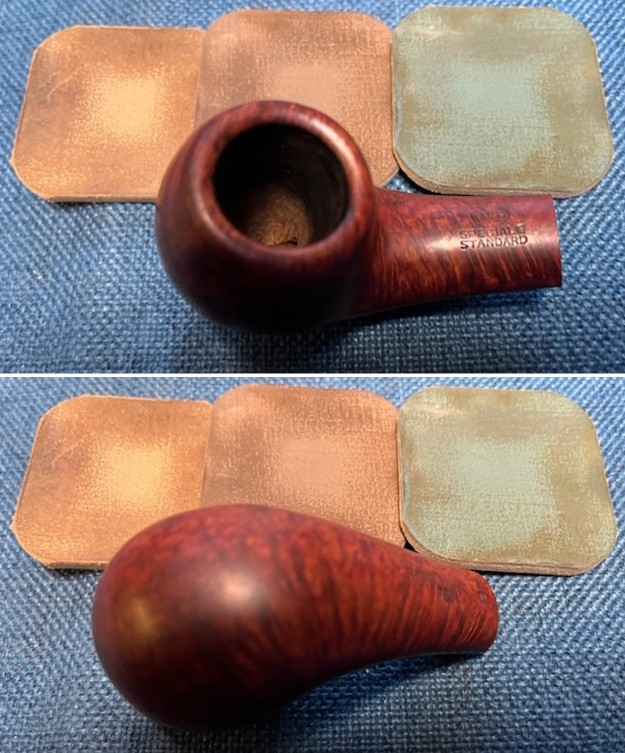
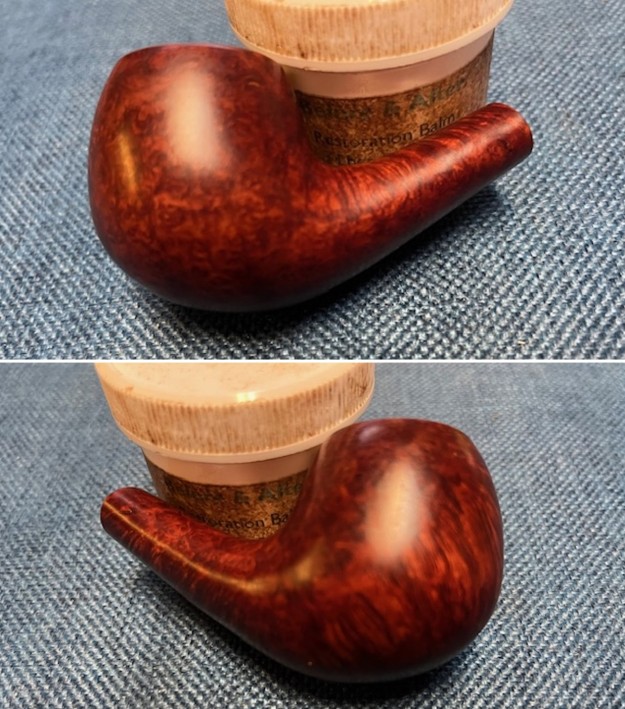
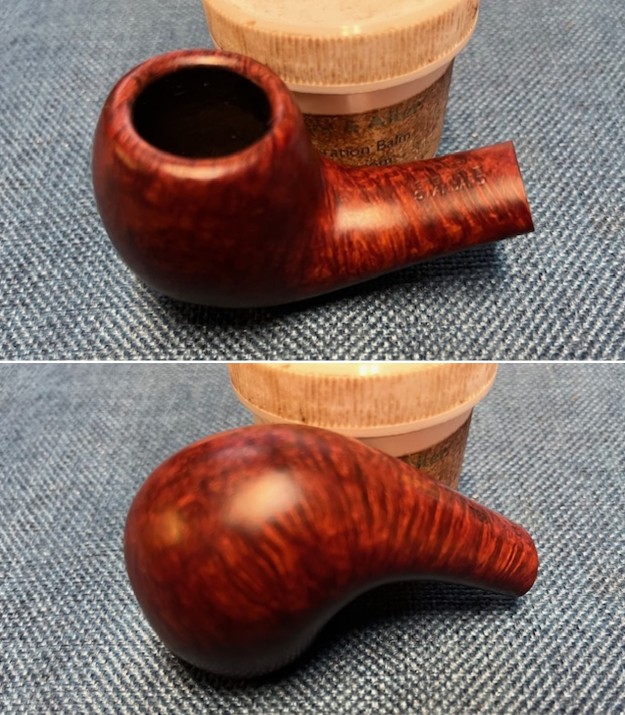
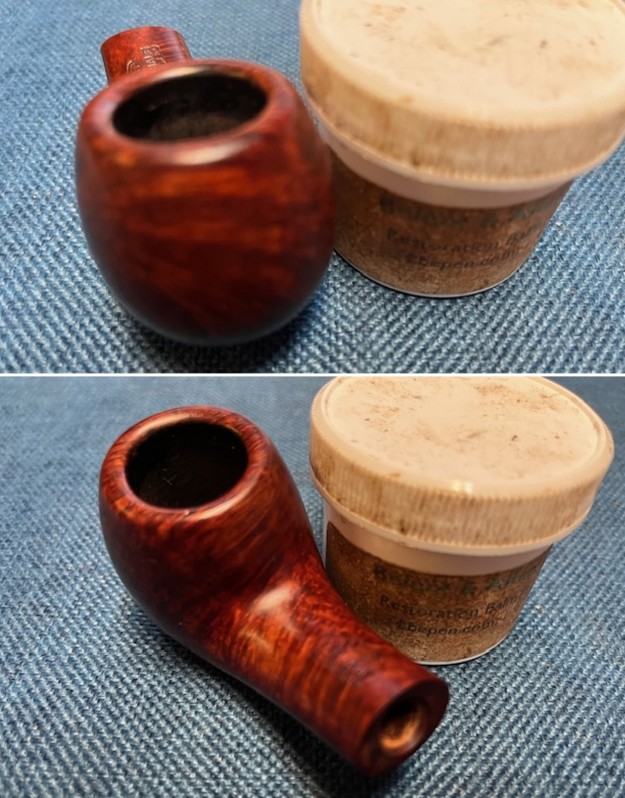
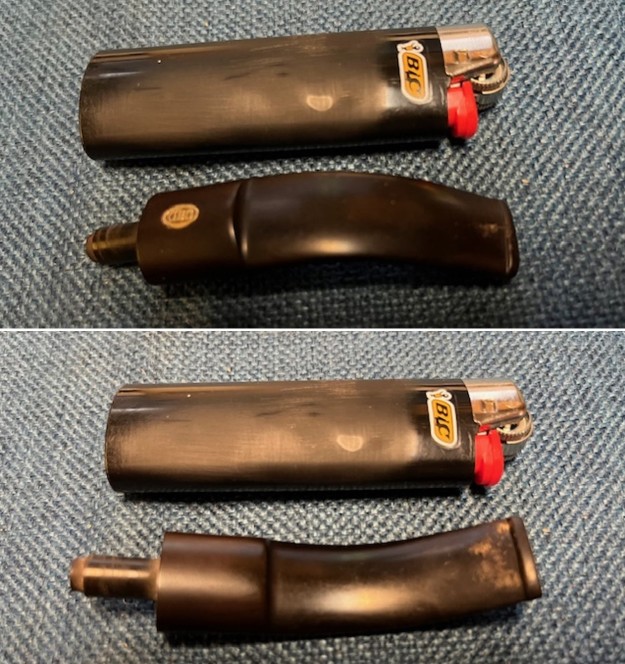
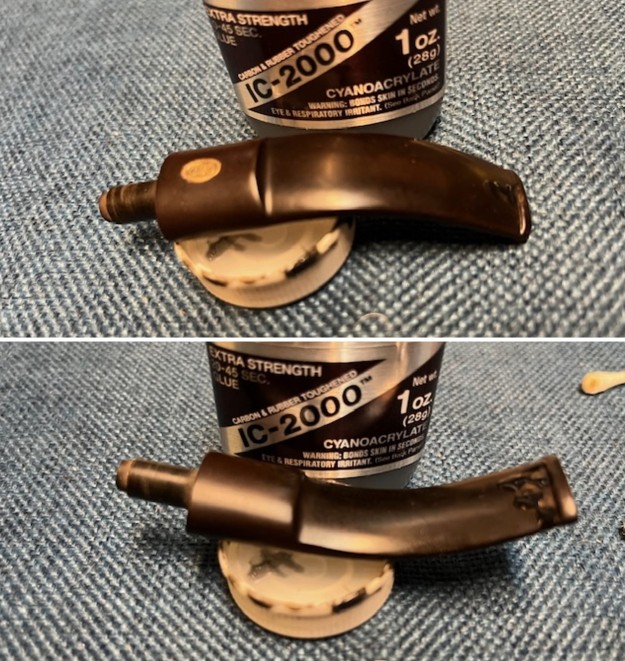
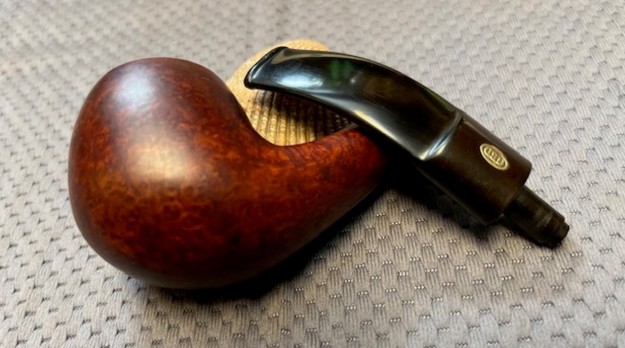
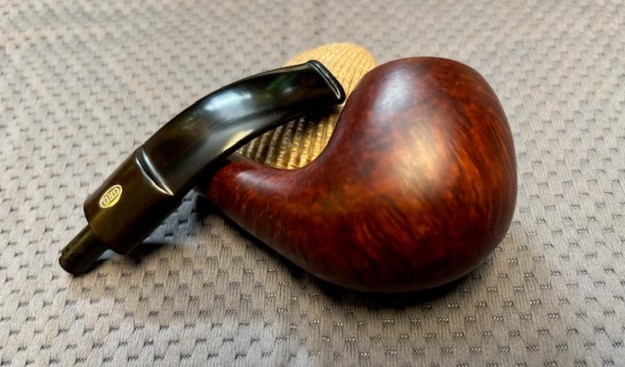
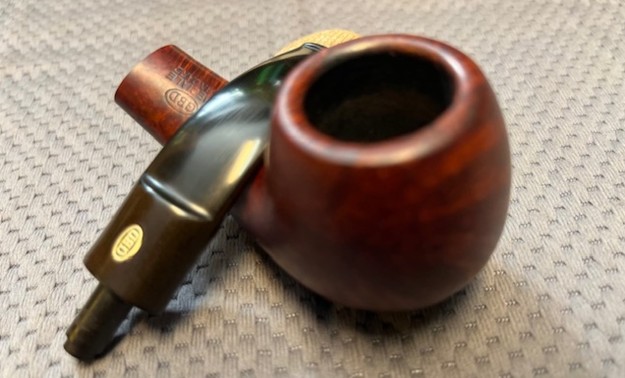
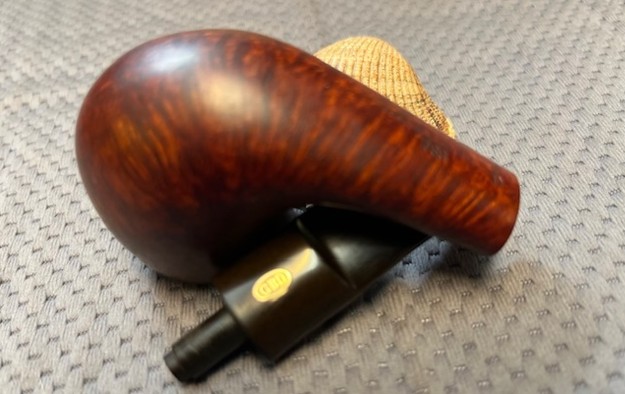
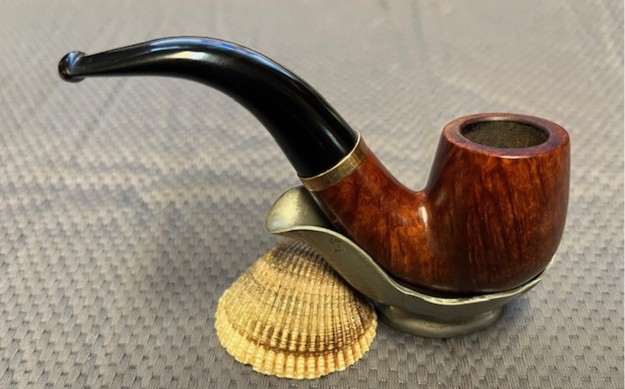
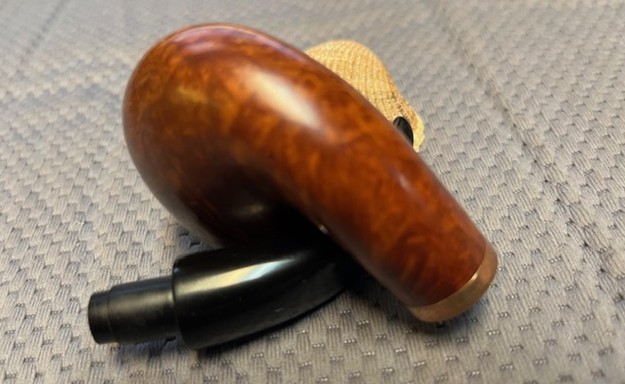
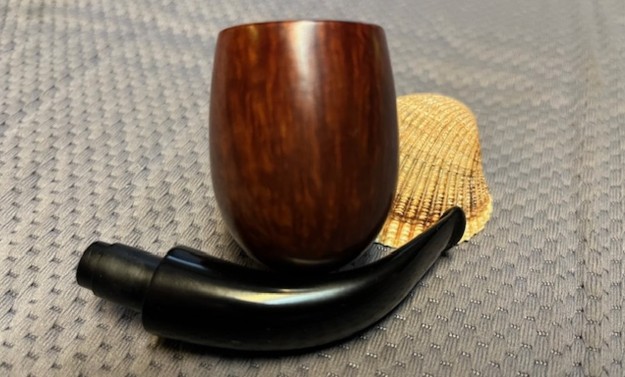
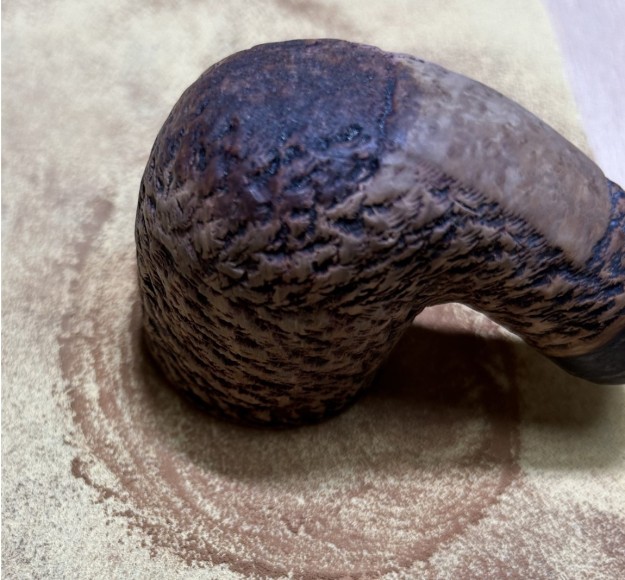
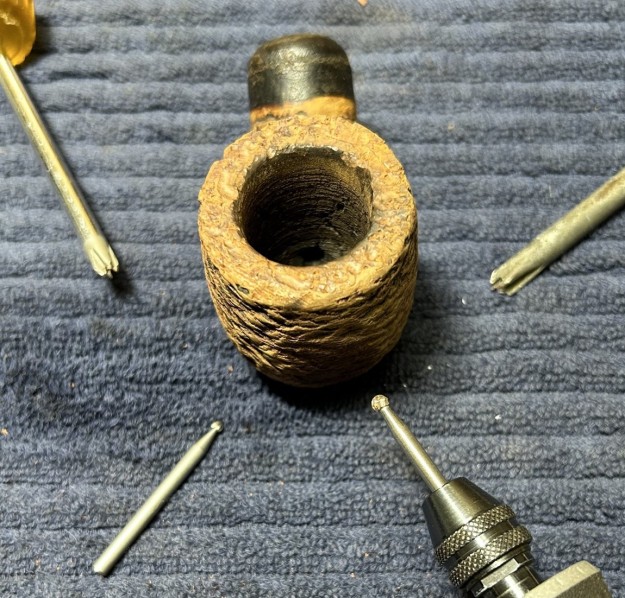
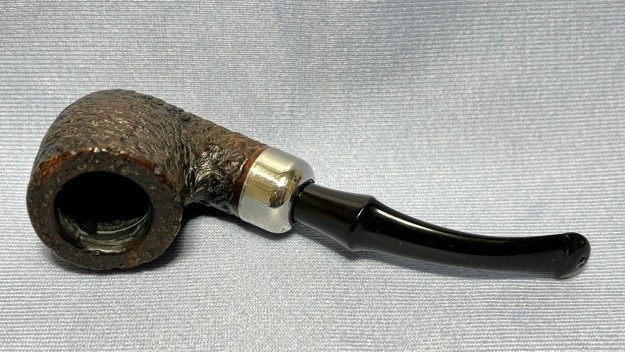
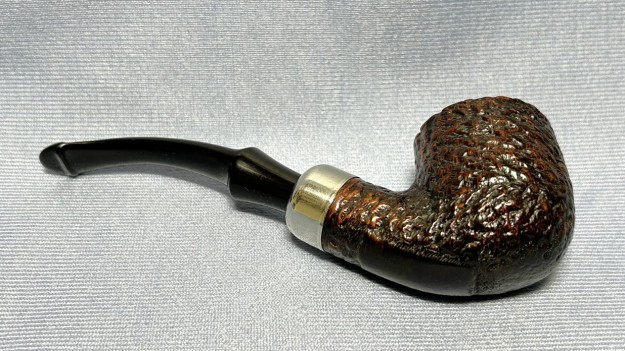
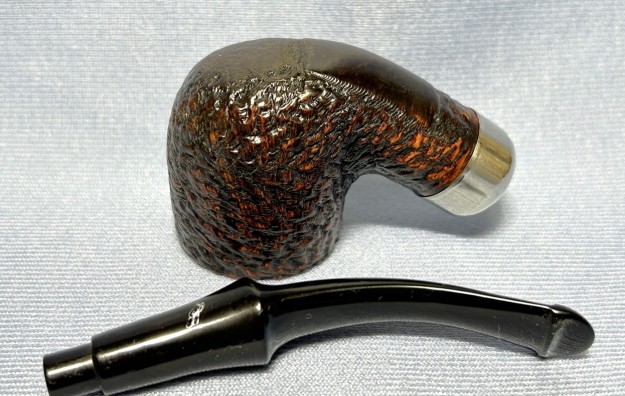
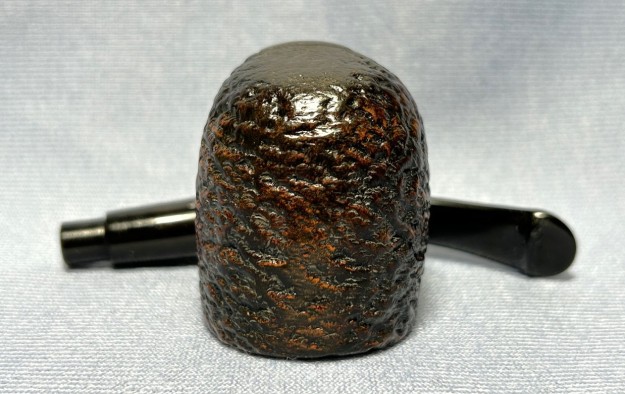
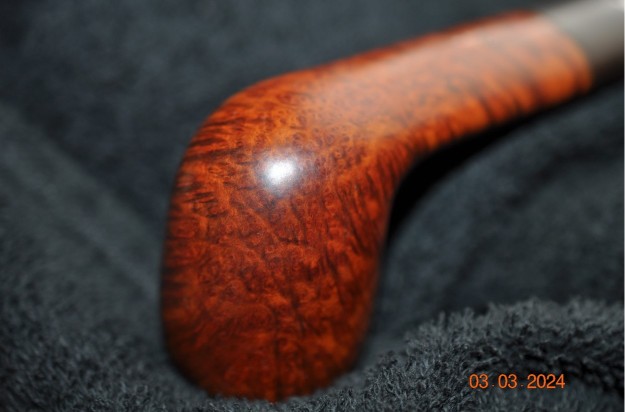
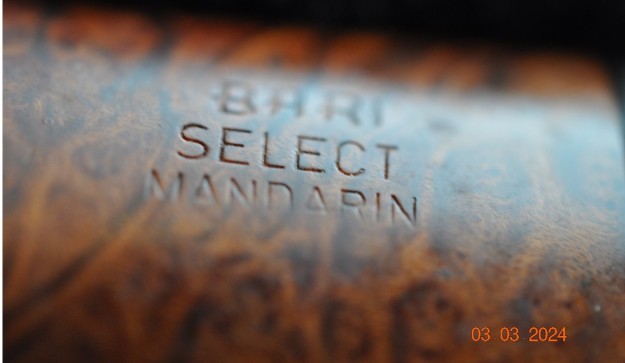
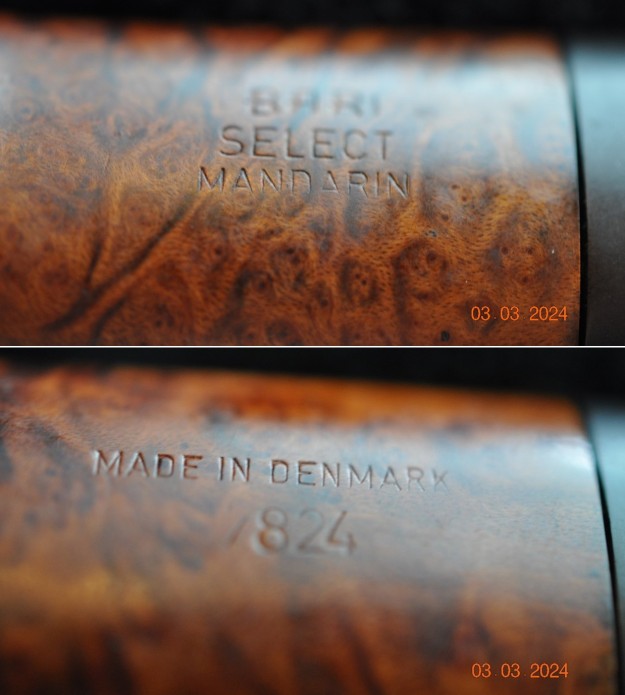
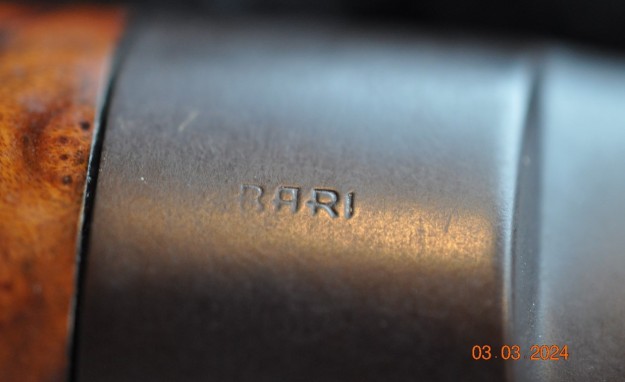
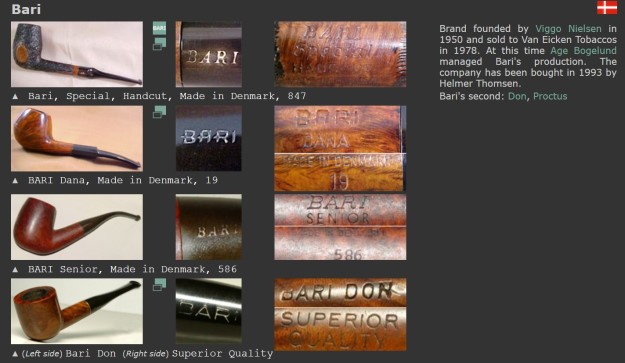
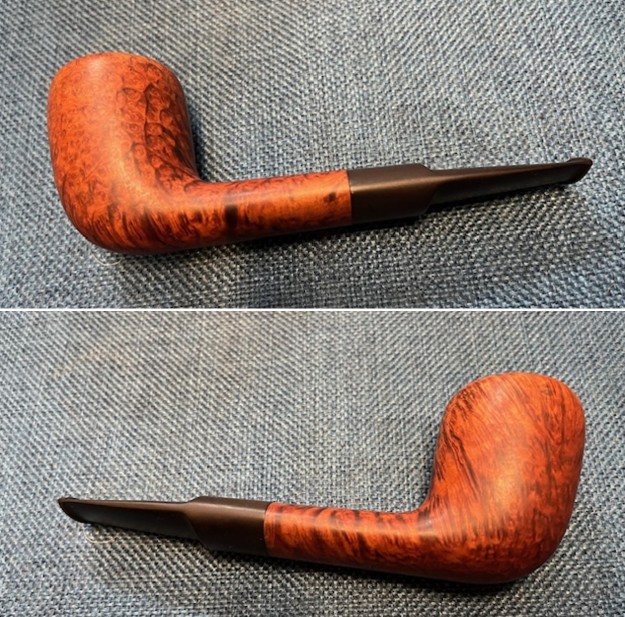
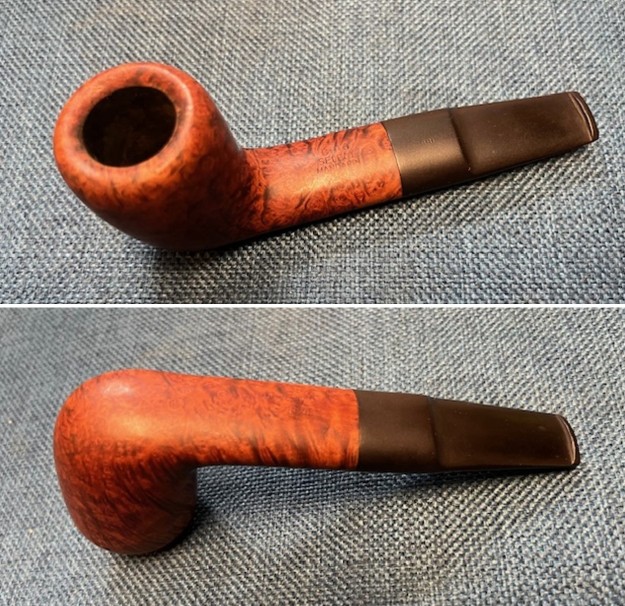
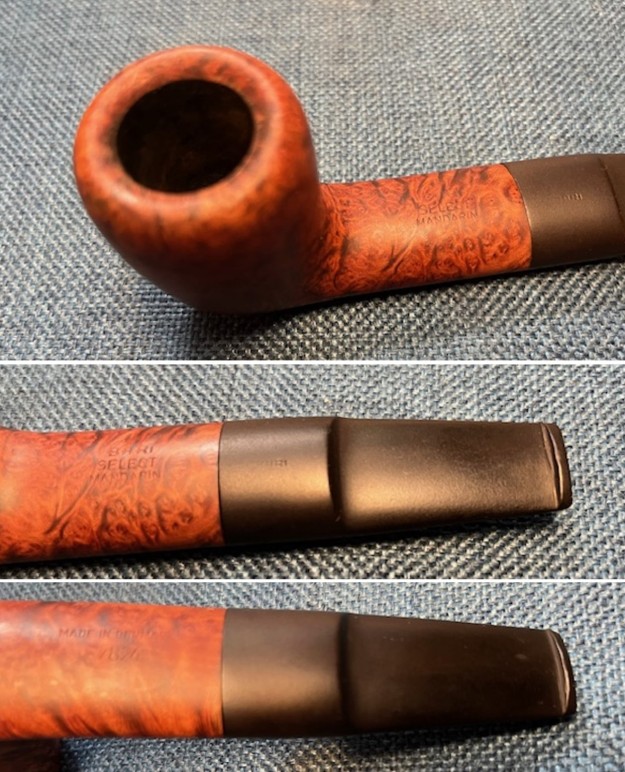
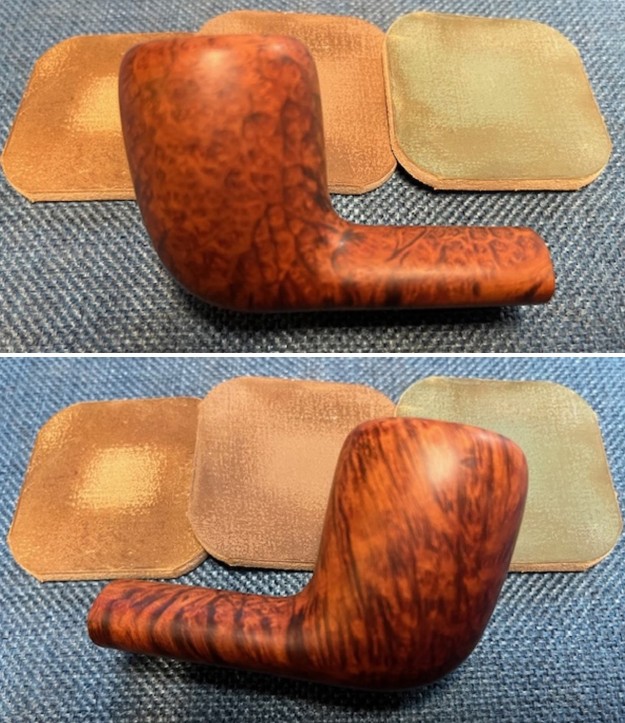
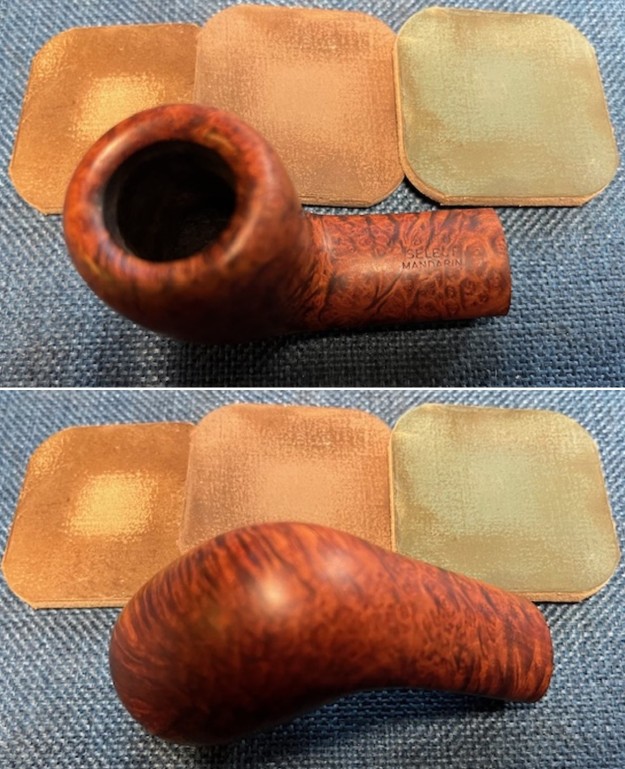
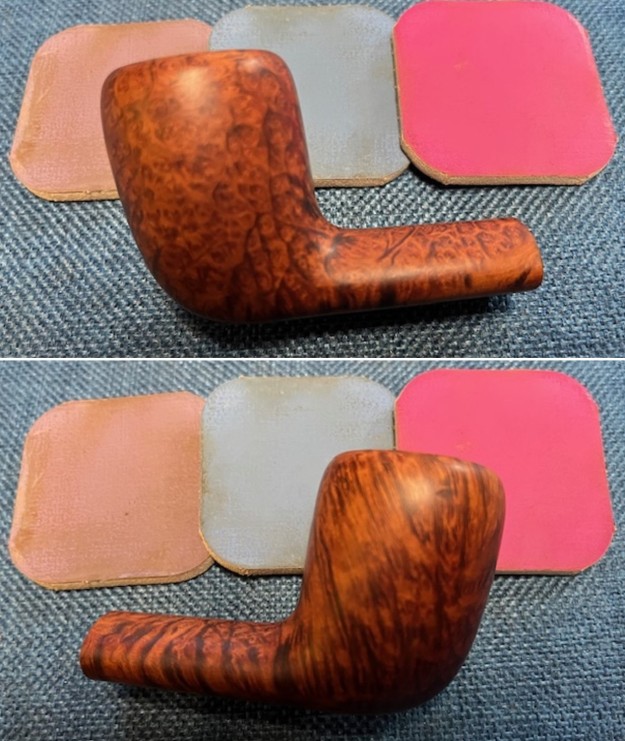
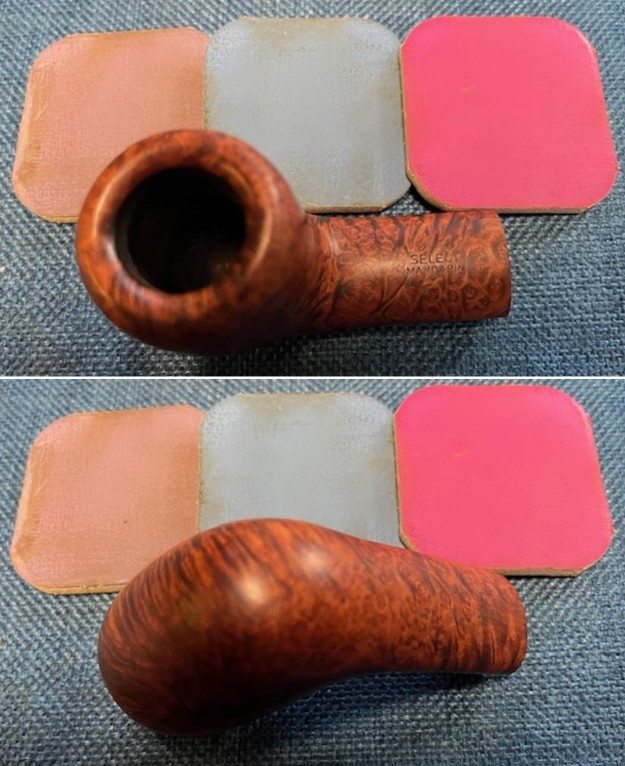
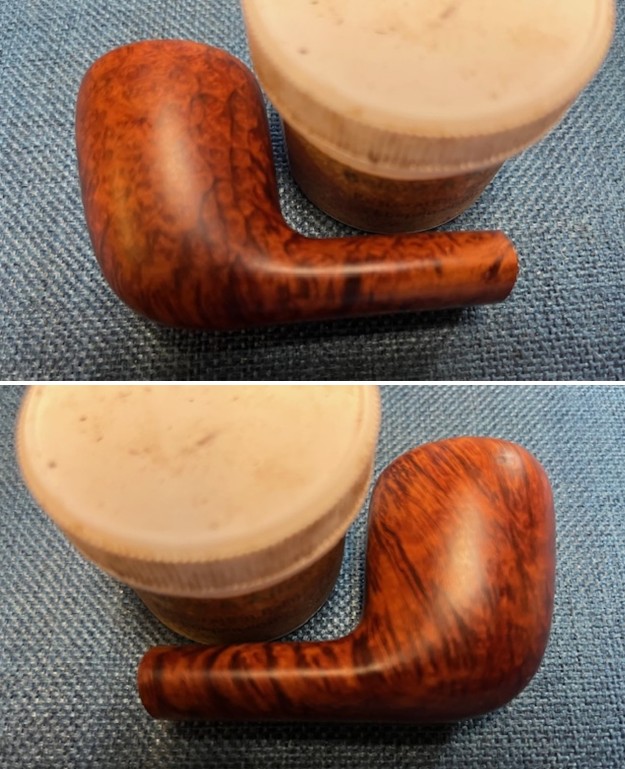
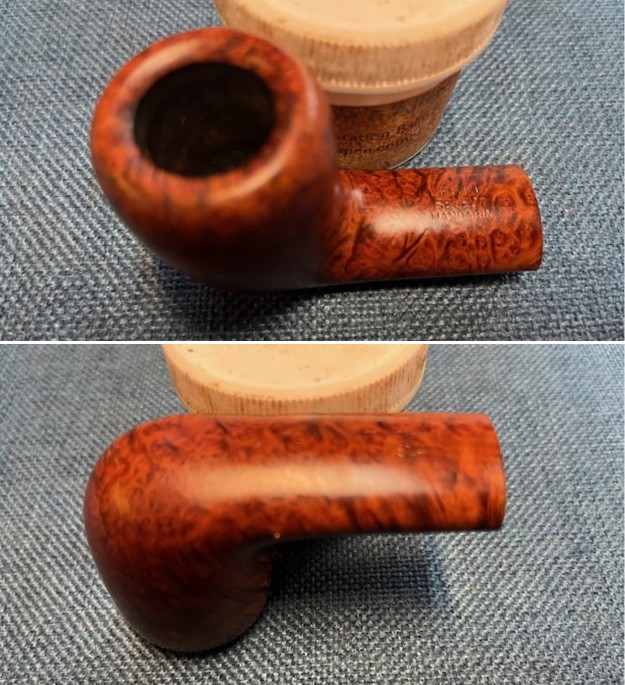
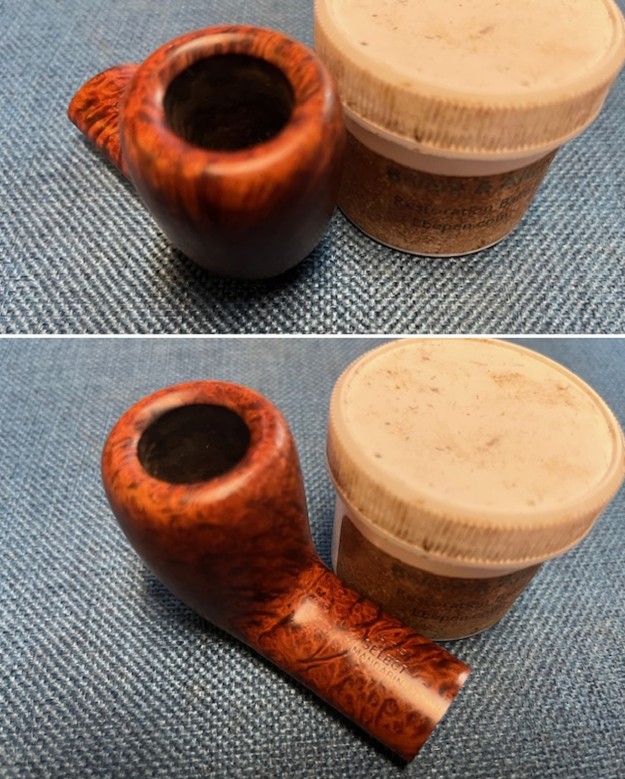
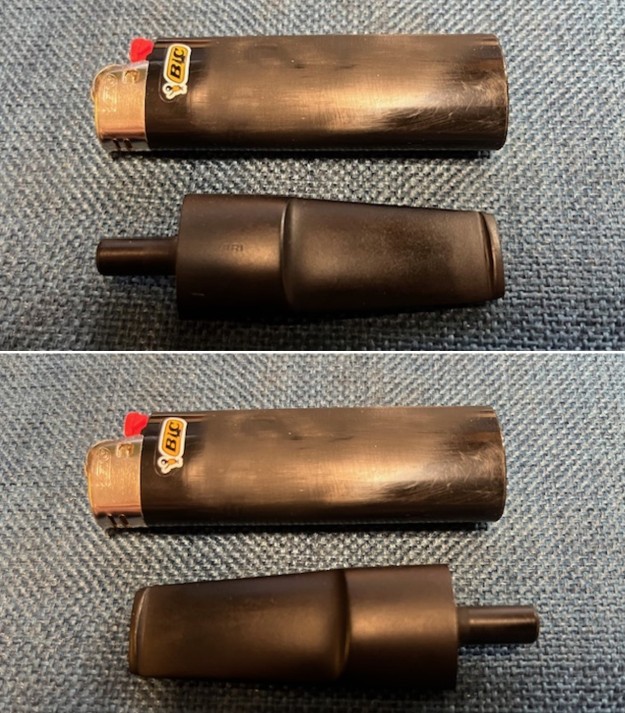
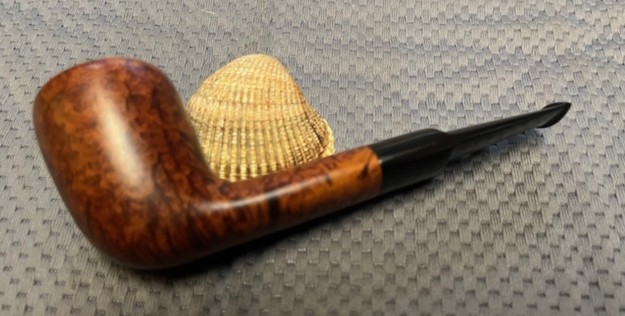
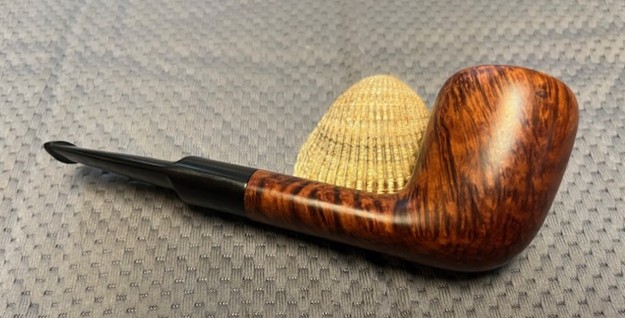
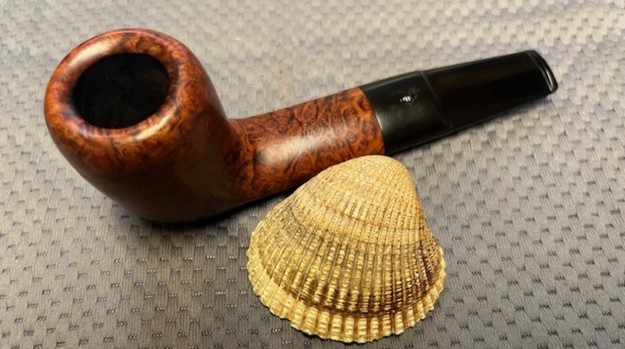
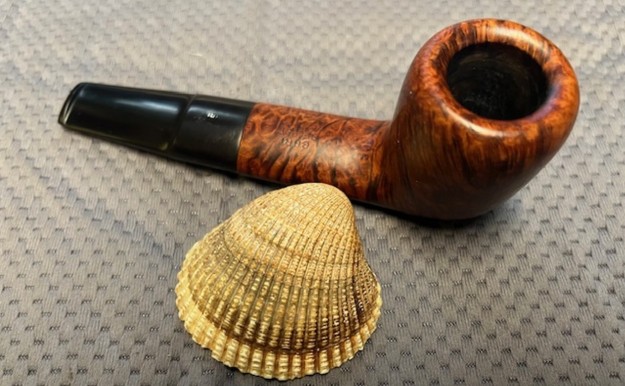
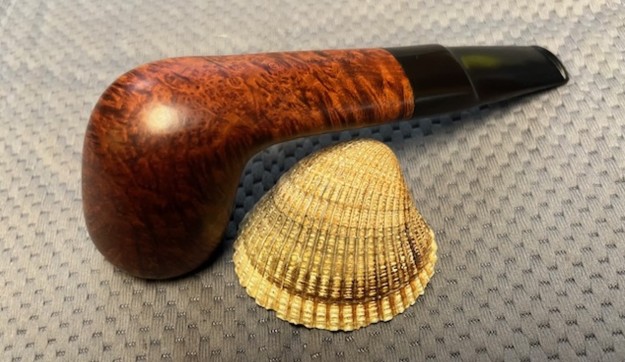
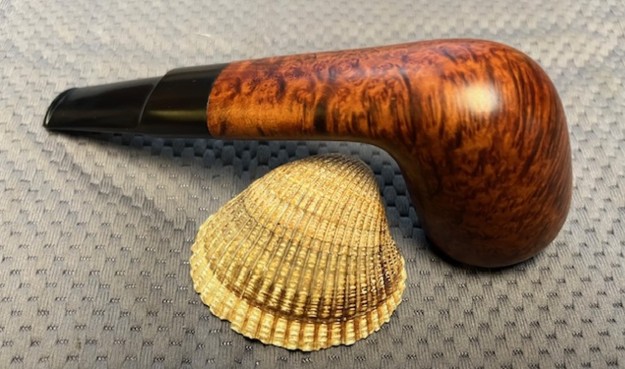
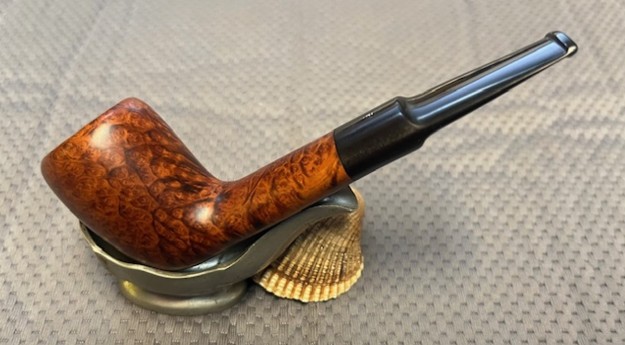
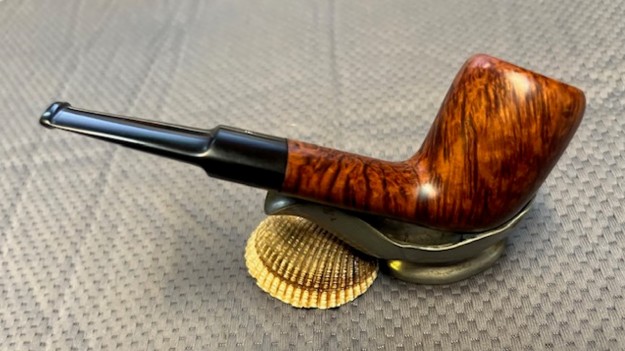
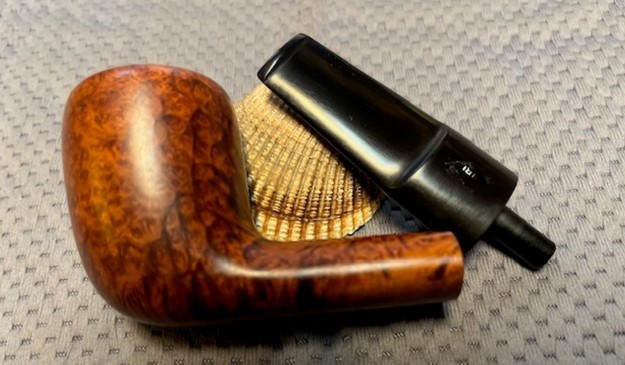
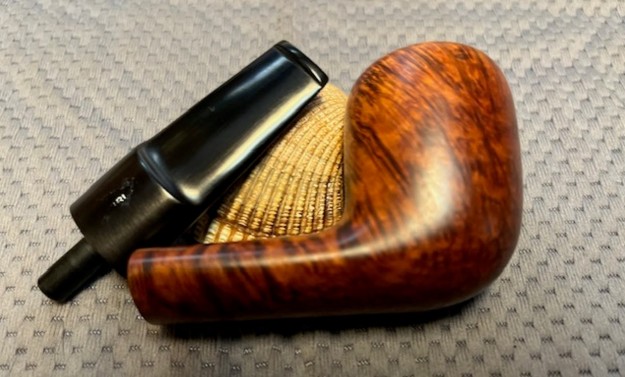
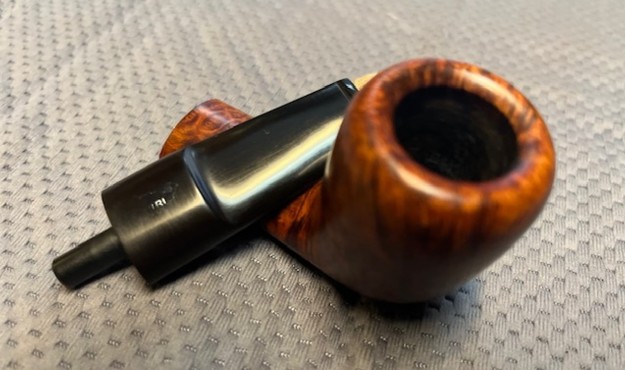
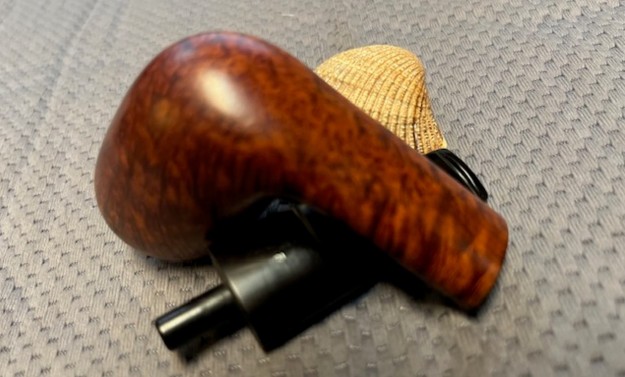
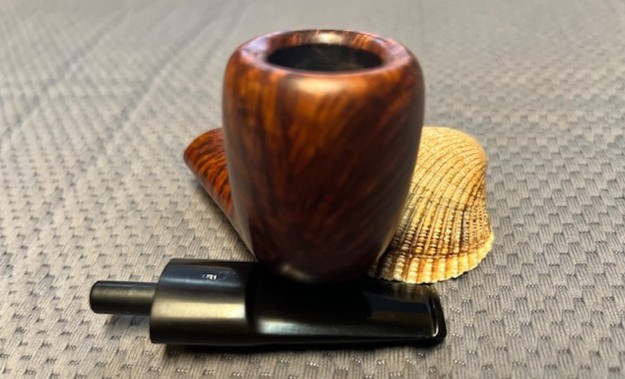
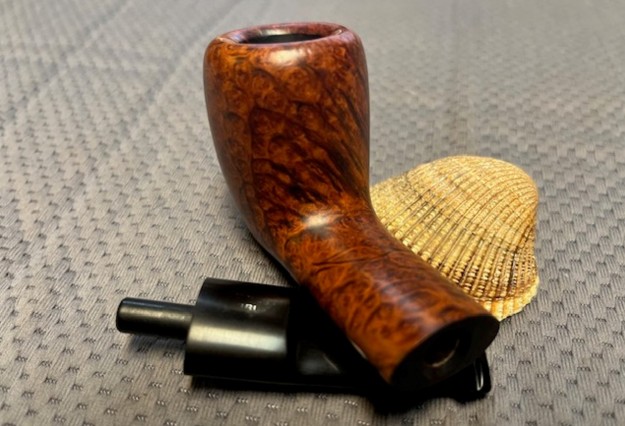
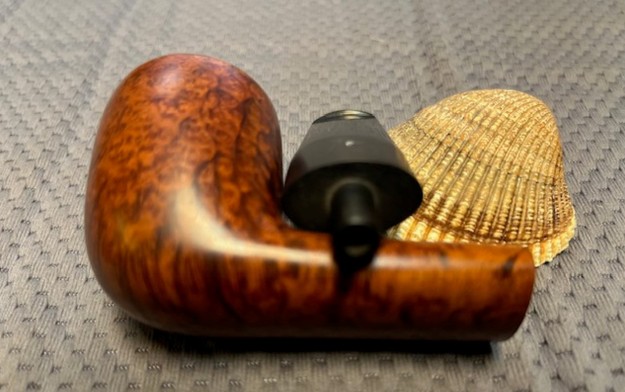
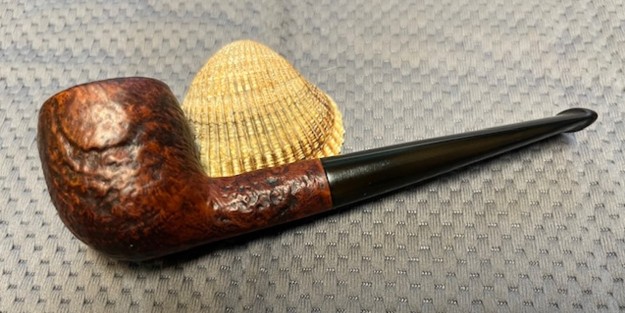
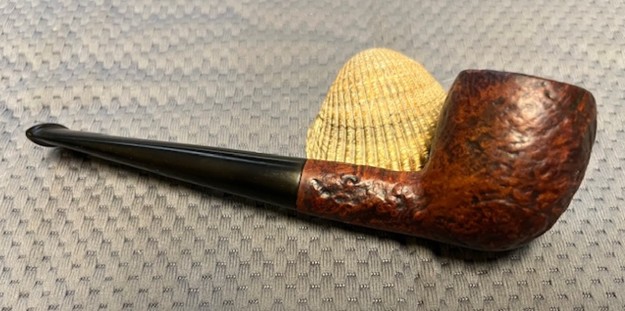
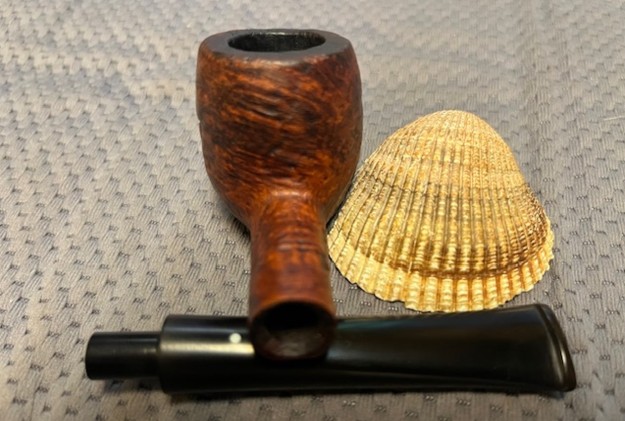
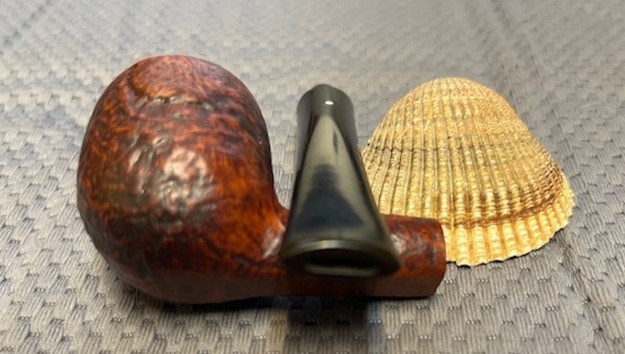
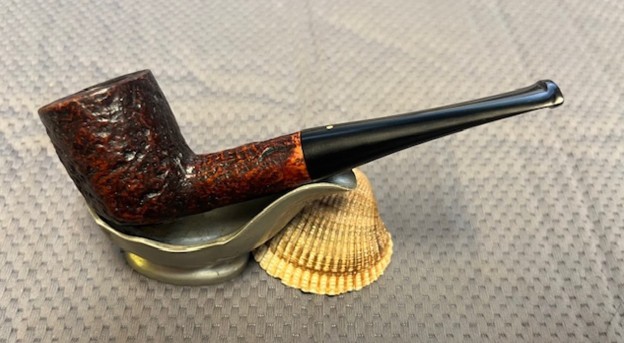
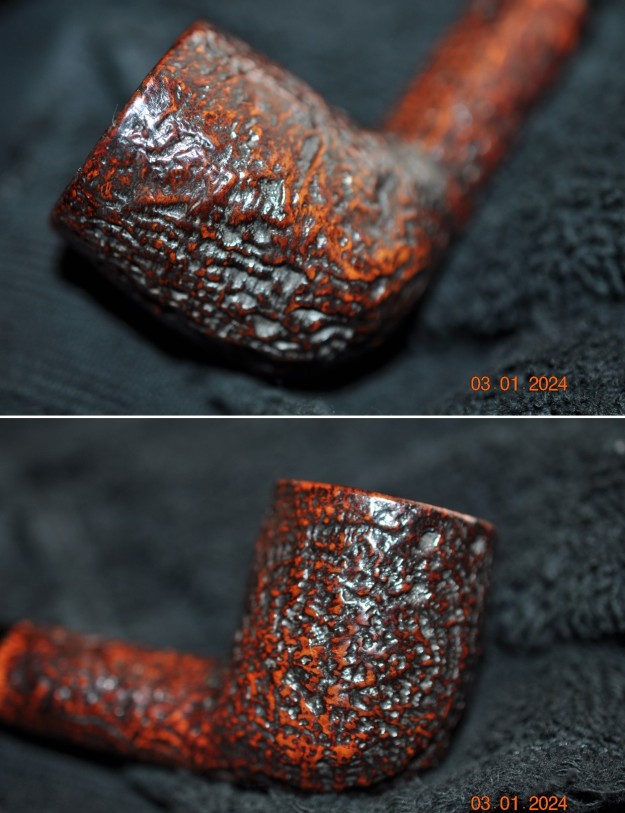
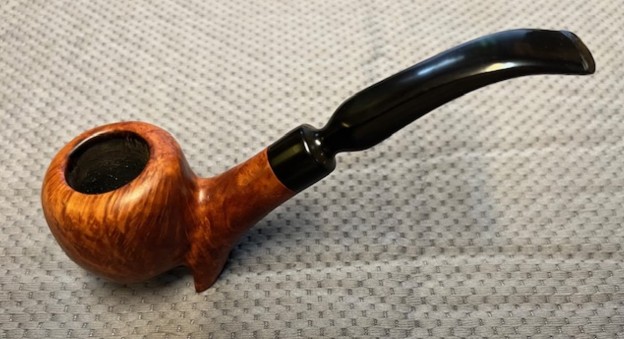
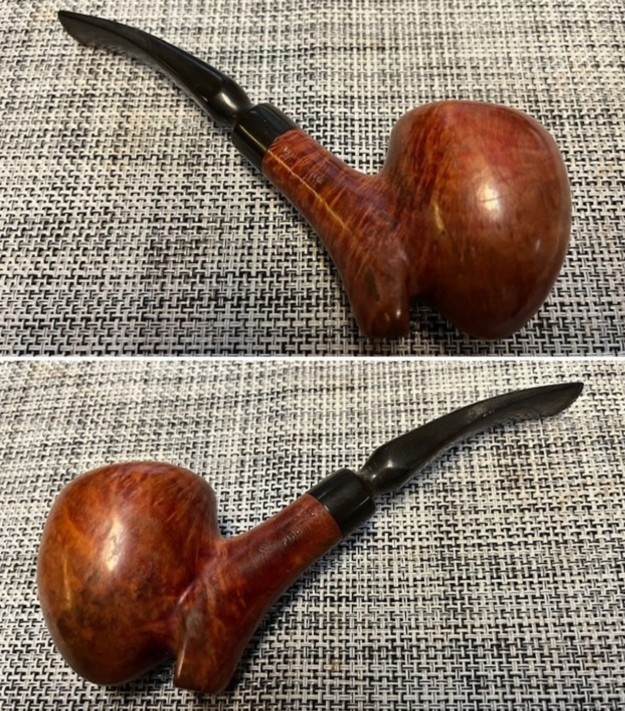
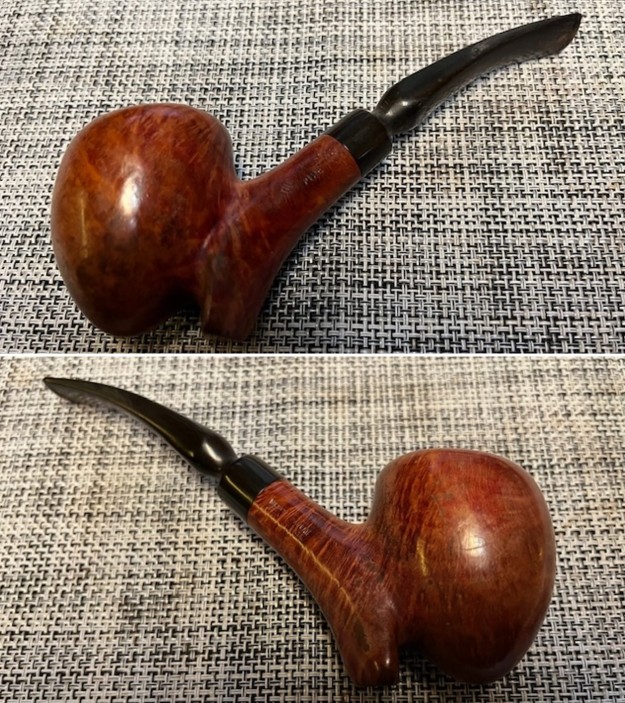
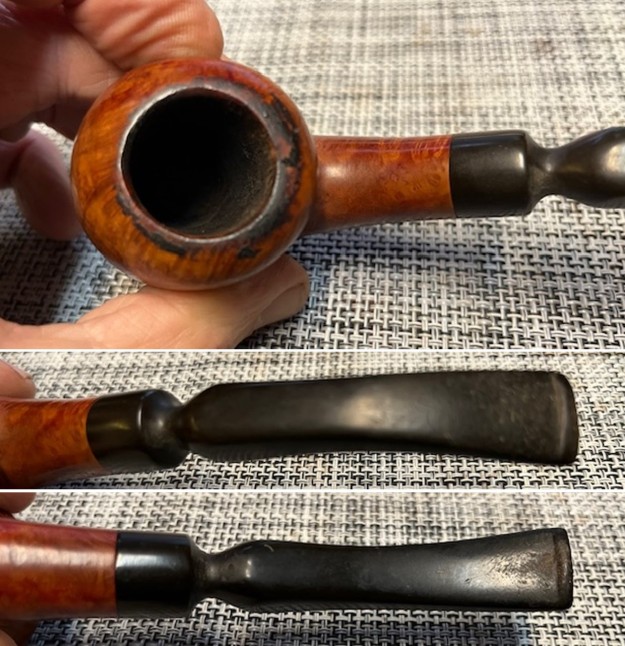
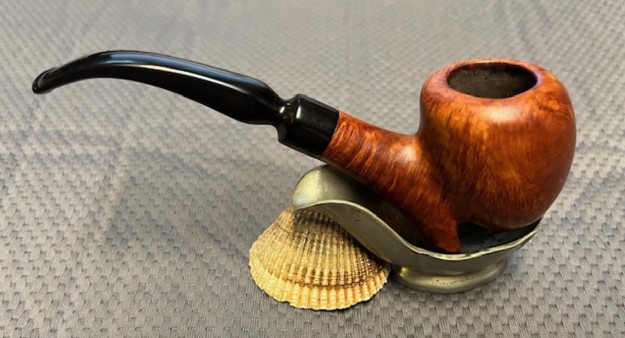
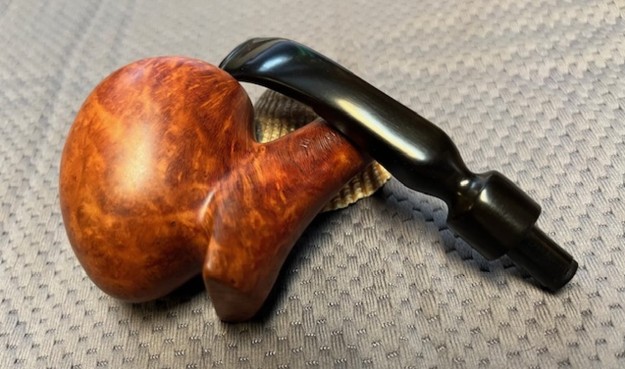
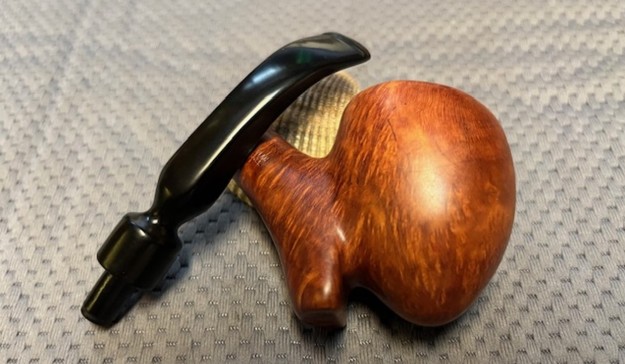
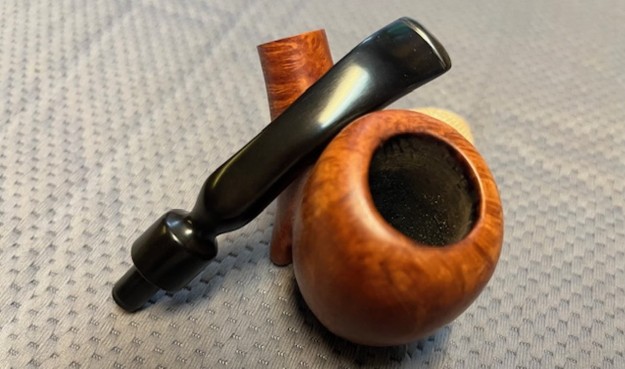
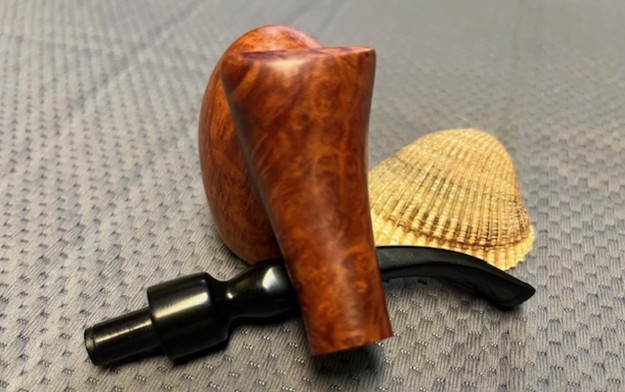
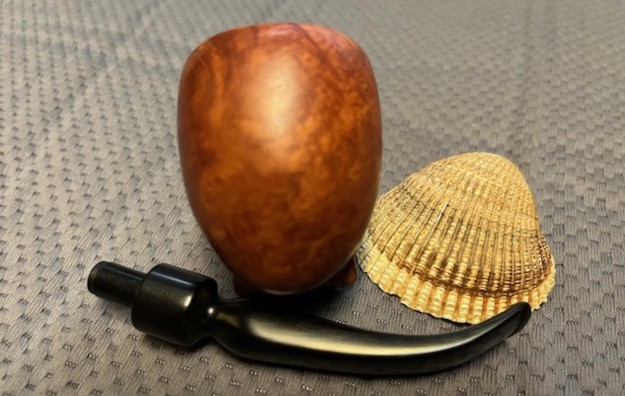
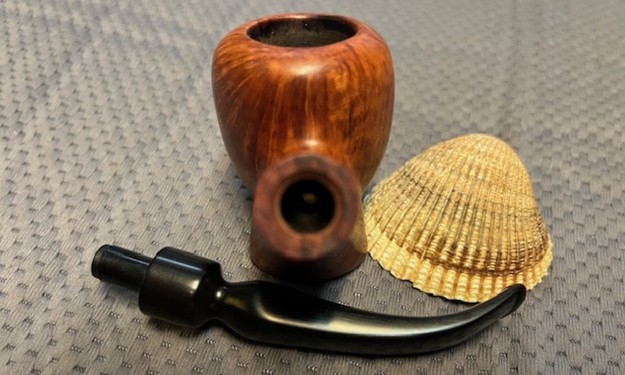
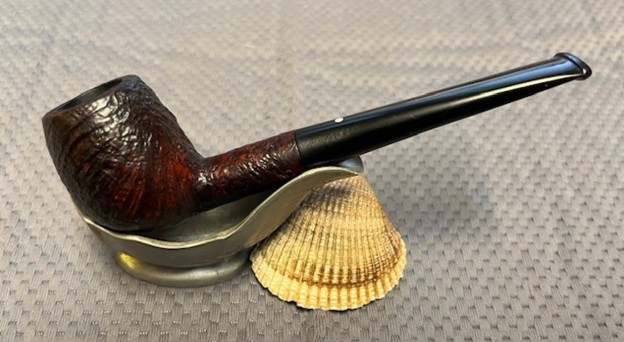
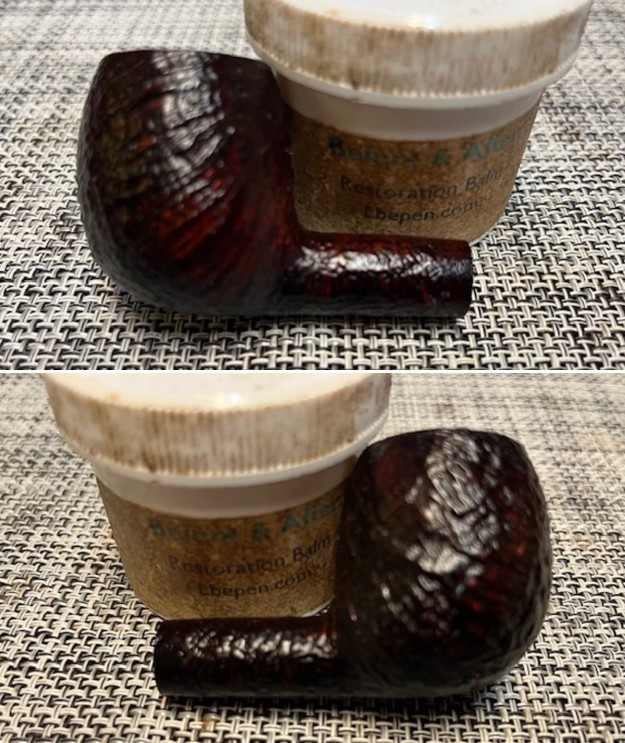
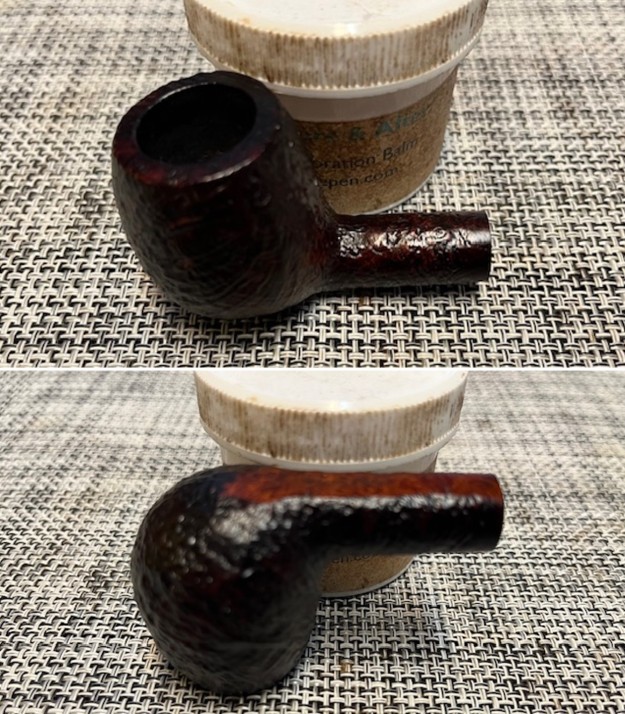
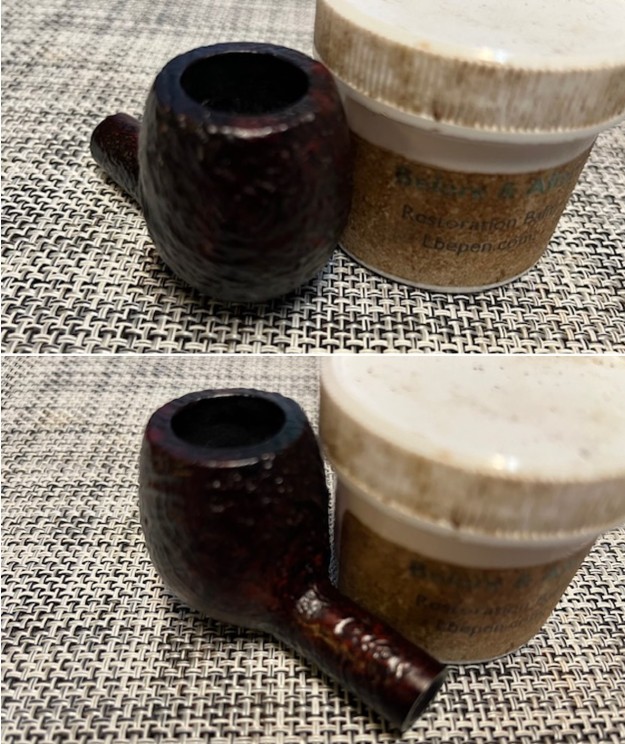
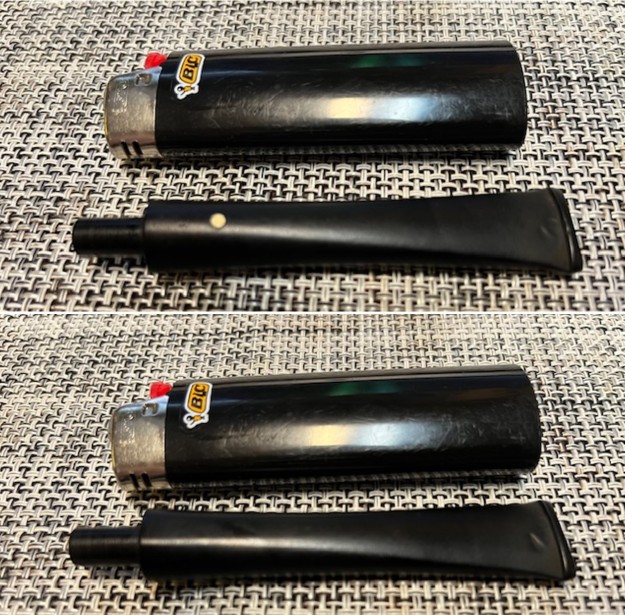
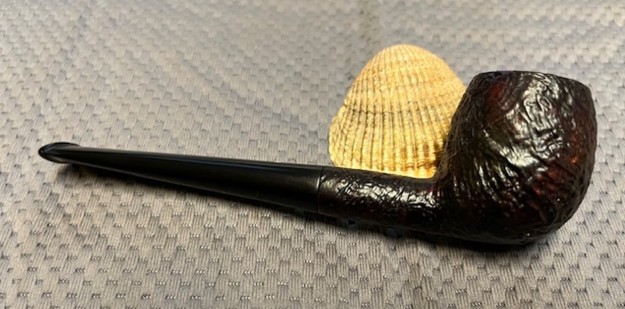
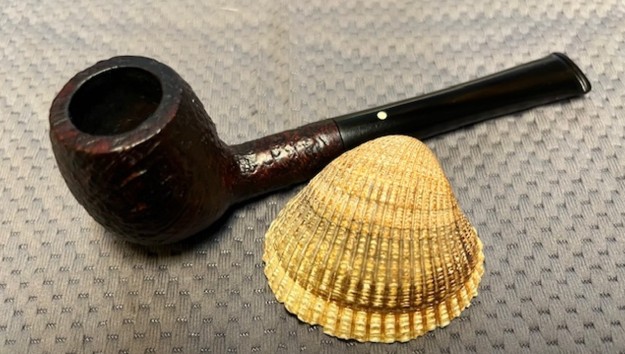
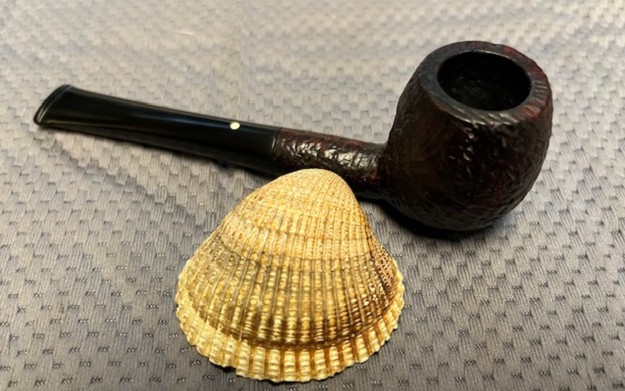
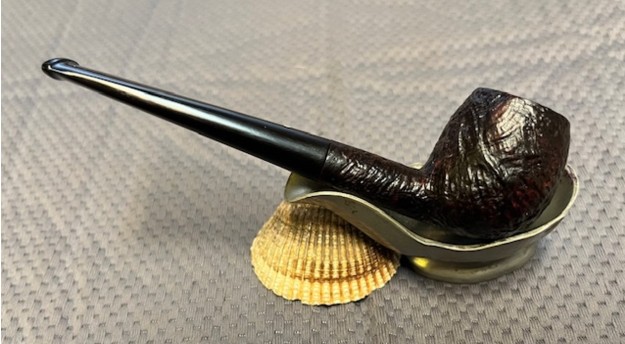
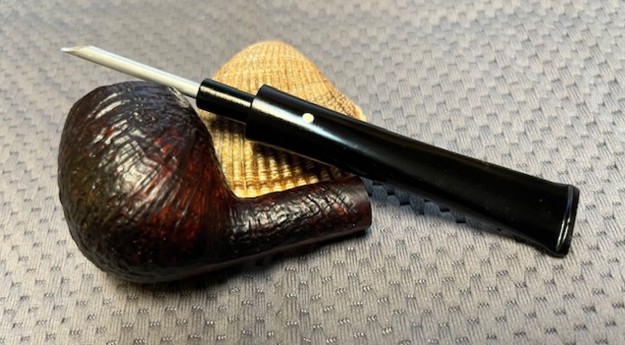
The next pipe on the work table is a beautifully grained Bari Oval Shank Acorn. It is stamped on the topside it reads Bari [over] Select [over] Mandarin. On the underside it reads Made in Denmark [over] the shape number 7824. It came from a lot we purchased from a seller on eBay on 01/22/2024 from a seller in Jordan, Minnesota, USA. It is very nicely shaped Danish style acorn shaped bowl with a vulcanite saddle stem. The bowl has a thick cake and some lava overflow on the crowned rim top and bevelled inner edge. It was hard to know for certain if there was any damage on the top or rim edges because of the debris covering them both. Only cleaning would make that very clear. The vulcanite saddle stem had a worn Bari logo stamp on the topside of the saddle. It is dirty and has tooth chatter and tooth marks on both sides ahead of the button. Jeff took photos of the pipe before he started his cleanup. Jeff took photos of the bowl and rim top to show the cake in the bowl and the condition of both. It was heavily caked with a lava overflow on the rim top. The inner and outer edges look very good. He took photos of the top and underside of the stem showing the oxidation and tooth marks on the stem surface and button. Jeff took photos of the heel and the side of the bowl and shank to show the grain on the pipe. It is a beauty. Jeff took photos to capture the stamping on the sides of the shank. It is clear and readable as noted above. He also took a photo of the faint Bari stamp on the topside of the stem. I turned to Pipephil’s site (http://www.pipephil.eu/logos/en/logo-b1.html) to see if I could find a listing for the Bari Select Mandarin with this four digit number. There was nothing specifically listed for this line of Bari pipes. There was also good info on the brand as a whole and that it was founded by Viggo Nielsen in 1950 and he ran it until 1978 when Age Bogelund managed the production for them. In 1993 it was sold to Helmer Thomsen. I have included a screen capture of the section below.Pipedia gives a great history of the brand (https://pipedia.org/wiki/Bari) that is well worth reading. There were also photos of the Bari stamping on the Select Mandarin line of pipes.

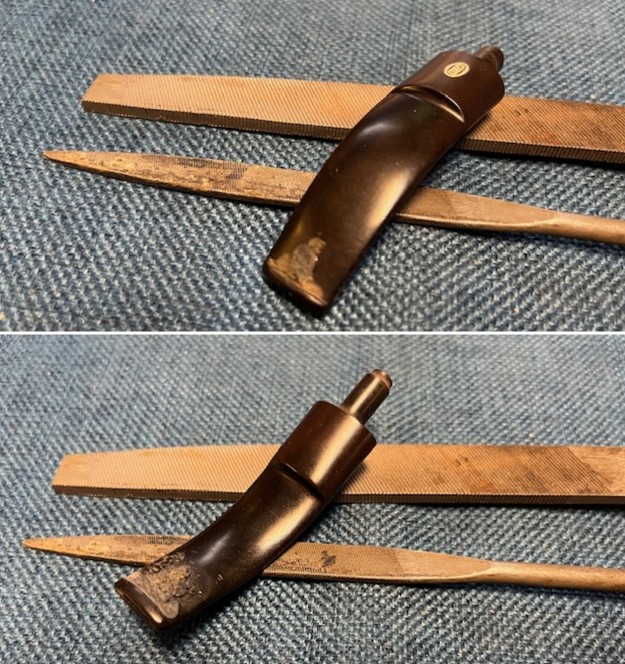
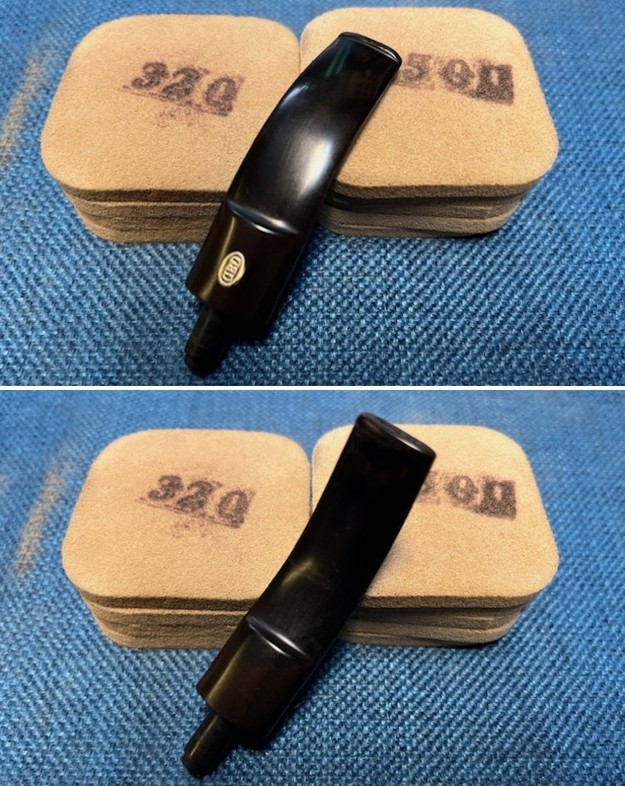
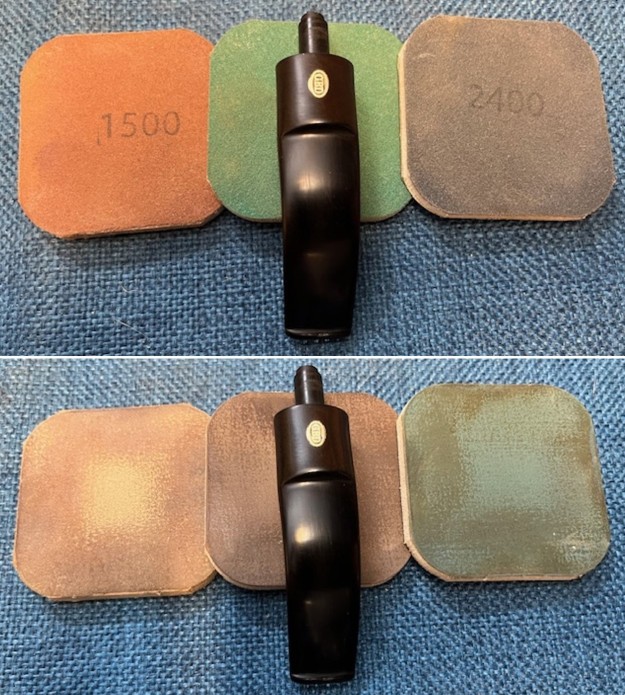
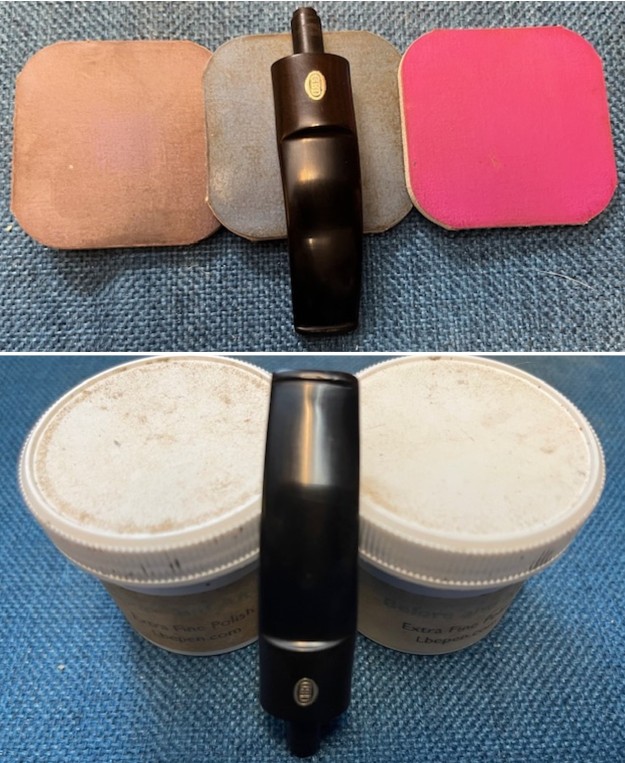
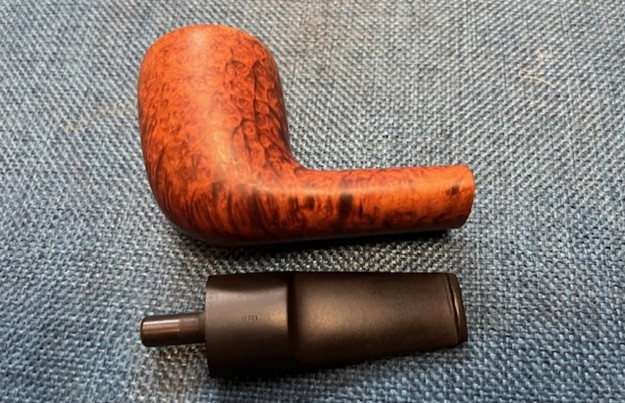
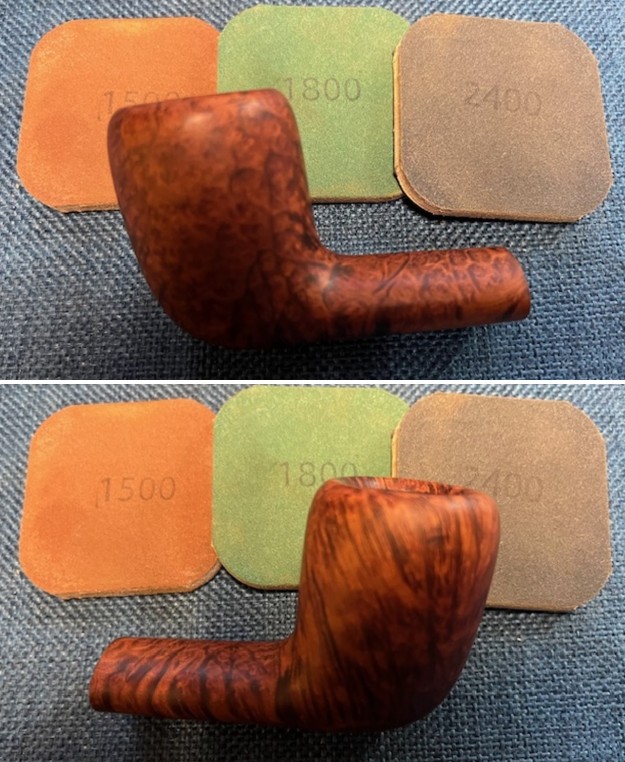
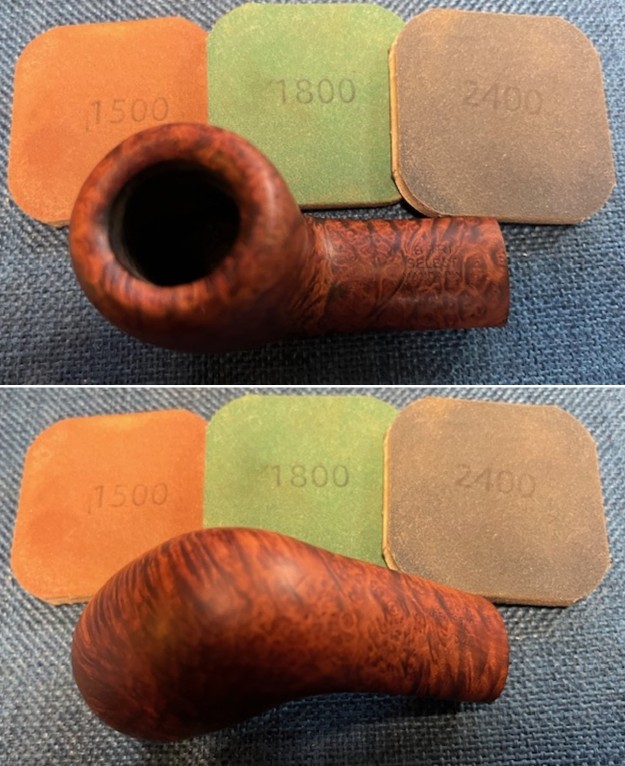
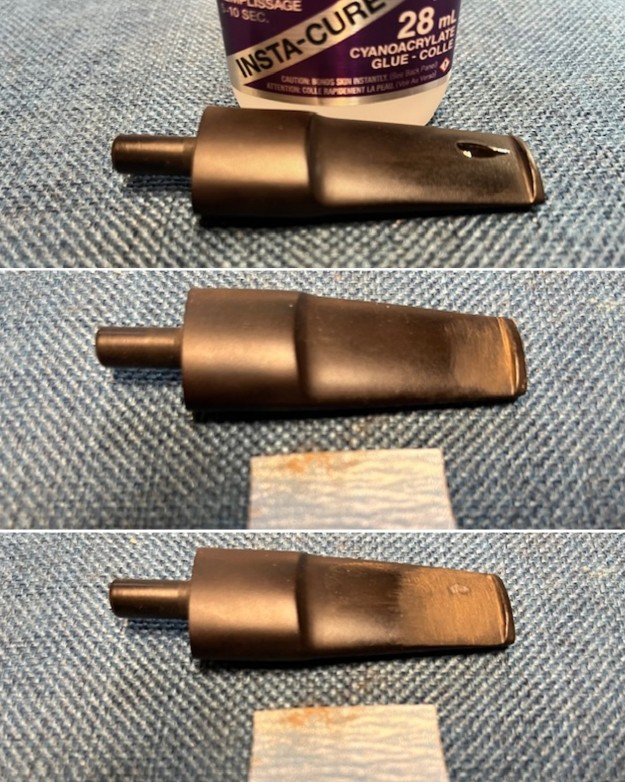
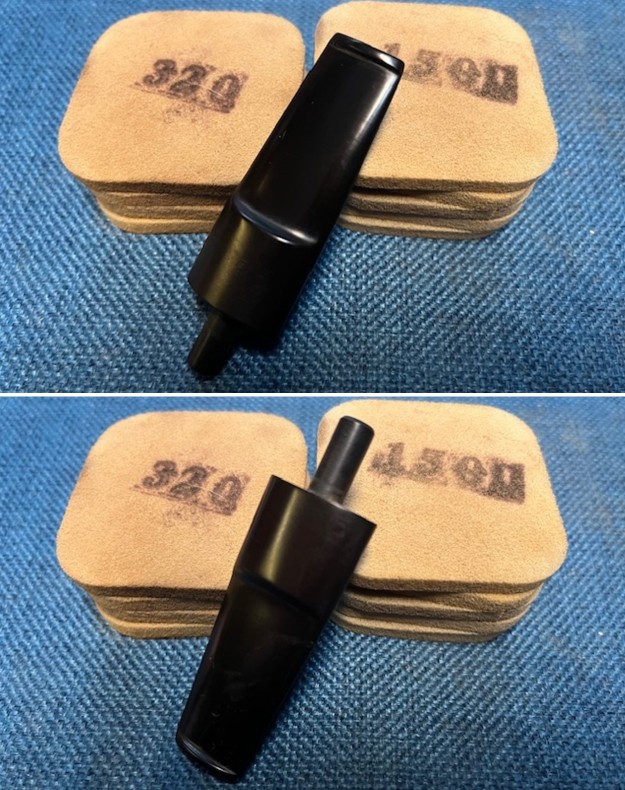
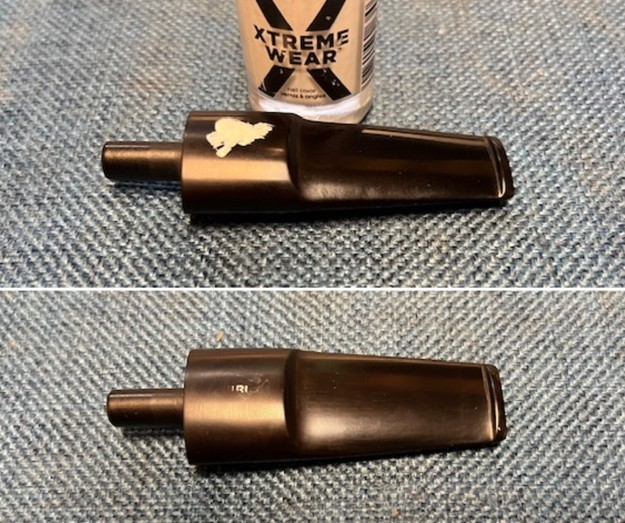
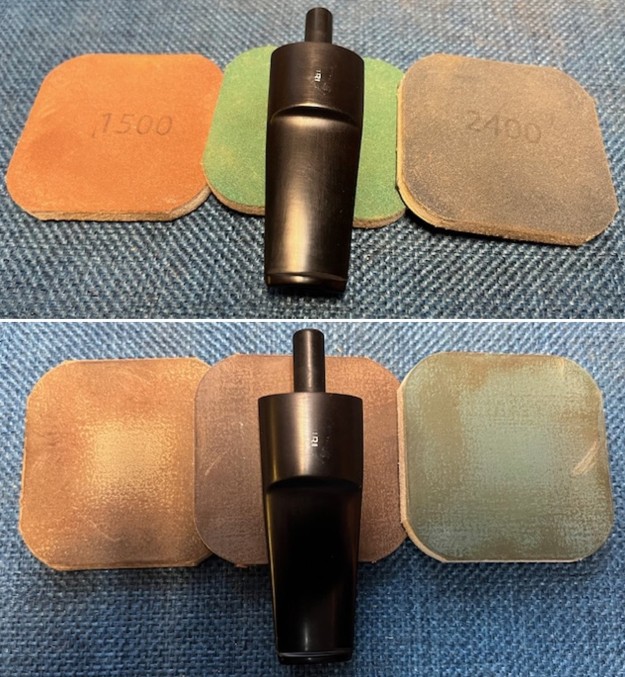
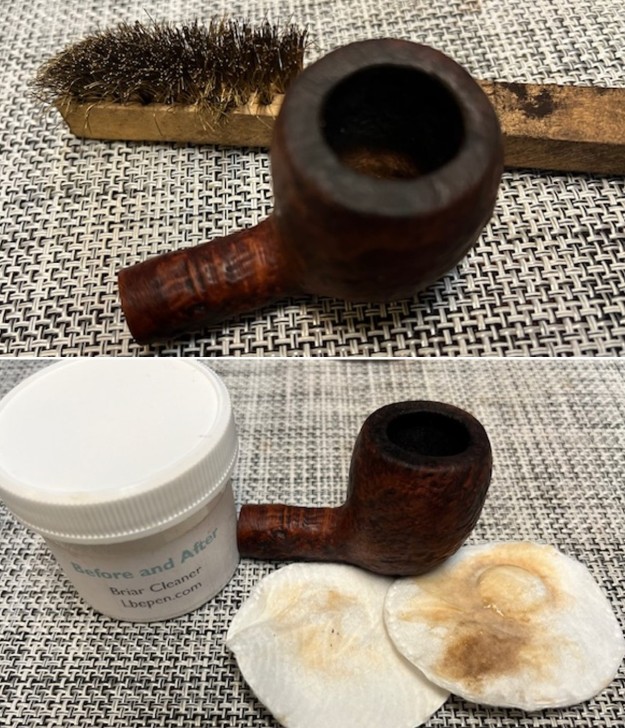
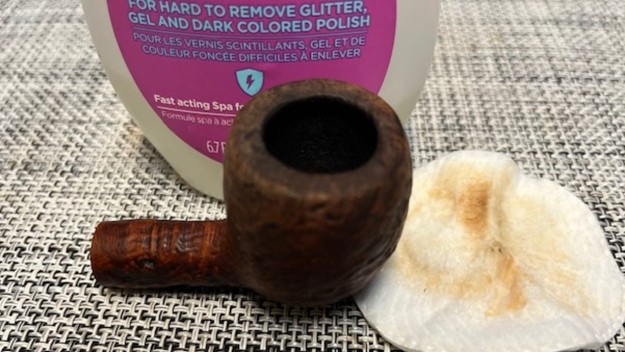
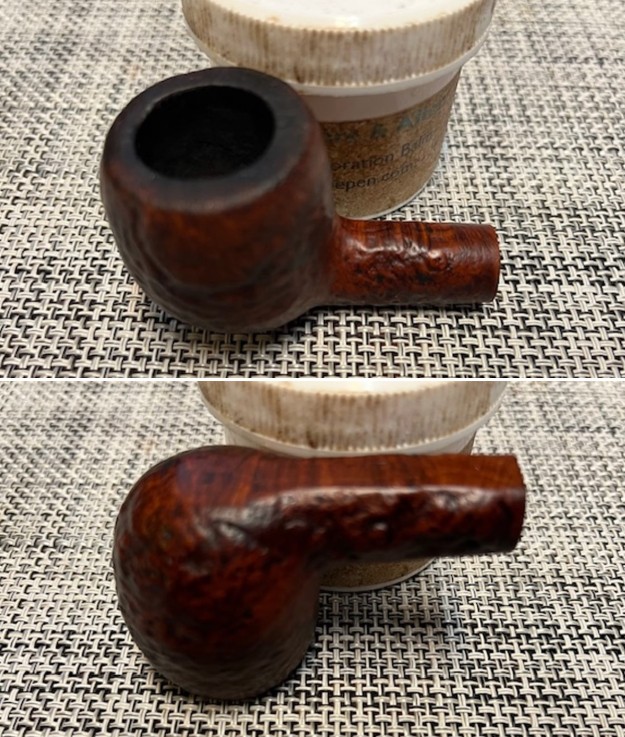
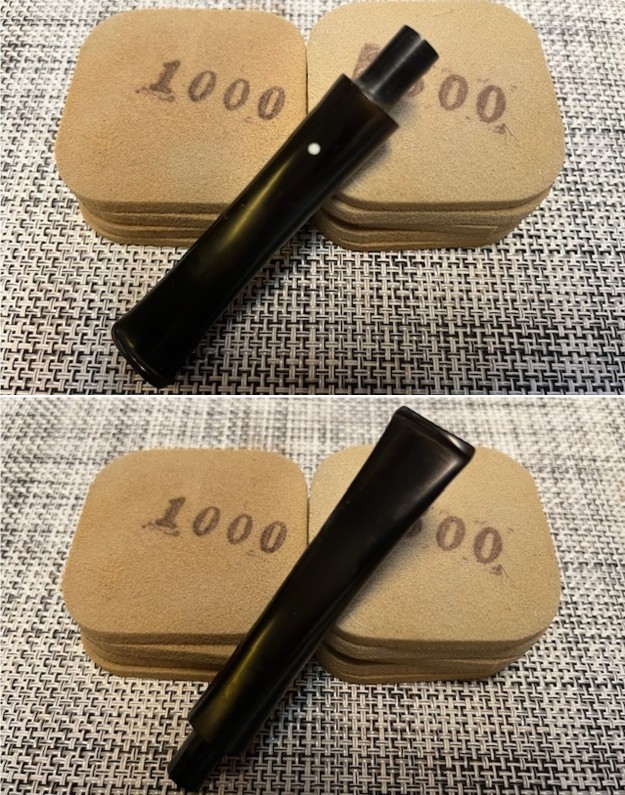
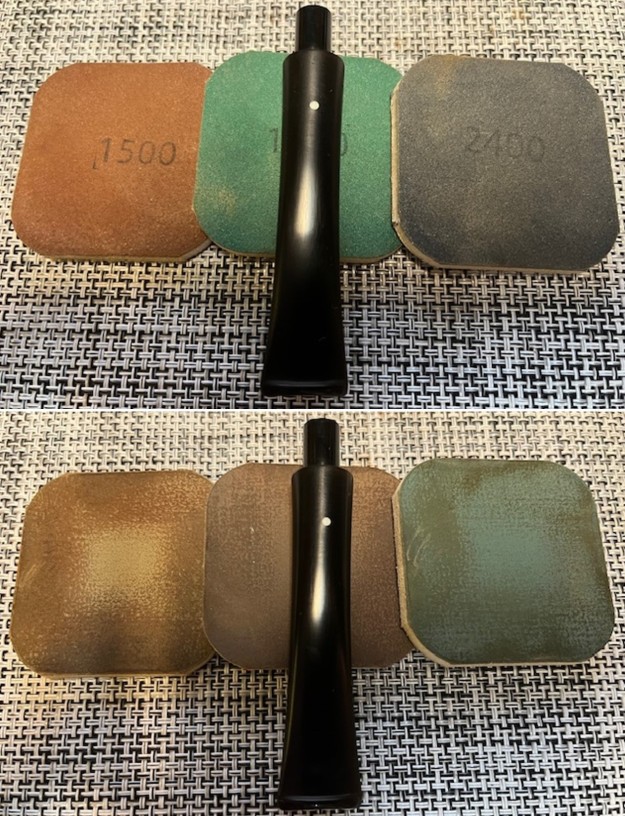
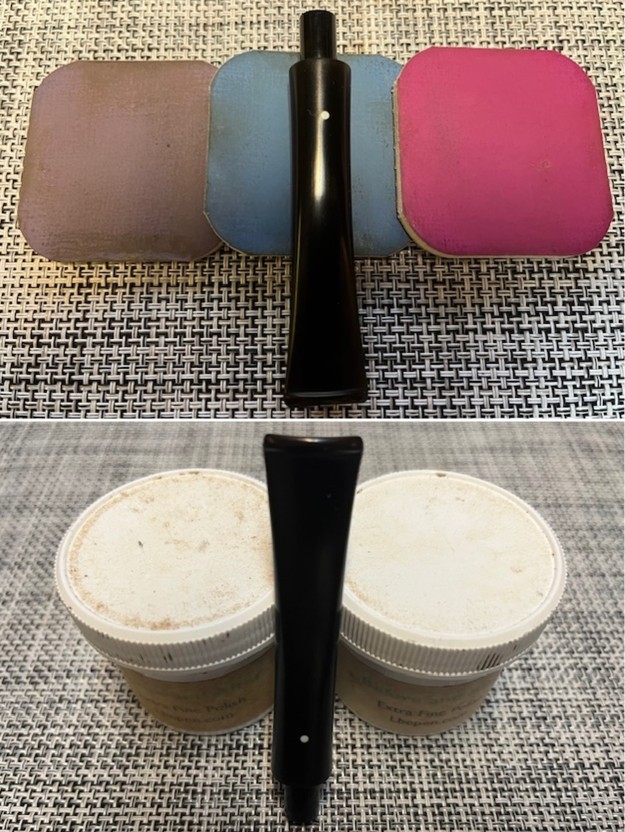
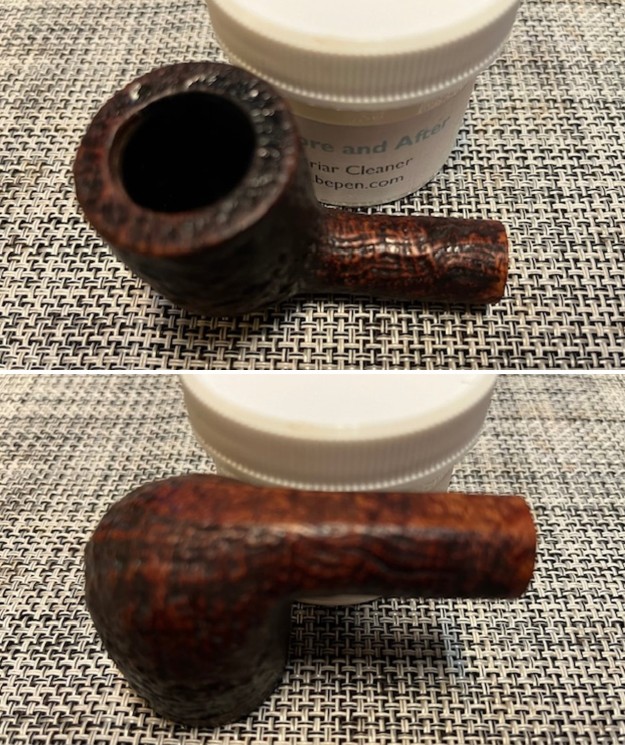
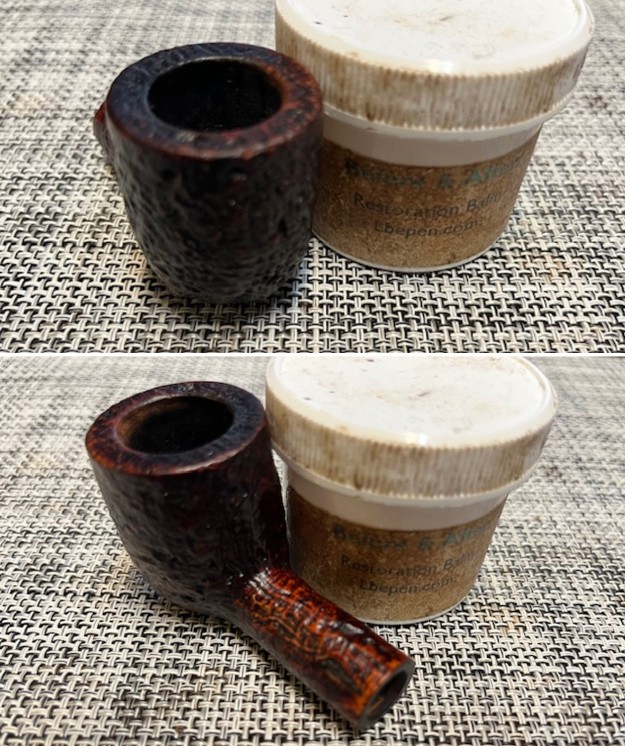
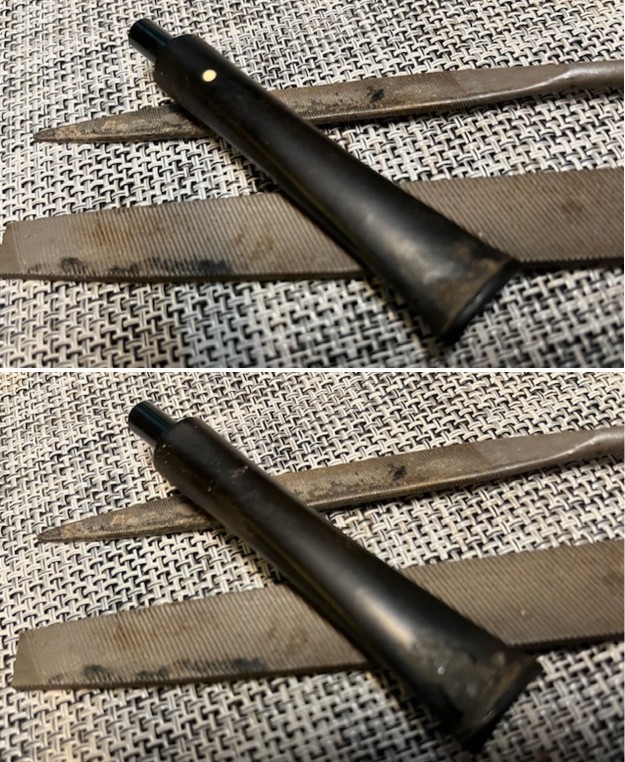
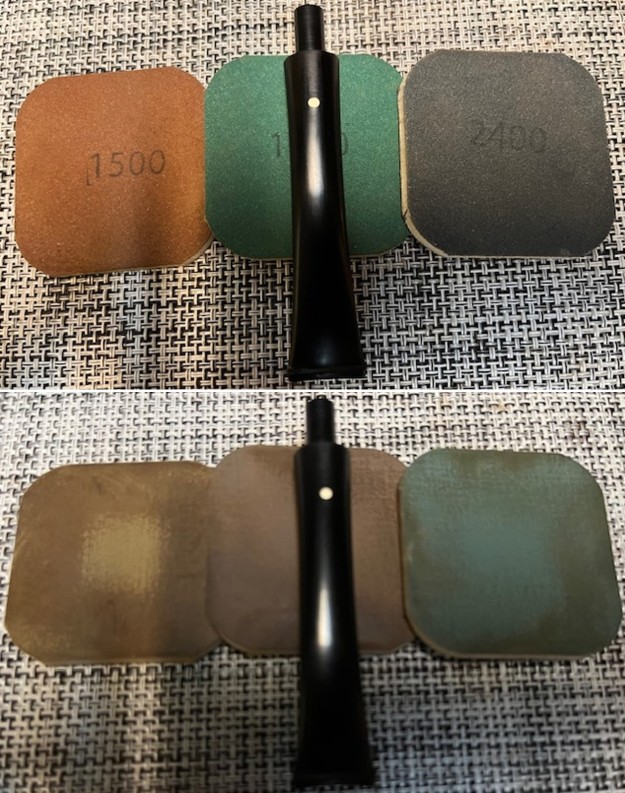
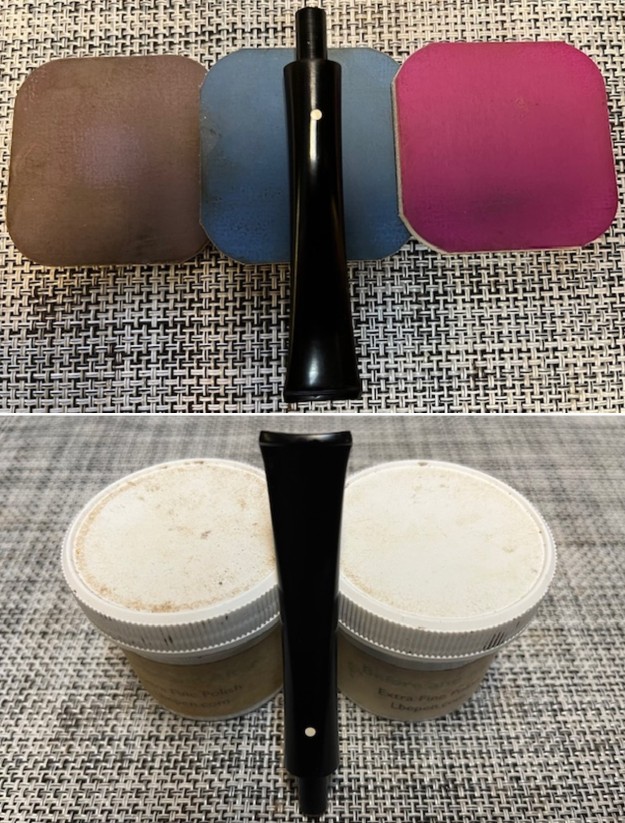
Jeff reamed it with a PipNet pipe reamer and cleaned up the reaming with a Savinelli Fitsall Pipe Knife. He scrubbed out the internals of the shank and stem with alcohol, pipe cleaners and cotton swabs until the pipe was clean. He scrubbed the exterior of the bowl with Murphy’s Oil Soap and a tooth brush to remove the grime and grit on the briar and the lava on the rim top. The finish on the bowl looked really good when I got it. The rim top and edges looked very good. He soaked the stem in Briarville’s Pipe Stem Deoxidizer bath to remove the oxidation. The stem looked better and the deep tooth marks and chatter on the surface were also visible. When the pipe arrived here in Vancouver for the second stop of its restoration tour it looked much better than when he found it. I took photos of the pipe before I started my work on it. I took photos of the condition of the rim top and stem before I started working. The rim top looks very good and the bowl is spotless. The stem still shows some light oxidation remaining and some tooth chatter and marks on both sides near the button. I took photos of the stamping on the top and underside of the shank. The stamping was faint in spots but still readable. It reads as noted above. I took the bowl and stem apart and took a photo of the pipe to show the look of the pipe. I polished the briar with micromesh sanding pads – dry sanding with 1500-12000 grit pads. I wiped the bowl down after each pad with a damp cloth to remove the sanding dust. I worked some Before & After Restoration Balm into the finish of the bowl, rim top and shank with my fingertips to clean, enliven and protect it. I find that the balm really makes the briar come alive again. The contrasts in the layers of stain really made the grain stand out. I let the balm sit for 15 minutes and then buffed with a cotton cloth to raise the shine. The bowl really looks good at this point. I set aside the bowl and turned my attention to the stem. I “painted” the tooth marks on the surface of the stem and was able to lift all of them other than the one deep one on the underside. I filled in the mark with clear super glue. Once the repairs cured I flattened them out with 220 sandpaper to blend them into the surface. I sanded the stem with 320-3500 grit sanding pads and wiped the stem down after each pad with an Obsidian Oil saturated cloth to remove the grime and protect the stem.I touched up the Bari white logo on the stem with acrylic white fingernail polish. Once it dried I buffed off the excess with a cotton pad. The BA are too faintly stamped to take in the acrylic so the stamp is incomplete. I wiped the stem down with Obsidian Oil once more.I polished the stem with micromesh sanding pads – wet sanding it with 1500-12000 grit pads. I polished it further with Before & After Pipe Stem Polish – both fine and extra fine. Once again, I am the part of the restoration that I always look forward to – the moment when all the pieces are put back together. I put the pipe back together and buffed the bowl and the stem with Blue Diamond on the buffing wheel. I gave the bowl and the stem multiple coats of carnauba wax. I buffed the pipe with a clean buffing pad to raise the shine. I hand buffed it with a microfiber cloth to deepen the shine. It is fun to see what the polished bowl looks like with the smooth finish and the black vulcanite stem. This richly stained Bari Select Madarin 7824 Acorn is light weight and ready for you to load up a tobacco of preference and enjoy breaking it in. Have a look at it in the photos below. The dimensions are Length: 5 inches, Height: 2 inches, Outside diameter of the bowl: 1 ¼ inches, Chamber diameter: ¾ of an inch. The weight of the pipe is 50 grams/1.76 ounces. This is one that will go on the Danish Pipemakers Section of the rebornpipes online store shortly. Let me know if you are interested in adding it to your rack. Thanks to each of you who are reading this blog. Remember we are not pipe owners; we are pipemen and women who hold our pipes in trust until they pass on into the trust of the next generation.

Restoring a 1914 BBB Pencil-Shank Billiard


Blog by Kenneth Lieblich

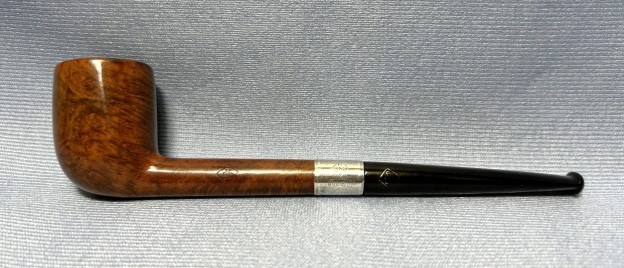
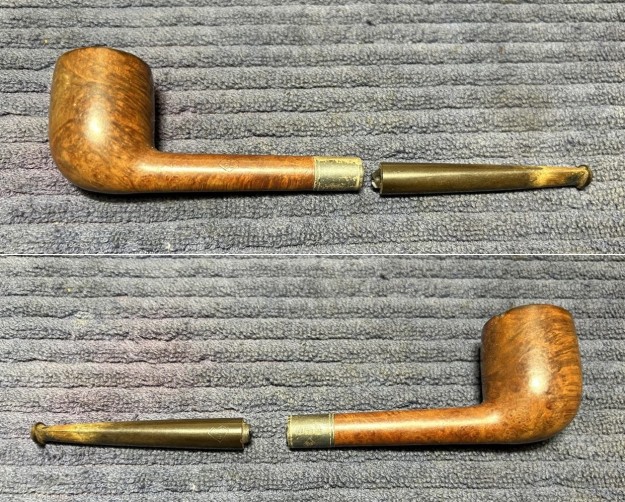
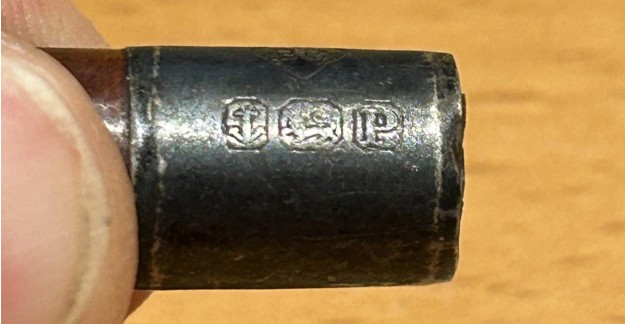
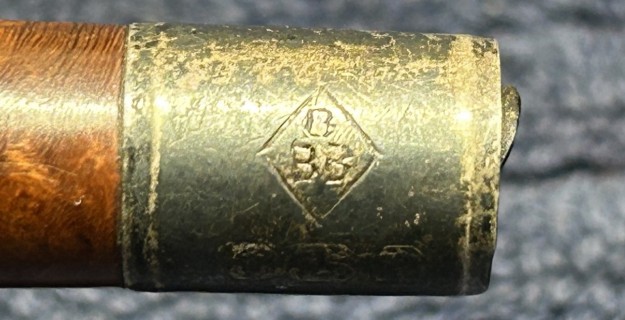
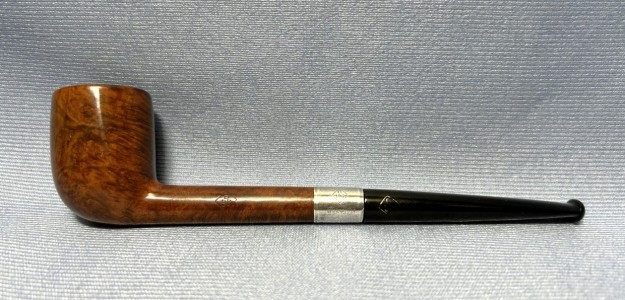
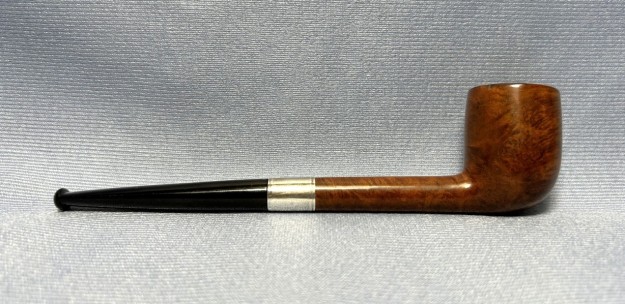
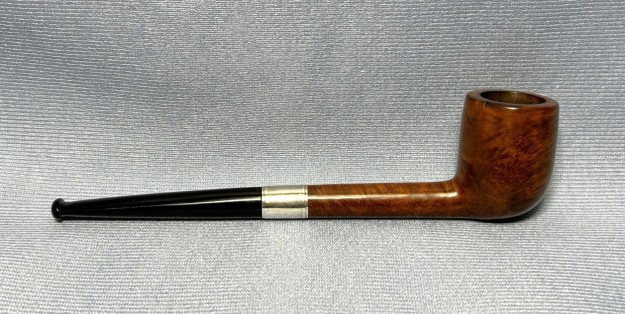
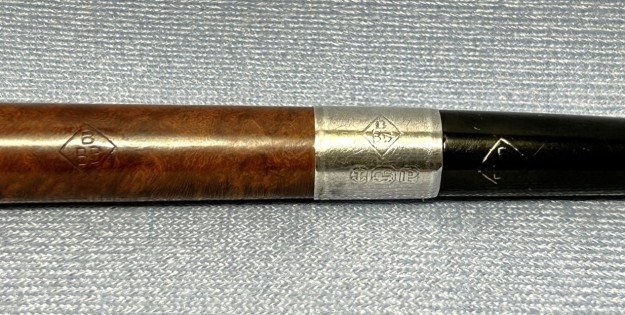
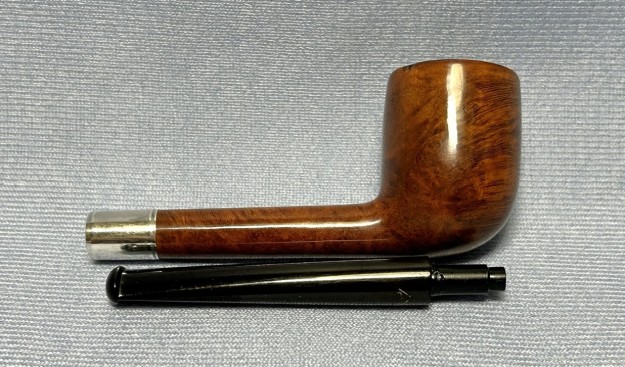
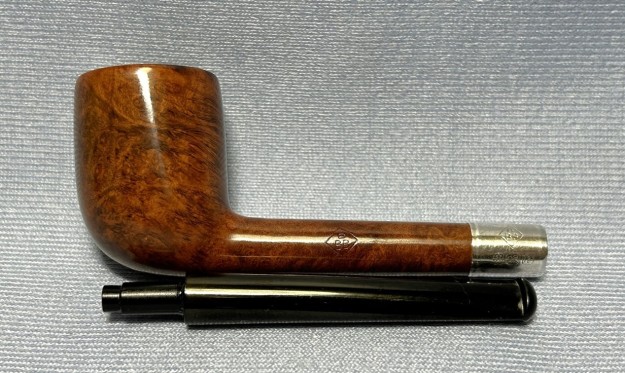
For those of us who hunt for lost pipes, there are always peculiar tales of acquisition – but this one might be my most peculiar location of acquisition. A couple of weeks ago, my wife was out shopping with one of my daughters and they decided to go into an old-time ice cream parlour. While there, my wife spotted a jar for sale on the counter that read ‘Jar with parts + pipes’. That seemed quite odd for an ice cream joint, so she texted me the photo below and asked if I wanted it. It was very inexpensive, so I said, ‘Sure’. What an unusual spot for a jar of pipe parts!Well, there were some interesting bits and bobs in the jar – including a couple of items that particularly caught my eye. This lithe and comely pipe is one of them – and it will enter my pipe collection. As the title says, it is a 1914 BBB pencil-shank billiard with a sterling silver band and vulcanite, tapered, orific stem. How do I know it is from 1914? Well, let us take a closer look at that sterling silver band.Amidst the heavy tarnish, we can see three distinct marks. From left to right, they are an anchor, a lion passant, and a letter ‘P’. What do these marks mean? The anchor is the city mark and indicates the English city of Birmingham. The lion passant is the silver standard mark and indicates sterling – that is to say, 92.5% pure silver. The letter ‘P’ is the date letter and, as shown in the chart below, indicates the year 1914.That information was definitive in establishing a time period for the pipe. The other marks are perhaps slightly less helpful. The left side of the shank, the left side of the stem, and the silver band each have the recognizable logo of BBB inside a diamond shape. There are no other markings – although the absence of a model name etc. tells its own story. Read on. Let’s learn a bit about BBB. The article on Pipedia is bizarre insofar as the vast majority of the text is an egregious translation (from the French) of a good history of BBB on the Fumeurs de Pipe website. I speak French and the Babelfish translation that Pipedia uses is not helpful to anyone. I intend to make my own translation of that history one day. In the meantime, here is the non-translated text at the start of that article:

The initials once stood for Blumfeld’s Best Briars after Louis Blumfeld, who took over the management of the Adolph Frankau Company in 1856. After his death, the BBB gradually became known as Britain’s Best Briars. Soon to be the oldest English trademark in current use and the first pipe ever to have a registered trade mark. “Britain’s Best Briars”, often called BBB, is one of the oldest brands still in production and has always been the most popular foreign brand in Denmark. Earlier pipes included a metal rondel with a diamond shape including BBB imbedded in the stem top, and later post-Cadogan went to a stamped on logo, similar to the GBD pipes.

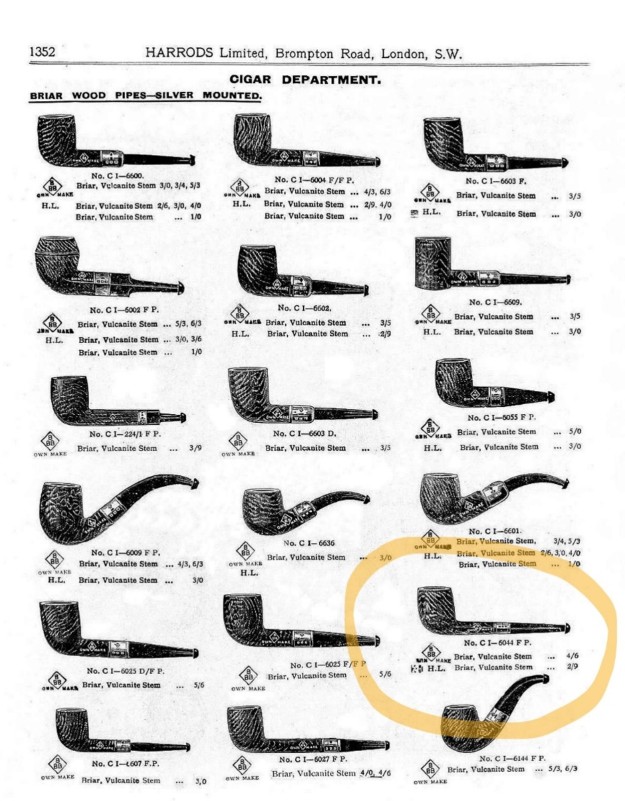
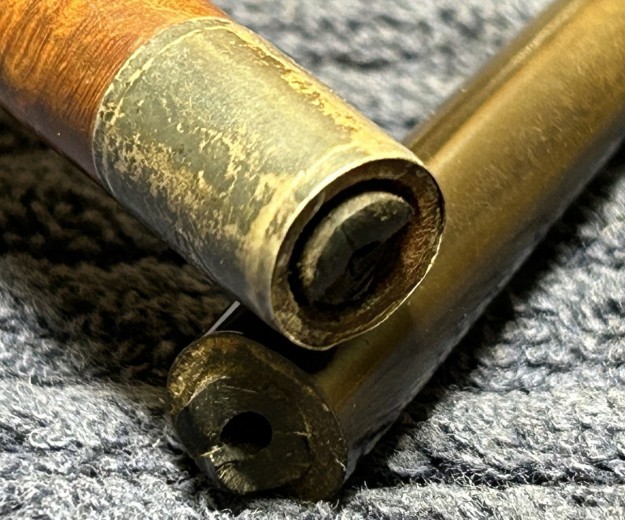
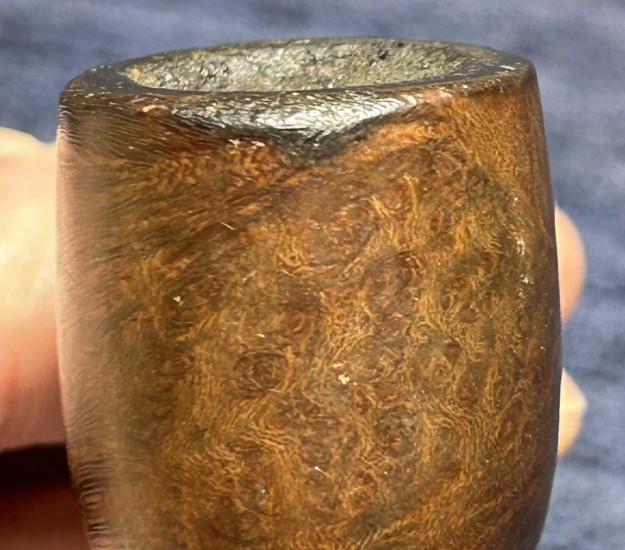
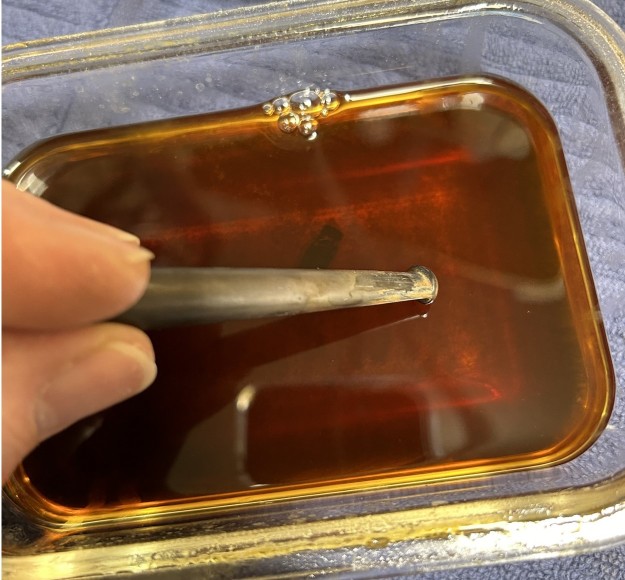
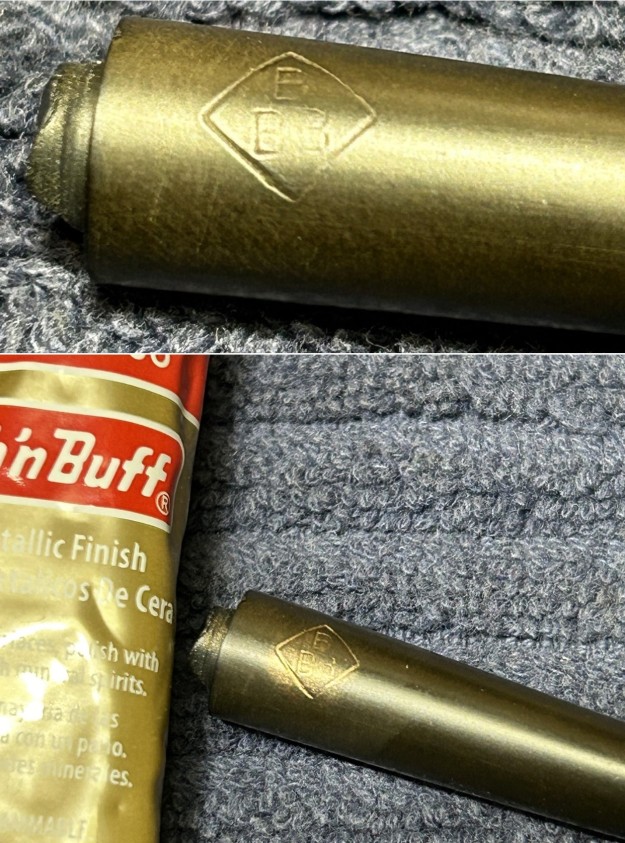
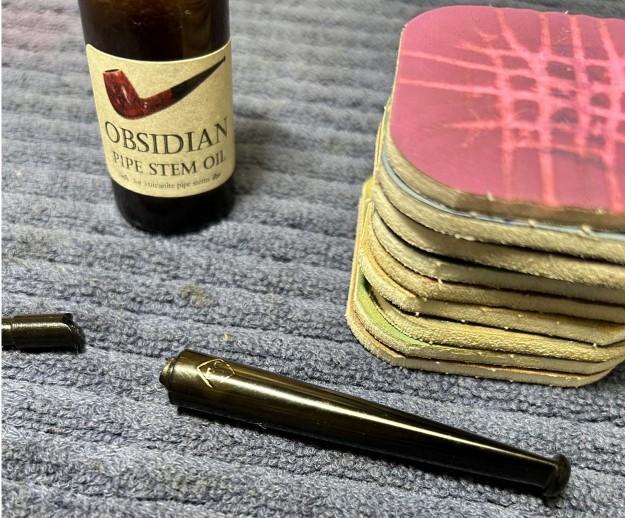
One detail that is of note from this time period of BBB pipes is that they only had two grades/models of pipe. One was ‘BBB Own Make’ (which later became BBB Best Make) and the other being simply ‘BBB’. This pipe is clearly in the latter category. Below is a page from a 1910 Harrods catalogue, showing some BBB pipes for sale. I have circled the one that most closely resembles the pipe I have and showed a close-up of it. Let us move on to the restoration. This pipe is 110 years old and I suppose it has fared well in that time. Certainly, I have seen much newer pipes in much worse condition. As I mentioned earlier, this stem is tapered, made of vulcanite, and concludes with an orific button. For more information on the orific button, please take the time to read Steve’s interesting article on the subject. As you can see, the stem is coated with calcification and oxidation. It has a few tooth marks, but nothing too serious. Sadly, however, the stem’s tenon has broken off inside the stummel’s mortise. More about the tenon in a bit. The stummel is in rougher shape. The wood shows wear and tear, including the odd nick and a significant gouge at the rim edge. The bowl is pretty thoroughly coated with cake and lava has erupted on to the rim. There is also some evidence of burned wood under that lava. I will have to excavate to learn more. Fortunately, this stummel does not look over-smoked (which was a real possibility), despite it clearly being a favourite of the previous owner. The sterling silver band (as you have already seen) is in fairly good physical condition, although it clearly has been heavily tarnished.I began my restoration of this pipe by cleaning the stem. I wiped it down with some oil soap on some cotton rounds in order to remove some calcification. I then cleaned the insides with pipe cleaners and 99% isopropyl alcohol. Although it was a bit dirty, it was much cleaner than I had expected after all these years.In order to address the oxidation, I dropped the stem in an oxidation removing fluid and left it to sit overnight. This mixture tends to draw the stem’s oxidation to the surface, where it can be more easily removed. When the stem was done soaking, I scrubbed the stem with some surface cleanser squirted on cotton rounds. This worked very well at removing the unsightly oxidation.I took a closer look at the diamond-shaped logo – it had been heavily worn over the past century or so. I hemmed and hawed about adding gold paint back to the logo on the stem. In the end I did it and figured that I can always remove later if I so desire.In my desire to keep original components wherever possible, I perfunctorily decided to not replace the tenon at this time. I knew that I could superglue it back in place – but I also knew that that would not hold in the long term, due to its poor shear strength. This would only be a cosmetic solution. Ultimately, however, I will replace the tenon at a later date. For now, I just want to see this thing restored!

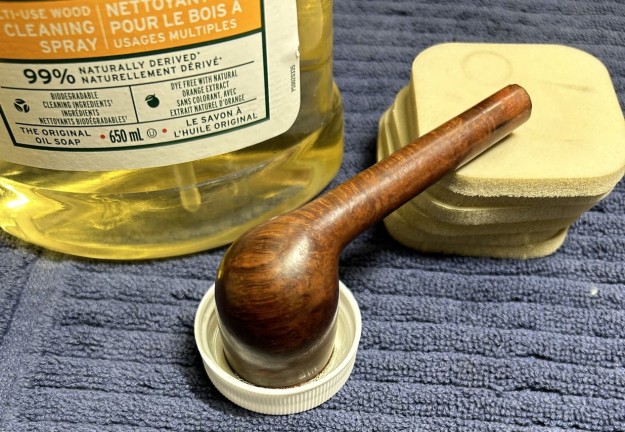
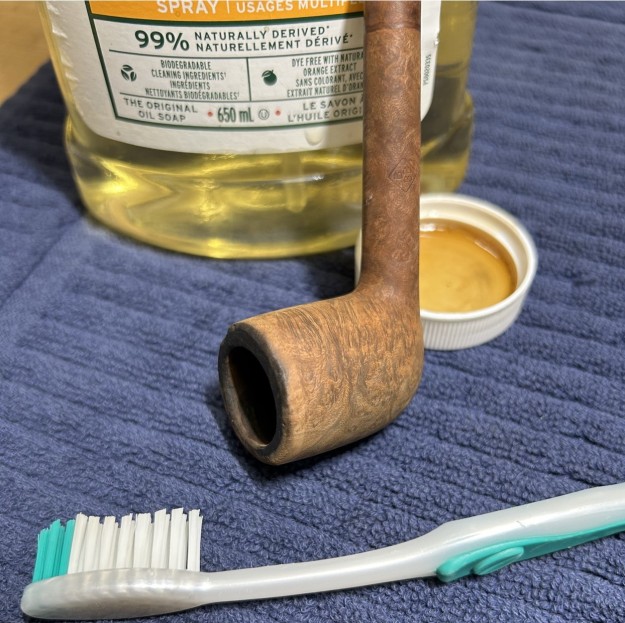
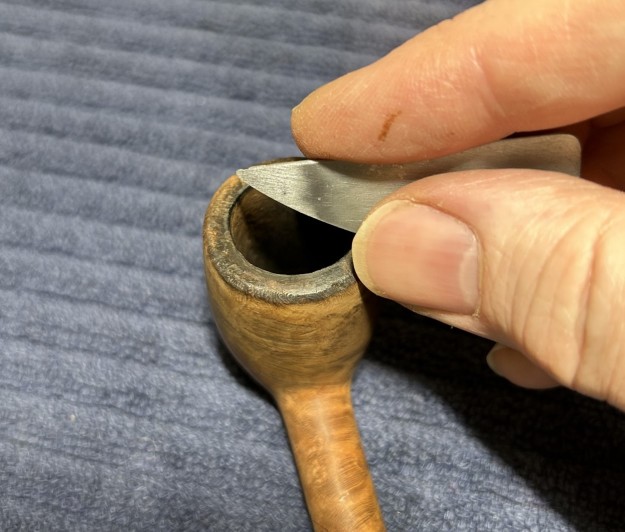
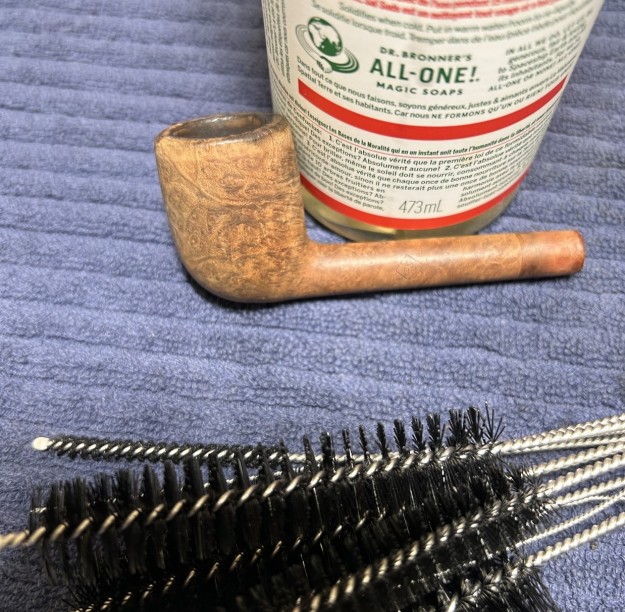
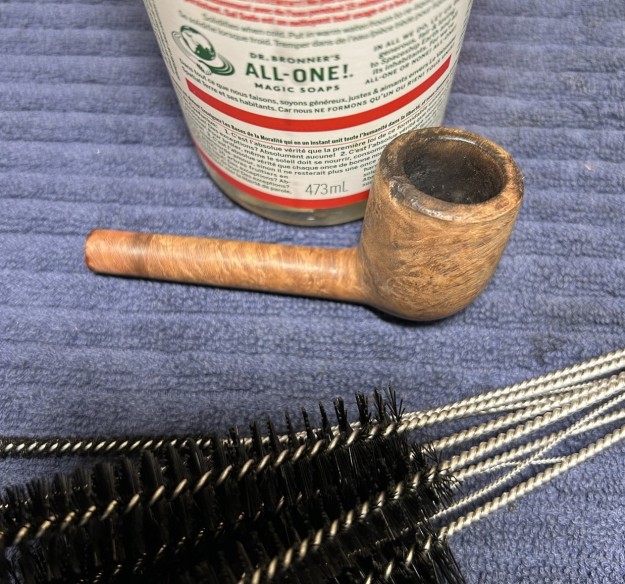
In order to smooth and shine the beautiful black surface of the stem, I used my nine Micromesh pads to sand everything down gradually and delicately. For the last five of these pads, I also use some oil, both as a lubricant and as a method of inhibiting the return of oxidation. It is a lovely stem and it complements the stummel perfectly. On to the stummel – and my first task was reaming the cake out of the bowl. This was surprisingly challenging work, as the cake had become very hard over the years. There was a lot of debris and the narrowness of the bowl made it all the more tricky. I was also conscious of not wanting to crack the briar as I was doing this. In the end, a lot of carbonized material came out and the bowl remained perfectly intact. Next, I wanted to address the thick layer of lava on the rim. I put some oil soap in a shallow, plastic lid and soaked the rim in it for about a dozen minutes. This softened things up and I attacked it with a toothbrush. This allowed me to clean the rim very well, also using a piece of machine metal as a gentle scraping device. There was still damage, but it was much improved. As with the stem, I cleaned the insides of the stummel with pipe cleaners and 99% isopropyl alcohol. It was among the dirtiest pipes I have ever dealt with. Wow. The filth seemed as though it would never end. Obviously, it did at some point and I put the pipe down for a while – I was sick of seeing it!Of course, I came back to it and used some cleaner and tube brushes to scrub the insides clean. My efforts had not been in vain however, as the pipe looked so much better when I was done. I removed some of the burn marks on the rim with an aqueous solution of oxalic acid. I took some cotton swabs and rubbed and rubbed. The burns did improve but never fully disappeared. I took solace from the fact that the burns were superficial and did not affect the structural integrity of the wood. Alas, I neglected to take photographs of this step.

I also opted to leave the large wounds in the briar without filling them. They are part of this pipe’s long life and I am happy for them to remain as they are. The sanding will soften the edges of these wounds and that is sufficient. With that in mind, I set about sanding the stummel with my Micromesh pads. With each pad, the wood got smoother and the pipe got prettier. One product that always makes things better is the restoration balm that I use on the wood. It provides protection and revivification to the wood grain. I applied the stuff lightly but thoroughly, and then let it sit for 15 or 20 minutes. I then buffed it with a microfibre cloth and set it aside. What a beauty! After the Micromesh pads, but before the restoration balm, I cleaned up the sterling silver band. I worked very hard and very gingerly to remove the tarnish without damaging the antique silver. I reglued it in place, back on the shank, and finally buffed with my jewellery cloth.

Last step: off to my bench polisher! Here, I gave both the stem and stummel a thorough going over with the White Diamond compound and followed that up with a coat (only one this time) of carnauba wax. The pipe is absolutely beautiful and is truly reminiscent of an earlier time.All finished! This is a wonderfully crafted pipe and has a very jaunty feel to it. It took some work, but I am proud of it. It retains some wounds from battle, but, as Steve would say, they are part of this pipe’s story. This is one pipe that I am keeping for myself and adding to the ‘Lieblich Collection’. I am sure that I will be enjoying this one for many years to come. The approximate dimensions of the pipe are as follows: length 6 in. (153 mm); height 1½ in. (37 mm); bowl diameter 1 in. (27 mm); chamber diameter ⅔ in. (17 mm). The weight of the pipe is ⅝ oz. (18 g). I hope you enjoyed reading the story of this pipe as much I as I did restoring it. If you are interested in more of my work, please follow me here on Steve’s website or email me directly at kenneth@knightsofthepipe.com. Thank you very much for reading and, as always, I welcome and encourage your comments.

Rebirthing a worn and obviously favourite 1976 Dunhill Shell 341 Apple


Blog by Steve Laug

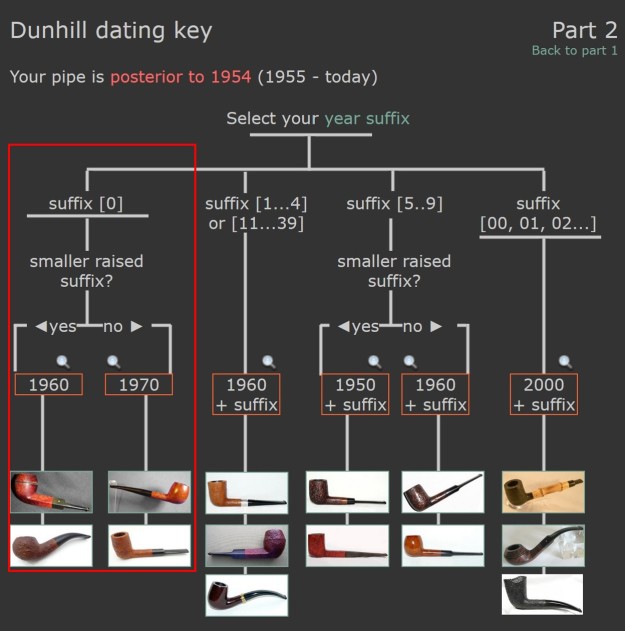
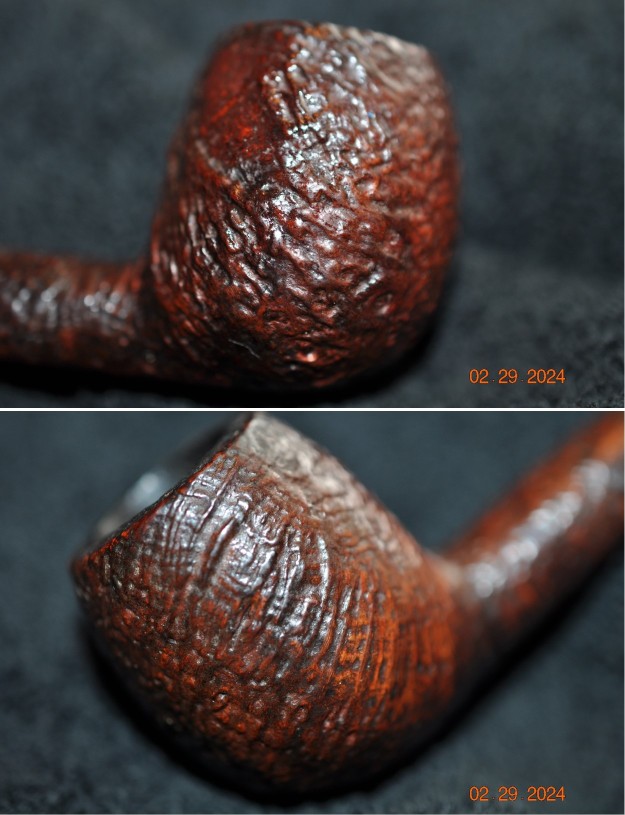
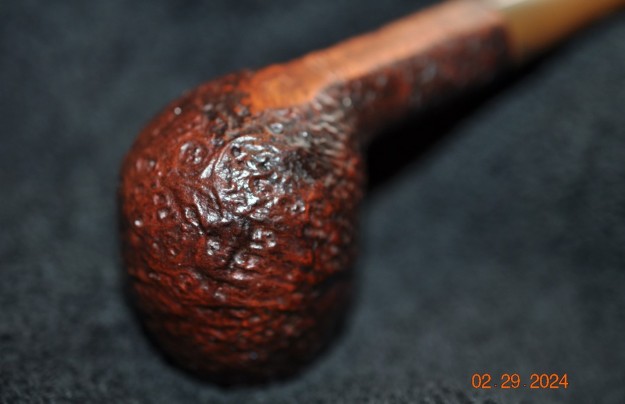
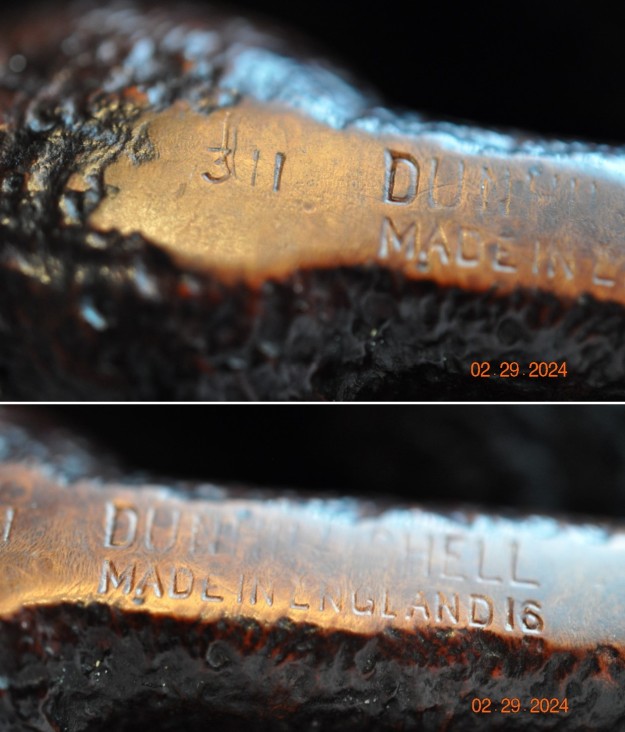
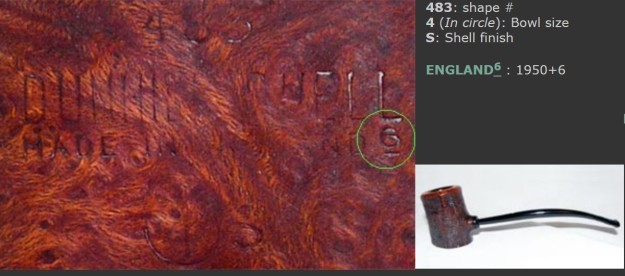
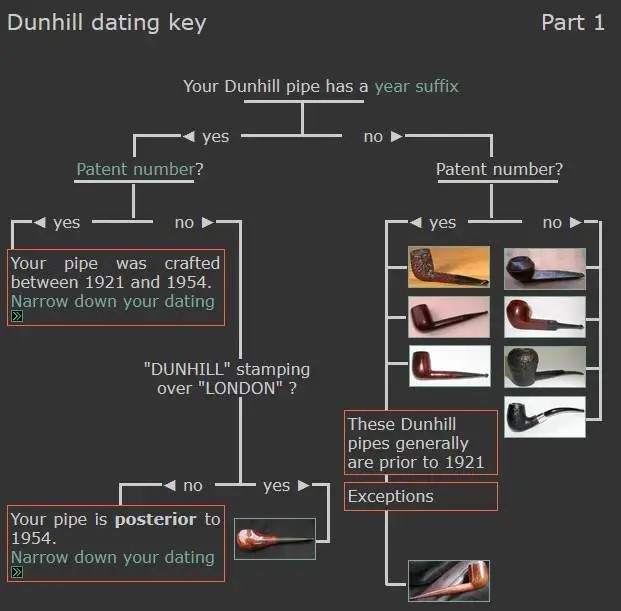
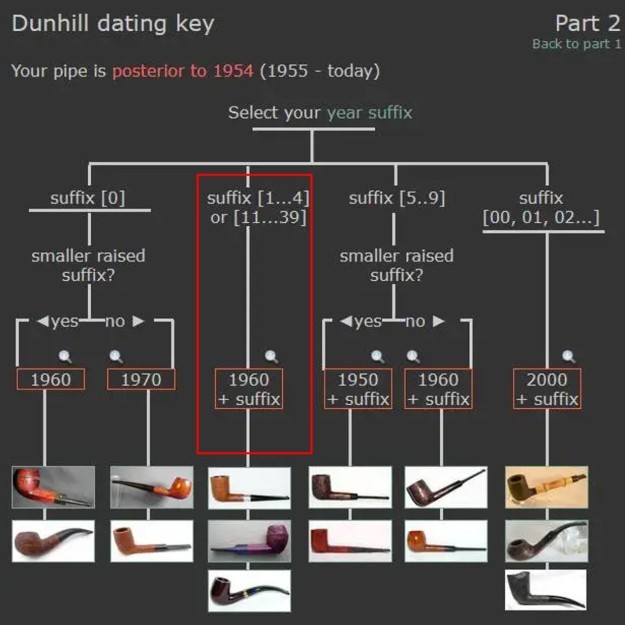
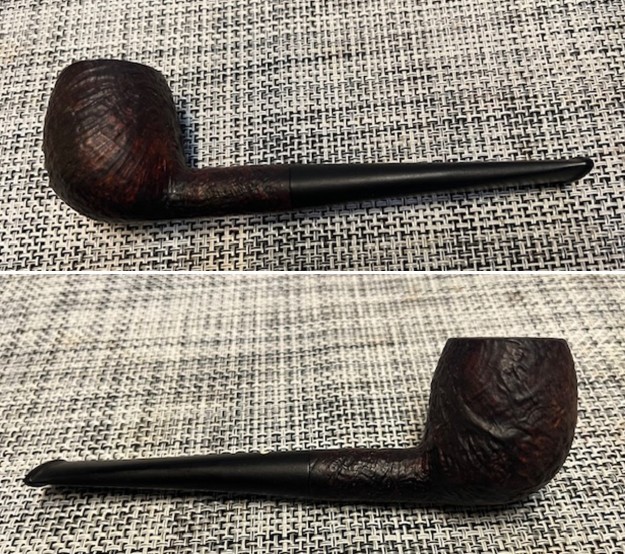
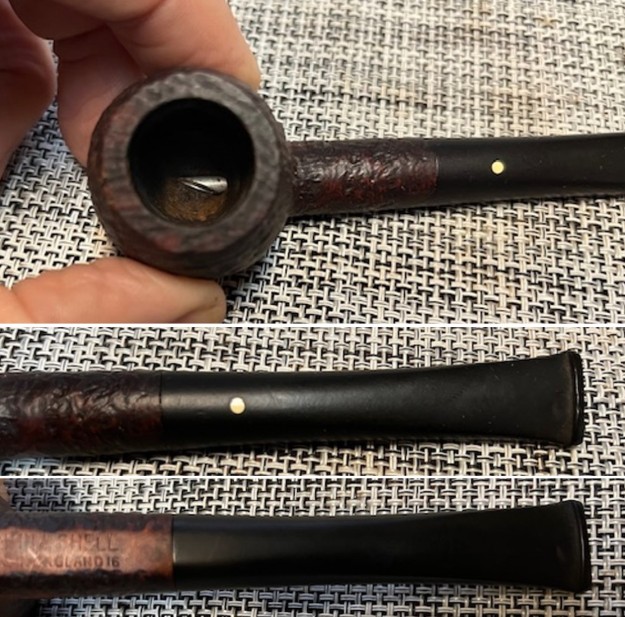
The next pipe on the work table is a lovely Dunhill small sandbast apple shaped briar pipe. It is similar in terms of shape number and finish to another apple I recently worked on but it is definitely more worn (https://rebornpipes.com/2024/05/26/restoring-a-1976-dunhill-shell-341-apple-a-beautiful-sandblast-pipe/). It also came from our contact in Copenhagen, Denmark on 02/02/2024. It is a classic Dunhill Sandblast Apple shaped bowl. It has a sandblast, rich brown stained bowl that really highlights the grain in the briar. The worn sandblast bowl is dirty with grime in the finish. There are also some flecks of white paint in the grooves of the sandblast. The bowl had been recently reamed but there was still lava in the blast on the rim top and the inner edge of the bowl. The stamping on the pipe is faint but still readable on the underside of the shank. It reads 341 (the number is worn but I believe it is a 341) the shape number [followed by] Dunhill Shell [over] Made in England the date number 16 is stamped after the D in England. The stem had a white spot on the top side of the taper. It is oxidized, calcified and has tooth chatter and tooth marks on both sides ahead of the button. Jeff took photos of the pipe before he started his cleanup. He took photos of the pipe’s bowl and rim top to show the cake in the bowl and the dark spots and the lava coat overflowing onto the top. It is another dirty pipe. He also took photos to capture the tooth marks on the top and underside of the stem near the button. He took photos of the sides and the heel of the bowl to give a sense of the sandblast finish on this one. Even under the grime and wear on the finish the blast is quite beautiful. Jeff took photos of the stamping on the underside of the shank. It is faint but still readable. It helps to have worked on a Dunhill Shell Briar 341 Apple previously as it gives some clarity to otherwise faint stamping. The shape number on this one is worn but the tails on the numerals match those on the previous one I worked on. The date stamp is also worn but again the tails and curves on the numbers match the previous one exactly. I wanted to unpack the Dunhill stamping on the shank and work to understand each element of the stamp. I generally use the Pipephil site to gather as much initial information as possible (http://pipephil.eu/logos/en/dunhill/shell-briar1.html). The stamping is interpreted as follows: The number 341 is the shape number for a taper stem Apple. The Shell Briar stamp refers to the finish. The number 16 following the D of England would give the date the pipe. The photo below is of the stamping on a Don shape but the stamping is similar on this one.Pipephil also has some helpful dating keys on the site that are basically flow charts that you can walk through to date your pipe (http://pipephil.eu/logos/en/dunhill/cledat-en1.html). I turned to Part 1 of the Dating Key and followed the chart. This pipe has 16 following the D in England. There was no patent number so that took me to the section on the chart below (column one) which instructed me that the pipe could be dated as being made “posterior to 1954”. I followed the link under “Your pipe is posterior to 1954. Narrow down your dating”. That took me to Page 2 of the dating key (http://pipephil.eu/logos/en/dunhill/cledat-en1a.html). The second column (suffix 1…4) or (11…39) led me to the section with 16 after the D in England. There was a directive for dating the pipe spelled out as follows: 1960 + suffix 16 which gives the pipe a date of 1976.I then turned to Pipedia’s section on Dunhill Shell Briar to get a bit of background on the Dunhill finishes (https://pipedia.org/wiki/Dunhill#Root_Briar). I quote:

Shell

A deep craggy sandblast with a black stain finish (usually made using Algerian briar) – the color of the stain used has varied over the years. Although there is some doubt as to them being the first to sandblast pipes, Dunhill’s Shell pipes, and the sandblasting techniques developed to create them are considered one of Dunhill’s greatest and most lasting contributions to the art of pipe making.

The documented history of Dunhill’s inception of the Shell is largely limited to patent applications — there are no catalog pages or advertisements promoting blasted pipes at the time. The preliminary work on the English patent (No. 1484/17) was submitted on October 13, 1917. The patent submission was completed half a year later, on April 12, 1918, followed by the granting of the English patent on October 14, 1918. This was less than a month before the end of The Great War on November 11th.

In 1986 Dunhill released a line of premium Shell finish pipes – “RING GRAIN”. These are high-quality straight grain pipes which are sandblasted. Initially only Ring Grain, but now in two different finishes. In 1995 the “Shilling” was introduced with Cumberland finish – it is an extremely rare series. These pipes exhibit a deeper blast characteristic of that of the 1930’s – mid-1960’s (and the limited ‘deep blast’ pipes of the early 1980s) and show a fine graining pattern. These are considered the best new Dunhills by many enthusiasts today and are very rare. The finish is sometimes described as tasting like vanilla at first, with the taste becoming more normal or good as the pipe breaks in.

I turned to work on the pipe itself. Jeff had done an amazing cleanup of the pipe. He reamed the cake with a PipNet reamer and cleaned up that with a Savinelli Fitsall Pipe Knife. He scrubbed the internals of the bowl and stem with alcohol, cotton swabs, pipe cleaners and shank brushes. He scrubbed the externals with undiluted Murphy’s Oil Soap and rinsed the bowl off with running water. There was still some general darkening on the rim top that would need to be worked on. He soaked the stem in Briarville’s Pipe stem Deoxidizer and once it had soaked rinsed it off with warm water to remove the residual solution. He dried it off and rubbed it down to remove any oxidation that was still on the stem. The pipe looked very good when I received it. I took a photo of the rim top to show the condition. It looks good with the tars and oils removed from the rim top though there is still some darkening. The inner edge of the bowl was in excellent condition though there was some wear on the front inner and outer edge. The bowl itself was very clean. The stem came out looking quite good with light tooth marks and chatter on both sides ahead of the button. I took a photo of the underside of the shank to show the stamping. The photo shows the stamping and is actually more readable in person. I removed the stem from the shank and took a photo of the pipe parts to show what I was working with. The shape is a classic apple.I started my work on this pipe by addressing the darkening on the rim top. I began by working over the rim top with a brass bristle wire brush to remove the grime in the sandblast finish. It looked better but I still needed to do some work on the darkening of the rim top. I then scrubbed the rim top with some of Mark Hoover’s Before & After Briar Cleaner. I worked it into the rim top and edge of the bowl with my finger tips. I let it set for a few moments then scrubbed it off with cotton pads. Each step made it look better but still the top was too dark to my liking. I wiped it off again with some acetone on a cotton pad and finally I could see the briar with the brown tone of the stain. The rim top showed some burn damage to the top that was not completely removable. There was some damage on the front outer edge where the pipe had been knocked out. I rubbed the briar down with Before & After Restoration Balm. I worked it into the surface with my fingertips and a horsehair shoe brush to work it into the nooks and crannies of the sandblast finish. The product works to clean, enliven and preserve the briar. I let it sit for 10 minutes then I buffed it with a cotton cloth to deepen the shine. The pipe really comes alive with the balm. The rim top damage is visible in the photos below especially to the front outer edge of the bowl. I sanded the stem with 320-3500 grit sanding pads. I wiped it down after each sanding pad with a damp cloth. By the final 3500 grit sanding pad the stem had a had a shine.I polished the vulcanite with micromesh sanding pads – 1500-12000 grit pads. I wiped it down with Obsidian Oil after each sanding pad. I used Before & After Pipe Polish – both Fine and Extra Fine to further polish the stem. This 1976 Dunhill Shell Briar 341 Apple with a vulcanite taper stem has a beautiful, unique Dunhill Sandblast finish that is very deep and craggy. The Shell Briar mixed brown finish highlights some great grain around the bowl and shank. It has a unique sandblast that Dunhill specialized in making. The polished vulcanite taper stem adds to the mix. I put the stem back on the bowl and buffed the pipe with Blue Diamond on the buffing wheel being careful to not buff the stamping. I gave the bowl multiple coats of Conservator’s Wax and the stem multiple coats of carnauba wax on the buffing wheel and followed that by buffing it with a clean buffing pad. I hand buffed the pipe with a microfiber cloth to deepen the shine. The finished Dunhill Shell Briar 341 Apple is quite nice and feels great in the hand. Give the finished pipe a look in the photos below. The dimensions of the pipe are Length: 5 ½ inches, Height: 1 ½ inches, Outside diameter of the bowl: 1 ¼ inch, Chamber diameter: ¾ of an inch. The weight of the pipe is .95 ounces/.27 grams. Thanks for walking through the restoration with me as I worked over another beautiful pipe. This one will be going on the rebornpipes store in the English Pipe Makers Section. Thanks for your time.
Breathing Life into a Challenging Dunhill Shell Briar 126 Billiard


Blog by Steve Laug

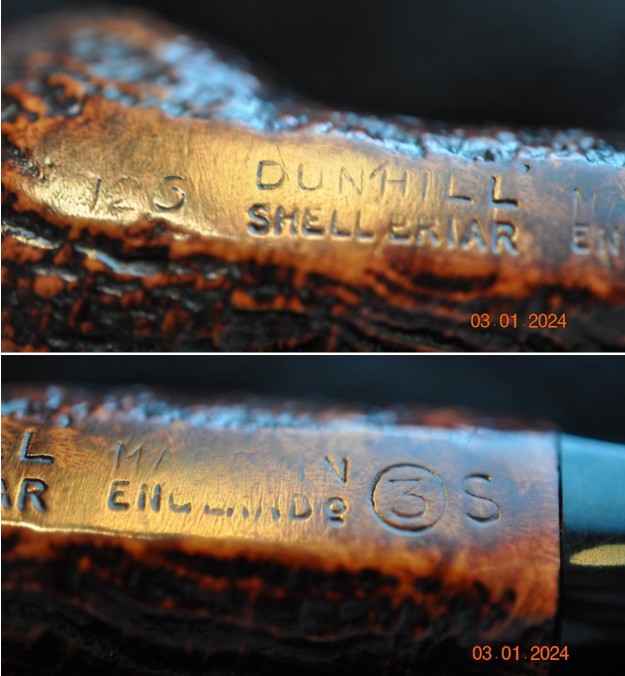
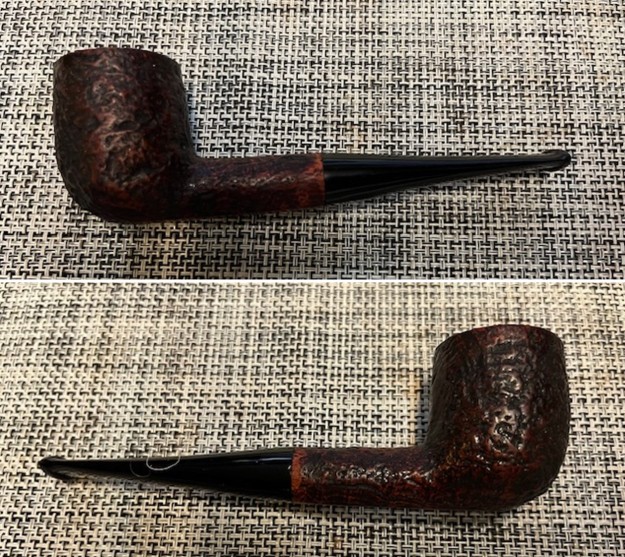
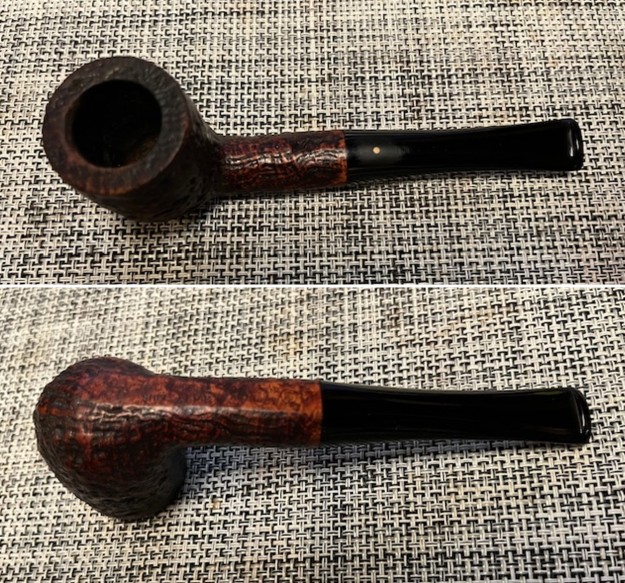
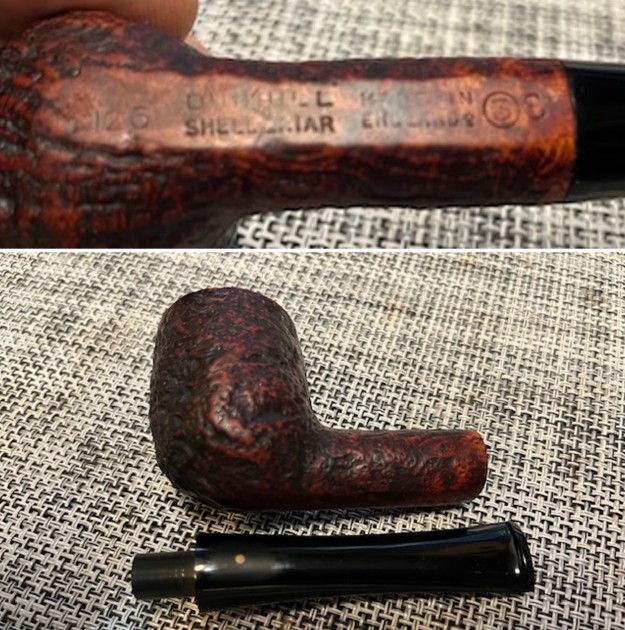
The next pipe on the work table is a lovely Dunhill small sandblast Billiard shaped briar pipe. We purchased it from our contact in Copenhagen, Denmark on 01/22/2024. It is a classic Dunhill Sandblast Billiard shaped bowl. It has a sandblast, rich brown stained bowl that really highlights the grain in the briar. The bowl is dirty with grime in the finish. There also appears to be a shiny varnish coat over the grime in the sandblast. There appears to be a varnish coat on the stem as well. The bowl has a moderated cake and a light lava overflow on the sandblast rim top and edges. The stamping on the pipe is clear and readable and on the under side it reads 126 the shape number [followed by] Dunhill [over Shell Briar. That is followed by Made in England the superscript date number 0 is stamped after the D in England. There is a circle #S following the date stamp that identifies the pipe as a group 3 sized pipe in a Shell finish. The stem had a white spot on the top side of the taper. It is lightly oxidized and has tooth chatter and deep tooth marks on both sides ahead of the button. Jeff took photos of the pipe before he started his cleanup. He took photos of the pipe’s bowl and rim top to show the cake in the bowl and the lava coat overflowing onto the top. It is another dirty pipe. You can see the shiny coat on top of the finish and the grime in the photos. He also took photos of the stem to capture the tooth marks on the top and underside near the button. He took photos of the sides and the heel of the bowl to give a sense of the sandblast finish on this one. Even under the grime and shiny varnish coat in the grooves the blast is quite beautiful. Jeff took photos of the stamping on the underside of the shank. It is clear and readable though it is faint in some spots. I wanted to unpack the Dunhill stamping on the shank and work to understand each element of the stamp. I generally use the Pipephil site to gather as much initial information as possible (http://pipephil.eu/logos/en/dunhill/shell-briar1.html). The stamping is interpreted as follows: The number 126 is the shape number for a taper stem Billiard. The Shell Briar stamp refers to the finish. The underlined, superscript number 0 following the D of England would give the date the pipe. The circle 3S tells me that the pipe is a group 3 sized pipe and the S is for the Shell finish. The photo below is of the stamping on a Don shape but the stamping is similar on this one.Pipephil also has some helpful dating keys on the site that are basically flow charts that you can walk through to date your pipe (http://pipephil.eu/logos/en/dunhill/cledat-en1.html). I turned to Part 1 of the Dating Key and followed the chart. This pipe has 16 following the D in England. There was no patent number so that took me to the section on the chart below (column one) which instructed me that the pipe could be dated as being made “posterior to 1954”. I followed the link under “Your pipe is posterior to 1954. Narrow down your dating”. That took me to Page 2 of the dating key (http://pipephil.eu/logos/en/dunhill/cledat-en1a.html). The first column (0) led me to the next section with a question whether the suffix is smaller and raised. Since the 0 after the D in England the date of the pipe spelled is 1960. I then turned to Pipedia’s section on Dunhill Shell Briar to get a bit of background on the Dunhill finishes (https://pipedia.org/wiki/Dunhill#Root_Briar). I quote:

Shell

A deep craggy sandblast with a black stain finish (usually made using Algerian briar) – the color of the stain used has varied over the years. Although there is some doubt as to them being the first to sandblast pipes, Dunhill’s Shell pipes, and the sandblasting techniques developed to create them are considered one of Dunhill’s greatest and most lasting contributions to the art of pipe making.

The documented history of Dunhill’s inception of the Shell is largely limited to patent applications — there are no catalog pages or advertisements promoting blasted pipes at the time. The preliminary work on the English patent (No. 1484/17) was submitted on October 13, 1917. The patent submission was completed half a year later, on April 12, 1918, followed by the granting of the English patent on October 14, 1918. This was less than a month before the end of The Great War on November 11th.

In 1986 Dunhill released a line of premium Shell finish pipes – “RING GRAIN”. These are high-quality straight grain pipes which are sandblasted. Initially only Ring Grain, but now in two different finishes. In 1995 the “Shilling” was introduced with Cumberland finish – it is an extremely rare series. These pipes exhibit a deeper blast characteristic of that of the 1930’s – mid-1960’s (and the limited ‘deep blast’ pipes of the early 1980s) and show a fine graining pattern. These are considered the best new Dunhills by many enthusiasts today and are very rare. The finish is sometimes described as tasting like vanilla at first, with the taste becoming more normal or good as the pipe breaks in.

I turned to work on the pipe itself. Jeff had done an amazing cleanup of the pipe. He reamed the cake with a PipNet reamer and cleaned up that with a Savinelli Fitsall Pipe Knife. He scrubbed the internals of the bowl and stem with alcohol, cotton swabs, pipe cleaners and shank brushes. He scrubbed the externals with undiluted Murphy’s Oil Soap and rinsed the bowl off with running water. His scrubbing removed the majority of the varnish on the bowl with just a few spots remaining. He soaked the stem in Briarville’s Pipe stem Deoxidizer and once it had soaked rinsed it off with warm water to remove the residual solution. He dried it off and rubbed it down to remove any oxidation that was still on the stem. The soak did not penetrate the varnish on the stem at all but it certainly looked better. Other than the shiny spots in the finish where the varnish remained, the pipe looked very good when I received it. I took a photo of the rim top to show the condition. It looks good with the tars and oils removed from the rim top. You can see the shiny spots of varnish remaining on the right front side of the rim top in the first photo below. The inner edge of the bowl was in excellent condition. The bowl itself was very clean. The stem came out clean but the varnish coat discoloured the white spot and gave the whole stem an artificial shine that hid the tooth marks and chatter underneath.I took a photo of the underside of the shank to show the stamping. The photo shows the stamping and is actually more readable in person. I removed the stem from the shank and took a photo of the pipe parts to show what I was working with. I think once the varnish is removed the pipe will be a nicer looking piece.I decided to use some of Mark Hoover’s Before & After Briar Cleaner to see if it would break through the remaining shiny spots of varnish in the grooves of the sandblast on the rim top and around the bowl. I shook up the mixture to make sure all was blended then used a tooth brush to work it into the surface of the briar. I worked it until is foamed then rinsed it off with warm water and dried it with a soft cloth. It did the job and the shiny varnish had vanished! I set the bowl aside and let the briar dry out completely then I rubbed it down with Before & After Restoration Balm. I worked it into the surface with my fingertips and a horsehair shoe brush to work it into the nooks and crannies of the sandblast finish. The product works to clean, enliven and preserve the briar. I let it sit for 10 minutes then I buffed it with a cotton cloth to deepen the shine. The pipe really comes alive with the balm. I sanded the stem with 320-3500 grit sanding pads to remove the varnish coat that covered it. I wiped it down after each sanding pad with a damp cloth. By the final 3500 grit sanding pad the stem had a more normal shine and the varnish, tooth marks and chatter were gone.I polished the vulcanite with micromesh sanding pads – 1500-12000 grit pads. I wiped it down with Obsidian Oil after each sanding pad. I used Before & After Pipe Polish – both Fine and Extra Fine to further polish the stem. This 1960 Dunhill Shell Briar 126 Billiard with a vulcanite taper stem has a beautiful, unique Dunhill Sandblast finish that is very deep and craggy. The Shell Briar mixed brown finish highlights some great grain around the bowl and shank. It has a unique sandblast that Dunhill specialized in making. The removal of the varnish left a depth to the briar and a clearness to the stem surface. The polished vulcanite taper stem adds to the mix. I put the stem back on the bowl and buffed the pipe with Blue Diamond on the buffing wheel being careful to not buff the stamping. I gave the bowl multiple coats of Conservator’s Wax and the stem multiple coats of carnauba wax on the buffing wheel and followed that by buffing it with a clean buffing pad. I hand buffed the pipe with a microfiber cloth to deepen the shine. The finished Dunhill Shell Briar 126 Billiard is quite nice and feels great in the hand. Give the finished pipe a look in the photos below. The dimensions of the pipe are Length: 5 inches, Height: 1 ½ inches, Outside diameter of the bowl: 1 ¼ inches, Chamber diameter: ¾ of an inch. The weight of the pipe is 1.09 ounces/31 grams. Thanks for walking through the restoration with me as I worked over another beautiful pipe. This one will be going on the rebornpipes store in the English Pipe Makers Section. Thanks for your time.
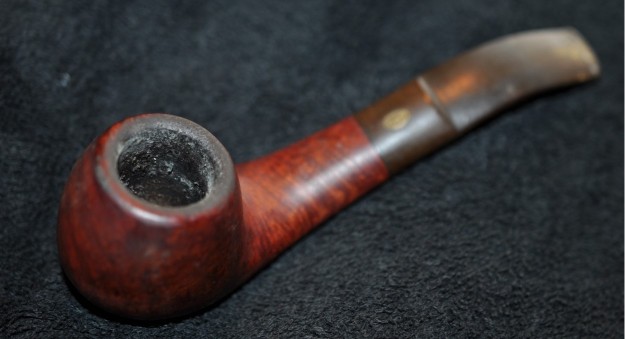
A Pipe Hunt Find in Bellingham – An Israeli Made Pedestal Pipe


Blog by Steve Laug

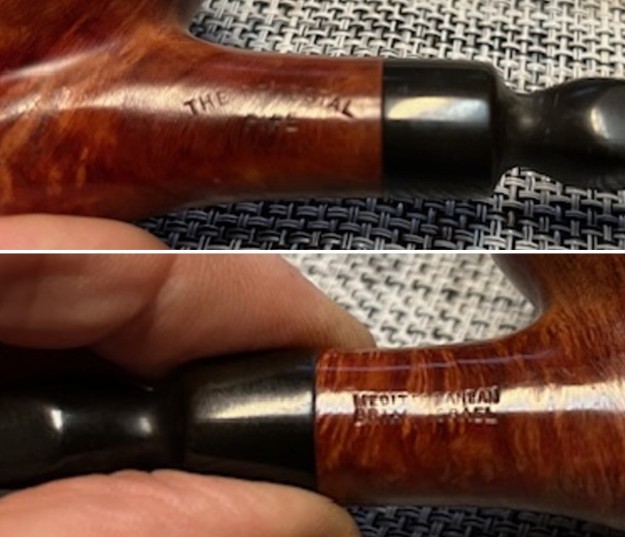
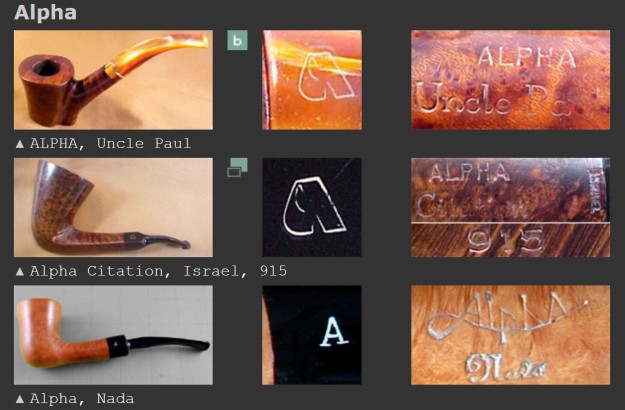
On our recent Victoria Day Weekend (5/18/24) my family met Jeff and his wife in Bellingham for breakfast, a visit and a bit of pipe hunting. We visited three of my favourite antique malls and worked out way through the aisles of wares for sale. Jeff and I tend to divide and conquer, each walking through the aisles looking for pipes. The rest of the family moves through looking for their own treasures. The second shop we visited is a treasure trove of items from the past and one that I could spend a lot of time working through. As we went through the aisles of treasures I found a case with carved animal pipes and a Ropp Cherrywood, really none of them captured my interest this time around. I looked them over and set them aside. Then I saw an interesting pipe standing in the back of the case. It was called The Pedestal Pipe and was made in Israel – presumably by the Shalom Pipe Manufacturing company. We left the shop with this addition to the hunting bag (https://rebornpipes.com/tag/bellingham-pipe-hunt/).I decided to take a break from the pipes in my queue of pipes to work on and deal with the Pedestal Pipe shown above next. It was an interesting shape stands on its own – like a pipe on a pedestal. It had some nice grain under the grime and varnish coat on the bowl and shank. The pipe is stamped on the left side of the shank and reads The Pedestal [arched over] Pipe. On the right side it is stamped and reads Mediterranean [over] Briar Israel. Here is what I saw. The bowl had a thick cake in it a thick lava coat on the rim top and edges. The finish was spotty with varnish or some shiny coat that was peeling around the bowl. The stem was fancy and there was a round saddle portion that sat against the shank end. The blade of the stem was flattened and had panel sides. It was dirty and had tooth marks and chatter on both sides ahead of the button. I took some photos of the pipe before I started working on it. I took photos of the rim top and stem to show the general condition of the pipe. The bowl is heavily caked and the rim top and edges have a heavy coat of lava overflowing on to them. There is some burn or reaming damage on the inner edge of the bowl. The stem is oxidized, calcified and has tooth marks and chatter on both sides ahead of the button.I took photos of the stamping on the sides of the shank. You can see it is readable and in person looks much better with a light and lens. I removed the stem from the shank and took a photo of the parts to show the look of the pipe. I decided to do some digging on the net about the brand. I turned first to Pipephil’s site to see what I could find. I could not find any link to the Pedestal line from Israel but I turned to the section on the site for Alpha pipe (also made by Shalom Pipe Factory). Here is the link to the Alpha section (http://www.pipephil.eu/logos/en/logo-a4.html). I did a screen capture of the section on the pipes. The third pipe in the photo below has an identical stem to the Pedestal Pipe that I am working on. This ties the brand to Alpha at some level and even more to Shalom Pipe Factory.With that information I turned to Pipedia and looked up the information on the Shalom Pipe Factory (https://pipedia.org/wiki/Shalom_Pipe_Factory). I quote the information from the site below. I have highlighted the Pedestal link in the article.

Not much is known about Israel’s sole pipe factory though it’s reported to have operated quite successfully on international markets.

Beside the brand “Shalom” the mainstay brand was Alpha – especially well known in the USA. Alpha was popular for a range of fresh and unusual shapes. Series (afaik): Caprice (s), Citation (s), Classic (b), Pedestal (s), Regent, Region (b), Rex (s). (1)

(1) (b) = blasted, (s) = smooth

Alpha also produced at least one of its Citation forms for Carey’s “Magic Inch” series.

Mentioned in context with Shalom Pipe Factory was a Danish pipemaker named ‘Muki Liebermann’, who later lived and worked in the USA. Muki is known for his unique briar bending technique and his original shapes that gave inspiration to many of the most praised Danish pipemakers.

Shalom was taken over by Robert L. Marx of New York City, later Sparta, NC, then of Mastercraft. Mastercraft continued the Alpha pipes introducing new lines.

I did a Google search for the The Pedestal Pipe and came up with a few links that I followed up on. The best of them was a link to a thread on Pipesmagazine forum to a discussion on a pipe very much like this one (https://pipesmagazine.com/forums/threads/unique-original-sitter-pipe-designs.25944/). I quote the starting post in the thread below:

I liked this pipes unique design as a sitter and the briar doesn’t look too shabby. I’m guessing this came from the Shalom Pipe Factory and made by Muki Liebermann since he was known for his unique briar bending technique and original shapes.

The only stamping found is ‘THE PEDESTAL PIPE’ and ‘Mediterranean Briar Israel’. I’ve searched the internet and cannot find any information on this pipe other than what I have mentioned. Been smoking it for the past week and it’s an excellent smoker.
Feel free to post images of your sitters!! Love to see them.

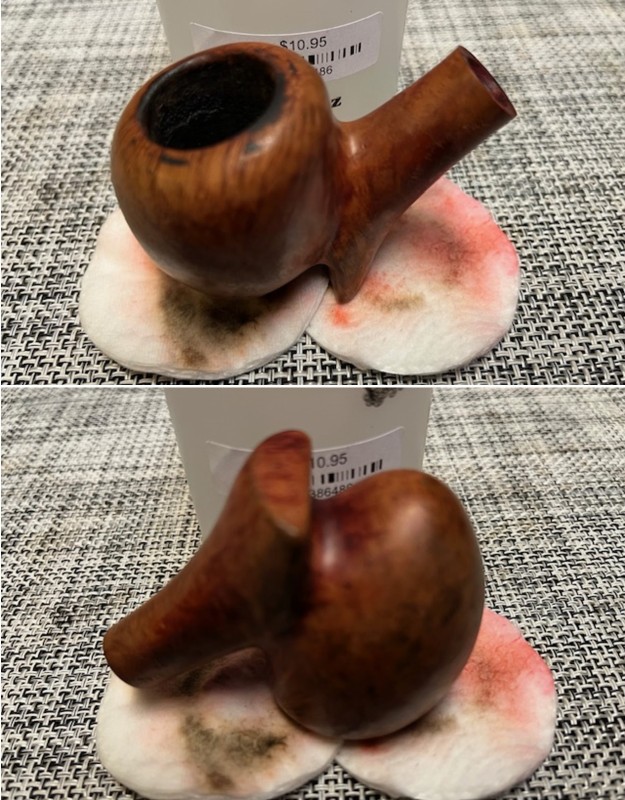
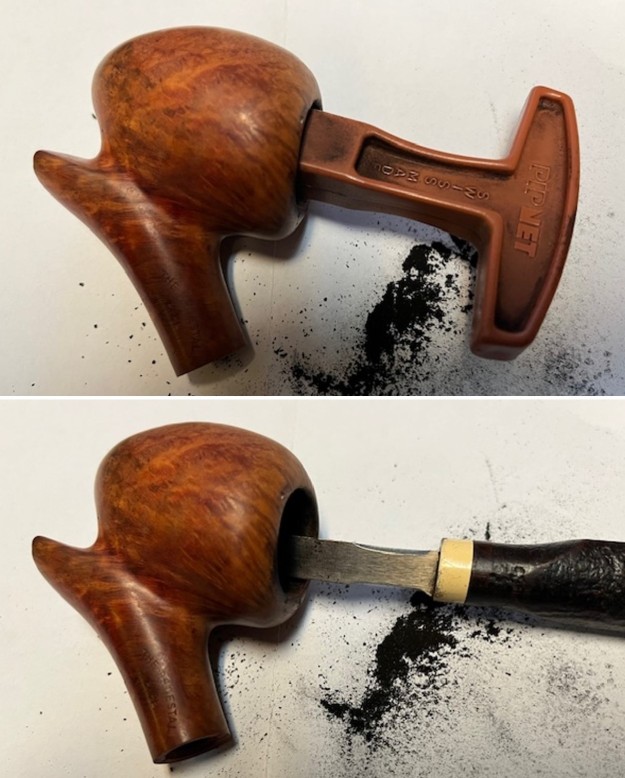
Now I was ready to start the work on the pipe. I wiped the bowl down with acetone to remove the spotty shiny coat on the pipe. It took a few wipe downs to remove it but once finished it definitely was better. Interestingly there was some red dye under the shiny coat that came off as well. I moved on to work on the internals of the pipe. I reamed the bowl with a PipNet pipe reamer to take the cake back to bare briar. I took the cake back to bare briar and cleaned up the remnants of the cake with a Savinelli Fitsall Pipe Knife. I sanded the bowl walls with sandpaper wrapped around a piece of briar to smooth them out. The inside walls were clean and there was no sign of burning or checking on them. I scrubbed the inside of the shank and the airway in it and the stem with pipe cleaners, cotton swabs and isopropyl alcohol. Once it was clean it smelled much better was ready for the next steps in the process.I scrubbed the externals of the bowl and shank with undiluted Murphy’s Oil Soap and a tooth brush to remove the grime in the finish. I rinsed the bowl off with warm water. I scrubbed the internals with shank brushes and soap to remove the grime inside. I was able to remove a lot of the lava on the rim top as well. The bowl was beginning to look much better at this point. I sanded the bowl with sanding pads – sanding with 320-3500 grit pads and wiped down with a damp cloth after each sanding pad. The bowl began to take on a real shine. It was going to be a beautiful pipe. I polished the briar with micromesh sanding pads – dry sanding with 1500-12000 grit pads and wiping the bowl down after each sanding pad. The grain really began to shine through. It is a beautiful pipe. The polishing of the rim top and inner edge brought the rim top colour to match the rest of the bowl. I worked some Before & After Restoration Balm into the surface of the briar with my fingertips to clean, enliven and protect the briar. I let the balm sit for 15 minutes and then buffed with a cotton cloth to raise the shine. The photos show the bowl at this point in the restoration process. I set the bowl aside and turned to address the stem issues. I “painted” the surface of the stem with the flame of a Bic lighter. I was able to lift the marks on the stem top leaving light marks but the ones on the bottom side were much deeper and the flame lifted them slightly but they still remained. I filled in the marks that remained with clear CA glue. Once the repair cured I flattened the repair with small files. It looked much better. I cleaned up the repairs with a folded piece of 220 grit sandpaper. I was able to flatten them and blend them in very well with the surface of the vulcanite. Before continuing with the sanding process, I heated the stem with my lighter to soften the vulcanite and bent it to match the flow of the bowl. It looked much better with the proper bend.I sanded out the scratches and marks in the stem surface with 320-3500 grit sanding pads. I wiped the stem down with a damp cloth after each sanding pad. It looked much better and really started to take on a shine.I polished the stem with micromesh sanding pads – wet sanding with 1500-12000 grit sanding pads. I wiped it down after each sanding pad with Obsidian Oil. I polished it with Before & After Pipe Stem Polish – both Fine and Extra Fine. I am excited to put the final touches on this interesting Israeli Made pipe by Muki Liebermann of the Shalom Pipe Factory. It is a beautiful and uniquely shaped pipe called The Pedestal Pipe. I put the pipe back together and buffed it with Blue Diamond on the buffing wheel. I gave the bowl and the stem multiple coats of carnauba wax. I hand buffed the pipe with a clean buffing pad to raise the shine. It is fun to see what the polished bowl looks like with beautiful grain on the bowl sides, top and bottom. The polished black vulcanite, newly fitted stem combined with the bowl to make a stunning pipe. This smooth The Pedestal Pipe is great looking and the pipe feels great in my hand. It is light and well balanced. Have a look at it with the photos below. The dimensions are Length: 6 inches, Height: 2 inches, Outside diameter of the bowl: 1 ½ inches, Chamber diameter: 7/8 of an inch. The weight of the pipe is 56 grams/1.98 ounces. I will be adding it to the Pipes By Various Makers Section of the rebornpipes store. If you are interested in adding it to your collection let me know. Thanks for walking through the restoration with me as I worked over this pipe. Thanks to each of you who are reading this blog.

Restoring a 1976 Dunhill Shell 341 Apple – a beautiful sandblast pipe


Blog by Steve Laug

The next pipe on the work table is a lovely Dunhill small sandbast apple shaped briar pipe. We purchased it from our contact in Copenhagen, Denmark on 02/02/2024. It is a classic Dunhill Sandblast Apple shaped bowl. It has a sandblast, rich brown stained bowl that really highlights the grain in the briar. The bowl is dirty with grime in the finish. There is a moderate cake in the bowl and a light lava overflow on the rim top and edges. The stamping on the pipe is clear and readable and on the under side it reads 341 the shape number [followed by] Dunhill Shell [over] Made in England the date number 16 is stamped after the D in England. The stem had a white spot on the top side of the taper. It is oxidized, calcified and has tooth chatter and deep tooth marks on both sides ahead of the button. Jeff took photos of the pipe before he started his cleanup. He took photos of the pipe’s bowl and rim top to show the cake in the bowl and the lava coat overflowing onto the top. It is another dirty pipe. He also took photos to capture the tooth marks on the top and underside of the stem near the button. He took photos of the sides and the heel of the bowl to give a sense of the sandblast finish on this one. Even under the grime in the grooves the blast is quite beautiful. Jeff took photos of the stamping on the underside of the shank. It is clear and readable though it is faint in some spots. I wanted to unpack the Dunhill stamping on the shank and work to understand each element of the stamp. I generally use the Pipephil site to gather as much initial information as possible (http://pipephil.eu/logos/en/dunhill/shell-briar1.html). The stamping is interpreted as follows: The number 341 is the shape number for a taper stem Apple. The Shell Briar stamp refers to the finish. The number 16 following the D of England would give the date the pipe. The photo below is of the stamping on a Don shape but the stamping is similar on this one.Pipephil also has some helpful dating keys on the site that are basically flow charts that you can walk through to date your pipe (http://pipephil.eu/logos/en/dunhill/cledat-en1.html). I turned to Part 1 of the Dating Key and followed the chart. This pipe has 16 following the D in England. There was no patent number so that took me to the section on the chart below (column one) which instructed me that the pipe could be dated as being made “posterior to 1954”. I followed the link under “Your pipe is posterior to 1954. Narrow down your dating”. That took me to Page 2 of the dating key (http://pipephil.eu/logos/en/dunhill/cledat-en1a.html). The second column (suffix 1…4) or (11…39) led me to the section with 16 after the D in England. There was a directive for dating the pipe spelled out as follows: 1960 + suffix 16 which gives the pipe a date of 1976.I then turned to Pipedia’s section on Dunhill Shell Briar to get a bit of background on the Dunhill finishes (https://pipedia.org/wiki/Dunhill#Root_Briar). I quote:

Shell

A deep craggy sandblast with a black stain finish (usually made using Algerian briar) – the color of the stain used has varied over the years. Although there is some doubt as to them being the first to sandblast pipes, Dunhill’s Shell pipes, and the sandblasting techniques developed to create them are considered one of Dunhill’s greatest and most lasting contributions to the art of pipe making.

The documented history of Dunhill’s inception of the Shell is largely limited to patent applications — there are no catalogue pages or advertisements promoting blasted pipes at the time. The preliminary work on the English patent (No. 1484/17) was submitted on October 13, 1917. The patent submission was completed half a year later, on April 12, 1918, followed by the granting of the English patent on October 14, 1918. This was less than a month before the end of The Great War on November 11th.

In 1986 Dunhill released a line of premium Shell finish pipes – “RING GRAIN”. These are high-quality straight grain pipes which are sandblasted. Initially only Ring Grain, but now in two different finishes. In 1995 the “Shilling” was introduced with Cumberland finish – it is an extremely rare series. These pipes exhibit a deeper blast characteristic of that of the 1930’s – mid-1960’s (and the limited ‘deep blast’ pipes of the early 1980s) and show a fine graining pattern. These are considered the best new Dunhills by many enthusiasts today and are very rare. The finish is sometimes described as tasting like vanilla at first, with the taste becoming more normal or good as the pipe breaks in.

I turned to work on the pipe itself. Jeff had done an amazing cleanup of the pipe. He reamed the cake with a PipNet reamer and cleaned up that with a Savinelli Fitsall Pipe Knife. He scrubbed the internals of the bowl and stem with alcohol, cotton swabs, pipe cleaners and shank brushes. He scrubbed the externals with undiluted Murphy’s Oil Soap and rinsed the bowl off with running water. He soaked the stem in Briarville’s Pipe stem Deoxidizer and once it had soaked rinsed it off with warm water to remove the residual solution. He dried it off and rubbed it down to remove any oxidation that was still on the stem. The pipe looked very good when I received it. I took a photo of the rim top to show the condition. It looks good with the tars and oils removed from the rim top. The inner edge of the bowl was in excellent condition. The bowl itself was very clean. The aluminum inner tube can be seen extending into the bowl in the first photo. The stem came out looking quite good with deep tooth marks and chatter on both sides ahead of the button. I took a photo of the underside of the shank to show the stamping. The photo shows the stamping and is actually more readable in person. I removed the stem from the shank and took a photo of the pipe parts to show what I was working with. It is a nice looking pipe.I rubbed the briar down with Before & After Restoration Balm. I worked it into the surface with my fingertips and a horsehair shoe brush to work it into the nooks and crannies of the sandblast finish. The product works to clean, enliven and preserve the briar. I let it sit for 10 minutes then I buffed it with a cotton cloth to deepen the shine. The pipe really comes alive with the balm. I set the bowl aside and turned to address the stem issues. I “painted” the surface of the stem with the flame of a Bic lighter. I was able to lift the marks on the stem top leaving light marks but the ones on the bottom side were much deeper and the flame lifted them slightly but they still remained. I filled in the marks that remained with clear CA glue. Once the repair cured I flattened the repair with small files. It looked much better. I cleaned up the repairs with a folded piece of 220 grit sandpaper. I was able to flatten them and blend them in very well with the surface of the vulcanite. I sanded the stem with 320-3500 grit sanding pads. I wiped it down after each sanding pad with a damp cloth. By the final 3500 grit sanding pad the stem had a had a shine.I polished the vulcanite with micromesh sanding pads – 1500-12000 grit pads. I wiped it down with Obsidian Oil after each sanding pad. I used Before & After Pipe Polish – both Fine and Extra Fine to further polish the stem. This 1976 Dunhill Shell Briar 341 Apple with a vulcanite taper stem has a beautiful, unique Dunhill Sandblast finish that is very deep and craggy. The Shell Briar mixed brown finish highlights some great grain around the bowl and shank. It has a unique sandblast that Dunhill specialized in making. The polished vulcanite taper stem adds to the mix. I put the stem back on the bowl and buffed the pipe with Blue Diamond on the buffing wheel being careful to not buff the stamping. I gave the bowl multiple coats of Conservator’s Wax and the stem multiple coats of carnauba wax on the buffing wheel and followed that by buffing it with a clean buffing pad. I hand buffed the pipe with a microfiber cloth to deepen the shine. The finished Dunhill Shell Briar 341 Apple is quite nice and feels great in the hand. Give the finished pipe a look in the photos below. The dimensions of the pipe are Length: 5 ½ inches, Height: 1 ½ inches, Outside diameter of the bowl: 1 inch, Chamber diameter: ¾ of an inch. The weight of the pipe is 1.06 ounces/.30 grams. Thanks for walking through the restoration with me as I worked over another beautiful pipe. This one will be going on the rebornpipes store in the English Pipe Makers Section. Thanks for your time.
Restoring a Beautiful Savinelli Punto Oro


by Kenneth Lieblich

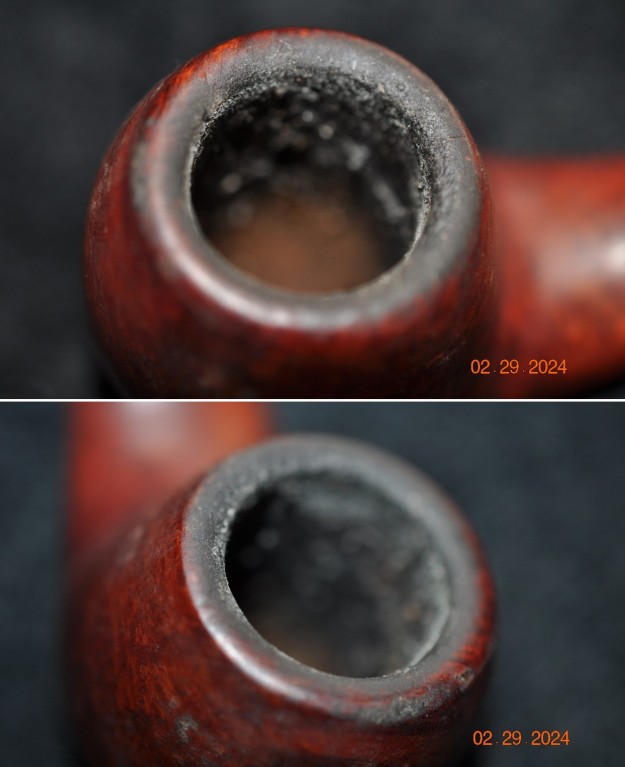
Next up on my restoration adventures is this Savinelli Punto Oro 915 KS. I acquired it from an older gentleman in Vancouver. He said he bought this (and the other pipes I got from him) more than “fifty years ago” – his words. That would date it to the early seventies, which fits with the style of the pipe. This is an unusual shape, to be sure. Savinelli calls it a Dublin – and so it is – but it has a luxurious, hourglass look to it as well. It has an elegant, elliptical shank and tapered, vulcanite stem. Perhaps I’ll call it a clessidra di Dublino. It’s a wonderful pipe and it deserves to be part of someone’s collection again. This pipe promises to be a great smoker. Let’s look at the markings. The top side of the shank reads Savinelli [over] Punto Oro. Savinelli, of course, is an Italian company, and the words Punto Oro mean literally, “gold point”. On the underside of the shank is the lovely Savinelli crown, next to which are the marks 915 KS [over] Italy. Naturally, the number refers to the shape and KS means “King Size”. Finally, there is a gold-coloured dot on the stem (made of brass) – a very nice touch.Savinelli is one of the most recognized names in pipe smoking and they have a long and storied history. You can read about them from their own website or from Pipedia’s article about them. However, I was particularly interested in learning more about the Punto Oro line. Sadly, Pipedia had nothing on this subject. I checked with Pipephil and they did have a bit of information, which I display below.I also found a bit of information on the Punto Oro line from Savinelli’s own website. They write:

PUNTO ORO pipe was the first pipe created by Achille Savinelli after the opening of the factory in 1958; a pipe that has always distinguished the Savinelli brand, its elegance, reliability and tradition. It is a top quality pipe with a wonderful grain. It is important to know it is very difficult to find a briar piece suitable to become a PUNTO ORO: just 1,2% of the whole choice is selected for this series, therefore not all our shapes are always available for these pipes.This was a well-loved pipe – and it shows in the best way. The stem on this pipe definitely shows signs of use. There were quite a few scratches in the vulcanite. There was also some calcification and oxidation. The stummel looked elegant, but tired. There were indications of lava on the rim and plenty of cake in the bowl. Also, the briar had a few little nicks along the rim from the years of love of its previous owner. Most concerning though, was a field of nicks on one side of the briar. Eek! More on that later. Well, the usual cleaning procedures were in order for this pipe. I started on the stem by wiping it down with some Murphy’s on a cotton round. Then, I cleaned out the insides of the stem with pipe cleaners and lemon-infused isopropyl alcohol. It wasn’t too dirty.Once that was done, the stem went for an overnight soak in the Before & After Hard Rubber Deoxidizer. After soaking, I cleaned off the de-oxidizing fluid with alcohol, pipe cleaners, et cetera. The oxidation had migrated to the surface and I used SoftScrub to work it off.Before I moved on to the Micromesh pads, I built up the tooth damage on the stem with black cyanoacrylate adhesive and let it fully cure. I used my miniature files to take down the majority of the dried glue. I then sanded it down with 400-grit sandpaper to meld seamlessly into the stem. I then used all nine Micromesh pads (1,500 through 12,000 grit) to bring out the lovely black lustre on the stem. I also used Obsidian Pipe Stem Oil in between each pad scrubbing. This also really made the brass dot pop! Putting the stem aside, I moved on to the stummel. I used both the PipNet Reamer, the KleenReem, and some sandpaper taped to a wooden dowel to take the bowl down to bare briar, as I wanted to ensure there were no hidden flaws in the walls of the bowl. Fortunately, there were none.I then proceeded to clean out the insides of the shank with Q-tips, pipe cleaners, and isopropyl alcohol. There was an enormous amount of nastiness inside this stummel and – boy-oh-boy – it took a lot of cotton to get this thing clean! A de-ghosting session seemed like a good idea. This de-ghosting consisted of thrusting cotton balls in the bowl and the shank, and saturating them with 99% isopropyl alcohol. I let the stummel sit overnight. This caused the oils, tars and smells to leech out into the cotton. Finally, a relatively clean and fresh-smelling bowl emerged. I then moved on to cleaning the outside of the stummel with Murphy’s Oil Soap and some cotton pads. What a difference that made! I also cleaned the insides with some soap and tube brushes. I examined the vast range of bumps in the briar. I dug out my iron and a damp cloth to try to raise them. The hot and moist steam can often cause the wood to swell slightly and return to shape. This worked incredibly well – I was absolutely delighted with the results. I took a close look at the rim. In order to save as much of the rim as possible, I used a piece of machine metal to very delicately scrape away as much lava as I could. I do this before automatically jumping to my topping board. This worked well and the topping board was not needed. Instead, I filled in a couple of nicks and used a wooden sphere and some pads to even out the top side and make it beautiful. After this, I used all nine Micromesh pads (1,500 through 12,000 grit) to make everything smooth. I applied some Before & After Restoration Balm and finally saw the beauty of my work. Off to the bench polisher I went. I applied some White Diamond and a few coats of carnauba wax and they added the finishing touch. This Savinelli Punto Oro 915 KS clessidra di Dublino was in need of a new lease on life. I am pleased to announce that this pipe is for sale! If you are interested in acquiring it for your collection, please have a look in the “Italy” pipe section of the store here on Steve’s website. You can also email me directly at kenneth@knightsofthepipe.com. The approximate dimensions of the pipe are as follows: length 5⅞ in. (150 mm); height 2 in. (51 mm); bowl diameter 1⅝ in. (39 mm); chamber diameter ¾ in. (20 mm). The weight of the pipe is 1½ oz. (46 g). I hope you enjoyed reading the story of this restoration as much as I enjoyed restoring it. If you are interested in more of my work, please follow me here on Steve’s website or send me an email. Thank you very much for reading and, as always, I welcome and encourage your comments.

Resurrecting a Brigham Made in Canada 625 Bulldog with a Frozen Stem


Blog by Steve Laug

On Saturday, April 27 Kenneth and I went to an antique and collectible sale at an arena in New Westminster, BC, Canada. I wrote about the adventure and posted it in a previous blog last weekend (https://rebornpipes.com/2024/04/28/you-have-to-join-kenneth-and-me-on-a-great-morning-pipe-hunt/). On the hunt I picked up four pipes that I have listed below:

  1. Jeantet Fait Main Bent Freehand Dublin 4 with a diamond shank
  2. Jeantet Fait Main Bent Apple 9 with a uniquely shaped shank and stem
  3. Republic Era Peterson’s System Pipe 1307 Bowl sans stem
  4. Brigham Made in Canada 625 Squat Straight Bulldog

I have included photos of the foursome below. They are in the order of the list above. I chose to work on the final pipe in the above photos. It is shown in the photos below and is stamped 625 next to Brigham [over] Made in Canada on a smooth panel on the left underside of the diamond shank. There are three vertical brass dots that are corroded and dark on the left topside of the diamond stem. It is squat straight Bulldog shape with a smooth cap, twin rings below the cap and a rusticated bowl and shank. The pipe has some great grain around the rim cap. The rim top is clean and shows some darkening on the back topside. The inner edge of the bowl is damaged and slightly out of round. The bowl had a light to moderate cake on the walls and some spots of lava on the rim top. The briar is dry and lifeless with some grime and grit ground into the briar. The stem was oxidized and had some tooth marks on the top and underside ahead of the button. The stem was frozen in place in the shank and was not removable. From my experience I would guess that the aluminum tube in the shank had begun to oxidize and that combined with the tars and oils had bound the tenon apparatus to the briar in the shank. I had a feeling it was going to be a real pain to separate the stem and the shank. The photos below show what I saw when I examined the pipe. I took photos of the bowl and rim top to show the condition of the bowl. The rim top has some darkening and scratches in the smooth surface. There was some damage around the inner edge of the bowl and there is a moderate cake in the bowl. The stem is oxidized and is very dirty from the shank to the button. There are tooth marks and chatter on the stem on both sides ahead of the button. Remember the stem is not removable at this point.I took photos of the stamping on the topsides of the shank. It reads as noted above. It is faint in spots but is still very readable. There are three brass dots stacked vertically on the top left side of the diamond stem. They are oxidized but are present.The next best thing to talking with Charles Lemon of Dad’s Pipes is to read the article he wrote on dating Brigham pipes on Pipedia. Charles has done a magnificent job of collating the material on the brand into this article and giving a historical flow of the eras of the Brigham pipe since its beginning in 1906. Thank you Charles for you work on this as it is a one of a kind resource. (https://pipedia.org/wiki/Brigham_Pipes_%E2%80%93_A_Closer_Look_at_Dots,_Dates_and_Markings).

Around the late 1960s or early 1970s, at the beginning of what I’ve called the Canadian Era (roughly 1970 – 1980), the stampings changed again as Brigham moved to modernize its logo. Pipes are stamped with the 3-digit shape number and “Brigham” over “Made in Canada”. Note these two variants of this stamping.

Canadian Era StampsI then turned to Charles Lemon’s book, “Brigham Pipes A Century of Canadian Briar” to confirm the meaning of the 625 shape number and the placement of the three dots on the stem side. I have collated the information I found there below.

The shape # 625 indicates a 600-series shape 25. The shape 25 is a Medium Squat Bulldog. The text in the list of shapes in the back of the book says it has a taper stem but the photo shows the same pipe I have with a saddle stem. The saddle stem on this one is the original stem so I believe the photo in the list is correct rather than the description. The block letter “Made in Canada” stamp was used in the Canadian Era, approximately 1970 through 1979. The stamp on the pipe I am working on is like the first one above so I believe it was made in 1978. The stem carries the vertical 3-Dot pattern of the Brigham Executive grade, which pairs with the 600-series shape number.

Armed with that information I turned to work on the pipe. I decided to tackle the stuck stem first. It was actually the first of the four pipes that I worked on. I used all the tried and true methods for removing stuck stems and I have to tell you that none of them worked. I left it in the freezer for increasingly longer times – starting with 15 minutes and finally leaving it in overnight. Nothing worked. It did not budge at all. I heated the shank and stem with a heat gun working it carefully over the surface so as not to burn either the briar or the vulcanite. Again, no amount of heat or time made any difference at all. I put the pipe in the microwave and heated it carefully with no success. I was not going to give up on it. I would beat this stuck stem one way or another. But, do understand that all of these procedures took me from the day I found the pipe on April 27 until May 10th. In between all the other methods I used a pipe cleaner to apply alcohol at the joint of the stem and shank with no success. I used the same method with acetone and again no success.

Finally, I inserted a folded pipe cleaner in the slot and pushed it as far as it would go into the stem. I wanted to block off the button and the inside of the hard maple filter that Brighams have in the elongated aluminum tenon. Once it was inserted I filled the bowl with acetone (fingernail polish remover) and let it sit until it evaporated. I repeated the process morning, noon and night before bed. Nothing was working to beat the frozen stem. Finally, this morning I was on the phone with my brother and the fill of acetone had evaporated so I decided to wiggle it while we talked. Low and behold, shiver me timbers, be still my beating heart, whatever phrase you want to you it moved just slightly! With a cry of exhilaration, I knew I was going to beat this stuck stem situation. I wiggled the stem all the way through the conversation and just before we closed the Facetime call the stem turned and was able to turn it free. The amount of sludge (I don’t know what else to call all the white build up in the shank and on the tube) was absolutely awful. I don’t know if I have ever seen it this thick. It was pitting the aluminum and the inside of the briar had a thick coat that filled in the gap between the tube and the walls. It was a huge mess.But that was not the end of the stuck tenon and parts! The maple hard wood filter with an aluminum cap was absolutely stuck in the tube. I could not remove it with pliers. I heated it with a lighter and tried it once more with no success. So… I resorted to an old alcohol bath I have here and have not used for over a year or more. I took the cap off the container that held the darkened alcohol and dropped the stem into the mix tenon down. It sat in the mix for at least and hour before I got back to it. I removed it from the container and used the pliers to grab the aluminum end and turn it. Sounds easy right? Wrong… I have had these aluminum tips snap off and leave the hardwood stuck in the tenon. I gingerly wiggled the end while carefully pulling on it and low and behold it let loose and the entire tube and tip was free! Once again the inside of the tube was a mess but the acetone had done a bit of work softening the goop on the aluminum walls.I was excited to say the least. It took literally 10 days short of a month to get this stem removed from the shank. You don’t even know how many times I was tempted to pitch the pipe in the trash and move on to other pipes. I even buried it on a corner of the desk that I don’t use much for daily work but it had a bit of a siren call and I could not ignore it. Today I beat it! Today I won this seemingly insignificant battle. But to me it felt epic to win. I took photos of the parts in celebration of the win. You can see the corrosion on the aluminum tip of the hard wood insert. You can also see the slight thinning of the tube just ahead of the tip – it could easily have snapped leaving me with yet another mess! The aluminum tenon is also corroded and has some of the white “aluminum oxide” build up around the length. The inside of the mortise is also thickly coated with a furry white insulation. Now that it was apart it was time to do a bit of cleaning before I could even begin working on it. I wanted to remove as much of the white fuzzy oxide on the inside of both the shank and the aluminum tenon tube as possible before going further. I pitched the hard wood filter in the garbage as it would be replaced when the work was finished. I cleaned out the shank with a pen knife to scrape away the debris then clean it with cotton swabs, pipe cleaners and alcohol until they came out significantly cleaner. I did the same with the aluminum tube tenon. Remember this was step one of the clean! I would do much more before this pipe was actually finished.I guess one of the benefits of the bowl soaking with acetone for two weeks is that the cake absolutely dissolved and I was able to wipe it out after each evaporation and refill of the bowl. It was surprisingly clean. I cleaned up the remnants of the cake on the walls with a Savinelli Fitsall Pipe Knife. I sanded the bowl sides with 220 grit sandpaper wrapped around a piece of dowel. The bowl walls showed no heat damage or checking and were almost bare briar in the bottom half of the bowl.I used a folded piece of 220 grit sandpaper to clean up the inner edge to remove the damage and nicks in the surface. It did not take too much to smooth out the damage on the inner edge and make it look much better.I scrubbed the externals bowl and shank with Murphy’s Oil Soap and a tooth brush. I rinsed it off with warm water to remove the grime and debris from the scrubbing. I scrubbed the inside of the shank and the aluminum tenon tube with Murphy’s as well using a set of shank brushes. The white is all gone and the pipe actually smells amazing!I cleaned out the internals of the bowl, mortise and the airway in the shank and the stem a second time with alcohol, pipe cleaners and cotton swabs to make sure it was clean inside. I was not expecting a lot of dirt and debris after the double scrubbing it had already received but I wanted to make sure. Because of the length of the tube I had to strategically fold the pipe cleaners to scrub the tube. Shining a light through it now shows it just shines… whew.I sanded the surface of the briar with 320-3500 grit sanding pads. It took on a real shine on the briar as I worked through the pads. I wiped it down after each sanding pad with a damp cloth to remove the sanding dust and debris left behind. The pipe had cleaned up so well that I turned to polish the briar with micromesh sanding pads. I dry sanded it with 1500-12000 grit sanding pads and wiped the bowl down after each pad with a damp cloth. By the final pads the briar really had a shine.  I rubbed the briar down with Before & After Restoration Balm. I worked it into the briar with my fingertips and a shoe brush. The product works to clean, enliven and preserve the briar. I let it sit for 10 minutes then I buffed it with a cotton cloth to deepen the shine. The briar really came alive with the balm. I set aside the bowl and turned my attention to the stem. To help remove the oxidation I scrubbed the stem with Soft Scrub Cleanser and cotton pads. It took some elbow work but the stem definitely looked better and the sulphur smell of the oxidation is gone!I “painted” the tooth marks on the stem with the flame of a Bic lighter to lift them. I was able raise them some. I filled in what remained with some clear CA glue and set it aside to cure. In the morning I used some small files to flatten the repairs into the surrounding surface of the stem. I sanded the repaired areas with 220 grit sandpaper to further flatten them. The stem was beginning to look good. I sanded the surface with 320-3500 grit sanding pads to further clean up the spots of oxidation on the surface of the stem. I wiped it down with a soft damp cloth following each sanding pad to remove the sanding debris. I also worked on the aluminum tube tenon with the pads. I was able to remove debris and smooth out the pits in the aluminum. There is some staining on the tube that I was not able to remove.I polished out the scratches with micromesh sanding pads – dry sanding with 1500-12000 grit pads. I wiped the stem down after each sanding pad with Obsidian Oil. I polished it with Before & After Pipe Stem Polish – both Fine and Extra Fine. Once I had finished the polishing I gave it a final coat of oil and set it aside to dry. I also used the pads on the aluminum as well and made some more progress. I found my box of Brigham Rock Maple Distillators and took a clean one from the box to replace the one that was stuck in the pipe when I received it. The beauty of these is that they can easily be rinsed out with alcohol or warm water to remove the tars and oils and reused. I put the bowl and stem back together. I buffed the bowl and stem with Blue Diamond to polish out the scratches in the briar and the vulcanite. I gave the bowl and the stem multiple coats of carnauba wax. I buffed the pipe with a clean buffing pad to raise the shine. I hand buffed it with a microfiber cloth to deepen the shine. The pipe polished up pretty nicely. The Brigham Squat Bulldog with the rusticated bowl and shank and smooth bull cap is quite beautiful and it has some beautiful grain around the rim cap. The contrast of swirling grain looked good with the polished black vulcanite. This Brigham Squat Bulldog 625 is really a beauty. The finished pipe is shown in the photos below. The dimensions of the pipe are Length: 5 ½ inches, Height: 1 ½ inches, Outside diameter of the bowl: 1 ¾ inches, Chamber diameter: 7/8 of an inch. The weight of the pipe is 1.27 ounces/36 grams. Thanks for reading this blog and my reflections on the pipe while I worked on it. With it I have finished the Antique Show finds and am on to other pipes in the queue.

Restoring a Beautiful Danish Freehand


Blog by Kenneth Lieblich

From time to time, I come across a pipe that seems to embody everything one wants a pipe to be: aesthetically pleasing, well proportioned, skilfully carved, forcefully present. This is one of those pipes. It is a Granhill Select Freehand. The grain on this pipe is absolutely beautiful. There is precious little information on the Granhill name. Yonks ago, Steve did a blog post on a Granhill pipe and it contained all the available information at the time. The maker was either a carver named Michael Kabik or a tobacconist named Lonnie Fay. Now, Fay may well have produced pipes under this name, but I think we can say with certainty that this pipe is by Kabik, based on the similarity of design and logo. I will reproduce here some of what is written is Pipedia:
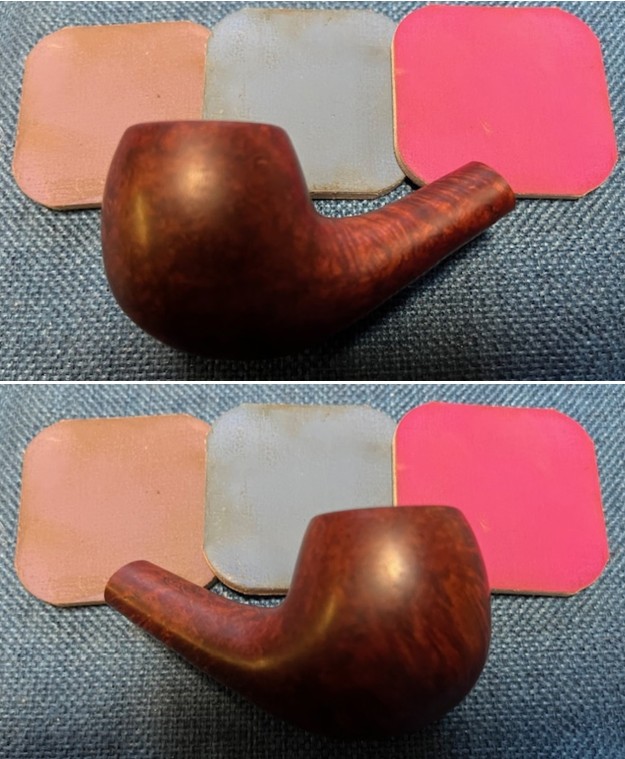
Michael Victor Kabik or Michael J. Kabik, now retired artisan and pipe repairman, was born in Annapolis, Maryland in 1950. As a student he was fascinated by science, but finally turned to the arts. In the early 1970s he started working as an artisan and designer for Hollyday Pipes Ltd., and when the company closed he set up in his own right.

Kabik writes as follows:

…In the 1960s, I had helped Jay build Jay’s Smoke Shop and was his first employee. Since that time, he had set up one of the very first freehand pipe-making operations in the U.S. along with his partner, Chuck Holiday, called CHP-X Pipes. The staff consisted of four full-timers actually making the pipes and perhaps another four in sales and office work. Chuck, who did the actual design and carving, had long since had serious disagreements with Jay and split. Chuck’s replacement from the staff was quitting, and Jay was in a bind. Jay offered me the job, and I gladly accepted. The fellow quitting was supposed to train me for two months but left after two weeks, leaving me with an awesome responsibility. I felt as though the future employment of all these people depended on me as the designer and cutter…and it did.

 …Sadly, CHP-X closed its doors two years after my arrival, due primarily to distribution, sales force problems, and other issues to which I was not privy…In love with a medium that satisfied my creative impulses while, pretty much, paying the bills, I bought up the essential equipment and produced pipes on my own. I did this from a farm house my wife and I rented in Phoenix, Maryland. I produced pipes under the name KANE, Gran Hill and others I can’t remember as well as a private label line for a store in, I believe, South Dakota.

 …In 1973, I was approached by Mel Baker, the owner of a chain in Virginia Beach called Tobak Ltd. Mel was interested in producing a freehand pipe line and was alerted to my product by Al Saxon, one of his managers and a former CHP-X employee. Mel wanted to relocate me to Virginia Beach, give me carte blanche, and recreate the CHP-X studio with, of course, a new name for the product. I’m sure my answer came very quickly.

 …We decided on the name Sven-Lar. Why? Well, when I bought out CHP-X, I also got a small drawer full of metal stamps that were created for private-label work. The Sven-Lar name was conceived but never realized. Aside from having the stamp already made, there were other reasons we chose Sven-Lar. First, we were making a line of pipes in the Danish freehand tradition and also, sadly, we knew the difficulty American pipe makers had breaking the foreign market mystique barrier. The latter certainly played a big part in the demise of CHP-X.

You can read the entire Pipedia article on Kabik here. Just to close the loop on this, I also found Kabik on Facebook. I haven’t contacted him yet, but I may to see if we can get some more historical information. Here is a relatively recent photo of him:

The markings on the pipe are as follows. On the shank, there is a large letter Z [over] Danmark [over] Granhill [over] Select. Mysteries abound! I don’t know what the “Z” refers to, I don’t know why he uses the Danish spelling of Denmark rather than the English (given that he’s American), I don’t know if Granhill is the same as Gran-Hill, etc., and, finally, I don’t know where “Select” ranks in the pantheon of Kabik pipes. Frustrating.

Let’s have a closer look at the pipe itself. It really is an attractive piece. Overall, it is in good condition – no major issues to resolve. Just a few minor ones – particularly on the stem. It had some significant tooth marks in the button and, as the photo shows, debris clogging the bore. I started with the BIC lighter and “painted” the stem with its flame, in the hopes of raising some of the dents in the vulcanite. Although they did not disappear altogether, they were substantially improved and I was pleased with the results.I wiped down the stem with some Murphy’s on some cotton rounds. Then, I cleaned out the insides of the stem with pipe cleaners and lemon-infused isopropyl alcohol. Once that was done, the stem went for an overnight soak in the Before & After Hard Rubber Deoxidizer. After soaking, I cleaned off the de-oxidizing fluid with alcohol, pipe cleaners, et cetera. The oxidation had migrated to the surface and I used SoftScrub to work it off. I built up the tooth damage on the stem with black cyanoacrylate adhesive and let it fully cure. I used my miniature files to take down the majority of the dried glue. I then used all nine Micromesh pads (1,500 through 12,000 grit) to bring out the lovely black lustre on the stem. I also used Obsidian Pipe Stem Oil in between each pad scrubbing. I used the PipNet Reamer (and some sandpaper taped to a wooden dowel) to take the bowl down to bare briar, as I wanted to ensure there were no hidden flaws in the walls of the bowl. Fortunately, there were none. I then proceeded to clean out the insides of the shank with Q-tips, pipe cleaners, and isopropyl alcohol. It took a fair amount of cotton to get this thing clean!A de-ghosting session seemed like a good idea. This de-ghosting consisted of thrusting cotton balls in the bowl and the shank, and saturating them with 99% isopropyl alcohol. I let the stummel sit overnight. This caused the oils, tars and smells to leech out into the cotton. Finally, a relatively clean and fresh-smelling bowl emerged. I then moved on to cleaning the outside of the stummel with Murphy’s Oil Soap and some cotton pads. I also scrubbed the plateau with a toothbrush. What a difference that made! I then cleaned the insides with some Castile soap and tube brushes. After this, I used all nine Micromesh pads (1,500 through 12,000 grit) to smooth out everything in the briar. Then a light application of Before & After Restoration Balm brought out the best in the stummel’s grain. The grain on this pipe is pretty fantastic! Off to the bench polisher to put the final touches on this pipe. A dose of White Diamond and a few coats of carnauba wax were just what this pipe needed. The lovely shine made the wood look absolutely beautiful.

All done! This Granhill Select Freehand looks fantastic and is ready to be enjoyed again by the next owner. I am pleased to announce that this pipe is for sale! If you are interested in acquiring it for your collection, please have a look in the “American” section of the store here on Steve’s website. You can also email me directly at kenneth@knightsofthepipe.com. The approximate dimensions of the pipe are as follows: length 6 in. (155 mm); height 2½ in. (64 mm); bowl diameter 1⅞ in. (47 mm); chamber diameter 1 in. (24 mm). The weight of the pipe is 1¾ oz. (52 g). I hope you enjoyed reading the story of this pipe’s restoration as much as I did restoring it. If you are interested in more of my work, please follow me here on Steve’s website or send me an email. Thank you very much for reading and, as always, I welcome and encourage your comments.

Restoring Five Pipes at Once


Blog by Kenneth Lieblich

One of my customers very kindly sent me five pipes to clean up for him. I had the pleasure of working on some beauties and I thought I would share the results with all of you. I was sent two Jobeys and three Peterson Sherlock Holmes pipes. On this occasion, I did something different than I usually do: I restored all five at once, rather than one at a time. The results on the pipes were as good as usual, but the results on your author’s sanity were perhaps less good. This blog is more of a show-and-tell than my usual restoration stories. Onward ho!
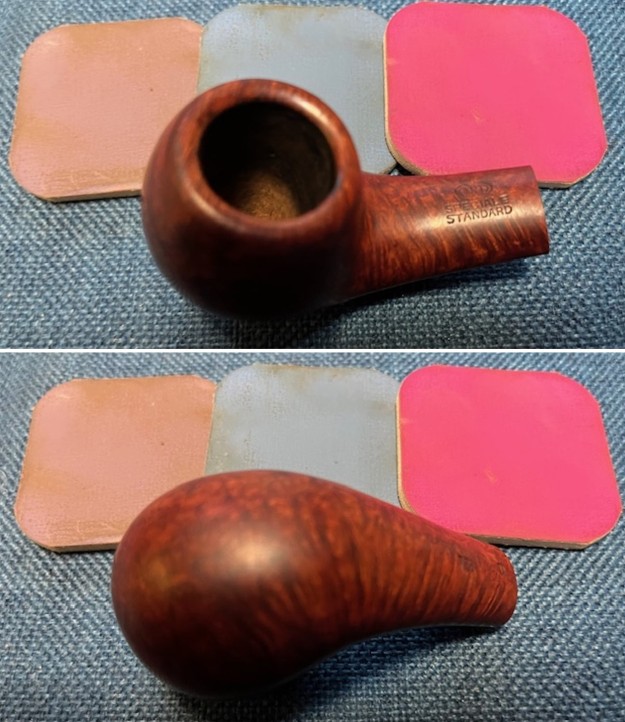
Let’s examine the five pipes. First is a Jobey Band E79 partially rusticated bullmoose with a variegated, acrylic, fishtail, saddle stem. Second is a Jobey Hand-Rubbed 680 smooth bent egg with a black, vulcanite, fishtail, saddle stem. Third is a Peterson’s Sherlock Holmes Professor large bent billiard with a sterling silver band and a black, vulcanite, P-lip, tapered stem. Dated 1998. Fourth is a Peterson Sherlock Holmes Hansom large (and very tall) bent bulldog with a sterling silver band and a black, vulcanite, P-lip, tapered stem. Dated 1997. And fifth is a Peterson Sherlock Holmes (without a specific name) large bent Rhodesian with a sterling silver band and a black, vulcanite, P-lip, tapered stem. Dated 1987. I cleaned the outside of all of the stems with Murphy’s and the insides with pipe cleaners and Q-tips dipped in isopropyl alcohol. The vulcanite stems were tossed into the oxidation removal fluid for a good soak. I later cleaned off the oxidation and went to fill in the tooth dents with black cyanoacrylate adhesive. I worked off the high points with my needle files and sanded them all with Micromesh pads and Obsidian Oil. On to the stummels. I reamed out all the bowls and removed all of that old cake. Some bowls had lava on the rim, so I carefully removed that without damaging anything further. I also cleaned the outside of the stummels with Murphy’s. These stummels had been quite well maintained over the years, so there wasn’t much difficulty in cleaning out the gunk inside – with one exception. The Jobey bent egg had a hidden trap of debris inside that had evidently never been noticed. As the photos show, there was some dreadful goo to remove from there! I set all five pipes up for a de-ghosting session and, since I was doing them all at once, an egg carton made an excellent holder for multiple pipes at once.Again, four of the five stummels were in great condition and didn’t really need much work to the outside briar. The exception was that same Jobey egg – it had a couple of significant blemishes which I repaired with briar dust and cyanoacrylate adhesive. After this, all of the stummels were sanded down with Micromesh pads and then left to sit with a coat of Before and After Balm. It sort of moisturizes the wood and gives it a lovely gloss. I took the pipes to my bench buffer and spiffed them all up with some White Diamond and carnauba wax. My last stem was to polish the sterling silver ands with my jewellery cloth. And voilà! These beauties are already on their way back to their owner. I trust that he will enjoy their new and improved status. I hope you enjoyed reading this quick write-up of this lovely bunch of pipes. If you are interested in my work, please follow me here on Steve’s website or email me directly at kenneth@knightsofthepipe.com. Thank you very much for reading and, as always, I welcome and encourage your comments.