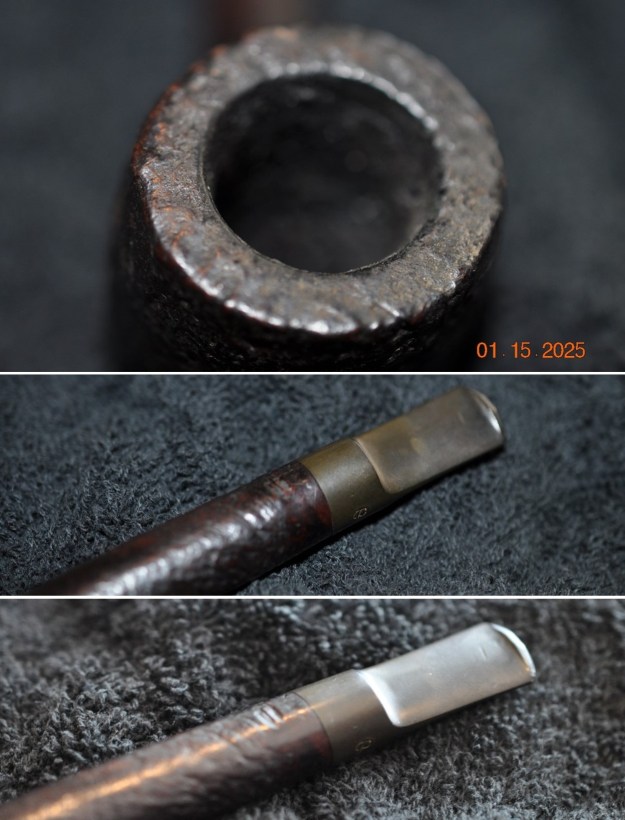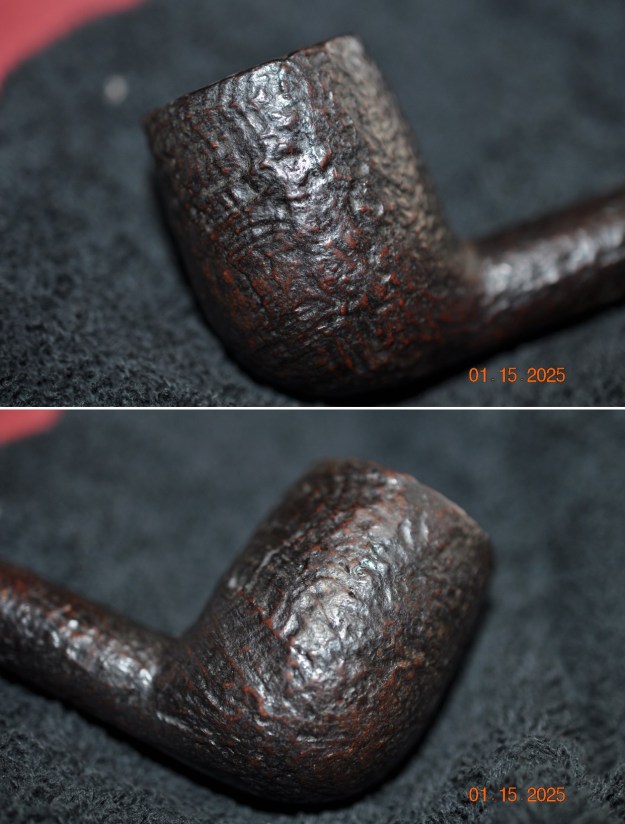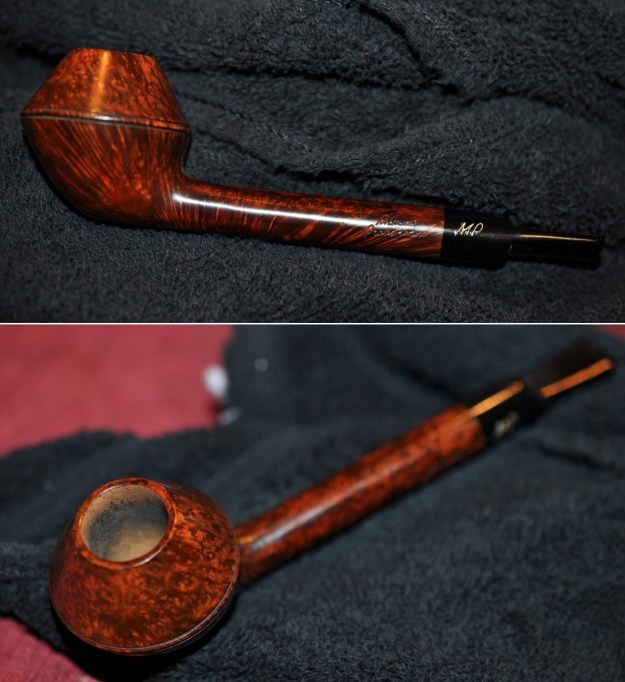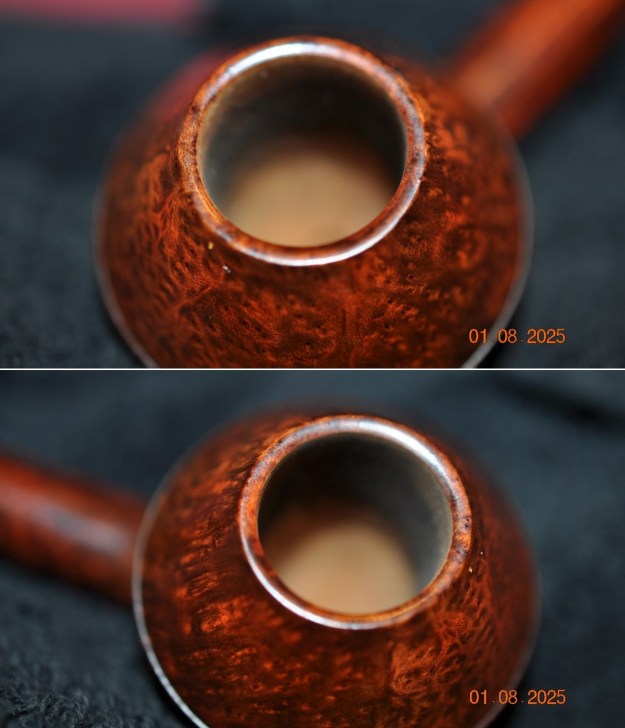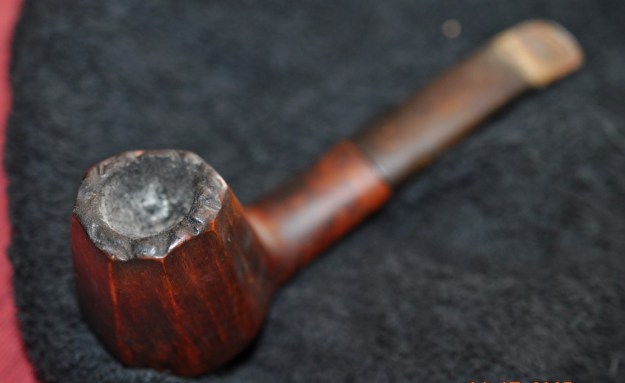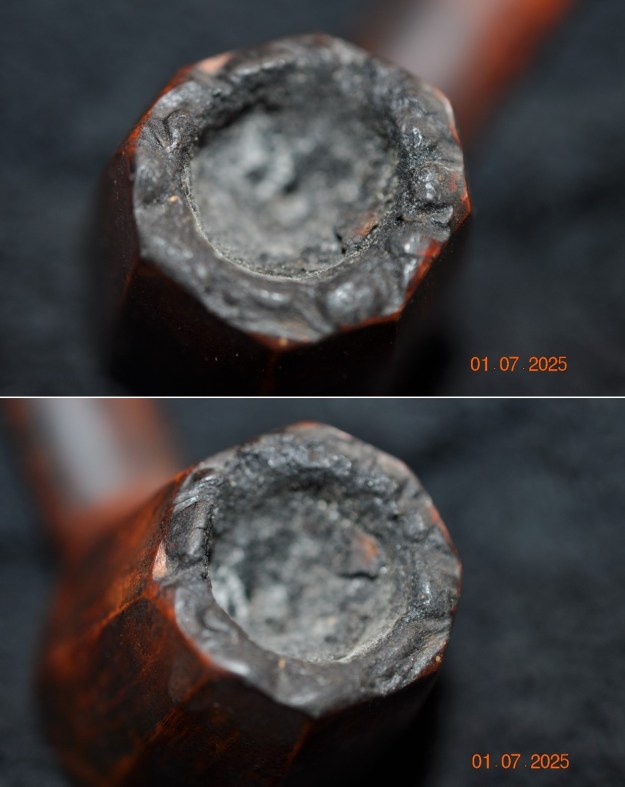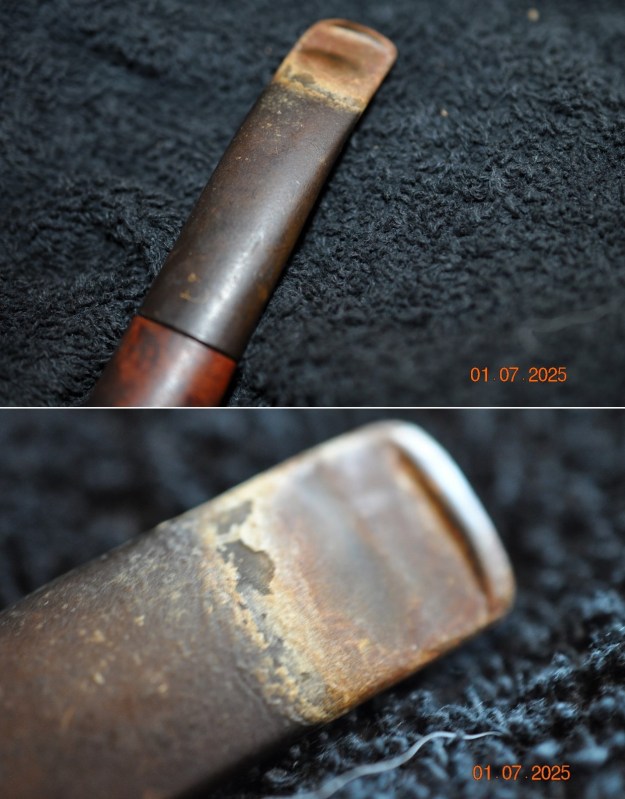
Tag Archives: shaping a stem

Restoring a Charatan’s Make London England Special 12 Smooth Billiard


by Steve Laug

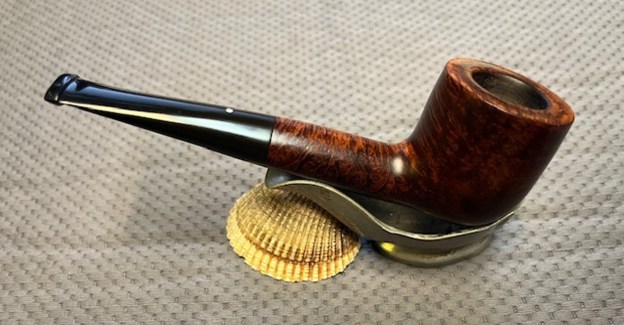
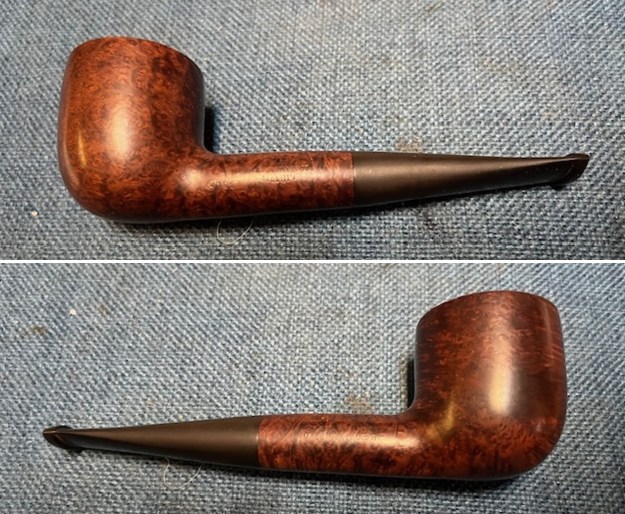
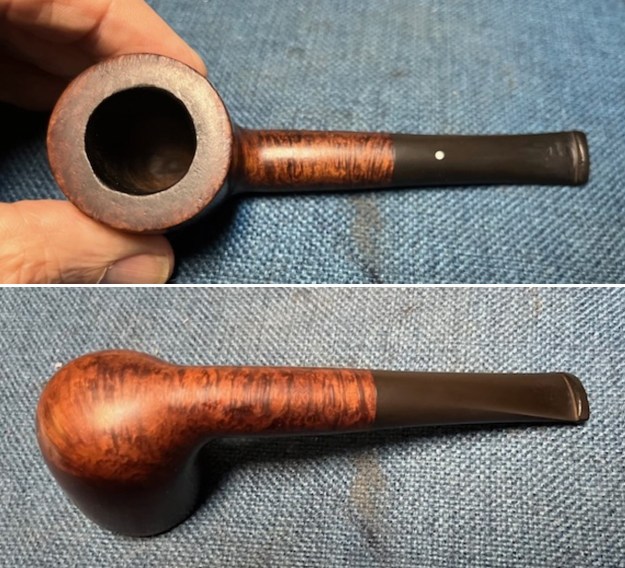
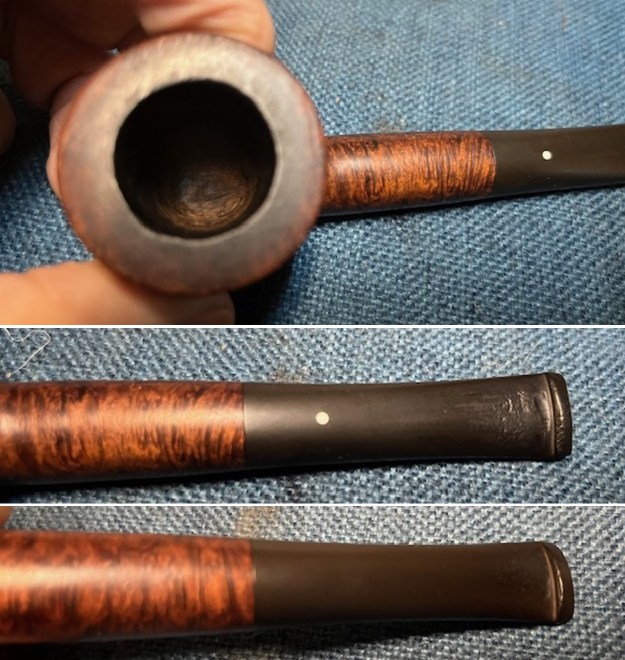
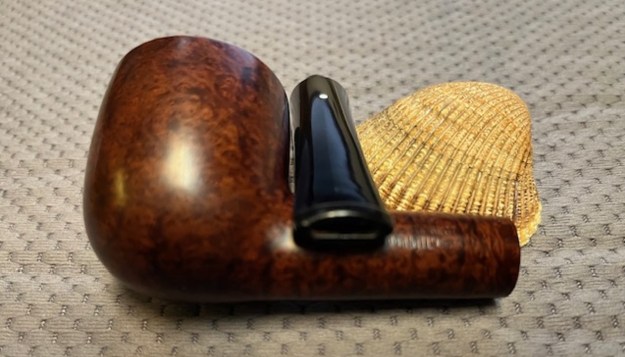
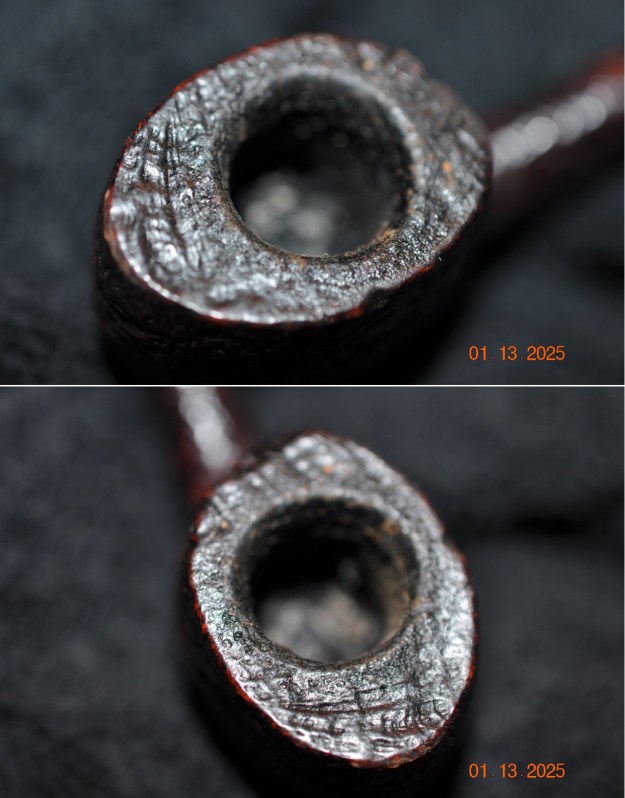
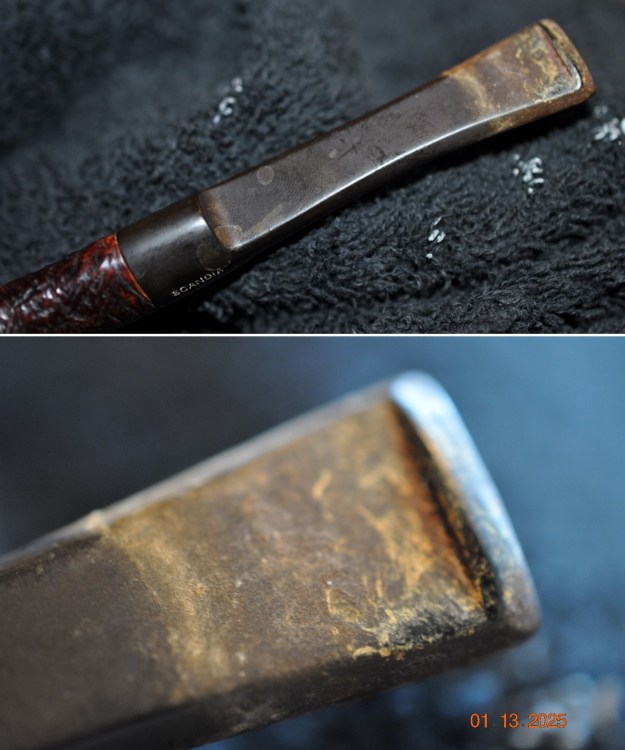
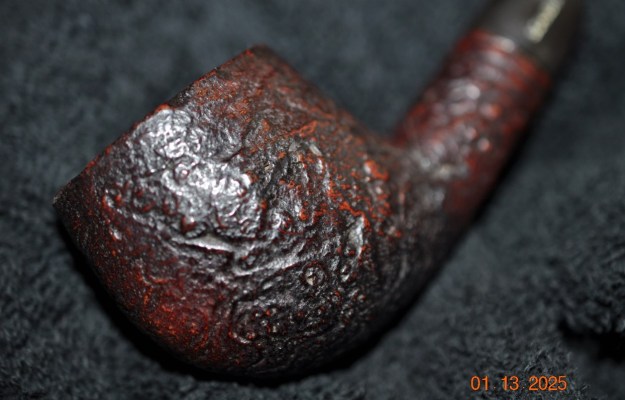
The next pipe I have chosen to work on was purchased on 03/21/2024 during a pipe hunt from a shop in Oregon City, Oregon USA. I have worked on a lot of Charatan pipes through the years and many of them have been smooth finished pipes. This nicely shaped Billiard is very nice with grain around the bowl. It is stamped on the left side of the shank and reads Charatan’s Make [over] London, England [over] Special. Low on the left side of the shank near the bow shank junction it is stamped with a cursive L in a circle identifying it as a Lane Era Pipe. On the right side near the shank/bowl junction is the shape number 12. The stamping is faint in spots but still readable. The taper stem also bears the CP logo on the left side. The bowl had a thick cake and there was a light spotty lava overflow on the inner edge of the bowl and top. The outer edge looked very good. The stem is lightly oxidized and has tooth marks and chatter on both sides at the button. Jeff took photos of the pipe before he started his clean up. Jeff took photos of the bowl, rim top to show the thickness of the cake in the bowl and the lava on the rim top. The bowl had a thick cake that overflowed in lava on the inner edge of the bowl. I am hoping that the thick lava coat protected things underneath it from damage to the edges and top. He took photos of the top and underside of the stem showing the tooth chatter and marks and oxidation on the stem surface and wear on the edges of the button. Jeff took photos of the sides and heel of the bowl to show the condition of the briar. You can see the interesting grain around the bowl even through the dirt and debris of many years. Jeff took photos of the stamping on the sides of the shank. You can see that it is faint in spots but still is readable as noted above. An added part of pipe restoration for me is to try to gather as much background on a brand and maker as I can find. With Charatan that is an enjoyable web to try to untangle. There is a lot of information and it can lead to understanding what era a pipe was made in. To try to figure out the era of the Charatan’s pipe I was working on I turned to the Pipephil website, Logos and Stampings (http://www.pipephil.eu/logos/en/logo-charatan.html). There is some really helpful information on each of the lines of Charatan’s Make pipes that entered the market. There was a smooth Special with stamping like the one in hand. The photo however was not present. The site did give a short history of the brand. I quote the portion that is most pertinent. The brand was founded in 1863 by Frederik Charatan. When his father retired in 1910, Reuben Charatan took over the family business. All the pipes were handmade until 1973. The brand name has been overtaken by Dunhill in 1978 and sold in 1988 to James B. Russell Inc. (NJ, USA). During the period 1988-2002 Charatans were crafted by Butz Choquin in St Claude (France). Dunhill re-purchased Charatan brand name in 2002 and Colin Fromm (Invicta Briars, Castleford) followed up on freehand production. L in circle denotes a pipe imported into USA by Lane Ltd between 1955 and 1988.

Next, I turned to Pipedia to see if I could find more information on the brand and possibly a link to a sandblast finished Dublin (https://pipedia.org/wiki/Charatan) but once again in the general article it was not listed. It did give a little more historical information. I quote the pertinent parts that give information on this particular pipe.

In 1950 Herman G. Lane, striving to expand his business in Great Britain, made contacts with the Charatan family. Apparently, Lane got a certain influence soon, but it was not until 1955 that Lane Ltd. became the sole distributor for Charatan’s in the United States superseding Wally Frank. This can be documented in a “biography” written for Herman G. Lane titled “Leaves from a Tobaccoman’s Log”.

Thanks to Herman G. Lane’s dedicated labor Charatan became hugely popular in the States. As reported by Ken Barnes in an interview with Rick Newcombe, Reuben Charatan passed away in 1962, and his widow sold the firm to Herman Lane 1 or 2 years after his death.[1] In the early 1960s Charatan pipes were the first to overstep the $100 Dollar line in US pipe sales. In 1978 Lane’s heirs sold the Charatan company to Dunhill. The Prescot Street factory was closed in March 1982. Thereafter the fame and quality of the make declined.

The pre-Lane period (prior to 1955) and the Lane era pipes (1955 to until sometime between 1979 – 1984) are of primary interest the collector. The Lane era is often quoted as beginning about 1950.

Charatan records are almost non-existent before Lane due to a factory fire, making it difficult to date pre-Lane pipes. Charatan used 4 basic grades prior to 1950: Supreme, Selected, Executive, and Belvedere. After 1950 Herman Lane’s influence began, and the grades started to expand. In 1955 Lane took over sole distributorship of Charatan in the US. In 1957 he introduced the Supreme S. Most of his other introductions were from the 1960s and early 1970s.

From this I am fairly certain I am dealing with a Lane pipe made after 1955. There is also a circle L script mark that is a Lane stampings on the pipe which also supports this.

I continued digging further into the dating of the pipe, but what I had found above was a good start for me. If some of you would like to try your hand at dating it more accurately as to the time period it came out you might want to check out the article on Pipedia on Dating Charatans (https://pipedia.org/wiki/Dating_of_Charatans).

I also reread the article on Pipedia by the Italian fellow who contributed some really helpful information on the brand (https://pipedia.org/wiki/Charatan_-_Milan_2014). I quote the section on the Second period: Reuben Charatan 1910 – c. 1962. I have highlighted a portion of the section on the shank in red to point out some more helpful dating information.

– In 1962 Herman Lane took over the business from the Charatan family, although he had already influenced production from the 1950s.

– The pipes were mostly larger than the previous ones and corresponded in size to Dunhill group 5. These are slightly less rare, but still difficult to find.

– Stem: Usually in ebonite, saddle shaped or tapered, bearing a fine “CP” stamp, underbore system (see below) used when necessary.

– Shank: The shape code is stamped on it together with the nomenclature “CHARATAN’S MAKE LONDON ENGLAND” arranged in two lines. From 1955 onward on the models marketed for the USA there is also a serif and circled capital “L” (but not all models bear this) which resembles the pound sterling symbol. The “L” is for Lane, the importer.

From 1958, Lane changed the nomenclature for models marketed for the US to clarify the message: “MADE BY HAND”.  In this period the underbore was introduced. Its manufacturing period ranged between 1920 and c.1930. This model was equipped with a duralumin plunger trap fitted in the stem, which served to clean the residue more easily. This particular model bore a special stamp on the stem, and also had its own catalogue…

QUALITY GRADES…The stem did not only display the stamps mentioned above. Another stamp that can help dating is the one referring to the quality of the pipe. Until Herman Lane arrived on the scene there were four quality grades. Starting with the lowest: Belvedere, Executive, Selected, and Supreme. Lane went on to add higher grades from time to time: Supreme S, Supreme S100, S150, S200, S250, S300, Coronation, Royal Achievement, Crown Achievement, and Summa Cum Laude; these last three are extremely rare and almost impossible to find. He also invented other, different grades, even changing the previous pipe classification standards. We will not go into detail here, but it means that if we find an S100 or Coronation the pipe was manufactured following Herman Lane’s acquisition. In particular, the FH mark, or Freehand pipe was commissioned to the famous Danish craftsman, Preben Holm.

Nomenclature

The Lane Trademark serif and circled L indicates the pipe is from the “Lane Era” (approx. 1955 to 1979 -1984?), however it appears that both the English factory or Lane themselves sometimes, or perhaps even often forget to stamp the L on a pipe. The Charatan factory was known for inconsistencies, especially in stampings. Therefore, although an L on the pipe definitely defines it as a Lane Era pipe, the lack of it could simply mean the pipe missed receiving the stamp from the factory. The lack of the trademark could also mean the pipe was destined for the European market.

Charatan pipes were not well distributed prior to the Lane Era, so very few pre-Lane pipes exist today. Herman Lane greatly grew the brand in the U.S., which caused corresponding growth in Europe…

This confirmed that I was working on Lane Era pipe which actually means it was between 1955 and 1988 as shown by the stamping. Now it was time to work on the pipe.

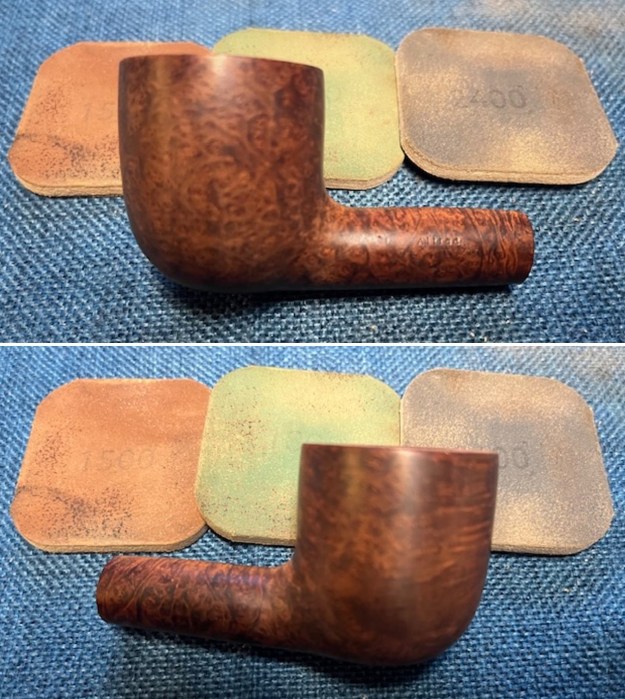
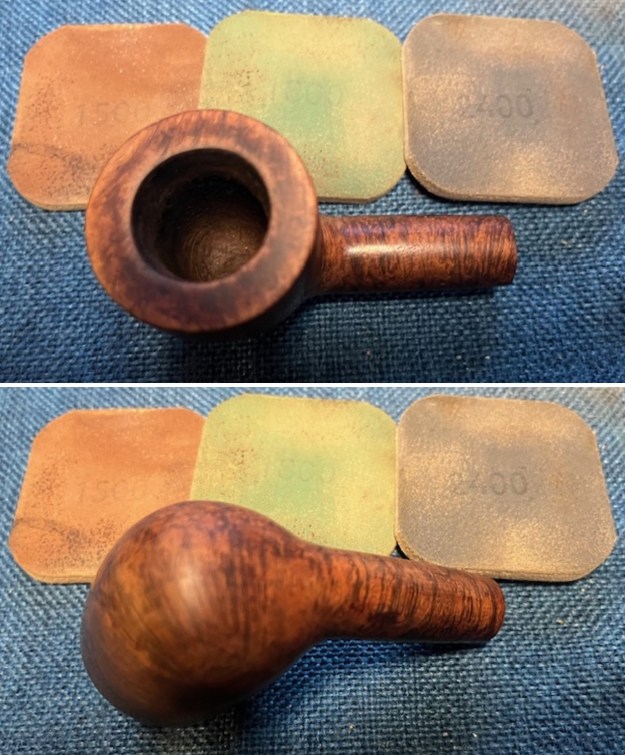
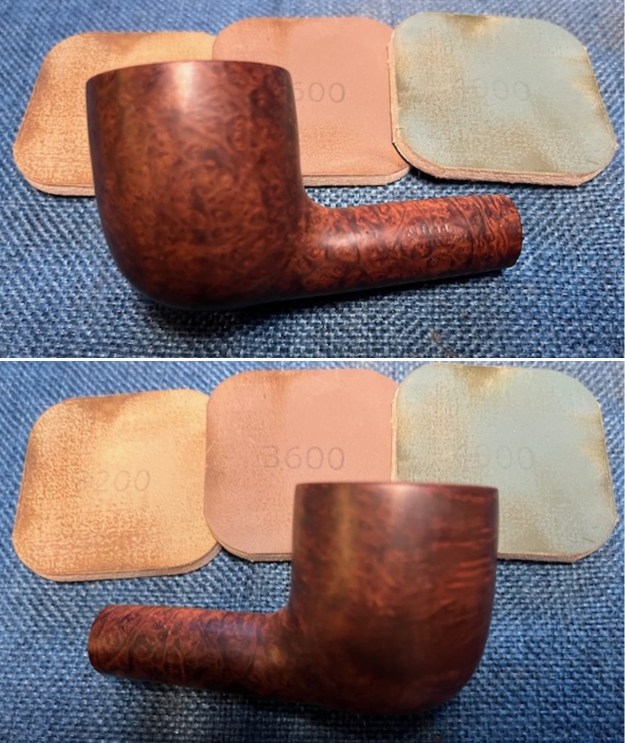
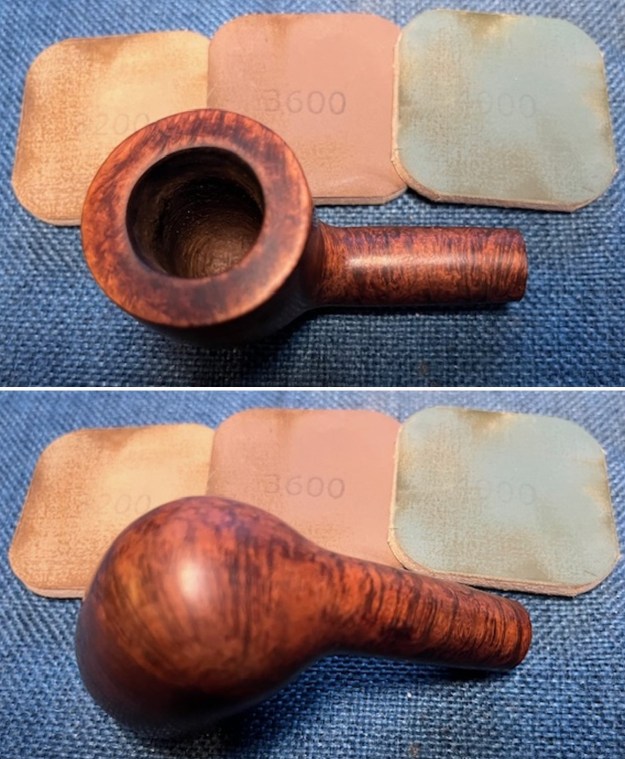
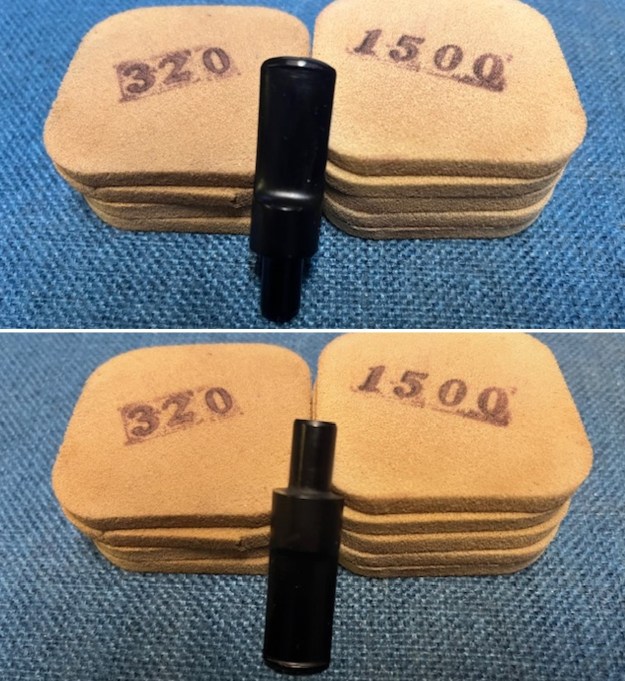
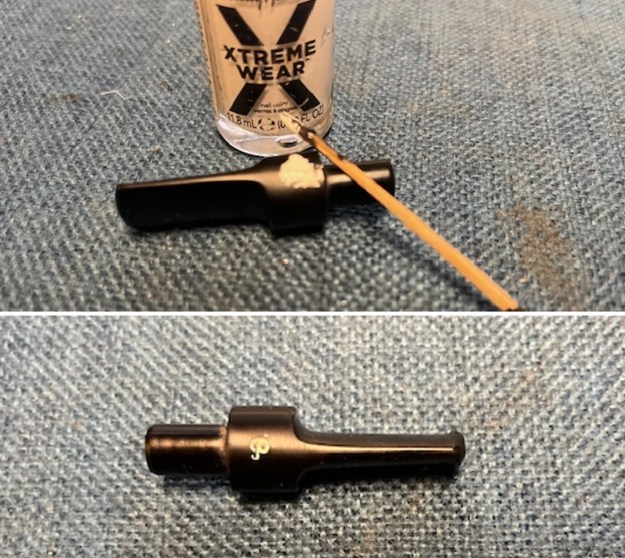
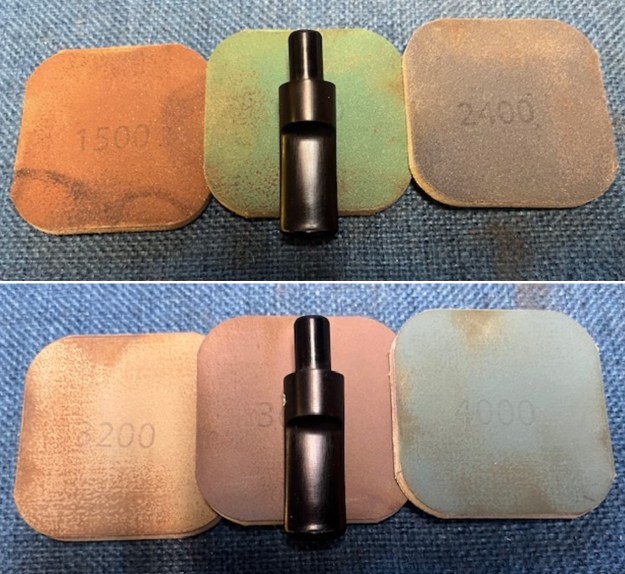
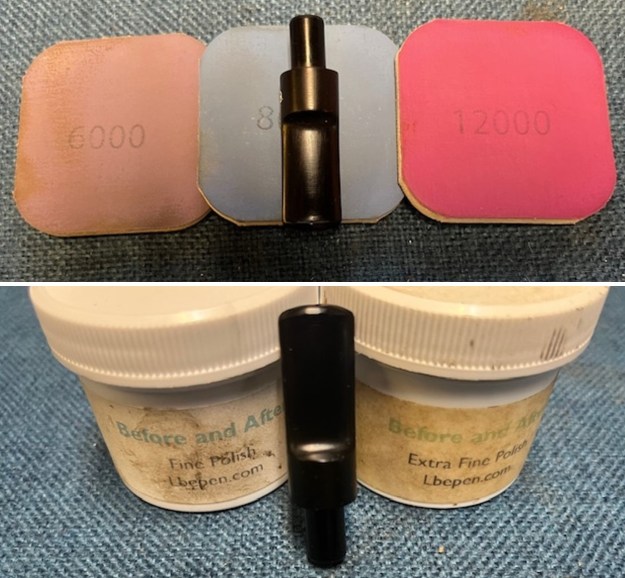
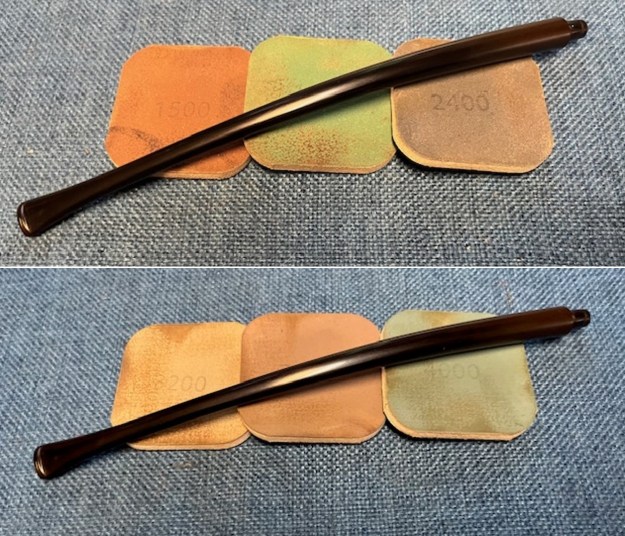
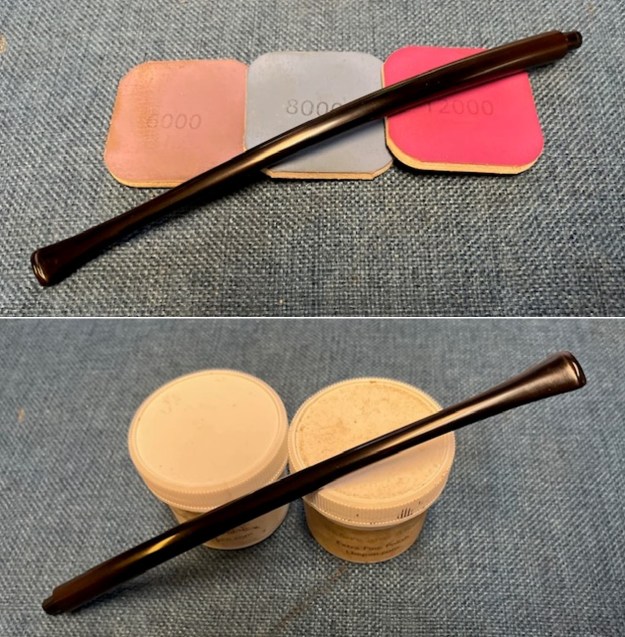
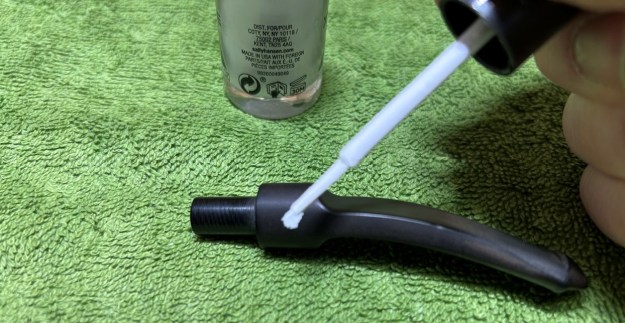
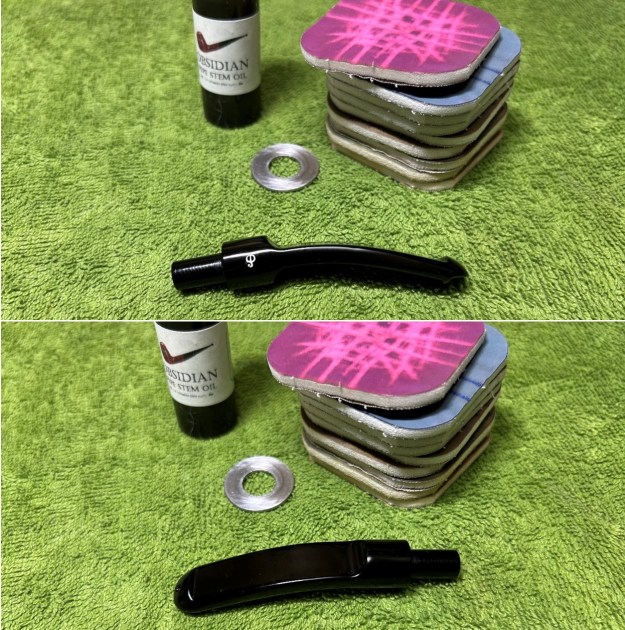
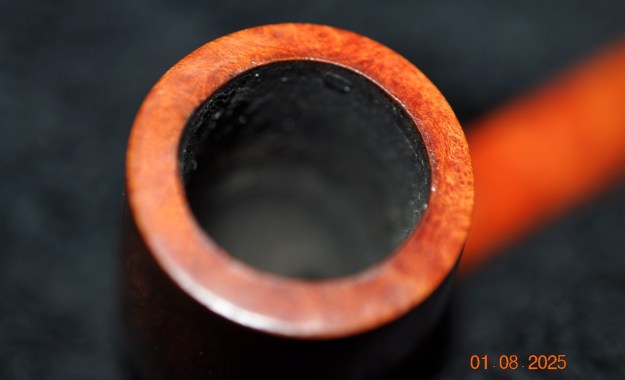
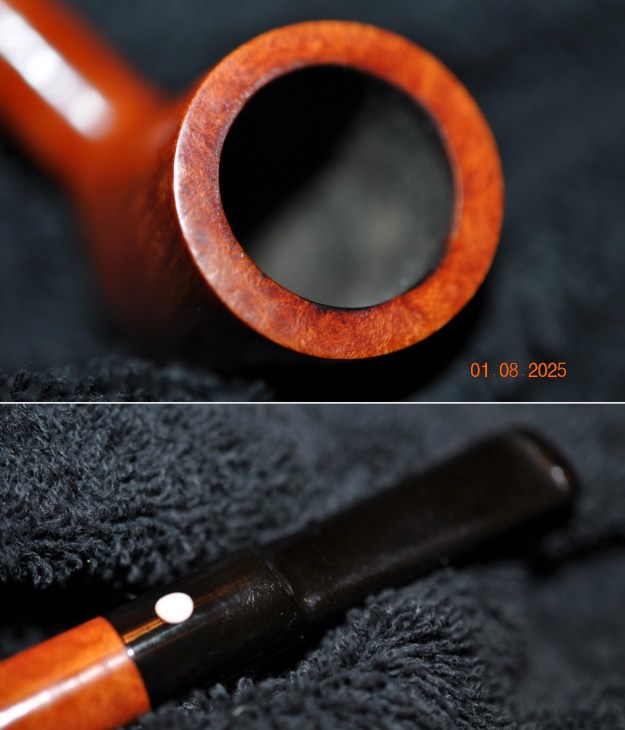
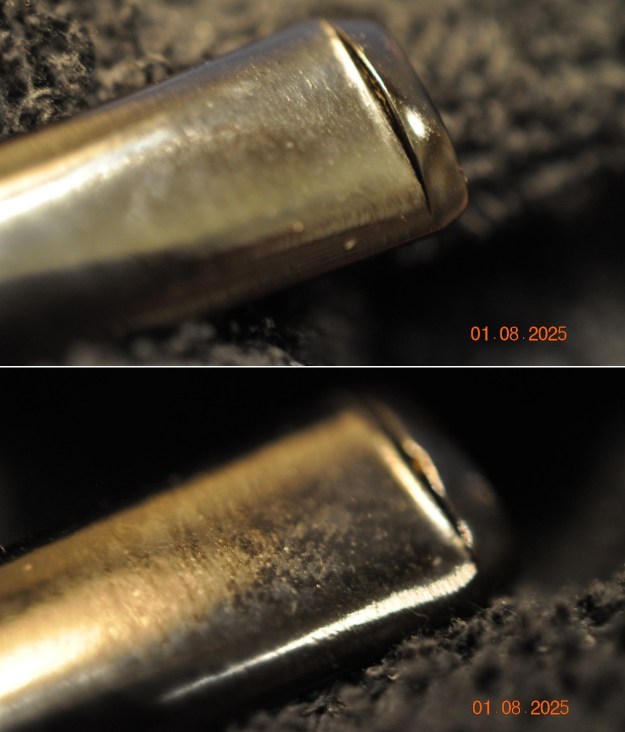
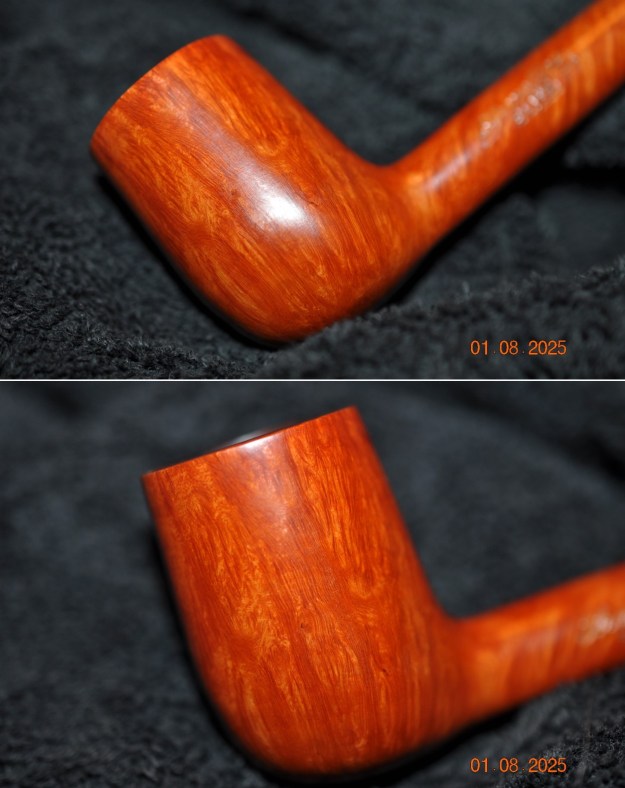
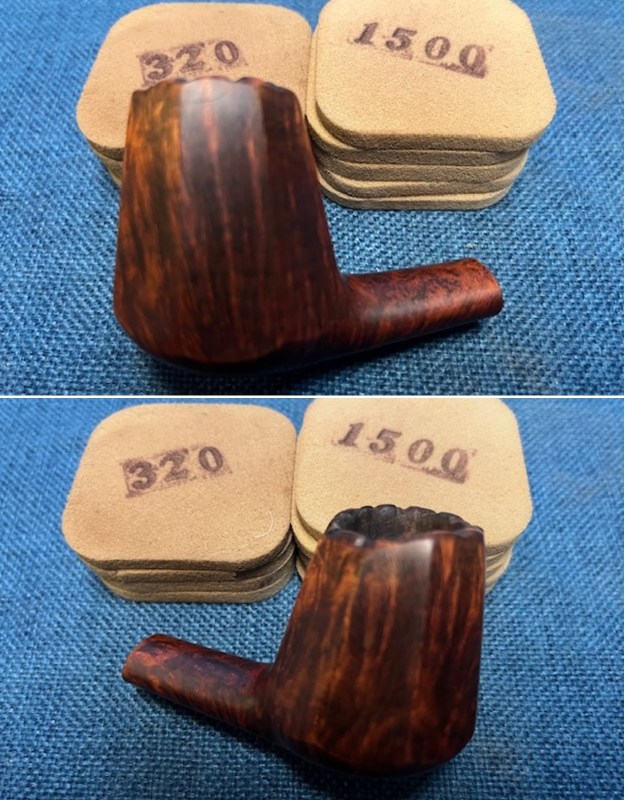
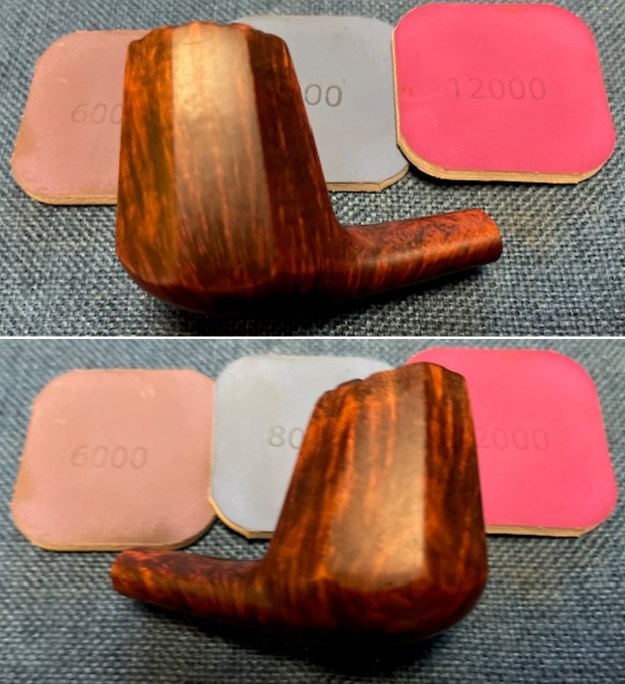
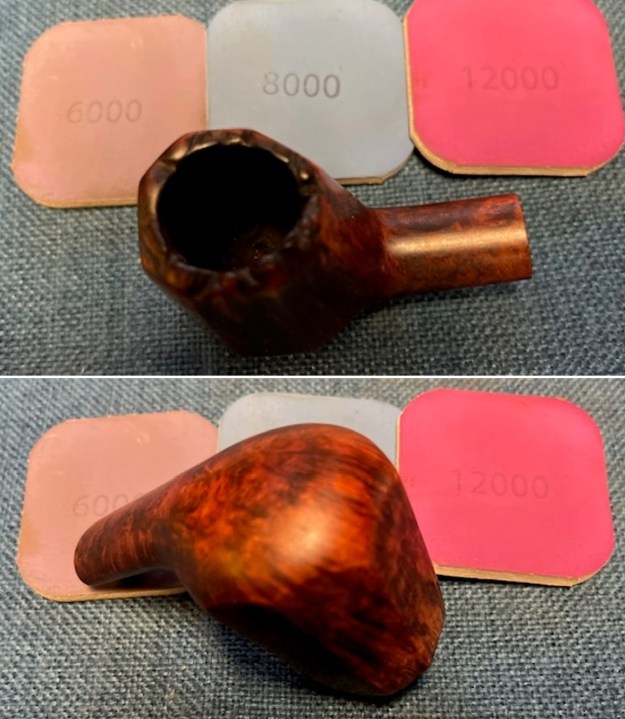
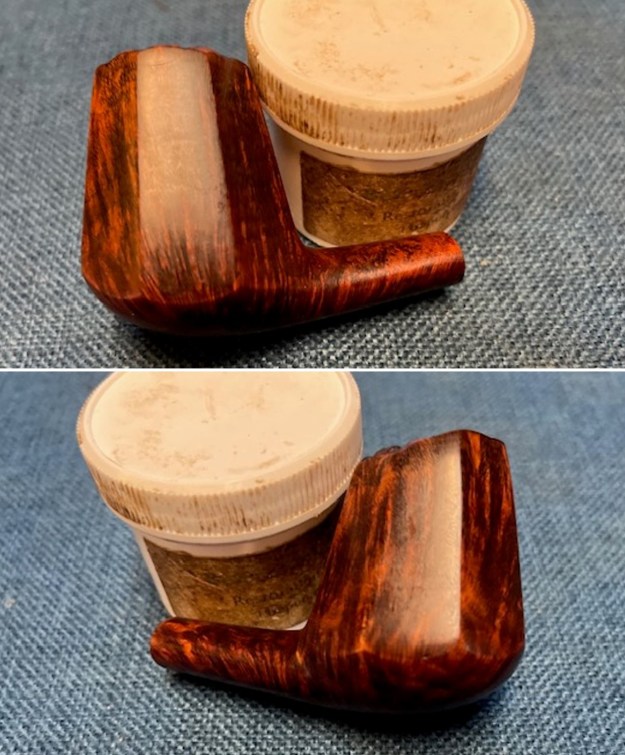
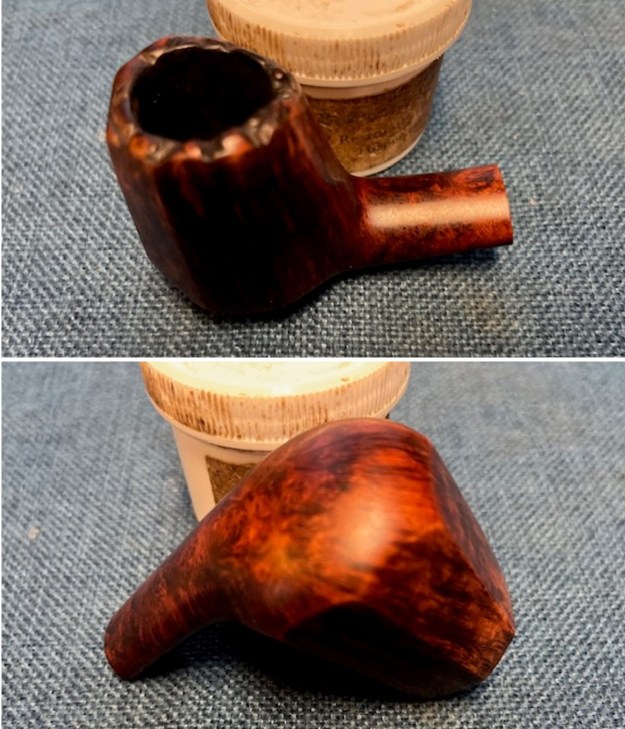
Jeff had cleaned it thoroughly. He had reamed it with a PipNet reamer and cleaned that up with a Savinelli Fitsall Pipe Knife. He had scrubbed the exterior of the briar with undiluted Murphy’s Oil Soap. He removed the shiny coat on the briar with acetone on cotton pads. He cleaned out the interior of the shank, sump and airway in the shank and stem with alcohol, pipe cleaners and cotton swabs. He scrubbed the stem with Soft Scrub to remove the oxidation and calcification on the surface. He soaked it in Briarvilles Pipe Stem Deoxidizer to remove the oxidation. He removed it from the Deoxidizer and rinsed it off with warm water. I took some photos of the pipe before I started my part of the work. I took close up photos of the rim top and also of the stem surface. I wanted to show what an amazing job Jeff did in the cleanup of the rim top. The rim top was and inner edge were in good condition. I also took close up photos of the stem to show the condition of the vulcanite. It was clean but there were tooth marks and chatter on the stem ahead of the button on both sides.One of the things I appreciate about Jeff’s cleanup is that he works to protect and preserve the nomenclature on the shank of the pipes that he works on. The stamping on this one had faint spots on the edges so I was worried that it would worsen with the cleanup. I took some photos to show the clarity of the stamping. The photo is a little blurry but the stamping remains the same. I have noticed that many restorers are not careful to protect the stamping in their cleaning process and often by the end of the restoration the nomenclature is almost destroyed. I would like to encourage all of us to be careful in our work to preserve this as it is a critical piece of pipe restoration! I took the stem off the shank and took a photo of the pipe to capture the look of the pipe as a whole. I sanded the bowl with 320-3500 sanding pads tom smooth out the small nicks and scratches in the rim top and bowl sides. I wiped it down with a damp cloth after each sanding pad. The bowl really began to look good. I polished it with micromesh sanding pads – dry sanding with 1500-12000 grit pads. After each sanding pad I wiped the bowl down with paper towel and a drop of olive oil to remove the debris from the sanding process. It really took on a shine. I rubbed the bowl and rim down with Before & After Restoration Balm. I worked it into the surface of the briar with my fingertips to clean, enliven and protect it. I let the balm sit for 10 minutes and then buffed with a cotton cloth to raise the shine. I really like watching the Balm do its magic and bring the briar alive. I touched up the faint white CP stamp with white acrylic nail polish. I worked it into the stamp with a flat blade. Once it hardened I scraped off the excess and sanded it. It is faint toward the ends of the letters but is still recognizable as the CP stamp. I sanded the stem with 320-3500 grit sanding pads. I wiped the stem down after each sanding pad with a damp cloth. The stem began to take on a shine by the final pads.I polished the stem with micromesh sanding pads – wet sanding with 1500-12000 grit pads. I wiped the stem down after each sanding pad with Obsidian Oil to give the sanding pads some bite. I polished it with Before & After Pipe Stem Polish – both Fine and Extra Fine. I gave it a coat of Obsidian Pipe Stem Oil. I set it aside to dry. Once again at this point in the restoration process I am excited to be on the homestretch. I look forward to the final look when the Lane Era Charatan’s Make London England Special Billiard is put back together, polished and waxed. I put the bowl and stem back together. I lightly polished the bowl and the replacement stem with Blue Diamond. I gave the bowl and the stem multiple coats of carnauba wax. I buffed the pipe with a clean buffing pad to raise the shine. I hand buffed it with a microfiber cloth to deepen the shine. The pipe polished up pretty nicely. The grain really pops with the wax and polish. The shiny black vulcanite stem is a beautiful contrast to the browns of the bowl. This Charatan’s Make London England Special Billiard was another fun pipe to work on. It really is a quite stunning piece of briar whose shape follows the flow of the briar. The pipe feels great in the hand will be better when warmed up while smoking. The finished pipe is shown in the photos below. The dimensions of the pipe are Length: 5 ½ inches, Height: 1 ¾ inches, Outside diameter of the bowl: 1 ¼ inches, Chamber diameter: ¾ of an inch. The weight of the pipe is 1.62 ounces/46 grams. I will be putting it on the rebornpipes store in the British Pipemakers Section if you would like to add it to your rack and carry on the previous pipeman’s legacy. This is an interesting estate to bring back to life.

As always, I encourage your questions and comments as you read the blog. Thanks to each of you who are reading this blog. Remember we are not pipe owners; we are pipe men and women who hold our pipes in trust until they pass on into the trust of those who follow us.

Restoring a Charatan’s Make London England Sandblast Billiard


by Steve Laug

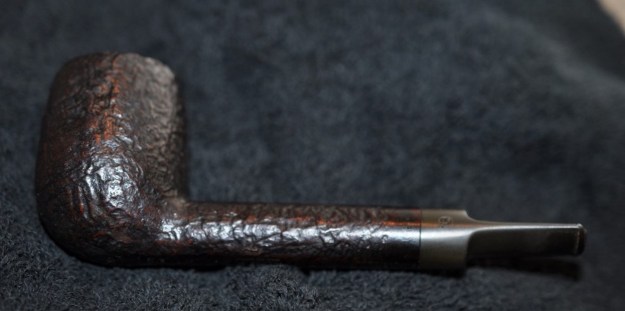
The next pipe I have chosen to work on was purchased on 03/21/2024 during a pipe hunt from a shop in Oregon City, Oregon USA. I have worked on a lot of Charatan pipes through the years and some have been sandblast pipe. This nicely shaped sandblast Billiard is very nice with deep sandblast around the bowl. It is stamped on the underside of the shank and reads Charatan’s Make [over] London, England. On the heel of the bowl it is stamped with a cursive L in a circle identifying it as a Lane Era Pipe. There is no shape number on the bowl or shank. The stamping is faint in spots but still readable. The taper stem does not bear the CP logo on the left side. The bowl had a thick cake and there was a lava overflow on the sandblast rim top. The inner edge of the rim thickly covered with lava so it was hard to know the damage at this point. The outer edge looked very good. The stem is lightly oxidized and has tooth marks and chatter on both sides at the button. Jeff took photos of the pipe before he started his clean up. Jeff took photos of the bowl, rim top to show the thickness of the cake in the bowl and the lava on the rim top. The bowl had a thick cake that overflowed in lava on the inner edge and rim top of the bowl. I am hoping that the thick lava coat protected things underneath it from damage to the edges and top. He took photos of the top and underside of the stem showing the tooth chatter and marks and oxidation on the stem surface and wear on the edges of the button. Jeff took photos of the sides and heel of the bowl to show the condition of the briar. You can see the beautiful shape of the bowl even through the dirt and debris of many years. You can also see the depth of the blast around the bowl and shank. Jeff took photos of the stamping on the underside of the shank. You can see that it is clear and readable as noted above. An added part of pipe restoration for me is to try to gather as much background on a brand and maker as I can find. With Charatan that is an enjoyable web to try to untangle. There is a lot of information and it can lead to understanding what era a pipe was made in. To try to figure out the era of the Charatan’s pipe I was working on I turned to the Pipephil website, Logos and Stampings (http://www.pipephil.eu/logos/en/logo-charatan.html). There is some really helpful information on each of the lines of Charatan’s Make pipes that entered the market. There was not a sandblast stamped like the one in hand. The site did give a short history of the brand. I quote the portion that is most pertinent.The brand was founded in 1863 by Frederik Charatan. When his father retired in 1910, Reuben Charatan took over the family business. All the pipes were handmade until 1973. The brand name has been overtaken by Dunhill in 1978 and sold in 1988 to James B. Russell Inc.(NJ, USA). During the period 1988-2002 Charatans were crafted by Butz Choquin in St Claude (France). Dunhill re-purchased Charatan brand name in 2002 and Colin Fromm (Invicta Briars, Castleford) followed up on freehand production.

Next, I turned to Pipedia to see if I could find more information on the brand and possibly a link to a sandblast finished Dublin (https://pipedia.org/wiki/Charatan) but once again in the general article it was not listed. It did give a little more historical information. I quote the pertinent parts that give information on this particular pipe.

In 1950 Herman G. Lane, striving to expand his business in Great Britain, made contacts with the Charatan family. Apparently, Lane got a certain influence soon, but it was not until 1955 that Lane Ltd. became the sole distributor for Charatan’s in the United States superseding Wally Frank. This can be documented in a “biography” written for Herman G. Lane titled “Leaves from a Tobaccoman’s Log”.

Thanks to Herman G. Lane’s dedicated labor Charatan became hugely popular in the States. As reported by Ken Barnes in an interview with Rick Newcombe, Reuben Charatan passed away in 1962, and his widow sold the firm to Herman Lane 1 or 2 years after his death.[1] In the early 1960s Charatan pipes were the first to overstep the $100 Dollar line in US pipe sales. In 1978 Lane’s heirs sold the Charatan company to Dunhill. The Prescot Street factory was closed in March 1982. Thereafter the fame and quality of the make declined.

The pre-Lane period (prior to 1955) and the Lane era pipes (1955 to until sometime between 1979 – 1984) are of primary interest the collector. The Lane era is often quoted as beginning about 1950.

Charatan records are almost non-existent before Lane due to a factory fire, making it difficult to date pre-Lane pipes. Charatan used 4 basic grades prior to 1950: Supreme, Selected, Executive, and Belvedere. After 1950 Herman Lane’s influence began, and the grades started to expand. In 1955 Lane took over sole distributorship of Charatan in the US. In 1957 he introduced the Supreme S. Most of his other introductions were from the 1960s and early 1970s.

From this I am fairly certain I am dealing with a Lane pipe made after 1955. There is also a circle L script mark that is a Lane stampings on the pipe which also supports this.

I continued digging further into the dating of the pipe, but what I had found above was a good start for me. If some of you would like to try your hand at dating it more accurately as to the time period it came out you might want to check out the article on Pipedia on Dating Charatans (https://pipedia.org/wiki/Dating_of_Charatans).

I also reread the article on Pipedia by the Italian fellow who contributed some really helpful information on the brand (https://pipedia.org/wiki/Charatan_-_Milan_2014). I quote the section on the Second period: Reuben Charatan 1910 – c. 1962. I have highlighted a portion of the section on the shank in red to point out some more helpful dating information.

– In 1962 Herman Lane took over the business from the Charatan family, although he had already influenced production from the 1950s.

– The pipes were mostly larger than the previous ones and corresponded in size to Dunhill group 5. These are slightly less rare, but still difficult to find.

– Stem: Usually in ebonite, saddle shaped or tapered, bearing a fine “CP” stamp, underbore system (see below) used when necessary.

– Shank: The shape code is stamped on it together with the nomenclature “CHARATAN’S MAKE LONDON ENGLAND” arranged in two lines. From 1955 onward on the models marketed for the USA there is also a serif and circled capital “L” (but not all models bear this) which resembles the pound sterling symbol. The “L” is for Lane, the importer.

From 1958, Lane changed the nomenclature for models marketed for the US to clarify the message: “MADE BY HAND”.  In this period the underbore was introduced. Its manufacturing period ranged between 1920 and c.1930. This model was equipped with a duralumin plunger trap fitted in the stem, which served to clean the residue more easily. This particular model bore a special stamp on the stem, and also had its own catalogue…

QUALITY GRADES…The stem did not only display the stamps mentioned above. Another stamp that can help dating is the one referring to the quality of the pipe. Until Herman Lane arrived on the scene there were four quality grades. Starting with the lowest: Belvedere, Executive, Selected, and Supreme. Lane went on to add higher grades from time to time: Supreme S, Supreme S100, S150, S200, S250, S300, Coronation, Royal Achievement, Crown Achievement, and Summa Cum Laude; these last three are extremely rare and almost impossible to find. He also invented other, different grades, even changing the previous pipe classification standards. We will not go into detail here, but it means that if we find an S100 or Coronation the pipe was manufactured following Herman Lane’s acquisition. In particular, the FH mark, or Freehand pipe was commissioned to the famous Danish craftsman, Preben Holm.

Nomenclature

The Lane Trademark serif and circled L indicates the pipe is from the “Lane Era” (approx. 1955 to 1979 -1984?), however it appears that both the English factory or Lane themselves sometimes, or perhaps even often forget to stamp the L on a pipe. The Charatan factory was known for inconsistencies, especially in stampings. Therefore, although an L on the pipe definitely defines it as a Lane Era pipe, the lack of it could simply mean the pipe missed receiving the stamp from the factory. The lack of the trademark could also mean the pipe was destined for the European market.

Charatan pipes were not well distributed prior to the Lane Era, so very few pre-Lane pipes exist today. Herman Lane greatly grew the brand in the U.S., which caused corresponding growth in Europe.

Generally, when the pipe is stamped with the BLOCK letters “MADE BY HAND” it means the pipe was probably made between 1958 and 1965”

Generally, block letters “MADE BY HAND” and some of the other nomenclature in script (i.e. City of London or Extra Large next to the MADE BY HAND) means the pipe was made sometime between 1965 and the mid 1970s. The total script nomenclature “Made by Hand in City of London” evolved over this period of time, so many pipes had variants, such as Made By Hand in block letters and City of London in script, or some other variation of the terms or stampings.

It is believed the FH was used on Charatan pipes between 1957 and 1967-68. Three different sizes were used. The Charatan Logo (CP) on the pipe bit was changed over the year

Now I knew I was working on Lane Era pipe which actually means it was between 1955 and 1988 as shown by the stamping. Now it was time to work on the pipe.

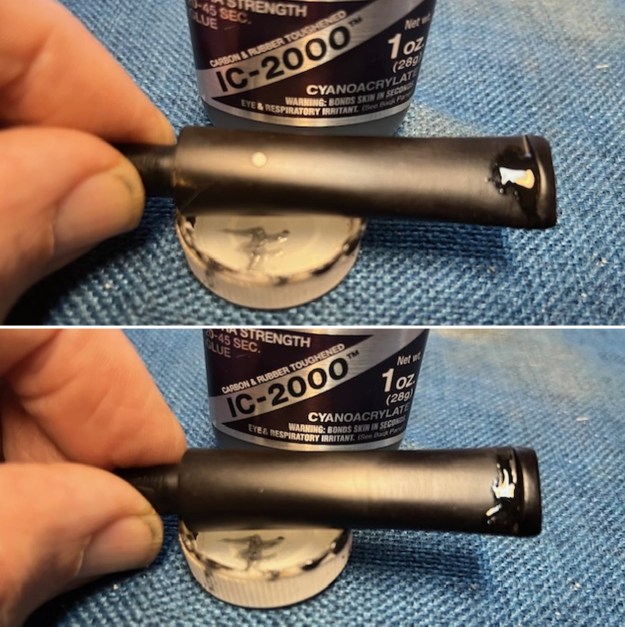
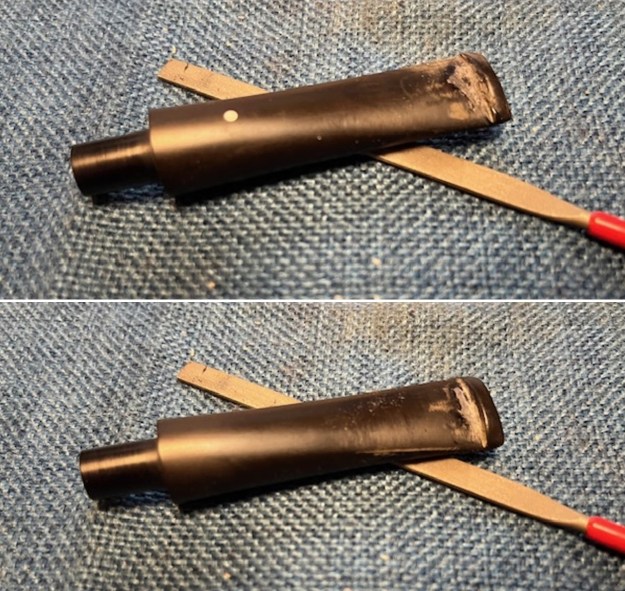
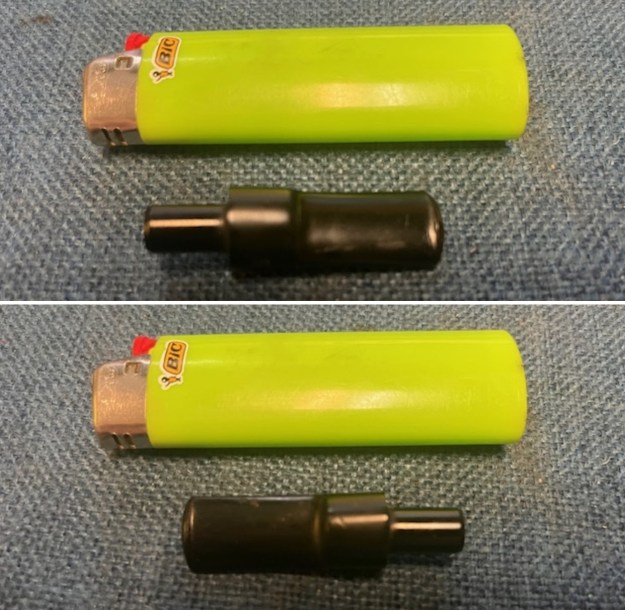
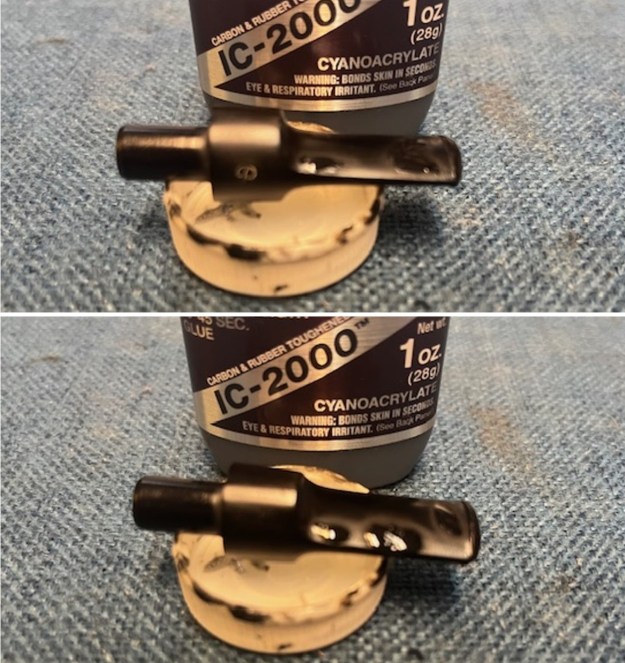
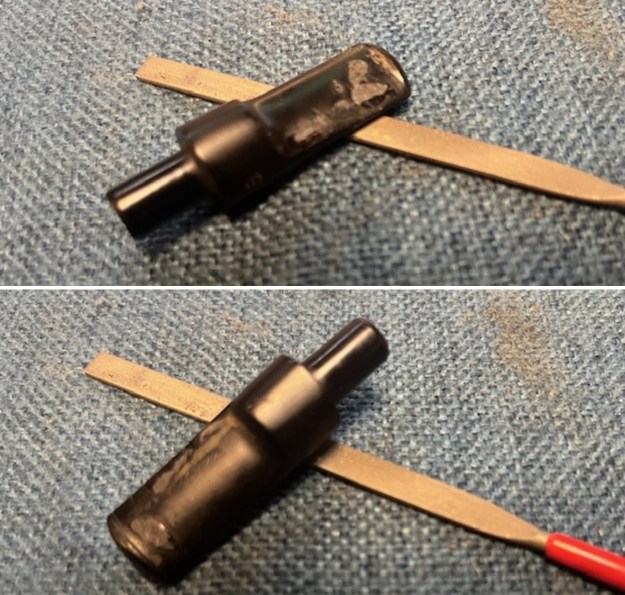
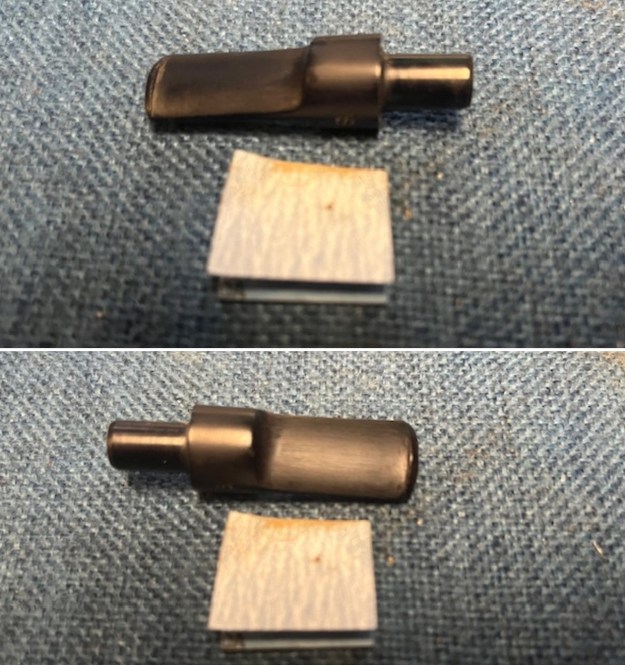
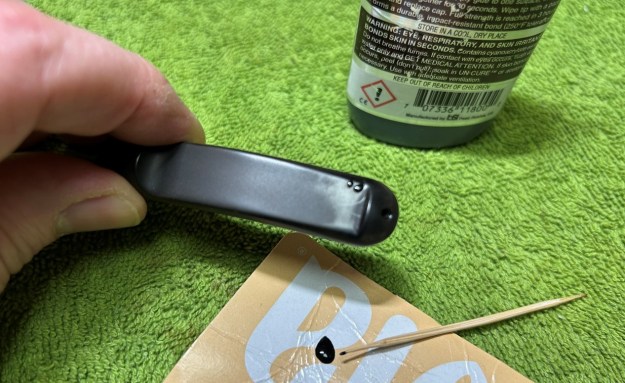
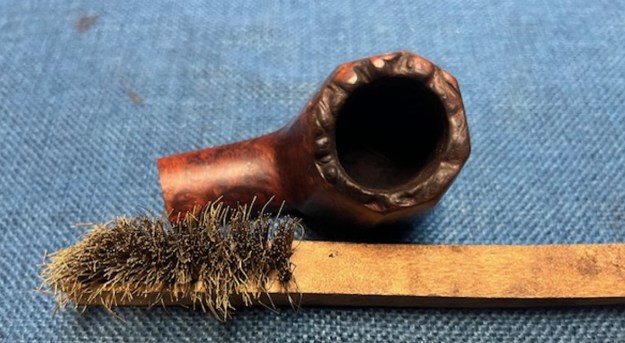
Jeff had cleaned it thoroughly. He had reamed it with a PipNet reamer and cleaned that up with a Savinelli Fitsall Pipe Knife. He had scrubbed the exterior of the briar with undiluted Murphy’s Oil Soap. He removed the shiny coat on the briar with acetone on cotton pads. He cleaned out the interior of the shank, sump and airway in the shank and stem with alcohol, pipe cleaners and cotton swabs. He scrubbed the stem with Soft Scrub to remove the oxidation and calcification on the surface. He soaked it in Briarvilles Pipe Stem Deoxidizer to remove the oxidation. He removed it from the Deoxidizer and rinsed it off with warm water. I took some photos of the pipe before I started my part of the work. I took some close up photos of the rim top and also of the stem surface. I wanted to show what an amazing job Jeff did in the cleanup of the rim top. The rim top was and inner edge were in good condition. There were spots on the rim top and edges where there were some spots of debris in the finish. I also took close up photos of the stem to show the condition of the vulcanite. It was in clean but there were tooth marks and chatter on the stem ahead of the button on both sides.One of the things I appreciate about Jeff’s cleanup is that he works to protect and preserve the nomenclature on the shank of the pipes that he works on. The stamping on this one had faint spots on the edges so I was worried that it would worsen with the cleanup. I took some photos to show the clarity of the stamping. The photo is a little blurry but the stamping remains the same. I have noticed that many restorers are not careful to protect the stamping in their cleaning process and often by the end of the restoration the nomenclature is almost destroyed. I would like to encourage all of us to be careful in our work to preserve this as it is a critical piece of pipe restoration! I took the stem off the shank and took a photo of the pipe to capture the look of the pipe as a whole.With that finished the bowl was very clean and the sandblast looked great. I used a brass bristle wire brush to work over the debris on the rim top and clean it up. It looked much better after the work on it was finished.I rubbed the bowl and rim down with Before & After Restoration Balm. I worked it into the sandblast surface of the briar with my fingertips and a horse hair shoe brush to clean, enliven and protect it. I let the balm sit for 10 minutes and then buffed with a cotton cloth to raise the shine. I really like watching the Balm do its magic and bring the briar alive. I set the bowl aside and turned my attention to the stem. I “painted” the tooth marks on the stem with the flame of a Bic lighter. I was able to lift the tooth marks considerably but some still remained. I filled them in with black, rubberized CA glue. Once it had cured I used a small file to flatten out the repairs. I sanded them smooth with 220 grit sandpaper to blend them into the surface of the vulcanite. I sanded the stem with 320-3500 grit sanding pads. I wiped the stem down after each sanding pad with a damp cloth. The stem began to take on a shine by the final pads.I polished the stem with micromesh sanding pads – wet sanding with 1500-12000 grit pads. I wiped the stem down after each sanding pad with Obsidian Oil to give the sanding pads some bite. I polished it with Before & After Pipe Stem Polish – both Fine and Extra Fine. I gave it a coat of Obsidian Pipe Stem Oil. I know that most think it does nothing for acrylic stems but I use it anyway as I find it works very well to deepen the shine. I set it aside to dry. Once again at this point in the restoration process I am excited to be on the homestretch. I look forward to the final look when the Lane Era Charatan’s Make London England Sandblast Billiard is put back together, polished and waxed. I put the bowl and stem back together. I lightly polished the bowl and the replacement stem with Blue Diamond. I gave the bowl and the stem multiple coats of carnauba wax. I buffed the pipe with a clean buffing pad to raise the shine. I hand buffed it with a microfiber cloth to deepen the shine. The pipe polished up pretty nicely. The depths of the sandblast really pop with the wax and polish. The shiny black vulcanite stem is a beautiful contrast to the browns of the bowl. This Charatan’s Make London England Sandblast Billiard was another fun pipe to work on. It really is a quite stunning piece of briar whose shape follows the flow of the briar. The pipe feels great in the hand will be better when warmed up while smoking. The finished pipe is shown in the photos below. The dimensions of the pipe are Length: 5 ¼ inches, Height: 1 ¾ inches, Outside diameter of the bowl: 1 ¼ inches, Chamber diameter: ¾ of an inch. The weight of the pipe is 1.31 ounces/38 grams. I will be putting it on the rebornpipes store in the British Pipemakers Section if you would like to add it to your rack and carry on the previous pipeman’s legacy. This is an interesting estate to bring back to life.

As always, I encourage your questions and comments as you read the blog. Thanks to each of you who are reading this blog. Remember we are not pipe owners; we are pipe men and women who hold our pipes in trust until they pass on into the trust of those who follow us.

Breathing Life into a LHS Certified Purex Imported Briar 97 Bulldog


by Steve Laug

The next pipe I have chosen to work on was purchased from an online auction on January 22, 2024 in Jordan, Minnesota, USA. I have worked on a lot of LHS pipes through the years and many of them had the LHS Certified Purex stamp on the shank. This large flat Bulldog is very nice with great grain around the bowl. There are a few worm trail rustications on the sides of the bowl. It is stamped on the left side of the shank and reads CERTIFIED PUREX arched over a diamond the LHS in the centre. Underneath that is stamped Imported Briar. On the left underside of the diamond shank it is stamped with the shape number 97. The stamping is clear and readable. The saddle stem also bears the silver (inlaid) diamond logo on the left side. The bowl had a thick cake and there was a lava overflow on the rim top. The inner edge of the rim thickly covered with lava so it was hard to know the damage at this point. The outer edge and rim cap showed nicks and light damage. The stem is oxidized, calcified and has tooth marks and chatter on both sides at the button. Jeff took photos of the pipe before he started his clean up. Jeff took photos of the bowl, rim top to show the thickness of the cake in the bowl and the lava on the rim top. The bowl had a thick cake that overflowed in lava on the inner edge and rim top of the bowl. I am hoping that the thick lava coat protected things underneath it from damage to the edges and top. He took photos of the top and underside of the stem showing the tooth chatter, scratching, calcification and oxidation on the stem surface and wear on the edges of the button. Jeff took photos of the sides and heel of the bowl to show the condition of the briar. You can see the beautiful shape of the bowl even through the dirt and debris of many years. You can also see the nicks in the rim cap and the side of the bowl. Jeff took photos of the stamping on the sides of the shank. You can see that it is clear and readable as noted above. Jeff took photos of the pipe taken apart. It shows the shank insert that is screwed into the shank end. You can also see the threaded stinger/tenon apparatus as well.I turned first to Pipephil’s site (http://pipephil.eu/logos/en/logo-lhs.html) and found a pipe with the same stamping as the one that I am working on. There was a brief history of the brand at the top of the page. It read as follows:

The L&H Stern Inc. was established by Ludwig Stern (1877-1942) in 1911. His brother Hugo (1872-?) acted as vice-president & secretary. The firm moved to 56 Pearl St. Brooklyn in 1920. It closed down in the 1960s. LHS was one of the main pipe supplier for US soldiers during WWII.

I turned to Pipedia to try and place this pipe in the timeline of the brand and was able find some helpful information which I have included below (https://pipedia.org/wiki/LHS). Again it had a brief history. It read as follows:

Ludwig Stern, a successful pipe manufacturer since 1893 and closing around 1960, reorganized his company along with his brother Hugo Stern, opening a factory in 1911. They named the company L&H Stern Smoking Pipes & Holders. The newly formed company was moved into a six story building on the corner of Pearl and Waters street Brooklyn, NY…

There were also Notes from Geyer’s Stationer on the page below this. It read as follows:

Thoroughly organized in all departments, and housed in a well-lighted and ventilated modern office and manufacturing building, the firm of L&H Stern Inc. is located near the first arch of the Manhattan bridge, near the river and convenient to the Brooklyn bridge, which makes it accessible from all the hotels in the metropolis for visiting buyers. The structure is six stories with a seventeen-foot basement, with light on three sides through prismatic glass windows, the first floor being seven feet above the sidewalk. Light enters the upper floors from all four sides.

L&H Stern is known to every important wholesaler and jobber in the country. LHS manufactures a complete line of briar pipes. Ginmetto wood pipes are also made, as well as Redmanol goods, the man-made amber. The first substitute for amber. Everything, even down to the sterling silver and other metal trimmings are made under one roof.

LH Stern was a fascinating company that literally covered the manufacture of all the pipe parts. I was not able to pin down the date on it with the information but it was a nice piece of briar. Now on to the pipe.

Jeff carefully cleaned the pipe. He reamed it with a PipNet pipe reamer and then cleaned up the reaming with a Savinelli Fitsall Pipe Knife. He scrubbed out the internals of the shank, stem and shank extension with alcohol, pipe cleaners and cotton swabs until the pipe was clean. He scrubbed the exterior of the bowl with Murphy’s Oil Soap and a tooth brush to remove the grime and grit on the briar and lava on the rim top. The finish looks much better and has a deep richness in the colour that highlights grain of the briar. The rim top had some darkening and there was some damage to the inner edge of the bowl. The aluminum on the shank end and on the stem were slightly oxidized but clean. Jeff soaked the stem in bath of Before & After Pipe Stem Deoxidizer to remove the oxidation on the rubber. He worked it over with Soft Scrub All Purpose Cleaner to remove any remnants of oxidation. When the pipe arrived here in Vancouver and I finally started my work on it I was amazed it looked so good. Here are some photos of what I saw. I took some close up photos of the rim top and the stem surface. The inner edge of the rim was nicked around inner edge of the bowl. The rim cap was nicked and damaged as well. I took close up photos of the stem to show the condition of the surface and button. There was some remaining oxidation near the shank and the tooth marks and chatter were evident near the button on both sides.I took a picture of the stamping on the shank sides and it was all clear and readable as noted above. I took the pipe apart and took a photo of the pipe with the stem. It is a good looking pipe and very unique. The stinger apparatus and integrated tenon were a single unit.I started my work on the pipe by addressing the damage on the inner edges of the bowl. I used a folded piece of 220 grit sandpaper to work over the inner edge to clean up the damage. I also worked over the rim top and outer edges at the same time.I sanded the nicks and scratches in the rim cap and bowl with 320-3500 grit sanding pads. I wiped the bowl down between sanding pads with a damp cloth. By the last pad the pipe began to take on a shine. I polished the briar with micromesh sanding pads – dry sanding with 1500-12000 grit pads. I wiped the bowl down a damp cloth to remove the sanding debris. The grain real shone through with the polishing. I worked some Before & After Restoration Balm into the surface of the bowl and shank with my fingertips to clean, enliven and protect the briar. I let the balm sit for 15 minutes and then buffed with a cotton cloth to raise the shine. The photos show the bowl at this point in the restoration process. I polished the stem with micromesh sanding pads – dry sanding with 1500-12000 grit sanding pads. I wiped it down after each sanding pad with Obsidian Oil. I polished it with Before & After Pipe Stem Polish – both Fine and Extra Fine. I gave it a final coat of Obsidian Oil. With the bowl and the stem finished I put the LHS Certified Purex Imported Briar Bulldog 97 back together and buffed it on the wheel using Blue Diamond to give it a shine. I gave the bowl and stem multiple coats of carnauba wax on the wheel and then buffed it with a clean buffing pad to raise the shine. I hand buffed it with a microfiber cloth to deepen the shine. It really a nice looking sandblast. The dimensions of the pipe are – Length: 5 ½ inches, Height: 1 ¾ inches, Outside diameter of the bowl: 2 ¼ inches, Chamber diameter: 7/8 of an inch. The weight of this large pipe is 2.01 ounces /57 grams. This LHS Certified Purex Imported Briar Bulldog was a great find. I will be putting it on the rebornpipes store in the American Pipe Makers Section soon. If you would like to add it to your collection let me know. This is another pipe that has the possibility of transporting the pipe man or woman back to a slower paced time in history where you can enjoy a respite. Thanks for walking through the restoration with me.
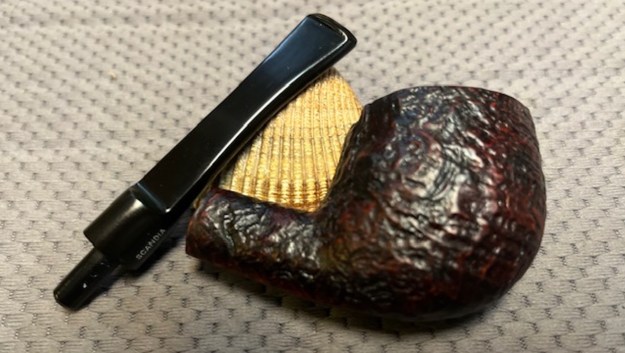
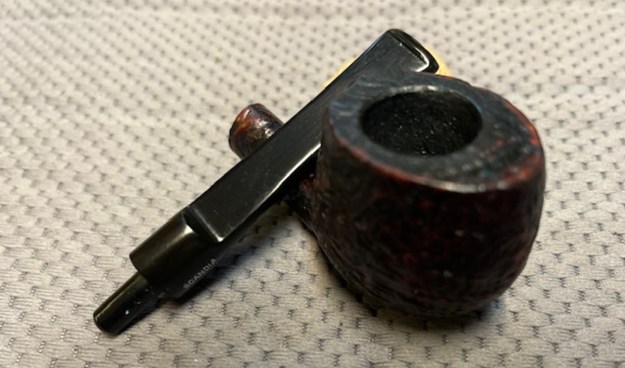
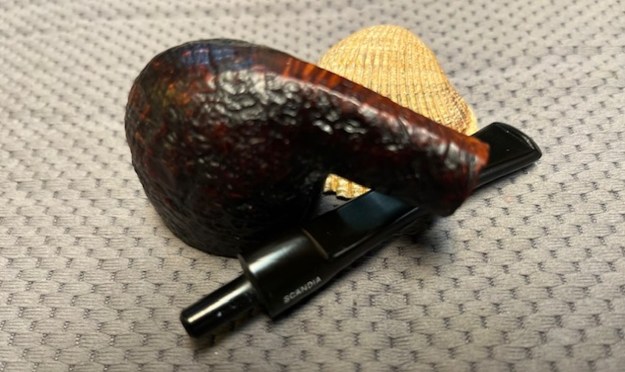
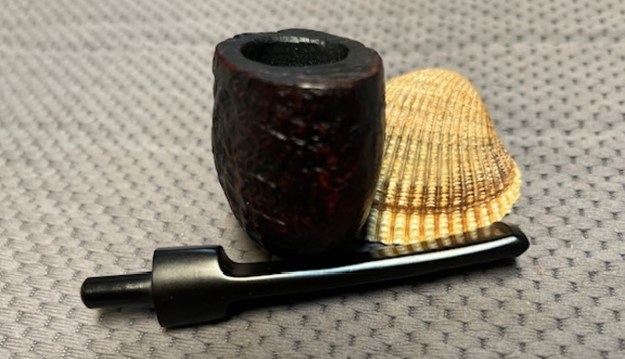
A New Home for a Brebbia Bent Pocket Pipe


by Kenneth Lieblich

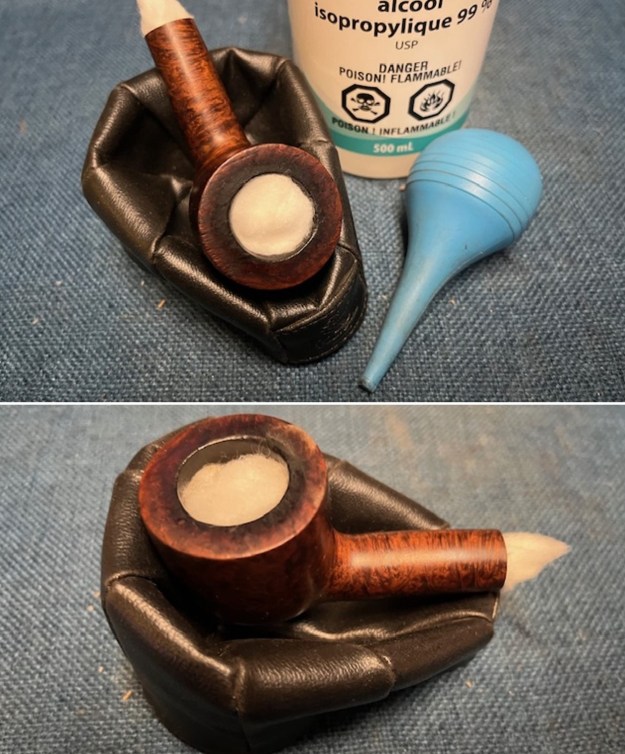
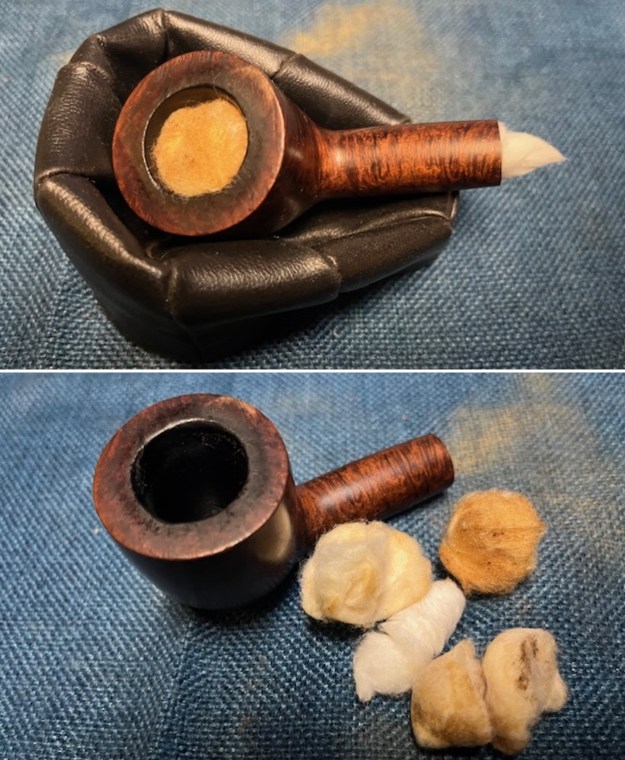
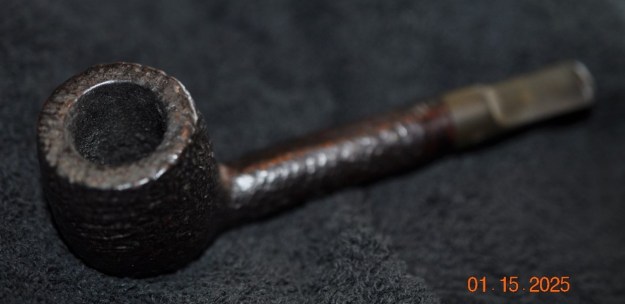
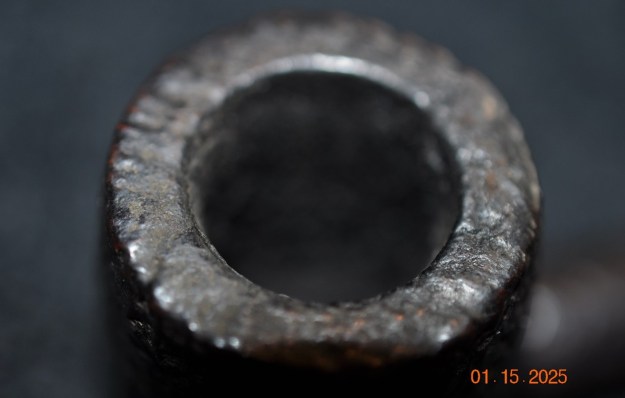
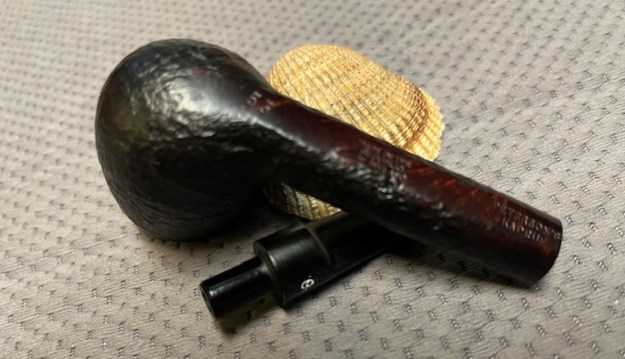
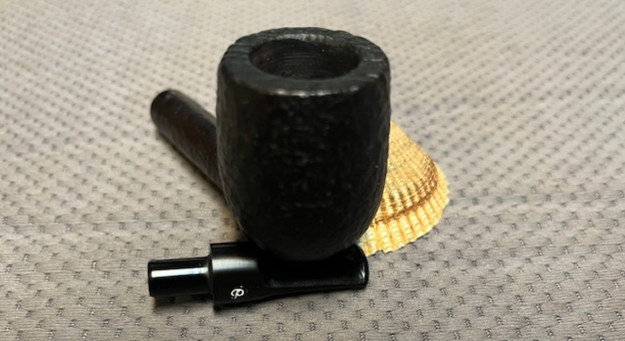
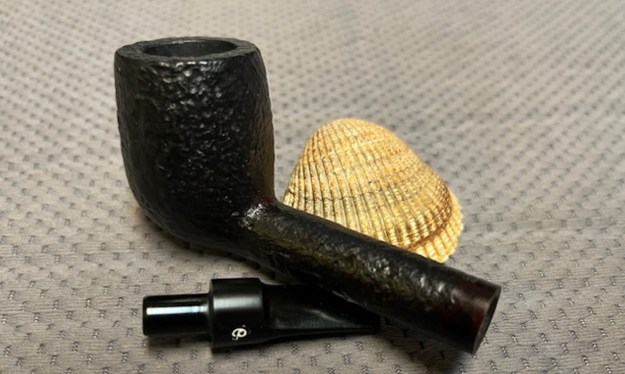
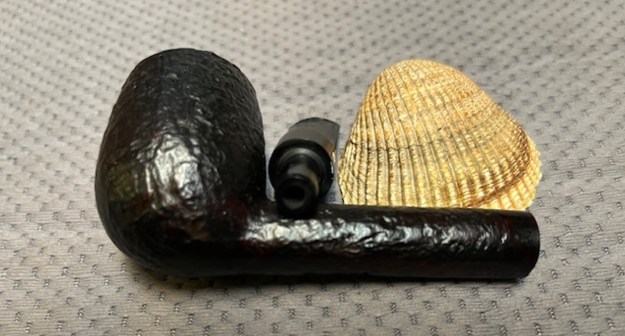
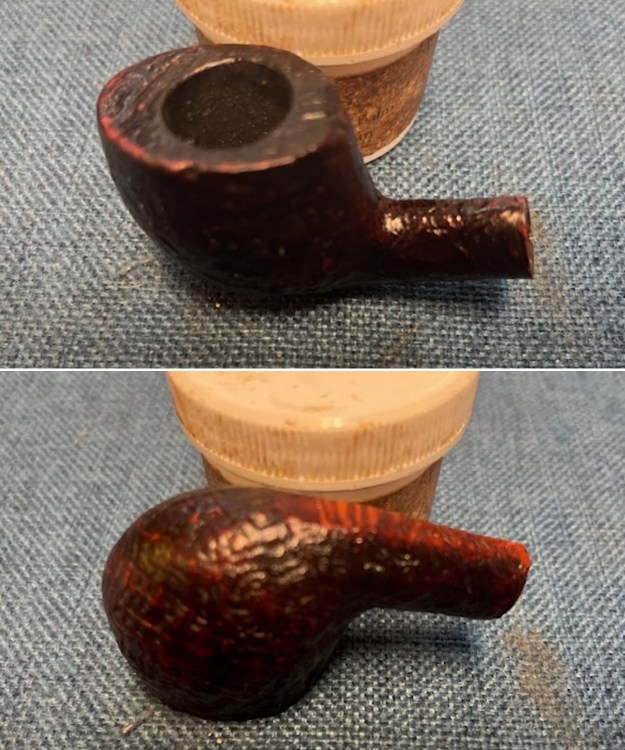
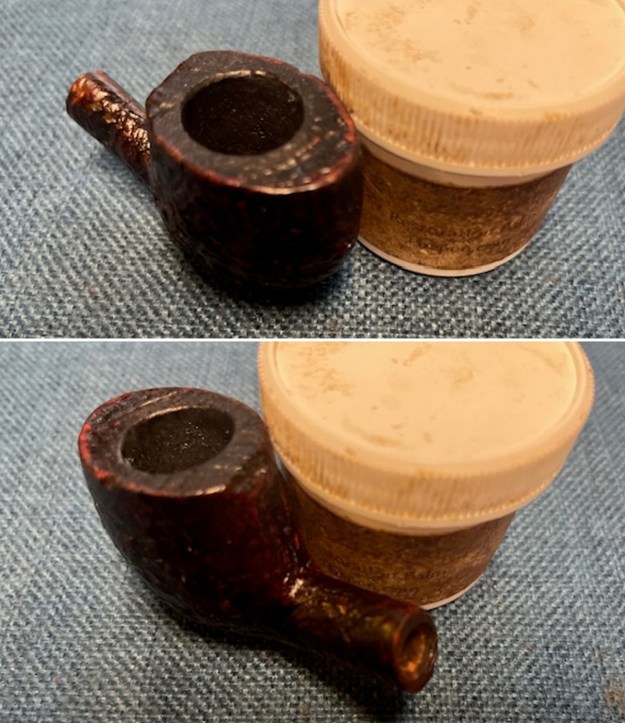
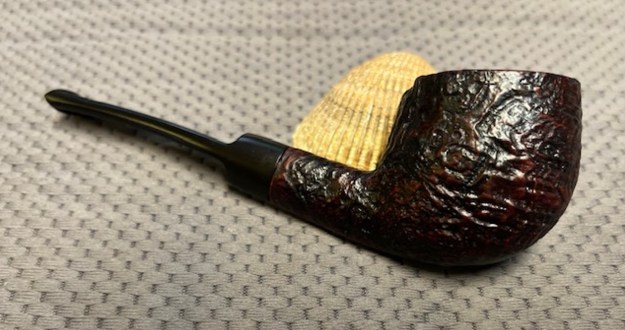
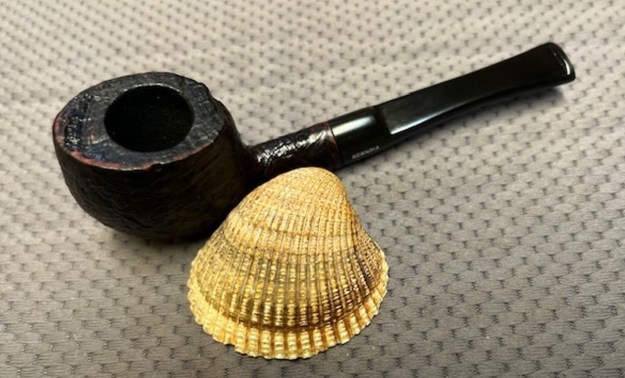
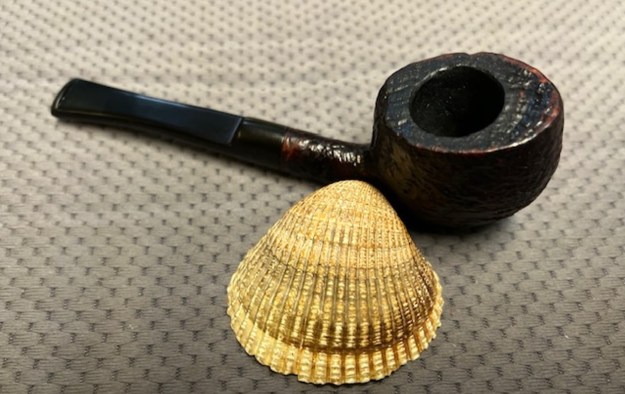
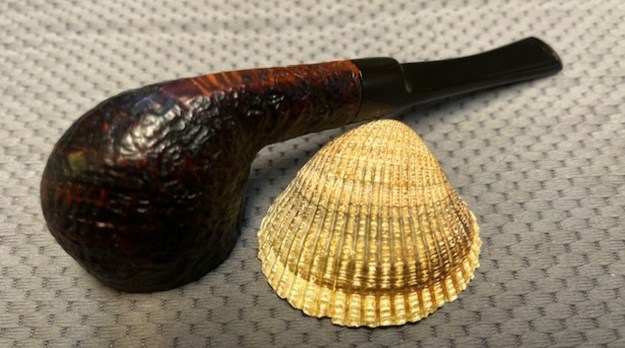
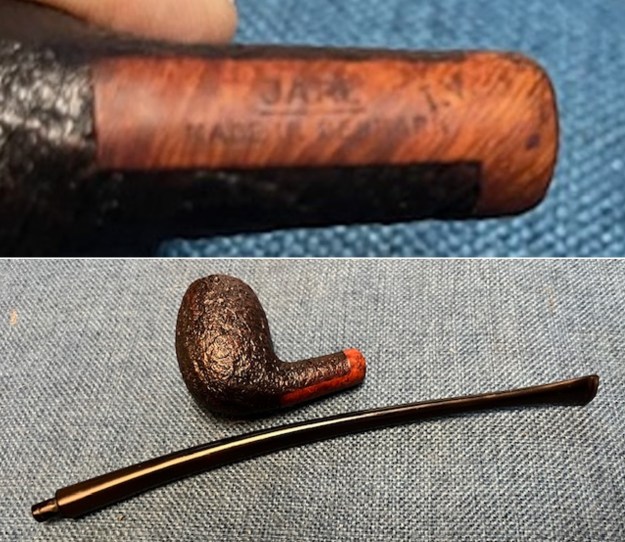
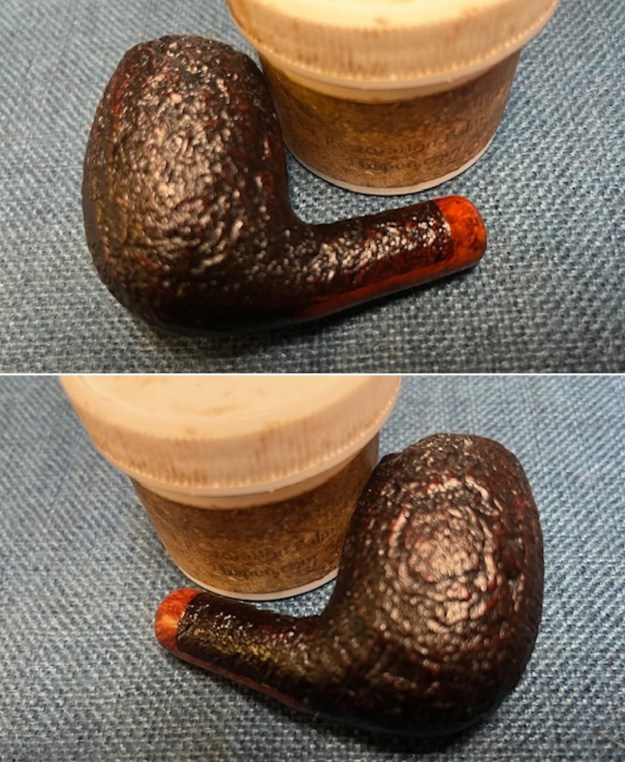
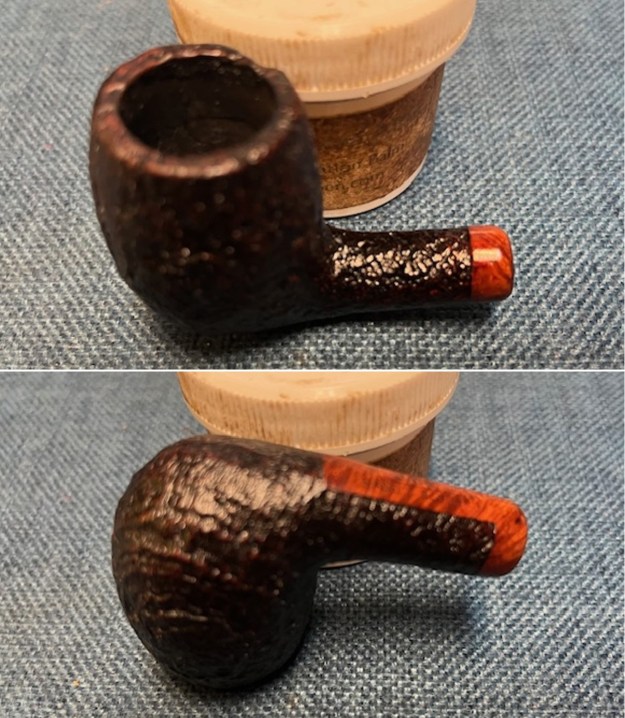
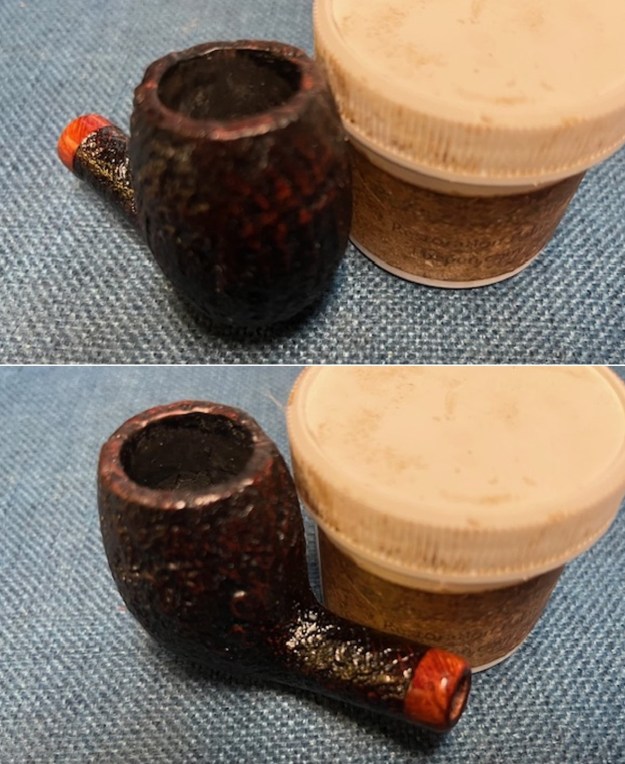
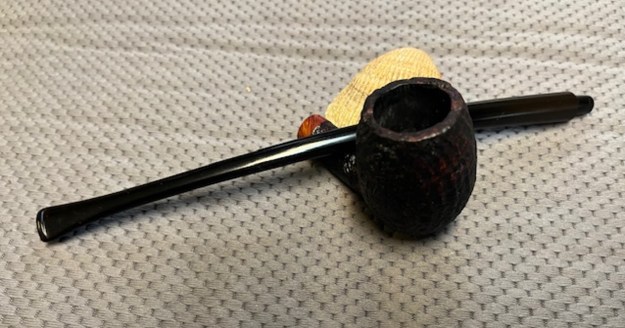
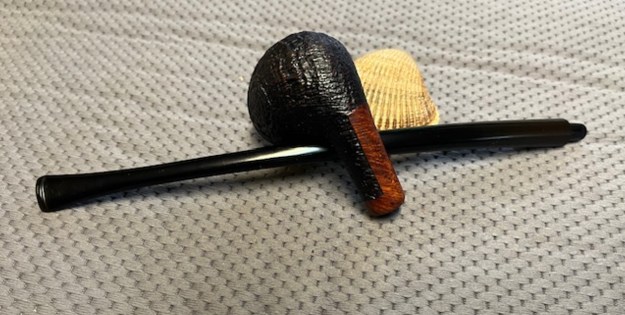
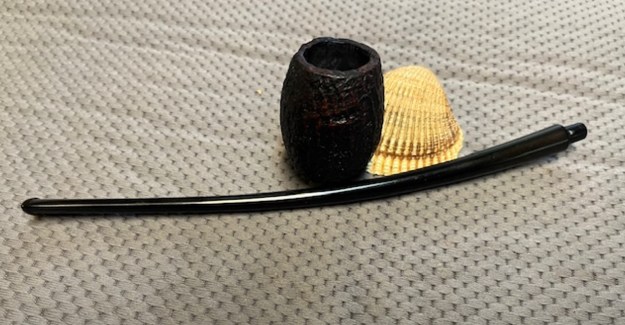
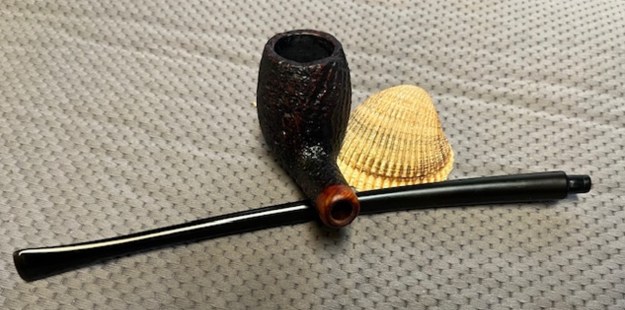
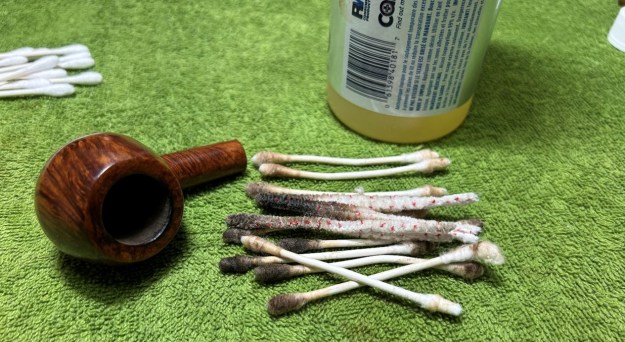
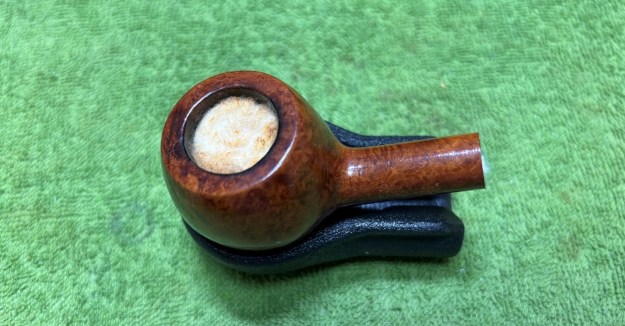
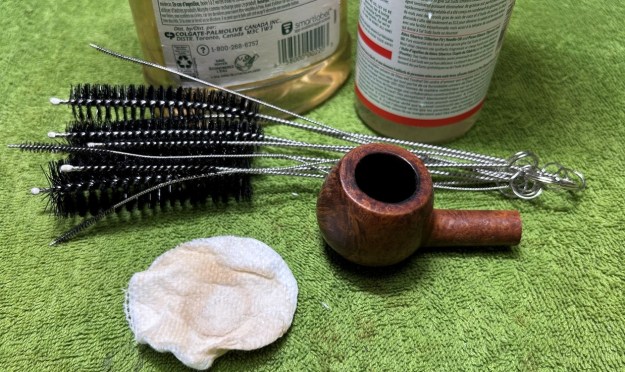
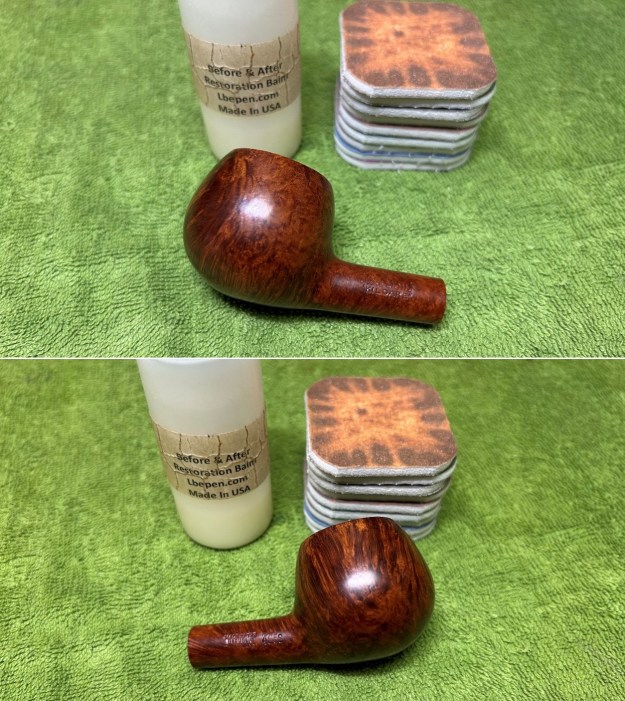
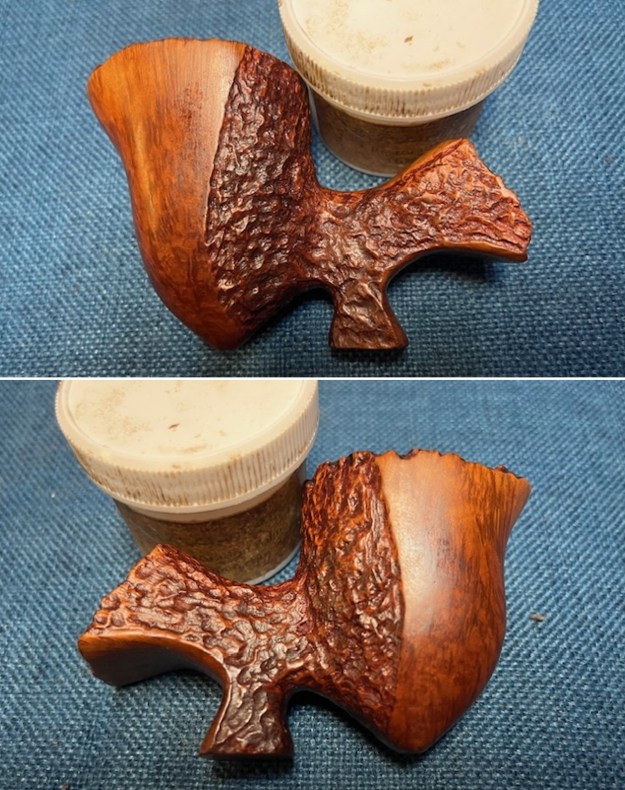
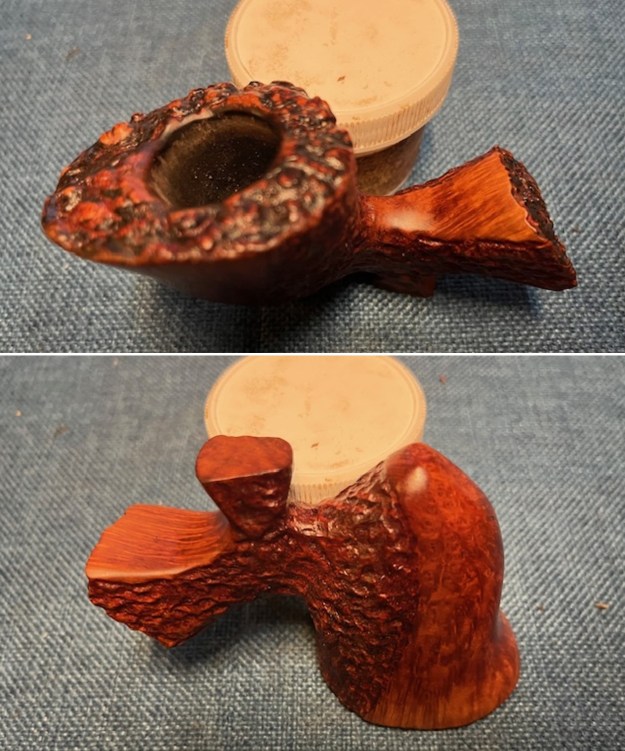
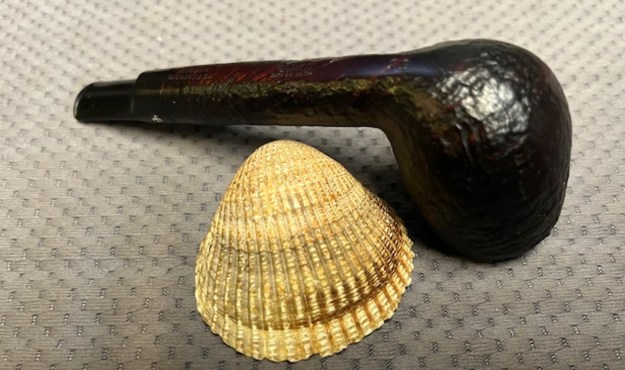
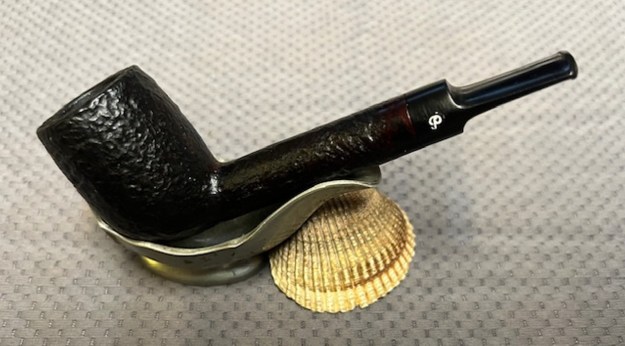
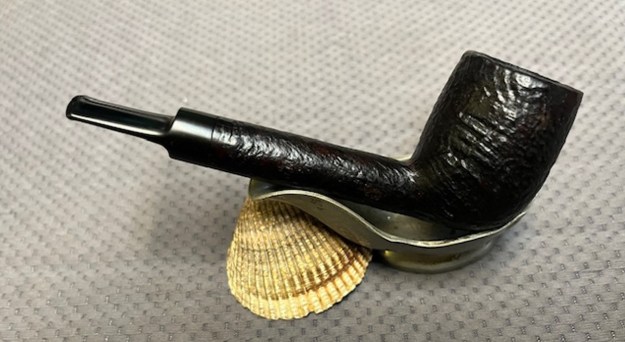
A young gentleman came to me with the desire for a small pipe he could use on the go. We ultimately settled on a charming little pipe made by Brebbia. It’s a black, sandblasted bent billiard pocket pipe. Despite its diminutive size, it’s a very handsome pipe and promises to be a good smoker. It will serve this fellow very well for a long time to come. Only two words constitute the entirety of this pipe’s markings. On the underside of the stummel are the words Brebbia [over] Italy. I’ve worked on some Brebbia pipes before, so I went and looked up my previous articles. I learned from Pipedia and Pipephil that the Brebbia pipe company was named after the locality of Bosco Grosso di Brebbia in Lombardy, Italy. The company was founded by Enea Buzzi and Achille Savinelli in 1947, but they parted ways in 1953. Mr Savinelli went on to form his eponymous company, while Mr Buzzi kept the factory and created Maniffatura Pipe Brebbia – they produce MPB and Brebbia pipes. Mr Buzzi’s family still run the company today. Let’s this pipe cleaned up! On the whole, the pipe is in good shape. Nothing major is wrong with either the stem or the stummel. Great news!First, I used oil soap on a few cotton rounds and wiped the stem down to provide an initial cleaning of filth before moving on to the next steps. The primary cleaning comes next. I cleaned the inside of the stem with both pipe cleaners and cotton swabs dipped in 99% lemon-infused isopropyl alcohol. I scrubbed thoroughly to make sure the interior was clean.The goal of the next step is the removal (or minimization) of oxidation. Going to my sink, I used cream cleanser, cotton rounds, and a toothbrush, and scoured the stem to remove as much surface oxidation as possible. As the photos show, the result is a hideous brownish mess – but better off the stem than on it.Once the stem was reasonably clean, I soaked it overnight in some de-oxidation fluid. This solution works to draw oxidation in the stem to the surface. This is a major aid and important step in ensuring a clean stem. The following day, I drew the stem out from its bath and scrubbed the lingering fluid with a toothbrush.Once clean and dry, I set about fixing the marks and dents in the vulcanite. This is done by filling those divots with black cyanoacrylate adhesive, impregnated with carbon and rubber. I left this to cure and moved on.The penultimate step for the stem is sanding. First, with my set of needle files, I reduce the bulk of the cyanoacrylate repairs. I want to remove the excess adhesive as near to the surface as possible, without cutting into the vulcanite. Following that, I use all nine of the micromesh sanding pads (1,500 through 12,000 grit) to sand out flaws, even out the vulcanite, and provide gentle polishing of the finished surface. I also apply pipe-stem oil while using the last five micromesh pads. There was a wonderful, deep black shine to the stem when I was done.Now that the stem is (nearly) complete, I can move on to the stummel. The first step for me is to ream out the bowl – that is to say, remove all the cake inside the bowl. This accomplishes a couple of things. First (and most obviously), it cleans the bowl and provides a refurbished chamber for future smoking. Second, when the old cake is removed, I can inspect the interior walls of the bowl and determine if there is damage or not. In this case, there was none. I used a reamer and a piece of sandpaper taped to a wooden dowel. Collectively, these ensure that all the debris is removed.The inside of the stummel needs to be cleaned thoroughly. Similar to the stem, I then cleaned it with both pipe cleaners and cotton swabs dipped in 99% lemon-infused isopropyl alcohol. Fortunately, it wasn’t too dirty.I then decided to ‘de-ghost’ the pipe – that is to say, exorcize the remaining filth from the briar. I filled the bowl and the shank with cotton balls, then saturated them with 99% isopropyl alcohol. I let the stummel sit overnight. This caused any remaining oils, tars and smells to leach out into the cotton.To tidy up the briar, I also wiped down the outside with some oil soap on cotton rounds (and a toothbrush). This does a good job of cleaning any latent dirt on the surface of the briar. The last step of the cleaning process is to scour the inside of the stummel with some soap and tube brushes. This is the culmination of the work in getting the pipe clean.No sanding needed for a sandblast. So, I rubbed some Before & After Restoration Balm into the briar and let it sit for 20 minutes or so. The balm moisturizes the wood and gives a beautiful depth to the briar. I then buffed it with a microfibre cloth. For the final step, I took the pipe to my bench buffer and carefully polished it – first with a white diamond compound, then with three coats of conservator’s wax. This procedure makes the pipe look its best – the stummel sings and stem glows.This Brebbia bent billiard pocket pipe is very handsome and will provide many years of smoking pleasure. I hope you enjoyed reading the story of this pipe as much I as I did restoring it. If you are interested in more of my work, please follow me here on Steve’s website or email me directly at kenneth@knightsofthepipe.com. The approximate dimensions of the pipe are as follows: length 3⅔ in. (93 mm); height 1⅜ in. (36 mm); bowl diameter 1⅛ in. (30 mm); chamber diameter ⅔ in. (17 mm). The weight of the pipe is ⅞ oz. (25 g). I hope you enjoyed reading the story of this pipe’s restoration as much as I did restoring it. If you are interested in more of my work, please follow me here on Steve’s website or send me an email. Thank you very much for reading and, as always, I welcome and encourage your comments.

New Life for a Peterson’s System Standard 301 Smooth Pot


by Steve Laug

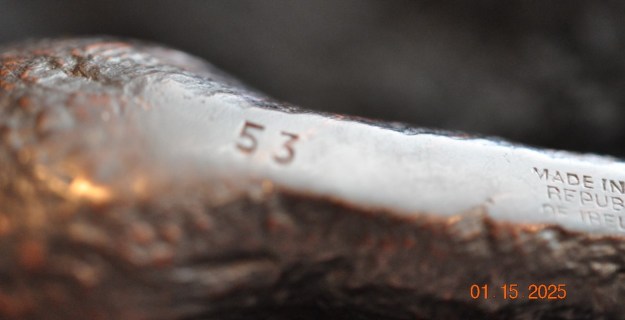
We received the next pipe from our source in Copenhagen, Denmark on 01/29/2024. It is another fitting New Year’s restoration. It is a Peterson’s 301 Bent Pot. It is stamped on the left side of the shank and reads Peterson’s [arched over] System [over] Standard. On the right side it is stamped Made in the Republic of Ireland (in three lines) [over] the shape number 301. The nickel ferrule on the shank is lightly oxidized and stamped K&P [over] Petersons. The pipe is dirty, obviously another favourite smoker. There is grime ground into the finish. There is a thick cake in the bowl and a thick overflow of lava on the inner edge and the smooth rim top. The nickel ferrule is lightly tarnished and stamped as noted. The stem is dirty, very oxidized but does not have tooth marks of chatter on either side. Jeff took photos of it before he started his clean up work. I have included those below. Jeff took photos of the rim top and stem to show the general condition of the pipe. The bowl is heavily caked and there was some darkening and a lava overflow on the rim top and the inner edge. The stem looks amazingly good for a pipe of this age. Jeff took photos of the bowl sides and heel to show the look of the sandblast that was around this bowl. The blast really highlights the grain underneath and is quite beautiful around the sides of the bowl and shank. It is another nice looking pipe. He took photos of underside of the shank to show the stamping. The stamping is clear and readable in the photos below and is as noted above. The stamping on the nickel ferrule is clear and readable as noted above. I have included a link to the Pipedia article so that you can read the history of the brand (https://pipedia.org/wiki/Peterson). Take some time to read through it as it is a great read.

I turned to “The Peterson Pipe” by Mark Irwin and Gary Malmberg to get some background on the Peterson’s System Line. On page 314 it had the following information.

Peterson’s over System – Pipes stamped Peterson’s System have been documented as early as 1920. A ’20 brochure is the earliest printed reference to the Peterson System. The pipe came in three quality grades (no mark, 2, or 3) until 1959, thereafter as De Luxe (no mark), Premier (the old 2) and Standard (the old 3).

Peterson’s over System over Standard (c1945-)

I learned previously that the shape 301 was not introduced until 1975. Considering the Republic stamp, this one would likely date between 1975 and 2000. My guess is that the pipe was made somewhere between 1975 and mid-80s. Now it was time to work on the pipe.

With that information at hand I turned to work on the pipe itself. Jeff had thoroughly cleaned up the pipe. He reamed the pipe with a PipNet Pipe Reamer and cleaned up the remnants with a Savinelli Fitsall Pipe Knife.  He scrubbed the bowl with undiluted Murphy’s Oil Soap with a tooth brush. He rinsed it under running warm water to remove the soap and grime. He cleaned out the inside of the shank and the airway in the stem with alcohol, cotton swabs and pipe cleaners. He scrubbed the exterior of the stem with Soft Scrub to remove as much of the oxidation and calcification as possible. He soaked the stem in Before & After Deoxidizer and rinsed it off with warm water. I took photos of the pipe before I started to work on it.  I took close up photos of the bowl and the stem. You can see the reamed bowl and the clean rim top and edges. It looks good. There is a bit of darkening on the inner edge at the back. The stem surface was clean but there are light tooth marks and chatter on both sides on and ahead of the button.I took a photo of the stamping on the underside of the shank. It is faint in spots but readable as noted above. I removed the stem from the shank and took a photo to give a sense of the proportions of the pipe. It is really quite nice looking. I polished the briar with micromesh sanding pads – dry sanding with 1500-12000 grit pads. I wiped the bowl down between pads with a damp cloth to remove any sanding debris. The briar really took on a rich shine. I rubbed the bowl and shank down with Before & After Restoration Balm. I worked it into the surface of the bowl sides and shank with my fingertips to clean, enliven and protect the briar. I let the balm sit for a little while and then buffed with a cotton cloth to raise the shine. I sanded the stem with 320-3500 grit sanding pads and wiped it down with a cloth and Obsidian Oil to remove the debris. It began to take on a rich shine.I polished the vulcanite stem with micromesh sanding pads – 1500-12000 grit pads. I wiped it down with a damp cloth after each sanding pad. I used Before & After Pipe Polish – both Fine and Extra Fine to further polish the stem. This nice looking Republic Era Peterson’s System Standard 301 Bent Pot with a classic Peterson’s P-lip vulcanite stem looks much better now that it has been restored. The rim top and edges cleaned up very well. The dark brown stains on the bowl came alive with the polishing and waxing. I put the stem back on the bowl and carefully buffed the pipe with Blue Diamond on the buffing wheel using a light touch on the briar. I gave the bowl multiple coats of Conservator’s Wax and the stem multiple coats of carnauba wax on the buffing wheel and followed that by buffing the entire pipe with a clean buffing pad. I hand buffed the pipe with a microfiber cloth to deepen the shine. I left a few of the wounds in the briar left by the journey as they do not detract. The finished Peterson’s System Standard 301 is a beauty and fits nicely in the hand and looks very good. Give the finished pipe a look in the photos below. The dimensions of the pipe are Length: 5 ½ inches, Height: 1 ¾ inches, Outside diameter of the bowl: 1 ½ inch, Chamber diameter: ¾ of an inch. The weight of the pipe is 59 grams/2.01 ounces. I will be putting it in the rebornpipes store in the Irish Pipemakers Section soon. If you are interested in adding this pipe to your collection send me a message or an email. Thanks for reading this blog and my reflections on the pipe while I worked on it. There are many more to come!

Restoring a Republic Era Petersons System Standard 301 Sandblast Bent Pot


by Steve Laug

We received the next pipe from our source in Copenhagen, Denmark on 11/21/2023. It is another fitting New Year’s Day restoration. It is a Peterson’s 301 Bent Pot. It is stamped on the underside of the shank and reads Peterson’s [arched over] System [over] Standard next that is stamped Made in the Republic of Ireland (in three lines) [over] the shape number 301. The nickel ferrule on the shank is stamped K&P [over] Petersons. The pipe is dirty, obviously another favourite smoker. There is grime ground into the finish. There is a thick cake in the bowl and a light overflow of lava on the inner edge and the sandblast rim top. The nickel ferrule is lightly tarnished. The stem is dirty, but is shiny and well cared for. Jeff took photos of it before he started his clean up work. I have included those below. Jeff took photos of the rim top and stem to show the general condition of the pipe. The bowl is heavily caked and there was some darkening and a lava overflow on the sandblast rim top and the inner edge. The stem looks amazingly good for a pipe of this age. Jeff took photos of the bowl sides and heel to show the look of the sandblast that was around this bowl. The blast really highlights the grain underneath and is quite beautiful around the sides of the bowl and shank. It is another nice looking pipe. He took photos of underside of the shank to show the stamping. The stamping is clear and readable in the photos below and is as noted above. The stamping on the nickel ferrule is clear and readable as noted above. I am including the link to the Pipedia’s article on Peterson pipes. It is a great read in terms of the history of the brand (https://pipedia.org/wiki/Peterson).

I turned to “The Peterson Pipe” by Mark Irwin and Gary Malmberg to get some background on the Peterson’s System Line. On page 314 it had the following information.

Peterson’s over System – Pipes stamped Peterson’s System have been documented as early as 1920. A ’20 brochure is the earliest printed reference to the Peterson System. The pipe came in three quality grades (no mark, 2, or 3) until 1959, thereafter as De Luxe (no mark), Premier (the old 2) and Standard (the old 3).

Peterson’s over System over Standard (c1945-)

I learned previously that the shape 301 was not introduced until 1975. Considering the Republic stamp, this one would likely date between 1975 and 2000. My guess is that the pipe was made somewhere between 1975 and mid-80s. Now it was time to work on the pipe.

With that information at hand I turned to work on the pipe itself. Jeff had thoroughly cleaned up the pipe. He reamed the pipe with a PipNet Pipe Reamer and cleaned up the remnants with a Savinelli Fitsall Pipe Knife.  He scrubbed the bowl with undiluted Murphy’s Oil Soap with a tooth brush. He rinsed it under running warm water to remove the soap and grime. He cleaned out the inside of the shank and the airway in the stem with alcohol, cotton swabs and pipe cleaners. He scrubbed the exterior of the stem with Soft Scrub to remove as much of the oxidation and calcification as possible. He soaked the stem in Before & After Deoxidizer and rinsed it off with warm water. I took photos of the pipe before I started to work on it. I took close up photos of the bowl and the stem. You can see the reamed bowl and the clean rim top and edges. It looks good. The stem surface was clean but there are light tooth marks and chatter on both sides on and ahead of the button.I took a photo of the stamping on the underside of the shank. It is faint in spots but readable as noted above. I removed the stem from the shank and took a photo to give a sense of the proportions of the pipe. It is really quite nice looking.The briar was in such good condition that I rubbed the bowl and shank down with Before & After Restoration Balm. I worked it into the surface of the bowl sides and shank with my fingertips and a shoebrush to clean, enliven and protect the briar. I let the balm sit for a little while and then buffed with a cotton cloth to raise the shine. I sanded the stem with 320-3500 grit sanding pads and wiped it down with a cloth and Obsidian Oil to remove the debris. It began to take on a rich shine.I polished the vulcanite stem with micromesh sanding pads – 1500-12000 grit pads. I wiped it down with a damp cloth after each sanding pad. I used Before & After Pipe Polish – both Fine and Extra Fine to further polish the stem. This nice looking Peterson’s System Standard 301 Sandblast Bent Pot with a classic Peterson’s P-lip vulcanite stem looks much better now that it has been restored. The rim top and edges cleaned up very well. The dark brown stains on the bowl came alive with the polishing and waxing. I put the stem back on the bowl and carefully buffed the pipe with Blue Diamond on the buffing wheel using a light touch on the briar. I gave the bowl multiple coats of Conservator’s Wax and the stem multiple coats of carnauba wax on the buffing wheel and followed that by buffing the entire pipe with a clean buffing pad. I hand buffed the pipe with a microfiber cloth to deepen the shine. The finished Peterson’s System Standard is a beauty and fits nicely in the hand and looks very good. Give the finished pipe a look in the photos below. The dimensions of the pipe are Length: 5 ½ inches, Height: 1 ¾ inches, Outside diameter of the bowl: 1 ½ inch, Chamber diameter: ¾ of an inch. The weight of the pipe is 45 grams/1.62 ounces. I will be putting it in the rebornpipes store in the Irish Pipemakers Section soon. If you are interested in adding this pipe to your collection send me a message or an email. Thanks for reading this blog and my reflections on the pipe while I worked on it. There are many more to come!

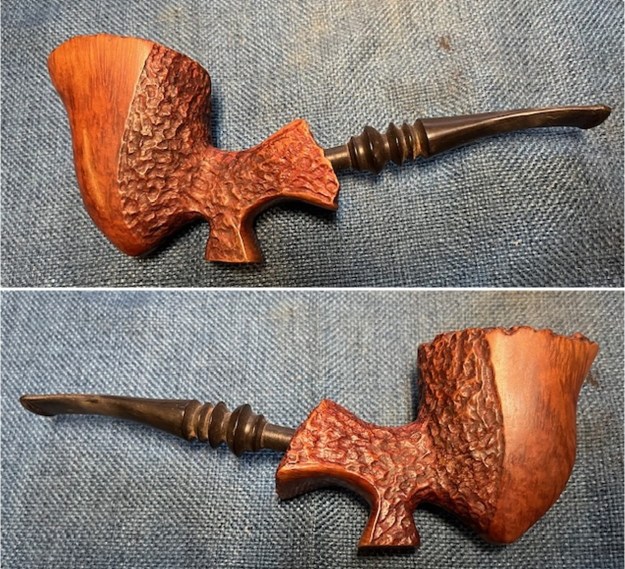
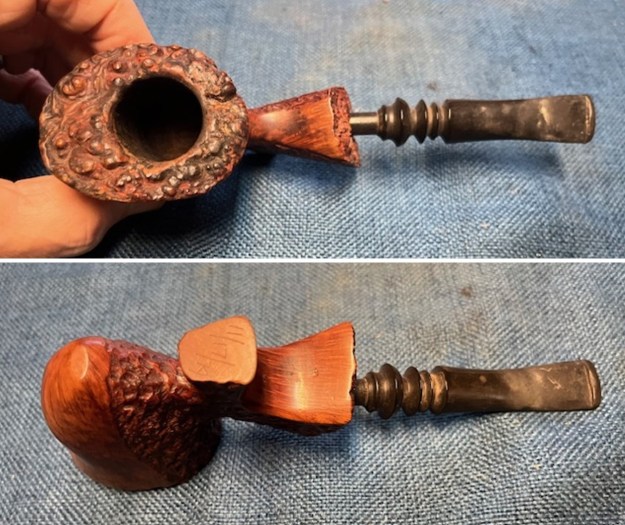
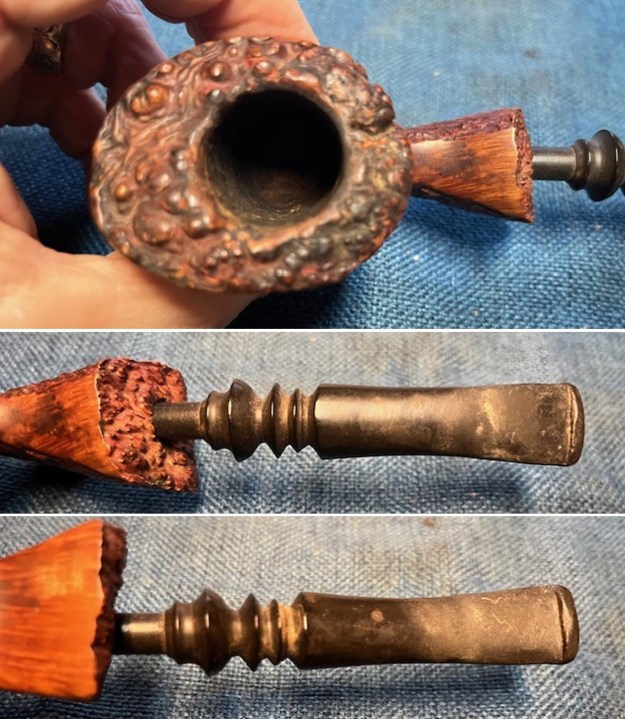
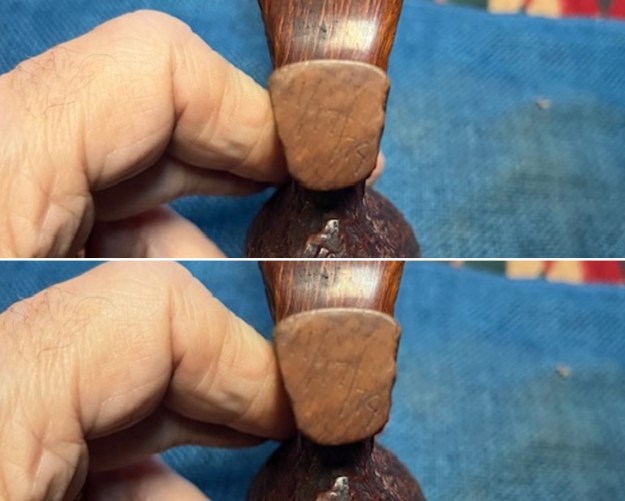
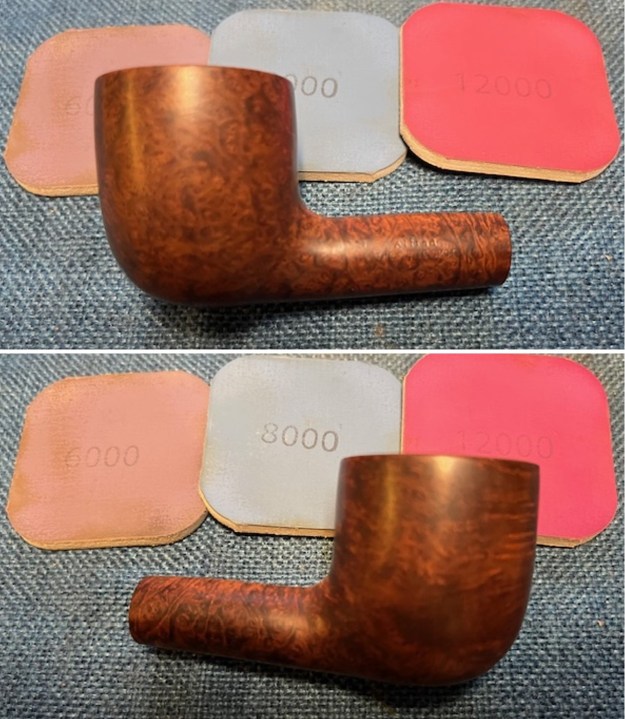
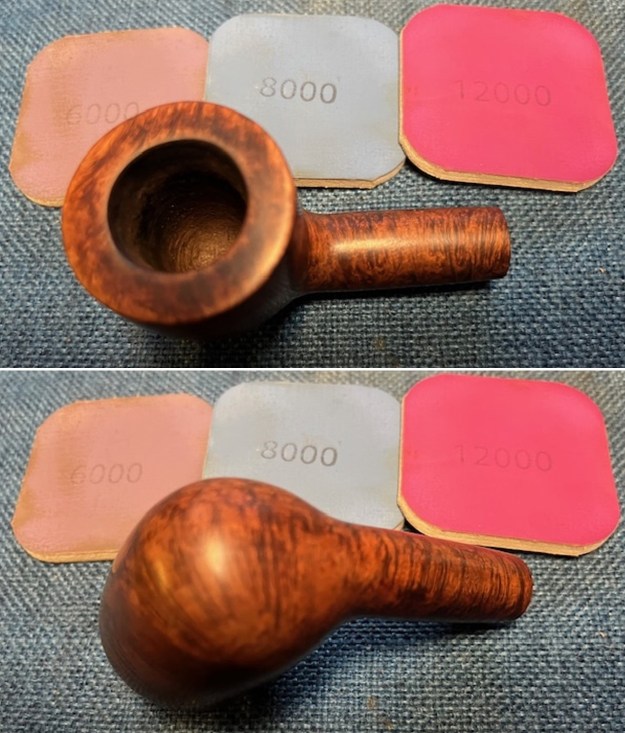
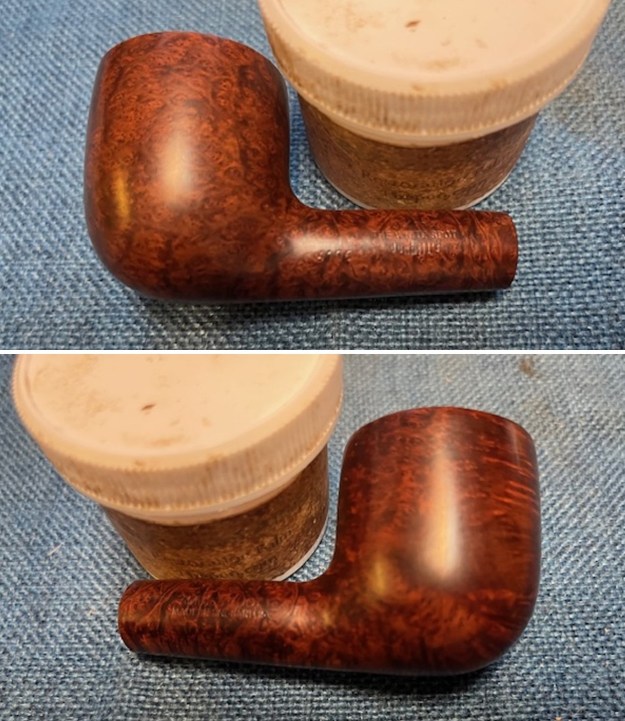
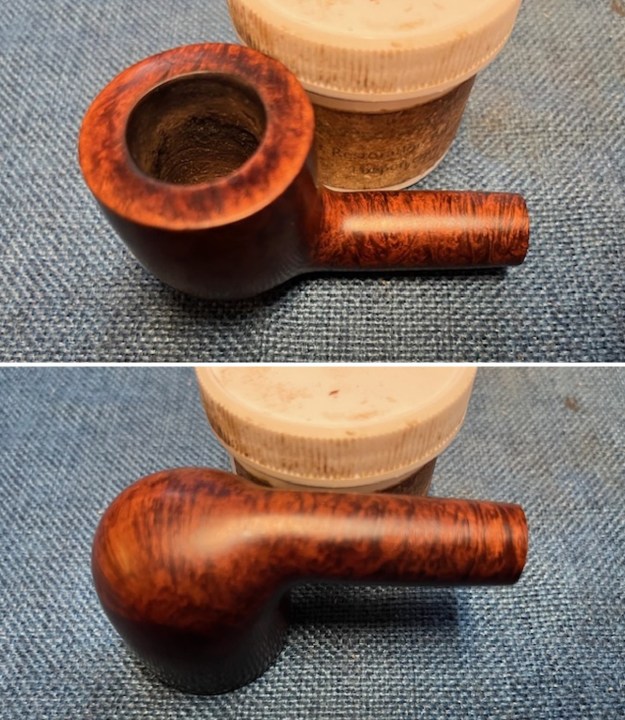
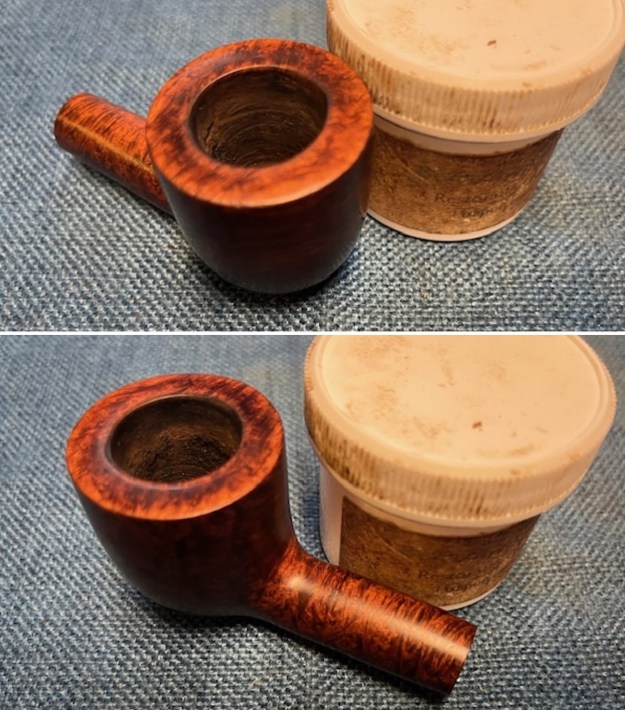
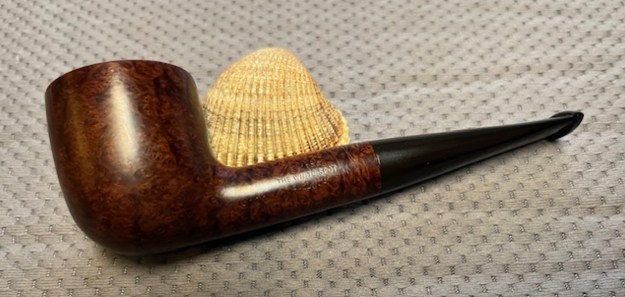
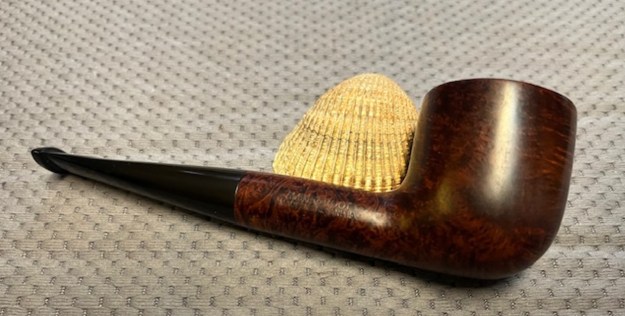
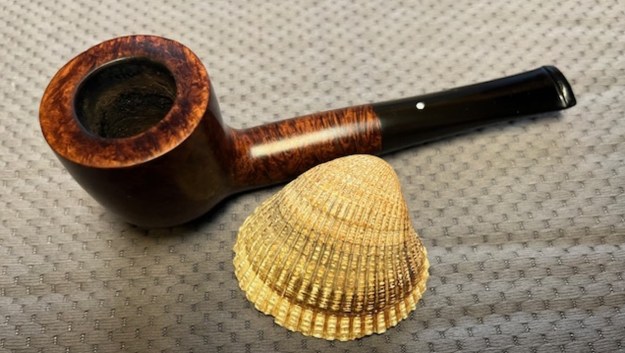
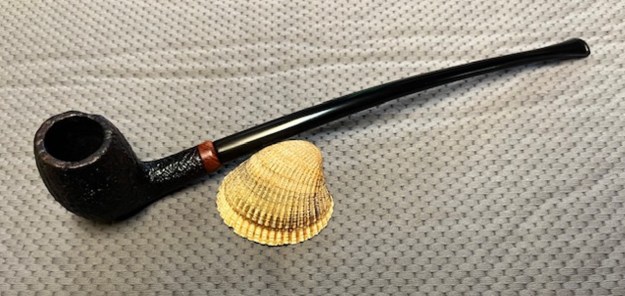
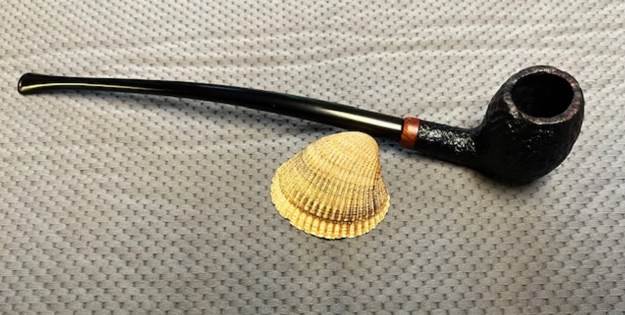
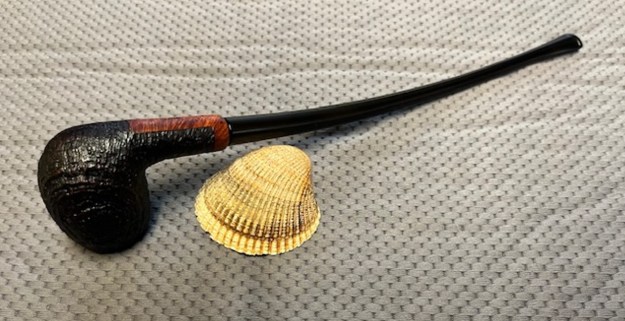
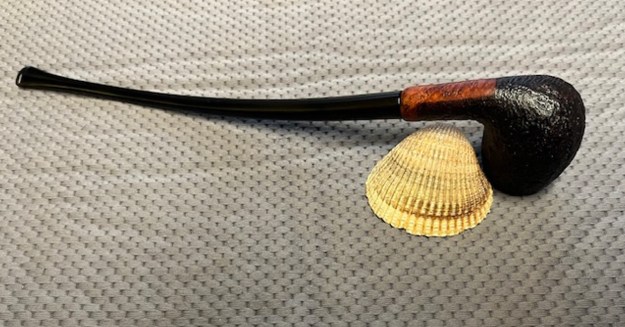
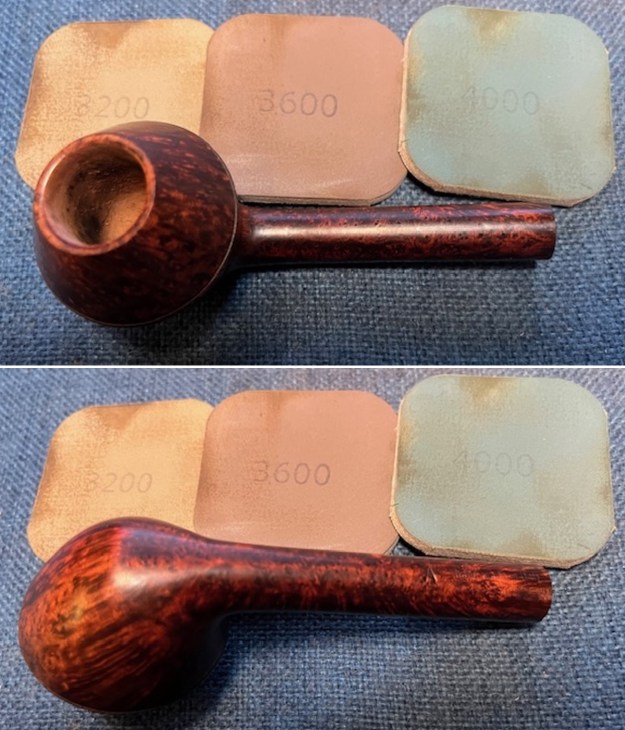
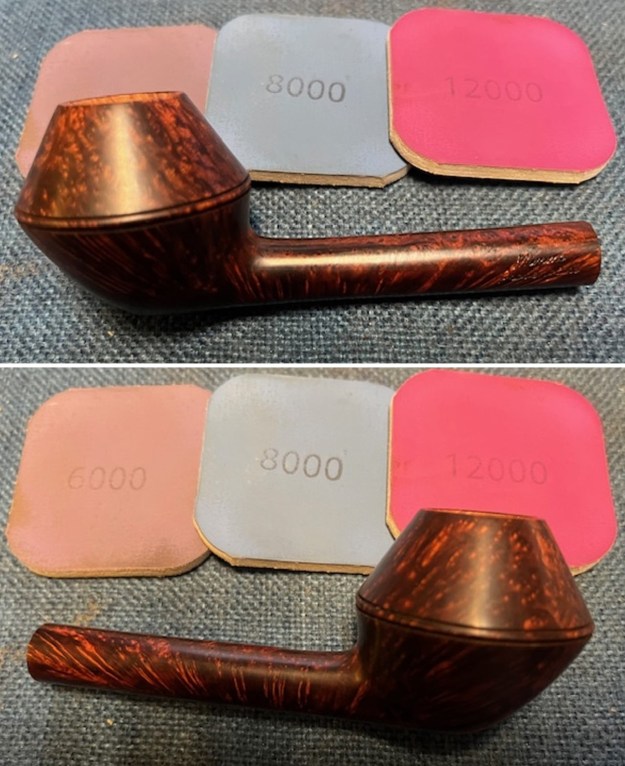
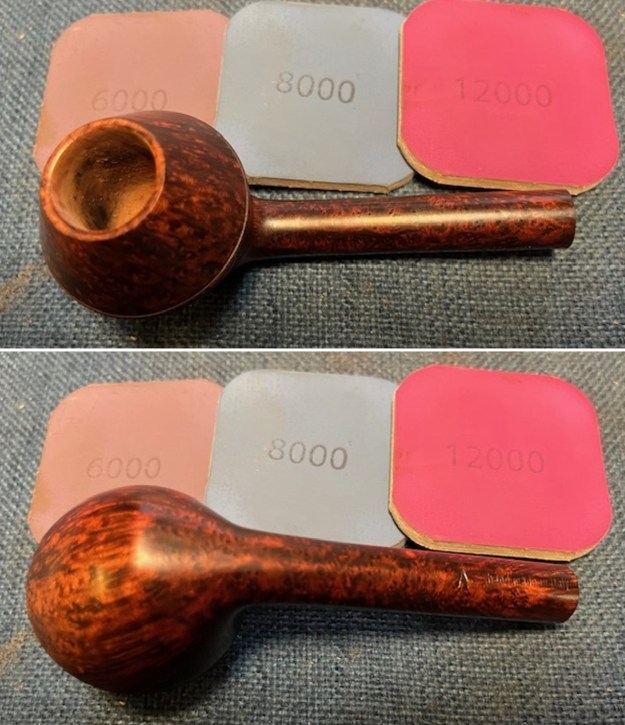
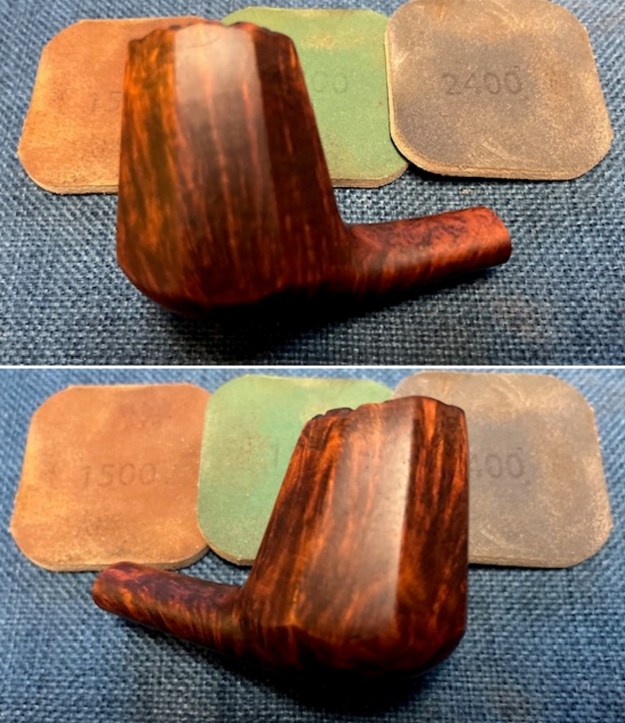
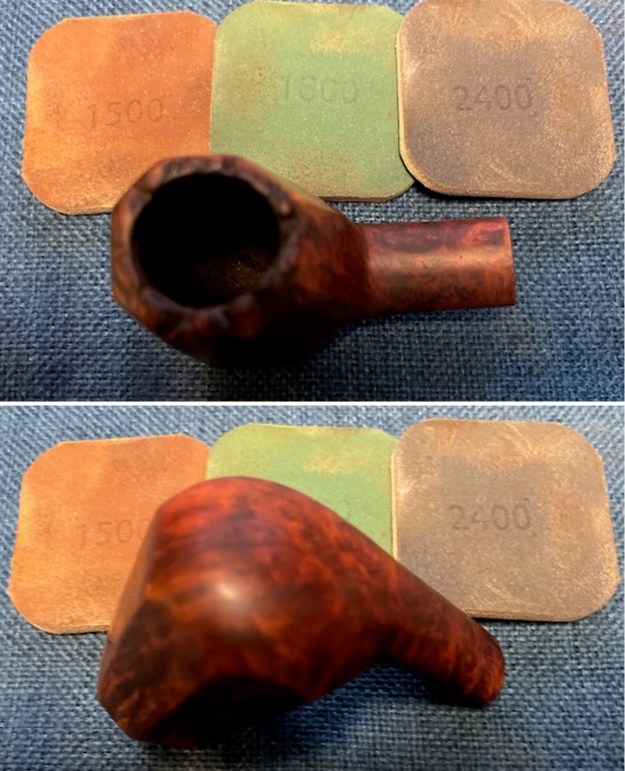
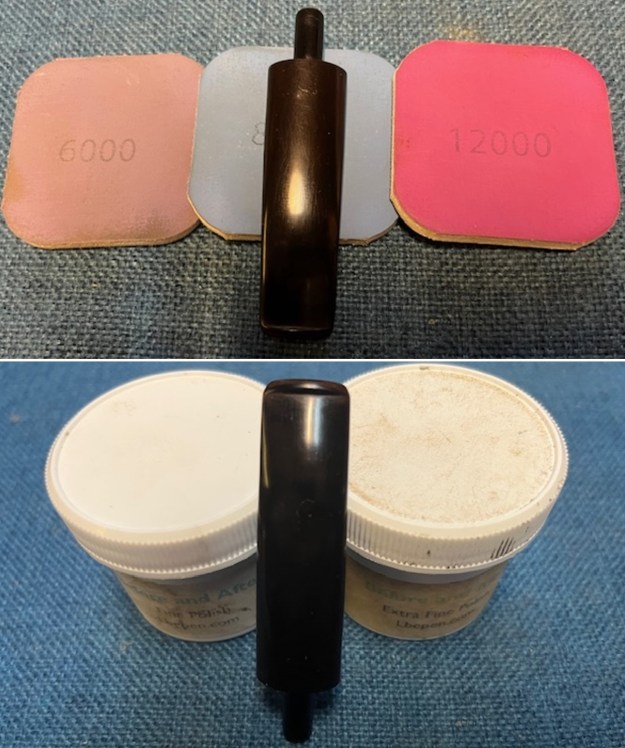
Decided to work on a carving kit today and see what I could do with it


by Steve Laug

When Kenneth and I visited a fellow pipe repair guy near Vancouver, Washington this past Fall he gave us a bunch of pipe parts and some pre-drilled partially shaped pipe kits that needed a lot of work to finish. Mind you, the shaping was roughed in and the drilling was finished. Some of them it was not too bad and some were drilled high or off to the side of the bowl bottom. Anyway you looked at it they would be fun to fiddle with. Kenneth and I both took several of them to add to the “to do list”.

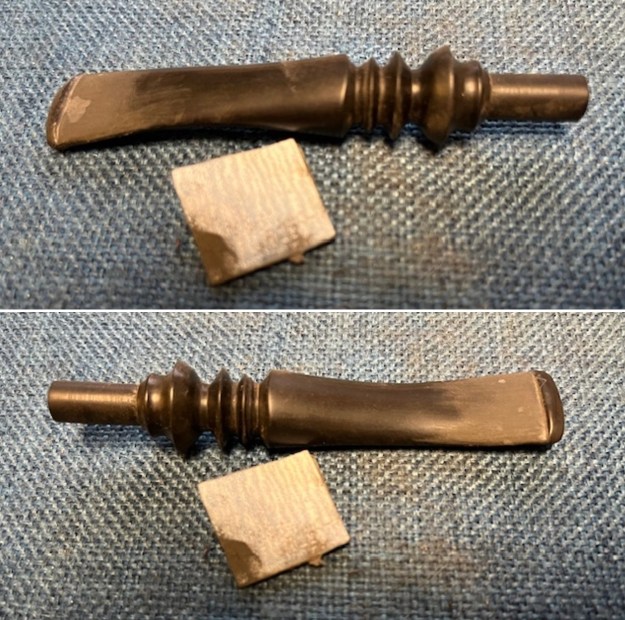
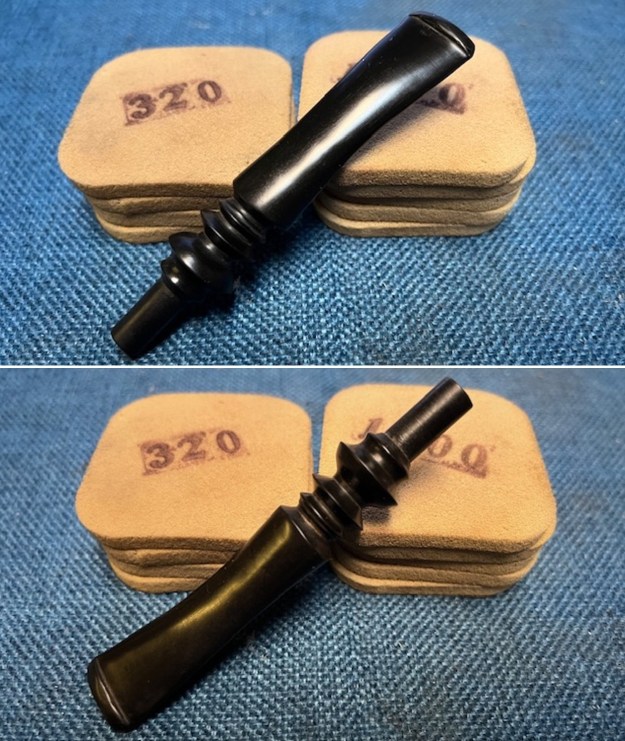
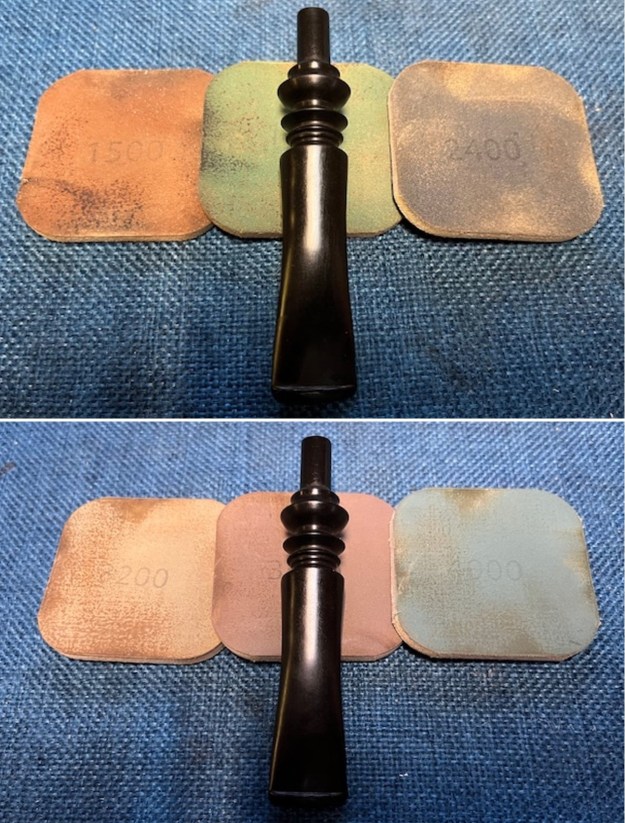
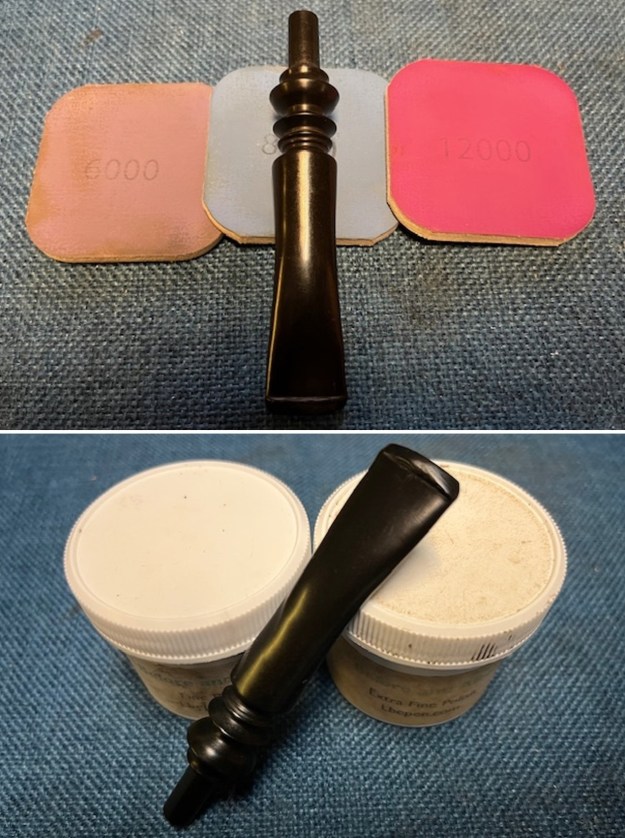
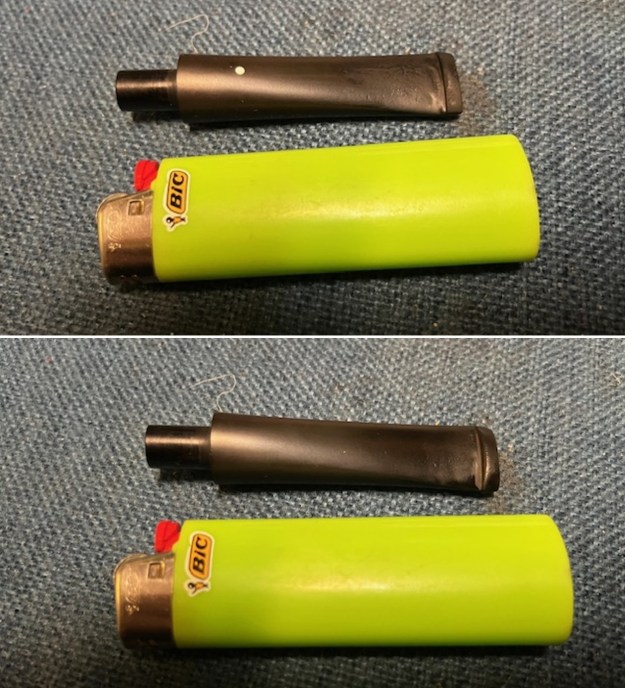
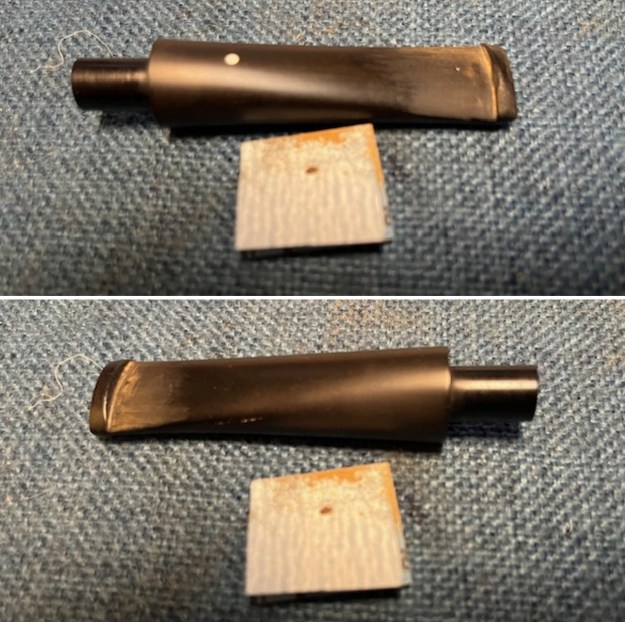
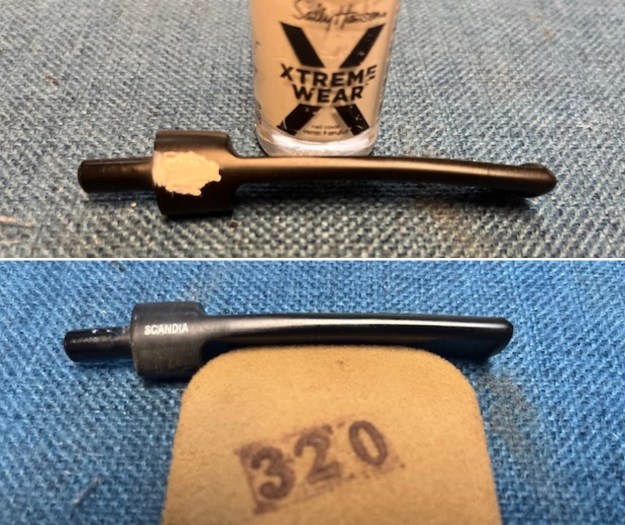
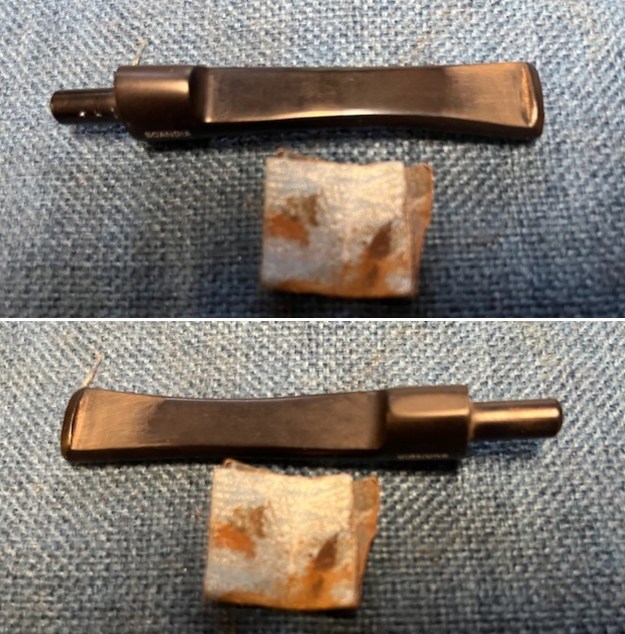
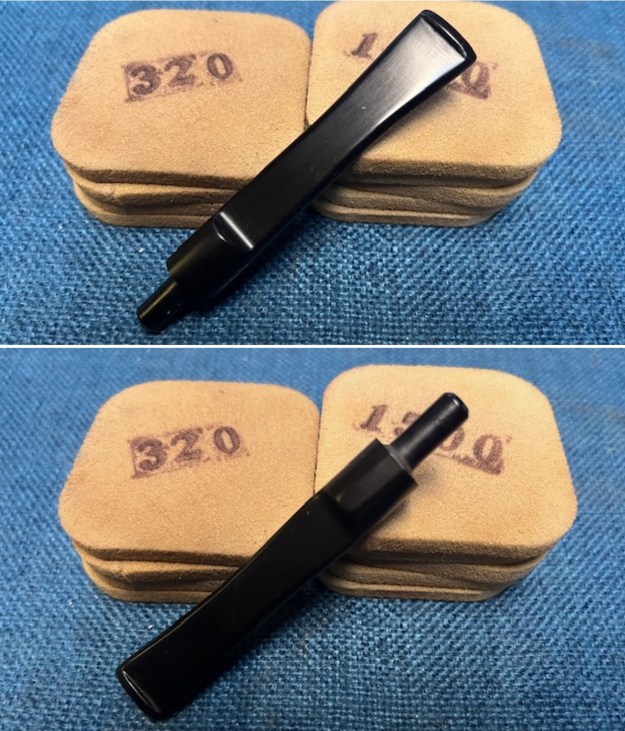
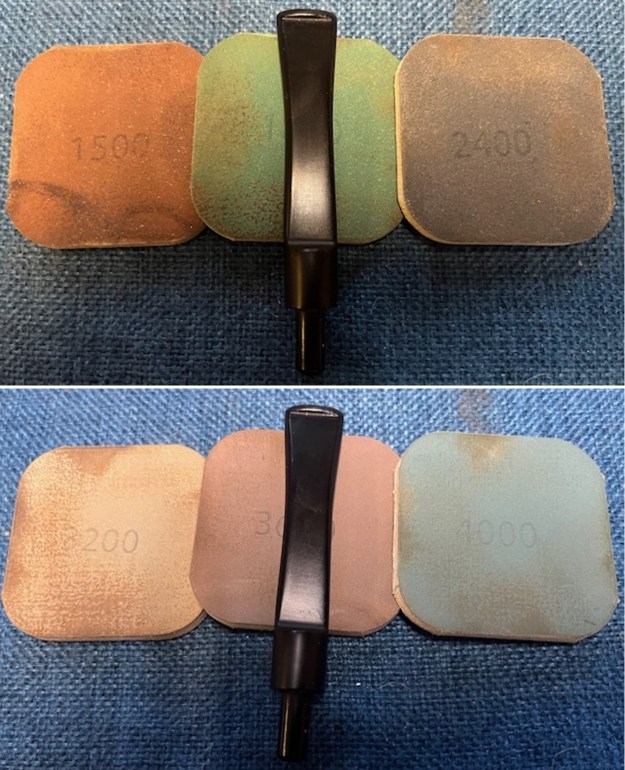
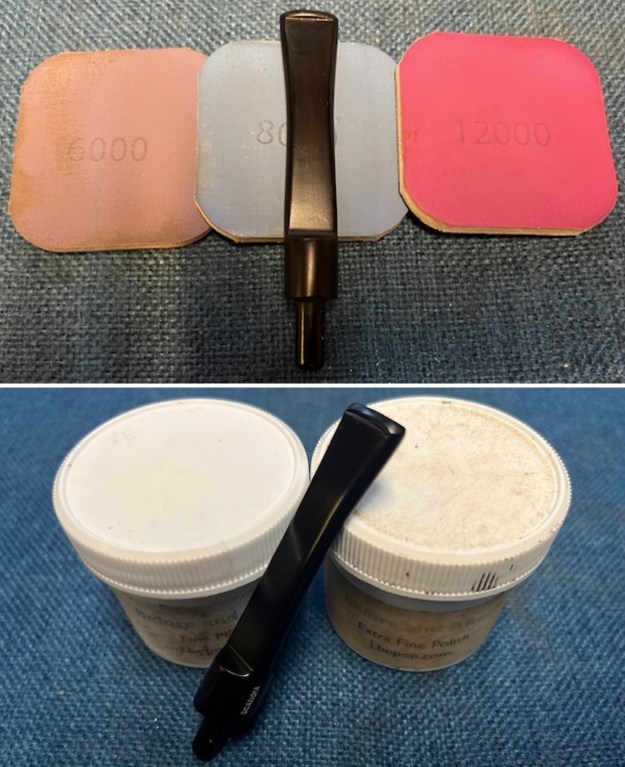
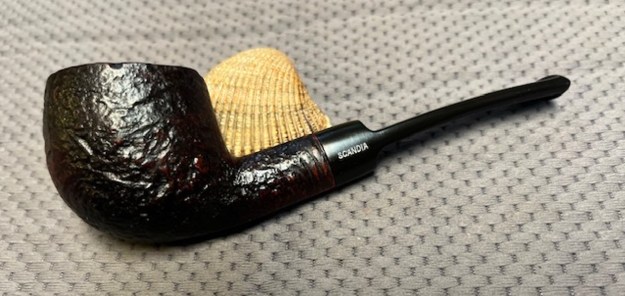
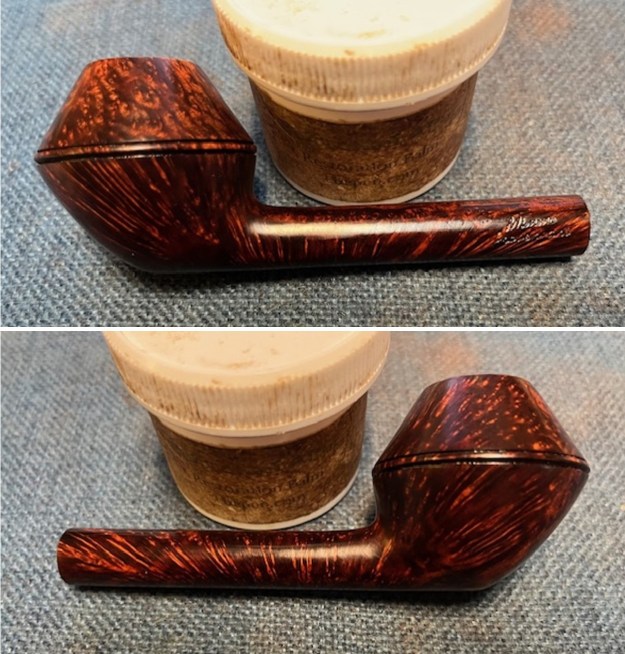
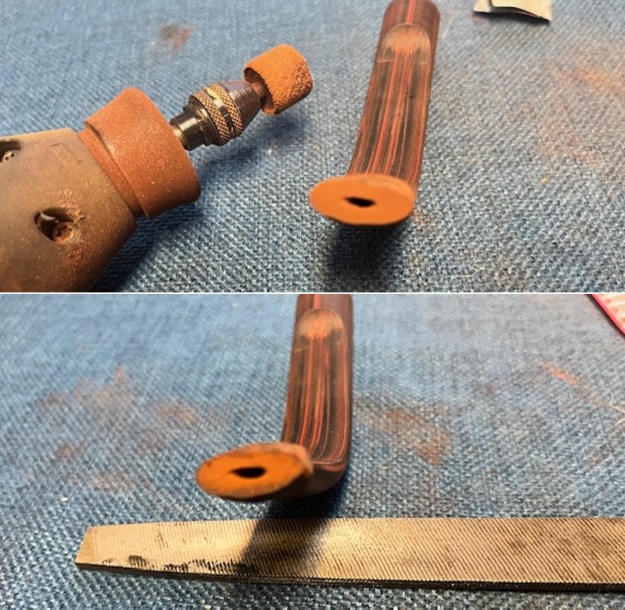
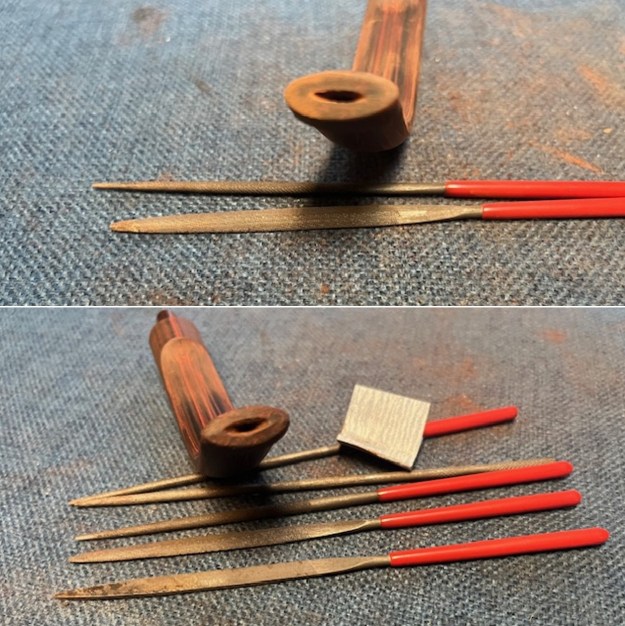
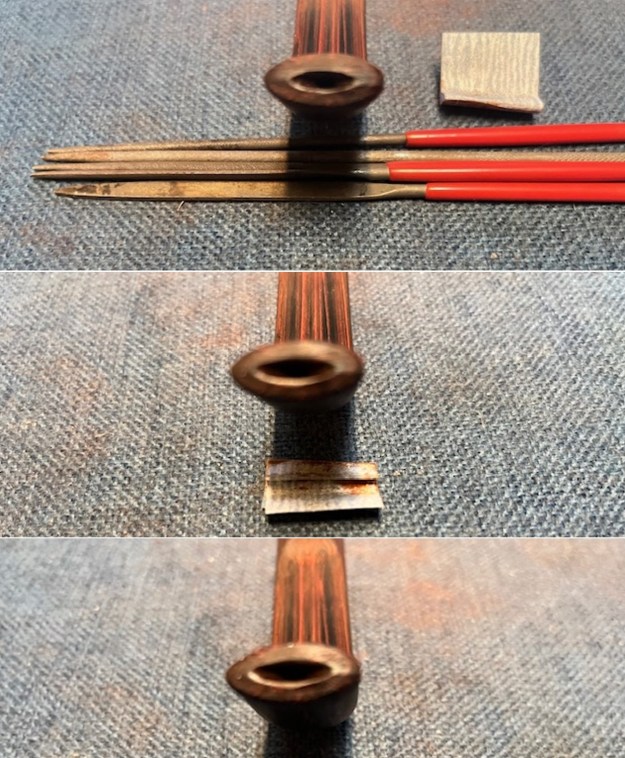
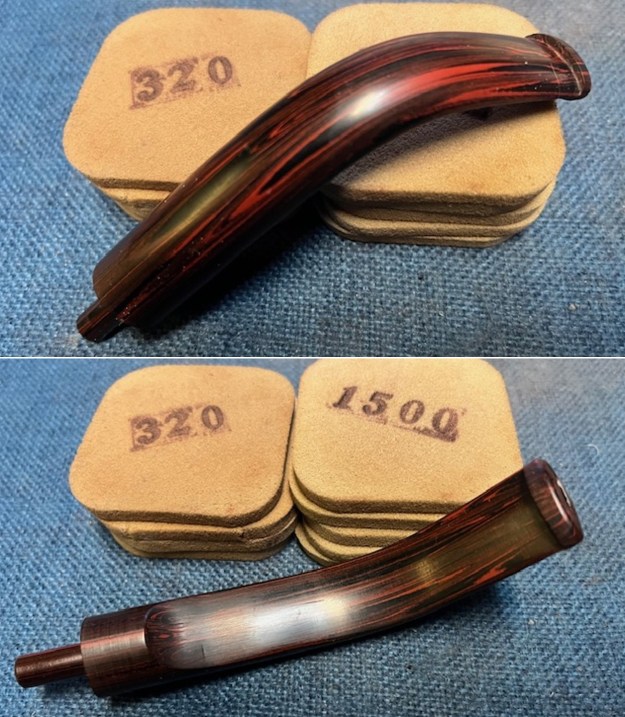
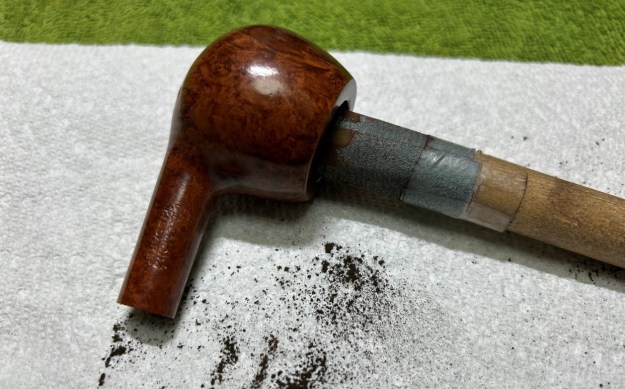
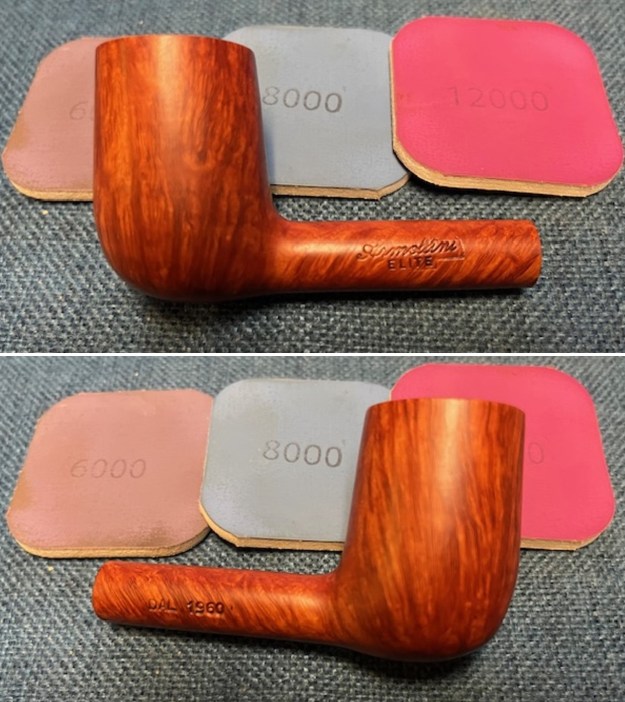
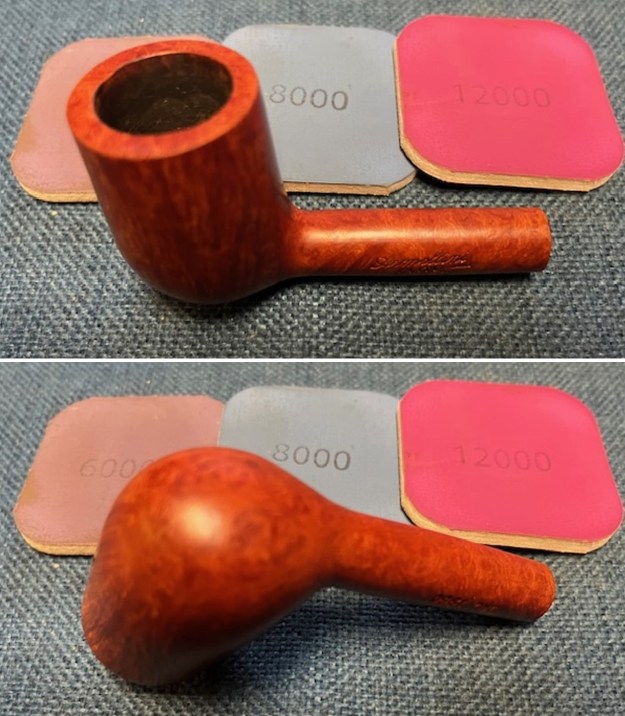
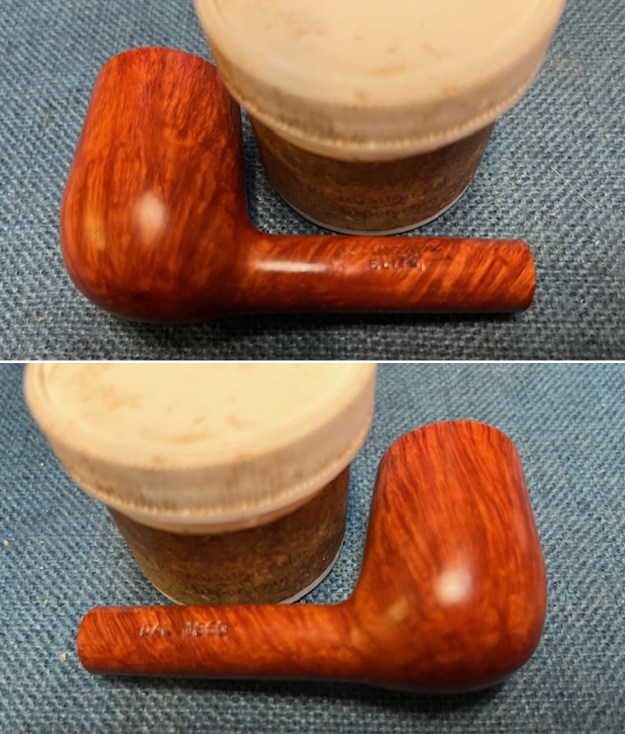
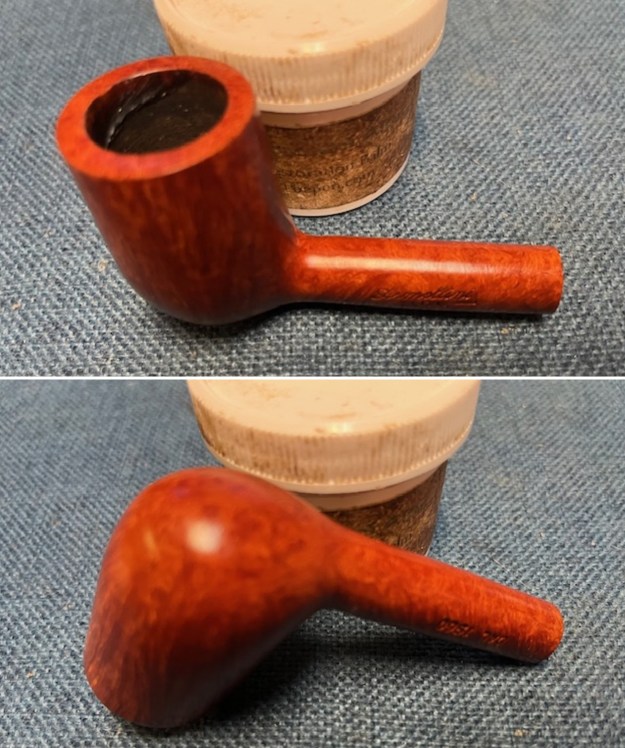
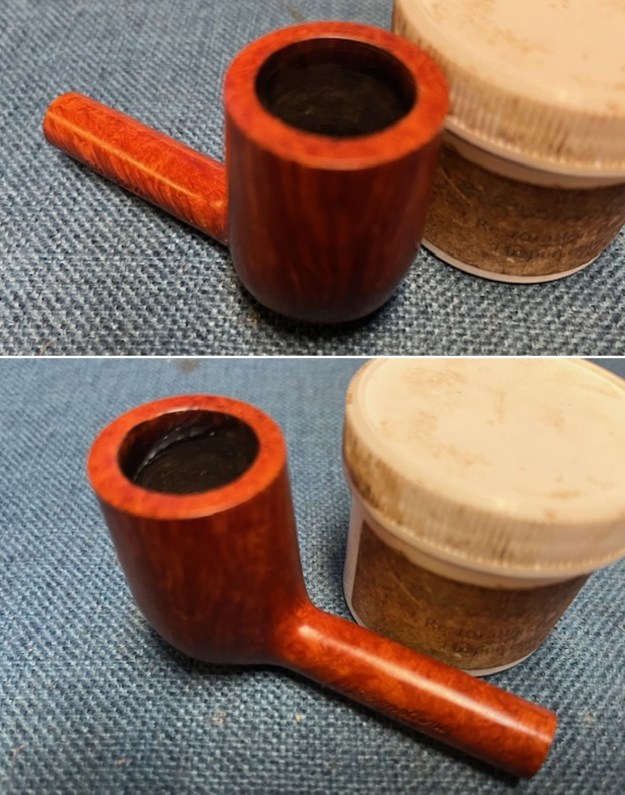
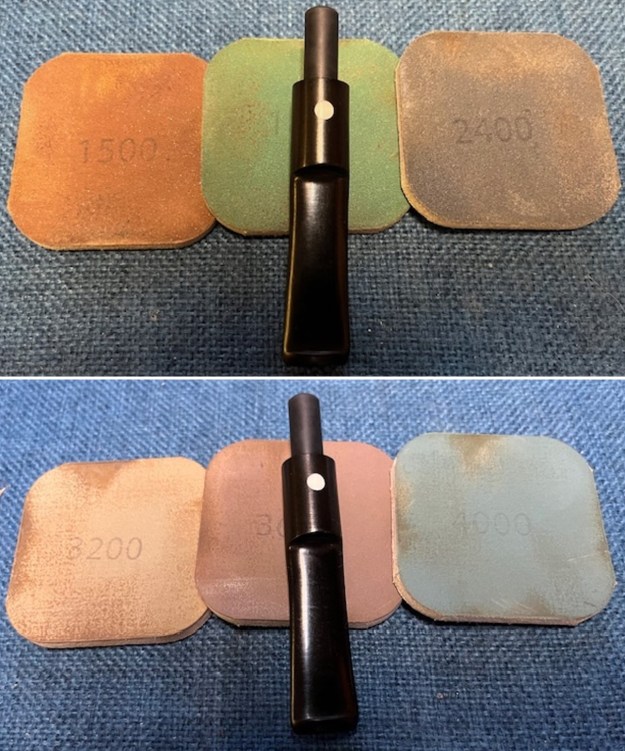
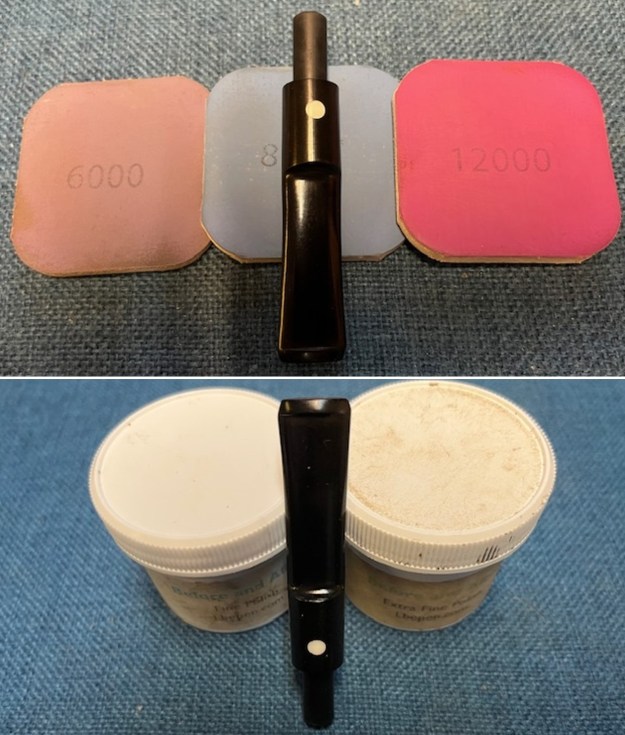
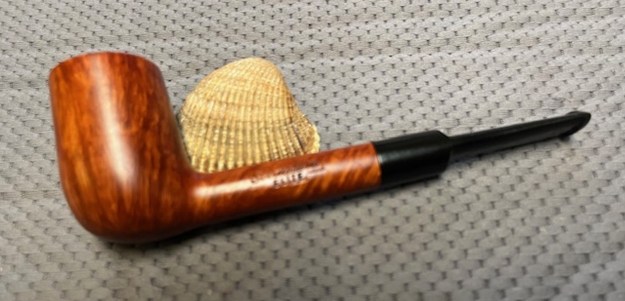
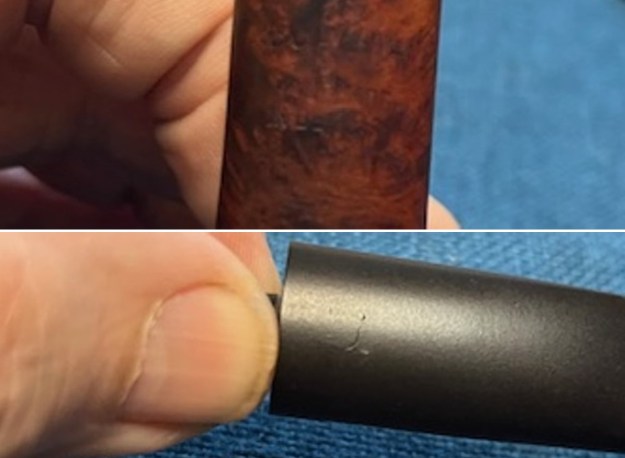
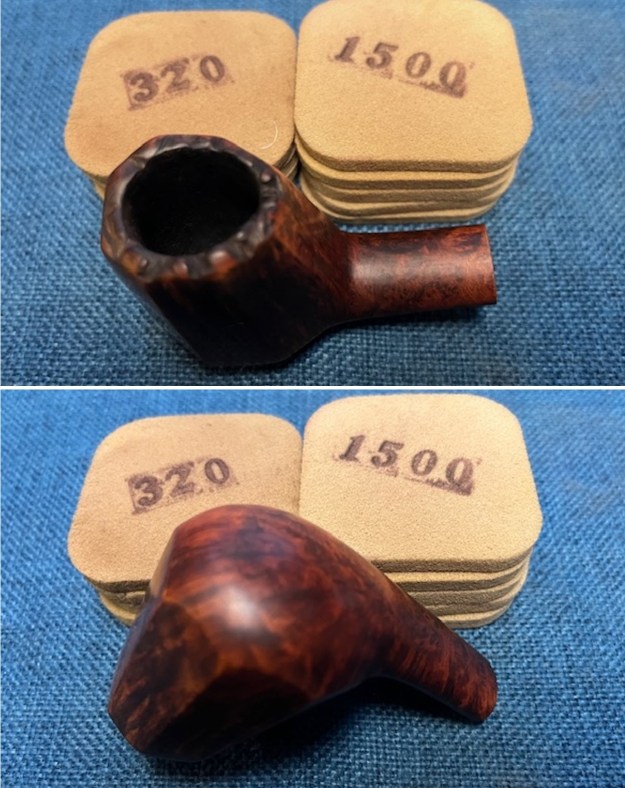
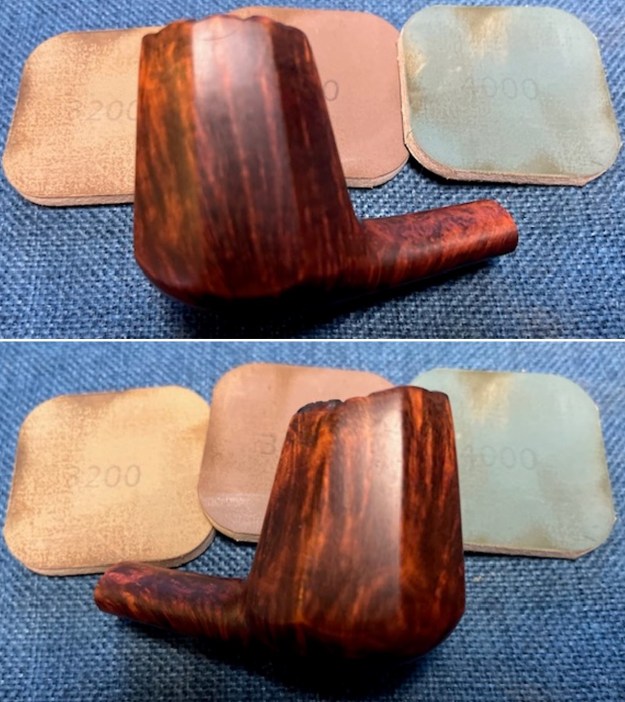
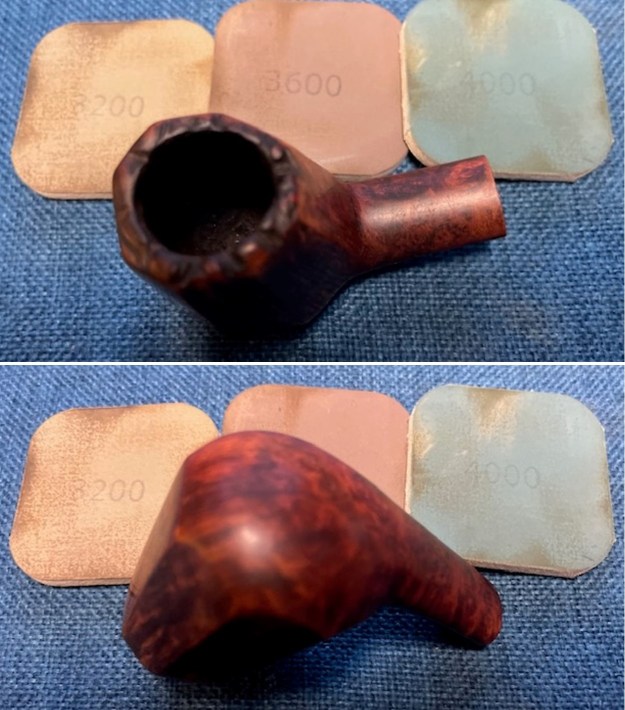
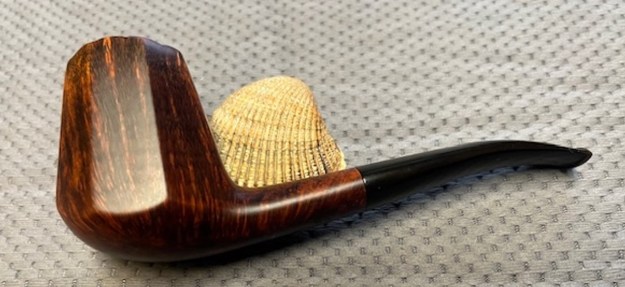
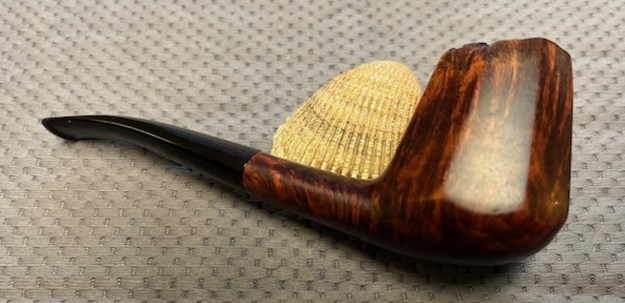
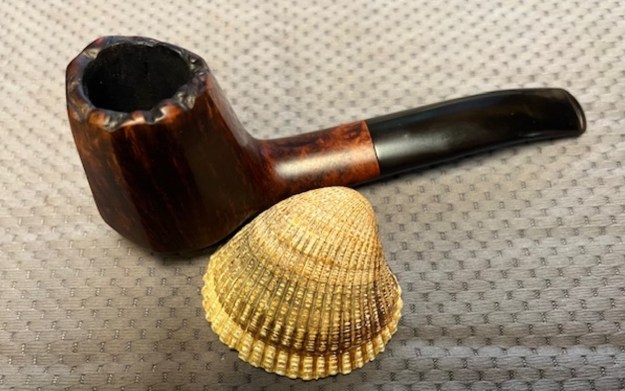
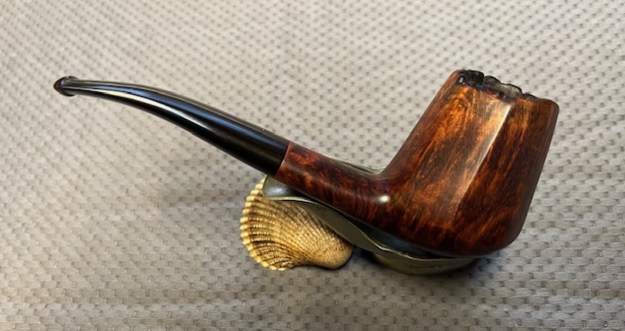
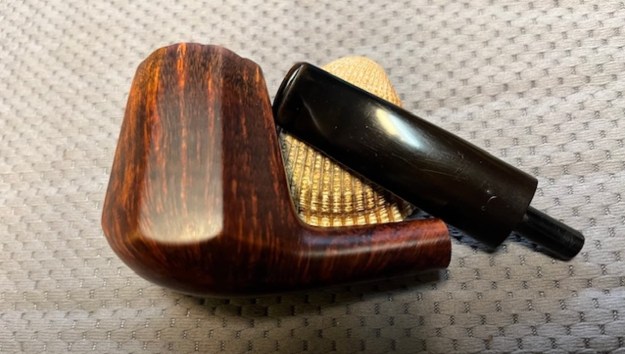
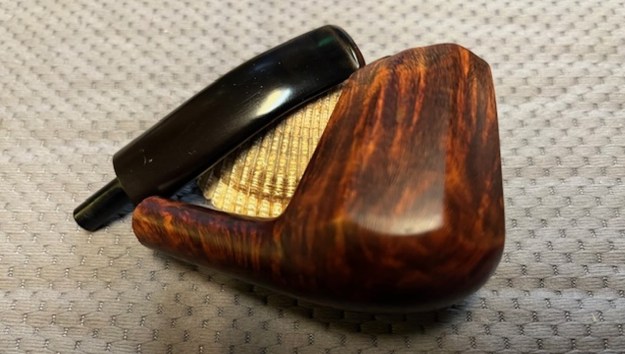
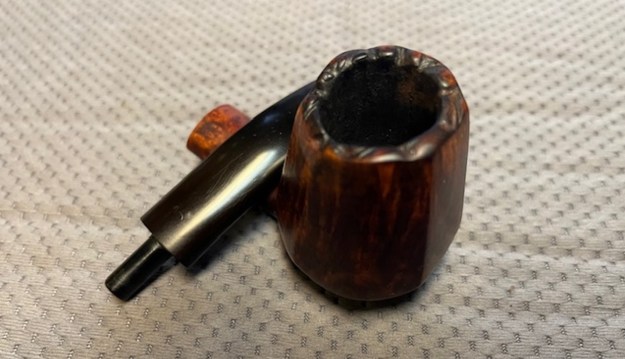
This afternoon I chose a block to work on as the internet was giving me fits with poor connections. It was making blog writing downright frustrating. I was not in the mood for an unshaped block so I chose a partially shaped Billiard with a stem made to give a hint of a military bit. The bowl was smooth externally with one small flaw on the right-side mid bowl toward the front. The inside of the bowl had a dark bowl coating – maybe water glass. The shank had been roughly shaped with a file and knives. The shape of it pointed toward being oval. The shank was not long enough to be a Canadian so I called it a Billiard. The corners of the shank end had been knocked off or partially rounded and the stem was an oval taper to help the person who took on the project go the right direction with it. I liked the inward bevel of the rim top and the grain on it was nice. The bowl looked good. The shank would need a lot of work no matter which direction I went with it. Here are some photos of the kit when I started this afternoon. I brought out the big guns this afternoon instead of fiddling around with files. I put a sanding drum on the Dremel and headed out to the front porch. It was chilly here today so I bundled up accordingly with a warm coat and a toque and took the tool and the block to the porch. I plugged in and worked over the shank with the Dremel and sanding drum. I had an idea in my minds eye that I was aiming for. I shaped and rounded the shank to make a rounder oval than perhaps the block cutter had imagined. I flattened out the knocked off corners and carried the shank straight through to the end. I was thinking that I might fit a ferrule on the shank end and reshape the stem to truly be a military style stick bit. Like most of these projects you have to have some idea in mind but hold it loosely while shaping it. You never know what is going to show up as you shape the briar. I have heard carvers speak of briar having a mind of its own so I truly hold my idea loosely and work away at it. By the time I had it rough shaped the way I wanted I was chilled so I packed it in and headed back to my basement desk top. I took some photos of the pipe at this point in the process. I had removed a lot of briar but still a lot more remained to be shaped and moved. Have a look. Now it was time for a cup of tea and a lot of sanding. First I made the tea and then I removed the stem from the shank. I used many pieces of 220 grit sandpaper to smooth out the Dremel marks and remaining file marks on the shank and the transition between the shank and the bowl. It took a lot of sanding and several cups of tea. But it was getting there. I sanded the bowl and shank with 320-3500 grit sanding pads. I wiped the bowl down after each sanding pad with a cloth and a drop of olive oil to remove the debris. It certainly is beginning to look quite good at this point. I rounded the shank end with my Dremel and sanding drum and a folded piece of 220 grit sandpaper. I wanted to have the curves on the shank match the nickel ferrule. Once I had the fit correct I pressed it in place on the shank end. There were two flaws in the briar – one on the left side toward the top and one mid bowl on the right side. I filled them in with briar dust and clear CA glue. Once it cured I flattened out the repair with a small file. I sanded it with 220 grit sandpaper to blend it into the surface of the briar. It began to look very good. I polished the briar with micromesh sanding pads – dry sanding with 1500-12000 grit sanding pads. I wiped it down after each sanding pad with a drop of olive oil and a paper towel. The briar began to take on a rich glow and the grain began to stand out. The briar was in looking good at this point in the process. I rubbed the bowl and shank down with Before & After Restoration Balm. I worked it into the surface of the bowl sides and shank with my fingertips to clean, enliven and protect the briar. I let the balm sit for a little while and then buffed with a cotton cloth to raise the shine. I set the bowl aside and turned to work on the stem that came with it. I used a file to flatten out the sharp edges on the shank end. I wanted it to be more or a flowing military style bit.I shaped it with 220 grit sandpaper a bit more then switched to 320-3500 grit sanding pads. I wiped the stem down after each pad with some Obsidian Oil. By the end the shape was right and the fit was perfect. It began to take on a shine.I polished the vulcanite stem with micromesh sanding pads – 1500-12000 grit pads. I wiped it down with a damp cloth after each sanding pad. I used Before & After Pipe Polish – both Fine and Extra Fine to further polish the stem. I finished carving my Pipe Kit Billiard this afternoon. The shape came out looking very good and the polished nickel ferrule works well with the pipe. I oiled the bowl with another coat of EVO (Extra Virgin Olive Oil). The oil brought the grain out very well and the oil gave it a rich reddish brown look. I put the stem back on the bowl and carefully buffed the pipe with Blue Diamond on the buffing wheel using a light touch on the briar. I gave the bowl and the stem multiple coats of carnauba wax on the buffing wheel and followed that by buffing the entire pipe with a clean buffing pad. I hand buffed the pipe with a microfiber cloth to deepen the shine. The finished Pipe Kit Billiard is a beauty and fits nicely in the hand and looks very good. Give the finished pipe a look in the photos below. The dimensions of the pipe are Length: 6 inches, Height: 1 ¾ inches, Outside diameter of the bowl: 1 ¼ inch, Chamber diameter: ¾ of an inch. The weight of the pipe is 44 grams/1.55 ounces. This was a fun one to carve for me. I like how it turned out and look forward to enjoying a bowl in it very soon. Thanks for reading this blog and my reflections on the pipe while I worked on it.

Restoring another Republic Era Peterson’s Dublin 2 101 Billiard


by Steve Laug

We received the next pipe from our source in Copenhagen, Denmark on 01/08/2024 – almost a year ago. It is a fitting New Year’s Day restoration. It is a Peterson’s 101 Military Bit Billiard. It is stamped on the left side of the shank and reads Peterson’s [arched over] Dublin 2 and the stamping is very clear. On the right side of the shank it is stamped Made in the Republic of Ireland (in three lines) and the shape number 101 is next to the bowl shank junction. The ferrule on the shank is stamped Peterson’s [over] Dublin next to that it is stamped Sterling [over] Silver. Following the r in Silver are three hallmarks – 1. Hibernia seated with her arm on a harp, 2. A crowned harp for the silver quality and finally 3. A date letter stamp, in this case a lowercase “l” that dates the pipe to 1977. The pipe is dirty, obviously a favourite smoker. There is grime ground into the finish. There is a thick cake in the bowl and a light overflow of lava on the inner edge and rim top. The silver ferrule is lightly tarnished. The stem is dirty, but is shiny and well cared for. Jeff took photos of it before he started his clean up work. I have included those below. Jeff took photos of the rim top and stem to show the general condition of the pipe. The bowl is heavily caked and there was some darkening and a light lava overflow on the rim top and the inner edge. The stem looks amazingly good for a pipe of this age. Jeff took photos of the bowl sides and heel to show the grain that was around this bowl. The grain is quite beautiful around the sides of the bowl and shank. It is another nice looking pipe. He took photos of the sides of the shank to show the stamping. The stamping is clear and readable in the photos below and is as noted above. The stamping on the silver ferrule is clear and readable as noted above. As with the blog just previous to this one, I turned to an earlier blog on a pipe with the same stamping that I had restored. I am quoting from what I learned in writing that blog below.

I turned to “The Peterson Pipe” by Mark Irwin and Gary Malmberg to get some background on the Peterson’s Dublin 2. On page 298 it had the following information.

Dublin (1906-2003) Although DUBLIN appears under PETERSON’S on many pipes over the decades, it has served mostly as part of the brand name. The word first appeared on pipes hallmarked 1906-11, stamped PETERSON’S over PATENT over DUBLIN. The simpler PETERSON’S over DUBLIN first appeared on pipes hallmarked 1912 after the expiration of the patent. Illustrations of pipes in the ’37 catalog show a random dispersion of the stamp PETERSON’S over OF DUBLIN together with the ordinary PETERSON’S over DUBLIN on every model offered. Specimens of the former will bear either an Irish COM or LONDON MADE over ENGLAND COM and almost certainly date from 1945-62. It was first mentioned as part of a model name in the ’68 price list, as K&P DUBLIN, in ’92 for a Danish market line and in the 2017 (see below).

“Dublin” (1992-2003) An orange-brown smooth line with a brass-nickel-brass sandwich band, vulcanite fishtail mouthpiece, consisting mostly of D shapes released for the Danish Market. Stamped PETERSON’S in script over “DUBLIN”. A tenth anniversary pipe for the line was produced with a sterling band stamped 2001. Market demand fell shortly thereafter and several pipe stamped “DUBLIN” were released in ’03 for the Fourth of July commemoratives for the US Market.

I wrote to Mark Irwin again and asked for his help in clearing up the mystery and helping to date this pipe. I asked him to provide any additional information for me. He responded with the following:

Steve… It’s first decade of Early Republic (1948-1958). The 2 and 3 numbers were discontinued int in 1958. Great little pipe! The “w” = today’s Premier grade.

I had forgotten to include the hallmarks on the silver so that left me even more in a quandary. So, I wrote Mark back about the date stamp on the silver and the conflicting stamping on the pipe.

How does that work with the date on the ferrule seeming to point 1975 (in this case 1977)? It has the standard stamping – woman on a chair, harp and the letter “h” (in this case “l”),

Mark responded as follows with regard to that pipe (the material fits this pipe very well).

Haha! I love it. You have just entered the Twilight Zone of Peterson Pipes, because the “2” and the small “h” for 1975 cancel each other out. I would prefer to leave it there: “a dimension beyond that which is known to man. It is a dimension as vast as space and as timeless as infinity. It is the middle ground between light and shadow, between science and superstition, and it lies between the pit of man’s fears and the summit of his knowledge.” If, however, you want to get mundane about it, there are only two possibilities: it was rebanded in 1975 (highly unlikely but not impossible) or someone picked up the old stamp (and they have dozens and dozens) who was new to the hand-stamping job. For myself. I’d rather leave it in the imponderables, but there are always skeptics who prefer the easy explanation to the miracle.

I could not have said it any better! The Twilight Zone of Peterson’s Pipes. So I have a pipe that was made between 1948-1958 with a silver ferrule that is dated 1977. What a great mystery. Now it was time to work on the pipe.

Jeff had done a great job cleaning up the pipe as usual. He reamed the pipe with a PipNet reamer and cut back the cake back to the bare briar. He cleaned up the walls with a Savinelli Fitsall Pipe Knife. Surprisingly the walls looked unscathed from the heavy cake. He scrubbed the interior of the bowl and shank with pipe cleaners, cotton swabs, shank brushes and alcohol to remove the tars and oils. He scrubbed the exterior of the pipe with Murphy’s Oil Soap and a tooth brush to remove the grime from the finish. He worked on the rim top lava and darkening with the soap and tooth brush. It looked better but still dark. He scrubbed the inside of the stem with alcohol and pipe cleaners. He scrubbed the exterior of the stem with Soft Scrub and then soaked it in Briarville’s Deoxidizer. He washed it off with warm water to remove the Deoxidizer. The pipe looked far better when it arrived. The rim top looked better but there were some issues with some roughening on the inner edge and scuffing on the top. I took a closeup photo of the rim top and edges to show the issues I spoke of. I also took close up photos of the stem to show the condition of the stem.I took photos of the stamping on the sides of the shank. It is clear and reads as noted above. I removed the stem and took a photo of the pipe to have a look at the parts and overall look. I started my work on the pipe by addressing the darkening on the rim top and damage on the inner edge of the bowl. I used a folded piece of 220 grit sandpaper to clean up the damage on the inner edge and also to smooth out the darkening on the rim top. It began to look much better.I worked over the surface of the rim top and the bowl with 320-3500 grit sanding pads. I wiped the bowl down after each sanding pad with a damp cloth to remove the sanding debris. It began to look good. I polished the briar with micromesh sanding pads – dry sanding with 1500-12000 grit sanding pads. I wiped the bowl down with a damp cloth after each sanding pad. I worked some Before & After Restoration Balm into the surface of the briar with my fingertips to clean, enliven and protect the briar. I let the balm sit for 15 minutes and then buffed with a cotton cloth to raise the shine. The photos show the bowl at this point in the restoration process. I set the bowl aside and worked on the stem. The stem was clean and the light tooth marks were minimal. I polished the stem with micromesh sanding pads – wet sanding with 1500-12000 grit sanding pads. I wiped it down after each sanding pad with Obsidian Oil. I polished it with Before & After Pipe Stem Polish – both Fine and Extra Fine. I wiped it down with another coat of Obsidian Oil. I am excited to finish this beautifully grained Peterson’s Dublin 2 Military Mount 101 Billiard. I put the pipe back together and buffed it with Blue Diamond on the buffing wheel. I gave the bowl and the stem multiple coats of carnauba wax. I hand buffed the pipe with a clean buffing pad to raise the shine. It is fun to see what the polished bowl looks like with beautiful mixed grain all around it. I polished the twin golden bands on the shank with a jeweller’s cloth. This smooth Classic Peterson’s Dublin 2 Military Mount 101 Billiard is great looking and the pipe feels great in my hand. It is light and well balanced. Have a look at it with the photos below. The dimensions are Length: 5 ½ inches, Height: 1 ¾ inches, Outside diameter of the bowl: 1 ¼ inches, Chamber diameter: ¾ of an inch. The weight of the pipe is 27 grams/.95 ounces. It turned out to be a beautiful pipe. I will be putting on the rebornpipes store in the Irish Pipe Makers Section. Thanks for walking through this restoration with me. I am always glad to answer questions or clarify if you would like more information.
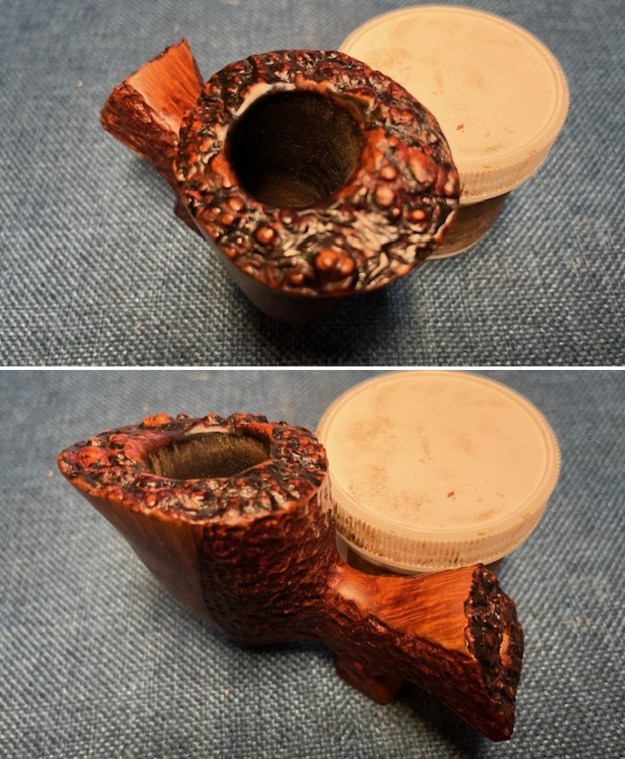
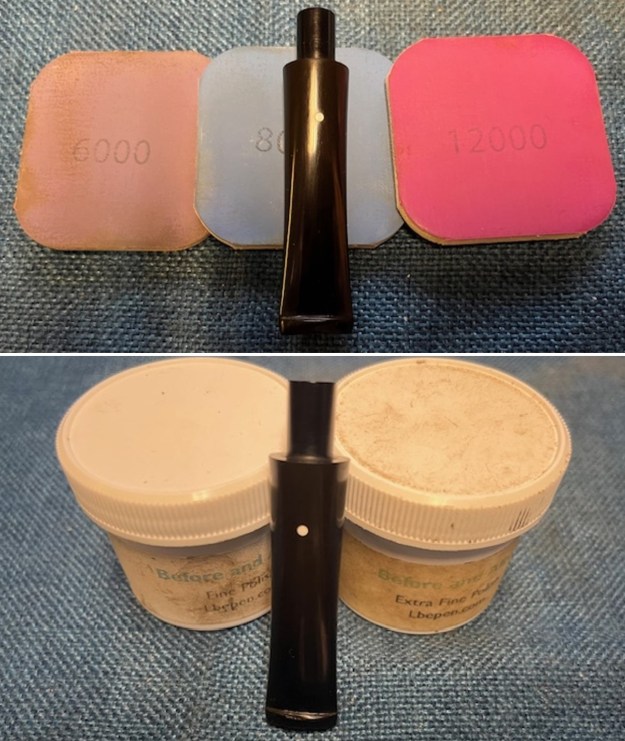
New Life for a Republic Era Peterson’s 101 Military Bit Billiard


by Steve Laug

We received the next pipe from our source in Copenhagen, Denmark on 01/08/2024 – almost a year ago. It is a fitting New Year’s Eve restoration. It is a Peterson’s 101 Military Bit Billiard. It is stamped on the left side of the shank and reads Peterson’s [arched over] Dublin 2 and the stamping is blurred from overstamping. On the right side of the shank it is stamped Made in the Republic of Ireland (in three lines) and the shape number 101 is next to the bowl shank junction. The final 1 in the shape number has a small fill that also makes it blurry. The ferrule on the shank is stamped Peterson’s [over] Dublin next to that it is stamped Sterling [over] Silver. Following the r in Silver are three hallmarks – 1. Hibernia seated with her arm on a harp, 2. A crowned harp for the silver quality and finally 3. A date letter stamp, in this case an uppercase “P” that dates the pipe to 1981. The pipe is dirty, obviously a favourite smoker. There is grime ground into the finish. There is a thick cake in the bowl and a heavy overflow of lava on the inner edge and rim top. The silver ferrule is lightly tarnished. The stem is dirty with light oxidation and tooth marks and chatter on both sides ahead of the button. Jeff took photos of it before he started his clean up work. I have included those below. Jeff took photos of the rim top and stem to show the general condition of the pipe. The bowl is heavily caked and there was a heavy lava overflow on the rim top and the inner edge. The stem is lightly oxidized and grimy. It has some light tooth marks on the top and underside near and on the surface of the button itself. Jeff took photos of the bowl sides and heel to show the grain that was around this bowl. The grain is quite beautiful around the sides of the bowl and shank. You can see some flaws or sand pits in the briar or pits but otherwise it is great grain. It is a nice looking pipe.He took photos of the sides of the shank to show the stamping. The stamping is readable in the photos below and is as noted above. The blurriness of the left side stamp is accurate and not a camera issue. It has been double stamped and the result is the blur. The stamping on the silver ferrule is clear and readable as noted above. I turned to an earlier blog on a pipe with the same stamping that I had restored. I am quoting from what I learned in writing that blog below.
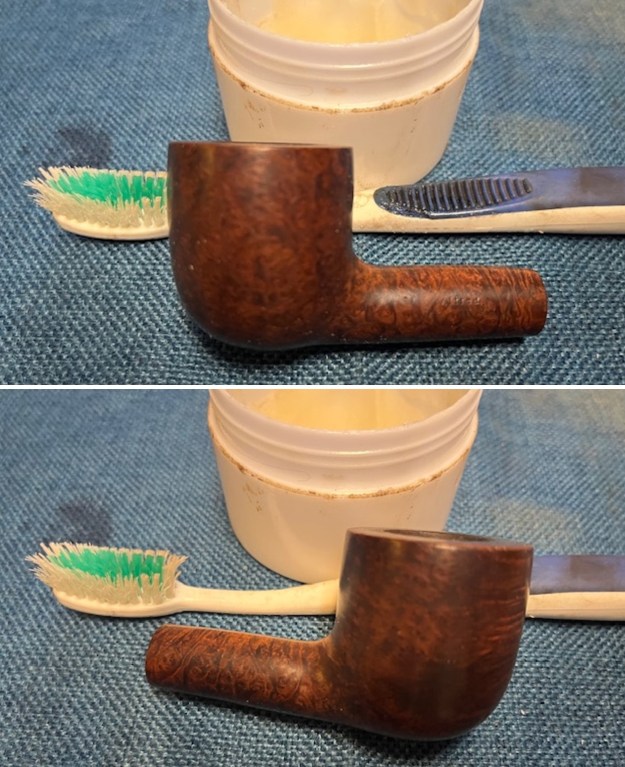
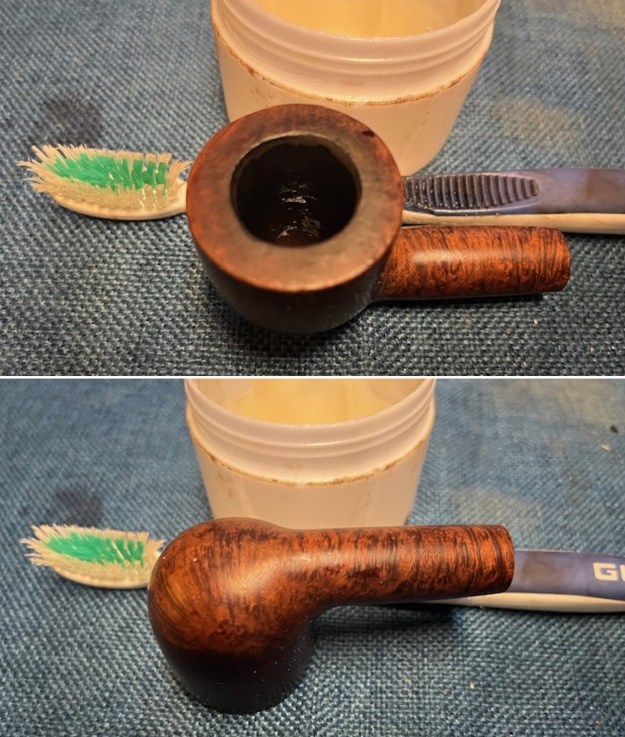
I turned to “The Peterson Pipe” by Mark Irwin and Gary Malmberg to get some background on the Peterson’s Dublin 2. On page 298 it had the following information.

Dublin (1906-2003) Although DUBLIN appears under PETERSON’S on many pipes over the decades, it has served mostly as part of the brand name. The word first appeared on pipes hallmarked 1906-11, stamped PETERSON’S over PATENT over DUBLIN. The simpler PETERSON’S over DUBLIN first appeared on pipes hallmarked 1912 after the expiration of the patent. Illustrations of pipes in the ’37 catalog show a random dispersion of the stamp PETERSON’S over OF DUBLIN together with the ordinary PETERSON’S over DUBLIN on every model offered. Specimens of the former will bear either an Irish COM or LONDON MADE over ENGLAND COM and almost certainly date from 1945-62. It was first mentioned as part of a model name in the ’68 price list, as K&P DUBLIN, in ’92 for a Danish market line and in the 2017 (see below).
“Dublin” (1992-2003) An orange-brown smooth line with a brass-nickel-brass sandwich band, vulcanite fishtail mouthpiece, consisting mostly of D shapes released for the Danish Market. Stamped PETERSON’S in script over “DUBLIN”. A tenth anniversary pipe for the line was produced with a sterling band stamped 2001. Market demand fell shortly thereafter and several pipe stamped “DUBLIN” were released in ’03 for the Fourth of July commemoratives for the US Market.

I wrote to Mark Irwin again and asked for his help in clearing up the mystery and helping to date this pipe. I asked him to provide any additional information for me. He responded with the following:
Steve… It’s first decade of Early Republic (1948-1958). The 2 and 3 numbers were discontinued int in 1958. Great little pipe! The “w” = today’s Premier grade.

I had forgotten to include the hallmarks on the silver so that left me even more in a quandary. So, I wrote Mark back about the date stamp on the silver and the conflicting stamping on the pipe.

How does that work with the date on the ferrule seeming to point 1975 (in this case 1981)? It has the standard stamping – woman on a chair, harp and the letter “h” (in this case “P”),

Mark responded as follows with regard to that pipe (the material fits this pipe very well).

Haha! I love it. You have just entered the Twilight Zone of Peterson Pipes, because the “2” and the small “h” for 1975 cancel each other out. I would prefer to leave it there: “a dimension beyond that which is known to man. It is a dimension as vast as space and as timeless as infinity. It is the middle ground between light and shadow, between science and superstition, and it lies between the pit of man’s fears and the summit of his knowledge.” If, however, you want to get mundane about it, there are only two possibilities: it was rebanded in 1975 (highly unlikely but not impossible) or someone picked up the old stamp (and they have dozens and dozens) who was new to the hand-stamping job. For myself. I’d rather leave it in the imponderables, but there are always skeptics who prefer the easy explanation to the miracle.

I could not have said it any better! The Twilight Zone of Peterson’s Pipes. So I have a pipe that was made between 1948-1958 with a silver ferrule that is dated 1990. What a great mystery. Now it was time to work on the pipe.

Jeff had done a great job cleaning up the pipe as usual. He reamed the pipe with a PipNet reamer and cut back the cake back to the bare briar. He cleaned up the walls with a Savinelli Fitsall Pipe Knife. Surprisingly the walls looked unscathed from the heavy cake. He scrubbed the interior of the bowl and shank with pipe cleaners, cotton swabs, shank brushes and alcohol to remove the tars and oils. He scrubbed the exterior of the pipe with Murphy’s Oil Soap and a tooth brush to remove the grime from the finish. He worked on the rim top lava and darkening with the soap and tooth brush. It looked better but still dark. He scrubbed the inside of the stem with alcohol and pipe cleaners. He scrubbed the exterior of the stem with Soft Scrub and then soaked it in Briarville’s Deoxidizer. He washed it off with warm water to remove the Deoxidizer. The pipe looked far better when it arrived. The rim top looked better but there were some issues with some roughening on the inner edge and darkening on the top. I took a closeup photo of the rim top and edges to show the issues I spoke of. I also took close up photos of the stem to show the light tooth marks on the surface near ahead of the button.I took photos of the stamping on the sides of the shank. It is clear and reads as noted above. I removed the stem and took a photo of the pipe to have a look at the parts and overall look. I started my work on the pipe by addressing the darkening on the rim top and damage on the inner edge of the bowl. I used a folded piece of 220 grit sandpaper to clean up the damage on the inner edge and also to smooth out the darkening on the rim top. It began to look much better.I worked over the surface of the rim top and the bowl with 320-3500 grit sanding pads. I wiped the bowl down after each sanding pad with a damp cloth to remove the sanding debris. It began to look good. I polished the briar with micromesh sanding pads – dry sanding with 1500-12000 grit sanding pads. I wiped the bowl down with a damp cloth after each sanding pad. I worked some Before & After Restoration Balm into the surface of the briar with my fingertips to clean, enliven and protect the briar. I let the balm sit for 15 minutes and then buffed with a cotton cloth to raise the shine. The photos show the bowl at this point in the restoration process. I set the bowl aside and worked on the stem. The stem was clean and the light tooth marks were minimal. I polished the stem with micromesh sanding pads – wet sanding with 1500-12000 grit sanding pads. I wiped it down after each sanding pad with Obsidian Oil. I polished it with Before & After Pipe Stem Polish – both Fine and Extra Fine. I wiped it down with another coat of Obsidian Oil. I am excited to finish this beautifully grained Peterson’s Dublin 2 Military Mount 101 Billiard. I put the pipe back together and buffed it with Blue Diamond on the buffing wheel. I gave the bowl and the stem multiple coats of carnauba wax. I hand buffed the pipe with a clean buffing pad to raise the shine. It is fun to see what the polished bowl looks like with beautiful mixed grain all around it. I polished the twin golden bands on the shank with a jeweller’s cloth. This smooth Classic Peterson’s Dublin 2 Military Mount 101 Billiard is great looking and the pipe feels great in my hand. It is light and well balanced. Have a look at it with the photos below. The dimensions are Length: 5 ½ inches, Height: 1 ¾ inches, Outside diameter of the bowl: 1 ¼ inches, Chamber diameter: ¾ of an inch. The weight of the pipe is 33 grams/1.16 ounces. It turned out to be a beautiful pipe. I will be putting on the rebornpipes store in the Irish Pipe Makers Section. Thanks for walking through this restoration with me. I am always glad to answer questions or clarify if you would like more information.

Restoring a Handsome Portland Pipe Co. “Falcon Briar”


by Kenneth Lieblich

This is the next pipe that I restored for a local family. One of the gentlemen selected this fine Canadian shape for his own. It’s a good-looking pipe and worthy of restoration. This pipe comes from the Portland Pipe Co., which I’ve written about before. This specific pipe has some interesting markings – let’s take a look. On the top of the shank, it reads Portland Pipe Co [over] B.B& S Ltd. [over] London made – England. On the left side of the shank, it reads Falcon Briar. On the right side of the shank, it reads P2 – presumably a shape code. Two things puzzled me: the term “Falcon Briar” and the code “P2”. They didn’t conform to anything I already knew about Portland. Here is a review of my digging for information on Portland Pipe Co.I began my research with José Manuel Lopes’ book, Pipes: Artisans and Trademarks. As the photo shows, there was a little information, but not a lot.The connection with Barling was interesting, so I also checked Wilczak and Colwell’s book, Who Made That Pipe? From the photos below, you can see that the Portland Pipe Co. is connected to Barling too.Time to check online. Pipephil had a similarly brief write-up (included here).Pipedia was a bit more informative. Their page on the Portland Pipe Co. includes the following information (the typos are in the original and are NOT mine):

Portland Pipe Company was an English pipe maker, and appears to have started in the 1930’s, and went out of business in 1962. It’s though they had ties to Barling pipes from the 1930’s. They might have been a sub-brand or “second” which was separate from, but fully owned by Barling’s all along. It also thought that after Portland closed down, and during Barling’s corporate era (BB&S), Barling picked up some of the Portland brand (Londoner, Cragmoor and Portland) and made them for a while. WILCZAK & COLWELL in their book “Who Made That Pipe?” acknowledge the brand as from England, though some have been made in Italy as well (see Pipephil.eu). The Brand John Peel is a pipe which has the stamping: JOHN PEEL, A PORTLAND PIPE, MADE WHOLLY IN ENGLAND. I have a model with is also stamped SPECIAL, it’s a stack design with shape number 801. This pipe might have been made either by Portland or Barling. According to a 1940 price sheet, the following models were offered, along with the correlating prices:

 Vintage (10/6)
Exchange (7/6)
Londoner (7/6)
Mosaic (7/6)
Portland Super (7/6)
Crustor (5/6)
Diploma (5/6)
Port Royal (5/6)
Port-de-Luxe (5/6)
Portland Patent (5/6)
Souk-el-Arba (5/6)
Times (4/6)
British Sovereign (3/6)
John Peel (3/6)
Jubilee (3/6)
Sirdar (3/6)
Campaigner (2/6)
Dandy (2/6)
First Call (2/6)
Knobby (2/6)
Topsall (2/6)
Topsall Comfort (2/6)
Portman (2/-)
British National (1/6)
Ruf Kut (1/6)

This doesn’t mention anything about “Falcon Briar”. However, there are a few other tidbits of information. The PipesMagazine.com forums include an interesting comment from Barling expert Jonathan Guss:Finally, over at the Very Keen on Pipes website, a reader commented on one of their posts by saying:

“… Portland pipes make up one of the great mysteries of London pipe making. No one knows when Barling bought Portland but most of us barling guys believe it was mid to late 30’s. I saw a reference once online using the year 1936 but this cannot be confirmed. Next, John Peel was for a long time thought to have been a shop but there is no evidence proving that. However, John Peel pipes were almost certainly made by Portland. What most of use want in a pipe of this type is a pipe made before 1962, when the barling family was let go by the new owners and the brand went into a downward spiral quality wise. Re Portland, a number of them have recently turned up as a result of a “garage find” of a batch of pipes from the Toronto Canada area and they were mixed in with other wood from the 50’s and that seems to indicate a 50’s date of manufacture. Note: in those days several of the larger pipe makers made pipes or just bowls for other brands and these were mostly Charatan, Comoy and other makers such as Orlick. What is almost certain is that never did barling make / sell any pipes that were not carved by barling carvers untill after 1970. So, Portland and Peel were never actually barling made, these pipes were either made by Portland in house or, in later years past 1962, by Charatan and others. Also, if one looks at the style of the bits it evident that Portland and Peel pipes were not made that long ago, probably 50’s and 60’s unless there is a BB&S stamp which indicates post 1970 age (the & symbol being the give away since B.B.S was used in the older pre 1962 era.) Just some info for you to keep in mind… “

This is interesting stuff and then Steve gave me another possible detail. Apparently, Comoy’s used to make a line of pipes called ‘Falcon’ and another called ‘Royal Falcon’. Perhaps this bowl was made by Comoy, but later picked up by Portland. This could explain why the pipe contains the ‘Falcon Briar’ line. Pipephil has this tidbit:By inference (and some educated guesswork), this pipe was made in England, probably in the 1970s (or, at least, post 1970), by the Portland Pipe Co. However, there may be a Comoy connection too. I am happy to be educated by someone who knows more.

The pipe was in good condition and didn’t require any major surgery. The bowl was a bit dirty and banged up, but nothing serious. Similarly, the stem had some tooth marks and scrapes, nothing to worry about.To start, I used a disposable lighter and ‘painted’ the stem with its flame. The gentle heat of the flame can cause the dents in the vulcanite of the stem to expand back into shape. This helped a little bit.I used oil soap on a few cotton rounds and wiped the stem down to provide an initial cleaning of filth before moving on to the next steps. The primary cleaning comes next. I cleaned the inside of the stem with both pipe cleaners and cotton swabs dipped in 99% lemon-infused isopropyl alcohol. I scrubbed thoroughly to make sure the interior was clean.The goal of the next step is the removal (or minimization) of oxidation. Going to my sink, I used cream cleanser, cotton rounds, and a toothbrush, and scoured the stem to remove as much surface oxidation as possible. As the photos show, the result is a hideous brownish mess – but better off the stem than on it.Once the stem was reasonably clean, I soaked it overnight in some de-oxidation fluid. This solution works to draw oxidation in the stem to the surface. This is a major aid and important step in ensuring a clean stem. The following day, I drew the stem out from its bath and scrubbed the lingering fluid with a toothbrush.Once clean and dry, I set about fixing the marks and dents in the vulcanite. This is done by filling those divots with black cyanoacrylate adhesive, impregnated with carbon and rubber. I left this to cure and moved on.The penultimate step for the stem is sanding. First, with my set of needle files, I reduce the bulk of the cyanoacrylate repairs. I want to remove the excess adhesive as near to the surface as possible, without cutting into the vulcanite. Following that, I use all nine of the micromesh sanding pads (1,500 through 12,000 grit) to sand out flaws, even out the vulcanite, and provide gentle polishing of the finished surface. I also apply pipe-stem oil while using the last five micromesh pads. There is a wonderful, deep black shine to the stem when I am done.Now that the stem is (nearly) complete, I can move on to the stummel. The first step for me is to ream out the bowl – that is to say, remove all the cake inside the bowl. This accomplishes a couple of things. First (and most obviously), it cleans the bowl and provides a refurbished chamber for future smoking. Second, when the old cake is removed, I can inspect the interior walls of the bowl and determine if there is damage or not. Everything looked good inside the bowl. My next step was to remove the lava on the rim. For this, I took a piece of machine steel and gently scraped the lava away. The metal’s edge is sharp enough to remove what I need, but not so sharp that it damages the rim. This worked well. Similar to the stem, I then cleaned the insides of the stummel with both pipe cleaners and cotton swabs dipped in 99% lemon-infused isopropyl alcohol. The pipe turned out to be a bit dirtier than I expected.I then decided to ‘de-ghost’ the pipe – that is to say, exorcize the remaining filth from the briar. I filled the bowl and the shank with cotton balls, then saturated them with 99% isopropyl alcohol. I let the stummel sit overnight. This caused any remaining oils, tars and smells to leach out into the cotton.To tidy up the briar, I also wiped down the outside with some oil soap on cotton rounds (and a toothbrush). This does a good job of cleaning any latent dirt on the surface of the briar. The last step of the cleaning process is to scour the inside of the stummel with some soap and tube brushes. This is the culmination of a lot of work in getting the pipe clean.In order to lessen the nicks on the rim, I ‘topped’ the pipe – that is to say, I gently and evenly sanded the rim on a piece of 220-grit sandpaper. This effectively minimizes the damage, without altering the look of the pipe.I used all nine micromesh pads (1,500 through 12,000 grit) on the outside of the stummel to finish it off. This sanding minimizes flaws in the briar and provides a beautiful smoothness to the wood. I rubbed some Before & After Restoration Balm into the briar and let it sit for 20 minutes or so. The balm moisturizes the wood and gives a beautiful depth to the briar. I then buffed it with a microfibre cloth. For the final step, I took the pipe to my bench buffer and carefully polished it – first with a white diamond compound, then with three coats of carnauba wax. This procedure makes the pipe look its best – the stummel sings and stem glows.This Portland Canadian is a very handsome pipe and will provide many years of smoking pleasure. I hope you enjoyed reading the story of this pipe as much I as I did restoring it. If you are interested in more of my work, please follow me here on Steve’s website or email me directly at kenneth@knightsofthepipe.com. The approximate dimensions of the pipe are as follows: length 6 in. (153 mm); height 1⅞ in. (48 mm); bowl diameter 1⅓ in. (33 mm); chamber diameter ⅔ in. (17 mm). The weight of the pipe is 1⅜ oz. (40 g). I hope you enjoyed reading the story of this pipe’s restoration as much as I did restoring it. If you are interested in more of my work, please follow me here on Steve’s website or send me an email. Thank you very much for reading and, as always, I welcome and encourage your comments.