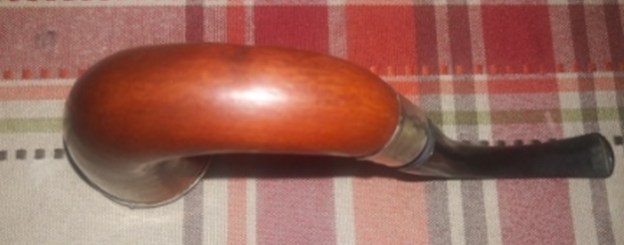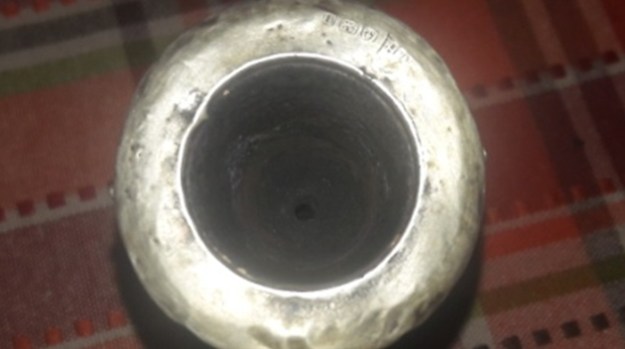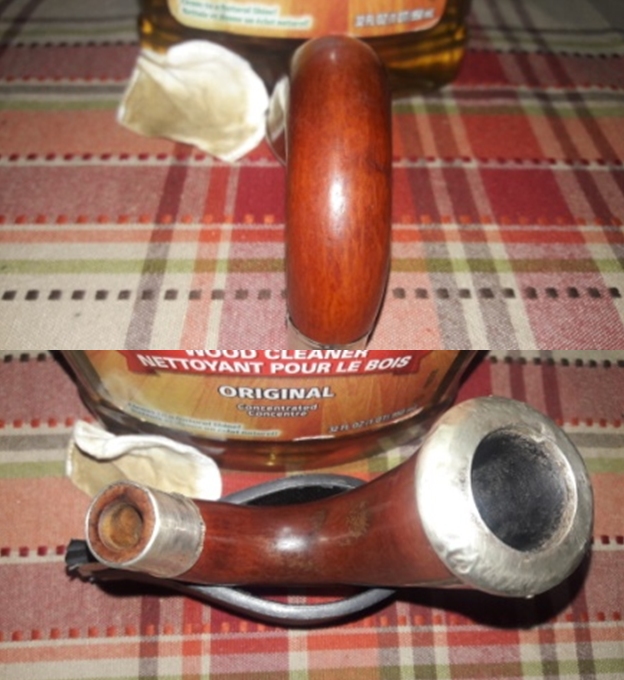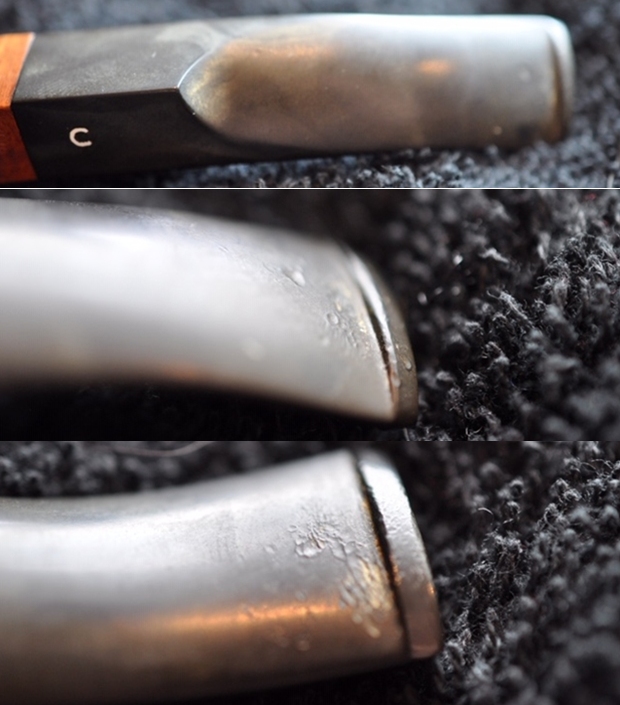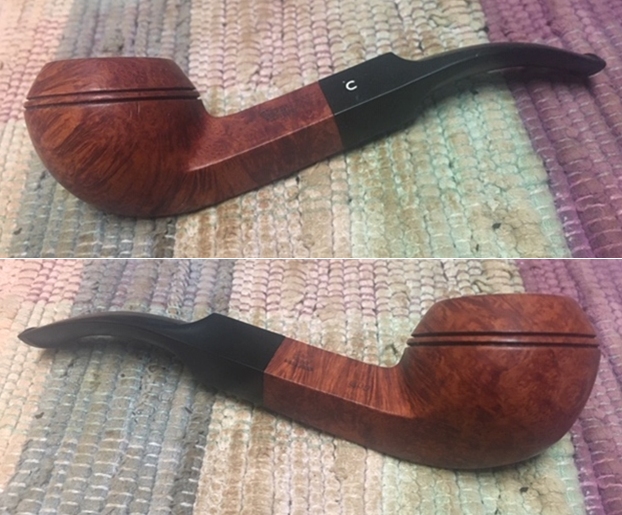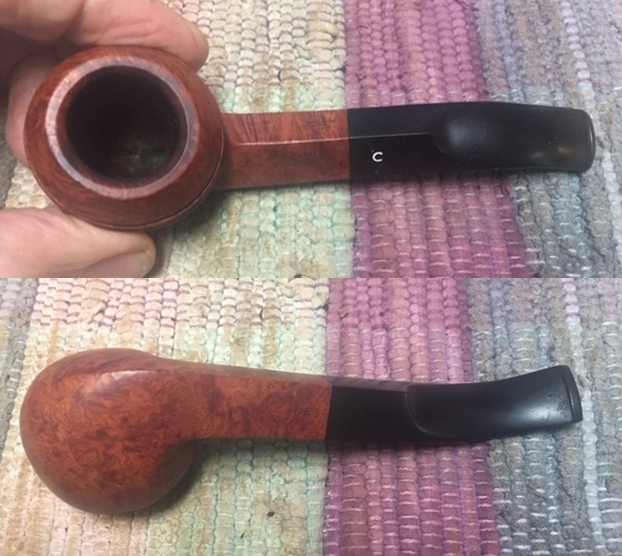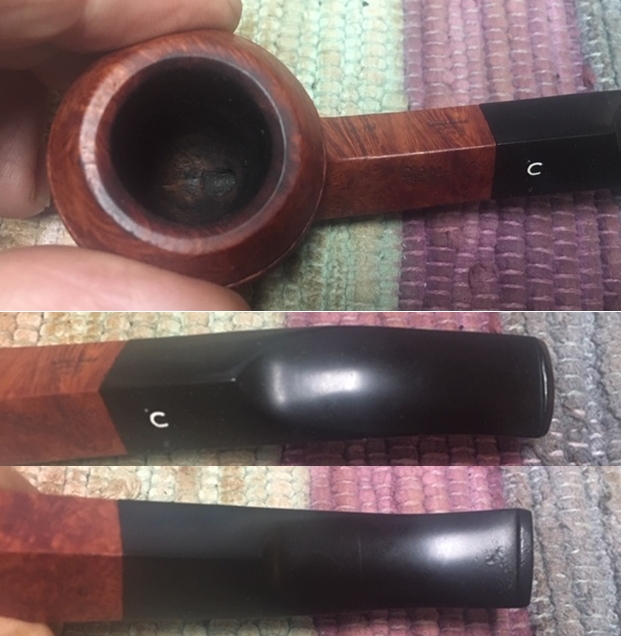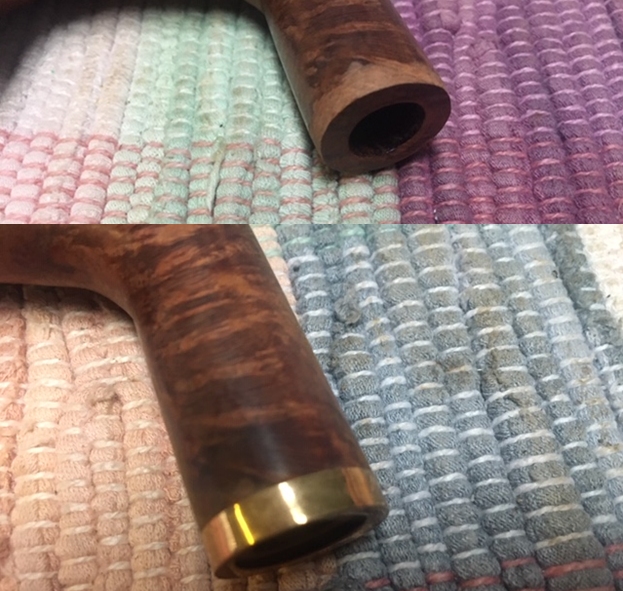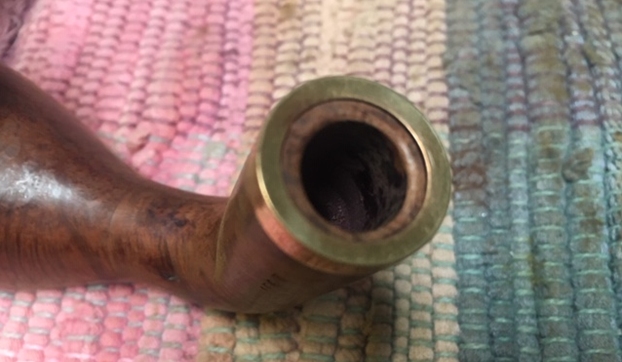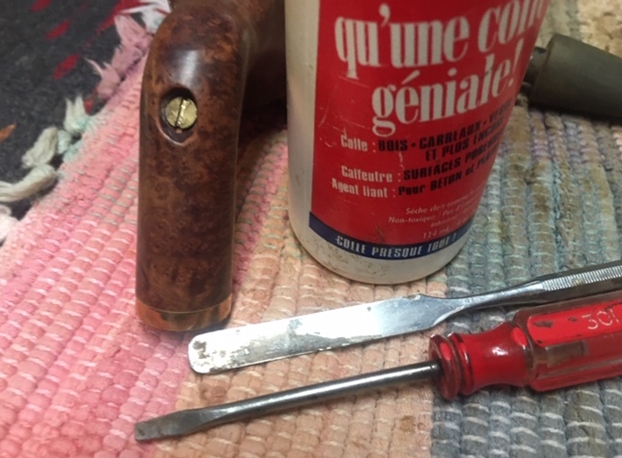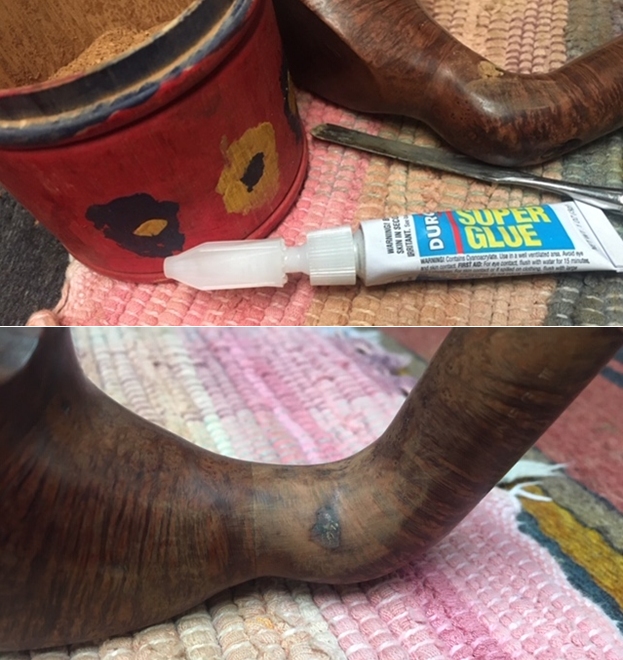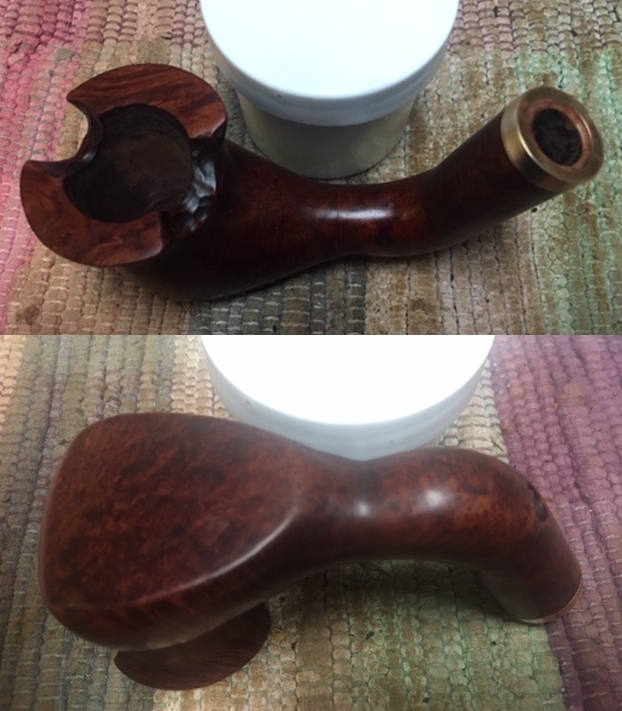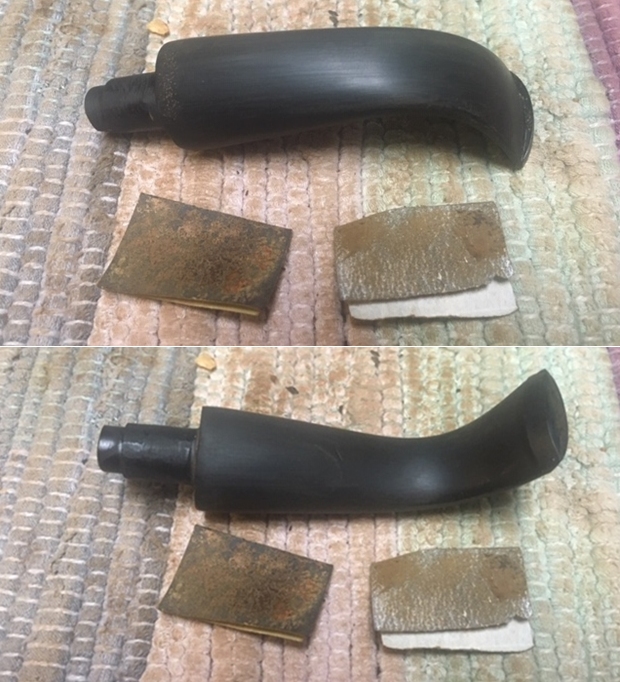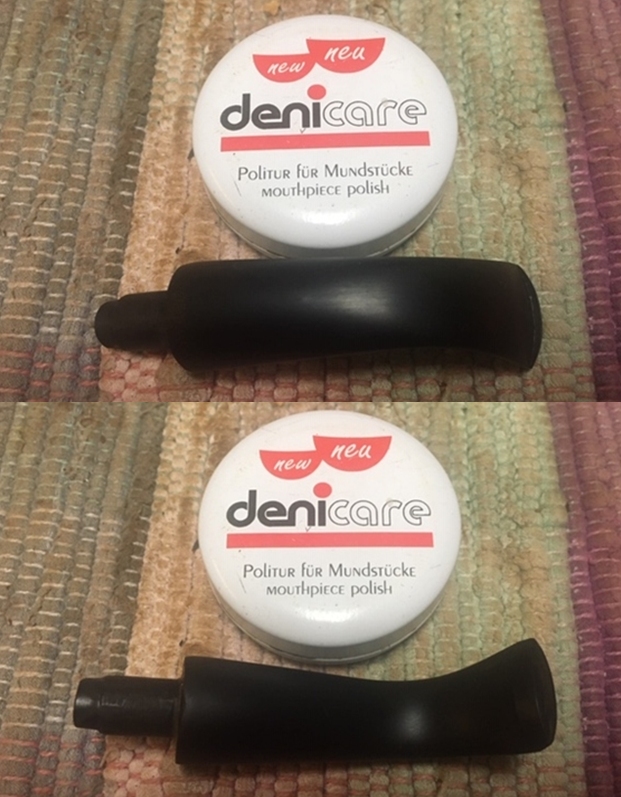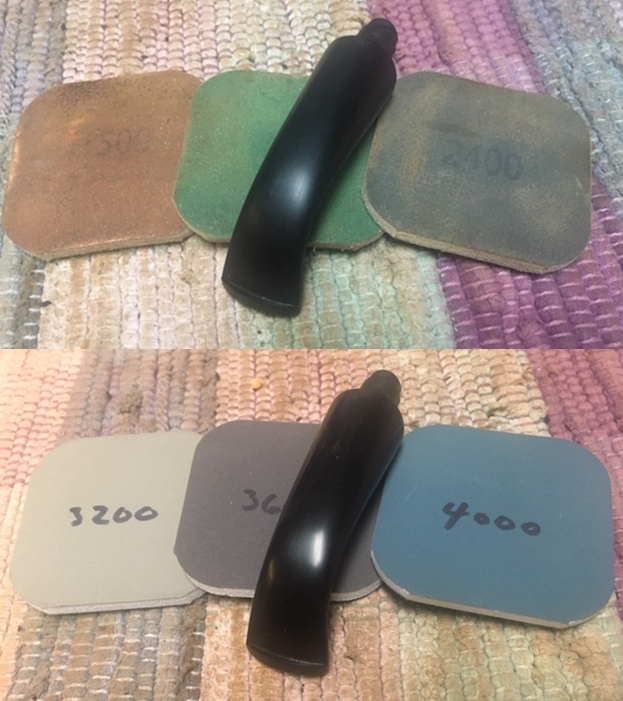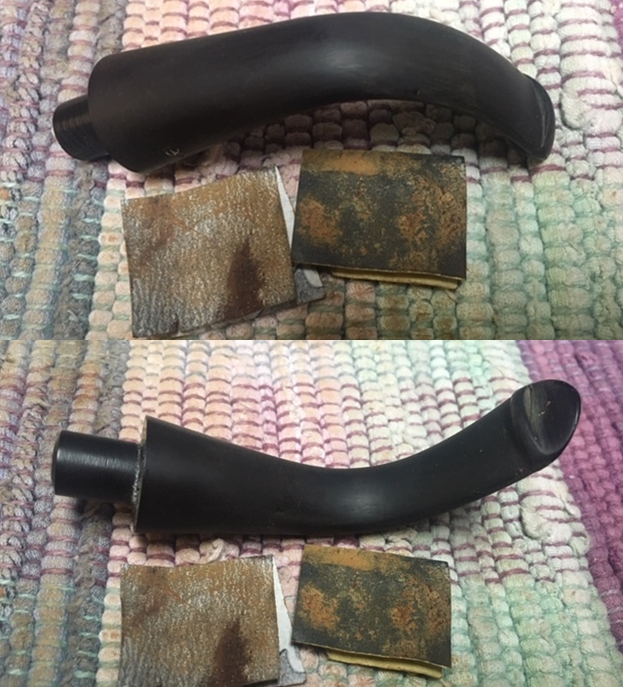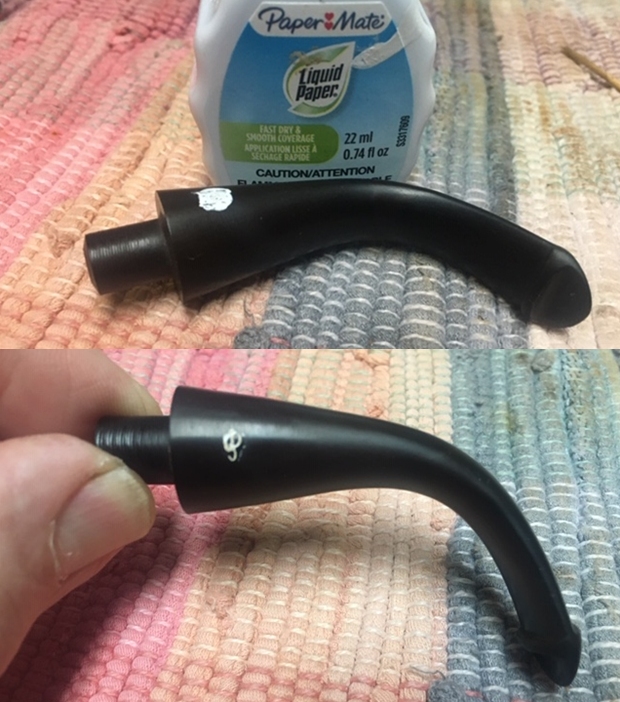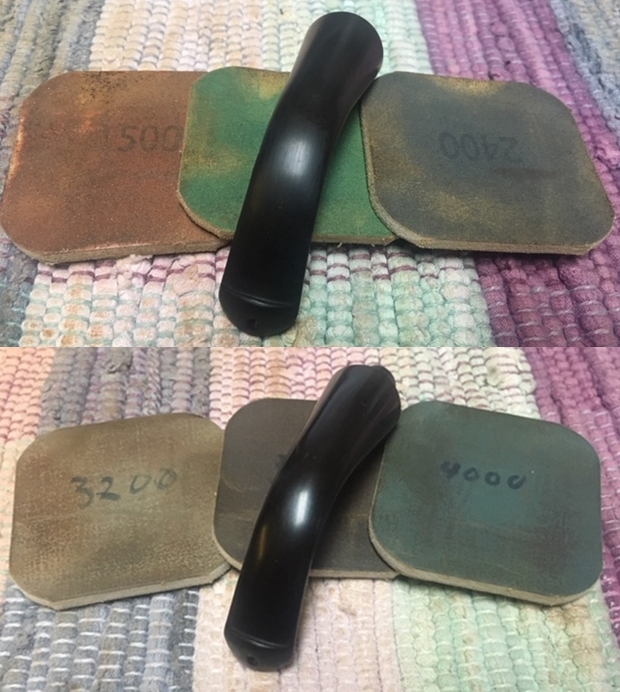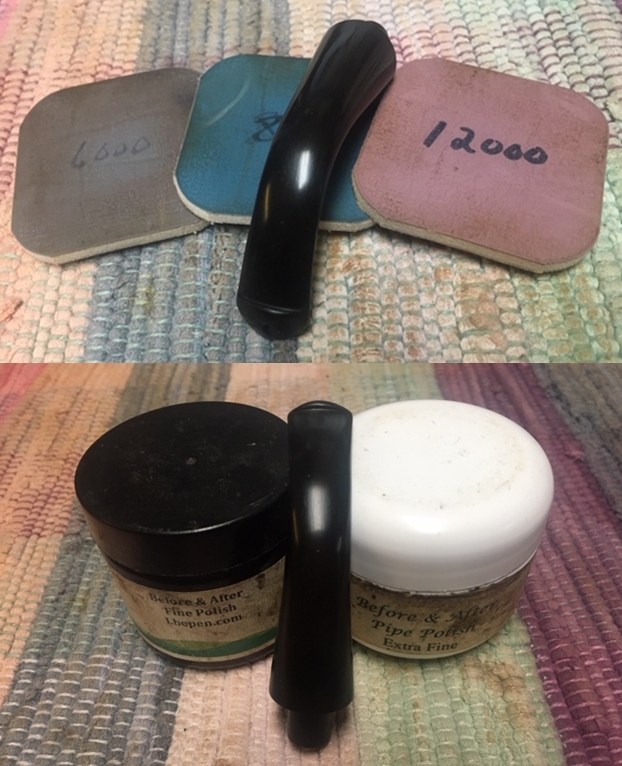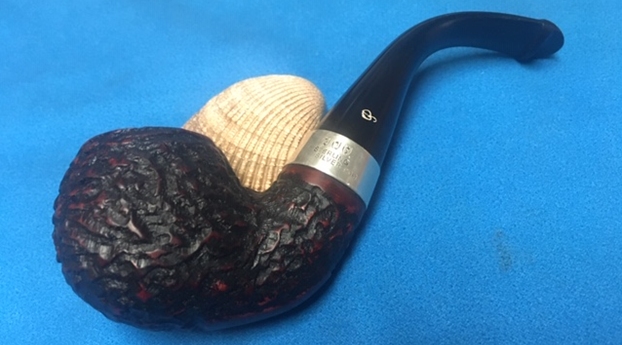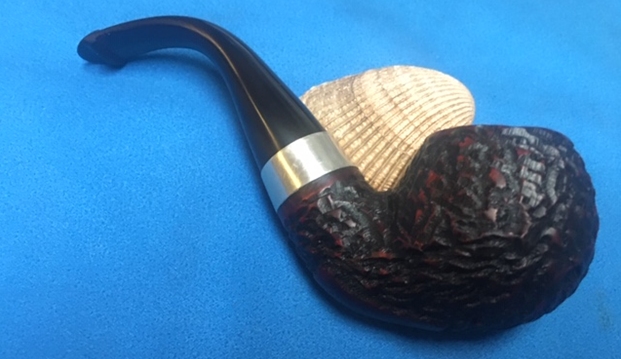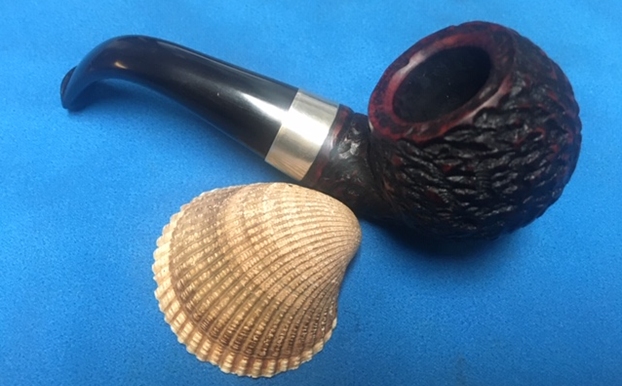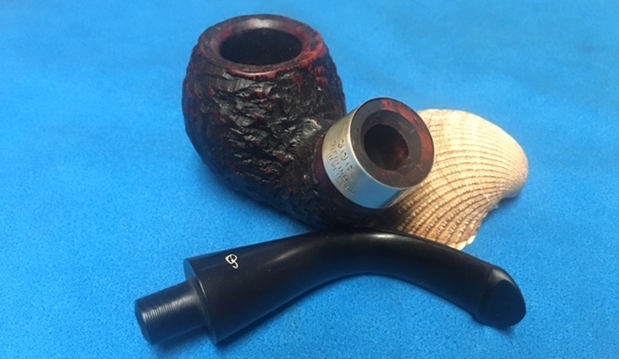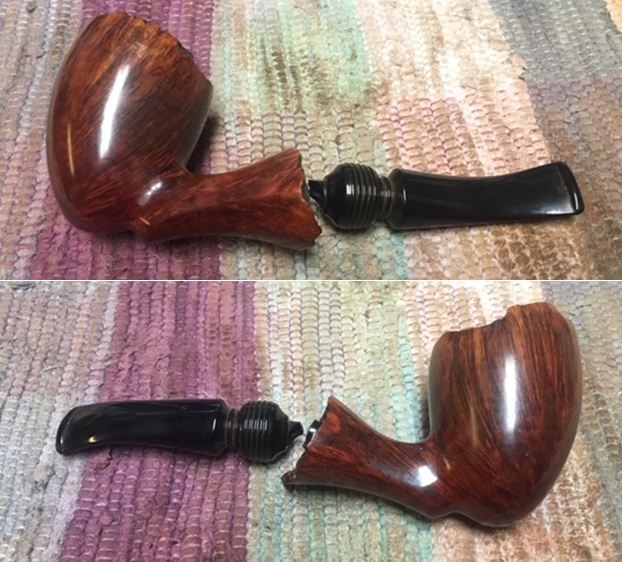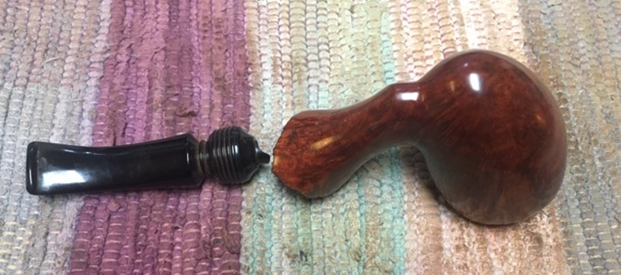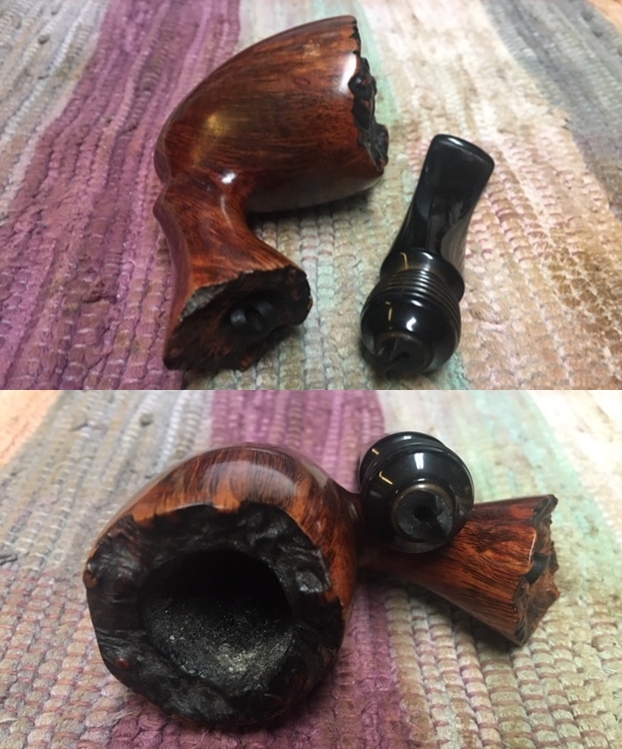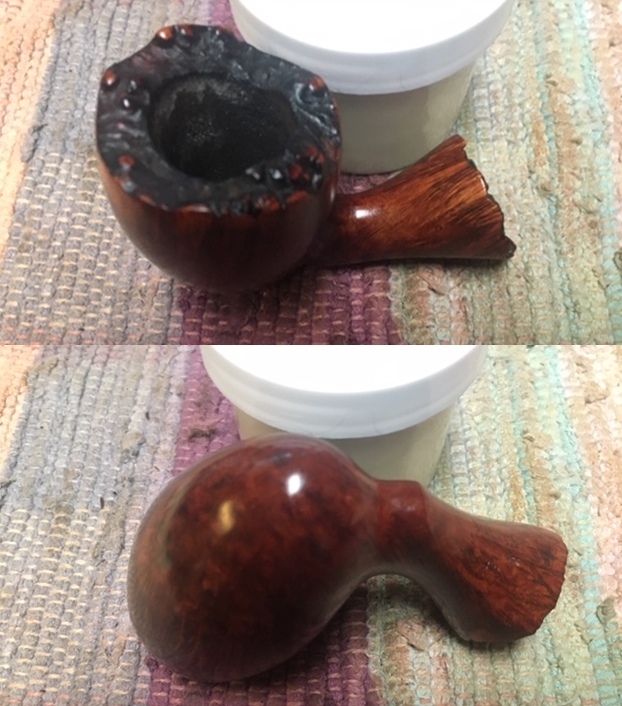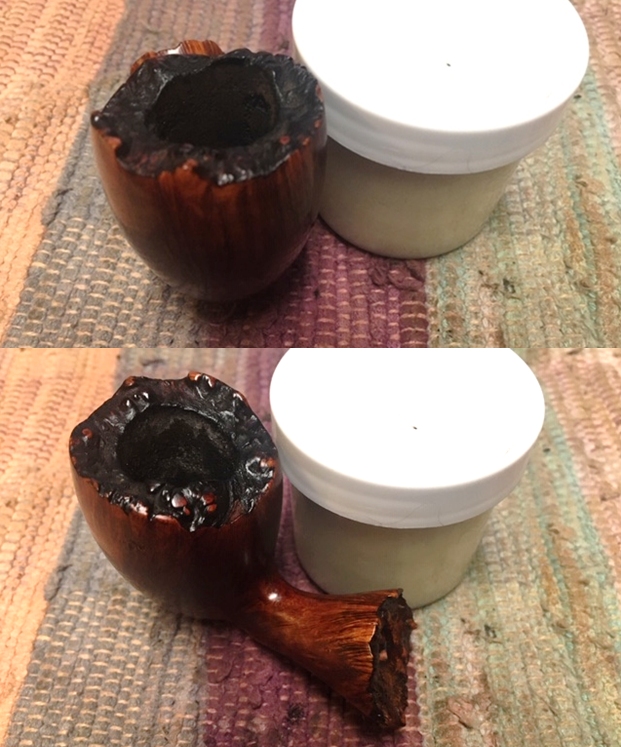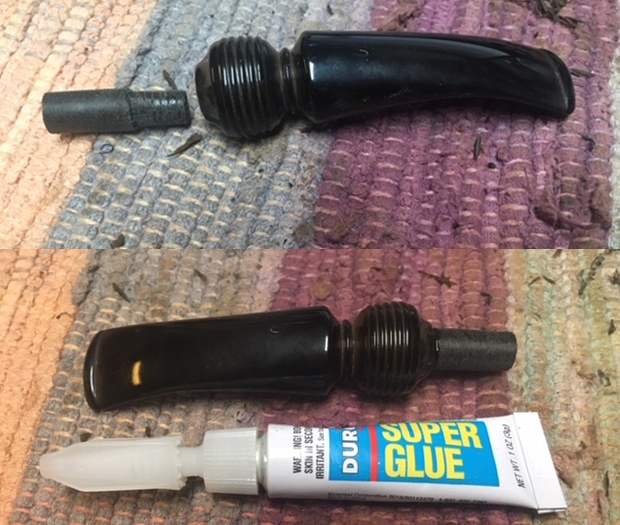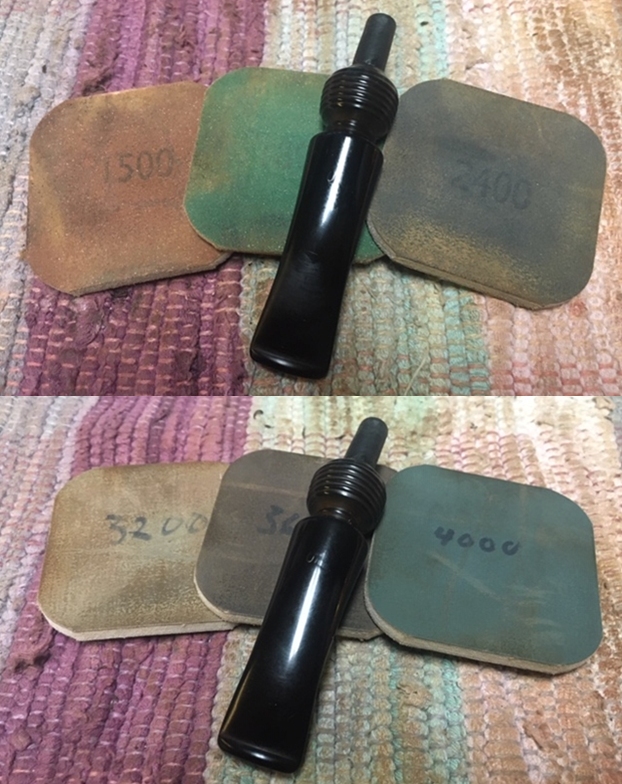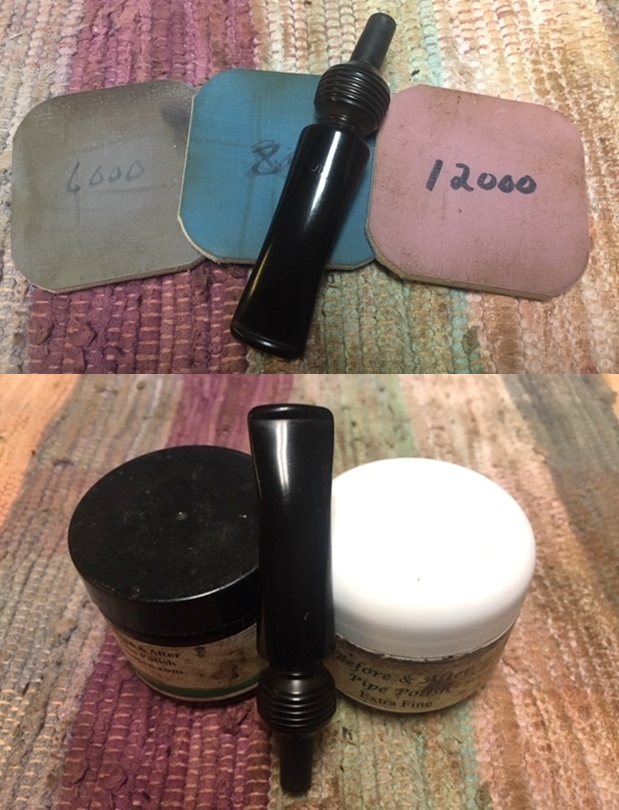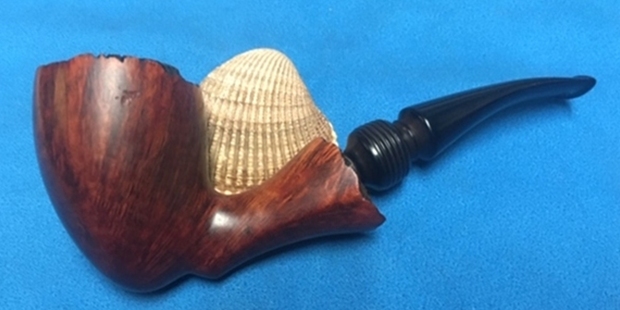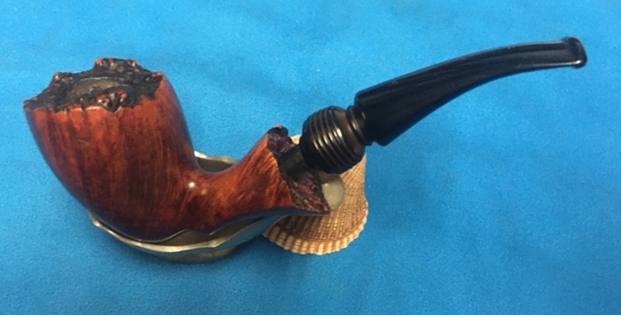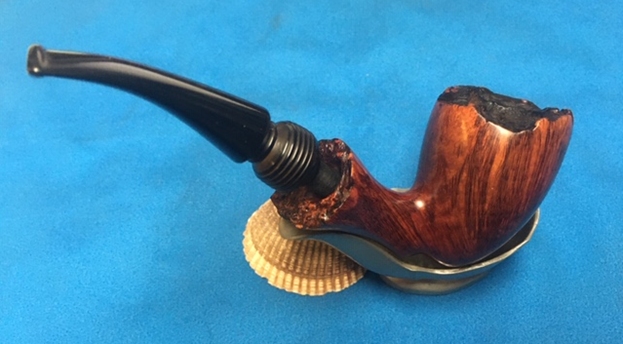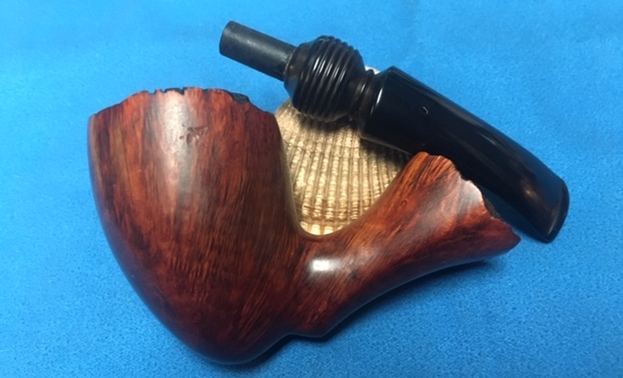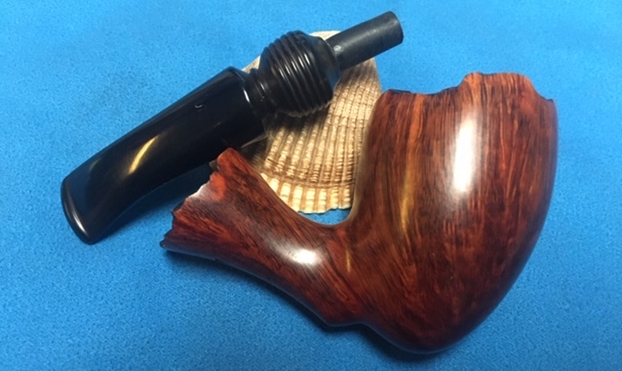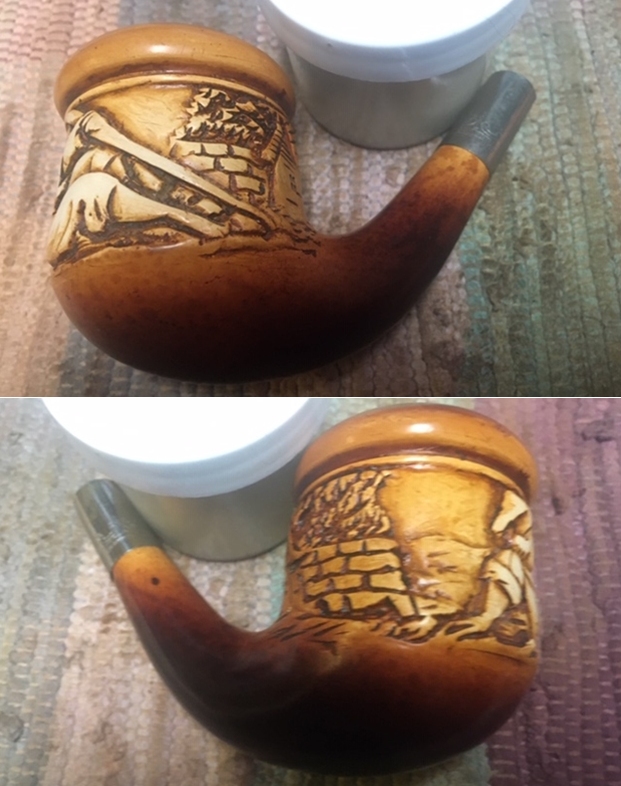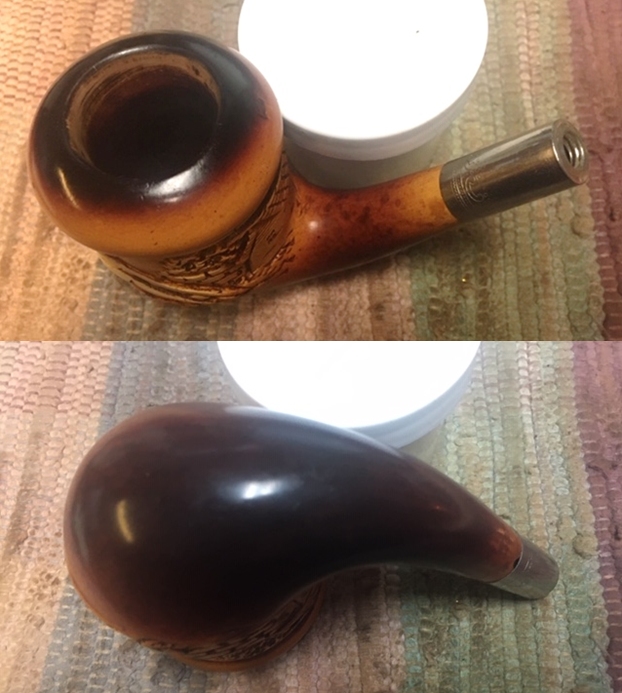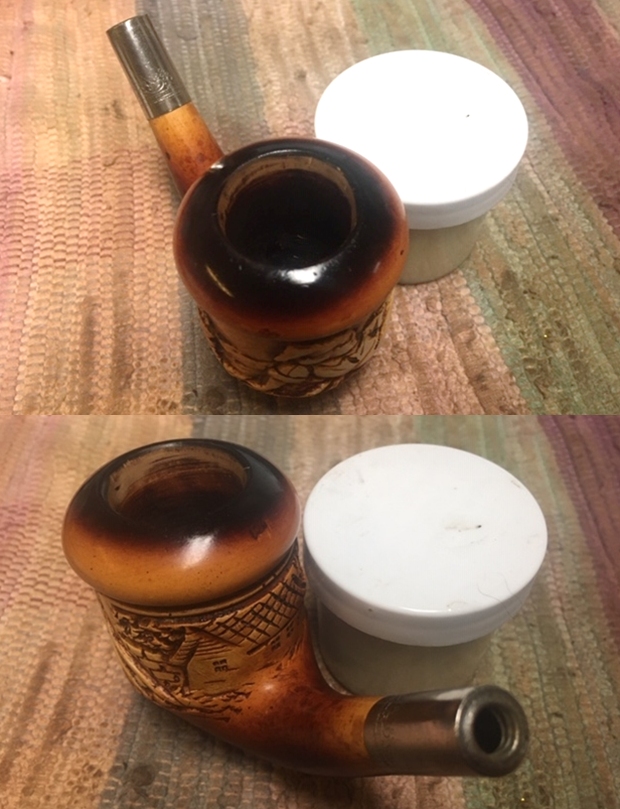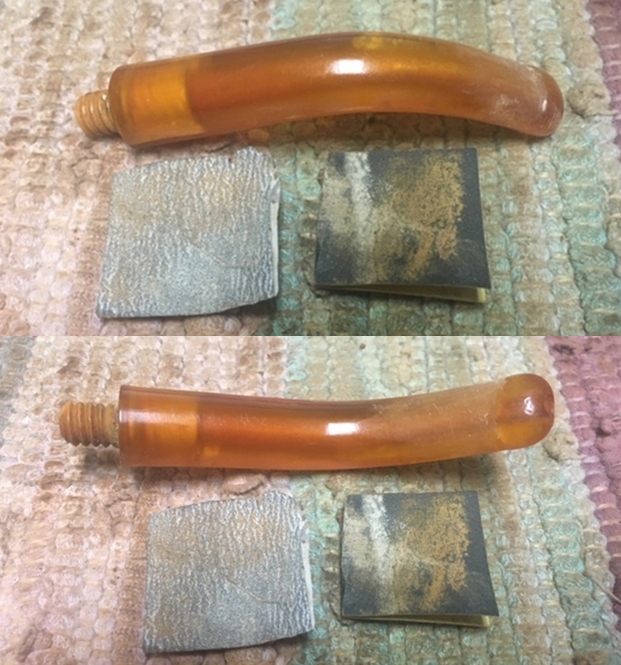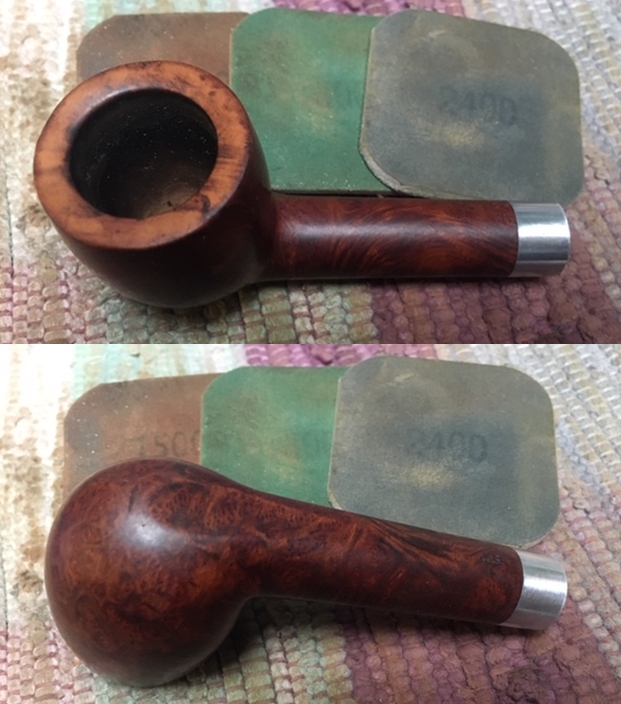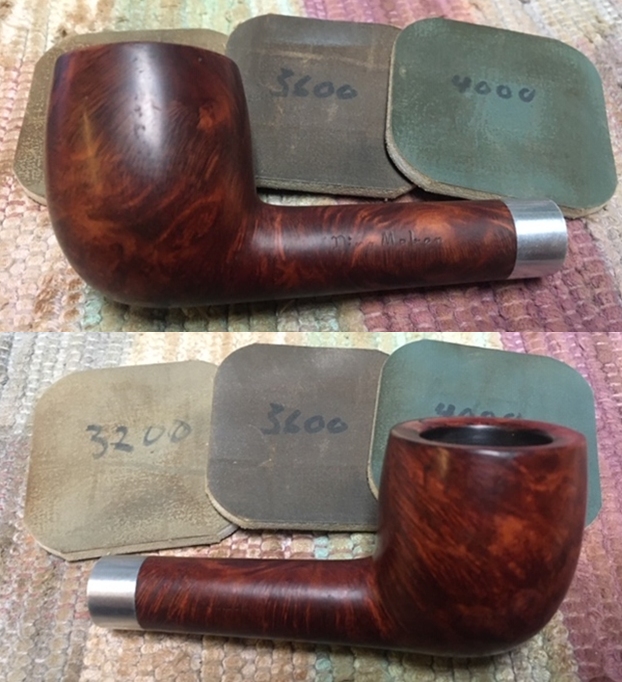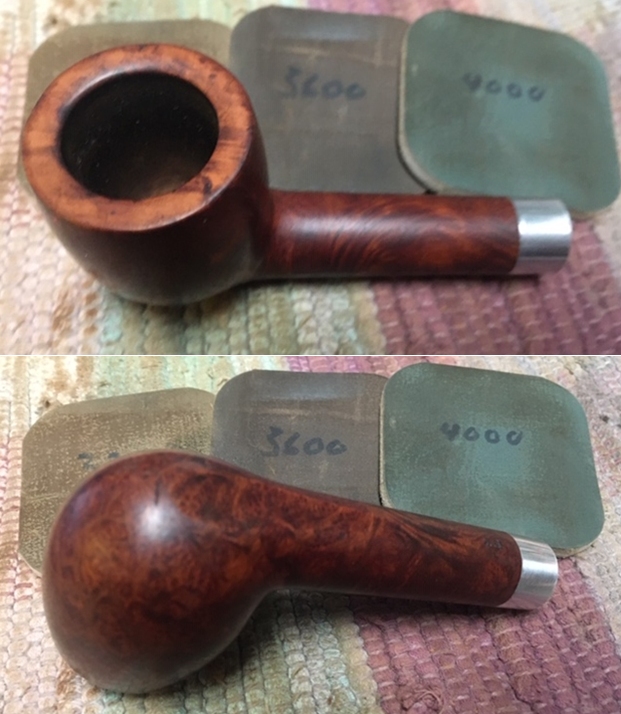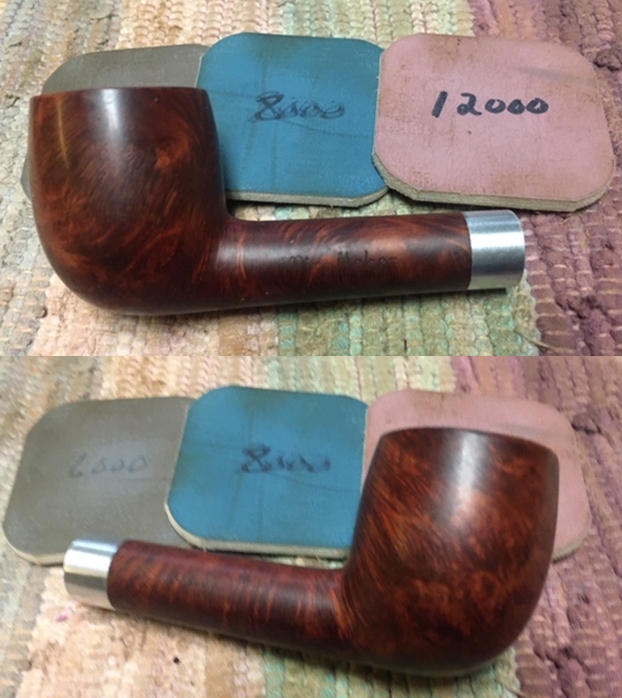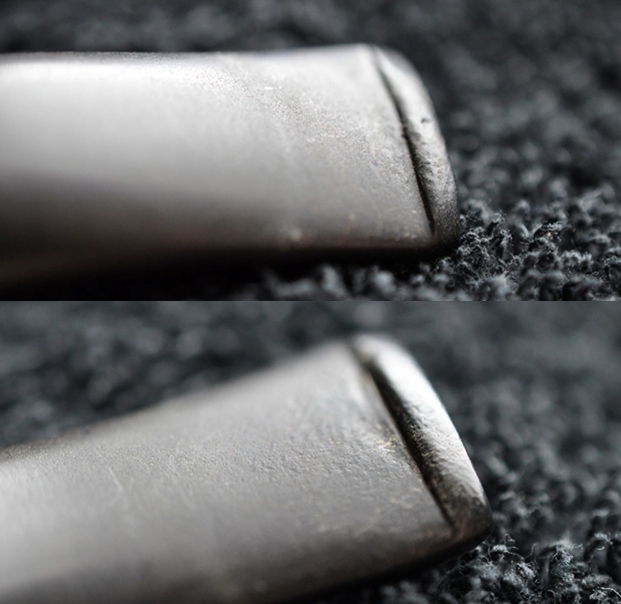
Tag Archives: shaping a stem

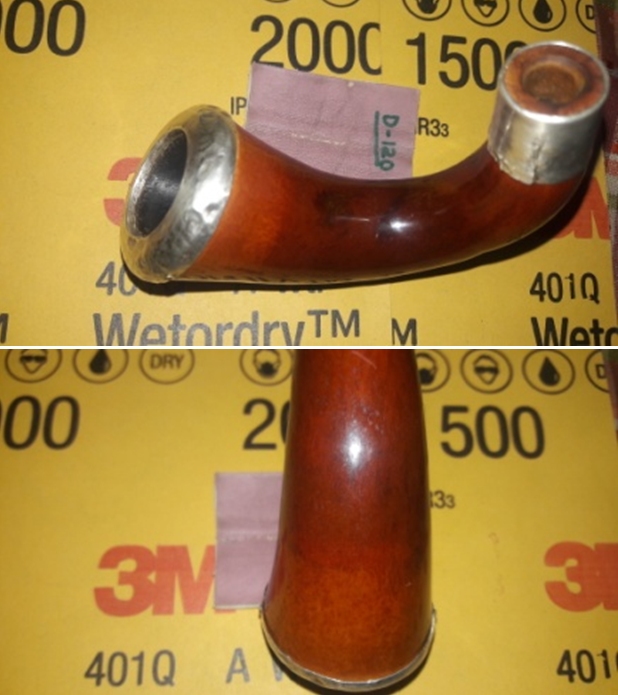
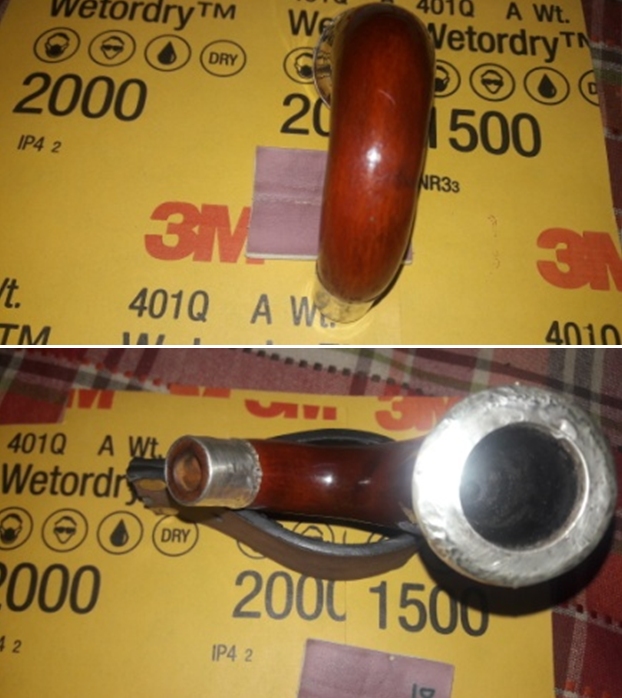
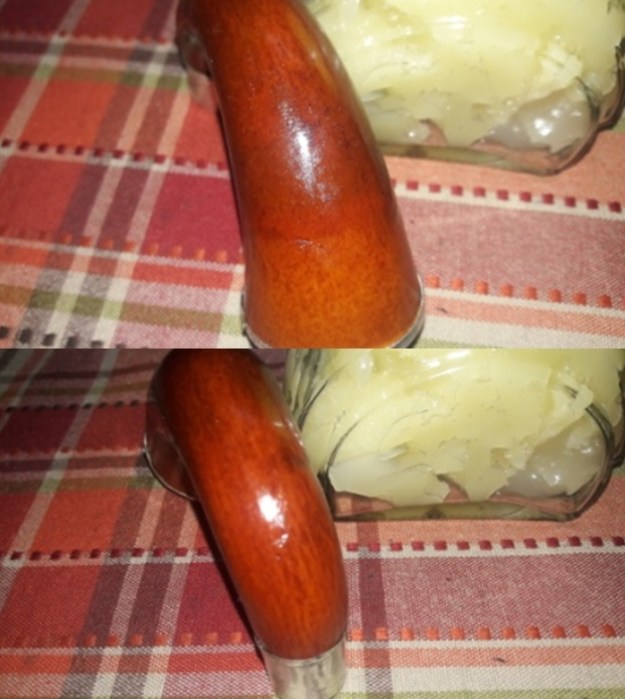
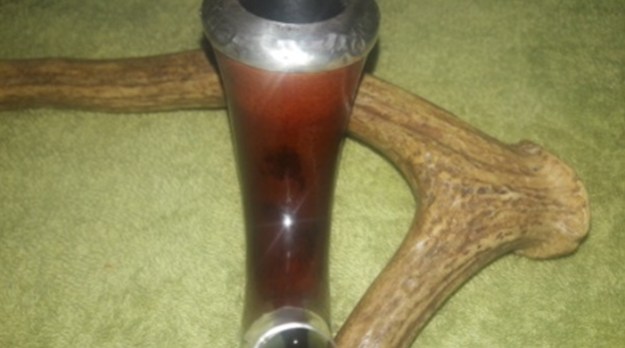
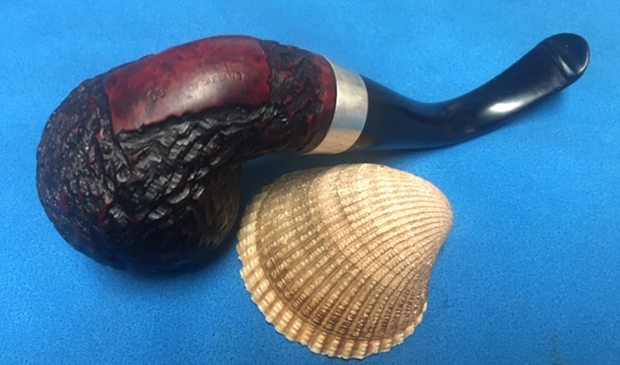
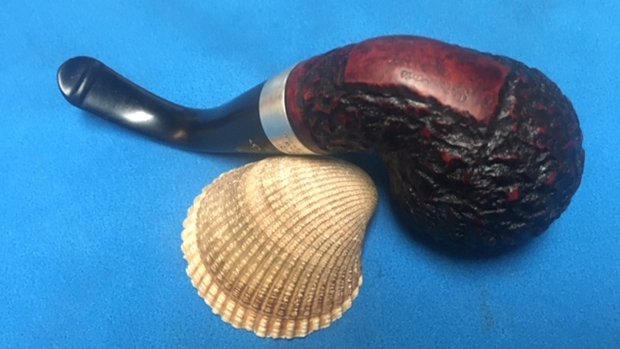
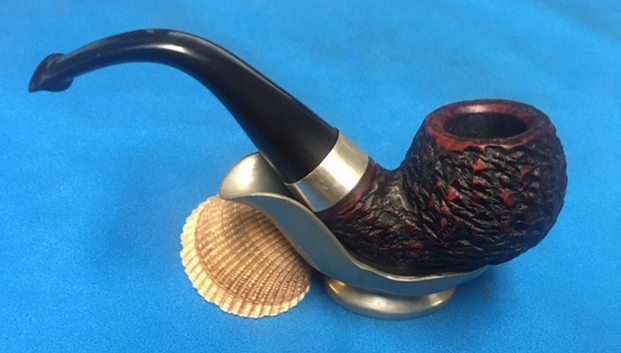
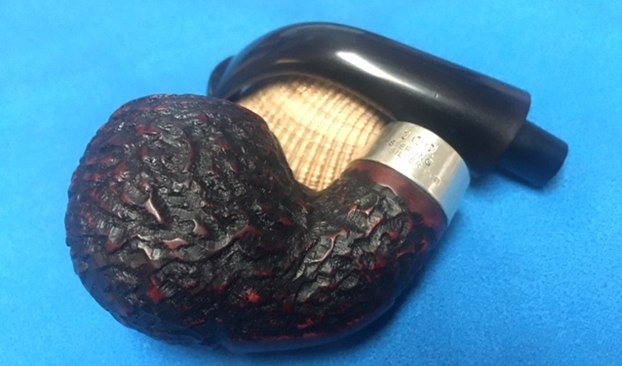
Back To Inherited Pipes And Restoring A 1912 W H Gourd Calabash


Blog by Paresh Deshpande

It’s been a while since I have worked on one of my inherited pipes as I have been busy with pipes from the estate pipe lots that have reached me from various sellers. Though these pipes had been fun to work on, I, at times, have a desire to work on inherited pipes.

The next pipe that has caught my attention is a gourd calabash and the only one to date, which was in one of the three very large boxes of pipes that I have inherited. Working on these old pipes is what I love the most because of the intrinsic connection I have with these pipes and the fact that once I pass away, these will be passed on to my kids as remembrance that their father had worked on restoring each of these vintage and priceless collection of pipes.

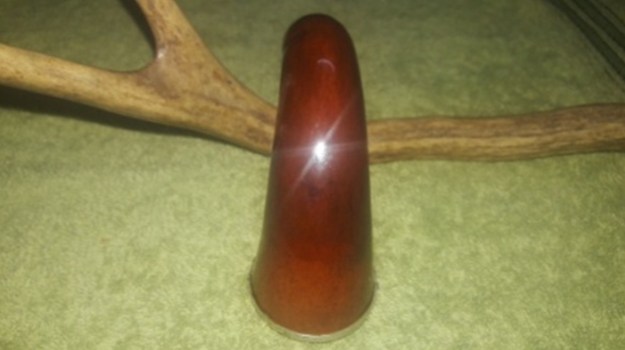
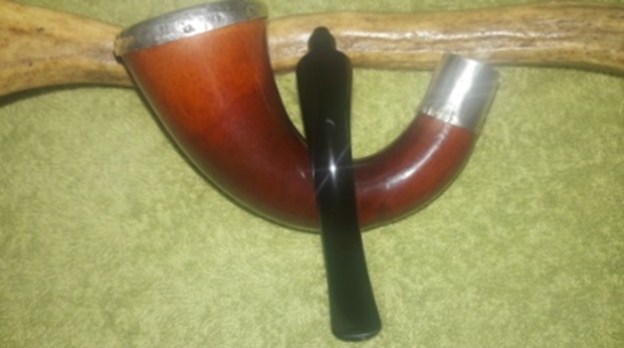
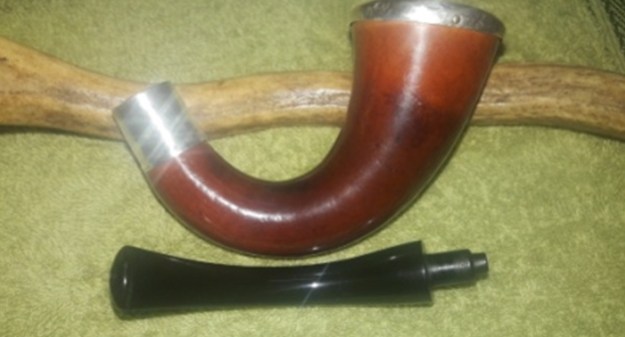
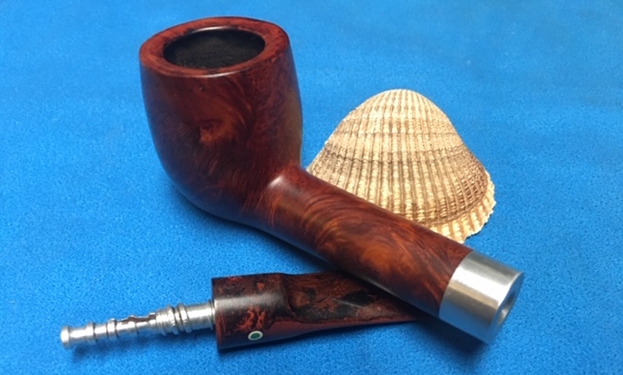
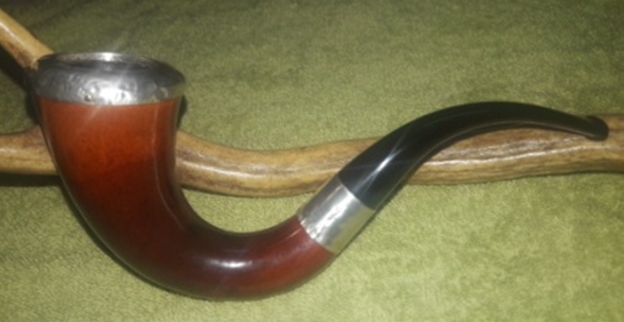
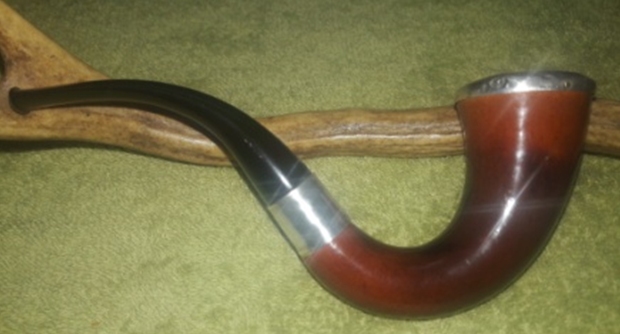
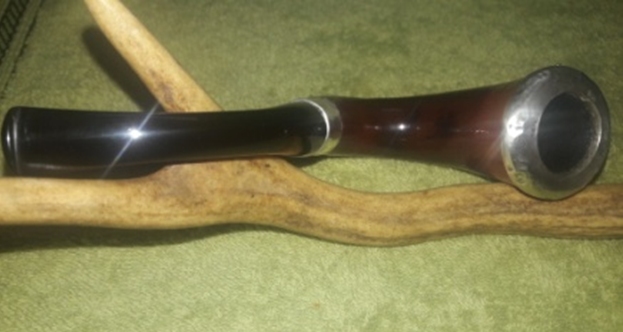
This gourd calabash is not very large in size, but big enough to have a great feel in the hand. The gourd has colored beautifully and has taken on a nice deep reddish brown color. The bowl sits flush with the gourd top and is covered in a Sterling Silver cap that is stamped as “W. H.” in a semi-circle followed by three sterling hallmarks, each in a cartouche. There is an anchor, a lion, and the lower case letter “n”. The anchor identifies the city of the manufacture of the silver to be Birmingham, England. The lion is the mark for 0.925 Sterling Silver and the letter “n” is the date stamp. A similar set of stampings are also seen on the sterling silver band at the shank end. The stampings are all crisp and prominent.The hallmarked sterling silver band and cap helps in the dating with great accuracy and the first site that I visit is www.silvercollection.it
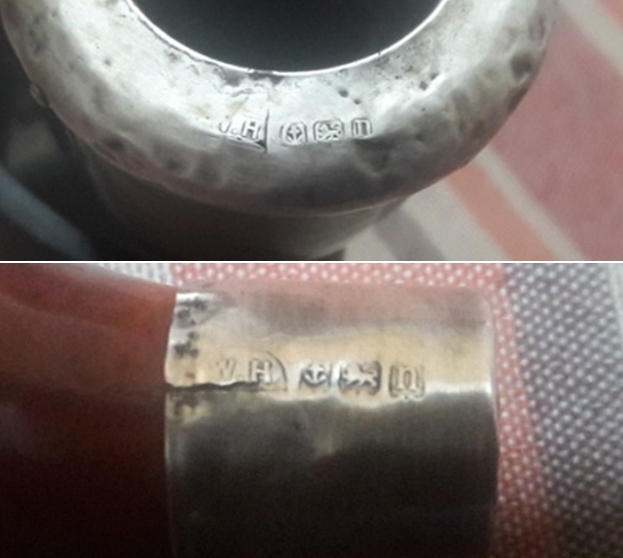
I browsed through the alphabetical listing of maker’s mark for W.H. in a semi circle and narrowed it down to William Harrison Active in London: various Harrison’s marks in Chester Assay Office were registered by Imperial Tobacco Co between 1907 and 1916. It is also known a fact that his marks are registered with the Birmingham Assay Office.Next I followed the link to the dating guide of the Birmingham Assay Office to date this pipe. I have included a hallmark chart for dating the pipe. I put a red rectangle around the letter for 1912. It is the same style of “n” and the cartouche that holds the letter stamp, matches the photo as well.Another source of information on William Harrison is reproduced below from the site  https://www.silvermakersmarks.co.uk/Makers/Chester-WD-WH.html#WH
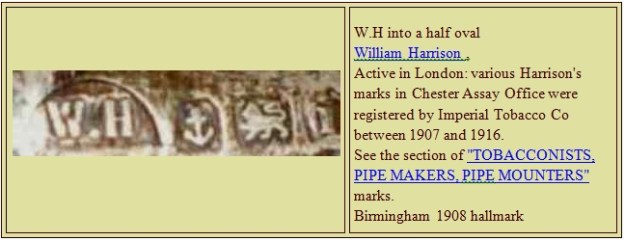


Thus, from the above, the pipe that I am now dealing with is from the tobacconist/ pipe maker/ pipe mounter William Harrison and dates to 1912!! This pipe is nearly 108 years old. With the provenance of the pipe now established, I move ahead with initial inspection of this old pipe.

Initial Visual Inspection
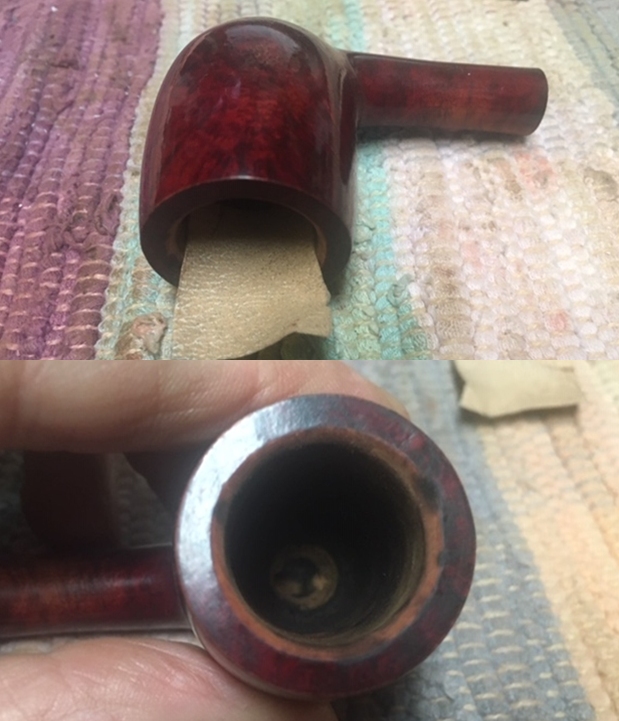
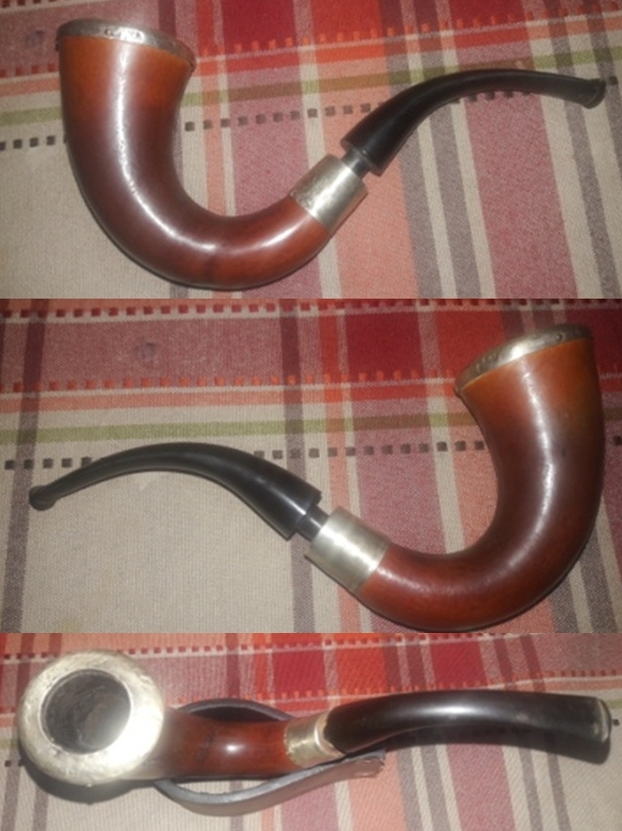
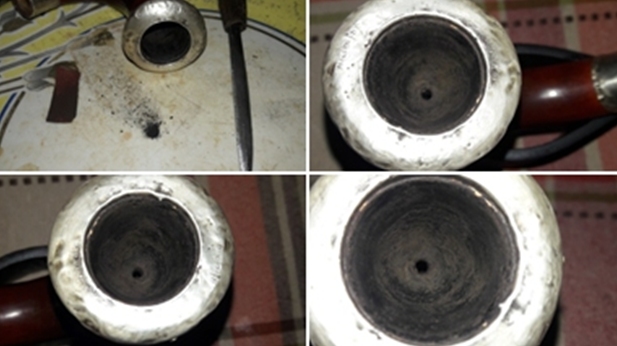
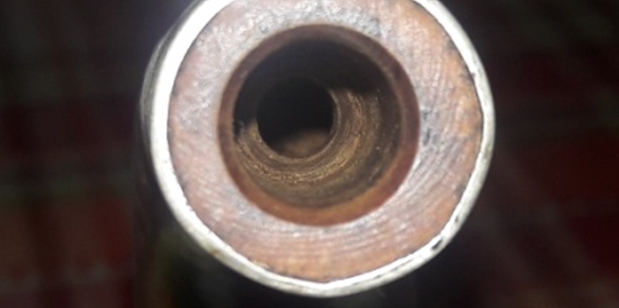
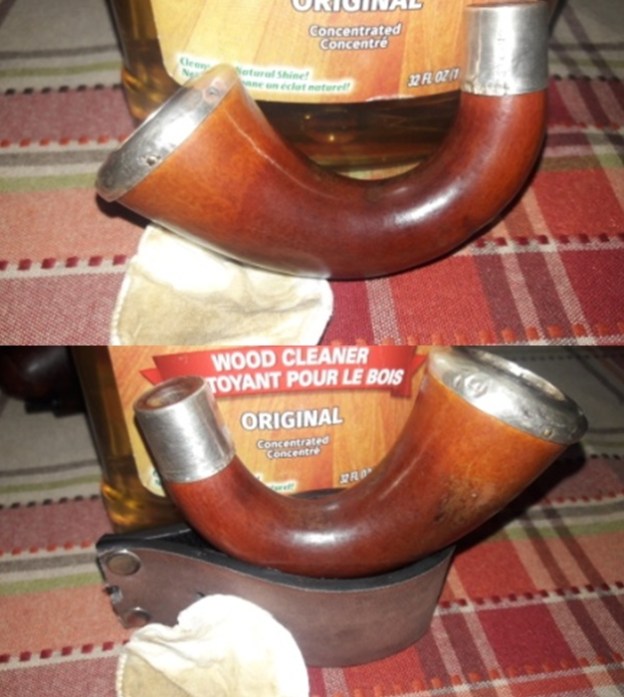
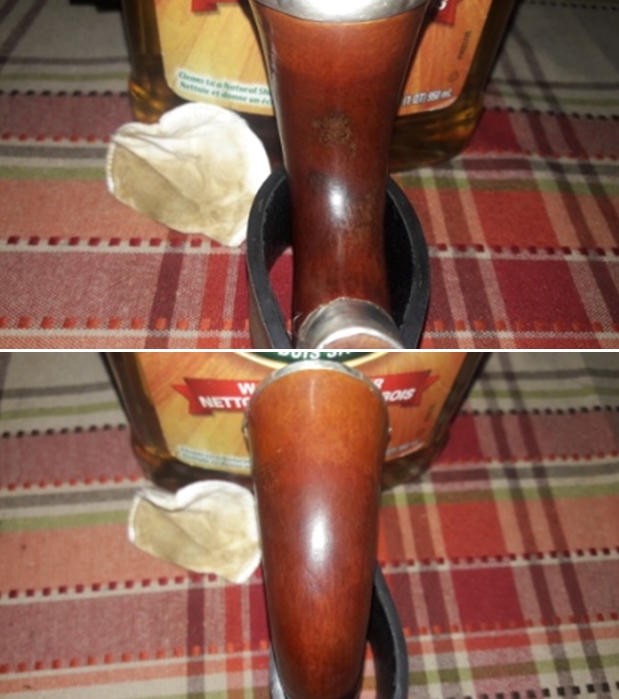
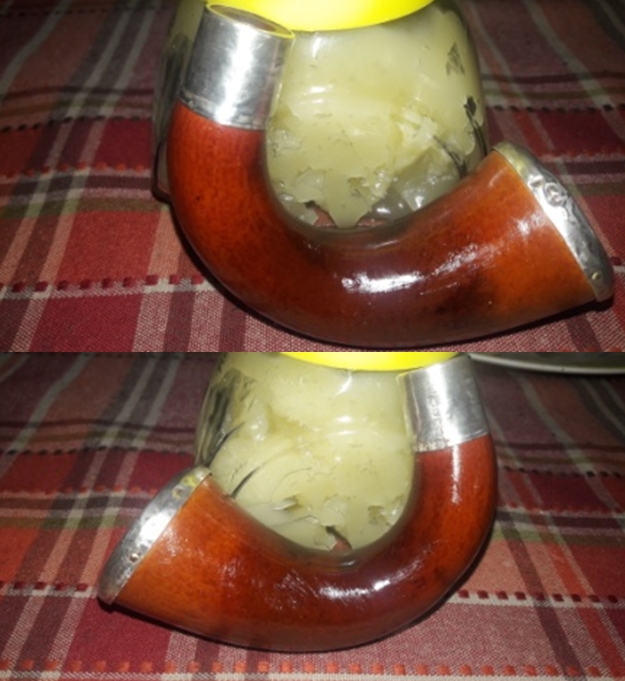
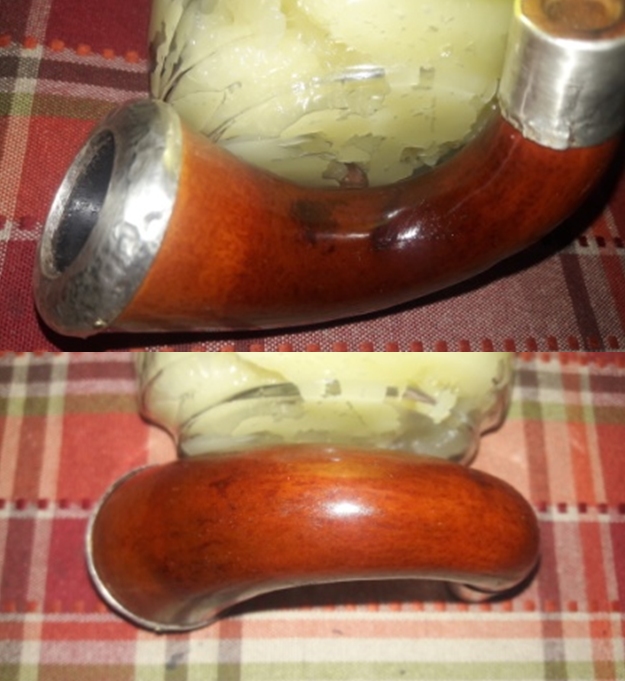
The pipe, as it sits on my work table, presents itself as a simple and straight forward refurbishing project. The gourd has developed a nice patina and taken on a deep red brown golden color. There is no damage to the gourd. This pipe should polish up nicely. The sterling silver rim cap and shank band have numerous dents and dings. A straight split to the silver shank band is seen on the right side. This split can be welded by my silversmith, but that can happen only after the lockdown and social distancing norms have relaxed somewhat. The vulcanite stem does not seat completely into the shank. This issue should be addressed once the mortise has been thoroughly cleaned. Here is how the pipe appears at this stage. The bowl on this calabash is flush with the gourd rim top. Native South African calabashes imported to the UK had bowl linings of gypsum pressed into the gourd. Since the rims of a gypsum bowls were somewhat inelegant, retailers fit them with sterling rim covers– a practice they continued even after they began to employ meerschaum for the bowl linings. Given the vintage of this pipe, the bowl could either be clay or gypsum or even a meerschaum. There is a decent layer of dried and crusted cake in the chamber. The draught hole is at the bottom, dead center and somewhat constricted by the cake. The bowl is held in place by a Sterling Silver rim cap that is riveted in to the gourd and unmovable without damaging the gourd. The sterling rim cap is tarnished and has numerous dents and dings and a light overflow of lava over the surface. The stampings on the rim cap are crisp and easily readable but with the beginnings of wearing off at the ends. I need to be careful with my polishing of the sterling cap. The gourd surface has beautiful color and it will be my endeavor to preserve the patina that has developed on the surface due to smoking. The surface is covered in old oils, tars, grime and dirt from all these years. There is no damage to the gourd surface and that’s a big relief. This piece of gourd will look stunningly beautiful and rich once it has been cleaned and polished. The bowl is fixed to the gourd with sterling rim cap and is riveted in place. These rivets have a little play but still have many years of careful use ahead. The mortise and the gourd internals are filthy to say the least and no surprises here. Heavy accumulation of oils, tars and grime are seen within the mortise and also within the gourd. This is adversely affecting the seating of the stem in to the mortise. Cleaning the internals of a calabash is always challenging and this one more so, as the bowl is permanently fixed to the gourd.The tapered vulcanite stem is heavily oxidized. Deep tooth indentations are seen in the bite zone on either surfaces of the stem. The round orifice is correct for the vintage of this pipe and shows accumulated oils and tars. The button edges need to be sharpened. The tenon is also covered in oils, tars and grime. The air way is clogged and will need to be cleaned. The Process
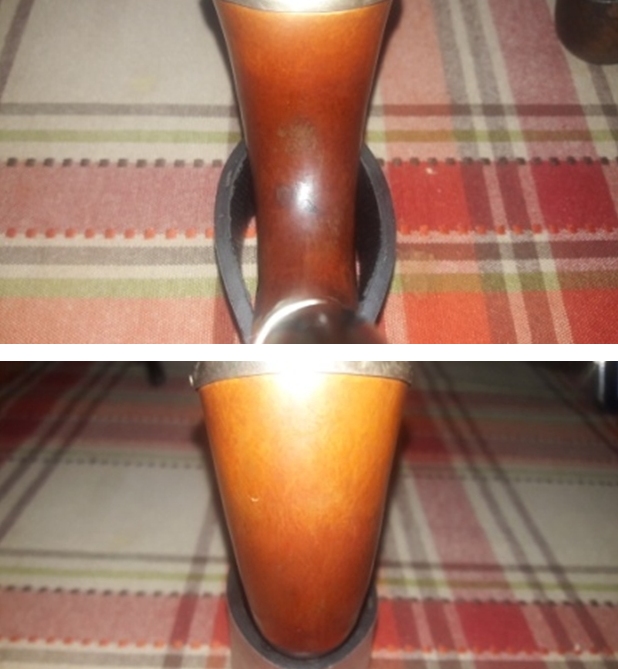
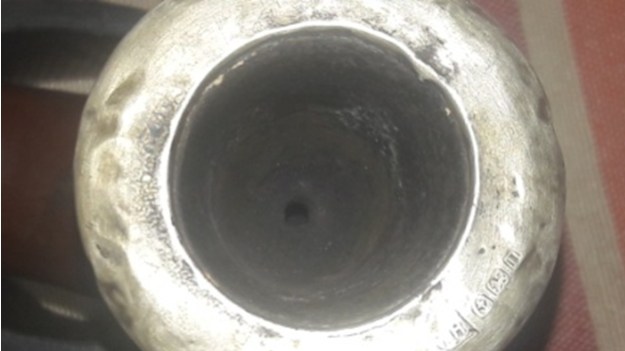
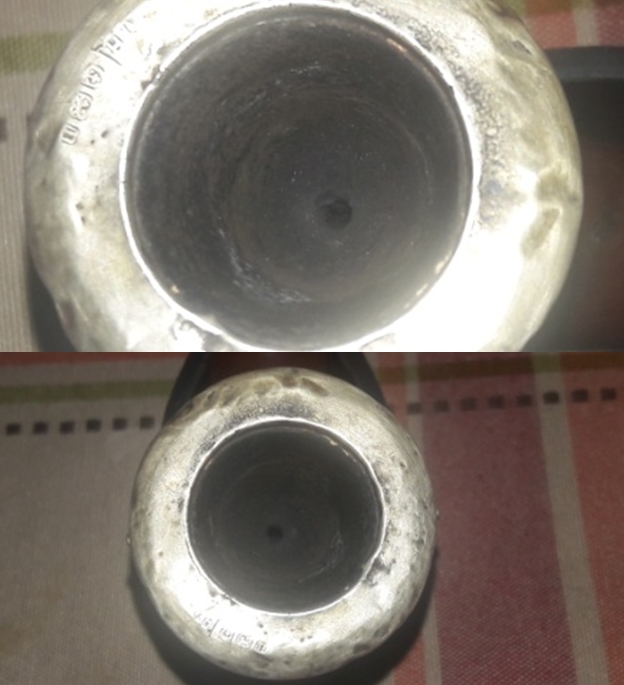
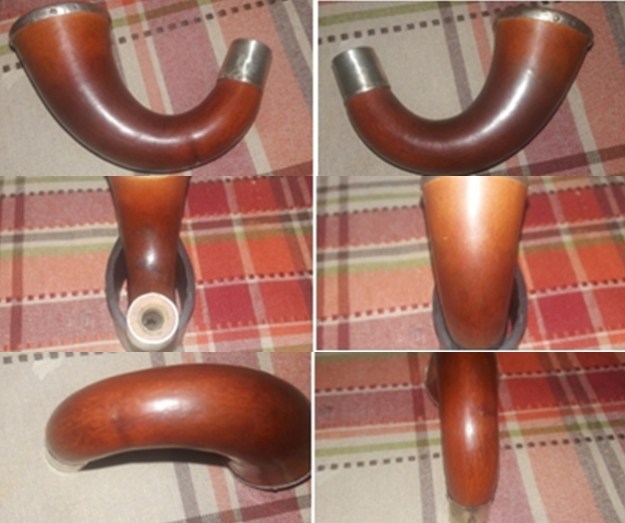
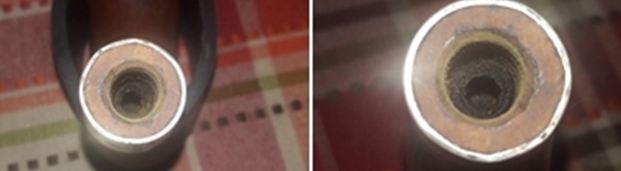
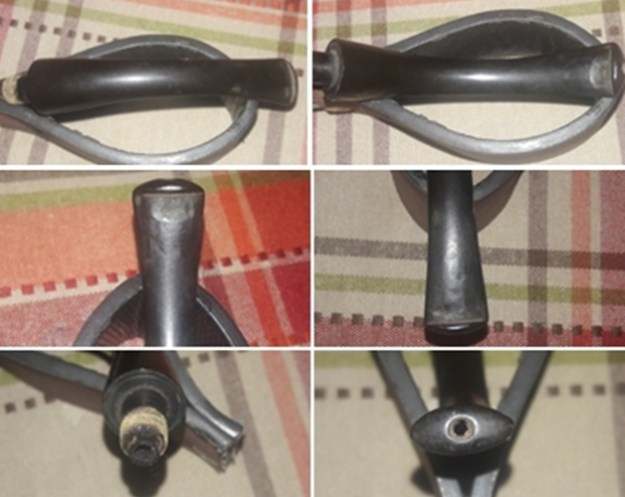
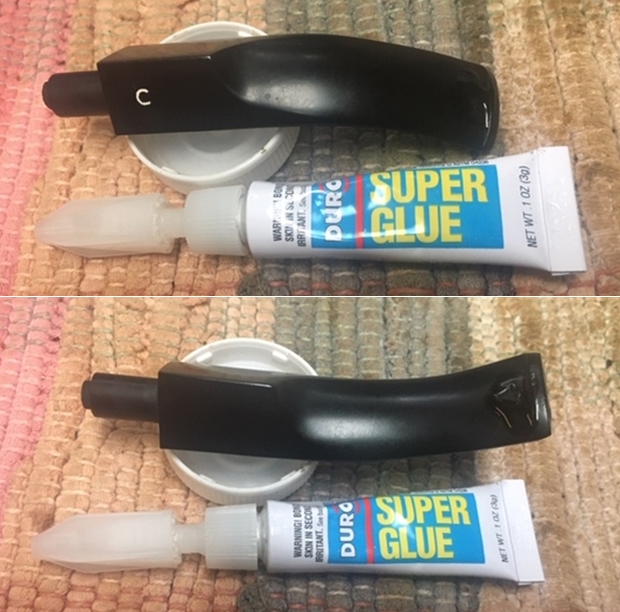
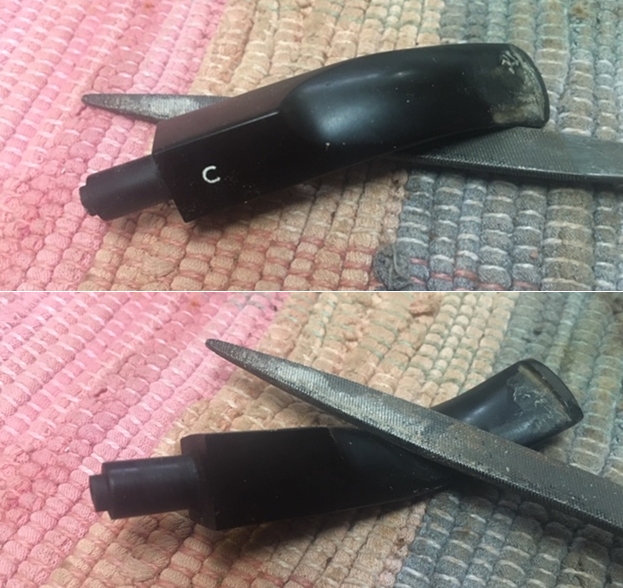
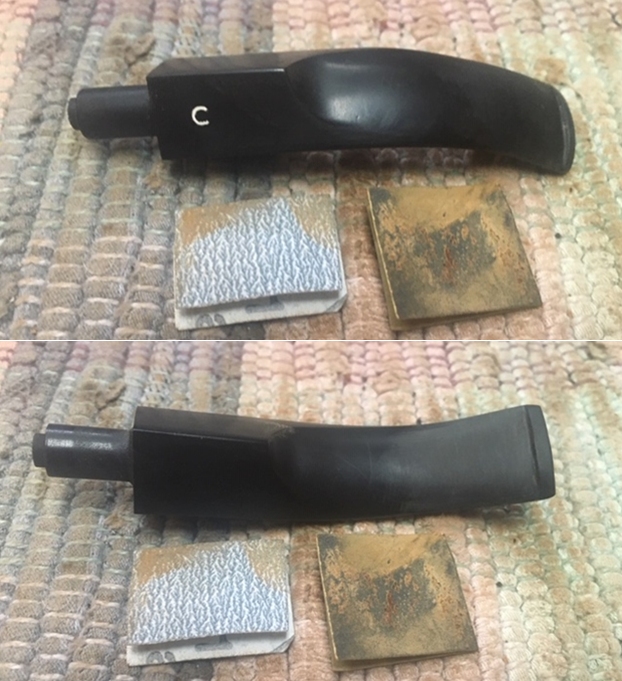
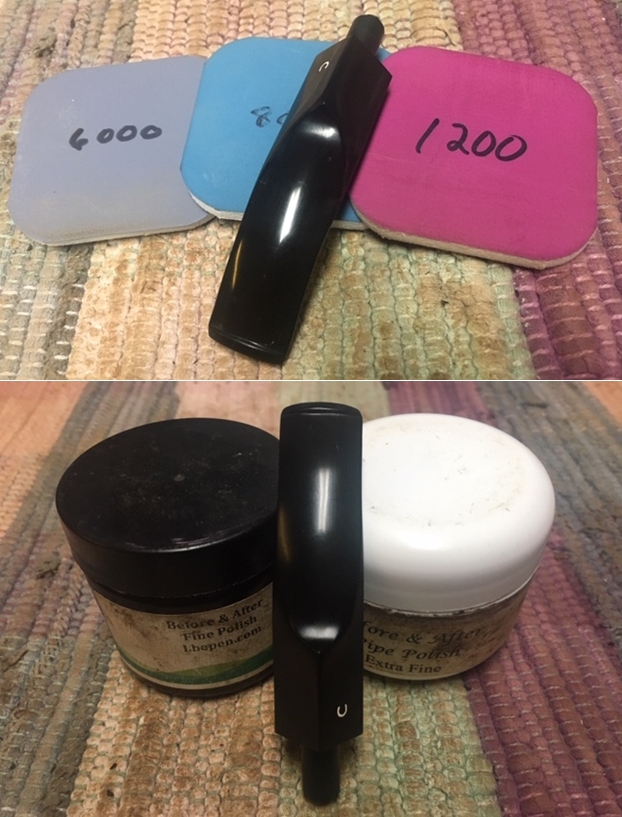
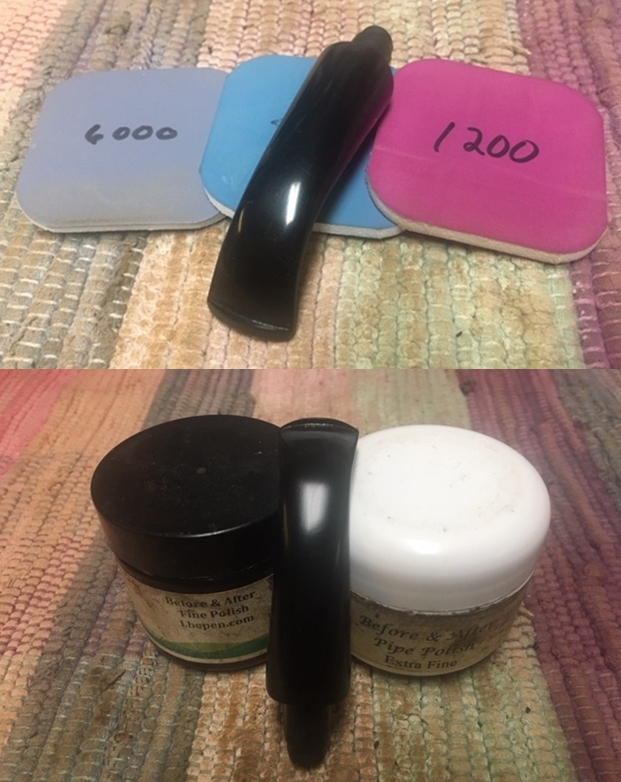
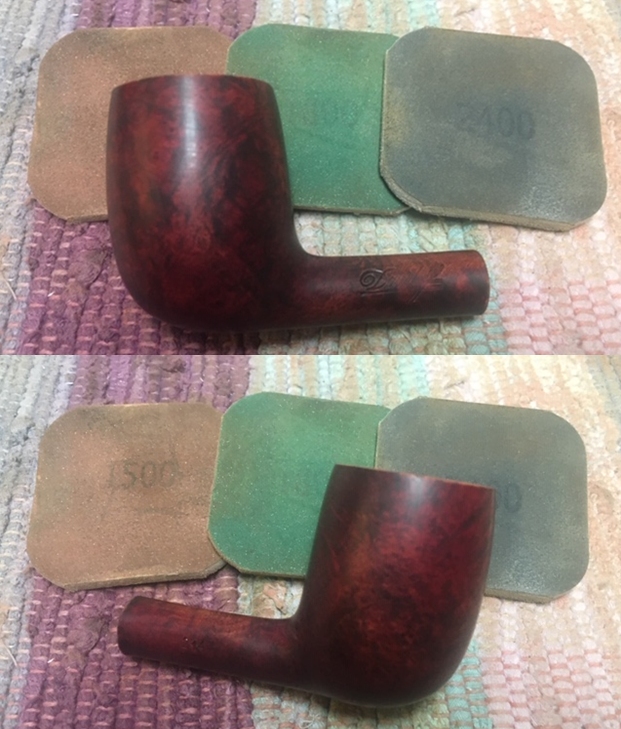
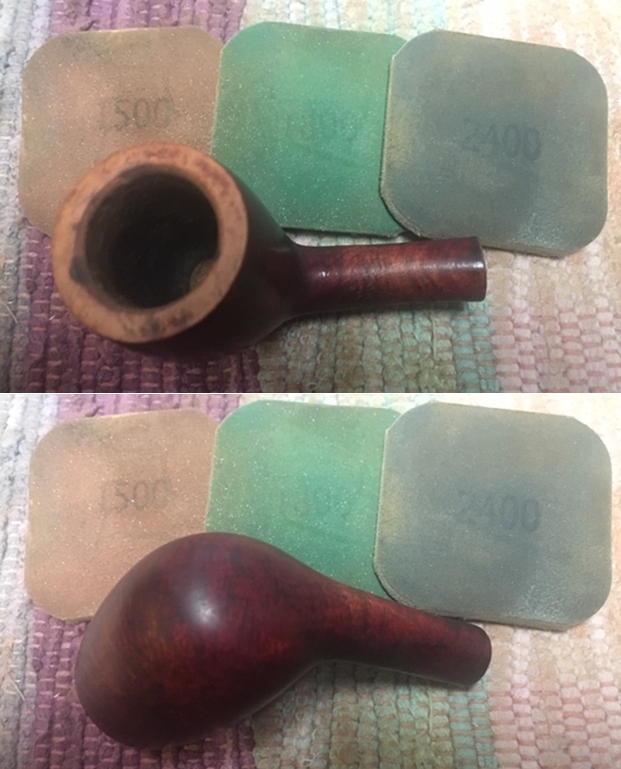
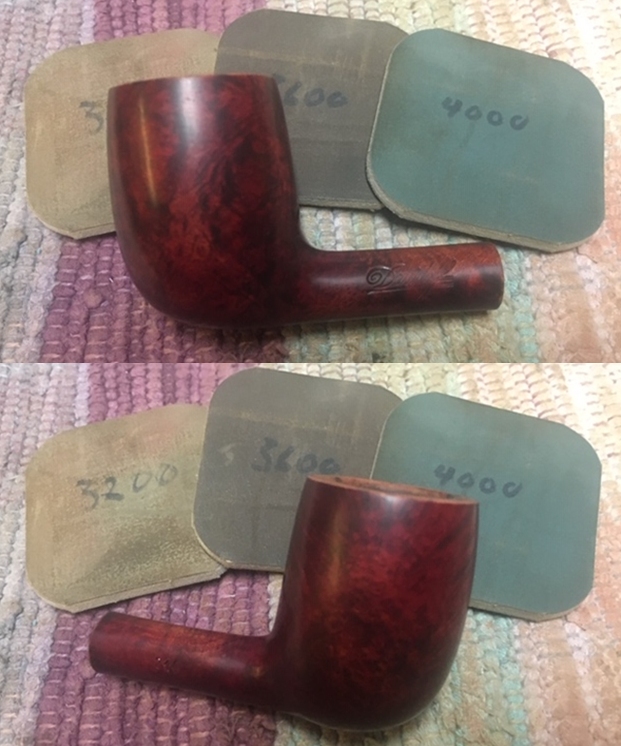
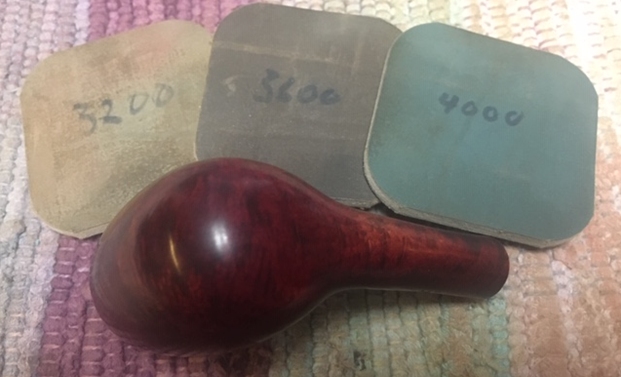
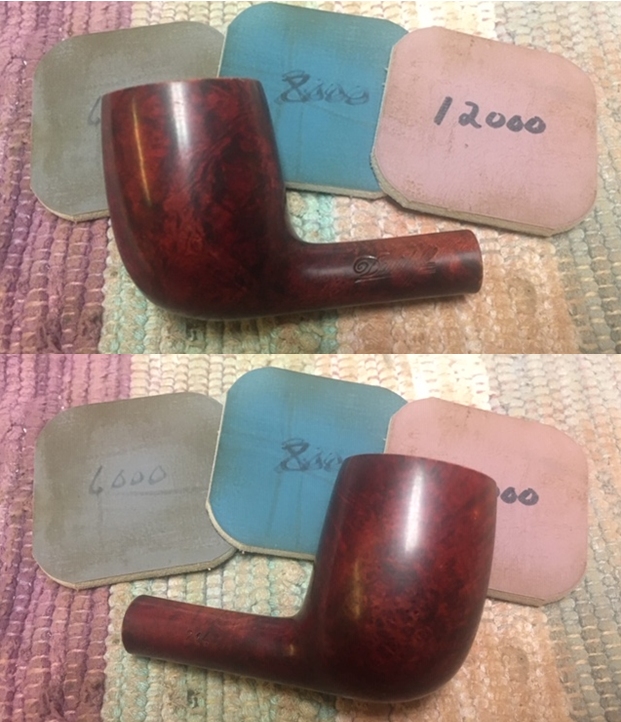
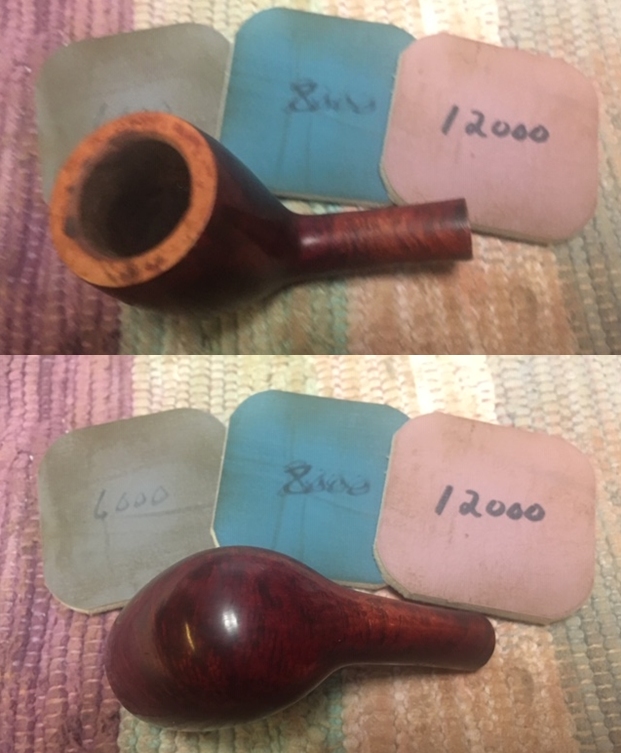
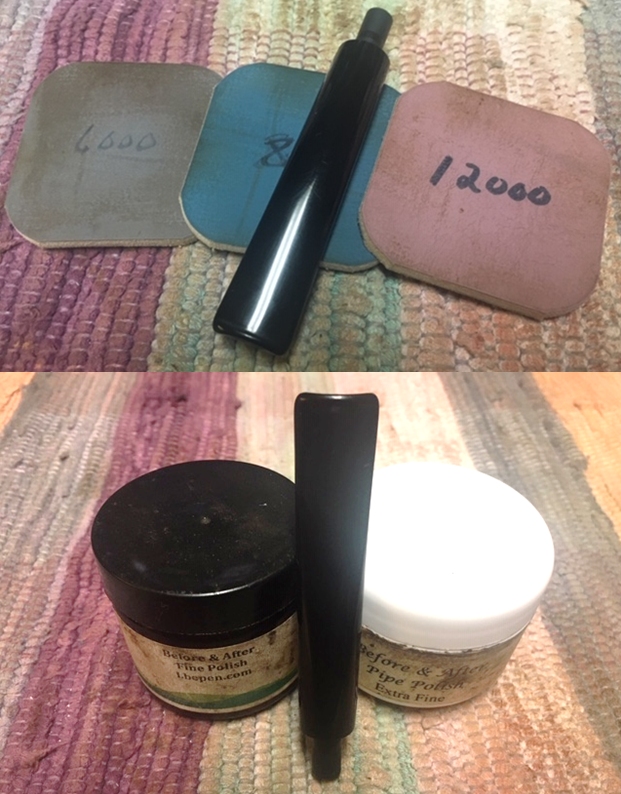
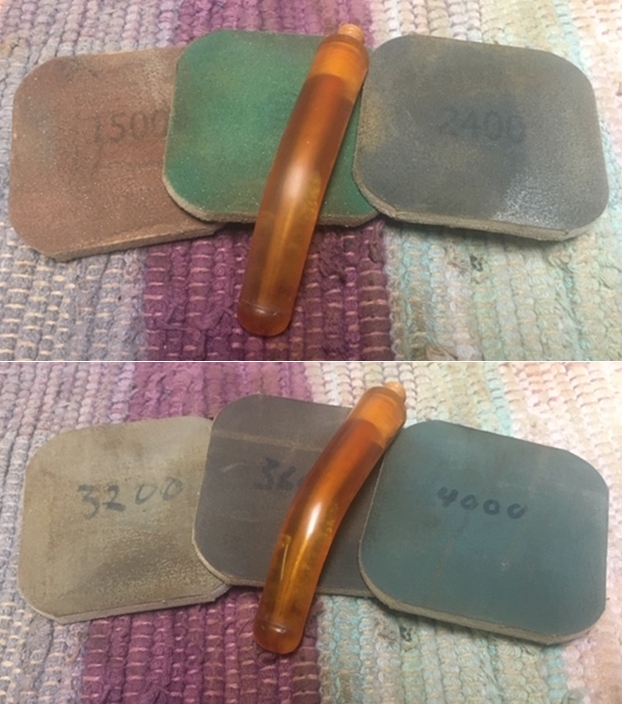
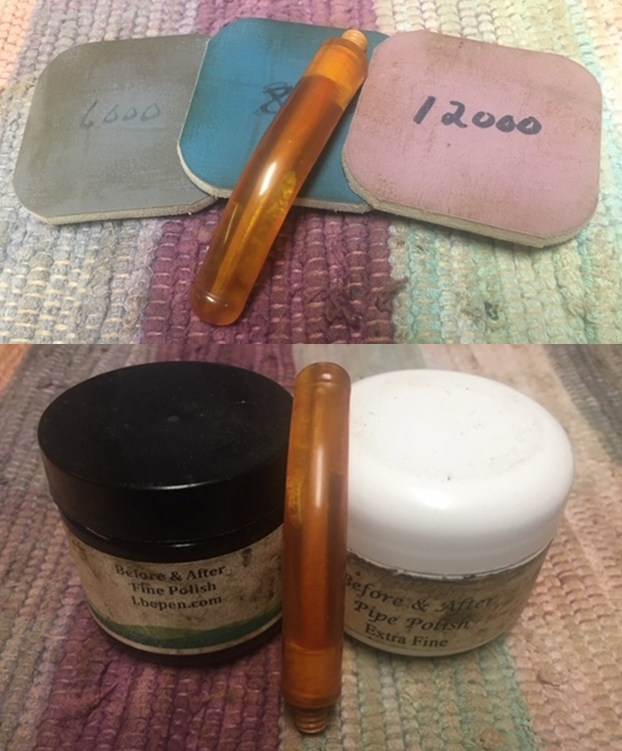
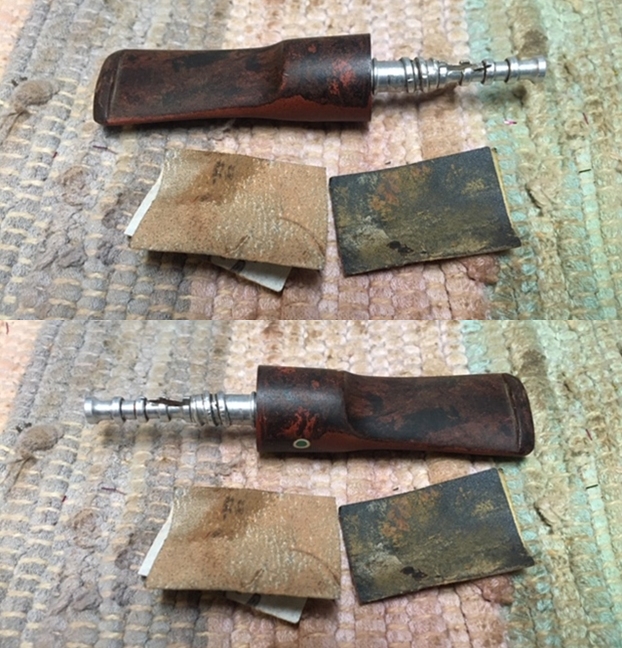
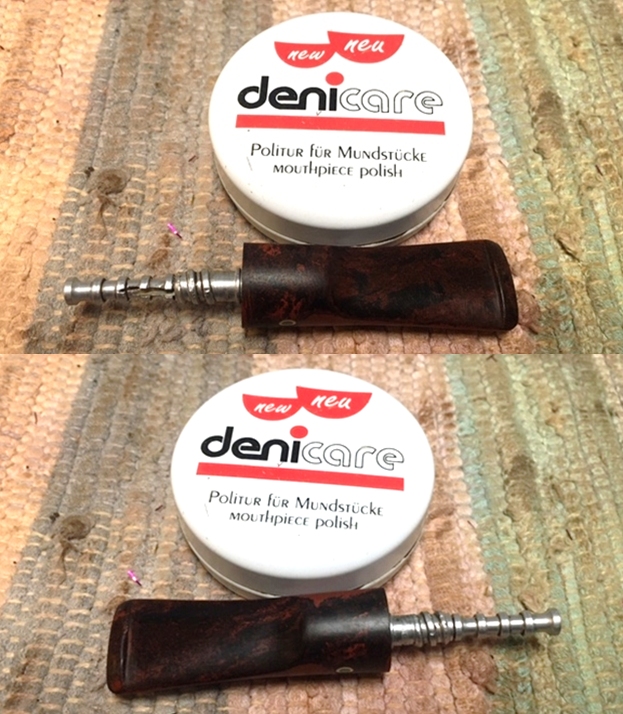
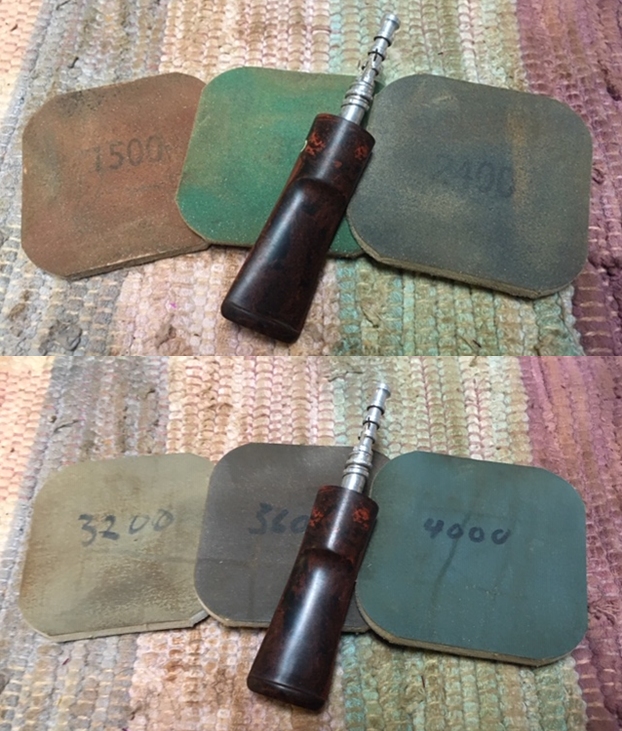
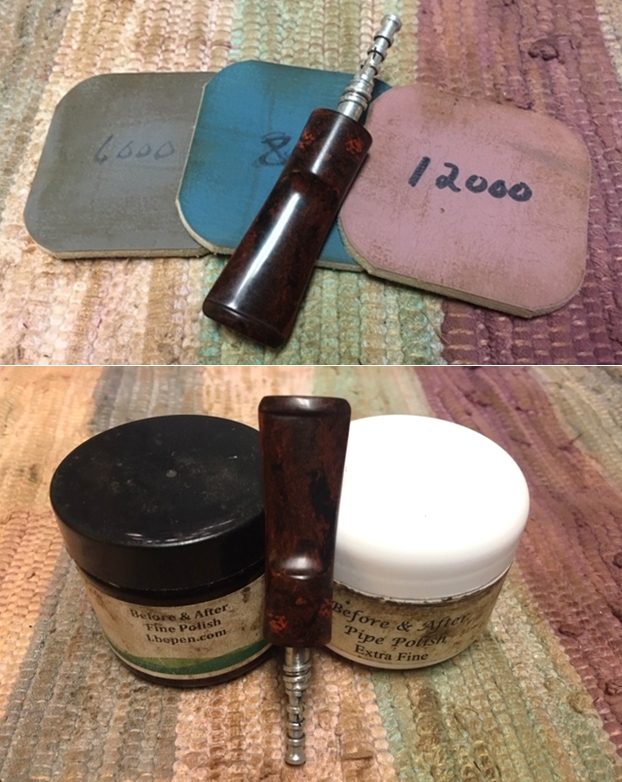
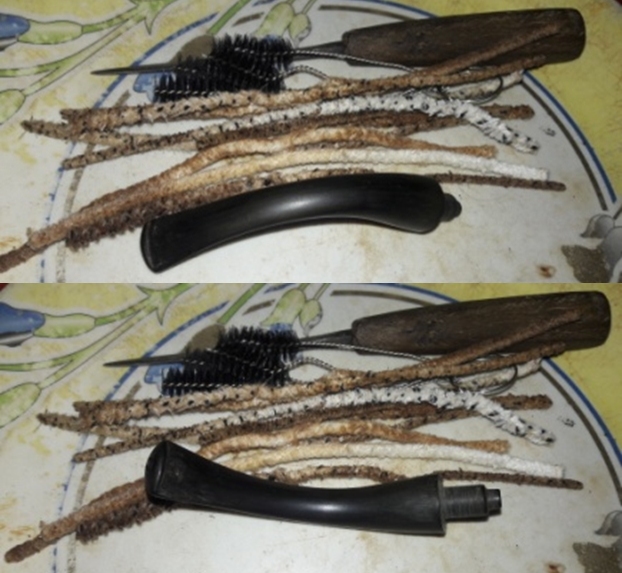
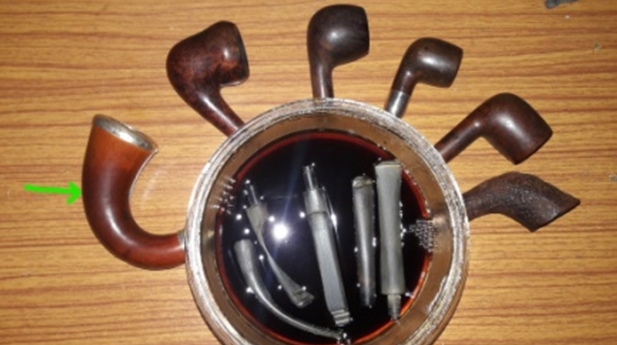
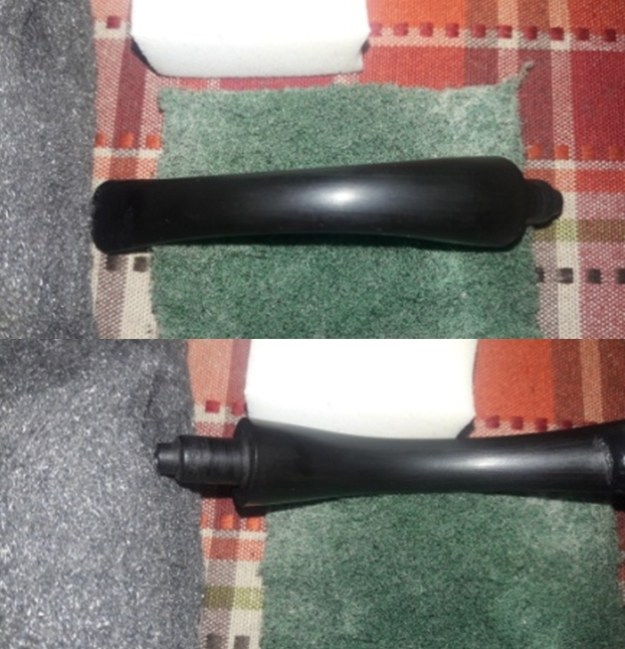
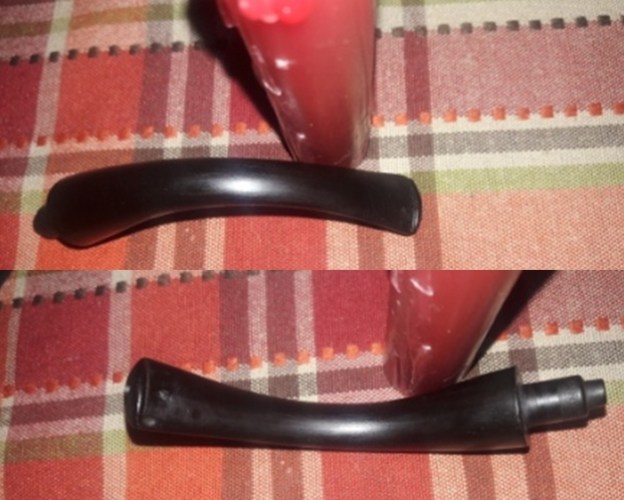
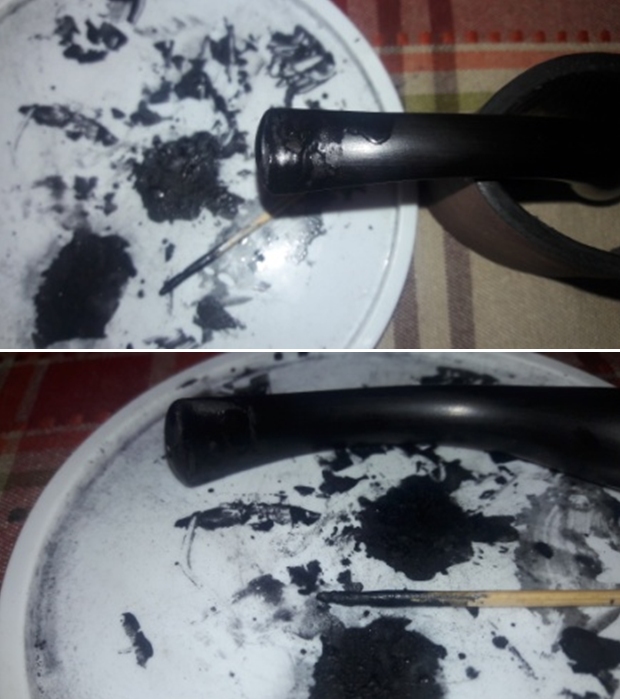
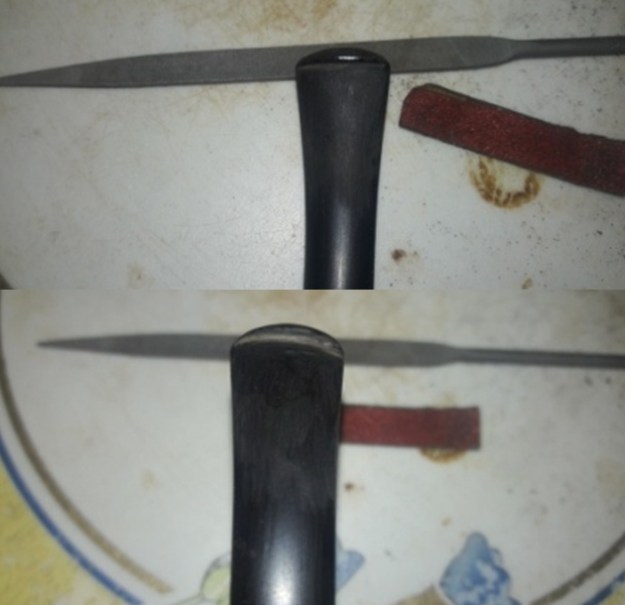
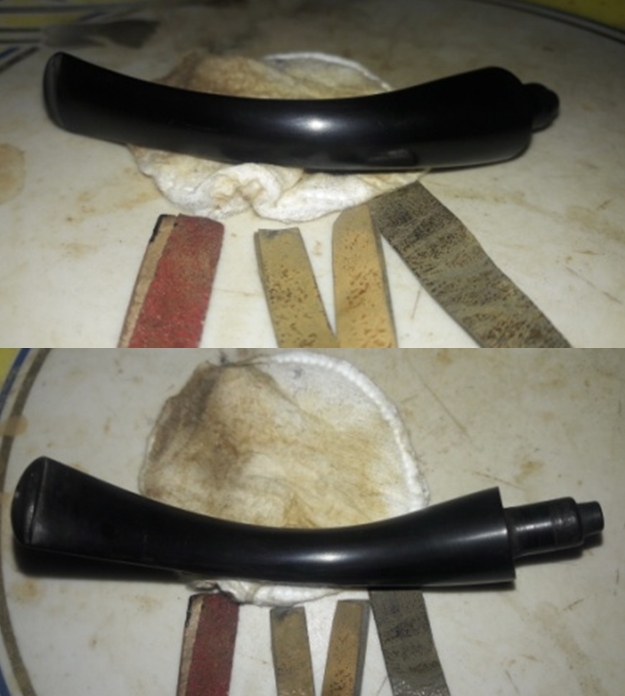
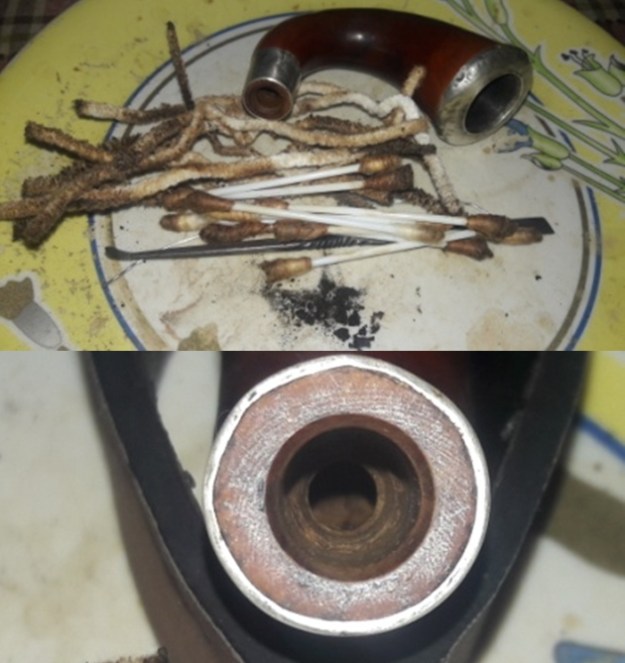
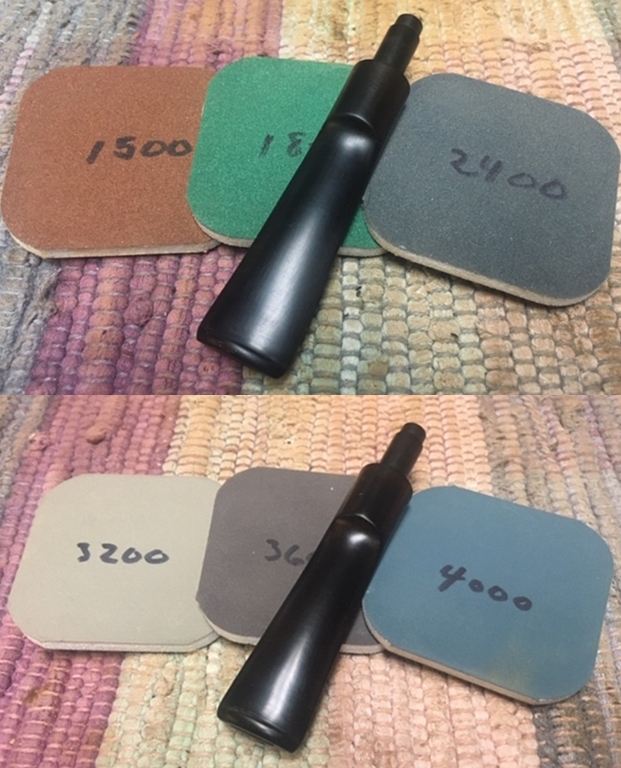
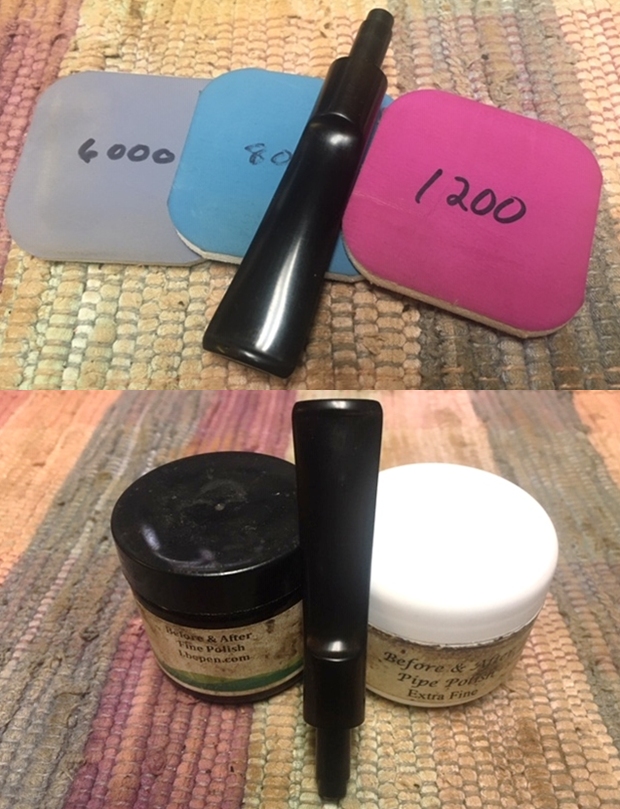
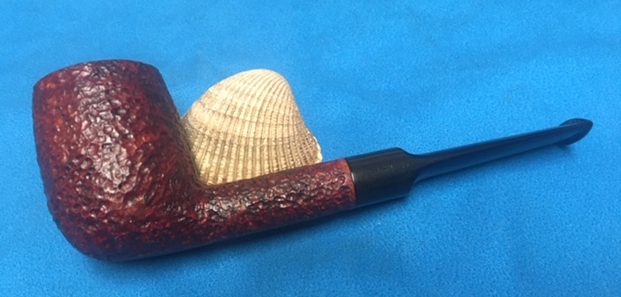
The process of refurbishing this pipe started with the cleaning of the stem. Abha, my wife, cleaned the stem air way with regular and bristled pipe cleaners dipped in 99.9% pure isopropyl alcohol. She further cleaned the stem internals with thin shank brushes and dish soap to remove the stubborn and thick gunk from within the airway. The heap of pipe cleaners and their appearance tells a sordid story. With my sharp fabricated knife, she scraped off all the dried tars and gunk from the tenon end.Once the stem internals had been cleaned, I gently sand the stem surface with a used piece of 220 grit sand paper and immersed it in “Before and After Deoxidizer” solution along with the stem of other pipes in line for restoration. It has been our experience that before immersing the stem in to the stem deoxidizer, light sanding of the stem with a folded piece of 220 grit sand paper loosens the oxidation a bit and helps get fantastic end results.Simultaneously while Abha was working on the stem, I reamed the bowl with my fabricated knife to clean up the chamber. I used a 220 grit sand paper, pinched between my thumb and forefinger, to sand the inner walls of the chamber of the pipe. Once I had reached the bare walls, I wiped the chamber with a cotton pad dipped in isopropyl alcohol. This removed all the residual carbon dust and also rid the chamber of all ghost smells. The walls of the chamber are nice and solid with no signs of heat fissures or cracks. I ran a couple of hard bristled pipe cleaners dipped in isopropyl alcohol through the draught hole and thoroughly cleaned it.The next morning, Abha removed the stems that had been soaking in the deoxidizer solution overnight. She cleaned the stem under running warm water and scrubbed the raised oxidation from the stem surface using a Scotch Brite pad. She further removed the oxidation by scrubbing the stem with 0000 grade steel wool and applied a little olive oil to rehydrate the stem.The deep tooth indentations are now clearly visible and I decided to address these issues at this stage. Since I did not have a lighter (I generally prefer to use it for this purpose), I used a lit candle instead. The result is equally good; however, one has to be doubly careful as the heat from a candle flame is more intense as compared to a lighter. These tooth indentations were raised to the surface to some extent due to the heating; however, it would require a fill to complete the repairs.I prepared a mix of CA superglue and activated charcoal and carefully applied it over the damaged bite zone on both surfaces and lip and set it aside for curing over night. I had applied this mix in sufficient thickness which would help during the filing and sanding to match the fills with the stem surface and shaping the button.Using a flat head needle file, I reshaped the button and followed it up by sanding the stem with a folded piece of 220 grit sand papers. I followed it up by further sanding the stem with 320, 600 and 800 grit sand papers. Once I was satisfied that the fills had perfectly matched with the rest of the stem surface, using micromesh pads, I completed the polishing cycle by wet sanding the surface with 1500 and 2000 grit sand papers and further dry sanding with 3200 to 12000 grit pads. The stem looks great with the fills nicely matched with the rest of the surface. I rub a little quantity of Extra Virgin Olive oil into the stem surface. While I was working on the stem repairs and subsequent polishing, Abha cleaned out the mortise and gourd internals using pipe cleaners, q-tips and alcohol. She scraped out the accumulated dried oils, tars and gunk from the mortise using fabricated tool. The mortise was finally declared clean by Abha after a few hours and lots of elbow grease, the pile of pipe cleaners and the chunks of grime removed from the mortise are a standing testimony to the filth in the pipe. The pipe now smells clean and fresh. At this point in time, the internal cleaning of the stem, mortise and gourd is completed. The stem repairs and polishing is also completed. Next I decided to clean and polish the gourd. I cleaned the external surface of the gourd with Murphy’s Oil soap on cotton swabs. I wiped the surface with a moist cloth and set the gourd aside to dry out completely. After the gourd had dried out, I polished the gourd surface with micromesh pads. There was a small twist though! The 1500 to 2400 grit micromesh pads in the set that were left behind at home (remember that my home and work place are at different corners of the country!) have completely worn down. Since most of my material and equipment that I use for pipe restoration is at my work place, I substituted the 1500 to 2400 grit pads with 1500 and 2000 grit wet or dry sand paper. I find that these work just fine. I wanted to preserve the patina and deep coloration that has developed on the gourd surface, I dry sand the stummel surface with 1500 (sand paper) to 12000 grit micromesh pads. This is starting to look really nice. With Colgate tooth powder, I cleaned the sterling silver rim cap and shank band to a nice shine and yes, I avoided rubbing the powder over the stampings and hallmarks to prevent them from wearing down.Next, I rub a small quantity of “Before and After Restoration Balm” in to the gourd with my finger tips and let it rest for a few minutes. The balm almost immediately works its magic and the gourd now has a nice vibrant appearance with the beautiful darkened colors on full display. I further buff it with a horse hair shoe brush. To apply the finishing touches, I mount a cotton cloth buffing wheel on to my hand held rotary tool and apply a coat of Blue Diamond to the stummel and the stem to polish out the minor scratches. With a cotton buffing wheel that I use for carnauba wax, I apply a coat of carnauba wax and continue to work on it till the complete coat of wax had been polished out. I mount a clean cotton cloth buffing wheel and give the entire pipe a once over buff. I finish the restoration by giving the entire pipe a rigorous hand buffing using a microfiber cloth to raise the shine further. The finished pipe looks beautiful and is ready to be added to my restored pipe collection. When, or if at all I will, smoke this pipe only time will tell!! Here are the pictures of the refurbished pipe.
A Rusticated Savinelli Oscar 127 Saddle Stem Billiard


Blog by Steve Laug

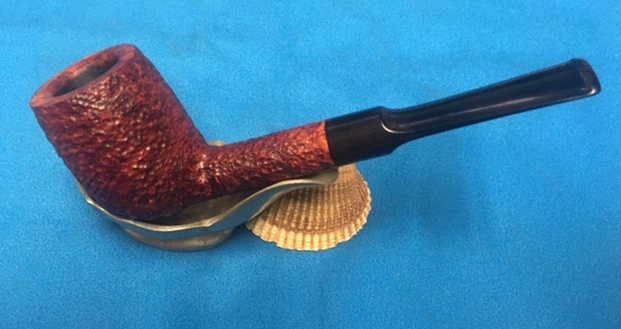
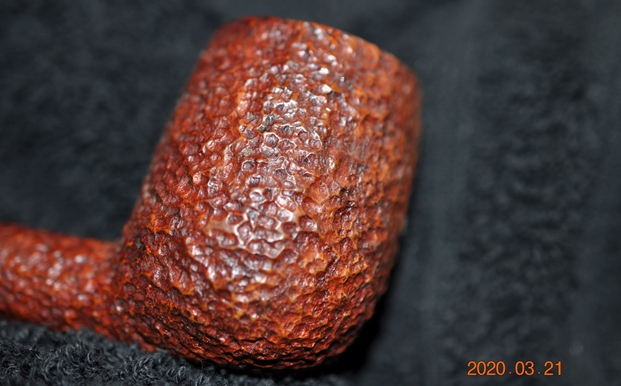
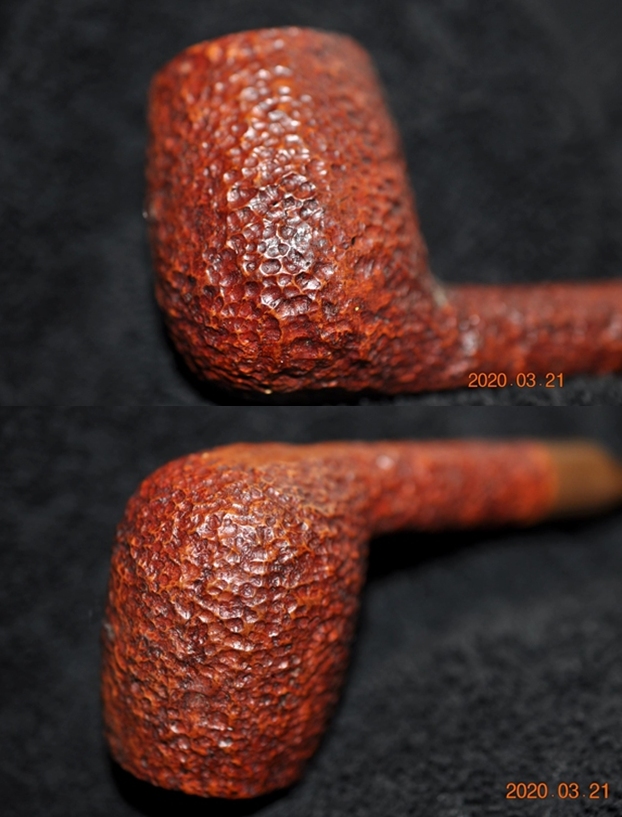
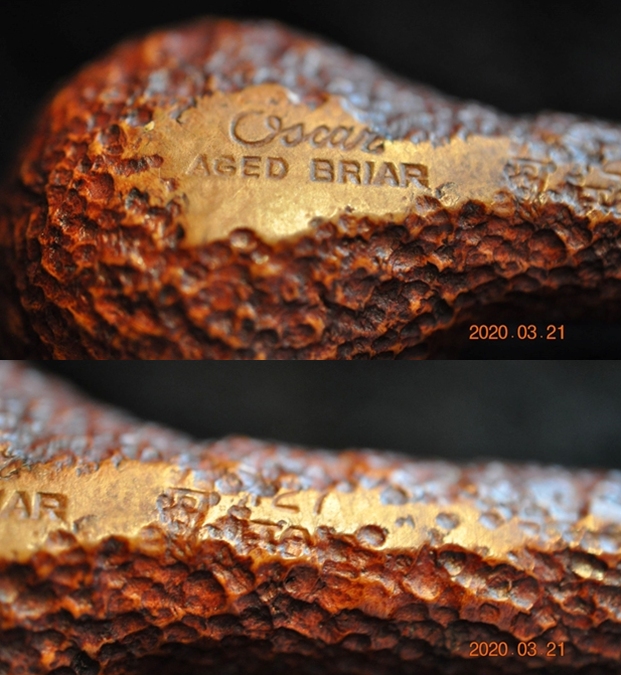
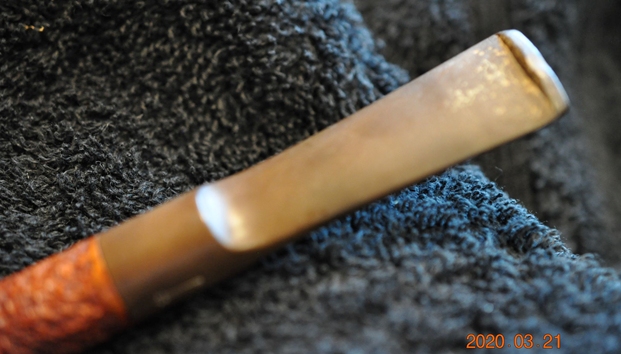
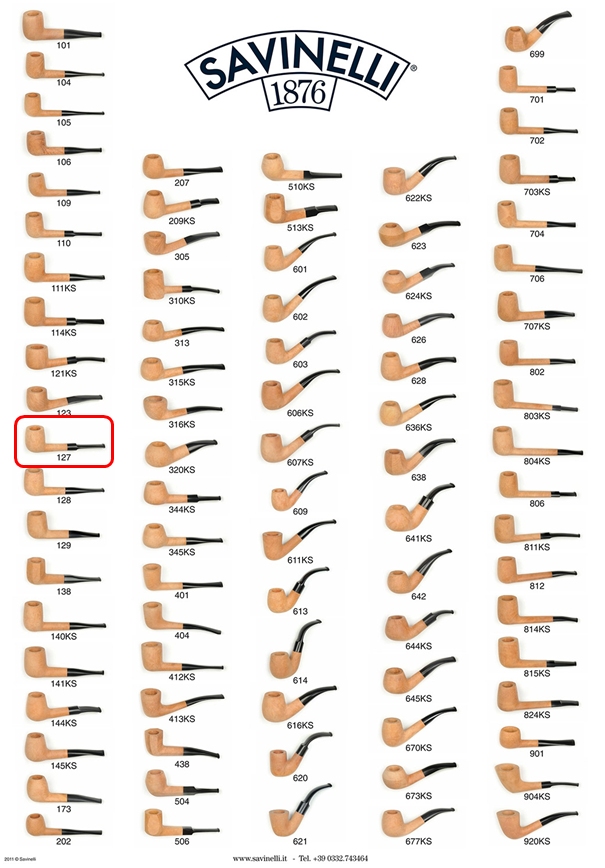
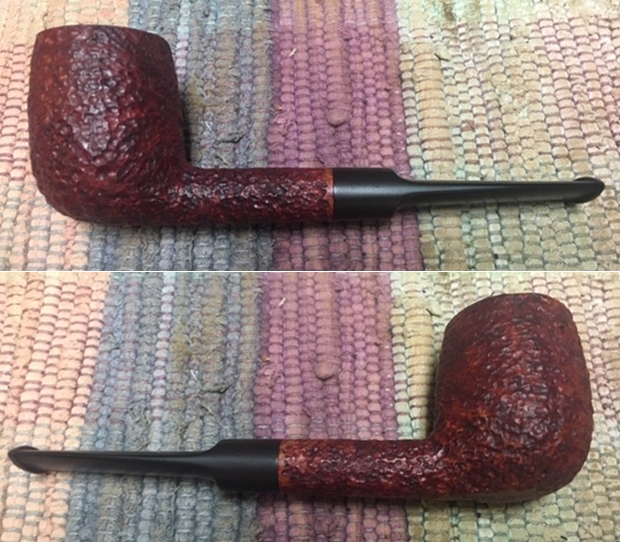
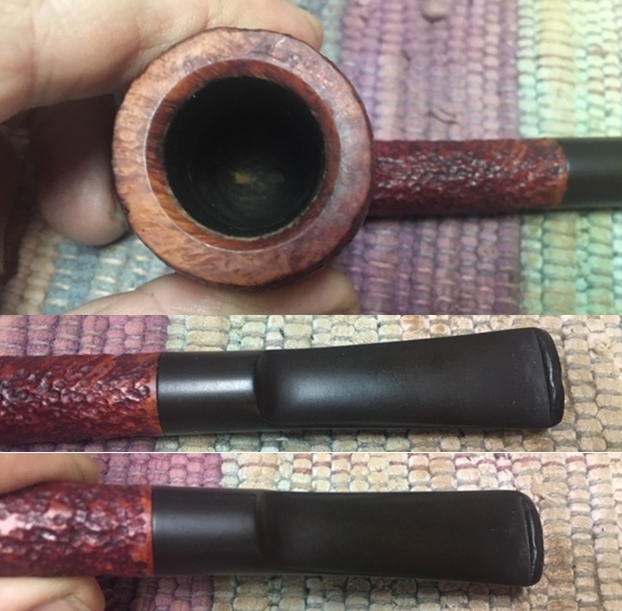
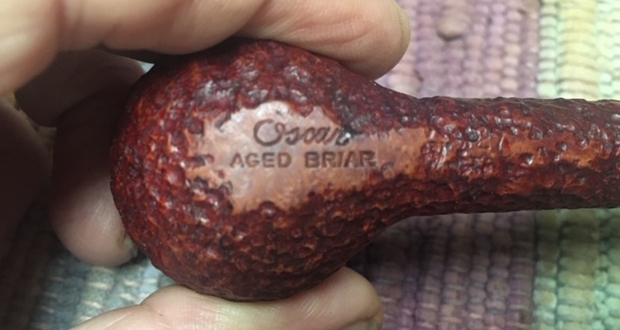
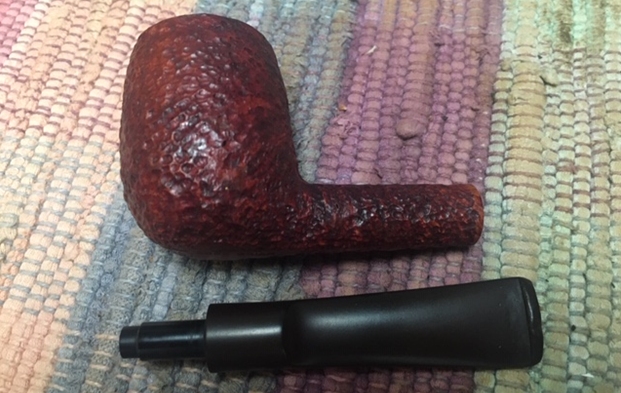
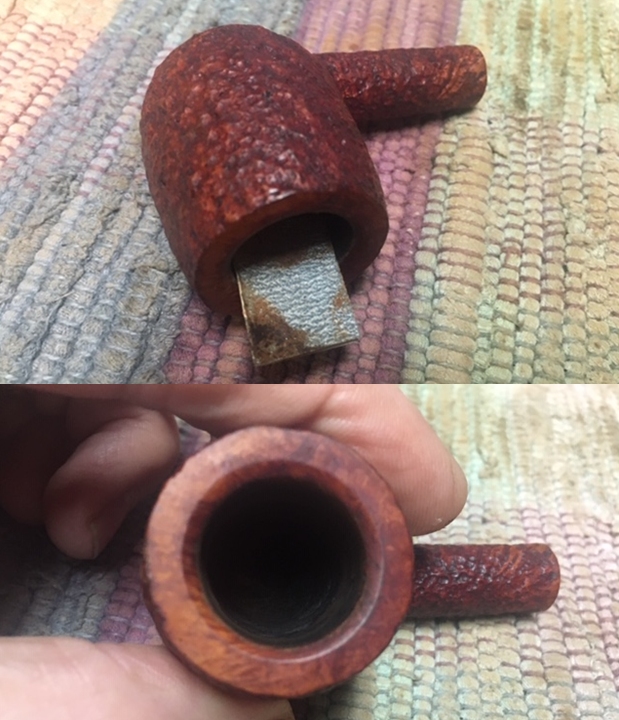
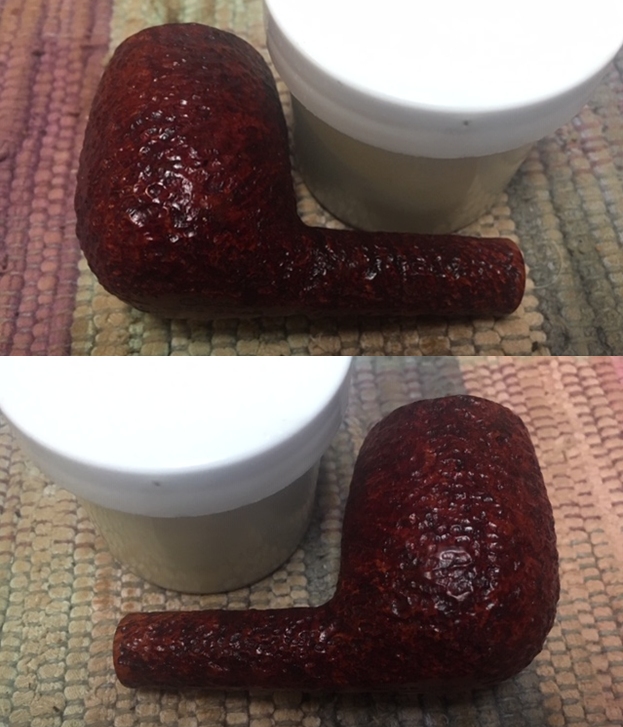
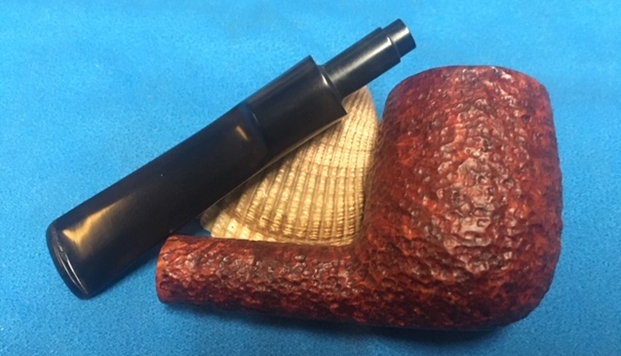
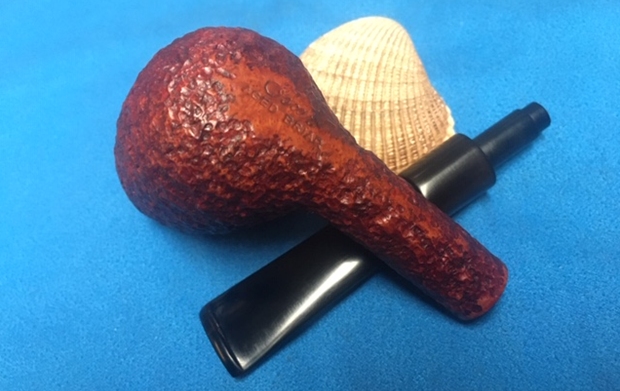
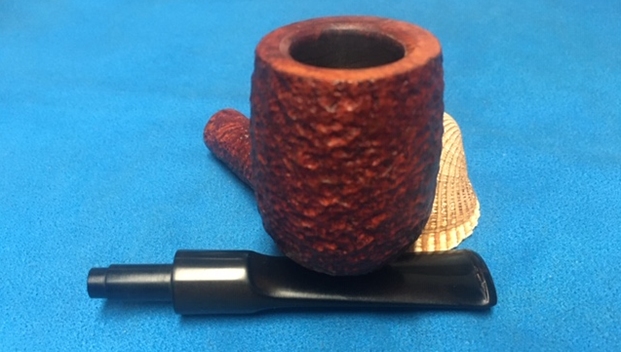
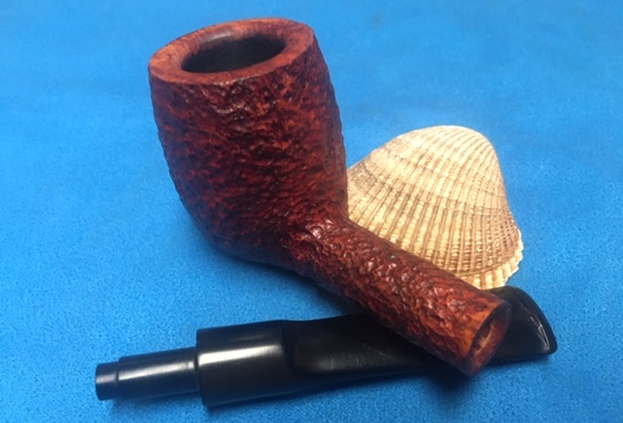
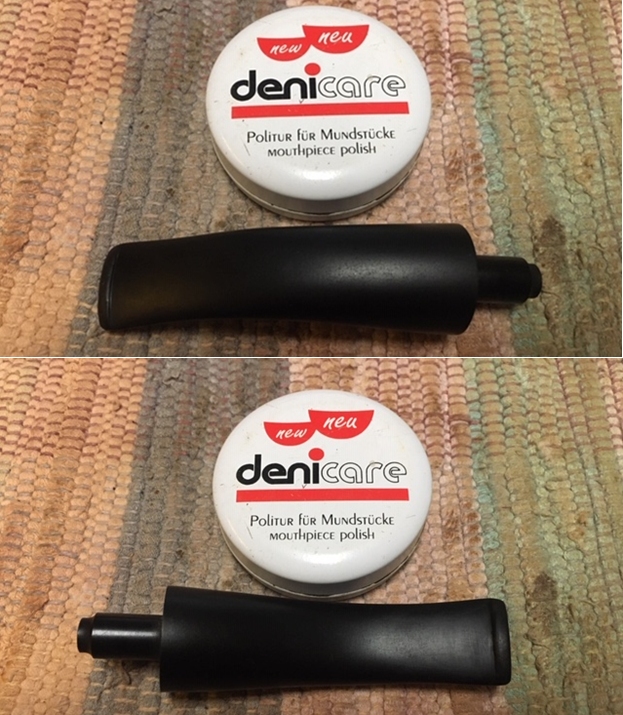
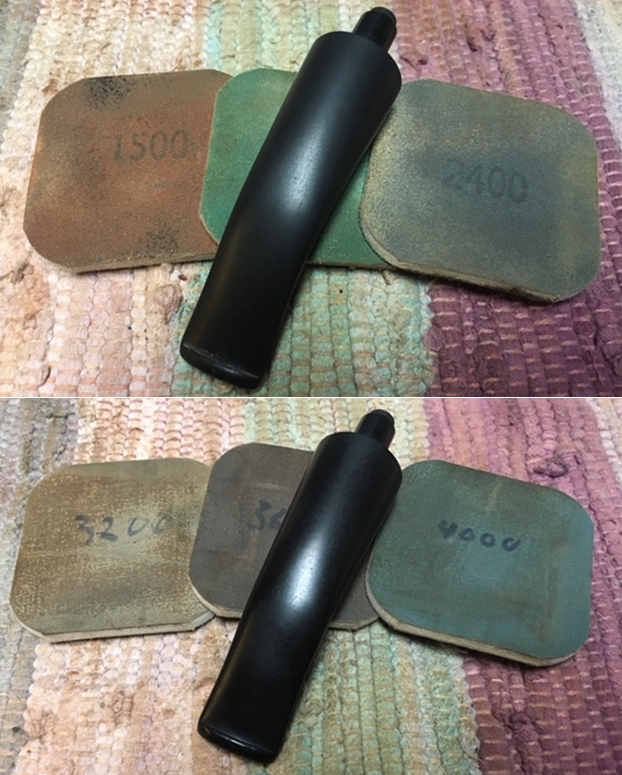
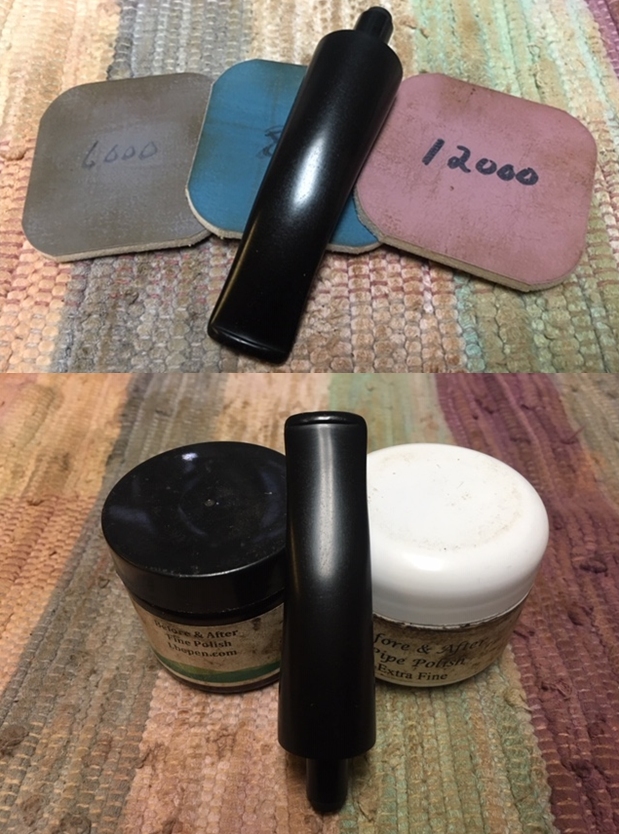
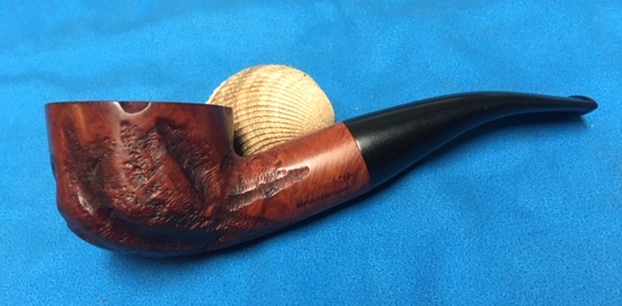
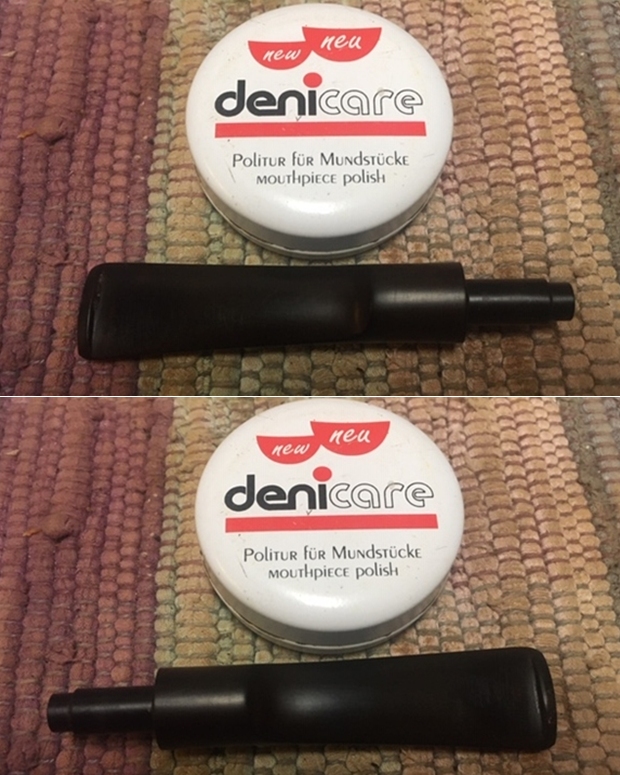
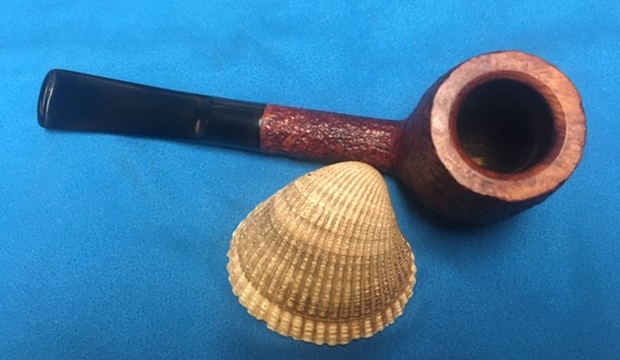
The next pipe on the table came to us from one of Jeff’s pipe hunts. It is a nicely rusticated saddle stem Billiard with a smooth rim top with a bevel on the inside edge of the bowl. It is stamped with Oscar over Aged Briar on the heel of the bowl followed by the Savinelli “S” shield and the shape number 127 over Italy. The stamping is clear and readable though the shape number is hidden slightly by the rustication. The pipe has a combination of brown stains and the tight rustication is not only tactile but also lends a sparkle to the finish. The finish was very dirty with grime ground into the bowl. The bowl had a thick but even cake in the bowl and a heavy lava overflow on the beveled inner edge of the top and top toward the back of the bowl. There was darkening on the briar around the inner beveled edge and the top of the rim. The stem was oxidized and there were tooth marks and chatter on both sides and on the top and bottom edges of the button. Jeff took photos of the pipe before he cleaned it up. Jeff took photos of the rim top to show the thick cake in the bowl and the lava overflow on the beveled inner edge of the rim.  Jeff took some photos of the bowl sides and heel to show the tight rustication pattern that was around this bowl. It is a nice looking pipe. The stamping on each side of the shank is shown in the photos below. They look very good and readable. The shooting star logo on the stem side is clear but faint. I am hoping that it can be repainted once it is clean. It all depends on how deep the stamping on the stem side is. The stem was a very good fit to the shank. It was oxidized, calcified and had debris stuck to the surface of the vulcanite. It also shows the tooth marks on the stem and on the button surface.   I confirmed that the shape number stamping, partially hidden by the rustication is indeed 127 by comparing it to the Savinelli Shape Chart that I have. I have drawn a red box around the shape on the chart below.For some background give the article on Pipedia are as it includes a well written history of the Savinelli brand. (https://pipedia.org/wiki/Savinelli). I turned to work on the pipe itself. Jeff had done a great job cleaning up the pipe as usual. He reamed the pipe with a PipNet reamer and cut back the cake back to the bare briar. He cleaned up the walls with a Savinelli Fitsall Pipe Knife. He scrubbed the interior of the bowl and shank with pipe cleaners, cotton swabs and alcohol to remove the tars and oils. He scrubbed the exterior of the pipe with Murphy’s Oil Soap and a tooth brush to remove the grime from the finish. He worked on the rim top lava and darkening with the soap and tooth brush. He scrubbed the inside of the stem with alcohol and pipe cleaners. He scrubbed the exterior with Soft Scrub and then soaked it in Before & After Deoxidizer. He washed it off with warm water to remove the deoxidizer. The pipe looked far better. The stamping on the side of the stem was very light and the white that had remained was gone. I took photos of the pipe when I received it before I started working on it. I took photos of the bowl and rim top as well as the stem to show how clean they were. You can some spots on the inner edge and the top where some darkening remains.  The stem looks clean of oxidation and the tooth marks and chatter are very clear in the photos.   I took a photo of the stamping on the underside of the bowl and shank. The stamping is clear and readable as noted above.   I took a photo of the pipe with the stem removed to show the overall look of stem, tenon and profile of the pipe.I decided to start my work on the pipe by addressing the darkening on the rim top and beveled inner edge. I used a folded piece of 220 grit sandpaper to work edge to remove the darkening. It took a bit of work but I was able to remove the majority of it and the end product looked much better.   Because the bowl and rim top looked so good I decided to move on to rubbing the briar down with Before & After Restoration Balm. I worked it into the briar with my fingertips and a horse hair shoe brush to get it into the crevices. The product works to clean, enliven and preserve the briar. I let it sit for 10 minutes while I worked on the stem. After the time passed I buffed it with a cotton cloth to deepen the shine. The briar really comes alive with the balm.    I set the bowl aside and turned my attention to the stem. The deep tooth marks and the deep marks on the top and underside of the stem needed to be filled in and reshaped. I filled them in with clear super glue. I purposely overfill the spots so that as they cure and shrink they will still fill in the damage. Once the glue cured I used a needle file to recut the button edge and shape the button surfaces. I flattened the fills on the top and underside of the stem at the same time. I sanded the repaired button and stem surface with 220 grit sandpaper to blend them into the surface of the button and stem. I started polishing the stem with 400 grit wet dry sand paper.   I rubbed the stem down with Denicare Mouthpiece Polish – a red, gritty Tripoli like substance that is a paste. I rubbed it into the surface of the stem and polished it off with a cotton pad. I have found that is a great intermediary step before polishing with micromesh pads. I am not sure what I will use once the final tin I have is gone!   I polished the vulcanite with micromesh sanding pads – 1500-12000 grit pads. I wiped it down with Obsidian Oil after each sanding pad. I used Before & After Pipe Polish – both Fine and Extra Fine to further polish the stem.     This Savinelli Oscar Aged Briar 127 Billiard is a nice looking pipe. The mix of brown stains highlights the rustication around the bowl sides and the heel. The finish on the pipe is in excellent condition and the contrasting stains work well and almost sparkle on the pipe. The polished black vulcanite taper stem adds to the mix. It was impossible to save the shooting star logo it was just too far gone. I put the stem back on the bowl and carefully buffed the pipe with Blue Diamond on the buffing wheel using a light touch on the briar. I gave the bowl multiple coats of Conservator’s Wax by hand and the stem multiple coats of carnauba wax on the buffing wheel and followed that by buffing the entire pipe with a clean buffing pad. I hand buffed the pipe with a microfiber cloth to deepen the shine. The finished Oscar Aged Briar rusticated Billiard is quite nice and feels great in the hand. It is also a sitter with a flat bottom. Give the finished pipe a look in the photos below. The dimensions of the pipe are Length: 5 ½ inches, Height: 1 ¾ inches, Outside diameter of the bowl: 1 ¼ inches, Chamber diameter: ¾ of an inch. Thanks for walking through the restoration with me as I worked over another beautiful pipe. This pipe will be added to the Italian Pipe Makers section of the rebornpipes store soon. If you want to add it to your collection send me an email or a message! Thanks for your time.

Life for a Comoy’s Christmas 1983 Bent 409 Bulldog


Blog by Steve Laug

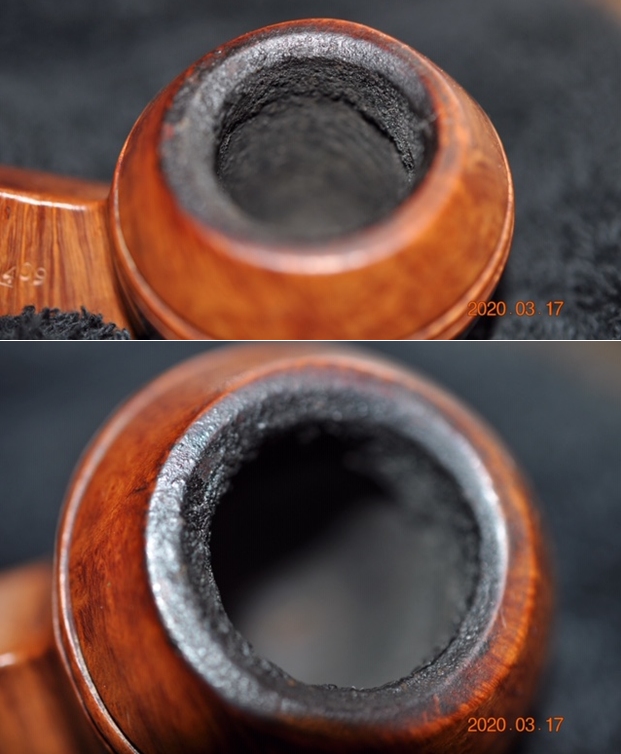
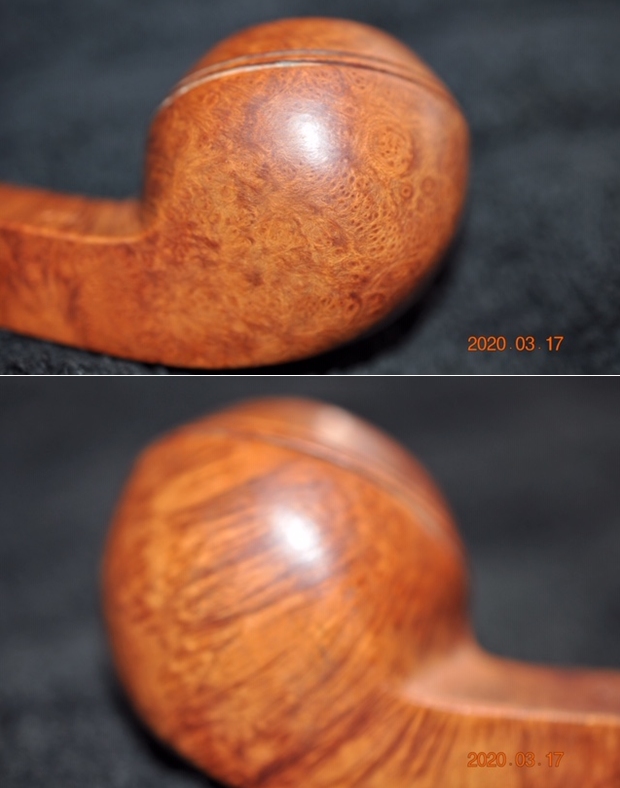
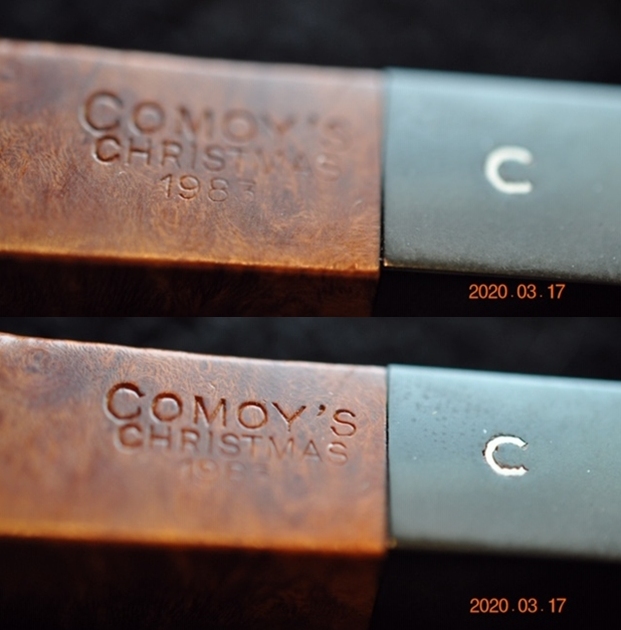
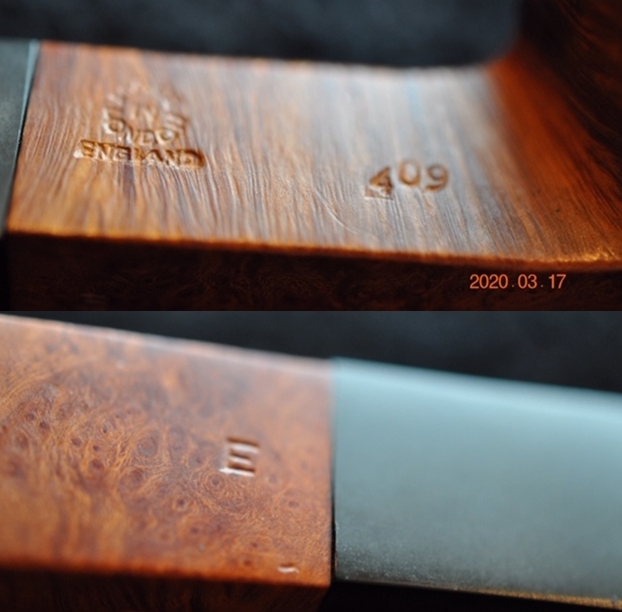
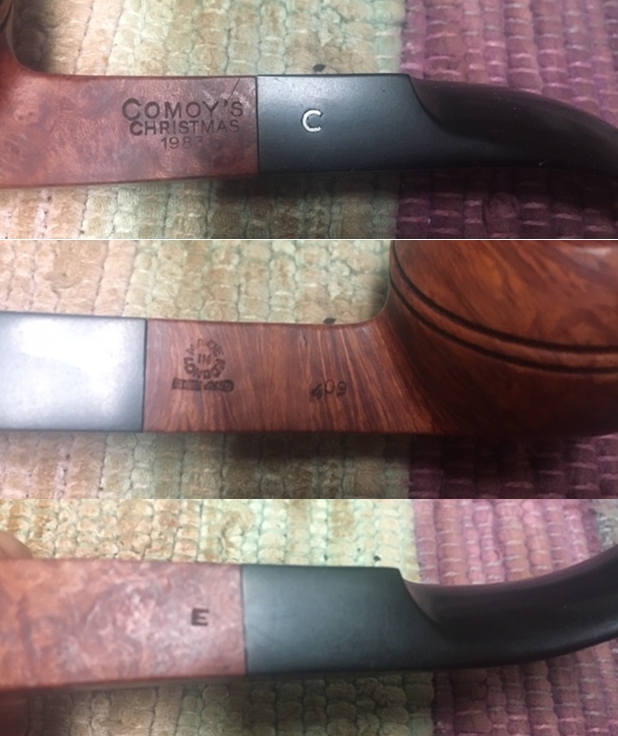
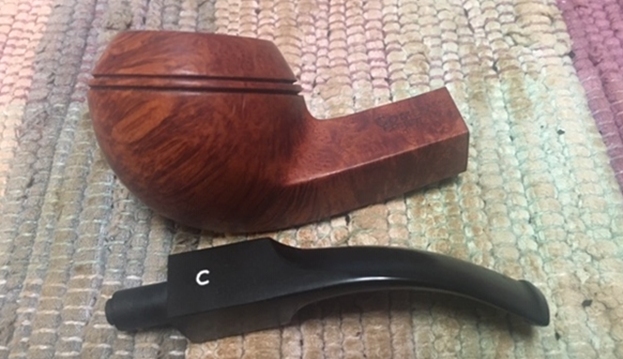
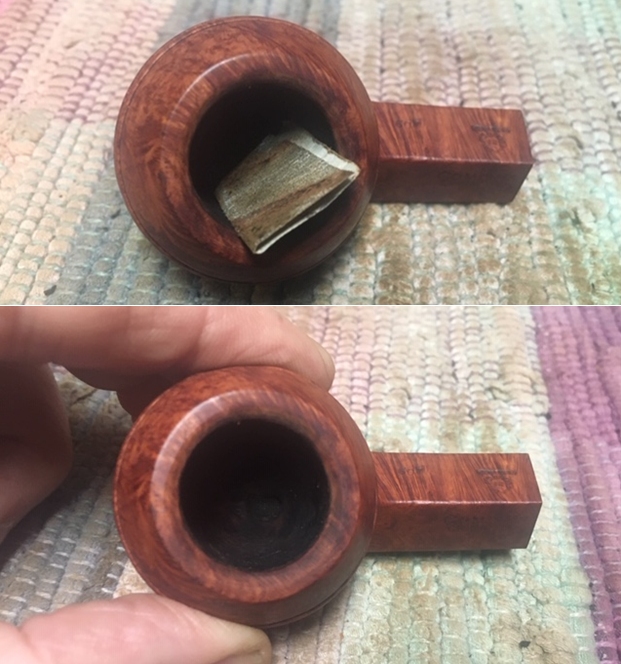
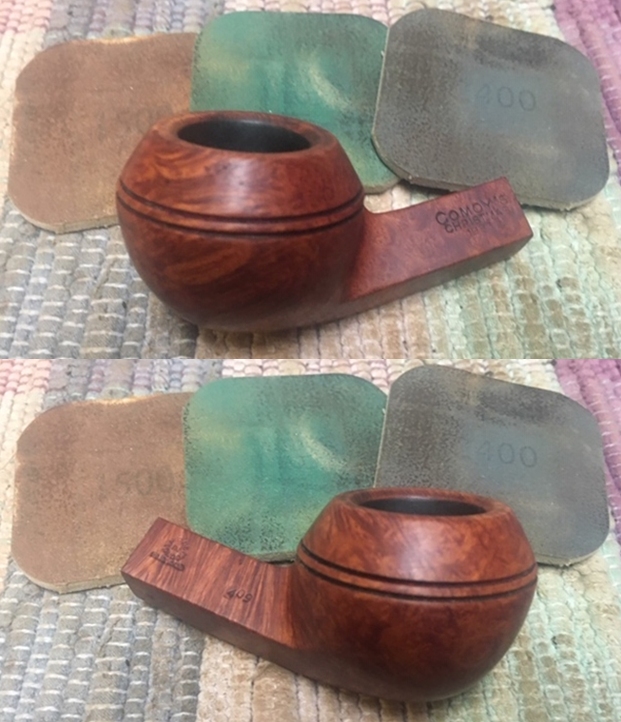
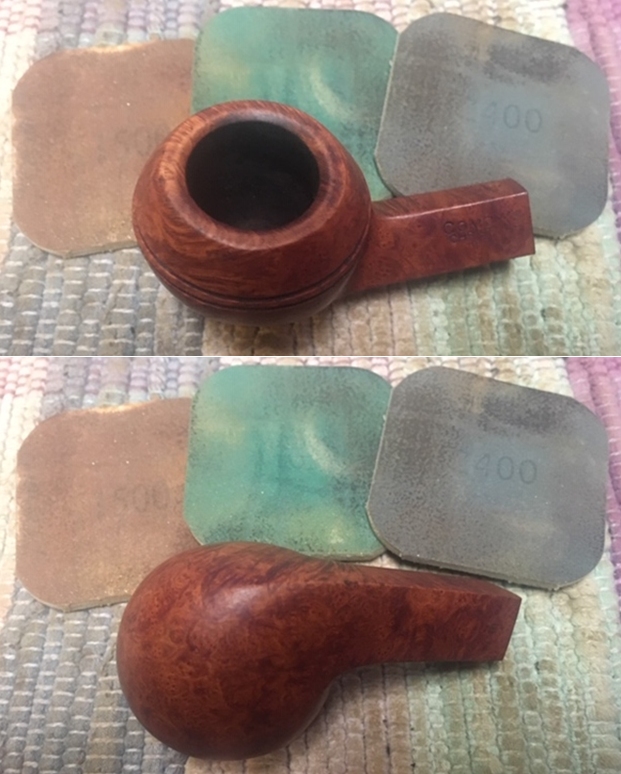
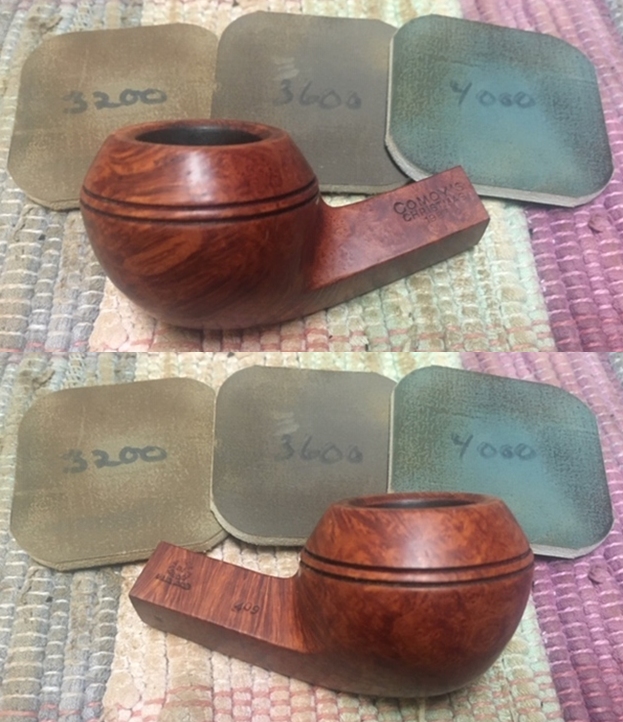
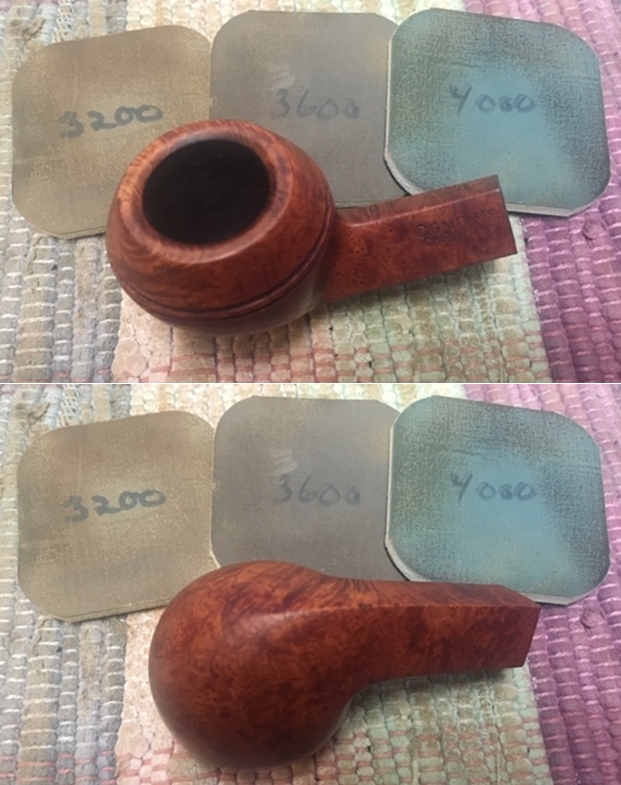
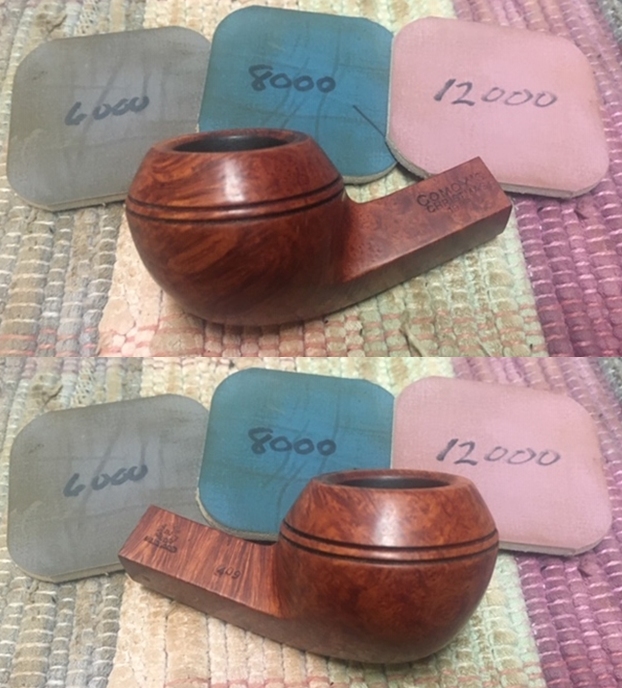
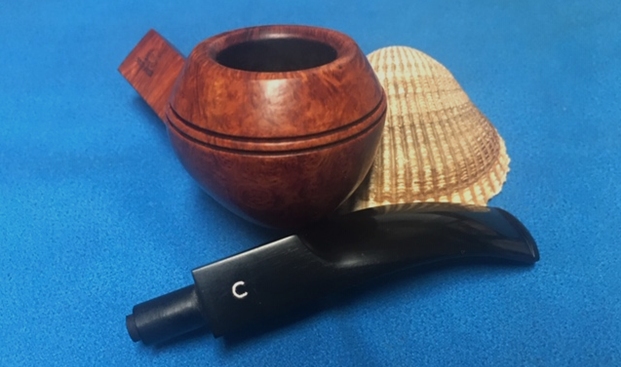
The next pipe on the table came to us from one of Jeff’s pipe hunts not far from where he is located. It is a Comoy’s 409 Bulldog that is in decent condition. It is stamped Comoy’s Christmas 1983 on the top left side of the diamond shank. On the right side it is stamped with the Comoy’s circular COM stamp Made in London in a circle over England. That is followed by the shape number 409. On the right underside it is stamped with the letter E near the stem/shank junction. The stamping is clear and readable. The pipe has a medium brown finish and some amazing grain that the shape follows well. The finish was very dirty with grime ground into the grain around bowl sides. The bowl had a thick cake in the bowl and some lava overflow on the top and the beveled inner edge of the top. There was darkening on the briar around the inner beveled edge of the rim. The stem was dirty, oxidized and calcified. There was light tooth chatter and marks on the stem near the button on both sides. The stem has the inset C logo of Comoy’s on the top left side of the diamond saddle stem. Jeff took photos of the pipe before he cleaned it up. Jeff took photos of the rim top to show the thick cake in the bowl and the lava overflow on the top and beveled inner edge of the rim. The photos show the rim top and bowl from various angles. Jeff took some photos of the bowl sides and heel to show the nice grain that was on this bowl. It is a quite beautifully grained pipe. The stamping on each side of the diamond shank is shown in the photos below. They look very good and readable. You can also see the inset C logo on the top left side of the diamond stem. The stem was a very good fit to the shank. It was oxidized, calcified and had debris stuck to the surface of the vulcanite. There was tooth chatter and marks on both sides of the stem and on the button surface.  I knew that I was dealing with a 1983 Comoy’s 409 Bulldog that was specially made as a Christmas Pipe. I turned to work on the pipe itself. Jeff had done a great job cleaning up the pipe as usual. He reamed the pipe with a PipNet reamer and cut back the cake back to the bare briar. He cleaned up the walls with a Savinelli Fitsall Pipe Knife. He scrubbed the interior of the bowl and shank with pipe cleaners, cotton swabs and alcohol to remove the tars and oils. He scrubbed the exterior of the pipe with Murphy’s Oil Soap and a tooth brush to remove the grime from the finish. He worked on the rim top lava and darkening with the soap and tooth brush. He scrubbed the inside of the stem with alcohol and pipe cleaners. He scrubbed the exterior with Soft Scrub and then soaked it in Before & After Deoxidizer. He washed it off with warm water to remove the deoxidizer. The pipe looked far better. I took photos of the pipe when I received it before I started working on it. I took photos of the bowl and rim top as well as the stem to show how clean they were. You can see the darkening on the inner edge of the rim and the top.  The stem looks clean of oxidation and the tooth marks and chatter are very clear in the photos.I took photos of the stamping on the sides of the shank. The stamping is clear and readable as noted above.   I took a photo of the pipe with the stem removed to show the overall look of stem, tenon and profile of the pipe.I decided to start my work on the pipe by addressing the darkening on the rim top and beveled inner edge. I used a folded piece of 220 grit sandpaper to work on the finish to remove the darkening on both. It took a bit of work but I was able to remove the majority of it and the end product looked much better.   I polished the briar with micromesh sanding pads – dry sanding with 1500-12000 grit pads and wiping the bowl down with a damp cloth after each pad. I rubbed the briar down with Before & After Restoration Balm. I worked it into the briar with my fingertips. The product works to clean, enliven and preserve the briar. I let it sit for 10 minutes while I worked on the stem. After the time passed I buffed it with a cotton cloth to deepen the shine. The briar really comes alive with the balm.  I set the bowl aside and turned my attention to the stem. Some of the tooth marks were deep – fortunately small but deep on both sides. I filled in the divots with clear super glue and set the stem aside to dry while I took my dog for a walk. When I got back I used a needle file to sharpen the edge of the button and flatten the repairs. I sanded out the repairs on both sides of the button surface and stem with 220 grit sandpaper to blend them into the surface. I began polishing the stem with 400 grit wet dry sandpaper.I polished the vulcanite with micromesh sanding pads – 1500-12000 grit pads. I wiped it down with Obsidian Oil after each sanding pad. I used Before & After Pipe Polish – both Fine and Extra Fine to further polish the stem.   This Comoy’s Christmas 1983 Bulldog is a real beauty. The Medium Brown stain highlights some great grain around the bowl sides and the heel. The finish on the pipe is in excellent condition and the contrasting stains work well to highlight the grain on the pipe. The polished black vulcanite saddle stem adds to the mix. With the grime and debris gone from the finish and the bowl it was a beauty and is eye-catching. I put the stem back on the bowl and buffed the pipe with Blue Diamond on the buffing wheel. I gave the bowl and the stem multiple coats of carnauba wax on the buffing wheel and followed that by buffing it with a clean buffing pad. I hand buffed the pipe with a microfiber cloth to deepen the shine. The finished Bent Bulldog 409 is quite nice and feels great in the hand. Give the finished pipe a look in the photos below. I can only tell you that like the other pipes I am working that it is much prettier in person than the photos capture. The dimensions of the pipe are Length: 5 ¼ inches, Height: 1 ½ inches, Outside diameter of the bowl: 1 ½ inches, Chamber diameter: ¾ of an inch. Thanks for walking through the restoration with me as I worked over another beautiful pipe. This pipe will be added to the British Pipe Makers section of the rebornpipes store soon. If you want to add it to your collection send me an email or a message! Thanks for your time.
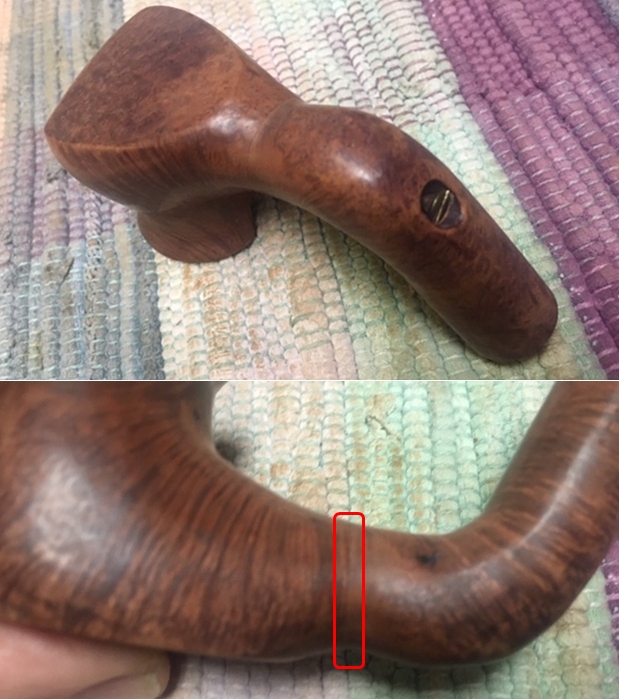
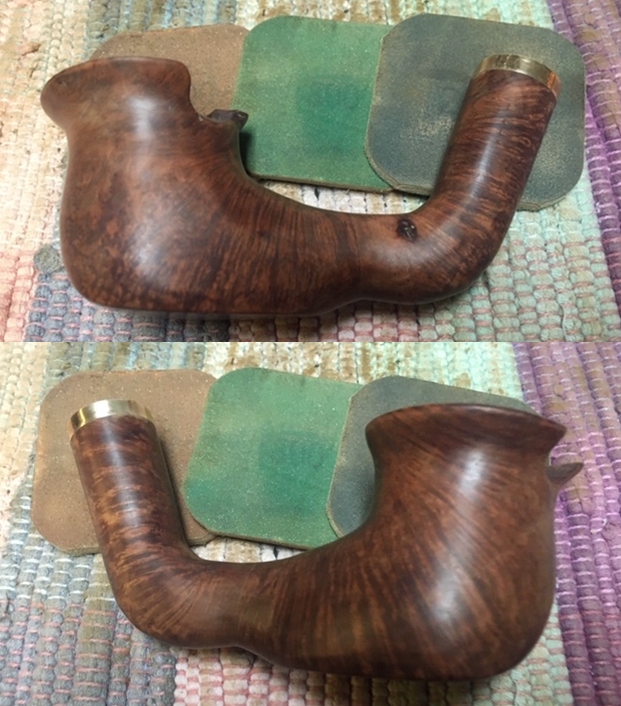
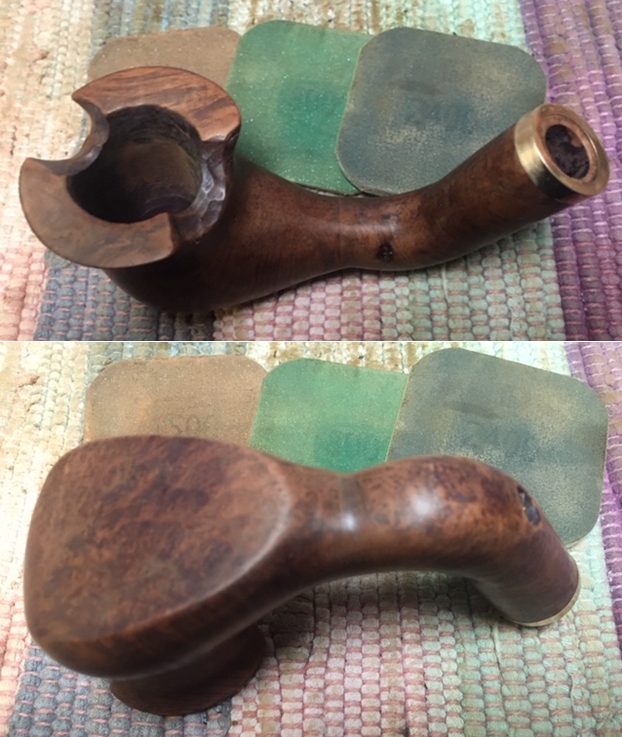
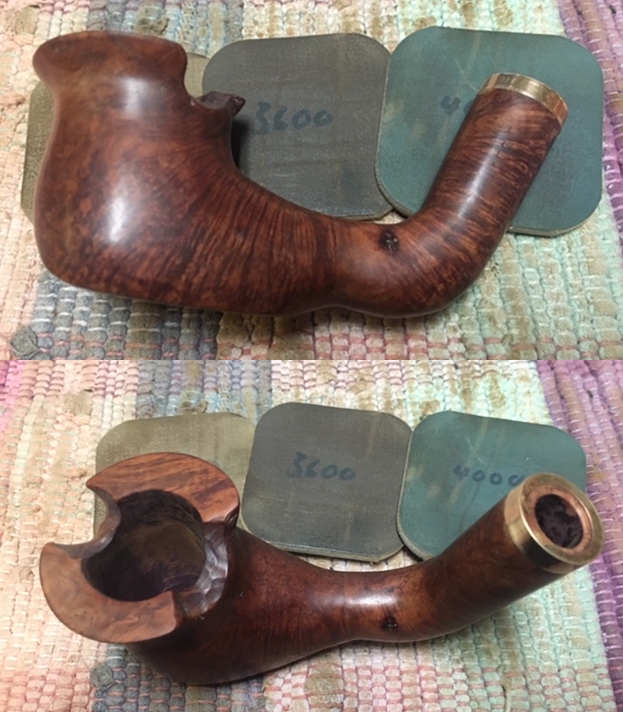
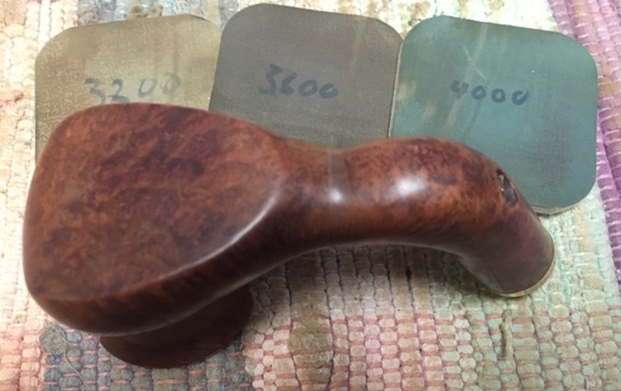
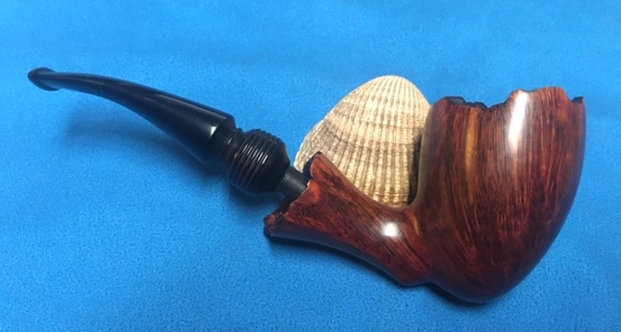
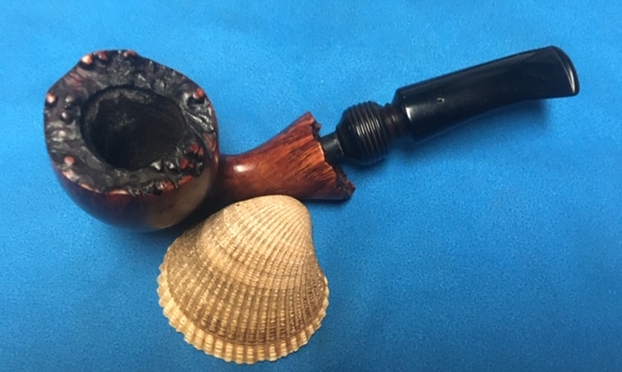
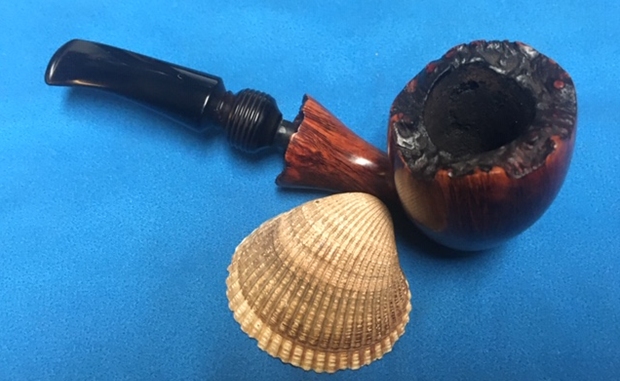
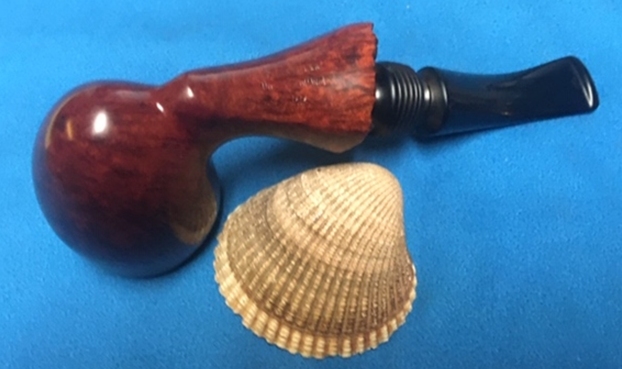
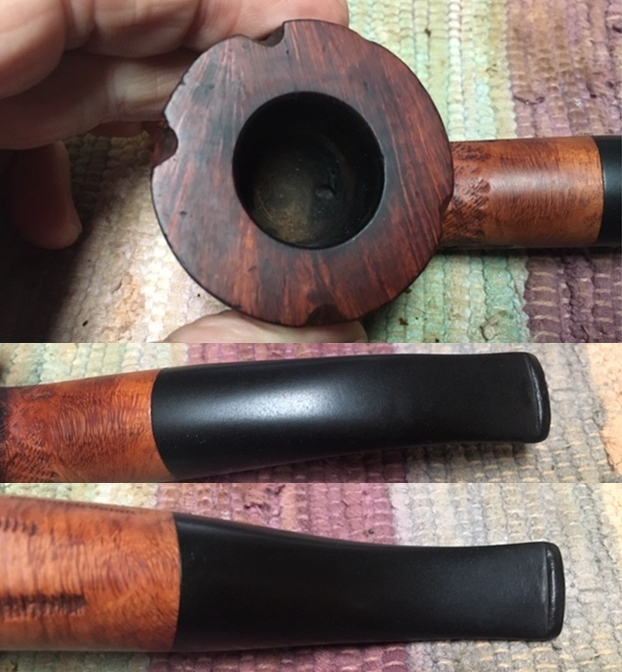
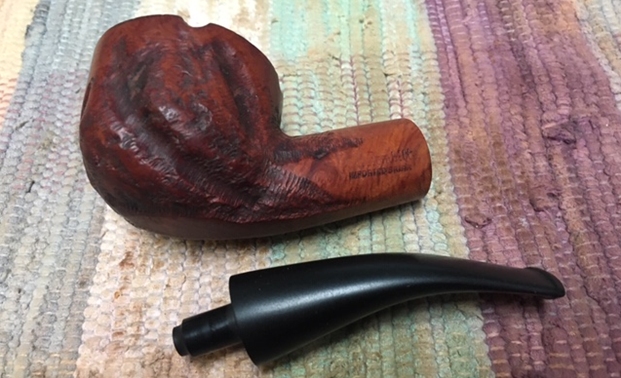
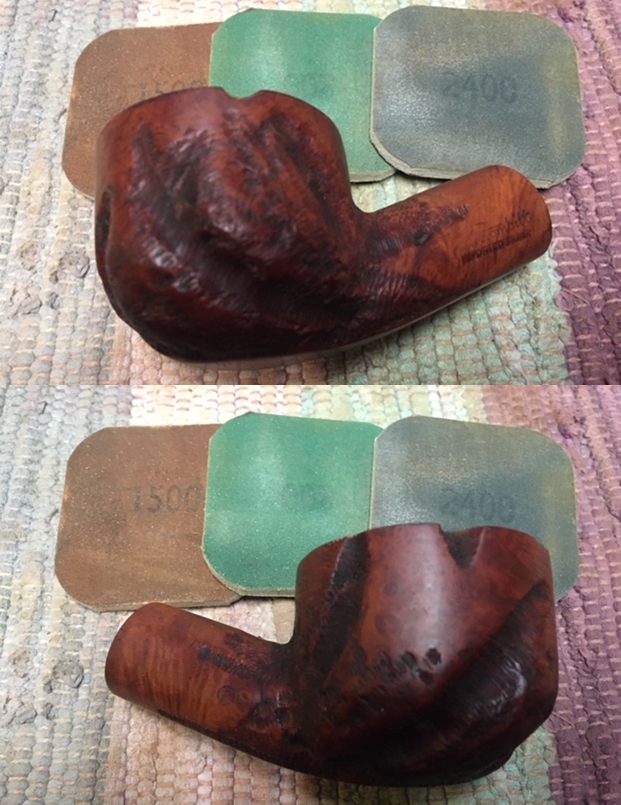
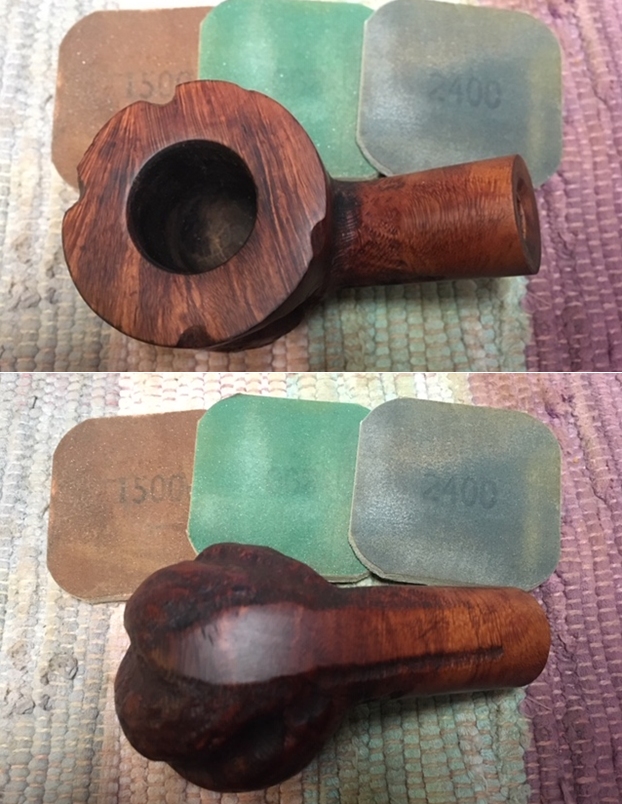
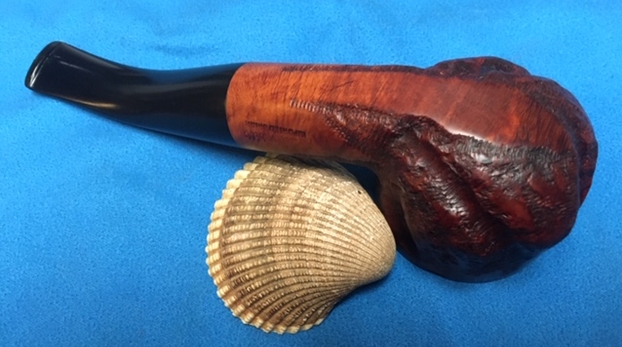
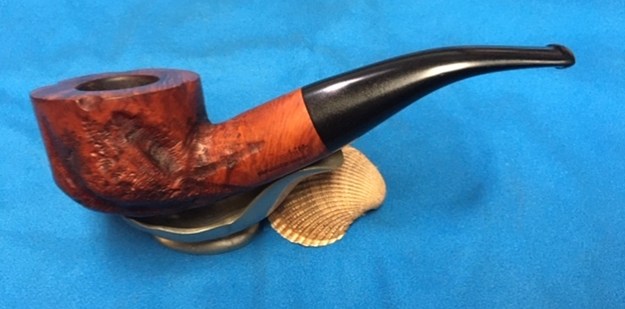
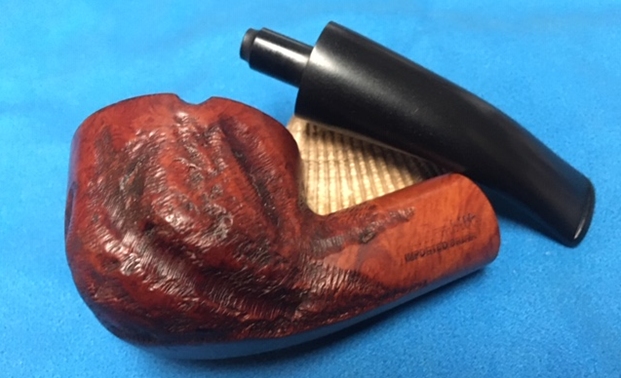
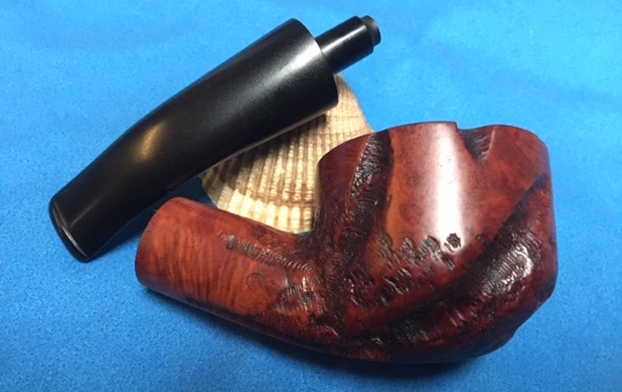
I am not sure I would call this AFG III Freehand pipe anything other than ODD


Blog by Steve Laug

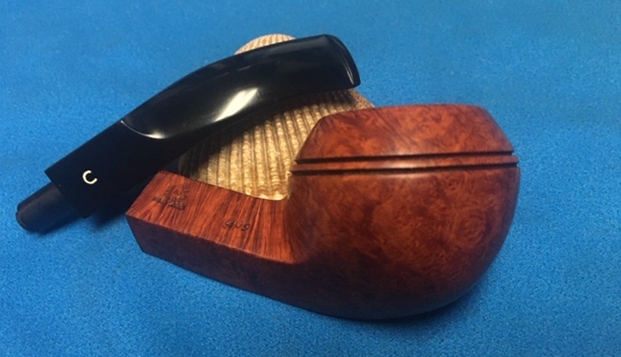
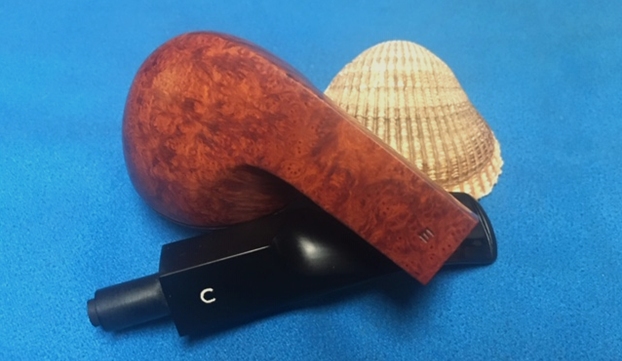
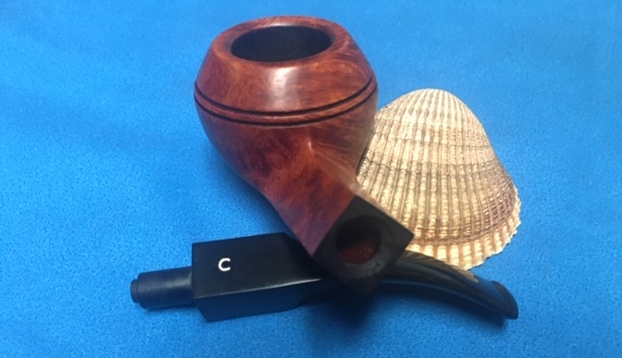
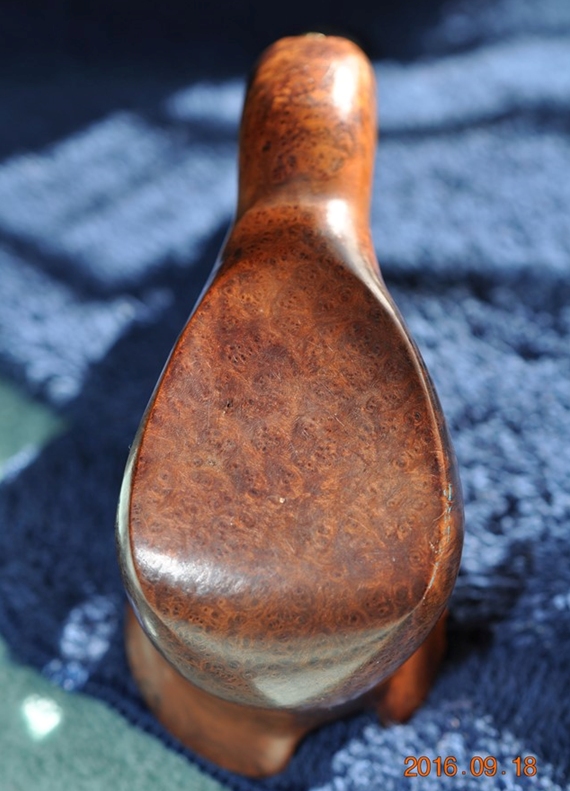
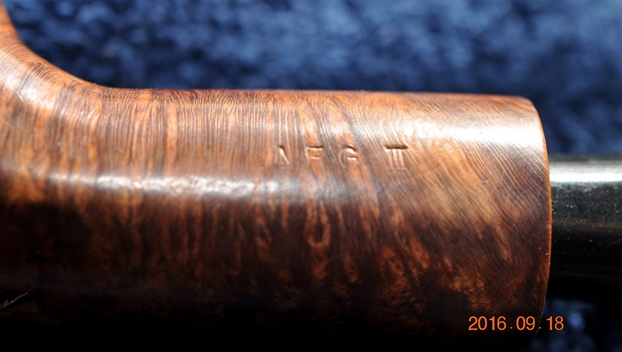
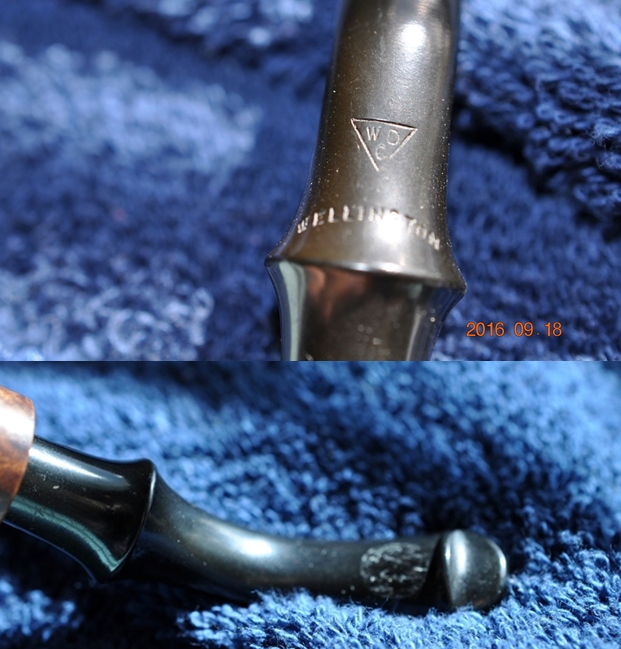
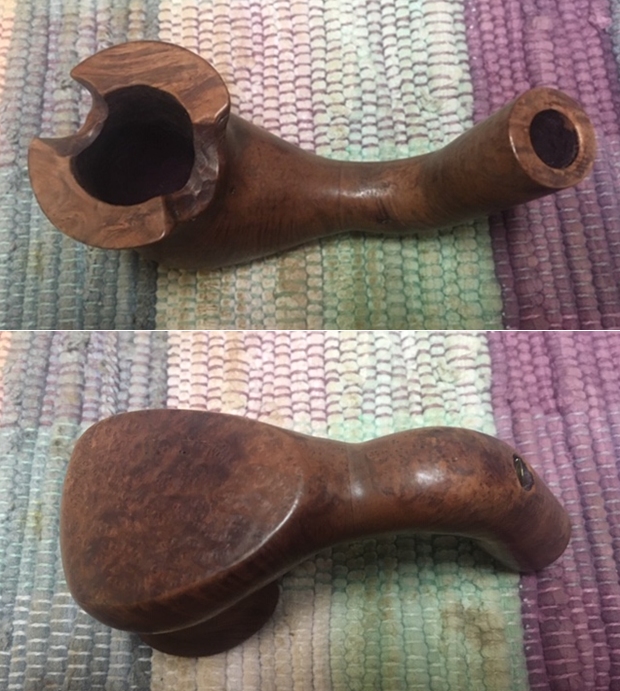
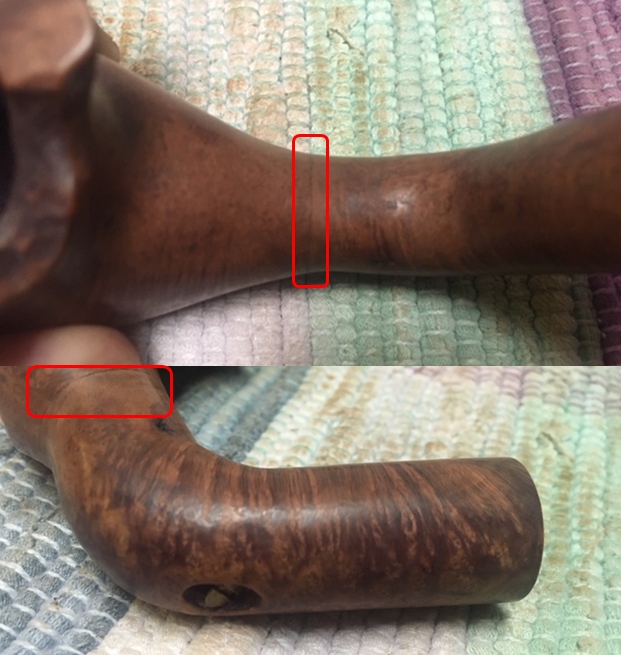
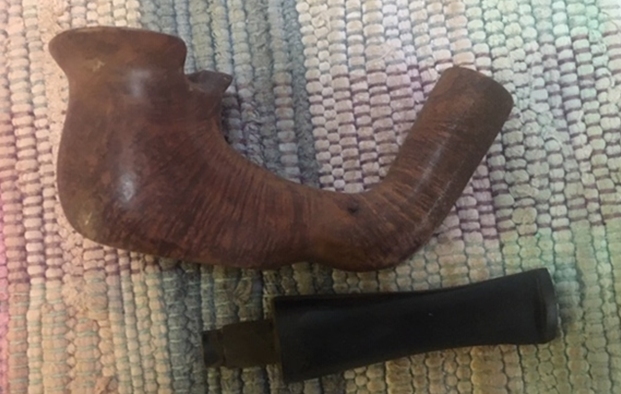
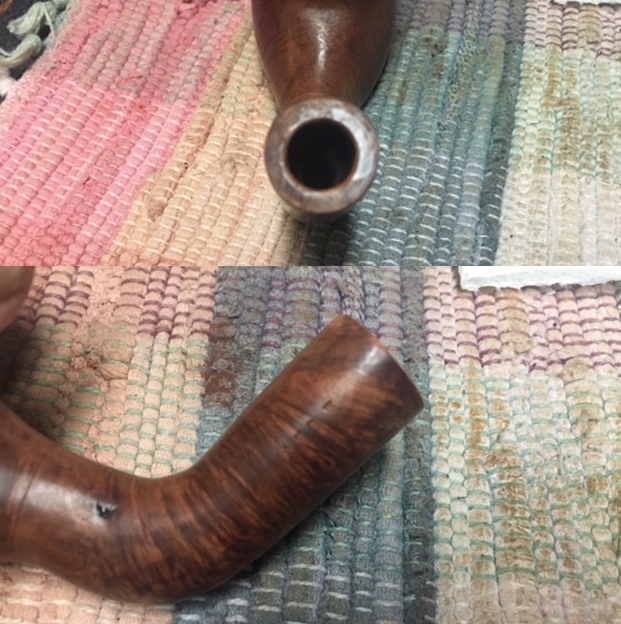
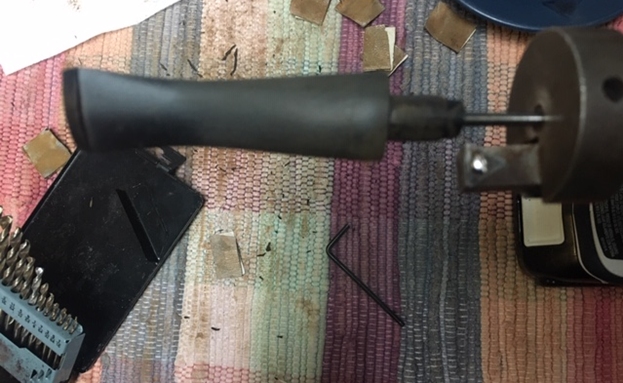
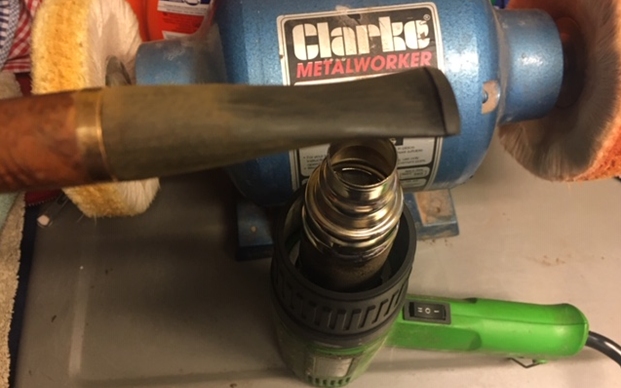
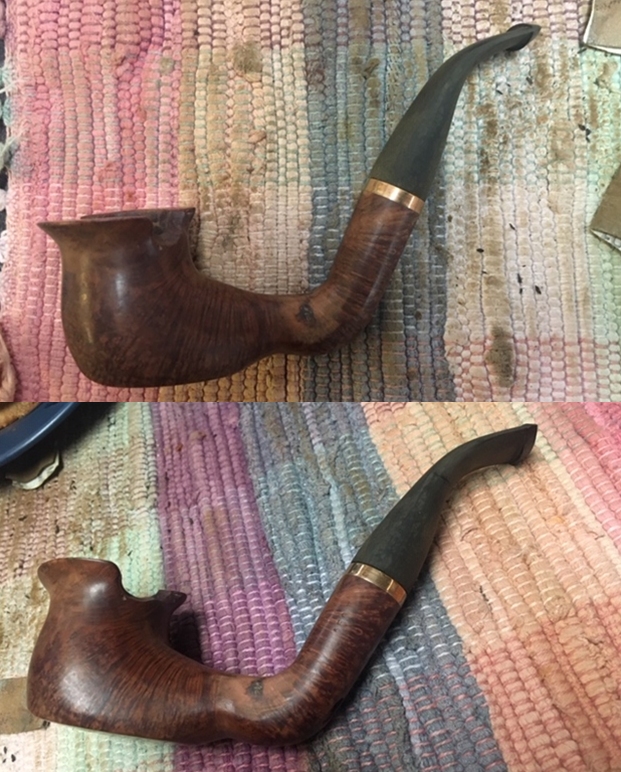
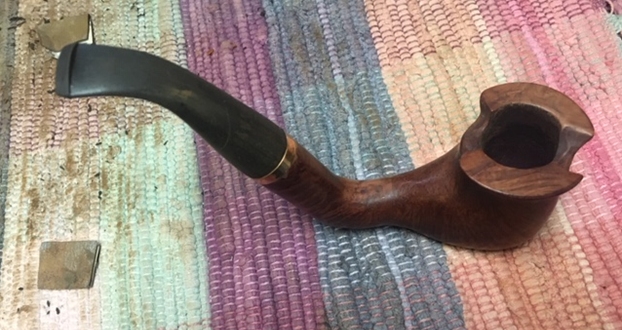
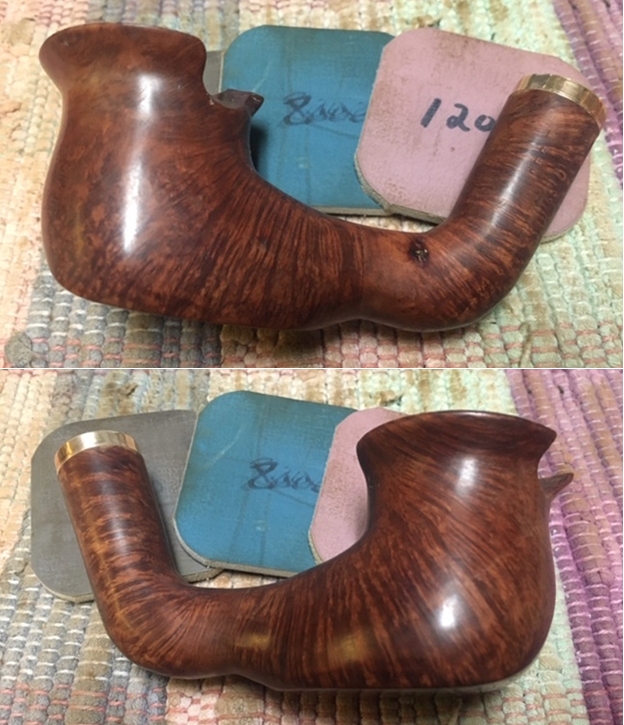
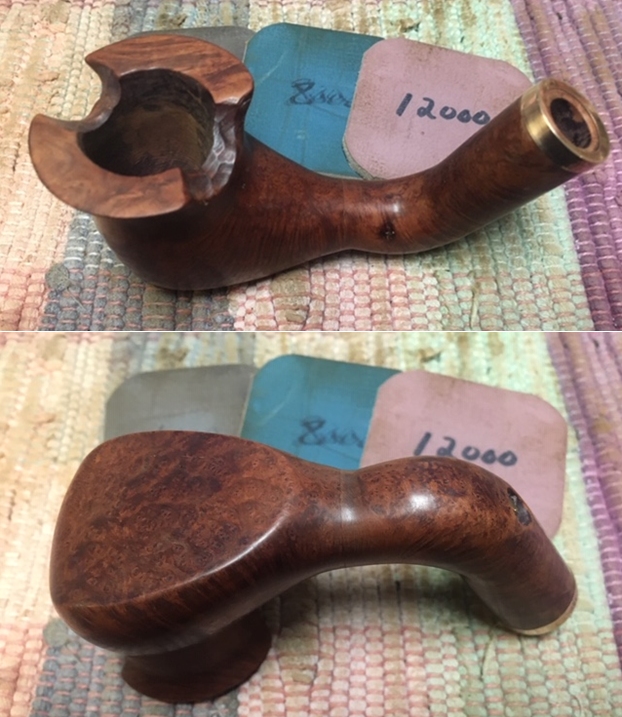
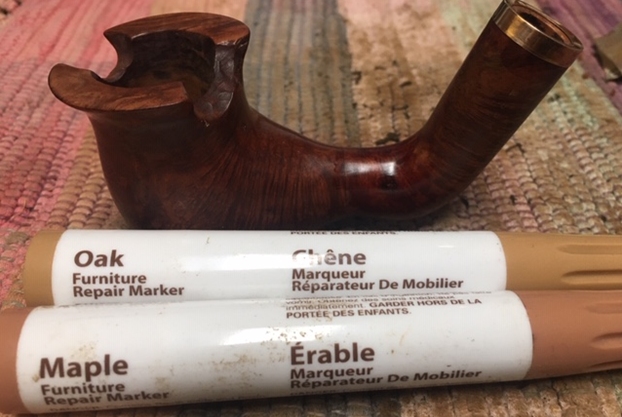
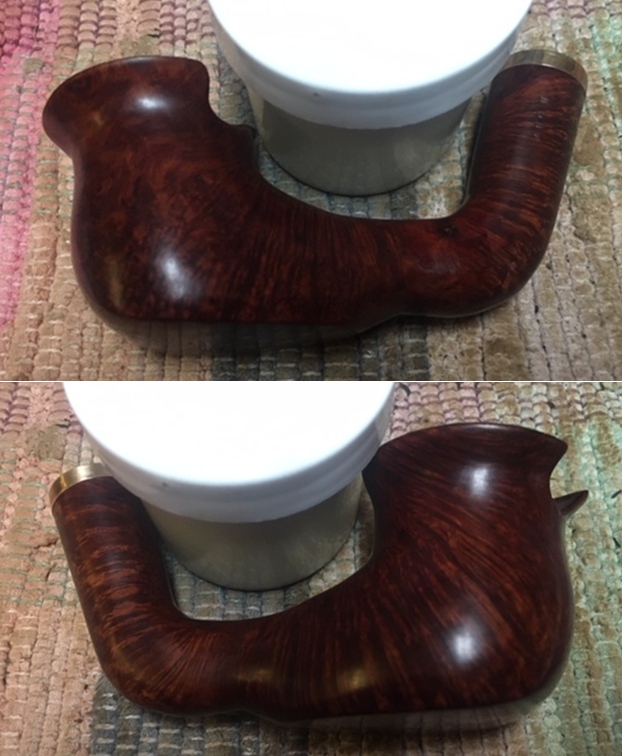
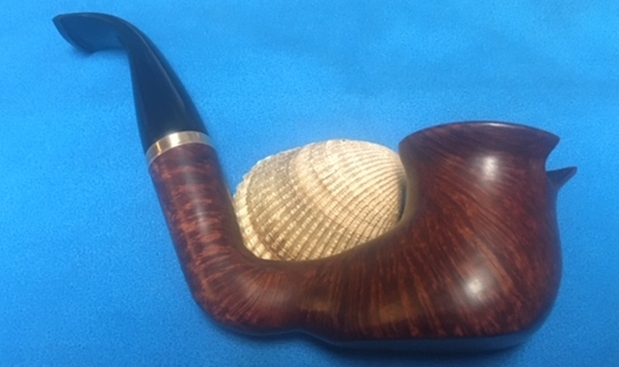
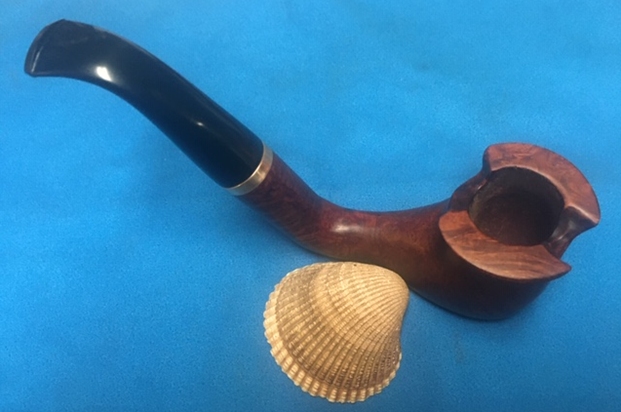
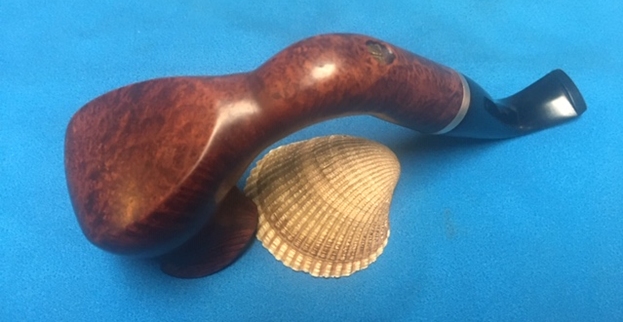
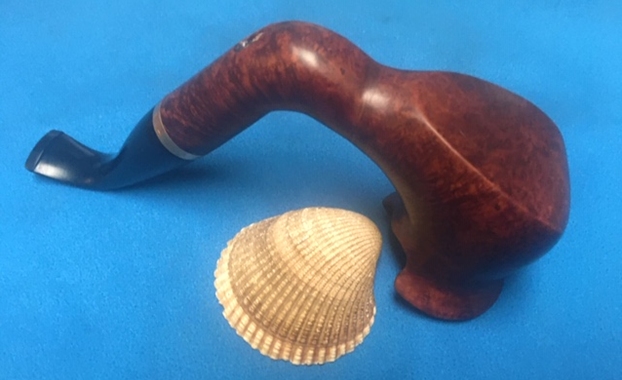
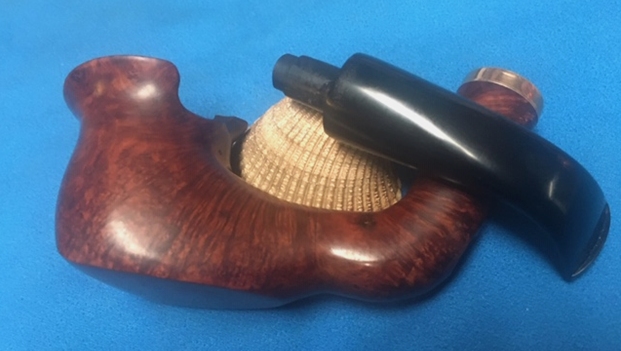
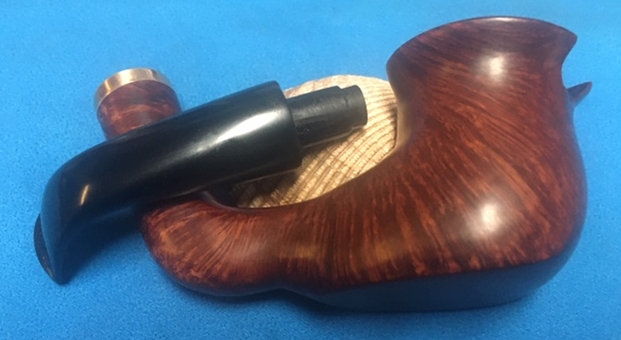
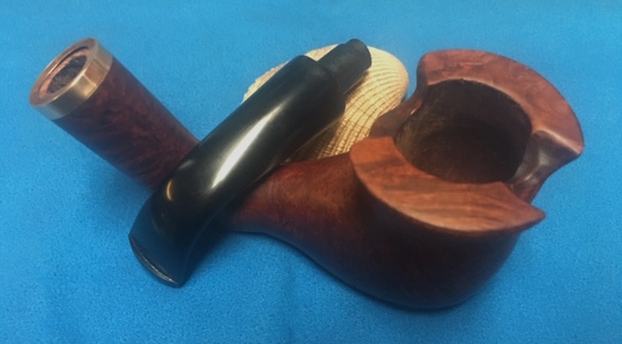
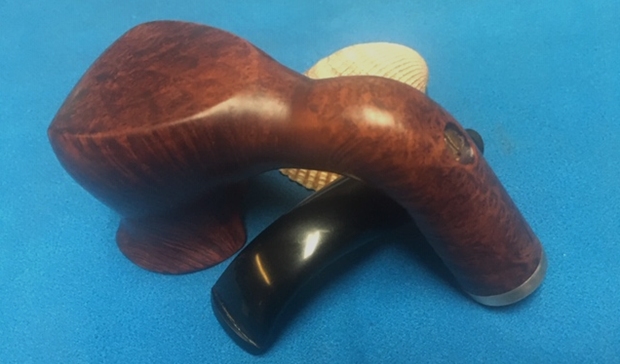
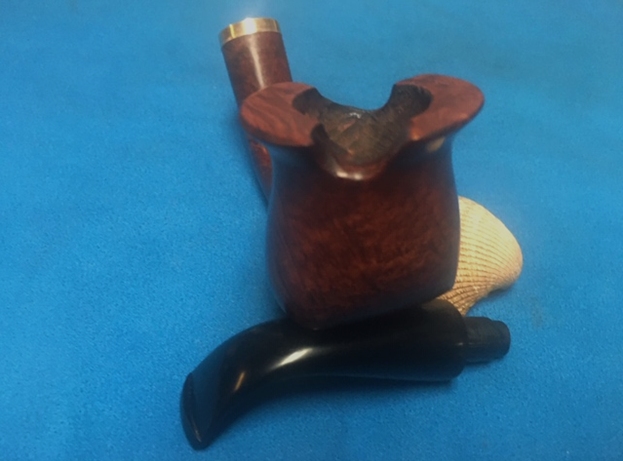
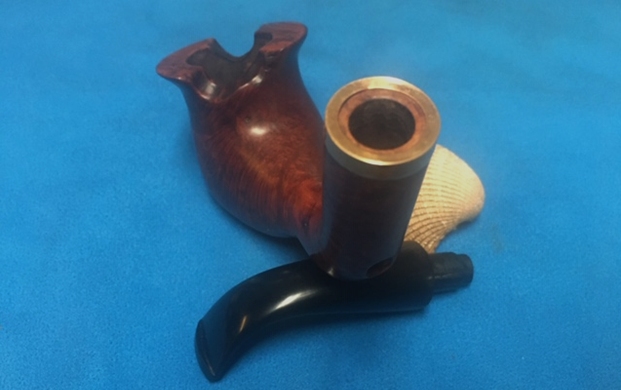
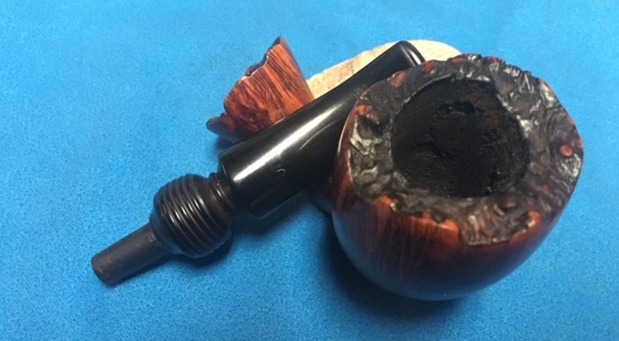
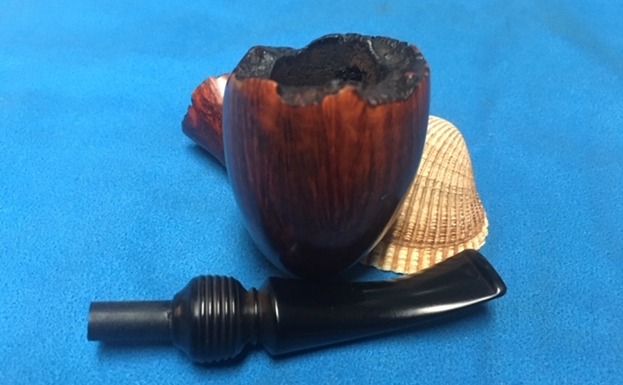
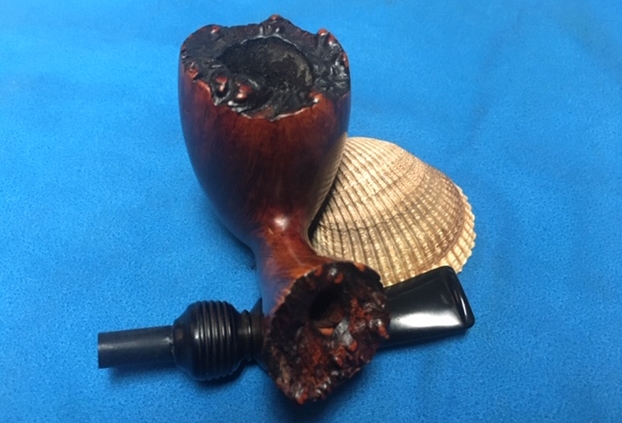
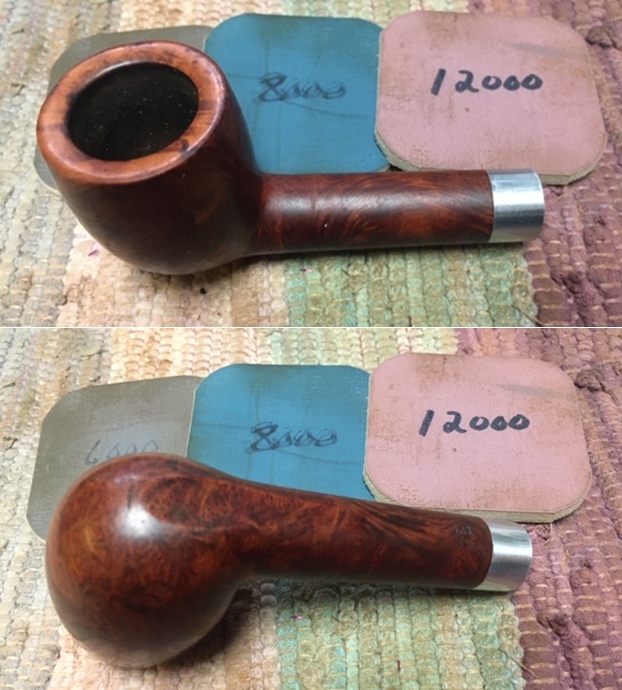
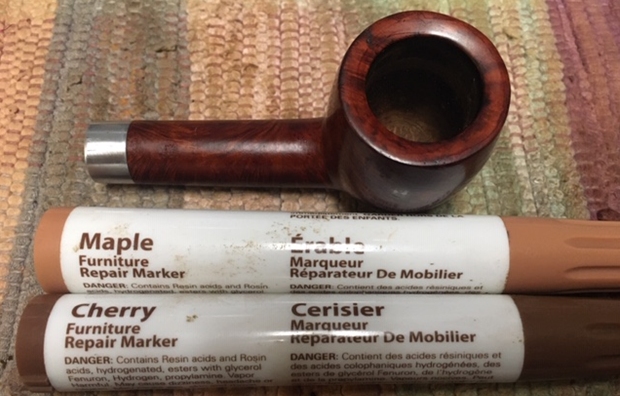
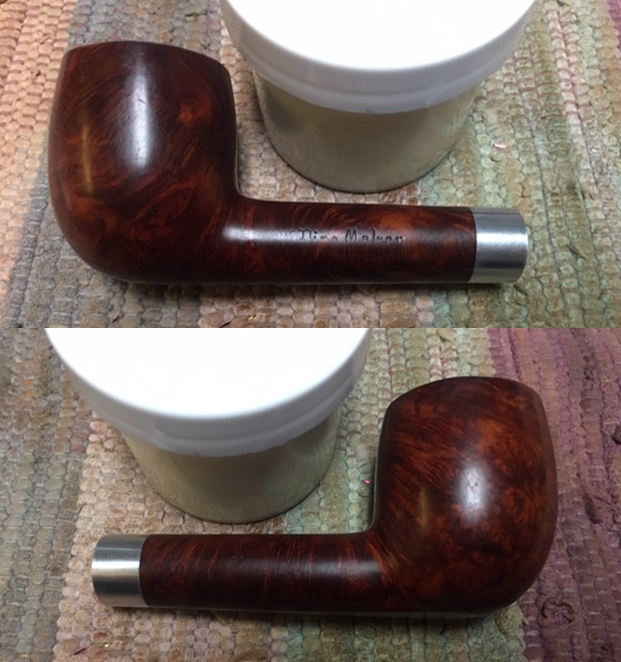
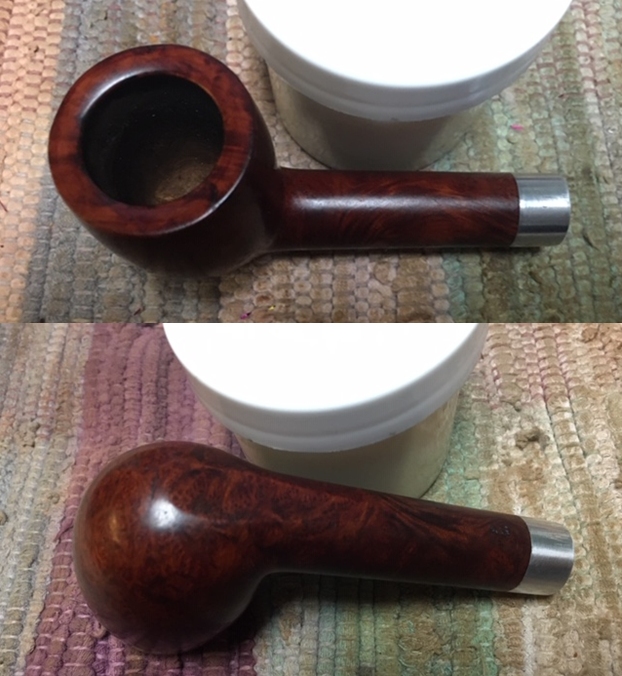
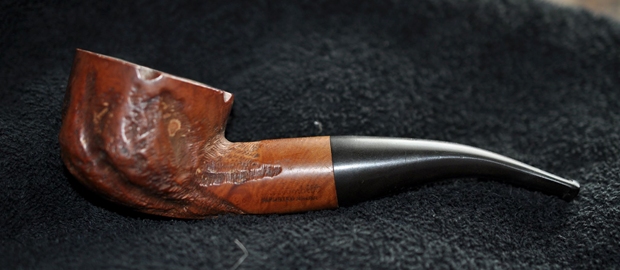
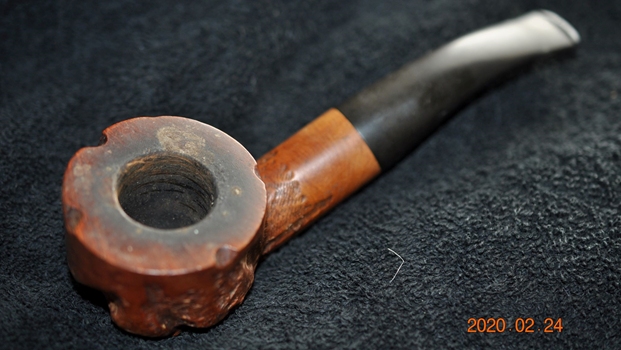
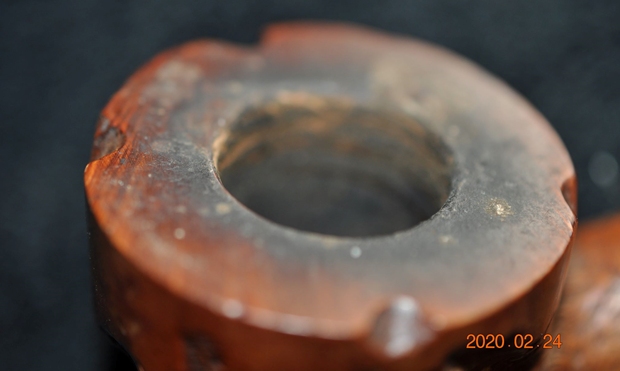
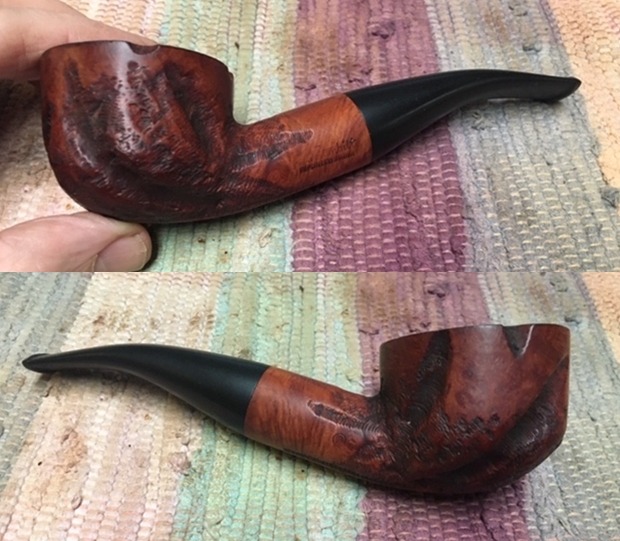
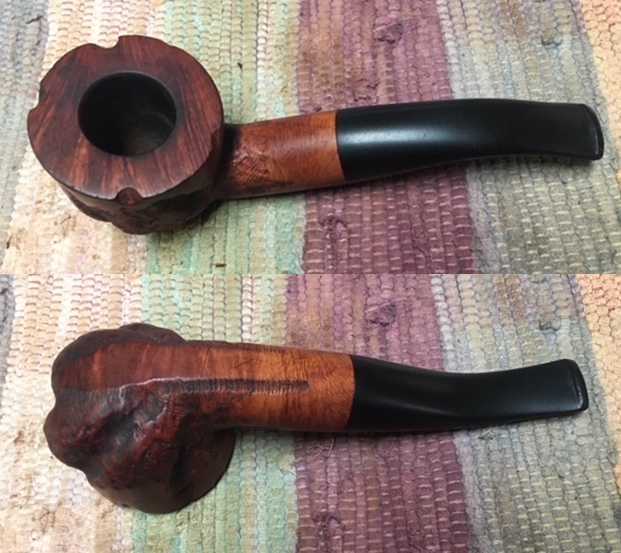
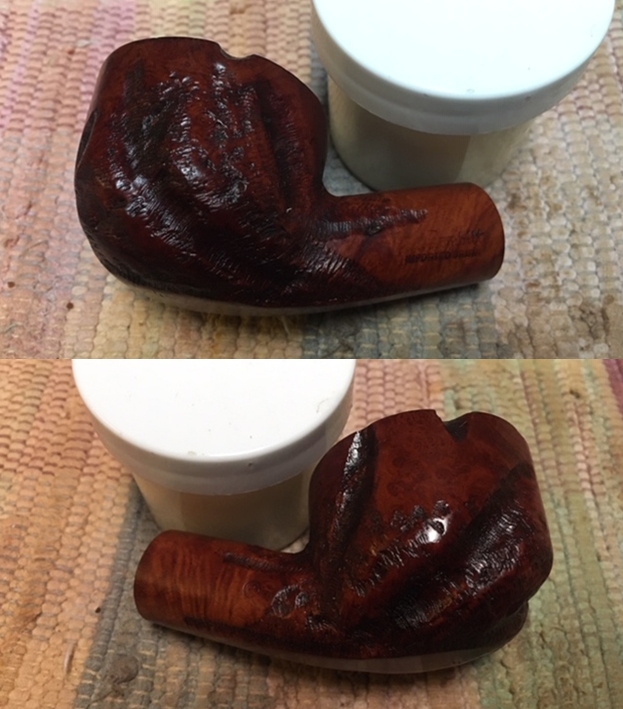
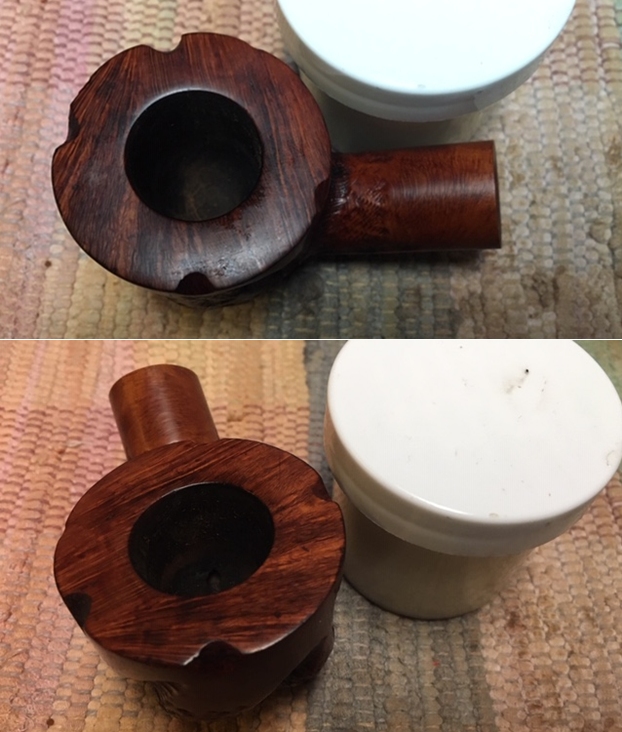
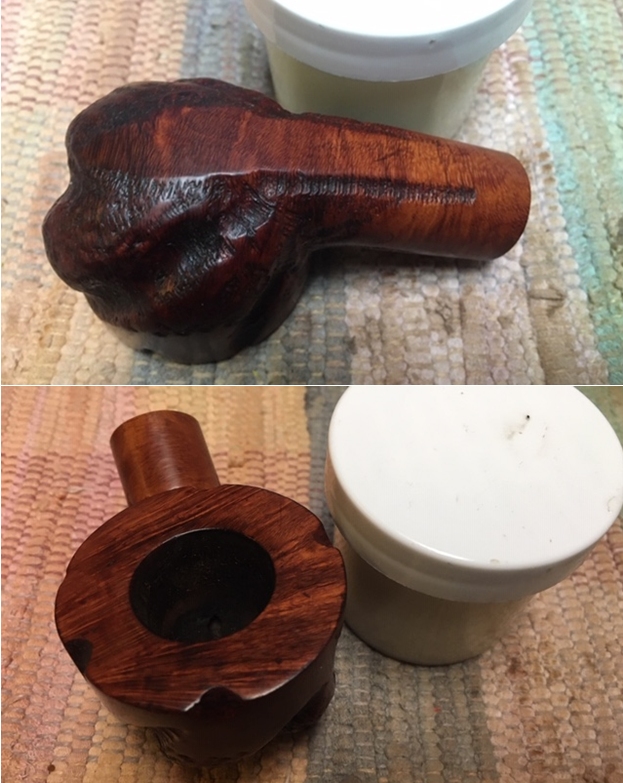
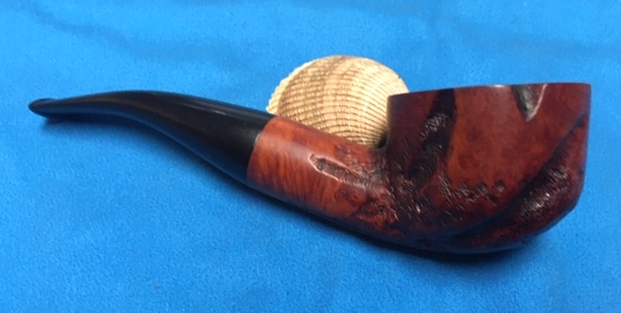
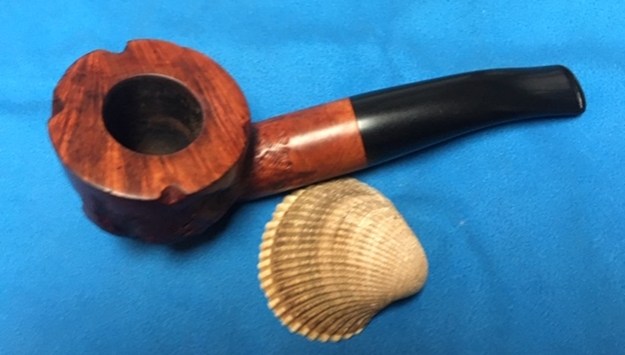
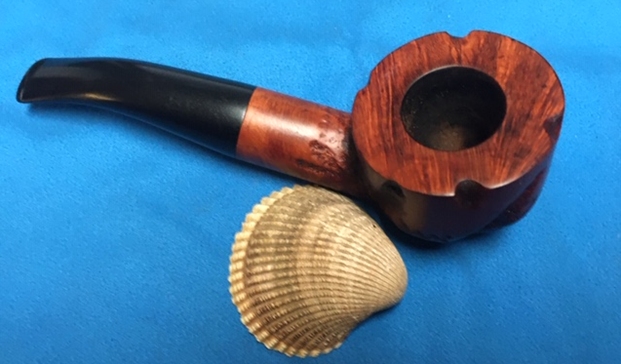
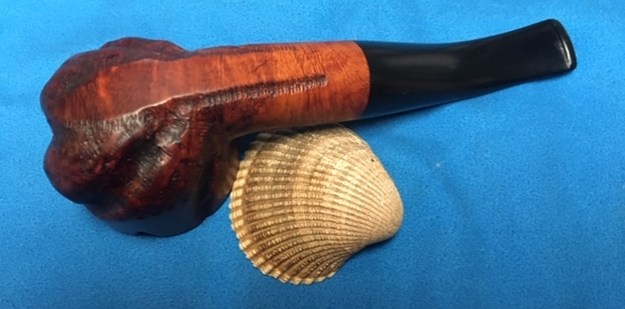
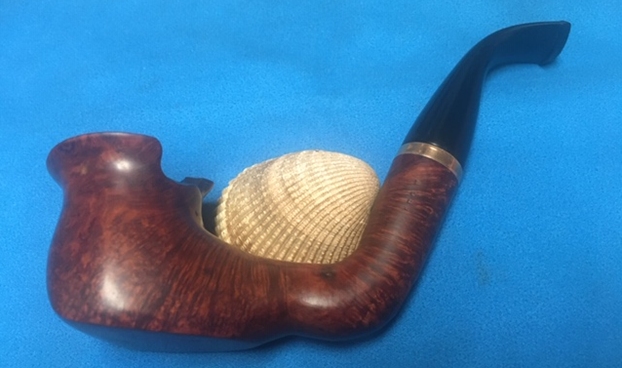
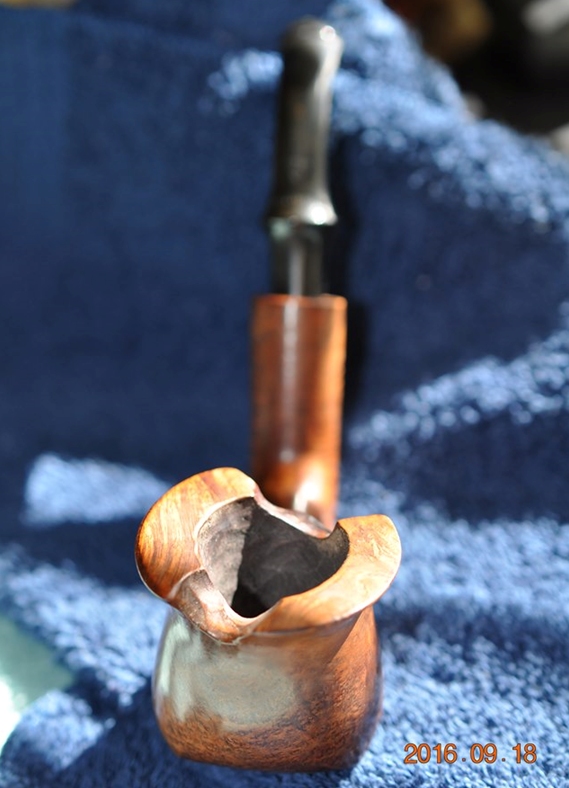
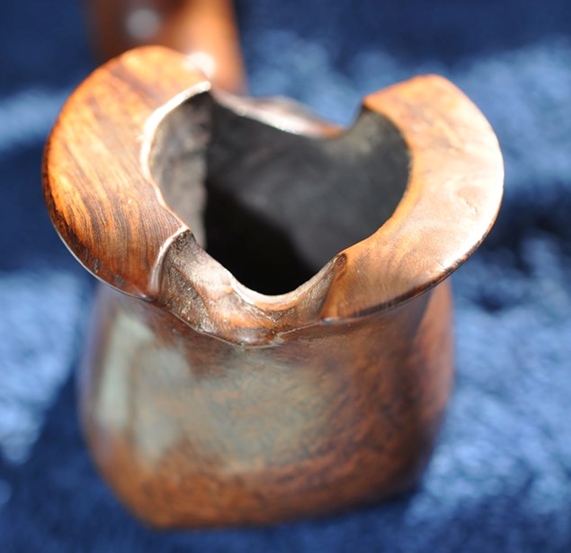
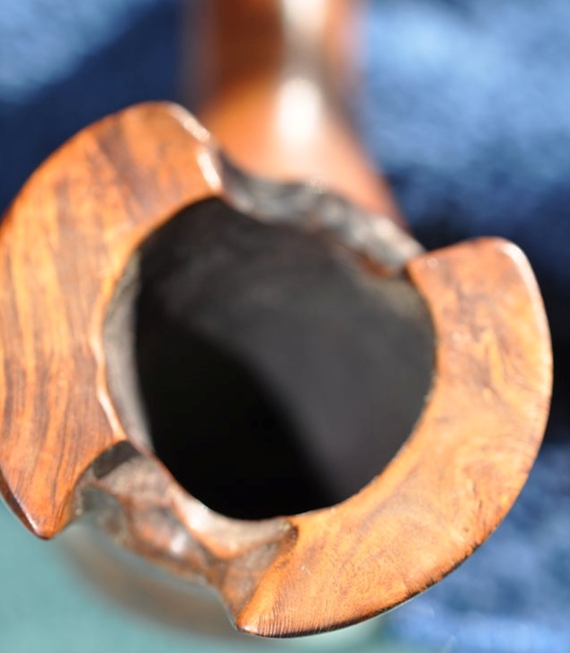
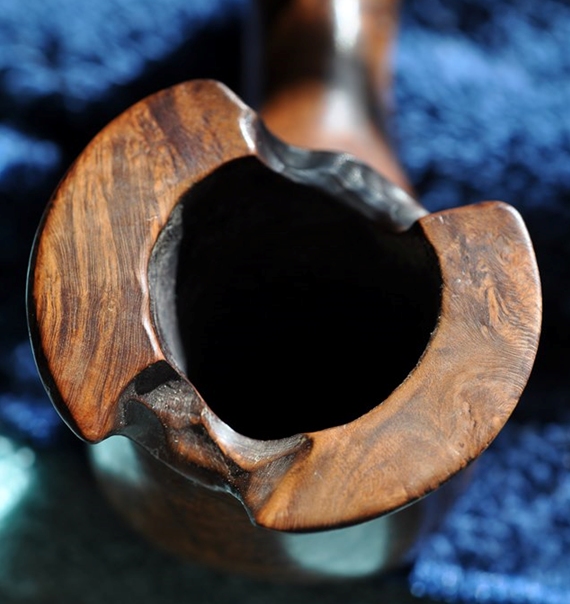
Jeff picked up this pipe sometime in 2016 and I have had it in a box of bowls since he sent it to me. I have looked at it several times but it never called my name. It is a strange pipe. The upwardly curved portion of the shank is joined to the bowl and straight shank about mid shank. The grain is quite nice though there is a large pit on the left side of the shank. The pipe is a sitter with a strange notched rim top. The notches have a faux plateau pattern in the groove on the front and back of the bowl. The top of the rim is almost calabash like with a wide flat top. The curve of the shank made the drilling of the bent portion a mystery until you turn the pipe over and see the screw that is inset in the back of the shank where it is parallel with the airway in the straight portion. It was lightly smoked and dirty. The shank is stamped AFG III on the left side of the upper portion. The stem was pirated from a WDC Wellington and made to fit in the shank. The shank end was out of round and the mortise was quite large. The end was not flat so fitting any stem would be a trick. Maybe that is why the Wellington stem was used. The stem had deep tooth marks in the surface and really did not work with the bowl to me. Jeff took the following photos before he did his clean up on the pipe. Jeff took photos of the bowl top to show the condition of the bowl and rim top and edges. The pipe has almost a floral look to it from this angle. It is a dirty pipe and the interior of the bowl has some roughness on the right side. He took a photo of the screw in the underside of the shank. It looks like a brass wood screw that has been inset in the shank.He took photos of the sides of the bowl and the heel to give a clear look at the grain on the briar. It is actually a nice looking piece of briar that some how the shape follows in a strange way all its own. The stamping on the left side of the shank reads AFG III which is not a brand I can find listed anywhere on the net so I have no information on the maker.The stem that had been made to fit is a WDC Wellington P-lip knockoff. It really did not fit in the shank and it was pretty chewed up. I would need to replace it.Today when I was sorting through my box of bowls without stems that I have and pitching out the worst of them I picked this bowl up and was drawn to seeing what I could do with it. I took it to my worktable and looked it over. Jeff had done a great job cleaning up the pipe as I have come to expect after 4 years of working on pipes. He reamed the pipe with a PipNet reamer and cut back the cake back to the bare briar. He cleaned up the walls with a Savinelli Fitsall Pipe Knife. He scrubbed the interior of the bowl and shank with pipe cleaners, cotton swabs and alcohol to remove the tars and oils. He scrubbed the exterior of the pipe with Murphy’s Oil Soap and a tooth brush to remove the grime from the finish. He scrubbed the inside of the stem with alcohol and pipe cleaners. Since the stem was not going to be used he did a quick clean up on it and sent it along. I had long since thrown it in the bottom of the box of bowls. The pipe was indeed an odd one. I took photos of the pipe when I received it before I started working on it. I took a photo of the wood screw in the shank and the flaw in the briar on the topside of the shank. You can also see the joint of the bowl and shank with the upward turned shank extension in the photos below. I drew a red box around then in the photos below. I went through my cans of stems to find one that would work with the diameter of the shank. I would need to turn the tenon to make it fit and also adjust the shank end and face it to make the taper stem fit.I took a photo of the shank end to show its condition. It was not flat and it was not round. The thickness of the shank around the mortise was also different on each side. The second photo below shows that angle of the shank end.I went through my brass bands to find one that would fit the end of the shank. I smoothed out rounded end on a topping board to smooth it. I also used my Dremel and sanding drum to bring the shank end back to round. I heated the band and pressed it onto the end of the shank. It looked good and it provided a straight flat edge on the shank end that would work well with the newly turned stem. I unscrewed the wood screw from the shank and found that it actually cut off the flow of air through the shank. When it was in place it extended into the airway. I used the Dremel and a grinding stone to take the screw down so that it would end at the wall of the airway. I used some all purpose glue to anchor the screw in the shank. It could be removed with a screw driver but it also was air tight.I filled in the flaw on the left side of the shank with briar dust and super glue. When the repair cured I sanded the repair smooth again with 220 grit sandpaper and started the polishing with 400 grit sandpaper. I used the PIMO tenon turning tool on my cordless drill to reduce the diameter of the tenon and face the stem surface for a good fit on the shank.Once I had the fit right to the shank I used a heat gun to give the end a bend that matched the flow of the bowl.  I may bend it a bit more but I like it at the moment. I polished the briar with micromesh sanding pads – dry sanding with 1500-12000 grit pads and wiping the bowl down with a damp cloth after each pad. I worked over the repaired spot on the shank to blend it in more. I touched up the stain around the band edge and the repaired pit on the shank using a blend of Oak and Maple stain pens. The colour matched well and once it was buffed would be perfect.I rubbed the briar down with Before & After Restoration Balm. I worked it into the briar with my fingertips. The product works to clean, enliven and preserve the briar. I let it sit for 10 minutes while I worked on the stem. After the time passed I buffed it with a cotton cloth to deepen the shine. The briar really comes alive with the balm. I set the bowl aside and turned my attention to the newly fit stem. I did some fine tuning of the diameter of the stem at the shank/stem junction with 220 grit sandpaper and began the polishing with 400 grit wet dry sandpaper. I rubbed the stem down with Denicare Mouthpiece Polish – a red, gritty Tripoli like substance that is a paste. I rubbed it into the surface of the stem and polished it off with a cotton pad. I have found that is a great intermediary step before polishing with micromesh pads. I am not sure what I will use once the final tin I have is gone!I polished the vulcanite with micromesh sanding pads – 1500-12000 grit pads. I wiped it down with Obsidian Oil after each sanding pad. I used Before & After Pipe Polish – both Fine and Extra Fine to further polish the stem.  This oddly shaped handmade briar pipe is strange enough to actually be quite interesting. From the shape of the extended shank to the flair of the bowl sides to the different looking top with the smooth top on the sides and the “dips” in the front and rear that are rusticated to look a bit like plateau. The mix of brown stains that the maker used really highlights some great grain around the bowl sides and the heel. The finish on the pipe is in excellent condition and the contrasting stains work well to highlight the grain on the pipe. The band and the newly shaped vulcanite stem seem to work well with the pipe. The pipe is a beauty and really eye-catching in its own way. I put the stem back on the bowl and buffed the pipe with Blue Diamond on the buffing wheel. I gave the bowl and the stem multiple coats of carnauba wax on the buffing wheel and followed that by buffing it with a clean buffing pad. I hand buffed the pipe with a microfiber cloth to deepen the shine. The finished Freehand is quite nice and feels great in the hand and is a sitter as well. Give the finished pipe a look in the photos below. This is not a pipe for everyone but someone is bound to love it. The dimensions of the pipe are Length: 6 inches, Height: 1 7/8 inches, Outside diameter of the bowl: 1 ¾ inches, Chamber diameter: ¾ of an inch. Thanks for walking through the restoration with me as I worked over another beautiful pipe. This pipe will be added to the American Pipe Makers section of the rebornpipes store soon. If you want to add it to your collection send me an email or a message! Thanks for your time.

New Life for a Peterson’s Republic Era “Donegal” Rocky Bent Apple 03


Blog by Steve Laug

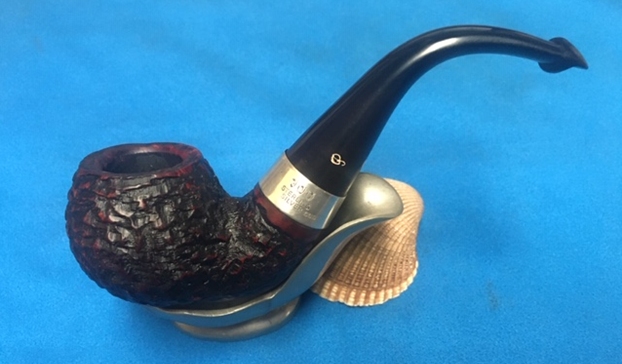
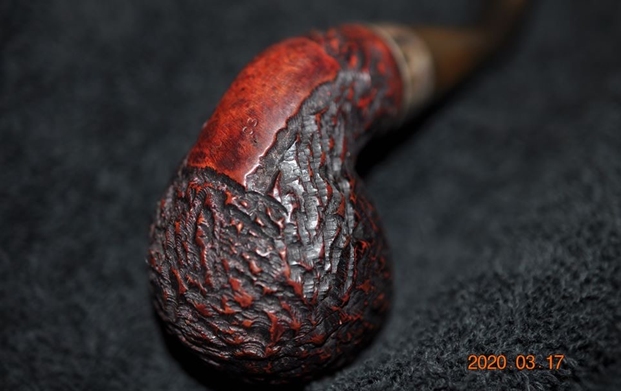
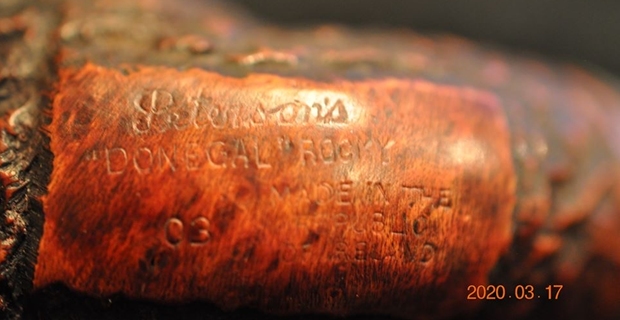
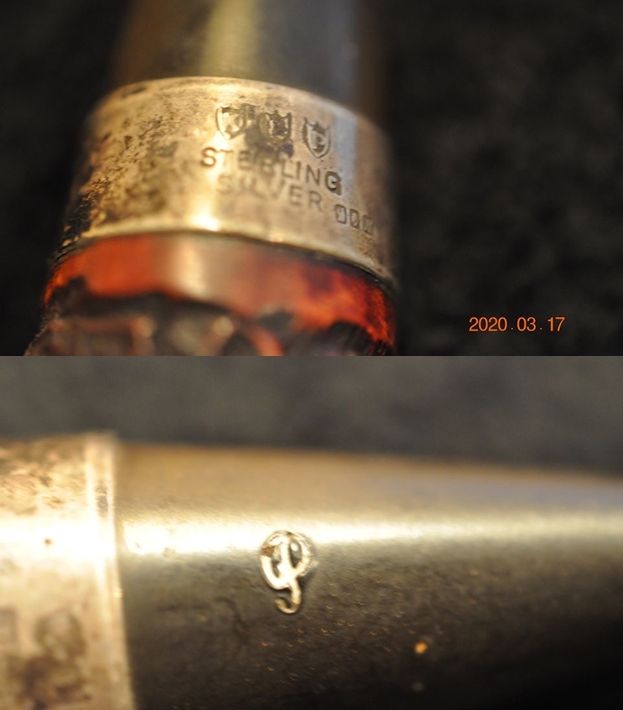
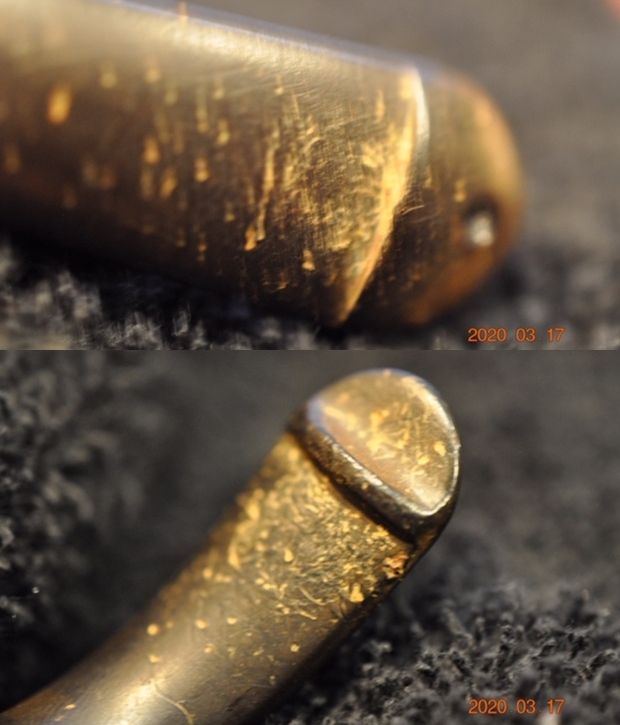
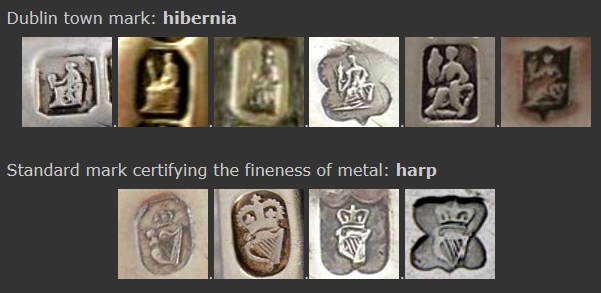
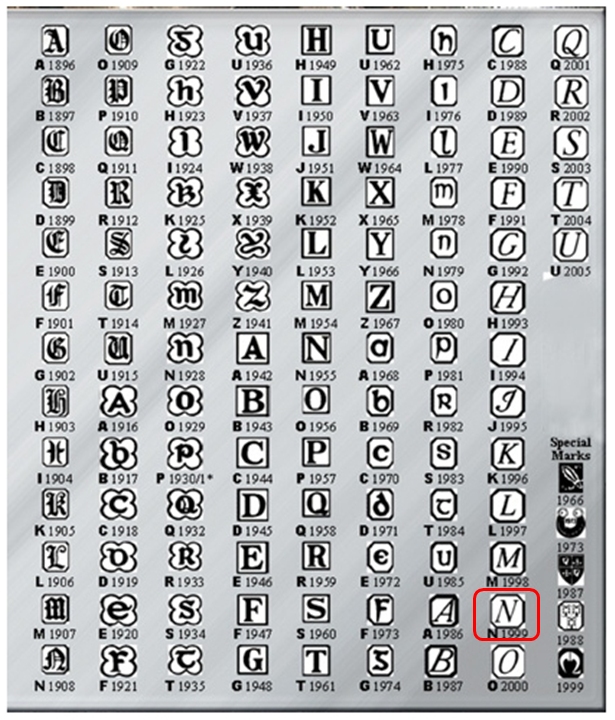
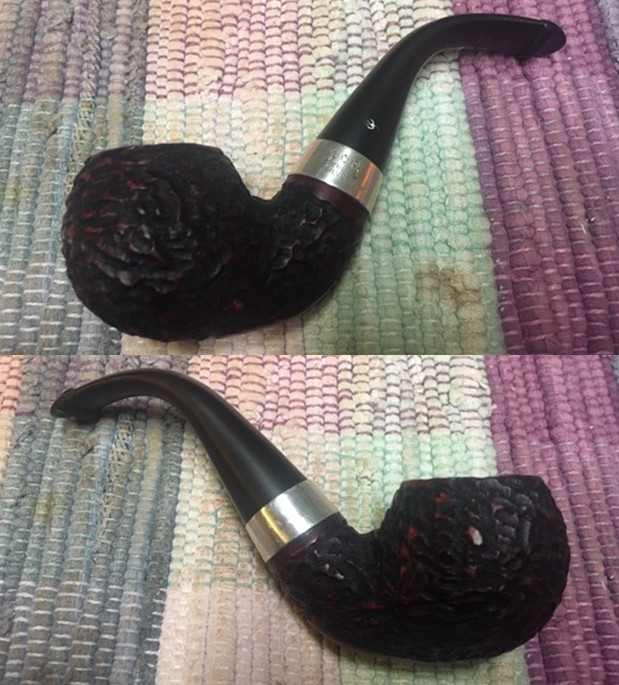
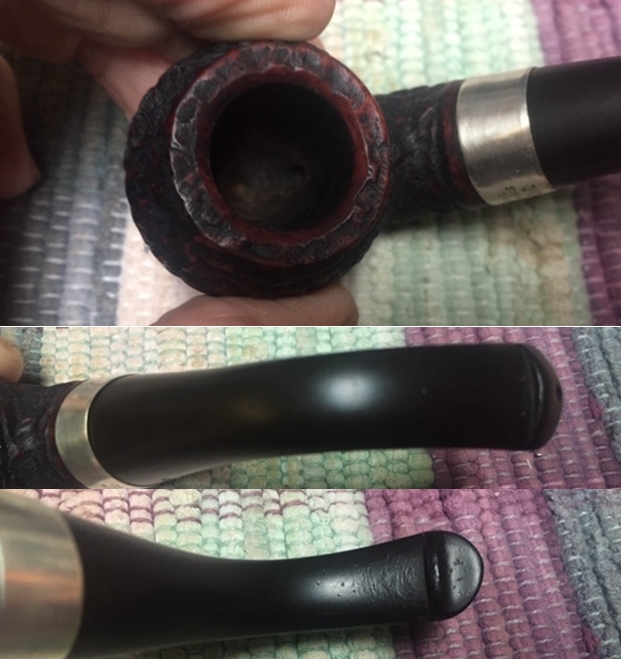
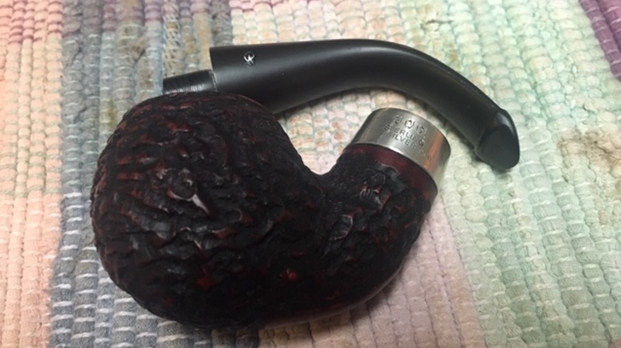
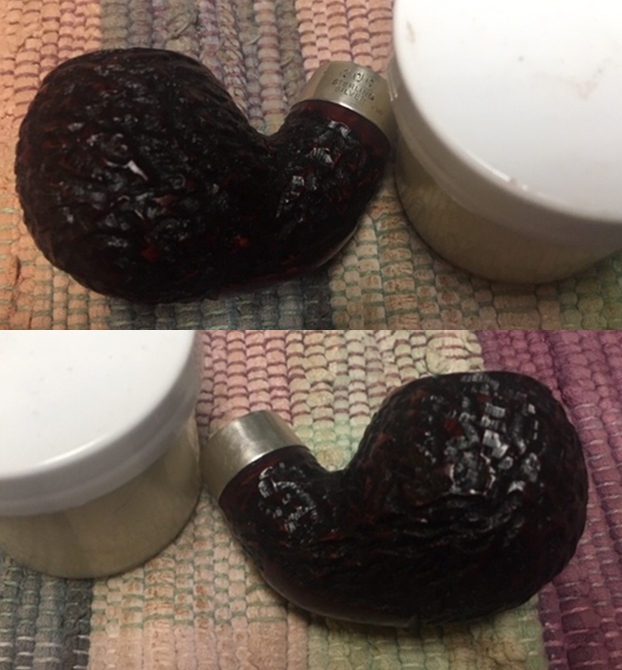
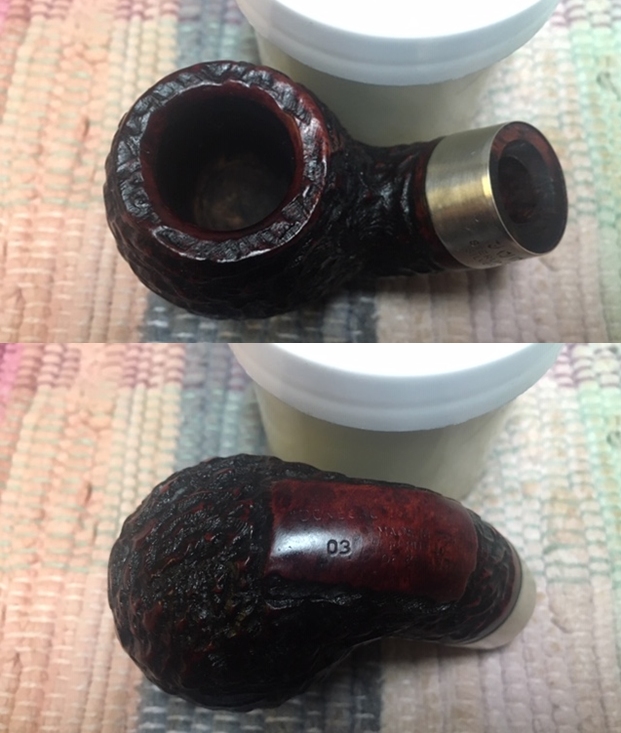
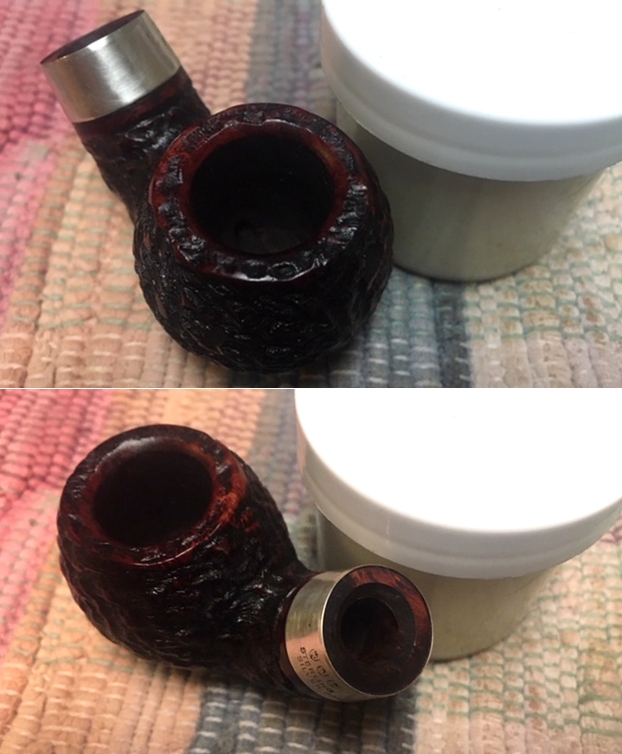
The next pipe on the table came to us from one of Jeff’s pipe hunts or auctions. It is a rusticated Peterson’s “Donegal” Rocky 03 Bent Apple. The rusticated finish is quite nice with at that classic Peterson’s rustication pattern. The pipe was very dirty, with grime and dust deep in the grooves of the rustication. The bowl had a thick cake in the bowl and surprisingly only dust on the rusticated rim top. There was darkening on the briar and a little lava on the inner edge of the rim. The pipe is stamped on a smooth panel on the underside of the shank and reads Peterson’s “Donegal” Rocky with the shape number 03 ahead of that. It is also stamped Made in the Republic of Ireland. On the oxidized Sterling Silver band it is stamped K&P in shields over Sterling Silver there are three hallmarks below and to the left of that. The hallmarks are: 1. a seated woman (Hibernia) – the city stamp for Dublin, 2. Harp – the mark for the quality of the silver, 3. a slanted uppercase N – the date identification of the pipe. The stamping is clear and readable on the pipe. The stem was dirty and oxidized. There were tooth marks and chatter on the stem near the button on both sides and some on the surface of the button as well. There was the Peterson’s “P” on the left side of the taper stem. Jeff took photos of the pipe before he cleaned it up. Jeff took photos of the rim top to show the cake in the bowl and the relatively clean rim top and beveled edge. The photos show the rim top and bowl from various angles.Jeff took some photos of the bowl sides and heel to show the rustication that was on this bowl. It is a quite beautifully crafted pipe. The rustication is quite dirty. The stamping on the underside of the shank read as noted above. The photo shows that they are very clear and readable. The stamping on the silver is also readable. The P on the left side of the stem is in good condition. The stem was a very good fit to the shank. It was oxidized, calcified and had debris stuck to the surface of the vulcanite. There was light tooth chatter and marks on both sides of the stem and on the button surface.  I am including the information from Pipedia’s article on Peterson pipes. It is a great read in terms of the history of the brand (https://pipedia.org/wiki/Peterson). I have included a bit of the pertinent history here.
1950 – 1989 The Republic Era  – From 1950 to the present time, the stamp for this era is “Made in the Republic of Ireland” in a block format generally in three lines but two lines have been used with or without Republic being abbreviated.

During the 1950’s and 60’s the Kapp & Peterson company was still in the ownership of the Kapp family. However 1964 saw the retiral of the company Managing Director Frederick Henry(Harry) Kapp.

I turned then to deal with the Hallmarks. I turned to Pipephil’s site for his quick reference charts on the Peterson’s Hallmarks (http://www.pipephil.eu/logos/en/infos/hallmark-dublin.html). I have included the pertinent charts below. The first chart defines the first two hallmarks on the Sterling Silver Band. The Hibernia/Lady is the Dublin Town Mark. The Harp identifies the fineness of the metal.The second chart pins down the date that this particular pipe was made. The slanted N mark identifies the pipe as being made in 1999. I have drawn a red box around the N on the chart below.With that information in hand I knew what I was dealing with in terms of the stamping and the age of this pipe. I knew from the information that the pipe was made during the Republic Era between 1950 and 1989. Pipedia then qualifies the dating as follows: From 1950 to the present time, the stamp for this era is “Made in the Republic of Ireland”. I was wondering how a pipe stamped Republic of Ireland and 1999 fit! I guess the “present time” stamp qualifies that.  Now it was time to work on the pipe.
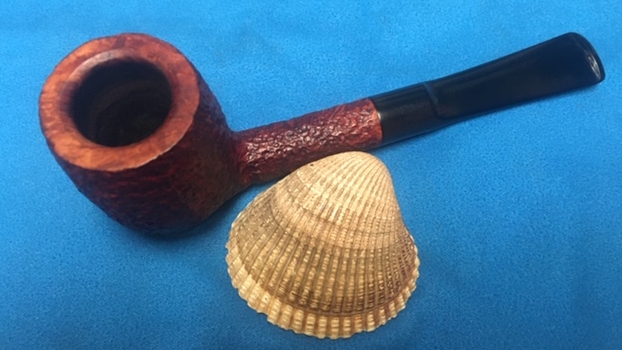
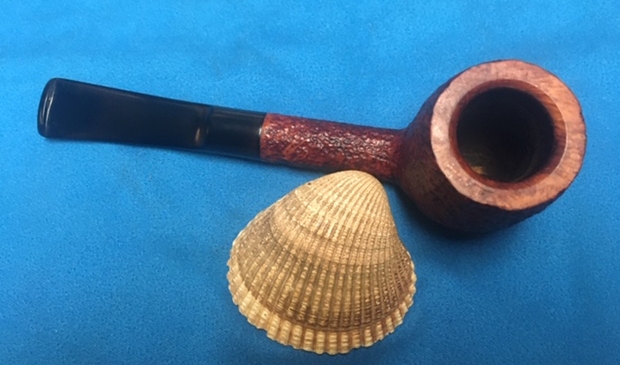
Armed with that information I turned to work on the pipe itself. Jeff had done a great job cleaning up the pipe as usual. He reamed the pipe with a PipNet reamer and cut back the cake back to the bare briar. He cleaned up the walls with a Savinelli Fitsall Pipe Knife. He scrubbed the interior of the bowl and shank with pipe cleaners, cotton swabs and alcohol to remove the tars and oils. He scrubbed the exterior of the pipe with Murphy’s Oil Soap and a tooth brush to remove the grime from the finish. He scrubbed the inside of the stem with alcohol and pipe cleaners. He cleaned the oxidized silver with Soft Scrub and buffed it off with a soft pad. He scrubbed the exterior with Soft Scrub and then soaked it in Before & After Deoxidizer. He washed it off with warm water to remove the deoxidizer. The pipe looked far better. I took photos of the pipe when I received it before I started working on it. I took photos of the bowl and rim top to show how clean it was. The rim top and edges look very good. The stem looks clean of oxidation and there are light tooth marks and chatter on both sides of the stem.I took a photo of the pipe with the stem removed to show the overall look of stem, tenon and profile of the pipe. It is a great looking pipe.I rubbed the briar down with Before & After Restoration Balm. I worked it into the briar with my fingertips and a horse hair shoe brush to get it into the deep crevices of the rustication. The product works to clean, enliven and preserve the briar. I let it sit for 10 minutes while I worked on the stem. After the time passed I buffed it with a cotton cloth to deepen the shine. The rustication came alive with the balm. I set the bowl aside and turned my attention to the stem. There were some deep marks on the left side of the stem at the bend. I filled them with clear super glue and set it aside to cure. Once it was cured I sanded the stem to blend the repairs into the rest of the surrounding vulcanite.I sanded out the tooth marks and chatter on both sides of the button surface and stem with 220 grit sandpaper and began the polishing with 400 grit wet dry sandpaper.I rubbed the stem down with Denicare Mouthpiece Polish – a red, gritty Tripoli like substance that is a paste. I rubbed it into the surface of the stem and polished it off with a cotton pad. I have found that is a great intermediary step before polishing with micromesh pads. I am not sure what I will use once the final tin I have is gone!I touched up the P stamp on the left side of the stem with Paper Mate Liquid Paper and once it dried I scraped off the excess. The P stamp definitely looks better at this point.I polished the stem with micromesh sanding pads – 1500-12000 grit pads. I wiped it down with Obsidian Oil after each sanding pad. I used Before & After Pipe Polish – both Fine and Extra Fine to further polish the stem. This Republic Era Peterson “Donegal” Rocky 03 Bent Apple is a nice looking pipe. The rustication and mixed stain around the bowl sides and shank really stand out with the polishing. The finish on the pipe is in excellent condition and the contrasting stains work well to give some contrast to the rusticated finish of the pipe. The polished black vulcanite P-lip taper stem adds to the mix. With the grime and debris gone from the finish and the bowl it is really is eye-catching. I put the stem back on the bowl and buffed the pipe with Blue Diamond on the buffing wheel, carefully avoiding the stamping on the shank and using a light touch on the rusticated bowl and shank. I gave the bowl multiple coats of Conservator’s Wax by hand and the stem multiple coats of carnauba wax on the buffing wheel and followed that by buffing it with a clean buffing pad. I hand buffed the pipe with a microfiber cloth to deepen the shine. The finished Bent Apple is quite nice and feels great in the hand. Give the finished pipe a look in the photos below. I can only tell you that like the other pipes I am working that it is much prettier in person than the photos capture. The dimensions of the pipe are Length: 5 inches, Height: 1 ½ inches, Outside diameter of the bowl: 1 ¼ inches, Chamber diameter: ¾ of an inch. Thanks for walking through the restoration with me as I worked over another interesting pipe. This Peterson’s “Donegal” Rocky will be added to the Irish Pipe Makers section of the rebornpipes store soon. If you want to add it to your collection send me an email or a message! Thanks for your time.
Replacing a Broken Tenon on a Stanwell RP Freehand


Blog by Steve Laug

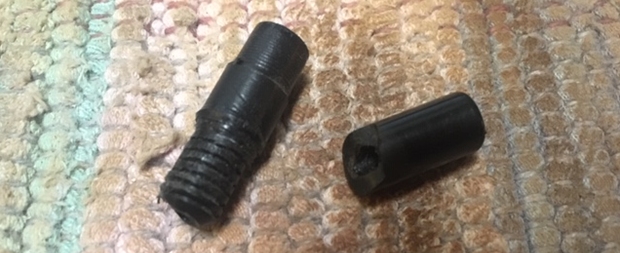
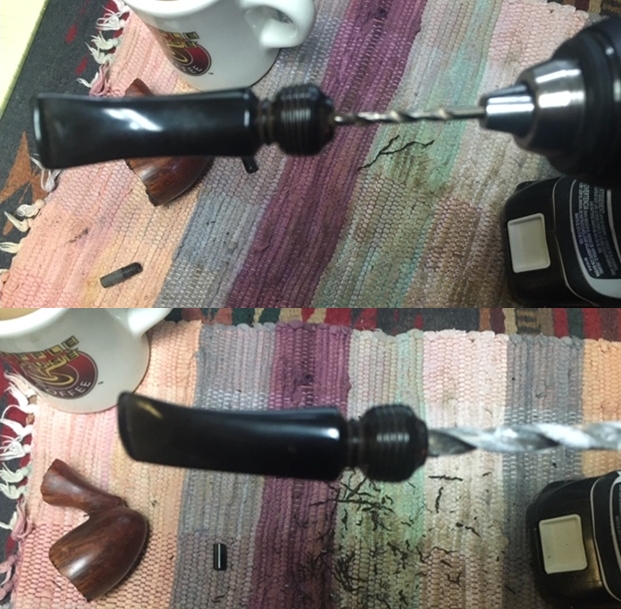
Yesterday a fellow pipe smoker called to say he was in front of my house and had a pipe that he had dropped while on a walk and needed a replacement tenon. He put the pipe in my mail box and I picked it up and while he was on the front side walk I chatted with him from the front porch – very much observing social distancing. The pipe was a beautiful Stanwell RP Freehand. Sure enough the tenon was stuck in the shank and snapper off just ahead of the fancy turned ball on the stem. Tenon replacements on these freehand styles are some of the easiest to do. It means that the stem end is flattened and drilled out to accommodate a new tenon. He also pointed out some road rash on the left side of the bowl where the pipe had bounced off the sidewalk. While I am not taking on new work what could I say to a previous customer standing at my gate asking for help. Of course I took the pipe in and today decided to address the broken tenon. I took pictures of the pipe to show its condition before I started. I took some photos of the shank end to show the snapped tenon in the shank and the broken end on the stem. I tried to pull the tenon with some simple tricks and it was stuck in the shank. It would not budge no matter how I tried. I put the bowl in the freezer for 10 minutes to see if a change in temperature would loosen the tenon.I took the bowl out of the freezer and screwed a drywall screw into the airway in the tenon. It did not take much effort at all to wiggle it and pull out the broken tenon. I kept the piece of tenon so that I could match the replace tenon to the diameter of the broken tenon.Before moving on to make the new tenon I decided to address the road rash on the side of the bowl. I have circled it in red in the first photo below. For this application I used a wet cloth and heated the blade of a butter knife over the flame of my gas stove. I put the wet cloth over the damaged spot and when the knife became hot I touched it to the wet cloth. The heat generated steam from the wet cloth and began to lift the damaged spot. I knew that it would not come up totally as it was a rough area but I knew that I could improve the look. The second photo shows the area on the bowl side after the steam application. I enclosed the repaired damage with a red circle.The damage looked much better after the steaming, not perfect but better! I stained the upper portion of the bowl with an Oak stain pen to blend it into the rest of the surrounding briar. Once it was polished it would blend in very well.I worked some Before & After Restoration Balm into the surface of the briar with my fingertips. The product works to clean, enliven and protect the briar. I let the balm sit for about ten minutes and then buffed with a cotton cloth to raise the shine. I find that it also helps to blend a newly stained area into the rest of the bowl. The photos show the bowl at this point in the restoration process. I set the bowl aside and turned my attention to replacing the tenon. I had a threaded tenon that I had started turning down to size for another pipe that would work perfectly. It is shown in the photo below next to the broken chunk of the original tenon. I would need to use a Dremel and sanding drum to finish turning the tenon portion down to match the diameter of the broken one. I would also need to reduce the diameter of the threaded tenon end because of the size of the end of the stem.I set the tenon aside and flattened the jagged portion of the broken tenon on the stem with the Dremel and sanding drum. Once it was flat I began the process of drilling out the airway to receive the new tenon. I always start with a drill bit slightly larger than the existing airway so that I do not chip of damage the stem. I don’t want create more work! I worked my way up to a ¼ inch drill bit as it was the largest one that I could get away with drilling into the stem end without damaging the external surface.I reduced the diameter of the portion of the tenon that fit in the shank and the portion that would be anchored in the stem using a Dremel and sanding drum to rough fit it. I straightened out the edges of the insert portion with a rasp and squared up the edge so that it would seat in the stem. Once I had a good fit in the stem and the shank I used slow setting super glue to anchor the new tenon in the stem. I coated the edges of the tenon and then set it in place and aligned it so that it was straight.Once the glue had cured I cleaned up the surface of the tenon so that it was not scratched with sandpaper and so that it fit well in the shank. I polished the stem with micromesh sanding pads – wet sanding with 1500-12000 grit pads.  I wiped down the stem after each pad with a damp cloth. I polished the fancy turnings on the stem and area around the new tenon with Before & After Pipe Polish (both Fine and Extra Fine) using a cotton swab to get into the grooves and angles. When I was finished I rubbed the entire stem down with the polish and buffed it with a microfibre cloth. With that the pipe is complete. I buffed it on the buffing wheel with Blue Diamond Polish and gave the entire pipe several coats of carnauba wax on the wheel. I buffed it with a clean buffing wheel and then hand buffed it with a microfiber cloth to deepen the shine. The pipe is now ready to go back to the pipe man who dropped it off Friday afternoon. I look forward to hearing what he thinks of his repaired pipe when he picks it up. Thanks for walking with me through this restoration. Cheers.

A Fresh Start for the second Davidoff  from this estate – a Straight 214 Billiard


Blog by Steve Laug

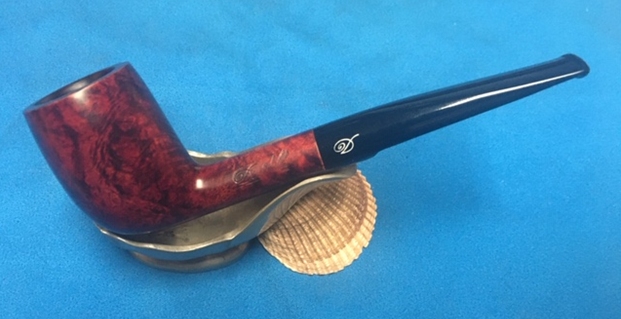
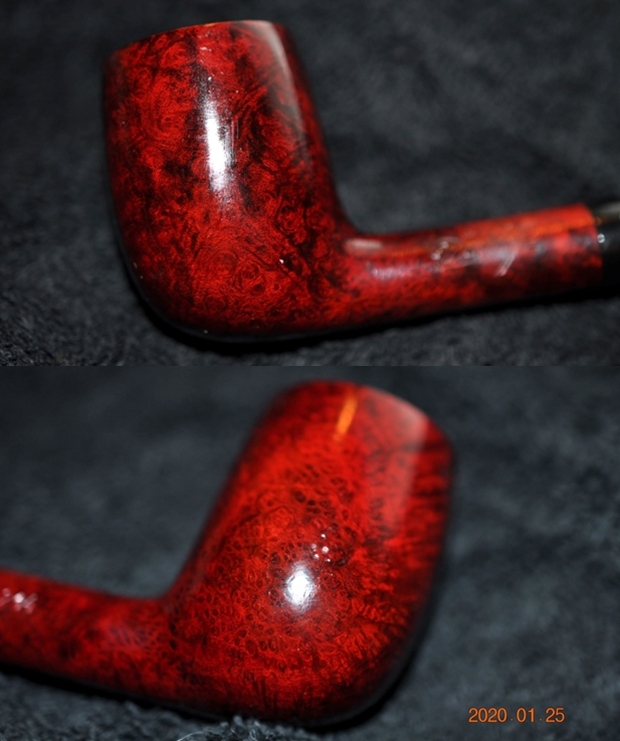
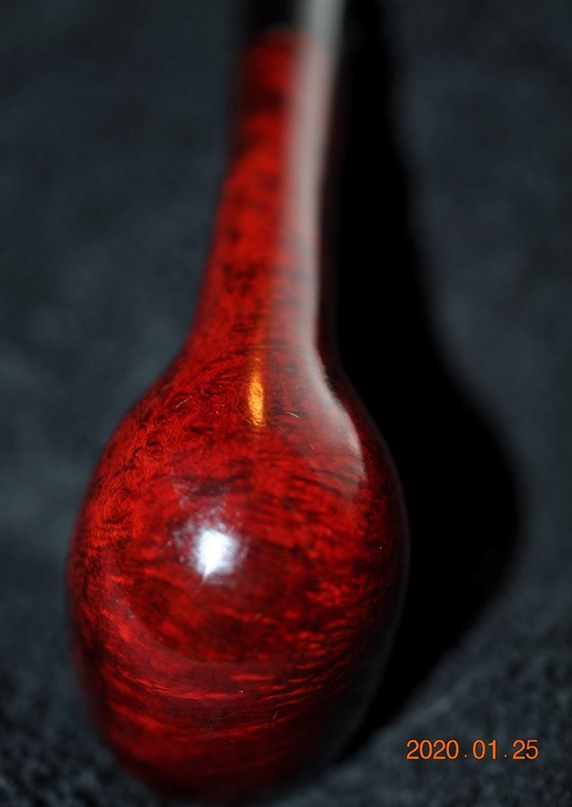
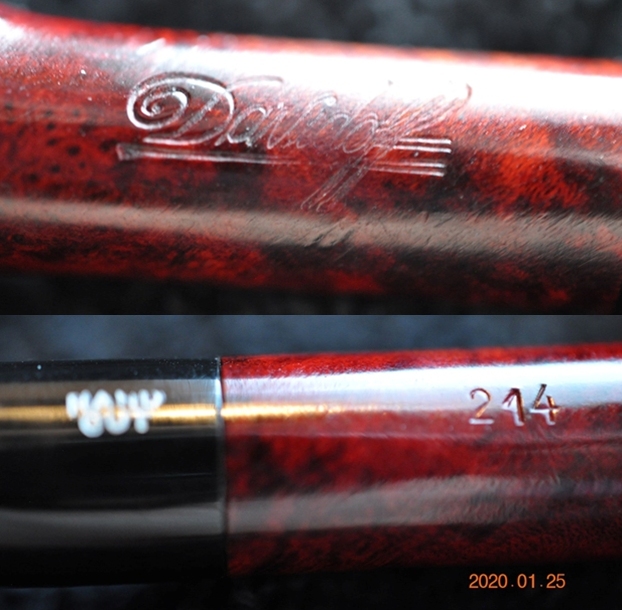
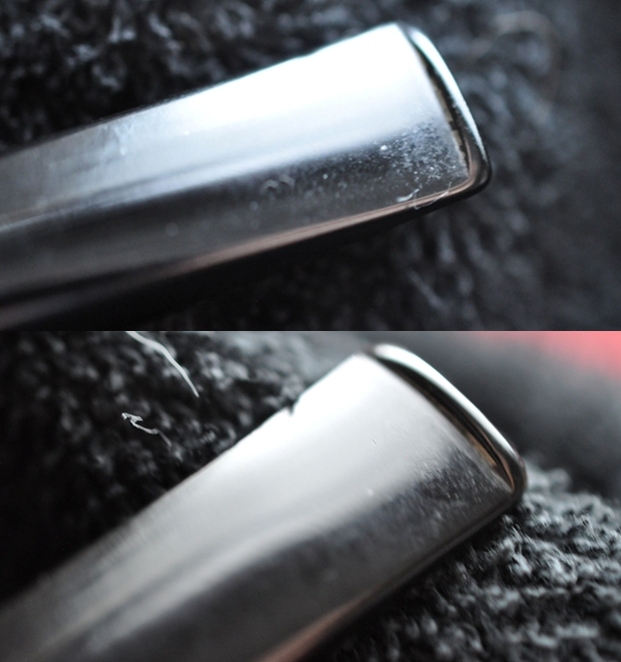
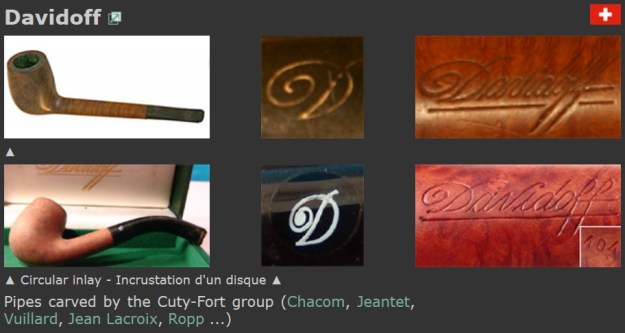
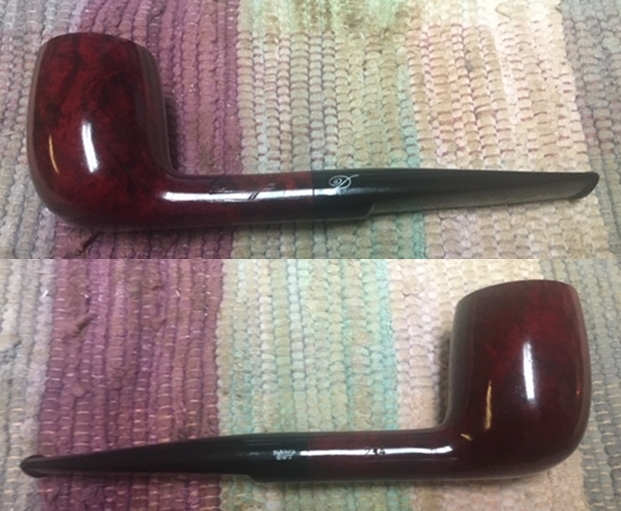
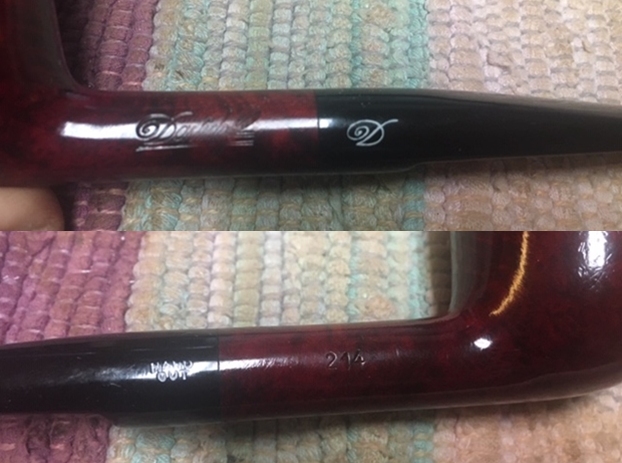
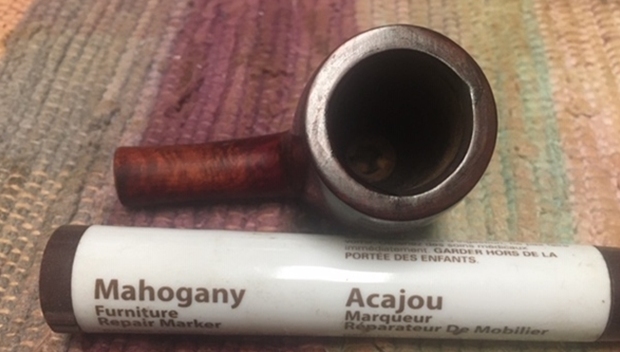
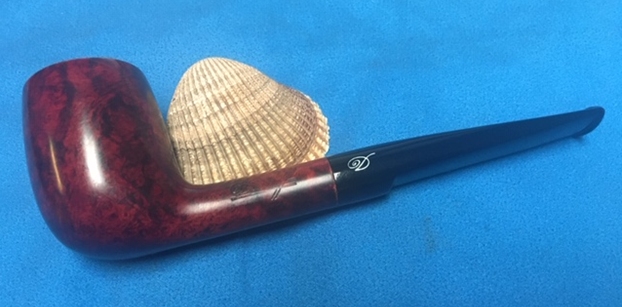
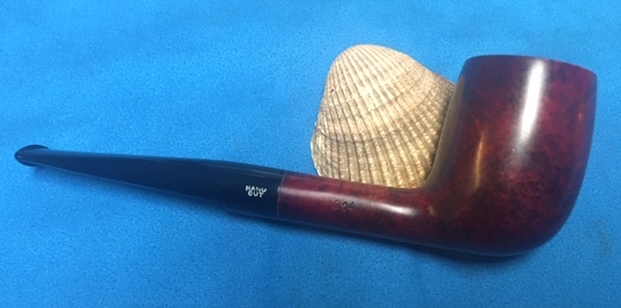
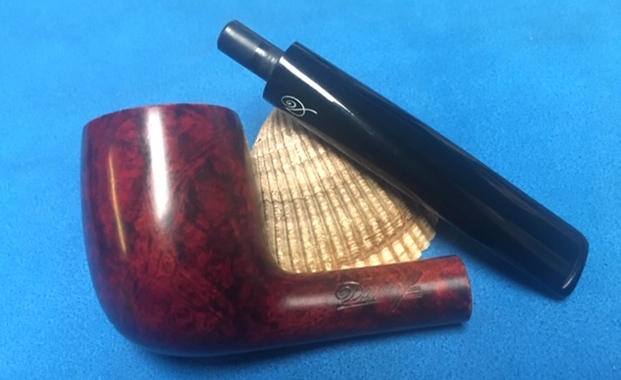
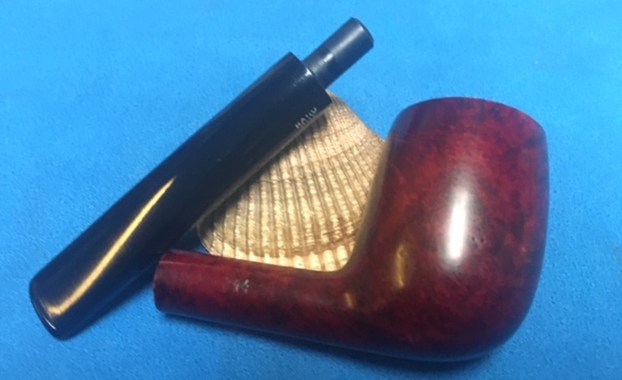
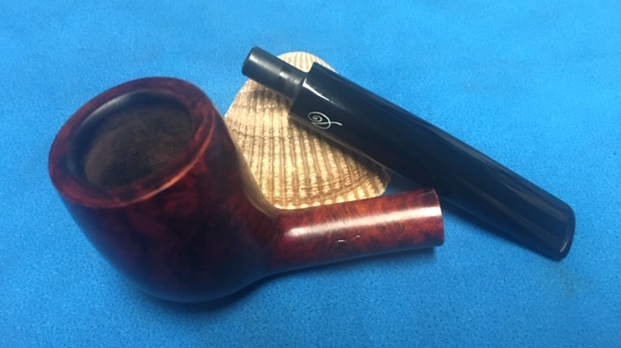
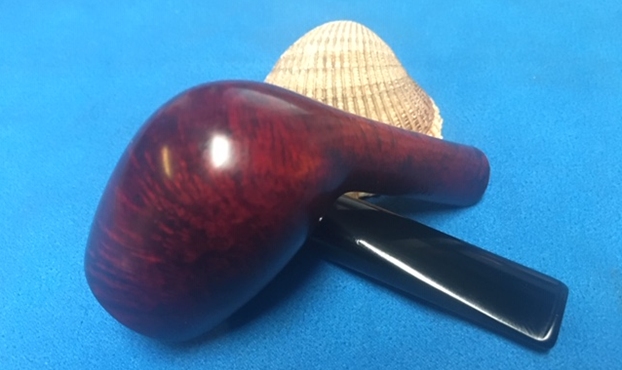
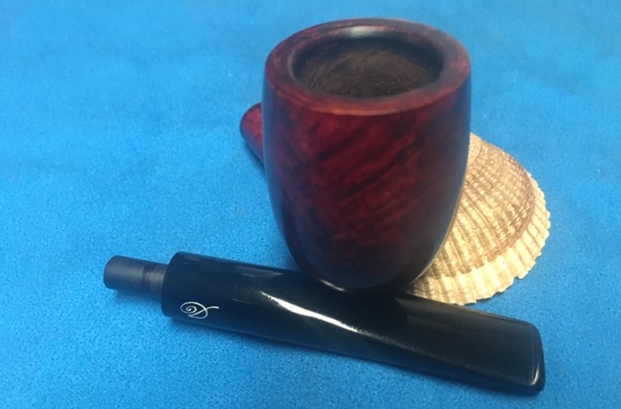
One thing about having so many boxes of pipes to work on surrounding my work table is that I can always find one that grabs my attention to work on now! This is the second of the two Davidoff pipes in the box and I had passed over in the past weeks but this morning I decided that the second pipe would join the days queue. It is a nice looking Billiard shape pipe stamped Davidoff on the left side of the shank. The name is underlined and the D has a flourish both on the stamping and on the logo on the left side of the stem. On the right side it is stamped with the shape number 214. It was dirty and was another well-loved pipe when we received it. The bowl had a thick cake and the lava overflow on the top and the edge of the rim. It was hard to know the condition of the inner edge of the bowl. The pipe had a rich Mahogany stain on the bowl that highlighted some nice grain on the bowl sides under the grime and the finish appeared to be damaged on the left side of the shank and rim top. The shiny varnish coat was damaged on the rim, on the right side of the bowl and the left side of the shank. It was worn. A lot would be revealed once Jeff had worked his magic on it. The acrylic stem was in good condition with light tooth chatter and marks on both sides ahead of the button and on the button surface itself. Jeff took photos of the pipe before he started his cleanup work. Jeff tried to capture the condition of the bowl and rim top with the next series of photos. You can see the work that is ahead of us there. The grain around the bowl is quite stunning. Jeff took some great photos showing what is underneath the grime and debris of time and use. He captured the stamping on both sides of the shank and both sides of the half saddle acrylic stem. They are clear and readable. It read Davidoff in script underlined with a Script D on the left side of the stem and Hand Cut on the right side of the stem. The photos of the stem show the stem surface. It is dirty and has light tooth marks and chatter on both sides ahead of the button.This second Davidoff pipe is also the second one I have worked on from this pipe maker. I turned to Pipephil to get a quick overview on the brand so I knew a bit about the pipe I was working on (http://www.pipephil.eu/logos/en/logo-d3.html). I have included a screen capture of the pertinent section below. It seems that for awhile anyway the pipes were carved by the Cuty-Fort Group (Chacom, Jeantet, etc.).I turned to Pipedia to fill in more of the gaps and found that the article quotes Jose Manuel Lopes whose book I have on my shelf ( https://pipedia.org/wiki/Davidoff) I quote:

From Pipes, Artisans and Trademarks, by Jose Manuel Lopés’

Davidoff started in 1911 as a family run tobacconist located in Geneva. Henri Davidoff, a Russian emigrant, was the founder. The shop was located in Geneva. His son, Zino Davidoff (1906-1994), concentrated on the tobacco business, starting in 1924, and revolutionized the conservation of quality cheroots throughout Europe.

Davidoff became World famous, and the company was acquired in 1970 by the Oettinger group, and expanded into numerous accessories for men. For Zino, the pursuit of pleasure was a constant, two of his maxims being: “Take pleasure from everything in life, without excess” and “the pipe is a valuable companion, the essence of tranquility and must be smoked with respect”.

Davidoff’s first pipes date from 1974 and were commissioned by various companies, notably Butz-Choquin and the Cuty Fort Group. The brand offers 14 classic shapes, in three finishes and with acrylic stems.

It appears the pipes are now made in Italy, as the website states the following about their pipes:

Creation of the Davidoff Pipe entails a meticulous, detailed process performed by only the most skilled Italian pipemakers. This dedication is why the Davidoff Pipe upholds a standard of quality and design found in no other pipe in the world. Made of the finest and carefully selected briar, each Davidoff Pipe features a flawless, hand-finished bowl and perfectly fitted, hand-cut acrylic stem. The Davidoff Pipe is available in three beautiful designs and finishes — sandblasted black, red brilliant and natural light brown.

With that information in hand I knew what I was dealing with either a French made or an Italian made pipe. I have been working on a lot of each lately and the pipe in hand also had the feel of a French made Chacom pipe rather than an Italian. I would work with that assumption. I had no idea of the age of the pipe but it was time to work on the pipe itself.

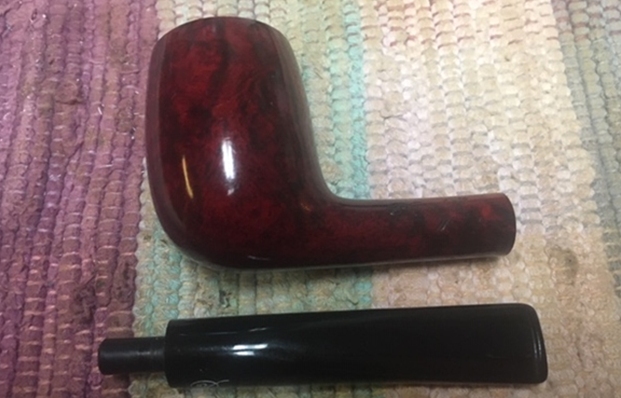
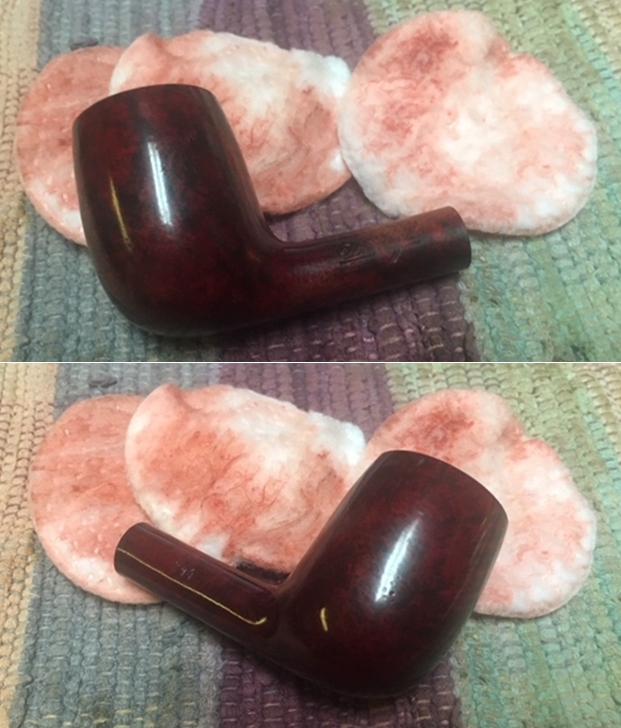
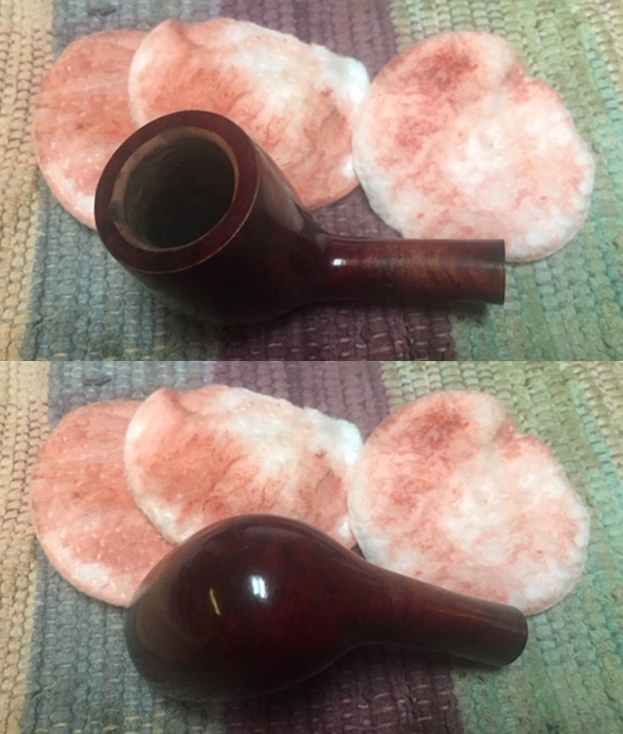
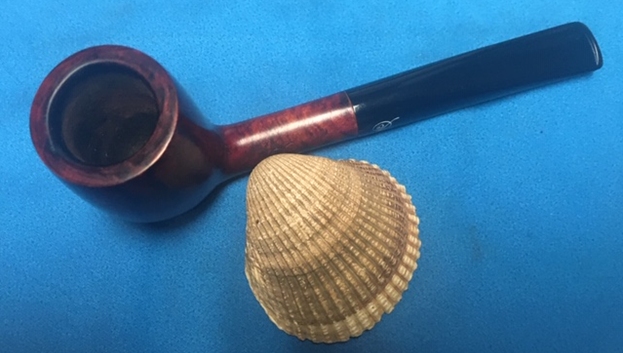
Jeff cleaned the pipe with his usual penchant for thoroughness that I really appreciate. This one was a real mess and I did not know what to expect when I unwrapped it from his box. He reamed it with a PipNet pipe reamer and cleaned up the reaming with a Savinelli Fitsall Pipe Knife. He scrubbed out the internals with alcohol, pipe cleaners and cotton swabs until the pipe was clean. He scrubbed the exterior of the bowl with Murphy’s Oil Soap and a tooth brush to remove the grime and grit on the briar and the lava on the rim top. The finish looks very good with good looking grain around the bowl and shank. Jeff scrubbed the stem with Soft Scrub to remove the grime and build up on the surface. When the pipe arrived here in Vancouver for the second stop of its restoration tour it looked very good. I took photos before I started my part of the work. (I forgot to take a photo of the top view of the pipe.) Fortunately I took some photos of the rim top and stem. The photo of the bowl shows how clean the bowl is and also the damage and peeling of the varnish coat on the smooth rim. The inner edge of the bowl was also in rough condition with burn marks and damage around the front inner edge. The close up photos of the stem shows that is it very clean.I took photos of the stamping on the stem and shank of the pipe. It is clear and readable. You can also see the smudge in the varnish finish on the left side of the shank in the middle of the Davidoff stamp.I took the stem off the shank and took a picture of the pipe. It really is a nice looking pipe with great lines.With the damage on the finish on the side of the shank and the finish on the rim top I decided to remove the varnish or shellac coat on the briar. I wiped it down with acetone on a cotton pad to remove the shiny coat. I would need to sand the rest of the finish off with micromesh sanding pads but before I did I wanted to clean up the edge and top of the rim. I used a folded piece of 220 grit sandpaper to smooth out the damage and give the rim edge a light bevel. I topped the rim with 220 grit sandpaper to remove the damaged finish and clean it up. I polished the briar with micromesh sanding pads – dry sanding with 1500-12000 grit pads. I wiped the bowl down after each pad with a damp cloth. I wanted to finish removing the varnish coat and polish the rim top. Once the varnish was removed the grain really began to stand out and the finish took on a natural shine by the last sanding pad. The photos tell the story! (Once again I forgot to take a few photos — don’t know what is happening.) I stained the polished rim top with a Mahogany Stain Pen. The colour matched the rest of the bowl perfectly. There was still a small nick in the rim edge that remains – to remove that would have changed the look of the rim.I worked some Before & After Restoration Balm into the surface of the briar with my fingertips. The product works to clean, enliven and protect the briar. I let the balm sit for about ten minutes and then buffed with a cotton cloth to raise the shine. The photos show the bowl at this point in the restoration process. I laid the bowl aside and turned to deal with the stem. The tooth marks and chatter on the stem were not deep. I polished the stem with micromesh sanding pads – dry sanding with 1500-12000 grit sanding pads. I wiped it down after each sanding pad with a cloth containing some Obsidian Oil. I finished polishing it with Before & After Pipe Stem Polish – both Fine and Extra Fine and buffed it off with a cotton cloth. The pipe came together quite well. The finish on the pipe is in excellent condition and the contrasting stains work well with the black acrylic stem. With the grime, debris and varnish coat gone, the bowl had a natural beauty and grain that pops. I put the stem back on the bowl and buffed the pipe with Blue Diamond on the buffing wheel. I carefully avoided the stamping on the shank and stem during the process. I gave the bowl and the stem multiple coats of carnauba wax on the buffing wheel and followed that by buffing it with a clean buffing pad on the buffer. I hand buffed the pipe with a microfiber cloth to deepen the shine. The finished Davidoff pipe is quite beautiful and is a lovely billiard shaped pipe. The finish on the bowl combines various mahogany and black stains to give it depth. It is very well done. Give the finished pipe a look in the photos below. I can only tell you that it is much prettier in person than the photos capture. The dimensions of the pipe are Length: 5 ½ inches, Height: 1 ¾ inches, Outside diameter of the bowl: 1 ¼ inches, Chamber diameter: ¾ of an inch. I really like this billiard shaped pipe and it also reminds me of a Chacom pipe. This is a great looking pipe in great condition. Thanks for walking through the restoration with me as I worked over another beautiful pipe. I will be adding it to the rebornpipes store soon. If you want to add it to your collection send me an email or a message! Thanks for your time.
Restoring a Pastoral Carved Mural Meerschaum


Blog by Steve Laug

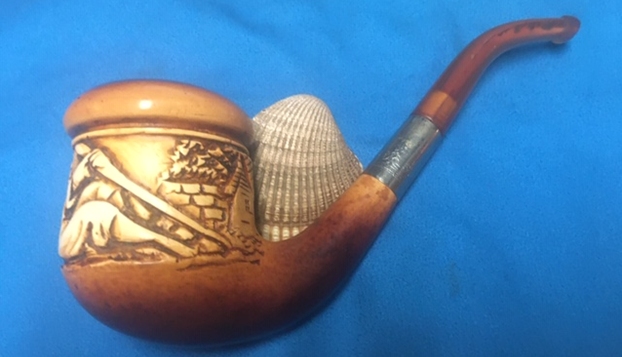
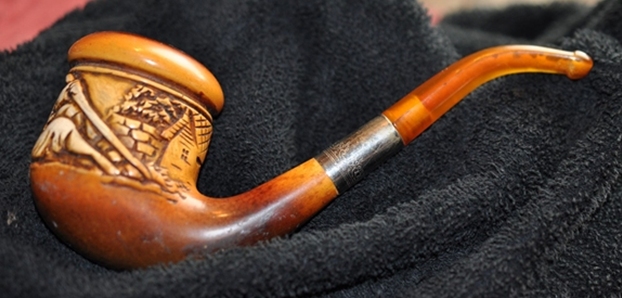
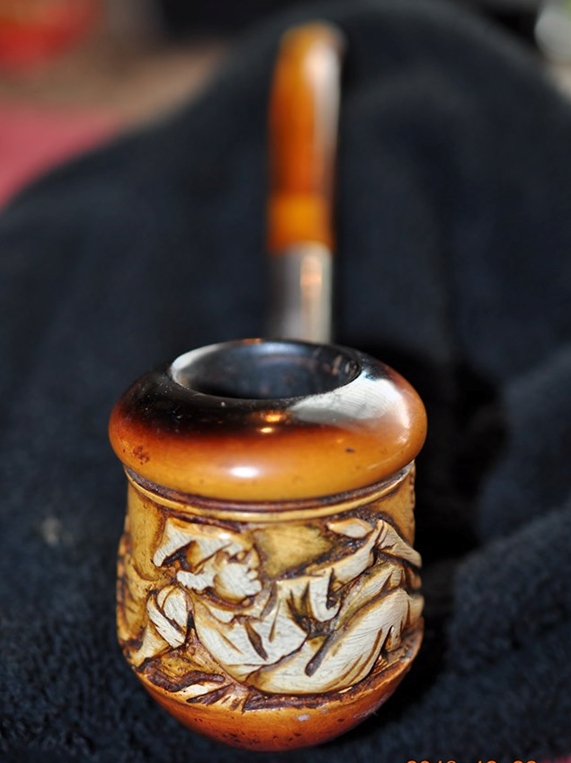
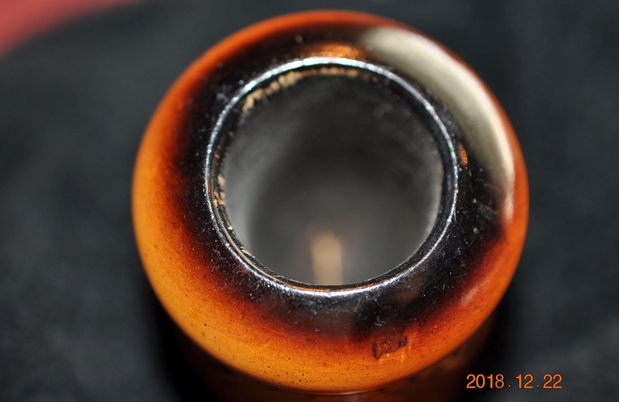
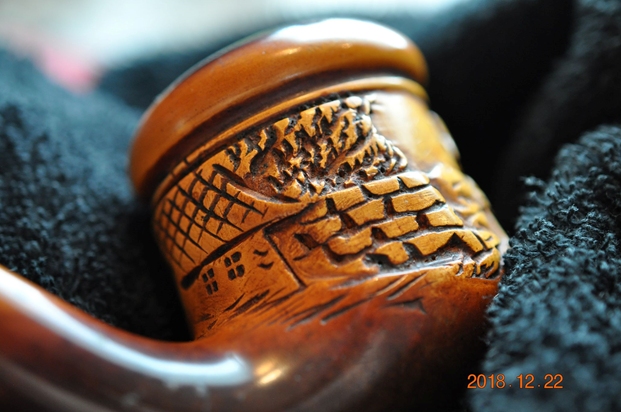
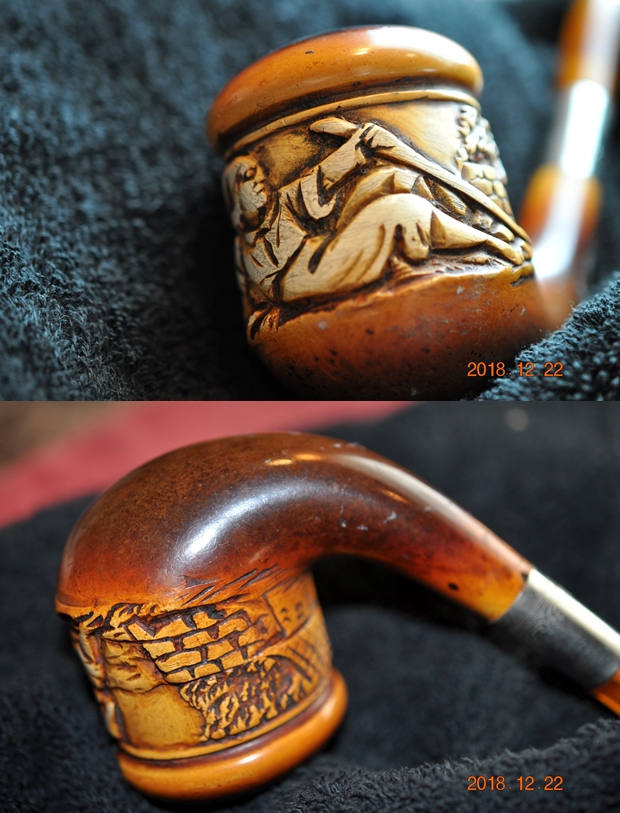
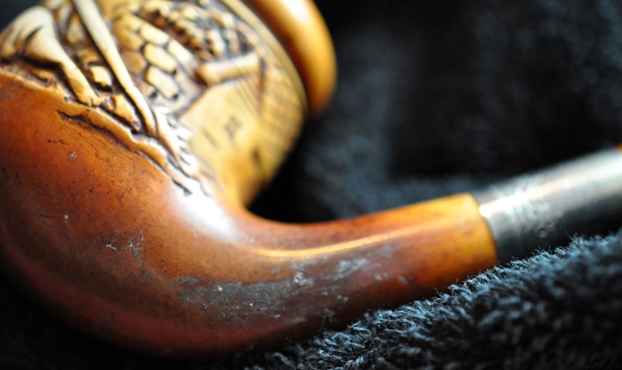
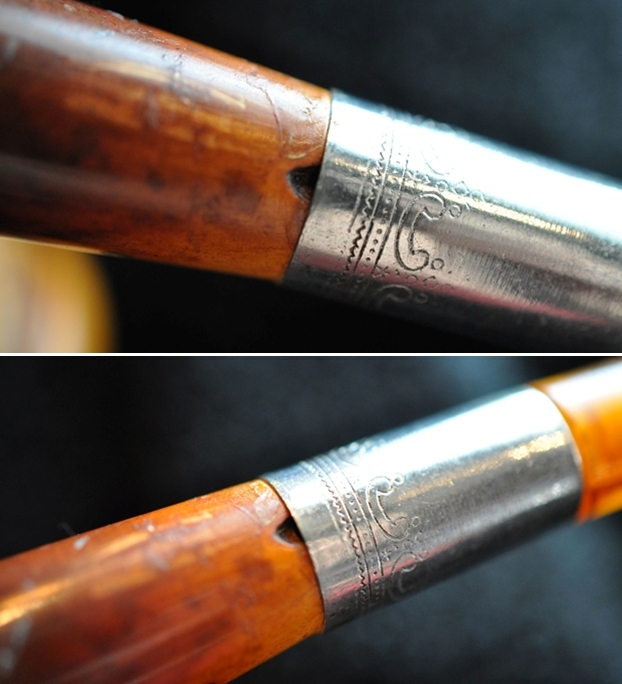
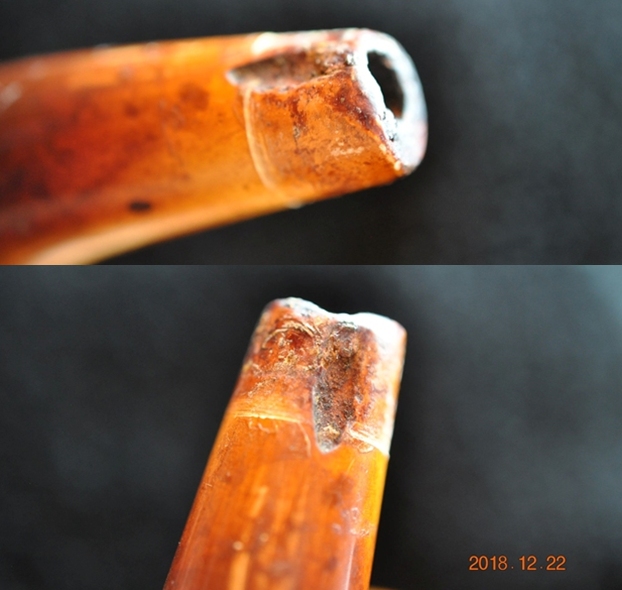
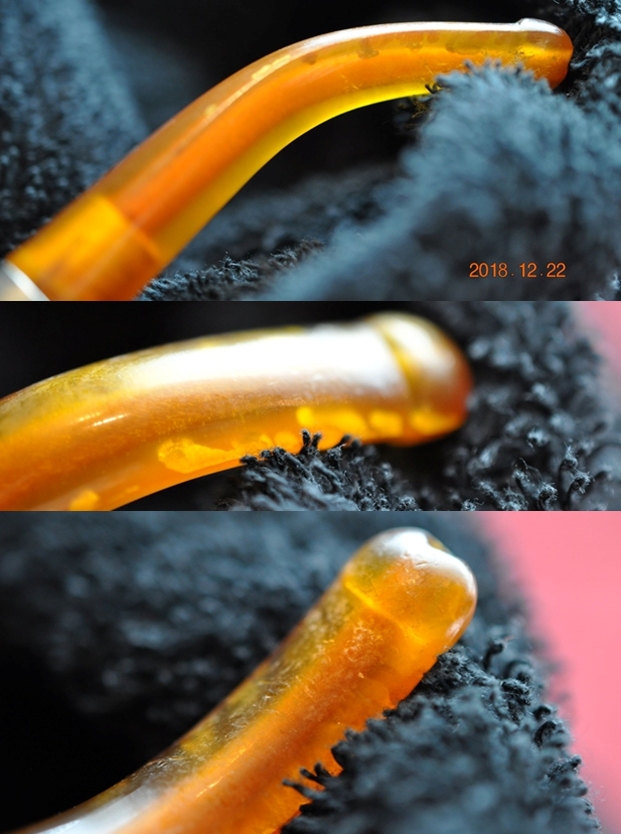
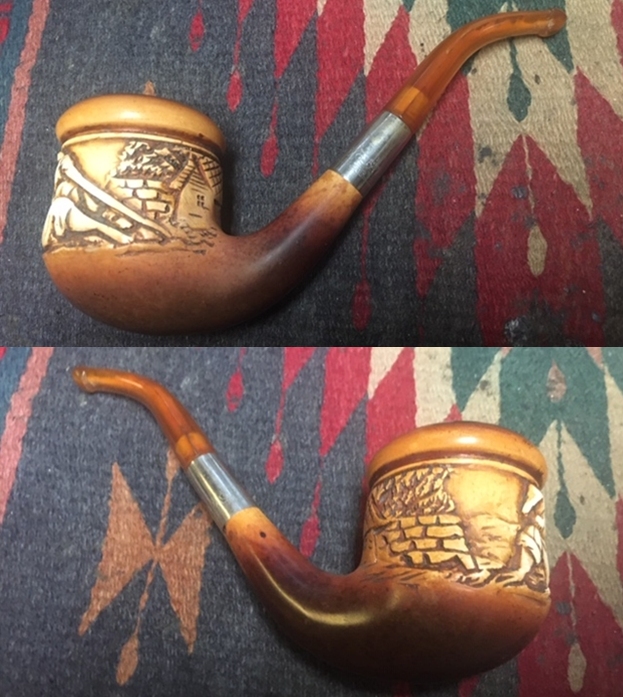
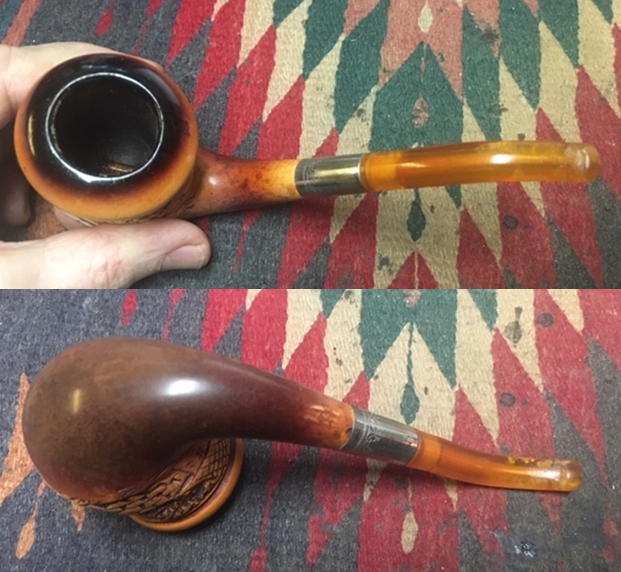
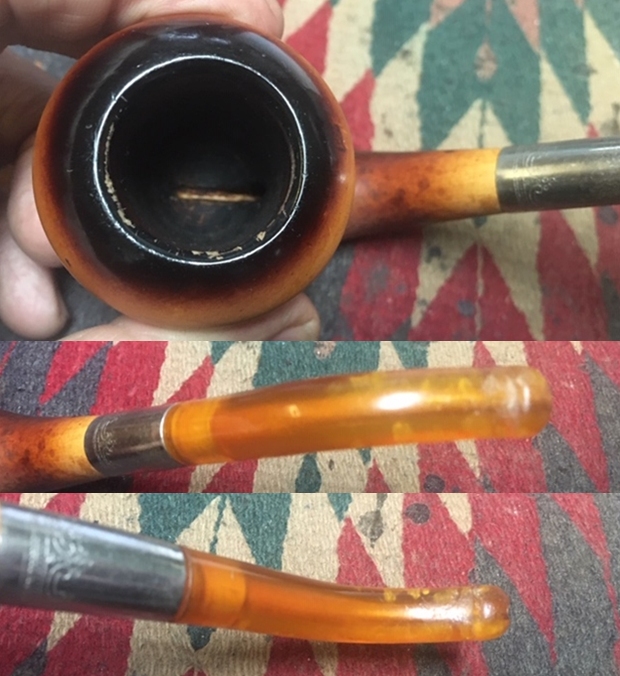
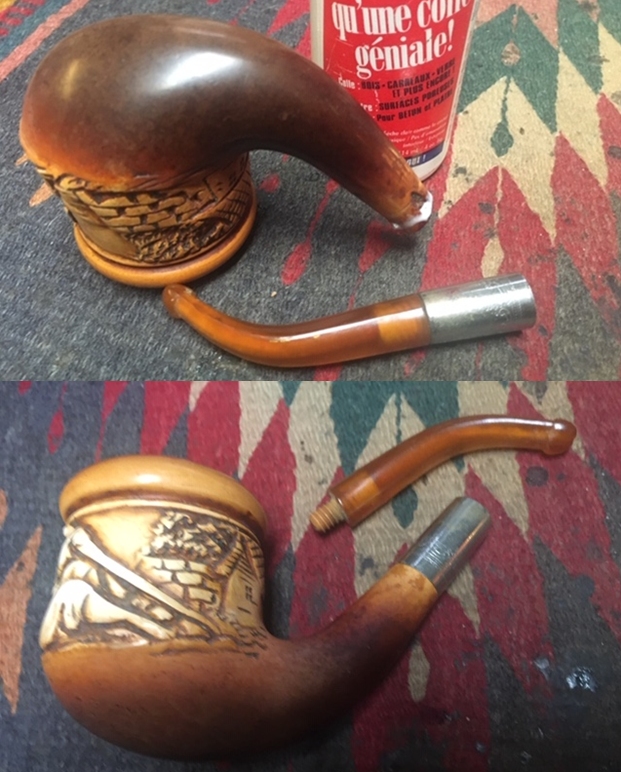
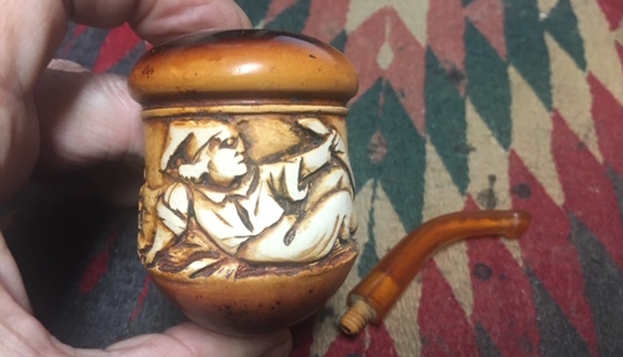
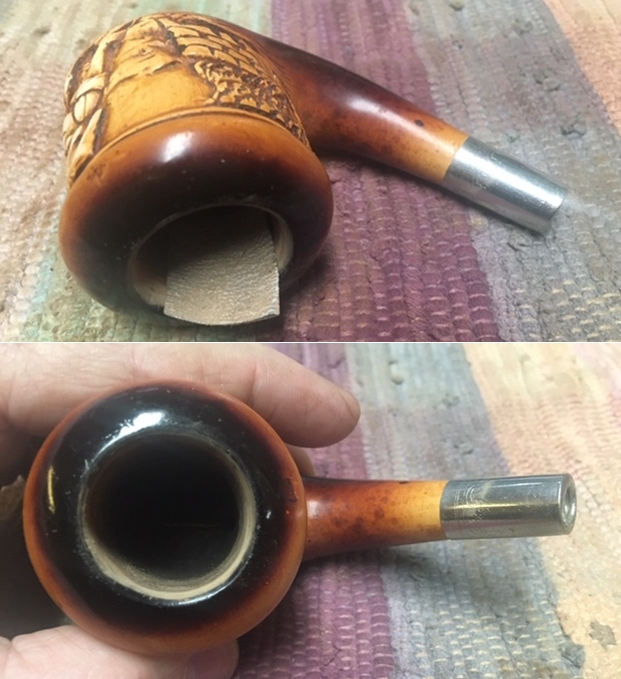
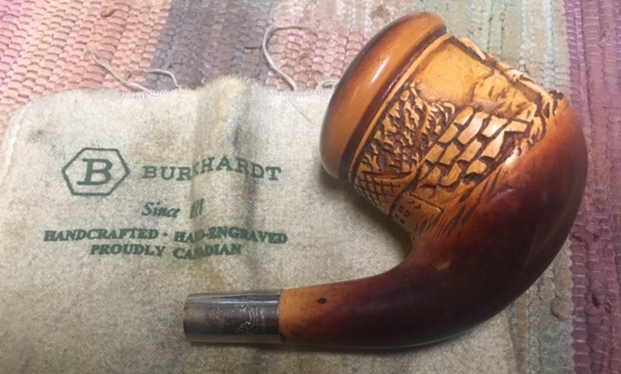
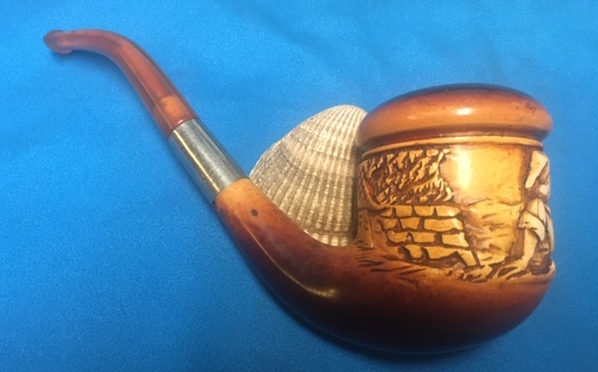
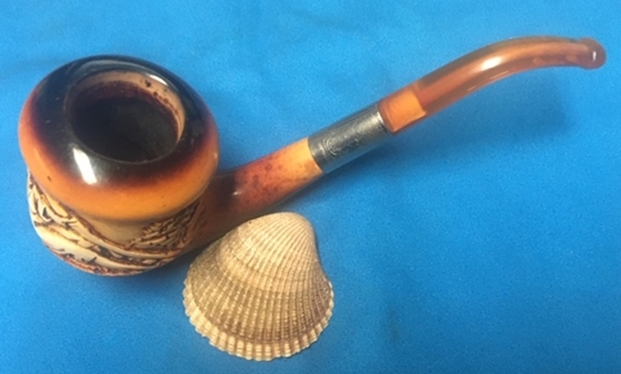
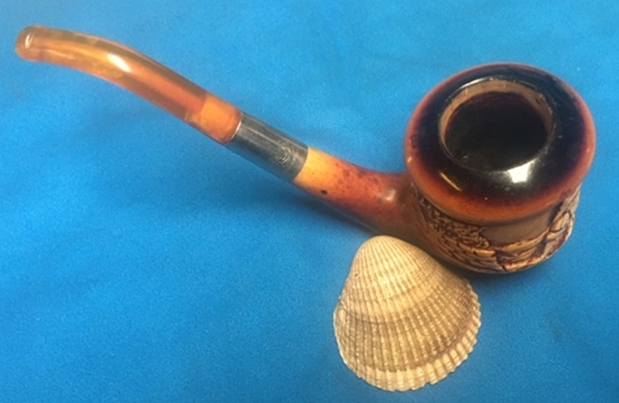
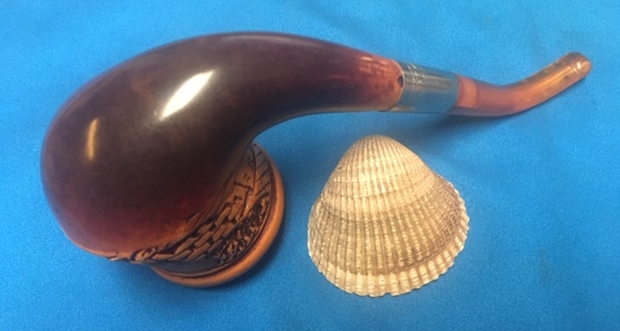
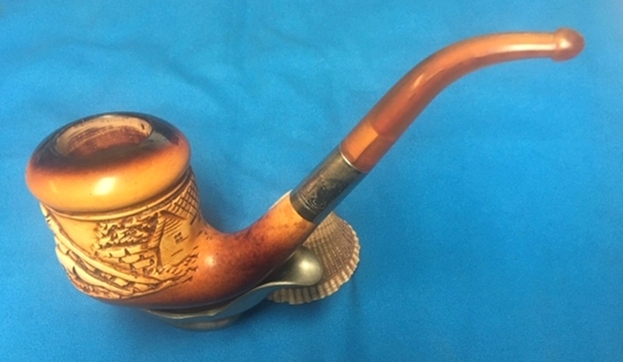
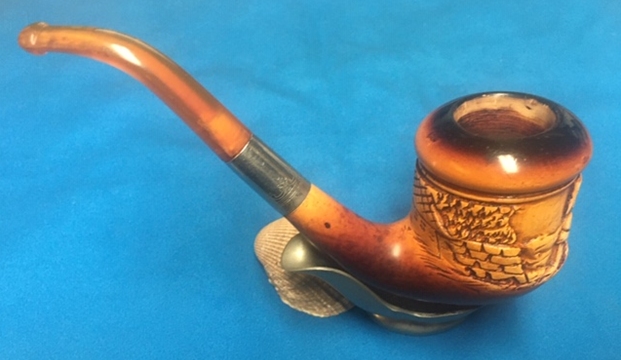
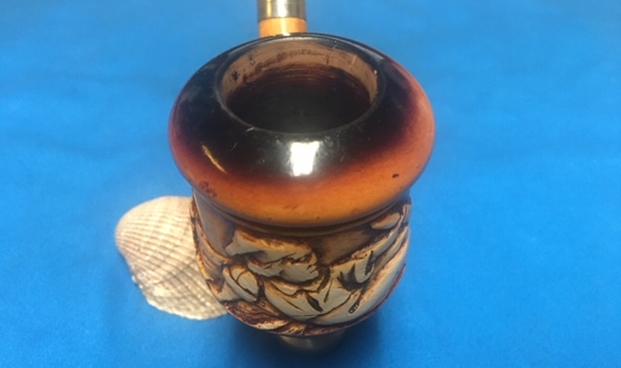
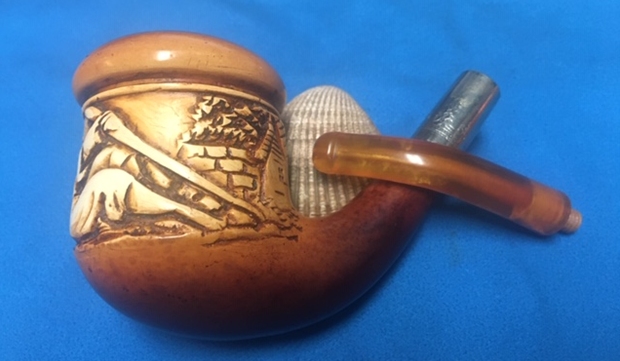
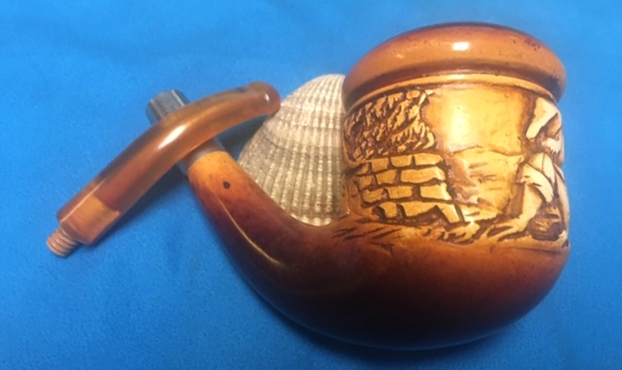
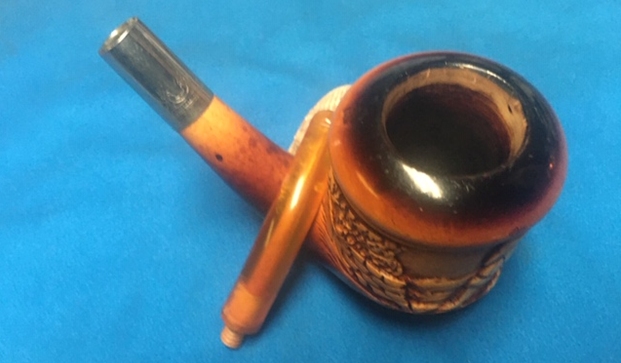
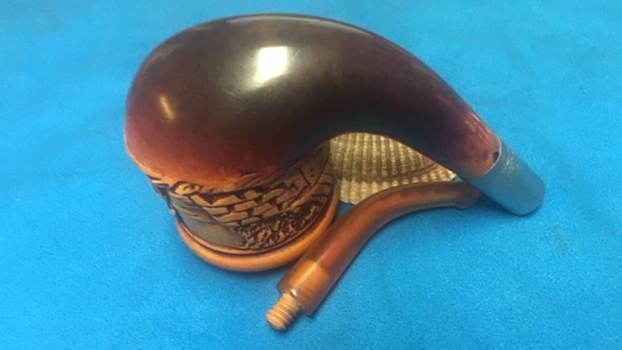
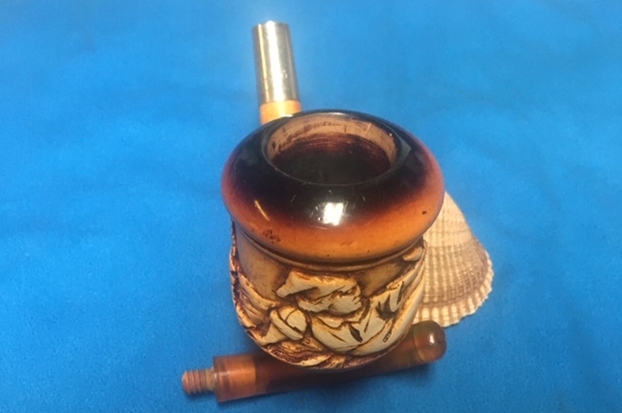
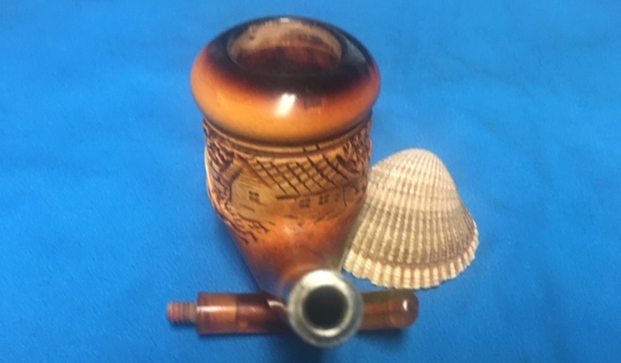
This old meerschaum pipe with a Bakelite stem and silver shank band has been sitting in my box to be restored for almost three years now. I picked up and looked at it, took it apart looked at the pieces and put it back together and put it back in the box. Today I was going through all of the boxes of pipes I had to work on and sorting them. I came upon this pipe and decided today was the day to work on it. This pipe is carved with a pastoral scene of what looks like a mountain cabin and stone fence. Reclining on the ground in the forefront is figure that looks like a Swiss hiker or shepherd with his walking staff leaning against the fence. The bowl had a cake on the walls with a lot of dust in the carving on the front and sides of the bowl. It was dusty and tired looking. The shank end was chipped and there was damage to the shank itself. A lot would be revealed once Jeff had worked his magic on it. The thin shank had a silver etched band that fit well. The shank end was threaded and acted as the mortise. The amber coloured Bakelite stem had a bone tenon that screwed into the shank end of the band. There was light tooth chatter and marks on both sides ahead of the button and on the button surface itself. Jeff took photos of the pipe before he started his cleanup work. Jeff has gotten very good at capturing the condition of the bowl and rim top with his photos. You can see the work that is ahead of us in terms of the cake in the bowl and the lava on the inner edge. The bowl is in good condition.The next set of photos show the carving around the sides of the bowl. The carving is well done. I look forward to seeing what this one looks like once it is clean and restored. He took photos of the shank to show the filigree on the band and the chipped area on the shank itself. The first two photos show the banded shank and the second two show the damage on the unbanded shank. The next photos show the stem surface. It was very dirty and worn looking. It had pitting, light tooth marks and chatter on both sides ahead of the button. There no identifying marks on the pipe or shank or band to help identify the maker. So it was time to work on the pipe itself. Jeff had done his usual great cleanup of this pipe. He cleaned up the bowl walls with a Savinelli Fitsall Pipe Knife. He scrubbed out the internals with alcohol, pipe cleaners and cotton swabs until the pipe was clean. He scrubbed the exterior of the bowl with Murphy’s Oil Soap and a tooth brush to remove the grime and grit on the briar and the lava on the inner edge of the rim. The meerschaum carving looks clean and well done. Jeff scrubbed the stem with Soft Scrub to clean up the Bakelite. When the pipe arrived here in Vancouver for the second stop of its restoration tour it looked very good. I took photos before I started my part of the work. I took some photos of the inwardly beveled rim top and stem. Once Jeff removed the lava on the top and inside of the rim top was rough. The inner edge had a bit of wear and would need to be sanded smooth. The close up photos of the stem shows that is it very clean and there is some tooth chatter and marks on the button surface and just ahead of the button. There are also casting marks on the sides of the stem that need to be removed.I took the stem off the shank and took photos. The band was loose on the shank and the stem screwed into the threaded mortise in the top of the band. At first I thought the band was a later addition but the more I looked at it the more I realized that the band was original with the inset mortise. I spread some all-purpose white glue on the end of the shank. I unscrewed the stem from the shank and pressed the band onto the shank end. I set it aside to dry while the glue cured.I took a photo of the reclining goat herd or hiker and included it now. It is well carved.I decided to address the damage on the inner edge of the rim. I used a folded piece of 220 grit sandpaper to clean up the darkening on the inner edge of the bowl. With the edge cleaned up the bowl looked better.I polished the silver band with a jeweler’s cloth and removed the tarnish on the band.I worked some Before & After Restoration Balm into the surface of the meerschaum with my fingertips. Mark Hoover developed the product to clean, enliven and protect briar but I have been using it on meerschaum as well and found it effective. I let the balm sit for about ten minutes and then buffed with a cotton cloth to raise the shine. The photos show the bowl at this point in the restoration process. I set the bowl aside at this point and turned my attention to the stem. I sanded out the tooth marks on the stem in front of the button on both sides.I polished the stem with micromesh sanding pads – dry sanding with 1500-12000 grit sanding pads. I wiped it down after each sanding pad with a cloth containing some Obsidian Oil. I finished polishing it with Before & After Pipe Stem Polish – both Fine and Extra Fine and buffed it off with a cotton cloth. This large meerschaum pot with a carved pastoral scene is an unusual piece. It has a beauty of its own with the patina around heel and bowl. It is a pipe that has grown on me as I have worked on it. I have never worked on one like it. I know next to nothing about the pipe in terms of manufacture or carver. It has a German/Swiss look to the carving but that is a guess. The silver band and the thin Bakelite stem add to the mix. With the grime and debris gone from the finish and the bowl it was a unique beauty. The rim top looks really good now. I put the stem back on the bowl and carefully buffed the pipe with Blue Diamond on the buffing wheel. I gave the bowl multiple coats of Clapham’s Beeswax by hand and the stem multiple coats of carnauba wax on the buffing wheel. I buffed the pipe with a clean buffing pad on the buffer. I hand buffed the pipe with a microfiber cloth to deepen the shine. Give the finished pipe a look in the photos below. I can only tell you that like the other pipes I am working that it is much prettier in person than the photos capture. The dimensions of the pipe are Length: 7 inches, Height: 2 ¾ inches, Outside diameter of the bowl: 2 inches, Chamber diameter: 1 inch. Thanks for walking through the restoration with me as I worked over another interesting pipe. This pipe will be added to the Meerschaum Pipes section of the rebornpipes store soon. If you want to add it to your collection send me an email or a message! Thanks for your time.
Breathing Life into A Pipe Maker 16 Lovat with a Cumberland Stem


Blog by Steve Laug

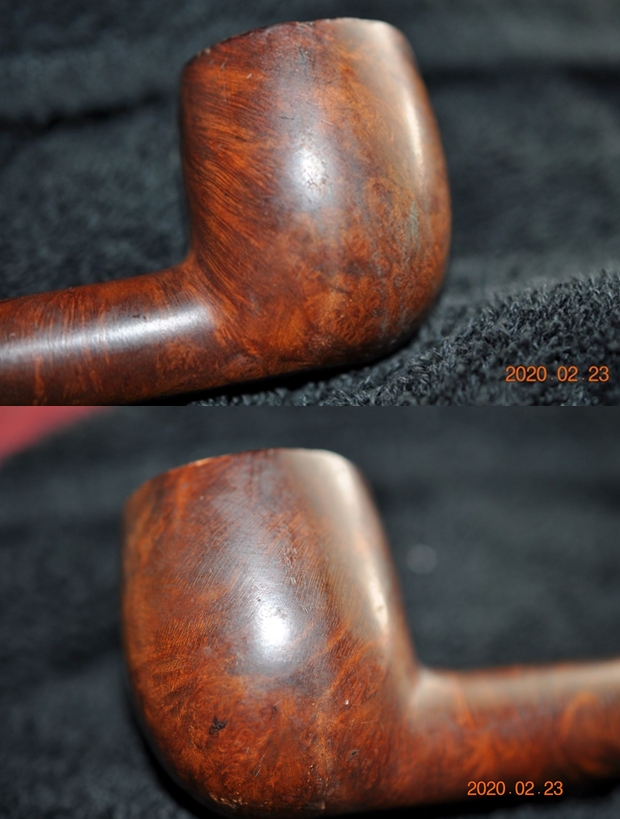
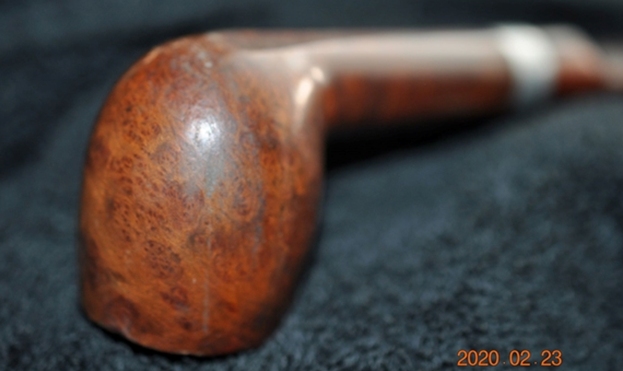
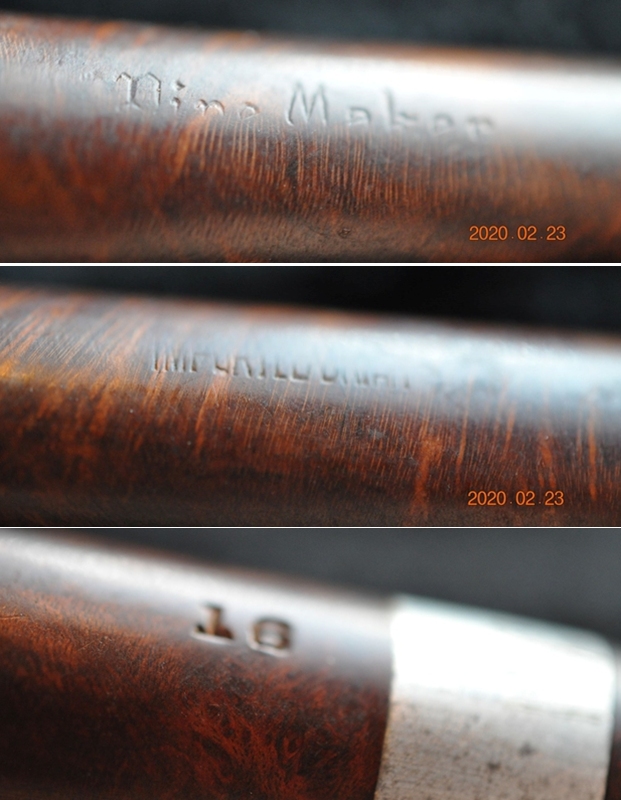
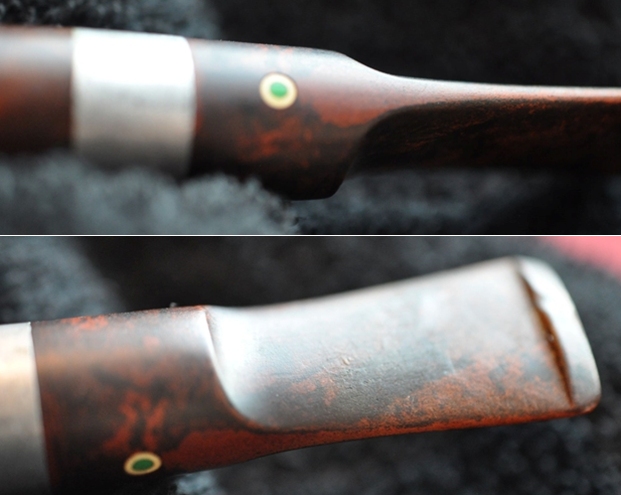
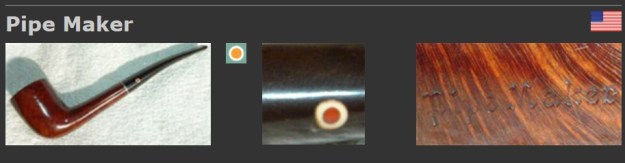
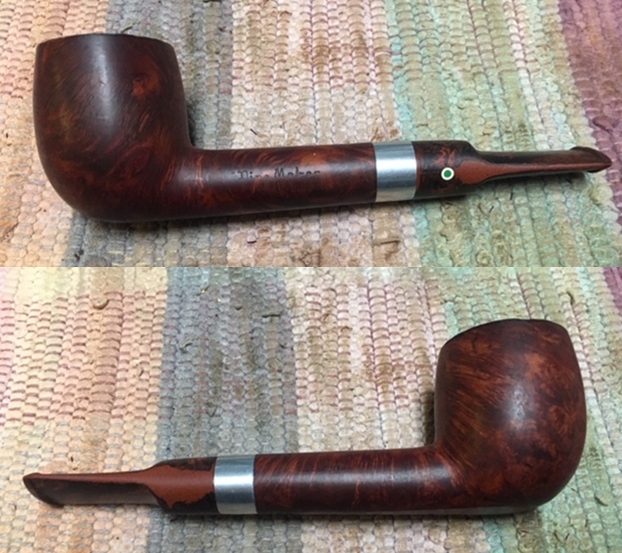
This past January Jeff and his wife Sherry and Irene and I made a pipe hunting trip down the Oregon Coast. At least that is what Jeff and I called it. We stopped in a lot of the small towns up and down the northern part of the coast and picked up some nice pipes. When I saw this little Lovat with a Cumberland stem I was hooked and we picked it up and added it to the finds of the trip. This pipe is stamped on both sides of the shank and on the underside at the shank/stem union. On the left side it is stamped with the Pipe Maker. On the right side it is stamped Imported Briar. On the underside it is stamped with the shape number 16. It was a very dirty pipe with a dull and lifeless finish that hid the grain around the bowl. There was a very thick cake in the bowl and a thick lava coat on the rim top and the inner edge. It was hard to see what the condition of either the inner or outer edges with the lava and grime. The pipe had a rich medium brown stain with a reddish tint that highlighted nice grain on the bowl sides under the grime and the finish appeared to be in good condition. A lot would be revealed once Jeff had worked his magic on it. The Cumberland style saddle stem was in good condition with oxidation and light tooth chatter and marks on both sides ahead of the button and on the button surface itself. Jeff took photos of the pipe before he started his cleanup work. Jeff has gotten very good at capturing the condition of the bowl and rim top with his photos. You can see the work that is ahead of us in terms of the lava and grime on the rim and the cake in the bowl. This pipe is a real mess. The next set of photos show the grain on the sides and heel of the bowl. It is an interesting combination of grain – cross grain and birdseye predominate. I look forward to seeing what this one looks like once it is clean and restored. He took photos of the faint stamping on the sides of the shank. The Pipe Maker stamp on the left side is faint but readable. The Imported Briar stamp on the right side is also faint but readable.  On the underside is the shape stamp 16 which is very clear readable. The fourth and fifth photos below show the logo on the left side of the saddle stem. The next photos show the stem surface. It was very dirty, oxidized and calcified. It had pitting, light tooth marks and chatter on both sides ahead of the button.  Jeff removed the stem from the shank and the photo shows the interesting stinger apparatus and threaded tenon on the pipe. I was certain that the brand was American because of the Imported Briar stamp on the shank but I wanted to learn more about it. I turned first to Pipephils site to see if there was any information on the brand (http://www.pipephil.eu/logos/en/logo-p3.html). I did a screen capture of what was on the site and I include that below.I turned to Pipedia see if there was any further information to help me with hunt for this pipe manufacturer. There was no listing for that pipe company so I had as much information as I could find online.
Now it was time to work on the pipe itself. Jeff had cleaned the pipe with his usual penchant for thoroughness that I really appreciate. It looked far better than what it was like when we found it. He reamed the bowl with a PipNet Pipe reamer and took the cake back to bare briar. He cleaned up the bowl walls with a Savinelli Fitsall Pipe Knife. He scrubbed out the internals with alcohol, pipe cleaners and cotton swabs until the pipe was clean. He scrubbed the exterior of the bowl with Murphy’s Oil Soap and a tooth brush to remove the grime and grit on the briar and the lava on the beveled rim top. The finish looks very good with good looking grain around the bowl and shank. Jeff scrubbed the stem with Soft Scrub and then soaked it in Before & After Deoxidizer to remove the oxidation on the Cumberland style rubber. When the pipe arrived here in Vancouver for the second stop of its restoration tour it looked very good. I took photos before I started my part of the work. I took some photos of the rim top and stem. Once Jeff removed the lava on the top and inside of the rim top was a wreck. Both the inner and the outer edge of the bowl showed damage. There were deep nicks and gouges to the surface of the rim and a lot of darkening. The close up photos of the stem shows that is it very clean and there is some tooth chatter and marks on the button surface and just ahead of the button.I removed the stem from the bowl and worked on the rim surface. The rim was beveled so topping it on a topping board was out of the question. I used a folded piece of 220 grit sandpaper to smooth out the inner and outer edges of the bowl. I also used it to smooth out the rim top to remove the damage.I was happy with the way the rim top and edges looked so I did not need to do anymore except to polish them. I polished the briar with micromesh sanding pads – dry sanding with 1500-12000 grit pads. I wiped the bowl down after each pad with a damp cloth. The grain really began to stand out and the finish took on a shine by the last sanding pad. The photos tell the story! I touched up the rim top to match the rest of the bowl with a blend of Maple and Cherry stain pens. The blend works really well with this colour of bowl. I am happy with the work so it is time to move on.I worked some Before & After Restoration Balm into the surface of the briar with my fingertips. The product works to clean, enliven and protect the briar. I let the balm sit for about ten minutes and then buffed with a cotton cloth to raise the shine. The photos show the bowl at this point in the restoration process. I set the bowl aside at this point and turned my attention to the stem. I filled in the tooth marks on the button edge and along the edge on both sides with clear super glue. When the repairs had cured I used a needle file to recut and sharpen the edges of the button and the button surface. I paused in my work on the stem to realign the stem in the shank. I heated the tenon with a lighter to soften the glue that holds it in place. I screwed the stem back in the mortise and aligned it while the glue was soft. Once it had set I removed the stem and continued to work on it.I blended the repairs into the surface of the stem and reshaped the button with 220 grit sandpaper and started the polishing with 400 grit wet dry sandpaper.I continued the polishing using Denicare Mouthpiece polish. It is a red gritty paste that feels a lot like Tripoli to me. It works very well  to polish out remnants of oxidation and smooth out fine scratches in the rubber stem.I polished the stem with micromesh sanding pads – dry sanding with 1500-12000 grit sanding pads. I wiped it down after each sanding pad with a cloth containing some Obsidian Oil. I finished polishing it with Before & After Pipe Stem Polish – both Fine and Extra Fine and buffed it off with a cotton cloth. This small Pipe Maker American Made Lovat is a bit of a mystery. I know that Frankau made them in England and Pipe Maker made them in the US but that is the extent of the information available on the brand. The shaping and carving follows the grain and highlights the mix of grains around the bowl. The finish on the pipe is in excellent condition and the contrasting stains work well to highlight the stunning grain on the pipe. The Cumberland saddle stem adds its reds to the mix. With the grime and debris gone from the finish and the bowl it was a beauty and the grain just pops at this point. I put the stem back on the bowl and buffed the pipe with Blue Diamond on the buffing wheel. I carefully avoided the stamping on the shank and stem during the process. I gave the bowl and the stem multiple coats of carnauba wax on the buffing wheel and followed that by buffing it with a clean buffing pad on the buffer. I hand buffed the pipe with a microfiber cloth to deepen the shine. The finished Lovat is quite nice and feels great in the hand. Give the finished pipe a look in the photos below. I can only tell you that it is much prettier in person than the photos capture. The dimensions of the pipe are Length: 5 ¼ inches, Height: 1 ¾ inches, Outside diameter of the bowl: 1 ¼ inches, Chamber diameter: ¾ of an inch. Thanks for walking through the restoration with me as I worked over another interesting pipe. This pipe will be added to the American Pipe Makers section of the rebornpipes store soon. If you want to add it to your collection send me an email or a message! Thanks for your time.

New Life for a Wally Frank Period Custombilt Bent Scoop


Blog by Steve Laug

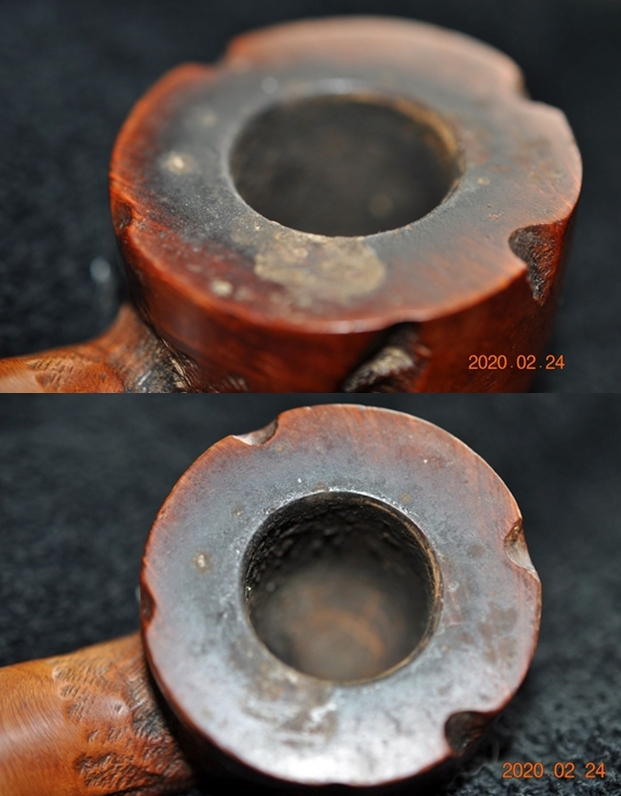
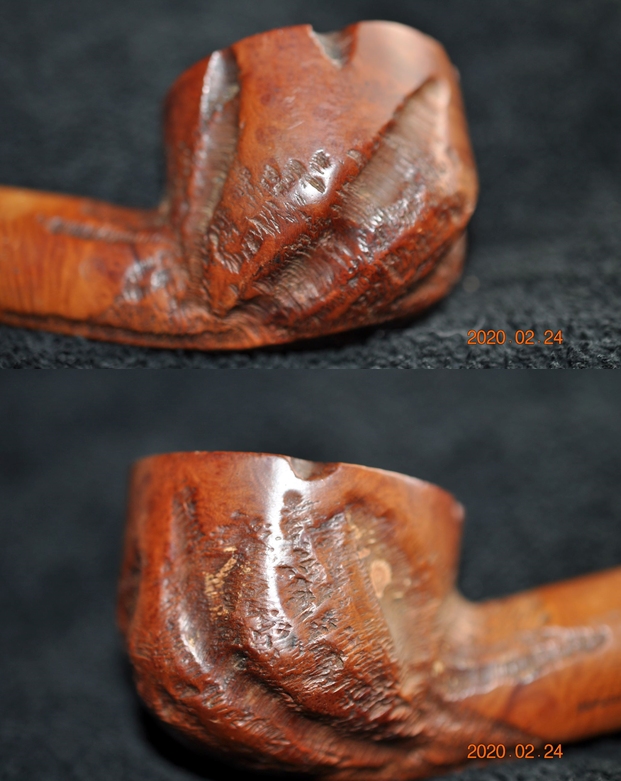
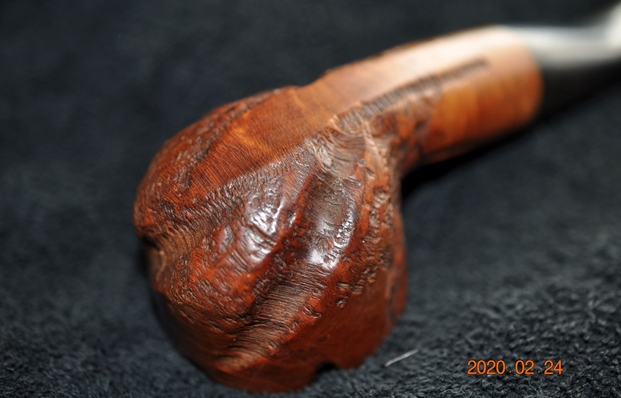
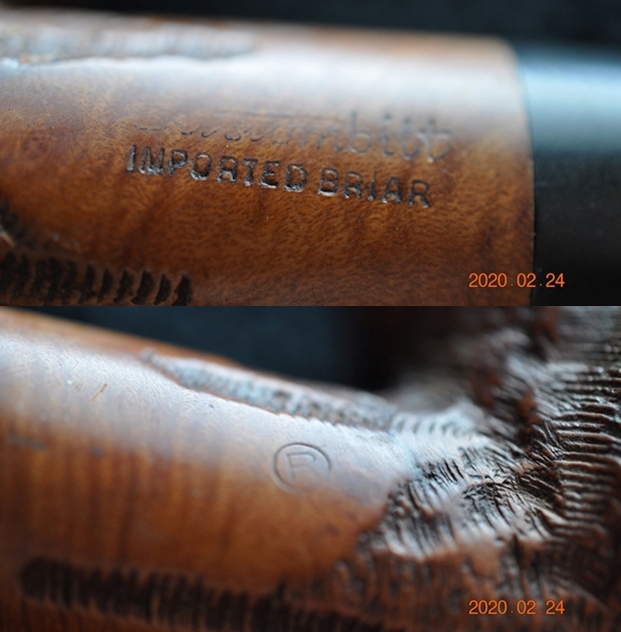
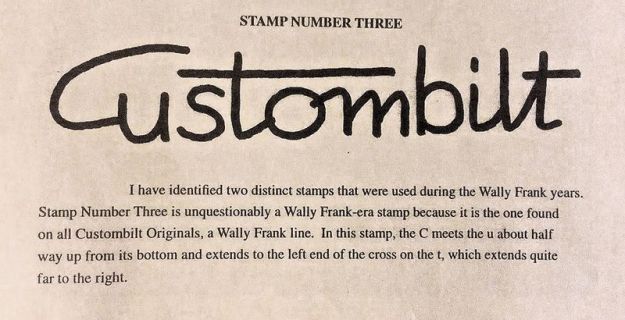
Over the years I have owned and worked on quite a few Custom-Bilt pipes from the hands of Tracy Mincer and also the various iterations that followed his demise – Wally Frank, Holco Rohr to mention a few. The stamping on this particular pipe identifies it to the Wally Frank Period. There is just something about the brand and the large rustic carving of the pipe that captures a lot of people’s imagination. This particular Custombilt is what I would call a Bent Scoop. It has a taper stem and is quite chunky. It is stamped both on the left and right side of the shank. On the left side it is stamped with the Custombilt over Imported Briar. On the right side it is stamped with the letter R in a circle. It was dirty and the fills in the briar really stood out with the finish as dull and lifeless as it was. There was a moderated cake in the bowl and a lava coat on the rim top and the inner edge. The pipe had a rich medium brown stain that highlighted nice grain on the bowl sides under the grime and the finish appeared to be in good condition. A lot would be revealed once Jeff had worked his magic on it. The vulcanite taper stem was in good condition with some oxidation and light tooth chatter and marks on both sides ahead of the button and on the button surface itself. Jeff took photos of the pipe before he started his cleanup work. Jeff captured the condition of the bowl and rim top with the next series of photos. You can see the work that is ahead of us in terms of the lava and grime on the rim and the cake in the bowl. The rustication patterns around the sides of the bowl and the contrasting smooth areas look very “Mincerlike”. Jeff took some photos showing what is underneath the grime and debris of time and use. He captured the stamping on the sides of the. The Custombilt stamp is faint but readable. The Imported Briar stamp is clear and the R circle stamp on the right side is also readable.The photos of the stem show the stem surface. It is dirty and has pitting, light tooth marks and chatter on both sides ahead of the button.I turned to Pipedia to the specific section on Custombilt pipes to try and establish a time frame for this pipe (https://pipedia.org/wiki/Custom-Bilt). I did a screen capture of the section showing the style of stamp that the pipe I have on the table. From that information I knew that the pipe I had was made during the Wally Frank years of Custombilt history. I quote a pertinent portion of the article on this particular era of the history

…In the early 1970s, Wally Frank Co. bought the Custombilt trademark and began to produce their version of the pipe in 1974 or 1975. Hollco Rohr owned the Weber pipe factory, located in New Jersey, and produced the Custombilt pipes there. In 1987, the pipes were made out of the Butz-Choquin factory (France) and then Mexico until the late 1990s.

So it appears that this pipe was made in the early 1970s and before Wally Frank sold the company in 1974 or 1975. So at least I have narrowed down the time period to a few years between 1970-1975.

Now it was time to work on the pipe itself. Jeff had cleaned the pipe with his usual penchant for thoroughness that I really appreciate. He reamed the bowl with a PipNet Pipe reamer and took the cake back to bare briar. He cleaned up the bowl walls with a Savinelli Fitsall Pipe Knife. He scrubbed out the internals with alcohol, pipe cleaners and cotton swabs until the pipe was clean. He scrubbed the exterior of the bowl with Murphy’s Oil Soap and a tooth brush to remove the grime and grit on the briar and the lava on the beveled rim top. The finish looks very good with good looking grain around the bowl and shank. Jeff scrubbed the stem with Soft Scrub and then soaked it in Before & After Deoxidizer to remove the oxidation on the rubber. When the pipe arrived here in Vancouver for the second stop of its restoration tour it looked very good. I took photos before I started my part of the work. I took some photos of the rim top and stem. Once Jeff removed the lava on the top and inside of the rim top all that remained was a little darkening that should be able to be polished off. Both the inner and the outer edge of the bowl look good. The close up photos of the stem shows that is it very clean and there is some tooth chatter and marks on the button surface and just ahead of the button.I took the stem off the shank and took a picture of the pipe. It really is nice looking pipe with rugged rustication. After the clean up the fills blended back into the surface of the briar.I was happy with the way the rim top and edges looked so I did not need to do anymore except to polish them. I polished the briar with micromesh sanding pads – dry sanding with 1500-12000 grit pads. I wiped the bowl down after each pad with a damp cloth. The grain really began to stand out and the finish took on a shine by the last sanding pad. The photos tell the story! I worked some Before & After Restoration Balm into the surface of the briar with my fingertips. The product works to clean, enliven and protect the briar. I let the balm sit for about ten minutes and then buffed with a cotton cloth to raise the shine. The photos show the bowl at this point in the restoration process. I set the bowl aside at this point and turned my attention to the stem. I filled in the tooth marks on the button edge and along the edge on both sides with clear super glue. Once the repair cured I blended it into the surface of the stem with 220 grit sandpaper and started the polishing with 400 grit wet dry sandpaper. I continued the polishing using Denicare Mouthpiece polish. It is a red gritty paste that feels a lot like Tripoli to me. It works very well  to polish out remnants of oxidation and smooth out fine scratches in the rubber stem.I polished the stem with micromesh sanding pads – dry sanding with 1500-12000 grit sanding pads. I wiped it down after each sanding pad with a cloth containing some Obsidian Oil. I finished polishing it with Before & After Pipe Stem Polish – both Fine and Extra Fine and buffed it off with a cotton cloth. This Custombilt from the earlier 70s is a handful just like all Custombilts or Custom-Bilt pipes that I have worked on. It is a big piece of briar that has great grain on the rim top. The shaping and carving is interestingly done and minimizes the flaws in the briar. The finish on the pipe is in excellent condition and the contrasting stains work well to highlight the stunning grain on the pipe. The black vulcanite saddle stem just adds to the mix. With the grime and debris gone from the finish and the bowl it was a beauty and the grain just pops at this point. I put the stem back on the bowl and buffed the pipe with Blue Diamond on the buffing wheel. I carefully avoided the stamping on the shank and stem during the process. I gave the bowl and the stem multiple coats of carnauba wax on the buffing wheel (lightly in the rustications) and followed that by buffing it with a clean buffing pad on the buffer. I hand buffed the pipe with a microfiber cloth to deepen the shine. The finished Bent Pot is quite nice and has the instantly recognizable look of a Custombilt. The finish on the bowl combines various stains to give it depth. It is very well done. Give the finished pipe a look in the photos below. I can only tell you that it is much prettier in person than the photos capture. The dimensions of the pipe are Length: 6 inches, Height: 1 ¾ inches, Outside diameter of the bowl: 2 inches, Chamber diameter: 7/8 of an inch. Thanks for walking through the restoration with me as I worked over another interesting pipe. This pipe will be added to the rebornpipes store soon. If you want to add it to your collection send me an email or a message! Thanks for your time.