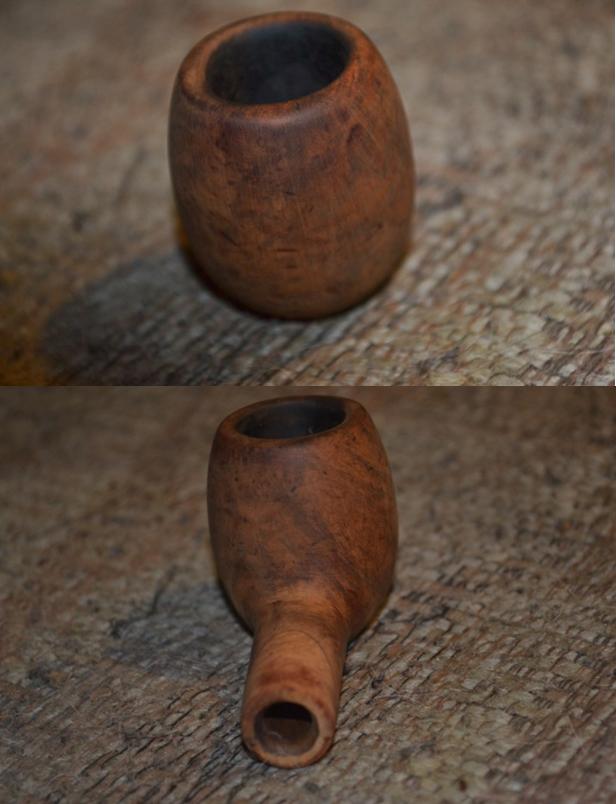
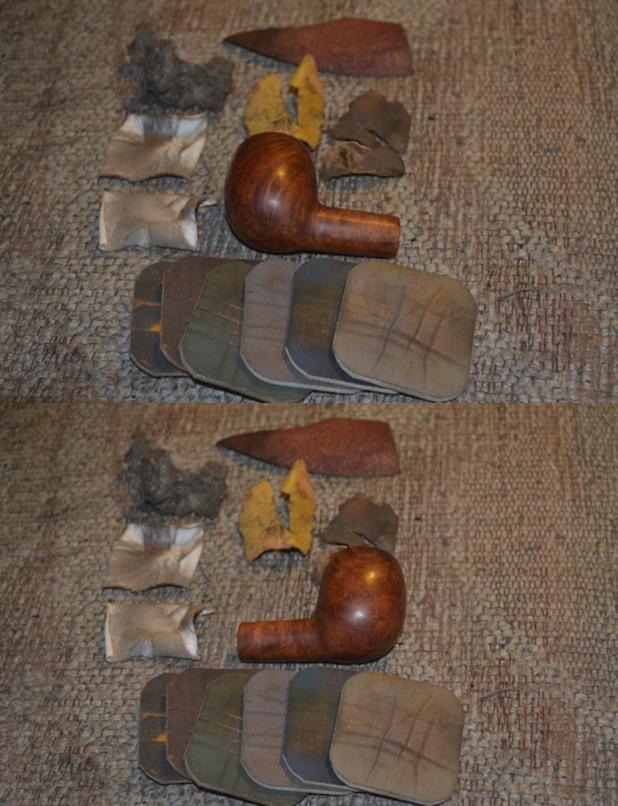
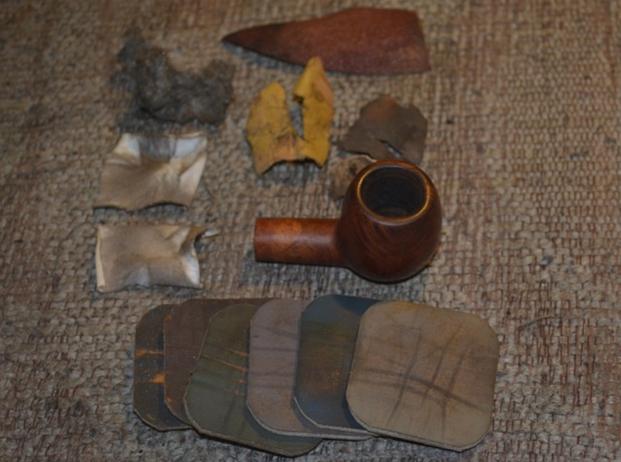
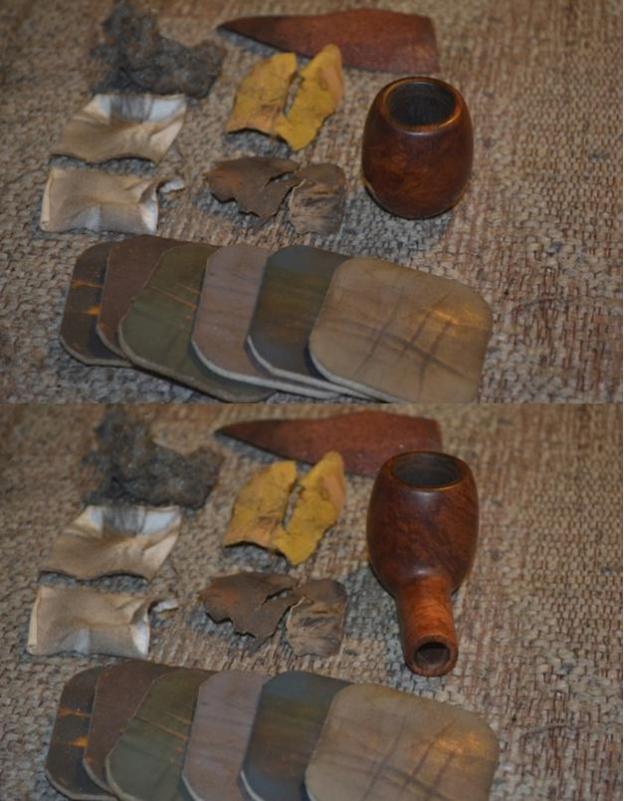
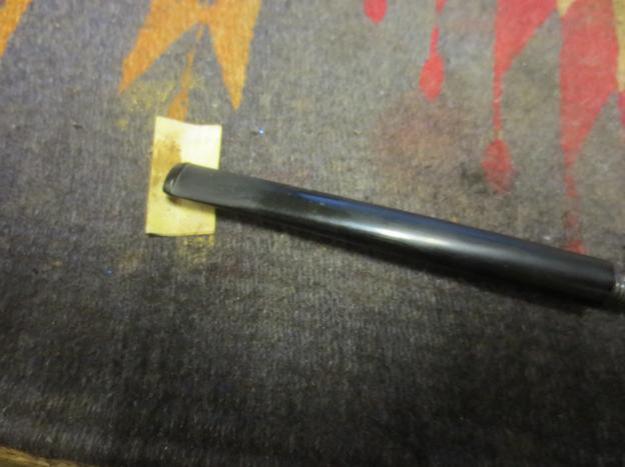
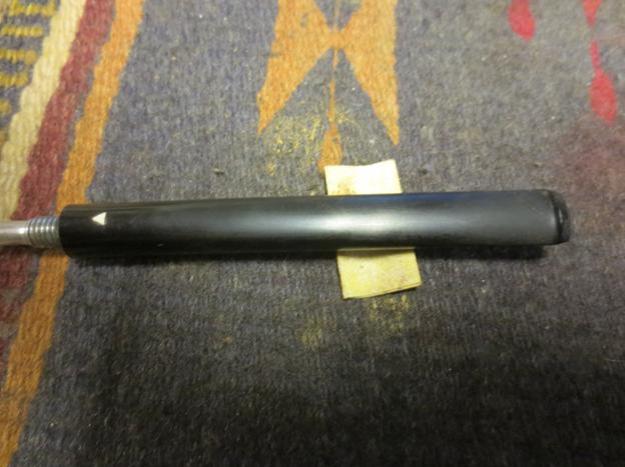
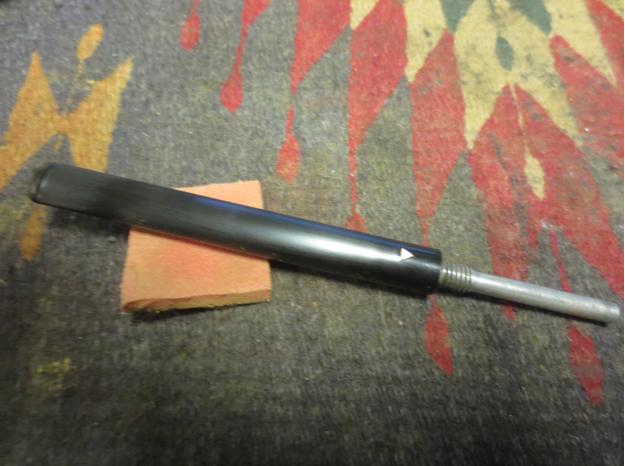
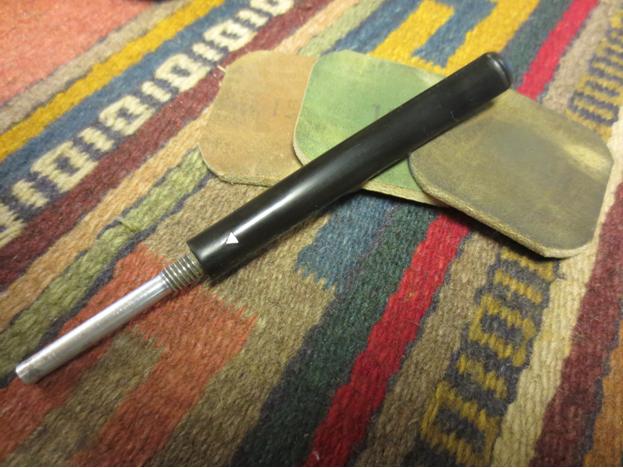
Tag Archives: sanding a stem

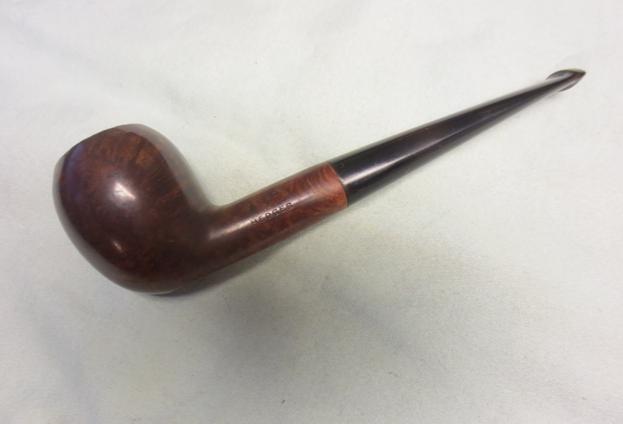
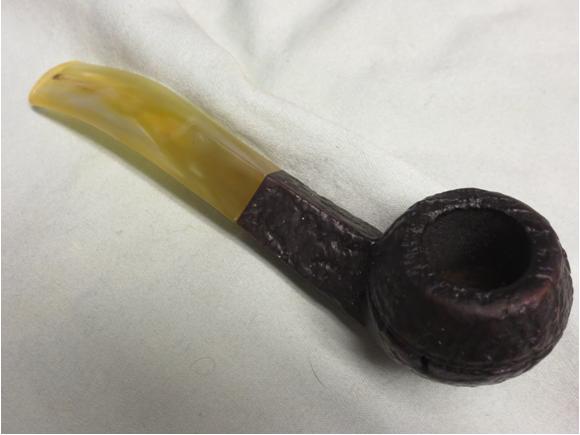
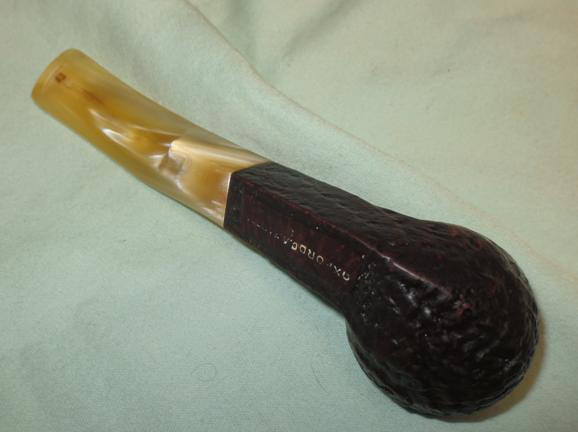
Repairing a stem on a beautiful little Dunhill Bruyere 3206 Pot


Blog by Steve Laug

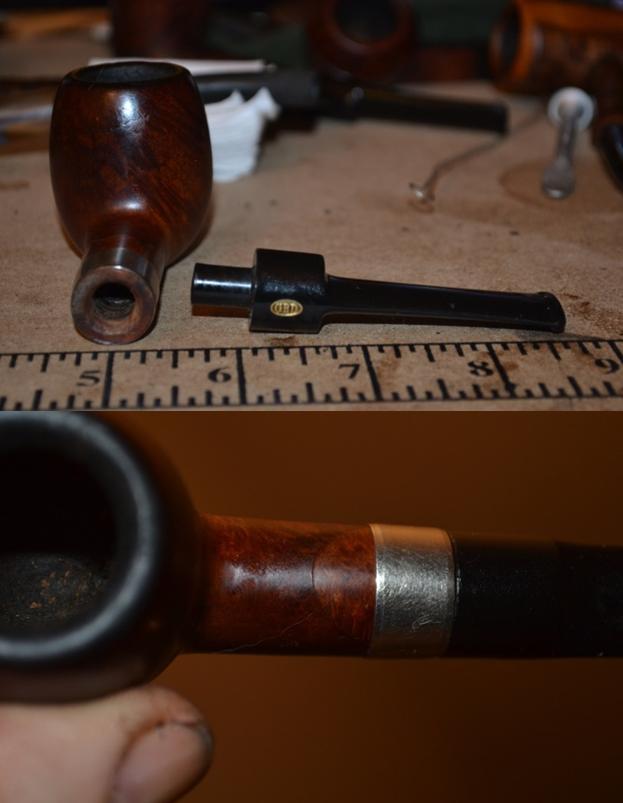
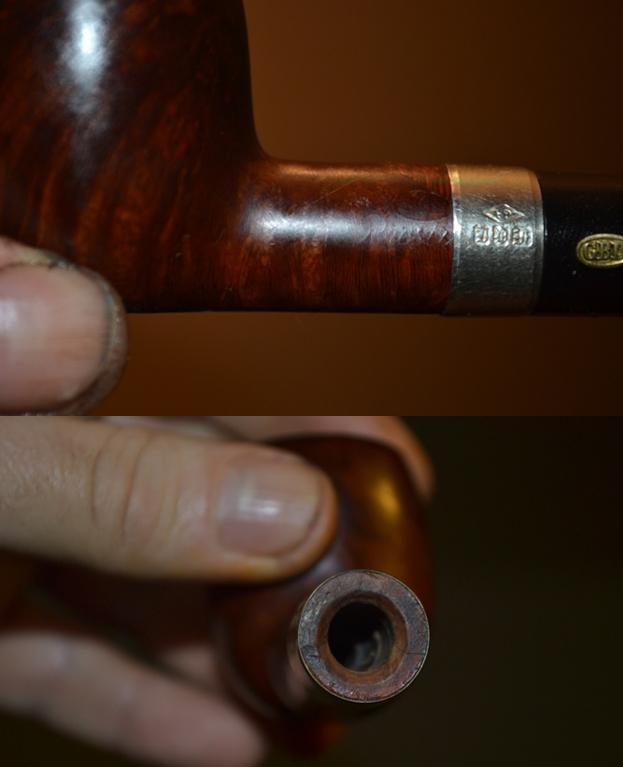
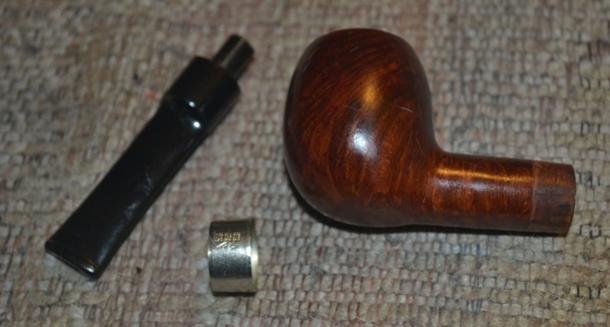
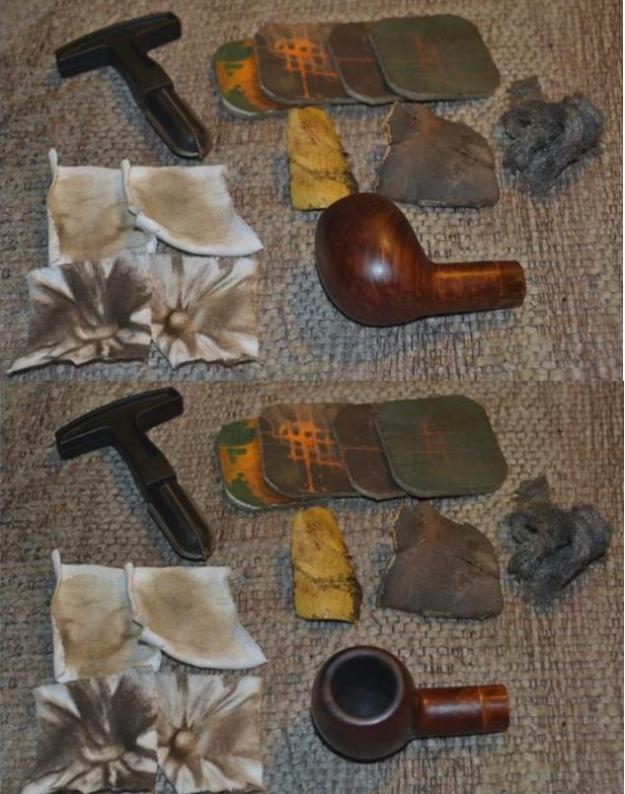
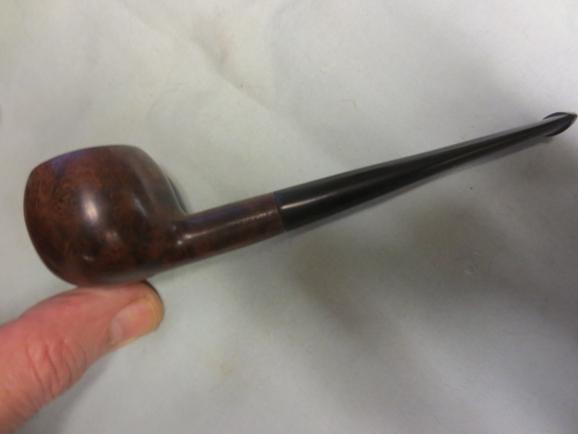
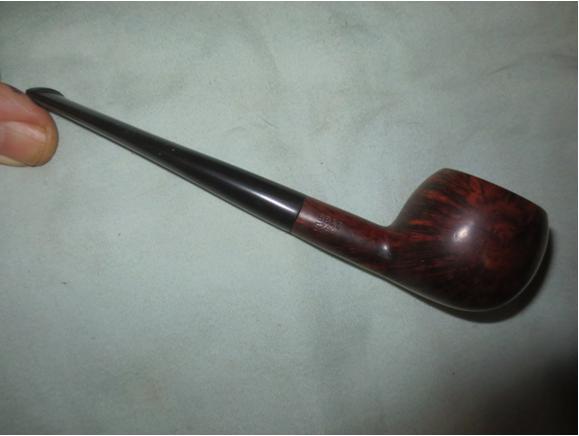
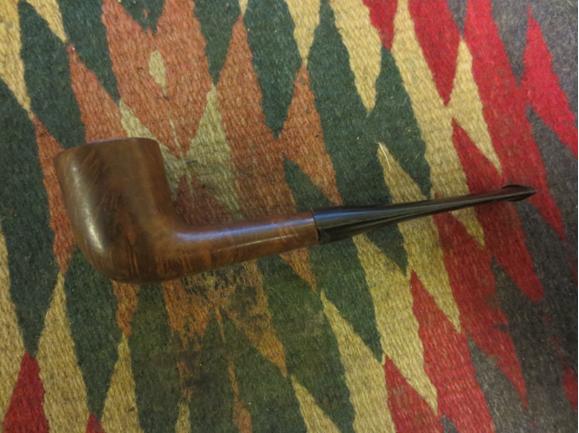
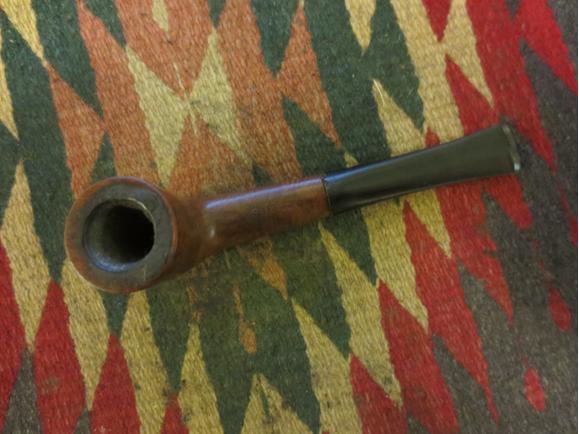
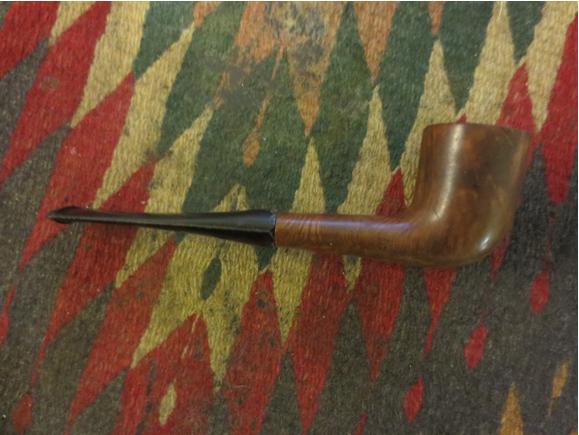
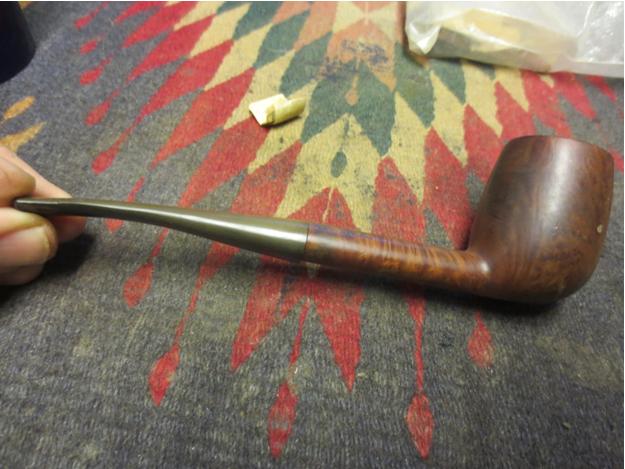
On the work table at the moment is a beautiful little Dunhill Bruyere pot. It had some serious gnaw marks on the stem. There were tooth dents that were deep on the top and the bottom sides of the stem. Fortunately they did not penetrate the airway. The pipe is in great shape. The finish was in excellent shape. The rim was clean but had been lightened quite a bit. It had hardly been smoked so I am wondering if somewhere along the way it had been used as a prop and the individual had just bitten down hard!

I removed the stem from the bowl and gave the rim a quick clean and then a coat of an opaque aniline based oxblood stain that matches the Bruyere finish. I flamed it and set it aside to dry while I turned my attention to the damaged stem (unfortunately I was in grand rush to work on the stem and the pipe and forgot to take photos of the pipe when I received it. Instead you will have to trust the descriptions and look through the repairs).Dun1

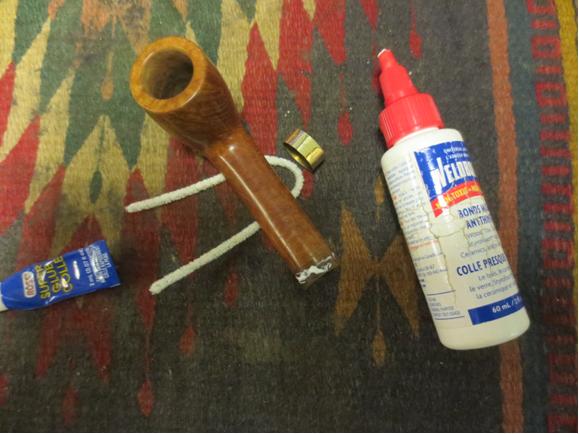
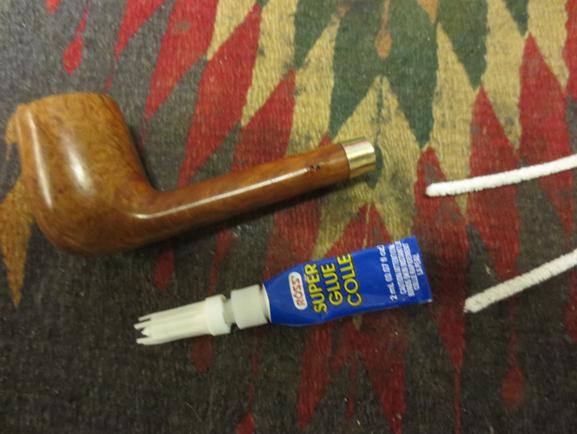
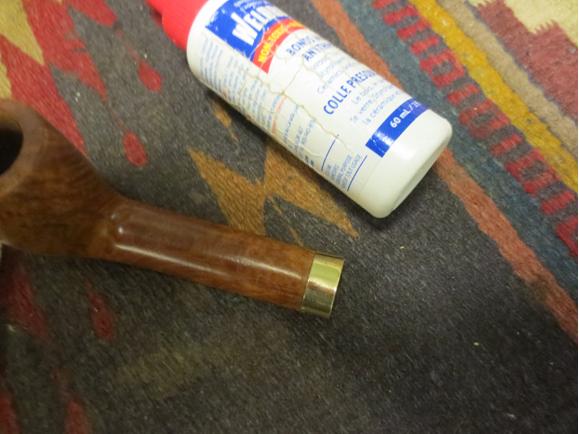
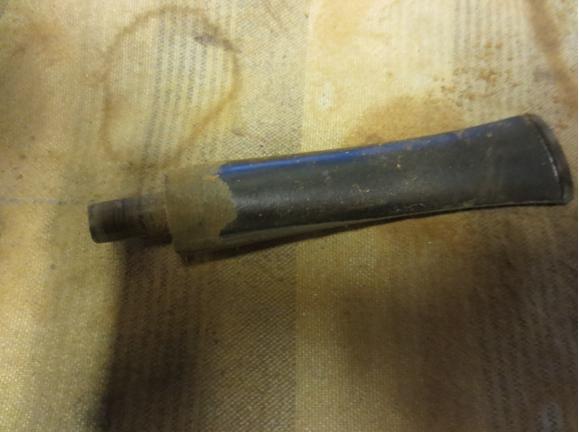
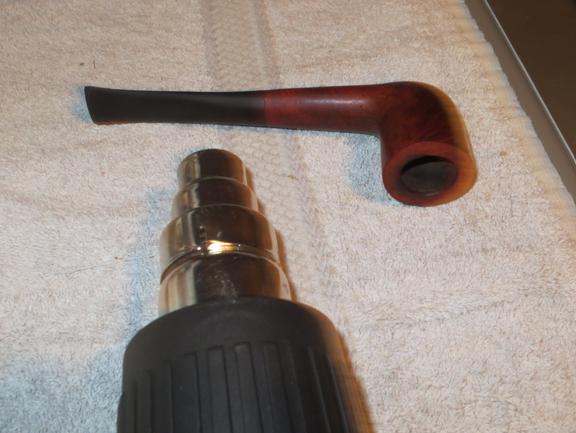
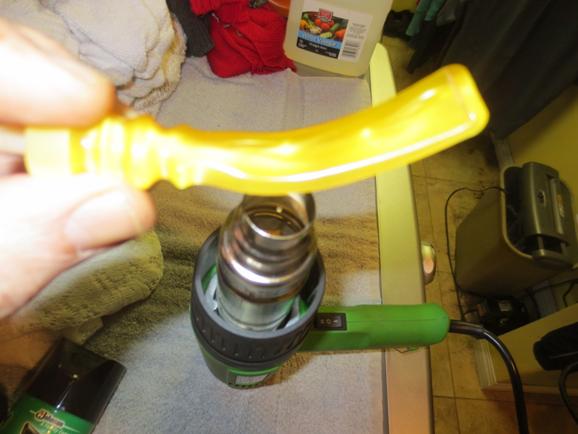
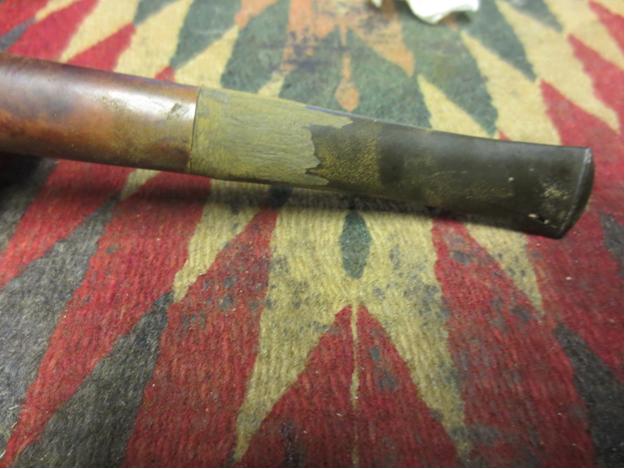
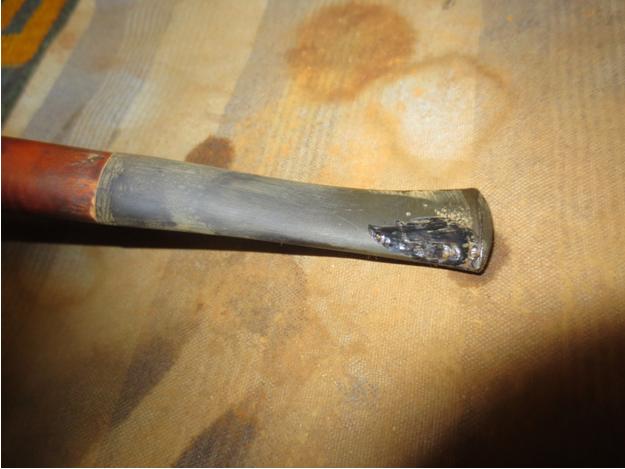
Dun2 I used a dental pick to clean out the debris in the deep dents and the crack along the edge of the button. I used the heat gun to raise the dents as much as possible but sadly they were of the nature that the heat did not do much to raise them. I then wiped down the dents and crack with alcohol to remove any debris in the area to be repaired. I filled in the dents on both sides of the stem with black super glue. You can see in the next two photos the bubble of super glue next to the edge of the button. I decided to let it cure rather than use an accelerator so I set it aside to do so.Dun3

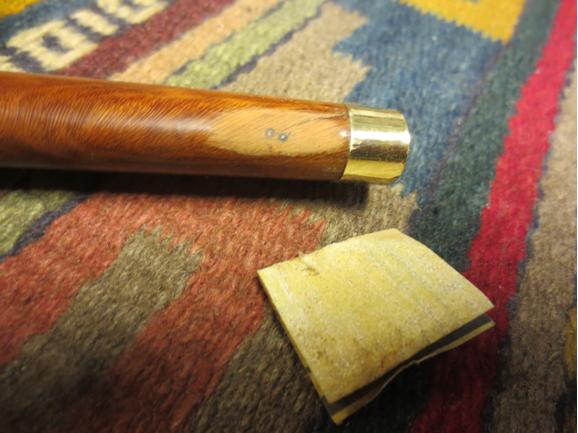
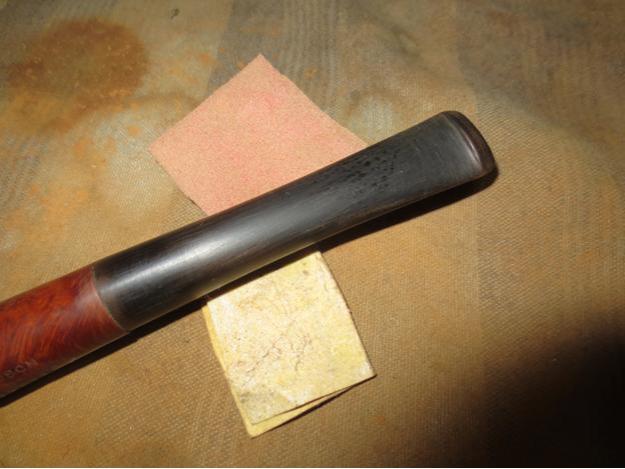
Dun4 Once the repair had cured (several hours later) I sanded the patches with 220 grit sand paper to blend them into the surface of the stem. I sanded the repair to the button as well to blend it in without changing the profile of the end of the stem.Dun5

Dun6 I sanded it with a medium and a fine grit sanding sponge to minimize the scratches left behind by the sandpaper and to further blend in the repair. I used a needle file to sharpen the edge of the button and then sanded it with 400 grit wet dry sandpaper and a little bit of water. You can see from the next two photos that the patches are blending into the stem nicely.Dun8

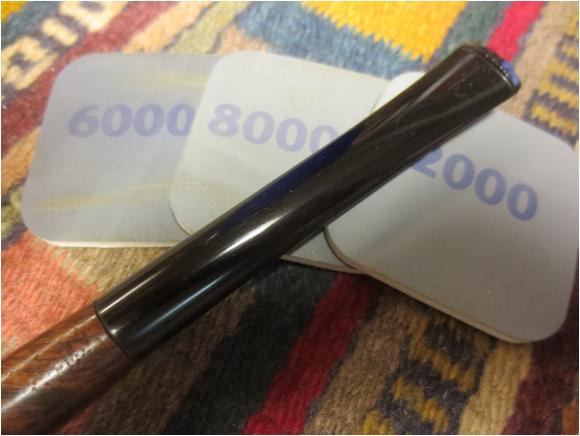
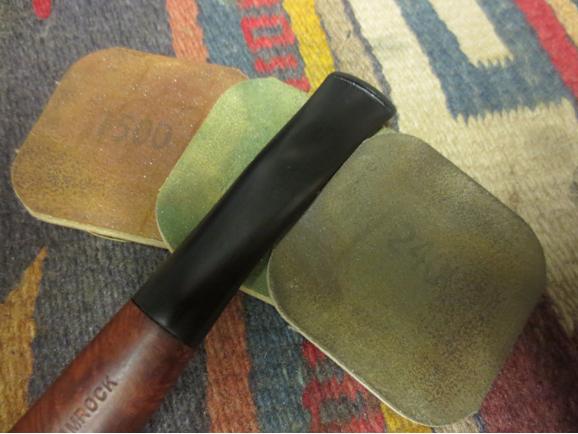
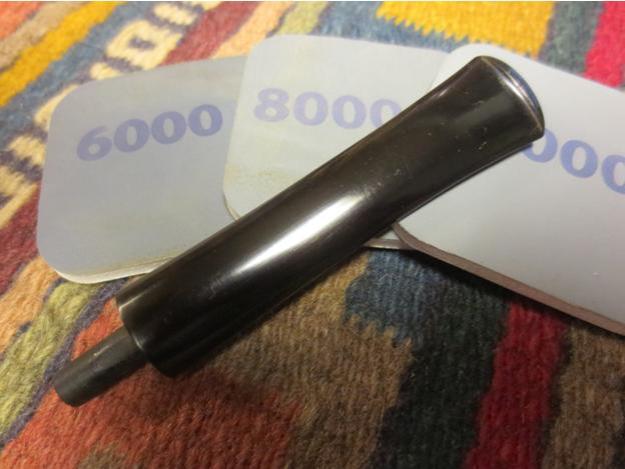
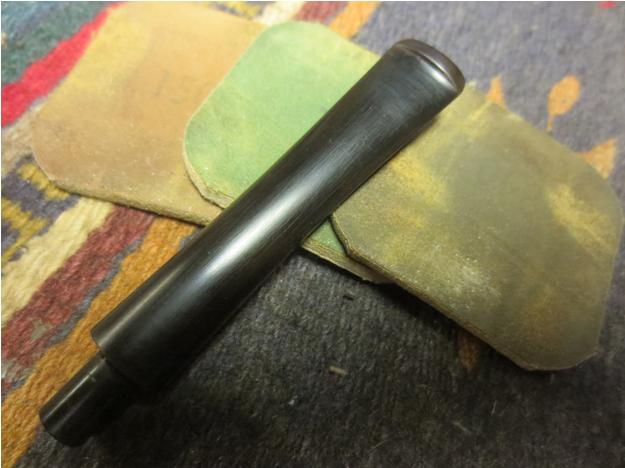
Dun9 I moved on to wet sanding the stem with 1500-2400 grit micromesh sanding pads. The scratches are disappearing and the patches are blending in to the point that if you did not know where they are you would not see them. I rubbed the stem down with Obsidian Oil before going further with the micromesh pads.Dun10

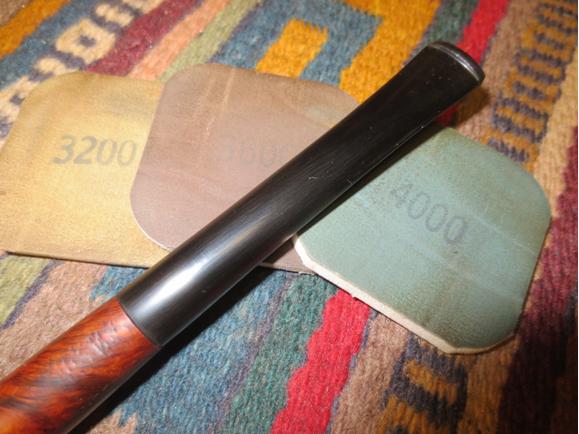
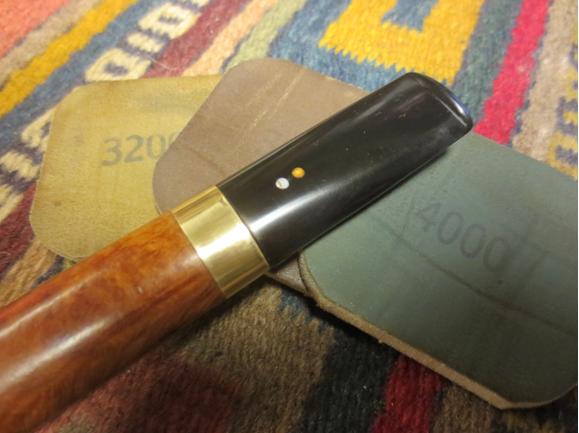
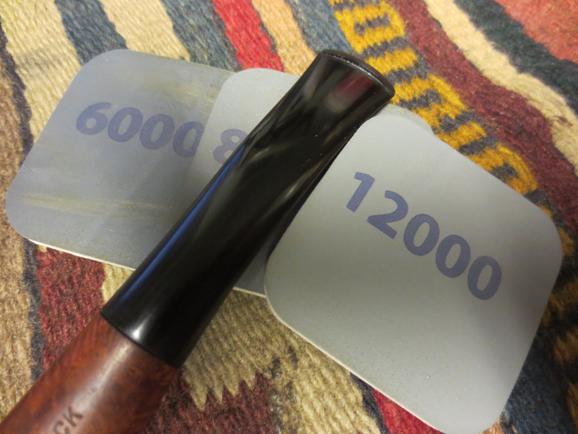
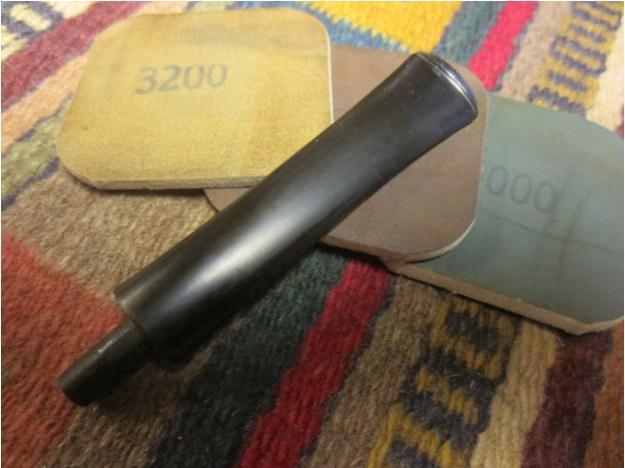
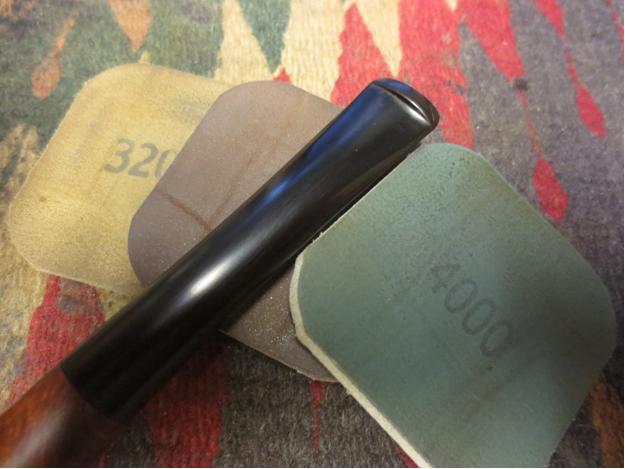
Dun11 I wet sanded the repairs with 3200-4000 grit micromesh pads to further blend in the repaired areas. I spent extra time working on the repair to the small crack on the top of the button. I wanted that spot to blend in well and be smooth to the touch.Dun12

Dun13 The repair to the top of the button and along the top side of the button needed a little more work to get them to be less visible and more blended. The repair on the underside was really looking good. I cleaned up the repair on the button and then used some clear super glue applied with the tip of a dental pick. Once it cured I sanded it with 220 grit sandpaper and then the same set of wet dry sandpaper and micromesh pads that I commented on above. Finally the repair blended well.Dun14

Dun15 I buffed it with Blue Diamond and gave it several coats of carnauba wax. I buffed it with a clean flannel buff and then hand buffed it with a microfibre cloth.Dun16

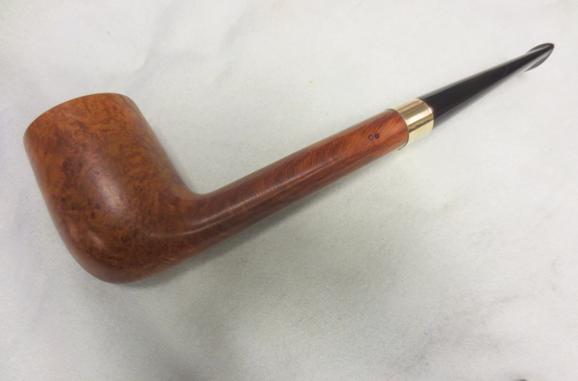
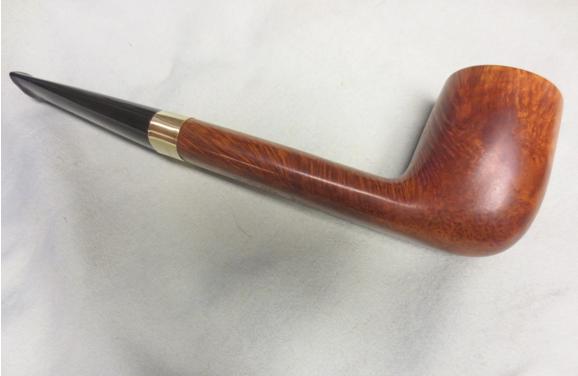
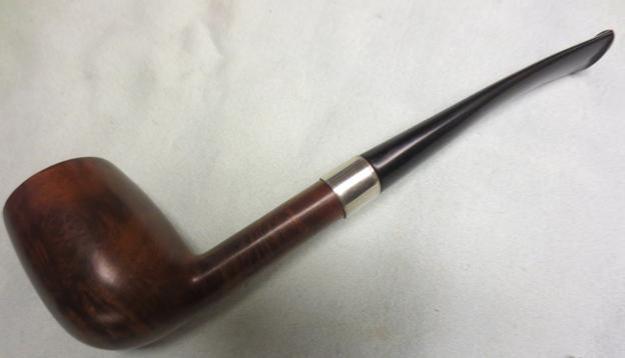
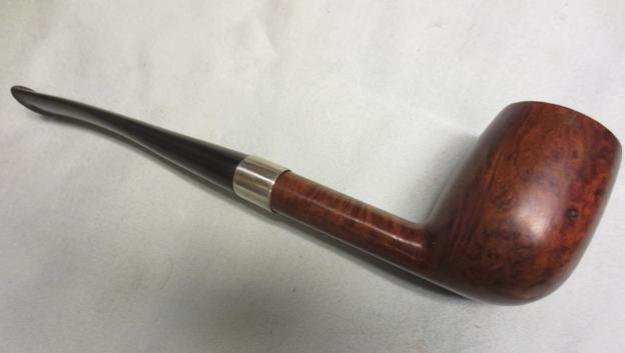
Dun17 The finished pipe is shown below. The darkening of the stain on the rim and the repaired stem are finished and the pipe is almost ready to send back to the owner.Dun18

Dun19

Dun20

Dun21

Overcoming Bit Bending Phobia for a Comoy’s 1983 Christmas Bulldog


Guest Blog by Robert M. Boughton
Member, North American Society of Pipe Collectors
http://www.naspc.org
http://www.roadrunnerpipes.com
http://about.me/boughtonrobert
Photos © the Author

Boy: Do not try and bend the spoon. That’s impossible. Instead only try to realize the truth.
Neo: What truth?
Boy: There is no spoon.
Neo: There is no spoon?
Boy: Then you’ll see that it is not the spoon that bends, it is only yourself.

― From “The Matrix” (1999), starring Keanu Reeves, with Owan Witt as Spoon Boy

INTRODUCTION
Whatever some might think of me, I’m not so far off the deep end to space that when it comes to bending a pipe bit, there is, of course, the bit. The real truth behind this essay – how easy it is to accomplish the task, without tricks or special effects – bends the mind. I had dreaded and postponed the basic exercise in pipe restoration as something fearsome, once even passing the task to my mentor, Chuck Richards, when the rare opportunity to improve upon my first genuine renewal, of a Chinese Chicken Wing Wood churchwarden, presented itself a while back. Although I did the second makeover of the bowl and shank of that unusual specimen of wood and craftsmanship myself, using standard waxing techniques not available to me when I began learning this artful craft, and even polished the bit, I could just as well have bent the long piece of vulcanite had I known then that which I only just learned one morning this past weekend by perusing the web. More importantly, in so doing, I would have been done with the unpleasant feeling that comes with parting out work on a project.

However, the necessity of facing the dreaded deed finally presenting itself to me, and I at last concluding enough was enough with the shirking of responsibility, I resorted to browsing the Internet (“Read the instructions,” my dad would tell me) in search of a feasible method to achieve my goal without a high-powered torch. And where did I reach the end of my quest but here at Reborn Pipes, in a three-year-old blog by our host, which can be read at https://rebornpipes.com/2012/07/15/bending-vulcanite-stems/.

I should note that my surrender to the essential instruction in and practice of bending a pipe bit was not as easy as I make it seem above. Several weeks ago, at our Friday night pipe club get-together, a good friend and fellow restorer named Bob Kasenchak surprised me with the gift of a box of assorted pipes that needed various degrees of work, all leaning toward the critical side. There are 15 in all, including a Ropp Deluxe #809 natural cherry wood with a pronounced crack in the bottom of the bowl; an old Ehrlich Frankenstein billiard; a Kaywoodie Supergrain bulldog with a wicked Harry Potterish lightning crack in the bowl and the bit maybe incinerated; an interesting old Wellington Storm De Luxe sterling band pot with a bad gash on the rim, and a Trapwell Patented rusticated billiard. There is also something that appears to be a once fine, handsome Ehrlich sterling bulldog (at least judging from the style of the E on the bit) that will make a nice shop pipe someday, and which plays an important role in this narrative.

Most of these pipes have missing, broken or mangled stems, and only a few are free of fatal flaws, and Bob just doesn’t want to mess with them. Who can blame him? If I had Bob’s outrageously hectic schedule, I might not keep them, even for parts, either. But I don’t, and I’m a little touched when it comes to hording parts.

Then a funny thing happened on the way from the meeting to the shop, or my apartment. In fact, it occurred during the meeting, but it sounds better the other way. The clear jewel of the pipes Bob gave me, which I delayed mentioning, is a Comoy’s Christmas 1983 smooth bulldog.Comoy1

Comoy2 I already had my heart set on keeping the Comoy’s to add to my budding Christmas Pipe collection, but a fellow piper in my club, who has a keen eye for sharp pipes and has bought two meerschaums from me, took an immediate shine to the bulldog’s sleek contours and exceptional subtlety of the bit curve, and offered to buy it when I was finished. We still haven’t discussed a price. At a glance, the Christmas Pipe was a beauty right out of the “scrap” box. The reddish brown briar was very pleasant, the chamber appeared to be well-kept and Bob told me he had started to clean it, the rim was in perfect, shiny shape that I also attribute to Bob, and there was only one small scratch on a side of the triangular shank. Then there was the bit. How can I best describe it? The vulcanite below the lip, on the bottom, appeared to have been chomped by the steel-toothed “Jaws” character (Richard Kiel, 1939-2003) of the James Bond movie series fame.Comoy3 The reason I note a continued difficulty in regard to learning about bending a stem is my dual desire to become more proficient in repairing those that are damaged, of which this, no one would disagree, is a worthy challenge, and doing the job right. And so I set upon a course of action I will neither illustrate nor chronicle here except to say with all honesty the project was going, well – well – but it was just taking too frigging long. And yes, I admit, I somehow took a bad hole and made it worse. Due to the fact that I already had a buyer waiting, time was of the essence; I couldn’t afford to satisfy my own aesthetic sense of propriety in hoping to preserve the original bit when the buyer wasn’t concerned. Besides, I’m sure the right Comoy’s will happen along in good time.

RESTORATION Comoy4

Comoy5

Comoy6

Comoy7

Comoy8 As I mentioned before, Bob started the process of reaming the chamber. To my initial touch it felt smoother than almost any pipe I had ever started restoring. Still, there was some cake in it, and a few bumps, all of which came clean with minimal additional turns of a reamer and sanding with 150- and 320- grit paper. Not having to touch the rim was a rare treat, although I have to add I always enjoy removing the burns.Comoy9 I used micromesh on the wood from 1500-4000 and cleaned up the shank opening with super fine steel wool.Comoy10

Comoy11

Comoy12

Comoy13

Comoy14

Comoy15 By then I was ready for the retort. Six test tubes later, full of Everclear boiled up through a temporary saddle bit with the right sized push tenon – a personal record – I was finished.

I needed to find a replacement bit. Searching with a hot glow of intense zeal through the dozens of old pipes awaiting restorations, I began to think I would never find one that had a push-in tenon, was straight, the right length and with the appropriate bulldog triangle size (5/8″; the length was 2-7/8″). Suddenly, there it was: a Bertram Bulldog #50, with a double stamp, and no mark on the straight bit. I actually had imminent plans for that great pipe, but they could wait.Comoy16

Comoy17 The tenon was just a tad too big, so I took about a sixteenth of an inch off of it with 150-grit sandpaper and sanitized and cleared out the old grime in the air hole with bristly cleaners soaked in Everclear. I still need to invest in a tenon cutter, as will become apparent. Once the tenon fit and I thought it was “finished,” the bit pushed all the way into the shank, but was canted upward. I tried to adjust this by filing the flat edge of the bit around the tenon, and after considerable work, my efforts seemed to have paid off. I gave the bit an OxiClean wash, rinsed it and micro-meshed from 1500-4000.Comoy23

Comoy24 Following the instructions for the oven method of shaping in the blog mentioned earlier, I pre-heated gas stove to the low end of 200-220 degrees and assembled what I would need as suggested, except that all of it was improvised other than the oven: aluminum foil instead of a baking pan, a small jar of wood putty rather than a spice jar, two wash cloths in place of cooking mitts and of course the bit. As it turned out, I spaced that I had a few spices in my sparse cabinet, but the round putty glass did fine.Comoy20 Inserting a soft cleaner through the airway before heating to prevent collapse, I had the distinct sensation of butterflies in my stomach as I placed the foil and bit on the center rack of the hot even, closed the door and…waited. Five minutes. Not good enough. Another five. To my amazement, holding the bit carefully with the wash cloths at both ends over the rounded edge of the putty jar and pressing down with all the gentleness my rough hands could handle, I in fact saw the vulcanite bend! I’m here to tell you, I have never been so surprised and full of trepidation at the same time in my entire life!Comoy21 In a minute, the job was done, and I removed the cleaner and rinsed the bit with cold tap water.

And so, other than the facts that I had already blown it again by sanding the base of the tenon so far that the whole thing could snap at the least provocation, and upon closer inspection the bit did not, in fact, line up seamlessly with the shank, the entire exercise produced a wonderful looking bit (in and of itself) and was an excellent though time-intensive and frustrating lesson about the intricacies of replacing a bit – and one I’ll never forget.

As a good friend from junior high through high school used to say at such moments (or their school day equivalents), and often with a yawn, well, hell. Then again, he was always much less uptight than I. My true reaction was frustration verging on despair. But that’s where my mind like a steel trap always springs shut and saves me. And my skull is so thick it can take running headlong into a concrete utility post and being pistol-whipped. I’m not kidding. The first happened to me as a young boy fooling around during summer vacation, and the second seven years ago during an armed home invasion after I beat one of the three intruders unconscious with a club – and he had pretty well messed me up with my own baseball bat – and one of his buddies hit me from the side with the butt of his 9mm. I’ll never forget the look in his eyes through the stupid monster mask when I turned on him and he took a step back.

Once again, as is my habit, I digress. I was illustrating how my stubbornness and downright thick-headedness has often saved me. The way this process worked last Wednesday, while I sat and collected my wits at my tobacconist where Chuck gave me the bad news about the tenon, was by telling me to go online and order a replacement. I crossed the Internet from Albuquerque to Phoenix in an instant and found Pipe Makers Emporium. I have placed several orders there, but only once before for a vulcanite churchwarden stem that was $3.99 because I didn’t understand why smaller stems, such as the one I needed for the bulldog, were priced so much more – in this case, $17.50. Even when the package arrived swiftly yesterday and weighed a pound, according to my estimation and confirmation on the label, I still didn’t get it until I peeled open the envelope and found a pack of 20. Duh! The churchwardens are sold individually because they’re not needed as often. Sometimes the thickness of my head can get in the way.

Now, back to the Ehrlich sterling bulldog with the E on the bit that came with Bob’s generous gift. Remember that? I tried to make apparent how important it would become to this restoration, and it’s lucky I recalled it before the new bits came, both because I was eager to continue work on the Comoy’s and the uncut tenons on the 20 bits that came in the mail are about a half-inch wide. In this photo, I had already sanded the E off the bit and given it an OxiClean bath.Comoy22 By the way, when I showed Chuck my progress on the Christmas pipe with the re-worked Ehrlich stem as of yesterday, he said it was looking good. Then I let him have a gander at one of the new bits, and he gave me his best, widest grin.

“This is why you need to get yourself a cutter,” he said, turning serious and with emphasis on need.

“I know,” I replied. “My God! Look at that tenon! It would take me a month of sanding to get it down to fit this pipe!”

We both enjoyed a good laugh, and we needed one, for our separate reasons.

Here is the Ehrlich bit as it originally presented, minus the E, and after sanding and micro-meshing from 1500-4000.Comoy23

Comoy24 Thinking I was done with most of the restoration of the pipe – and at a glance it did look good – I buffed the stem on the wheels with red and white Tripoli, as usual. I had, after the first hour of this job, already buffed the wood with white Tripoli as well as White Diamond and carnauba.

But then I took the “final” photos and saw at once that the bit did not line up with the shank when the top lines of each were even, in particular gaps all around and misalignment of the bottom line of the triangle. Well, hell.Comoy25

Comoy26

Comoy27

Comoy28 And so I got into the kind of detail work I had never done with any pipe. I filed the edge of the bit where the tenon connects. I started a lengthy process of gently sanding away and re-micro-meshing areas of wood around the shank opening. As shown in the last photo above, the only part of the problem that could only be solved with serious sanding of the shank was along the top left line leading into the bit (as shown in this view). Then I used micromesh on the one heavily sanded area of the shank and bit all the way from 1500 to 12000.Comoy29

Comoy30

Comoy31 I stained the small area of the shank still a bit lighter than before with Lincoln Medium Brown and flamed it before micro-meshing with 4000 and 6000. At this point, after about three weeks of work on the pipe, the lines of the bit matched those of the shank, but there was still a gap between the two – and although it was in fact bigger, it was perfect in terms of uniformity. I broke out the file one more time and with the utmost care took a layer off the edge of the bit around the tenon.

At last, a nice, flush match. I touched up the waxing with another coat of carnauba.Comoy32

Comoy33

Comoy34

Comoy35

Comoy36

Comoy37

Comoy38

Comoy39 CONCLUSION
Well…first of all, I can report, without doubt, that I have never been happier to be done with a restoration. This one was as full of a restore as I have ever had occasion to do, and I am full of it (not in the sense that I think I did it perfectly, because if anything, it taught me how much more I really do have to learn, and the equipment and supplies needed). But I do find nowadays that many times when I ask one of my trusted guides a question, it is to confirm that which I already more or less suspect, as in an email I sent late last night to Steve about a saddle bit with two holes in the lip that I wished I could somehow remove the space between them to make the draw hole a typical slit opening and therefore easier to clean for whomever buys the pipe I chose for it. I had already bent the tenon to fit the mortise using the oven method described in this blog, and so knew two cleaners were required to fill the airway before heating, and that something must be up with that, but Steve promptly replied that the design is meant to be a twin-bore “bite-proof” bit. Then I recalled Chuck once telling me something along the same lines. And when I showed Chuck the Comoy’s Christmas 1983 bulldog with the initial Bertram’s bit I wasted on it, I knew in my heart that the analysis he would have for me, though unpleasant, was necessary to confirm.

This essay, therefore, was not meant so much to be the usual restoration or refurbish piece as it was, rather, a horror story of the calamities that can befall anyone who engages in the art of taking a damaged pipe and making it better with the myriad processes that might present themselves toward that end. I am, perhaps somewhat wickedly, always pleased to hear the anecdotes of masters such as Steve and Chuck, and countless contributors to this forum, who have shared some of their own truly Gothic tales of the grotesque in their encounters with real Frankenstein pipes. By good fortune, my account herein was only one of a bowl and shank in excellent shape that merely needed a single appendage added, with a relative minimum of minor surgery to realize it.

Now I can hardly contain my excitement at being able to attack all the bodiless heads and headless bodies, to use a metaphor, that have waited patiently (I guess that’s personification) for my late but kind attention.

Another dressed for the Prom… maybe the Prom King – Cheap Meer Given a New Look


Blog by Steve Laug

In the box of pipes to experiment with and refurbish as I can I had the mate to the little meerschaum apple that I restored a few days ago. https://rebornpipes.com/2015/08/28/prom-night-dressing-up-a-cheap-meerschaum-apple/ This one is a Meerschaum billiard. It had the same plastic (nylon) stem (it is not acrylic – way too soft). It had been smoked about the same amount as the other one – in fact the detritus in the bowl was identical. The stem had a crack on the underside from the button forward about 1 ½ inches. The finish had some dings and scratches in the surface but was very redeemable. I thought since I had to restem it anyway I might as well make it a match to the apple.Bill1

Bill2

Bill3

Bill4 I took the next close-up photo to show the fit of the stem to the shank and also the crack in the underside.Bill5 The next series of photos show the brass band that I chose to put on this one to match the other. It is a pressure ferrule and I have used them a lot in the past as they make a great looking band. Sometimes I grind out the rings and other times I leave them as I did in this case. Note the different tenon set up on this stem. The other stem had been drill out and the shank had a Delrin insert to accommodate a push stem. This one has a stainless steel tube glued solidly in the shank of the pipe. I heated it and pulled it but I am not able to remove it so I decided to leave it alone.

To make the shank ready for the band I needed to sand it back the width of the band. I used 220 grit sandpaper and carefully worked it back evenly to make fitting the band simpler. My normal pressure fit method of pressing a band would need to be modified on this one because of the metal tenon locked in the shank. It would still work but just need modification. I heated the band with a lighter and then pressed in place a little bit at a time working my way around the tenon.Bill6

Bill7

Bill8 With the newly banded shank finished it was time to work on a new stem. I toyed with the idea of using the nylon one from the other pipe. It did not take me long to put that idea aside. I had a stem in my can of stems that would do the job – an old taper vulcanite with a very straight profile would look great on this meer billiard. I used the Dremel and sanding drum to take back the existing tenon and flatten it against the face. I forgot to take a photo of the stem to begin with so I stopped mid stream after I had removed about half of it to take the photo below.Bill9 Once I had removed the tenon I needed to drill out the airway to accommodate the metal tenon. I would in essence make a reverse tenon set up on the stem. I started with a drill bit slightly larger than the airway and hand twisted the stem onto the bit. I have found this is far safer that using a power drill to do this finicky work. I worked my way up to a bit the same diameter as the tenon and hand turned the stem onto the bit. I put a piece of tape on the bit so I would know when to stop turning the stem. That marked the depth of the tenon. Once I got to that place the stem would push onto the tenon flush against the shank end in the band.Bill10

Bill11

Bill12 The next photo is an end view of the newly drilled airway. It is a little rough and will need to be sanded smooth to remove all of the scratches.Bill13 I pushed the stem in place on the pipe to get an idea of the final look of the newly dressed prom king. The photos below show the stem before I did the final adjustments to the diameter and flow.Bill14

Bill15

Bill16

Bill17 I liked the new look a lot. It had the same touch of class as the meerschaum apple does. It would come out looking pretty slick once it was finished. I sanded the diameter of the stem with the Dremel and sanding drum to take off a fraction so that it would sit flush in the band with no gap around the edges. I then hand sanded it with 220 grit sandpaper to further fine tune the fit.Bill18

Bill19

Bill20 I sanded the newly fit stem with a medium and a fine grit sanding sponge to clean up the vulcanite and remove all of the scratches from the sanding drum and 220 grit sandpaper. I sanded it with micromesh sanding pads – wet sanding with 1500-2400 grit pads and dry sanding with 4000-12000 grit pads. I rubbed it down with Obsidian Oil between each set of three pads and then after the 12000 grit pad I let it dry before going to the buffer. I also sanded the bowl with the micromesh pads to polish the meerschaum.Bill21

Bill22

Bill23 I buffed bowl and stem with Blue Diamond and then gave the stem multiple coats of carnauba wax. I buffed it with a clean flannel buff to raise a shine and then hand buffed it with a microfibre cloth to put on the final touches. The finished pipe is shown below.Bill24

Bill25

Bill26

Bill27 The next two close up photos show the detail of the stem. They also show the way the air hole has been opened to accommodate the metal tenon.Bill28

Bill29 The final two photos show the two meers, dressed and ready to head out to the Prom. They look like royalty – maybe Prom King and Queen. Ah well so much for an old guys memory of things long past in the recesses of the high school years file.Bill30

Bill31

Breathing New Life into an LHS Sulgrave


Blog by Steve Laug

I have become a fan of older LHS pipes and restored quite a few of them lately. I am always on the lookout for different LHS lines that I have not seen. Recently I picked up this LHS Sulgrave from a fellow on the Dr. Grabow Collectors Forum for $15. It is a line that I had not heard of before. He described it as a lightly smoked briar pipe. When I saw it I wanted it as it was my kind of shape. Never sure what to call this shape – bent banker, squat apple – not sure but I like it. He gave the following description in the sale listing. The shank is stamped Purex Sulgrave arched over LHS in a Diamond on the left side. The stem has two light coloured dots on the left side. The pipe is 5 1/8 inches long from the bottom of bowl to end of bit. The bowl chamber diameter is 7/8 inch and bowl depth is 1 1/4 inch. There is light caking in bowl. There is light tooth wear on end of the stem near the button. It has normal wear and tear (dings, oxidation and scratches) for an estate pipe. Nice overall shape and condition. Here are the photos that he included when I emailed him for details.LHS1

LHS2

LHS3

LHS4 When the pipe arrived I was not disappointed. The shape was perfect. The description was accurate and the only variation that I could see was that the stamping did not include PUREX on the shank. Not a big deal in my book. The bowl was unevenly caked and appeared to have been reamed. The back side of the bowl had a thicker portion of cake that gave the inside wall on the back side an uneven and out of round look. I was pretty certain that with a good reaming and a light sanding the rim would look better. The stem was over bent and there was a slight crease on the underside of the bend. There was a coat of wax or some kind of coating on the stem and bowl. The stem was oxidized. In the first photo below you can see slight imperfection in the vulcanite stem. I have circled it to highlight it in the photo below. It is not a hole or worn spot, it is actually a thread of cord in the rubber. Its presence gives some idea of the date of manufacture as recycled rubber was used in WWII pipes.LHS5

LHS6

LHS7

LHS8 The stem also had a lot of tooth dents and chatter along both top and bottom with some very deep marks on both. I tried to capture them in the next two close-up photos but they are still not very clear. The odd thing was that the dents went up the stem over an inch. The slot in the button was not centred and appeared to have left the factory that way. The dents were deep enough that I was concerned regarding the thinness of the stem surface over the airway. The mortise and airway in the shank were dirty and the end of the mortise was chipped away. It looked as if there had originally been a stinger in the tenon but it was no longer with the pipe.LHS9

LHS10 I also have included the next close-up photo of the rim and the bowl interior to show the cake that gave the bowl an out of round appearance.LHS11 I reamed the bowl with a PipNet pipe reamer using the largest cutting head. I took the cake back to bare wood to even out the inner edge of the bowl. I wanted to get rid of the cake so that I could smooth out the edge.LHS12

LHS13 I folded a piece of 220 grit sandpaper to smooth out inner edge. It took a little effort remove the inner edge damage and clean up the roundness of the bowl.LHS14

LHS15 I wiped down the bowl with acetone on cotton pads to remove the tars and the wax coat on the briar. With them removed the outer edge of the bowl showed damage as well. The bowl had been knocked about on the front edge particularly. The grain on this pipe was lovely.LHS16

LHS17

LHS18

LHS19 To minimize the outer edge damage I topped the bowl with 220 grit sandpaper on a topping board. I sanded it to remove the damage to the top of the bowl and clean up the outer edge of the bowl.LHS20

LHS21 I cleaned out the shank and the bowl with pipe cleaners, cotton swabs and alcohol to remove the grime inside. It took quite a few of both to clean out the shank but finally they came out clean.LHS22 I heated the stem with a heat gun to try and lift some of the dents to the surface and to also take out some of the bend. I also wanted to smooth out the sharpness of the bend on the bottom side.LHS23

LHS24

LHS25 I cleaned out the airway in the stem with pipe cleaners, cotton swabs and alcohol.LHS26 The heat had raised most of the dents significantly. The ones that were left in the stem needed to be sanded out and then filled to take care of them. I used 220 grit sandpaper to smooth out the surface. I also worked on the curve on the underside of the stem to make it less sharp looking.LHS27

LHS28

LHS29

LHS30 The dents in the stem needed to be filled to bring the surface back to smooth flowing condition. I used a black super glue to fill the surface and set the stem aside to dry for several hours. Once dry, I sanded the fills with 220 grit sandpaper and then used a medium and a fine grit sanding sponge to feather them into the surface of the stem.LHS31

LHS32

LHS33

LHS34

LHS35

LHS36 I used a needle file to clean up and sharpen the edge of the button and give it more definition. I sanded the sharp edge with sandpaper and then sanded it with micromesh sanding pads. I wet sanded the stem with 1500-2400 grit micromesh pads and dry sanded with 3200-12,000 grit pads. I rubbed the stem down with Obsidian Oil between each set of three pads and then let it dry after sanding with a 12,000 grit pad.LHS37

LHS38

LHS39 I buffed the pipe with White Diamond and Blue Diamond on the buffing wheel to polish and remove the slight remnants of oxidation that had come to the surface. I gave it multiple coats of carnauba wax and buffed it with a clean flannel buffing pad. I brought it back to the table and hand buffed it with a microfibre cloth. The finished pipe is shown in the photos below.LHS40

LHS41

LHS42

LHS43

LHS44

LHS45

LHS46

Revamping a Bavarian Folk Wine Pipe Made in Italy


Guest Blog by Robert M. Boughton
Member, North American Society of Pipe Collectors
http://www.naspc.org
http://www.roadrunnerpipes.com
http://about.me/boughtonrobert
Photos © the Author

“Voters in the southern German state of Bavaria [April 7, 2010] voted for Germany’s strongest smoking ban, meaning lighting up in bars, restaurants and beer tents at Munich’s famous Oktoberfest will be ‘verboten.’”
― David Levitz, journalist, Agence France-Presse

INTRODUCTION
Who would have dreamed that those crazy, fun-loving Bavarians who have been hosting the annual Oktoberfest since October 12, 1810, the day Crown Prince Ludwig (later King Ludwig I) married Princess Therese von Sachsen-Hildburghausen; the culinary health scoffers who gave to the world such artery-hardening treats as Weisswurst, Schweinshaxe, schnitzel and spaetzle, and for snacks and dessert, laugen pretzels, apfelstrudel, Baverische crème and zvetchgenkuchen – would ban smoking in all public buildings just months before the bicentennial of the world’s biggest excuse to get betrunken?
Bavarians are even so fond of beer and schnapps that they have a great little saying: Saufen bis zum Verlust der Muttersprache, or drink until you forget your mother tongue. And if you’ve ever seen many German tourists, how many of them didn’t look like triple bypass candidates? Of course, everyone knows smoking kills more people than drinking and/or diet-related maladies…right?
One 31-year-old Garden Grove, California woman who lost her job and started a blog, and has written a book but is still searching for a publisher, has a particularly active gift of gab. She blogged, “Bavaria’s cuisine is a monster truck. It crumples the delicate-by-comparison culinary offerings of Spain, Italy, and France like tiny little Fiats and Peugots in its path… It is rich and doughy and filling and is the only thing on the planet that can soak up German beer. Every other fare will simply hide in the corner of your stomach, petrified at the sheer awesomeness of the brew that resides in there with it, and it will never get digested.” Perhaps the most succinct line from this particular blog is, “Germans do it with bigger sausages.” [http://www.everywhereist.com/7-badass-bavarian-foods-you-must-try/] I, for one, can’t wait until the book comes out.

If the world is going mad as far as singling out tobacco as the great evil, then Bavaria may now be the capitol for the insanity. Maybe all that ice bockbier and apfelstrudel have saturated their bodies and have nowhere left to go but the brains.

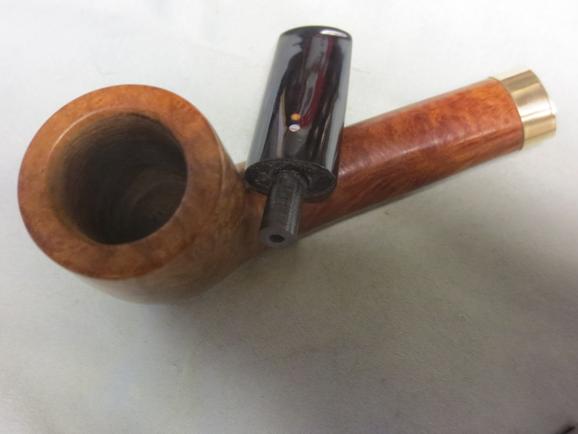
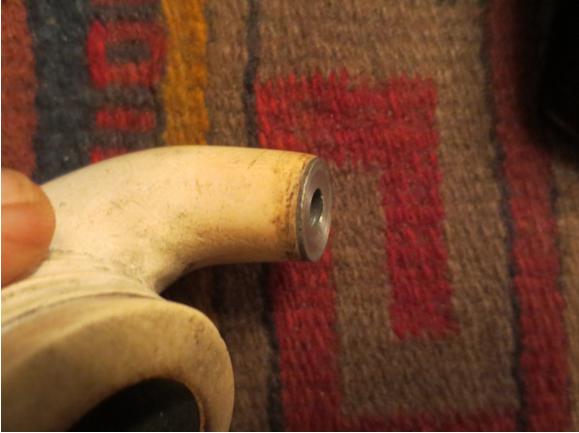
At any rate, there remains for those of us who still appreciate the virtues of pipes and their tobaccos the glorious contributions of German craftsmanship in general and Bavarian in particular.Rob1 And more along the lines of the subject of this blog:Rob2

Rob3 When I emailed Steve a few photos of my new acquisition from eBay, for less than $11, I was happy as usual to receive a response but, I must admit, a little disheartened to hear of the 20 hours he spent restoring the 1810 Meerschaum Bowl masterpiece above. Then I considered the facts that his folk pipe was part meerschaum, and of course suspected he had, as his masterful skills and (if I may be so bold) somewhat obsessive creative bent allow, more than just restored it. He had in fact, of course, re-worked parts of it, as I learned when I read with pleasure his July 7 account. I mentioned the conjecture that Steve is a born pipe maker to my mentor, Chuck Richards, who with not an inkling of surprise to me that Steve has made a few pipes in his time. I therefore hereby suggest a blog by our host on these endeavors, which I am certain I am not alone in my curiosity to hear about and see.

Alas, as shall be seen, my Bavarian Three-Piece Folk Wine Pipe – not counting the screw-in bit – pales in comparison, although it did present problems I had not before encountered. Starting with the bit, the eBay photos revealed one gash that appeared to be so deep that it must have pierced the air hole. As Lady Luck provided, however, such was not the case. On the other hand, there turned out to be three bad divots in the bit, not counting the severe wounds just below the lip, top and bottom, from grinding teeth. Then there were the countless scratches on every piece; the well-caked chamber; scorching of what I believe is the ornate but aluminum wind cap; a serious cleft in the alternative wood shank, the variety of which I have not yet determined, and a hole in the bottom piece, where the wine is placed, too deep for any fix other than wood putty.

All of these complications, I knew, would be nothing compared to the task of cleaning and sanitizing a pipe with a form that defied retorting. Noting this anticipated cleaning conundrum with a quip, “That’s entirely rhetorical,” in fact, was the reason for Steve’s second reply to my email where he mentioned the time he spent on his folk pipe.

By the way, I owe a final nod to Steve, as well as the owner of my local tobacconist who confirmed his assessment, for identifying my Bavarian folk pipe (which turns out to be a no-name Italian version) as being designed to add wine.

RESTORATION Rob4 This, as it happens, is how I decided to approach the restoration: piece by piece.Rob5

Rob6

Rob7

Rob8

Rob9

Rob10 Without thinking – you might say a bit compulsively on my own part – I already cleaned and polished the wind cap before snapping the last shot above.Rob11

Rob12

Rob13 Other than the almost unconscious cleaning and shining of the wind cap, inside and out, with Everclear-soaked cotton cloths, super fine steel wool and mostly 500-grit paper except for a few tough spots requiring 320, I saw no reason not to dive in with the bit. After all, filling the crevasses – and I can only imagine the drunken stumbling about that caused them – would take several days of layering with black Super Glue and drying time in between. The remainder of the restore was finished in a day and a half of intense work. I gave the bit a good soak in an OxiClean solution to start and cleaned out the mess inside with about six bristly cleaners dipped in Everclear before they came out clean.Rob14

Rob15

Rob16 With that process begun and the pipe disassembled, I returned to the main tobacco chamber (remember, this three-parter has a second chamber at the bottom for wine) and used my Senior Reamer to take out most of the fairly even though excess cake. After that I swabbed it out with some alcohol-soaked cotton gun cleaner squares and finished the removal of char and smoothing with 200-, 320- and 500-grit paper.Rob17 The yellowing of the cap’s inside area is the fault of my photography, not lack of attention. I know nothing of body work on cars, which is the kind of detail work the metal rim requires, and despite my restoration of this pipe for my own enjoyment, any tips on eliminating dings in metal, preferably without removing the entire rim piece, will be appreciated. Since the pipe is staying in my own collection, after all, I have a long time to work out that part.

I turned my attention to the outer bowl, first scrubbing out the draught hole with bristly cleaners soaked in alcohol – quite a few, in fact. Then I used 320-grit paper to remove both the old finish and the scratches, starting with the rough, un-sanded opening of the draught hole showing before and after below.Rob18

Rob19

Rob20 From 1500-4000 micromesh, I prepped the bowl for buffing. I liked the natural, lighter shade of the briar and chose not to re-stain it, proceeding straight to the buffer wheels. I used white Tripoli, White Diamond and carnauba.Rob21

Rob22 The shank was what I expected would take most of the work, and I was right. I sanded the wood with 200 and 320 paper, deciding the cleft in the unknown wood gave it a certain character. Besides, it wasn’t going anywhere without the kind of serious reshaping Steve is into.Rob23 I sanded it again with 500-grit paper and micro-meshed all the way.Rob24 The ferrule was dull and scratched.Rob25 I used micromesh on it and then Lincoln black boot stain, which I flamed, let cool and wiped clean with 4000 micromesh.Rob26 Finally, I used Lincoln brown stain on the shank’s wood and used 4000 micromesh to take off the ash.Rob27 I buffed it with white Tripoli, White Diamond and carnauba, and used red and white Tripoli on the ferrule.Rob28 Onto the final stage – the bottom chamber where the wine is added. Here it is after sanding with 320-grit paper.Rob29

Rob30

Rob31

Rob32 By the time I cleaned it out with bristly cleaners and Everclear, when added to those used for the other parts, I had a pile about as high as Steve’s from his meerschaum bowl folk pipe, only much grimier except for the last that came out clean.

Now take a closer look at the right side, first with the small hole that could neither be sanded away nor ignored, then filled with a dab of wood putty. I let it sit and harden until the next day, when I colored the putty with an indelible brown marker and squeezed a drop of Super Glue over the mark.Rob33

Rob34 Late that night, I sanded off the roughness of the dried Super Glue and smoothed the whole piece with micromesh. And here is the finished, waxed result, without re-staining.Rob35 At last, I was ready to assemble the separately restored parts and wipe it all down with a soft cotton rag.Rob36

Rob37

Rob38

Rob39

Rob40

Rob41

Rob42 The only nomenclature, just under the bottom ring in the last photo, reads Imported Briar over Made in Italy.

CONCLUSION
This restoration involved two firsts for me: filling a hole with wood putty, as basic as that is, and more significantly, the importance of considering each independent part of the whole. Never before had I encountered a pipe with more than a bit connected to a shank that in turn attached to the bowl. The simple addition of a second chamber for wine with two openings – one for the shank and the other for the regular tobacco chamber – forced me to approach the project from an angle that was novel to me. The ultimate restoration was a unique pleasure for me, and I am happy to report that the finished folk pipe smokes quite well, even without wine. I look forward to seeing how it works with Martinelli’s Sparkling Cider.

Now I have just a few final words on the Bavarian tobacco ban. It seems they tried the same thing in 2008, but the result was a scoff law that the authorities didn’t even try to enforce. Let’s hope that all of the pipe smokers in the southern German state of Bavaria unite to overcome the 61% of voters who decided to deny them the right to run their own lives.

Restoring a Westbrook 36 – A Long & Detailed Explanation for New Refurbishers


Blog by Troy Wilburn

Troy originally wrote this simple step by step methodology for refurbishing pipes for the Dr. Grabow Collectors Forum. Troy’s method is straight forward and he gives great photos to help along the way. I thought it might be helpful for those who are just starting in this hobby of ours. It also may give pause for thought to us who have been doing this for a long time. I firmly believe that there is always something new to be learned from each other as we work to restore old pipes and give them new life. Thanks Troy for this great how to piece. – Steve

I’ve had a few PMs by the newer member asking questions on refurbishing pipes. So I decided to make a more detailed way of what I do on refurbing pipes. Now this is what I prefer and what works for ME. Everyone has their own twist and preferred methods.

The first thing is to pick the right pipe. This to me is very important especially when doing your first pipes. You want one that’s inexpensive and an easy clean up. So ones with holes in stems and rims that look like they were used to hammer walnuts with might be ones to pass until you get a few under your belt. Not having to sand it a lot and restain is a plus.

Now we are not making a show pipe or restoring a rare pipe that you want to keep original. We are going to bang out a good clean pipe for smoking pleasure. I can do a pipe like this in good condition in 2 hours or less start to finish. This pipe will be smoked and smoked a lot so it doesn’t need to be so glossy you need to put sunglasses on to pick it up. Just a good dependable pipe for low cost. The lower the cost the more pipes you can get .

Ok so the pipe I picked is a good old trusty Westbrook Billiard, still a plentiful pipe, easy to refurbish and can be found cheap. They are good quality, tough as nails and extremely fine smokers.

I got this one for 5 dollars and with shipping; I got right under 10 dollars in this pipe. The seller wanted 9.99 but after watching it for a while I took advantage of the best offer and got it for the 5 bucks. It was in good shape from pictures with no stem damage and bowl not banged up. Once cleaned it will smoke just as good as any new pipe you can get today from 20-100+ dollars. I do like to drill out my pipe shanks a little larger diameter so that will help the smoking of it some.

OK now on to the pipe. This is a #36 Westbrook Double Carved coupon pipe.

Before…. The pipe is dirty and has plenty of cake in bowl.Grabow1

Grabow2

Grabow3

Grabow4 The refurbish
Not getting too detailed about how to clean out bowl. All you need if you don’t have a reamer is a dull pocket knife and some coarse sandpaper. I used to use salt baths and or soak them overnight with cotton balls soaked in alcohol (91%), but is not necessary if you do the way I’m going to show you. Be careful not to get over zealous in this as you don’t want to dig gouges in the inner walls of pipe. Just light scrapes to get out biggest part of cake. Most of the time the heavy build up pops right out. After this just roll up your coarse sandpaper in a tight funnel shape and work it up and down and around in bowl. Check progress often as to not take out too much of inner bowl.

Bowl cleaned to right amount and cake removed. Leave a thin coat still in bowl.Grabow5

Grabow6

Grabow7 Cleaning out shank and stem. My advice is to buy a few of those shank brushes as they will save you a small fortune in pipe cleaners.Grabow8 Soak stem and bowl in some 91 % ISO (if it’s a smooth and you want to save finish then don’t soak bowl just clean it with a Scotch Brite pad with 91% very lightly). With these Westbrook double carved you don’t have to worry about as you can just buff them with no staining and they will look fine. Plus I like to soak the bowls on these deep carving to get rid of years of handling with someone else hands. It’s hard to tell what has accumulated in the recess of them carving over the years. Run the shank brush through the shank and stem until (soaked in 91%) until it stops coming out black and gunky.Grabow9 Rinse out the bowl while it is soaking and a good brushing with an old tooth brush over everything including inside bowl. Also rub the bowl with a Scotch Brite pad as it will take off old wax and grime but not so rough you have to sand behind it. After this is done just keep running pipe cleaners in shank and stem with clean ISO until they are coming out clean. I use a combination of the coarse cleaners and regular pipe cleaners. After a good brushing with shank brushes it shouldn’t take too many.

After this I usually place stem in oxy clean and warm water (about half to full scoop that provided in container) and let soak for about 30-40 minutes. It can soak while I work on cleaning the stinger and Adjustomatic female shank.Grabow10 I put the old stinger in an old stem I have to help hold it after it soaked in ISO with bowl and stem. Take some 000 steel wool and just rub it briskly getting into every little part. Take a small screwdriver to use it to push it through the small air trench.Grabow11 Take some steel wool and make it into a long skinny shape.Grabow12 Run it up in shank a little way then take a small screwdriver and run it up alongside. Then twirl the bowl as it will screw the 000 into the threads. Then unscrew it, most of times it will come out but sometimes it will break apart and you will have to push it out with a cleaner or a stiff piece of wire. A small long screwdriver will work also.Grabow13

Grabow14 You might have to do this a couple of times to get it good and clean. Be sure to blow out all the fine pieces of steel wool afterwards.Grabow15 Now we can take the stem out of Oxy Clean bath.Grabow16 Take a Scotch Brite pad and dip into the oxy water and rub the stem. I know people say use Magic Erasers but to me this is much easier and cheaper. It’s a lot less rubbing and faster. Work smarter not harder is what I was taught :). Here it is half done, took maybe 5 seconds.Grabow17

Grabow18 All oxidation that oxy clean bought to the surface is scrubbed off now. Took like a minute.Grabow19 After the oxy bath I take clean water and wipe off bowl and stem with clean water and tooth brush or ISO 91%, your choice, to remove any residue left from the alcohol and oxy clean. I use water because it’s cheaper.Grabow20 Go ahead and run a few pipe cleaners through stem with ISO to remove any debris and residue left behind from oxy bath. The stem is ready for wet sanding. As this stem is in such good shape it won’t take long to wet sand. If it had tooth marks and or heavy scratches you need to sand it more of course. I’m going to use 400, 600, 800 and 1200 grit sandpaper. Any finer grit to me is overkill for this pipe as I said it’s a daily working pipe and not a show pipe. Sand it lightly with each grit of sandpaper, being careful not to over sand it and make it not register with the shank properly. Being ultra careful where the stem goes into the shank as not to take off too much material. As most all the oxidation has been removed it doesn’t need to be sanded too much as we are just trying to make it smooth. Just a few light strokes with the coarse paper is all you need then using the finer grit a little more will do the trick. I have a piece of an old shank that broke off a bowl to use as a holder for Adjustomatic stems. It makes holding them during sanding a lot easier.Grabow21 Ok the pipe bowl is cleaned and scrubbed and the stem sanded.Grabow22 At this point I like to rub the pipe down with Mineral Oil. Some like to use olive oil but Mineral oil is odorless and tasteless. It doesn’t have the danger of turning sour like a type of vegetable oil can. Plus it helps to bring out grain in wood.

Any defects and or oxidation (brown spots in stem) will show up and allow you the luxury of fixing it before you apply wax. I apply the oil with a cotton ball and take a tooth brush and get into all the recesses. It will also show you pretty much what the color of the pipe will look like after buff and wax.Grabow23

Grabow24

Grabow25 The photo below shows the pipe after the Mineral Oil has been wiped and dry, ready for buffing.Grabow26 I use a buffing wheel and compounds but I know some who read this do not have this. I will not get into this as it will take too long and I’m still learning myself. I used to do all hand buffing. At this point you can just apply hand coats of various waxes you can buy that come in paste form and it will look fine.

Well I hope this can be a help to anyone that wants to start refurbing their own pipes. It’s a lot of fun and can save you a lot of money. Dave Whitney also sells a book that I would suggest getting it is called “OLD BRIAR” and it is a book on restoring and trading estate pipes. It is available via Amazon for Kindle.

Here is after pics.Grabow27

Grabow28

Grabow29

Grabow30

Grabow31

Grabow32

Grabow33

Grabow34

Grabow35 After about a 24 hour rest to let the alcohol evaporate out it will be ready for smoking. This is my favorite combination for breaking in a refurbed pipe: 50% Carter Hall and 50% 5 Brothers. It will be build cake fast and burn out any reminisces of a ghost left behind. It is a strong burley combination and has a good nicotine hit so be warned.Grabow36 Now you don’t have to pick a Westbrook as this is just a guide to help you get started. But I would suggest starting on rusticated pipes as they seem to be an easier pipe to refurbish to me. You can always add your own twist to the pipes you do. Now on occasion a problem does pop up like a frozen Adjustomatic or a stuck stem etc…. That’s pretty rare occurrence from the pipes I’ve done. But if it happens, just post your questions here on the Dr. Grabow Collectors forum (or even here on rebornpipes for that matter). Help and advice is something our forum is not lacking in . Or you can just send me an email and I’ll help you best I can or send you in the right direction to someone who can.

A Very Simple Cleanup on a Dr. Grabow Regal Dublin


Blog by Steve Laug

This pipe came to me in a box of pipes that a friend brought by for me. He was getting rid of a bunch of the pipes that he no longer smoked and thought I might enjoy cleaning them up. This one is stamped on the left side Regal over Dr. Grabow and on the right side, Imported Briar over Adjustomatic over Pat. 2461206. When I took it out of the box it had a half stem. The rest of it had been broken off and it was about 1 ½ inches long. I took it off and put the bowl back in the box. I have no idea what I did with the old stem; I have looked for it for a while now as I wanted to pirate the Adjustomatic tenon from the stem. It will show up when I least expect it and I will deal with it then. Yesterday I took the bowl out of the box and was looking it over. It was in very decent shape. The finish was clean. There were some lighter marks on the back right outside edge of the rim but other than it was clean. There was no cake in the bowl. It was worth a little time to see what I could do with it.

I went through my can of stems and found a Dr. Grabow stem that was the proper diameter. It was in decent shape. There were tooth marks on the top and underside of the stem next to the button. The button itself had some tooth dents. There was some calcification on the surfaces as well. The tenon and stinger were black with tars and oils but would clean up easily enough. The only thing with this stem and tenon is that it was not an Adjustomatic stem but it would do.Dr1

Dr2

Dr3

Dr4

Dr5 I cleaned out the shank and mortise with cotton swabs, pipe cleaners and alcohol. The shank was pretty clean and it did not take much to remove the little that was there. I removed the stinger and cleaned out the stem with alcohol. It too was not in to bad of shape on the inside. I cleaned the stinger and tenon with alcohol and 0000 steel wool.Dr6

Dr7 I heated the stem and raised the tooth dents as much as possible and then sanded them smooth with 220 grit sandpaper. One of the divots was a little too deep to raise so I filled it with a small batch of black super glue and sanded it smooth.Dr8

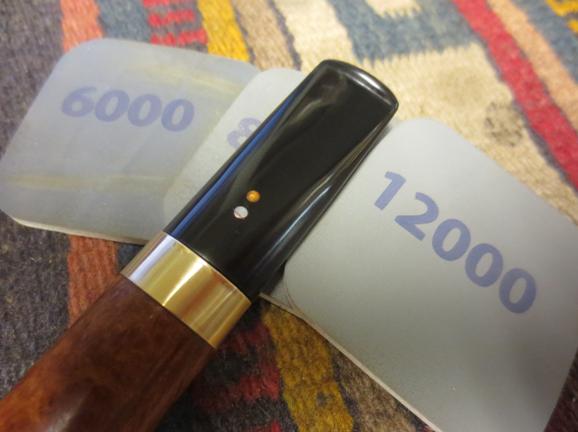
Dr9 I used a needle file to redefine the sharp edge of the button and make a clean line on both sides of the stem.Dr10 I sanded it with a medium and a fine grit sanding sponge to remove the scratches from the vulcanite and then wiped the stem down with Obsidian Oil.Dr11 I sanded the stem with micromesh sanding pads – wet sanding with 1500-2400 grit pads and then wiping down the stem with Obsidian Oil. I dry sanded with 3200-4000 grit pads, gave it another coat of oil and then continued with 6000-12000 grit pads. Each successive grit of pad made the patch disappear and blend into the surface of the stem. I gave the stem a final rub down with Obsidian Oil and let it dry.Dr12

Dr13

Dr14 I buffed the pipe with Blue Diamond polish on the wheel and then gave it multiple coats of carnauba wax. I buffed it with a clean flannel buff on the wheel and then hand buffed it with a microfibre cloth for a final deep shine. The following photos show the finish pipe. It should work well for many years to come. This one is for sale should anyone wish to add it to their rack. Email me and let me know.Dr15

Dr16

Dr17

Dr18

Dr19

Breathing New Life into a La Fond’s Vintage, Algerian Briar Reject Billiard


Blog by Steve Laug

This old pipe came to me in a lot that was a gift from a friend and it was in very rough shape. The bowl covered in varnish and the rim had been used to hammer nails. There was not one smooth surface on the rim of the pipe. The outer edge of the bowl was very rough particular on the backside with chunks of briar missing. There were several fills on the bowl – on both sides that were missing and there were large deep scratches on the bottom of the bowl.LaFond1

LaFond2

LaFond3

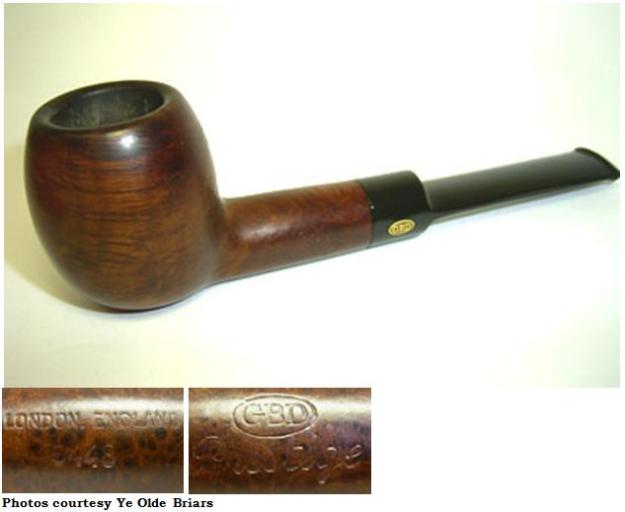
LaFond4 I have included a close-up photo of the rim to show the extent of the damage.LaFond5 I also took some close-up photos of the stamping to give an idea of what that looks like. The shank is stamped on the right side with the words MADE IN FRANCE. On the left side it is stamped with a double line of XXXX’s. I interpret that as the stamping that a pipe company uses to declare a pipe a REJECT. Some of the English companies actually stamp the pipe reject while others X out the stamping. In this case I was able to read through the X’s and see that underneath it was stamped La Fond’s Vintage on the first line and below that it read Algerian Briar. There is not a shape number on the shank.LaFond6

LaFond7 I looked in Who Made That Pipe to see if I could find any information on the brand. The book listed that the brand was unknown but was English made. I looked on pipephil’s site, Pipes: Logos and Markings and found the listing below http://www.pipephil.eu/logos/en/logo-l1.html. The left side of the shank on the pipe I am working on is stamped identically to the one in the photo. The right side of mine says Made in France instead of Made in England. There is also no shape number on the one I have.LaFond8 I think that an educated guess can be made regarding the company behind this brand of pipe. Looking at the shape of the pipe and the shape number on the pipe in the photo it looks to me that the brand may well have been a sub brand of GBD. Certainly the 9436 shape number matches the same shape number that GBD stamped on that shape pipe.

As I have been doing lately, I reamed the bowl with a PipNet pipe reamer to take the cake back to bare briar. I wanted to see if there was any significant damage to the inside walls of the bowl considering the damage everywhere else. After reaming I would need to sand the inside of the bowl as the cake was both crumbly in some places and hard and pitted in others.LaFOnd9

LaFond10

LaFond11 The rim damage made it necessary to top the bowl to remove as much of it as possible. I used the topping board and 220 grit sandpaper to do the work.LaFond12 I removed as much of the top of the rim as possible without changing the overall appearance of the pipe. I was able to remove the majority of the damage. There were still some missing chunks of briar on the back side of the bowl near the top edge that I would need to address in a different manner.LaFond13 I wiped the bowl down with acetone on cotton pads to remove the varnish coat that covered the bowl and shank. Fortunately it came off quite easily. At least they did not coat the bowl with urethane or some other modern plastic coat. I worked on the damaged areas and the missing fills to make sure that I was able to get the grit and grime out of the holes.LaFond14

LaFond15

LaFond16

LaFond17 I picked out any pieces of debris in the divots and wiped it down one final time. I filled the holes with briar dust and then dripped clear super glue on top of the briar dust. I added more briar dust and more glue until I had the surfaces built up and repaired.LaFond18

LaFond19

LaFond20 I sanded the repairs with 220 grit sandpaper to blend the patches into the surrounding briar. It took a bit of sanding to smooth things out and leave the patches only in the holes that needed to be repaired and not on the surface of the bowl. Once the surface was smooth I sanded the areas with a medium and fine grit sanding sponge to remove the scratches.LaFond21

LaFond22

LaFond23 I sanded the inside of the bowl and then scrubbed out the bowl, shank and stem with pipe cleaners, cotton swabs and isopropyl alcohol. I scrubbed until the shank was clean.LaFond24 I used the stain pens to blend in the sanded areas with the colour of the rest of the bowl. I used it on the rim and the repairs around the bowl. I blended light brown and dark brown stain pens to get the colour to match. I sanded the bowl and rim with a fine grit sanding block to feather in the stained areas.LaFond25

LaFond26

LaFond27

LaFond28

LaFond29 After sanding I rubbed the bowl down with a light coat of olive oil and buffed it into the briar.LaFond30

LaFond31

LaFond32

LaFond33 I would need to wax and polish the bowl once I had finished with the stem but it was done for the time being. I turned to the stem and sanded it with 220 grit sandpaper to remove the ripples in the vulcanite on the top and bottom of the stem from the button toward the bowl for about 1 ½ inches. It was obvious and ugly in my opinion. I finished smoothing out the stem surface and then sanded it with a medium and a fine grit sanding sponge to smooth out the scratches.LaFond34

LaFond35

LaFond36

LaFond37 There was some oxidation on the stem that needed some more work so I repeated the process until the oxidation was removed. I wet sanded the stem with 1500-2400 grit micromesh sanding pads. I rubbed the stem down with Obsidian Oil and then dry sanded it with 3200-4000 grit pads and gave it another coat of oil I finished sanding with the micromesh pads dry sanding with 6000-12000 grit. I gave the stem a final coat of Obsidian Oil and let it dry.LaFond38

LaFond39

LaFond40 I buffed the pipe with Blue Diamond on the buffing wheel and then gave it multiple coats of carnauba wax. I buffed it with a clean flannel buffing pad and then took it back to the work table and hand buffed it with a microfibre cloth. Dave Gossett wrote about doing that several blogs ago and I have been doing it ever since. It seems to add depth to the shine that a buffer alone does not give. The finished pipe is shown in the photos below. I took the photos outside in the waning light of the day. I really like the look of the pipe in the grass. The green sets off the colours of the briar and the black of the stem. This old timer is ready for a long life ahead of service to whoever takes it home to their rotation. Thanks for looking.LaFond41

LaFond42

LaFond43

LaFond44

Rejuvenating and Repairing a Whitehall Dublin


Blog by Steve Laug

This old Whitehall pipe came to me from the antique shop in Victor, Idaho, a small town on the way to Jackson Hole, Wyoming. On a recent trip to Idaho my brother and his family and my daughters and I visited Jackson Hole. On the way home, we stopped in Victor to stretch our legs and wander a bit. I went into the antique shop and struck up a conversation with the owner. Eventually a tin of five pipes and some parts came out from under the counter. I bought all of them. They traveled back to Vancouver with me and will one day all be refurbished.

This Dublin shaped pipe is stamped Whitehall on the left side of the shank – though the stamping is faint. On the right side it is stamped Imported Briar (also faint). It has a flat bottom and sits well on that. The finish was very worn but was a rich oxblood colour under the grime. The bowl sides have some great cross grain. There were some small fills near the top of the bowl on the left side. The rim was damaged on the outer edge and very caked from the bowl over the rim top. The inner edge of the rim was still round and did not show signs of damage under the thick cake. The stem appeared to be a poor fit but as I looked at it I realized that it was upside down. The flattened bottom of the bowl had not been continued on the stem so it sat wrong.Dublin1

Dublin2

Dublin3

Dublin4 I took some close-up photos of the rim and sides of the bowl. The rim photo shows the tarry buildup and the side photos show the stamping.Dublin5

Dublin6

Dublin7 I generally ream the bowl when I start a clean up to remove the cake so I can examine the pipe thoroughly to check for inside wall damage and potential issues. I reamed it with a PipNet reamer and took the cake back to bare briar.Dublin8 While I was at it I scrubbed the rim with alcohol and cotton pads to remove some of the tars. I had to use a sharp blade to gently scrape away the thick coat of tars while I was scrubbing. The photo below shows the initial cleanup of the rim and newly reamed bowl.Dublin9 I sanded the rim with 220 grit sandpaper to further remove the tars and to minimize the outer edge damage. There was a burn mark on the front left of the rim that I was able to reduce but not remove altogether.Dublin10 I scrubbed out the shank and the bowl with alcohol, cotton swabs and pipe cleaners.Dublin11 I wiped down the exterior with alcohol and cotton pads to remove the finish and to clean it up. In doing so I found that there was a small shallow crack/flaw toward the bottom of the bowl on the left side. In the photo below the dental pick is at the close end of the crack and the dark spot is the far end.Dublin12 I picked out the crack with the dental pick, drilled two small holes – one on each end of the crack to stop it from going further. Interestingly this crack followed the pattern of the grain on the side of the bowl. Once I had it cleaned out I wiped it down with alcohol a final time. I pressed briar dust into the crack, dripped super glue into it and then pressed more briar dust on top of the glue. The photo below shows the repaired crack. Fortunately the crack was not deep and did not affect the interior of the bowl. It did not go all the way through and appeared to be more of a flaw in the briar than damage.Dublin13 I sanded the repair with 220 grit sandpaper to remove the excess patch and blend it into the surface of the briar. I sanded it with a medium and a fine grit sanding sponge to remove the scratches in the briar and feather out the surface. I sanded the entire bowl and rim with the same sanding sponges and sandpapers.Dublin14 I aligned the stem and sanded it with 220 grit sandpaper to smooth out the rough surface and then flatten the bottom to match the bottom of the shank.Dublin15

Dublin16

Dublin17

Dublin18 I wiped down the bowl with alcohol and then stained it with an oxblood alcohol based stain. I put the stain on heavy around the sanded areas on the shank and the bowl repair. I also darkened those areas with a dark brown stain pen following the pattern of the grain. I lightly buffed the pipe by hand and took the pictures below to show how the newly stained pipe looked at this point.Dublin19

Dublin20

Dublin21

Dublin22 I darkened the rim with the stain pen and gave it another top coat of the oxblood stain. I flamed it and buffed it lightly.Dublin23 With the bowl finished I worked on the stem. I wet sanded it 1500-2400 grit micromesh sanding pads. I rubbed it down with Obsidian Oil. I continued by dry sanding it with 3200-4000 grit pads, rubbed it down again with oil and then finished by dry sanding with 6000-12000 grit pads. I gave it a final coat of Obsidian Oil and let it dry.Dublin24

Dublin25

Dublin26 I buffed the bowl and stem with Blue Diamond on the buffing wheel, gave it multiple coats of carnauba wax and then buffed it with a clean flannel buff. I brought it back to the work table and then hand buffed it with a microfibre cloth. The finished pipe is shown below. It looks better than it did when I started, in my opinion. The rich oxblood colour helps to hide the repair and the burn mark on the rim. It should be a great smoking pipe if the amount of cake buildup that was there when I started is any indication. It should continue to provide great service to whoever ends up with it in their pipe rotation. Thanks for looking.Dublin27

Dublin28

Dublin29

Dublin30

Dublin31

Dublin32

Restoring and restemming an old Meerschaum Pipe


Blog by Steve Laug

When I purchased the German Folk art meerschaum at the antique mall in Idaho Falls I also got a little meerschaum bowl with lots of brass bling around the rim and the end of the shank. It had a broken bone tenon in the shank that was hopelessly corroded and not removable by normal methods. It appeared to have been glued in place with epoxy. The pipe had an oval shank and I figured that if I could get it cleaned up it would be a neat looking keepsake. It would definitely be a pocket pipe but I had a vision for it. The first photo is a bit blurry but it gives you an idea about the look of the old pipe. There was a lot of dust and debris in the filigree work and the decorative band at the end of the shank was loose because of a broken nail on the left side.Meer1

Meer2

Meer3 The next two photos show the damage to the rim and the broken tenon in the shank. The rim damage was significant enough to look bad but I would not be able to remove the cap without breaking the meerschaum bowl so I would need to remedy that in a different way. In the second photo you can see the broken tenon and how it appears to be glued into the shank.Meer4

Meer5 I tried my normal method for pulling stuck tenons but this one would not even budge. It was stuck in the shank.Meer6 So I had to drill it out of the shank. This is trickier than it looks. I never power the drill on. I set it up and use it as a stationary base. I hand twist the shank onto the bit. I start with a bit about the size of the airway and work my way up until I have the entire old bone tenon out of the shank.Meer7

Meer8 I had a damaged round stubby stem from a GBD 9438 that I picked up somewhere. The button was gone and the stem had been cut off. Since the oval shank was vertical I needed a stem with a similar dimension from top to bottom. The GBD stem was perfect. I took off the excess vulcanite with the Dremel and sanding drum and roughly shaped it to fit. There would be more – a lot more – sanding that would have to happen but the shape was there. I would also need to build a new button and thin down the thickness of the stem but overall you can see the shape.Meer9

Meer10

Meer11

Meer12 More shaping with the Dremel. I wanted the stem to have a thin oval shape at the shank and then flare out toward the end. I would cut the new button so I wanted a smooth taper back toward it.Meer13 With the Dremel work done it was time to hand shape the stem with sandpaper. I sanded it with coarse emery cloth and then refined it with 180 grit sandpaper. The lion’s share of the work was done with 220 grit sandpaper.Meer14

Meer15

Meer16 The oval of the stem finally matches the oval of the shank. The tenon fits snugly. More sanding will need to be done so that the new stem sits in the band tightly against the shank end.Meer17

Meer18 On a whim I blew air into the airway on the shank and it was plugged. When I drilled out the mortise the debris obviously clogged the airway from the shank to the bowl. I used the drill bit that comes with the KleenReem reamer I have to open the airway and push the debris into the bowl. It did not take much and the airway was clear and open.Meer19 I used needle files and flat files to recut a new button on the stem and to smooth out the taper from the saddle backward. The next photos show the newly cut button. The stem is quite thin at this point so a deep button cannot be cut deep enough.Meer20

Meer21 The bend in the stem was insufficient for the pipe to sit correctly in the mouth so it would need to be carefully bent to more of an angle.Meer22 I heated the stem with a heat gun until the vulcanite was soft and then bent it to the correct angle.Meer23 The newly bent stem is shown in the next series of photos. It matches the angle of the bottom of the bowl.Meer24

Meer25 There are some spots on the stem in the photo below that look like a hole – it is not it is a damp spot from cooling the stem to set the bend. I sanded the rim with a medium grit sanding sponge and also with a fine grit sponge to clean up some of the high spots on the rim cap. In the photo below you can see the improvement.Meer26 I cleaned the grooves in all the filigree adornments on the rim and the shank using cotton swabs and alcohol. The photo below shows the cleaned bling and the meer spots between the bling. The pipe is coming along.Meer27 To make the end of the stem thicker and give me more material to work with to shape the button I built it up with a mixture of black super glue and charcoal powder. I mixed it to a paste and used a dental pick to shape and build up the edges of the button.Meer28

Meer29 The next three photos show the stem after I have built up the material for the new button. I set the stem aside to cure for the day while I headed off to work.Meer30

Meer31

Meer32 I used a file and sandpaper to begin shaping the new button. It was going to take a lot of sanding but the new button was beginning to take shape.Meer33

Meer34 I sanded the stem with a medium and a fine grit sanding sponge to shape the button and smooth out the stem.Meer35

Meer36

Meer37

Meer38 At this point in the process I was still debating the final shape of the airway in the button. My original intent was to make an orific button styled after the era of the pipe. However, the more I worked on it the more I was thinking of making the stem more modern era and leave the bowl old era. The combination would be a wedding of old and new!Meer39 For the time being I put that decision on hold and worked on polishing the stem. I wet sanded it with 1500-2400 grit micromesh sanding pads and then rubbed it down with Obsidian Oil. While the oil was still wet I dry sanded the stem with 3200-4000 grit micromesh pads. I again rubbed it down with oil after the 4000 grit pad was used. I dry sanded with 6000-12000 grit pads and then gave it a final coat of Obsidian Oil. I let it dry before buffing.Meer40

Meer41

Meer42 I finally made the decision to flare the slot in the stem. I figured it makes it clear that this is a replacement stem if nothing else does. I like the wedding of old and new in this pipe and it one I plan on keeping so I made it the way I like it. The photo below shows the slot before I did the final sanding with sandpapers and micromesh to clean up the file marks and fine tune the slot. The finished slot can be seen in the final pictures.Meer43 I buffed the stem with Blue Diamond and gave it multiple coats of carnauba wax. I buffed it with a clean flannel buff and then finished with a hand buff with a microfibre cloth to give depth to the shine. The finished pipe is shown in the photos below. I am looking forward to giving this one an inaugural smoke soon. The draw is very open and the airflow uninterrupted. The pipe should last long after I have passed it on to the next pipeman to care for.Meer44

Meer45

Meer46

Meer47

Meer48

Meer49 Thanks for looking.