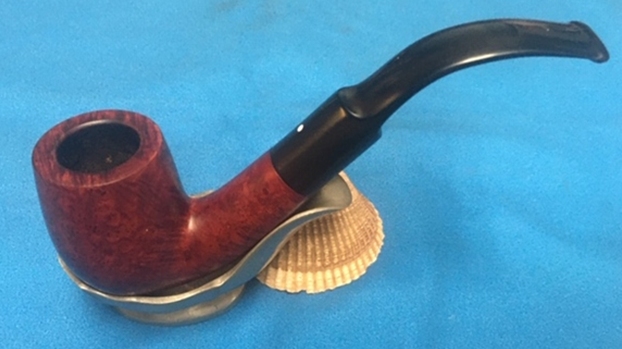
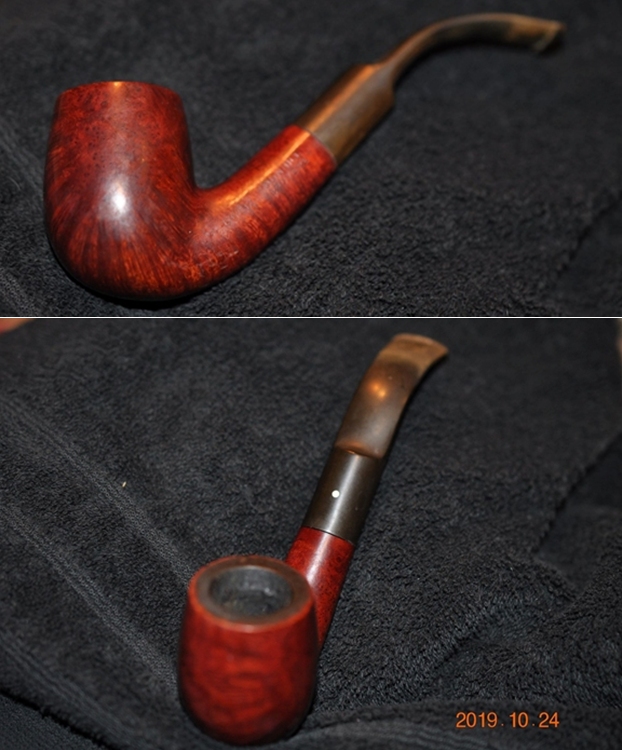
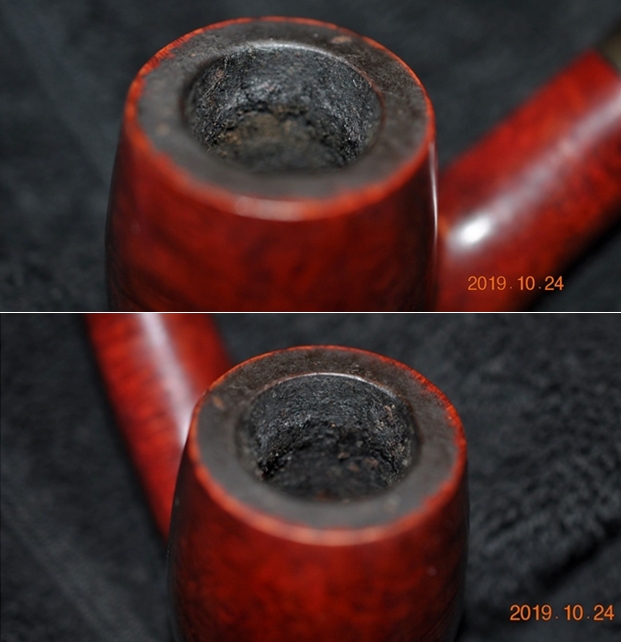
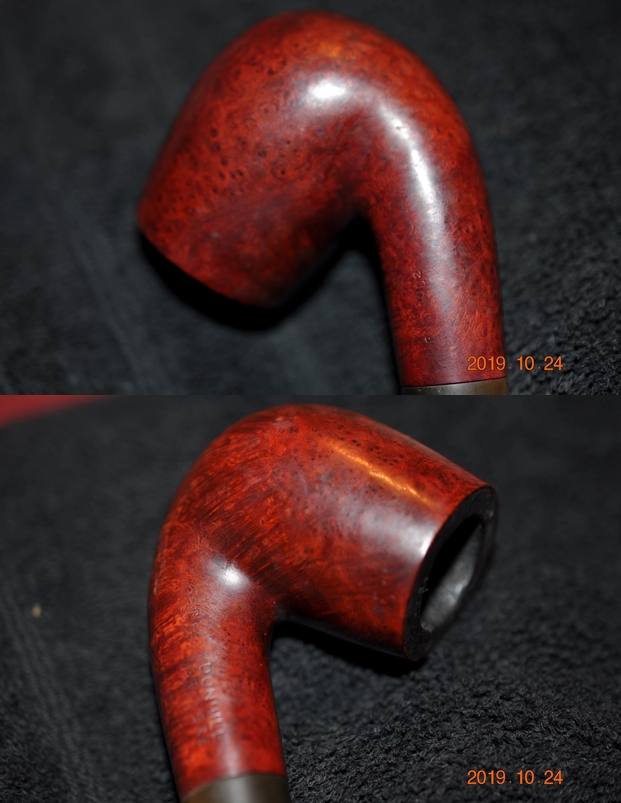
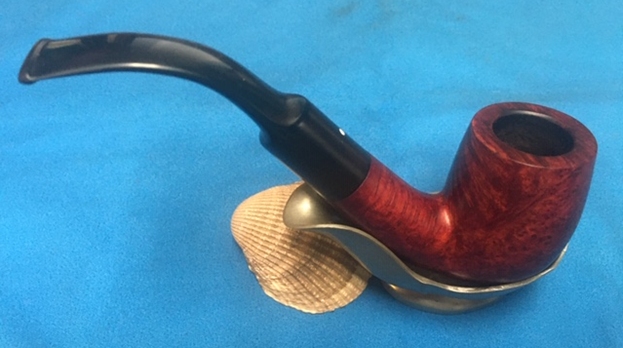
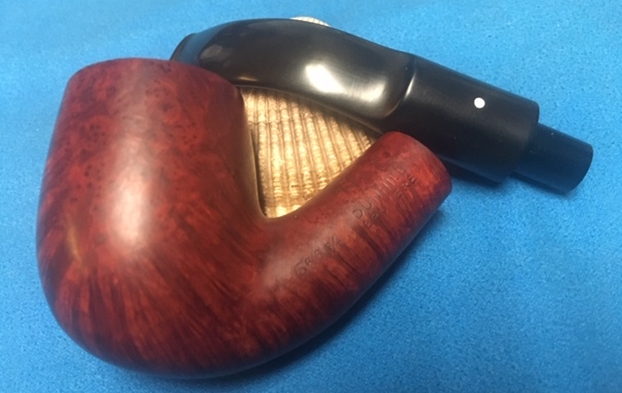
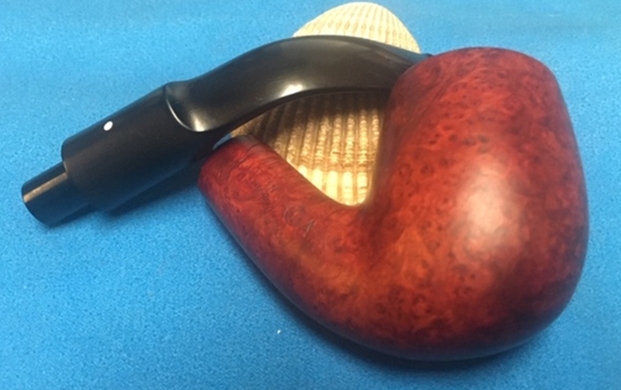
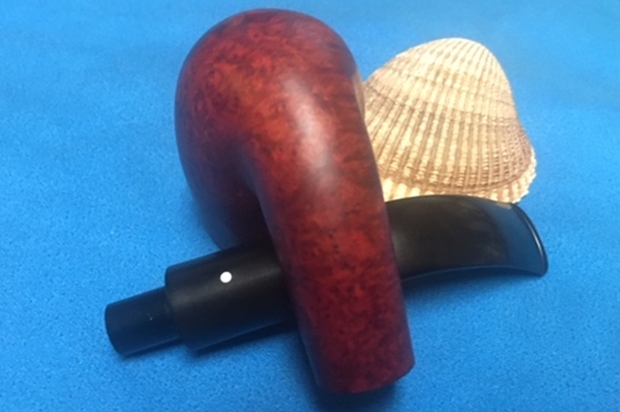
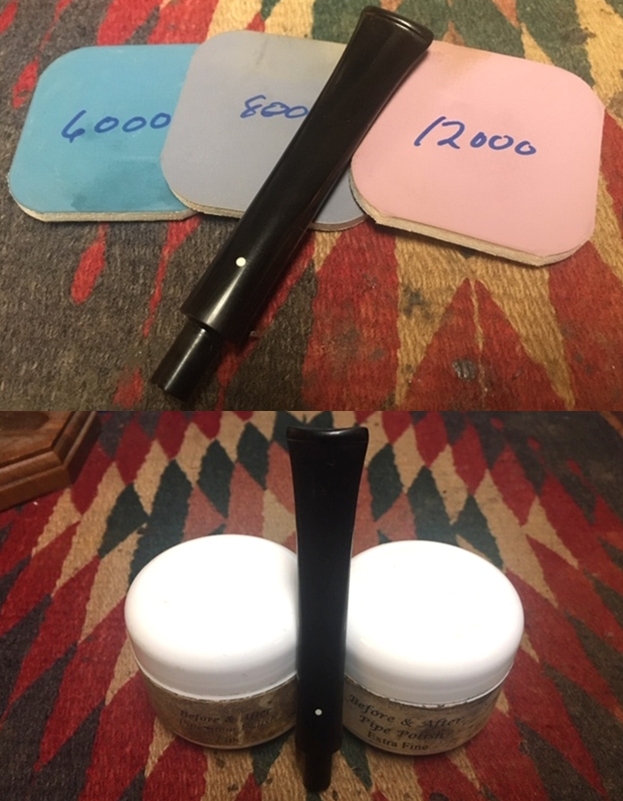
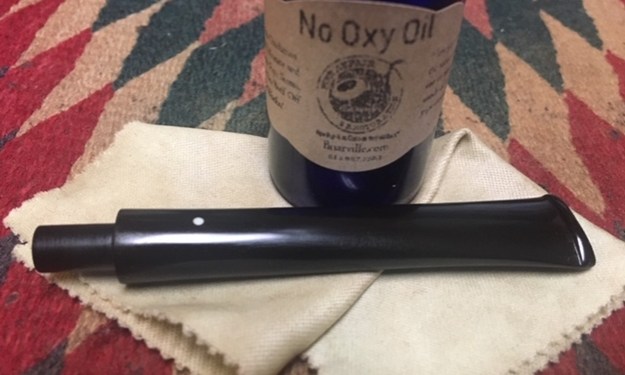
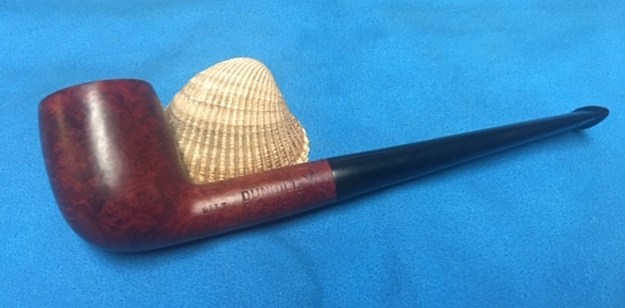
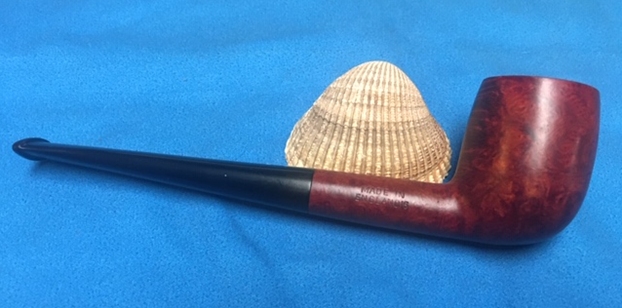
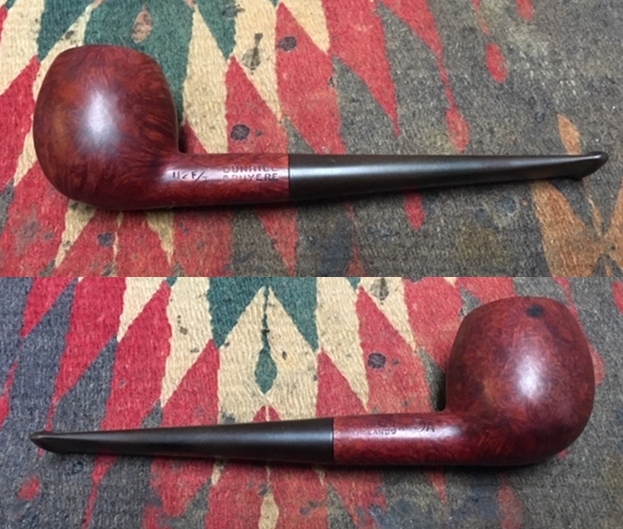
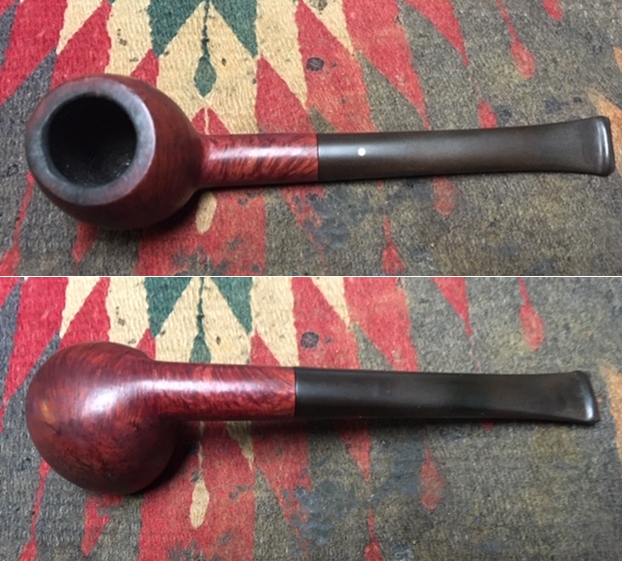
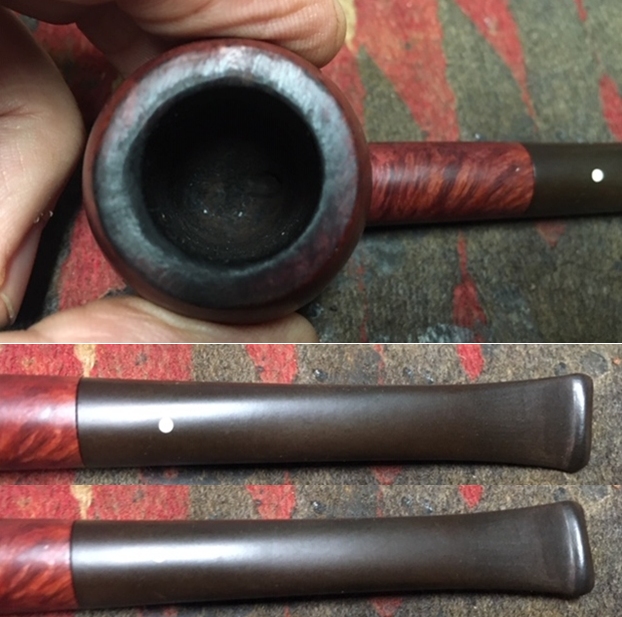
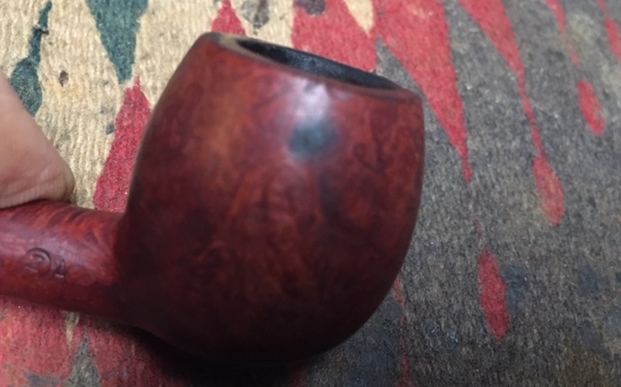
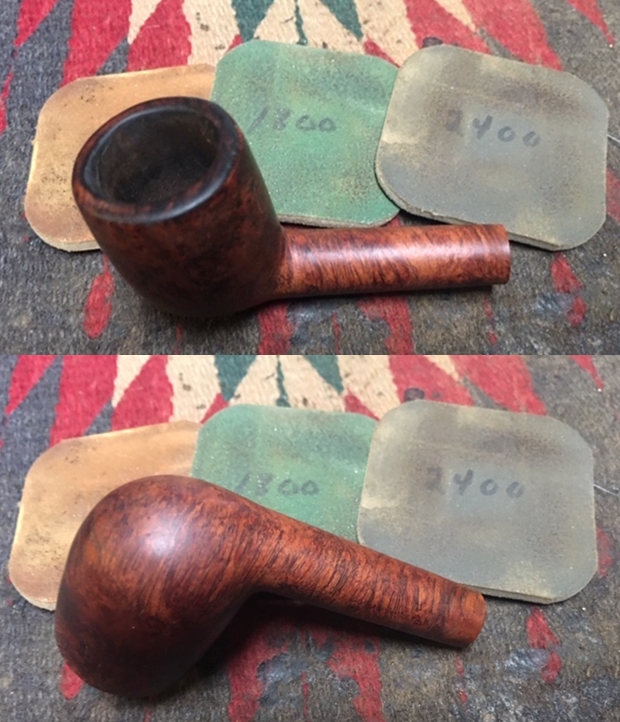
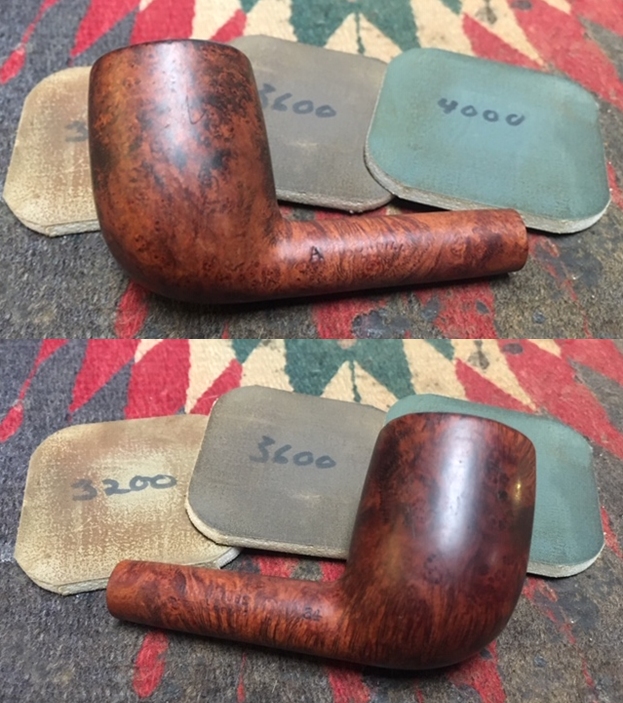
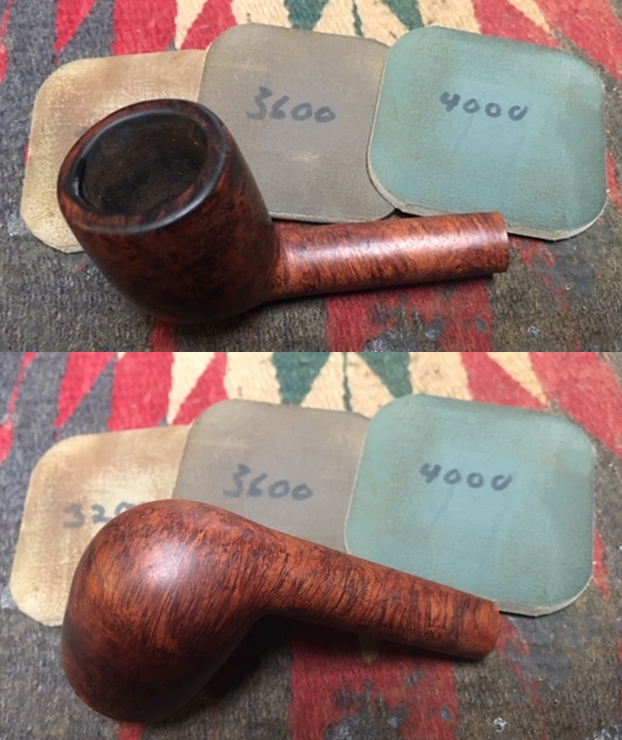
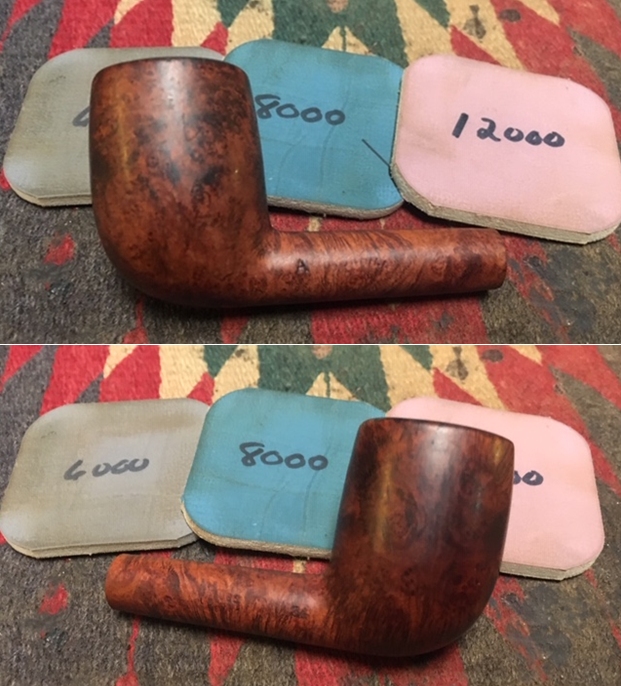
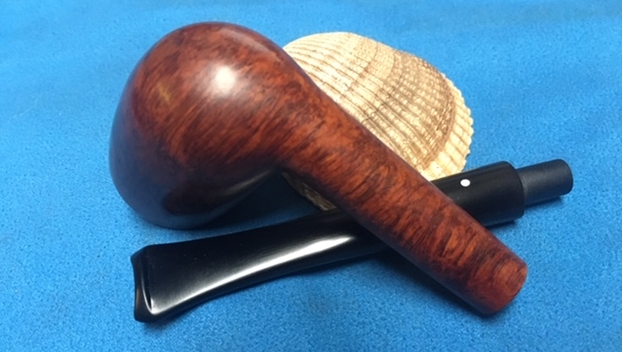
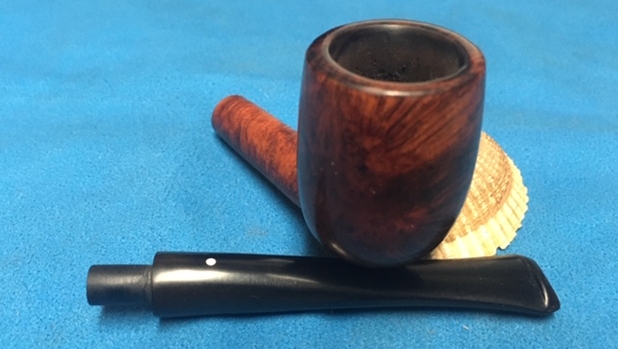
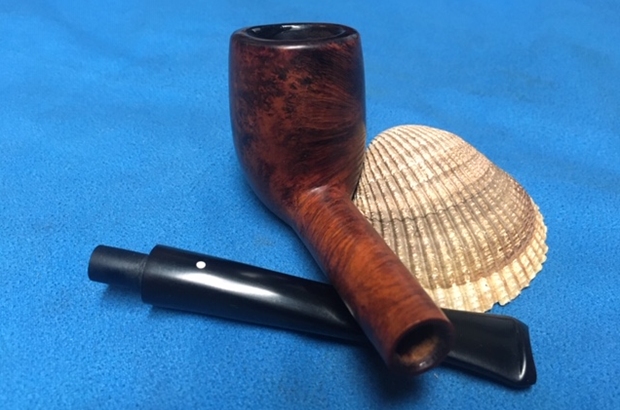
Tag Archives: sanding a stem

Back to Bob Kerr’s Estate – the first of two “Hopeless” Looking Gourd Calabash Pipes


Blog by Steve Laug

After brief foray into restoring a couple of other pipes I am back to Bob Kerr’s estate (his photo is to the left). If you have not “met” the man and would like to read a bit of the history of the pipeman, his daughter has written a great tribute that is worth a read. Because I have included it in over 60 restorations to date I thought that I would leave it out this time. Be sure to check out some of the recent Dunhill restoration blog (https://rebornpipes.com/2020/01/01/restoring-the-last-of-bob-kerrs-dunhills-a-1962-dunhill-bruyere-656-f-t-bent-billiard/)

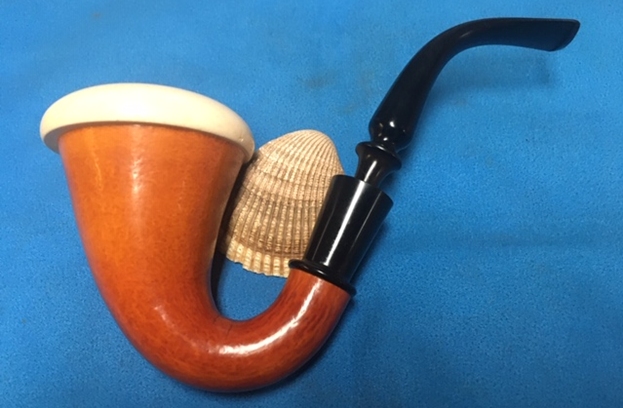
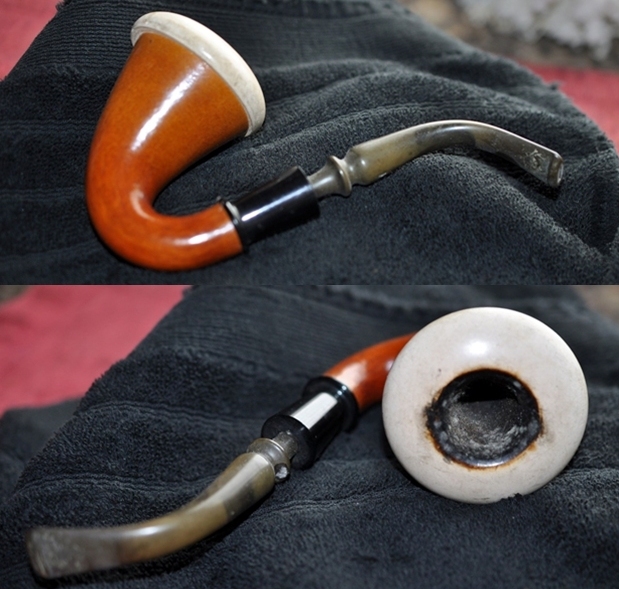
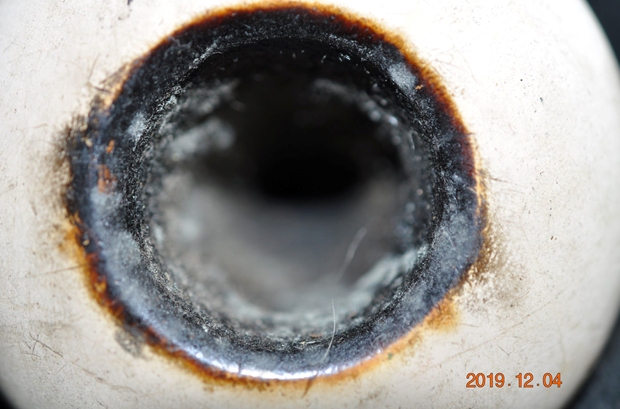
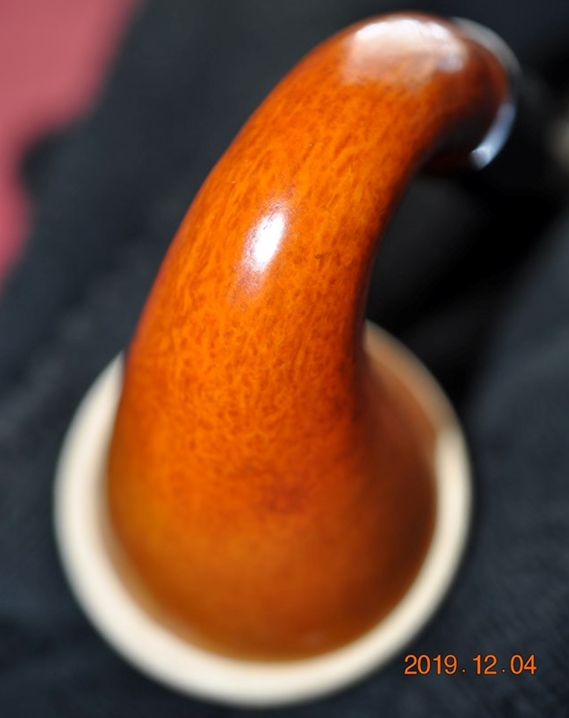
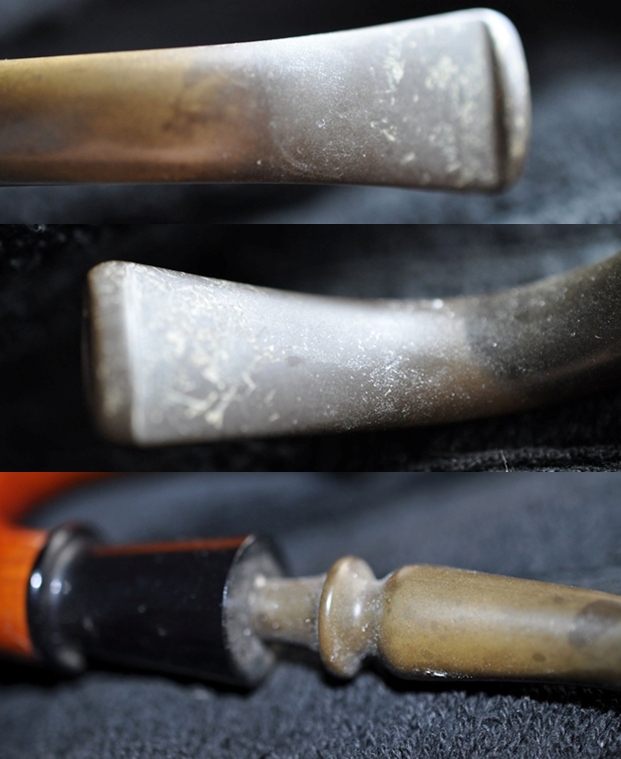
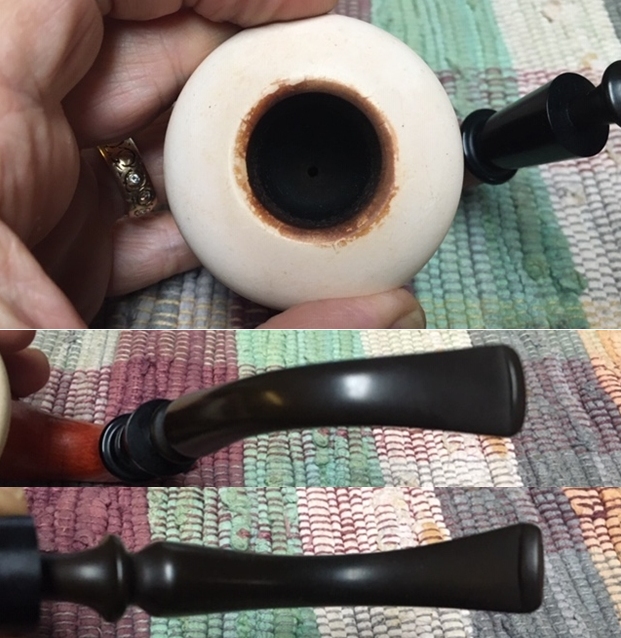
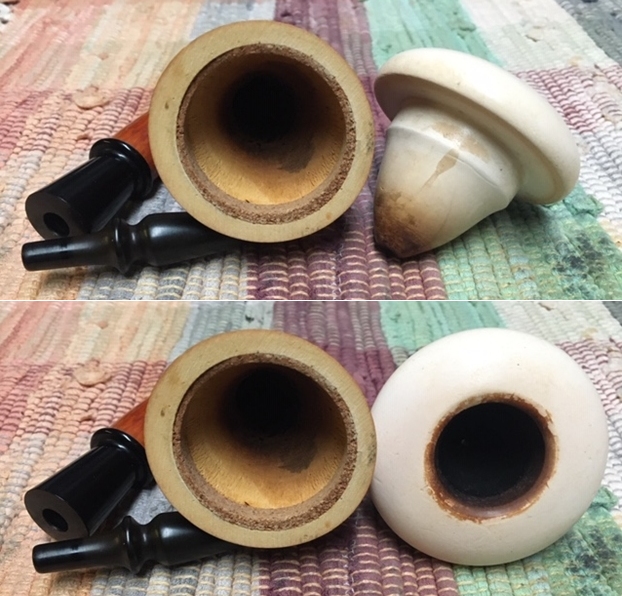
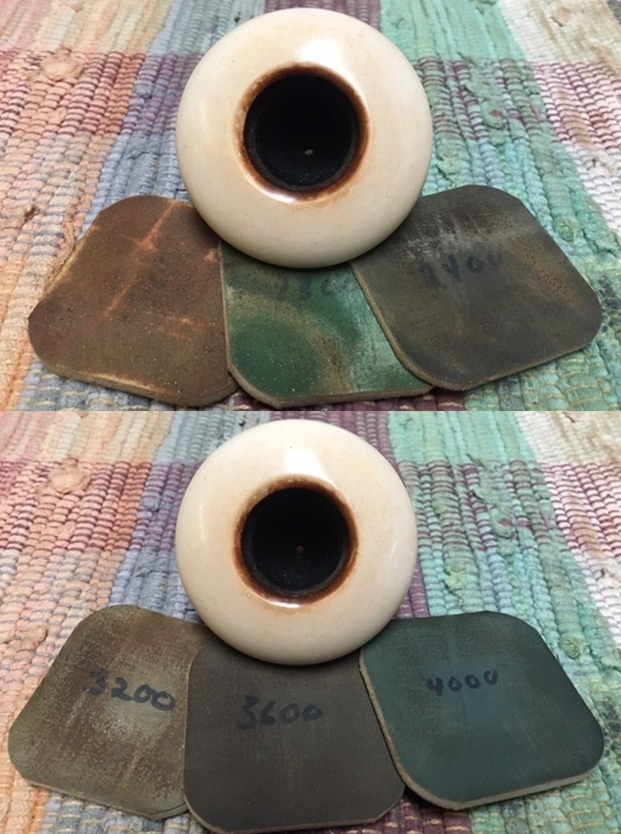
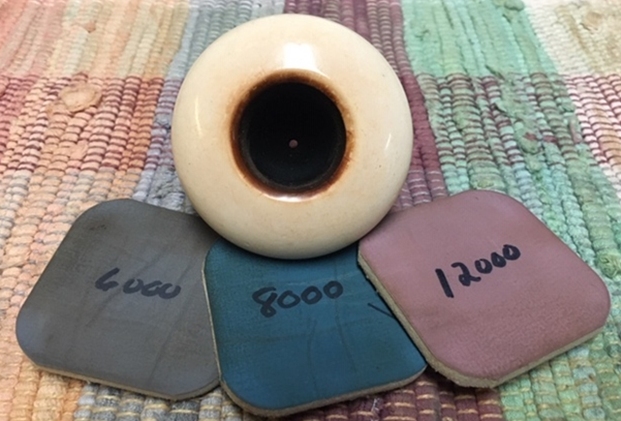
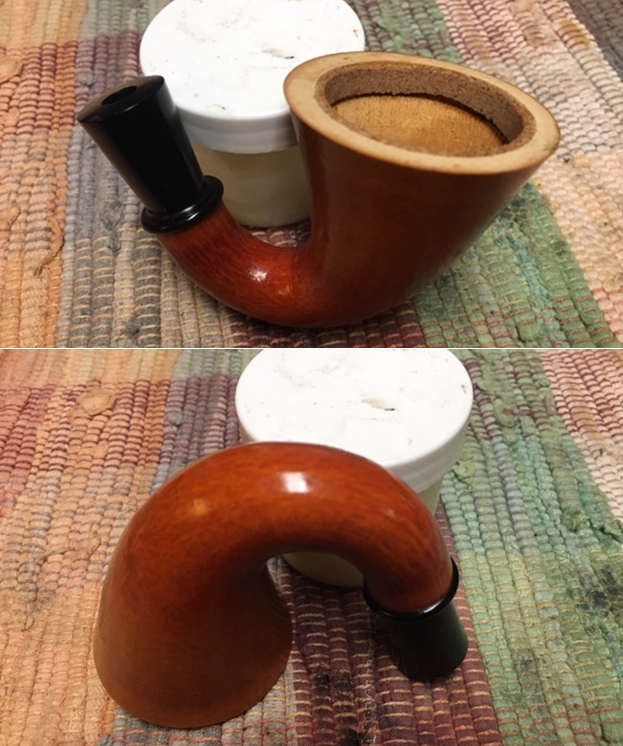
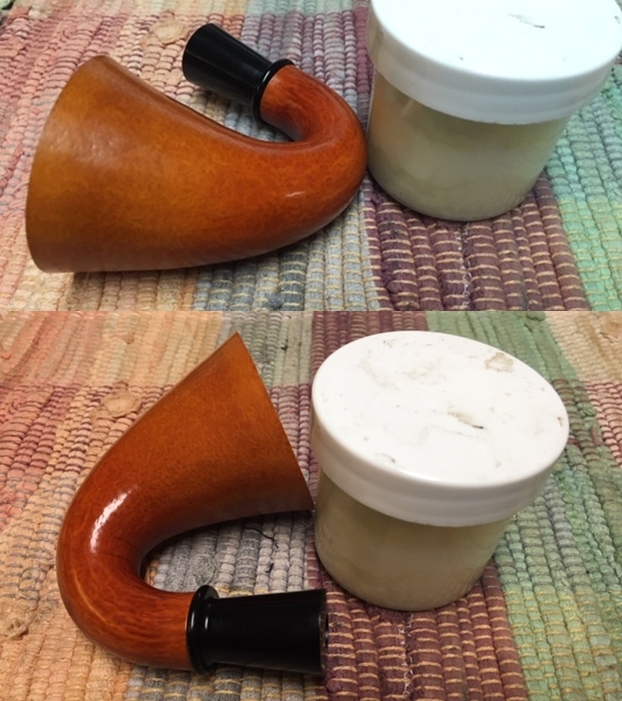
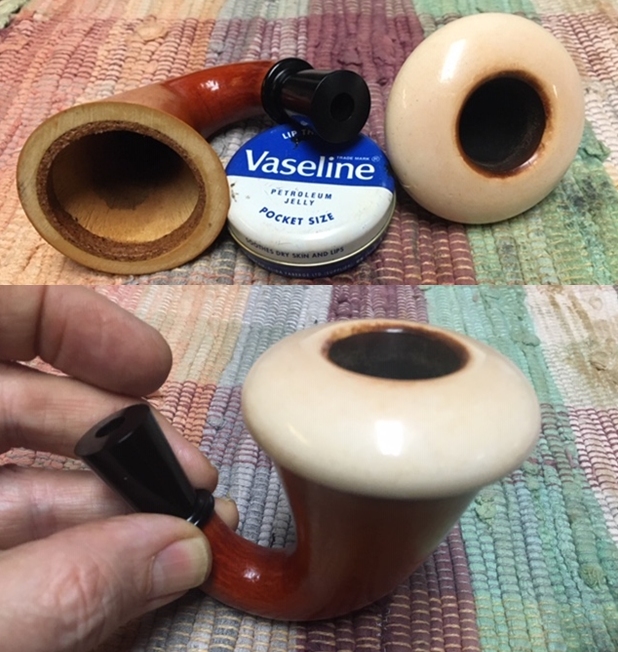
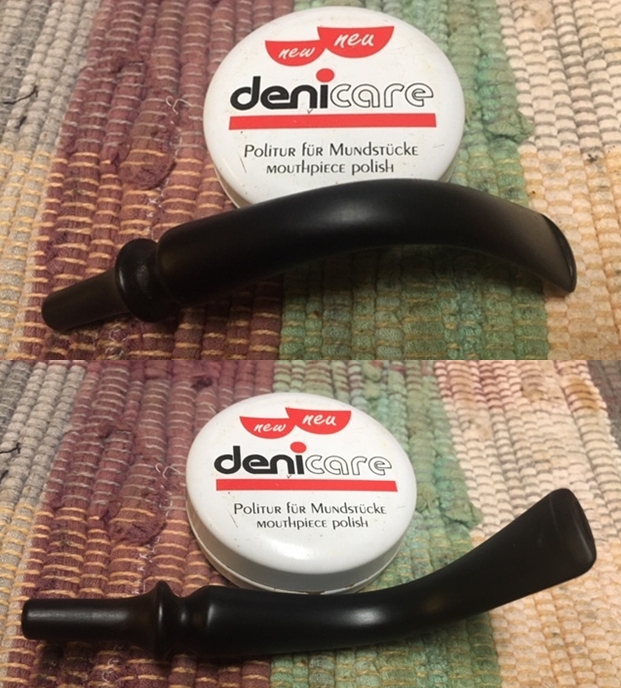
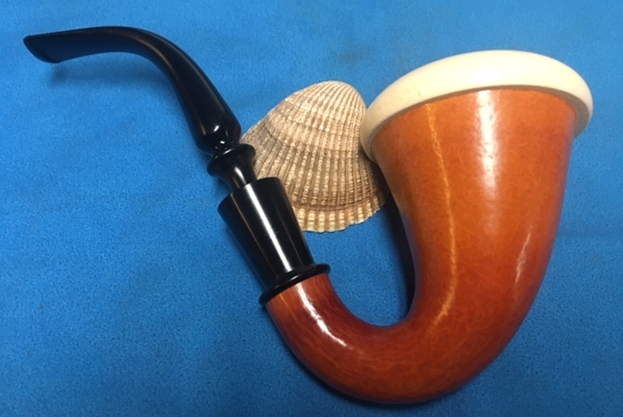
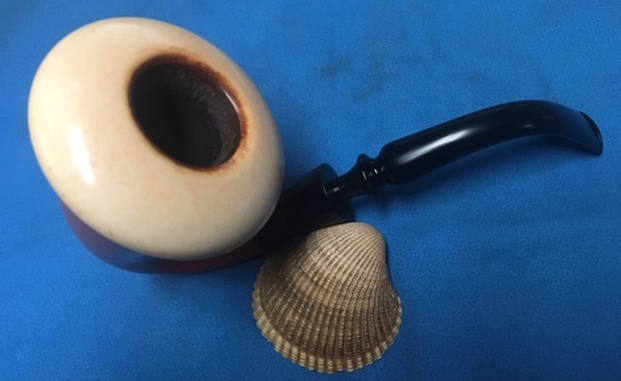
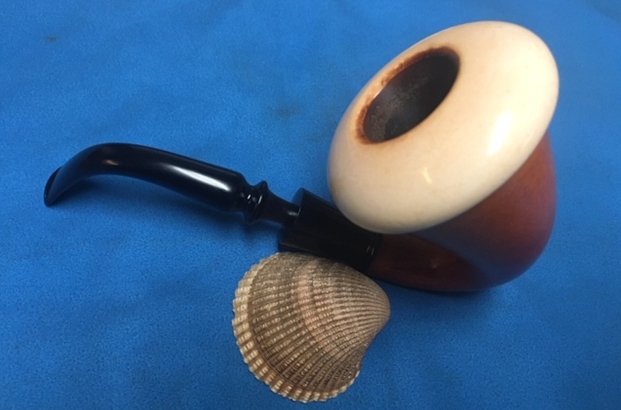
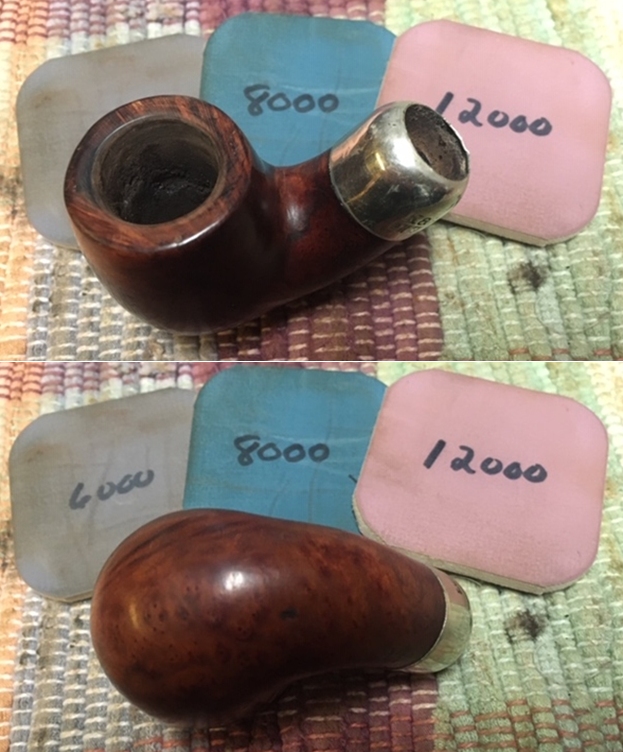
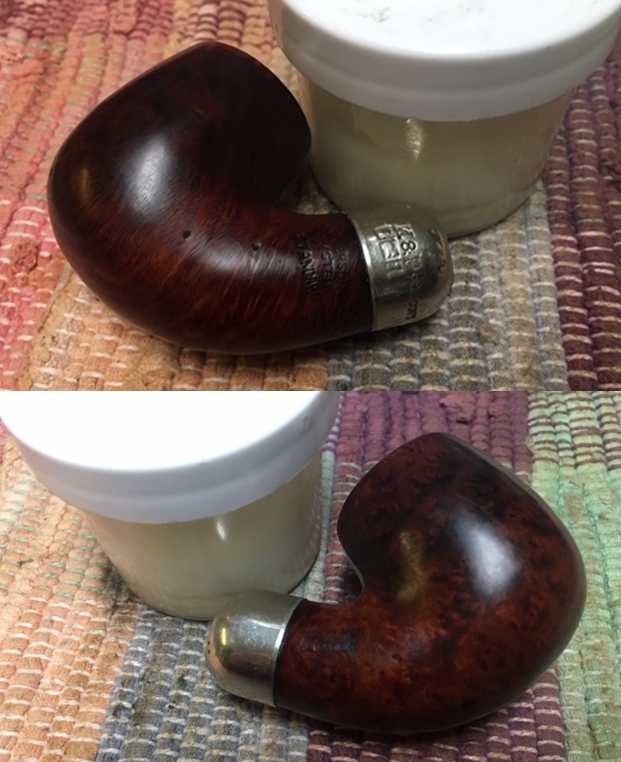
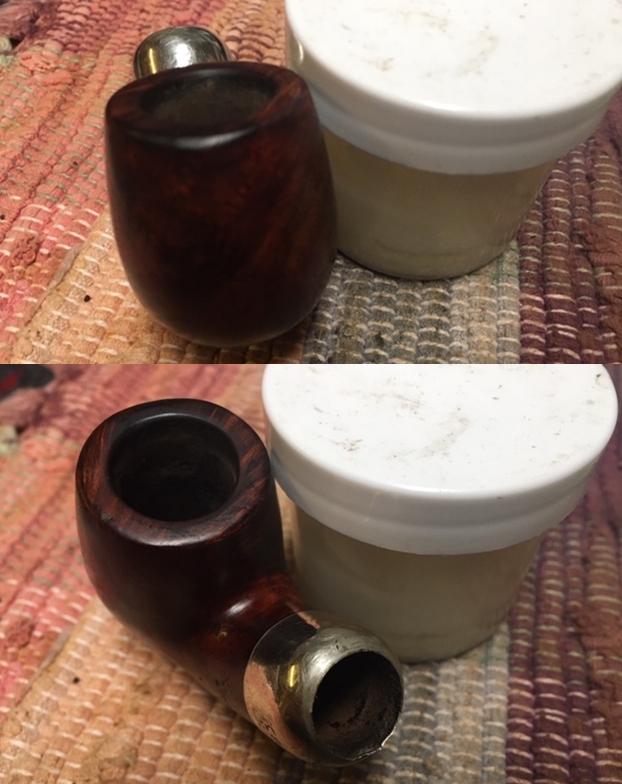
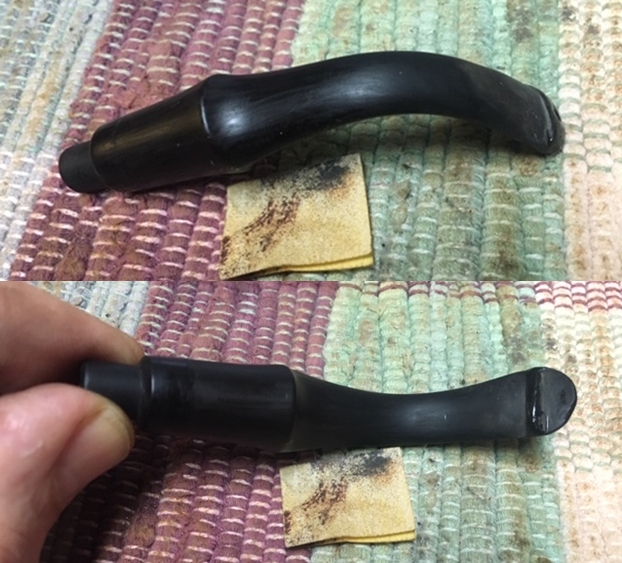
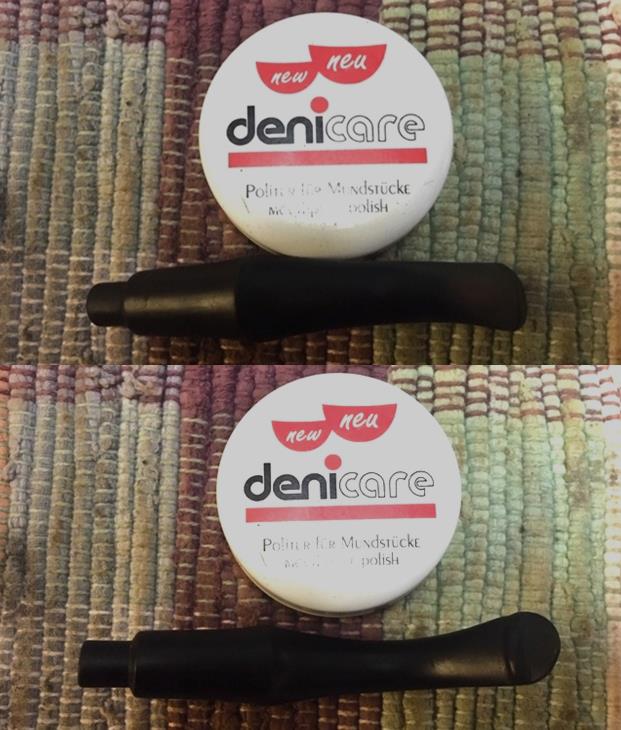
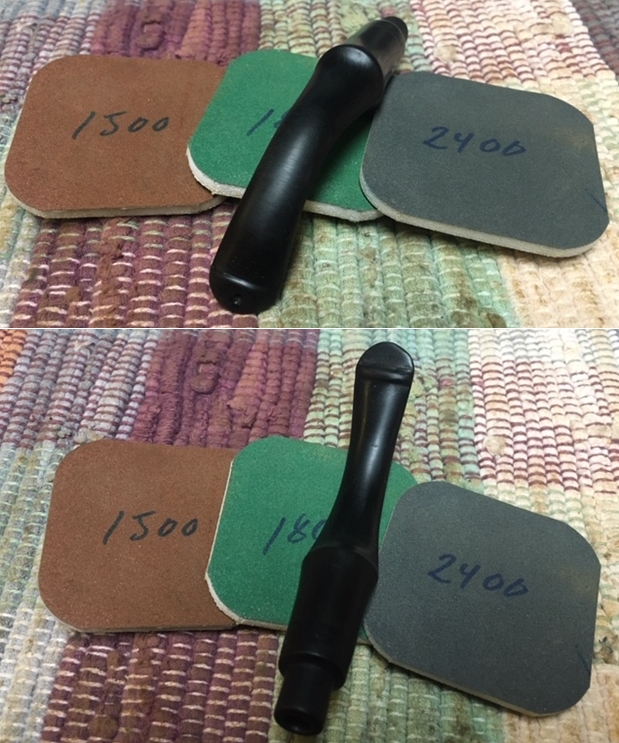
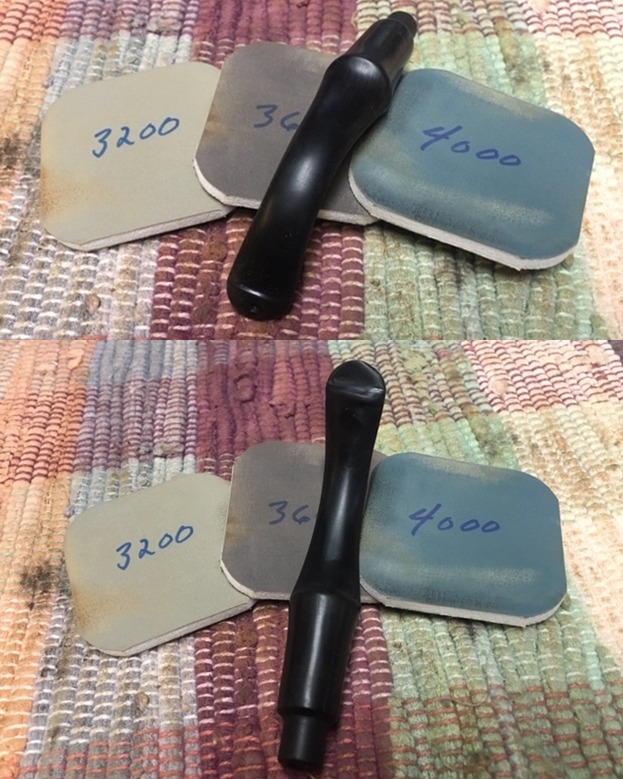
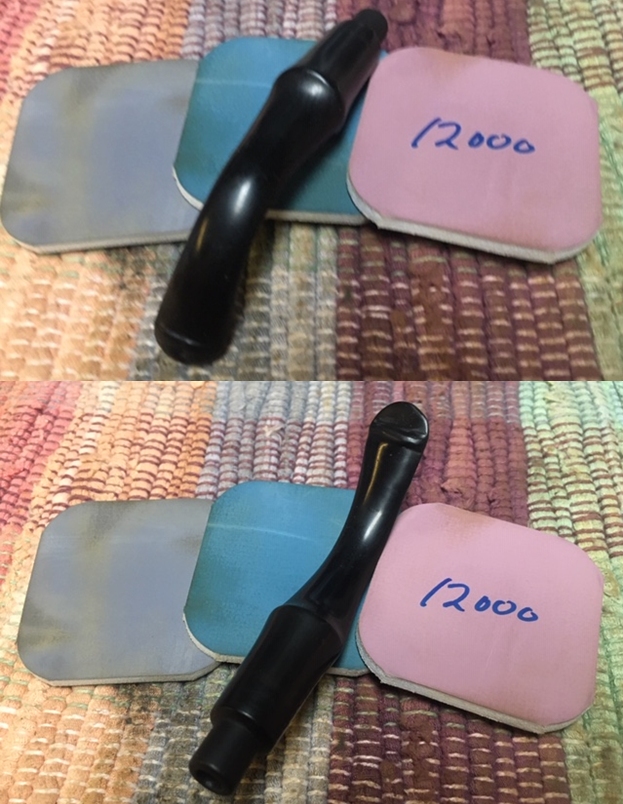
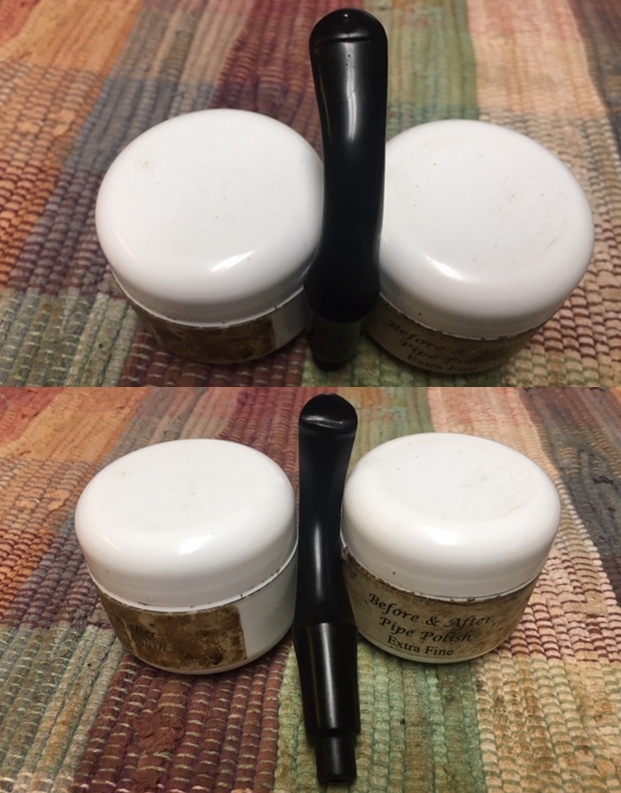
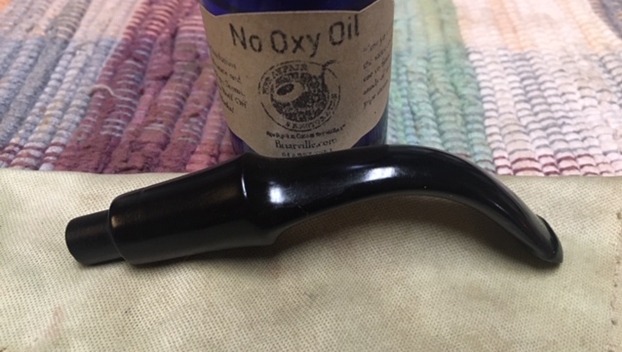
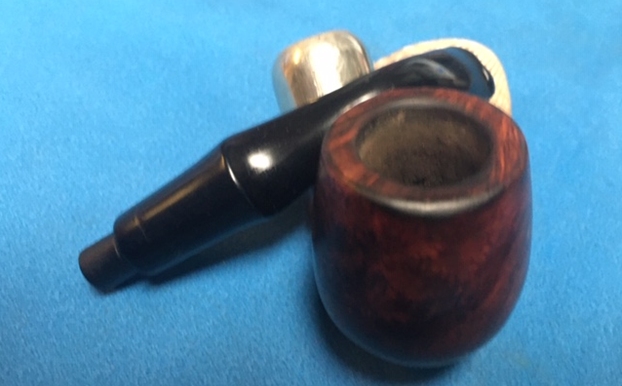
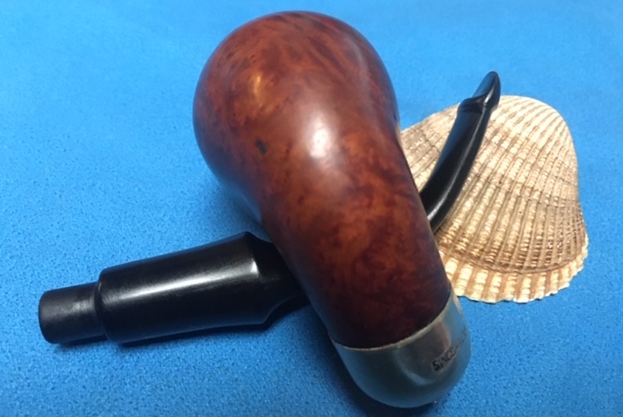
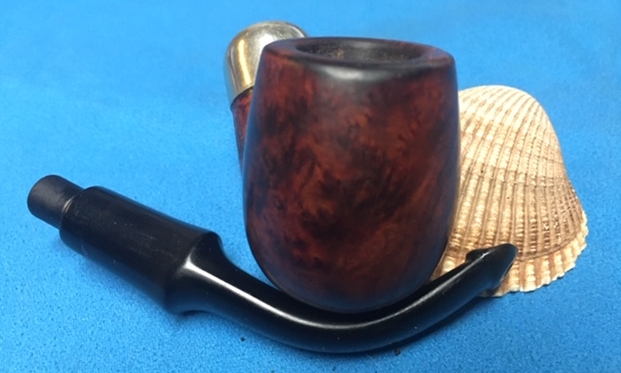
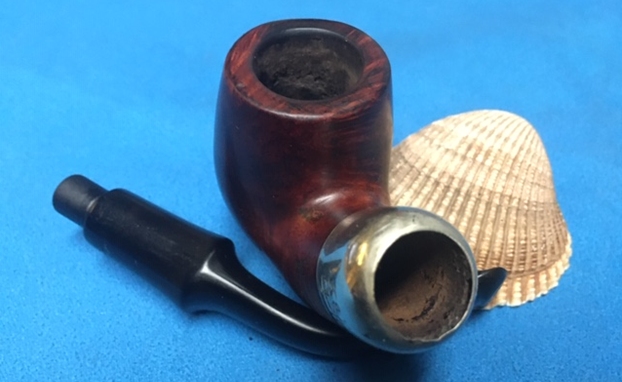
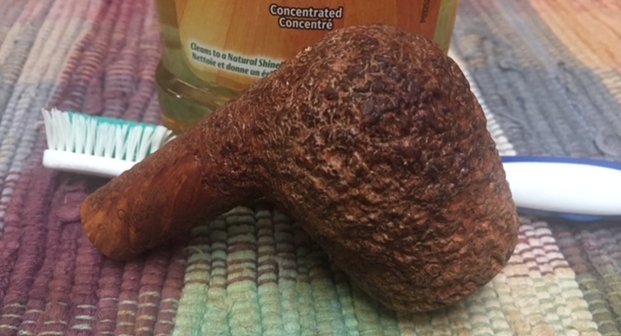
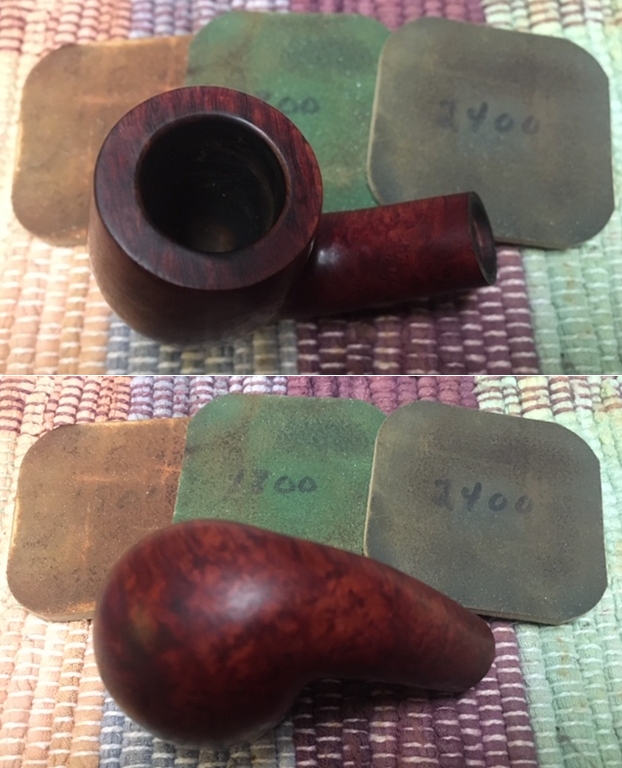
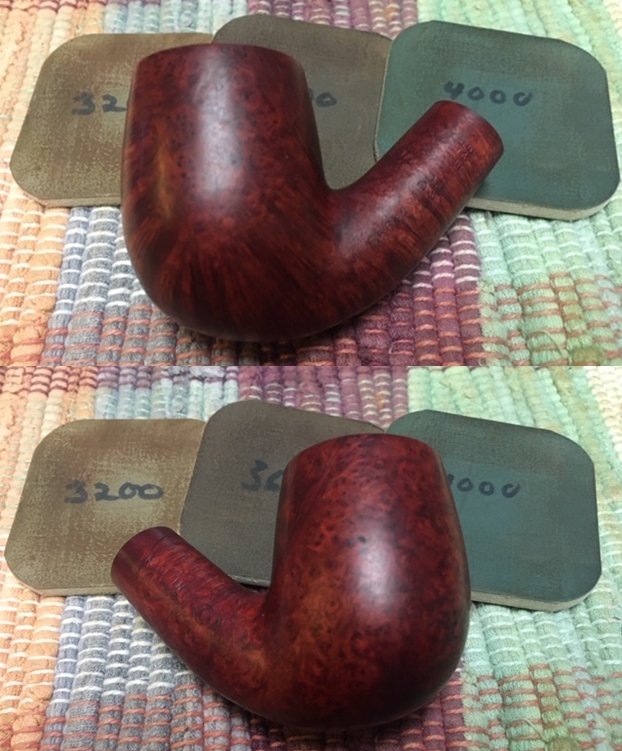
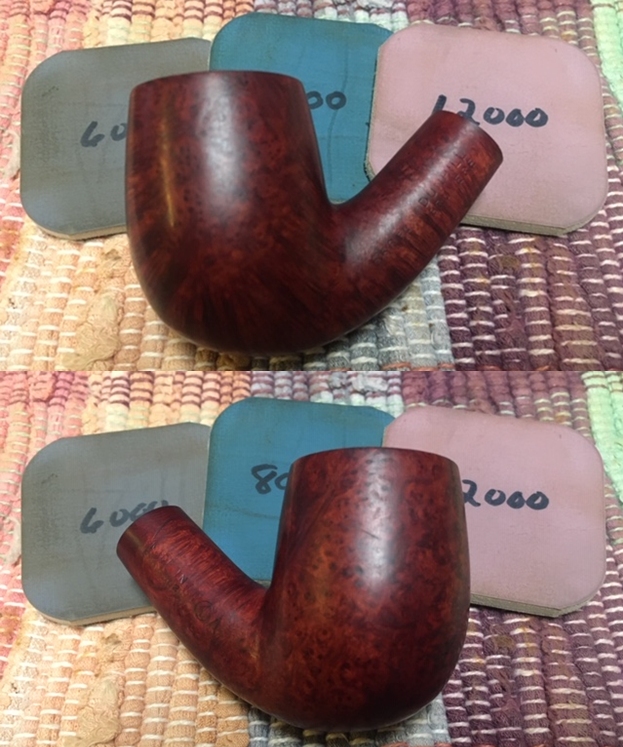
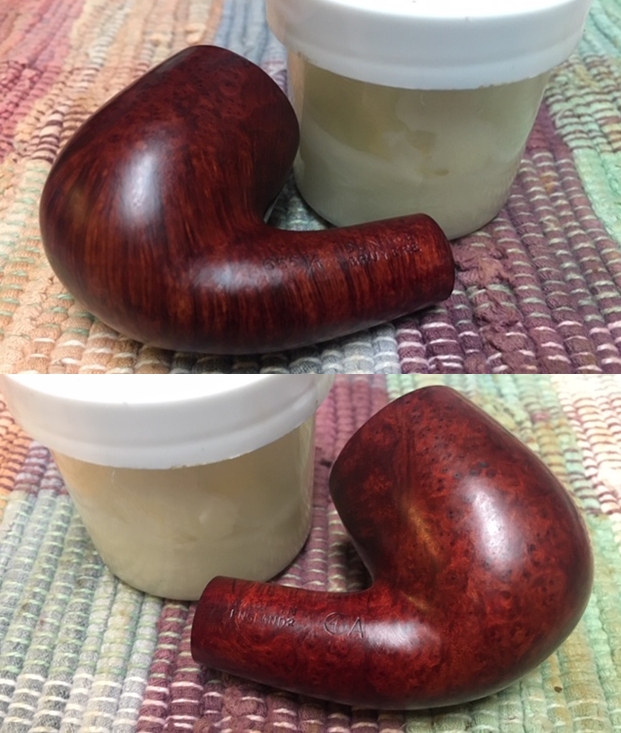
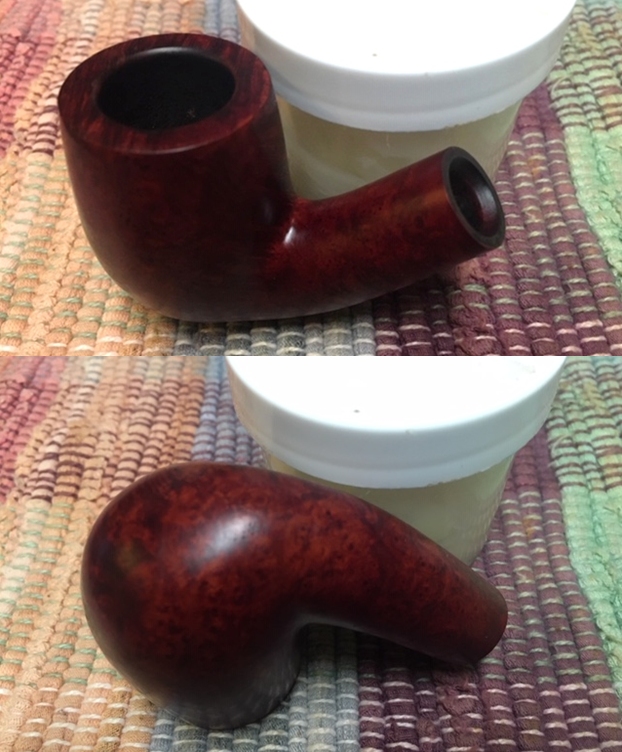
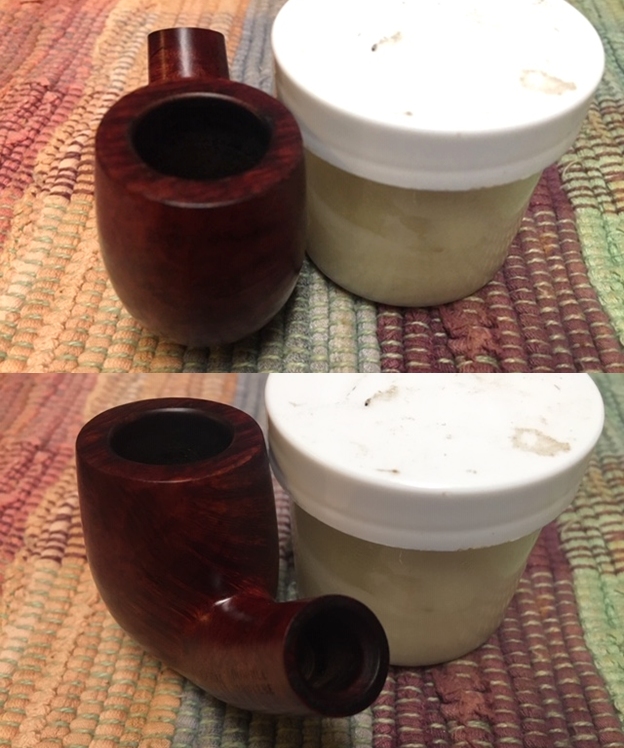
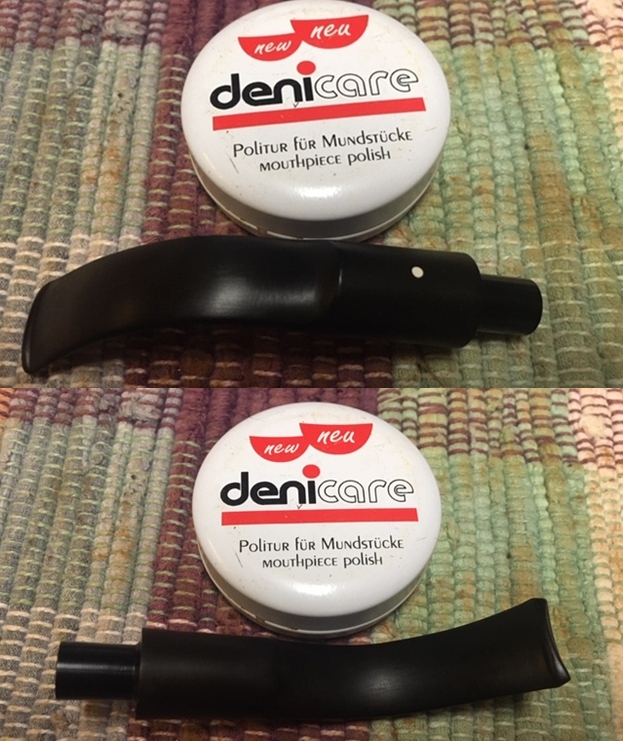
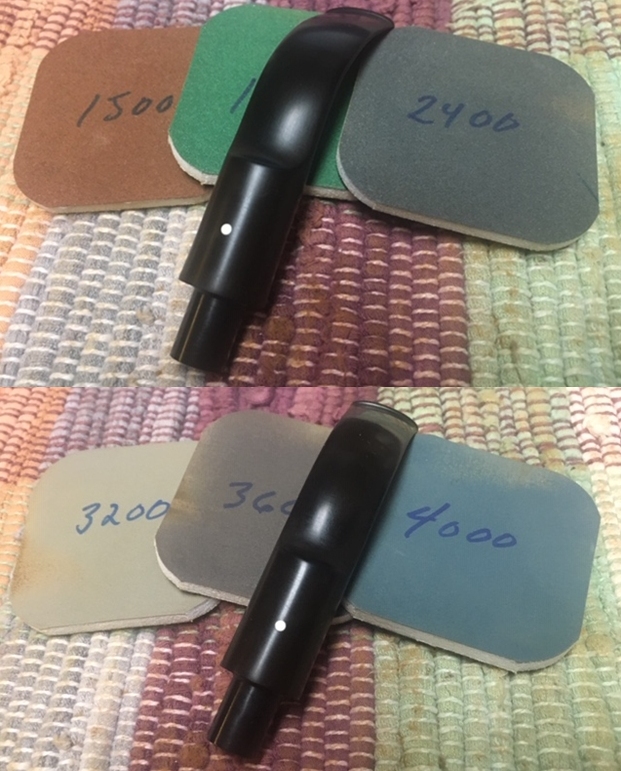
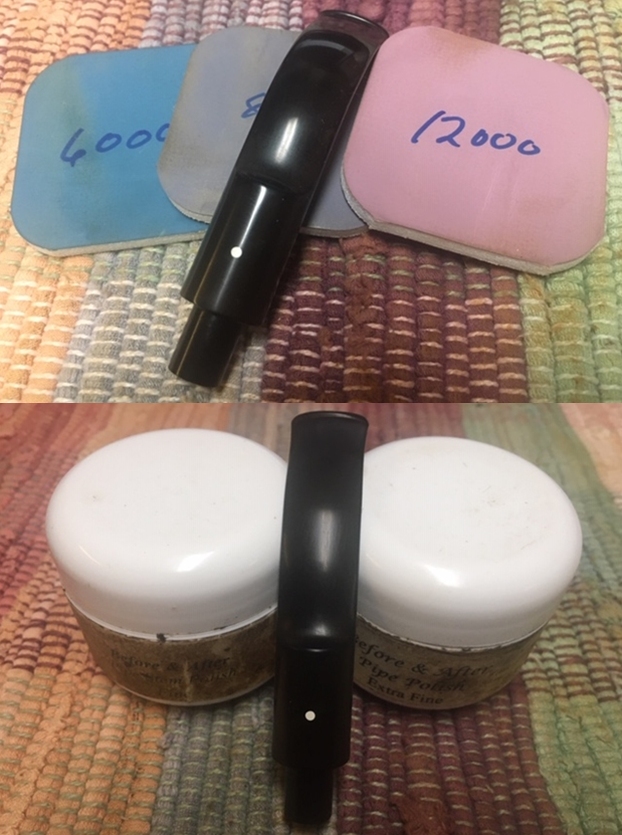
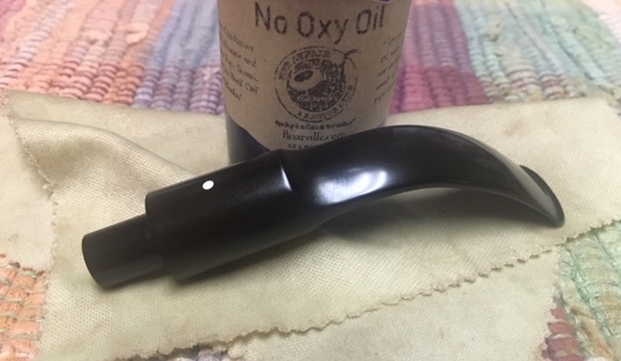
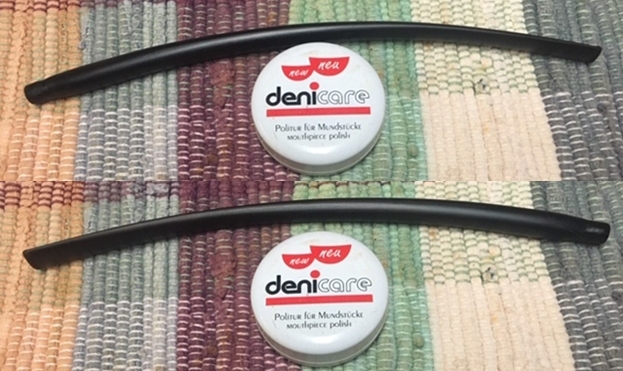
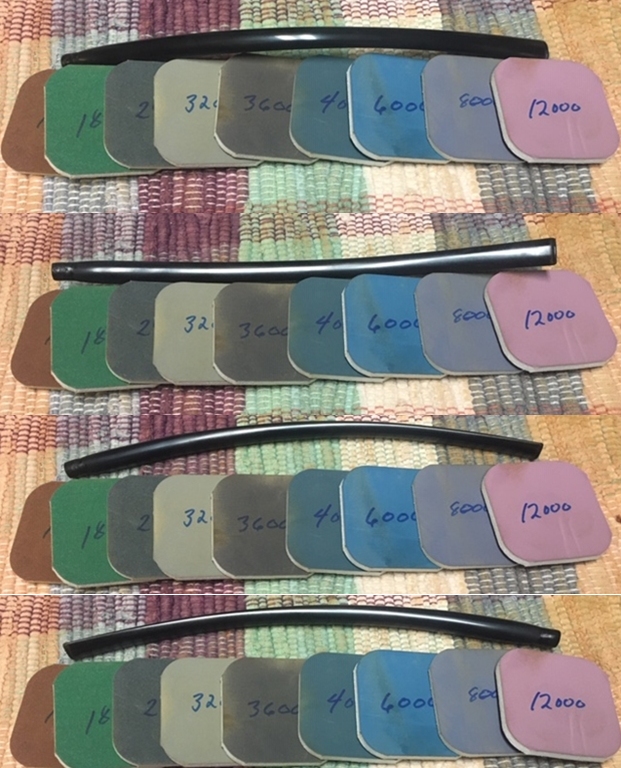
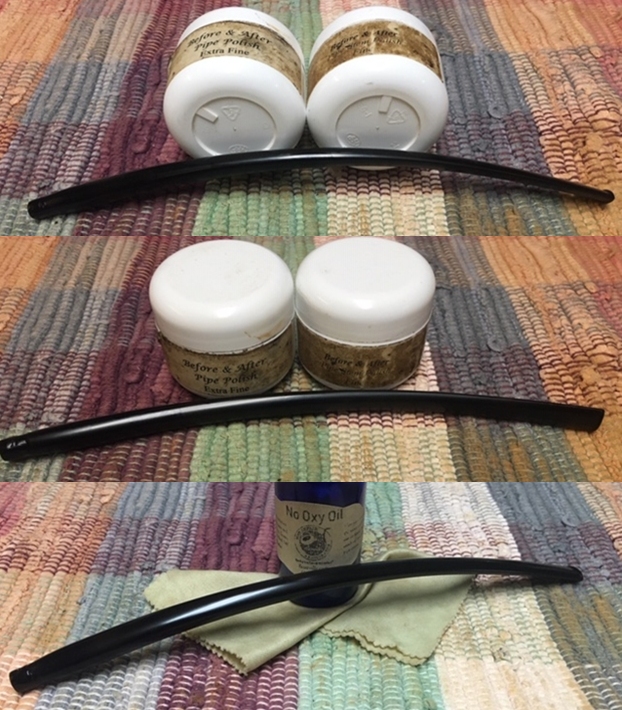
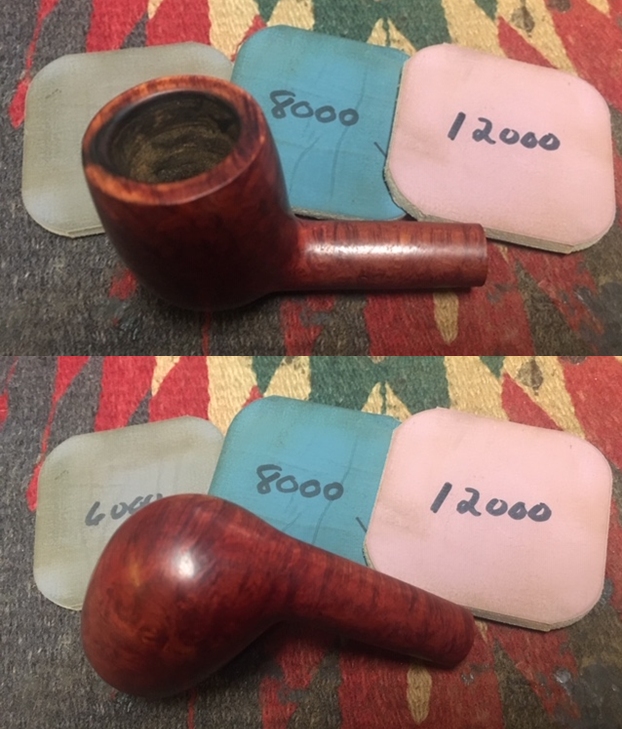
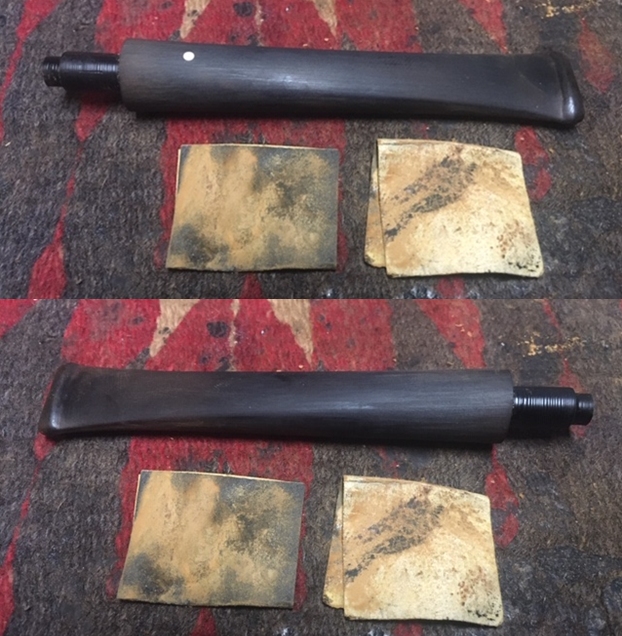
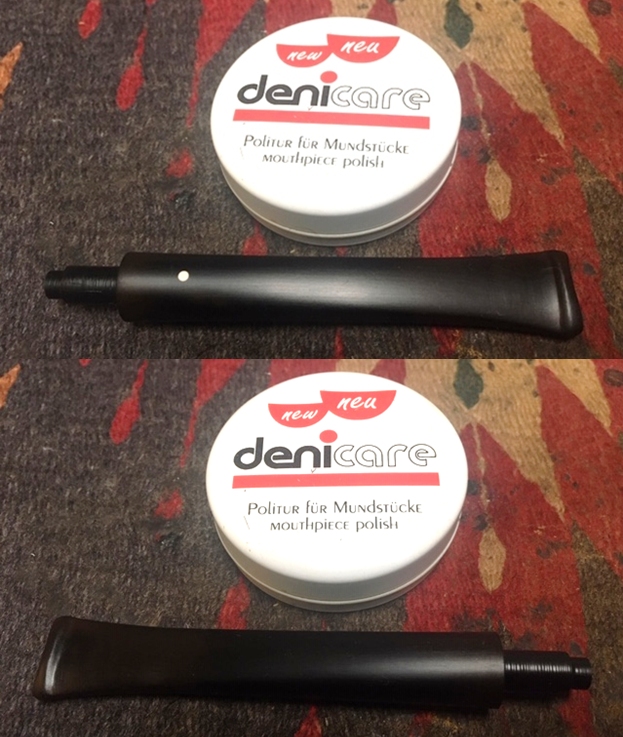
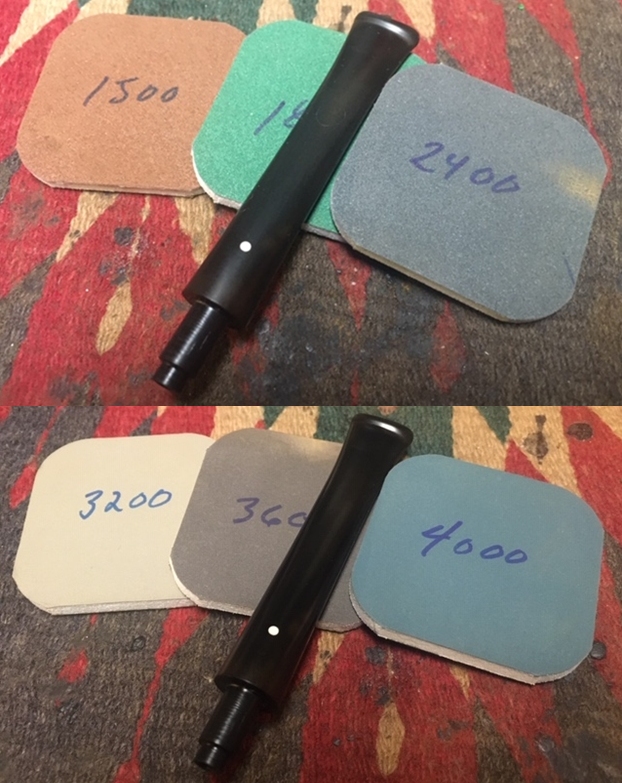
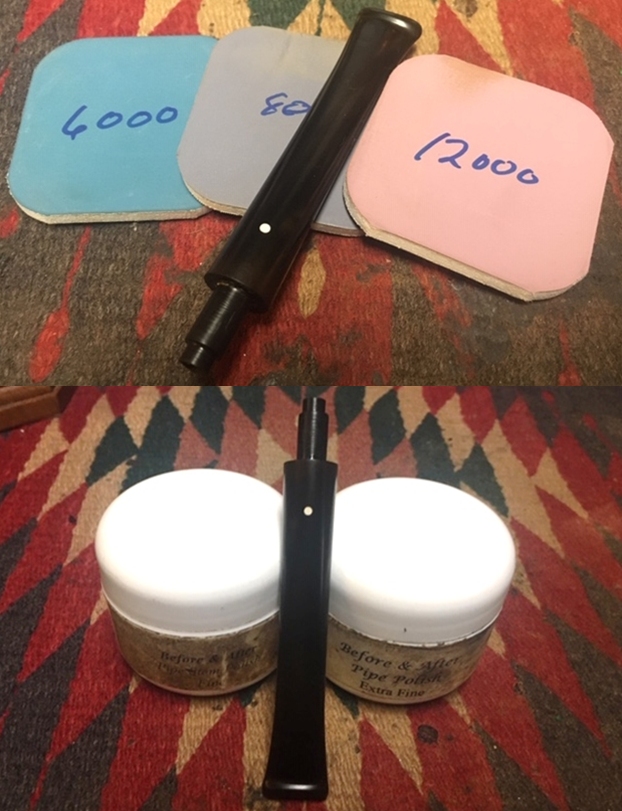
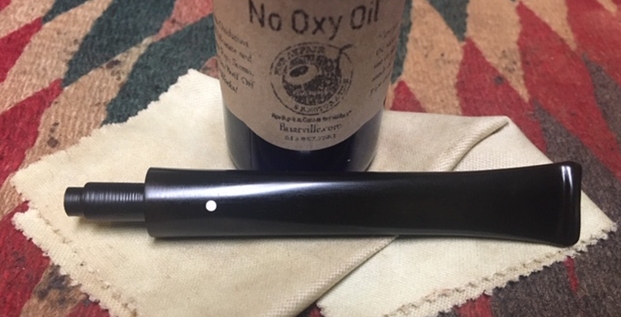
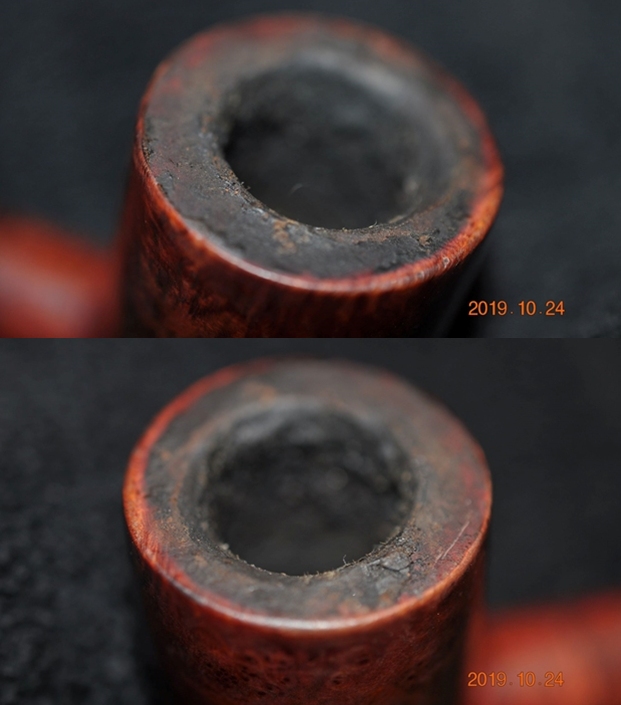
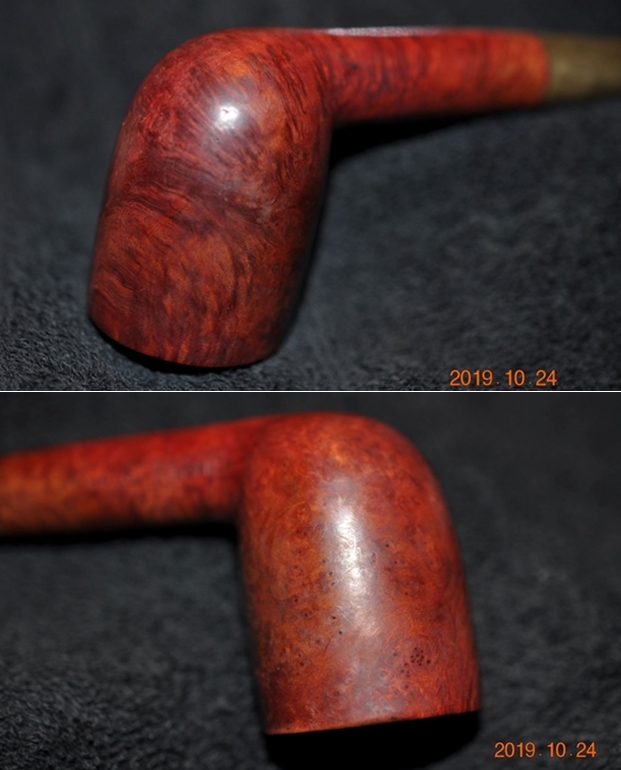
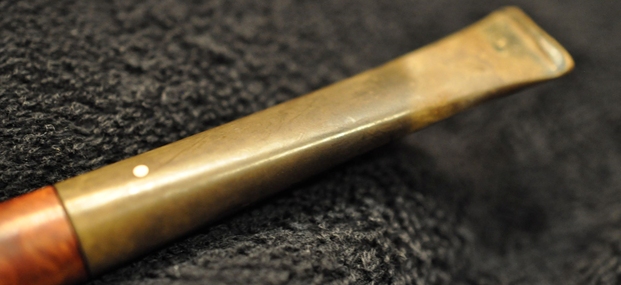
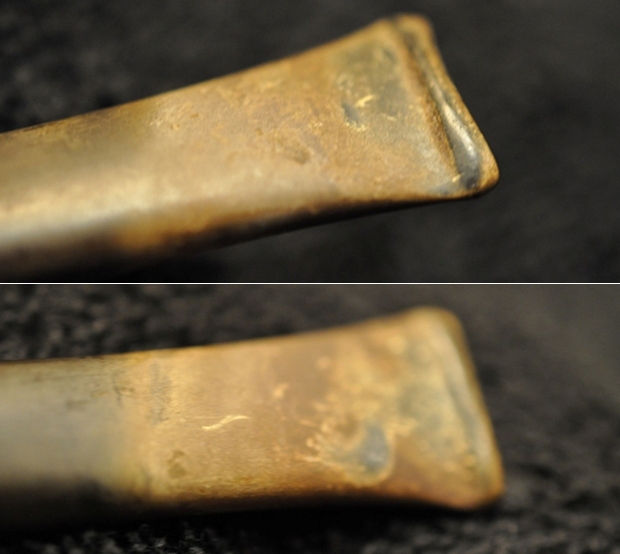
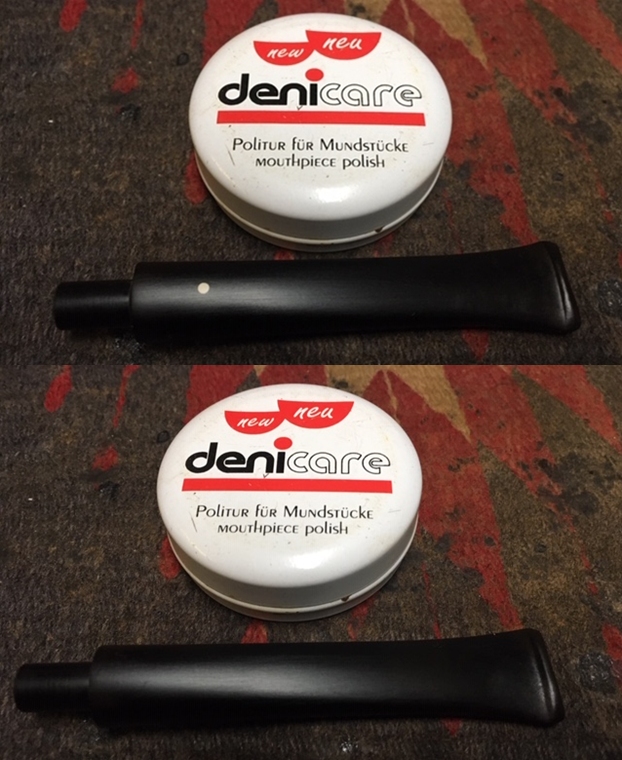
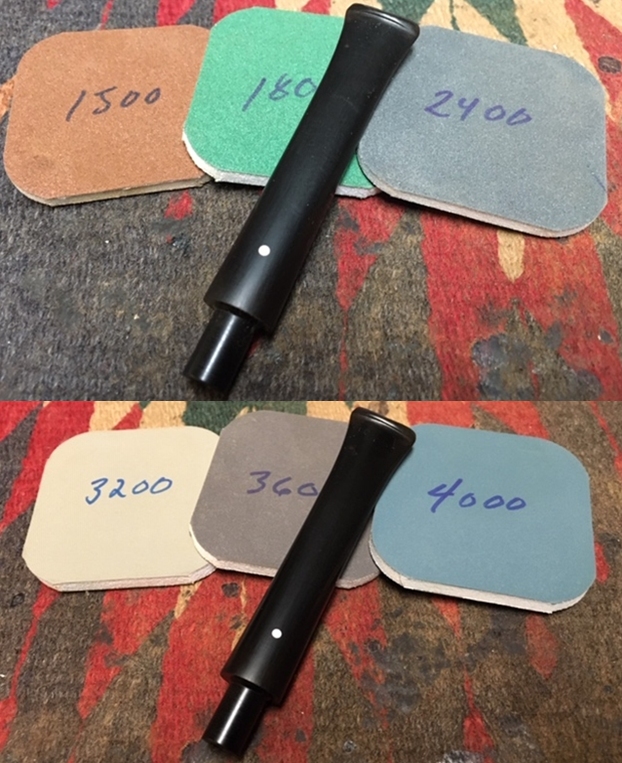
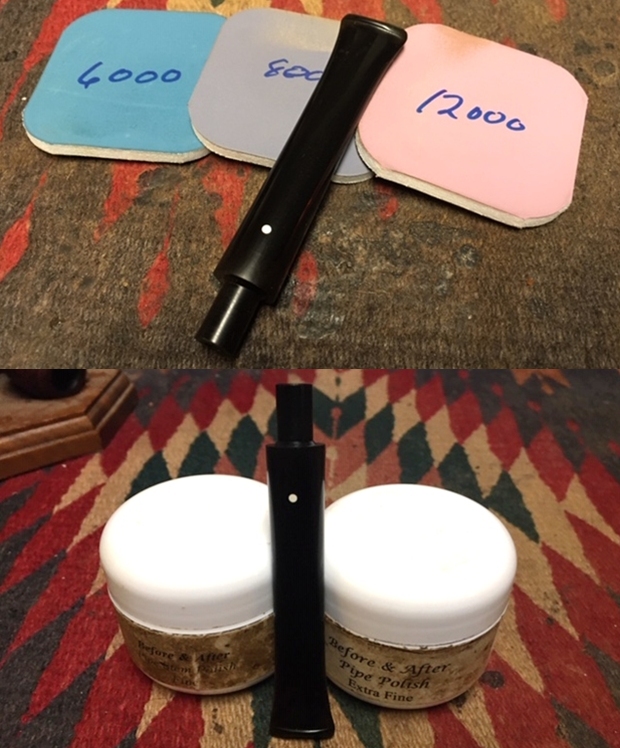
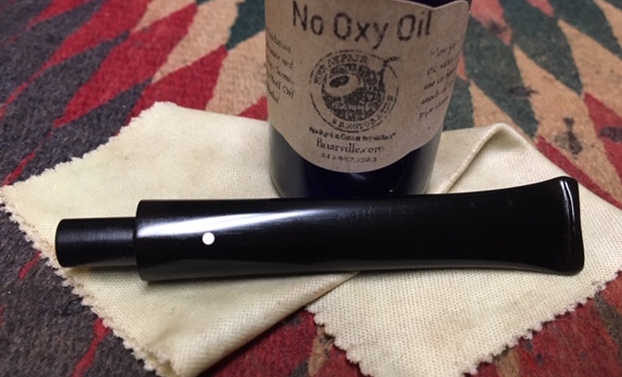
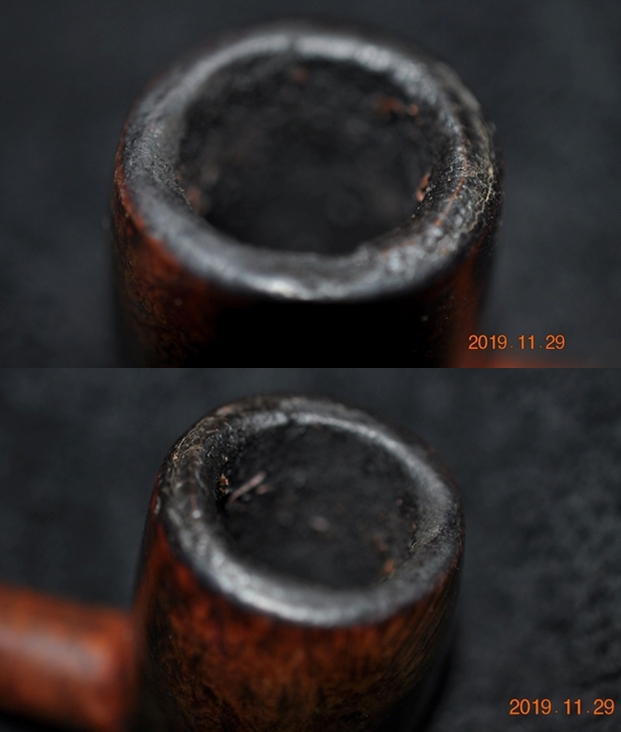
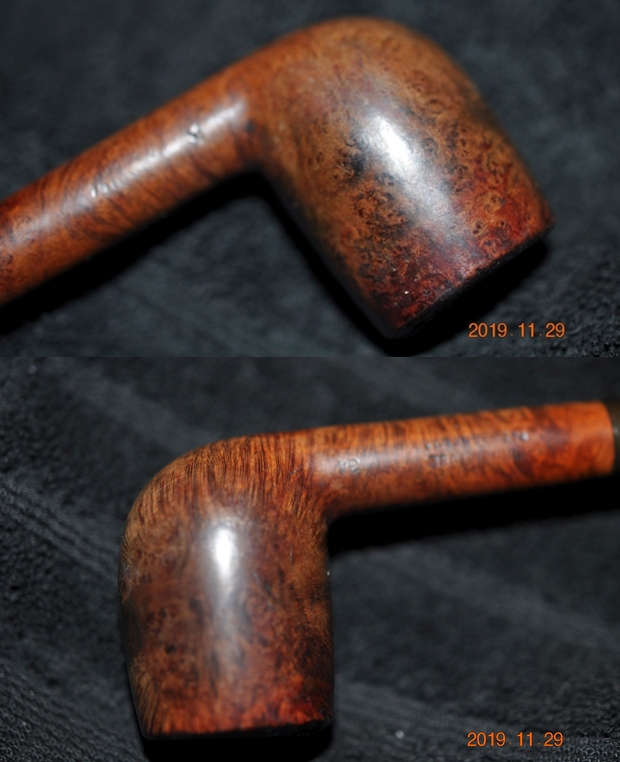
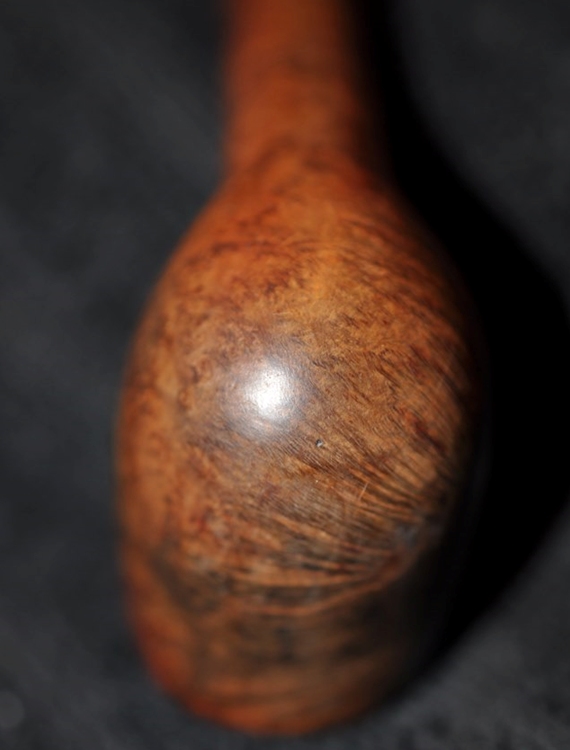
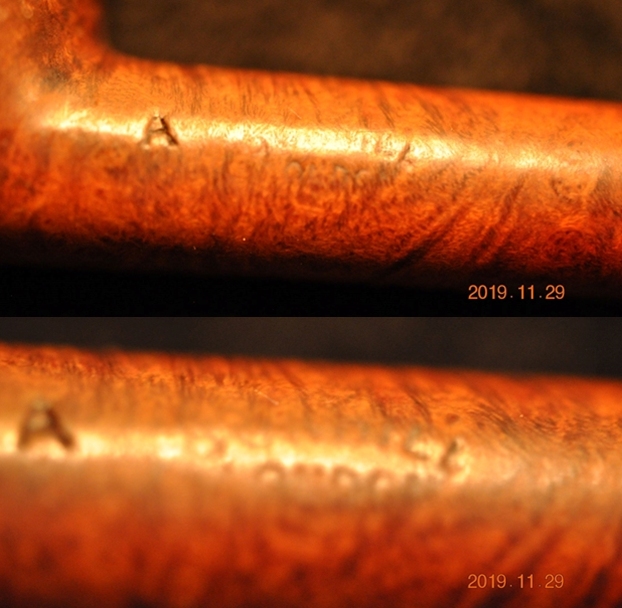
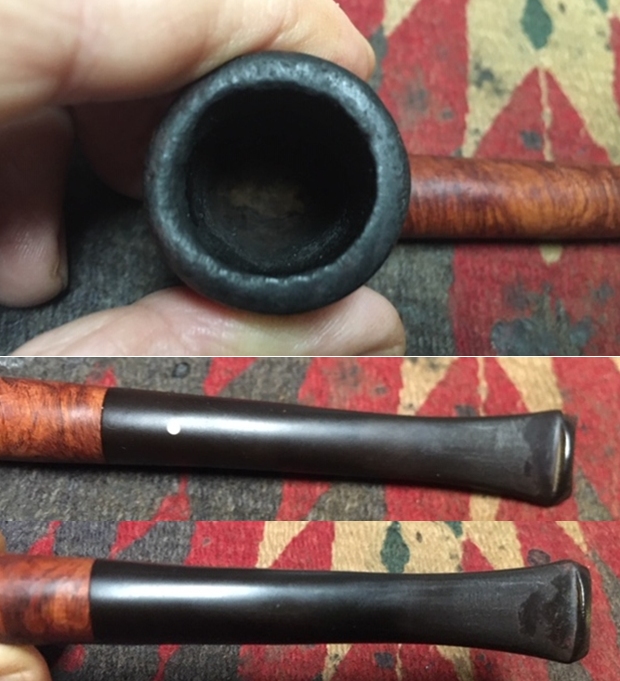
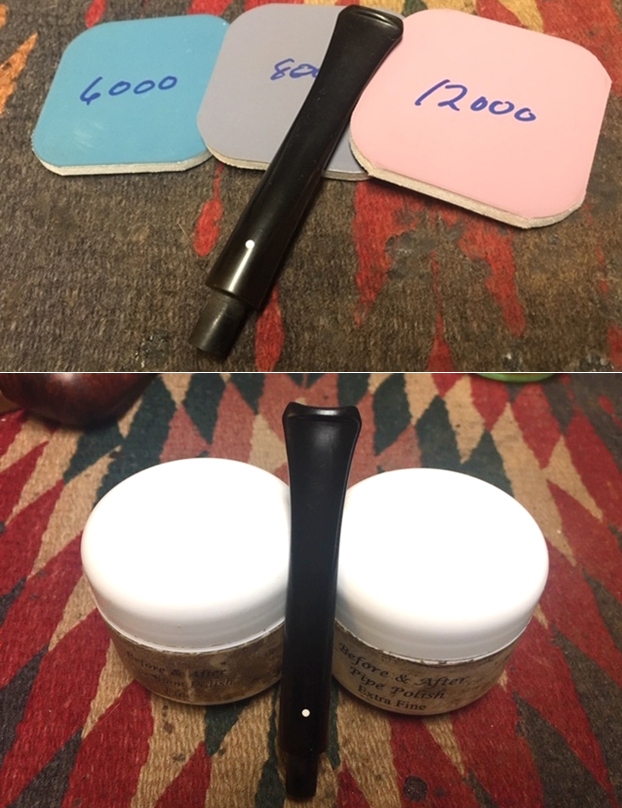
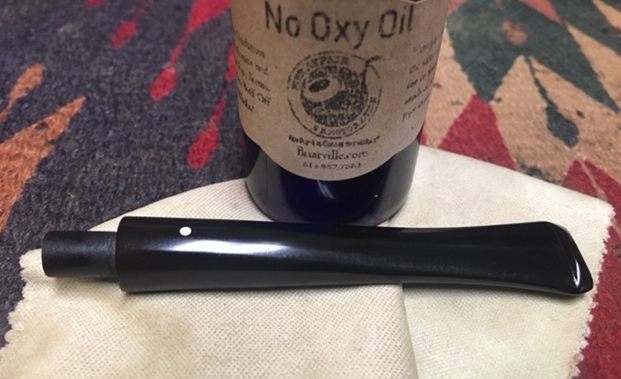
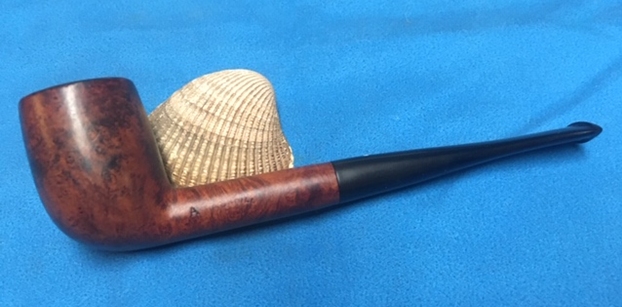
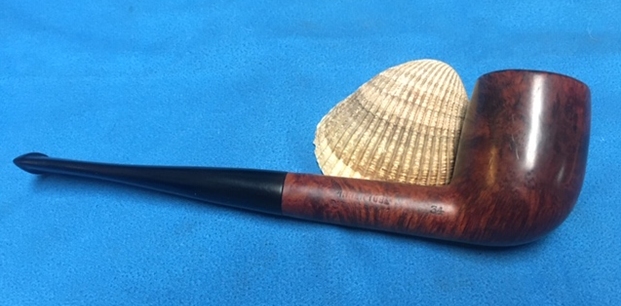
This is one of two Gourd Calabash pipes that he had that were rough looking. The pictures below show what they looked like when I shipped them to Jeff to do his cleanup magic with them. This was a rough looking pipe. The stem was oxidized and in the second picture what looks like a hole in the stem near the turned portion was a thick bead of “goop”. The black plastic/acrylic ferrule was probably the cleanest part of the pipe. The meer cup was absolutely gross. There was a coat of dust, maybe even mold on the thick cake in the bowl. The pipe smelled horrid. The rim edges of the bowl looked bad; the inner one had potential damage to the beveled edge under the grime. With the cup removed the calabash gourd interior was black with scum and tars and looked horrible. It reeked of old tobacco tars akin to the smell of an ashtray overflowing on a pub table… some of you remember those! The gourd exterior was dirty but surprisingly undamaged. The stem was oxidized and covered with tooth chatter but none of the deep tooth marks I have come to expect from Bob’s pipes. Jeff took the following photos to document the mess!Jeff took some close up photos of the bowl cup to show the condition. The photos capture the visual well but actually the other senses are not even brought into the equation. It was really nasty. The thick cake was growing things! A redeeming photo had to be included after those to give a bit of encouragement and hope. This is a shot of the gourd calabash from the underside. The striations in the gourd and the shine on the bottom are quite stunning.The stem actually was surprisingly good for this estate. There were not any deep tooth marks in the vulcanite. We only had to deal with the oxidation and calcification. There no deep pits in the surface of the rubber. The third photo shows it in comparison to the ferrule so you can see how far from black it gone.I can’t begin tell you how great it feels to have Jeff’s help on cleaning up the pipes from Bob’s estate as the 125+ pipes were taking me a long time to do alone. In fact I doubt if I would have as many finished as I do now. Together we have cleaned all of the pipes and have restored over 60. He does cleaning job and leaves the rest to me. This one was no different. He cleaned this filthy pipe with his usual penchant for thoroughness that I really appreciate. This one was a real mess and I was looking forward to seeing what he had done with this one when I took it out of his box. It looked amazing and CLEAN. He carefully reamed the meerschaum cup with a Savinelli Fitsall Pipe Knife. He scrubbed out the internals of the gourd and the shank with alcohol, pipe cleaners and cotton swabs until the pipe was clean. He scrubbed the exterior of the gourd with Murphy’s Oil Soap and a tooth brush to remove the grime and grit. The gourd and meer cup look really good. The stem looked a lot better. Jeff soaked the stem in Before & After Deoxidizer to remove the oxidation on the rubber. The pipe was ready for me to carry on the next part of the process. I took some close up photos of the meerschaum cup and also of the stem surface. I will tell you what; I am absolutely amazed at how good this pipe looks. I wanted to show how well it had cleaned up and what needed to be done. The cup was in remarkable condition. The surface was in decent condition. The inner edges of the cup were darkened and there was some debris on the edges of the bevel. Otherwise it was beautiful. The stem actually looks very good in the photos. There was no chatter or toot marks on the stem surface.  There was a little bit of oxidation that I needed to work on in the curves of the stem and turned area. But it too was amazing… the whole pipe is a surprise to me. Looks good, smells good and should smoke well!I popped the meerschaum cup out of the gourd to check out the interior. It was stunningly clean. The cork gasket was dry but whole. The underside of the cup was stained but it too was very clean.I worked on the rim and top of the meerschaum bowl with micromesh sanding pads. I wet sanded the edges and surface with 1500-12000 grit sanding pads and wiped the surface down after each pad. The meerschaum really became smooth and took on a deep shine. The inner edge of the bowl kept a bit of colour but was also very smooth. I set the cup aside and rubbed down the gourd with Before & After Restoration Balm. While it was designed for enlivening and protecting briar it works wonders with a piece of dried gourd calabash. I worked it into the surface of the gourd with my finger tips and let it sit for about 10 minutes. I buffed it off with a soft cotton cloth. With the gourd cleaned and polished and the meerschaum cup cleaned and polished it was time to put that part of the pipe back together. I like to rub the cork gasket down with some Vaseline Petroleum Jelly to put some life and elasticity back in the cork. I rub it down with my finger tip and let it sit for about five minute so that the cork absorbs the jelly. Once that is done I can easily insert the cup without fear of damaging the cork. With the bowl done it was time to address the stem. It was in pretty decent condition other than a little residual oxidation in the curves of the turned area and on the tenon area. I sanded the surface of the stem with 220 grit sandpaper to remove the remaining oxidation in the stem surface and the remaining oxidation in the vulcanite. I polished it with 400 grit wet dry sand paper.I rubbed the stem down with Denicare Mouthpiece Polish. I have found it is a great pre-polish for my use as it shows me areas that I need to work on with the micromesh sanding pads.I polished the stem with micromesh sanding pads – wet sanding with 1500-12000 grit sanding pads. I wiped it down after each pad with a damp cloth to remove the sanding dust. I polished it further with Before & After Pipe Polish – both Fine and Extra Fine. I finished by rubbing the stem down with some “No Oxy Oil” to protect the vulcanite. I am continuing to experiment with the product from Briarville and tracking how it works so I can write a review of it.

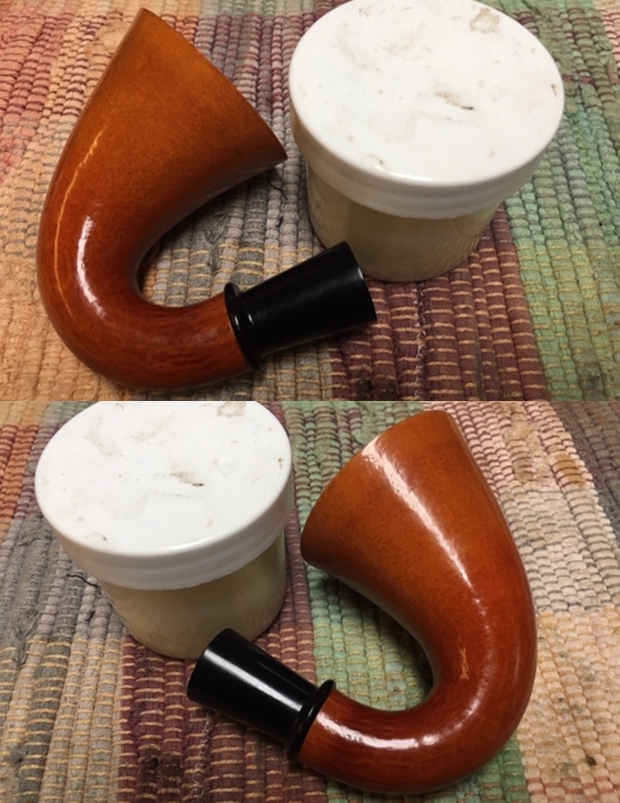
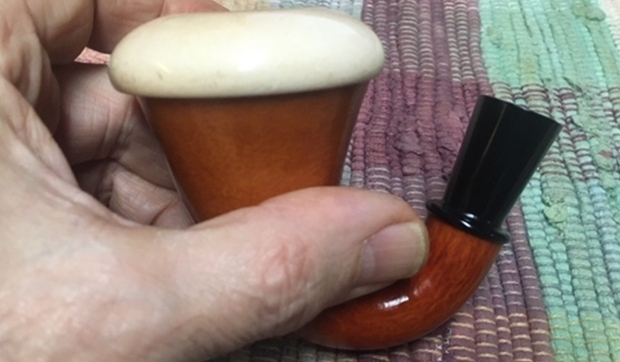
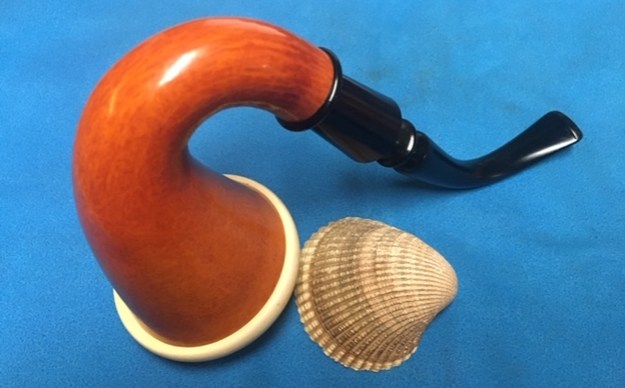
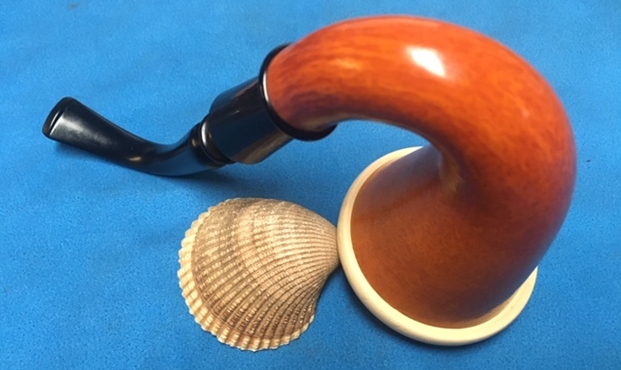
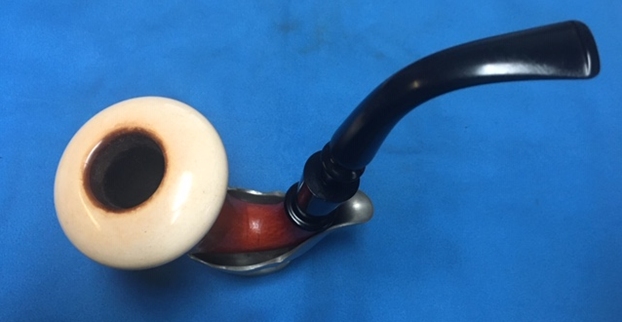
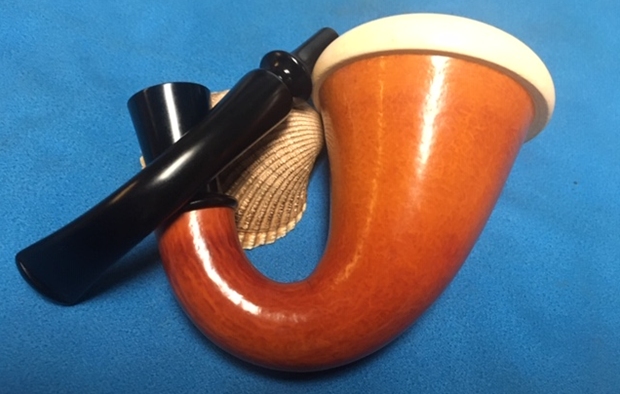
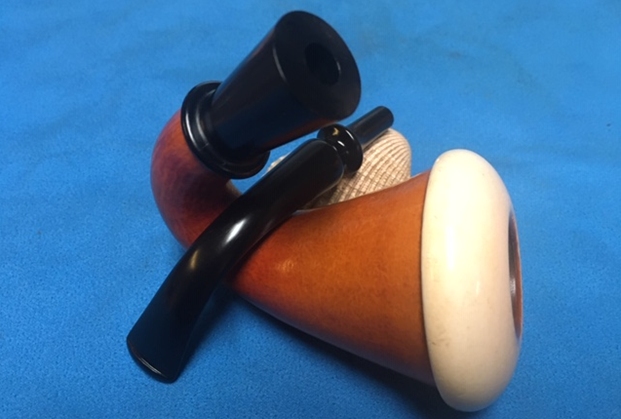
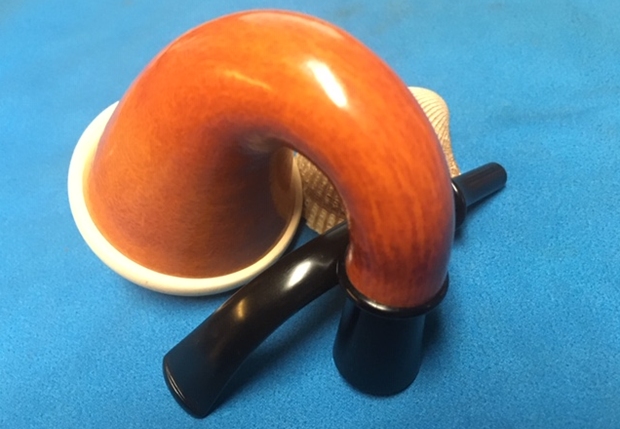
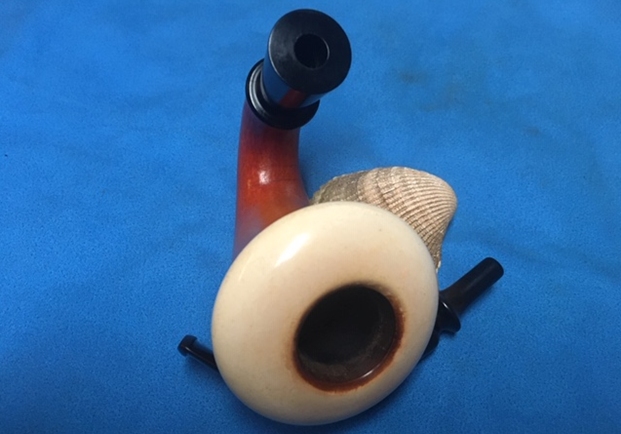
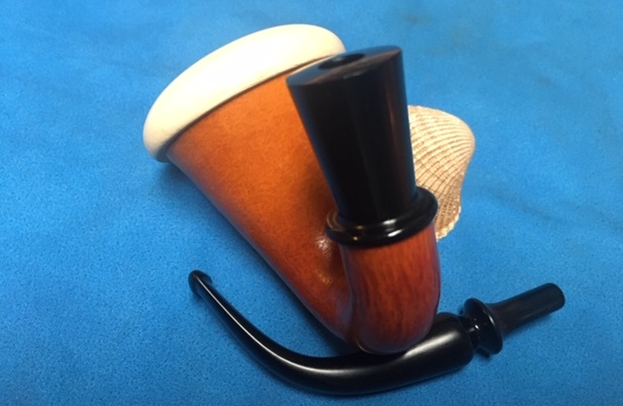
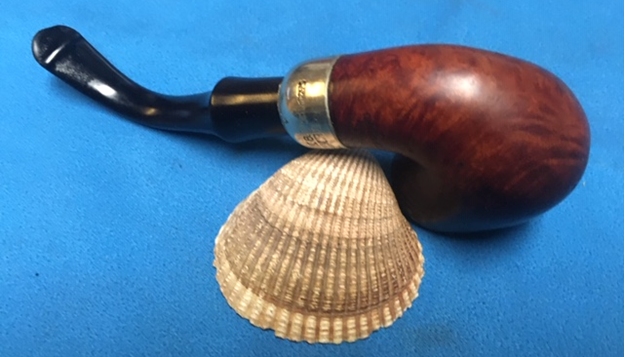
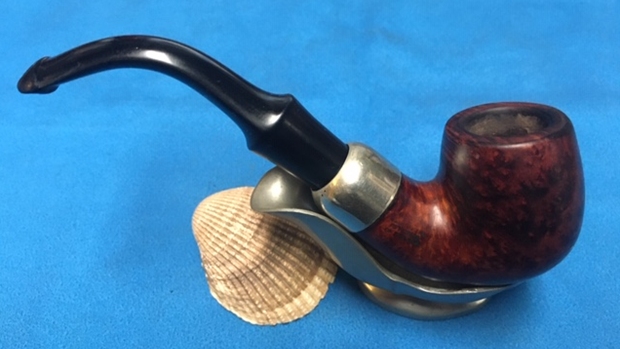
I am so glad to be finished with the first of these Gourd Calabash pipes. When I received them I was not sure we could get any life out of them at all. This one proved me wrong. It came out really nicely and looks really good. What came out is a beautiful golden Gourd Calabash. The look of it makes me think is a Pioneer but no way to be sure of that. It would fit the 1960s and 70s. Like each of the pipes in Bob’s estate I really look forward to this point in the process when it is put back together, polished and waxed. I put the bowl and stem back together. I carefully gave the bowl and the stem multiple coats of carnauba wax. I buffed the pipe with a clean buffing pad to raise the shine. I hand buffed it with a microfiber cloth to deepen the shine. The pipe polished up pretty nicely. The gourd has character and a deep shine that really came alive with the wax and polish. The meerschaum cup looks good on it and the black of the fancy vulcanite stem is a beautiful contrast to the golden gourd and white meerschaum. This turned out to be a lot of fun to work on thanks to Jeff’s cleanup work. The pipe is comfortable pipe to hold in the hand. The finished pipe is shown in the photos below. The dimensions of the pipe are Length: 7 inches, Height: 3 inches, Outside diameter of the bowl: 2 ½ inches, Chamber diameter: 7/8 of an inch. This beautifully shaped Calabash is a beauty should last for many more years. It is one that will be on the rebornpipes store very soon. If you are interested let me know. I have a lot more of Bob’s estate to work on of various brands. Perhaps one of those will catch your attention. Thanks for reading this blog and my reflections on the pipe while I worked on it. This is an interesting estate to bring back to life.

A Facelift and Stem Repair for a Republic Era Peterson’s 311 System Standard


Blog by Steve Laug

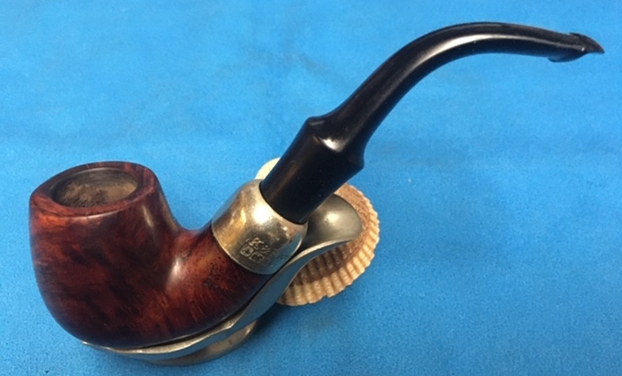
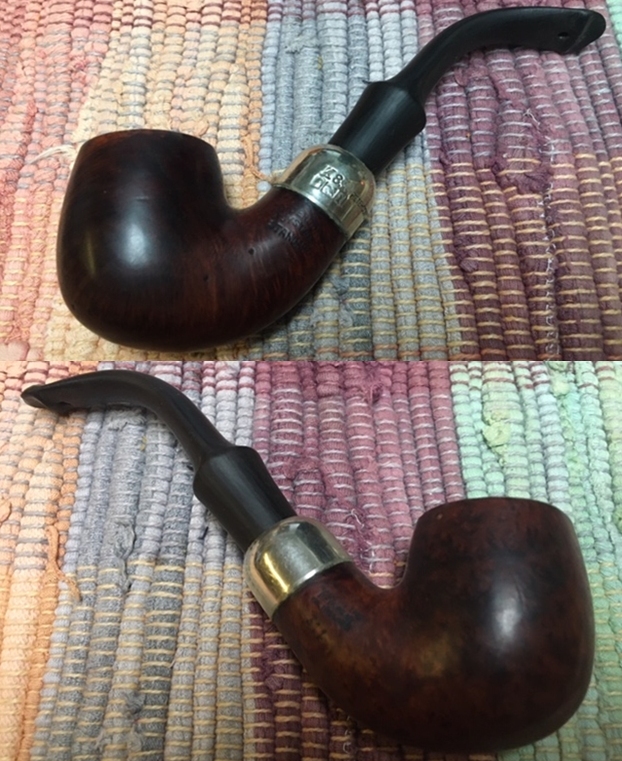
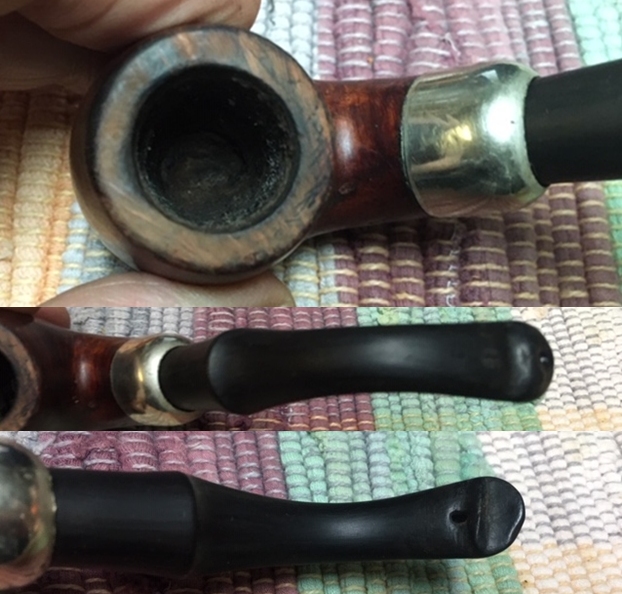
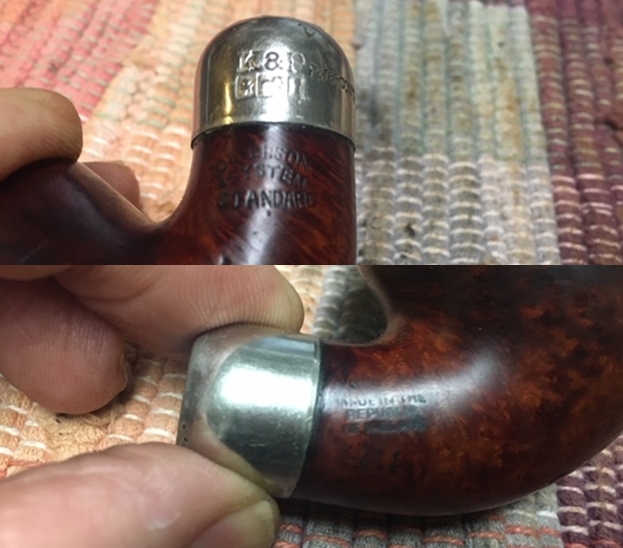
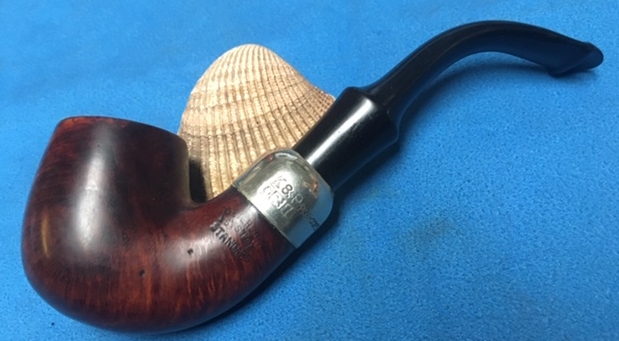
The second pipe I have chosen to work on in 2020 is a Republic Era Peterson’s System Standard 311. It was in rough condition when it came to me but it was clear that it was stamped Peterson’s System Standard vertically on the left side of the shank next to the band. The right side of the shank was stamped Made in the Republic of Ireland over the shape number 311. It has some stunning grain around the bowl and shank that can be seen under the thick grime. The bowl had been reamed recently so there were just remnants of cake on the walls that were uneven giving the bowl a pitted appearance. The rim top was cleaned and appeared to have been sanded. There were sanding marks in the briar. The inner and outer edges of the rim had damage. The bowl was out of round and there was some burn damage on the front inner and outer edge. The exterior of the bowl is dirty and has some pits and marks that are a part of its story. The nickel ferrule on the shank end was oxidized and was rough at the opening to the mortise. It is stamped on the left side K&P over three hallmarks. That is followed by Petersons. It is not dented or damaged. The stem was the biggest issue with this pipe. Someone had carved a groove in the top side of the stem in front of the p-lip almost trying to make it a dental bit. The underside of the stem had a tooth mark that had punctured the surface leaving a hole in a tooth crater. I took photos of the pipe before I started my cleanup work on it.   I took close up photos of the bowl and rim top to show the inside of the bowl and the damages on the rim top and edges of the bowl. You can see where someone had taken sand paper to the top and removed the lava and left sanding marks. You can also see the burned areas on the inner and outer front edges of the bowl.  The photos of the stem also clearly show the issues that need to be addressed.   I took photos of the stamping on the left side of the bowl and shank. The vertical stamping on the left side was readable as you can see from the photos. It read Peterson’s System Standard. The stamp on the right side of the shank read Made in the Republic of Ireland with the shape number 311 underneath. The nickel ferrule on the shank end is stamped on the left side K&P over three hallmarks – a Shamrock, a shape that looks like a reclining lion and a tower. Typically these hallmarks are not like those in silver that help to date a pipe but are rather marks that make it clear that the pipe was made in Ireland.  Following the hallmarks it is stamped Petersons.   I am including some information from Pipedia’s article on Peterson pipes. It is a great read in terms of the history of the brand (https://pipedia.org/wiki/Peterson). I have included a bit of the pertinent history on the Republic Era below.

1950 – 1989 The Republic Era  – From 1950 to the present time, the stamp for this era is “Made in the Republic of Ireland” in a block format generally in three lines but two lines have been used with or without Republic being abbreviated.

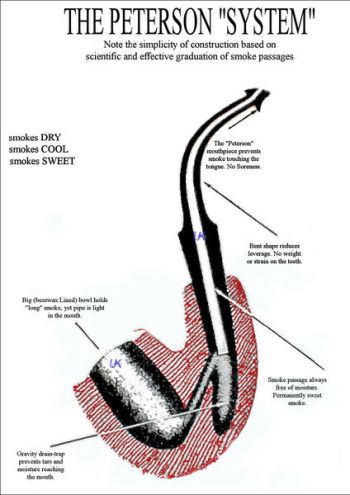
Pipedia also included a section of information on the System pipes including a cutaway diagram of the interior of the system pipe (https://pipedia.org/wiki/Peterson#Republic_Era_Pipes). I quote a section of the article in part and include a link to another article on Pipedia on the System pipe.

The Peterson System pipes are the standard bearers of the Peterson pipe family, famous for the excellent smoking pleasure they provide. Often imitated but never equaled, the Peterson System smokes dry, cool and sweet, thanks to the scientific effectiveness of the original design. The heart of the System is the unique graduated bore in the mouthpiece. This makes the suction applied by the smoker 15 times weaker by the time it reaches the tobacco chamber. The result is that all the moisture flows into the reservoir and, thus cannot reach the smoker’s mouth. The Peterson Lip further enhances the effectiveness of the graduated bore by directing the flow of smoke upwards and away from the tongue. This achieves a uniquely even distribution of smoke and virtually eliminates any chance of tongue bite or bitterness. Furthermore, the shape is contoured so that the tongue rests comfortably in the depression under the opening. Each “PLip” mouthpiece is made from Vulcanite. For the Peterson System pipes to work properly, the stem/tenon has to have an extension, the tip of which will pass by the draft hole from the bowl and into the sump. Upon the smoker drawing in smoke, this extension then directs the smoke down and around the sump to dispense a lot of the moisture before the smoke enters the extension and stem. On the System Standards and other less expensive systems, this extension with be made of Vulcanite turned integrally with the stem. On the more expensive System pipes this extension will be made of metal which screws into the Vulcanite stem. This extension on the earlier pipes will be of brass and the newer pipes will be of aluminium. Most smokers not knowing this function of the metal extension, assumes that it is a condenser/stinger and will remove it as they do with the metal condensers of Kaywoodie, etc. Should you have a System pipe with this metal extension, do not remove it for it will make the System function properly and give you a dryer smoke (https://pipedia.org/wiki/A_closer_look_at_the_famous_Peterson_Standard_System_Pipe).

With that information in hand I knew what I was dealing with in terms of the stamping and the age of this pipe. I knew from the information that the pipe was made during the Republic Era between 1950 and 1989. It was an antique mall find so I was happy with the age and condition. Now it was time to work on the pipe.

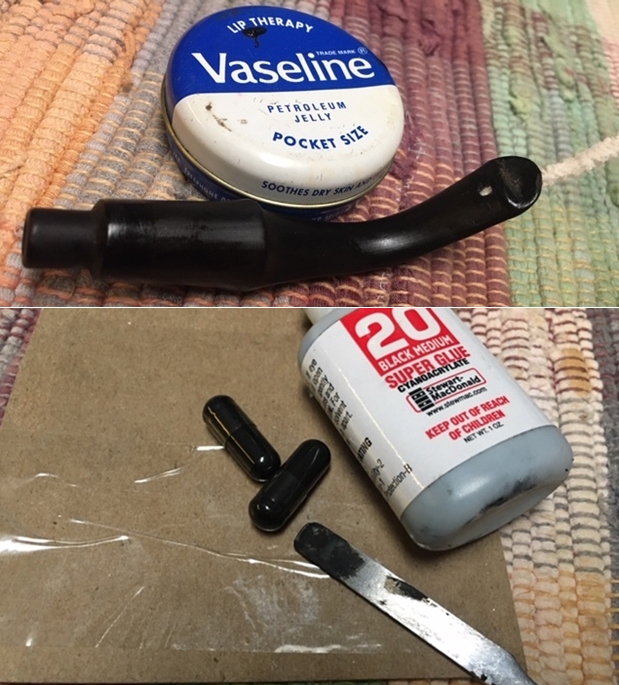
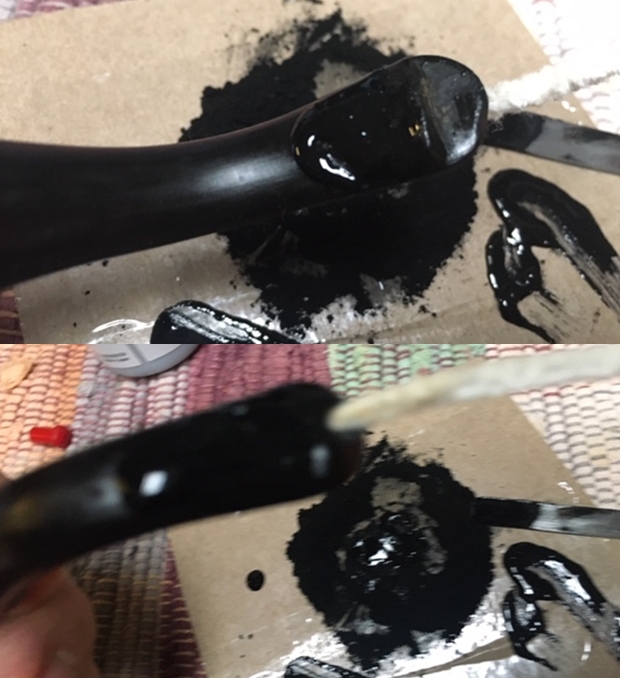
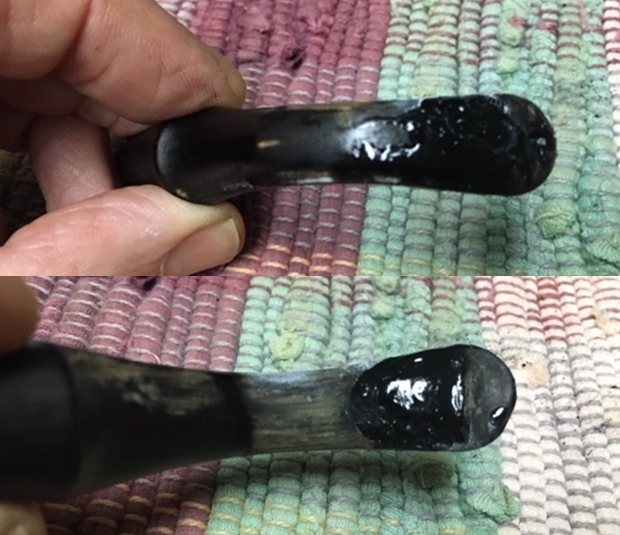
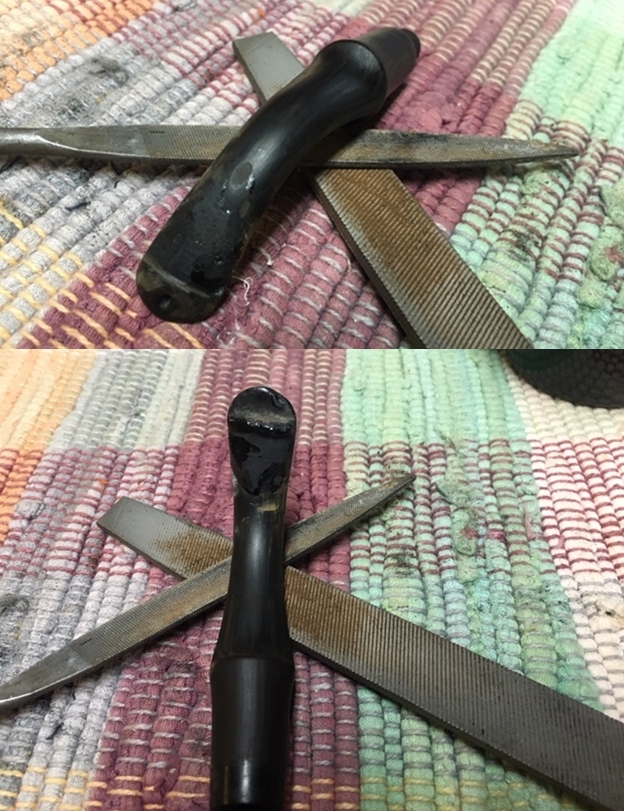
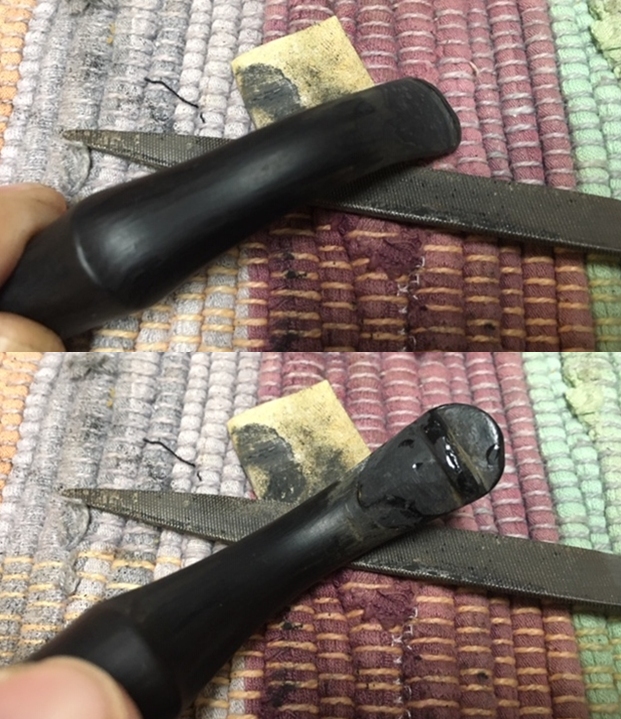
This is one that I have to do the cleanup work on and not have Jeff’s help. Doing the work I am really glad that Jeff is willing to take on cleaning the pipes that we purchase as estates of hunting finds – but enough of that. I have to clean this one! The pipe appeared to have been reamed somewhat recently in its life. However there was some pitting in the cake on the walls of the pipe so I cleaned up the reaming with a Savinelli Fitsall Pipe Knife. I decided to start the process by dealing with the damage to the inner edge and top of the rim. I wiped it down with alcohol on a cotton pad and filled in the damaged edge and rim top with clear Krazy Glue. Once the repair cured I used a folded piece of 220 grit sandpaper to clean up the repair on the rim top and to give the inner edge a very light bevel. Between the repair and the bevel it took care of the damage on the inner edge. The third photo shows the rim top after the shaping. I polished the entire bowl and rim top with micromesh sanding pads – wet sanding it with 1500-12000 grit pads and I wiped the bowl down after each sanding pad with a damp cloth. The bowl began to take on a finished shine. (I carefully avoided the stamping in the process of polishing the bowl and shank.) I rubbed the bowl and rim down with Before & After Restoration Balm. I worked it into the surface of the briar with my fingertips to clean, enliven and protect it. I let the balm sit for a little while and then buffed with a cotton cloth to raise the shine. I really like watching the Balm do its magic and bring the briar alive.   I set the bowl aside and turned my attention to the stem. The stem was a mess of issues. The first ones that I decided to address were the deep groove on the top side and the bite through on the underside. In preparation for the repair I cleaned out the airway in the stem with cotton swabs, pipe cleaners and alcohol. I greased a pipe cleaner with Vaseline Petroleum Jelly and slid it in the airway from the button end. I had bent it before putting it in the stem so that it would fit tightly against the bite through. I gathered the components of the repair together. I put a piece of packing tape on a cardboard square that I use for mixing a putty mixture of charcoal powder and black super glue. The tape buys me more time to mix up the putty without it reacting to the cardboard. I took out two charcoal capsules, the super glue and a dental spatula. Now I was ready to do the patching.I mixed the putty with the dental spatula and when I had a thick mixture I applied it to the stem surface with the spatula. I pressed it into the trough on the top side and the bite through on the underside. I don’t worry to much about a clean patch at this point I really want to make sure it is covered. Once it cures I can reshape it with a file and sandpaper.I sprayed the repair with an accelerator that hardens the surface of the repair and allows me to pull the pipe cleaner from the airway. I took photos of the repair at this point in the process. It is truly ugly but it has accomplished what I wanted. The groove and bite through were gone. Now all that was left was a lot of shaping and sanding. Oh, by the way I always blow air through the stem to make sure that I have not sealed it with the repair!!  I set the stem aside for the evening and enjoyed some time with the family.In the morning I tackled shaping the stem. I use a needle file and a rasp to take down the excess and to shape the button edge on the stem. It is tedious work that requires patience that Paresh in India has far more of than me but I finished the rough shape with the files.  Once I had the rough shape done I continued to use a combination of the needle file and 220 grit sandpaper to remove the excess material of the repair and shape the stem surface. The photos show the progress in the process. The shape is beginning to show clearly! The trough on the top side is gone and the bit mark on the underside it also repaired.I continued to shape the stem with the 220 and 400 grit sandpaper. I had to fill in some air pockets in the repair with clear Krazy Glue and I built up the curve of the button on the top and the ledge on the backside.    When I got the stem to the point I was happy with the repair and shape it was time to begin polishing it. I rubbed the stem down with Denicare Mouthpiece Polish. It does a pretty good job polishing the stem.   I polished the stem with micromesh sanding pads – wet sanding with 1500-12000 grit pads. I wiped the stem down after each sanding pad with Obsidian Oil. I polished it with Before & After Pipe Stem Polish – both Fine and Extra Fine. Once I had finished the polishing I gave it a coat of a new product I am experimenting with from Briarville Pipe Repair. It is called “No Oxy Oil” and it is made to protect the stem from oxidizing. I set it aside to dry. I am excited to be on the homestretch with this old Republic Era Peterson System Standard. I look forward to the final look when it is put back together, polished and waxed. I put the bowl and stem back together. I polished the bowl and stem with Blue Diamond to polish out the scratches in the briar and the vulcanite. I gave the bowl and the stem multiple coats of carnauba wax. I buffed the pipe with a clean buffing pad to raise the shine. I hand buffed it with a microfiber cloth to deepen the shine. The pipe polished up pretty nicely. The grain is quite stunning and really pops with the wax and polish. The repaired black vulcanite stem actually looks quite nice and is a great contrast to the browns of the bowl and thick shank. This Peterson’s System Standard 311 Bent Billiard was another fun pipe to work on even though I did the entire process here. The polished nickel Ferrule works as a contrast between the stem and the briar and binds it all together. It really is a nice piece of briar whose nicks and marks testify to the travels of this old pipe. The pipe is comfortable pipe to hold in the hand. The finished pipe is shown in the photos below. The dimensions of the pipe are Length: 5 ½ inches, Height: 1 ¾ inches, Outside diameter of the bowl: 1 ¼ inches, Chamber diameter: ¾ of an inch. This old pipe will be going back to a fellow referred to me by City Cigar in Vancouver. Even though I am not adding new work at the moment I have a commitment with them that I will repair pipes for their customers. Thanks for reading this blog and my reflections on the pipe while I worked on it. This is an interesting estate to bring back to life.

The 1st Restoration of 2020 – An Ascorti Business KS Hand Made Billiard


Blog by Steve Laug

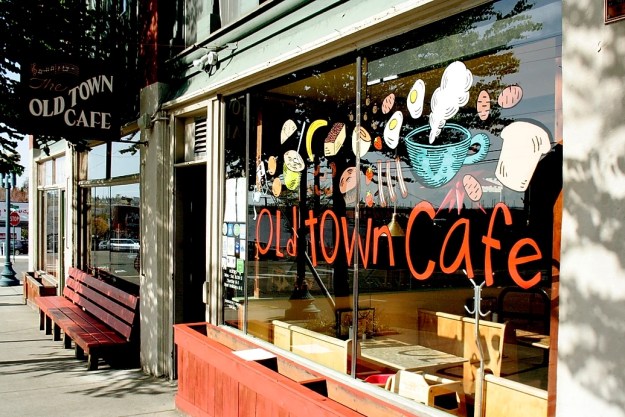
On December 30th my family and I went to Bellingham – ostensibly to do a bit of Christmas shopping at the mall there, visit Trader Joe’s and a few other stops. I also wanted to get in one last pipe hunt for 2019. We ate breakfast at the Old Town Café on Holly Street in Old Bellingham. They have great food and a great atmosphere. Check it out.After breakfast the girls and I visited a few of my favourite antique malls in the area. One was closed but two were open and we were early customers. I went through the first one with care covering every shelf, display cabinet and nook and cranny and no pipes were to be found. That happens sometimes and I was wondering if the pipe hunt would end up being a bust. I rarely come away empty handed but there is always one of those days. We entered the second shop and after going through three aisles of display cases and coming up empty handed I entered the last aisle. There is a display case in that aisle that generally has a few pipes in it and potentially one of two of interest to me. It is the last part of the store I stop at and this day was no different. I came to the case and looked through the glass case at the lighters, knives, cheap meerschaums and corn cobs. I was beginning to wonder if it was going to be a bust. Then low and behold, underneath the stems of a cob and meerschaum I saw what looked like a briar.

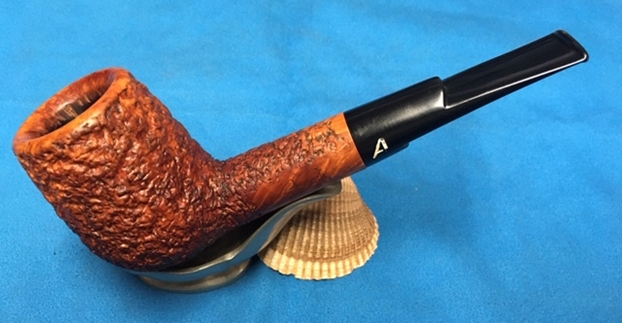
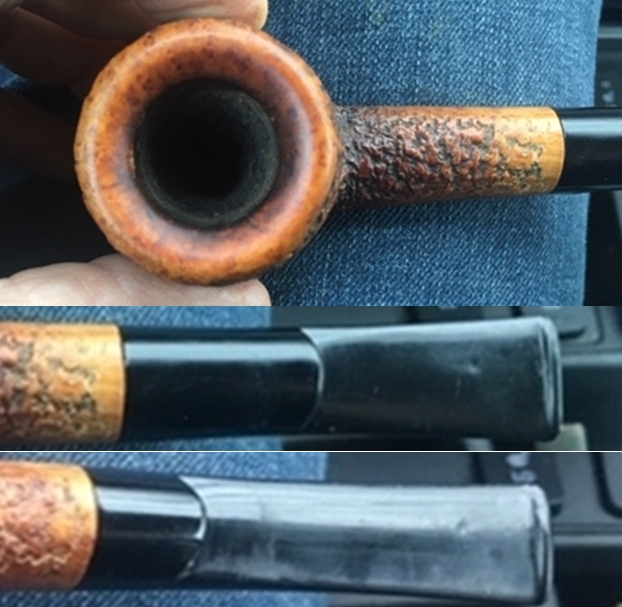
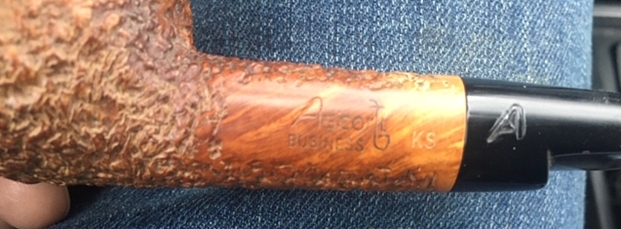
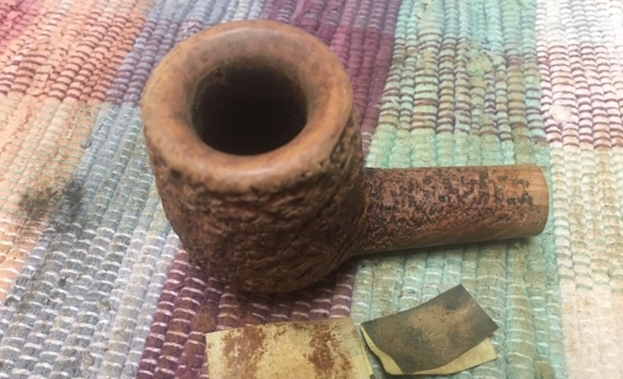
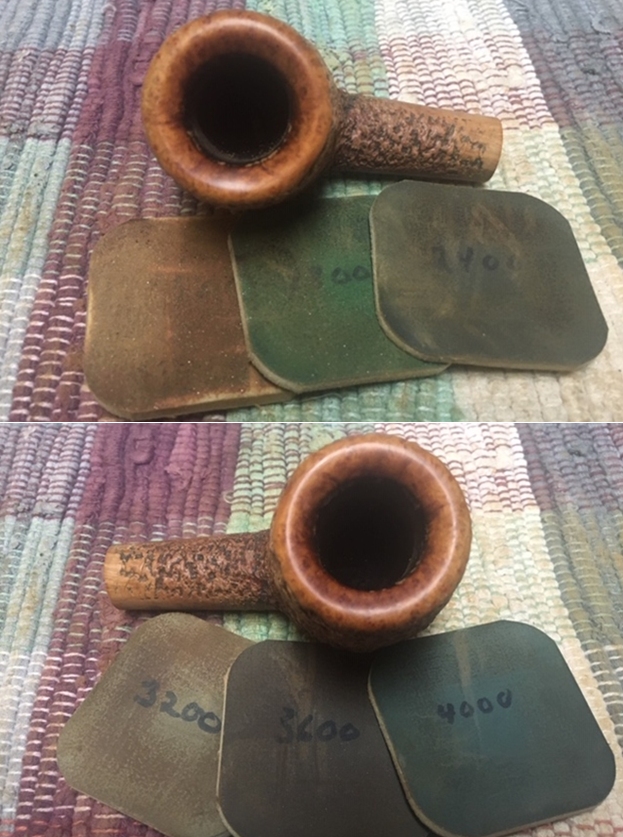
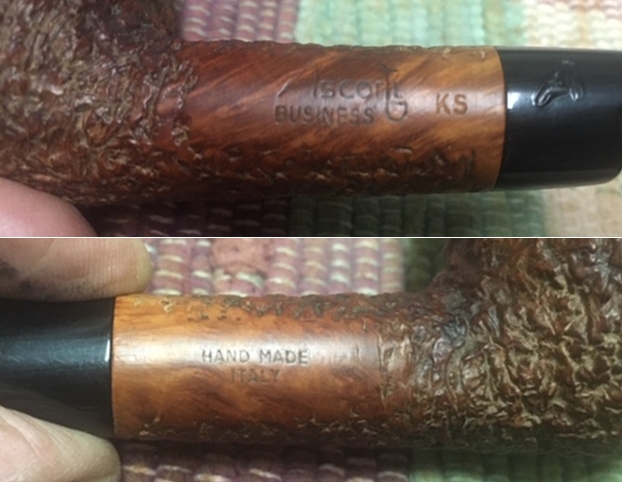
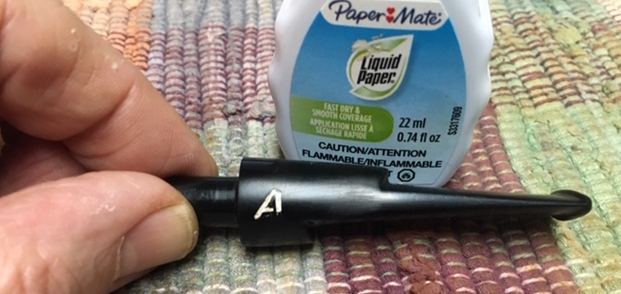
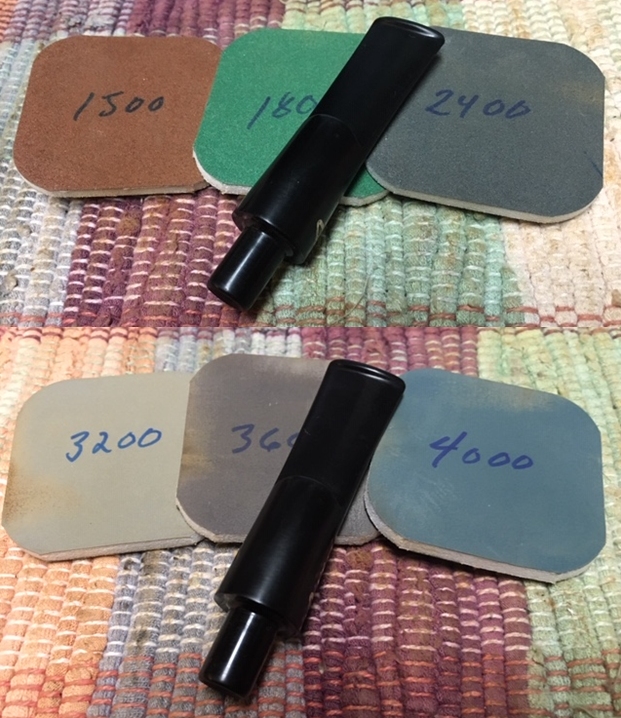
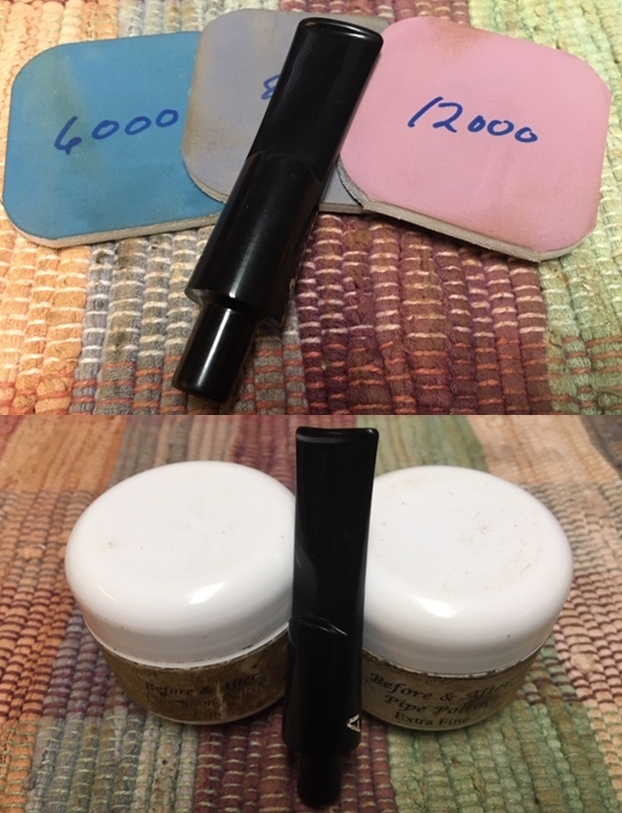
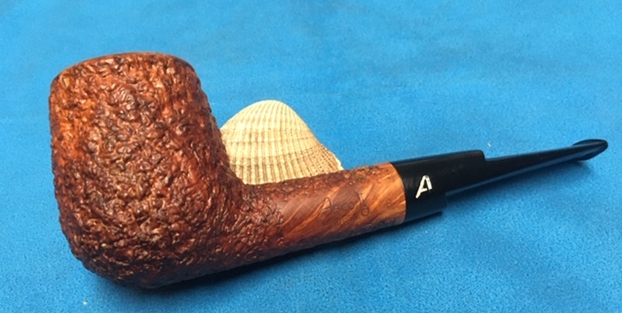
I went to the counter to get the clerk to open the case for me so I could have a better look at the hidden pipe that I had seen. She left me to my hunting and I carefully moved the pipes that had been hiding the briar. It was a larger billiard with a rusticated finish and a smooth rim. I lifted it out of the case and turned it over in my hands. The pipe was dirty with a thick cake in the bowl and some darkening on the smooth rim top. But on the smooth panels on the shank I saw the stamping the were readable. The left side read Ascorti Business KS and the right side read Hand Made Italy. The stem had the characteristic Ascorti A logo and their unique saddle cut. I did not even look at the price. I closed the case and carried my find up to the counter to seal the deal. We negotiated the price and when we came to an agreement the bill was paid and the pipe was mine! When I got to the car I took some photos o fthe pipe as it looked when I picked it up. I sent a copy of the photos to Jeff to show him my find. I took a close up photo of the rim top so Jeff could see its condition. There was a thick cake in the bowl – thicker from mid bowl to the bottom. The top of the bowl seems to have been reamed with a knife. There is some darkening and light lava on the smooth rim top. The acrylic stem photos show the tooth marks on both sides. Overall the tooth marks are light and should be able to be sanded smooth. There is one on the top side that is a little deeper and may need to be repaired. There is also some damage on the edge of the button that will need to be addressed.I took a photo of the stamping on the left side of the shank and the saddle portion of the stem. The stamping is clear and reads Ascorti with the tail of the T forming a pipe. Underneath it is stamped Business followed by KS. The stamp on the stem is a classic Ascorti “A”. Most of the white that would have filled it in is worn off.Once I finished the last of Bob Kerr’s Dunhill pipes last evening I set this pipe aside as the pipe I would work on New Year’s Day. This morning I started by reaming the pipe. It had a rock had cake. I had to start the reaming with the smallest cutting head on the PipNet reamer and worked my way through three of the four cutting heads. That reamer usually does the job with a light cleanup from a pipe knife. But not this time! I used a KleenReem to take more of the cake back from the walls of the bowl and smooth out the hard spots. This was a tough cake. I finished with that and turned to the Savinelli Fitsall Pipe Knife to clean up the remaining ridges and bumps in the walls around the airway at the bottom of the bowl. I sanded the walls of the bowl with a piece of dowel wrapped in 220 grit sandpaper. Finally I was able to remove the cake from the walls and leave them smooth. I took a photo of the reamed bowl and you can see how much cake was removed. It is a large bowl. You can also see the darkening and light lava coat on the inner edge and bevel of the bowl.I scrubbed the bowl and rim with Murphy’s Oil Soap and a tooth brush. I was able to remove much of the grime from the rim top and the grooves and valleys of the sandblast finish. I rinsed it under warm running water to flush away the grime and dust in the soap. The following photos show the cleaned rim and bowl sides. I worked on the remaining debris and darkening on the rim top with 220 and 400 grit sandpaper. I was able to remove all of it and leave behind a clean rim top.I polished the rim top with micromesh sanding pads to bring out the shine in the smooth briar. I wet sanded it with 1500-12000 grit pads and wiped off the dust after each pad. I paused and took a photo of each side of the shank to show the stamping. The first photo shows the left side and the second shows the right side.I rubbed the bowl and rim down with Before & After Restoration Balm. I worked it into the surface of the rim top and rusticated briar with my fingertips and with a horsehair shoebrush to clean, enliven and protect it. I let the balm sit for a little while and then buffed the pipe with a cotton cloth to raise the shine. I really like watching the Balm do its magic and bring the briar alive.  I was in a rush to see what the rim and the finish looked like and almost overlooked cleaning out the inside of the pipe. Never to late to go back though! I cleaned out the mortise and airway in the shank and stem with cotton swabs, pipe cleaners and alcohol.With the bowl done it was time to address the stem. The dents in the top and underside were not too deep. I would be able to sand out most of them and whatever remained give a light fill. I would also need to repaint the A logo on the left side of the saddle. I could not heat the stem with a lighter as acrylic does not have the “memory” of vulcanite so It does not work. I took photos of the stem as a reminder.I sanded the stem surface with a folded piece of 220 grit sandpaper and was able to remove the majority of the dents in the stem surface. There was a deeper pit on the top side ahead of the button and on the right side of the button edge. I wiped down the areas that I was going to fill with a cotton swab and alcohol to remove the dust and debris. I filled them in with clear Krazy glue. I built up the damaged edge of the button on the underside as well.Once the repair had cured I sanded the surface of the stem and the button edges with 220 grit sandpaper to blend in the repairs. I started my polishing of the stem with 400 grit wet dry sand paper.  I rubbed the stem down with Denicare Mouthpiece Polish. I have found it is a great pre-polish for my use as it shows me areas that I need to work on with the micromesh sanding pads. I decided to touch up the A on the left side of the stem before polishing the stem further. I used Paper Mate Liquid Paper and fill it into the deep grooves of the stamping with a tooth pick. Once it has dried I scrape off the excess with the tooth pick and polish it with micromesh sanding pads.I polished the stem with micromesh sanding pads – wet sanding with 1500-12000 grit sanding pads. I wiped it down after each pad with a damp cloth to remove the sanding dust. I polished it further with Before & After Pipe Polish – both Fine and Extra Fine. I buffed it with a soft cloth to raise a shine. I put the bowl and stem back together again and buffed it lightly with Blue Diamond on the buffing wheel to raise the shine on the briar and the acrylic stem. The buffing also removes minute scratches in the two materials and adds depth to the shine. I gave the stem several coats of carnauba wax and the bowl multiple coats of Conservator’s Wax. I buffed the pipe with a clean buffing wheel and then by hand with a microfibre cloth to deepen the shine. The pipe was alive now and look great to me. It has a great feel in the hand that is very tactile and should really pop when smoked. The bowl will also develop a deeper colour with smoking. The finished pipe is shown in the photos below. The dimensions of the pipe are Length: 6 inches, Height: 2 ¼ inches, Outside diameter of the bowl: 1 ½ inches, Chamber diameter: 7/8 of an inch. This rusticated Ascorti Business KS Italian Hand Made is a beauty should make someone a great pipe. It is one that will be on the rebornpipes store very soon. If you are interested let me know. Thanks for reading this blog and my reflections on the pipe while I worked on it. This was an interesting pipe hunt find to bring back to life. Here’s to a year ahead of pipe restoration!

Restoring the Last of Bob Kerr’s Dunhills – a 1962 Dunhill Bruyere 656 F/T Bent Billiard


Blog by Steve Laug

As I continue to work through the pipes in Bob Kerr’s Estate I am enjoying choosing different brands that he had to focus on for a bit. I had eight more from his Dunhill collection that I decided to go back to and finish working my way through that sub collection of the estate. Out of the 8 pipes six were Bruyere finished pipes, one was a Made in London (turns out it is also a Bruyere finished pipe), and one was a Root Briar. What follows is a list of what I saw when I examined the 8 pipes. As I finish the pipes I will include the link to the blog on that particular pipe for easy reference. I have already restored 16 pipes from this subgroup so you can do a quick search to read about the work on the Shell Briars and Tanshell Briars that were in that part of the collection.

  1. Bruyere 656 F/T Made in England 2 Circle 4A – Group 4 size Bruyere made in 1962. Saddle stem is oxidized, tooth marks and chatter near the button, some calcification with damage to the button. Finish is dirty, bowl caked and lava overflow on the rim top. Bowl is out of round, damaged edge. Appears to have a tenon made for a 9mm filter.
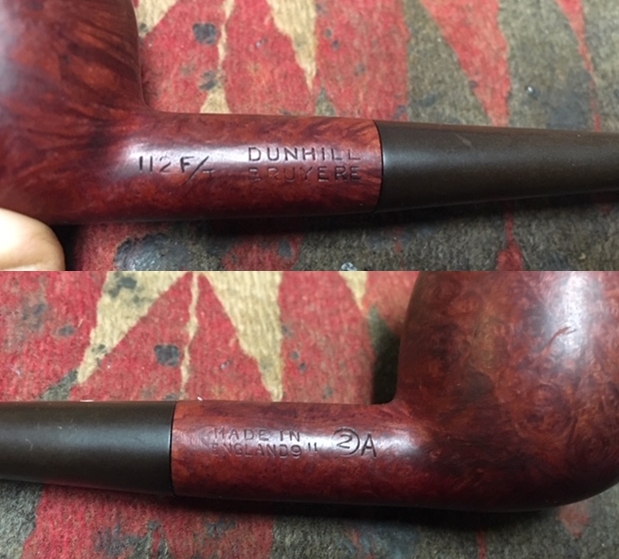
  2. Bruyere 112 F/T Made in England 9/11 Circle 2A – Group 2 size Bruyere made in 1969 and sold in 1971. Stem is oxidized, tooth marks and chatter near the button, some calcification with damage to the button. Finish is dirty, bowl caked and lava overflow on the rim top. Bowl is out of round, damaged edge. I finished the restoration on it. Here is the link to the blog – (https://rebornpipes.com/2019/12/28/restoring-a-1969-dunhill-bruyere-112-f-t-apple-from-bob-kerrs-estate/).
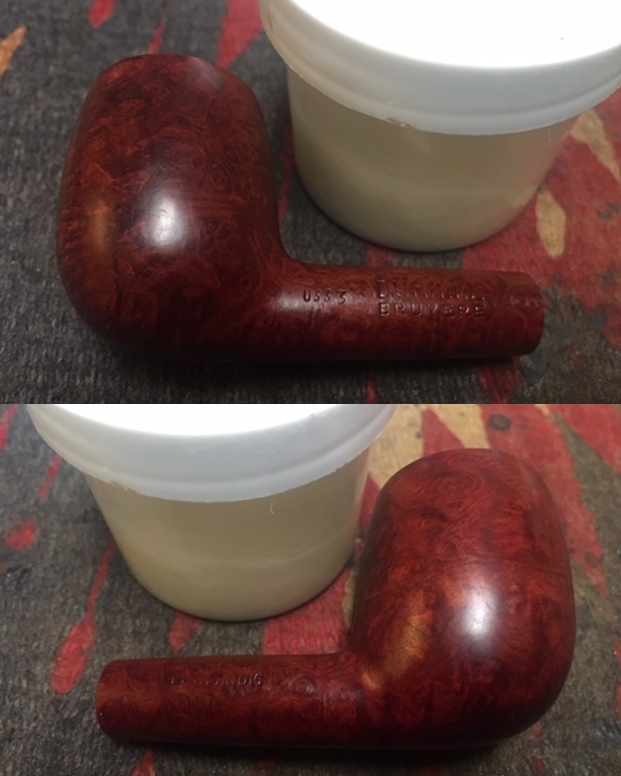
  3. Bruyere 0333 Made in England 16 made in 1976. Stem is oxidized, tooth marks and chatter near the button, some calcification with damage to the button. Finish is dirty, bowl caked and lava overflow on the rim top. Bowl is out of round, damaged edge. I finished the restoration on it. Here is the link to the blog – (https://rebornpipes.com/2019/12/29/restoring-a-1976-dunhill-bruyere-0333-billiard-from-bob-kerrs-estate/).
  4. Bruyere 41061 Made in England 18 made in 1978. Stem is oxidized, tooth marks and chatter near the button, some calcification with damage to the button. Finish is dirty, bowl caked and lava overflow on the rim top. Bowl is out of round, damaged edge. I finished the restoration on it. Here is the link to the blog – (https://rebornpipes.com/2019/12/24/restoring-a-1978-dunhill-bruyere-41061-from-bob-kerrs-estate/).
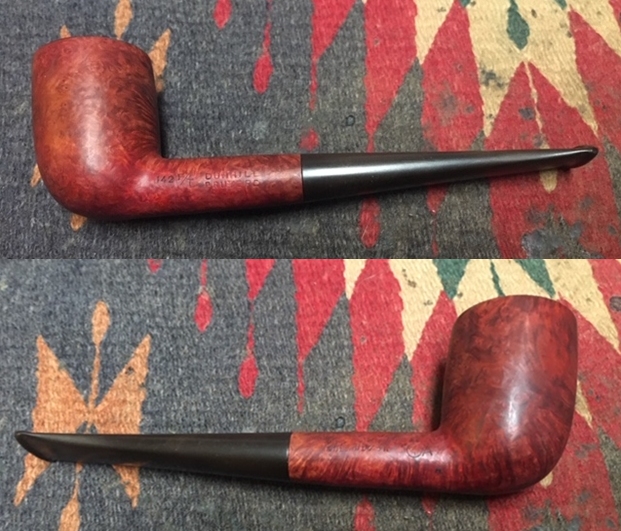
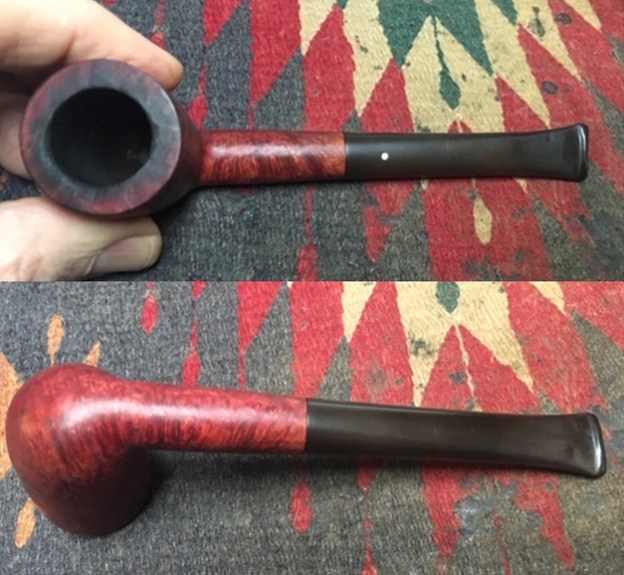
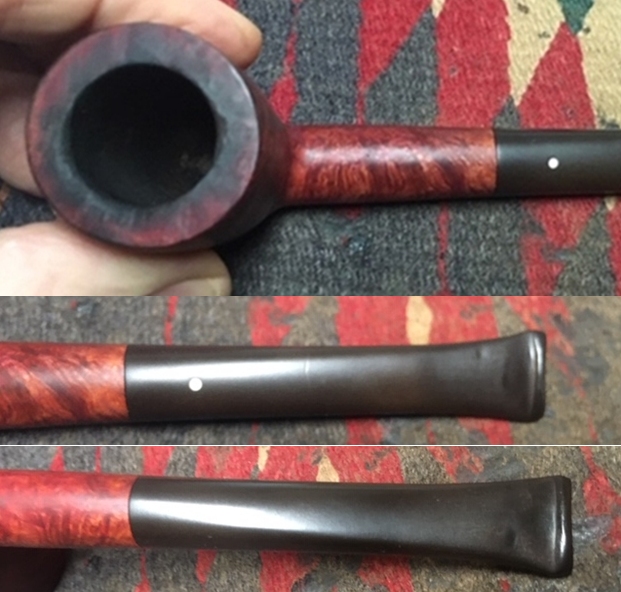
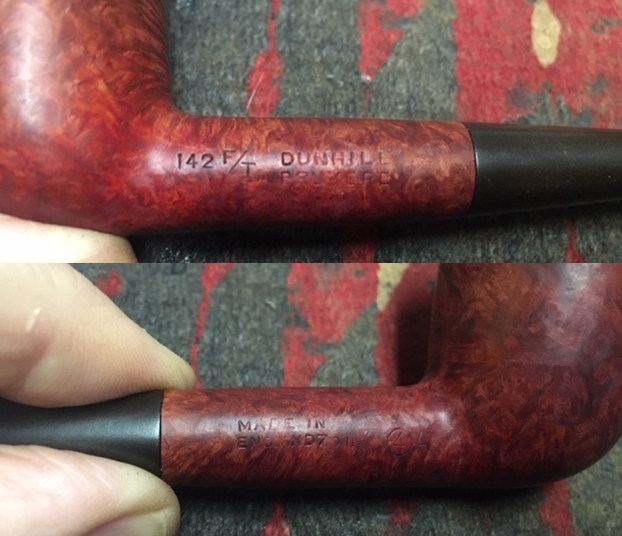
  5. Bruyere 142 F/T Made in England 7/9/11 Circle 4A – Group for size Bruyere made in 1967 and sent out in 1969 or 1971. Stem is oxidized, tooth marks and chatter near the button, some calcification with damage to the button. Finish is dirty, bowl caked and lava overflow on the rim top. Bowl is out of round, damaged edge. I finished the restoration on it. Here is the link to the blog – https://rebornpipes.com/2019/12/27/restoring-a-1967-dunhill-bruyere-142-f-t-billiard-from-bob-kerrs-estate/
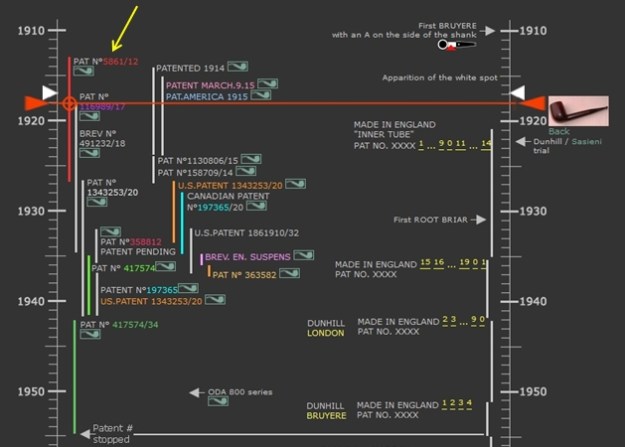
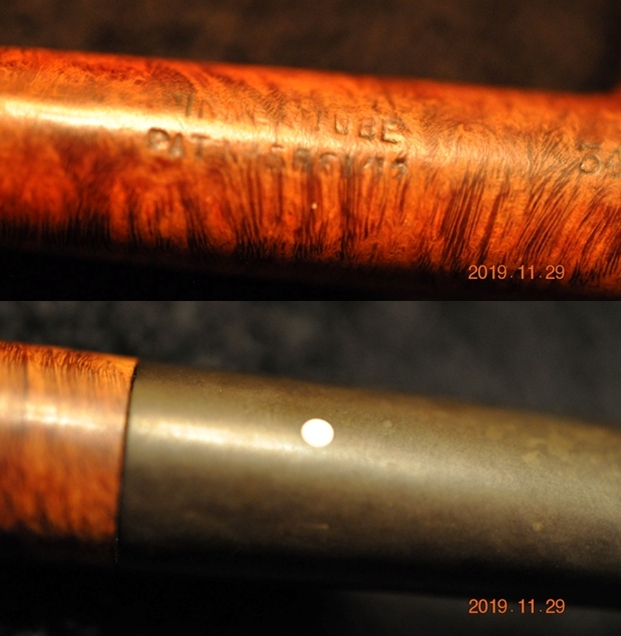
  6. (A) Dunill London Inner Tube PAT N°5861/12 Shape 34. Stem is oxidized, tooth marks and chatter near the button, some calcification with damage to the button. Finish is dirty, bowl caked and lava overflow on the rim top. Bowl is out of round, damaged edge. I finished the restoration on it. Here is the link to the blog – (https://rebornpipes.com/2019/12/26/restoring-a-1913-a-dunhill-london-34-billiard-from-bob-kerrs-estate/).
  7. (Ao) Dunhill London 113 Made in England 5 PAT N°158709/14. Stem is oxidized, tooth marks and chatter near the button, some calcification with damage to the button. Finish is dirty, bowl caked and lava overflow on the rim top. Bowl is out of round, damaged rim edges. I finished the restoration on it. Here is the link to the blog – (https://rebornpipes.com/2019/12/25/restoring-a-1925-ao-dunhill-london-113-billiard-from-bob-kerrs-estate/).
  8. Root Briar 31032 Made in England 18 – made in 1978. Stem is oxidized, tooth marks and chatter near the button, some calcification with damage to the button. Finish is dirty, bowl caked and lava overflow on the rim top. Bowl is out of round, damaged edge. I finished the restoration on it. Here is the link to the blog – (https://rebornpipes.com/2019/12/23/restoring-a-1978-dunhill-root-briar-31032-billiard-from-bob-kerrs-estate/).

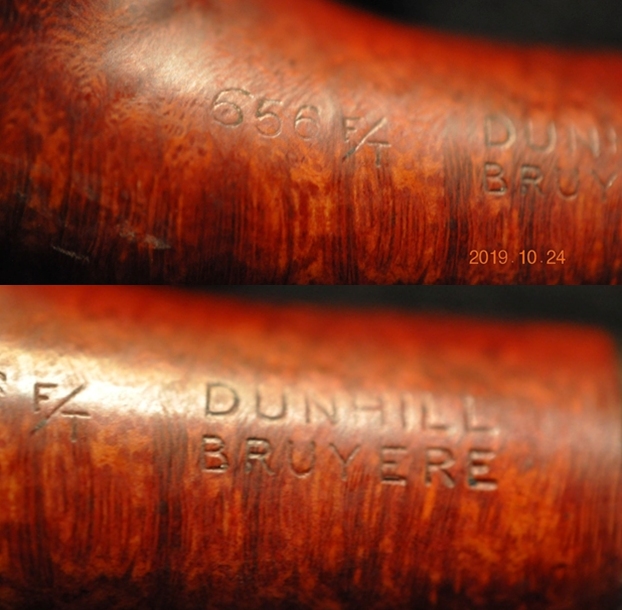
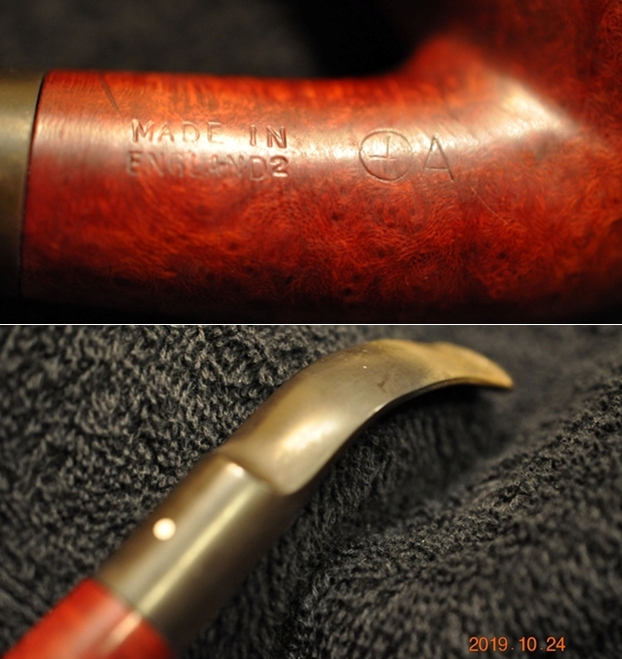
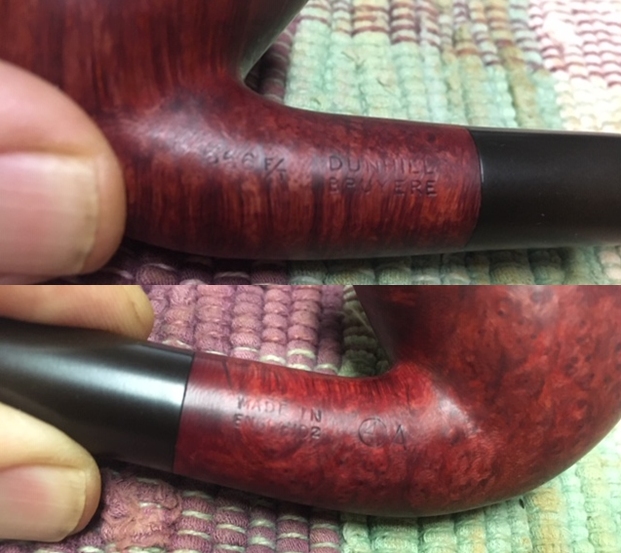
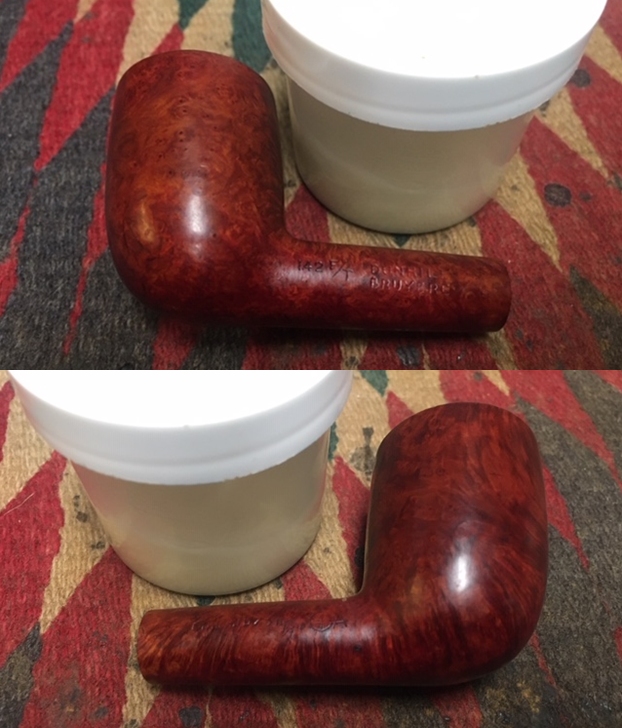
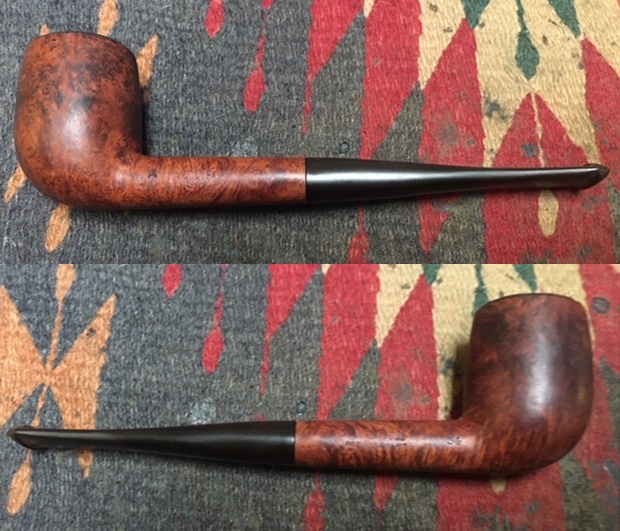
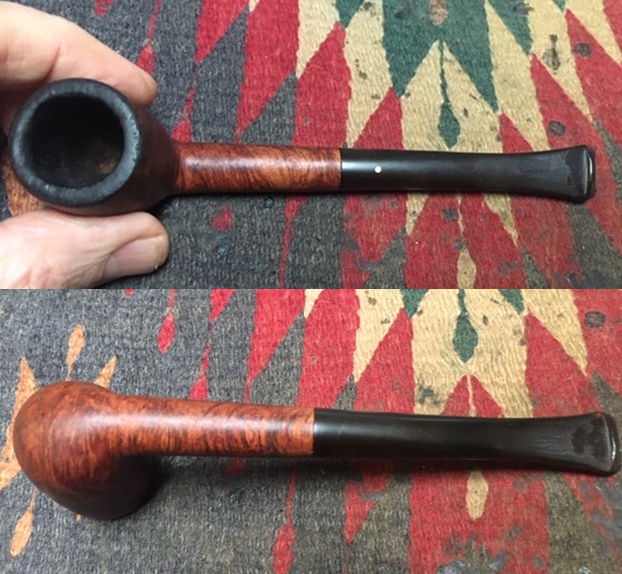
I finished work on #2, #3, #4, #5, #6, #7 & #8 and turned my attention to sole remaining Dunhill in Bob’s Collection #1, another heavily used pipe but this time a Bent Billiard shaped pipe with a saddle stem. The pipe was stamped on the left side of the shank with the shape number 656 F/T next to the bowl/shank junction. That is followed by Dunhill over Bruyere. On the right side of the shank it is stamped Made in England 2 followed by circle 4A. It appears that the pipe stamped as this one is was made in 1962. The 656 F/T is a Bent Billiard with a fish tail (F/T) saddle stem. The circle 4 is the group/size of the pipe and A is the designation for Bruyere. This is the last pipe that I have to work on from the Dunhill collection.

I am once again including Chuck Stanion’s eloquent description of the Bruyere on the smokingpipes.com site as follows (https://www.smokingpipes.com/pipes/new/dunhill/moreinfo.cfm?product_id=346421):

The Bruyere was Alfred Dunhill’s original finish upon launching his brand of premium pipes and smoking accessories and was the only Dunhill finish from 1910 until 1917. Even after the addition of other finishes, the Bruyere maintained a high level of popularity, becoming synonymous with what is thought of, even today, as the quintessential pipe. To achieve the iconic, ruby hue and saturation, a skilled craftsman painstakingly layers particular stains in a precise manner, then meticulously polishes the pipe to a high luster. The final result is, simply put, timeless.

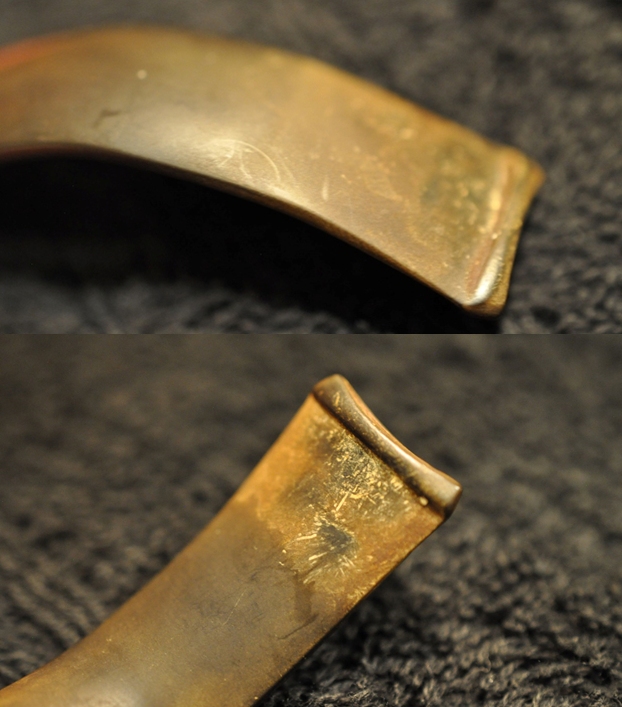
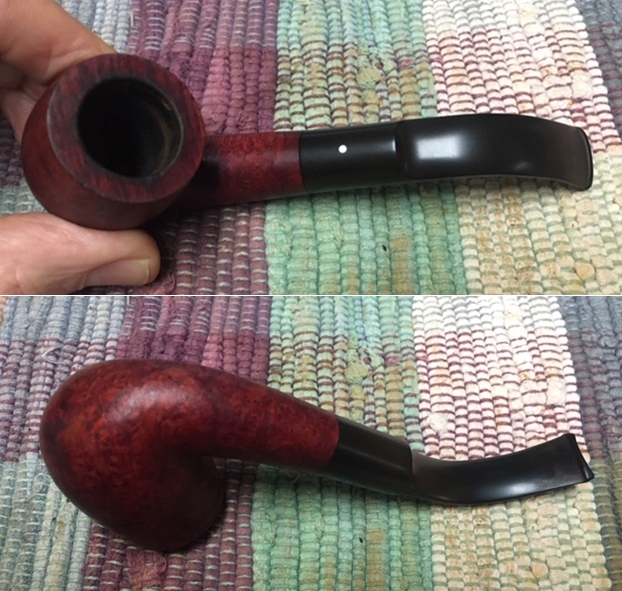
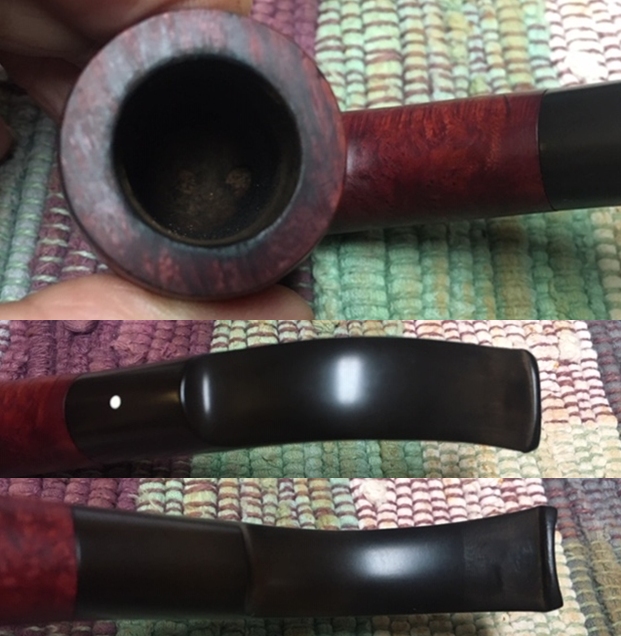
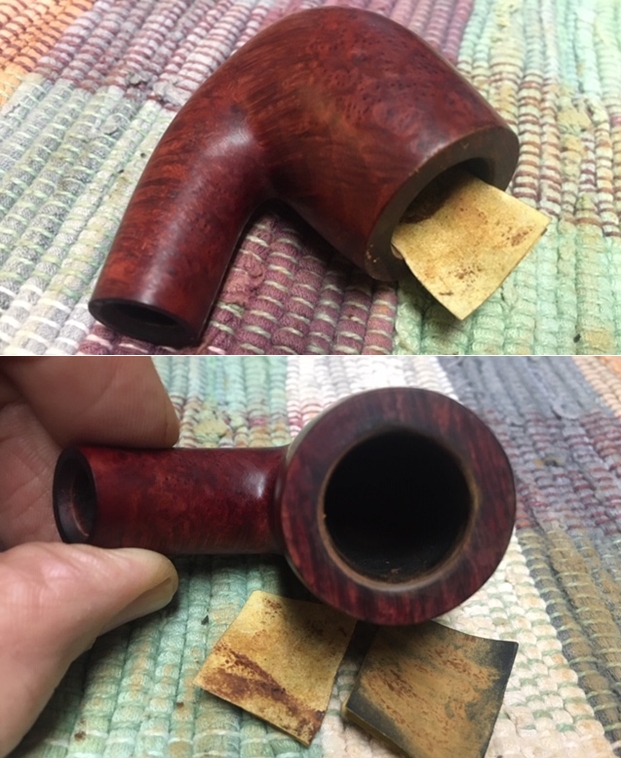
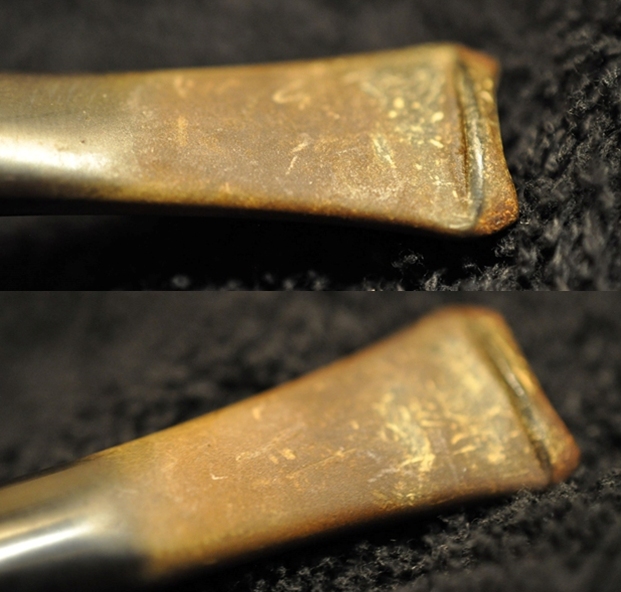
Like Bob’s other Dunhill pipe this one also had a thick cake in the bowl with remnants of tobacco stuck on the walls. There was a thick lava overflow on the rim so it was hard to know what kind of damage lay beneath the covering. Once it was cleaned I would have a better idea of the condition of the rim top. The grain that is poking through the grime and oils appears to be quite beautiful – birdseye grain on the bowl sides and cross grain on the front and back as well as the heel of the bowl. The stem was oxidized and calcified toward the end with some tooth chatter. There were also some tooth marks on both sides of the stem ahead of the button and on the button itself. There was the classic White Spot on the top of the stem. Jeff took photos of the pipe before he started his cleanup work on it.  Jeff took photos of the bowl and rim top to show the thick, hard cake in the bowl with remnants of tobacco stuck on the walls of the bowl. There was a thick lava build up on the smooth rim top and the edges of the bowl. The rim top and inner edges looked pretty good but it was hard to know for sure. The outer edges looked to be okay.   Jeff took photos of the sides and heel of the bowl to show the condition of the finish. You can see the beautiful grain patterns around the sides of the bowl and shank. Even under the dirt and debris of the years it looked very good.     The stamping is very readable. On the left side of the shank you can see 656 F/T which is the shape number. Next to that it is stamped Dunhill over Bruyere. On the right side it reads Made in England2 and a circle 4A. Jeff included a pic of the White Spot on the stem.     Jeff took photos of the top and underside of the stem showing the tooth chatter, scratching, calcification and oxidation on the stem surface and wear on the edges of the button.      I can’t begin tell you how great it feels to have Jeff’s help on cleaning up the pipes from Bob’s estate as the 125+ pipes were taking me a long time to do alone. In fact I doubt if I would have as many finished as I do now. Together we have restored over 60 pipes and Jeff has cleaned all of the remaining pipes for me. He cleaned this filthy pipe with his usual penchant for thoroughness that I really appreciate. This one was a real mess and I was looking forward to seeing what he had done with this one when I took it out of his box. It looked amazing and CLEAN. He reamed it with a PipNet pipe reamer and cleaned up the reaming with a Savinelli Fitsall Pipe Knife. He scrubbed out the internals with alcohol, pipe cleaners and cotton swabs until the pipe was clean. He scrubbed the exterior of the bowl with Murphy’s Oil Soap and a tooth brush to remove the grime and grit on the briar and the lava on the rim top. The finish looks good with great looking grain around the bowl and shank. The rim top looked better on this pipe. The condition of the inner and outer edges was not too bad. The stem looked a lot better. Jeff soaked the stem in Before & After Deoxidizer to remove the oxidation on the rubber. The pipe was ready for me to carry on the next part of the process. I took some close up photos of the rim top and also of the stem surface. I wanted to show how well it had cleaned up and what needed to be done. The rim top was in remarkable condition. It was probably the best preserved rim top of the last 9 pipes I have worked on. There was some darkening all around the top of the bowl and on the inner edge. There was some burn damage on the left side of the inner edge but it was in good condition. The outer edge looked very good.  I also took close up photos of the stem to show the tooth marks and chatter on the stem surface.  The stamping appeared to be as clear as it was before the cleanup work. This is just one of the things I appreciate about Jeff’s cleanup is that he works to protect and preserve the nomenclature on the shank of the pipes that he works on. I took some photos to show the stamping. Bob loved his Dunhill pipes and it was obvious that he enjoyed smoking them. Some appeared to be daily smokes while others he seemed to reserve for special occasions. Some seemed like they must have hung in his mouth while he did his carving while others were smoked in his chair. Having worked on over 60 of his pipes so far I am getting a feel for them. This one is in rough condition and I suppose it might well have been before Bob took up the trust. I suppose I won’t ever know for sure but it certainly has a long and interesting story if it could only tell it.

I am sure that many of you have read at least some of the other restoration work that I have done on previous pipes. You have also read what I have included about Bob Kerr, the pipeman who held these pipes in trust before I came to work on them (see photo to the left). Also, if you have followed the blog for long you will already know that I like to include background information on the pipeman whose pipes I am restoring. For me, when I am working on an estate I really like to have a sense of the person who held the pipes in trust before I worked on them. It gives me another dimension of the restoration work. Bob’s daughter wrote a short tribute to her father. I thank you Brian and tell your wife thank you as well.

I am delighted to pass on these beloved pipes of my father’s. I hope each user gets many hours of contemplative pleasure as he did. I remember the aroma of tobacco in the rec room, as he put up his feet on his lazy boy. He’d be first at the paper then, no one could touch it before him. Maybe there would be a movie on with an actor smoking a pipe. He would have very definite opinions on whether the performer was a ‘real’ smoker or not, a distinction which I could never see but it would be very clear to him. He worked by day as a sales manager of a paper products company, a job he hated. What he longed for was the life of an artist, so on the weekends and sometimes mid-week evenings he would journey to his workshop and come out with wood sculptures, all of which he declared as crap but every one of them treasured by my sister and myself. Enjoy the pipes, and maybe a little of his creative spirit will enter you!

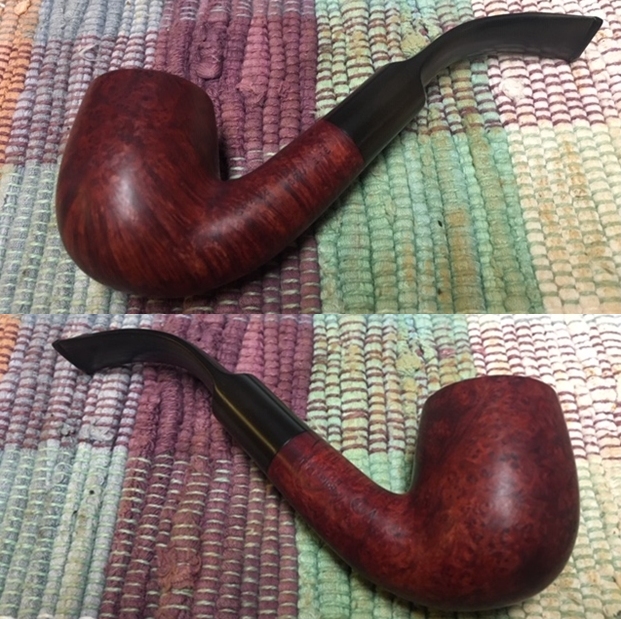
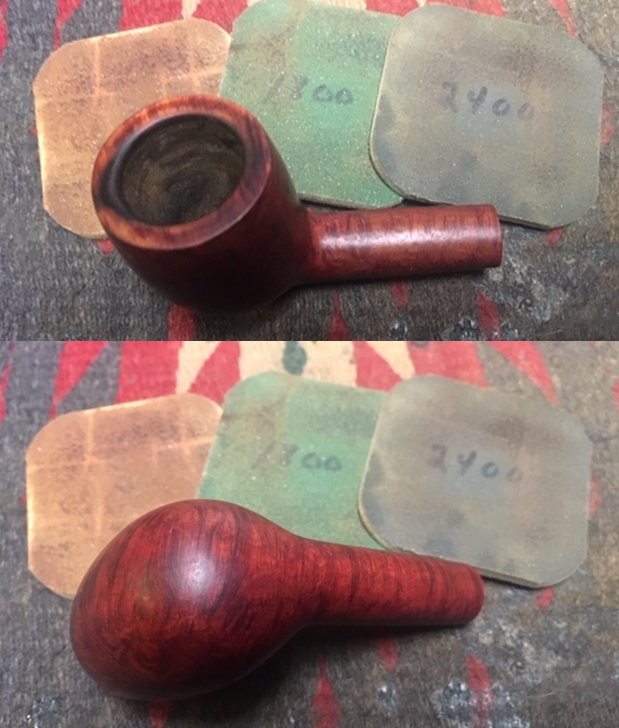
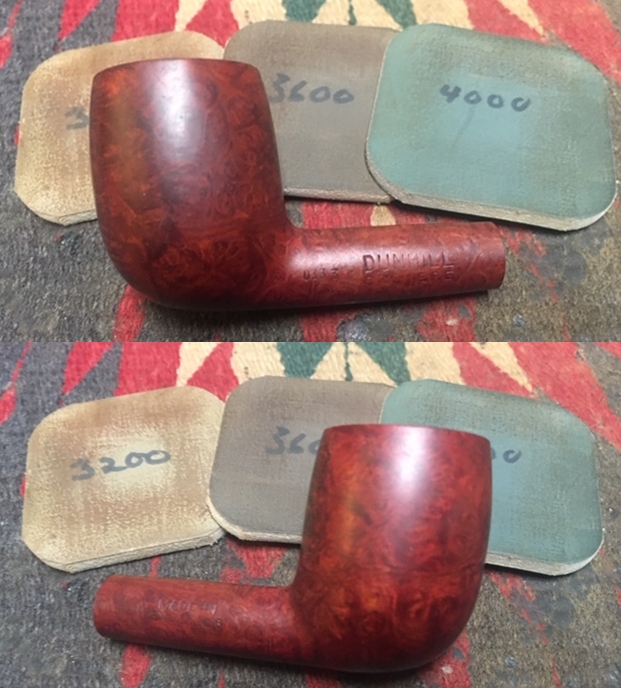
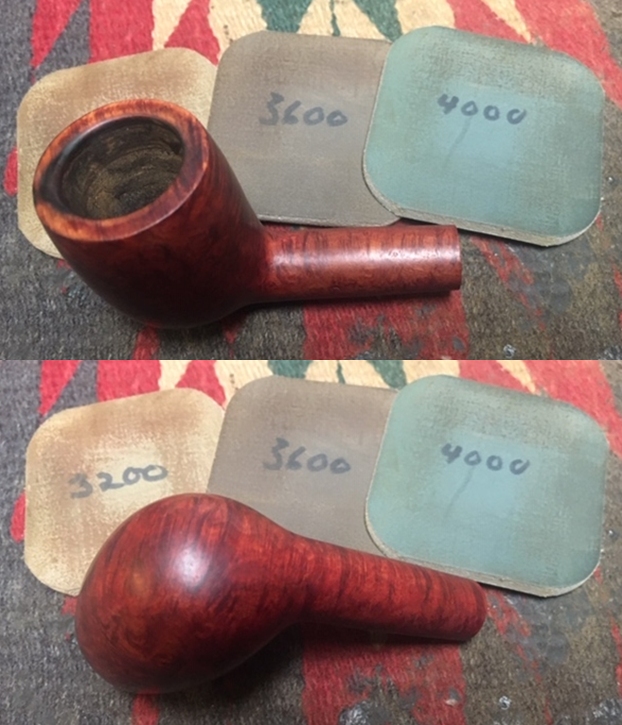
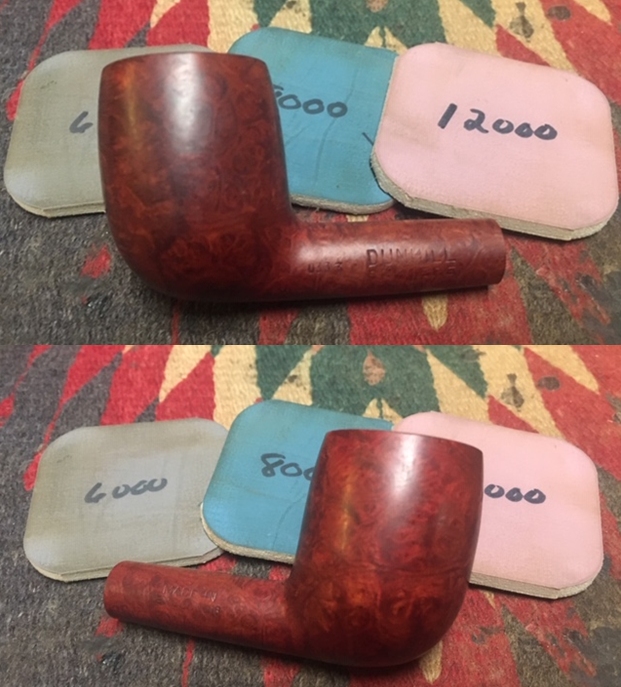
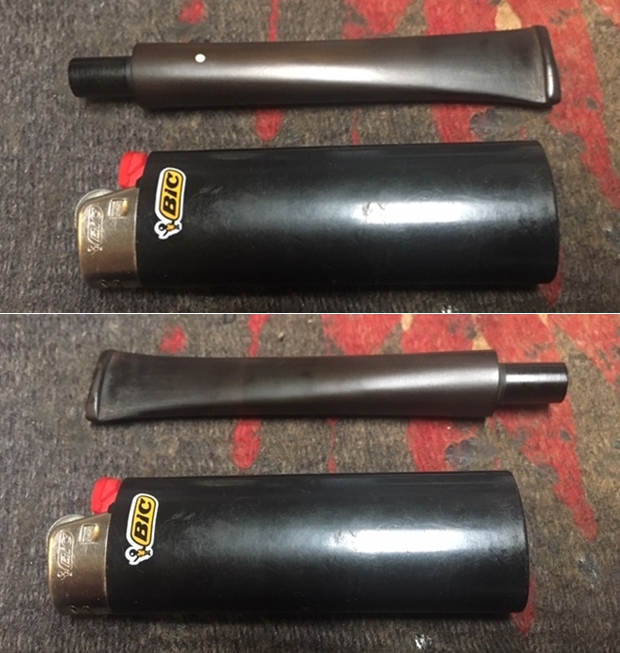
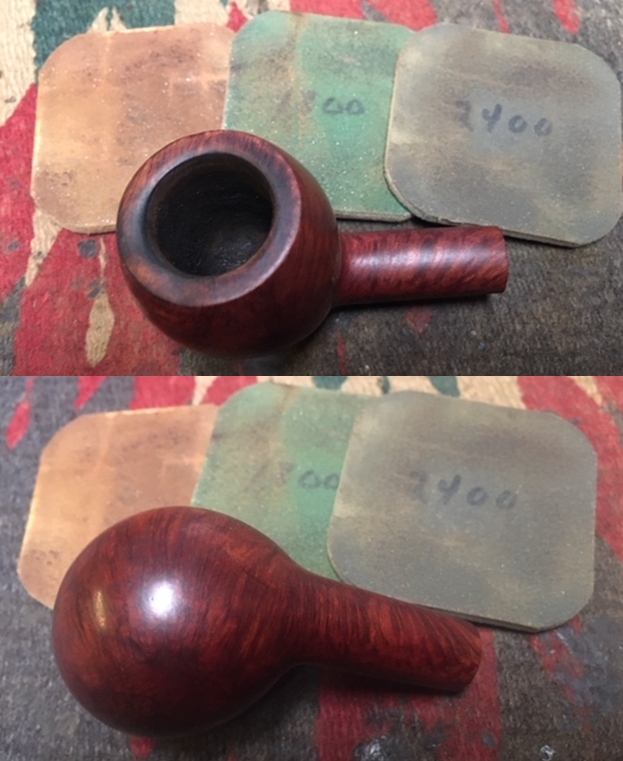
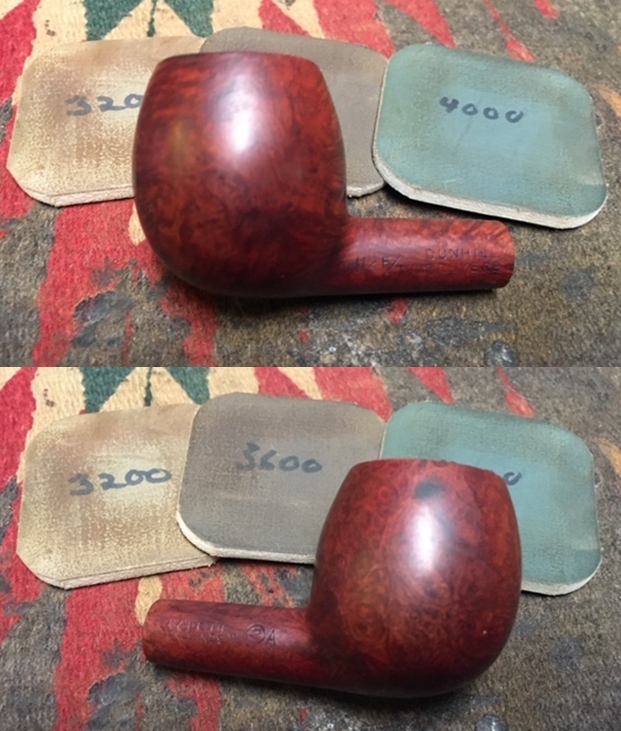
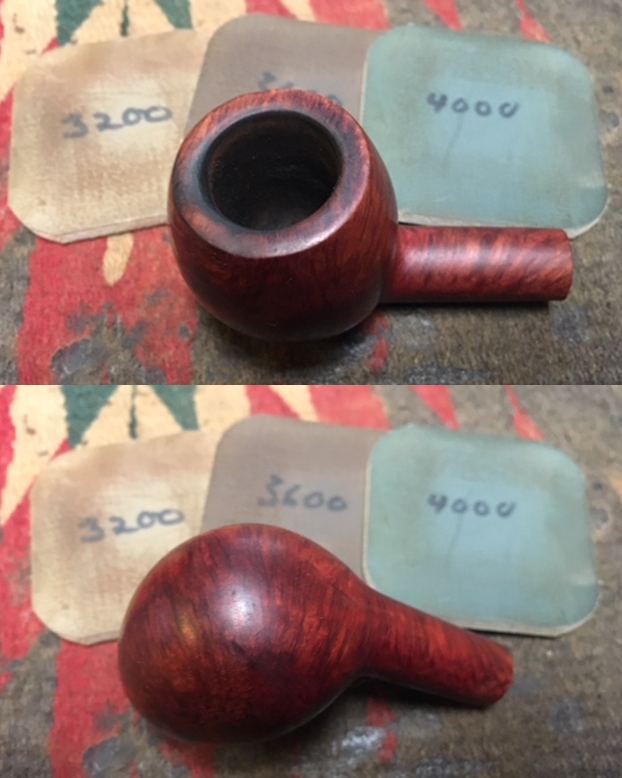
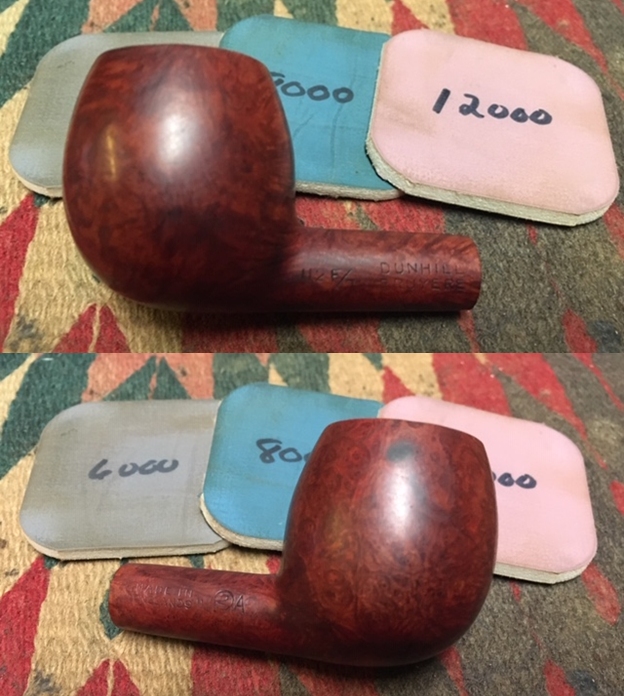
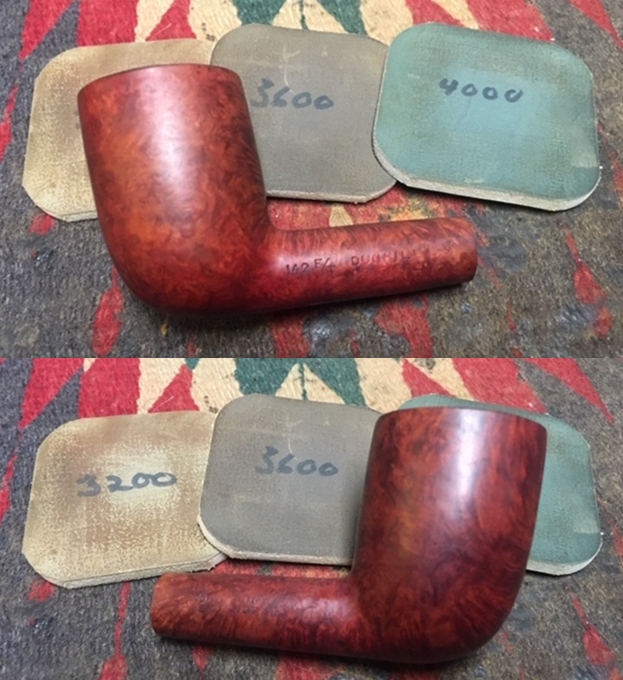
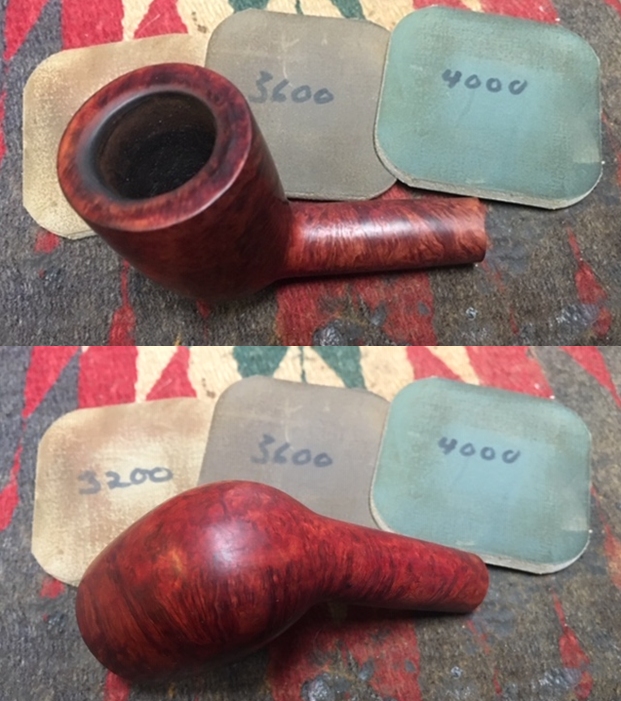
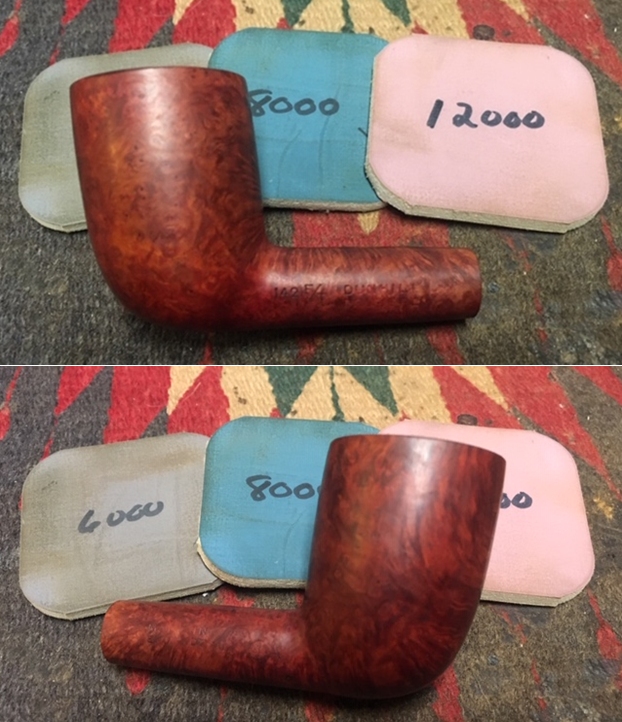
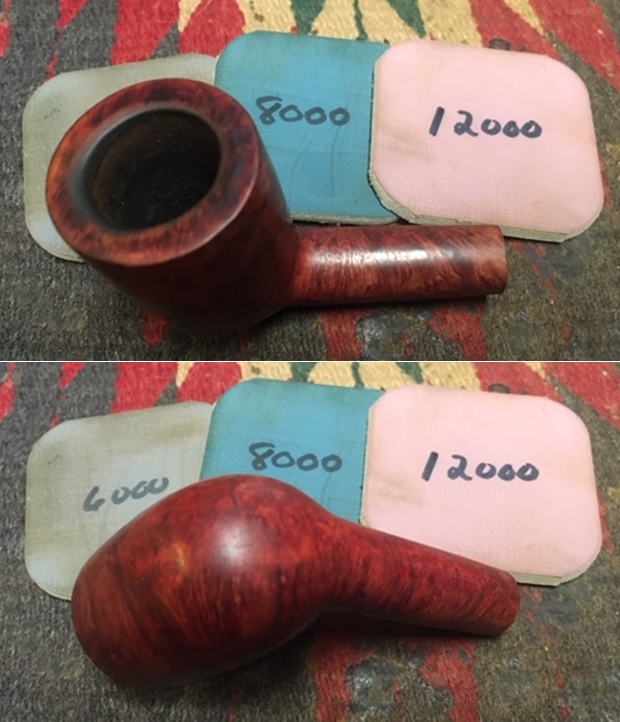
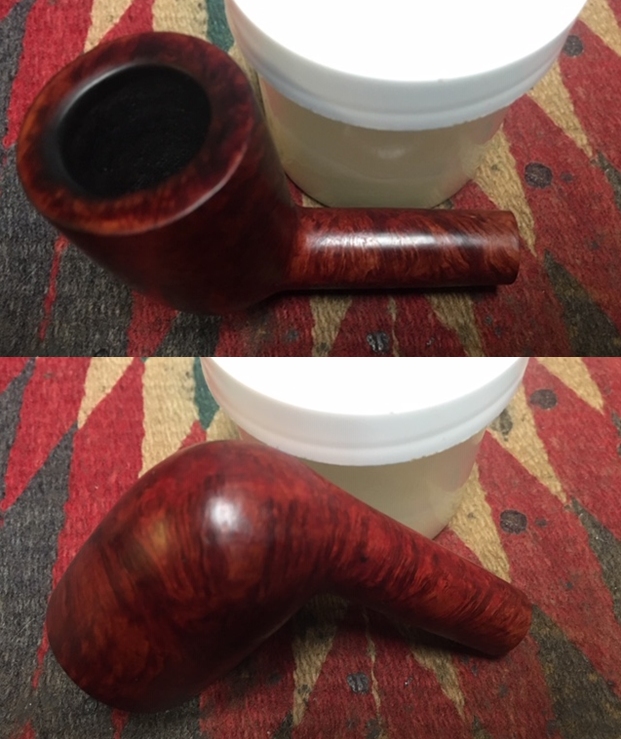
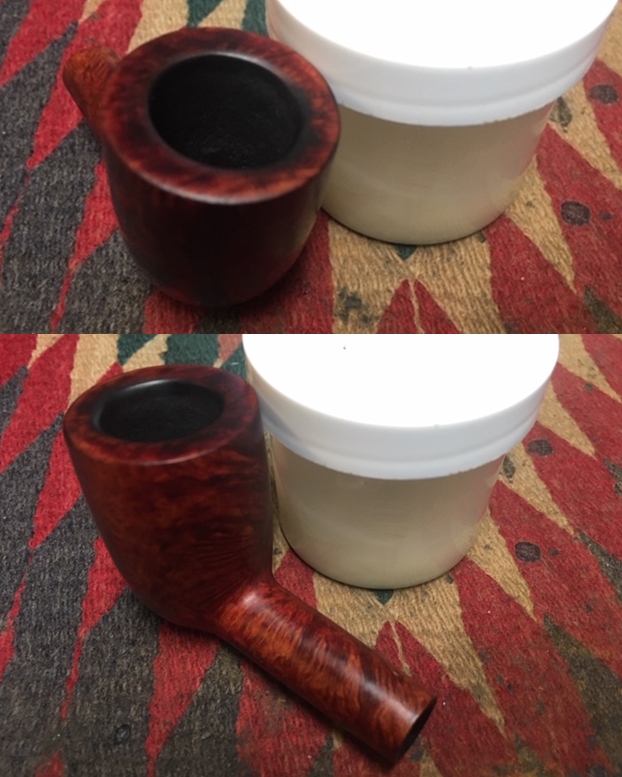
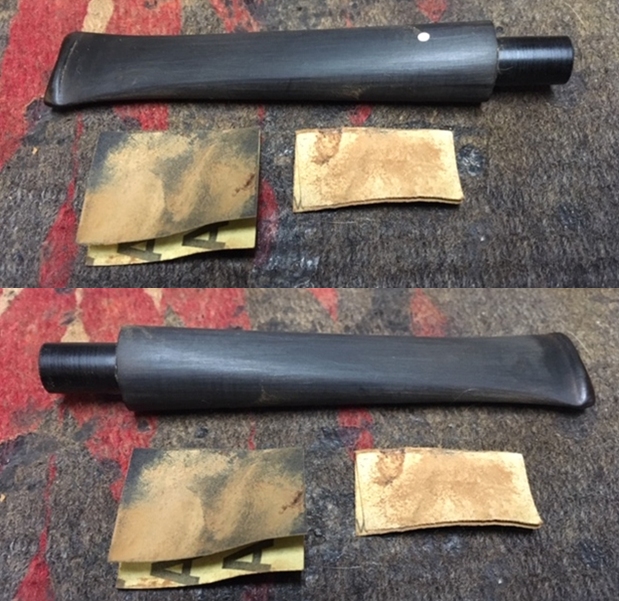
It was time to get on with the restoration of this Dunhill Bruyere 656 F/T Bent Billiard. It is not only the last of the Dunhill pipes from Bob’s Estate but it was the only bent Bruyere in the collection. I want to send a shout out to Jeff for the hard cleanup work that he does on each of these pipes. They were a real mess when I sent them to Jeff and I have to tell you it was great that I can start my part of the process with a clean pipe. I decided to start the process by dealing with the the burn damage to the left inner edge of the bowl. I generally try to minimize the intrusiveness of the work on the rim and the inner edge. It was burned on the edge of the left side. I use a folded piece of 220 grit sandpaper to carefully bevel the inner rim with a slight bevel all the way around. The second photo shows the rim edge after the work of beveling the inner edge has been completed. I polished it lightly with 400 grit wet dry sandpaper.  I polished the briar on the rim top and bowl with worn micromesh sanding pads – wet sanding it with 1500-12000 grit micromesh sanding pads. I wiped it down after each pad with a damp cloth. I find that the worn pads do a great job polishing and still retain the original patina of the pipe.   I rubbed the bowl and rim down with Before & After Restoration Balm. I worked it into the surface of the briar with my fingertips to clean, enliven and protect it. I let the balm sit for a little while and then buffed the pipe with a cotton cloth to raise the shine. I really like watching the Balm do its magic and bring the briar alive.     With the bowl done it was time to address the stem. I was a little surprised as not only was this the last of Bob’s  Dunhill’s but it was also the only one that had a tenon made to accommodate a 9mm filter. The dents in the top and underside were the right depth for me to lift them. I “painted” the surface with the flame of a Bic lighter to lift the dents and it worked exceptionally well.    I sanded the surface of the stem with 220 grit sandpaper to remove the light chatter in the stem surface and the remaining oxidation in the vulcanite. I polished it with 400 grit wet dry sand paper.  I rubbed the stem down with Denicare Mouthpiece Polish. I have a few tins of this laying around so I am trying to use them up. I have found it is a great pre-polish for my use as it shows me areas that I need to work on with the micromesh sanding pads.  I polished the stem with micromesh sanding pads – wet sanding with 1500-12000 grit sanding pads. I wiped it down after each pad with a damp cloth to remove the sanding dust. I polished it further with Before & After Pipe Polish – both Fine and Extra Fine. I finished by rubbing the stem down with some “No Oxy Oil” to protect the vulcanite. I am experimenting with the product from Briarville and tracking how it works so I can write a review of it. Finishing this pipe is a perfect way to end my restorations for 2019. It is the last of Bob Kerr’s Estate Dunhill Collection. It is a beautiful Dunhill Bruyere 656F/T Bent Billiard made in 1962. Like each of the pipes in Bob’s estate I really look forward to this point in the process when it is put back together, polished and waxed. I put the bowl and stem back together. I polished the bowl and stem with Blue Diamond to polish out the scratches in the briar and the vulcanite. I gave the bowl and the stem multiple coats of carnauba wax. I buffed the pipe with a clean buffing pad to raise the shine. I hand buffed it with a microfiber cloth to deepen the shine. The pipe polished up pretty nicely. The grain around the bowl and shank really came alive with the wax and polish. The black of the saddle vulcanite White Spot stem is a beautiful contrast to the reds and browns of the finished bowl and shank. This was another Dunhill that was a lot of fun to work on thanks to Jeff’s cleanup work. The pipe is comfortable pipe to hold in the hand. The finished pipe is shown in the photos below. The dimensions of the pipe are Length: 5 ¾ inches, Height: 2 inches, Outside diameter of the bowl: 1 ¼ inches, Chamber diameter: ¾ of an inch. This 1962 Bruyere Bent Billiard is a beauty should last for many more years. It is one that will be on the rebornpipes store very soon. If you are interested let me know. I have a lot more of Bob’s estate to work on of various brands. Perhaps one of those will catch your attention. Thanks for reading this blog and my reflections on the pipe while I worked on it. This is an interesting estate to bring back to life.

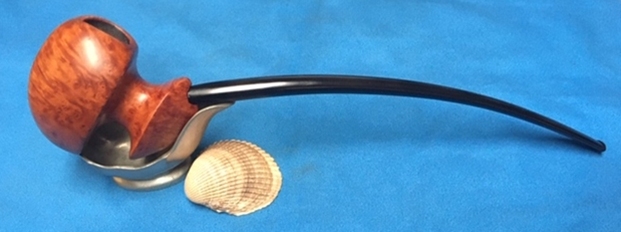
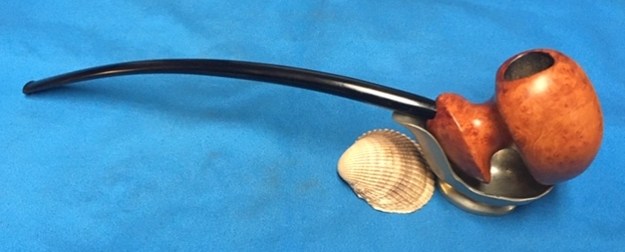
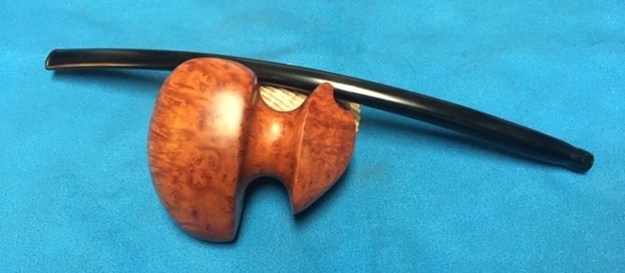
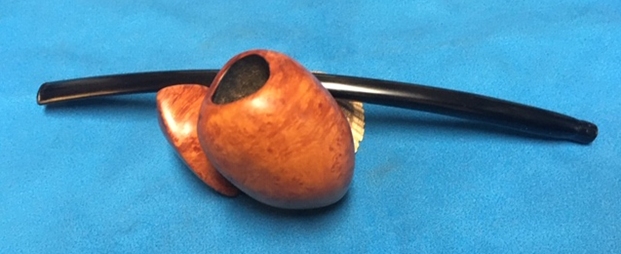
Finally Getting to Finish a Churchwarden Stem for a Chimera Bowl that Alex gave me.


Blog by Steve Laug

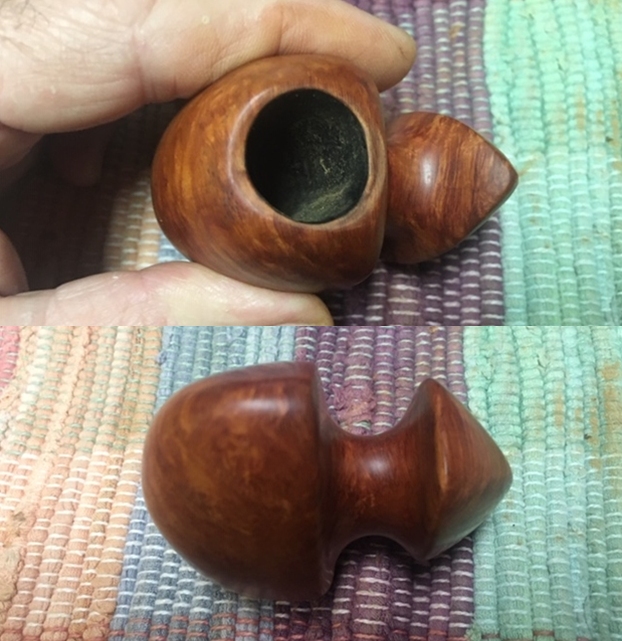
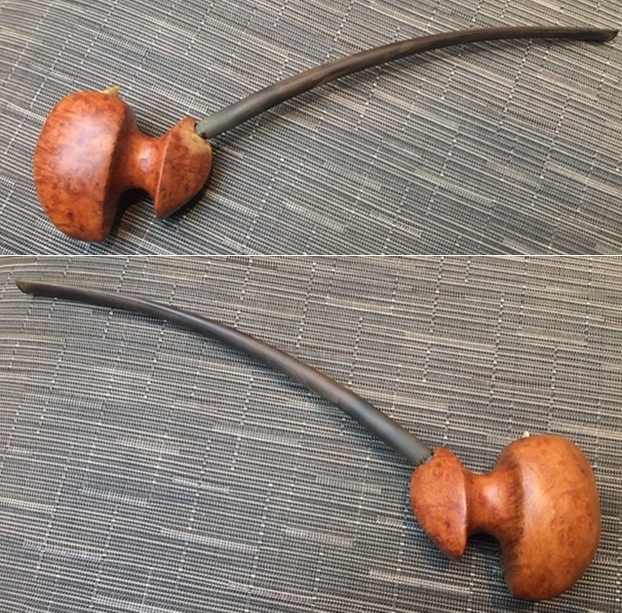
Over a year ago Alex gave me a second bowl by Tedd Weitzman that needed a stem. I recall that when he passed it to me that he said that Tedd had given the bowl to him to finish some time. It was one of Tedd’s early pipes and one that he had never finished. Now the bowl had made its way with Alex from Atlanta, Georgia to Vancouver, BC he moved here. As we spoke about it over the past months Alex thought that maybe it would make a good churchwarden. I figured that it would but I did not have a stem that would work for that at the moment so it went in the box of pipes that I have to work on for Alex.

Sunday evening I took the bowl out of the bowl and had a look at it. I turned it over in my hands several times and studied it. It is an interesting bowl and not a shape that I have a ready name for. Alex has said that it was made around the same time as the Chimera pipe that I had worked on for him previously (https://rebornpipes.com/2018/07/06/adding-some-length-to-a-chimara-blowfish/). Tedd Weitzman commented on the previous pipe and remembered it well. The Blowfish pipe that I wrote about in the above blog was stamped Chimera while this one bore no stamping. It was an unmarked bowl so I was going with Alex’s memory about it. The way that the pipe was designed it worked as a sitter without a stem. Hopefully it would do the same with the new stem I was going to fashion for it. There was some rim darkening on the back side of the rim top and a small nick on the front edge. The mortise was drilled in the peak of the shank end that was almost a tortoise shell shape. Describing it is a bit of a challenge but this might work. If you can imagine a tortoise of turtle shell – the mortise came out where the head and neck would have extended. There was some damage around the thin edges of the shank end and some wear there as well. Here are some photos of the bowl. Tedd and I had another common friend besides Alex – John Offerdahl. I could not immediately get a hold of Alex this morning so I sent a quick message to John. For the life of me I could not remember Tedd’s name or the brand of the pipe that I had done previously. When it was finished Alex had me send it to John who passed it back to Tedd… the circle closes. John responded promptly this morning that the pipe was definitely on that was made by Tedd. It was made during the time that he and Tedd had made pipes under the Chimera name around 2010.

I remembered that the Chimera was a creature from Greek mythology that was often depicted as a creature that was a hybrid. It often was shown as having the head of a lion and a got and a snake’s head at the end of the tail. Throughout time it has been used to mean any fictional creature composed of multiple different animals. Knowing John’s love of literature I was pretty sure that this is what was in his mind when he came up with the brand name for the pipes.

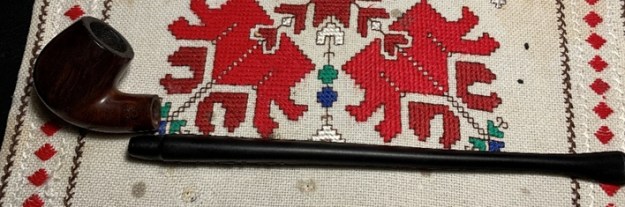
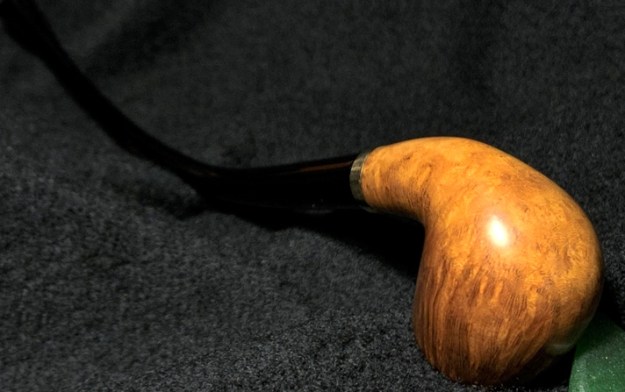
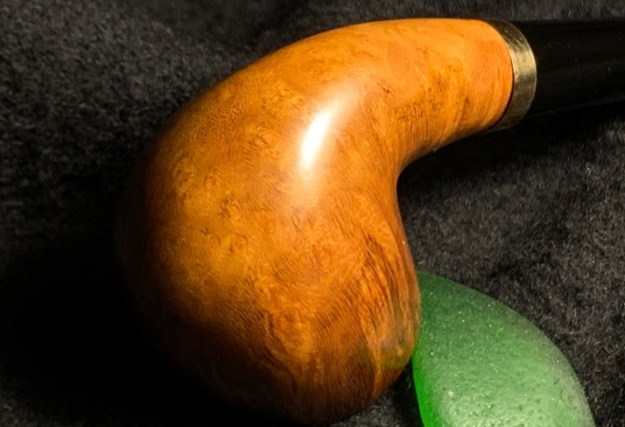
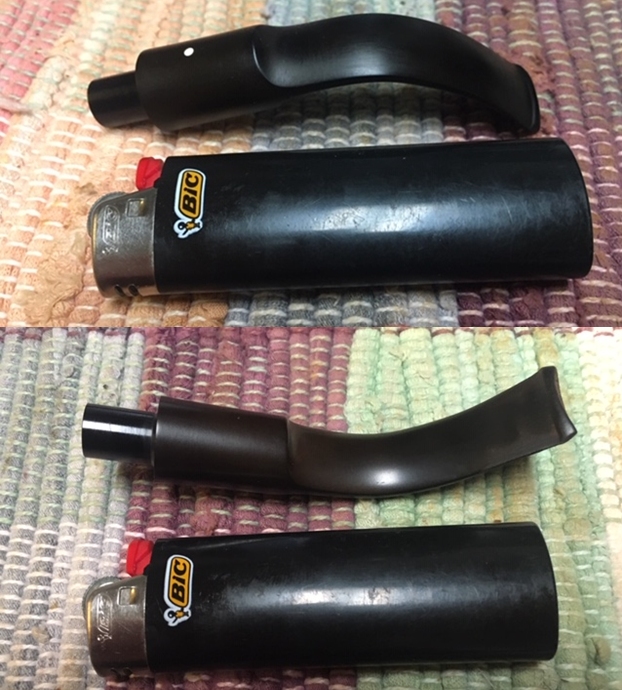
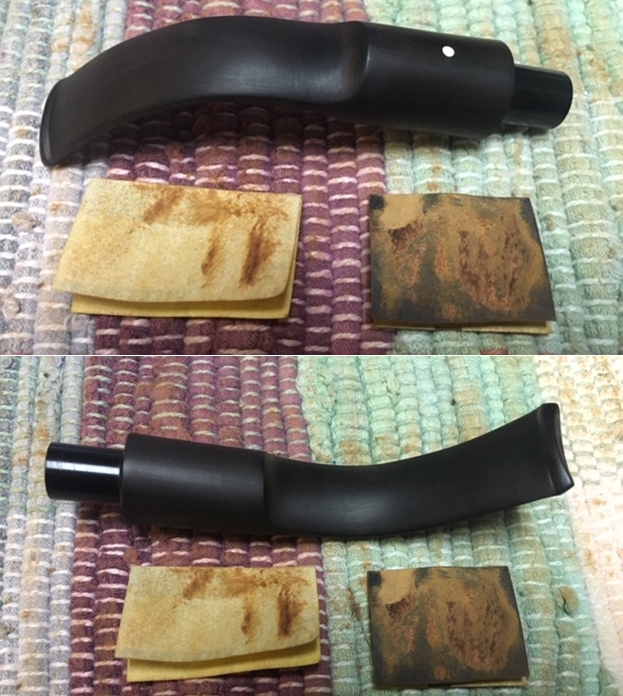
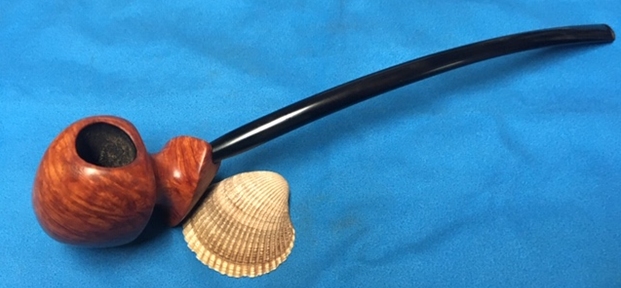
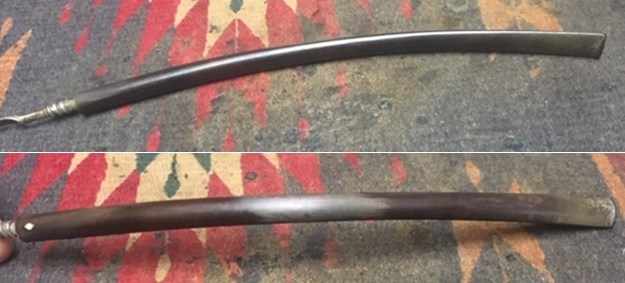
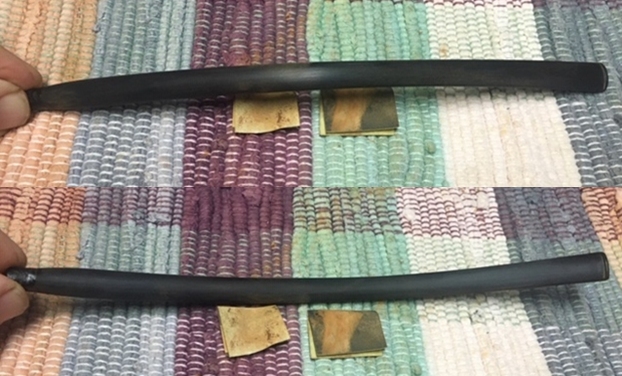
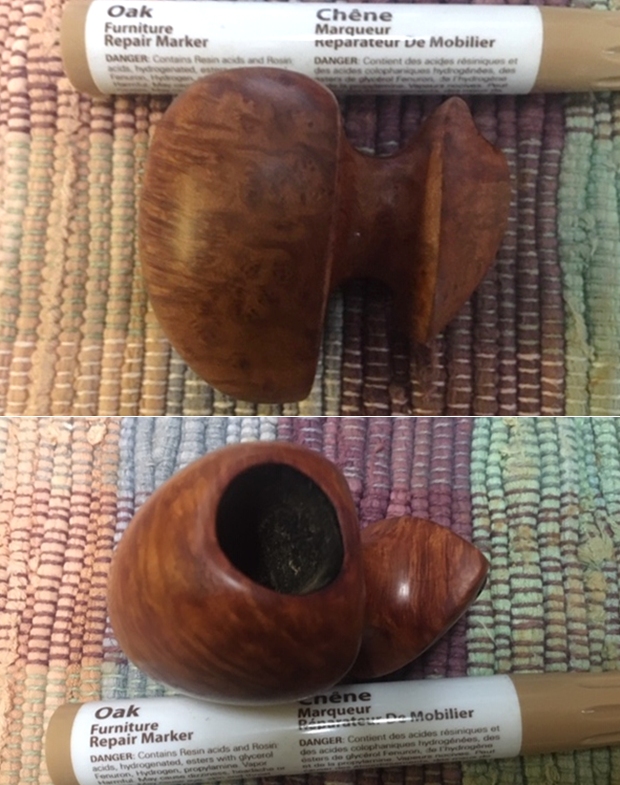
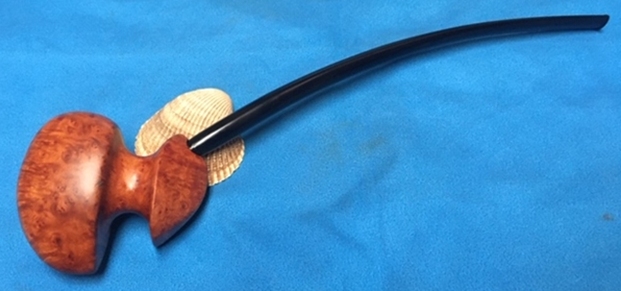
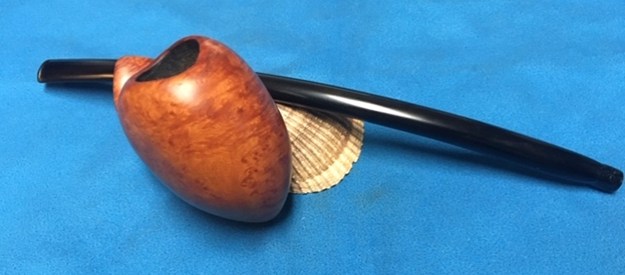
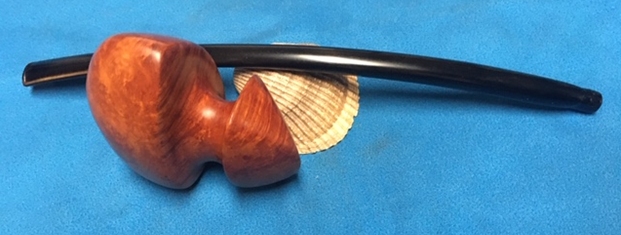
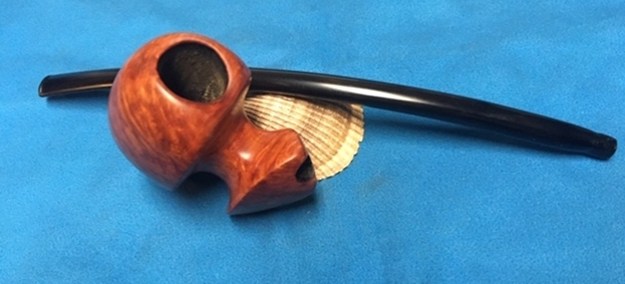
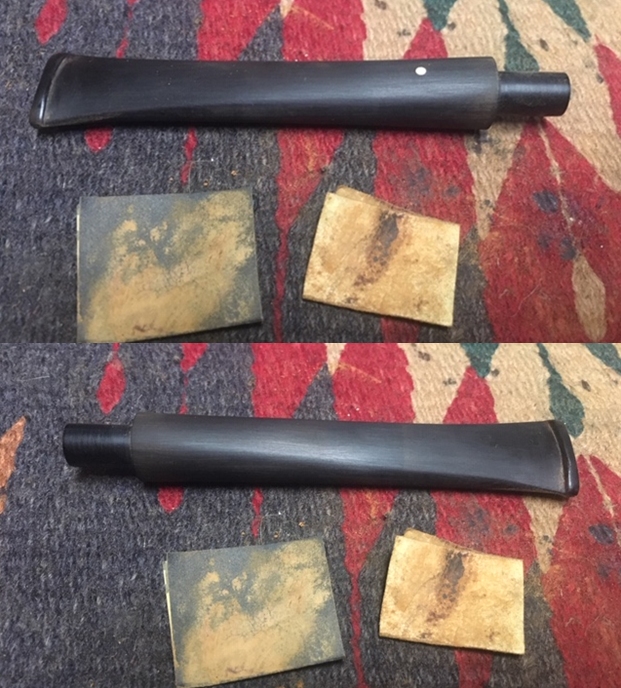
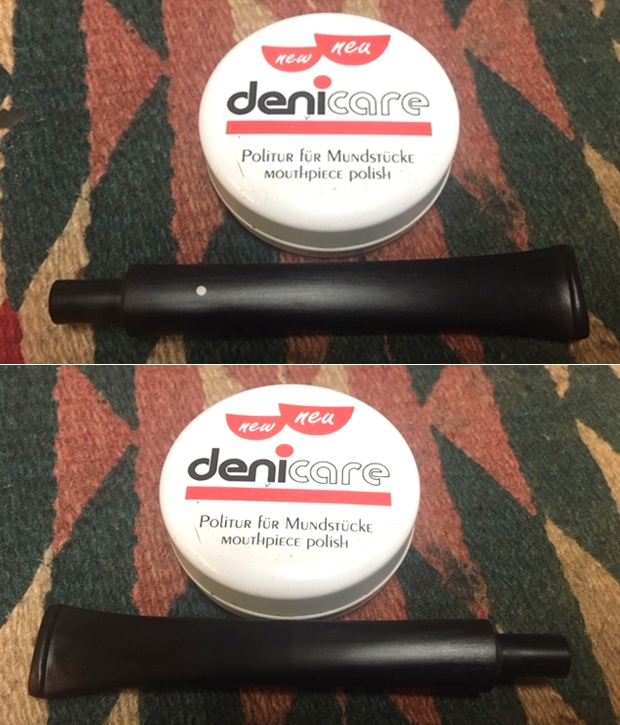
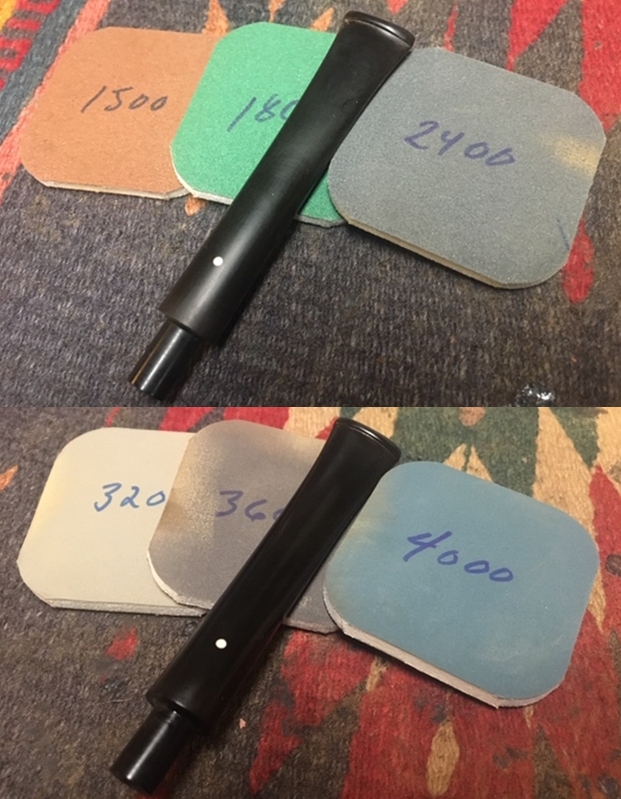
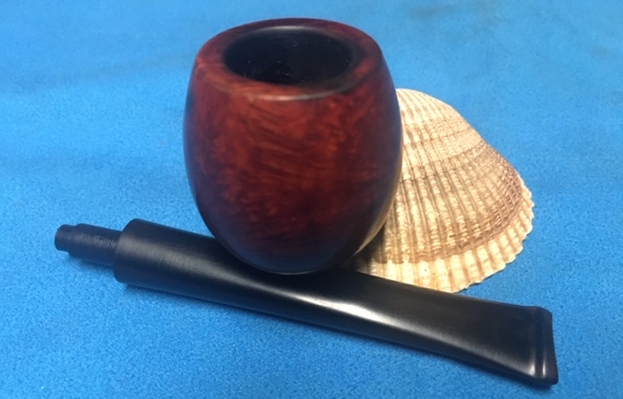
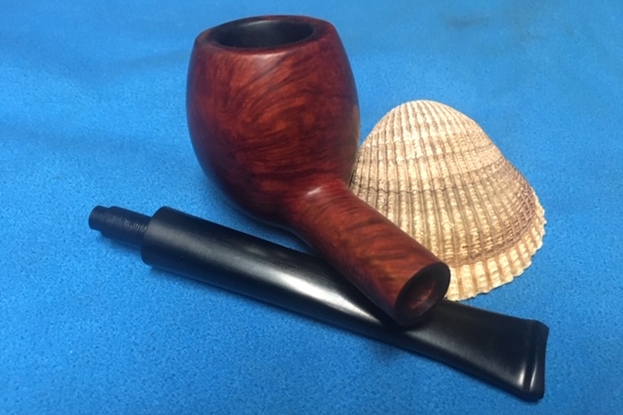
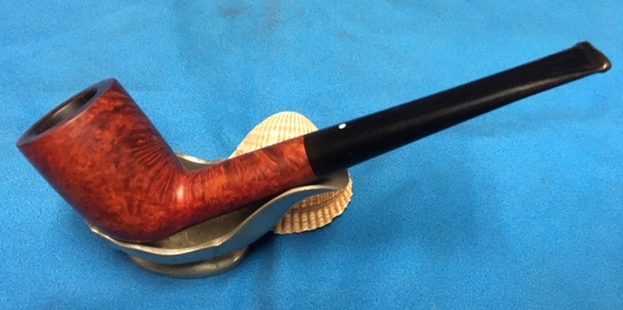
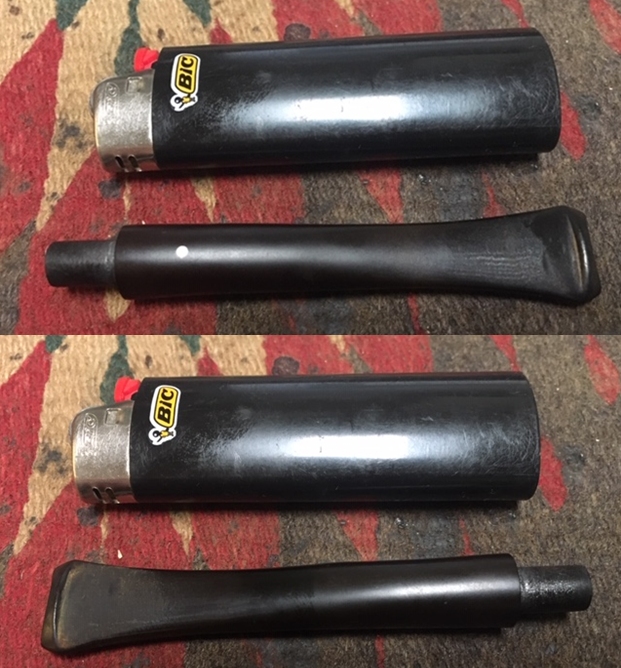
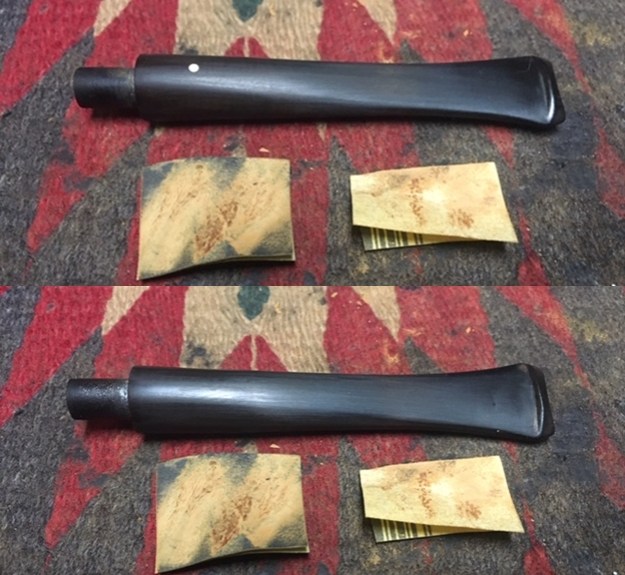
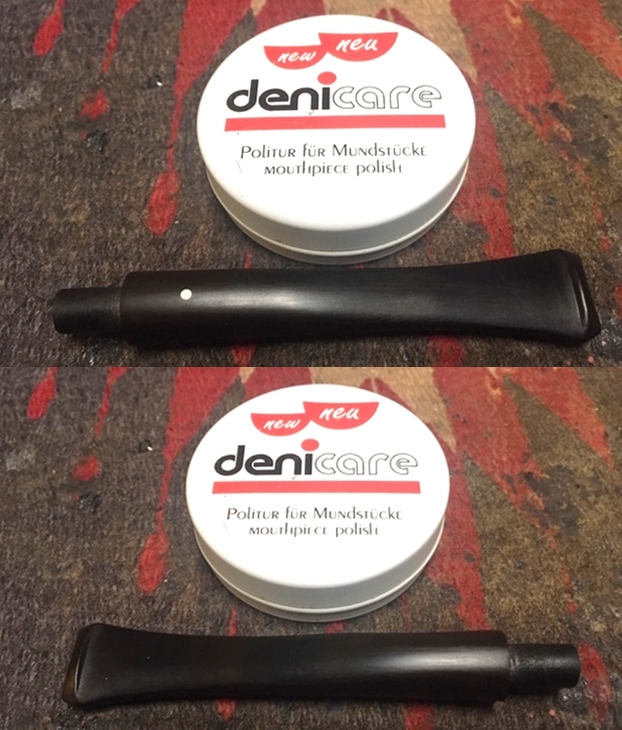
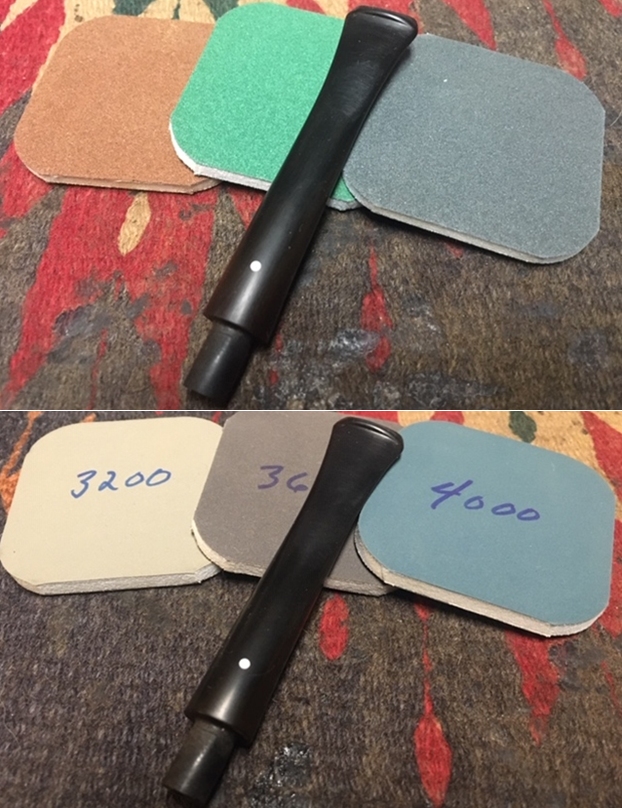
One of the reasons for me taking the pipe out of the box on Sunday evening was that I had received a stem that my brother Jeff had picked up at an auction on Friday. It was an older KBB stem probably from a Yello-Bole. The threads on the screw in tenon were worn and thus the tenon was really not usable. There was a worn and damaged propeller logo on the stem top that was off centre. I think that the stem was a replacement and that the logo was an afterthought. Here is what the stem looked like after I had wiped off the sticky spots and spilled glue that was on the surface. There were some tooth marks and chatter on the button end and the airway and slot were filled with debris and tars. The curve of the stem was perfect and the straight button end worked far better for me than a flared or fishtail end.I heated the metal tenon with the flame of a lighter and softened the glue holding it in the stem. I unscrewed it from the stem with a pair of pliers and wiped down the end of the stem. I faced the stem end on a topping board to make it smooth and square and used my Dremel and sanding drum to give the end a slight taper so that it would fit in the mortise of the bowl. I took a few photos of the stem in place – very roughly with more work to do but you can see the direction I was heading with this one. Yesterday I took my wife and two of my daughters down to Bellingham, Washington to do a bit of shopping with their Christmas money. The mall is great because it has a large circular waiting area that is comfortable and well lit so I planned ahead for my wait. I took the stem and bowl with me along with several folded pieces of 220 grit sandpaper. The girls had a great time shopping and I had a nice coffee and worked on the fit of the stem to the shank. We both had a great day. In the photos that follow you can see the conical shape of the tenon end of the shank. It fits snugly in the shank. This morning I worked on polishing out the remaining oxidation with 220 grit and 400 grit wet dry sandpaper. I like the overall look of the stem. I took photos of the stem after sanding it.I rubbed the stem down with Denicare Mouthpiece Polish. I have a few tins of this laying around so I am trying to use them up. I have found it is a great pre-polish for my use as it shows me areas that I need to work on with the micromesh sanding pads.  I polished the stem with micromesh sanding pads – wet sanding with 1500-12000 grit sanding pads. I wiped it down after each pad with a damp cloth to remove the sanding dust. I polished it further with Before & After Pipe Polish – both Fine and Extra Fine. I finished by rubbing the stem down with some “No Oxy Oil” to protect the vulcanite. I am experimenting with the product from Briarville and tracking how it works so I can write a review of it. I cleaned up the darkening on the back side of the rim top and the nick on the front edge with 220 grit and 400 grit wet dry sandpaper. I also worked over the areas around the mortise that had nicks and damaged spots with the sandpaper. I was able to smooth them out using the same papers. I polished the rim top and shank end with micromesh sanding pads – wet sanding with 1500-12000 grit pads and wiping it down with a damp cloth after each pad. I restained the sanded areas with an Oak stain pen to blend it into the rest of the finish.I rubbed the bowl and rim down with Before & After Restoration Balm. I worked it into the surface of the briar with my fingertips to clean, enliven and protect it. I let the balm sit for a little while and then buffed the pipe with a cotton cloth to raise the shine. I really like watching the Balm do its magic and bring the briar alive. This interestingly shaped Chimera Bowl has some really beautiful grain all around the bowl and shank. The grain really is quite stunning. The bowl while uniquely shaped is very symmetrical. The placement of the mortise at the peak of the shank would have made fitting a stem difficult. I can see why it was left stemless and unmarked. I decided to go with a military style mount that would fit well without changing the shape of the shank end. The long, bent Churchwarden vulcanite stem is high quality and shined up well. I buffed the bowl and the stem with Blue Diamond polish to raise the shine on the briar and the vulcanite. I gave the bowl and stem multiple coats of carnauba wax. I buffed the entire pipe with a clean buffing pad to raise the shine. I hand buffed it with a microfiber cloth to deepen the shine. The finished pipe is shown in the photos below. The dimensions of the pipe are: Length: 11 inches, Height: 2 ¾ inches, Outside Diameter: 1 ½ inches, Diameter of the chamber: ¾ inch. This uniquely shaped briar bowl and long stem work together to make a Churchwarden that feels great in the hand. Its length makes it a perfect pipe for sitting and reading a good book or watching a movie. It is light in weight which also adds to the charm. It was a pleasant one to work on and a definite change of pace from Bob Kerr’s estate. Thanks for walking through the restoration and restemming of this pipe with me.

Restoring a 1976 Dunhill Bruyere 0333 Billiard from Bob Kerr’s Estate


Blog by Steve Laug

As I continue to work through the pipes in Bob Kerr’s Estate I am enjoying choosing different brands that he had to focus on for a bit. I had eight more from his Dunhill collection that I decided to go back to and finish working my way through that sub collection of the estate. Out of the 8 pipes six were Bruyere finished pipes, one was a Made in London (turns out it is also a Bruyere finished pipe), and one was a Root Briar. What follows is a list of what I saw when I examined the 8 pipes. As I finish the pipes I will include the link to the blog on that particular pipe for easy reference. I have already restored 16 pipes from this subgroup so you can do a quick search to read about the work on the Shell Briars and Tanshell Briars that were in that part of the collection.

  1. Bruyere 656 F/T Made in England 2 Circle 4A – Group 4 size Bruyere made in 1962. Stem is oxidized, tooth marks and chatter near the button, some calcification with damage to the button. Finish is dirty, bowl caked and lava overflow on the rim top. Bowl is out of round, damaged edge.
  2. Bruyere 112 F/T Made in England 9/11 Circle 2A – Group 2 size Bruyere made in 1969 and sold in 1971. Stem is oxidized, tooth marks and chatter near the button, some calcification with damage to the button. Finish is dirty, bowl caked and lava overflow on the rim top. Bowl is out of round, damaged edge. I finished the restoration on it. Here is the link to the blog – (https://rebornpipes.com/2019/12/28/restoring-a-1969-dunhill-bruyere-112-f-t-apple-from-bob-kerrs-estate/).
  3. Bruyere 0333 Made in England 16 made in 1976. Stem is oxidized, tooth marks and chatter near the button, some calcification with damage to the button. Finish is dirty, bowl caked and lava overflow on the rim top. Bowl is out of round, damaged edge.
  4. Bruyere 41061 Made in England 18 made in 1978. Stem is oxidized, tooth marks and chatter near the button, some calcification with damage to the button. Finish is dirty, bowl caked and lava overflow on the rim top. Bowl is out of round, damaged edge. I finished the restoration on it. Here is the link to the blog – (https://rebornpipes.com/2019/12/24/restoring-a-1978-dunhill-bruyere-41061-from-bob-kerrs-estate/).
  5. Bruyere 142 F/T Made in England 7/9/11 Circle 4A – Group for size Bruyere made in 1967 and sent out in 1969 or 1971. Stem is oxidized, tooth marks and chatter near the button, some calcification with damage to the button. Finish is dirty, bowl caked and lava overflow on the rim top. Bowl is out of round, damaged edge. I finished the restoration on it. Here is the link to the blog – https://rebornpipes.com/2019/12/27/restoring-a-1967-dunhill-bruyere-142-f-t-billiard-from-bob-kerrs-estate/
  6. (A) Dunill London Inner Tube PAT N°5861/12 Shape 34. Stem is oxidized, tooth marks and chatter near the button, some calcification with damage to the button. Finish is dirty, bowl caked and lava overflow on the rim top. Bowl is out of round, damaged edge. I finished the restoration on it. Here is the link to the blog – (https://rebornpipes.com/2019/12/26/restoring-a-1913-a-dunhill-london-34-billiard-from-bob-kerrs-estate/).
  7. (Ao) Dunhill London 113 Made in England 5 PAT N°158709/14. Stem is oxidized, tooth marks and chatter near the button, some calcification with damage to the button. Finish is dirty, bowl caked and lava overflow on the rim top. Bowl is out of round, damaged rim edges. I finished the restoration on it. Here is the link to the blog – (https://rebornpipes.com/2019/12/25/restoring-a-1925-ao-dunhill-london-113-billiard-from-bob-kerrs-estate/).
  8. Root Briar 31032 Made in England 18 – made in 1978. Stem is oxidized, tooth marks and chatter near the button, some calcification with damage to the button. Finish is dirty, bowl caked and lava overflow on the rim top. Bowl is out of round, damaged edge. I finished the restoration on it. Here is the link to the blog – (https://rebornpipes.com/2019/12/23/restoring-a-1978-dunhill-root-briar-31032-billiard-from-bob-kerrs-estate/).

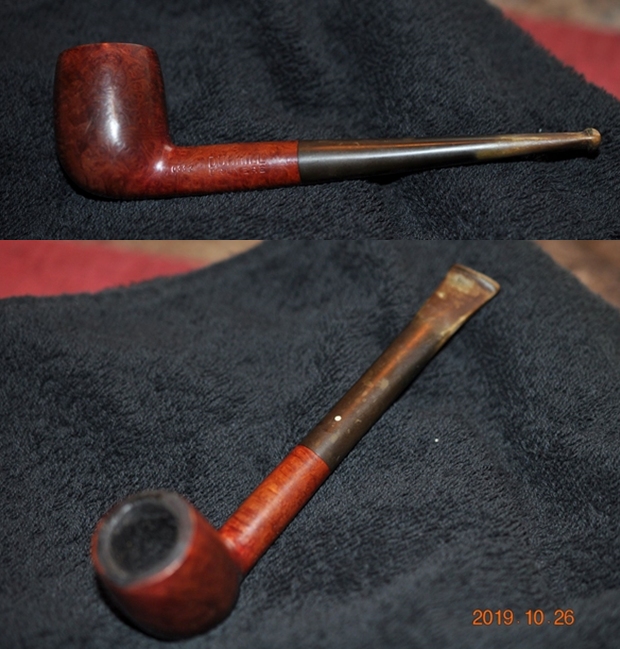
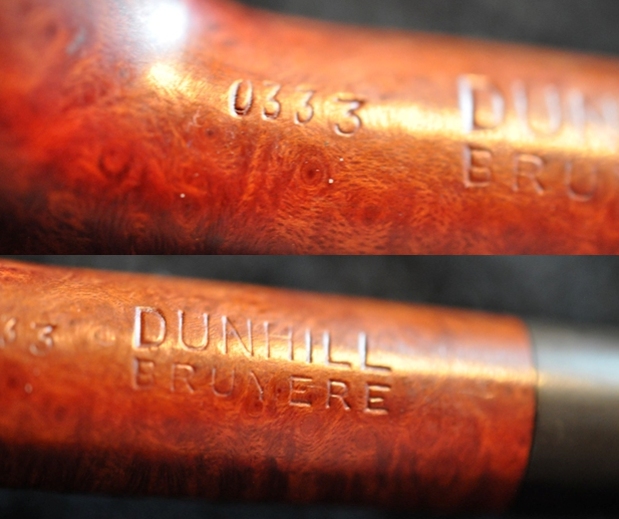
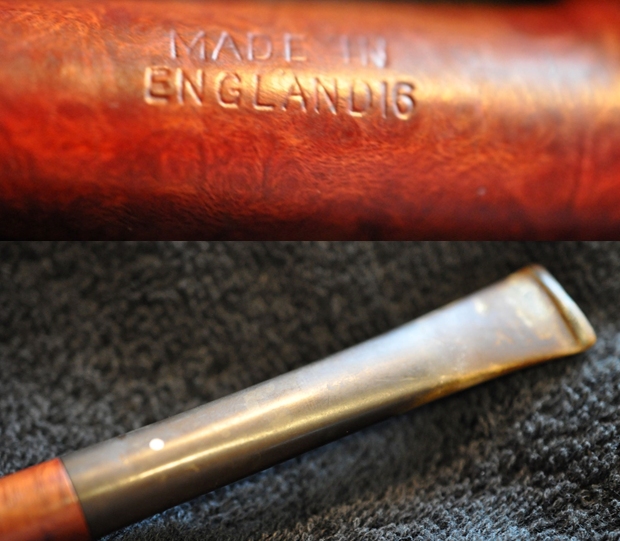
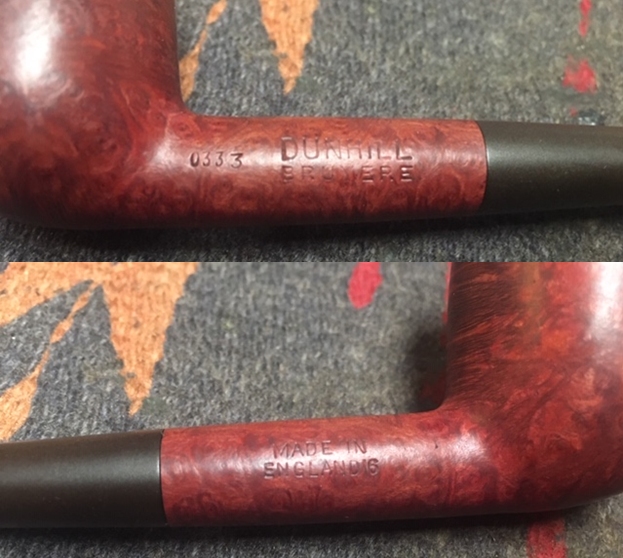
I finished work on #2, #4, #5, #6, #7 & #8 and turned my attention to #3, another heavily used pipe but this time an Apple shaped pipe with a tapered stem. The pipe was stamped on the left side of the shank with the shape number 0333 next to the bowl/shank junction. That is followed by Dunhill over Bruyere. On the right side of the shank it is stamped Made in England 16. It appears that the pipe stamped as this one is was made in 1976. The 0333 is a Billiard with a fish tail (F/T) tapered stem. This is the last billiard that I have to work on from the Dunhill collection.

I am once again including Chuck Stanion’s eloquent description of the Bruyere on the smokingpipes.com site as follows (https://www.smokingpipes.com/pipes/new/dunhill/moreinfo.cfm?product_id=346421):

The Bruyere was Alfred Dunhill’s original finish upon launching his brand of premium pipes and smoking accessories and was the only Dunhill finish from 1910 until 1917. Even after the addition of other finishes, the Bruyere maintained a high level of popularity, becoming synonymous with what is thought of, even today, as the quintessential pipe. To achieve the iconic, ruby hue and saturation, a skilled craftsman painstakingly layers particular stains in a precise manner, then meticulously polishes the pipe to a high luster. The final result is, simply put, timeless.

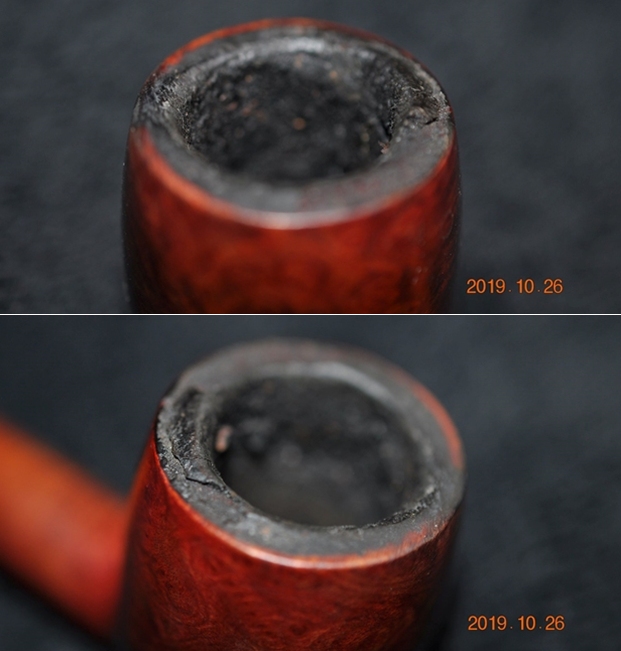
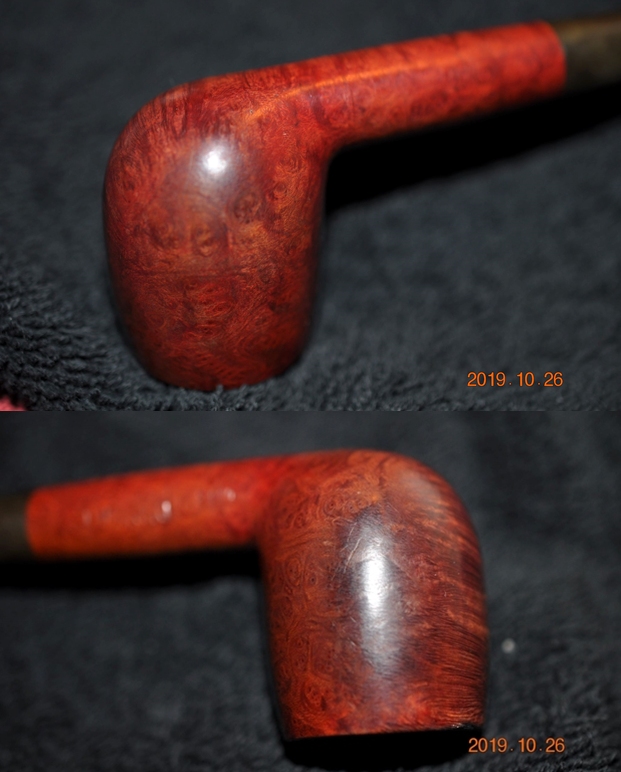
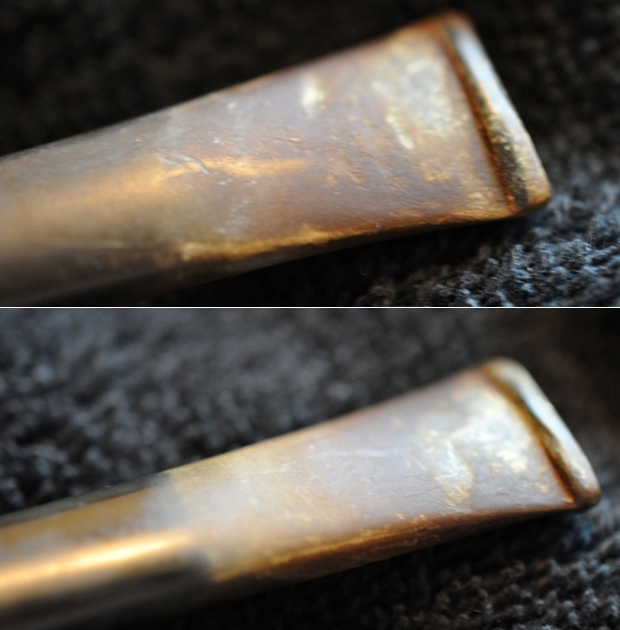
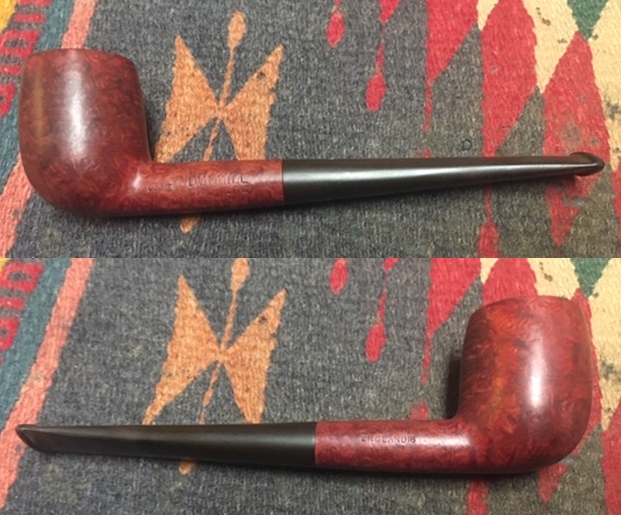
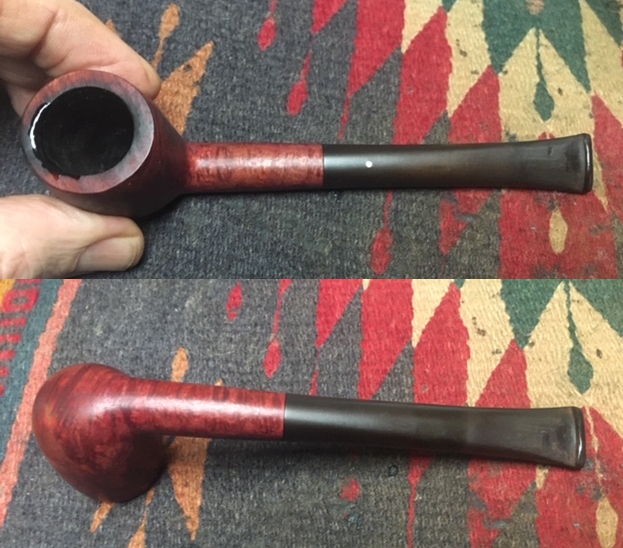
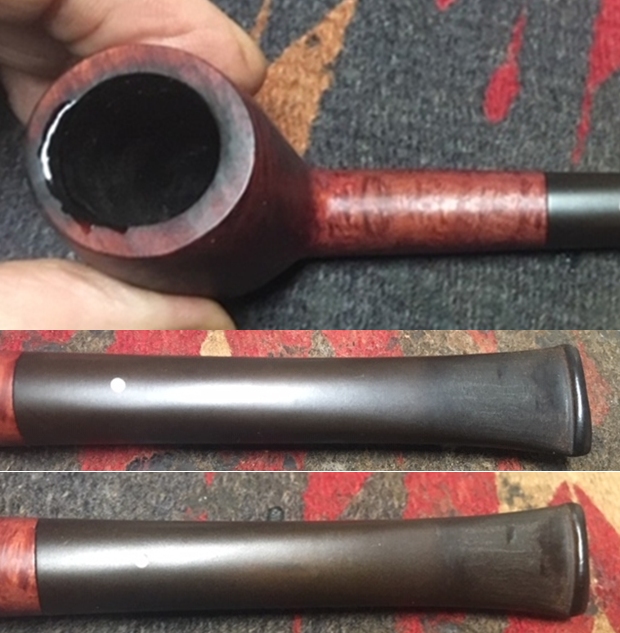
Like Bob’s other Dunhill pipe this one also had a thick cake in the bowl with remnants of tobacco stuck on the walls. There was a thick lava overflow on the rim so it was hard to know what kind of damage lay beneath the covering. Once it was cleaned I would have a better idea of the condition of the rim top. I could see however that there was definitely damage to the front inner edge of the bowl. The grain that is poking through the grime and oils appears to be quite beautiful – birdseye grain on the bowl sides and cross grain on the front and back as well as the heel of the bowl. The stem was oxidized and calcified toward the end with some tooth chatter. There were also some tooth marks on both sides of the stem ahead of the button and on the button itself. There was the classic White Spot on the top of the stem. Jeff took photos of the pipe before he started his cleanup work on it.  Jeff took photos of the bowl and rim top to show the thick, hard cake in the bowl with remnants of tobacco stuck on the walls of the bowl. There was a thick lava build up on the smooth rim top and the edges of the bowl. The rim top looked pretty good but it was hard to know for sure. It appeared that there was damage on the front inner edge. The outer edges looked to be okay other than a few small nicks on the sides.    Jeff took photos of the sides and heel of the bowl to show the condition of the finish. You can see the beautiful grain patterns around the sides of the bowl and shank. Even under the dirt and debris of the years it looked very good. The stamping is very readable. On the left side of the shank you can see 0333 which is the shape number. Next to that it is stamped Dunhill over Bruyere. On the right side it reads Made in England16. Jeff included a pic of the White Spot on the stem.    Jeff took photos of the top and underside of the stem showing the tooth chatter, scratching, calcification and oxidation on the stem surface and wear on the edges of the button.  I can’t begin tell you how great it feels to have Jeff’s help on cleaning up the pipes from Bob’s estate as the 125+ pipes were taking me a long time to do alone. He cleaned this filthy pipe with his usual penchant for thoroughness that I really appreciate. This one was a real mess and I was looking forward to seeing what he had done with this one when I took it out of his box. It looked amazing and CLEAN. He reamed it with a PipNet pipe reamer and cleaned up the reaming with a Savinelli Fitsall Pipe Knife. He scrubbed out the internals with alcohol, pipe cleaners and cotton swabs until the pipe was clean. He scrubbed the exterior of the bowl with Murphy’s Oil Soap and a tooth brush to remove the grime and grit on the briar and the lava on the rim top. The finish looks good with great looking grain around the bowl and shank. The rim top looked better on this pipe. The condition of the inner and outer edges was not too bad. The stem looked a lot better. Jeff soaked the stem in Before & After Deoxidizer to remove the oxidation on the rubber. The pipe was ready for me to carry on the next part of the process. I took some close up photos of the rim top and also of the stem surface. I wanted to show how well it had cleaned up and what needed to be done. The rim top had a worn and burned area on the front of the inner edge. It made the bowl out of round and made that section thin at the rim top. I wet the bowl rim down with saliva to show the damaged areas. There was also a significant slope to that part of the rim. There was darkening and nicks all around the top of the bowl and on the inner edge. The outer edge looked good.  I also took close up photos of the stem to show the tooth marks and chatter on the stem surface. The stamping appeared to be as clear as it was before the cleanup work. This is just one of the things I appreciate about Jeff’s cleanup is that he works to protect and preserve the nomenclature on the shank of the pipes that he works on. I took some photos to show the stamping. Bob loved his Dunhill pipes and it was obvious that he enjoyed smoking them. Some appeared to be daily smokes while others he seemed to reserve for special occasions. Some seemed like they must have hung in his mouth while he did his carving while others were smoked in his chair. Having worked on over 60 of his pipes so far I am getting a feel for them. This one is in rough condition and I suppose it might well have been before Bob took up the trust. I suppose I won’t ever know for sure but it certainly has a long and interesting story if it could only tell it.

I am sure that many of you have read at least some of the other restoration work that I have done on previous pipes. You have also read what I have included about Bob Kerr, the pipeman who held these pipes in trust before I came to work on them (see photo to the left). Also, if you have followed the blog for long you will already know that I like to include background information on the pipeman whose pipes I am restoring. For me, when I am working on an estate I really like to have a sense of the person who held the pipes in trust before I worked on them. It gives me another dimension of the restoration work. Bob’s daughter wrote a short tribute to her father. I thank you Brian and tell your wife thank you as well.

I am delighted to pass on these beloved pipes of my father’s. I hope each user gets many hours of contemplative pleasure as he did. I remember the aroma of tobacco in the rec room, as he put up his feet on his lazy boy. He’d be first at the paper then, no one could touch it before him. Maybe there would be a movie on with an actor smoking a pipe. He would have very definite opinions on whether the performer was a ‘real’ smoker or not, a distinction which I could never see but it would be very clear to him. He worked by day as a sales manager of a paper products company, a job he hated. What he longed for was the life of an artist, so on the weekends and sometimes mid-week evenings he would journey to his workshop and come out with wood sculptures, all of which he declared as crap but every one of them treasured by my sister and myself. Enjoy the pipes, and maybe a little of his creative spirit will enter you!

It was time to get on with the restoration of this Dunhill Bruyere 0333 Billiard. It was a change of pace from the last bunch of billiards that I had worked on because of the issues with the rim. I really need to send a shout out to Jeff for the hard cleanup work that he does on each of these pipes. They were a real mess when I sent them to Jeff and I have to tell you it was great that I can start my part of the process with a clean pipe.

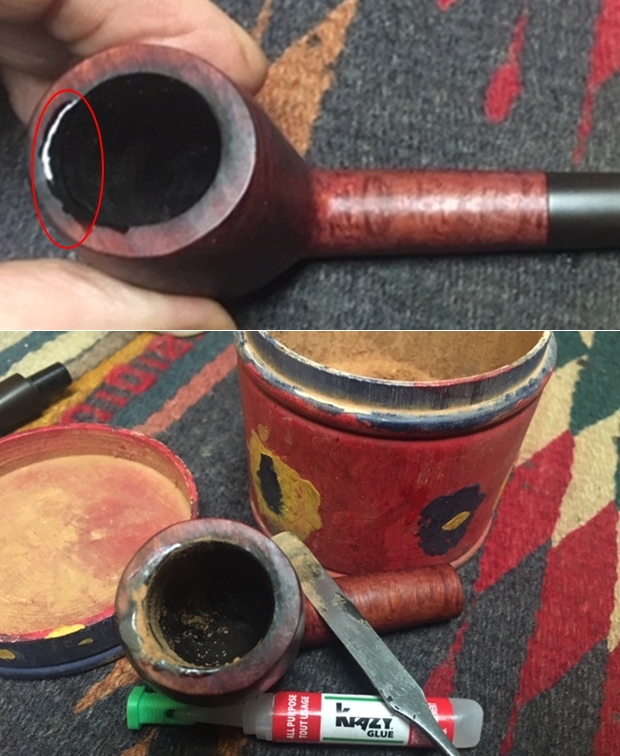
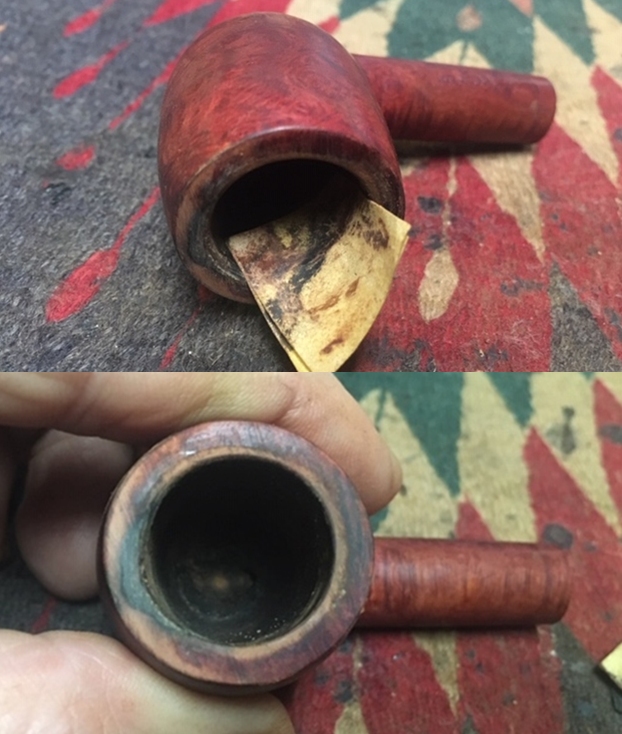
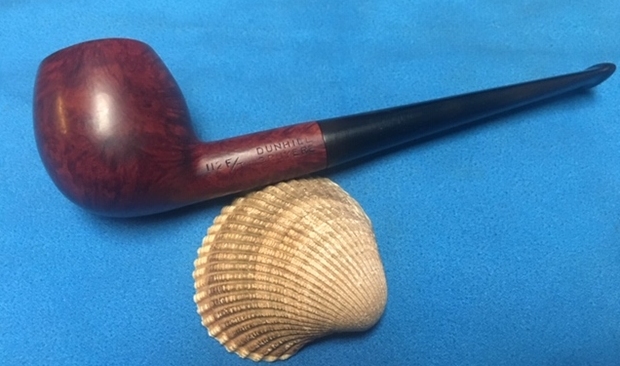
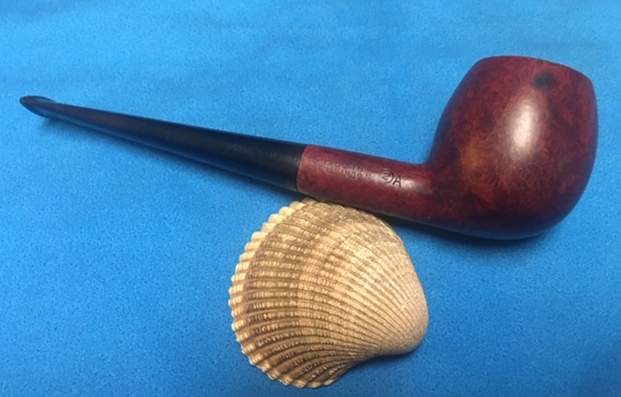
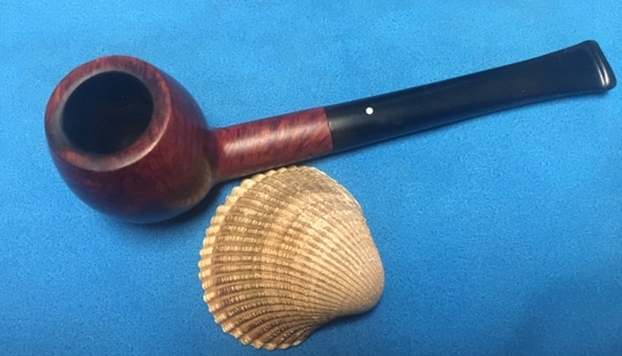
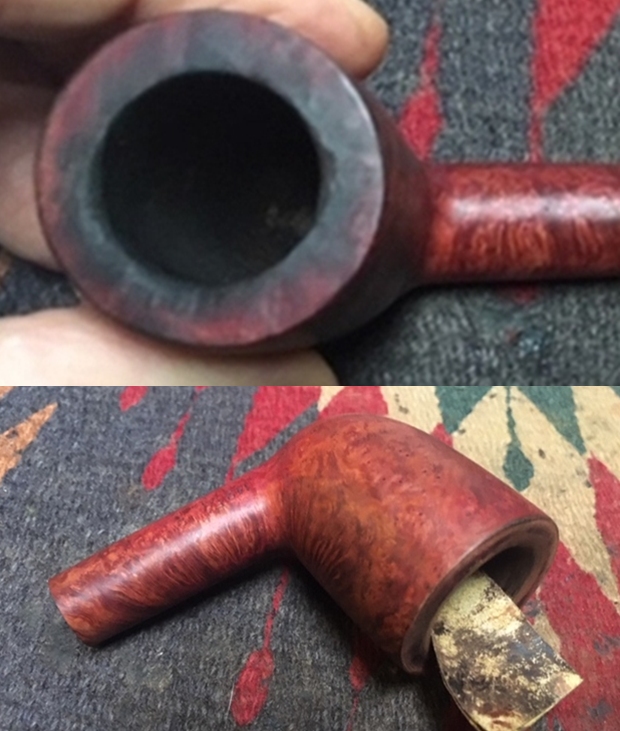
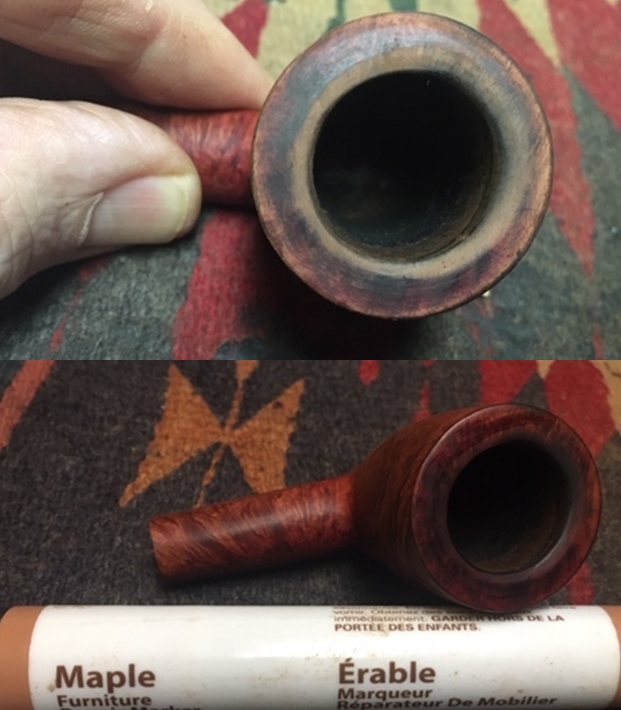
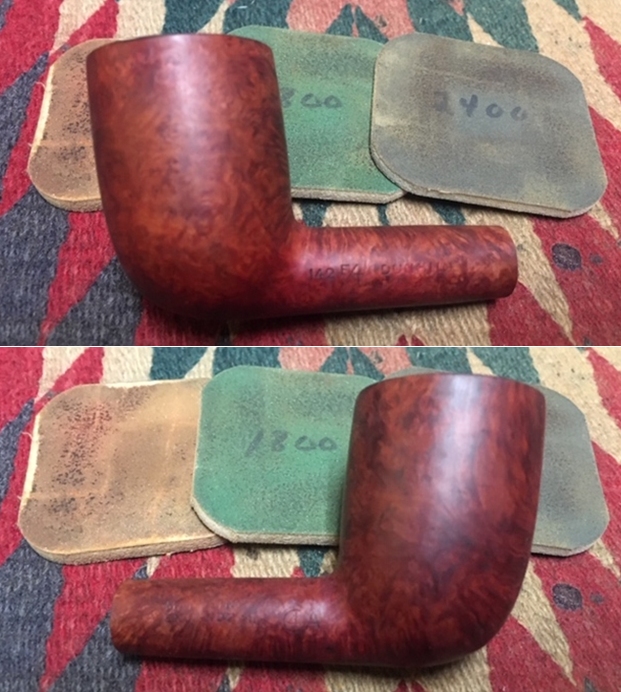
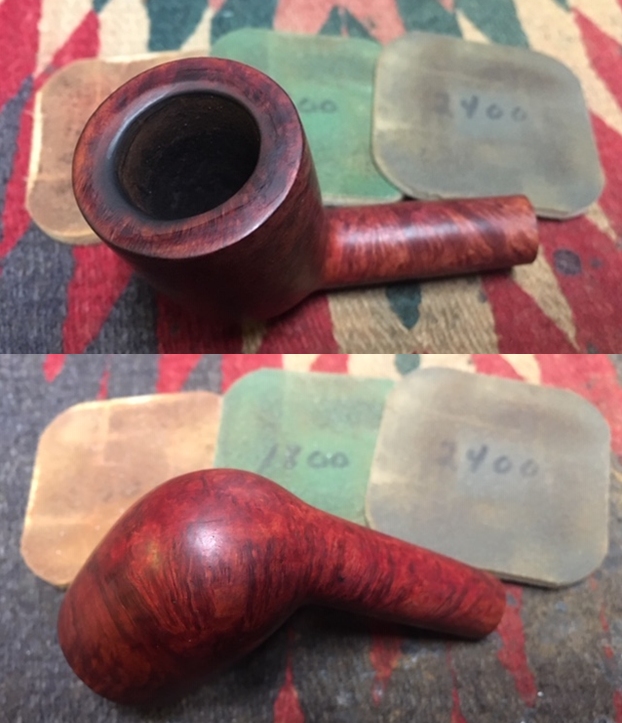
I decided to start the process by dealing with the the damage to the inner edge of the bowl. Usually I want to minimize the intrusiveness of the work on the rim and focus just on the rim edge. But the front inner edge on this pipe was in very rough condition. It was burned and thin and also at a steep bevel. It did not go deep into the bowl so I was good there. The remaining wood was solid. I have circled the damaged area in Photo 1 below. I cleaned the edge with alcohol on a cotton swab and gave it a light coat of clear Krazy Glue to fill in the taper a bit. I used a dental spatula to fill that glue in with briar dust. Photo 2 shows the repair at this point in the process. Once the repair cured I sanded the area smooth with 220 grit sandpaper carefully focusing on the rim top to flatten the repaired area and giving the inner rim a slight bevel all the way around. Photo 3 shows that work. Photo 4 shows the rim top after the work of beveling the inner edge and smoothing the flat surface has been completed. I polished it lightly with 400 grit wet dry sandpaper. You can see the extent of the repaired area in that photo. Once I had it smoothed out I stained the rim top with a Maple stain pen to match the colour of the rest of the rim top and hide the blackened areas a bit. Photo 5 below shows the rim top at this point in the process. Now it needs to be polished with the rest of the bowl and waxed. I polished the briar on the rim top and bowl with worn micromesh sanding pads – wet sanding it with 1500-12000 grit micromesh sanding pads. I wiped it down after each pad with a damp cloth. I find that the worn pads do a great job polishing and still retain the original patina of the pipe. I rubbed the bowl and rim down with Before & After Restoration Balm. I worked it into the surface of the briar with my fingertips to clean, enliven and protect it. I let the balm sit for a little while and then buffed the pipe with a cotton cloth to raise the shine. I really like watching the Balm do its magic and bring the briar alive.    With the bowl done it was time to address the stem. The dents in the top and underside were the right depth for me to lift them. I “painted” the surface with the flame of a Bic lighter to lift the dents and it worked exceptionally well.    I sanded the surface of the stem with 220 grit sandpaper to remove the light chatter in the stem surface and the remaining oxidation in the vulcanite. I polished it with 400 grit wet dry sand paper.  I rubbed the stem down with Denicare Mouthpiece Polish. I have a few tins of this laying around so I am trying to use them up. I have found it is a great pre-polish for my use as it shows me areas that I need to work on with the micromesh sanding pads.  I polished the stem with micromesh sanding pads – wet sanding with 1500-12000 grit sanding pads. I wiped it down after each pad with a damp cloth to remove the sanding dust. I polished it further with Before & After Pipe Polish – both Fine and Extra Fine. I finished by rubbing the stem down with some “No Oxy Oil” to protect the vulcanite. I am experimenting with the product from Briarville and tracking how it works so I can write a review of it. Once again at this point in the restoration process I am excited to be on the homestretch. This is the seventh of the Dunhill smooth pipes in Bob’s estate that I am working on. It is a beautiful Dunhill Bruyere 0333 Billiard made in 1976. Like each of the pipes in Bob’s estate I really look forward to this point in the process when it is put back together, polished and waxed. I put the bowl and stem back together. I polished the bowl and stem with Blue Diamond to polish out the scratches in the briar and the vulcanite. The rim top looked significantly better. The repair looks like darkening on the front of the top but the bowl is round and to me is in better condition. I gave the bowl and the stem multiple coats of carnauba wax. I buffed the pipe with a clean buffing pad to raise the shine. I hand buffed it with a microfiber cloth to deepen the shine. The pipe polished up pretty nicely. The grain around the bowl and shank really came alive with the wax and polish. The black of the tapered vulcanite White Spot stem is a beautiful contrast to the reds and browns of the finished bowl and shank. This was another Dunhill that was a lot of fun to work on thanks to Jeff’s cleanup work. The pipe is comfortable pipe to hold in the hand. The finished pipe is shown in the photos below. The dimensions of the pipe are Length: 6 inches, Height: 1 ¾ inches, Outside diameter of the bowl: 1 ¼ inches, Chamber diameter: ¾ of an inch. This 1976 Bruyere Billiard is a beauty should last for many more years. It is one that will be on the rebornpipes store very soon. If you are interested let me know. I have a lot more of Bob’s estate to work on of various brands. Perhaps one of those will catch your attention. Thanks for reading this blog and my reflections on the pipe while I worked on it. This is an interesting estate to bring back to life.

Fashioning a Second Churchwarden, “Made in England” for a Special Christmas Gift


Blog by Dal Stanton

I completed the first Christmas CW project by repurposing an Italian Permofilter rusticated bowl and mounting it on a Warden stem.  It is to be a gift for my son, Josiah, who came to Bulgaria from St. Louis to celebrate Christmas in Sofia, Bulgaria, with Mom and Dad!  Josiah’s Churchwarden came out well!Our daughter, Johanna, also has come to Bulgaria for Christmas.  She and her husband, Niko, arrived first and so my work fashioning a CW as a Christmas gift for Niko is a bit clandestine trying to keep it a secret until Christmas Day!  Niko hasn’t been easy to figure out for a pipe gift!  I was first going to give him a sculpted Meerschaum because I knew he had one before – a cheaper one that disintegrated in his hand while smoking it.  Yet, after he arrived, he saw that I was working on a Churchwarden for ‘someone’ who had commissioned one (actually, it was Josiah’s Churchwarden that I had commissioned myself!) and he wanted a Churchwarden, which was also on his priority list to add to his collection.  When I fished around regarding which he would rather have – trying not to spill the beans that I was gifting him a pipe, he said that a Churchwarden was higher on the list.  So, the Sculpted Meerschaum goes back into the inventory benefiting the Daughters of Bulgaria – our work helping women and girls who have been trafficked and sexually exploited!The bowl I’m repurposing is from an unbranded petite bent Billiard that is marked only with the nomenclature, ‘Made in England’ on the left shank side and a shape number on the right, ‘950’.  I acquired this pipe in the ‘Lot of 66’ and it has been waiting for someone to commission him in the For “Pipe Dreamers” Only! collection. It is an attractive pipe and the grain shows much potential.  I did a quick search of the main shape number charts of English pipe names such as BBB and GBD but found no reference to a shape 950 that helped me with identifying the origins of this pipe.Now with the stummel on the worktable to transform it into a Churchwarden, I take more pictures to take a closer look.  The chamber has light to moderate cake build up and the lava flow over the rim is thick.  The rim width is also imbalanced with a thinning of the rim on the front left.  Undoubtedly, the point where the former steward drew down the flame to light the blend.The rim also has its share of nicks, cuts and chips.  The stummel also has several dents and pits here and there which need addressing.  As expected, the grime is thick on the darkened stummel.  Yet, the grain underneath shows great potential. The grain is primarily vertically oriented around the stummel. The stummel has the feel of having some age.  By the shape and looks of it, I would guess that it is from the 1960s or earlier.  The plan is to transform the petite bent Billiard into a Churchwarden by mounting it to a precast Warden stem that measures 8 5/8 inches in length.  I acquire Warden stems from Tim West at www.jhlowe.comI begin this CW Christmas project for Niko with the cleaning of the stummel.  First, after spreading paper towel to aid in cleaning, I use the Pipnet Reaming Kit to address the cake build up in the chamber.  I again take a close-up picture of the chamber showing the light cake build up to mark the start.  I use only the smallest of the 4 blade heads available in the Pipnet Kit.  Transitioning to the Savinelli Fitsall Tool, I scrape the chamber walls further and follow by sanding the chamber wall with 240 grade paper wrapped around a Sharpie Pen.  The left-over carbon dust is then removed with a cotton pad wetted with isopropyl 95% and after an inspection of the walls, I find no problems with heating. Moving now to the cleaning of the external surface, the surface is scrubbed using a cotton pad wetted with undiluted Murphy’s Oil Soap.A brass wire brush is also helpful in scrubbing the rim top addressing the lava caked on it.  I also utilize my Winchester pocketknife to scrape the rim.  To rinse the soap, the stummel is transferred to the kitchen sink where the stummel is rinsed with warm water.  Using different sized shank brushes with anti-oil dish soap, the mortise and airway are cleaned. Finally, after rinsing and back at the worktable, a picture records the results of the cleaning.  The old worn finish is all but gone revealing the briar beneath. The scratches and imperfections are very evident mingling with the distinctive grain patterns. Next, using cotton buds and pipe cleaners wetted with isopropyl 95%, cleaning the internals is addressed. As the picture below shows in stark visual imagery, the internals were a bear to clean!  Using a small dental spoon, I also excavate a lot of tars and oils scraped off the mortise walls.  From what I am able to see and feel down the mortise with the probe, the internal design has a trap and the angled airway is drilled over the top of the trap angling toward the draft hole entering the chamber.  The trap has done the job of collecting the gunk, but the steward did not seem to know that frequent cleaning of the trap would keep this guy in better shape!  Finally, after many expended pipe cleaners and buds, they began to emerge lighter. Later, the internal cleaning will continue with an alcohol and kosher salt soak further to clean and refresh the internals.Now looking at the stummel, I know that the shank will be undergoing a good amount of sanding to shape the shank during the stem fitting process.  Therefore, the restoration work that I now do on the stummel external surface will not progress beyond the shank sanding at this point.  I start at the top looking at the rim’s condition.  It’s in bad shape with nicks and chips around the rim’s edge and the scorching damage resulting in the thinning on the left front quadrant.  I use the topping board to begin addressing these issues. With 240 paper on top of the chopping board that serves as the topping board, I rotate the inverted stummel several times on the board. After a few rotations, I stop to look. With this first picture, the contours of the rim thinning are clearer.  I continue to rotate on the topping board.These next pictures show the progression of the topping a step at a time. I stop with the 240 topping even though edge damage remains.  I will rectify this with beveling instead of removing more rim real estate.  I switch the paper to 600 grade and smooth the rim top further with this finer grade sanding paper.  After several rotations on the board, I’m satisfied with the topping board results.  Nice looking bird’s eye grains are peeking through the rim surface.Addressing the edge problems, 120 grade paper is used first to cut an outer edge bevel to remove the remaining cuts and chips on the edge.  Following the 120 paper 240 grade paper is used to smooth out the bevel.Again to freshen the rim lines after the beveling, I do a very quick topping again with 240 and 600 grade paper.I finish the rim repair by sanding the bevel on the outside and inside rim edges with 600 grade paper.  It looks good.  I move on.Continuing now to address the stummel proper, I will do what I can to spare the remnant nomenclature on the shank sides as I sand out the problems on the stummel.  I use sanding sponges to address the cuts and dents on the stummel surface.  First, using a coarse sponge to sand, I follow with a medium grade and a light grade sponge.  Wow!  This block of briar is impressive with vertical flame grain running around the bowl and as you would expect, bird’s eye grain populating both the heel and rim.  Very nice.  I’ve progressed all I can now with the stummel until the stem sizing and placement is completed.  The first step in this process is to size and fit the Warden precast stem’s tenon into the mortise.  As with the first Churchwarden gift project for my son, Josiah, Niko’s Churchwarden Made in England bowl’s mortise is measured to establish the ideal target measurement for the tenon.  This measurement is 8.61mm. 40mm is added to this ‘target size’ to establish the ‘fat size’ target.  This is a conservative sizing of the rough tenon in order to patiently and more slowly sand the tenon to the target size.  This allows for customizing the tenon as well as avoiding the danger of cutting too much with the Pimo Tenon Turning Tool.  The ‘fat size’ is right at 9mm.Next, to establish a starting measurement sizing of the rough tenon of the precast Warden stem, the PIMO tool is used. To do this, the first step is to drill the airway with a drill bit provided by the PIMO kit to allow the PIMO tool’s guide pin to fit the airway. After mounting the drill bit on the hand drill, the airway is easily enlarged with the bit.  Next, after mounting the PIMO tool on the hand drill, using the Allen wrenches provided by the PIMO kit, I adjust the carbide cutter arm to be just a bit smaller than the rough tenon size.  This is simply to cut a uniform starting measurement size. I accomplish the initial cut and take a measurement of 9.46.  The difference between this measurement and the fat target of 9mm is .46mm. Again, I adjust the carbide cutter arm to close this gap.  After adjusting, I do a test cut by only cutting a little of the tenon and then measure.    The reason for doing the initial test cut is that if you over cut and the tenon is too small… well, you have a very loose fit!  My test cut was too much – 7.63mm! The target size, actual mortise measurement is 8.61mm.    After widening the cutting arm, I make another test cut and measure – 8.93mm.  This is good enough for achieving the fat target. I complete the tenon cut at 8.93mm.  I take the cut all the way to the stem facing – making sure that there is a square cut and no shouldering on the stem facing.Transitioning now to sanding, I first use a coarse 120 grade paper to do the heavy lifting.  As I sand, I test periodically to see the progress of the tenon’s entry movement into the mortise.  I grip the paper around the tenon and then with my other hand rotate the stem to create the sanding movement.  This keeps the tenon round as well. The pictures show the progress. When the tenon is close to fitting, I switch to 240 grade paper.  The stem finally seats into the mortise.When I eyeballed the shank size and the stem next to it, I knew that the shank was a bit larger than the stem and I would need to sand the shank some to taper the shank toward the stem size.  When the stem was seated, I saw how much of an overhang there was – it’s not a little.This angle however, revealed another issue that I did not foresee. On the lower shank, just below the stem is the hollow caused by the angled drilling of the airway.  I take a close-up of this cavity and then remove the stem to show the inverted mortise and drilling. Oh my. This creates some challenges. As if to add insult to injury, I discover another issue.  The tenon has a slight rock or wiggle when it’s fully engaged.  What this means is that the front of the tenon was sanded down too much and is not in contact with the mortise wall.  The tenon closer to the stem facing is making contact.  When I pivot the stem vertically, it rocks a little.  Not good. I decide to address the lose tenon first and think about the rest. To expand the tenon, I use a drill bit to insert into the airway.  I choose a drill bit which is the next size larger than what will fit into the airway.  I then use a Bic lighter to heat the tenon to warm the vulcanite.  When the vulcanite is warm enough, it softens and then I push the bit in the airway which expands the tenon.  After heating and inserting the bit, I take it to the kitchen sink and run cold water on the tenon to set the expanded vulcanite.  With the aid of a pair of pliers, the bit is retracted and again the tenon is inserted into the mortise.  The procedure worked well – the tenon tightened and there is now no rocking.  Moving on. After giving some thought to the conundrum of the shank and Warden stem placement, I recognize that I will not be able to save the bowl’s scant nomenclature.  To taper the shank in a balanced way, will require the sanding to start further up the shank.  I also decide that I will fill the drilling channel with briar dust putty to remove the hollow and make this area solid.  Finally, I decide to fit the shank with a band to mask the hollow as well as to give the emerging Churchwarden an added bit of class. First, to fill the drilling channel, I mix a small amount of briar dust and thick CA glue.  I use a plastic disk as a mixing pallet and to help with cleanup I put scotch tape down to mix on.  After putting a small amount of briar dust on the pallet, thick CA glue is placed next to it.  Using a toothpick, the briar dust is pulled into the CA glue and is mixed with the toothpick.  When the mixture thickens, I use the toothpick to trowel the putty into the drilling channel in the mortise.  I then set the stummel aside allowing the putty to cure through the night – lights out!The next morning, the putty has cured, and I go to work filing the fill to match the curvature of the mortise. A half-circle tapered needle file does the job well. The next pictures show the patch material now filling the hollow of the airway drilling and as well the necessary sanding to remove the excess overhang of the shank facing over the stem. To begin the sanding to remove the excess over the stem facing and to taper the shank, a coarse 120 grade paper makes the work more efficient.  The sanding includes the entire shank to provide a more gradual tapering toward the stem.  Without this, a ‘stuffed pants’ appearance is left.  The stem remains engaged in the mortise throughout the sanding process.After a good bit of sanding, the alignment is looking good.  As usual, on the sides where the precast stem seams are, the sanding is more directed.  The pictures show the alignment at this point using 120 grade paper alone.  The tapering of the shank looks good. I mark the upper side of the stem with a piece of scotch tape so that I later refit the stem with the correct orientation.  The next thing I want to see it how a band or shank cap will work.  Some months ago, the word went out about a pipe man on French eBay selling bags with a variety of copper rings, bands, caps, and spacers at a very decent price.  I don’t know who started the rumor – Steve, Paresh, Victor?, but several of us were able to order a supply for our work desks. The package containing the supply had a card, Pipe Estate at www.pipes-estate.com.  I have been waiting for an opportunity to utilize this addition to my inventory.After dumping the multitude of copper fitments on my worktable, it was fun taking a closer look at all the available sizes and shapes.  But the question always is, will there be one in all these that will work??As if I were holding the Holy Grail, I found a few that looked hopeful, but one was perfect.  A copper shank cap that fit the shank perfectly and reaches over the end of the shank to provide a spacer.  Perfect!Remounting the stem, I oohed and awed at the beauty and wonder of this addition to the creation of this Churchwarden going to Niko for Christmas!  There was a sacrifice in having to sand away the ‘Made in England’ marking on the shank which bums me out in a huge way, but I’m pleased with the shank tapering and the contribution of the copper shank cap to the ensemble. The rest of the Warden stem is awaiting sanding, but for the time, I continue sanding to smooth and finish the stummel.  Following the coarse 120 paper that did the main work on the tapering, 240 and 600 grade papers continue the process of smoothing the shank surface. Next, I put the stummel aside and continue sanding the remainder of the Warden stem with 120 sanding paper. I also use a flat needle file to shape the raw, precast button. Following the filing and 120 grade paper, 240 grade continues the smoothing process by erasing the scratches left behind by the coarser filing and sanding. Following the 240 paper, wet sanding with 600 grade paper erases the scratches of the 240 sanding and then applying 000 grade steel wool completes this phase of the sanding process.  One picture of the entire stem is taken followed by closeups of the upper and lower bit. The full regiment of micromesh pads is applied next by wet sanding with pads 1500 to 2400 then dry sanding with pads 3200 to 4000 and 6000 to 12000.  Between each set of 3 pads, Obsidian Oil is applied to vitalize the vulcanite stem.  Again, I take one picture of the entire stem from the orbital shot and two closeups of the upper and lower bit after the final 3 micromesh pads.With the micromesh process completed, it is time to bend the Warden stem.  I like to draw a template of a bend so that I’m not simply eyeballing the process.  The general goal is to have the mouthpiece of the Warden stem on a parallel trajectory with the plane of the rim.  On the diagram below, I draw a horizontal line representing the plane of the rim.  I also rough sketch the current disposition of the unbent stem.  Then I rough in a bend starting about 1/3 the distance from the shank and complete the sketch parallel with the rim plane.  This is the guide template.The hot air gun focuses on the area about 1/3 up the stem for the first bend attempt.  I bend the fat part of the stem first to have a more even and sweeping bend as it takes longer for the fat part to become supple than the thin part.  As the stem is rotated over the hot air, gentle pressure is applied and when the stem starts to bend, I know it’s reaching the state of shaping.  As the bottom third becomes supple, I move the heating up the stem a bit now to warm the middle.  All the while rotating back and forth and around.After the stem heats enough using the hot air gun, I place the pipe on the template and hold it in place until it holds its position.  I’ve found that even though it takes longer this way, I’ve lost the shape I want if I transition the pipe to the kitchen to run the stem under cool water to quicken the cooling.  The first attempt is good.  There’s a nice flowing bend but the final trajectory is a little wide.The second attempt is very close to what I want, but it’s still a hair wide.One more time heating does the trick.  This time I take the stem to the sink and run it under cool water to cool the vulcanite and hold the bend that has been created.With the Warden stem completed until the final polishing phases, I turn again to the stummel.  Using the full regiment of micromesh pads, with pads 1500 to 2400 I wet sand, followed by dry sanding with pads 3200 to 4000 and 6000 to 12000.  The bowl’s grain emerges through the process and I like what I’m seeing.  The bowl is fully wrapped with a vertical flame grain with bird’s eye grain populating the heel and rim – as you would expect being the cross-view perspective of the flame grain. With the hour growing late, I continue the internal cleaning and refreshing process using a kosher salt and alcohol soak. The first step is to fashion a ‘wick’ from pulling and stretching a cotton ball.  The wick serves to draw tars and oils out from the mortise cavity. Using a stiff wire, the wick is guided down the mortise. Then the bowl is filled with kosher salt which doesn’t leave an aftertaste as the iodized version.  The stummel is then placed in an egg carton for stability.Using a large eyedropper, isopropyl 95% fills the bowl until it surfaces over the salt.  After a few minutes the alcohol is absorbed, and I top off the alcohol one more time and set the stummel aside to soak through the night.The next morning, the soiling of the salt and wick evidences the processes active through the night.  The tars and oils were drawn from the internal briar surface.  I toss the expended salt and wipe the bowl with a paper towel.  I also blow through the mortise to loosen and remove any remaining salt crystals.To make sure all is cleaned, one cotton bud and one pipe cleaner dipped in isopropyl 95% were all that was needed to verify the results of the internal cleaning – cleaned!  I move on.Next, using Before & After Restoration Balm, the external briar is freshened and enlivened.  Mark Hoover’s Restoration Balm (www.ibepen.com) works very well to bring out the natural hues and to deepen them.  I place some of the Balm on my fingers and work it into the briar surface.  Afterwards, I place it the stummel aside for about 20 minutes to allow the Balm to do its thing.  Then the excess Balm is wiped/buffed off with a micromesh cloth.  The results are as hoped – a beautiful piece of briar is now more beautiful. Before moving on to the fine polishing and waxing phase, the copper shank cap/band needs to be attached to the shank. I test fit the cap over the shank and insert the stem.  The fit still looks good.  Next, with great caution, I place a drop of thick CA glue on the end of a toothpick and this apply the glue to the inside of the ring/cap.  Using the end of the toothpick, I run the glue around the entire underside and then slip it over the shank and press it into place.  I do this without excess glue seeping out from around the edges – relief!  I do not reengage the stem for a few minutes to allow the CA glue to cure – I don’t risk getting glue on the stem! On the home stretch!  With a cotton cloth buffing wheel mounted to the Dremel with the speed set at about 40% full power, I apply Blue Diamond compound to the stem and stummel avoiding the copper band.  When completed, I use a felt cloth to buff the pipe to remove compound dust before applying the wax.  Next, changing to another cotton cloth buffing wheel maintaining the same speed, carnauba wax is applied as well to the stem and stummel followed by a rigorous hand buffing with a microfiber cloth to raise the shine.
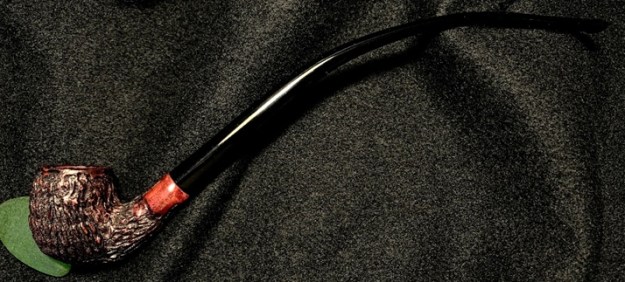
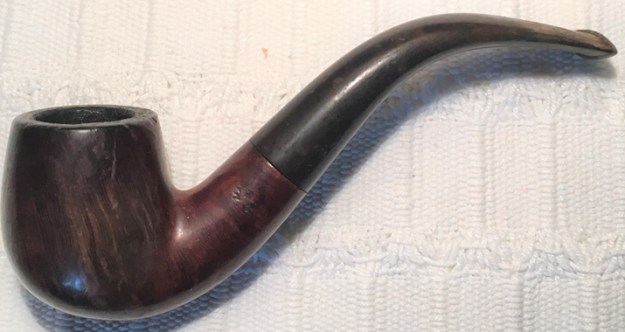
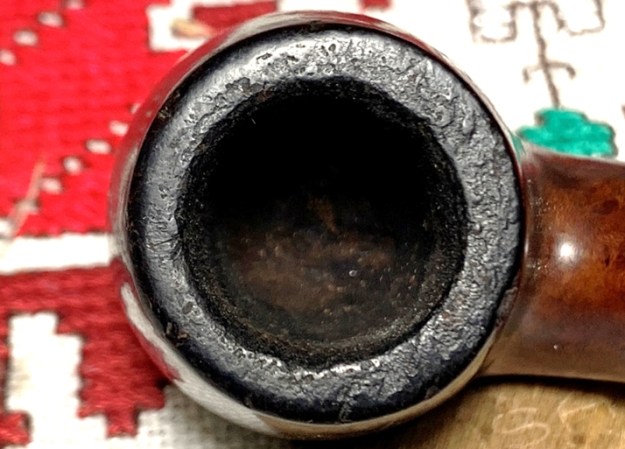
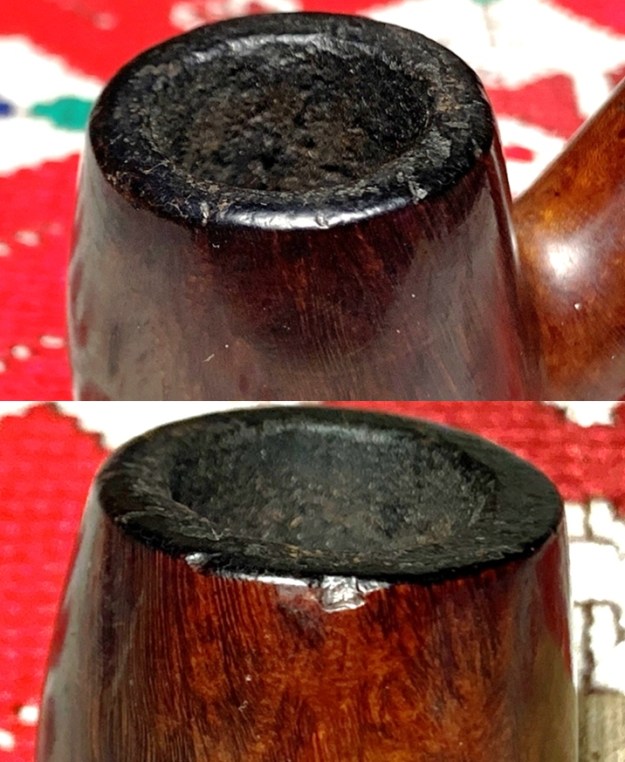
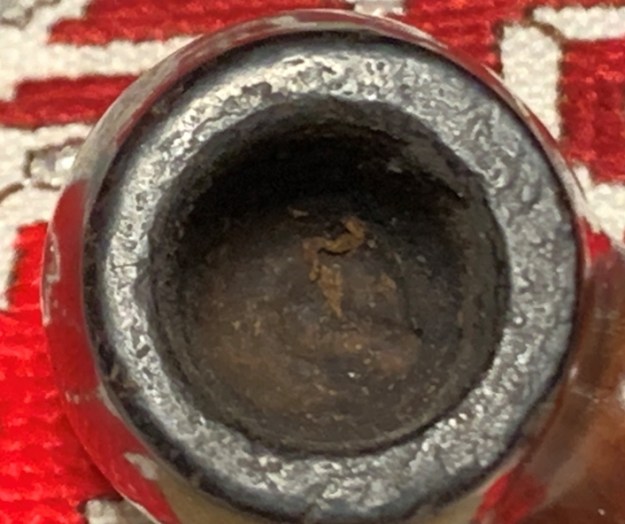
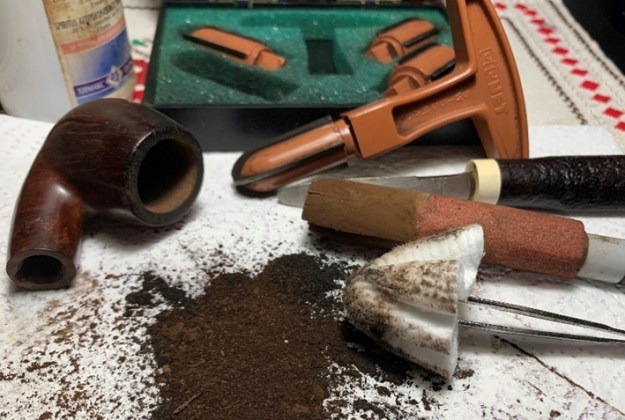
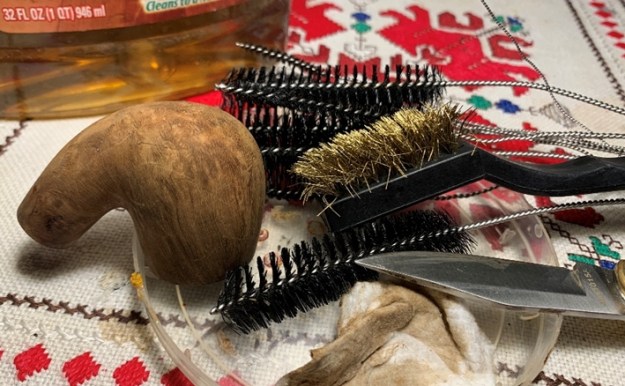
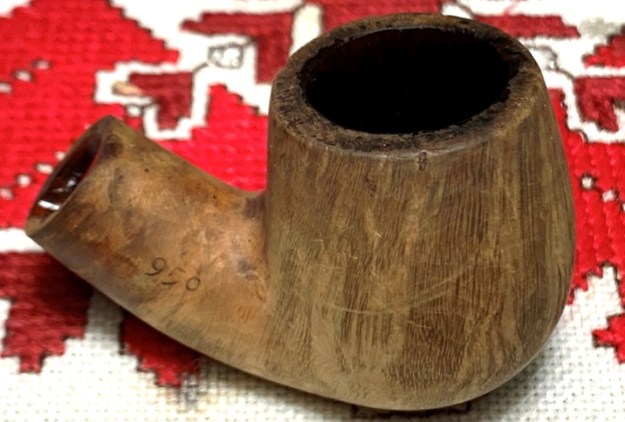
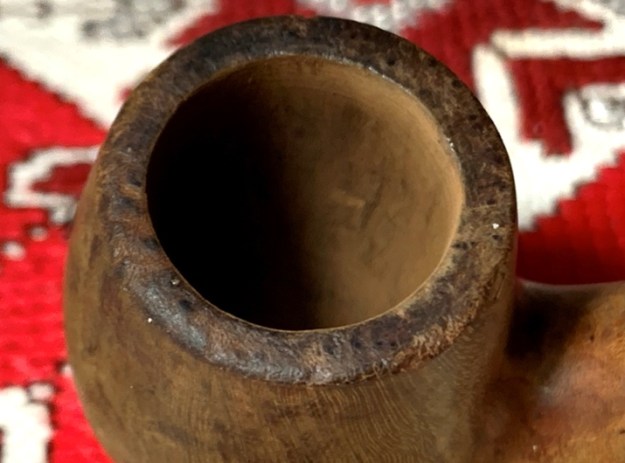
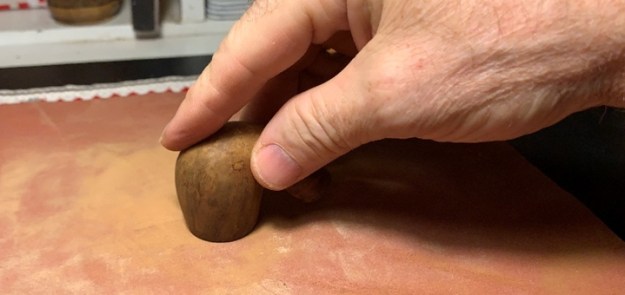
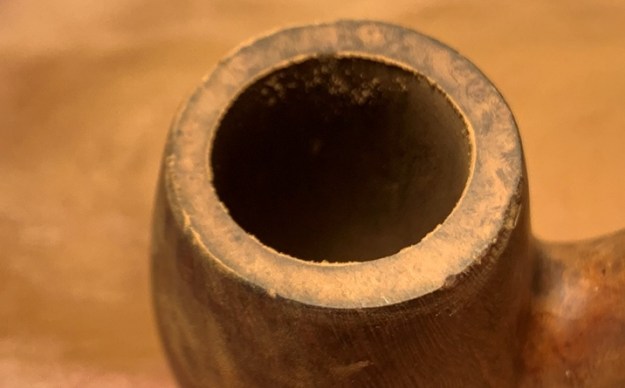
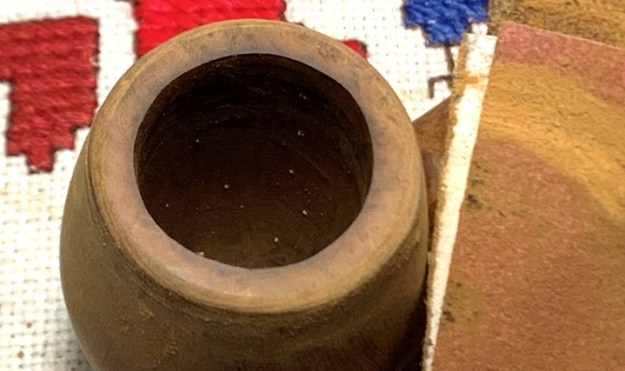
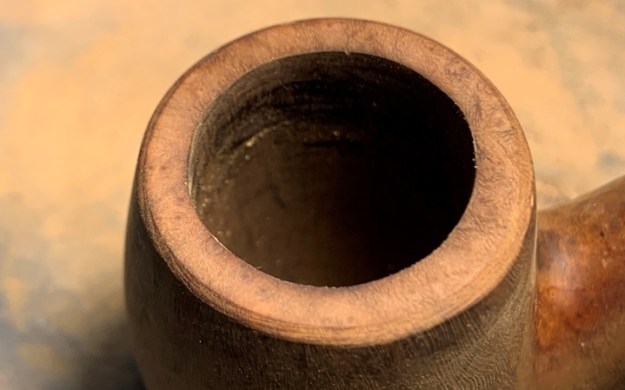
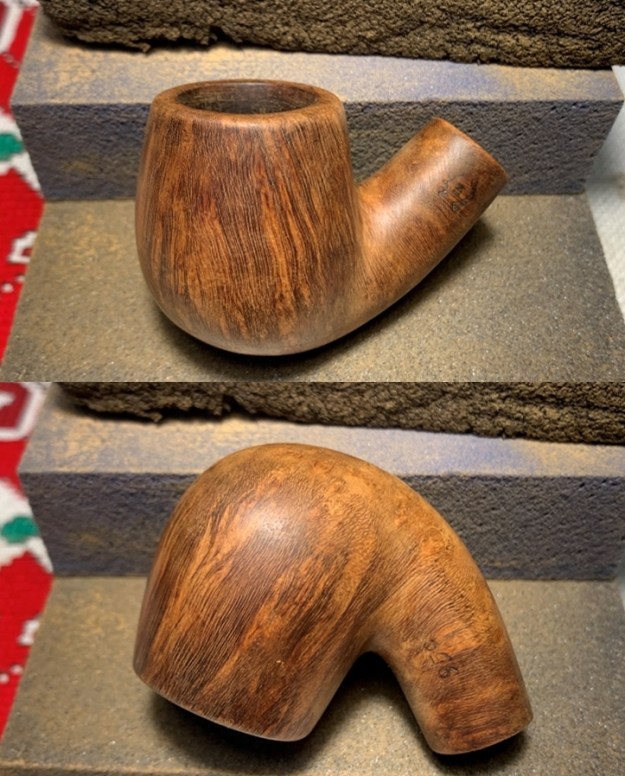
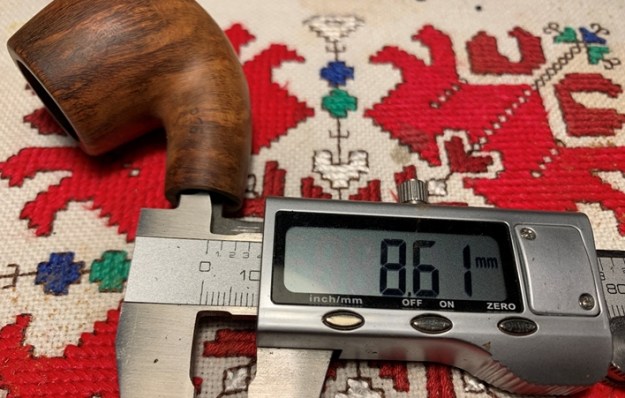
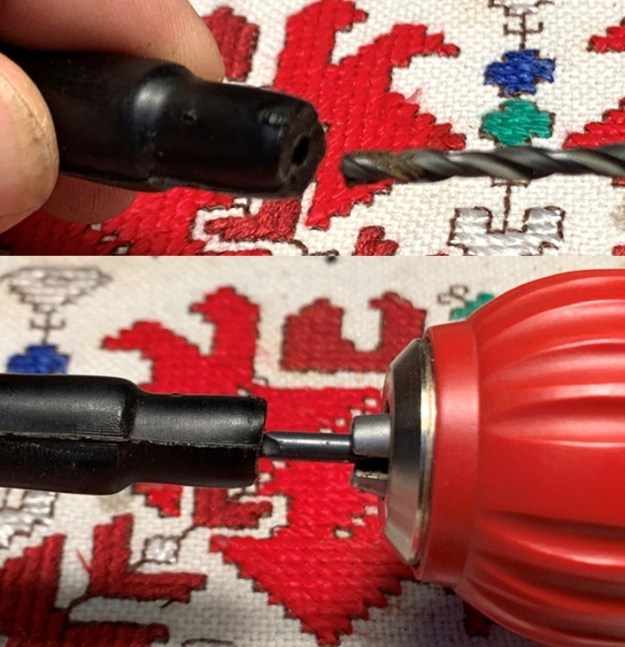
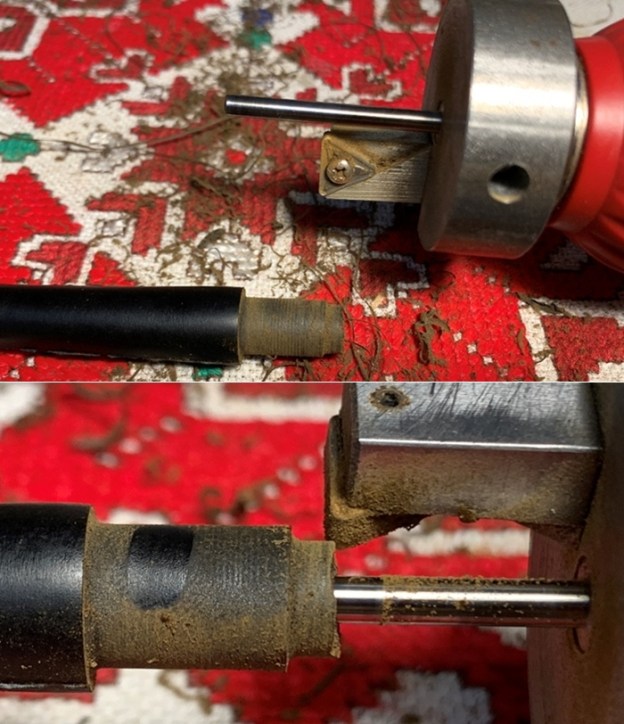
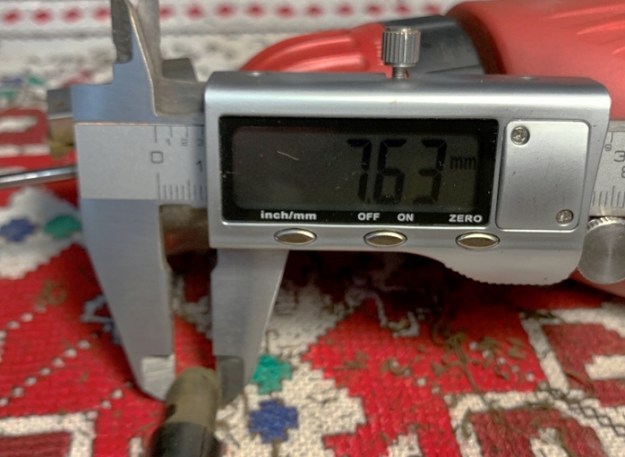
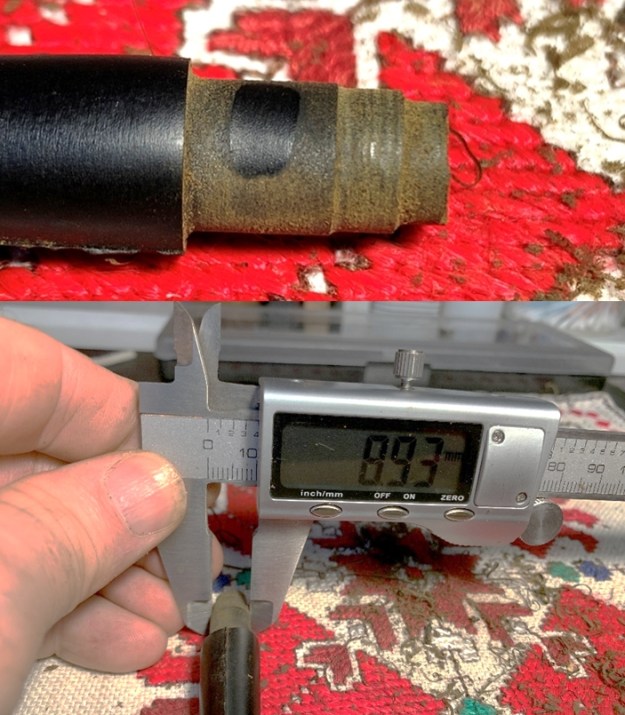
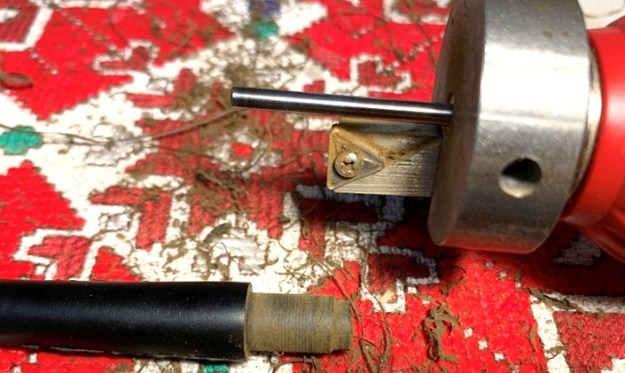
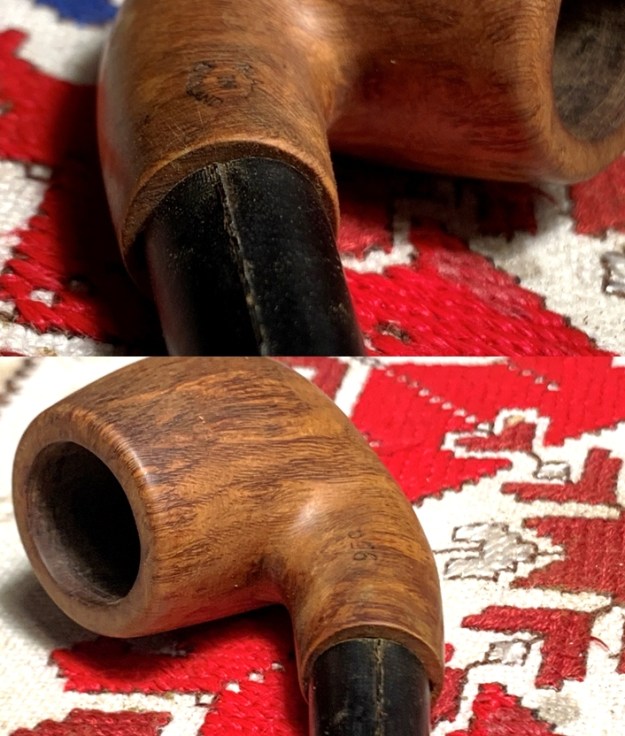
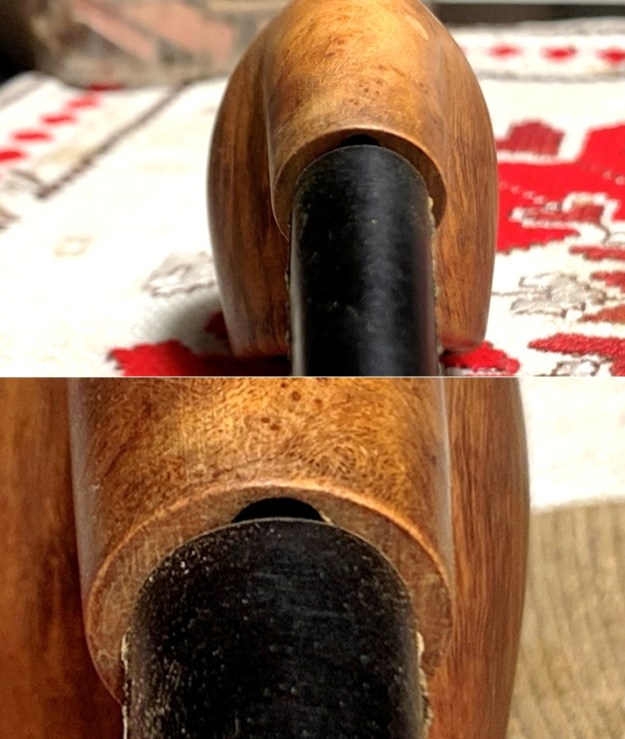
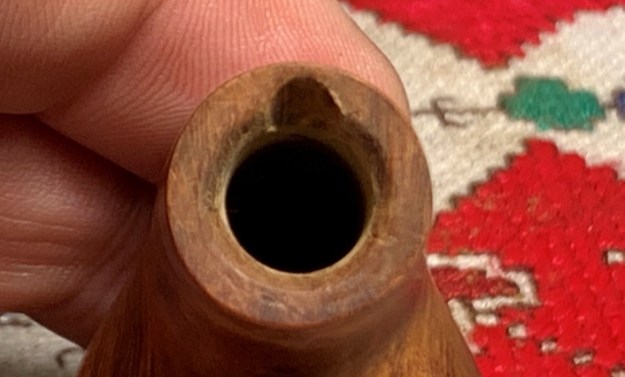
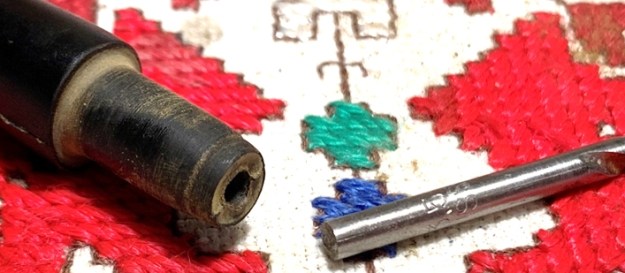
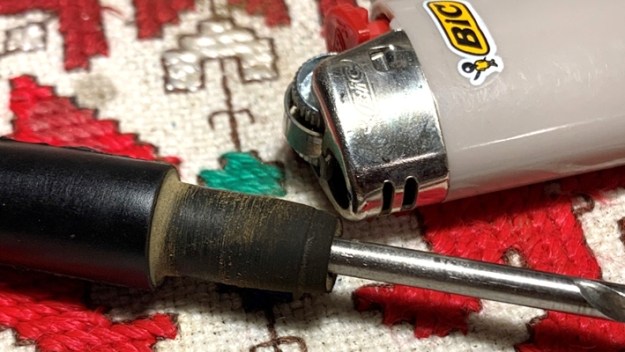
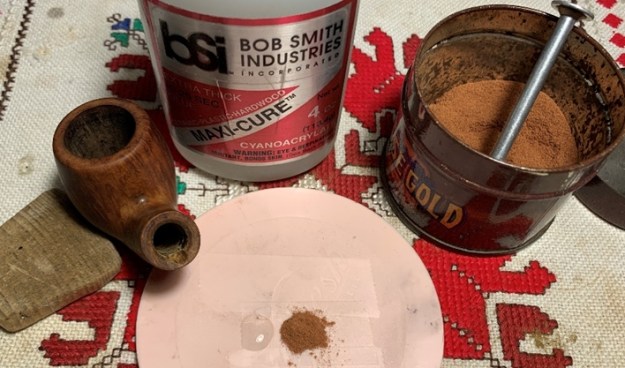
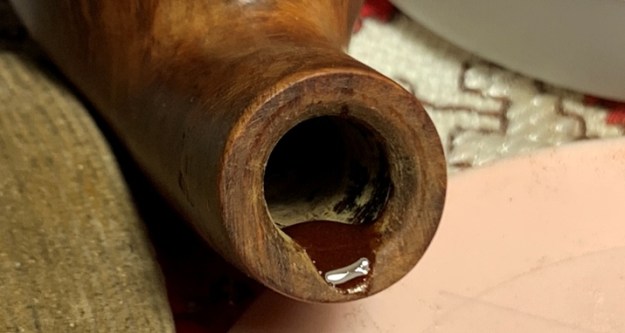
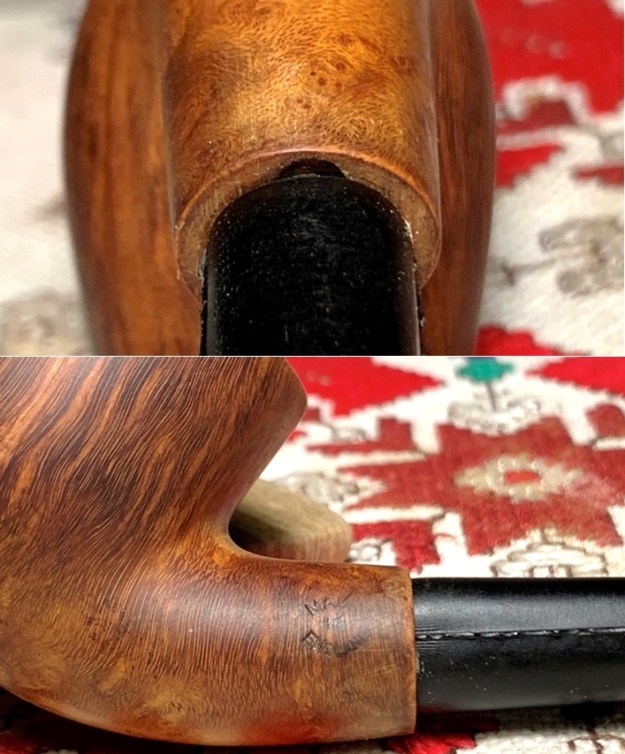
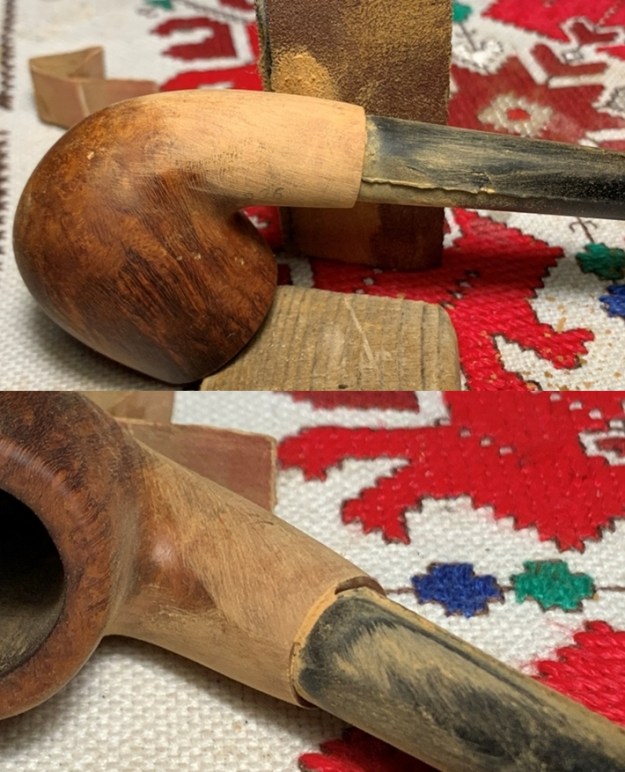
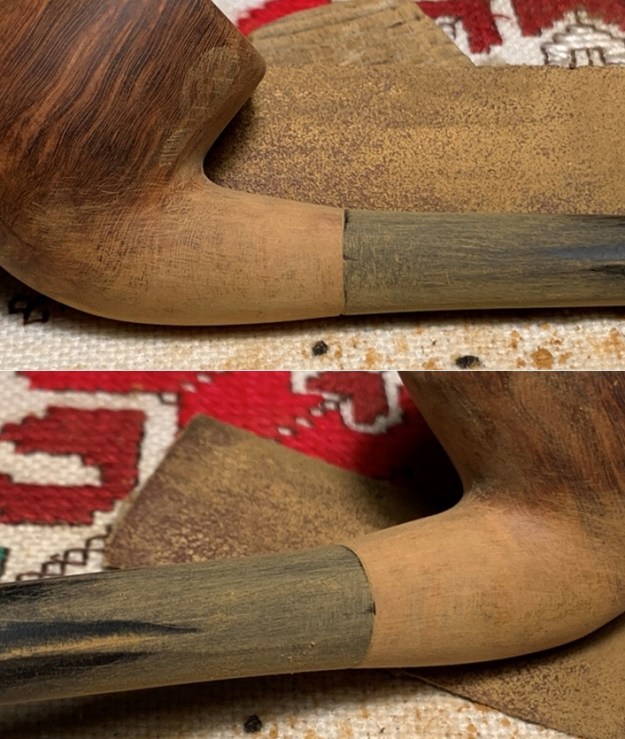
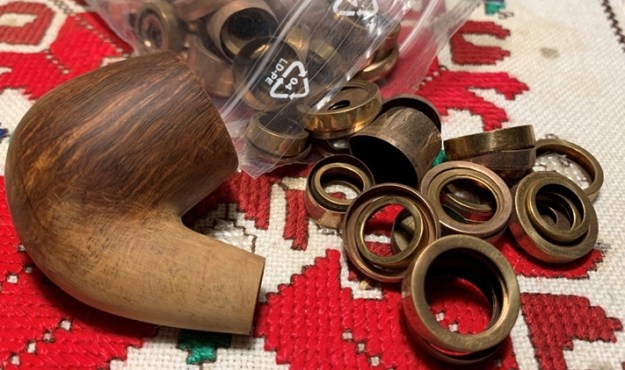
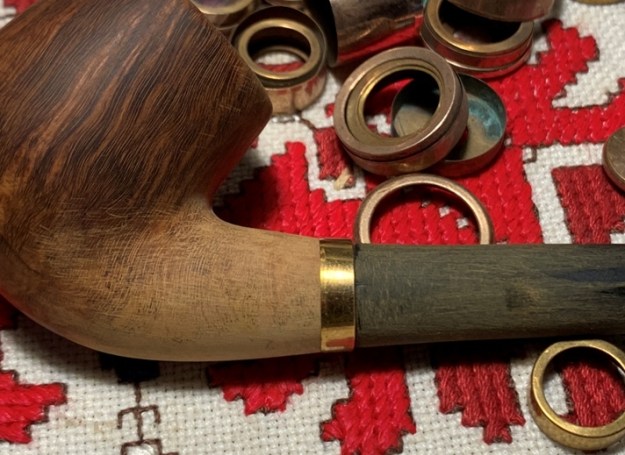
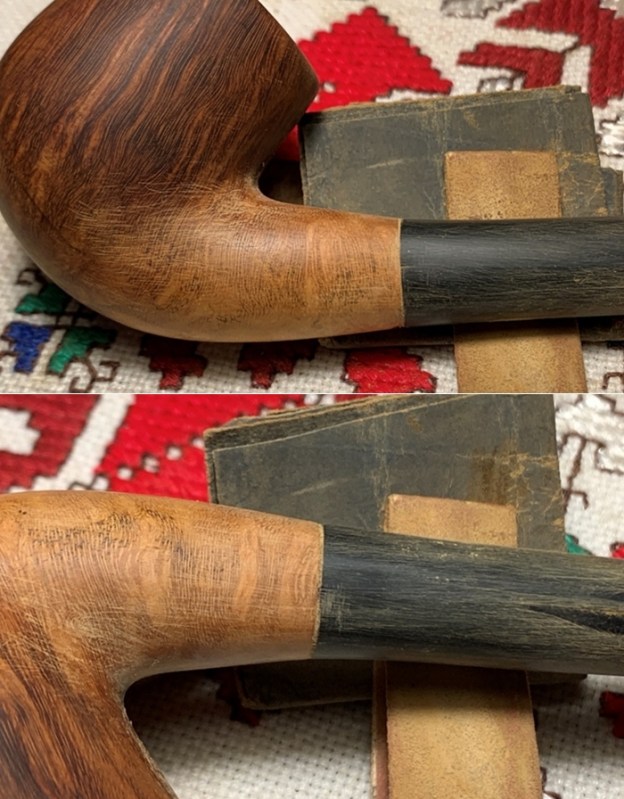
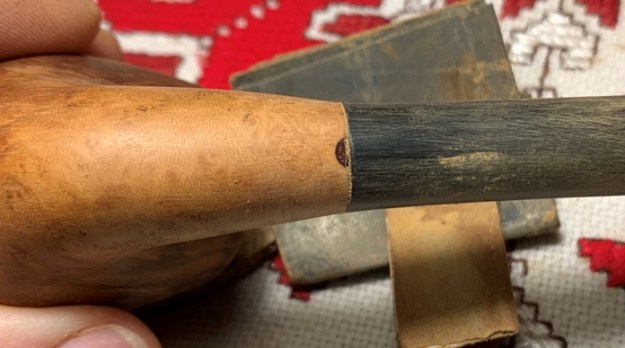
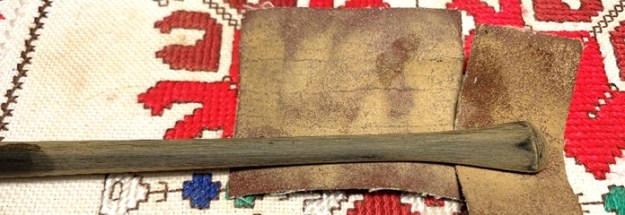
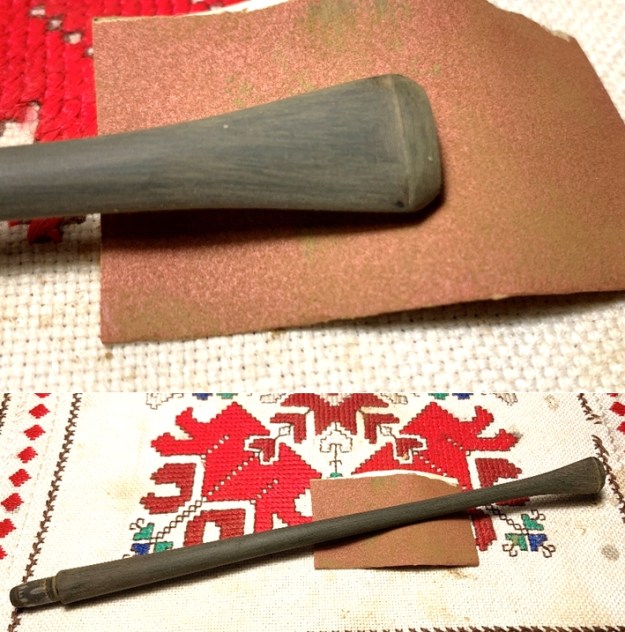
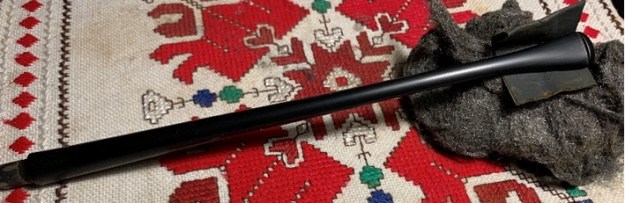
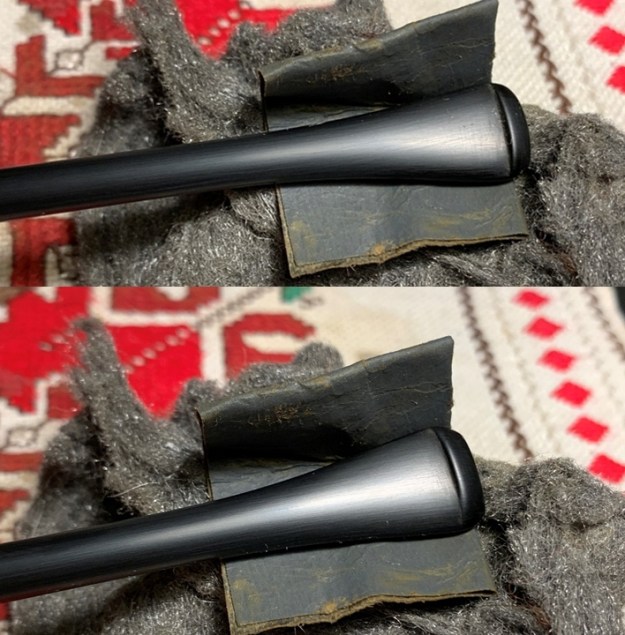
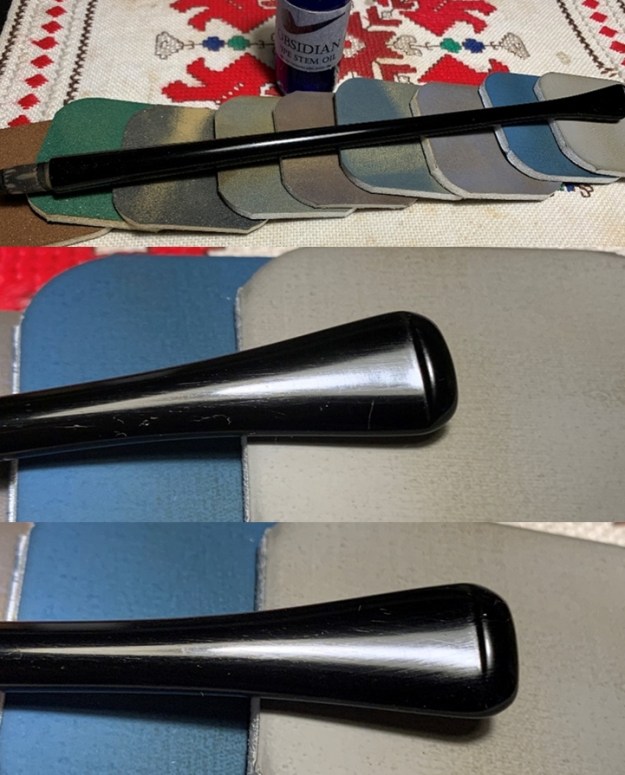
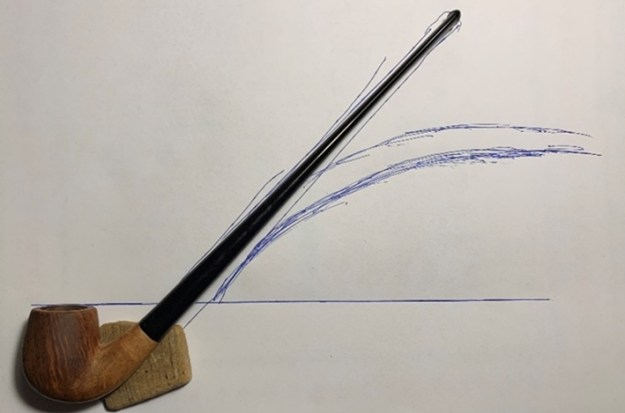
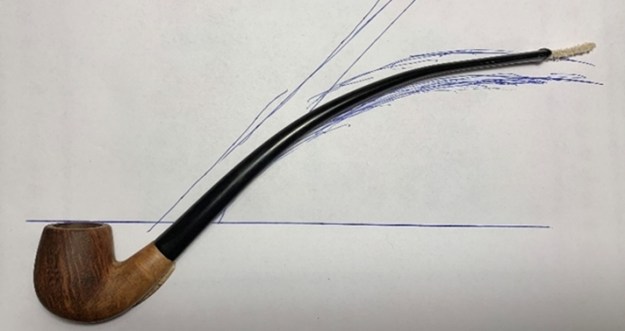
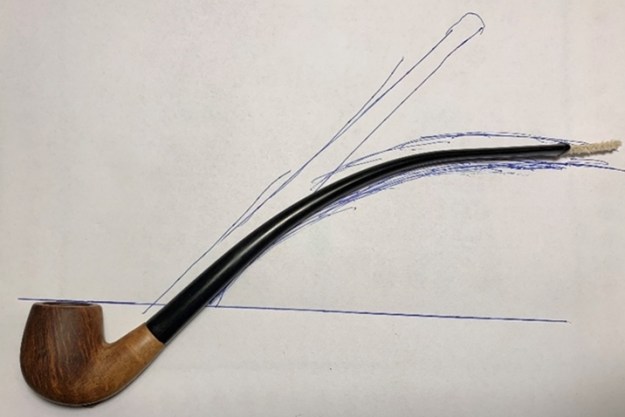
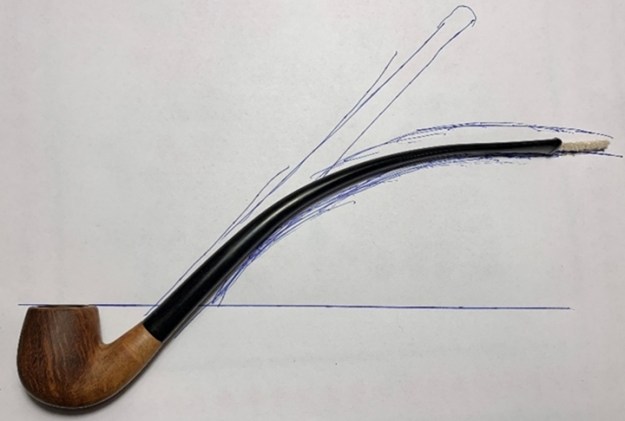
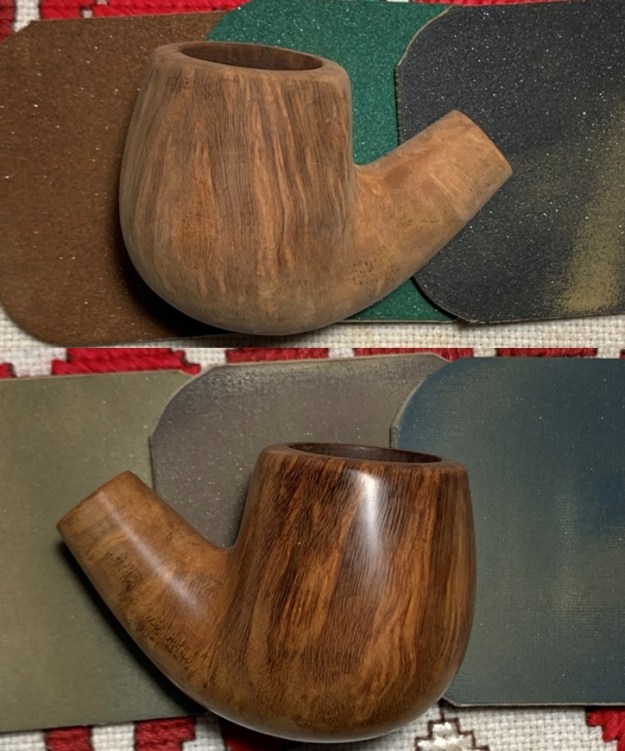
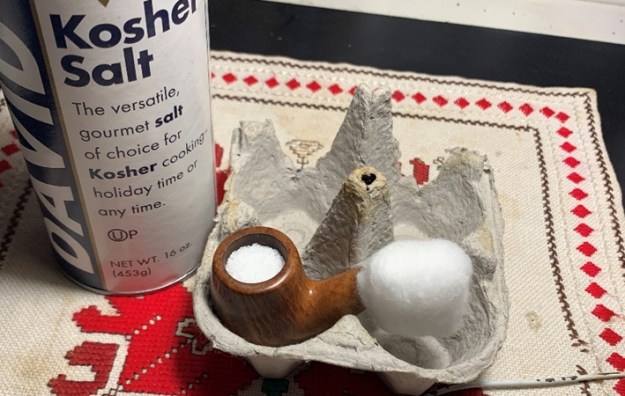
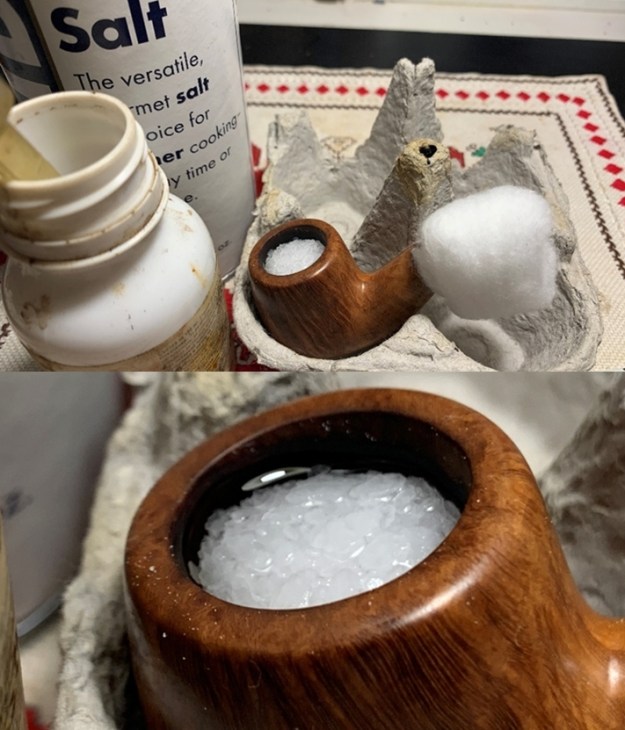
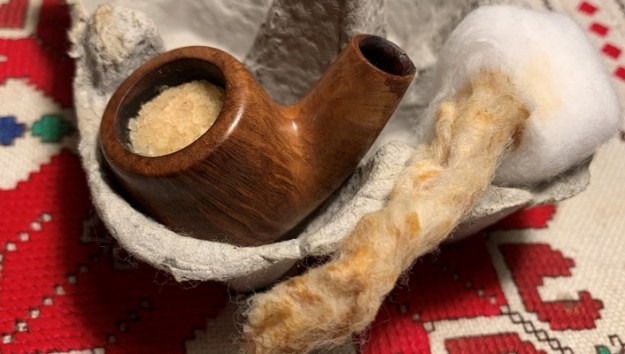
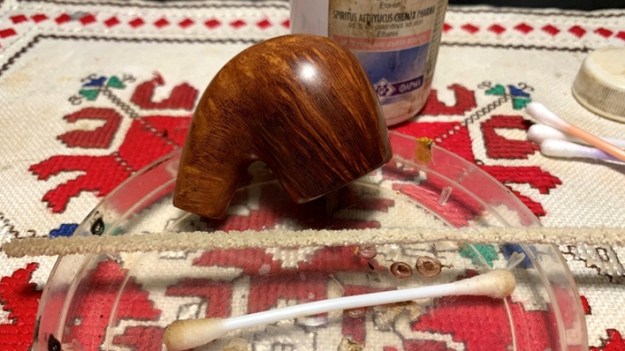
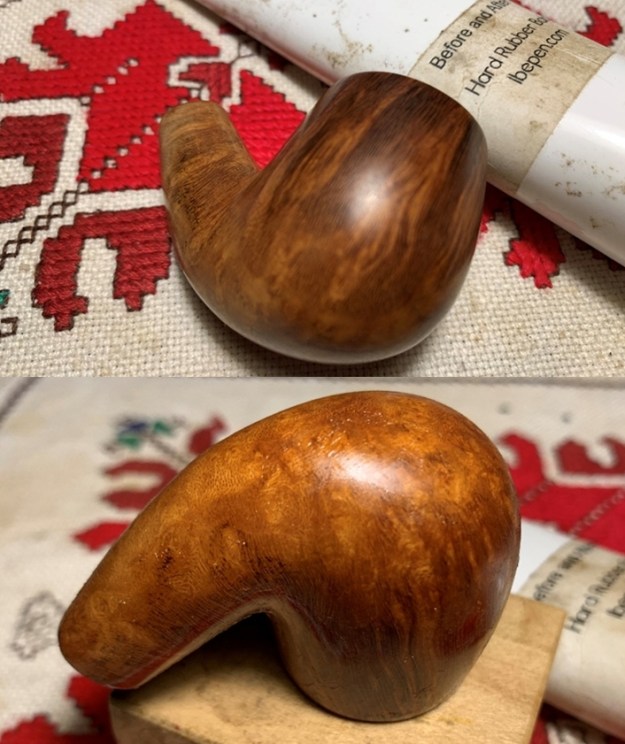
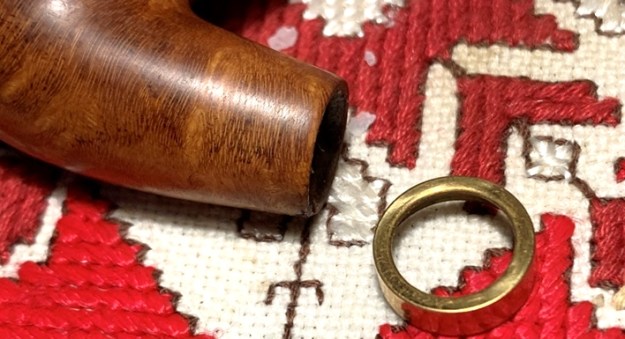
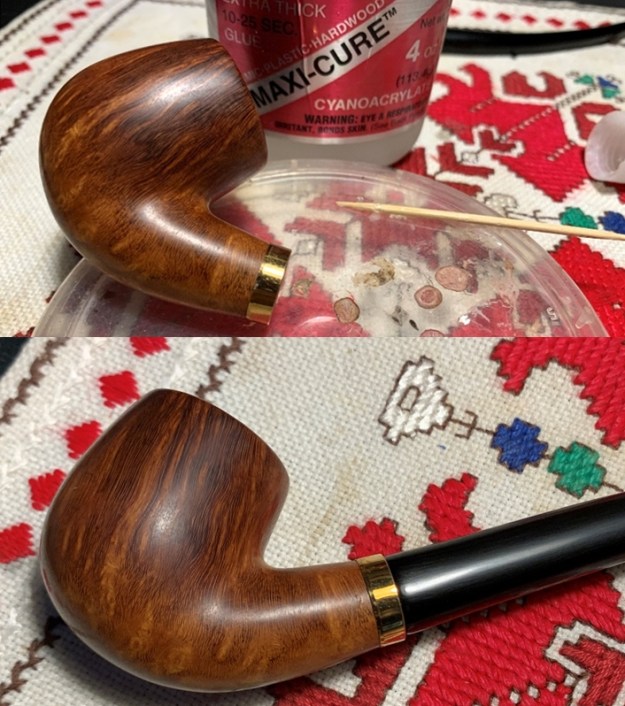
Wow!  The grain on this stummel catches the eye with the flame grain circling the bowl.  This bowl works well as a Churchwarden.  The size is perfect, and the shank pitch puts the long flowing Warden stem at a nice trajectory.  The addition of the copper band/shank cap is classy and works very well to transition the bowl and the stem.  I believe my son-in-law, Niko, will enjoy this Churchwarden which will be wrapped and waiting for him under the tree!  Thanks for joining me!
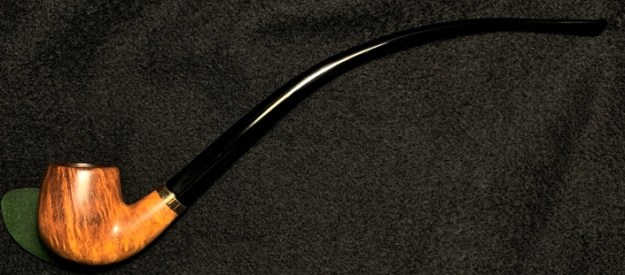
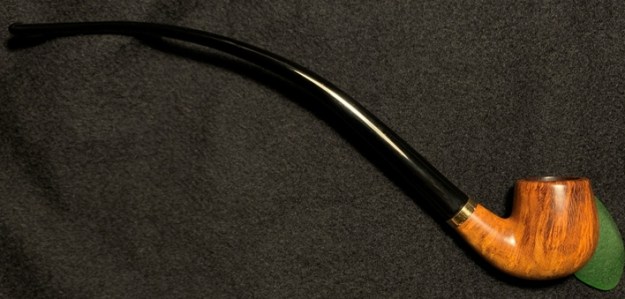
Restoring a 1969 Dunhill Bruyere 112 F/T Apple from Bob Kerr’s Estate


Blog by Steve Laug

As I continue to work through the pipes in Bob Kerr’s Estate I am enjoying choosing different brands that he had to focus on for a bit. I had eight more from his Dunhill collection that I decided to go back to and finish working my way through that sub collection of the estate. Out of the 8 pipes six were Bruyere finished pipes, one was a Made in London (turns out it is also a Bruyere finished pipe), and one was a Root Briar. What follows is a list of what I saw when I examined the 8 pipes. As I finish the pipes I will include the link to the blog on that particular pipe for easy reference. I have already restored 16 pipes from this subgroup so you can do a quick search to read about the work on the Shell Briars and Tanshell Briars that were in that part of the collection.

  1. Bruyere 656 F/T Made in England 2 Circle 4A – Group 4 size Bruyere made in 1962. Stem is oxidized, tooth marks and chatter near the button, some calcification with damage to the button. Finish is dirty, bowl caked and lava overflow on the rim top. Bowl is out of round, damaged edge.
  2. Bruyere 112 F/T Made in England 9/11 Circle 2A – Group 2 size Bruyere made in 1969 and sold in 1971. Stem is oxidized, tooth marks and chatter near the button, some calcification with damage to the button. Finish is dirty, bowl caked and lava overflow on the rim top. Bowl is out of round, damaged edge.
  3. Bruyere 0333 Made in England 16 made in 1976. Stem is oxidized, tooth marks and chatter near the button, some calcification with damage to the button. Finish is dirty, bowl caked and lava overflow on the rim top. Bowl is out of round, damaged edge.
  4. Bruyere 41061 Made in England 18 made in 1978. Stem is oxidized, tooth marks and chatter near the button, some calcification with damage to the button. Finish is dirty, bowl caked and lava overflow on the rim top. Bowl is out of round, damaged edge. I finished the restoration on it. Here is the link to the blog – (https://rebornpipes.com/2019/12/24/restoring-a-1978-dunhill-bruyere-41061-from-bob-kerrs-estate/).
  5. Bruyere 142 F/T Made in England 7/9/11 Circle 4A – Group for size Bruyere made in 1967 and sent out in 1969 or 1971. Stem is oxidized, tooth marks and chatter near the button, some calcification with damage to the button. Finish is dirty, bowl caked and lava overflow on the rim top. Bowl is out of round, damaged edge. I finished the restoration on it. Here is the link to the blog – https://rebornpipes.com/2019/12/27/restoring-a-1967-dunhill-bruyere-142-f-t-billiard-from-bob-kerrs-estate/
  6. (A) Dunill London Inner Tube PAT N°5861/12 Shape 34. Stem is oxidized, tooth marks and chatter near the button, some calcification with damage to the button. Finish is dirty, bowl caked and lava overflow on the rim top. Bowl is out of round, damaged edge. I finished the restoration on it. Here is the link to the blog – (https://rebornpipes.com/2019/12/26/restoring-a-1913-a-dunhill-london-34-billiard-from-bob-kerrs-estate/).
  7. (Ao) Dunhill London 113 Made in England 5 PAT N°158709/14. Stem is oxidized, tooth marks and chatter near the button, some calcification with damage to the button. Finish is dirty, bowl caked and lava overflow on the rim top. Bowl is out of round, damaged rim edges. I finished the restoration on it. Here is the link to the blog – (https://rebornpipes.com/2019/12/25/restoring-a-1925-ao-dunhill-london-113-billiard-from-bob-kerrs-estate/).
  8. Root Briar 31032 Made in England 18 – made in 1978. Stem is oxidized, tooth marks and chatter near the button, some calcification with damage to the button. Finish is dirty, bowl caked and lava overflow on the rim top. Bowl is out of round, damaged edge. I finished the restoration on it. Here is the link to the blog – (https://rebornpipes.com/2019/12/23/restoring-a-1978-dunhill-root-briar-31032-billiard-from-bob-kerrs-estate/).

I finished work on #4, #5, #6, #7 & #8 and turned my attention to #2, another heavily used pipe but this time an Apple shaped pipe with a tapered stem. The pipe was stamped on the left side of the shank with the shape number 112 F/T next to the bowl/shank junction. That is followed by Dunhill over Bruyere. On the right side of the shank it is stamped Made in England 9 with a slightly superscript 11 with a Circle 2A. It appears that the pipe stamped as this one is was made in 1969 and shipped or sold in 1971. The 112 F/T is an Apple with a fish tail (F/T) tapered stem. The 2A stamp gives the Group or size number which in this case is a 2. The A stamp denotes a Bruyere pipe. Working on this is a change after the group of billiards I have worked on so far.

I am once again including Chuck Stanion’s eloquent description of the Bruyere on the smokingpipes.com site as follows (https://www.smokingpipes.com/pipes/new/dunhill/moreinfo.cfm?product_id=346421):

The Bruyere was Alfred Dunhill’s original finish upon launching his brand of premium pipes and smoking accessories and was the only Dunhill finish from 1910 until 1917. Even after the addition of other finishes, the Bruyere maintained a high level of popularity, becoming synonymous with what is thought of, even today, as the quintessential pipe. To achieve the iconic, ruby hue and saturation, a skilled craftsman painstakingly layers particular stains in a precise manner, then meticulously polishes the pipe to a high luster. The final result is, simply put, timeless.

Like Bob’s other Dunhill pipe this one also had a thick cake in the bowl with remnants of tobacco stuck on the walls. There was a lava overflow on the rim so it was hard to know what kind of damage lay beneath the thick covering. Once it was cleaned I would have a better idea of the condition of the rim top. I could see however that there was definitely damage to the front inner edge of the bowl. The grain that is poking through the grime and oils appears to be quite beautiful – birdseye grain on the bowl sides and cross grain on the front and back as well as the heel of the bowl. The stem was oxidized and calcified toward the end with some tooth chatter. There were also some tooth marks on both sides of the stem ahead of the button and on the button itself. There was the classic White Spot on the top of the stem. Jeff took photos of the pipe before he started his cleanup work on it.  Jeff took photos of the bowl and rim top to show the thick, hard cake in the bowl with remnants of tobacco stuck on the walls of the bowl. There was a lava build up on the smooth rim top and the edges of the bowl. The rim top looked pretty good but it was hard to know for sure. It appeared that there was damage on the inner edge. The outer edges looked to be okay other than a few small nicks on the sides.  There was a burn mark on the right side of the bowl from where the pipe had been laid down in an ashtray. It was not deep but it was permanent.Jeff took photos of the sides and heel of the bowl to show the condition of the finish. You can see the beautiful grain patterns around the sides of the bowl and shank. Even under the dirt and debris of the years it looked very good.   The stamping is very readable. On the left side of the shank you can see 112 F/T which is the shape number followed by the F/T for a Fish tail stem. Next to that it is stamped Dunhill over Bruyere. On the right side it reads Made in England 9/11 followed by Circle 2A. Jeff included a pic of the White Spot on the stem.  Jeff took photos of the top and underside of the stem showing the tooth chatter, scratching, calcification and oxidation on the stem surface and wear on the edges of the button.    I can’t begin tell you how great it feels to have Jeff’s help on cleaning up the pipes from Bob’s estate as the 125+ pipes were taking me a long time to do alone. He cleaned this filthy pipe with his usual penchant for thoroughness that I really appreciate. This one was a real mess and I was looking forward to seeing what he had done with this one when I took it out of his box. It looked amazing and CLEAN. He reamed it with a PipNet pipe reamer and cleaned up the reaming with a Savinelli Fitsall Pipe Knife. He scrubbed out the internals with alcohol, pipe cleaners and cotton swabs until the pipe was clean. He scrubbed the exterior of the bowl with Murphy’s Oil Soap and a tooth brush to remove the grime and grit on the briar and the lava on the rim top. The finish looks good with great looking grain around the bowl and shank. The rim top looked better on this pipe. The condition of the inner and outer edges was not too bad. The stem looked a lot better. Jeff soaked the stem in Before & After Deoxidizer to remove the oxidation on the rubber. The pipe was ready for me to carry on the next part of the process. I took some close up photos of the rim top and also of the stem surface. I wanted to show how well it had cleaned up and what needed to be done. The rim top had a worn and burned area on the left front of the inner edge. There was darkening and nicks all around the top of the bowl and on the inner edge. The outer edge looked good.  I also took close up photos of the stem to show the tooth marks and chatter on the stem surface.  I also took a close up photo of the burn mark on the right side of the bowl. The stamping appeared to be as clear as it was before the cleanup work. This is just one of the things I appreciate about Jeff’s cleanup is that he works to protect and preserve the nomenclature on the shank of the pipes that he works on. I took some photos to show the stamping. Bob loved his Dunhill pipes and it was obvious that he enjoyed smoking them. Some appeared to be daily smokes while others he seemed to reserve for special occasions. Some seemed like they must have hung in his mouth while he did his carving while others were smoked in his chair. Having worked on over 60 of his pipes so far I am getting a feel for them. This one is in rough condition and I suppose it might well have been before Bob took up the trust. I suppose I won’t ever know for sure but it certainly has a long and interesting story if it could only tell it.
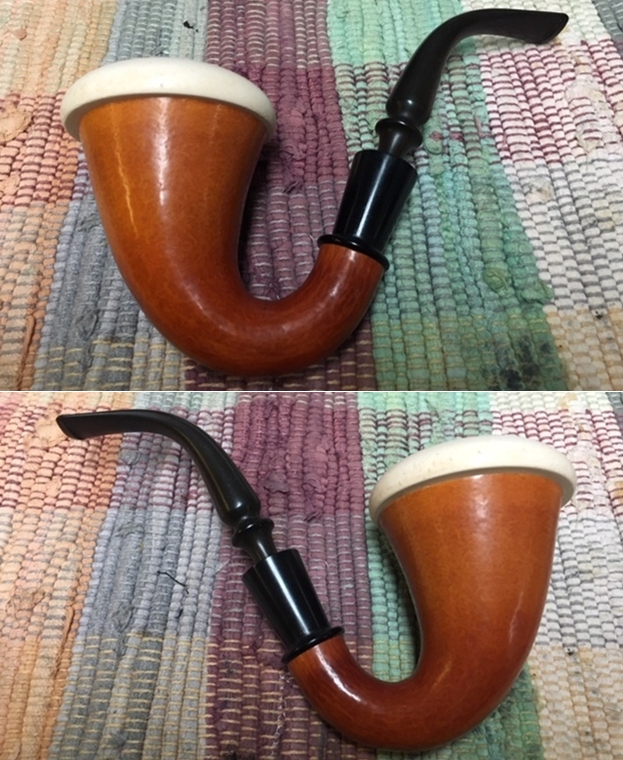
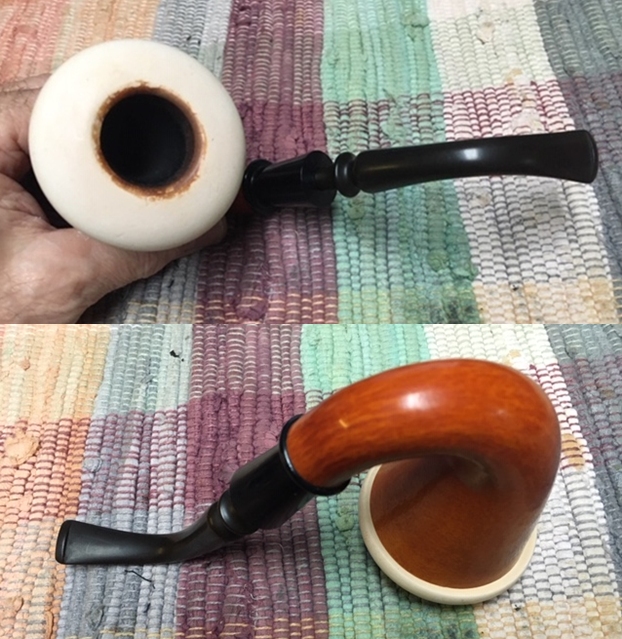
I am sure that many of you have read at least some of the other restoration work that I have done on previous pipes. You have also read what I have included about Bob Kerr, the pipeman who held these pipes in trust before I came to work on them (see photo to the left). Also, if you have followed the blog for long you will already know that I like to include background information on the pipeman whose pipes I am restoring. For me, when I am working on an estate I really like to have a sense of the person who held the pipes in trust before I worked on them. It gives me another dimension of the restoration work. Bob’s daughter wrote a short tribute to her father. I thank you Brian and tell your wife thank you as well.

I am delighted to pass on these beloved pipes of my father’s. I hope each user gets many hours of contemplative pleasure as he did. I remember the aroma of tobacco in the rec room, as he put up his feet on his lazy boy. He’d be first at the paper then, no one could touch it before him. Maybe there would be a movie on with an actor smoking a pipe. He would have very definite opinions on whether the performer was a ‘real’ smoker or not, a distinction which I could never see but it would be very clear to him. He worked by day as a sales manager of a paper products company, a job he hated. What he longed for was the life of an artist, so on the weekends and sometimes mid-week evenings he would journey to his workshop and come out with wood sculptures, all of which he declared as crap but every one of them treasured by my sister and myself. Enjoy the pipes, and maybe a little of his creative spirit will enter you!

It was time to get on with the restoration of this Dunhill Bruyere 112F/T Apple. It was a bit of a change of pace from the last bunch of billiards that I had worked on. I really need to send a shout out to Jeff for the hard cleanup work that Jeff does on each of these pipes. They were a real mess when I sent them to Jeff and I have to tell you it was great that I can start my part of the process with a clean pipe. I decided to start the process by dealing with the the damage to the inner edge of the bowl. I wanted to minimize the intrusiveness of the work on the rim and focus just on the rim edge. I carefully worked on the inner edge with a folded piece of 220 grit sandpaper and gave it a very slight bevel. I was able to remove much of the darkening and damage. The first photo shows the damaged inner edges of the bowl and the darkening around the full bowl. The second photo below shows the process I used with the folded sandpaper. The third photo shows the rim top and edges after my work on them…though not perfect I think it is an improvement. I polished the briar on the rim top and bowl with worn micromesh sanding pads – wet sanding it with 1500-12000 grit micromesh sanding pads. I wiped it down after each pad with a damp cloth. I find that the worn pads do a great job polishing and still retain the original patina of the pipe. I rubbed the bowl and rim down with Before & After Restoration Balm. I worked it into the surface of the briar with my fingertips to clean, enliven and protect it. I let the balm sit for a little while and then buffed the pipe with a cotton cloth to raise the shine. I really like watching the Balm do its magic and bring the briar alive. With the bowl done it was time to address the stem. The dents in the top and underside were the right depth for me to lift them. I sanded the surface of the stem with 220 grit sandpaper to remove the remaining oxidation in the vulcanite. I polished it with 400 grit wet dry sand paper.  I rubbed the stem down with Denicare Mouthpiece Polish. I have a few tins of this laying around so I am trying to use them up. It does a pretty good job polishing the stem.  I polished the stem with micromesh sanding pads – wet sanding with 1500-12000 grit sanding pads. I wiped it down after each pad with a damp cloth to remove the sanding dust. I polished it further with Before & After Pipe Polish – both Fine and Extra Fine. I finished by rubbing the stem down with some “No Oxy Oil” to protect the vulcanite. I am experimenting with the product from Briarville and tracking how it works so I can write a review of it.   Once again at this point in the restoration process I am excited to be on the homestretch. This is the sixth of the Dunhill smooth pipes in Bob’s estate that I am working on. It is a beautiful Dunhill Bruyere 112 F/T Apple made in 1969 and shipped or sold in 1971. Like each of the pipes in Bob’s estate I really look forward to this point in the process when it is put back together, polished and waxed. I put the bowl and stem back together. I polished the bowl and stem with Blue Diamond to polish out the scratches in the briar and the vulcanite. The nicks on the right outer rim edge and the small burn mark look better – minimized a bit. I gave the bowl and the stem multiple coats of carnauba wax. I buffed the pipe with a clean buffing pad to raise the shine. I hand buffed it with a microfiber cloth to deepen the shine. The pipe polished up pretty nicely. The grain around the bowl and shank really came alive with the wax and polish. The black of the tapered vulcanite White Spot stem is a beautiful contrast to the reds and browns of the finished bowl and shank. This was another Dunhill that was a lot of fun to work on thanks to Jeff’s cleanup work. The pipe is comfortable pipe to hold in the hand. The finished pipe is shown in the photos below. The dimensions of the pipe are Length: 5 ¾ inches, Height: 1 ½ inches, Outside diameter of the bowl: 1 ¼ inches, Chamber diameter: ¾ of an inch. This 1969 Bruyere Apple is a beauty should last for many more years. It is one that will be on the rebornpipes store very soon. If you are interested let me know. I have a lot more of Bob’s estate to work on of various brands. Perhaps one of those will catch your attention. Thanks for reading this blog and my reflections on the pipe while I worked on it. This is an interesting estate to bring back to life.
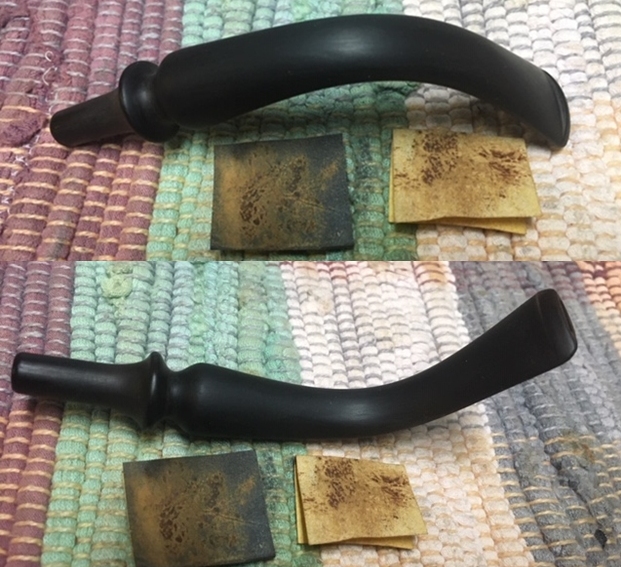
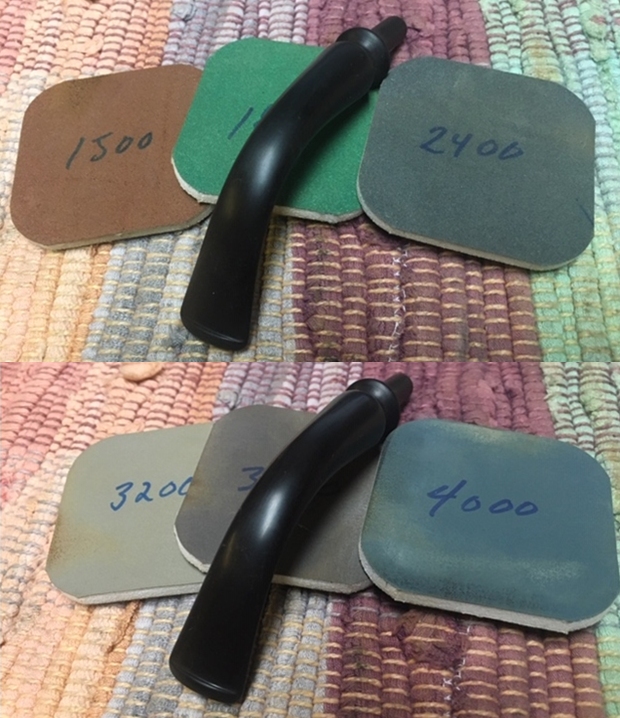
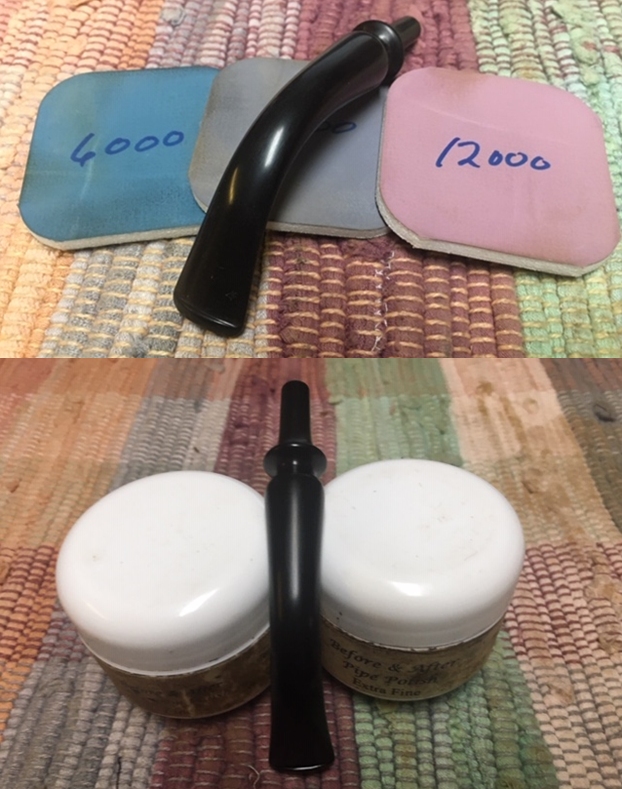
Restoring a 1967 Dunhill Bruyere 142 F/T Billiard from Bob Kerr’s Estate


Blog by Steve Laug

As I continue to work through the pipes in Bob Kerr’s Estate I am enjoying choosing different brands that he had to focus on for a bit. I had eight more from his Dunhill collection that I decided to go back to and finish working my way through that sub collection of the estate. Out of the 8 pipes six were Bruyere finished pipes, one was a Made in London (turns out it is also a Bruyere finished pipe), and one was a Root Briar. What follows is a list of what I saw when I examined the 8 pipes. As I finish the pipes I will include the link to the blog on that particular pipe for easy reference. I have already restored 16 pipes from this subgroup so you can do a quick search to read about the work on the Shell Briars and Tanshell Briars that were in that part of the collection.

  1. Bruyere 656 F/T Made in England 2 Circle 4A – Group 4 size Bruyere made in 1962. Stem is oxidized, tooth marks and chatter near the button, some calcification with damage to the button. Finish is dirty, bowl caked and lava overflow on the rim top. Bowl is out of round, damaged edge.
  2. Bruyere 112 F/T Made in England 9/11 Circle 2A – Group 2 size Bruyere made in 1969 and sold in 1971. Stem is oxidized, tooth marks and chatter near the button, some calcification with damage to the button. Finish is dirty, bowl caked and lava overflow on the rim top. Bowl is out of round, damaged edge.
  3. Bruyere 0333 Made in England 16 made in 1976. Stem is oxidized, tooth marks and chatter near the button, some calcification with damage to the button. Finish is dirty, bowl caked and lava overflow on the rim top. Bowl is out of round, damaged edge.
  4. Bruyere 41061 Made in England 18 made in 1978. Stem is oxidized, tooth marks and chatter near the button, some calcification with damage to the button. Finish is dirty, bowl caked and lava overflow on the rim top. Bowl is out of round, damaged edge. I finished the restoration on it. Here is the link to the blog – (https://rebornpipes.com/2019/12/24/restoring-a-1978-dunhill-bruyere-41061-from-bob-kerrs-estate/).
  5. Bruyere 142 F/T Made in England 7/9/11 Circle 4A – Group for size Bruyere made in 1967 and sent out in 1969 or 1971. Stem is oxidized, tooth marks and chatter near the button, some calcification with damage to the button. Finish is dirty, bowl caked and lava overflow on the rim top. Bowl is out of round, damaged edge.
  6. (A) Dunill London Inner Tube PAT N°5861/12 Shape 34. Stem is oxidized, tooth marks and chatter near the button, some calcification with damage to the button. Finish is dirty, bowl caked and lava overflow on the rim top. Bowl is out of round, damaged edge. I finished the restoration on it. Here is the link to the blog – (https://rebornpipes.com/2019/12/26/restoring-a-1913-a-dunhill-london-34-billiard-from-bob-kerrs-estate/).
  7. (Ao) Dunhill London 113 Made in England 5 PAT N°158709/14. Stem is oxidized, tooth marks and chatter near the button, some calcification with damage to the button. Finish is dirty, bowl caked and lava overflow on the rim top. Bowl is out of round, damaged rim edges. I finished the restoration on it. Here is the link to the blog – (https://rebornpipes.com/2019/12/25/restoring-a-1925-ao-dunhill-london-113-billiard-from-bob-kerrs-estate/).
  8. Root Briar 31032 Made in England 18 – made in 1978. Stem is oxidized, tooth marks and chatter near the button, some calcification with damage to the button. Finish is dirty, bowl caked and lava overflow on the rim top. Bowl is out of round, damaged edge. I finished the restoration on it. Here is the link to the blog – (https://rebornpipes.com/2019/12/23/restoring-a-1978-dunhill-root-briar-31032-billiard-from-bob-kerrs-estate/).

I finished work on #4, #6, #7 & #8 and turned my attention to #5, another heavily used Billiard with a tapered stem. The pipe was stamped on the left side of the shank with the shape number 142 F/T next to the bowl/shank junction. That is followed by Dunhill over Bruyere. On the right side of the shank it is stamped Made in England 7/9/11 with a Circle 4A. It appears that the pipe stamped as this one is was made in 1967 and shipped or sold in 1969 or 1971. The 142 is a Billiard with a tapered stem. The 4A stamp gives the Group or size number which in this case is a 4. The A stamp denotes a Bruyere pipe. Working on this is a change after the two old timers.

I am once again including Chuck Stanion’s eloquent description of the Bruyere on the smokingpipes.com site as follows (https://www.smokingpipes.com/pipes/new/dunhill/moreinfo.cfm?product_id=346421):

The Bruyere was Alfred Dunhill’s original finish upon launching his brand of premium pipes and smoking accessories and was the only Dunhill finish from 1910 until 1917. Even after the addition of other finishes, the Bruyere maintained a high level of popularity, becoming synonymous with what is thought of, even today, as the quintessential pipe. To achieve the iconic, ruby hue and saturation, a skilled craftsman painstakingly layers particular stains in a precise manner, then meticulously polishes the pipe to a high luster. The final result is, simply put, timeless.

Like Bob’s other  Dunhill pipe this one also had a thick cake in the bowl with remnants of tobacco stuck on the walls. There was a lava overflow on the rim so it was hard to know what kind of damage lay beneath the thick covering. Once it was cleaned I would have a better idea of the condition of the rim top. I could see however that there was definitely damage to the front inner edge of the bowl. The grain that is poking through the grime and oils appears to be quite beautiful – birdseye grain on the bowl sides and cross grain on the front and back as well as the heel of the bowl. The stem was oxidized and calcified toward the end with some tooth chatter. There were also some tooth marks on both sides of the stem ahead of the button and on the button itself. There was the classic White Spot on the top of the stem. Jeff took photos of the pipe before he started his cleanup work on it.     Jeff took photos of the bowl and rim top to show the thick, hard cake in the bowl with remnants of tobacco stuck on the walls of the bowl. There was a lava build up on the smooth rim top and the edges of the bowl. The rim top looked pretty good but it was hard to know for sure. It appeared that there was damage on the inner edge. The outer edges looked to be okay other than a few small nicks on the sides.    Jeff took photos of the sides and heel of the bowl to show the condition of the finish. You can see the beautiful grain patterns around the sides of the bowl and shank. Even under the dirt and debris of the years it looked very good. The stamping is very readable. On the left side of the shank you can see 142 F/T which is the shape number followed by the F/T for a Fishtail stem. Next to that it is stamped Dunhill over Bruyere. On the right side it reads Made in England 7 9 11 followed by Circle 4A. He included a pic of the White Spot on the stem.  Jeff took photos of the top and underside of the stem showing the tooth chatter, scratching, calcification and oxidation on the stem surface and wear on the edges of the button.    I am really happy to have Jeff’s help on cleaning up the pipes from Bob’s estate as the 125+ pipes were taking me a long time to do alone. He cleaned this filthy pipe with his usual penchant for thoroughness that I really appreciate. This one was a real mess and I was looking forward to seeing what he had done with this one when I took it out of his box. It looked amazing and CLEAN. He reamed it with a PipNet pipe reamer and cleaned up the reaming with a Savinelli Fitsall Pipe Knife. He scrubbed out the internals with alcohol, pipe cleaners and cotton swabs until the pipe was clean. He scrubbed the exterior of the bowl with Murphy’s Oil Soap and a tooth brush to remove the grime and grit on the briar and the lava on the rim top. The finish looks good with great looking grain around the bowl and shank. The rim top looked better on this pipe. The condition of the inner and outer edges was not too bad. The stem looked a lot better. Jeff soaked the stem in Before & After Deoxidizer to remove the oxidation on the rubber. The pipe was ready for me to carry on the next part of the process. I took some close up photos of the rim top and also of the stem surface. I wanted to show how well it had cleaned up and what needed to be done. The rim top had a small area toward the left front of the inner edge that was worn or burned. There was darkening and nicks all around the top of the bowl and on the inner edge. The outer edge looked good.  I also took close up photos of the stem to show the tooth marks and chatter on the stem surface.  The stamping appeared to be as clear as it was before the cleanup work. This is just one of the things I appreciate about Jeff’s cleanup is that he works to protect and preserve the nomenclature on the shank of the pipes that he works on. I took some photos to show the stamping. Bob loved his Dunhill pipes and it was obvious that he enjoyed smoking them. Some appeared to be daily smokes while others he seemed to reserve for special occasions. Some seemed like they must have hung in his mouth while he did his carving while others were smoked in his chair. Having worked on over 60 of his pipes so far I am getting a feel for them. This one is in rough condition and I suppose it might well have been before Bob took up the trust. I suppose I won’t ever know for sure but it certainly has a long and interesting story if it could only tell it.

I am sure that many of you have read at least some of the other restoration work that I have done on previous pipes. You have also read what I have included about Bob Kerr, the pipeman who held these pipes in trust before I came to work on them (see photo to the left). Also, if you have followed the blog for long you will already know that I like to include background information on the pipeman whose pipes I am restoring. For me, when I am working on an estate I really like to have a sense of the person who held the pipes in trust before I worked on them. It gives me another dimension of the restoration work. Bob’s daughter wrote a short tribute to her father. I thank you Brian and tell your wife thank you as well.

I am delighted to pass on these beloved pipes of my father’s. I hope each user gets many hours of contemplative pleasure as he did. I remember the aroma of tobacco in the rec room, as he put up his feet on his lazy boy. He’d be first at the paper then, no one could touch it before him. Maybe there would be a movie on with an actor smoking a pipe. He would have very definite opinions on whether the performer was a ‘real’ smoker or not, a distinction which I could never see but it would be very clear to him. He worked by day as a sales manager of a paper products company, a job he hated. What he longed for was the life of an artist, so on the weekends and sometimes mid-week evenings he would journey to his workshop and come out with wood sculptures, all of which he declared as crap but every one of them treasured by my sister and myself. Enjoy the pipes, and maybe a little of his creative spirit will enter you!

It was time to get on with the restoration of this beautiful Bruyere 142F/T Billiard. I really appreciate the hard cleanup work that Jeff did on each of these pipes. They were a real mess when I sent them to Jeff and I have to tell you it was great that I did not need to clean this pipe. I decided to start the process by dealing with the the damage to the inner edge of the bowl. I worked on the inner edge with a folded piece of 220 grit sandpaper and gave it a very slight bevel. I was able to remove much of the darkening and damage. The first photo shows the damaged inner edges of the bowl and the darkening around the full bowl. The second photo below shows the process I used with the folded sandpaper. The third photo shows the rim top and edges after my work on them…though not perfect I think it is an improvement. I gave the rim top a quick polish with 400 grit wet dry paper and 1500-2400 grit micromesh sanding pads and it brought back some of life to the rim top. I used a Maple stain pen to touch up the edge of the bowl and took a photo to show the work. I polished the briar on the rim top and bowl with worn micromesh sanding pads – wet sanding it with 1500-12000 grit micromesh sanding pads. I wiped it down after each pad with a damp cloth. I find that the worn pads do a great job polishing and still retain the original patina of the pipe.   I rubbed the bowl and rim down with Before & After Restoration Balm. I worked it into the surface of the briar with my fingertips to clean, enliven and protect it. I let the balm sit for a little while and then buffed the pipe with a cotton cloth to raise the shine. I really like watching the Balm do its magic and bring the briar alive.     With the bowl done it was time to address the stem. The dents in the top and underside were the right depth for me to lift them. I sanded the surface of the stem with 220 grit sandpaper to remove the remaining oxidation in the vulcanite. I polished it with 400 grit wet dry sand paper. I rubbed the stem down with Denicare Mouthpiece Polish. I have a few tins of this laying around so I am trying to use them up. It does a pretty good job polishing the stem.  I polished the stem with micromesh sanding pads – wet sanding with 1500-12000 grit sanding pads. I wiped it down after each pad with a damp cloth to remove the sanding dust. I polished it further with Before & After Pipe Polish – both Fine and Extra Fine. I finished by rubbing the stem down with some “No Oxy Oil” to protect the vulcanite. I am experimenting with the product from Briarville and tracking how it works so I can write a review of it. Once again at this point in the restoration process I am excited to be on the homestretch. This is the fifth of the Dunhill smooth pipes in Bob’s estate that I am working on. It is a beautiful Dunhill Bruyere 142 F/T Billiard made in 1967 and shipped or sold in 1969 and/or 1971. Like each of the pipes in Bob’s estate I really look forward to this point in the process when it is put back together, polished and waxed. I put the bowl and stem back together. I polished the bowl and stem with Blue Diamond to polish out the scratches in the briar and the vulcanite. I gave the bowl and the stem multiple coats of carnauba wax. I buffed the pipe with a clean buffing pad to raise the shine. I hand buffed it with a microfiber cloth to deepen the shine. The pipe polished up pretty nicely. The grain around the bowl and shank really came alive with the wax and polish. The black of the tapered vulcanite White Spot stem is a beautiful contrast to the reds and browns of the finished bowl and shank. This was another Dunhill that was a lot of fun to work on thanks to Jeff’s cleanup work. The pipe is comfortable pipe to hold in the hand. The finished pipe is shown in the photos below. The dimensions of the pipe are Length: 6 inches, Height: 1 ¾ inches, Outside diameter of the bowl: 1 ¼ inches, Chamber diameter: ¾ of an inch. This 1967 Bruyere Billiard is a beauty should be able to last for many more years. It is one that will be on the rebornpipes store very soon. If you are interested let me know. I have a lot more of Bob’s estate to work on of various brands. Perhaps one of those will catch your attention. Thanks for reading this blog and my reflections on the pipe while I worked on it. This is an interesting estate to bring back to life.
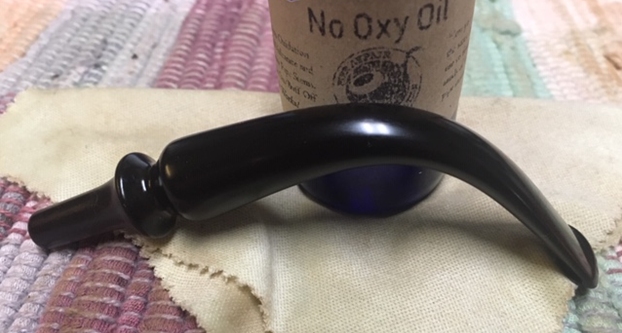
Restoring a 1913 “A” Dunhill London 34 Billiard from Bob Kerr’s Estate


Blog by Steve Laug

As I continue to work through the pipes in Bob Kerr’s Estate I am enjoying choosing different brands that he had to focus on for a bit. I had eight more from his Dunhill collection that I decided to go back to and finish working my way through that sub collection of the estate. Out of the 8 pipes six were Bruyere finished pipes, one was a Made in London (turns out it is also a Bruyere finished pipe), and one was a Root Briar. What follows is a list of what I saw when I examined the 8 pipes. As I finish the pipes I will include the link to the blog on that particular pipe for easy reference. I have already restored 16 pipes from this subgroup so you can do a quick search to read about the work on the Shell Briars and Tanshell Briars that were in that part of the collection.

  1. Bruyere 656 F/T Made in England 2 Circle 4A – Group 4 size Bruyere made in 1962. Stem is oxidized, tooth marks and chatter near the button, some calcification with damage to the button. Finish is dirty, bowl caked and lava overflow on the rim top. Bowl is out of round, damaged edge.
  2. Bruyere 112 F/T Made in England 9/11 Circle 2A – Group 2 size Bruyere made in 1969 and sold in 1971. Stem is oxidized, tooth marks and chatter near the button, some calcification with damage to the button. Finish is dirty, bowl caked and lava overflow on the rim top. Bowl is out of round, damaged edge.
  3. Bruyere 0333 Made in England 16 made in 1976. Stem is oxidized, tooth marks and chatter near the button, some calcification with damage to the button. Finish is dirty, bowl caked and lava overflow on the rim top. Bowl is out of round, damaged edge.
  4. Bruyere 41061 Made in England 18 made in 1978. Stem is oxidized, tooth marks and chatter near the button, some calcification with damage to the button. Finish is dirty, bowl caked and lava overflow on the rim top. Bowl is out of round, damaged edge. I finished the restoration on it. Here is the link to the blog – (https://rebornpipes.com/2019/12/24/restoring-a-1978-dunhill-bruyere-41061-from-bob-kerrs-estate/).
  5. Bruyere 142 F/T Made in England 7/9/11 Circle 4A – Group for size Bruyere made in 1967 and sent out in 1969 or 1971. Stem is oxidized, tooth marks and chatter near the button, some calcification with damage to the button. Finish is dirty, bowl caked and lava overflow on the rim top. Bowl is out of round, damaged edge.
  6. (A) Dunill London Inner Tube PAT N°5861/12 Shape 34. Stem is oxidized, tooth marks and chatter near the button, some calcification with damage to the button. Finish is dirty, bowl caked and lava overflow on the rim top. Bowl is out of round, damaged edge. Missing the inner tube.
  7. (Ao) Dunhill London 113 Made in England 5 PAT N°158709/14. Stem is oxidized, tooth marks and chatter near the button, some calcification with damage to the button. Finish is dirty, bowl caked and lava overflow on the rim top. Bowl is out of round, damaged rim edges. I finished the restoration on it. Here is the link to the blog – (https://rebornpipes.com/2019/12/25/restoring-a-1925-ao-dunhill-london-113-billiard-from-bob-kerrs-estate/).
  8. Root Briar 31032 Made in England 18 – made in 1978. Stem is oxidized, tooth marks and chatter near the button, some calcification with damage to the button. Finish is dirty, bowl caked and lava overflow on the rim top. Bowl is out of round, damaged edge. I finished the restoration on it. Here is the link to the blog – (https://rebornpipes.com/2019/12/23/restoring-a-1978-dunhill-root-briar-31032-billiard-from-bob-kerrs-estate/).

I finished work on #4, #7 & #8 and turned my attention to #6, another heavily used Billiard with a tapered stem. The pipe was stamped on the left side of the shank with the letter A next to the bowl/shank junction. That is followed by Dunhill arched over London. On the right side of the shank it is stamped Inner Tube with PAT N°5861/12 underneath. I turned to the PipePhil website to see if I could pin down the time from for the entrance of the inner tube and also see if I could clear up the date of the patent number on the pipe (http://www.pipephil.eu/logos/en/dunhill/root-bru-guide.html). I did a screen capture of the pertinent info on that below. I inserted a yellow arrow on the top left corner to point out the patent number information.It appears that the pipe stamped as this one is Inner Tube over Pat. No. 5861/12 places this pipe as a 1913 Pipe. I went on to a separate page on the site to see if I could identify the A stamp (http://www.pipephil.eu/logos/en/dunhill/patent1.html#36). From there is appears that the A stamp means that the pipe is a Bruyere from 1913 and that also is attested by the DUNHILL arched over LONDON marking.

I am once again including Chuck Stanion’s eloquent description of the Bruyere on the smokingpipes.com site as follows (https://www.smokingpipes.com/pipes/new/dunhill/moreinfo.cfm?product_id=346421):

The Bruyere was Alfred Dunhill’s original finish upon launching his brand of premium pipes and smoking accessories and was the only Dunhill finish from 1910 until 1917. Even after the addition of other finishes, the Bruyere maintained a high level of popularity, becoming synonymous with what is thought of, even today, as the quintessential pipe. To achieve the iconic, ruby hue and saturation, a skilled craftsman painstakingly layers particular stains in a precise manner, then meticulously polishes the pipe to a high luster. The final result is, simply put, timeless.

On rebornpipes I have a blog by Eric Boehm on Dunhill shape numbers and I turned to that to help identify the shape number on this pipe. Eric notes that the shape number 34 designates a Billiard with a tapered stem. (https://rebornpipes.com/2012/11/01/dunhill-pipe-shapes-collated-by-eric-w-boehm/).

Now I knew I was dealing with another one of Bob’s oldest Dunhill pipes. It was a 1913 Dunhill Bruyere with a Patent Number for the Inner Tube and stamping that established the date for me. It was time to turn to the pipe. There was a thick cake in the bowl with remnants of tobacco stuck on the walls. There was a lava overflow on the rim that filled in all of the damage to the surface of the rim top and edges. Once it was cleaned I would have a better idea of the condition of the rim top. I could see however that there was definitely damage to both the inner and the outer edge of the bowl. The grain that is poking through the grime and oils appears to be quite beautiful –birdseye grain on the bowl sides and cross grain on the front and back as well as the heel of the bowl. The stem was oxidized and calcified toward the end with some tooth chatter. There were also some tooth marks on both sides of the stem ahead of the button and on the button itself. There was the classic White Spot on the top of the stem. Jeff took photos of the pipe before he started his cleanup work on it.  Jeff took photos of the bowl and rim top to show the thick, hard cake in the bowl with remnants of tobacco stuck on the walls of the bowl. There was a lava build up on the smooth rim top and the edges of the bowl. The rim top looked pretty good but it was hard to know for sure. It appeared that there was damage on the inner edge. The outer edges looked to be okay.    Jeff took photos of the sides and heel of the bowl to show the condition of the finish. You can see the beautiful grain patterns around the sides of the bowl and shank. Even under the dirt and debris of the years it looked very good. The stamping is readable with a lens and a bright light. On the left side of the shank you can see A (which turns out to be the designation for a Bruyere finish) followed by Dunhill arched over London. It took 2 photos to catch the faint stamping. On the right side it reads “Inner Tube” over PAT N°5861/12. He included a pic of the White Spot on the stem.  Jeff took photos of the top and underside of the stem showing the tooth chatter, scratching, calcification and oxidation on the stem surface and wear on the edges of the button.    I am really happy to have Jeff’s help on cleaning up the pipes from Bob’s estate as the 125+ pipes were taking me a long time to do alone. He cleaned this filthy pipe with his usual penchant for thoroughness that I really appreciate. This one was a real mess and I was looking forward to seeing what he had done with this one when I took it out of his box. It looked amazing and CLEAN. He reamed it with a PipNet pipe reamer and cleaned up the reaming with a Savinelli Fitsall Pipe Knife. He scrubbed out the internals with alcohol, pipe cleaners and cotton swabs until the pipe was clean. He scrubbed the exterior of the bowl with Murphy’s Oil Soap and a tooth brush to remove the grime and grit on the briar and the lava on the rim top. The finish looks good with great looking grain around the bowl and shank. The rim top looked better on this pipe. The condition of the inner and outer edges was not too bad. The stem looked a lot better. Jeff soaked the stem in Before & After Deoxidizer to remove the oxidation on the rubber. The pipe was ready for me to carry on the next part of the process. I took some close up photos of the rim top and also of the stem surface. I wanted to show how well it had cleaned up and what needed to be done. The rim top had a small area toward the left front of the inner edge that was worn or burned. There was darkening and nicks all around the top of the bowl and on the inner edge. The outer edge looked good.  I also took close up photos of the stem to show the tooth marks and chatter on the stem surface. The stamping appeared to be as clear as it was before the cleanup work. This is just one of the things I appreciate about Jeff’s cleanup is that he works to protect and preserve the nomenclature on the shank of the pipes that he works on. I took some photos to show the stamping. Bob loved his Dunhill pipes and it was obvious that he enjoyed smoking them. Some appeared to be daily smokes while others he seemed to reserve for special occasions. Some seemed like they must have hung in his mouth while he did his carving while others were smoked in his chair. Having worked on over 60 of his pipes so far I am getting a feel for them. This one is in rough condition and I suppose it might well have been before Bob took up the trust. I suppose I won’t ever know for sure but it certainly has a long and interesting story if it could only tell it.

I am sure that many of you have read at least some of the other restoration work that I have done on previous pipes. You have also read what I have included about Bob Kerr, the pipeman who held these pipes in trust before I came to work on them (see photo to the left). Also, if you have followed the blog for long you will already know that I like to include background information on the pipeman whose pipes I am restoring. For me, when I am working on an estate I really like to have a sense of the person who held the pipes in trust before I worked on them. It gives me another dimension of the restoration work. Bob’s daughter wrote a short tribute to her father. I thank you Brian and tell your wife thank you as well.

I am delighted to pass on these beloved pipes of my father’s. I hope each user gets many hours of contemplative pleasure as he did. I remember the aroma of tobacco in the rec room, as he put up his feet on his lazy boy. He’d be first at the paper then, no one could touch it before him. Maybe there would be a movie on with an actor smoking a pipe. He would have very definite opinions on whether the performer was a ‘real’ smoker or not, a distinction which I could never see but it would be very clear to him. He worked by day as a sales manager of a paper products company, a job he hated. What he longed for was the life of an artist, so on the weekends and sometimes mid-week evenings he would journey to his workshop and come out with wood sculptures, all of which he declared as crap but every one of them treasured by my sister and myself. Enjoy the pipes, and maybe a little of his creative spirit will enter you!

It was time to get on with the restoration of this old and worn 1913 Dunhill Bruyere Patent No. Inner Tube Billiard. I really appreciate the hard cleanup work that Jeff did on these pipes. They were a real mess when I sent them to Jeff and I have to tell you it was great that I did not need to clean this pipe. I decided to start the process by dealing with the the damage to the edges and the rim top of the bowl. I worked on the inner edge with a folded piece of 220 grit sandpaper and gave it a very slight bevel. I was able to remove much of the damage. I used a folded piece of 220 grit sandpaper to smooth out the damage on the outer edge of the bowl as well.  The second photo below shows the rim top and edges after my work on them…though not perfect I think it is an improvement. I was hoping that polishing the rim top and briar would help to blend to the top with the bowl enough that I would not need to stain it. I polished the briar on the rim top and bowl with worn micromesh sanding pads – wet sanding it with 1500-12000 grit micromesh sanding pads. I wiped it down after each pad with a damp cloth. I find that the worn pads do a great job polishing and still retain the original patina of the pipe.   I rubbed the bowl and rim down with Before & After Restoration Balm. I worked it into the surface of the briar with my fingertips to clean, enliven and protect it. I let the balm sit for a little while and then buffed the pipe with a cotton cloth to raise the shine. I really like watching the Balm do its magic and bring the briar alive.    With the bowl done it was time to address the stem. The dents in the top and underside were the right depth for me to lift them. I “painted” the surface of the stem with the flame of a Bic lighter to raise the dents in the surface. I was able to lift  them to the point that sanding the stem would do the job.I sanded the surface of the stem with 220 grit sandpaper to remove the remaining oxidation in the vulcanite. I polished it with 400 grit wet dry sand paper.  I rubbed the stem down with Denicare Mouthpiece Polish. I have a few tins of this laying around so I am trying to use them up. It does a pretty good job polishing the stem.  I polished the stem with micromesh sanding pads – wet sanding with 1500-12000 grit sanding pads. I wiped it down after each pad with a damp cloth to remove the sanding dust. I polished it further with Before & After Pipe Polish – both Fine and Extra Fine. I finished by rubbing the stem down with some “No Oxy Oil” to protect the vulcanite. I am experimenting with the product from Briarville and tracking how it works so I can write a review of it. Once again at this point in the restoration process I am excited to be on the homestretch. This is the fourth of the Dunhill smooth pipes in Bob’s estate that I am working on. It is another one that turned out to be a beautiful 1913 Dunhill London 34 Billiard. It was in pretty amazing condition for 107 year old pipe so I really was looking forward to this point in the process when it is put back together, polished and waxed. I put the bowl and stem back together. I polished the bowl and stem with Blue Diamond to polish out the scratches in the briar and the vulcanite. I gave the bowl and the stem multiple coats of carnauba wax. I buffed the pipe with a clean buffing pad to raise the shine. I hand buffed it with a microfiber cloth to deepen the shine. The pipe polished up pretty nicely. The grain around the bowl and shank really came alive with the wax and polish. The black of the tapered vulcanite White Spot stem is a beautiful contrast to the reds and browns of the finished bowl and shank. This was another older Dunhill that was a lot of fun to work on thanks to Jeff’s cleanup work. The pipe is comfortable pipe to hold in the hand. The finished pipe is shown in the photos below. The dimensions of the pipe are Length: 5 ¾ inches, Height: 1 ¾ inches, Outside diameter of the bowl: 1 1/8 inches, Chamber diameter: ¾ of an inch. This 1913 Bruyere Billiard is a beauty should be able to last another 100+ years. It is another one that I am thinking about hanging onto solely because of the age. I have a lot more of Bob’s estate to work on of various brands. Perhaps one of those will catch your attention. Thanks for reading this blog and my reflections on the pipe while I worked on it. This is an interesting estate to bring back to life.