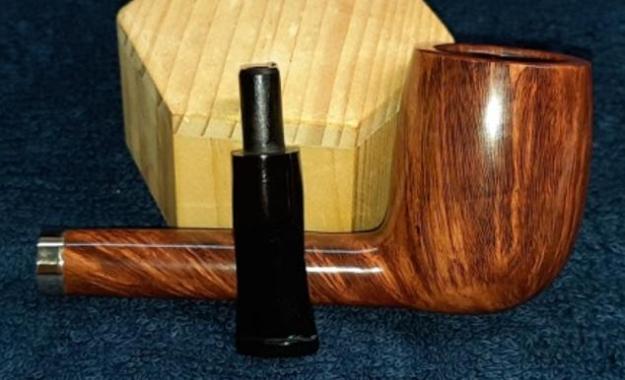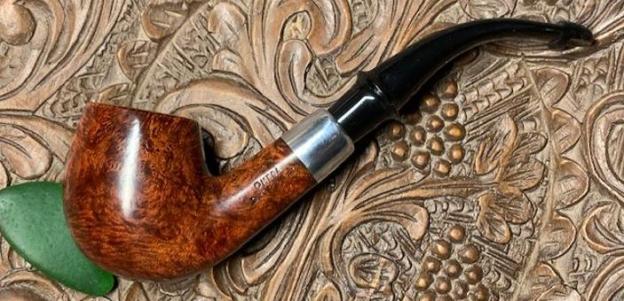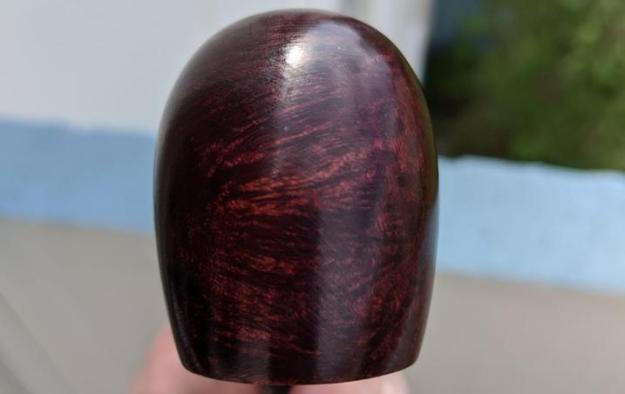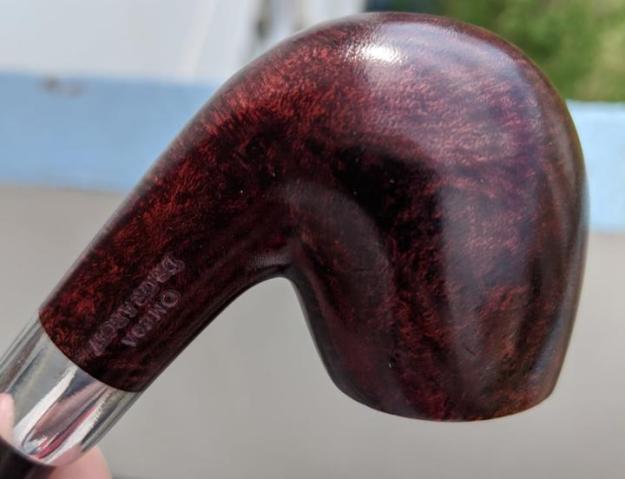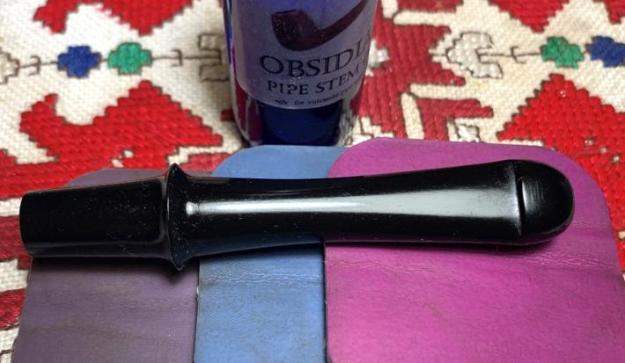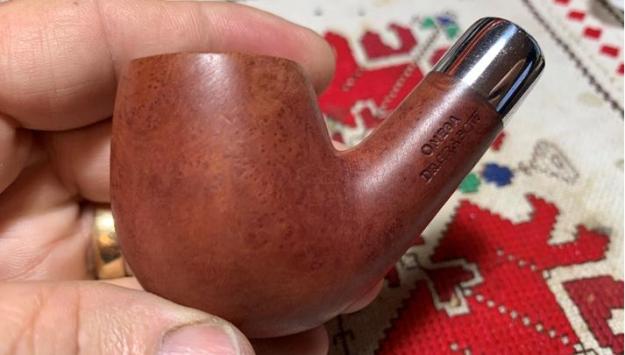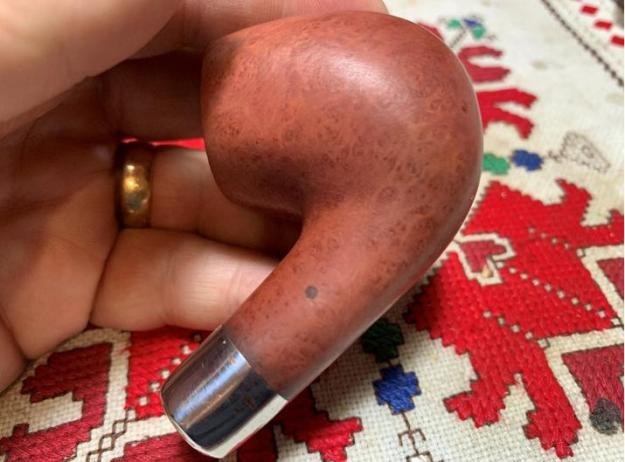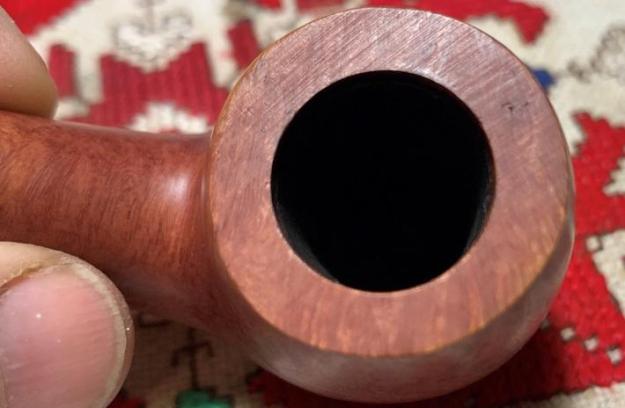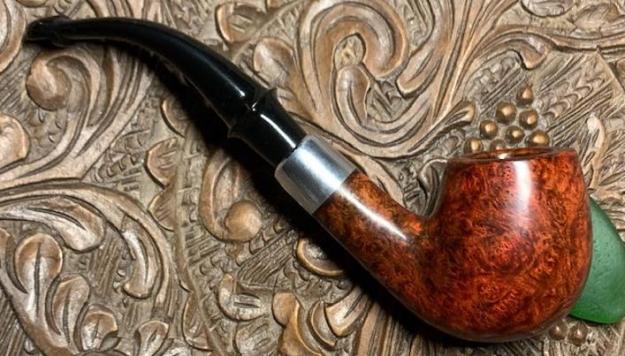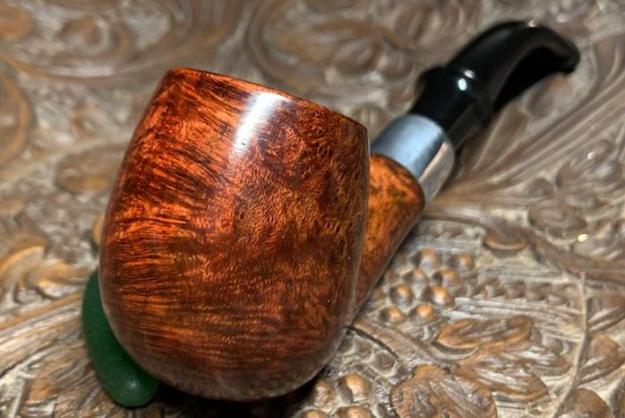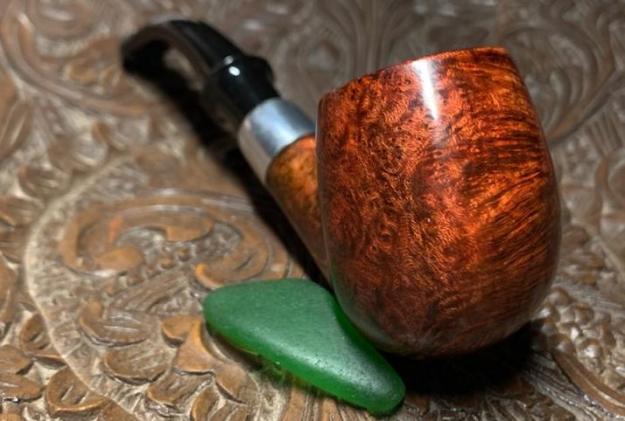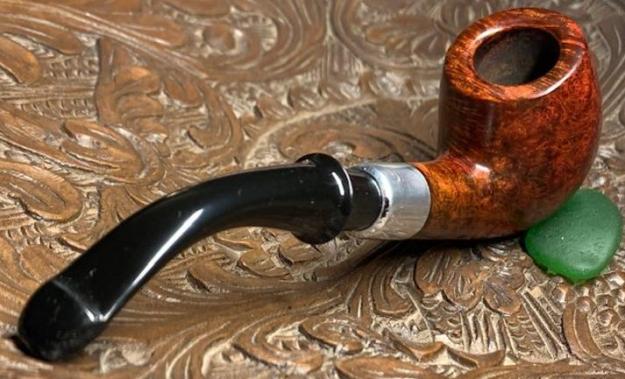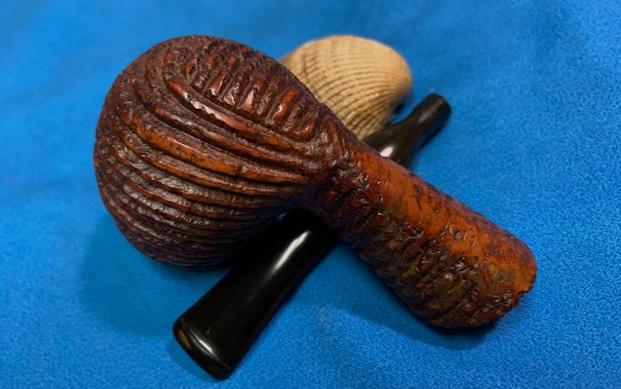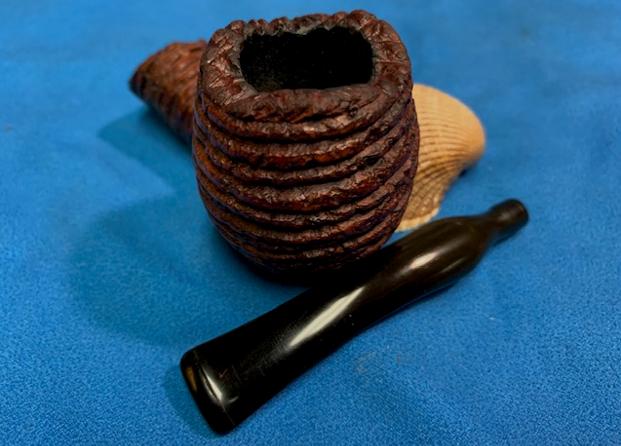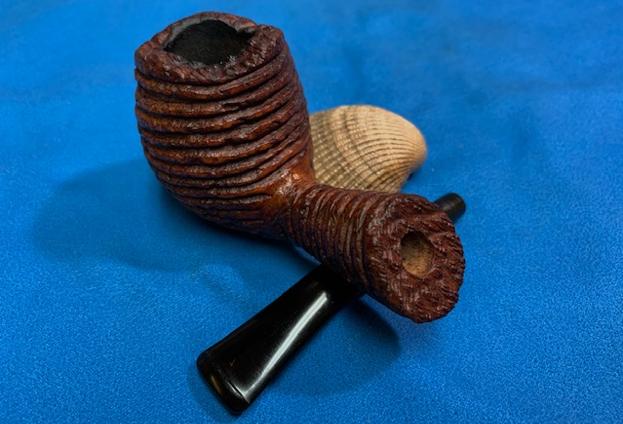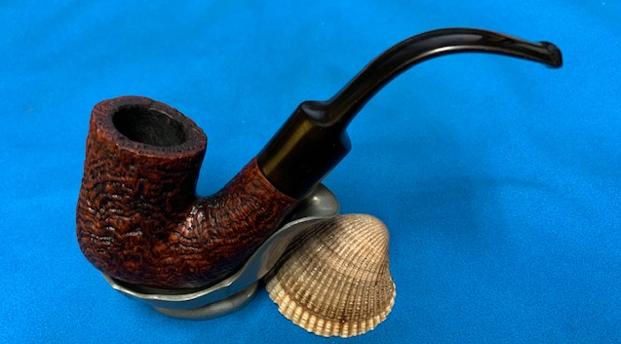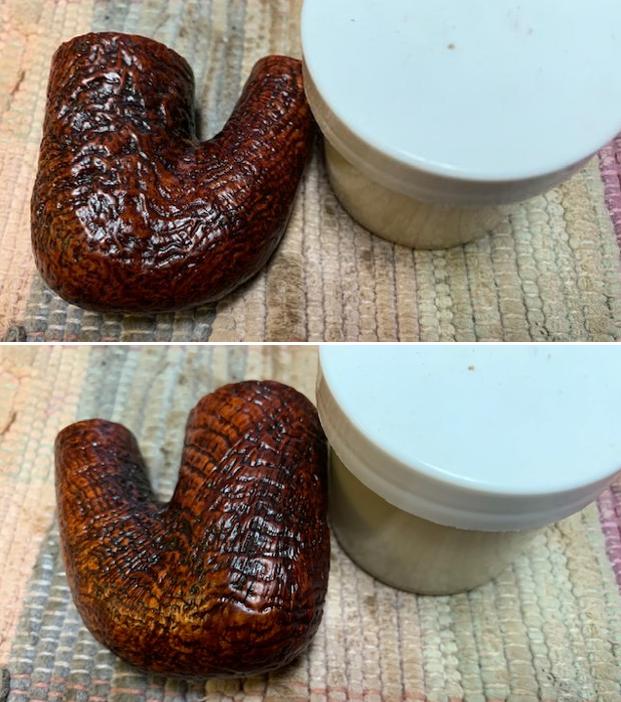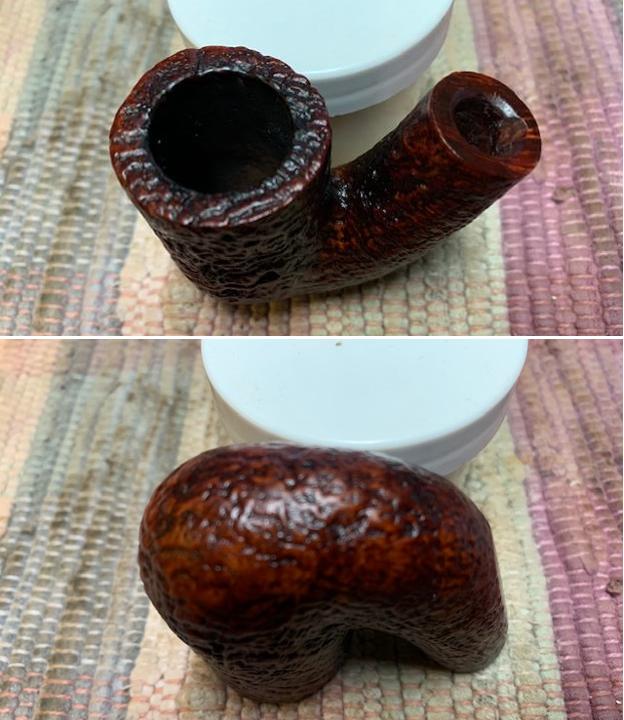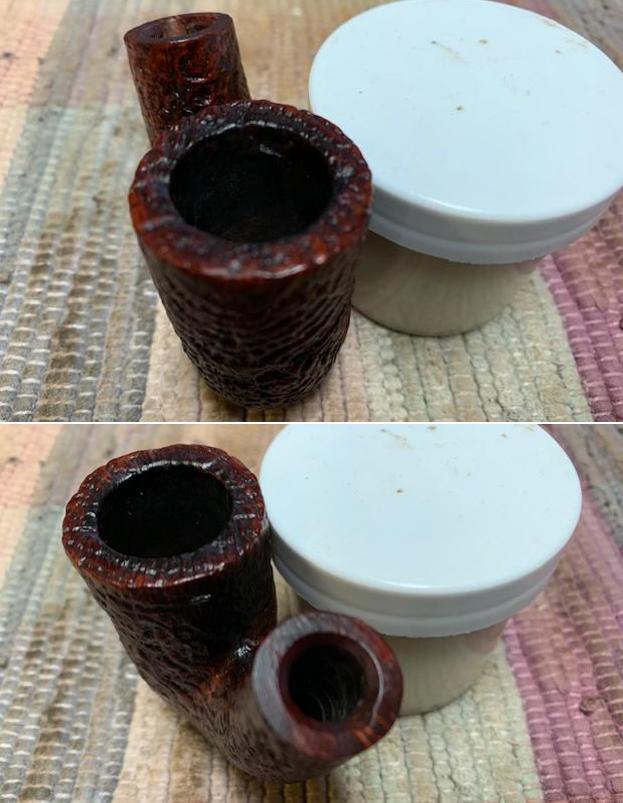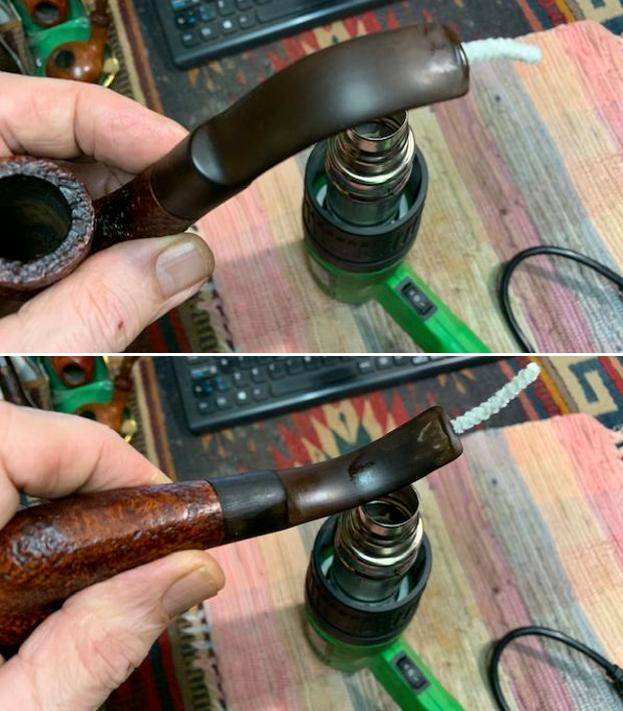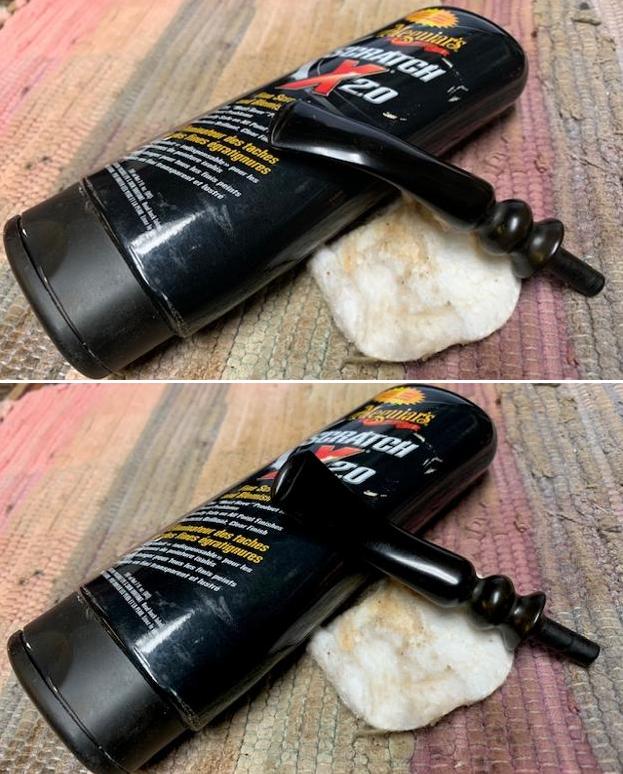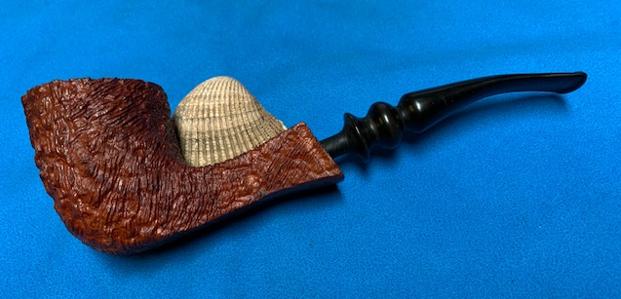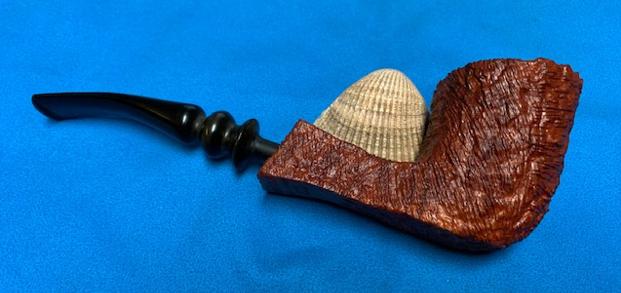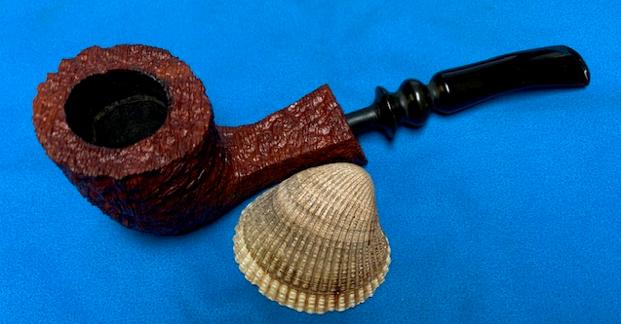
Tag Archives: restemming

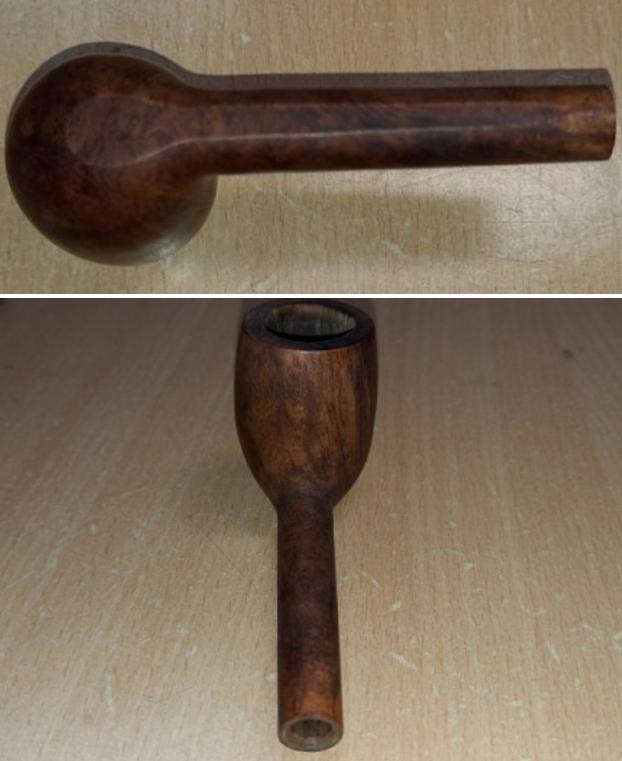
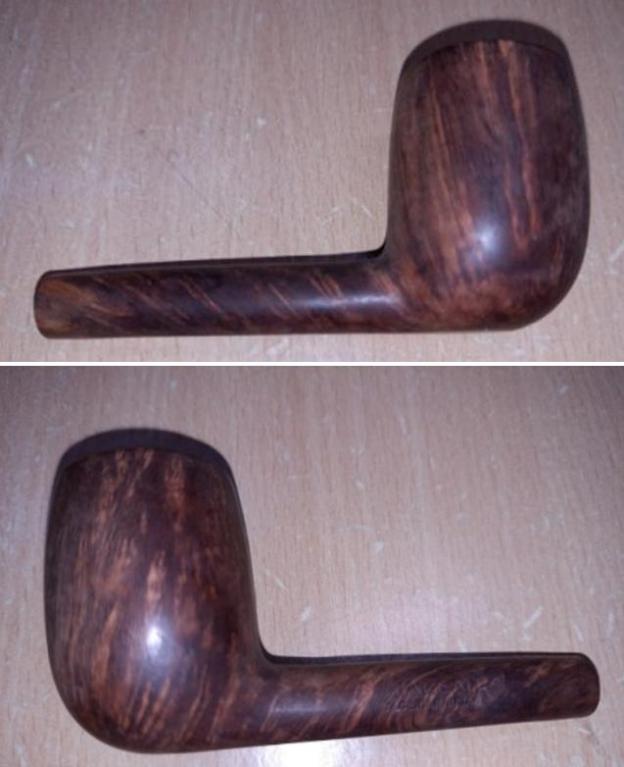
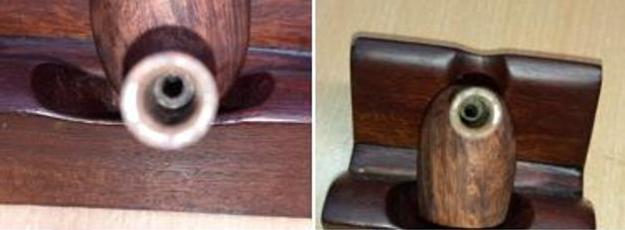
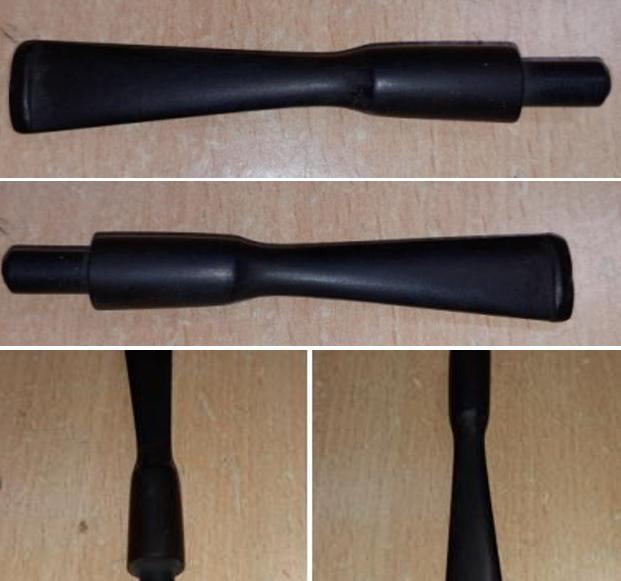
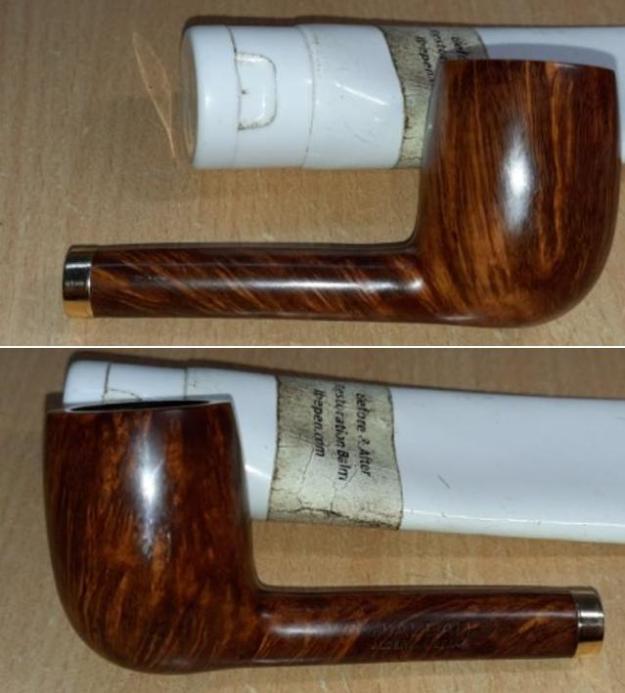
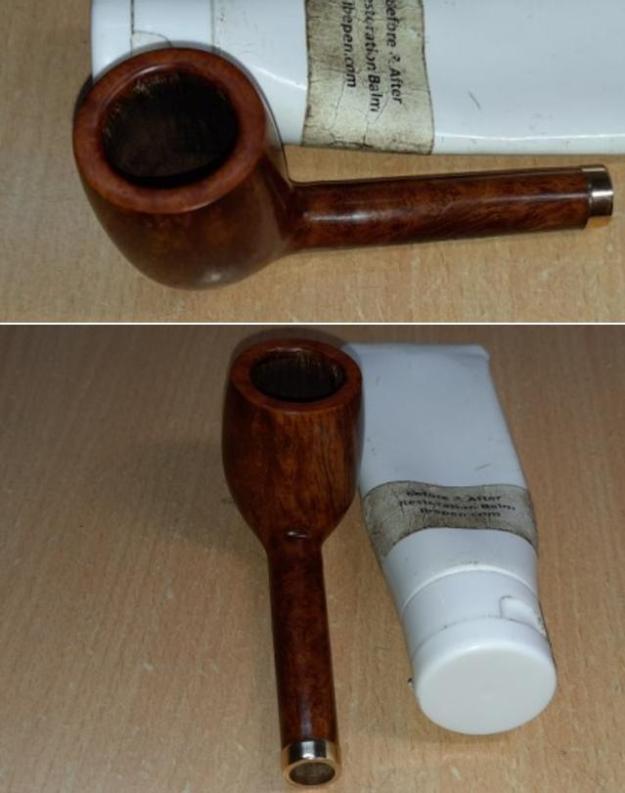
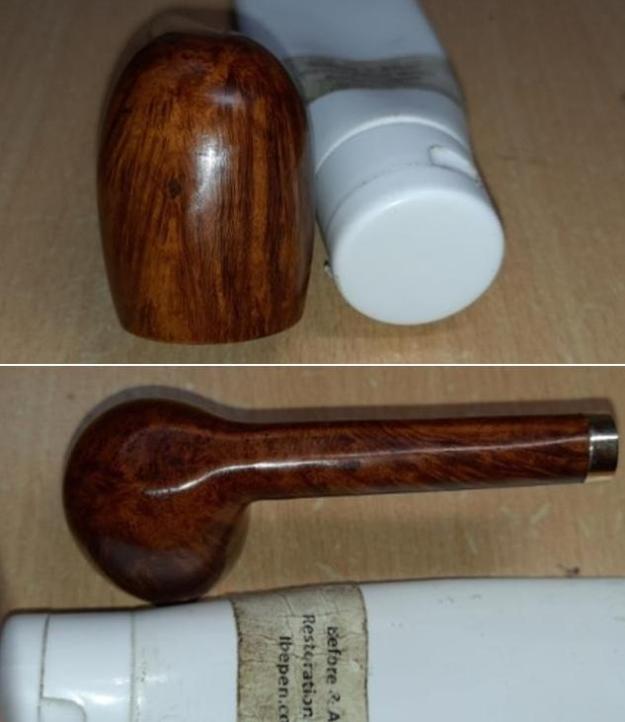
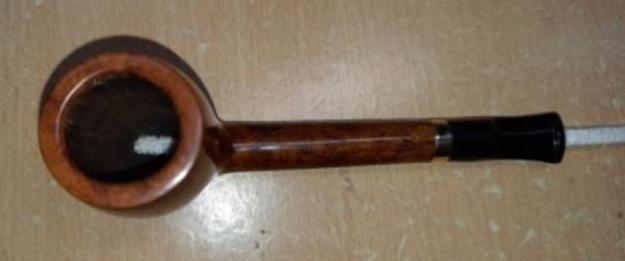
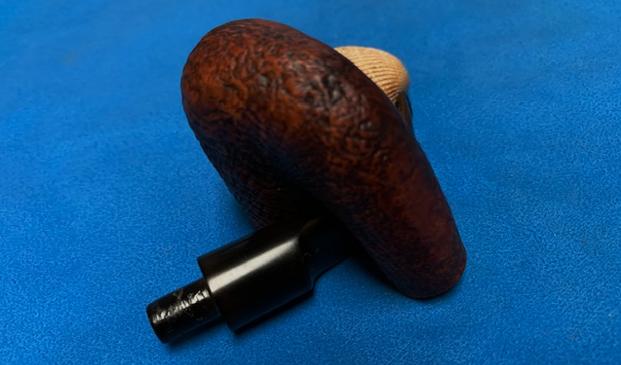
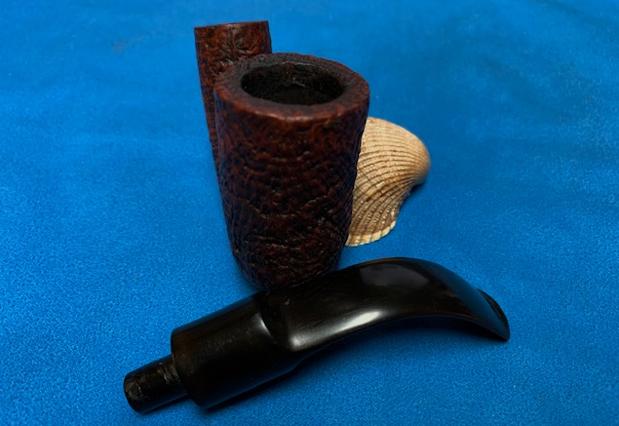
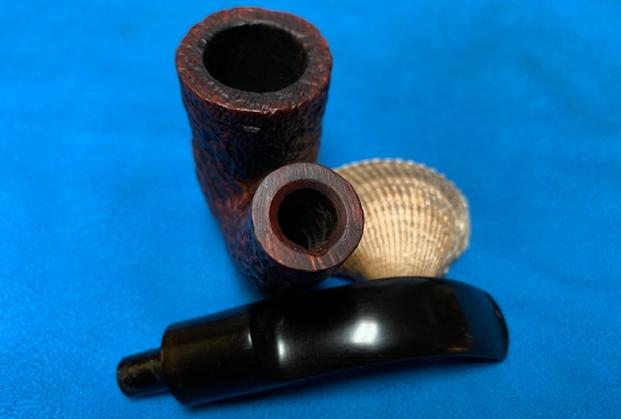
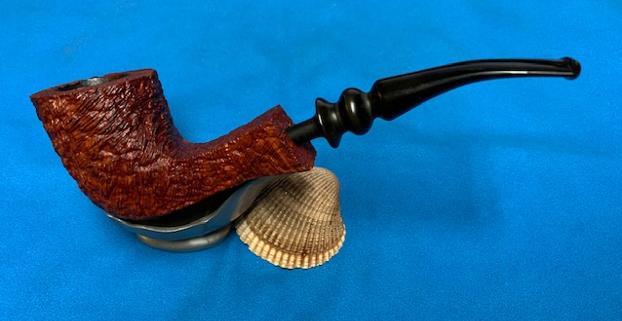
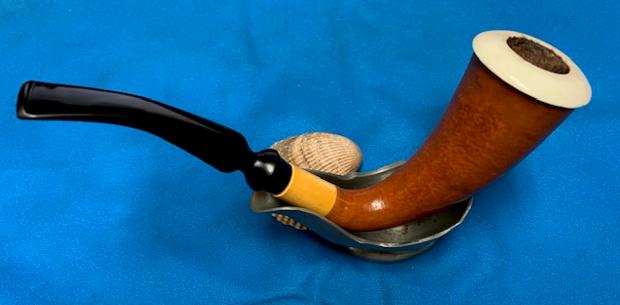
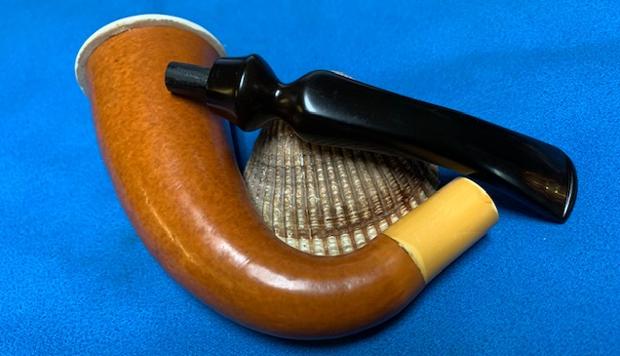
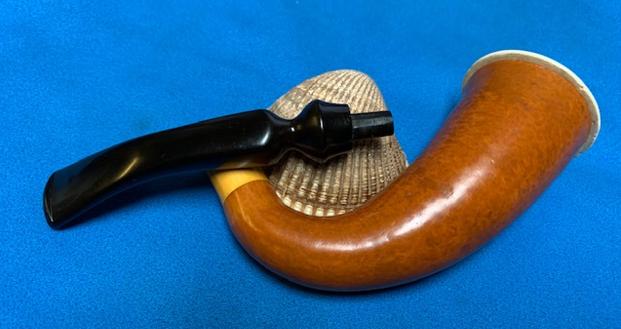
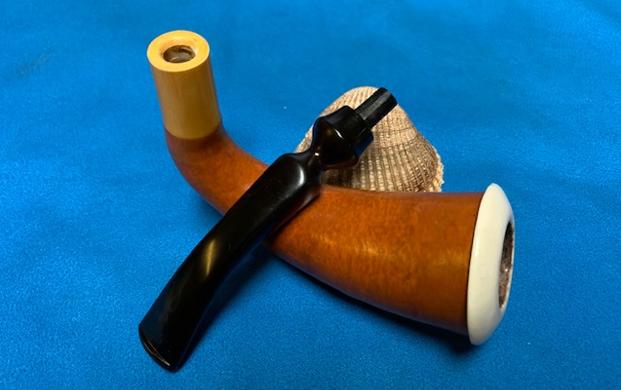
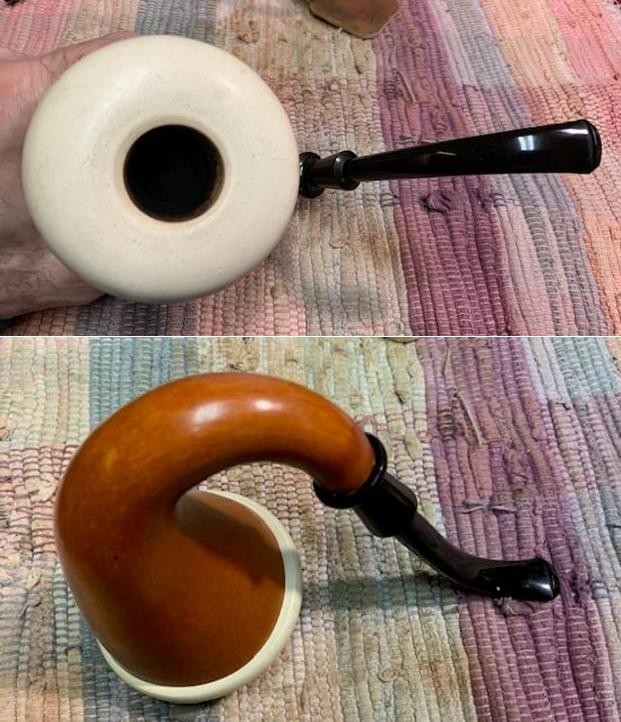
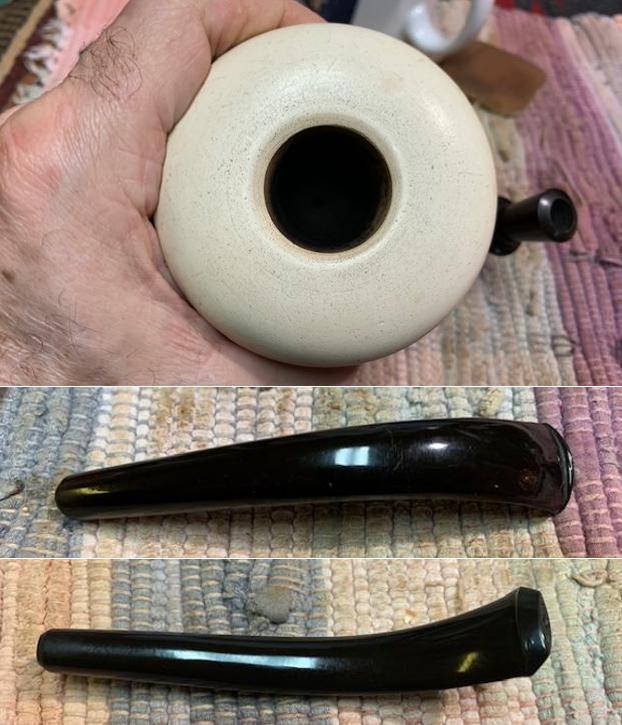
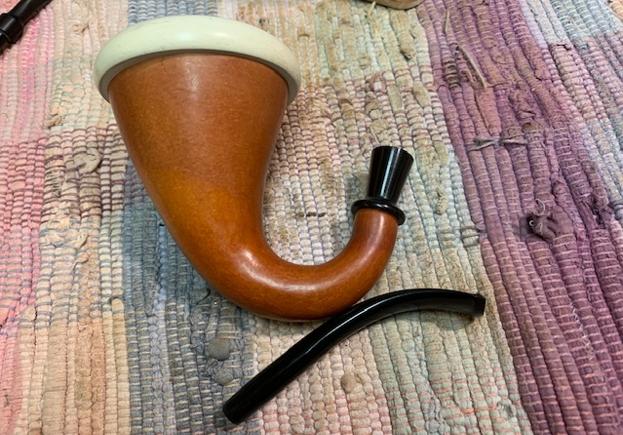
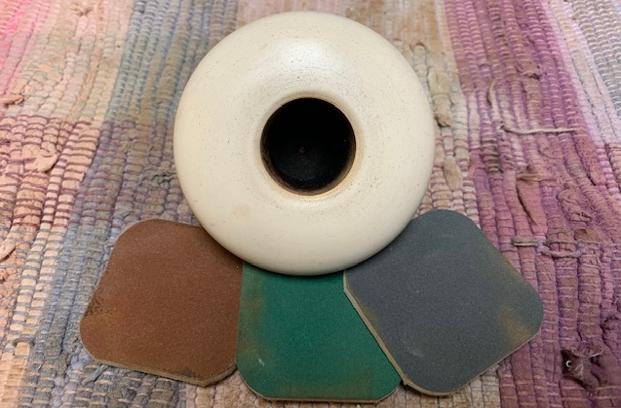
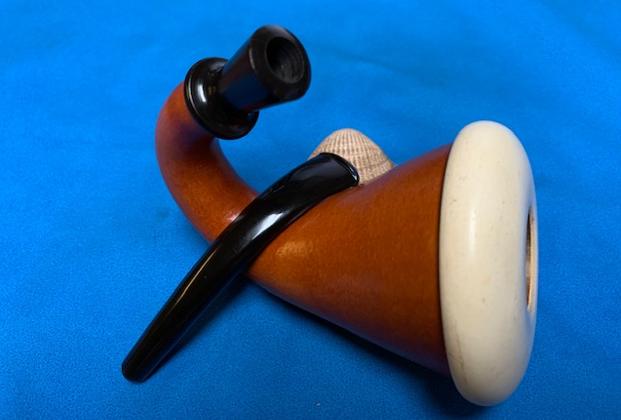
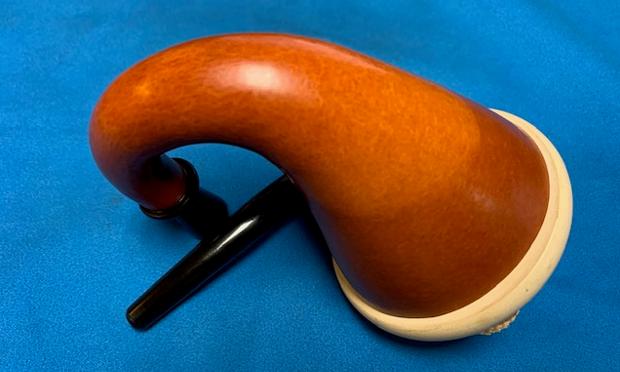
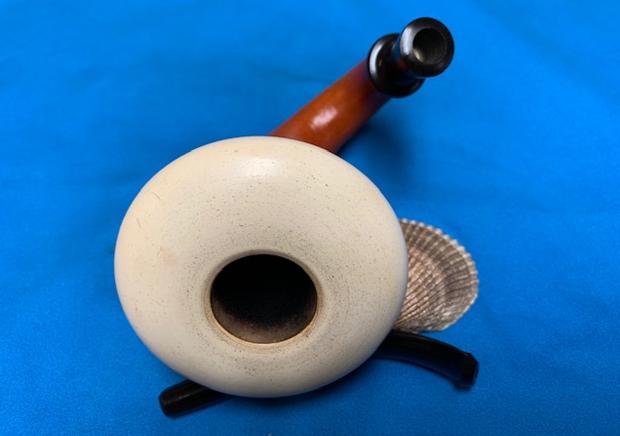
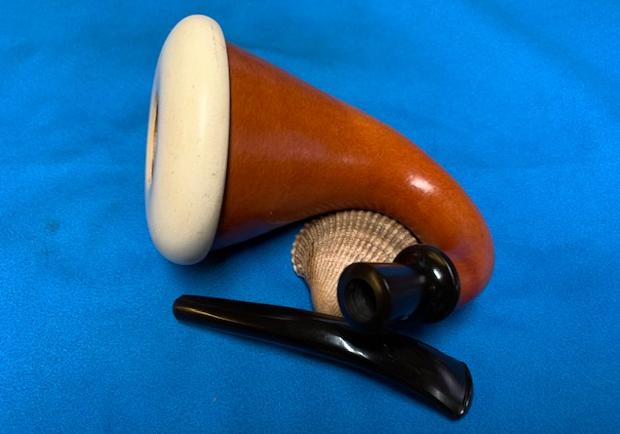
Restemming a Small Porcelain Bowled Gourd Calabash


Blog by Steve Laug

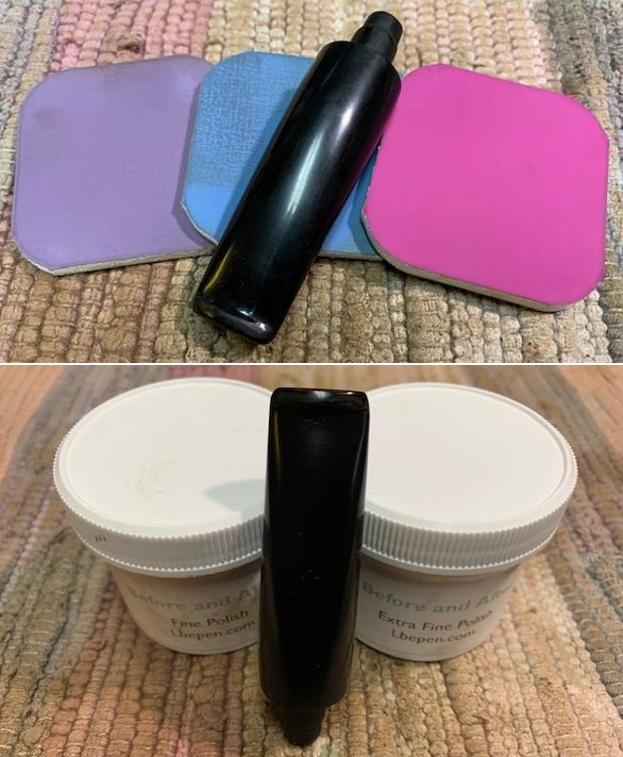
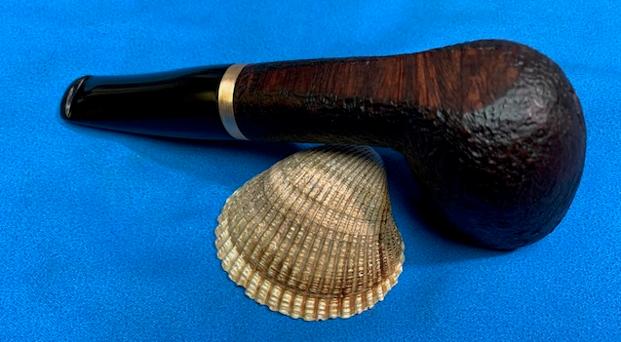
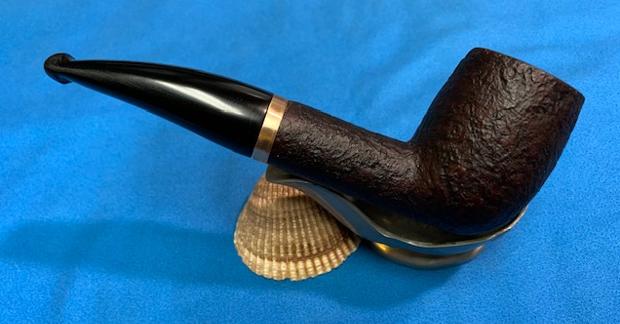
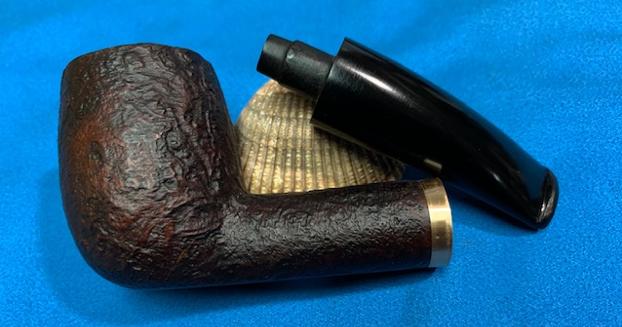
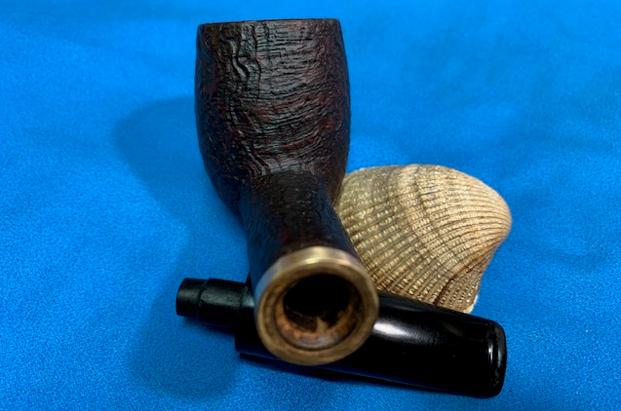
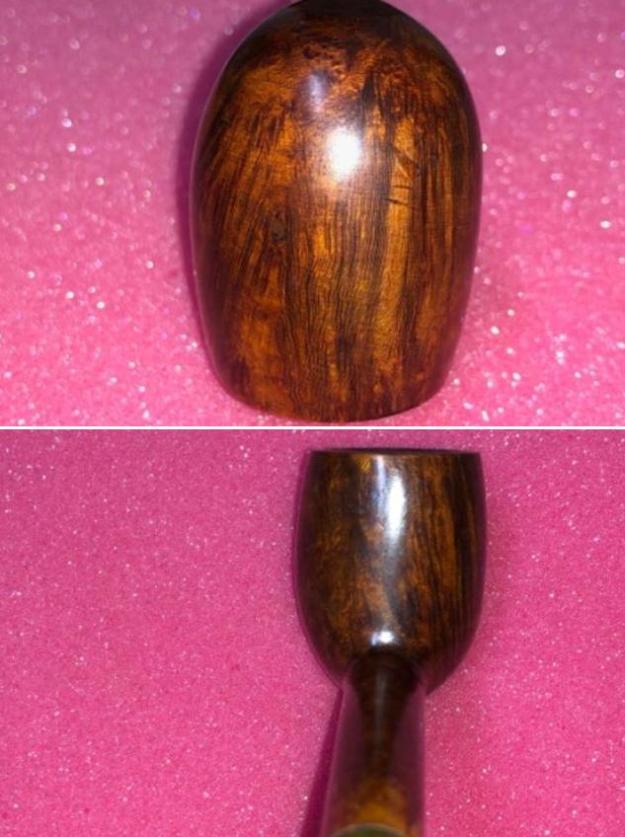
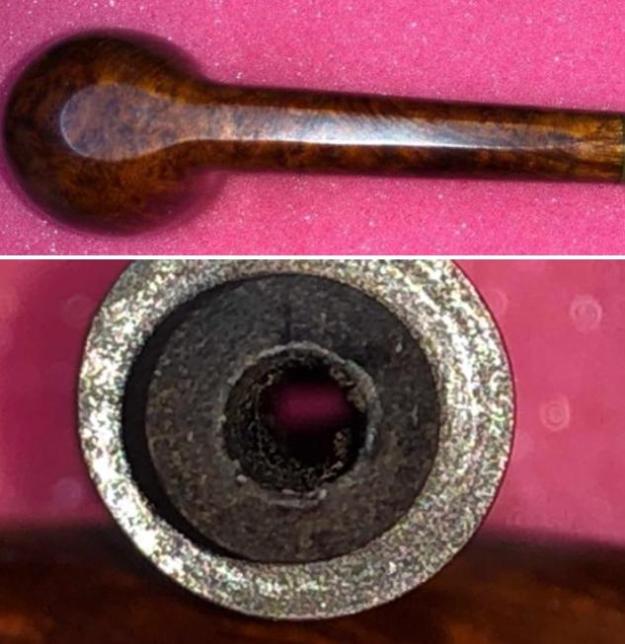
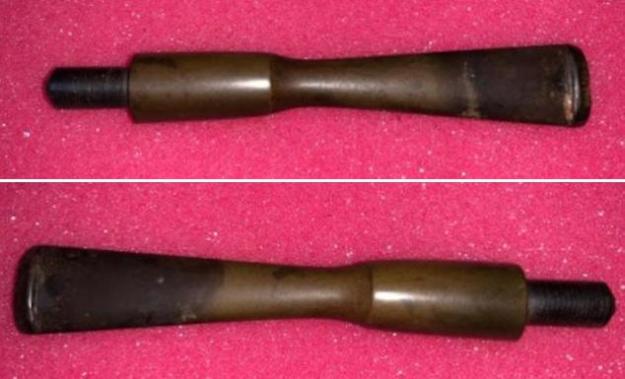
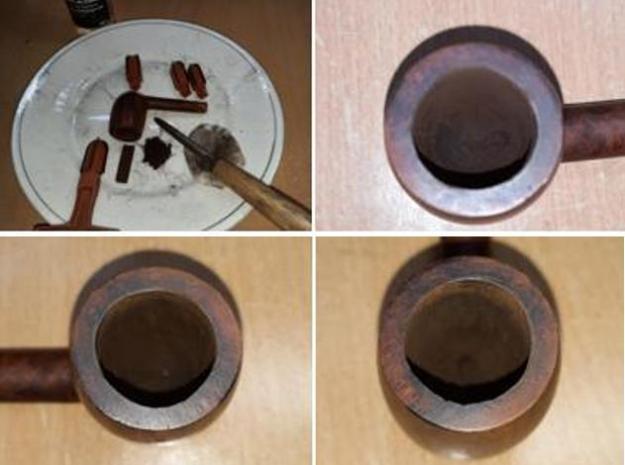
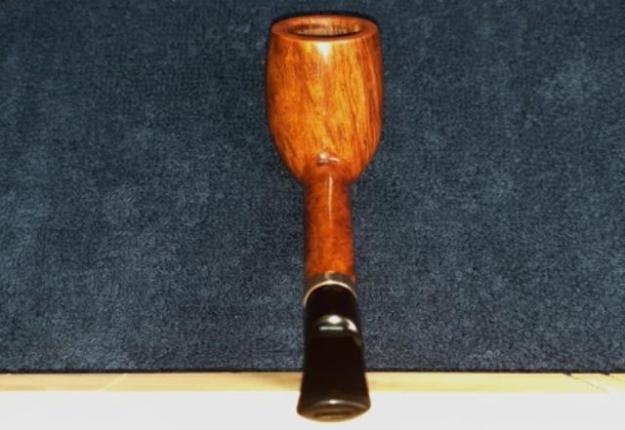
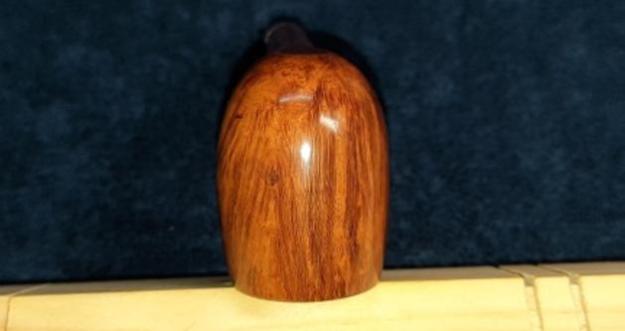
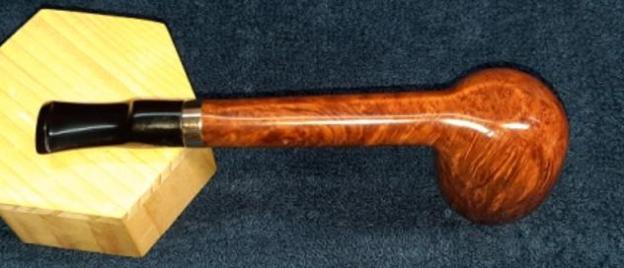
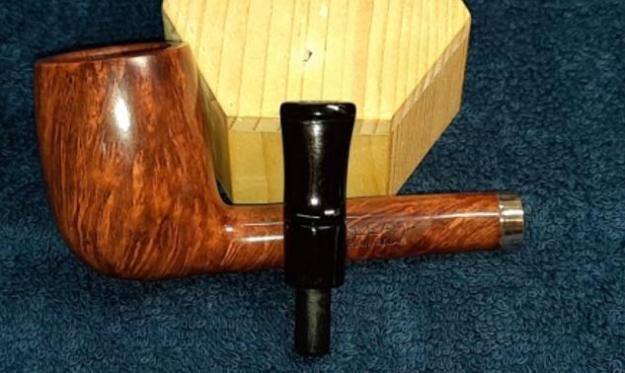
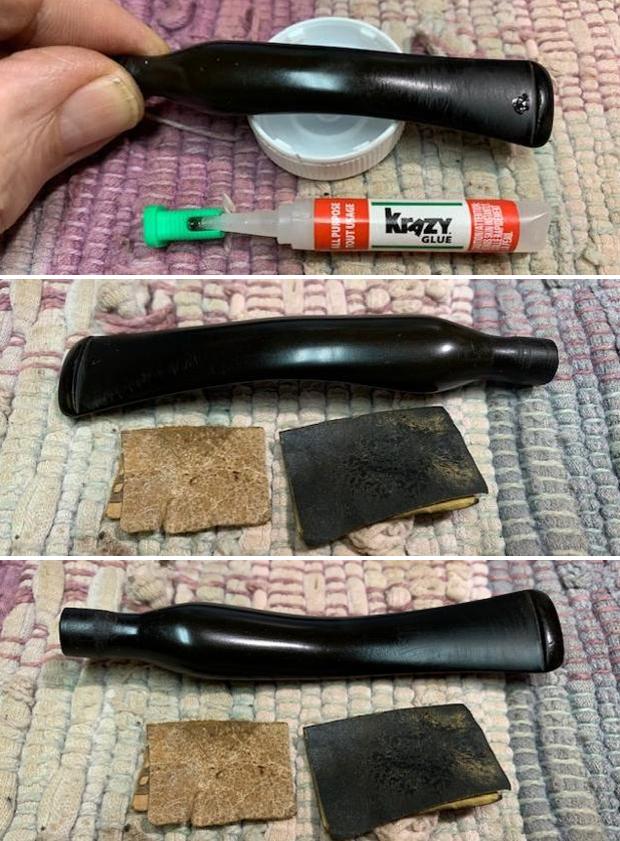
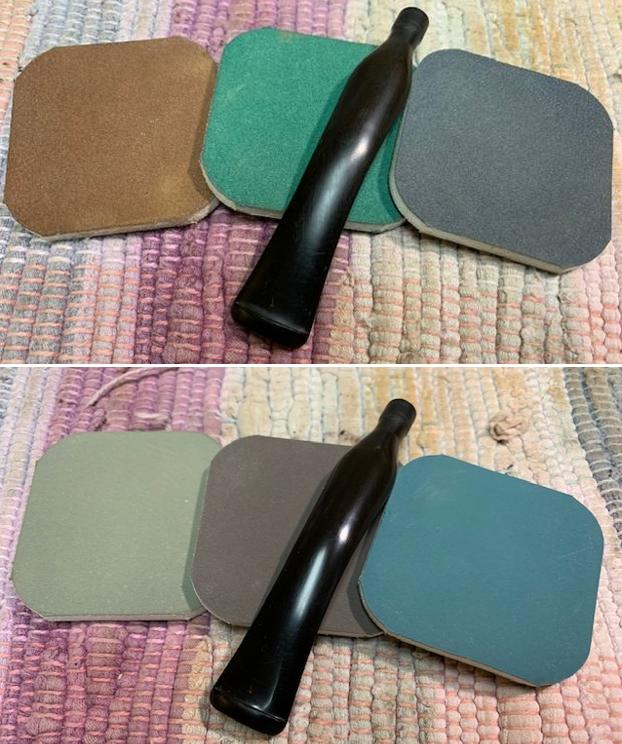
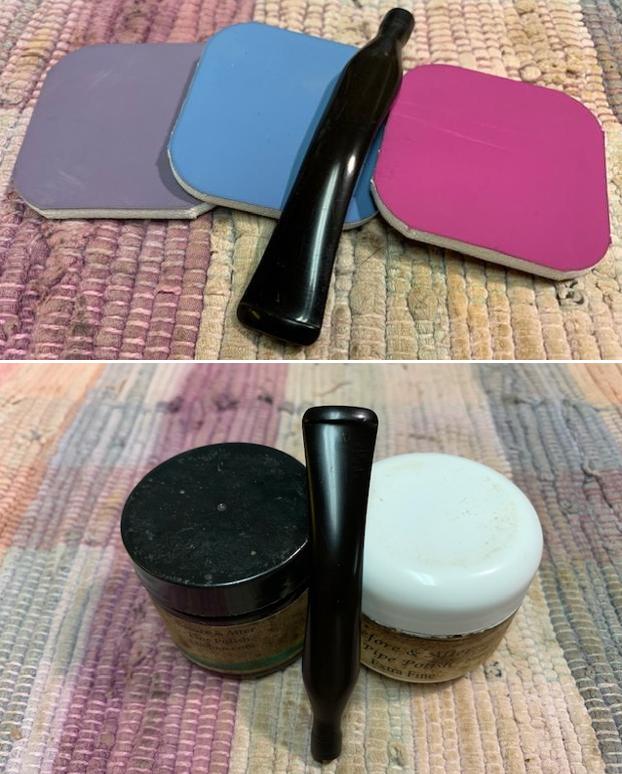
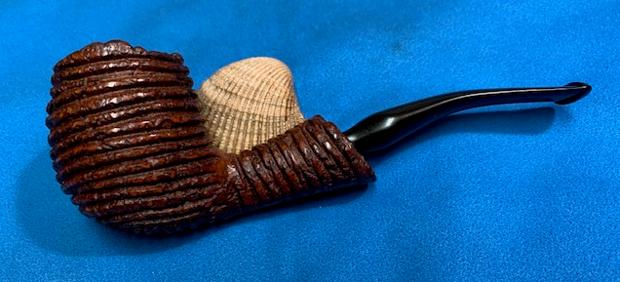
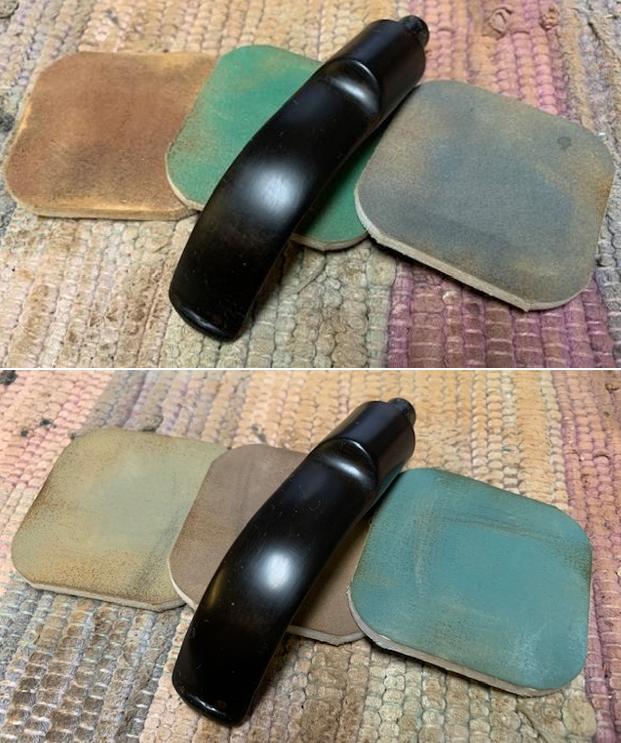
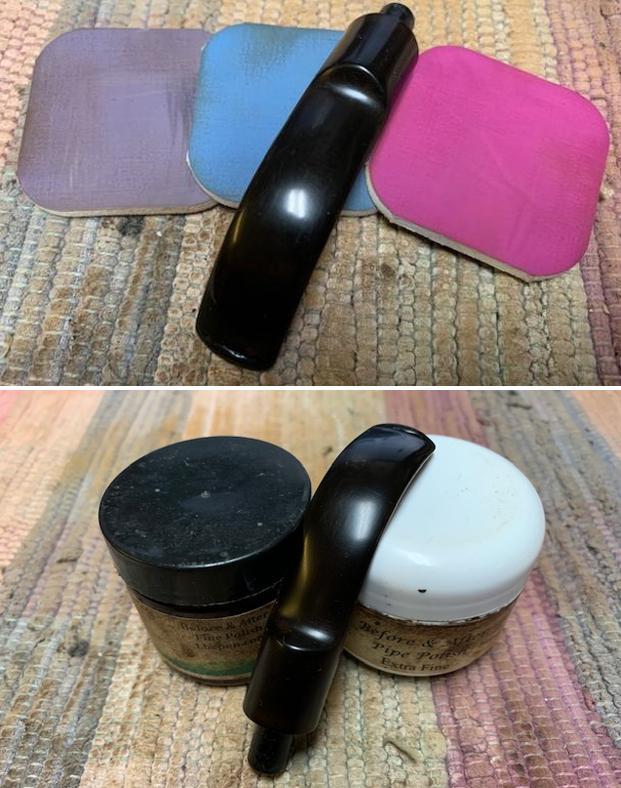
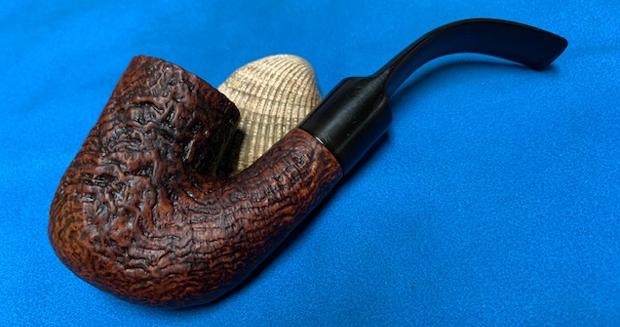
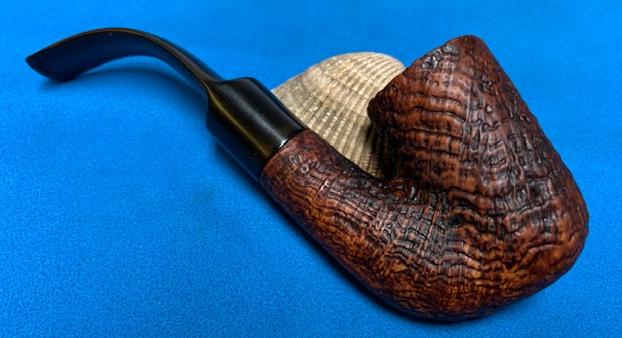
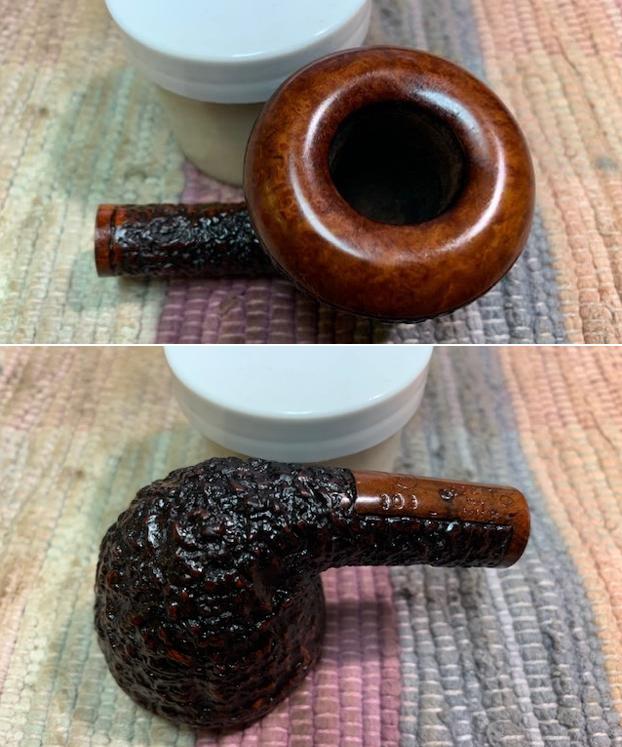
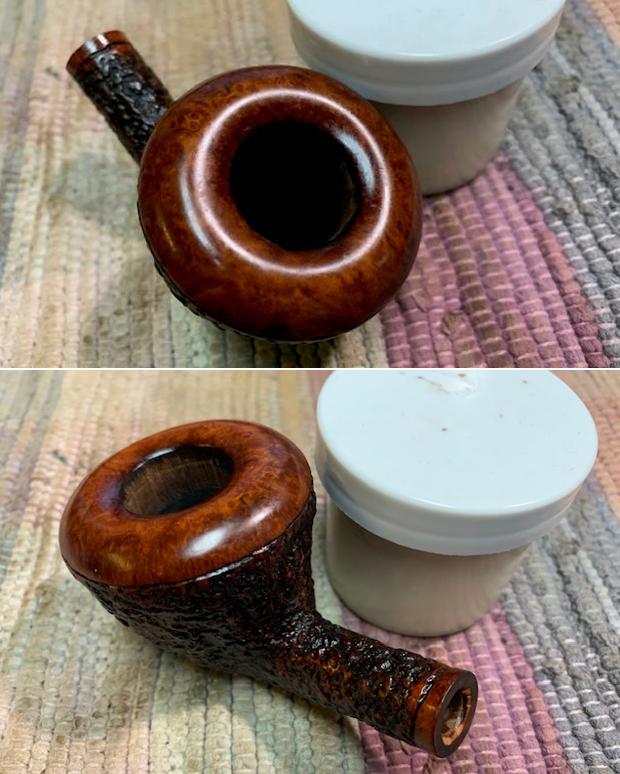
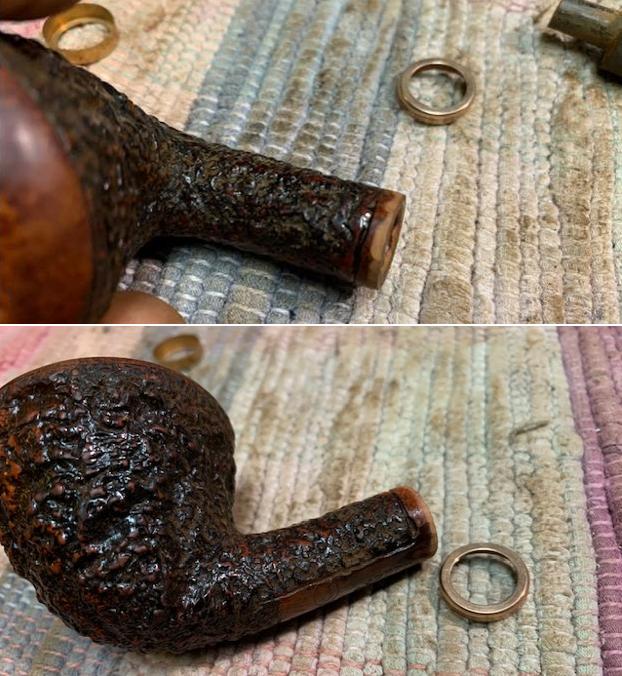
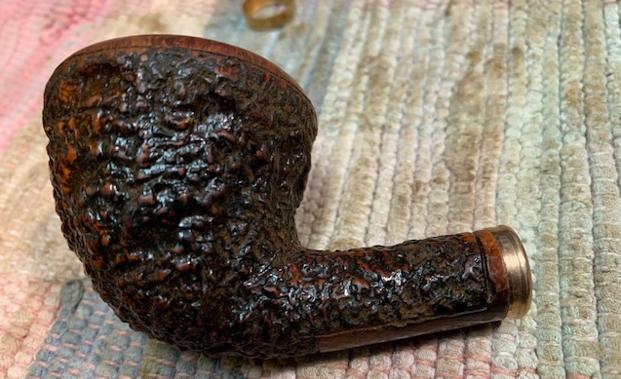
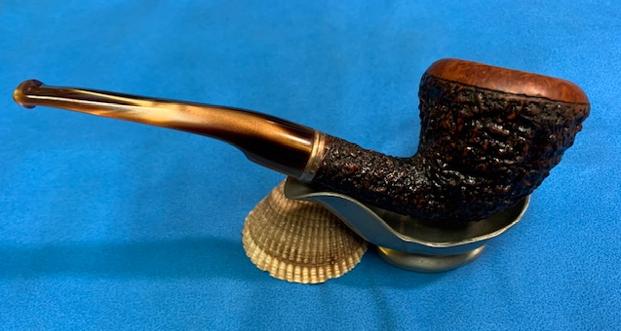
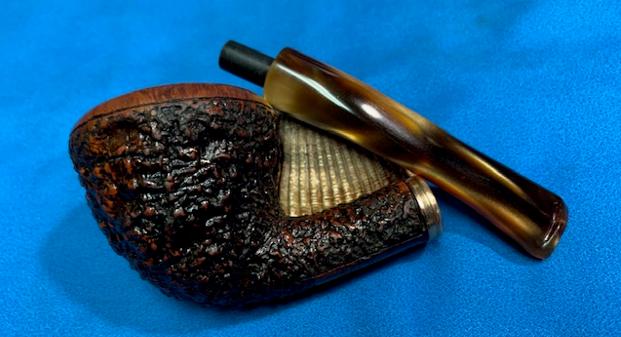
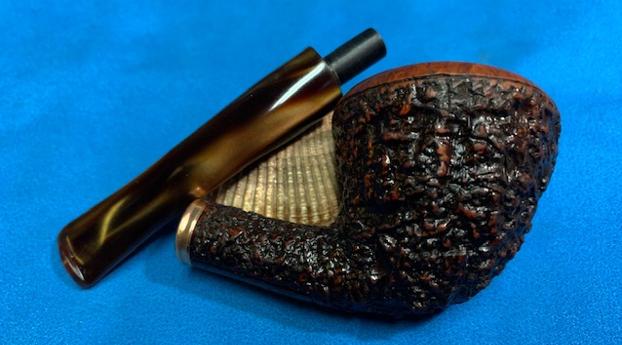
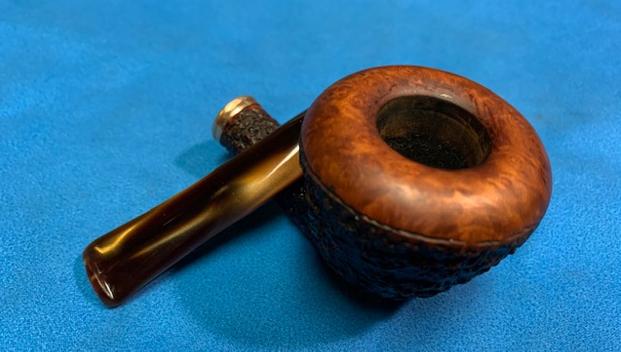
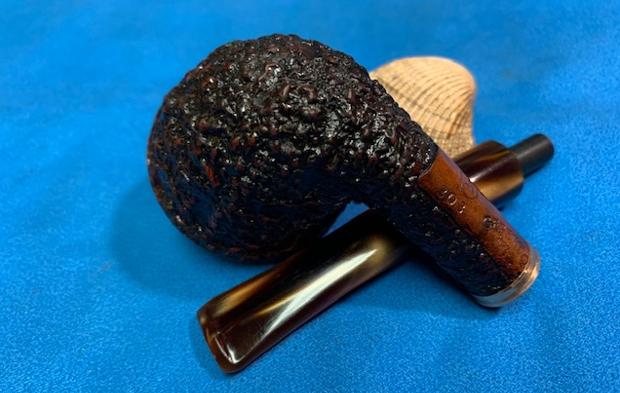
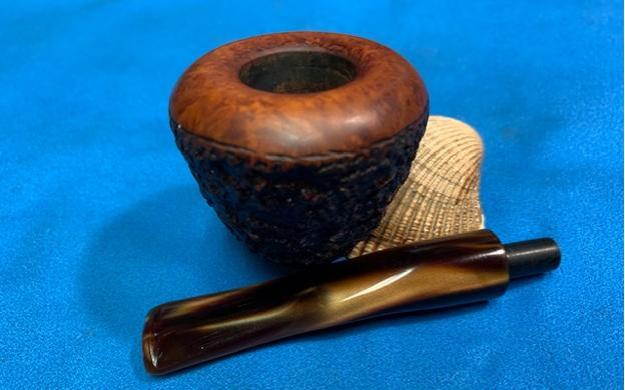
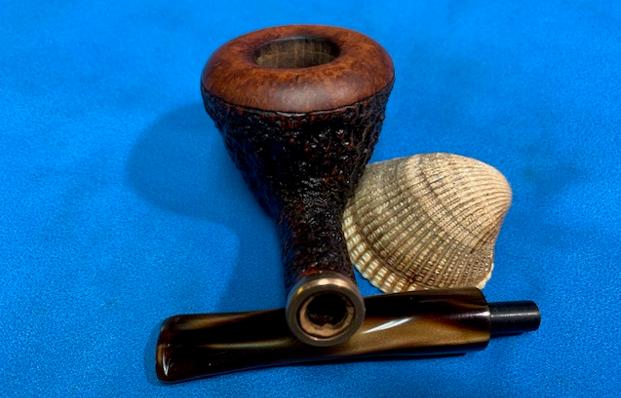
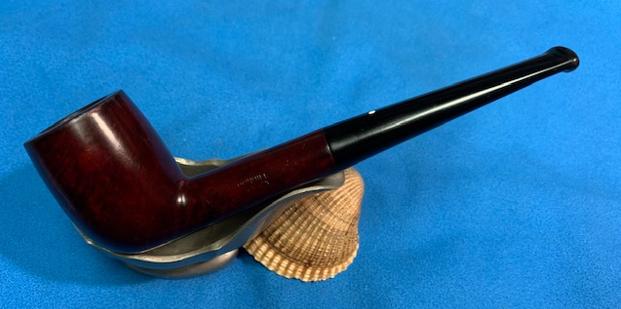
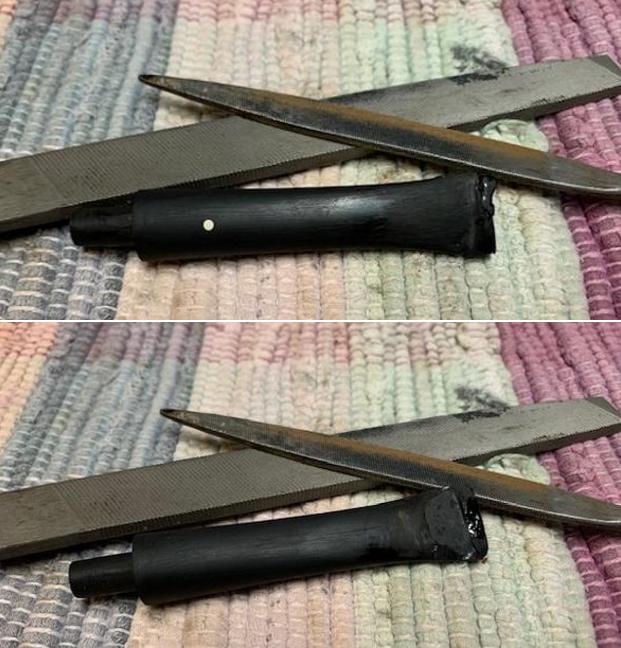
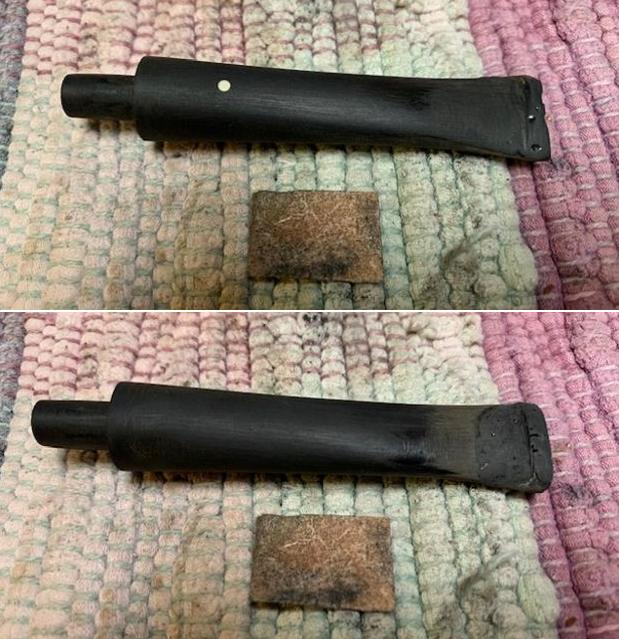
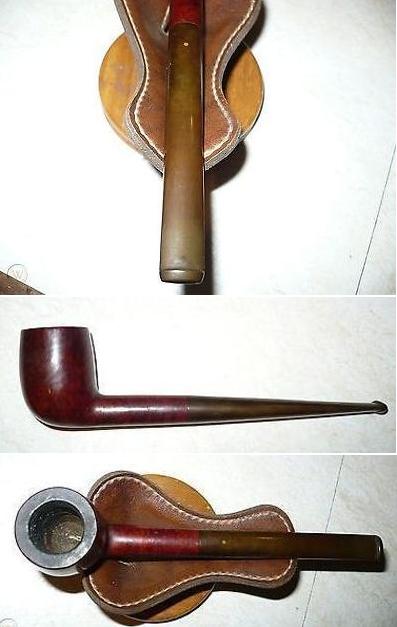
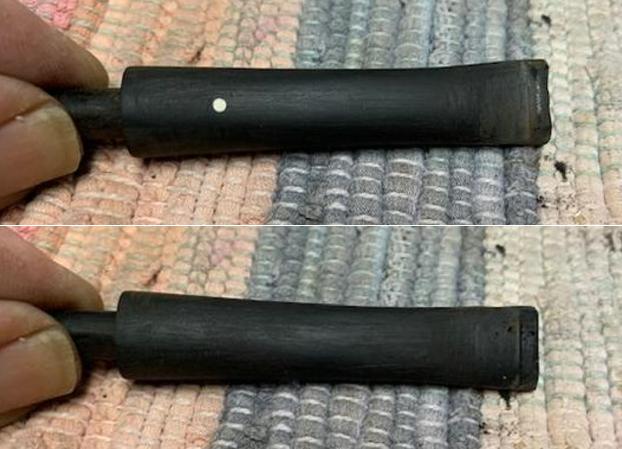
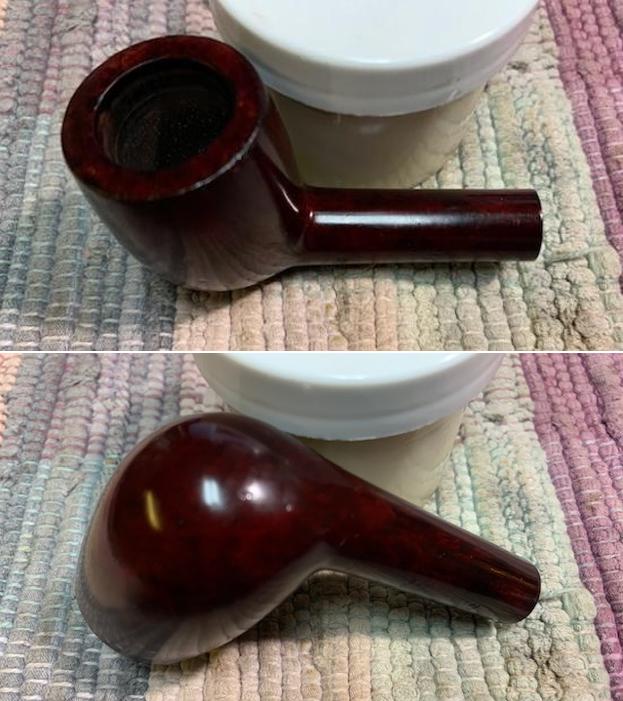
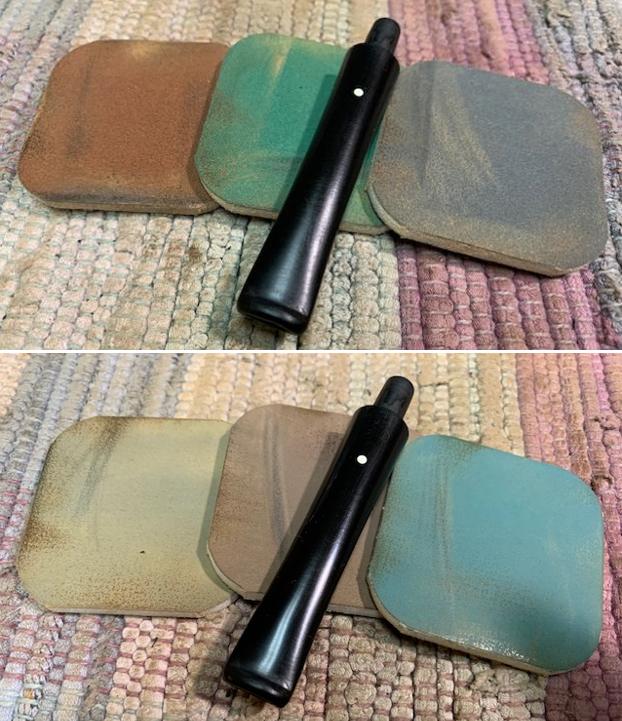
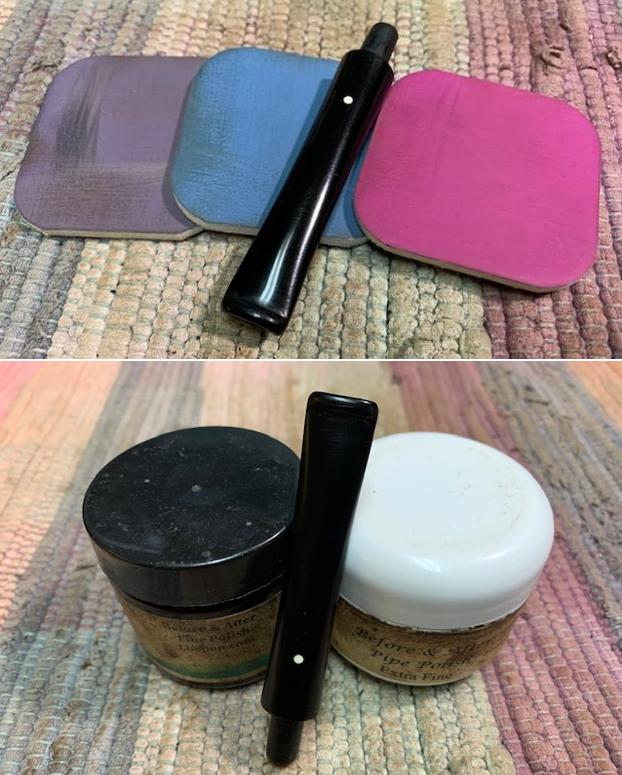
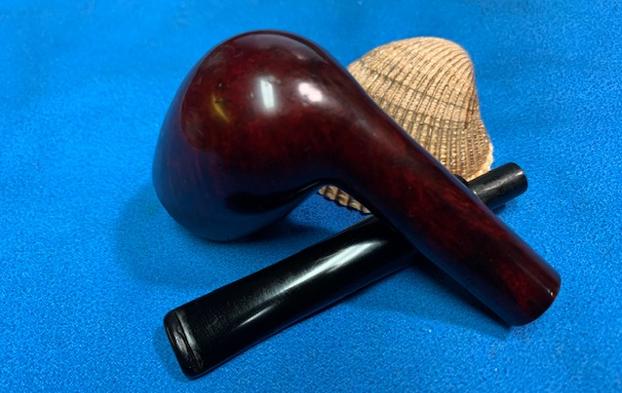
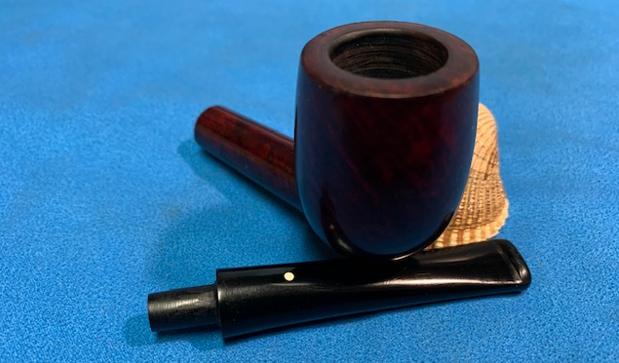
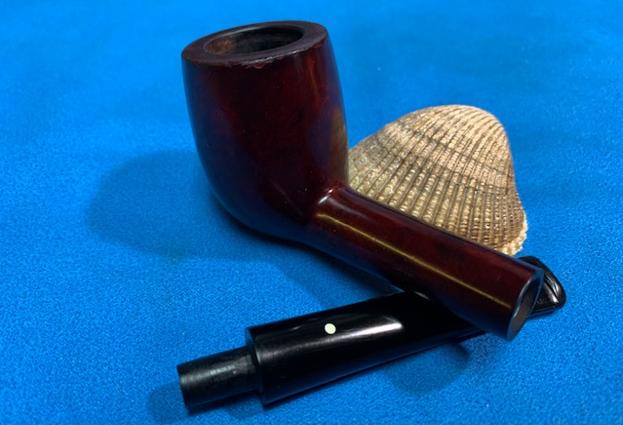
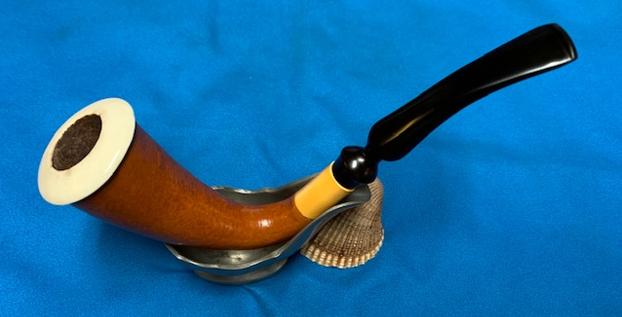
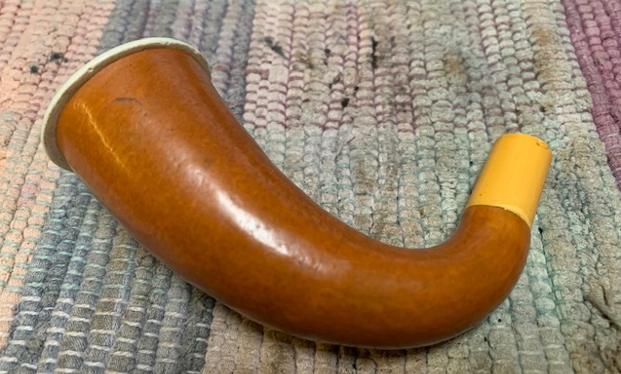
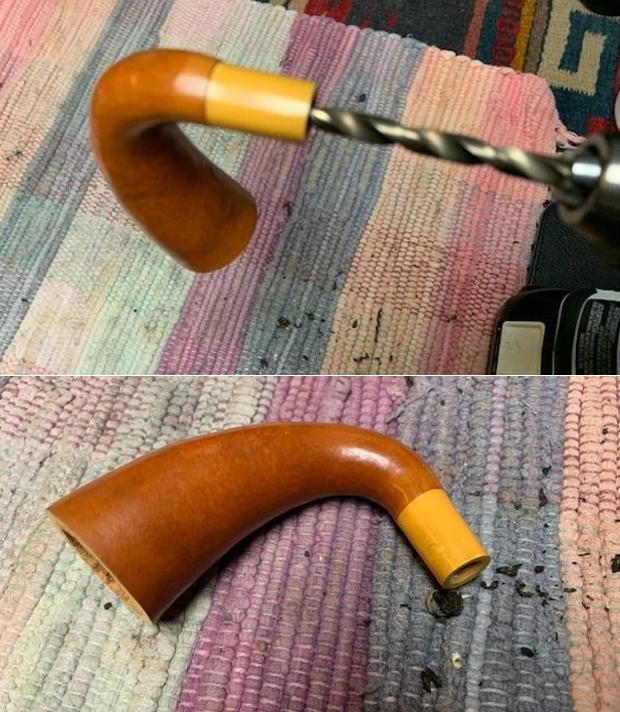
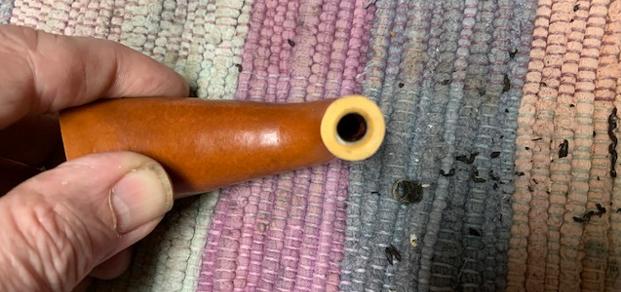
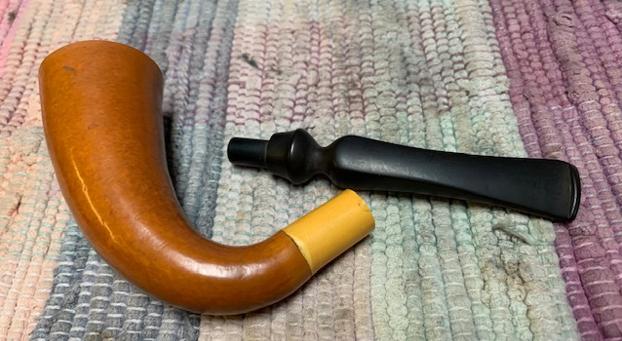
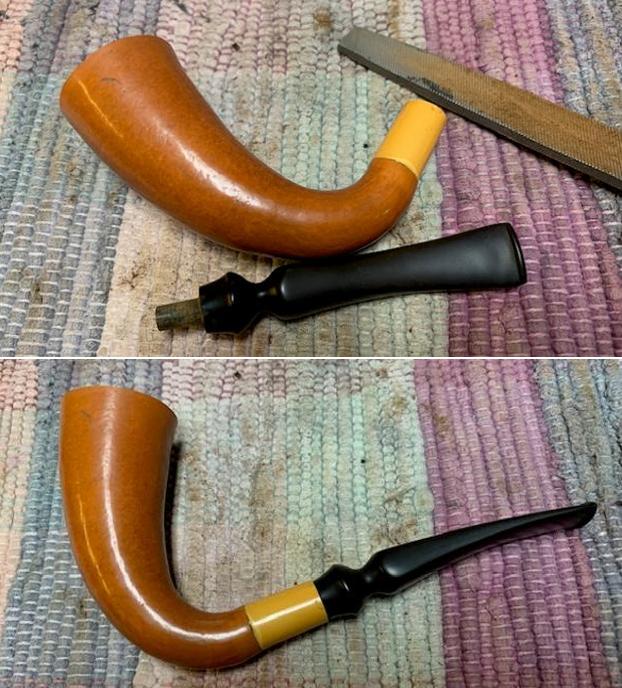
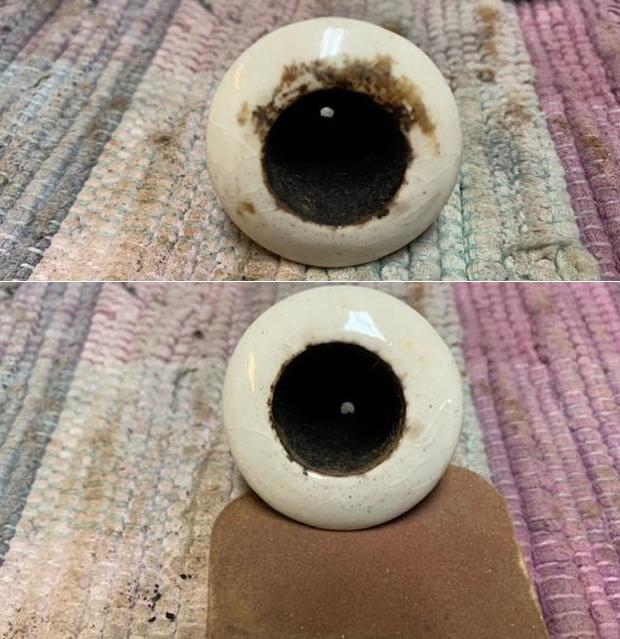
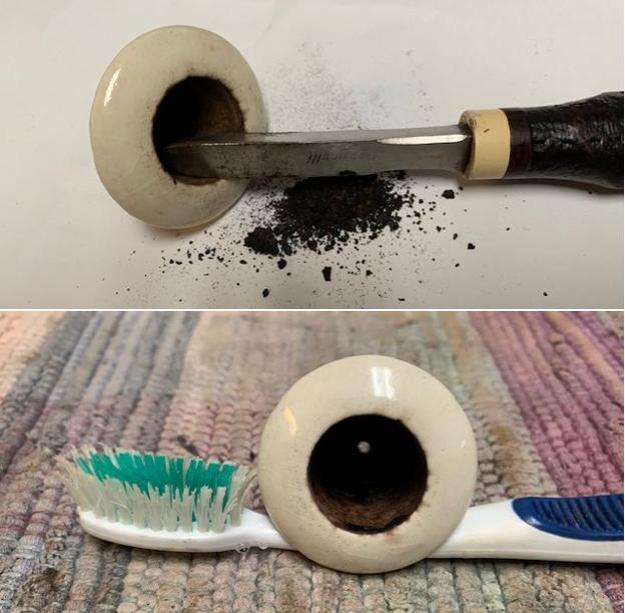
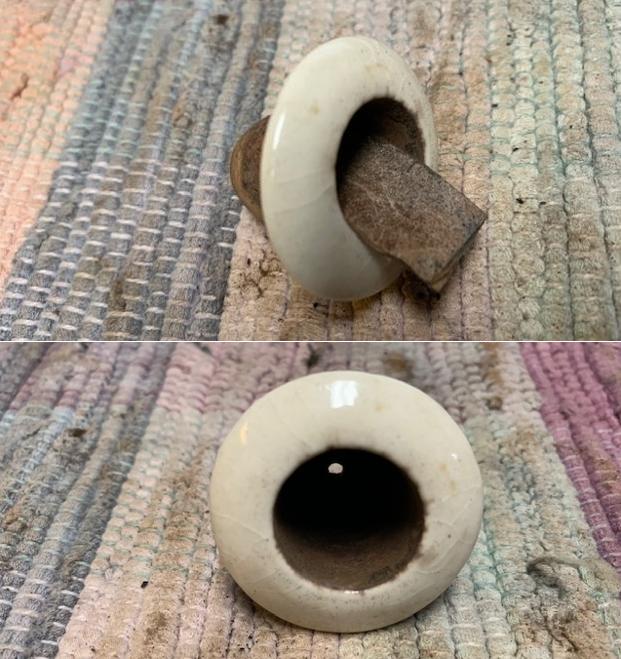
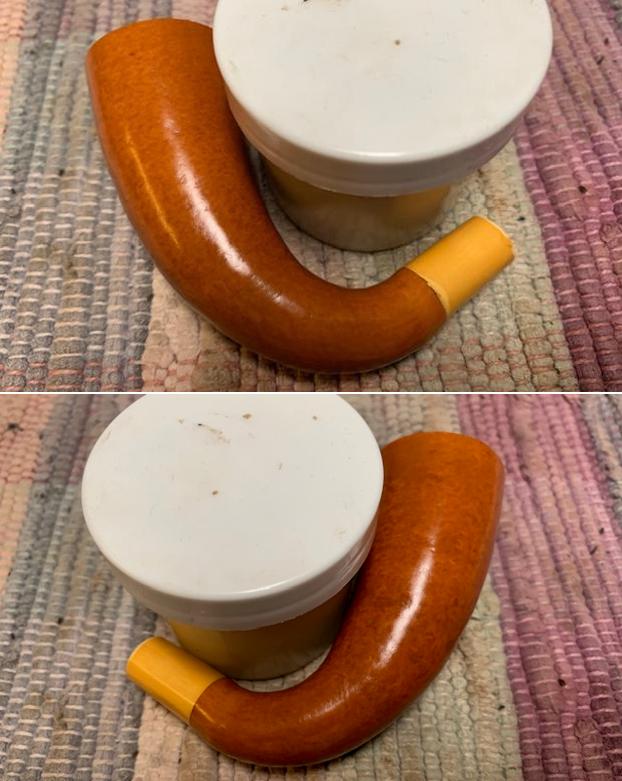
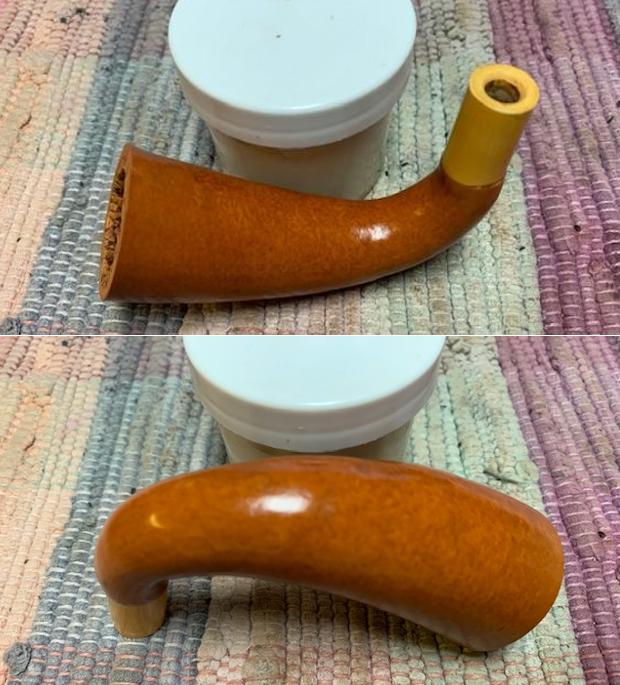
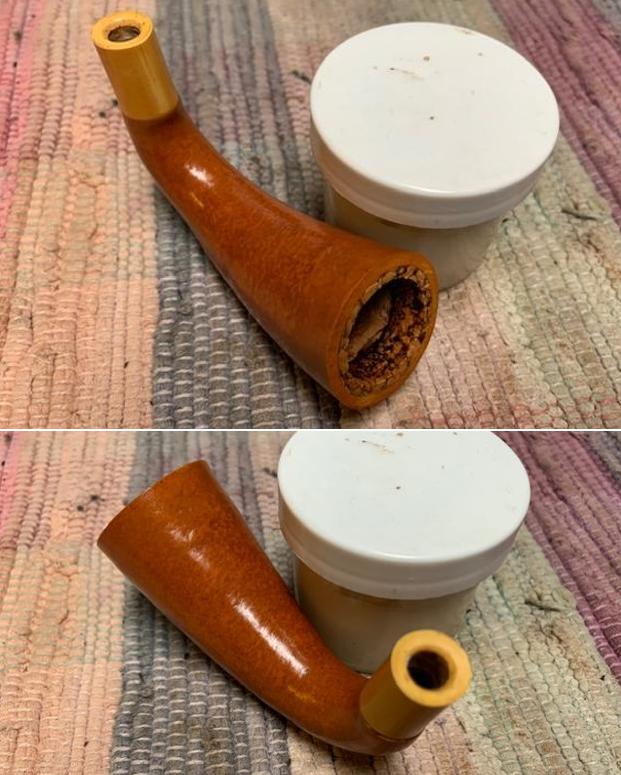
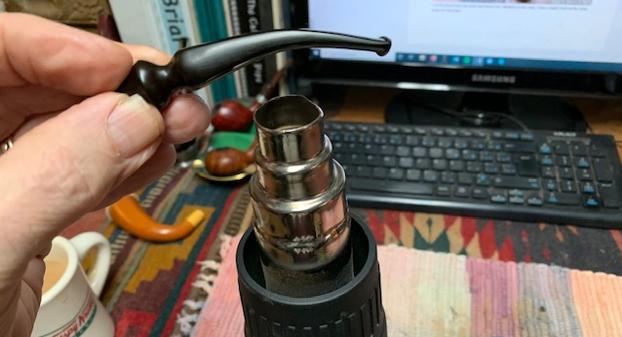
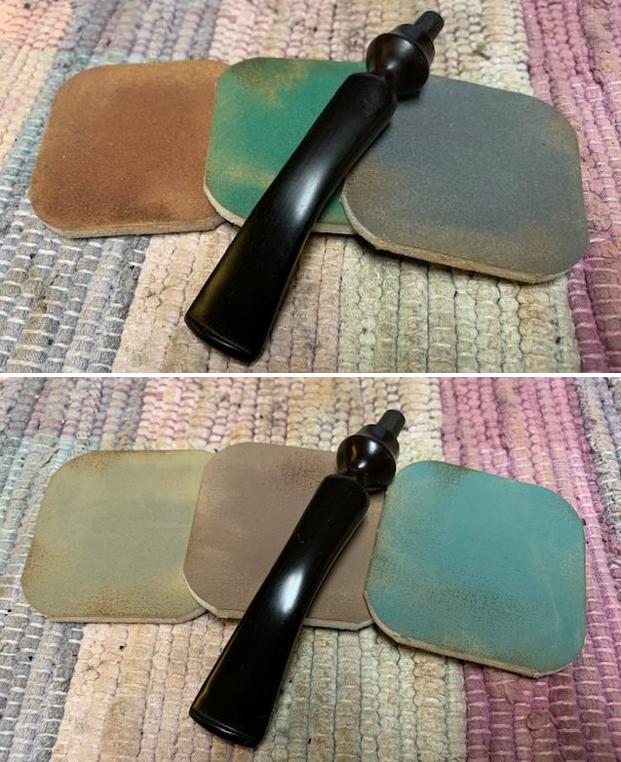
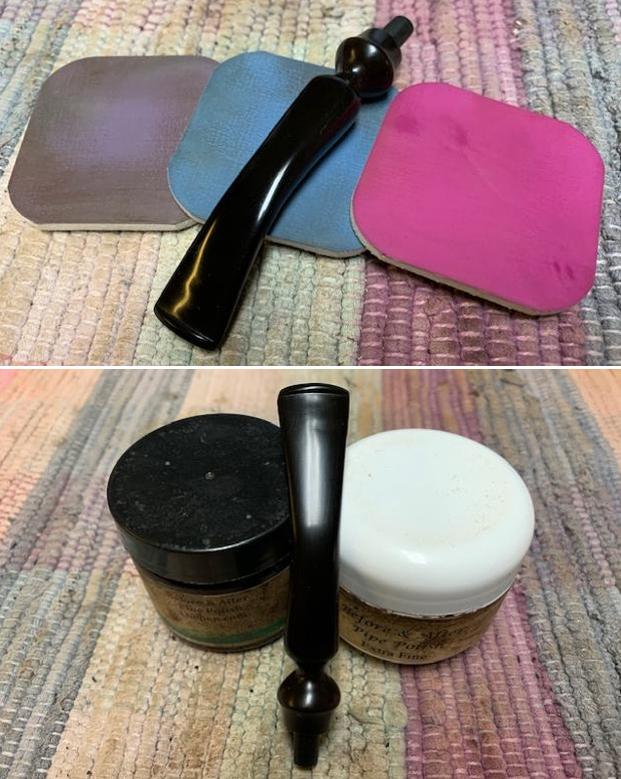
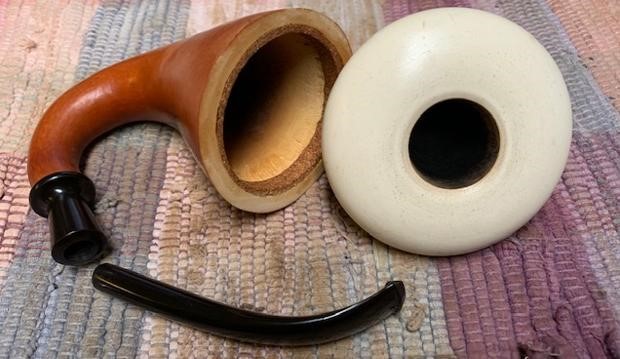
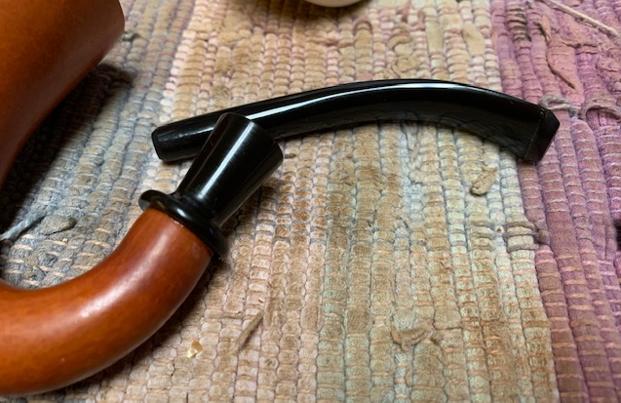
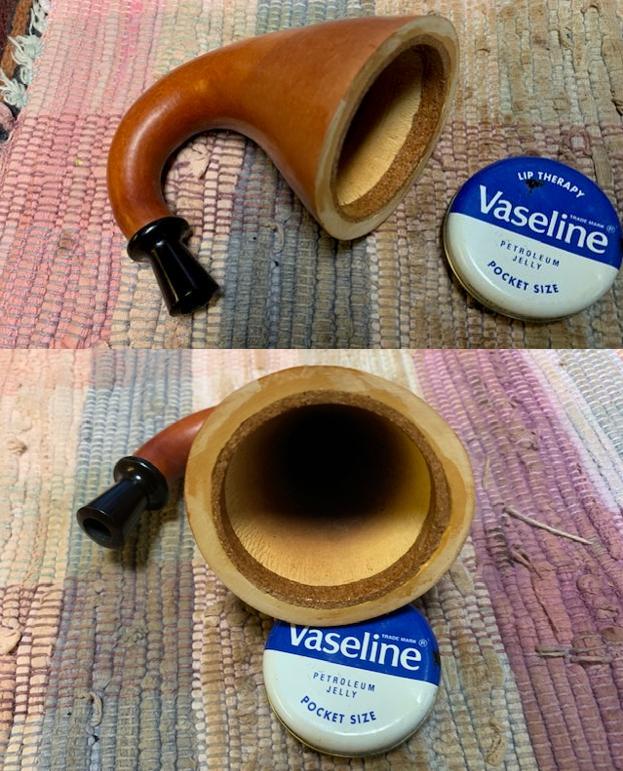
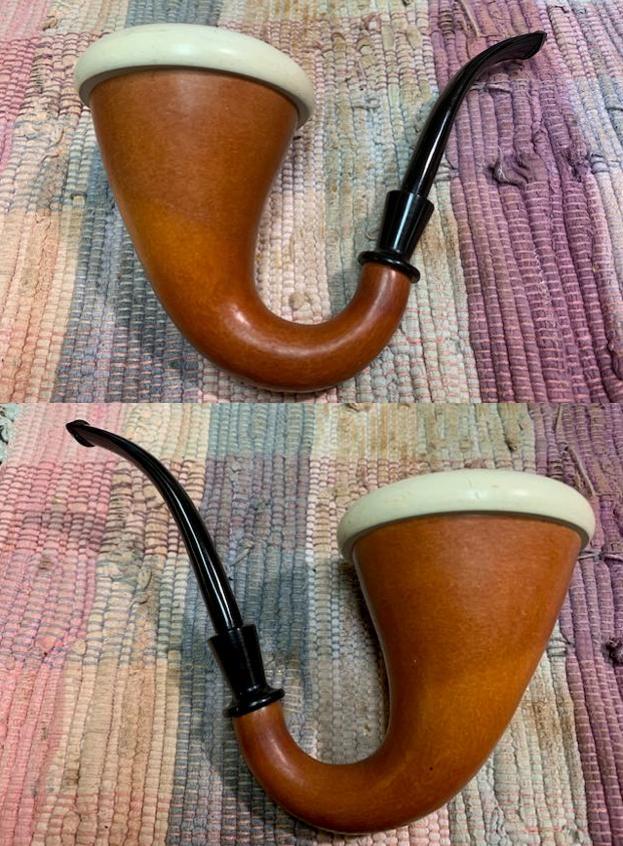
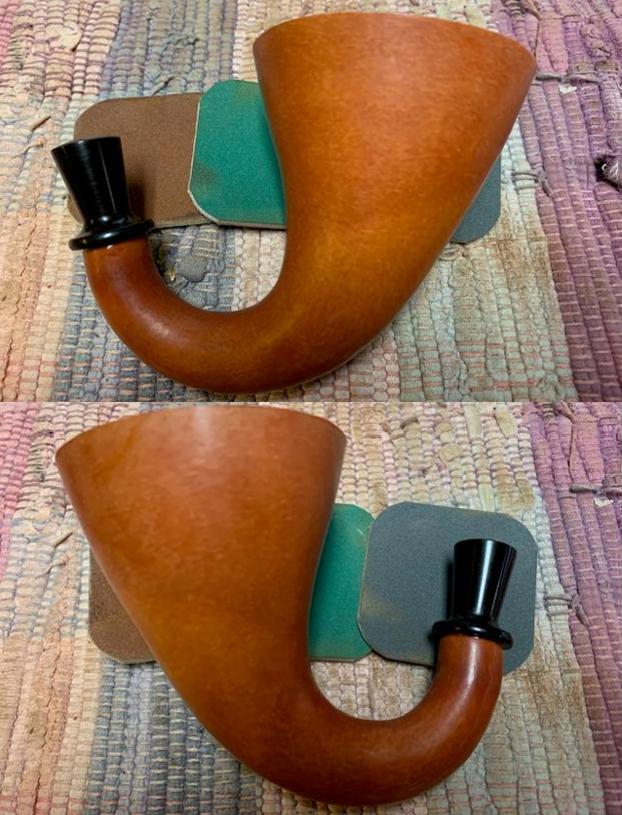
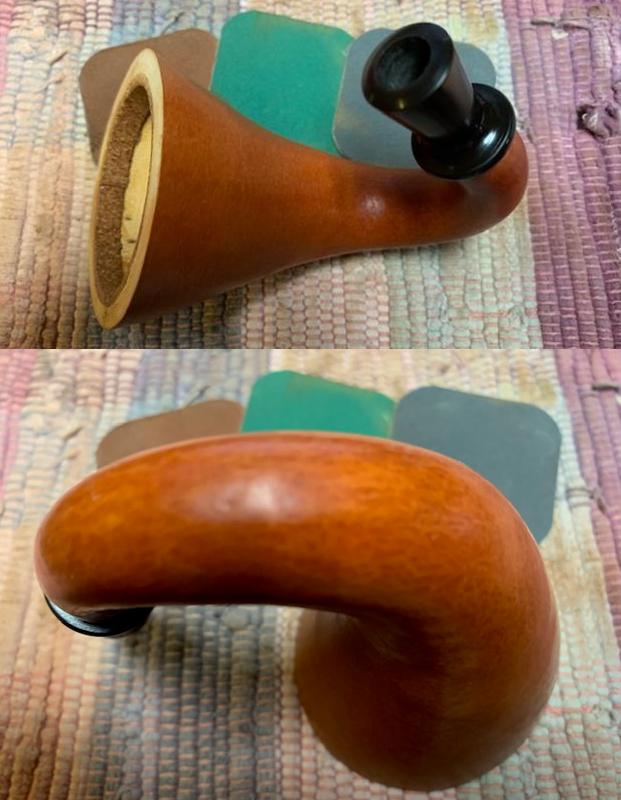
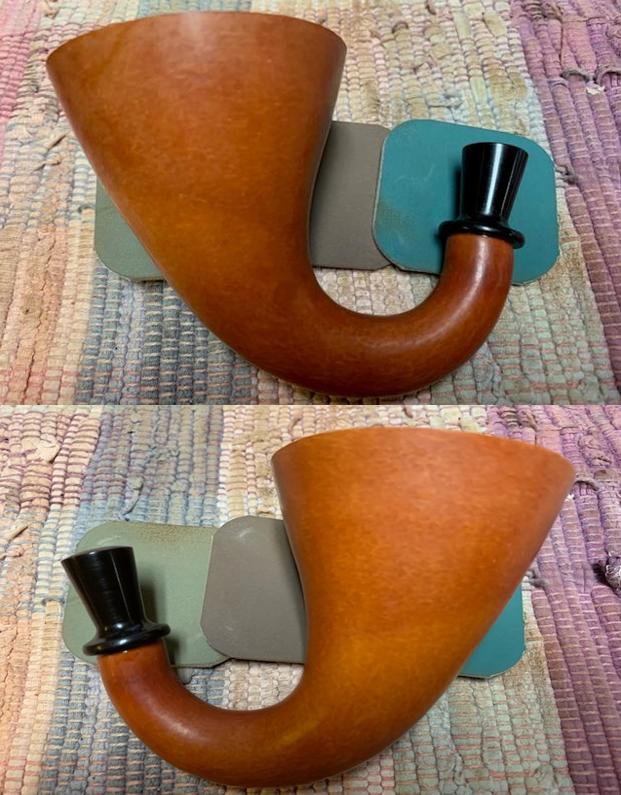
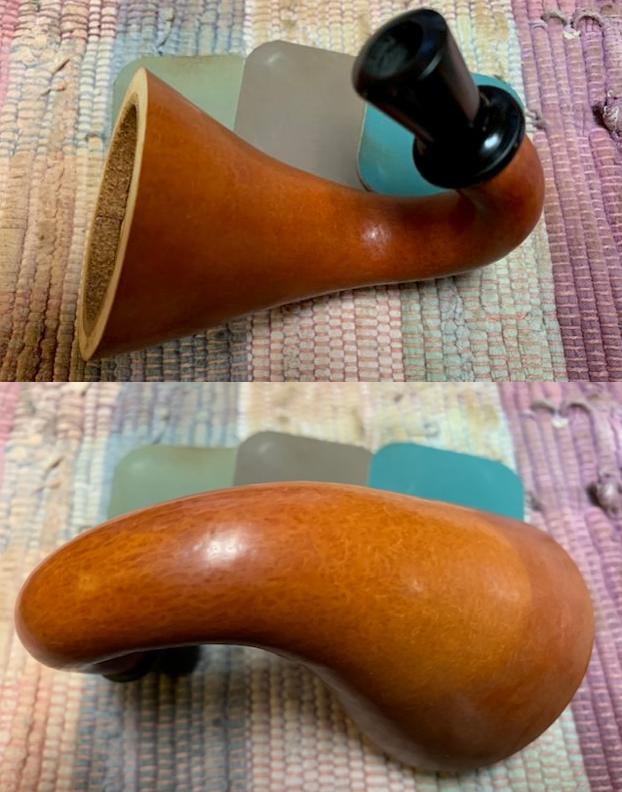
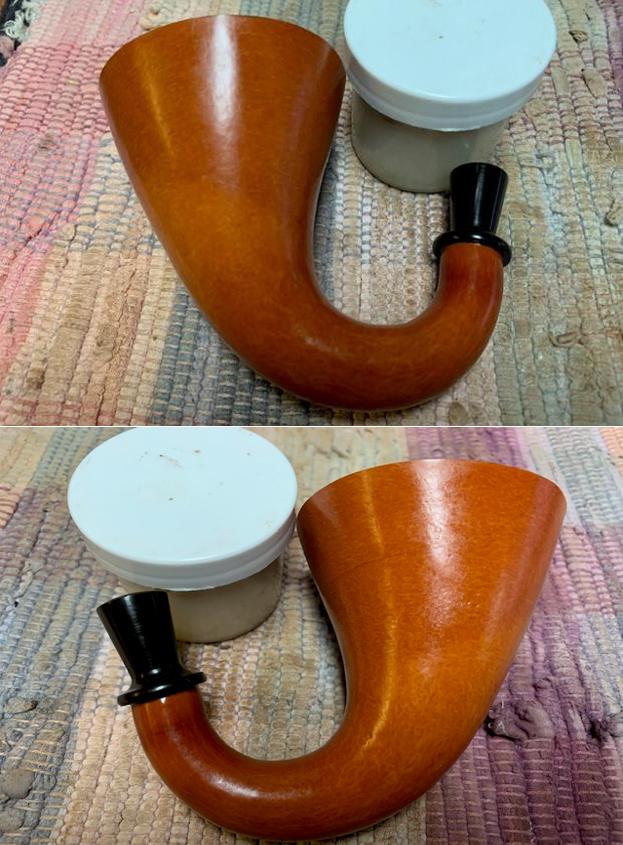
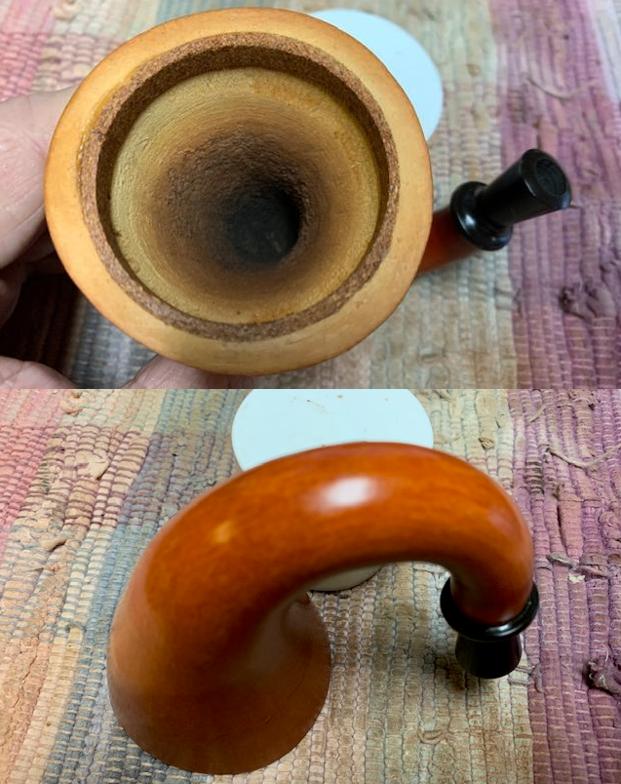
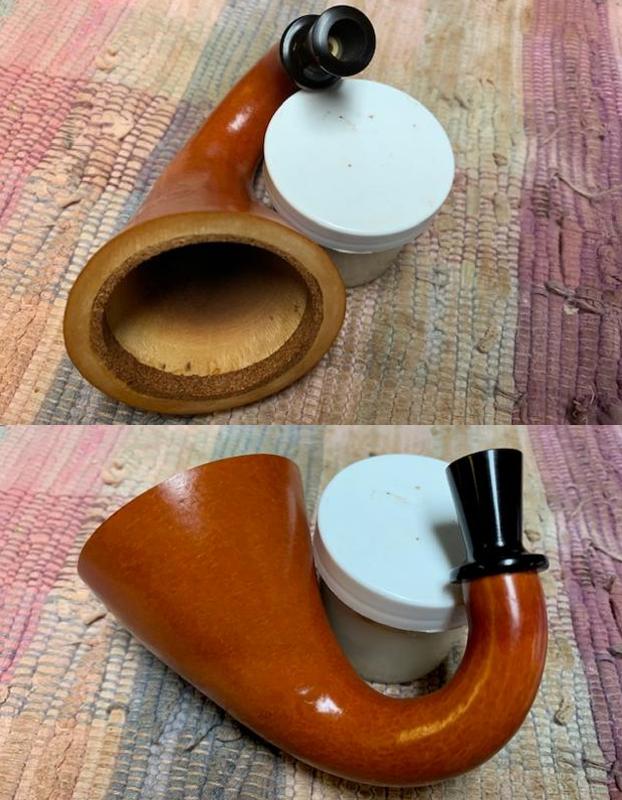
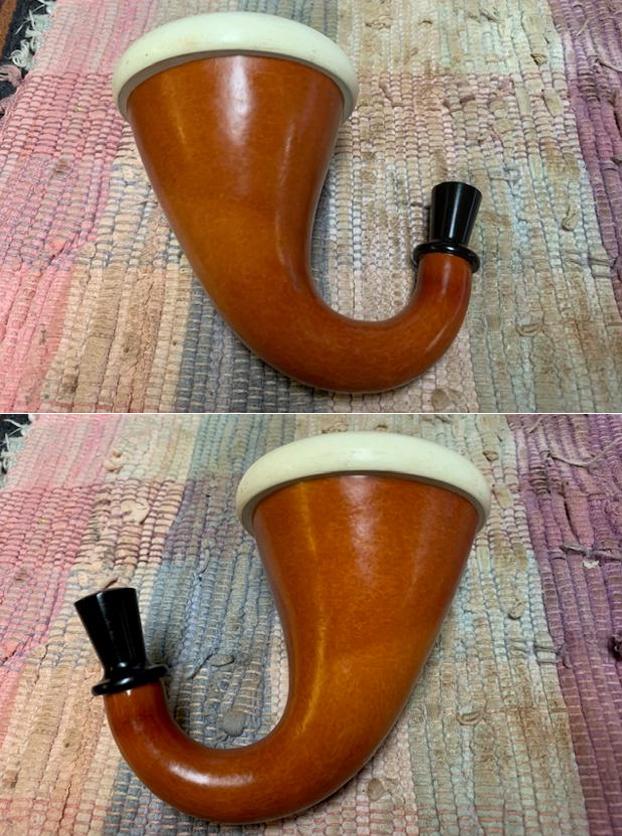
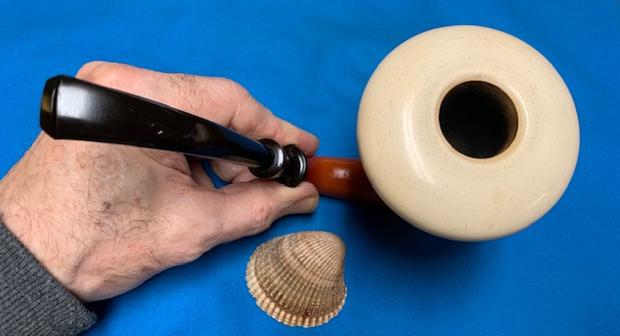
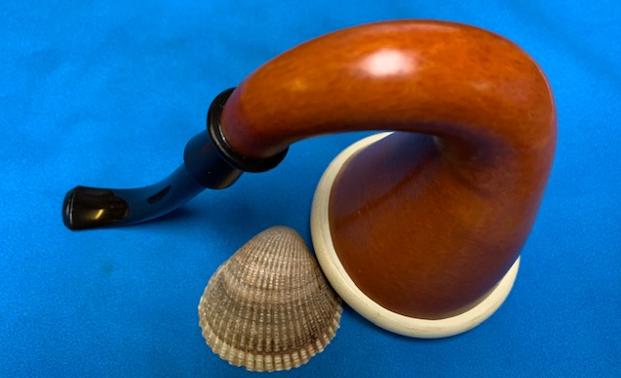
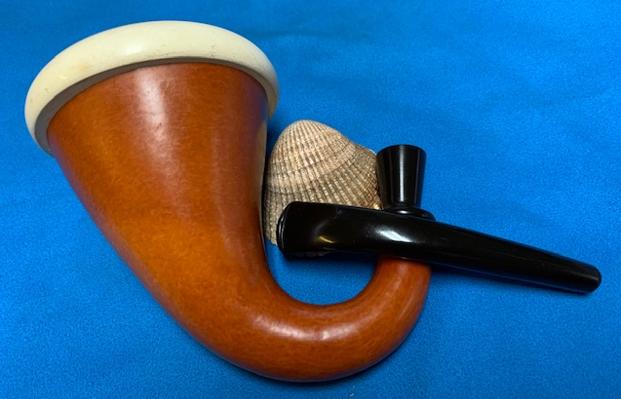
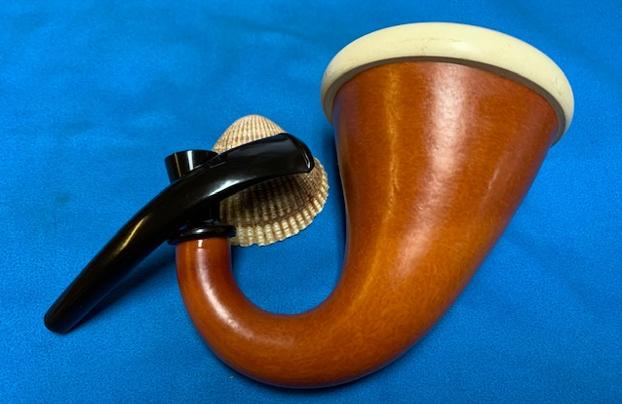
In my box of bowls, collected over the years I had this small gourd calabash pipe with a ceramic cup insert. Somewhere along its journey someone had broken the tenon off in the shank. I was looking at it this morning and was drawn to it. There was something about the little calabash that was attractive. The golden shank extension and the white porcelain cup looked good. I imagined what it would look like with a black stem and figure it would be a good one to fiddle with while I waited for calls that I was expecting. To start off the work I would need to remove the broken tenon in the shank. There are multiple ways to do that but first I tried to pull it with a screw twisted into the airway but it would not budge. I removed the porcelain bowl from the gourd and set it aside to work on later. I did not drop it by accident. I used my cordless drill and a bit the same size as the mortise and slowly drill the broken tenon out of the mortise. It did not take long before it dropped out of the mortise in pieces as shown in the photos below. I went through my can of stems and found one that I thought looked good with golden coloured shank extension and gourd. It is a fancy stem that is paneled once passed the saddle.The tenon was a little large for the mortise so I used a Dremel and sanding drum to start the process of taking down. I noticed that the tenon was not centered on the stem so I used a rasp to bring it back to center and remove the excess vulcanite. I sanded it smooth with a folded piece of 220 sandpaper and fit it on the shank. I took photos of the look of the stem at this point. I would need to give it a slight bend before it was finished, but I liked the look of it.I set the gourd and stem aside for awhile and turned to work on the porcelain bowl. It was a dirty mess with lava on the rim top and a thick cake in the bowl. I removed the lava on the rim top by dry sanding it with a 1500 grit micromesh sanding pad. I was able to remove all of the build up and get it back to the porcelain finish underneath.I scraped out the cake in the bowl with a Savinelli Fitsall Pipe Knife and took it back to bare walls. The bowl and airway at the bottom were in excellent condition. I scrubbed the internal of the bowl and the exterior of the cup and rim top with a tooth brush and some dish soap to remove the grime that had build up and leave the bowl clean and fresh smelling.I cleaned up the inner edge of the bowl with a folded piece of worn 220 grit sandpaper to smooth out the nicks in the edge. When I finished it looked better.I polished the porcelain cup top with micromesh sanding pads – dry sanding with 1500-12000 grit pads. I wiped the cup top down after each pad with a damp cloth to remove the dust and debris. The cup really took on a shine.The gourd was quite clean inside. I wiped it out with a paper towel to remove the debris. I used some Vaseline petroleum jelly renew the cork gasket around the inside of the gourd neck. I worked it in with my fingertips and let it sit until the dry cork had absorbed the jelly and was more elastic.I worked some Before & After Restoration Balm into the surface of the gourd with my finger tips to enliven, clean and protect the surface. I let it sit on the gourd for 15 minutes then buffed it off with a soft cloth. The gourd really came alive with the product. I put the porcelain cup back on the gourd bowl and took pictures of the pipe at this point in the restoration and restemming. I set the gourd and cup aside and turned my attention to the stem. I put a slight bend in the stem using my heat gun. The photo below shows the bend. The angle of the bend makes the pipe level in the mouth.I polished the vulcanite with micromesh sanding pads – 1500-12000 grit pads. I wiped it down with Obsidian Oil after each sanding pad. I used Before & After Pipe Polish – both Fine and Extra Fine to further polish the stem.  This Delicate Looking Small Porcelain Bowled Gourd Calabash is a great looking older pipe. I have no idea of the age of the pipe but I have had it in my box of bowl for probably15-18 years and I have no memory of where I picked it up or when. It is a great looking pipe that came out looking even better with the newly fit stem. The finish on the pipe is in excellent condition. The white of the porcelain cup works well with the orange/brown of the gourd, the golden shank extension and the polished black vulcanite fancy stem adds to the mix. With the grime gone from the finish and the bowl it was a beauty and is eye-catching. I put the stem back on the bowl and buffed the pipe with Blue Diamond on the buffing wheel being careful to not drop or damage the bowl or gourd. I gave the gourd and the stem multiple coats of carnauba wax on the buffing wheel and followed that by buffing it with a clean buffing pad. I hand buffed the pipe with a microfiber cloth to deepen the shine. The finished Porcelain Bowled Gourd Calabash is quite nice and feels great in the hand. Give the finished pipe a look in the photos below. I can only tell you that like the other pipes I am working that it is much prettier in person than the photos capture. The dimensions of the pipe are Length: 6 ½ inches, Height: 3 ½ inches, Outside diameter of the bowl: 1 ½ inches, Chamber diameter: ¾ of an inch. The weight of the pipe is 42grams/1.48oz. It will soon be added to the Ceramic and Meerschaum Pipes section on the rebornpipes store. Thanks for walking through the restoration with me as I worked over another beautiful pipe. Remember we are not pipe owners; we are pipemen and women who hold our pipes in trust until they pass on into the trust of the next generation.

Putting together a Great Looking Gourd Calabash from Parts


Blog by Steve Laug

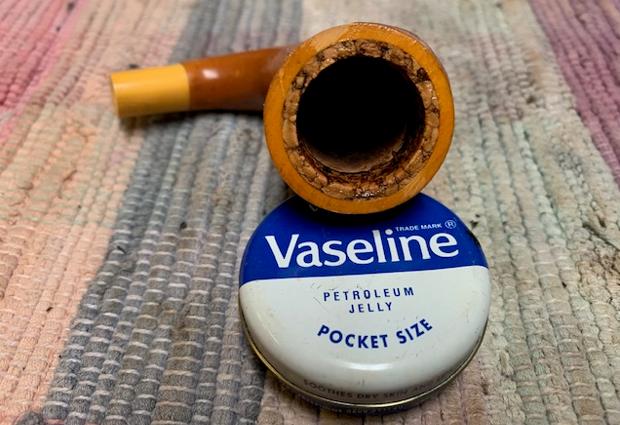
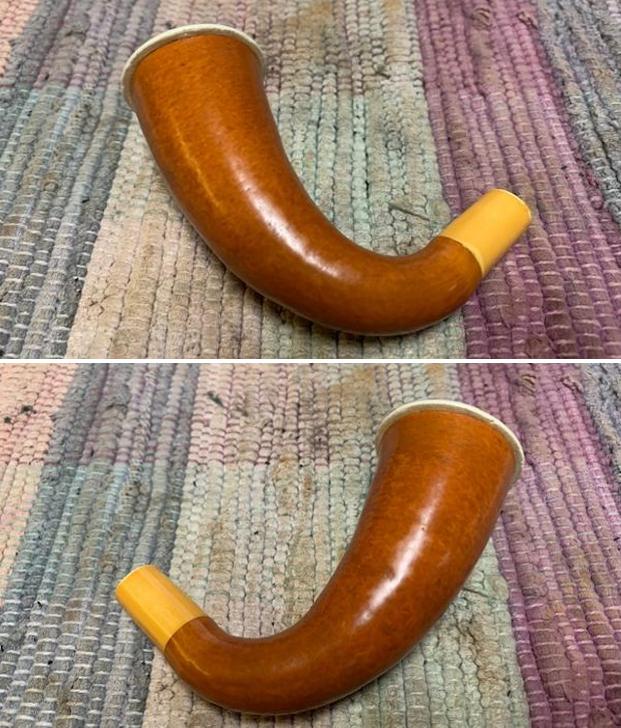
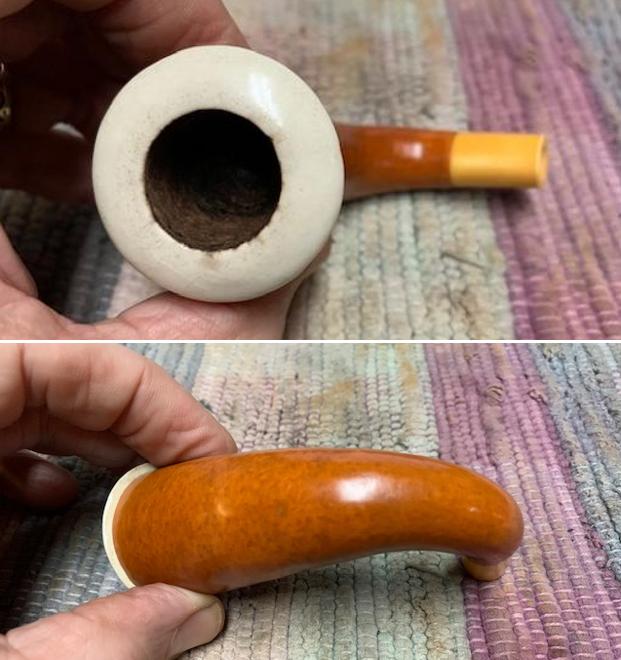
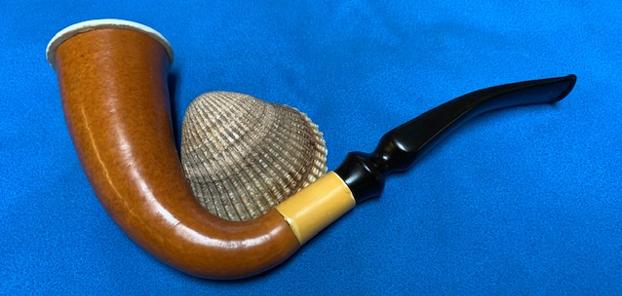
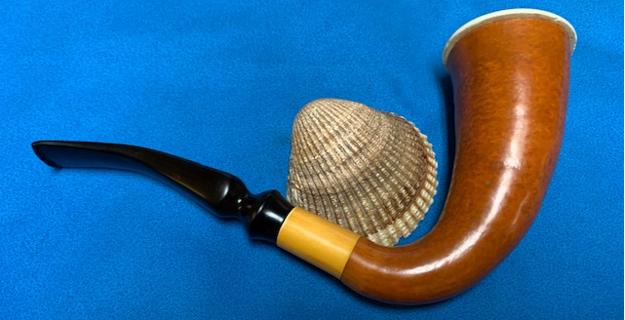
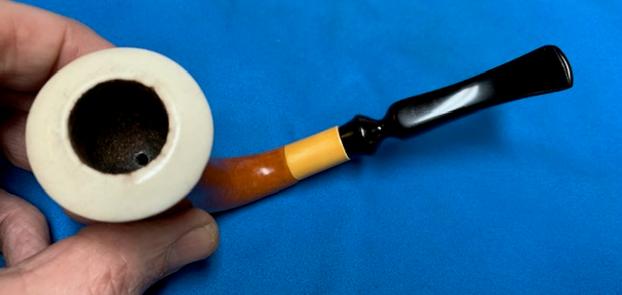
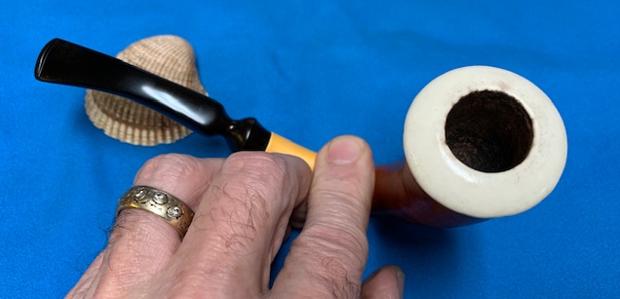
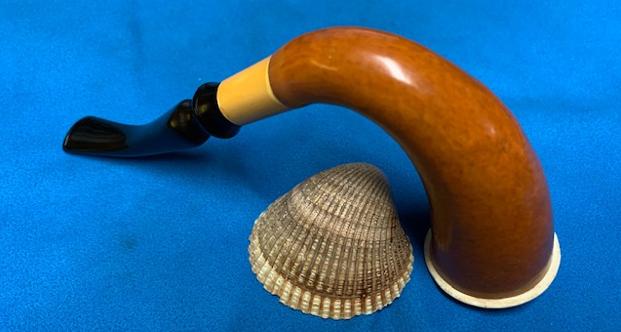
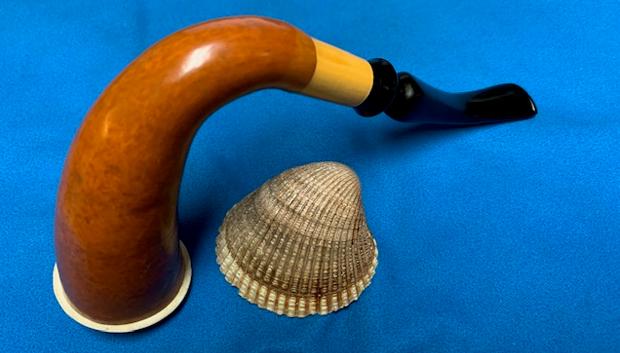
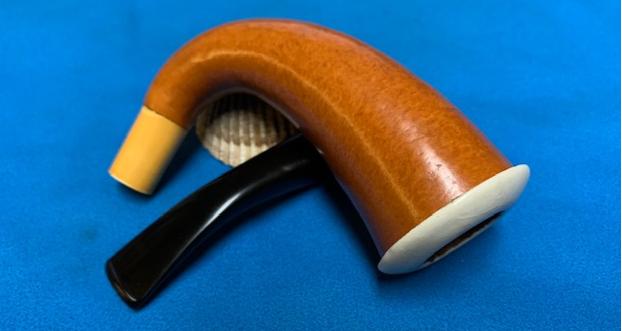
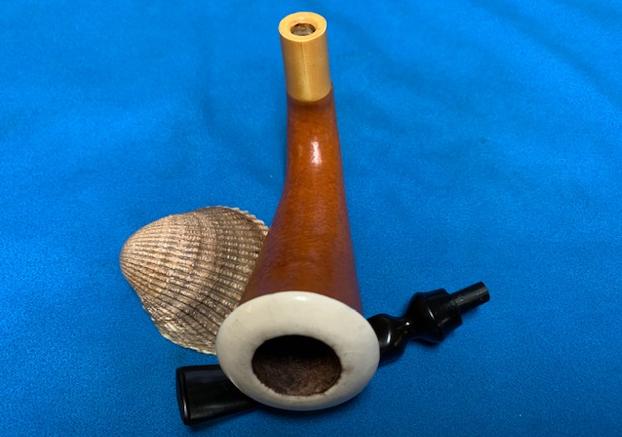
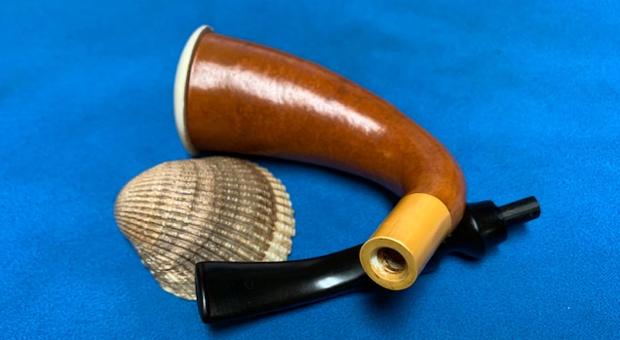
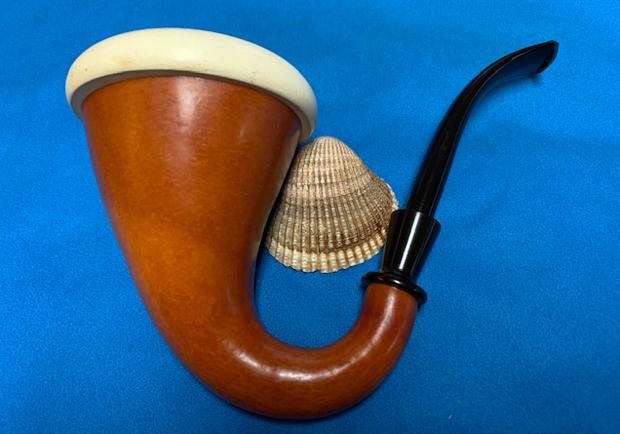
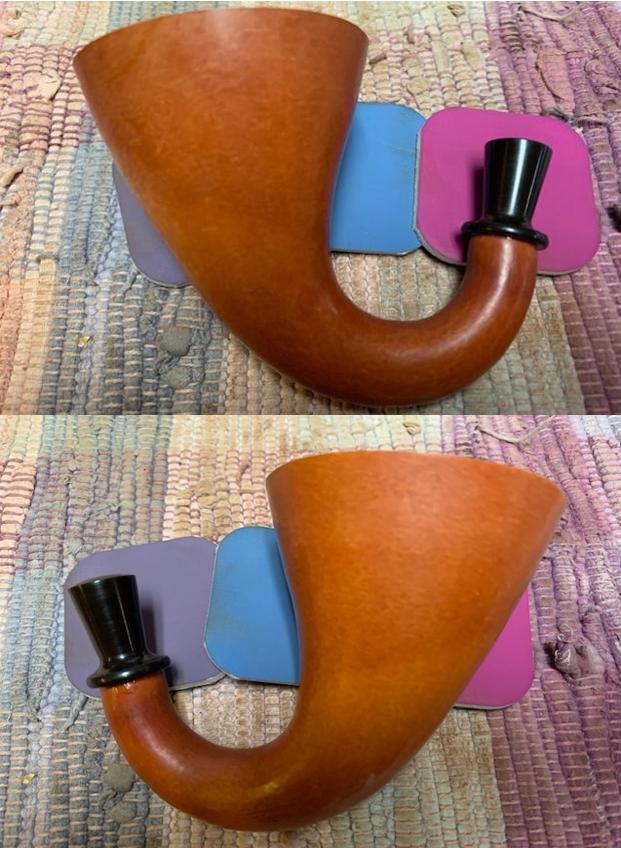
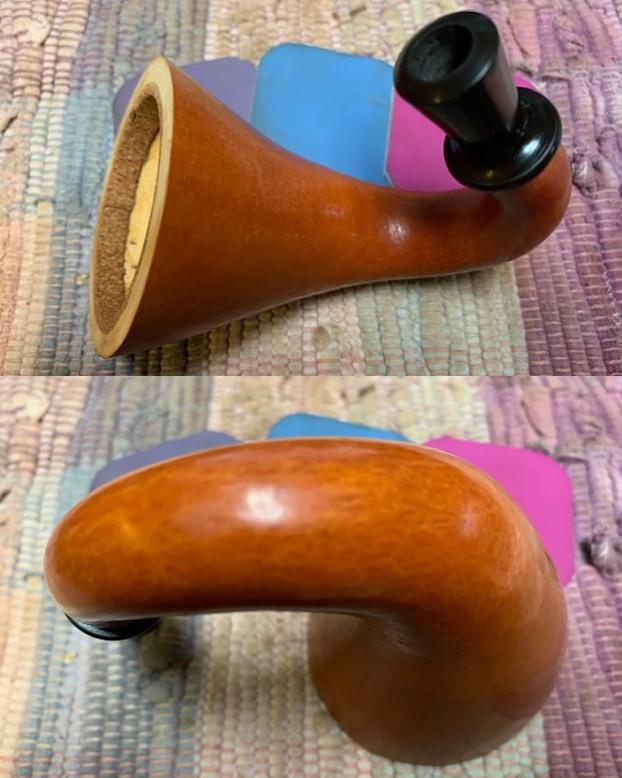
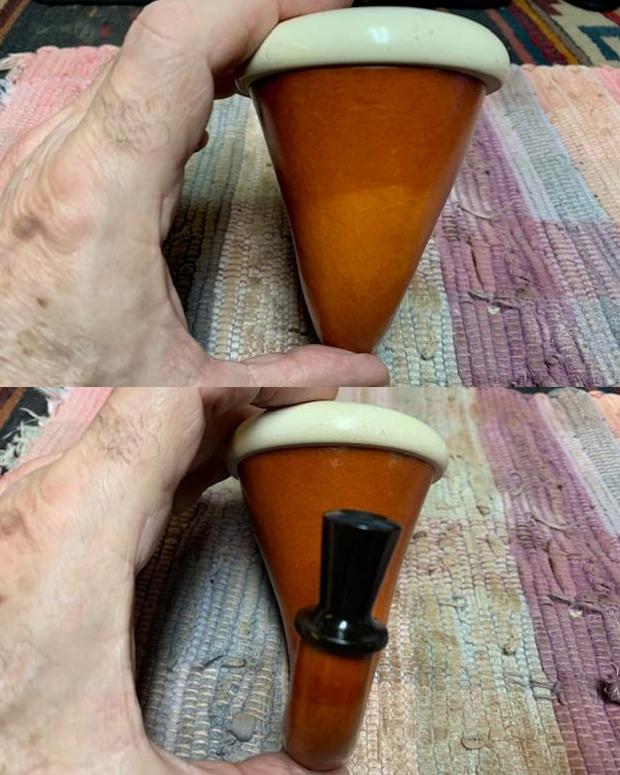
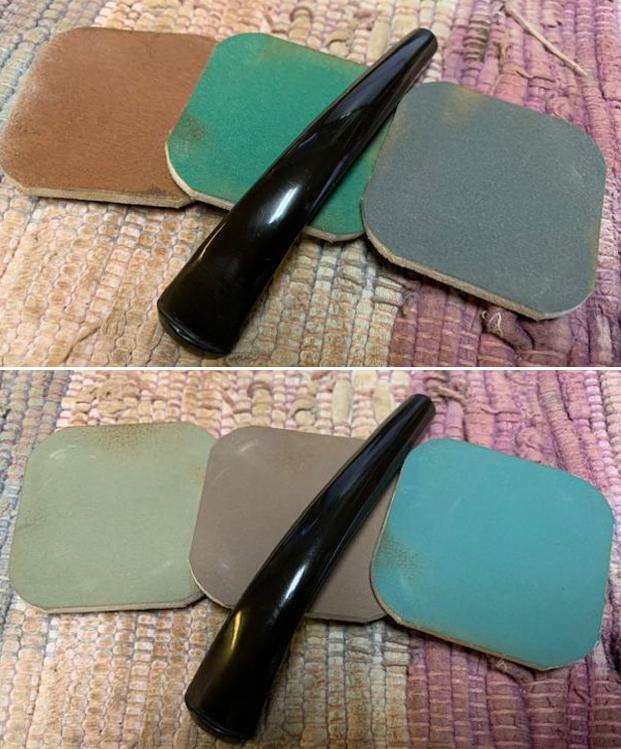
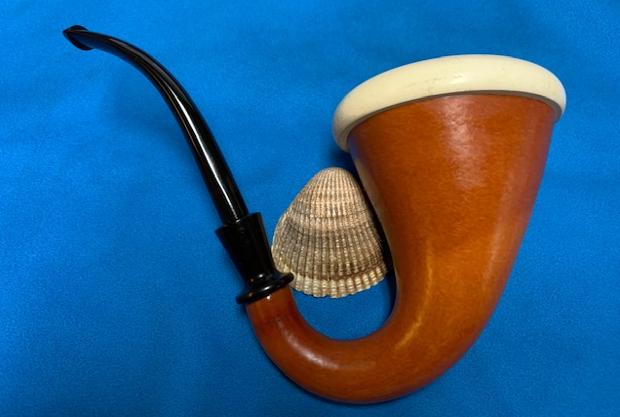
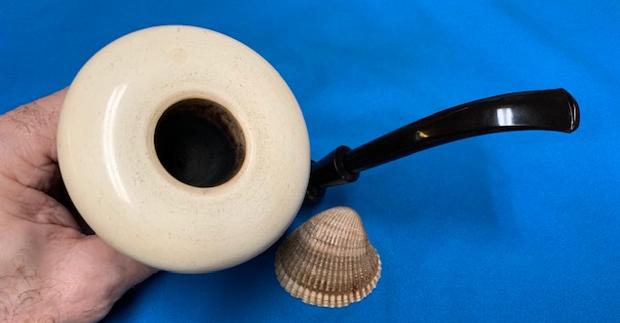
For years now I have kept a box of parts and bowls for a variety of pipes. It has briar bowls that I want to one day restem and shank extensions etc. Periodically Jeff will send me bits and bobs in the boxes of pipes that he sends me. I don’t remember where I picked up the gourd calabash with a meerschaum cup below. It was large and in excellent condition. It was missing the acrylic  shank extension that was glued into the shank of the calabash and it was missing a stem. In the latest box that Jeff sent me he included a shank extension and a stem that I thought would work perfectly to complete this calabash. I put the extension in the shank and took pictures of the parts of the pipe. It worked very well together and once it was all glued and fitted it would look great. I glued the shank extension in the end of the calabash and set it aside to cure. Once the glue was set the shank extension was ready for the new stem.I used some Vaseline Petroleum Jelly to rejuvenate the cork gasket in the bowl. I worked it into the cork with my finger tips to soften the gasket. Once it had absorbed a bit it would be soft and hold the meerschaum bowl in the gourd easily.I put the meerschaum bowl in the gourd and put the stem in the shank extension and took photos of the newly constructed calabash.  I took a photo of the meerschaum cup from the top to show the general condition. It was in decent condition with some scratching and staining around the top surface. The inside of the bowl was in excellent condition. The edges of the bowl and chamber  were in excellent condition. The stem was virtually unused with no tooth marks or chatter on either side.  I took a photo of the bowl and stem from the side to give a sense of proportion. It is a great looking pipe.I started my work on the bowl by polishing the meerschaum bowl with micromesh sanding pads – polishing with 1500-12000 grit pads and wiping them down with a damp cloth after each pad. I waxed the meerschaum bowl with Clapham’s Beeswax Polish. I rubbed it into the meerschaum with my finger tips and once it had dried I buffed it out with a soft cotton cloth.    I polished the gourd down with 1500-12000 grit micromesh sanding pads. The gourd had taken on a great shine. I rubbed the gourd down with Before  and After Restoration Balm to clean and rejuvenate the  gourd and give the calabash and briar a fresh look. I put the meerschaum cup in the gourd calabash bowl and took photos of this portion of the restoration of this pipe. I set aside the bowl and turned my attention to the stem. I polished the stem with micromesh sanding pads – wet sanding it with 1500-12000 grit pads. I polished it further with Before & After Pipe Stem Polish – both fine and extra fine.   I really enjoyed putting this pipe together and restoring it because I love the final touches that make it sing. I put the Gourd Calabash back together and lightly buffed the bowl with Blue Diamond on the buffing wheel. I gave the gourd and stem multiple coats of carnauba wax. I buffed the pipe with a clean buffing pad to raise the shine. I hand buffed it with a microfiber cloth to deepen the shine. It is fun to see what the polished meerschaum bowl looks like with the smooth finished gourd and the black vulcanite stem. This richly finished Gourd Calabash is light weight and ready for you to load up a tobacco of preference and enjoy smoking it. Have a look at it in the photos below. The dimensions are Length: 7 inches, Height: 4 inches, Outside diameter of the bowl: 3 ¼ inches, Chamber diameter: 1 inch. The weight of the pipe is 142grams/5.04oz. This is one that will go on the Meerschaum Pipemakers section of the rebornpipes online store shortly. Thanks to each of you who are reading this blog. Remember we are not pipe owners; we are pipemen and women who hold our pipes in trust until they pass on into the trust of the next generation.    

Restoring & Restemming a Peterson’s Republic Era System Standard 313 Bent Billiard


Blog by Steve Laug

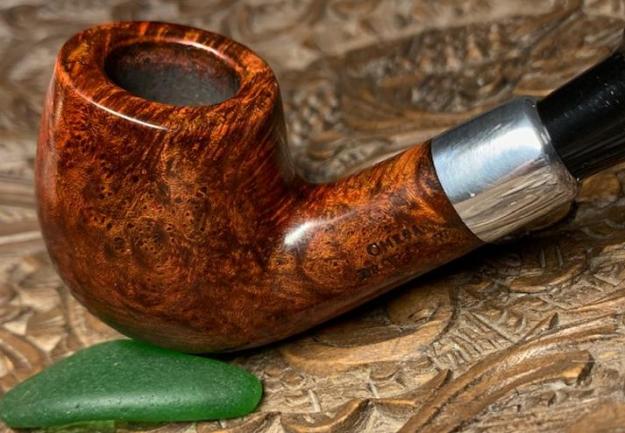
The next pipe on the work table was a bit of a surprise. I was sorting through the bowls that had accumulated over the past 20+ years with Jeff and pitching the worthless ones. You have to understand the drive that made me keep them around this long was still strong but I need to clean up things here so I asked Jeff to walk through the box of around 50-60 bowls and thin them down. As we went through them we came across a smooth Peterson’s System Standard 313 bowl. It had some interesting grain around the bowl but it also had a lot of damage. The right outer edge of the bowl was burned and damaged and the bowl was completely out of round. It had a thick cake and it was a mess. But there was something about it that caught our eye. The pipe is faintly stamped on the left side of the shank and reads Peterson’s [over] System [over] Standard. On the right side it is faintly stamped Made in the Republic of Ireland and underneath that is the shape number 313. The nickel ferrule is stamped K & P [over] Peterson. The nickel ferrule was also heavily discoloured by oils and tars and the glue holding it in place had long since dried and it was loose. The finish had a lot of grime ground into it and it was very dirty.

I remembered that I had a stem that would fit it perfectly that I had found recently. I found it and fit it on the shank and it was perfect. The stem was oxidized, calcified and had tooth chatter and marks on the top and underside near the P-lip style button. The “P” stamp on the left side of the saddle was undamaged. After putting it all together, the pipe showed promise but it was very dirty. I took these photos before I started my work on it.  I took a photo of the rim top and bowl to give a clear picture of the thickness of the cake and the condition of the rim top and edges. I also took photos of the top and underside of the stem to show the oxidation, calcification and chatter and tooth marks. He took photos of the stamping on the shank and the nickel ferrule. It reads as noted above and is faint but readable.    I removed the stem from the shank and took a photo of the pipe as a whole. It showed a lot of promise.I am including the information from Pipedia’s article on Peterson pipes. It is a great read in terms of the history of the brand (https://pipedia.org/wiki/Peterson). I have included a bit of the pertinent history here.

1950 – 1989 The Republic Era – From 1950 to the present time, the stamp for this era is “Made in the Republic of Ireland” in a block format generally in three lines but two lines have been used with or without Republic being abbreviated.

I knew that I was dealing with a Republic Era pipe made between 1950-1989. It was a smooth Peterson’s System Standard 313 Bent Billiard with nice grain. The finish was stained with a combination of brown stains. Now it was time to work on the pipe.

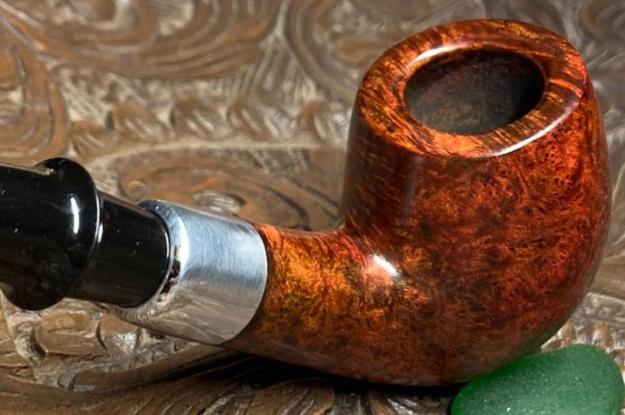
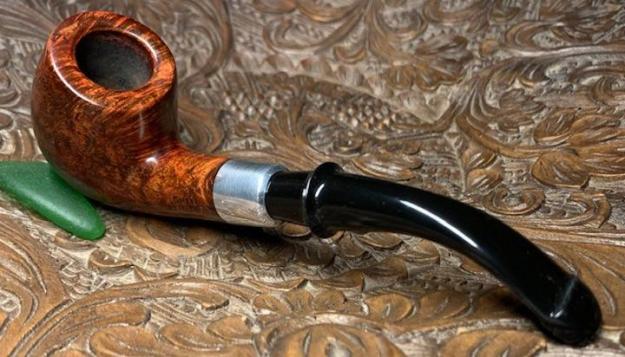
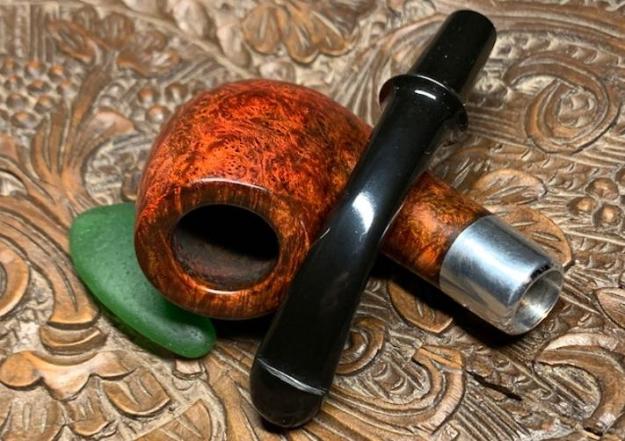
To start my work on the pipe I reamed the bowl with a PipNet pipe reamer and took the cake back to bare briar. I followed that by scraping the wall clear of remaining debris with a Savinelli Fitsall pipe knife. I finished the bowl by sanding the walls with 220 grit sandpaper wrapped around a piece of dowel.  The ferrule was loose so I removed it while I worked on cleaning the internals and externals of the pipe.I cleaned out the shank and the sump in the mortise as well as the airway into the bowl and in the stem with alcohol, pipe cleaners and cotton swabs. It came out quite clean and smelled significantly better.I set the stem aside and decided to address the damage on the rim top and edges before I scrubbed the exterior of the pipe. I topped the bowl on a topping board with 220 grit sandpaper and started reshaping the inner edge of the bowl with a folded piece of 220 grit sandpaper.  I scrubbed the pipe with undiluted Murphy’s Oil Soap and a tooth brush to remove the grime on the bowl and shank. I rinsed it off with warm running water and dried it off with a soft towel. The pictures show the grain around the sides of the pipe. With the briar clean I smeared the shank end with all-purpose glue. I aligned the stamping on the ferrule with the left side of the shank and pressed it on to the shank end.    With the ferrule in place and the briar clean it was time to take photos of the pipe. While the rim top still shows damage on the right outer edge and inner edge it is significantly better than it was when I started.     I polished the briar with micromesh sanding pads – wet sanding with 1500-12000 grit pads. I wiped the bowl down after each pad with a damp cloth.  I restained the front of the bowl and the rim top with a combination of Walnut and Maple stain pens to blend in the colour of those areas to the rest of the bowl.I rubbed the bowl down with Before & After Restoration Balm. I worked it into the surface of the bowl sides and shank with my fingertips. The product works to clean, enliven and protect the briar. I let the balm sit for a little while and then buffed with a cotton cloth to raise the shine. I set the bowl aside and turned my attention to the stem. Earlier in the day I had dropped the stem in a Deoxidizer Bath from Briarville and let it sit most of the day. Once I removed it from the bath it had soaked for about 5-6 hours. I removed it and wiped it down with a paper towel. I worked it over pretty roughly to remove the calcification and oxidation that sat on top of the vulcanite. It came out looking very good.  I sanded out the damage on the shank end of the stem where the previous pipe bowl and ferrule had cut a groove. I also sanded it with 220 grit sandpaper to remove the tooth marks and chatter on both sides ahead of the button. I started polishing the stem with 400 grit wet dry sandpaper.I touched up the “P” stamp on the left side of the stem with Paper Mate Liquid Paper. I applied it with the sponge in the bottle and worked it into the stamp with a tooth pick. Once it dried I scraped off the excess with the tooth pick. The stamp looks very good.   I polished the vulcanite stem with micromesh sanding pads – 1500-12000 grit pads. I wiped it down with a damp cloth after each sanding pad. I used Before & After Pipe Polish – both Fine and Extra Fine to further polish the stem.    This Peterson’s System Standard 313 Bent Billiard with a vulcanite stem is a great looking pipe now that it has been restored. The beautiful grain that shines through the polished finish is stunning. I put the stem back on the bowl and carefully buffed the pipe with Blue Diamond on the buffing wheel. I gave the bowl and the stem multiple coats of carnauba wax on the buffing wheel and followed that by buffing the entire pipe with a clean buffing pad. I hand buffed the pipe with a microfiber cloth to deepen the shine. The grain just popped with the wax and the buffing. It is a beauty! The finished Peterson’s System Standard Billiard 313 fits nicely in the hand and feels great. Give the finished pipe a look in the photos below. The dimensions of the pipe are Length: 5 inches, Height: 1 ¾ inches, Outside diameter of the bowl: 1 ¼ inches, Chamber diameter: ¾ of an inch. The weight of the pipe is 45gr/1.55oz. If you are interested in adding this pipe to your collection send me a message or an email. Thanks for reading this blog and my reflections on the pipe while I worked on it. There are many more to come!
Restemming and Restoring the Smallest Mario Grande Freehand I have seen


Blog by Steve Laug

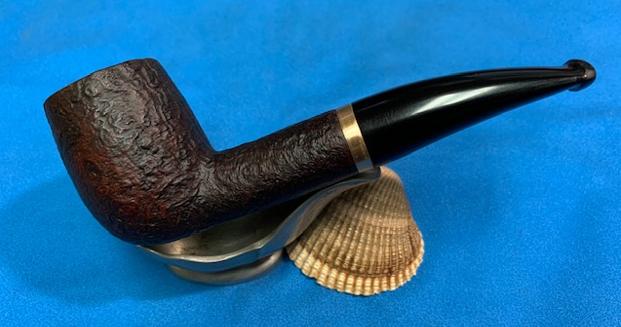
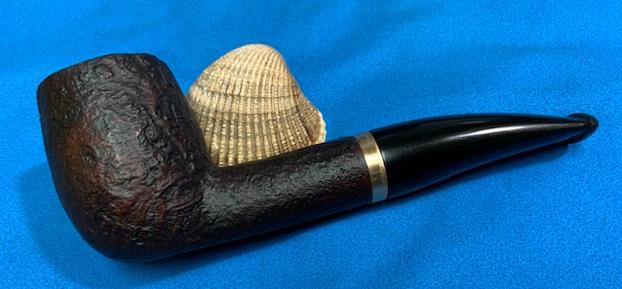
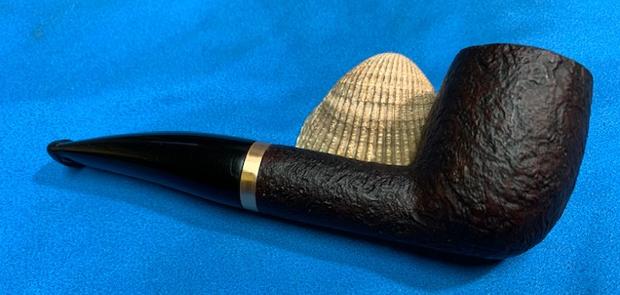
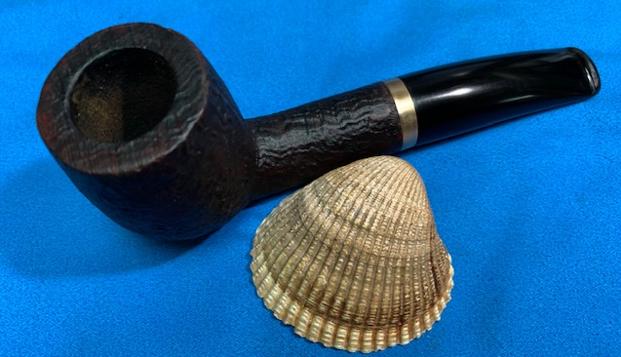
The pipe below is a bit of a mystery to me. It has been in a box of bowls that I have here for a very long time. It is kind of a wedge of nicely grained briar with a plateau rim top. When Jeff and I went through the box of bowls to sort and dispose of them we came across this bowl. I was ready to pitch it but Jeff saw something in it and said to see what we could do with it. So it is on the table today.  It is stamped on the underside of the briar and reads Mario Grande Fatta in Italy. The bowl end of the bamboo shank was loose and had an acrylic end and a Delrin tenon that inserted into the briar. On the stem end the mortise is incredibly small and drilled at an angle. The dark bamboo shank had a split on the underside at the stem end. It was a bit of a mess. The bowl had been well smoked and there was some darkening on the back edge of the rim top and plateau. Somewhere along the way it had been reamed. The shank was clean but there was debris in the mortise end. I am guessing that the original stem probably had a stainless steel tenon and was held in place by friction. I am also guessing that the crack in the shank was from the pipe being dropped. In the photos below of the bowl you will notice a thin brass band on the shank end. I put that in place before I took photos of the pipe. It is thin enough to be almost invisible but one glued in place will bind the crack in the bamboo together permanently. I took a closer photo of the rim top to show the condition of the bowl and plateau. You can see the darkening around back inner edge of the bowl. Otherwise the rim was very clean. I also took photos of the brass band that I had pressed onto the shank end. It is hard to see from my photos but the drilling in the mortise is off.I took a photo of the stamping on the underside of the shank. It clearly reads as noted above.I glued the crack in the shank and glued the brass band in place on the shank end. Then I used my cordless drill with increasingly larger drill bits to carefully straighten out the mortise and prepare it for a saddle stem that I had set aside for the pipe. Unfortunately I did not take photos of the process so my words will have to suffice. Once the mortise was straight and the same size as the opening in the brass band I put the stem on the shank and took photos of the pipe at this point. I would need to reduce the diameter of the saddle portion of the stem as it was larger than the shank end but I liked the look.  I used the Dremel and sanding drum to reduce the diameter of the stem. I worked to match it to the shank end diameter. It took some fiddling but once it was finished I liked the look.    I polished the smooth briar and the bamboo with micromesh sanding pads. I dry sanded with 1500-12000 grit sanding pads. I wiped the briar and bamboo down with a damp cloth after each sanding pad.   I worked some Before & After Restoration Balm into the surface of the briar with my fingertips to clean, enliven and protect the briar. I worked the Balm into the plateau top with a horsehair shoe brush. I let the balm sit for a little while and then buffed with a cotton cloth to raise the shine. The photos show the bowl at this point in the restoration process. I set the bowl aside and turned my attention to the stem. I sanded out scratching and light oxidation on the stem with 220 grit sand paper. I started to polish it with a folded piece of 400 wet dry sandpaper. I polished the stem with micromesh sanding pads – wet sanding with 1500-12000 grit sanding pads. I wiped it down after each sanding pad with Obsidian Oil. I polished it with Before & After Pipe Stem Polish – both Fine and Extra Fine.   I am glad to finish this Mario Grande Fatta in Italy Freehand. It was a bit more work than I expected when I took it out of the bin. I put the pipe back together and buffed it with Blue Diamond on the buffing wheel. I gave the bowl and the stem multiple coats of carnauba wax. I hand buffed the pipe with a clean buffing pad to raise the shine. It is fun to see what the polished bowl looks like with the grain popping through on the bowls sides and the plateau rim top. Added to the briar, the combination of the brass band on the black bamboo and the polished black vulcanite stem was beautiful. This petite Mario Grande (for his pipes it is petite!) is nice looking and feels great in my hand. It is light and well balanced. Have a look at it with the photos below. The dimensions are Length: 6 ½ inches, Height: 1 ¾ inches, Outside diameter of the bowl: 1 ½ inches, Chamber diameter: 5/8 of an inch. The weight of the pipe is 50grams/1.76oz. It is a beautiful pipe and one that will be on the rebornpipes store soon. If you are interested in adding it to your collection let me know. Thanks for walking through the restoration with me as I worked over this pipe. Thanks to each of you who are reading this blog. Remember we are not pipe owners; we are pipemen and women who hold our pipes in trust until they pass on into the trust of the next pipeman or woman. 

Restoring and Restemming an Asselta Freehand Egg


Blog by Steve Laug

The next pipe came to us from an auction in Huntington Station, New York, USA and has been sitting here since mid-2019. I am finally getting to it. Even though the plateau rim top was dirty it had some charm showing through the grit and grime of the years. The grain around the bowl and shank were quite stunning under the grime. The acrylic shank extension was an incredible mixture of brown, orange and blue swirls. On the left side of the shank it was stamped Asselta. The pipe came to us without a stem so I would need to pick through what I have here and find a good option. The pipe is a smooth egg shape bowl with a plateau rim. The finish is filthy with dust and grit ground into the briar of the bowl and shank sides. The bowl had a thick cake and an overflow of lava on the top and inner edge of the rim obscuring the plateau. Jeff took some photos of the pipe to show its overall condition before he started his cleanup work. He took photos of the rim top and bowl to give a clear picture of the thickness of the cake and the lava and dust ground into the plateau rim top.   Jeff took photos of the sides and heel of the bowl and shank and the acrylic swirled shank extension to give a picture of what the briar around the pipe looked like.   He took a photo of the stamping on the shank. It reads as noted above and is clear and readable.    I turned to Pipedia and did a search for Asselta pipes. The search came with a link in the American Pipe Brands (https://pipedia.org/wiki/American_Pipe_Brands_%26_Makers_A_-_B). It appears that the pipe was potentially made in Long Island, New York, USA. Seeing how the pipe came to us from New York it had not traveled far in its life before we purchased it. Now it has traveled from New York to Idaho and then to Vancouver, Canada. Where its journey will end only time will tell.

Now it was time to work on the pipe. Jeff had cleaned up the pipe with his usual penchant for thoroughness. He reamed the pipe with a PipNet Pipe Reamer and cleaned up the remnants with a Savinelli Fitsall Pipe Knife.  He scrubbed the bowl with undiluted Murphy’s Oil Soap with a tooth brush. He worked over the debris on the plateau rim top and was able to remove it. He rinsed it under running warm water to remove the soap and grime. He cleaned out the inside of the shank and the airway with alcohol, cotton swabs and pipe cleaners. I took photos of the pipe bowl once I received it. It really looked good.    The plateau rim top was very clean and the bowl was spotless. It was a good looking pipe. The swirled acrylic shank extension was beautiful.   I took a photo of the stamping on the left side of the shank. It was clear and read as noted above. I went through my assortment of stems and found one that really worked well with the shank extension and the bowl. It is going to be a great looking pipe. I put the stem in the shank and took photos of the new look of the bowl. I like the overall look that pipe had. Once I cleaned up and polished the stem it would look very good.  I took close up photos of the bowl and plateau rim top and the stem. I was going to need to remove the tooth marks but the stem was going to look very good. The bowl was in such good condition that I started my work on it by rubbing down with Before & After Restoration Balm. I worked it into the surface of the bowl sides and shank with my fingertips. I used a horsehair shoe brush to work it into plateau top. The product works to clean, enliven and protect the briar. I let the balm sit for 15 minutes and then buffed with a cotton cloth to raise the shine.   I set the bowl aside and turned my attention to the stem that I had picked out. I “painted” the surface of the stem with the flame of a lighter to lift the tooth marks. I was able to lift all of them on the top side and all but two on the underside. I filled them in with super glue and set it aside to cure. I used a file to flatten the repair on the stem and reshape the button. Once I had it reshaped and the repair flattened I sanded the stem with 220 grit sandpaper to remove the scratching and blending them into the surface. I began the polishing with 400 grit wet dry sandpaper. I polished the scratches out of the acrylic stem with micromesh sanding pads – 1500-12000 grit pads. I wiped it down with a damp cloth after each sanding pad. I used Before & After Pipe Polish – both Fine and Extra Fine to further polish the stem.     This smooth finish/plateau rim top Asselta Freehand Egg with a swirled acrylic shank extension is a great looking pipe. It is a pipe made in Long Island, New York but other than that the carver is a mystery to me. The replacement fancy, saddle vulcanite stem works well and goes nicely with the extension and the briar. I put the stem back on the bowl and buffed the pipe with Blue Diamond on the buffing wheel using a light touch on the briar. I gave the bowl and the stem multiple coats of carnauba wax on the buffing wheel and followed that by buffing the entire pipe with a clean buffing pad. I hand buffed the pipe with a microfiber cloth to deepen the shine. The finished Asselta Freehand Egg fits nicely in the hand and feels great. Give the finished pipe a look in the photos below. The dimensions of the pipe are Length: 6 ¼ inches, Height: 2 inches, Outside diameter of the bowl: 1 ¼ inches, Chamber diameter: ¾ of an inch. The weight of the pipe is 53grams/1.87oz. I will be adding it to the rebornpipes store shortly in the American Pipe Makers Section. Thanks for reading this blog and my reflections on the pipe while I worked on it. There are many more to come!
Restoring a Mixed Finish Soren Hand Carved Pedestal Freehand


Blog by Steve Laug

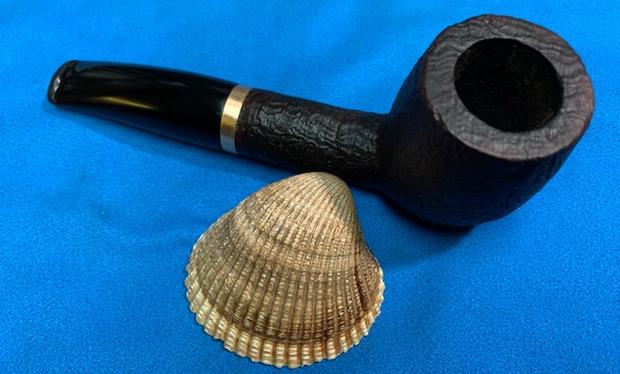
The next pipe on the table came to us in a group of pipes that we picked up from an auction in 2018 in Wilkes Barre, Pennsylvania, USA. It has a mixed sandblast and smooth finish that was a bit dull and lifeless. It showed promise under the grit and grime of the years. On the underside of the shank it was clearly stamped Soren [over] Hand Carved [over] Made in Denmark. When I received it from Jeff somehow the bowl and stem had separated and I had the bowl in hand but no idea what stem fit the shank. I tried a variety of stems that I had but not one of them fit well.

Jeff had cleaned up the pipe with his usual penchant for thoroughness. He reamed the pipe with a PipNet Pipe Reamer and cleaned up the remnants with a Savinelli Fitsall Pipe Knife.  He scrubbed the bowl with undiluted Murphy’s Oil Soap with a tooth brush. He worked over the debris in the plateau on the rim top and shank end and was able to remove it. He rinsed it under running warm water to remove the soap and grime. He cleaned out the inside of the shank and the airway in the stem with alcohol, cotton swabs and pipe cleaners. When I took it out of the box it did not have a stem in the shank. I wrote Jeff and sent him photos of the bowl and asked him if he had photos that showed what the stem looked like. Jeff did a bit of hunting on his hard drive and found the pictures of the pipe with the stem that it had when he started his work. He sent me the following photos of the pipe. The pipe was very dirty with grime and grit ground into the sides of the sandblast and the rim top. The bowl had a thick cake and an overflow of lava on the rim top that obscured the edges of the rim and the plateau finish. To me the stem just did not look like the right one for this kind of freehand pipe. It looked like a replacement stem that was just stuck in the shank. Now I had to see if I could find it in the boxes that he sent. That would be a bit of a treasure hunt. He took photos of the rim top and bowl to give a clear picture of the thickness of the cake and the lava on the plateau finish of the rim top. There is dust and debris stuck to the walls of the bowl clearly visible in the photos. He also took photos of the top and underside of the stem that came with it to show the chatter and tooth marks. Jeff took a photo of the sides and heel of the bowl to give a picture of what the sandblast on the briar looked like. The pedestal on the heel of the bowl is a unique feature of this pipe.He took photos of the stamping on the shank. It reads as noted above and is clear and readable. I found the stem that was pictured above in the photos in one of the bags of stems that I had put together in the bottom of one of the boxes. I took photos of the stem to give an idea of the appearance. Jeff had done a great job cleaning it. The tenon was very short and stubby and there were casting marks on the side of the stem blade. I put the stem on the bowl and took a photo of the stem that Jeff had sent with the pipe. I have worked on quite a few Soren pipes over the years and turned to one of the blogs that I wrote  on another interesting Soren Freehand Sitter (https://rebornpipes.com/2020/02/26/this-interesting-soren-hand-carved-freehand-turned-out-to-be-more-work-than-expected/). I quote from that blog below.

I looked up the brand on Pipephil (http://www.pipephil.eu/logos/en/logo-s10.html) and found that the brand was carved by Søren Refbjerg Rasmussen. Pipes that he made for the European market were mostly stamped “Refbjerg” while those made for the US market were stamped “Soren”. Thus I knew that one I was working on was imported into the US market.

I decided to set the stem aside and see what I could find in my cans of stems here. I found an interesting turned stem that had a lot of potential. It had some oxidation, calcification and deep tooth marks on the surface. The tenon was a perfect fit in the shank so I would just need to clean it up and repair the tooth marks. Here are some photos of the stem as it looked before I worked on it.   I put the stem on the pipe and took some photos of the look of the “new” stem on the bowl. I think that with some work this was the right stem for the pipe.  I took a close up photo of the bowl and the stem to give an idea of what I had to work with. The bowl was very clean and it would polish up nicely. There was still some darkening in the plateau on the back side of the bowl that would need to be dealt with. The stem photos show the oxidation, calcification and deep tooth marks on both sides near the damaged button surface. It was badly damaged but showed a lot of promise. I removed the stem from the shank and dropped in a bath of Briarville’s Pipe Stem Deoxidizer to soak while I worked on the bowl. I figured the soak would bring the oxidation to the surface and clean the surface so that I could do the repairs to the stem surface once it was clean.While the stem soaked in the deoxidizer I worked on the bowl. I scrubbed the rim top with a brass bristle brush to remove the darkening and deep grime. Once it was finished it looked much better. I stained it black with a black stain pen. I used the wire brush again to clean up some of the high spots leaving the stain in the grooves. I also lightly sanded the rim top with a 1500 grit micromesh sanding pad to further highlight the high spots. I like the look of the rim at this point though with more polishing and Balm it would come alive. I polished the smooth portions of the bowl sides with micromesh sanding pads – dry sanding with 1500-12000 grit sanding pads. I wiped the bowl down with a damp cloth after each pad. With the smooth portion of the briar polished I rubbed the bowl and shank down with Before & After Restoration Balm. I worked it into the surface of the bowl sides and shank with my fingertips and into the plateau rim top and sandblast with a horsehair shoe brush. The product works to clean, enliven and protect the briar. I let the Balm sit for 15 minutes and then buffed with a cotton cloth to raise the shine. While the Balm did its work I worked on the “new stem”. I set the bowl aside and turned my attention to the stem. I removed it from the Deoxidizer bath and rubbed it down with a coarse cloth to dry it out. It had brought oxidation to the surface and made it easier to deal with but it had not removed it. The good news for me was that it had done a great job removing it from the tooth marks. I “painted” the surface of the vulcanite with the flame of a lighter to lift the dents as much as possible. I was able to lift them significantly. I filled in the remaining divots with black super glue. I chose to use black glue this time just in case there were some remaining spots of oxidation in the tooth marks. The black would take care of that. Once the repairs had hardened I scrubbed the remaining oxidation in all of the grooves of the fancy stem with Soft Scrub all purpose cleaner. I was able to get into the grooves with the product and the cotton pads that I used to scrub it. It was beginning to look better.   I cleaned out the stem with alcohol and pipe cleaners to remove the tars and the debris that was loosened by the deoxidizer bath.I smoothed out the repairs and recut the button edges with a rasp and a file. The stem was taking shape.  I smoothed out the remaining repair marks and the file marks with 220 grit sandpaper. I started the polishing with 400 grit wet dry sandpaper. I polished the vulcanite stem with micromesh sanding pads – 1500-12000 grit pads. I wiped it down with a damp cloth after each sanding pad. I used Before & After Pipe Polish – both Fine and Extra Fine to further polish the stem.  This beautiful Soren Hand Carved Pedestal Freehand with a fancy, turned vulcanite replacement stem is a great looking pipe now that it has been restored. I put the stem back on the bowl and carefully buffed the pipe with Blue Diamond on the buffing wheel using a light touch on the briar. I gave the bowl and the stem multiple coats of carnauba wax on the buffing wheel and followed that by buffing the entire pipe with a clean buffing pad. I hand buffed the pipe with a microfiber cloth to deepen the shine. The finished Soren Hand Carved fits nicely in the hand and feels great. Give the finished pipe a look in the photos below. The dimensions of the pipe are Length: 6 ½ inches, Height: 2 ½ inches, Outside diameter of the bowl: 1 ¾ inches, Chamber diameter: 7/8 of an inch. The weight of the pipe is 72grams/2.54oz. I will be adding it to the rebornpipes online store in the Danish Pipemakers section. If you are interested in adding this pipe to your collection send me a message or an email. Thanks for reading this blog and my reflections on the pipe while I worked on it. There are many more to come!
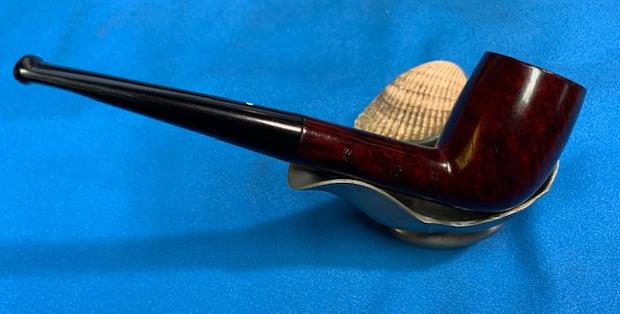
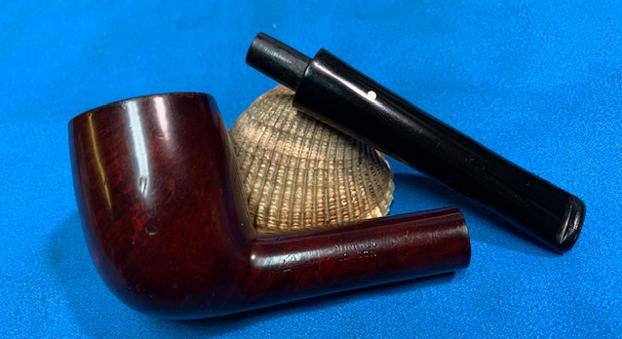
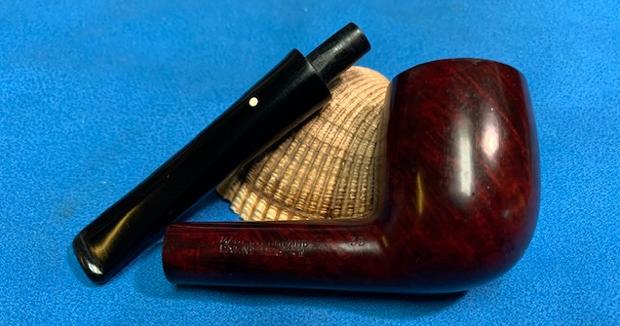
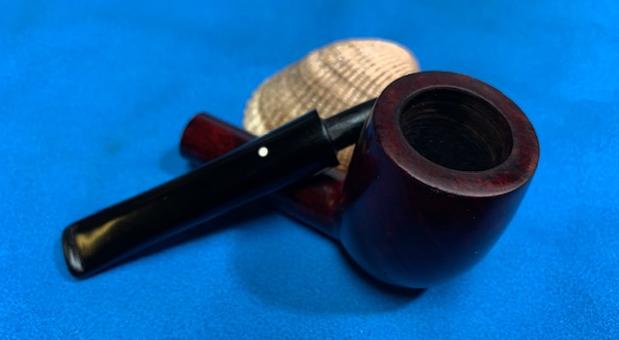
Restemming and Restoring a No Name Billiard


Blog by Steve Laug

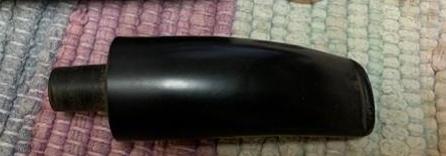
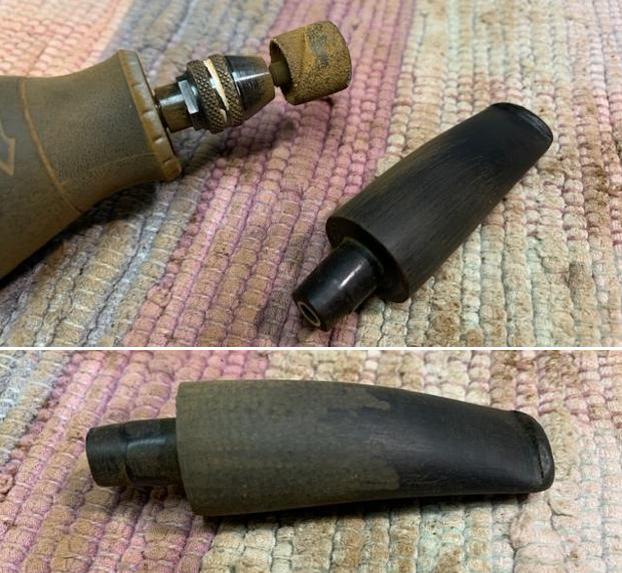
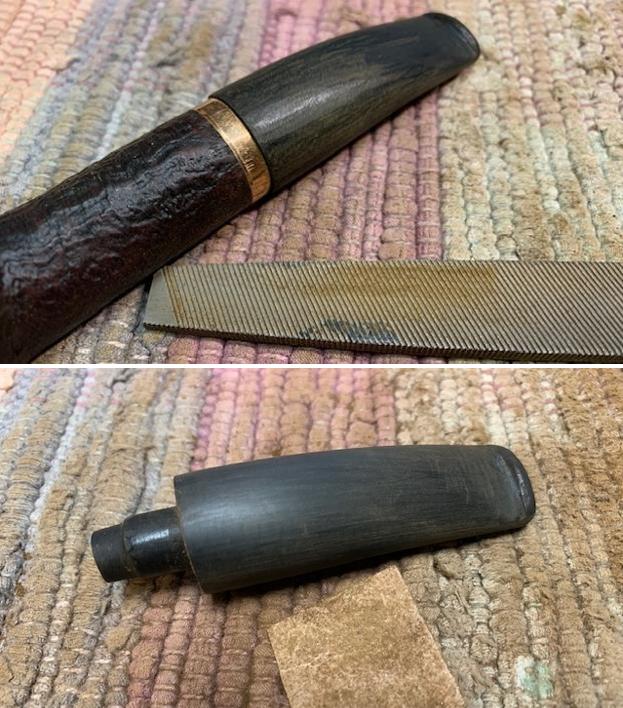
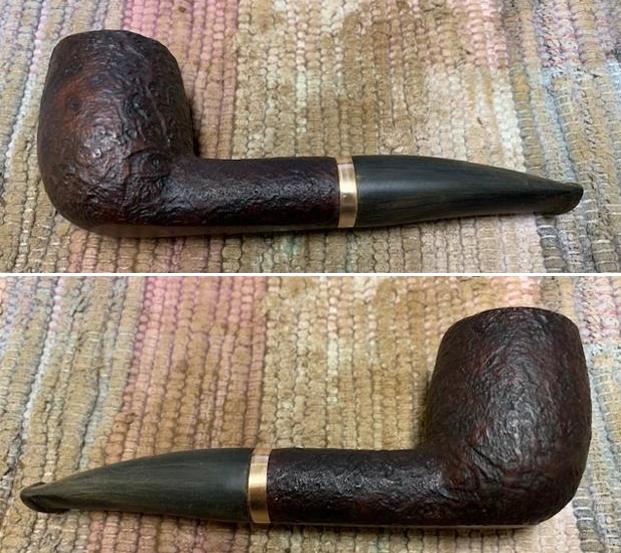
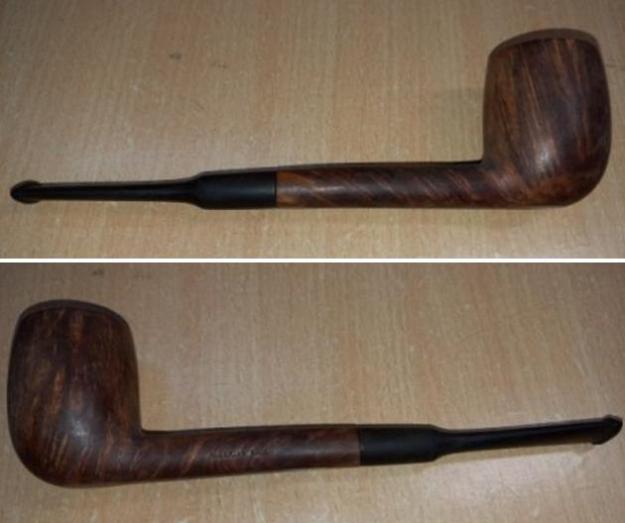
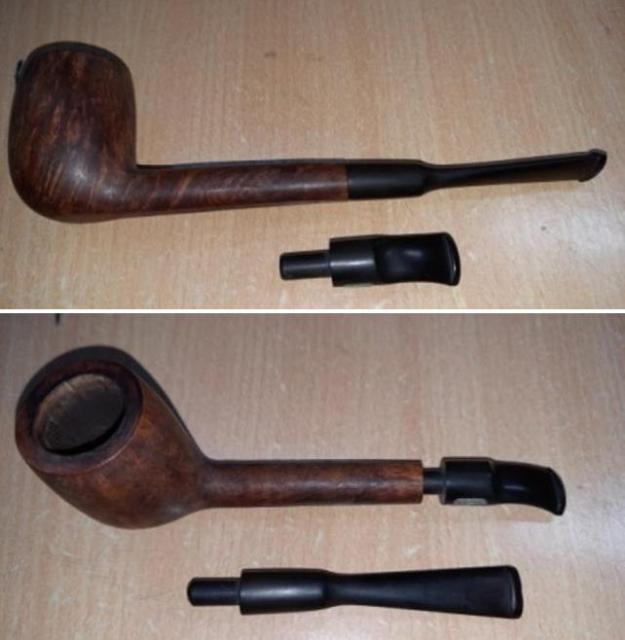
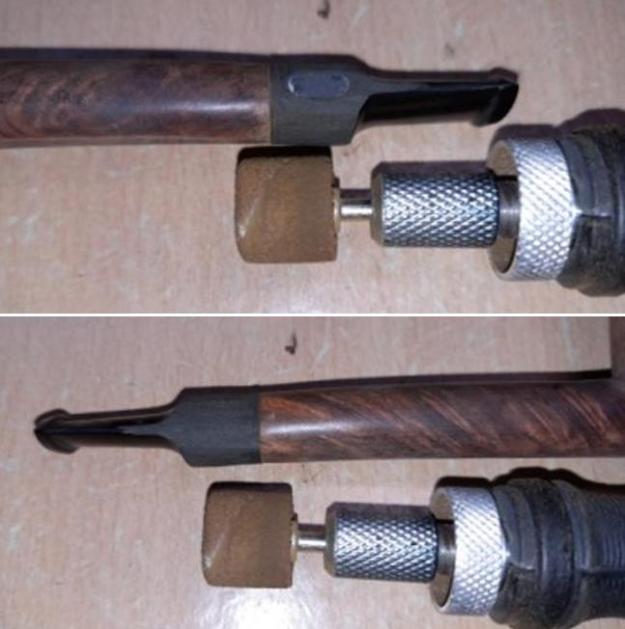
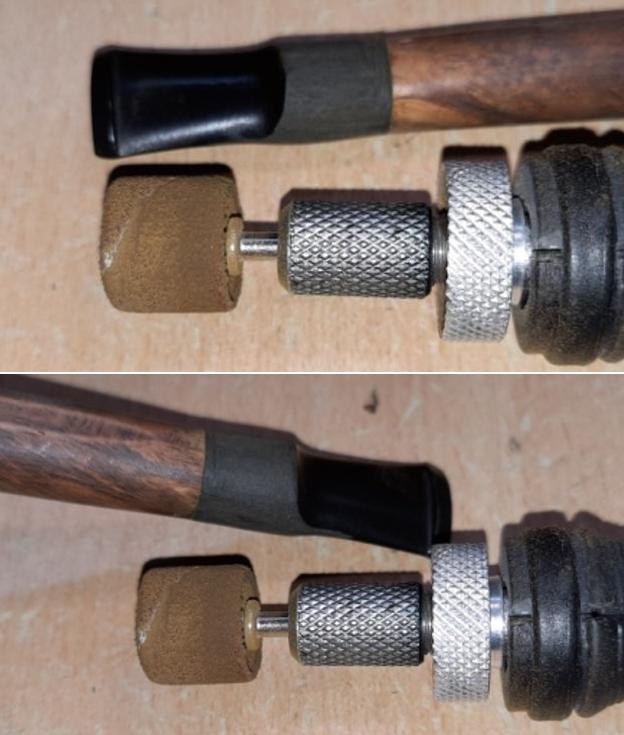
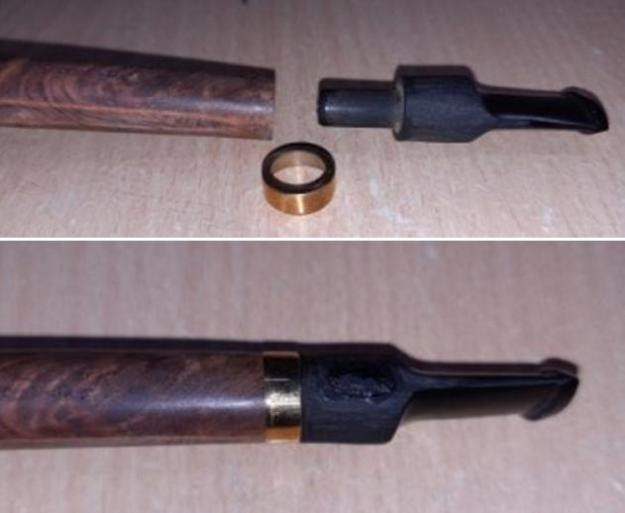
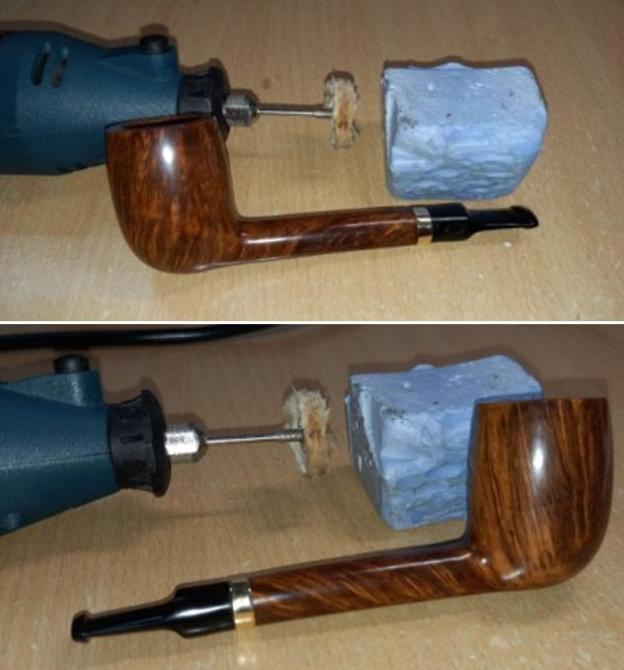
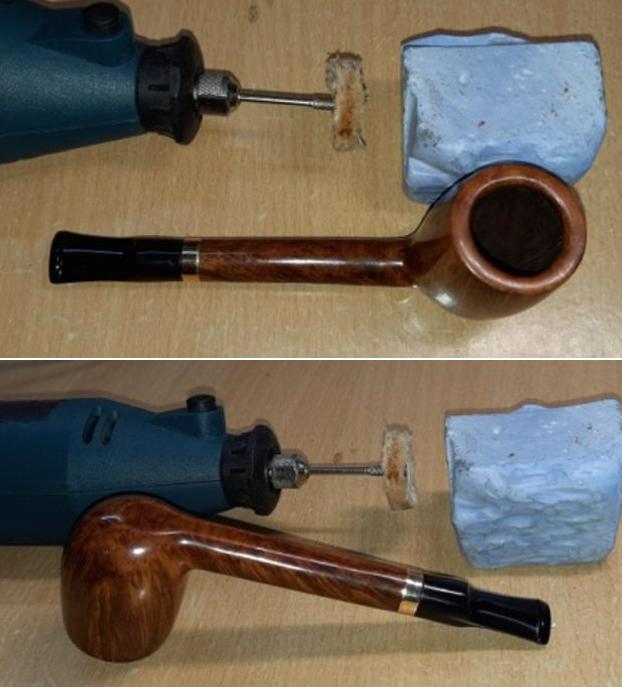
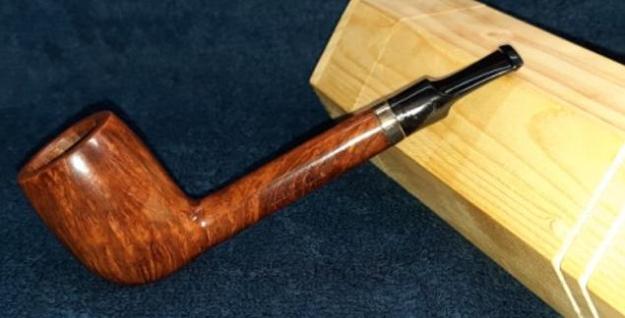
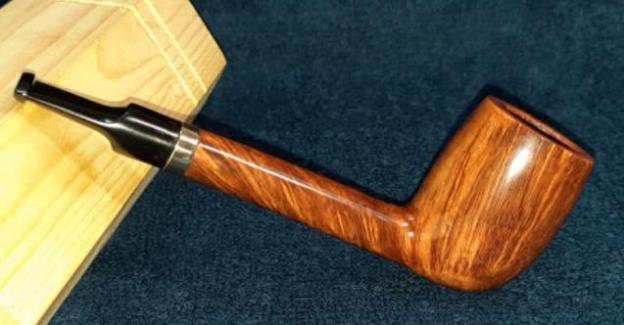
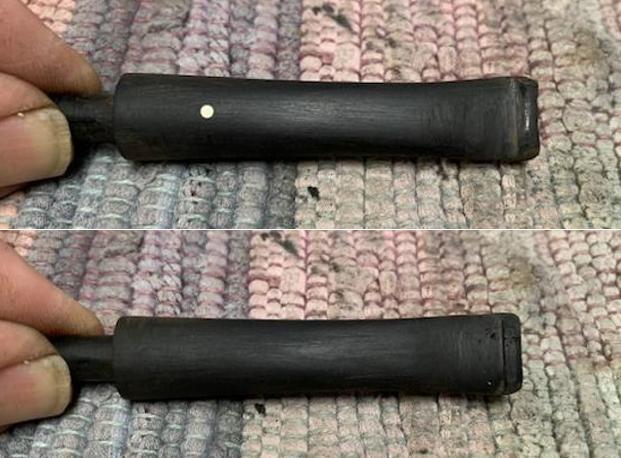
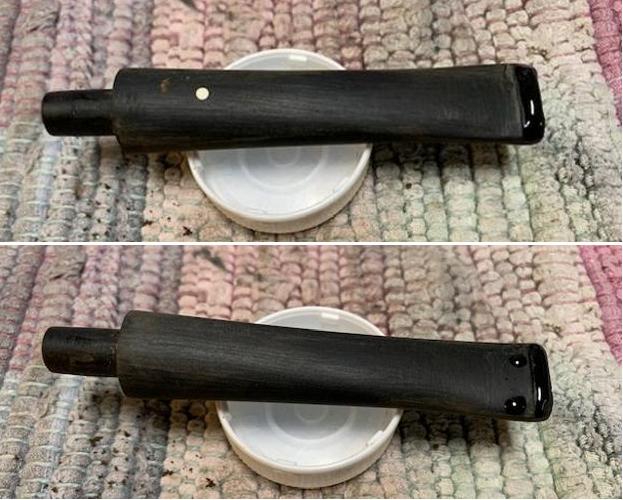
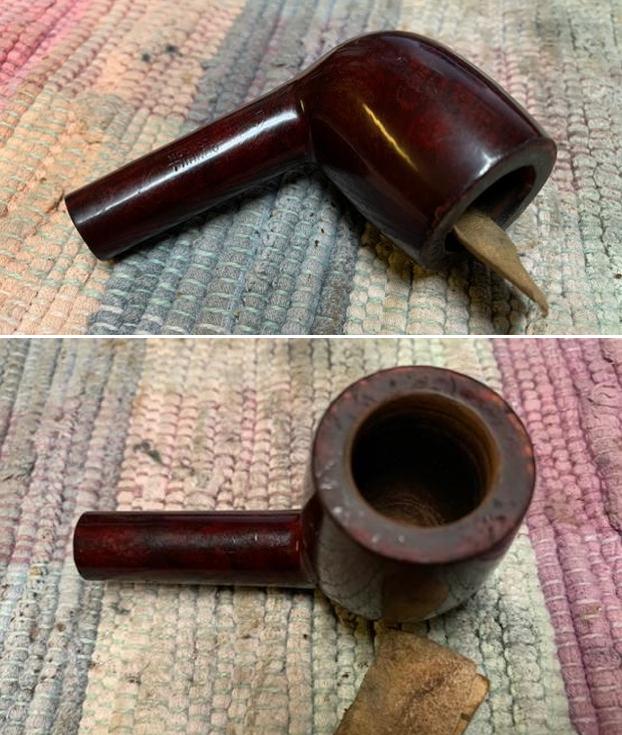
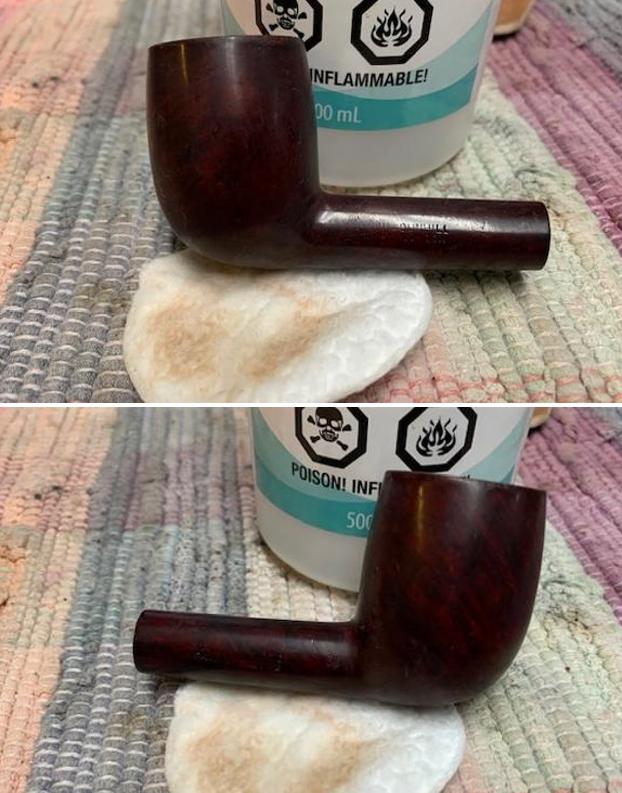
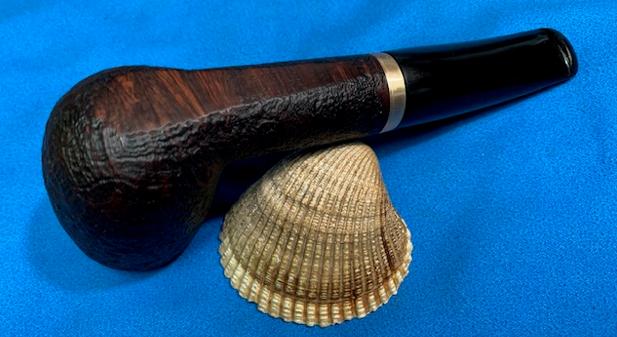
This morning I received another call from a customer sent to me by the local pipe shop. The fellow had a pipe that needed to be restemmed. He said he would stop by and drop the pipe off for me to work on. Irene and I were out and about so he left it in the mail box. When Irene brought it down to me in the shop the smell was overwhelmingly strong and filled the room with the overly sweet smell of years of aromatic vanilla smelling tobaccos. It was in a plastic bag and once I opened the bag it was even more pungent. The bowl was filled with a thick cake that took over half the diameter of the bowl. There was tobacco debris stuck on the walls of the bowl. The cake was sticky and tacky with the tars and oils. The exterior of the pipe was cake with sticky substances around all the sides and on the rim top. The rim top had been beat up and was in rough condition with a thick buildup of lava on the top. The finish was in rough condition with a lot of nicks and gouges around the sides of the bowl and shank. It was really a mess. The stem was chewed and split in half at the button forward for about an inch up the stem. Once I removed it the inside of the shank was as smelly as the rest of the pipe. I took photos of the pipe before I began my clean up. I took a photo of the rim top to show condition of the bowl. You can see the damage to the top and the inner and outer edge. You can see the thick cake in the bowl and the thick lava coat on the heavily damaged rim top. It is a very dirty pipe. I also took photos of the stem to show its condition. It has tooth marks and cracks on the top and underside of the stem near the button.  You can also see that the stem does not fit tightly against the shank but has gaps on both sides. I took the pipe apart and took photos of the pipe as a whole. It is in rough condition and I think that the stem was a replacement at some point in its life.The pipe stunk so bad and filled the room with the odor to the degree that I decided to clean the bowl before restemming the pipe. I reamed it with a PipNet pipe reamer using three of the four cutting heads. I removed the cake back to bare walls so I could check for damage to the inside of the bowl from heat or otherwise. I scraped the remainder of the cake from the bowl with a Savinelli Fitsall Pipe Knife and scraped the rim top at the same time. I scrubbed the exterior of the bowl with a tooth brush and undiluted Murphy’s Oil Soap. I worked to get the thick grime off the outside of the bowl and shank. I rinsed it with running water and rinsed off the soap and grime. I cleaned out the shank and the airway into the bowl with pipe cleaners, cotton swabs and isopropyl alcohol to remove the tars and buildup in the shank. I wanted the shank clean before I fit a new stem.I built up the inside edge of the bowl and the damage to the rim top with super glue and briar dust. I layered the mixture on the rim and rebuilt the inner edge. Once I had it built up I topped the bowl on a topping board with 220 grit sandpaper. Once I topped it smooth I stained the rim top with a Maple Stain Pen. I found a stem that was the same diameter as the ruined stem. I turned it on the PIMO tenon turning tool and my hand drill. I took the excess material off the diameter and the length of the stem to get a snug fit in the shank. I took photos of the fit of the stem to the shank. The fit of the stem to the shank end was the same as the previous one.There was a gap on both sides and it sat firm against the top and bottom. I examined the shank end and saw that it had been damaged and was no longer flat. I decided to square it up with a thin brass band as it would give a flat surface for the stem to face against. I glued and pressed it onto the shank end and set it aside to cure.   I used the Dremel and sanding drum to take down the excess diameter of the stem and sanded it smooth with 220 grit sandpaper. Once I had the fit correct I put the stem in place on the pipe and took photos of the fit and look at this point in the process.    I filled in the nicks and chips in the finish with briar dust and clear super glue. Once it had cured I sanded them smooth with 220 grit sandpaper. I wiped the bowl down with isopropyl alcohol to remove the finish and the dust on the briar.  I restained the bowl and shank with a light brown aniline stain. I flamed it with a lighter and repeated the process several times until I had the coverage that I was looking for.Once the stain had cured I took the pipe off the cork and took photos of the stained look of the bowl and shank with the brass band.   I wiped the bowl down with isopropyl alcohol to make the stain more transparent. I polished the briar with micromesh sanding pads – wet sanding with 1500-12000 grit pads. I wiped the bowl down between pads with a damp cloth. I rubbed the bowl and shank down with Before & After Restoration Balm. I worked it into the surface of the bowl sides and shank with my fingertips to clean, enliven and protect the briar. I let the balm sit for a little while and then buffed with a cotton cloth to raise the shine. The Balm did its magic and the grain stood out.    I sanded out the scratch marks on stem from the Dremel with 220 grit sandpaper. I started polishing it with 400 grit wet dry sandpaper. I polished the vulcanite stem with micromesh sanding pads – 1500-12000 grit pads. I wiped it down with Obsidian Oil after each sanding pad. I used Before & After Pipe Polish – both Fine and Extra Fine to further the stem. The photo below shows the polished stem.  This pipe has come a long way from where it was when I received it to restem. It is not flawless but it looks better. The Vancouver piper who it belongs to has received far more that what he originally wanted – just a new stem. The briar around the bowl is clean and looks better. The rich brown stains gave the grain a sense of depth with the polishing and waxing. The rim top while not perfect is far better. I put the newly fitted vulcanite stem back on the bowl and carefully buffed the pipe with Blue Diamond on the buffing wheel using a light touch on the briar. I gave the bowl and the stem multiple coats of carnauba wax on the buffing wheel. I buffed the pipe with a clean buffing pad to raise the shine. I hand buffed the pipe with a microfiber cloth to deepen the shine. Give the finished pipe a look in the photos below. The dimensions of the pipe are Length: 6 inches, Height: 2 inches, Outside diameter of the bowl: 1 ½ inch, Chamber diameter: 7/8 of an inch. The pipeman will be picking it up soon and will be reintroduced to this pipe. Thanks for reading this blog and my reflections on the pipe while I worked on it.

Fresh Life for a Comoy’s The Everyman London Pipe 126 Smooth Pot


Blog by Steve Laug

The next pipe on the work table came to us from an online auction from Wilkes Barre, Pennsylvania, USA. It is a Comoy’s made The Everyman pipe. It is a nice piece of briar under all of the grime ground into the finish. The pipe is stamped on the left side and reads The [over] Everyman [over] London Pipe. On the right side it reads 126 (shape number) next to the shank. There is also the circular Comoy’s COM stamp Made in London in a circle [over] England. The bowl was moderately caked with a light lava coat on the top of the rim heavier toward the back of the bowl. It was hard to tell how the inner and outer edge of the rim actually looked until the bowl was reamed. The stem was obviously a replacement as it did not have the characteristic 3-bar logo that is usually on the Everyman pipes. The stem had the same deep tooth marks and chatter on the top and underside near the button as the rest of the pipes in this estate. Jeff took photos of it before cleaning to show that even though it was dirty the pipe showed promise.   I took photos of the rim top and the stem to show their condition. Jeff was able to clean out the bowl completely and the rim top. He removed the tars and lava and left behind a clean top that would need some stain touch ups. The stem was oxidized with scratches, tooth chatter and marks on both sides near the button and on the surface edges of the button itself.   Jeff took photos of the sides and heel of the bowl to give a picture of what the briar around the pipe looked like. There is some stunning grain under the grime.   He took photos of the stamping on the shank. It reads as noted above and is clear and readable. He did not include the stamping on the right side in his photos.Before starting my cleanup work on the pipe I turned my favourite go to sites on background of brands. The first is Pipephil’s site (http://www.pipephil.eu/logos/en/logo-e4.html). There I looked up the Everyman brand and confirmed what I remembered about it being made by Comoy’s. From there I turned to Pipedia (https://pipedia.org/wiki/Comoy%27s). I went directly to the section on Comoys pipes. I found this shape chart. The shape number 296 is shown as a Large Canadian. I have drawn a red rectangle around it in the photo below.

Jeff had cleaned up the pipe with his usual penchant for thoroughness. He reamed the pipe with a PipNet Pipe Reamer and cleaned up the remnants with a Savinelli Fitsall Pipe Knife.  He scrubbed the bowl with undiluted Murphy’s Oil Soap with a tooth brush. He rinsed it under running warm water to remove the soap and grime. He cleaned out the inside of the shank and the airway in the stem with alcohol, cotton swabs and pipe cleaners. He soaked the stem in Before & After Deoxidizer and rinsed it off with warm water. I took photos of the pipe once I received it.   The rim top had some scratches and nicks in the briar. The inner edge of the rim looked very good with no damage. The outer edge has some small nicks but also looked good. The stem surface looked very good with a few small tooth marks and chatter on both sides near the button. The stem was a replacement and I think I have an original stem in my collection of stems that will fit the pipe.   I took a photo of the stamping on the sides of the shank. The left side was stamped The [over] Everyman [over] London Pipe. On the right side was the shape number 126 next to the shank and the Comoy’s COM Stamp Made in London in a circle [over] England. The stamping is clear and readable.   I removed the stem and took a photo of the pipe to give a sense of the whole. The stem is tapered. I knew I had an original stem for The Everyman London Pipe in my cans of stems so I went through them until I found it. The fit to the shank is almost perfect. There needed to be a little adjustment made for a perfect fit but it was going to work well. I took a couple of photos of it before I tried it on the shank.Here is what the pipe looked like with the “new” original stem.I used a folded piece of 220 grit sandpaper to smooth out the transition between the shank and the stem. It did not take too much to make it smooth and once I was finished it looked original. With the new stem fit on the shank I turned back to cleaning up and polishing the bowl. I polished it with 1500-12000 grit micromesh sanding pads. I wiped it down after each sanding pad with a damp cloth. I rubbed down the briar with Before & After Restoration Balm. I worked it into the finish to clean, enliven and protect the new finish. I let the balm sit for 10-15 minutes and then buffed it with a cotton cloth to raise the shine.   I scrubbed the stem with Soft Scrub All Purpose Cleanser to remove the remaining oxidation on the vulcanite.I turned my attention to the “new” stem. I sanded it with 1500-12000 grit micromesh sanding pads. I wiped the stem down after each pad with Obsidian Oil. I polished the stem with Before & After Pipe Stem Polish – both Fine and Extra Fine. This Comoy’s Made The Everyman London Pipe 126 Pot came out looking very good. I am glad I remembered that I had an original stem in my can of stems and that it FIT. I put the pipe back together and buffed the bowl and the stem with Blue Diamond polish. I gave the bowl and the stem several coats of carnauba wax and buffed the pipe with a clean buffing pad to raise the shine. I hand buffed it with a microfiber cloth to deepen the shine. The pipe polished up pretty nicely. The finished pipe is shown in the photos below. The smooth finish looks really good in person with great grain around the bowl. It should be a great smoking pipe with a good hand feel. The dimensions are Length: 5 1/2 inches, Height: 1 1/2 inches, Outside diameter of the bowl: 1 1/2 inches, Chamber diameter: 7/8 inches. I will be posting it on the rebornpipes store very soon. It should make a nice addition to your pipe rack if you have been looking for a reasonably priced Comoy’s The Everyman London Pipe. Thanks for walking through the restoration with me as I worked over this estate Comoy’s Made pipe.

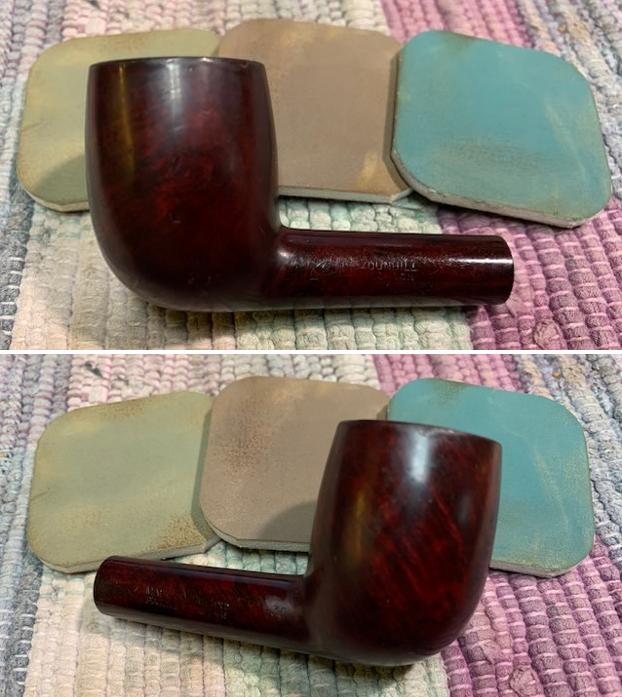
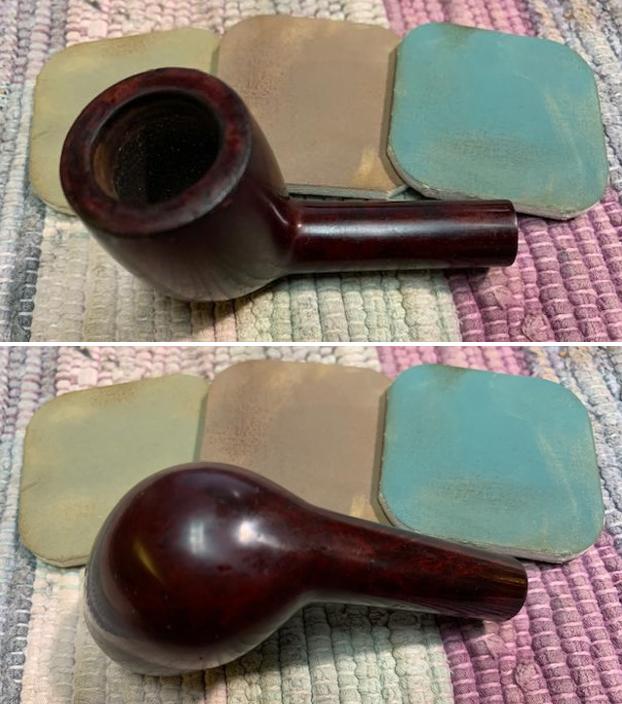
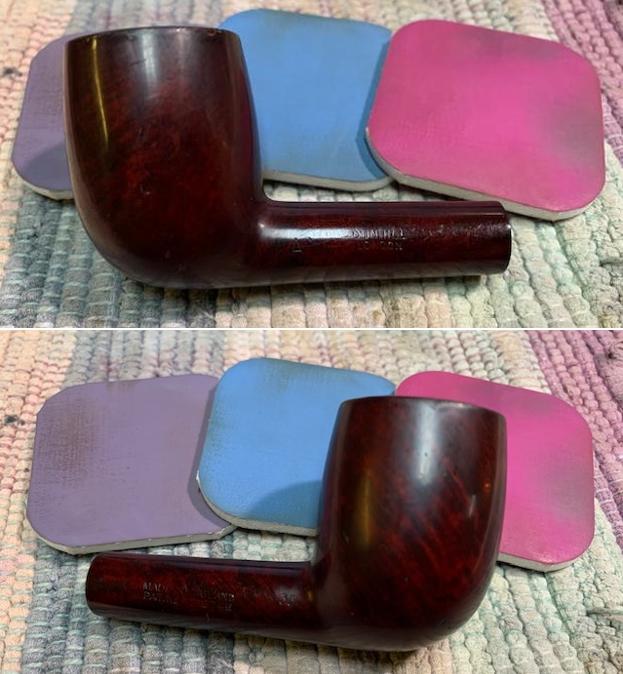
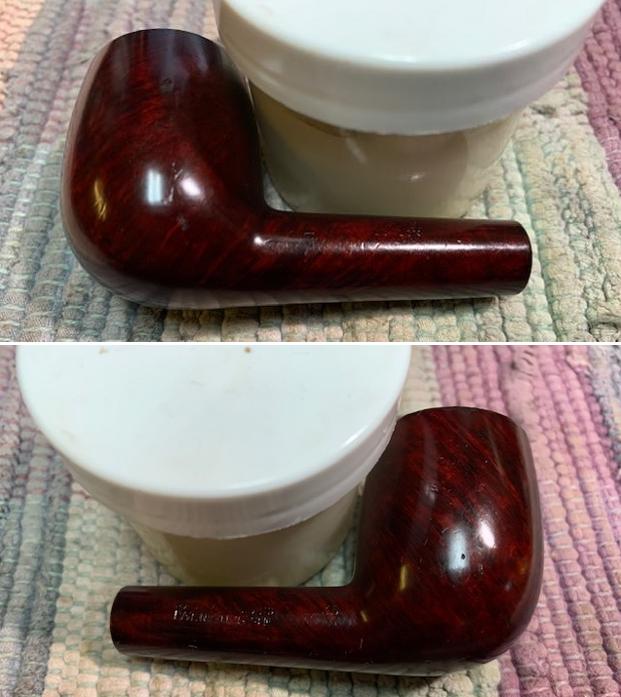
I was Gifted an LB Stem for my Dunhill Shell Briar LB F/T Chunky Billiard


Blog by Steve Laug

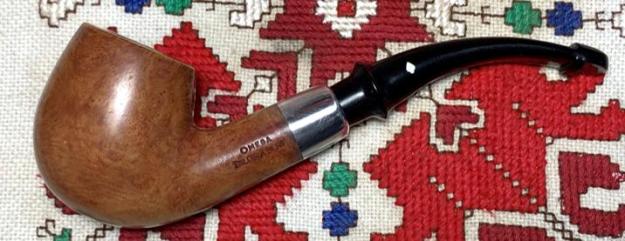
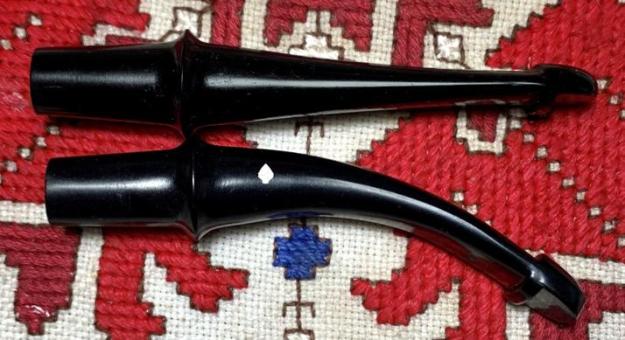
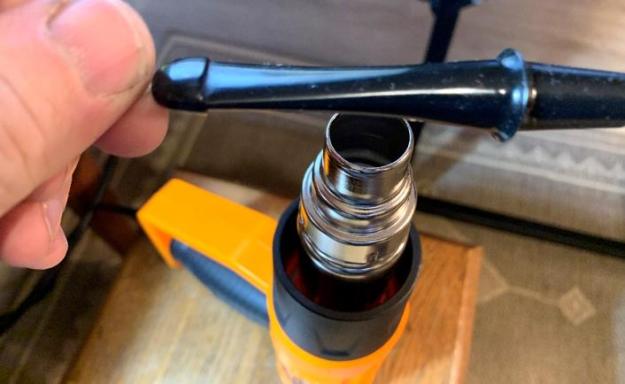
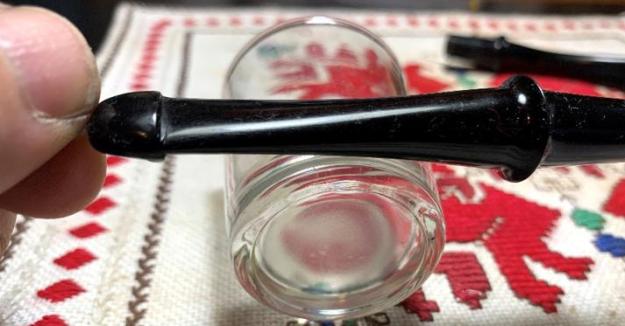
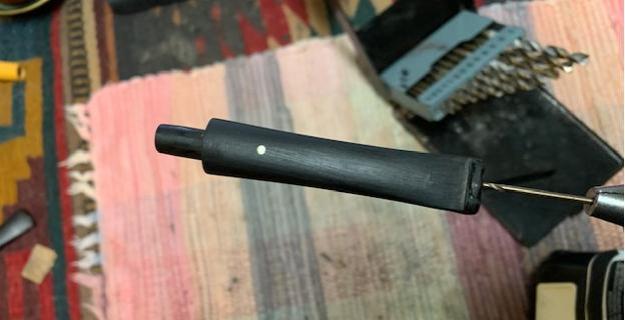
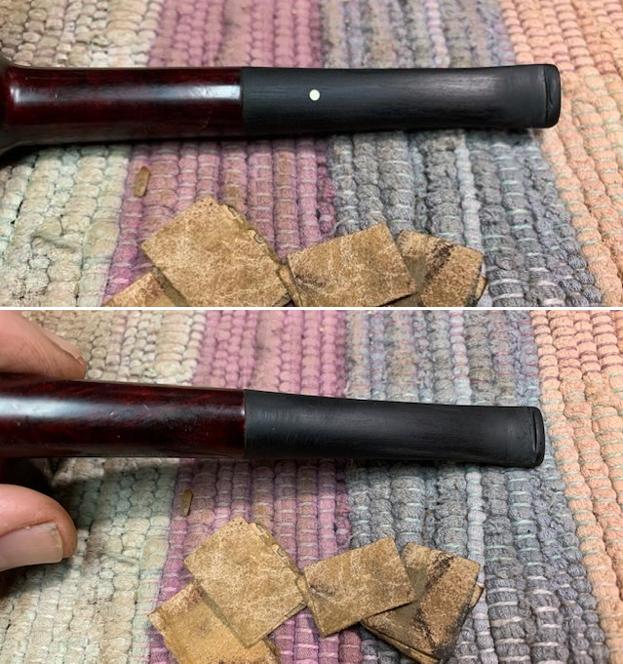
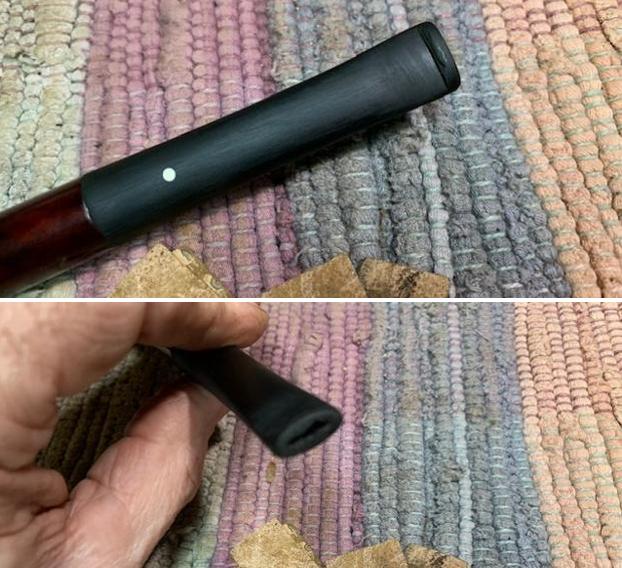
When I restored this Dunhill Shell Briar LB F/T Chunky Billiard I closed the blog asking that if anyone came across a stem for an LB that they would be willing to part with to contact me as I really wanted a Dunhill stem on this pipe (https://rebornpipes.com/2020/07/26/breathing-life-into-a-1968-dunhill-shell-briar-lb-f-t-group-4-billiard/). The pipe is a beautiful sandblasted Billiard with the unique Dunhill Sandblast finish made in 1968 (since that time I am leaning toward a 1958 date for the pipe). It is a great looking pipe that is in almost new condition. The dark finish that is identified as a black stain highlights some great grain around the bowl sides and the heel. It has some great rugged sandblast that Dunhill specialized in making. The finish on the pipe is in excellent condition and the repaired area on the front outer edge of the rim top looks very good. The mix of stains works well to highlight the grain. The polished black replacement vulcanite taper replacement stem adds to the mix. I had drilled and inserted a blue dot on the top of the stem to get by while I hunted for a proper stem. Here are some photos of the pipe once I had finished the restoration of both the bowl and stem. Not too long ago I was on one of the Facebook pipe groups and David Andrew Goostree of Banjo Bob’s Fine Pipes posted a picture of a Dunhill LB with a ruined bowl – vertical cracks all around the bowl that he was willing to part with. I quickly wrote him a note to see what he wanted for it as I had the above LB that needed the stem from his ruined bowl. We exchanged a few messages back and forth and he sent the pipe to me. It arrived in Canada yesterday (Monday) and David had included a small sample of Old Gowrie in the box.  Here are a few pictures that David sent me of the pipe before he sent it.   I took a photo of the new stem next the pipe and replacement stem and then of the two stems side by side. The look and shape is similar. I tried the stem on the shank of the LB bowl that I had and the fit was perfect in the shank. The bowl I have has a flat bottom so I would need to flatten the bottom of the stem to match the shank but other than that the fit was good. I took some photos of the fit to send to David. I had already started the shaping of the underside because I was impatient to see what it would look like. I am including those photos below so you can see the fit in the shank. I used a rasp/flat file to flatten the bottom of the stem to match the flow of the shank. I smoothed out the flattened area with 220 grit sandpaper to remove the file marks in the vulcanite.The stem had some tooth marks in the surface on both sides ahead of the button. I “painted” the surface with the flame of a Bic lighter and the tooth marks lifted. I would easily be able to sand the remnants out with micromesh. I polished the stem with micromesh sanding pads – wet sanding with 1500-12000 grit sanding pads. I wiped it down after each sanding pad with Obsidian Oil. I polished it with Before & After Pipe Stem Polish – both Fine and Extra Fine.     With the stem fitting work finished I put the new stem on the Dunhill LB and gave the bowl several coats of Conservator’s Wax and the stem several coats of carnauba wax on the buffing wheel. I buffed the pipe with a clean buffing pad to raise the shine and hand buffed it with a microfibre cloth to deepen the shine. I took photos of the LB with the stem I received from David and I really like the look of an original Dunhill stem. Have a look! I am looking forward to loading the bowl with some of the Old Gowrie that David sent along and taking it for its initial smoke. Thanks David for the stem and thank you all for reading this update.
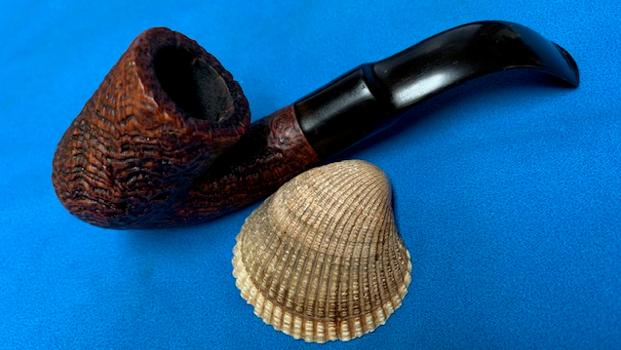
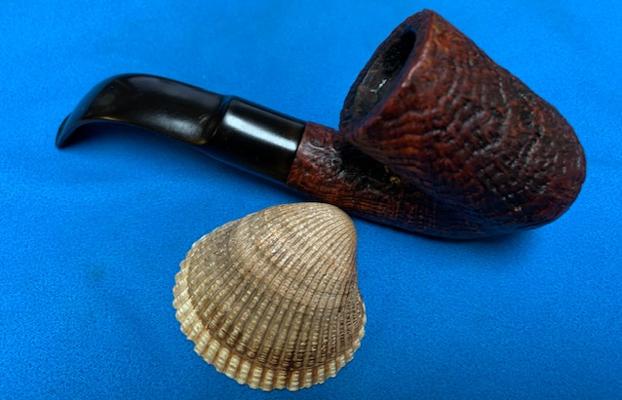
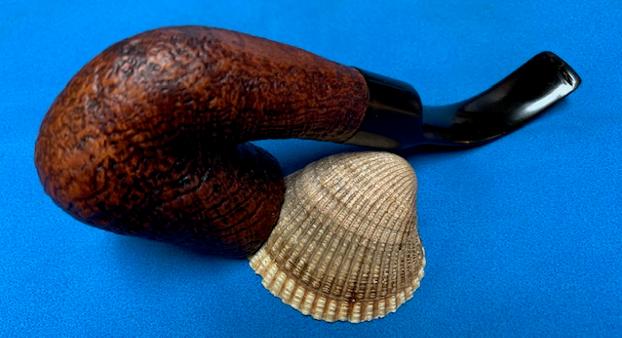
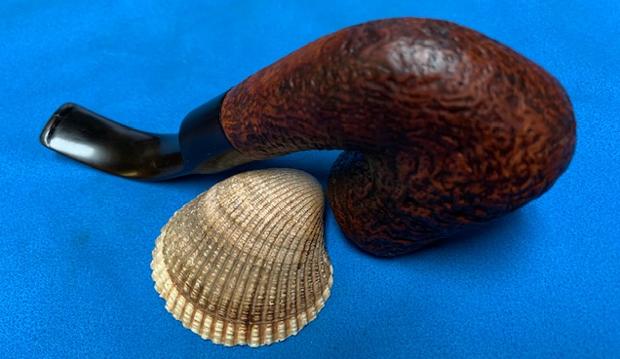
Restemming and Rebirthing a Burl King Freehand Bowl


Blog by Steve Laug

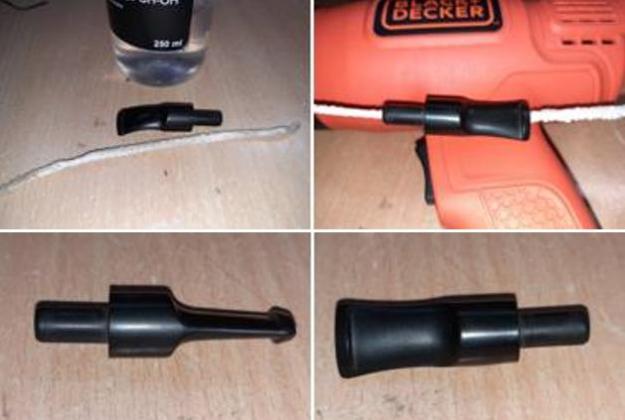
The next pipe in the queue came to us from a recent pipe hunt that Jeff and his wife did in Utah. It is an interesting Freehand bowl that has a bridge over the top of the shank that forms a hole for the thumb when smoking. It has a smooth finish with a plateau on the top of the shank and bowl. I would need to find a fancy turned stem that would work with the bowl. The pipe is stamped on the left corner of the shank and clearly reads Burl King. On the underside of the shank it is stamped Israel. I think that this will be another nice looking piece once it is cleaned up and restemmed. The bowl is thickly caked with an overflow of lava on the rim top. There were some rustications or blasted areas on the left heel of the bowl and the top right side toward the front of the bowl. The top and edges of the bowl look good but I would be more certain once I reamed and cleaned it. The exterior of the briar was dirty with grime and dust. Jeff took photos of the pipe before my cleanup work. They tell the story and give a glimpse of the promise that we see in this pipe. He took a photo of the plateau rim top to show the cake in the bowl, the lava on the rim top and the inner edge.  There was also a varnish coat on the briar around the bowl and rim top.The next photos show the rustication/blasted portions of the bowl. There seems to be some putty in the rustication on the right side of the bowl top.    He took photos of the stamping on the left corner of the shank and the underside. It is faint but readable in the photo below and is as noted above.I turned to Pipedia to read about Burl King pipes (https://pipedia.org/wiki/Burl_King). I quote the entirety of the article and have included the advertisement that connects the pipe to Borkum Riff tobacco.

We need more information about Burl King. We can confirm that it was at one time a pipe used for promotion of Borkum Riff tobacco, as reported by Bob Taylor of the Seattle Pipe Club, who mailed in a coupon and received the pipe with a Postmark of Jan. 11, ’78, and a return address of Sparta, N. C., which indicates it may have come from the Dr. Grabow/Sparta Industries plant.

Bob recently noticed his “Burl King” was also marked, made in Israel, so it was likely made by the Shalom Pipe Factory, though apparently distributed through Sparta Industries. The box shipped for 50 cents and the return address said “After 5 days return to P. O. Box 21882 Greensboro, N. CC. 27240.” So apparently these pipes were made by Shalom, but distributed for Borkum Riff by Sparta Industries.

Others have indicated Burl King pipes were also made by Wally Frank.

I love the description as it truly captures the shape and beauty of this freehand pipe. The article above stated that the pipe is handcrafted by artists so that each one is a unique piece. It is cut from the plateau to leave that exposed on the top of the rim and down the shank to the end. It has a thumb hole cut for comfort in holding it while smoking. It is suggested that pipe sold for $60. Now to work on the pipe.

Jeff had cleaned up the pipe with his usual penchant for thoroughness. He reamed the pipe with a PipNet pipe reamer and removed the rest of it with a Savinelli Fitsall Pipe Knife.  He scrubbed the bowl with undiluted Murphy’s Oil Soap with a tooth brush. He rinsed it under running warm water to remove the soap and grime. He cleaned out the inside of the shank and the airway in the stem with alcohol, cotton swabs and pipe cleaners. He soaked the stem in Before & After Deoxidizer and rinsed it off with warm water. I took photos of the pipe once I received it.     I took a close up photo of the rim top to show the general condition. You can see the darkening around the inner edge but otherwise it looks good. The plateau extends all the way down the shank bridge and ends at the mortise end.I found two different fancy stems in my stem can that were potential candidates for the pipe. The first one had a tenon that was too small. The second was a bit larger and would need to be turned to sit in the mortise properly. I drilled out the airway to hold the pin on the PIMO tool and then used the PIMO tenon turning tool and took the tenon down until it had a snug fit in the mortise. Once I had the tenon turned I inserted it in the mortise and took photos of the pipe at this point. I polished the briar with micromesh sanding pads to clean up the finish and give it a shine. I wet sanded with 1500-12000 grit pads and wiped the bowl down after each pad with a damp cotton cloth. The photos tell the story. I worked some Before & After Restoration Balm into the surface of the briar with my fingertips and a horse hair shoe brush to clean, enliven and protect it. I let the balm sit for a little while and then buffed with a cotton cloth to raise the shine.   I set the bowl aside and turned my attention to the stem. I sanded out the tooth chatter on the stem surface and the light oxidation with 220 grit sandpaper and then started polishing the stem with 400 grit wet dry sandpaper. The tenon is still rough at this point. I sanded out the ridges and bumps left behind when I turned it but there is still work to do on it.I polished the vulcanite with micromesh sanding pads – 1500-12000 grit pads. I wiped it down with Obsidian Oil after each sanding pad. I used Before & After Pipe Polish – both Fine and Extra Fine to further polish the stem.     With both parts of this unique Burl King Freehand finished, I polished the bowl and the stem with Blue Diamond polish on the buffing wheel. I gave the bowl and the stem multiple coats of carnauba wax. I buffed the pipe with a clean buffing pad to raise the shine. I hand buffed it with a microfiber cloth to deepen the shine. The pipe polished up pretty nicely. The mix of grain on the bowl came alive with the buffing. The finish on the briar works well with the polished black vulcanite stem. The finished pipe is a well-proportioned, nicely grained Burl King Freehand. Have a look at it with the photos below. The dimensions are Length: 7 inches, Height: 2 ¾ inches, Outside diameter of the bowl: 1 ¾ inches, Chamber diameter: ¾ of an inch. This interestingly made Freehand will be going onto the rebornpipes store very soon. If you would like to purchase it and carry on the legacy of the previous pipe smoke send a message or an email to me. Thanks for walking through the restoration with me on this older Shalom Pipe Factory, Israel pipe.