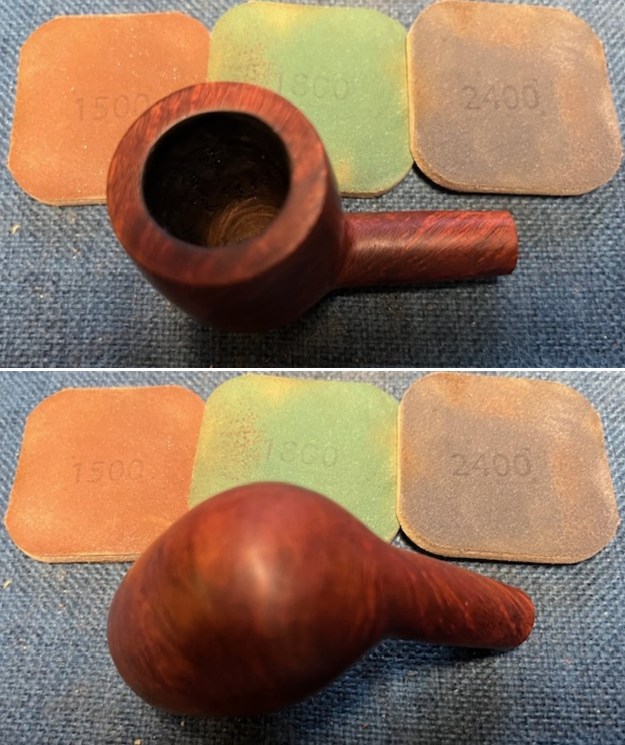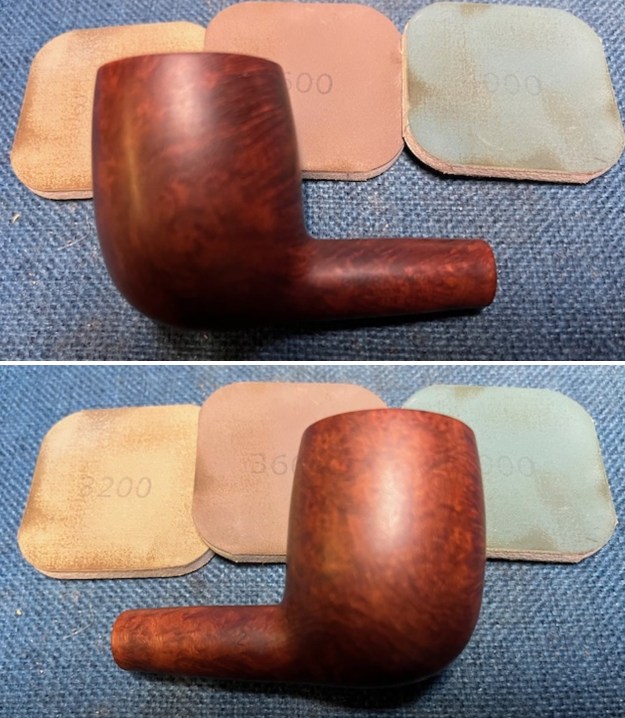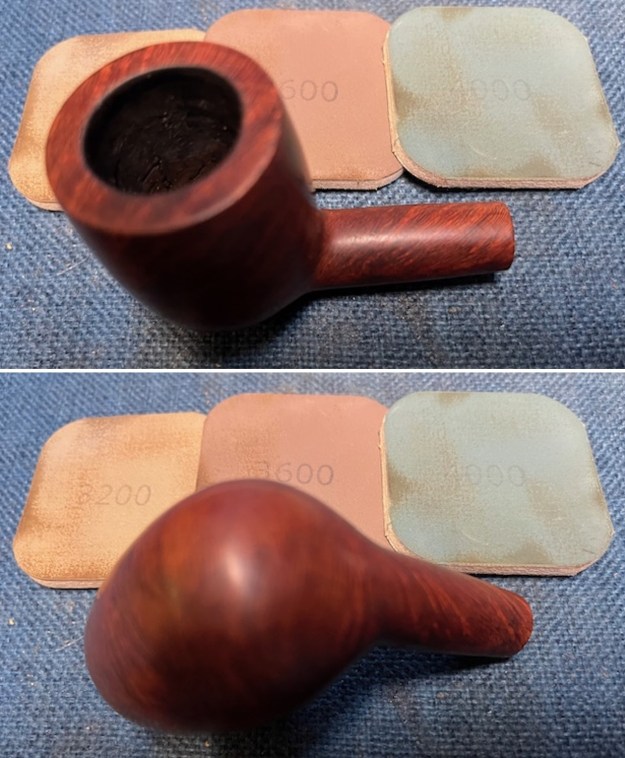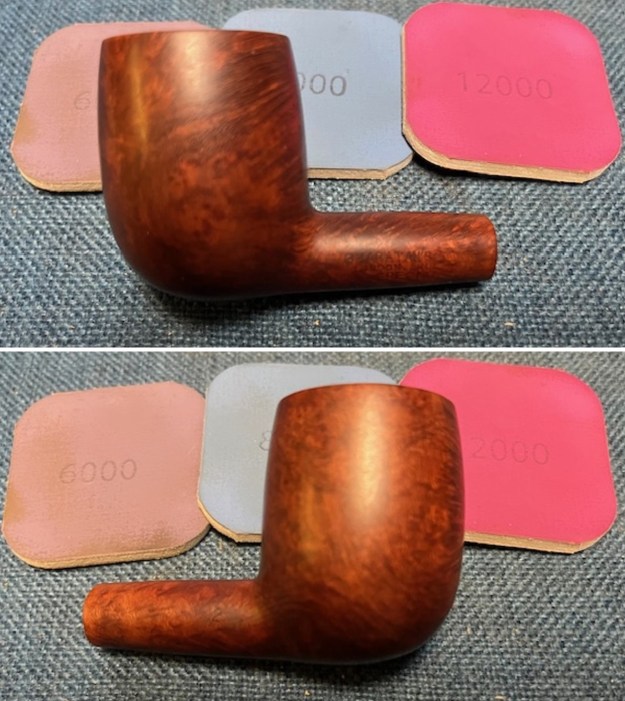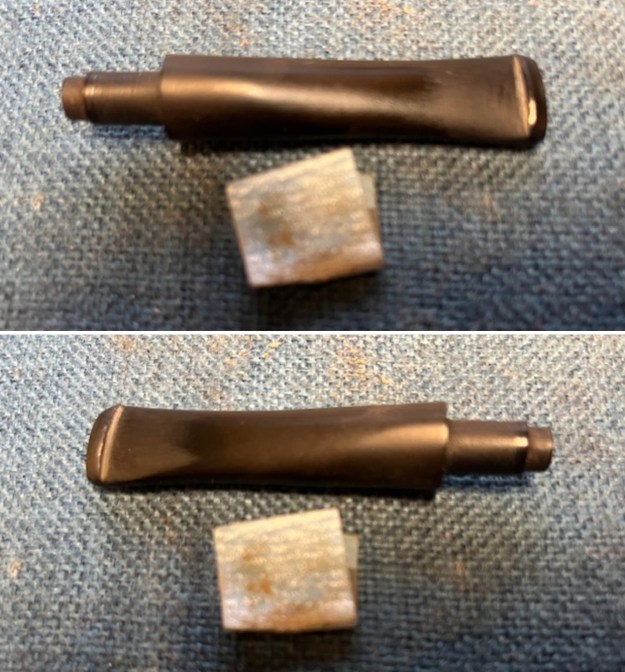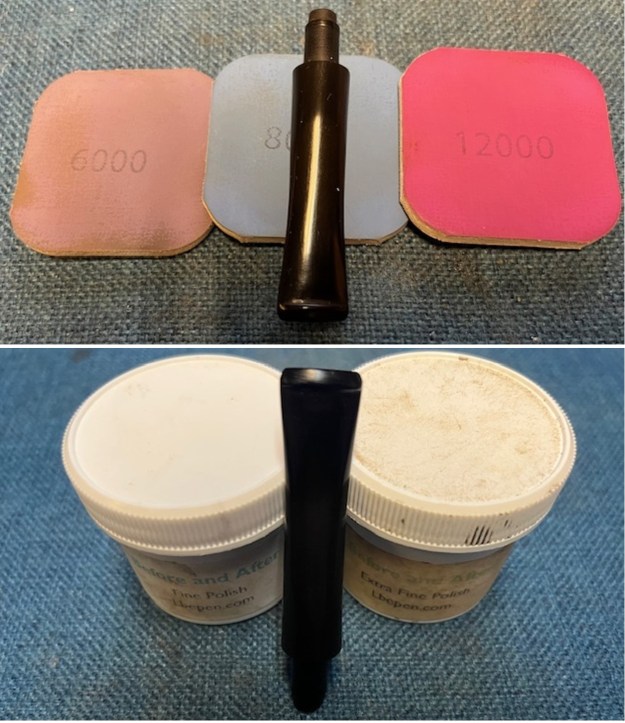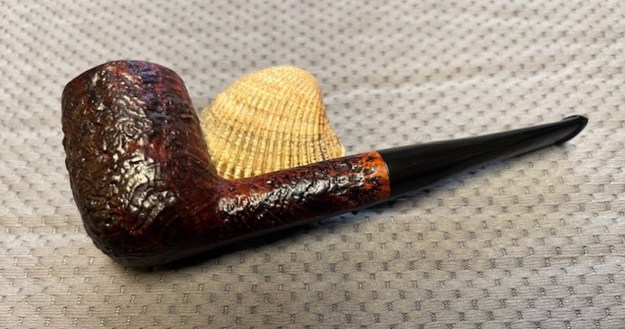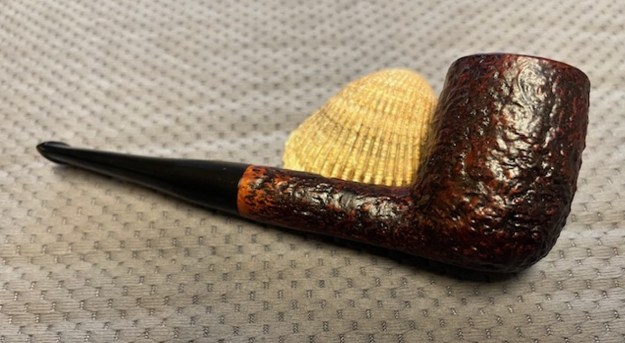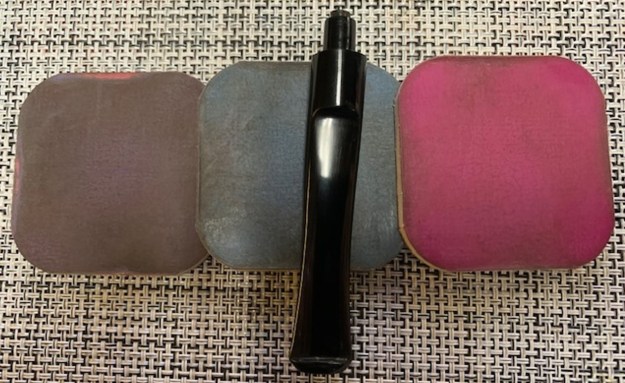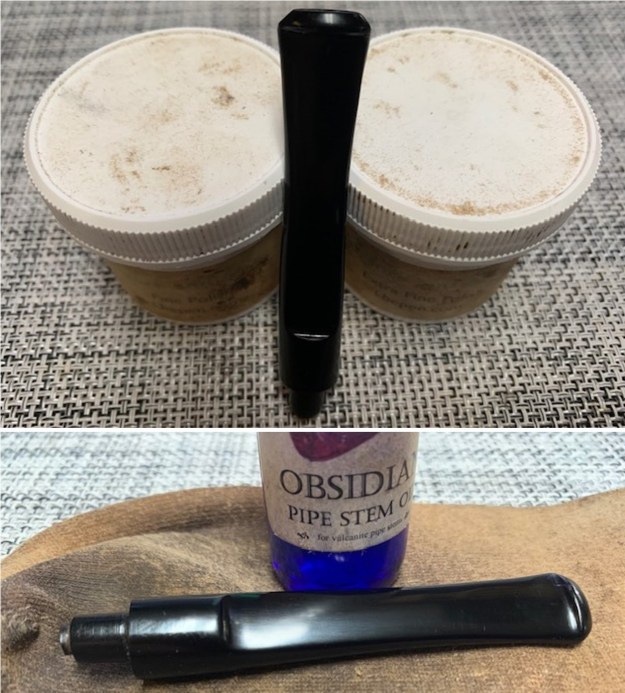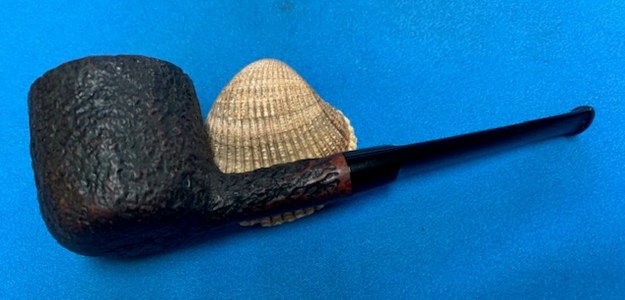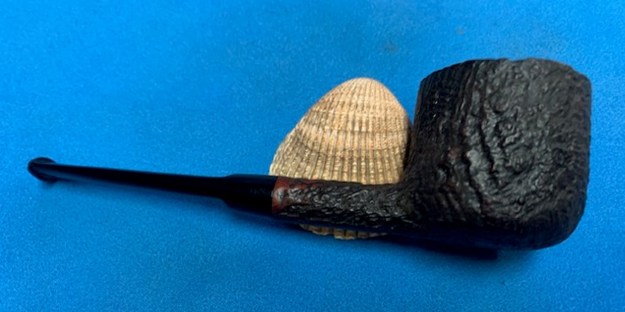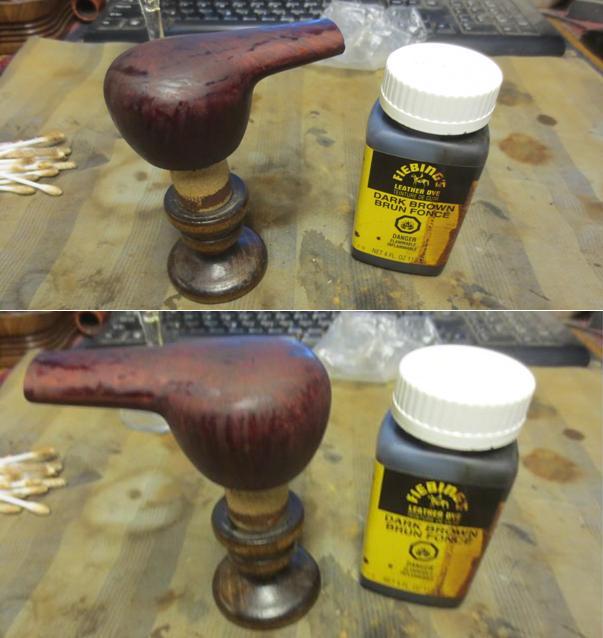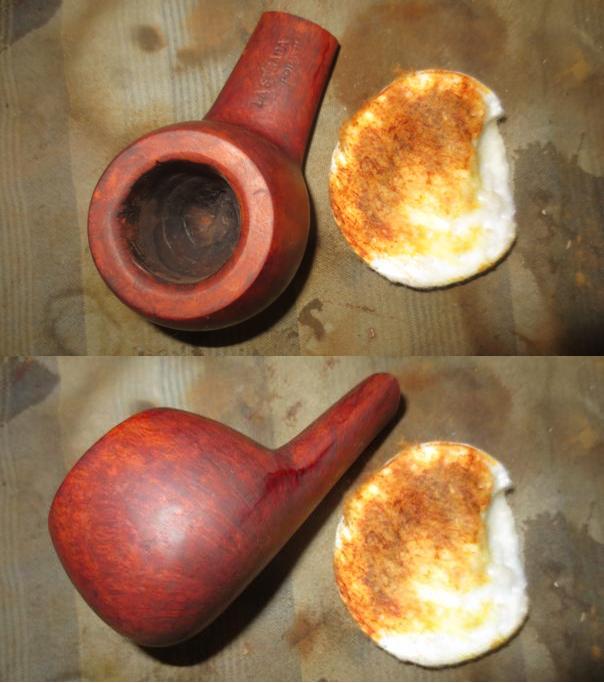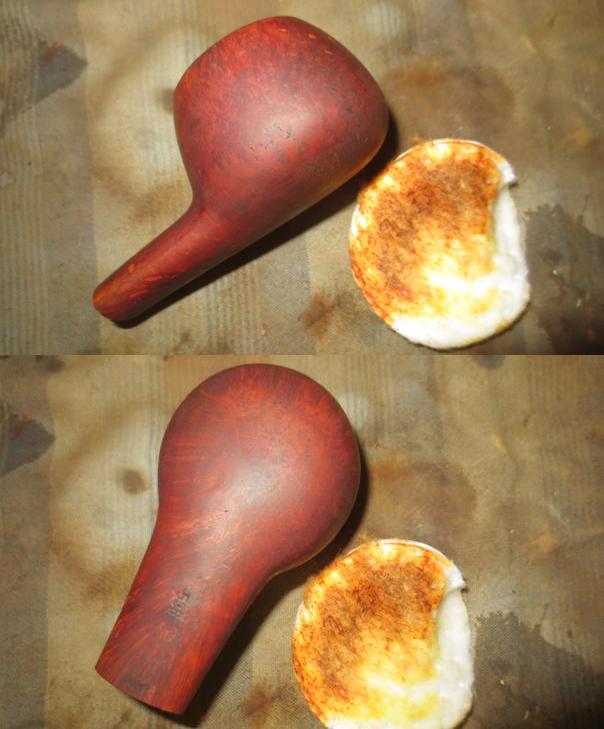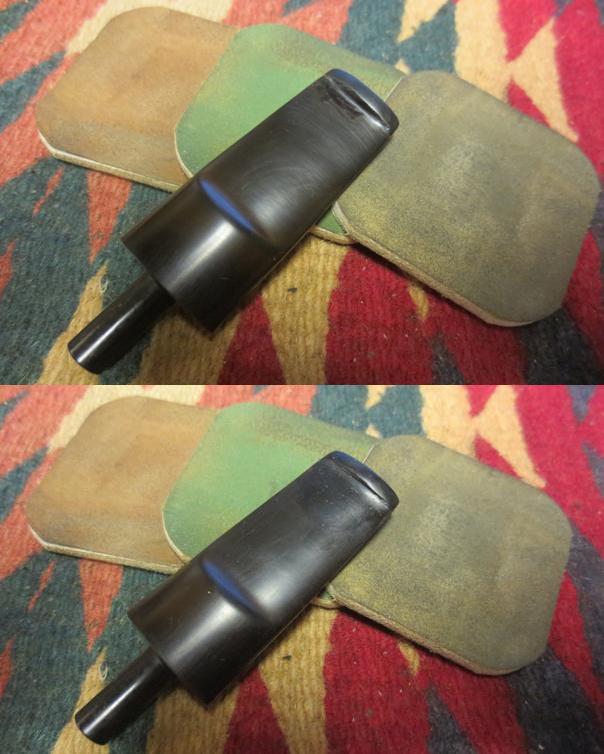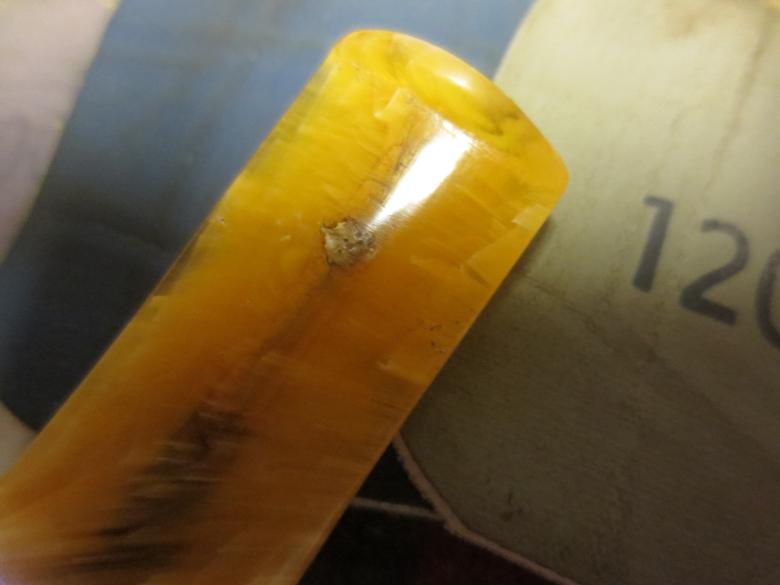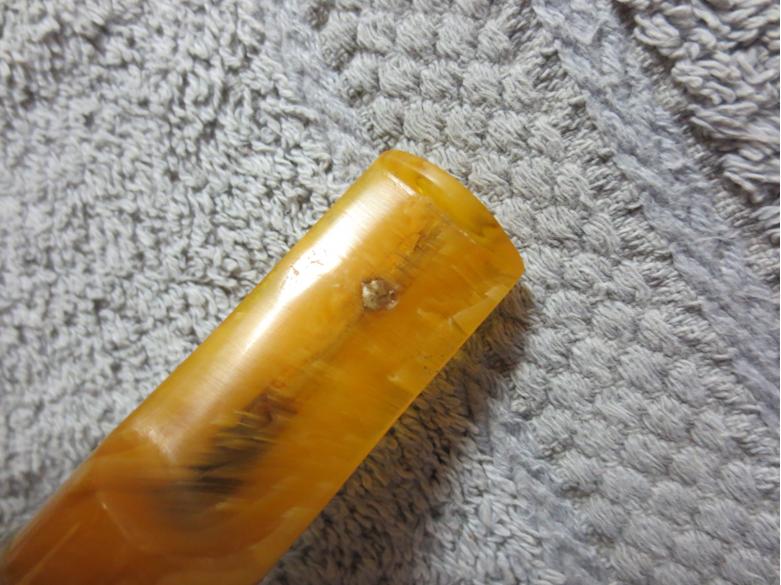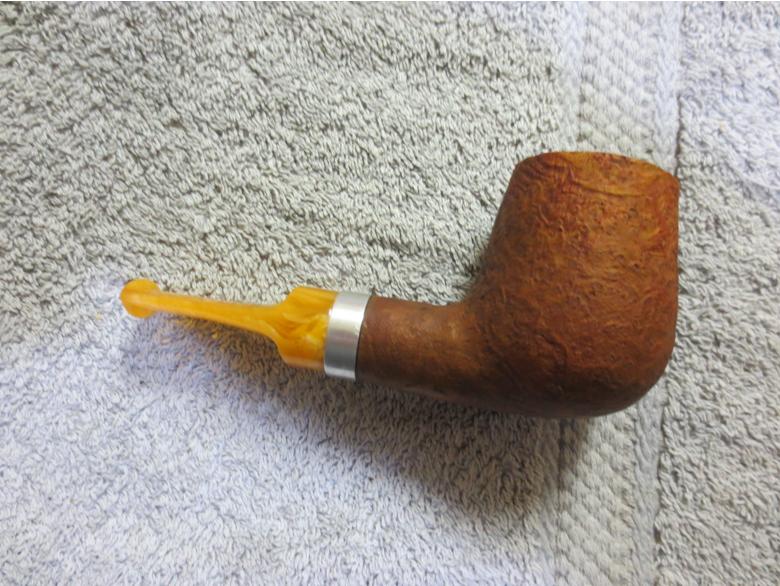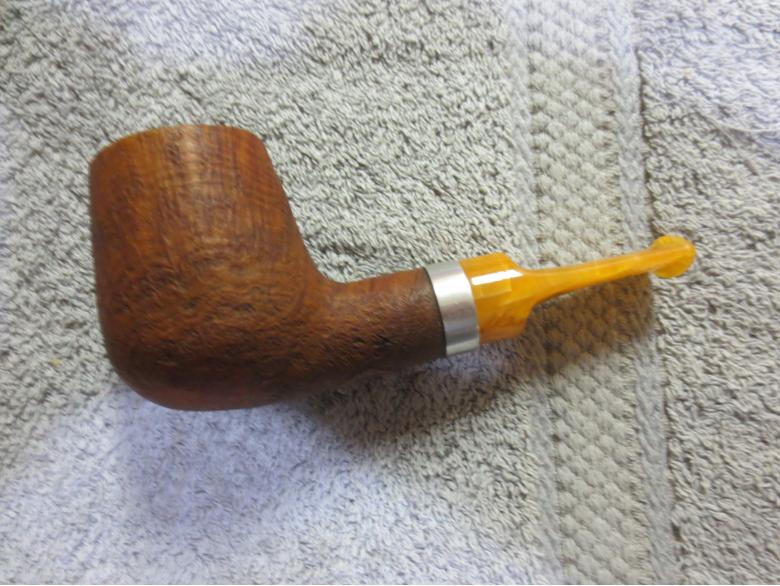
Tag Archives: reshaping a button

Restoring a Charatan’s Make London England Special 12 Smooth Billiard


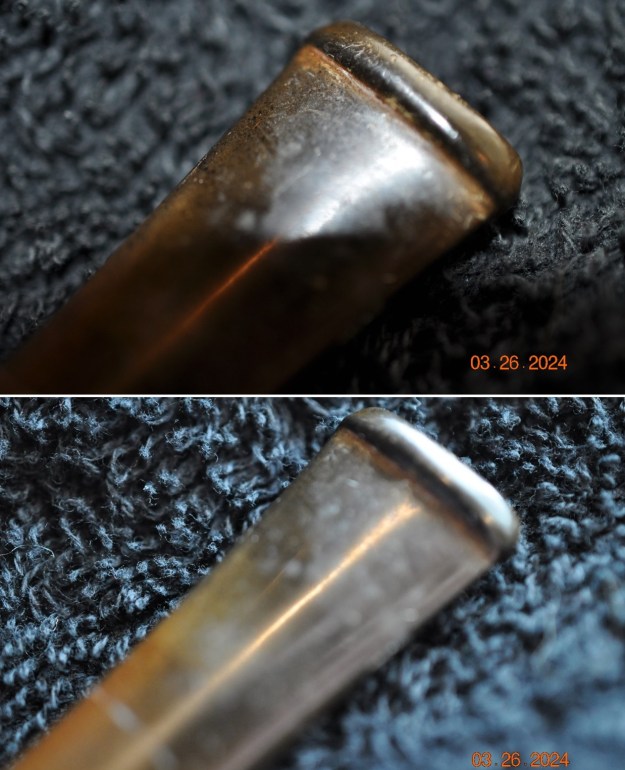
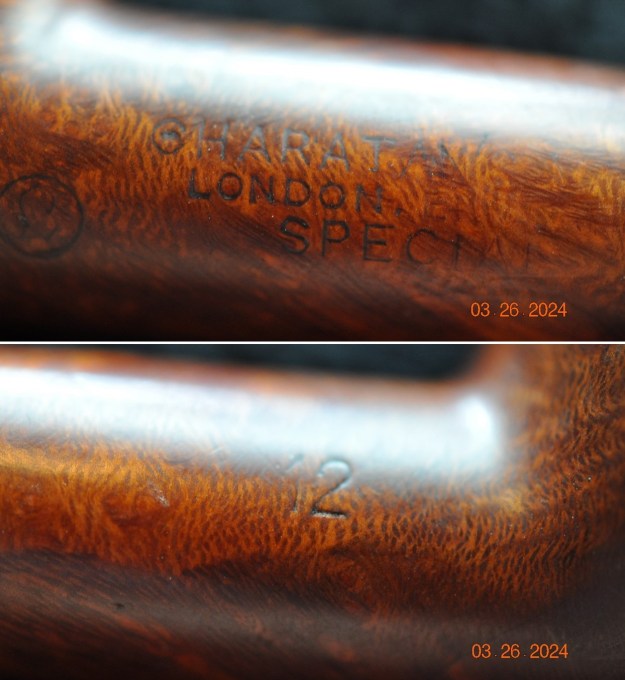
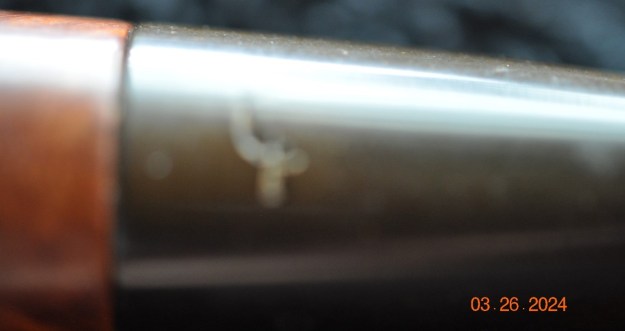
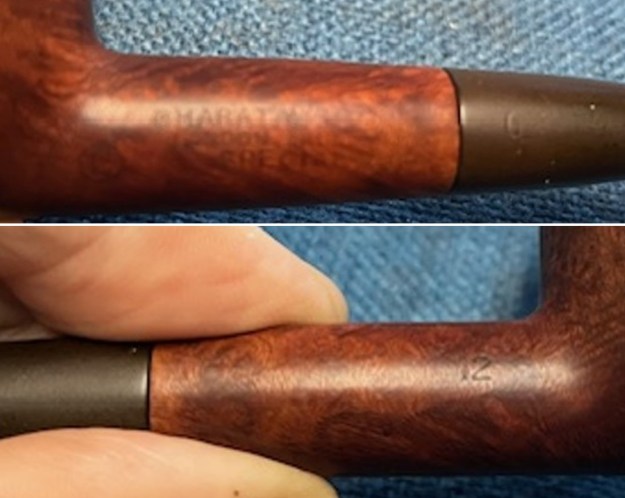
by Steve Laug

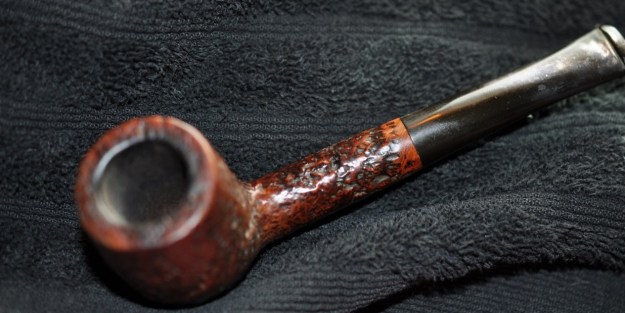
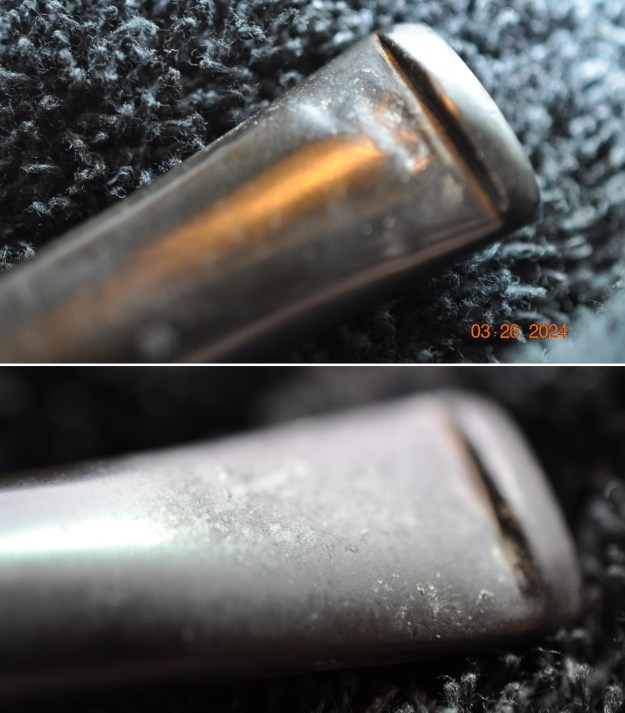
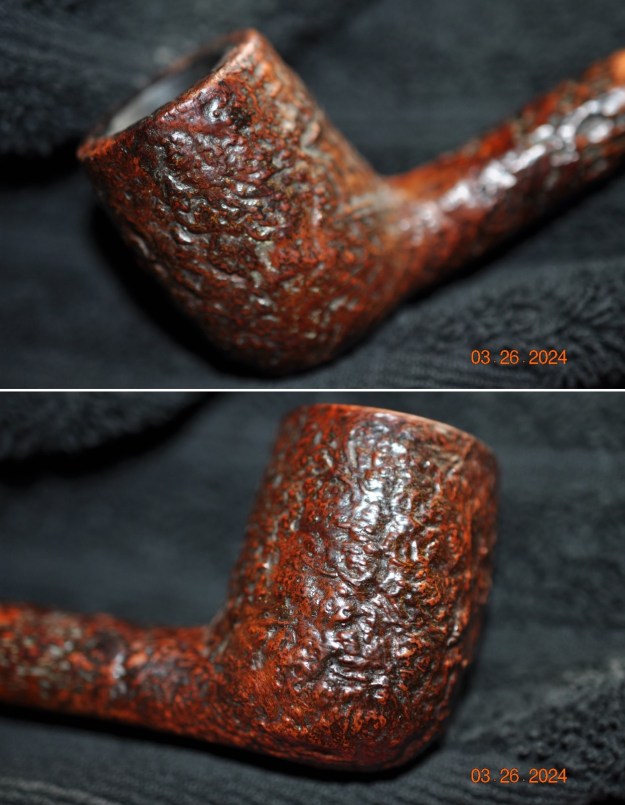
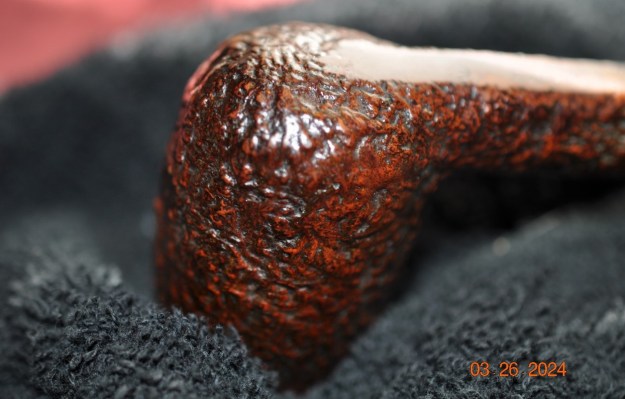
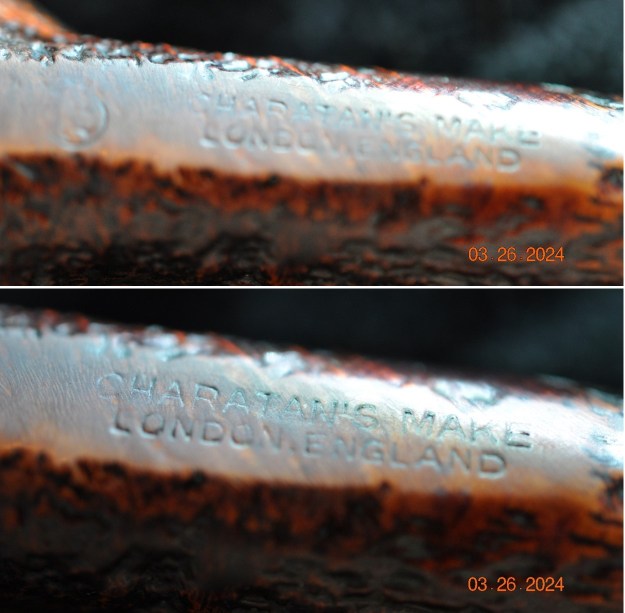
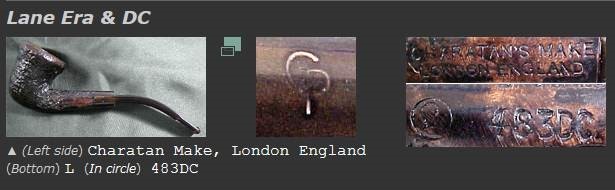
The next pipe I have chosen to work on was purchased on 03/21/2024 during a pipe hunt from a shop in Oregon City, Oregon USA. I have worked on a lot of Charatan pipes through the years and many of them have been smooth finished pipes. This nicely shaped Billiard is very nice with grain around the bowl. It is stamped on the left side of the shank and reads Charatan’s Make [over] London, England [over] Special. Low on the left side of the shank near the bow shank junction it is stamped with a cursive L in a circle identifying it as a Lane Era Pipe. On the right side near the shank/bowl junction is the shape number 12. The stamping is faint in spots but still readable. The taper stem also bears the CP logo on the left side. The bowl had a thick cake and there was a light spotty lava overflow on the inner edge of the bowl and top. The outer edge looked very good. The stem is lightly oxidized and has tooth marks and chatter on both sides at the button. Jeff took photos of the pipe before he started his clean up. Jeff took photos of the bowl, rim top to show the thickness of the cake in the bowl and the lava on the rim top. The bowl had a thick cake that overflowed in lava on the inner edge of the bowl. I am hoping that the thick lava coat protected things underneath it from damage to the edges and top. He took photos of the top and underside of the stem showing the tooth chatter and marks and oxidation on the stem surface and wear on the edges of the button. Jeff took photos of the sides and heel of the bowl to show the condition of the briar. You can see the interesting grain around the bowl even through the dirt and debris of many years. Jeff took photos of the stamping on the sides of the shank. You can see that it is faint in spots but still is readable as noted above. An added part of pipe restoration for me is to try to gather as much background on a brand and maker as I can find. With Charatan that is an enjoyable web to try to untangle. There is a lot of information and it can lead to understanding what era a pipe was made in. To try to figure out the era of the Charatan’s pipe I was working on I turned to the Pipephil website, Logos and Stampings (http://www.pipephil.eu/logos/en/logo-charatan.html). There is some really helpful information on each of the lines of Charatan’s Make pipes that entered the market. There was a smooth Special with stamping like the one in hand. The photo however was not present. The site did give a short history of the brand. I quote the portion that is most pertinent. The brand was founded in 1863 by Frederik Charatan. When his father retired in 1910, Reuben Charatan took over the family business. All the pipes were handmade until 1973. The brand name has been overtaken by Dunhill in 1978 and sold in 1988 to James B. Russell Inc. (NJ, USA). During the period 1988-2002 Charatans were crafted by Butz Choquin in St Claude (France). Dunhill re-purchased Charatan brand name in 2002 and Colin Fromm (Invicta Briars, Castleford) followed up on freehand production. L in circle denotes a pipe imported into USA by Lane Ltd between 1955 and 1988.
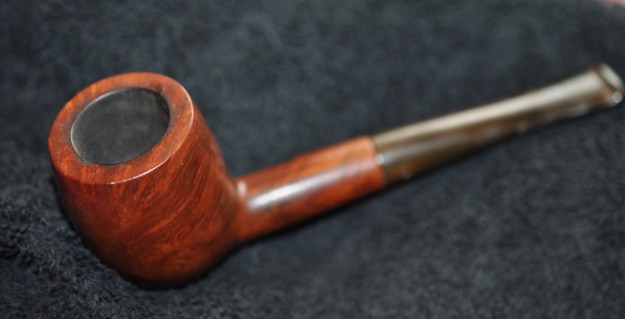
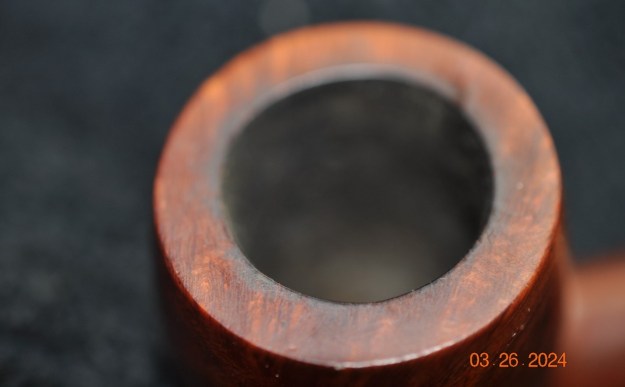
Next, I turned to Pipedia to see if I could find more information on the brand and possibly a link to a sandblast finished Dublin (https://pipedia.org/wiki/Charatan) but once again in the general article it was not listed. It did give a little more historical information. I quote the pertinent parts that give information on this particular pipe.

In 1950 Herman G. Lane, striving to expand his business in Great Britain, made contacts with the Charatan family. Apparently, Lane got a certain influence soon, but it was not until 1955 that Lane Ltd. became the sole distributor for Charatan’s in the United States superseding Wally Frank. This can be documented in a “biography” written for Herman G. Lane titled “Leaves from a Tobaccoman’s Log”.

Thanks to Herman G. Lane’s dedicated labor Charatan became hugely popular in the States. As reported by Ken Barnes in an interview with Rick Newcombe, Reuben Charatan passed away in 1962, and his widow sold the firm to Herman Lane 1 or 2 years after his death.[1] In the early 1960s Charatan pipes were the first to overstep the $100 Dollar line in US pipe sales. In 1978 Lane’s heirs sold the Charatan company to Dunhill. The Prescot Street factory was closed in March 1982. Thereafter the fame and quality of the make declined.

The pre-Lane period (prior to 1955) and the Lane era pipes (1955 to until sometime between 1979 – 1984) are of primary interest the collector. The Lane era is often quoted as beginning about 1950.

Charatan records are almost non-existent before Lane due to a factory fire, making it difficult to date pre-Lane pipes. Charatan used 4 basic grades prior to 1950: Supreme, Selected, Executive, and Belvedere. After 1950 Herman Lane’s influence began, and the grades started to expand. In 1955 Lane took over sole distributorship of Charatan in the US. In 1957 he introduced the Supreme S. Most of his other introductions were from the 1960s and early 1970s.

From this I am fairly certain I am dealing with a Lane pipe made after 1955. There is also a circle L script mark that is a Lane stampings on the pipe which also supports this.

I continued digging further into the dating of the pipe, but what I had found above was a good start for me. If some of you would like to try your hand at dating it more accurately as to the time period it came out you might want to check out the article on Pipedia on Dating Charatans (https://pipedia.org/wiki/Dating_of_Charatans).

I also reread the article on Pipedia by the Italian fellow who contributed some really helpful information on the brand (https://pipedia.org/wiki/Charatan_-_Milan_2014). I quote the section on the Second period: Reuben Charatan 1910 – c. 1962. I have highlighted a portion of the section on the shank in red to point out some more helpful dating information.

– In 1962 Herman Lane took over the business from the Charatan family, although he had already influenced production from the 1950s.

– The pipes were mostly larger than the previous ones and corresponded in size to Dunhill group 5. These are slightly less rare, but still difficult to find.

– Stem: Usually in ebonite, saddle shaped or tapered, bearing a fine “CP” stamp, underbore system (see below) used when necessary.

– Shank: The shape code is stamped on it together with the nomenclature “CHARATAN’S MAKE LONDON ENGLAND” arranged in two lines. From 1955 onward on the models marketed for the USA there is also a serif and circled capital “L” (but not all models bear this) which resembles the pound sterling symbol. The “L” is for Lane, the importer.

From 1958, Lane changed the nomenclature for models marketed for the US to clarify the message: “MADE BY HAND”.  In this period the underbore was introduced. Its manufacturing period ranged between 1920 and c.1930. This model was equipped with a duralumin plunger trap fitted in the stem, which served to clean the residue more easily. This particular model bore a special stamp on the stem, and also had its own catalogue…

QUALITY GRADES…The stem did not only display the stamps mentioned above. Another stamp that can help dating is the one referring to the quality of the pipe. Until Herman Lane arrived on the scene there were four quality grades. Starting with the lowest: Belvedere, Executive, Selected, and Supreme. Lane went on to add higher grades from time to time: Supreme S, Supreme S100, S150, S200, S250, S300, Coronation, Royal Achievement, Crown Achievement, and Summa Cum Laude; these last three are extremely rare and almost impossible to find. He also invented other, different grades, even changing the previous pipe classification standards. We will not go into detail here, but it means that if we find an S100 or Coronation the pipe was manufactured following Herman Lane’s acquisition. In particular, the FH mark, or Freehand pipe was commissioned to the famous Danish craftsman, Preben Holm.

Nomenclature

The Lane Trademark serif and circled L indicates the pipe is from the “Lane Era” (approx. 1955 to 1979 -1984?), however it appears that both the English factory or Lane themselves sometimes, or perhaps even often forget to stamp the L on a pipe. The Charatan factory was known for inconsistencies, especially in stampings. Therefore, although an L on the pipe definitely defines it as a Lane Era pipe, the lack of it could simply mean the pipe missed receiving the stamp from the factory. The lack of the trademark could also mean the pipe was destined for the European market.

Charatan pipes were not well distributed prior to the Lane Era, so very few pre-Lane pipes exist today. Herman Lane greatly grew the brand in the U.S., which caused corresponding growth in Europe…

This confirmed that I was working on Lane Era pipe which actually means it was between 1955 and 1988 as shown by the stamping. Now it was time to work on the pipe.

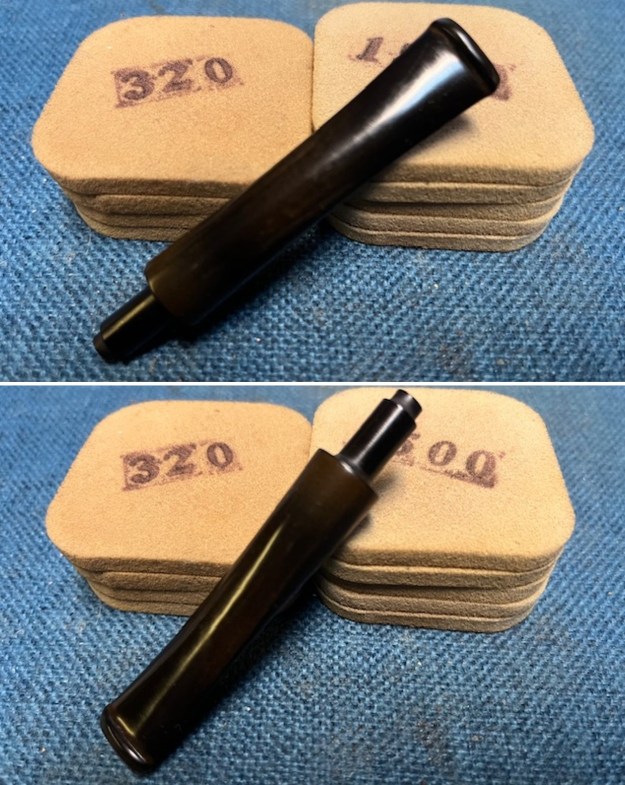
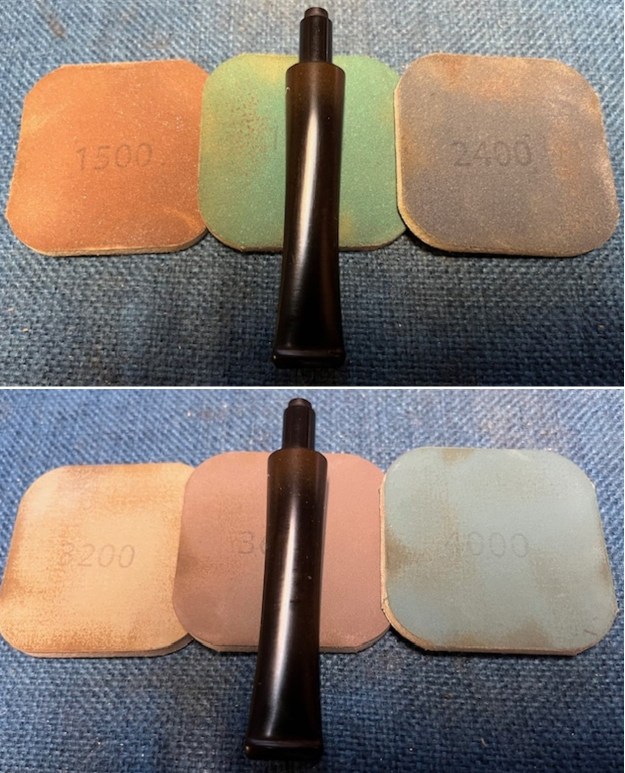
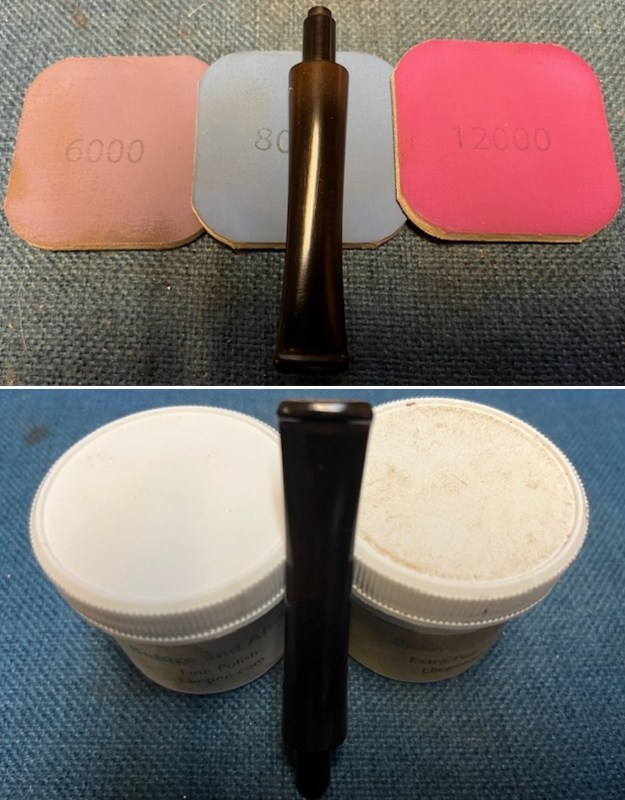
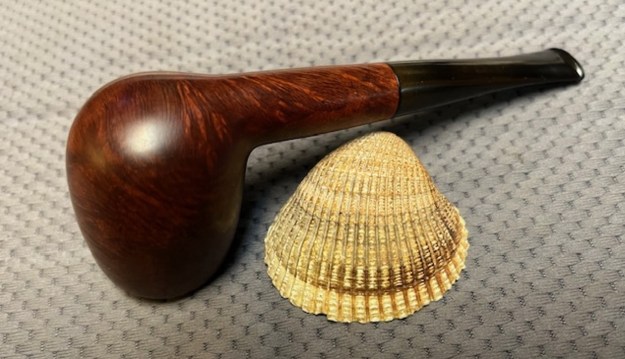
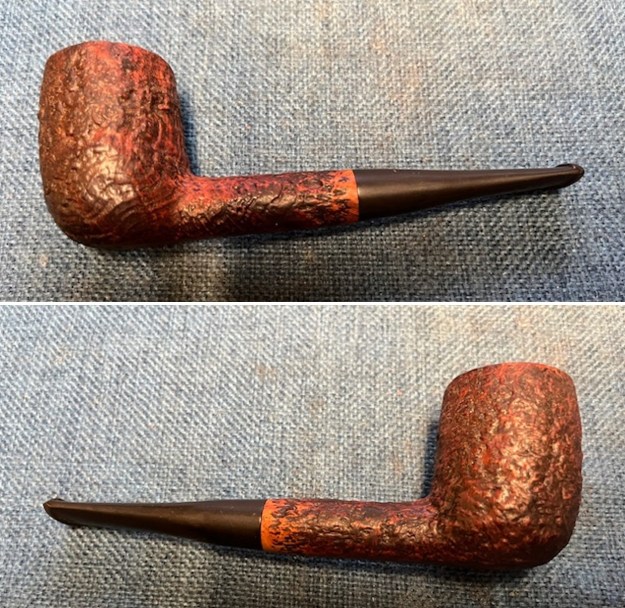
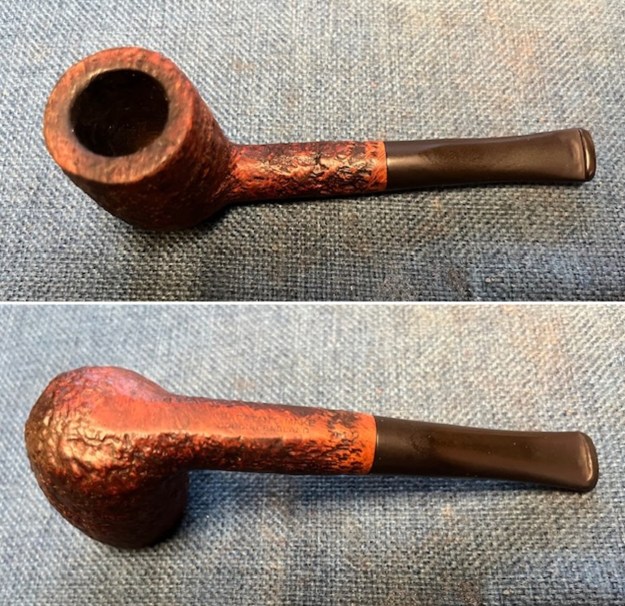
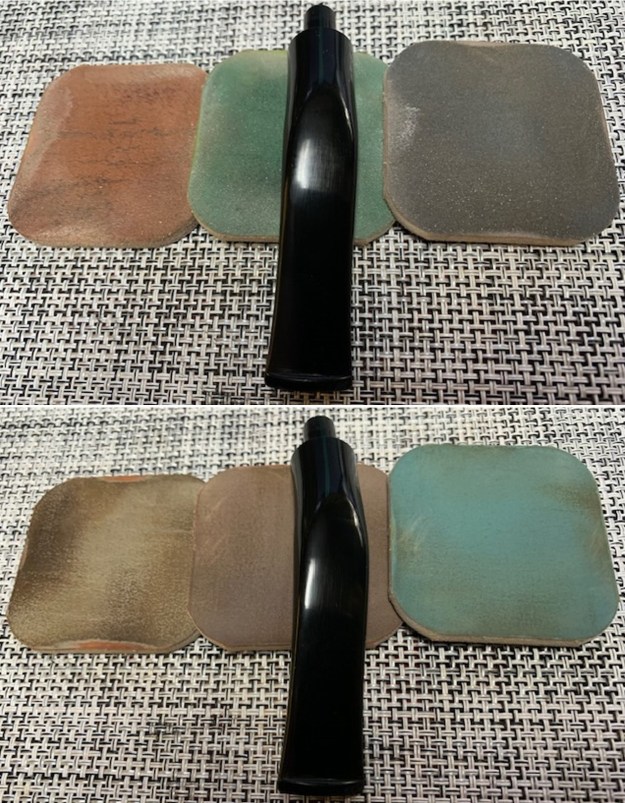
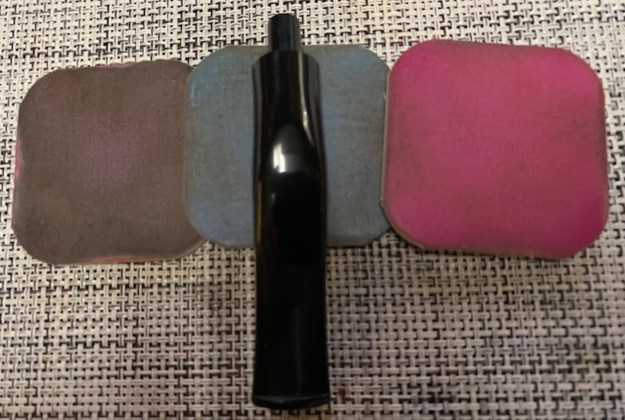
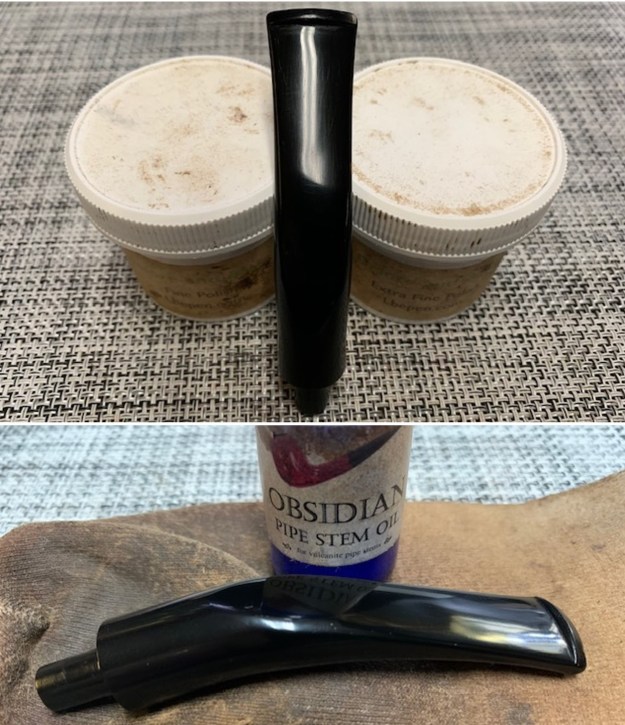
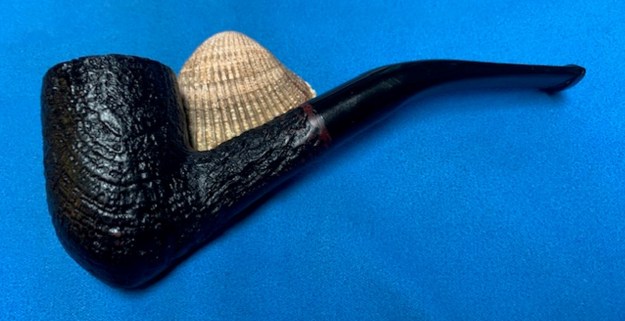
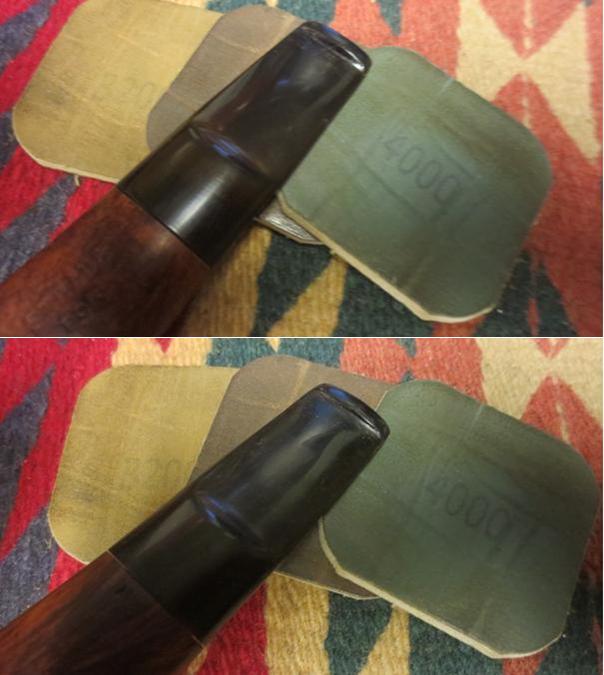
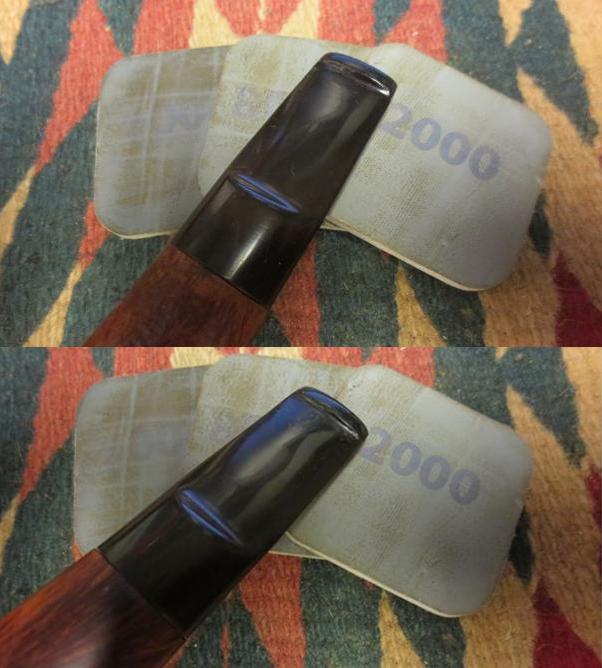
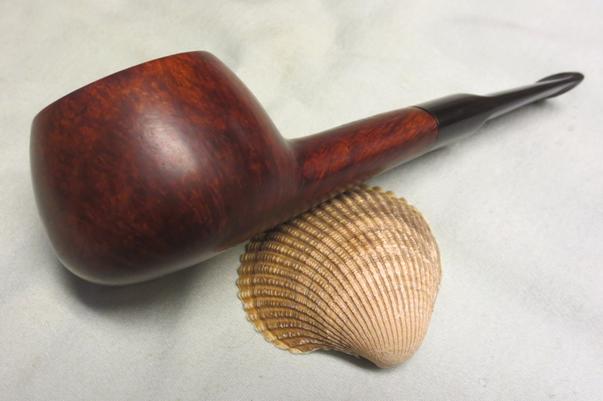
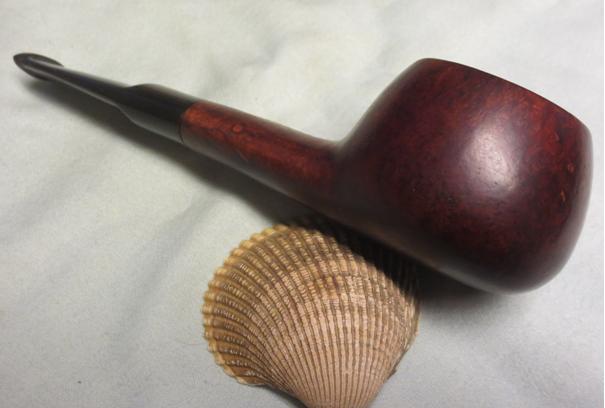
Jeff had cleaned it thoroughly. He had reamed it with a PipNet reamer and cleaned that up with a Savinelli Fitsall Pipe Knife. He had scrubbed the exterior of the briar with undiluted Murphy’s Oil Soap. He removed the shiny coat on the briar with acetone on cotton pads. He cleaned out the interior of the shank, sump and airway in the shank and stem with alcohol, pipe cleaners and cotton swabs. He scrubbed the stem with Soft Scrub to remove the oxidation and calcification on the surface. He soaked it in Briarvilles Pipe Stem Deoxidizer to remove the oxidation. He removed it from the Deoxidizer and rinsed it off with warm water. I took some photos of the pipe before I started my part of the work. I took close up photos of the rim top and also of the stem surface. I wanted to show what an amazing job Jeff did in the cleanup of the rim top. The rim top was and inner edge were in good condition. I also took close up photos of the stem to show the condition of the vulcanite. It was clean but there were tooth marks and chatter on the stem ahead of the button on both sides.One of the things I appreciate about Jeff’s cleanup is that he works to protect and preserve the nomenclature on the shank of the pipes that he works on. The stamping on this one had faint spots on the edges so I was worried that it would worsen with the cleanup. I took some photos to show the clarity of the stamping. The photo is a little blurry but the stamping remains the same. I have noticed that many restorers are not careful to protect the stamping in their cleaning process and often by the end of the restoration the nomenclature is almost destroyed. I would like to encourage all of us to be careful in our work to preserve this as it is a critical piece of pipe restoration! I took the stem off the shank and took a photo of the pipe to capture the look of the pipe as a whole. I sanded the bowl with 320-3500 sanding pads tom smooth out the small nicks and scratches in the rim top and bowl sides. I wiped it down with a damp cloth after each sanding pad. The bowl really began to look good. I polished it with micromesh sanding pads – dry sanding with 1500-12000 grit pads. After each sanding pad I wiped the bowl down with paper towel and a drop of olive oil to remove the debris from the sanding process. It really took on a shine. I rubbed the bowl and rim down with Before & After Restoration Balm. I worked it into the surface of the briar with my fingertips to clean, enliven and protect it. I let the balm sit for 10 minutes and then buffed with a cotton cloth to raise the shine. I really like watching the Balm do its magic and bring the briar alive. I touched up the faint white CP stamp with white acrylic nail polish. I worked it into the stamp with a flat blade. Once it hardened I scraped off the excess and sanded it. It is faint toward the ends of the letters but is still recognizable as the CP stamp. I sanded the stem with 320-3500 grit sanding pads. I wiped the stem down after each sanding pad with a damp cloth. The stem began to take on a shine by the final pads.I polished the stem with micromesh sanding pads – wet sanding with 1500-12000 grit pads. I wiped the stem down after each sanding pad with Obsidian Oil to give the sanding pads some bite. I polished it with Before & After Pipe Stem Polish – both Fine and Extra Fine. I gave it a coat of Obsidian Pipe Stem Oil. I set it aside to dry. Once again at this point in the restoration process I am excited to be on the homestretch. I look forward to the final look when the Lane Era Charatan’s Make London England Special Billiard is put back together, polished and waxed. I put the bowl and stem back together. I lightly polished the bowl and the replacement stem with Blue Diamond. I gave the bowl and the stem multiple coats of carnauba wax. I buffed the pipe with a clean buffing pad to raise the shine. I hand buffed it with a microfiber cloth to deepen the shine. The pipe polished up pretty nicely. The grain really pops with the wax and polish. The shiny black vulcanite stem is a beautiful contrast to the browns of the bowl. This Charatan’s Make London England Special Billiard was another fun pipe to work on. It really is a quite stunning piece of briar whose shape follows the flow of the briar. The pipe feels great in the hand will be better when warmed up while smoking. The finished pipe is shown in the photos below. The dimensions of the pipe are Length: 5 ½ inches, Height: 1 ¾ inches, Outside diameter of the bowl: 1 ¼ inches, Chamber diameter: ¾ of an inch. The weight of the pipe is 1.62 ounces/46 grams. I will be putting it on the rebornpipes store in the British Pipemakers Section if you would like to add it to your rack and carry on the previous pipeman’s legacy. This is an interesting estate to bring back to life.

As always, I encourage your questions and comments as you read the blog. Thanks to each of you who are reading this blog. Remember we are not pipe owners; we are pipe men and women who hold our pipes in trust until they pass on into the trust of those who follow us.

Restoring a Charatan’s Make London England Sandblast Billiard


by Steve Laug

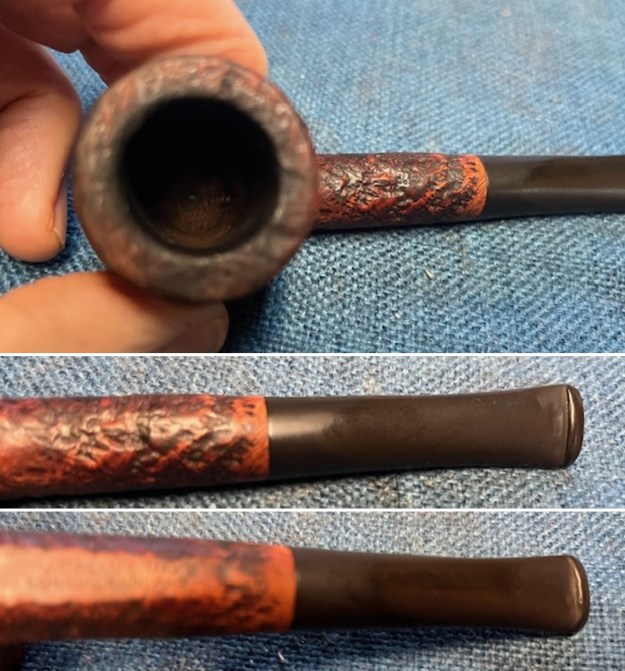
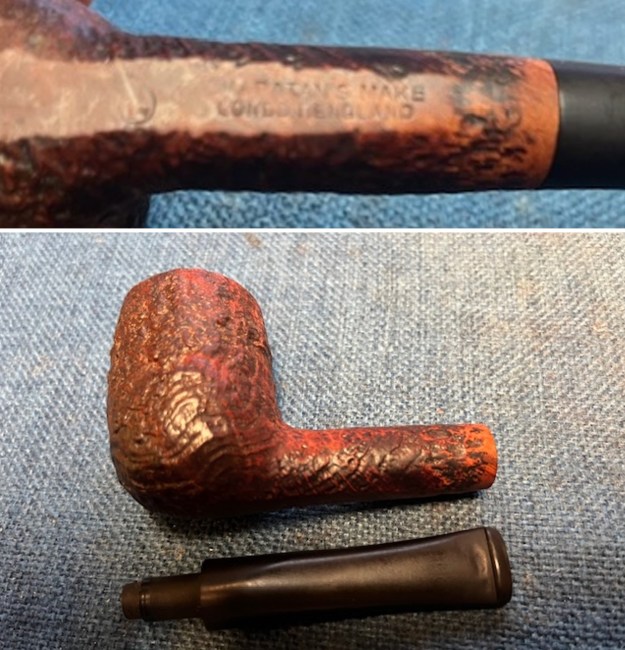
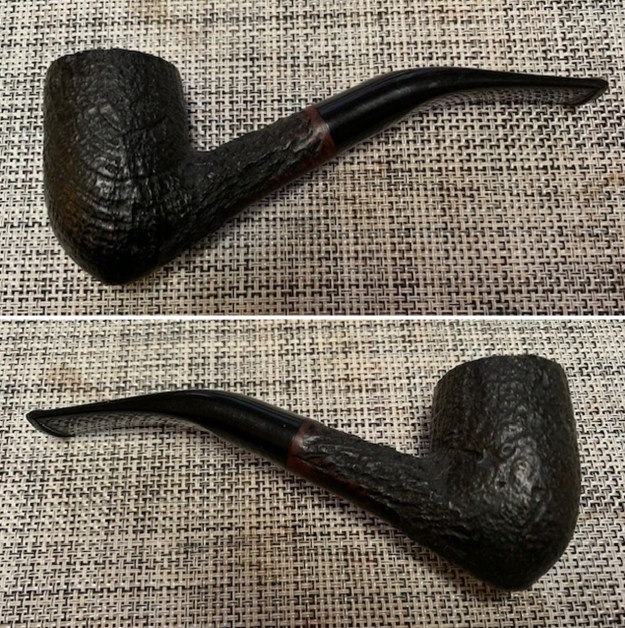
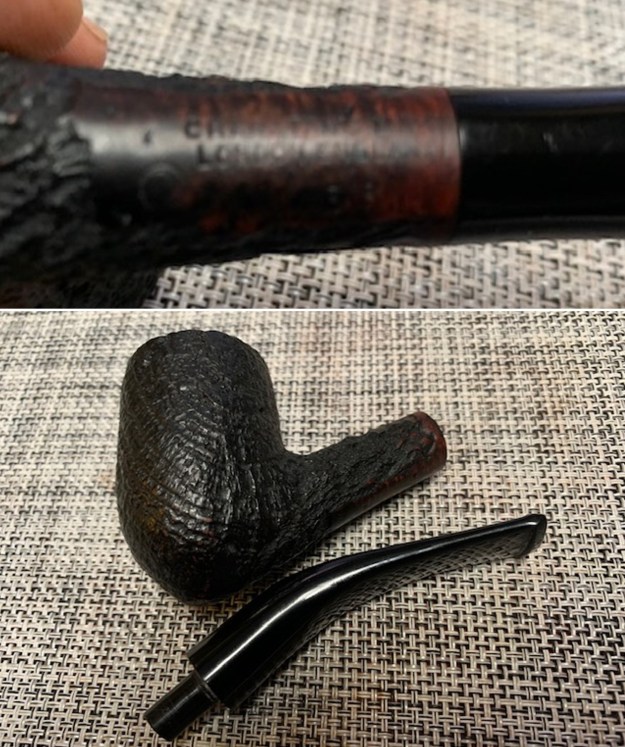
The next pipe I have chosen to work on was purchased on 03/21/2024 during a pipe hunt from a shop in Oregon City, Oregon USA. I have worked on a lot of Charatan pipes through the years and some have been sandblast pipe. This nicely shaped sandblast Billiard is very nice with deep sandblast around the bowl. It is stamped on the underside of the shank and reads Charatan’s Make [over] London, England. On the heel of the bowl it is stamped with a cursive L in a circle identifying it as a Lane Era Pipe. There is no shape number on the bowl or shank. The stamping is faint in spots but still readable. The taper stem does not bear the CP logo on the left side. The bowl had a thick cake and there was a lava overflow on the sandblast rim top. The inner edge of the rim thickly covered with lava so it was hard to know the damage at this point. The outer edge looked very good. The stem is lightly oxidized and has tooth marks and chatter on both sides at the button. Jeff took photos of the pipe before he started his clean up. Jeff took photos of the bowl, rim top to show the thickness of the cake in the bowl and the lava on the rim top. The bowl had a thick cake that overflowed in lava on the inner edge and rim top of the bowl. I am hoping that the thick lava coat protected things underneath it from damage to the edges and top. He took photos of the top and underside of the stem showing the tooth chatter and marks and oxidation on the stem surface and wear on the edges of the button. Jeff took photos of the sides and heel of the bowl to show the condition of the briar. You can see the beautiful shape of the bowl even through the dirt and debris of many years. You can also see the depth of the blast around the bowl and shank. Jeff took photos of the stamping on the underside of the shank. You can see that it is clear and readable as noted above. An added part of pipe restoration for me is to try to gather as much background on a brand and maker as I can find. With Charatan that is an enjoyable web to try to untangle. There is a lot of information and it can lead to understanding what era a pipe was made in. To try to figure out the era of the Charatan’s pipe I was working on I turned to the Pipephil website, Logos and Stampings (http://www.pipephil.eu/logos/en/logo-charatan.html). There is some really helpful information on each of the lines of Charatan’s Make pipes that entered the market. There was not a sandblast stamped like the one in hand. The site did give a short history of the brand. I quote the portion that is most pertinent.The brand was founded in 1863 by Frederik Charatan. When his father retired in 1910, Reuben Charatan took over the family business. All the pipes were handmade until 1973. The brand name has been overtaken by Dunhill in 1978 and sold in 1988 to James B. Russell Inc.(NJ, USA). During the period 1988-2002 Charatans were crafted by Butz Choquin in St Claude (France). Dunhill re-purchased Charatan brand name in 2002 and Colin Fromm (Invicta Briars, Castleford) followed up on freehand production.
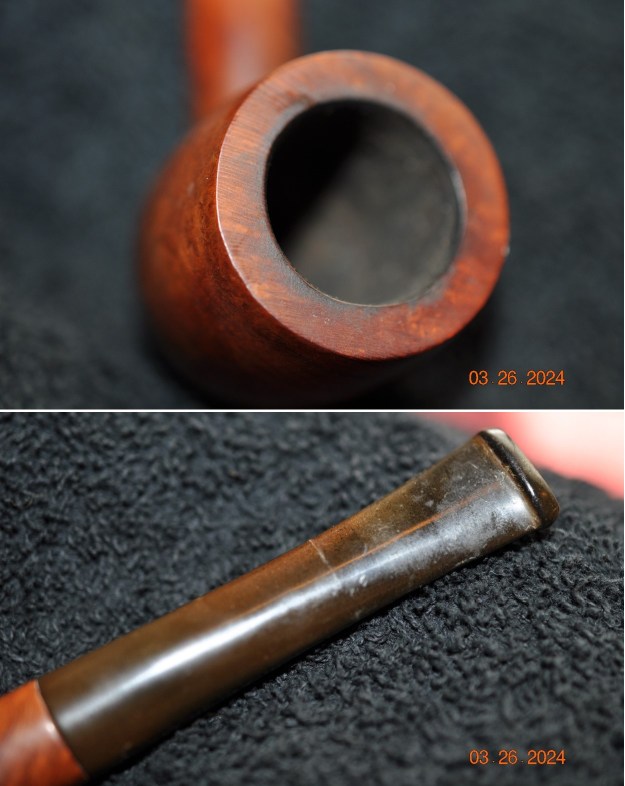
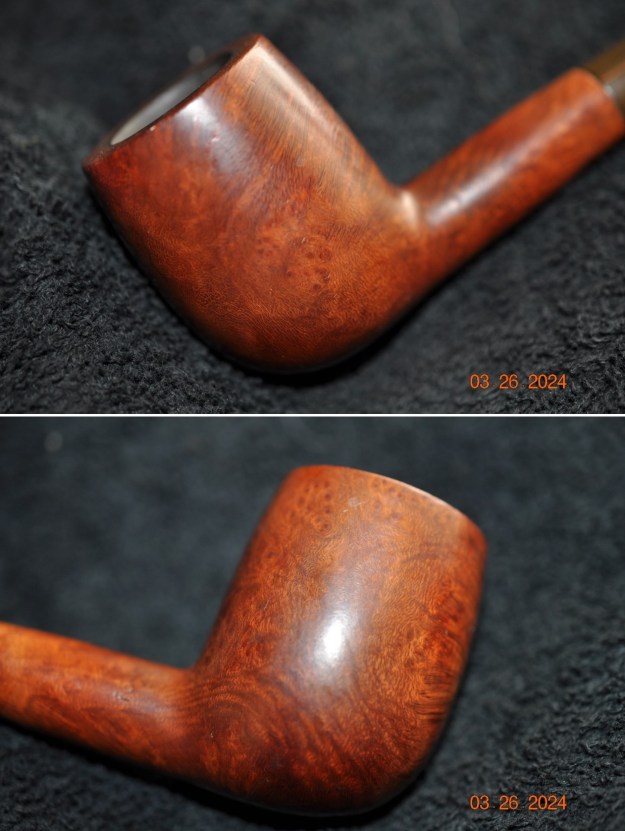
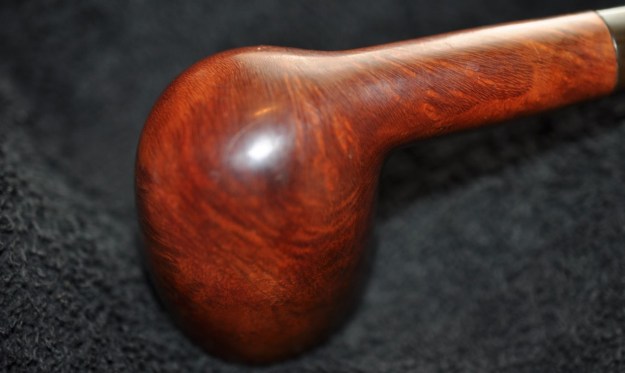
Next, I turned to Pipedia to see if I could find more information on the brand and possibly a link to a sandblast finished Dublin (https://pipedia.org/wiki/Charatan) but once again in the general article it was not listed. It did give a little more historical information. I quote the pertinent parts that give information on this particular pipe.

In 1950 Herman G. Lane, striving to expand his business in Great Britain, made contacts with the Charatan family. Apparently, Lane got a certain influence soon, but it was not until 1955 that Lane Ltd. became the sole distributor for Charatan’s in the United States superseding Wally Frank. This can be documented in a “biography” written for Herman G. Lane titled “Leaves from a Tobaccoman’s Log”.

Thanks to Herman G. Lane’s dedicated labor Charatan became hugely popular in the States. As reported by Ken Barnes in an interview with Rick Newcombe, Reuben Charatan passed away in 1962, and his widow sold the firm to Herman Lane 1 or 2 years after his death.[1] In the early 1960s Charatan pipes were the first to overstep the $100 Dollar line in US pipe sales. In 1978 Lane’s heirs sold the Charatan company to Dunhill. The Prescot Street factory was closed in March 1982. Thereafter the fame and quality of the make declined.

The pre-Lane period (prior to 1955) and the Lane era pipes (1955 to until sometime between 1979 – 1984) are of primary interest the collector. The Lane era is often quoted as beginning about 1950.

Charatan records are almost non-existent before Lane due to a factory fire, making it difficult to date pre-Lane pipes. Charatan used 4 basic grades prior to 1950: Supreme, Selected, Executive, and Belvedere. After 1950 Herman Lane’s influence began, and the grades started to expand. In 1955 Lane took over sole distributorship of Charatan in the US. In 1957 he introduced the Supreme S. Most of his other introductions were from the 1960s and early 1970s.

From this I am fairly certain I am dealing with a Lane pipe made after 1955. There is also a circle L script mark that is a Lane stampings on the pipe which also supports this.

I continued digging further into the dating of the pipe, but what I had found above was a good start for me. If some of you would like to try your hand at dating it more accurately as to the time period it came out you might want to check out the article on Pipedia on Dating Charatans (https://pipedia.org/wiki/Dating_of_Charatans).

I also reread the article on Pipedia by the Italian fellow who contributed some really helpful information on the brand (https://pipedia.org/wiki/Charatan_-_Milan_2014). I quote the section on the Second period: Reuben Charatan 1910 – c. 1962. I have highlighted a portion of the section on the shank in red to point out some more helpful dating information.

– In 1962 Herman Lane took over the business from the Charatan family, although he had already influenced production from the 1950s.

– The pipes were mostly larger than the previous ones and corresponded in size to Dunhill group 5. These are slightly less rare, but still difficult to find.

– Stem: Usually in ebonite, saddle shaped or tapered, bearing a fine “CP” stamp, underbore system (see below) used when necessary.

– Shank: The shape code is stamped on it together with the nomenclature “CHARATAN’S MAKE LONDON ENGLAND” arranged in two lines. From 1955 onward on the models marketed for the USA there is also a serif and circled capital “L” (but not all models bear this) which resembles the pound sterling symbol. The “L” is for Lane, the importer.

From 1958, Lane changed the nomenclature for models marketed for the US to clarify the message: “MADE BY HAND”.  In this period the underbore was introduced. Its manufacturing period ranged between 1920 and c.1930. This model was equipped with a duralumin plunger trap fitted in the stem, which served to clean the residue more easily. This particular model bore a special stamp on the stem, and also had its own catalogue…

QUALITY GRADES…The stem did not only display the stamps mentioned above. Another stamp that can help dating is the one referring to the quality of the pipe. Until Herman Lane arrived on the scene there were four quality grades. Starting with the lowest: Belvedere, Executive, Selected, and Supreme. Lane went on to add higher grades from time to time: Supreme S, Supreme S100, S150, S200, S250, S300, Coronation, Royal Achievement, Crown Achievement, and Summa Cum Laude; these last three are extremely rare and almost impossible to find. He also invented other, different grades, even changing the previous pipe classification standards. We will not go into detail here, but it means that if we find an S100 or Coronation the pipe was manufactured following Herman Lane’s acquisition. In particular, the FH mark, or Freehand pipe was commissioned to the famous Danish craftsman, Preben Holm.

Nomenclature

The Lane Trademark serif and circled L indicates the pipe is from the “Lane Era” (approx. 1955 to 1979 -1984?), however it appears that both the English factory or Lane themselves sometimes, or perhaps even often forget to stamp the L on a pipe. The Charatan factory was known for inconsistencies, especially in stampings. Therefore, although an L on the pipe definitely defines it as a Lane Era pipe, the lack of it could simply mean the pipe missed receiving the stamp from the factory. The lack of the trademark could also mean the pipe was destined for the European market.

Charatan pipes were not well distributed prior to the Lane Era, so very few pre-Lane pipes exist today. Herman Lane greatly grew the brand in the U.S., which caused corresponding growth in Europe.

Generally, when the pipe is stamped with the BLOCK letters “MADE BY HAND” it means the pipe was probably made between 1958 and 1965”

Generally, block letters “MADE BY HAND” and some of the other nomenclature in script (i.e. City of London or Extra Large next to the MADE BY HAND) means the pipe was made sometime between 1965 and the mid 1970s. The total script nomenclature “Made by Hand in City of London” evolved over this period of time, so many pipes had variants, such as Made By Hand in block letters and City of London in script, or some other variation of the terms or stampings.

It is believed the FH was used on Charatan pipes between 1957 and 1967-68. Three different sizes were used. The Charatan Logo (CP) on the pipe bit was changed over the year

Now I knew I was working on Lane Era pipe which actually means it was between 1955 and 1988 as shown by the stamping. Now it was time to work on the pipe.

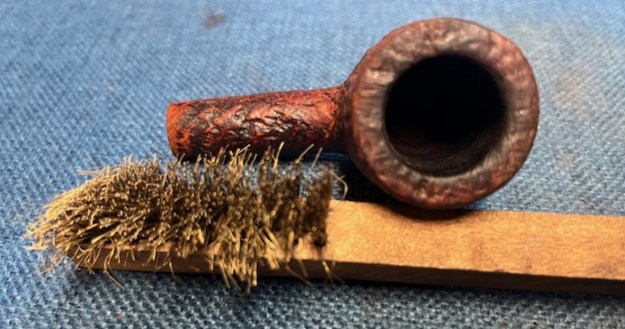
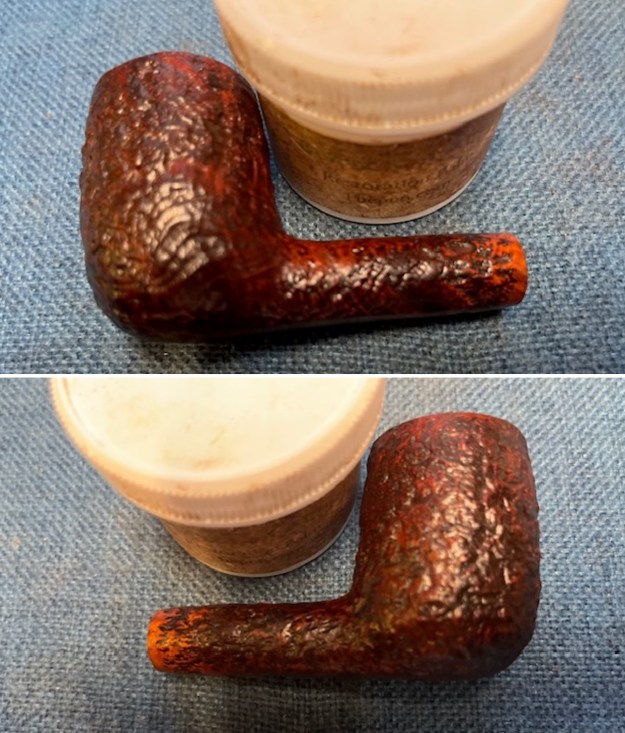
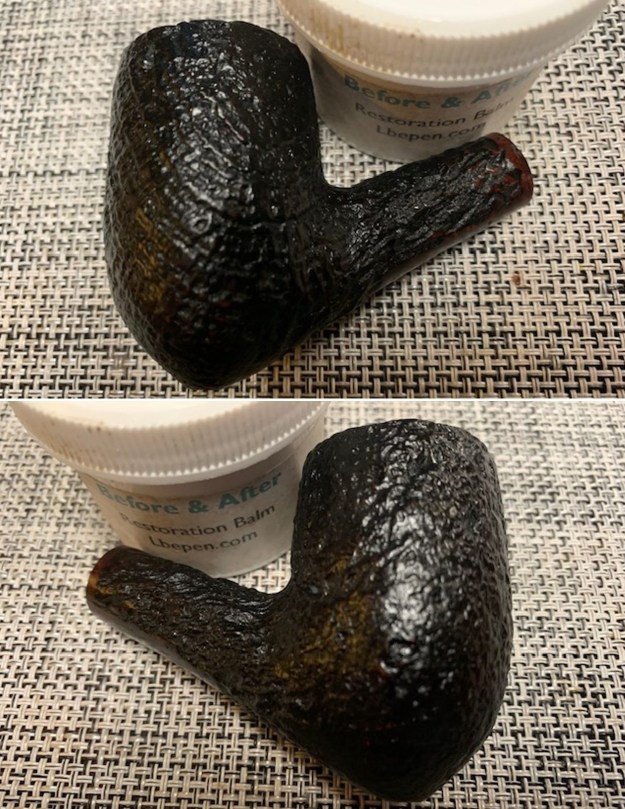
Jeff had cleaned it thoroughly. He had reamed it with a PipNet reamer and cleaned that up with a Savinelli Fitsall Pipe Knife. He had scrubbed the exterior of the briar with undiluted Murphy’s Oil Soap. He removed the shiny coat on the briar with acetone on cotton pads. He cleaned out the interior of the shank, sump and airway in the shank and stem with alcohol, pipe cleaners and cotton swabs. He scrubbed the stem with Soft Scrub to remove the oxidation and calcification on the surface. He soaked it in Briarvilles Pipe Stem Deoxidizer to remove the oxidation. He removed it from the Deoxidizer and rinsed it off with warm water. I took some photos of the pipe before I started my part of the work. I took some close up photos of the rim top and also of the stem surface. I wanted to show what an amazing job Jeff did in the cleanup of the rim top. The rim top was and inner edge were in good condition. There were spots on the rim top and edges where there were some spots of debris in the finish. I also took close up photos of the stem to show the condition of the vulcanite. It was in clean but there were tooth marks and chatter on the stem ahead of the button on both sides.One of the things I appreciate about Jeff’s cleanup is that he works to protect and preserve the nomenclature on the shank of the pipes that he works on. The stamping on this one had faint spots on the edges so I was worried that it would worsen with the cleanup. I took some photos to show the clarity of the stamping. The photo is a little blurry but the stamping remains the same. I have noticed that many restorers are not careful to protect the stamping in their cleaning process and often by the end of the restoration the nomenclature is almost destroyed. I would like to encourage all of us to be careful in our work to preserve this as it is a critical piece of pipe restoration! I took the stem off the shank and took a photo of the pipe to capture the look of the pipe as a whole.With that finished the bowl was very clean and the sandblast looked great. I used a brass bristle wire brush to work over the debris on the rim top and clean it up. It looked much better after the work on it was finished.I rubbed the bowl and rim down with Before & After Restoration Balm. I worked it into the sandblast surface of the briar with my fingertips and a horse hair shoe brush to clean, enliven and protect it. I let the balm sit for 10 minutes and then buffed with a cotton cloth to raise the shine. I really like watching the Balm do its magic and bring the briar alive. I set the bowl aside and turned my attention to the stem. I “painted” the tooth marks on the stem with the flame of a Bic lighter. I was able to lift the tooth marks considerably but some still remained. I filled them in with black, rubberized CA glue. Once it had cured I used a small file to flatten out the repairs. I sanded them smooth with 220 grit sandpaper to blend them into the surface of the vulcanite. I sanded the stem with 320-3500 grit sanding pads. I wiped the stem down after each sanding pad with a damp cloth. The stem began to take on a shine by the final pads.I polished the stem with micromesh sanding pads – wet sanding with 1500-12000 grit pads. I wiped the stem down after each sanding pad with Obsidian Oil to give the sanding pads some bite. I polished it with Before & After Pipe Stem Polish – both Fine and Extra Fine. I gave it a coat of Obsidian Pipe Stem Oil. I know that most think it does nothing for acrylic stems but I use it anyway as I find it works very well to deepen the shine. I set it aside to dry. Once again at this point in the restoration process I am excited to be on the homestretch. I look forward to the final look when the Lane Era Charatan’s Make London England Sandblast Billiard is put back together, polished and waxed. I put the bowl and stem back together. I lightly polished the bowl and the replacement stem with Blue Diamond. I gave the bowl and the stem multiple coats of carnauba wax. I buffed the pipe with a clean buffing pad to raise the shine. I hand buffed it with a microfiber cloth to deepen the shine. The pipe polished up pretty nicely. The depths of the sandblast really pop with the wax and polish. The shiny black vulcanite stem is a beautiful contrast to the browns of the bowl. This Charatan’s Make London England Sandblast Billiard was another fun pipe to work on. It really is a quite stunning piece of briar whose shape follows the flow of the briar. The pipe feels great in the hand will be better when warmed up while smoking. The finished pipe is shown in the photos below. The dimensions of the pipe are Length: 5 ¼ inches, Height: 1 ¾ inches, Outside diameter of the bowl: 1 ¼ inches, Chamber diameter: ¾ of an inch. The weight of the pipe is 1.31 ounces/38 grams. I will be putting it on the rebornpipes store in the British Pipemakers Section if you would like to add it to your rack and carry on the previous pipeman’s legacy. This is an interesting estate to bring back to life.

As always, I encourage your questions and comments as you read the blog. Thanks to each of you who are reading this blog. Remember we are not pipe owners; we are pipe men and women who hold our pipes in trust until they pass on into the trust of those who follow us.

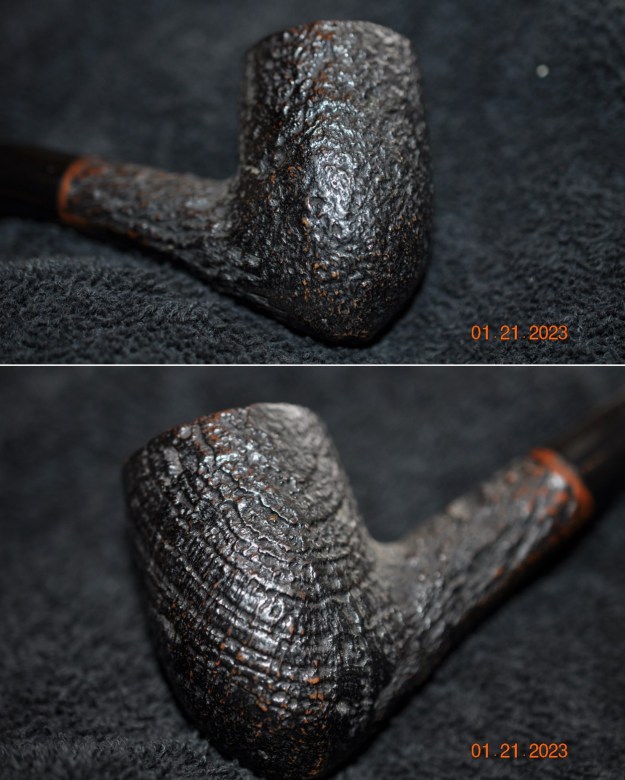
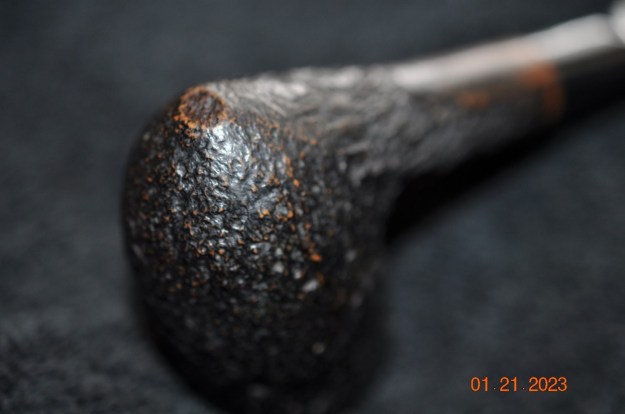
Restoring a Charatan’s Make 318 Pickaxe Shaped Pipe with a Replacement Acrylic Stem


Blog by Steve Laug

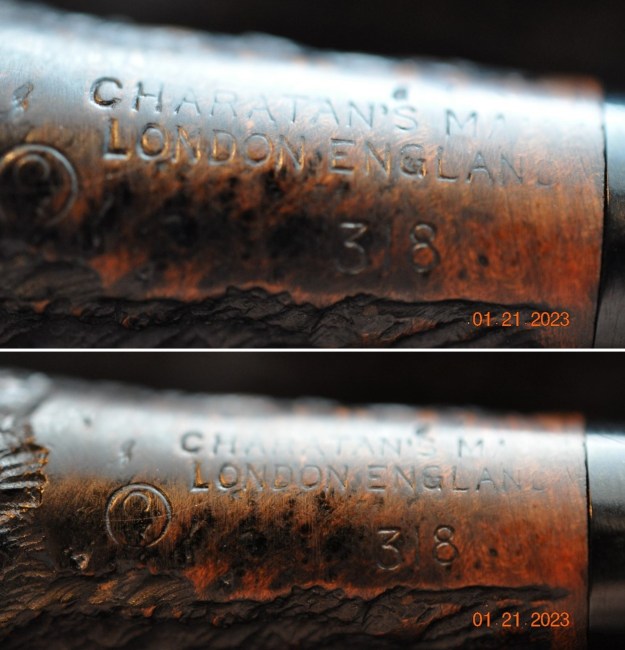
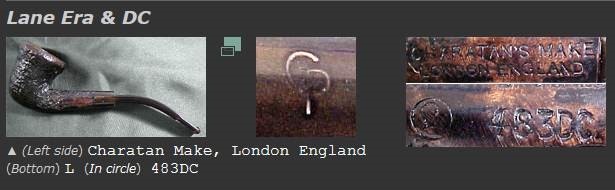
The next pipe on the work table is a nice-looking sandblast Pickaxe shaped pipe that we purchased from an estate sale from Plano, Texas, USA on 03/30/2022. It was stamped on the underside of the shank and read Charatan’s Made [over] London England [over] shape number 318. To the left and below the stamping is a circled cursive L. It has a sandblast finish around the bowl and rustication on the shank that is covered with a shiny coat of shellac it appears over a lot of oils, debris and grime. There was a thick cake in the bowl and tobacco debris stuck to the walls. There is a thick lava overflow in the sandblast on the inwardly bevelled rim top. The top and edges of the rim looked good under the tars and lava, but that would be very clear once the pipe is cleaned. There was a very beautiful pipe underneath all of the buildup of years of use. The taper stem was an acrylic replacement. It was filthy and there were some deep tooth marks and chatter on both sides ahead of the button. The button had not been shaped at all and still needed to be slotted and shaped. Jeff took photos of the pipe before he started his cleanup work on it. Jeff took photos of the bowl and rim top to show the thick cake and tobacco debris in the bowl and the heavy lava build up on the sandblast rim top and the edges of the bowl. The rim top and edges looked pretty good but a proper clean up would tell the full story. Jeff took photos of the top and underside of the stem showing the tooth marks and chatter on the stem surface. Jeff took photos of the sides and heel of the bowl to show the condition of the finish. You can see the grime around the sides of the bowl and shank under the shiny coat on the finish. It seems to fill in the grooves in the blast. Jeff took a photo of the stamping on the underside of the bowl and shank. The stamping was readable as you can see from the photos. It read as noted above. An added part of pipe restoration for me is to try to gather as much background on a brand and maker as I can find. With Charatan that is an enjoyable web to try to untangle. There is a lot of information and it can lead to understanding what era a pipe was made in. To try to figure out the era of the Charatan’s pipe I was working on I turned to the Pipephil website, Logos and Stampings (http://www.pipephil.eu/logos/en/logo-charatan.html). There is some really helpful information on each of the lines of Charatan’s Make pipes that entered the market. There was not a sandblast stamped like the one in hand. The site did give a short history of the brand. I quote the portion that is most pertinent.

The brand was founded in 1863 by Frederik Charatan. When his father retired in 1910, Reuben Charatan took over the family business. All the pipes were handmade until 1973. The brand name has been overtaken by Dunhill in 1978 and sold in 1988 to James B. Russell Inc.(NJ, USA). During the period 1988-2002 Charatans were crafted by Butz Choquin in St Claude (France). Dunhill re-purchased Charatan brand name in 2002 and Colin Fromm (Invicta Briars, Castleford) followed up on freehand production.Next, I turned to Pipedia to see if I could find more information on the brand and possibly a link to a sandblast finished Dublin (https://pipedia.org/wiki/Charatan) but once again in the general article it was not listed. It did give a little more historical information. I quote the pertinent parts that give information on this particular pipe.

In 1950 Herman G. Lane, striving to expand his business in Great Britain, made contacts with the Charatan family. Apparently, Lane got a certain influence soon, but it was not until 1955 that Lane Ltd. became the sole distributor for Charatan’s in the United States superseding Wally Frank. This can be documented in a “biography” written for Herman G. Lane titled “Leaves from a Tobaccoman’s Log”.

Thanks to Herman G. Lane’s dedicated labor Charatan became hugely popular in the States. As reported by Ken Barnes in an interview with Rick Newcombe, Reuben Charatan passed away in 1962, and his widow sold the firm to Herman Lane 1 or 2 years after his death.[1] In the early 1960s Charatan pipes were the first to overstep the $100 Dollar line in US pipe sales. In 1978 Lane’s heirs sold the Charatan company to Dunhill. The Prescot Street factory was closed in March 1982. Thereafter the fame and quality of the make declined.

The pre-Lane period (prior to 1955) and the Lane era pipes (1955 to until sometime between 1979 – 1984) are of primary interest the collector. The Lane era is often quoted as beginning about 1950.

Charatan records are almost non-existent before Lane due to a factory fire, making it difficult to date pre-Lane pipes. Charatan used 4 basic grades prior to 1950: Supreme, Selected, Executive, and Belvedere. After 1950 Herman Lane’s influence began, and the grades started to expand. In 1955 Lane took over sole distributorship of Charatan in the US. In 1957 he introduced the Supreme S. Most of his other introductions were from the 1960s and early 1970s.

From this I am fairly certain I am dealing with a Lane pipe made after 1955. There is also a circle L script mark that is a Lane stampings on the pipe which also supports this.

I continued digging further into the dating of the pipe, but what I had found above was a good start for me. If some of you would like to try your hand at dating it more accurately as to the time period it came out you might want to check out the article on Pipedia on Dating Charatans (https://pipedia.org/wiki/Dating_of_Charatans).

I also reread the article on Pipedia by the Italian fellow who contributed some really helpful information on the brand (https://pipedia.org/wiki/Charatan_-_Milan_2014). I quote the section on the Second period: Reuben Charatan 1910 – c. 1962. I have highlighted a portion of the section on the shank in red to point out some more helpful dating information.

– In 1962 Herman Lane took over the business from the Charatan family, although he had already influenced production from the 1950s.

– The pipes were mostly larger than the previous ones and corresponded in size to Dunhill group 5. These are slightly less rare, but still difficult to find.

– Stem: Usually in ebonite, saddle shaped or tapered, bearing a fine “CP” stamp, underbore system (see below) used when necessary.

– Shank: The shape code is stamped on it together with the nomenclature “CHARATAN’S MAKE LONDON ENGLAND” arranged in two lines. From 1955 onward on the models marketed for the USA there is also a serif and circled capital “L” (but not all models bear this) which resembles the pound sterling symbol. The “L” is for Lane, the importer.

From 1958, Lane changed the nomenclature for models marketed for the US to clarify the message: “MADE BY HAND”.  In this period the underbore was introduced. Its manufacturing period ranged between 1920 and c.1930. This model was equipped with a duralumin plunger trap fitted in the stem, which served to clean the residue more easily. This particular model bore a special stamp on the stem, and also had its own catalogue…

QUALITY GRADES…The stem did not only display the stamps mentioned above. Another stamp that can help dating is the one referring to the quality of the pipe. Until Herman Lane arrived on the scene there were four quality grades. Starting with the lowest: Belvedere, Executive, Selected, and Supreme. Lane went on to add higher grades from time to time: Supreme S, Supreme S100, S150, S200, S250, S300, Coronation, Royal Achievement, Crown Achievement, and Summa Cum Laude; these last three are extremely rare and almost impossible to find. He also invented other, different grades, even changing the previous pipe classification standards. We will not go into detail here, but it means that if we find an S100 or Coronation the pipe was manufactured following Herman Lane’s acquisition. In particular, the FH mark, or Freehand pipe was commissioned to the famous Danish craftsman, Preben Holm.

Nomenclature

The Lane Trademark serif and circled L indicates the pipe is from the “Lane Era” (approx. 1955 to 1979 -1984?), however it appears that both the English factory or Lane themselves sometimes, or perhaps even often forget to stamp the L on a pipe. The Charatan factory was known for inconsistencies, especially in stampings. Therefore, although an L on the pipe definitely defines it as a Lane Era pipe, the lack of it could simply mean the pipe missed receiving the stamp from the factory. The lack of the trademark could also mean the pipe was destined for the European market.

Charatan pipes were not well distributed prior to the Lane Era, so very few pre-Lane pipes exist today. Herman Lane greatly grew the brand in the U.S., which caused corresponding growth in Europe.

Generally, when the pipe is stamped with the BLOCK letters “MADE BY HAND” it means the pipe was probably made between 1958 and 1965”

Generally, block letters “MADE BY HAND” and some of the other nomenclature in script (i.e. City of London or Extra Large next to the MADE BY HAND) means the pipe was made sometime between 1965 and the mid 1970s. The total script nomenclature “Made by Hand in City of London” evolved over this period of time, so many pipes had variants, such as Made By Hand in block letters and City of London in script, or some other variation of the terms or stampings.

It is believed the FH was used on Charatan pipes between 1957 and 1967-68. Three different sizes were used. The Charatan Logo (CP) on the pipe bit was changed over the year

Now I knew I was working on Lane Era pipe which actually means it was between 1955 and 1988 as shown by the stamping. Now it was time to work on the pipe.

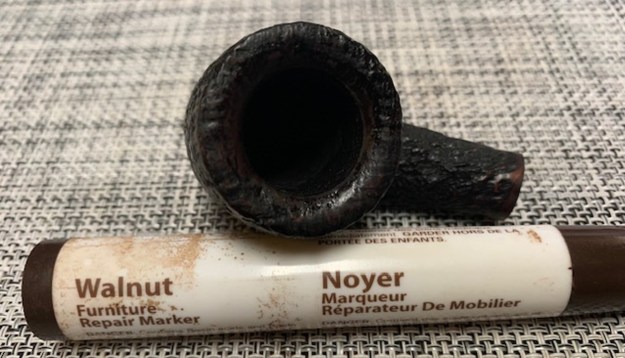
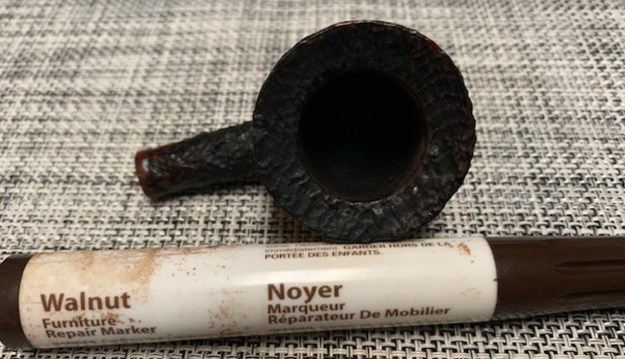
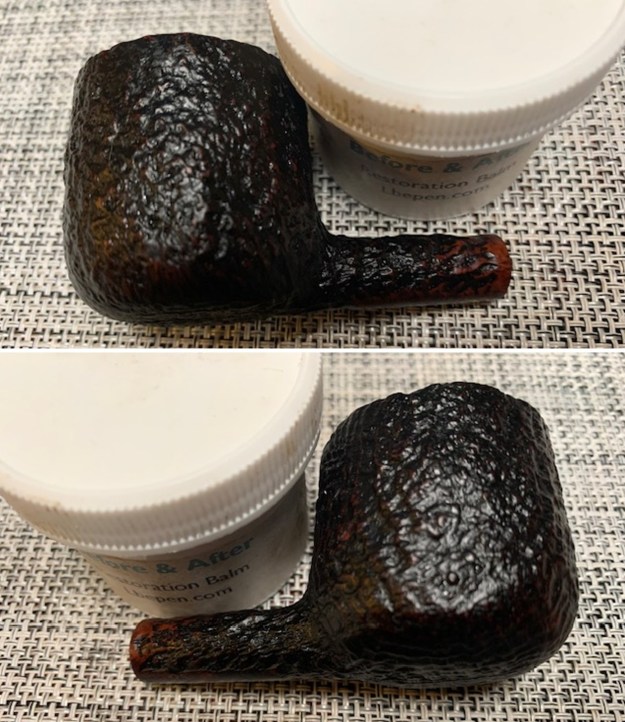
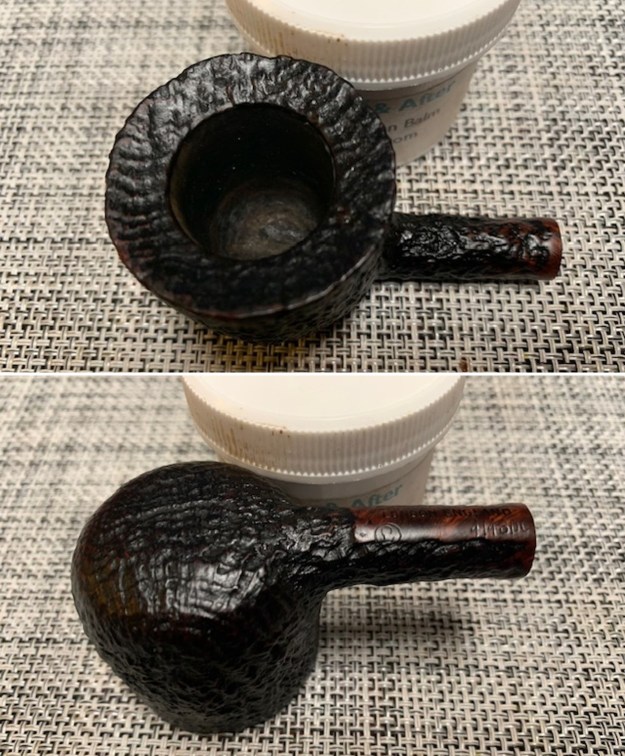
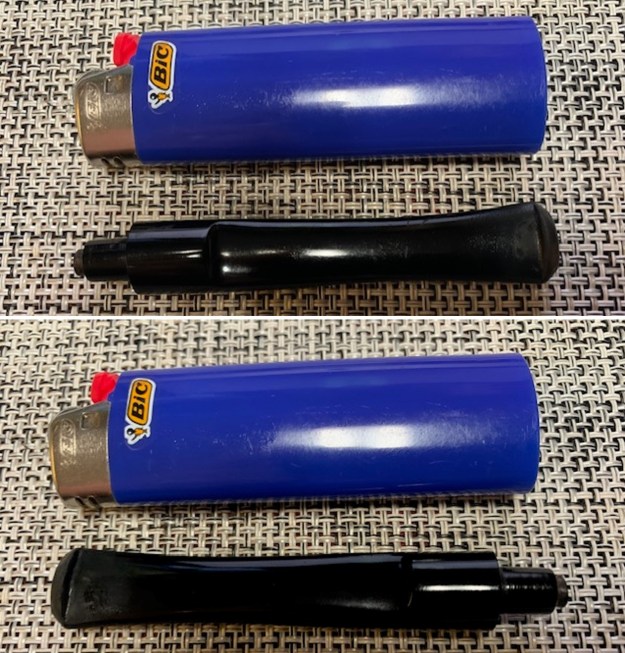
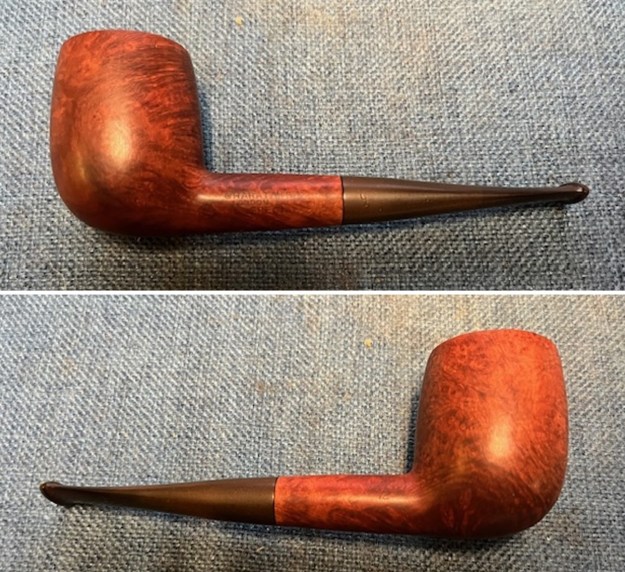
Jeff had cleaned it thoroughly. He had reamed it with a PipNet reamer and cleaned that up with a Savinelli Fitsall Pipe Knife. He had scrubbed the exterior of the briar with undiluted Murphy’s Oil Soap. He removed the shiny coat on the briar with acetone on cotton pads. He cleaned out the interior of the shank, sump and airway in the shank and stem with alcohol, pipe cleaners and cotton swabs. He scrubbed the stem with Soft Scrub to remove the oxidation and calcification on the surface. He soaked it in Before & After Deoxidizer to remove the oxidation. He removed it from the Deoxidizer and rinsed it off with warm water. I took some photos of the pipe before I started my part of the work. I took some close up photos of the rim top and also of the stem surface. I wanted to show what an amazing job Jeff did in the cleanup of the rim top. The rim top was and inner edge were in excellent condition. There were spots on the surface where the stain had lightened – both inner and outer edges. I also took close up photos of the stem to show the condition of the acrylic. It was clean but there were tooth marks and chatter on the stem ahead of the button on both sides. One of the things I appreciate about Jeff’s cleanup is that he works to protect and preserve the nomenclature on the shank of the pipes that he works on. The stamping on this one had faint spots on the edges so I was worried that it would worsen with the cleanup. I took some photos to show the clarity of the stamping. The photo is a little blurry but the stamping remains the same. I have noticed that many restorers are not careful to protect the stamping in their cleaning process and often by the end of the restoration the nomenclature is almost destroyed. I would like to encourage all of us to be careful in our work to preserve this as it is a critical piece of pipe restoration! I took the stem off the shank and took a photo of the pipe to capture the look of the pipe as a whole.I started my work on the pipe by touching up the light areas around the rim top and edges with a Walnut Stain pen. It blended well into the surrounding briar. With that finished the bowl was very clean and the sandblast looked great. I rubbed the bowl and rim down with Before & After Restoration Balm. I worked it into the sandblast surface of the briar with my fingertips and a horse hair shoe brush to clean, enliven and protect it. I let the balm sit for 10 minutes and then buffed with a cotton cloth to raise the shine. I really like watching the Balm do its magic and bring the briar alive. I set the bowl aside and turned my attention to the stem. I “painted” the tooth marks on both sides of the stem with the flame of a Bic lighter and as expected I was not able to lift them at all. I filled in the tooth marks with clear CA glue and let the cure. I flattened out the repairs with a small file to start blending them in. I sanded the areas smooth with 220 grit sandpaper and started polishing with 600 grit wet dry sandpaper, though I forgot to take photos of this part of the process. I polished the stem with micromesh sanding pads – wet sanding with 1500-12000 grit pads. I wiped the stem down after each sanding pad with Obsidian Oil to give the sanding pads some bite. I polished it with Before & After Pipe Stem Polish – both Fine and Extra Fine. I gave it a coat of Obsidian Pipe Stem Oil. I know that most think it does nothing for acrylic stems but I use it anyway as I find it works very well to deepen the shine. I set it aside to dry. Once again at this point in the restoration process I am excited to be on the homestretch. I look forward to the final look when the Charatan’s Make London England 318 Sandblast Pickaxe is put back together, polished and waxed. I put the bowl and stem back together. I lightly polished the bowl and the replacement stem with Blue Diamond. I gave the bowl and the newly fit stem multiple coats of carnauba wax. I buffed the pipe with a clean buffing pad to raise the shine. I hand buffed it with a microfiber cloth to deepen the shine. The pipe polished up pretty nicely. The depths of the sandblast really pop with the wax and polish. The shiny black acrylic stem is a beautiful contrast to the browns of the bowl. This Charatan’s Make London England 318 Sandblast Pickaxe with an acrylic replacement stem was another fun pipe to work on. It really is a quite stunning piece of briar whose shape follows the flow of the briar. The pipe feels great in the hand will be better when warmed up while smoking. The finished pipe is shown in the photos below. The dimensions of the pipe are Length: 5 ¾ inches, Height: 2 ¼ inches, Outside diameter of the bowl: 1 ¼ inches, Chamber diameter: 7/8 of an inch. The weight of the pipe is 1.66 ounces/47 grams. I will be putting it on the rebornpipes store in the British Pipemakers Section if you would like to add it to your rack and carry on the previous pipeman’s legacy. This is an interesting estate to bring back to life.
As always, I encourage your questions and comments as you read the blog. Thanks to each of you who are reading this blog. Remember we are not pipe owners; we are pipe men and women who hold our pipes in trust until they pass on into the trust of those who follow us.

Breathing Life into a Charatan’s Make 4143DC Sandblast Pot


Blog by Steve Laug

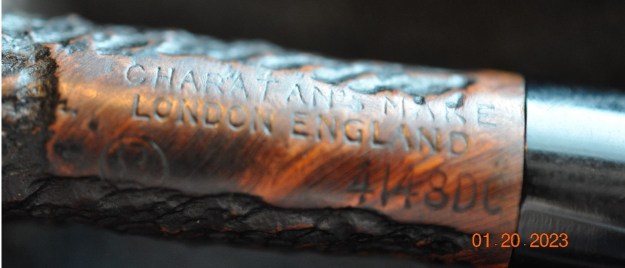
The next pipe on the work table is a nice-looking sandblast Pot shaped pipe that we purchased from an estate sale from Plano, Texas, USA on 03/30/2022. It was stamped Charatan’s Made [over] London England [over] a circled cursive L on the left toward the bowl and the shape number 4143DC toward the right toward the stem. It has a sandblast finish around the bowl and shank that is covered with a shiny coat of shellac it appears over a lot of oils, debris and grime. There was a thick cake in the bowl and tobacco debris stuck to the walls. There is a thick lava overflow in the sandblast on the inwardly bevelled rim top. The top and edges of the rim looked good under the tars and lava, but that would be very clear once the pipe is cleaned. There was a very beautiful pipe underneath all of the buildup of years of use. The saddle stem was an acrylic replacement. There were some deep tooth marks and chatter on both sides ahead of the button. The button had not been shaped at all and still needed to be slotted and shaped. Jeff took photos of the pipe before he started his cleanup work on it. Jeff took photos of the bowl and rim top to show the thick cake and tobacco debris in the bowl and the heavy lava build up on the sandblast rim top and the edges of the bowl. The rim top and edges looked pretty good but a proper clean up would tell the full story. Jeff took photos of the top and underside of the stem showing the tooth marks and chatter on the stem surface. Jeff took photos of the sides and heel of the bowl to show the condition of the finish. You can see the grime around the sides of the bowl and shank under the shiny coat on the finish. It seems to fill in the grooves in the blast. Jeff took photos of the stamping on the underside of the bowl and shank. The stamping was faint but readable as you can see from the photos. It read as noted above. An added part of pipe restoration for me is to try to gather as much background on a brand and maker as I can find. With Charatan that is an enjoyable web to try to untangle. There is a lot of information and it can lead to understanding what era a pipe was made in. To try to figure out the era of the Charatan’s pipe I was working on I turned to the Pipephil website, Logos and Stampings (http://www.pipephil.eu/logos/en/logo-charatan.html). There is some really helpful information on each of the lines of Charatan’s Make pipes that entered the market. There was not a sandblast stamped like the one in hand. The site did give a short history of the brand. I quote the portion that is most pertinent.

The brand was founded in 1863 by Frederik Charatan. When his father retired in 1910, Reuben Charatan took over the family business. All the pipes were handmade until 1973. The brand name has been overtaken by Dunhill in 1978 and sold in 1988 to James B. Russell Inc.(NJ, USA). During the period 1988-2002 Charatans were crafted by Butz Choquin in St Claude (France). Dunhill re-purchased Charatan brand name in 2002 and Colin Fromm (Invicta Briars, Castleford) followed up on freehand production.Next, I turned to Pipedia to see if I could find more information on the brand and possibly a link to a sandblast finished Dublin (https://pipedia.org/wiki/Charatan) but once again in the general article it was not listed. It did give a little more historical information. I quote the pertinent parts that give information on this particular pipe.

In 1950 Herman G. Lane, striving to expand his business in Great Britain, made contacts with the Charatan family. Apparently, Lane got a certain influence soon, but it was not until 1955 that Lane Ltd. became the sole distributor for Charatan’s in the United States superseding Wally Frank. This can be documented in a “biography” written for Herman G. Lane titled “Leaves from a Tobaccoman’s Log”.

Thanks to Herman G. Lane’s dedicated labor Charatan became hugely popular in the States. As reported by Ken Barnes in an interview with Rick Newcombe, Reuben Charatan passed away in 1962, and his widow sold the firm to Herman Lane 1 or 2 years after his death.[1] In the early 1960s Charatan pipes were the first to overstep the $100 Dollar line in US pipe sales. In 1978 Lane’s heirs sold the Charatan company to Dunhill. The Prescot Street factory was closed in March 1982. Thereafter the fame and quality of the make declined.

The pre-Lane period (prior to 1955) and the Lane era pipes (1955 to until sometime between 1979 – 1984) are of primary interest the collector. The Lane era is often quoted as beginning about 1950.

Charatan records are almost non-existent before Lane due to a factory fire, making it difficult to date pre-Lane pipes. Charatan used 4 basic grades prior to 1950: Supreme, Selected, Executive, and Belvedere. After 1950 Herman Lane’s influence began, and the grades started to expand. In 1955 Lane took over sole distributorship of Charatan in the US. In 1957 he introduced the Supreme S. Most of his other introductions were from the 1960s and early 1970s.

From this I am fairly certain I am dealing with a Lane pipe made after 1955. There is also a circle L script mark that is a Lane stampings on the pipe which also supports this.

I continued digging further into the dating of the pipe, but what I had found above was a good start for me. If some of you would like to try your hand at dating it more accurately as to the time period it came out you might want to check out the article on Pipedia on Dating Charatans (https://pipedia.org/wiki/Dating_of_Charatans).

I also reread the article on Pipedia by the Italian fellow who contributed some really helpful information on the brand (https://pipedia.org/wiki/Charatan_-_Milan_2014). I quote the section on the Second period: Reuben Charatan 1910 – c. 1962. I have highlighted a portion of the section on the shank in red to point out some more helpful dating information.

– In 1962 Herman Lane took over the business from the Charatan family, although he had already influenced production from the 1950s.

– The pipes were mostly larger than the previous ones and corresponded in size to Dunhill group 5. These are slightly less rare, but still difficult to find.

– Stem: Usually in ebonite, saddle shaped or tapered, bearing a fine “CP” stamp, underbore system (see below) used when necessary.

– Shank: The shape code is stamped on it together with the nomenclature “CHARATAN’S MAKE LONDON ENGLAND” arranged in two lines. From 1955 onward on the models marketed for the USA there is also a serif and circled capital “L” (but not all models bear this) which resembles the pound sterling symbol. The “L” is for Lane, the importer.

From 1958, Lane changed the nomenclature for models marketed for the US to clarify the message: “MADE BY HAND”.  In this period the underbore was introduced. Its manufacturing period ranged between 1920 and c.1930. This model was equipped with a duralumin plunger trap fitted in the stem, which served to clean the residue more easily. This particular model bore a special stamp on the stem, and also had its own catalogue…

QUALITY GRADES…The stem did not only display the stamps mentioned above. Another stamp that can help dating is the one referring to the quality of the pipe. Until Herman Lane arrived on the scene there were four quality grades. Starting with the lowest: Belvedere, Executive, Selected, and Supreme. Lane went on to add higher grades from time to time: Supreme S, Supreme S100, S150, S200, S250, S300, Coronation, Royal Achievement, Crown Achievement, and Summa Cum Laude; these last three are extremely rare and almost impossible to find. He also invented other, different grades, even changing the previous pipe classification standards. We will not go into detail here, but it means that if we find an S100 or Coronation the pipe was manufactured following Herman Lane’s acquisition. In particular, the FH mark, or Freehand pipe was commissioned to the famous Danish craftsman, Preben Holm.

Nomenclature

The Lane Trademark serif and circled L indicates the pipe is from the “Lane Era” (approx. 1955 to 1979 -1984?), however it appears that both the English factory or Lane themselves sometimes, or perhaps even often forget to stamp the L on a pipe. The Charatan factory was known for inconsistencies, especially in stampings. Therefore, although an L on the pipe definitely defines it as a Lane Era pipe, the lack of it could simply mean the pipe missed receiving the stamp from the factory. The lack of the trademark could also mean the pipe was destined for the European market.

Charatan pipes were not well distributed prior to the Lane Era, so very few pre-Lane pipes exist today. Herman Lane greatly grew the brand in the U.S., which caused corresponding growth in Europe.

Generally, when the pipe is stamped with the BLOCK letters “MADE BY HAND” it means the pipe was probably made between 1958 and 1965”

Generally, block letters “MADE BY HAND” and some of the other nomenclature in script (i.e. City of London or Extra Large next to the MADE BY HAND) means the pipe was made sometime between 1965 and the mid 1970s. The total script nomenclature “Made by Hand in City of London” evolved over this period of time, so many pipes had variants, such as Made By Hand in block letters and City of London in script, or some other variation of the terms or stampings.

It is believed the FH was used on Charatan pipes between 1957 and 1967-68. Three different sizes were used. The Charatan Logo (CP) on the pipe bit was changed over the year

Now I knew I was working on Lane Era pipe which actually means it was between 1955 and 1988 as shown by the stamping. Now it was time to work on the pipe.

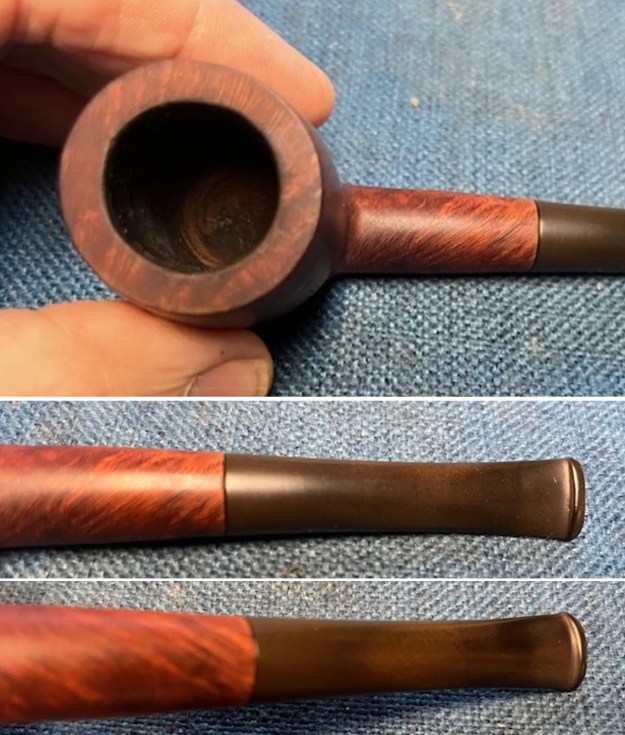
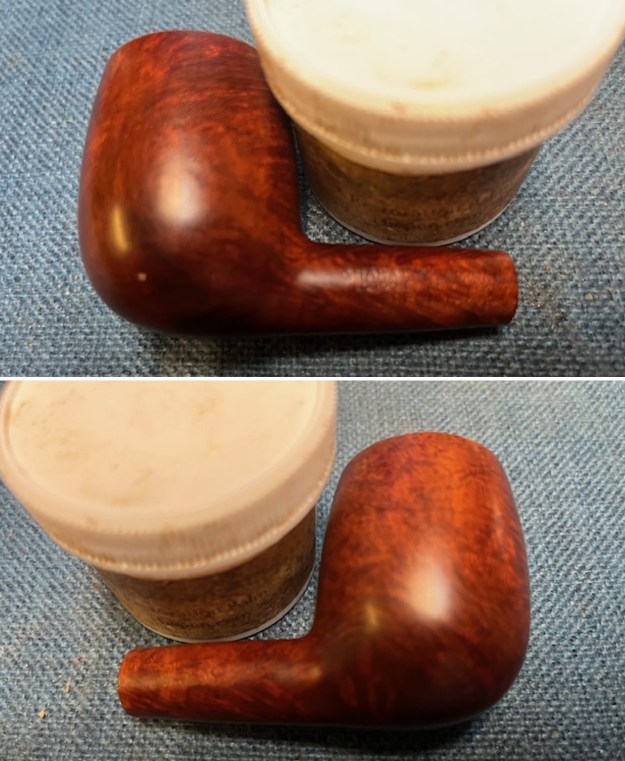
Jeff had cleaned it thoroughly. He had reamed it with a PipNet reamer and cleaned that up with a Savinelli Fitsall Pipe Knife. He had scrubbed the exterior of the briar with undiluted Murphy’s Oil Soap. He removed the shiny coat on the briar with acetone on cotton pads. He cleaned out the interior of the shank, sump and airway in the shank and stem with alcohol, pipe cleaners and cotton swabs. He scrubbed the stem with Soft Scrub to remove the oxidation and calcification on the surface. He soaked it in Before & After Deoxidizer to remove the oxidation. He removed it from the Deoxidizer and rinsed it off with warm water. I took some photos of the pipe before I started my part of the work. I took some close up photos of the rim top and also of the stem surface. I wanted to show what an amazing job Jeff did in the cleanup of the rim top. The rim top was and inner edge were in excellent condition. There were spots on the surface where the stain had lightened – both inner and outer edges. I also took close up photos of the stem to show the condition of the acrylic. It was in clean but there were tooth marks and chatter on the stem ahead of the button on both sides. One of the things I appreciate about Jeff’s cleanup is that he works to protect and preserve the nomenclature on the shank of the pipes that he works on. The stamping on this one had faint spots on the edges so I was worried that it would worsen with the cleanup. I took some photos to show the clarity of the stamping. The photo is a little blurry but the stamping remains the same. I have noticed that many restorers are not careful to protect the stamping in their cleaning process and often by the end of the restoration the nomenclature is almost destroyed. I would like to encourage all of us to be careful in our work to preserve this as it is a critical piece of pipe restoration! I took the stem off the shank and took a photo of the pipe to capture the look of the pipe as a whole.I started my work on the pipe by touching up the light areas around the rim top and edges with a Walnut Stain pen. It blended well into the surrounding briar.With that finished the bowl was very clean and the sandblast looked great. I rubbed the bowl and rim down with Before & After Restoration Balm. I worked it into the sandblast surface of the briar with my fingertips and a horse hair shoe brush to clean, enliven and protect it. I let the balm sit for 10 minutes and then buffed with a cotton cloth to raise the shine. I really like watching the Balm do its magic and bring the briar alive. I set the bowl aside and turned my attention to the stem. I decided to open the single hole in the end of the button and shape a slot. I used a Kemper Tool (small pottery saw) to begin the process of shaping the slot in the button. Once it was begun I used several small needle files to further shape the slot. I sanded the edges of the slot with a folded piece of 220 grit sandpaper. Once I had finished it was open and the draw was much improved. I “painted” the tooth marks on both sides of the stem with the flame of a Bic lighter and as expected I was not able to lift them at all. I filled in the tooth marks with clear CA glue and let the cure. I flattened out the repairs with a small file to start blending them in. I sanded the areas smooth with 220 grit sandpaper and started polishing with 600 grit wet dry sandpaper. I polished the stem with micromesh sanding pads – wet sanding with 1500-12000 grit pads. I wiped the stem down after each sanding pad with Obsidian Oil to give the sanding pads some bite. I polished it with Before & After Pipe Stem Polish – both Fine and Extra Fine. I gave it a coat of Obsidian Pipe Stem Oil. I know that most think it does nothing for acrylic stems but I use it anyway as I find it works very well to deepen the shine. I set it aside to dry. Once again at this point in the restoration process I am excited to be on the homestretch. I look forward to the final look when the Charatan’s Make London England 4143 Sandblast Pot is put back together, polished and waxed. I put the bowl and stem back together. I lightly polished the bowl and the replacement stem with Blue Diamond. I gave the bowl and the newly fit stem multiple coats of carnauba wax. I buffed the pipe with a clean buffing pad to raise the shine. I hand buffed it with a microfiber cloth to deepen the shine. The pipe polished up pretty nicely. The depths of the sandblast really pop with the wax and polish. The shiny black acrylic stem is a beautiful contrast to the browns of the bowl. This Charatan’s Make London England 4143 Sandblast Pot with an acrylic replacement stem was another fun pipe to work on. It really is a quite stunning piece of briar whose shape follows the flow of the briar. The pipe feels great in the hand will be better when warmed up while smoking. The finished pipe is shown in the photos below. The dimensions of the pipe are Length: 5 ¾ inches, Height: 1 ½ inches, Outside diameter of the bowl: 1 ½ inches, Chamber diameter: 1 inch. The weight of the pipe is 1.62 ounces/46 grams. I will be putting it on the rebornpipes store in the British Pipemakers Section if you would like to add it to your rack and carry on the previous pipeman’s legacy. This is an interesting estate to bring back to life.
As always, I encourage your questions and comments as you read the blog. Thanks to each of you who are reading this blog. Remember we are not pipe owners; we are pipe men and women who hold our pipes in trust until they pass on into the trust of those who follow us.
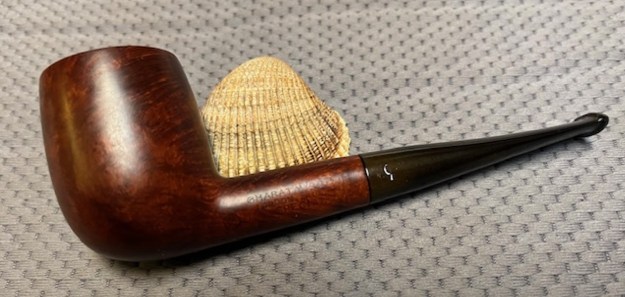
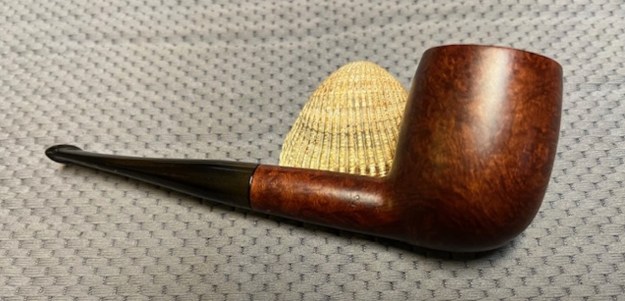
A Welcome Mysterious Change of Pace – An Older Pipe with a Metal Cap and Horn stem


Blog by Steve Laug

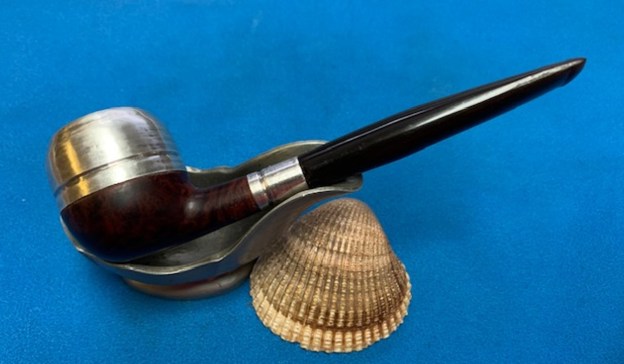
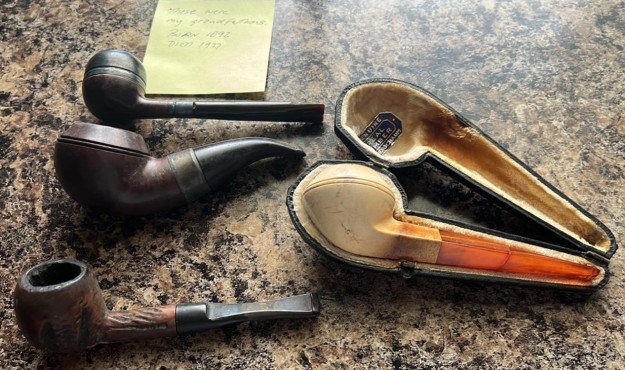
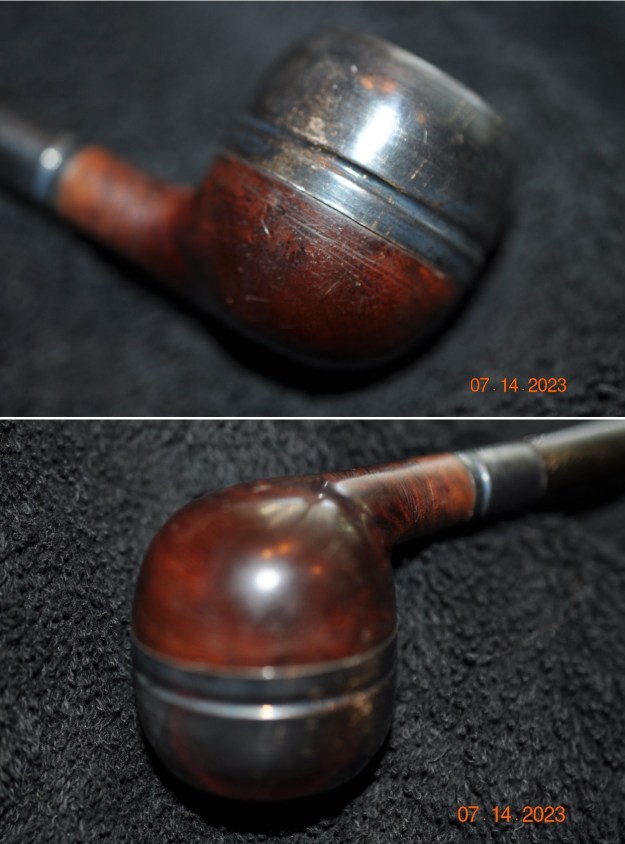
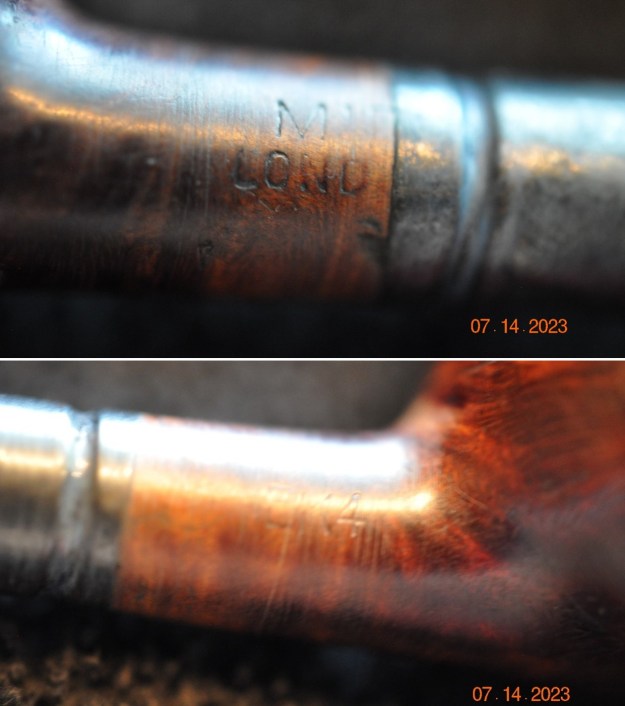
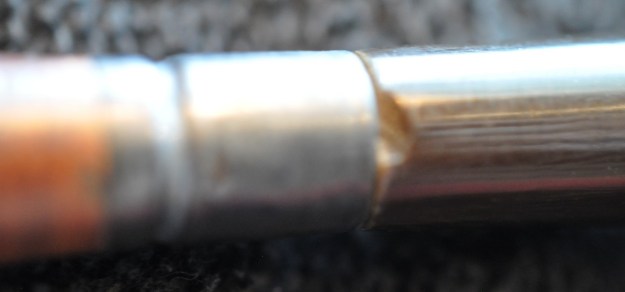
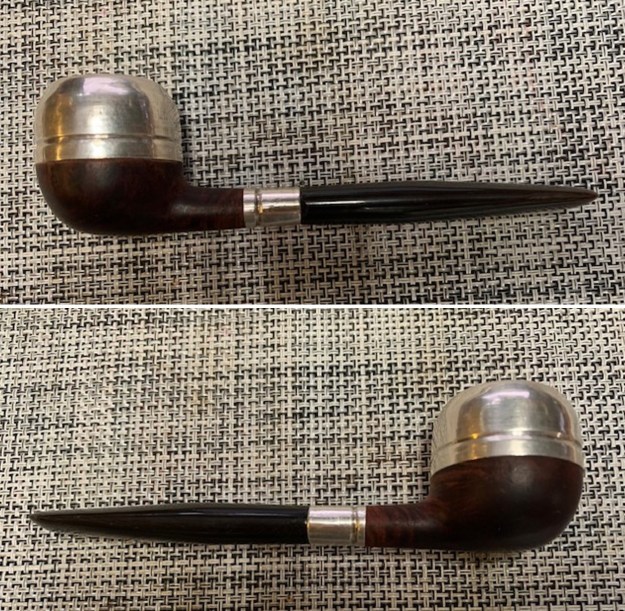
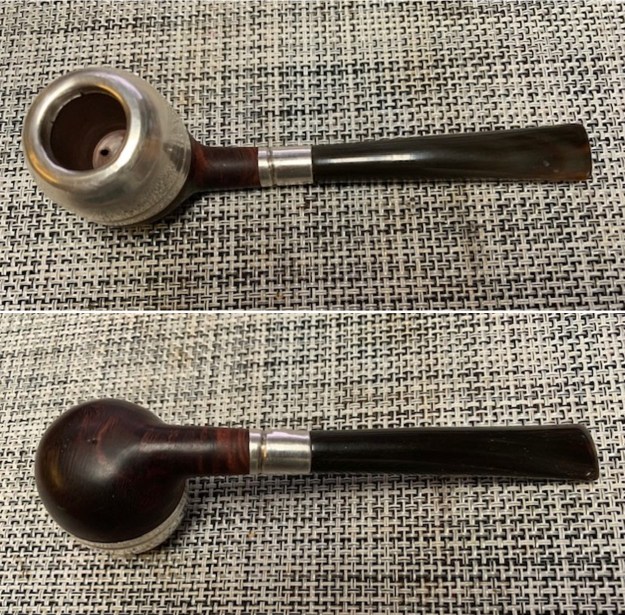
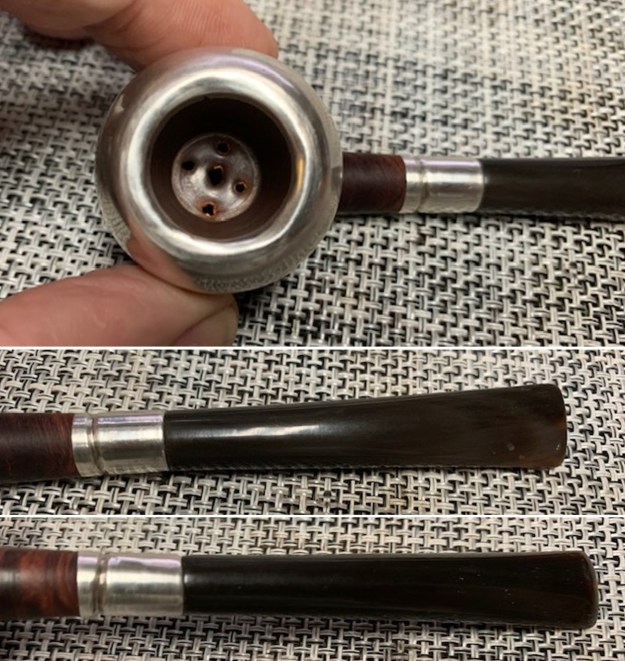
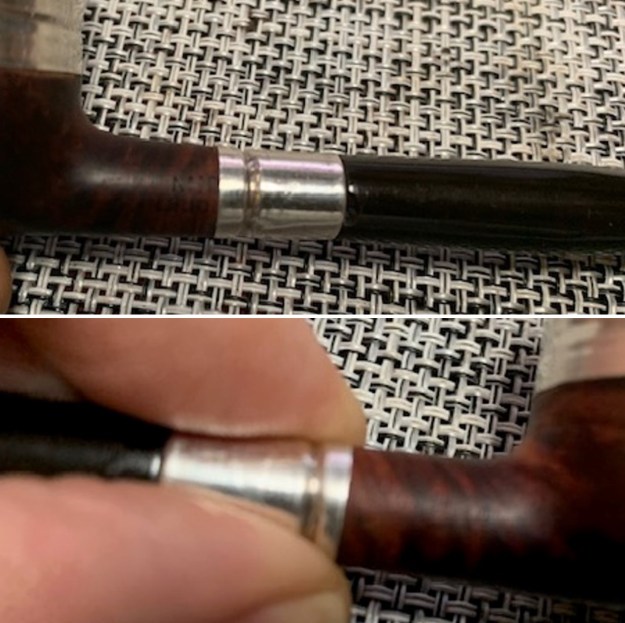
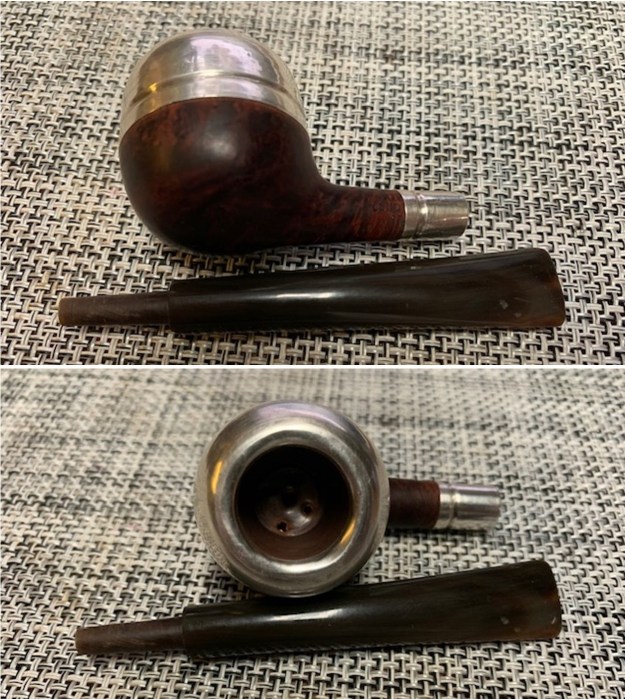
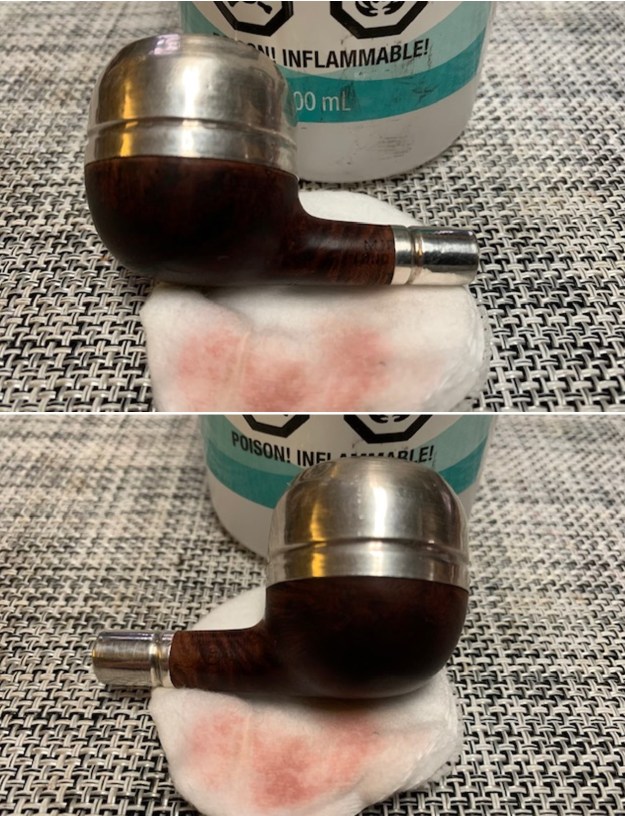
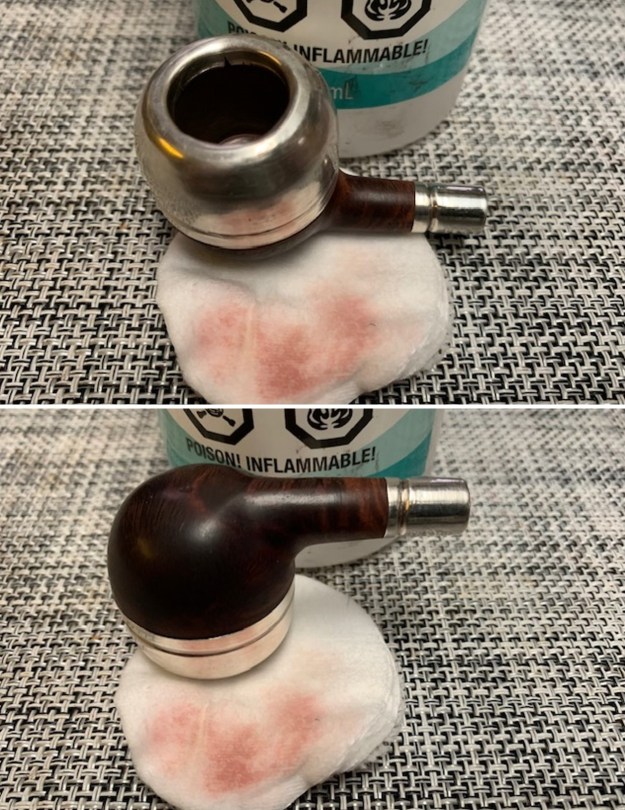
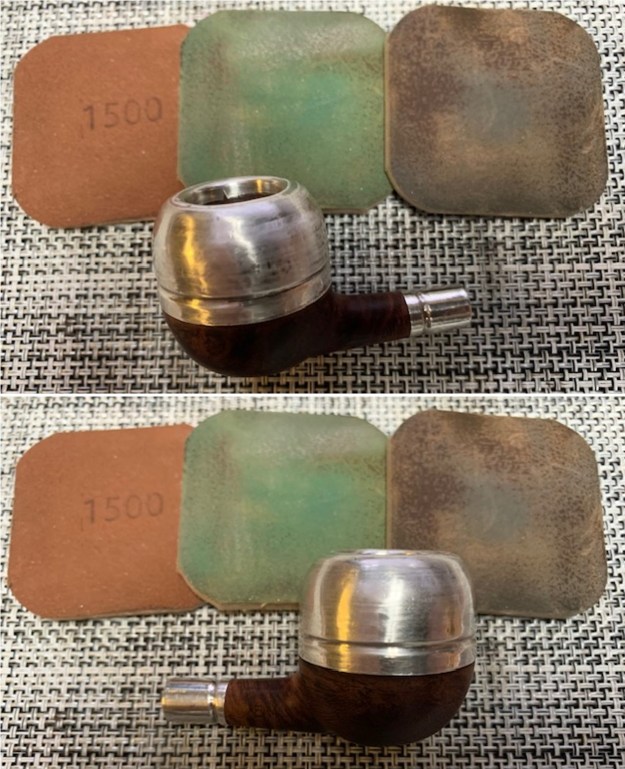
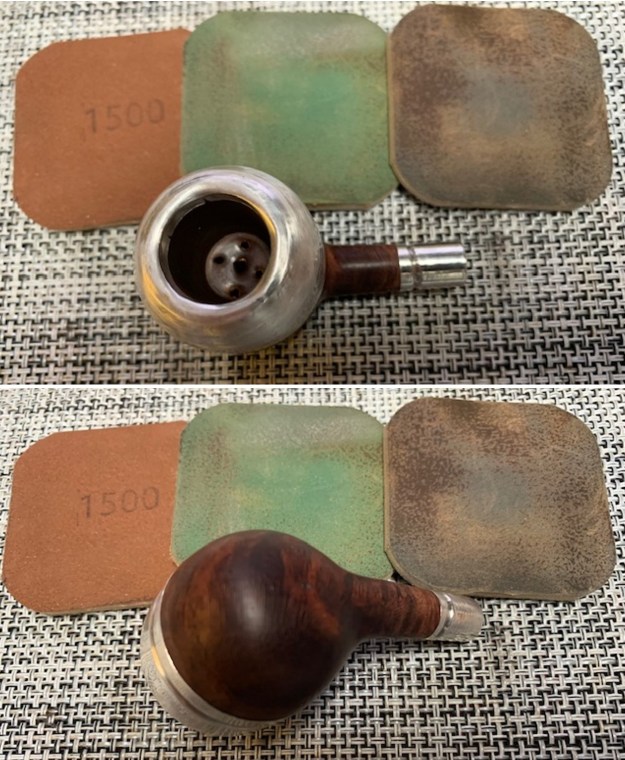
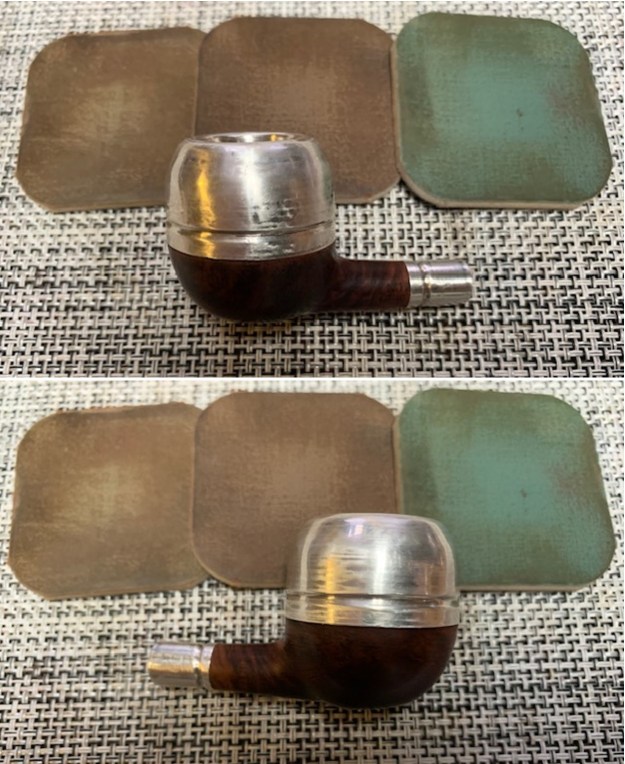
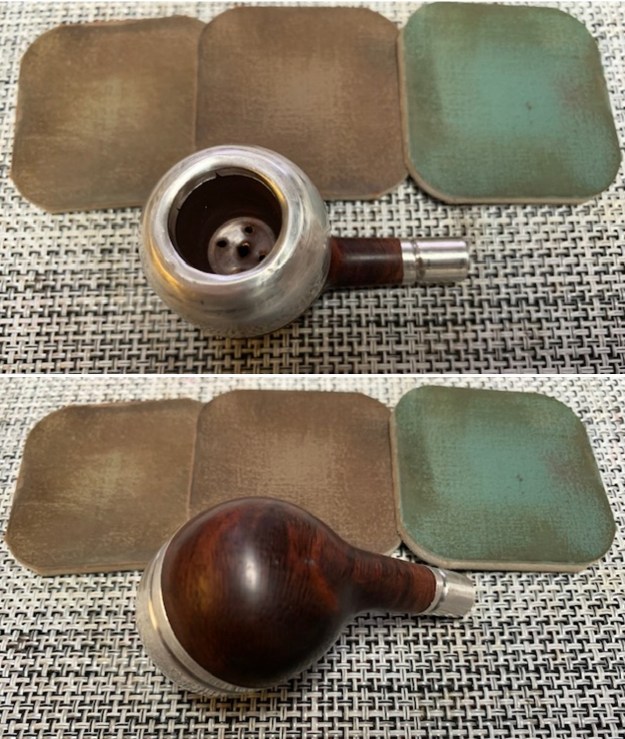
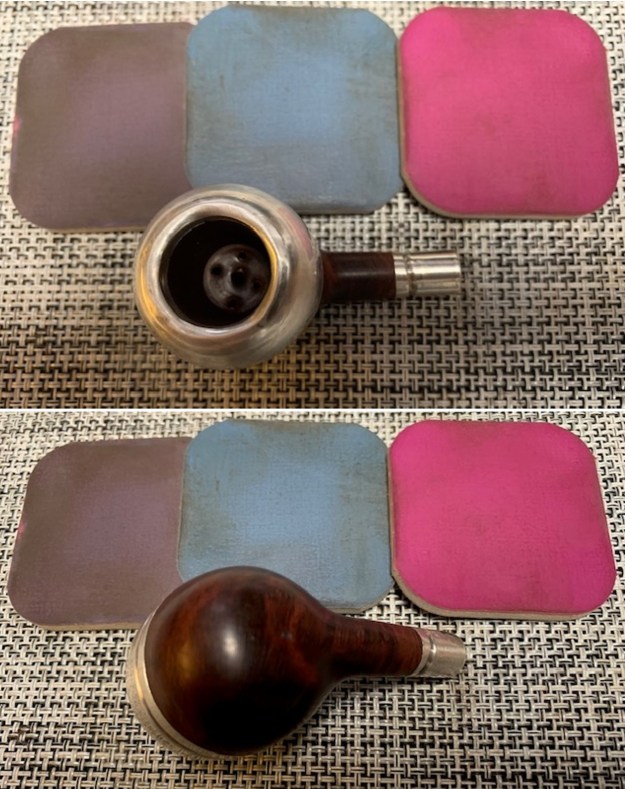
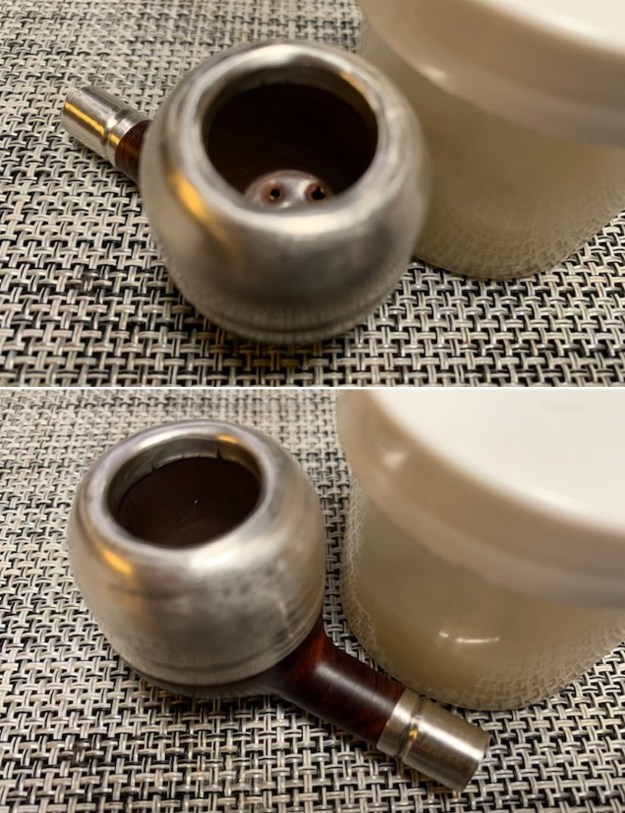
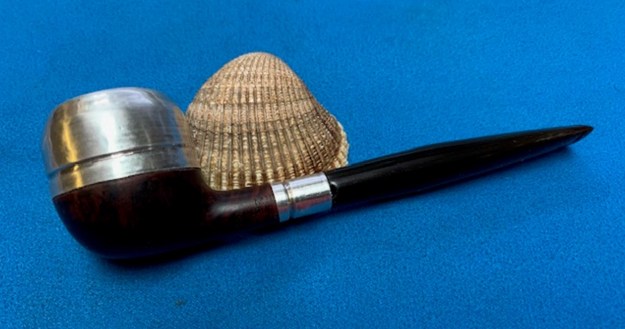
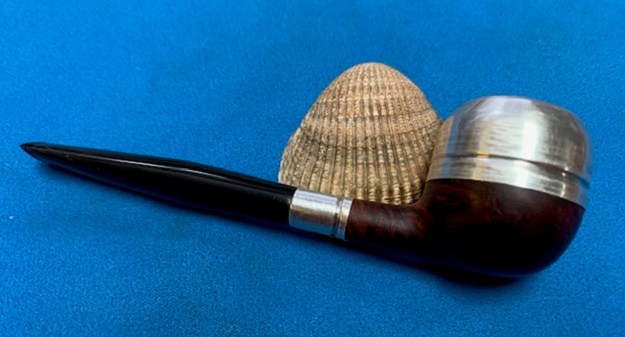
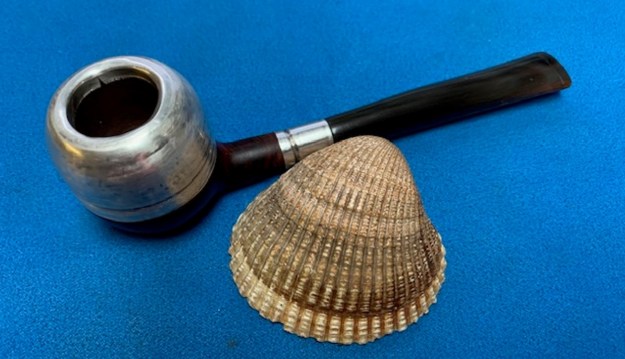
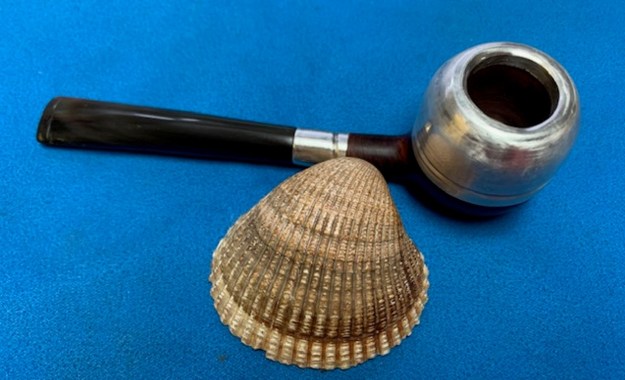
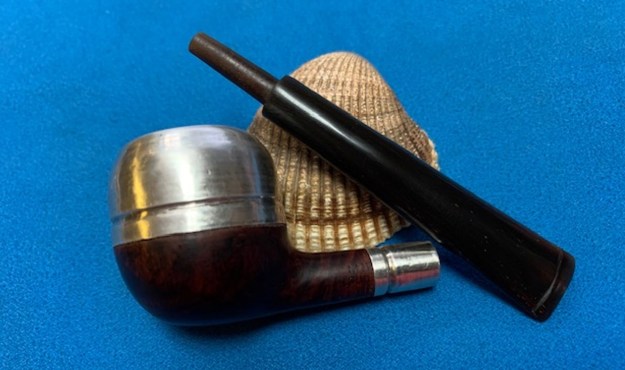
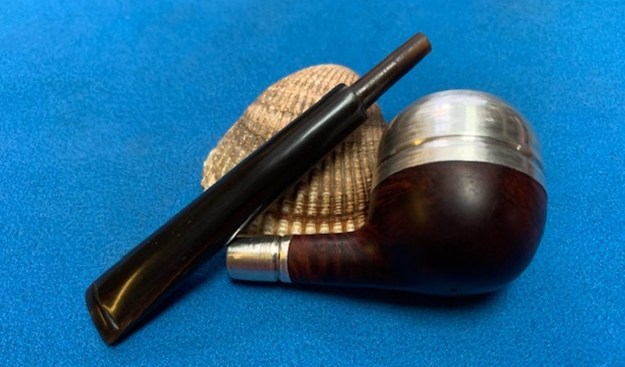
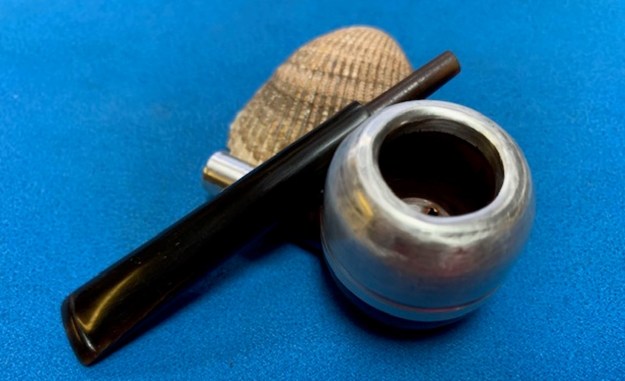
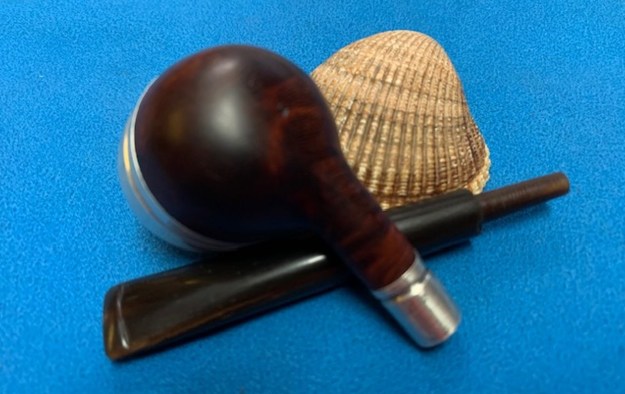
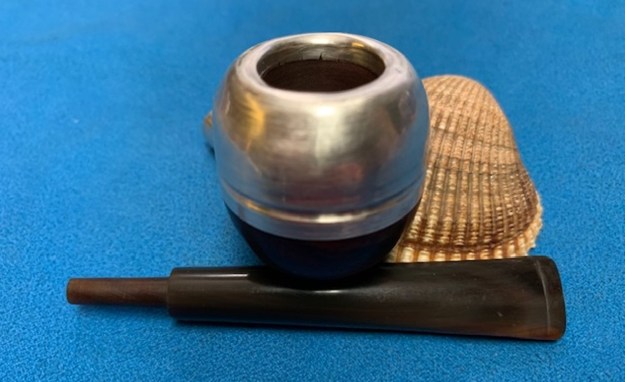
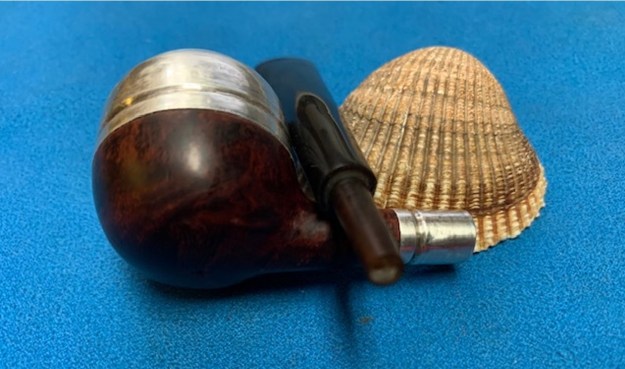
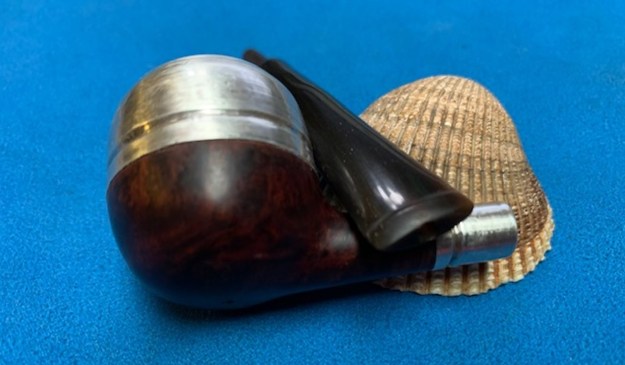
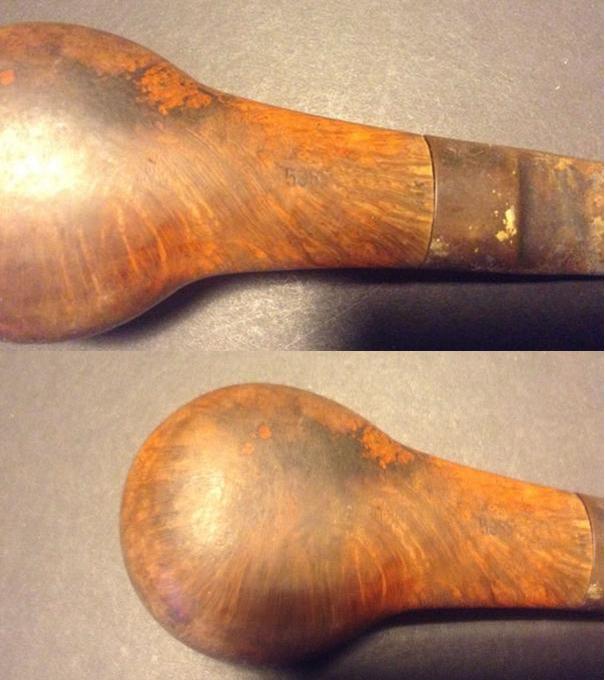
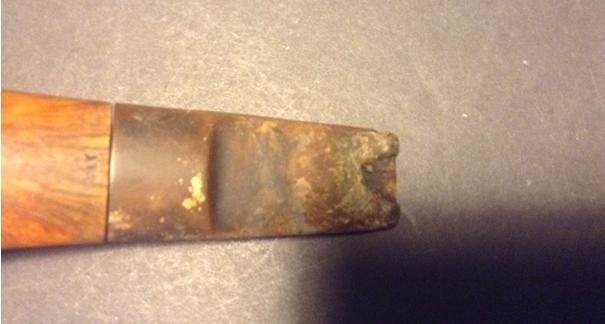
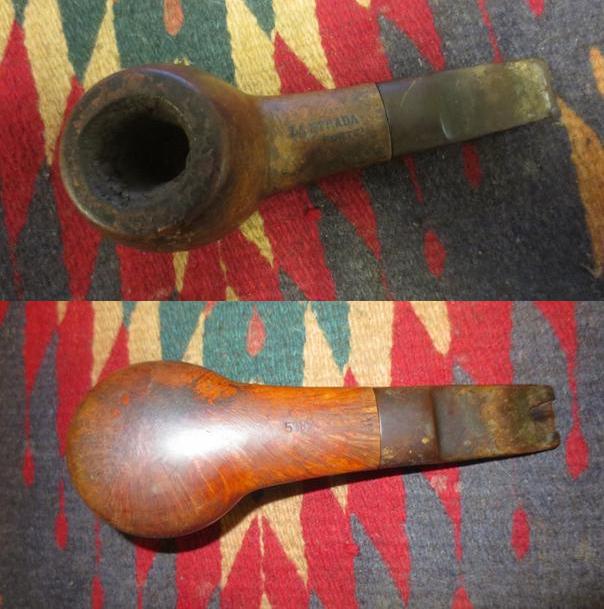
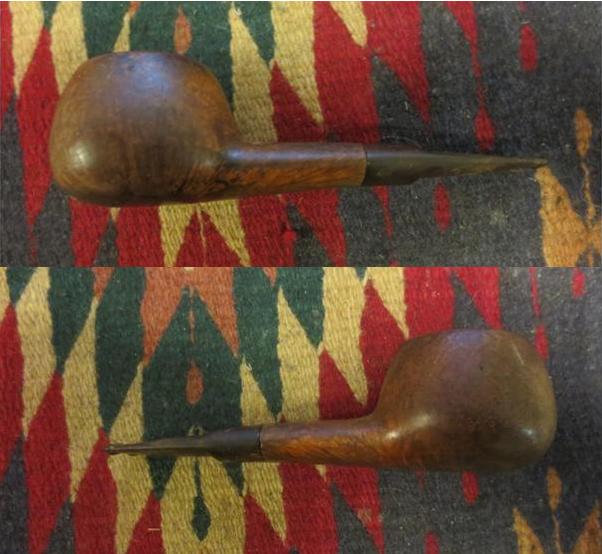
I decided I needed a change of pace in my restoration/clean up work. I went through my pipes waiting in the queue and chose pone from a group of four pipes that were given to us by a woman in Columbus, Ohio, USA. It had belonged to her Grandfather who lived from 1882 to 1977. There were four pipes that she sent us from his estate – the metal bowled apple, a cased meerschaum with a broken shank and an amber stem, a Whitehall rusticated apple and a BBB Glokar Fraternity Pipe.I chose the metal cap one because it seemed to call out to me with a voice of mystery. It is a very unique pipe with a briar base and silver rim cap. There seems to be a metal bowl insert under the inside lip of the cap. The bowl has five holes in the bottom of the bowl. The pipe has a silver ferrule on the shank end. It covers some of the stamping on the shank but what remains is readable. The partial stamp on the left side of the shank read… MID [over] LOND….The rest is covered by the ferrule. The stamp on the right side read BK4. The pipe was dirty and well used. The finish on the bowl was spotty showing damage to the varnish coat. The bowl had tobacco debris in it but little cake. The silver cap and ferrule were very tarnished. The stem was dark horn and there were some nicks in the edge where it sat against the ferrule. There was no button on the stem but was tapered down to a orific opening in the end of the stem. Jeff took photos of the pipe before he started his cleanup work.Jeff took photos of the rim top and bowl to show the condition. You can see the tarnish on the silver and some scratching in the rim top. The bowl is almost copper coloured but it is not entirely clear at this point. The horn stem is quite clean and polished. There were scratches on the button end of the stem and some nicks on the shank end. Jeff took photos of the sides and heel of the bowl to show the composition of the pipe. You can see the damage to the varnish and the tarnish on the silver rim cap. He took photos of the stamping on the shank sides. You can see what is readable and what has been cut off by the placement of the ferrule on both sides. It is clear and reads as noted above.He took a photo of the chip out the end of the tenon end of the stem where it is inserted into the silver ferrule.When the pipe arrived in Vancouver it was very clean. The briar, the metal bowl insert and the rim cap/top and silver ferrule were spotless and shiny. The silver shone in both places. The horn stem looked very good. There was a small chipped area where it fit in the ferrule but otherwise it was clean and tooth marks and chatter were absent. He had cleaned out the bowl, base and the airway in the stem and shank with pipe cleaners, cotton swabs and alcohol. He scrubbed the exterior of the bowl and shank with Murphy’s Oil Soap (undiluted) and a tooth brush. He rinsed the exterior with warm running water and dried. He polished the silver, bowl and stem with a small drop of olive oil. The pipe really looked very good. It was going to be a fun one to work on for my part.  I took photos of the pipe when I brought it to the table for my work. I took photos of the bowl and the polished metal insert and cap. It is clean and it is beautiful silver work. The bowl is very clean and there are small dents and nicks in the surface of the rim cap and bowl sides. The horn stem is in great condition. It is fascinating to me that there were no button edges but the stem just ran flush to the end. There were no tooth marks or chatter on the stem surface on either side. I tried to take photos of the shank sides to capture the stamping on the briar. It is faint but it is still readable. I took a photo of the bowl and shank separated to show the condition of the pipe. It really is a great looking pipe. I started my work on the pipe by wiping down the briar with alcohol and a cotton pad. I was able to remove the spotty remnants of the finish from the bowl. I was able to remove all of the remnants of the varnish and it really looked much better without it. The grain shown through really nicely. With the polished silver the briar looks really good! I polished the briar with micromesh sanding pads – 1500-12000 grit pads. I dry sanded the briar and then progressively brought a shine to the pipe. It looked really amazing – the combination of the silver and reddish briar. It is a beauty!   I rubbed the bowl down with Before & After Restoration Balm. I worked it into the finish with my fingertips. The product works to clean, preserve and protect the briar. I let it sit and absorb for 10 minutes. I buffed it off with a soft cloth and then gave it a rigorous buff to raise the shine. It looks good at this point. I set the bowl aside and turned my attention to the stem. I decided to give the stem a thinner profile and give it a button. I used needle files to shape the stem surface and give it a thin button. I like the new look for the stem.I sanded the filed areas and the area at the top of the stem near the tenon. I sanded it smooth with 220 grit sandpaper. I started the polishing of the stem by sanding it with 600 grit wet dry sandpaper. It is starting to look much better.I polished out the chatter and marks on the stem surface with micromesh sanding pads – dry sanding with 1500-12000 grit sanding pads. I wiped it down with Obsidian Oil on a cloth after the sanding pads. I finished the hand polishing of the stem with Before & After Pipe Polish – both the Fine and Extra Fine polishes. I gave it a final coat of Obsidian oil and set it aside to dry.I am really happy with the way that this Mystery Metal Insert Bowl with a Silver Cap and Ferrule and a Horn stem turned out. It really is a beautiful looking pipe with a great shape and smooth finished on the lower half of the bowl and silver rim cap. The original horn taper stem is really nice. The polished dark horn stem works well with the briar and the silver cap and ferrule. The briar really came alive with the buffing. The rich brown stains of the finish gave the pipe a sense of depth with the polishing and waxing. I put the stem back on the bowl and carefully buffed the pipe with Blue Diamond on the buffing wheel using a light touch on the briar. I gave the bowl and the stem multiple coats of carnauba wax on the buffing wheel. I buffed the pipe with a clean buffing pad to raise the shine. I hand buffed the pipe with a microfiber cloth to deepen the shine. The finished Silver Capped Mid…London BK4 Apple really is a beauty and feels great in the hand and looks very good. Give the finished pipe a look in the photos below. The dimensions of the pipe are Length: 5 inches, Height: 1 ½ inches, Outside diameter of the bowl: 1 ¼ inches, Chamber diameter: ¾ of an inch. The weight of the pipe is 31 grams/ 1.09 ounces. The pipe will be staying with me and joining my collection of older pipes. The horn stem, silver ferrule and rim cap look great with older dark briar. Thanks for reading this blog and my reflections on the pipe while I worked on it. It was a fun one to work on!

As always, I encourage your questions and comments as you read the blog. Thanks to each of you who are reading this blog. Remember we are not pipe owners; we are pipe men and women who hold our pipes in trust until they pass on into the trust of those who follow us.
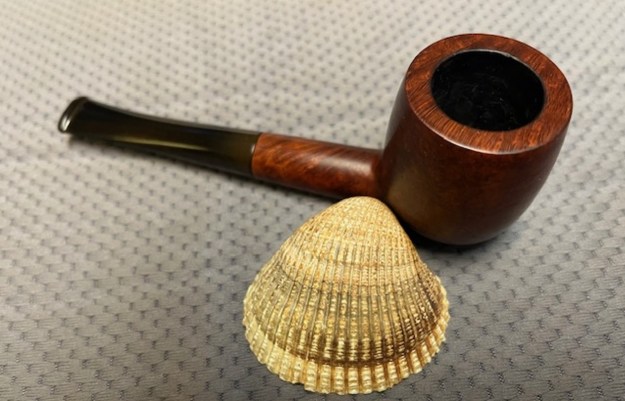
Reshaping the stem on a Butz-Choquin Maitre-Pipier Deluxe Special


Blog by Steve Laug

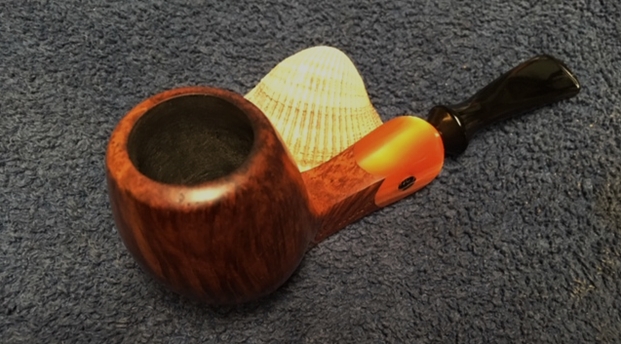
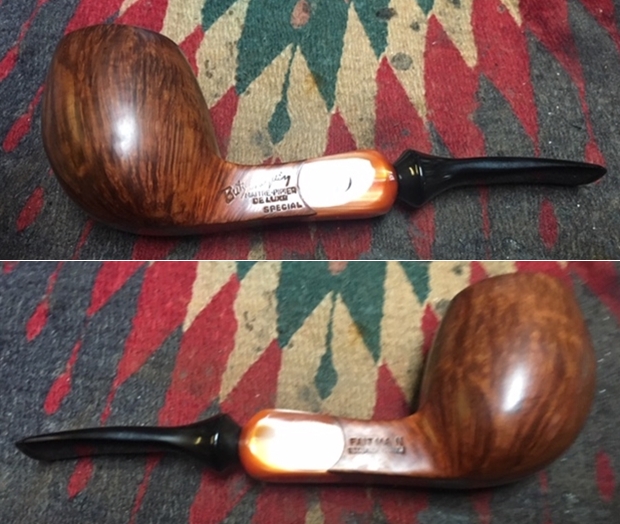
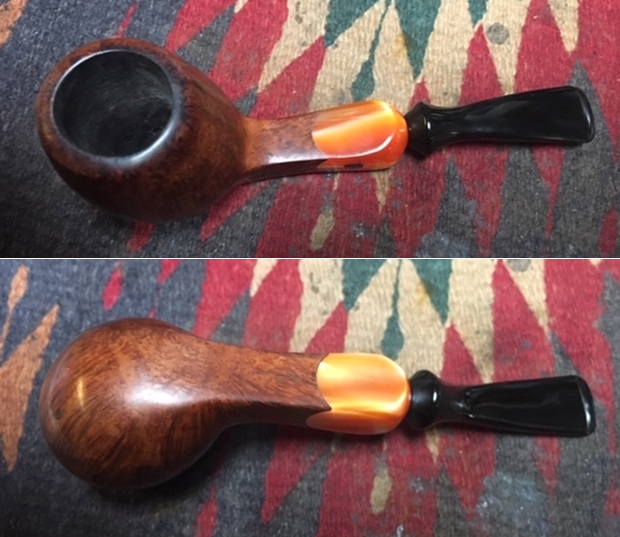
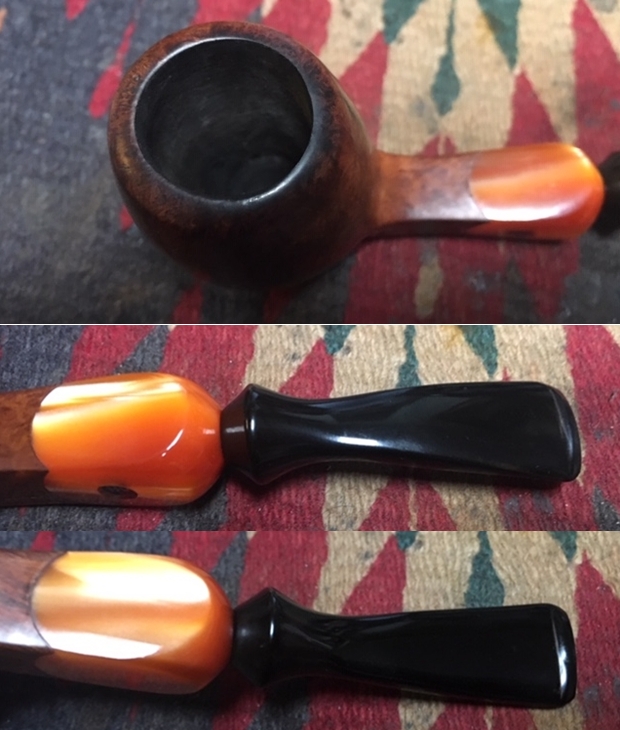
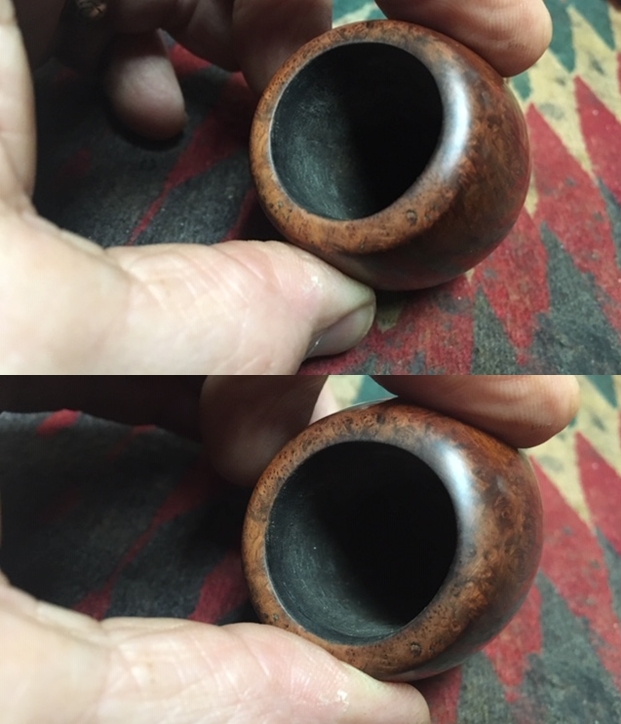
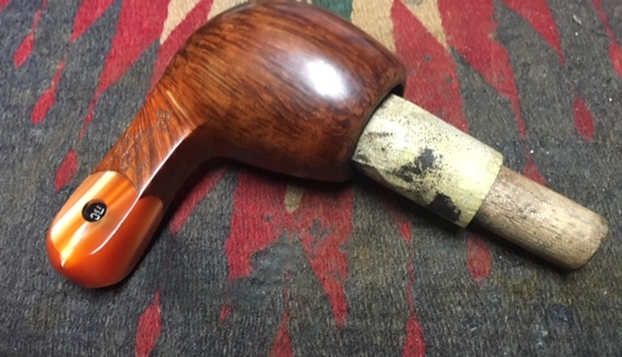
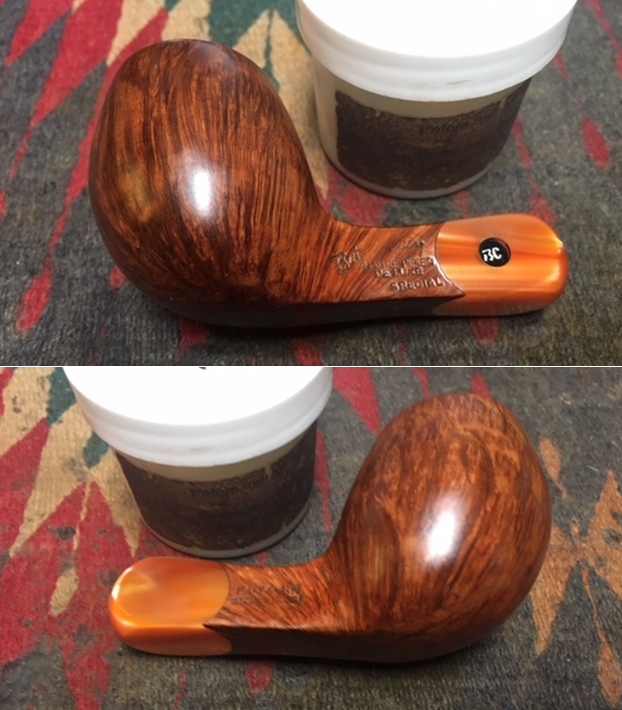
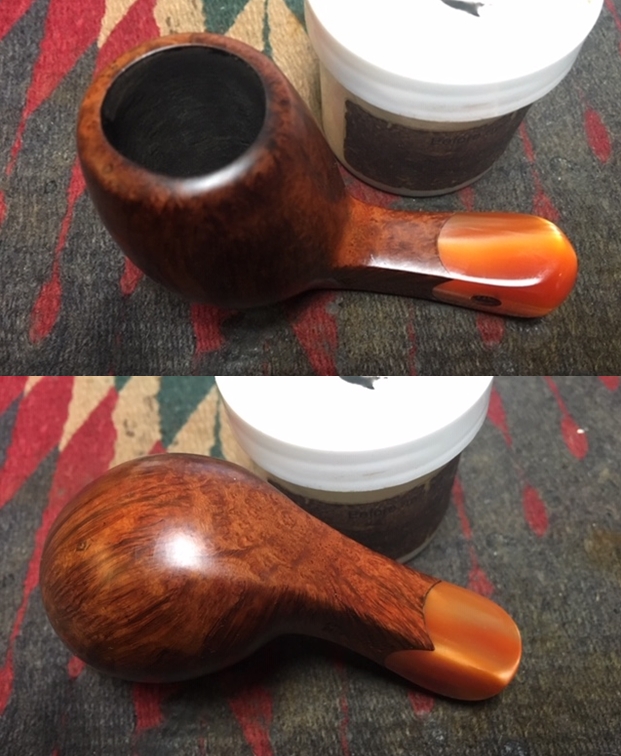
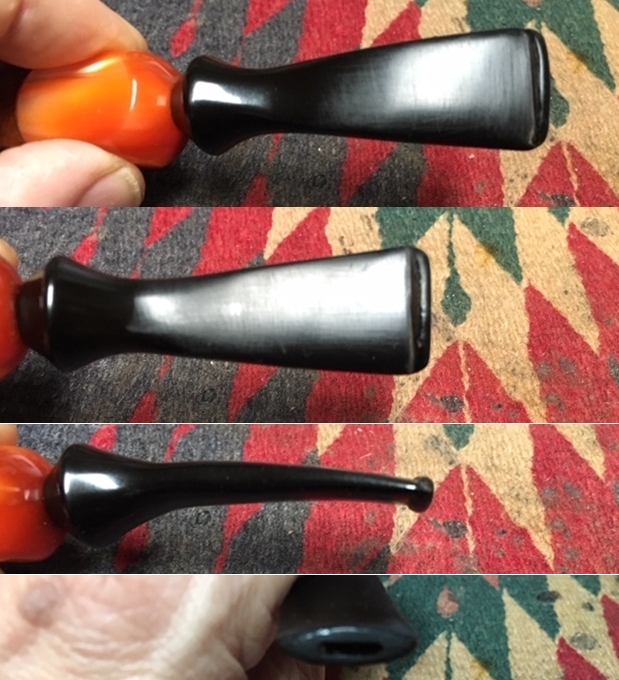
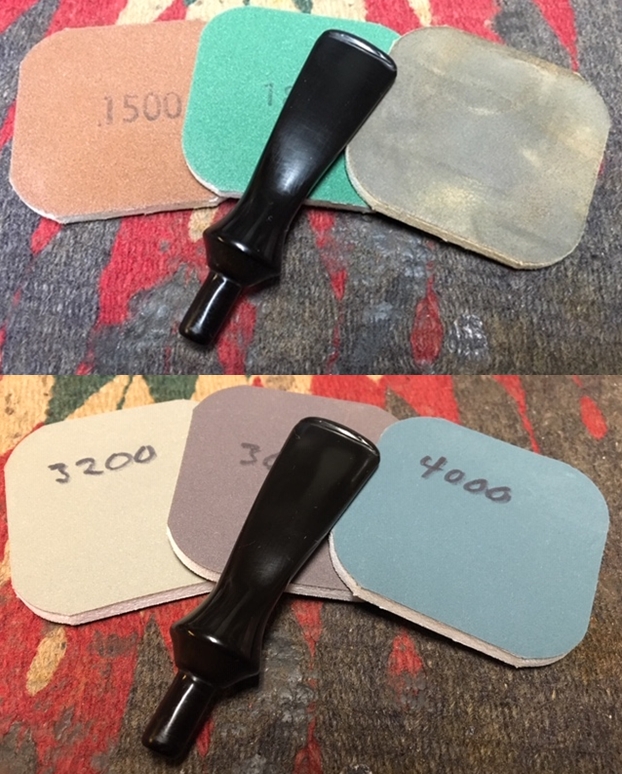
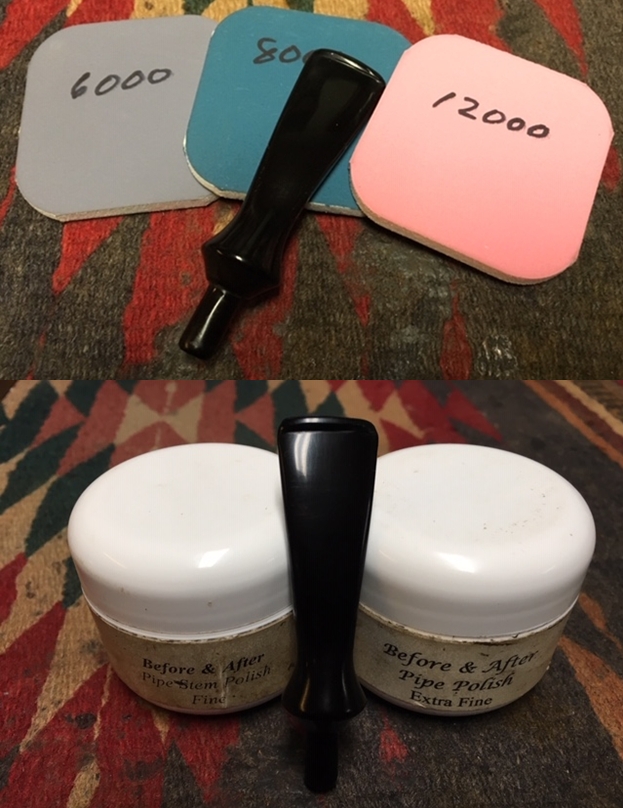
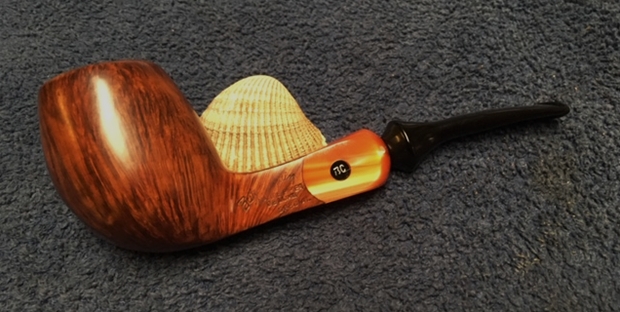
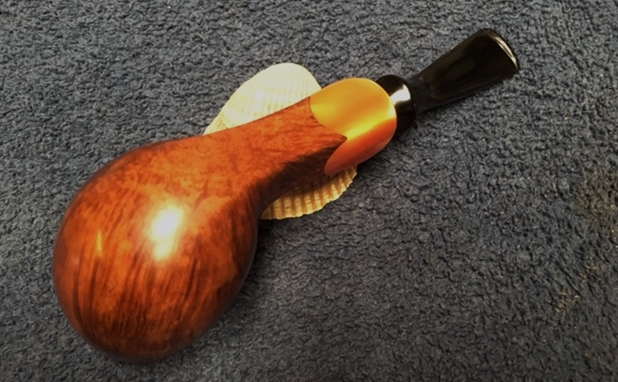
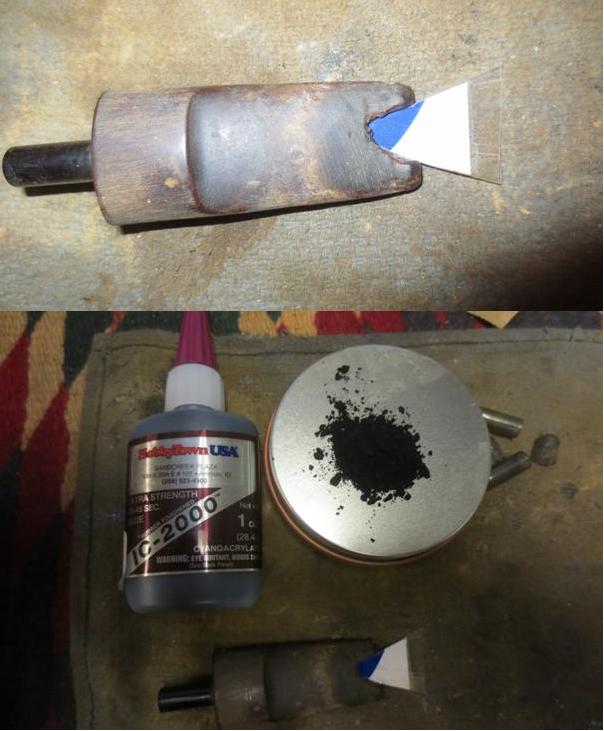
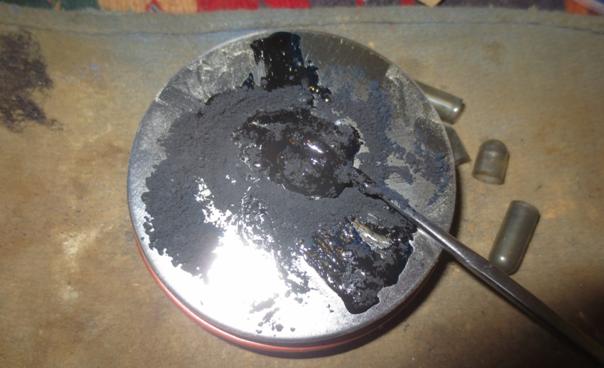
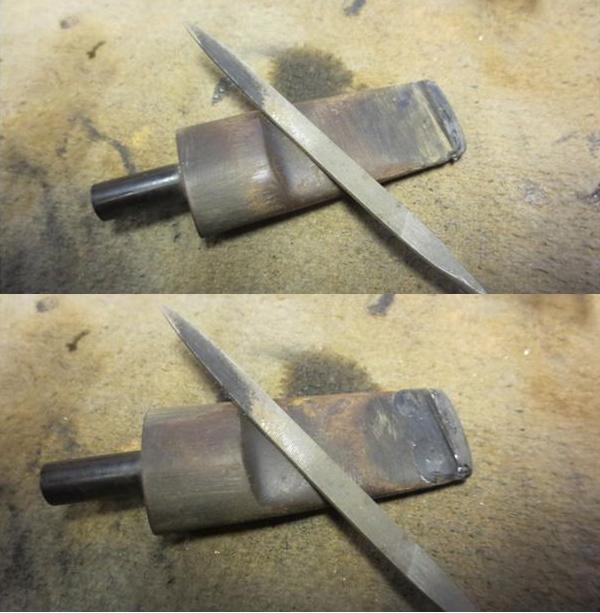
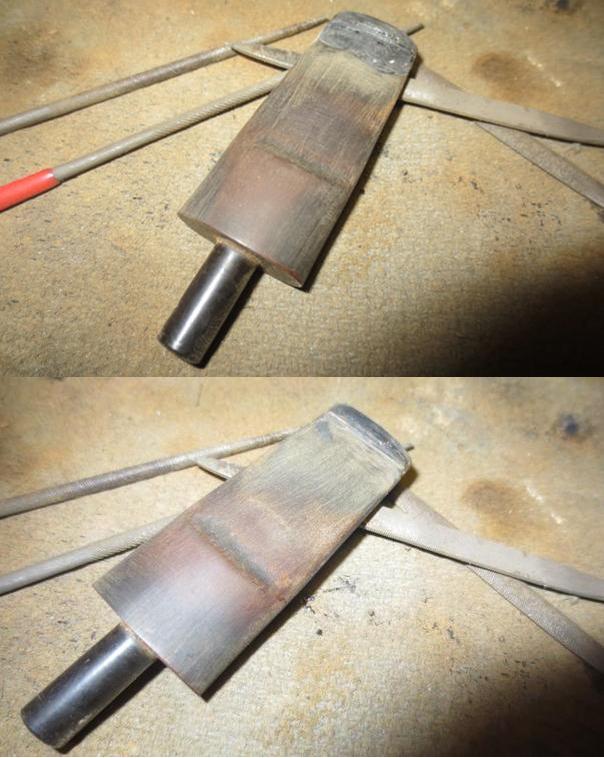
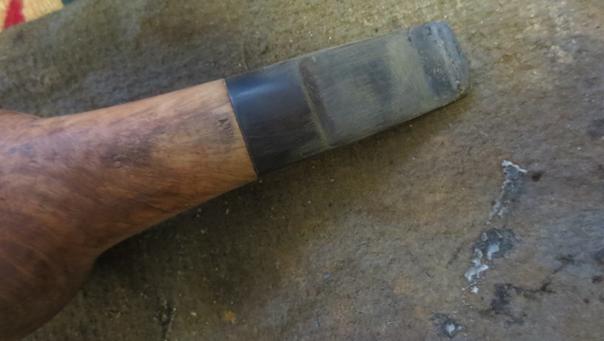
A friend on Facebook reached out to me to see if I would have a look at a pipe he picked up off EBay. It was a Butz-Choquin pipe that was stamped on the left side of the shank Butz-Choquin over Maitre-Pipier over Deluxe over Special. On the right side it was stamped Fait Main over St. Claude France. It had a canted egg shape to it and a square shank. It had an orange acrylic shank extension – lots of undulating oranges. There was an inset BC logo in the shank extension. It was rounded on one end and set up for a military style bit. The bit itself was a freehand style. The pipe had been cleaned up nicely. What he wanted was to have me have a look at the rim top to see if I could remove some of the damage and at the stem to see if I could build up the button. When it arrived I took a few photos to capture the look and feel of this handmade pipe. I took a picture of the rim top to show the condition that he had asked me to deal with for him. It did have some significant darkening and the closer I looked at it I could also see that there appeared to be a groove around the bottom inside of the bowl. I also took photos of the stem to show the condition of the button. It was worn and ill-defined.I started working on the pipe by cleaning up the darkening on the rim top with micromesh sanding pads. I wet sanded it with 1500-2400 grit pads and dry sanding with 3200-12000 grit pads. I was able to clean off much of the darkening and leave the rim top looking much better.I cleaned up the inside of the bowl with a Savinelli Fitsall Pipe Knife and was able to remove what had appeared to be a groove around the bottom of the bowl. It turned out to be a cake that had been left behind when the pipe had been reamed originally. I wrapped a piece of 220 grit sandpaper around a piece of dowel and sanded the walls of the bowl to smooth them out.I rubbed down the smooth briar with Before & After Restoration Balm. I worked it into the smooth surface of the bowl. I worked it into the bowl and shank with my fingertips to clean, enliven and protect the briar. I let it sit for a little while and then buffed with a cotton cloth to raise the shine. The following photos show the bowl at this point in the restoration process. The rim looks much better than when I started but still needs to be polished and buffed to raise a shine on it. I built up the surface of the button with black super glue. I layered it repeatedly until the surface was thicker. I defined the edge of the button with a needle file and sanded it with a folded piece of 220 grit sandpaper to clean up the file marks. I layered more on the surface and sanded it smooth. I took the following photos to show the progress.I worked on the button to smooth out the surfaces and shape it more finely. I used 220 grit sandpaper to do the shaping. I polished it with micromesh sanding pads – wet sanding it with 1500-2400 grit pads and dry sanding it with 3200-12000 grit pads. I rubbed it down with Obsidian Oil after each grit pad. I gave it a final polish with Before & After Pipe Polish – both Fine and Extra Fine to remove the minute scratches that remained. I gave it a last coat of Obsidian Oil and set it aside to let it dry. I the polished stem and the bowl with Blue Diamond to polish out the remaining small scratches and raise the shine. I gave the bowl and the stem several coats of carnauba wax and buffed the pipe with a clean buffing pad to raise the shine. I hand buffed it with a microfiber cloth to deepen the shine. The pipe polished up pretty nicely. I am hoping the owner will be pleased with the redefined button on the stem and the cleaned up rim top. I think it came out beautifully. The finished pipe is shown in the photos below. The dimensions are Length: 6 inches, Height: 2 inches, Outside diameter of the bowl: 1 3/8 inches, Chamber diameter: 7/8 of an inch. Thanks for walking through the restoration with me as I worked this interesting handmade Butz-Choquin canted egg. It will soon be heading back to its owner in New York. Thanks for looking.
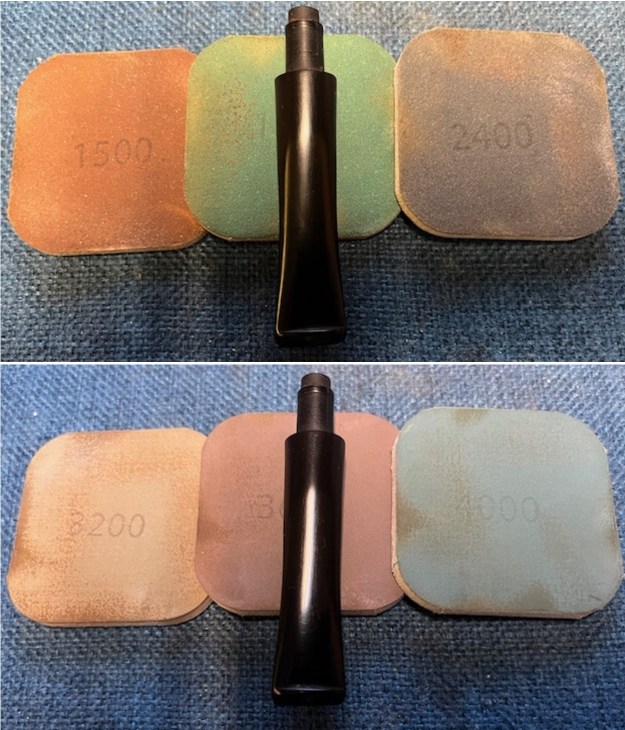
Salvaging a Kaywoodie All Briar Rhodesian 50B with a Serious Issue


Blog by Steve Laug

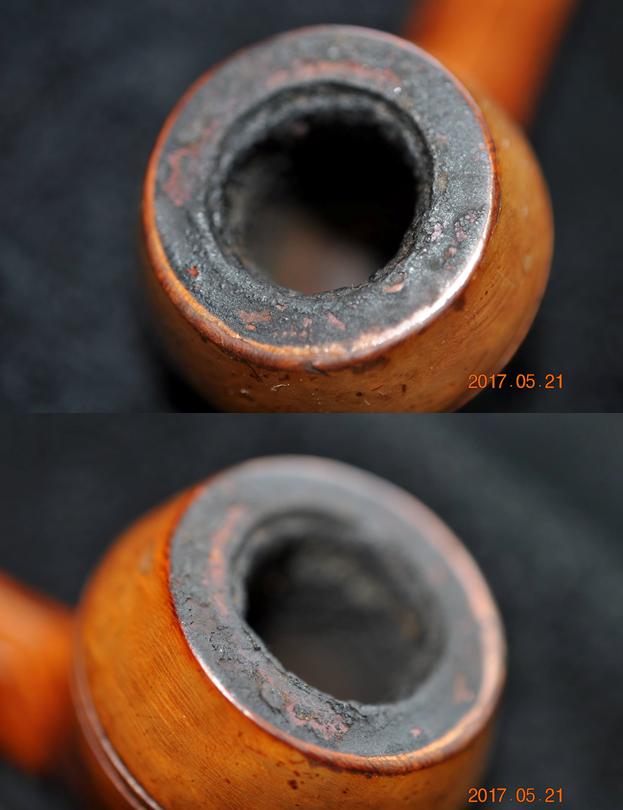
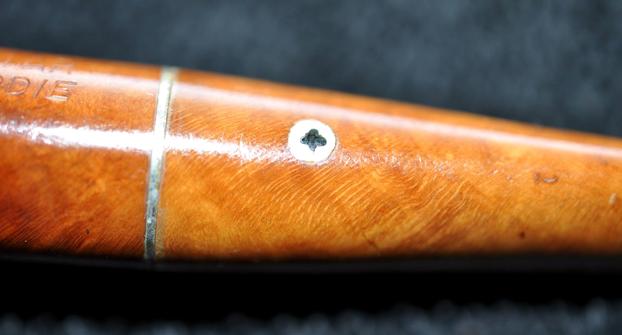
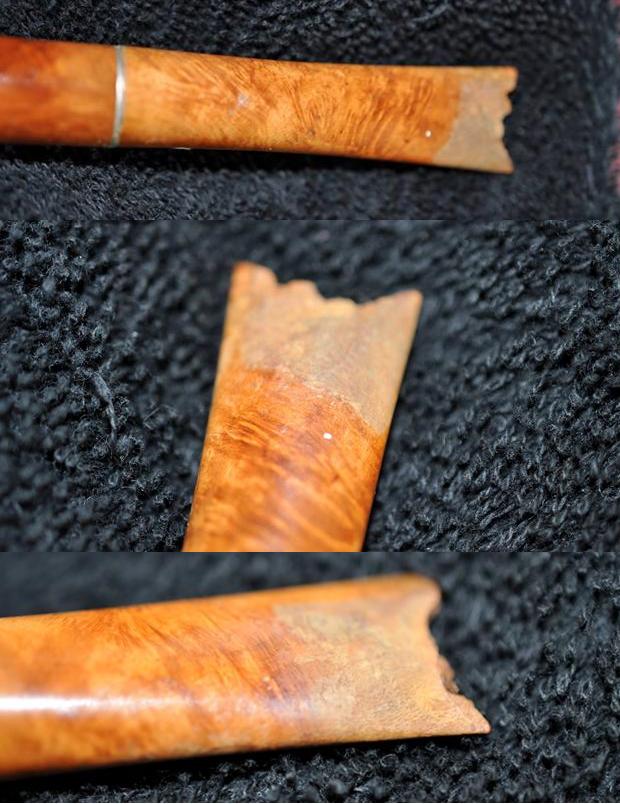
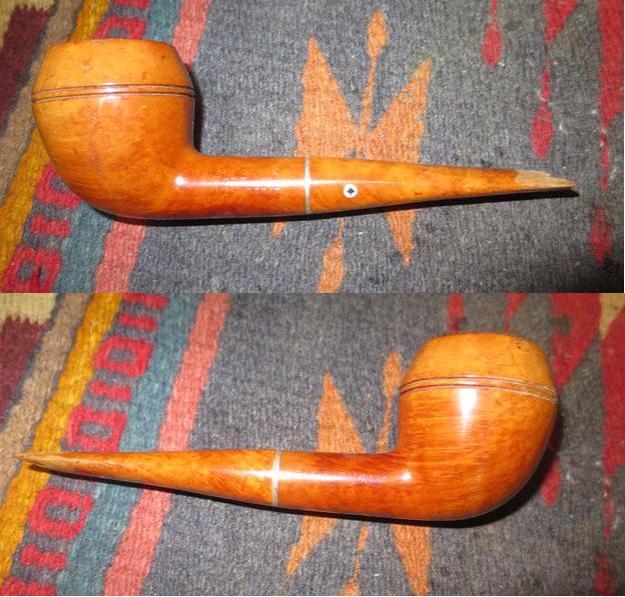
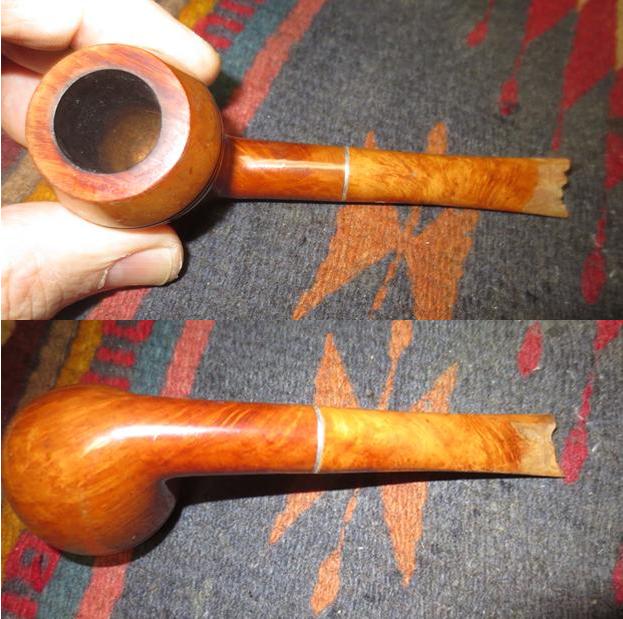
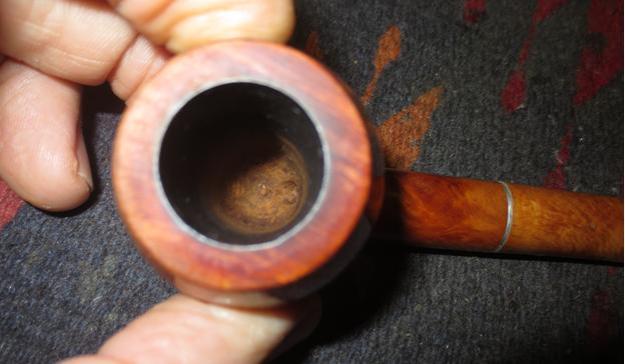
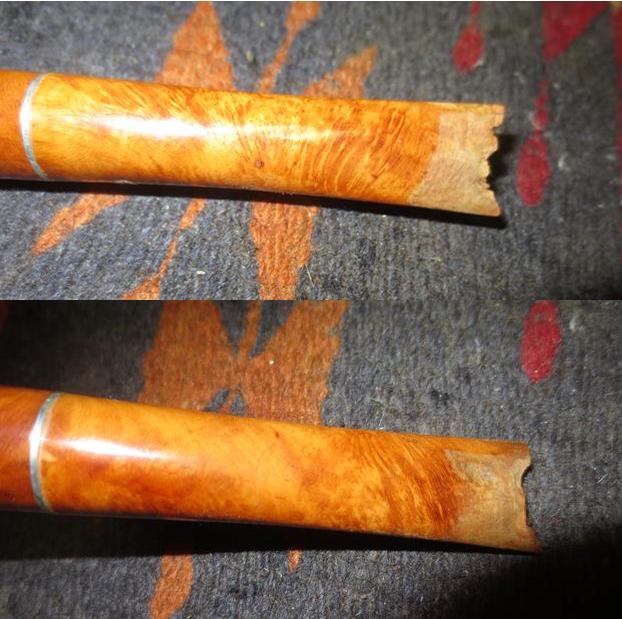
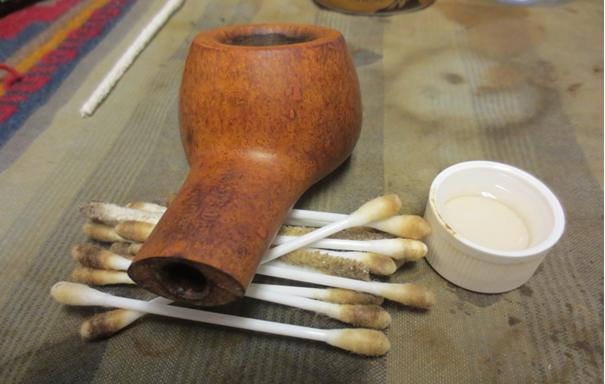
I have reworked a lot of stems over the years – from cutting them back in my early days and reshaping a button on the gnawed and damaged end to rebuilding a chewed button with charcoal and super glue. I have fit stem blanks on shanks to replace damaged and what were at that time in my assessment, irreparable stems. Today I am more conservative and lean towards rebuilding the stem as best as I can. That being said there are even challenges to that work. The pipe on my worktable now is a challenge to my current bent. It is an All Briar Rhodesian. I have only refurbished one other All Briar pipe in the past – a beautiful LHS Purex Bullmoose. It was in excellent condition other than being dirty and worn. I had heard nightmare tales of gnawed and chewed all briar stems and what a pain they are to work on. However, until this pipe came to my attention in a recent pipe hunt with Jeff I had never seen such a badly gnawed briar stem up close. Jeff took photos of the pipe’s condition before he cleaned it up. I have included those photos in the first part of this blog.I have read a lot of information in the past on other Kaywoodie pipes I have worked on and spent time on the Kaywoodie Collectors Forum to help educated myself on the various lines and historical periods of Kaywoodie production. On Pipedia.org there is a helpful summary of the history of the brand that has been condensed in one place. It is called the Collectors Guide to Kaywoodie Pipes (https://pipedia.org/wiki/Collector%27s_Guide_to_Kaywoodie_Pipes). I found the All Briar line of pipes included in the section of the Guide for 1955. I quote here the pertinent sections with the references to the All Briar pipe underlined and highlighted in bold.

The line-up of pipes in the 1955 catalog (Table 3 below) was more extensive than in previous years. The catalog presented an expanded line of meerschaum pipes and introduced a 4-pipe set of Matched Grain Pipes, as well as several pipes with “special features”. The number of shapes available… was not substantially different from the number offered in the 1947 catalog…

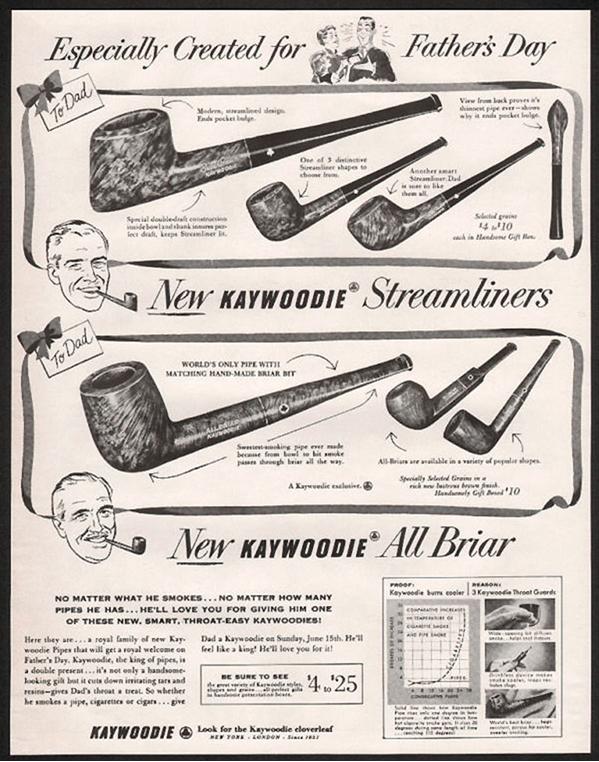
The Twin-Bowl Kaywoodies were available in an all-meerschaum model (two removable inner bowls of meerschaum) and a meerschaum and Flame Grain model (outer bowl of flame grain briar and removable inner bowl of meerschaum). Other meerschaum pipes presented in the 1955 catalog included the Gourd Calabash; the Coral (“dimpled”) Meerschaum; the All Briar (briar bit) and Flame Grain pipes with inlaid meerschaum bowls; and the “Doctor’s” pipe…Included in the guide was a helpful list of pipe grades and prices. I have included the list below and noted the pipe I am working on by highlighting it in bold print and underlining the reference. It is in this list that I found confirmation that Kaywoodie made an All Briar with a meerschaum bowl insert and an All Briar without the meerschaum insert. The All Briar I am working on is not meerschaum lined. It is fascinating for me to see that the addition of a meerschaum bowl was only $2.50 in 1955.

Table 3. 1955 Kaywoodie Pipe Grades and Prices

    Meerschaum Character Pipes: $100.00

    Block: 15.00-50 (According to size)

    Meerschaum Twin Bowl: $35.00

    Meerschaum/Flame Grain Twin Bowl: $25.00

    Sandblasted “Doctor’s” Pipe: $25.00

    Centennial: $25.00

    Coral Meerschaum: $20.00-25 (According to size)

    Gourd Calabash: $15.00-25 (According to size)

    Ninety-Fiver: $20.00

    Oversize: $10.00-25(According to style and finish)

    Connoisseur: $15.00

    All Briar w/Meerschaum Inlaid Bowl: $12.50

    Flame Grain (Meerschaum Inlaid) $12.50

    Export Pipes: $5.00-15 (According to grade)

    All Briar (Briar Bit): $10.00

    Flame Grain: $10.00

    Fit Rite: $10.00

    Silhouette: $10.00

    Carburetor: $7.50

    Relief Grain: $7.50

    Chesterfield: $5.00-15 (According to grade)

    Chinrester: $5.00-10 (According to grade)

    Stembiter: $5.00-10 (According to grade)

    Streamliner: $4.00-10 (According to grade)

    Super Grain: $5.00

    Carved Super Grain: $5.00

    White Briar: $5.00

    Standard: $4.00

    Filter Plus: $4.00

    Drinkless pup: $3.50

    Drinkless Tuckaway: $3.50

    Drinkless In-Between: $3.50

    Two-Pipe Companion Setsb: $10.00-25 (According to grade)

    Matched Grain Set (4-Pipes): $50.00

    Matched Grain Set (7-Pipes): $125.00

Further reading on Pipedia under the general listing for Kaywoodie Pipes provided me with a magazine advertisement that included the All Briar pipes. It is a great Father’s Day Ad and the bottom items in the ad show the All Briar line. I have included both the link and a copy of the ad for your reading pleasure (https://pipedia.org/wiki/Kaywoodie).Jeff sent me some close up photos of the pipe so I could see what it looked like when he started his clean up. The bowl had a thick cake that had overflowed onto the rim top with a thick coat of lava. The two photos below give two different views to show the condition of the both. You can see the flaking lava on the rim and the hard cake in the bowl. This pipe had been smoked hard and was obviously someone’s favourite.The finish on the bowl and shank was worn. There was a thick varnish coat that was peeling on the bowl sides and bottom that would take some work to remove.The stamping on both sides of the shake is faint but readable in the next photos. The pipe is stamped ALL BRIAR over Kaywoodie on the left side of the shank. On the right side it is stamped All Imported Briar over 50B (the shape number) and underneath that the letter C.The all briar stem has an inlaid black cloverleaf in a white circle on the left side. It is in decent shape and should polish out nicely.When it comes to the stem it is a serious issue. Making a new vulcanite stem for the pipe would certainly be an option but to me that would cause the pipe to lose its charm and detract from it being an All Briar pipe. I would need to do something different to bring it back to life or salvage it. It appeared to me that I had only one serious option on this pipe but I would make the final decision once it arrived.The stem had a screw in/threaded tenon with a four hole stinger. The stinger was stamped Drinkless as shown in the photo below. On Pipedia in the Kaywoodie article, there was a great advertisement for the Drinkless style of stinger so I have included that here as well. I decided to look on my other go to site – PipePhil (http://www.pipephil.eu/logos/en/logo-kaywoodie-1.html) to see what added information I might garner from his site. Under the Kaywoodie All Briar listing it said that the pipe had a twin-bore stem, meaning that instead of a slot in the button there were twin holes that formed a Y with the airway in the stem itself. The pipes were made between 1952 – 1955. It included a series of pictures of a typical briar Kaywoodie stem that showed a vertical hole near the button that was an innovation that they called Stembiter to prevent a stem biter from gnawing through the stem. Evidently, the pipe I am working on had that kind of set up on the mouthpiece as nothing is left of that portion of the stem. The Stembiter innovation came out in the early 1950s as well so now I had confirmation of the period when the pipe was made. I have included an advertisement for the Stembiter innovation following the photo below. I know that at present I will not be able to reproduce this feature on the stem when I rework it. Jeff continued using his established process of thoroughly cleaning the pipes he sends to me. He did not vary in his procedure just because of the briar stem on this one. He reamed the bowl with a PipNet reamer and touched it up with a Savinelli Fitsall Pipe Knife. He scrubbed out the mortise and the airway in the shank and the stem with pipe cleaners, cotton swabs and alcohol and cleaned the exterior of the threaded tenon and four hole stinger with cotton swabs and alcohol. He scrubbed the exterior of the pipe with Murphy’s Oil Soap to remove the grime and grit on the bowl. Sadly it did not even touch the thick varnish coat on the bowl. He worked over the rim and removed the heavy lava overflow. He scrubbed it with a tooth brush and the oil soap until he removed the buildup. His cleaning of the top cut through the varnish coat on that part of the bowl. He cleaned up the gnawed end of the stem so that at least it would be clean when I began my work on it. I took photos of the pipe to show the condition it was in when it arrived in Vancouver. Jeff cleaned up the rim really well – the tars and buildup were gone and fortunately so was much of the varnish coat. There were just a few shiny spots on the rim that would need to go. The bowl had been reamed back to bare briar.The stem while clean was an absolute disaster. It had been gnawed back through the stembite protection and the entire end of the stem was missing. I am guess that there was probably about 3/8 to ½ inch of the stem missing and the button was totally missing.I started the restructuring work on the stem with a Dremel and a sanding drum. I took the damaged areas back until I had some solid briar to work with. I did not want to remove too much of the stem material. The twin airways in the stem were very close to the surface in the stem at this point so I would need to do something a little different from the standard recutting a new button on the existing material.I started the rebuilding the end of the stem with clear super glue. I wanted to fill in the small divots in the surface of the stem on both sides and make the stem smooth and the end crisp. I built up the area where the new button would be with clear super glue first to stabilize the gnawed stem and begin with a solid edge. I put briar dust on top of the super glue and layered the dust and the glue until I had a workable portion on the stem surface. I needed enough of the new material to be able to reshape a button. In the second set of photos you can see the button area beginning to take shape. I used a needle file to recut the edge of the button and square it off with the surface of the stem. I wanted a sharp delineation from the button surface to the stem surface. I also reshaped the button surface as well with the files. The new button is beginning to be visible at this point.I filled in the air bubbles on top and underside surface of the button with clear super glue to make it smooth. I sanded the areas in front of the button on both sides of the stem with 220 grit super glue to blend it into the rest of the stem surface.I used a needle file to open the twin bore airways and smooth them out. I began to polish the stem and button with micromesh sanding pads – wet sanding the button and stem area with 1500-2400 grit sanding pads. I wiped the stem down with a damp cotton pad to see what the progress looked like. I dry sanded with 3200-4000 grit pads and then stained the stem with a Medium Brown Stain pen. I finished polishing the stem with 6000-12000 grit pads and wiped it down after each grit pad to keep the work surface clean. While the button is definitely darker than the stem body at this point it is still looking pretty good in my opinion and it feels good in the mouth. I sanded the bowl with 220 grit sandpaper to remove the varnish finish. It was spotty and peeling in places so it had to go. Once I had the finish removed I wiped the bowl down with acetone to remove any of the finish that remained. Then I used the same regimen to polish the bowl as I had used on the briar stem. I wet sanded it with 1500-2400 grit micromesh sanding pads and wiped it down with a damp cloth. I dry sanded it with 3200-12000 grit micromesh and wiped it down after each pad. Each grit pad brought more of the grain to light. There is a great mix of birdseye and cross grain on the bowl and shank. It is a beauty. I decided to not stain the bowl. The medium brown I put on the stem made the stem and bowl match so I was pleased with that. I put the stem in place on the bowl and buffed it with Blue Diamond to polish out any remaining scratches from my sanding and polishing. I gave the bowl and stem multiple coats of carnauba wax to protect it from damage and to preserve the briar. I buffed it with a clean buffing pad to polish the briar. I hand buffed it with a microfiber cloth to deepen the shine. The finished pipe is shown in the photos below. The repair and rebuilt button, though darker than the briar, works well and the pipe is fully functional again. The small amount of length I had to remove does not visibly change the overall look of the pipe. Thanks for walking with me through this restoration. It was one with challenges but it was a fun one to work on.


This one was just plain ugly it was such a mess


Blog by Steve Laug

When my brother sent me the link for this one and I scrolled through the pictures the seller included, I almost said to pass on it. It was such a mess that the ugliness made me not want to even deal with this one. But there was something challenging about the pipe and through the gunk it looked like it might have some interesting grain. I know in the early days of my estate buying on EBay I did not pay attention to the measurements on the pipe. I figured it would be a moderately sized Banker or Author with an oval shank. I also ignored the brand stamping on the pipe. It read La Strada Forte on the top of the shank which also should have been a bit of a giveaway. Even the photos below that the seller included of the pipe in a rest should have been a clue. But I missed the clue because I was blown away by the sheer disaster of the pipe. As you look at it below try to catalogue the issues that you see.La1 La2 La3 La4Let me tell you what, no matter how much I prepared myself by cataloging the issues I saw in the pictures they in no way captured the reality of the mess this pipe was in. It was actually quite unbelievable. First off, I should have read the measurements. This pipe was huge. The length was average really, at 5 ½ inches long. The width of the shank was a bit bigger at 1 1/8 inches wide. The diameter of the bowl exterior was 2 1/8 inches. The chamber appeared to be an inch in diameter but the cake in it reduced it to about ¾ inch. The cake was thick and it was hard. It overflowed onto the top of the bowl and part way down the sides. The inner edge of the rim looked like someone had hacked at it with a knife so underneath the thick cake I could see the chop marks of the knife in the edges of the bowl. The finish was more than shot – it was gone and in its place was thick oily grime ground into the briar. The stamping was black with the oils. It was thick enough that the grime was flaking off on the bottom of the bowl. The stamping was readable and said LA STRADA over FORTE on the top side. On the underside was the shape number 538 and next to the shank stem junction was stamped Italy. The stem was not only oxidized but really worn. The top edge of the button was almost flattened and there were tooth marks in the top of the stem. The underside was another story – there was a chunk of vulcanite missing and the button was gone. The airway was collapsed and the inside surface was gouged with file marks. This poor pipe was looking pretty desperate and I thought about cannibalizing it for briar and parts.La5Then I looked at the briar through the grime. The bottom of the bowl had some really nice grain – a few fills popping through – but still really nice. The sides of the bowl also had some promise under the grime. And, I liked the shape of the pipe even though it was a war club. Maybe…just maybe…La6I took a close-up photo of the top of the bowl and the cake inside. I still shake my head when I see the state of the bowl and the damage to the inner rim. It was really in bad shape. Just look at the hack job that had been done to that inner edge.La7I also took a couple of close-up photos of the stem to show the extent of damage that had been done to it as well. It was in very rough shape.La8I reamed the bowl with a PipNet reamer starting with the smallest cutting head to clean up the walls of the bowl slowly. I worked through all four reaming heads ending with the largest one. I used the Savinelli Pipe Knife to do some clean up to the edges and try to smooth out some of the rim damage. La9Between the largest PipNet cutting head and the pipe knife I was able to do a lot of redeeming work on the inner edge of the rim.La10I topped the bowl on the topping board to remove the damaged finish and to reduce the damage to the inner edge of the rim.La11I scrubbed the surface of the briar with acetone on cotton pads to remove the dirt and grime in the grain as well as the oils. It was amazing how much grit came off the bowl. La12 La13Once the surface was clean I worked on the inner rim. I used a folded piece of 220 grit sandpaper to bevel the edge inward and clean up the cuts and nicks in the edge. I did not take a picture at this point but you will see the cleaned up rim in the pictures that follow the work on the stem.

I set the bowl aside to work on the stem. To take care of the damaged stem I made a wedge out of cardboard and covered it with clear strapping tape so that the super glue mixture I was going to use would not stick to it. I wanted it thick enough to leave an airway/slot in the stem. I mixed up a paste of charcoal powder and black super glue. The glue has a slow drying time so I was able to mix a thick paste with the combination.La14 La15I used a dental pick and spatula to put the mixture in place on the top and the bottom of the stem and build up the area that would become the button on the top side and the repair and button on the underside. I also built up a slope on the stem underside to give me a bit more thickness over the airway. At this point I sprayed the repair with an accelerator to harden the surface of the glue. I set it aside to let the glue repair cure/harden.La16Once the repair had hardened I used the sanding drum on the Dremel to smooth out the repair. I would still need to sand it by hand but the Dremel took a lot of the heavy spots out of the mix and also allowed me to rough shape the button.La17The next photos show the repairs after a lot of filing and sanding. The shape is very clear and distinct. The repair is rock solid. You can also see the inner rim bevel on the rim of the bowl in the first photo.La18The slot was really tight in the button. It was partially closed off and need to be reopened. I used different shaped needle files to open the slot and to reshape it. I also reshaped the button with the needle files. The three photos below show the development of the slot and the button.La19I reshaped the button edges with needle files and reshaped the taper of the stem from the saddle to the button. I sanded it with 220 grit sandpaper to blend it into the surface of the vulcanite stem. The photos show the progression in the shaping. There is still a lot of sanding to do to finish the shaping and polishing of the stem but I set it aside and worked on the bowl for a while.La20 La21 La22I cleaned out the inside of the mortise and the airway in the shank with pipe cleaners, cotton swabs and alcohol. It took a lot of scrubbing to clean out the airway and mortise.La23I heated the briar with a blow dryer and then stained it with a dark brown aniline stain mixed 50% with isopropyl. I used a black Sharpie to darken the fills on the bowl and shank then applied the stain with a cotton swab and flamed it with a lighter to set it in the grain.La24I wiped the bowl down with alcohol cotton pads to blend the stain and to make it more transparent. The photos below show the bowl after the wipe down. The scrubbed bowl looks quite a bit lighter but once it is waxed it will darken again.La25 La26I wet sanded the stem with 1500-2400 micromesh sanding pads and rubbed the stem down with Obsidian Oil. I dry sanded it with 3200-4000 grit pads and gave it another coat of oil. I finished sanding it with 6000-12000 grit pads and gave it a final coat of oil and let it dry. (The photos below show both sides of the stem with each set of micromesh pads.)La27 La28 La29I buffed the pipe with Blue Diamond on the wheel and then gave it multiple coats of carnauba wax. I buffed it with a clean buffing pad to polish the wax. I buffed it by hand with a microfibre cloth to add depth to the shine. I am pleased with the overall look of the pipe and considering what it was like when I first looked at it the improvement is vast. The stem repair is quite extensive. It has cured and is hard now and I am curious as to how it will hold up over time. The pipe looks good and should have a long life ahead of it. Thanks for looking.La30 La31 La32 La33 La34 La35 La36 La37

Reworking a Lucite stem on a Sasieni Litewate Deluxe 71F Long Shank Dublin


Blog by Steve Laug

This pipe caught my eye as I was browsing through the for sale section of the Dr.Grabow Collectors Forum. It was in very clean condition. The finish on the bowl and rim were like new. The pipe was stamped Made in England in a circle on top of the shank next to the stem and in the center of the shank it was stamped Litewate over De Luxe. On the underside of shank near the stem was the shape number 71F. The pipe was barely smoked and was very clean. The stem was obviously a replacement Lucite stem in a bright yellow swirl pattern. In the photos it looks more green than it truly is. In reality it is very yellow.Litewate1

Litewate2

Litewate3

Litewate4 I looked up the brand on the pipedia site and found that the Litewate was produced by Parker and also sold by R.M. Littaur & Co. Ltd. It was also made by Sasieni. The circular com stamp on the shank and the shape number identified this particular pipe as a Sasieni made pipe. http://pipedia.org/index.php?title=Litewate I copied the next photos from the PipePhil stamping and logos site. The stamping on the pipe I have is exactly like that on these photos. He also noted there that brand was solely distributed in the US Market.Litewate5 When the pipe arrived I was surprised by the sheer size of it – I knew it was small but I had no idea that it would be this small. It was very light weight and reminded me in both the size and the weight of the Stanwell Featherweight series. I unpack it and looked over the stem. It was chunky and thick. The descent of the slope to the button was not even and had a slight flat spot about ½ inch from the stem/shank joint. The button was sloppily cut and the stem was very thick in front of the button. The button itself was thick both in terms of height and in terms of width from the outer edge to what should have been a sharp angle to the slope of the stem. It did not have that angle but was rather another slope to the top of the button. Where there should have been a slot in the stem there was merely an airway – a single hole in the end. This is the way that stem blanks arrive before they have been shaped and fit to the pipe. Overall it looked like a quickly done stem to make the pipe useable. I took some photos of the pipe when it arrived.Litewate6 The next photos show the stamping on the top of the shank and the rim. Whoever did the restem did a great job fitting the stem against the shank. It is a great snug fit that shows no light. The bowl is clean and lightly smoked.Litewate7 I took a few photos of the stem that shows the chunkiness of the button and the thickness of the angle from shank to button. The third photo below shows the single hole airway in the end of the button.Litewate8 I used three different needle files to cut a slot in the end of the button and shape it and the Y in the airway. I used a round, a slight oval and a flat oval file to cut and shape the slot.Litewate9 I straightened the edge on the button and thinned out the button with a flat needle file. I wanted a 90 degree angle rather than the slope that was there originally.Litewate10 I sanded out the newly cut slot with a folded piece of 220 grit sandpaper. I reworked the taper on the stem and thinned it out with 220 grit sandpaper. In the photo above you can see the overall thickness of the stem and the short taper from the hip of the stem to the button. This needed to be thinned and the taper increased. I sanded and shaped the button and cleaned up the straight edge against the stem body.Litewate10a I sanded the stem with a medium and a fine grit sanding sponge and finish the initial reshaping with 400 grit sandpaper.Litewate11 I sanded out the inside of the slot with a folded piece of 400 grit wet dry paper.Litewate12

Litewate13

Litewate14 I polished the Lucite with micromesh sanding pads – wet sanding with 1500-2400 grit pads and dry sanding with 3200-12000 grit pads.Litewate15

Litewate16

Litewate17 I buffed the pipe and stem with Blue Diamond on the buffing wheel and then gave the pipe several coats of carnauba wax. I buffed it with a clean flannel buff and then by hand with a microfiber cloth. The finished pipe is shown in the photos below. The newly shaped stem is far more comfortable in the mouth now that the taper is more flattened and the thickness reduced. Thanks for looking.Litewate18

Litewate19

Litewate20

Litewate21

Litewate22

Litewate23

Repairing a Hole in a Briar Bird Pipe Stem


Blog by Steve Laug

Last evening a fellow pipeman stopped by with a few pipes for me to look at and see if I wanted to do the work on them. Several of them were in need of general clean up. But two of them had a fairly large hole in the surface of the stem about ½ inch from the button. The first of them was a little Briar Bird Nosewarmer with an amber coloured acrylic stem. This hole was the smaller of the two. I figured I could repair it for him. He also wanted me to do a general ream and clean on the pipe as well. The rim had some darkening and some charring on the inner edge that would need to be addressed.

I sanded around the hole with 220 grit sandpaper. I cleaned the surface of the acrylic with a cotton pad and a little alcohol.Theo1 I reamed the pipe with a PipNet reamer to take the cake back to almost nothing so that I could address the issues with the inner edge of the rim on the back side.Theo2

Theo3

Theo4 I do not have any amber cyanoacrylate glue so I used clear one instead. I greased two pipe cleaners with Vaseline and inserted them in the airway from each end as the airway was quite large. I then dripped the glue on the hole in several layers and coats to build it up and effectively patch the hole. I have found that the glue has an interesting effect on the acrylic when it is first added to the surface. The glue bubbles and hisses and there is a small puff of smoke/steam. When it dries it is a hard white surface. It does not seem to damage the stem as once it is sanded off it is unnoticeable. But it is something that gives you a little bit of a scare the first time it happens.Theo5 Once the glue patch had dried the work of sanding could begin in earnest. The glue dries very hard on the acrylic. It seems to be much harder than with vulcanite. I sanded it with 220 grit sandpaper to flatten the patch and begin smoothing it out with the surface of the stem.Theo6

Theo7 Once I had flattened the patch and blended it with the 220 grit sandpaper I moved on to sand it with a medium and then a fine grit sanding sponge. When I had finished with the sanding sponges the repair looked quite good as can be seen in the next two photos below.Theo8

Theo9 I went on to polish the stem and the patch with micromesh sanding pads – wet sanding with 1500-2400 grit pads and dry sanding with 3200-12,000 grit pads.Theo10

Theo11

Theo12 The photo below shows a close-up of the repair to the stem surface. While it is not amber it is a hard clear patch that picks up some of the colour from the airway below.Theo13 When I finished I buffed it with Blue Diamond plastic polish on the buffing wheel to raise the shine and polish it.Theo14 I scrubbed the rim with Magic Eraser to clean up as much of the darkening as possible. I also beveled the inner edge of the rim to minimize the damage there. I used 220 grit sandpaper folded and held at an angle to do the beveling and then smoothed out the sanding with a micromesh pad.Theo15 The finished pipe is shown below. I buffed it lightly with carnauba to give it a shine and then buffed it with a clean, soft flannel pad to polish it. The patch on the stem, while not exactly beautiful, effectively solves the issue with the hole in the stem surface. While I was at it I used a needle file to clean up the slot in the end of the button to give it more of a Y taper.Theo16

Theo17

Theo18

Theo19