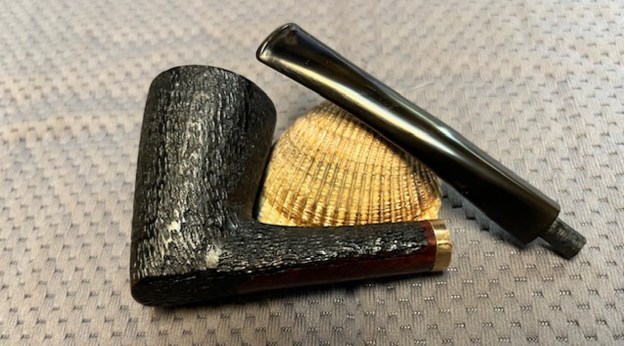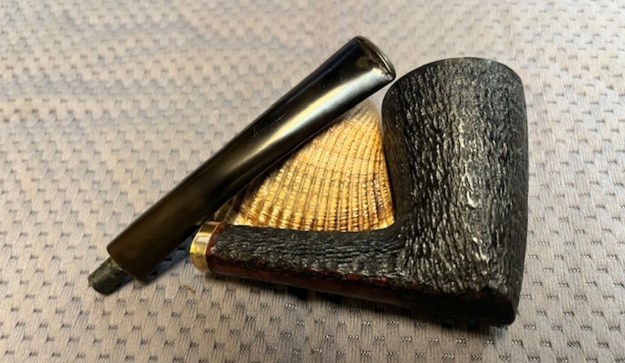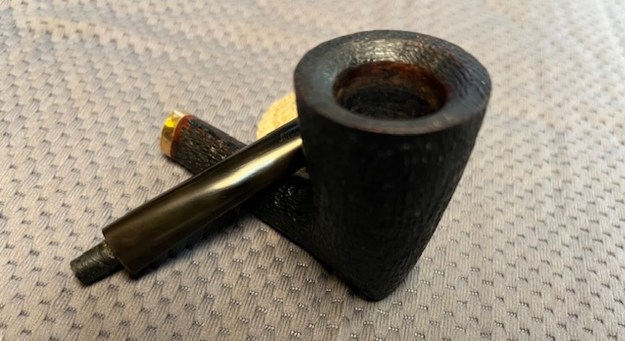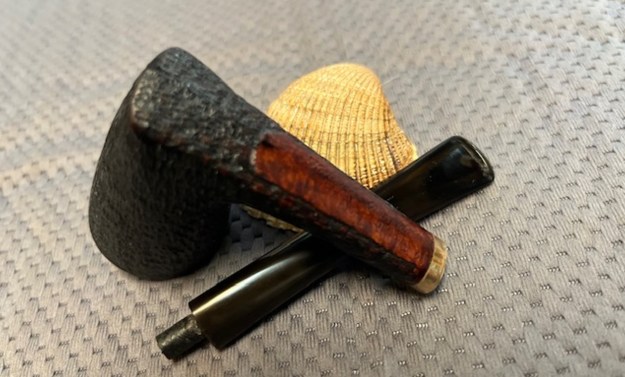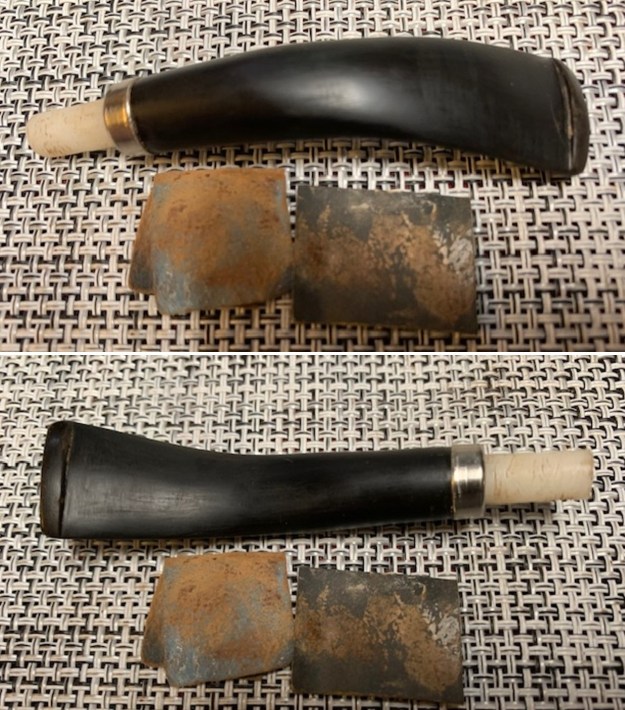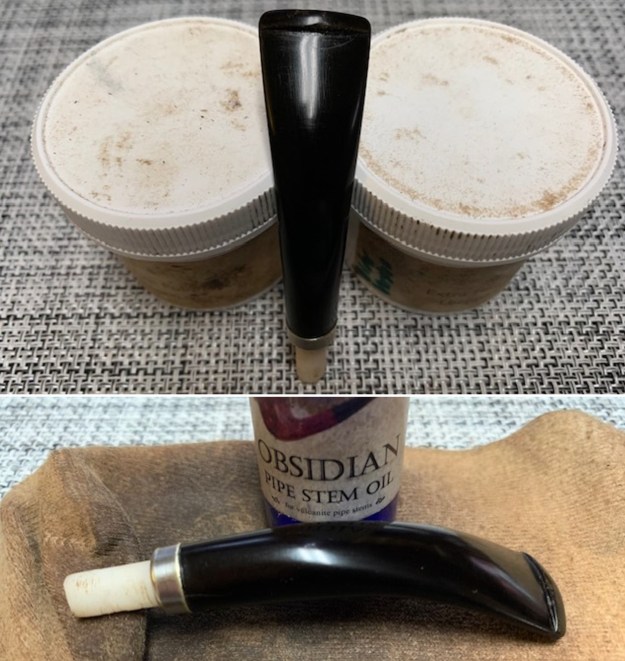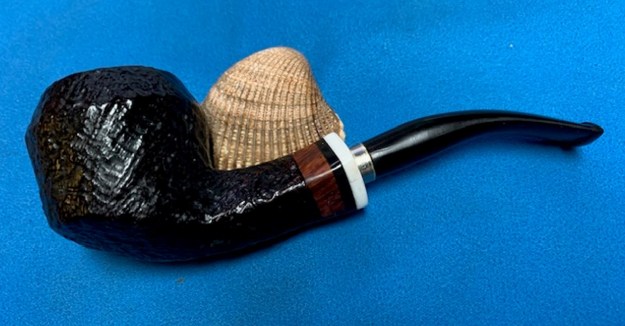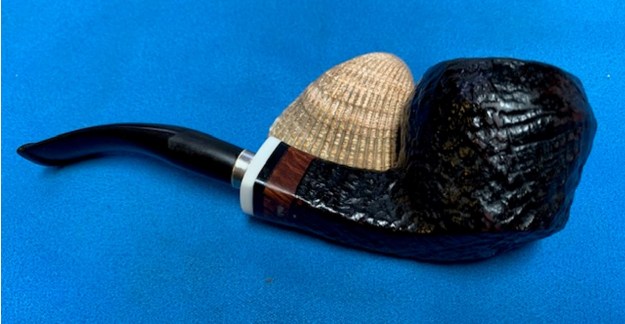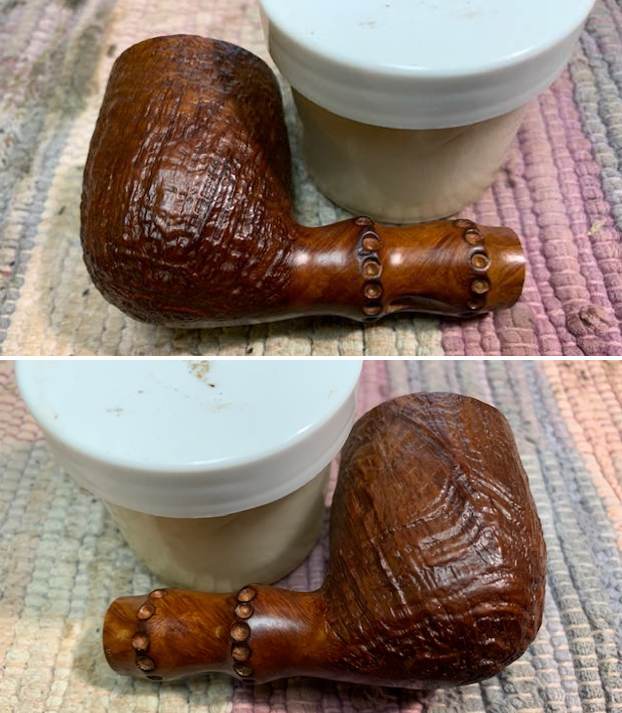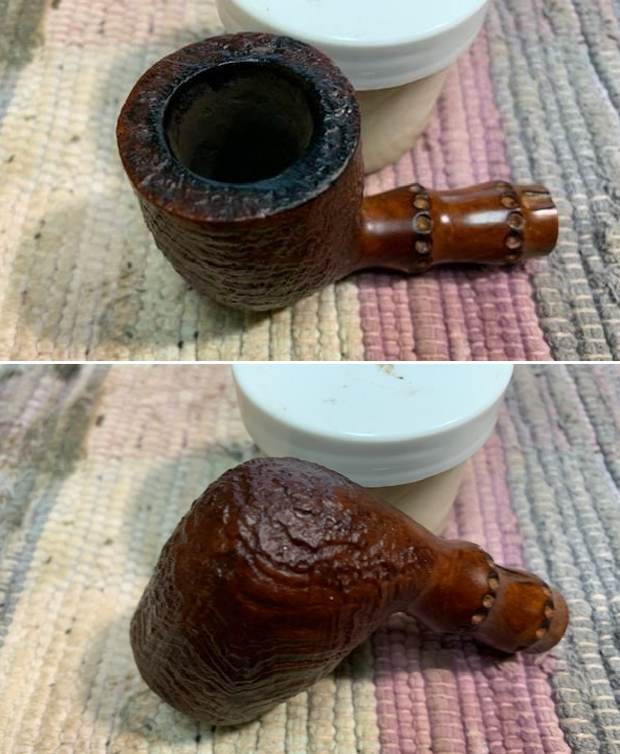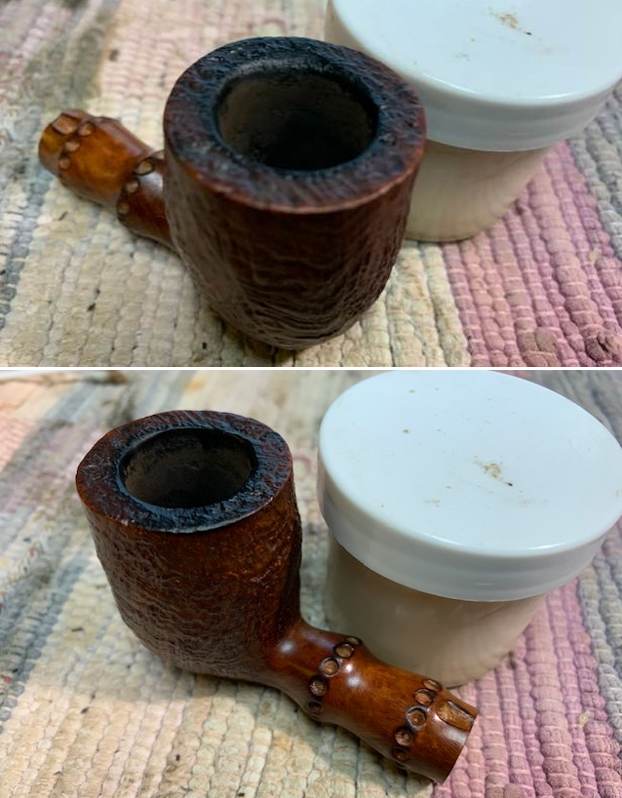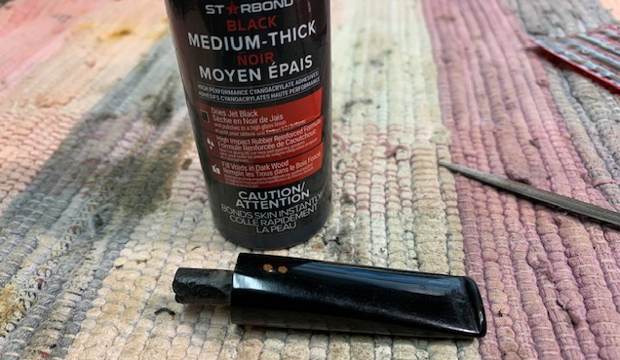
Tag Archives: replacing a broken tenon

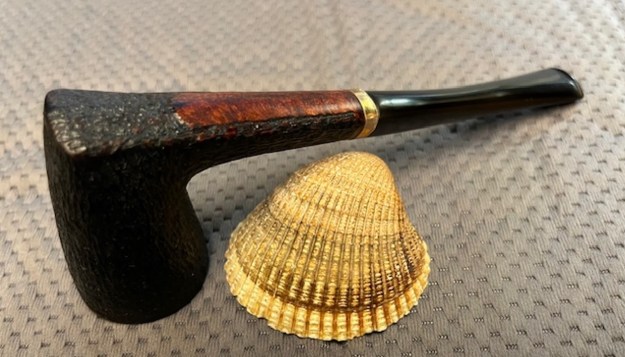
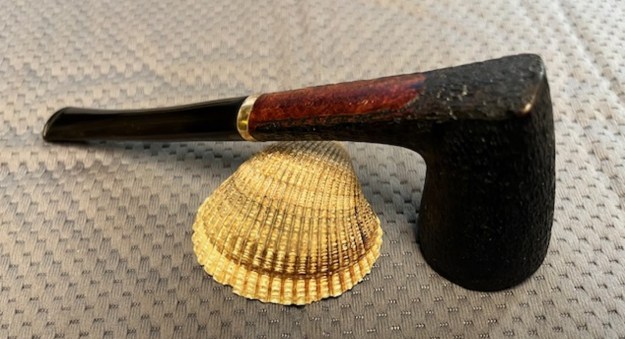
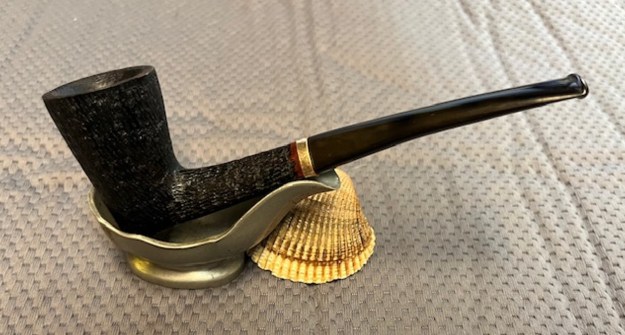
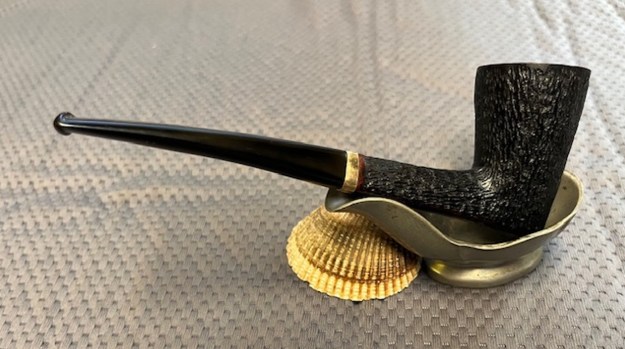
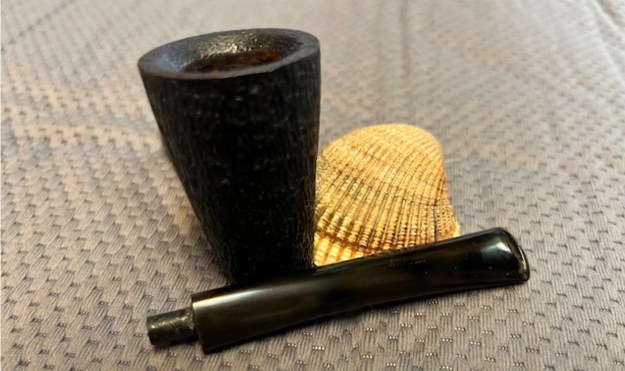
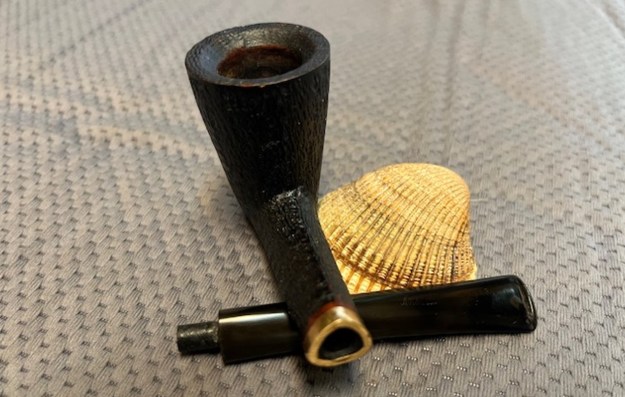
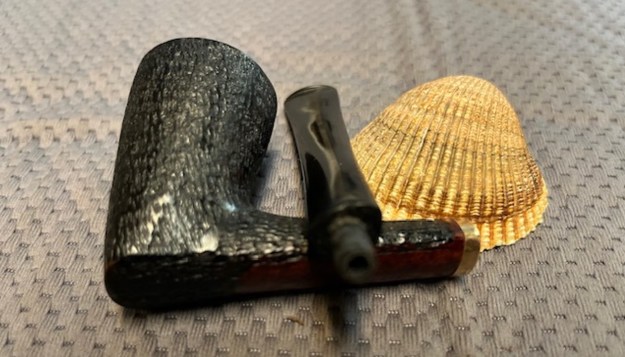
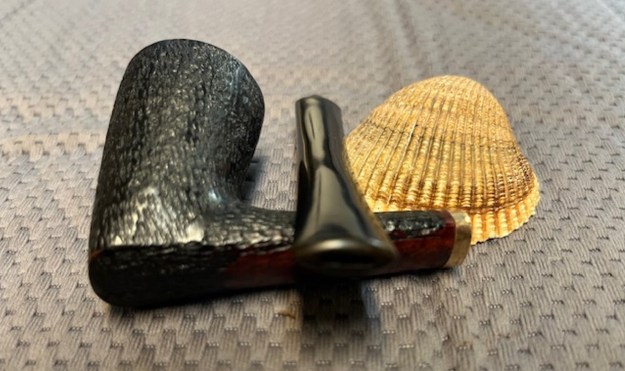
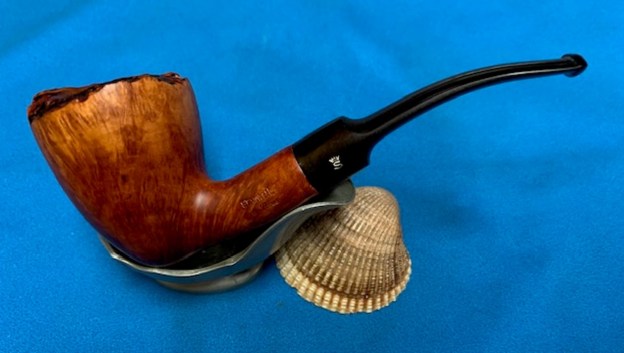
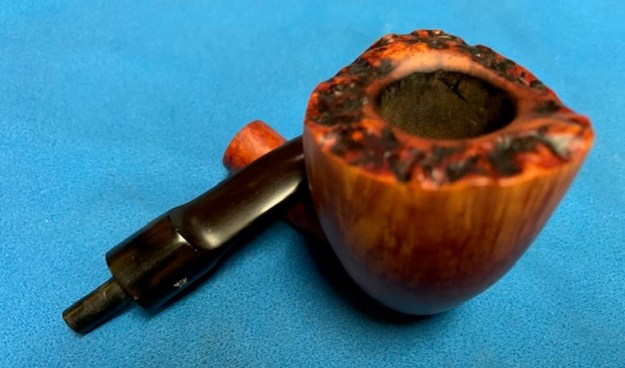
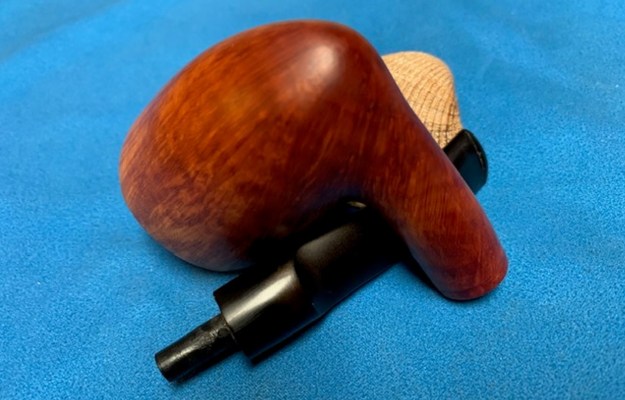
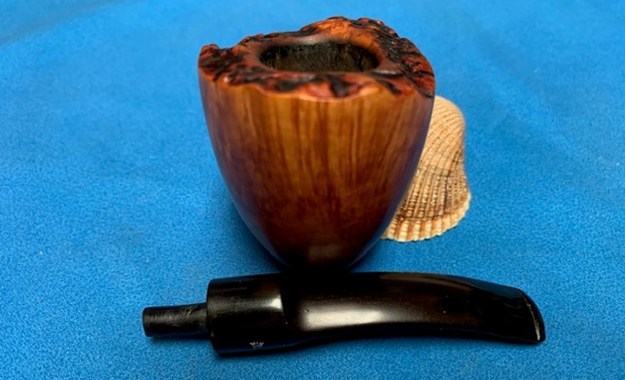
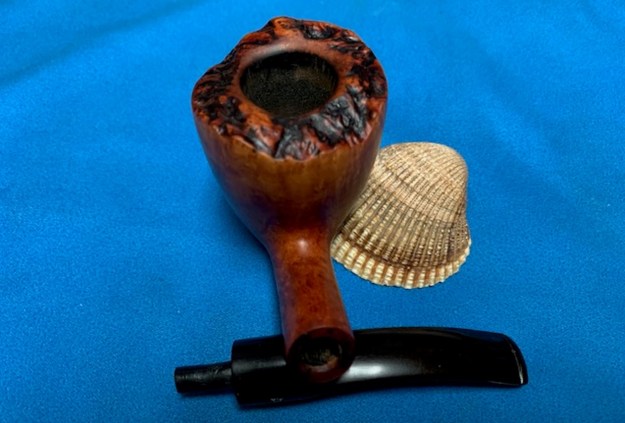
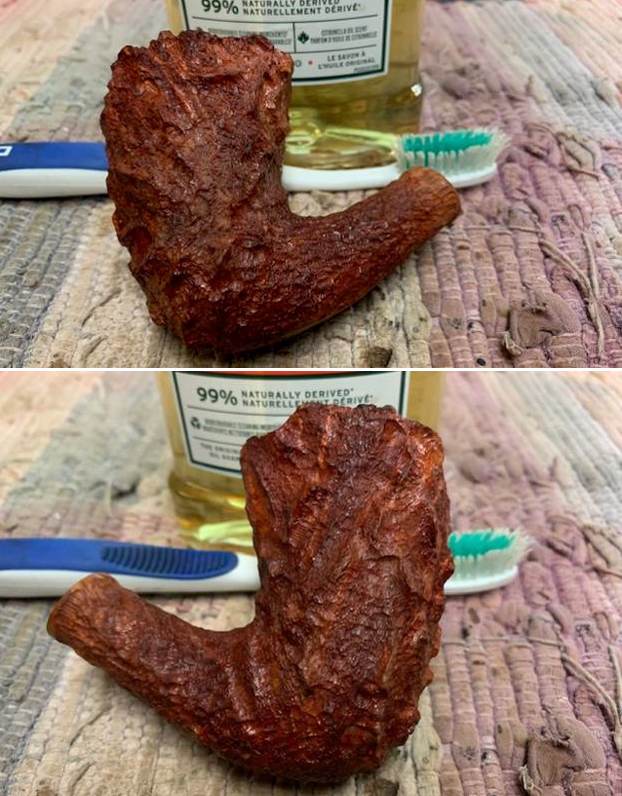
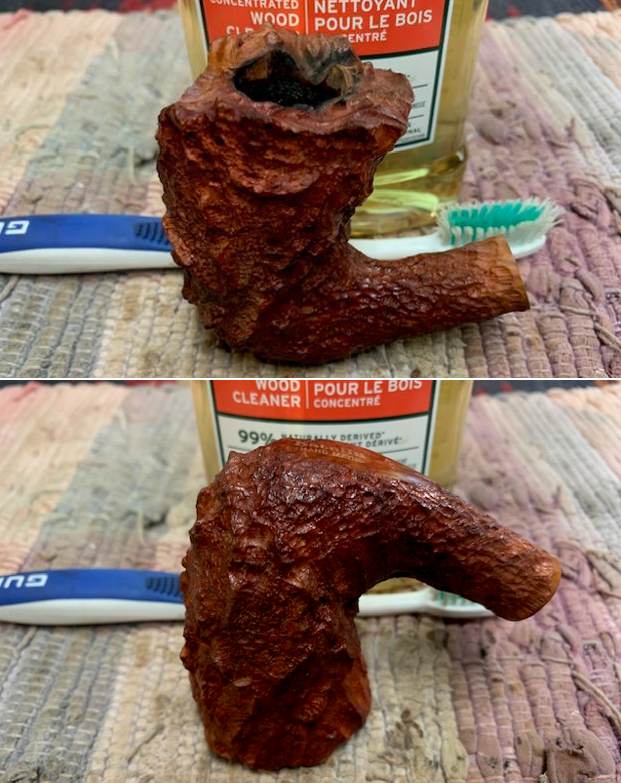
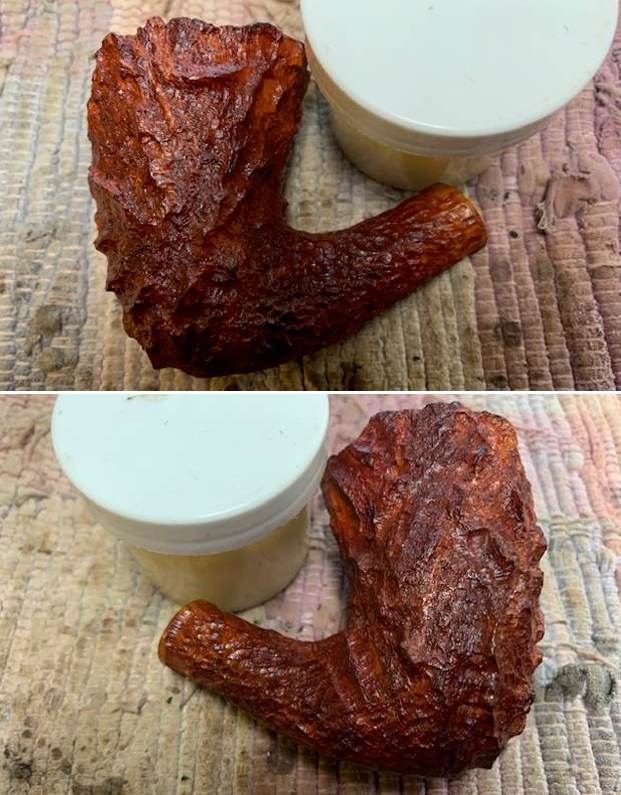
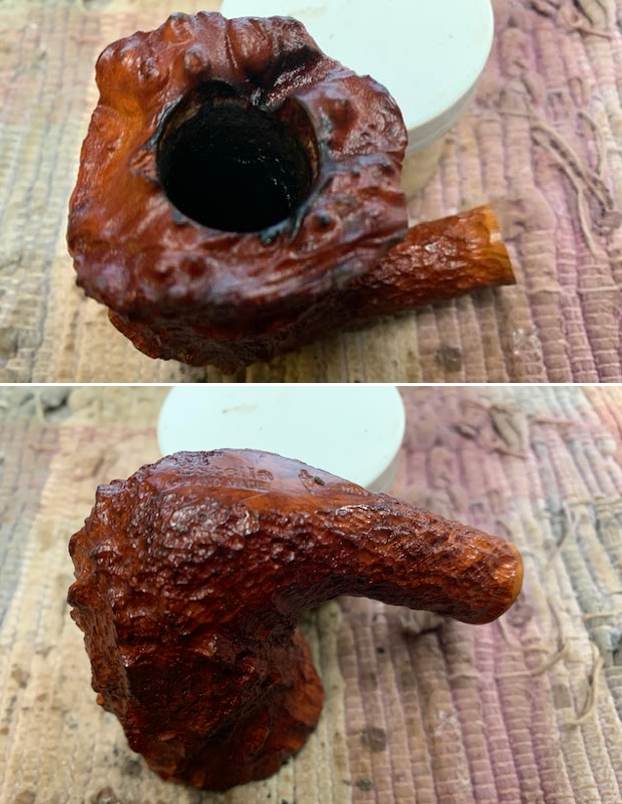
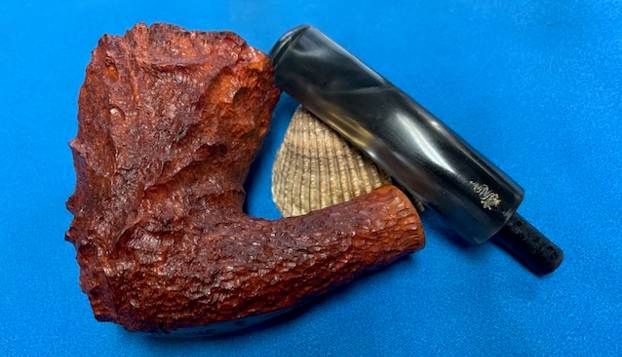
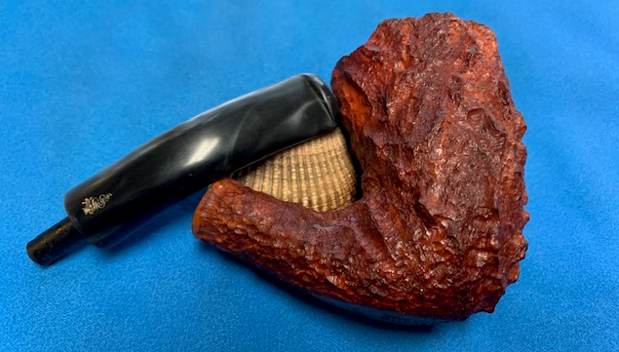
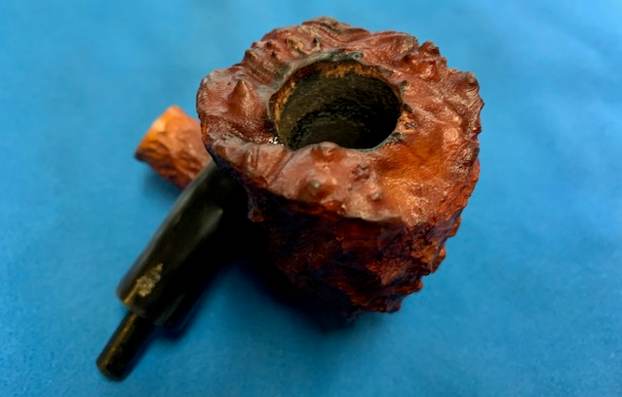
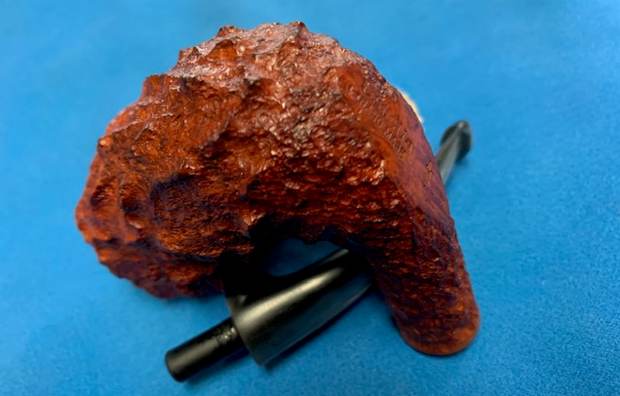
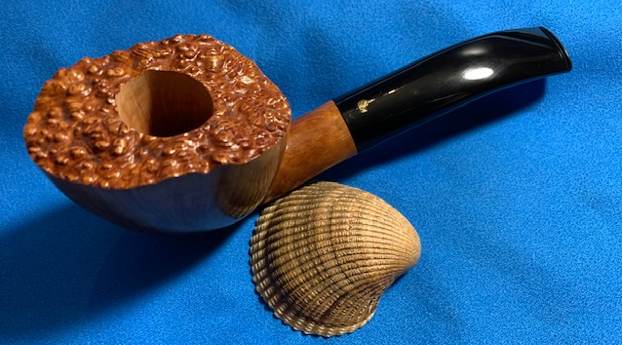
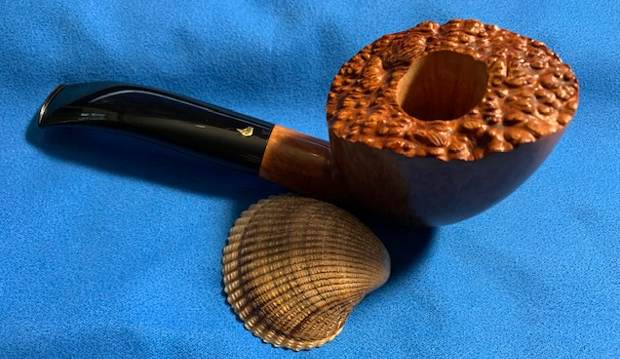
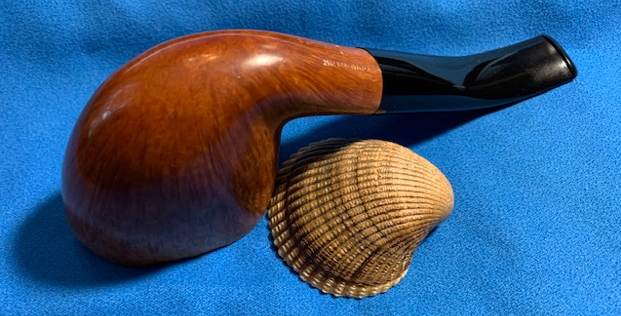
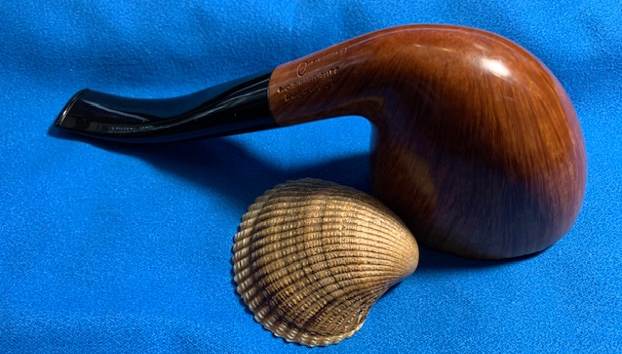
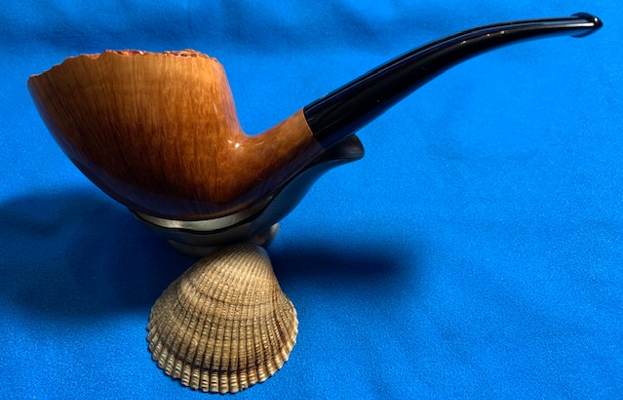
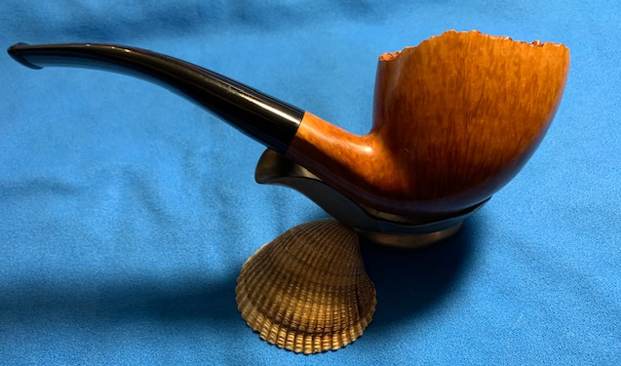
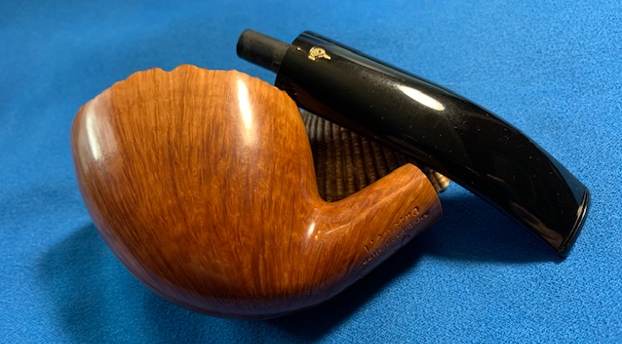
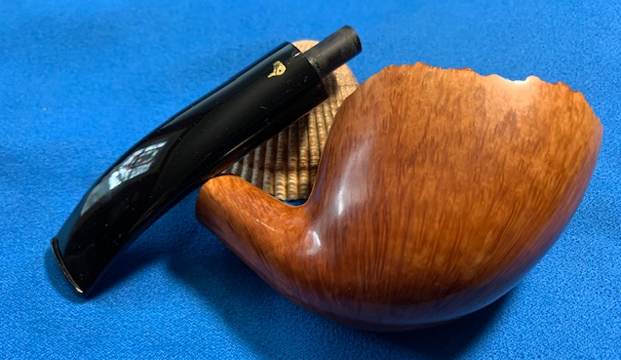
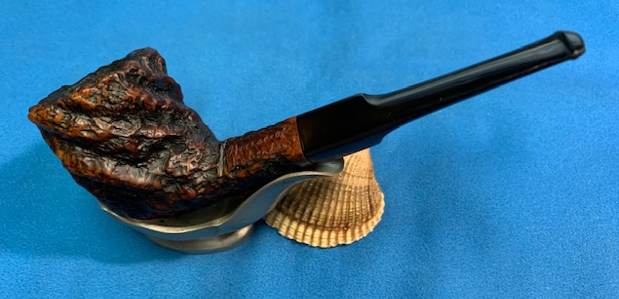
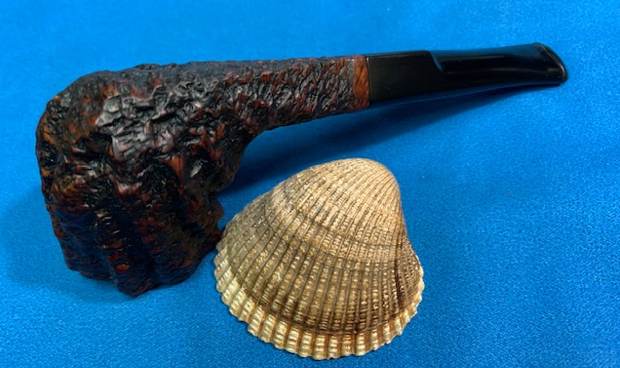
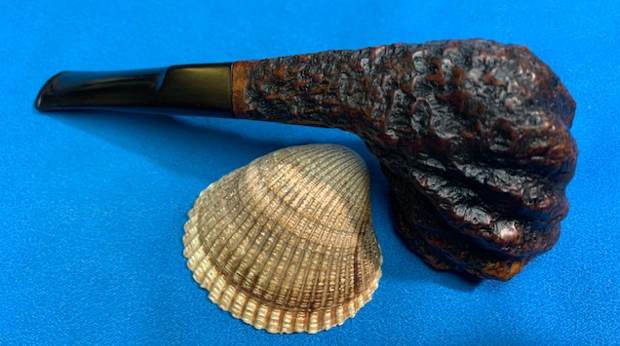
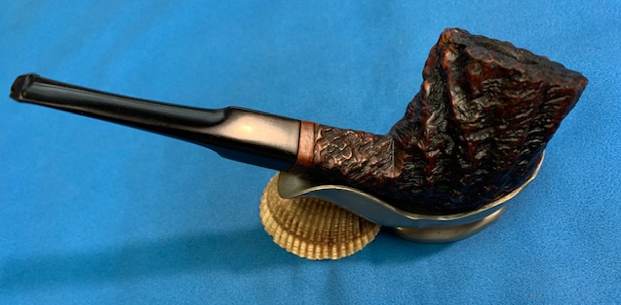
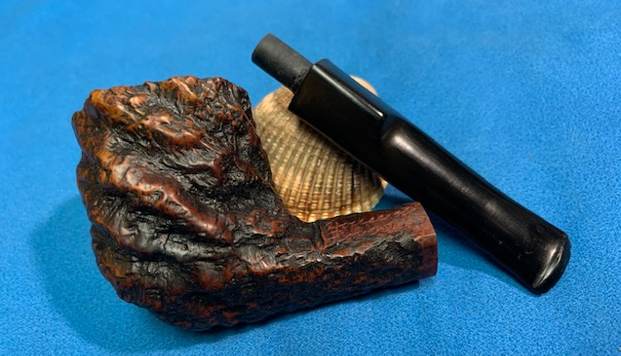
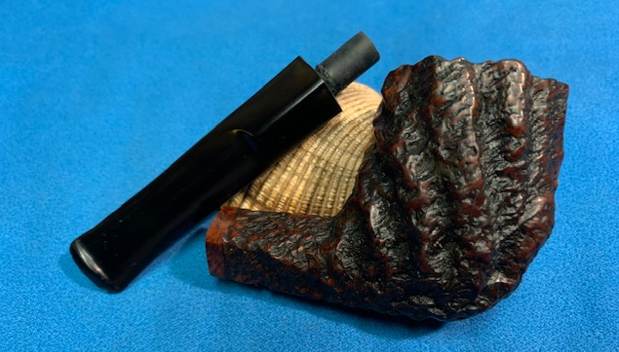
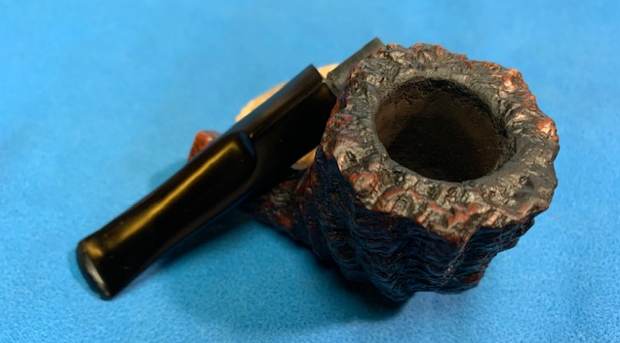
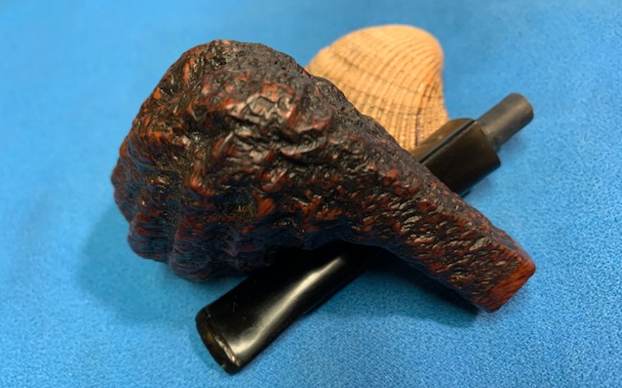
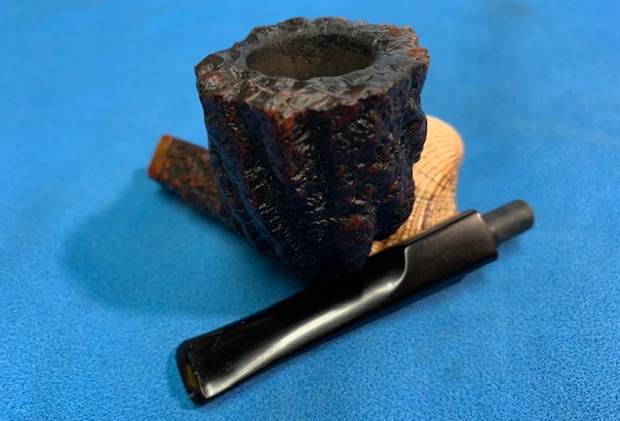
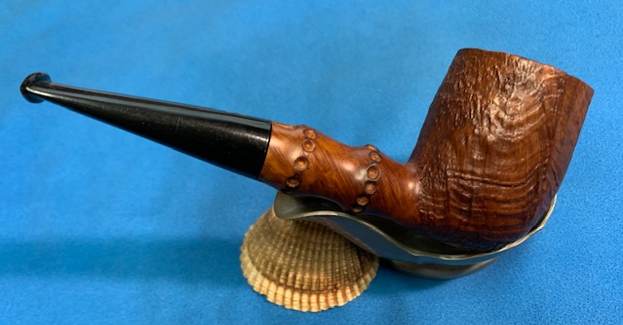
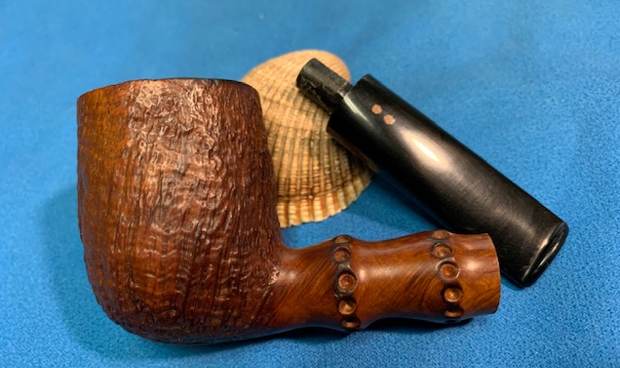
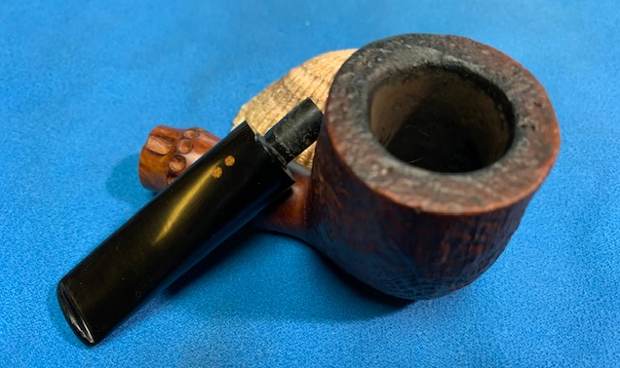
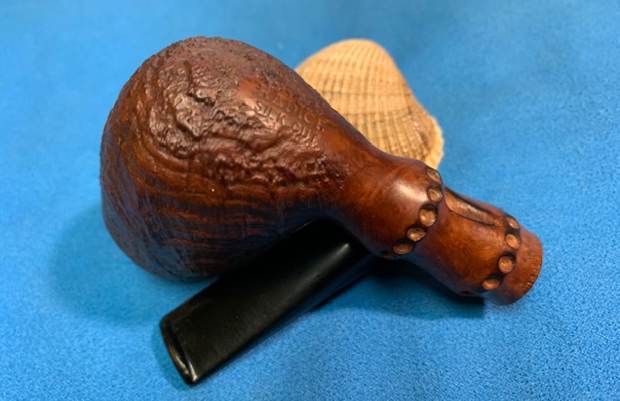
Repairing a Broken Tenon and Cracked shank on a Rusticated Kriswill Bernadotte Design 1210


Blog by Steve Laug

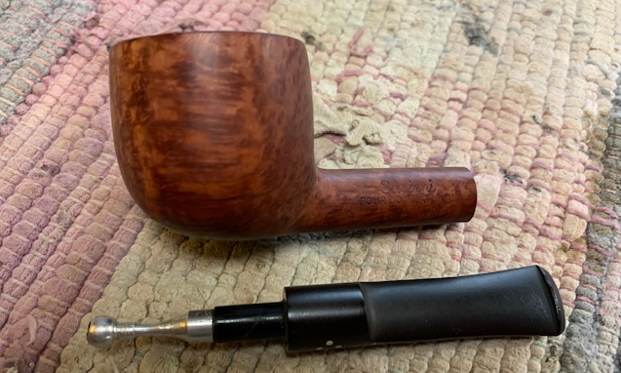
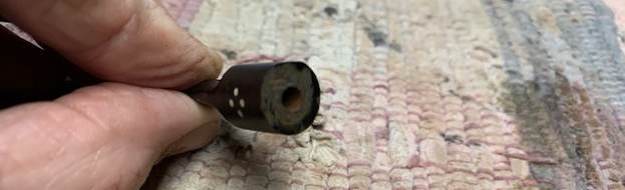
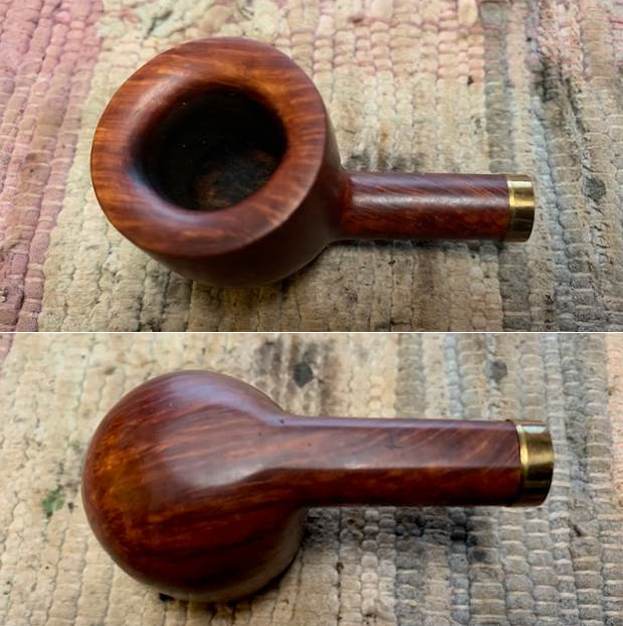
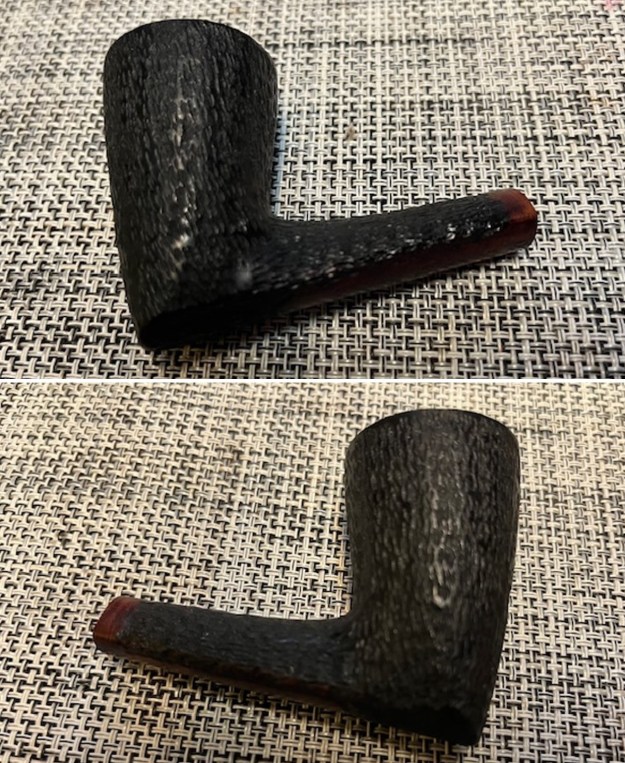
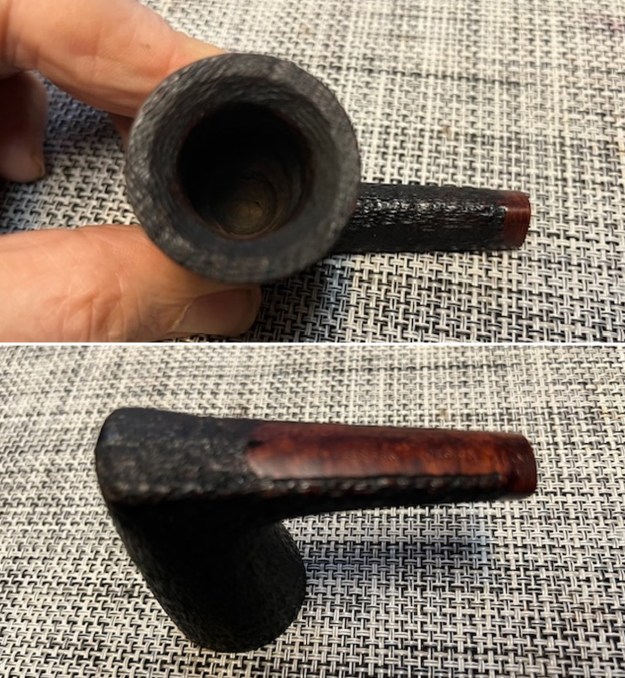
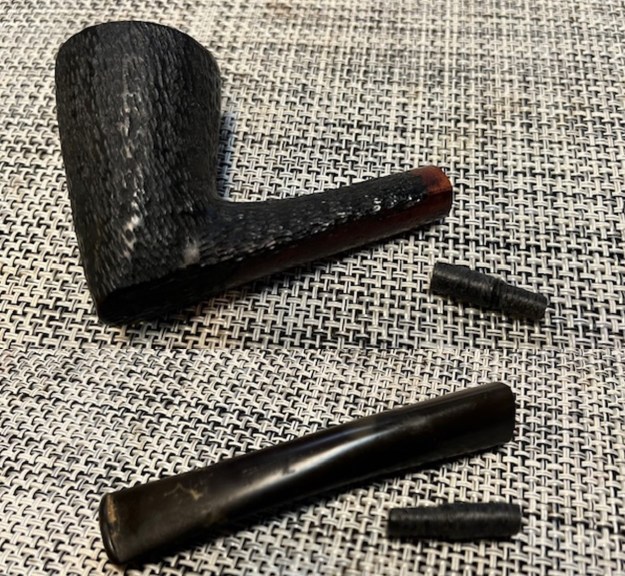
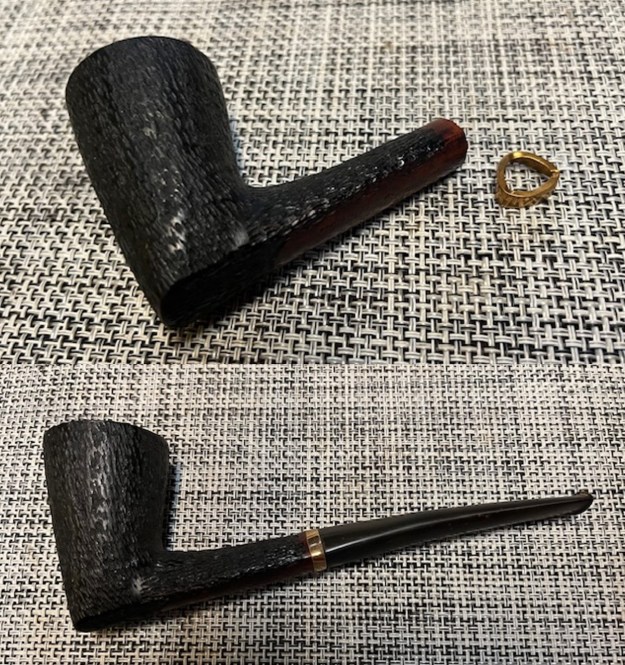
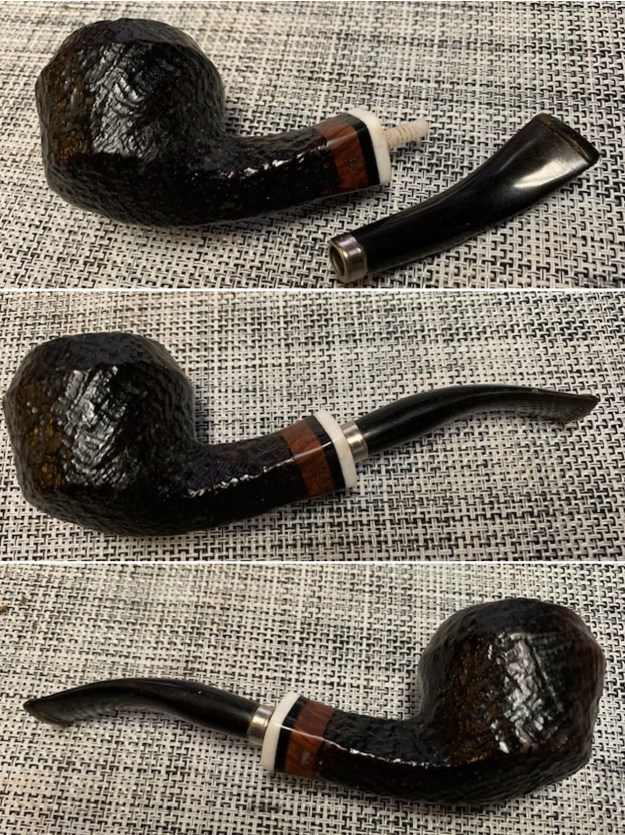
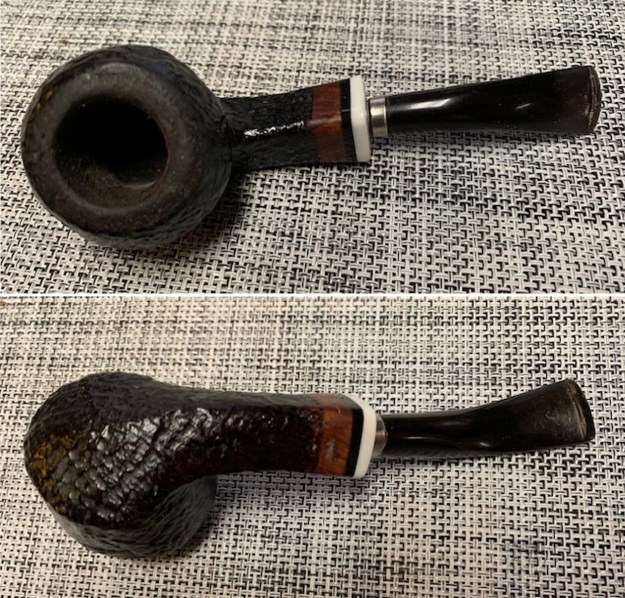
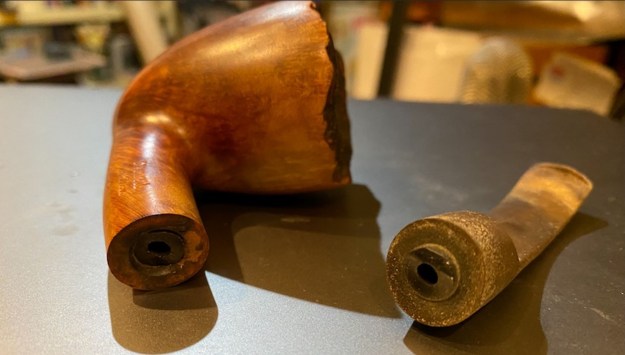
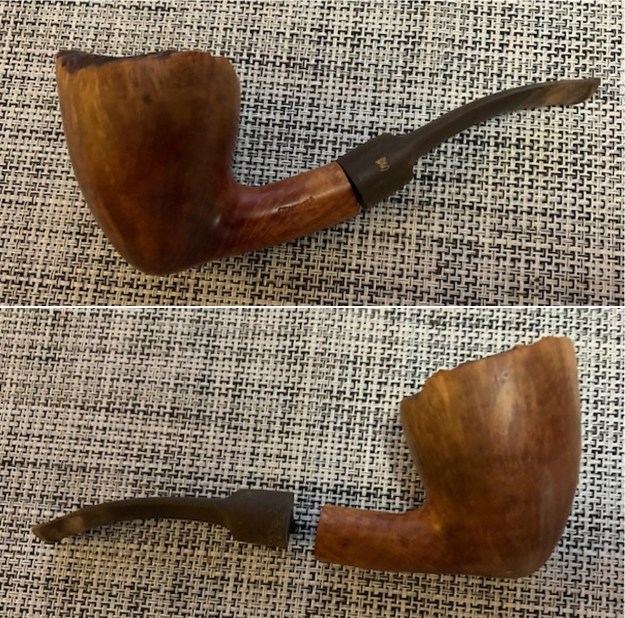
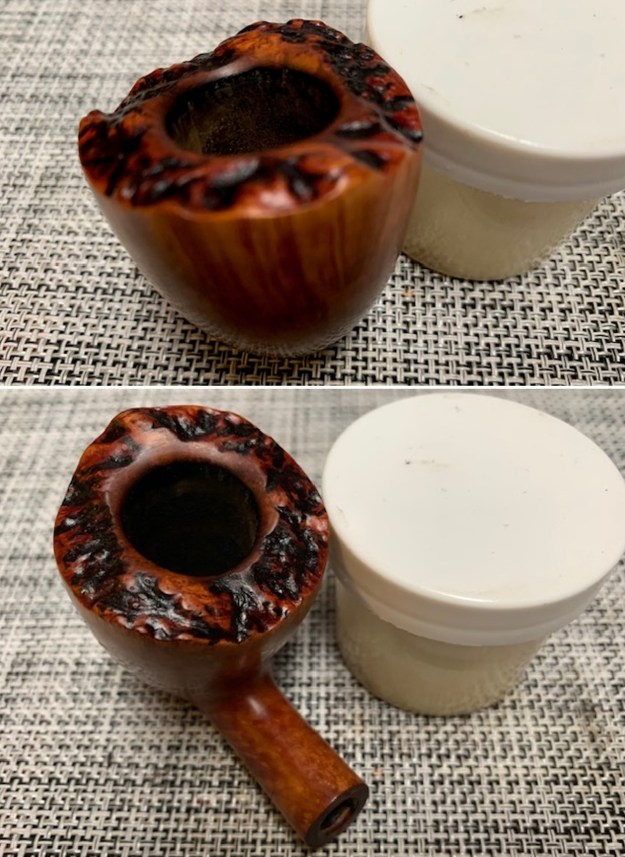
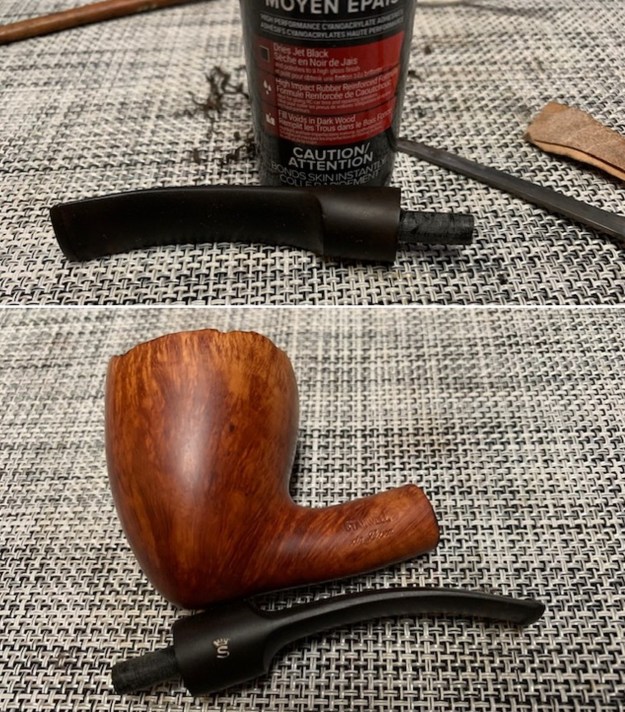
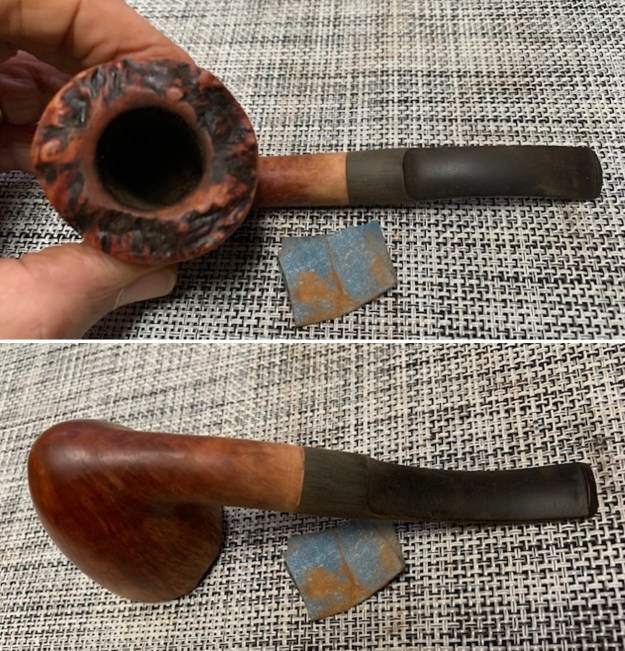
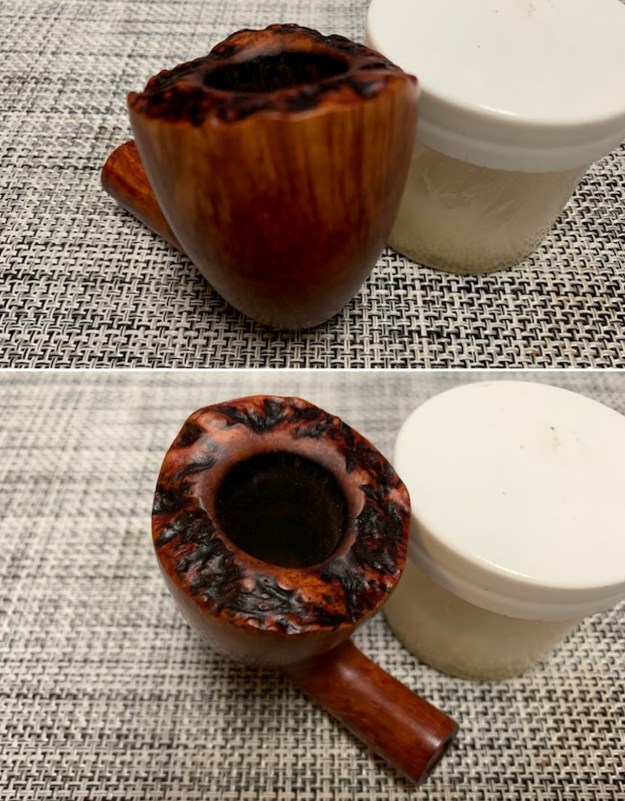
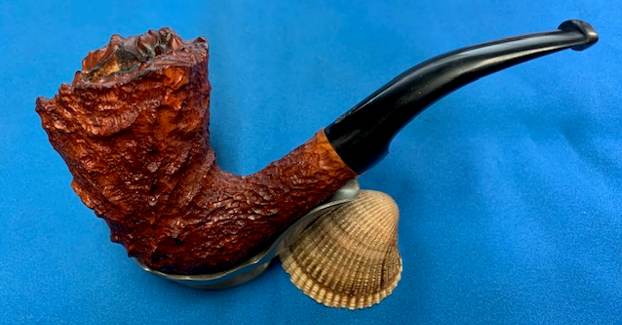
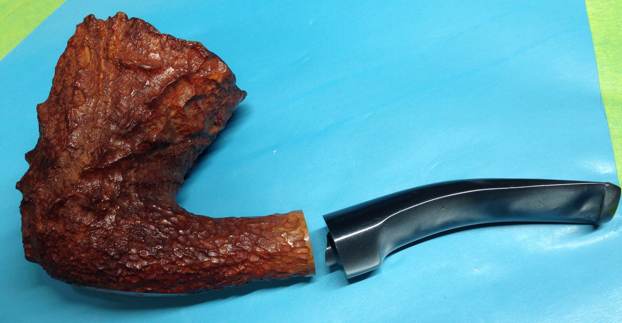
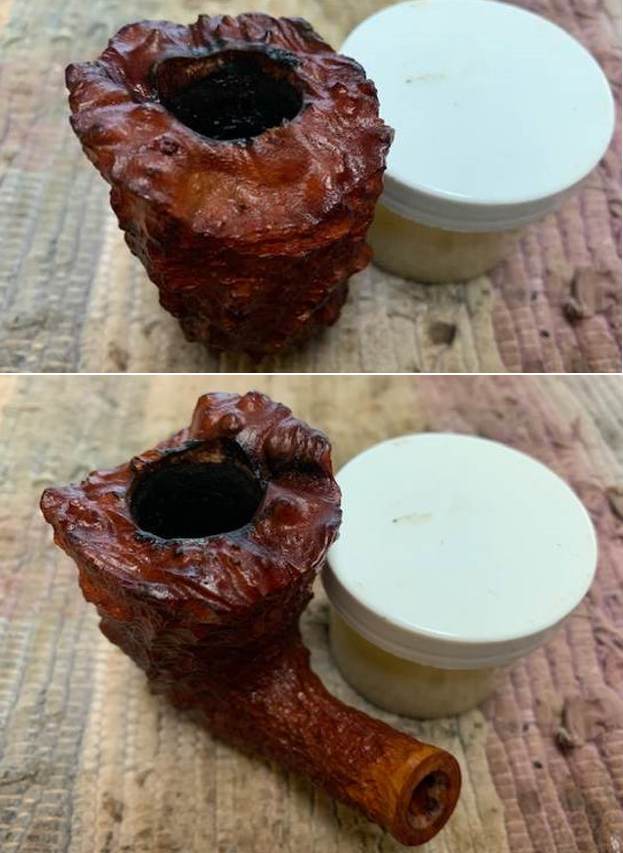
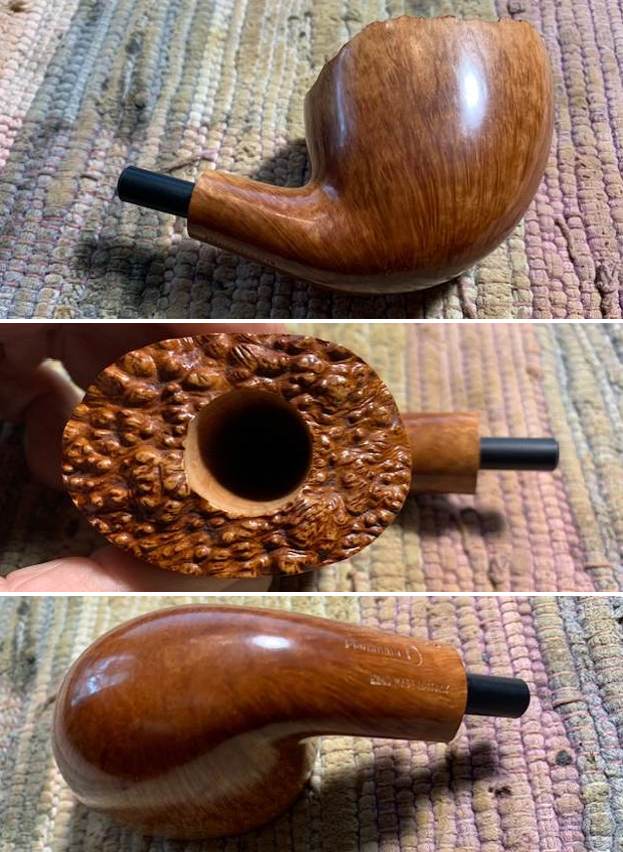
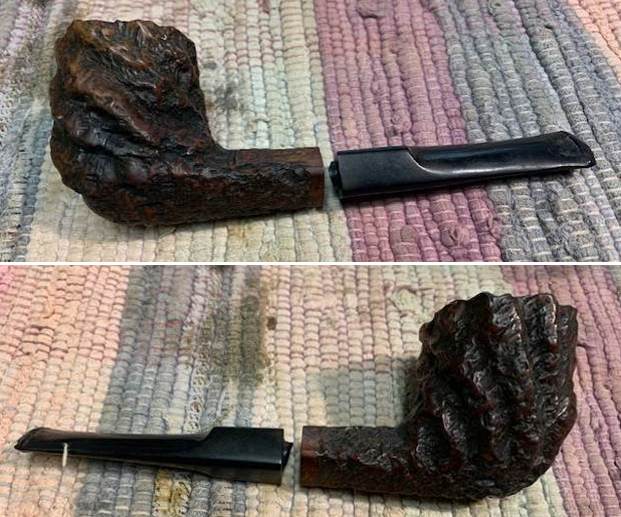
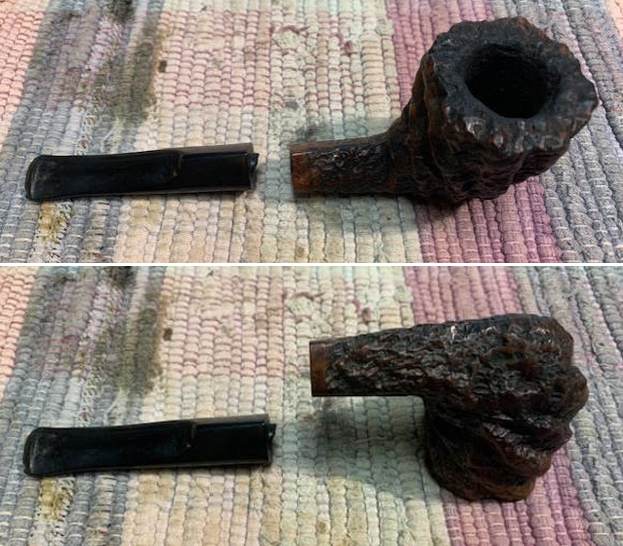
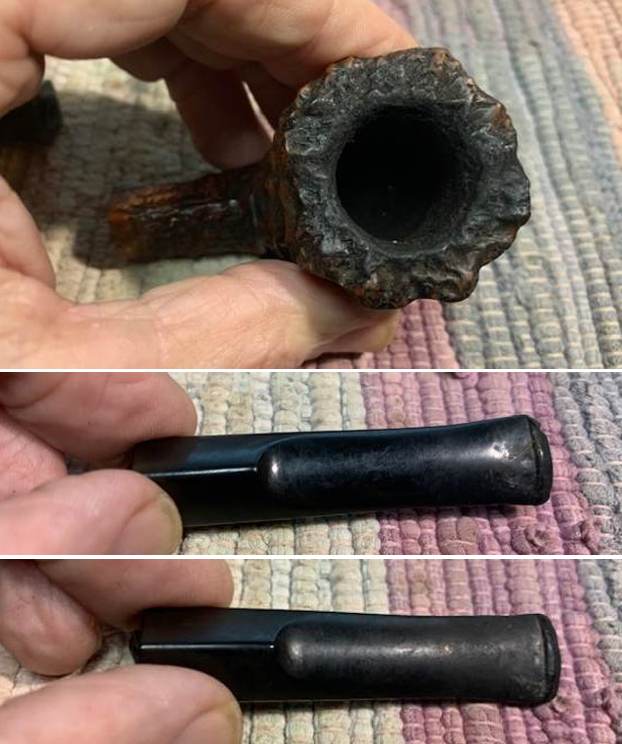
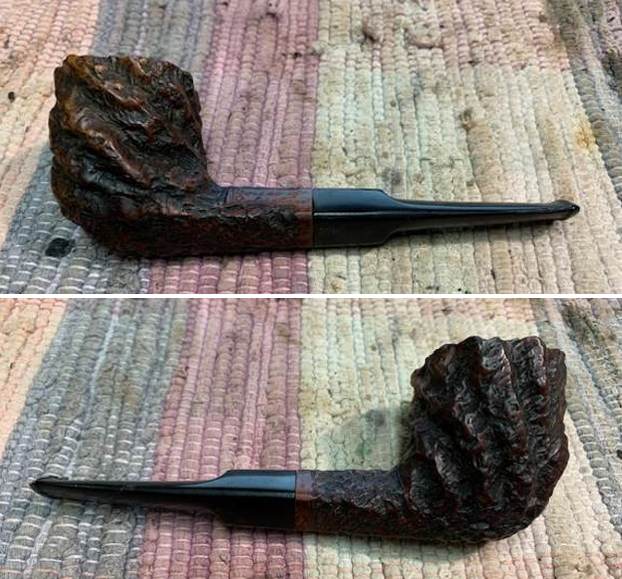
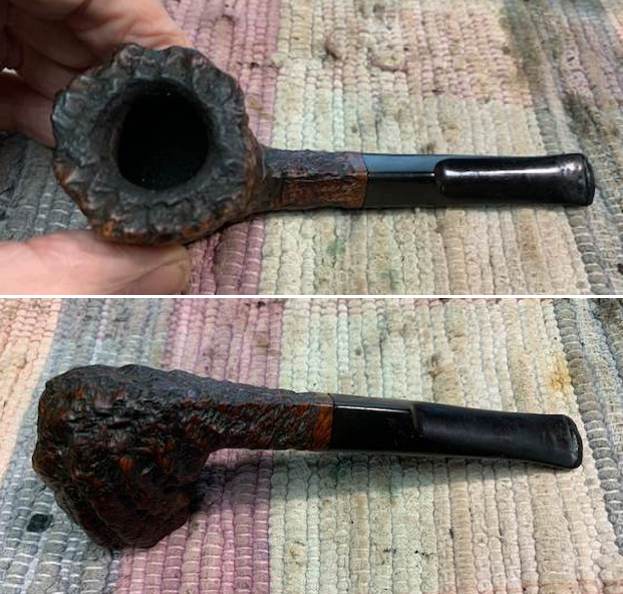
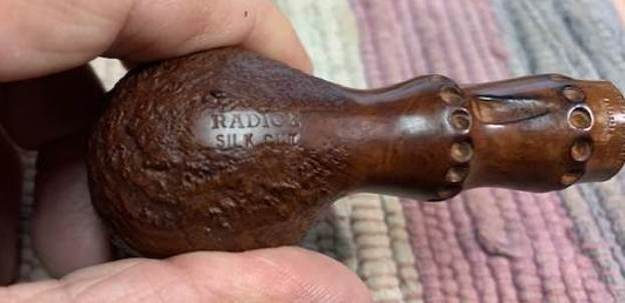
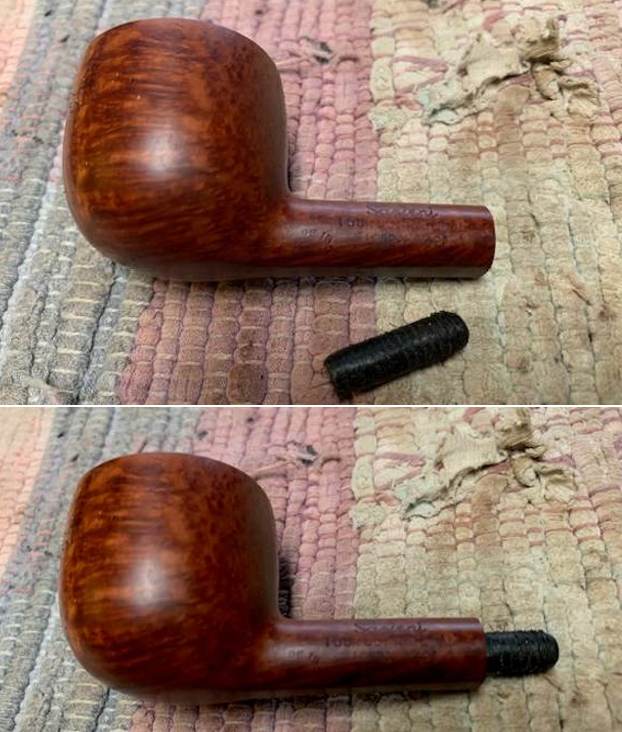
I decided to put my hand to something different this afternoon. I have been working on a lot of pipes that Jeff and I have purchased. The one on the table this after was a pipe that I received for repair from a fellow in Toronto. We had been chatting via email and phone about a nice Kriswill Handmade Bernadotte that he had purchased. When it arrived in Toronto the stem was stuck in the shank and in trying to remove it he had managed to snap the tenon in the shank. He wanted me to repair the tenon for him so I told him to ship it my way. He did a thorough cleaning of the bowl, shank and stem so it was in good condition. It arrived this week and I brought it to the work table and looked it over and put it back in the box. Today, Sunday afternoon I was ready to tackle the task. I took some photos of the bowl and the stem to give a sense my first impression as I looked at quickly.

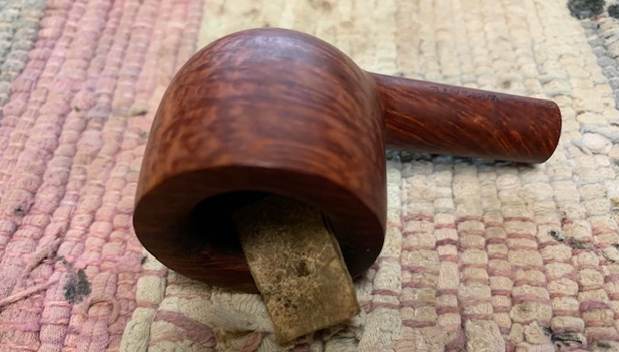
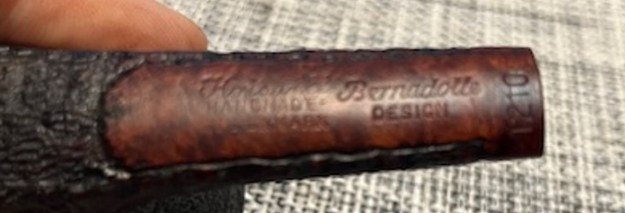
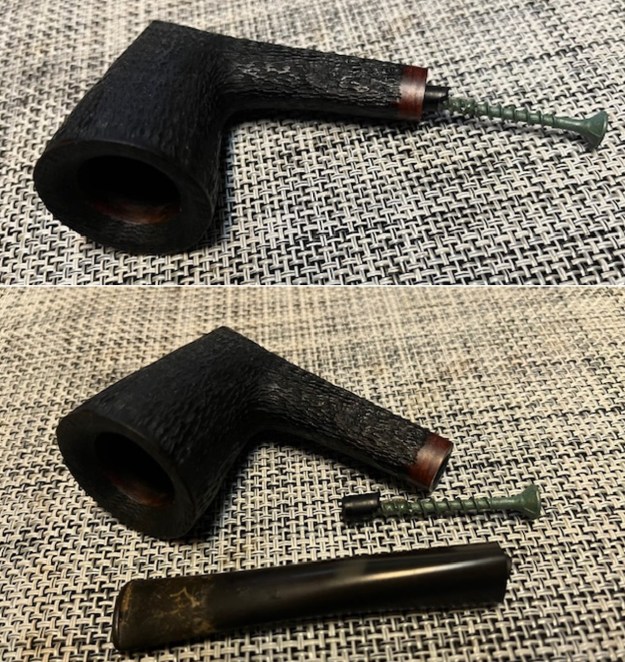
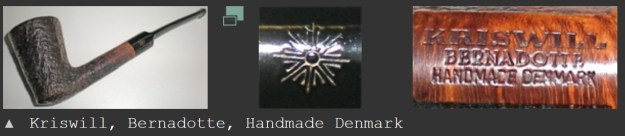
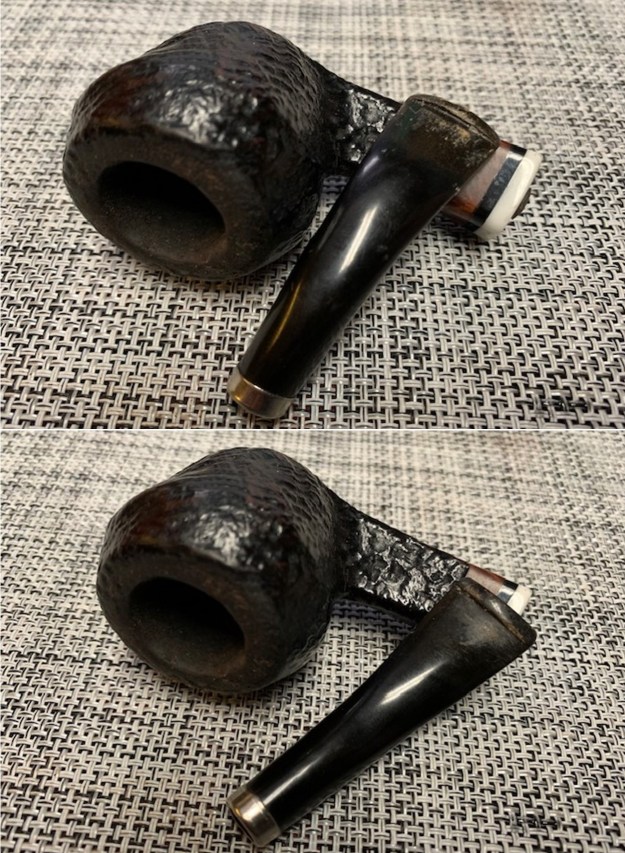
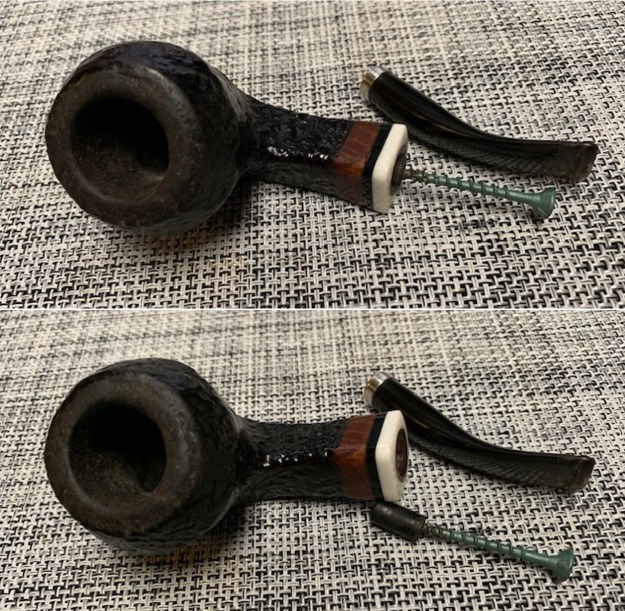
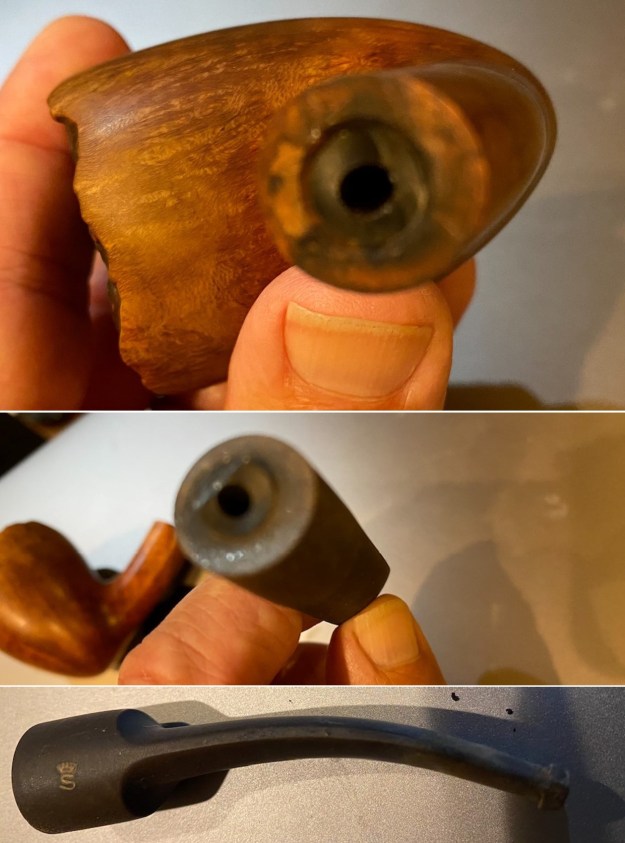
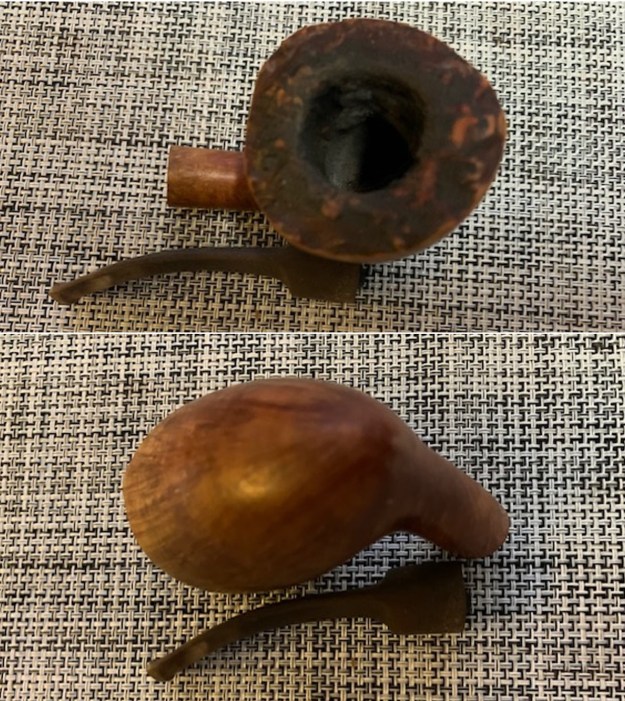
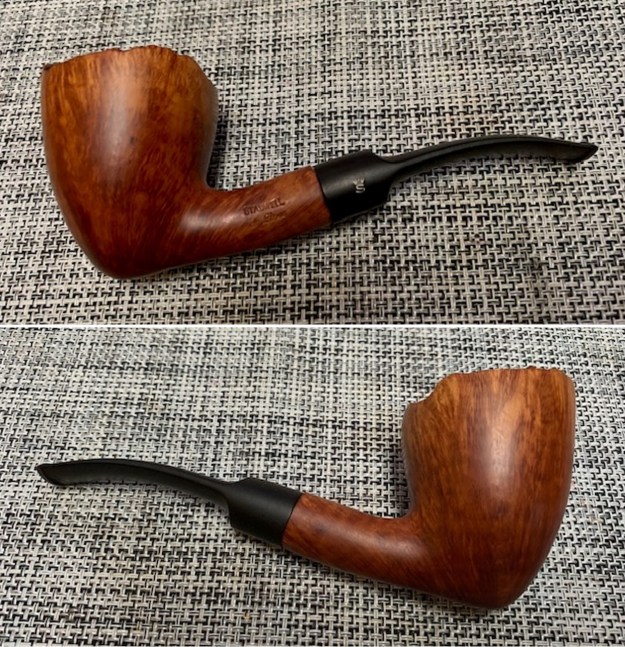
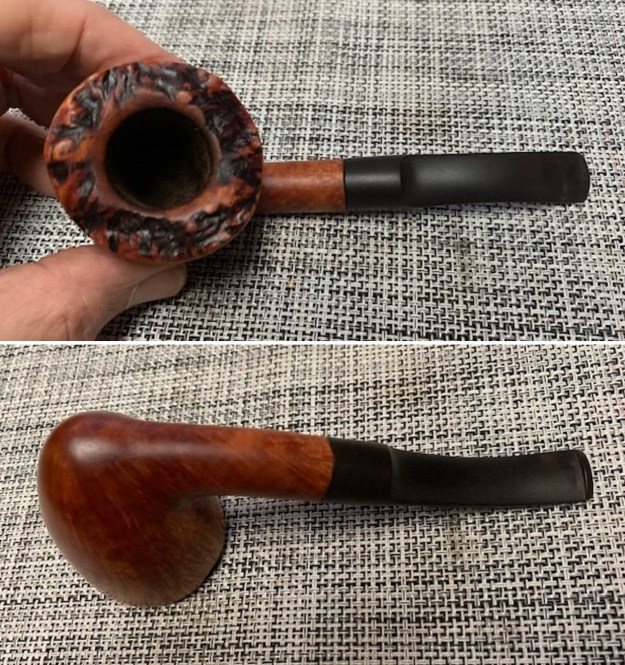
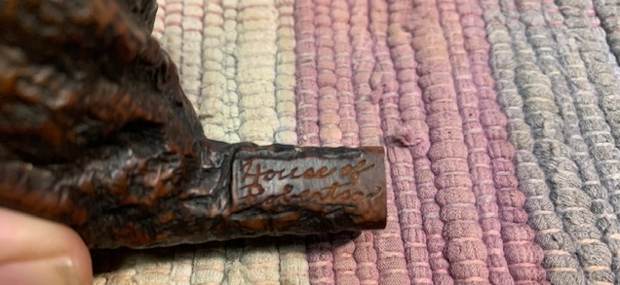
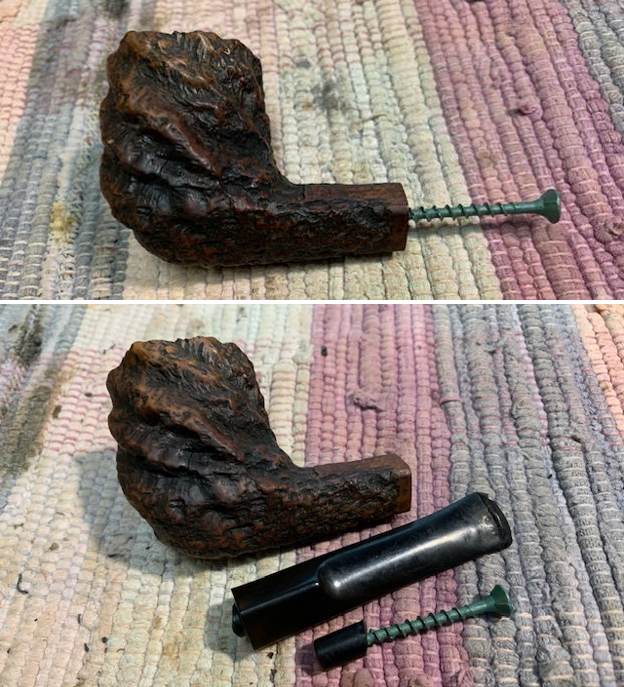
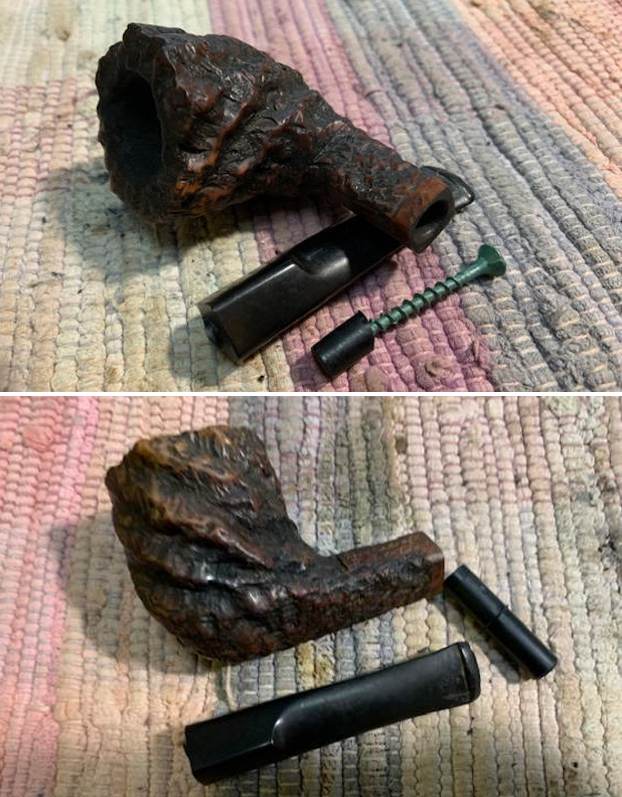
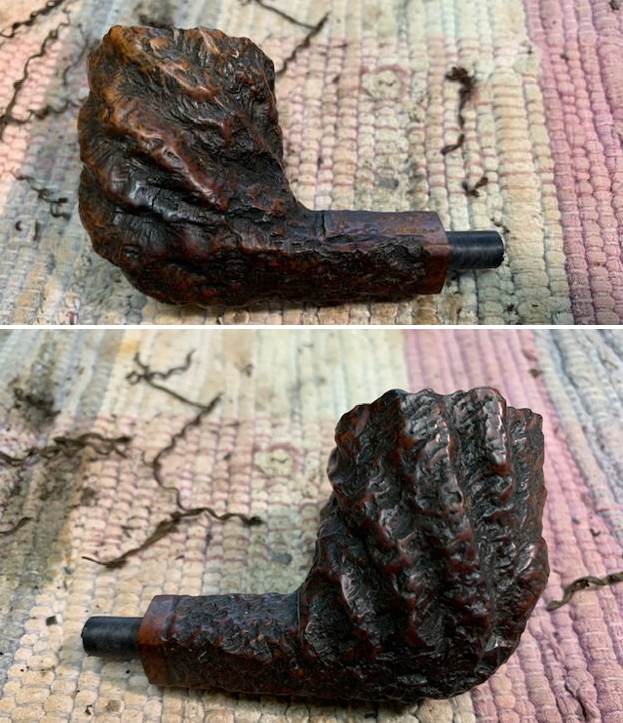
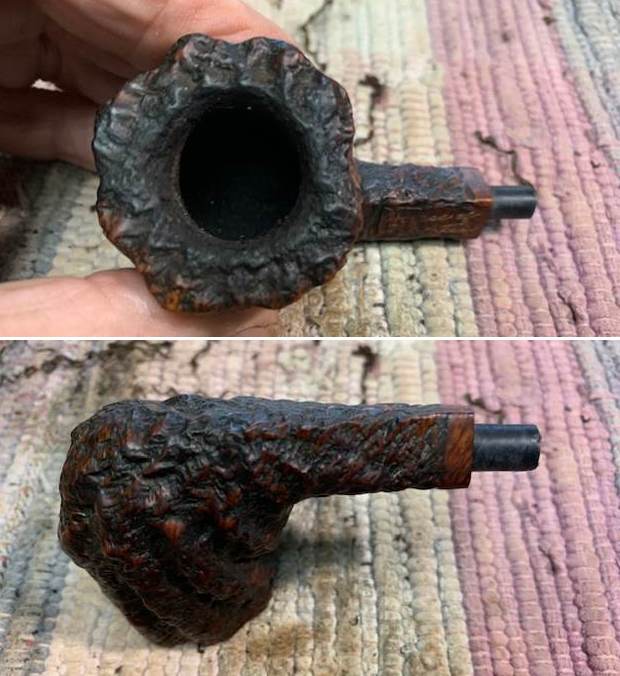
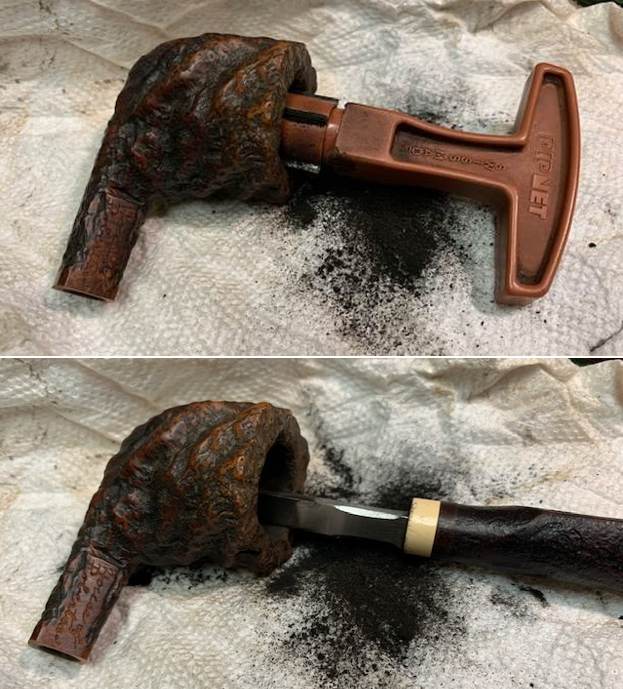
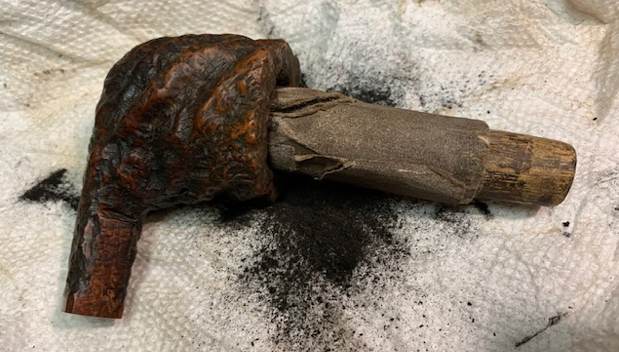
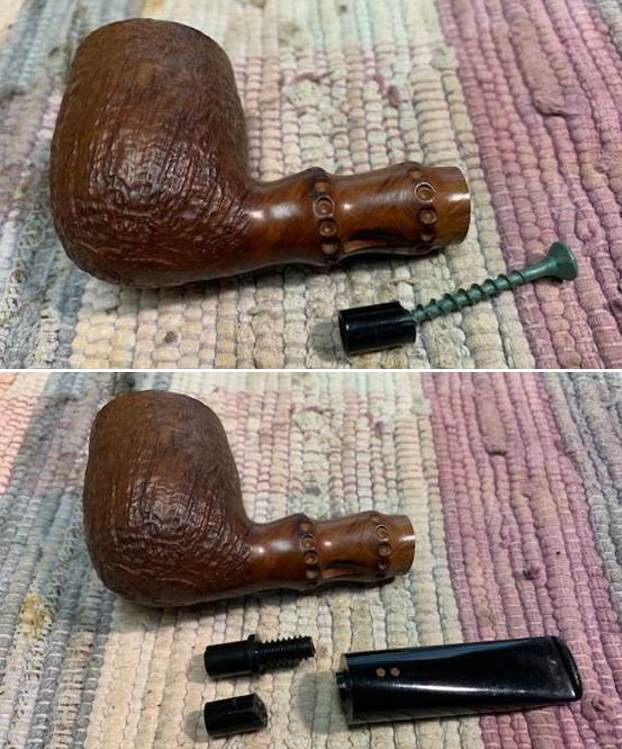
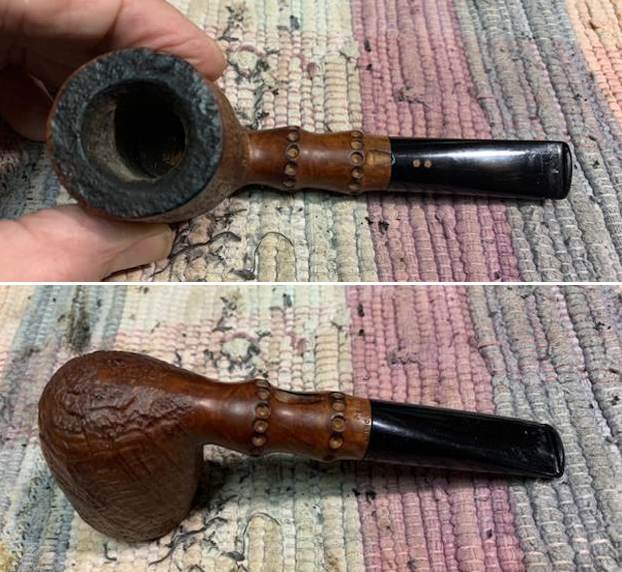
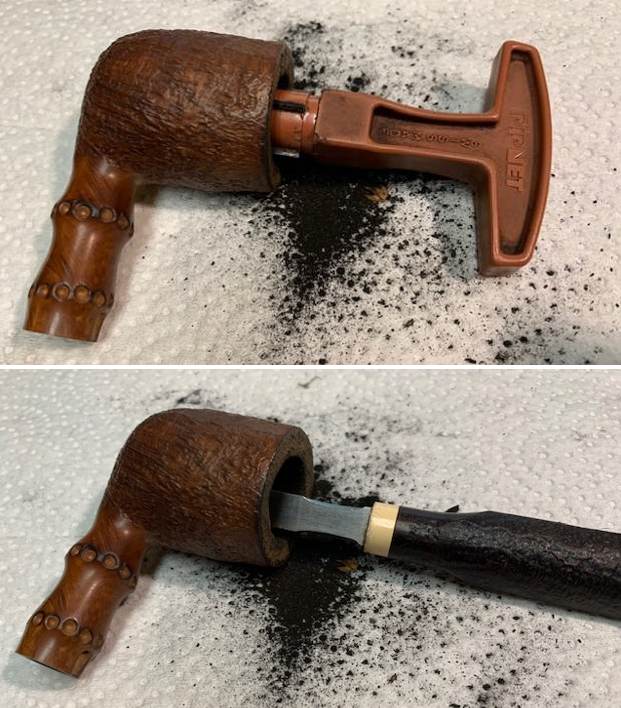
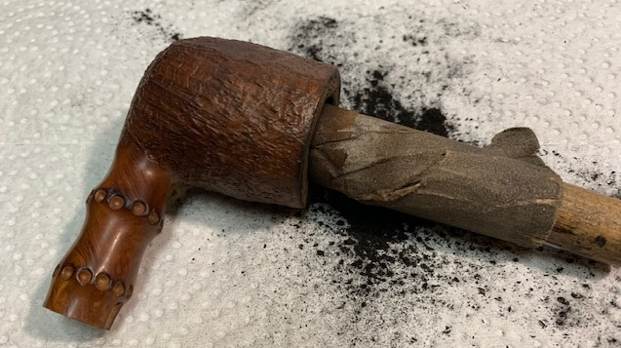
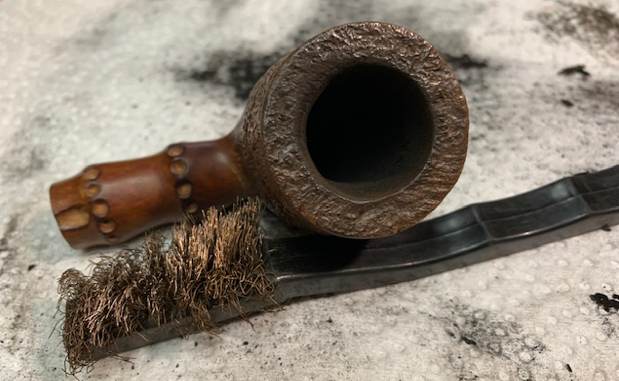
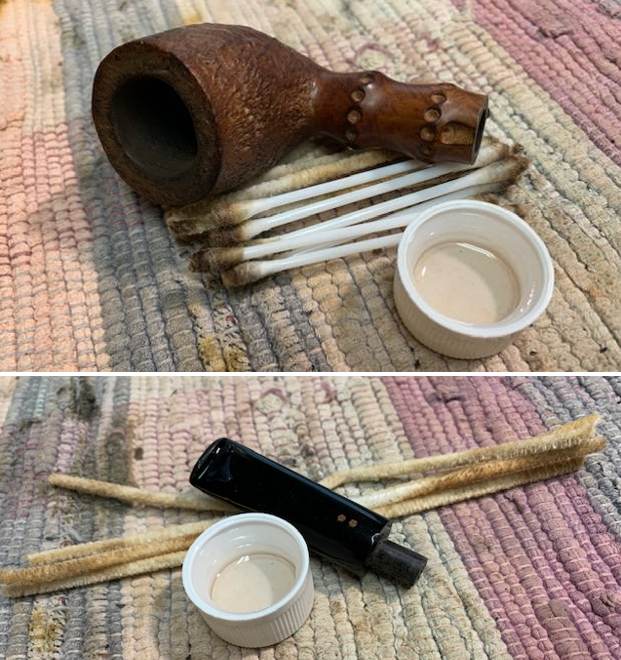
Here are my thoughts as I turned it over in my hands. The pipe has a conical shaped bowl that is pretty clean. There was little or no cake on the walls. The rim top was rusticated and quite clean. There was an inward bevel on the rim edge that was also clean and excellent condition. The shank was triangular with a smooth band on the shank end. There was a smooth panel on the underside of the shank that was stamped Kriswill [over] Handmade [over] in Denmark. That is followed by Bernadotte in script [over] Design in block letters. There is the shape number 1210 stamped on the end of the shank right along the edge. The tenon was snapped evenly in the shank leaving just a little bit of debris on the stem end. The tenon was stuck and I would need to do the freezer trick to remove it. The stem was lightly oxidized and there was debris and sticky marks from price tags on the stem surface. There were light tooth marks on both sides just ahead of the button. It really is a beautiful little pipe. I took a photo of the stamping on the smooth panel on the underside of the shank. It is clear and really readable as noted above.To start my work on the pipe I decided to pull the broken tenon from the shank. I used a screw and tuned it into the airway and it was very tight. I put the bowl in the freezer for 30 minutes and when I took it out the screw easily removed the broken tenon from the shank. I took photos of the process. Before I went any further in the process I decided to do a bit of background work on the pipe. I turned to Pipephil’s site first (http://www.pipephil.eu/logos/en/logo-k3.html). I did a screen capture of the section on the Kriswill Bernadotte Handmade in Denmark pipe. I have included it below and the pertinent sidebar information below that.Kriswill is a brand of Kriswork Briar Trading, in Kolding (Denmark) established about 1955.

Some of Kriswill pipes were designed by Sigvard Bernadotte, Swedish prince and brother to the late Queen Ingrid of Denmark. He collaborated with his Danish partner Acton Bjørn.

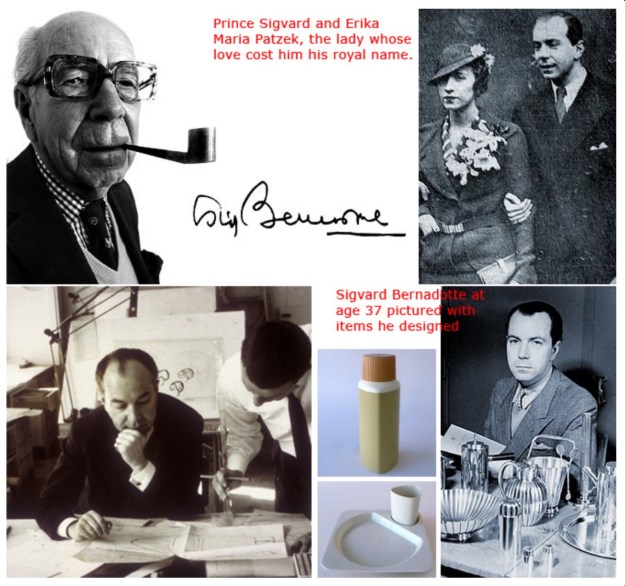
At the end of the quote above there was a link to the photo below. It is a series of portraits of Sigvard Bernadotte the designer of the pipe that I am working on.

I turned to Pipedia (https://pipedia.org/wiki/Kriswill) for more detailed information. There is a great writeup there on the history of the brand that is fascinating. I have quoted the pertinent section below. I have also highlighted the connection to Sigvard Bernadotte in red in the last paragraph. He is one who designed his own series of pipes for Kriswill.

Kriswill began immediately after World War II. Karl Robert Kris, an engineer for the shipping company AP Møller at the time, was in port (undoubtedly in the Mediterranean) when he encountered a shipment of briar. The briar blocks awakened his curiosity and he took some home. About this time the the shipping trade become difficult due to the war, causing Kris to consider other business opportunities. In 1947, Kris (then 47 years old) established himself as a pipe maker in his hometown of Kolding.

Kriss started his pipe making operation in a house located at Haderslevvej 115 in Kolding, and was soon joined by 3-4 employees. The pipes were sold under the name Rocky and supplied the domestic market. Within 6 months the company had grown, more employees hired, and their sales expanded to markets abroad.

Due to increasing production and marketing, Karl Robert Kris decided in the mid-1950s to expand. An entirely new factory was built at Sdr. Ring road on the outskirts of Kolding. At that time the pipes were branded Kriswell. That name did not last long, however, as Stanwell believed that name was too close to theirs. The compromise was to change the name to Kriswill. Kriswill soon grew to become a serious competitor to Stanwell, especially in the export markets. The Kriswill factory logo, stamped on the stem, became the stylized compass rose – as a reference to the manufacturer’s maritime background.

Kriswill pipes excelled in design and craftsmanship. Karl Robert Kris was not afraid of new designs and had a good eye on the US market, where larger and more innovative designs were increasingly popular. Craftsmanship was given top priority throughout Kriswill’s production. A local designer / architect had designed the first models. Later, the famous architects Sigvard Bernadotte (Swedish prince and brother of Queen Ingrid) and Acton Bjørn designed their own series, which were known as Bernadotte designed.

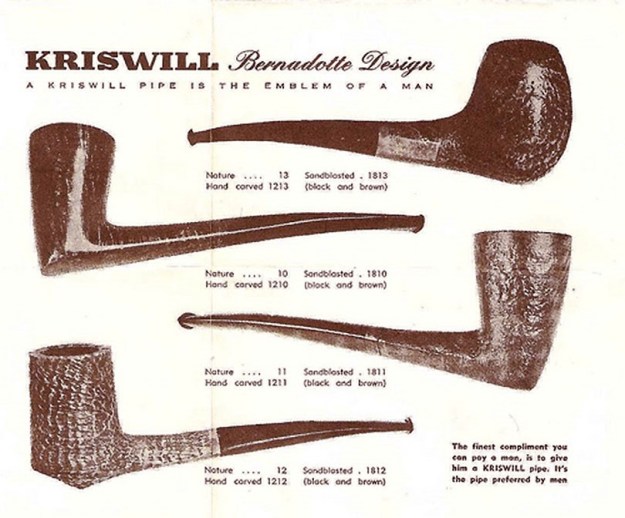
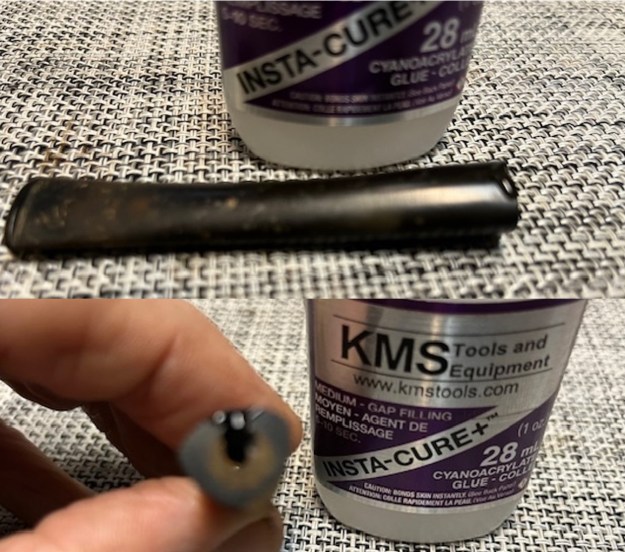
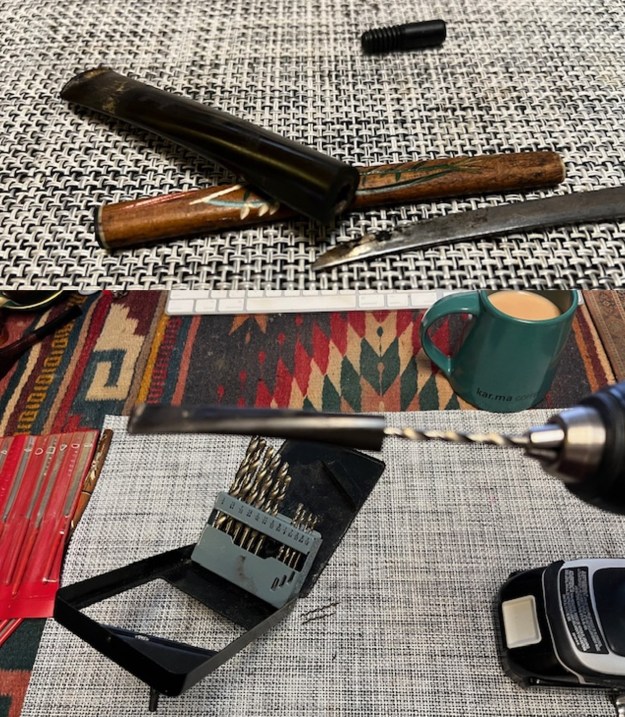
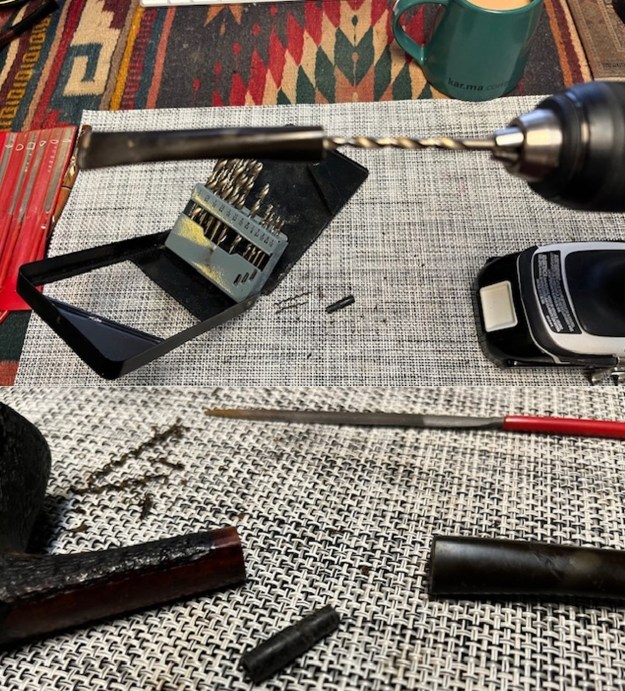
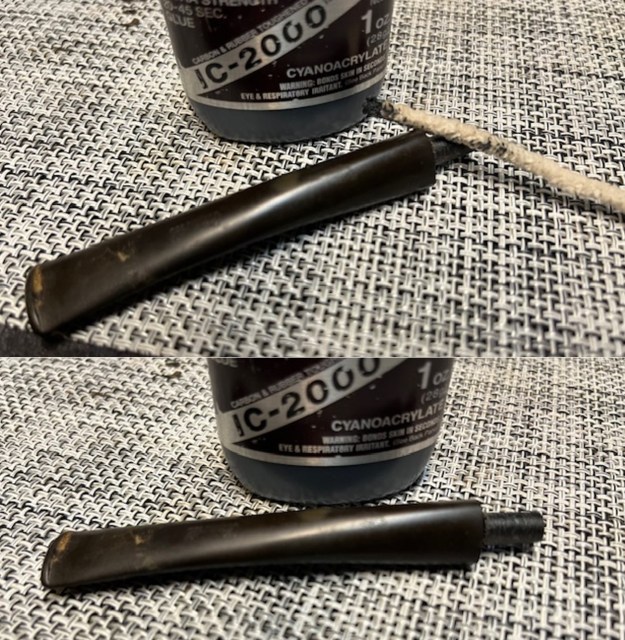
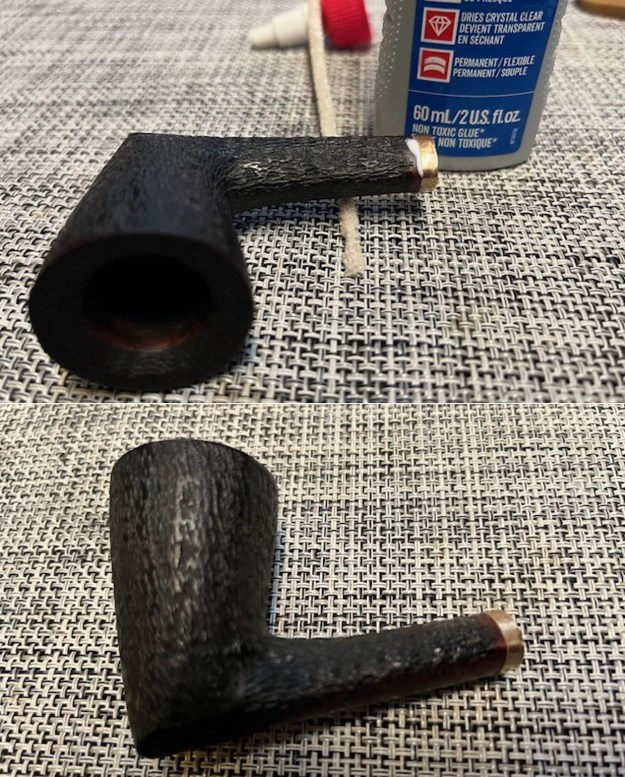
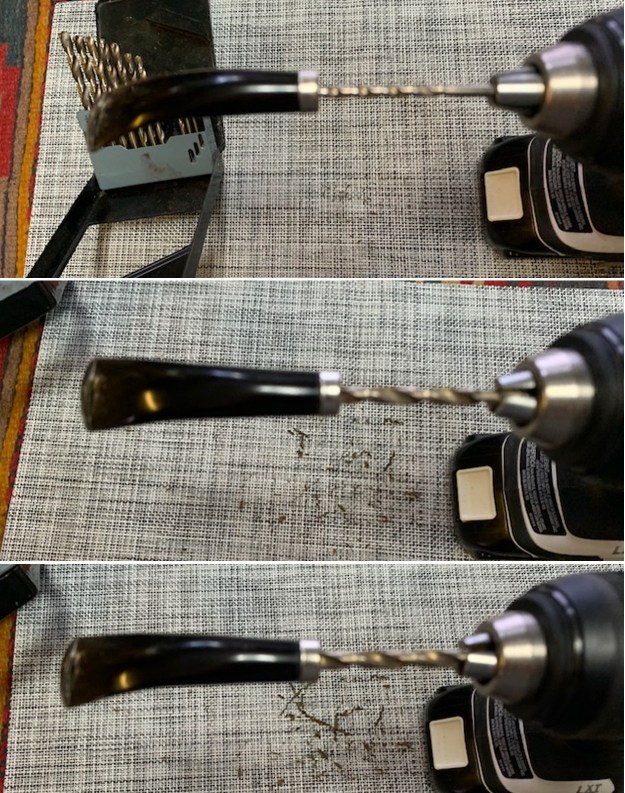
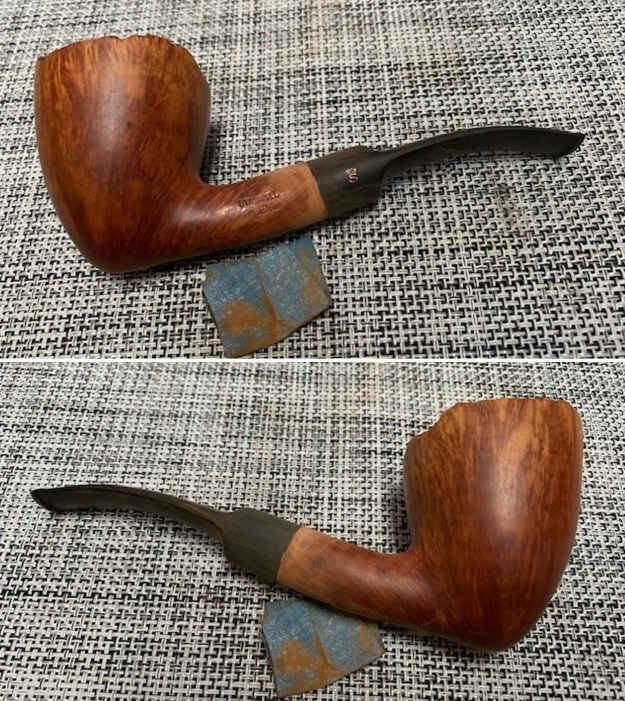
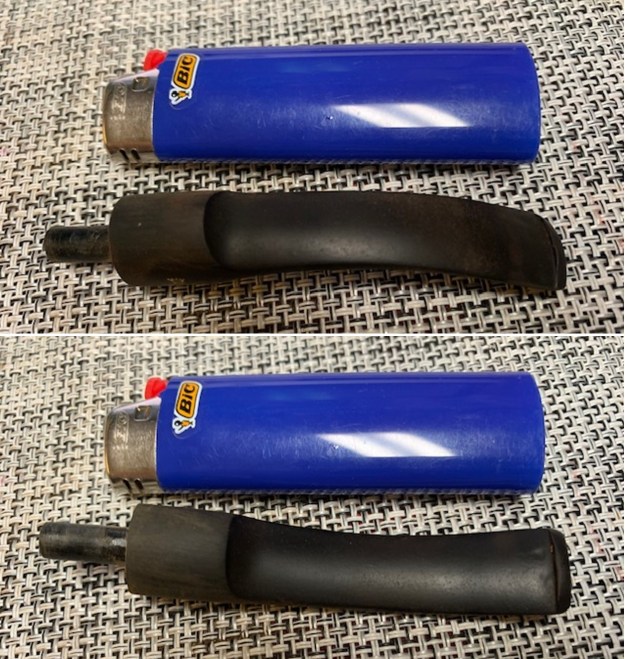
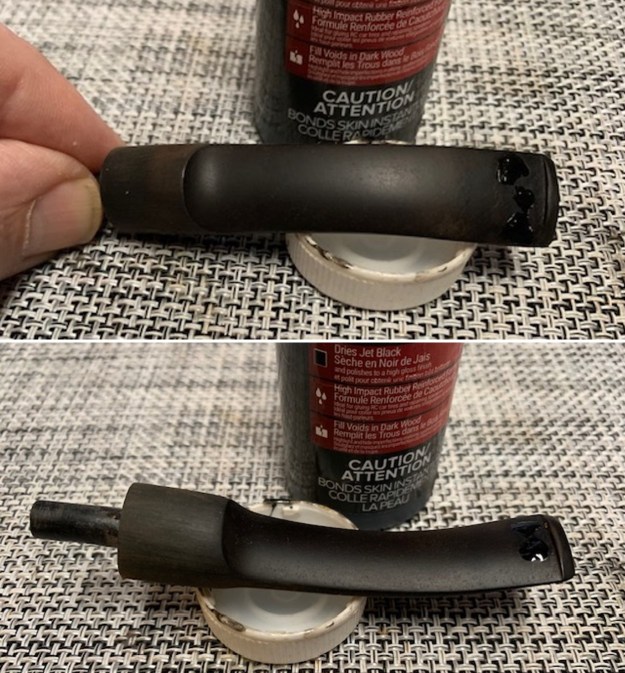
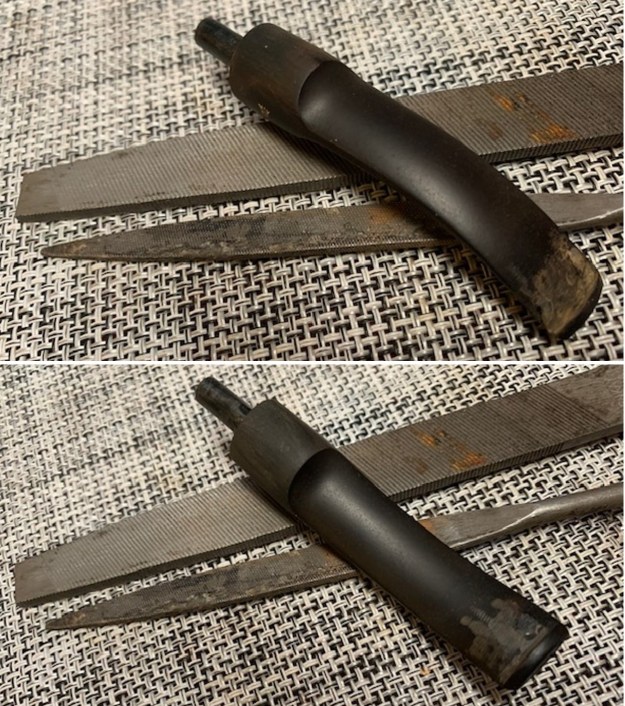
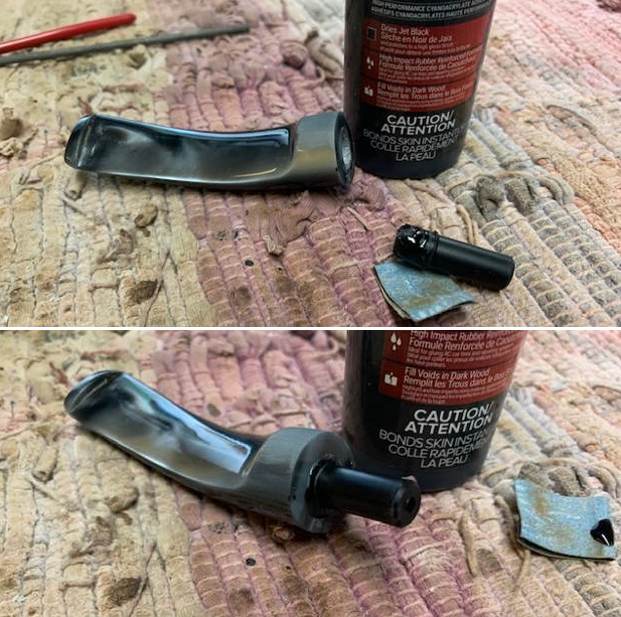
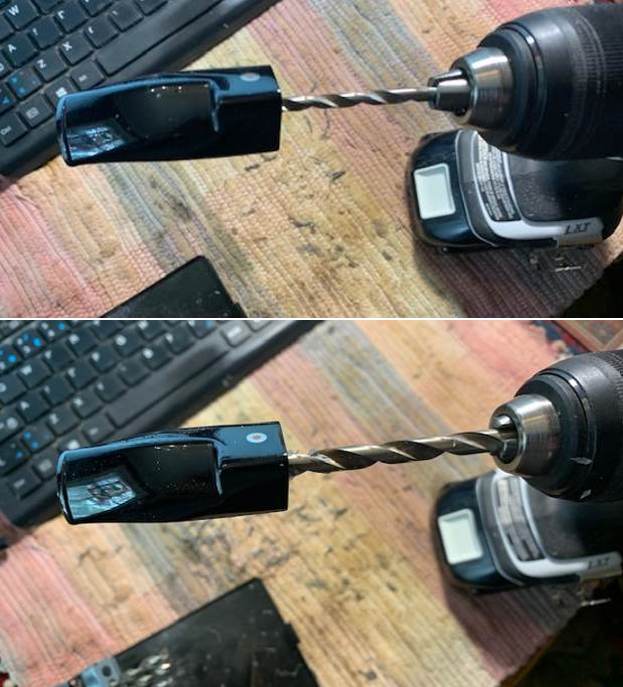
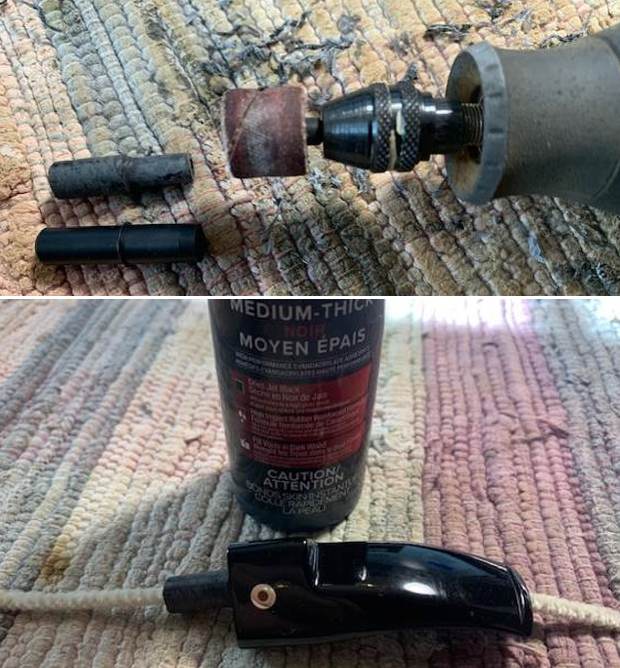
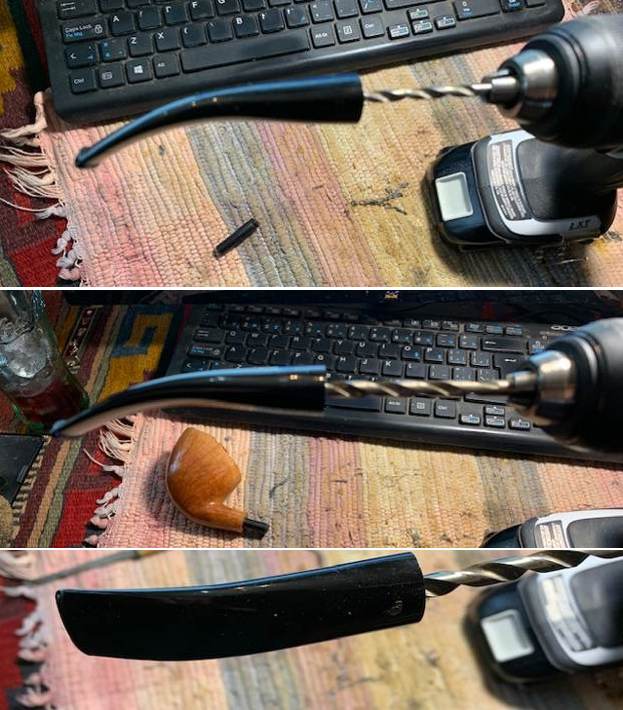
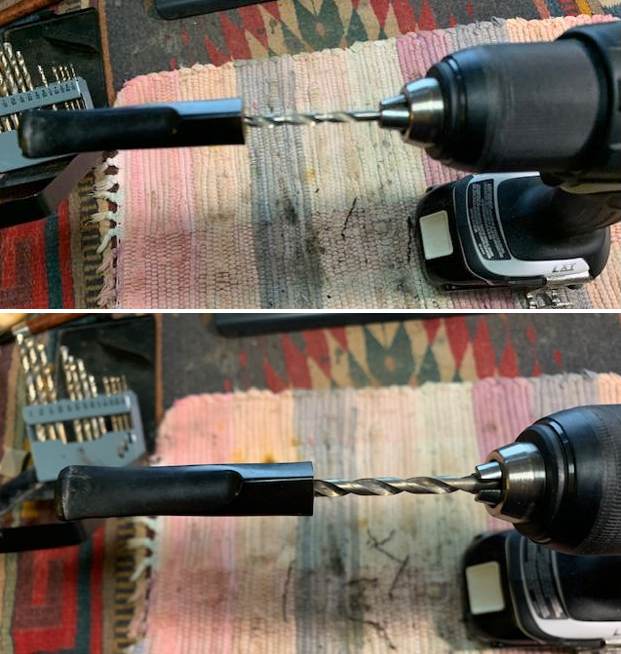
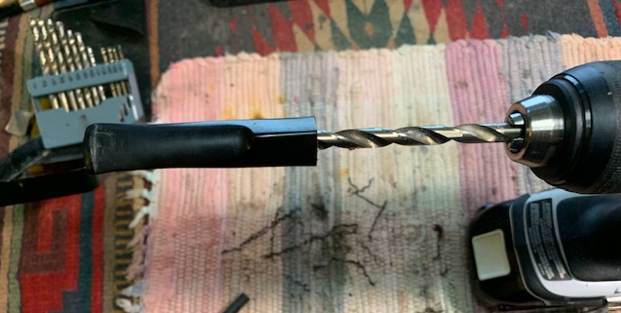
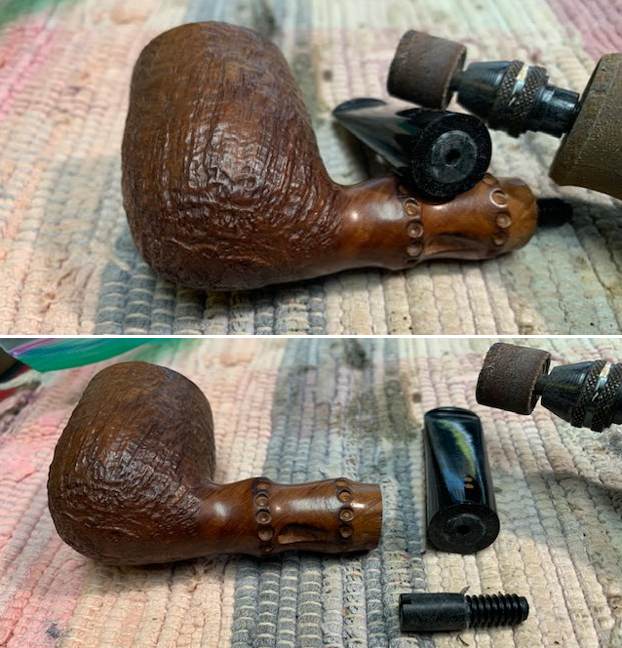
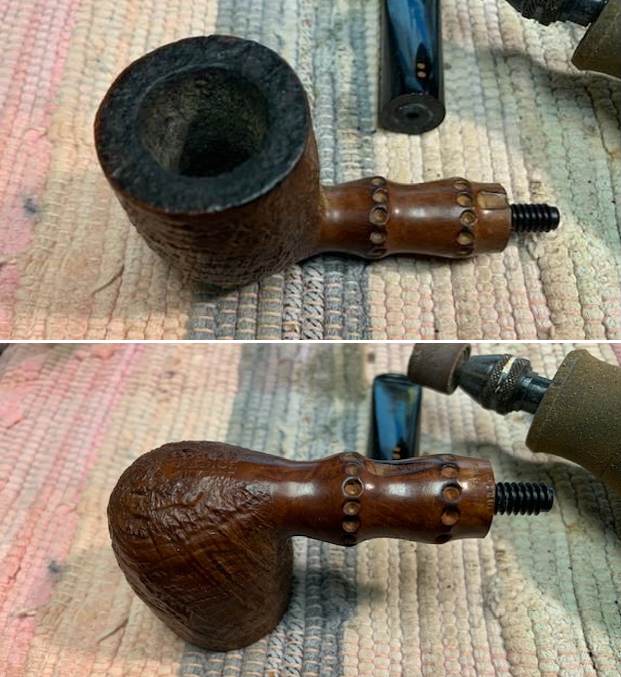
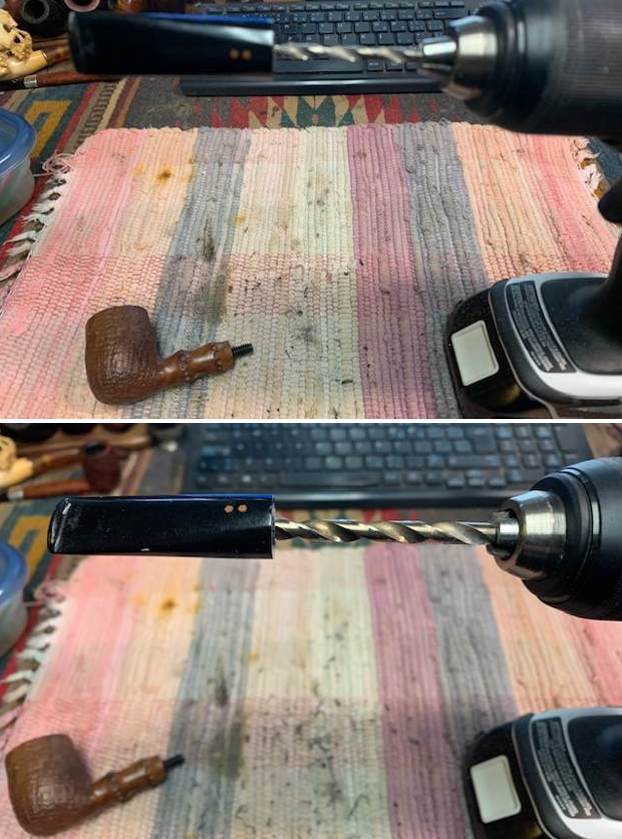
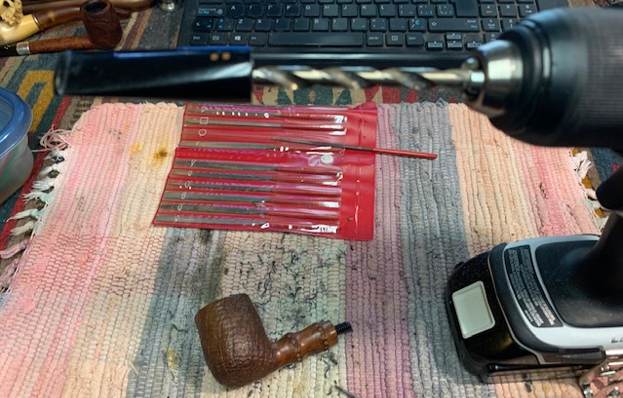
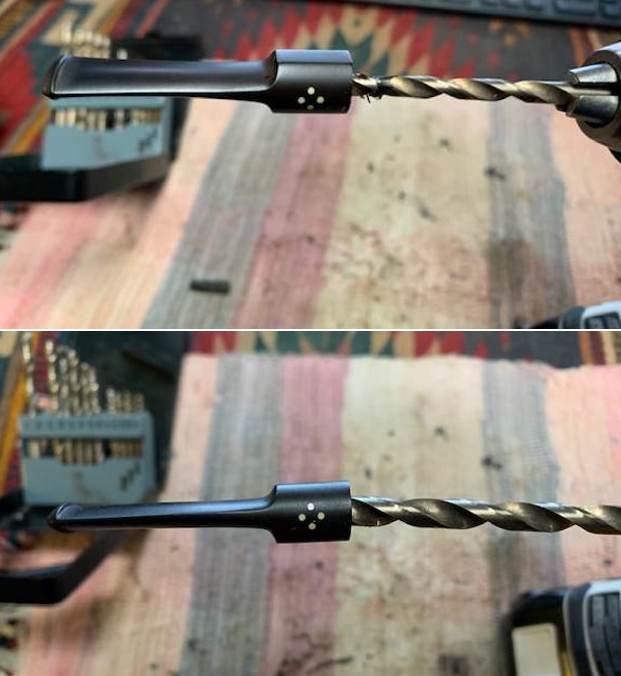
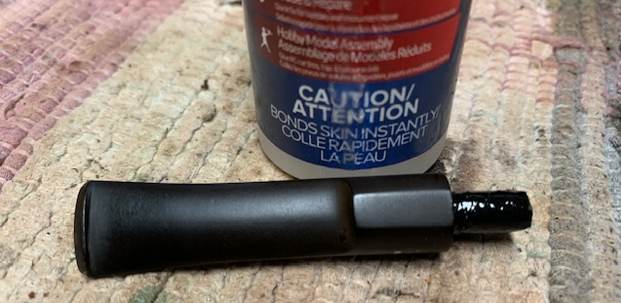
There was also a catalogue page on the Bernadotte Design line that shows the various pipes in the line. The second pipe down is the Hand carved 1210 which was made in black and in brown.I repaired chip and crack in the underside of the triangle shape stem with black CA glue. I wanted to do this prior to drilling the airway and opening it up for the new tenon end. I set the stem aside to let the repair cure.While I waited for the stem repair to cure I went through my tenons and found one that was very close in diameter to the shank. I reduced the diameter of the portion that would go into the stem with a Dremel and sanding drum. I repeated the process on the end of the tenon that would go in the shank. It was ready for the fit once the repair on the stem had cured and I was able to drill out the airway.I was a bit nervous drilling out the thin walled stem with the repair on the underside. I envisioned it splitting and ruining everything. I used a thin pen knife to begin the process of opening up the airway. I opened it to be large enough to take the first of the drill bits. I put the drill bit in my cordless drill and slowly turned it into the airway. I opened it up with several drill bit until the new tenon end fit in the stem. I cleaned up the airway with a set of needle files to make the airway the same diameter the depth of the drill. The fit in the stem was perfect. I painted the end of the tenon with black CA glue and pushed it in place in the airway. I set it aside to let the glue cure.I set the stem aside to allow the glue to cure. I wanted the tenon to be set in the stem so that once I put it in the shank it would not come out of the stem. I turned my attention to the bowl and shank. The shank had two small hairline cracks in in on the right side of the triangle. It would need to be glued and banded to accomplish a tight repair. I shaped a round brass band into a triangle and sanded it against a sanding board to thin the depth of the repair band. I fitted on the shank and put the stem in place to get a sense of what it would look like. I sent a few picks to the trustee in Toronto to show him what was going on. He approved of the repair.
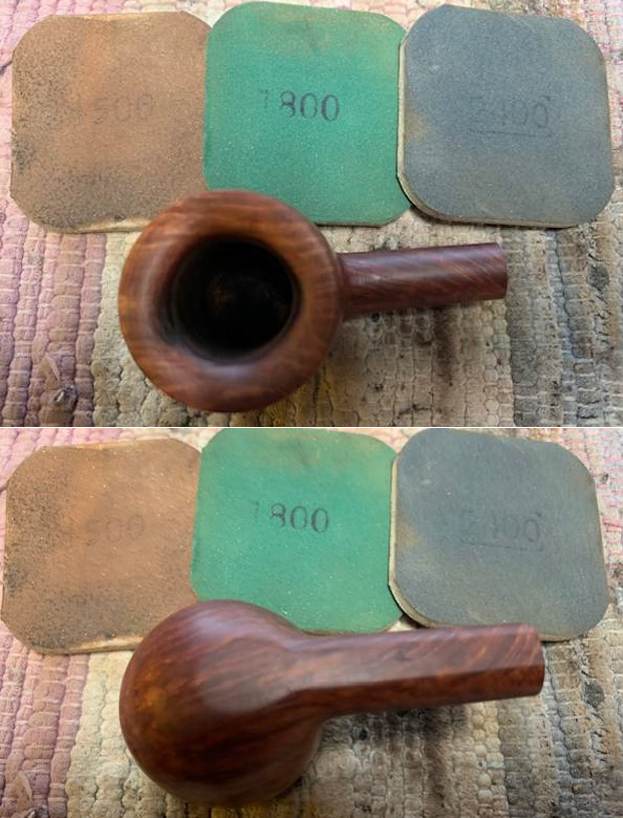
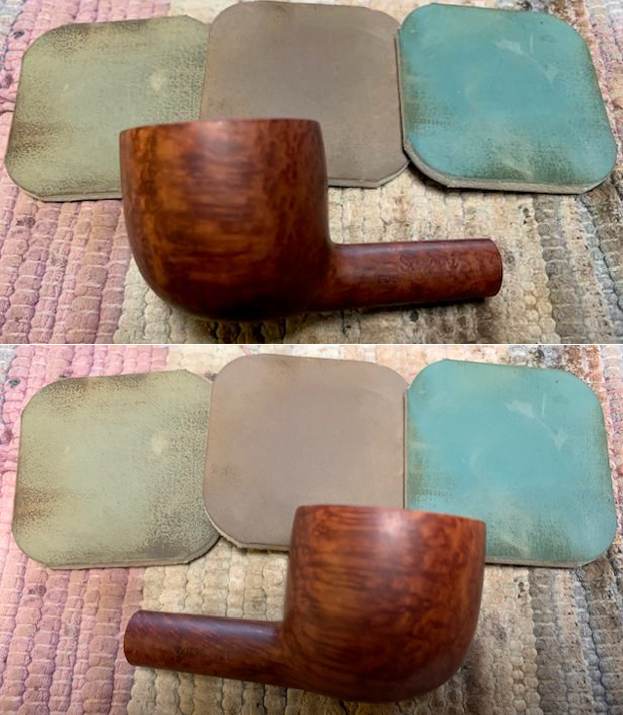
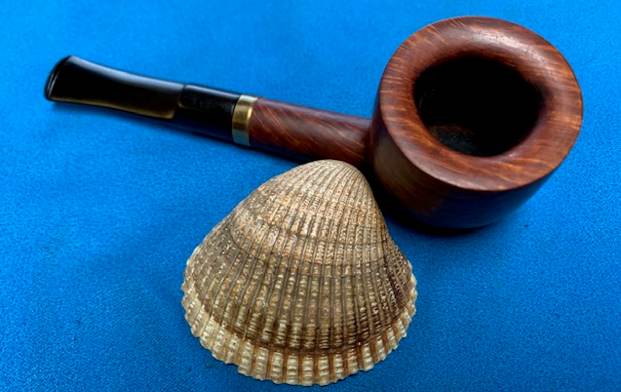
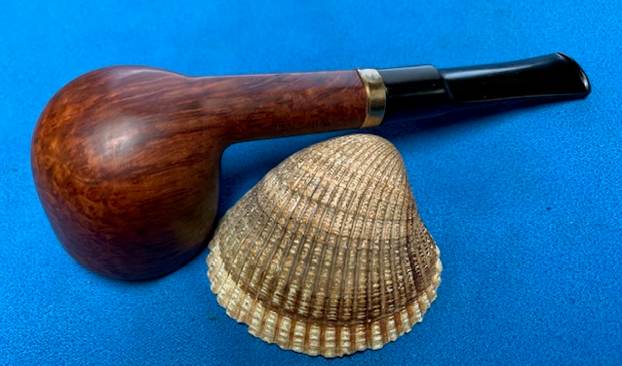
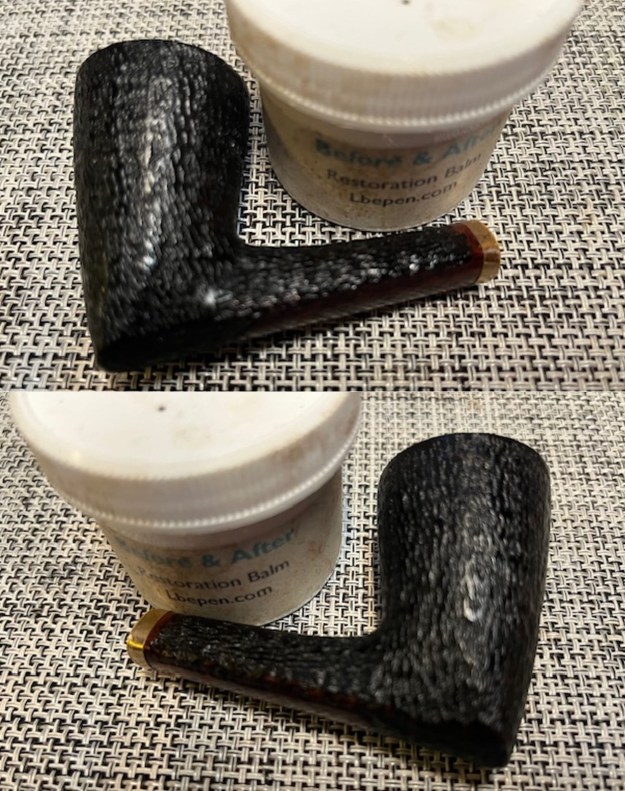
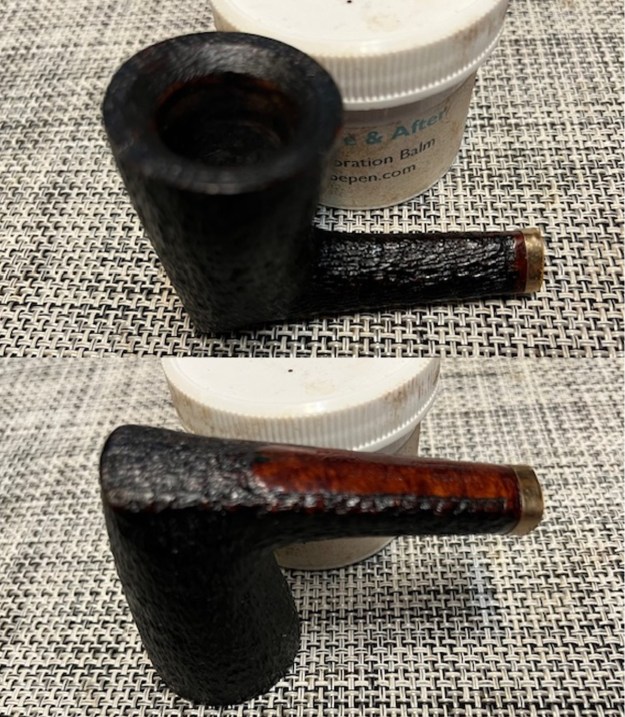
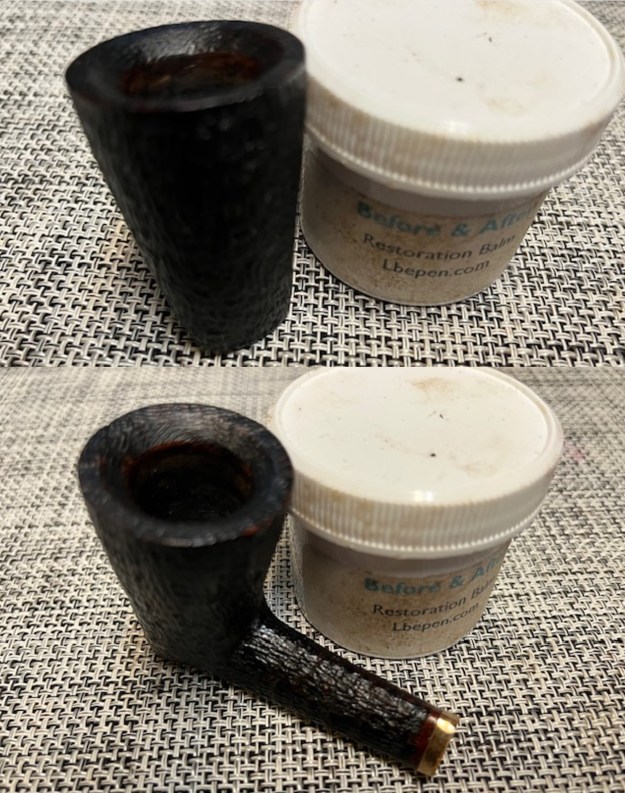
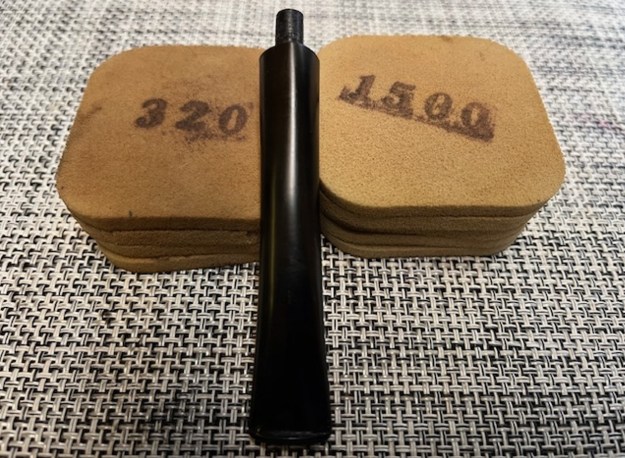
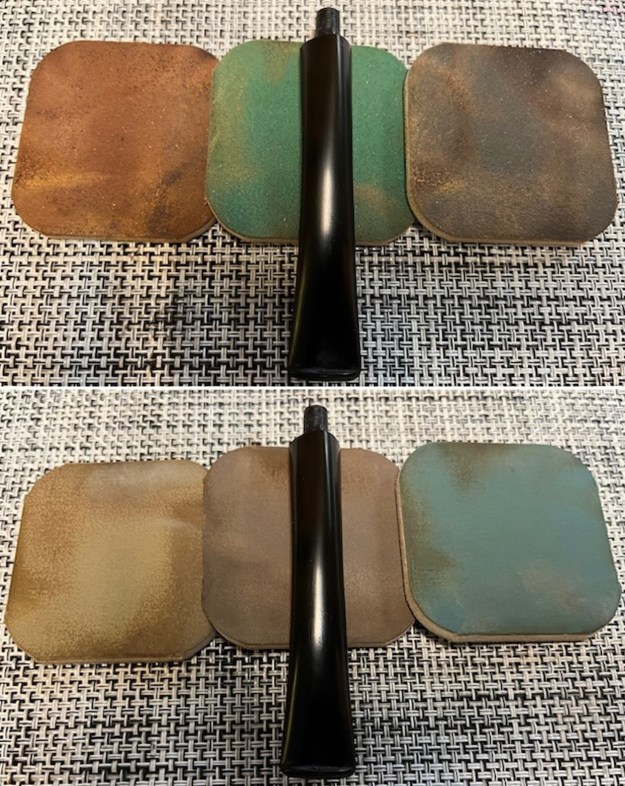
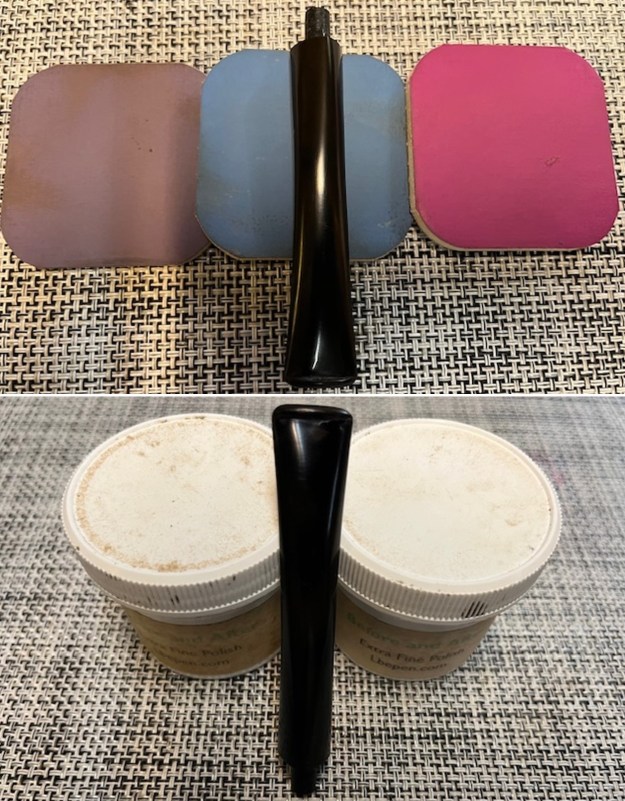
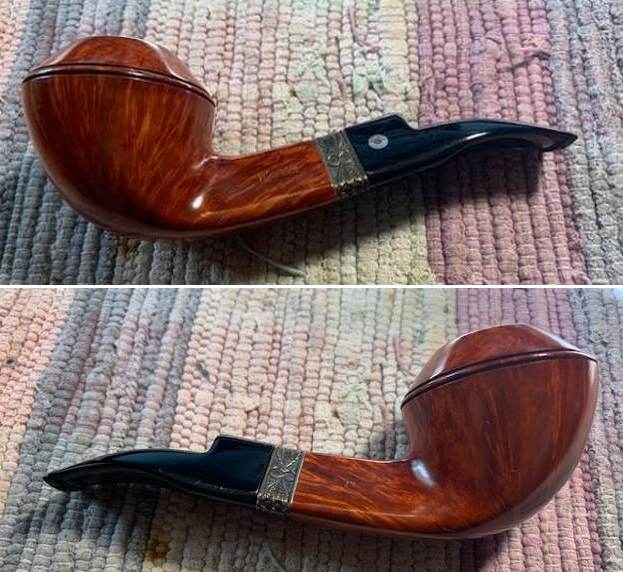
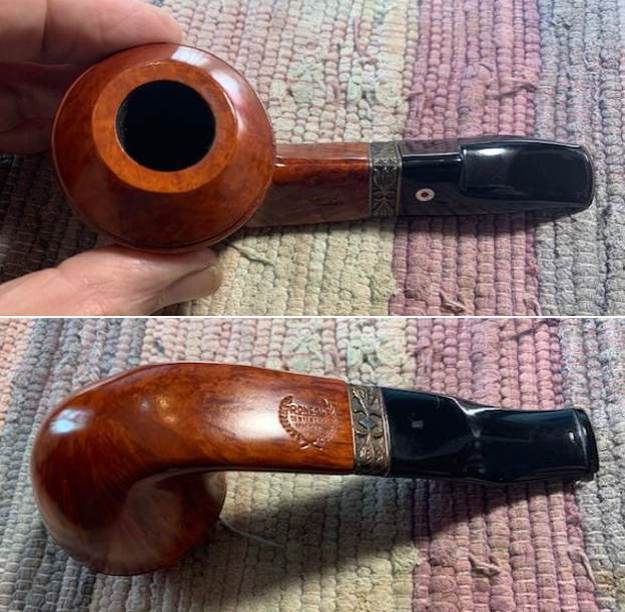
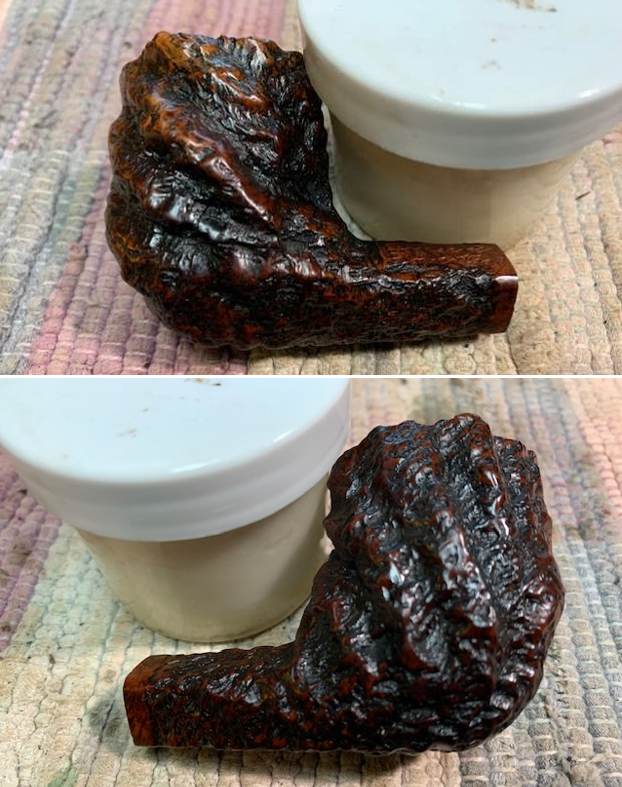
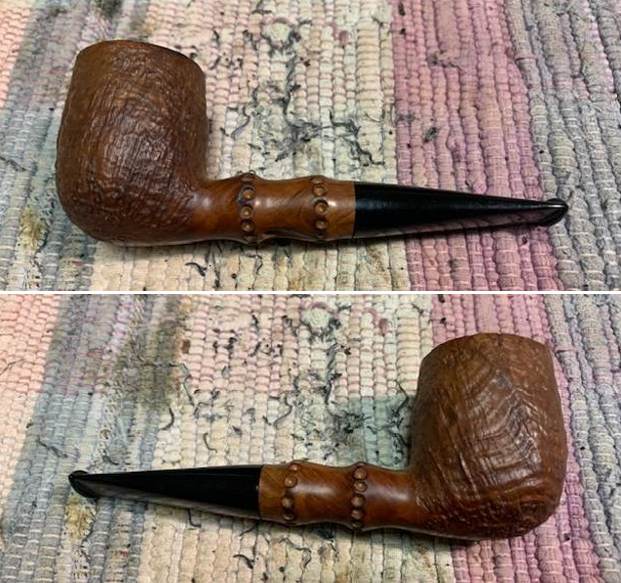
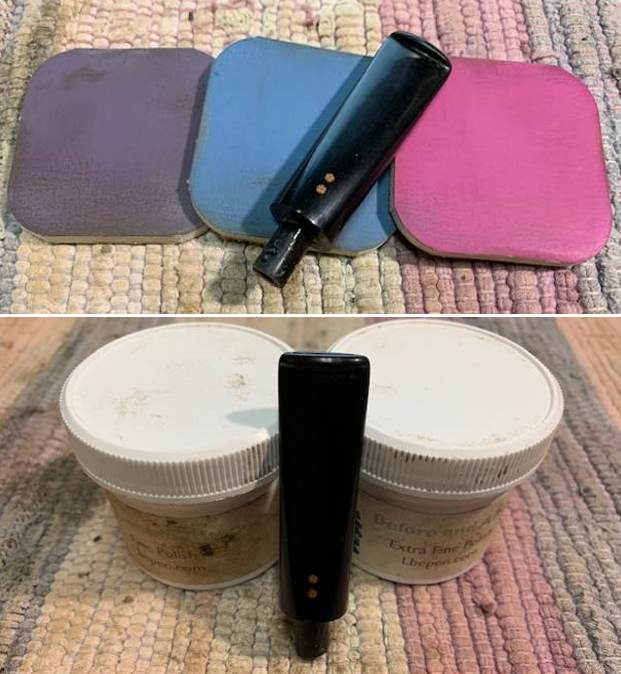
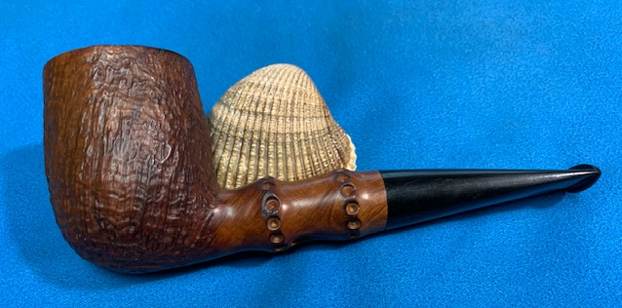
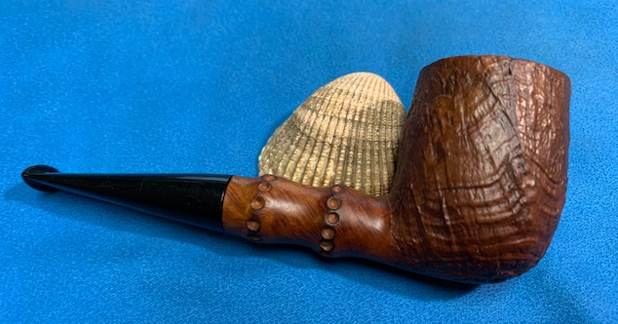
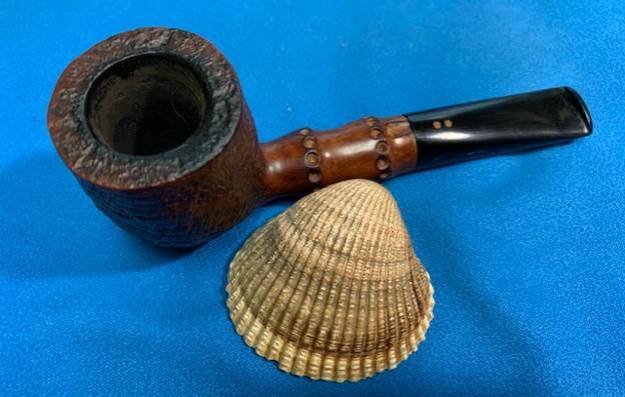
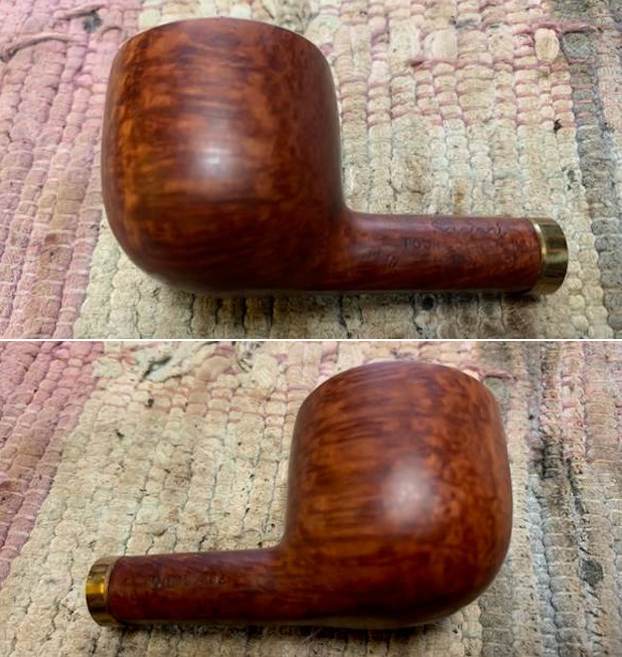
I glued the band on the shank with some all purpose white glue. I painted the surface of the shank with the glue making sure to get into the cracks. I pressed the band on the shank and wiped off the excess glue with a damp cloth.I rubbed the briar down with Before & After Restoration Balm. I worked it into the briar with my fingertips and a horsehair shoe brush to work it into the nooks and crannies of the rusticated finish. The product works to clean, enliven and preserve the briar. I let it sit for 10 minutes then I buffed it with a cotton cloth to deepen the shine. The briar really comes alive with the balm. I set the bowl aside and turned to finish the stem. To address the scratches and marks in the surface of the vulcanite I sanded it with 320-3500 grit sanding pads. I wiped it down after each sanding pad with a damp cloth. By the final 3500 grit sanding pad the rim top had a shine.I polished the vulcanite with micromesh sanding pads – 1500-12000 grit pads. I wiped it down with Obsidian Oil after each sanding pad. I used Before & After Pipe Polish – both Fine and Extra Fine to further polish the stem. I always look forward to this part of the restoration when all the pieces are put back together. I put the Kriswill Bernadotte 1210 pipe back together and buffed it with Blue Diamond on the buffing wheel. I gave the bowl multiple coats of Conservator’s Wax and the stem multiple coats of carnauba wax. I hand buffed the pipe with a clean buffing pad to raise the shine. It is fun to see what the polished bowl looks like with the new brass band on the shank end. The combination of grain and the thin band add some elegance to the pipe when combined with the polished black vulcanite stem. This royalty designed Kriswill Bernadotte 1210 Skater is nice looking and feels great in my hand. The pipe is another light weight that could be clenched and smoked while doing other things as it is very well balanced. Have a look at it with the photos below. The dimensions are Length: 5 ¾ inches, Height: 2 inches, Outside diameter of the bowl: 1 ¼ inches, Chamber diameter: ¾ of an inch. The weight of the pipe is 1.06 ounces/30 grams. This one will be heading back to Toronto soon. I am looking forward to what the pipeman who sent it thinks of this restoration. Lots more to do in this lot! Thanks to each of you who are reading this blog. Remember we are not pipe owners; we are pipemen and women who hold our pipes in trust until they pass on into the trust of the next pipeman or woman.

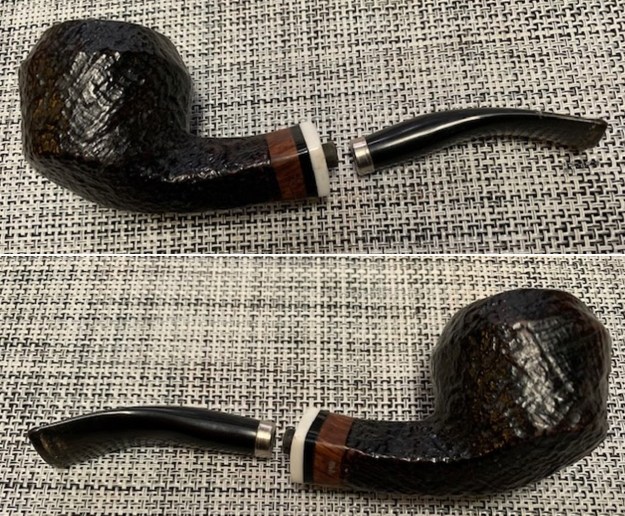
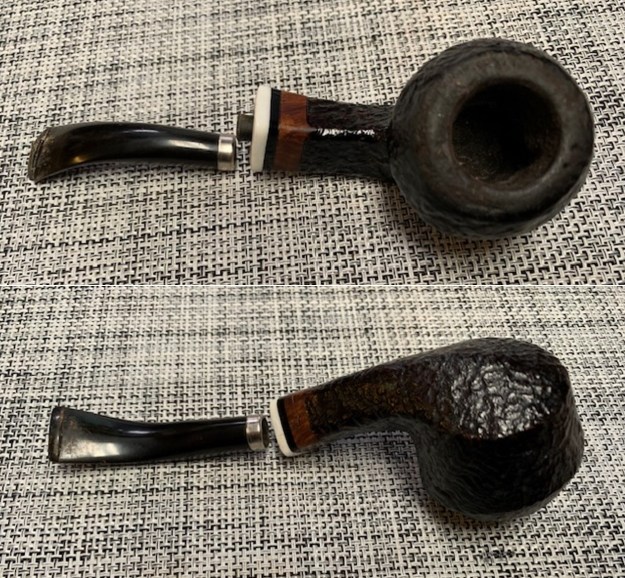
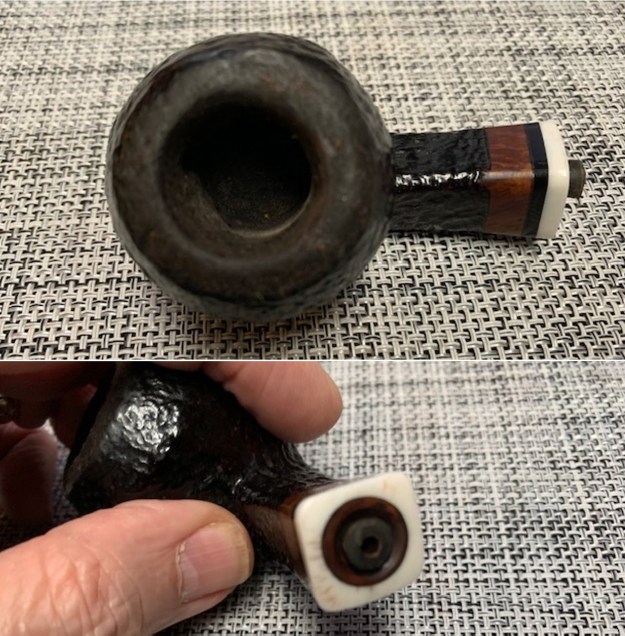
Replacing a Snapped Tenon on a Neerup of Denmark Freehand Style Bulldog


Blog by Steve Laug

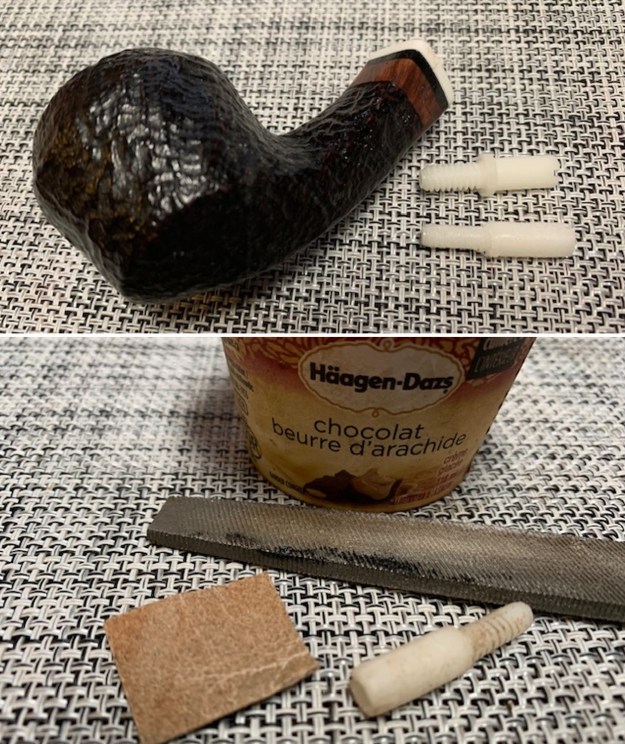
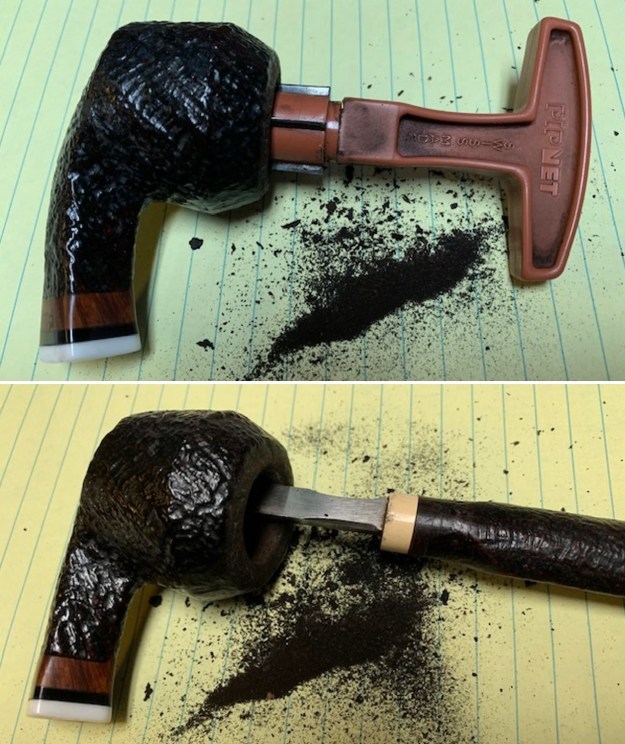
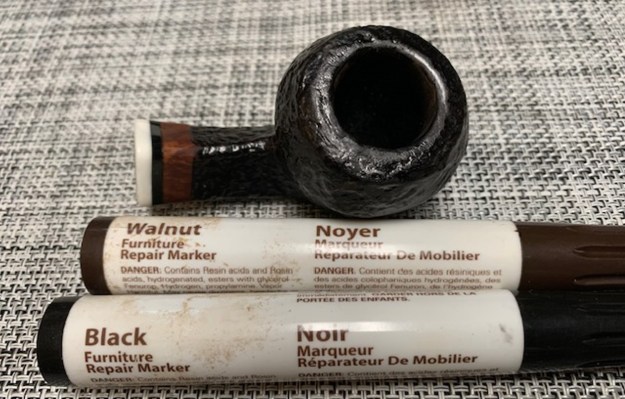
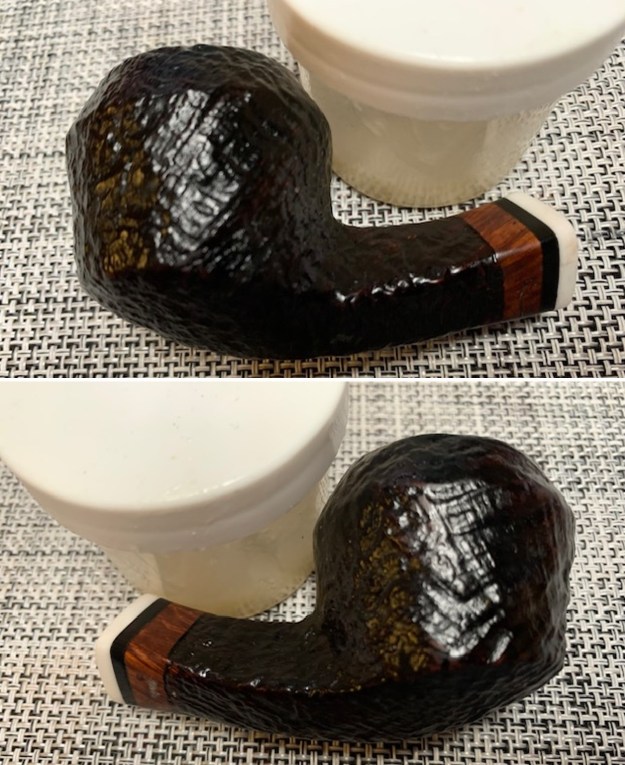
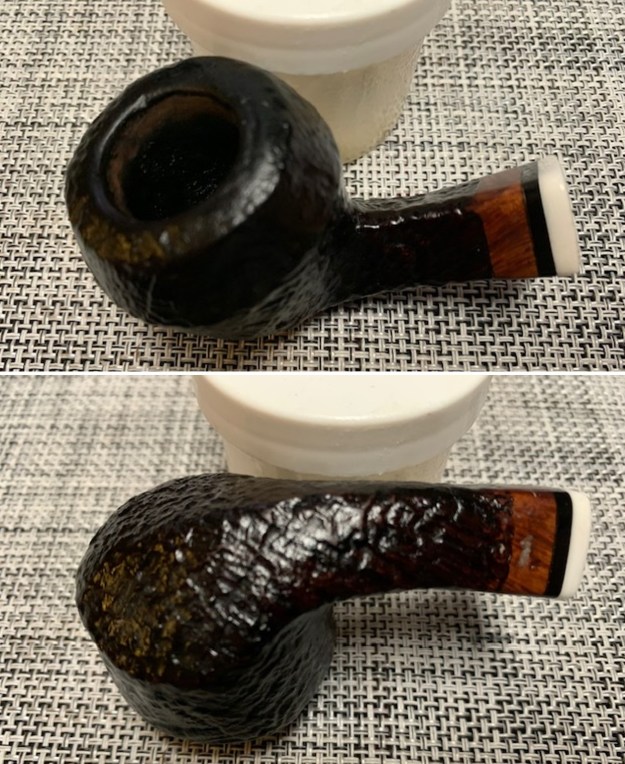
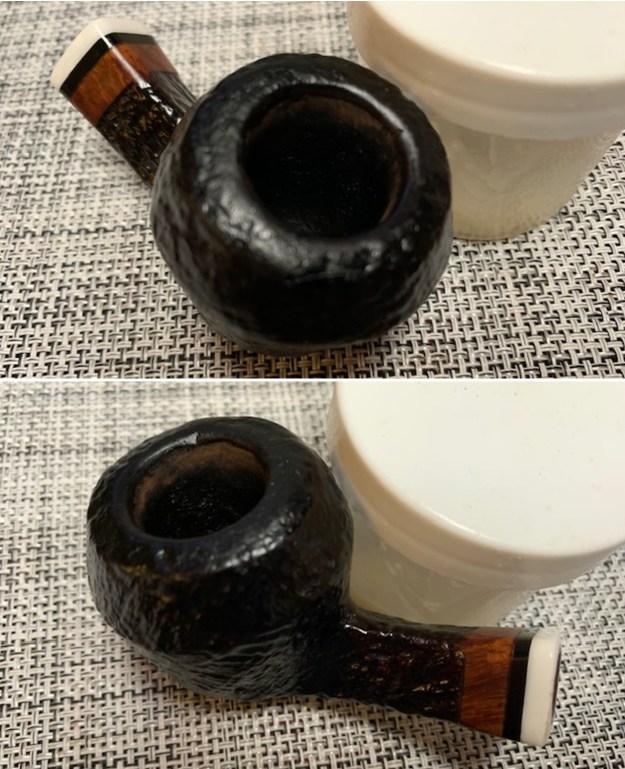
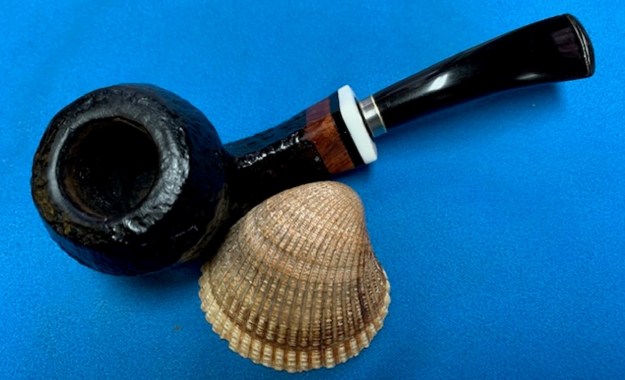
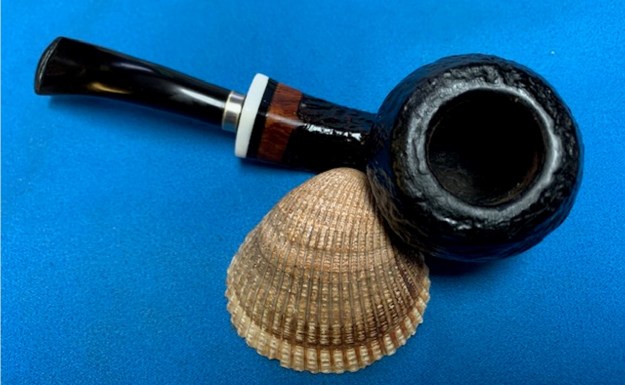
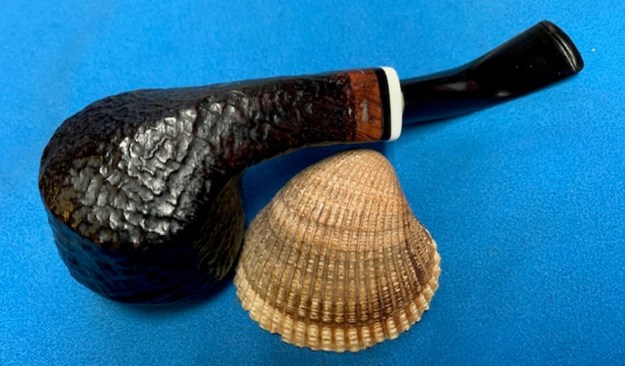
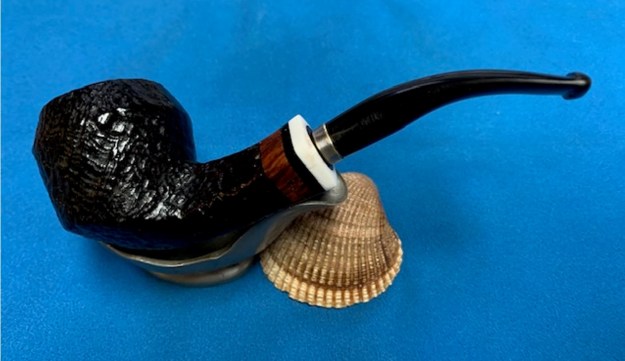
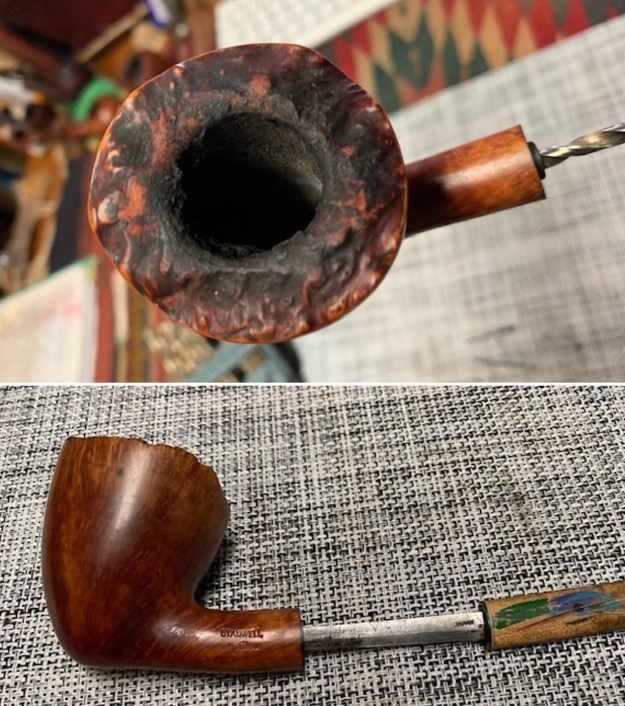
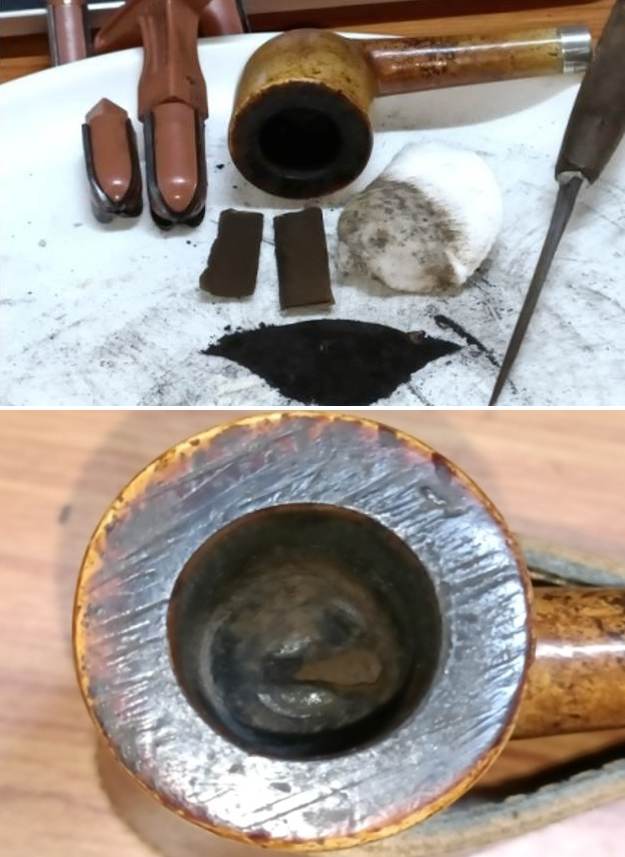
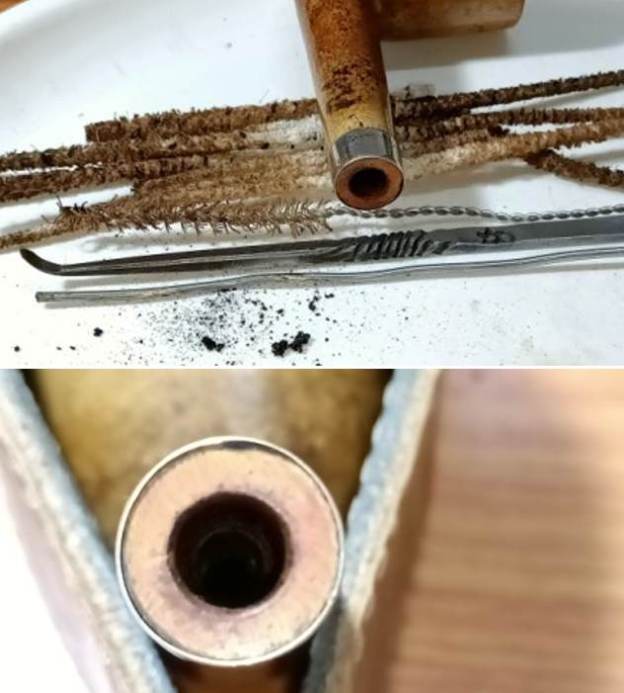
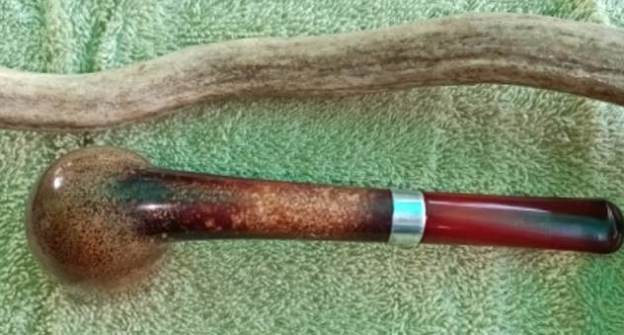
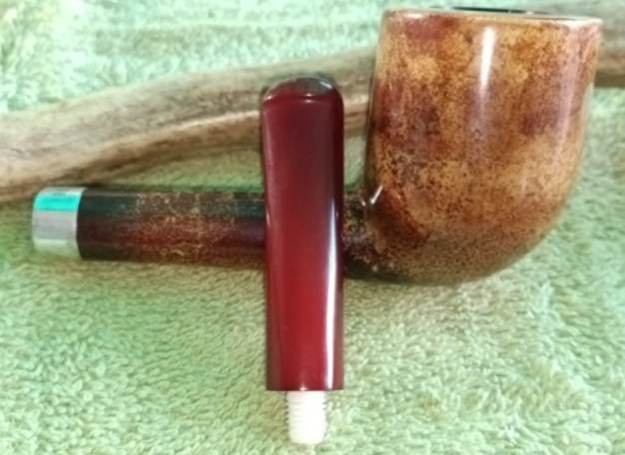
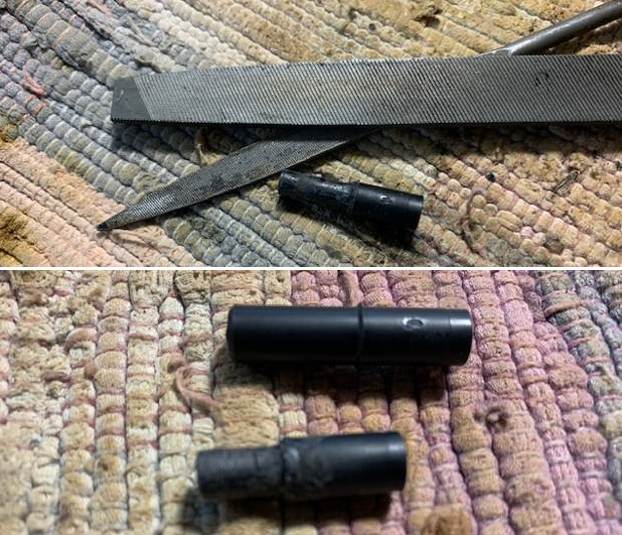
The next pipe on the table came to me from Curtis, a customer I have repaired pipes for in the past. He sent me two pipes that he wanted repaired by mail. I started with this one first. In looking at it I recalled that I had restemmed this pipe for him in December of last year. The original stem had been badly damaged and I had replaced it with the current stem and cap to give it a look similar to the original. It was a lot of work but I liked how it looks. Here is the link to that restoration (https://rebornpipes.com/2022/12/22/new-life-and-new-look-for-a-neerup-made-in-denmark-bulldog/). It was a nicely shaped sandblasted Bulldog with a black acrylic and a white acrylic spacer on the shank end. There was a snapped tenon in the shank and a vulcanite taper stem with a silver metal end cap/band. The tenon had snapped smoothly against the metal stem band. I would need to clean it up and replace the tenon. The bowl had a thick cake of a vanilla smelling aromatic and a thick overflow of lava on the inner edge and the rim top. The rim top was slightly worn and smooth under the lava. The stem had some calcification, tooth chatter and marks on the surface of the top and underside ahead of the button. I took some close photos of the bowl, rim top and the stem to show their condition when I started working on it. You can see the thick cake in the bowl and the thick lava coat on the rim top and inner edge. It is quite heavy and the overflow obscures the condition of the edge of the bowl and the rim top. I was able to start pulling the broken tenon and you can see it extending out of the shank. I started my work on this pipe by pulling the broken tenon from the shank. I used a drywall screw and threaded it into the airway in the tenon piece. When it took hold, I wiggled the tenon free from the shank. It took a bit of careful and slow work to loosen and remove it. I went through my box of tenons looking for one that was the proper size for the shank. Ideally it would have been a black threaded tenon but I did not have any that were the proper diameter. I did have some white Delrin tenons that were perfect and would work with the white acrylic space. The lower one in the photo would be perfect. I reduced the diameter of the threaded portion with my Dremel and a sanding drum. I used a flat file to smooth out the transition and further shape the new tenon. I used a folded piece of 180 grit sandpaper to remove the sanding marks and clean up the diameter of the tenon.When I finished the sanding, I polished it with 220 and 600 grit sandpaper to smooth out the surface. Once finished, it fit perfectly in the shank of the pipe. I left threads on the insert portion of the new tenon so that the glue would have something to grab onto when it was inserted in the stem. I removed the new tenon from the shank and turned my attentions to the stem. I drilled out the airway with a succession of larger drill bit – beginning with one slightly larger than the airway in the stem and ending with an 11/64ths drill bit.Once it had been opened up I pushed the tenon in the shank once more and slid the stem over the top to align it. The fit was very snug and nice. I took photos of it to show the fit at this point in the restoration process. I removed the stem from the pipe and the tenon from the mortise. I turned my attention to cleaning the internals and the externals of the bowl and shank. I reamed the bowl with a PipNet pipe reamer and the number three cutting head. I took the cake back to bare briar. I cleaned up the reaming with a Savinelli Fitsall pipe knife to remove what remained. I sanded the walls of the bowl with 220 grit sandpaper wrapped around a piece of dowel. Once finished the bowl walls were smooth and clean. I scraped off the lava on the rim top with the edge of a Savinelli Pipe Knife and then used a brass bristle wire brush to remove the debris. I scrubbed the exterior of the bowl with a tooth brush and undiluted Murphy’s Oil Soap. I used the brass bristle brush to work over the rim top with the soap to go more deeply in the sandblast surface of the rim. I cleaned out the airway in the shank and the stem with alcohol, cotton swabs and pipe cleaners. I worked on them until the mortise and airway in the shank and stem were clean.Before gluing the new tenon in place in the stem I went over the stem with a lens. I saw a crack in the stem side on the left. It must have happened when the tenon snapped in the shank. I removed the metal band/cap on the stem end and dabbed some clear CA glue in the cracked area and worked it into the crack with a tooth pick. I put some white glue in the inside of the cap and pressed it back onto the stem end. The crack was solidly repaired and the cap and band held it together.I touched up the rim top and edges with a Walnut and a Black stain pen to blend colour of the clean surface into the colour of the rest of the bowl and shank.I worked some Before & After Restoration Balm into the surface of the bowl and shank with my fingertips to clean, enliven and protect the briar. I let the balm sit for 15 minutes and then buffed with a cotton cloth to raise the shine. The photos show the bowl at this point in the restoration process.   I set the bowl aside and turned my attention to the stem. I sanded the stem surface with a folded piece of 220 grit sandpaper. I started polishing it with 600 wet dry sandpaper. I polished the stem with micromesh sanding pads – wet sanding with 1500-12000 grit sanding pads. I wiped it down after each sanding pad with Obsidian Oil. I finished polishing the stem with Before & After Pipe Stem Polish – both Fine and Extra Fine. I wiped the stem down with a final coat of Obsidian Oil and let it sit and absorb into the vulcanite. This Neerup Made in Denmark Freehand Bulldog carved by Peder Jeppesen combines a great looking piece of sandblast briar with a multi-banded shank extension and a vulcanite stem to make a beautiful pipe. The clean up work brought back the shiny coat allowing the grain to come alive with the polishing and waxing. I put the stem back on the bowl and carefully buffed the pipe with Blue Diamond on the buffing wheel. I gave the bowl and the stem multiple coats of carnauba wax on the buffing wheel and followed that by buffing the entire pipe with a clean buffing pad. I hand buffed the pipe with a microfiber cloth to deepen the shine. The finished Neerup Made in Denmark Bulldog really is a beauty and fits nicely in the hand and looks very good. Give the finished pipe a look in the photos below. The dimensions of the pipe are Length: 5 1/2 inches, Height: 2 inches, Outside diameter of the bowl: 1 ¾ inches, Chamber diameter: ¾ of an inch. The weight of the pipe is 1.80 ounces/51 grams. Once I finish the second pipe this one will be going back to Curtis to enjoy. Thanks for reading this blog and my reflections on the pipe while I worked on it. There are many more to come!

As always, I encourage your questions and comments as you read the blog. Thanks to each of you who are reading this blog. Remember we are not pipe owners; we are pipe men and women who hold our pipes in trust until they pass on into the trust of those who follow us.

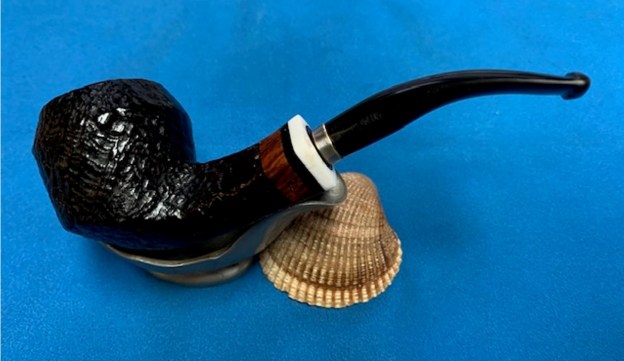
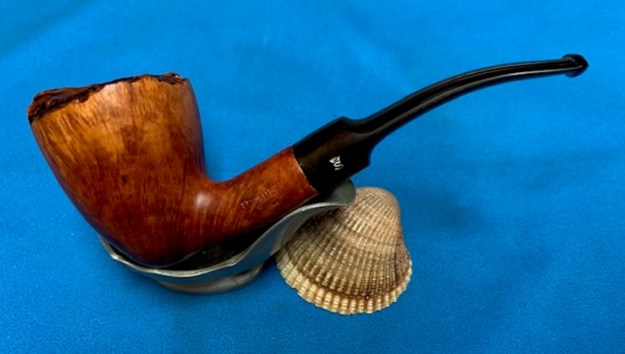
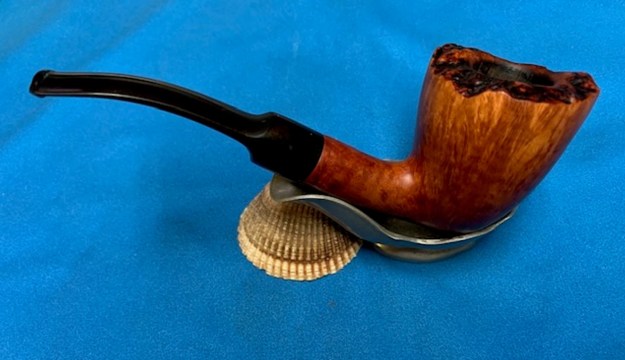
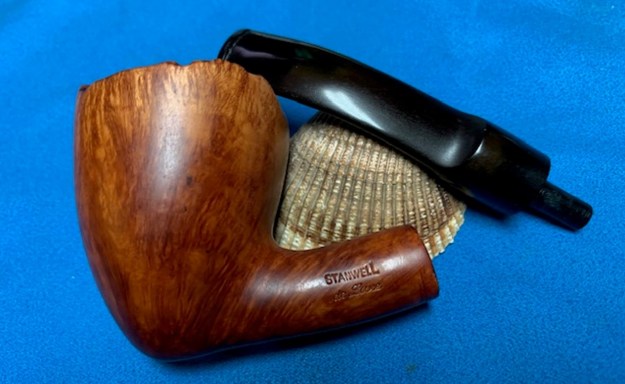
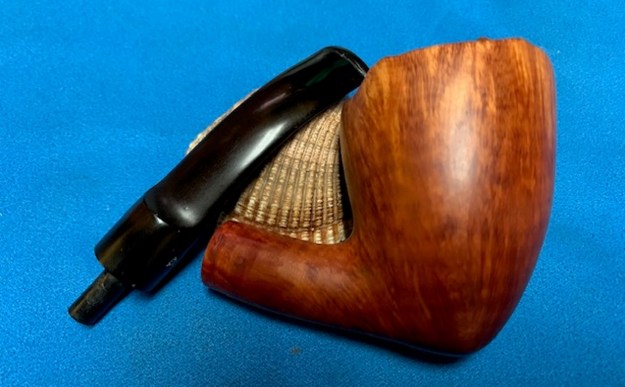
Replacing a broken tenon and restoring a Stanwell de Luxe


Blog by Steve Laug

Earlier in July I received an email from Peter, a fellow in California regarding a pipe repair he needed. He wrote as follows.

Hi, I’m just wondering if you can repair a Stanwell pipe for me? The stem broke off inside the pipe. Thanks for your time, Peter.

I wrote him back asking for photos so I could have a look at it. I figured he meant that the tenon snapped off inside the shank but I wanted to be certain. He replied

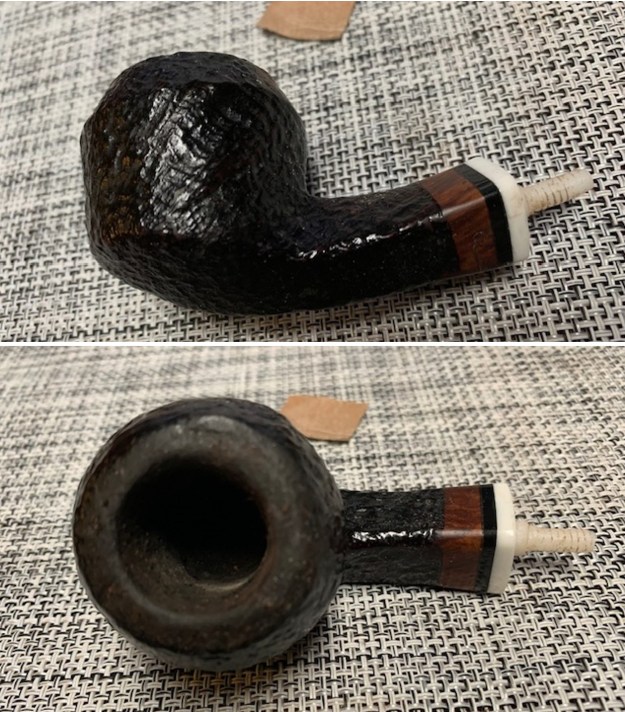
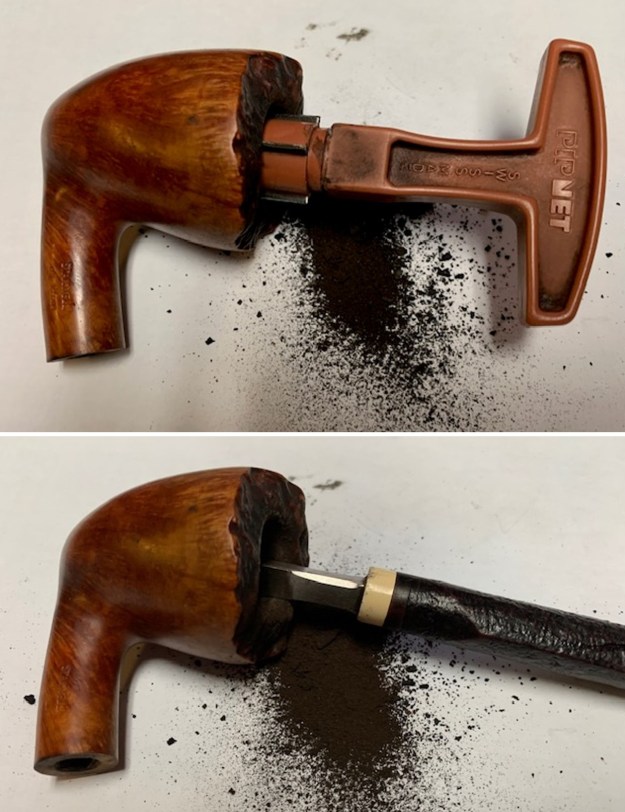
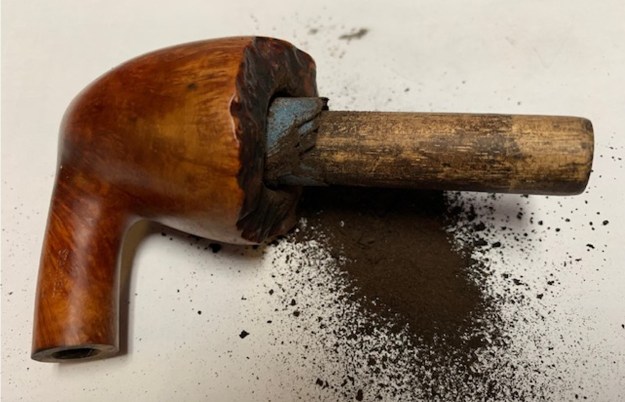
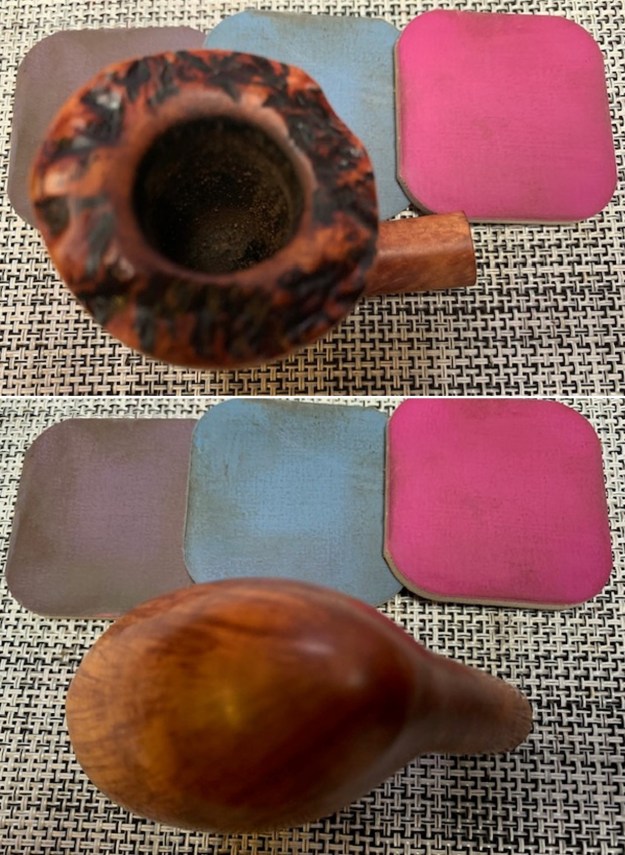
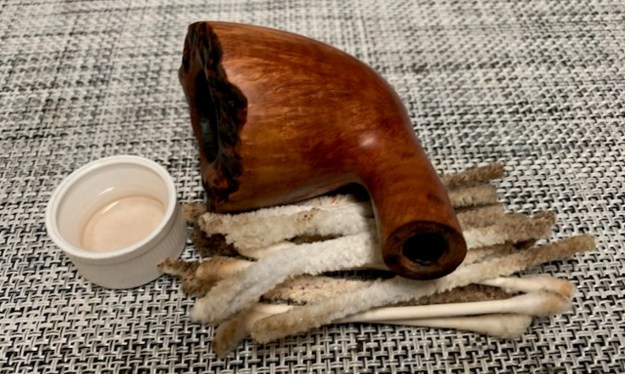
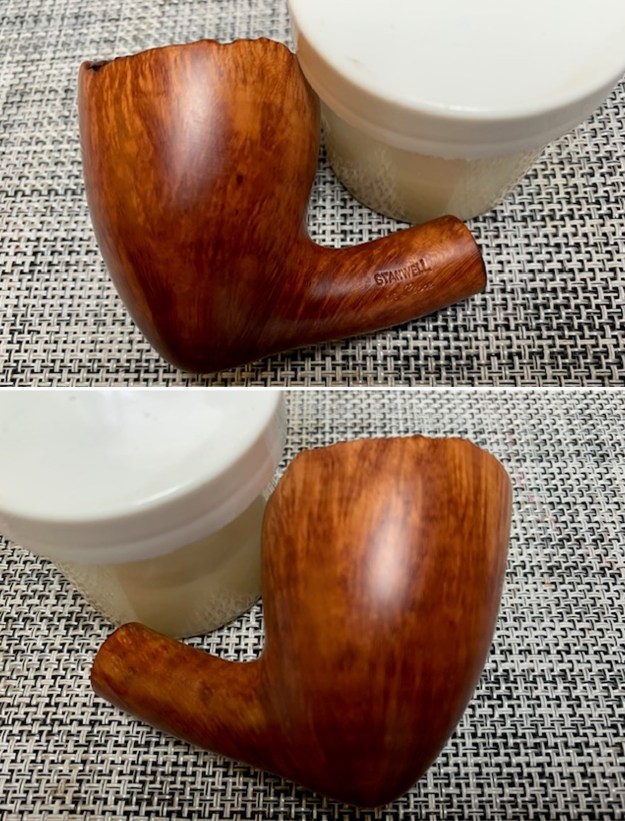
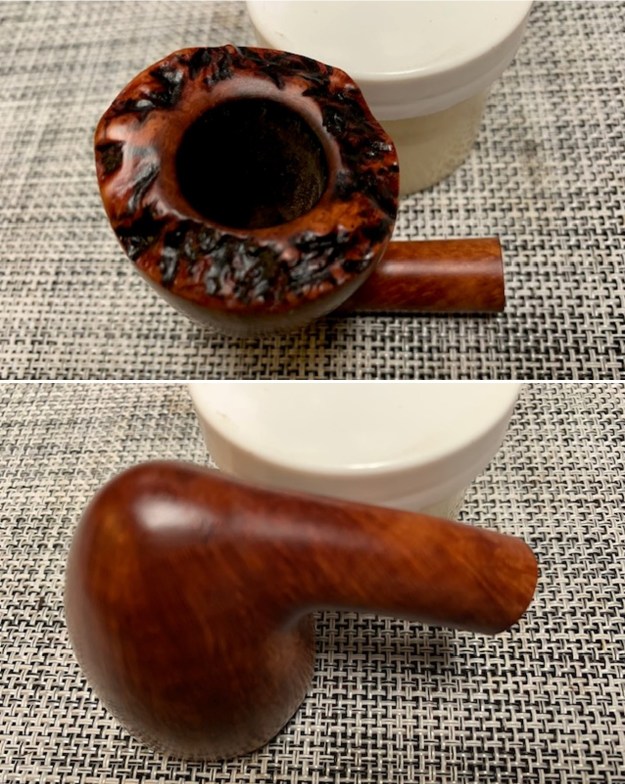
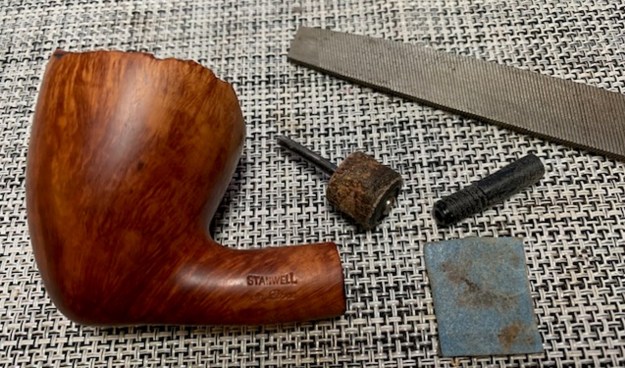
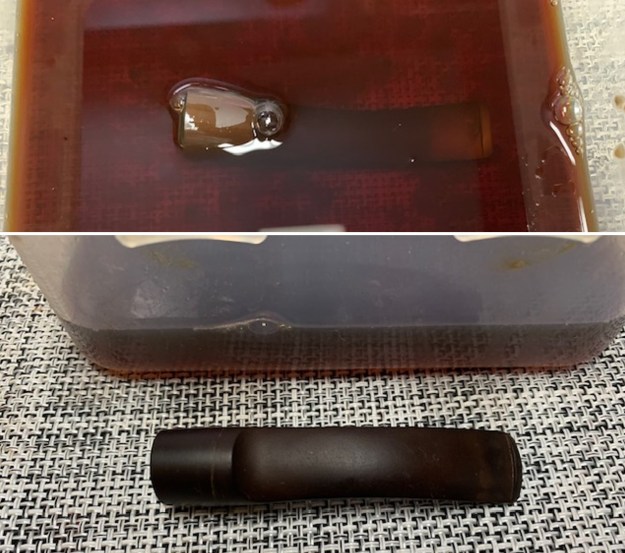
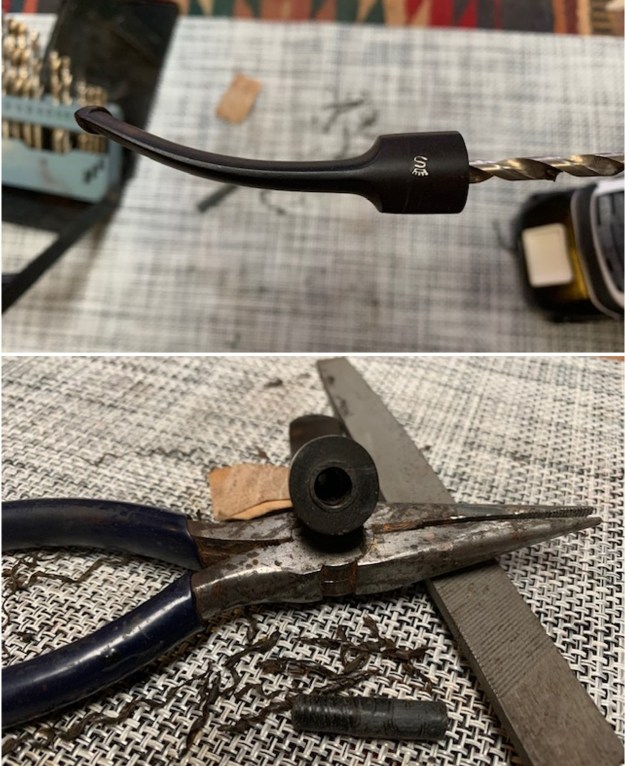
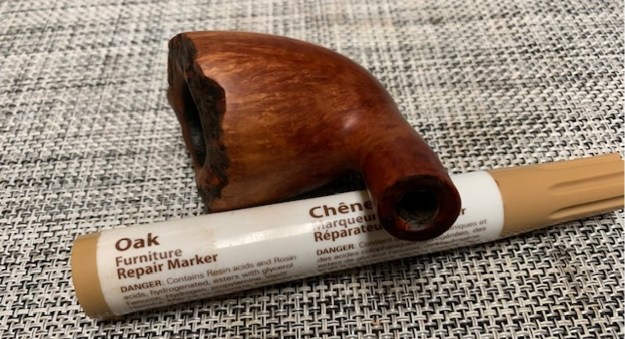
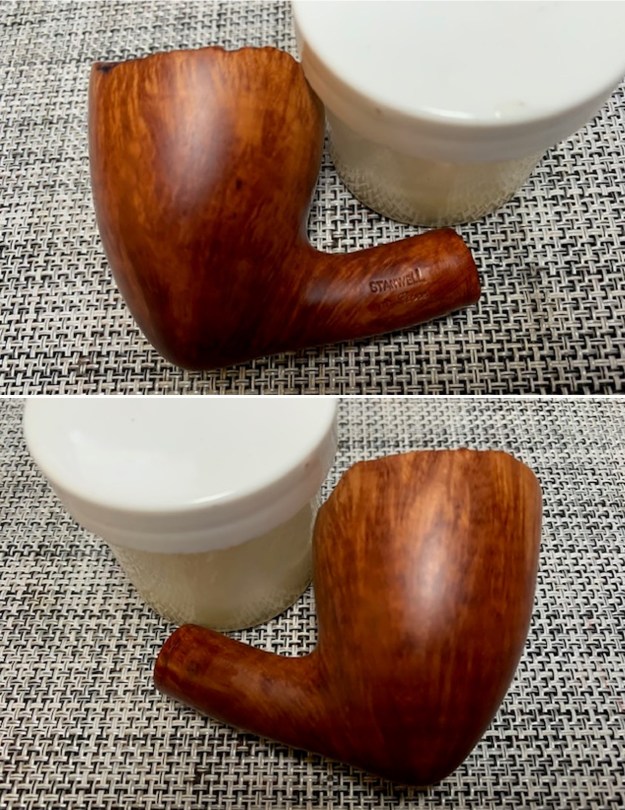
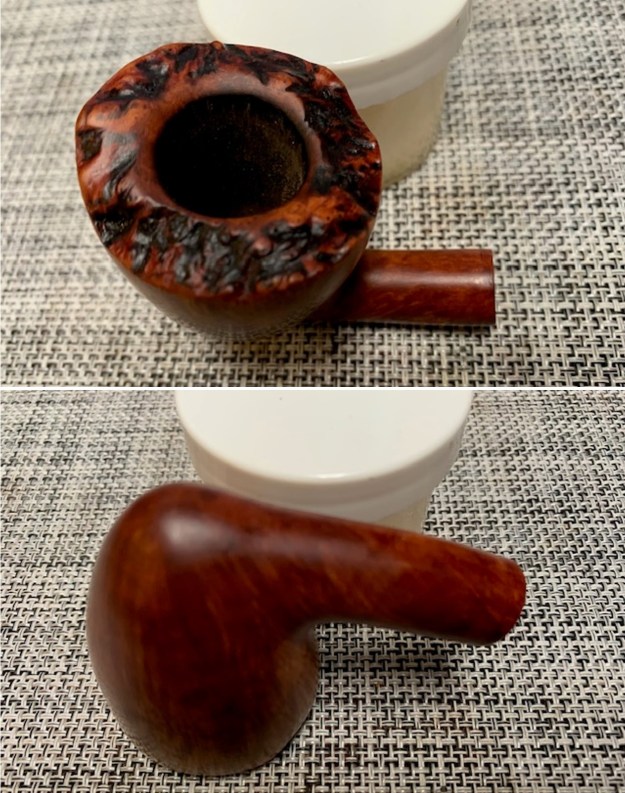
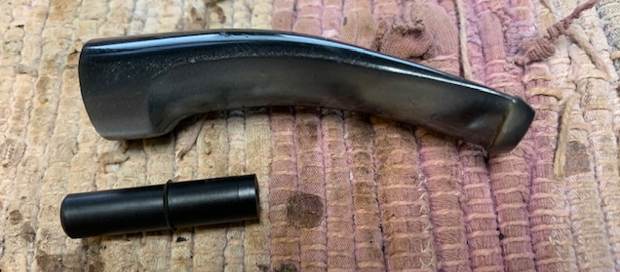
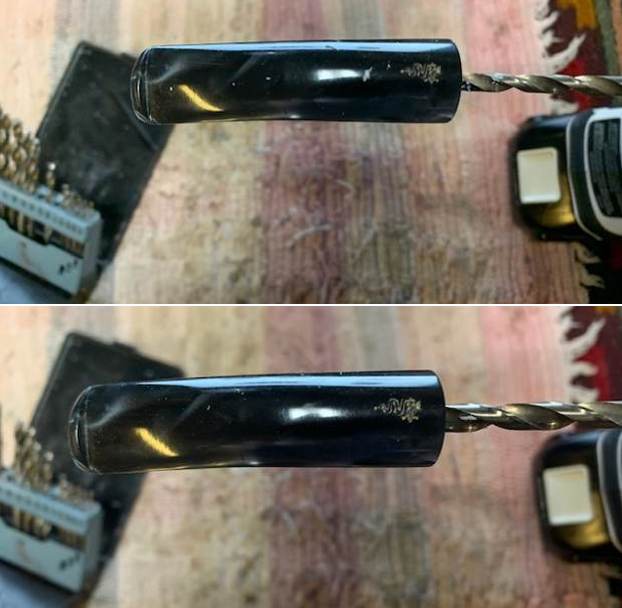
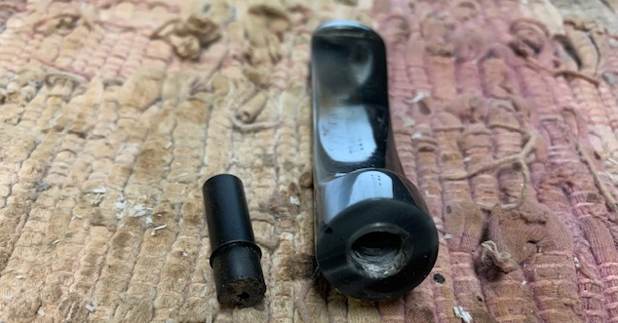
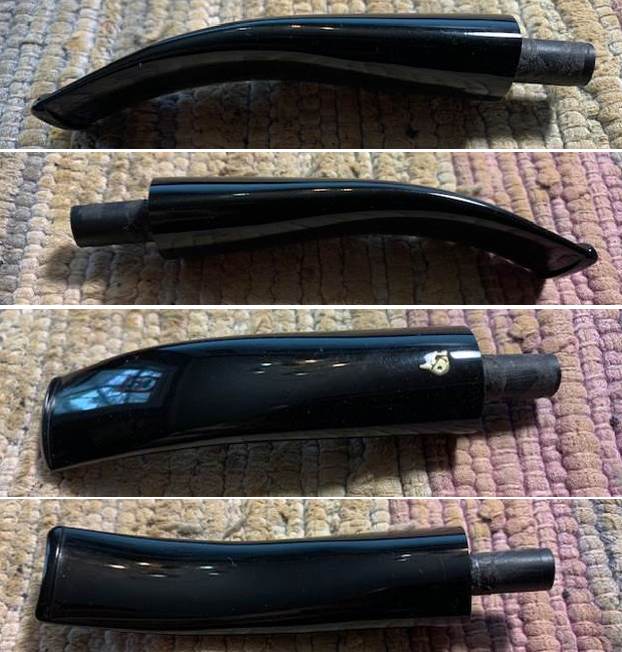
Thanks so much for your very fast response. Pictures are below. Best wishes, Peter We chatted back and forth a bit and Peter decided to send the pipe to me. I received it yesterday and here is what I saw once I unwrapped it. The photos tell the story but here is my review of it. The finish was dirty and worn. The bowl had a thick cake and there was lava buildup flowing along the inner edge and into the plateau on the rim top. The stem was snapped off leaving the tenon in the shank. Fortunately, there was no damage to the shank itself. It did not have any cracks in the sides. The shank end showed a lot of tar buildup. The tenon was still in the shank. The snap at the stem was fairly clean and would just need to be flattened. The stem itself showed a lot of oxidation, calcification and light tooth marks and chatter on both sides ahead of the button. The pipe was stamped on the left side and read Stanwell [over] de Luxe. I could not see any other stamping on the shank. There was a gold crown S on the left side of the saddle stem. This was going to be fun to bring back to life. I decided to begin working on the pipe by trying to pull the broken tenon with my usual methods. I put the bowl in the freezer for 30 minutes, then inserted a screw into the airway in the shank. I wiggled the screw and tried to break it free. It was no use. I used a qtip to dribble alcohol around the edges of the broken tenon in the shank. I repeated that several times and let it sit. I was still unable to remove the broken tenon in the shank. It was stuck and nothing seemed to loosen it. With the tenon being stuck in the shank I stepped up the process and drilled it out. I started with a drill bit slightly larger than the airway. I have had good success in drilling and in the process having the tenon come out on the drill bit. In this case I worked through four drill bits until I used one that was slightly small than the mortise. I then scraped out the remainder of the bits of vulcanite in the shank with a small pen knife until the walls were clear. I took a photo of the pipe at this point in the process – the tenon drilled out, a replacement tenon and the stem. Now it is ready for the next part of my work. I set the stem and tenon aside so that I could work on the bowl and shank. I reamed the bowl with a PipNet pipe reamer. I took the cake back to bare walls so I could check out the walls for damage or checking. It looked very good. I scraped out the remnants of the cake with a Savinelli Fitsall Pipe Knife and then sanded it with a piece of 220 grit sandpaper wrapped around a piece of dowel to smooth out the walls of the bowl. I worked on the buildup in the plateau surface of the rim top with a brass bristle wire brush. I was able to remove the heaviest part of the lava in the grooves of the plateau surface. It looked better but would need to be scrubbed. I scrubbed the exterior of the bowl with a tooth brush and undiluted Murphy’s Oil Soap. I scoured the surface of the briar and rinsed and repeated the process until the bowl was clean and the rim top looking very good. I cleaned up the darkening on the smooth bevelled portion of the inner rim edge next. I used a folded piece of 220 grit sandpaper to remove the damage and also smooth it out. I touched up the deep grooves in the plateau with a black Sharpie pen. The rim top and edge look very good.I polished the smooth rim top portions and the exterior of the pipe with micromesh sanding pads – dry sanding with 1500-12000 grit sanding pads. I wiped the bowl down after each sanding pad with a damp cloth to remove the sanding dust and debris. By the last pad it was looking very good with a shine in the briar that highlights the grain. I cleaned out the shank and mortise with alcohol, cotton swabs and pipe cleaners. I wanted to remove the oils and tars so that I would have a clean surface for the new tenon that I was fitting in the shank. It cleaned up and certainly smelled better once cleaned.I worked some Before & After Restoration Balm into the surface of the briar with my fingertips and a horsehair shoe brush to get into the plateau top. The product works to clean, preserve and protect the briar. I let it sit and work into the briar for 10 minutes then wiped it off with a cotton cloth. I buffed the briar with a clean cloth. The bowl is starting to look beautiful and there is a shine developing. At this point the bowl was finished until I finished with the new tenon insertion. I set the bowl aside and took a photo of the new tenon and the tools for reducing the diameter to fit in the shank. I used the Dremel and a sanding drum to reduce the diameter. I cleaned up the work with a file and then 220 grit sandpaper to get it to a point where the tenon fit in the shank.I put the stem in a bath of Briarville’s Pipe Stem Deoxidizer and set it aside while I worked on the tenon fit. I left it in the bath for three hours and then removed it and rubbed off the bath with a paper towel. The surface of the stem looked significantly better at this point. The oxidation was greatly reduced, the calcification was gone and the stem showed improvement. The tooth marks would still need to be worked on but there was progress.I cleaned out the airway in the stem with pipe cleaners and alcohol the drilled the airway to match the diameter of the new tenon insertion. I started with a drill bit the same size as the airway and gradually increased the bit size until it matched the outside diameter of the tenon. I took a photo of the newly drilled end of the stem. I cleaned up the airway once again in preparation for gluing the new tenon in place. I wiped the tenon end down with black CA glue and then aligned the tenon and the mortise. I pressed the tenon in place in the stem and set it aside to cure. Once it cured I took a photo of the stem and new tenon with the bowl before putting them back together. Once the glue cured I fit the stem in the shank. As seems to be very usual when I do this kind of thing the fit against the shank was not perfect. I would need to shape the stem and shank to make the fit and flow perfect. I took photos of the pipe at this point. The fit is not far off but just enough to be noticeable in the photos on the top and underside and slightly on the right and left sides. I sanded the shank and the stem to match and make the transition smooth all the way around the junction. I used 220 grit sandpaper and sanded it in place on the shank. I had to remove briar and vulcanite on the sides of the shank according to the transition. When finished it looked much better. I polished the sanded areas with micromesh sanding pads to make them smooth. I used an Oak stain pen to touch up the sanded areas and blend them into the rest of the bowl and shank. It blends in very well.I rubbed it down once again with Before & After Restoration Balm. I worked it into the surface of the briar and let it sit for 10 minutes then buffed it off with a soft cloth. I polished the bowl with a cotton cloth and set it aside. I set the bowl aside and turned my attention to finishing the work on the stem. I “painted” the stem surface with the flame of a lighter to lift the tooth marks. I was able to lift them significantly. I filled in what remained with black CA glue. Once the repair cured I used files to smooth out the surface of the repair. I sanded it with 220 grit sandpaper to blend them into the surface of the stem. I started the polishing of the stem with 600 grit wet dry sandpaper. I polished the stem with micromesh sanding pads – dry sanding with 1500-12000 grit pads. I wiped the stem down after each sanding pad with Obsidian Oil. I finished polishing the stem with Before & After Pipe Stem Polish – Fine and Extra Fine. I rubbed it into the surface of the stem and buffed it off with a cloth and buffed it to a shine. I am really happy with the way that this Stanwell Danish Made de Luxe Freehand turned out. It really is a beautiful looking pipe with a great shape and smooth finished bowl and plateau on the rim top. The original vulcanite saddle stem is cleaned up nicely. The polished black of the stem works well with the briar and the plateau portions. The briar really came alive with the buffing. The rich brown stains of the finish gave the pipe a sense of depth with the polishing and waxing. I put the stem back on the bowl and carefully buffed the pipe with Blue Diamond on the buffing wheel using a light touch on the briar. I gave the bowl and the stem multiple coats of carnauba wax on the buffing wheel. I buffed the pipe with a clean buffing pad to raise the shine. I hand buffed the pipe with a microfiber cloth to deepen the shine. The finished Stanwell de Luxe really is a beauty and feels great in the hand and looks very good. Give the finished pipe a look in the photos below. The dimensions of the pipe are Length: 6 inches, Height: 2 ¼ inches, Outside diameter of the bowl: 1 ¾ inches, Chamber diameter: ¾ of an inch. The weight of the pipe is 56 grams/1.98 oz. The pipe will be going back to Peter very soon. I look forward to hearing what he thinks about it. Thanks for reading this blog and my reflections on the pipe while I worked on it. It was a fun one to work on!

As always, I encourage your questions and comments as you read the blog. Thanks to each of you who are reading this blog. Remember we are not pipe owners; we are pipe men and women who hold our pipes in trust until they pass on into the trust of those who follow us.

A Challenging Restoration of a c.1921 No Name Meerschaum Billiard


Blog by Paresh Deshpande

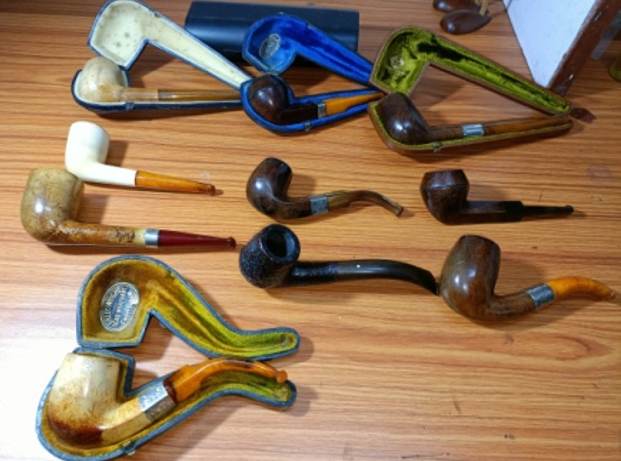
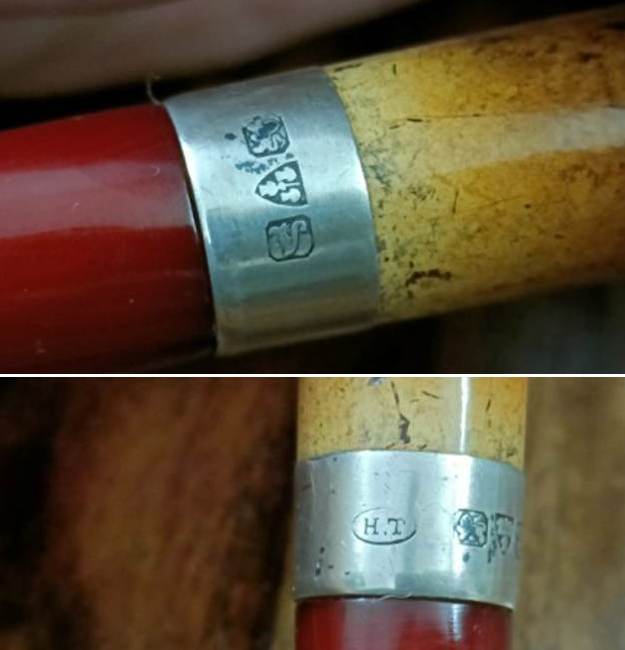
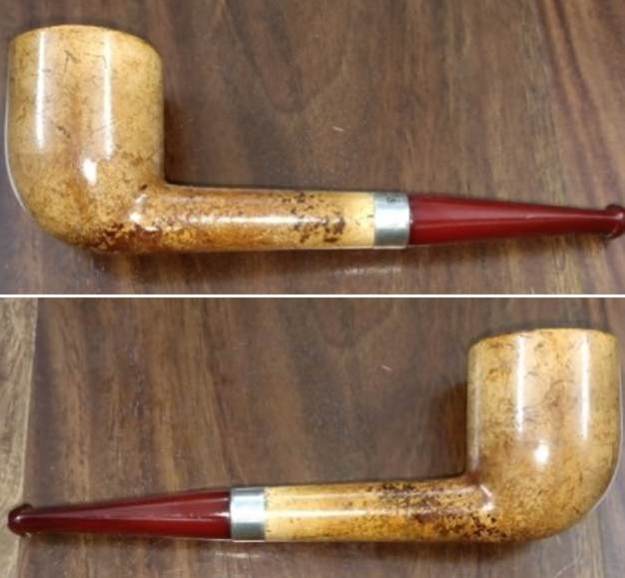
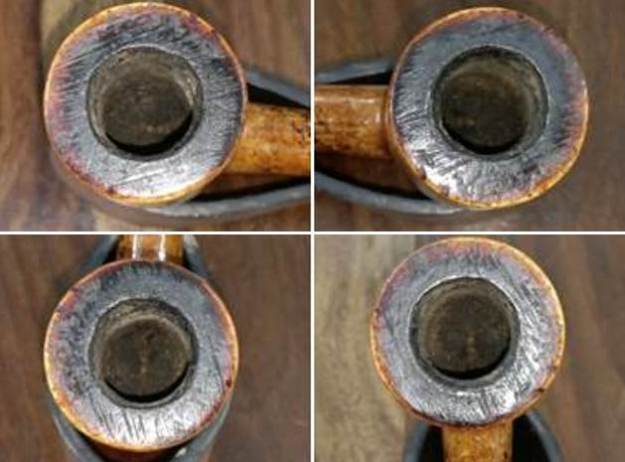
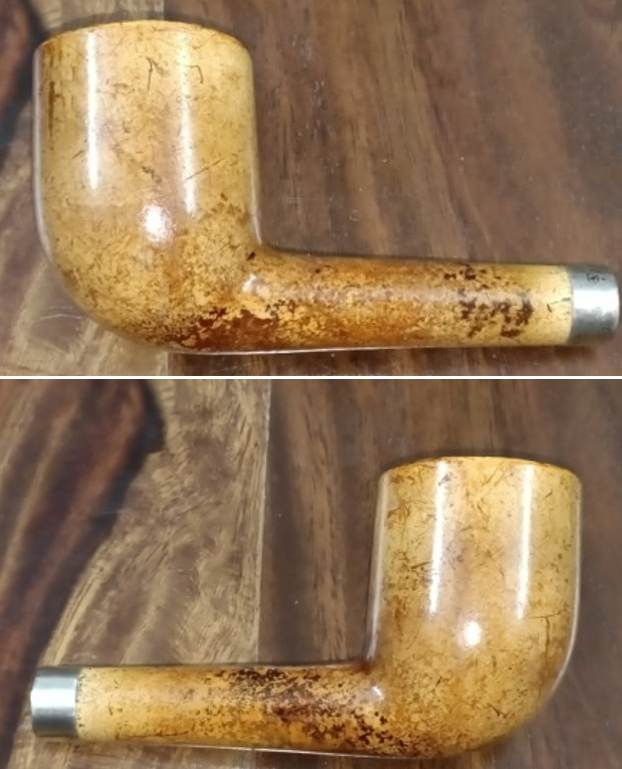
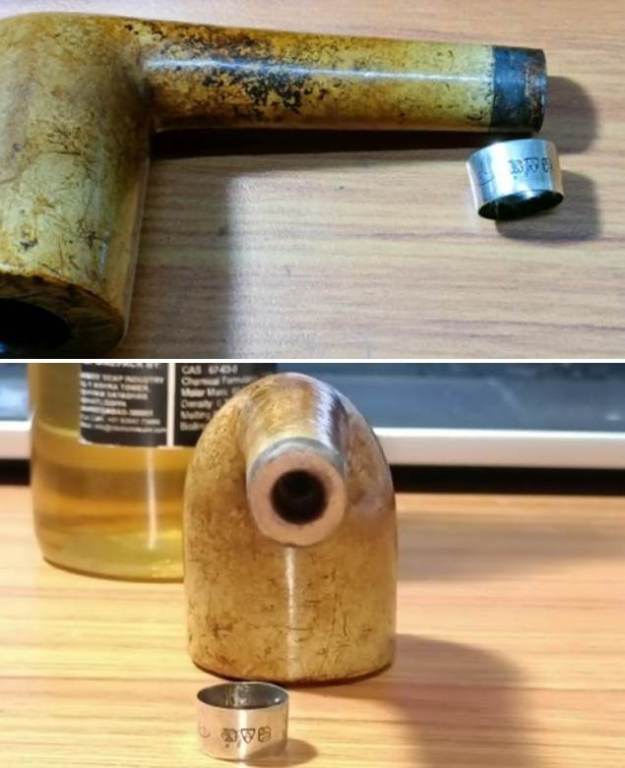
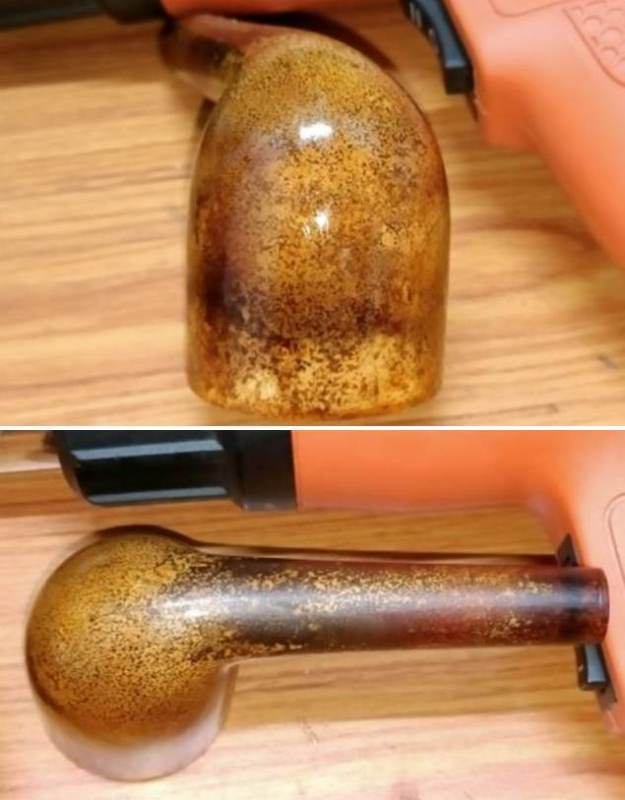
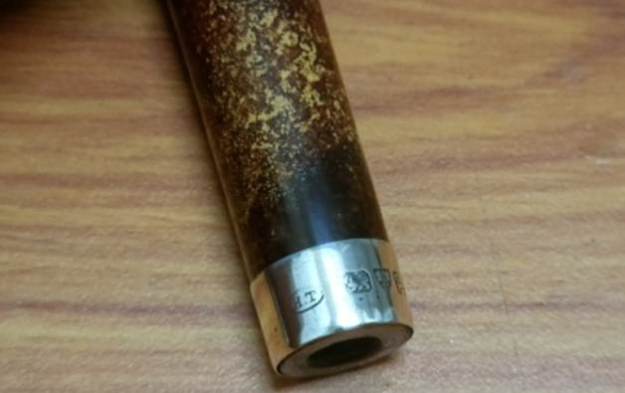
During the summer of last year while browsing on Pinterest, I came across pictures of some beautiful pipes and following the links led me to an old gentleman from the UK who was willing to sell these pipes either single or as a lot. There were around 60 odd pipes. I went through the pictures that were sent along with the rates and selected 10 pipes. After a prolonged and interesting interaction, we managed to arrive at a price point. Soon these pipes landed on the shores of India and went in to Customs hold for nearly a month. Finally, it was released and I laid my hands on these pipes after a wait of nearly 3 months! Here is a picture of the lot that I had taken moments after opening the parcel.Since then, I have refurbished, repaired a family era Barling’s Make Bulldog (yellow arrow), a c.1901 Samuel McLardy (green arrow) and added them to my personal collection while the c. 1960 Dunhill Shell (blue arrow) has made it’s way to my dear friend to enjoy. This estate lot had a beautiful block Meerschaum billiard with a Redmanol stem (red arrow) that called out to my wife. She liked the size, heft and simple classic straight lines of billiards and the way the red of the stem complimented the overall appearance of the pipe. The following picture will identify the pipes that have been restored and the meer that is now on my work table.This solid meerschaum is sans any stampings on the stummel or stem and lack of any housing case makes establishing the provenance of this pipe a tad impossible. The only pointer to this pipe being English is the stampings on the Sterling Silver ferrule at the shank end and should help in dating this pipe and identify the silversmith who mounted it on this pipe. It is stamped “H.T” in an oval over three sterling silver hallmarks. From left to right the first cartouche is with a LION PASSANT certifying silver quality followed by a cartouche with symbol for Chester Assay Office and the last cartouche contains the date code letter “V”.In order to link the maker’s mark on the silver band to a silversmith registered with Chester Assay office. I visited https://www.silvermakersmarks.co.uk/Makers/Chester-HP-HZ.html#HT  and I have reproduced the findings below that most closely matched the probable silversmith (highlighted in red).The cause for doubt in my mind with respect to the findings above is the fact that the “H.T” stamping on the silver band is enclosed in an oval whereas that shown above is in a square cartouche. However, the comment of Henry Tongue being a Pipe mounter and the period are perfectly matched. Thus the circumstantial evidence makes me want to believe that the pipe mounter of this Meerschaum pipe is Henry Tongue.  Any esteemed Reader is most welcome to shed more definitive information for the benefit of other members.

The next step was to ascertain the dating on this silver band. I frequent www.silvercollection.it for exact dating of letter code. The font style and the enclosing cartouche of the letter “V” on the shank band matches to the date year 1921. I have reproduced a screenshot of the relevant section of the date charts and the date year is indicated in red.

Now it was time to get working on the pipe.

Initial Inspection
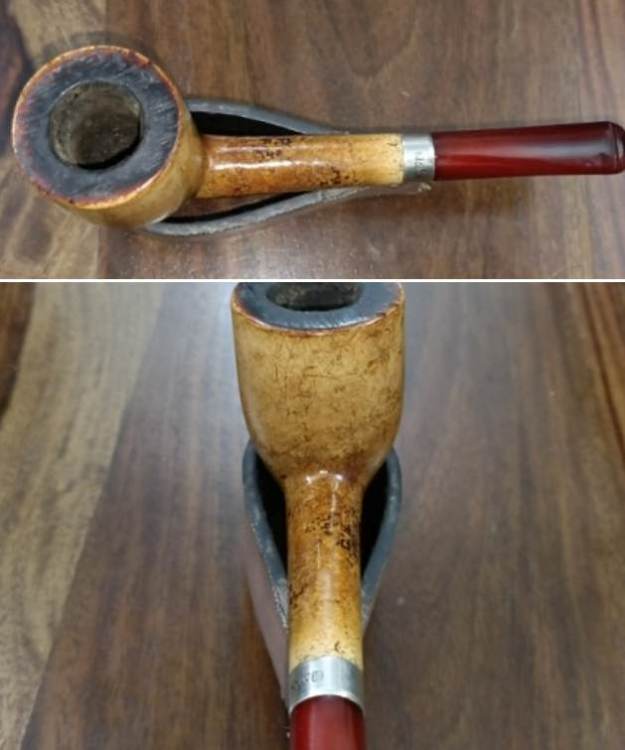
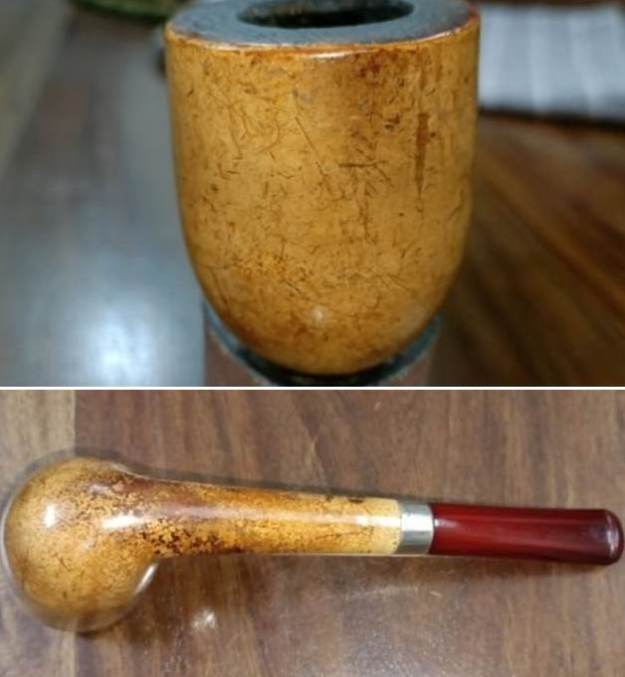
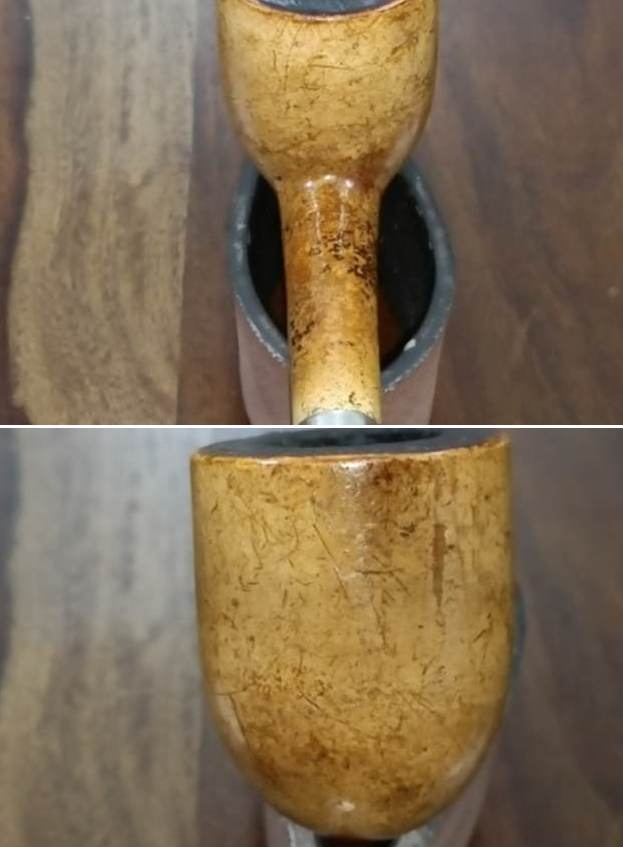
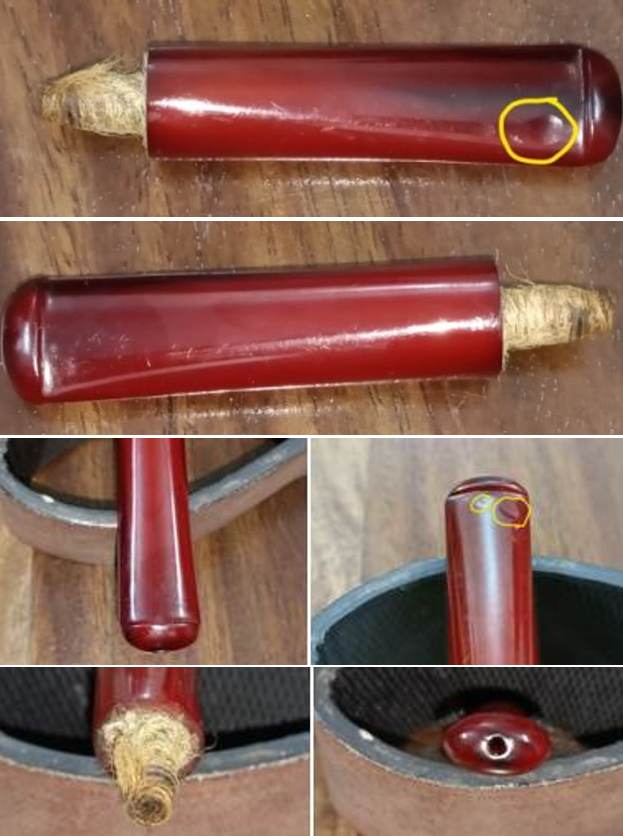
To begin with, the stummel is dirty and covered in dust, dirt and grime of over a century gone by. The age on this pipe is manifested in the number of all the handling related scratches and marks that it has been subjected to. There is a decent layer of cake in the chamber with lava overflow over the rim top surface. Under all the crud, the rim top is deeply scratched all around. The stem seats loose in the shank. The stem has a couple of tooth indentations in the bite zone and other than that the Redmanol stem is in pretty good condition. Here are a few pictures of the pipe as it sits on my worktable. Detailed Inspection
There is a thick layer of cake in the chamber. The rim top surface has lava overflow and has darkened considerably over the entire surface. The rim top is peppered with deep scratches, probably caused when someone, somewhere through the century, tried to remove the crud from the rim top using a sharp knife or it could have been caused as damage due to uncared for storage when the rim top and rest of the stummel was being rubbed against some hard objects. This uncared for storage could be the most likely reason since the stummel too has a number of scratches and marks. The inner and outer rim edges both show a few nicks and dents. The exact extent of damage to the inner rim edge will be ascertained after the chamber and rim surface is rid of all the cake and crud. The chamber walls are thick and feel solid to the touch.The stummel has a number of scratches and marks over the surface. There is a lot of dirt and grime ground in to the stummel surface giving it a dull and patchy appearance. However under all the grime and scratches, the stummel has taken on a beautiful color/ patina through the years of smoking and it is my intent to preserve it through the process. The threads in the mortise are slightly worn out and the mortise itself shows accumulation of oils and grime. Other than these minor issues, the stummel surface is sans any major damage and feels solid to the touch. The opaque cloudy Redmanol stem looks amazing as it is and should add a new dimension to the beauty of the pipe once it is repaired and all polished up. There are a couple of deep tooth indentations in the bite zone (encircled in yellow) that would need to be addressed. The stem airway leading to the round orifice shows remnants of old oils and gunk. The threaded bone tenon is covered in very fine jute threads to increase the diameter of the tenon for improved seating of the tenon in to the mortise. Yet even after this adhoc improvisation, the seating of the stem is pretty loose. I would need to figure out a more accurate, reliable and permanent way to address this issue.The Process
I started work on this pipe by firstly getting rid of the jute threads from the tenon end and followed it with cleaning the airway using thin shank brushes and anti oil dish cleaning soap. I ran a couple of pipe cleaners to clean and dry out the airway. Using a soft brass wired brush; I cleaned out the entire gunk from the threads of the bone tenon.I filled the tooth indentations with clear superglue and set it aside for the glue to cure. Once the glue had cured, using a flat needle I sand the fill to achieve a rough match with the rest of the stem surface. Once I was through with this step, I dry sand the entire stem with 400, 600 and 800 grit sand papers followed by wet sanding using 1000, 1500 and 2000 grit sand papers. This progressive use of higher grit sandpapers helps to, firstly, reduce the sanding marks left behind by the more abrasive ones, secondly, completely eliminate the oxidation and imparting a clean shine to the stem surface. Thirdly, this also helps to even out the minor tooth chatter from the bite zone. To complete the stem polish, I went through the entire set of nine micromesh pads, wet sanding through 1500 to 12000 grit micromesh pads.At this stage of refurbishing this pipe, little did I know that I would be carrying out further tedious and unplanned for repairs to the stem towards the end and till then, for all purposes, I have completed the stem restoration.

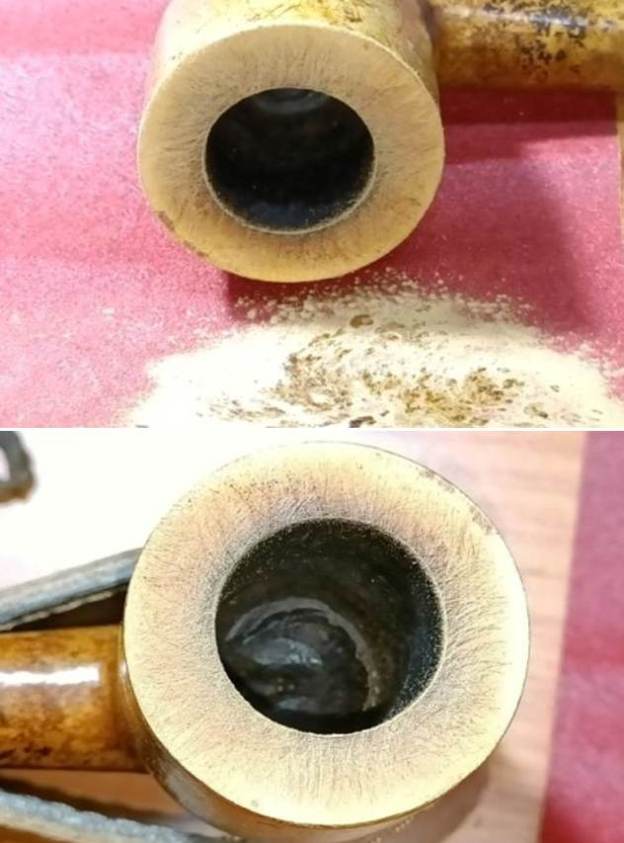
Next, I worked on the stummel. I began the stummel restoration by reaming the chamber with blade size 2 followed by size 3 of PipNet reamer. With my smaller fabricated knife, I scraped out all the carbon from difficult to reach areas. I used a 220 grit sand paper, pinched between my thumb and forefinger, to sand the inner walls of the chamber of the pipe. Once I had reached the bare walls, I wiped the chamber with a cotton swab dipped in isopropyl alcohol. This removed all the residual carbon dust and also rid the chamber of all ghost smells. The walls of the chamber are nice and solid with no signs of cracks. Using a sharp knife, I gently scraped out the overflow of lava from the rim top. The scratches on the rim surface are now clearly visible and so is the extent of damage to the outer edge of the rim. With the stummel internals cleaned up, using my fabricated tool, I scraped out the entire dried gunk from the mortise. I further cleaned the shank internals with a shank brush dipped in alcohol followed by running pipe cleaners through the shank till clean.All the while that I was cleaning the chamber and the shank, the sterling silver band came loose. I was extremely relieved to note that beneath the band, the shank was in pristine condition.To address the damages to the rim surface, I topped the rim top over a piece of 220 grit sandpaper, frequently checking for the progress made as I wanted to restrict the loss of meer material to not more than absolutely necessary. Close inspection of the rim top at this stage revealed that even though few minor scratches are still visible, they are too minor with the surface smooth to the touch. This will further even and smooth out during polishing with micromesh pads.I wiped the stummel surface with a cotton swab and Murphy’s Oil soap. The stummel surface is now free of all the dust and grime. I also cleaned out the last traces of lava from the rim top surface. The stummel and rim top surface now looks dark and dull, but it is clean. The scratches/ lacerations over the stummel surface are now more prominently visible. I shall bring back the rich shine when I polish it further using micromesh pads. This step will also help further reducing a few of the minor scratches and lacerations from the surface. At this point I was caught in a conflict; should I sand the stummel with a piece of 220 grit sandpaper to remove the scratches to make it look pristine and loose the patina that has developed over the years or preserve the coloration and patina. I decided on the later, after all it is the coloration taken on by the meer over the years which is more important and the existing scratches are a part of its journey through the years, is how I convinced myself!! I polished the stummel surface by dry sanding it with 1500 to 12000 grit micromesh pads. Some minor scratches were also addressed while imparting a nice deep shine to the stummel. The patina was also preserved. All in all, I am pleased with the appearance of the stummel at this stage. Next I gave a beeswax polish to the meerschaum bowl. I assembled the equipment and materials that would be needed during the process — a heat gun, paper towels, q-tips and a container for the wax and of course, beeswax. I stuffed the chamber with cork to prevent inadvertent seepage of the melted beeswax into either. Next, I melted a sufficient quantity of beeswax in the container using my heat gun and thereafter heated the stummel. Using the a folded pipe cleaner, I completely coated the stummel with the wax and continued the application till the surface was saturated and set the stummel aside to absorb the wax. I reheated the stummel with the heat gun about 20 minutes later and let the excess wax either be absorbed or drip off from the stummel surface. I rubbed off the excess wax with a soft cotton cloth and brought a deep shine to the surface with a microfiber cloth. The stummel now sports it’s true dark color which was drawn out by wax treatment, absolutely gorgeous I say. Next, I reattach the sterling silver band to the shank end using CA superglue after polishing the band with a silver polishing cloth.The issue that now needed to be addressed was that of the loose seating of the stem in to the shank. I had an option of either coating the tenon with clear nail polish, which is a temporary solution most suitable for briar pipes or using CA superglue to coat the tenon. This is a more permanent solution, but one needs to be careful and work fast as the tenon may get stuck in to the shank as the glue hardens rapidly. I decided to go with using the superglue.

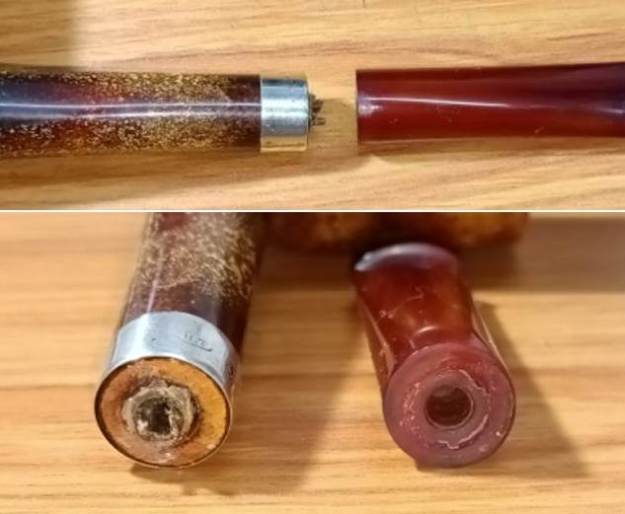
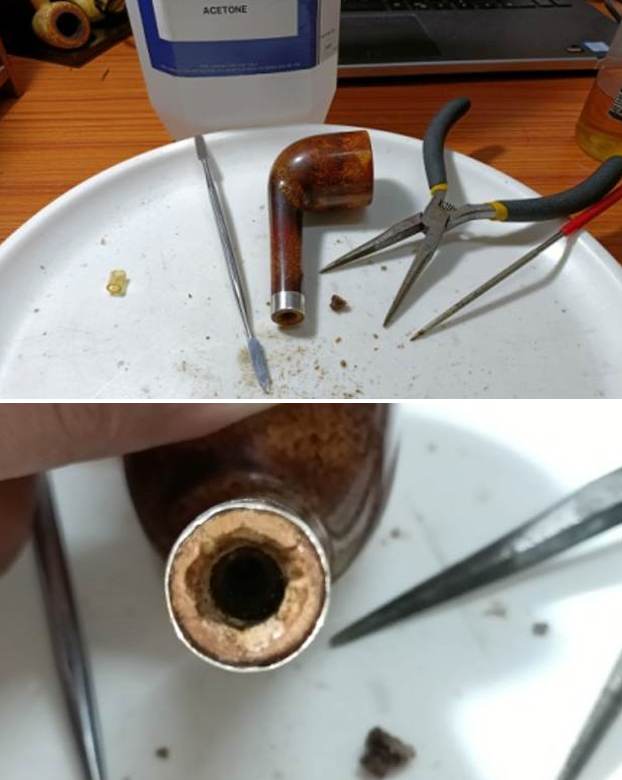
As decided, I applied a layer of superglue over the tenon surface and quickly turned it in to the shank till I had achieved a perfect alignment. I was equally quick to unscrew the tenon out from the shank to avoid having it stuck inside the shank. After a wait of few minutes to let the glue harden, I applied a second layer and followed the same process explained above. After repeating the process thrice, I decided to apply the glue one last time over the tenon to achieve a perfect thickness. Unfortunately this layer turned out to be one too many and as I was turning the tenon in to the shank, the tenon snapped at the stem end leaving it embedded within the shank. This created an altogether unexpected challenge, not to mention additional work and the need to put in extra man hours.The superglue around the broken tenon would first need to be loosened and thereafter the embedded tenon removed. I used pure acetone to loosen the glue around the broken tenon and pried it out using nose pliers, round needle files and dental tools.Next on the agenda was to fix a tenon on to the stem. From my can of spare parts, I shortlisted one Teflon Delrin screw tenon that was nearest match to the shank diameter. The shoulders of the threaded tenon perfectly seated and sealed the shank opening. The smooth end of the Delrin tenon would need some work to seat perfectly in to the stem. Following pictures will give you the general idea.I evened out the stem airway to accept the Delrin tenon using a round needle file. I was careful while working on this Redmanol stem as I did not want chipped edges on this century old stem. I, thereafter, worked the smooth end of the Delrin tenon by sanding it using a flat head needle file. I fine tuned the seating of the tenon in to the stem by sanding using a piece of 220 grit sandpaper. I checked the seating of the stem in to the mortise and alignment of the stem airway, the mortise and the draught hole. Everything was perfectly aligned. Once I was satisfied, I fixed the tenon in to the stem using CA superglue and set it aside for the glue to harden.To give the finishing touches to this gorgeous century old pipe, I reattached the stem with the stummel. I then mounted a cotton cloth wheel on to the hand held rotary tool and applied several coats of carnauba wax over the stummel and the stem. I finished the restoration by giving the pipe a rigorous hand buffing using a microfiber cloth to raise the shine further. The completed pipe, with the shining dark golden hued meerschaum stummel and complimenting red of the Redmanol stem looks lovely, fresh and vibrant; the photographs speak for themselves. I shall be adding it to my ever growing pipe collection. Thanks for the read…Cheers!!!

New Life for a Petite Sasieni Four Dot Natural London Made Wingate Pot


Blog by Steve Laug

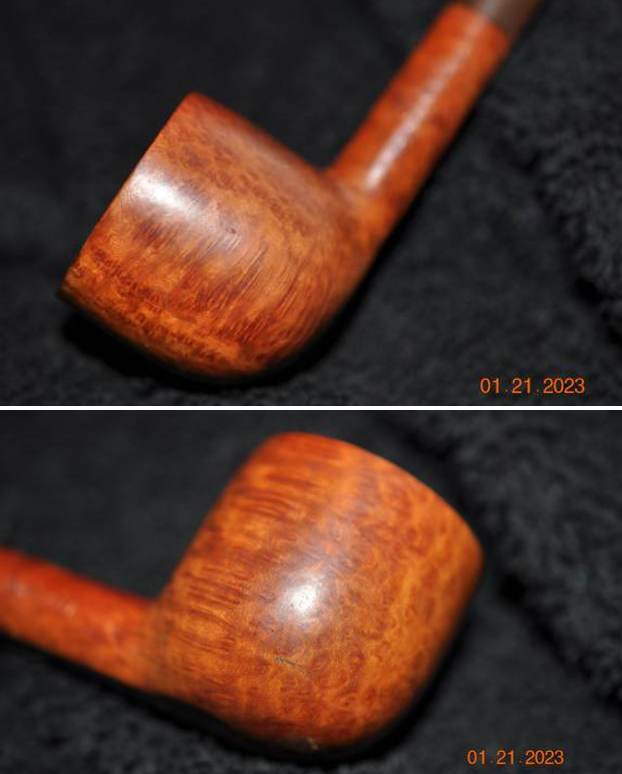
I thought it might be helpful to take you through my process of working on each pipe that we purchase. Jeff has set up a spread sheet to track where the pipe came from, the date of purchase and what we paid for it so that we know what we have invested in the pipe before we even work on it. This takes a lot of the guess work out of the process. This particular pipe was purchased on 04/09/2022 from seller in Cleveland, Ohio, USA. I also want you to understand why we take the photos we do. If you have followed for a while then you will see the familiar pattern of the photos we include both in the before and midstream process of working on a pipe. It is not accidental or chance as the photos have been taken to help me make an assessment of the pipe Jeff sees before he starts his clean up work. We do this to record the condition that the pipe was in when received it and to assess what kind of work will need to be done on. When I look at these photos this is what I see.

  1. The first thing I see is the small/petite Pot shaped pipe with a generous bowl. It is well proportioned and well made with a classic English shape.
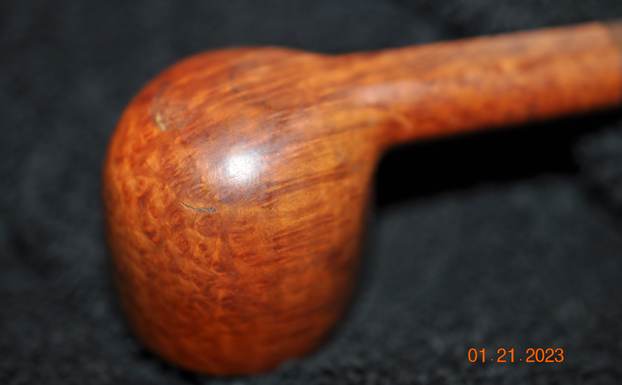
  2. The finish is dirty and there are oils from the smoker’s hands on both side of the bowl. There is grime ground into the finish as well but even so there is also some great grain peeking through.
  3. The rim top had a thick lava overflow from the cake in the bowl, particularly thick on the back side of the top. There is some burn damage on the front inner edge and top but it is hard to know if there is darkening or damage under the lava. Sometimes the lava protects the rim top and edges and sometime it hides issues. Its is very dirty looking.
  4. The bowl has a thick cake in it that hides the walls and the inner edge of the bowl but once it is clean we will know what is going on in those spots. There are a some possible nicks in the inner edge of the bowl at the back but that too will become clearer when the pipe is cleaned. The outer edges look good and there does not appear to be any obvious burn damage to the top or bowl edges.
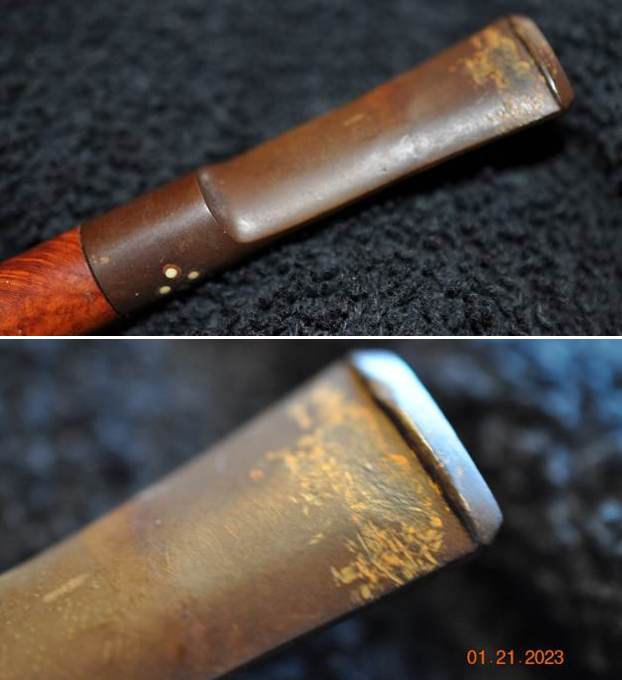
  5. The vulcanite saddle stem is in good condition – dirty, oxidized, calcified and has tooth chatter and marks on both sides. There 4 Dots of the Sasieni Logo are visible on the left side of the saddle.

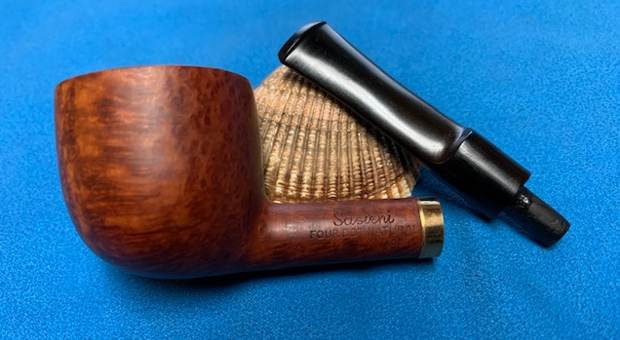
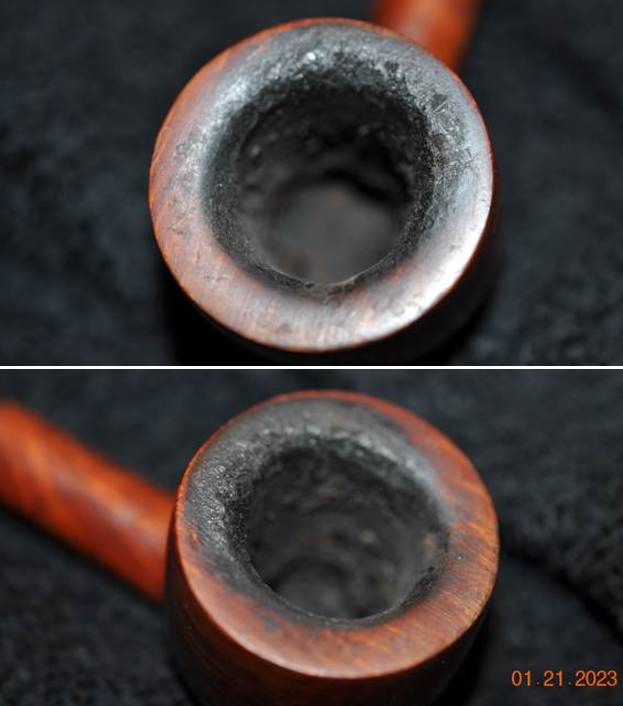
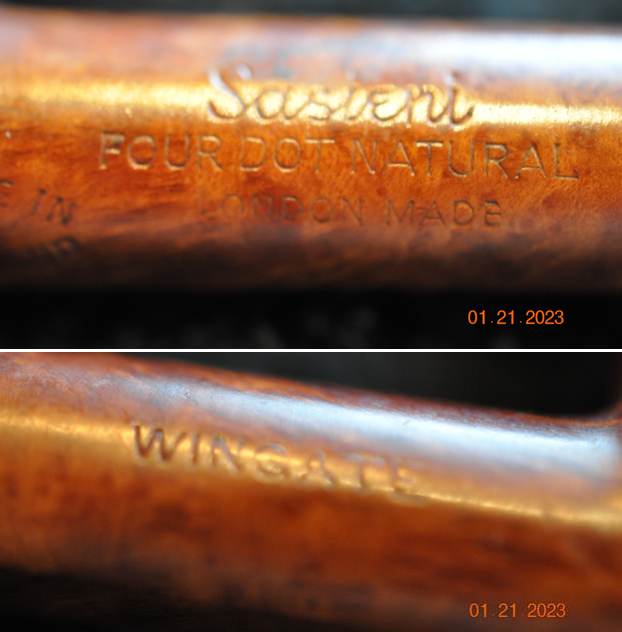
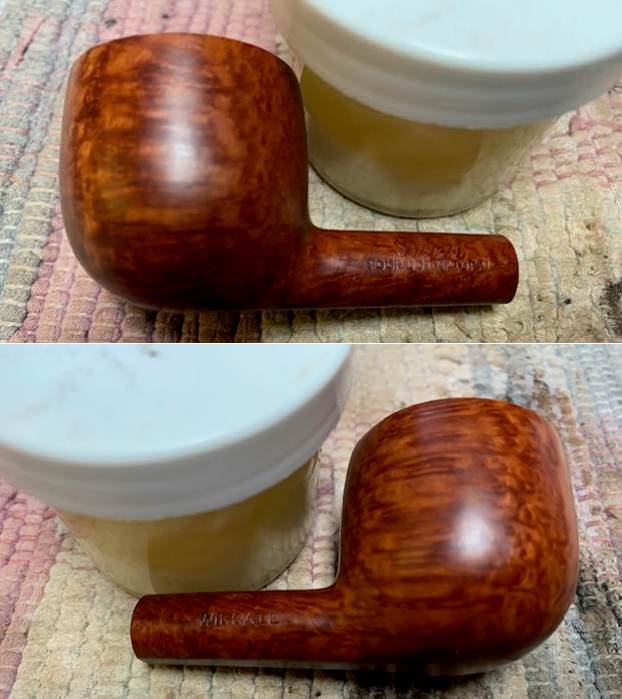
Overall my impressions of this pipe is that it is a beauty that once cleaned up will look pretty amazing. The exterior of the bowl does not show any hot spots or darkening. The pipe is very English looking and is a classic short Pot shape that I have seen on other Sasieni pipes. The photos below confirm the assessment above. Jeff took close up photos so that I could have a clearer picture of the condition of the bowl, rim edges and top. The rim top photos confirm my assessment above. The cake in the bowl is quite thick and the rim top has lava and debris on it. You can also see the condition of the outer edge but the inner edge is a bit of a mystery at this point. There appears to be some burn damage at front inner edge and rim top. The bowl is still fairly round. This is what I look for when assessing a pipe. The photos of the stem surface from various angles confirmed my assessment of its condition. You can see the oxidation and the fit against the shank end. The stem surface though dirty does not appear to have tooth marks on the bit surface – chatter yes, but no deep marks. There is some damage to the button surface on the top right side and lesser damage on the underside. The stem is quite dirty but otherwise undamaged. The next photos show the amazing grain around the heel and the sides of the bowl. Tell me what you see? Are there any visible problems that stand out to you? Are the cracks or scratches? Are there visible flaws or fissures in the briar? What kind of grain stands out around the bowl and heel? Any visible issues on the heel of the bowl? Even the questions should help you to see what I am looking for when I see these photos. You have read it a few times now in the previous blogs. What am I looking for when I look at the shank stamp? In this case it is stamped on the left side and reads Sasieni[over] Four Dot Natural [over] London Made in three lines. To the left next to the bowl is the classic Sasien Made in England stamp. On the right side it is stamped Wingate. How does the stamping look to you? Is it clear and readable? Is it faint in spots or is it uniform? I know you are looking at photos but so do I at this point in the process. There is also a FRANCE stamp on the underside of the stem. The same questions apply here as well. I decided to do some work on the stamping of this pipe to get an idea of the time period it was carved. I turned first to Pipephil’s site to see what I could learn (http://pipephil.eu/logos/en/logo-sasieni.html). I found a pipe that was stamped the same way as the one I am working on. I is stamped on the left side of the shank like the one in the screen capture photo below. Mine is stamped the same way Sasieni in script without the fish tail. Underneath it is stamped FOUR DOT NATURAL [over] London Made. Next to the shank is also the Made In England Stamp like the one below. On the right side mine does not have the “Danzey” stamp but rather the Wingate stamp in the same place. It also does not have the XS stamp. I included the side bar notes below the picture. From that I knew that the pipe was made during Pre-transition Period 1946-1979.Pre-transition, 1946 – 1979. Four dot. Natural: Name for a smooth finish
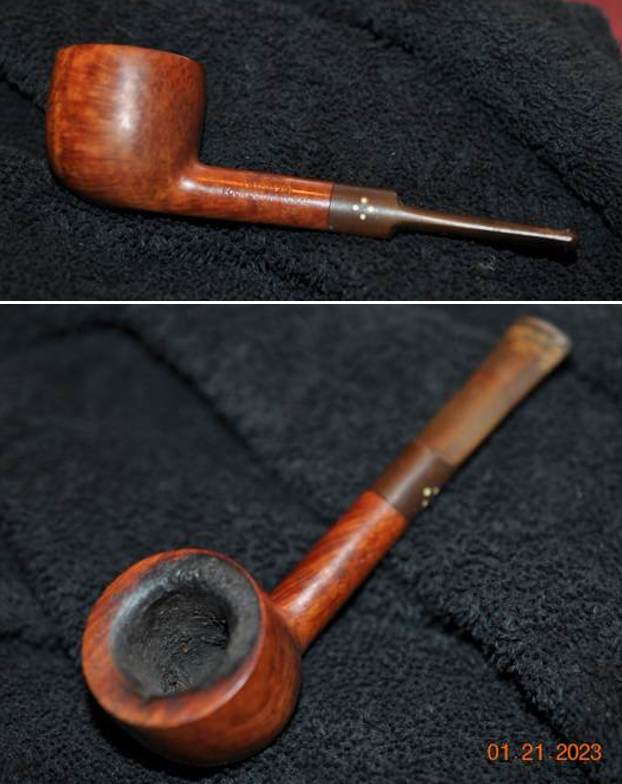
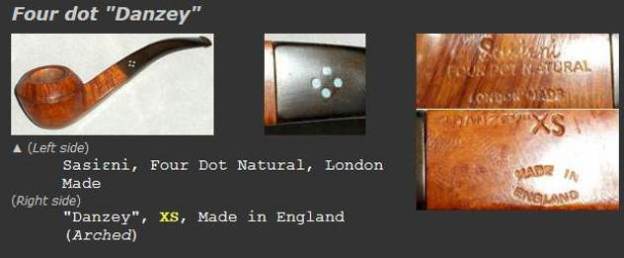
I then turned to Pipedia for more detailed information (https://pipedia.org/wiki/Sasieni). I quote a section of that article below. It refers to the Patent Number that is on the pipe I have on the table. The underlined  portion below is particular pertinent to this pipe.

To begin with, there are three main elements to dating the Sasieni pipe, the patent number, the style of the name “Sasieni” as it appears on the shank, and the Dots themselves. Naturally, there are exceptions to these rules (this hobby would be boring without them), but for the most part these guidelines apply better than 95% of the time. All Sasieni One, Four, and Eight Dot pipes made before W.W.II and destined for the U. S. market carried a patent number on the shank which usually started with the numbers “15″, with 150221/20 and 1513428 being representative of the group. Also, the name “Sasieni” was stamped on the shank in a very florid manner, with the tail of the last “i” sweeping underneath the name forming a shape which has been compared to a fish by more than one collector. This script was discontinued by Alfred almost immediately after he took over the company, so this alone tells you your pipe is pre W.W.II. Underneath in block lettering are the words “London Made”, with the patent number making the third line.

The dots will help you narrow this down further. As we mentioned, the short lived U. S. market One Dot was introduced around 1920, and was replaced by the early to mid 1920’s by the Four Dot. The 1920’s Four Dot is distinguishable by the florid Sasieni script, a patent number, and four blue dots, which are quite small compared to the pipes of post war years. Furthermore, by 1935 Sasieni began stamping pipes, based on the shape, with their own names, which were usually, but not always, English towns. For example, apples were stamped “Hurlingham”, bulldogs were “Grosvenor” or “Danzey”, and panels were “Lincoln”. One rare and interesting variation of this was the large bent, dubbed “Viscount Lascelles”. Even in this soft Sasieni market, these pipes regularly sell for $150 in their rare appearances in mailers.

The pipe I have is one does not have a patent number so it was not made for the US market. The flourished “i” was discontinued by Alfred so that confirms that the pipe was made Pre-transition, 1946 – 1979. The third line stamped is London Made in block lettering. With all that information I knew that my pipe was from the period before the transition (Pre Transition) so it was an older one.

I am sure many of you will shake your head and ask maybe even out loud, “Why is he including this again?” However, please remember that the point of these blogs is not to wow your with the work or make you shake your heads but I want you to know the details of the work we do so you can do your own. Back in 2020 Jeff wrote a blog about his cleaning process. I am including a link to that now so you can see what I mean about his process. Do not skip it! Give it a read (https://rebornpipes.com/2020/01/20/got-a-filthy-estate-pipe-that-you-need-to-clean/). Here is the introduction to that blog and it is very true even to this day.

Several have asked about Jeff’s cleaning regimen as I generally summarize it in the blogs that I post rather than give a detailed procedure. I have had the question asked enough that I asked Jeff to put together this blog so that you can get a clear picture of the process he uses. Like everything else in our hobby, people have different methods they swear by. Some may question the method and that is fine. But it works very well for us and has for many years. Some of his steps may surprise you but I know that when I get the pipes from him for my part of the restoration they are impeccably clean and sanitized. I have come to appreciate the thoroughness of the process he has developed because I really like working on clean pipe!

For the benefit of some of you who may be unfamiliar with some of the products he uses I have included photos of three of the items that Jeff mentions in his list. This will make it easier for recognition. These three are definitely North American Products so you will need to find suitable replacements or order these directly on Amazon. The makeup pads are fairly universal as we were able to pick some up in India when we were with Paresh and his family.

In the blog itself he breaks his process down into two parts – cleaning the stem and cleaning the bowl. Each one has a large number of steps that he methodically does every time. I know because I have watched him do the work and I have seen the pipes after his work on them. He followed this process step by step and when the pipe got to me it was spotlessly clean and ready for my work. The inside of the stem, shank and bowl were clean and to me that is an amazing gift as it means that my work on this end is with a clean pipe! I cannot tell you how much difference that makes for my work.

When the pipe arrives here in Vancouver I have a clean pipe and I go over it keeping in mind my assessment shared in the opening paragraph above. Now that I have it in hand I am looking for confirmation of what I saw in the photos as well as any significant structural changes in the bowl and finish as I go over it.

  1. This small Petite Pot has a generous bowl and the pipe is well proportioned. It has a classic English Sasieni shape.
  2. The finish is clean and the oils have been removed from both sides of the bowl. The grime ground into the finish is gone and there is some great grain around the bowl sides.
  3. The thick lava coat on the rim top has been removed and there is some nicks and burn damage on the top and inner edges of the bowl (particularly toward the front). There is some darkening and damage on the back side of the inner edge and top as well but not as extensive.
  4. The cake had been totally removed and the walls of the bowl are clean. There is not any checking or burn damage on the interior walls of the bowl.
  5. The vulcanite saddle stem is clean and has light tooth chatter and marks on both sides. The four dots (Sasieni logo) on the left side of the saddle look very good. There is also an aluminum stinger in the tenon that is very clean.

Hopefully the steps above show you both what I look for when I go over the pipe when I bring it to the work table and also what I see when I look at the pipe in my hands. They also clearly spell out a restoration plan in short form. My work is clear and addressing it will be the next steps. I took photos of the whole pipe to give you a picture of what I see when I have it on the table. This is important to me in that it also shows that there was no damage done during the clean up work or the transit of the pipe from Idaho to here in Vancouver.    I carefully went over the bowl and rim top to get a sense of what is happening there. In this case once the lava was removed damage to the edge and top was revealed. It is burn damage to the front inner beveled edge and rim top. There is also some damage on the back inner edge and darkening on the rim top. It is clean but will need to be worked on to bring it back to normal. I also go over the stem carefully. There were no tooth marks or dents other than on the button edges on both sides of the stem. I took photos of the rim top and stem sides to show as best as I can what I see when I look at them.I always check to make sure that the clean up work did not damage the stamping on the shank in any way. It looks good but is faint in some parts – particularly the edges of the stamp. I always appreciate the handiwork of the carvers at Sasieni who turn a piece raw briar into a beautiful pipe. I love just looking at the beauty of the lay of the pipe with the grain and the proportion of the pipes. I like to remove the stem from the shank to get a sense of what was in the mind of the pipe maker when he crafted the pipe. It is a beauty in flow and shape. By this time you should know that I almost always start with the bowl in my restoration because I truly do not like the tedious work of stem repairs and polishing. I always leave that until last even though I know that it needs to be done. For me the encouragement of seeing a rejuvenated bowl is the impetus I need to attack the stem work.
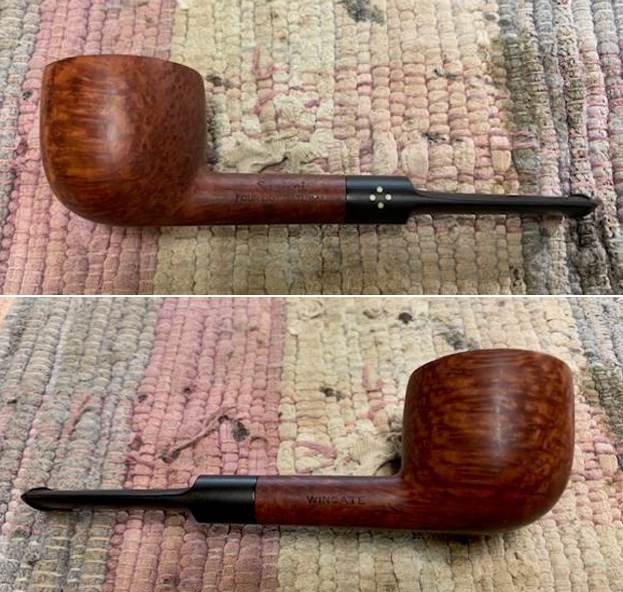
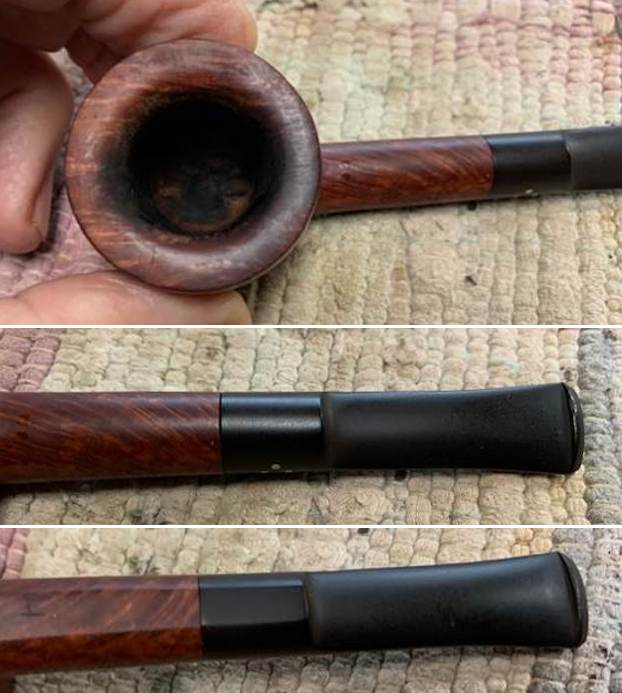
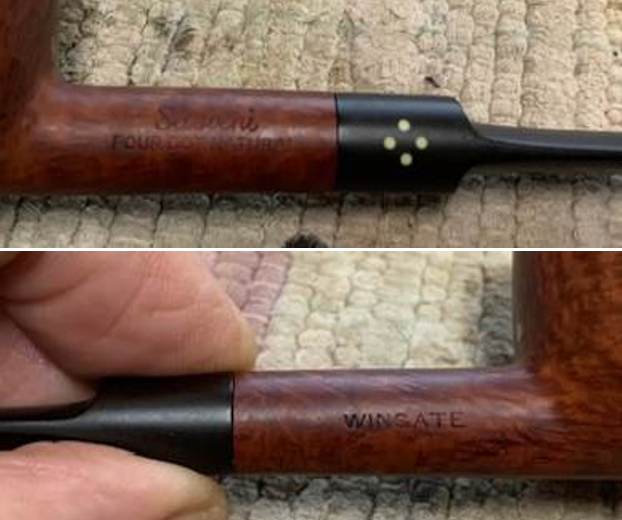
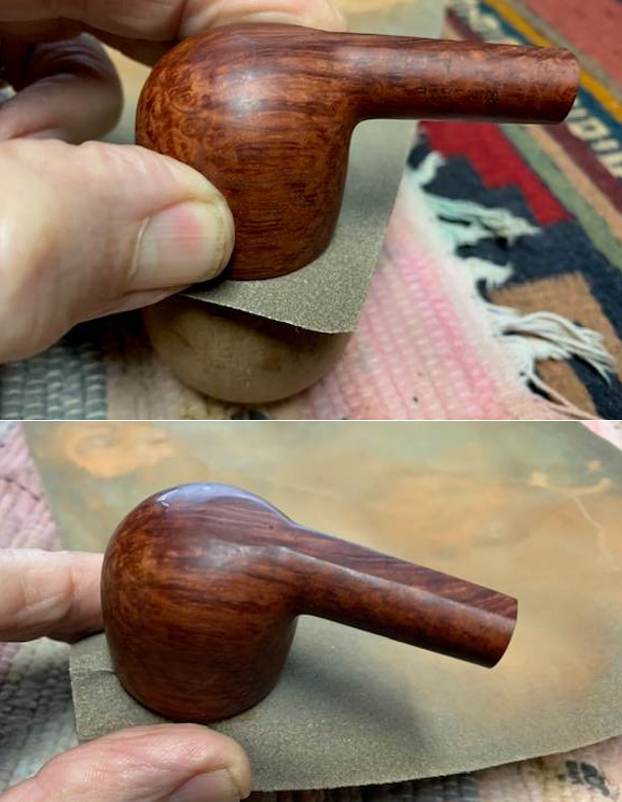
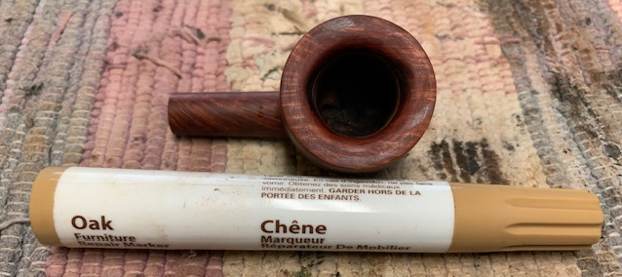
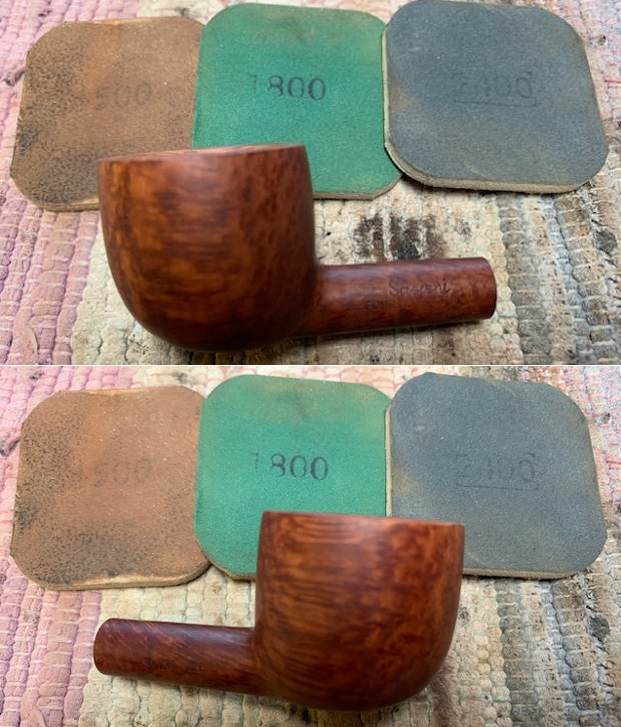
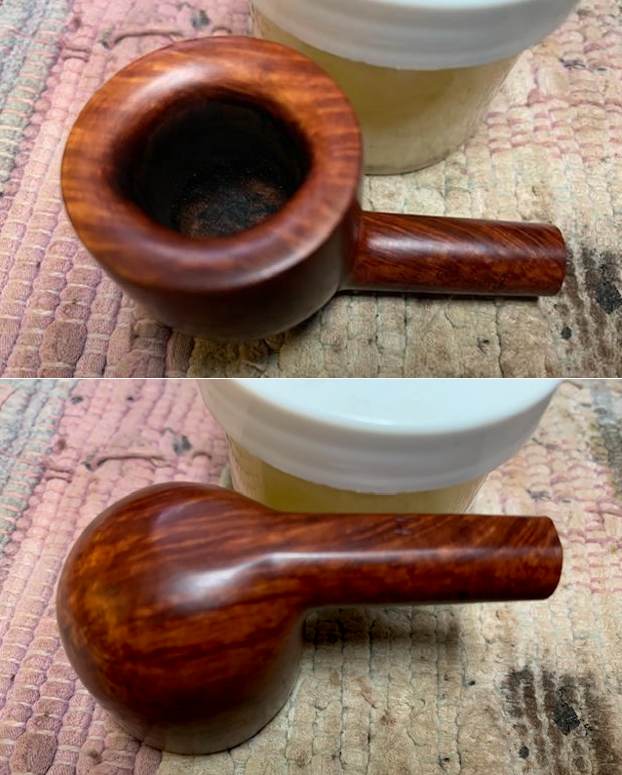
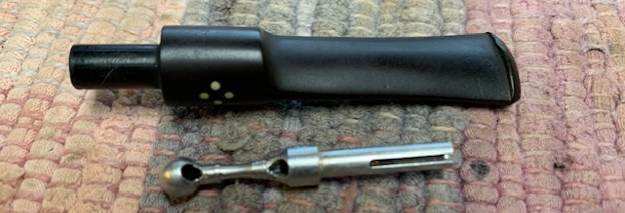
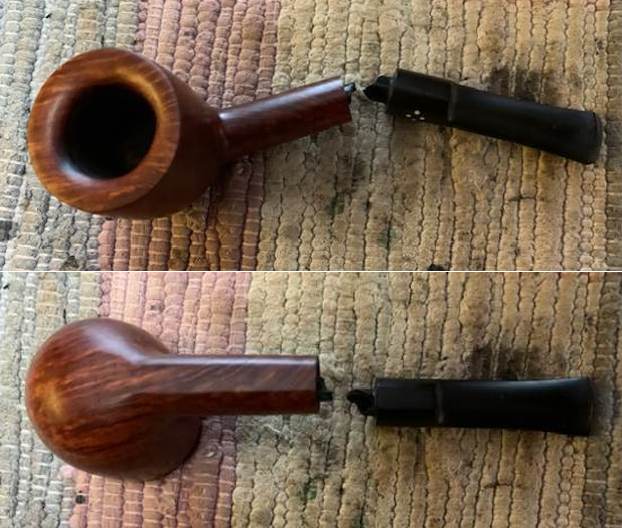
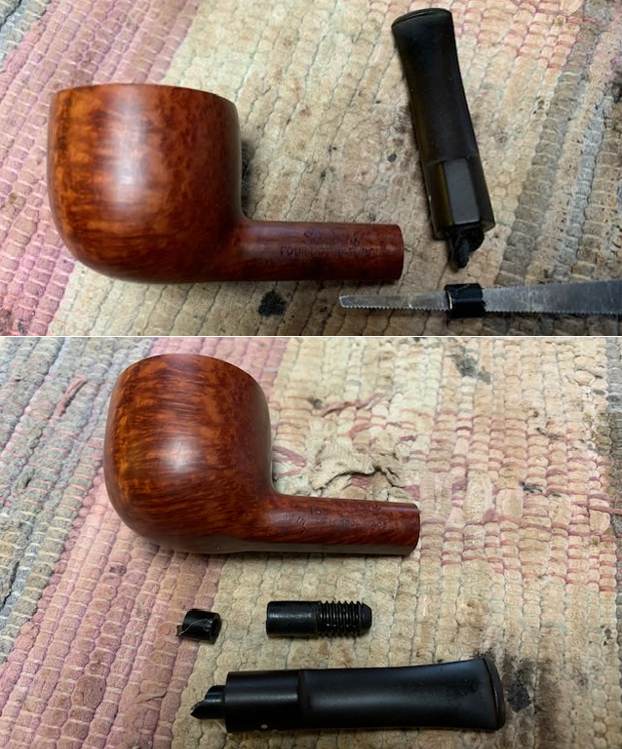
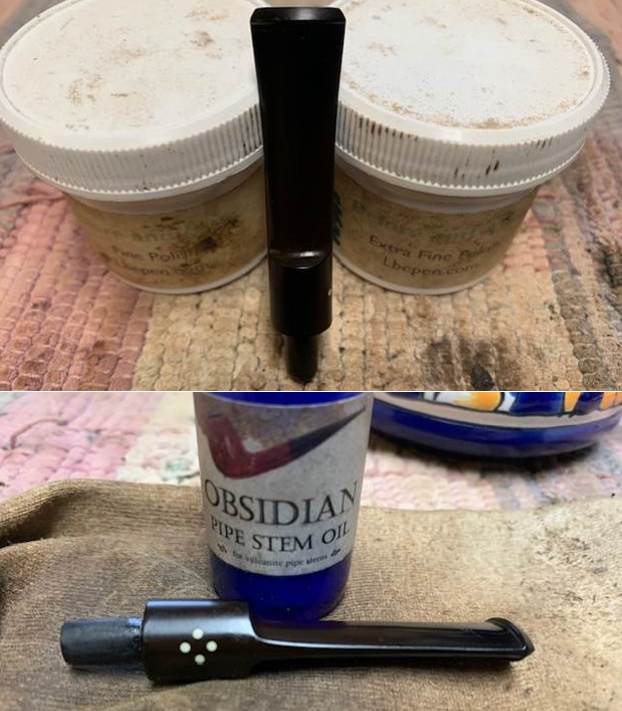
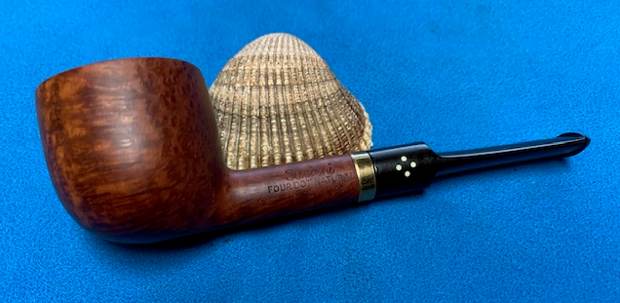
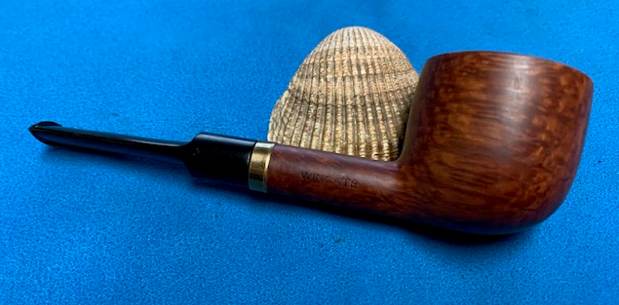
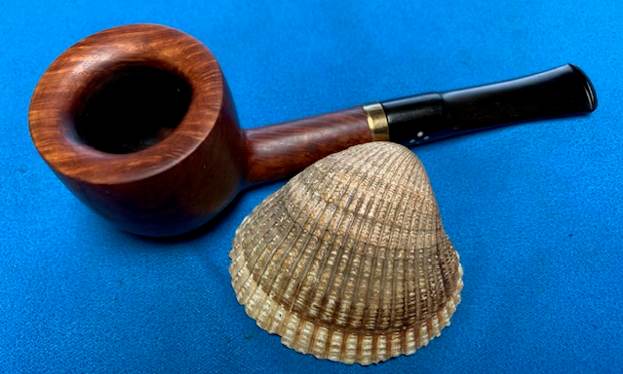
Today I started working on this pipe by turning to the bowl. I chose to deal with the darkening and burn damage on the rim edges and top. I used a piece of 220 grit sandpaper and a wooden sphere to reshape and remove the damage on the top and the inner edge. It took a little work but I was able to remove most of the damage. I used a folded piece of 220 grit paper to work on it some more. There is a little left at the back side of the inner edge. The front edge looks much better. It is a beautiful piece of briar with some great grain.  I forgot to take a photo of the rim top after the clean up but it looked much better. You can see it in the stained rim top photo below. I stained it with an Oak stain pen to match the surrounding briar. I polished the briar with micromesh sanding pads. I choose to dry sand the briar rather than wet sand it. Again it is a matter of personal preference. I prefer to use the pads dry and find they work very well on the briar. I sand with each pad (9 in total) and group them by threes for ease of reference. I also work over the sanded rim top and edges with the pads. I wiped the bowl down after each pad with a damp cloth to remove the sanding debris and check the briar. I love seeing the developing shine on the briar as I move through the pads which is why I include so many photos of this step. For the past few years now I have been using a product developed by Mark Hoover called Before & After Restoration Balm. It is a paste/balm that is rubbed into the surface of the briar. The product works to deep clean the finish, enliven and protect the briar. I worked it into the briar with my finger tips and let it sit for 10 minutes to do its work. I wiped it off with a soft cloth then buffed it with a cotton cloth. The briar really began to shine and the grain shone through. The photos I took of the bowl at this point mark the progress in the restoration. It is a gorgeous pipe. Now it was time to address the part of the restoration I leave until last. I set the bowl aside and turned my attention to the stem. I heated the stinger and removed it from the shank. I would put it back in after clean up. I fit the stem in the shank to take get measurements of the pipe. When I finished I removed the stem from the shank the tenon shattered in the shank and was stuck. This is great – just what I needed. Now I would need to replace the tenon and refit it. I pulled the broken tenon from the shank with a knife blade. I went through my tenons and chose one that was close to the diameter of the broken tenon. I flattened the broken portion on the stem surface with a Dremel and sanding drum. I chose not to drill it out for the stinger as it made the walls of the tenon very thin. I sanded the diameter of the new tenon with a Dremel and sanding drum to reduce it for a snug fit in the shank.I drilled out the stem to receive the new tenon. I used a series of drill bits from one the size of the airway in the stem and up to the point it fit in the stem. I glued it in place in the stem with super glue and set aside to cure. I gave the tenon a light coat of clear CA glue to smooth it out. Once I sanded it would be smooth. I examined the shank end and saw that when the tenon broke it left a nick in the surface of the shank end. I decided to use a thin brass band to flatten the shank end and clean up the fit against the shank. I glued the band on the shank end and it looked very good. The bonus was that the stem fit very well. I stated with the tooth marks. I “painted” the surface dents with a Bic light flame and was able to lift them significantly I paused at this point and put the stem in the shank. It was at this point the tenon broke. With the new tenon in place I sanded the stem with 220 grit sandpaper to further blend them into the vulcanite. I started the polishing of the stem with 600 grit wet dry sandpaper. I use micromesh sanding pads and water to wet sand the stem and tenon with 1500-12000 grit sanding pads. I wiped it down after each sanding pad with Obsidian Oil on a cotton rag after each sanding pad as I find it does two things – first it protects the vulcanite and second it give the sanding pads bite in the polishing process. After finishing with the micromesh pads I rubbed the stem down with Before & After Fine and Extra Fine stem polish as it seems to really remove the fine scratches in the vulcanite. I rub the Fine Polish on the stem and wipe it off with a paper towel and then repeat the process with the Extra Fine polish. I finish the polishing of the stem down with a final coat of Obsidian Oil and set the stem aside to let the oil absorb. This process gives the stem a shine and also a bit of protection from oxidizing quickly.The final steps in my process involve using the buffer. I buff the stem and the briar with Blue Diamond on the buffing wheel. It is a plastic polish but I find that it works very well to polish out the light scratches in the vulcanite and the briar. I work the pipe over on the wheel with my finger or thumb in the bowl to keep the pipe from becoming airborne. I buffed the pipe with multiple coats of carnauba wax. I have found that I can get a deeper shine if I follow up the wax buff with a clean buffing pad. It works to raise the shine and then I follow that up with a hand buff with a microfiber cloth to deepen the shine. It is always fun for me to see what the polished bowl looks like with the polished vulcanite stem. It really is a beautiful pipe. The smooth finish around the bowl sides and shank show the grain shining through the rich brown stains of this Pre-Transition Sasieni Four Dot London Made Wingate Pot. The thin brass band on the shank fits well and looks classy. The finished pipe feels great in my hand. It is light and well balanced. Have a look at it with the photos below. The dimensions are Length: 5 inches, Height: 1 ½ inches, Outside diameter of the bowl: 1 3/8 inches, Chamber diameter: ¾ of an inch. The weight of the pipe is .99 ounces/28 grams. It is a beautiful pipe and one that I will be putting on the rebornpipes store in the British Pipe Maker section.
Hopefully the shape writing this blog is helpful to you in some way. In it I wanted to show both what I am looking for and how I move forward in addressing what I see when work on a pipe. Let me know if it is helpful to you. It is probably the most straightforward detailed description of my work process that I have done. As always I encourage your questions and comments as you read the blog. Thanks to each of you who are reading this blog. Remember we are not pipe owners; we are pipemen and women who hold our pipes in trust until they pass on into the trust of those who follow us.
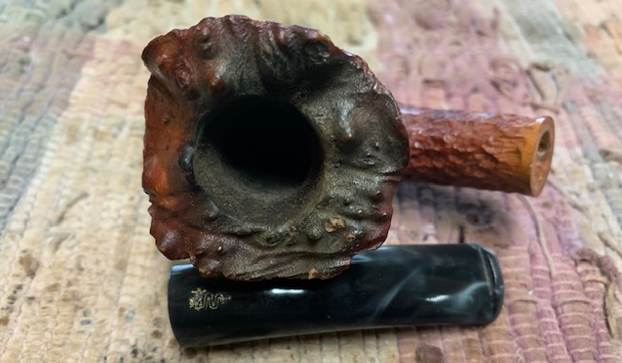
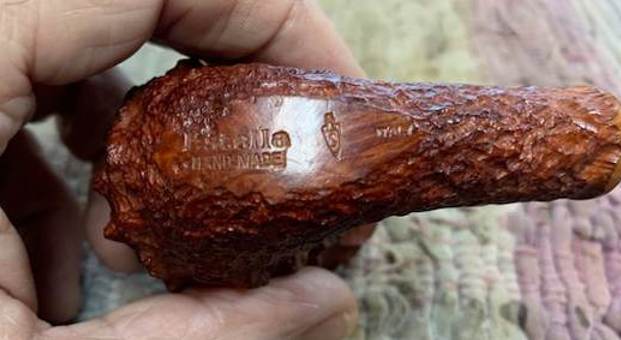
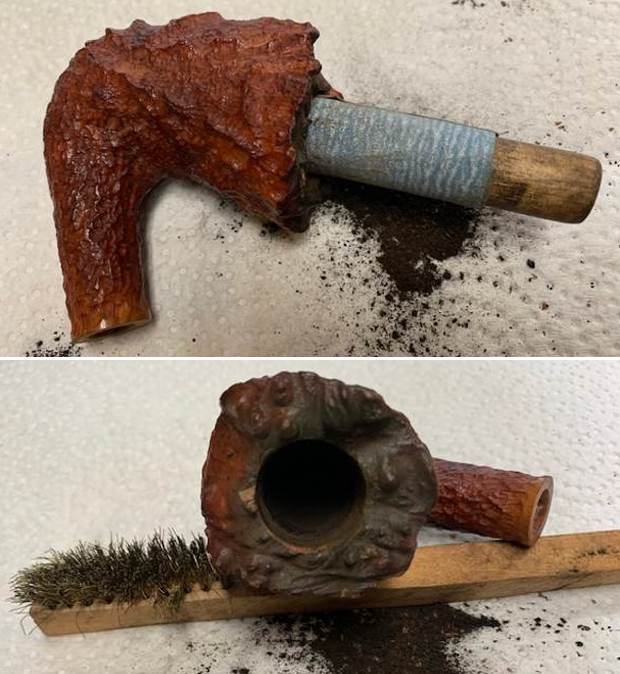
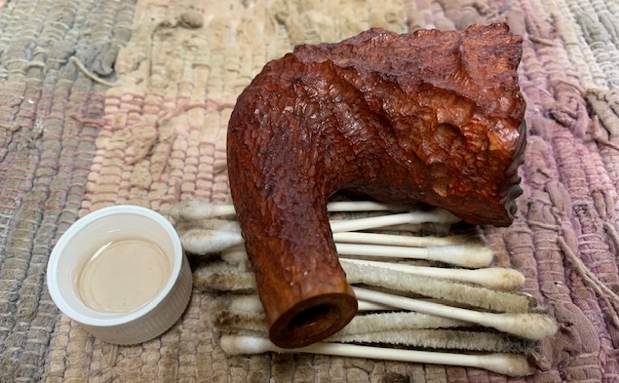
Replacing a Broken tenon on a Savinelli Estella Hand Made Freehand


Blog by Steve Laug

Last week I received a from Curtis, a gentleman who had been referred to me by City Cigar. I asked him to email me some photos of his pipe so I could see what I was dealing with before I took on the project. He sent the following email and photos:

I was referred to you by Ben at City Cigar.  I was curious if I could send my pipe to you for repairs. Here are some photos of it, I know you probably can’t give a proper estimate until it’s in your hands.  Forgive my ignorance on pipe repair but I’ve never had any work done before.  If possible, after viewing my photos, would a “ballpark” estimate be possible ?  I don’t know if I’m looking at 100.00 or 1000.00.  The pipe might  not be “worth” much but my son gave it to me and it has sentimental value to me.  I’m just looking to get a new or used or repaired stem for the pipe, if possible.

Thanks for you time,

Curtis

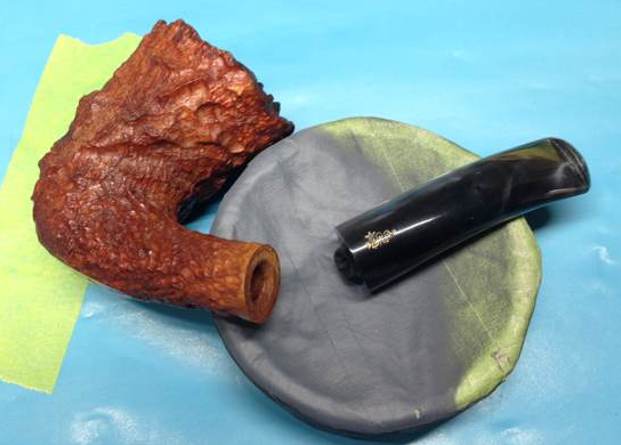
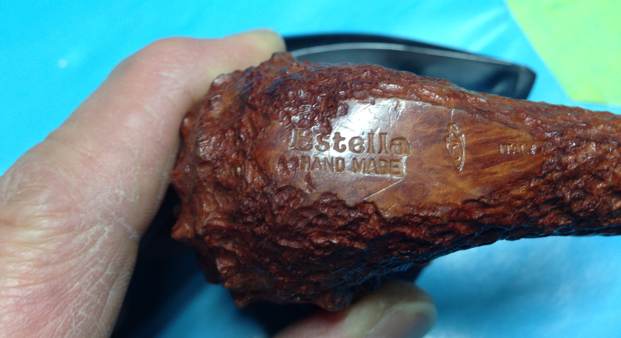
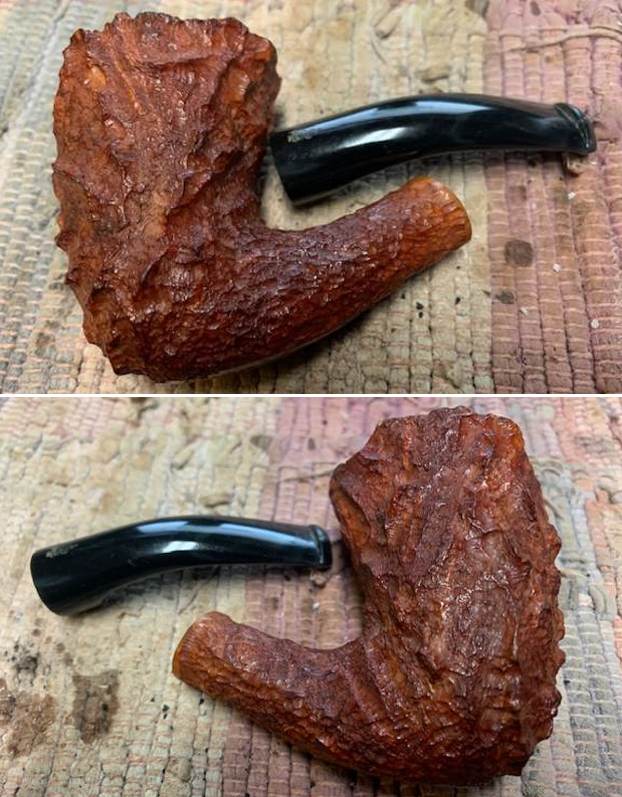
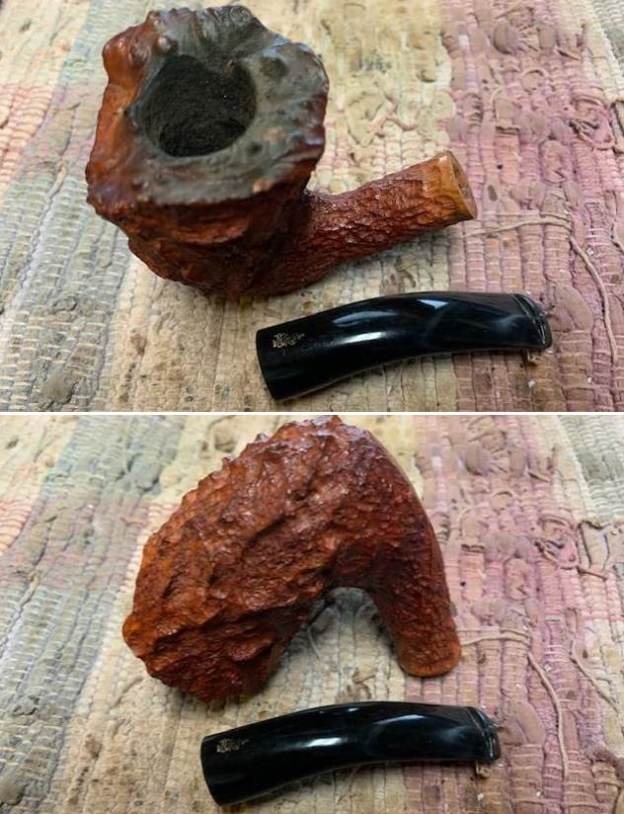
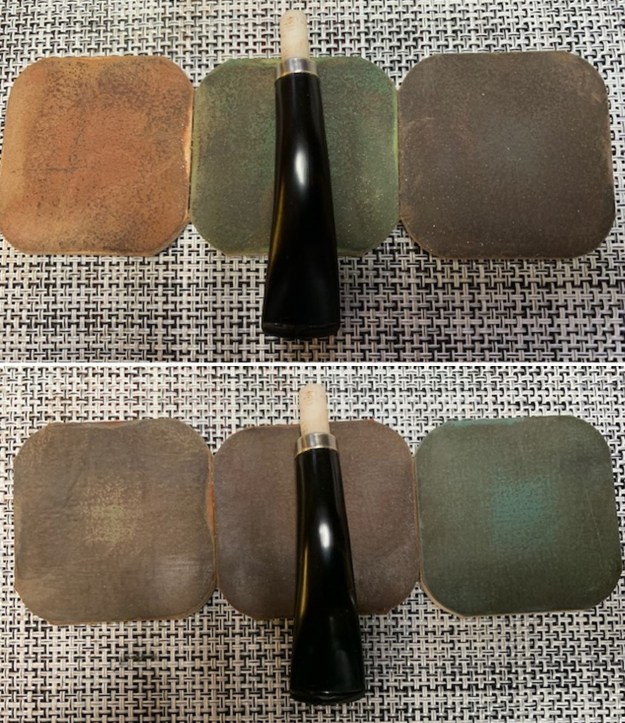
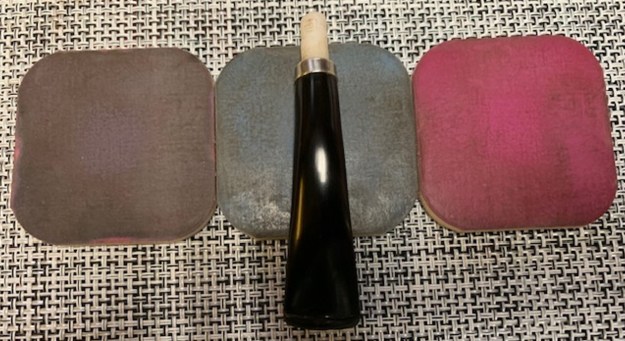
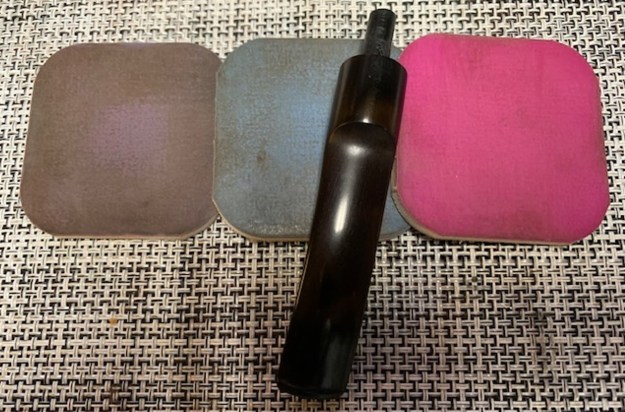
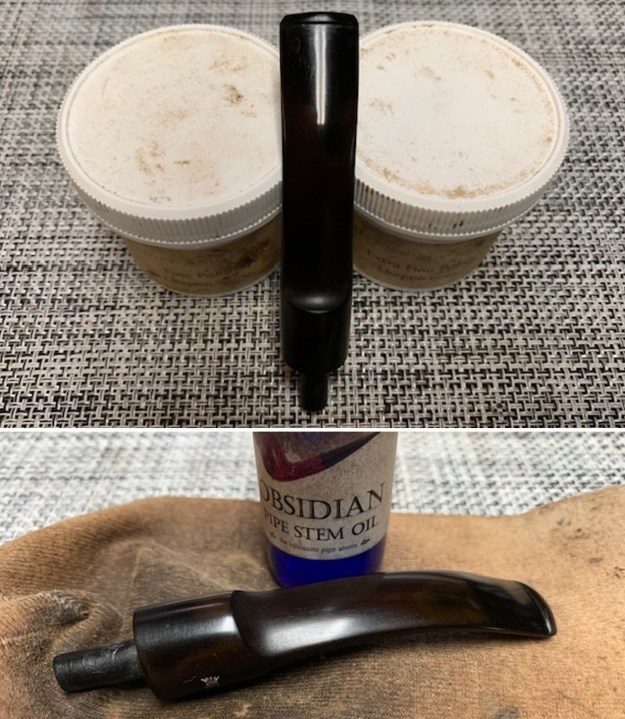
I called him back and we arranged for him to mail the pipe to me. It was a very heavily rusticated Estella Hand Made with an acrylic stem with a tenon that had snapped off fairly close to the saddle on the stem. It is a bit of a bent Dublin with a fancy half saddle acrylic in variegated silver and grey colours. The stem is in pretty decent condition. The bowl has a light cake and the rim top has some lava in the valleys. It will need to be cleaned up as well as having the tenon replaced. He sent the pipe to me through Canada Post and when it arrived it looked just as Curtis had photographed it.The pipe is a heavily rusticated Freehand with a plateau rim top. It is stamped on the smooth heel of the bowl and onto the shank on the underside of the pipe. It reads Estella [over] Hand Made followed by Savinelli S Shield logo then Italy. The stem was a variegated grey and silver half saddle. The tenon had snapped very close to the spot at the end of the stem. The stem itself was quite clean with some light tooth marks and chatter on both sides ahead of the button. There was a moderate cake in the bowl that went half way down the bowl. There was a lava overflow on the rim top and some nicks on some of the high spots. There was also some grime on the bowl at the midpoint where it is held in the hand. It was a nice looking Freehand pipe that showed great promise. I took photos of the pipe before I started my work on it. I took a close up photo of the bowl and rim top to show the thickness of the cake and the condition of the stem when I received the pipe. It was a bit of a mess. You can see the lava overflow on the rim top and the inner edge of the bowl. The stem looked good other than having a broken tenon. There were some light tooth marks and chatter on both sides ahead of the button.The next photo shows the stamping on the underside of the shank. It is clear and readable as noted above.I reamed the bowl with a PipNet Pipe Reamer to remove the cake from the bowl – using the #1 and #2 cutting heads to take out the majority of the cake in the bowl. I cleaned up the reaming with a Savinelli Fitsall Pipe Knife and a piece of dowel wrapped with some 220 grit sandpaper. I cleaned up the lava on the rim top with a brass bristle wire brush and was able to remove much of the build up. I cleaned out the mortise and airway in the bowl and shank with isopropyl alcohol, cotton swabs and pipe cleaners until the shank and airway were clean.I scrubbed the bowl with Murphy’s Oil Soap and a tooth brush on the rustication on the bowl and rim top. I rinsed the bowl with warm running water to rinse off the soap and the grime left behind. It looked better. I rubbed the bowl down with Before & After Restoration Balm. I worked it into the rustication with my fingertips and a horsehair shoe brush to get it deep in the valleys of the rustication. I let it sit for 15 minutes and buffed it off with a soft cloth.  I set the bowl aside and turned my attention to the stem. I went through box of replacement tenons. I found one that was the right fit for the mortise. It was a little long for insertion into the end of the stem once drilled it. I would need to shorten the tenon in order to not have it break through the underside of the half saddle.I flattened the broken edges of the original tenon with a Dremel and sanding drum. I used a penknife to create a funnel in the stem end to guide the drill bit straight. I drilled it with a series of drill bits from one slightly larger than the airway in the stem and finished with a ¼ inch bit that was the same size as the tenon end. I cleaned up the drilled out stem with a round file and a half round file. I smoothed out the walls of the drilled out area. I roughened and rounded the end of the tenon that was going to be inserted in the stem. I coated it with some black superglue and twisted it in place in the stem end. I aligned it with the shank end to make sure the fit was correct.I cleaned out the airway in the stem shank with pipe cleaners, cotton swabs and isopropyl alcohol to remove the tars and oils. I sanded out the tooth marks and chatter with 220 grit sandpaper and started the polishing with 400 grit sandpaper. The marks are smooth and blended in. I also sanded the diameter of the stem slightly on the right side and underside to adjust the fit to the shank. I polished the stem with micromesh sanding pads – dry sanding with 1500-12000 grit sanding pads. I wiped the stem down after each sanding pad with a cloth impregnated with Obsidian Oil. The oil both preserves the rubber and also provides some needed friction for the micromesh pads. I polished it with Before & After Fine & Extra Fine Polish. I rubbed it down a final time with the oil and set it aside. This Estella Hand Carved Rusticated Freehand by Savinelli combines a great looking piece of rusticated plateau briar with a variegated grey/silver acrylic stem to make a beautiful pipe. The cleaned rustication on the bowl came alive with the polishing and waxing. I put the stem back on the bowl and carefully buffed the pipe with Blue Diamond on the buffing wheel. I gave the bowl multiple coats of Conservator’s Wax and the acrylic stem multiple coats of carnauba wax on the buffing wheel and followed that by buffing the entire pipe with a clean buffing pad. I hand buffed the pipe with a microfiber cloth to deepen the shine. The finished Estella Hand Carved Freehand really is a beauty and fits nicely in the hand and looks very good. Give the finished pipe a look in the photos below. The dimensions of the pipe are Length: 6 inches, Height: 2 ¾ inches, Outside diameter of the bowl: 1 ¾  x 2 inches, Chamber diameter: ¾ of an inch. The weight of the pipe is 2.05oz./58grams. It is the second pipe I have finished for Curtis. Next week I will put it in the mail and send it back to him. Thanks for reading this blog and my reflections on the pipe while I worked on it. There are many more to come!
Good to know I can fix my foul ups! Replacing a Broken Tenon on a Ronson Centenary Bulldog


Blog by Steve Laug

I went back and revisited the blog/review I wrote on this pipe back in 2013. I am including the link (https://rebornpipes.com/2013/02/15/review-of-a-ronson-centenary-bulldog/) and the first paragraph of the review below.

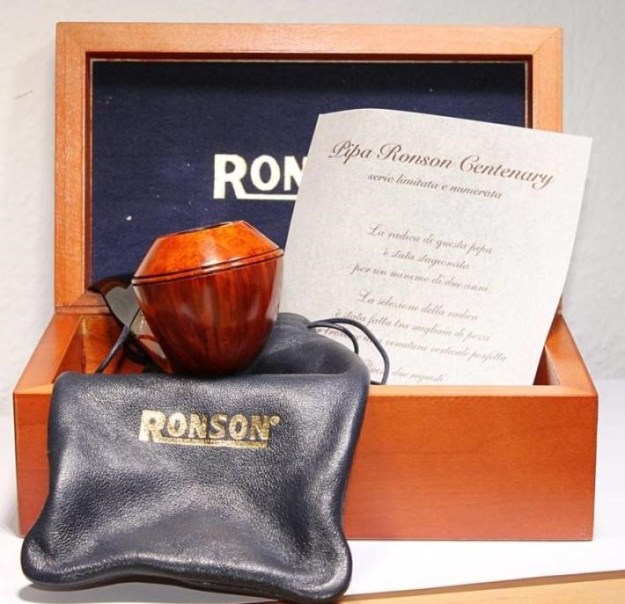
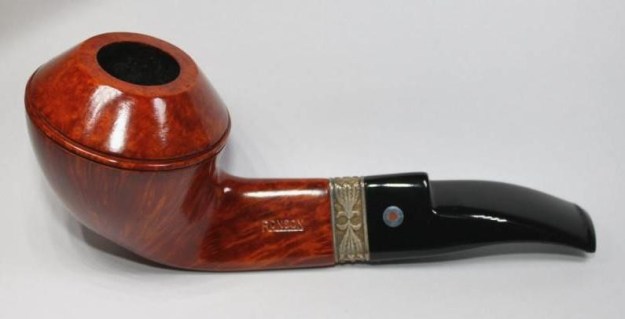
I picked this pipe up for a really cheap price on EBay. It came in a beautiful handmade wooden box lined with dark blue velvet on the inside of the box and the lid. The lid also has the golden Ronson logo. Ronson is famous for the lighters that they make but after receiving and smoking this beauty I would also say they make a fine pipe. The pipe came with a leather pipe sock and a certificate of authentication for the Centenary version of the pipe. The workmanship on this pipe is very nice. I have smoked it quite a bit since that time and it is a great smoke. Since I had the day off today I decided to also write a review on this one. The length of the pipe is 5.8 inches and the bowl height is 2 inches. The chamber diameter is .8 inches and depth is 1.8 inches. It is a large pipe but weighs 78 grams. It is a good fit in the hand. The overall shape is something like a bent bulldog. There is a sterling silver band on the shank with sheaves of laurels. The stamping is on the sides and the bottom of the triangular shank. It is stamped on the left side Ronson using the Ronson logo type and on the right side 47. On the underside of the shank it is stamped RONSON over CENTENARY over 1896-1996 and surrounded by Laurels. That dates the pipe to 1996. It came to me unsmoked.

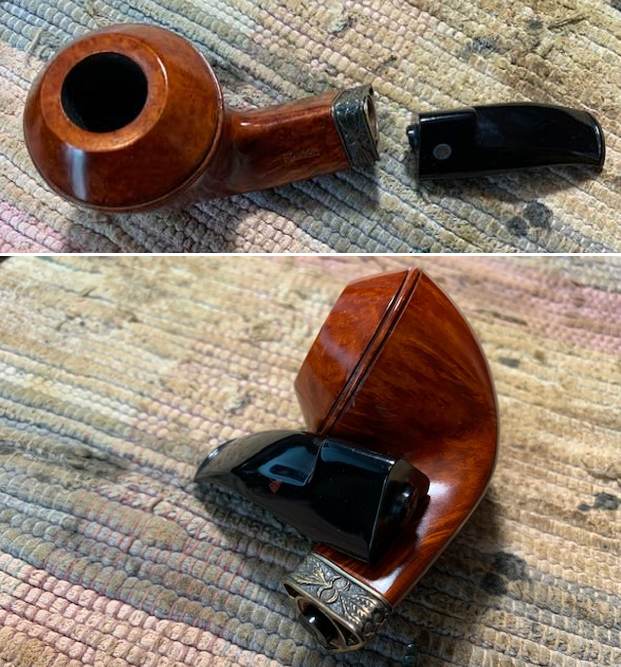
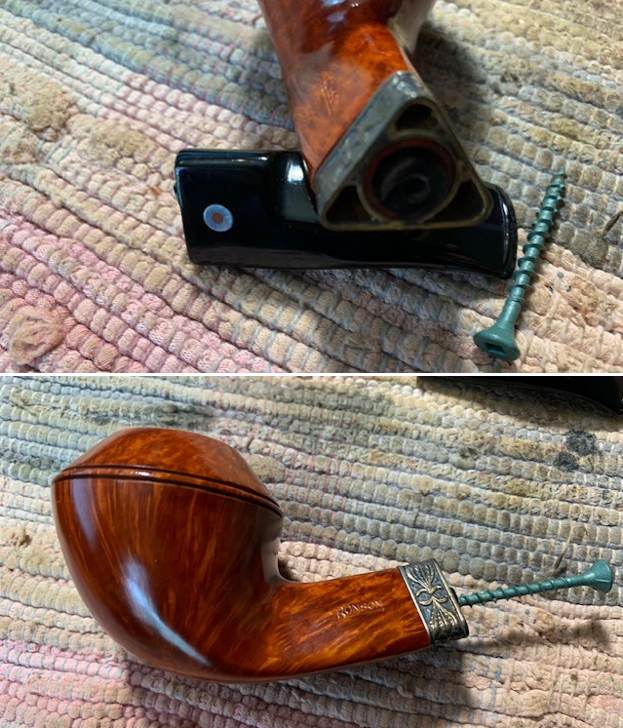
I am including several photos of the pipe from the review blog. The first is the pipe in its case with the certificate. The second shows what I saw when I took it out of the case. It really is a nice looking pipe. From the title of the blog you can surmise that the pipe and I had a mishap that left the acrylic tenon snapped off in the shank. You can probably imagine the sick feeling I had when I figured out that it had happened. It was resting safely in its box and bag so I figured all was fine. I went to move it when we had our basement flood two weeks ago and the box slipped out of my hands and hit the floor. I figured that the box and bag would have protected the pipe so I did not even check it. I retrieved it and carried it upstairs to my temporary work table in our dining room. I was oblivious to any issues at this point. I let it sit for about a week and then thought I might list it on the store as I just do not smoke it enough. I opened the box and the bag to inspect it. I remembered that I had cleaned it before putting it away and it was pristine. When I opened the bag the pipe came out in two parts in my hand. The tenon had snapped off in the shank with almost a clean break. I was sick to my stomach when I saw what I had done.I took out the handy drywall screw that I keep at my work table for just this kind of extraction work. I carefully turned the screw into the airway of the broken tenon in the shank and said a quick prayer and wiggled the tenon out of the shank! Whew! I was thankful that it was not stuck in the shank. Now the work could begin. I went through my can of Delrin tenons and found one that was a proper fit. I would need to adapt it to fit the stem but the fit in the shank was perfect. I took some photos with the tenon in the shank to show the fit. I used my Dremel and sanding drum to remove the ridge in the middle of the tenon and set it in the shank. I also flattened the broken tenon face on the stem. I was able to smooth it out so the first step in fitting the new tenon was complete. The shank portion was complete. Now I would need to drill out the airway in the stem to receive the new tenon and then reduce the diameter of the tenon to fit the newly drilled airway.I set up my cordless drill to open the airway. I started with a bit slightly larger than the existing airway and drilled it ½ inch into the stem. I did not want  to go too far and come out on the top of the stem. I worked through several bits, moving through them until I got to the largest that would safely work in this stem – 11/64 of an inch. Drilling a stem this way requires carefully moving forward so as not to angle the drill bit. I use the existing airway as the path and rigorously hold to that with each new bit.Once the path was open to the diameter I could safely drill in the stem I turned my attention to reducing the diameter of the portion of the new tenon that would fit in the airway. I used the Dremel and sanding drum to carefully take down the diameter. I took a photo of the shaped tenon with a new unshaped tenon so you can get a feel for what I had to do for the fit. I know it would be much cleaner if I had a lathe but I don’t so I use what I have. I cleaned up the shape with a small file and repeatedly checked it in the airway. I wanted to have a snug fit but I also needed to account for the addition of the glue. Once all was aligned I checked the fit of the stem against the shank end. I wanted to make sure that all was lined up. I marked the top of the tenon once I had the fit correct. I removed it from the stem and slid a pipe cleaner in the stem and tenon to make sure the glue did not seep into the airway. I painted the surface with black super glue and pushed it into the stem. I was careful to line my mark up on the top of the new tenon so the fit would be correct.I wiped excess glue off the stem end and checked the fit of the stem to the shank. I like the way it lined up. I took some photos of the fit and then removed the stem and set it aside to allow the glue to cure. I made a few minor adjustments to the tenon so the fit was better and then polished the saddle portion of the stem with micromesh sanding pads. I dry sanded it with 1500-12000 grit pads and wiped it down after each pad with an Obsidian Oil impregnated cloth. I gave it a deeper polish with Before & After stem polish – both Fine and Extra Fine. I gave it a final wipe down with Obsidian Oil and set it aside to dry. I was finished with the repair and put the pipe back together. It actually looked very good and the repair was a perfect fit against the shank. I was pleased with the fit. I buffed the stem with a microfiber cloth to give it a rich shine. I buffed the bowl the same way and took photos of the finished pipe that I have included below. The tenon repair went very well and the pipe is back to being fully functional. Thanks for walking through the tenon replacement with me.

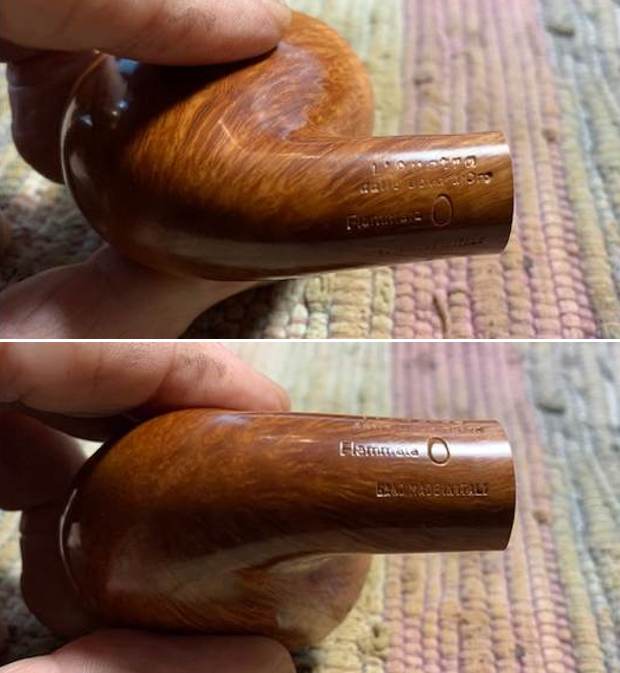
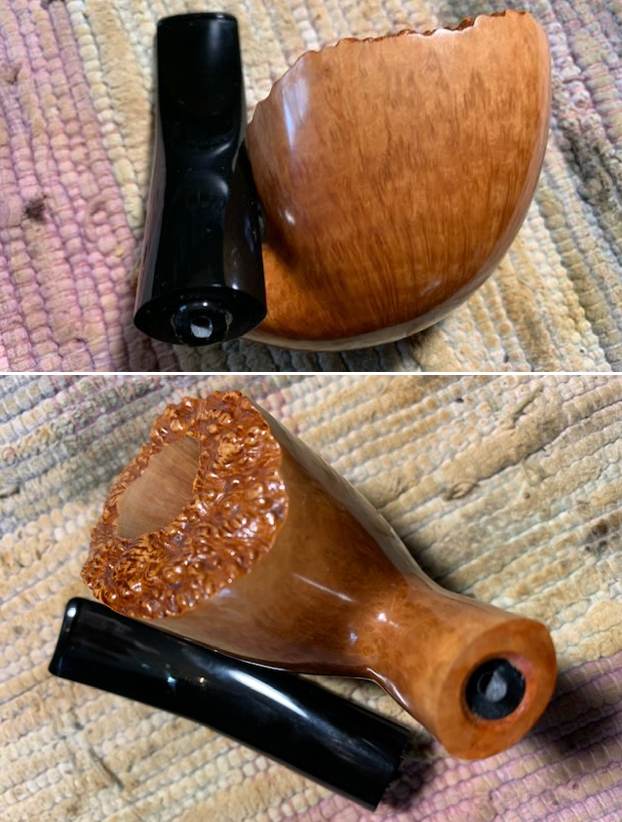
Replacing a Broken Tenon on a New, Unsmoked L’Anatra dalle Uova d’ Oro Fiammata 1 Egg Grade Hand Made in Italy Freehand


Blog by Steve Laug

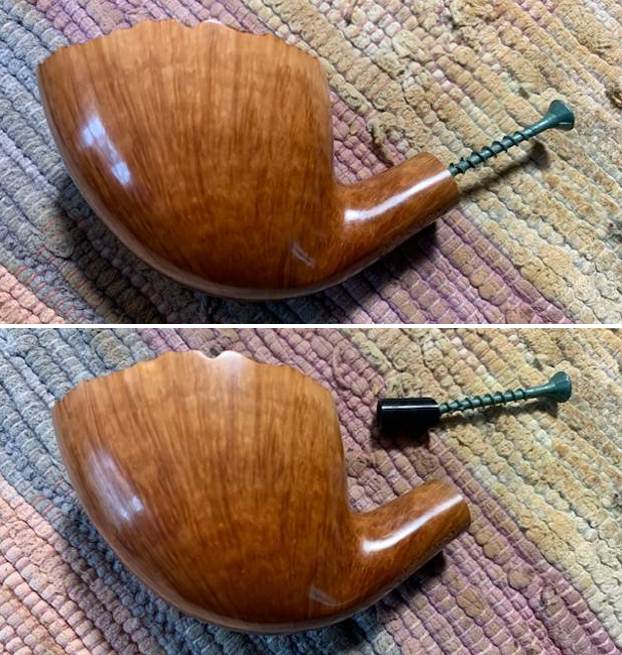
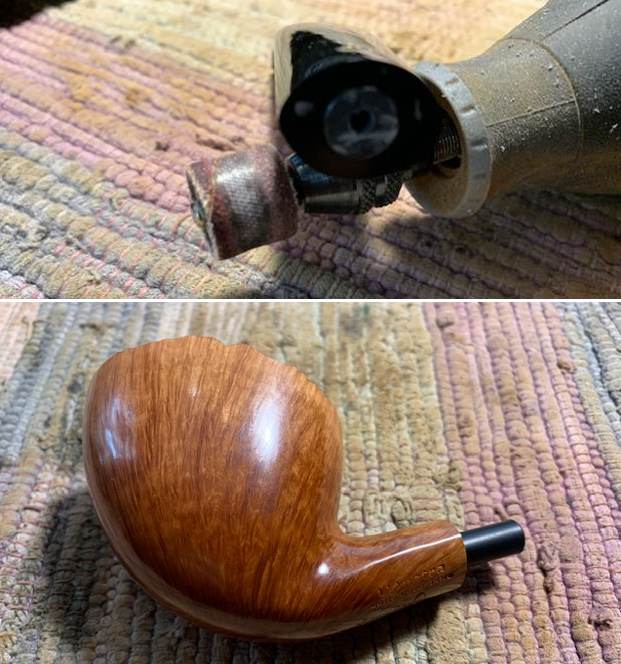
Last week I received a call from a local Vancouver Pipe Shop that I do repairs for regularly. The Fellow on the line said he needed my help with a Brand New Pipe he had in hand. He had taken the pipe out of its package and turned the stem to have the tenon snap in the shank. He was very shaken as I could hear from his voice. He said that the pipe was a beautiful L’Anatra Freehand with a plateau rim top. The pipe was stamped on the underside of the shank and read L’Anatra [over] dalle Uova d’Oro [over] Fiammata followed by a single egg. Underneath that it was stamped Hand Made In Italy. He said he would courier the pipe over to me so I could replace the tenon. I have included photos of the pipe when it arrived so you could see what I was going to deal with. It is truly a stunning piece of briar. I had to laugh as he had sent it in a Dunhill pipe box and included the original price tag on the pipe. The price was high enough to sufficiently spook me but then again I have worked on quite few pipes like this. I took photos of the rim top to show the clean bowl and the pretty plateau rim top. The egg shaped look of the rim top from the top was quite beautiful. I also took photos of the stem to show that the tenon had snapped off almost flush against the end of the stem.I rotated the bowl and took photos of the stamping on the shank. It was clear and readable as noted above.I decided to start my work on the pipe by pulling the tenon. The first two photos show the snapped tenon. The first shows that it snapped very close to the end of the stem. The second shows the broken tenon firmly stuck in the shank. All my normal methods for pulling a broken tenon did not work – it was stuck fast. I put the bowl in the freezer while I had a coffee. When I finished the coffee I tried to pull the tenon again with the screw and it came out very easily. I used a Dremel and sanding drum to remove the fragments of the broken tenon on the stem face. I went through my tenons and found one that would fit the shank. I put the tenon in the shank and took some photos of the fit. It was looking very good. Now it was time to work on replacing the broken tenon. I drilled out the smoothed face of the stem with a cordless drill and a bit roughly the size of the airway in the stem. I find that this helps to center the drilling. I worked my way through 3 drill bits up to 15/64s which is the largest size drill bit that I could safely use on this stem.I reduced the diameter of the portion of the replacement tenon to fit the newly drilled airway. I started with the Dremel and sanding drum and cleaned up the fit with a pair of files. Once I was finished the fit in the new opening on the stem was snug. I shortened the length of the tenon to fit the stem depth. I took a photo of the newly shaped tenon along with a new one. You can see the difference in the length and in the stepped down portion that will go in the stem.
I turned it into the stem and took photos to show the fit in the stem. It looks really good. Still polishing to do at this point as well as gluing the tenon in the stem.
I fit a pipe cleaner in the stem and then coated the shaped tenon end with black CA glue and pressed it into the drilled airway in the stem. I set it aside to let the glue harden.The bowl was in excellent new condition and did not need any attention. I think it has a thin coat of shellac or varnish so it still had its new pipe shine. I polished the newly fit tenon with micromesh sanding pads to smooth it out and give it a shine. It really is a nice looking pipe. This Italian Hand Made L’Anatra dalle Uova d’ Oro Fiammata 1 Egg Grade Freehand turned out to be a beautiful pipe. The finish on the briar is beautiful and the grain is quite stunning around the bowl and shank. I put the pipe back together and buffed it lightly with some carnauba wax. I buffed the pipe with a clean buffing pad to raise the shine and hand buffed it with a microfibre cloth to deepen the shine. It is fun to see what the polished bowl looks like with the polished black acrylic stem. This classic looking Freehand L’Anatra dalle Uova d’ Oro Freehand feels great in my hand. It is light and well balanced. Have a look at it with the photos below. The dimensions are Length: 6 ½ inches, Height: 2 inches, Outside diameter of the bowl: 1 5/8 inches wide x 2 ¼ inches long, Chamber diameter: ¾ of an inch. The weight of the pipe is 77 grams/2.72 oz. It is a beautiful pipe and another one that will be heading back to the Vancouver Pipe Shop after replacing the broken tenon.Thanks for walking through the tenon replacement with me as I worked over this pipe. Thanks to each of you who are reading this blog. 

Replacing a tenon and restoring a House of Robertson Rusticated Dublin


Blog by Steve Laug

The next pipe on the table is a House of Robertson Rusticated Dublin with a tapered, vulcanite Bite Through stem. The rustication on the briar is very tactile and deep. There are grooves around the bowl and shank and those have been deeply rusticated. The pipe is stamped on the left side of the diamond shank and reads House of [over] Robertson. It really is a beautiful pipe and the rustic finish works very well with the diamond twin bore saddle stem. The fellow who sent it to me is a previous customer and in his box were two pipes with a snapped tenon – the Radice (which I have repaired already) and this House of Robertson. This one was quite dirty with a thick cake in the bowl and overflowing onto the rim top. There was some burn damage on the inner edge of the rim around the bowl and the pipe was dull and dusty. The tenon had snapped off cleanly at the shank end with no damage to the briar. The stem had tooth marks on both the top and underside ahead of the button and was also dirty. I took some photos of the pipe before I started my work on it. I took a close up photo of the rim top to show the condition of the bowl and inner edge. You can see the damage on the inner edge of the rim. It will become more evident once the bowl has been reamed and cleaned. The photos of the stem show the tooth marks and chatter on both sides near the button.I took photos of the stamping on the left side of the diamond shank to capture how the classic House of Robertson signature looked.House of Robertson pipes were made by Thayne Robertson in Boise, Idaho. He did some beautiful work and all had the etched stamp on them. I have worked on many of these pipes over the years and done the research on the brand previously. Here is a link to one of the pipes where I have included background information (https://rebornpipes.wordpress.com/wp-admin/post.php?post=60954&action=edit&classic-editor).

“House of Robertson” was in business for many years, but alas, closed their doors in 1999. They were located in Boise, Idaho. They are noted for making rather large and interesting pipes. Thayne Robertson was a Master Mason, AF & AM, and started the shop about 1947 and his son Jon started working there in 1970 when he finished college, along with Thayne’s daughter. Thayne and his son started making the big pipes at that time, and made them together until 1987 when Thayne passed away. Jon kept the store and his sister moved on to other things. The House of Robertson appears to have closed around 1999. https://pipedia.org/wiki/Robertson

I began my work on this pipe by pulling the broken tenon from the shank. I generally use a dry wall screw and twist it into the airway of the broken tenon and wiggle it free. This one was stuck. I put it in the freezer while I had lunch and afterward it came out quite easily. I went through my replacement tenons and found one that would work on this stem. I sanded the broken end of the tenon remaining on the stem with a sanding drum on my Dremel. I also sanded the diameter of the new tenon at the same time to get a good fit in the shank. I took photos of the tenon in the shank at this point to show the fit. I drilled out the airway on the stem with successively larger drill bits to accommodate the tenon. The last bit was ¼ inch which is perfect for the tenon. I slipped the stem over the tenon and took photos of the pipe at this point. It looks very good. With that done I turned my attention to the bowl. I reamed it with a PipNet reamer and took the cake back to briar. I cleaned up the remnants with a Savinelli Fitsall pipe knife. I sanded the bowl walls with a piece of dowel wrapped with 220 grit sandpaper. I cleaned up the rim top with a brass bristle wire brush to remove the lava in the sandblast and a bit of the burn damage on the inner edge of the bowl.I cleaned out the internals on the stem and shank with pipe cleaners, cotton swabs and alcohol until they were clean.I rubbed down the bowl with Before & After Restoration Balm to clean, enliven and protect the briar. I worked it into the blast with a horsehair shoe brush. I let it sit and do its magic for 10 minutes and then buffed it off with a soft cloth.I set the bowl aside and turned my attention to the vulcanite stem. I glued the new tenon in the shank with black super glue. While it cured, I “painted” the surface of the vulcanite stem with the flame of a lighter to lift the tooth chatter and marks. Many of them lifted significantly with the heat. Those that remained I filled in with black super glue and set the stem aside to cure. Once it had cured I flattened out the repairs with a small flat file. I sanded them with 220 grit sandpaper to further flatten them out and blend them into the surrounding area. I started polishing the stem with 400 grit wet dry sandpaper. I polished the vulcanite bite through stem with micromesh sanding pads – dry sanding with 1500-12000 grit pads. I wiped the stem down after each pad with Obsidian Oil. I finished the polishing with Before & After Stem Polishes – both Fine and Extra Fine. I wiped the stem down with a cloth impregnated with Obsidian Oil to protect and give the deep shine to the stem. I was happy to be finished with this beautiful House of Robertson Rusticated Diamond Shank Dublin. The vulcanite stem fit well and looked good with the rich finish of the rusticated bowl and shank. I lightly buffed the pipe with Blue Diamond on the buffing wheel and gave the bowl and shank multiple coats of Conservator’s Wax. I buffed it with a clean buffing wheel to raise the shine. I hand buffed it with a microfiber cloth to deepen the shine. The House of Robertson’s Dublin is a great looking pipe that has an amazing looking rustication. The dimensions of the pipe are Length: 5 ½ inches, Height: 2 inches, Outer Diameter of the bowl: 1 ½ inches, Diameter of the chamber: ¾ of and inch. The weight of the pipe is 42 grams/1.48 ounces. I will be packing it up to send back to my friend in Idaho along with the first pipe – the Radice Silk Cut Billiard. Thanks for reading the blog.

Replacing a tenon and restoring a Radice Silk Cut Billiard


Blog by Steve Laug

The next pipe on the table is a Radice Sandblast Billiard with a faux Bamboo shank. The briar has been carved to look like a piece of Bamboo but is actually briar. The pipe is stamped on the heel and reads Radice [over] Silk Cut and on the underside of the shank end it reads Hand [over] Made in Italy. It really is a beautiful pipe and the combination of “Bamboo” and the sandblast works really well the tapered acrylic stem. The fellow who sent it to me is a previous customer and in his box were two pipes with a snapped tenon – the Radice and a House of Robertson. This one was quite dirty with a thick cake in the bowl and overflowing onto the rim top. There was some burn damage on the inner edge of the rim at the back of the bowl and the pipe was dull and dusty. The tenon had snapped off cleanly at the shank end with no damage to the briar. The stem had tooth marks on both the top and underside ahead of the button and was also dirty. I took some photos of the pipe before I started my work on it. I took a close up photo of the rim top to show the condition of the bowl and inner edge. You can see the damage on the back inner edge of the rim. It will become more evident once the bowl has been reamed and cleaned. The photos of the stem show the tooth marks and chatter on both sides near the button.I took photos of the stamping on the heel of the bowl and the shank end to capture how it looked.I began my work on this pipe by pulling the broken tenon from the shank. I generally use a dry wall screw and twist it into the airway of the broken tenon and wiggle it free. This one came out quite easily. I went through my replacement tenons and found one that would work on this stem.I sanded the broken end of the tenon remaining on the stem with a sanding drum on my Dremel. I also sanded the diameter of the new tenon at the same time to get a good fit in the shank. I took photos of the tenon in the shank at this point to show the fit. I drilled out the airway on the stem with successively larger drill bits to accommodate the threaded end of the tenon. The last bit was ¼ inch which is perfect for the tenon. I slipped the stem over the tenon and took photos of the pipe at this point. It looks very good. With that done I turned my attention to the bowl. I reamed it with a PipNet reamer and took the cake back to briar. I cleaned up the remnants with a Savinelli Fitsall pipe knife. I sanded the bowl walls with a piece of dowel wrapped with 220 grit sandpaper. I cleaned up the rim top with a brass bristle wire brush to remove the lava in the sandblast and a bit of the burn damage on the back inner edge of the bowl.I cleaned out the internals on the stem and shank with pipe cleaners, cotton swabs and alcohol until they were clean.I rubbed down the bowl with Before & After Restoration Balm to clean, enliven and protect the briar. I worked it into the blast with a horsehair shoe brush. I let it sit and do its magic for 10 minutes and then buffed it off with a soft cloth. I set the bowl aside and turned my attention to the acrylic stem. I glued the tenon in the stem with Black Super Glue. While it cured I worked on the tooth marks in the stem.I cleaned up the tooth marks with alcohol and a cotton swab. I filled them in with black super glue and set it aside to cure.Once it had cured I flattened out the repairs with a small flat file. I sanded them with 220 grit sandpaper to further flatten them out and blend them into the surrounding area. I started polishing the stem with 400 grit wet dry sandpaper. I polished the acrylic stem with micromesh sanding pads – dry sanding with 1500-12000 grit pads. I wiped the stem down after each pad with a damp cloth. I finished the polishing with Before & After Stem Polishes – both Fine and Extra Fine. I wiped the stem down with a cloth impregnated with Obsidian Oil to protect and give the deep shine to the stem. I was happy to be finished with this beautiful Radice Silk Cut Billiard. The stem fit well and looked good with the rich finish of the sandblast bowl and faux bamboo shank. I buffed the pipe with Blue Diamond on the buffing wheel and gave the bowl and shank multiple coats of Conservator’s Wax. I buffed it with a clean buffing wheel to raise the shine. I hand buffed it with a microfiber cloth to deepen the shine. The Radice is a great looking pipe that ticks all of my boxes. The dimensions of the pipe are Length: 5 inches, Height: 2 inches, Outer Diameter of the bowl: 1 ½ inches, Diameter of the chamber: 7/8 of and inch. The weight of the pipe is 48 grams/1.69 ounces. I will be packing it up to send back to my friend in Idaho once I finish the second pipe he sent. Thanks for reading the blog.