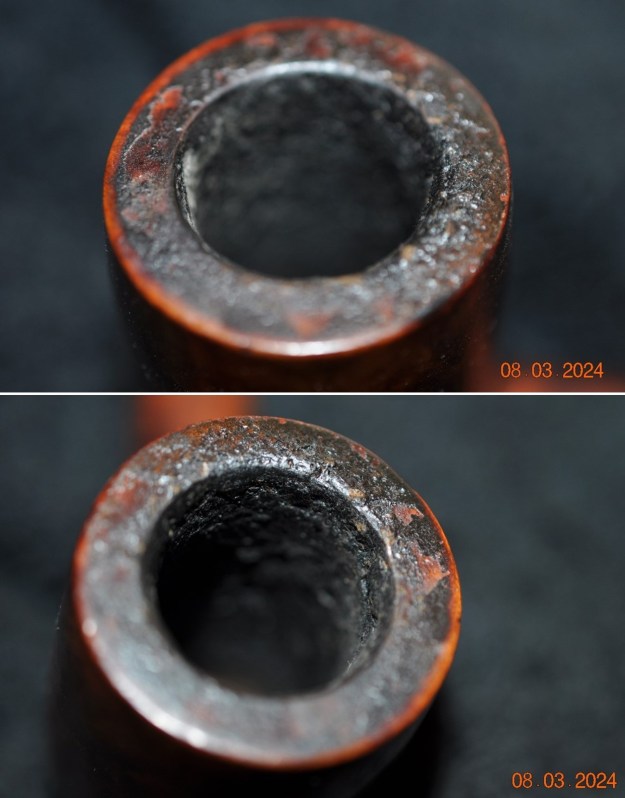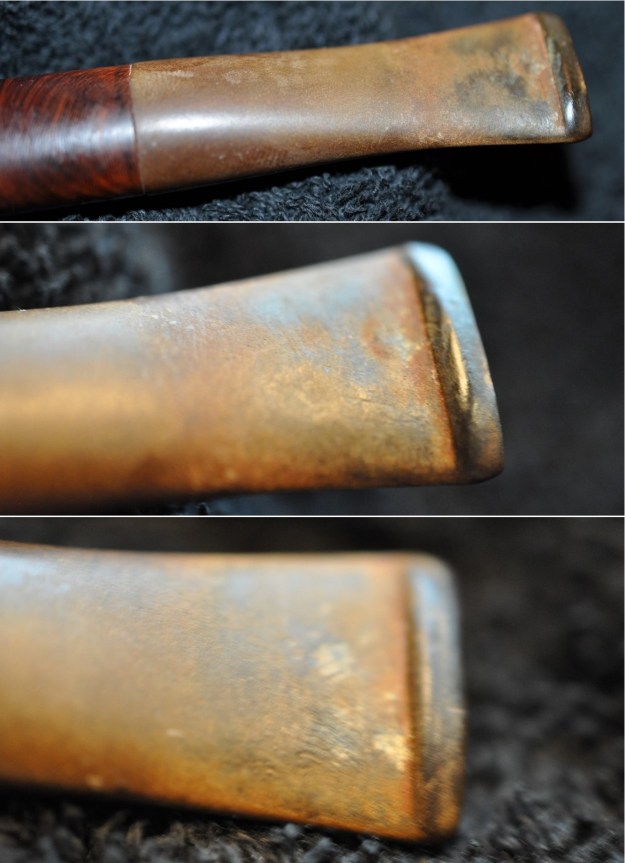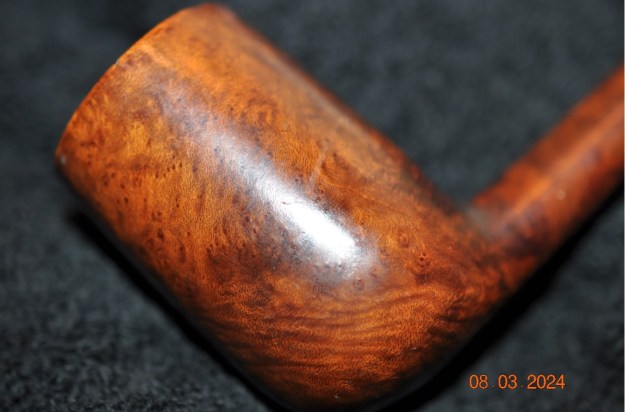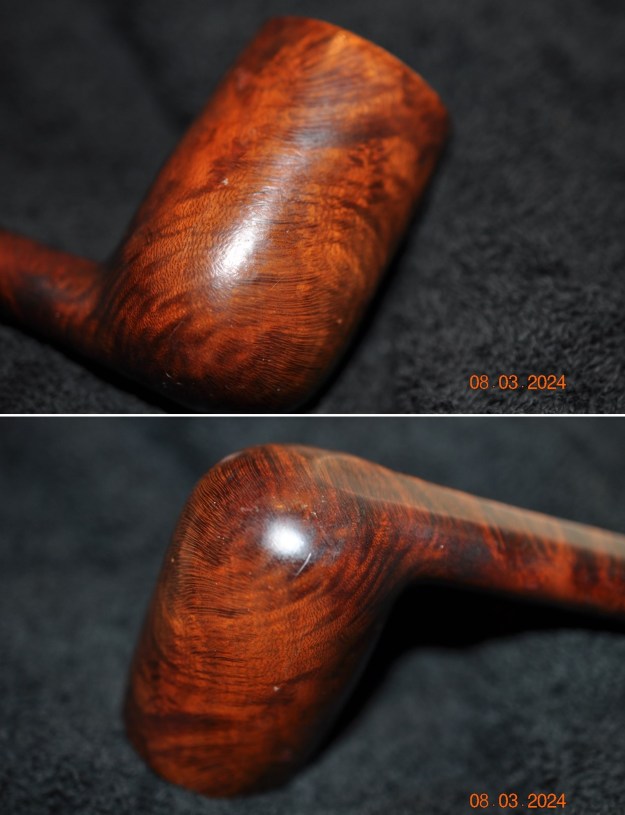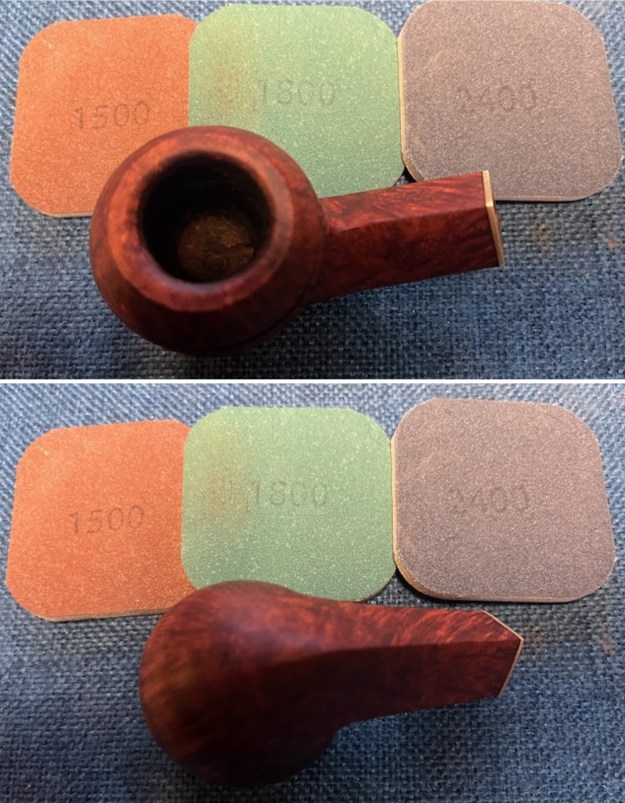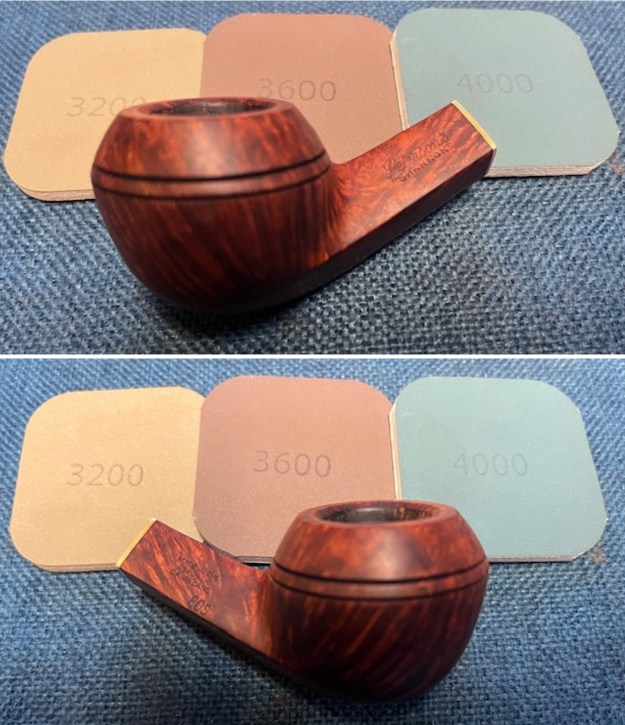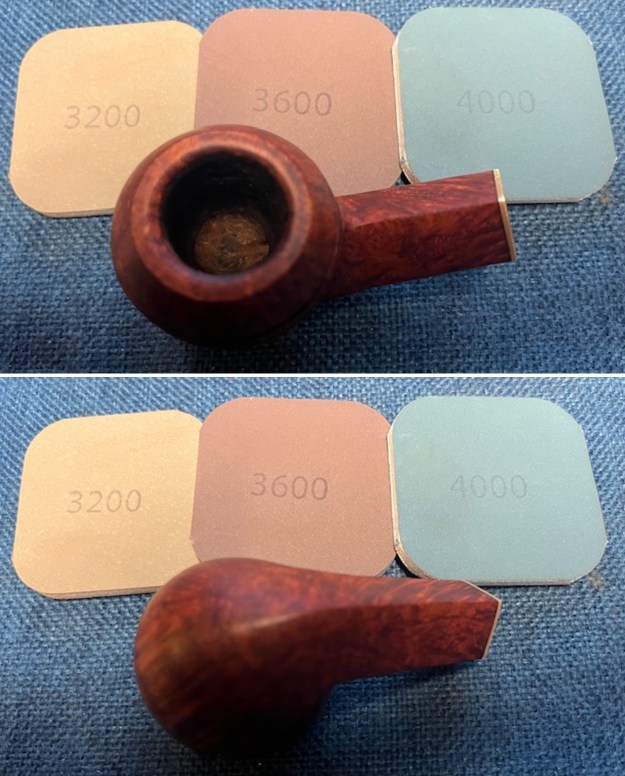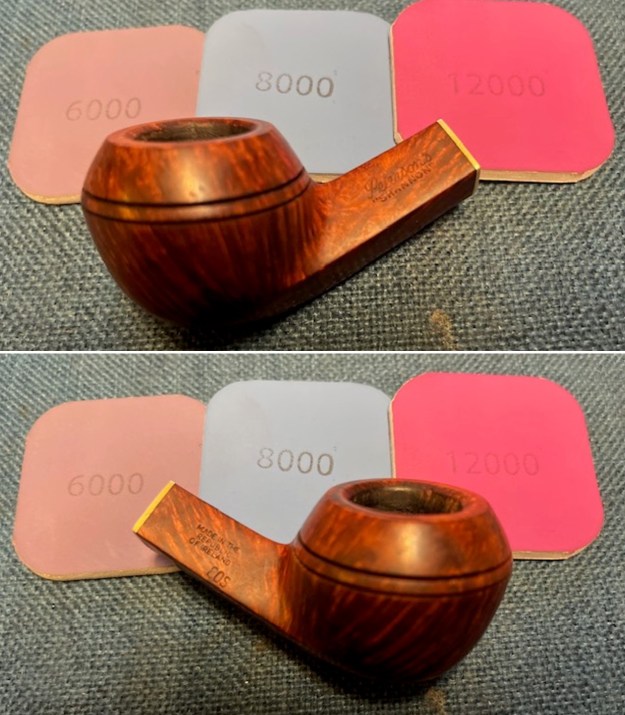
Tag Archives: repairing tooth marks

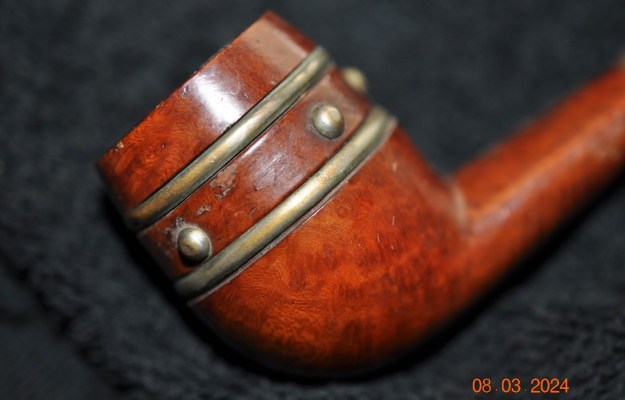
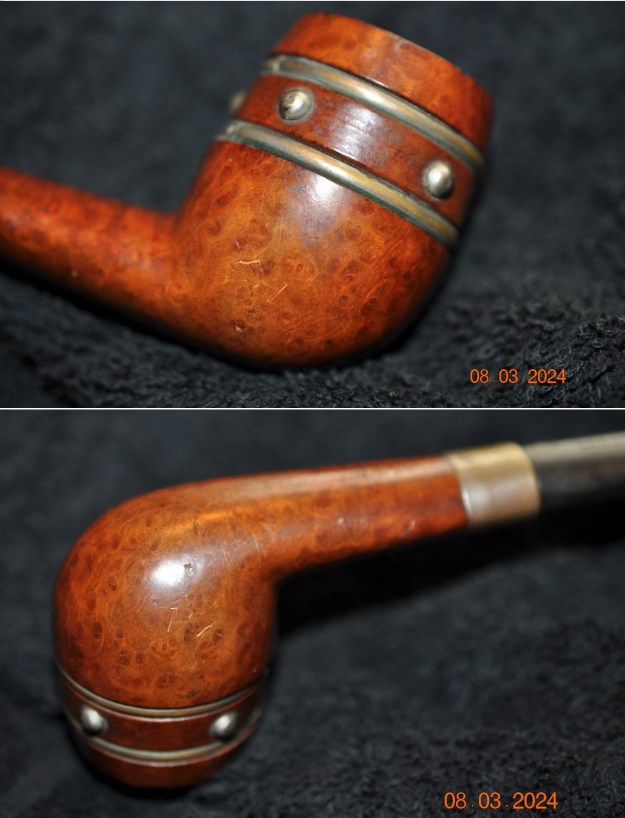
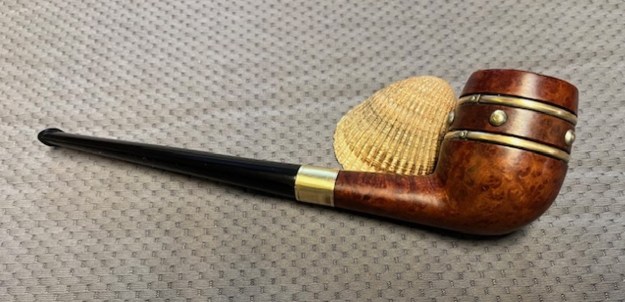
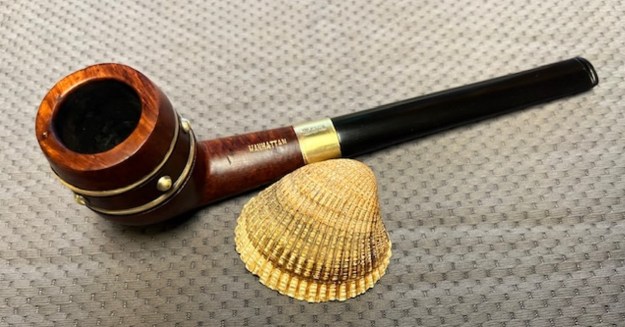
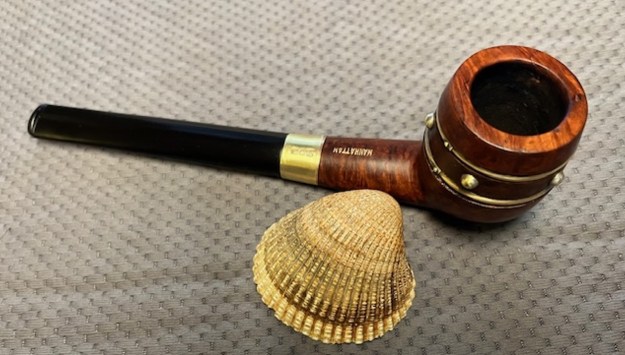
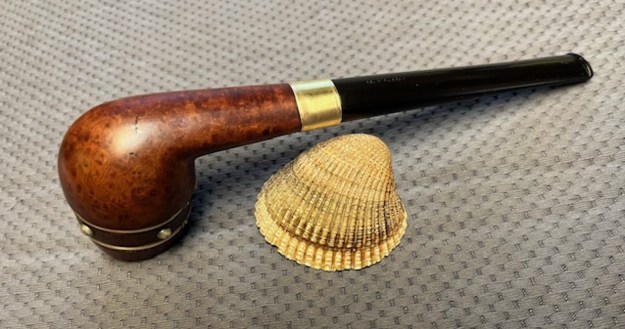
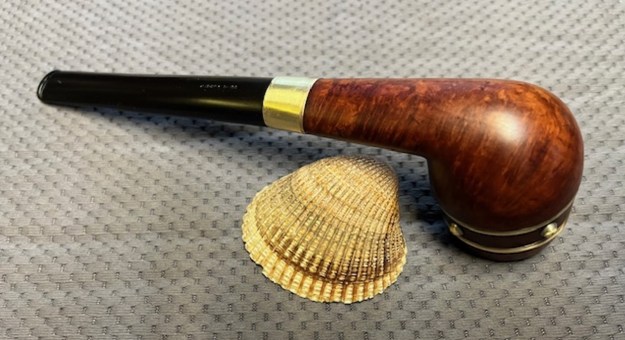
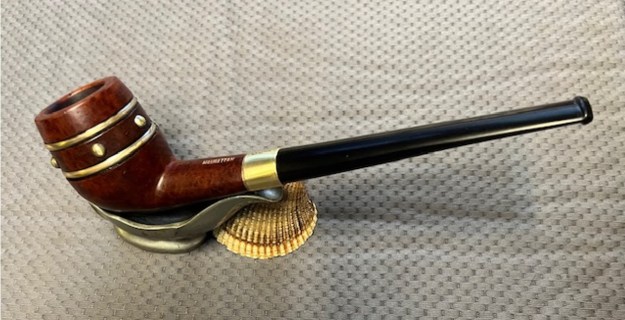
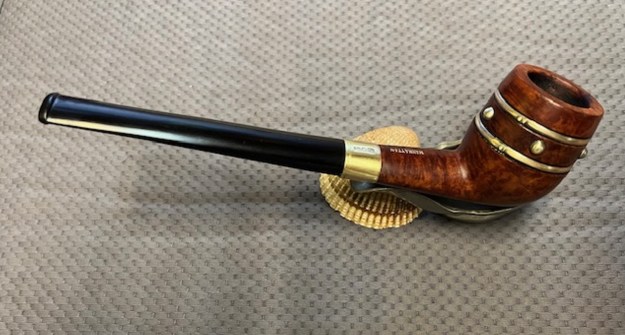
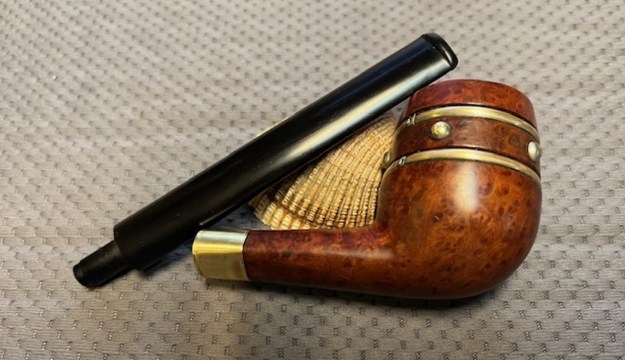
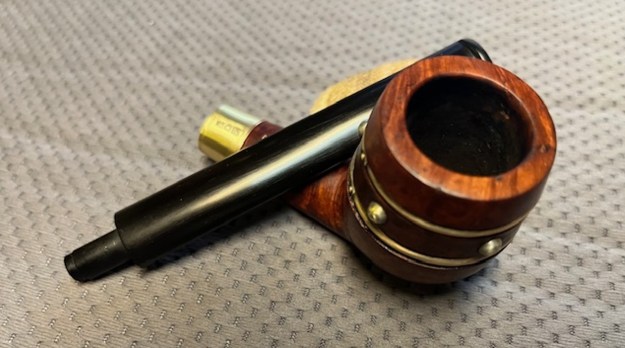
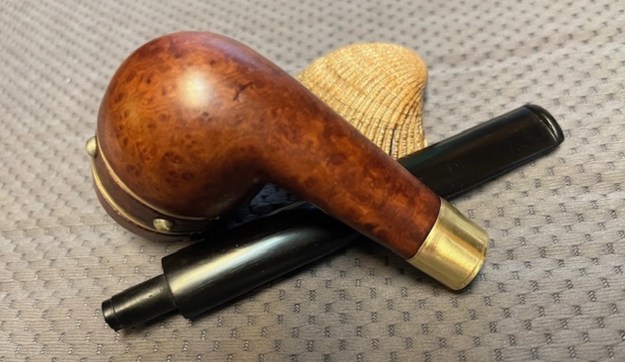
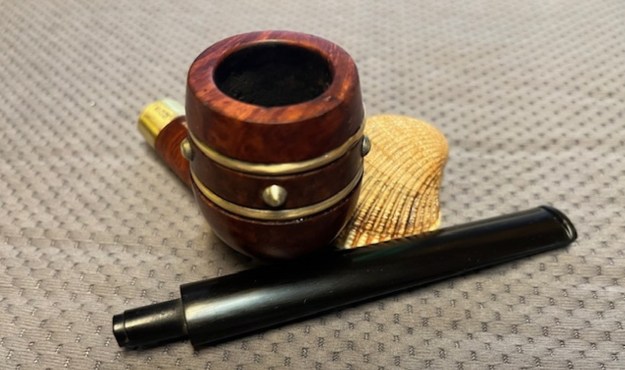
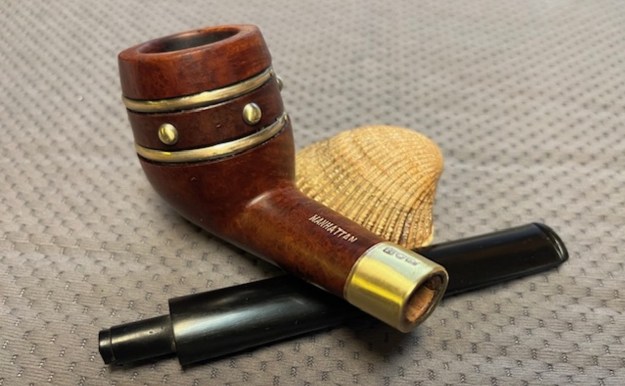
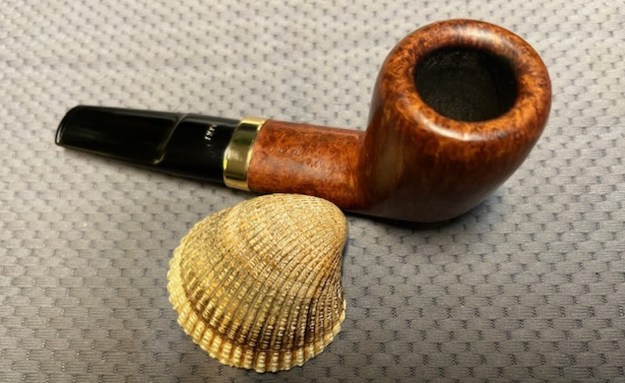
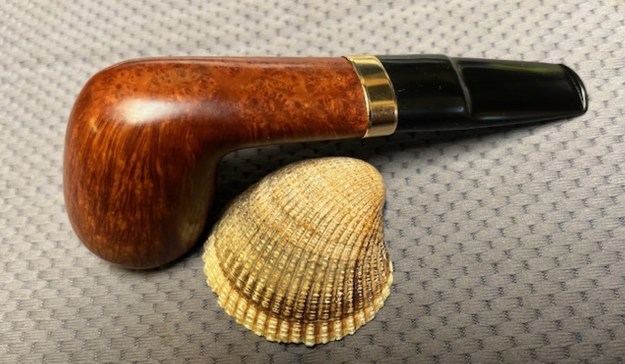
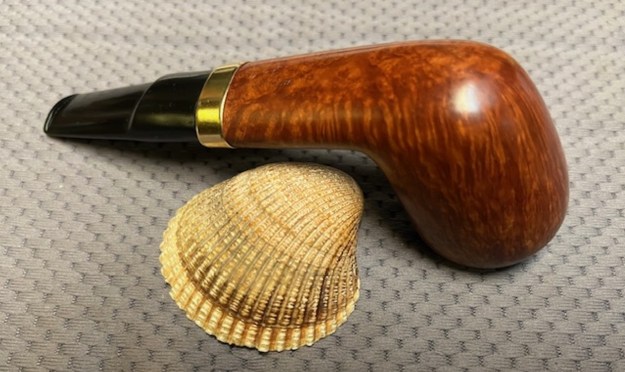
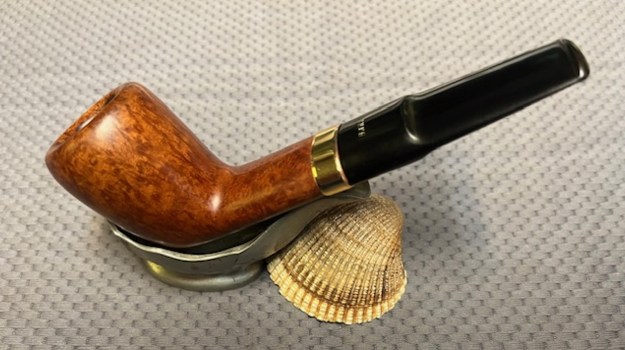
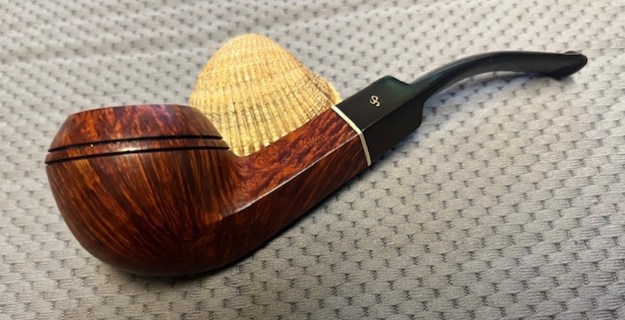
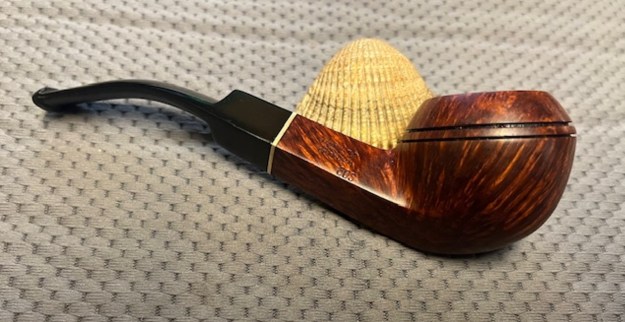
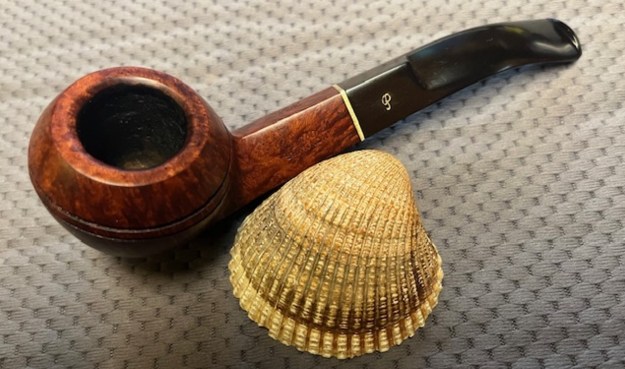
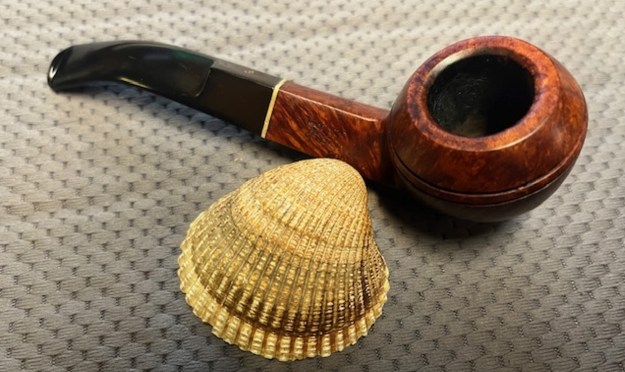
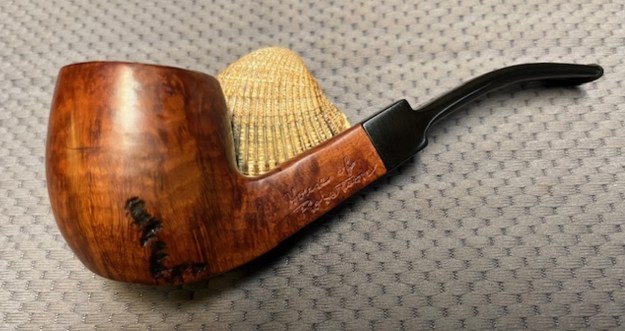
Restoring a rather odd Barrel Like Manhattan Oval Shank Billiard


by Steve Laug

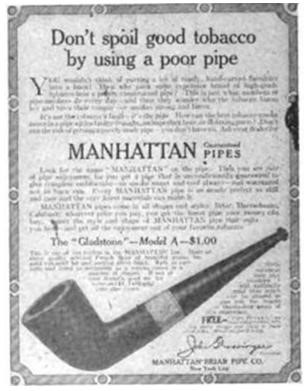
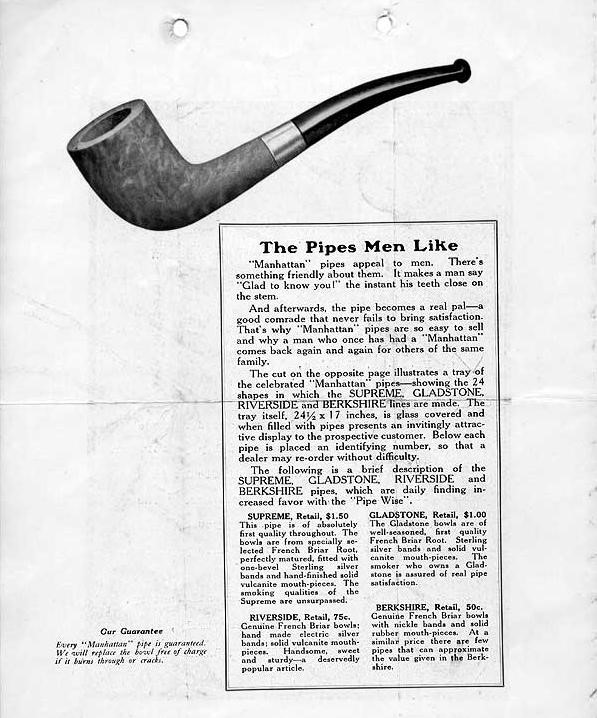
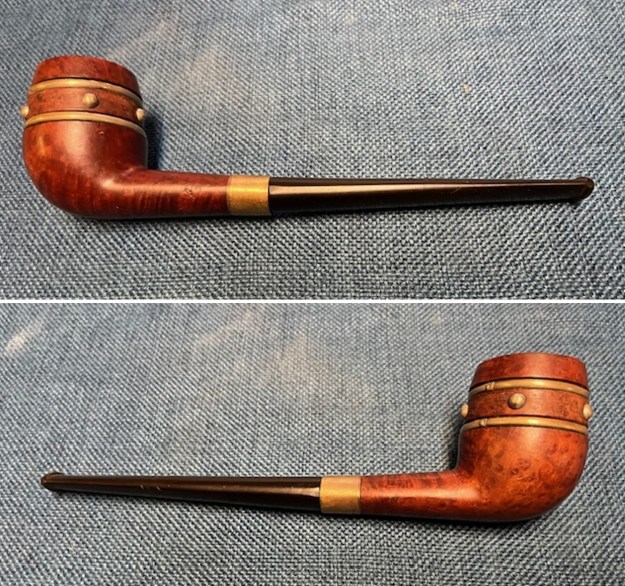
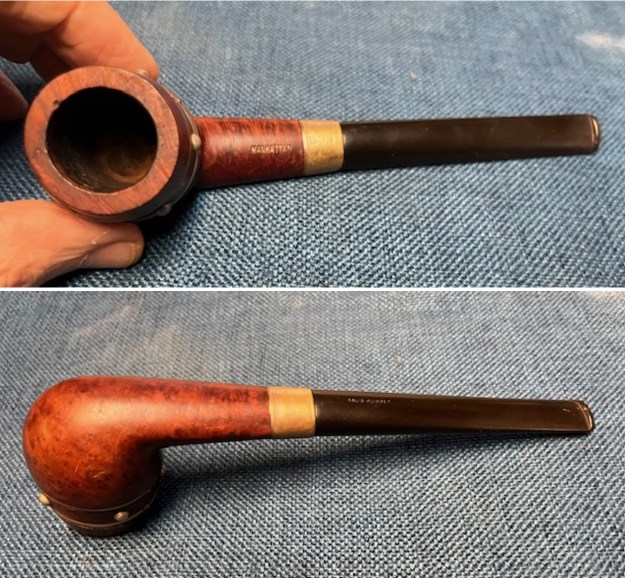
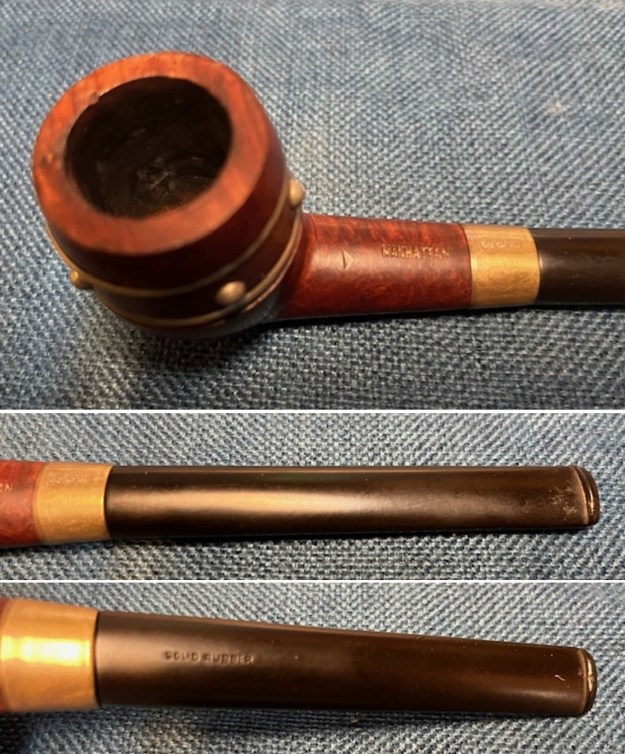
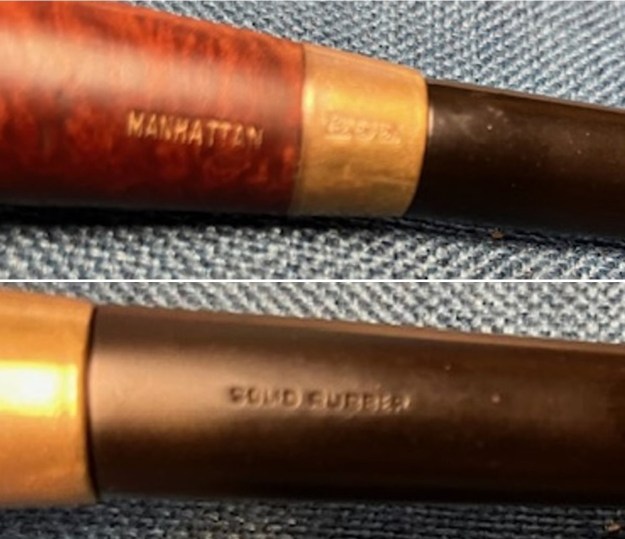
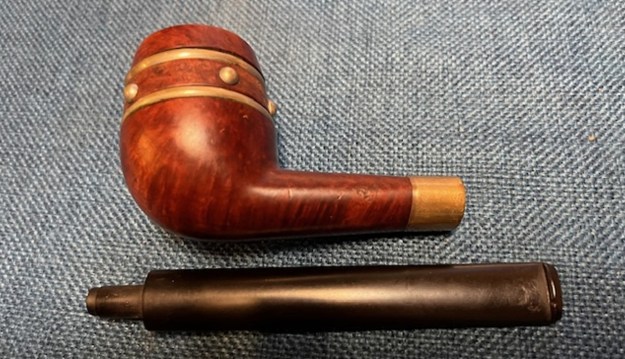
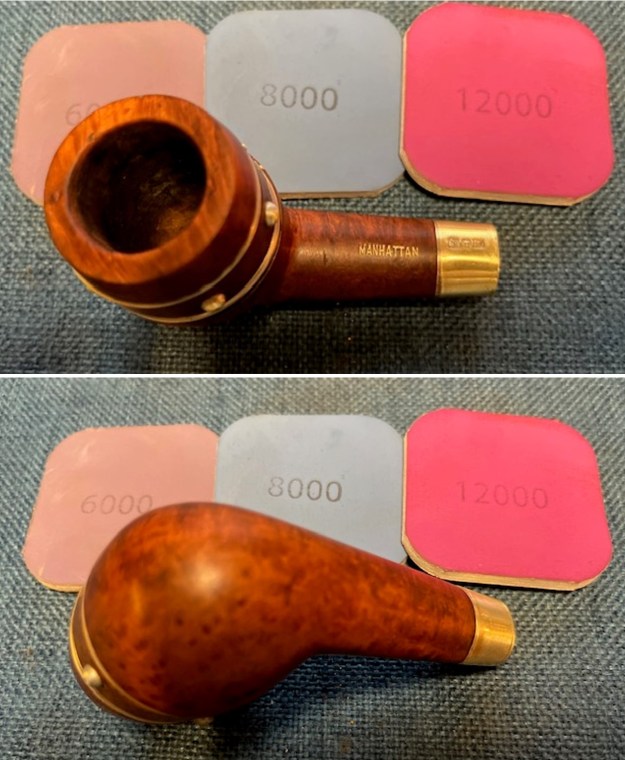
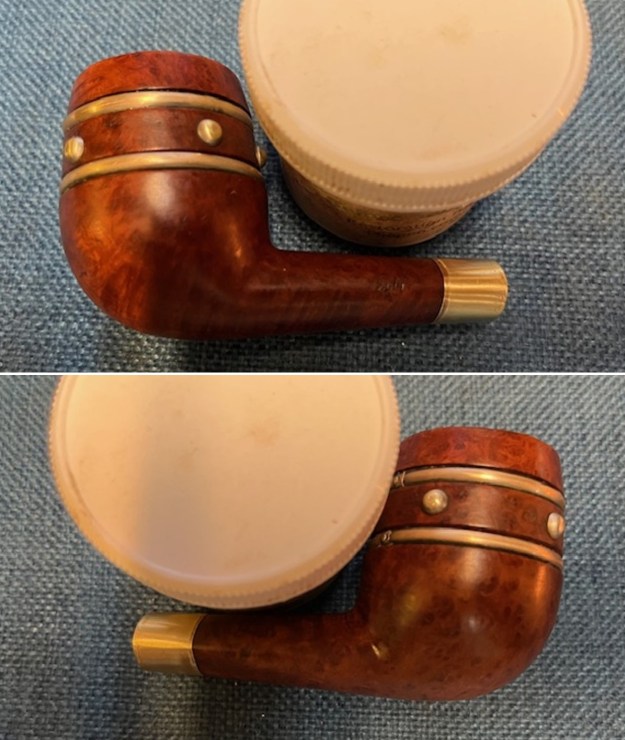
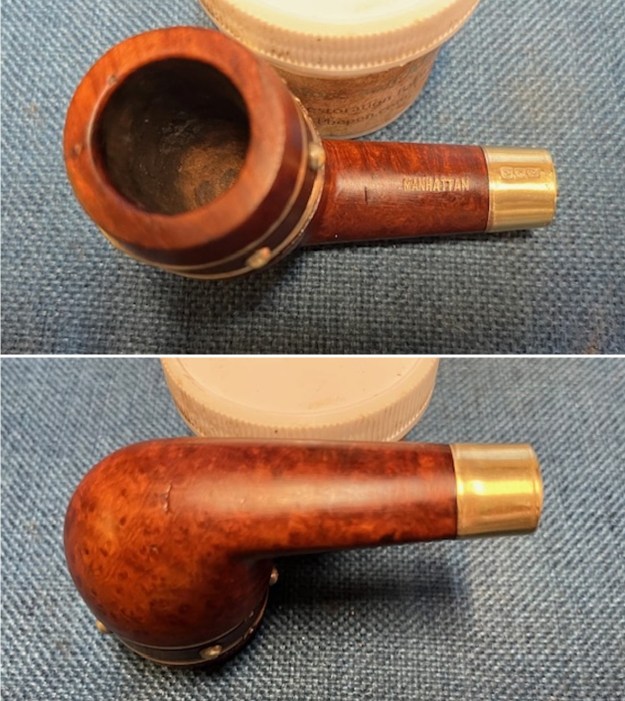
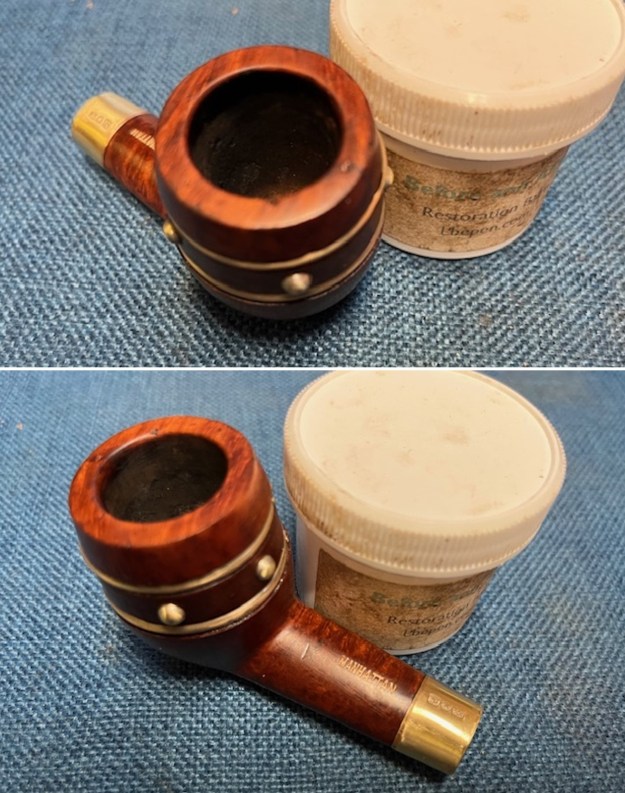
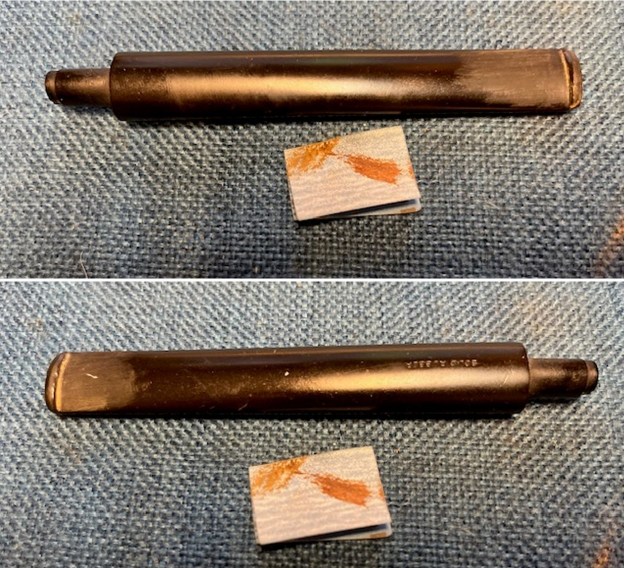
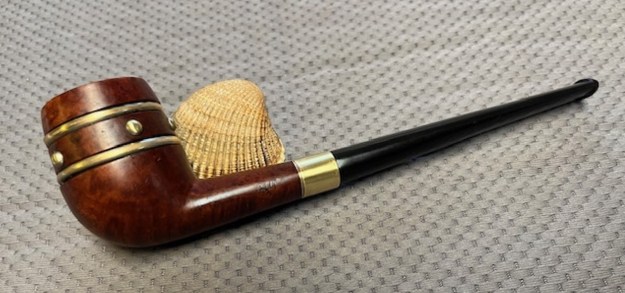
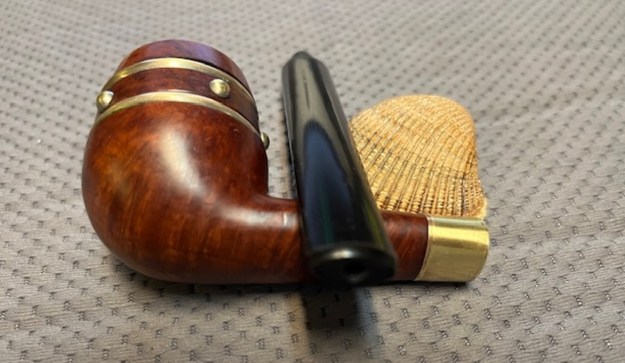
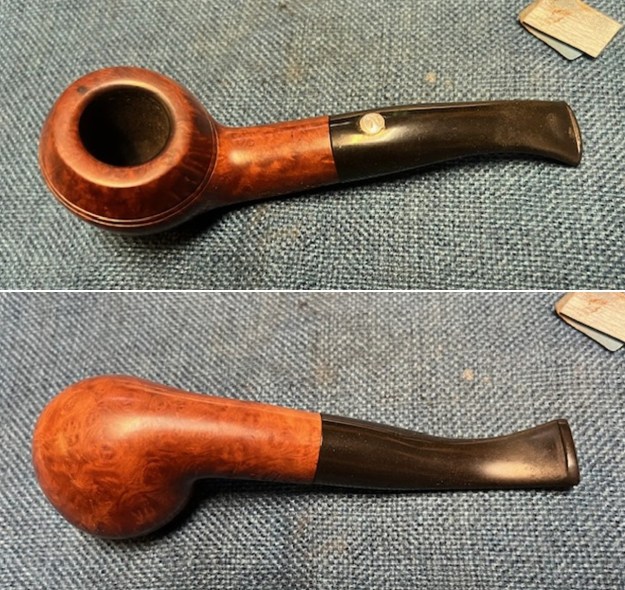
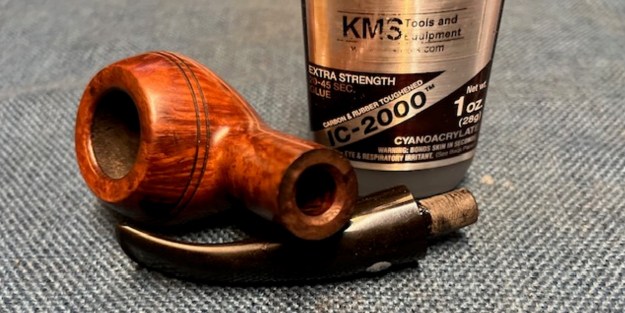
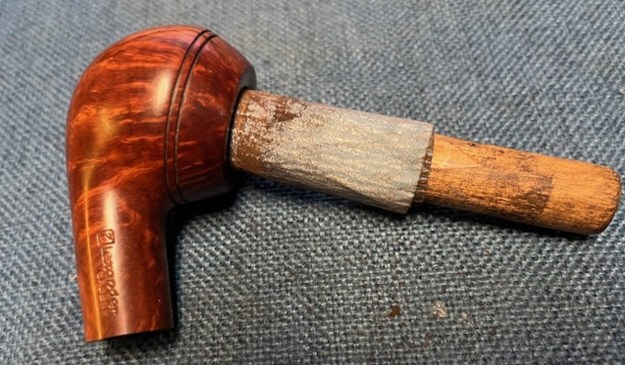
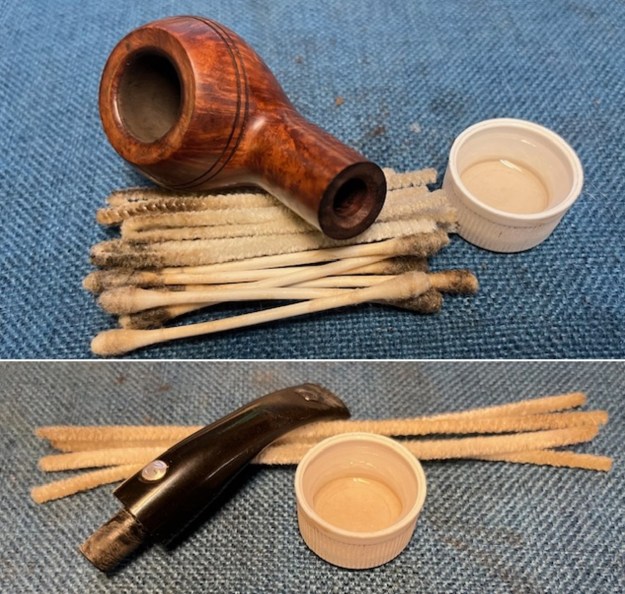
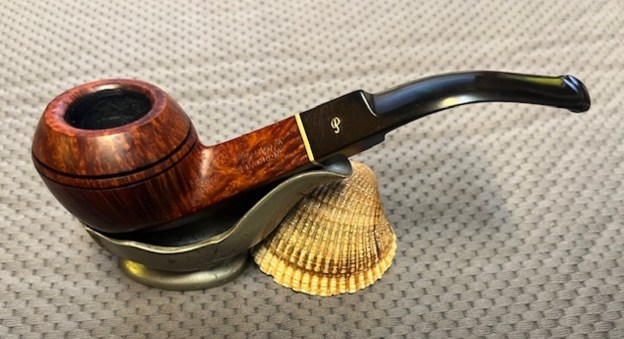
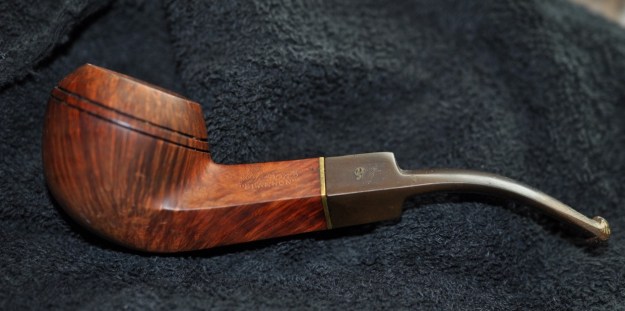
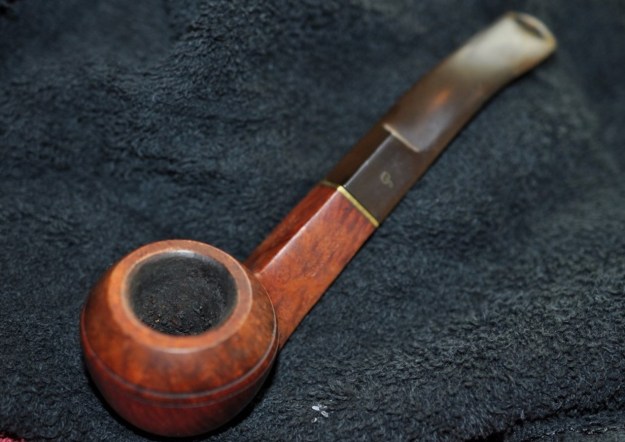
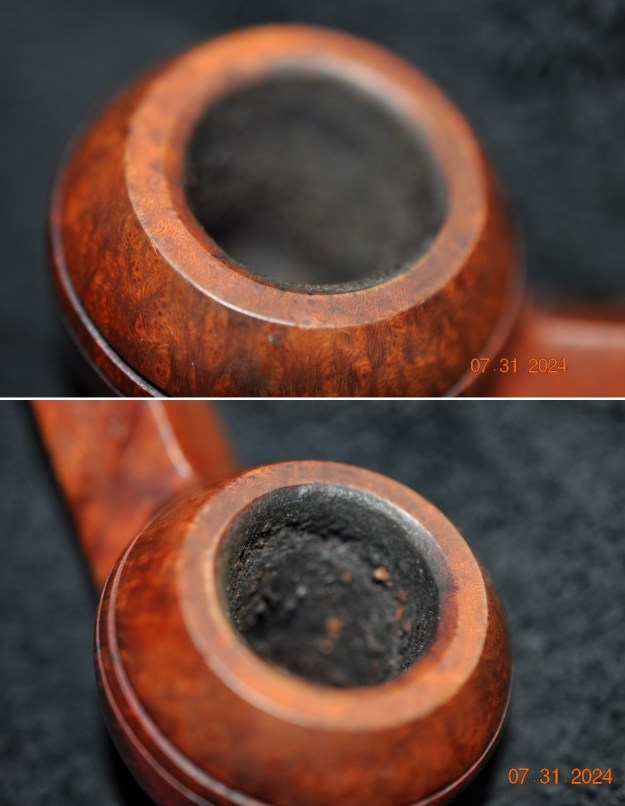
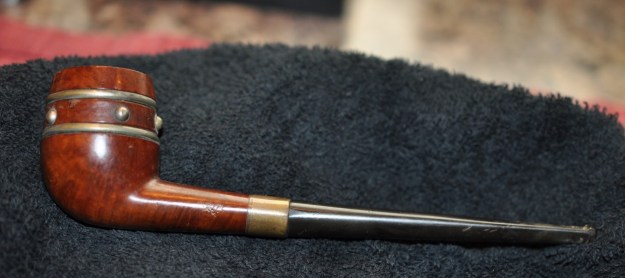
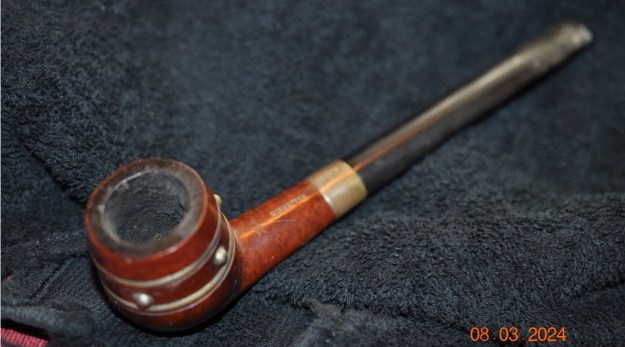
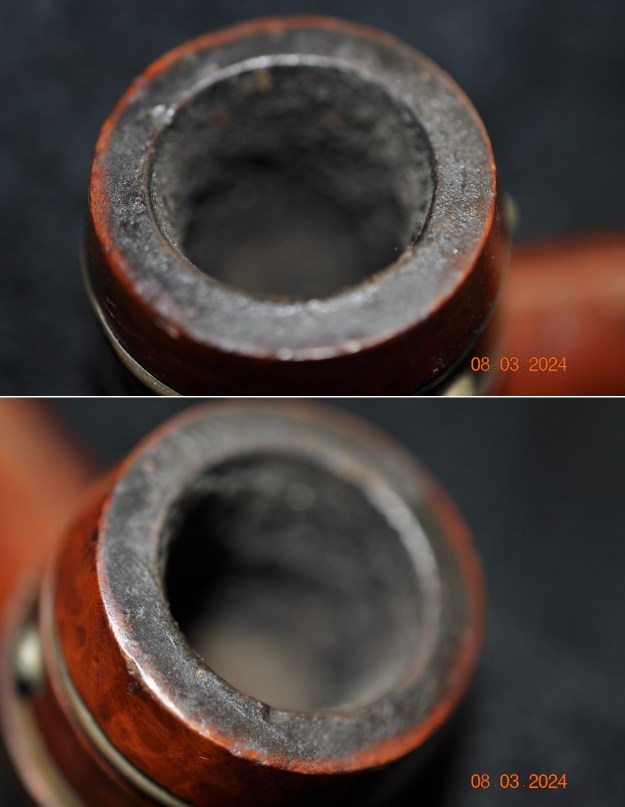
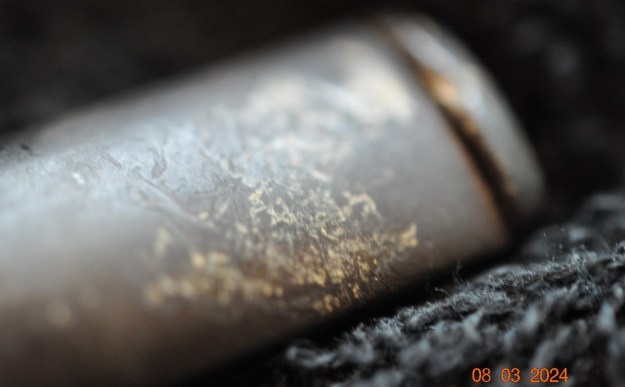
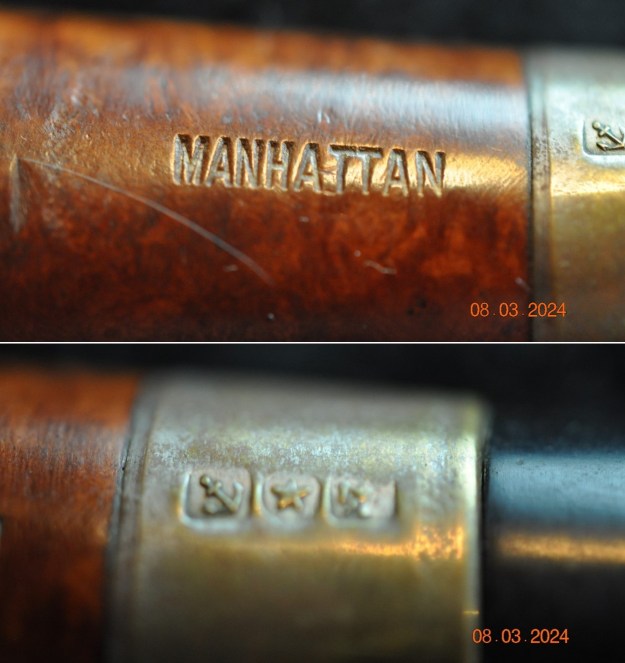
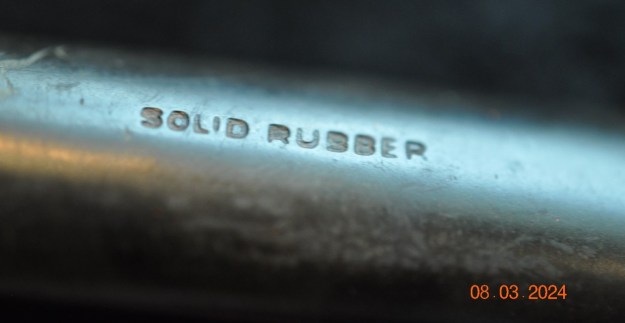
The next pipe on the work table is a unique shape that looks a lot like a billiard banded with barrel iron and buttons. It is very unique looking. It is stamped on the top side of the shank and reads MANHATTAN in gold letter. The shank has a brass (nickel) decorative band with faux hallmarks on top. On the underside of the stem it reads SOLID RUBBER. There were no other identifying marks or stamps on the shank or the stem. It came to us form a seller in Austin, Texas, USA on 11/07/2020. It has a mix of grain around the sides and shank. The bowl had a heavy cake in the bowl and thick lava on the rim top. It was thick so it was hard to be certain what the inner edge looked like. The finish was very dirty so it was hard to know with certainty what lay underneath. The bowl is a classic Billiard shape. The solid rubber oval taper stem had an orific button and showed some age. It has oxidation, calcification, tooth chatter and tooth marks on both sides ahead of the button. Jeff took photos of the pipe before he started working on it. Jeff took photos of the bowl, rim top and stem sides to show the condition of the both. It was a dirty bowl with debris and a heavy cake on the walls. The rim top had a thick lava covering the bowl and the edges. It was hard to know what the condition of the inner edge was underneath. I took photos of the top and underside of the stem showing condition and the tooth marks on both sides ahead of the button. Jeff took photos of the grain around the sides and the heel of the bowl to show the briar that was used to craft this unique pipe. He took photos to capture the stamping on the top and underside of the shank, band and stem. It is clear and readable as noted above. I turned to Pipedia and found a helpful article on the background. It was called The Manhattan Briar Pipe Company. It is an interesting read so I have included the article in its entirety as well as the advertisement from 1913 that showed a Manhattan pipe. The interesting thing for me is that the pipe is the same shape and style as the one I have in hand. The difference of course is that mine does not have a silver band and there is a horn stem rather than a vulcanite stem.
The Manhattan Briar Pipe Co. was organized in October, 1902 by the American Tobacco Company, under an agreement with the owners of the Brunswick Briar Pipe Company, as a New York corporation. Its initial address was 111 5th Avenue, New York City, and the value of its stock in 1902 was $350,000.00. American Tobacco Company had itself been founded in 1890 by J. B. Duke through a merger between a number of U.S. tobacco companies, and was one of the original twelve members of the Dow Jones Industrial Average in 1896. It was commonly called the “Tobacco Trust”.

The majority of the stock in Manhattan Briar Pipe Company was immediately acquired by the American Tobacco Company after the company was organized, but the prior owners retained a controlling minority interest for some years. In October, 1906, however, the American Tobacco Company acquired the remaining shares of stock, and from that point on Manhattan Briar was the pipe making branch of American Tobacco. By 1911, however, American Tobacco had been dissolved in anti-trust litigation, and Manhattan Briar Pipe Co. became a separate concern.

Manhattan Briar Pipe Co. had started operations in 1905 in Jersey City, New Jersey, having taken on a lease for a ten year period in 1905, and maintained a factory at Marion, New Jersey, where the pipes were made. By 1913, former American Tobacco pipe department chair John Glossinger was the president of Manhattan Briar Pipe Company, and began a significant advertising push for high grade pipes, using the slogan “Don’t spoil good tobacco by using a poor pipe”. It appears from cases having appeared on the estate market that Manhattan also sold meerschaum pipes, most likely rebranded articles originally made by European craftsmen.

After the expiration of the Jersey City lease the Manhattan Briar Pipe Company maintained offices and a factory at 415-425 Greenpoint Avenue, Brooklyn, New York beginning in 1915, evidently under the direction of W. C. Bastian, who had been granted a patent for a chambered pipe stem otherwise seemingly identical to a Peterson P-Lip in 1910. An employee of the company, one J. Gianninoto, was granted a patent for a device meant to permit the emptying of a cuspidor without the mess in early 1918, and the company continues to be listed in local directories through 1921. In 1922 Manhattan Briar was purchased by S.M. Frank and merged into that company. https://pipedia.org/wiki/Manhattan_Briar_Pipe_Co.

Further digging led me to a link on the S.M. Frank Co. & Inc. history page. Reading through the history of the company I found that S.M. Frank not only purchased the Manhattan Briar Pipe Company but also purchased WDC or William DeMuth & Company – two of the older brands that I enjoy working on. Here is the relevant section from the link: In the year 1900 Sam Frank Sr. started his own business, selling pipes and other tobacco items. His original office was located at 20 W. 17th Street, NYC. He was also closely associated with the sales staff of Wm. DeMuth & Co., selling their line of pipes. It was at this time that Mr. Frank first met Ferdinand Feuerbach and formed what would be a lifelong friendship. Mr. Feuerbach started working for the DeMuth Company in 1897 and by 1903 had become the production manager. In 1919, when Mr. Frank needed an experienced pipe man to run his pipe factory, located at 168 Southern Blvd., in the Bronx, he persuaded his old friend Ferdinand to join him. Mr. Feuerbach is credited with developing DeMuth’s popular Royal DeMuth and Hesson Guard Milano pipelines. In 1922, when S. M. Frank purchased the Manhattan Briar Pipe Co. the company incorporated.  http://www.smfrankcoinc.com/home/?page_id=2

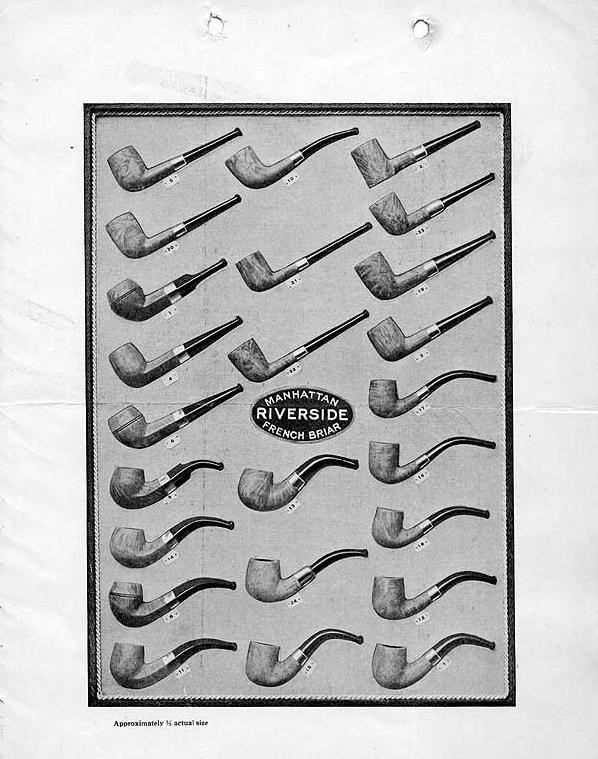
That link led me to me to some further information including an advertisement and a shape chart on Chris Keene’s Pipe Pages http://pipepages.com/mbpc2.htm. I have included them here with acknowledgement to Chris Keene. I always enjoy reading the old copy of these advertisements as they take me back to place where the pipe was an acceptable part of the life. The pipe I have in hand is one that was made between the opening of the Manhattan Briar Pipe Company in 1905 in New Jersey and 1922 when SM Frank bought the company and it ceased to exist as a separate entity. That fit my experience of working on pipes with stems stamped Solid Rubber.

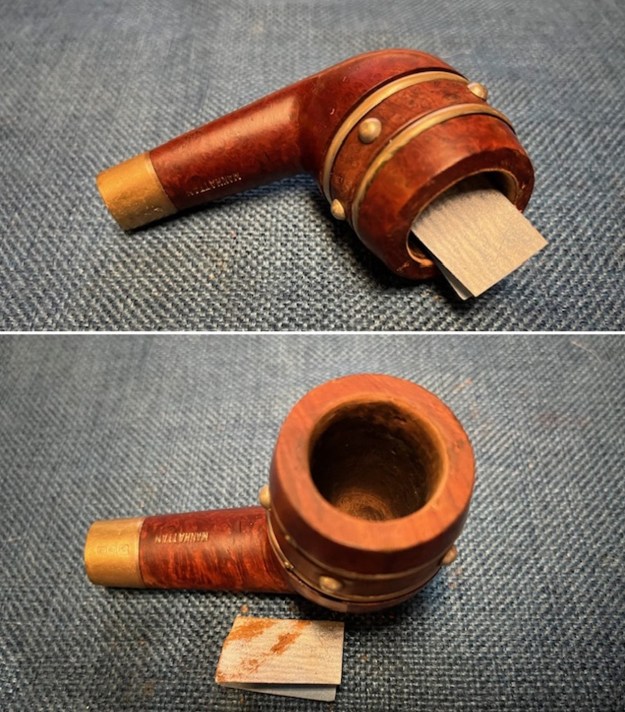
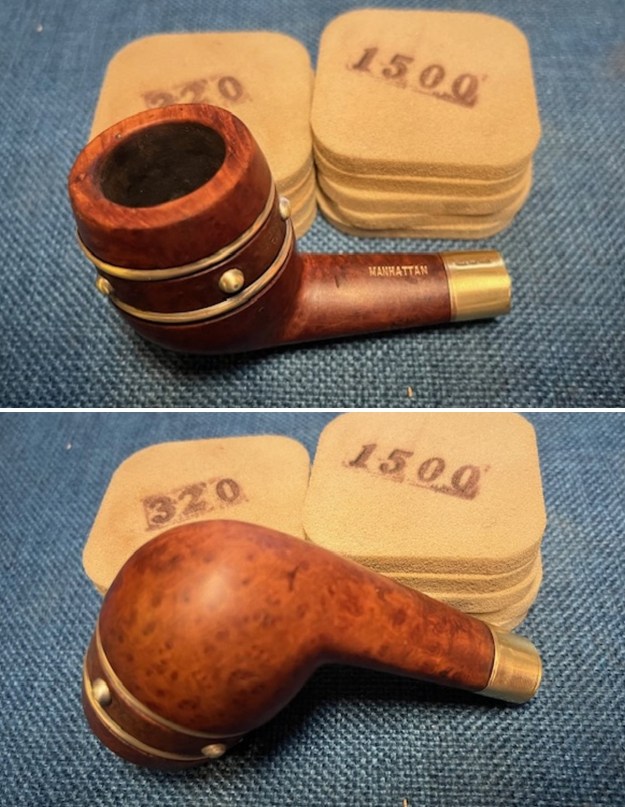
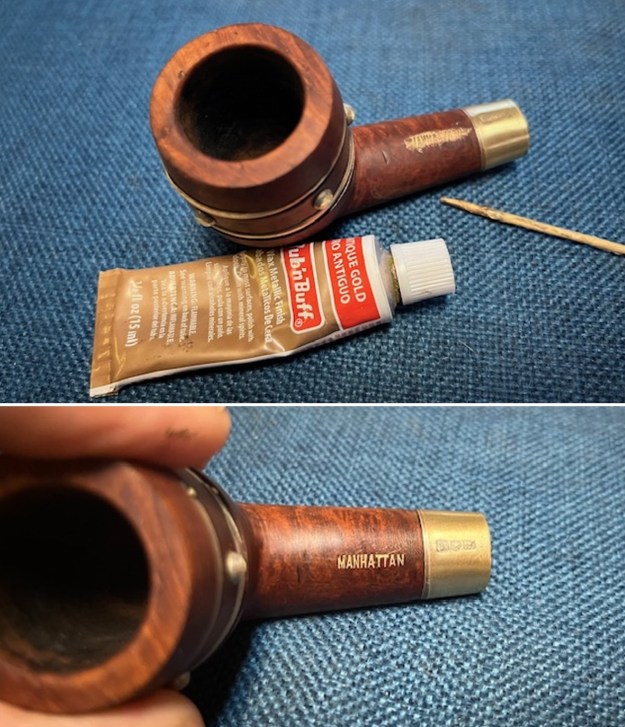
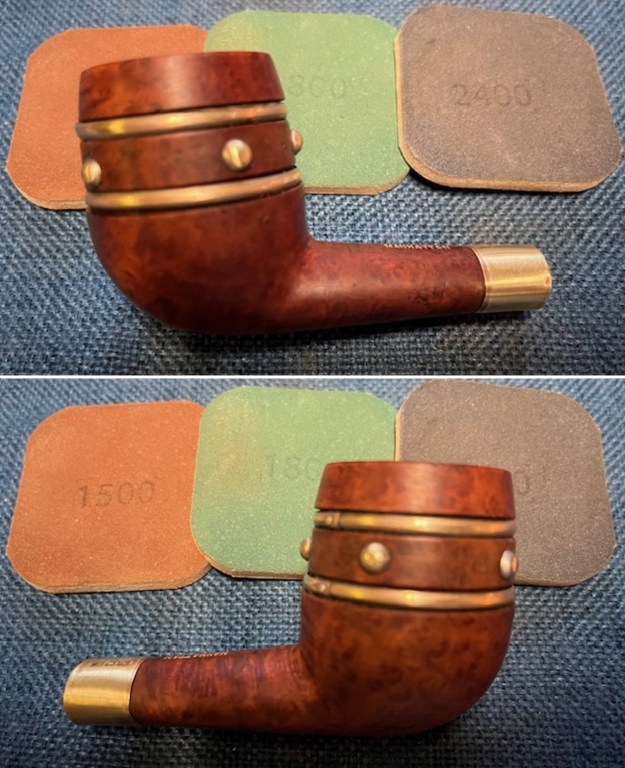
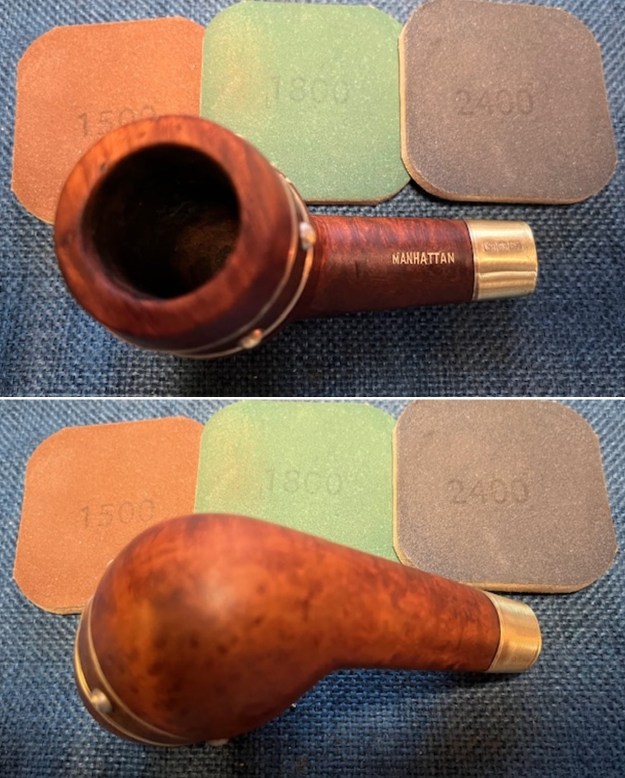
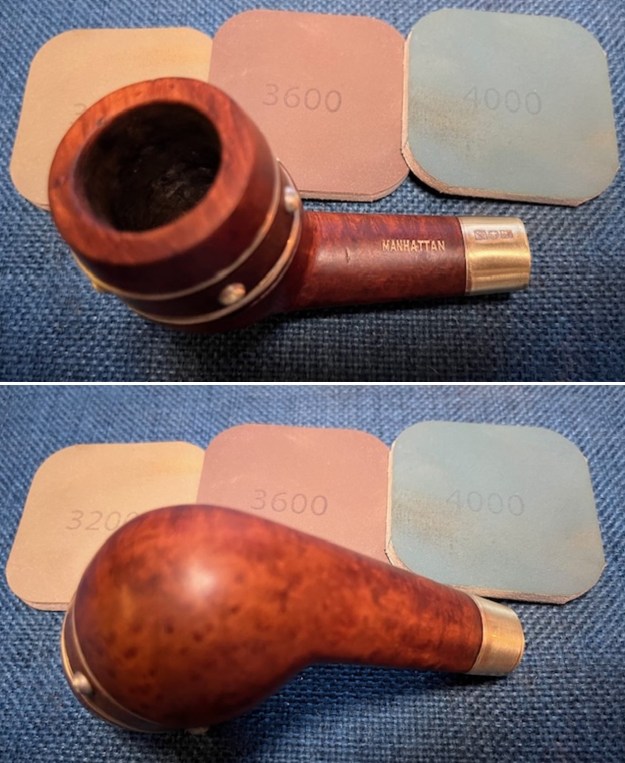
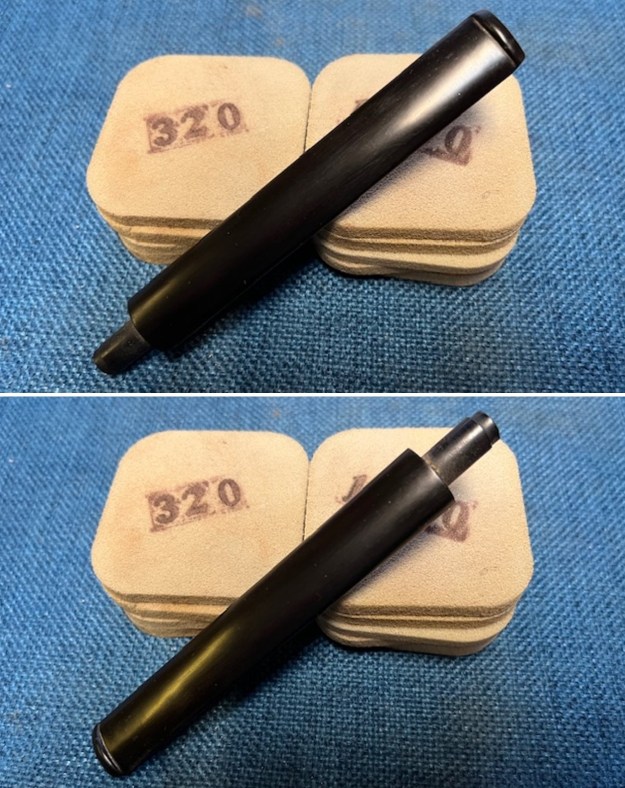
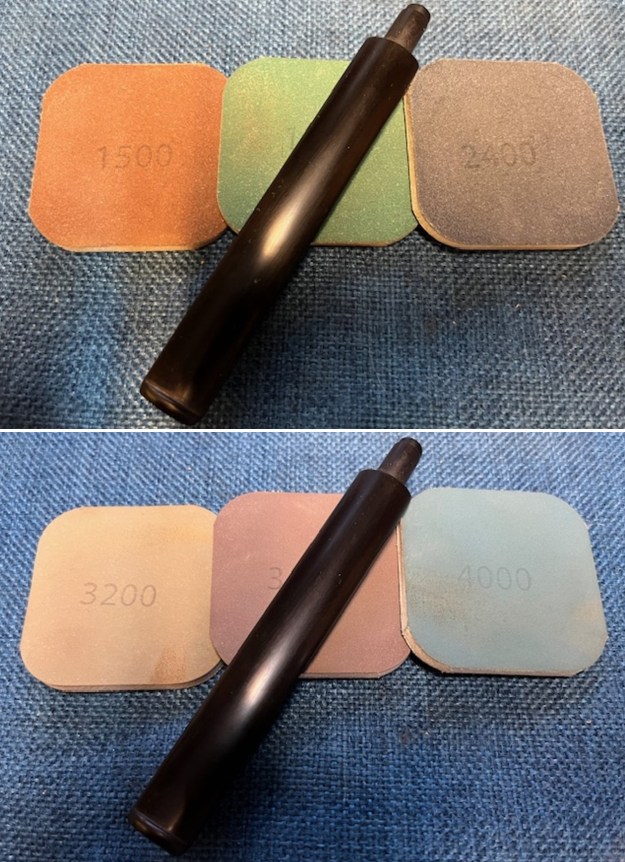
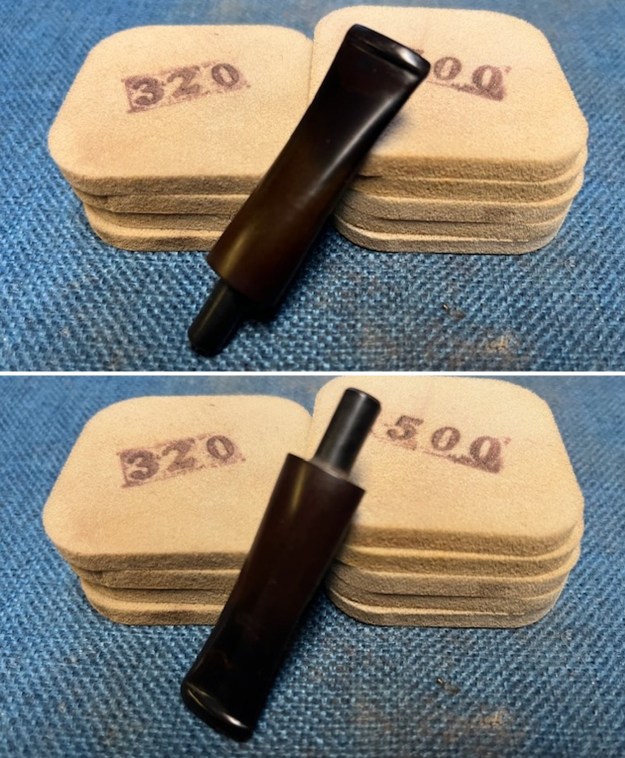
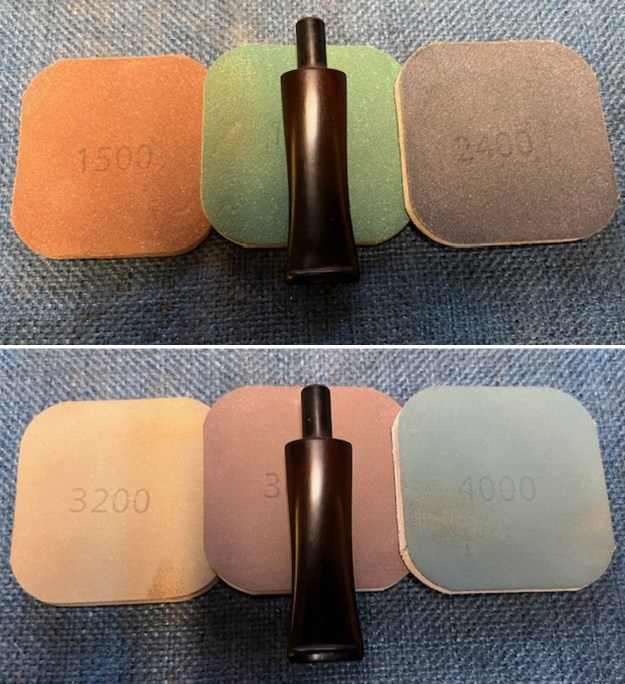
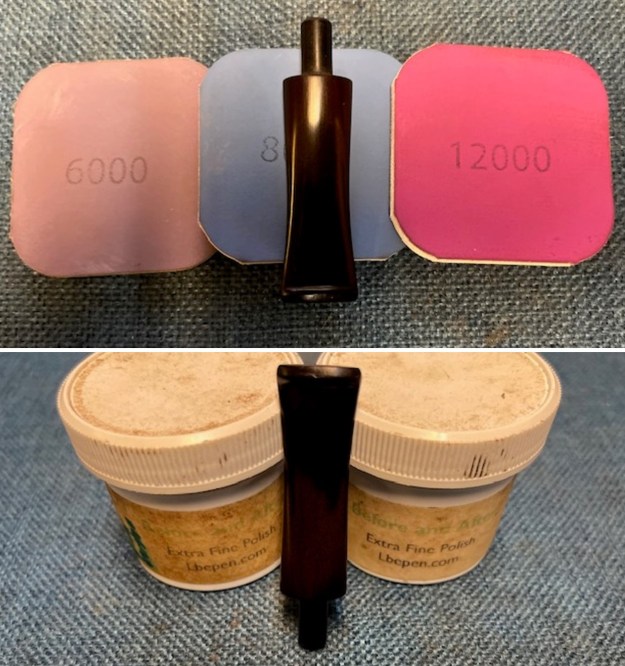
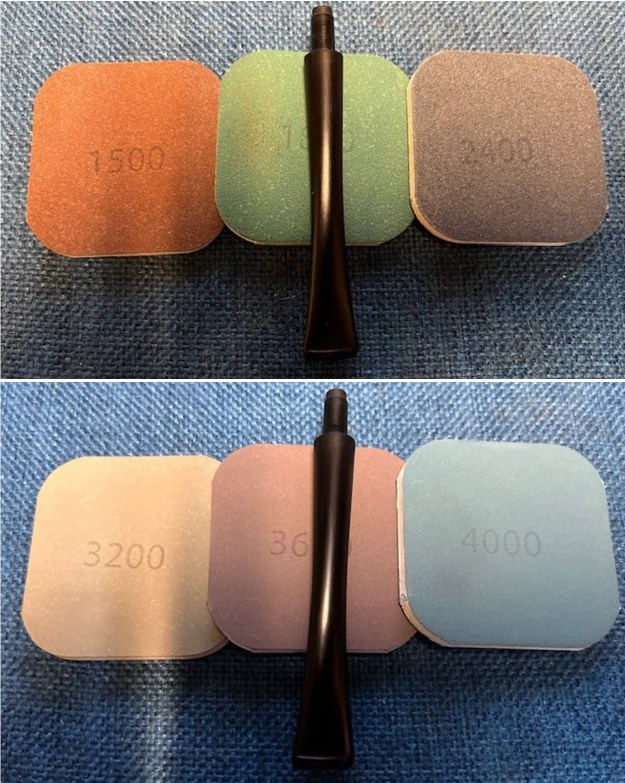
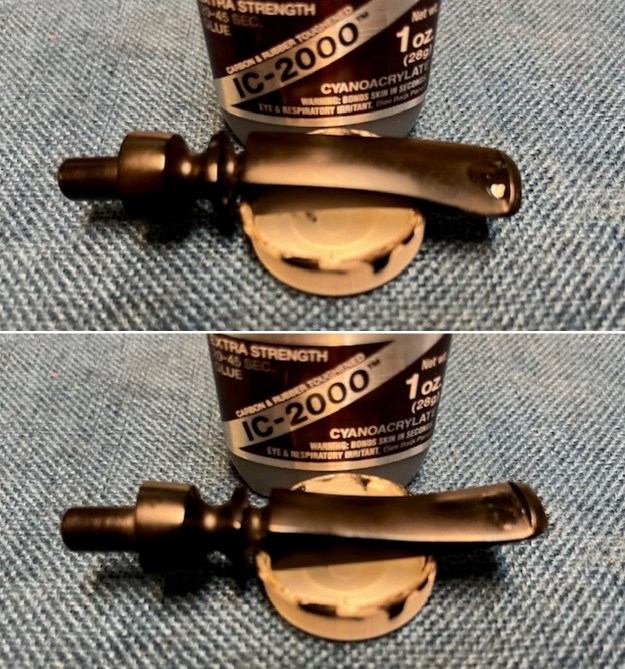
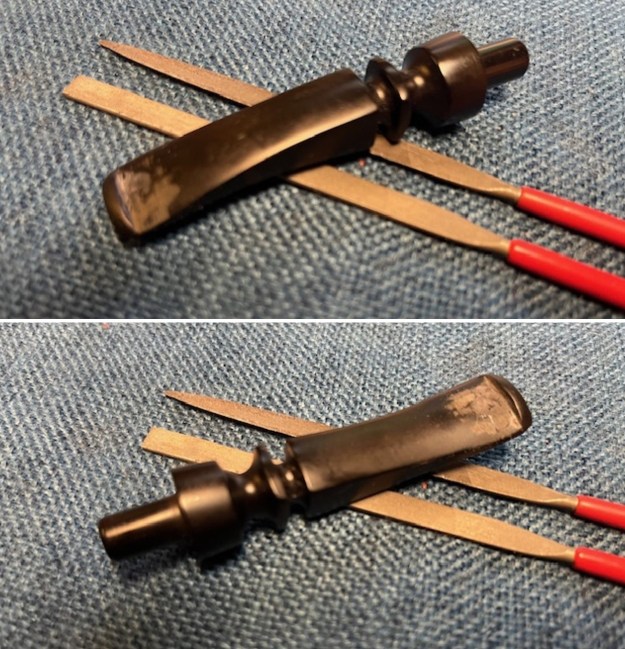
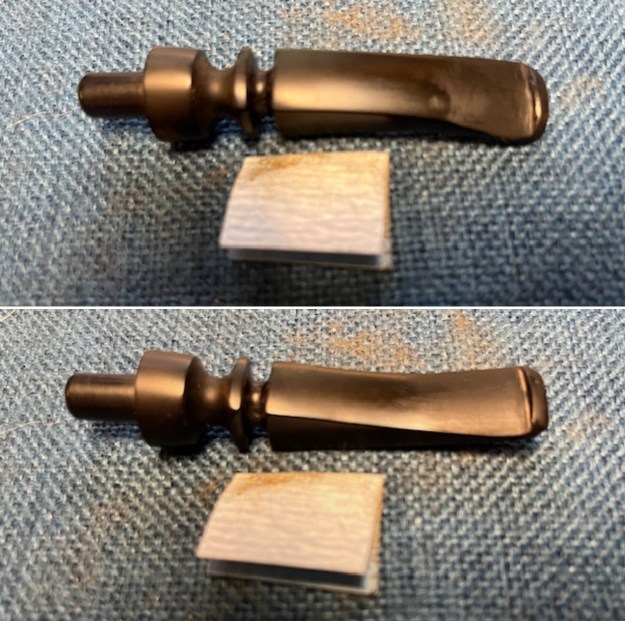
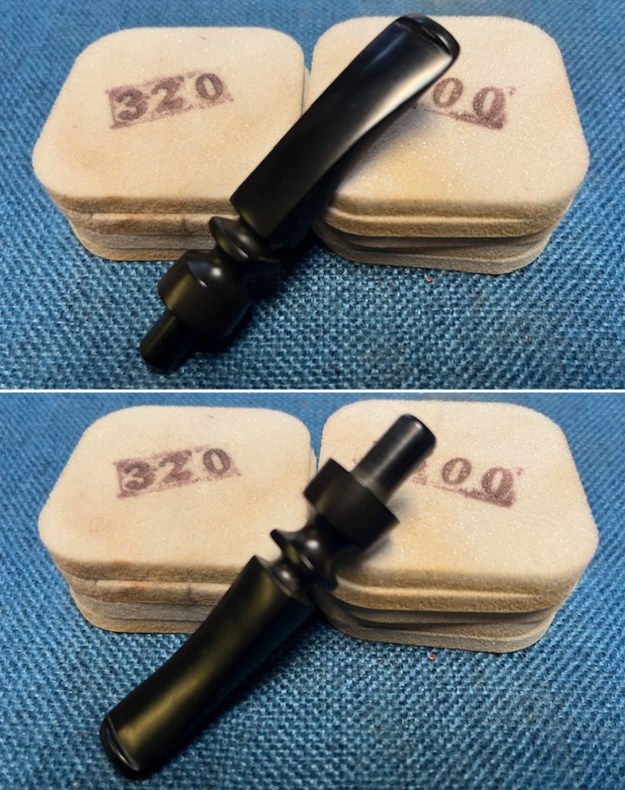
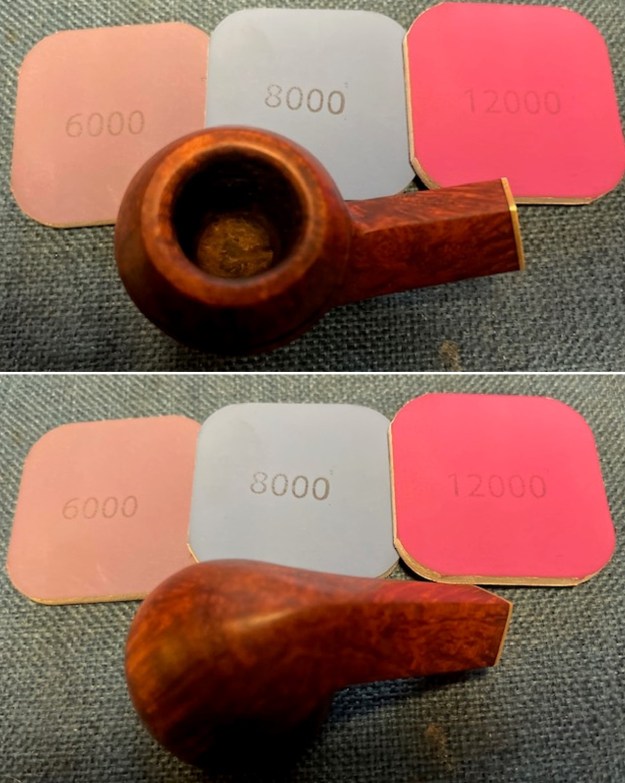
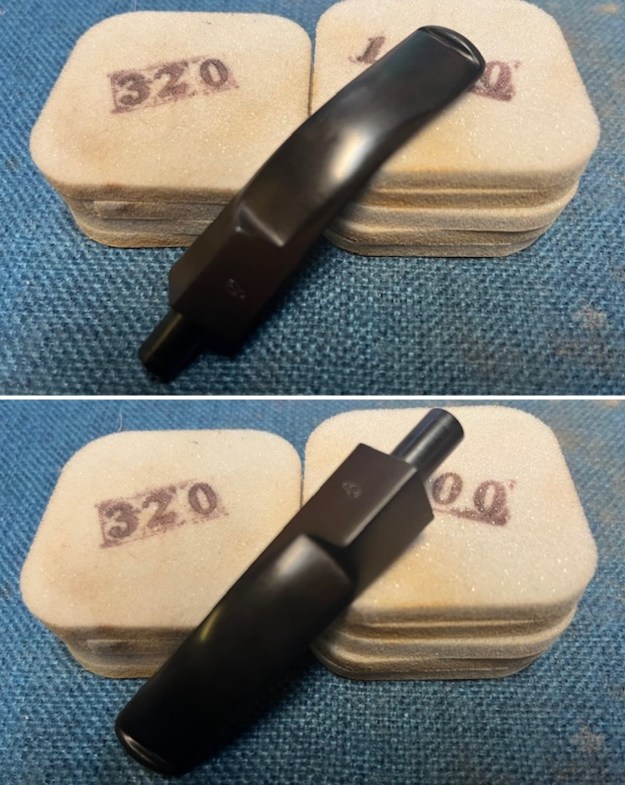
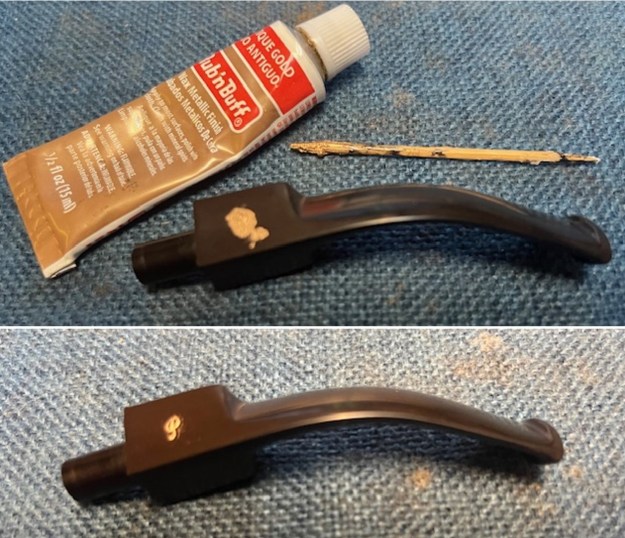
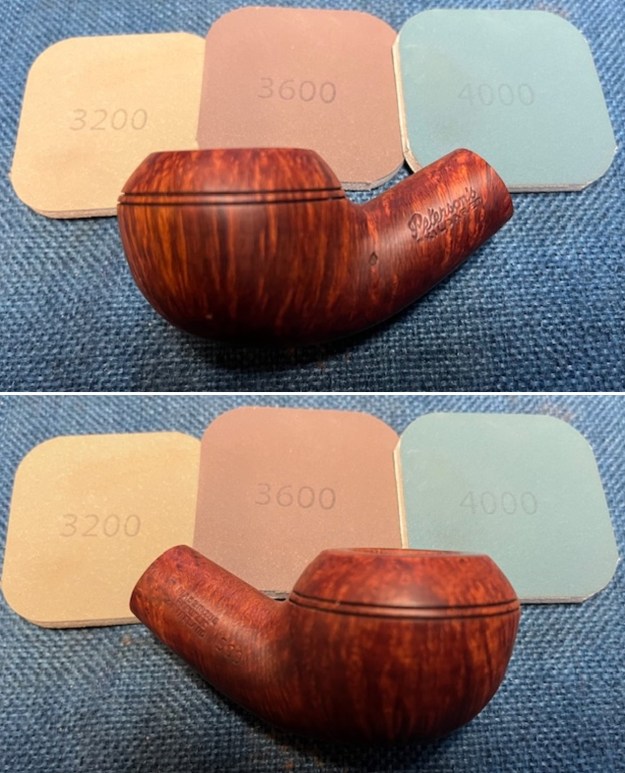
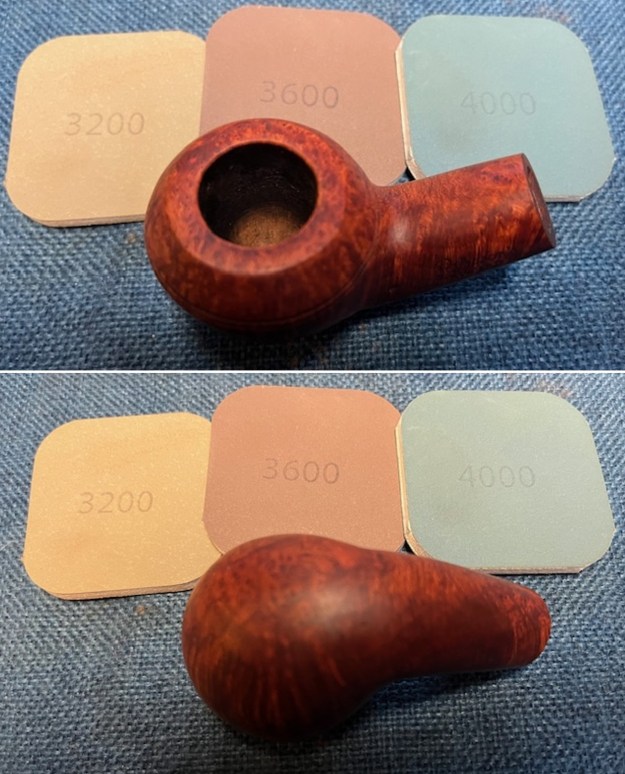
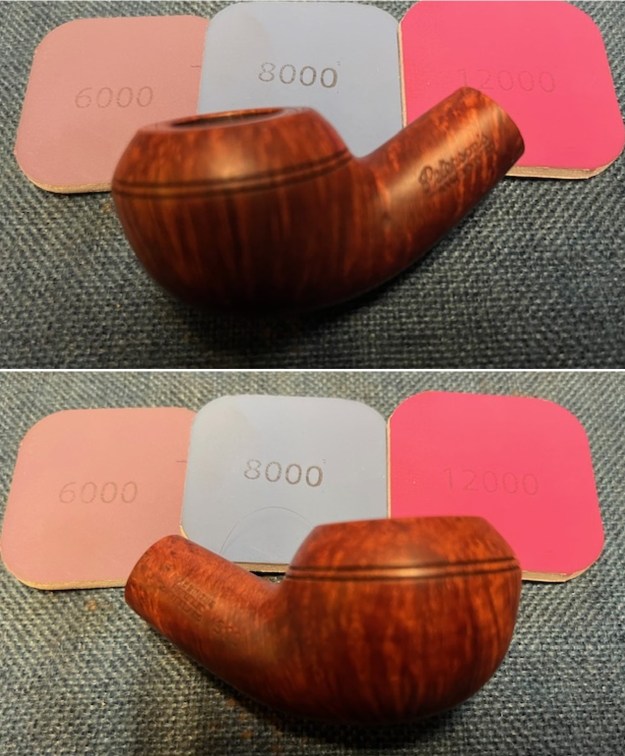
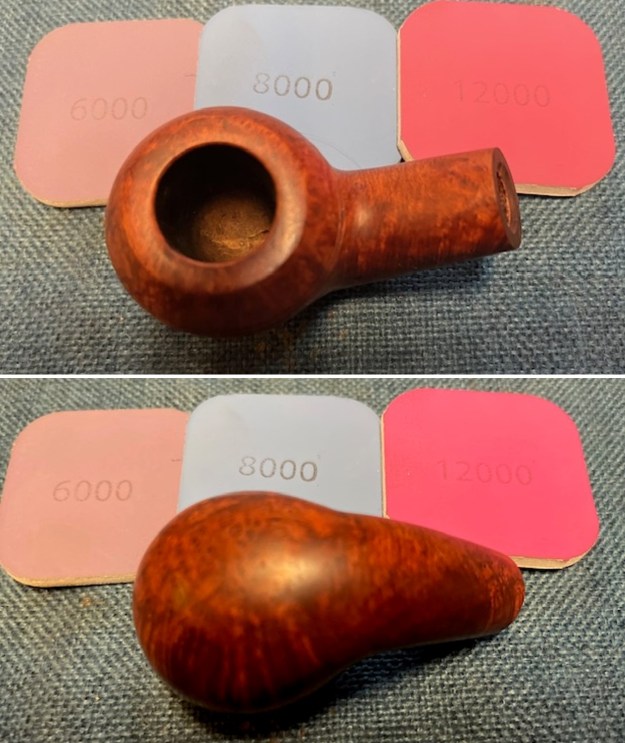
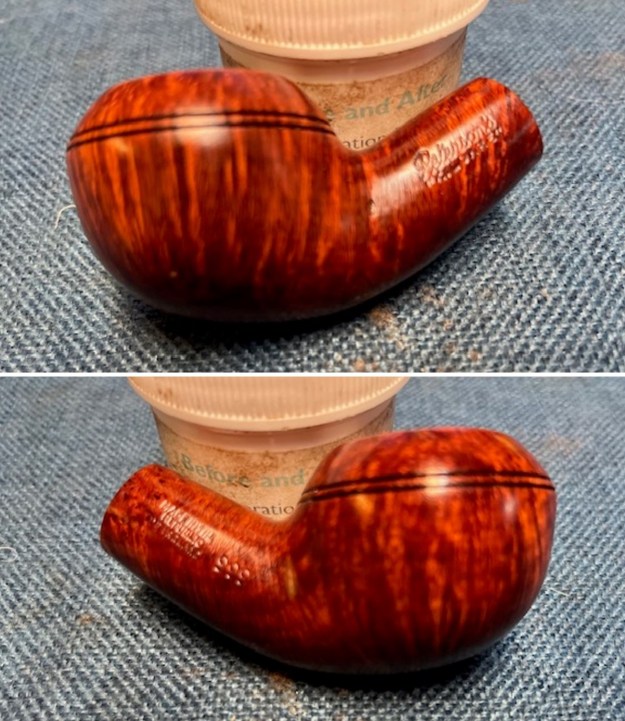
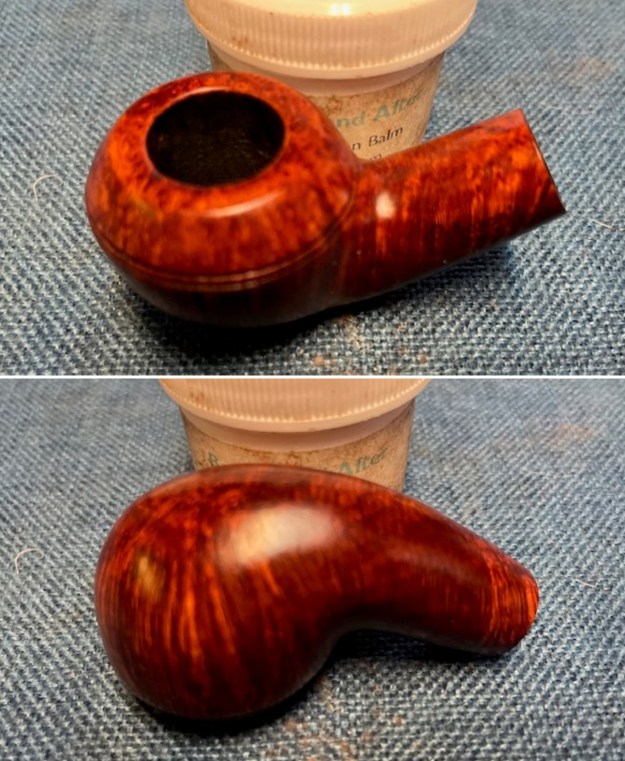
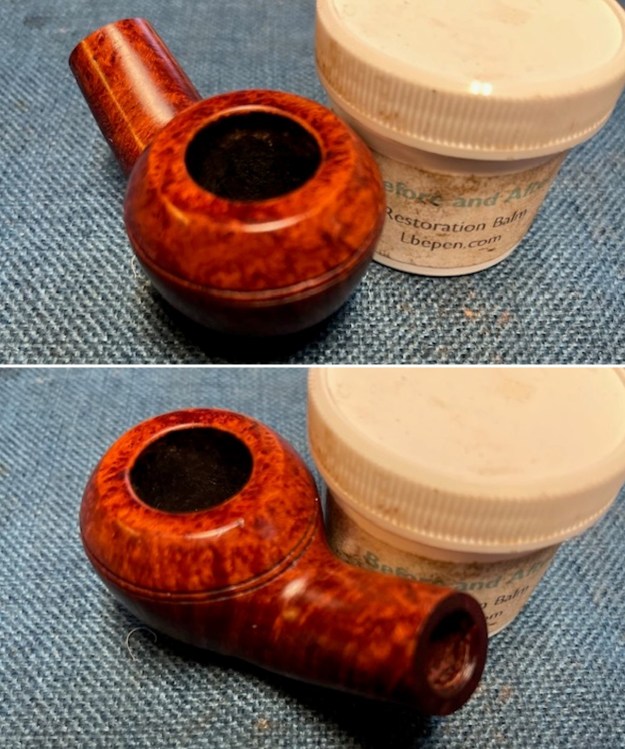
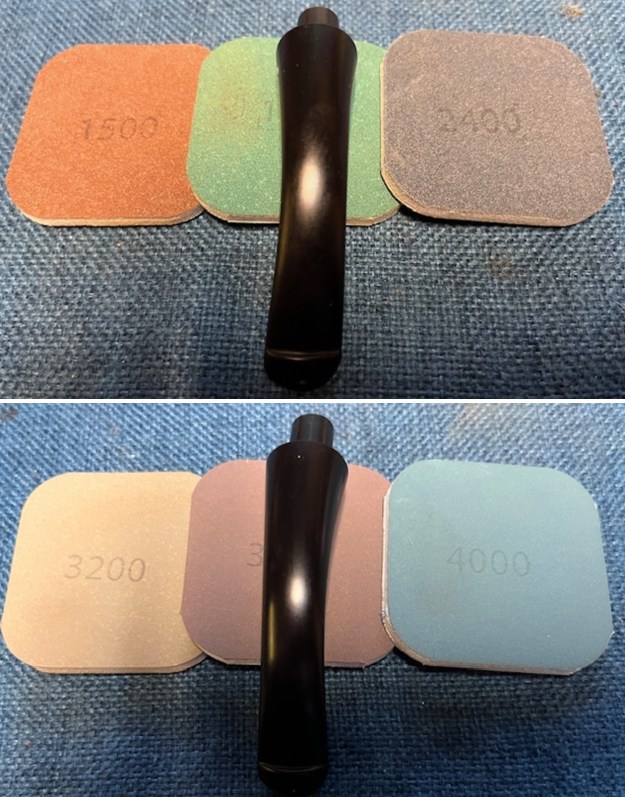
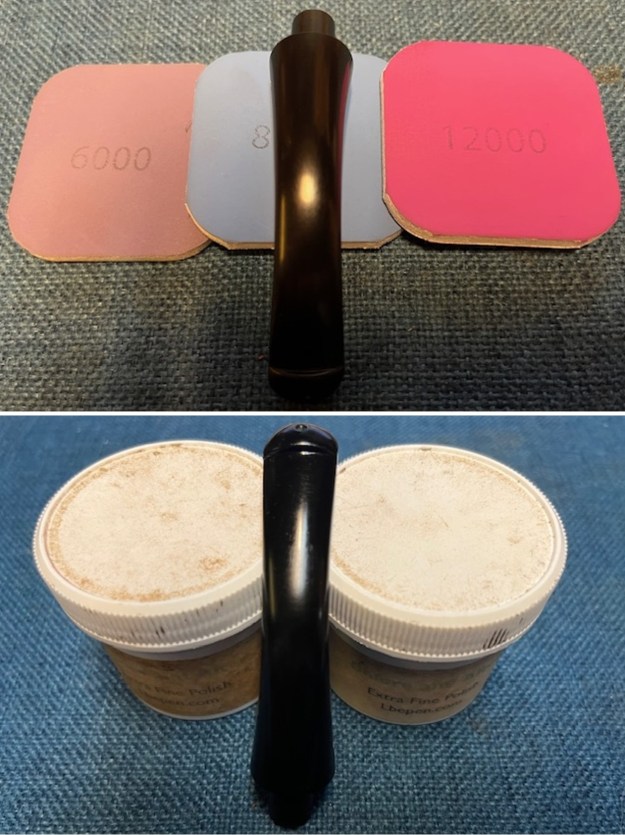
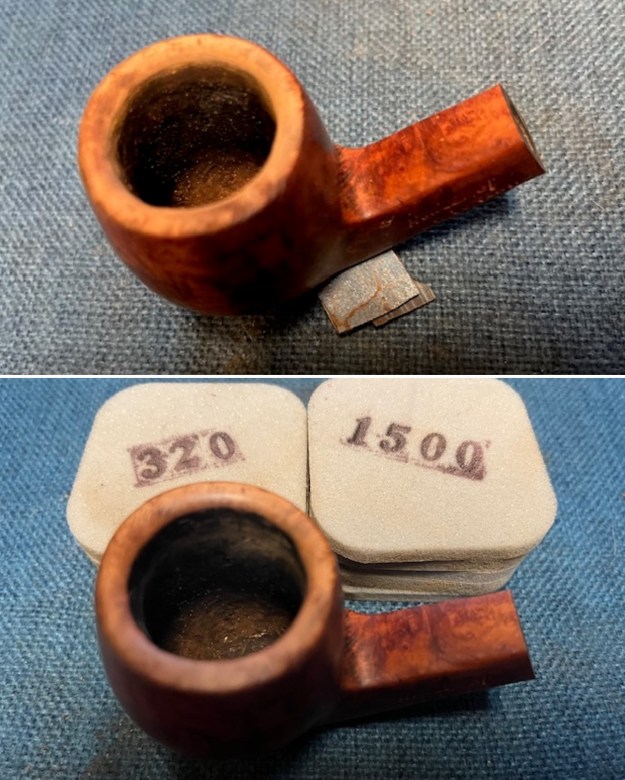
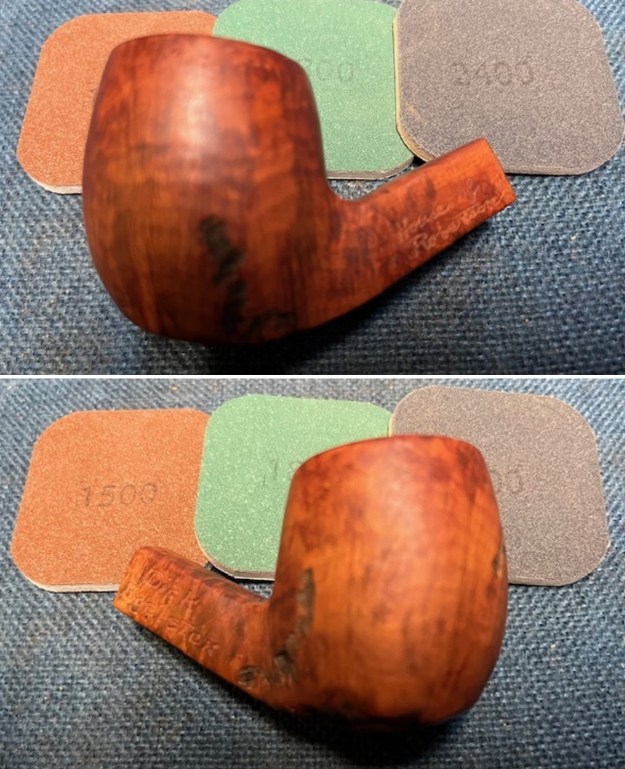
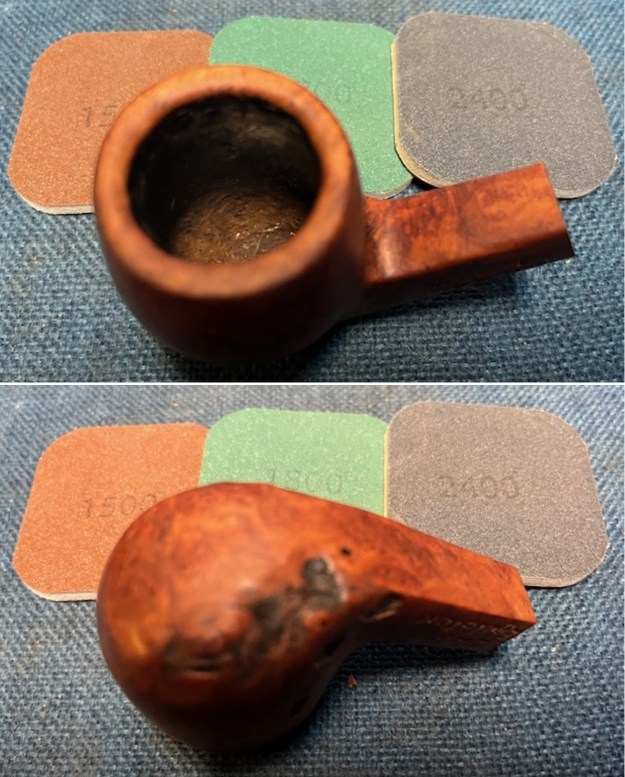
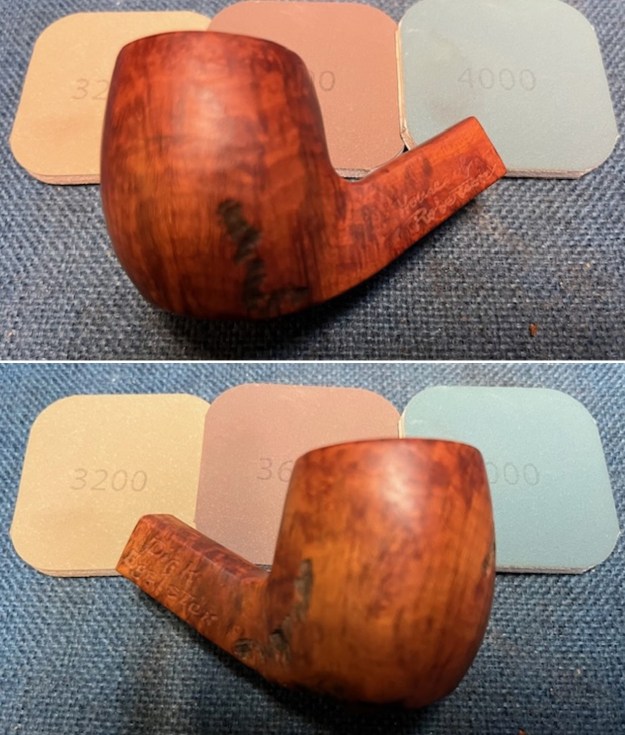
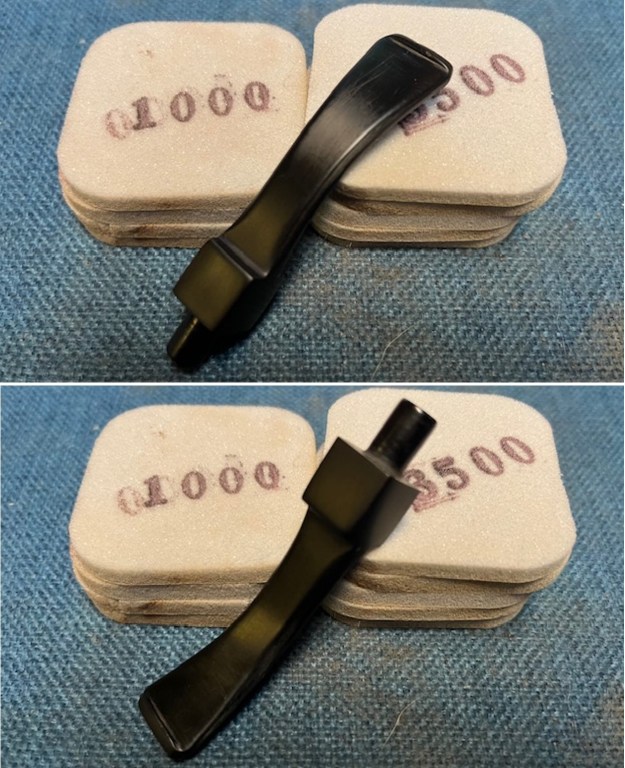
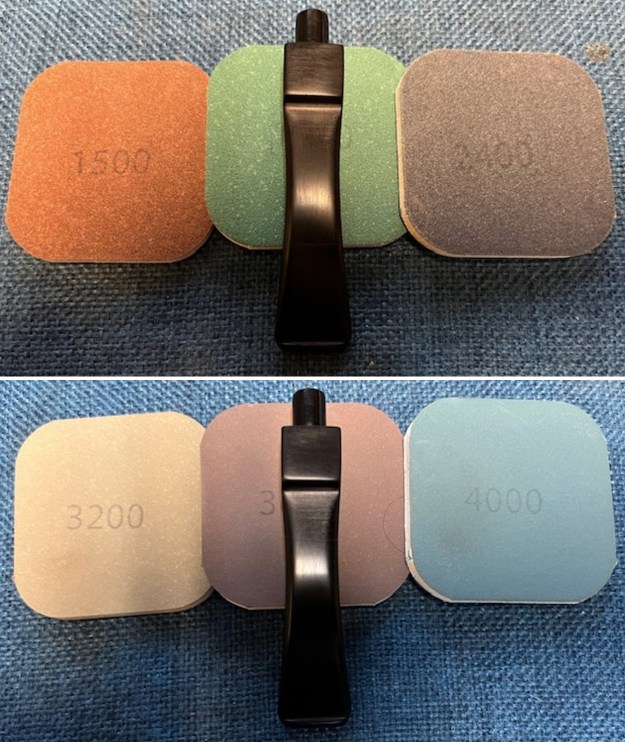
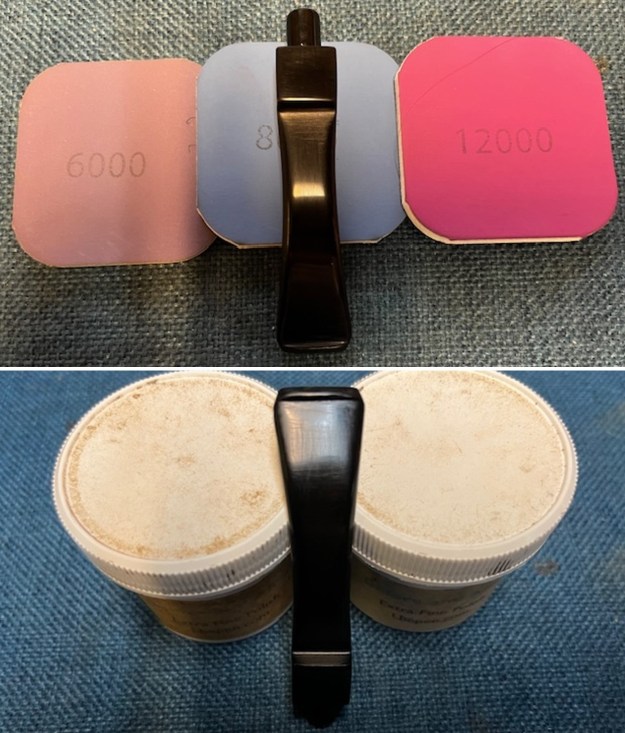
Armed with that information I turned to work on the pipe itself. Jeff had done a great job cleaning up the pipe as usual. He cleaned up the inside of the bowl with a PipNet reamer and a Savinelli Fitsall Pipe Knife. The bowl walls looked very good. He scrubbed the interior of the bowl and shank with pipe cleaners, cotton swabs and alcohol to remove the tars and oils. He scrubbed the exterior of the pipe with Murphy’s Oil Soap and a tooth brush to remove the grime from the finish. He worked on the rim top lava and darkening with the soap and tooth brush. He scrubbed the inside of the stem with alcohol and pipe cleaners. He scrubbed the exterior with Soft Scrub and then soaked it in Briarville’s Pipe Stem Deoxidizer. He washed it off with warm water to remove the deoxidizer. The pipe looked far better. I took photos of the pipe when I received it before I started working on it. I took photos of the bowl and rim top to show how clean it was. The top and the inner edge of the rim show some darkening, nicks and scratches. The stem looks clean of debris and grime. There are light tooth marks and chatter on both sides. I took a photo of the stamping on the top of the shank. The stamping is clear and readable and appears to have had gold stamp in the letters. The stem shows a Solid Rubber stamp clearly on the underside. I took a photo of the pipe with the stem removed to show the overall look of stem, tenon and profile of the pipe. I started my work on the pipe by addressing the issues on the top and the inner edge of the rim. I used a folded piece of 220 grit sandpaper to smooth out the roughness. It looked much better at this point in the process.I sanded the briar rim top and the sides of the bowl with 320-3500 grit sanding pads. I wiped the bowl down with a damp cloth after each pad. By the time I finished with the 3500 grit pad the briar had taken on a rich glow. I touched up the gold stamp on the top of the shank with Rub’n Buff Antique Gold. I worked it into the stamping with a tooth pick and buffed it off with a soft cloth. It was very readable and looked good with the brass band and brass rings and studs on the bowl. I polished the briar bowl and shank with micromesh sanding pads – dry sanding with 1500-12000 grit sanding pads. I wiped it down with a damp cloth after each pad to remove the debris. The bowl took on a rich glow. I rubbed the bowl down with Before & After Restoration Balm. I worked it into the surface of the briar with my fingertips to clean, enliven and protect it. I let the balm sit for 10 minutes and then buffed with a cotton cloth to raise the shine. Mark Hoover’s Balm is a product that I have come to appreciate and one I use on every pipe I have been working on. I set aside the bowl and turned my attention to the stem issues. I sanded it with a folded piece of 220 grit sandpaper to begin the process of blending the chatter and marks into the stem surface. On the underside I found a piece of metal embedded in the rubber confirming an early date as mentioned above.I sanded it with 320-3500 grit sanding pads to further blend them in and smooth out the surface.I polished the vulcanite with micromesh sanding pads – 1500-12000 grit pads. I wiped it down with a damp cloth after each sanding pad. I used Before & After Pipe Polish – both Fine and Extra Fine to further polish the stem.

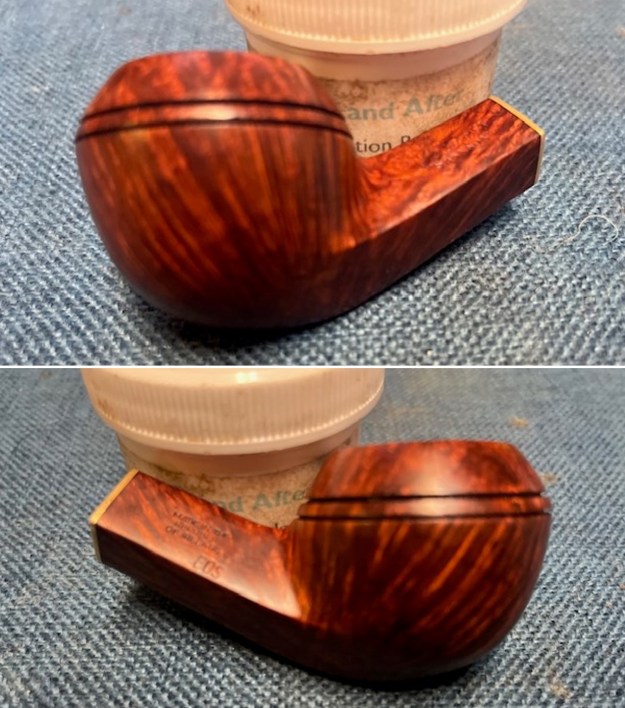
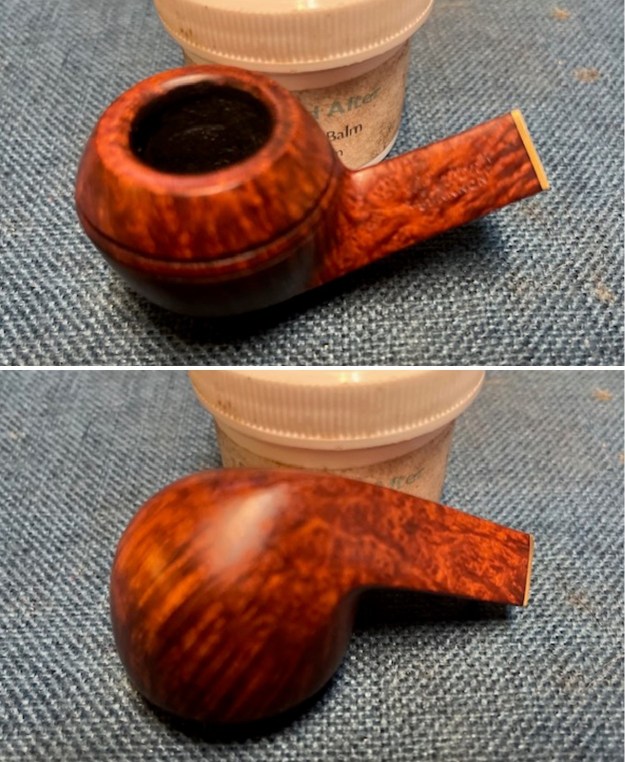
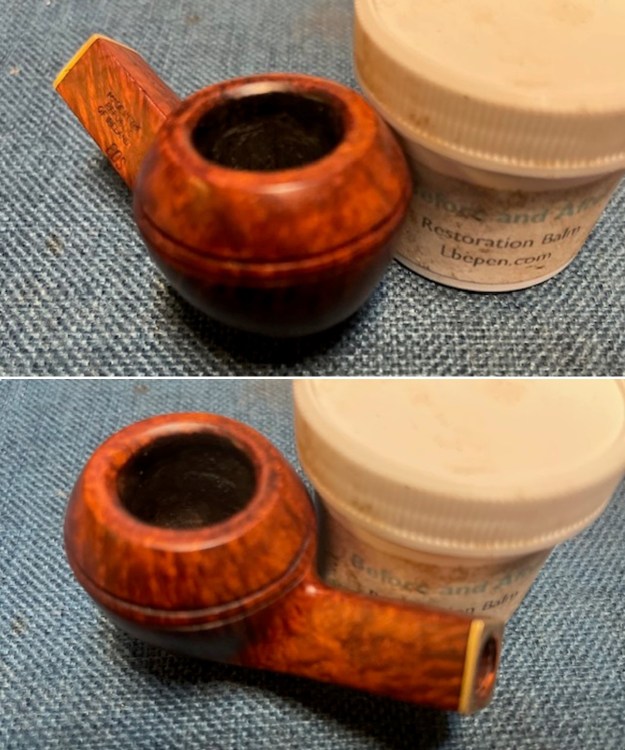
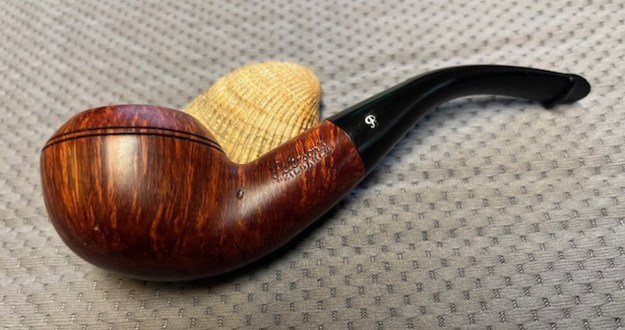
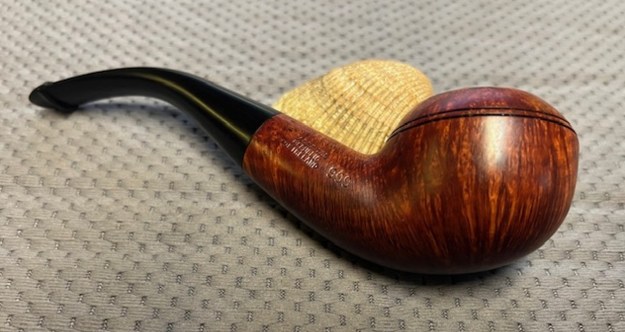
I put the stem back on the Manhattan Barrel Like Oval Shank Billiard and took it to the buffer. I worked it over with Blue Diamond to polish out the remaining small scratches. I gave the bowl and the stem several coats of carnauba wax and buffed the pipe with a clean buffing pad to raise the shine. I hand buffed it with a microfiber cloth to deepen the shine. The pipe polished up really well and the bevelled rim top looked good. I was happy with the look of the finished pipe. The photos below show what the pipe looks like after the restoration. This Oval Shank Manhattan Billiard is a beautiful and unique take on a classic shape. The polished solid rubber taper stem looks really good with the browns of the briar and the brass of the bands around the bowl and shank. The dimensions of the pipe are Length: 7 inches, Height: 2 inches, Outside diameter of the bowl: 1 ¼ inches, Chamber diameter: 7/8 of an inch. The weight of the pipe is 1.83 ounces/52 grams. This is another pipe that I will be putting it on the rebornpipes store in the American Pipe Makers Section shortly, if you are interested in adding it to your collection. The unique brass on the bowl gives it a great look and feel. This one should be a great smoker. Thanks for walking through the restoration with me on this beauty!

Restoring a Fischer Long Shank Deluxe Canadian


by Steve Laug

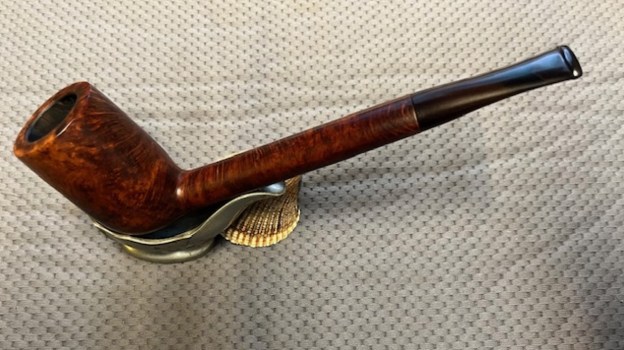
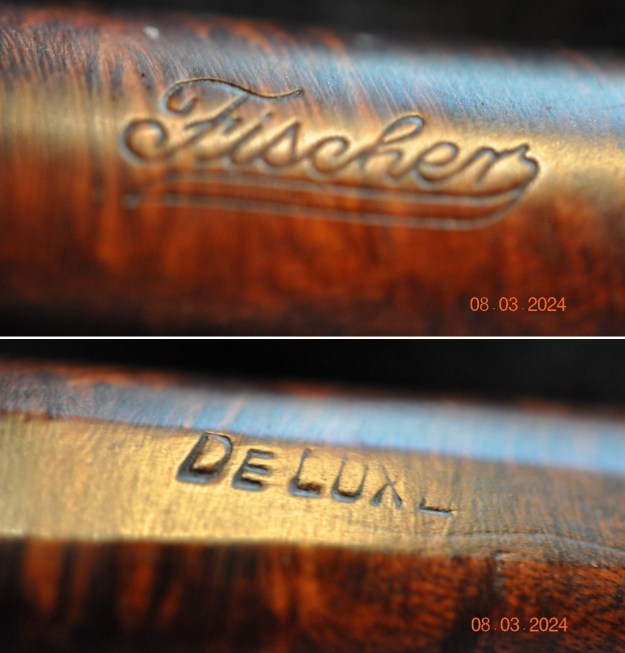
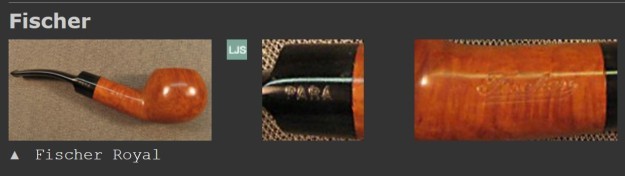
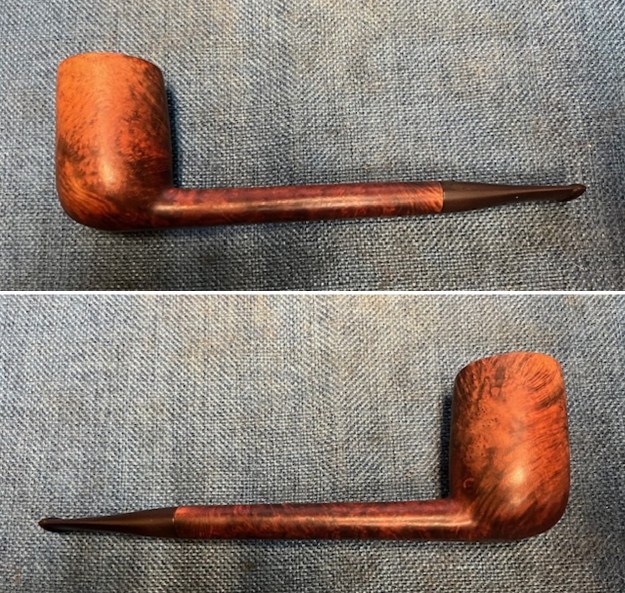
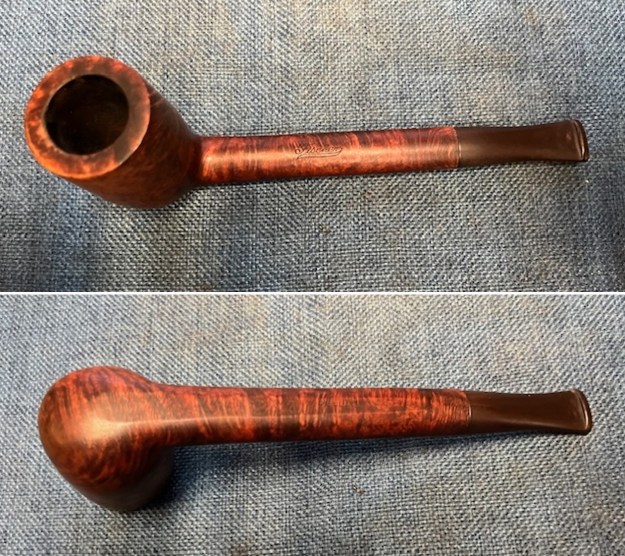
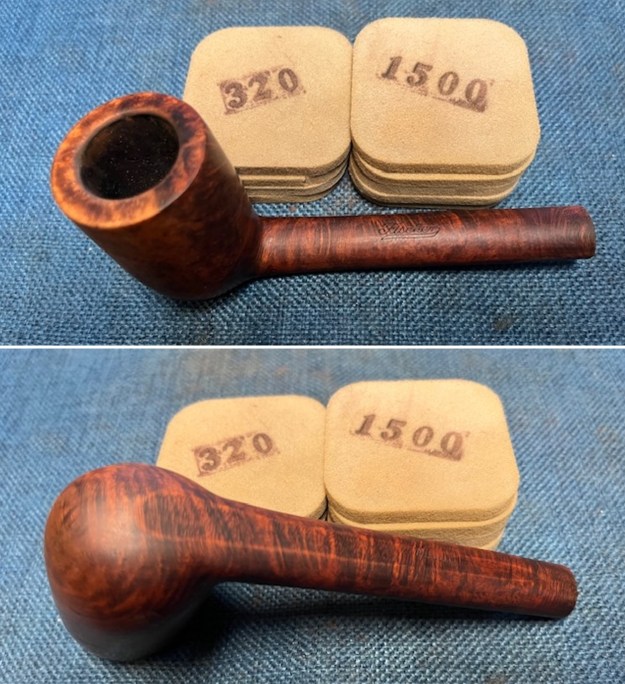
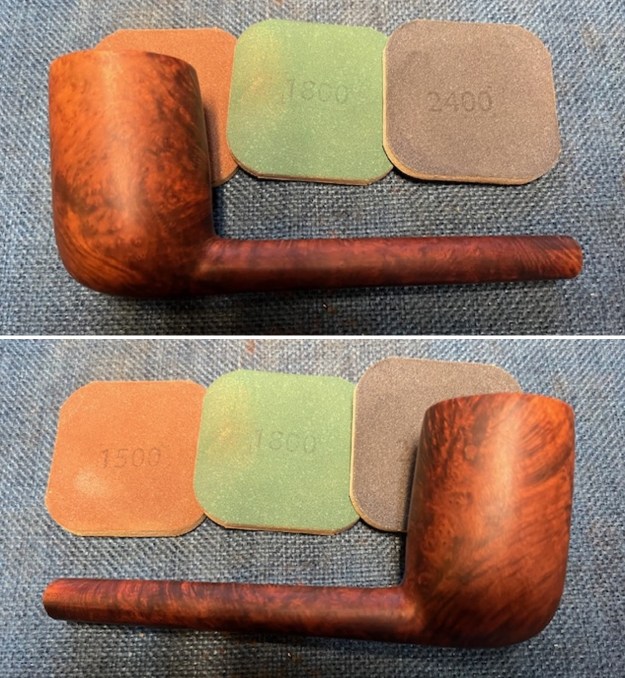
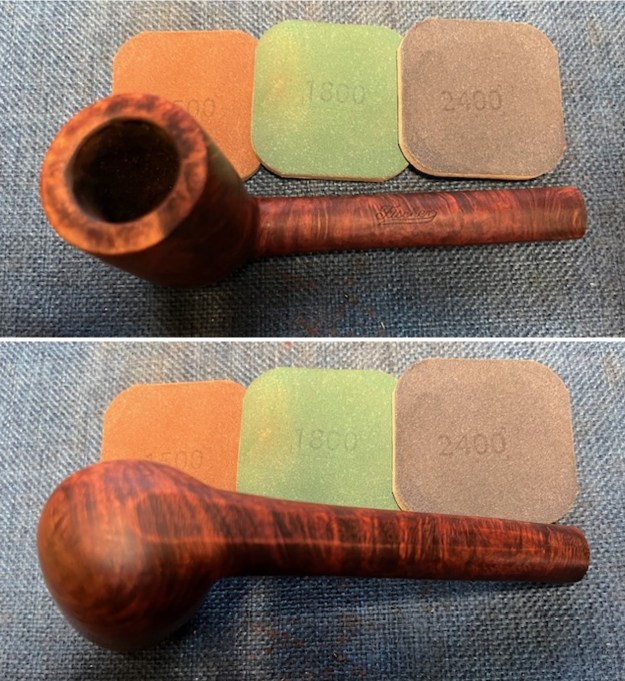
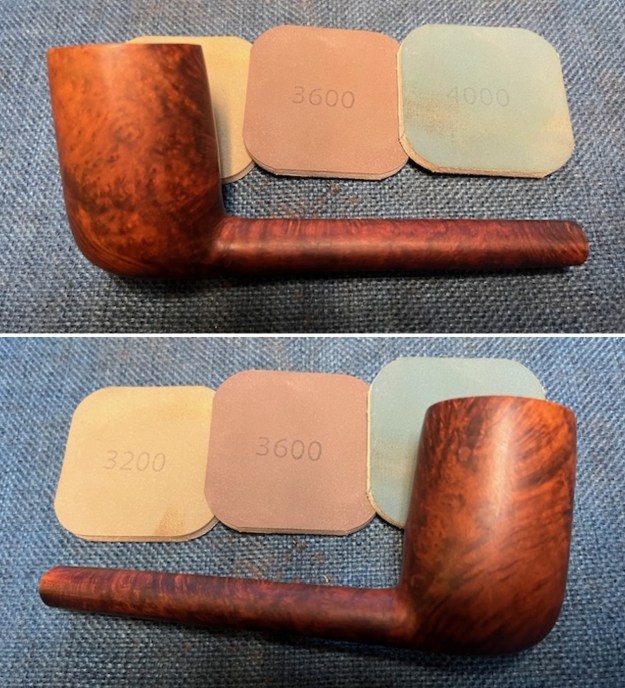
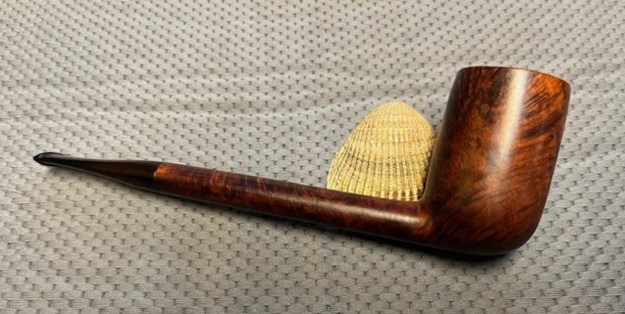
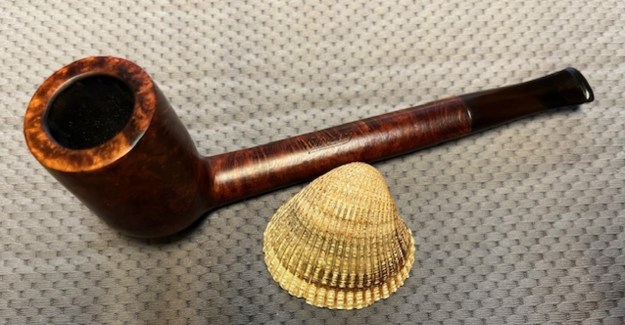
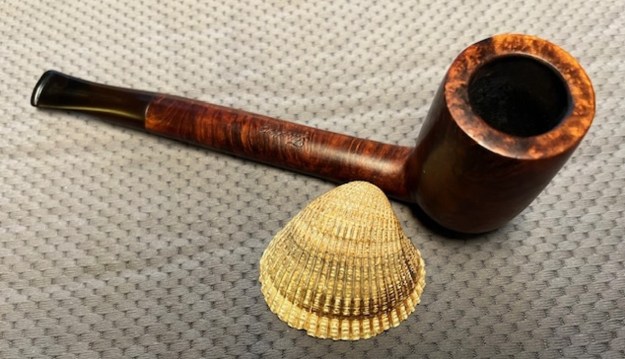
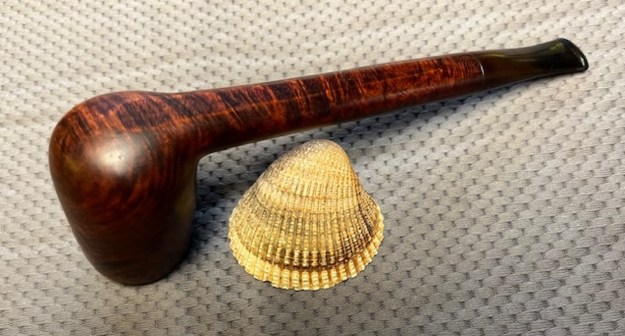
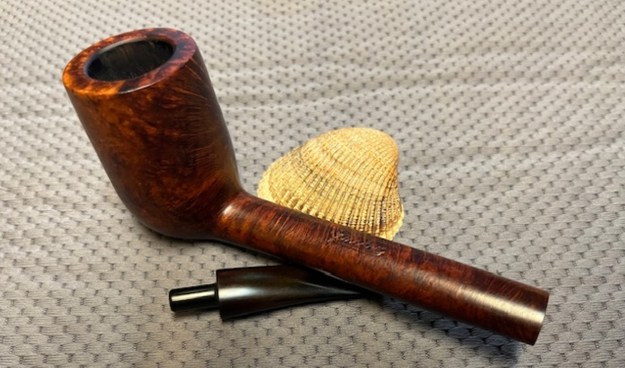
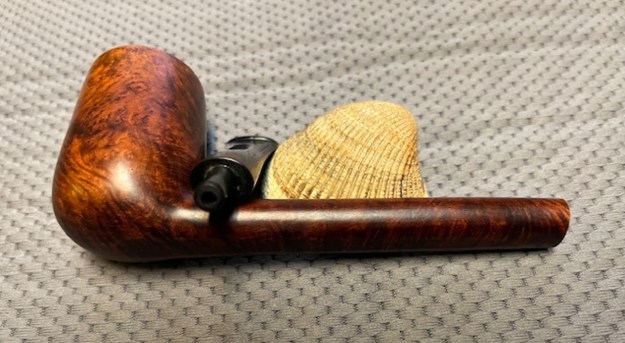
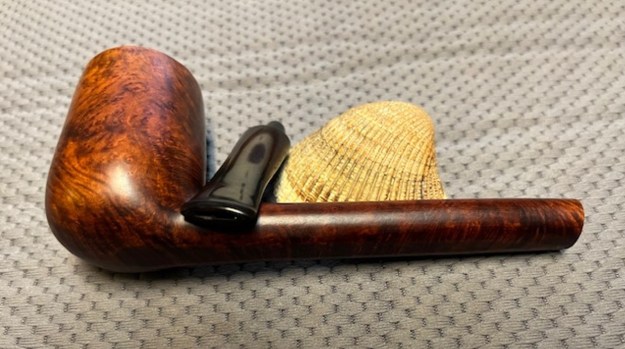
The next pipe on the work table is a smooth, classic tall Canadian shape that looks very European. It is stamped on the top side of the shank and reads Fischer in script. On the underside of the shank it reads Deluxe. There were no other identifying marks or stamps on the shank or the stem. It came to us form a seller in Princeton, New Jersey, USA on 08/20/2021. It has a mix of grain around the sides and shank. The bowl had a heavy cake in the bowl and thick lava on the rim top. It was thick so it was hard to be certain what the inner edge looked like. The finish was very dirty so it was hard to know with certainty what lay underneath. The bowl is a tall, stack like bowl on a Canadian shape. The vulcanite taper stem had no logo stamped on the topside. It has oxidation, calcification, tooth chatter and tooth marks on both sides ahead of the button. I took photos of the pipe before I started working on it. I took photos of the bowl, rim top and stem sides to show the condition of the both. It was a dirty bowl with debris and a heavy cake on the walls. The rim top had a thick lava covering the bowl and the edges. It was hard to know what the condition of the inner edge was underneath. I took photos of the top and underside of the stem showing condition and the tooth marks on both sides ahead of the button. Jeff took photos of the grain around the sides and the heel of the bowl to show the briar that was used to craft this extraordinary long pipe. I took photos to capture the stamping on the top and underside of the shank. It is clear and readable as noted above.I turned to Pipephil’s site (http://www.pipephil.eu/logos/en/logo-f2.html) and looked up the Fischer brand. I found the listing below and have included both a screen capture and the side bar notes. The stamping is the same as the one on the pipe I am working on.Store closed in 1978. Former address: House of Fischer, 1722 Boston Ridge Road, Orchard Park, NY.
I then turned to the listed for US pipe makers/manufacturers (https://pipedia.org/wiki/Fischer) to see if I could find out more information. I have included the article below.

Gustav Fischer was pipe maker for “The House of Fischer’, which was located in Orchard Park, NY, near Buffalo. The Fischer family apparently made pipes for six generations, starting in Germany and continuing in the United States until the 1970s. Their literature from 1956 said that all their briars were bench made. They also made meerschaums, but some confusion is caused by the fact that there was also Gustav Fischer, who made meerschaum pipes in Boston during roughly the same period.

The article went on to give information on the Fischer from Orchard Park, NY. I quote from that below.

The following information is gleaned from a thread on PipesMagazine.com

PIPES BY THE HOUSE OF FISCHER, ORCHARD PARK NY
Fischer pipes were made in USA through the 1950’s up to late 1978 when the owner, Paul Fischer retired, sold the store and moved to Florida in 1978. Unfortunately, The House of Fischer did not use a date stamp on their pipes, and therefore it is not possible to determine the exact date of manufacture.

Lee Pattison writes the following:

The Fischer shop in Buffalo closed in the late 1950’s last run by Arthur Fischer who moved shop to his home in Orchard Park. Arthur was the last of the family and retired 1978. Early pipes made in shop in Buffalo were stamped Buffalo in loop below name. Art deleted this from the stamp in early on 1960’s which helps in partial dating. Art did only pipe repair and sales. An unconfirmed report from a pipe maker Milton Kalnitz from the same era stated that the later pipe may have been made by Weber. Paul Fisher was part of the unrelated family in Boston Mass. The Buffalo shop started about 1890’s. Source of info was personal contact with family.

FISCHER PIPE QUALITY GRADE STAMPS
This is a list of various Fischer pipe stampings from my personal collection of over sixty Fischer pipes accumulated over the past forty plus years. It is by no means meant to be all-inclusive, however, if you find more Fischer pipe stampings please email me so I can update my list.

  1. Fischer Supreme
  2. Fischer Royal
  3. Fischer Imperial
  4. Fischer Golden 15
  5. Fischer 15 Grand
  6. Fischer 25 Grand
  7. Fischer Ramsgate
  8. Fischer Deluxe
  9. Fischer Special
  10. Fischer Texan (for which they applied for a patent)
  11. Fischer Seconds

The list of Quality Grade Stamps shows one with the Deluxe stamp at number 8. The Long Canadian has some great grain on the bowl and shank. I do know that is was made after the removal of the Buffalo stamp on the shank in the early 1960s.

Armed with that information I turned to work on the pipe itself. Jeff had done a great job cleaning up the pipe as usual. He cleaned up the inside of the bowl with a PipNet reamer and a Savinelli Fitsall Pipe Knife. The bowl walls looked very good. He scrubbed the interior of the bowl and shank with pipe cleaners, cotton swabs and alcohol to remove the tars and oils. He scrubbed the exterior of the pipe with Murphy’s Oil Soap and a tooth brush to remove the grime from the finish. He worked on the rim top lava and darkening with the soap and tooth brush. He scrubbed the inside of the stem with alcohol and pipe cleaners. He scrubbed the exterior with Soft Scrub and then soaked it in Briarville’s Pipe Stem Deoxidizer. He washed it off with warm water to remove the deoxidizer. The pipe looked far better. I took photos of the pipe when I received it before I started working on it. I took photos of the bowl and rim top to show how clean it was. The top and the inner edge of the rim show some darkening, nicks and scratches. The stem looks clean of debris and grime. There are tooth marks and chatter on both sides. There are also tooth marks on the underside of the stem.I took photos of the stamping on the top and undersides of the shank. The stamping is clear and readable (though fainter on the underside). I took a photo of the pipe with the stem removed to show the overall look of stem, tenon and profile of the pipe.I started my work on the pipe by addressing the damage on the inner edge of the rim. I used a folded piece of 220 grit sandpaper to smooth out the roughness. I then used 220 grit sandpaper and a wooden ball to give the inner edge of the bowl a slight bevel. It looked much better at this point in the process.I sanded the briar rim top and the sides of the bowl with 320-3500 grit sanding pads. I wiped the bowl down with a damp cloth after each pad. By the time I finished with the 3500 grit pad the briar had taken on a rich glow. I polished the briar bowl and shank with micromesh sanding pads – dry sanding with 1500-12000 grit sanding pads. I wiped it down with a damp cloth after each pad to remove the debris. The bowl took on a rich glow. I rubbed the bowl down with Before & After Restoration Balm. I worked it into the surface of the briar with my fingertips and a horsehair shoe brush to clean, enliven and protect it. I let the balm sit for 10 minutes and then buffed with a cotton cloth and shoe brush to raise the shine. Mark Hoover’s Balm is a product that I have come to appreciate and one I use on every pipe I have been working on. I set aside the bowl and turned my attention to the stem issues. I “painted” the surface of the stem to try and lift the tooth marks on the top and underside of the stem just ahead of the button. I was able to lift them to some degree but a few remained. I filled them in with black CA glue and set it aside to let the repairs cure. Once the repairs cured I used a file to flatten out the repairs and start blending them into the stem. surface. I sanded it with a folded piece of 220 grit sandpaper to begin the process of blending them into the stem surface. I sanded it with 320-3500 grit sanding pads to further blend them in and smooth out the surface of the stem.I polished the vulcanite with micromesh sanding pads – 1500-12000 grit pads. I wiped it down with a damp cloth after each sanding pad. I used Before & After Pipe Polish – both Fine and Extra Fine to further polish the stem. I put the stem back on the Fischer Deluxe Long Canadian and took it to the buffer. I worked it over with Blue Diamond to polish out the remaining small scratches. I gave the bowl and the stem several coats of carnauba wax and buffed the pipe with a clean buffing pad to raise the shine. I hand buffed it with a microfiber cloth to deepen the shine. The pipe polished up really well and the bevelled rim top looked good. I was happy with the look of the finished pipe. The photos below show what the pipe looks like after the restoration. This Long Shank Tall Canadian is a beautiful and unique take on a classic shape. The polished vulcanite taper stem looks really good with the browns of the briar. The dimensions of the pipe are Length: 7 inches, Height: 2 ¼ inches, Outside diameter of the bowl: 1 ¼ inches, Chamber diameter: 7/8 of an inch. The weight of the pipe is 1.80 ounces/51 grams. This is another pipe that I will be putting it on the rebornpipes store in the American Pipe Makers Section shortly, if you are interested in adding it to your collection. The long shank and tall bowl look and feel great in the hand. This one should be a great smoker. Thanks for walking through the restoration with me on this beauty!

Restoring a Longchamp France Leather Clad Billiard


by Steve Laug

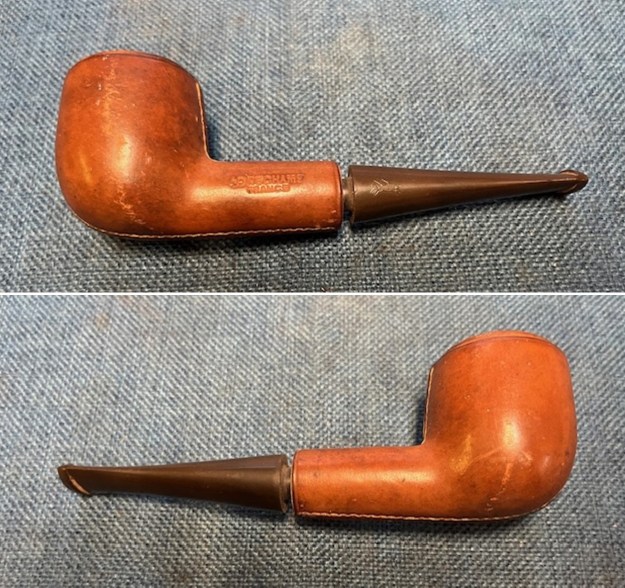
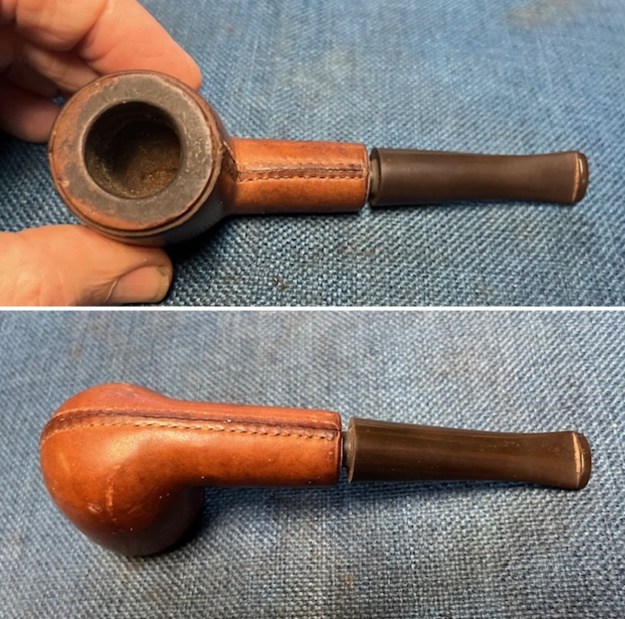
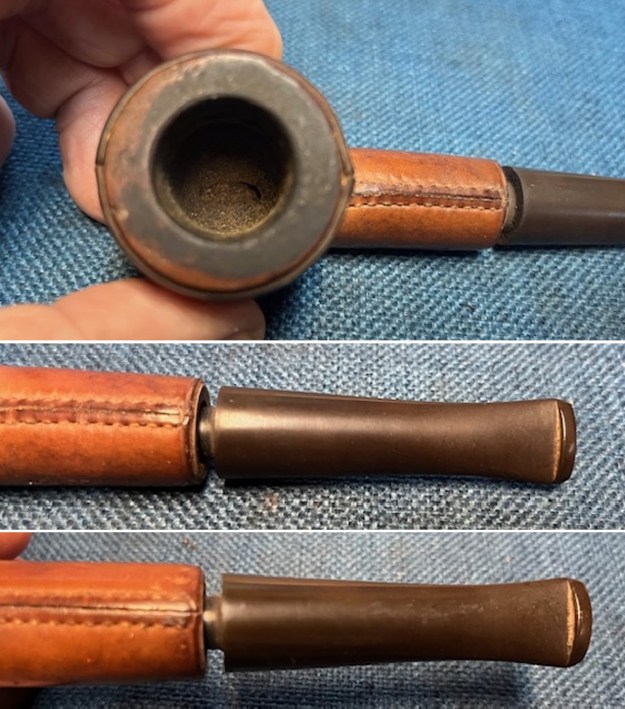
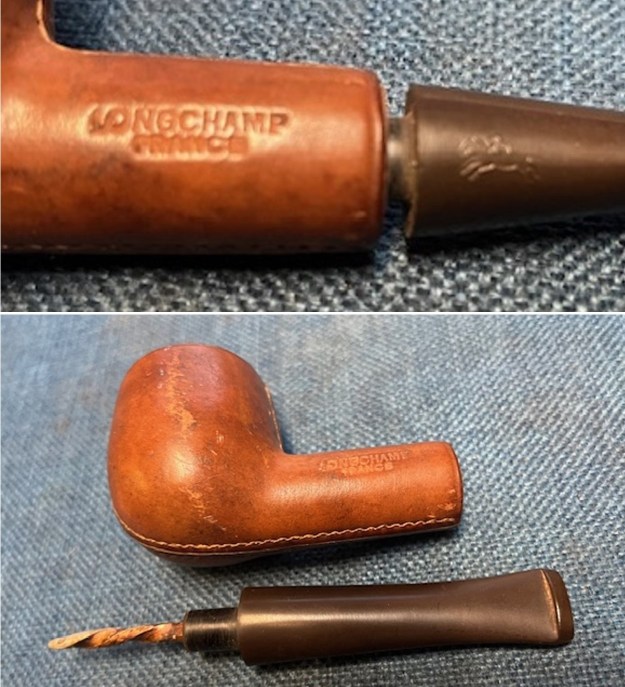
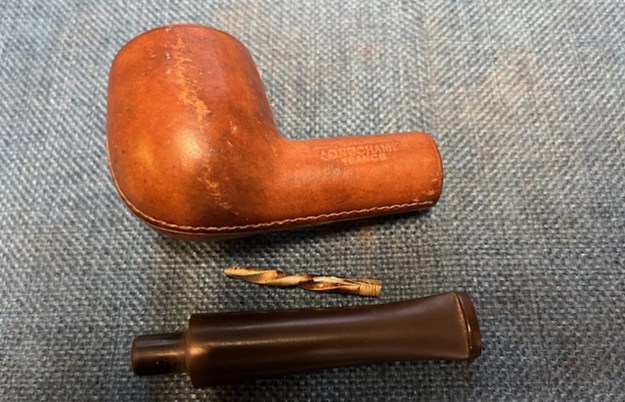
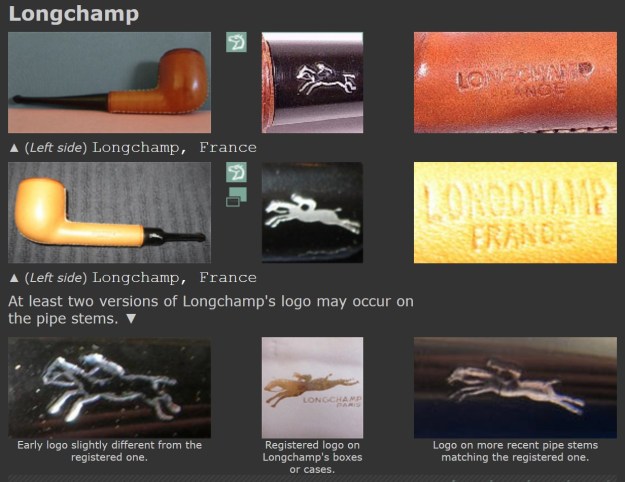
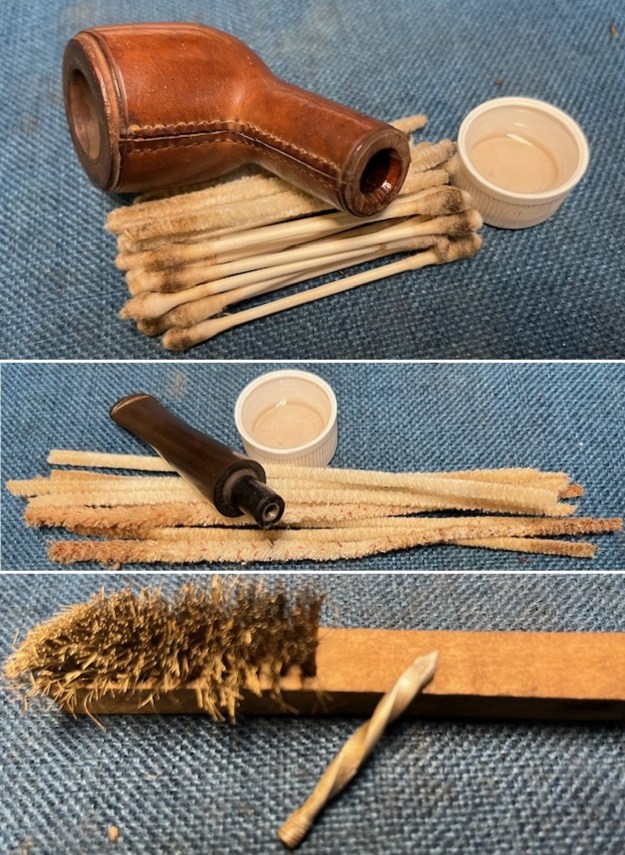
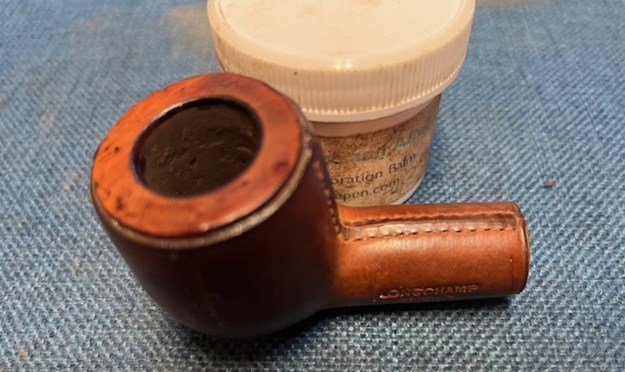
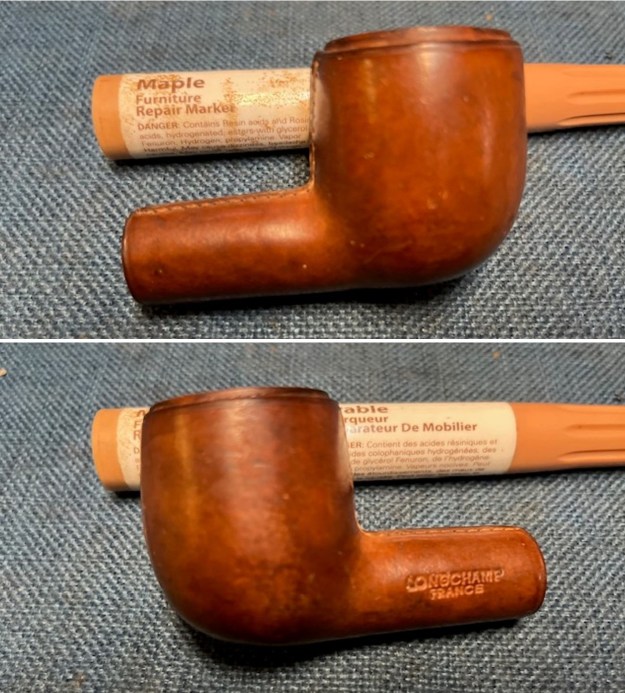
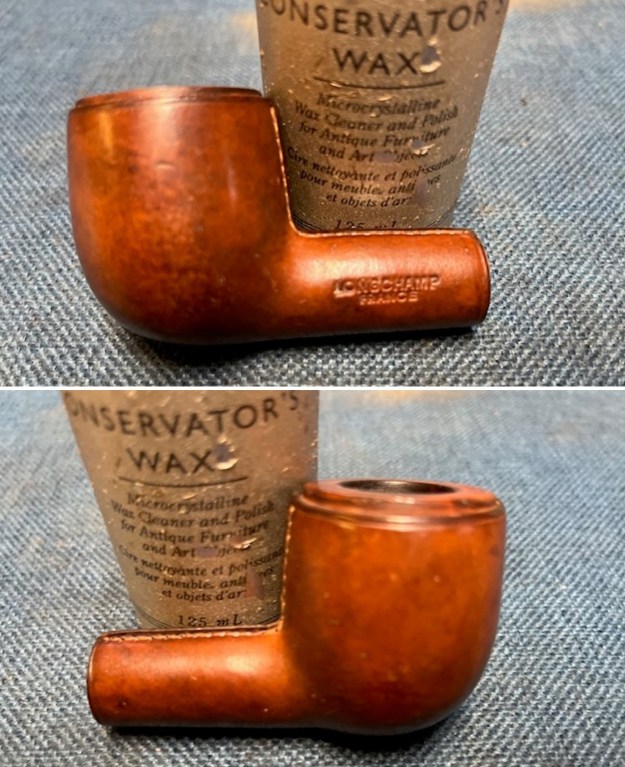
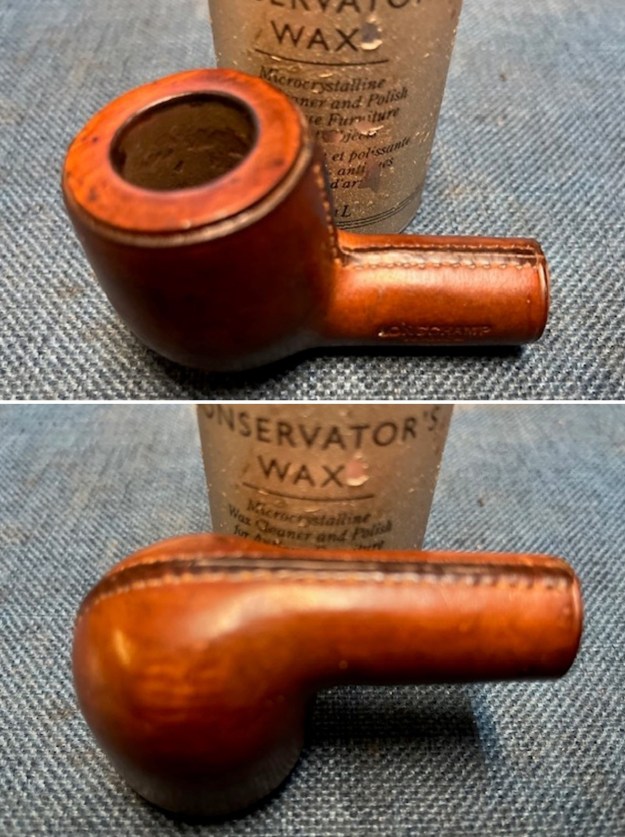
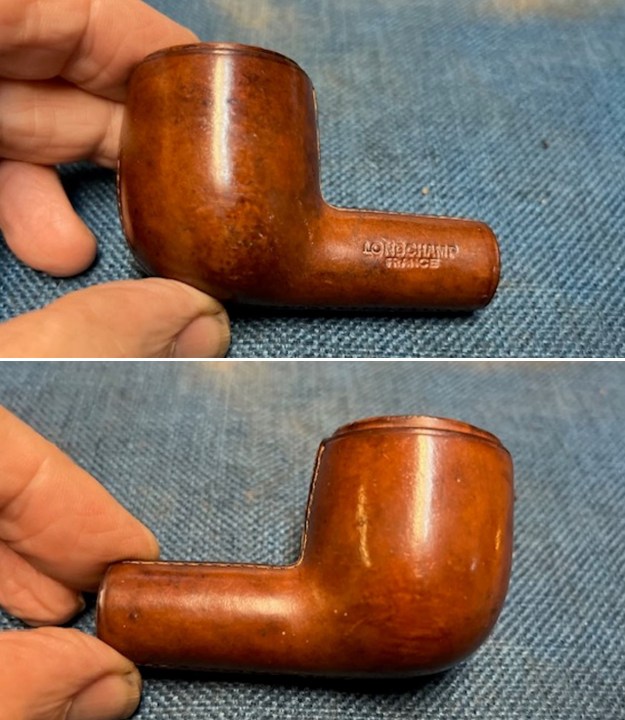
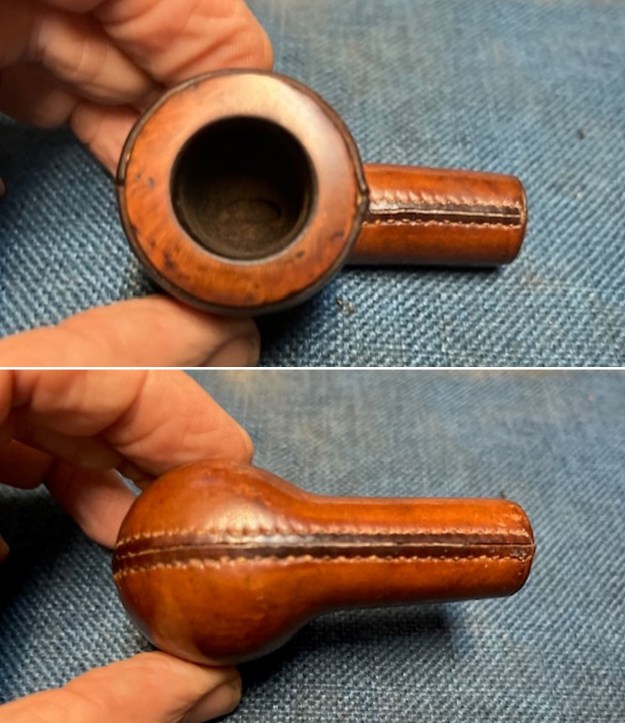
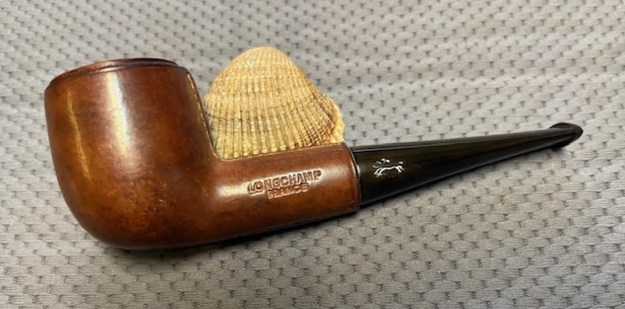
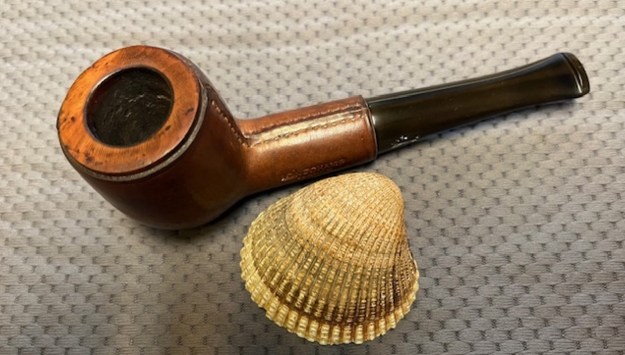
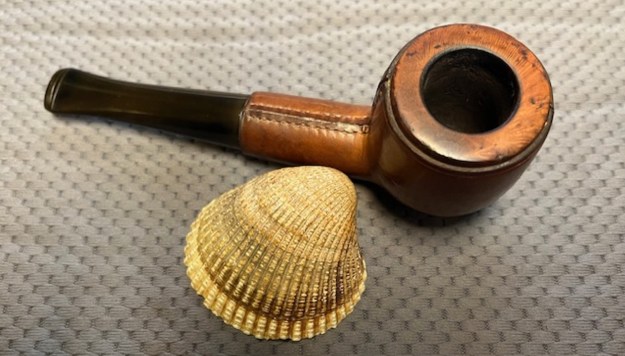
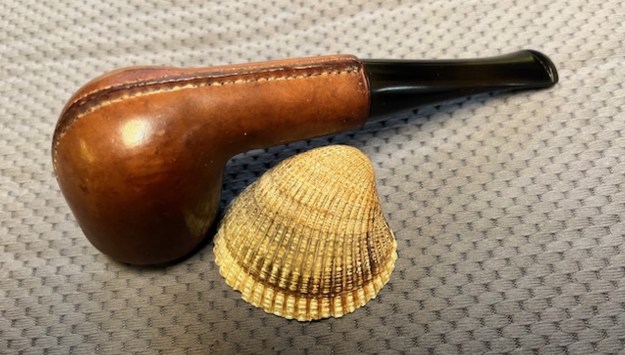
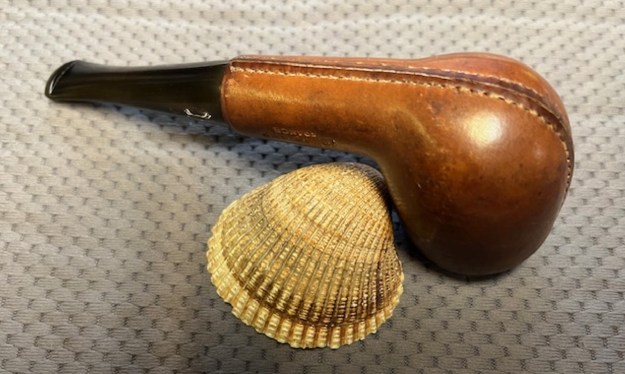
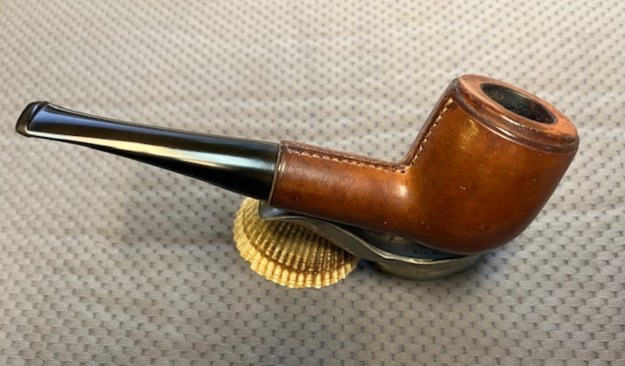
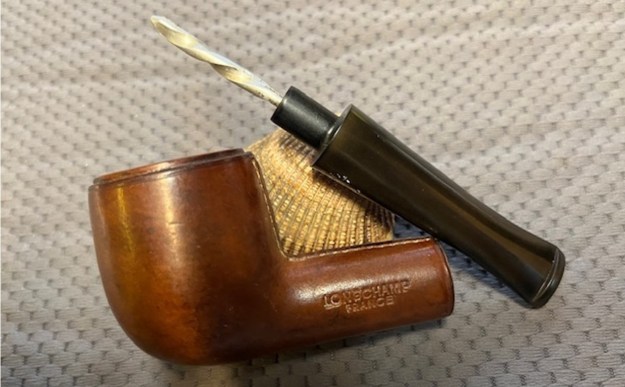
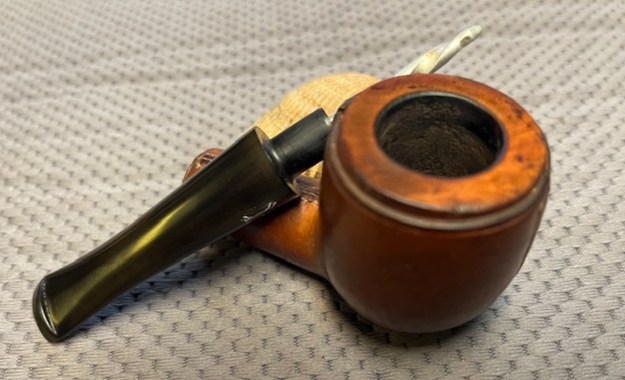
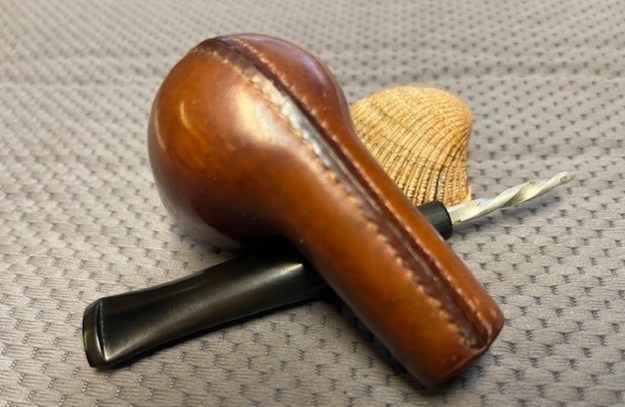
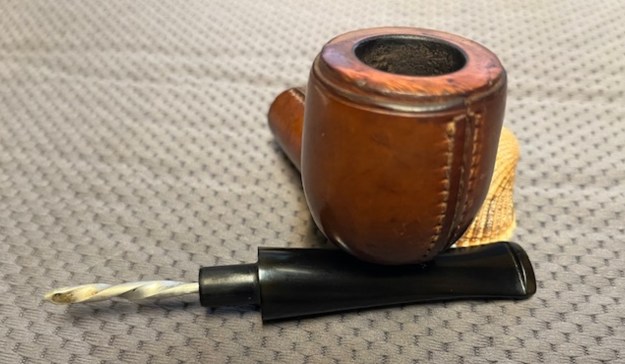
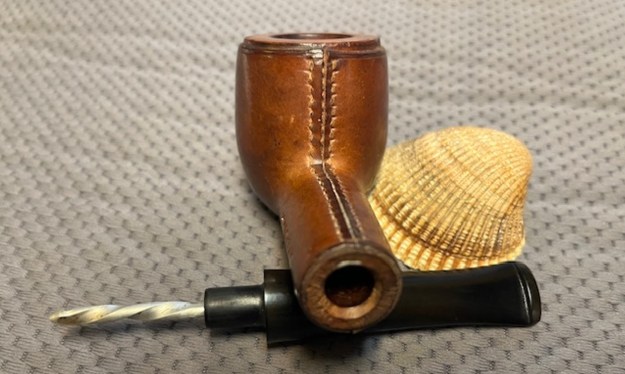
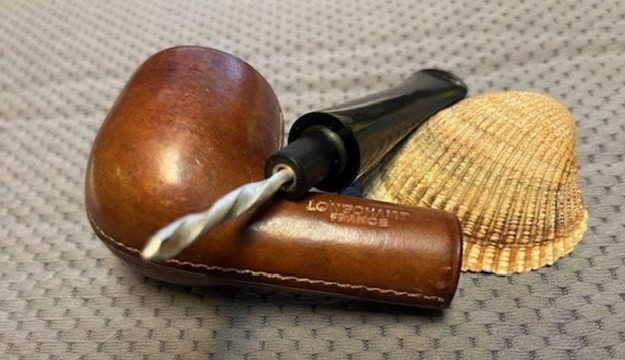
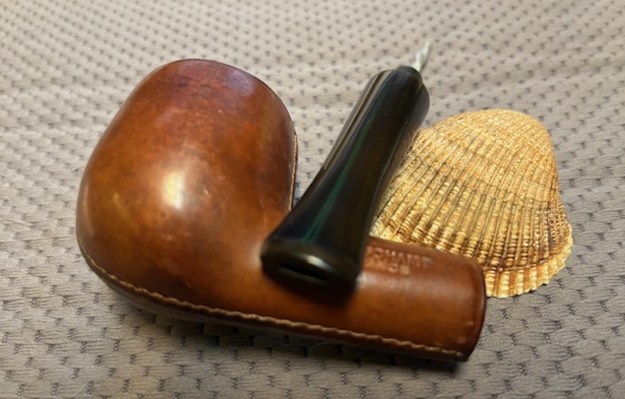
I received two pipes for repair from Brady, who works at a Pipe and Tobacco Shop in Texas yesterday. The first is a tiny Hexagonal Dublin stamped Genuine Briar. The second one is a leather coated bowl stamped Longchamp France Billiard. Both were quite dirty and needed some special attention. It was time to work on the second pipe – a Longchamp France Leather Clad Billiard. It is stamped on the left side of the shank and reads Longchamps [over] France. There was no other stamping on the shank sides. On the left side of the stem there was a race horse with a stylized rider. The bowl had a heavy cake in the bowl and thick lava on the rim top. It was thick so it was hard to be certain what the inner edge looked like. The leather clad bowl had a lot of scuffs on the sides of the bowl and was quite dirty. The vulcanite taper stem had oxidation, calcification, tooth chatter and tooth marks on both sides ahead of the button. I took photos of the pipe before I started working on it.  I took close up photos of the bowl and rim top to show the condition of both the bowl and the rim top. The bowl has a thick cake lining the walls and overflowing into lava. You can see the lava and build up on the rim top and the lava flowing over the inner edge of the bowl. It is hard to know if there is damage or if the lava protected it. The leather looks good with the stitching still tight. The stem is oxidized and has light tooth marks and chatter on both sides ahead of the button. I took a photo the stamping on the shank to show its condition before my work. It is clear and readable as noted above. The stamp on the stem is faint but still visible. I removed the stem from the bowl and took a photo of the parts to give a sense of the symmetry of the pipe. It is a beauty beneath all grime.I unscrewed the corkscrew stinger in the tenon and removed it. I took a photo of the stem with the stinger next to it.I turned first to Pipephil’s site to get a sense of the brand and an overview. Pipephil does an amazing job of summarizing (http://www.pipephil.eu/logos/en/logo-l5.html). I have included a screen capture of the brand and also the sidebar below the capture.Brand created in 1948. The pipes were crafted by Forestier-Bourgeois Cie (FBC) in St Claude and leather wrapped by Parisian workshops. Longchamp is the one and only brand which exclusively marketed leather clad pipes. They invented these pipes.
I turned to Pipedia to get some added background on the brand that I find an important part of the work on a pipe (https://pipedia.org/wiki/Longchamp).

In 1948 Jean Cassegrain inherited a small shop near the French Theater on the Boulevard Poissonnière in Paris, called “Au Sultan”. Articles for smokers and fountain pens were offered there.

Now, the absolute bulk of the pipes Cassegrain found in the inventory was from war-time production and due to the sharp restrictions on pipe production the French government had enforced in 1940, these pipes were of very poor quality and showed large fills. Strictly speaking, they were not marketable now that the French pipe industry produced pipes of pre-war standards again. In this situation Cassegrain had the probably most enlightened moment in his life: he took some of these pipes to a leather worker who clad bowls and shanks in leather. Only the rims of the bowls and the shanks’ faces remained blank.

E voila – the pipes looked pretty good now and were eye-catching enough to become an instant success in sale. Above all among the thousands of Allied soldiers who populated Paris in those days. The thing worked well, and even unexperieceid pipesters liked the covered pipes very much for they did not transmit the heat to the hand. Very soon Cassegrain had sold the old stock of pipes, and the leather-clad pipes became his only product. He began to place orders with renowned firms like Ropp or Butz-Choquin.

Because the name Cassegrain was already registered as a trade name for one his relatives, Cassegrain, a big fan of horse races, named his newly created firm after his favorite race course Longchamp near Paris. Hence an outlined galopping race horse with jockey was chosen as logo. The wind mill – see the frontpage of the catalog – symbolizes the name Cassegrain.

The numerous contacts with American soldiers bestowed an official contract on Cassegrain to supply the PX shops with his leather-wrapped pipes. According to his grandson, also named Jean and now CEO of the family firm, “There wasn’t an American GI in Europe who didn’t have one of these pipes at the time. They were exported and sold in PXs worldwide. That’s how it all started.”

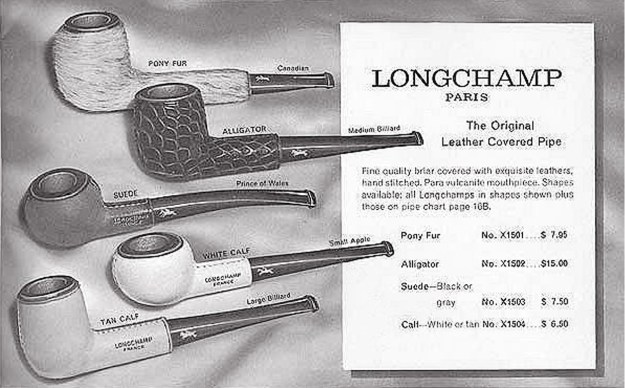
In the course of the following years Cassegrain enlarged and refined the Longchamp pipe program continuously. More precious kinds of leather like calf and suede came in use. The top range was clad in alligator leather and even pony fur was used. In addition, many models showed vibrant colors now, and small sized pipes, the “Royal Mini”, made that also women interested themselves in the pipes. The hype was pushed furthermore, when well-known persons of public interest, like TV moderators or pop icon Elvis Presley, began to flaunt with a Longchamp put on.

The Cassegrain family expanded their business in 1955 starting a sortiment of pipe bags, tobacco pouches, pipe stands, ashtrays, tampers, lighters – all made of or clad in leather. (Going from there Longchamp turned to other gentleman’s leather-goods around 1960 and finally established itself as a global brand at the end of the 1960’s introducing the Xtra-Bag for ladies.)

After 1970 the interest in leather-clad pipes slowly diminished. The Longchamp pipes were offered for the last time in the 1978 catalog though previously placed orders were delivered until 1980.

The splendid success inspired many other renowned producers to offer their own lines Ropp, Butz-Choquin, Gubbels, GBD, Sasieni… Maybe Savinelli was the very last producing them for the label of the famous designer Etienne Aigner.

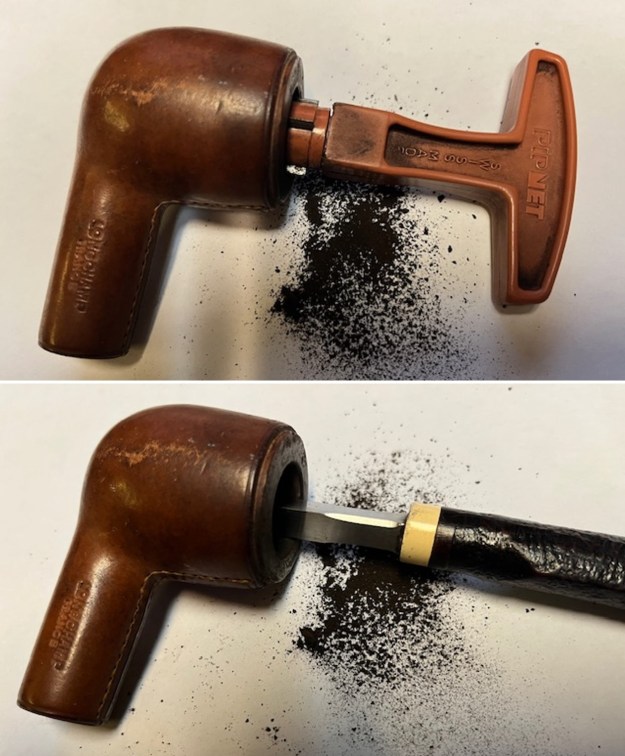
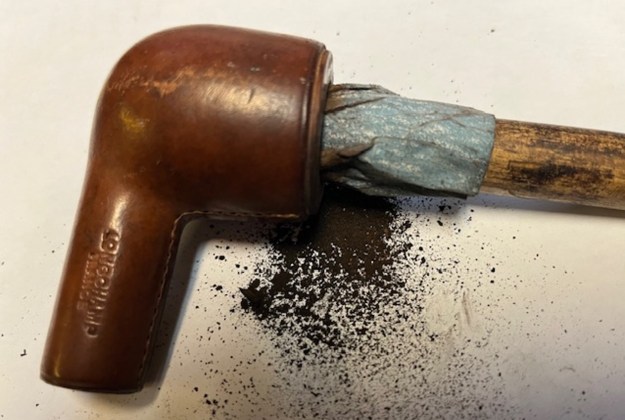
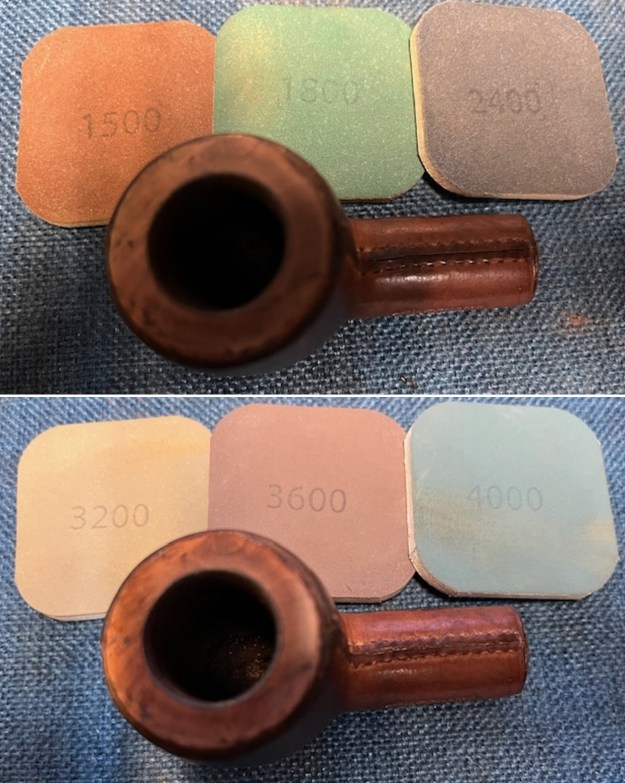
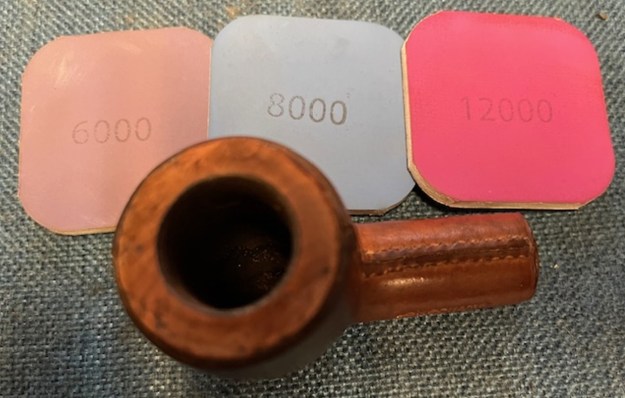
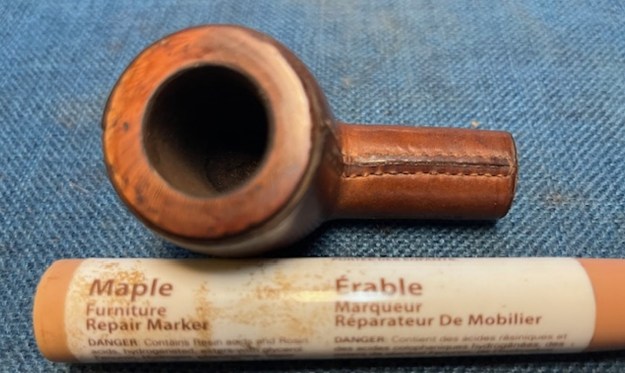
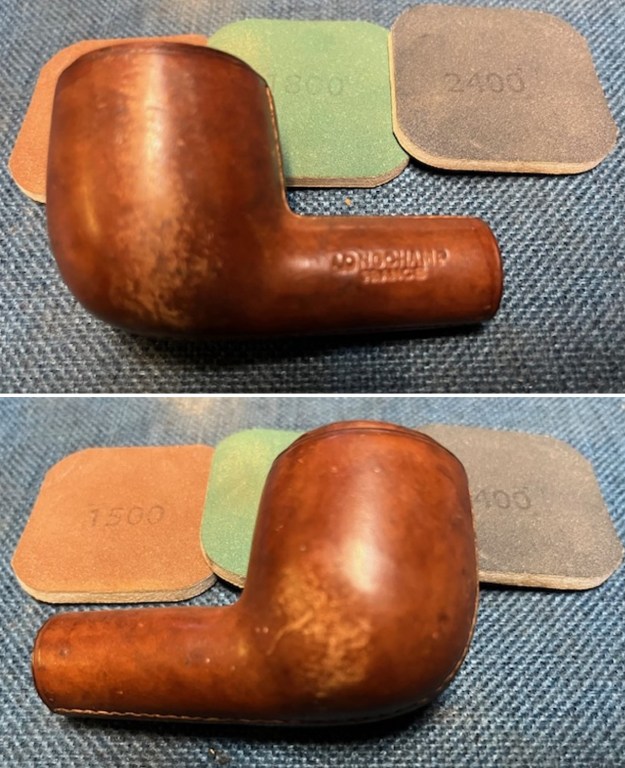
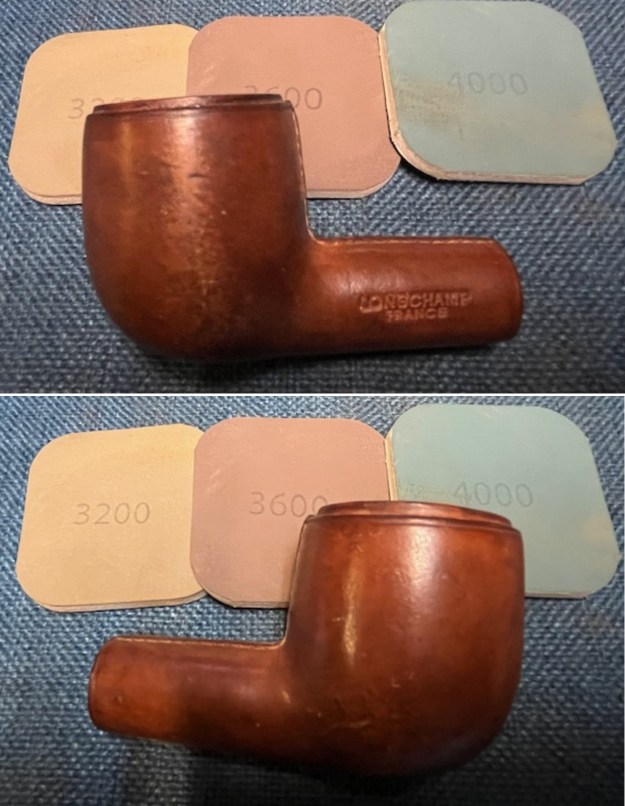
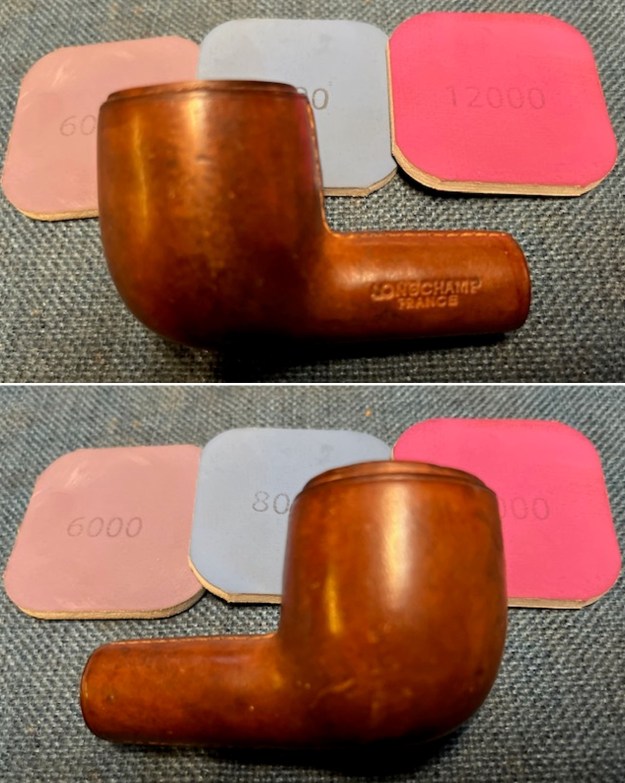
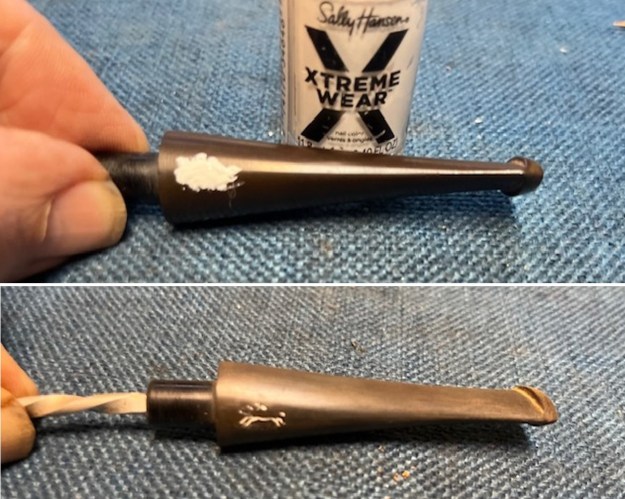
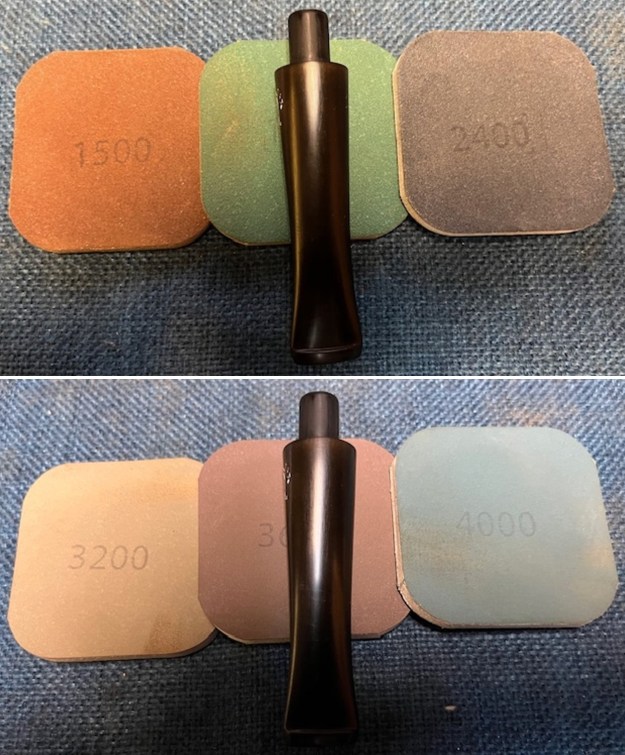
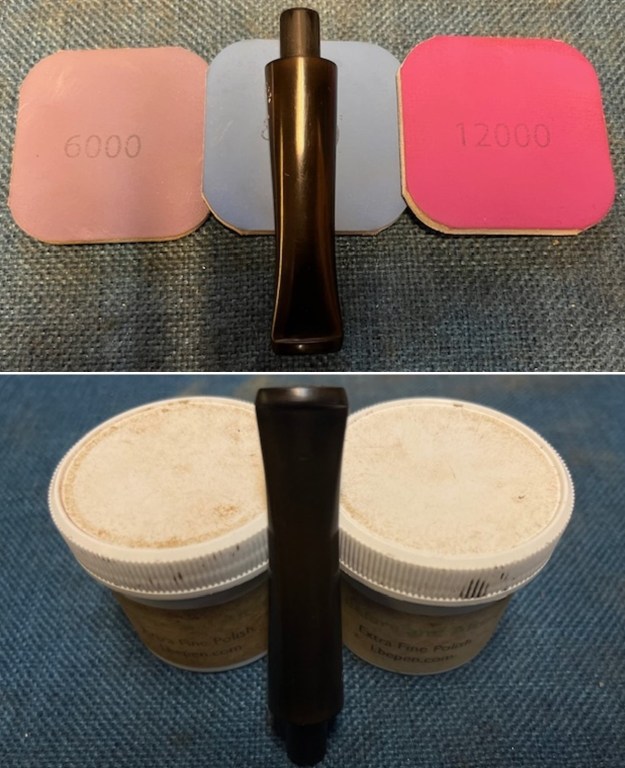
I decided to ream the bowl and do some internal clean up work before further polishing the briar. The cake was very hard so I proceeded with care so as not to either break my reamer or damage the rim edges. I reamed the bowl with a PipNet pipe reamer using the 1st and 2nd cutting heads to remove the cake in the bowl. I cleaned up the reaming with a Savinelli Fitsall Pipe Knife and finally sanded the bowl with 220 grit sandpaper wrapped around a piece of dowel to clean up the walls of the bowl. The walls appeared to be in good condition. I cleaned out the internals of the bowl, shank and stem with pipe cleaners, cotton swabs and isopropyl alcohol. It came out smelling much better. I scrubbed the aluminum corkscrew stinger with a brass bristle wire brush to remove the oils and tars along the turns. It cleaned up very well.I polished the rim top with micromesh sanding pads – dry sanding with 1500-12000 grit sanding pads. I wiped it down with a damp cloth after each sanding pad to remove the dust and debris. The grain stood out more with each set of pads. There were some nicks and dents but it looked good. I touched up the rim top with a Maple Stain pen to blend it into the colour of the leather on the bowl. It looked much better.I worked some Before & After Restoration Balm into the finish of the rim top with my fingertips to clean, enliven and protect it. I find that the balm really makes the briar come alive again. I let the balm sit for 15 minutes and then buffed with a cotton cloth to raise the shine. The bowl really looks good at this point. Now it was time to address the scuffing on the bowl sides. I wiped the leather down with a damp cloth to remove the dust and debris. It was surprisingly clean. I decided to try something new in terms of addressing the scuffing on the leather sides. I used micromesh sanding pads to work on the scuffed areas and smooth them out. It worked very well. I used a Maple stain pen to blend the smoothed-out areas of the leather into the surrounding areas of the bowl covering. It really looked much better!I waxed the leather cladding with Conservator’s Wax and buffed it on the buffer with a clean buffing wheel. It looked very good. I set the bowl aside and turned my attention to the stem. I touched up the racing horse stamp on the left side of the taper stem with white acrylic fingernail polish. Once it dried I scraped off the excess.  I polished the stem with micromesh sanding pads – dry sanding it with 1500-12000 grit pads. I polished it further with Before & After Pipe Stem Polish – both fine and extra fine. This Longchamp France Leather Clad Billiard with a vulcanite saddle stem is a great looking pipe now that it has been restored. I put the stem back on the bowl and carefully buffed the pipe with Blue Diamond on the buffing wheel. I gave the bowl multiple coats of Conservator’s Wax and the stem multiple coats of carnauba wax on the buffing wheel and followed that by buffing the entire pipe with a clean buffing pad. I hand buffed the pipe with a microfiber cloth to deepen the shine. The finished Longchamp France Billiard fits nicely in the hand and feels great. Give the finished pipe a look in the photos below. The dimensions of the pipe are Length: 5 ½ inches, Height: 1 ¾ inches, Outside diameter of the bowl: 1 ½ inches, Chamber diameter: ¾ of an inch. The weight of the pipe is 1.66 ounces/47 grams. Thanks for walking through the restoration with me as I worked over another beautiful pipe. Since both pipes are finished I will be sending them back to Brady this week. Thanks for your time.

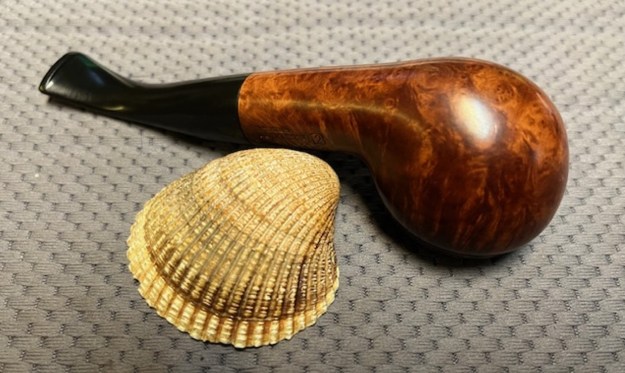
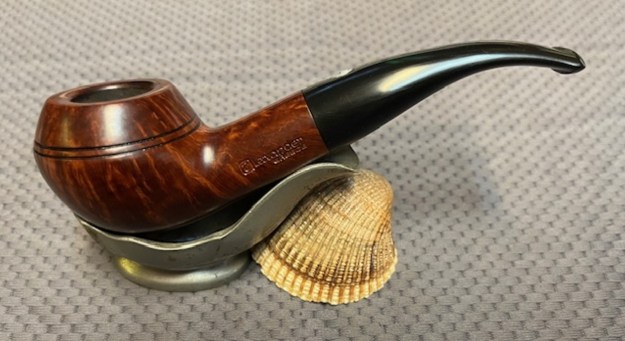
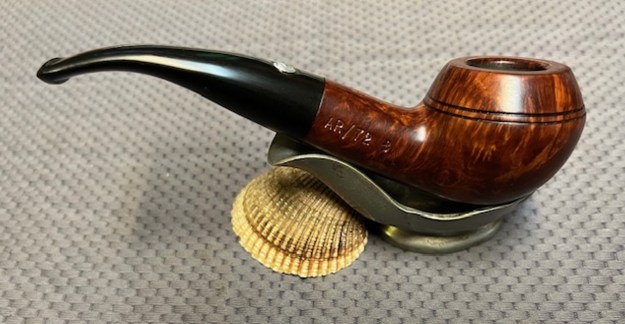
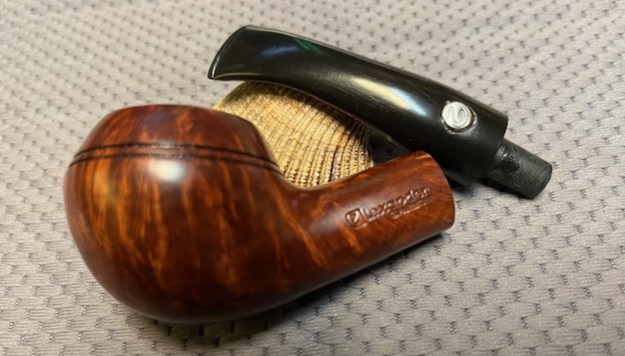
Replacing a snapped tenon on an Alexander Greece AR/72 -B Rhodesian


By Steve Laug

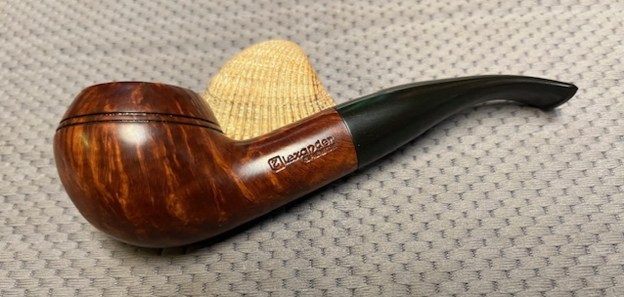
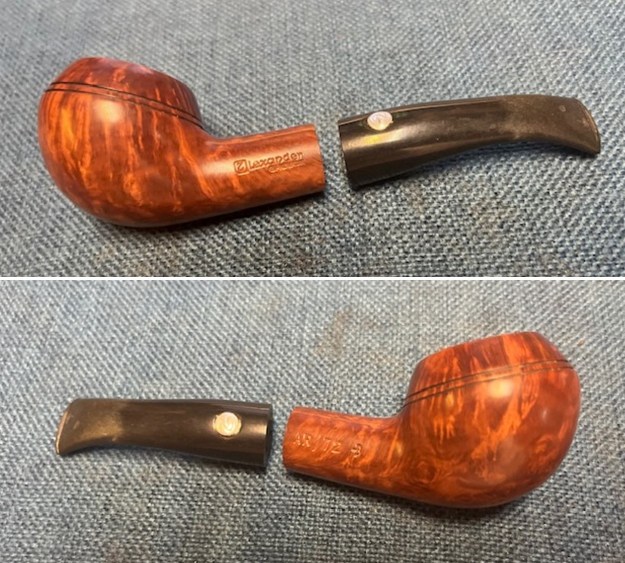
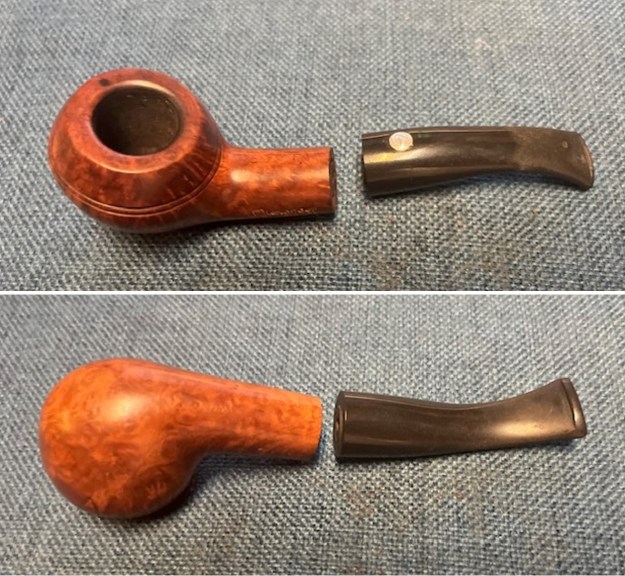
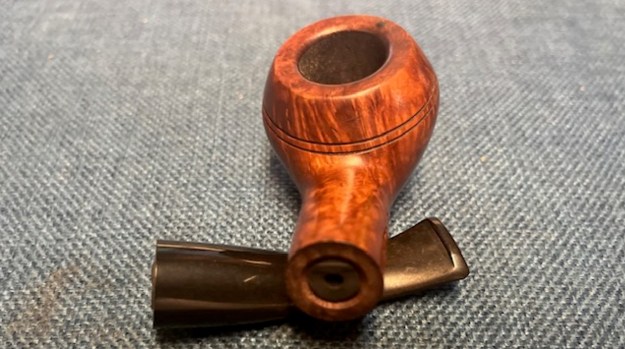
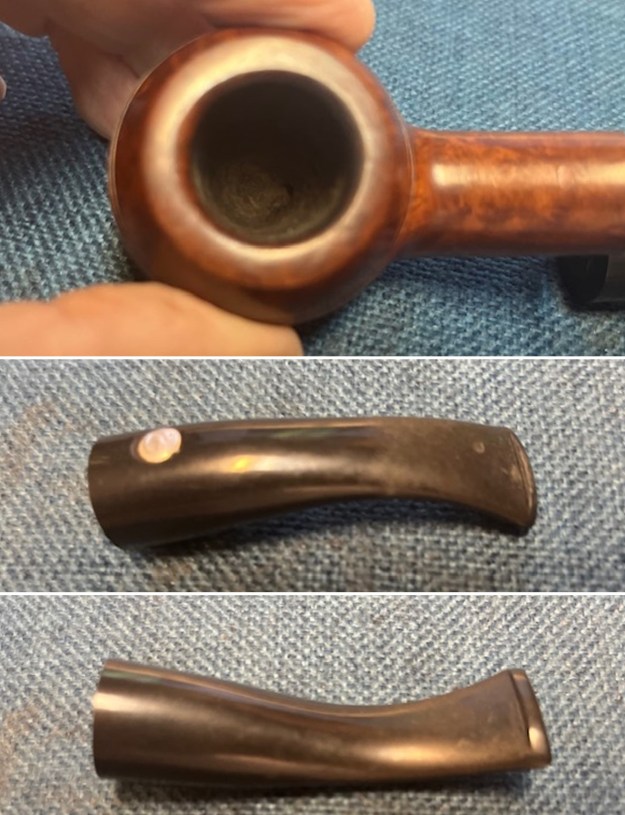
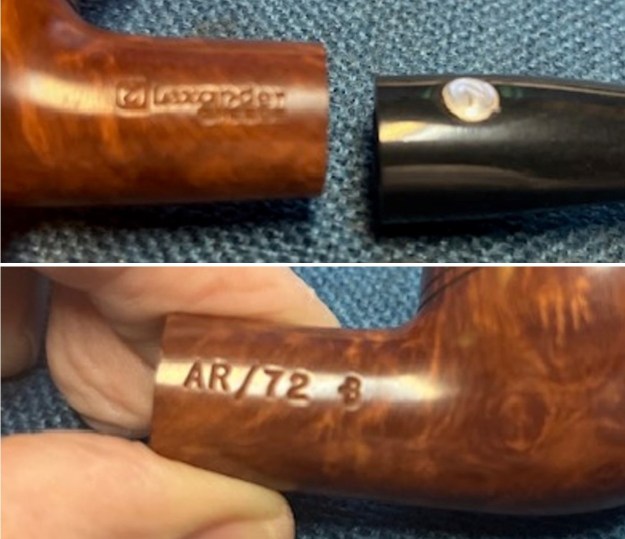
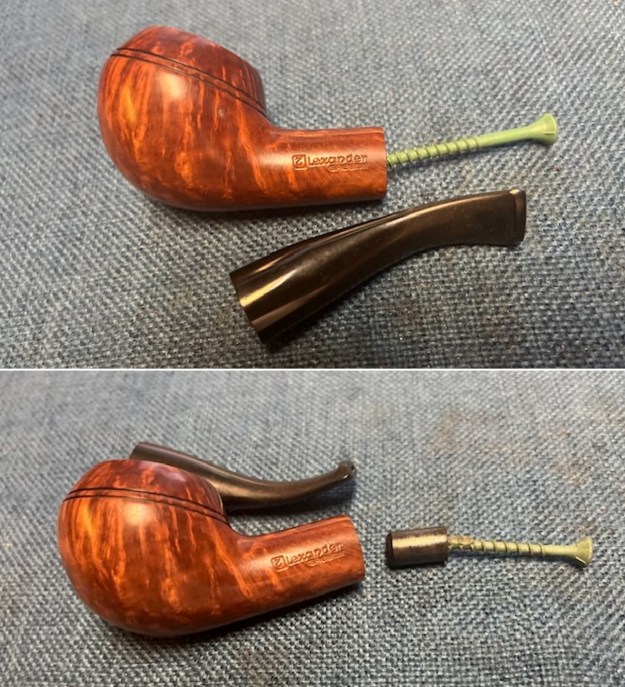
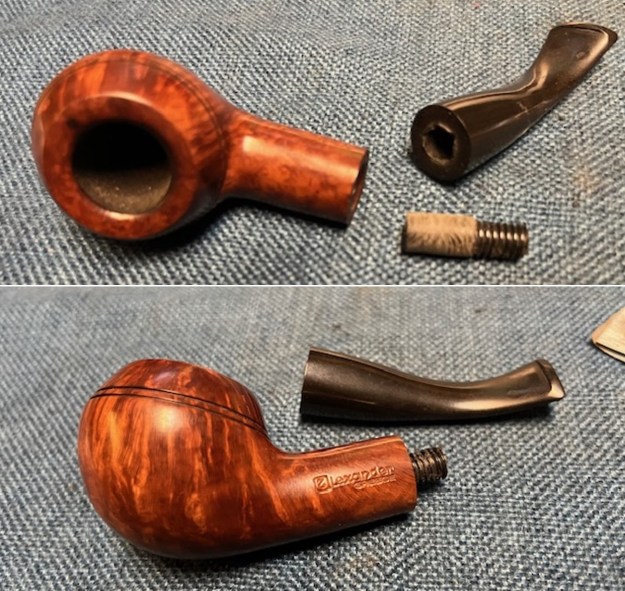
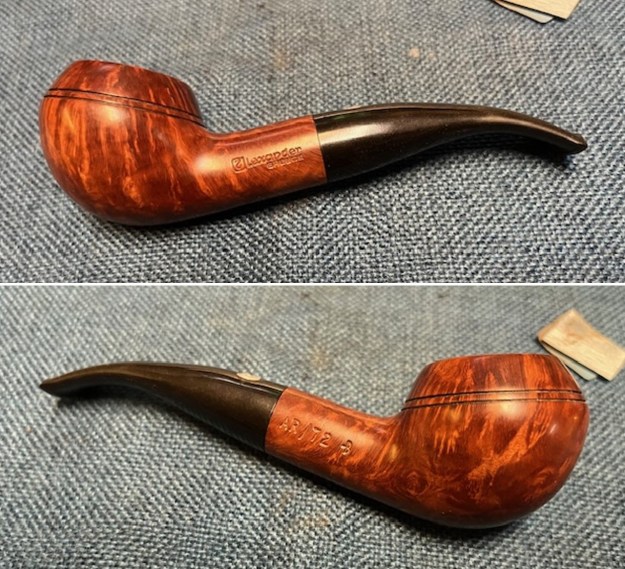
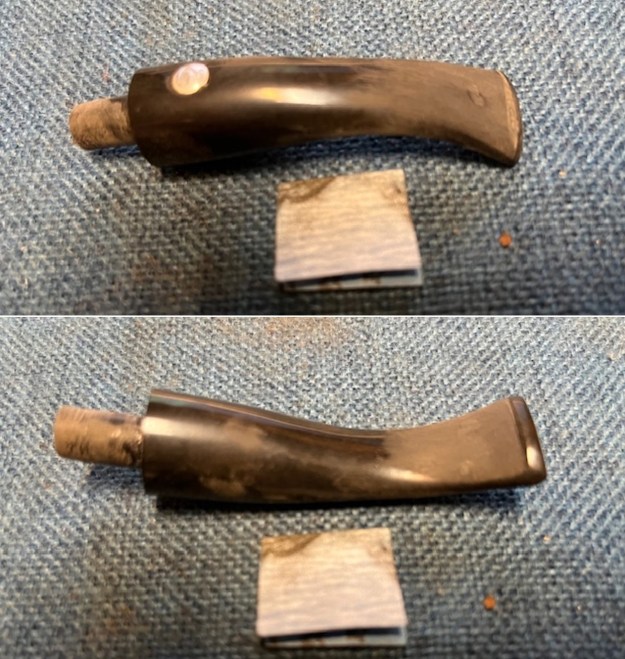
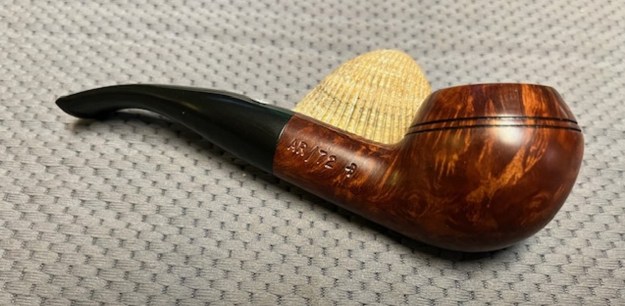
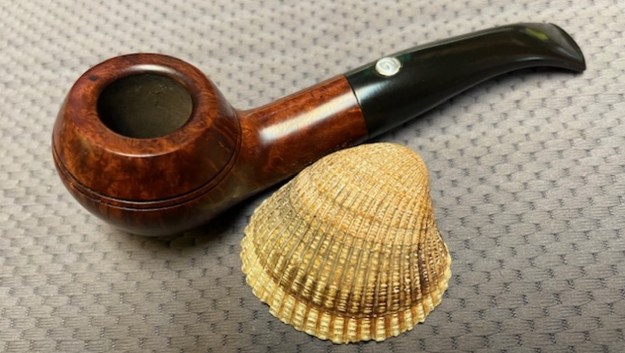
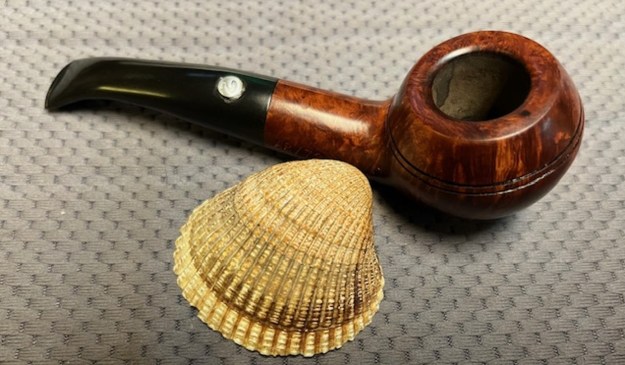
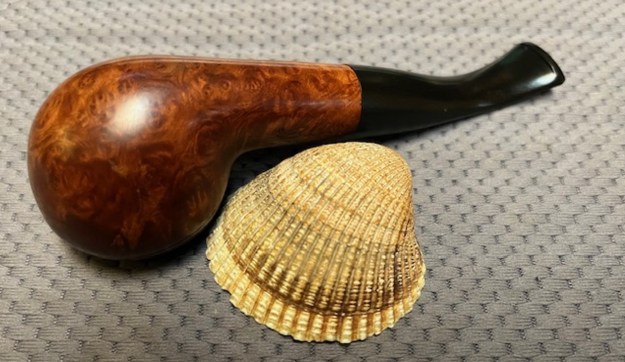
The next pipe on the work table is a beautifully grained Alexander Greece Rhodesian. It is stamped on the left side of the shank and reads Alexander [over] Greece. The A at the beginning of Alexander is a letter Z in the centre of the A. On the right side it reads AR / 72 B. It is another one that came from a box of pipes with broken tenons that I set aside to work on someday. Today is that day I guess! It is very classic shaped Rhodesian shaped bowl with an ebonite taper stem. I really like the look of a Rhodesian and this one has a little twist that makes it a bit different. The bowl was very clean and had no cake. The finish was in excellent condition and had a great wax/shellac coat. I would run some pipe cleaners through it but it appeared to be very clean. The ebonite taper stem had a fancy Z logo in a silver circle inlaid on the topside. It is not oxidized but has tooth chatter and tooth marks on both sides ahead of the button. The tenon had snapped off cleanly in the shank. I took photos of the pipe before I started working on it. I took a photo of the shank end to show the snapped off tenon in the shank. The break is quite clean so it should clean up very well.I took photos of the bowl and rim top to show the cleanness of the bowl and the condition of both. It was clean bowl that had been reamed. The inner and outer edges otherwise look very good. I took photos of the top and underside of the stem showing wear and tooth marks on the top and underside of the stem surface and button.I took photos to capture the stamping on the sides of the shank. It is clear and readable as noted above. I also took a photo of the inlaid Alexander logo on the left side of the stem. Before I started working on the pipe I turned to Pipedia to remind myself of the Alexander Greece brand and gather the background that makes working on pipes a pleasure (https://pipedia.org/wiki/Alexander_Pipes). I quote from the article below. Of note it starts with an update regarding the death of Alexander.

Update: Today I am saddened by the news that Alexander passed away on February 10th, 2015. Our thoughts and prayers are with his family and friends. We are very thankful for his contributions to the World of pipes. –sethile (talk) 21:00, 12 February 2015 (UTC)

“I am Alexandros Zavvos, born in Molos, Thermopylae, near Lamia. Since I was a child I had an inclination for art, starting with painting. I studied Radio-electronics, and at age 23 I got involved with commerce with a capital of 150.000 drs. in 1962.

I entered the pipe business where I met, by total chance, with Mr. Libero G. Albanese, first technician and producer of briar-wood models in Kalabria, Italy. When I told him that I am Greek, he almost prayed, saying that we Greeks have the best briar in the world for pipe-making! From that moment on I understood that this fellow is in love with his work – and he transmitted that to me instantly!
From mid-1962 to 1963 I searched all over the world for a college or a school in order to be taught the art of pipe-making, but in vain – there were none. Moreover, I wasn’t able to make it through the big European pipe-makers of that time (British, Italian, Danish). I was convinced that only through experience there was a chance of me becoming what I wanted.

In 1964 I started the commercial briar-wood model production, in 1965 I constructed empirically my first pipe and in 1967 I started the vertical production (this is from the briar Greek woods to the consumer) – maybe there is no other factory in the world producing smoking pipes vertically.

In 1970 I started the research, which was accomplished in 1984, on the 1st generation hygrostatic system. In that same period we founded, my brother and I, our factory in Lamia for the production of ebony epistomes.

Today, 40 years later, I have successfully arrived at the production of the 5th generation hygrostatic pipe. I will finish by saying that this pipe, to what concerns the pleasure it provides, has nothing to do with that pipe for peace, offered by American Indians.”

The Alexander Briar Pipes website still sells briar pipes of several styles, including “Hygrocool”, “Hygrocool NT”, regular pipes, cigarette pipes and pocket pipes, along with briar blocks, acrylic and ebonite stems and accessories.

At the mention of the Hygrostatic System above I remembered a pipe that Paresh had restored for me and gifted me when I went to India. I have included the link below.

https://rebornpipes.com/2019/08/02/gifting-my-mentor-and-dear-friend-steve-an-alexander-zavvos-hygrosystem-pipe/

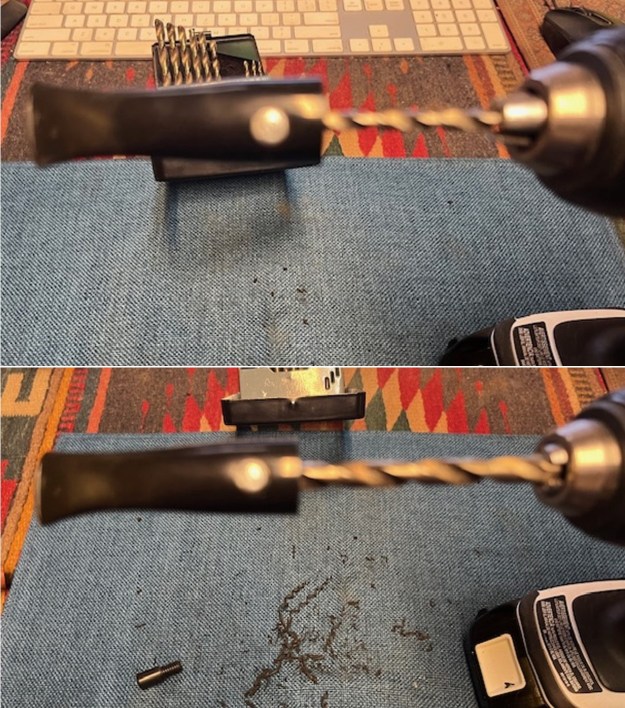
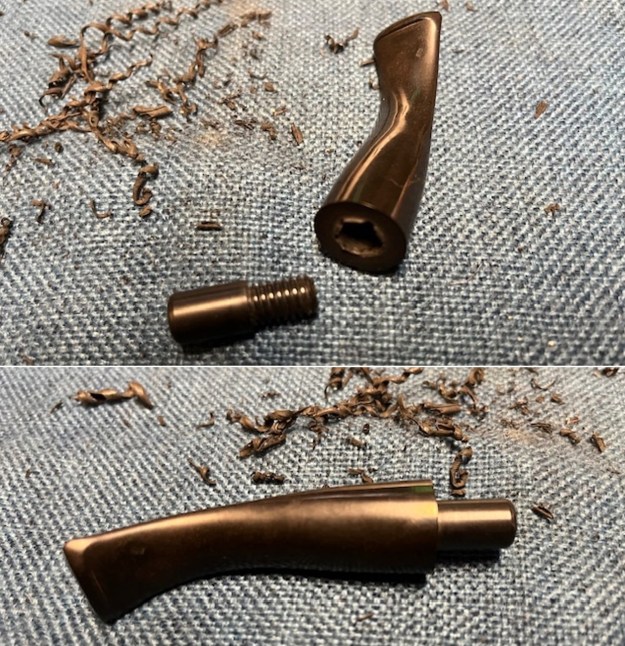
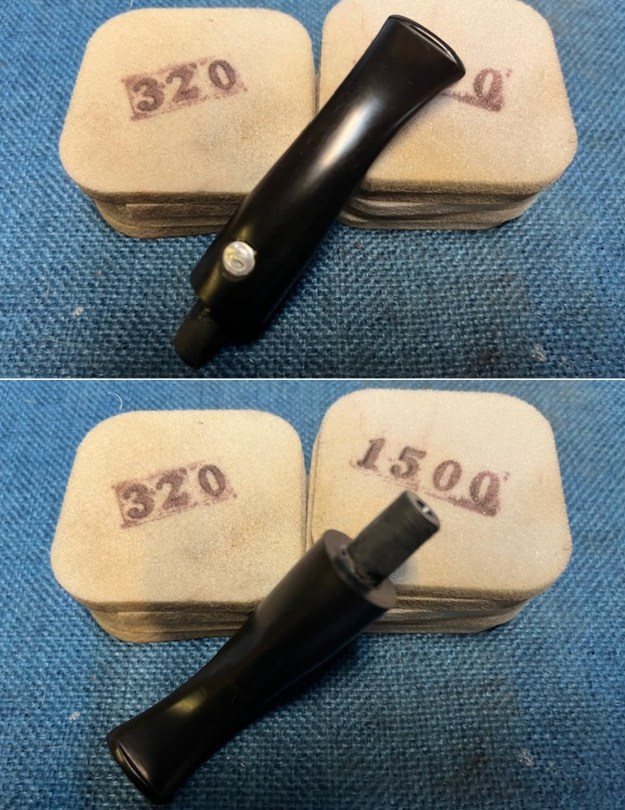
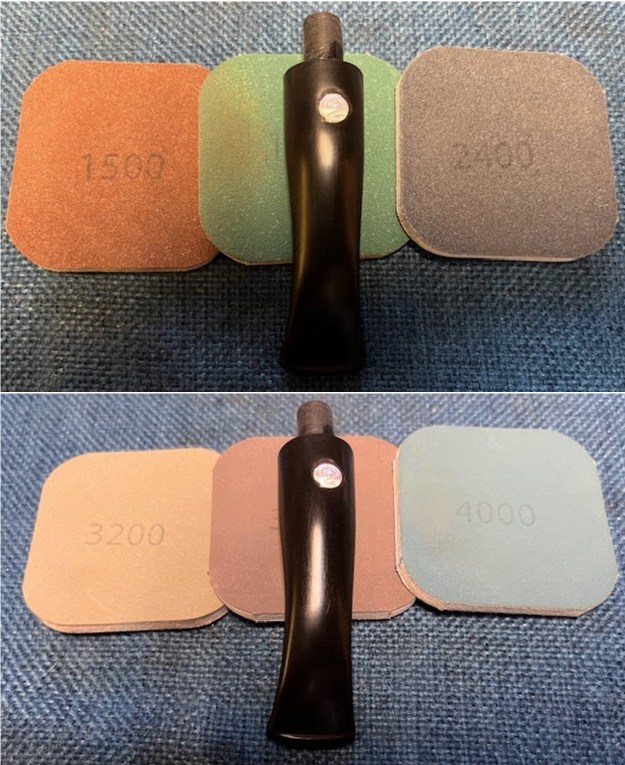
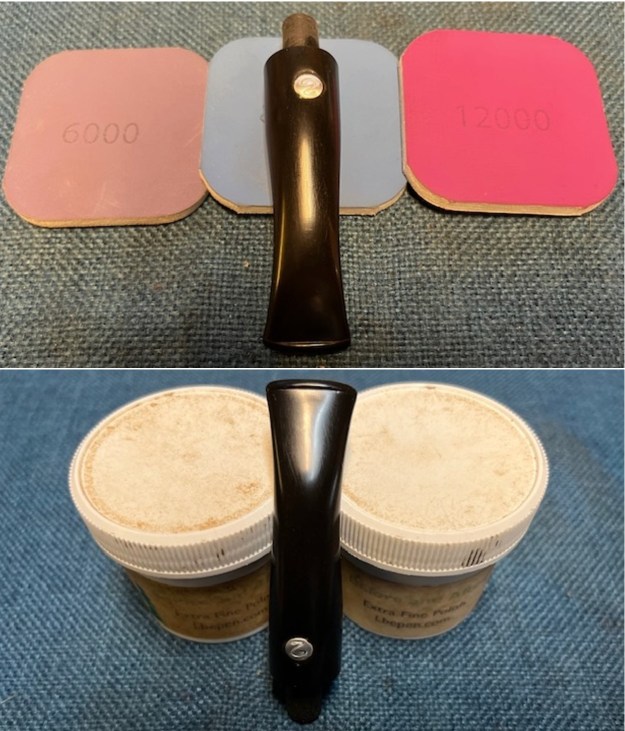
It is an interesting brand and a great looking classic pipe rather than his hygrosystem pipe. Given the information and background on the pipe I started my work on the pipe. I decided to start by pulling the broken tenon and beginning the process of the replacement. I used a drywall screw to pull the tenon. I screwed it into the airway and wiggled the broken piece out of the shank. The second photo of the bowl below shows the pulled tenon.In preparation for fitting a new tenon I flattened out the broken edges on the snapped tenon using a topping board and 220 grit sandpaper. I drilled the airway in the stem with increasingly larger drill bits until I had the bit that was the same size as the threaded portion of the new tenon.I fit the tenon in the stem to make sure the fit and alignment was correct and repeated the process in the mortise. I fit the stem on the tenon in the mortise to check the alignment. With the fit as good as it was going to get on this one I slid a pipe cleaner in the stem and tenon and painted the threads with black CA glue. I pressed it into place in the stem and set it aside to cure.I set the stem aside overnight to let it cure. I turned out the lights and called it a night. In the morning I sanded the bowl with 220 grit sandpaper on a piece of dowel to clean up the walls of the bowl. It had been reamed but needed to be sanded smooth. It was in great condition. I cleaned out the shank and airway into the bowl with pipe cleaners, cotton swabs and alcohol to remove the tars and oils. I cleaned out the airway in the stem at the same time.I polished the briar with micromesh sanding pads – dry sanding with 1500-12000 grit pads. I wiped the bowl down after each pad with a damp cloth to remove the sanding dust. I worked some Before & After Restoration Balm into the finish of the bowl, rim top and shank with my fingertips to clean, enliven and protect it. I find that the balm really makes the briar come alive again. The contrasts in the layers of stain really made the grain stand out. I let the balm sit for 15 minutes and then buffed with a cotton cloth to raise the shine. The bowl really looks good at this point. I set aside the bowl and turned my attention to the stem. I “painted” the surface of the stem with the flame of a Bic lighter to lift the deep tooth marks. I filled in what remained with black CA glue and set it aside to let the glue cure. I flattened the repairs with a small file to start the process of blending them into the surrounding ebonite. I sanded the stem surface with 220 sandpaper to further blend in the repairs and flatten them out. It was looking much better at this point. I sanded the stem with 320-3500 grit sanding pads and wiped the stem down after each pad with an Obsidian Oil saturated cloth to remove the grime and protect the stem.I polished the stem with micromesh sanding pads – wet sanding it with 1500-12000 grit pads. I polished it further with Before & After Pipe Stem Polish – both fine and extra fine. Once again, I am the part of the restoration that I always look forward to – the moment when all the pieces are put back together. I put the pipe back together and buffed the bowl and the stem with Blue Diamond on the buffing wheel. I gave the bowl and the stem multiple coats of carnauba wax. I buffed the pipe with a clean buffing pad to raise the shine. I hand buffed it with a microfiber cloth to deepen the shine. It is fun to see what the polished bowl looks like with the smooth finish and the black ebonite stem. This richly stained Alexander Greece AR/72 -B Rhodesian is light weight and ready for you to load up a tobacco of preference and enjoy a fresh smoke. Have a look at it in the photos below. The dimensions are Length: 5 ½ inches, Height: 1 ½ inches, Outside diameter of the bowl: 1 ¼ inches, Chamber diameter: ¾ of an inch. The weight of the pipe is 46 grams/1.66 ounces. This is one that will go on the Pipe from Various Makers Section of the rebornpipes online store shortly. Let me know if you are interested in adding it to your rack. Thanks to each of you who are reading this blog. Remember we are not pipe owners; we are pipemen and women who hold our pipes in trust until they pass on into the trust of the next generation.

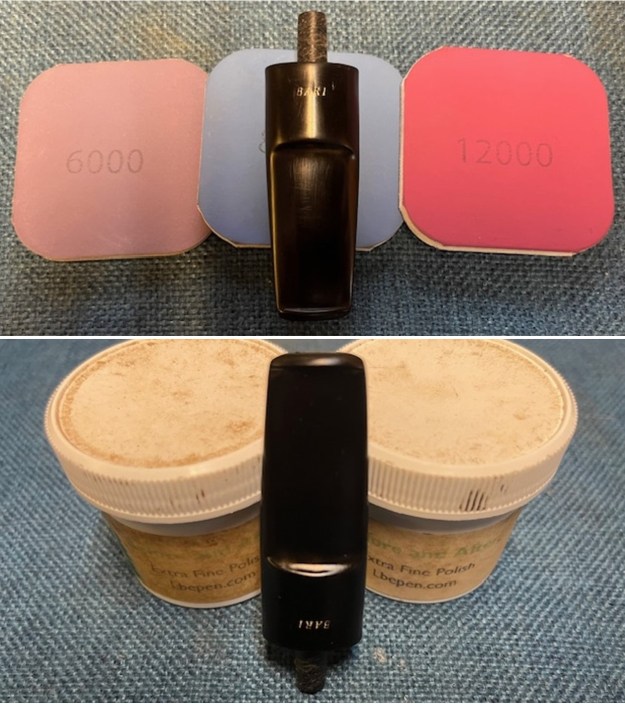
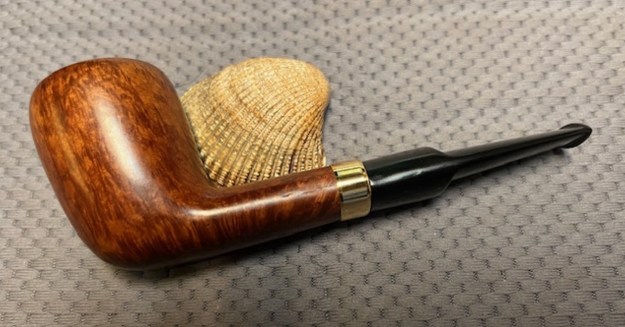
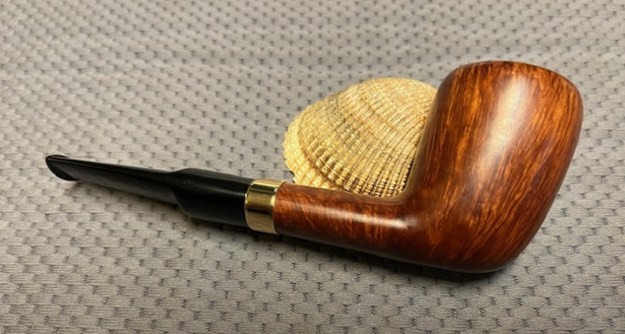
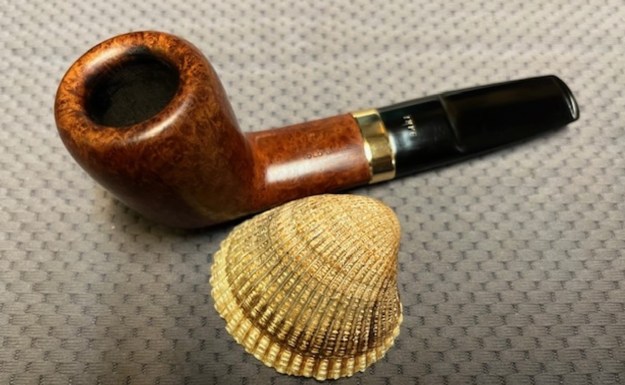
Replacing a Broken Tenon on a Bari Select Nature Old Briar 924 Oval Shank Acorn


by Steve Laug

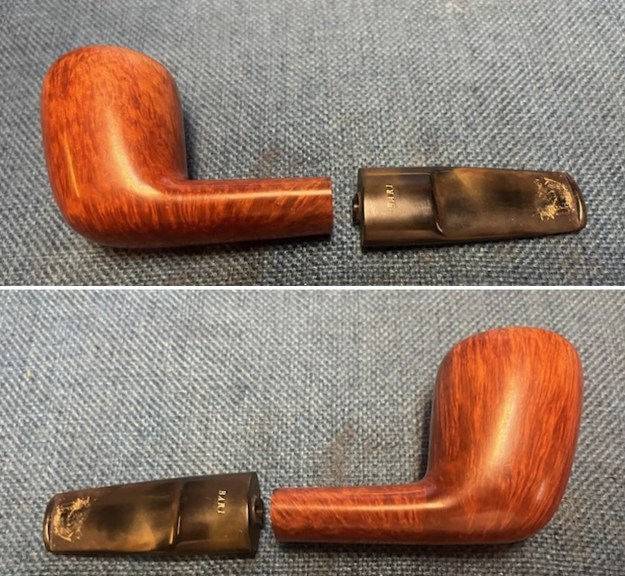
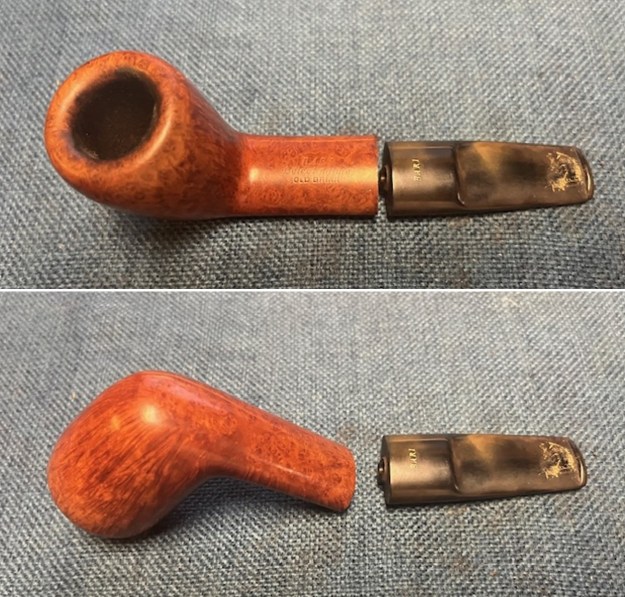
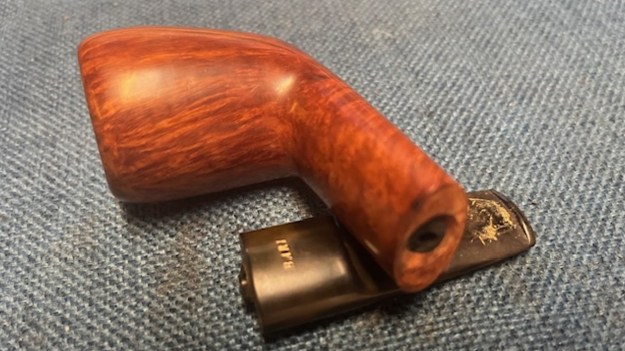
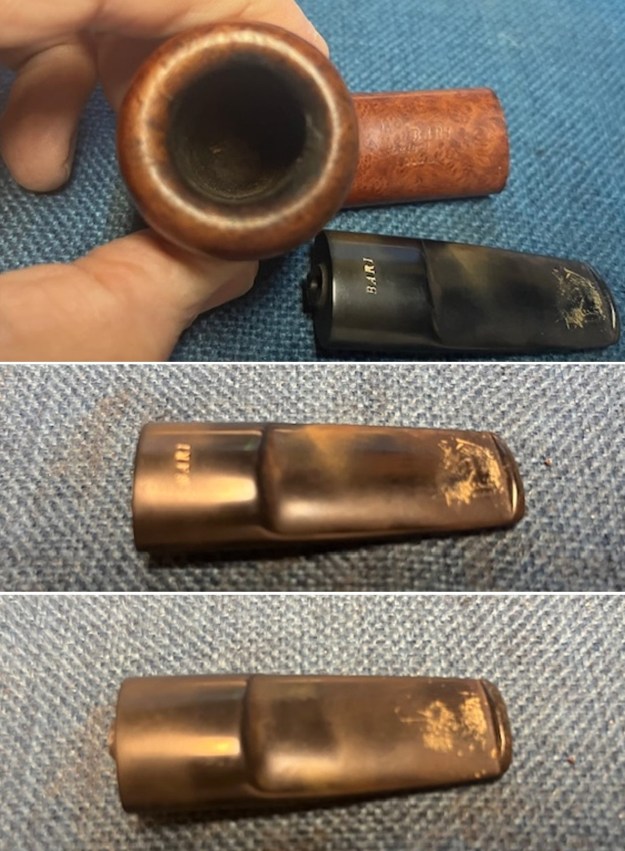
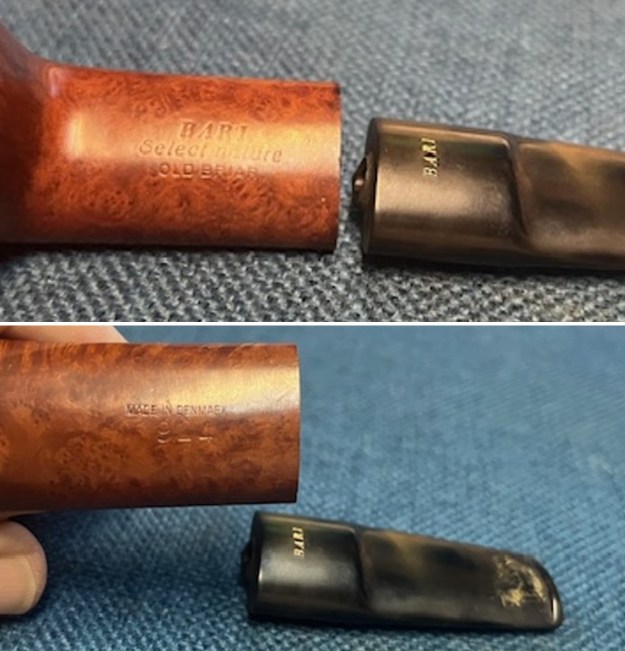
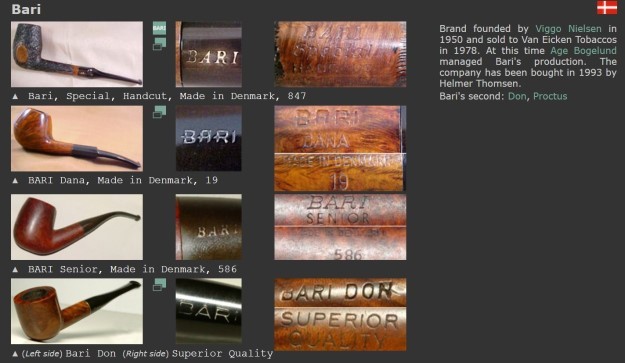
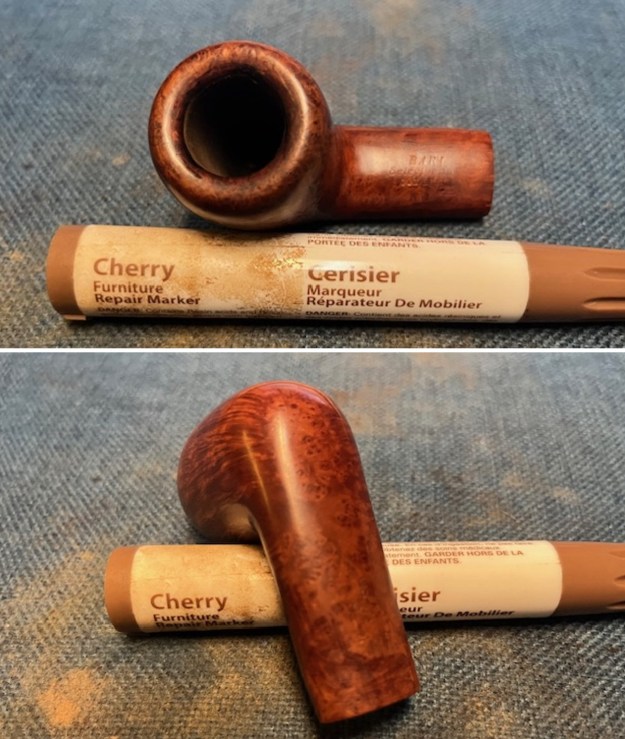
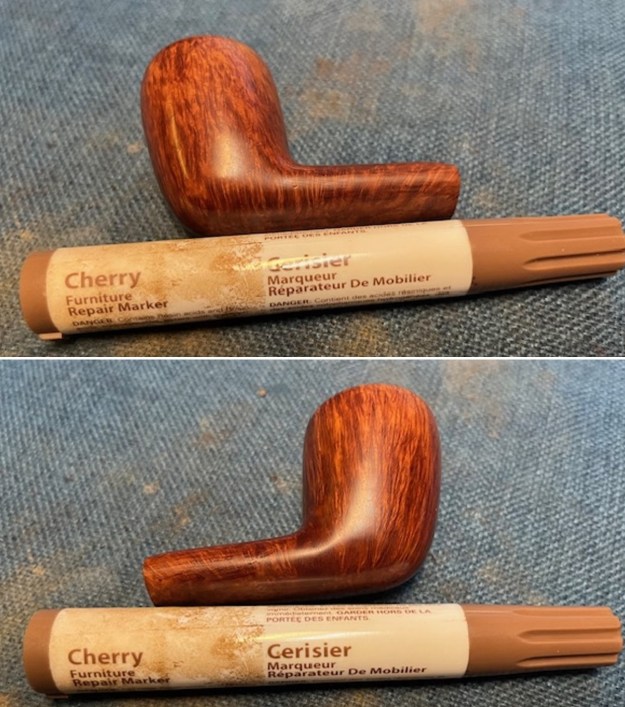
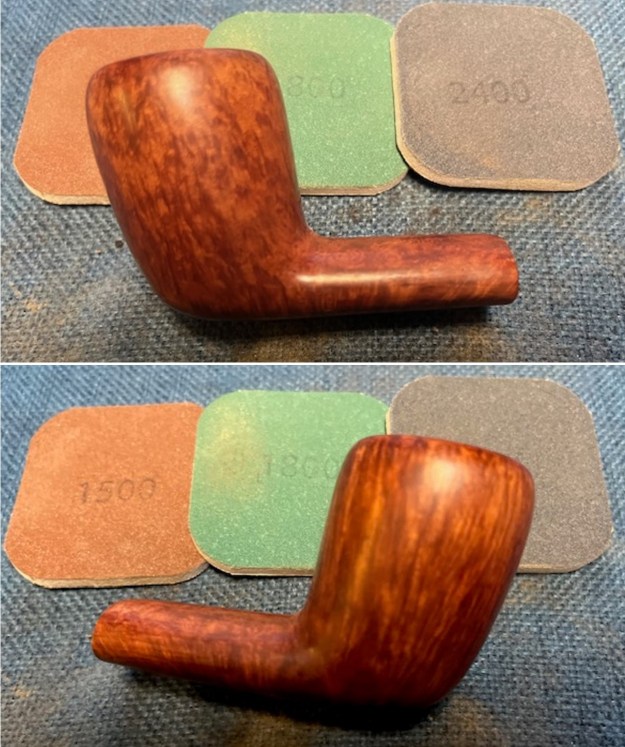
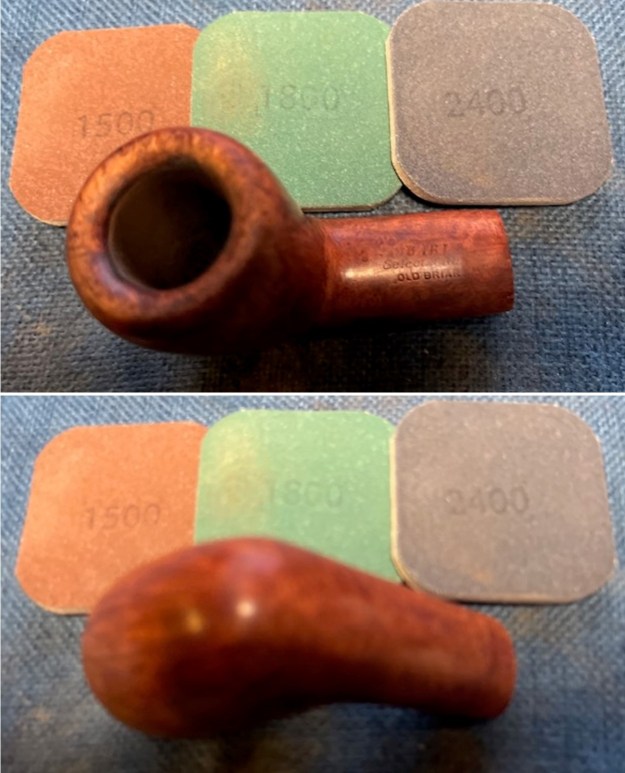
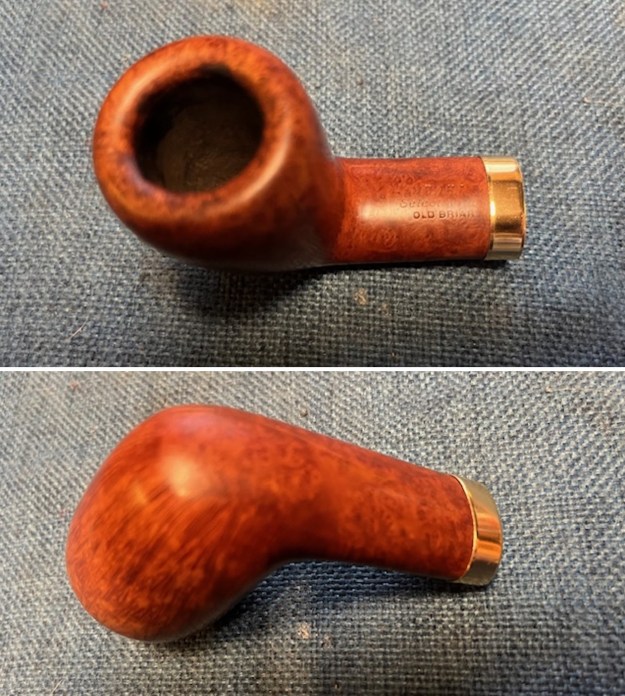
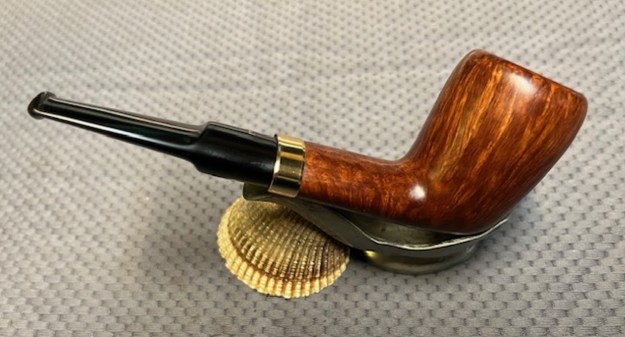
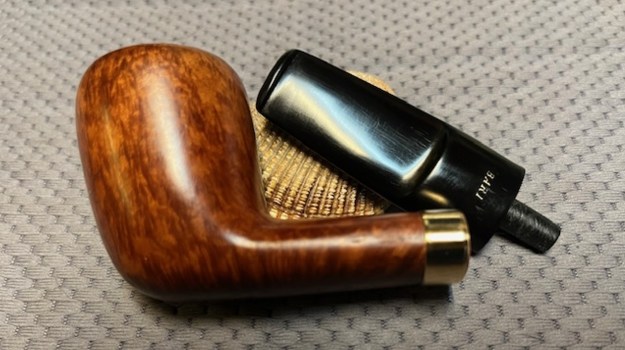
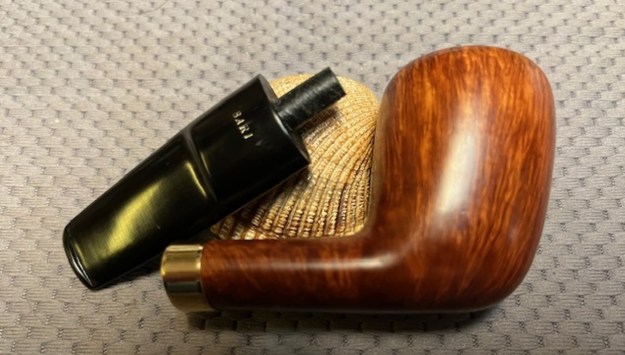
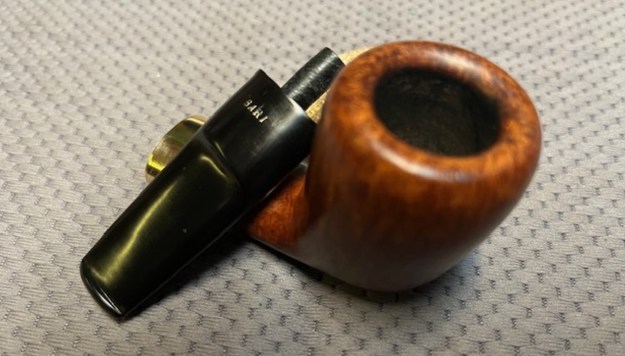
The next pipe on the work table is a beautifully grained Bari Oval Shank Acorn. It is stamped on the topside it reads Bari [over] Select Nature [over] Old Briar. On the underside it reads Made in Denmark [over] the shape number 924. It came from a box of pipes with broken tenons that I set aside to work on someday. Today is that day I guess! It is very nicely shaped Danish style acorn shaped bowl with a vulcanite saddle stem. I have worked on the shape previously and really like the look of it. The bowl has a thin cake and some lava overflow on the back of the crowned rim top and bevelled inner edge. It appeared to be in excellent condition under the grime. Only cleaning would make that very clear. The vulcanite saddle stem had a Bari logo stamp on the topside of the saddle. It is dirty, oxidized, calcified and has tooth chatter and tooth marks on both sides ahead of the button. The tenon had snapped off cleanly in the shank. I took photos of the pipe before I started working on it. I took a photo of the shank end to show the snapped off tenon in the shank. The break is quite clean so it should clean up very well.I took photos of the bowl and rim top to show the cake in the bowl and the condition of both. It was clean bowl that had been reamed. There was a spot of lava overflow on the back inner edge and rim top. The inner and outer edges otherwise look very good. I took photos of the top and underside of the stem showing the calcification, oxidation and tooth marks on the stem surface and button.I took photos to capture the stamping on the sides of the shank. It is clear and readable as noted above. I also took a photo of the Bari stamp on the topside of the stem.I turned to Pipephil’s site (http://www.pipephil.eu/logos/en/logo-b1.html) to see if I could find a listing for the Bari Select Nature Old Briar with this three digit number. There was nothing specifically listed for this line of Bari pipes. There was also good info on the brand as a whole and that it was founded by Viggo Nielsen in 1950 and he ran it until 1978 when Age Bogelund managed the production for them. In 1993 it was sold to Helmer Thomsen. I have included a screen capture of the section below.Pipedia gives a great history of the brand (https://pipedia.org/wiki/Bari) that is well worth reading. There were also photos of the Bari stamping on the Select Nature Old Briar line of pipes.
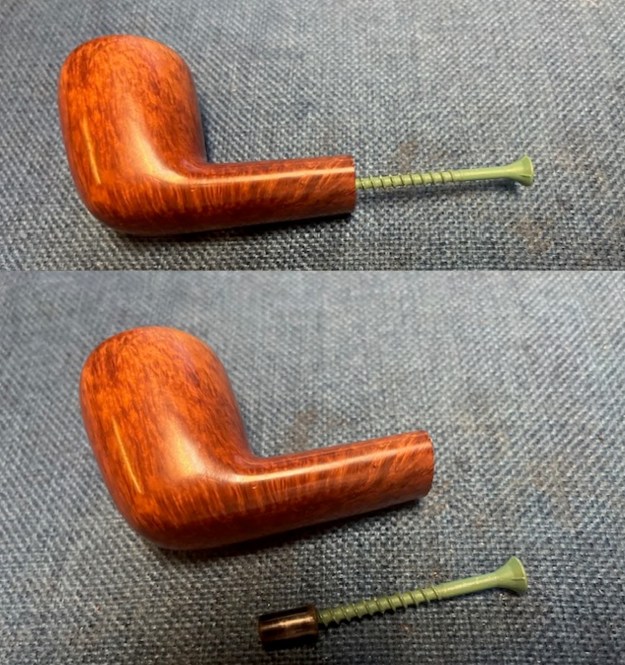
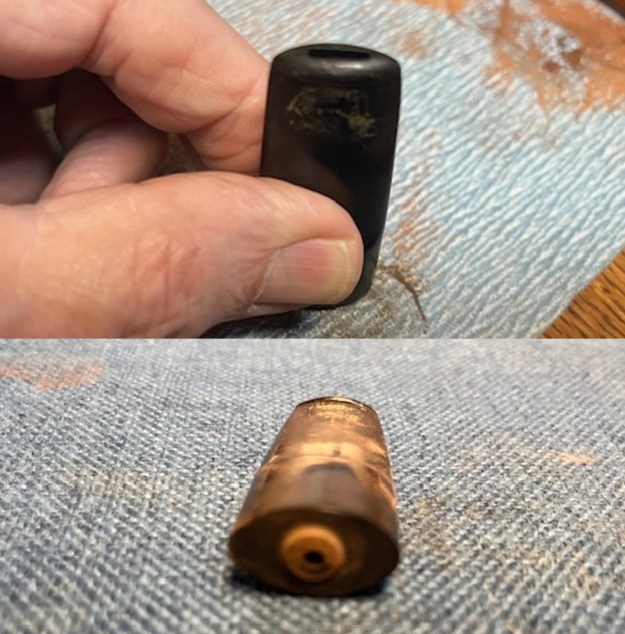
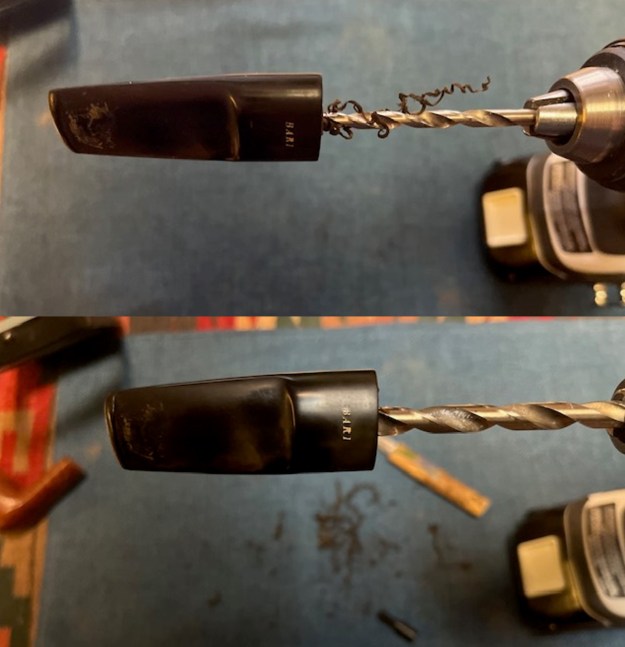
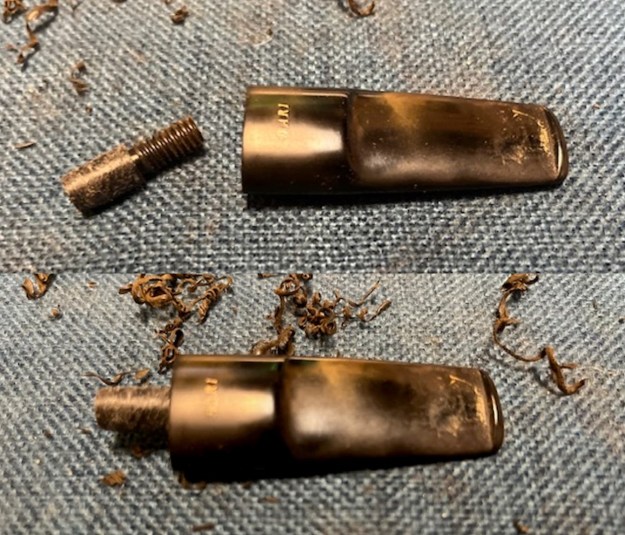
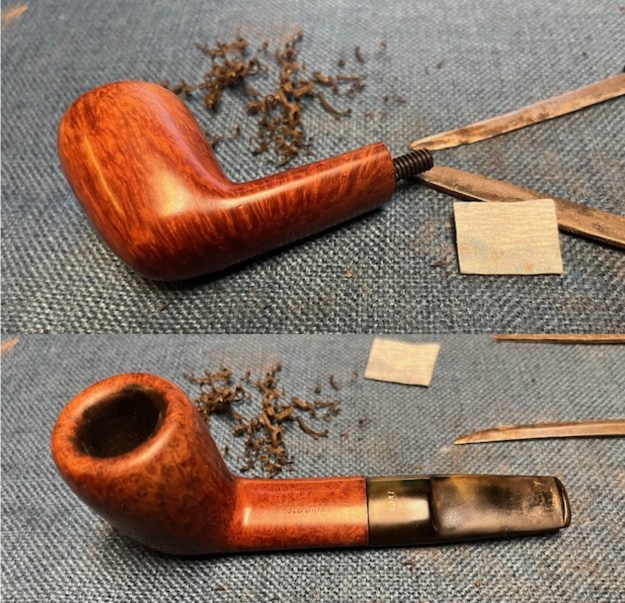
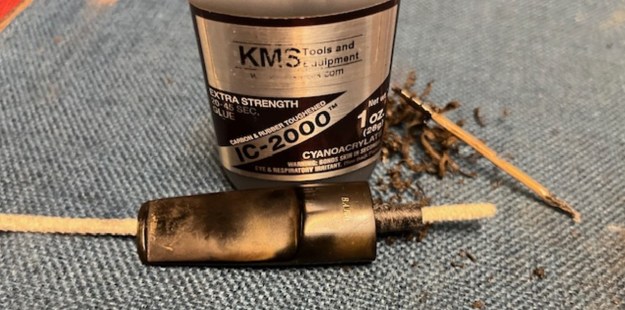
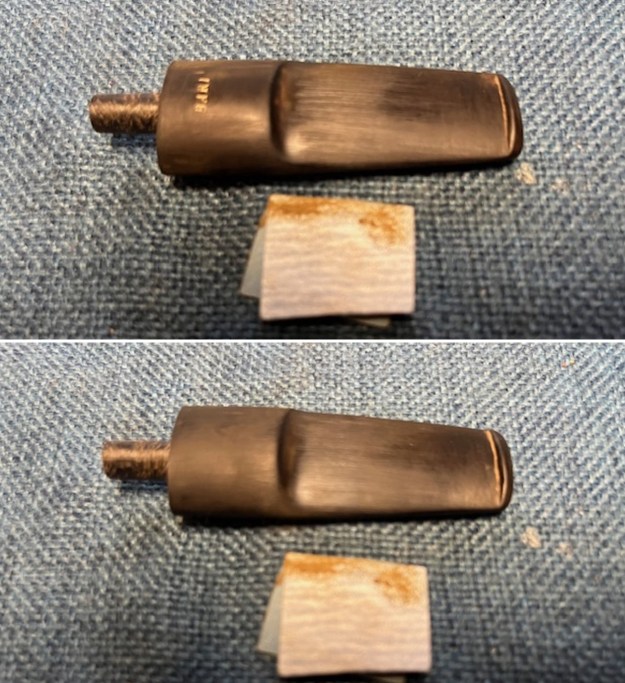
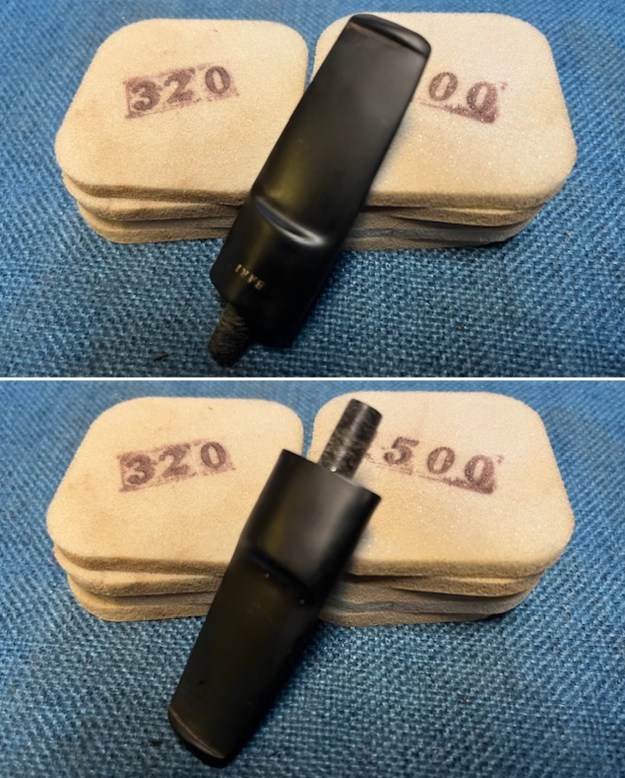
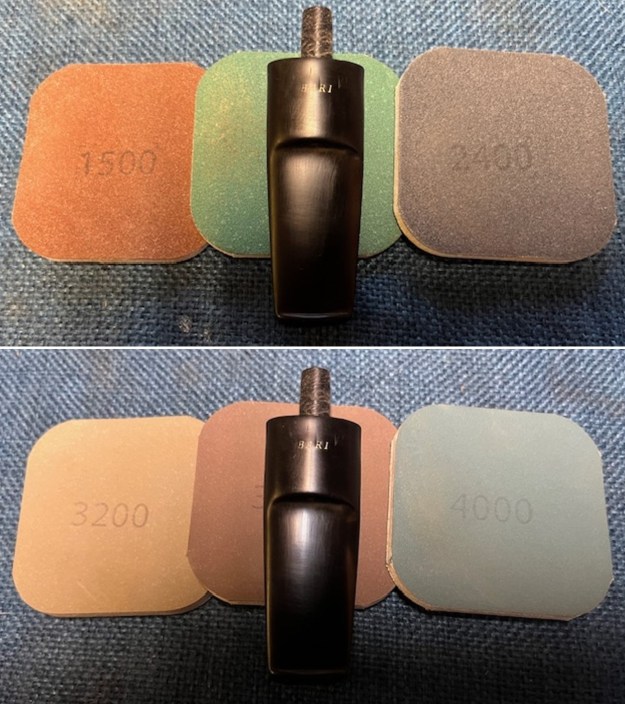
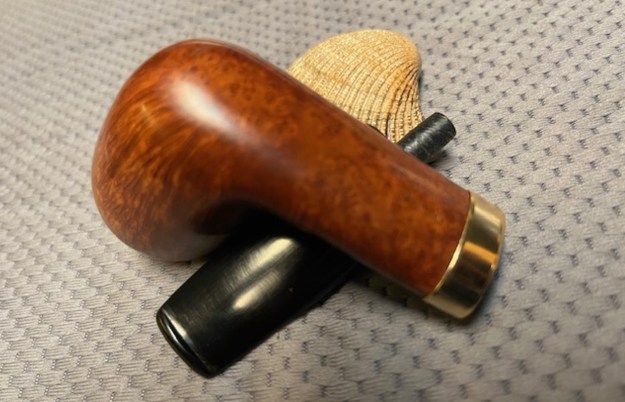
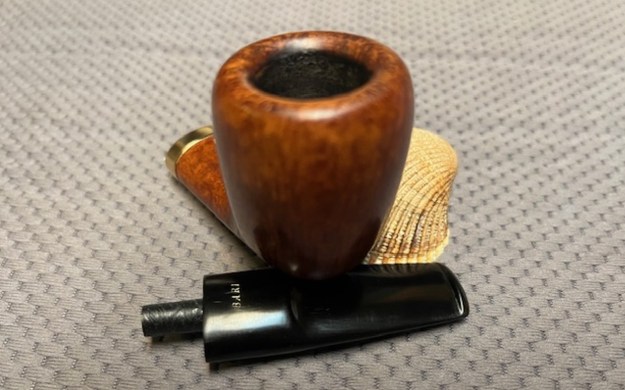
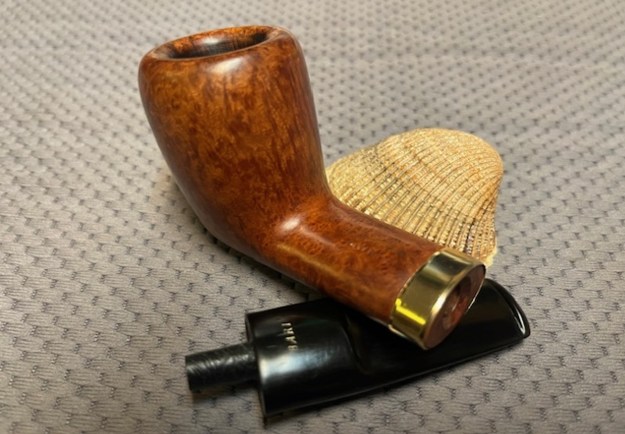
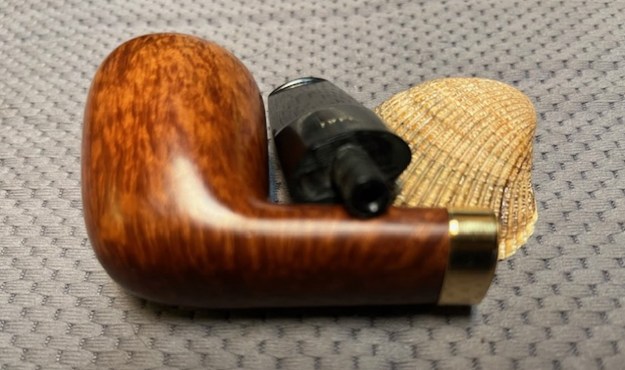
Given the information and background on the pipe I started my work on the pipe. I decided to start by pulling the broken tenon and beginning the process of the replacement. I used a drywall screw to pull the tenon. I screwed it into the airway and wiggled the broken piece out of the shank. The second photo of the bowl below shows the pulled tenon.In preparation for fitting a new tenon I flattened out the broken edges on the snapped tenon using a topping board and 220 grit sandpaper.I drilled the airway in the stem with increasingly larger drill bits until I had the bit that was the same size as the threaded portion of the new tenon.I fit the tenon in the stem to make sure the fit and alignment was correct and repeated the process in the mortise. I fit the stem on the tenon in the mortise to check the alignment. With the fit as good as it was going to get on this one I slid a pipe cleaner in the stem and tenon and painted the threads with black CA glue. I pressed it into place in the stem and set it aside to cure.I needed to adjust the fit of the stem to the shank. The alignment as slightly off on the top and the bottom of the stem and shank. I used a piece of 220 grit sandpaper to make the adjustments to the stem and the briar shank. I was careful to not damage either the stamping on the shank of the stamping on the stem. I continued smoothing out the sanded portions of the shanks and stem with 320-3500 grit sanding pads. I wiped it down with an Obsidian Oil impregnated cloth after each sanding pad. Since the bowl walls were clean or cake I did not need to ream the bowl. I sanded the bowl with 220 grit sandpaper on a piece of dowel to clean up the walls of the bowl. It had been reamed but needed to be sanded smooth. It was in great condition. I sanded the bevelled inner edge of the rim with a folded piece of 220 grit sandpaper.I stained the sanded areas on the shank and on the rim top with a Cherry stain pen. It blended in very well with the rest of the briar. It is a beauty. I polished the briar with micromesh sanding pads – dry sanding with 1500-12000 grit pads. I wiped the bowl down after each pad with a damp cloth to remove the sanding dust. I worked some Before & After Restoration Balm into the finish of the bowl, rim top and shank with my fingertips to clean, enliven and protect it. I find that the balm really makes the briar come alive again. The contrasts in the layers of stain really made the grain stand out. I let the balm sit for 15 minutes and then buffed with a cotton cloth to raise the shine. The bowl really looks good at this point. I had a gold band that was the perfect size for the shank. I had a hunch that it might give the shank a bit of bling that would look good. I pressed it in place on the shank. To get a sense of the new look. I really liked the way it looked so I set it in place. I set aside the bowl and turned my attention to the stem. I sanded the stem surface with 220 sandpaper to remove the scratching and reshaping marks on the stem. It was looking much better at this point but still had a long way to go.I sanded the stem with 320-3500 grit sanding pads and wiped the stem down after each pad with an Obsidian Oil saturated cloth to remove the grime and protect the stem.The BARI stamping on the stem had some scoring marks between some of the letters that I could not polish out without damaging the stamping so I left them. I polished the stem with micromesh sanding pads – wet sanding it with 1500-12000 grit pads. I polished it further with Before & After Pipe Stem Polish – both fine and extra fine. Once again, I am the part of the restoration that I always look forward to – the moment when all the pieces are put back together. I put the pipe back together and buffed the bowl and the stem with Blue Diamond on the buffing wheel. I gave the bowl and the stem multiple coats of carnauba wax. I buffed the pipe with a clean buffing pad to raise the shine. I hand buffed it with a microfiber cloth to deepen the shine. It is fun to see what the polished bowl looks like with the smooth finish and the black vulcanite stem. This richly stained Bari Select Nature Old Briar 924 Acorn is light weight and ready for you to load up a tobacco of preference and enjoy breaking it in. Have a look at it in the photos below. The dimensions are Length: 5 inches, Height: 2 inches, Outside diameter of the bowl: 1 ¼ inches, Chamber diameter: ¾ of an inch. The weight of the pipe is 44 grams/1.52 ounces. This is one that will go on the Danish Pipemakers Section of the rebornpipes online store shortly. Let me know if you are interested in adding it to your rack. Thanks to each of you who are reading this blog. Remember we are not pipe owners; we are pipemen and women who hold our pipes in trust until they pass on into the trust of the next generation.

A Strangely Stamped Tall, Thin Stack – Dan Shape Reformed Pipe Dan Wonderful 52 259


by Steve Laug

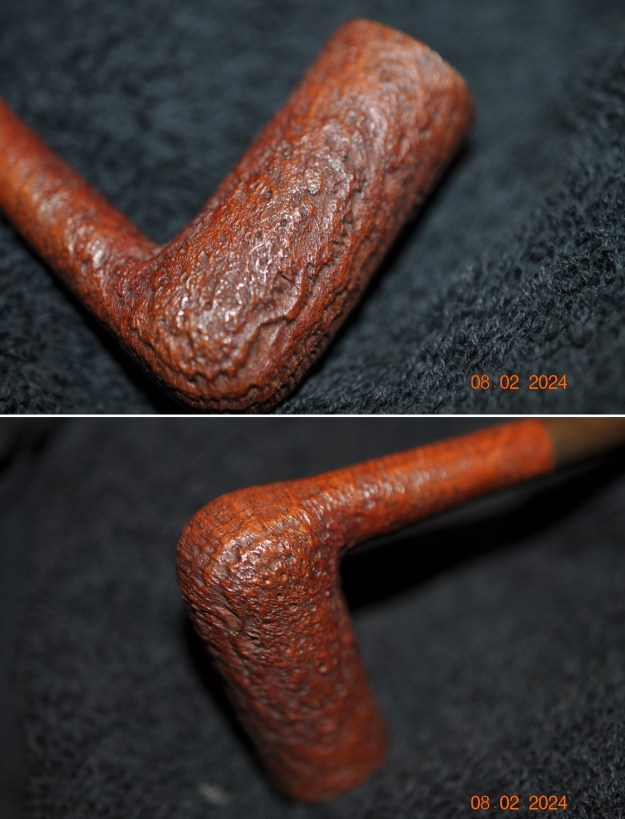
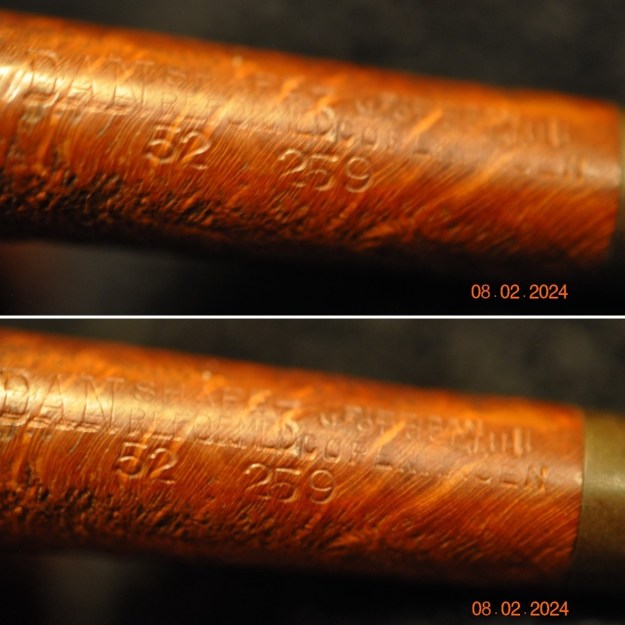
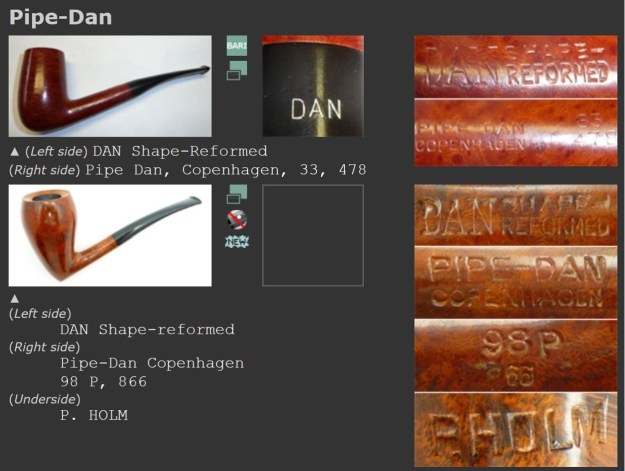
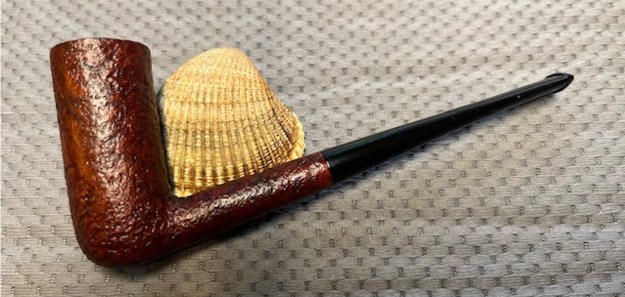
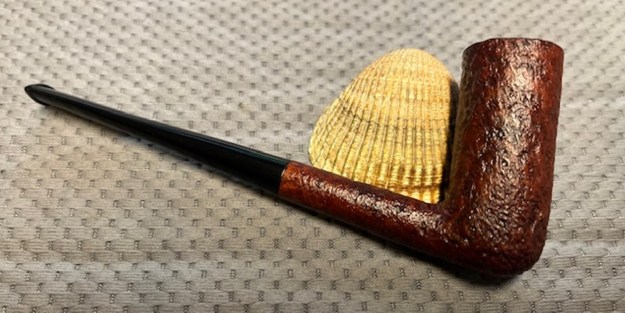
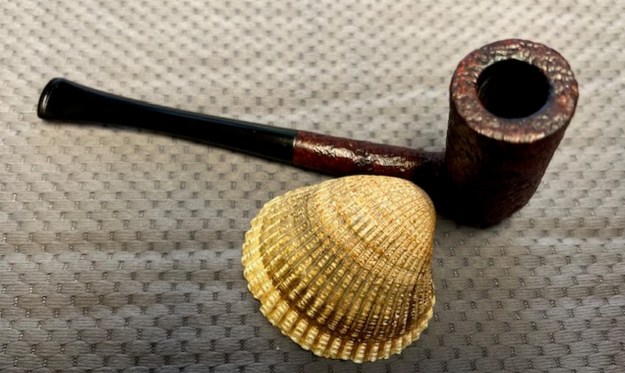
The next pipe on the worktable is an interestingly shaped pipe made by Pipe-Dan. It is a backward canted stack, tall and thin shank with a taper vulcanite stem. The finish is a nice looking sandblast. The bowl sides show birdseye in the blast and the front and back of the bowl show cross grain. It gives the pipe a very unique finish. The rim top of the bowl is also sandblasted. The pipe is stained with a medium brown. It truly is a beautiful finish. The pipe is stamped on the underside of the shank and reads DAN followed by Shape- [over] Reformed [over] 52  259. That is followed by Pibe Dan [over] WONDERFUL [over] Copenhagen. The finish was very dirty and worn looking with a lot of grime and oils ground into the valleys and crevices of the blast. There was a thick cake in the bowl overflowing in lava filling in the rim top. The tapered vulcanite stem is heavily oxidized and had calcification with light tooth chatter on both sides near the button. Jeff took some photos of the pipe before he started his cleanup work. He took photos of the bowl and rim top to show their general condition. You can see the thick cake in the bowl. The cake and lava are so thick that it is not clear what the inner edge of the bowl looks like at this point. The lava also fills in the grooves and crevices in the finish of the rim top making it almost smooth. The vulcanite stem is heavily oxidized and calcified. There are also light tooth marks and chatter on the stem on both sides. The button appears to be in good condition. The photos below show the condition of the stem. Jeff took some photos of the sides and heel of the bowl to give an idea of the sandblast finish giving the tall bowl a very tactile finish. You can also see the debris in sandblast around the bowl and rim. I cannot wait to see what it looks like once it is cleaned and polished. He took several photos of the stamping on the underside of the shank to capture it for me. It is clear and readable. It runs on the underside of the shank as noted above. It is clear and readable.Before I started working on my part of the restoration I decided to do some research on the brand to see what I could learn. I turned first to PipePhil’s site to get a quick overview of the brand (http://www.pipephil.eu/logos/en/logo-p3.html). There found the following information. I am also including a screen capture of the pertinent section from the site and the text in the sidebar.

Brand created in 1943. The shop (Danish name: Pibe-Dan) which closed in 1991 was run by H. Dan Christensen. He sometimes designed pipes but he is merely renowned for having helped young artisans like Tom Eltang, Preben Holm, Jes Phillip Vigen, Hans Hartmann

Pipe-Dan let the pipe maker stamp his own name on a pipe along with the shop’s name.
The line name “Shape-Reformed” means that a traditional shape had been redesigned.
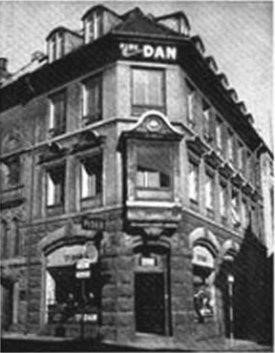
I turned then to Pipedia to get more history and background to the brand and potentially more information on the pipe (https://pipedia.org/wiki/Pibe-Dan). I quote the article in full as well I have included a photo from the site showing the storefront.

The House of Pibe-Dan was founded in Copenhagen in May, 1943, and was named for H. Dan-Christensen, nicknamed Pibe-Dan. Pibe-Dan (Pipe-Dan) unfortunately closed in 1991, but during the 48 years it was in business it was the ultimate place to find pipes by Danish masters.

Pibe-Dan would often let the pipemaker stamp his own name along with the company name… Pibe-Dan published its first catalog in the late 1950’s and, as was the case with W.O. Larsen, published it in English given their international customer base. While they sold pipes by Stanwell, Kriswill, Brakner and others, the classic pipe sold from Pibe-Dan was the Dan Shape-Reformed Pipe, which had a very tall vertical bowl, and were hand made of Corsican briar. Pibe-Dan claimed that the design was longer, drier, cooler and more even smoking. The Shape-Reformed was available in various lines including the Danois, Standard, Champion, Half Chimney and others.

At the same time, Pibe-Dan had a long history of also including pipes by Danish artisans in their catalog. Sixten Ivarsson’s Peewit, Oliphant, Ukulele and other shapes first appeared in Pibe-Dan’s catalog, and other artists who either began with or sold through Pibe-Dan include, among many others, Hans Hartmann, Gert Holbek, Sven Knudsen, Tom Eltang, Arne Nygaard, P. Holtorp, Poul Hansen, and Ph. Vigen, among others. The legendary Preben Holm sold pipes to the Pibe-Dan shop before his sixteenth birthday in 1963, and soon after was selling twenty to thirty pipes a week to the company, with Pibe-Dan setting the prices. This relationship continued until 1968.

From that information I learned that the line name “Shape-Reformed” means that a traditional shape had been redesigned. This shape was the classic pipe sold by the company. They described the pipe as having a very tall vertical bowl and hand made from Corsica briar. They claimed that the design was longer, drier, cooler and more even smoking. The Shape-Reformed was available in various lines.

Now I had a pretty good idea of how the pipe was stamped and made. With that information I moved forward to work on the pipe itself and see what I had to do with it. When I received it, Jeff had once again done an amazing job cleaning the pipe. The bowl was very small – about ½ inch in diameter so he reamed it with a Savinelli Fitsall Pipe Knife so that we could see the walls of the bowl and assess for damage. He cleaned the internals of the shank and stem with alcohol, pipe cleaners, cotton swabs, shank brushes and alcohol. He scrubbed the exterior with undiluted Murphy’s Oil Soap and a tooth brush. He rinsed the pipe under warm water. He dried it off with a cloth and then let it air dry. The stem was scrubbed with Soft Scrub and soaked in Before & After Deoxidizer. It came out looking very good. The finish on the bowl and the rim top cleaned up nicely. I took pictures of the pipe to show how it looked when I unpacked it. The bowl looked good in light of where it started. The stem looked much better with just a few tooth marks on each side of the stem just ahead of the button. He had done his normal thorough clean up – reaming, scrubbing, soaking and the result was evident in the pipe when I unpacked it. I took photos of the pipe before I started my work on it. The shape and finish on this pipe is very unique.I removed the stem from the shank and took a photo of the pipe at this point. You can clearly see the condition, size and shape of the pipe. I started my work on the pipe by working over the rim top sandblast with a brass bristle wire brush to knock off the debris in the grooves of the sandblast. It looks better.I worked some Before & After Restoration Balm into the surface of the briar with my fingertips. The product works to clean, enliven and protect the briar. I let the balm sit for about ten minutes and then buffed with a cotton cloth to raise the shine. The photos show the bowl at this point in the restoration process. I polished the stem with micromesh sanding pads – dry sanding with 1500-12000 grit sanding pads. I wiped it down after each sanding pad with a cloth containing some Obsidian Oil. I finished polishing it with Before & After Pipe Stem Polish – both Fine and Extra Fine and buffed it off with a cotton cloth. I wiped the stem down with a coat of Obsidian Oil to protect the vulcanite and slow down oxidation. Putting this unique pipe back together was rewarding. The change in condition and appearance is what I look forward to with every pipe. I put the stem back on the bowl and buffed the Dan Shape-Reformed Wonderful 52 259 Canted Stack lightly with Blue Diamond on the buffing wheel. I carefully avoided the stamping on the shank during the process. I gave the bowl multiple coats of Conservator’s Wax and the stem multiple coats of carnauba wax on the buffing wheel and followed that by buffing it with a clean buffing pad on the buffer. I hand buffed the pipe with a microfiber cloth to deepen the shine. The finished pipe is quite beautiful and is a uniquely shaped Danish made Dan Pibe Shape-Reformed Stack. The finish on the bowl combines various methods and stains to give it a living and tactile nature. It is very well done. Give the finished pipe a look in the photos below. I can only tell you that it is much prettier in person than the photos capture. The dimensions of the pipe are Length: 5 ½ inches, Height: 2 inches, Outside diameter of the bowl: 7/8 of an inch, Chamber diameter: ½ of an inch. The weight of the pipe is 22 grams/.81 ounces. Thanks for walking through the restoration with me as I worked over another beautiful pipe. I will be adding it to the rebornpipes store in the Danish Pipe Makers section soon. If you want to add it to your collection send me an email or a message! Thanks for your time.
A Beautiful Bari Matador Handmade in Denmark Freehand


by Steve Laug

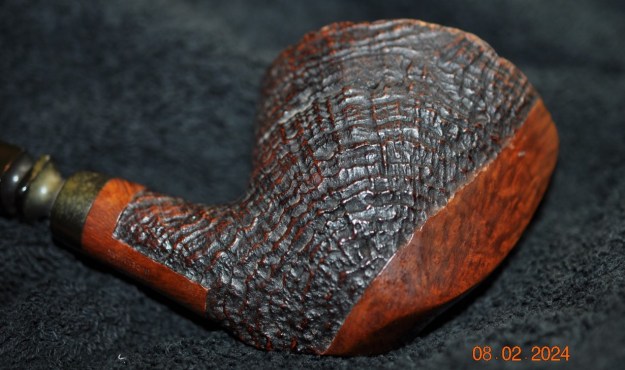
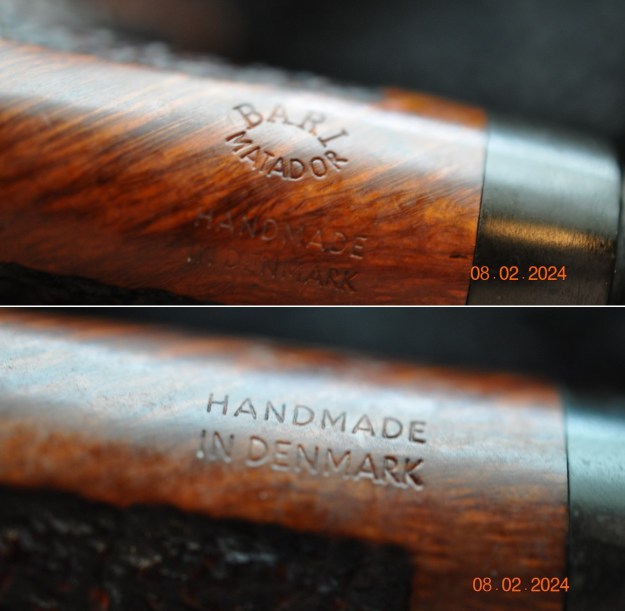
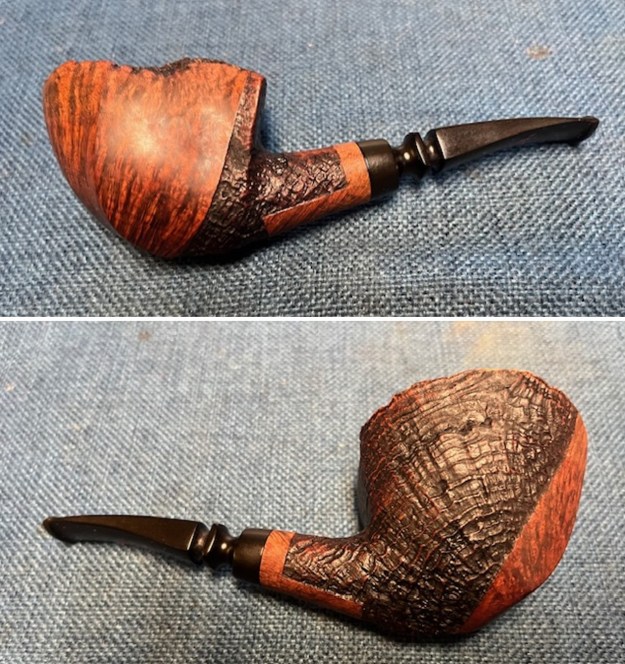
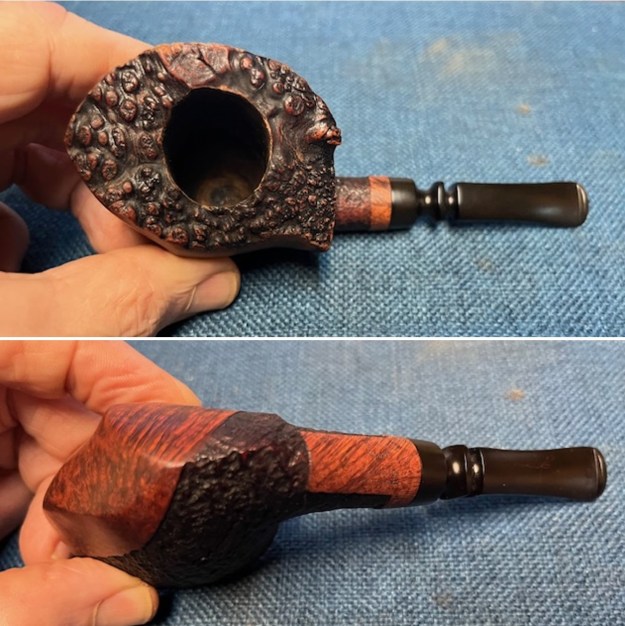
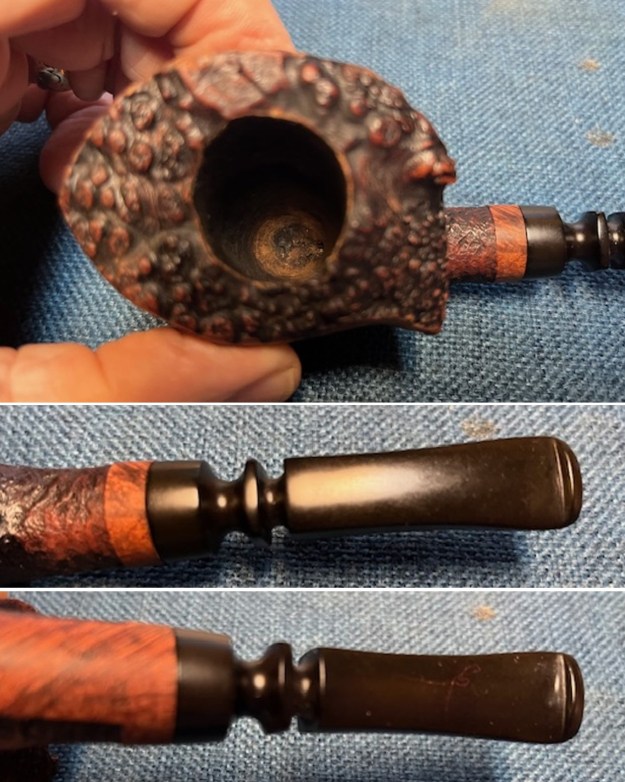
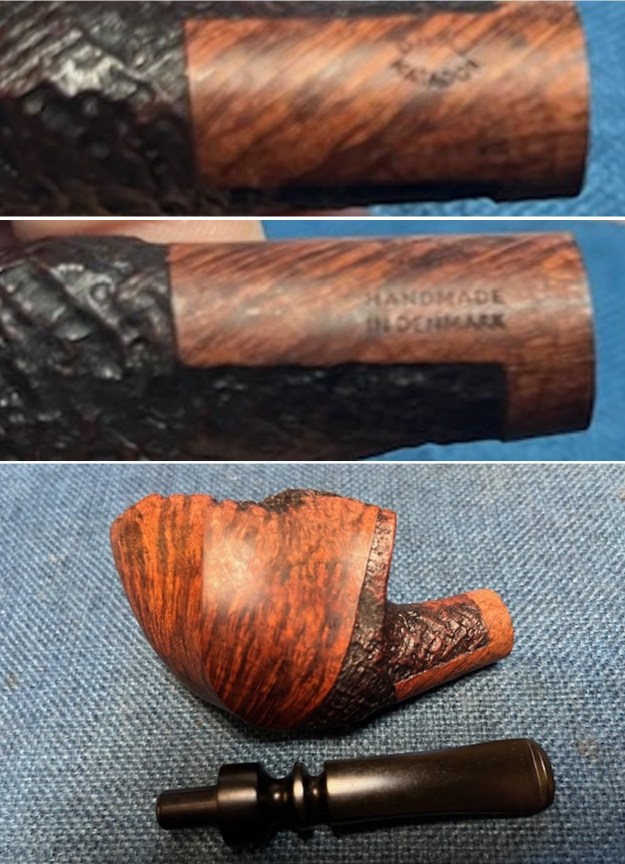
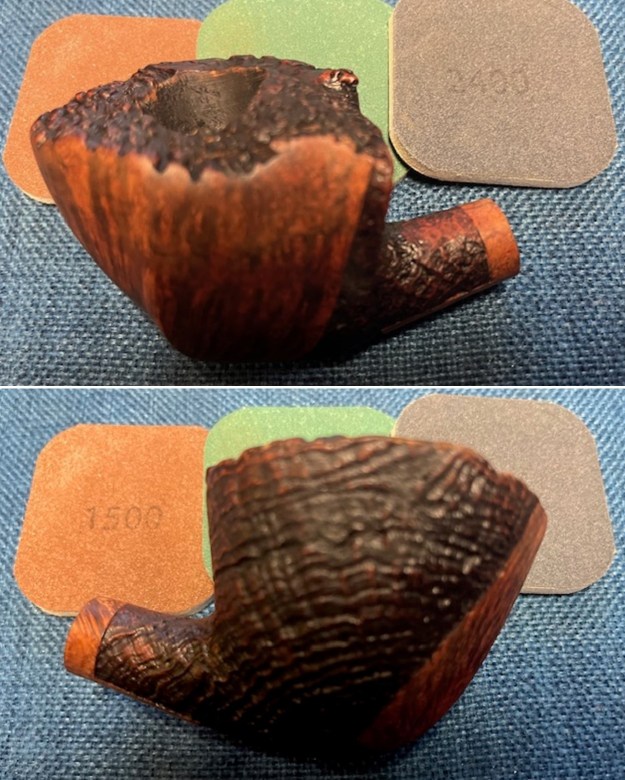
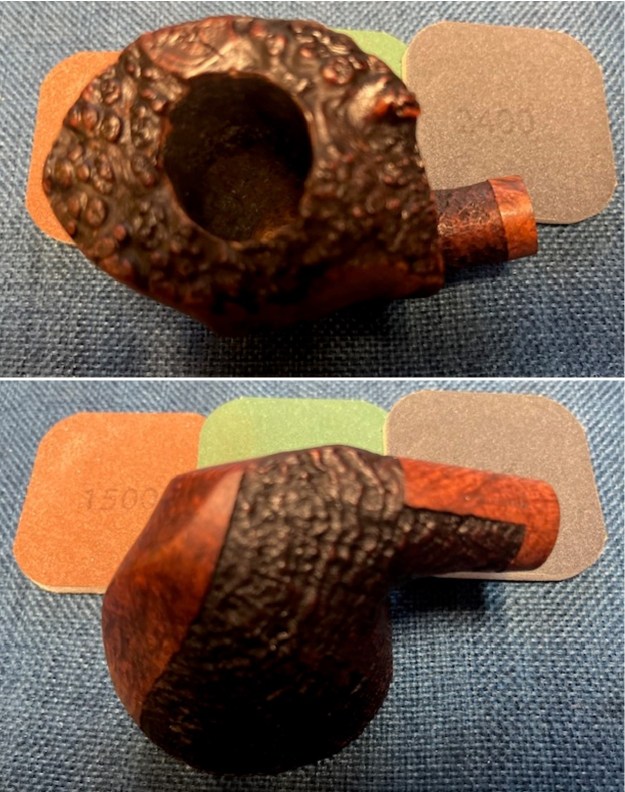
The next pipe on the work table is a pipe that came to us from Eric in Brazil, Indiana, USA on 10/28/2021. It is stamped on the underside of the shank and read Bari [arched over] Matador. Underneath it read Handmade [over] In Denmark. The finish on the pipe was a classic Matador style finish combining smooth and sandblast. The left side and front of the bowl is smooth and the right side and back of the bowl are sandblast. The shank is sandblasted with a smooth band on the underside of the shank and as a ring around the shank end. The plateau rim top was dirty with grime and also lava overflowing from the thick cake in the bowl. It was an intriguing pipe with a combination of sandblast and smooth finishes. The left side of the bowl is sandblasted and the rest of the bowl is smooth. The rim top of the bowl is a plateau finish. The fancy saddle stem was vulcanite and had tooth marks and chatter on both sides near the button. It was oxidized and had some calcification on the end. Jeff took some photos of the pipe to show the general condition of the pipe before he started his clean up. Jeff took some close-up photos of the rim top and bowl to show the overall condition. There is dust and lava in the grooves of the plateau. The edges have a lava overflow but appear to be in good condition. The fancy turned vulcanite stem is dirty and has calcification on both sides at the button. There is also some tooth chatter and some tooth marks. Past the turning the stem is a tapered panel. Jeff took some photos of the sides and heel of the bowl to show the condition of the finish on the pipe. The photos show the beautiful grain around the bowl. Under the dust and grime it was a nice looking bowl. I think it will be a beautiful Freehand pipe once it is restored. He took a photo of the stamping on the underside of the shank. The stamping is clear and readable as noted above.I remembered that Paresh has restored a similar Bari Matador and written about it on a blog. It is an informative piece so I have included the link to it here (https://rebornpipes.com/2019/05/15/a-simple-refurbishing-of-a-bari-matador/).

I also have worked on quite a few Bari’s in the past and did the work on the brand information so rather than rework all of that I am including the information I found while working on a Bari De Luxe Freehand. I quoted a section from Pipedia on Bari pipes (https://pipedia.org/wiki/Bari). I am including the material that I found previously on the brand. It is good to be reminded of the fact that Viggo Nielsen was the pipe maker. I quote:

Pipedia states that Bari Piber was founded by Viggo Nielsen in Kolding, Denmark around the turn of 1950/51. His sons Kai and Jørgen both grew into their father’s business from a very young age and worked there till 1975. Both have become successful pipe makers.

Bari successfully adapted the new Danish design that had been started mainly by Stanwell for its own models. Bari was sold in 1978 to Van Eicken Tobaccos in Hamburg, Germany though the pipes were still made in Denmark. From 1978 to 1993 Åge Bogelund and Helmer Thomsen headed Bari’s pipe production.

Helmer Thomson bought the company in 1993 re-naming it to “Bari Piber Helmer Thomsen”. The workshop moved to more convenient buildings in Vejen. Bogelund, who created very respectable freehands of his own during the time at Bari got lost somehow after 1993. Bari’s basic conception fundamentally stayed the same for decades: series pipes pre-worked by machines and carefully finished by hand – thus no spectacular highgrades but solid, reliable every day’s companions were what they turned out. The most famous series are the smooth “Classic Diamond” and the blasted “Wiking”.

Now that I was reminded about the Viggo Nielsen connection it was time to work on the pipe on my end. When I received it Jeff had once again done an amazing job cleaning the pipe. He reamed it with a PipNet pipe reamer and got rid of the cake. He cleaned up the reaming with a Savinelli Fitsall Pipe Knife so that we could see the walls of the bowl and assess for damage. He cleaned the internals of the shank and stem with alcohol, pipe cleaners, cotton swabs, shank brushes and alcohol. He scrubbed the exterior with undiluted Murphy’s Oil Soap and a tooth brush. He rinsed the pipe under warm water. He dried it off with a cloth and then let it air dry. The stem was scrubbed with Soft Scrub and soaked in Before & After Deoxidizer. It came out looking very good. The finish on the bowl and the rim top cleaned up nicely. I took pictures of the pipe to show how it looked when I unpacked it. I took a close up photo of the plateau rim top to show how clean it was. The inner edge of the rim and the ridges and valleys of the plateau looked good. The stem looked good just some light tooth chatter and tooth marks ahead of the button.One of the things I appreciate about Jeff’s cleanup is that he works to protect and preserve the nomenclature on the shank of the pipes that he works on. He was able to preserve and maintain its condition in the process. I took some photos to show the clarity of the stamping. I have noticed that many restorers are not careful to protect the stamping in their cleaning process and often by the end of the restoration the nomenclature is almost destroyed. Be careful in your work to preserve this critical part of restoration! I took the stem off and took a photo of the pipe.The pipe was in decent condition so I started with the bowl. I polished the smooth portions of the briar with micromesh sanding pads – wet sanding with 1500-12000 grit pads and wiping down the briar after each sanding pad with a damp cloth. The briar began to shine. I worked some Before & After Restoration Balm into the smooth briar with my fingertips and the plateau and sandblasted side with a horsehair shoe brush. It enlivens, enriches and protects the briar while giving it a deep glow. I appreciate Mark Hoover’s work in developing this product. I buffed the pipe with a micro fiber cloth to raise the shine and took photos of it at this point it the process. It is a beautiful looking pipe. I set the bowl aside and turned my attention to the stem. I “painted” the vulcanite surface with the flame of a lighter – constantly moving the flame over the tooth marks and was able to lift many of them. I filled in the deeper center tooth marks that remained with black rubberized CA glue. Once it cured I flattened the repairs with needle files. I sanded the stem with 220 grit sandpaper to blend the repairs into the surface. I sanded the stem with the 2 inch square 320-3500 grit sanding pads. I wiped down the stem after each sanding pad with Obsidian Oil. I polished out the scratch marks left behind by the sandpaper. The stem looked very good.I polished the stem with micromesh sanding pads – wet sanding with 1500-12000 grit sanding pads. I wiped it down after each sanding pad with Obsidian Oil. I polished it with Before & After Pipe Stem Polish – both Fine and Extra Fine. I buffed the stem with a soft cloth to raise the shine. I wiped the stem down with Obsidian Oil to preserve and protect the stem surface. I am on the homestretch with this Viggo Nielsen made Bari Matador Freehand. As always, I am excited to finish a pipe that I am working on. I put the pipe back together and buffed it with Blue Diamond on the buffing wheel. I used a gentle touch on the sandblast portion of the bowl. I gave the bowl and the stem multiple coats of carnauba wax. I buffed the pipe with a clean buffing pad and hand buffed it to raise the shine. It is fun to see what the polished bowl looks like along with the polished vulcanite stem. This Bari Matador Freehand is a nice looking pipe. It is quite comfortable in hand and should be so when smoking. It is quite light and well balanced. Have a look at it with the photos below. The dimensions are Length: 6 inches, Height: 2 inches, Outside diameter of the bowl: 2×2 1/2 inches, Chamber diameter: 7/8 of an inch. The weight of the pipe is 2.15 ounces/62 grams. It is another beautiful pipe and one that will be on the rebornpipes store soon. You can find it in the section of Pipes by Danish Pipe Makers. If you are interested in adding it to your collection let me know.

As always, I encourage your questions and comments as you read the blog. Thanks to each of you who are reading this blog. Remember we are not pipe owners; we are pipe men and women who hold our pipes in trust until they pass on into the trust of those who follow us.

Restoring a Peterson’s “Shannon” 80S Bulldog with a Fishtail Stem


by Steve Laug

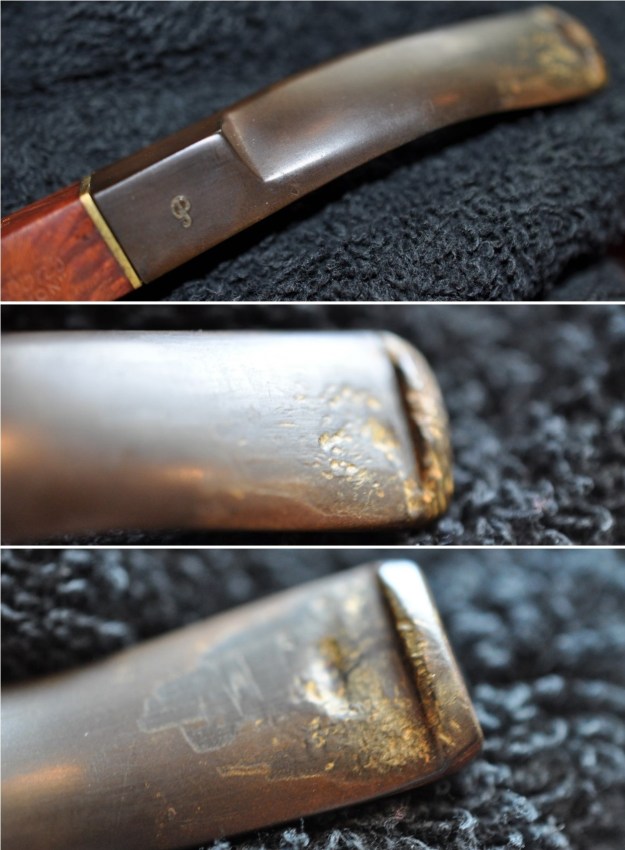
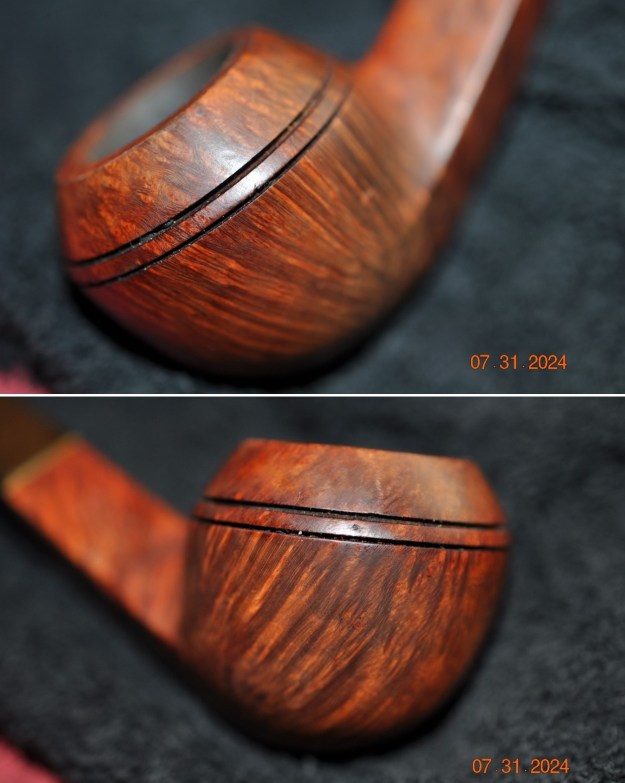
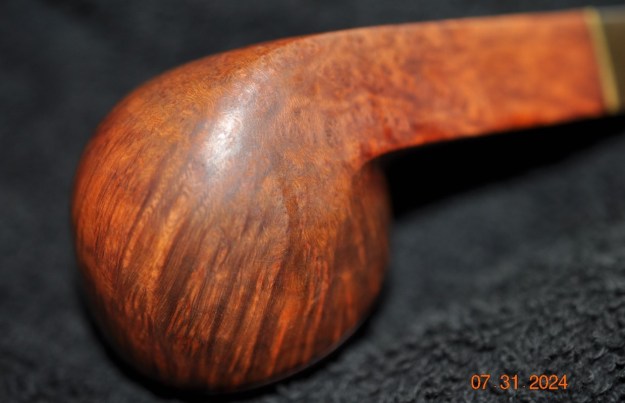
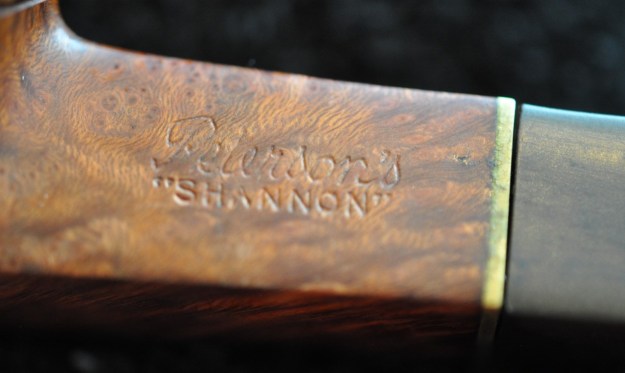
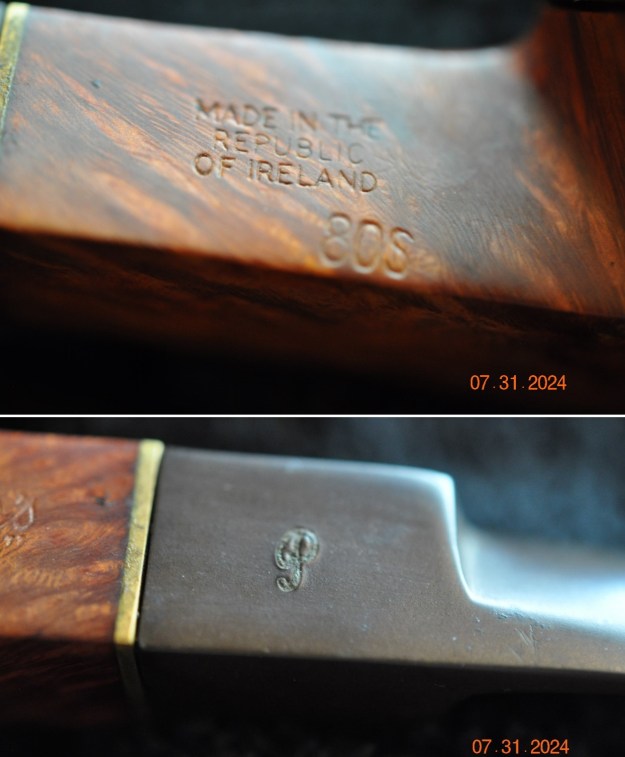
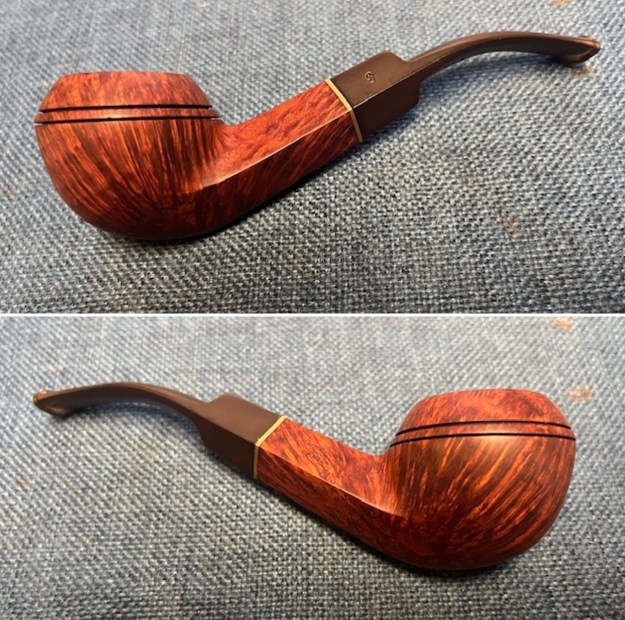
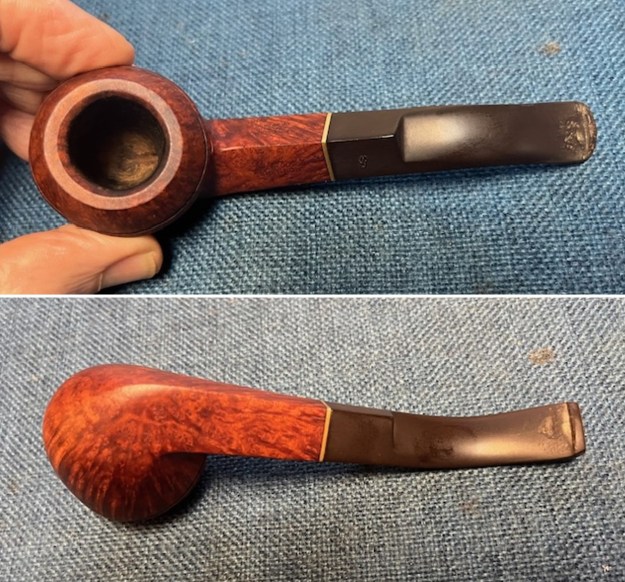
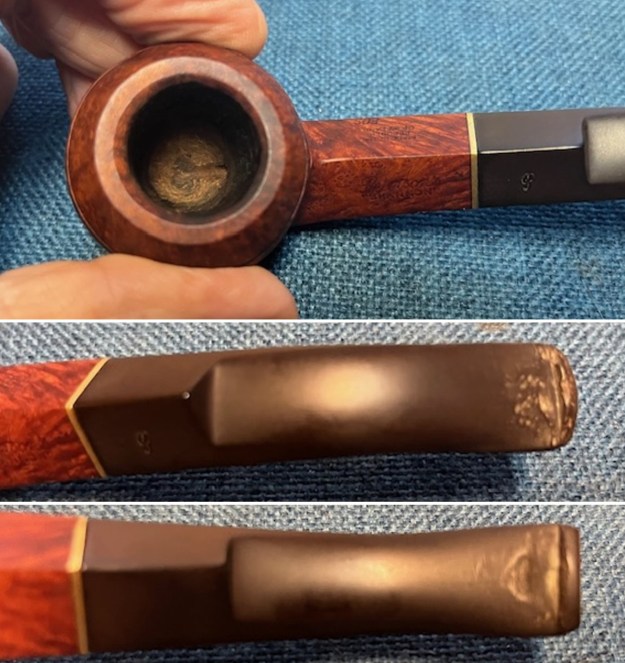
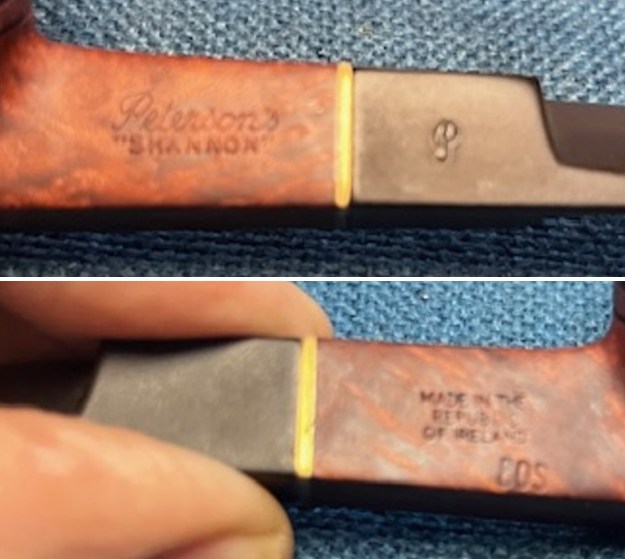
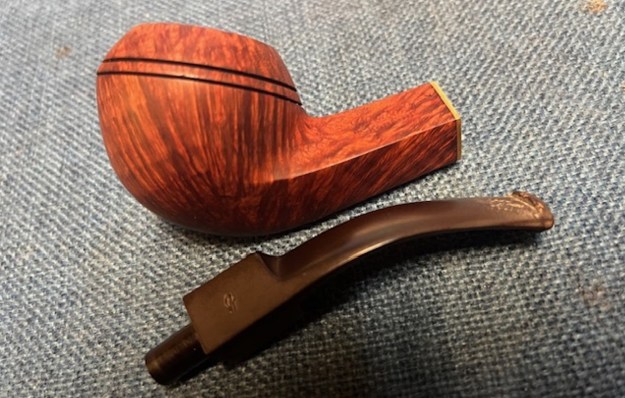
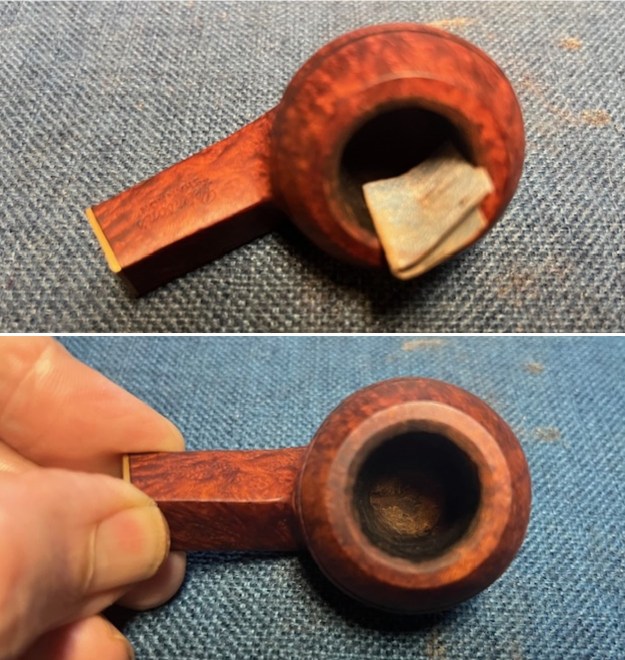
The next pipe on the work table is Peterson’s Bent Bulldog pipe that we purchased from and our connection in Denmark on 04/11/2024. It was stamped Peterson’s [over] “Shannon” on the left side of the shank. On the right it is stamped with Made in the Republic of Ireland (in three lines) over the shape number 80S. It is a classic Peterson’s Bent Bulldog shape that has a smooth finish with great grain around the bowl and shank that is covered with a lot of oils, debris and grime. There was a thick cake in the bowl with remnants of tobacco stuck on the walls. There was a heavy lava overflow on the inner edge of the bowl. The top and edges of the rim looked surprisingly good. There was a very beautiful pipe underneath all of the buildup of years of use. The stem was a Peterson’s fishtail stem with the P logo in faint white on the left side of the saddle. It was oxidized and calcified toward the end with some tooth marks and chatter on both sides ahead of the button. Jeff took photos of the pipe before he started his cleanup work on it. Jeff took photos of the bowl and rim top to show the thick, hard cake in the bowl with remnants of tobacco stuck on the walls of the bowl. There was a light lava build up on the top of the rim and some on the bevelled inner edge of the bowl. The rim top and edges looked pretty good but it was hard to know for sure if there was damage under the thick lava. Only clean up would tell the full story. Jeff took photos of the top and underside of the stem showing the deep tooth marks, chatter, scratching, calcification and oxidation on the stem surface. Jeff took photos of the sides and heel of the bowl to show the condition of the finish. You can see the grime around the sides of the bowl and shank. Even under the dirt and debris of the years it looked very good. Jeff took photos of the stamping on the sides of the shank and stem. The stamping was readable as you can see from the photos. It read as noted above. Before I started working on the pipe I turned to “The Peterson’s Pipe” by Mark Irwin and Gary Malmberg to see what it had to say on the “Kildare” line. On page 313 it says:

Shannon (19695-c.1987) First offered as entry-grade walnut or black sandblast, P-lip mouthpiece and a nickel band. In 1969-c.1970 offered through Iwan Ries as Shannon Meerschaum lined, middle grade black sandblast and higher-grade brown sandblast finish, P-lip mouthpiece. From 2005 as polished tan and black stain, unmounted, P-lip or fishtail mouthpiece with stamped gold P on the vulcanite mouthpiece.

I believe that the pipe I am working on is from the 2005 line. It has a polished tan and black stain and a fishtail mouthpiece. It has a classic shape and the information would make the pipe one issued after 2005. It has a bit of age on it and it is in excellent condition.

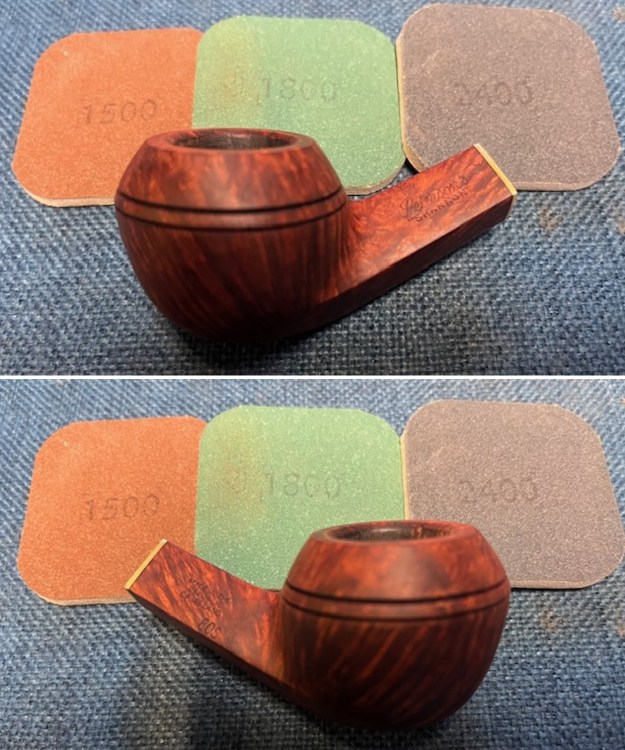
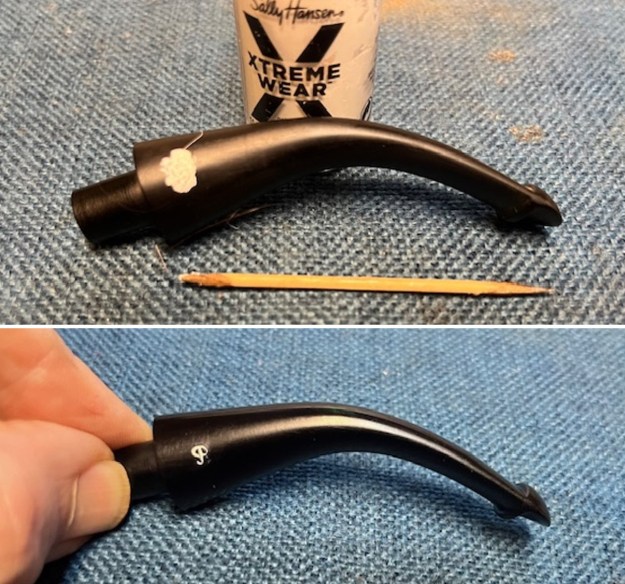
Jeff had cleaned it thoroughly. He had reamed it with a PipNet reamer and cleaned that up with a Savinelli Fitsall Pipe Knife. He had scrubbed the exterior of the briar with undiluted Murphy’s Oil Soap. He cleaned out the interior of the shank, sump and airway in the shank and stem with alcohol, pipe cleaners, shank brushes and cotton swabs. He scrubbed the stem with Soft Scrub to remove the oxidation and calcification on the surface. He soaked it in Briarville’s Pipe Stem Deoxidizer to remove the oxidation. He removed it from the Deoxidizer and rinsed it off with warm water. I took some photos of the pipe before I started my part of the work. I took some close up photos of the rim top and the stem surface. I wanted to show what an amazing job Jeff did in the cleanup of the rim top. The rim top and inner edge looked very good. I took close up photos of the stem to show the condition of the vulcanite. It was quite clean and there were some deep tooth marks and chatter barely visible in the photos.One of the things I appreciate about Jeff’s cleanup is that he works to protect and preserve the nomenclature on the shank of the pipes that he works on. He was able to preserve and maintain its condition in the process. I took some photos to show the clarity of the stamping. I have noticed that many restorers are not careful to protect the stamping in their cleaning process and often by the end of the restoration the nomenclature is almost destroyed. I would like to encourage all of us to be careful in our work to preserve this as it is a critical piece of pipe restoration! I took the stem off the shank and took a photo of the pipe. I decided to start my work on the pipe by cleaning up the damage to the inner edge on the front left side of the bowl. I worked over the edge with a folded piece of 220 grit sandpaper. Once finished the edge looked very good.I polished the briar with micromesh sanding pads – dry sanding it with 1500-12000 grit sanding pads. I wiped it down with a damp cloth after each sanding pad to remove the dust. The rim top, edges and bowl were really shining by the final pad. I rubbed the bowl and rim down with Before & After Restoration Balm. I worked it into the surface of the briar with my fingertips and into the twin rings around the cap with a shoe brush to clean, enliven and protect it. I let the balm sit for 10 minutes and then buffed with a cotton cloth to raise the shine. I really like watching the Balm do its magic and bring the briar alive. I set the bowl aside and turned my attention to the stem. I set the bowl aside and turned my attention to the stem. I “painted” the vulcanite surface with the flame of a lighter – constantly moving the flame over the tooth marks and was able to lift many of them. I filled in the deeper centre tooth marks that remained with black rubberized CA glue. Once it cured I flattened the repairs with needle files. I sanded the stem with 220 grit sandpaper to blend the repairs into the surface. I sanded the stem with the 2 inch square 320-3500 grit sanding pads. I wiped down the stem after each sanding pad with Obsidian Oil. I polished out the scratch marks left behind by the sandpaper. The stem looked very good.The stem was in such good condition that I decided to just do some preliminary work on it before polishing it. I touched up the “P” logo on the left side of the stem with Rub’n Buff Antique Gold. I let it dry then polished off the excess with a worn 1500 grit micromesh sanding pad. Once the excess was removed the stamp looked much better. There were some weak spots on the curve of the “P” stamp but overall it looked very good. I polished the stem with micromesh sanding pads – dry sanding with 1500-12000 grit pads. I wiped the stem down after each sanding pad with Obsidian Oil. I polished it further with Before & After Pipe Stem Polish – both Fine and Extra Fine, I rubbed it on with my finger and buffed it off with a cloth. I gave the stem a final coat of Obsidian Oil and set it aside to let the oil be absorbed. Once again at this point in the restoration process I am excited to be on the homestretch. I look forward to the final look when the Peterson’s “Shannon” 80S Bent Bulldog with a saddle, fishtail stem is put back together, polished and waxed. I put the bowl and stem back together. I lightly polished the bowl and stem with Blue Diamond to polish out the scratches in the briar and the vulcanite. I gave the bowl and the stem multiple coats of carnauba wax. I buffed the pipe with a clean buffing pad to raise the shine. I hand buffed it with a microfiber cloth to deepen the shine. The pipe polished up pretty nicely and the beautiful grain really popped with the wax and polish. The shiny black vulcanite stem is a beautiful contrast to the browns of the bowl and thick shank. This Republic Era Peterson’s “Shannon” 80S Bent Bulldog was another fun pipe to work on. It really is a quite stunning piece of briar whose shape follows the flow of the briar. The pipe feels great in the hand will be better when warmed up while smoking. The finished pipe is shown in the photos below. The dimensions of the pipe are Length: 5 ½ inches, Height: 1 ½ inches, Outside diameter of the bowl: 1 ¼ inches, Chamber diameter: ¾ of an inch. The weight of the pipe is 1.48 ounces/43 grams. I will be putting it on the rebornpipes store in the Irish Pipemakers Section if you would like to add it to your rack and carry on the previous pipeman’s legacy. This is an interesting estate to bring back to life.

As always, I encourage your questions and comments as you read the blog. Thanks to each of you who are reading this blog. Remember we are not pipe owners; we are pipe men and women who hold our pipes in trust until they pass on into the trust of those who follow us.


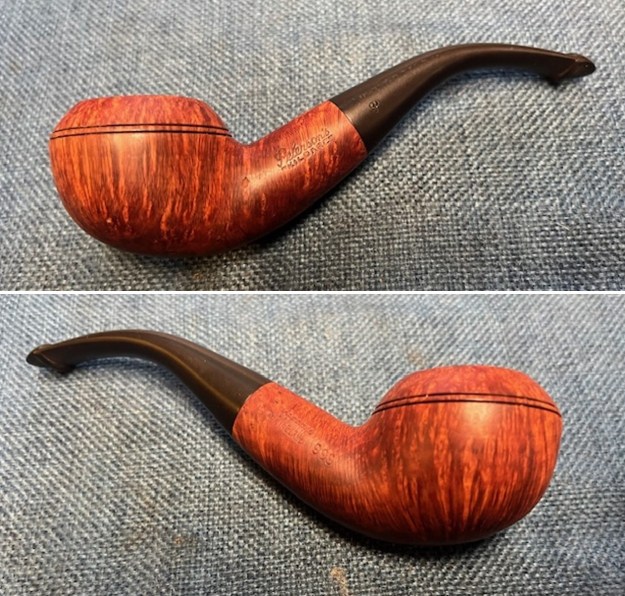
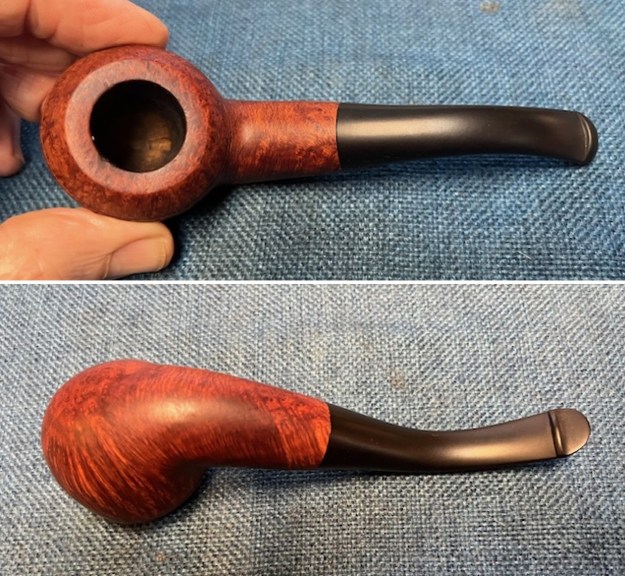
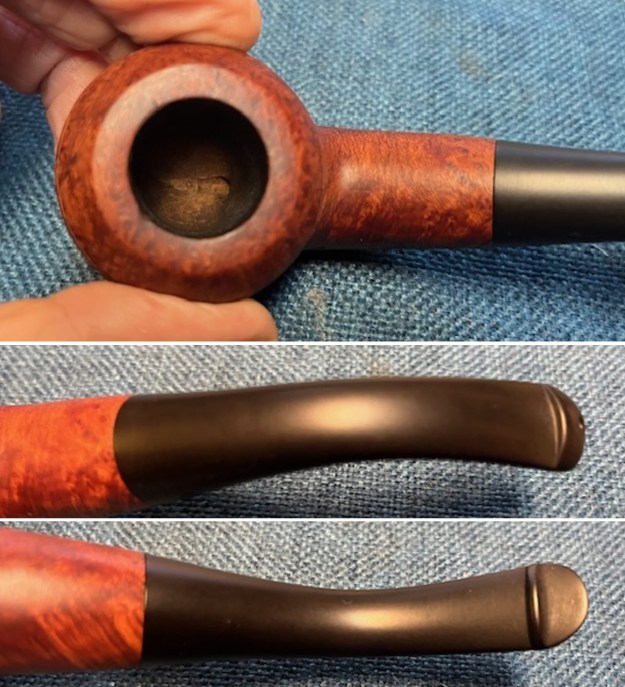
Fresh Life for a Peterson’s “Kildare” 999 Rhodesian


by Steve Laug

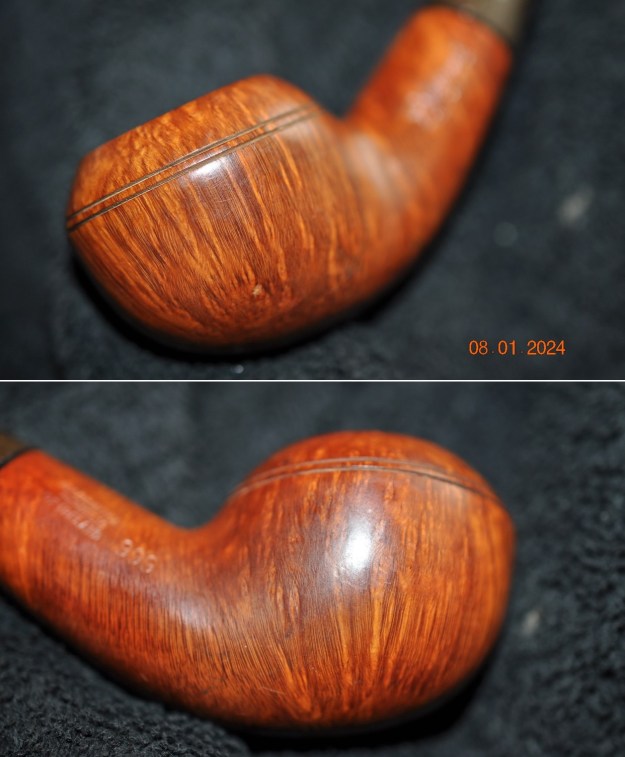
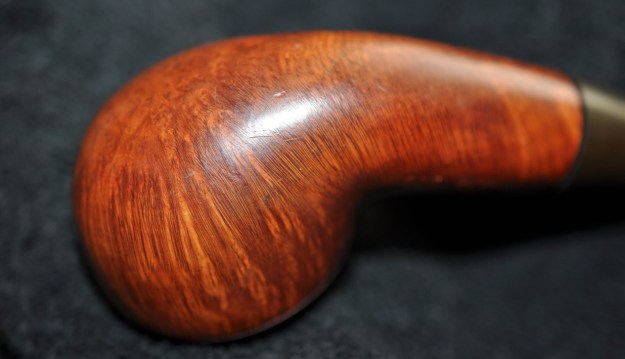
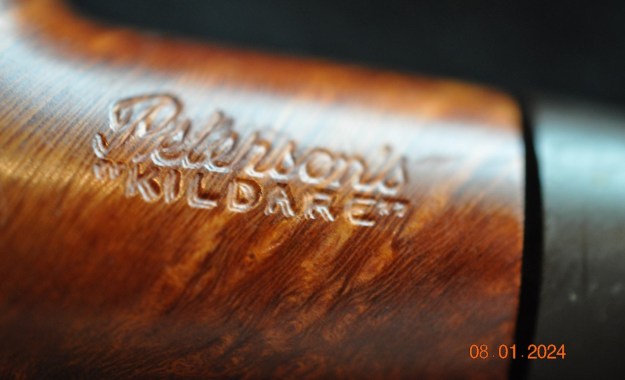
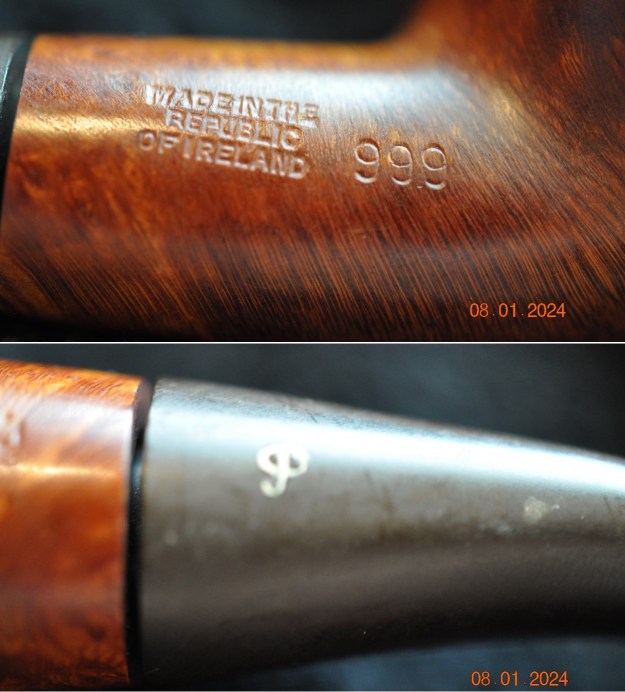
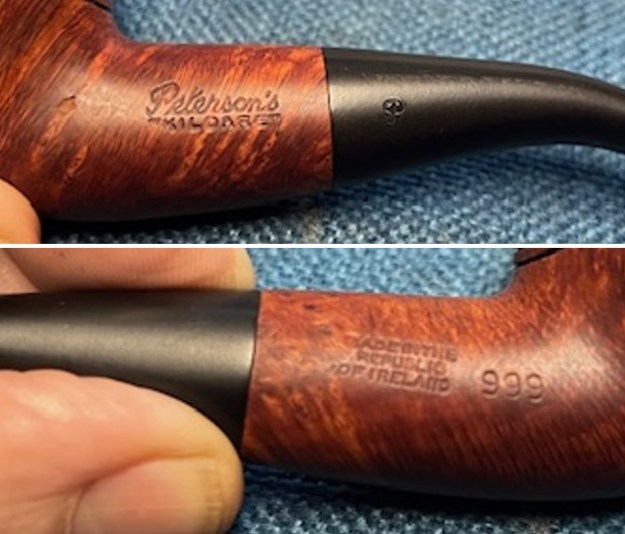
The next pipe on the work table is Peterson’s 999 Rhodesian pipe that we purchased from and our connection in Los Angeles, California, USA on 04/11/2023. It was stamped Peterson’s [over] “Kildare” on the left side of the shank. On the right it is stamped with Made in the Republic of Ireland (in three lines) followed by the shape number 999. It is a classic Peterson’s Rhodesian shape that has a smooth finish with great grain around the bowl and shank that is covered with a lot of oils, debris and grime. There was a thick cake in the bowl with remnants of tobacco stuck on the walls. There was a heavy lava overflow on the rim top and edges. The top and edges of the rim were well hidden under the tars and lava but I was hoping they were protected. There was a very beautiful pipe underneath all of the buildup of years of use. The stem was a Peterson’s P-lip stem with the P logo in white on the left side of the taper. It was oxidized and calcified toward the end with some tooth marks and chatter on both sides ahead of the button. Jeff took photos of the pipe before he started his cleanup work on it. Jeff took photos of the bowl and rim top to show the thick, hard cake in the bowl with remnants of tobacco stuck on the walls of the bowl. There was a lava build up on the top of the rim and the edges of the bowl. The rim top looked pretty good but it was hard to know for sure if there was damage under the thick lava. Only clean up would tell the full story. Jeff took photos of the top and underside of the stem showing the tooth marks, chatter, scratching, calcification and oxidation on the stem surface. Jeff took photos of the sides and heel of the bowl to show the condition of the finish. You can see the grime around the sides of the bowl and shank. Even under the dirt and debris of the years it looked very good. Jeff took photos of the stamping on the sides of the shank. The stamping was readable as you can see from the photos. It read as noted above. Before I started working on the pipe I turned to “The Peterson’s Pipe” by Mark Irwin and Gary Malmberg to see what it had to say on the “Kildare” line. On page 306 it says:

Kildare (1965-) First issue of the line with matte-finish in Classic Range shapes. P-lip and fishtail mouthpiece. Second issue c.1979 as Kildare Patch, with rusticated patches on the pipe surface. Third issue 2010, matte brown, P-lip or fishtail mouthpiece, no band. Fourth issue 2011-burgundy sandblast finish, nickel army mount, fishtail mouthpiece, exclusive to Smokingpipes.com.

I believe that the pipe I am working on is a First Issue of the line. It has a Matte-finish in a Classic shape and a P-lip mouthpiece. That would make the pipe one issued between 1965 and 1978. It has a bit of age on it and it is in excellent condition.

Jeff had cleaned it thoroughly. He had reamed it with a PipNet reamer and cleaned that up with a Savinelli Fitsall Pipe Knife. He had scrubbed the exterior of the briar with undiluted Murphy’s Oil Soap. He cleaned out the interior of the shank, sump and airway in the shank and stem with alcohol, pipe cleaners, shank brushes and cotton swabs. He scrubbed the stem with Soft Scrub to remove the oxidation and calcification on the surface. He soaked it in Briarville’s Pipe Stem Deoxidizer to remove the oxidation. He removed it from the Deoxidizer and rinsed it off with warm water. I took some photos of the pipe before I started my part of the work. I took some close up photos of the rim top and the stem surface. I wanted to show what an amazing job Jeff did in the cleanup of the rim top. The rim top and inner edge looked very good. There was some light damage to the inner edge on the front left side of the bowl. I took close up photos of the stem to show the condition of the vulcanite. It was quite clean and there were light tooth marks and chatter barely visible in the photos.One of the things I appreciate about Jeff’s cleanup is that he works to protect and preserve the nomenclature on the shank of the pipes that he works on. He was able to preserve and maintain its condition in the process. I took some photos to show the clarity of the stamping. I have noticed that many restorers are not careful to protect the stamping in their cleaning process and often by the end of the restoration the nomenclature is almost destroyed. I would like to encourage all of us to be careful in our work to preserve this as it is a critical piece of pipe restoration! I took the stem off the shank and took a photo of the pipe. I decided to start my work on the pipe by cleaning up the damage to the inner edge on the front left side of the bowl. I worked over the edge with a folded piece of 220 grit sandpaper. Once finished the edge looked very good.I polished the briar with micromesh sanding pads – dry sanding it with 1500-12000 grit sanding pads. I wiped it down with a damp cloth after each sanding pad to remove the dust. The rim top, edges and bowl were really shining by the final pad. I rubbed the bowl and rim down with Before & After Restoration Balm. I worked it into the surface of the briar with my fingertips and into the twin rings around the cap with a shoe brush to clean, enliven and protect it. I let the balm sit for 10 minutes and then buffed with a cotton cloth to raise the shine. I really like watching the Balm do its magic and bring the briar alive. I set the bowl aside and turned my attention to the stem. The stem was in such good condition that I decided to just do some preliminary work on it before polishing it. I touched up the “P” logo on the left side of the stem with white acrylic fingernail polish. I let it dry then polished off the excess with a worn 1500 grit micromesh sanding pad. Once the excess was removed the stamp looked much better. There were some weak spots on the curve of the “P” stamp but overall it looked very good.I polished the stem with micromesh sanding pads – dry sanding with 1500-12000 grit pads. I wiped the stem down after each sanding pad with Obsidian Oil. I polished it further with Before & After Pipe Stem Polish – both Fine and Extra Fine, I rubbed it on with my finger and buffed it off with a cloth. I gave the stem a final coat of Obsidian Oil and set it aside to let the oil be absorbed. Once again at this point in the restoration process I am excited to be on the homestretch. I look forward to the final look when the Peterson’s “Kildare” 999 Rhodesian with a taper stem is put back together, polished and waxed. I put the bowl and stem back together. I lightly polished the bowl and stem with Blue Diamond to polish out the scratches in the briar and the vulcanite. I gave the bowl and the stem multiple coats of carnauba wax. I buffed the pipe with a clean buffing pad to raise the shine. I hand buffed it with a microfiber cloth to deepen the shine. The pipe polished up pretty nicely and the beautiful grain really popped with the wax and polish. The shiny black vulcanite stem is a beautiful contrast to the browns of the bowl and thick shank. This Republic Era Peterson’s “Kildare” 999 Rhodesian was another fun pipe to work on. It really is a quite stunning piece of briar whose shape follows the flow of the briar. The pipe feels great in the hand will be better when warmed up while smoking. The finished pipe is shown in the photos below. The dimensions of the pipe are Length: 5 ½ inches, Height: 1 ½ inches, Outside diameter of the bowl: 1 ¼ inches, Chamber diameter: ¾ of an inch. The weight of the pipe is 1.76 ounces/50 grams. I will be putting it on the rebornpipes store in the Irish Pipemakers Section if you would like to add it to your rack and carry on the previous pipeman’s legacy. This is an interesting estate to bring back to life.

As always, I encourage your questions and comments as you read the blog. Thanks to each of you who are reading this blog. Remember we are not pipe owners; we are pipe men and women who hold our pipes in trust until they pass on into the trust of those who follow us.

The Back Story of a House of Robertson Bent Billiard Carved for Dick Egelston


by Steve Laug

It was a sunny fall day in Boise when Dick Egelston walked past Thayne’s carved cigar store Indian and into the House of Robertson pipe shop. Like Thayne, he had pipe in his mouth and smoke curling out behind his head and greeted his friend Thayne. They knew each other for a long time as both of them were involved in the business community of Boise, Idaho and both belonged to several of the same organizations. Over the years they had become friends. Dick picked up his tobaccos and more than a few pipes from House of Robertson’s. He commented more than once that he was personal keeping Thayne’s business afloat with is purchases. Today, Thayne greeted him with a surprise. He had carved Dick a pipe. It was a square shank bent Billiard with some great grain around the bowl and a few swirls of rustication and some plateau on the heel on the right side. What made this one particularly special was Thayne or Jon, his son had etched Dick’s name on the right side of the shank. I think Dick must have been delighted with this pipe made for him by his friend. I know I would have been. To have both a pipe carved by Thayne and one that had his name etched on would have been a double delight.

Just to set the record straight the story above is from my imagination but I don’t think it is far off from the facts. To the left are a photo of a young Thayne Robertson with a pipe in his mouth and an older Dick Egleston. I know that Dick Egleston was part of the Shriner’s organization in Boise and I know Thayne was a Mason and was well aware of the work of the Shriners (https://rebornpipes.com/2021/10/31/house-of-robertson-pipes-boise-pipe-carver-thayne-robertson/). From what I can find both were Masons. I know that both were in business in the Boise area and that both smoked a pipe. The day of the pipe’s delivery to Dick is purely my imagination. When we purchased the pipe, I thought it would be interesting to do some research on Dick’s name. I found an obituary for him dated October 12, 2020. It stated that he died at the age of 97. The obituary links him and the family to the Boise and the surrounding area (https://www.legacy.com/us/obituaries/idahostatesman/name/richard-egelston-obituary?id=7848148). My assumption is that the pipe I am working on belonged to this very same Dick Egelston. Of course, I cannot prove that it did, but I think it is a fair guess. How the pipe went from Boise and the estate of Dick to the seller in Baton Rouge, Louisiana I don’t think will ever be clear. We contacted the seller and he does not remember who he purchased it from. But really, you can make up your own story of the travels of this name pipe that bears the name of both the maker and the recipient. It is a fun process to enter into and one that always adds colour to any pipe I work on. Now let’s look at the pipe itself.

It is a Bent Billiard that has a square shank and saddle stem. It is smooth with some rustications on the front and sides. It also seems to have a bit of plateau on the right side of the heel of the bowl and Thayne used plateau area to inform the rustications. The name House of Robertson is hand-etched with an engraving tool on the left side of the shank and the name Dick Egelston is etched on the right side. The bowl is thickly caked with some lava overflow on the rim top. The outer and inner edges of the rim have some nicks from the pipe being knocked out against a hard surface. The pipe was dirty but underneath all of the grime it appears to be in excellent condition. It is definitely an interesting pipe that has a story connected to the names. It should clean up very well. The fit of the stem to the shank was good. The vulcanite saddle stem was oxidized and calcified. There are light tooth marks and chatter on both sides near the button. Jeff took photos of the pipe before he started the cleanup.Jeff took photos show the condition of the bowl and the stem. The photos of the bowl and rim show the cake in the bowl and the lava overflowing onto the rim top. The rustication on the top of the bowl and the inner and outer edge of the rim are pretty well covered in lava. It was hard to know what the inner edge and top really looked like until we cleaned it. The silver cosmetic band was heavily oxidized and almost black. The taper stem was oxidized, calcified and had a lot of tooth marks and chatter both sides ahead of the button and on the button itself. The photos of the sides and heel of the bowl show the condition of the finish but more importantly the grain under the grime. The combination of rustication patches, plateau and smooth finishes give the bowl a unique look. The next photos show the etched or engraved with a name of House of Robertson on the left side of the shank and the name, Dick Egelston on the right side of shank. Some people find these personalized pipes a bit of a pain but to me it always creates a lot of speculation about the man (in this case anyway) who bought the pipe. I am including the information that I found when I received my first of the House of Robertson Pipes. I found a link on Pipedia that gave me the only information I could find on the brand. I include that in total as it is interesting to read.

“House of Robertson” was in business for many years, but alas, closed their doors in 1999. They were located in Boise, Idaho. They are noted for making rather large and interesting pipes. Thayne Robertson was a Master Mason, AF & AM, and started the shop about 1947 and his son Jon started working there in 1970 when he finished college, along with Thayne’s daughter. Thayne and his son started making the big pipes at that time, and made them together until 1987 when Thayne passed away. Jon kept the store and his sister moved on to other things. The House of Robertson appears to have closed around 1999 (https://pipedia.org/wiki/Robertson).

Since then I have worked on a lot of House of Robertson pipes and have been able to track down more information. I am including a link to a Catalogue that I picked up on eBay. Click on the link and have a look at this interesting book of information on the brand and the pipe maker himself (https://rebornpipes.com/2022/12/11/a-house-of-robertson-catalogue-filled-with-great-examples-of-thayne-robertsons-work/).

I am also including a biography of Thayne Robertson that I found on Facebook from a fellow in Boise, Idaho. It is an interesting glimpse into the mind of the pipe maker. Make sure to take time to read it (https://rebornpipes.com/2021/10/31/house-of-robertson-pipes-boise-pipe-carver-thayne-robertson/).

Now it was time to work on the pipe itself. When it gets to Vancouver it my turn to contribute to its restoration. Jeff did a great job cleaning the pipe on the inside and outside. He reamed the bowl with a PipNet pipe reamer and cleaned up the remnants with the Savinelli Fitsall Pipe Knife. He scrubbed out the mortise and the airway in the shank and stem with alcohol, shank brushes, cotton swabs and pipe cleaners. He scrubbed the exterior of the bowl with a tooth brush and Murphy’s Oil Soap to remove the dust in the rusticated spots on the bowl and shank as well as the smooth portions. He rinsed it under running water. He dried it off with a soft cloth. Once the dust and debris were removed the finish was dull but appeared to be in excellent condition. He soaked the stem in Briarville’s Pipe Stem Deoxidizer and rinsed it under warm water to remove the deoxidizer gel solution. I took photos of the pipe to show its condition before I started my work on it. I took a photo of the bowl and rim top to show how well it had cleaned up. There is some darkening and nicks on the top and inner edge of the rim. The stem tooth marks and chatter are visible. The ones on the topside of the stem are worse than those on the underside.I took a photo of the engraving on the underside of the shank. It is clear and reads as noted above. I also took the stem off the pipe and took a photo of the parts to give a sense of the proportions of the pipe. It is a beauty. I started my work on the pipe by dealing with the darkening on the inner edge of the rim and the darkening on the rim top with a folded piece of 220 grit sandpaper. It looked much better when finished. I worked over the rim top with 320-3500 grit sanding pads to smooth and polish the damaged areas and blend them into the surface of the briar. Once I finished it looked much better and the colour of the rim matched the rest of the bowl very well. I polished the bowl and shank with micromesh sanding pads – dry sanding with 1500-12000 grit pads. I wiped the bowl down with a damp cloth after each pad. The bowl and rim took on a beautiful shine. I would not need to stain the rim top as the match was very good. I worked Before & After Restoration Balm deep into the finish to clean, enliven and protect the briar. I rubbed it into the briar with my fingers and a shoe brush to work it into the finish then set it aside to dry for 10-15 minutes. I wiped it off with a soft cloth. I buffed the bowl with a cotton cloth to polish it. It really began to have a deep shine in the briar. The rim top is looking much better. I took some photos of the bowl at this point to mark the progress in the restoration. The rustication on the bowl stands out with interesting lines moving across the sides of the bowl and the heel. I set the bowl aside and turned my attention to the stem. I “painted” the vulcanite surface with the flame of a lighter – constantly moving the flame over the tooth marks and was able to lift many of them. I filled in those that remained with black rubberized CA glue. Once it cured I flattened the repairs with needle files. I sanded the stem with 220 grit sandpaper to blend the repairs into the surface. I sanded the stem with the 2 inch square 320-3500 grit sanding pads. I wiped down the stem after each sanding pad with Obsidian Oil. I polished out the scratch marks left behind by the sandpaper. The stem looked very good.I polished the vulcanite stem with micromesh sanding pads – dry sanding it with 1500-12000 grit pads. I wiped the stem down after each sanding pad with Obsidian Oil and set it aside to dry. I polished it further with Before & After Pipe Polish – using both the Fine and Extra Fine Polishes. I gave it a rubdown with Obsidian Oil one last time and set it aside. I put the House of Robertson Bent Billiard with a square shank and saddle stem back together and worked the pipe over on the buffing wheel using Blue Diamond to lightly polish the stem. I buffed the bowl and stem to raise the gloss on the briar and the vulcanite. I gave the pipe multiple coats of carnauba wax. I buffed the entire pipe with a clean buffing pad to raise the shine. I hand buffed it with a microfiber cloth to deepen the shine. Dick Egelton’s finished the House of Robertson Bent Billiard is shown in the photos below. The medium brown stains on the rusticated spots, plateau and smooth finishl works well with the rich black of the vulcanite stem. The dimensions of the pipe are: Length: 6 inches, Height: 2 inches, Outside Diameter: 1 ½ inches, Diameter of the chamber: ¾ inches. The weight of the pipe is 42 grams/1.45 ounces. This is an interesting piece of briar with a great back story. I really like how the briar and the vulcanite work well together. This one will soon be on the rebornpipes store, in the American Pipemakers Section. If you are interested in adding a House of Robertson to your collection this may well be the one for you. Thanks for walking with me through the restoration process.