Tag Archives: Paresh Deshpande article

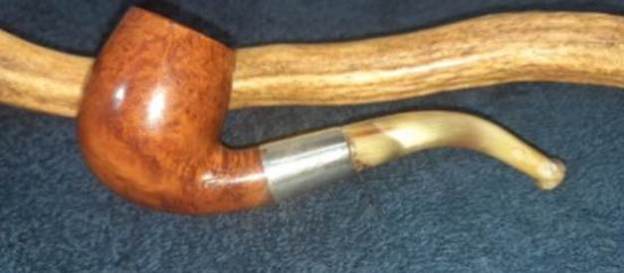
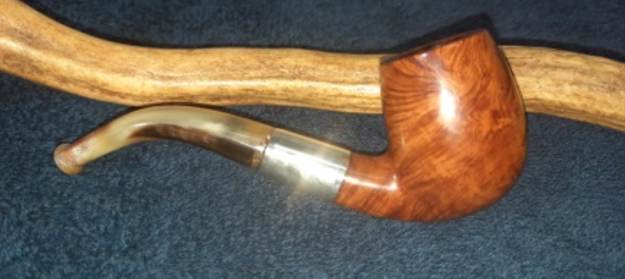
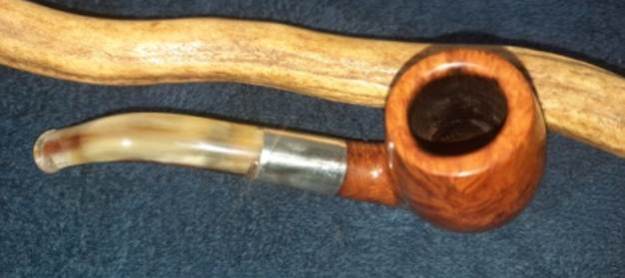
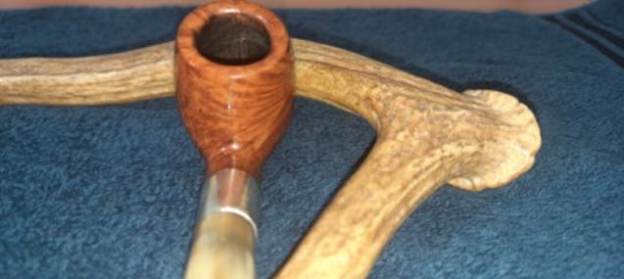
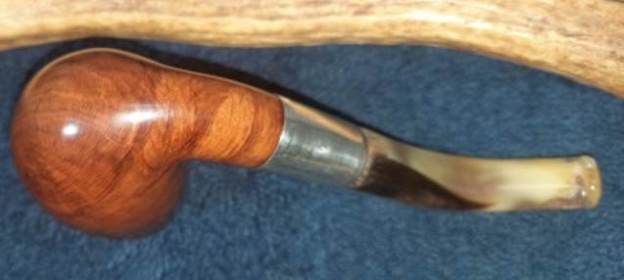
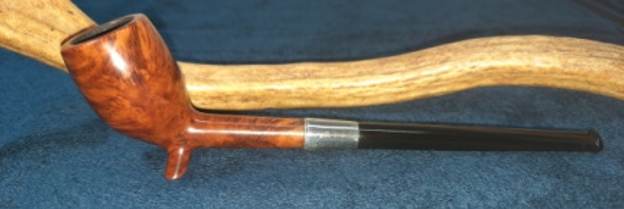
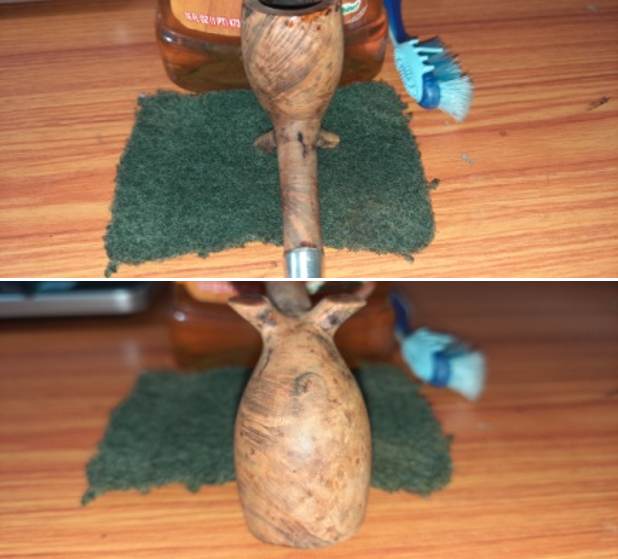
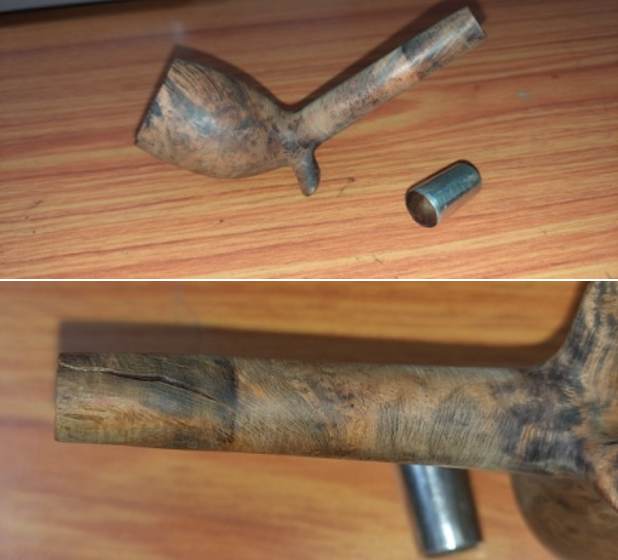
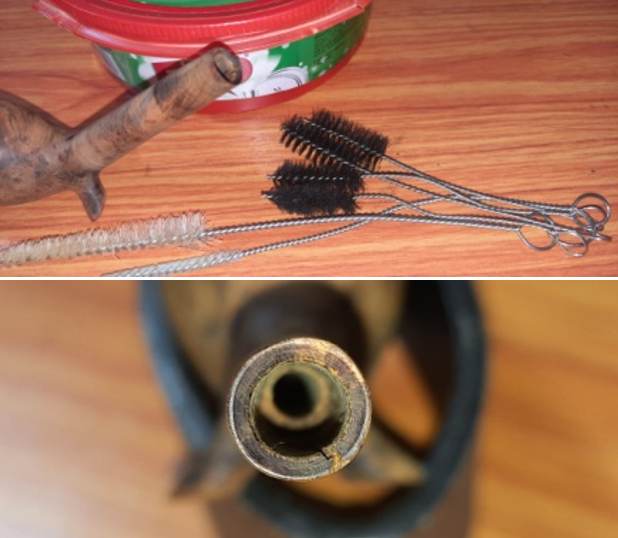
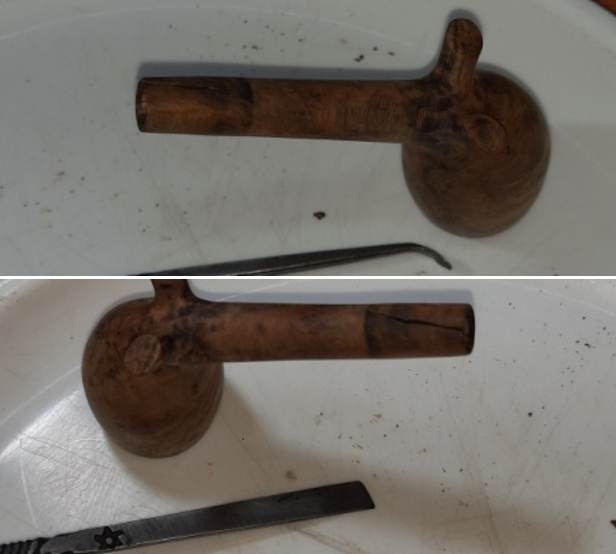
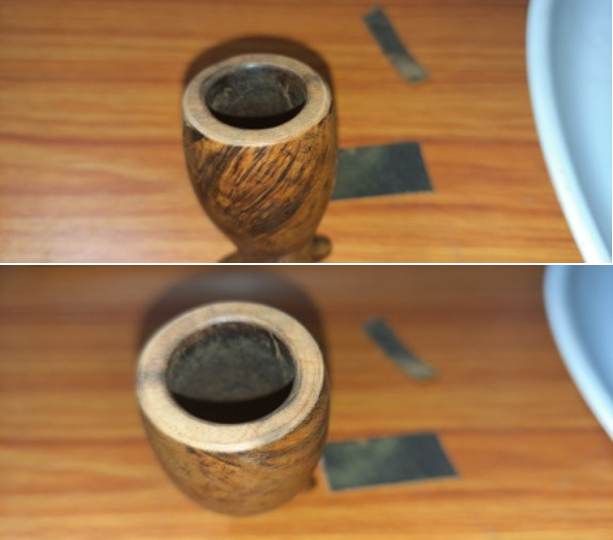
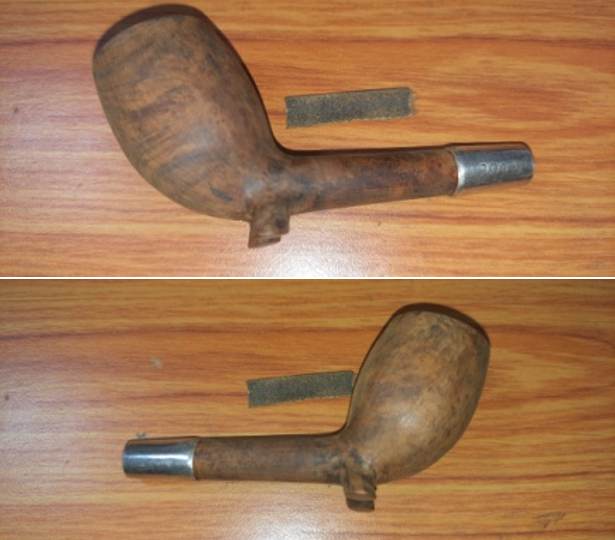
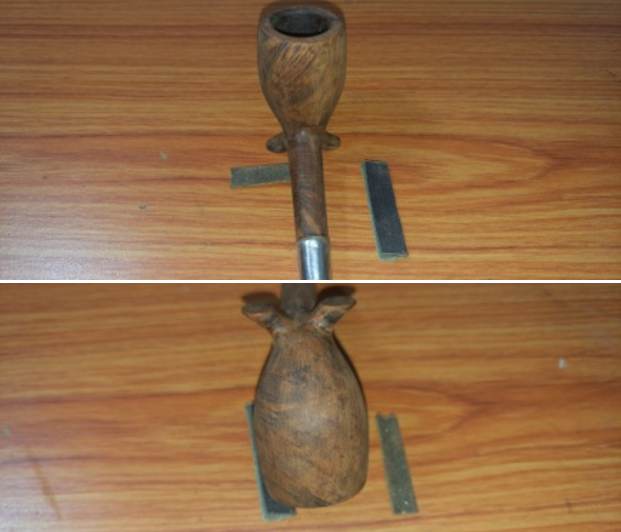
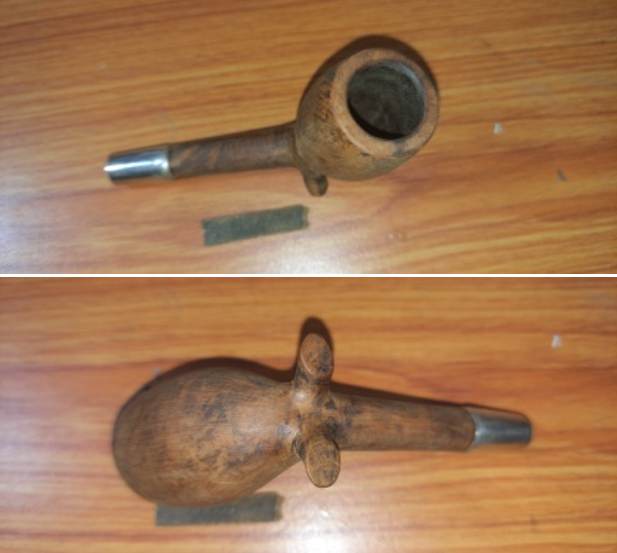
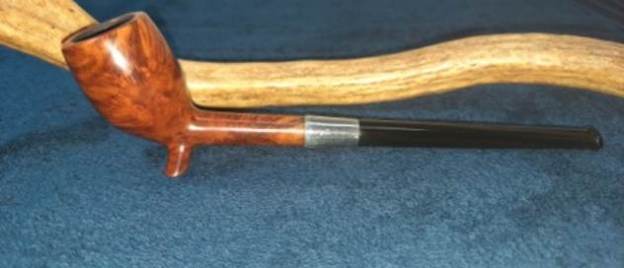
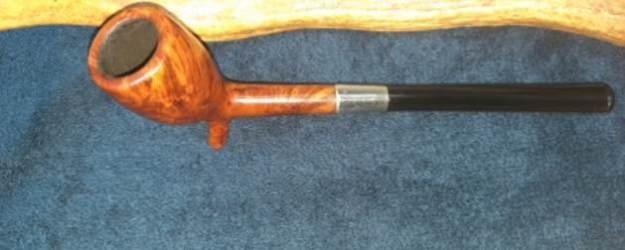
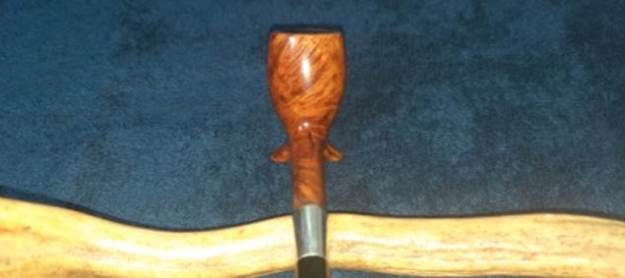
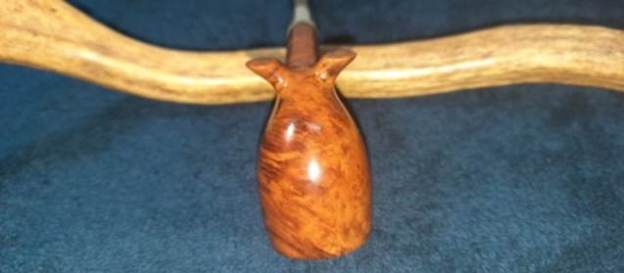
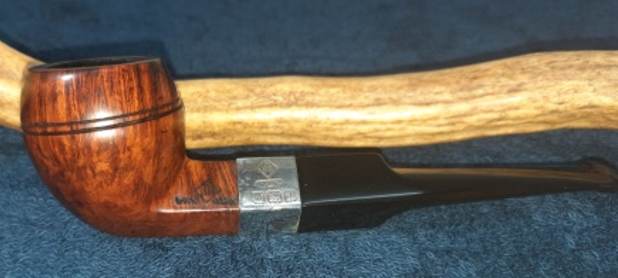
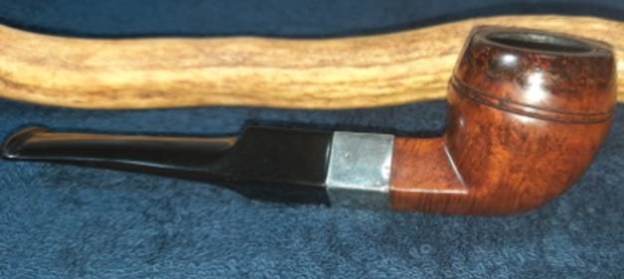
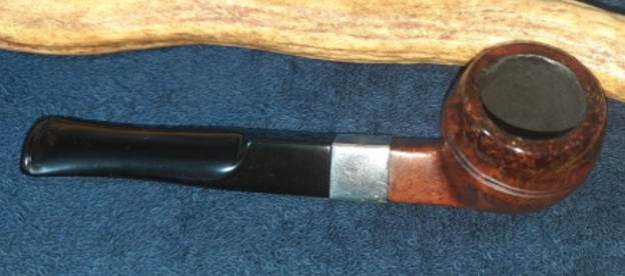
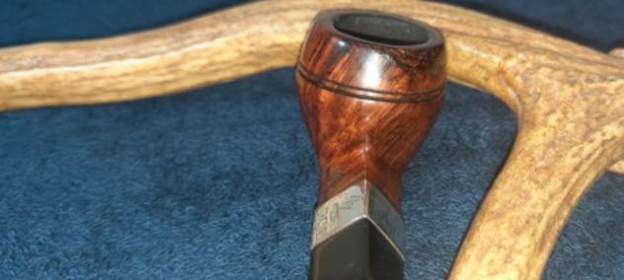
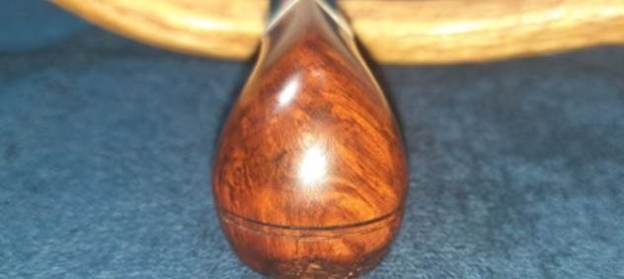
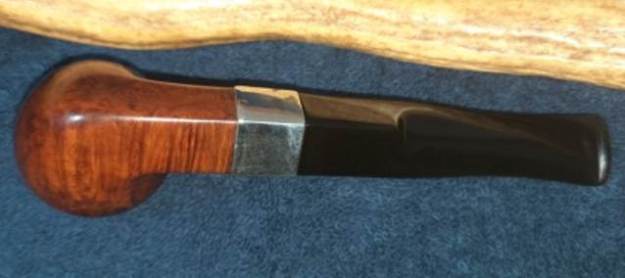
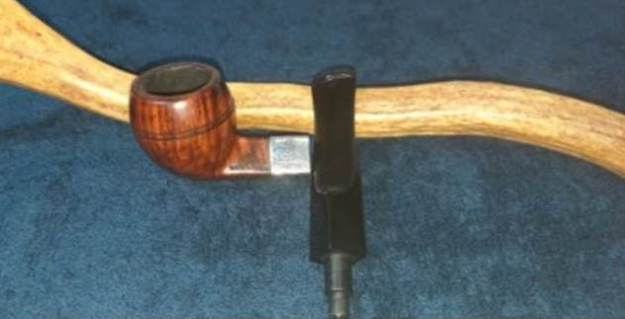
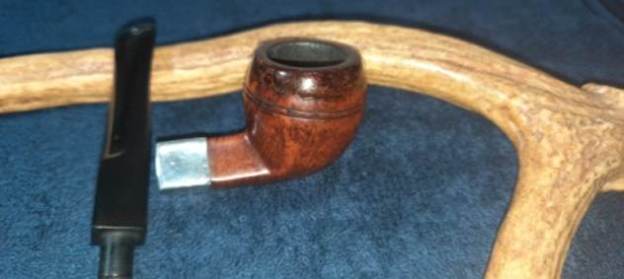
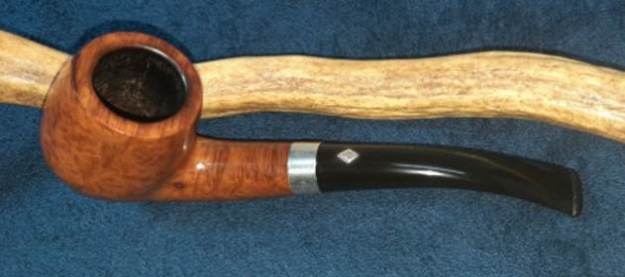
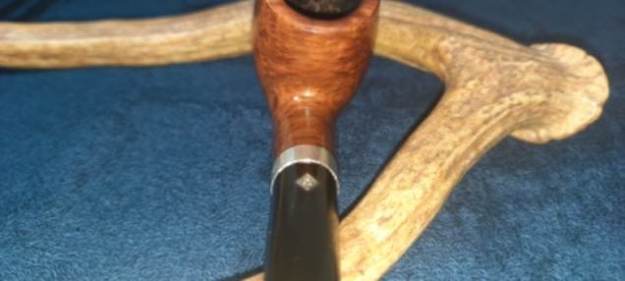
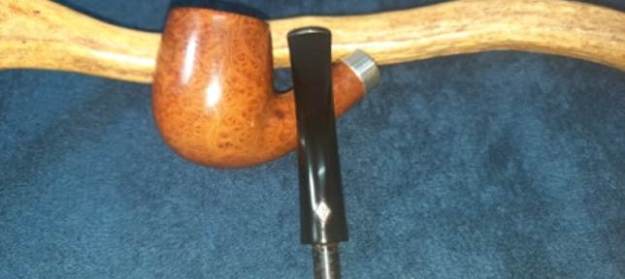
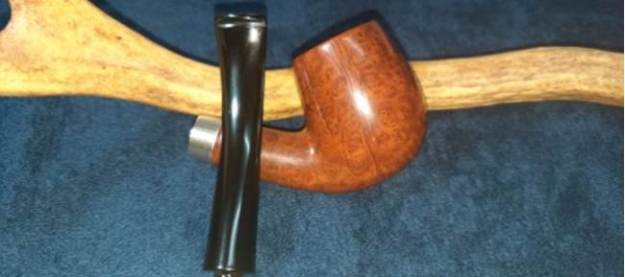
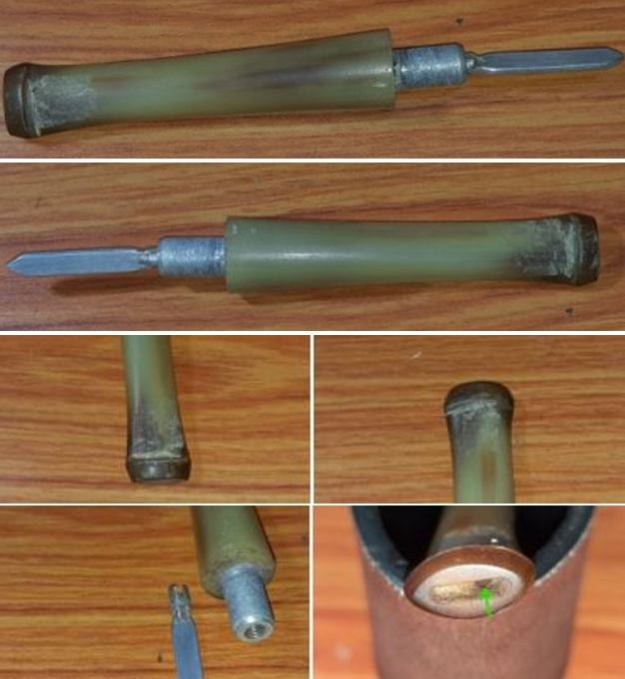
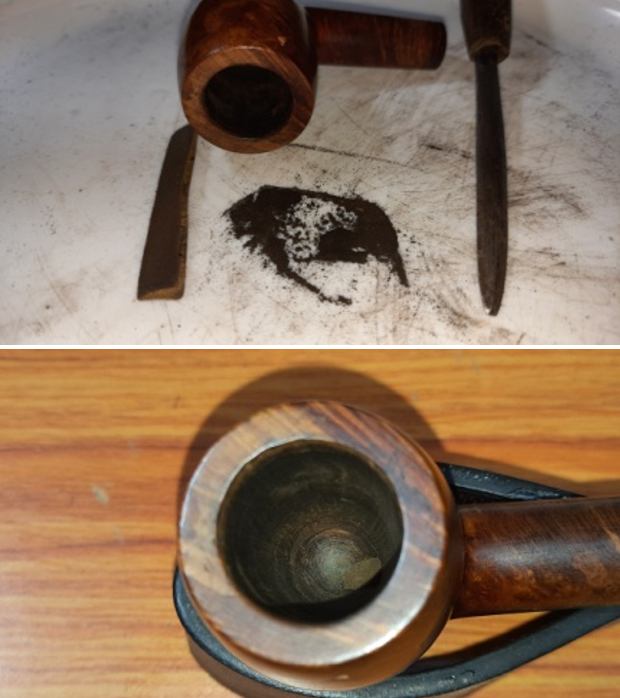
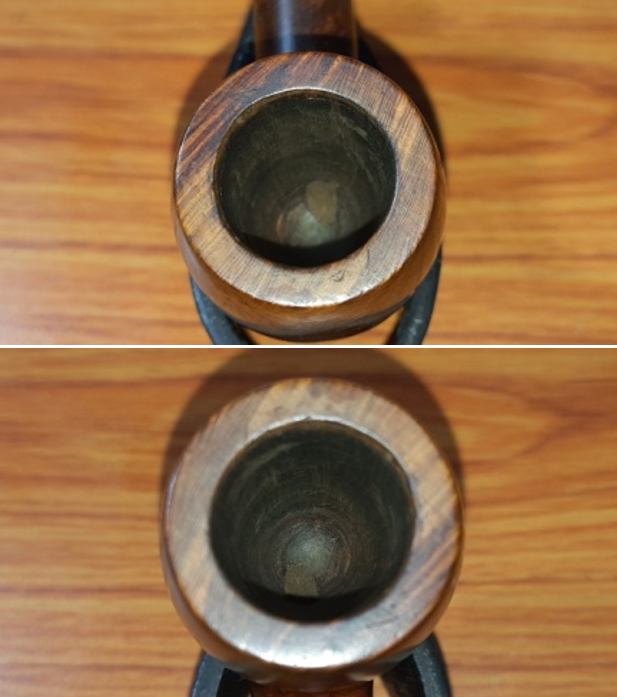
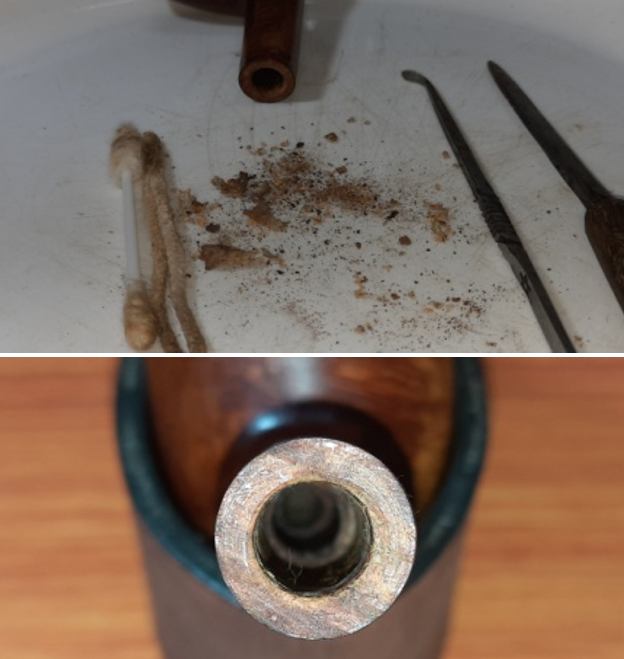
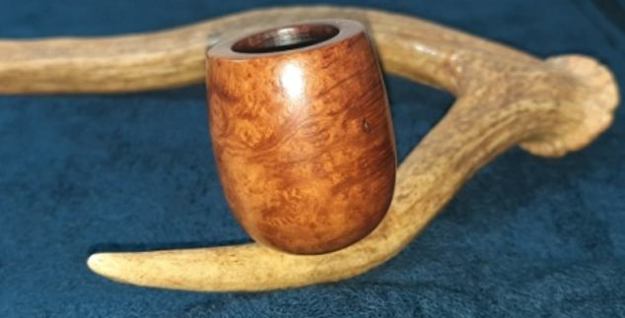
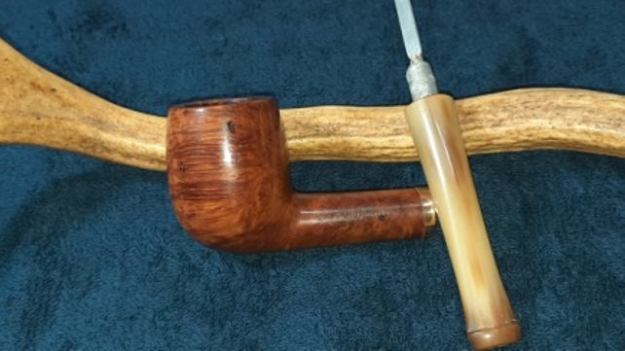
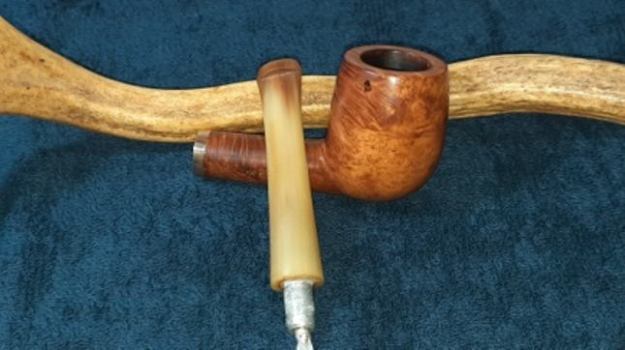
Repairing A Worm Hole Ridden Horn Stem And Refurbishing A c.1908 T.C.G Bent Billiard


Blog by Paresh Deshpande

This pipe had caught my eye for a long time. However, the extensive damage to the horn stem was a big challenge and was always relegated to ‘will- deal- with- later’ category of pipes. This time around, I decided to pick up the gauntlet and got the pipe to my work table.

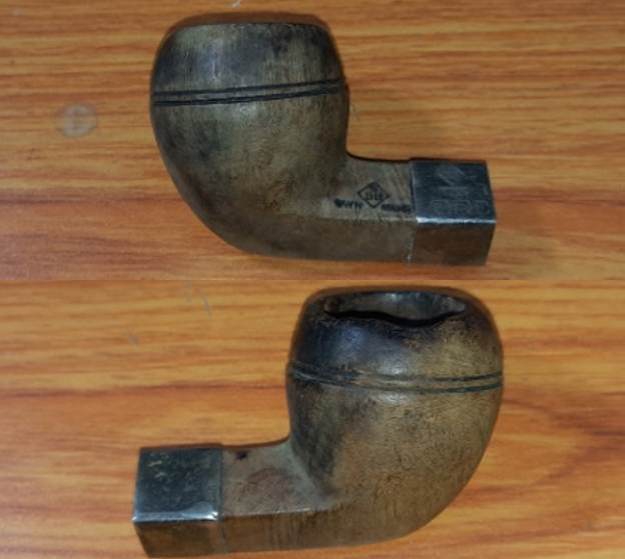
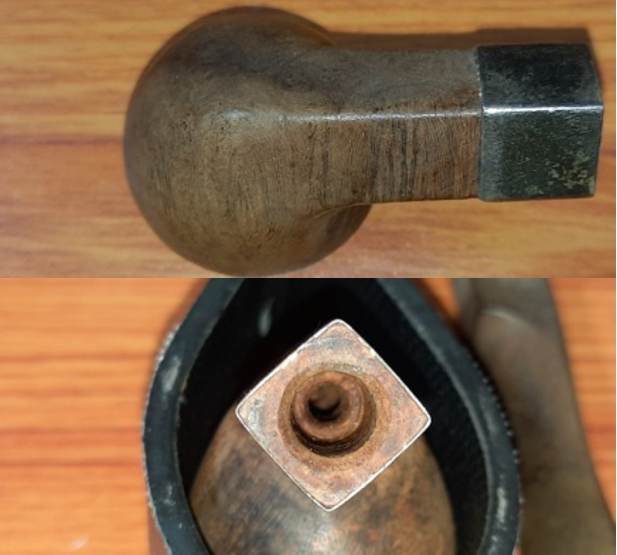
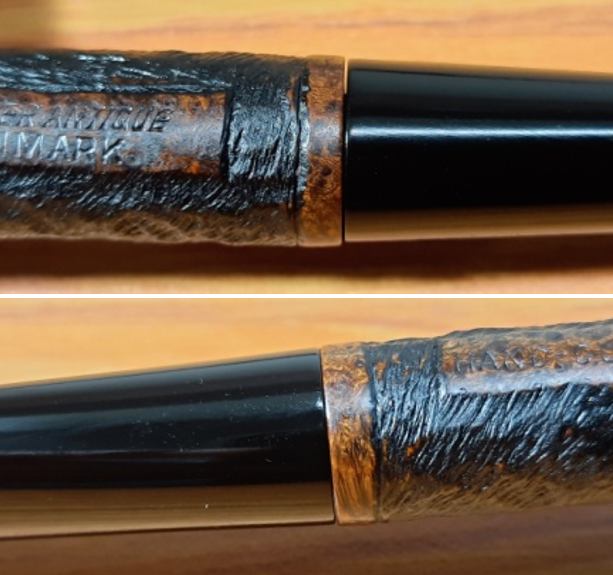
The pipe currently on my table is as elegant and understated as the British and as compact as any English pipes of yore. The briar stummel has mixed grains and is sans any fills. The right side of the shank is stamped as “T.C.G” in an oval. There is no COM stamp. The only pointer to this pipe being English is the stamping on the Sterling Silver ferrule at the shank end. It is stamped “T.C.G” without frame over three sterling silver hallmarks. From left to right the first cartouche is with a LION PASSANT certifying silver quality followed by a cartouche with symbol for Chester Assay Office and the last cartouche contains the date code letter “H”. This was an English brand that I had neither seen before nor ever heard of. My first instinct to search for any new-to-me pipe brand is to visit rebornpipes and very rarely have I returned empty handed. This was one such rare instance where I came up empty handed. Pipedia.org and pipephil.eu, other popular sites that I visit for pipe related information, too did not have any mention of this pipe manufacturer.
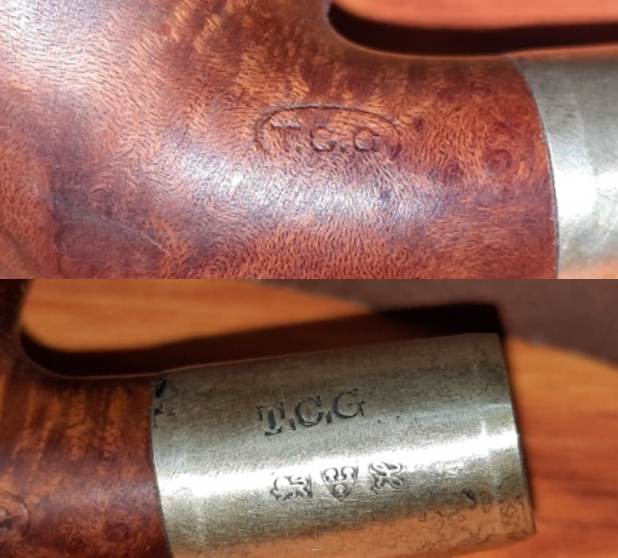
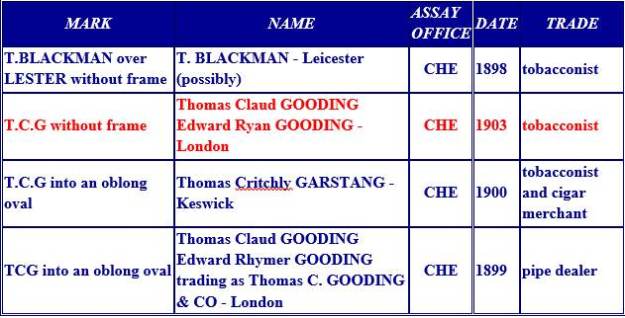
The only clue to unravel the mystery of this pipe was in the stampings seen in the hallmarked silver band. I visited www.silvercollection.it and upon searching through the index, I came across a maker’s mark that was as seen on the pipe in my hands. The maker’s mark was described as Thomas Claud GOODING Edward Ryan GOODING – London. Here is the link and screen shot of the details and relevant details are highlighted in red.

http://www.silvercollection.it/DICTIONARYTOBACCONISTT.htmlThe next step was to date this pipe with the help of the hallmarks as seen on the silver band at the shank end. The Chester City mark was easy to identify. The letter “H” perfectly matched up with the letter that identified it as being assayed by the Chester Assay office in 1908. Given below is the link that will take the readers to the relevant section of dating and the picture that I have taken with the date code letter.
http://www.silvercollection.it/englishsilverhallmarksCHE.html

I further Google searched for Thomas Claud Gooding and other than an address for the said tobacconist at Farringdon Street, London, I could not glean much information.

It is my informed guess that TC Gooding got pipes made from other manufacturers like Barling’s, Comoy’s etc and got them stamped from manufacturers with their own registered name, T.C.G and sold these pipes from their shops. This was a very common practice in those days.

To summarize, the pipe that I am working on was from a tobacconist shop run by T C Gooding at Farringdon Street that was made in c1908 by some of the more established pipe manufacturers in London and sold under their own name T.C.G.

Initial Visual Inspection
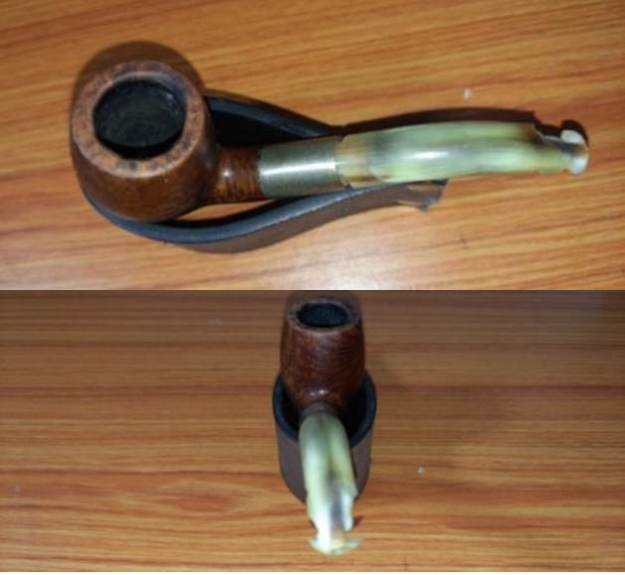
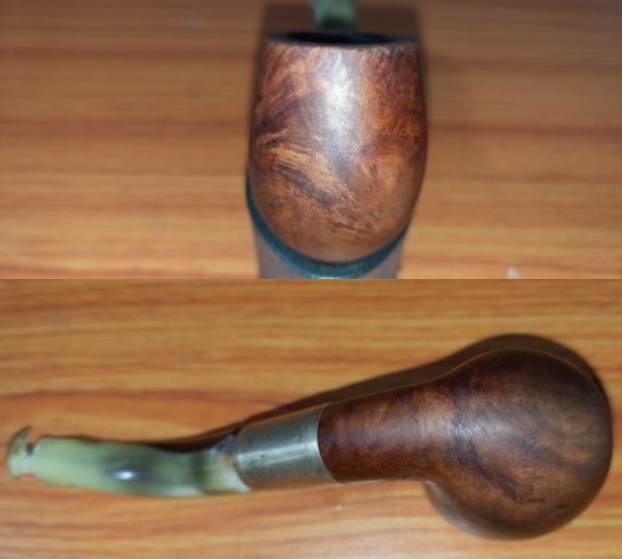
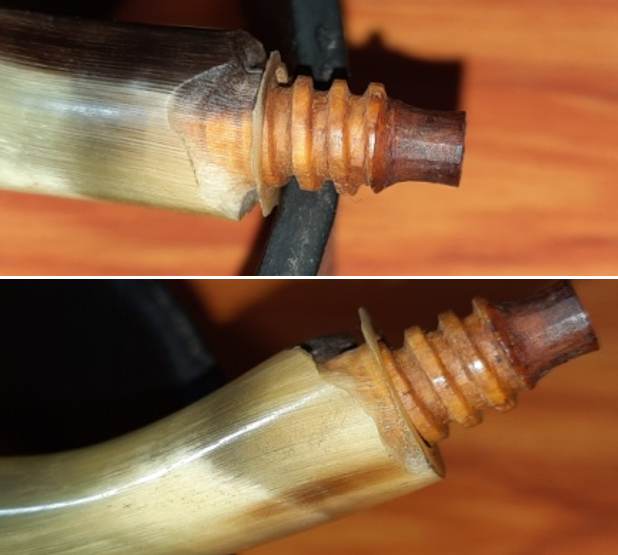
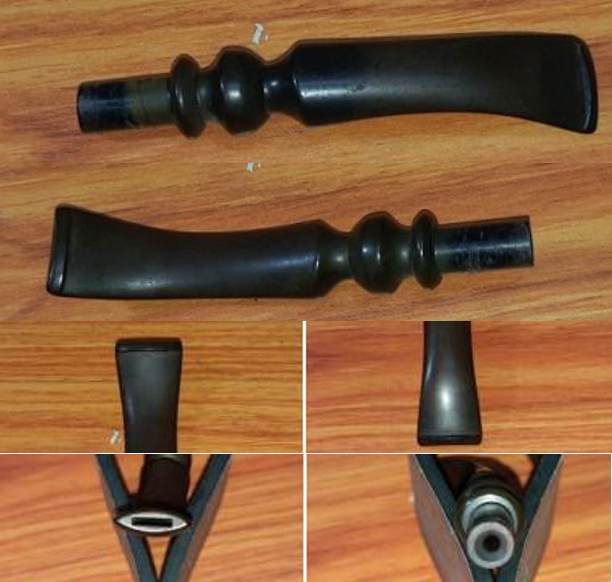
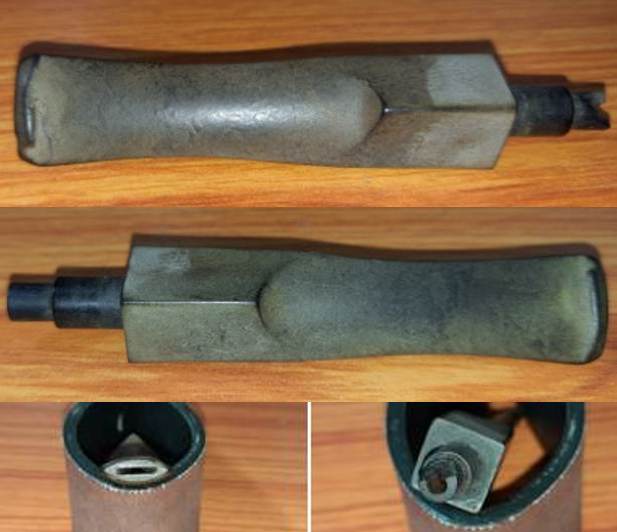
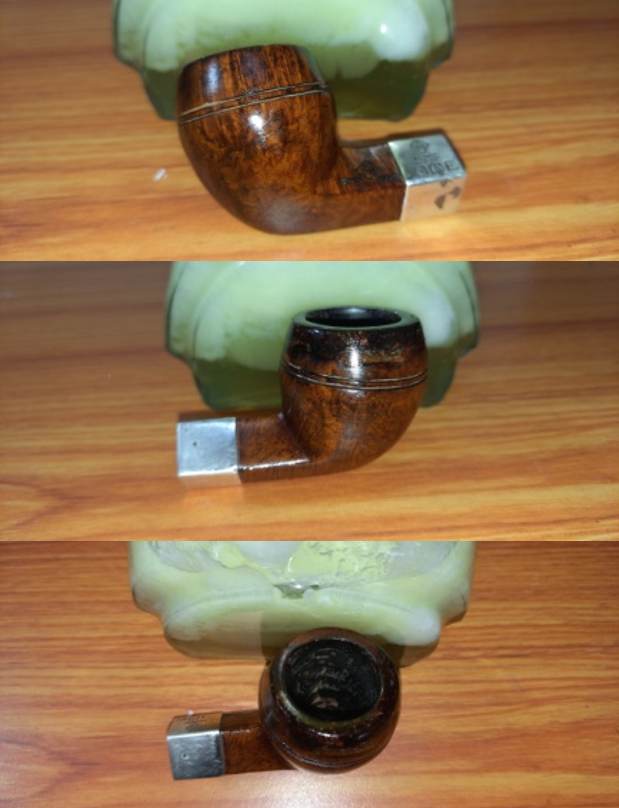
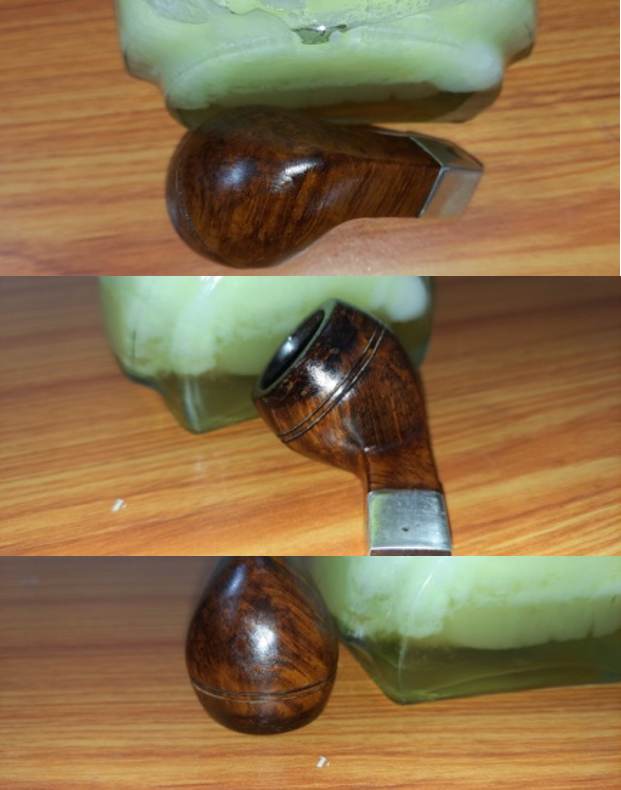
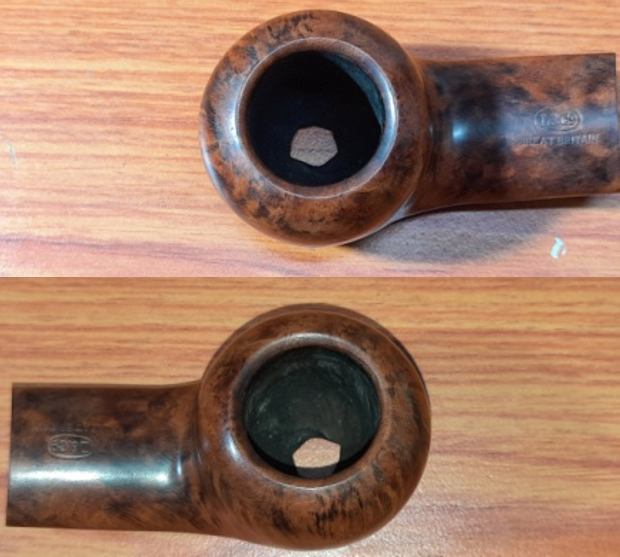
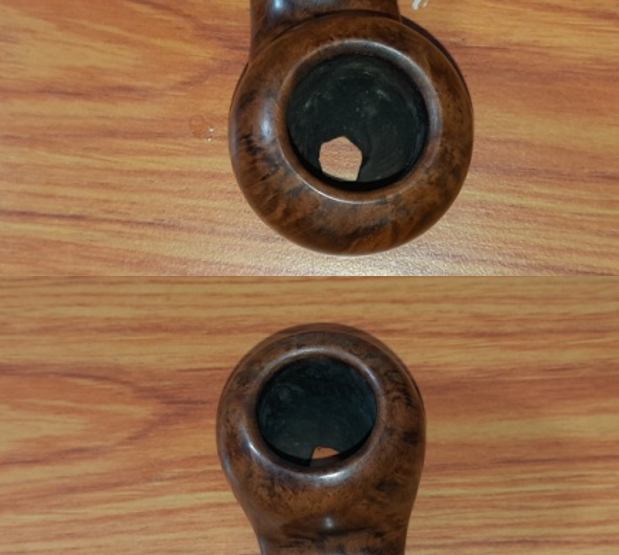
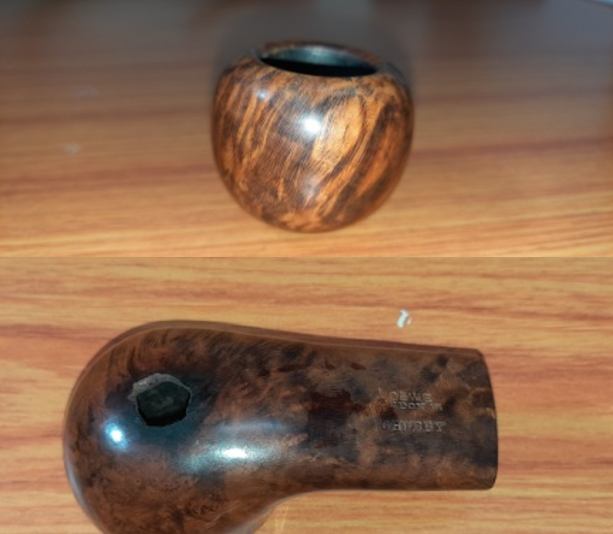
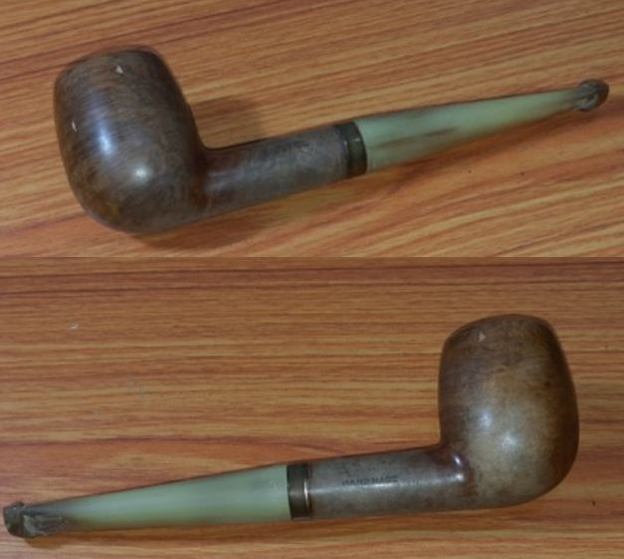
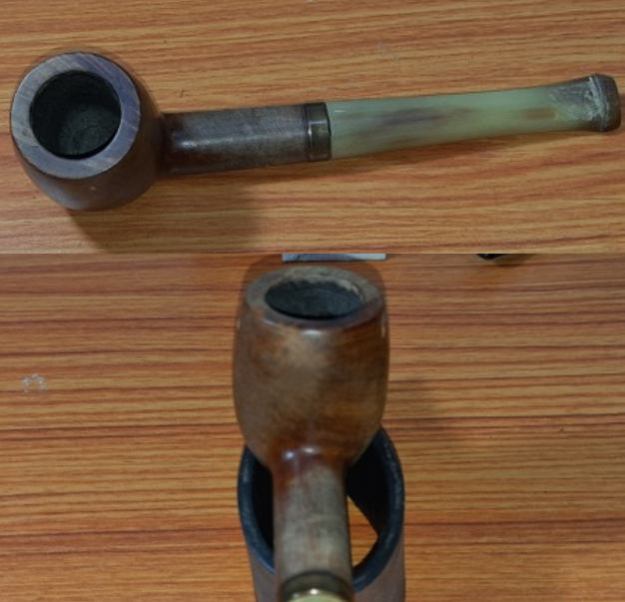
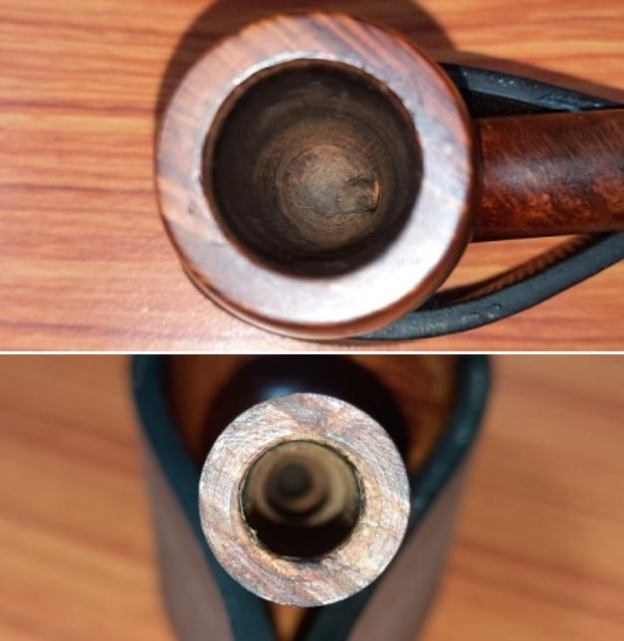
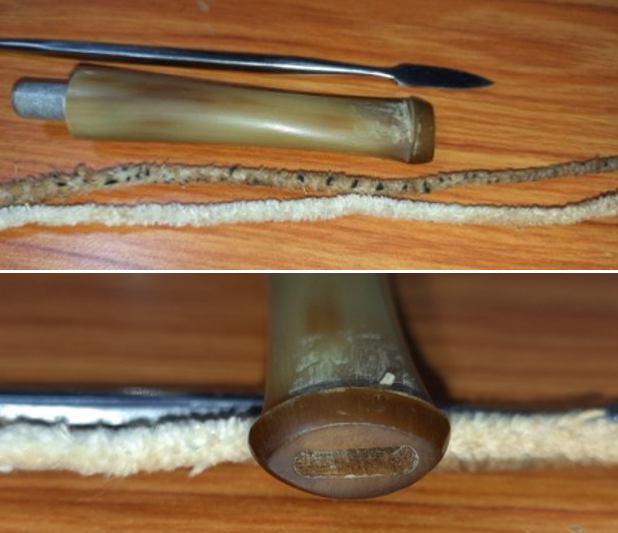
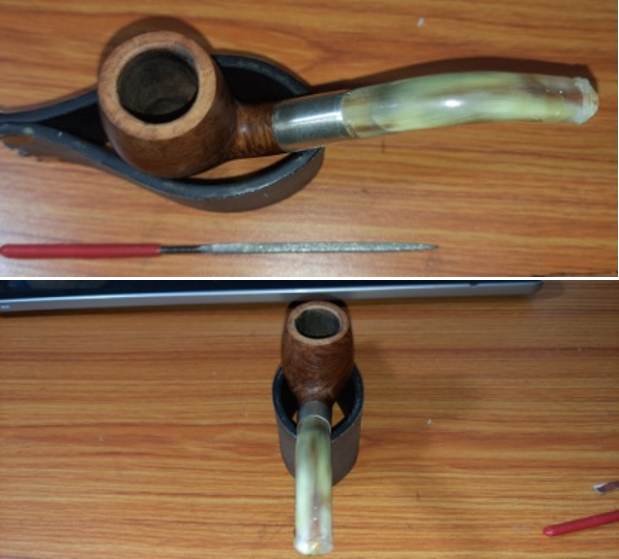
This pipe is a beautiful smaller sized bent billiards, a classic English shape. The stummel has beautiful mixed grains all around without a single fill. The rim top surface is uneven with dents and dings to the inner rim edge. There is a very thin and even layer of cake (which was proved otherwise once I reamed the chamber) in the chamber. The stummel surface is dull and dirty. The bone tenon is threaded and locks in to place with a perfectly aligned shank and horn stem. It is the horn stem that has the most damage. Worm holes at the upper surface at the button end exposing the air way and at the shank end lower surface the threaded bone tenon remains exposed. The following pictures present a general idea of the condition of this pipe. Dimensions Of The Pipe
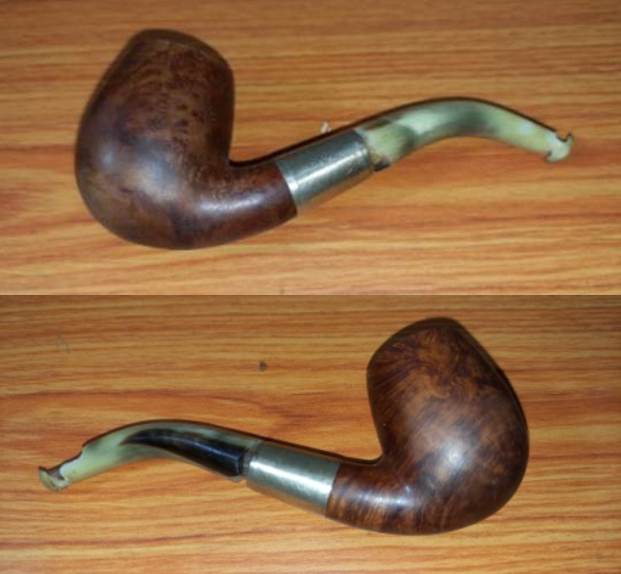
(a) Overall length of the pipe: –          4.5 inches.

(b) Bowl height: –                               1.5 inches.

(c) Inner diameter of chamber: –         0.7 inches.

(d) Outer diameter of chamber: –        1.1 inches.

Detailed Visual Inspection
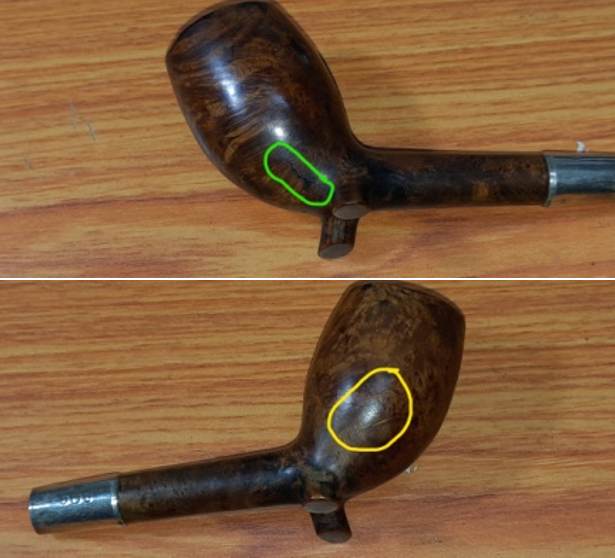
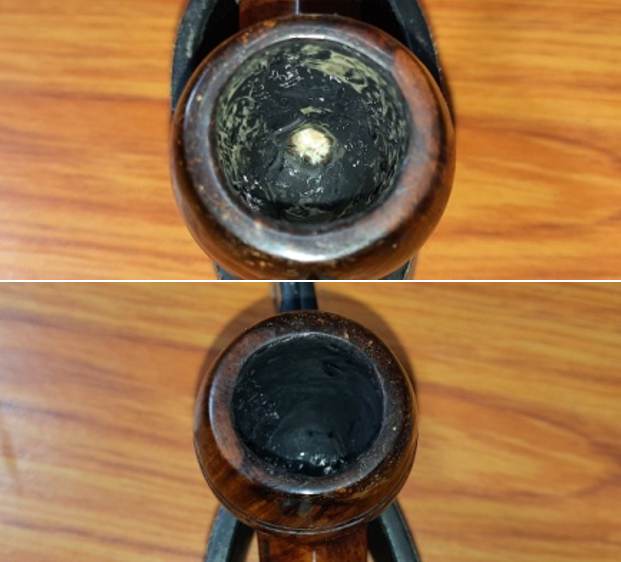
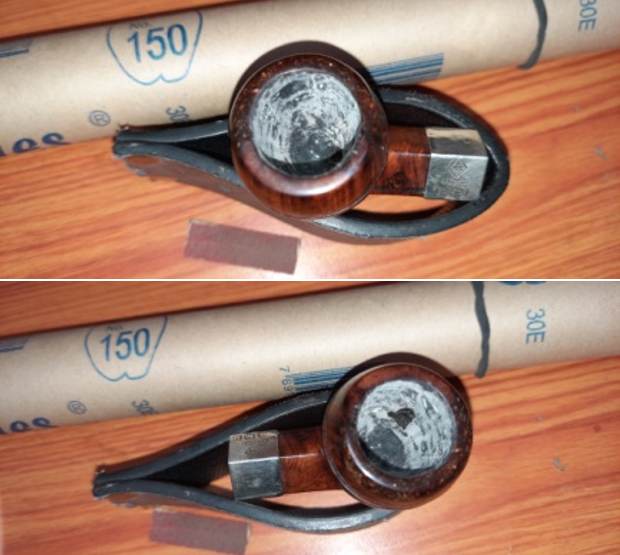
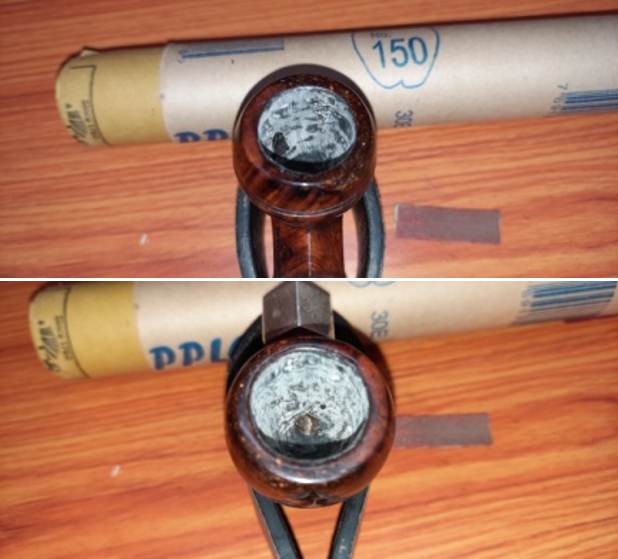
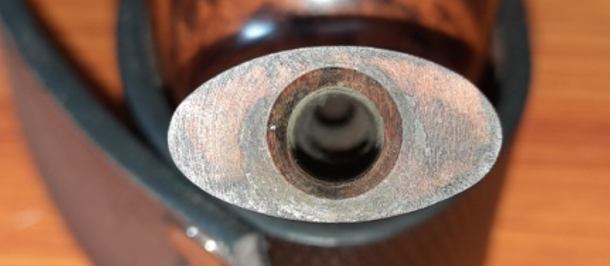
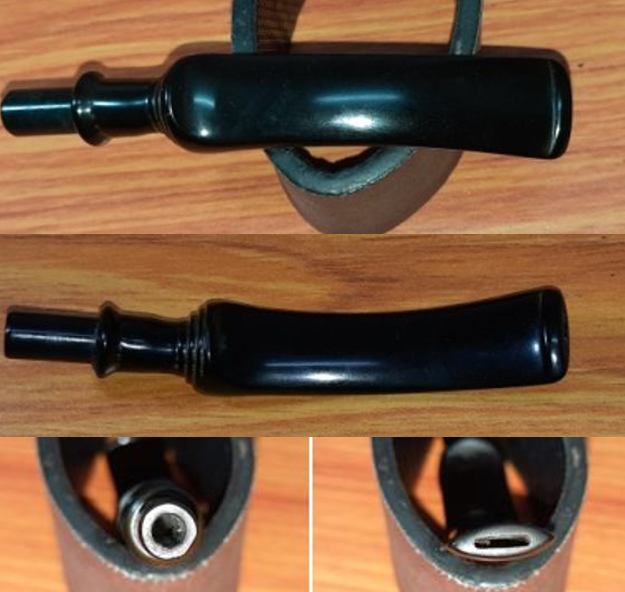
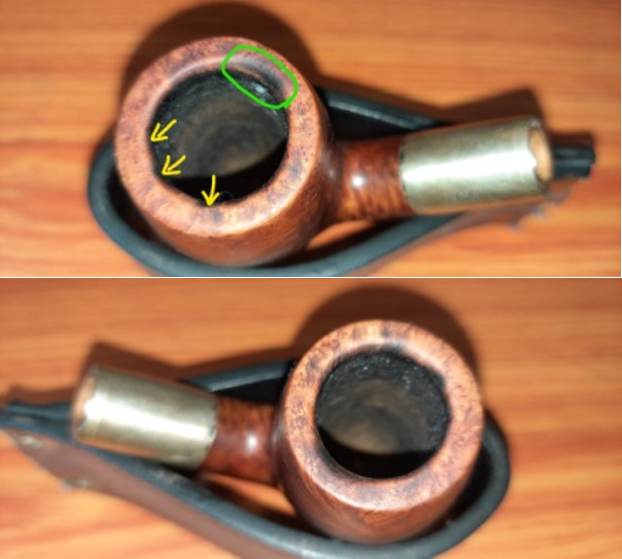
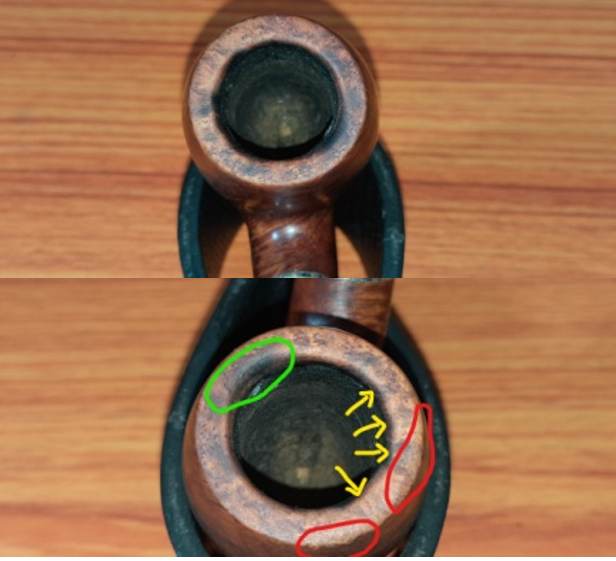
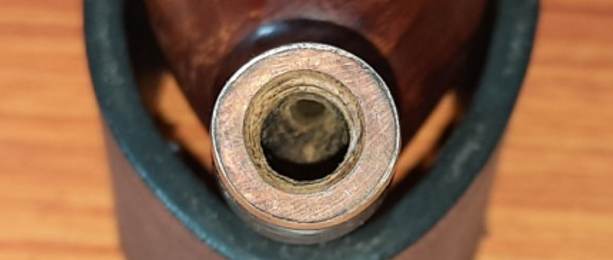
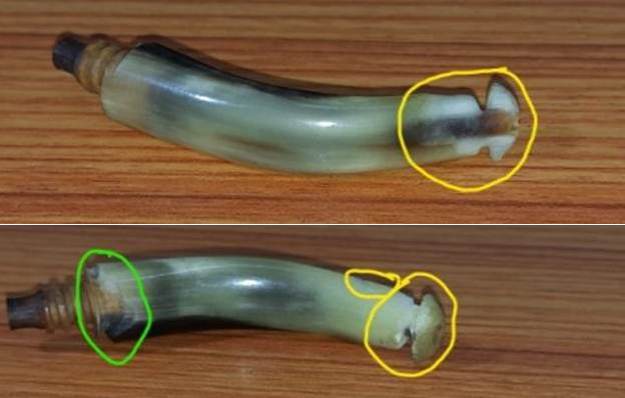
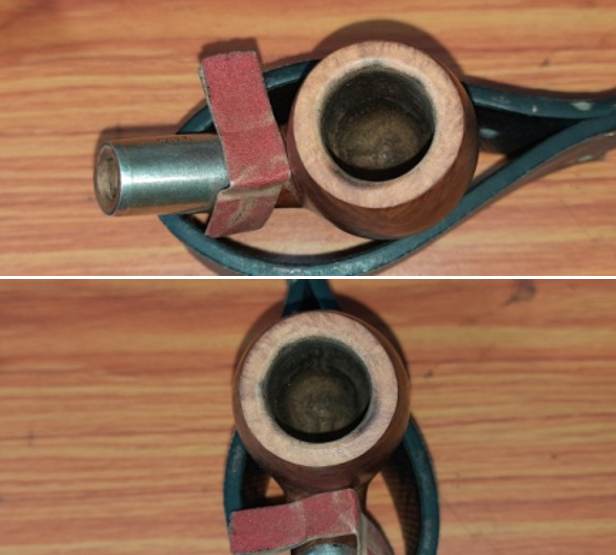
The chamber has a thin layer of even cake and appears to have been lightly reamed before being stowed away. The condition of the chamber walls will be ascertained once the cake is completely taken down to the bare briar. The inner rim edge is lightly charred on the right side in the 4 ‘O’ clock direction (encircled in green) while the left inner edge is uneven (indicated with yellow arrows). The outer rim edge shows damage to the left and front (encircled in red) due to knocking the edge against a hard surface. The rim top is sans any lava overflow but is peppered with scratches, dents and dings. The stummel surface is covered in a layer of dust and grime giving the surface a dull and lackluster appearance. From underneath this grime, a mix of bird’s eye swirls and cross grains can be seen that waits to be brought to the fore. There are a number of scratches, dents and dings over the stummel surface but predominantly over the foot of the bowl (encircled in pastel blue). The mortise is clean with small traces of remnants of old oils and tars.The stem is where maximum damage can be seen. The bone stem is riddled with worm holes in the bite zone and towards the tenon end. The following pictures will give the readers a clear idea of the extent of damage to the stem and what I would be dealing with during its repairs. At the rounded slot end, the damage is deep enough to expose the air way (encircled in yellow) but thankfully; the air way is undamaged and intact. At the tenon end, the worm hole is deep and exposes the threaded bone tenon (encircled in green). The round slot and the bone tenon opening shows residues of dried oils and tars. The silver lining to all this damage is that the button edge surface and the tenon end flat base surface is still intact and will serve as a guide while I build up the damaged surface. The Process
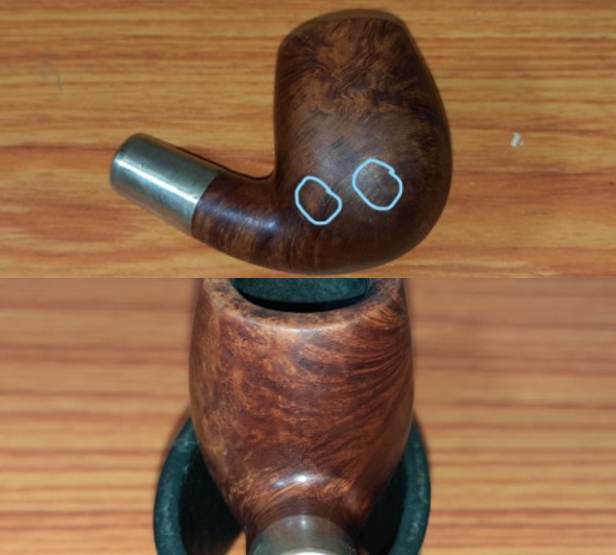
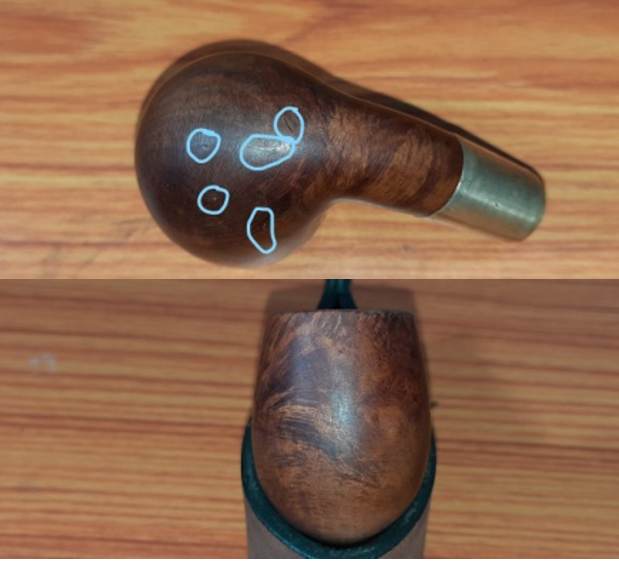
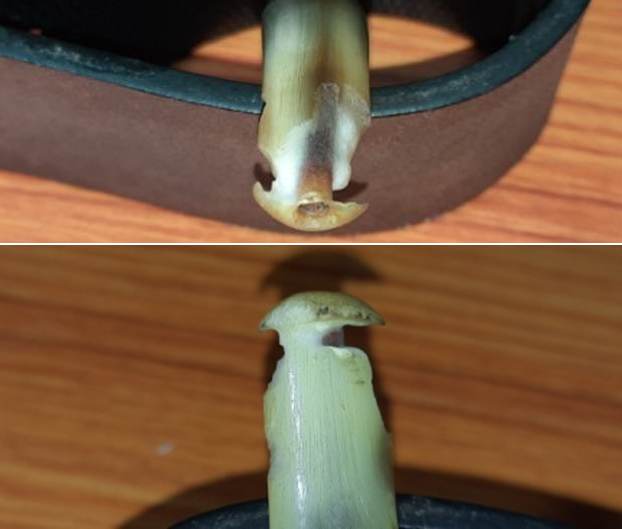
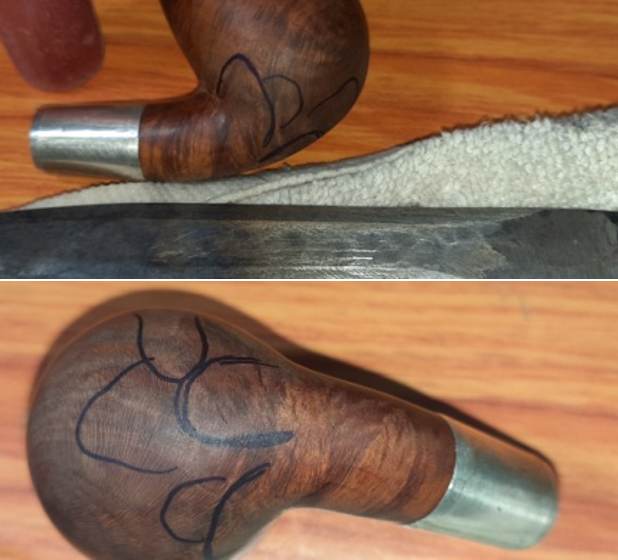
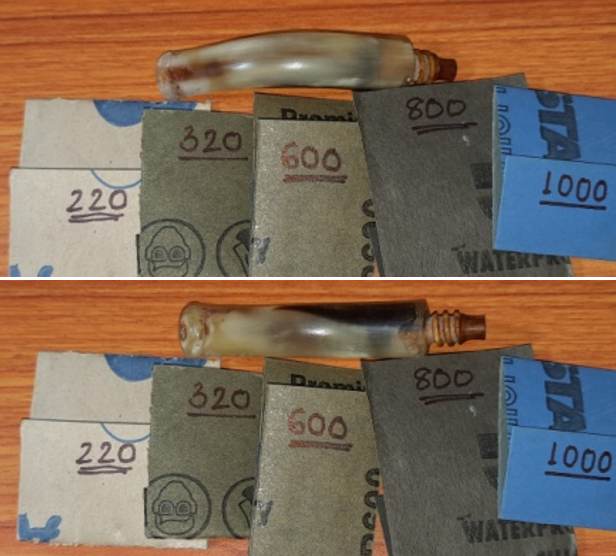
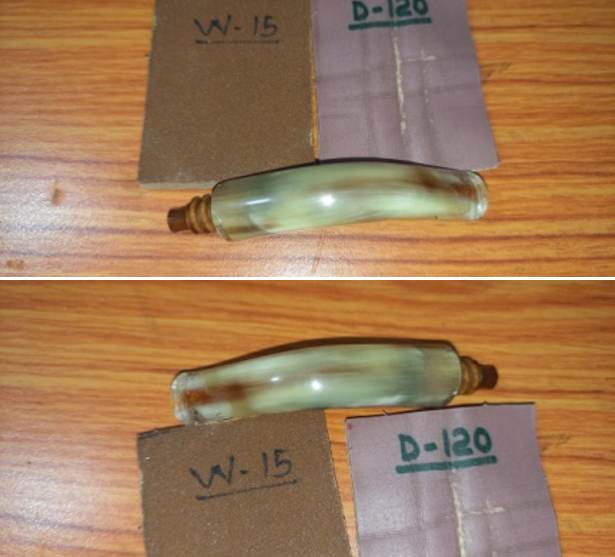
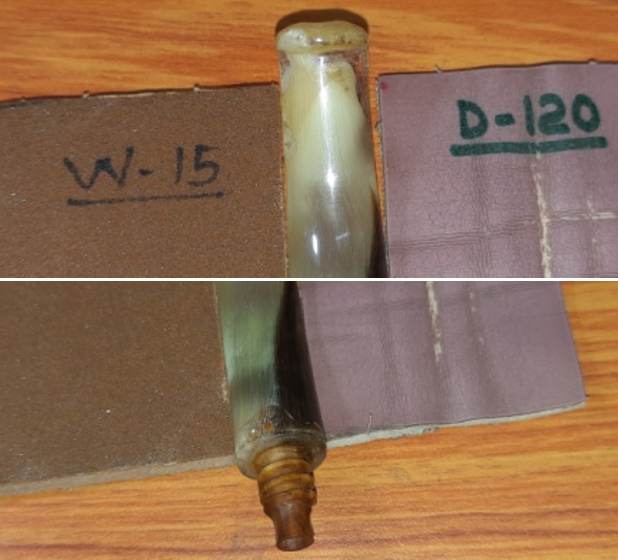
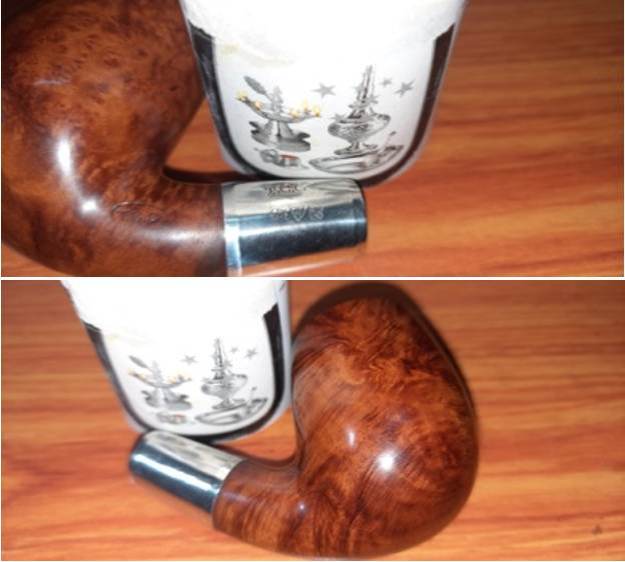
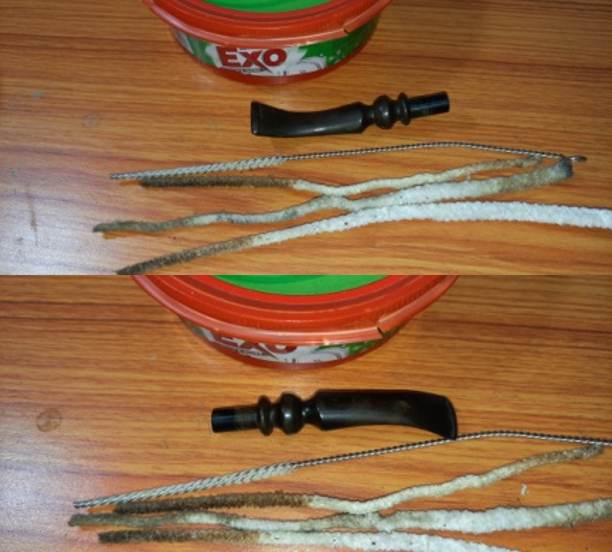
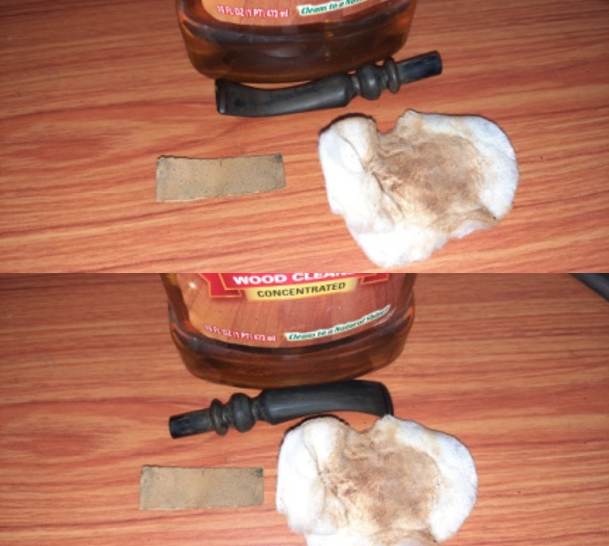
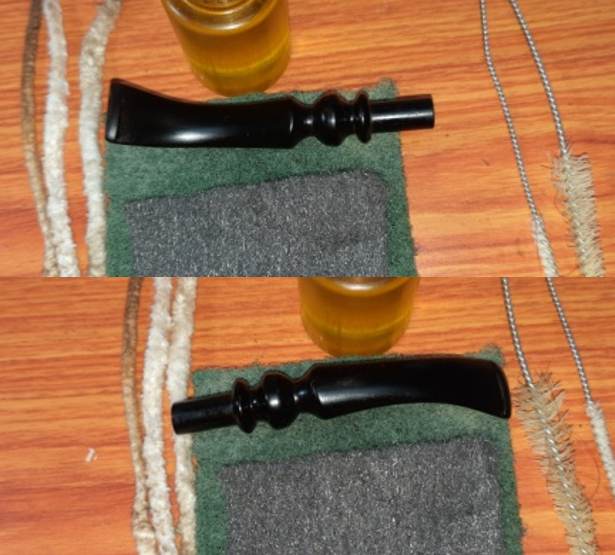
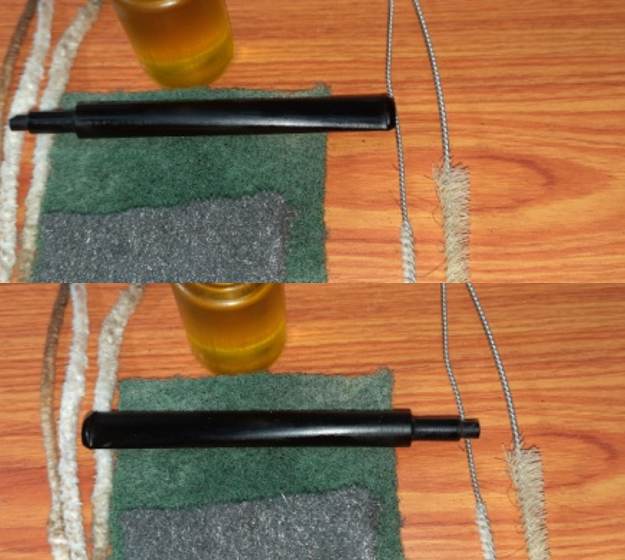
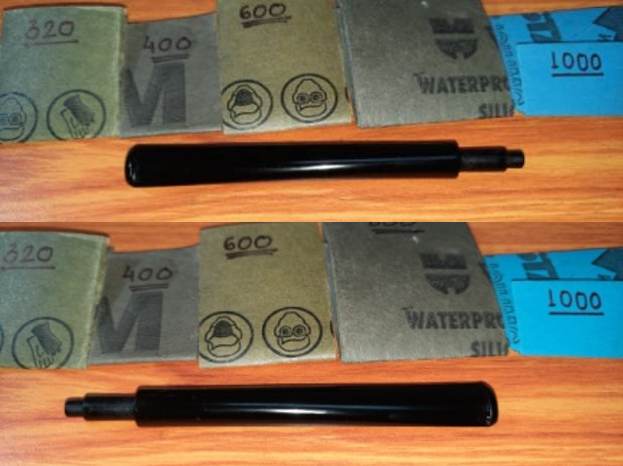
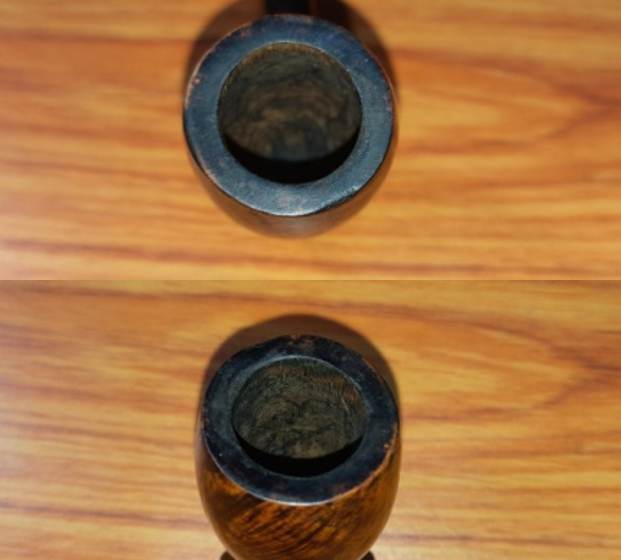
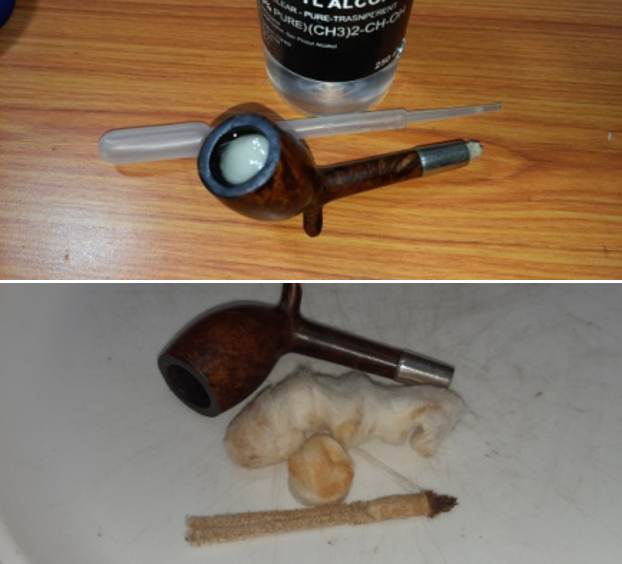
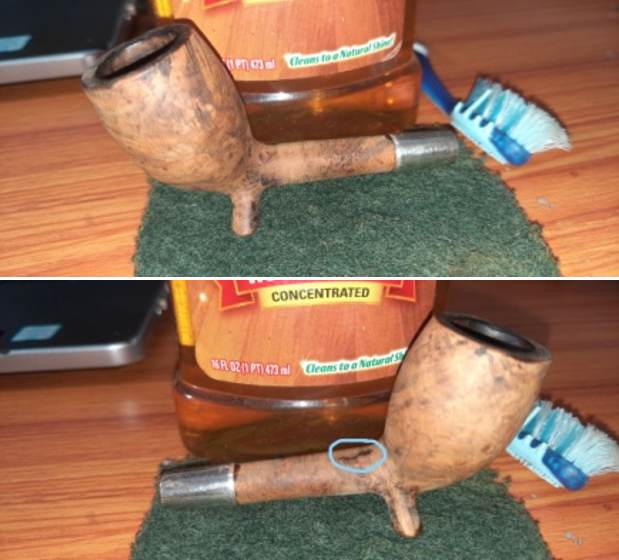
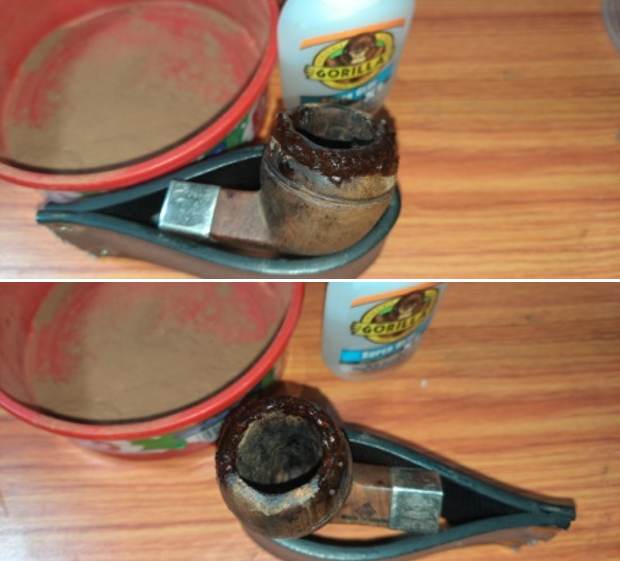
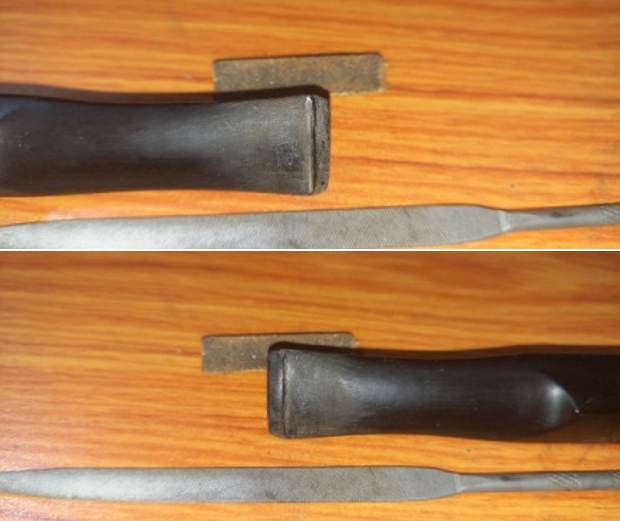
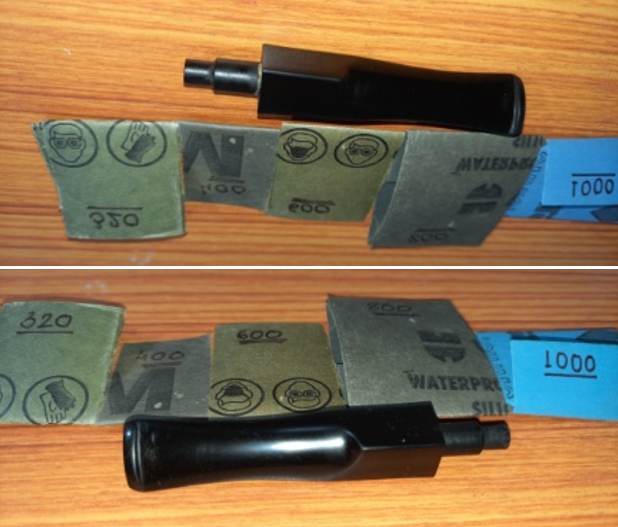
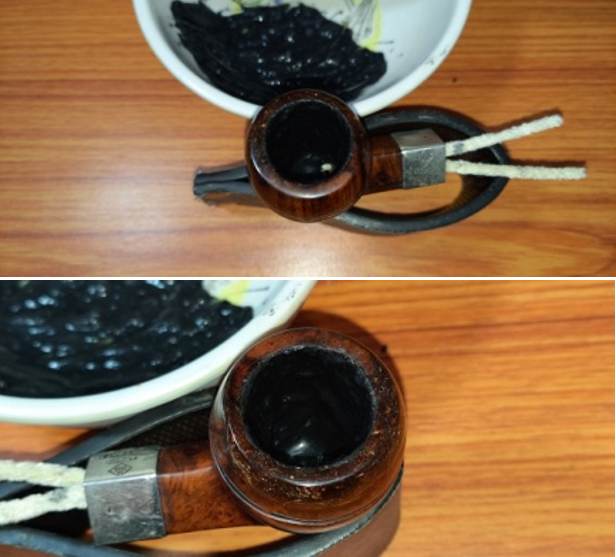
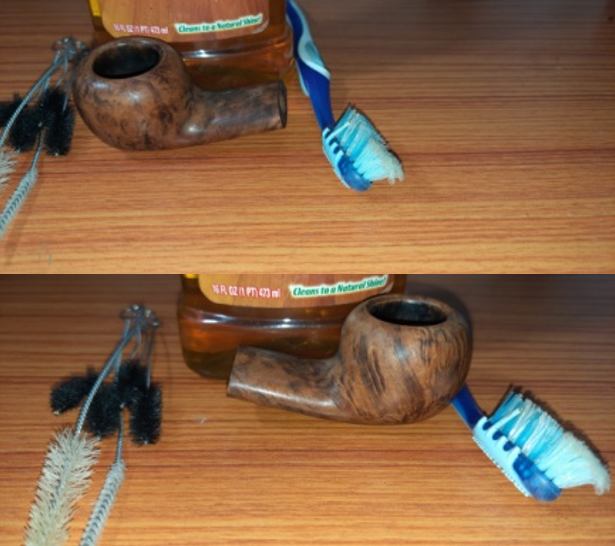
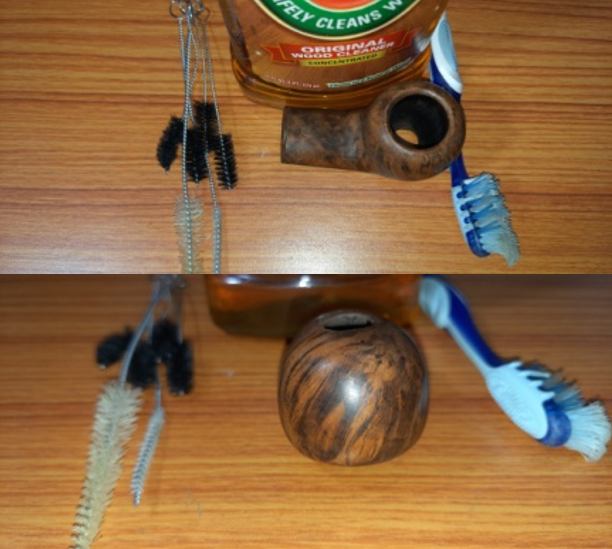
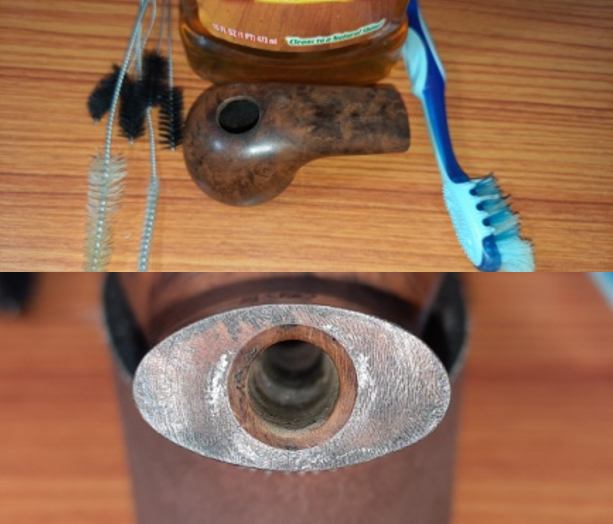
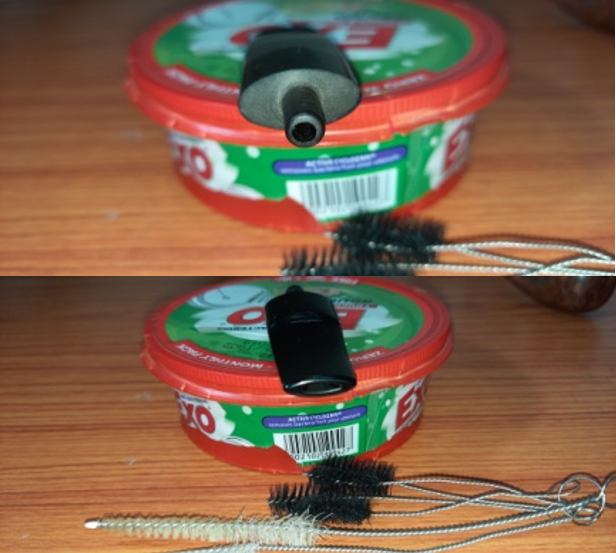
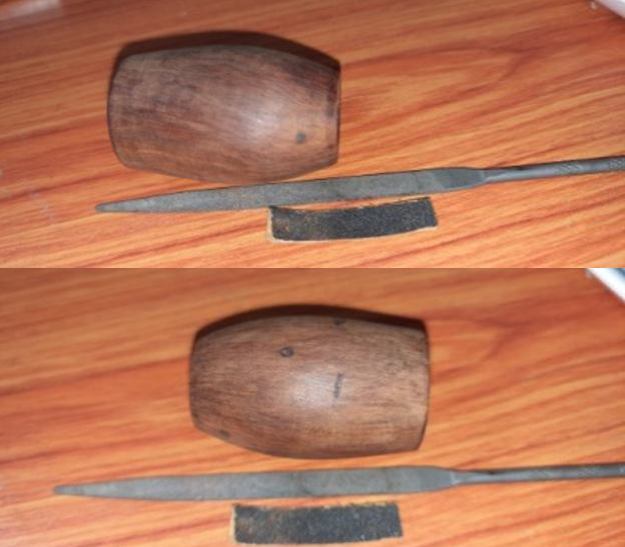
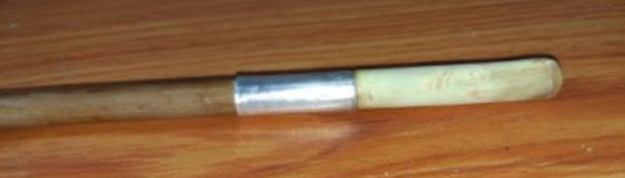
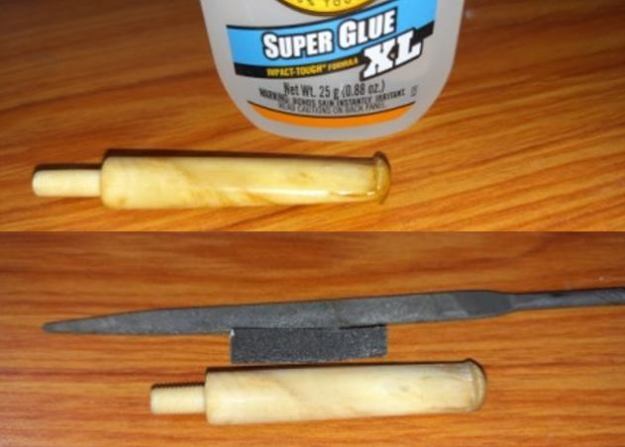
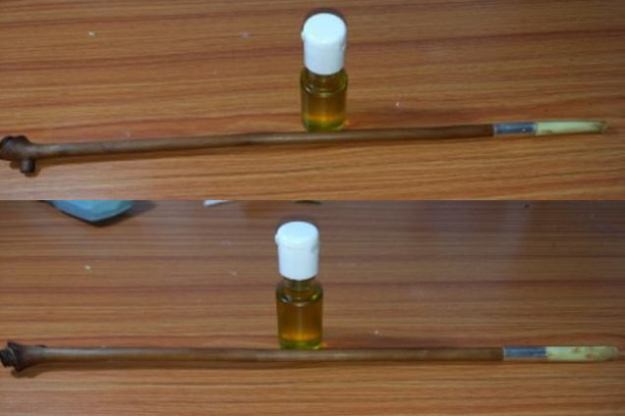
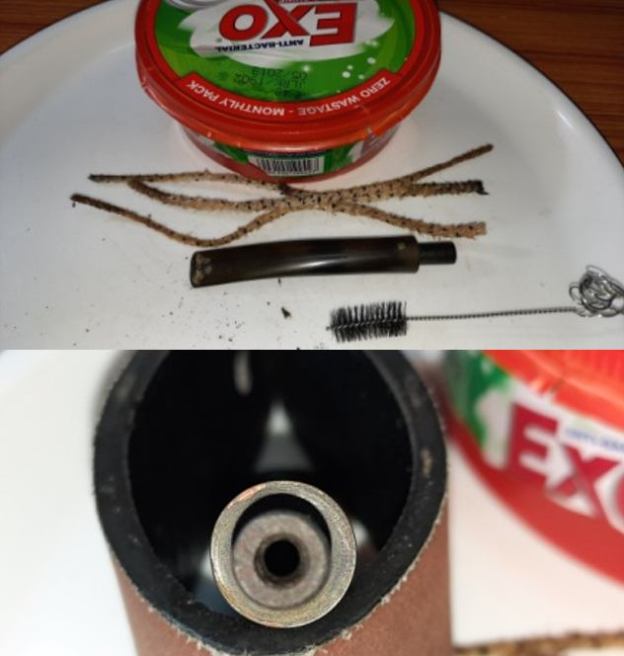
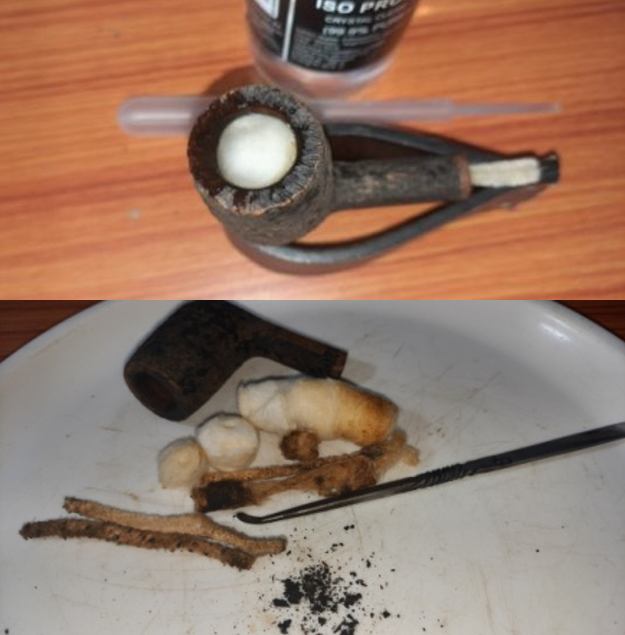
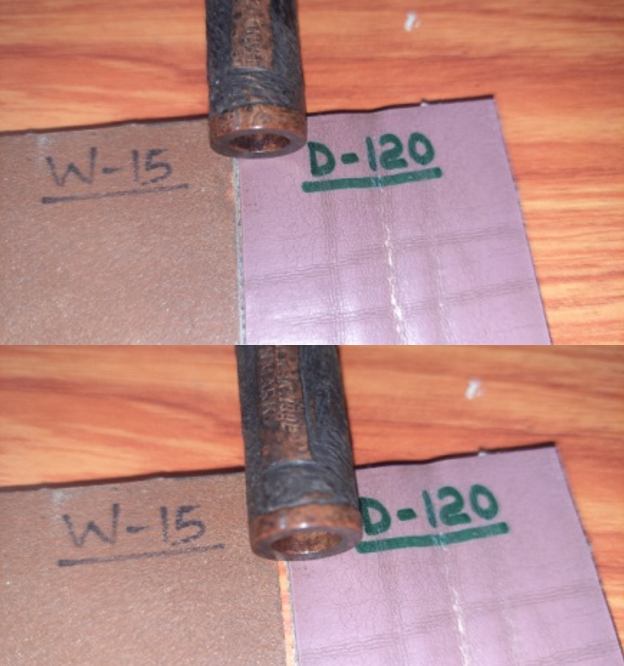
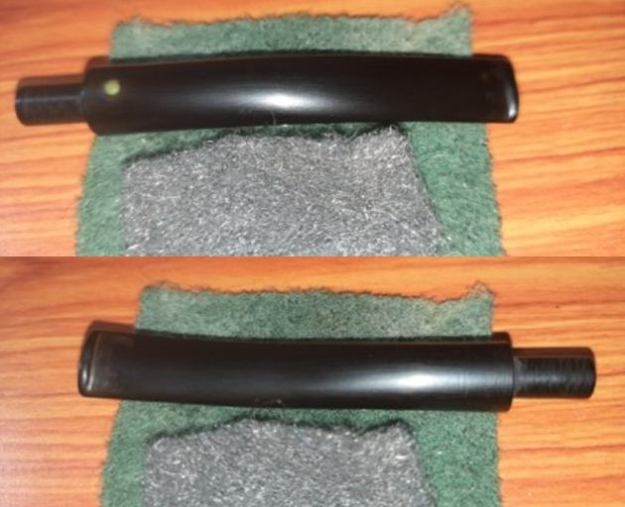
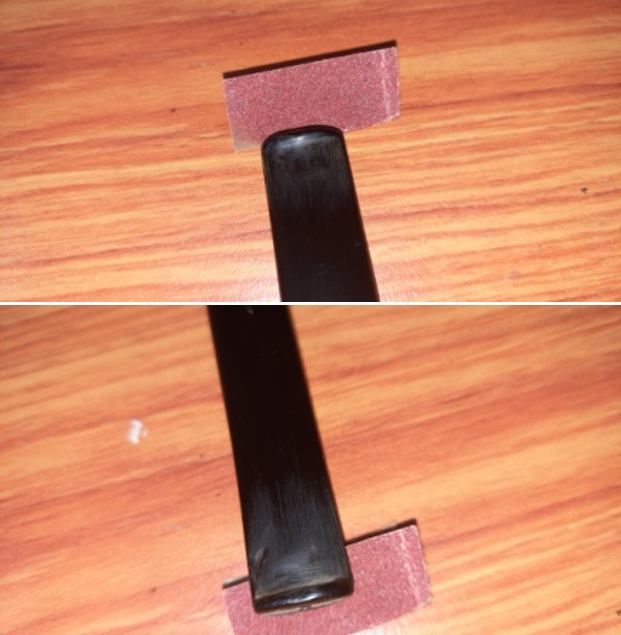
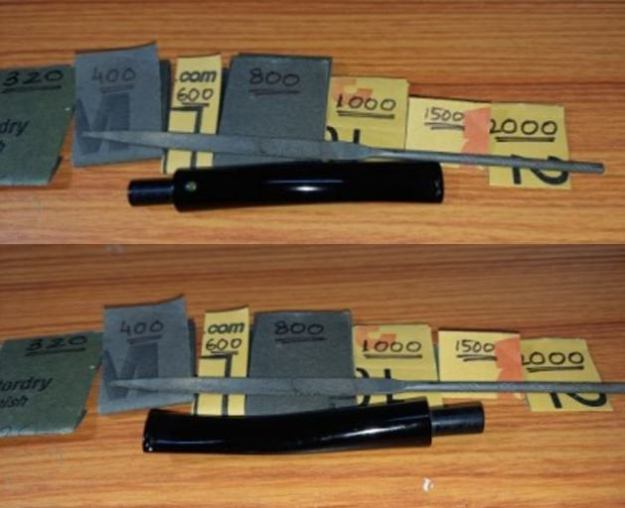
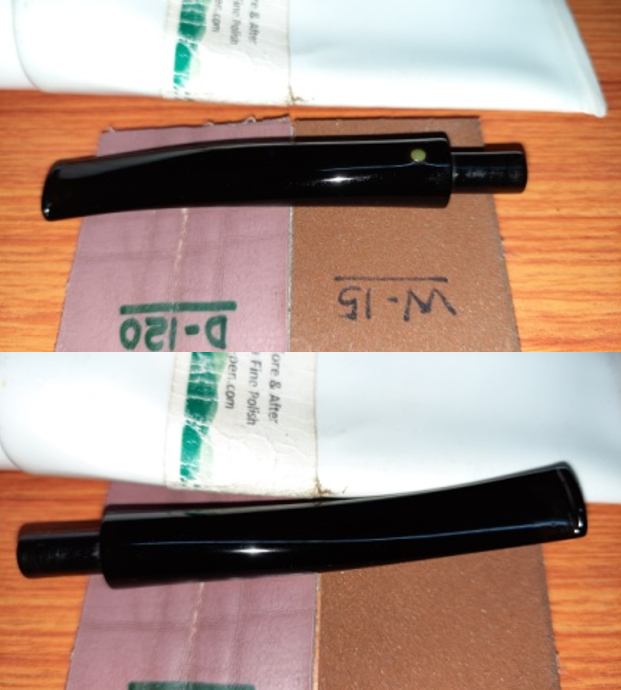
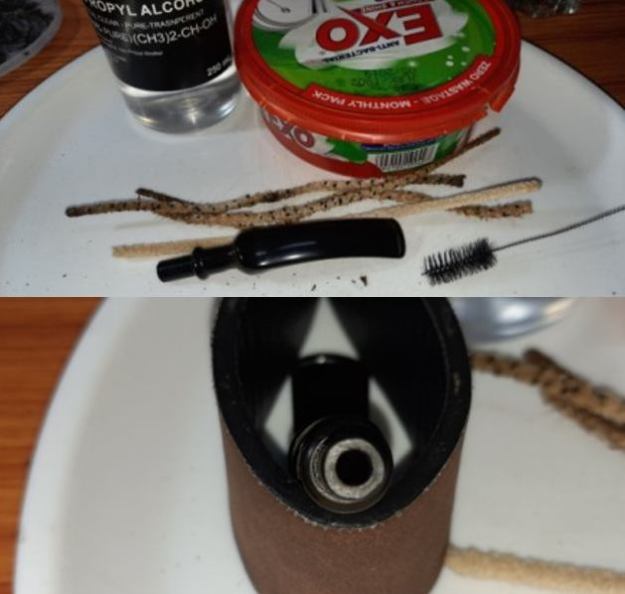
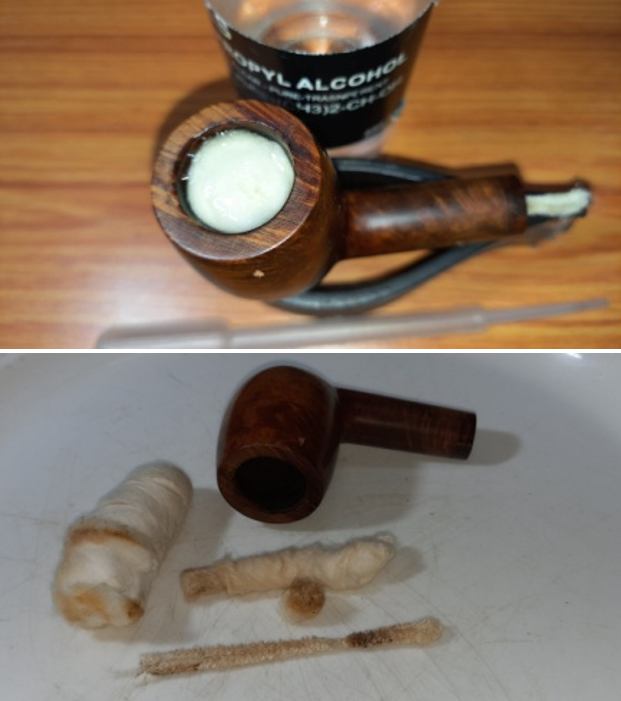
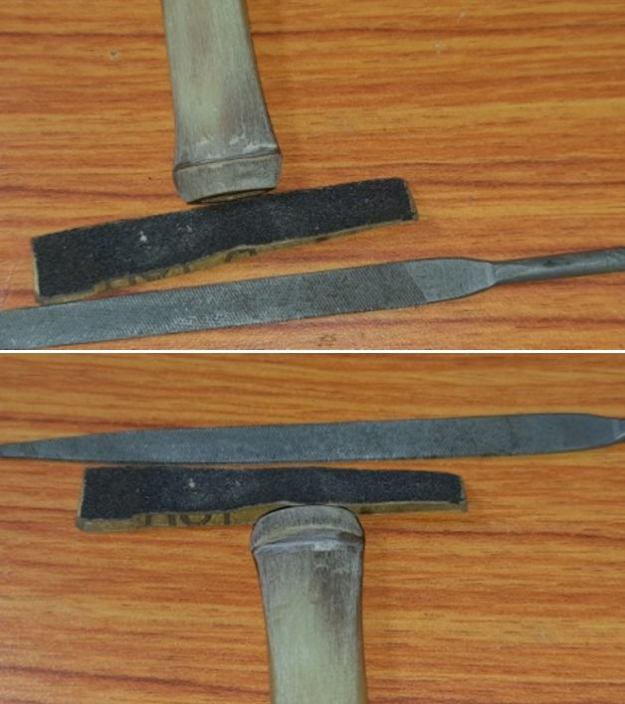
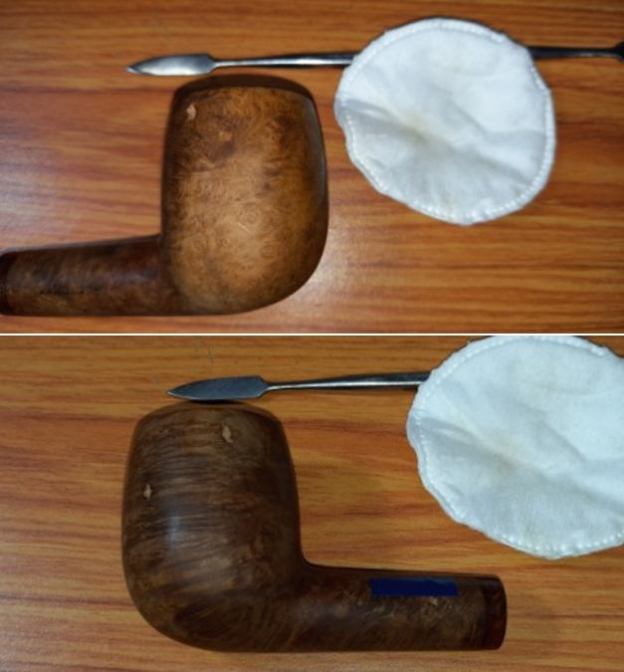
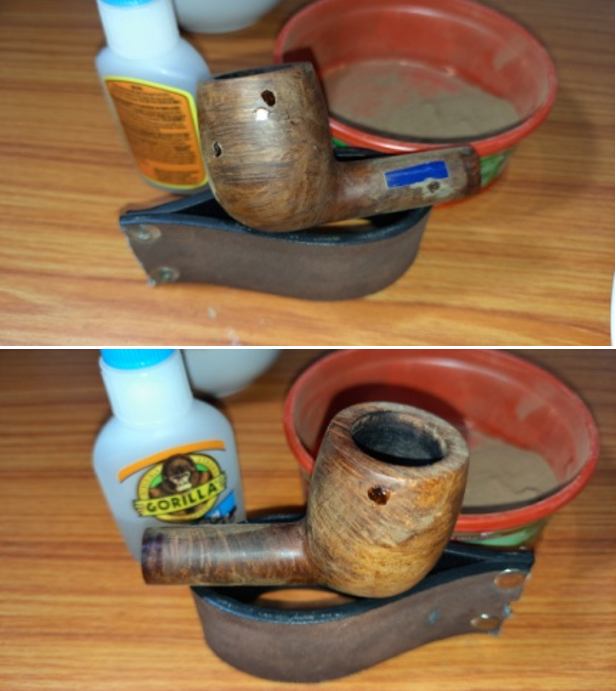
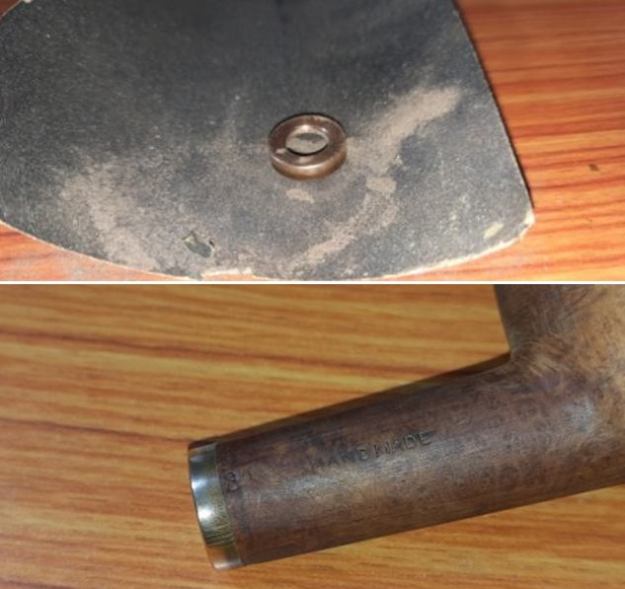
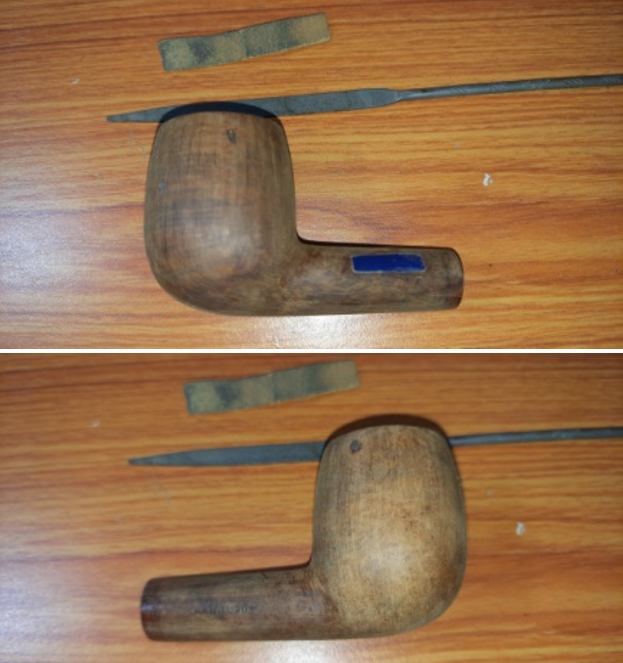
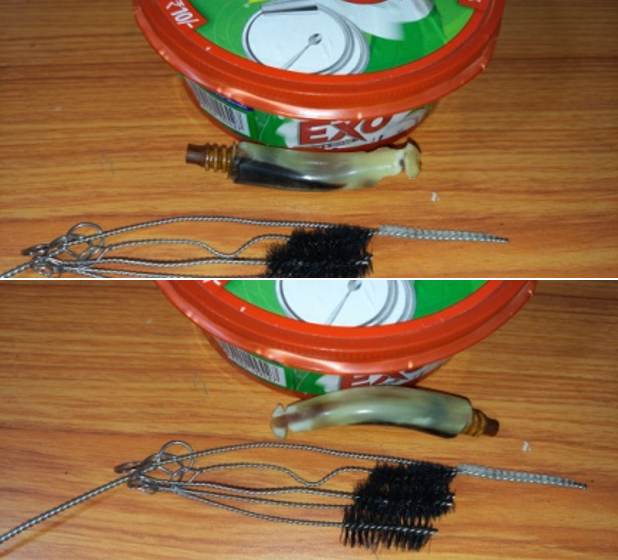
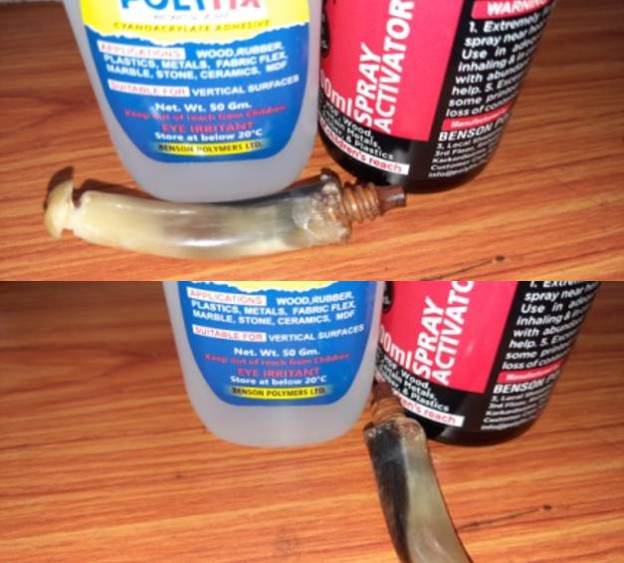
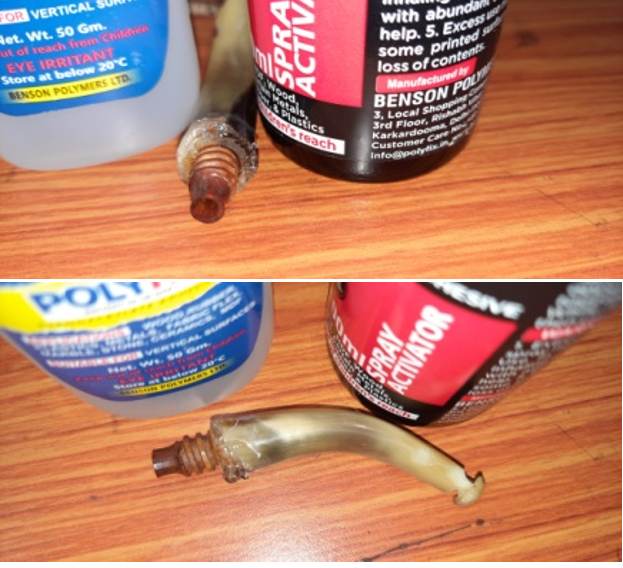
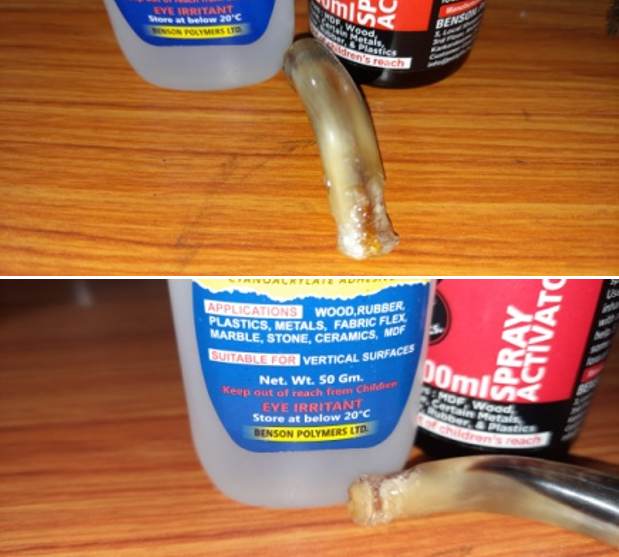
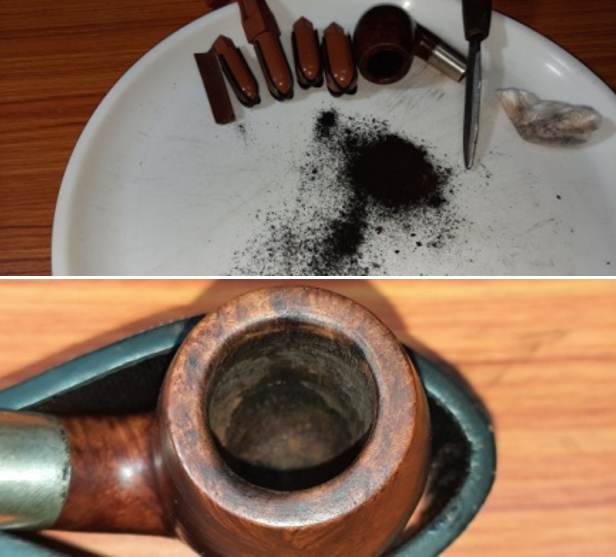
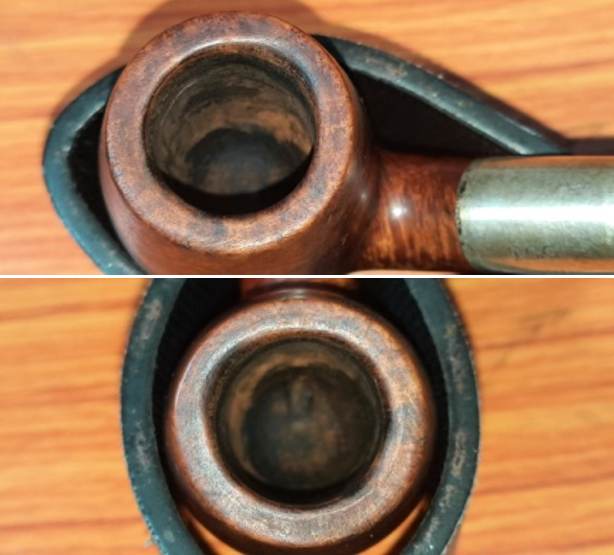
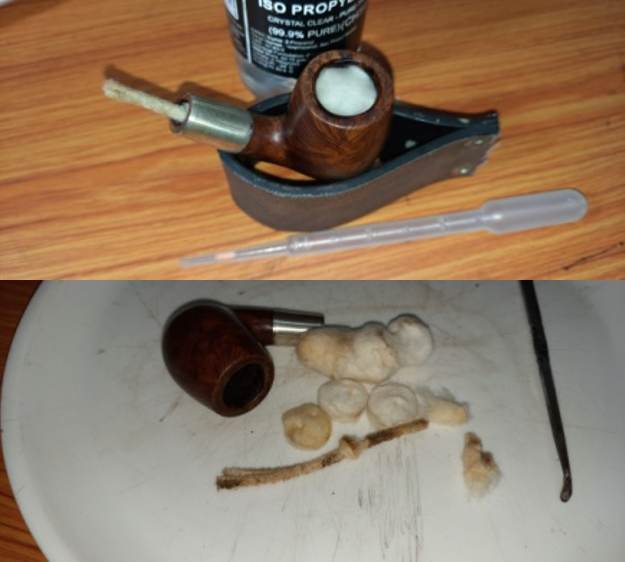
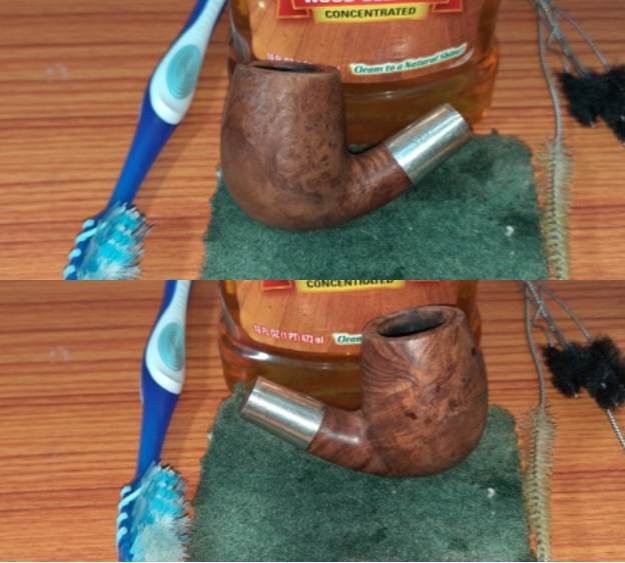
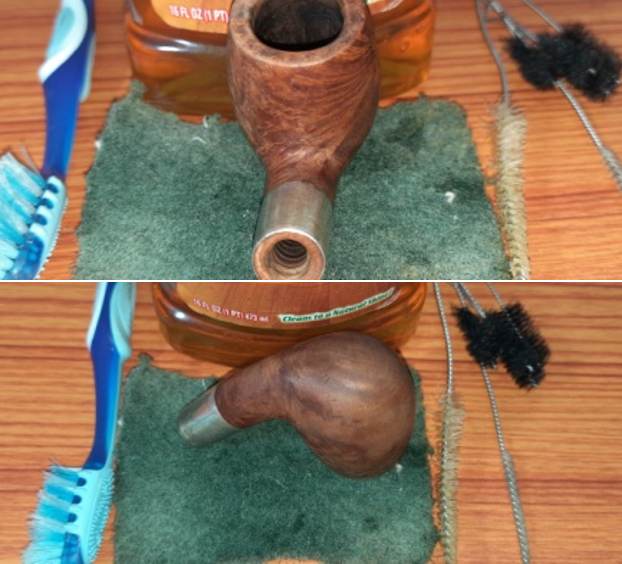
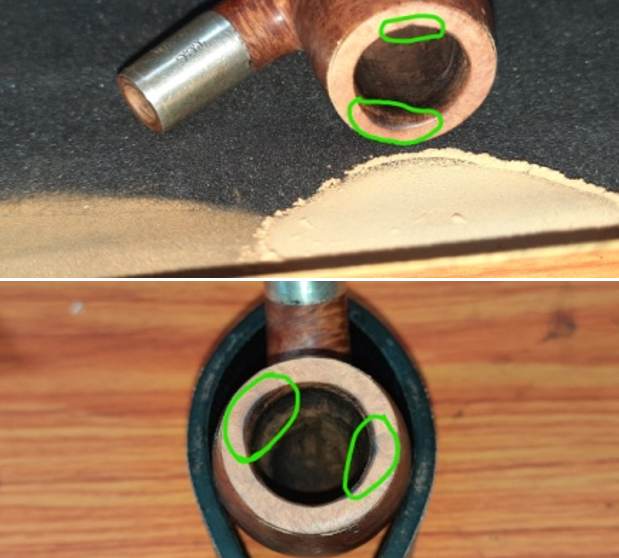
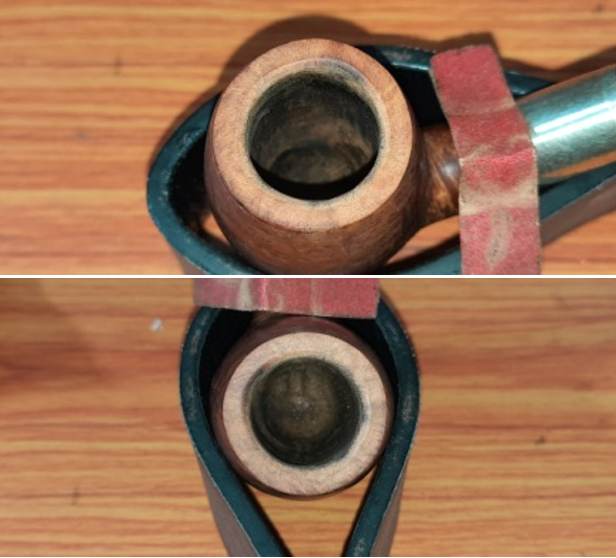
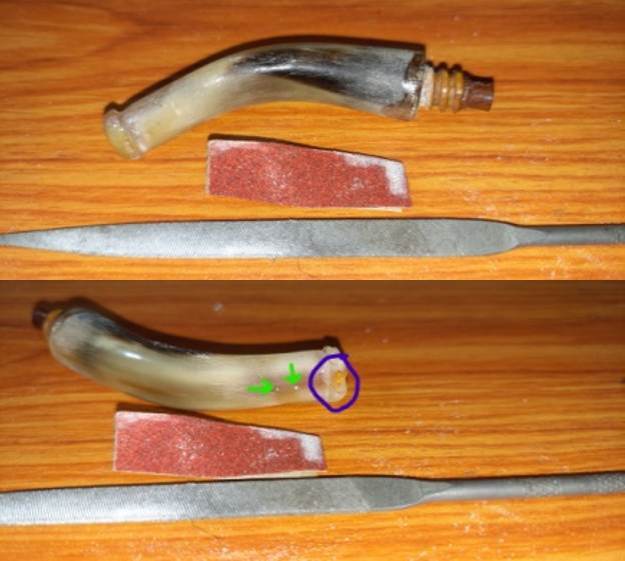
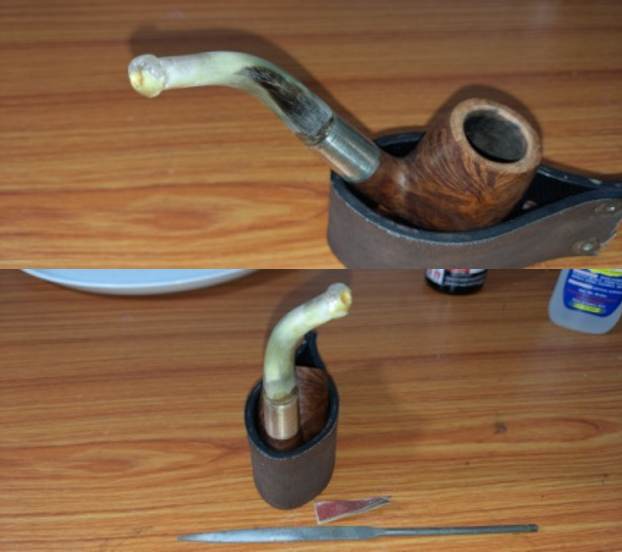
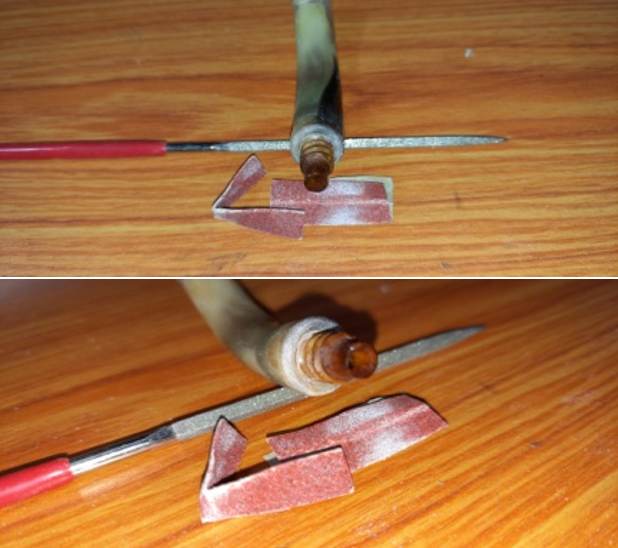
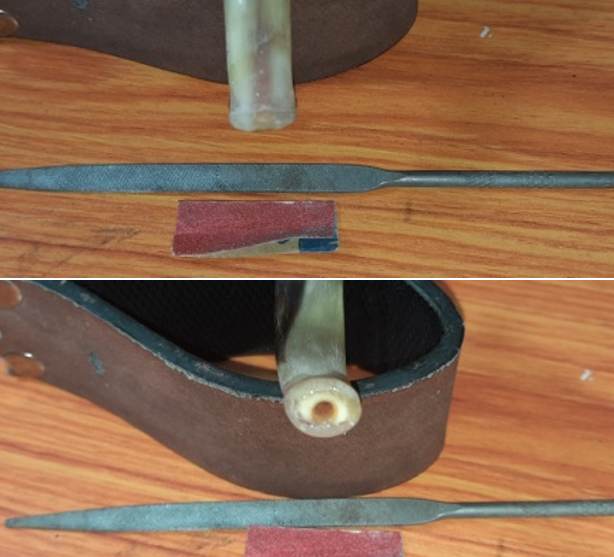
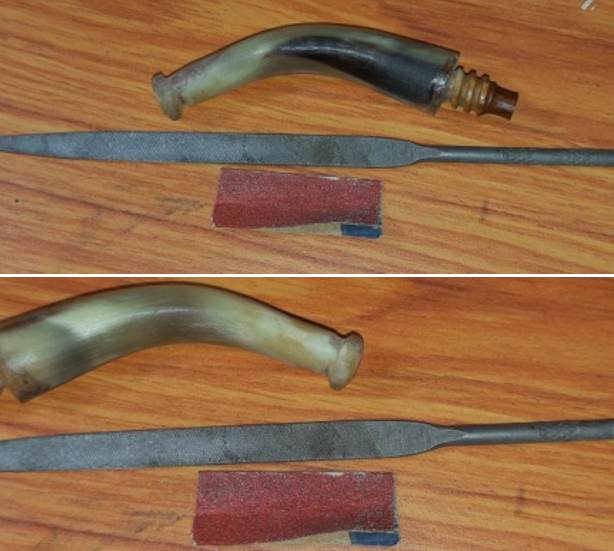
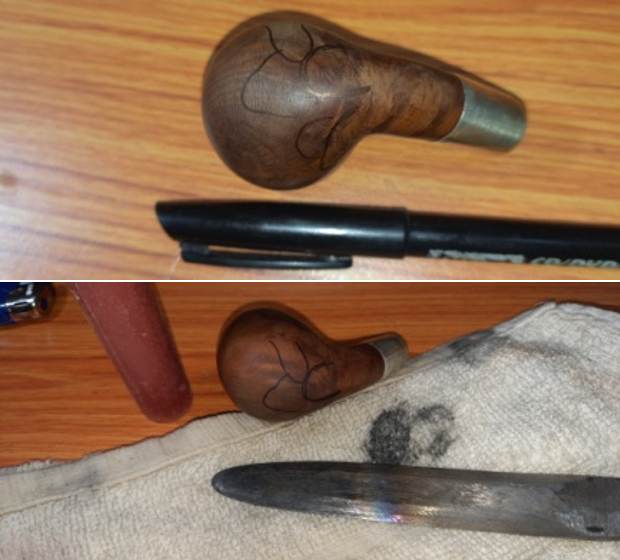
I started the repairs with the stem first as it would be the most tedious work and take the longest time. I cleaned the internals of the stem with thin shank brushes and anti-oil dish washing soap. This helps reduce the number of pipe cleaners that I would otherwise use for the cleaning of the airway.I ran a couple of bristled pipe cleaners dipped in isopropyl alcohol to thoroughly clean the airway. I followed it by cleaning the stem surface with cotton swabs wetted with alcohol in preparation for rebuilding the damaged horn surface with clear CA superglue.With the internal and external surface of the stem cleaned up, I moved ahead with reconstruction of the worm hole ridden bite zone and the tenon end of the stem with high viscosity clear CA superglue. I started the repair work at the tenon end. To hasten the process of curing, I sprayed the fill with accelerator. I followed the layering technique to rebuild the damaged surface, that is, first drop a blob of superglue over the surface to be rebuilt and spray the accelerator. Once the glue has hardened, drop superglue over the same area and spray the accelerator to harden the glue. I continued with this method at both the ends of the stem till I had completely covered the area to be rebuilt and then some more. The purpose of excessive build up of the damaged stem surface was that it would be sanded down to perfect or near perfect match with the rest of the stem surface. Following pictures will give the readers a general idea of the process explained above. Once the tenon end of the stem was filled with superglue and set using the accelerator, I followed the same procedure to rebuild the slot end of the stem. Thereafter, I set the stem aside for the fills to cure overnight. While the stem was set aside for the fills to cure, I reamed the chamber with size 1 and 2 heads of the PipNet pipe reamer. I removed the carbon from the areas where the reamer head could not reach with my fabricated knife. To completely remove the residual carbon from the walls of the chamber and even out the walls, I sand the chamber walls with a folded piece of 220 grit sandpaper followed by cleaning the chamber with a cotton swab wetted with isopropyl alcohol. The chamber walls are in pristine condition. The quantity of carbon that was removed did surprise me as I had anticipated a far less build up of cake in the chamber. I also cleaned the mortise with pipe cleaners and alcohol. Continuing with internal cleaning of the bowl, I decided to subject the chamber and mortise to cotton and alcohol bath. I packed the chamber with cotton balls and drew out a wick from the cotton and along with a folded regular pipe cleaner, inserted it into the mortise and through the draught hole into the chamber. I tightly packed cotton balls in to the remaining portion of the mortise. Thereafter, I soaked the cotton balls with isopropyl alcohol up to the brim. About half an hour later, the level of alcohol had gone down, having being absorbed by the cotton. I topped it up once again and set it aside overnight. By next afternoon, the cotton and alcohol had drawn out all the remaining oils and tars from the chamber and mortise. I removed the cotton balls and the filth can be gauged by the appearance and coloration of the cotton balls and the pipe cleaner. I ran pipe cleaners through the mortise and draught hole to clean out all the loosened tars and gunk that was lodged in the draught hole and mortise. The chamber and mortise now smelled clean, fresh and looked it too. I set the stummel to dry out naturally.With the internal cleaning done, it was time for the external cleaning of the stummel surface. I used a hard bristled tooth brush and Murphy’s Oil Soap, to scrub the stummel and rim top. I washed the stummel under running warm water with anti oil dish washing detergent till the stummel surface was clean and dried it using paper towels and soft cotton cloth. I simultaneously cleaned the shank internals with the detergent and hard bristled shank brush and set the stummel aside to dry out naturally.Next, I addressed the various stummel repairs that I have mentioned above. First issue that I addressed was that of the rim top surface dents/ dings, charred inner rim edge and chipped outer rim edge. To address the rim top damage, I topped the rim surface on 220 grit sandpaper till the surface was nice and even. I hate losing any briar and prefer to restrict topping to the barest minimum that is required. The damage to the outer rim edge, though greatly eliminated, can still be seen to the left side. This would be taken care of by creating a slight bevel to the outer edge. The charring to the inner rim edge is still visible (encircled in green). These issues could be completely addressed by the process of topping but the extent of topping that would be required to do so would alter the bowl height and also the entire stummel profile.With a folded piece of worn out 180 grit sand paper pinched between my thumb and forefinger, I carefully created a bevel over the inner and outer rim edge and addressed the issue of charred inner rim edge. The rim edges appear much better at this stage and should further improve the aesthetics of the stummel when the bevel and stummel is polished using the micromesh pads. While I was working on the stummel, the stem fills had cured completely and as I was keen to shape the stem fills, I kept the stummel aside and worked on the stem repairs. I used a flat needle file to roughly match the fills with the rest of the stem surface. I further evened out the fills by sanding the stem surface with a folded piece of 150 grit sandpaper. All this filing and sanding had exposed a few air pockets (indicated with green arrows) and a portion of the upper button edge (encircled in indigo) that would need to be further rebuilt.Since I had rebuilt the stem face at the tenon end, it was imperative for me to check the alignment of the stem against the shank face when seated. My expected fears came true and how! The stem was grossly overturned to the right.The general rule of thumb is that if the overturn is to the right, one needs to sand the left side so that the threads could complete the turn and achieve a perfect alignment. However, this need to be done extremely carefully as any excess sanding of the left side could result in a left overturn. Using needle files and a 220 grit sandpaper, I sand the excess fill from the left side, checking very frequently for the alignment. A few hours and numerous checks later, I achieved a perfect alignment of the stem and shank face. My mantra of “less is more” was always playing at the back of my mind as I worked on the stem face. Now I could move ahead with addressing the air pockets and rebuild of the button edge over the upper stem surface. I filled the air pockets and rebuilt the button edge over the upper surface with CA superglue and once the glue had cured, with a needle file and sandpaper, I reshaped and evened out the fills to match the rest of the stem surface. Next, I decided to address the dents and dings on the stummel surface, notably at the foot and lower sides of the bowl. Using a marker pen, I marked all the major areas with dents and dings as I had decided to leave the minor ones as they were. I heated my fabricated knife over the flame of a candle, placed a wet Turkish hand towel over the marked areas and steamed out the dents by placing the heated knife over the towel. The steam generated by placing a hot knife on the wet towel helps the briar to expand within these dents and dings, making for a smooth and even surface. The stummel appears much better and smooth at this juncture.To further even out the remaining minor dings, I lightly sand the entire stummel with a folded piece of worn out 180 grit sand paper. I followed it by wet sanding the stummel with 1500 to 12000 grit micromesh pads, wiping frequently with a moist cloth to check the progress. I rubbed a small quantity of “Before and After Restoration Balm” deep into the briar with my finger tips and let it rest for a few minutes. The balm almost immediately works its magic and the briar now has a nice vibrant appearance with the beautiful grain patterns displayed in their complete splendor. I further buffed it with a microfiber cloth to deepen the shine. Now I needed to work on the stem again. I had completed the refilling/ rough reshaping of the damaged stem and now proceed to fine tune the reshaped button edge, rebuilt surfaces and polishing of the stem. I sand the stem with 220, 320, 600, 800 and 1000 grit sandpapers. The coarser grade sandpapers help in achieving exactness of shape and removing excess repair material to match rest of the surface while 600, 800 and 1000 grit sandpapers help in eliminating the sanding marks left behind by the coarse grit papers and imparting a shine to the stem surface. I rubbed a small quantity of EVO in to the bone to hydrate it.To bring a deep shine to the horn stem, I went through the complete set of micromesh pads, wet sanding with 1500 to 12000 grit pads. I wiped the stem with moist cloth after each pad and rubbed it down with Extra Virgin Olive oil to rejuvenate the bone stem. I am pretty happy with the way the stem repairs have shaped up and also the button has a nice delicate shape. The finished stem is shown below. I cleaned the sterling silver ferrule at the shank end with “Pitambari”, a powder that is available all across India that is used to clean and shine brass and silver ware. Even Abha uses it to polish her silver and gold jewelry and cutlery. This compound is a very fine powder and is least abrasive with fantastic results. The band is now a nice shining piece of sterling silver and will provide a nice contrast between the shining horn stem and the dark brown stummel.To complete the restoration, I mount a cotton cloth buffing wheel on to my hand held rotary tool and polished the stummel and stem with Blue Diamond compound. This compound helps to remove the minor scratch marks that remain from the sanding. I mounted another cotton buffing wheel that I have earmarked for carnauba wax and applied several coats of the wax. I finished the restoration by giving the entire pipe a rigorous hand buffing using a microfiber cloth to raise the shine further. The finished pipe looks amazingly beautiful and is ready to join my collection. I only wish it could share with me its life story of the past years while I enjoy smoking my favorite Virginia blend in it or maybe an English blend or maybe just keep admiring it!! I wish to thank all the esteemed readers for reading through this write up and thereby being a companion in my journey.
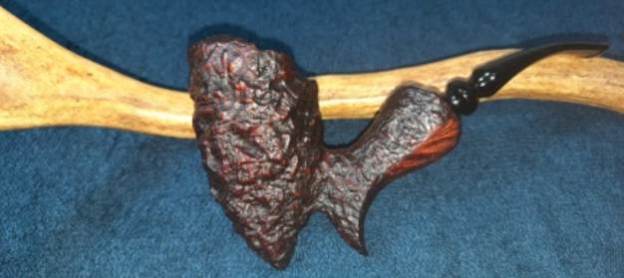
Just A Little TLC And This Amazing Harcourt ‘S’ Came Back Alive Again


Blog by Paresh Deshpande

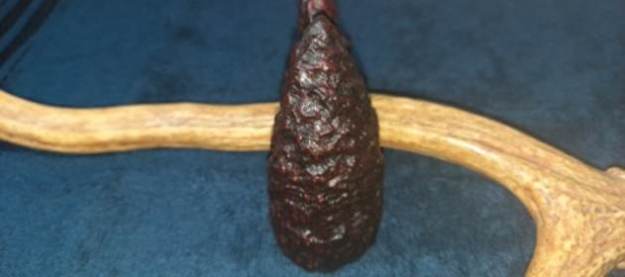
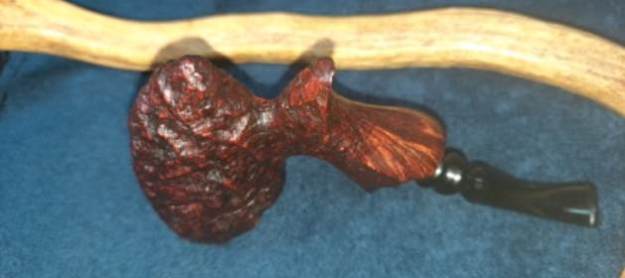
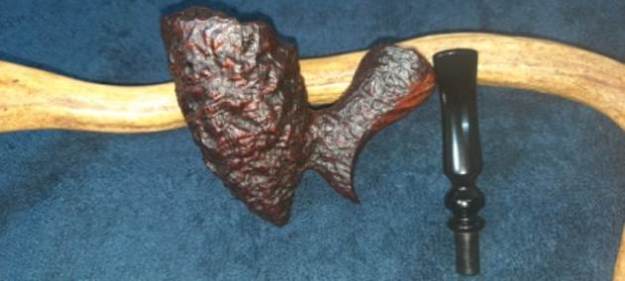
I was and still am a big fan of Preben Holm and never miss an opportunity to own one of his creations, specially the older ones. His early pipes were graded from 1 to 8 in ascending order and I have grades 1, 3, 4, 6, 7 and 8 in my collection. These are all stunning pipes without doubts. Thus when this pipe came up for auction on eBay in 2018, I had to bid on it. Waiting for the last opportune moment to place my bid is always the longest wait and the timing has to be just right, too late and your bid may not be accepted and too early gives reaction time to other buyers. In this case, everything went just right and I landed being the highest bidder. A month and a half later, the pipe was received by Abha in Pune.

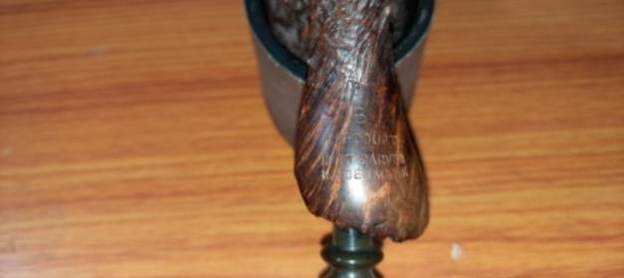
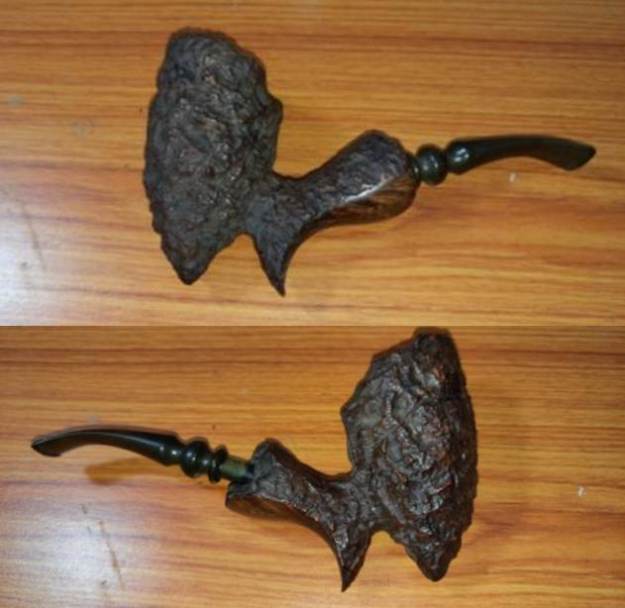
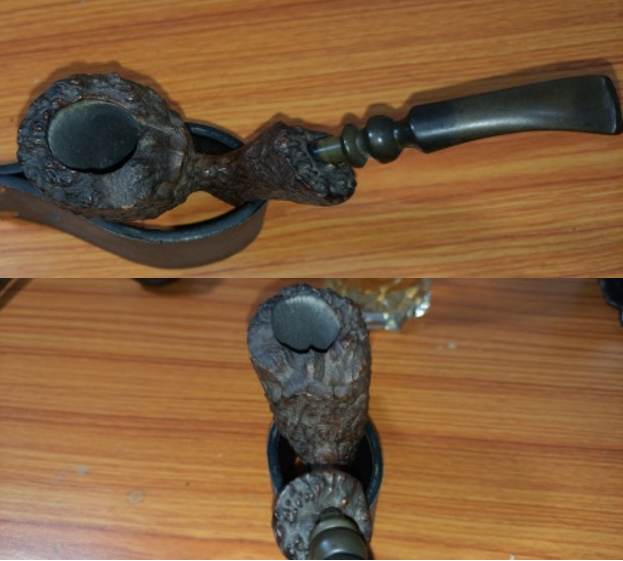
This ruggedly beautiful free hand pipe is unsmoked with pristine bowl coating, save for the dust that has accumulated on the coat. The aggressively rusticated stummel is large and fits snugly in the palm with a tactile hand feel. It is stamped on the lower smooth surface at the shank end as “S” over “HARCOURT” over “HAND CARVED” over “MADE IN DENMARK”. The vulcanite fancy stem is devoid of any stem logo. All the stampings are crisp and easily readable.Dimensions Of The Pipe
(a) Overall length of the pipe:          5.2 inches.

(b) Bowl height:                                  2 inches.

(c) Inner diameter of chamber:       0.8 inches.

(d) Outer diameter of chamber:      1.7 inches.

While researching Dunhill pipes that I have restored, I remembered that to cater to the Danish Free Hand pipe craze in the 1960s Dunhill had engaged Preben Holm to carve pipes for them and this line was named as HARCOURT. However, this being the first Harcourt pipe that I would be working on, I searched my first ‘go to’ site, rebornpipes and the very first search result was this pipe that has identical stamping including the grade stamp ‘S’. For interested readers, here is the link to the write up which provides all the information on these pipes.

https://rebornpipes.com/2019/09/07/replacing-a-broken-tenon-and-restoring-a-harcourt-hand-carved-s-freehand/

The only additional piece of information that I would like to add here is the grading system adopted by Preben Holm for Harcourt line of pipes. This information is reproduced from pipedia.org (https://pipedia.org/wiki/Harcourt)

And I quote:-

The stamping includes a letter, and seems to adhere to the Preben Holm grading scale with grades of A, B, C and D in ascending order.

The grade lettering on the pipe that I am working on is “S” and finds no mention in the above grading scale by Preben Holm. Since the grading system is in ascending order starting with A, I safely assume that the letter S denotes the highest grade or even Special grade. Any informed input on this issue is most welcome, in fact, solicited.

Initial Inspection
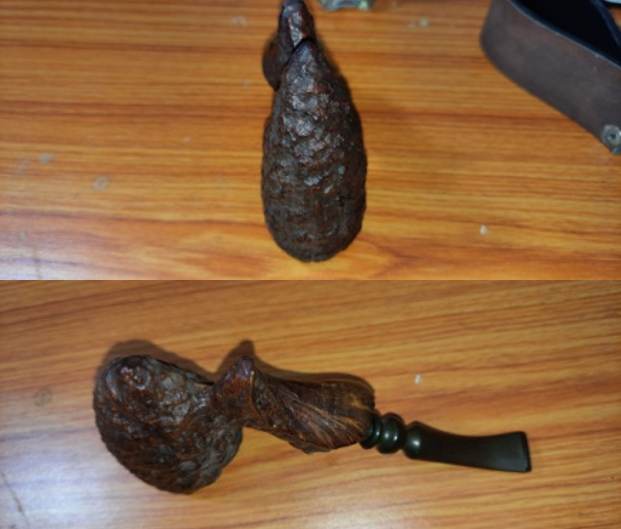
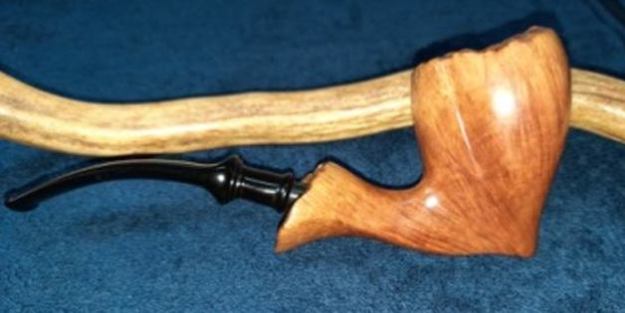
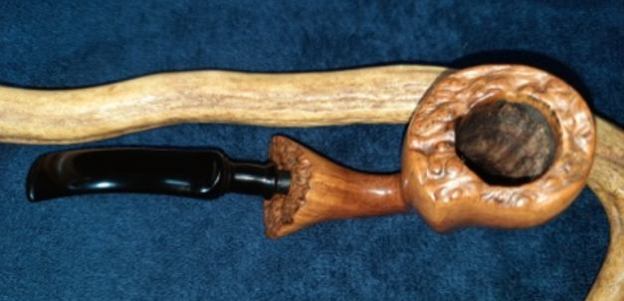
This pipe has one of the most aggressive rustication that I have seen on pipes and it looks and feels fantastic. The reddish brown hues, the Acorn shaped bowl and the talon shaped shank adds to the visual appeal of the pipe. The pipe is unsmoked and thus the chamber, the platueau rim top and the rim edges are all pristine. The stummel surface has accumulated dust in the crevices of the rustication, giving it a dull and tired appearance. The vulcanite fancy stem is undamaged but oxidized. Given below are a few pictures of the pipe before I started working on it. Detailed Inspection
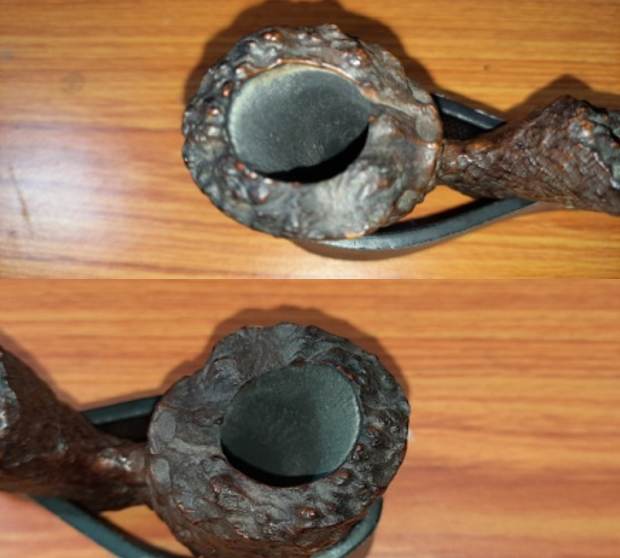
As mentioned above, this is seems to be an unsmoked pipe. The plateau rim top is as good as new with no lava overflow or charring or chipped surfaces. The bowl coating is still intact with no signs of being smoked. The only cleaning that is required is for removing the dust that has lodged itself in to the nooks and crannies of the plateau surface. There are no odors of old tobacco and oils and gunk and that is a refreshing change from the last project. The large rusticated stummel with thick walls are in excellent condition with no damage. The gnarly high points in the rustication are a pleasure to hold in the hand. The Acorn shaped bowl nicely fills up the hand making for a very comfortable grip. Dust has covered the crevices in the rustication giving a lifeless and dull look to the pipe and would need to be cleaned. The plateau shank end is also dusty and would benefit for a nice scrub. The mortise is clean. The fancy vulcanite stem is sans any logo or tooth chatter, bite marks. The only issue that requires to be dealt with is the minor oxidation over the surface. Running a couple of pipe cleaners dipped in alcohol will be sufficient to clean the air way of all the dust that may have been lodged inside.The Process…
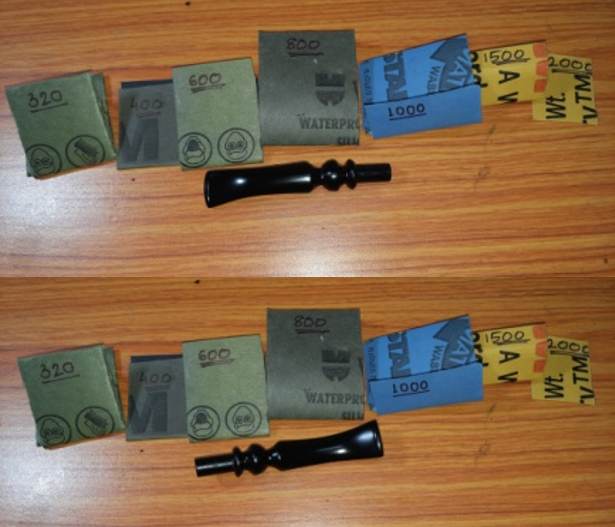
I started the restoration of this pipe by first cleaning the internals of the stem with bristled pipe cleaners and 99.9% pure isopropyl alcohol. I followed it up by sanding the entire stem with a folded piece of 220 grit sand paper to remove the surface oxidation and cleaned the surface with a cotton swab and Murphy’s Oil Soap.
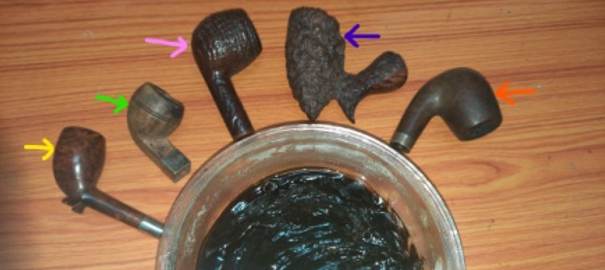
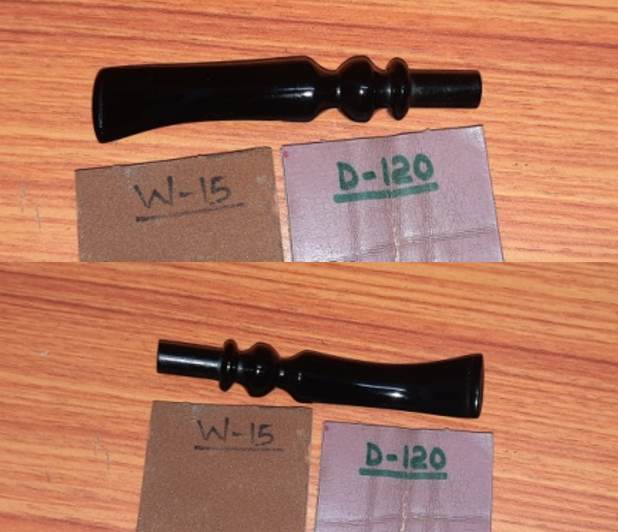
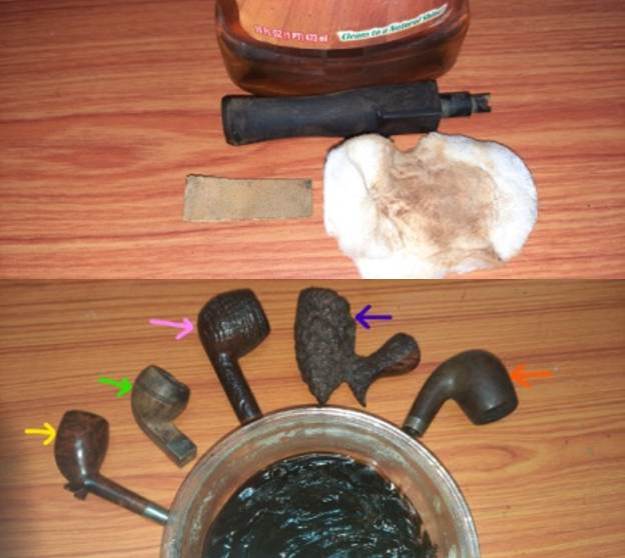
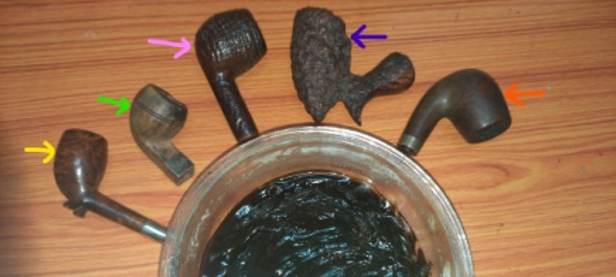
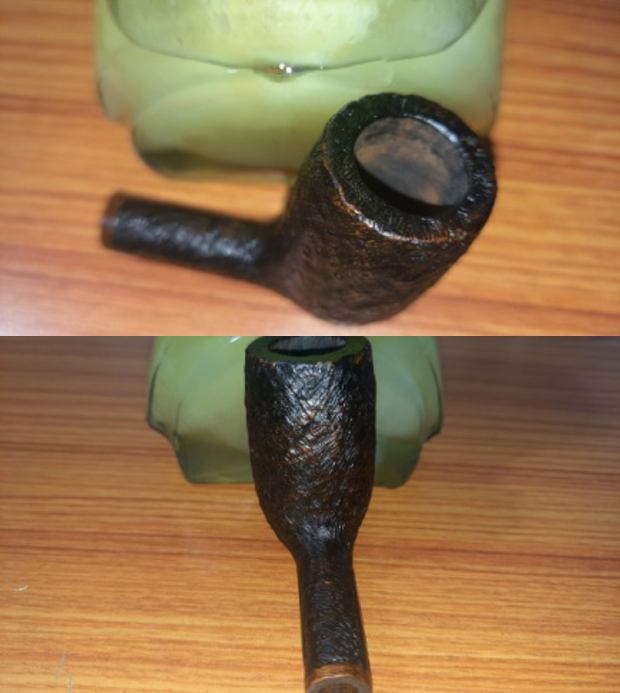
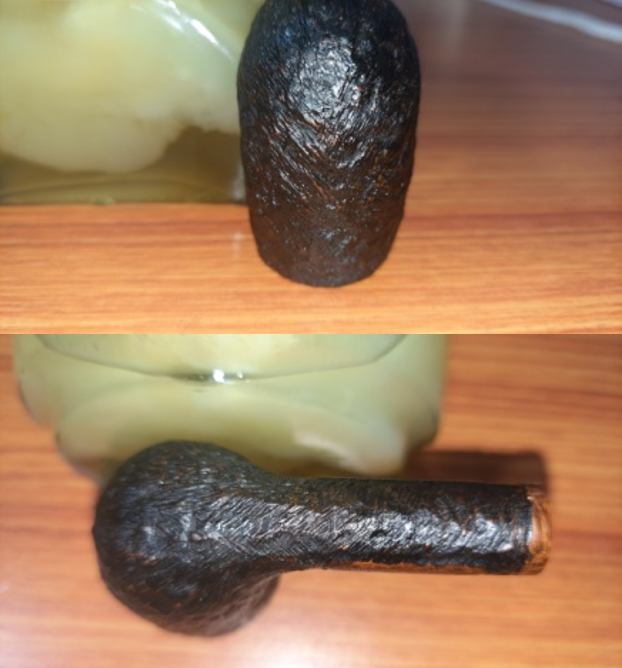
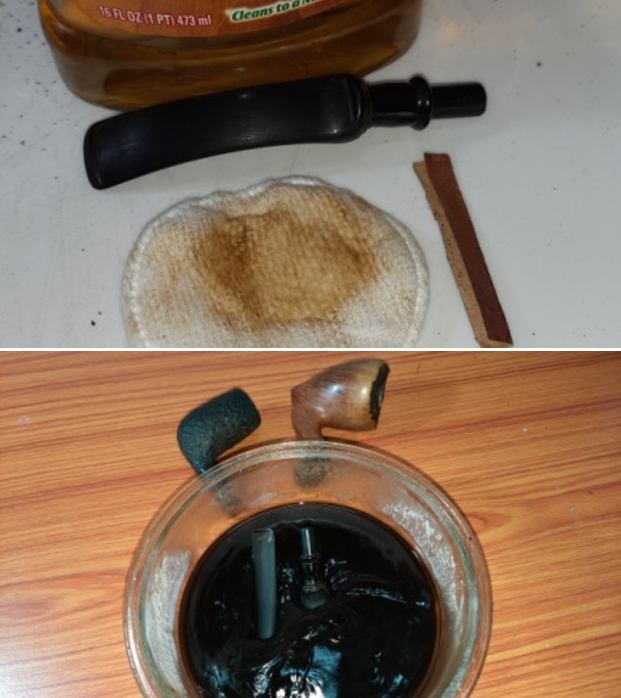
I dropped the stem in to “Before and After Deoxidizer” solution developed by my friend Mark Hoover. The solution helps to draw out heavy oxidation to the surface, making its further removal a breeze, while the minor oxidation is eliminated to a very great extent. The initial sanding also helps to draw out the complete oxidation as the sanding opens up the stem surface that has been initially covered with oxidation. I usually dunk stems of 4-5 pipes that are in-line for restoration and this pipe is marked with blue arrow. I generally allow the stems to soak in this solution overnight to do its work.The next morning, Abha removed the stem that had been soaking in the deoxidizer solution overnight. She cleaned the stem under warm running water and scrubbed the raised oxidation from the stem surface using a Scotch Brite pad and cleaned the airway with a thin shank brush. She further removed the oxidation by scrubbing the stem with 0000 grade steel wool and applied a little EVO to rehydrate the stem.Abha, thereafter, continued the sanding cycle by dry sanding the stem using 320, 400, 600 and 800 grit sand papers followed by wet sanding the entire stem with 1000, 1500 and 2000 grit sand papers. This not only ensured a nice even and smooth stem surface, but also removed the oxidation from the surface. I rubbed the stem surface with some EVO and set it aside to be absorbed in to stem surface. Thereafter, she launched a second determined assault on the stem, subjecting it to the complete cycle of micromesh polish. The end result is a gorgeous, smooth and shiny looking black of the vulcanite stem. The time that Abha was working on the stem, I ran a pipe cleaner dipped in alcohol through the mortise and airway to clean out the dust that had gathered over time. The shank internals were all clean save for a little stain that had made its way into the shank while staining.Once the internals of the shank were cleaned, I cleaned the external surface of the stummel with Murphy’s Oil soap and cotton swabs followed by scrubbing the rusticated surface with a toothbrush and dish washing soap. This rid the nooks and crevices of all the accumulated dust, dirt and grime from the rusticated stummel. I also cleaned the shank internals with dish washing soap and shank brush. To enliven the briar wood and further enhance the contrast of the dark reddish browns of the high points of the rustication with the black of the rest of the stummel surface, I rubbed a little quantity of “Before and After” balm in to surface and set it aside for 20 minutes for the balm to be absorbed in to the briar. Thereafter I hand buffed it with a microfiber to deepen the shine. The stummel looks nice and vibrant. This was followed by the routine regime of polish with carnauba wax using my hand held rotary tool. This Preben Holm carved Harcourt looks unique and oozes quality. To deepen the shine, I gave a vigorous rub to the entire pipe with a microfiber cloth. This is truly a beautiful pipe and will be joining my now increasing personal collection. Here are a few pictures that should give you a fair idea about the end results… Thank you all for being a part of this journey and support extended.

A Beautiful Petite “FCC” Double Footed Cutty Restored To Its Former Glory


Blog by Paresh Deshpande

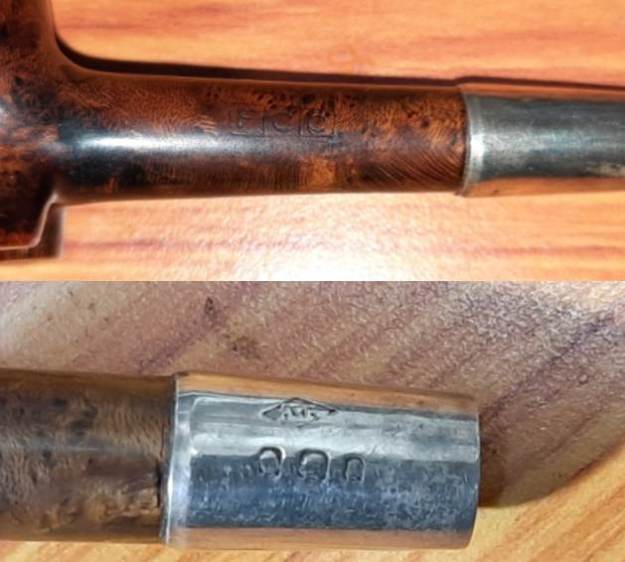
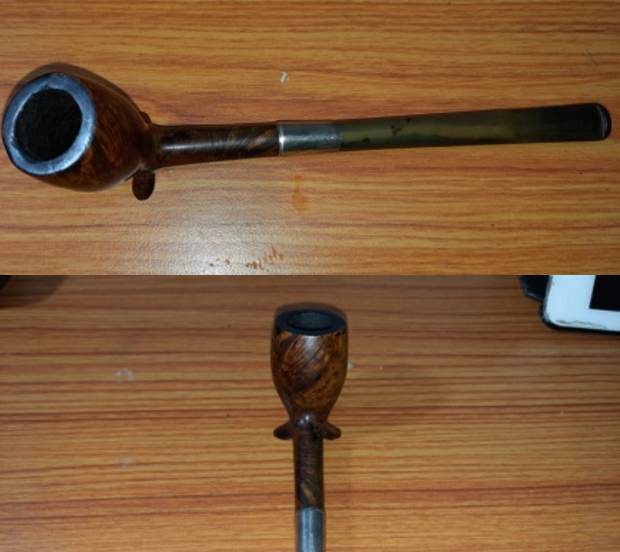
The next pipe that I chose to work on was a petite slender two legged classic Cutty shaped pipe that is stamped as “FCC”, each letter in a square and all the squares are co-joined to form a rectangle. Apart from the FCC stamp, there is no other stamp on the briar. The shank end has a nickel ferrule (most probably) with a squat diamond bearing letters “A–B” over three cartouches with its engravings completely worn out. Now the reasoning for assuming the ferrule to be nickel plated is firstly that I could not find any silversmith with letter “A B” in a diamond on my usual go to sites as well as searching the net. Secondly, during the course of restoring the pipe, the ferrule came loose revealing a prominent crack to the shank end and this ferrule was a repair band that was put by the previous repairman. Here are the pictures of the stampings. It would be interesting to know the views and opinions on my musings. There was no information about this pipe that was available on the internet. The lack of COM stamp also contributed to the mystery of this pipe. Even “Who Made That Pipe” by Herb Wilczak and Tom Colwell finds no mention of this brand and as stated above the ferrule has faux stampings. The only pointer that this is an old timer comes from the oval stem slot which was seen on early pipes.

In the interest of pipe collector community, I request the readers to share any information that they may have about this brand.

Initial Visual Inspection
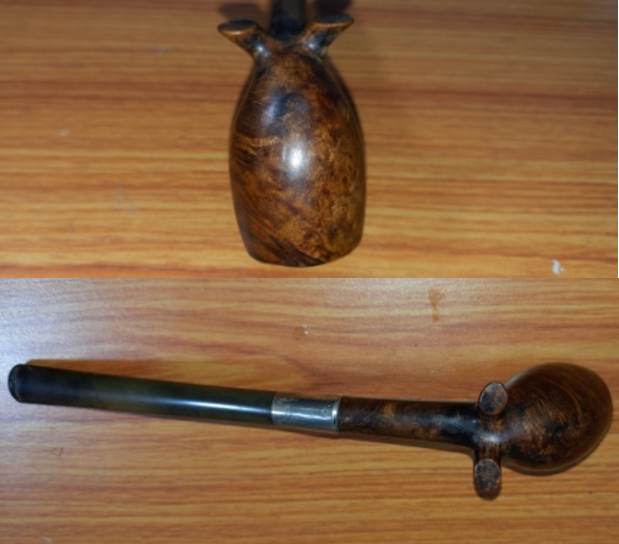
The double legged Cutty shaped pipe has beautiful mixed grains around the stummel which is covered in dust. The stummel has a couple of deep scratches and one fill towards the foot. The rim top is covered in lava overflow with some serious damage to the inner rim edge and as a result appears out of round. There is a thick layer of cake in the chamber. The slender vulcanite stem is heavily oxidized with a chunk of vulcanite missing from end of the step tenon. There are issues that need to be addressed, but it still is a beautiful pipe and once it is restored, the elegance and beauty of this pipe shall be worth appreciating. Here are a few pictures of the pipe before I begin working on it. Dimensions Of The Pipe
(a) Overall length of the pipe:          6 inches.

(b) Bowl height:                                  1.4 inches.

(c) Inner diameter of chamber:       0.6 inches.

(d) Outer diameter of chamber:        1.1 inches.

Detailed Inspection…
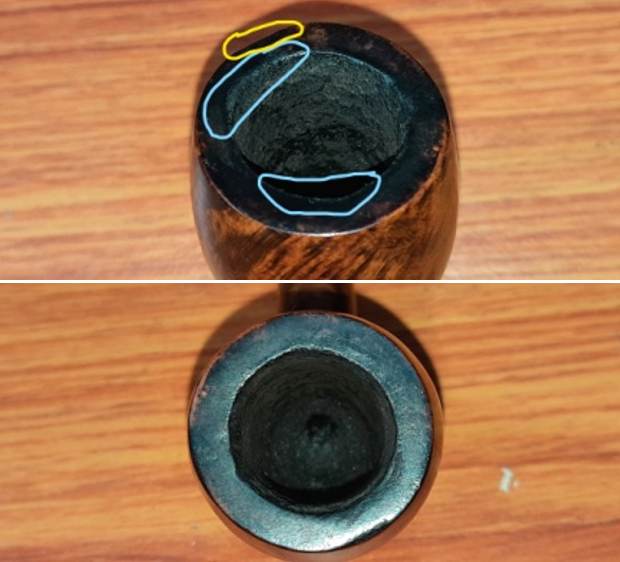
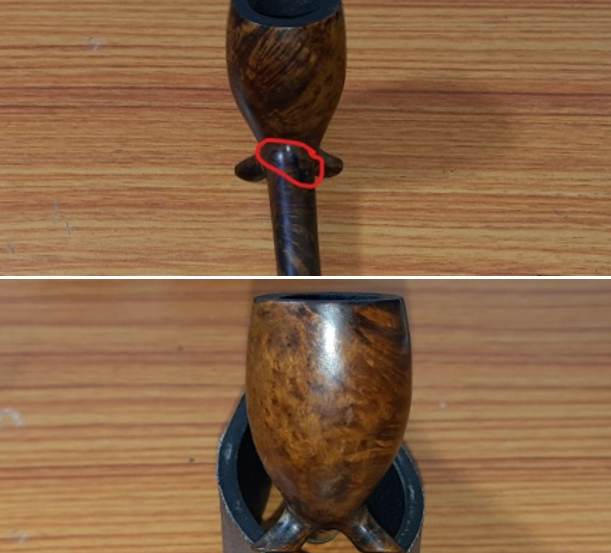
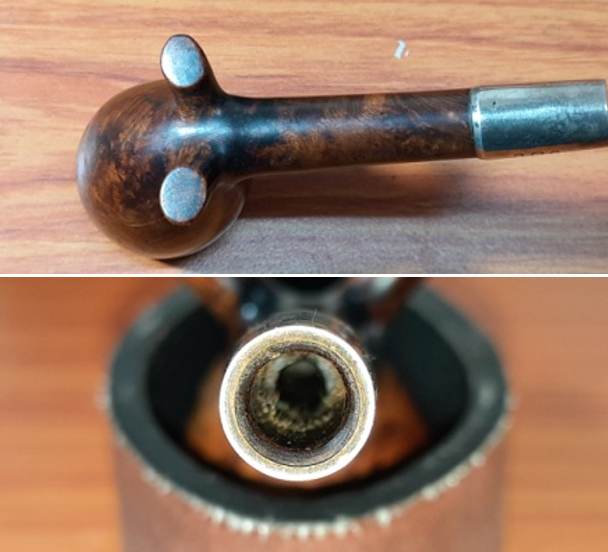
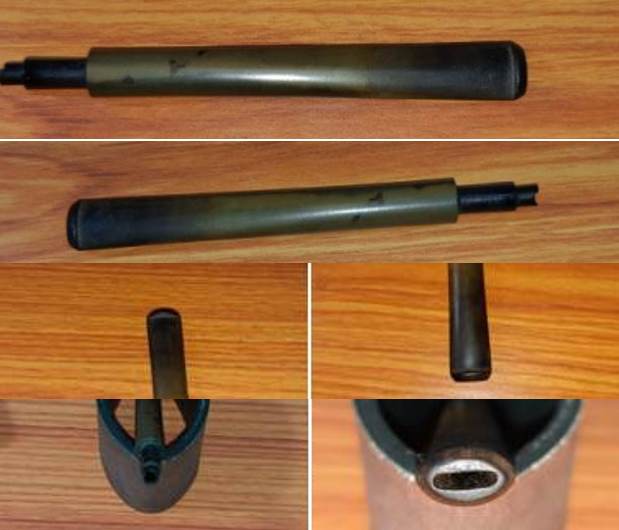
The chamber has a thick layer of even cake and has a strong sweet smell to it. The rim top surface has darkened due to lava overflow which is not very thick. The inner edge is uneven, but closer inspection makes me believe it to be more so because of uneven cake at the rim edge. The inner edge appears to be charred in 11 o’clock and 6 o’clock direction (encircled in pastel blue). The outer edge has a very shallow ding which is encircled in yellow. The stummel has some interesting grain patterns hidden under the dust that has accumulated over the surface. There is a fill towards the foot of the stummel on the left side and is encircled in green. This fill seems like a crack but it is not. The stummel surface has a few scratches but the two on the right side of the stummel are prominently visible (encircled in yellow). The two legs of the bowl are perfectly flat and angled making the pipe a sitter. The long slender shank has a dark patch (encircled in red) at the bowl shank junction and is likely another fill or a crack. I shall be sure about this only once the surface is thoroughly cleaned. The shank has heavy accumulation of oils, tars and gunk. The sweet smell is pretty strong here too. The long and slender vulcanite stem slightly tapers towards the tenon end giving a very classy look to the pipe. The step tenon has a chunk of vulcanite missing from the end and would need to be rebuilt. The stem has deep seated oxidation that imparts to it a greenish brown hue. The bite zone has minor tooth chatter and the buttons are sans any damage. The oval shape of the slot end and the slot itself is old fashioned and is a pointer to this being an older pipe from the 20s- 30s. Both the tenon end and slot end shows heavy accumulation of gunk and has an awful stink to it. This stem is going to be a bear to clean.The Process…
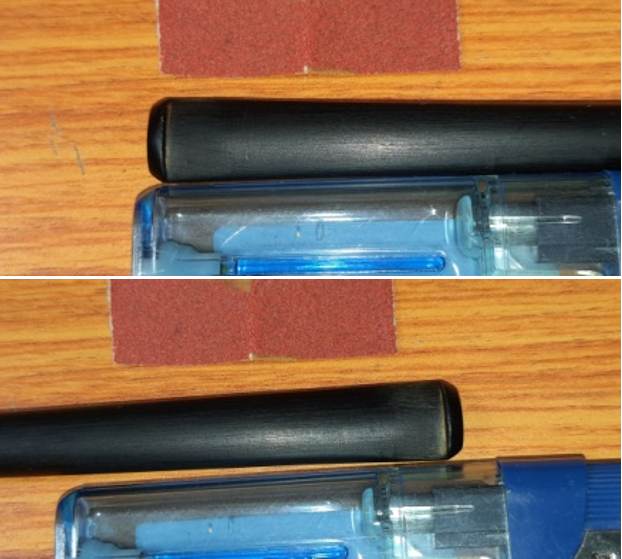
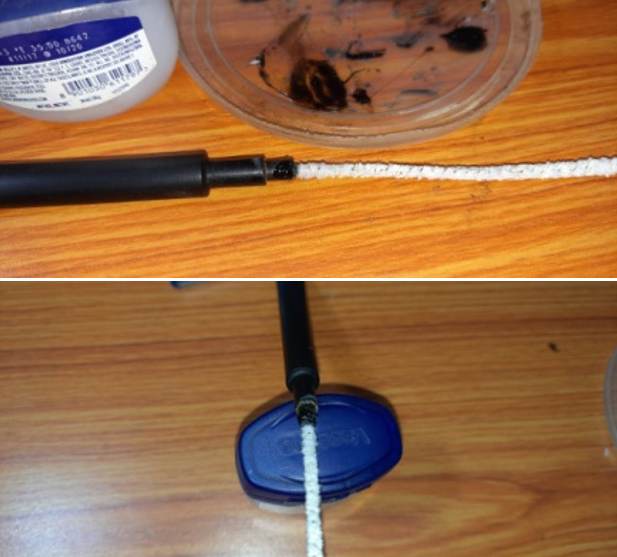
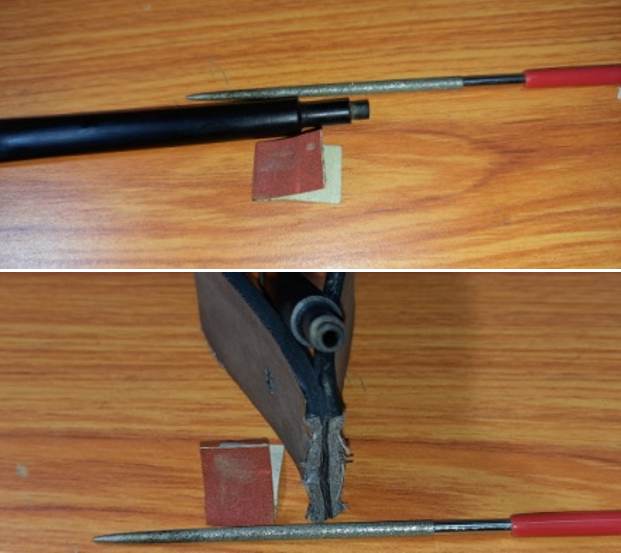
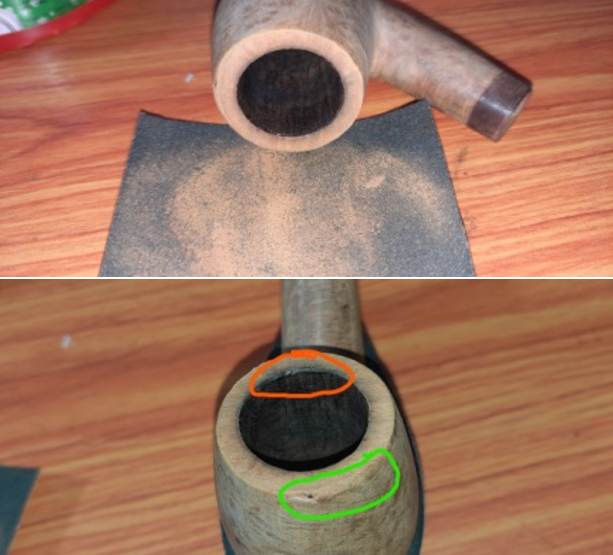
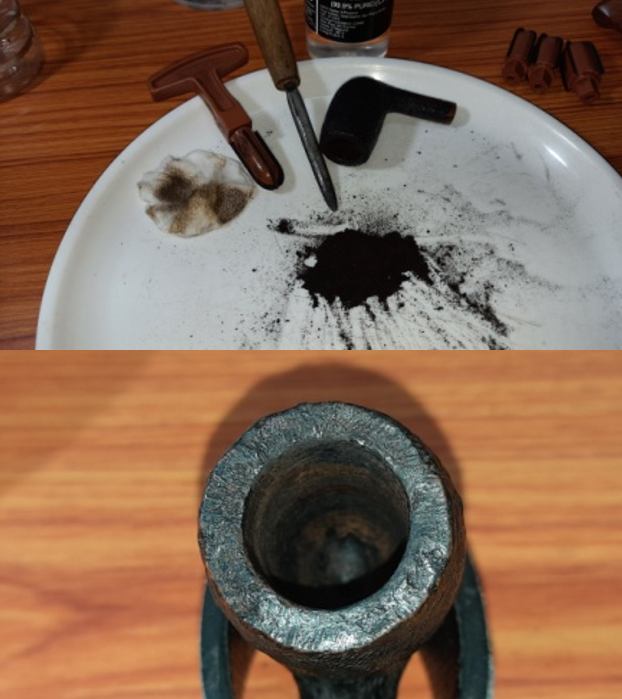
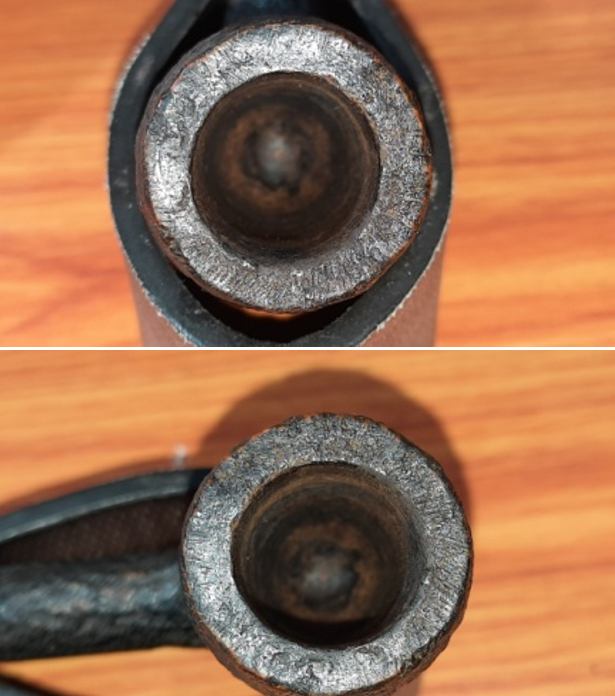
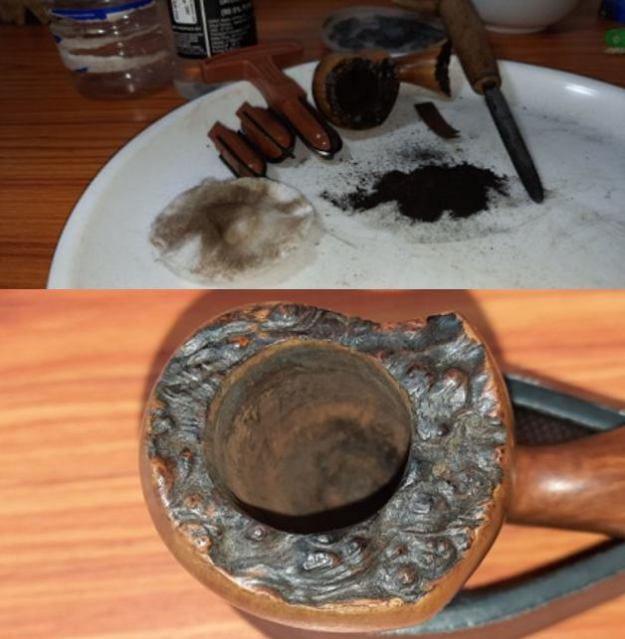
Since there were other stems that were ready to be put into the stem deoxidizer solution, I decided to clean the internals of this stem first so that it could be put in the solution with other stems. I cleaned the stem airway with a thin shank brush and anti oil soap. The amount of gunk that was cleaned can be judged from the pictures below. It took considerable time and elbow grease to get the stem airway clean. I further cleaned the internals with regular and bristled pipe cleaners dipped in alcohol. Once I was done with the internal cleaning of the stem airway, I sanded the stem surface with a folded piece of 220 grit sandpaper to loosen and remove superficial oxidation from the stem surface. I wiped the stem clean with Murphy’s Oil Soap on a cotton swab. It has been our experience that such sanding yields the best end results after the deoxidizer solution has completed its assigned task.The stem was immersed in the Before and After Deoxidizer solution, a product that has been developed by Mark Hoover. This solution raises the oxidation to the stem surface and helps in easy removal and imparting a nice shine to the stem after polishing. The pipe is indicated with a yellow arrow indicator. The stem was allowed to soak into this solution overnight.The next morning, Abha took the stem out from the solution. She cleaned the stem under running warm water and scrubbed the raised oxidation from the stem surface using a Scotch Brite pad and cleaned the airway with a thin shank brush. She further removed the oxidation by scrubbing the stem with 0000 grade steel wool and applied a little EVO to rehydrate the stem. She ran a couple of pipe cleaners through the stem airway to clean the airway of the deoxidizer solution and water.Staying with stem repairs, I warmed up the bite zone with the flame of a lighter to raise the minor tooth indentations to the surface. The heat helps the vulcanite to expand and regain its original shape. This method may not always completely raise the depressions to the surface, but most of the times, to a great extent. In this case the tooth indentations were raised completely to the surface. I followed up the heating of the stem surface with sanding the bite zone with a piece of 220 grit sandpaper to even out the surface.Next, I decided to address the broken end of the step tenon. I first inserted a pipe cleaner that had been smeared with petroleum jelly (Vaseline) through the tenon end into the stem air way. This helps prevent the CA superglue and charcoal mix from sticking to the pipe cleaner and prevents the mix from running down into the air way and clogging it. I generously applied a mix of CA superglue and activated charcoal over the tenon end to be rebuilt. I applied a thick layer of the mix as this provides sufficient patch material to work with during subsequent filing and shaping to match the repairs with the stem surface. Once I had applied the mix, I set it aside to cure overnight.By next afternoon, the tenon rebuild had cured perfectly and was fit to work on. I used a folded piece of 220 grit sand paper to sand the patch and achieve an even match with the rest of the tenon surface. I shaped the opening of the rebuilt tenon for smooth and even airway surface using a round needle file and topped the tenon face on a piece of 220 girt sand paper to achieve a perfect seating of the step tenon into the mortise.I further sanded the entire stem with 320 followed by 400, 600, 800 and 1000 grit sand paper. This helps to reduce the scratch marks left behind by the more abrasive 220 grit paper and also to remove complete oxidation from the stem surface. I rubbed a small quantity of EVO to rehydrate the stem and set it aside.With the stem set aside, I had a second look at the stummel and decided to start with reaming the chamber. Using size 1 head of the PipNet reamer, I took the cake down to the bare briar. I used my fabricated knife to remove the carbon layer from areas which could not be accessed by the reamer head. Next, with a folded piece of 220 grit sandpaper pinched between fingers, I sanded the wall surface to a smooth finish and ensured there are no traces of residual carbon anywhere in the chamber. I cleaned the chamber with a cotton swab wetted with alcohol. There are a couple of heat fissures that can be seen over the surface of the wall but they seem to be superficial. It could be just a thin layer of residual cake that has hardened rock solid or could be a heat fissure proper and in that case, I would need to fix it. But first, I would need to soften the cake. I cleaned the mortise using q-tips, pipe cleaners and alcohol. I scrubbed out the dried oils and tars from the walls of the shank using a bent dental tool. It was only once the shank internals were cleaned that I could see the thin crack to the shank. However, the repair band was firmly glued to over the shank end. I shall continue further cleaning of the shank internals when I clean the external surface of the stummel.I decided to give the stummel a salt and alcohol treatment. This would address three issues, firstly the strong sweet ghosting smell secondly, loosen the rock hard carbon layer from the chamber wall and lastly the alcohol may loosen the glue that kept the repair band firmly attached to the shank. I wrapped a little cotton around a pipe cleaner and inserted it through the mortise into the chamber. I packed the space around this pipe cleaner in the shank with cotton balls. Next, I firmly packed the cotton balls in to the chamber about half an inch below the rim and soaked the cotton balls with isopropyl alcohol up to the brim. About half an hour later, the level of alcohol had gone down, having being absorbed by the cotton. I topped it up once again and set it aside overnight. By next morning, the cotton and alcohol had drawn out all the remaining oils and tars from the chamber and mortise, fulfilling its intended task. I removed the cotton balls and ran pipe cleaners through the mortise to clean out all the loosened tars and gunk and further cleaned it with alcohol and q-tips. The chamber now smells clean and fresh. I set the stummel aside to dry out naturally. All the three issues that I wanted to address with this process have been achieved as will be brought out subsequently.With the bowl internals clean, I moved to clean the exterior of the stummel. I used a hard bristled tooth brush and Murphy’s Oil soap to scrub the stummel and rim top. For this stummel cleaning, l used Murphy’s Oil soap as I wanted to preserve the old patina that had developed on the stummel and was not sure how the Briar cleaner product would affect it. After the scrub with oil soap, I washed the stummel under running warm water with anti oil dish washing detergent till the stummel surface was clean and dried it using paper towels and a soft cotton cloth. I simultaneously cleaned the shank internals with the detergent and hard bristled shank brush and set the stummel aside to dry out naturally. This cleaning had now exposed all the fills (encircled in pastel blue), charred rim surface at 11 and 3 o’clock directions (encircled in yellow) and scratches over the stummel surface. As spelled out earlier, during the alcohol bath, alcohol had seeped through the crack in the shank and loosened the glue that held the band over the shank and during the external cleaning the band came out easily revealing the crack that it had covered. It’s a large crack that would need to be addressed.I cleaned the mortise and shank internals with anti oil soap and shank brushes. I also removed all the debris and old glue from within the crack using a thin sharp fabricated tool. I further cleaned the crack using cotton swab and alcohol.With the prep for the crack repair completed, it was time to move on with the task. Under a magnifying glass, I marked the end point of the crack with a marker pen. This is the guide point where I shall drill a counter hole to prevent further spread of the crack in any direction. Using a 1mm drill bit mounted on my hand held rotary tool, I drilled a counter hole at the end of the crack. I also inspected the fills that I had observed after external cleaning of the stummel. The only fill that would need to be refreshed was the one on the left side of the stummel near the foot. With my fabricated sharp knife, I removed the old putty fill and cleaned the pit with alcohol.I filled the pit and the shank crack, counter hole included, with a mix of briar dust and superglue. I sprayed an Accelerator over the fills to hasten the process of curing.Remember the issue of heat fissures I had brought out earlier? Well, after the alcohol bath, I checked the chamber again and it was confirmed that these are not just a result of hardened carbon cake but indeed the briar had charred along these heat lines. Using a sharp and thin knife, I checked all the heat lines and removed the charred briar from the two of these heat fissures (indicated with green line). I needed to address this as it could lead to a burnout at a later date when it is smoked.Once the shank crack and the refreshed fill had completely cured, using a flat head needle file, I sanded the repaired areas to achieve a rough match of the fills with the surrounding surface. I used a round needle file to even out the fill which had seeped inside the shank. I further evened out the fills with a folded piece of 320 grit sand paper. I checked the seating of the repair band over the shank and fine tuned the adjustment and glued it in place once it was perfect. Next I addressed the charring to the rim surface that I had ascertained after the cleaning of the stummel. I topped the rim surface over a piece of 220 grit sandpaper, frequently checking for the progress being made. It was peculiar to note that the charring at 11 and 3 o’clock directions was over both the inner and outer rim edges. I masked these charred marks by creating a bevel over both the edges with a piece of 220 grit sandpaper pinched between fingers. The results were definitely satisfactory. I sanded the entire stummel with a folded piece of 220 grit sandpaper. This addressed many of the scratches and dings from the surface. Those that remained are being accepted as part of the pipe’s journey thus far. I have addressed all the repair issues of the pipe and now handed it over to Abha, my wife, to work her magic in polishing the stummel and stem. To bring a deep shine to the vulcanite stem, Abha went through the complete set of micromesh pads, wet sanding with 1500 to 12000 grit pads. She wiped the stem with moist cloth after each pad and rubbed it down with Extra Virgin Olive oil to rejuvenate the vulcanite. The finished stem is shown below.She wet sanded the entire stummel with 1500 to 12000 grit micromesh pads, wiping frequently with a moist cloth to check the progress. Next, she rubbed a small quantity of “Before and After Restoration Balm” deep in to the briar with her finger tips and let it rest for a few minutes. The briar now has a nice vibrant appearance with the beautiful grain patterns displayed in their complete splendor. She further buffed it with a horse hair brush. After Abha handed over the shining stummel, I ran my fingers along the chamber walls and realized with a cringe that I had not addressed the issue of heat fissures. I decided to fill only the heat fissures from where I had removed the charred briar with layer of J B Weld. J B Weld is a two-part epoxy Cold Weld in two tubes; hardener and steel which are mixed in two equal parts (ratio of 1:1) with hardening time of 5-6 minutes and complete curing time of 6-8 hours. I poured the contents of the two tubes and mixed it well. I applied this mix, as evenly as possible, over the heat lines in the chamber wall surface. I worked fast to ensure an even coat before the weld could harden. I set the stummel aside for the application to harden and cure overnight. By the next afternoon, the J B Weld had cured and hardened considerably. With a folded piece of 150 grit sandpaper, I sanded the filled JB Weld from the heat lines till all that remained was a smooth surface with the weld deeply embedded into the heat lines and protecting the briar from further damage. There was only one more issue that needed to be addressed and one that could not be ignored, being a functional issue. After I had lined the walls of the chamber with a thin coat of J. B. Weld, it was necessary to prevent the walls from coming in to direct contact with the burning tobacco. I addressed this issue by mixing activated charcoal and plain yogurt to a thicker consistency, just enough that it would spread easily and thereafter applied it evenly all along the chamber walls after inserting a folded pipe cleaner through the draught hole to keep it open. Once dry and set, this will not only protect the walls but also aid in faster build up of cake.Now onto the home stretch… To complete the restoration, I re-attached the stem with the stummel. I mounted a cotton cloth buffing wheel to my hand held rotary tool, set the speed at about half of the full power and applied Blue Diamond compound to the entire pipe to remove all the minor scratches that remained. I wiped/ buffed the pipe with a soft cotton cloth to clear it of any leftover compound dust. With a cotton buffing wheel earmarked for carnauba wax, I applied several coats of carnauba wax. I worked the complete pipe till the time all the wax was absorbed by the briar. The pipe now boasted of a beautiful and lustrous shine. I vigorously rubbed the pipe with a microfiber cloth to deepen the shine and also clean away any residual wax that had been left behind. I vigorously buffed the nickel ferrule with a jeweler’s cloth and brought it to a nice shine. I was very happy with the way this beauty had turned out. The following pictures speak of the transformation that the pipe has undergone.

From The Brink Of No Return… A c1916 BBB Own Make Bulldog


Blog by Paresh Deshpande

The journey of this pipe began way back in the year 1916 when it came out of the workshop as a brand new Blumfeld’s Best Briar pipe in the classical Bulldog shape. Thereafter this pipe traveled with a British piper across the seven seas aboard a steamer from England and reached the shores of India. And during its stay here in India, it served its Steward well and when the British left India for good, it was gifted to my grandfather and thence continued to serve him till he quit enjoying his pipe in 1970s. Whether this pipe was gifted or it was purchased as a brand new by my grandfather cannot be ascertained, but given the economics of that era, the former appears to be most likely.

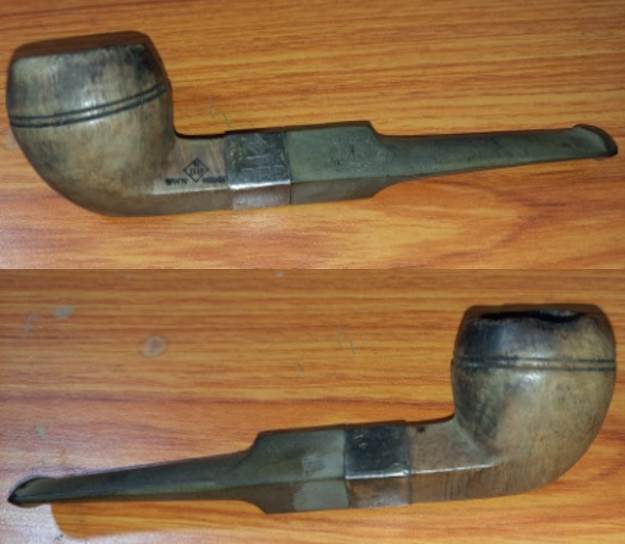
Well, now a 105 years later, this pipe is on my work table, nicely cleaned by Abha way back in 2018. It was in that huge lot of around 50 plus pipes that she had cleaned up and sent me for further restoration when I was away from my family for work. As the pipe sits on my table, I very well know the reason for the delay in working on this pipe.

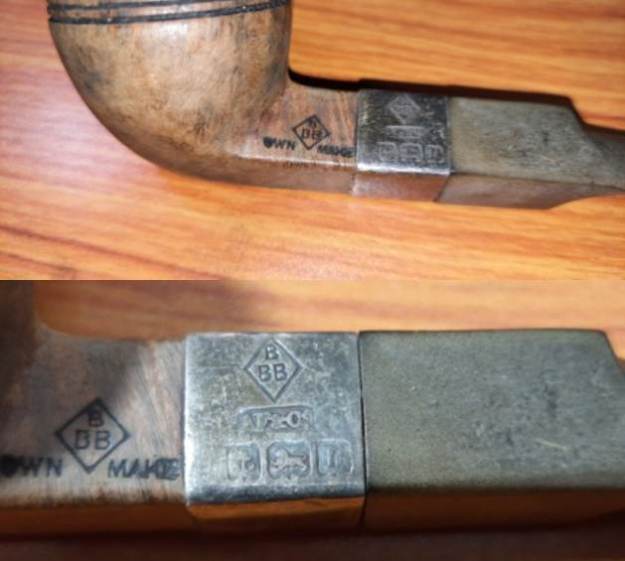
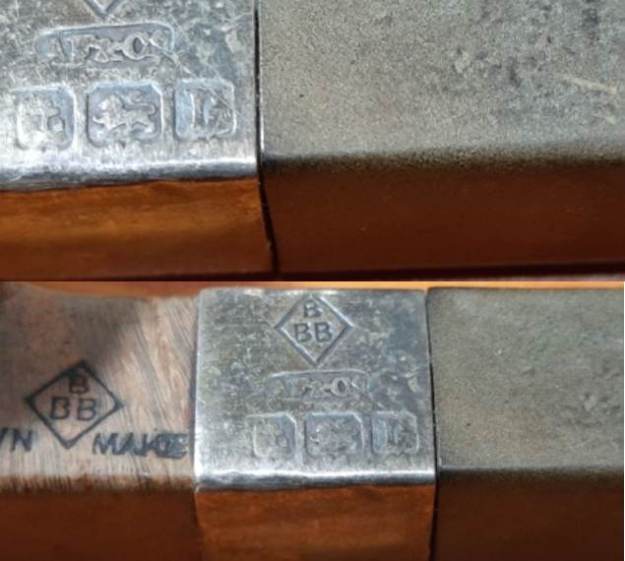
This classic shaped square shank Bulldog has some beautiful mixed grains that can be made out from under the dull and lackluster stummel surface. It is stamped on the left side of the stummel as “BBB” in a rhombus with “OWN” and “MAKE” on either side of the rhombus. The Sterling silver ferrule at the square shank end is stamped as “BBB” in a rhombus over “AF & Co.” in a rectangle over the three cartouche bearing hallmarks. Starting from the left, the first cartouche bears the stamp of an “Anchor” for  the Birmingham Assay Office followed by the “Lion Passant” certifying the silver quality and the last cartouche bears the Date letter “r”. The vulcanite saddle stem is devoid of any stem logo. The stampings are clear and easily discernible. BBB – Pipedia has detailed information on the origins of the brand and transition to the Cadogan group and would be a good read for those interested. I would like to highlight that, quote “At the beginning, BBB produces two qualities. One, BBB Own Make, became finally BBB Best Make, other pipes being simply estampillées BBB. There are reasons to believe that Own Make in fact were produced in London (Reject pipes cuts year R stamped one them.), whereas the simple BBB were imported, and this, to the paddle of the 20th century. However, if all that is not very clear, it is probable that the lines low-of-range were an import of Saint-Claude un-quote.

Now coming on to the most interesting and satisfying part of the research on this piece of briar and that is establishing the probable date of manufacture of this pipe. I prefer to follow English silver marks: the guide to hallmarks of London sterling silver (silvercollection.it)  while establishing the dates on the basis of the date letter in the hallmarks. The Anchor points to the Birmingham Assaying Office. Thereafter, I followed the link to the dating guide of the Birmingham Assay Office to date this pipe. I have included a hallmark chart for dating the pipe. I have put a red mark around the letter for 1916. It is the same style of “r” and the cartouche that holds the letter stamp, matches the photo as well.

To summarize, this BBB was made in 1916, give or take a year as the ferrules were assayed in bulk and used as required. The stamp of Own Make designates this as the finest quality pipe that was made in London for the local market in a Bulldog shape which was made in limited quantities.

Initial Visual Inspection
As stated at the beginning of the write up, Abha, my wife who helps with the initial cleaning, had worked on this pipe in 2018 and sent it out to me for further restoration along with 50 odd pipes. She had reamed the chamber down to bare briar, cleaned the internal of the shank and stem followed by external cleaning of the stummel using Murphy’s Oil soap. Unfortunately there are no ‘before’ and ‘during the process’ pictures. The initial condition of the pipe can be gauged from the pictures of the pipe as it sits on my work table. Dimensions Of The Pipe
(a) Overall length of the pipe: –          4.5 inches.

(b) Bowl height: –                               1.2 inches.

(c) Inner diameter of chamber: –         0.8 inches

(d) Outer diameter of chamber: –        1.2 inches

Detailed Inspection
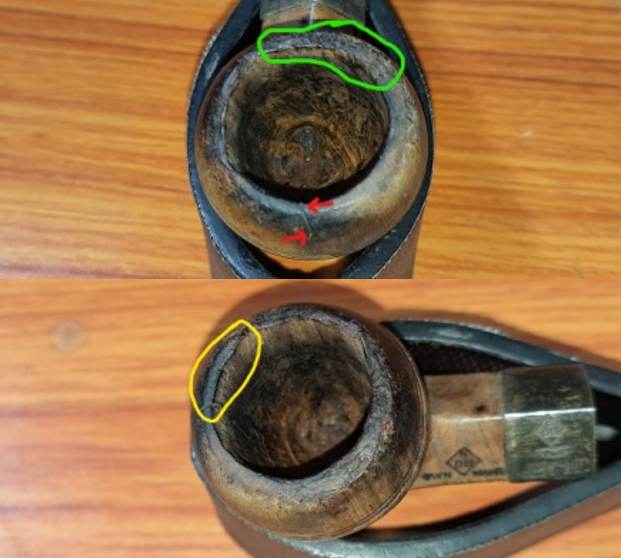
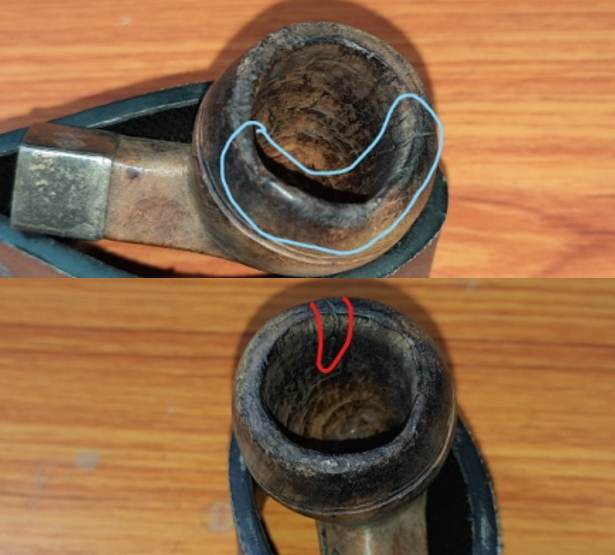
The rim top surface is where the maximum damage is on this pipe. The rim edges have been subjected to a heavy knocking all around but moreover in the 6 and 7 o’clock direction (encircled in green). A small crack is seen extending over the rim surface down towards the twin rings in 12 o’clock direction and is indicated with red arrows. This crack extends inside the chamber and the same is encircled in red. The rim has thinned out considerably towards the front between 12 and 1 o’clock direction (encircled in yellow). There is a chunk of briar that is missing from 3 o’clock direction either due to knocking against a hard edge or could be due to charring or combination of both. This damaged portion of the rim is encircled in pastel blue. The chamber walls show webbing of heat lines/ fissures. These repairs to the rim surface damage will be the most challenging part of the resurrection of this pipe.  The stummel surface is dull and lackluster with dirty brownish yellow hues to the briar surface. A few very minor scratches and dings can be seen over the stummel surface. The front and aft of the stummel surface in the crown is darkened. I would need to check if the charring is deep grained or just superficial. The gap between the twin rings separating the crown from the rest of the stummel is uneven, but thankfully, it is unbroken. The beauty and quality of this old pipe lies in the perfectly proportioned shape and the fact that there is not a single fill over the entire briar surface of the stummel. The shank and mortise are nicely cleaned up by Abha. The diamond shaped vulcanite saddle stem is deeply oxidized. The tenon is missing a portion of the surface and would need to be rebuilt. The bite zone has tooth indentations on either surface. The buttons on either surface is worn down and has deep bite marks at the corner. Abha had already cleaned the stem internals and thus, I can proceed with stem repairs and restoration.The Process…
I started the restoration of this old timer by immersing the stem in to the deoxidizer solution from Mark Hoover. Before dunking the stem in to the solution, I ran a couple of pipe cleaners dipped in alcohol through the previously cleaned airway to remove the dust that may have accumulated over the last three years. I scrubbed the stem surface with a piece of 220 grit sandpaper to loosen up the oxidation from the surface and further cleaned it with Murphy’s Oil soap on a cotton swab. Once the surface was cleaned, I dunked the stem in to the deoxidizer solution along with the other pipe stems that are in queue for restoration and indicated with a green arrow. The stem is allowed to soak in the solution overnight giving ample time for the solution to pull much of the oxidation to the surface.The next morning, Abha removed the stems (stem indicated with pastel green arrow is the one being worked on) that had been soaking in the deoxidizer solution overnight. She cleaned the stem and the stem airway under running warm water and scrubbed the raised oxidation from the stem surface using a Scotch Brite pad and the airway with a thin shank brush. She further removed the oxidation by scrubbing the stem with 0000 grade steel wool and applied a little EVO to rehydrate the stem. This now gives a clearer picture of the extent of damage as can be seen in the pictures below. The lower bite zone including the button edges on either surface have deep tooth indentations and will need to be reconstructed. The tenon end would also need to be rebuilt. Fortunately, there are no traces of deep seated residual oxidation visible over the surface. I heated the bite zone of the stem with the flame of a lighter to raise the tooth indentations to the surface by causing the vulcanite to expand. This did raise the bite marks to an extent; however, I would still need to rebuild the buttons and fill the bite marks in the bite zone.To begin repairs to the stem, I first inserted a pipe cleaner that had been smeared with petroleum jelly (Vaseline) through the tenon end in to the stem air way. This helps prevent the CA superglue and charcoal mix from sticking to the pipe cleaner and prevents the mix from running down in to the air way and clogging it. I generously applied a mix of CA superglue and activated charcoal over the stem areas to be rebuilt. I apply a thick layer of the mix as this provides sufficient patch material to work with during subsequent filing and shaping to match the repairs with the stem surface. Once I had applied the mix, I set it aside to cure overnight.With the stem repairs set aside to cure, I turned my attention to the stummel repairs. The summary of major issues identified during the detailed inspection is given below:-

(a) Crack to the front of stummel that extends to the inside of the chamber.

(b) The large trough to the rim surface and thinning of the rim on the right side of the stummel.

(c) Heat lines/ fissures over the walls of the chamber.

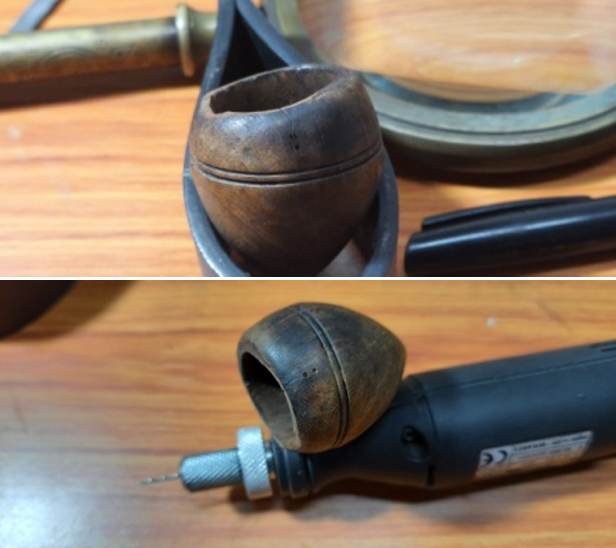
With a flat head needle file, I removed the charred briar from the rim surface till I reached solid briar wood. This now gives a clearer idea as to the exact extent of damage and the repairs required.  I decided to address the crack to the stummel surface first. I marked the end point of the crack with a sharpie pen under magnification. This helps to identify the end point later with naked eye and also provides start point for the drill bit to bite in. With a 1 mm drill bit mounted on to my hand held rotary machine, I drilled a counter hole at the end of the crack, taking care not to go too deep and end up drilling a through-hole. I had to mark and drill a second counter hole as I later realized that the crack extended slightly below the first one that I had drilled. I ran the sharp dental tool along the crack to remove the dirt and debris that may have been lodged in the crack. This crack and counter holes would get filled with briar dust and CA superglue when I would reconstruct the trough in the rim surface and so I did not proceed to fill the same at this stage. Next, I got around to addressing the rim top damage. The extent of the dip or trough caused due to banging against a hard surface and or charring of the rim edge was deep and would necessitate heavy topping off of the rim surface, and I for one, absolutely wish to avoid any loss of briar. Also topping to the extent that was required to eliminate the deep trough would completely alter the original shape and symmetry of this pipe.  So, I planned on first filling up the deep trough on the rim edge using briar dust and superglue to roughly match the surrounding intact rim surface and some more and then topping it to achieve a smooth even surface. Theoretically, this sounds logical.

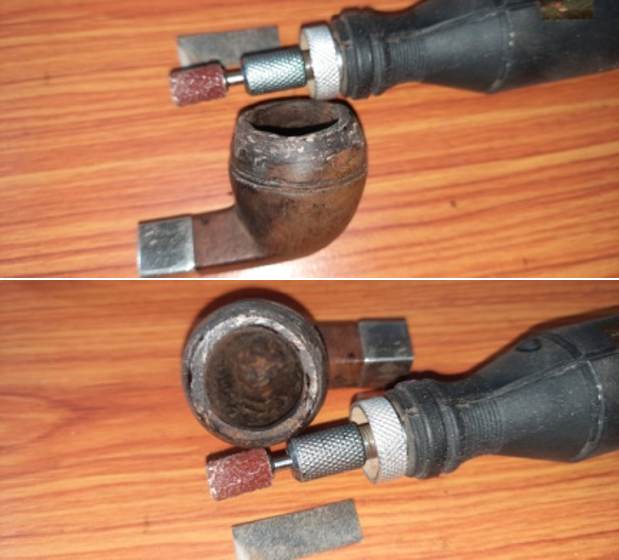
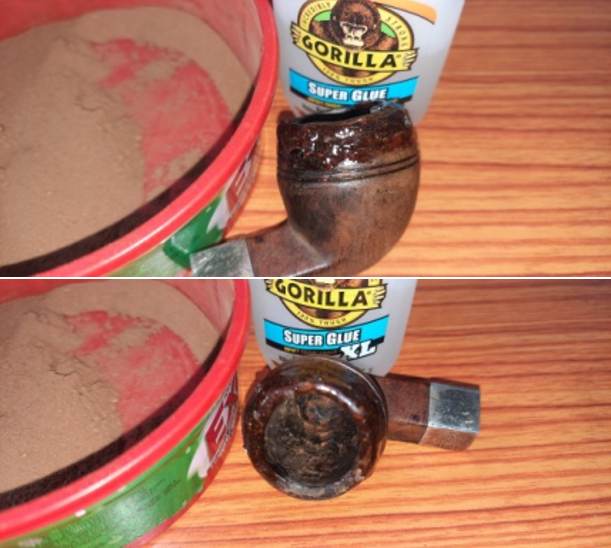
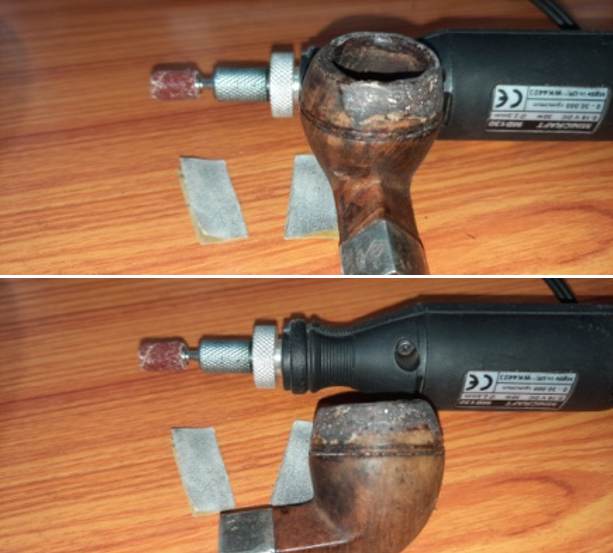
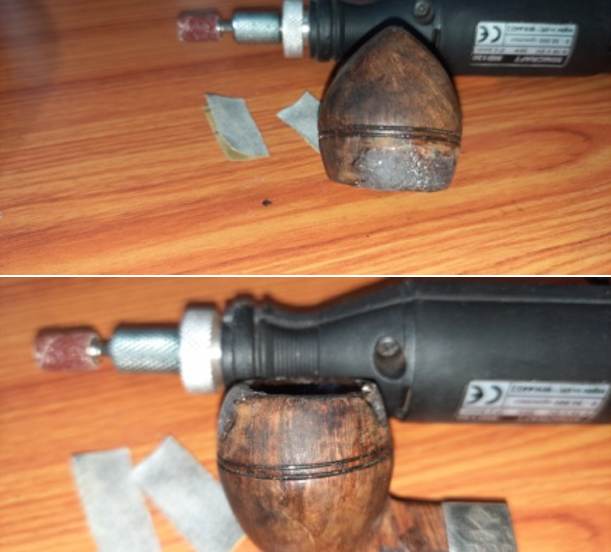
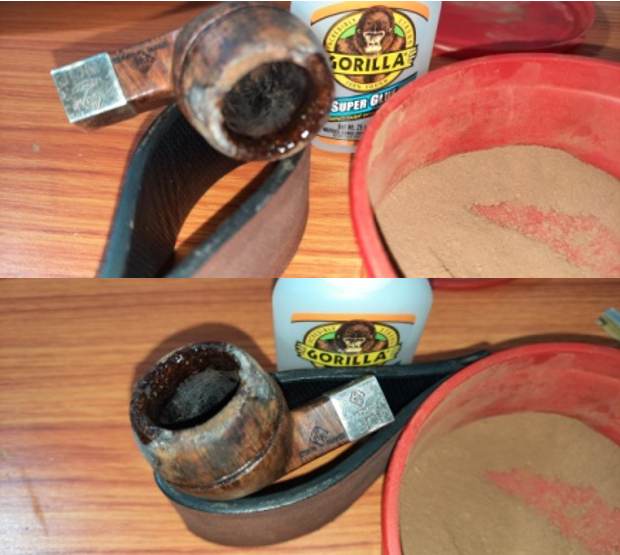
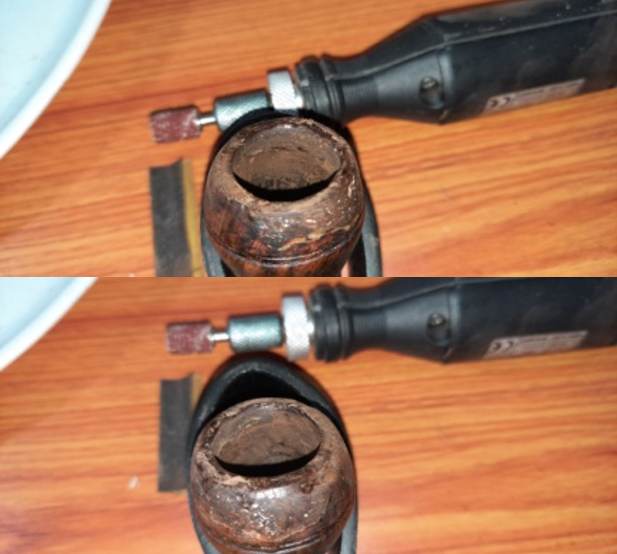
I resorted to the layering method again; first I layered superglue along the damaged surfaces of the rim followed by sprinkling of briar dust, another layer of superglue followed by a final layer of briar dust. This final layer of briar dust reduces the probability of air pockets (or so I thought). In the second picture, you can see that the layering has not been done to the level of the rim surface but above the surrounding intact rim surface as I would be sanding the rim subsequently. Using the same technique, I rebuilt the inner surface to increase the thickness of the rim that was thinned out. I set the stummel aside to cure.  The stem repairs had hardened considerably over the past 18 odd hours. I used a flat head needle file to sand the patch and achieve a rough match with the rest of the stem surface. I further evened out the patch with a folded piece of 220 grit sand paper. Similarly, I shaped the rebuilt tenon for perfect seating into the mortise. For a better blending, I further sanded the entire stem with 320 followed by 400, 600, 800 and 1000 grit sand paper. This helps to reduce the scratch marks left behind by the more abrasive 220 grit paper. I rubbed a small quantity of EVO to rehydrate the stem and set it aside. With the stem set aside, I turned my attention back to the stummel and rim repairs where the fills/ repairs had hardened completely. To speed up the removal of excess mix of briar dust and superglue from the repaired areas, I mounted a sanding drum over my hand held rotary tool and carefully sanded down the excess patch material. I further shaped and matched the repaired area with the rest of the stummel by sanding with a 180 grit sand paper. At this point, I noticed a large number of air pockets in the repaired areas and can be identified in the form of light colored pockets in the surface.And so here I was, filling the air pockets with a mix of briar dust and superglue and praying that these pockets are completely filled. Once I was done, I set the stummel aside for the mix to harden.While I was working on the stummel repairs, Abha, my wife was quietly giving finishing touches to the stem. She went through the entire set of micromesh pads, wet sanding with 1500 through to 12000 grit pads. She applied a little quantity of EVO and set the stem aside for final polish with polishing compounds.By next afternoon, the repairs to the rim had completely hardened. I set about sanding the repaired surface with a sanding drum mounted on to my rotary tool to match the rest of the surface. With a folded piece of 180 grit sand paper, I fine tuned the match further. At this stage, even though the air pockets have reduced to an extent, but not eliminated. I further realized that the rim top is still thin on the right side and needs to be built up further. To get the rim thickness to match the rest of the rim surface, I coated that portion of the inner wall that needed to be built up with a mix of briar dust and superglue. One has to be careful to coat only the required areas as it would mean extra effort and time wasted to remove the unwanted coat at a later stage. I set the stummel aside for the mix to cure.As I was busy with the rim repairs, Abha had polished the stem and had placed it on my work table. She polished the stem with micromesh pads, wet sanding with 1500 to 12000 grit pads. When she was through with the micromesh cycle, she deeply rubbed a small quantity of EVO in to the stem surface to rehydrate it and set it aside for me to give a final polish with blue diamond and carnauba wax. The finished stem looks a nice shining black. It was after I clicked pictures that I noticed that air pockets can be seen in the repairs to the bite zone. Is it the superglue that is at fault or is it me doing something wrong? Well, I shall live with it for now as these air pockets are not easy to discern with naked eye and maybe later someday I shall redo the stem repairs.Once the repairs to the rim had cured, I used a sanding drum mounted on to my rotary tool to smooth and even out the fills. I fine tuned the matching of the repairs with the surrounding surface by sanding with a piece of 180 grit sand paper. Now to even out the rim top surface…To even out the rim top surface, I topped the rim surface on a piece of 220 grit sandpaper till I had achieved an even a rim surface as was achievable while maintaining the shape and proportions of the stummel. A few light spots are seen where the glue did not mix with the briar dust forming an air pocket which got exposed during the sanding process.I addressed the issue of these air pockets by spot filling them with superglue using a toothpick. To speed things up, I used an accelerator to hasten the curing of the superglue. Once the glue had hardened, I evened out the fills by sanding with a 220 grit sand paper to a smooth finish. Unfortunately, I lost the pictures of this stage somewhere during transferring of data from mobile phone to my laptop.

With the rim repairs completed, I sanded the entire stummel progressively using 320, 600 and 800 grit sand papers. This not only addressed the minor scratches and dings over the surface, but also evened out any high spots left behind during the rim repairs. Satisfied with the progress made, I handed over the stummel to Abha for her to weave her magic with the micromesh pads. She polished the stummel, going through the entire set of 9 micromesh pads. To further blend the repairs with the surrounding surface, I stained the repaired area with a dark brown stain pen and set the stummel aside overnight for the stain to set. Once the stain was set, I rubbed a small quantity of “Before and After Restoration Balm”, a product developed by Mark Hoover that helps to rejuvenate and protect the briar. The transformation is almost immediate and the results are outstanding. The repairs, though visible on closer inspection, have blended in beautifully. Save for the final wax polish, the cosmetic aspect of this pipe has been taken care of and with great results! Now to address the functional aspects…

While carrying out the detailed inspection, I had observed and noted heat lines along the inner walls of the chamber. These heat lines are places from where burnouts usually happen if not addressed. Added to this was the rebuilt rim surface using briar dust and superglue. To isolate the heat lines and the rebuilt rim top surface from coming in direct contact with smoldering tobaccos, I decided to give a thin coat of JB Weld to the inner chamber walls and once the weld had hardened, a coat of activated charcoal and yogurt which is organic, neutral tasting and completely safe for humans would be applied over the JB Weld layer. This coat also aids in a faster build up of the cake.

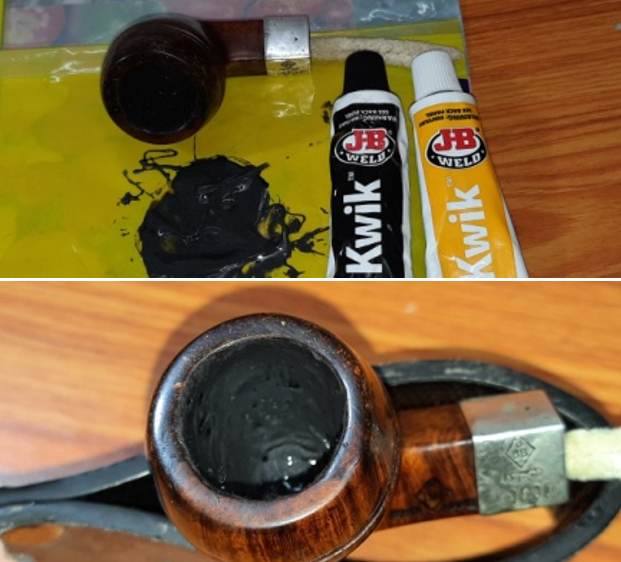
With the PoA ready, I mixed the two part epoxy. J B Weld is a two-part epoxy Cold Weld in two tubes; hardener and steel which are mixed in two equal parts (ratio of 1:1) with hardening time of 5-6 minutes and complete curing time of 6-8 hours. I poured the contents of the two tubes and mixed it well. I inserted a petroleum jelly coated regular pipe cleaner through the draught hole to prevent it from getting blocked due to the J B Weld mix. I applied this mix, as evenly as possible, over the entire chamber wall surface and worked fast to ensure an even coat over the chamber walls before the weld could harden. I set the stummel aside for the application to harden and cure overnight. The J B Weld coat had hardened considerably by next day evening when I got around to working on the pipe. I mounted a sanding drum on to my hand held rotary tool and after setting the speed to half of the full RPM, I sanded the excess coat from the chamber walls. To further fine tune and keep the coat to a minimum thickness, I further sanded with a 150 grit sand paper till I had a coat thickness that was just sufficient to protect the briar underneath. Here is how the chamber appeared at this stage. After I had protected the repaired portion of the rim and the walls of the chamber with a coat of J B Weld, it was necessary to prevent this coat from coming into contact with the burning tobacco. I addressed this by mixing activated charcoal and plain yogurt to a thicker consistency, just enough that it would spread easily and applied it evenly all along the chamber walls after inserting a folded pipe cleaner through the draught hole to keep it open. Once dry and set, this will not only protect the walls but also aid in faster build up of cake.To complete the restoration, I mounted a cotton cloth buffing wheel onto my hand held rotary tool and polished the stummel and stem with Blue Diamond compound. This compound helps to remove the minor scratch marks that remain from the sanding. I mounted another cotton buffing wheel that I have earmarked for carnauba wax and applied several coats of the wax. I finished the restoration by giving the entire pipe a rigorous hand buffing using a microfiber cloth to raise the shine further. The finished pipe looks amazingly beautiful and is ready to join my collection of other BBB pipes that I have inherited. I only wish it could share with me its story of the past years while I enjoy smoking my favorite Virginia blend in it or maybe an English blend or maybe just keep admiring it.

Another Of My Inherited BBB Restored…And What A Mess It Was


Blog by Paresh Deshpande

The next pipe that had moved up the queue of pipes for restoration is also a BBB, but from a newer era as compared to the c.1916 pipe that I had just restored. The aim of selecting this pipe was to show the general condition of the pipes that I had inherited. All or most of them were very well loved and thus extensively smoked without any signs of ever having being cleaned and maintained. The philosophy was simple, select one favorite pipe, smoke the pipe till it fouls up then chuck it, buy a new pipe and repeat the process… It was an era when Barling family still owned the brand and Loewe pipes were still made in the Haymarket area! Ah….. That bygone era of beautiful and superb quality English pipes.

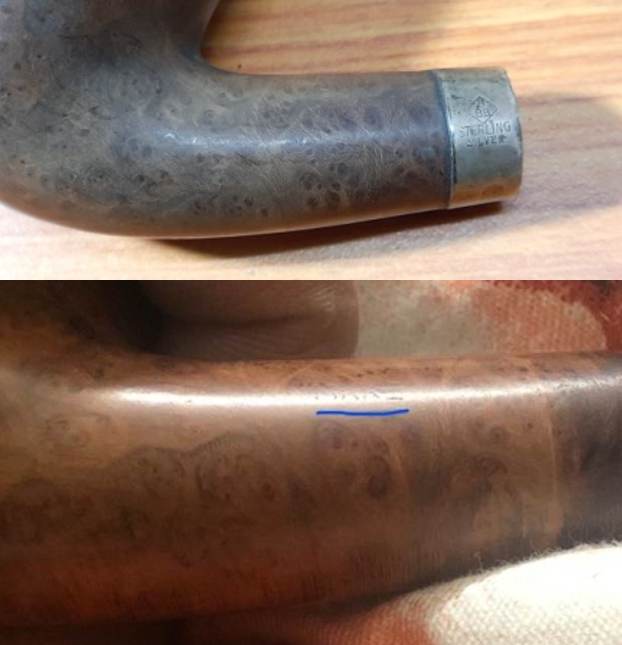
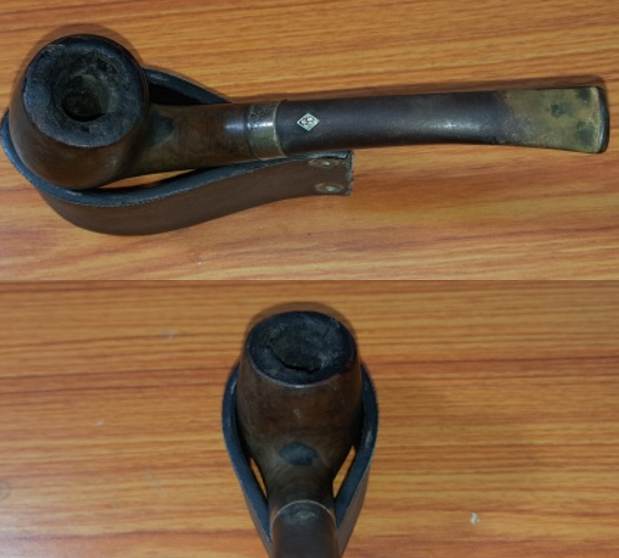
This is a beautiful well grained bent billiards with a nice hand feel, is perfectly proportioned and the quality just oozes out of every inch of the pipe. The sterling silver ferrule at the shank end bears the stamp of “BBB” enclosed in trademark rhombus over “STERLING” over “SILVER”. The stamping on the right side is greatly faded and only “MAKE” is visible under magnification and bright lights. The left side of the shank bears the slightly worn out shape code “304”. The high quality vulcanite stem has the trademark metal rhombus stamped “BBB”. I have worked on quite a few BBB pipes in the past and read a ton of material from various sources on BBB and to save time of our esteemed readers, I shall not reproduce the article but have provided a link for the most reliable and concise information on pipedia.org, https://pipedia.org/wiki/BBB

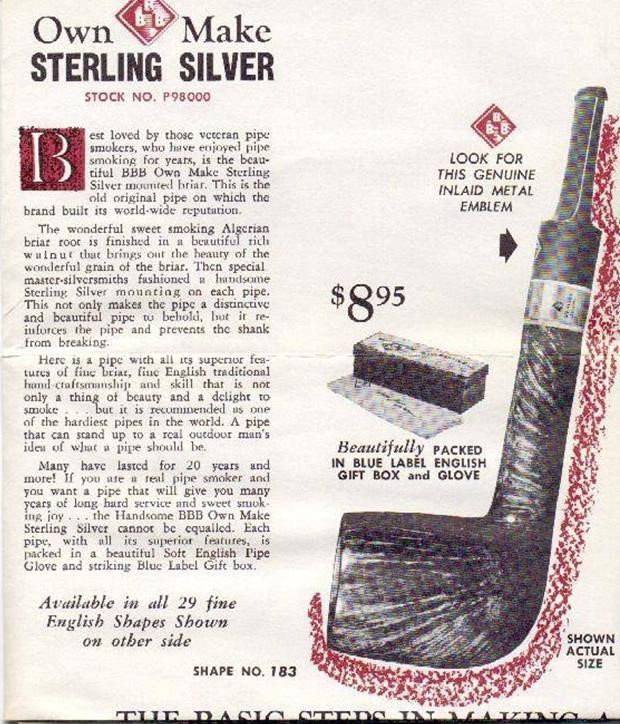
What were of interest to me, however, were the BBB catalogs that Doug Valitchka has contributed on pipedia.org. I reproduce a picture of the Sterling Silver line of pipes from BBB that gives out a brief introduction to the line and also the cost of the Sterling Silver line of pipes prevalent at that time. This and the subsequent link that I shall be providing, is a strongly recommended read for all those interested in old flyers and promotional endeavors from BBB.Pipedia.org also has a link to a PDF copy of 1960 brochure which is a very strong recommendation either for referencing or as a general read (https://pipedia.org/images/e/e8/BBB_1960.pdf). The pipe currently on my table has a shape number 304 which has been described in the brochure as a Bent Billiard.

Thus from the above, this pipe must have been with my grandfather from somewhere since late 1950s or very early 1960s making it 60 year old, give or take a few.

Initial Visual Inspection
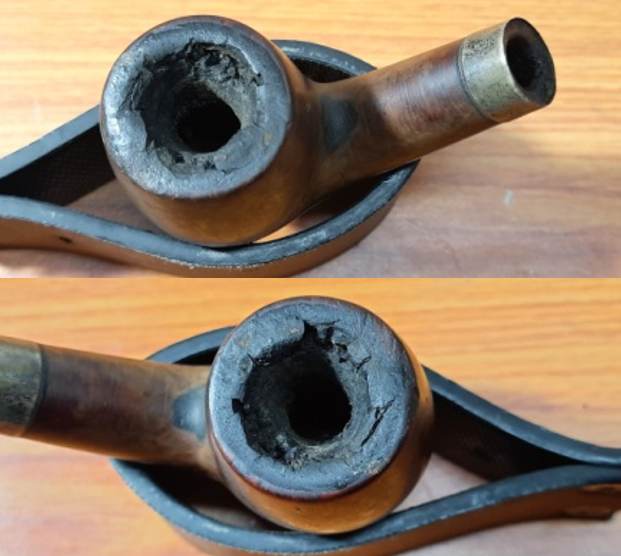
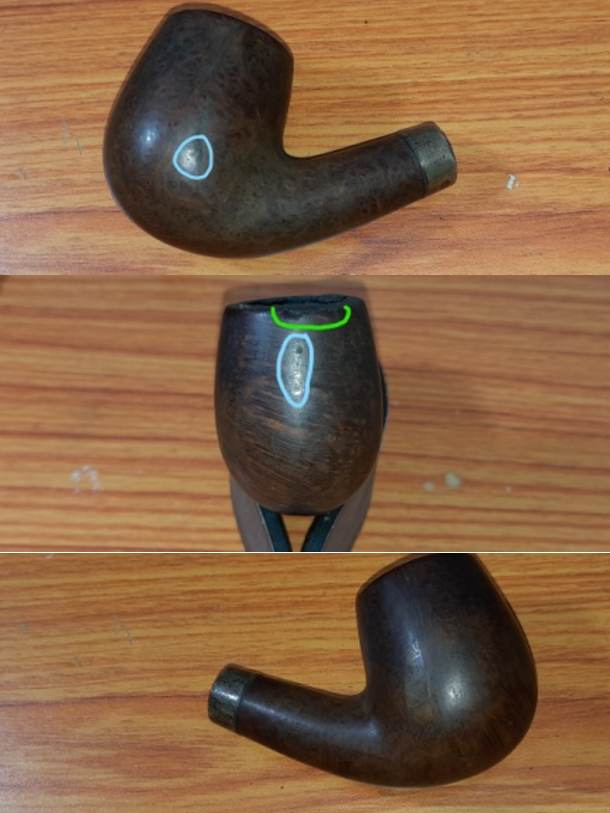
The chamber has a thick layer of cake, so thick that I am unable to see the heel of the chamber. There is a heavy overflow of lava over the rim surface. The stummel appears dull and lackluster from all the heavy use and overflowing oils and tars which has attracted a ton of dust and grime from years of storage. However beneath all the dirt and grime some beautiful bird’s eye and cross grain over the stummel awaits revelation. There are a few dents, dings and chipped surface in the stummel. The sterling Silver band has turned black due to oxidation. The vulcanite stem is heavily oxidized with deep tooth chatter/ bite marks and calcification in the bite zone. The airway is clogged with dried oils and crud. Shown below is the pipe as it presents itself on my worktable. Dimensions Of The Pipe
(a) Overall length of the pipe:          5.2 inches.

(b) Bowl height:                                  1.7 inches.

(c) Inner diameter of chamber:        0.8 inches.

(d) Outer diameter of chamber:      1.2 inches.

Detailed Inspection
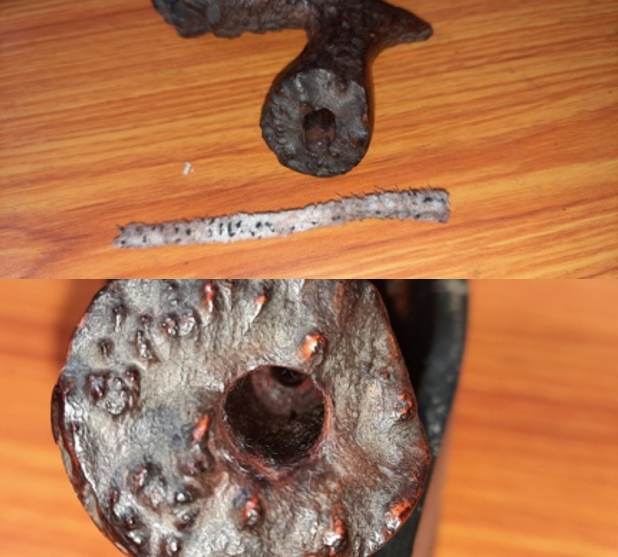
Apparently this chamber has never ever seen a pipe reamer nor has ever experienced the luxury of having a cake of the thickness of a dime. There is a thick layer of cake in the chamber which restricts reaching to the bottom of the chamber. The cake is very hard and dry and it was with some difficulty that I could pry out a couple of chips of cake from the rim surface with my knife. This is going to be one bugger to clean, I say. The thick lava overflow over the rim top surface obscures the condition of the rim surface and will be ascertained only after the crud is removed. Ditto as regards the condition of the chamber wall. I shall deliberate in detail on these issues once the cake has been rid of. The ghost smells are very strong, in fact so strong that the entire room reeked of the smell of rancid tobacco. The stummel is covered in overflowing carbon, oils and ash. Add to this grime, the many years of dust and dirt due to uncared for storage ground into the surface and you have a filthy, dull and dirty looking briar. There are some tightly packed Bird’s eye grains peeking from either sides of the stummel while beautiful cross grains adorn the fore and aft of the bowl. There are a few scratches, dents and dings over the stummel surface (enclosed in pastel blue), nothing severe that would need to be filled. However, to the front of the bowl just below and along the outer edge of the rim, there are a couple of spots that are missing briar (green circle). I may have to rebuild it using briar dust and superglue. The mortise is chock-a-block with old oils, tars and gunk to the extent that I couldn’t see the light in the chamber. The Sterling Silver ferrule is deeply oxidized but without any damage. Cleaning this pipe will be a long haul. The vulcanite stem is deeply oxidized but thankfully without any major damage. There are few tooth indentations and tooth chatter on either surfaces of the stem along with calcification in the bite zone. The button edges on either side have been chewed and would benefit from a rebuild/ reshaping. The step tenon opening is completely clogged and remnants of oils and tars and gunk can be easily observed on the sides and on the inside of the opening. The horizontal slot face is brutally oxidized and filled with gunk. The smells emanating from the stem are quite strong and repulsive. The brass logo is crisp and intact and would benefit from a nice polish.The Process…
Since there were other stems that were ready to be put into the stem deoxidizer solution, I decided to clean the internals of this stem first so that it could be put in the solution with other stems. I cleaned the stem airway with a thin shank brush and anti oil soap. The amount of gunk that was cleaned can be judged from the pictures below. It took considerable time and elbow grease to get the stem airway clean. In spite of my best efforts, I could not get the brush to completely pass through the stem. Closer inspection of the slot end confirmed my worst fears and I could see that the slot was blocked with the crud from the stem airway. I used a sharp dental tool to pry out the block and further cleaned the internals with regular and bristled pipe cleaners dipped in alcohol.This internal cleaning was followed by sanding the stem external surface with a folded piece of 220 grit sandpaper to loosen up and remove superficial oxidation. It has been our experience that such sanding yields the best end results after the deoxidizer solution has completed its assigned task. Before dunking the stem in the deoxidizer solution, it was cleaned up with Murphy’s Oil Soap and a cotton swab.The stem was immersed in the Before and After Deoxidizer solution, a product that has been developed by Mark Hoover. This solution raises the oxidation to the stem surface and helps in easy removal and imparting a nice shine to the stem after polishing. The pipe is indicated with an orange arrow indicator. The stem is allowed to soak into this solution overnight.The next morning, Abha took the stem out from the solution. She cleaned the stem under running warm water and scrubbed the raised oxidation from the stem surface using a Scotch Brite pad and cleaned the airway with a thin shank brush. She further removed the oxidation by scrubbing the stem with 0000 grade steel wool and applied a little EVO to rehydrate the stem. She ran a couple of pipe cleaners through the stem airway to clean the airway of the deoxidizer solution and water. There is a need to further sand the stem to completely remove the oxidation.Continuing with the stem repairs, to address the deeper tooth indentations/ bite marks, I warmed up the bite zone with the flame of a lighter. The heat helps to expand the vulcanite and retain its original shape. This method may not always completely raise the depressions to the surface, but most of the times, to a great extent. In this case the tooth indentations were raised to a great extent, but the damage to the button edge would require a rebuild. I followed up the heating of the stem surface with sanding the bite zone with a worn out piece of 180 grit sandpaper to even out the surface. Next I rebuilt the button edge with a mix of activated charcoal and superglue. I applied it over the buttons on either sides of the stem and set it aside for the mix to cure.Now it was time for me to work on the stummel. I did this by first reaming the chamber with size 1 followed by size 2 PipNet reamer head. I further scraped the chamber walls with my fabricated knife to remove the remaining carbon deposits where the reamer head could not reach. I scraped out the lava overflow from the rim top surface. Once the cake was reamed back to the bare briar, I used a 150 grit sand paper followed by 220 grit sand paper to remove all the traces of remaining cake and also to smooth out the inner walls of the chamber surface. Finally, to remove the residual carbon dust, I wiped the chamber with a cotton pad wetted with 99.9% pure isopropyl alcohol. The huge pile of carbon dust that was reamed out is an indication enough to the amount of carbon that had accumulated in the chamber.With the chamber and rim top surface free of all the cake and overflowing oils and tars, I took a closer look at the chamber and rim top surface. The rim top has a number of dents and is undulated, probably a result of striking against a hard surface to remove dottle. Also a result of these strikes is that the outer rim edge is chipped and damaged on the left side between 9 and 12 o’clock direction (encircled in pastel blue). The inner rim appears to have had a bevel and there seem to be signs of charring on the right side (encircled in yellow). There are webbings of thin superficial heat lines along the wall of the chamber (indicated by green arrows); however these are to be expected in a pipe that has been so heavily smoked. These heat lines are very minor and superficial and do not detract from the smoke worthiness of this pipe for the next 60 years.During the handling of the stummel, the Sterling silver band came off allowing me to check for damage underneath the band. Thankfully other than being filthy, there was none. I cleaned the mortise with hard bristled pipe cleaners and alcohol. Using a fabricated tool, I scraped the dried accumulated gunk from the mortise to the extent possible. The mortise would be further cleaned during the stummel cleaning. With the internal cleaning done, it was time for the external cleaning of the stummel surface. I used a hard bristled tooth brush and Murphy’s Oil Soap, to scrub the stummel and rim top. The hardened and stubborn cake was dislodged from the rim surface and shank end using Scotch Brite pad and with a brass wired brush. I washed the stummel under running warm water with anti oil dish washing detergent till the stummel surface was clean and dried it using paper towels and soft cotton cloth. I simultaneously cleaned the shank internals with the detergent and hard bristled shank brush and set the stummel aside to dry out naturally. It is pertinent to mention here that even after all this cleaning of the chamber and shank internals, the ghost smells are still very invasive. This would require adoption of more invasive methods to get rid of these old smells.Since the stummel and stem were drying and curing respectively, I completed one of the mundane but equally important tasks of polishing the Sterling silver band. I used a local product that is available in India only to polish the band. The liquid polish was applied to the band and wiped it out after a few seconds. The polish completely removed the oxidation and gave a nice shine to the band.To address the rim top damage, I topped the rim top on 220 grit sandpaper till the surface was nice and even. I hate losing any briar and restrict it to the barest minimum that is required. The damage to the outer rim edge, though greatly eliminated, can still be seen to the front side (encircled in green). This would need to be reconstructed subsequently. The charring to the inner rim edge is still visible (encircled in orange). These issues could be completely addressed by the process of topping but the extent of topping that would be required to do so would alter the bowl height and also the entire pipe profile. I decided subject the stummel to an alcohol bath to address the strong smells from the stummel before moving ahead with repairs to the inner and outer rim edges. I used cotton balls which is an at par substitute to Kosher salt as I have realized over the years. I drew out a wick from the cotton and along with a folded regular pipe cleaner; inserted it into the mortise and through the draught hole into the chamber. Thereafter, I packed the chamber with cotton balls to about quarter of an inch below the inner rim edge and soaked the cotton balls with isopropyl alcohol up to the brim. About half an hour later, the level of alcohol had gone down, having being absorbed by the cotton. I topped it up once again and set it aside overnight. By next morning, the cotton and alcohol had drawn out all the remaining oils and tars from the chamber and mortise, fulfilling its intended task. I removed the cotton balls and ran pipe cleaners through the mortise to clean out all the loosened tars and gunk and further cleaned it with alcohol and q-tips. The chamber now smells clean and fresh. I set the stummel aside to dry out naturally. While the stummel was soaking in the alcohol bath, I had a look at the stem repairs and found the repairs completely cured. With a flat head needle file, I sanded these fills to achieve a rough match with the stem surface. I further fine tuned the match by sanding the repairs with a folded piece of 220 grit sand paper pinched between my thumb and forefinger. I followed it up by sanding the entire stem surface using 320, 400, 600, 800, 1000, 1500 and finally with a piece of 2000 grit sand paper. This serves to reduce the sanding marks of the more abrasive sand papers. I also sharpened the button edges while sanding. I wiped the stem with a cotton swab and alcohol to remove all the oxidation and sanding dust from the surface. I applied a little Extra Virgin Olive oil over the stem and set it aside to be absorbed by the vulcanite. Returning back to the stummel repairs, with a folded piece of worn out 180 grit sand paper pinched between my thumb and forefinger, I carefully gave a rough bevel to the inner rim edge and addressed the issue of charred inner rim edge. I filled up the chipped areas on the outer rim edge with a mix of superglue and briar dust and set the stummel aside for the fills to cure and harden.Once the mix had hardened, with a flat head needle file I sanded the fills to achieve a rough match with the rest of the rim edge. I further blended in the fills with a folded piece of 180 grit sand paper. I also sharpened the rough bevel to the inner edge that I had cut earlier. The rim top surface and the edges look much better at this stage of restoration. I further sanded the entire stummel with a piece of 220 grit sand paper to address the minor scratches and dings that would otherwise show after micromesh polishing cycle. I followed it by wet sanding the stummel with 1500 to 12000 grit micromesh pads, wiping frequently with a moist cloth to check the progress. I rubbed a small quantity of “Before and After Restoration Balm” deep into the briar with my finger tips and let it rest for a few minutes. The balm almost immediately works its magic and the briar now has a nice vibrant appearance with the beautiful grain patterns displayed in their complete splendor. I further buffed it with a horse hair brush and gave a vigorous buff with a microfiber cloth to deepen the shine. The beauty of this piece of briar is marred ever so slightly by a small pit on the left side of the bowl at the shank and bowl junction. Other than this, the briar only has only bird’s eyes and cross grains to boast. No wonder then that it was sold as a mid level line, below VIRGIN and above THORNEYCROFT.
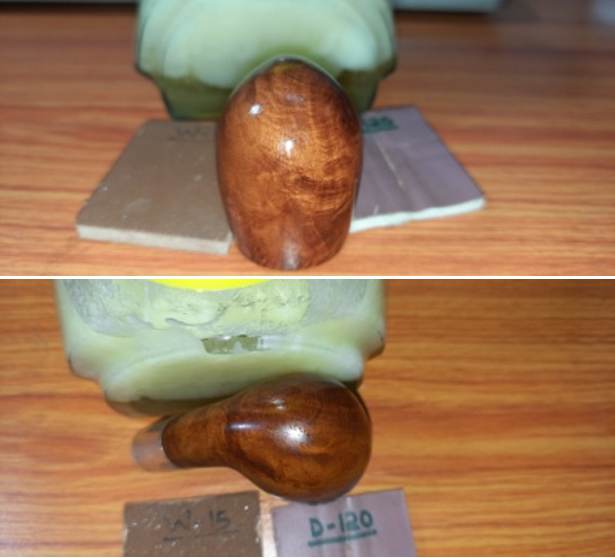
To put the finishing touches, I mounted a cotton cloth buffing wheel onto my hand held rotary tool and polished the stummel and stem with Blue Diamond compound. This compound helps to remove the minor scratch marks that remain from the sanding. Next, I mounted another cotton buffing wheel that I have earmarked for carnauba wax and applied several coats of the wax. I mounted a clean cotton cloth buffing wheel and gave the entire pipe a once over buff. I finished the restoration by giving the entire pipe a rigorous hand buffing using a microfiber cloth to raise the shine further. The finished pipe with the aged patina to the briar looks amazingly beautiful and is now ready for its long second innings with me.
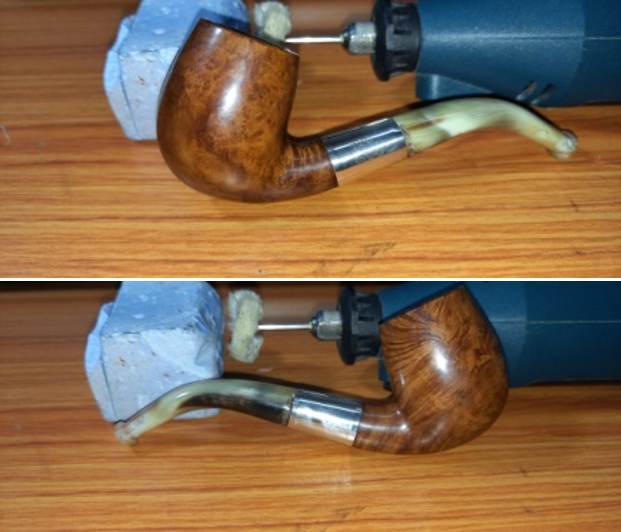
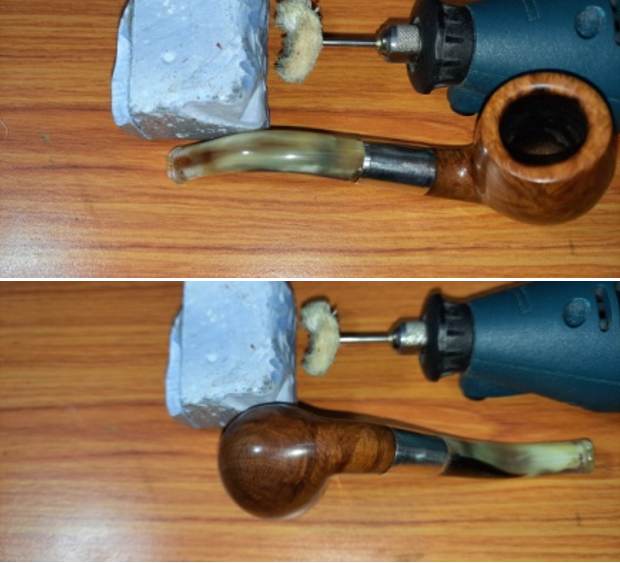
Repairing A Burnout On A Loewe “Chubby”


Blog by Paresh Deshpande

The next pipe that I selected to work on was purchased on eBay way back in 2016 ! When the pipe reached us, I was aghast to see a charred and completely blackened foot of the stummel. There was no mention of the pipe being damaged anywhere in the description of the pipe uploaded by the Seller. To cut the ramble short, I communicated with the Seller about the condition of the pipe and was promptly issued with a complete refund, including the cost of shipping with a note that I could keep the pipe and a hope of continued patronage of his store on eBay. That’s the story of how this beauty came to me and now after all these years of restoring pipes, it finds its way to my work table. Unfortunately, way back then I never took any pictures of the purchased pipes and neither did I chronicle my collection and thus the reason for lack of pictures!
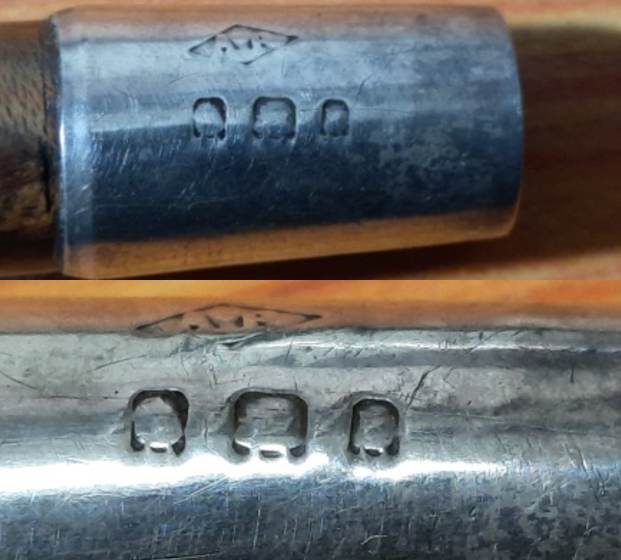
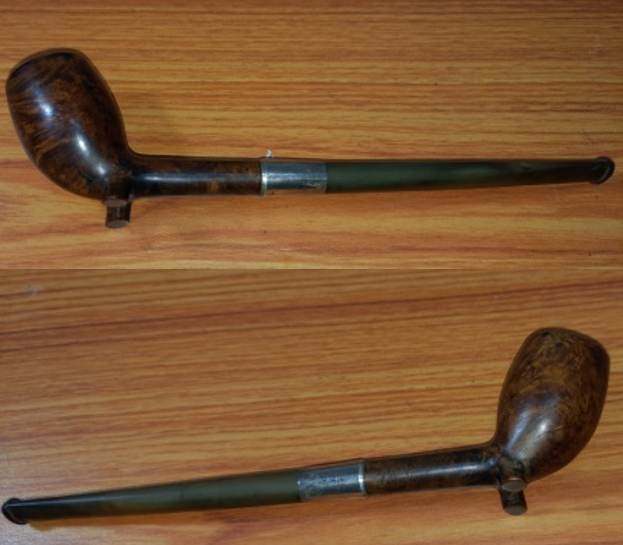
This beautiful smallish pipe has a unique shape that could be described as an oval shank squashed Tomato, if that’s any shape, and hence would loosely term this pipe as a Freehand. It is stamped over the top surface of the broad oval shank as “L & Co” in an oval over “GREAT BRITAIN”. The bottom surface of the shank is stamped “LOEWE” over “LONDON.W” over “CHUBBY”. The top surface of the high quality vulcanite saddle stem is stamped “L & Co” in an oval. This stamping over the stem is considerably worn out and though I would love to but unlikely to be highlighted. The stummel stampings, however, are deep and crisp.I have quite a few Loewe pipes in my collection and have researched this brand when I had worked on a couple from my inherited pipes. I knew that this brand from Haymarket, London was founded by Frenchman Emil Loewe in late 1850s and has the distinction of being first to manufacture Briar pipes. The company was taken over by Civic and later on as with most of the British marquee, was finally taken over by the Cadogan Group. Pipedia has a wealth of information which I went through again to refresh my memory. Here is the pipedia.org link to the article on Loewe pipes…Loewe & Co. – Pipedia
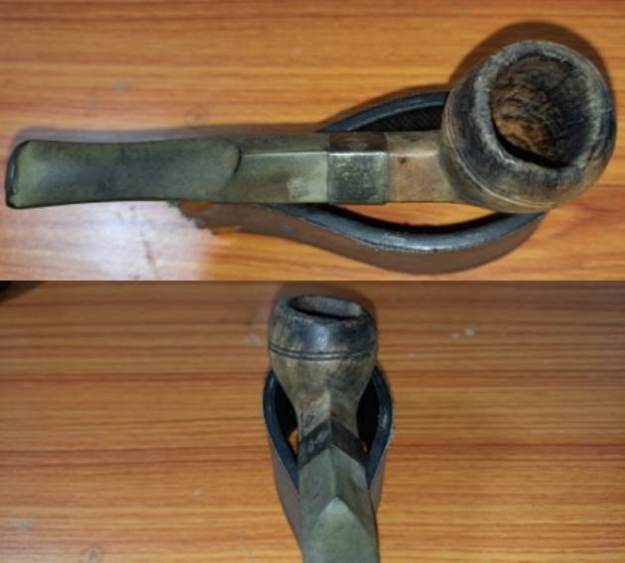
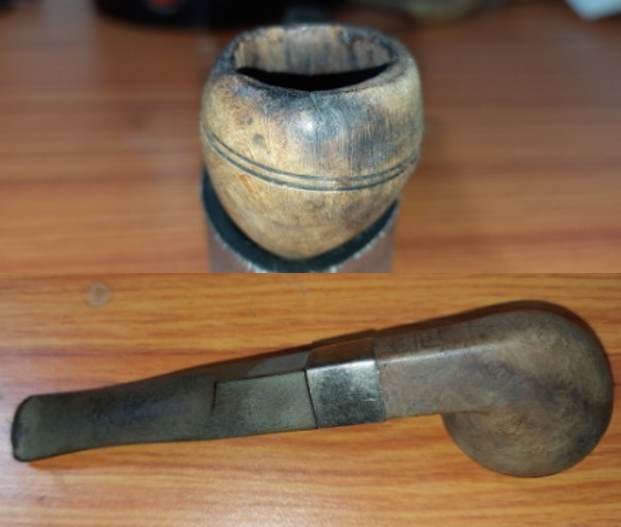
Further down the article, is a link (Dating Loewe Pipes – Pipedia) to date Loewe pipes by Michael Lankton which was of interest as it is very informative and is a highly recommended read for collectors of Loewe pipes.

For our intents the pipe I have is from the Civic Era (1964-1967), where the nomenclature was unchanged but the pipes certainly were, and 1967-1978 where the past goes out the window and decidedly un-Loewe-like 3 digit shapes numbers appear.

Loewe is my favorite pipe maker. How to rank them in terms of the many great London made pipes of their era? For me in the simplest of subjective terms, Loewe pipes from before the Civic Era are like Comoy’s, but even better. After Civic took over in 1964 I suppose the quality of Loewe was very comparable to a lower end GBD, which means they were still ok pipes but not up to previous standards. But those earlier pipes…to me they’re just as good as it gets.

One thing I’ve noticed is most of the old Loewes you see look rode hard and put up wet, which tells me that their owners loved them and smoked them, which is the highest praise any brand can gain.

From my research on it I can safely that the Loewe pipe on my table is from the Early Civic Era 1964 to 1967.

Initial Visual Inspection
I have a faint remembrance of the pipe being in a decent state with minimal cake and a nice shining black stem. The major issue was the charred and blackened foot of the stummel. I remember having knocked at the charred surface to gauge the extent of burnout and was left with the gaping hole at the foot. There is a thin layer of cake in the chamber and the pipe does not appear to have seen heavy usage. The delicately beveled rim is in pristine condition and so is the stem. In my appreciation of the pipe’s condition, I think this burnout occurred very early in to the existence of the pipe probably caused by smoking the pipe too hot. Given below are a few pictures of the pipe as it sits on my work table.Detailed Inspection
As I had mentioned earlier, I had not taken any pictures either of the burnout at the foot of the stummel or my fiddling to remove the charred briar from the damaged area. The chamber has a thin layer of cake and of course the huge gaping hole at the heel is sans any cake. The surface from where the charred wood was removed by me is highly uneven. The outer rim slopes inwards to form the thin rim top surface and has a delicate bevel to the inner rim edge and is in pristine condition. The minor darkening to the inner rim edge at 6 o’clock is superficial and it should clean up easily. Another issue that I have observed is that the draught hole is above the heel of the chamber. I need to figure out a way to build up the heel of the chamber to the level of the draught hole. The only area that would need some serious work is at the heel of the stummel. The area adjoining the burn out still has remnants of the charred wood that would need to be addressed. The rest of the stummel exterior is in pristine condition and would benefit from some TLC to bring it back to its former stunning newness. The mortise is nice and clean and has just a few speckles of carbon and dust. This should clean up easily.The oval broad stem is also nice, clean and surprisingly shiny. There are no bite marks or chatter or indentations in the bite zone. It is unfortunate that the stem logo is wiped out to a great extent. The one issue that needs to be addressed here is the loose seating of the tenon into the shank. The Process
The first step in restoring this particular pipe was the cleaning of the chamber. I used my fabricated knife to scrap off the thin carbon layer. That the cake was crumbly and completely dry made this cleaning a lot easier and faster. With a folded piece of 180 grit sandpaper, I took the cake down to the bare briar and also smoothed the chamber walls. A final wipe with a cotton swab moistened with isopropyl alcohol removed the carbon dust from the chamber and revealed a chamber sans any damage. The charred briar from around the burned out area on the foot of the stummel was further removed using my fabricated knife. Now that all the charred briar wood was removed, it was necessary to smooth out the edges of the burnt out area to ensure an even round hole for a snug fitting briar plug. I mounted a sanding drum onto my hand held rotary tool and evened out the edges. I continued the process of sanding till I could clearly make out solid briar peeking out from the edges. Next I marked out the inner diameter of the carved out burnout area over a block of briar using a marker pen. I cut a suitably sized block of briar to be shaped into a plug using a small hacksaw blade.Using a sanding drum mounted on a rotary tool, I rough shaped the plug that would fit into the foot of the stummel. I deliberately left the top of the plug duly flanged (indicated with blue arrows). The general idea was to push the plug from inside the chamber to the outside so that the plug flanges will seat over the remaining intact heel of the chamber forming a new heel and also raising the heel to just below the draught hole. Now that the plug and area to be plugged is all prepped up, I decided to complete the internal and external cleaning of the stummel before plugging the burned out area. I ran a pipe cleaner dipped in isopropyl alcohol through the mortise and along the shank walls. I scraped out the dried out oils from the shank walls using a sharp dental tool.I followed the internal cleaning of the shank with external cleaning of the stummel using Murphy’s Oil soap and a hard bristled tooth brush and dried it with paper napkins and cotton cloth. I simultaneously cleaned the shank internals with the detergent and a hard bristled shank brush.Abha simultaneously cleaned the internals of the stem with anti-oil dish soap and brushes. She also cleaned the external surface with the soap and Scotch Brite pad.To fix the briar plug in to the heel of the chamber, I decided to apply a layer of JB Weld to the bottom of the entire heel. J B Weld is a two-part epoxy Cold Weld that consists of two parts; hardener and steel which are mixed in equal parts in a ratio of 1:1 with hardening time of 5-6 minutes and complete curing time of 6-8 hours. I poured the contents of the two tubes and mixed it well. With a flat bamboo frond, I applied this mix over the heel of the chamber from inside. I worked fast to ensure a complete and even spread of the epoxy mix over the bottom and then pressed the plug in place. I set the stummel aside for the epoxy to cure overnight.By the following morning, the epoxy had completely hardened. I turned the bowl over and filled the minor gaps between the briar plug and the adjoining stummel surface with medium CA superglue and set it aside while I went for my work. By the time I would return from my office in the evening, the glue would have hardened completely for further work.While the stummel repairs were under progress, Abha polished the stem with 1500 to 12000 grit micromesh pads. She wiped it lightly with a moist cloth and polished the stem surface with “Before and After Extra fine” stem polish developed by Mark Hoover. This polish helps in removing the minor scratches left behind due to sanding while imparting a nice shine to the stem. She finished the stem polishing and rubbed a small quantity of EVO into the stem surface and set it aside for the oil to be absorbed.By evening when I continued my work on this pipe, the J B Weld as well as the superglue had cured completely. Using a small hacksaw, I cut the protruding plug as close to the foot of the stummel as possible. I further match the plug with the rest of the stummel foot with a flat head needle file. I perfectly matched the plug with the rest of the surrounding surface by sanding with a folded piece of 220 grit sandpaper. The plug is now flush with the foot of the stummel while the flanges of the plug provide additional support to the plug from within the chamber. The floor of the heel is also raised and is just below the draught hole.I had reached that stage in restoration where an important decision was required to be taken which would affect the aesthetics of the pipe. To blend in the repair, I wanted to rusticate only the foot of the stummel and discussed this step with Abha. She was of the opinion that a perfect geometrical pattern does not go with the flow of the shape and recommended a free flowing rustication pattern. I sought her help in designing the free flowing pattern and marked it over the foot of the stummel with a marker. The design she marked makes for an interesting look.To rusticate, I firmly held the stummel in my left hand and with my right hand and began gouging out the briar. The technique is to firmly press the pointed four prongs of the modified Philips screwdriver into the surface, rotate and gouge out the removed chunk of briar. I worked diligently till I was satisfied with the rustications and the appearance of the stummel. I cleaned the debris off the rusticated surface with a brass wired brush. The high points in the rustications were lightly sanded down using a piece of 220 grit sandpaper.Next I polished the stummel using micromesh pads, wet sanding with 1500 to 12000 grit pads. I also polished the high spots in the rustication with the micromesh pads. I wiped the bowl with a moist cloth after each pad to clean the surface. The rusticated part of the stummel is now ready for a fresh coat of stain. I decided to stain the rusticated surface with a black dye which would contrast beautifully with the browns of the rest of the smooth surface. I heated the rusticated portion with my heat gun to open up the pores on the stummel so that the stain is well absorbed. I used Fiebing’s aniline black leather dye and liberally applied it over the heated surface, flaming it with the flame of a lighter. This helps in the setting of the stain in the grain of the briar. I ensured that every inch of the rusticated surface was coated with the dye while the smooth surfaces are not stained. I set the stummel aside for a day to set the dye into the briar surface. 24 hours later, the stain had set completely. To highlight the contrast of the high points in the rustication, I lightly sanded the high points with a worn out piece of 180 grit sandpaper followed by polishing by the method of dry sanding with 1500 to 12000 grit micromesh pads.Next, I rubbed a small quantity of “Before and After Restoration Balm” into the briar with my fingertips, worked it deep into the sandblasts as well as the smooth surface and let it rest for a few minutes. The balm almost immediately works its magic and the briar now has a nice vibrant appearance over the smooth surface with the beautiful rusticated patterns on full display on the foot of the stummel. I further buffed it with a horse hair shoe brush. The next issue that I addressed was that of the loose seating of the stem into the mortise. With the flame of a lighter, I heated the tenon with the flame of a lighter till it was pliable and inserted a drill bit that was a bit larger in diameter than the tenon opening. This helps in expanding the pliable vulcanite for a snug fit. I held the tenon under cold tap water for the tenon to cool down and set the increased diameter. The seating was perfectly snug with just the right amount of resistance.The last functional aspect which I addressed at this stage was the protection of the repairs to the heel of the chamber. I mixed activated charcoal and yogurt to a consistency which allows for an easy and even spread and evenly applied it on the inner walls and heel of the chamber. This coating helps in preventing the epoxy at the heel of the chamber from coming into direct contact with the burning tobacco, a sort of insulation and assists in quicker formation of a cake. I set it aside to dry out naturally for a week. To complete the restoration, I first mounted a cotton cloth buffing wheel that is dedicated for use with Blue Diamond, onto my hand held rotary tool.  I set the speed at about half of the full power and polished the entire pipe after the stem and stummel were united. The Blue Diamond compound helps to erase the minor scratches that are left behind even after micromesh polishing cycle. I followed the Blue Diamond polish by applying several coats of Carnauba Wax with a cotton cloth buffing wheel dedicated to Carnauba Wax. I finished the restoration by giving the entire pipe a rigorous hand buffing using a microfiber cloth to deepen the shine further. The finished pipe looks amazingly beautiful and has been transformed from being a write off to being one in my rotation! The Pipe Gods are being very kind to me now-a-days and pray that they continue to be so. Following are the pictures of the restored pipe.

Resurrecting And Re-Stemming A Vintage Churchwarden Cutty With Reed Shank


Blog by Paresh Deshpande

The next pipe that I selected to work on is an old, rustic no name Cutty shaped pipe with a long thin Reed shank that ended in a round orifice when I saw it for the first time. Closer examination confirmed that the round orifice was threaded implying that the stem was MIA. This pipe came to us in 2019 while Abha was in Pune and I was away at my place of work, as a part of estate sale by a French gentleman on Etsy which I am yet to chronicle. There are some really good, interesting and collectible pipes in this lot that I am looking forward to work on in coming days.

This no name Cutty shaped pipe has a steep forward cant to the stummel. This forward rake appears more pronounced as the stummel itself tapers upwards towards the rim. The stummel is as delicately and beautifully shaped as a Tulip. Here are a few pictures of the pipe as it sits on my worktable.  The complete lack of stampings of any kind on the pipe means that the provenance of the pipe cannot be ascertained with documented evidence. However, given the shape, construction, condition and the materials used in making this pipe makes me believe that this was a locally made pipe from the early 20th century. I may be wrong in my appreciation (primarily dictated by inert desire/wish for this pipe to be an old timer!) as I am vastly inexperienced as compared to many of the esteemed readers of rebornpipes and would be glad to learn more about such pipes from them.

Having placed my request, I now move on to the initial visual inspection.

Initial Visual Inspection
As noted at the start of this write up, this pipe came with a threaded reed shank end that is now missing the stem that would have come with a threaded tenon to seat in to the shank. Given the retro and vintage look of the pipe, I think the stem would have been a bone/ horn or Amber with a bone tenon. So the first step in this restoration would have to be selecting a suitable bone stem with threaded tenon. The shank end face shows two cracks on opposite sides of the shank (encircled in yellow) which would need to be addressed. The stummel end of the reed is upturned, flared and hollowed with threads to seat the stummel and at the bottom of which is the short foot. The threaded surface is covered in dried oils and gunk causing the draught hole to clog. This would have to be cleaned and opened. The entire length of the shank is covered in dirt and grime giving it a dull and dirty appearance. The chamber has a decent layer of cake that is even from top to the bottom of the bowl. The rim top is covered in overflow of lava and hides any dents or chips on the smooth surface. The rim is significantly dark and thin on one side and is encircled in pastel blue. This makes the chamber out of round and gives a lopsided appearance to the top view of the stummel. The bottom of the stummel is threaded and seats atop the threaded reed shank. The threaded area shows heavy accumulation of oils, ash and gunk all around and even within the threads. Cleaning this area would ensure a flush and snug seating of the bowl over the shank.The briar has taken on a nice dark brown patina over a long period of time and prolonged use which when polished and cleaned, should contrast beautifully with the light hues of the long reed shank. There are a few dents and fills (marked in yellow circle) over the entire stummel surface that is visible through the dirt and grime that covers the surface. Truth be told, the stummel does not boast of complete flamboyant straight or bird’s eye or flame grains over the surface, but a mixed pattern of swirls and flame grains that is attractive enough to hold your attention. Preserving the deep brown aged patina will be the primary concern in this bowl refurbishing. The Process
I started the restoration of this pipe with the removal of the carbon cake from the walls of the chamber. Using my fabricated knife, I carefully removed the cake from the chamber to expose the chamber walls. It was heartening to note that there are no heat related issues in the surface of the walls. I smoothed out the surface by sanding the walls with a folded piece of 220 grit sand paper. To remove the last traces of residual carbon dust, I wiped the chamber with a cotton swab wetted with 99.9% pure alcohol. I further cleaned the draught hole at the bottom center of the bowl with a pointed dental tool. The hardened cake had greatly reduced the diameter of the draught hole and ran a pipe cleaner dipped in alcohol to clean it further.Next, I cleaned the threaded bottom of the stummel that seats atop the long reed shank with a dental tool. I scraped out the entire dried gunk that had accumulated in the hollow space as well as from in between the threads. I further cleaned the bottom of the stummel with q-tips and alcohol.With the preliminary cleaning of the internals of the stummel completed, I turned to cleaning the internals of the long reed shank. With my fabricated pointed tool and round needle file, the dried oils and tars that had formed a block at the neck of the shank and stummel junction was removed and cleaned. I scraped out all the dried debris from the surface of the shank end with a sharp dental tool. I ran a few long pipe cleaners dipped in alcohol through the airway of the stem till the pipe cleaners emerged white.I cleaned the exteriors of the stummel and the reed shank with Murphy’s Oil soap and a tooth brush. I ensured that all the tars and grime was cleaned from both the surfaces. This cleaning has revealed the exact extent of damage to the rim top surface. The area where the rim has thinned out also shows signs of charring which would need to be addressed. I dried the shank surface with a soft paper towel and ran a fluffy pipe cleaner through the shank airway to dry it out. Now that the stem surface is rid of the dirt and grime, the cracks at the shank end are clearly discernible and so is the surprise revelation of a crack at the base of the threaded portion of the shank (encircled in red).I marked the end points of the shank end cracks and that at the stummel end with marker pen under magnifying glass. I shall drill counter holes at the marked end of each of the crack to prevent the further spread of these cracks. I used a 1 mm drill bit mounted on my hand held rotary tool to drill the counter holes… …and filled these and the cracks with clear CA superglue. I set the reed shank aside for the superglue to cure. The external cleaning had not only exposed an additional crack at the stummel end of the shank, it had also exposed all the fills and dings over the stummel surface. With a thin sharp knife, I gouged out all the old fills from the surface and cleaned the area with isopropyl alcohol in preparation of filling these gouged out surfaces with a mix of briar dust and CA superglue. I use the layering method to fill these pits in the briar. After all the fills were repaired, I set the stummel aside for the fills to harden and cure completely.The shank repairs had cured by the following noon when I got back from work. Using a flat needle file, I evened out the fills to roughly match the rest of the shank surface. I fine tuned the match by sanding the fills with a folded piece of 320 grit sand paper. Did I mention having customized a sterling silver band for providing additional support against the crack’s lateral expansion? I guess not. Here in India, our local Silversmiths are very skilled in turning jewelry and at repairs right in front of their customers at very affordable rates. Steve and Jeff are witnesses to such craftsmanship when they had visited us in India. Long and short of the story is that I got a 1.5 inch long silver band customized for this shank and fixed it over the shank end with superglue. That crack isn’t going any further now.Now that the cracks have been repaired and stabilized, the next goal was to find the right stem to go with the overall profile of the pipe. I selected a couple of suitable bone stems from my stash of spares and asked for Abha’s opinion. She selected a horn stem that was perfectly matched in size and shape with the shank. However, the stem came with its own set of challenges. First, the tenon was broken with half of it sticking inside the stem and secondly, the top section of the stem surface was partially sliced (encircled in blue), but remained firmly attached. Notwithstanding these issues, the stem matched the profile of the pipe to the T and looks amazing. The first issue with the stem that I dealt with was removal of the broken half of the tenon. I mounted a drill bit slightly larger than the tenon opening on to my hand held rotary tool and carefully drilled it inside the tenon. Once the drill bit had a firm grip on the tenon, I turned the motor counter clockwise and dislodged the tenon remnants from the stem revealing a threaded stem end.I would need to identify a threaded bone tenon that would match the shank and stem threads for a perfectly aligned seating. I rummaged through my spare parts box and came up with a bone tenon that was threaded at one end and smooth conical shaped at the other end. The seating of the smooth side of the tenon into the stem was perfect and so was the threaded end into the shank end snug and aligned. The Pipe Gods are especially favoring me it seems. A perfectly matching, period correct horn stem and a perfectly matching bone tenon are nothing short of a miracle.Before fixing the tenon, I cleaned out the stem internals using anti-oil dish washing soap and thin shank brushes. I scrubbed the external surface with soap and Scotch Brite pad. Using paper towels and pipe cleaners, I dried the stem externals and airway respectively. I inserted a petroleum jelly (Vaseline) coated tapered pipe cleaner through the tenon and stem airway and out through the round orifice opening at the slot end. This serves two purposes, firstly, perfect alignment of the tenon and stem airway is ensured and secondly, the petroleum jelly prevents the superglue from seeping into the airway and clogging it shut once the glue has dried. I roughed out the smooth surface of the tenon with a needle file to provide better bonding surface and applied superglue over the smooth surface of the tenon and over the threads in the stem and inserted the tenon into the stem. I wiped the excess glue from the surface and held the two together for the glue to harden a bit and then set it aside for the superglue to harden completely. While the stem was set aside for the glue to cure, I sanded the stummel fills with a flat needle file. To further even out the filled areas and address the minor dents and dings over the stummel surface, I sanded it with a worn out piece of 220 grit sand paper till smooth.Next I addressed the issue of the charred and out of round chamber. I began with topping the rim over a 220 grit sand paper, frequently checking for the progress being made. I stopped once the charred surface was reduced to an acceptable- to- me level and the thickness of the rim top was close to even all round. To get the chamber back to round, I created a bevel over the inner and outer edge with a folded piece of 180 grit sand paper. I am pretty pleased with the progress being made thus far.While I had been working on the stummel, the tenon fix to the stem had set solid. I checked the seating of the tenon in to the shank end and it was snug and perfectly aligned.There was this issue of sliced top surface on the stem which I addressed next. I applied clear CA superglue over and under the sliced surface and set the stem aside to cure. I sprayed an accelerator over the superglue to hasten the process of curing. Once the stem repairs were set, with a needle file, I sanded the fill to achieve a rough match with the stem surface. I further fine tuned the match by sanding the entire stem surface with a folded piece of 220 grit sandpaper. I applied a little EVO (Extra Virgin Olive Oil) to the reed shank and stem and set it aside to be absorbed into the surface. While the shank and stem were set aside to absorb the EVO, I dry sanded and polished the stummel surface with 1500 to 12000 grit micromesh pads. Dry sanding with micromesh pads helps to preserve the patina of the old briar and is a trick I use when restoring all my vintage pipes. I rubbed a small quantity of “Before and After Restoration” balm which moisturizes and enlivens the briar. I let the stummel absorb the balm for 15- 20 minutes and then gave the stummel a rigorous hand buff with a micromesh cloth. The transformation in the appearance of the stummel is phenomenal and immediate. With the stummel now refurbished and rejuvenated, I turned my attention back to the shank and horn stem. I polished the shank and stem by wet sanding using 1500 to 12000 grit micromesh pads. I rubbed a little “Before and After” balm in to the reed shank and a little EVO in to the stem. All that remained was a polish with Blue Diamond compound and final wax coating using Carnauba Wax. I mounted a cotton buffing wheel earmarked for Blue Diamond compound on to my hand held rotary tool and applied a coat of the compound over the stummel surface to polish out the minor scratches. With a cotton buffing wheel that I use for carnauba wax, I applied a coat of carnauba wax to the stummel and stem and continued to work on it till the complete coat of wax had been polished out. I mounted a clean cotton cloth buffing wheel and gave the entire pipe a once over buff. I finished the restoration by giving the entire pipe a rigorous hand buffing using a microfiber cloth to deepen the shine further. The finished pipe is shown below. This pipe shall find its way to my collection based purely on its delicate stunning looks and uniqueness of the shape. P.S. The Pipe God was definitely smiling down upon me as I worked this pipe. Rarely does it happen that the replacement stem is a perfect size match and the new tenon is period correct and fits in the shank like a glove.

The most difficult part of this restoration for me was…can you guess? Please let me know your guess in the comments below and a big thank you for your valuable time in reading the write up.

Praying for you and yours… Be safe and stay safe.

A Simple Refurbishing Of A Boxed “Brakner # 129”


Blog by Paresh Deshpande

This is the third and the last Brakner pipe in my inherited collection that came in original Brakner box duly tagged, but I don’t think the box is original as the shape code on the pipe and the box do not match. I had been delaying restoring this pipe as I had my hands full with pipes that I had received for repairs and ones that were selected by brother pipers to be restored/ refurbished by me. In between these commitments, I took the time out to refurbish pipes for my personal collection and this is one such pipe. This uniquely rusticated stacked billiard shaped pipe is stamped on the smooth surface on the left side of the shank as “BRAKNER ANTIQUE” over “DENMARK”. The smooth surface on the right side of the shank is stamped as “HAND-CUT” followed by # 129, the shape number. The vulcanite stem is adorned with a green dot (larger than a Dunhill stem logo), I think made of Jade stone, not sure though. There is a smooth band around the end of the shank.  I have worked on Brakner pipes before and had read about Peter Brakner and his unique “micro-rustication” technique, which has been lost to the pipe community with his demise as he never did share this technique that he had developed. To refresh my memory, I revisited pipedia.org and read the article published therein. One can refer to the article at this link Brakner – Pipedia.

Peter Micklson (†) started his career at the Teofil Suhr workshop, Suhr’s Pibemageri, in Copenhagen, where Sixten Ivarsson was the foreman. He brought in Poul Rasmussen and taught him the two or three important things about pipemaking in a six weeks crash course, before he went off to join Poul Nielsen, the later Mr. Stanwell.

Micklson, who later changed his last name to Brakner,cannot have worked under Rasmussen too long before he felt to be good enough to go off on his own. Indeed he carved himself quite a good name as it was proudly announced 1955’s World Championship of Pipe Smoking was won by a smoker who employed a Peter Brakner pipe.

His fame based fairly on developing an unique and very special “micro-rustication” he called Antique. According to Kai Nielsen, Brakner kept this technique as a secret and only once he showed it to one person – Kai’s mother. Both have passed away, so this secret technique is lost. Kent Rasmussen was recently inspired by Brakner’s Antique finish when he created his new technique of rustication.

Brakner was a close friend of Ole Larsen, the proprietor of the famous W.Ø. Larsen tobacco shop and sold a lot of his pipes there, before Larsen hired his own indoor carvers. From the Larsen Export Catalog 1960/61 we learn a bit about Brakner pipes:

  • Antique Antique finish in tan or black. Smooth pipes also. Each pipe 7.50 $.
  • Bella Danica Antique finish in tan or black. Each pipe 10.00 $.
  • Royal Danois Antique finish in tan or black. Each pipe 12.50 $.

The latter were named after the Royal Danish Guard Regiment, founded in 1689.

Brakner was one of the first high-end carvers from Denmark to enter the US market and was considerably successful there in the early 1970’s. After his sudden death Peter Brakner’s name faded back from the forefront, but his pipes speak to the injustice of that. His body of work has earned him a place in the important history of Danish pipemaking.

Further down the article, there were a few pictures of Brakner Pipes from the 1961-62 catalogs that I have reproduced below which has the shape code of the pipe currently on my work table, albeit in a smooth finish and indicated with a red arrow.Having read the detailed account, I feel blessed to be holding a piece of Danish pipe history.

Initial Visual Inspection
As is generally observed with most of my grandfather’s pipe, the chamber of this pipe too is filled with a thick cake with overflowing lava covering the rim top surface. The thick cake hides the condition of the inner walls of the chamber and will be ascertained only after the cake has been taken down to bare briar. Similarly, the condition of the rim top surface will be commented once the overflowing lava has been scraped off. However, the inner rim and outer rim edge appears to be in good condition with no tell tale signs of damage. There are strong smells emanating from the entire pipe and would need to be addressed. Unlike the other two Brakners in my collection, this one does not have a smooth band below the outer edge of the rim, but has one at the shank end. It has smooth surfaces on either side of the shank which bears the stampings seen on this pipe. The unique rustications on the stummel surface are covered in oils, tars, grime and dust of all these years of use and storage. However, once cleaned up, the dark of the stummel should contrast beautifully with the smooth brown shank end band. The mortise and the shank air way are clogged as expected making the air flow anything but laborious. However, with the draught hole being right at the bottom of the chamber and the perfect alignment of the stem airway, tenon and the shank airway should make this one a fantastic smoker. The vulcanite stem is heavily oxidized with deep tooth marks on both the upper and lower stem surfaces. The buttons on the either surfaces are deformed due to tooth indentation and would have to be rebuilt and reshaped. The trademark green dot on Brakner pipe stem has dulled a bit and would benefit from a nice polish. The tenon end and the slot end showed heavy accumulation of dried oils and gunk.The cardboard box that housed the pipe for these many years does show its age. The edges have separated at the seams at a couple of places and the whites of the insides have yellowed. However, the posters and external surface are bright and in good condition. All in all, judging from the initial examination, I do not envisage any major/ serious issues to present themselves in the course of restoring this beauty and should be an easy project.

The Process
I began the restoration process by first cleaning the stem internals. I cleaned the internals of the stem using hard bristled pipe cleaners dipped in isopropyl alcohol and followed it by cleaning the air way using a small shank brush with anti oil dish cleaning soap. This helps in reducing the number of pipe cleaners required while ensuring a spotless and a very clean stem air way. Once the stem internals were clean, I sand the entire stem surface with a piece of 220 grit sand paper and cleaned the stem surface with Murphy’s Oil soap on a cotton pad. This step helps to remove surface oxidation to some extent while preparing the stem for a dunk in deoxidizer solution for better results. To address the issue of bite marks and tooth chatter on the stem surfaces, I flamed the surface with a lighter. Vulcanite has the property to attain its original shape when heated and this is exactly what was being done. The tooth chatter and deeper bite marks were raised to the surface to a great extent. The remaining minor tooth indentations would be subsequently filled with a mix of clear super glue and activated charcoal. At this stage, I immersed the stem in to the De-oxidizer Solution developed by Mark Hoover. I generally allow the stem soak in the solution overnight.While the stem was soaking in the De-oxidizer solution, I reamed the chamber with size 1 head of the PipNet pipe reamer. I removed the carbon from the areas where the reamer head could not reach with my fabricated knife. To completely remove the residual carbon from the walls of the chamber and smooth out the walls, I sand the chamber walls with a folded piece of 220 grit sandpaper followed by cleaning the chamber with a cotton swab wetted with isopropyl alcohol. The chamber walls are in pristine condition. I deliberately avoided scraping off the lava build up over the rim top to avoid damage to the micro-rustications over the surface. I cleaned the mortise and shank airway using dental pick and hard/ soft bristled pipe cleaners dipped in isopropyl alcohol. I shall continue with further cleaning of the shank internals once I clean the external stummel surface.Once the internals of the chamber and shank were cleaned, I cleaned the external surface of the stummel with Murphy’s Oil soap and cotton swabs followed by scrubbing the rusticated surface with a toothbrush and dish washing soap. This rid the stummel rustications of all the accumulated dust, dirt and grime and the smooth brown band around the shank now contrasts beautifully with the dark stummel surface. Using a soft brass brush, I deliberately cleaned the rim top micro-rustications till clean. I also cleaned the shank internals with dish washing soap and shank brush.I had expected that after such a thorough cleaning of the chamber and shank internals, the ghost smells would have been greatly reduced or eliminated completely, but that was not so. I decided to subject the chamber and mortise to cotton and alcohol bath. I packed the chamber with cotton and drew out a wick from the cotton and along with a folded regular pipe cleaner, inserted it into the mortise and through the draught hole into the chamber. I tightly packed cotton balls in to the remaining portion of the mortise. Thereafter, I soaked the cotton balls with isopropyl alcohol up to the brim. About half an hour later, the level of alcohol had gone down, having being absorbed by the cotton. I topped it up once again and set it aside overnight. By next afternoon, the cotton and alcohol had drawn out all the remaining oils and tars from the chamber and mortise. I removed the cotton balls and the dirt can be gauged by the appearance and coloration of the cotton balls and the pipe cleaner. With my fabricated knife and dental tools, I spent the next hour scrapping out the entire loosened gunk from the mortise. I ran pipe cleaners through the mortise and draught hole to clean out all the loosened tars and gunk that was lodged in the draught hole and mortise. The chamber and mortise now smelled clean, fresh and looked it too. I set the stummel to dry out naturally. To enhance the contrast and break the monotony of the black stained stummel and the soon-to-be shining black stem, I polished the smooth briar band at the shank end, dry sanding with 1500 to 12000 grit micromesh pads.To enliven the briar wood and further enhance the contrast of the band with the rest of the dark stummel surface, I rubbed a little quantity of “Before and After” balm in to stummel surface and set it aside for 20 minutes for the balm to be absorbed in to the briar. Thereafter I hand buffed it with a microfiber to deepen the shine. The stummel looks nice and vibrant.With the stummel refurbishment almost complete, I turned my attention to the stem which had been soaking in the solution now for nearly 24 hours. I cleaned the stem and the stem airway under running warm water and scrubbed the raised oxidation from the surface using a Scotch Brite pad and the airway with thin shank brush. I further removed the oxidation by scrubbing the stem with 0000 grade steel wool. Once the stem was dried with paper towels, I sand the bite zone to completely eliminate the raised oxidation in preparation for filling the tooth indentations and applied a little olive oil to rehydrate the stem.I prepared a mix of CA superglue and activated charcoal and spot filled the tooth indentations and set it aside to cure overnight.Once the fills had cured completely, I sand the fill with a flat head needle file till I had achieved a rough match of the fill with the rest of stem surface. I continued the sanding cycle by dry sanding with 320, 400, 600 and 800 grit sand papers. I wet sand the entire stem with 1000, 1500 and 2000 grit sand papers. This not only ensured a nice blend of the filled areas with the rest of the stem surface, but also removed the oxidation from the surface. I rubbed the stem surface with some EVO and set it aside to be absorbed in to stem surface. Thereafter, I launched a second determined assault on the stem, subjecting it to the complete cycle of micromesh polish. The end result is a gorgeous, smooth and shiny looking black of the vulcanite stem.When the stem and the stummel were united for a polish using carnauba wax, I saw a mysterious gap appear between the stem and shank face. This gap was definitely not noticed during my initial inspection and neither the stem face was shouldered during the polishing process. I really am not aware about the reasons for this happenstance, but now that it has been noticed, it needs to be addressed. I attach the stem to the shank and insert a piece of 320 grit sand paper between the two and sand the shank face opposite to the gap. I also gave a few turns to the tenon end over the same sand paper. I continued the micro adjustments till I had achieved a perfect seating of the stem in to the shank end. Just a word of caution here; please be extremely diligent and careful during this step as it has the potential to ruin the pipe completely due to over sanding. Remember “LESS IS MORE” and “SAND ONCE AND CHECK TWICE/ THRICE”.  This was followed by the routine regime of polish with carnauba wax using my hand held rotary tool. The Brakner looks unique and oozes quality.To deepen the shine, I gave a vigorous rub to the entire pipe with a microfiber cloth. This is truly a beautiful pipe and will be joining my now increasing personal collection. Here are a few pictures that should give you a fair idea about the end results…. Thank you all for being a part of this journey and support extended.P.S.- I had requested my youngest daughter, Pavni, to help me repair the box which housed the pipe. This kind of work is right up there in her alley and she did oblige me. The box has been repaired solid and cleaned. Here are a few pictures of the box with the pipe.Praying for the health and safety of you and your loved ones…

So long until the next project.

Refurbishing A Very Special For Me Karl Erik # 4 Freehand Pipe


Blog by Paresh Deshpande

Abha, my wife, has been working with me on pipes for the last three years and never has she voluntarily suggested/recommended any pipe for purchase. One day while surfing eBay for some good pipes, Abha chanced upon this pipe and she liked it. Well, the fact that this is the first pipe that called out to her (she is a non smoker!!), makes it very special and soon the pipe made its way to Pune where Abha was indeed surprised to receive this pipe.

This special pipe that I selected to work on is a beautiful freehand appears like a tulip with some great flame grains all around the stummel and shank. The shank end has a nice outward flare with a flattened lower edge and the rim top is a nice plateau. The pipe is stamped on the bottom of the flared shank end as “KARL ERIK” in cursive hand over “HAND CUT IN” over “DENMARK”, all in block capitals. The shank towards the bowl end bears the numeral “4”, in all probability the grading of this pipe (?). All the stampings are crisp and easily readable. The fancy vulcanite stem is devoid of any stampings.There is a lot of interesting information on the carver, Karl EriK Ottendhal, on pipedia.org (Karl Erik – Pipedia) which makes for an interesting read and provides a great insight in to the life struggles, successes and pipe making philosophies of Karl Erik. I have reproduced a few interesting general snippets of information while focusing on the aspect of determining the vintage of the pipe.

Karl Erik Ottendahl (1942 – 2004) was born in Aalborg (Jutland), just a few miles from the very northernmost tip of Denmark. He began smoking a pipe when he was 14 and upon leaving school he started an apprenticeship in the craft as a lithographer at the age of 16.

While working as an apprentice he began hand carving pipes as a hobby. Many were given as gifts to his more senior colleagues. Upon completion of his apprenticeship he moved to Nairobi, Kenya to work as a lithographer during the 1962 war. While in that war torn country, he was unable to procure pipes for himself. In the face of such a predicament, he chose to continue to make pipes for his own use rather than go without.

Returning to Denmark after three years he couldn’t find a well paid occupation in his job, and so he began making a few pipes on the side to boost his income choosing his prenames “Karl Erik” – logo “KE” – for his label. When he managed to find some major Copenhagen pipe stores willing to sell his pieces his reputation grew little by little and he was finally able to purchase more and better machinery and began working full time as a pipe maker.

The Manufacture Era

Growing demand for his pipes made it necessary to look for a larger workshop and hiring first co-workers around 1967/68. A most important step ahead in his career was the contract with Wally Frank, Ltd. of NYC who was in search of attractive, well made but affordable Danish freehands and fancy pipes fitting to their vast offer of low end or midrange pieces but with a stress on quality.

“Attractive, well made but affordable Danish freehands and fancy pipes” – this was exactly what Karl Erik offered! So to say that’s the kernel of his lifelong philosophy as a pipemaker! And indeed, Karl Erik always did it his way and always somewhat differently as others.

Grading and the II S Problem

KE’s old grading used numbers ascending from 4 to 1. The entirely hand made one of a kind pieces were stamped “Ekstravagant”. Quite simple. But then there are the II S stamped pipes! (And furthermore seen so far II SM, I S, I M and I B.) Three fairy tales, often told:

  1. II S stands for the initials of a pipemaker who worked for Preben Holm before he changed to KE.
  2. II S pipes are a second brand of KE. Nonsense comparing the quality of II S and normal KE pipes!
  3. II S was used when there was no space for stampings otherwise.

But it is almost certain, that II S pipes were exclusively sold in the United States only.

KE discontinued all exports to the United States in 1987 due to waning sales and attempts of his business partners to screw down prices. Now, freehand sales were downward bound worldwide in those years and KE gradually grew tired running a pipe manufacture.

Though Karl Erik’s favorite briar mostly came from Morocco or Greece, but he frequently purchased elsewhere, too. He didn’t consider the briar origin to be particularly important provided the briar was well cured. Therefore, he simply purchased the best briar he could find, rather than purchasing from only one or two regions.

Concentrating on more classical influenced shapes Karl Erik’s style emphasized the wood over all other contributing factors by allowing the grain to determine the ultimate shape of the piece. He further emphasized the natural, organic, flowing shape of his bowls with hand cut stems and a broad variety of decorating materials.

KE’s new grading used numbers ascending from D to A. The unique “Ekstravagant” pipes C, B, A, AA to AAA. These superb pieces of remarkable quality were, almost certainly, the least expensive high- quality hand made pipes coming from Denmark today!

In the 90’s he was honored by Stanwell to design some models for the very popular H.C. Anderson line which is named for the great Danish poet.

Around 1998/99 he traded the German rights to his brand name “Karl Erik” to Planta, better known as the proprietor of Design Berlin (db). Thus – though db copied the style of the old Karl Eriks pretty closely – a recent KE offered for sale in Germany is unfortunately about as Danish as Eisbein mit Sauerkraut. But even though Planta did one thing of merit: a series of pipe tobaccos was named for Karl Erik!

While everywhere else a Karl Erik pipe remained a Karl Erik pipe made by Karl Erik himself, he began signing some of his pipes with his family name Ottendahl. The new label was strictly used to continue distributing his own pipes in Germany only! But as his Viking ancestors some Ottendahl pipes discovered a way to cross the pond and turned up in the United States. KE officially resumed sales to the USA after 13 years in 2000! This caused a certain confusion among US pipesmokers and some clever US pipetraders imputed the Ottendahls with a better quality than the usual Karl Erik pipes to take advantage of the favorable situation asking considerably higher prices for Ottendahl pipes.

During the following years KE produced a little more than 2000 pipes per year, selling the bulk of them in Germany and the US. That is surely a respectable output, considering the largely hand-made character of these pipes. Karl Erik Ottendahl was planning to make 2500 pipes in 2004 but he died surprisingly suffering a stroke in his home in Korsør on Zealand on the 12th of September 2004.

It sad that the community lost a talented artisan but his pipes will continue to be repaired/ restored, like the one currently on my work table, and be remembered for generations to come.

From the above, it is evident that this pipe is from the early manufacturing era of Karl Erik and is the lowest grade of pipe leaving his table.

Initial Visual Inspection
The chamber has a decent layer of cake that is thin at the rim and thick towards the bottom half of the chamber. The plateau rim top and the flared shank end is stained black. The stummel surface is covered in dust and grime that gives it a lifeless appearance. However, through this dirt and grime, beautiful flame grains can be seen all over the stummel surface without a single fill. The mortise has small traces of dried oils/ tars accumulation and yet, should be an easy clean. The high quality vulcanite stem is in excellent condition without a single bite mark. Overall, this old pipe has been well cared for and should finish up really beautiful. Detailed Inspection
The chamber has a thick layer of dry and hard cake at the bottom half towards the heel and progressively reduces towards the rim top. The plateau rim top surface is very clean with no lava overflow or issues of charring to the inner rim edge. The condition of the inner walls of the chamber can be checked and ascertained only after the cake has been taken down to the bare briar. The rim top and the flared shank end are stained black and provide a nice contrast to the natural virgin hues of the rest of the stummel. However, this was a contentious issue as Abha was of the opinion that black stained rim top gives an unclean appearance whereas I was looking at the contrast.The stummel boasts of beautiful flame grains all around and extends over the shank surface too!! The surface is lightly covered in grime and dust. However, the stummel surface is without any fills save for a few scratches/minor dings (indicated by yellow arrows/ encircled in same color) that could have been caused during routine use. The flared plateau of the shank end shows traces of accumulated dust and dirt which should be a breeze to clean. The foot of the stummel shows beautiful bird’s eye grains and is sans any damage. The mortise is clean with minor traces of old oils and gunk. Overall, the stummel presents a well cared for pipe. A closer look at the stummel surface shows beautiful and distinct flame grains all around, including the stummel, less the right side of the bowl where the grains are not prominent and this could only be the reason for this piece being classified as Grade 4! The fancy slightly bent vulcanite stem is lightly oxidized and with no tooth chatter or bite marks or chewed off button edges. The tenon and slot end are both clean and this makes me believe that the stem airway would be clean too. The fancy stem, though looks beautiful when black and shiny, is a bear to clean with all the dips and narrow gaps between the beads and rings etc.The Process
I began the process of refurbishing this pipe with cleaning the internals of the stem using pipe cleaners with isopropyl alcohol (99.9% pure) followed by further cleaning using anti oil soap and shank brush. Next I sand the entire stem surface with a folded piece of 220 grit sand paper to remove surface oxidation. It has been our experience that the solution works best when the surface is sanded. Thereafter I immersed the stem in “Before and After Deoxidizer” solution developed by my friend Mark Hoover. The solution helps to draw out oxidation to the surface making its further removal a breeze, while the minor oxidation is eliminated to a very great extent. I generally allow the stems to soak in this solution overnight for the solution to do its work. With the stem soaking in the deoxidizer solution, I worked the stummel, starting with reaming the chamber with a PipNet reamer tool and used the first, second and third head of the tool. With my fabricated knife; I further took the cake down to the bare briar. With a 150 grit sand paper, the walls of the chamber were rid of all the remnants of the cake, revealing smooth and solid chamber walls. I further wiped the chamber with a cotton swab wetted with isopropyl alcohol to completely remove the sanding dust.This was followed by cleaning the shank internals with pipe cleaners and isopropyl alcohol. I further scrapped out the entire moistened gunk with a dental tool. The shank internals cleaned up nicely with a smooth and full draw. The mortise will be cleaned further with anti oil soap and shank brush while cleaning the exterior of the stummel.I scrubbed the external surface of the bowl with undiluted Murphy’s oil soap and hard bristled tooth brush and dried it using paper towels and soft cotton cloth. I deliberately cleaned the plateau rim top surface. The entire stummel cleaned up nicely. I set the stummel aside to dry out naturally. The plateau rim top and flared shank end were rid of the black stain. This is how the rim top and the shank end appear sans the black stain. Further discussions with Abha only resulted in postponement of the decision to stain or otherwise till completion of the sanding cycle with sandpaper, micromesh polish cycle and application of the restoration balm. I simultaneously cleaned the mortise with anti oil soap and shank brush.While I was cleaning the stummel, Abha fished the stem out from the deoxidizer solution and scrubbed out the raised oxidation with a Scotch Brite pad followed by a scrub with 0000 grade steel wool to further remove the oxidation and smooth out the stem surface. She cleaned the stem under running warm water to remove the solution from the crevices and internals of the fancy stem. Next she went through the regime of sanding with sandpapers to completely eliminate (or that’s what the aim always is) the oxidation from the stem surface. She applied a little EVO at the end and set the stem aside for the oil to be absorbed. Simultaneously, I continued working with the stummel restoration. I polished the stummel with micromesh pads, wet sanding with 1500 to 12000 pads. I polished the raised surfaces on the plateau rim top and the shank end by dry sanding with 1500 to 12000 grit micromesh pads. This dry sanding of the plateau surface does not leave behind the moist sanding dust in the nooks and crannies of the surface, which is a bear to clean later. I wiped the surface with a soft cloth at the end of the micromesh cycle. The stummel looks amazing with a deep shine and beautiful grains popping over the stummel surface.I rubbed a small quantity of “Before and After Restoration Balm” in to briar. I rubbed this balm deep in to the nooks and crannies of the plateau rim top surface with my fingers and let it rest for a few minutes. The balm almost immediately works its magic and the briar now has a nice vibrant appearance with the dark brown hues of the grain contrasting with the rest of the stummel surface. I further buff it with a horse hair shoe brush. Once I was done polishing the stummel with micromesh pads, Abha polished the stem, wet sanding with 1500 to 12000 grit micromesh pads. She rubbed a little extra virgin olive oil in to the stem at the end of the micromesh pads polishing cycle. She completed the polishing regime of the stem by rubbing a small quantity of “Before & After Fine” stem polish and giving it a final polish with a soft cotton cloth. The stem is now nice, smooth and shiny.This is that part in pipe refurbishing that I love and enjoy the most. I began the final polishing cycle by mounting a cotton cloth buffing wheel on to my hand held rotary tool and applying a coat of Blue Diamond to the entire pipe to polish out the minor scratches. With a cotton buffing wheel that I use for carnauba wax, I apply a coat of carnauba wax to the stummel and stem and continued to work on it till the complete coat of wax had been polished out. I mount a clean cotton cloth buffing wheel and gave the entire pipe a once over buff. I finished the restoration by giving the entire pipe a rigorous hand buffing using a microfiber cloth to deepen the shine further. The finished pipe is shown below and shall always remain with me…after all it’s a special pipe!! P.S. – This was an indeed an easy restoration. However, we couldn’t come to a conclusive decision and it has now been decided to seek the opinions of all those have read this write up and majority shall decide if the plateau rim top and the flared shank end should be stained black or leave it be. Please help me make this pipe more special by letting me know your opinions. Thanking you all in anticipation.

Praying for the health and safety of you and your loved ones.

Thanks for your patience and looking forward to inputs to help resolve our dilemma about staining. Cheers…


An Amazing Transformation Of a “Capitol” Hand Made # 81 Pipe


Blog by Paresh Deshpande

This horn stemmed billiard had been around for so long a time that I do not even remember where it came from. It is really a beautifully shaped billiard with perfectly proportioned size and shape. I would call the bowl an average sized one. There are a few fills in the briar and remnants of what appear to a lacquer coat on the surface which has been worn out over time or could be that attempts were made to get rid of it. There is a brass band at the shank end and covers the shank end face. The stem is a tapered bone with some damage to the bite zone on either surface. The pipe as it sits on my work table is shown below: The pipe is stamped on the left shank as “CAPITOL” in capital letters in gold while the right side is stamped as “HAND MADE” also in capital gold letters followed by shape code “81” which I initial had thought to be 1 (indicated with red arrow) but during the course of my initial inspection the brass band came off revealing “8” (indicated with yellow arrow). It also provided me an opportunity to inspect the shank end face to check for any cracks or damage and was happy to note that there was none. Also, the letter “C” (again indicated with red arrow) in gold was embossed on the left side of the horn stem and revealed when I polished the stem with micromesh pads. When I had read about Savinelli pipes while working on the Savinelli Dry System pipe, I recollected having read that CAPITOL was a Savinelli second/ Sub brand. However, the lack of COM stamp and the trade mark Savinelli shield raised doubts in my mind and I decided to research further. I visited pipephil.eu site and searched the index for stem logo with one letter. I found both the letter C as well as brand CAPITOL both of which matched the stampings on the pipe in front of me (Pipes : 1 letter on the stem (pipephil.eu). Further exploration took me to the page that had the information about the pipe I desired (Can-Car — Pipes : Logos & Markings (pipephil.eu)). I have reproduced a screenshot of the page below.The stampings shown above perfectly match those of the pipe currently on my work table. Thus far, the only thing I have learned is that this pipe could be either from R M Littaur & Co, Great Britain, or KB & B.

Thus the provenance of this pipe is ambiguous and through informed guess work, I would place this pipe as being sold by R M Littaur & Co of Great Britain.

Initial Visual Inspection
The chamber has a thin layer of carbon cake and appears to have been reamed recently. There are a couple of scratches and dings over the smooth rim top surface (encircled in red). The draught hole is dead center and at the bottom of the bowl and this geometry should make it a good smoker. The chamber walls are solid to the touch and I do not foresee any major issues with the walls of the chamber. The stummel displays some beautiful cross grain on the front and aft of the bowl and also over the upper and lower shank surfaces. However, the beauty of the stummel is marred by a few fills (indicated with yellow arrows). There are scrub marks all over the stummel, noticeably more over the shank surfaces and at the foot of the stummel (encircled in green). The dark shiny clear coat of lacquer is blotchy over the stummel surface but completely removed from the shank surfaces and the foot of the stummel. Playing Sherlock Holmes, it is most likely that a start for restoring this pipe was undertaken, but for reasons best known to the person it was shelved. The mortise has a layer of something akin to a parchment paper that is beginning to turn in to white powder like substance. This was placed to ensure a snug fit of the tenon in to the mortise. Since this packing was crumbling, I would be removing it completely. The tapered horn stem is in a relatively good shape. There are a few bite marks at the base of the button edge in the bite zone on both upper and lower surfaces. This has exposed the tissue fibers and it has been my experiences that filling it with clear superglue always leaves behind a patchy white clump of tissue fiber peeking out from under the fill after the stem has been polished. The aluminum tenon is threaded and has a screw-in flat stinger. The horizontal slot is clean but has the airway opening skewed to the extreme right of the stem slot (indicated by a green arrow). Though this did not affect the usability of the pipe itself, but the draw was laborious and not smooth. This would need to be addressed. The stem airway is clean and so are the aluminum stinger and tenon. The contrasting dark and light tissue strands will be a visual treat once the stem has been polished. The Process
I first decided to tackle the stummel as the repairs to the fills would require additional time for filling, curing and shaping. As I had noted earlier, the chamber appeared to have been reamed and a thin layer of cake was left behind. With my fabricated knife, I removed all the cake and took it down to the bare briar. I further sand the chamber walls with a folded piece of 180 grit sandpaper to smooth out the walls and remove the last bit of stubborn carbon stuck to the walls. To finish the reaming process, I wiped the chamber walls with a cotton swab dipped in alcohol to clean the last traces of residual carbon dust. I was happy to note a clean solid chamber with no signs of any heat lines or fissures. Next I cleaned out the shank internals. I scraped out all the dried and crumbly parchment paper like packing with my fabricated tool. I cleaned out the mortise and shank walls with q-tips and pipe cleaners dipped in alcohol. I shall continue further cleaning of the shank and mortise while going through the other processes.Staying with the internal cleaning of the stummel, I subjected the chamber and shank internals to a cotton and alcohol bath and left it overnight to allow the alcohol to draw out the old oils and tars and the cotton to trap them. By next day evening, the cotton and alcohol had fulfilled its intended task. I ran a couple of hard bristled pipe cleaners to remove the moist and loosened out gunk and now the chamber and shank smells fresh and clean and looks it too. While the stummel was soaking in the cotton and alcohol bath, I used the time to address the stem issues. I separated the threaded stinger from the tenon and ran a couple of pipe cleaners dipped in alcohol through the stem airway. The pipe cleaners came out quite clean. With a sharp dental tool, I scraped out the little dried oils and gunk from the slot end.Next I addressed the tooth chatter and the issue of exposed tissue fiber in the bite zone. As brought out earlier, repairs using CA superglue leaves behind clumps of dirty grey fibers visible through the shine and thus I decided to sand the tooth indentations down till I reached the intact surface below. That the stem was adequately thick in the bite zone also helped in making this decision. With a flat head needle file, I went to town sanding the exposed fibers on either surface till they were eliminated. I followed it up by sanding the bite zone with a folded piece of 220 grit sandpaper to evenly match the bite zone surface with the rest of the stem surface. I finished the stem refurbishing by wet sanding the entire stem surface with 1500 to 12000 grit micromesh pads. It helps to keep wiping the surface intermittently with a moist cloth to remove the sanding dust and gauge the progress being made. I applied a little EVO to the surface and set the stem aside for the oil to be absorbed. The finished stem is amazingly beautiful as can be seen in the pictures below.With the stem refurbishing completed and the stummel internals all cleaned up, it was time for the external cleaning of the stummel surface. I cleaned the external surface with a hard bristled toothbrush and Murphy’s Oil soap and rinsed it under running warm water. Using a shank brush and anti-oil dish washing soap, I cleaned the mortise and shank internals till all I had was white foam. I used a Scotch Brite pad with dish washing soap and diligently scrubbed the stummel surface. This helped in removing the residual lacquer coat from over the stummel surface to a great extent. I dried the stummel internals and externals with paper towels and soft absorbent cotton cloth and set it aside overnight to completely dry out before I worked on it any further. By next afternoon, the stummel had dried out and I decided to address the issue of fills over the surface. With a sharp dental tool, I extracted the old and loosened fills and cleaned the area with a cotton swab and alcohol. I masked the stampings on either side of the shank surface with a tape as one of the fills was frighteningly close to the stamping and it was best to take precautions now rather than repent later. Using a mix of CA superglue and briar dust, I filled up the pits over the stummel surface and set it aside to cure. While the stummel fills were set aside to harden, there was one issue that needed attention. The brass band at the shank end (for adornment purpose only) was masking the model/ shape code. I addressed this issue by sanding the band over a piece of 180 grit sandpaper to a width which did not cover the shape code. I checked and confirmed that the shape code is visible and set the band aside for fixing it subsequently.Once the fill had hardened, I first sand the fills with a needle file to roughly match the fill with the rest of the surface. I further sand the entire stummel surface with a 220 grit sandpaper and achieved three aims in the process; firstly, blend the fills with the rest of the surface, secondly, completely remove the lacquer coat and lastly, eliminate the minor scratches and dings from the surface. I was careful to remove the scratches and minor dings from the rim top surface. A couple of slightly deep scratches are still visible, but I shall let them be as is.I followed the sanding by the 220 grit sandpaper with further dry sanding using 400, 600, 800 and wet sanding with 1000 grit sand papers. I completed the polishing cycle by wet sanding with 1500 to 12000 grit micromesh pads. I rubbed a small quantity of “Before and After Restoration Balm” deep in to the briar with my finger tips and let it rest for a few minutes. The balm almost immediately works its magic and the briar now has a nice vibrant appearance with the beautiful grain patterns displayed in their complete splendor. I further buffed it with a horse hair brush and gave a vigorous buff with a microfiber cloth to deepen the shine. The dark brown hues of the stummel with its nearly black grains across the stummel look striking and blend the fresh fills nicely. In fact, to the naked eye, the fills are not made out easily. Now it was time to fix the brass band and refresh the gold lettered stampings as seen before the start of the project. I applied Favicol wood adhesive along the shank end and press fitted the band in to place and held it for a few minutes till the adhesive had cured a bit. Using a metallic gold acrylic paint marker, I coated the stampings on either sides of the shank and after a few minutes, I removed the excess paint with a toothpick. I applied the same process to refresh the stem logo C. With this I come to the final polishing of the entire pipe that removes the very fine scratches that remain and enhance the shine and gloss to the stummel and stem. I first mount cotton buffing wheel that I have earmarked for Blue Diamond, on to my hand held rotary tool and polish the entire pipe. This compound is abrasive enough to remove the very fine minor scratches that remain over the stummel and stem surface while imparting a deep shine to the surface. Next, I mount the cotton buffing wheel that has been earmarked for Carnauba Wax and apply a coat over the stem and stummel surface and buff it till the entire wax has been used up to polish the surfaces. I give a once over buff to the entire pipe with a fresh plain cotton buffing wheel to remove any residual wax while imparting a fine glaze to the stem and stummel surface. I finished the restoration by giving the entire pipe a rigorous hand buffing using a microfiber cloth to raise the shine further. The finished pipe looks amazing with a nice deep dark brown color to the stummel with the contrasting shining bone stem with its dark tissue fiber providing a contrast within the stem surface. This pipe is all set and ready for a long second inning and if the beauty of this pipe tugs at your heart, you may like to let me know in the comments section along with your email address. Here are a few pictures of the completed pipe. P.S.- This is one handsome pipe for sure. In the above pictures, the fills are visible, but in person, these fills are well blended in with the rest of the stummel surface. I did have, and still do, the option to stain the stummel with a dark brown stain but that would be over kill and so I have decided to leave it be. However, if you are interested to make it your own and want it stained, I shall be glad to accommodate your request.

Thank you for sparing your valuable time in reading through the write up thus far and being an integral companion through my journeys through the pipe world.

Praying for you and your loved ones always…