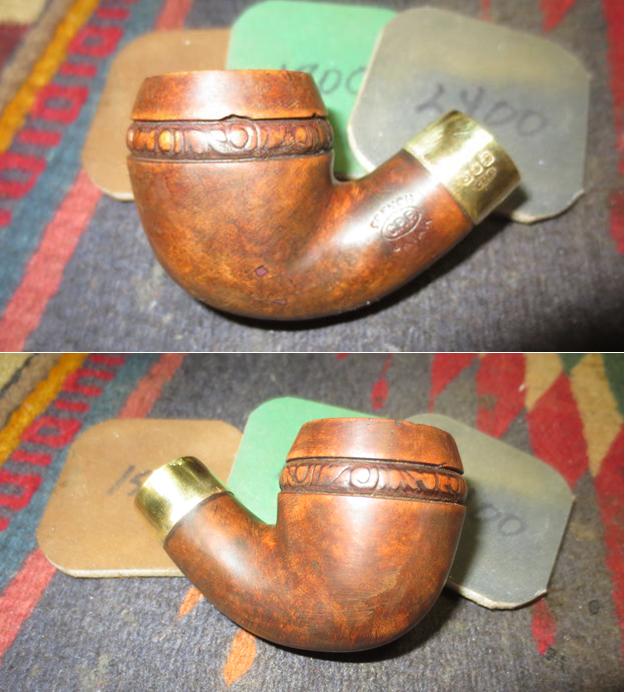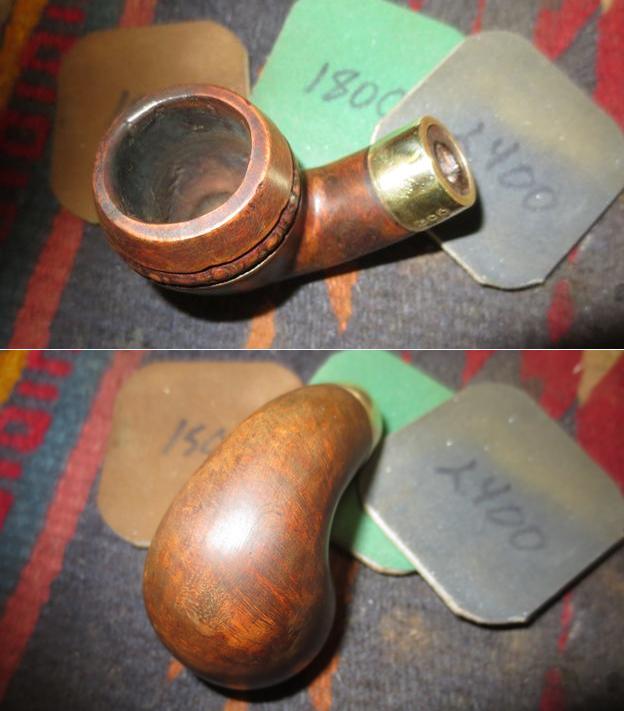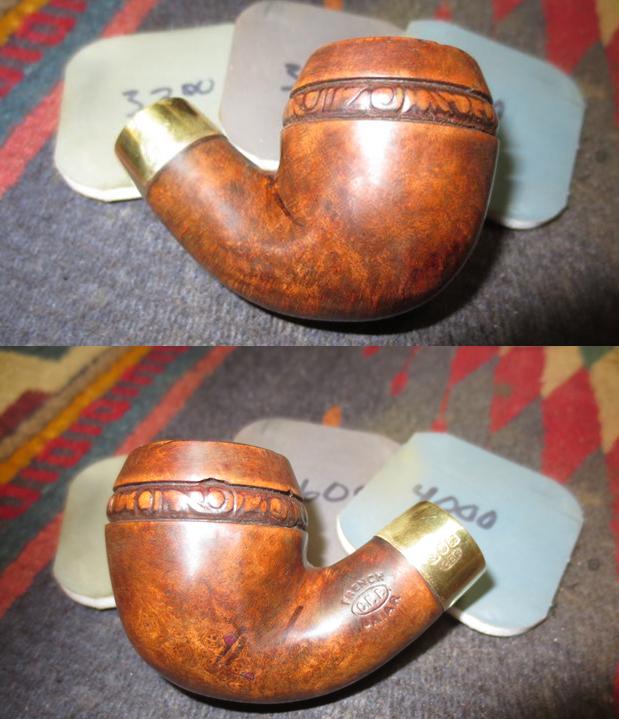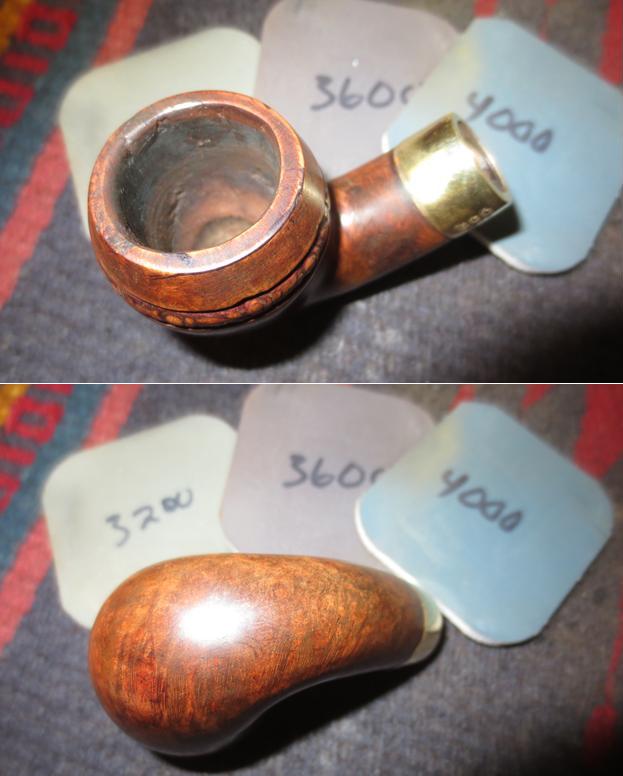
Tag Archives: fitting a stem

Loving the old WDC Campaign Pipe


Blog by Steve Laug

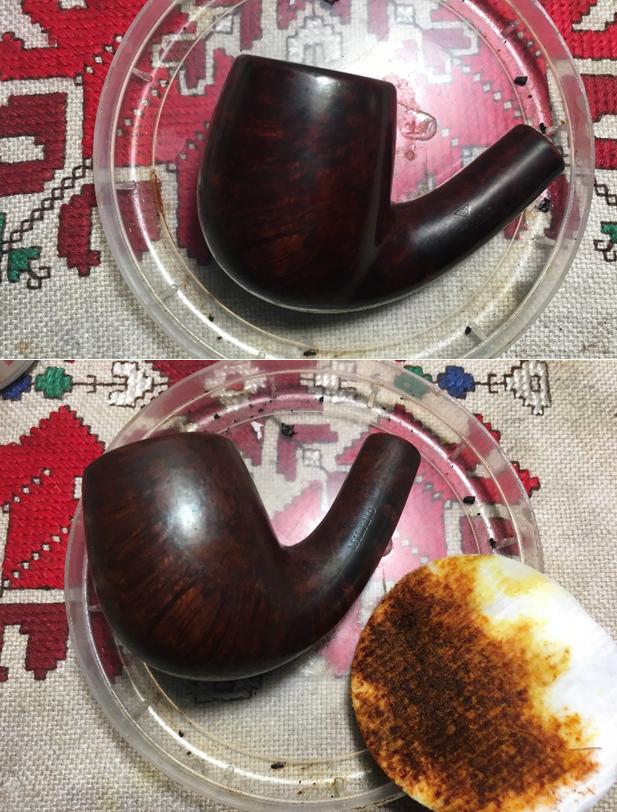
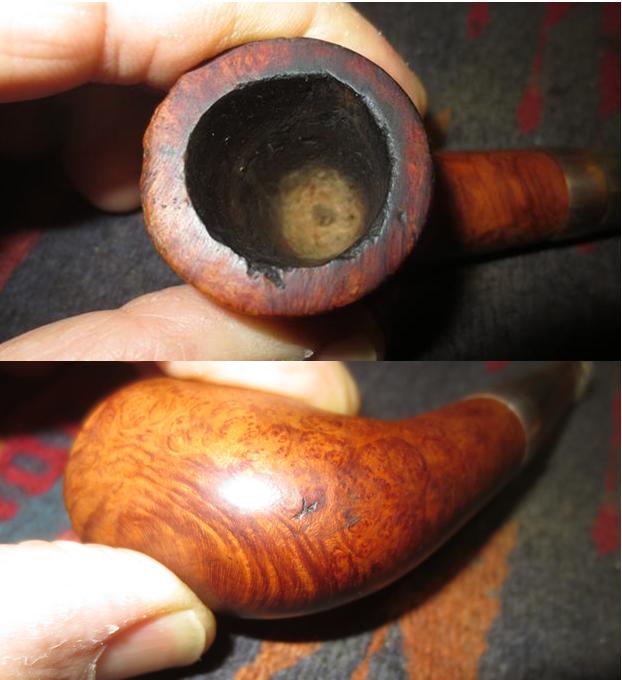
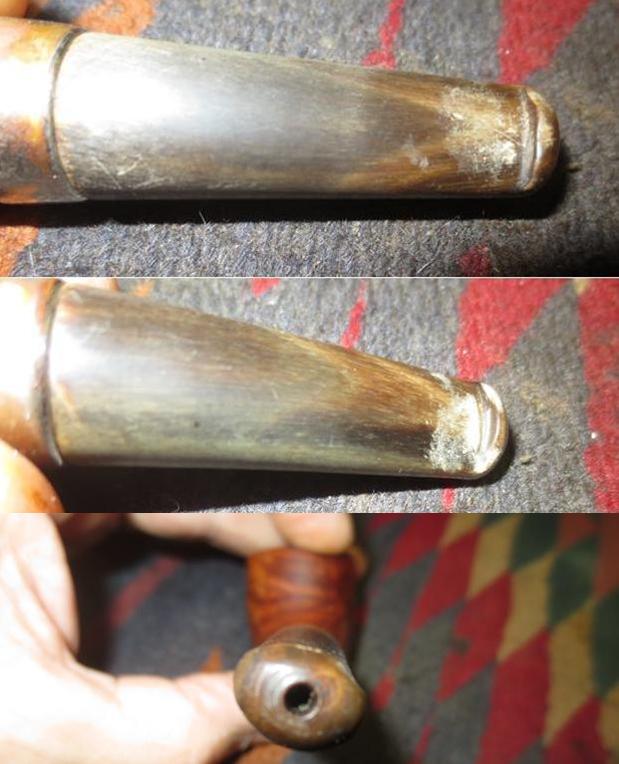
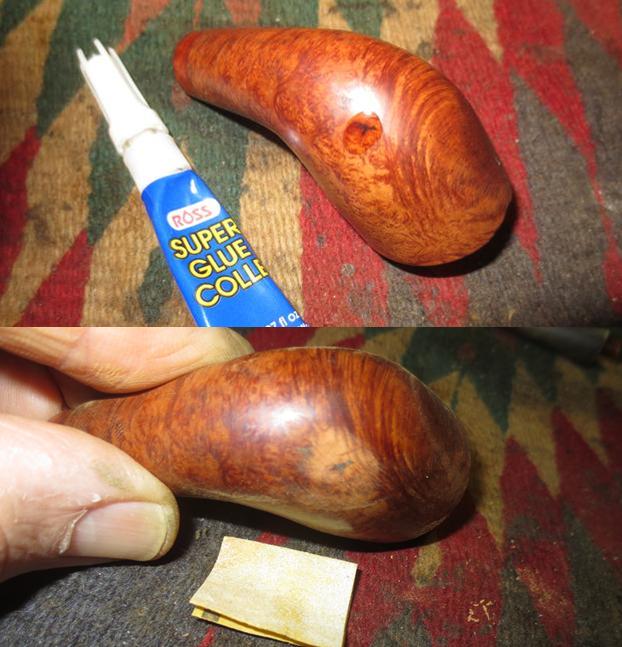
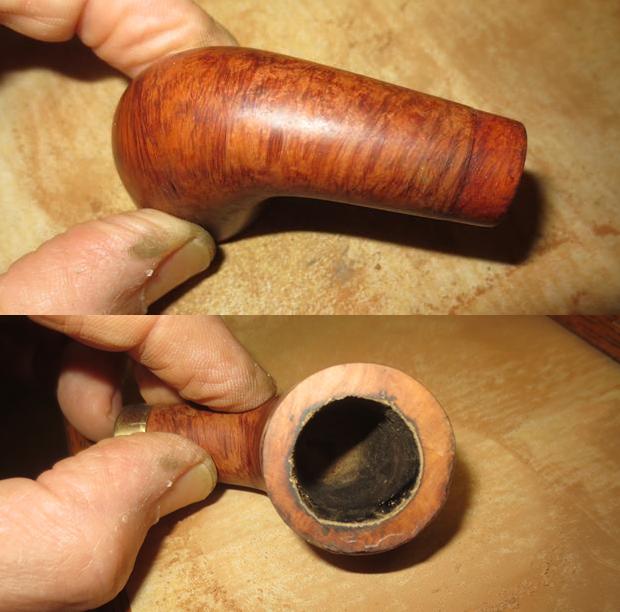
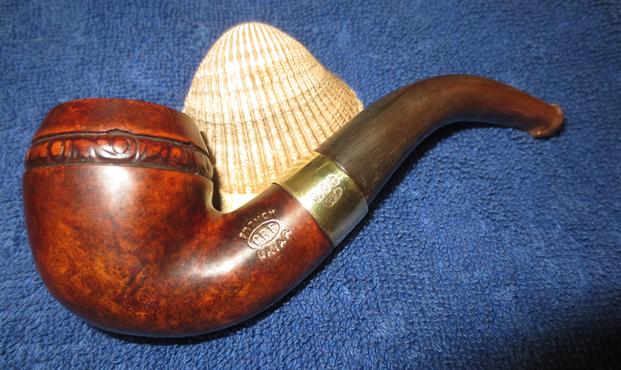
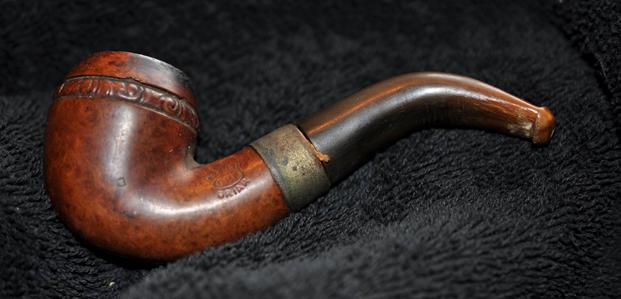
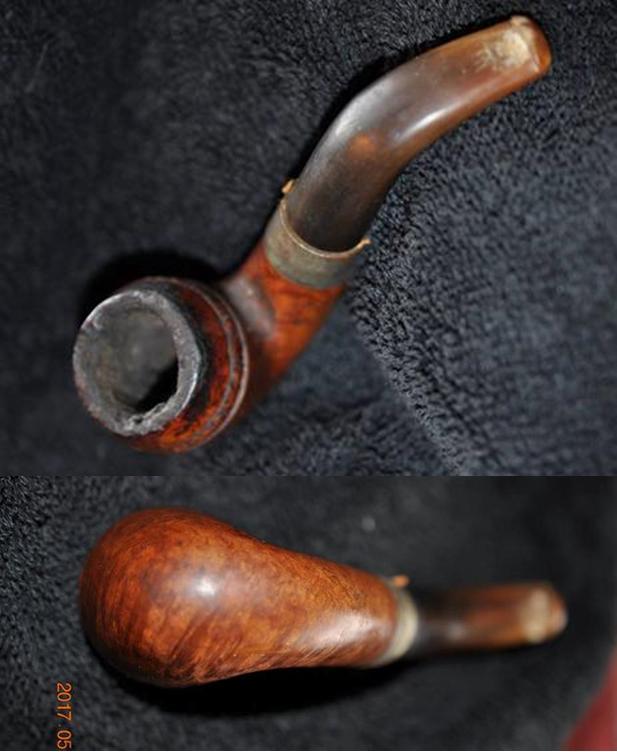
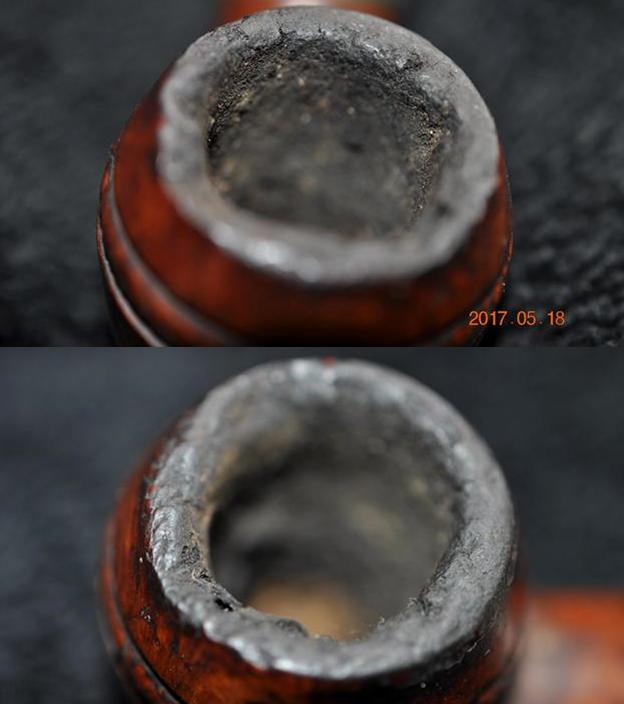
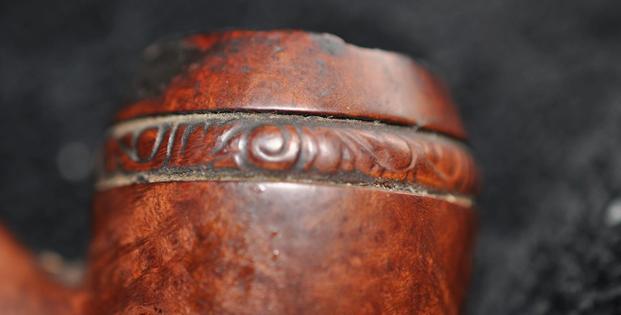
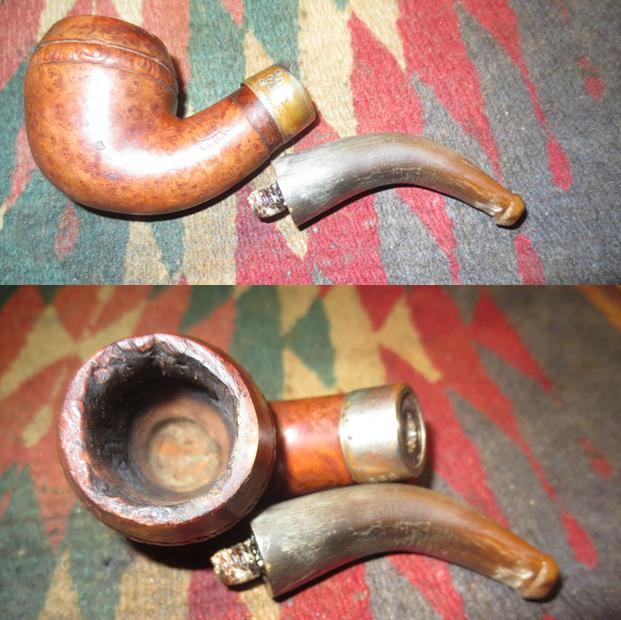
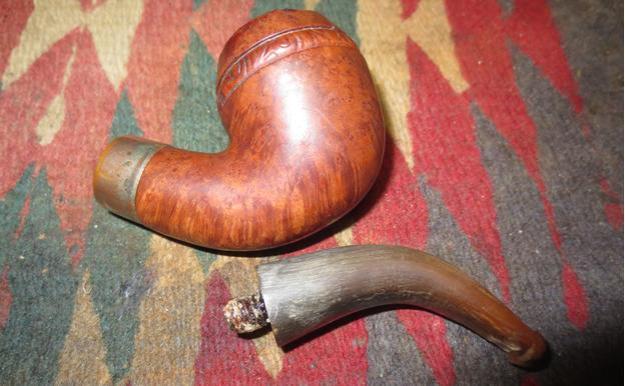
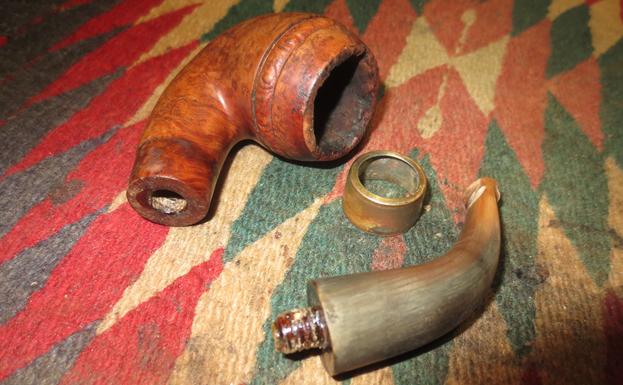
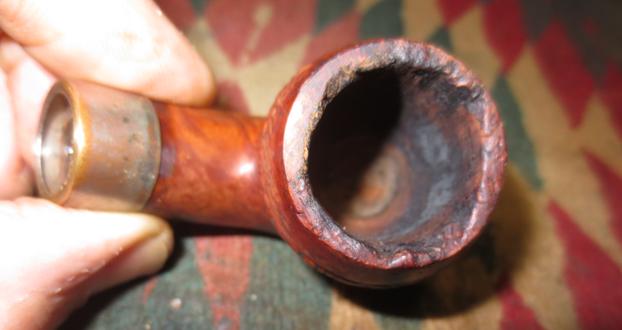
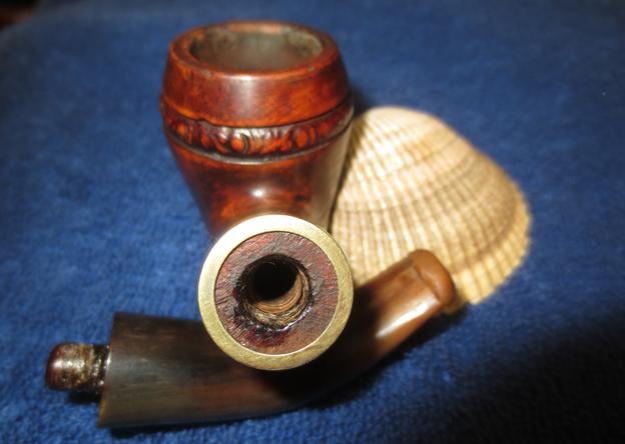
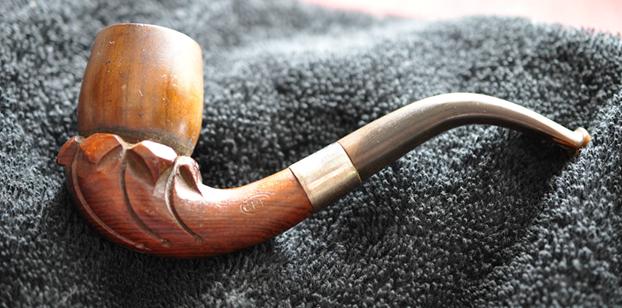
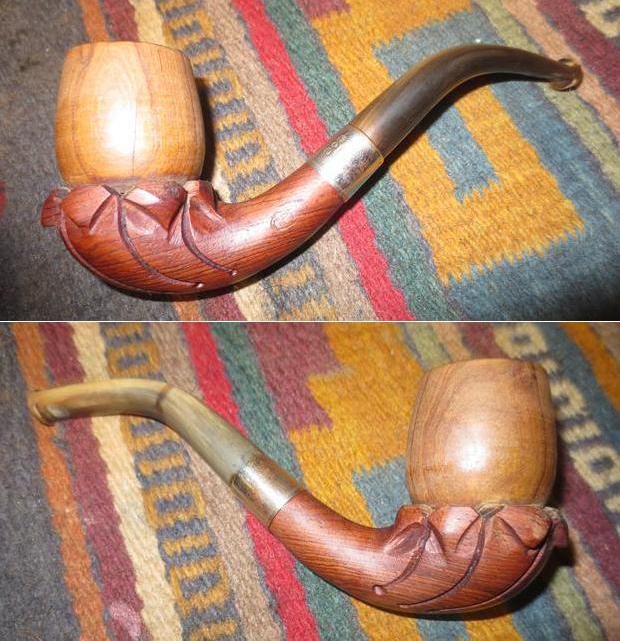
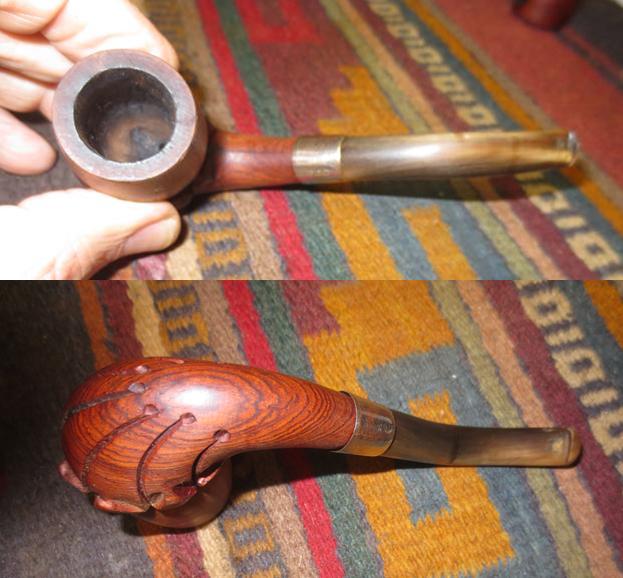
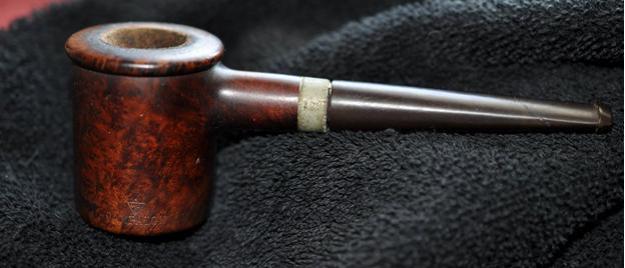
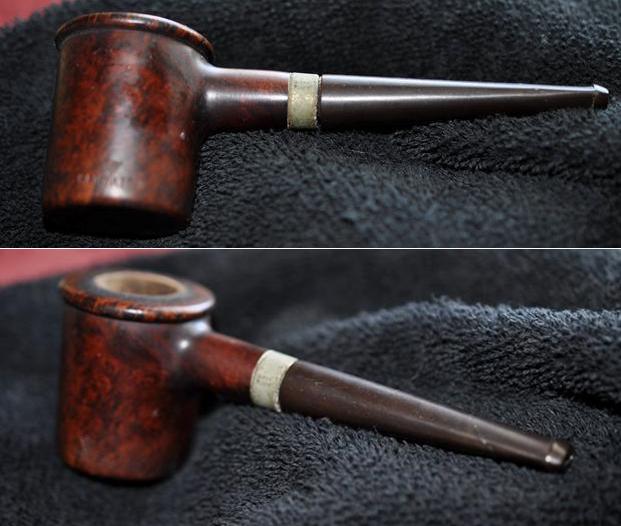
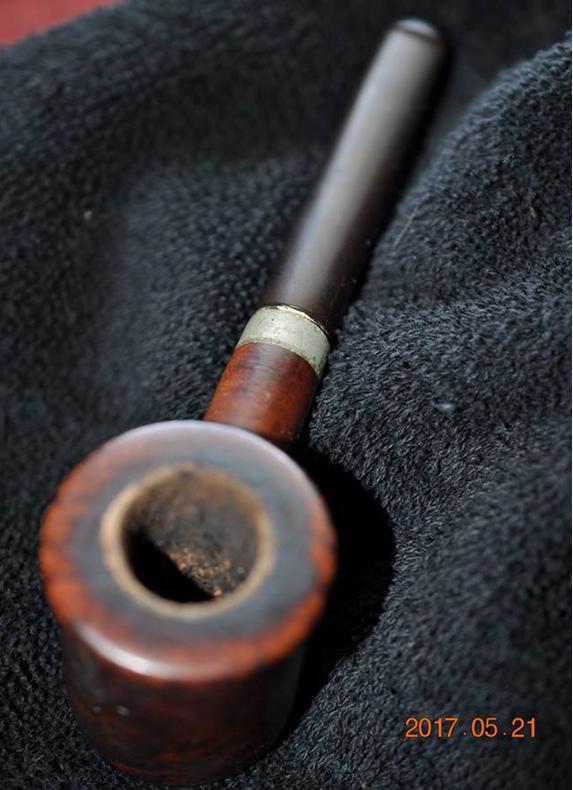
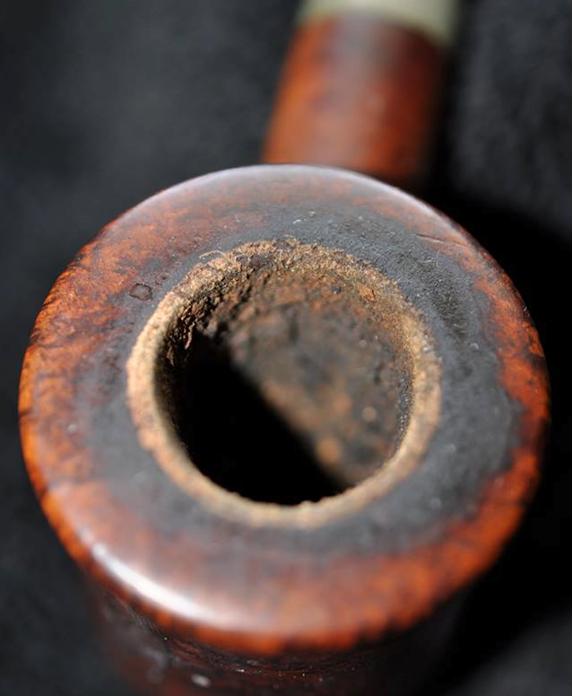
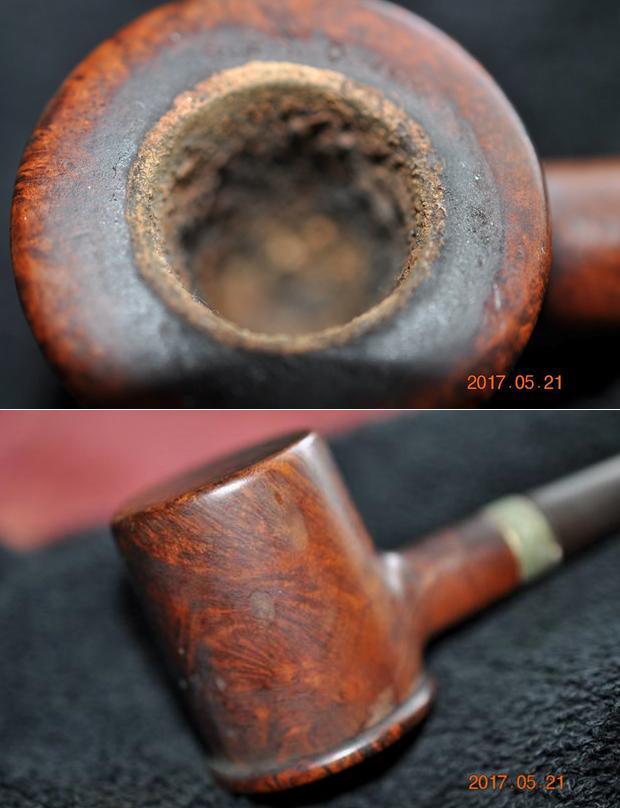
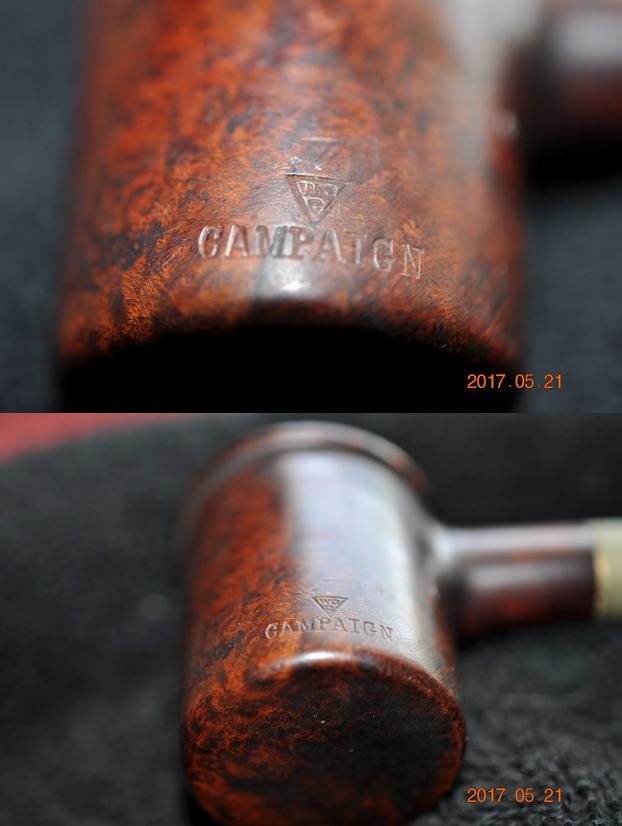
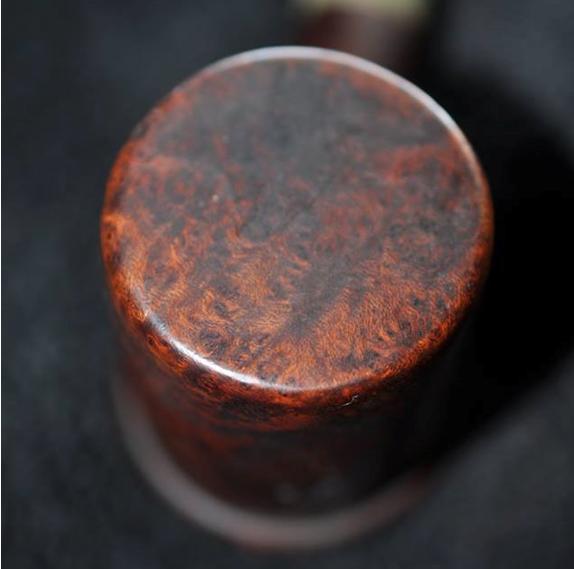
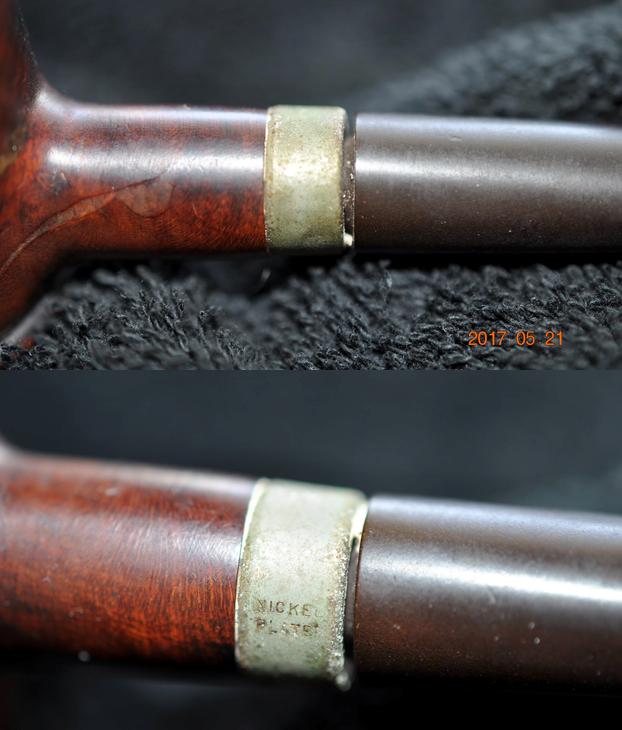
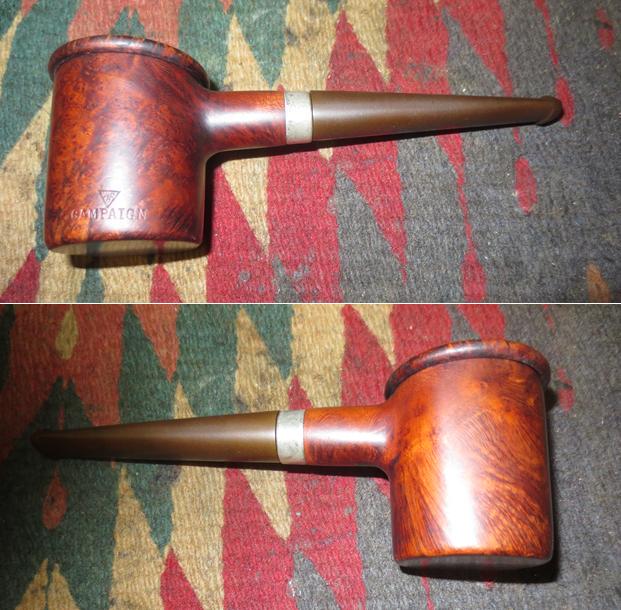
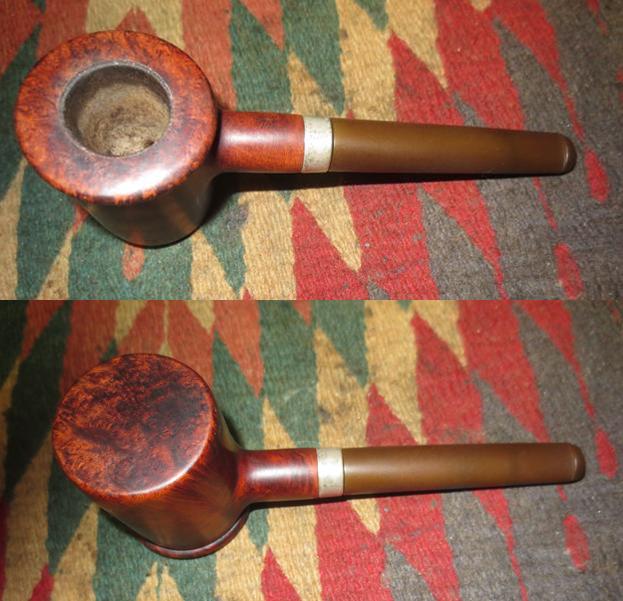
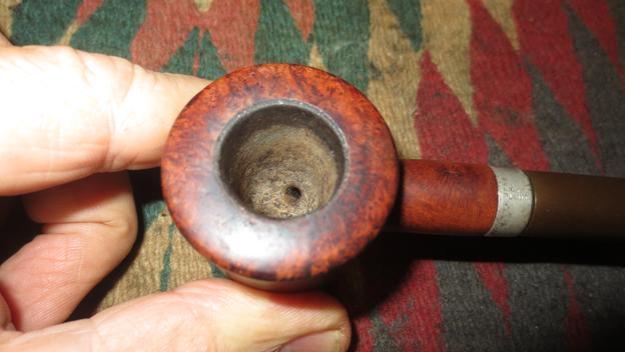
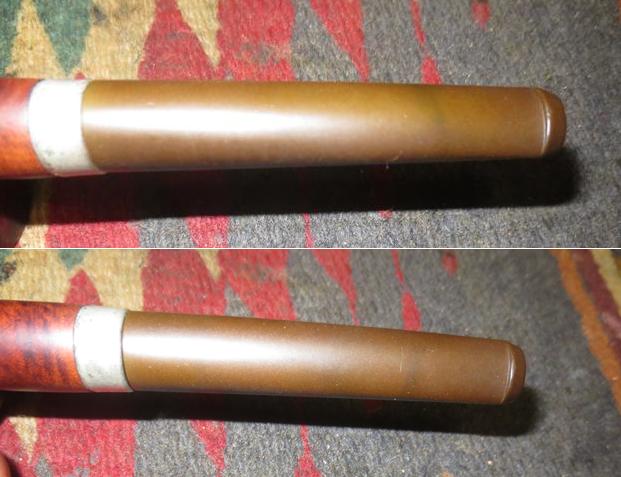
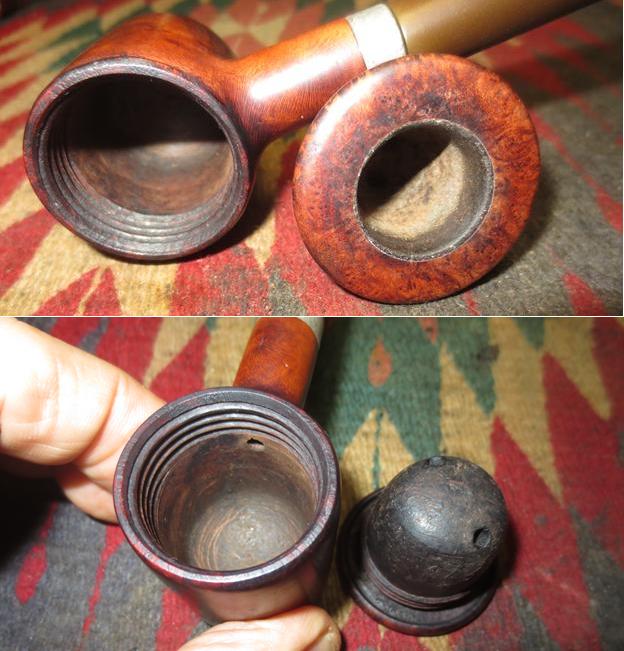
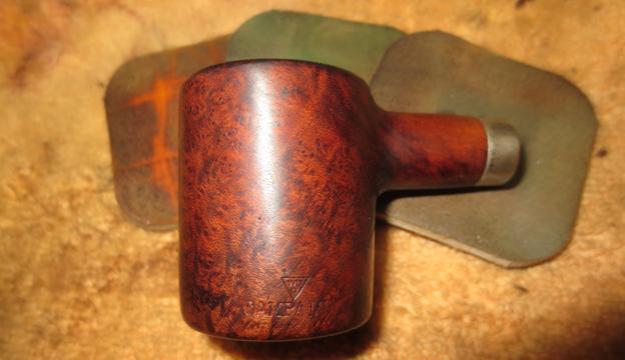
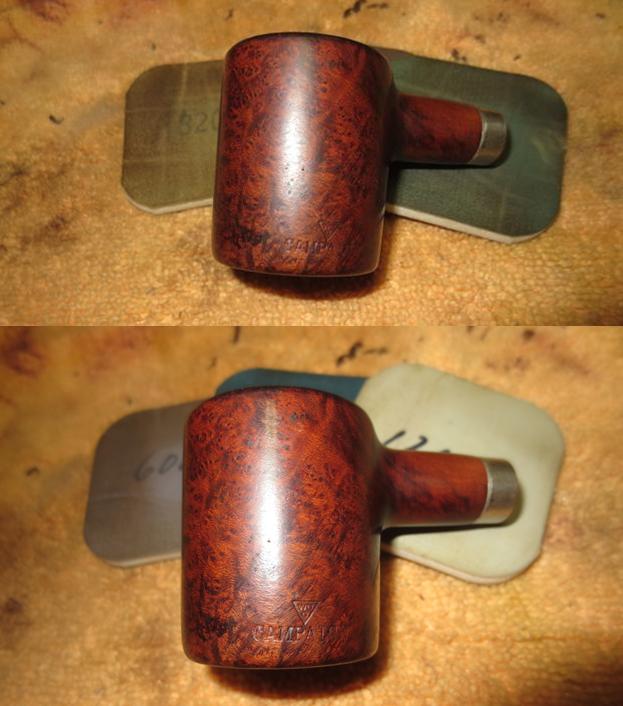
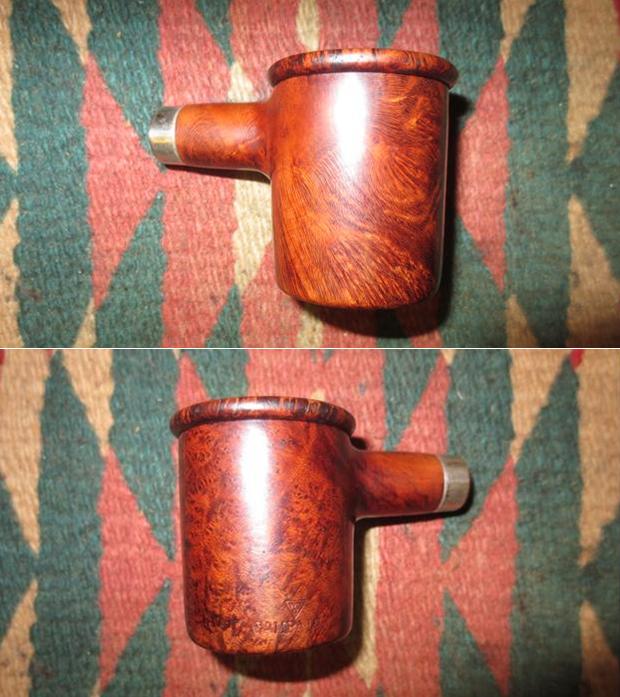
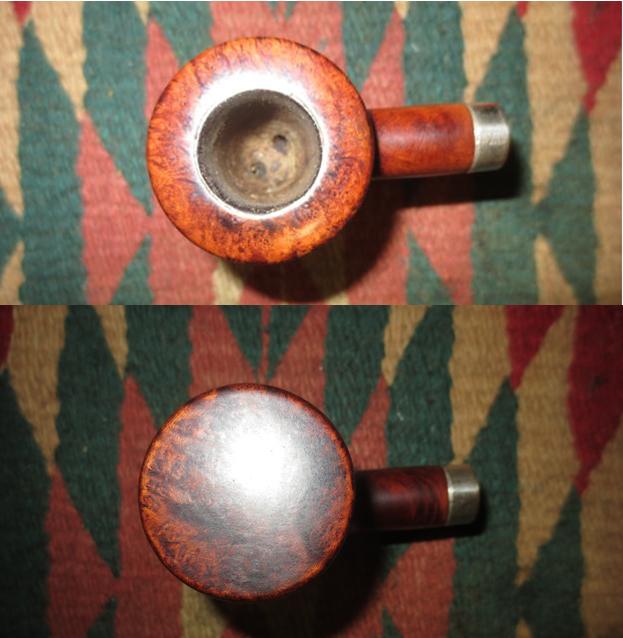
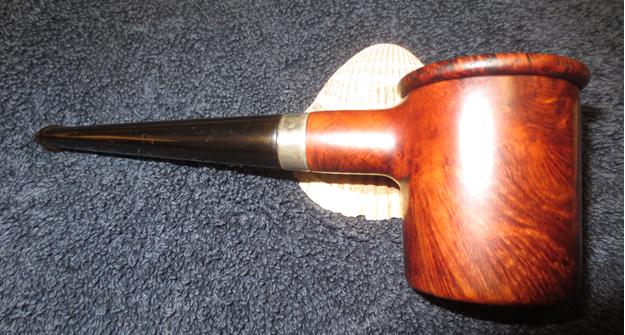
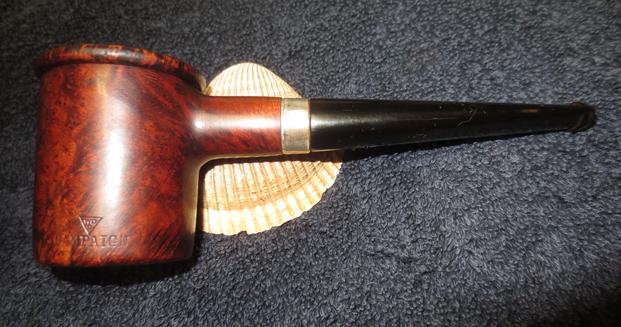
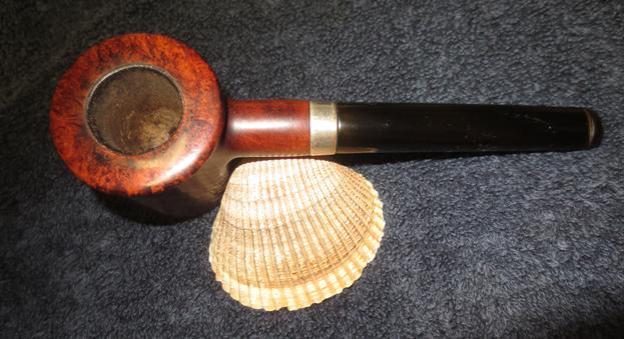
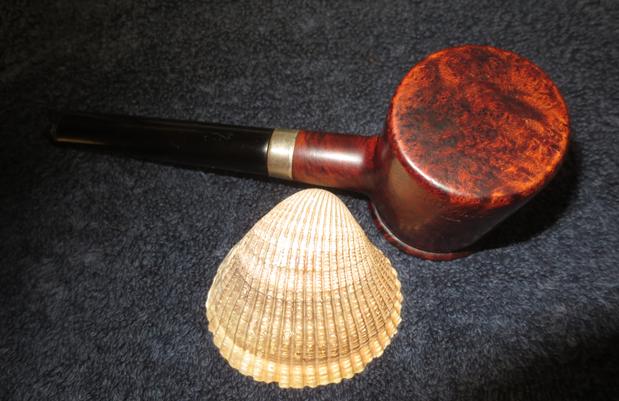
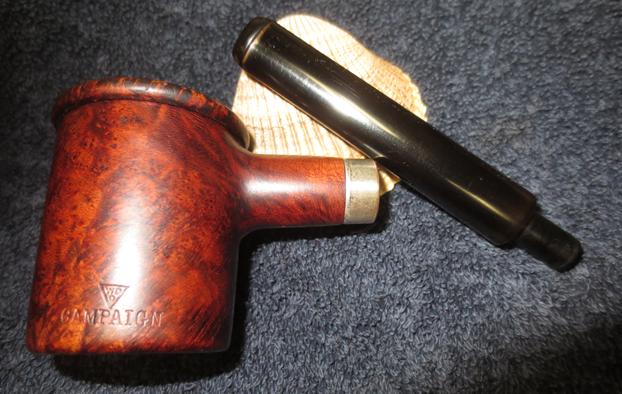
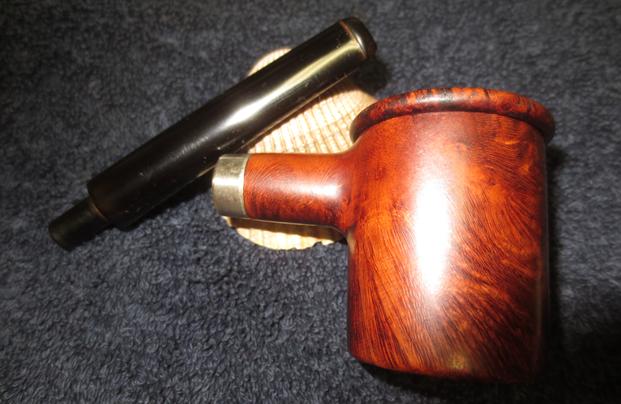
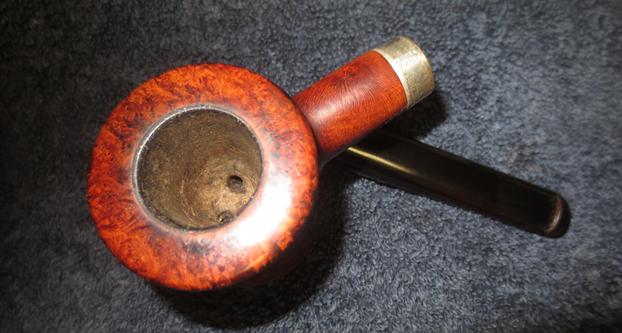
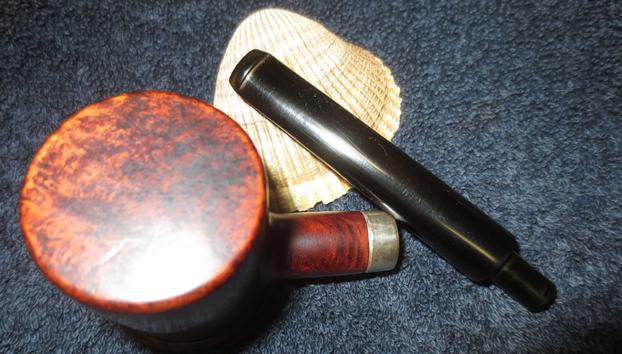
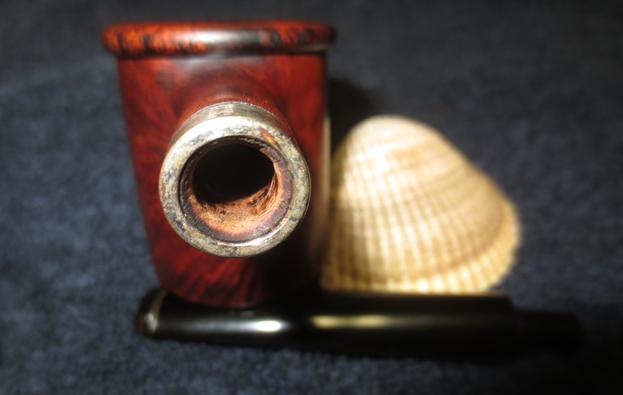
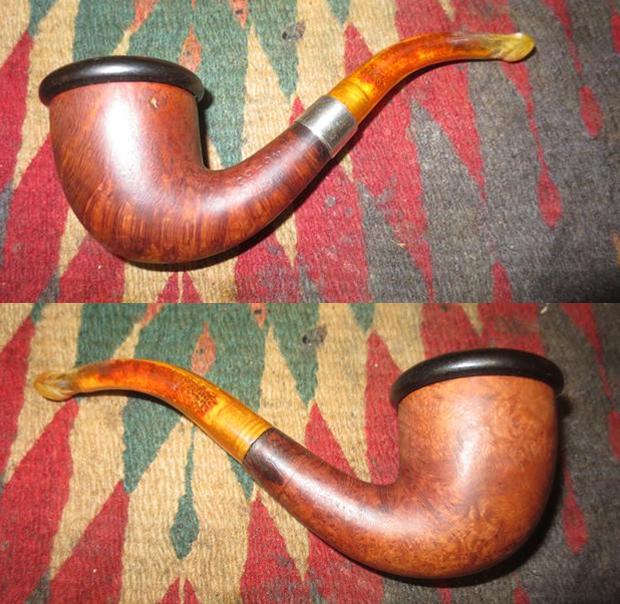
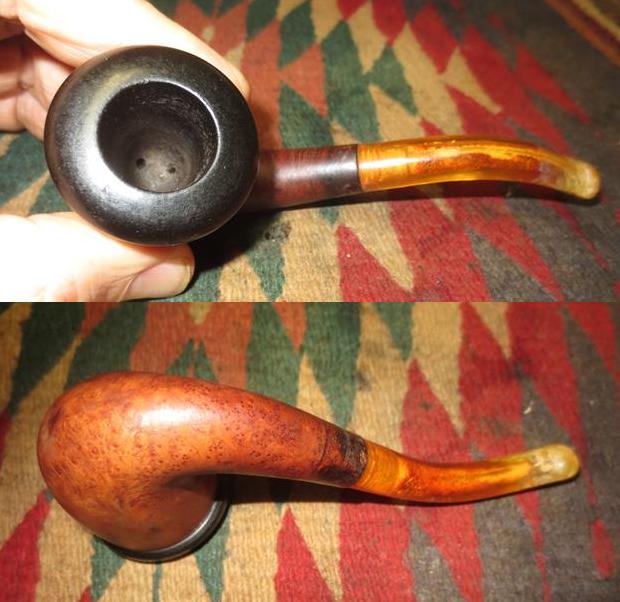
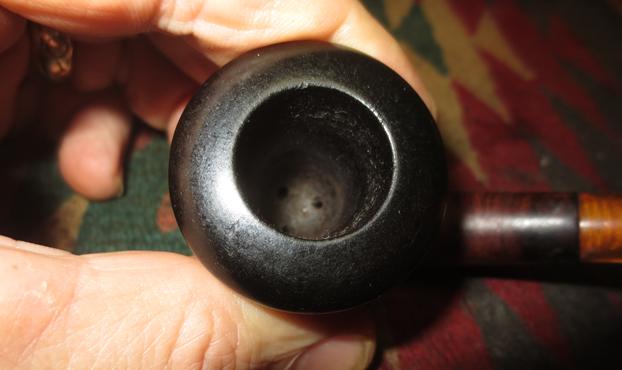
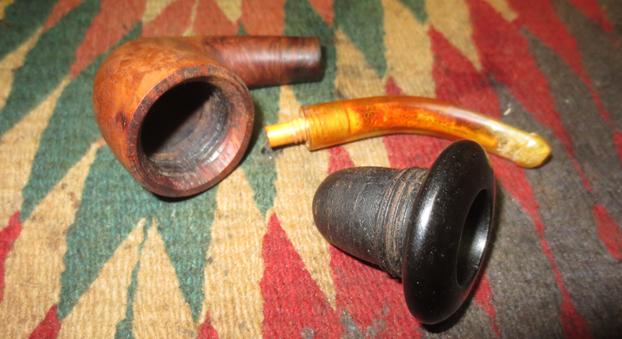
Another of the pipes found during the Virtual Pipe Hunt in Montana was one stamped on the lower left side of the out bowl with the WDC triangle logo over the word CAMPAIGN. There was no other stamping on the pipe. The bowl was like a calabash bowl and screwed into the outer bowl. The entirety was made out of briar. The grain on the bowl and rim top is quite stunning with a lot of birdseye grain on the sides and mixed grain over the rest of the bowl. There was a nickel band on the shank but there was no shank stamping. The band was stamped PLATED NICKEL. The stem was lightly oxidized and the fit against the end of the shank was not tight. There was a gap caused by what I presumed was the tars built up in the mortise area.My brother, Jeff took quite a few photos of the unique old pipe because it really was a beauty. There would need to be some significant cleanup work but the grain and the shape were both unique and quite stunning. The bowl was thickly caked and a thick buildup of tars and oils had flowed over to the top of the rim. The bowl had twin airways in the bottom of the calabash cup directing airflow into the external bowl. The airway in the outer bowl enters the shank at the top of the bowl. Smoke would have been drawn from the calabash cup into the interior of the outer bowl and up the back side to the airway into the shank and through that to the stem and button into the mouth of the smoker. I did a bit of digging online and found a brief interchange on a Google group. Here is the link if you would like to read it in context and in its entirety. It has some helpful information regarding the brand and the particular pipe that I wanted to know more about. https://groups.google.com/forum/#!topic/alt.smokers.pipes/kpkpd3zXoiwExcerpt from pipedia.org

To a request for information regarding the WDC Campaign pipe on the Google Group there was quite a long string of answers. I am quoting two of those in full…

Respondent 1: While I can’t say anything about this pipe specifically, I have a hazy memory of that shape listed in a book about pipes; (I may be totally misremembering this, but here goes) the shape being called the “Dawes”, named after Harding’s Vice President?  Anyone else remember this? Sounds like an interesting pipe, whatever it’s called…

Respondent 2: From Weber’s Guide to Pipes: “The Dawes Pipe (more correctly named the Lyons, after its inventor, Charles Herbert Lyons) happened to be the favorite pipe of General Charles G. Dawes, Vice-President of the USA from 1925 to 1929. General Dawes smoked the curious pipe incessantly and it became popularly known as the Dawes Underslung, because the shank joined the bowl near its rim.”

I looked on Pipedia, https://pipedia.org/wiki/William_Demuth_Company and I quote in part from the article on the William Demuth Company.

The Demuth Company is probably well known for the famous trademark, WDC in an inverted equilateral triangle. William commissioned the figurative meerschaum Presidential series, 29 precision-carved likenesses of John Adams, the second president of the United States (1797-1801) to Herbert Hoover, the 30th president (1929-1933), and “Columbus Landing in America,” a 32-inch-long centennial meerschaum masterpiece that took two years to complete and was exhibited at the World’s Columbian Exposition in Chicago in 1893.

The Presidential series was the result of Demuth’s friendship with President James A. Garfield, a connoisseur of meerschaum pipes. Demuth presented two pipes to Garfield at his inauguration in 1881, one in his likeness, the other in the likeness of the President’s wife. Later, Demuth arranged for another figurative matching the others to be added to the collection as each new president acceded to the White House, terminating with President Hoover.

From the above information I learned some significant details about the Campaign pipe. It was invented by Charles Herbert Lyons and was the favourite pipe of General Charles G. Dawes who was the Vice President of the USA under President Harding from 1925-1929. It fits nicely into that period when WDC was having Presidential Pipes commissioned ending in 1933. That places this old pipe in the time period between the late 1920s and early 1930s.

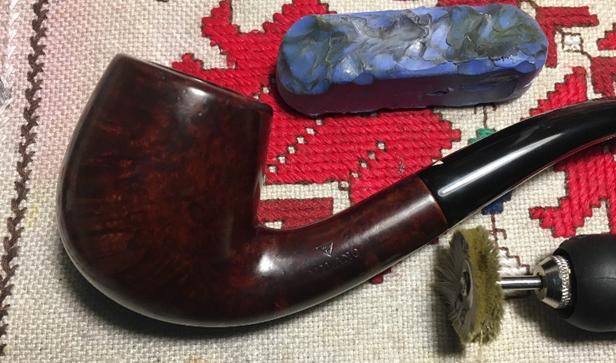
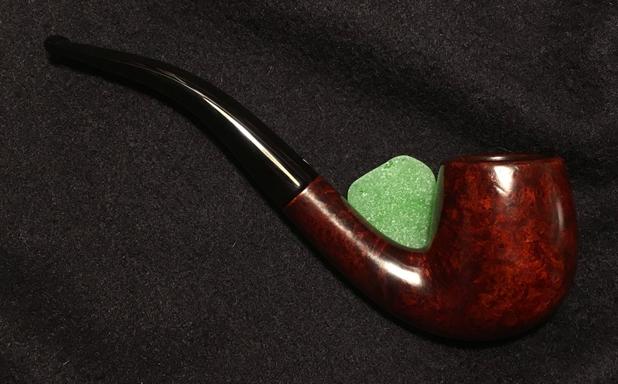
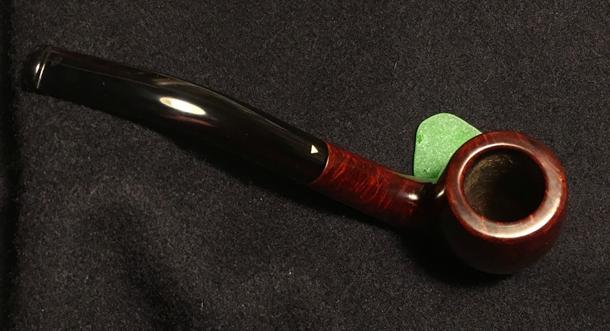
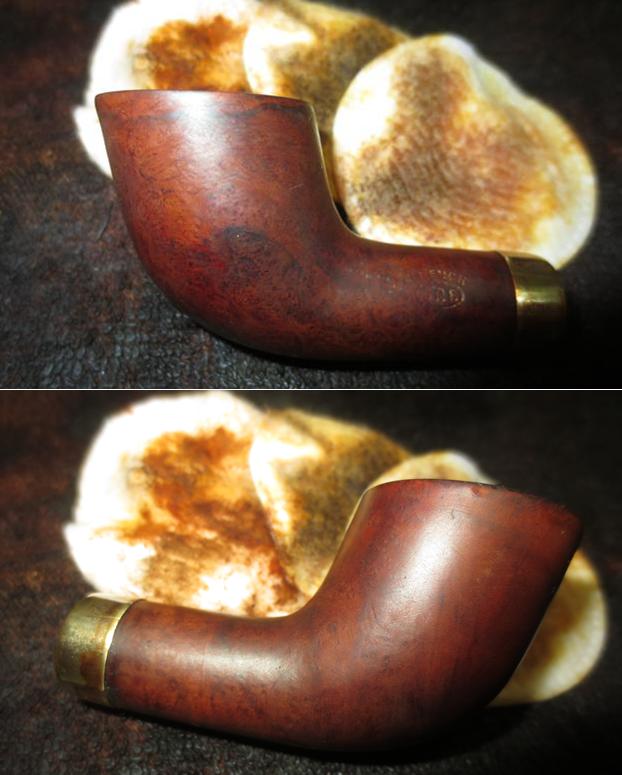
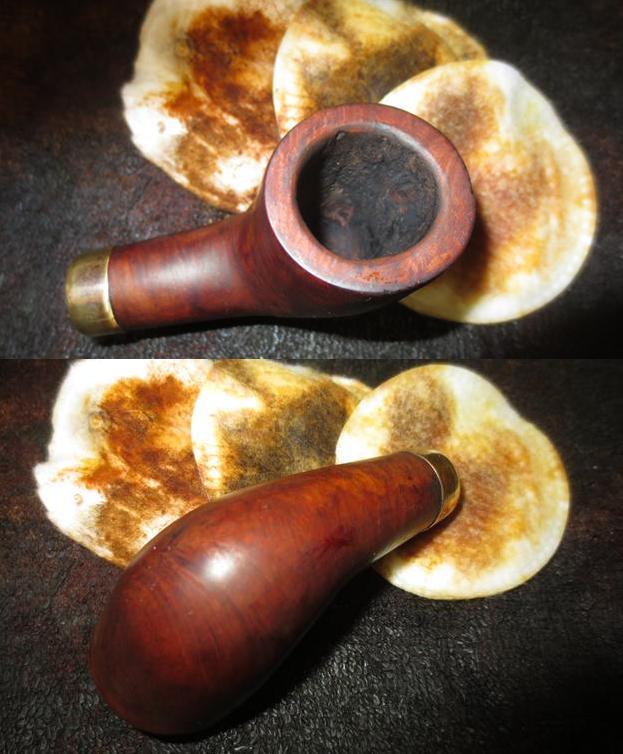
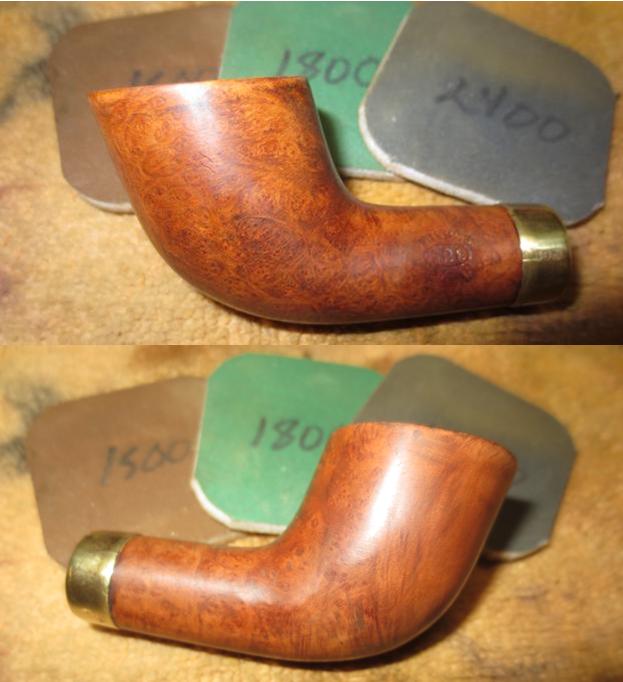
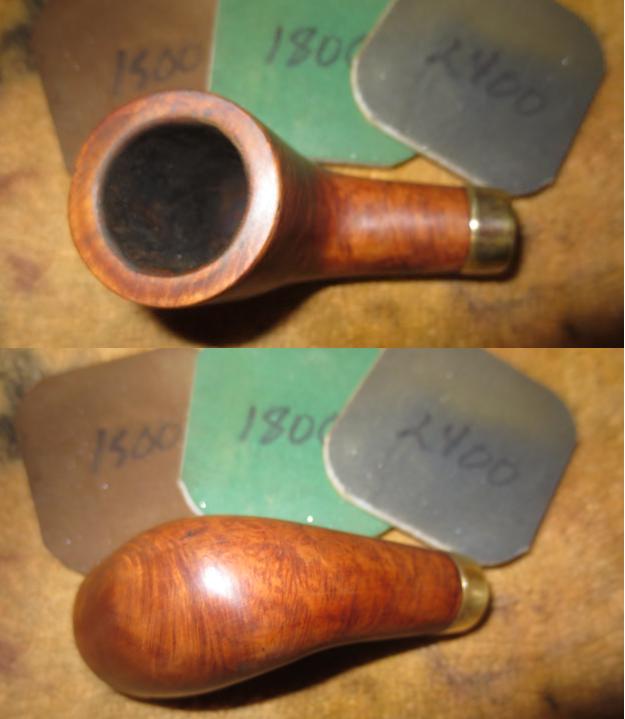
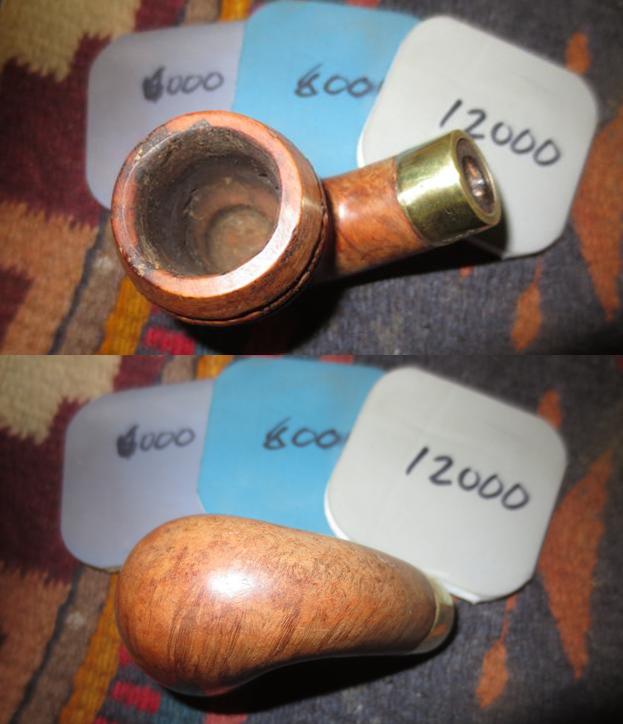
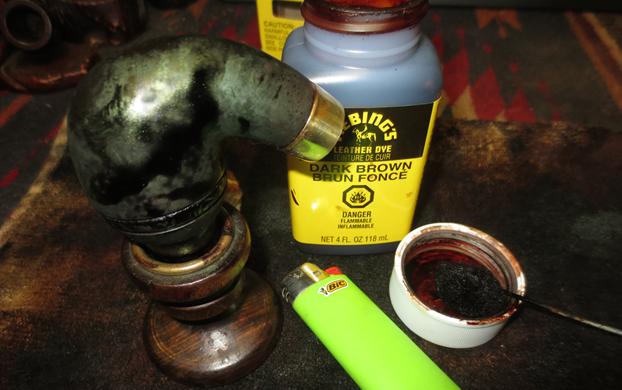
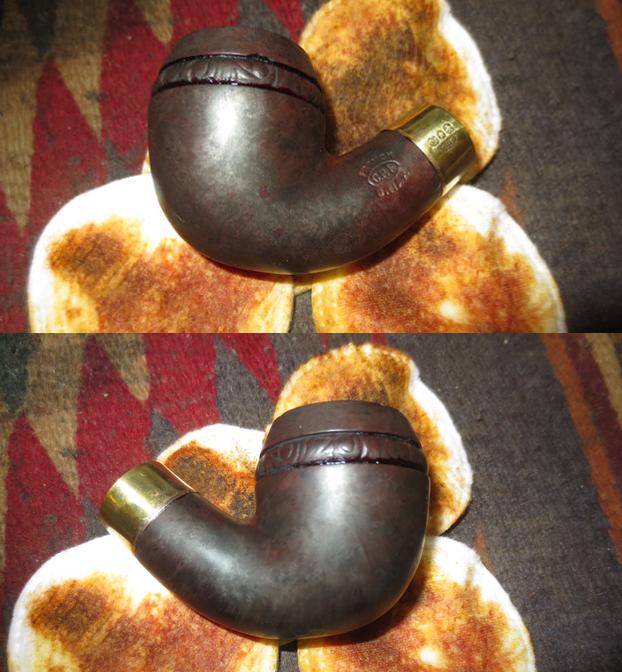
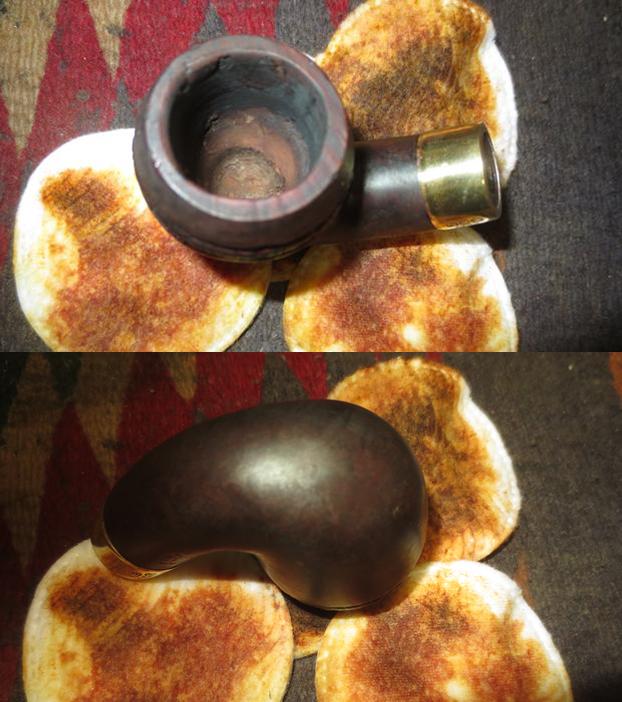
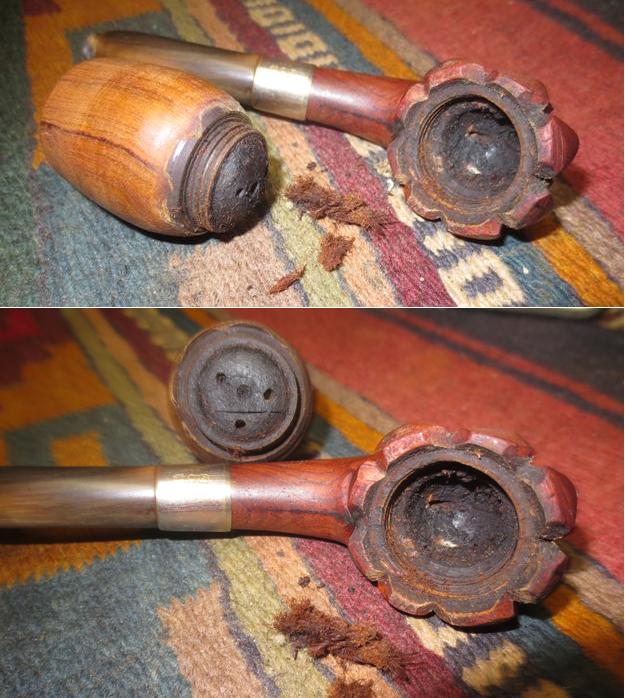
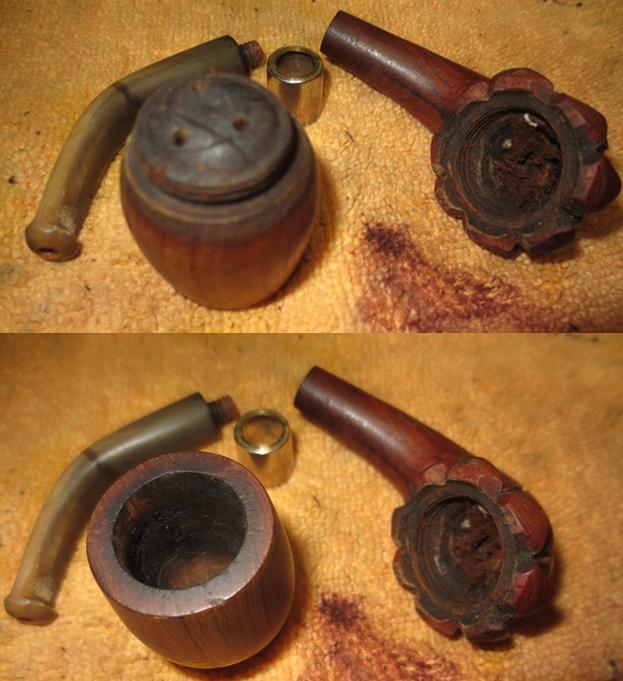
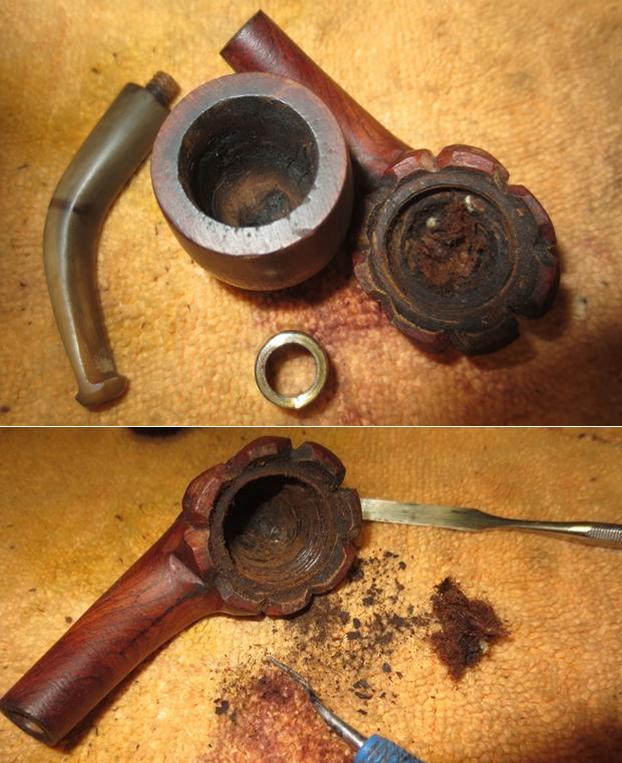
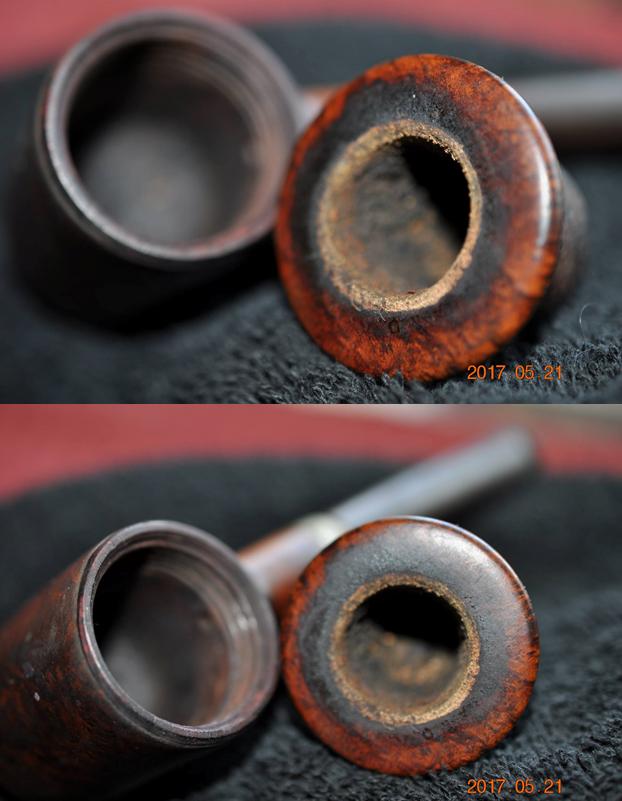
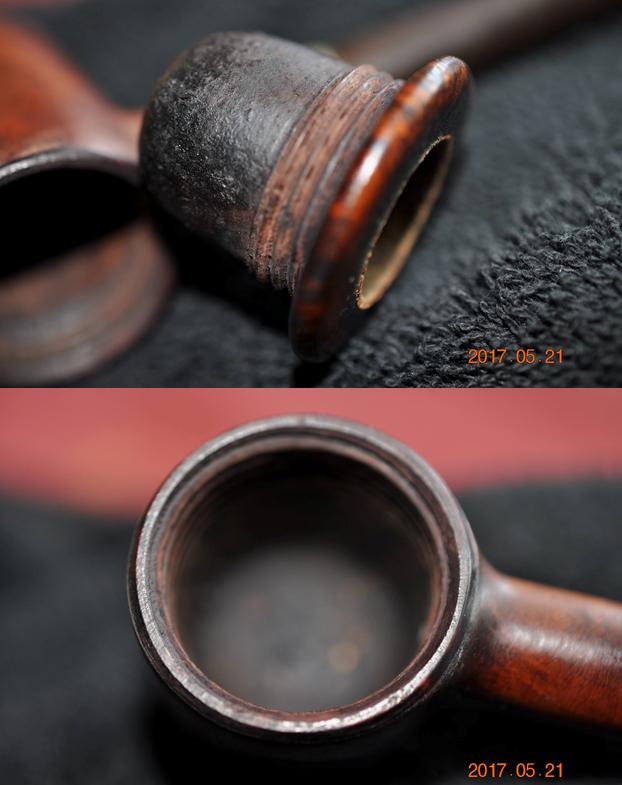
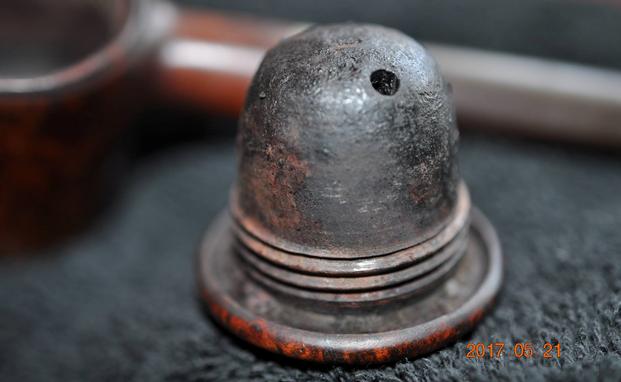
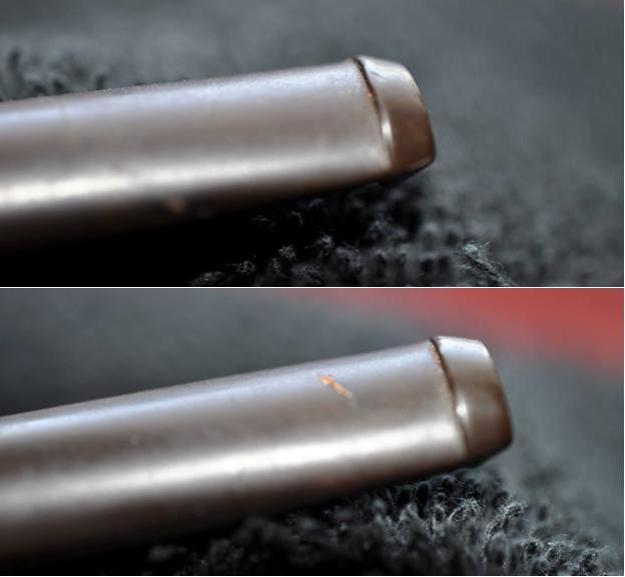
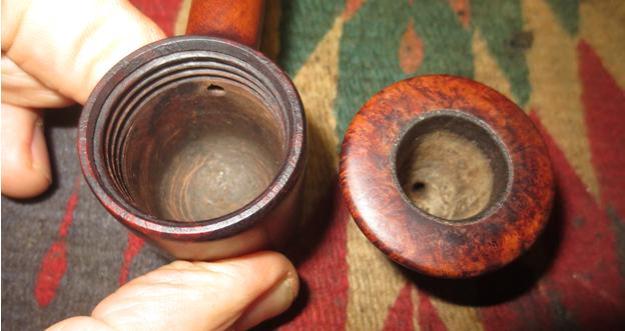
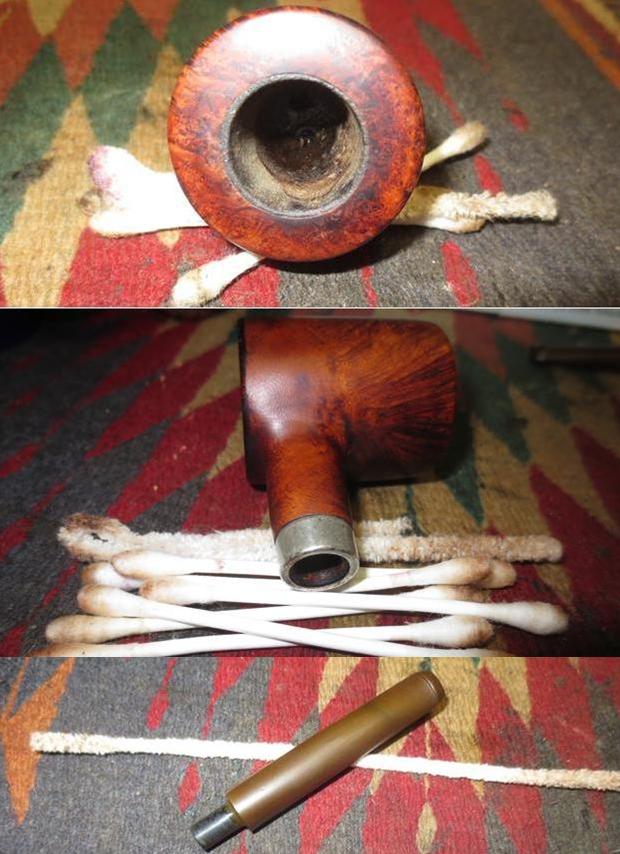
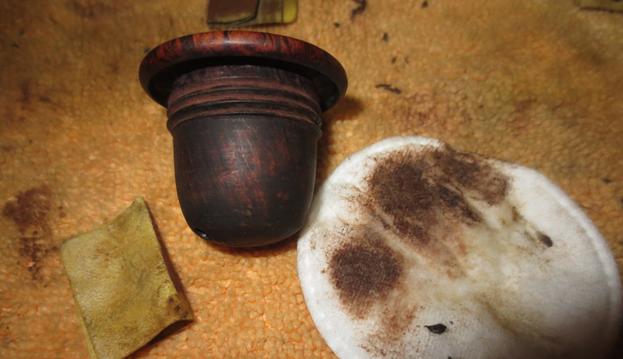
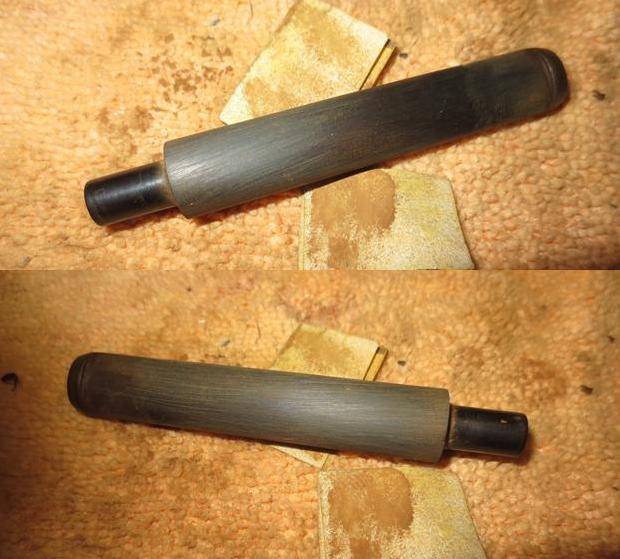
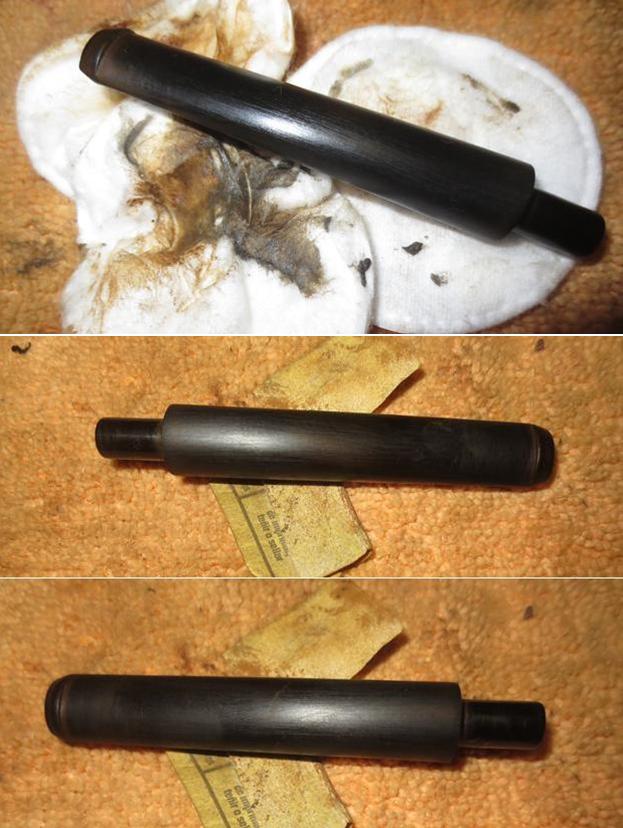
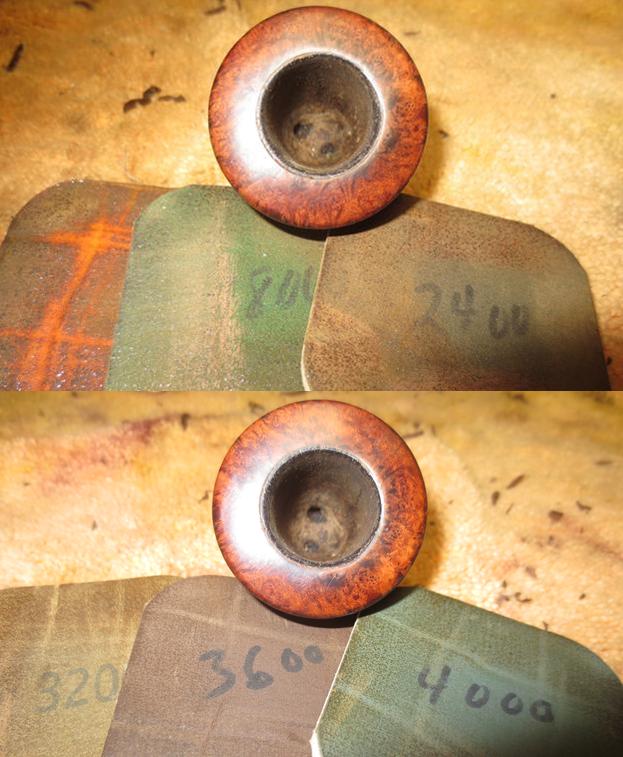
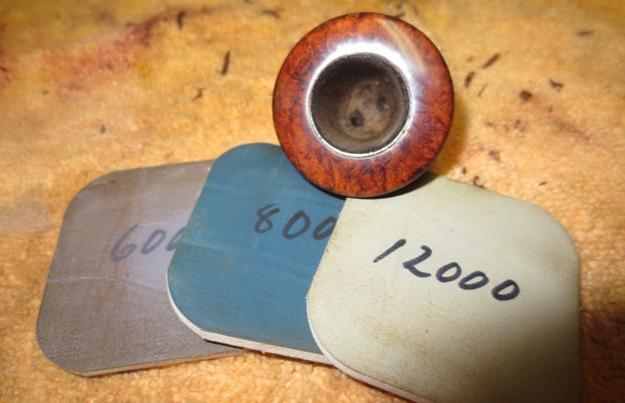
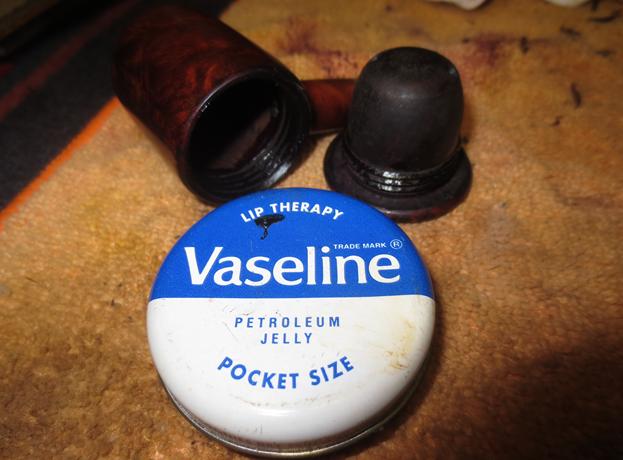
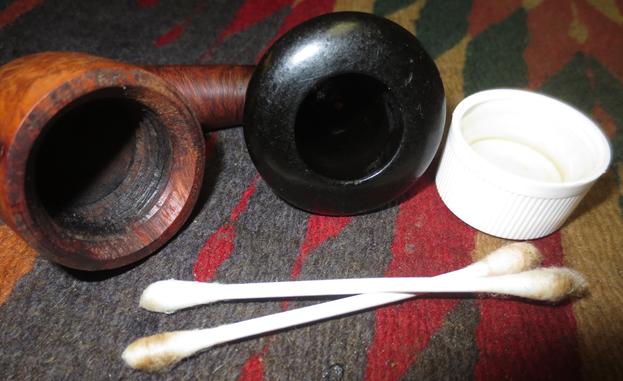
My brother took the following photos of the pipe to show what it looked like when it arrived in Idaho before he started his cleanup work. The cake in the calabash bowl was quite thick and the overflow onto the rim top was also thick. The finish while pretty decent was soiled and spotty with buildup and dirt. Jeff unscrewed the briar calabash bowl insert and removed it from outer bowl. The threads on both looked to be in very good condition. The out bowl was dirty and had a lot of dried tobacco oils and juices along the walls and bottom. The underside of the calabash bowl was dark and dirty with dried oils. It would need to be cleaned up. The next two photos show the stamping on the left side of the outer bowl. It is clearly stamped with the WDC logo in the inverted triangle and under that reads CAMPAIGN. In these photos you can see the beautiful grain of the briar. Even the bottom of the outer bowl has some nice grain. The next two photos show the wear on the finish of the shank and the oxidation on the nickel band on the shank. The band is stamped NICKEL PLATED. The stem does not sit tight against the shank and I am assuming that there is a lot of buildup in the mortise that is keeping it from seating properly.The stem was oxidized and there was some were to the sharp edge of the button. There were some light tooth marks on the surface of the button on both sides.My brother did his usual masterful cleanup on the pipe. When I received it things were much cleaner than the photos above. He had reamed back the calabash bowl to bare briar. He had scrubbed the rim top off and was able to remove the lava coat. He scrubbed the internals of the outer bowl as well. The briar had been scrubbed with Murphy’s Oil Soap and rinsed to remove all of the grime. The oxidation on the band was better than in the above photos. The stem was oxidized but it now sat properly in the mortise. I took the following photos before I started my final cleanup and restoration. I took some close up photos of the condition of the bowl and rim top. It looked far better than before his cleanup work. The stem also looked really good other than the oxidation. I took the calabash bowl out of the outer bowl and took some photos of the various parts of the pipe. It is an interesting piece of pipe history and it is in excellent condition for a pipe of its age. I did a bit more scrubbing of the internals to remove any remaining oils and tars. I used pipe cleaners, cotton swabs and alcohol to clean out the mortise and the airway in the shank and the stem. I scrubbed out the inside of the outer bowl and the inner bowl with alcohol and cotton swabs. I pushed pipe cleaners through the two airholes in the bottom of the calabash bowl. I sanded the bottom of the internal bowl to remove the last of the buildup and wiped it down with alcohol on a cotton pad. I sanded the oxidized stem and reshaped the edge of the button with 220 grit sandpaper to clean things up and bring it back to the original black vulcanite. I scrubbed it with some Before & After Stem Deoxidizer to remove the loosened oxidation. I wiped off the scrub and resanded the stem to remove the remaining oxidation. The photos below show the progress of the stem cleanup. I used a folded piece of 220 sandpaper to smooth out the inner edge of the calabash bowl and remove the remaining debris along the edge. I sanded the inside of the bowl to clean it up as well. I polished the rim top with micromesh sanding pads – wet sanding with 1500-2400 grit pads and dry sanding it with 3200-12000 grit pads. I wiped the rim top down with a damp cloth to remove the sanding debris. The photos show the progress of the polishing. I polished the outer bowl with micromesh sanding pads – wet sanding with 1500-2400 grit pads and dry sanding it with 3200-12000 grit pads. I wiped the bowl with a damp cloth to remove the sanding debris. The photos show the progress of the polishing. To preserve the threads on the calabash bowl and the outer bowl I use a small dab of Vaseline to lubricate both. I rub it into the threads by hand and wipe it down lightly with a cotton pad. I screw the two parts together and find that it removes friction and makes the cap turn easily into the outer bowl. I hand buffed the bowl with a microfibre cloth, polished the nickel band with a jeweler’s cloth and took photos of the pipe at this point in the process. I polished the stem with micromesh sanding pads – wet sanding with 1500-2400 grit pads and dry sanding it with 3200-12000 grit pads. I wiped the stem down with Obsidian Oil to bring life back to the vulcanite and protect it. The photos show the progress of the polishing. I buffed the stem with red Tripoli to polish out the last oxidation and scratching. I buffed the pipe – stem and bowl – with Blue Diamond on buffing wheel and gave it multiple coats of carnauba wax. I buffed it with a clean buffing pad to raise a shine. I hand buffed it with a microfiber cloth to deepen the shine. The finished pipe is shown in the photos below. One thing that shows through in the photos is some red along the crease of the button – I am pretty sure it is red Tripoli that is left behind from the initial buffing of the stem. After I took the photos I wiped that area down with some alcohol on a cotton pad. It removed the red Tripoli around the stem. It looks far better now that it is finished. Thanks for walking through this refurbish with me.


Out Damn Spots – a C.P.F. Cromwell Double Vertical Stem Bent Billiard


Blog by Steve Laug

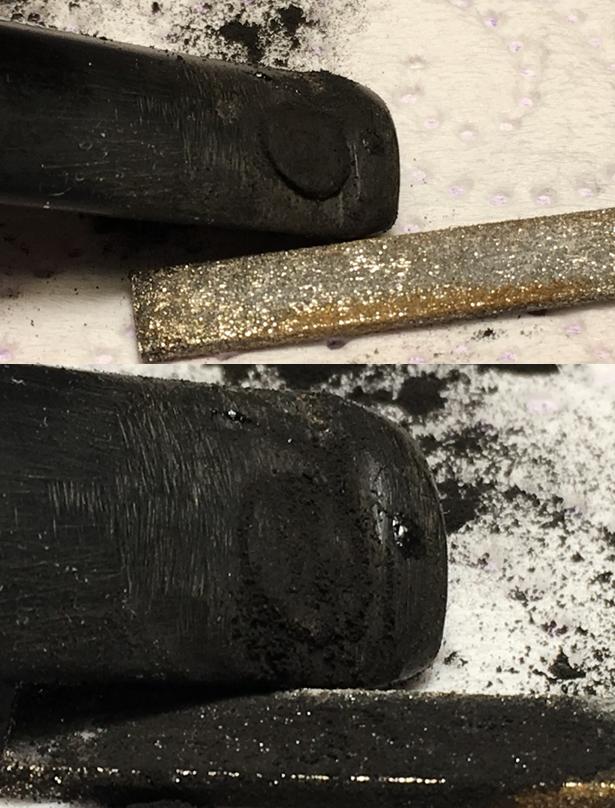
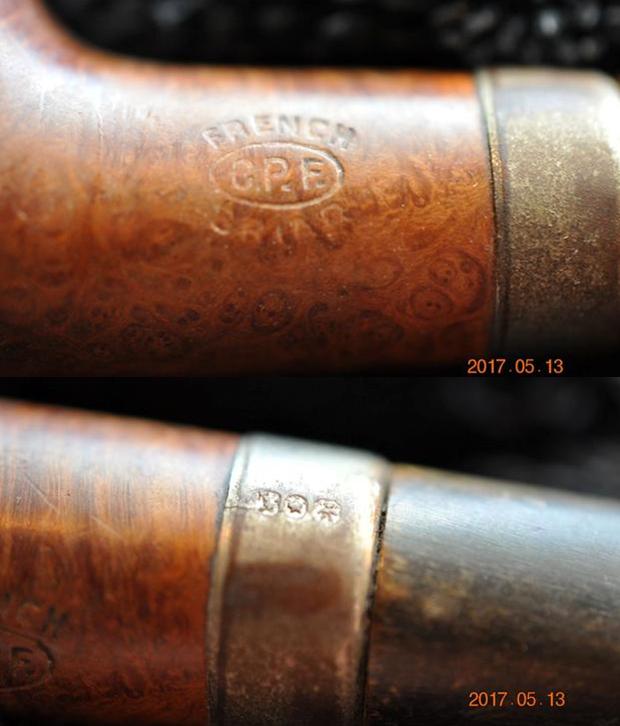
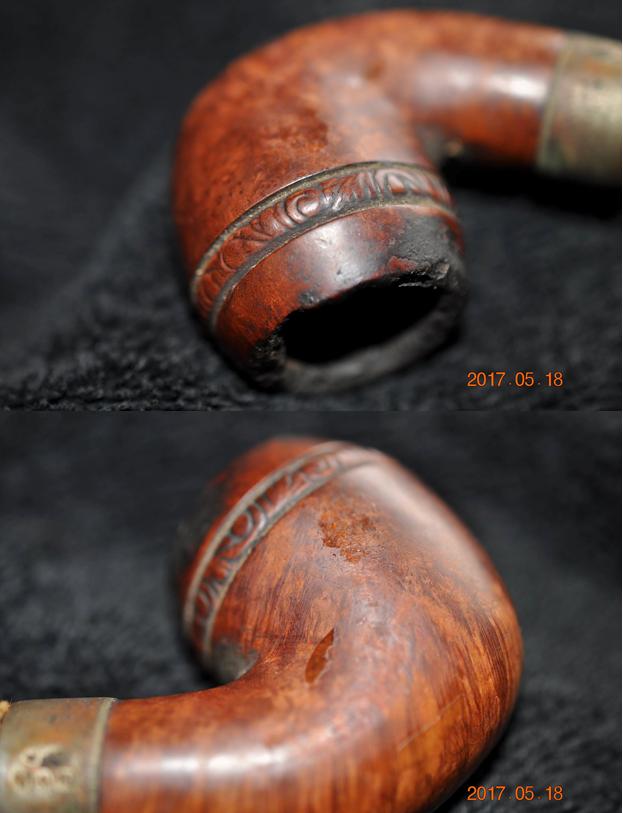
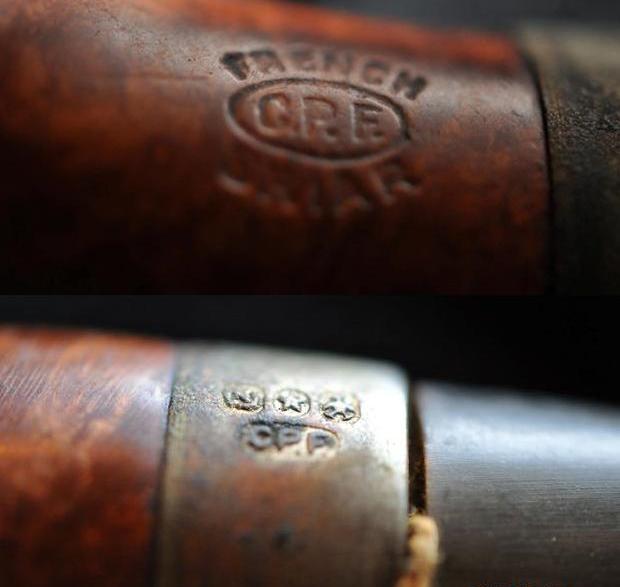
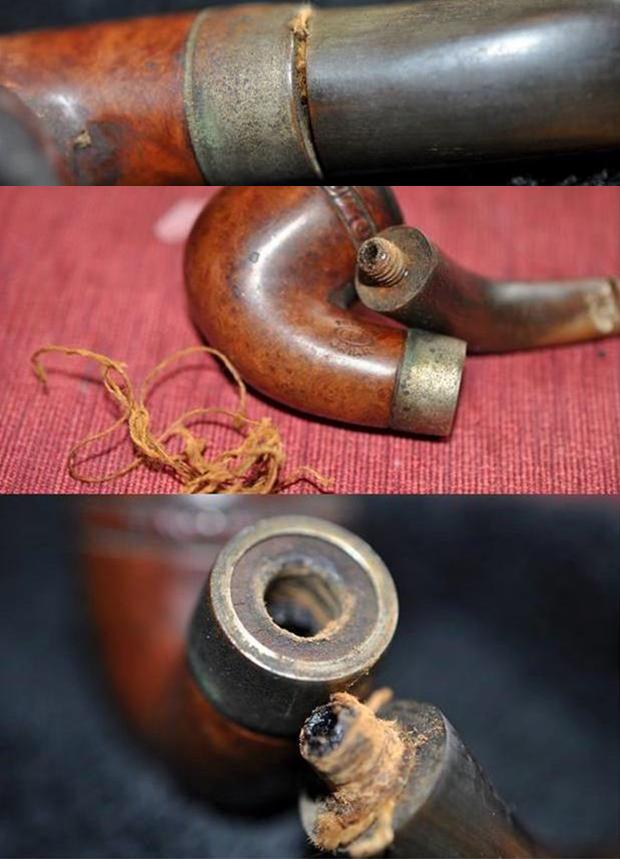
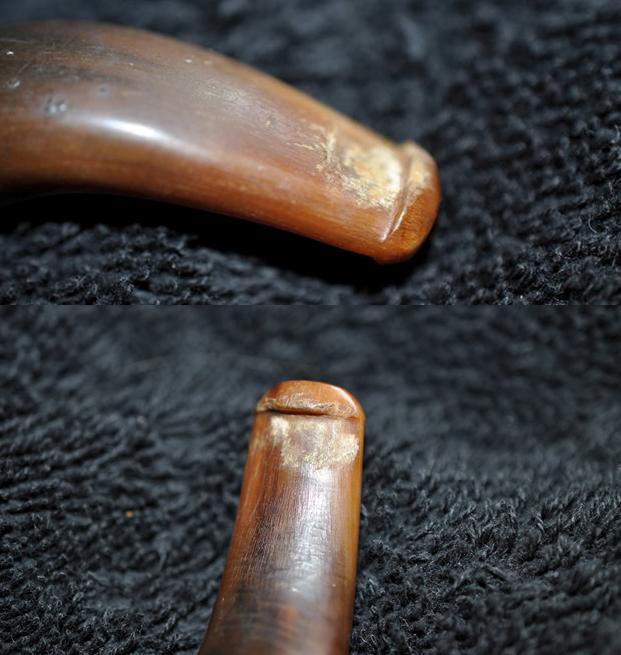
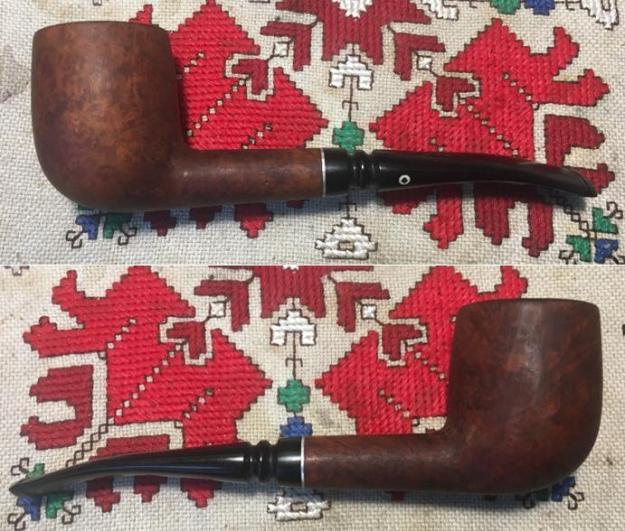
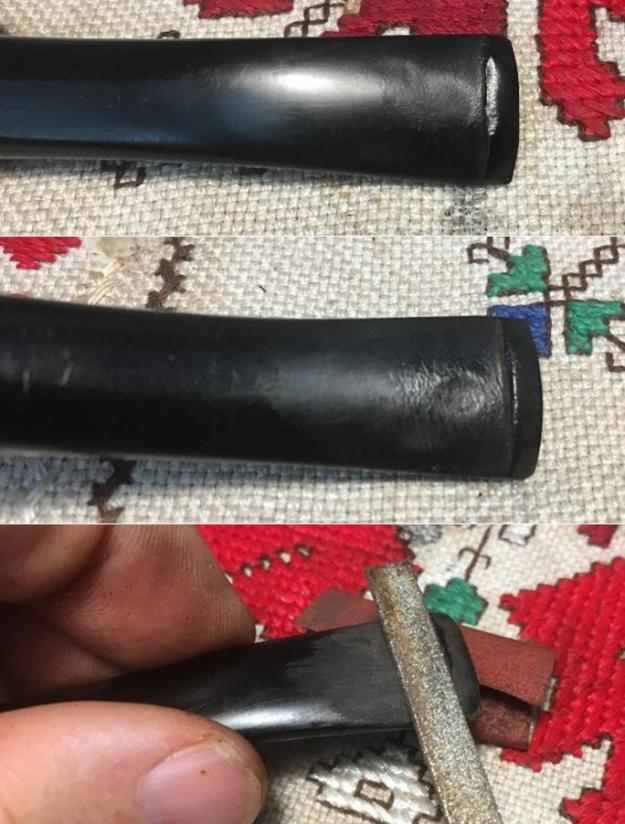
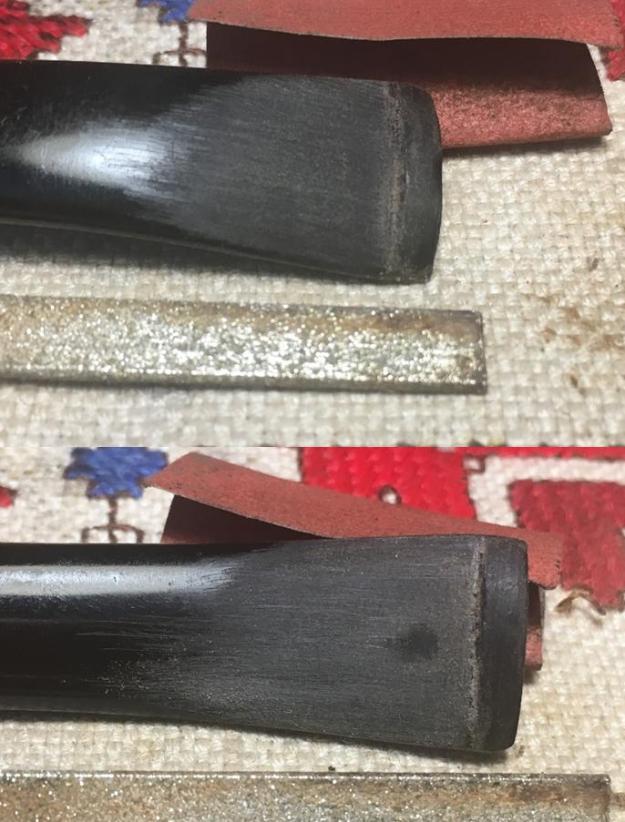
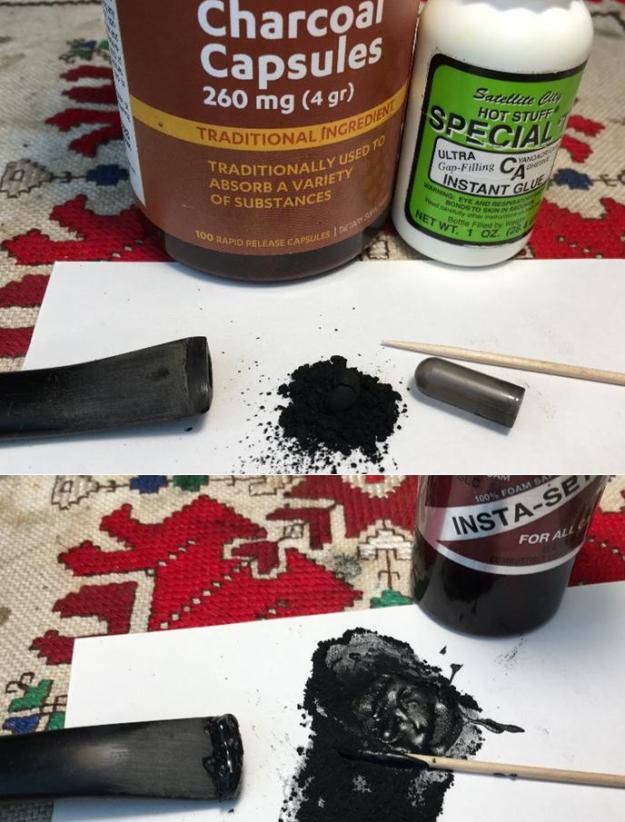
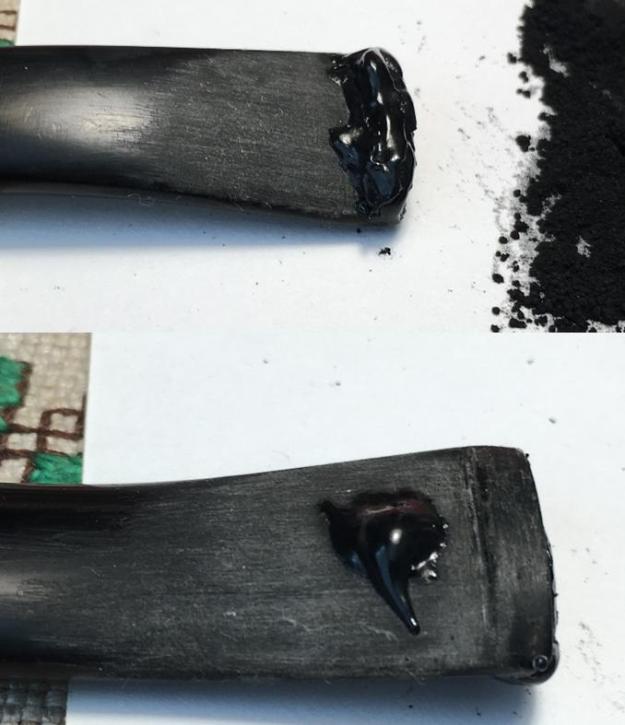
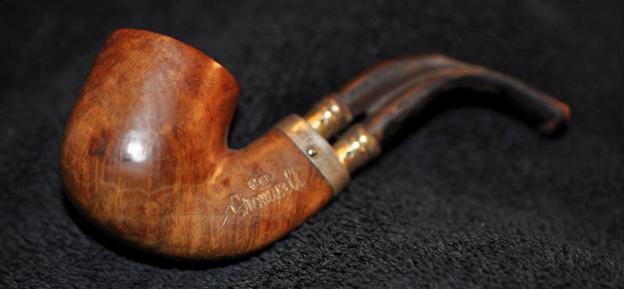
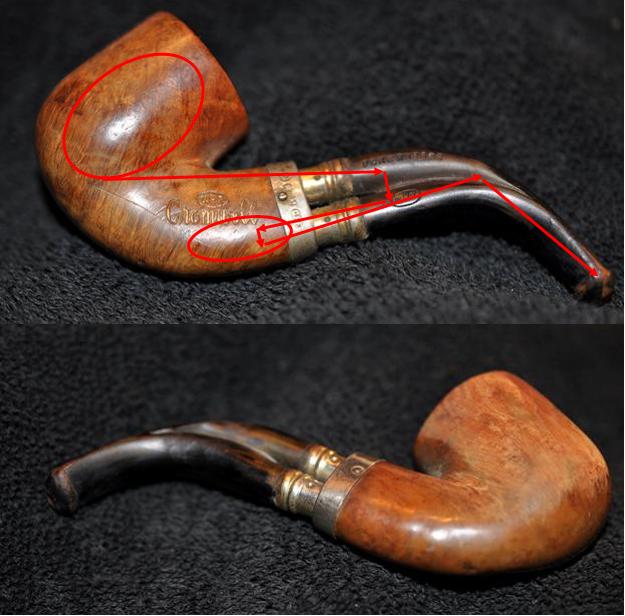
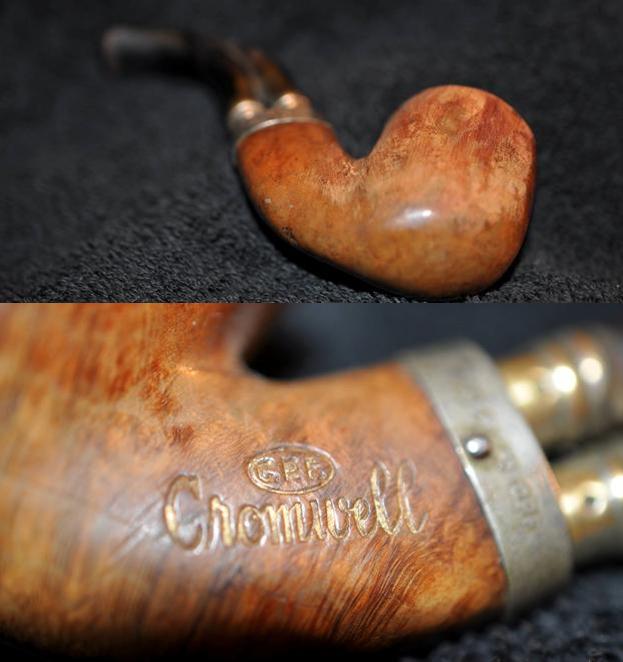
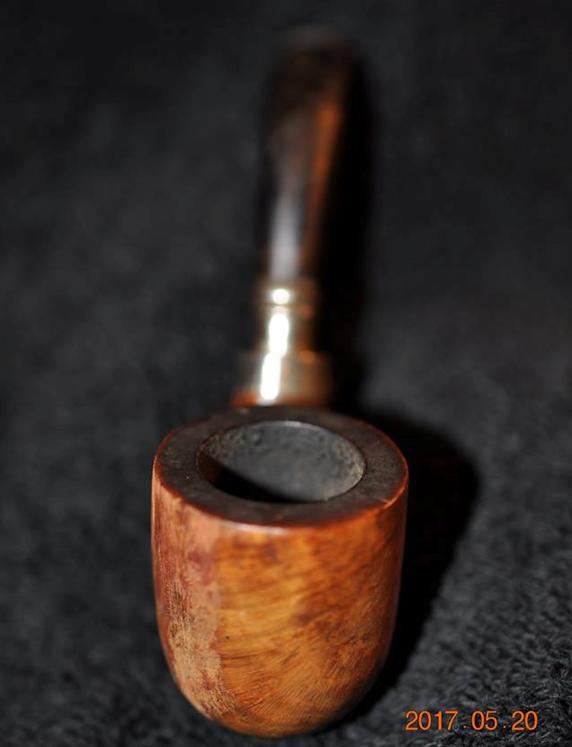
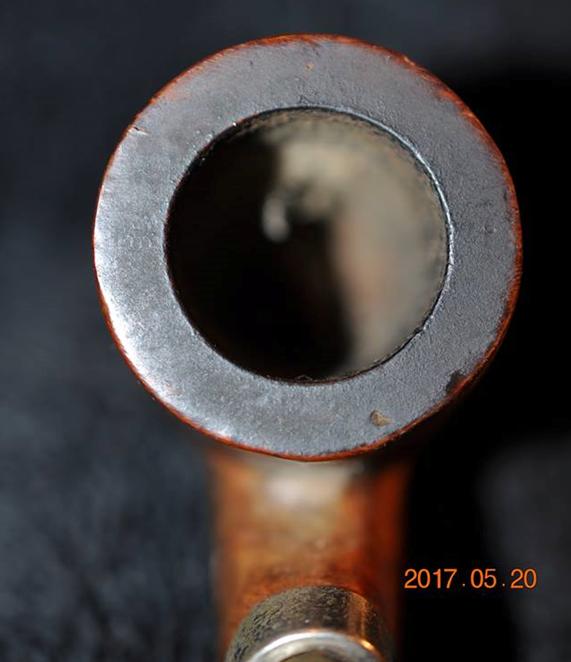
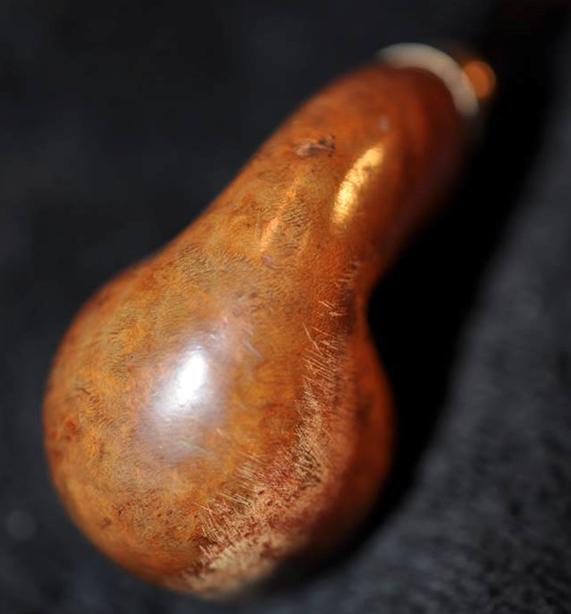
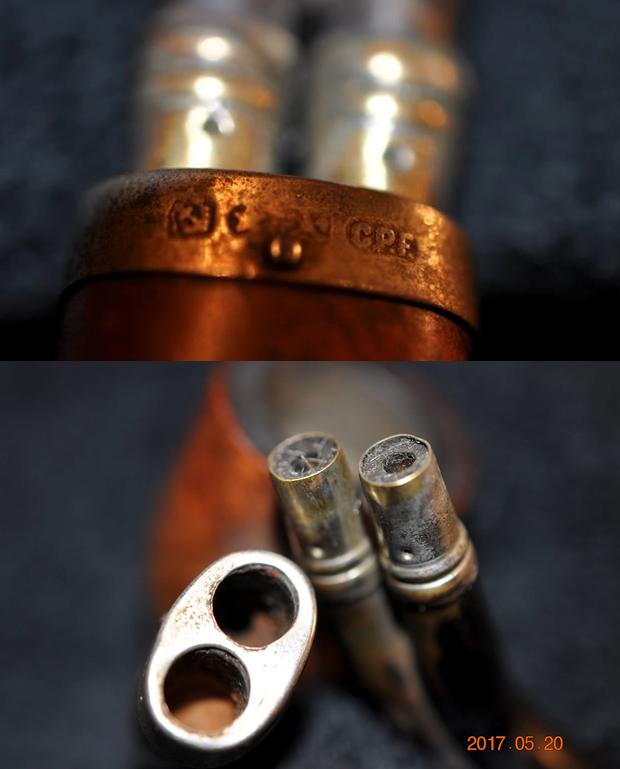
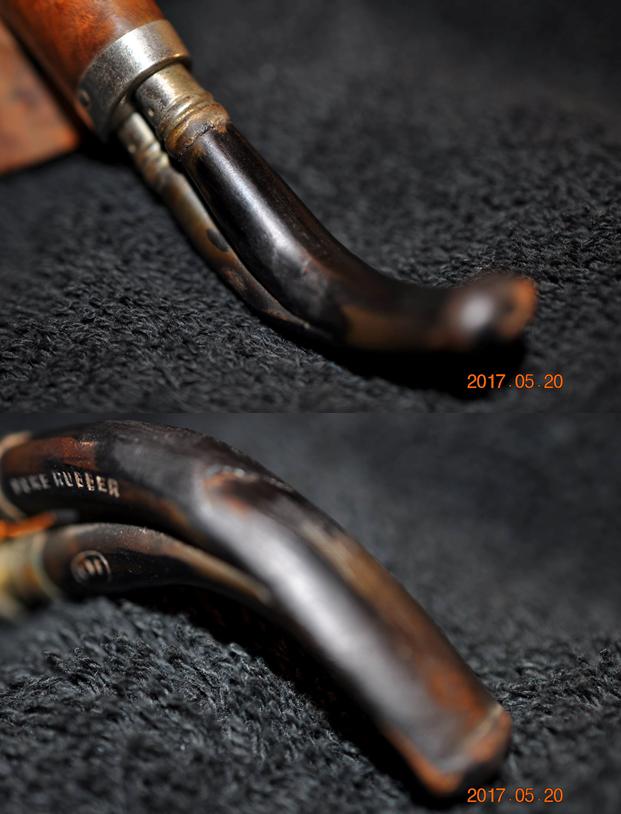
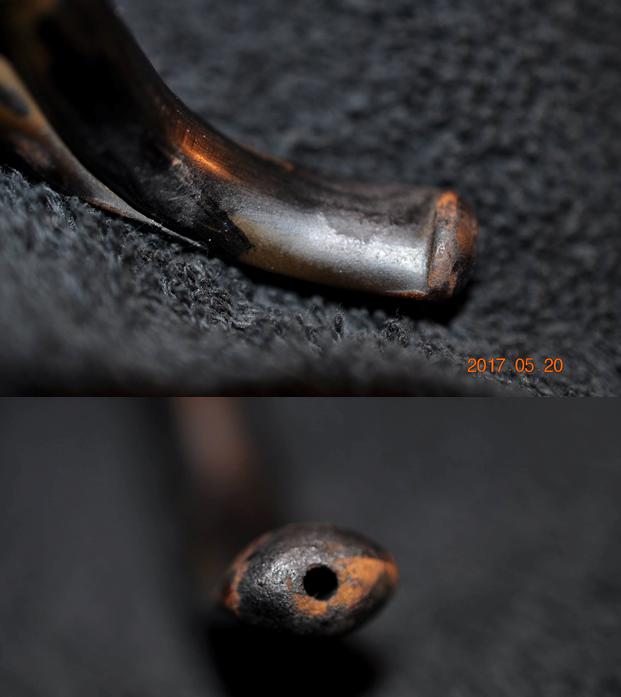
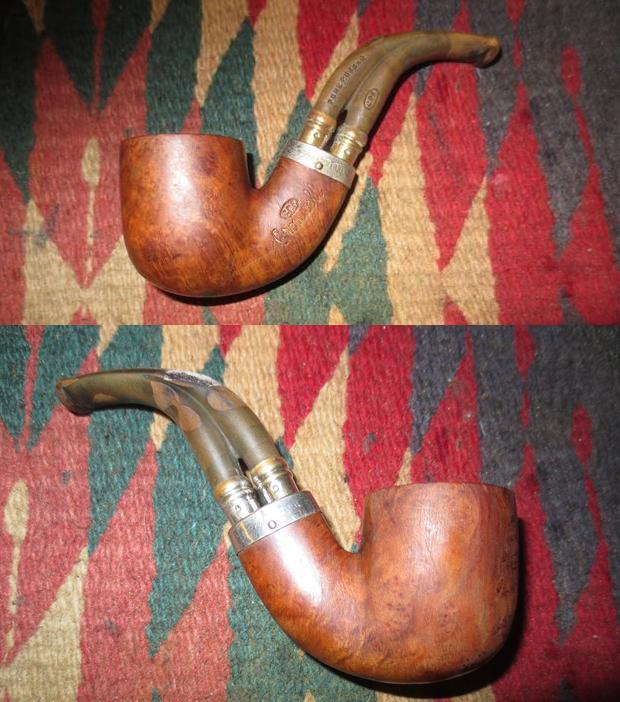
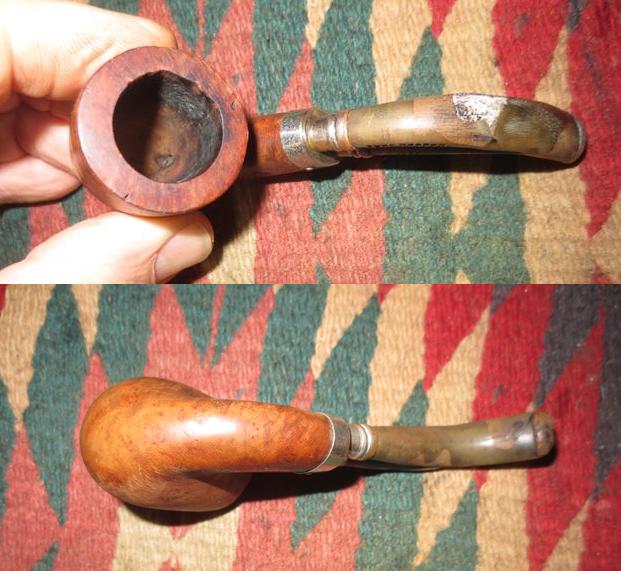
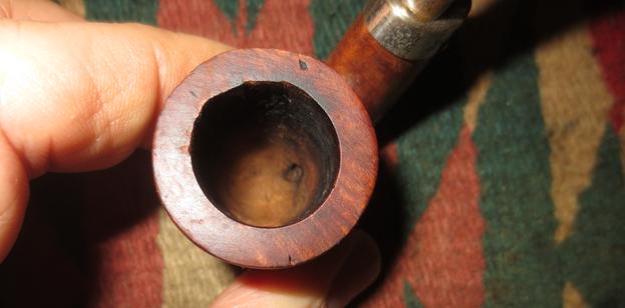
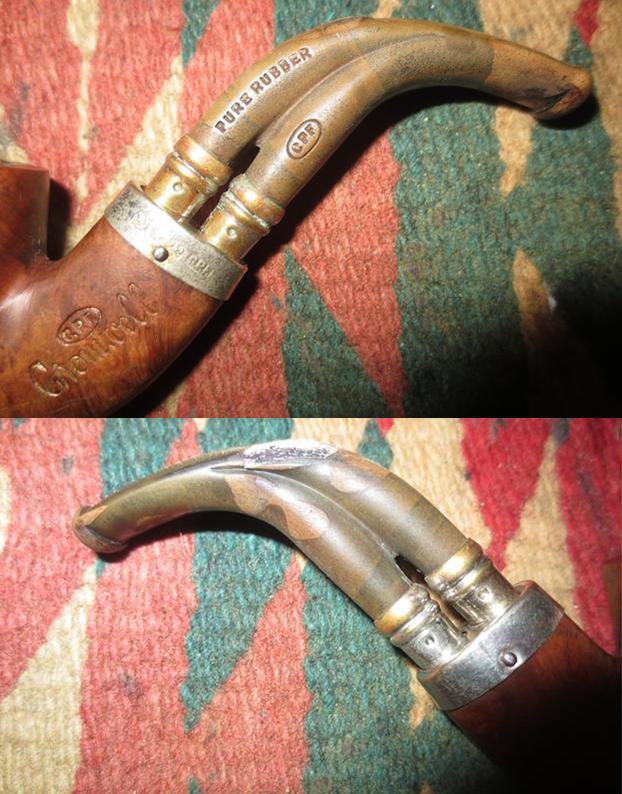
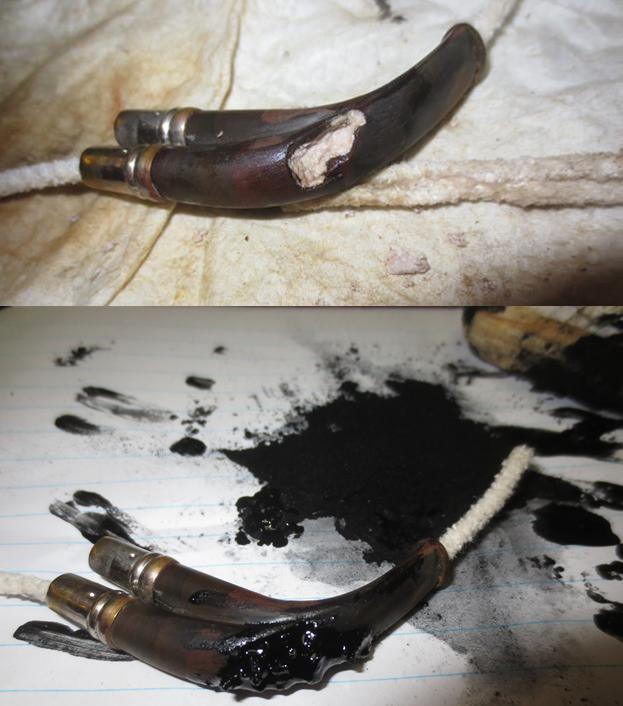
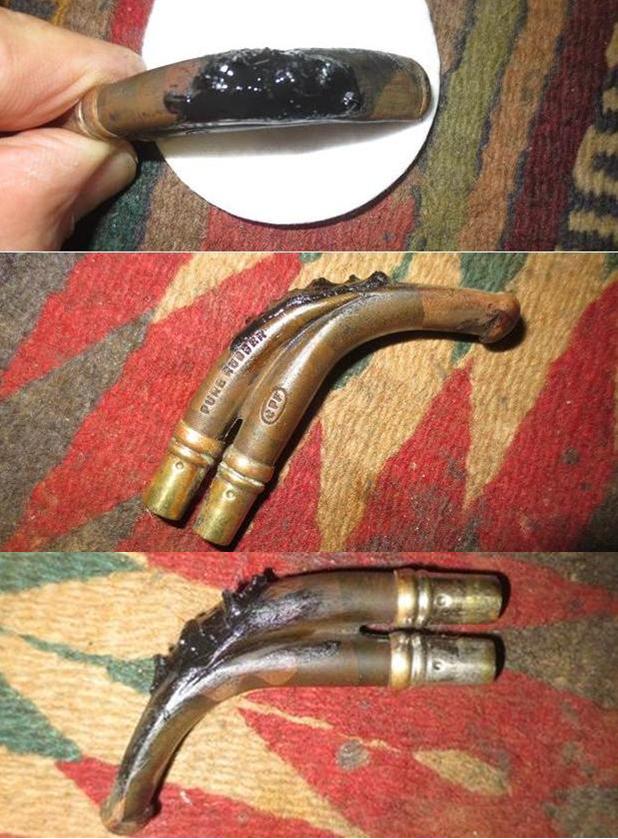
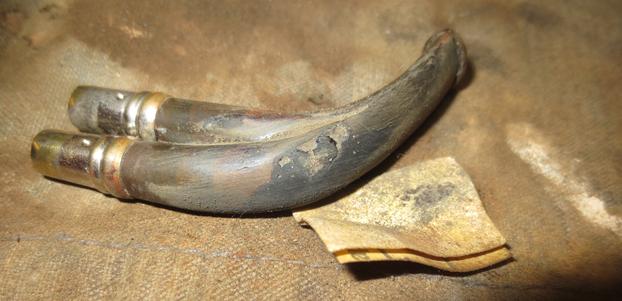
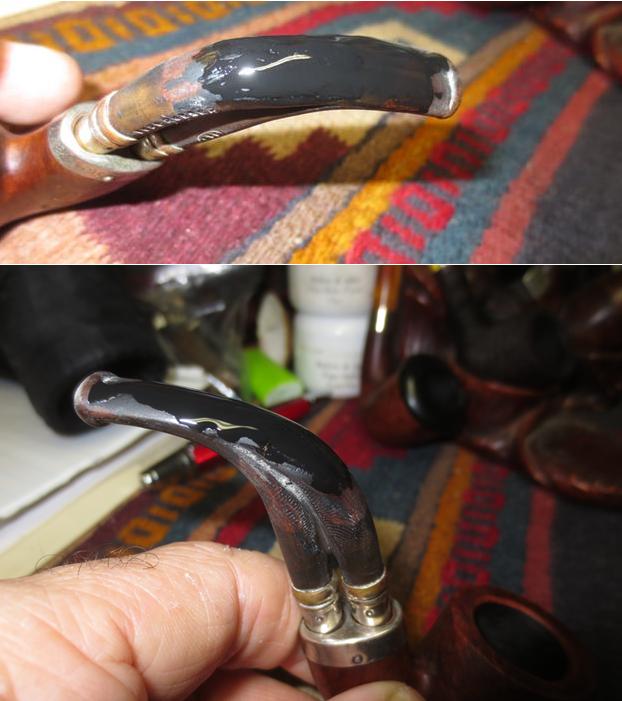
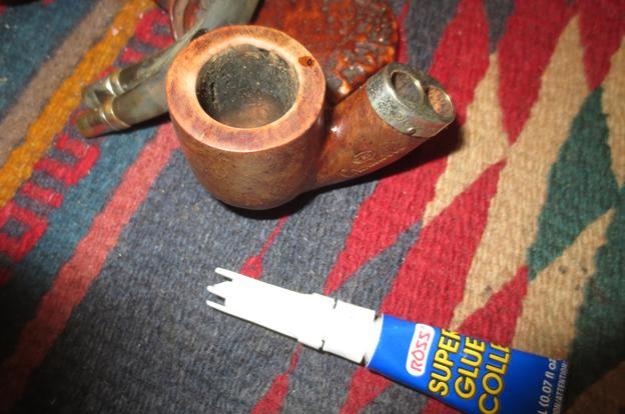
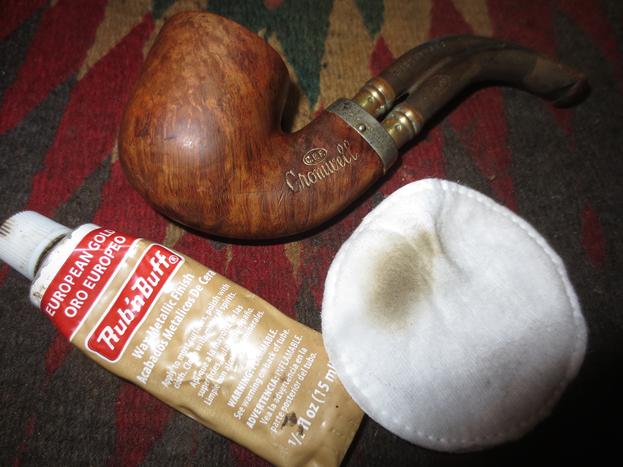
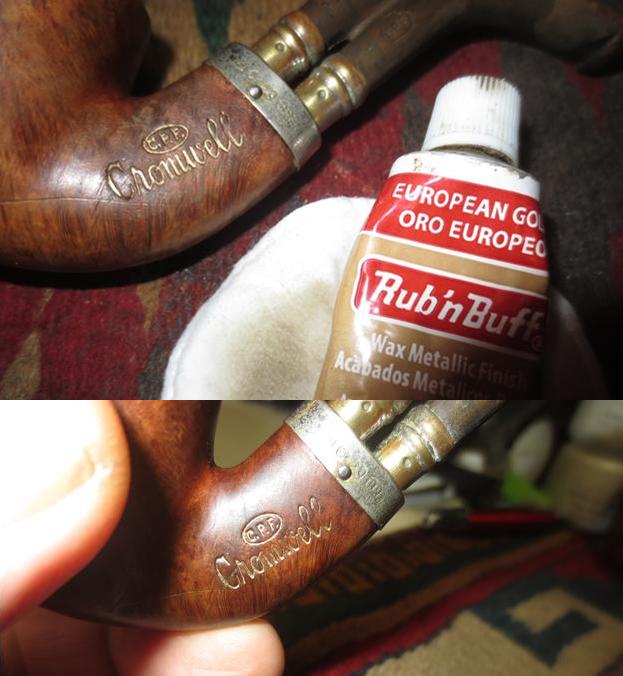
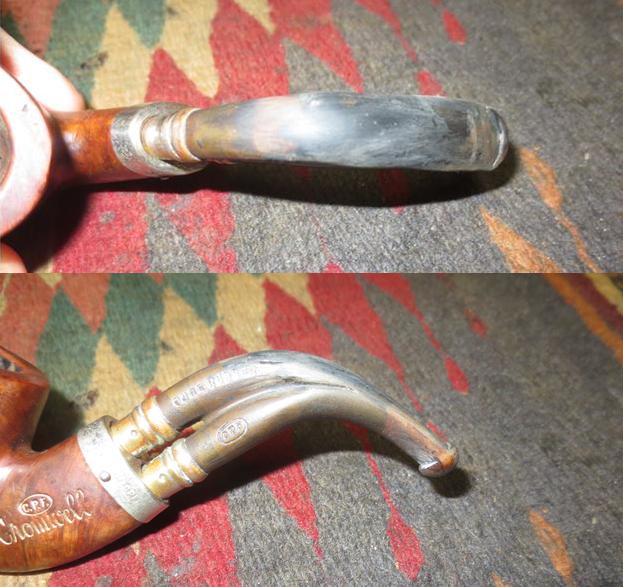
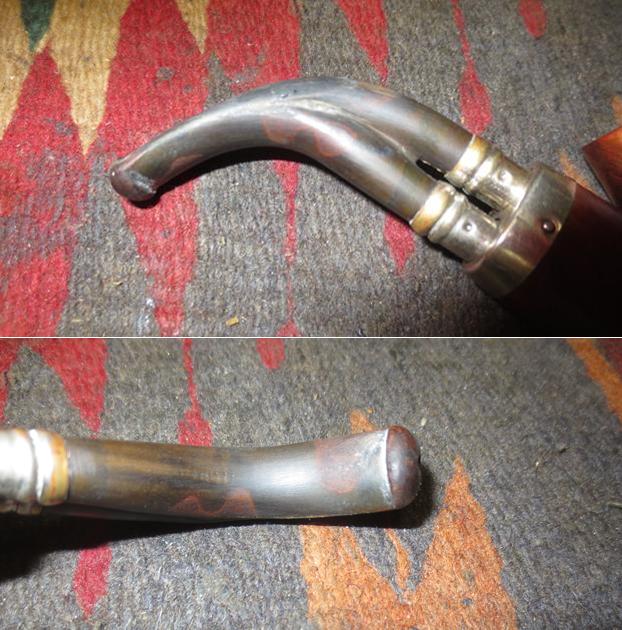
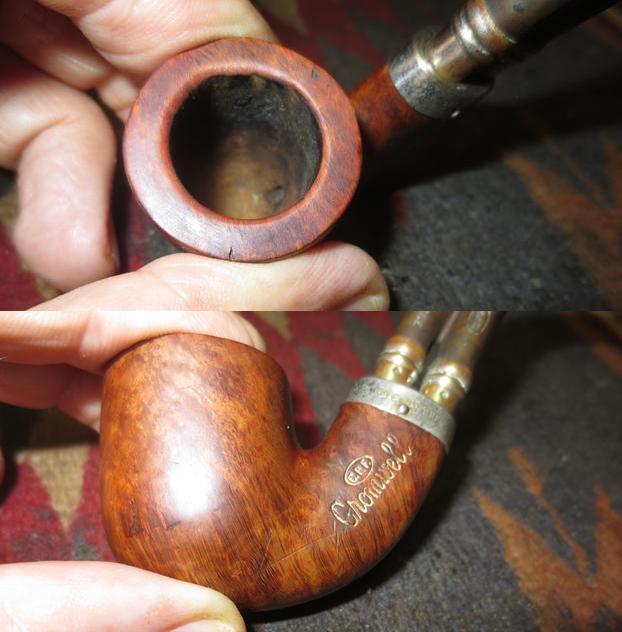
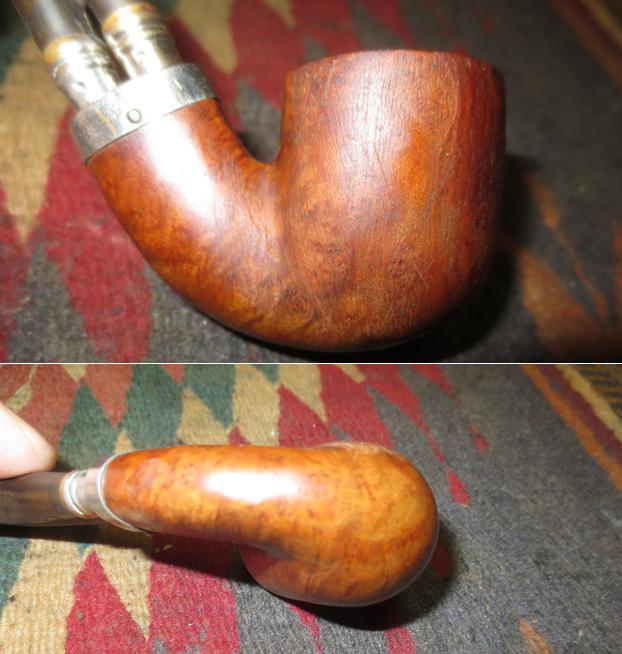
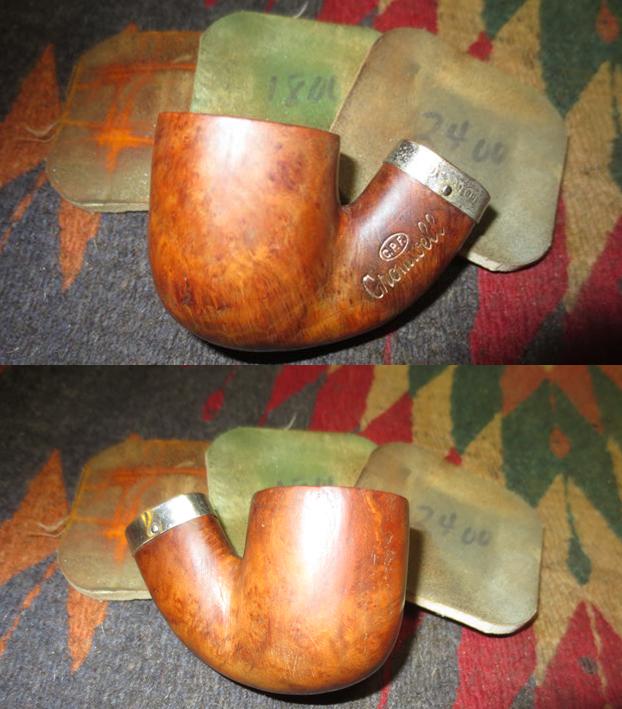
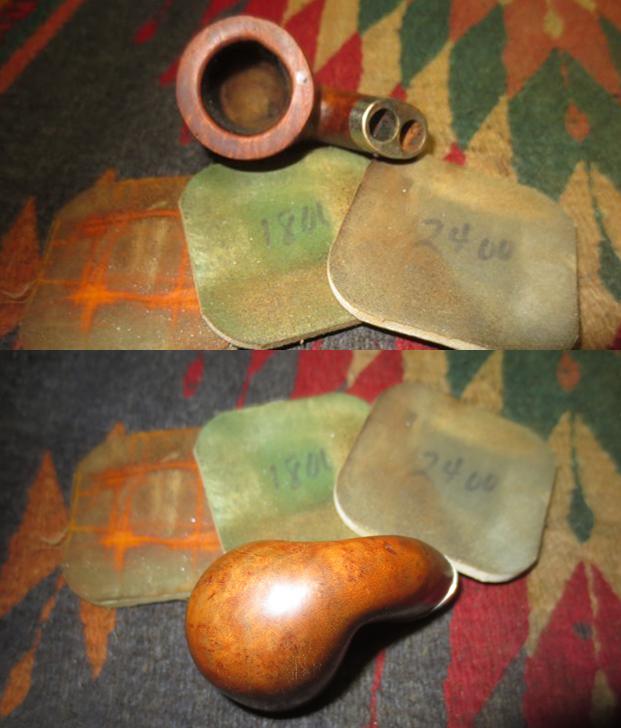
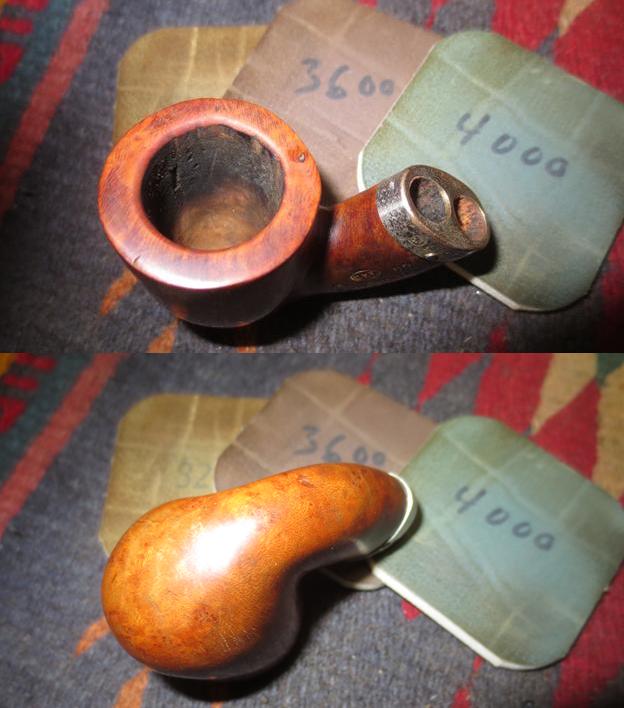
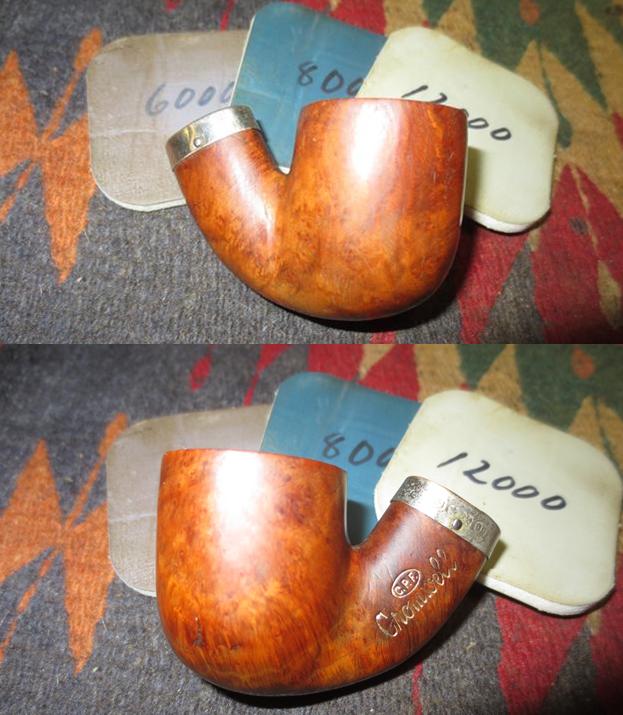
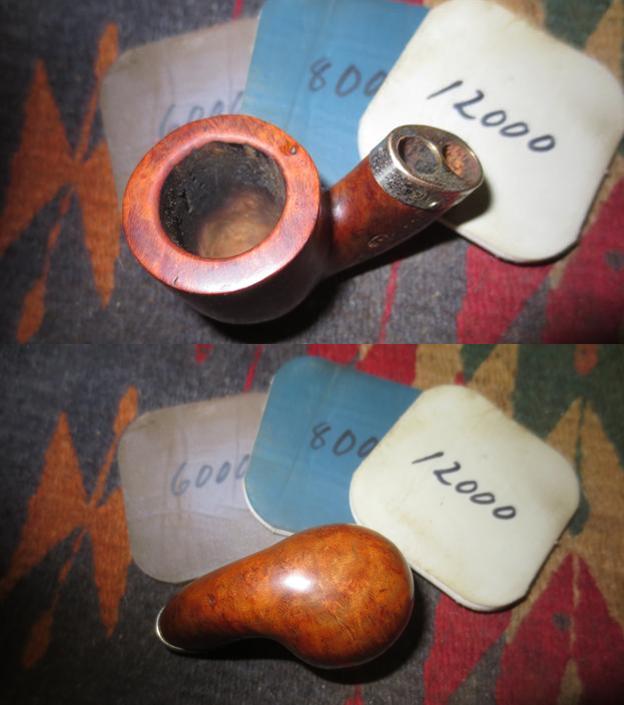
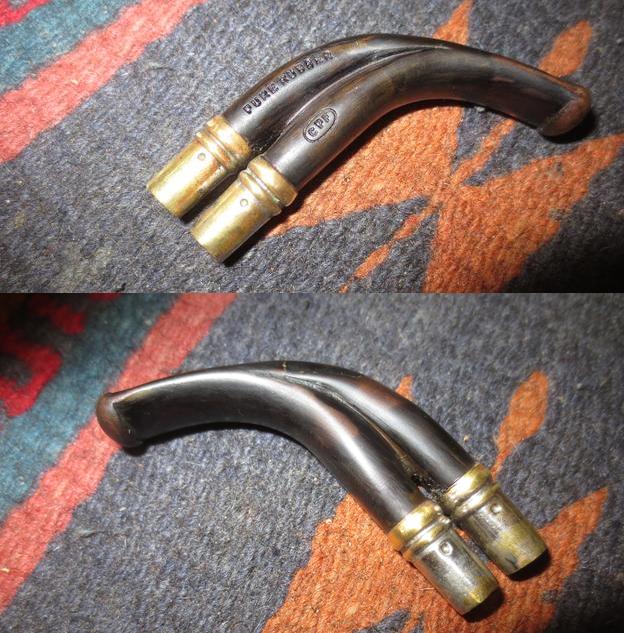
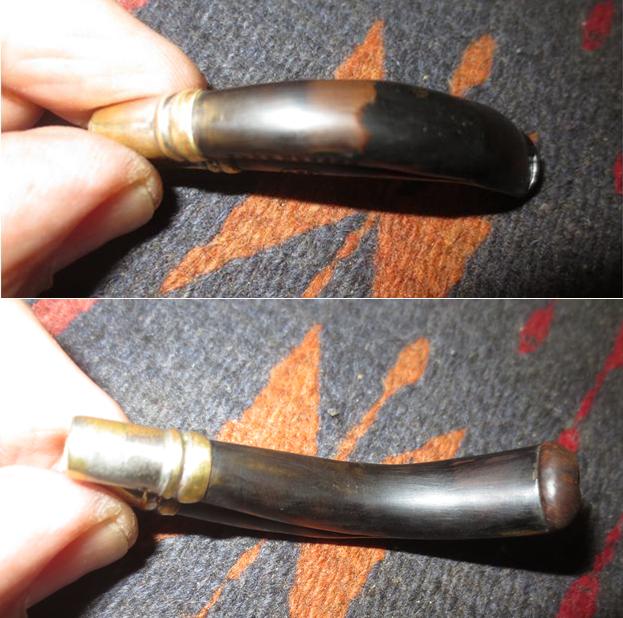
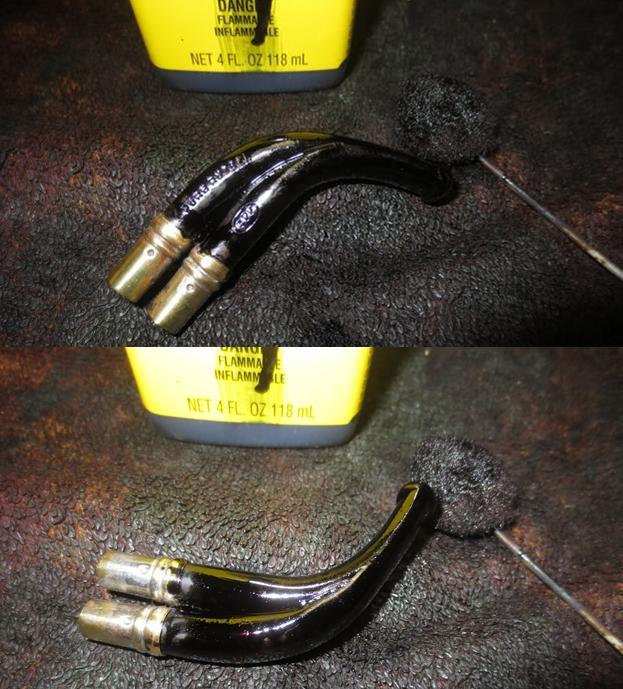
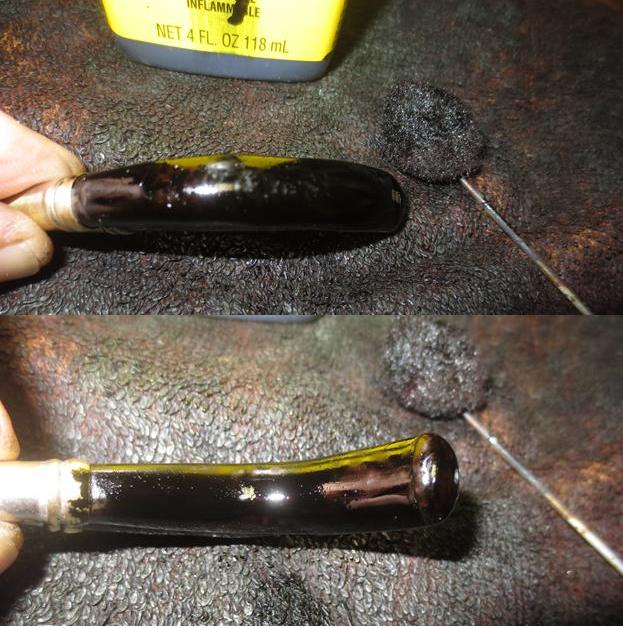
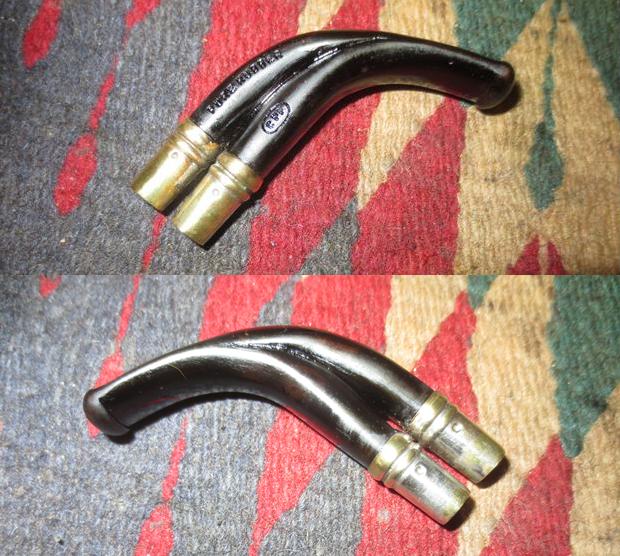
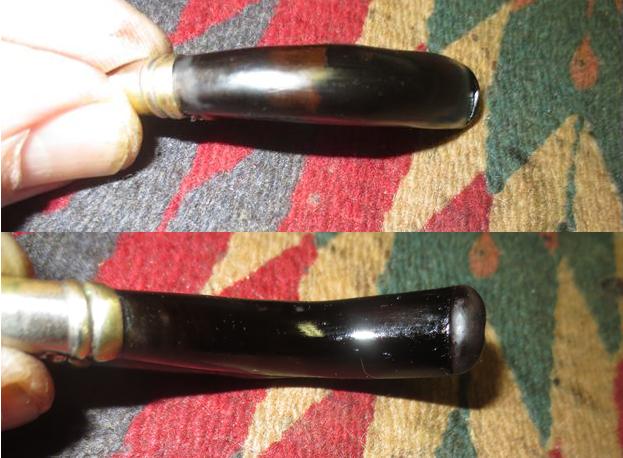
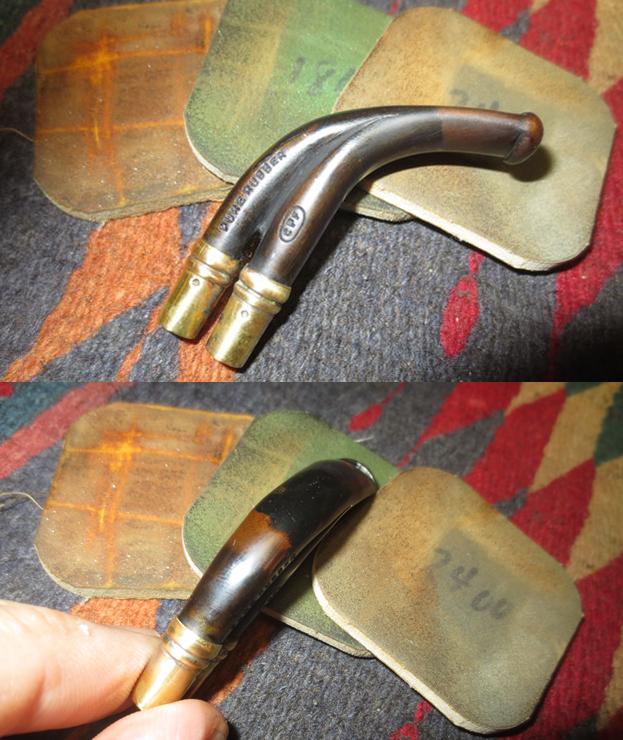
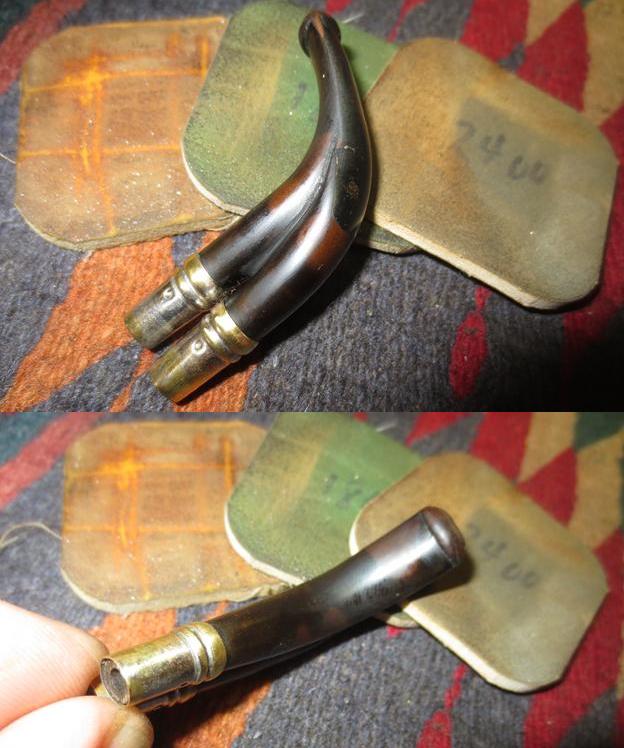
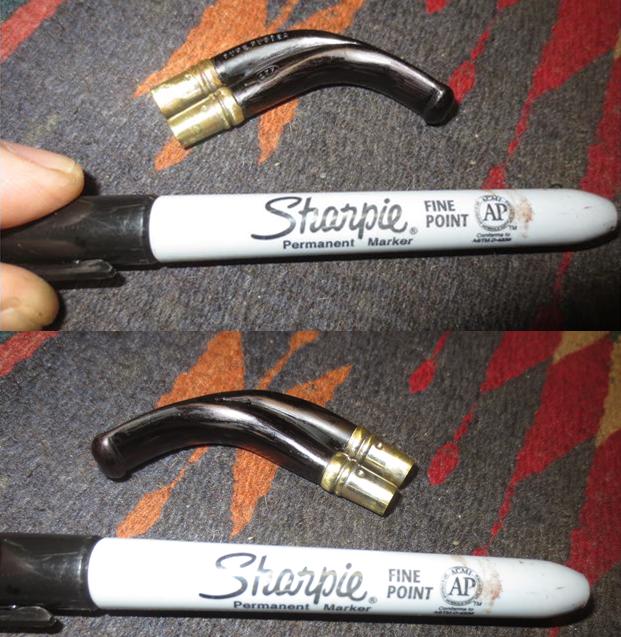
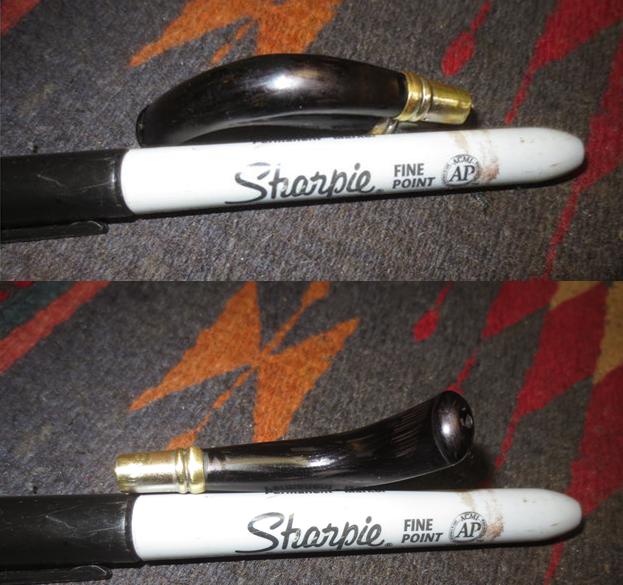
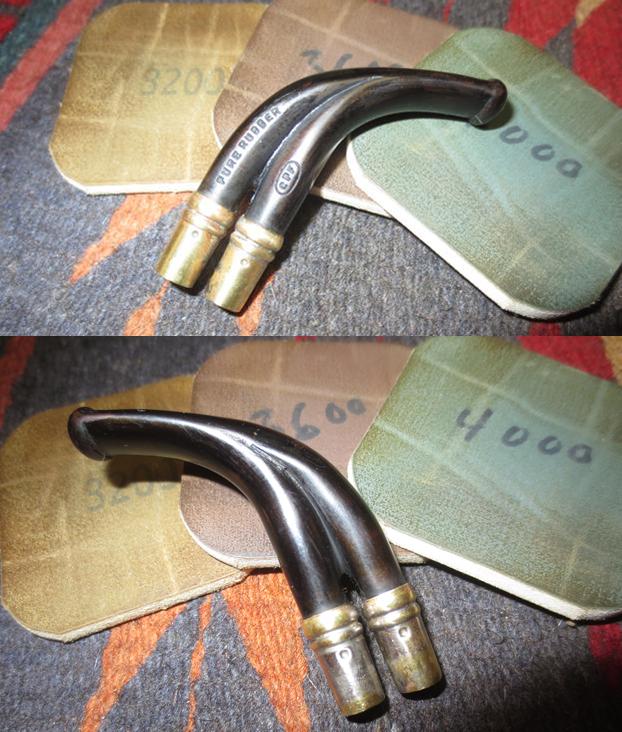
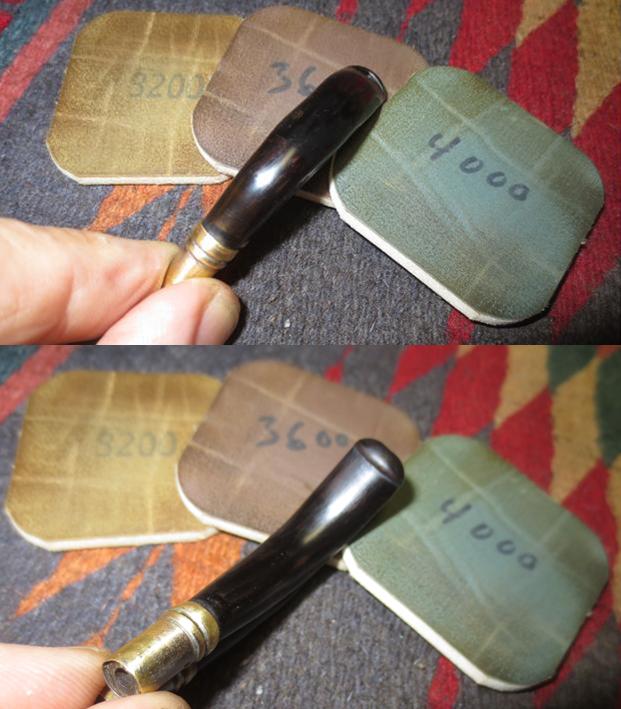
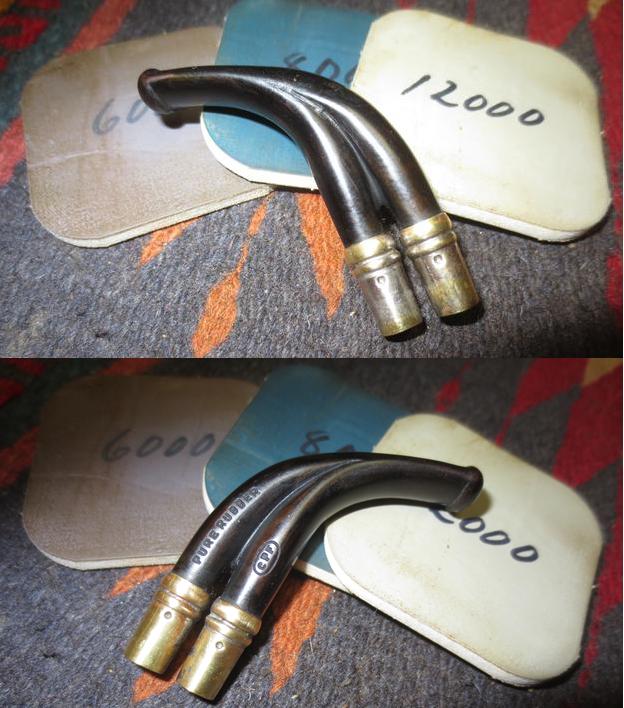
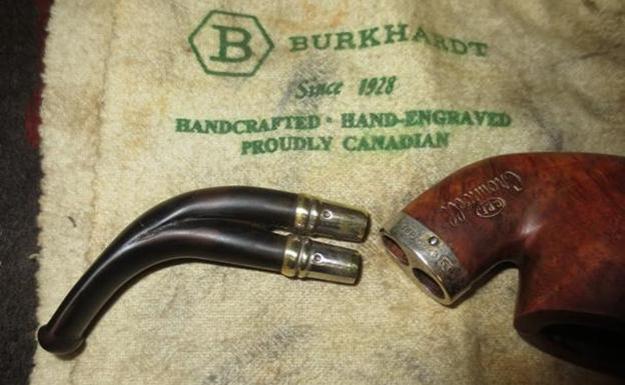
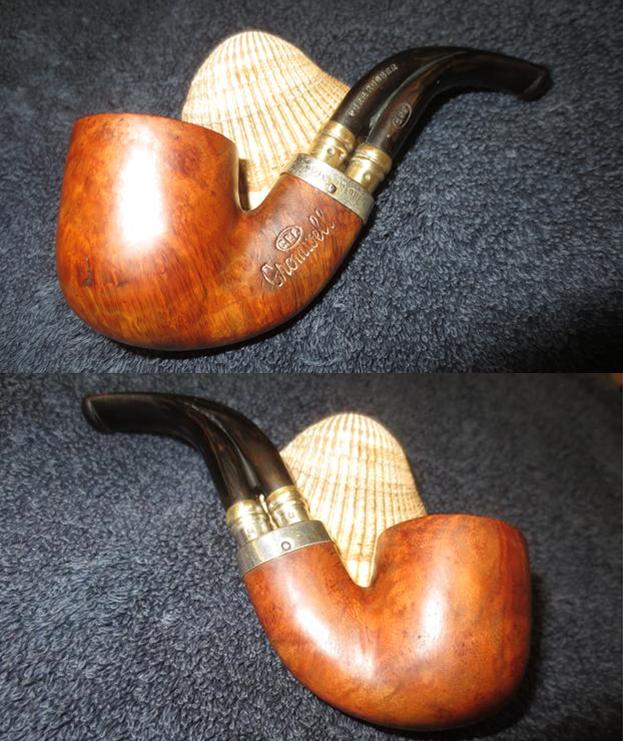
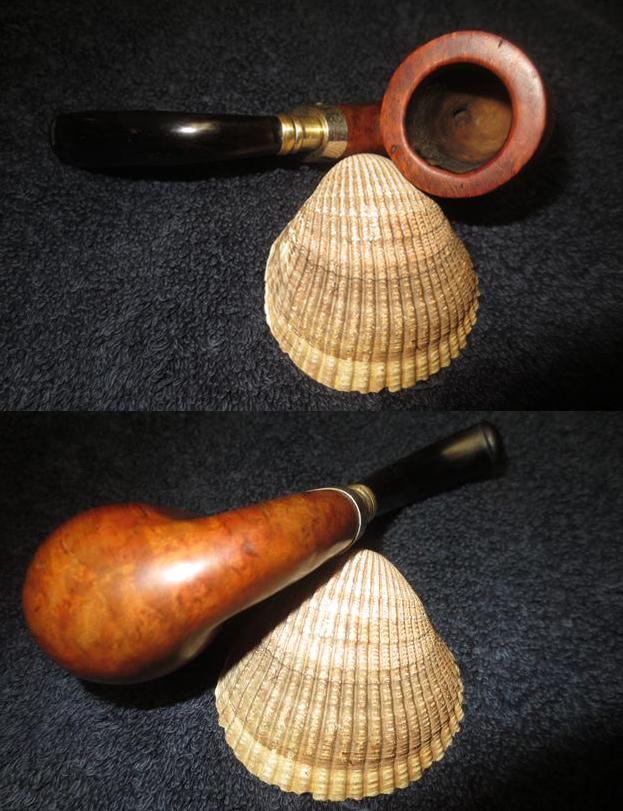
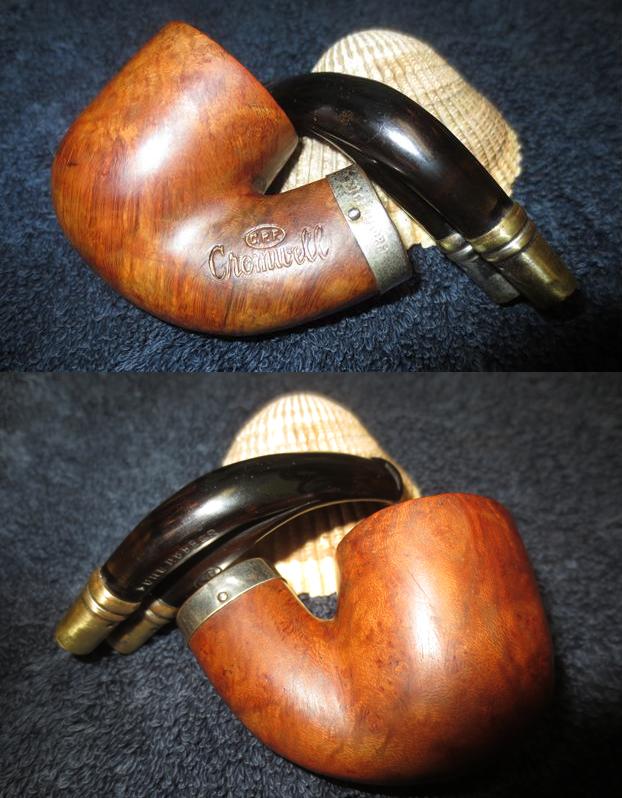
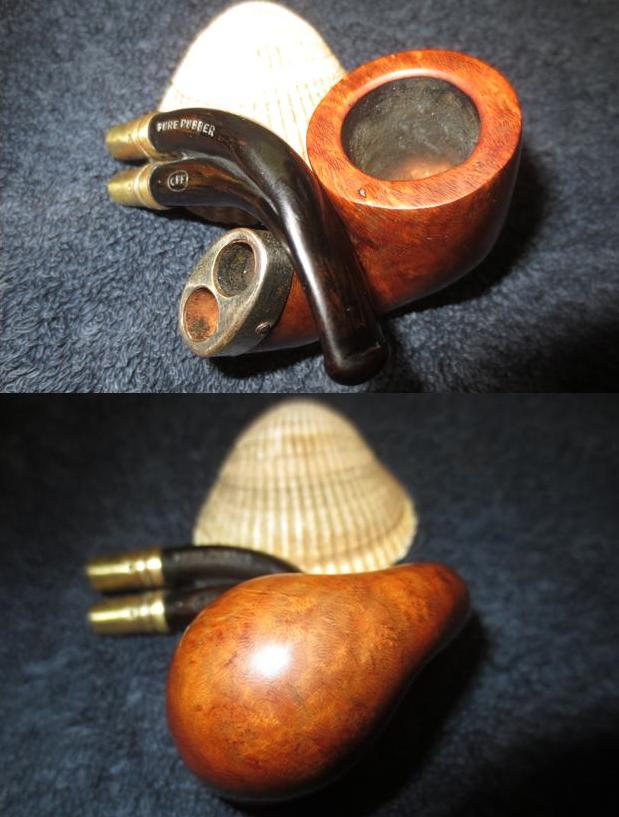
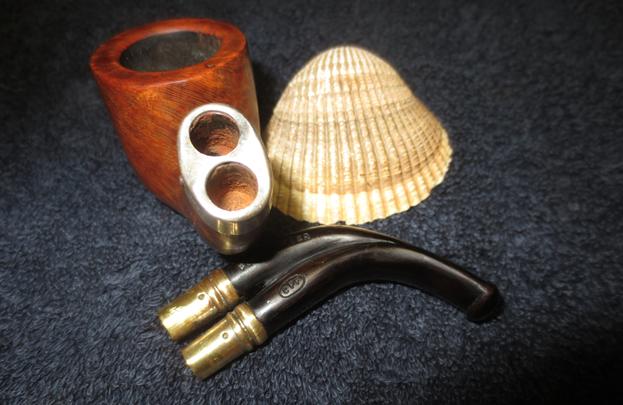
Like other older C.P.F. pipes this one has some real charm. It is on the petite side of things – 4 ½ inches long and 1 ½ inches tall. It is not a bad piece of briar, a mix of grains. The silver collar on the shank is stamped with faux hallmarks and the C.P.F. in an oval logo. It is probably silver or at least plated but I am not sure. The stem is the unusual part of the mix. It has two silver plated spigot tenons that fit into openings in the silver collar. The twin stems merge into one single airway. Looking at it I could not wait to examine it and see what it looked like with the stem removed and what the mortise looked like. The finish was worn but the pipe looked like it still had some life in it. The left side of the shank is stamped in worn gold leaf C.P.F. in an oval over Cromwell in script. There is no other stamping on the bowl. The stem is also stamped on the left side and reads PURE RUBBER on the top stem and C.P.F. in an oval on the lower stem. This pipe is also from the virtual pipe hunt my brother and I did in Montana. He took photos of the pipe from a variety of angles to show the uniqueness and the condition.I did some digging online and found a WDC Marlborough that had a similar configuration though far more boxy. It did not have the elegance that the C.P.F. does in my opinion. Playing around with the mechanics of the smoke and how it flowed through the stem I examined the dual mortise and the way the stem was laid out. I fed a pipe cleaner through the stem and found that natural flow of the cleaner was from the button through the top of the stem and into the top mortise. I could plug the lower tenon and the air was unobstructed from tenon to button. When I plugged the upper tenon and blew air through it I could feel it against my fingertip and then it made its way out the lower tenon. The airflow seems to have flowed against my finger and back a short distance to an opening between the two stems and out. From that I figured out that the smoker draws smoke through the upper mortise and into the airway on the stem. It flows into the bottom stem and mortise (which is a sump like the Peterson System pipes have) where moisture is collected and the smoke exits up the lower stem and into the button and into the mouth of the smoker. In my online search I found a photo of the Marlborough with the airpath drawn out as I conceived it in my words above. I drew the same kind of pattern on the C.P.F. to show how it appeared from my experiments. Here is the link to the Marlborough;  http://pipesmagazine.com/forums/topic/wdc-marlborough-double-airway. I used the drawing on that link to draw in the airflow on the Cromwell that I have. You can see that in the diagram below.I did some more digging on the internet to see if could find any more information on the brand. I found that C.P.F. did a second dual stem pipe called the Lafayette. Both pipes had military style bits so both were pocket pipes. Was it possible that C.P.F. did a line of pipes in honour or military leaders and these were two of those? You had Cromwell – potentially Oliver Cromwell, Lord Protector in England and Jean Lafayette, mercenary during the US Revolutionary War.The finish was very worn and there are a lot of scratches on the briar. I wonder if this little pipe was somebody’s pocket pipe and bumped against coin and whatever else was carried in the pocket of the pipe man who owned it. The bowl was caked and there was a lava overflow onto the rim top. There were some nicks and sandpits on the rim and the bottom of the bowl. My brother took photos of the stem and the mortise of the pipe. It is an unusual set up. The top portion of the twin stems fits in the mortise and the airway into the bowl is high at the bottom of that mortise. The second mortise for the lower portion of the stem is merely a dead space. It appears that the smoke came up the stem and circulated in the lower mortise before being drawn to the mouth of the smoker – perhaps it is a cooling system somewhat like the sump in Peterson System pipes. The twin ends of the stem are covered with a silver end mount and from the looks of the photos the pipe had been sitting for quite a while and cob webs had formed. The stem was oxidized for sure but something about the colour of the stem made me wonder what was happening with it. He did a lot of cleaning and scrubbing on this pipe and in the process we learned some interesting facts about the repair work that had been done on this pipe. The entire stem had been coated with what appeared to be a black paint. It was flaking and bubbling at the button end as can be seen in the photo above. The oxidized stem had some really strange patterns in the oxidation and there seem to be deep staining in spots on both the top and underside surfaces of the stem. On the topside there was a white repair that looked and felt like putty. The black paint had hidden that repair. Jeff had stripped the remaining finish off the dirty bowl, reamed the bowl and cleaned the rim top. The silver band on the shank looked better and the metal tenon ends on the military style tenons looked more brass than silver. He had cleaned out the two mortises and the airway into the bowl and the shank. Note the spotty appearance of the vulcanite stem. I took a close up photo of the rim top to show the condition of the surface and the damage on the right inner edge of the bowl. The bowl was out of round once he had removed the cake and the sandpits in the flat surface stood out.The next two photos I took show the condition of the stem. The stamping on it is very clear – Pure Rubber on the top stem and C.P.F. in an oval on the lower stem. I have not seen this spotty pattern in the oxidation before and I am wondering if in the process of the previous repair the repair guy did not damage the surface of the rubber. Note the putty fill as well. It is quite large.I used a dental pick to remove the putty fill and you can see from the photo below that it was quite large. It covered a large portion of the top and right side of the upper stem. I wiped the surface down with a damp cloth to remove the debris left behind by the putty in preparation for repairing the damage. I greased a pipe cleaner and put it in place in the airway in the stem so that it would not accidentally fill in from leakage of the repair. I mixed a batch of charcoal powder and black super glue putty and filled in the damaged area. I purposely overfilled it on the top to give me room to work. I carefully filled in the right side of the stem so as not to fill in the groove between the two parts of the stem. I put aside the stem so the repair could cure. Once the repair had dried I used a flat file to smooth out the ridges and peaks in the new surface. I sanded the repaired area with 180 and 220 grit sandpaper to further smooth it out and shape it.I wiped the stem down with a damp cloth and checked for air bubbles in the repair and areas that needed to be built up. I applied some more black super glue to the surface of the repair and smoothed it out with a dental spatula to ensure that all of the air bubbles had glue in them. I set the stem aside to dry.While the stem repair was curing I worked on the rim. I used a folded piece of 220 grit sandpaper to work on the damage to the inner edge of the bowl. It took a bit of work to blend in the damaged areas and smooth them out. I filled in the sandpits with clear super glue. It did not take too long to cure so when it had hardened I sanded it smooth and blended it in with the rest of the rim top. I wiped the bowl down with alcohol on a cotton pad to clean off any debris left behind by my rim work and used some European Gold Rub n’ Buff to touch up the gold in the stamping on the shank. I applied the product and rubbed it into the stamping and wiped off the excess with a cotton pad. The next three photos show the fresh shank. By this time the stem repair had hardened and I sanded the surface with 220 grit sandpaper to smooth things out. I used a folded piece to smooth out the grooves between the upper and lower stems. The stem is looking much better but the reddish spots in vulcanite really looked odd to me. I wondered if I would be able to polish them out of if I was going to be stuck with them in the finished pipe. The finish on the bowl was rough and there were a lot of scratches and worn areas on the sides and bottom. I sanded out the ridges and as many of the deep scratches as possible with 320 grit sandpaper. In the photos below you can still see the scratches but the feel in the hand is much better and the bowl is beginning to look smoother. I sanded these marks smoother with 400 grit wet dry sandpaper and then polished the bowl with micromesh sanding pads. I wet sanded with 1500-2400 grit pads and dry sanded with 3200-12000 grit pads. The next sequence of photos show the progress in smoothing and polishing the bowl. The stem still needed a lot of work. I shaped the repaired area and worked the surface over with 220 grit sandpaper to remove as much of the oxidation as I could. While it was definitely looking better the spotty areas were still visible. I still needed to polish the stem with micromesh pads to see how much more of the spotty surface I could clean. I also needed to finish polishing the silver tenon caps. I worked over the surface with 400 grit wet dry sand paper and 1500-2400 grit micromesh sanding pads and still could not remove the stained spots on the rubber. I decided to try something different. I stained those spots of the stem with a black aniline stain to see if that would bring the red spots more in line with the rest of the stem. When the stain dried the spots were definitely better, but they still stood out. Time to go back to the sanding and polishing! I wet sanded it some more with 1500-2400 grit micromesh sanding pads. I still had those obnoxious spots present in the rubber. They were deep and it really appeared that I would not get them out. I sanded the stem some more to try to remove more of the damaged areas. It did not seem to matter how much I sanded the spots remained. I decided to try one more trick. I used a black Sharpie Pen to colour in the spotted areas. I let the ink dry. I was hoping that these Permanent Markers would actually be permanent and cover the spots. Once the ink had dried I lightly sanded it with 3200-12000 grit micromesh sanding pads. The black seemed to stay in the spots better than any of the other methods so far. Maybe I had some success but polishing would tell the story. The more I polished most of the coverage remained but there were still remnants of the spot in the vulcanite. I polished the metal tenon caps with micromesh sanding pads and finished polishing them with a jeweler’s cloth to remove any remaining tarnish.I lightly buffed the stem with carnauba wax and buffed it with a clean buffing pad to raise the shine. I hand buffed it with a microfiber cloth to deepen the shine. I gave the bowl multiple coats of carnauba wax and buffed it with a clean buffing pad to raise a shine. I hand buffed it with a microfiber cloth. I put the parts back together and rebuffed it by hand. The finished pipe is shown in the photos below. The stem looks far better than when I first started but the spots still show through the polish. The pipe as a whole is a beautiful old piece of history. It does not look too bad for its age – over 125 years old. Thanks for walking through this restoration with me. It was a challenge and it was a pleasure to resurrect this old piece of tobacco history.

Giving the Sultan a much need facial


Blog by Steve Laug

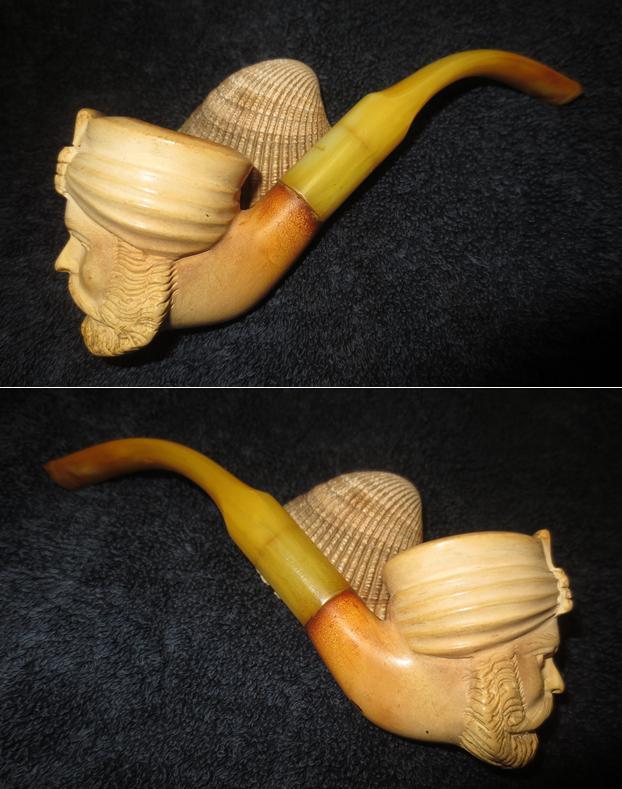
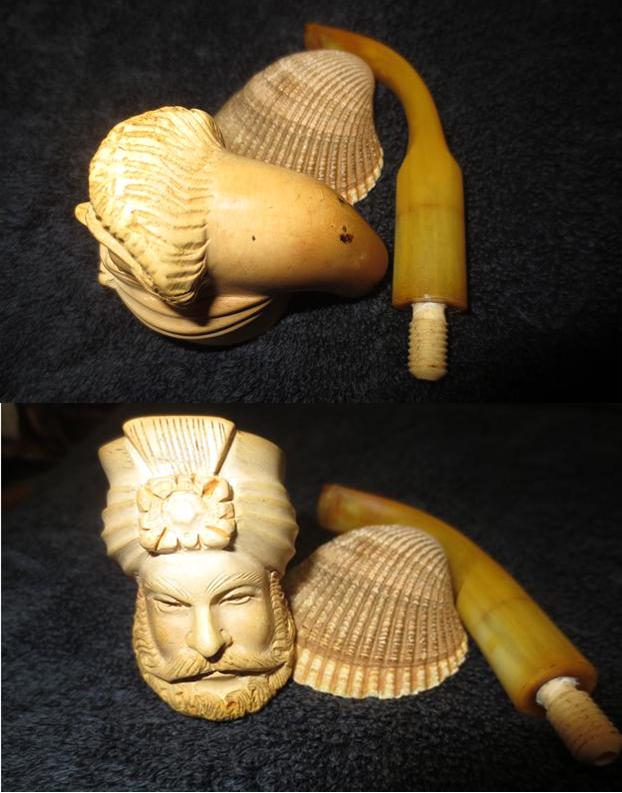
Several months ago, I received a box of pipes to be refurbished from a friend in northern British Columbia named Steve. The box contained some nice Danish briars, some meerschaum pipes and a ceramic as well that needed attention. I went through them and made suggestions for him. Together we did a bit of prioritizing. I have cleaned, restored and sent quite a few back to him already. In the box there were several that I took out of the equation because I was not sure of the point in cleaning them up – one was a black pyrolytic “The Pipe” billiard with a very rough stem and another was this little meerschaum sultan.

My original plan had been to send this pipe and The Pipe back to him untouched but the other evening I had been working on an old C.P.F. with some major issues and I wanted to work on something that was a bit more mindless. Sometimes a change of view is as good as a rest. I just was not ready to shut down the shop for the night so I thought through what I had in the repair and renovation queue and opened the box that Steve’s remaining pipes were in. I looked through them and decided to work on the Sultan.

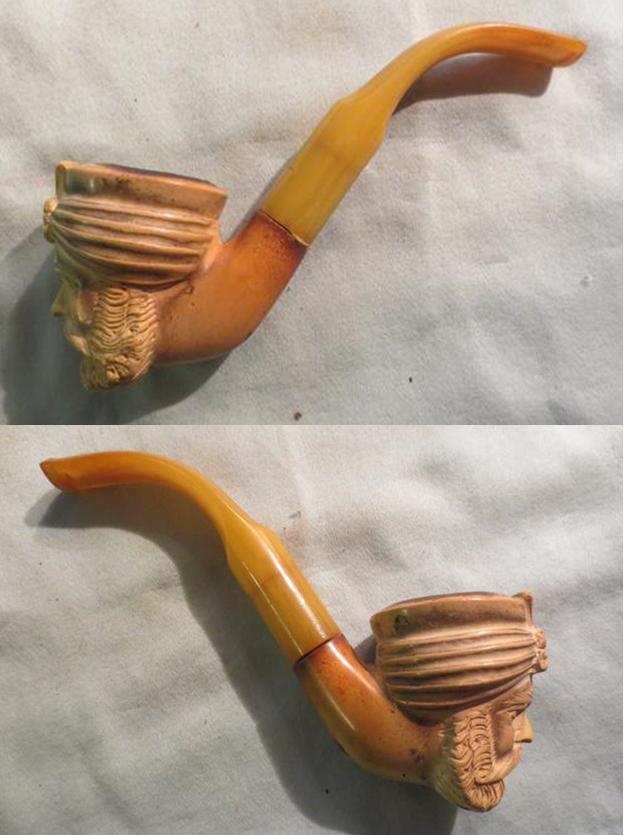
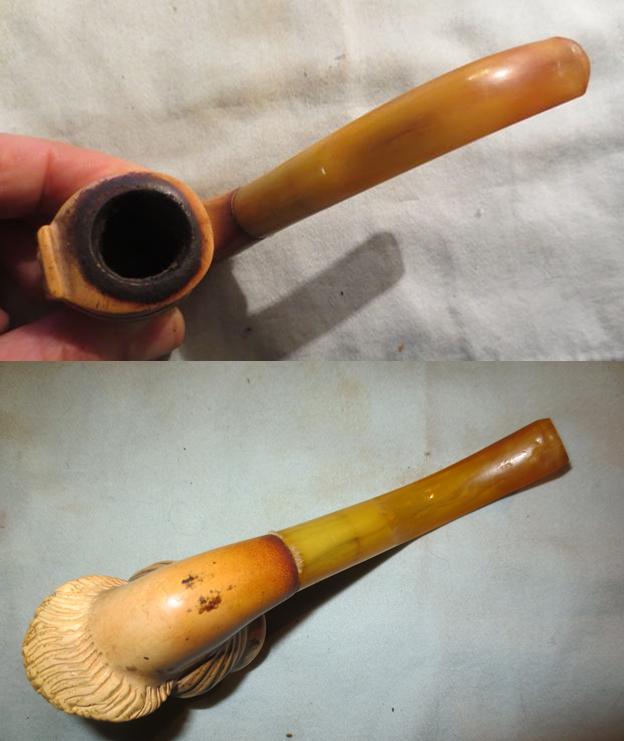
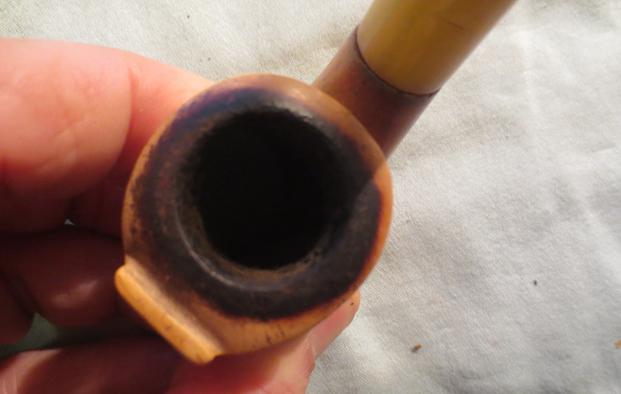
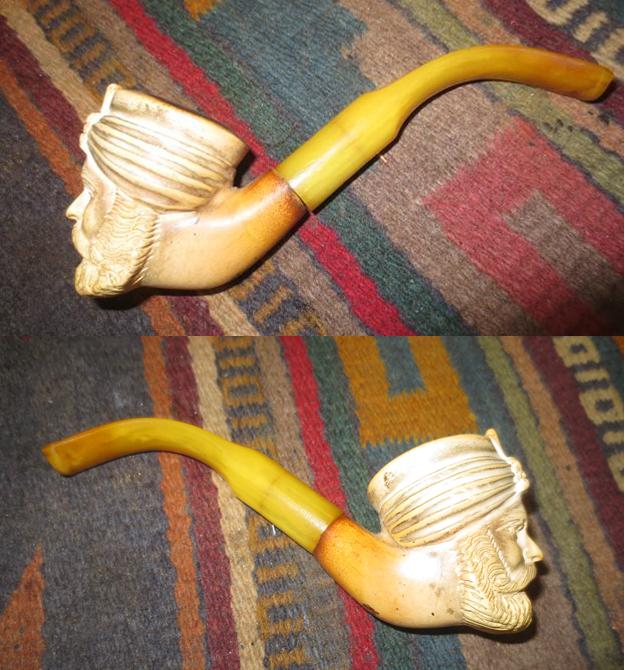
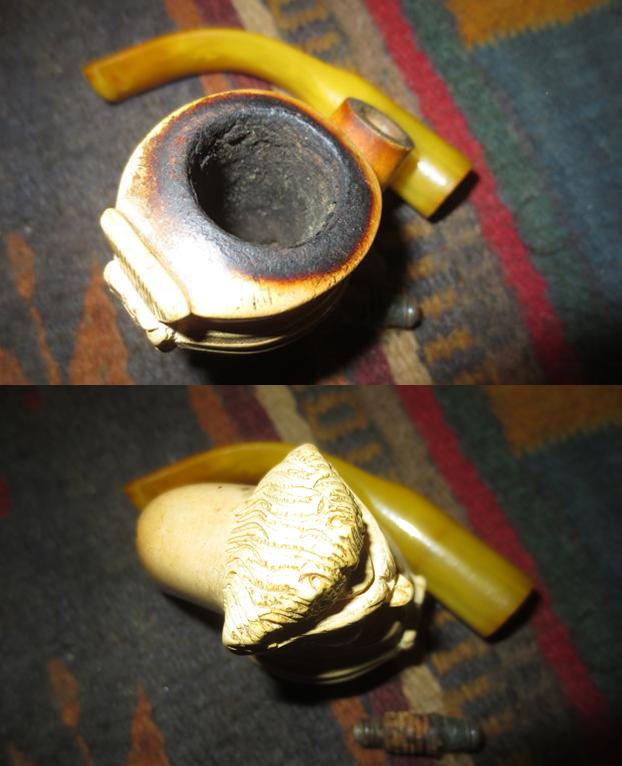
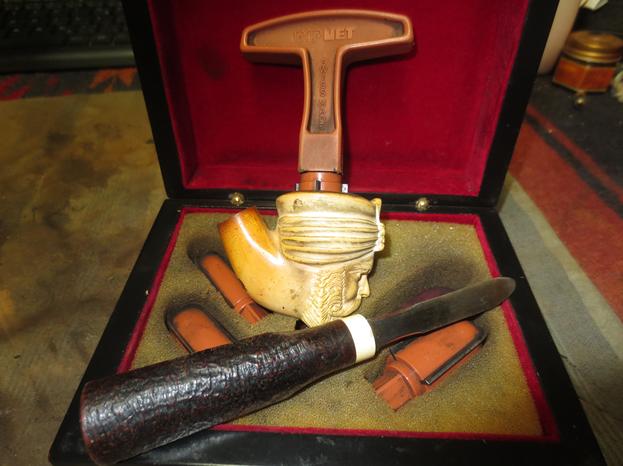
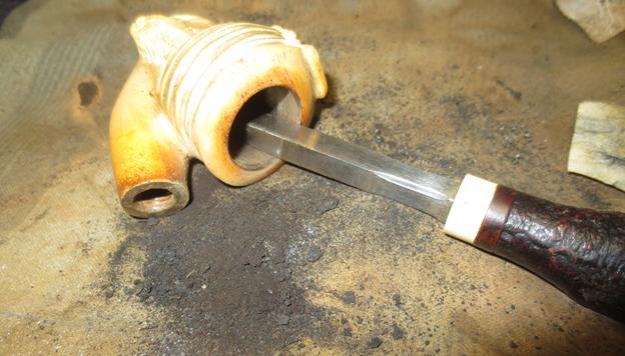
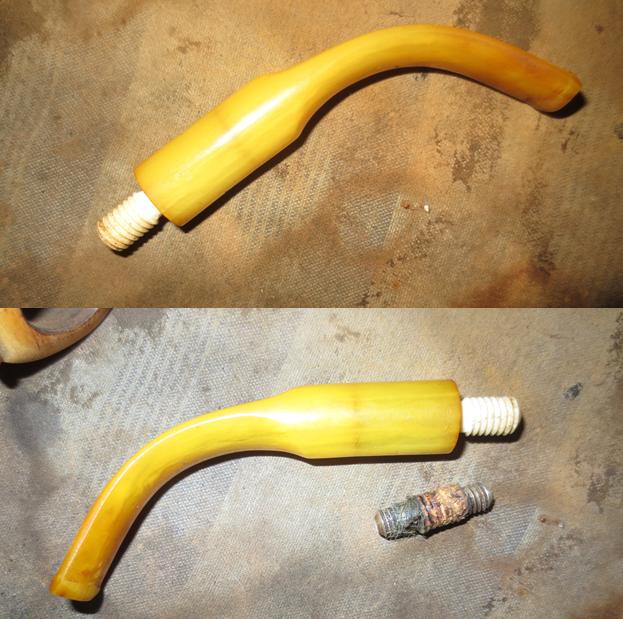
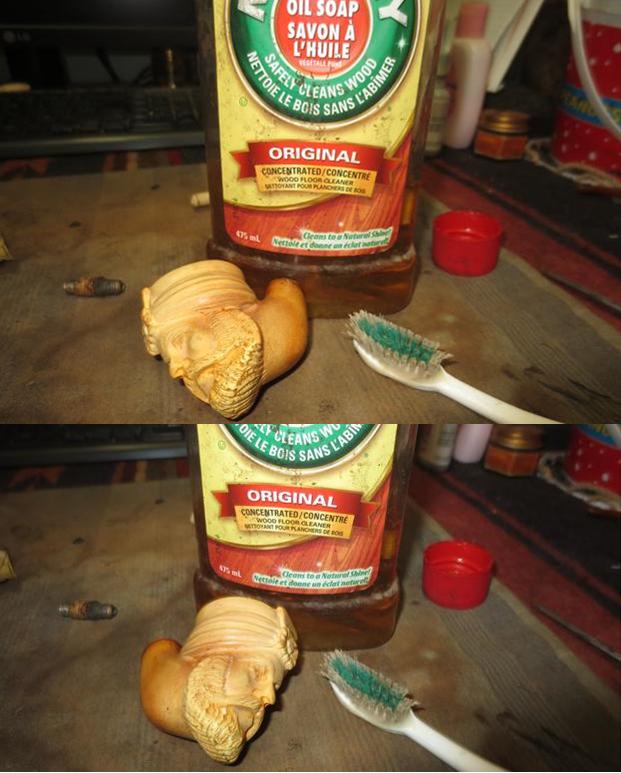
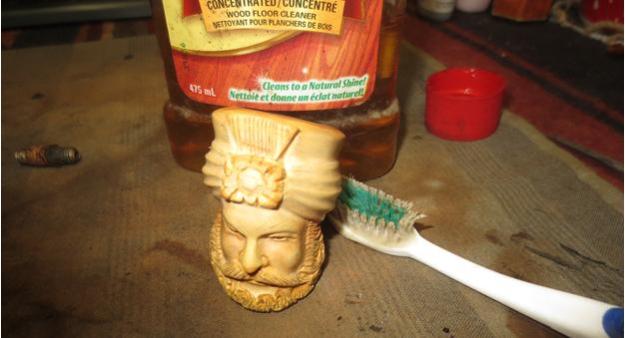
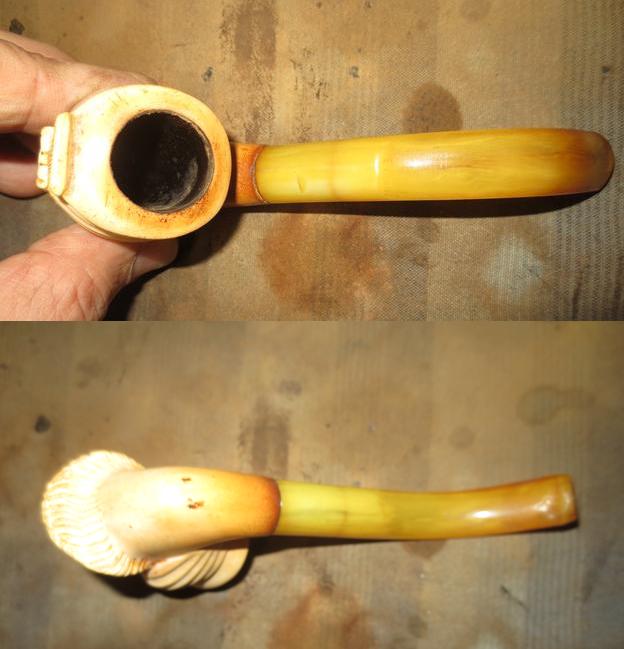
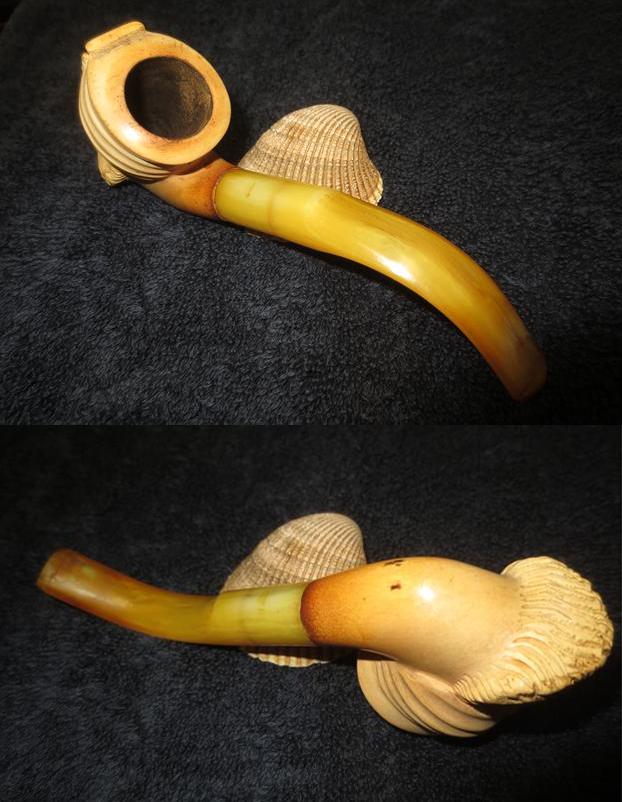
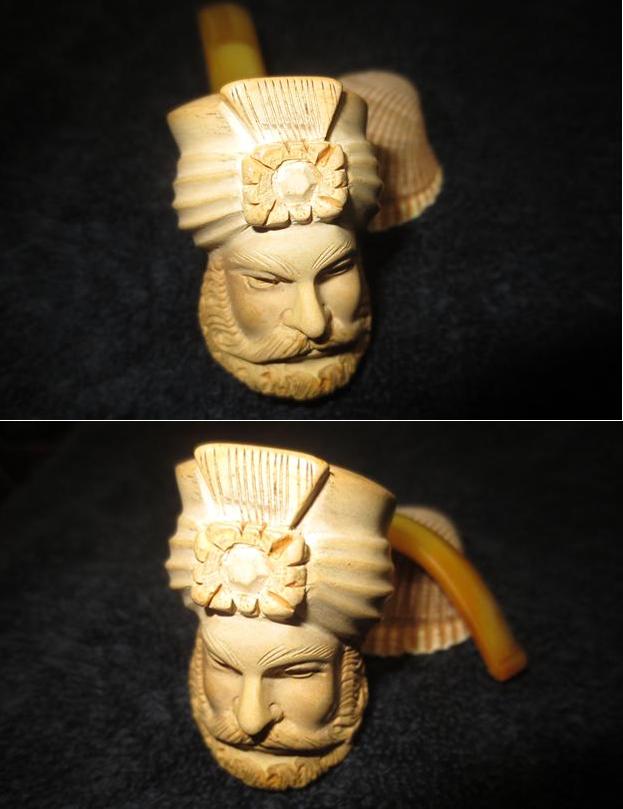
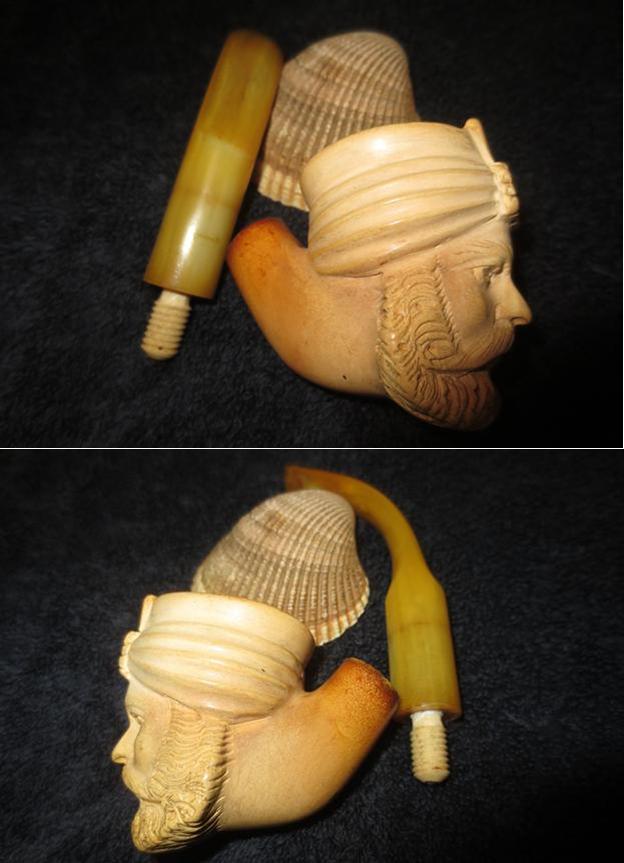
The Sultan looked rough to me as it had definitely seen better days. The meerschaum was a dirty grey colour with darkening in all of the grooves and around the cheeks and eye sockets. There was a heavy cake in the bowl and the rim had a heavy lava overflow that was thick on the surface. The stem had tooth marks and what looked to me like marks left behind by a pair of pliers when someone was adjusting the fit against the shank. Somewhere along the way someone had put a paper washer on the metal threaded tenon and wrapped thread around the tenon so that the stem lined up with the shank a bit better. One thing that could be said in the pipe’s favour was that the shank was beginning to show some colour. I took some photos of the pipe when it arrived and have included them below. The close up photo below shows the rim top and the thick cake in the bowl. The inner edge of the rim looked pretty rough but I would be better able to tell its condition once I had reamed the bowl.I put it on the work table and took a few more photos in better light to see if I could show the condition of the pipe before I started my work. These pictures more adequately show the dirt on the meerschaum in all of the grooves of the turban and the face.The next photo looking down the bowl from the top shows the crumbling cake in the bowl and the thick tar on the rim top. The second photo shows the dirt in the grooves in the carved beard.I reamed the bowl with a PipNet reamer to take the cake out of the bowl completely. A pipe man should never let a cake build up in the bowl like this one had. I cleaned up the reaming in the bowl with a Savinelli Fitsall Pipe Knife and took every remaining bit of cake out of the bowl. I unscrewed the metal tenon from the stem and used a pair of pliers to unscrew it from the mortise of the pipe. The metal tenon had been turned through a cork and the cork screwed into the mortise of the meer. It provided a tight connection but when the stem was in place the metal tenon turned in the cork. I had a new replacement tenon in my box of tenons. I used the Dremel to reduce the threads on the portion of the tenon that screwed into the stem. The other part of the tenon had the proper threads for the mortise. I aligned the tenon in the mortise and twisted and pressed the stem onto the other end.  I did a bit of fine tuning to adjust the alignment but it worked very well. I filled in the tooth marks and the marks on the saddle portion with some amber super glue. I lightly sanded it to blend it into the rest of the stem material.With the stem finished, the new tenon in place I turned my attention to the meerschaum bowl and giving the sultan a facial. I scrubbed it with a tooth brush and Murphy’s Oil Soap. I scrubbed it under gently running water and rinsed off all of the grime and darkening from the grooves, around the eyes and in the beard and turban.I dried off the bowl and put the stem in place in the shank. I buffed the pipe with Blue Diamond on the buffing wheel to give the stem a shine and polish the minute scratches that were in the meerschaum. I took photos of the pipe when I finished buffing it. You can see from the above photos that I was able to remove the grime from the meer and leave behind the patina. It had potential to be a beautiful pipe once it had darkened even more. I waxed it with a product that is made of White Beeswax called Clapham’s Beeswax Polish. It is soft so it is easily applied to the meerschaum. I warmed the meerschaum so that it would absorb the wax. I buffed the pipe and stem with a clean buffing pad and hand buffed it with a microfiber cloth. The finished pipe is shown in the photos below. It turned out to be a nice looking pipe. I think Steve is going to enjoy this one. Looking forward to hearing back from him. Thanks for looking.

New Life for an unusual CPF COLON Calabash Pipe


Blog by Steve Laug

Not too long ago, I wrote a blog about a virtual pipe hunt that my brother and I went on. He was visiting an antique mall in Montana and I was at home in Vancouver, Canada. We met at the mall via Apple Facetime and he was the hands and feet of the exercise. He happened upon a large consignment of CPF pipes as well as others from around the same vintage – late 1880s through early 1900s. Here is the link to that blog, https://rebornpipes.com/2017/04/26/a-virtual-pipe-hunt-a-new-way-to-experience-the-joy-of-a-pipe-hunt/.

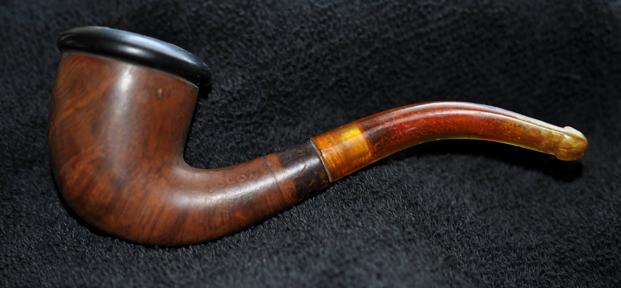
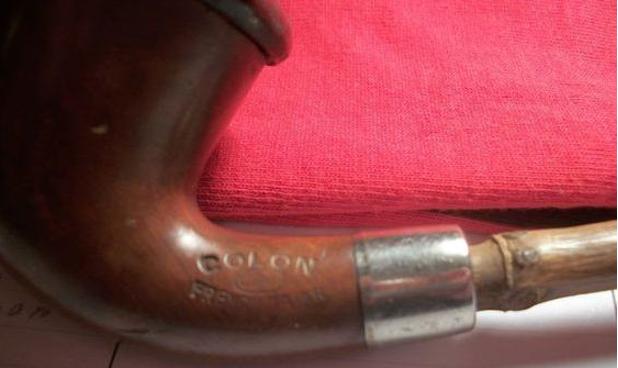
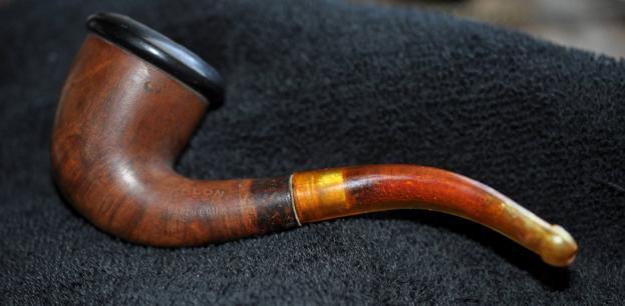
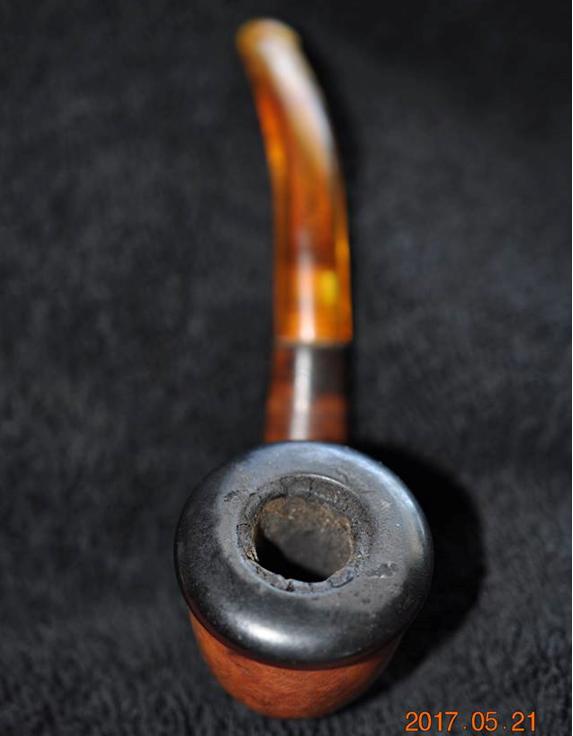
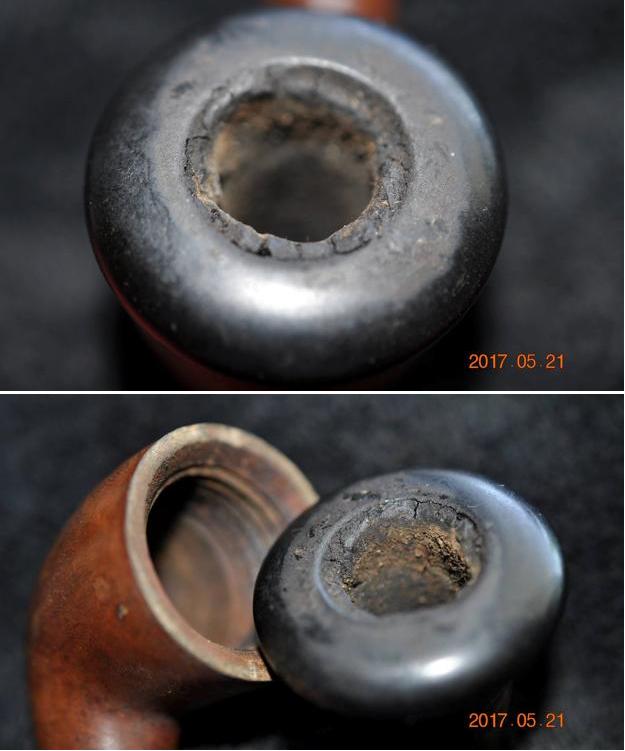
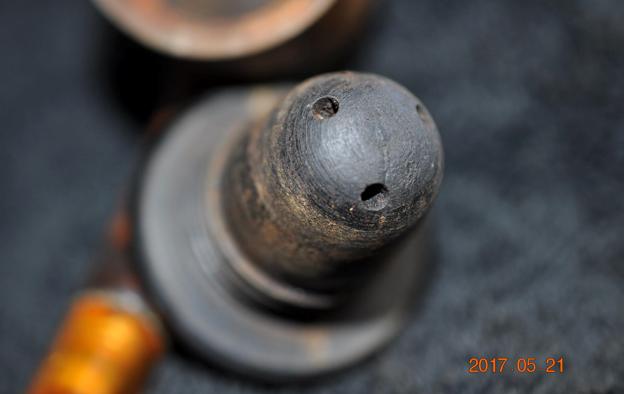
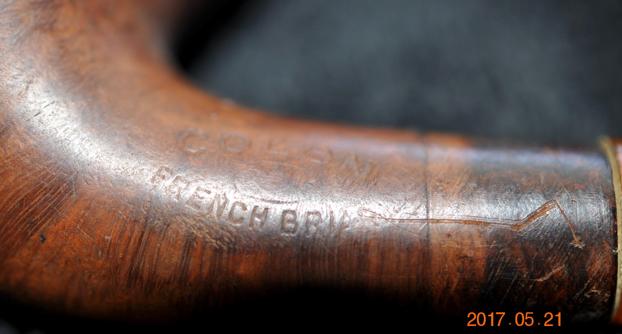
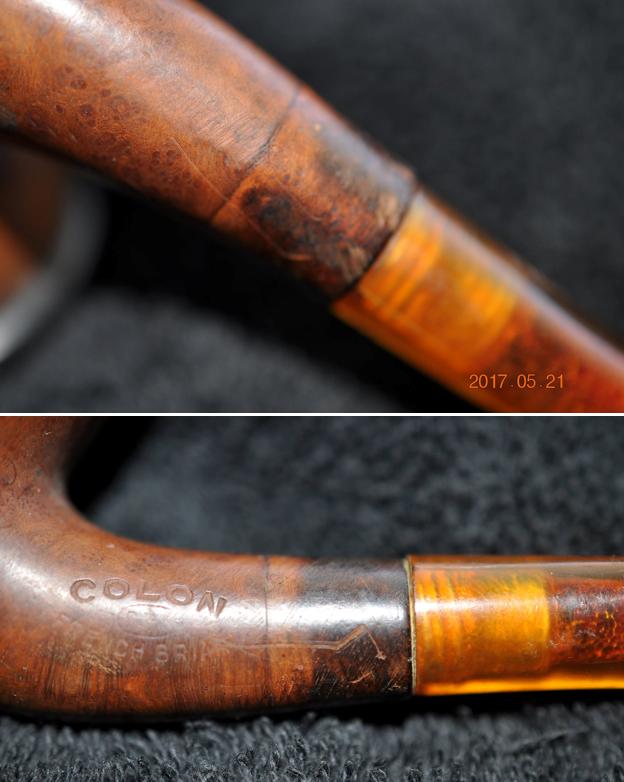
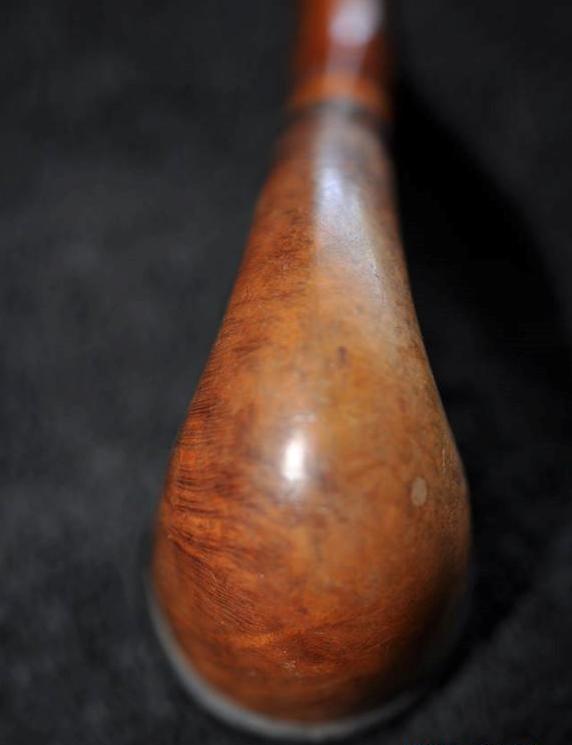
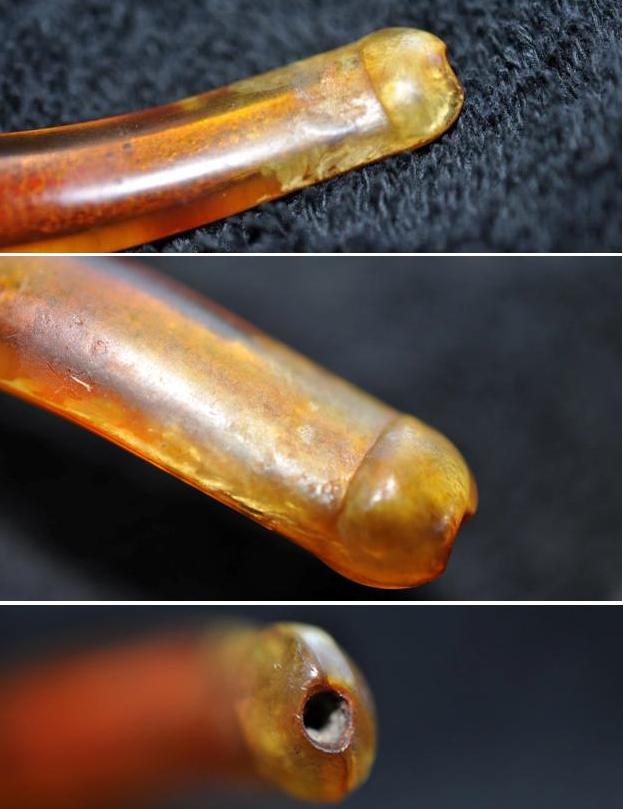
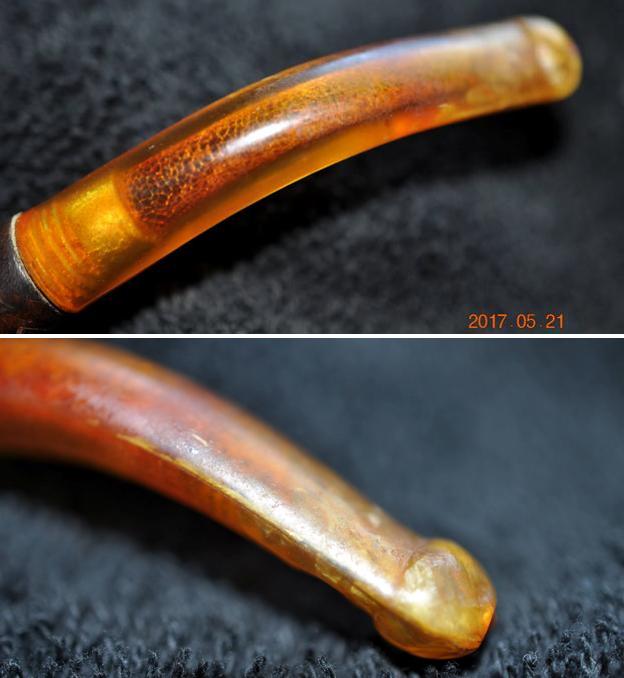
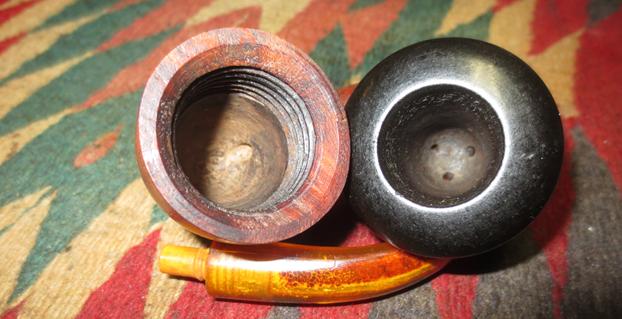
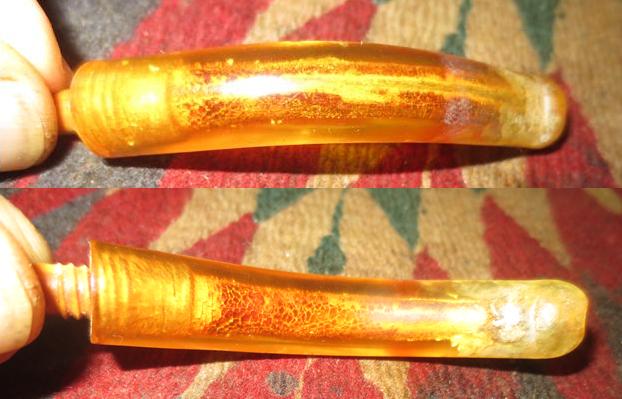
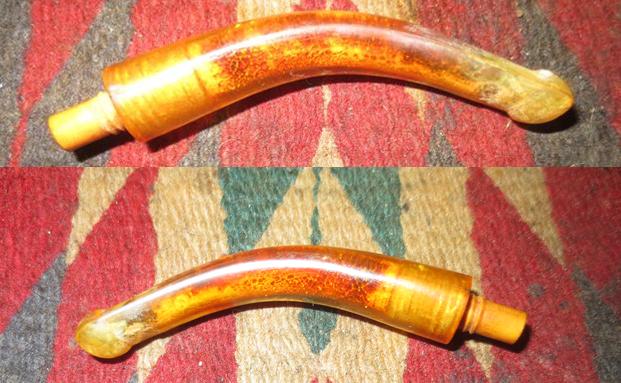
I worked on the older alternative wood pipe with a spiral shank and horn stem. It was the first pipe I worked on from the lot we found that day. I wrote about the restoration of the pipe in an earlier blog; https://rebornpipes.com/2017/06/24/bringing-an-older-1890s-era-spiral-shank-horn-stem-billiard-back-to-life/. The next pipe on the worktable was a CPF that was different from any others that I had ever seen or worked on before. It was a briar calabash with a black Bakelite screw bowl/cup. The shank was darkened and appeared to have originally had a band that had been lost somewhere along the way. That is pretty common on these old CPF pipes. The stem was amber and needed some work to bring it back to usefulness. The pipe is stamped on the left side of the shank with the words COLON in an arch over the CPF logo in an oval. Underneath that, is stamped French Briar in a reverse arch thus encircling the CPF logo. There was no other stamping on the right side or underside of the shank. There were two sandpits/flaws in the briar that I would need to address but it was a beautiful little pipe.I did a bit of research on Google to see if I could find any information on this particular CPF pipe. There was not much information on that brand and some of the info was almost comical in that the key word in every listing was “COLON”. You don’t need me to spell out what kind of listings were found. The one thing I did find was a photo that someone pinned on Pinterest. Here is the link; https://www.pinterest.com/pin/495255290248000765/ . I have included the photo below that was posted there. The label on the pinned photo read: TOBACCO PIPE, CIRCA 1915, “COLON” BOWL, French Briar, C.P.F. It is the same pipe as the one on my table but mine has better grain in the briar bowl. Mine also came with a stem.My brother took photos of the pipe (including the first one above) before he started to work on it and clean it up. When he sent me these photos, I was really interested in getting my hands on it and cleaning it up. I could not wait to see it up close.Jeff’s photos showed the condition of the pipe really well and gave the reader some idea of what it looked like from a variety of angles. The top view of the bowl showed the thick cake that had formed in the Bakelite bowl and the lava that overflowed on to the rim top.  The next three photos show the Bakelite bowl and rim top, the bowl unscrewed from the briar bowl and the underside of the Bakelite bowl. The cake is very thick and looks hard. Once the bowl is out of the base it is amazingly clean considering the condition of the Bakelite bowl. The underside of the Bakelite bowl is also clean. It has three holes that carry the smoke from the bowl into the base, shank and stem to the mouth of the smoker. The threads in both are intact. He also included some close up photos of the shank and the stamping. He has a much better camera than I do so the stamping photos clearly show the condition of the stamps – they are worn but readable with a lens and a light. The marks on the shank appear to be from the time that the band was pried off the shank. Looking at it under a lens there are no cracks in the shank. He sent along a photo of the underside of the bowl as well. It is a pretty piece of briar.The photos of the condition of the stem were telling in many ways. There was a lot of tooth chatter and tooth marks on both the top and underside of the stem near the button. There were also fracturing and splintering along the edges that helped me conclude that the stem was amber. The next photos show the stem from a variety of angles including a photo of the orific airway in the button. The stem had a buildup of tars and oils on the inside of the airway that would need to be removed. I reread what I had written regarding the history of the CPF or Colossus Pipe Factory brand before I started the restoration work on this pipe. I am glad I collected the data in one place because I would otherwise have had to redo the work each time I work on a CPF pipe. Here is the link to the history of the brand. https://rebornpipes.com/2013/04/14/some-reflection-on-the-historical-background-on-cpf-pipes/ I have included a few choice paragraphs that help with the identification and the dating of the brand. You can read the entirety at the above link but here is a summary to connect this pipe to the history of the brand.

“One of the secondary hobbies to pipe refurbishing that I enjoy doing is to research the history of a particular brand or make. In a recent EBay lot I bought there were 3 pipes that were stamped with the CPF logo – CPF in an oval with the word FRENCH stamped in an arch above the oval and the word BRIAR stamped in an arch below the oval. I had heard that the CPF stood for a variety of names from Consolidated Pipe Factory to Colossus Pipe Factory and even Chesterfield Pipe Company. There was a wide range of conflicting information available on the websites and forums that I read while looking into the brand…”

“…CPF in the logo stands for Colossus Pipe Factory. The brand was purchased by KB&B sometime between 1884 and 1898 and it continued until 1915. That time frame gives help in dating some of the older CPF pipes you or I might find. It can be said that prior to the dual stamping it is fairly certain that the pipe is pre-1884 to 1898. After the dual stamping it can be placed post 1898 until the closure of the brand line in 1915. CPF made beautiful pipes. I believe Sam Goldberger was correct in his assertion that the carvers who made the pipes were of European training and used the classic shapes and well-aged briar.”

Armed with that information I was able to narrow down the period that this was made. Since the pipe bears only the CPF logo, I think that it is safe to say it was made before the time of the buyout by KB&B in 1898. That would mean that it is dated somewhere between 1884 and 1898. From 1898-1915 all of the pipes that came out of the factory bore a dual CPF/KB&B stamp. The fact that this one does not have the dual stamp further solidifies the date of manufacture as being from the 1880s to the late 1890s. This information goes against the information I included with the Pinterest photo above which identified the pipe as being made in 1915. Like I thought when I took when I first saw it – this is an old pipe.

My brother did a great job cleaning up the pipe – bowl, base and stem. He reamed the bowl with a PipNet pipe reamer and a Savinelli Fitsall Reaming Knife and removed all of the cake. He cleaned the Bakelite with soap and water and scrubbed it with a tooth brush. He scrubbed the briar exterior with Murphy’s Oil Soap to remove the grime and grit. He cleaned the interior of the briar bowl and the mortise and shank with pipe cleaners, cotton swabs and alcohol. The stem was harder. He cleaned out the majority of the oils and tar build up with pipe cleaners and a little alcohol. He sent it to me to finish up but it was pretty decent. I took the next four photos of the pipe to show what it looked like when it arrived in Vancouver. I took a close up photo of the bowl and the rim top to show the difference between what it looked when he brought it home and what it looked like when I got it. I also took the bowl apart and took two photos of the parts. I took photos of the stem to show the condition from all angles. He got a lot of the grime out of the airway but there was still a lot there that needed to be cleaned out. I would need to remove the threaded tenon to do justice to the airway cleaning. I ran some alcohol, pipe cleaners and cotton swabs through the shank and the bowl to double check on the cleaning and it was really well done. The inner beveled edge of the bowl looked really good. I removed the tenon and scrubbed the stem with pipe cleaners, cotton swabs and Soft Scrub Cleanser. I rinsed it with warm water to remove the soap. I was able to get much more of the tars and oils out with the Soft Scrub. I used a needle file to define the edge of the button and make the angle sharp once again. I used the file on both sides.I lightly screwed the bone tenon in place in the stem. I would adjust it once I was ready to put the pipe back together again.I went through my bands and found a nickel band that would fit the shank. I sanded the shank to remove the darkening, nicks and dents and prepped the surface for pressure fitting the band. I used a Dremel and sanding drum to grind back the band width to make it fit the depth of the shank that I wanted to cover. I did not want the band to extend over any of the stamping.I heated the band and pressed in place on the shank. I used the Dremel to grind the band down further and sanded the edge with 1200-2400 grit micromesh to smooth out the sharp edge. I filled in the sand pits on the bowl with clear super glue and briar dust and sanded it in to blend with the rest of the briar. I filled in the nicks on the top of the Bakelite with clear super glue and sanded it smooth once it dried. I needed to buff both bowl and cup but it definitely looked better. I screwed the bowl in place on the base and took the following photos. I polished the stem with micromesh sanding pads – wet sanding it with 1500-2400 grit pads and dry sanding with 3200-12000 grit pads. I rubbed the stem down with Obsidian Oil after each grit to remove the sanding dust and give me some more bite when I sanded it with the next grit of pads. I polished the briar bowl and the Bakelite insert cup with micromesh sanding pads – wet sanding with 1500-2400 grit pads and wiping it down with a dab of olive oil after each pad. I touched upt the gold leaf in the stamping with some European Gold Rub’n Buff. Once I finished I buffed the bowl and insert with Blue Diamond on the buffing wheel to polish it and buffing the stem separately. I waxed them separately as well with Carnauba wax. I buffed them with a clean buffing pad and hand buffed them with a microfiber cloth. The finished pipe is shown in the photos below. I really like the finished look of the pipe.

Fanfare for the Everyman Pretender


Blog by Robert M. Boughton

Member, International Society of Codgers
Member, North American Society of Pipe Collectors
Member, Facebook Gentlemen’s Pipe Smoking Society
Website Roadrunner Restored Pipes
Blog RRP
Falderal About Me
Photos © the Author except as noted

From their inception, Kapp & Peterson’s goal was to make a good smoking pipe that the ordinary, common working man could afford and we believe they have, very admirably, lived up to this.
— From A Peterson Dating Guide: A Rule of Thumb, by Mike Leverette

INTRODUCTION

The restoration this blog recounts has nothing to do with Peterson’s pipes.  Still, the litany of near fabled proportions in pipe lore, that Charles Peterson and the Brothers Kapp, Friedrich and Heinrich, experienced a mutual epiphany of good will toward all, even the less fortunate commoners, still rings forth in perfect, ever-flowing three-part harmony.  The more probable truth, after all – that the good men of K&P had a capital brainstorm in the form of a simple but revolutionary merchandising notion to market early designs of Peterson’s System pipes starting sometime in the last quarter of the 19th century – lacks a certain universal, perpetual attraction, as it were.

Now, I should at least attempt mitigation of the foregoing critique I ’am sure will be perceived by some as an unwarranted attack on one of the last bastions of master pipe craftsmanship, as some readers may misinterpret the kind of remarks I’m prone to make after I’ve spent a good deal of time thinking a matter through.  No kind of disrespect on my part for Peterson of Dublin could be farther from the truth.  One fellow on the Smokers Forums UK who had never met me other than a few cursory cyber comments back and forth once made me the butt of a snarky but harmless jab after I posted a brief description of my restoration of a nice though common System Pipe that I decided to offer for sale given the number of finer samples in my collection.  So far, I’ve bought about 33 Petes I kept, not counting those I passed on to others with the gleam of love in their eyes I know so well.  As I recall the unhappy SF member’s words in typed reply, they were: “Wonders never cease!  I didn’t think I’d live to see the day you would say you could have enough Petersons!”  The member in question warmed up quite a bit after I began flooding his posts with compliments, and they were even genuine.

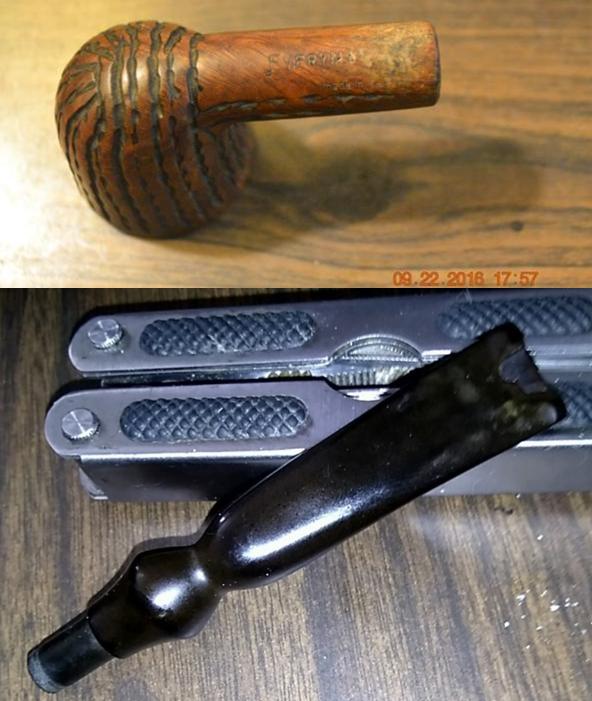
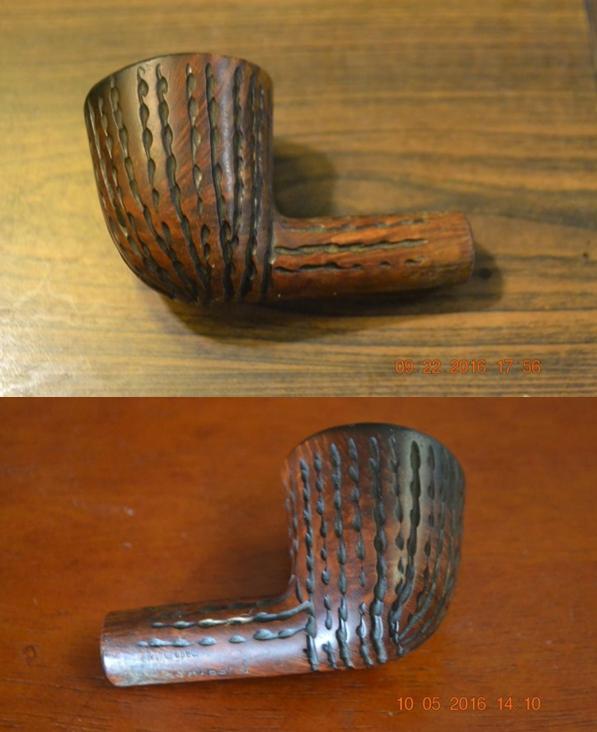
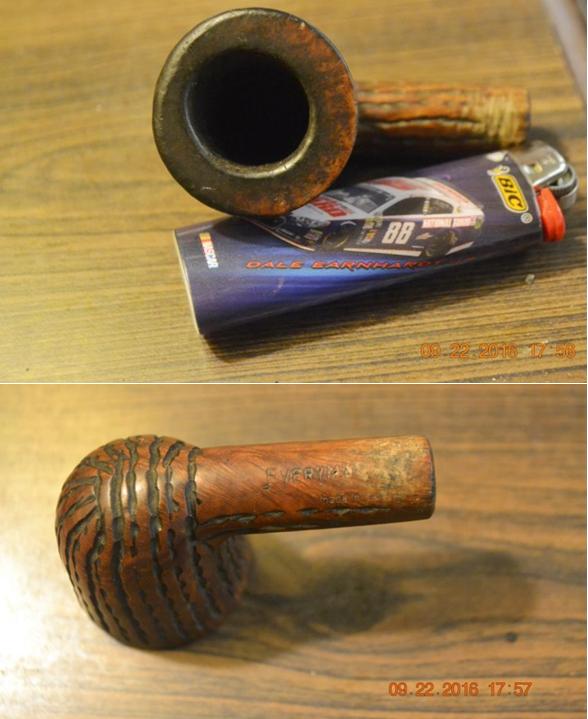
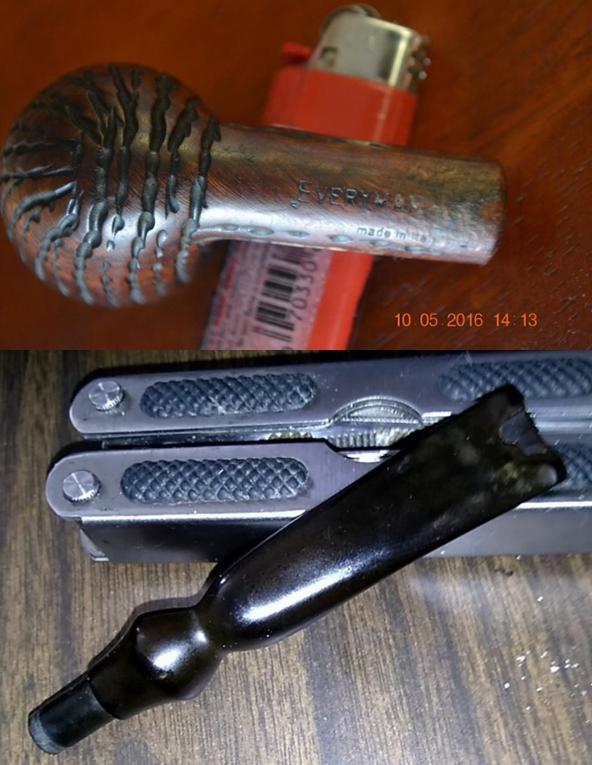
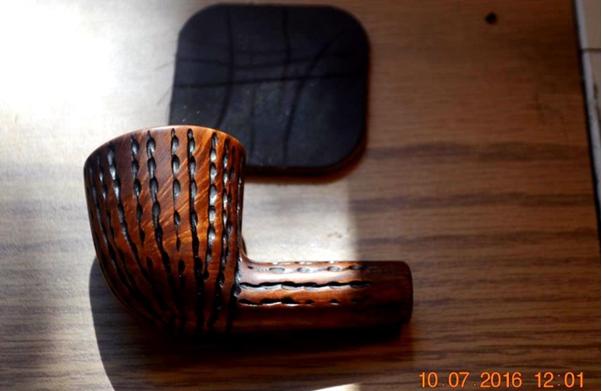
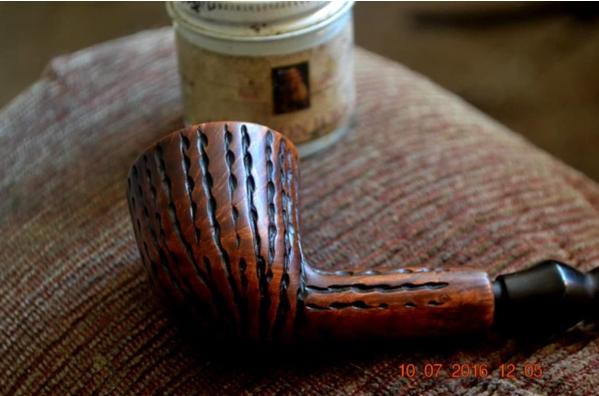
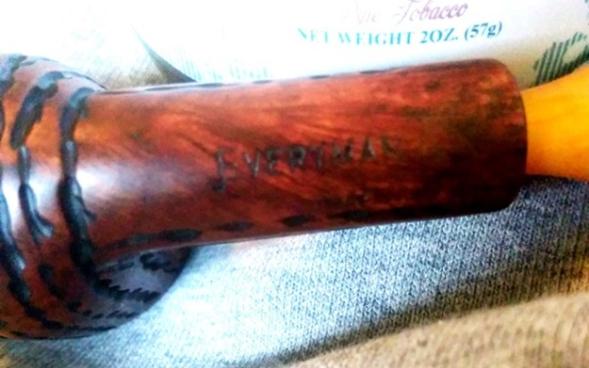
The real mystery of this blog is the single mark of nomenclature on the entire pipe, even counting the original black Vulcanite/Ebonite bit of the style called “fancy,” but which proved to be broken beyond my time and patience if not ability to repair.  Even the relative ease of the kind of work needed by the likes of Steve to mend a gap in the upper lip of the mouthpiece as gaping as that shown below requires, as our host notes in the blog cited under Sources, much practice.  Also – and this is an important factor, not an excuse – I intend to sell the pipe, not keep it for the shop, and at times have different standards for the two choices.See the date and time stamps?  I worked on the infernal bit from then until a couple of weeks ago before settling on the better part of valor.  As can be seen from the stummel, the pipe is called, with somewhat disingenuous simplicity and similarity to the well-known The Everyman London Pipe by Comoy’s of London (with all of that and more stamping packed onto even the sandblasted versions of the latter).  From the beginning, when I acquired the bedraggled waif in an estate lot at least two years ago and sat on it until late September last year, I had one of those uneasy feelings in my stomach at the mere idea of committing myself in print to the conclusion that it was in fact somehow part of the Comoy’s brood.

Before I snapped my habitual first seven shots of the pipe as it presented in O.R.  with more worthy candidates ahead of it in triage, I began my online search that only further clogged the veritable obstruction in my intestines.  Having made some genuinely heroic efforts on real Everyman and Guildhall London Pipes in my limited time learning this wonderful tradecraft, in the combined senses of the words as well as the more clandestine meaning of the singular, I knew just what to expect from Pipephil and Pipedia but visited both once again anyway.  Variations on this theme continued off and on during the interim period until a few days ago when I took the

Google approach of “I’m feeling lucky” and again entered the terms “Everyman Pipes.”  I swear I typed the same simplest of many search terms I had tried for two years, but this time, in one of those inexplicable flashes of serendipity, the top listing was for P&K Everyman Pipes at JR Cigar!

Growing breathless, I clicked on the link and saw, more or less, my pipe in two other shapes but with the same distinctive fancy bits and rugged vertical striations around the bowls, and both were straight.  One was a billiard, the other a pot, and both, marked down $10, were still, to me, listed at an outrageous $31.95.  Despite all that, I was quite pleased with myself to read the blurb at the top of the page:

“A true example of eye-catching yet economical handcrafted tobacco pipes, the P&K Everyman selection by the famed Comoy’s of London promises a premium pipe-smoking experience at prices that can’t be beat.”

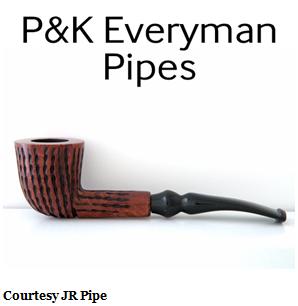
 I scanned further down the search result page, spotting a listing for the same pipe brand at Santa Clara Cigar, possessed of a remarkable resemblance to JR but with the Comoy’s blurb, ahem, omitted.  Nevertheless, at the fourth of five shapes down, there was my pipe, the P&K Straight Rustic #9, a Dublin.  Better later than never, the idea of looking up P&K Everyman pipe images occurred to me and at the top I saw the following, being the perfect factory image of my pipe.

OK, then.  As supremely pleased with myself as I was at this morsel of intel, even if some faiths that consider pride a sin could be right, I am not now nor have I ever been a member of the Nitwit Party, whose followers believe everything they read on the Internet or hear on TV is the truth.  There are many reasons for my worldview, not the least of which being my years as a newspaper journalist and photographer, as opposed to a photojournalist.  I sold my first news article when I was 15, and when I was 17 became credentialed by the Los Angeles County Sheriff’s Office as an official police and justice beat reporter for a community paper.  My publisher, editor and I tried the year before, and although there was no real age clause at the time (1978), the powers-that-were in the L.A.S.O. were too – well – pig-headed to relent until I gave everyone in the issuing bureau a major headache re-applying on the first of every month.

I try, no joke, not to pester Steve with questions to which I can find or – OMG! – figure out on my own using the brain that was between my ears at birth and, operating best on the right side of it, form a working plan to press on.  One of my best qualities is the willingness to admit at once when I am wrong, which in fact is a very good thing because I have had much more experience with that than, say, repairing bits with outlandish holes gnawed through them by people with Intermittent Explosive Disorder or tardive dyskinesia.  And no, I’m not making fun of people with disabilities, in particular schizophrenics, who seem to have been drawn to me all of my life, other than most of those in my family for some reason.  It’s sort of Cole Seer’s dramatic need in The Sixth Sense, having to be like a shrink to dead people. At any rate, Steve is one of the busiest, most productive persons I know, traveling the world almost non-stop, it seems at times,  doing good works while never letting on that his constant other full-time “job” writing and publishing mostly his own pipe restoration adventures and posting those of other contributors online.  All of this last part is by way of a drum roll of sorts.

You see, had I not called and left a brief message on Steve’s phone before emailing him more than the full details, as par for the course, I never would have received back the following concise words of wisdom as to the possibilities of who really made the Everyman Rustic Dublin on which I’m so very close now to describing all of the work I did!  Yes, I am!  Steve’s reply, in pertinent part, read:

I got your message when I got home late last evening and then read the email this morning.  I have not heard of the P&K brand and Everyman pipe does not at all look English to me. I am wondering if it could  possibly be from one of two original makers.

1. Alpha pipes Israel made for the cigar shop – the finish, style of the bowl and the stem make it look very much like many Alpha Israel pipes ) pre-Grabow ownership.

2. Lorenzo pipes Italy as they made many basket pipes for different shops.

That is as much as I would hazard to guess.

If I’ve ever needed Steve’s direction in research for a restore, this was it!  There is no way I would have reached those conclusions with such apparent ease and speed, in fact not ever, no how, no way, because I just don’t have his experience.  I mean, if there were a way I could get him to donate me a spare kidney or maybe his spleen so I could, like, grow all of his knowledge, why, I’d lie down on the table and do it in a heartbeat.  For now I guess I just need to get busy buying up and devouring and going back to again and again all of the great reference books out there, such as Who Made That Pipe?  The bottom line here is that Steve’s tip came back so fast my head spun like Linda Blair’s in The Exorcist, not to overdo the whole movie thing.

All I had to do was figure out how to look up the Lorenzo and Alpha possibilities, which I knew I could manage, and I did a few minutes after reading Steve’s email.  The funniest place the Lorenzo idea led me was to some images of my own restoration of a gigantic Spitfire by Lorenzo Mille I restored and blogged just before Hallowe’en 2014.  The money card turned out to be with the pre-DrG Alphas made in Israel.  I found the following oddly familiar-appearing Burl Briar Freehand Pipes on eBay, complete with the same fancy bits curved just so.

Case closed.

RESTORATION

The bit aside, the only real problem with the pipe, and it was a real problem to be sure, was the rim.  Char and even the worst blistering from a close call with full-blown combustion, which so far I’ve had the opportunity to witness only with homemade corncobs, have often occasioned rise to heated anger but never cold feet.  (I – tender my apologies for all three puns.)  My mother for many years rose in the nursing world and enriched my vocabulary with terms the likes of crispy critter, with all of their brio, and sometimes spread cat cadavers across the dining room table, both extenders in place, on a single large thermo scientific wrap-around cover.  Thus I looked at the “easy” heat damage and the acute and problematic jagged rim edge and unequal width of the bowl’s peak with a logical, methodical approach that began to form.

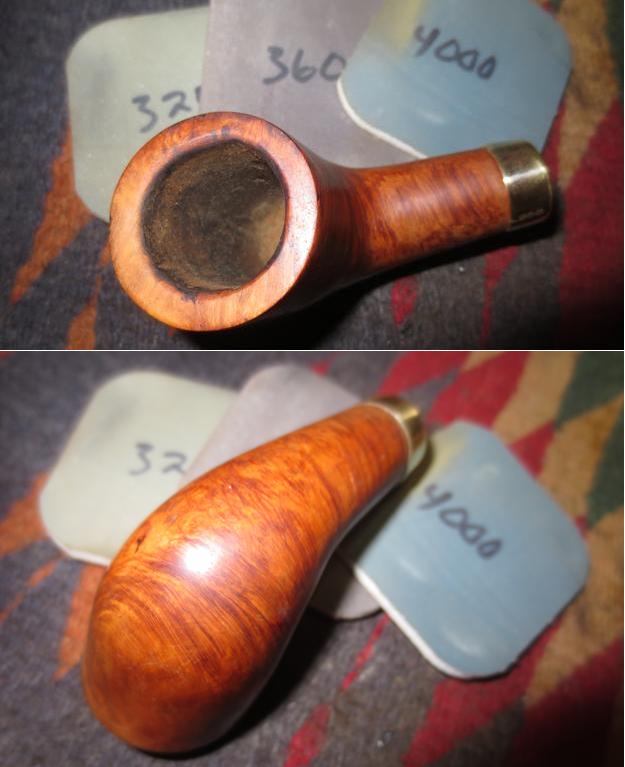
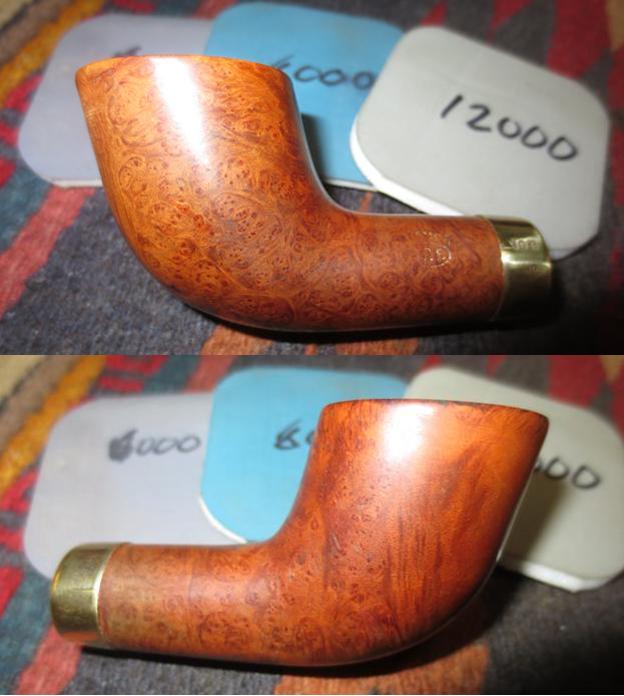
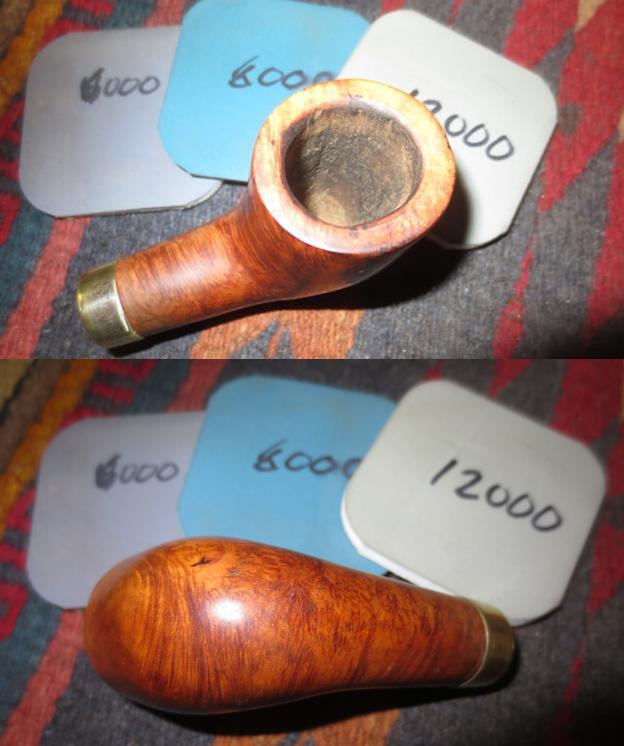
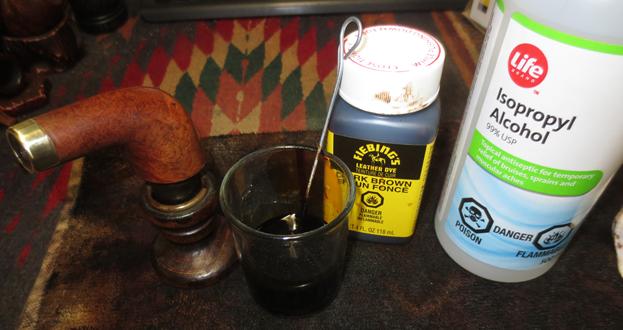
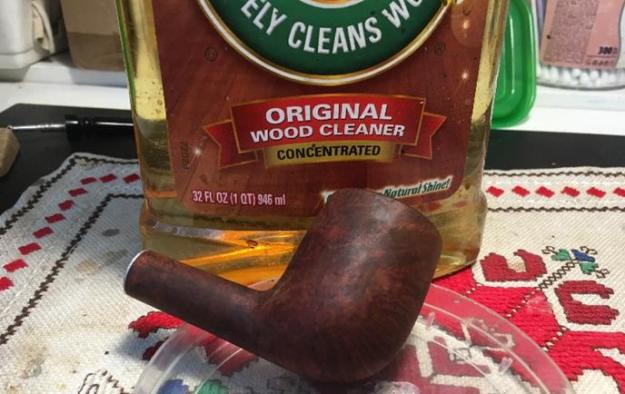
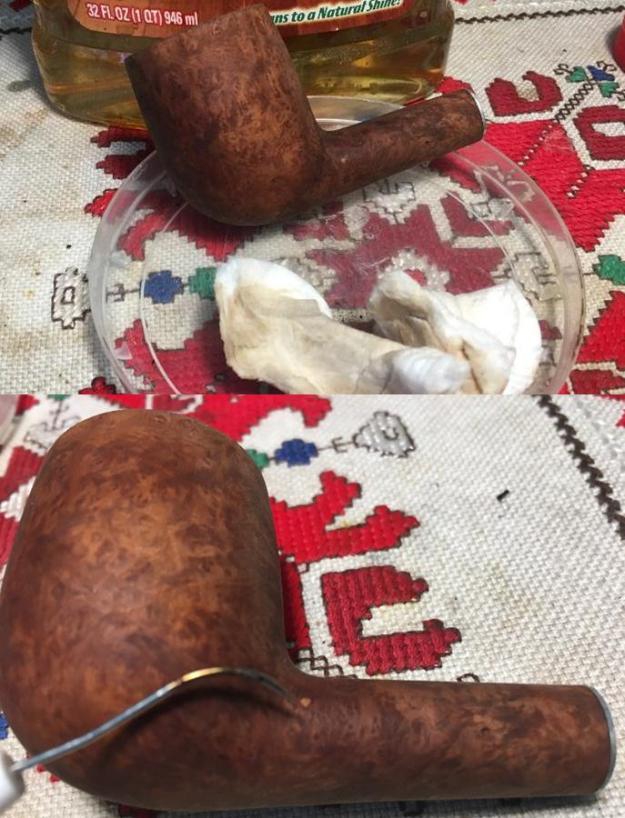
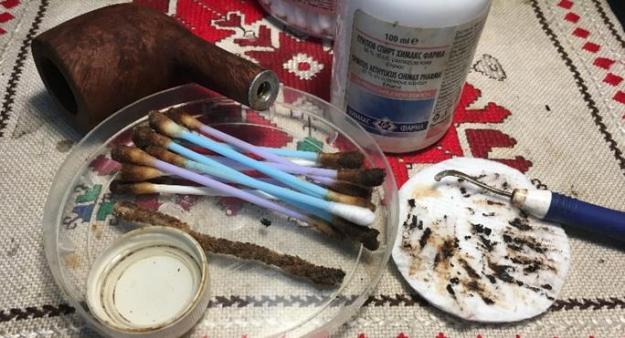
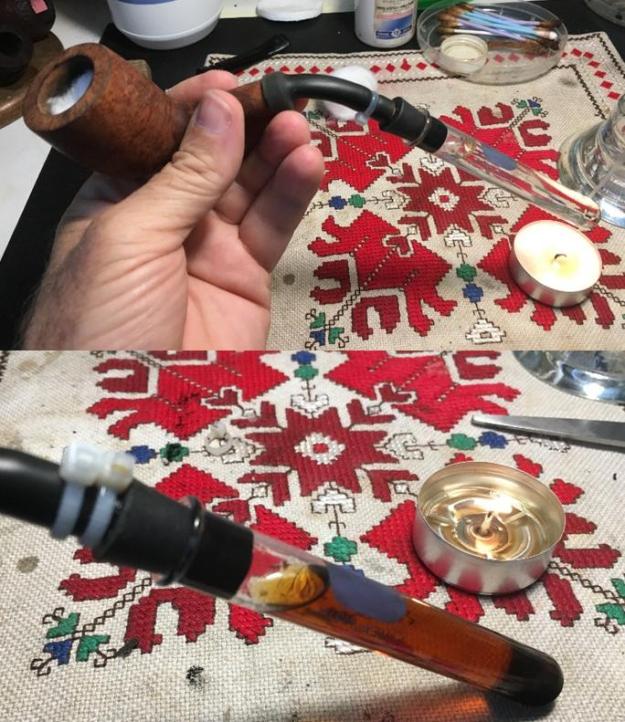
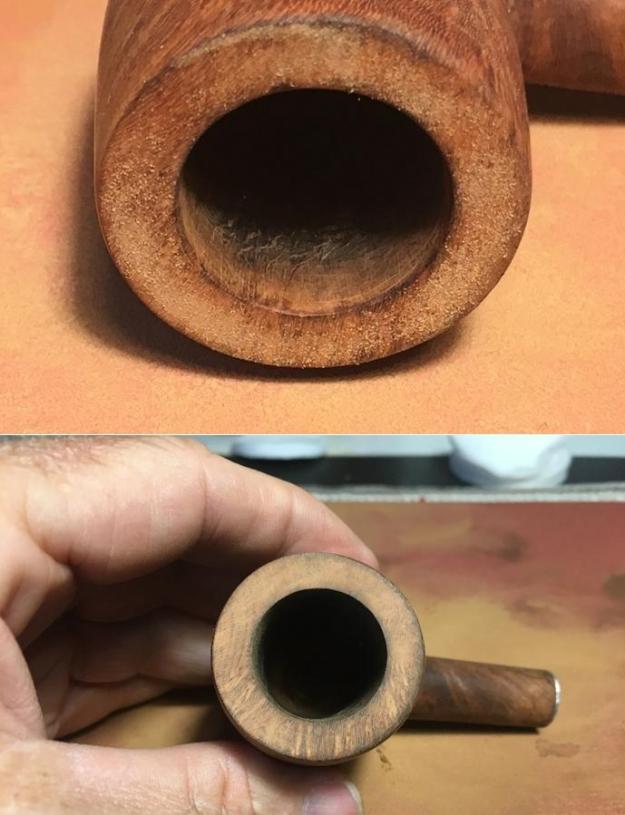
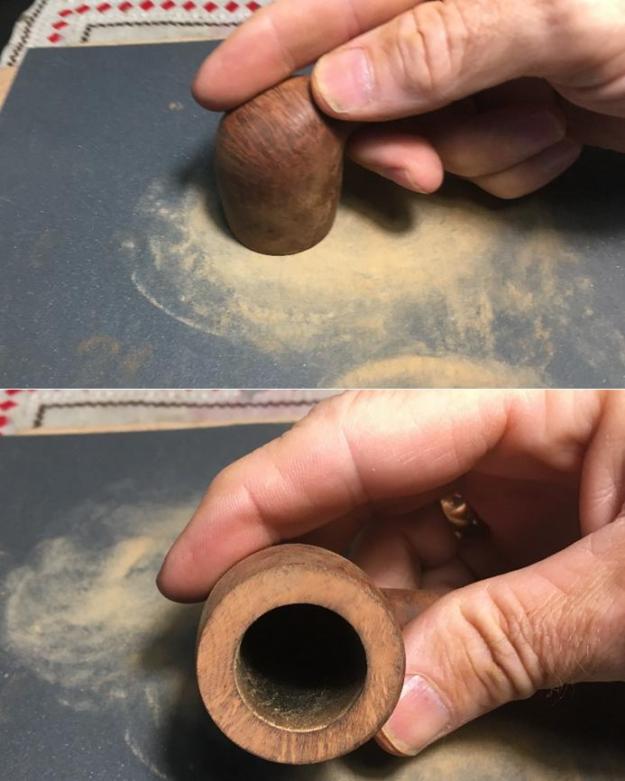
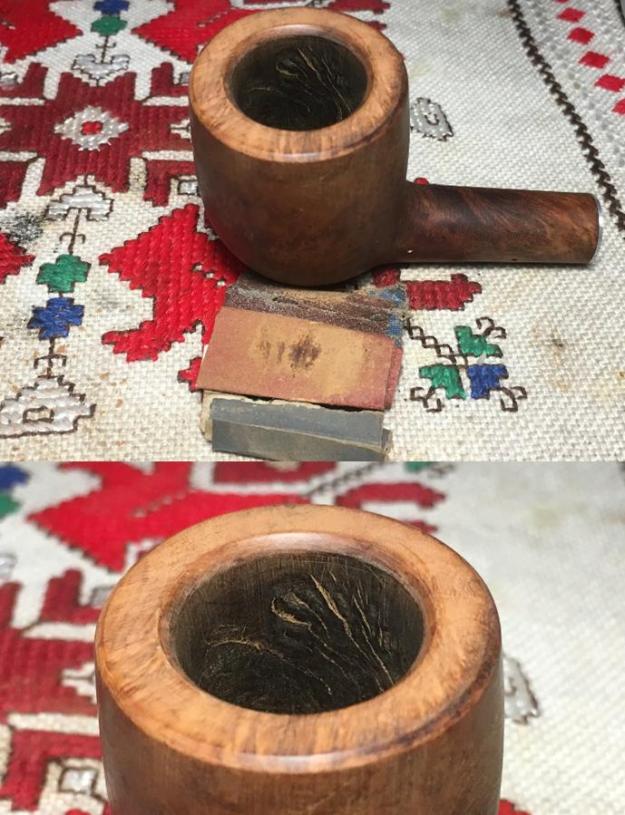
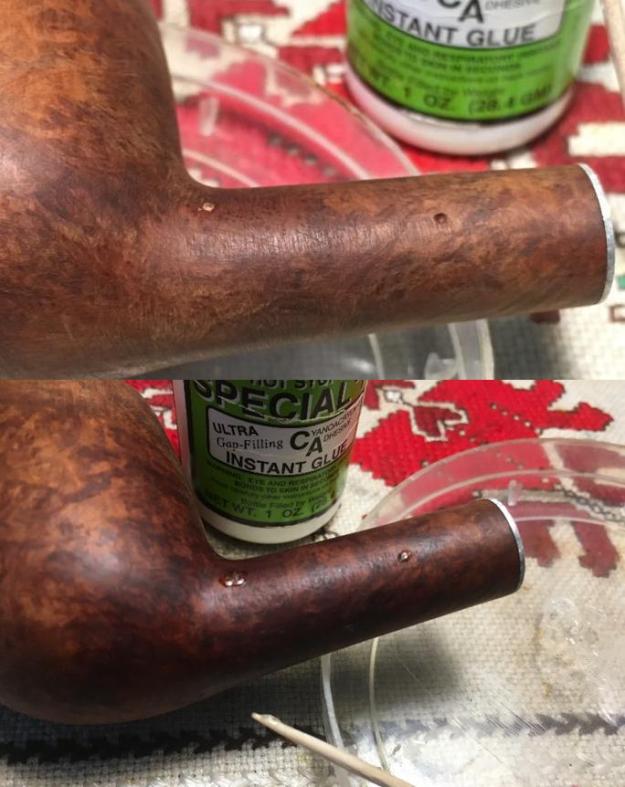
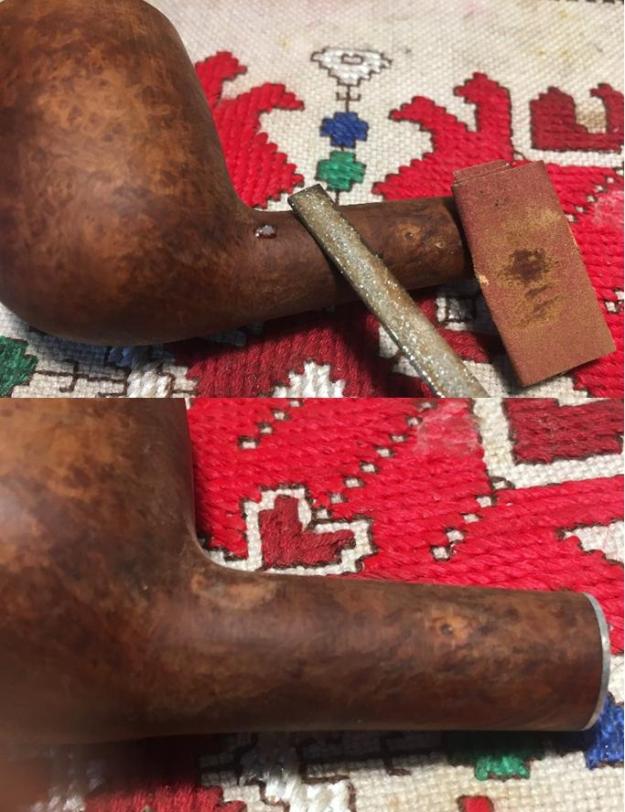
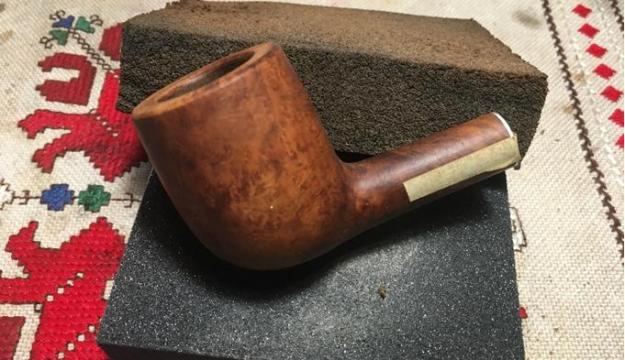
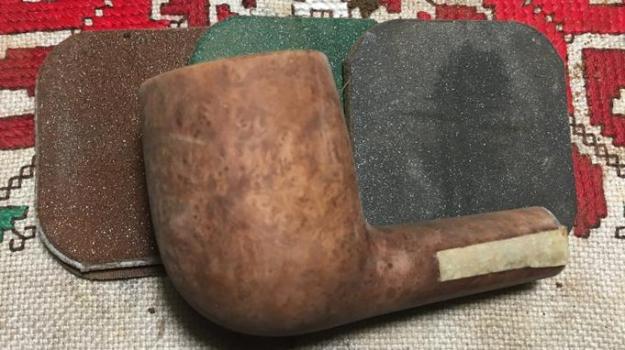
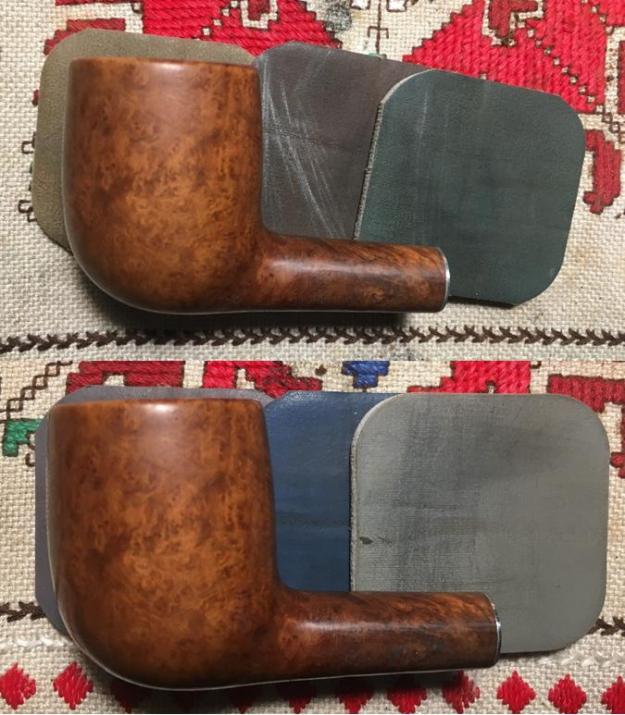
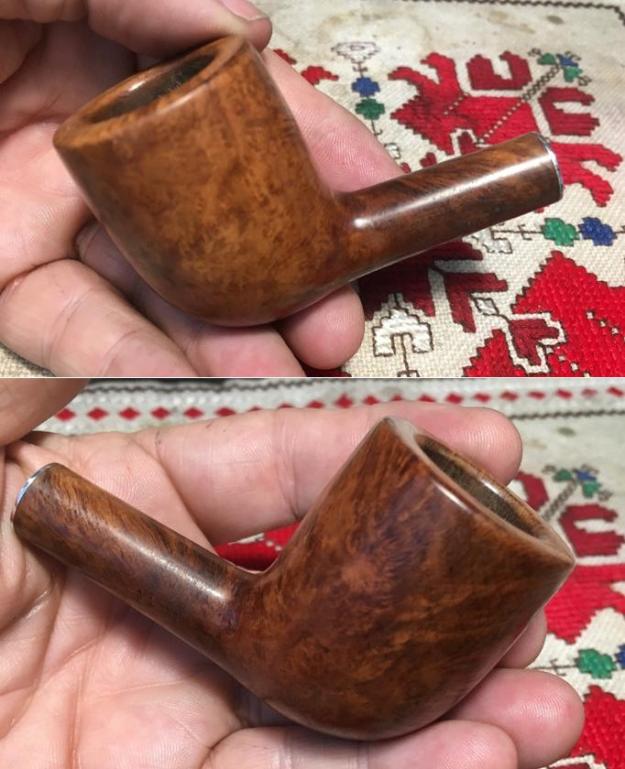
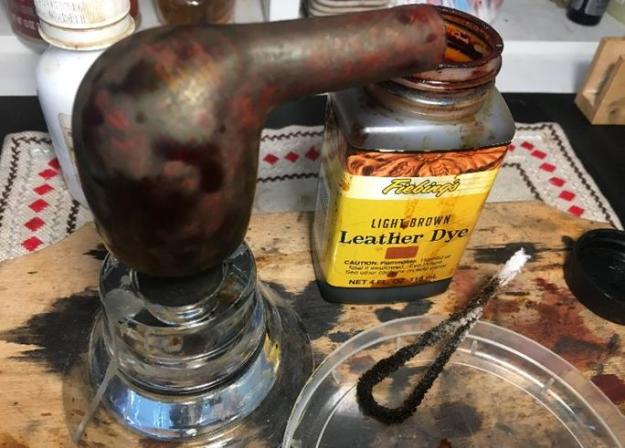
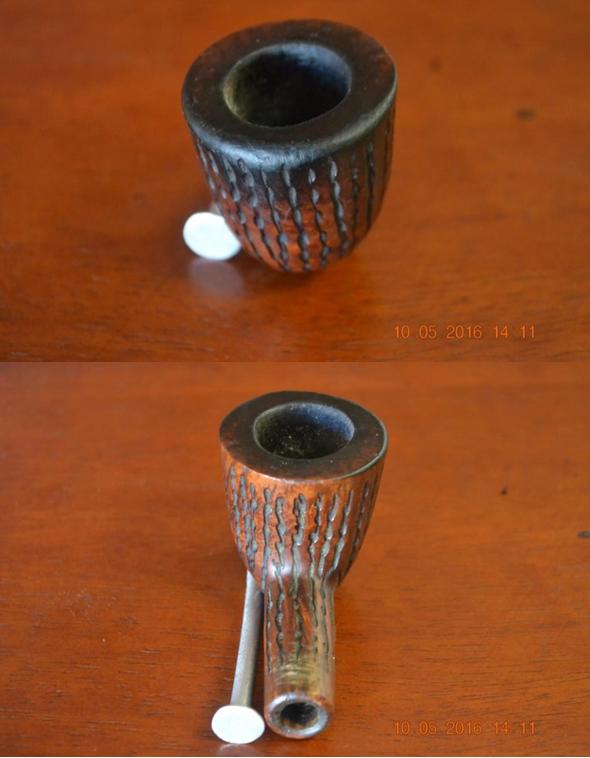
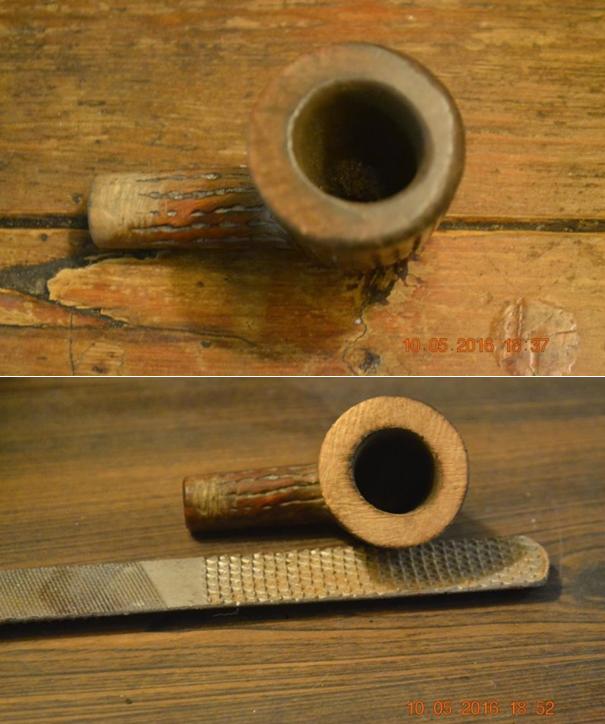
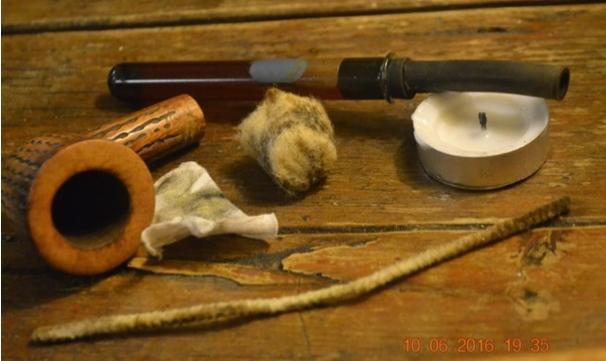
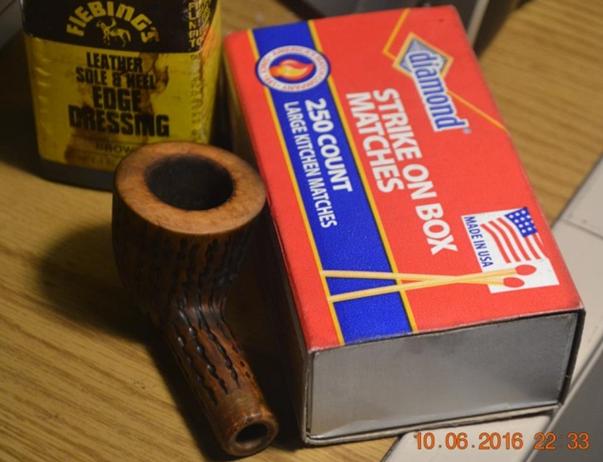
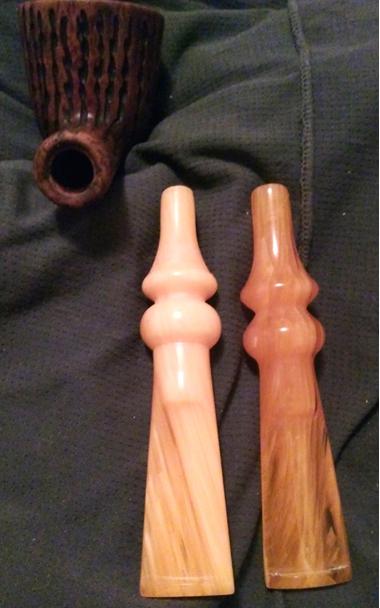
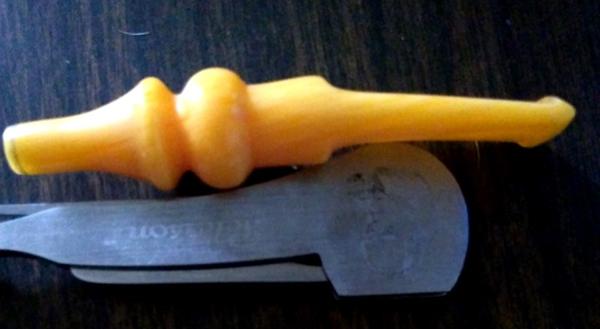
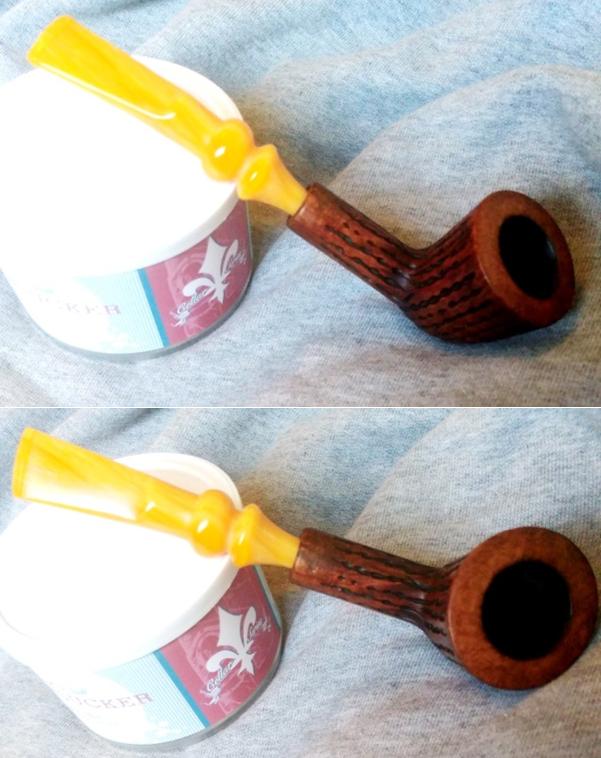
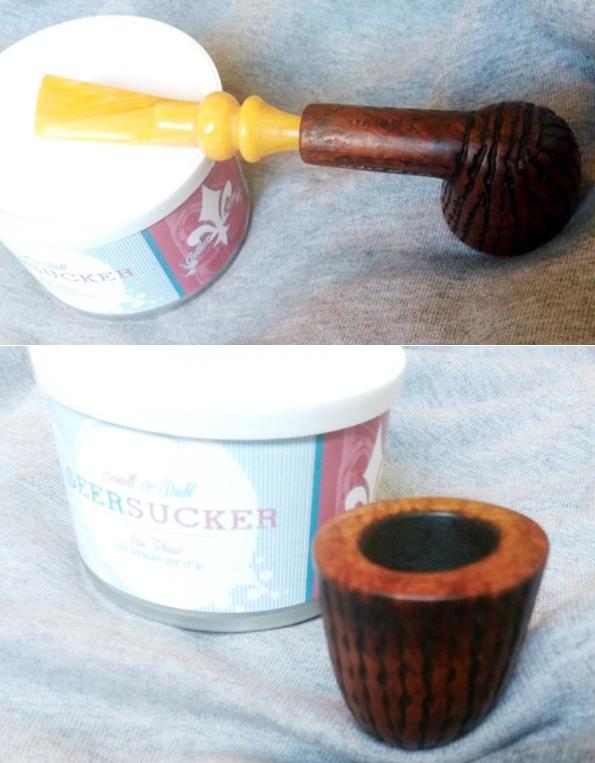
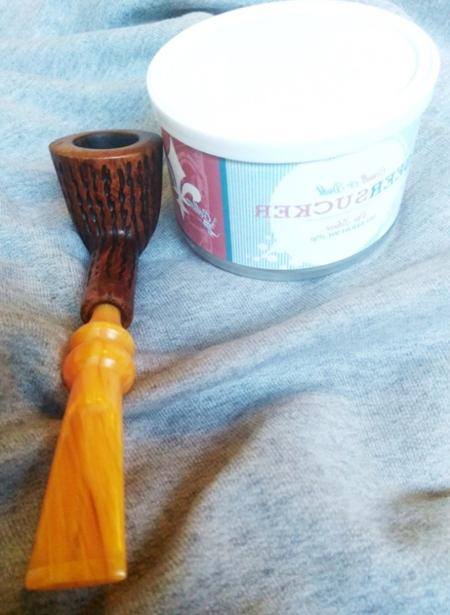
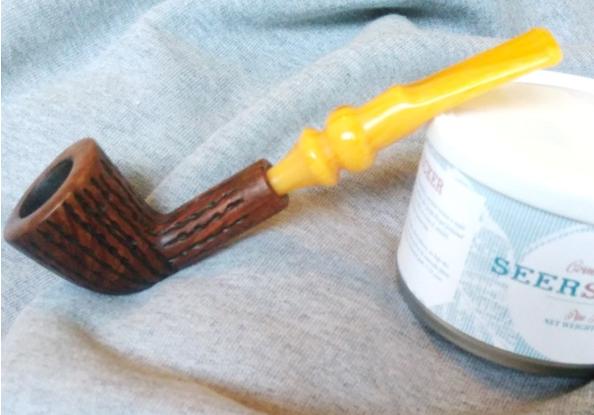
I expect to blog my restores with the methods fresh in my mind.  There are even some of the jobs I hold special from the past few years that I’m sure I’ll never forget a single detail.  Not to suggest this was common or insignificant, but after nine months I can’t remember the specifics of how I accomplished the result of the first shot below.  The chamber had to be reamed, and when I do that I always follow up with 150-, 220- and 320-grit paper, so that’s a given.  I’m guessing I started with micro mesh on the rim just for the sake of trying and found it ineffective.  Then I would have turned to sandpaper and chosen 220 with the same rationale as the micro mesh but opted for 180 with the usual progression up to 400 before starting in on micro mesh and stopping when I realized I would have to solve the other obvious problems with more drastic steps.  Here are the results I just described, and after the drastic measure of a file.Healing the wounds of a procedure I consider radical enough that I have only used it less than the number of fingers I have on a hand (or, rather, considering the thumb is not technically a finger, the same number), in fact is not all that difficult in most cases, and seeing the result of the steps is always a great pleasure.  I used 180-, 220-, 320- and 400-grit paper, and then 1500-12000 micromesh on the rim.Then, I began the rest of the outer stummel.  Starting with super fine “0000” steel wool to lighten the color of the wood and easily get between the grooves, I switched to the full micro mesh.It was time for the retort.  As always, I was glad I did it, because this little stummel was filthy!  I have done as many as six retorts on a single pipe, and this one “only” needed three, all of them clearer.  I had no bit to connect to the shank and therefore had to stretch the rubber connector over the opening.  I show only the first round below.  I also followed the final retort with three cleaners dipped in alcohol alternated with three dry, all of which came out clean.Applying alcohol-based leather stain and flaming it is always fun, and I used Fiebings Medium Brown on all but the rim to leave a definite two-tone.  When it cooled, I wiped away the char and a little extra darkness with 8000 micro mesh. I hand-rubbed a sparing amount of Halcyon II Wax into the wood and crevices of the rusticated pipe for which it is made, not to be frugal but because a little goes a long way.  In most cases, I let it dry or set or whatever as much as it can, in general 20 minutes or so but sometimes a considerable time longer, and wiped the excess off with a soft cotton rag while rubbing more into the pores of the wood.  Other times, I let the setting process go on for a considerable time longer, but not often.  I was then almost finished with the long project and was more than prepared to accomplish the final main task,  filled with joy to tackle (thinking of football) the key part of the  experience: fitting one of two fancy Lucite stems, an orange and a yellow, that arrived in the mail – eight months after I finished the stummel.  In case anyone wondered at my persnickety comments regarding the amount of time I spent on a certain bit of work trying to repair a part of the original Everyman that I will now leave unnamed, in my own way, that’s why.

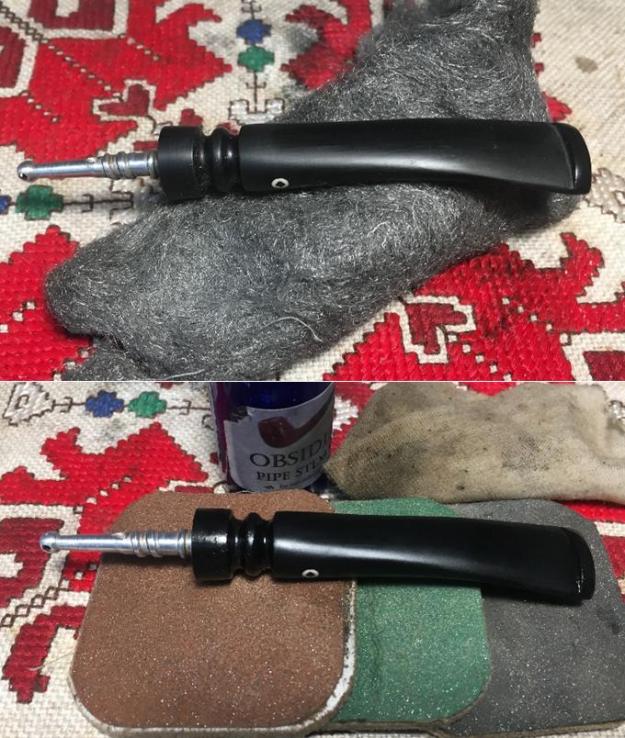
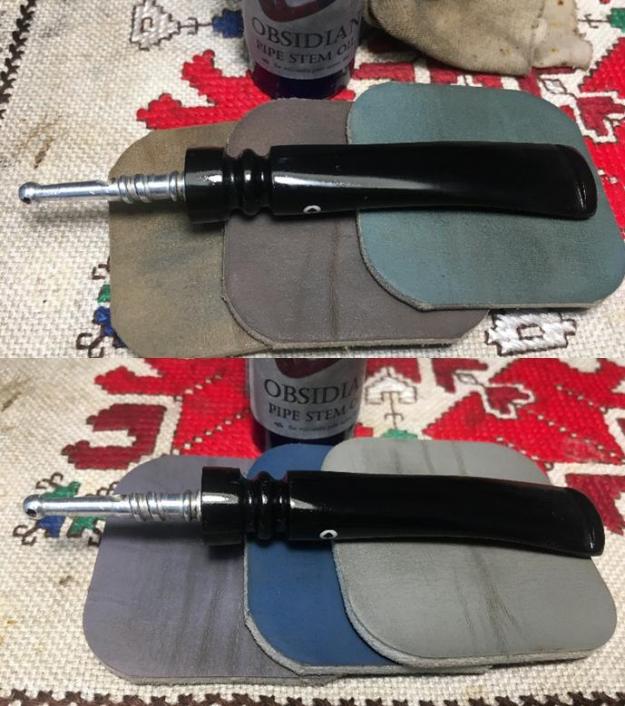
I went with the golden bit to the right.  As a point of interest, the popular online site where I bought a total of three bits in one order listed these two as gold, but the system is a touch odd, to me at least, and also the viewing system for the product you in fact get wasn’t working that day for all items, including the yellow bit.  But I can use it, and it was inexpensive!  Having none of the finer and more expensive equipment for tenon cutting, I hand-sanded the shank insert end down to where it had a nice, tentative fit for the time being.  That task took another day.  Making use /of another of Steve’s blogs, on bending stems, I chose the oven method because it had worked so well on several occasions in the past with Vulcanite.  BTW, I doubt the Lucite was the problem.  I always take a look in the mirror before pointing a finger lest I see three others pointed right back at me.  I say, go figure!  After that mishap, I switched to the boiling water method that worked better but I’m sure was spoiled by already having baked the bit. I repeated the boiling method and achieved the desired bend.  Halcyon II was is meant to be used in place of regular buffing wheel waxes and compounds, but I wanted a slightly brighter finish, and so I ended with spins of Red Tripoli and carnauba.

CONCLUSION

Even regardless of its look, and by that I mean nothing rude, the likelihood of this pipe being of British make – lacking any indication of such origin, whether the city or country of manufacture, a line name, or the often top secret coded markings of which our friends across the Pond are so fond – is so paltry as to end any further debate lacking official admissible documentary evidence.  WikiLeaks might suffice, in particular if the disseminator were to flee his country or be arrested or renditioned or still more conclusively, become the subject of cover page stories of the world’s tabloid toilet wipes.  On the other hand, and here I am not being facetious, if my already stated conclusion that the simple but honorable Everyman is a blast from the past of the pre-Dr. Grabow Alpha days of Israel, made by the Shalom Pipe Factory, and I am in fact wrong, I would as always appreciate input from any authorities or scholars among us.

SOURCES

https://www.jrcigars.com/brand/pipes-accessories/p-k-everyman-pipes

https://www.santaclaracigars.com/brand/pipes-accessories/p-k-everyman-pipes

https://rebornpipes.com/2015/07/18/bringing-new-life-to-a-gift-pipe-a-gasparini-mgm-elegante-brandy/comment-page-1/#comment-21243

https://pipedia.org/wiki/Stanwell_Shape_Numbers_and_Designers

http://www.ebay.com/itm/ALPHA-Burl-Briar-Freehand-Estate-Tobacco-Pipe-Made-In-Israel/332252221412?_trksid=p2047675.c100011.m1850&_trkparms=aid%3D222007%26algo%3DSIC.MBE%26ao%3D1%26asc%3D41376%26meid%3D0c2217f15e5f4850ad0061cb84cc5850%26pid%3D100011%26rk%3D1%26rkt%3D12%26sd%3D121269666970

http://www.ebay.com/itm/Vintage-Shalom-Select-Imported-Tobacco-Pipe-Vintage-smoking/322513288986?_trksid=p2047675.c100011.m1850&_trkparms=aid%3D222007%26algo%3DSIC.MBE%26ao%3D1%26asc%3D41376%26meid%3D0c2217f15e5f4850ad0061cb84cc5850%26pid%3D100011%26rk%3D5%26rkt%3D12%26sd%3D121269666970\

https://rebornpipes.com/2012/07/15/bending-vulcanite-stems/


Jen’s Trove No. 2–Perhaps a LHS London Royal Full Bent Billiard – Oom Paul


Blog by Dal Stanton

I don’t usually begin a blog with an addendum, but just before I sent this to Steve to publish on Reborn Pipes, I sent a picture of this pipe along with a few other pipes with the question, “Oom Paul or Full Bent Billiards?”  Here are the two pictures I sent – the first, Jen’s #2, and two others: This is the fun part of learning the fine art of pipe shape identification!  I was identifying the third pipe, (far right) as definitely an Oom Paul – mainly by the way the shank and bowl merge vertically and then the shank/stem breaks away but stays real tight in a full bend.  The other two, have more of a ¾ bend, but they also have more of a merge between shank and bowl creeping upwardly.  I called the 2 on the left, full-bent Billiards for that reason.  I loved Steve’s response:

Dal

To me they are all variations on an Oom Paul Shape which is actually a full bent billiard. LOL! The joys of identifying shapes.

Steve

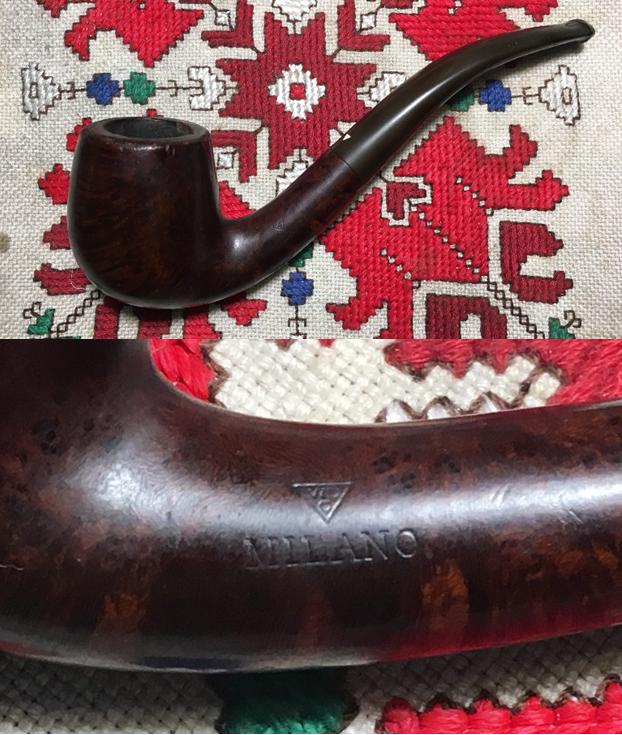
So, with addendum completed, Jen pulled this very nice Full Bent Billiard, (Oom Paul!) out of the ‘Help Me!’ basket and added it to the trove she has asked me to restore for her.  She will be transitioning back to the US at the end of the summer and she will be packing several of The Pipe Steward’s restorations to give as gifts to the special men in her family.  I’m happy to oblige!  Jen’s purchases will benefit the Daughters of Bulgaria, and bring much joy to her family!  I found this pipe on eBay as one in a lot of 13 pipes – I acquired some interesting pipes that await restoration in the basket!  The pictures I saw from the seller in Nevada included Jen’s Oom Paul – at 8 o’clock below and then a closer view following. The seller’s attempt to identify the Oom Paul were helpful and set me on the path:

Unknown – Markings appear to be rubbed out from handling. I think I see the word “London” followed by some indiscernible word.

On my work desk in Sofia, Bulgaria, I take some additional pictures to fill in the gaps. Looking at two pictures above and the nomenclature on the left side of the shank, I tend to agree with the seller that the first word appears to be London in a cursive-type script with a flared line underneath.  The second word appears to start with a “P” also in a script with a flare line underneath. To see if I can make a possible identification with a pipe name starting with “London P…” I go to Wilczak & Colwell’s “Who Made That Pipe?” and I find some Comoy contenders – “London Pipe” and “London Pride”.  Neither of these candidates seem likely because the corresponding Comoy stem mark, “C” was absent.  Yet, the pipe could have a replacement stem, but not likely.  I then go to Pipephil.eu and simply search anything starting with “London”.  What I found was very interesting and possibly a match.  The clipping from Pipephil below shows the ‘London Royal’ nomenclature – looking at my specimen, what I thought was a “P” very likely is an “R”.  The flare lines underneath is a convincing indicator as well.  Also matching was the right side “Imported Briar”.  Again, missing is any stem marking – a hat in the specimen below.

While I cannot be 100% sure in the identification, “London Royal” may indeed be on target.  Pipedia gives a short description of the LHS company:

Ludwig Stern, a successful pipe manufacturer since 1893 and closing around 1960, reorganized his company along with his brother Hugo Stern, opening a factory in 1911. They named the company L&H Stern Smoking Pipes & Holders. The newly formed company was moved into a six-story building on the corner of Pearl and Waters street Brooklyn, NY.

The American company produced such pipe names as Sterncrest, Purex, Silvercrest, Barrister, Marwyn, Park Lane, Radmanol and Warwick.

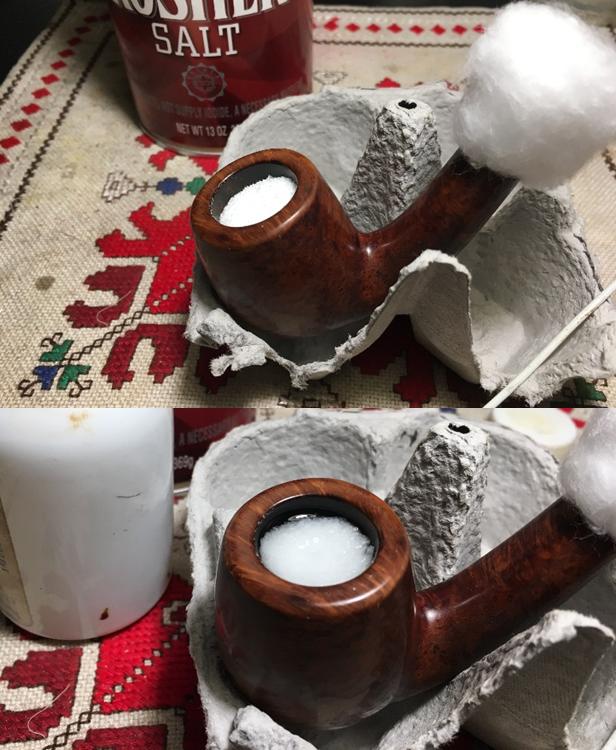
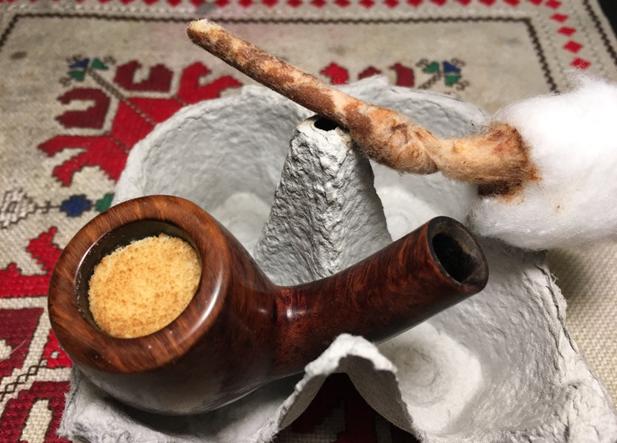
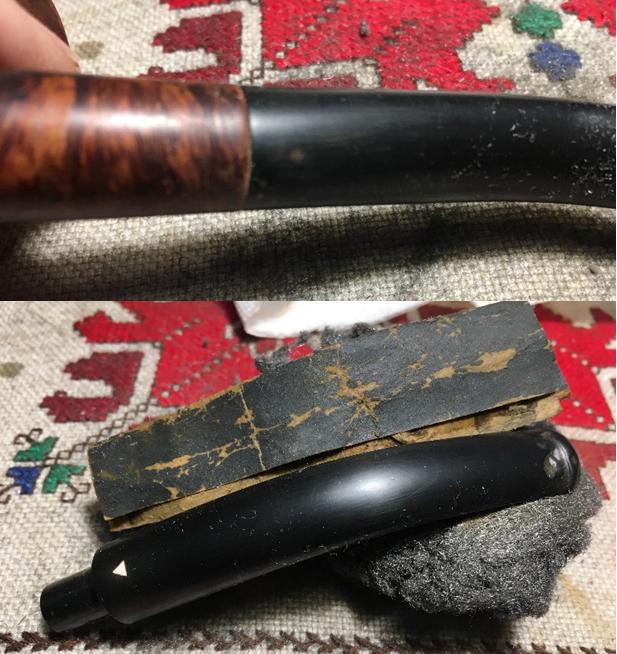
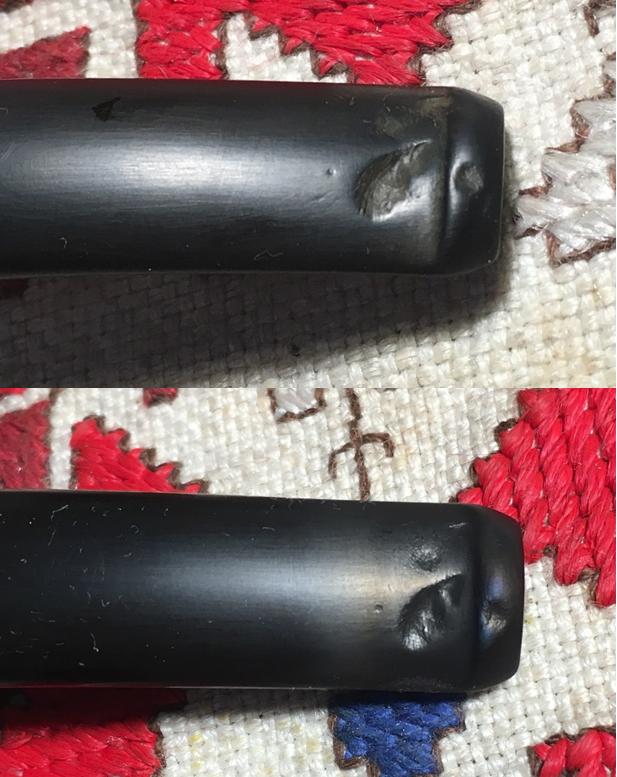
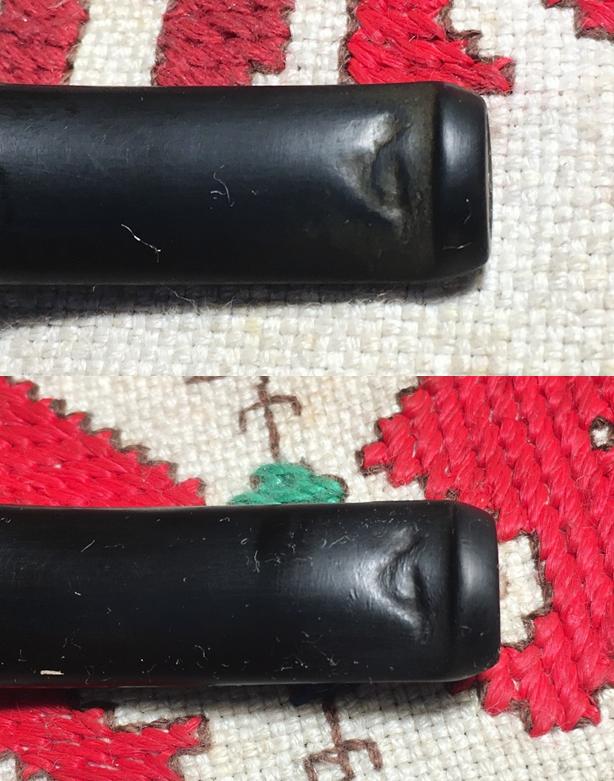
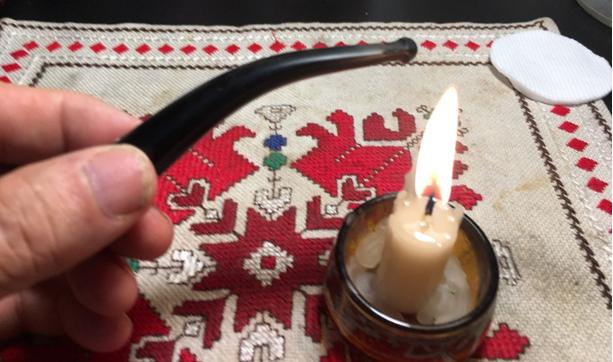
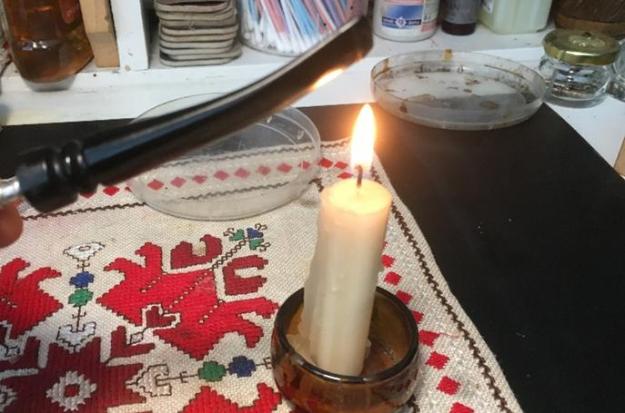
Whether (or not) the Oom Paul (Billiard) before me is a LHS London Royal, it is a very attractive pipe with quality grain movement.  Overall, it is in good shape and I’m hoping an easier than normal clean-up and recommissioning.  There are a few nicks on the rim and some fills that need attention.  The chamber has very mild cake.  The stem bit shows some tooth chatter and no oxidation that I can see.  I begin the restoration of this possible, LHS London Royal by reaming the chamber bringing it to the briar for a fresh start.  I also plop the stem into the Oxi-Clean bath even though there is no visible oxidation.   Starting with the smallest, I use 2 of the 4 blades available in the Pipnet Reaming Kit.  I follow with the Savinelli Pipe Knife to fine tune the ream then sand the chamber using 240 grit paper.  I then wipe the bowl with a cotton pad wetted with isopropyl 95% to remove carbon dust.  The pictures show the progress. Turning now to the internals, I use cotton swabs and pipe cleaners wetted with isopropyl 95% to clean.  I discover the internals are pretty gummed up.  With the hour becoming late I decide to use the stealth method of cleaning.  I use kosher salt and alcohol to soak in the chamber overnight.  I first twist a cotton ball to form a wick to stuff down the mortise to draw out the oils and tars from the briar.  I then fill the bowl with salt and after placing my palm over the top give it a shake to displace the salt.  Then I carefully fill the chamber with the alcohol until it surfaces over the kosher salt.  I put it aside and turn the lights off.  The pictures show the cleaning process.Turning to the stem the next day, I remove it from the Oxi-Clean bath and even though it is minimal, the bath has successfully ‘raised’ oxidation to the surface.  Using 600 grit paper, I wet sand the stem.  Following this, I utilize 0000 steel wool to remove more and begin the polishing of the stem.  I still detect some tooth chatter especially on the lower bit and a small compression dent on the upper.  I use the heating method to raise the chatter by passing the end of the stem carefully over a lit candle.  The vulcanite when heated like this will naturally expand and seek its original place.  The heating helps, but I still need to do some sanding in the upper and lower button area using 240 grit paper.  Using a flat needle file, I use the opportunity to sharpen the upper and lower button lips. Following the 240 grit paper, I use 600 grit to further smooth and polish then conclude with 0000 steel wool.  The pictures show the progress. The stummel has been in a kosher salt/alcohol soak through the night.  Kosher salt is used because, unlike iodized salt, it does not leave an after-taste.  I remove the wick from the shank and it has done its job of pulling oils and tars out of the stummel.  I toss the used salt in the waste and clean the bowl with paper towel and a long-bristled brush.  I also use a brush reaching into the mortise to remove residue salt.  I follow by continuing use of cotton swabs dipped in alcohol and pipe cleaners to finish up the internal clean-up.  The pictures show the progress.With the stummel internals cleaned, I turn to the internals of the stem.  Using pipe cleaners dipped in isopropyl 95% I attack. It did not take long because the pipe cleaners emerged clean.With the internals clean, I now turn to the stummel surface.  I use Murphy’s Soap and cotton pads to clean the stummel surface. As advertised, Murphy’s does a great job cleaning the oils and grime that build up on the surface. After scrubbing, I rinse the excess off using tap water careful to keep water out of the internals. The cleaning reveals two fills on the surface which appear to be solid after I probe them with a sharp dental tool.  The rim has a scorch mark over the 10 o’clock area in the picture below.  There are also scuff marks at the 6 and 8 o’clock areas.  The pictures show what I see.I decide to do a light topping using 240 grit paper on a chopping board.  I don’t need to take off much – only enough to remove the scuffing and surface part of the scorching.  I will make an internal rim bevel which will remove damage along the inner rim edge.  It is a little tricky, because the shank extends beyond the height of the stummel top.  I do the topping on the edge of the board as a result.  After rotating the stummel on the topping board, periodically checking to make sure I’m staying true, I switch to 600 grade paper to smooth the top further.  Using a coarse 120 grit paper, I cut an internal rim bevel to remove damage as well as soften the rim lines.  I follow with 240 grit paper.  On the outside rim edge, I give it a light bevel with 240 followed by 600 paper – again, removing the left-over nicks as well as softening the lines of the rim.  I think bevels add a touch of class to a rim.  The pictures show the rim progress. With the rim repair complete, I move straightaway to the stummel surface.  I’m anxious to see how the briar grain emerges during the micromesh pad process.  I’m careful to stay away from the almost non-existent ‘London Royal’ nomenclature on the sides of the stummel.  I want to preserve what I can. Using micromesh pads 1500 to 2400 I wet sand.  I follow wet sanding by dry sanding with micromesh pads 3200 to 4000 and then finishing with 6000 to 12000.   As hoped and expected, the pictures show the grain emerge.  As I look at the grain, I’m beginning to think that this stummel is a candidate to remain as the natural grain color and not to stain.  There are a few fills that I darken and blend with stain sticks.  It looks good!  I think Jen will like how this Full Bent Billiard (aka Oom Paul) is coming along.  I’ll finish the stem before making the final decision about whether to apply a stain.  Turning now to the stem, I wet sand using micromesh pads 1500 to 2400 then dry sanding using pads 3200 to 4000 then 6000 to 12000.  After each set of 3 micromesh pads, I apply a coat of Obsidian Oil to the thirsty vulcanite stem.  This oil revitalizes the vulcanite.  I love the vulcanite ‘pop’ as the pads do their magic! Moment of decision.  I reassemble stummel and stem to get a look at the big picture.  The possible LHS London Royal Oom Paul is without doubt a handful of pipe.  The grain presents bird’s eye on both sides of the stummel with lateral straight grain in the front and on the shank top and bottom.  A very nice feel to it as well, as I hold it and balance it in my palm.  The rim looks great too with soft beveled lines.  Decision point – do I leave the stummel the natural grain color or do I stain it?  If I stain it, I will use a light brown hue simply to tie together what is already there.  The original appeared to have been leveraged toward the lighter hue as well.  With some input from my wife, who has more color coordination DNA in her gene pool, I decide to stay with the original, natural, saddle, leathery color – leaving it just as it is. With that decision made, I fine tune and bring out the natural finish by using Tripoli compound which applies a fine abrasion, then Blue Diamond compound – more abrasion but finer than Tripoli.  I use a cotton cloth wheel with the Tripoli compound (not my usual felt wheel) because I’m not cutting through the fired crust of a stained stummel.  After mounting the buffing wheel on the Dremel, I set the speed at 2 of 5 (fastest) and purge the wheel to clean it from old compound. I apply the compound over the stummel, rotating the wheel over the surface, not apply a great deal of downward pressure.  I let the compound and the RPMs do the work.  After completing the Tripoli cycle, I attach the Blue Diamond compound cotton cloth buffing wheel, reattach the stem and stummel, and give both the Blue Diamond buffing using the same approach as with Tripoli.  When completed, I hand buff the pipe with a felt cloth to remove the compound dust preparing for the wax.  Then, switching to the carnauba wax cotton cloth wheel, also with Dremel set at speed 2, I apply several coats of carnauba wax to stem and stummel. During the carnauba wax application, I notice that the stem has loosened during the process.  I use a technique of expanding the tenon a bit so that it gains more purchase in the shank from Charles Lemon’s blog site, Dad’s Pipes.  The procedure usually uses a drill bit, where, after gently heating the tenon, a next larger drill bit is inserted into the supple tenon expanding it microscopically.  Instead of a drill bit, I find that a Dremel shaping tool sized up a little better than the drill bit.  After heating the tenon, the shaping tool eased into the tenon.  It did the trick giving the tenon a better fit in the mortise.  The pictures show this procedure.With the tenon now a bit snugger, I complete the application of the carnauba wax. After the carnauba cycles, I mount a clean cotton buffing wheel on the Dremel and do a ‘clean’ buff over the entire pipe.  I do this to assure that no pockets of wax are left on the surface and to raise the shine.  After this, I hand buff the pipe using a micromesh cloth to deepen and raise the shine of the briar grain more.

This possible LHS London Royal Full Bent Billiard, Oom Paul has turned out very well.  I think that whichever of Jen’s family of men receives this pipe, he will enjoy it for many years to come as its new steward.  As I said earlier, the profits of this pipe benefit the work we do here in Bulgaria with women who have been sexually exploited and trafficked, the Daughters of Bulgaria.  Check out my blog, The Pipe Steward, for more information about this.  Thanks for joining me!


Dunhill 1949 Patent 120 FrankenStem


Blog by Henry Ramirez

Cruising Ebay for a pipe to play with I came across a Shell bent which, as stated in the listing, had the stem bit completely chewed off. I’d been trying a mold technique to reconstruct the stem button with limited success, very limited. Anyway, this pipe’s stem had been chewed to the point where no pipe cleaner could negotiate the airway and tobacco dottle was packed in tight. Here is a photo of the listing.Dang me, the previous owner had a heck of an oral fixation!  This stem was exactly what I was looking for.While the stem soaked in the Oxyclean bath, I evaluated the briar. The cake in the chamber was so thick you could shake a stick at it but after removal proved to be the protection connection because the inner bowl was pristine. I don’t know what it is about old tobaccos but the cake is dry and pumice-like with a delightfully transporting aroma to another time. The bowl’s rim was likewise protected by the lava of cake and tar. When I use my augers and drill bits, it’s either by holding the bit by hand or using an electric drill to hold the spade bit and turning the pipe itself. I’m listening for the crunching sound of cake being cleaved rather than the squeaky sound of metal on briar. Full rotations are usually not possible until the very end.

The stain and finish on the briar had that great oxblood highlight color that I love but was tarnished with a river of muck. I decided to try using my micro etcher to preserve the blast on the rim but knowing that I would later have to re-stain. I didn’t want to use Murphy’s Oil Soap because it diminishes the intensity of the stain somewhat.  Regarding the River o” Muck, I tried using my steamer which has a gun for accurate aiming and a boiler which keeps up the psi.  This muck was visible in the blast’s valleys as a white deposit. I fished out the stem from the Oxyclean bath, scrubbed it with blue shop paper towels to remove the slimy coating and polished it with flour of pumice, green, red, white diamond and Bendix on the lathe with individual rag wheels.

When the stem airway is too congested or crimped to allow passage of even a bristle pipe cleaner, I use a base “E” guitar string. It has a stiff central core wire which is later wound with another thicker resilient wire to poke on through.  My intent is not to mechanically open the airway but to remove any remaining tobacco chattel that the steamer couldn’t dislodge.

Next, I want to straighten the stem in my Wife’s oven. Of course I do this when she’s not around and so far she has turned a blind eye towards this practice.  But if there is residual tobacco burnt in her oven, I don’t want to be around to explain! The vulcanite has a memory of its initial pre-bent and pre-chewed state which will allow ease of cleaning and repair. The only bugaboo is that tenon-mortise margin can open. I was fortunate to have that happen because I have an adjustment technique to fix that which I want to try out. Importantly, don’t forget to trace the initial outline of the bent stem on a piece of paper for a reference when re-bending.

The pipe stem is positioned on a sheet of aluminum foil on the middle shelf where it is easy access and can be well illuminated by the oven’s light, I have tried to use an aluminum pie plate but the higher sides obscure my viewing the stem. I set the temperature to 247 degrees using the Bake Convection mode. This oven is electric and if yours is gas, you may want to let it get up to temperature first before placing your stem. Gadzooks!  The tenon on the stem opened like a blunderbuss barrel and the stem won’t fully seat. More fun!

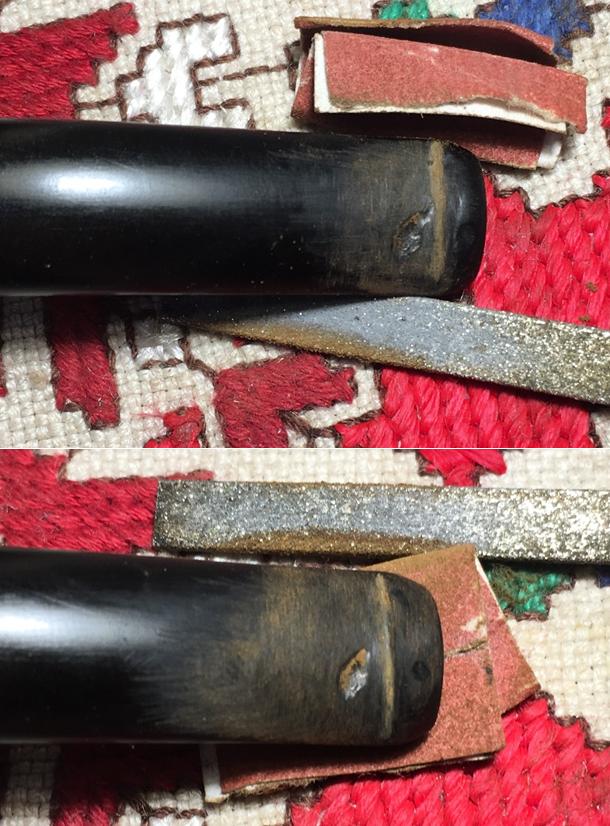
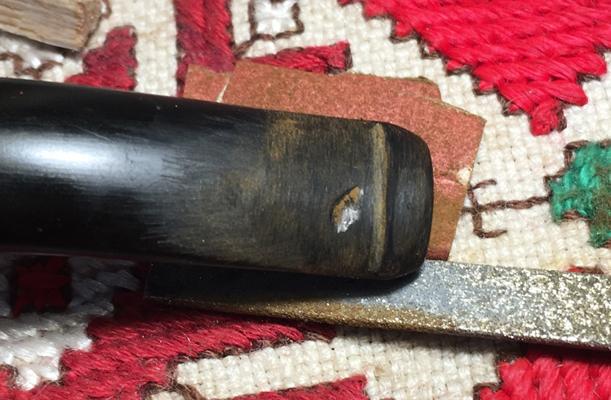
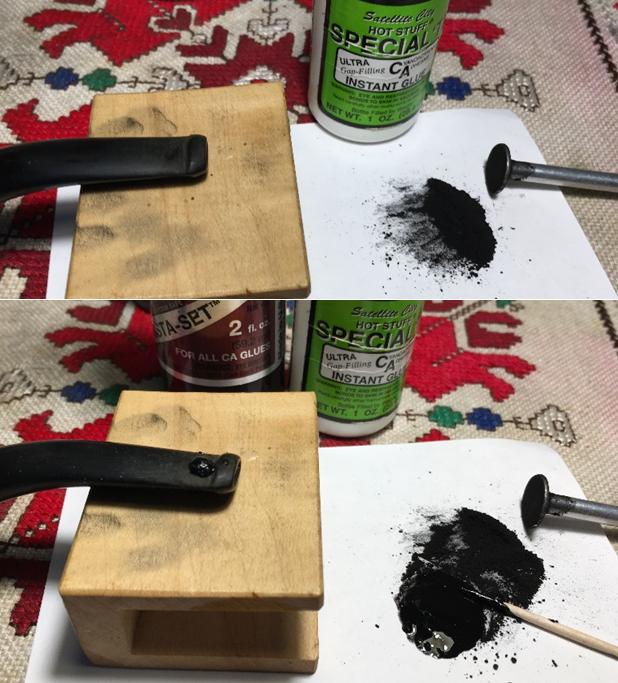
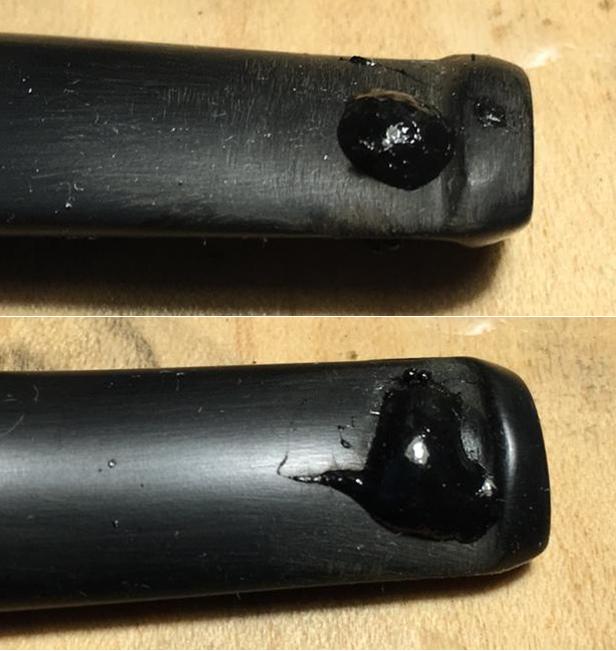
The cross section on either side of the air way seemed meaty enough for some pins and channeling to create a ferrule of composite resin. I made a silicone putty impression of an unsmoked stem which approximated the same size and shape of this pipe. I made sure to capture the airway’s interior.I then plugged the stem’s airway with wax; micro etched the exterior surface and bonded the composite. I’d gotten a black resin colorant online but found that it either accelerated the mix to a very short working time or inhibited the mix to not fully curing. To blacken my next mix I’m going back to activated charcoal. But although this bit is ivory colored, it is very strong and decently shaped so I decided to simply slather it with a coating of black CA.

When I placed the pipe back in the oven to re-bend it, I found that some of the CA had over heated and was bubbled up like road tar. Note to self, keep CA out of the oven. I had seen this happen with an infrared light in a previous experiment but thought the temp was sufficiently lower to prevent a recurrence. Oh well, just more fussin’.

By the way, when re-bending the stem I never seem to be able to wait long enough and go through several attempts before getting it right. If it doesn’t fully bend to the proper contour, you have to wait until it re-straightens itself and then some. If you get greedy you can snap stem in half. I’m looking forward to my next stem bending because I plan to chronicle the ideal temperature using my laser thermometer.Returning to the bowl’s rim, I stained it with a light brown, got the stem to fit better but haven’t yet dialed it in and polished the pipe.I noticed that the preliminary outline of the stem displayed the additional length that the new bit added.Here’s the semi-final result and I wonder if any of these projects are truly ended because to aspire to the superb craftsmanship of these old Dunhill artisans is a journey rather than an endpoint.


Jen’s Trove #1: A Kaywoodie Author


Blog by Dal Stanton

Jenny has laid the groundwork for a pipe restorer’s dream job!  Jenny has been working with us here in Sofia, Bulgaria, as an intern for the last few years and she will be transitioning back to the US at the end of the summer.  She’ll be working with international students at what she considers her home territory at the University of Tennessee – Knoxville.  We’ll miss her, but she has created a bittersweet gauntlet for me!  She has gone through my baskets and boxes of ‘pipes-in-waiting for help’ that I have culled and collected to create a gift trove for the special men in her life when she returns to the US – brothers, brothers-in-laws, father….  She knows that the pipes I restore benefit our work with the Daughters of Bulgaria, women/girls who have been sexually exploited and trafficked throughout Europe.  She wants to support the Daughters but also communicate this to her loved-ones in the US by gifting them pipes restored by The Pipe Steward – me 😊.   Since the proceeds benefit the Daughters, the agreement we have is that after each pipe is restored from her trove, I will determine a price and she will then decide if she would like to ratify the purchase – a win/win/win all around – for her, her special men and for the Daughters.  As Jen poked and prodded through my pipes, I learned that she was seeking a variety shapes and sizes so that each gift would be unique.  I hope that I can run the gauntlet well by providing her precious gifts AND finish on time!!!

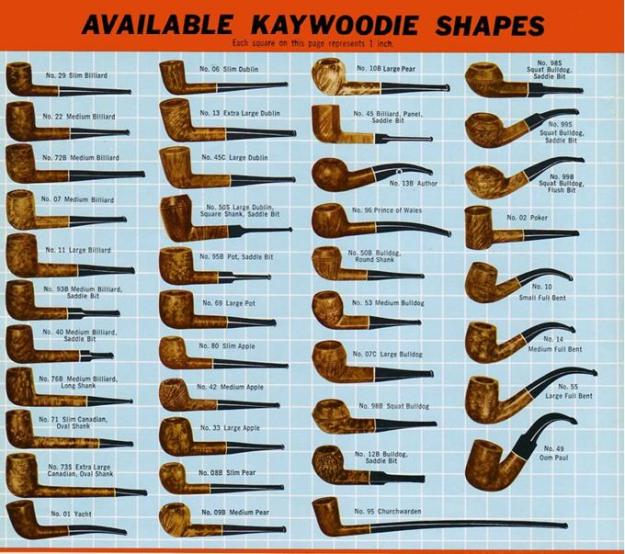
The first pipe I chose randomly out of the ‘Jen’s Trove Basket’ is a Kaywoodie Author shape.  I saw this pipe on eBay and was attracted to the solid shape of the Kaywoodie ‘Ball’ shape that was advertised by the eBay seller in New Hampshire.  Here is what I saw:When I looked at Pipedia’s Shape Chart put together by Bill Burney, I saw that the Ball and Author shapes are very similar, but Bill’s description of “The Author as a beefed-up prince, featuring a flattened ball-shaped bowl and a heavy 1/8 to 1/4 bent stem” caused me to classify this Kaywoodie as an Author.  With the pipe now on my work table, I take more pictures to fill the gaps. This is the first Kaywoodie I’ve worked on.  A plethora of information is available online about America’s oldest pipe making manufacturer.  Kaywoodie’s website is informative:

The history of S. M. Frank & Co. spans nearly a century and half of pipe making, supporting our claim as the “oldest pipe house in America.” S. M. Frank, as it exists today, is a combination of some of the biggest names in pipe making from the early part of the 20th. century. The pipe names Kaywoodie, Yello-Bole, Reiss-Premier, DeMuth, Medico, Heritage and Frank are familiar to generations of pipe smokers.

The article describes how in 1919 the Kaufman Brothers & Bondy Company (KBB) produced the Kaywoodie and Dinwoodie pipe lines.  By 1924 the Dinwoodie line fell by the wayside and the primary name of Kaywoodie was the mainstay pipe line and the company came to be known by that name.  Little is known about the early activities of the KBB Company which started in 1851 by the German born Kaufman brothers.  The company had several locations but was centered in the New York City region throughout its production history.  The expansion of the KKB Company following the gold rush I find fascinating:

When one of the men from the New York office got “gold fever”, he carried a large supply of pipes with him to California that he sold along the way. This early “national distribution” did much to build the reputation of KBB. By the late 1800’s, branches of KBB were opened in Chicago, Atlanta, San Francisco and St. Louis with family and friends acting as agents. The trademarks, for the inlaid cloverleaf and the cloverleaf with the KBB initials inside, were issued in 1881. 

In 1935, KBB boasted of being the largest pipe making facility in the world with 500 employees and a production of 10,000 pipes per day from their facility in West New York, New Jersey.  In 1955, Kaywoodie was acquired by S. M. Frank & Co. (See Link) and continues to the present with well-known names Yello-BoleReiss-PremierWilliam Demuth CompanyMedico, Heritage (Heritage Pipes Inc.), along with Kaywoodie (Link).

It is difficult to date the Kaywoodie before me.  The only identifying marker is the traditional white shamrock on the stem.  There are no other markings that I see.  To the left, a 1964-65 Kaywoodie Dealer Catalog from Pipepages.com shows a remarkable likeness to the Connoisseur line and the Author before me with the stem shamrock on the side rather than on the top as in a 1955 Kaywoodie catalogue (See LINK).  There is no clear indicator for dating the Kaywoodie Author, but this catalog may put me in the ballpark.

With a better understanding of the Kaywoodie name, I take a closer look at the Author.  The good news is that the stem is in good shape with little tooth chatter.  The classic Kaywoodie patented Synchro-Stem which boasts that “metal-to-metal contact prevents binding and sticking” from a 1955 catalogue.  The stummel, however, is a different story.  The rim is beat up significantly, and I detect what might be cracks in the stummel.  Looking back at the eBay pictures provided by the seller, it made it very difficult to see what I seen now.  There appear to be two cracks, across from each other on the front and on the back of the rim.  I take a few closeups.

At this point, I’m not sure what I’m seeing.  Are the cracks superficial or do the run deeply into the briar.  It’s curious also that they seem to be opposites – perhaps part of the same trauma or what?  I will need to clean the chamber and rim to see more clearly the depth of the problem.  After spreading paper towel to minimize cleanup, I use the Pipnet Reaming Kit to work on the fire chamber.  I use 2 or the 4 blades available, starting first with the smallest.  I fine tune the reaming job with the Savinelli pipe knife then sand the chamber with coarse 120 grade sanding paper then 240 grade.  I wipe the chamber with a cotton pad wetted with isopropyl 95% to clean the carbon dust.  I take some close-ups of the chamber revealing some heat fissures and evidence that the crack seems to run through the bowl – especially the crack on the back-side of the bowl.  I continue with the external cleaning using Murphy’s Oil Soap and cotton pads.  I also employ a brass bristle brush to work on the rim which is really beat up and scorched.  The cleaning reveals more of the damage to the rim as well as the cracks I will need to address.  I’m guessing that the stummel cracks were caused by excessive heating of the briar.  I decide to clean the internals of the stummel using cotton swabs and pipe cleaners dipped in isopropyl 95%.  I also employ a straight needle file to scrape the walls of the mortise to dig out the gunk and tar.  I like to take care of the dirty work before continuing with the externals.  This also gives me time to think about how to approach the stummel repair.  The pictures show the progress which is slow – the internals are really gummed up. 

The day is coming to an end so I decide to employ a kosher salt and alcohol soak to make progress with the internals – while I sleep!  I use kosher salt so not to leave an iodine after-taste.  I stretch and twist a cotton ball to create a thinner ‘string’ of cotton to stuff down the narrow mortise opening through the metal plate of the Kaywoodie.  This cotton string will act as a wick to draw out the oils.  I then fill the bowl with kosher salt and cover the opening with my palm and give it a shake to displace the salt.  Using a large eyedropper, I introduce isopropyl 95% to the bowl until it surfaces over the salt.  I leave the stummel in an egg crate and turn the lights out – another day is done.  The next morning, the salt/alcohol soak has done the job.  The salt has discolored as well as the cotton wick.  I dump the used salt into the waste basket, thumping the stummel on my palm.  I wipe the chamber out with paper towel and using a long-bristled brush remove the excess salt from the internals.   I then return to using cotton swabs dipped in isopropyl 95% to complete the cleaning.  The pictures show the progress.

After sending an email off to Steve to get some advice on the stummel cracks and the stinger/tenon system of this older Kaywoodie, I put the stummel aside to work on the stem.  I wasn’t exactly sure how the stinger on the stem which screws into the metal shank plate comes off – and off it must come if one is to adequately clean the stem – and keep it cleaned!  Steve’s email was helpful with the question whether the stinger had 3 holes or 4 – 4 would indicate an older system according to Steve.  Ok, another clue to the age of this old boy. I look and discover 4 holes on the end ball of the stinger which indicated to Steve that the stinger may be threaded and screws into the metal tenon.  Taking a closer look, there does appear to be a seam marking the tenon and stinger contact point.  Steve’s advice was to heat the tenon and twisting the stinger to release it.  I take a couple of pictures to show what I’m seeing.Holding the stinger over a lit candle, after a few tests to twist, the entire tenon unscrewed from the stem.  By the appearance of the seam, I’m thinking that the stinger will separate from the tenon and needs to be removed for ease of cleaning.  With another quick note off to Steve, I’m cautious because I don’t want to damage the tenon and Steve has seen a few more of these than I!  I clean the tenon with alcohol and a cotton pad and then follow this with 0000 steel wool to finish cleaning the tenon/stinger. To work on the oxidation of the stem I drop the stem into an OxiClean bath to let it soak for several hours.  The pictures show the progress. After several hours, I retrieve the stem from the OxiClean bath.  The stem shows little oxidation after the soak.  Using 0000 steel wool I clear the layer raised by the OxiClean bath.  Then, using pipe cleaners and long-bristled brushes, dipped on isopropyl 95%, I clean the internals of the stem.  The airway is tight and I resort to the long-bristled brushes to push through the airway.  After cleaning the airway, I want to alleviate some of the tightness of the airway by expanding the slot area.  I use a pointed needle file and insert the point into the slot and carefully apply abrasive pressure to the edges of the slot.  The pictures show the progress. The upper bit shows latent bite dents – the lower as well but much less.  I use the heating technique to expand the vulcanite.  With a lighted candle, I pass the end of the stem over the flame – in a back and forth motion, not allowing the stem to cook by holding it stationary over the flame.  After a few passes, the idea came to my mind that while the vulcanite is pliable to insert a pipe cleaner in the airway to expand it a bit allowing pipe cleaners to pass through without as much fuss.  The effort seems to work – both for expanding the vulcanite and the airway.  There remains a ‘footprint’ of the bite dent, but not as much.  Using 240 grit sanding paper I work the dents out on the upper and lower bit.  Following the 240 grit paper, I use 600 grit and then finishing with 0000 steel wool.  I reattach the tenon/stinger to the stem and clock it so that the stem tightens at the correct angle.  I tighten the tenon one full turn less to make it easier to remove and therefore, much easier to clean the airway.  I like the results – good progress on this nice-looking KW Author.  The pictures show the progress. I turn my attention back to the stummel, and take a few more up-close pictures.  The burn damage is significant and the chamber is out of round.  Heat fissures are evident in the chamber and I’ve already noted the cracks in the stummel which track over the rim into the chamber.  I can say with little doubt, this pipe was loved and used much by its former steward.  Yet, he’s taken quite a beating.  My plan is to fill the heat fissures in the fire chamber with a coat of J. B. Weld.  With Steve’s input, I’ll drill back-holes at the terminus points of both fore and aft cracks to prevent further crack creep.  I will fill each hole with CA glue as well as apply a penetration layer of CA glue over the path of the crack to seal the cracks.  Before I start these repairs, I work on the external rim area with the goal of cleaning up the damage, re-balancing the stummel’s look as much as I can through a combination of topping and sanding.  When the stummel starts looking human again, if this is possible, I will then again assess the cracks and their needs.  All in all, the stummel’s undamaged briar is quite attractive – nice grain.  I hope I can return this Kaywoodie up to specs so that Jen can be proud to gift this old boy to her men-folk! I start with a coarse sanding sponge to see what progress can be made.  I follow by gently topping the stummel with 240 grit paper on a chopping board and then again return to the coarse sanding sponge to ‘reduce’ the edge of the topped stummel.  What develops is a technique of gradually reshaping the rim area to give the stummel a more uniform look.  I cycled through a light topping and then returning to the coarse sanding sponge several times.  The pictures show the process. As the rim starts taking shape, the fact that the bowl is out of round becomes even more distinctive.  To shape incrementally a truer ‘round’ I use a coarse 120 grit sanding paper rolled up and I sand the internal bowl at the point where the rounding was needed.  I gradually work around the internal chamber wall careful not to lean to aggressively into beveling an angle on the internal rim at this point.  I want to address first the unevenness in the walls of the fire chamber.  After doing this, I move more toward the top of the chamber and then create an inner bevel which gradually helps to round out the rim.  As I work on the internal sanding, I recycle as before, doing a gentle topping followed by the coarse sanding sponge to even and balance the whole.  The pictures show this gradual process starting with the ‘unrounded’ bowl. While the completed shaping is not perfect, I’m pleased that the stummel has regained proportion with the removal of the damaged briar and the gradual shaping through sanding and topping.  Looking very good at this point!Before I move forward finishing the stummel, I need to do the crack repairs.  The first thing I do, with the aid of a magnifying glass is mark the terminus points of the forward and aft cracks on the stummel.  The mark is made by creating a dimple using sharp dental probe.  This helps to guide the drill point when I create the ‘back hole’.  Using a 1mm sized drill bit mounted on the Dremel, I drill holes at the terminus points of the cracks.  With a somewhat steady hand, the work is successful. With the ‘back-holes’ drilled I drop-fill the holes with CA glue using a toothpick, and sprinkle briar over the hole.  I also apply a line of CA glue over the crack itself to strengthen the repair and seal the cracks.  The CA glue I use is extra thin and will seep into the cracks – hopefully.  I put the stummel aside for the night for the patches to cure.  The pictures show the patch process.The next day, the patches have fully cured and I use a rounded and flat needle files to work on the ‘forward and aft’ cracks where the back-holes were drilled. When I bring the CA glue patch mound down to briar surface level, I use 240 grit sanding paper to smooth it further and to blend with the briar.  Once this is completed, I again use the coarse sanding sponge and do a light topping to freshen the lines of the rim after the repair work.  I then roll a piece of 240 grit paper and again freshen the rim’s internal bevel.  The pictures show the progress. I proceed to smooth and blend the stummel by using a medium grade sanding sponge followed by a light grade sanding sponge.  The picture shows these last two stages and I take pictures of the finished crack repairs.  During the staining, I’ll seek to blend these further – especially the aft crack. At this juncture, I repair the fire chamber before continuing to the external stummel surface. Earlier I describe using J. B. Weld to coat the fire chamber, filling the heat fissures that had developed over years of use.  The J. B. Weld compound will also provide a protective barrier against the heat.  Later, I will coat the chamber with ‘pipe mud’ to provide a foundation for a new cake to develop to protect the chamber walls.  The few times I’ve used J. B. Weld, I always mixed too much.  I’ll try to moderate this time around.  After cleaning the chamber with a cotton pad wetted with isopropyl 95%, I place equal parts of the J. B. Weld components on an index card – hardener and steel.  The directions state that after mixing the two, one has about four minutes before they start setting.  I insert a pipe clean into the draft hole to prevent the Weld mixture to plug the airway.  I mix the components with a tooth pick then I place a dollop of the compound into the chamber walls.  I use my pinky finger to spread the mixture evenly and pull out excess.  After a bit, the mixture is setting up.  I rotate the pipe cleaner out when the tackiness of the mixture has firmed up enough that it will remain in place.  I set the stummel upright in an egg carton and let it cure overnight.  The pictures show the process. Turning now to the stem restoration, I utilize a plastic disc I fabricated to protect the shoulders of the stem during the micromesh process.  Using micromesh pads 1500 to 2400 I wet sand the stem, then follow with dry sanding with pads 3200 to 4000 then 6000 to 12000.  After each cycle of three I apply a coat of Obsidian oil to the stem to revitalize the vulcanite.  The stem looks good.  The pictures show the progress. A new day has arrived in Bulgaria and I turn again to the stummel.  All the major repair work is completed and I begin to prepare the stummel’s surface for a stain finish.  Using 1500 to 2400 micromesh pads I wet sand the stummel.  Amazingly, after this first cycle, I see what I did not see before – Kaywoodie [over] Standard nomenclature on the left side of the shank and what appears to be 13B on the right side.  I take a picture to mark this – unfortunately, I did not see it sooner to avoid sanding in that area.  Checking again with Pipedia’s Collector’s Guide to Kaywoodie Pipes, 13B is the shape number identifying this as an Apple.  Looking at the catalogs in the same article, with the stem shamrock on the side, I’m feeling pretty confident identifying this pipe from the 1960s. I follow this by dry sanding using pads 3200 to 4000 and then 6000 to 12000.  I never grow tired of seeing the grain emerge as the micromesh cycles do their magic.  The pictures show the process. To encourage better blending by hiding the cracks and repairs, I use a mixture of Fiebing’s Dark and Light Brown Leather Dyes.  I use 2 parts light to 1 part dark.  I don’t want to go too dark and hide the beautiful grain that has emerged.  When I look at the original hue of the Kaywoodie (the 1960s catalogs above I think is a pretty good guess regarding the age of this KW) leveraged toward the lighter hues – yet, I do want to mask the cracks. After mixing the dyes, I heat the stummel using a hot air gun to open the briar making it more receptive to the dye.  With the stummel heated, using a cork in the bowl as a handle, I liberally apply the dye over the stummel surface.  Following this, I fire the wet dye with a lit candle and the alcohol immediately ‘flames’ and burns off setting the stain.  I repeat the same process a few minutes later.  After the second firing, I put the stummel aside for several hours.  The pictures show the staining process. Some hours later, I’m ready to ‘unwrap’ the fired layer to discover what the briar has done with the dye.  Using a felt buffing wheel, I mount it on the Dremel and set the speed to the slowest.  After purging the buffing wheel on the edge of the metal tightening wrench, using Tripoli compound I methodically begin removing the fired layer by not applying much downward pressure, and allowing the RPMs and the compound to do the work. When I complete the removal of the fired layer with Tripoli, I take a cotton pad wetted with isopropyl 95% and wipe down the stummel.  I do this not only to blend the dye but also to lighten it.  I then move to Blue Diamond compound.  I use a cotton cloth buffing wheel mounted on the Dremel, increase the speed by one notch, and move in circular motions over the entire stummel – again, as with the Tripoli compound, I do not apply a lot of downward pressure on the buffing wheel but allow the RPMs and compound to buff up the surface.  When completed with the Blue Diamond, I use a felt cloth to hand buff the stummel to remove compound dust before moving to the wax phase.  The pictures show the compound process. Before finishing the external surface with carnauba wax, I apply a layer of ‘pipe mud’ in the fire chamber.  This creates a layer to encourage the development of a carbon cake in the bowl.  I use a mixture of sour cream and two 260mg capsules of activated charcoal powder. I mix the sour cream and charcoal powder with a wooden stick and then, after inserting a pipe cleaner through the draft hole, apply a dollop of pipe mud mix in the chamber.  I then use my pinky finger to spread the mud evenly and draw out the excess.  When finished, I put the stummel aside to let the pipe mud set up.  The pictures show the mud process. With pipe mud set, I reattach stem and stummel.  I mount a cotton cloth buffing wheel to the Dremel, set at speed 2, with the fastest being 5, and apply carnauba wax to the stem and stummel.  After applying several coats, I switch the Dremel to a clean cotton cloth buffing tool and again buff the pipe.  I do this to work in pockets of wax that were missed and to raise the shine.  Following this, I hand buff the pipe with a micromesh cloth to raise the shine more.

This Kaywoodie Standard Author has turned out in classic form.  I’m very pleased with results of the rim repair and the rich, ‘smoking jacket’ finish that masks the crack repairs.  The Author has a solid presence in the hand as I hold it – a classic shape that will provide a new steward with several more years of service.  As I mentioned before, Jen’s purchase of this Kaywoodie Standard Author benefits the work we do here in Bulgaria with women who have been sexually exploited and trafficked, the Daughters of Bulgaria.  If you would like more information about my restorations check out The Pipe Steward.  Thanks for joining me!


Why is it a Second? A Fiammata 128 Billiard


Blog by Steve Laug

The next pipe on the work table came from the recent estate sale my brother attended. The pipeman whose pipes were being sold had good taste as can be seen from the pipes I have posted recently from my workbench. This one is no exception. It has stunning straight grain around the bowl and a few small well-hidden fills. The pipe is stamped on the left side of the shank with the name FIAMMATA and on the right side it is stamped 128 over Italy. There are no other markings on the pipe. The stem is lightly oxidized and has the now familiar tooth marks as the other pipes in this estate.The shape number, the Italy stamp and the overall look of the pipe told me that it was a Savinelli pipe but I was not sure. You know how when you are handling a pipe of unknown make you just have a feeling about its origin? That is what happened as I turned this one over in my hands to examine it. I did some digging on Pipedia and found the information to confirm my suspicions about the pipe being a Savinelli made produce. Here is the link to the section of the Pipedia article on Savinelli Sub-brands: https://pipedia.org/wiki/Savinelli#Savinelli_made_sub-brands.2C_seconds_.26_order_productions

On the Sub-brands list you will see the name Fiammata. Next to the name it says that the sub-brand is a “Rejected “Giubileo D’Oro” – Straight Grain”. That matches the look of this pipe. I have to say though that the quality control people were very good on the day this pipe was made as the tiny sandpits and fills that I can see on the bowl were hard to identify as they followed the grain on the pipe so well. I thought it might be interesting to check out the Giubileo D’Oro pipes to see what I could learn about the destiny of this pipe before the flaws were noted and the pipe was rejected. The next photo of an advertisement for the brand gives information that I found extremely helpful when looking at this pipe in terms of shape, colour and finish. The top pipe in the photo is the 128 which is the same shape I am working on at the moment. The grain on my pipe is far better than the one in the photo.I have included a copy of the Savinelli Shape Chart so that you can see the shape of the pipe in hand. It is stamped 128 and can be seen on the first column of the chart. It is a tapered stem billiard. I circled the shape in red on the chart below.Jeff took some close up photos of the rim top to show the condition of the cake in the bowl and the overflow of lava on the top of the rim. From the photos it is hard to know if the inner rim edge is damaged because of the buildup of lava.Jeff took the next series of photos to show the grain on the bottom and both sides of the bowl. It is really quite beautiful grain. Look closely and see if you can see the small fills. The next two photos show the stamping on the shank of the pipe. The first photo is the right side of the shank and the second is the left side.The final two photos that Jeff sent to me show the familiar tooth marks on the top and the underside of the stem at the button.My brother did his usual amazing clean up of the pipe. He reamed the bowl and scrubbed the lava off the rim. He scrubbed the finish with Murphy’s Oil Soap and rinsed it with water. He cleaned out the mortise and the airway in the shank with alcohol, cotton swabs and pipe cleaners. The next four photos show the condition of the pipe when it arrived in Vancouver. Jeff was able to get the lava off the rim and leave the rim looking almost new. The inner beveled edge of the rim is flawless as well. It looks undamaged and there are no burn marks on the bevel or on the rim top. There is slight darkening on the back of the top but it is minimal.He soaked the stem in Oxyclean for a few hours and scrubbed it clean. The oxidation came to the surface and looked speckled in the next two photos. The photos also show the tooth marks and chatter clearly.I sanded the stem with 320 grit sandpaper to remove the surface oxidation and smooth out the tooth chatter and tooth marks.I cleaned the top and bottom edge of the button with alcohol and used black super glue to fill in the deeper spots on both sides of the button. I filled them in and set the stem aside to dry.I sanded the bowl rim and sides with micromesh sanding pads – wet sanding with 1500-2400 grit sanding pads. I wiped the bowl down with a damp cotton pad to remove the dust. I dry sanded it with 3200-12000 grit pads and repeated wiping down the bowl with the damp cotton pad. The photos below tell the story of the polishing. Look closely and see if you can see some of the small fills. I sanded the repaired area on the stem with 320 grit sandpaper to remove the excess hardened super glue and blend it into the surface of the button. I ran a pipe cleaner through the shank and the airway in the stem to remove any of the sanding debris from the airways. They came out very clean.I polished the stem with micromesh sanding pads – wet sanding with 1500-2400 grit sanding pads. I wiped down the stem with Obsidian Oil and dry sanded it with 3200-12000 grit pads. I repeated wiping down the stem with the oil. After sanding it with the 12000 grit pad I wiped it down a final time with Obsidian Oil and set it aside to dry. I put the stem on the shank and buffed it with red Tripoli to work out the rest of the oxidation that still remained on the stem near the shank end. It took some careful buffing to work it out but it finally came out. I buffed the stem with Blue Diamond to polish the stem even more. I buffed the entire pipe with the Blue Diamond on the wheel to polish out the minute scratches in the rubber and the briar. I gave the bowl and stem multiple coats of carnauba wax with the wax buffing pad. I polished it with a clean buffing pad to raise the shine. I hand buffed it with a microfibre cloth to deepen the shine. The shape and condition of the pipe is very nice and the grain stands out much like it would have if the pipe had made the grade for a Giubileo D’Oro pipe. There is a faint stamp of triangles on the side of the stem. The dimensions of the pipe are as follows Length: 6 inches, Height: 1 7/8 inches, Outer bowl diameter: 1 3/8 inches, Chamber diameter: ¾ inches. The finished pipe is shown in the photos below. The pipe is a made in such a way that it follows the stunningly grained piece of briar perfectly. The shape of the stem works with the flow of the pipe. The black of the stem and natural finish of the briar work well together. This pipe will soon be available on the rebornpipes store. If you want to add it to your collection email me at slaug@uniserve.com or send me a private message on Facebook. Thanks for looking.


Just a few minor details – a Broken Tenon and a Cracked Shank on a Hardcastle Special Selection 7 Bulldog


Blog by Steve Laug

Not too long ago I received an email from a reader of rebornpipes regarding a pipe he was restoring. It was a beautiful little Hardcastle Bulldog that is stamped on the left underside Hardcastle over Special Selection over the number 7. He had finished cleaning and restoring it and it was looking good. He had done a thorough job, as I would see later in this post. He went on to tell me about how he had repeated my misadventure when buffing the pipe. Not long ago I posted about having finished a pipe and having the buffer snatch it from my hands and fling it against the floor. I snapped the tenon off a pipe I had finished while doing the final buffing. He wrote that he had done the same thing exactly. He wanted to know if I would be willing to put a new tenon on the stem. He noted a hairline crack at the shank/bowl junction and wondered if I would be willing to deal with that at the same time. We wrote back and forth and he sent me the following photos. The first one shows the cleaned up pipe ready for buffing.The next photo he sent shows the crack at the top of the shank on both topsides of the diamond. It stopped on both sides before it got to the edge of the diamond.The third photo shows the stem with the snapped tenon. He did a far better job snapping it off than I had done on mine. My broken tenon was jagged and needed to be sanded smooth before I could replace the tenon.He sent the pipe to me Vancouver for me to work on. It is funny in that it took a longer time to arrive from Idaho than pipes I have received from the east coast. But when it arrived I took photos of it. I have a container of threaded tenons here that I use for replacement tenons on pipes. I like the way they grip in the drilled out stem. Once they are anchored in place with glue on the threads, there is little chance that they will come out. I went through my tenons and found one that would fit the mortise with a little adjustment – the fit was tight and it was a little long for the shank.I set up my cordless drill and chose a bit that was close to the size of the airway in the stem. I have learned to work my way gradually through bits until I get to the size of the threaded portion of the new tenon. Doing it this way keeps the stem material from chipping or breaking away with the pressure of the drill bit. I turn the stem onto the stationary drill by hand so that I can control the depth of the bit. I mark the bit with scotch tape ahead of time to measure the depth of the drilled out airway that I need to have when I am finished.Once I had the airway opened enough to take the threaded end I used a tap to cut threads on inside of the newly opened airway. I turned the tenon in place on the stem to check the fit against the face of the stem.I checked the fit against the end of the mortise and found that the tenon was too long. I used a Dremel and sanding drum to bring it down to the correct length and cleaned up the end of the tenon with the topping board.I glued the new tenon in place in the stem with medium viscosity black superglue. It allows me time to adjust and align it so that it fits the mortise well and leaves no gaps.I set the stem aside overnight to allow the glue to cure. In the morning, I fine-tuned the fit so that it sat well in the shank. I chamfered/beveled the airway in the end of the new tenon to maximize the airflow into the stem.I put the stem in place in the shank and took photos of the newly repaired stem. This little Hardcastle Bulldog is a really beauty and extremely lightweight. The Cumberland stem looks good with the briar and gives the pipe an elegant appearance. I polished the stem and the tenon with micromesh sanding pads to remove any remaining scratches. I set the stem aside and turned my attention to the crack on the shank/bowl junction. I examined the crack with a bright light and a lens to make sure I could see the ends of the crack on both sides of the shank. It was a tight hairline crack so I just needed to stop it from spreading further. I drilled the end of the crack on both sides of the top of the shank using my Dremel and a microdrill bit. I slow the Dremel down to a speed of 10 so that I can carefully put the holes at the crack ends without it either going too deep in the shank or bouncing across the surface of the shank. It did not take too long to drill the holes.I took it back to the work table and took photos showing the two drill holes. The plan now was to use a dental pick to see if I could open the crack at all. I wanted to be able to put superglue into the crack to seal the two sides. It did not budge so I scratched it with the pick to provide a rough surface for the glue to adhere.I ran a bead of clear super glue the length of the crack from drill hole to drill hole. I put a drop of glue into each drill hole to fill them in. Since they are so tiny, I don’t bother with briar dust. I used the end of the dental pick to push the glue deep into the drill hole and refilled it to a bubble.Once the glue hardened I sanded it smooth to match the surface of the shank using 220 and 320 grit sandpaper folded to fit the angle of the junction. I sanded the area until the repair was smooth with the surface of the shank. I wanted the transition to be seamless. I took a close up photo of the repair on both sides of the shank to show what I had to deal with in terms of blending it into the finish of the bowl and shank.I sanded the repair with micromesh sanding pads to remove the scratches left behind by the sand paper. I worked through 1500-4000 grit pads to polish the shank. I polished the gold band with the higher grades of micromesh as well to give them a richer gleam. The repairs were slightly lighter in colour than the rest of the shank and the bowl so they would need to be restained. I restained the repaired area with a medium brown stain pen to blend it into the colour of the bowl and shank. I buffed the stained areas by hand with a microfibre cloth.I wrote to the pipeman who owned it and told him I had finished the repair to the shank and the stem and was touching up the stain. He wrote back to say that I had carte blanche to finish the pipe in any stain I saw fit. That was the go ahead I needed. I wanted to highlight the red hues in the briar that stood out in the bright light. I also knew that a red stain would allow me to blend in the repaired areas on the shank/bowl junction better. So I chose to stain the pipe with Danish Oil with Cherry stain. I am really happy with how the red of the stain works to highlight the grain. It also goes really well with the Cumberland stem and its red striations.I warmed the briar and applied the stain with a cotton pad. The nature of Danish Oil stain is that it highlights grain and breathes life into the wood. I let it sit for 10 minutes and hand buffed it off the bowl and shank. I took the next four photos of the finished bowl once I had hand buffed it. I buffed the bowl and stem with Blue Diamond polish on the buffing wheel to polish out any remaining scratches in the finish of the briar or the Cumberland. I gave them multiple coats of carnauba wax to protect the finish and buffed it with a clean buffing pad to raise a shine. I hand buffed it with a microfibre cloth to deepen the shine. I hand buffed the gold band on the shank with a jeweler’ cloth to polish and shine it. The finished pipe is shown in the photos below. I really like the finished look of the pipe. It is a beautiful and well executed Bulldog and it should serve its owner well. I plan on letting him know that if it does not fit his collection it will always have a home here. Thanks for looking.