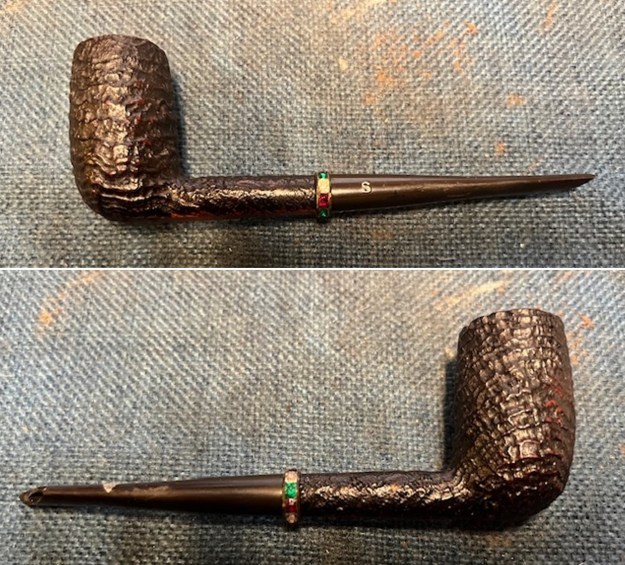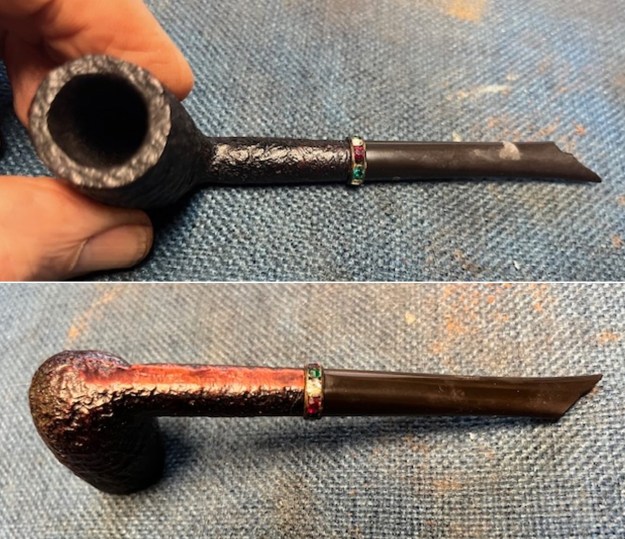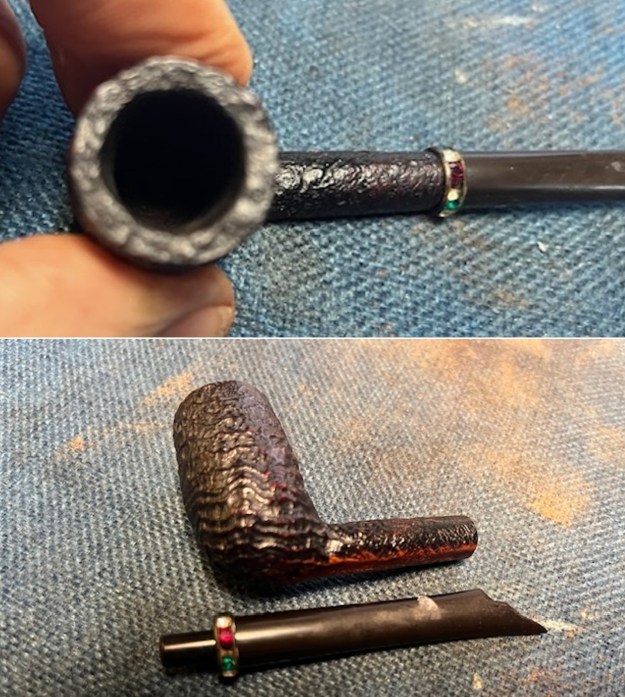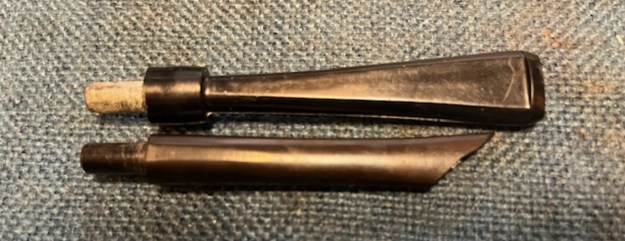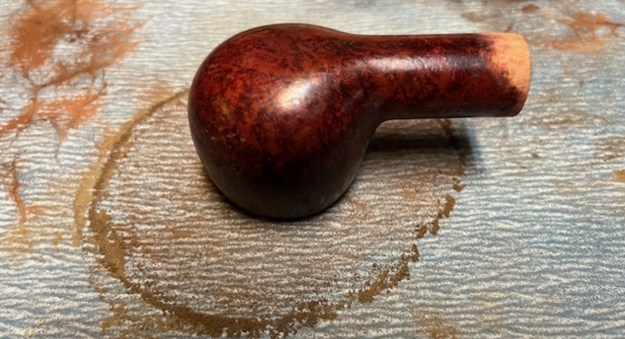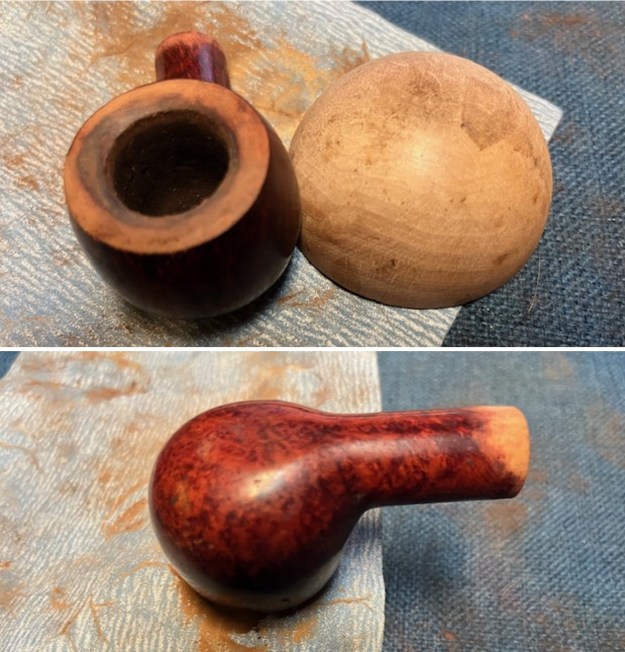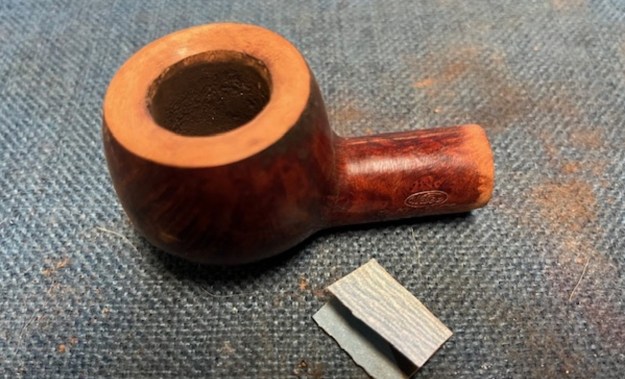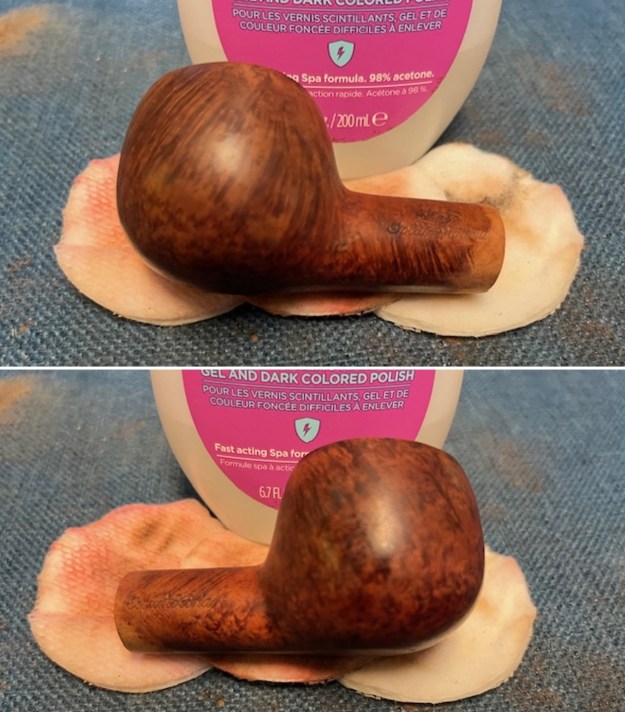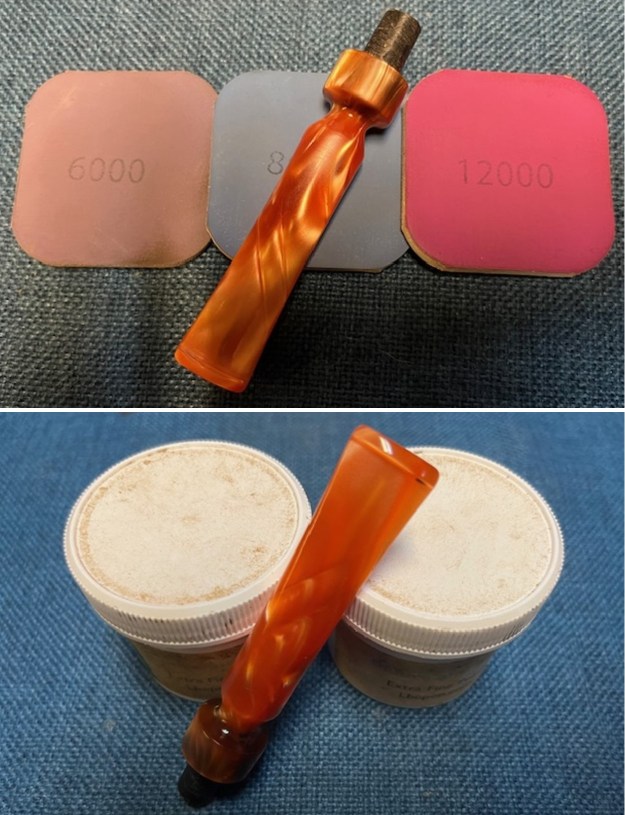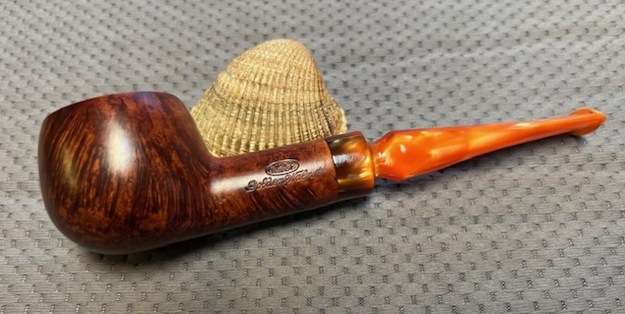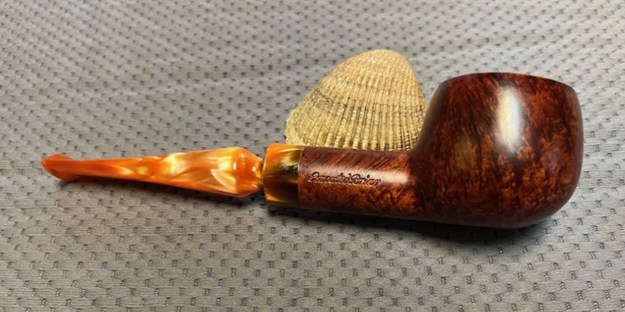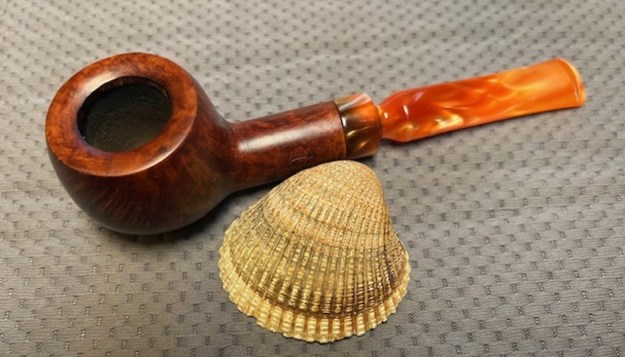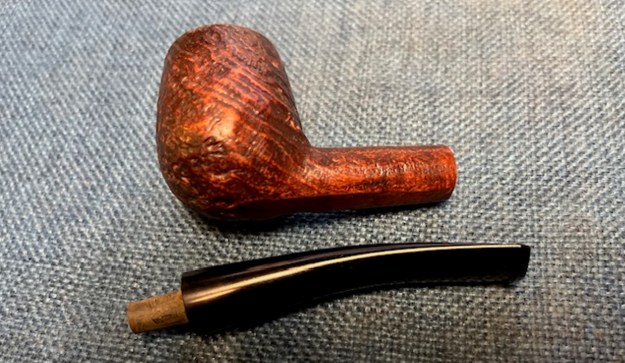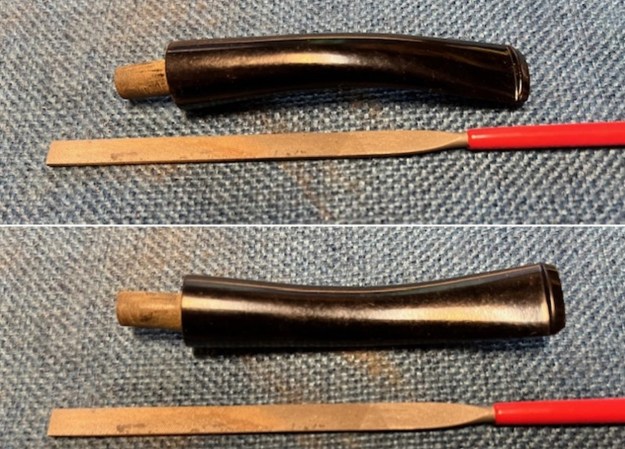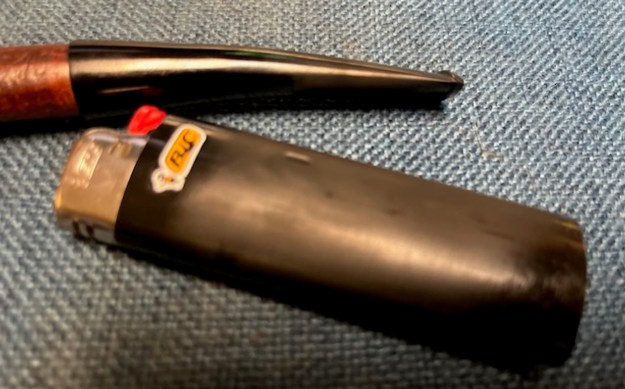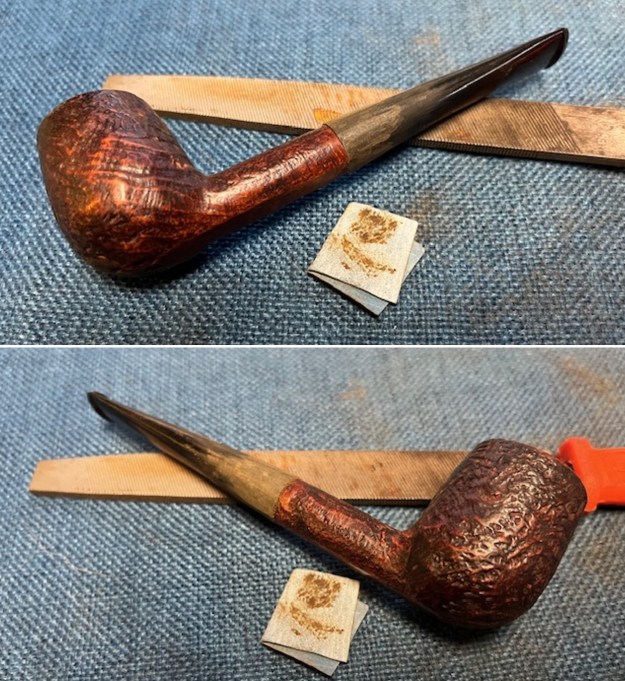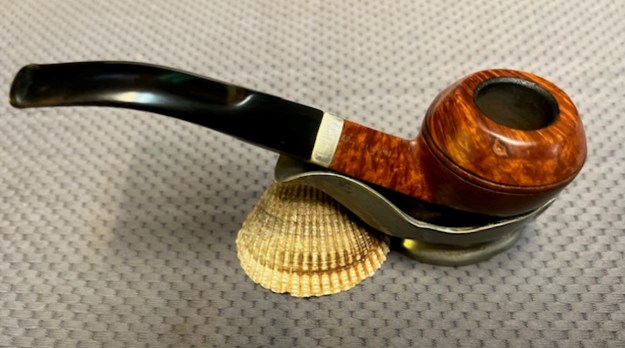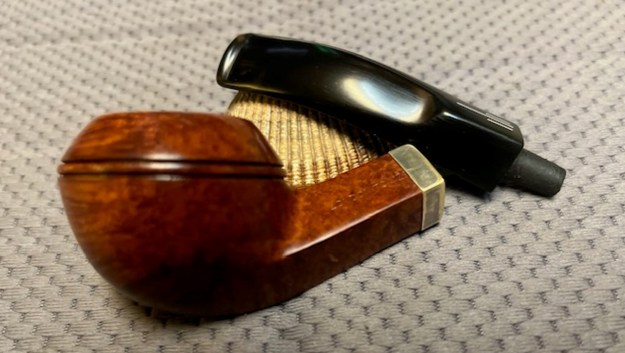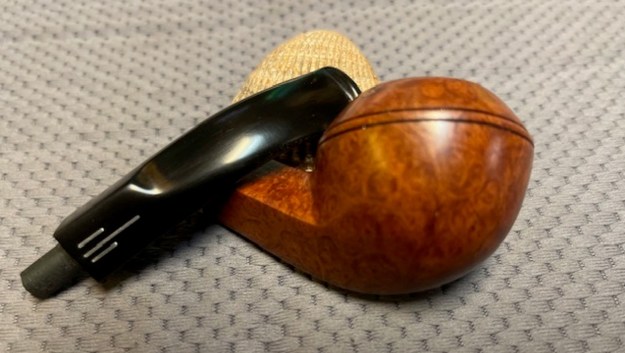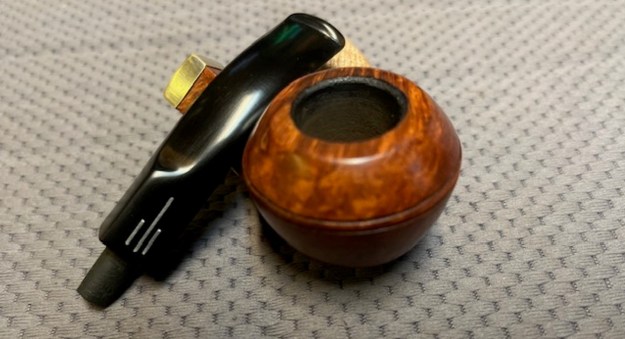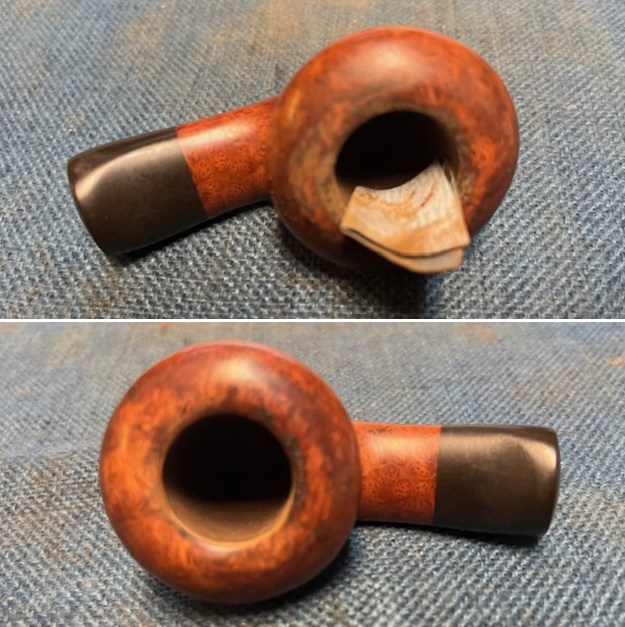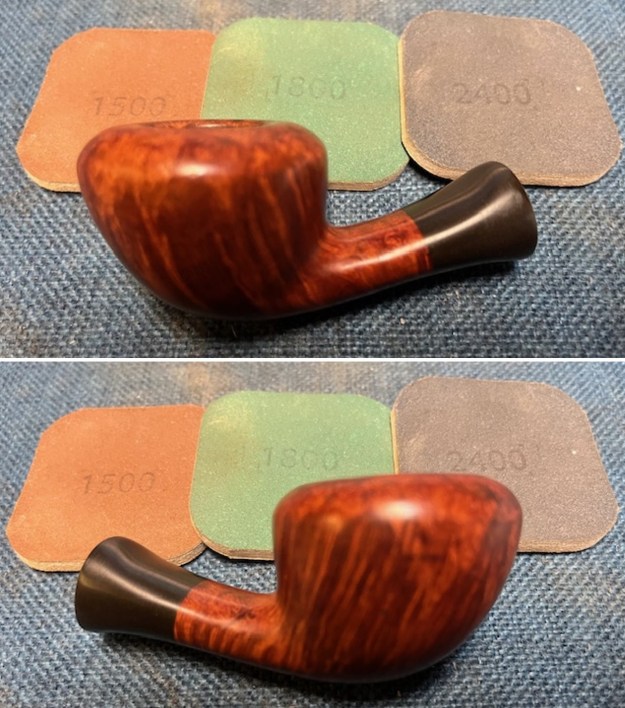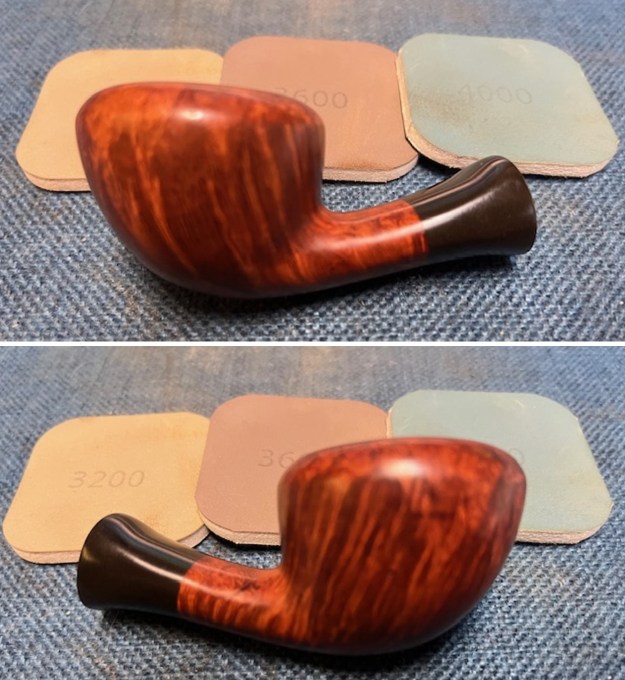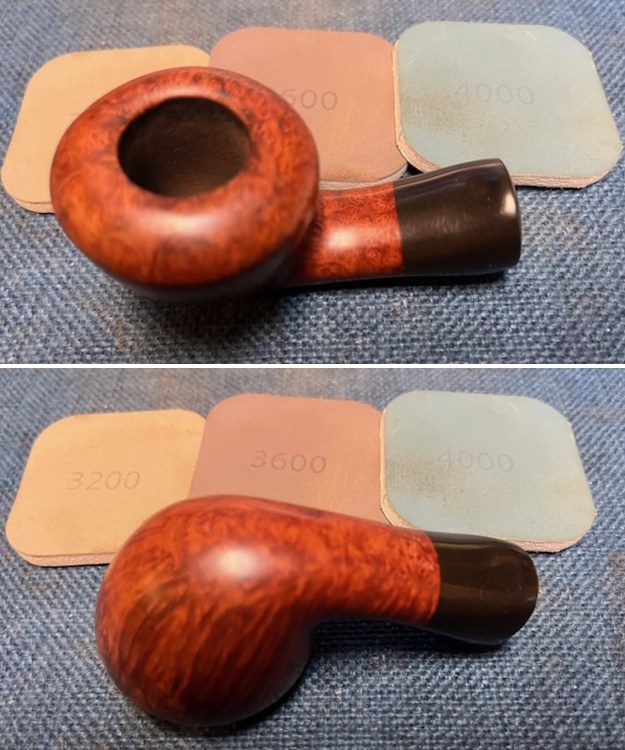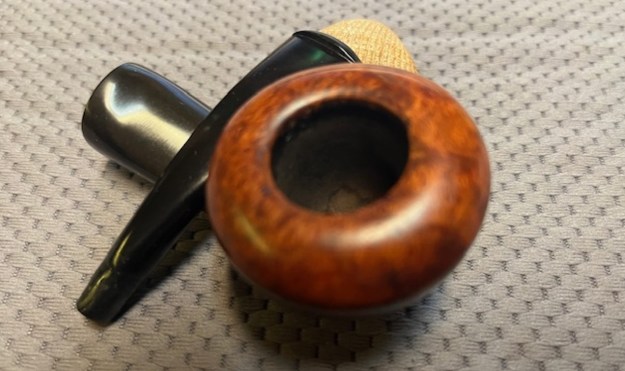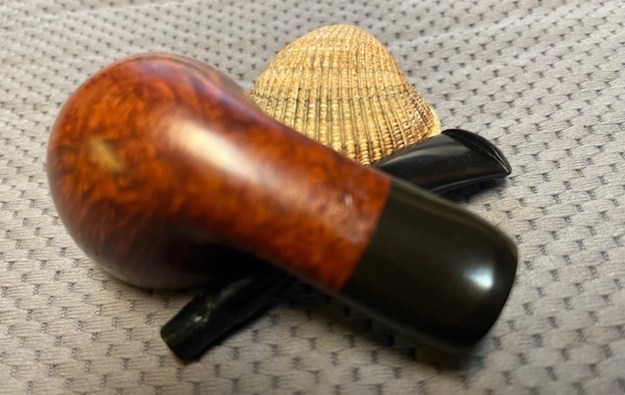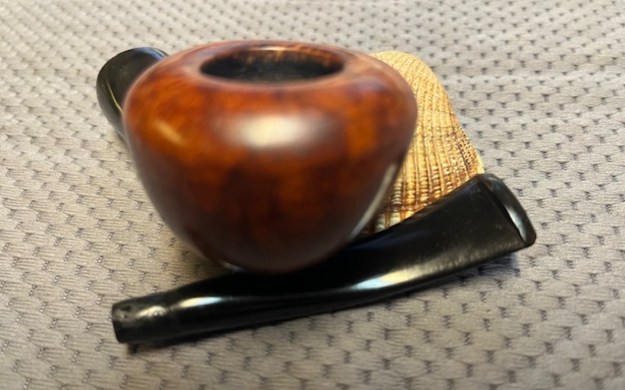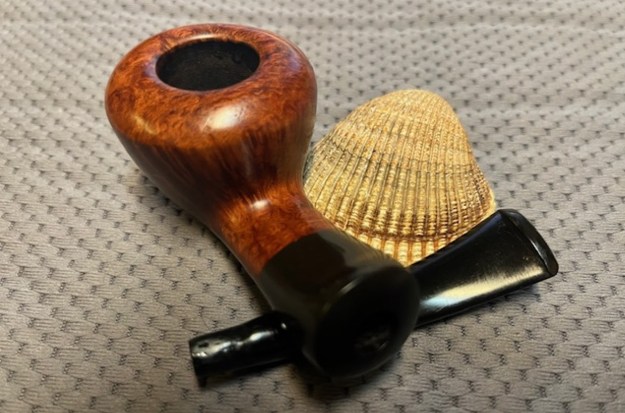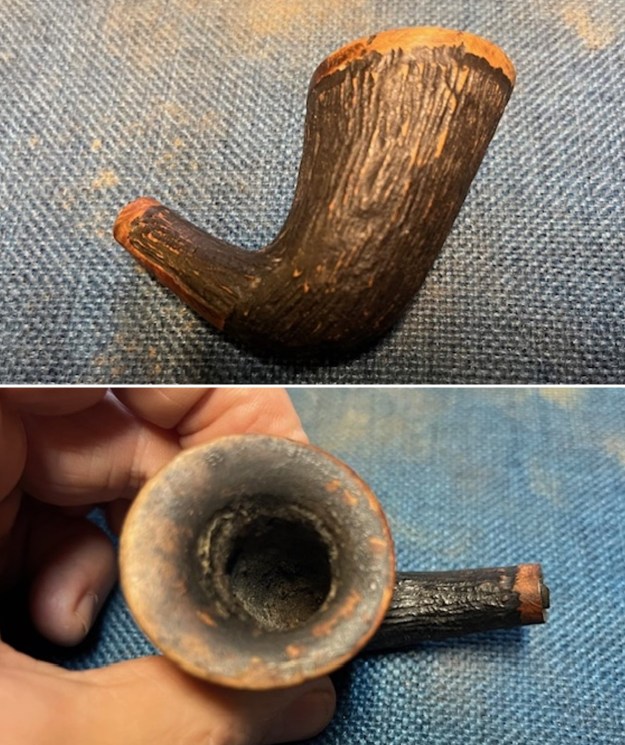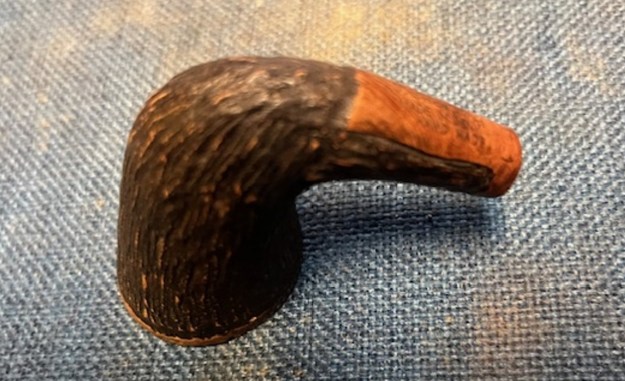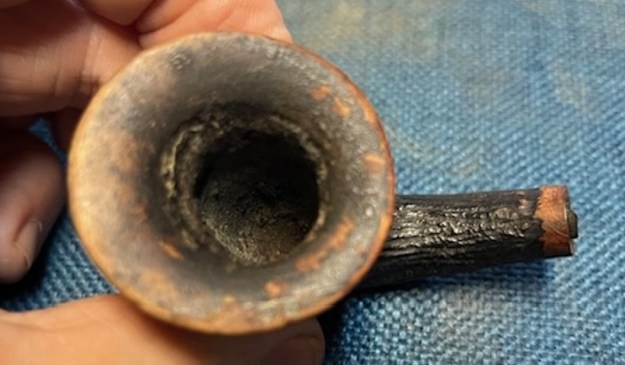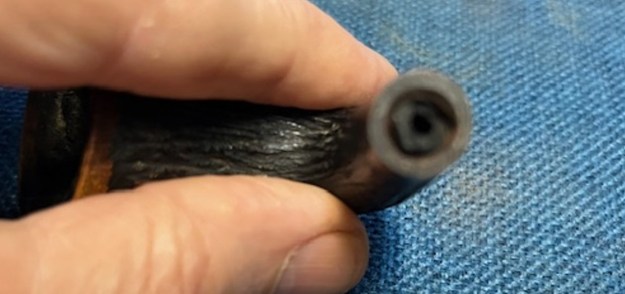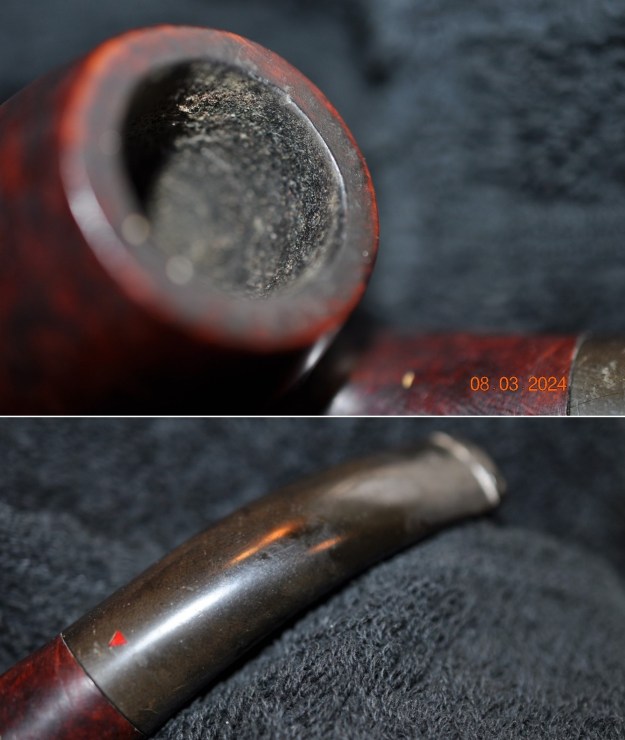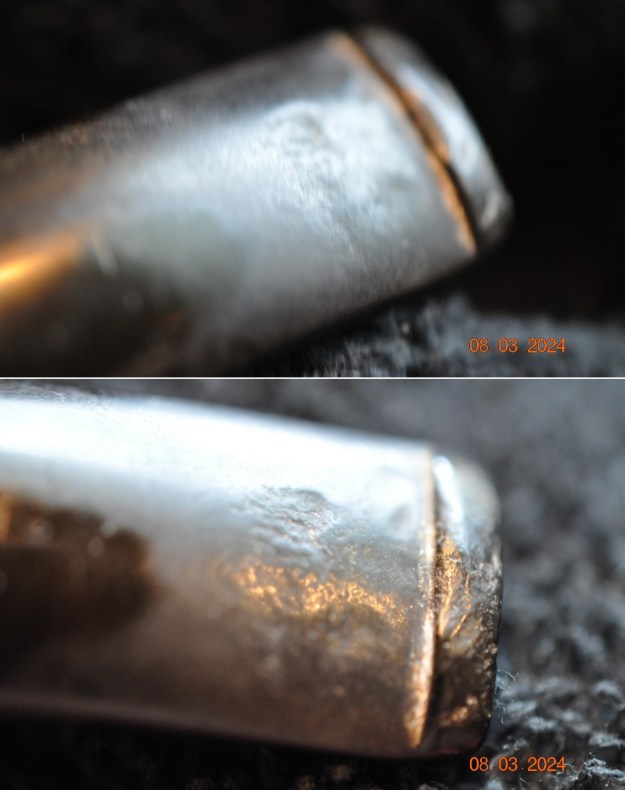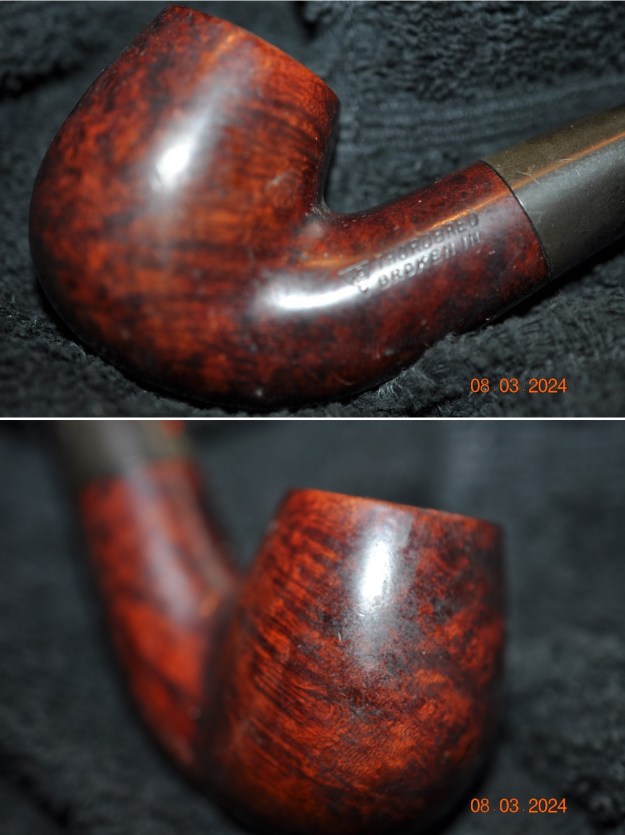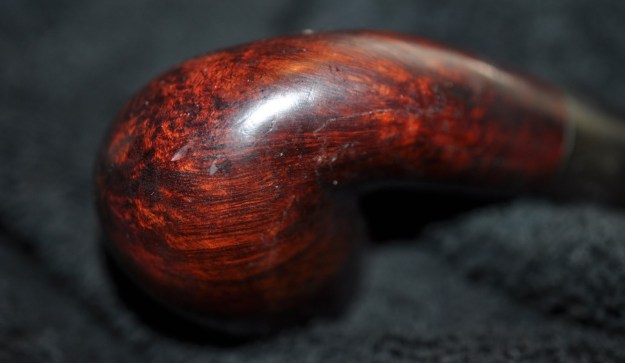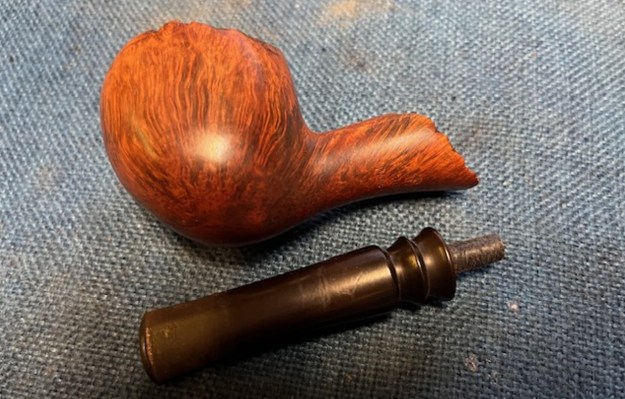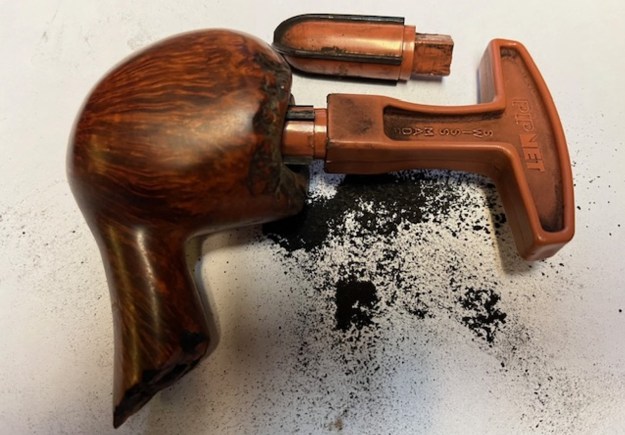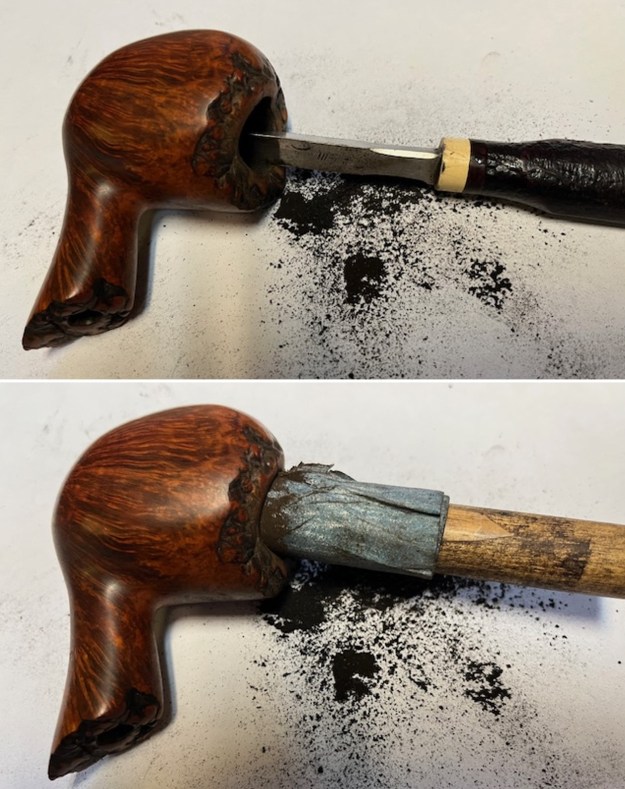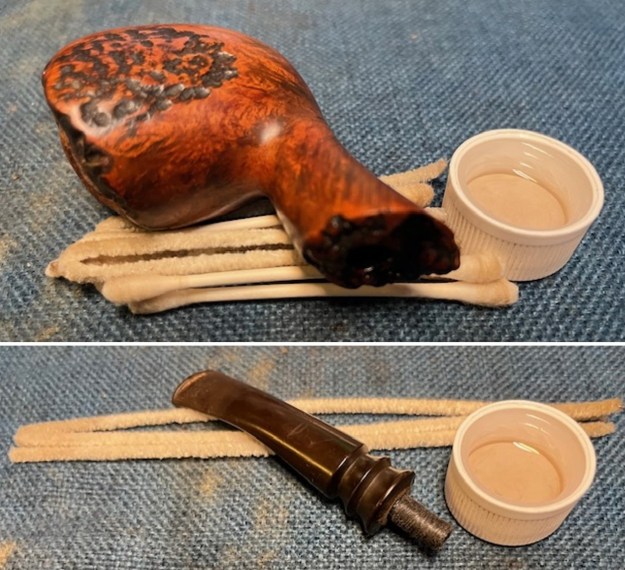
Tag Archives: fitting a stem

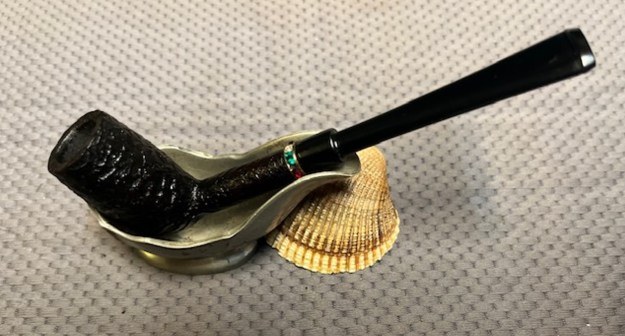
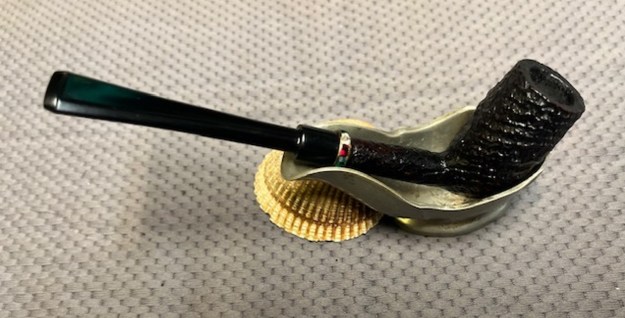
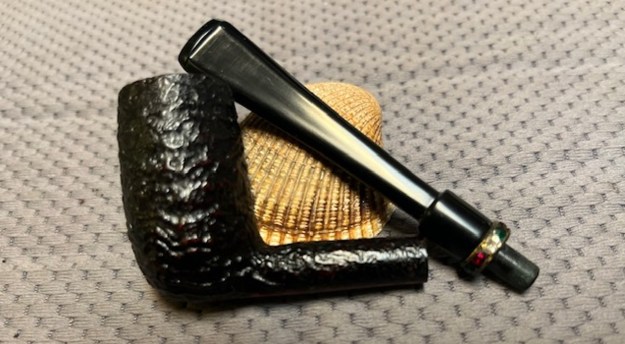
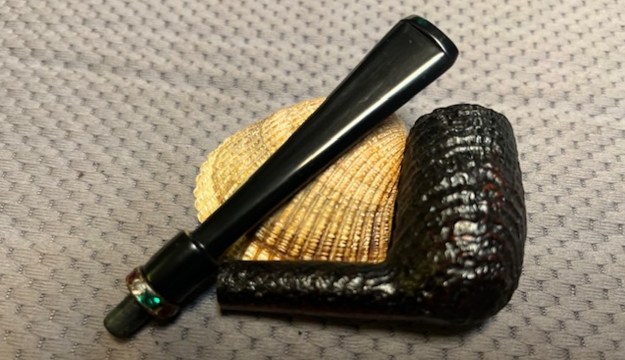
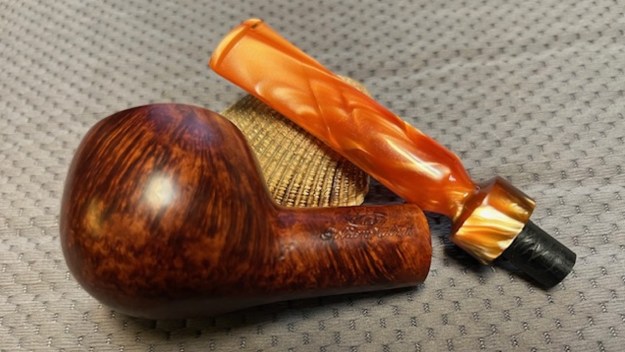
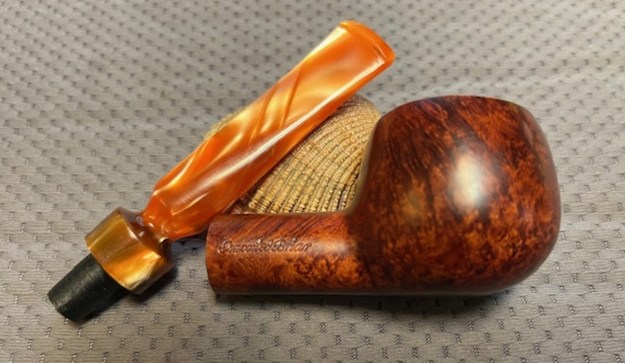
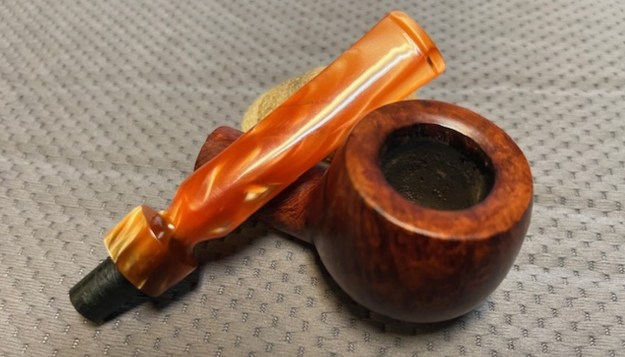
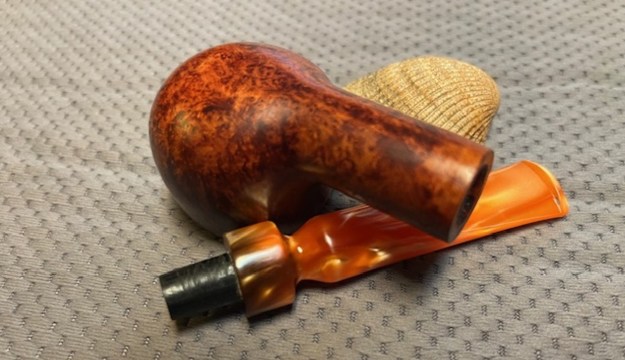
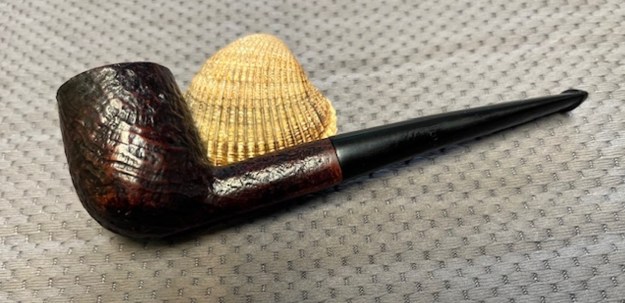
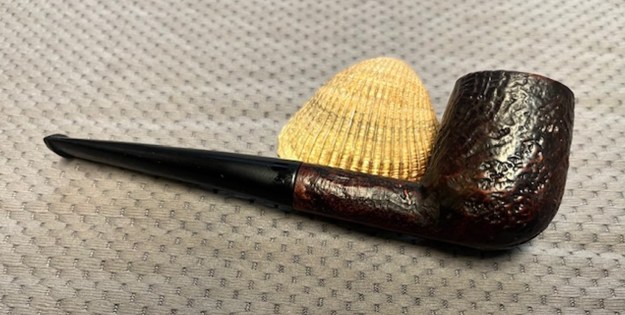
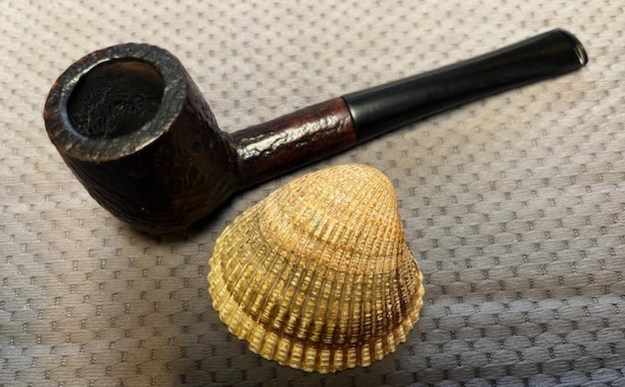
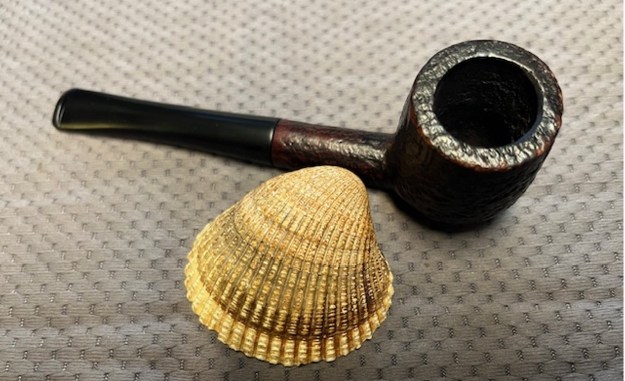
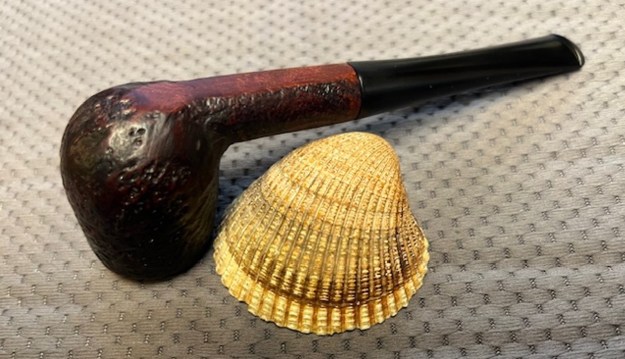
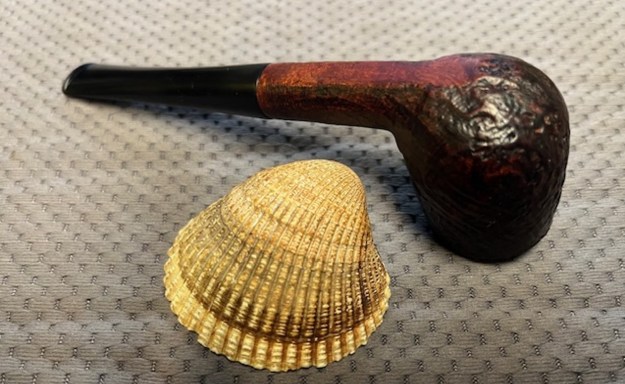
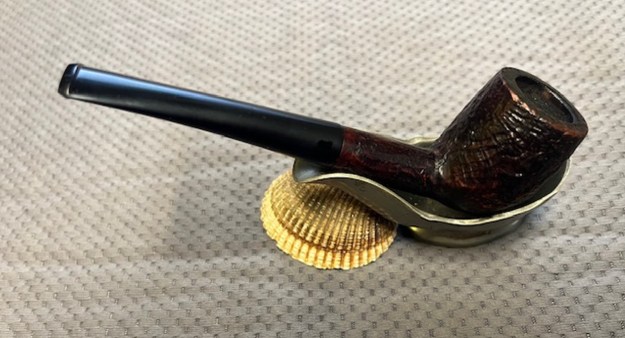
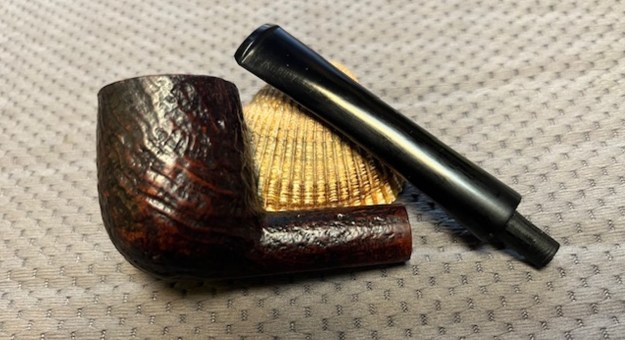
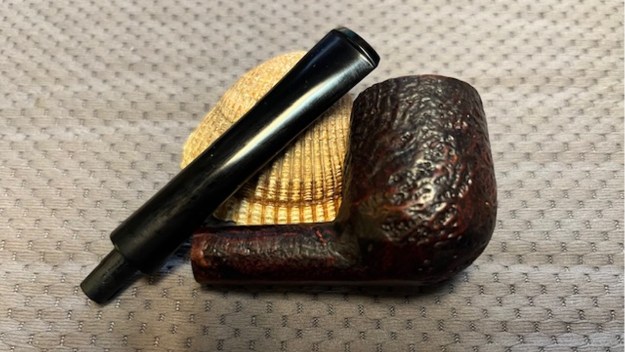
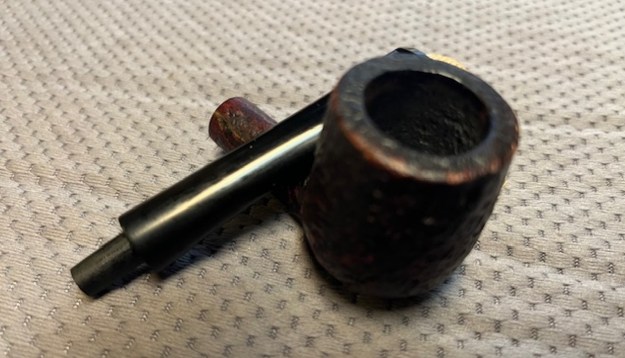
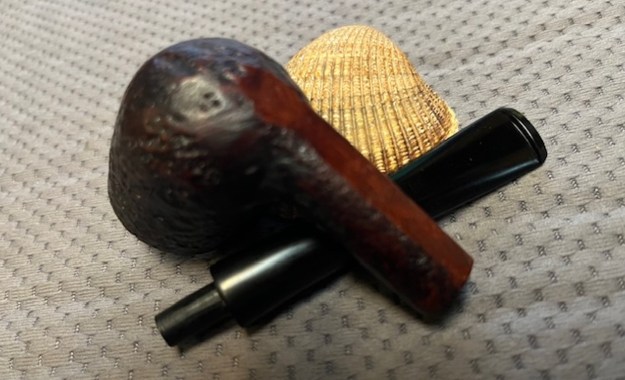
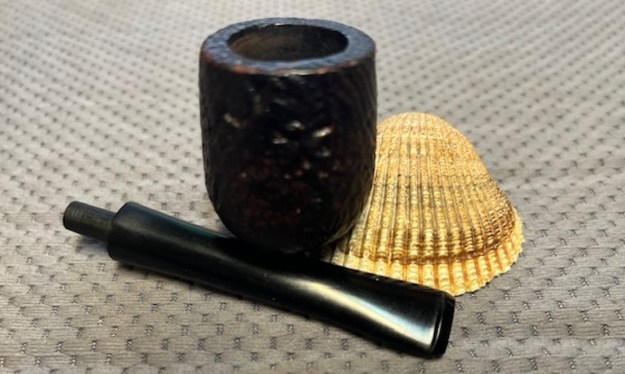
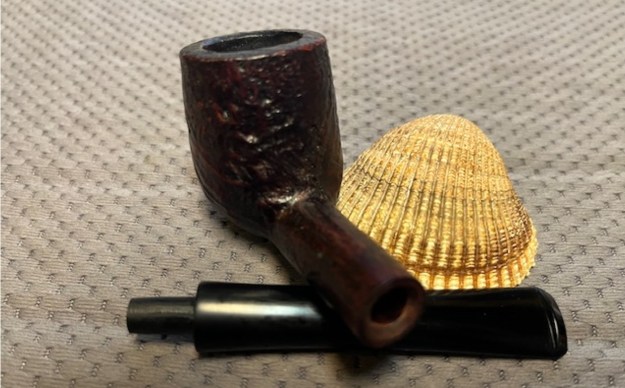
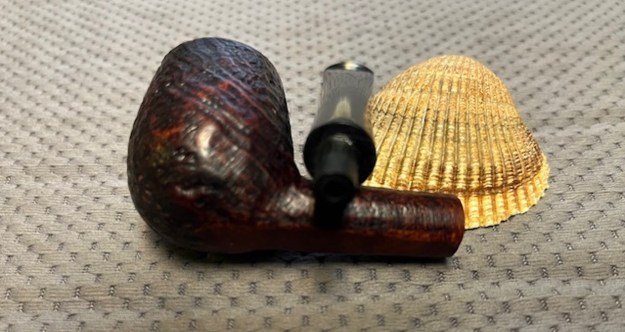
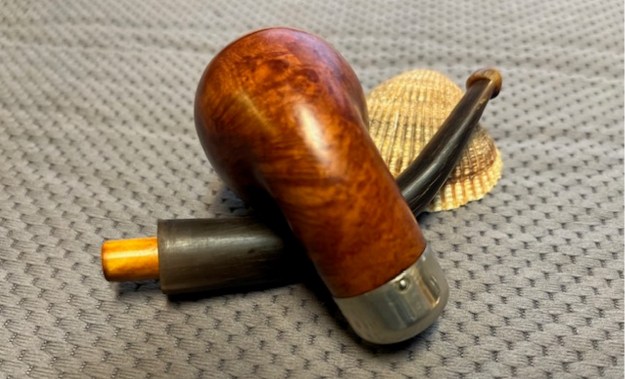
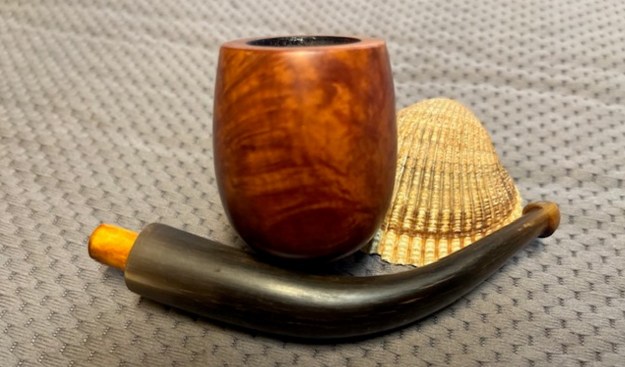
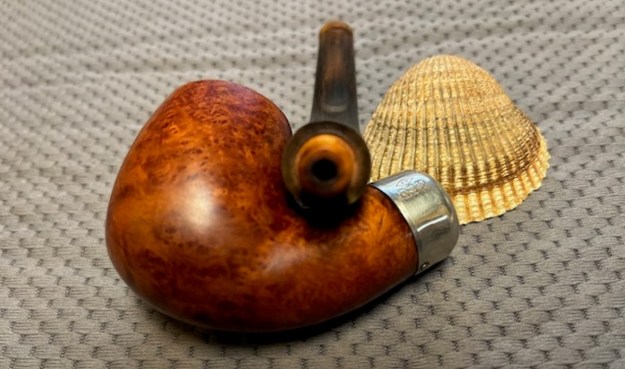
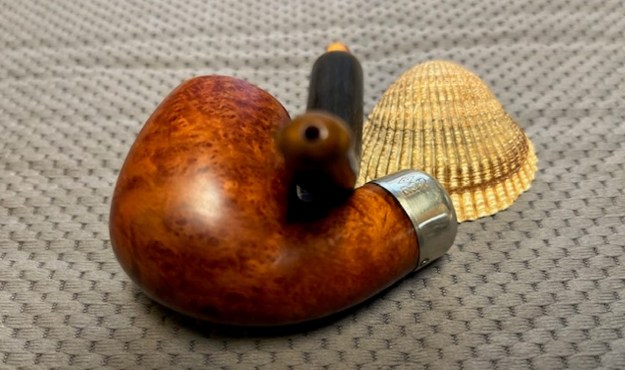
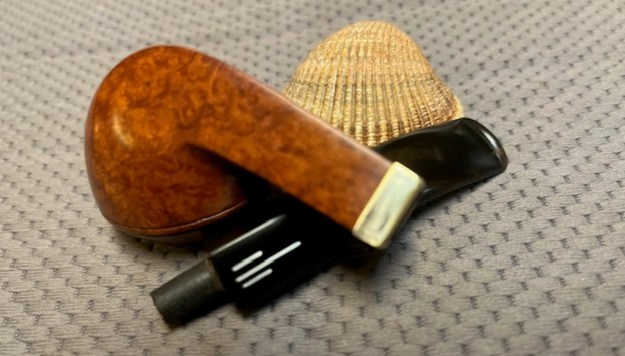
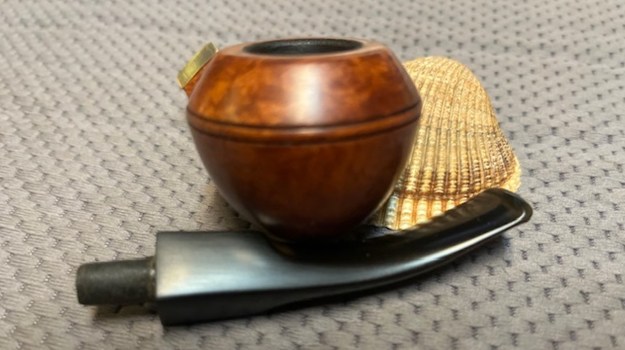
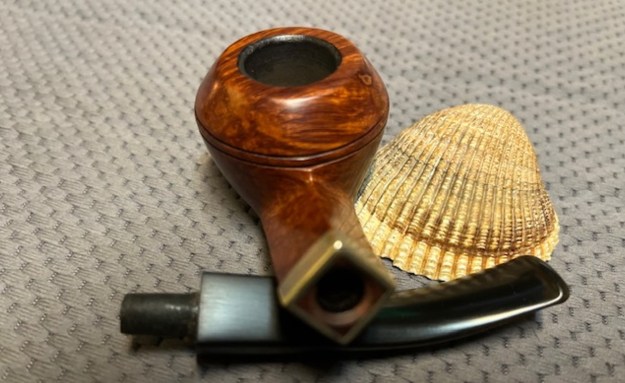
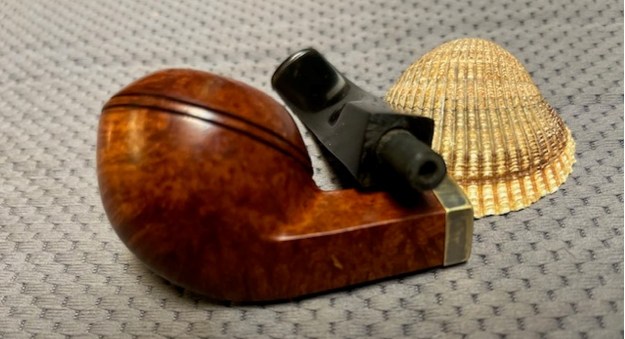
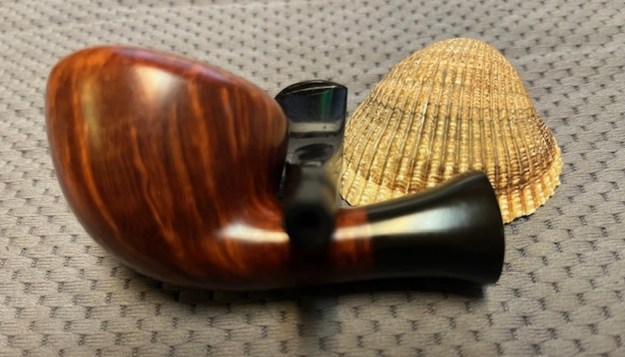
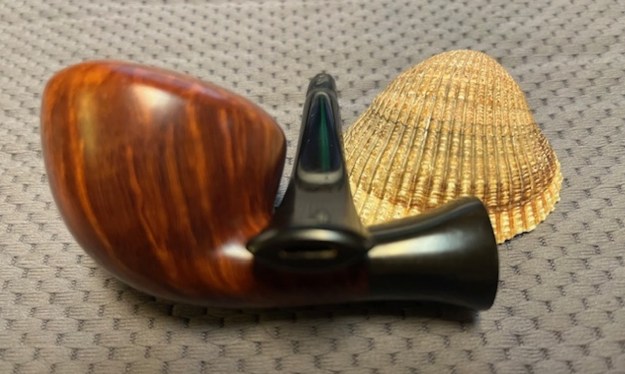
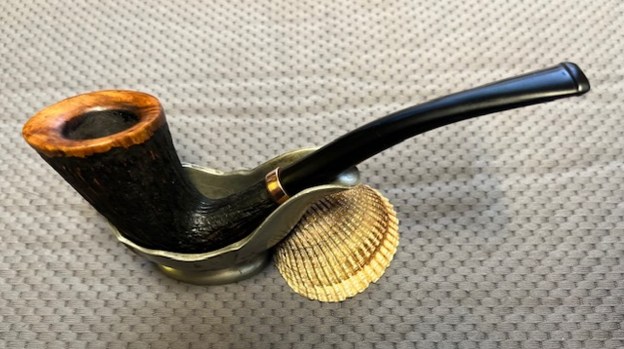
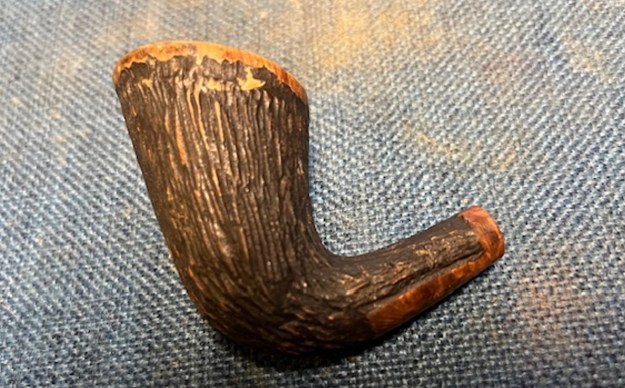
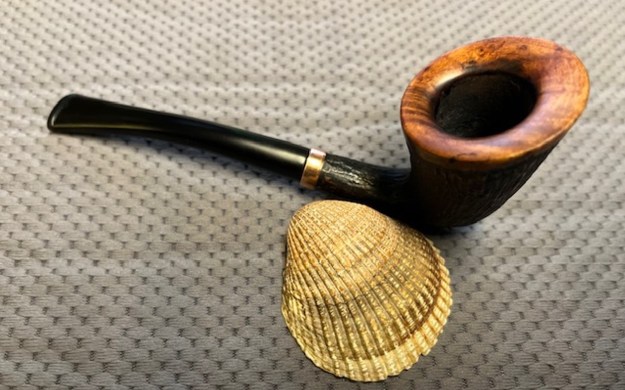
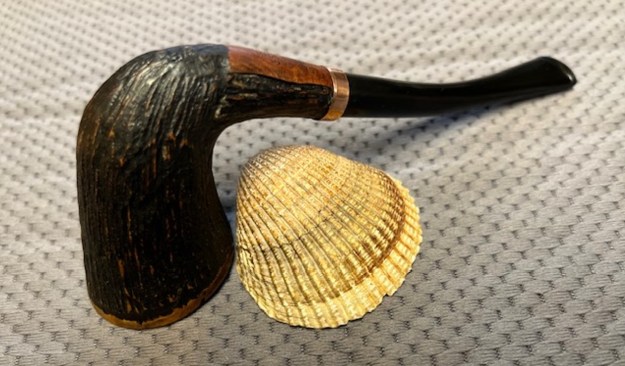
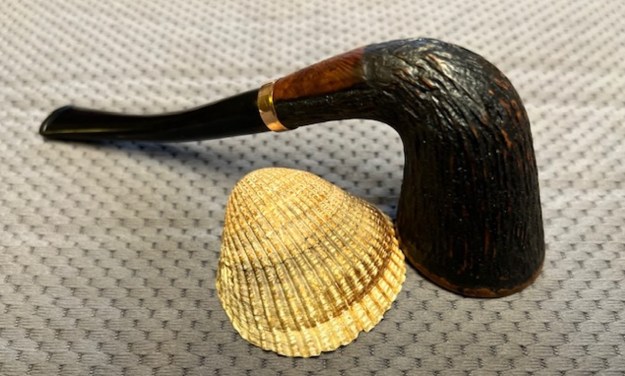
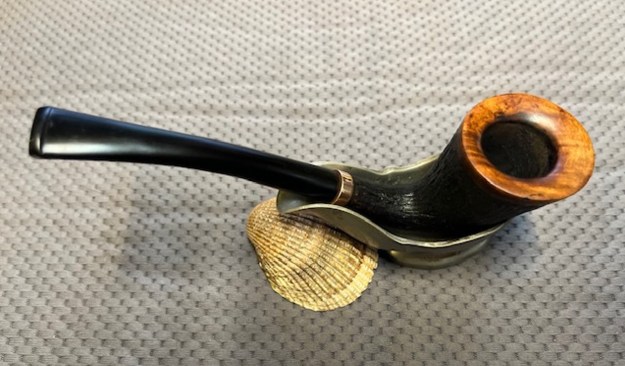
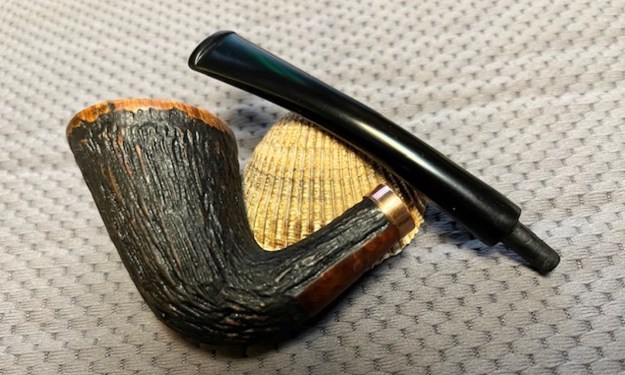
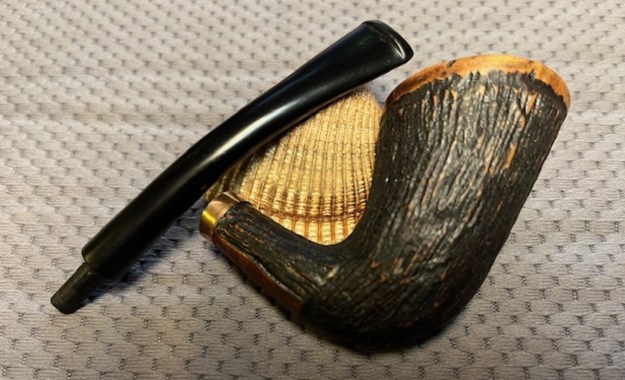
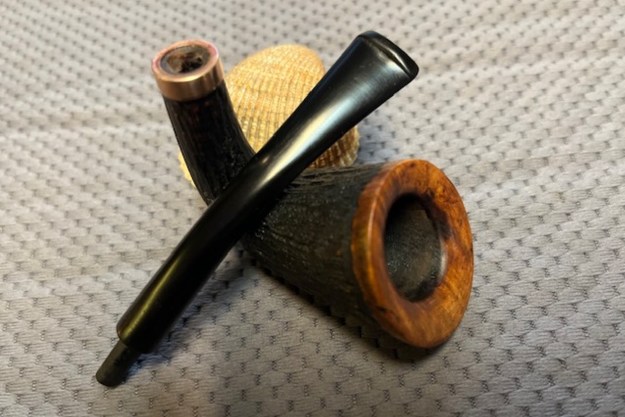
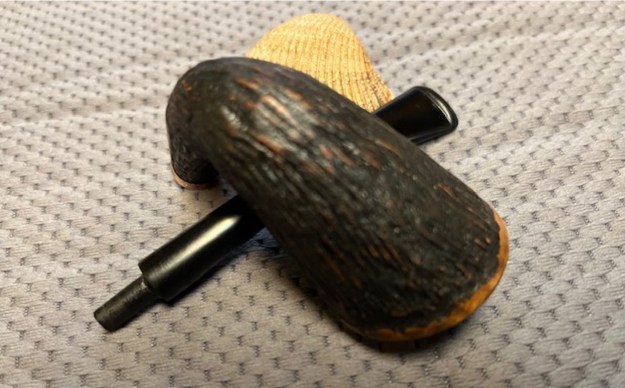
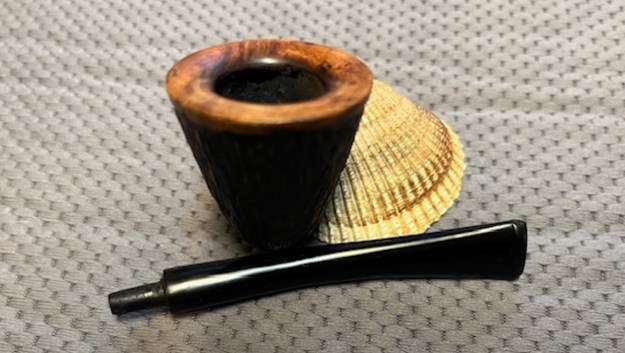
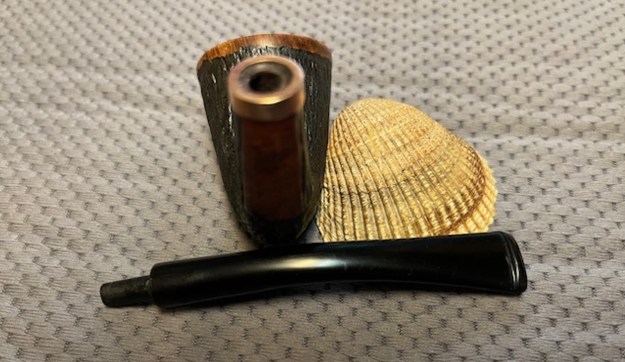
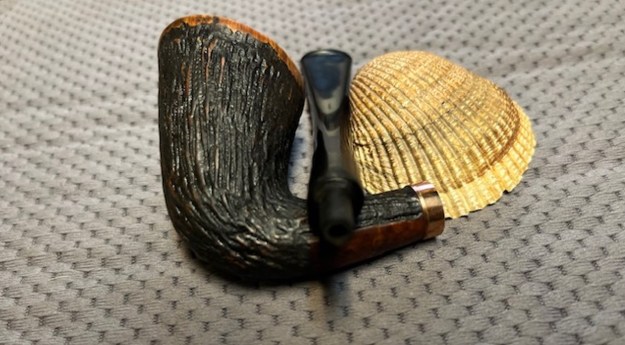
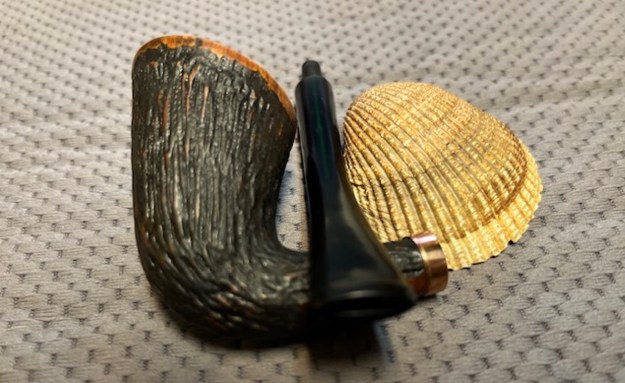
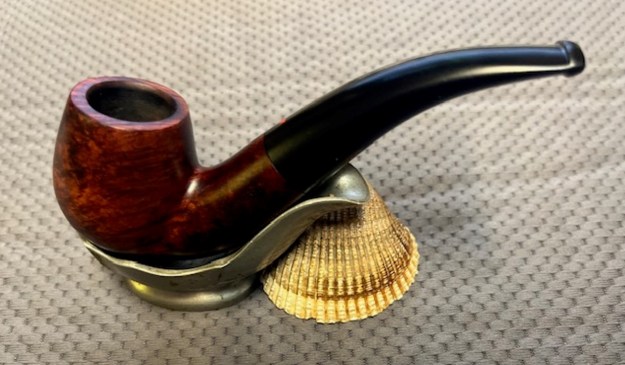
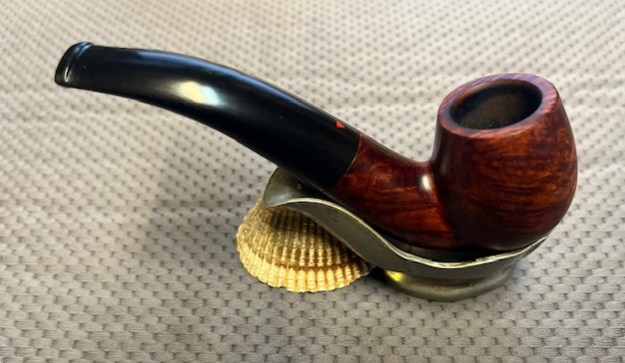
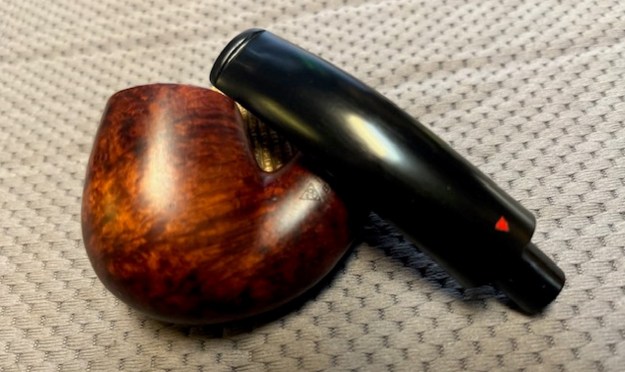
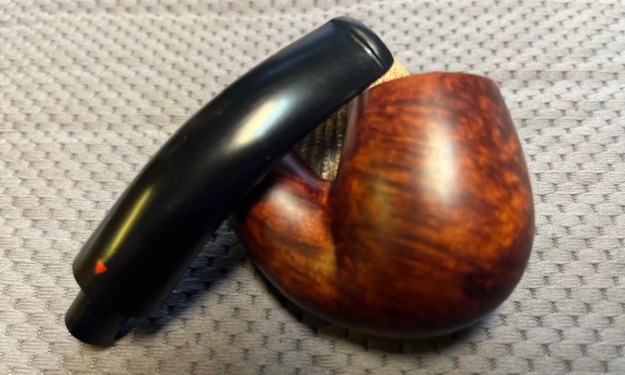
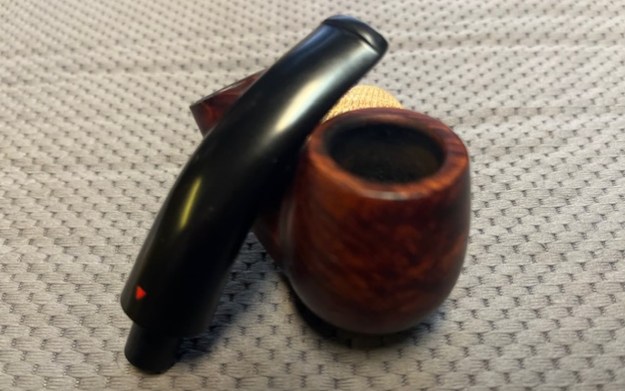
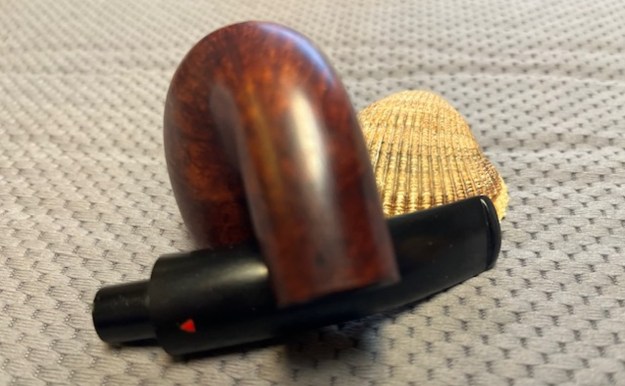
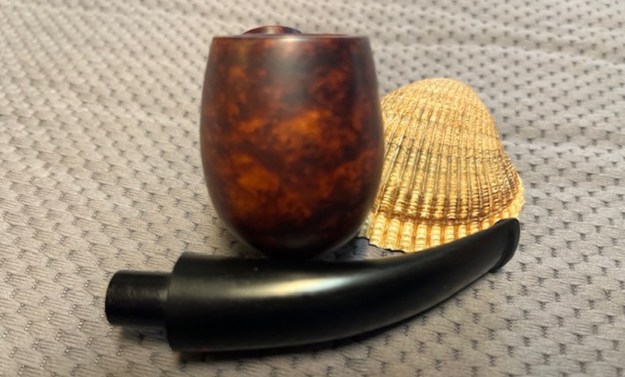
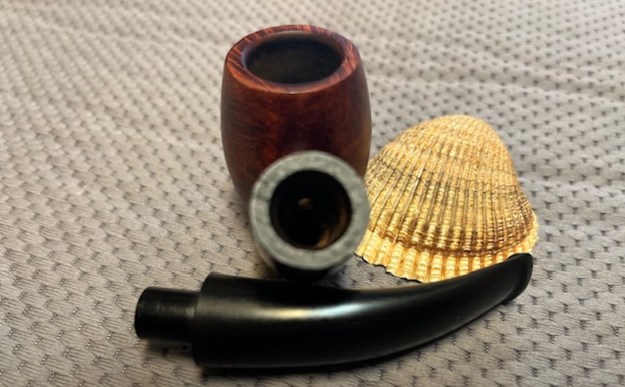
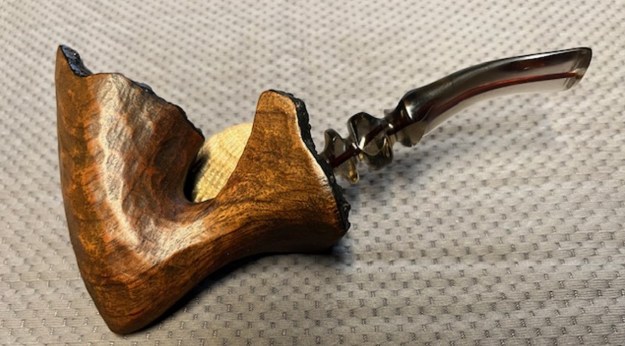
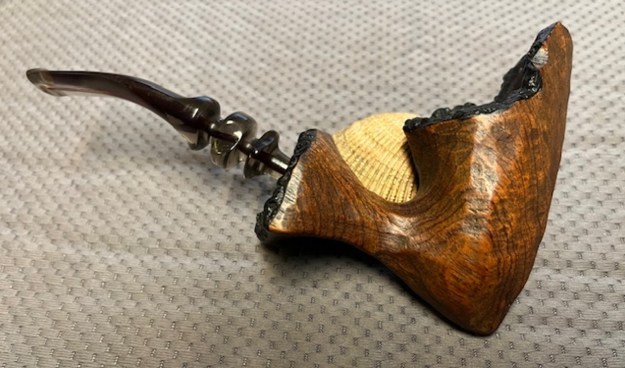
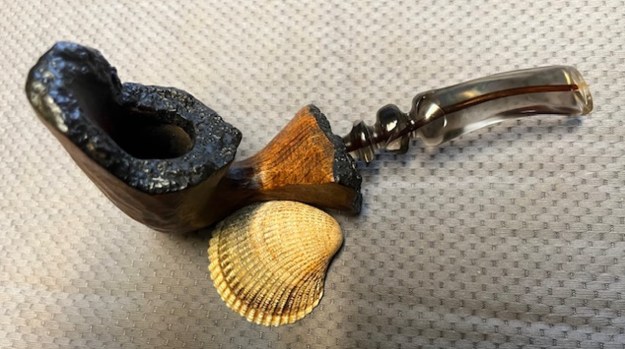
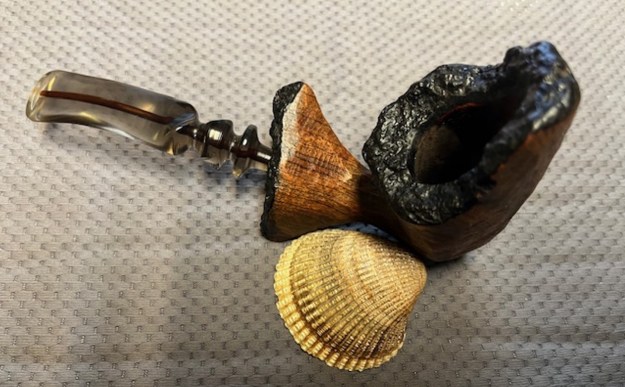
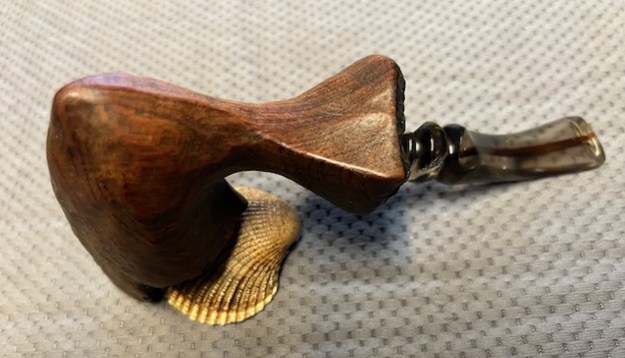
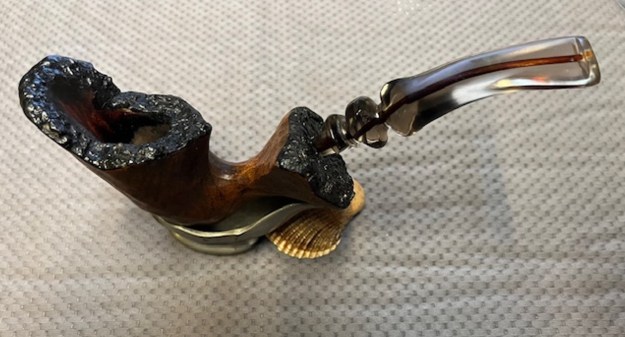
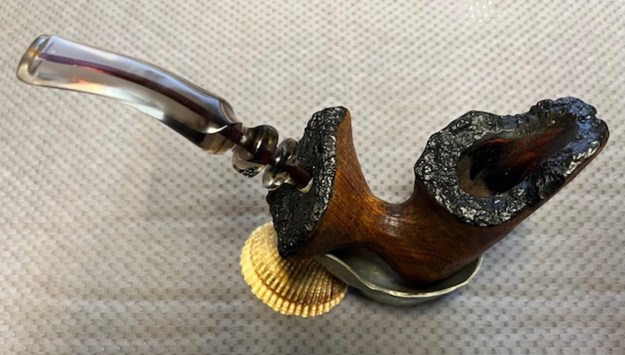
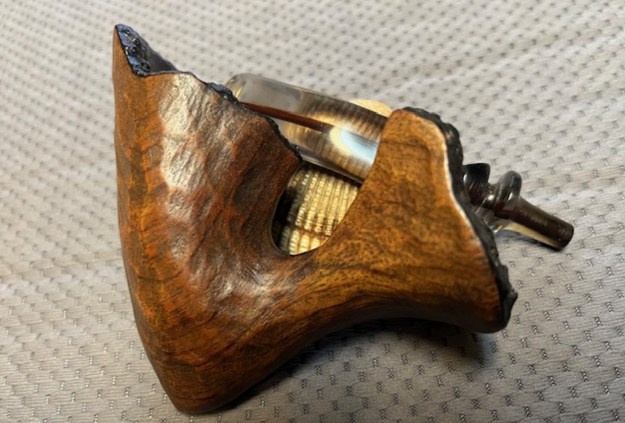
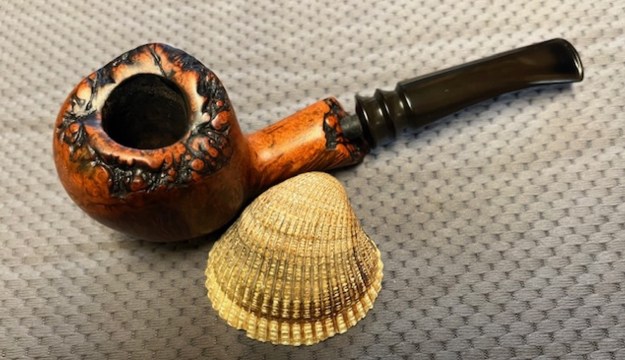
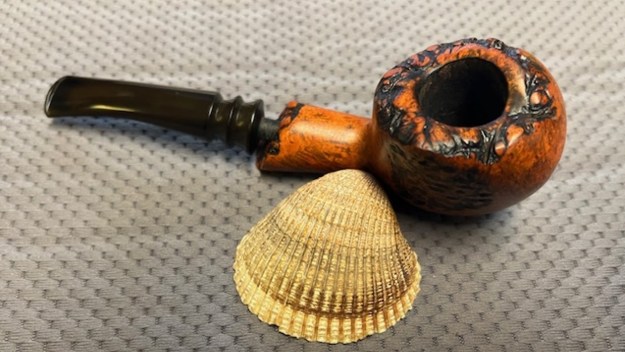
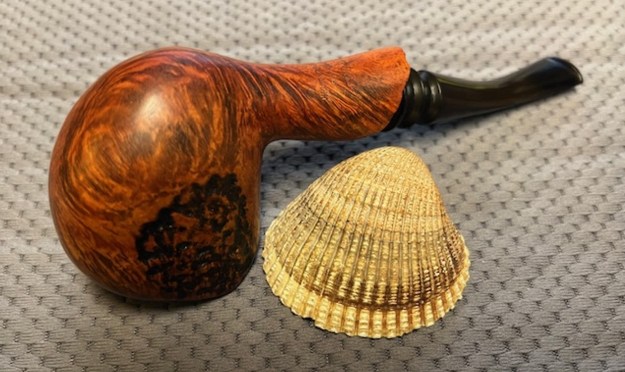
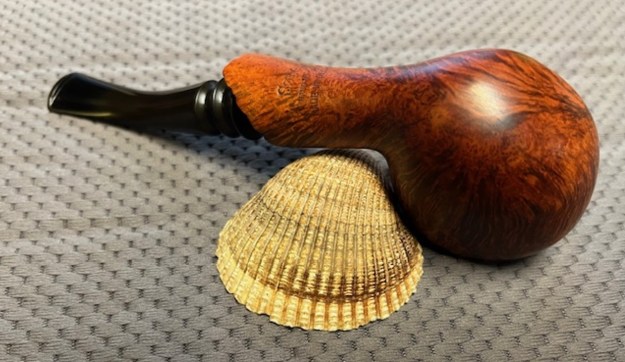
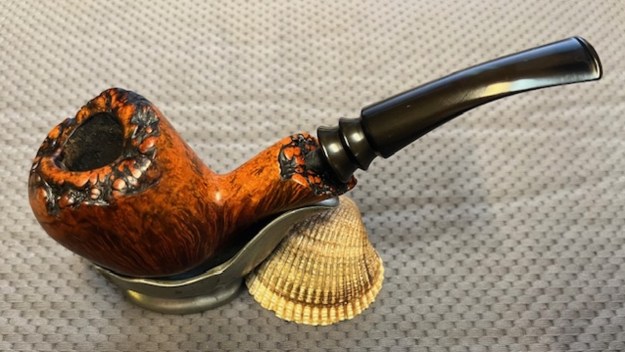
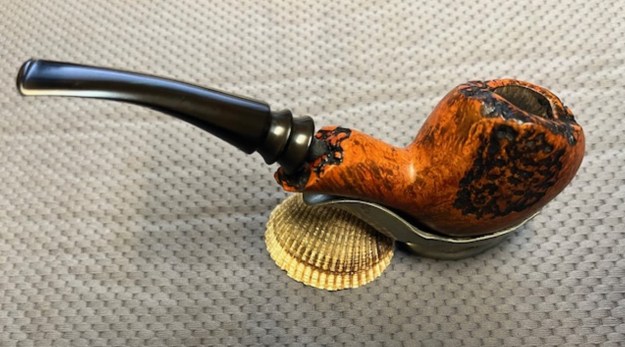
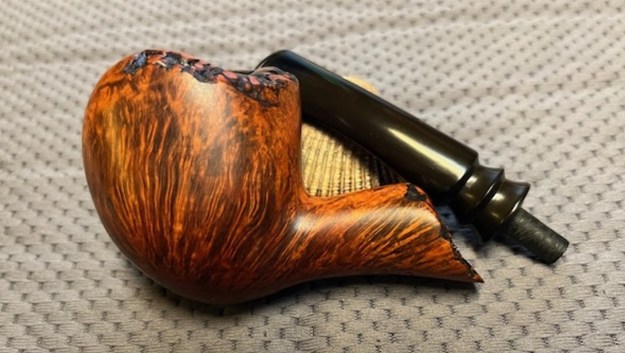
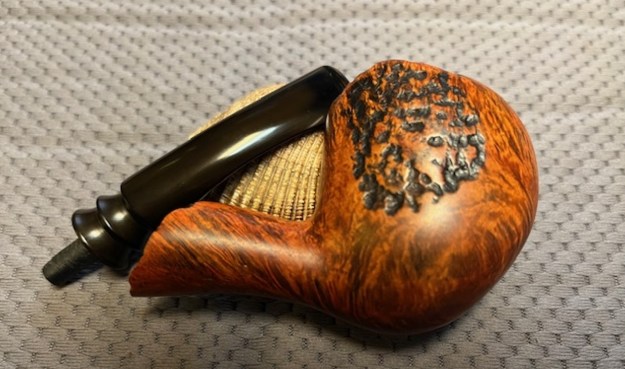
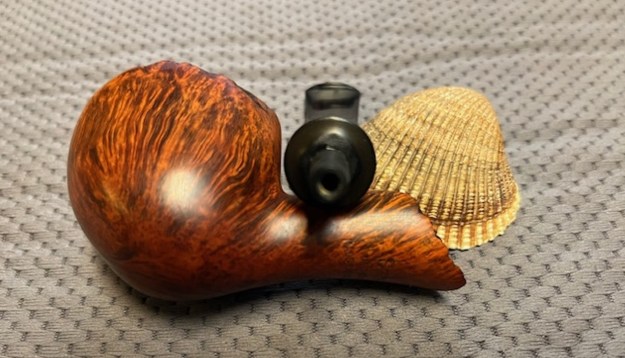
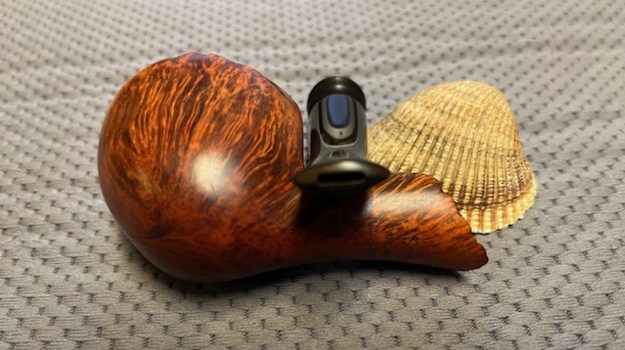
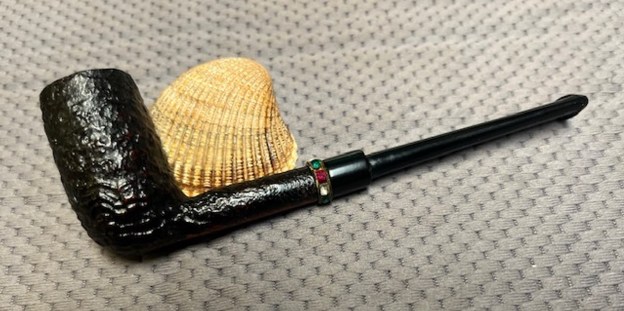
Restemming and Restoring a Frasorteret Freehand


by Steve Laug

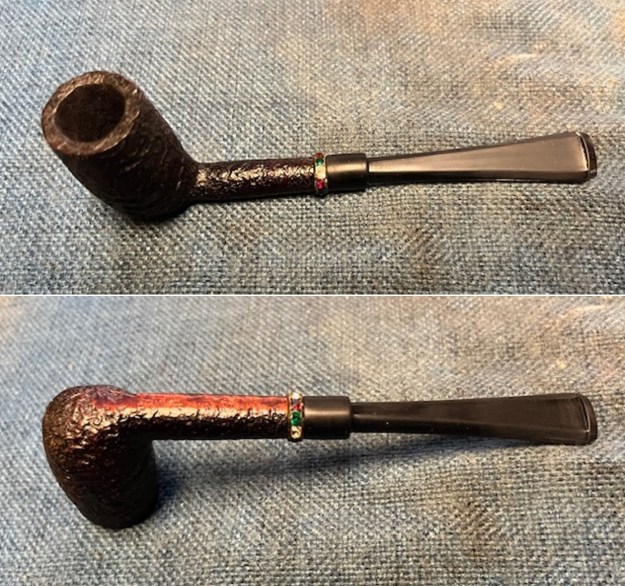
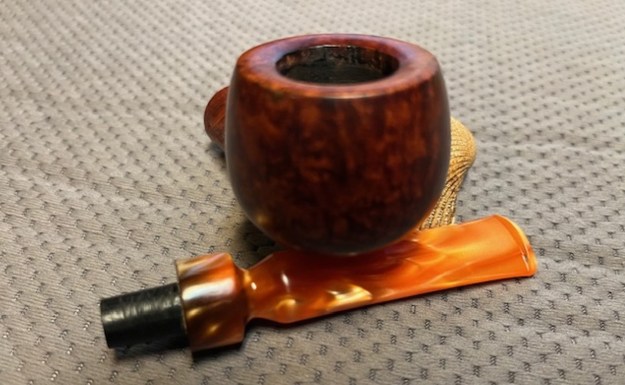
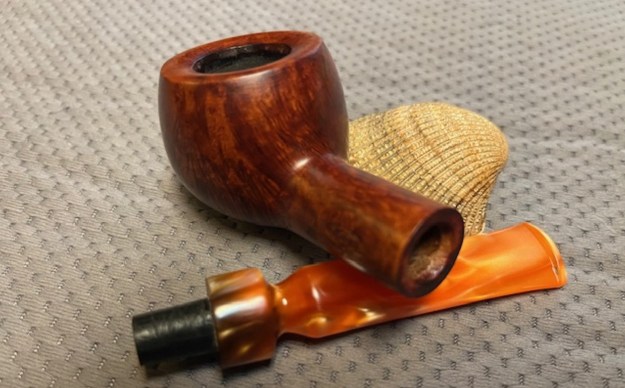
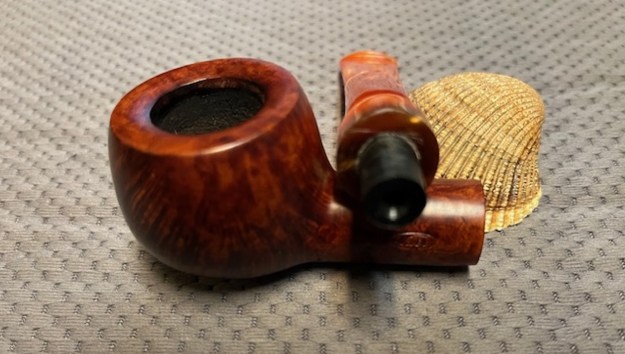
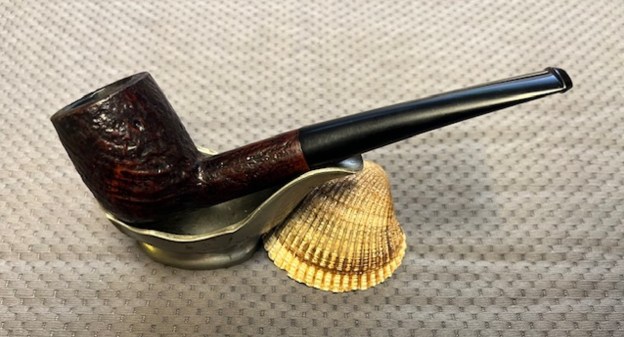
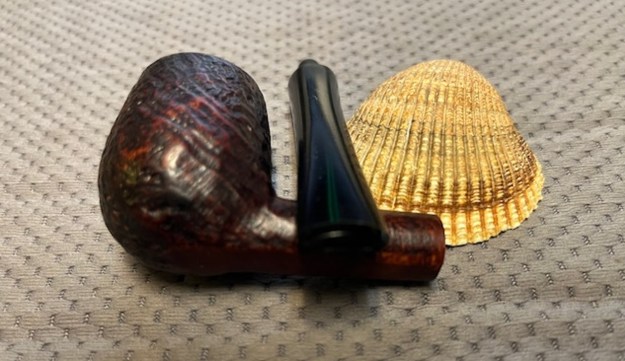
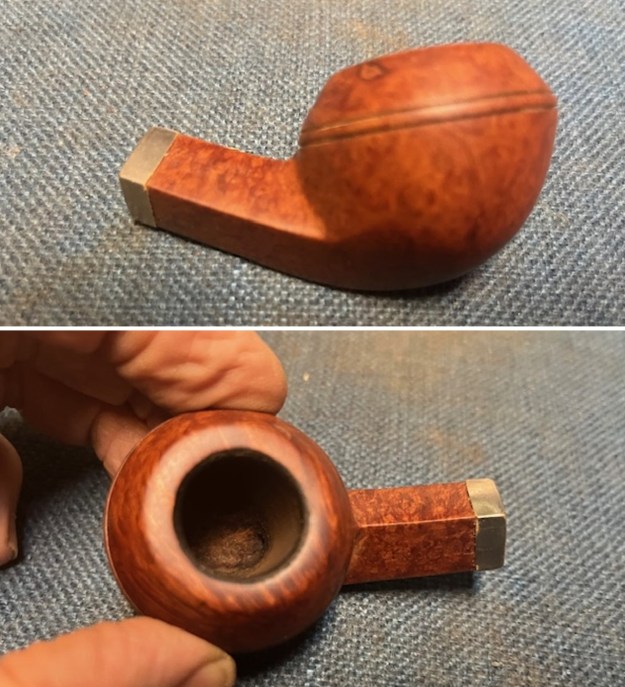
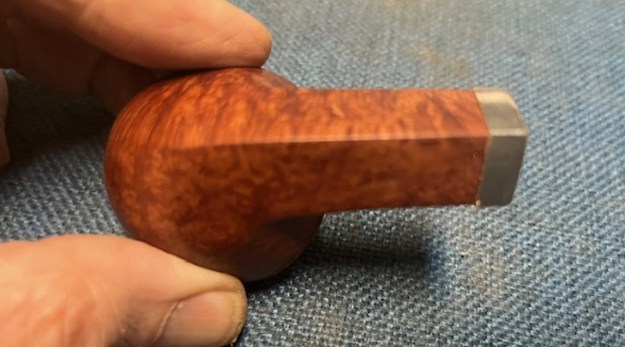
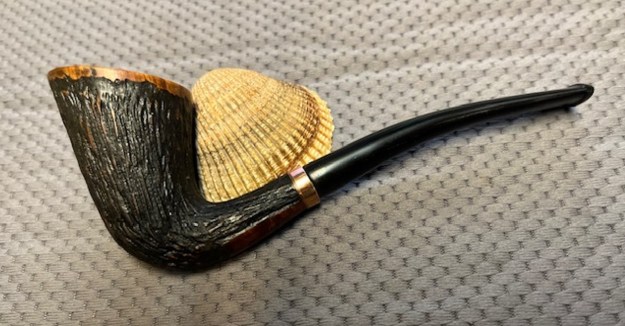
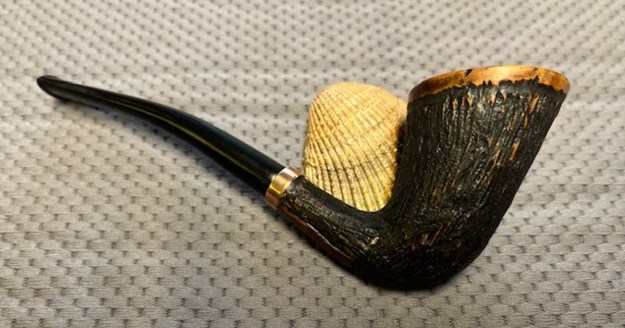
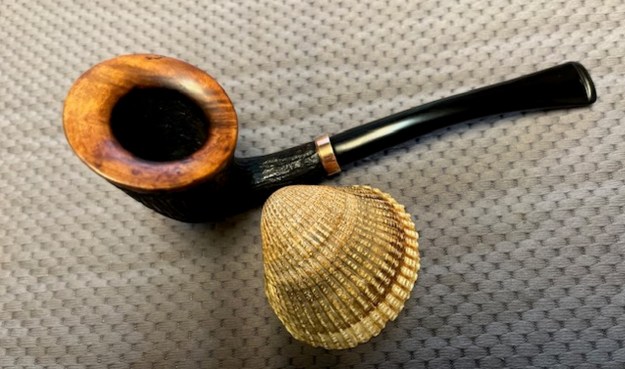
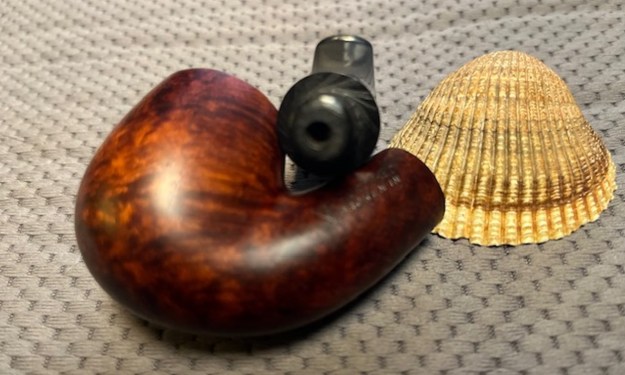
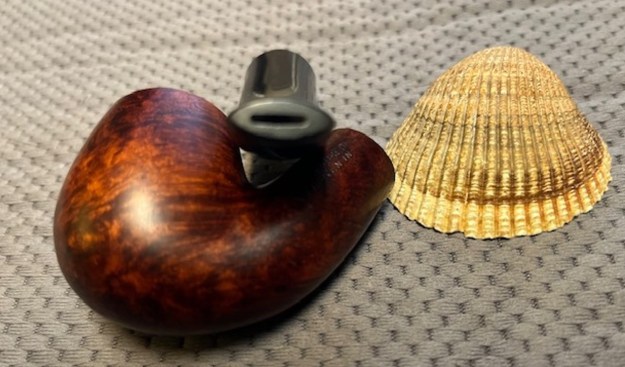
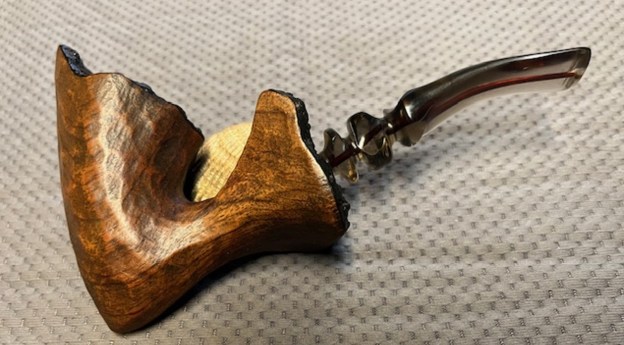
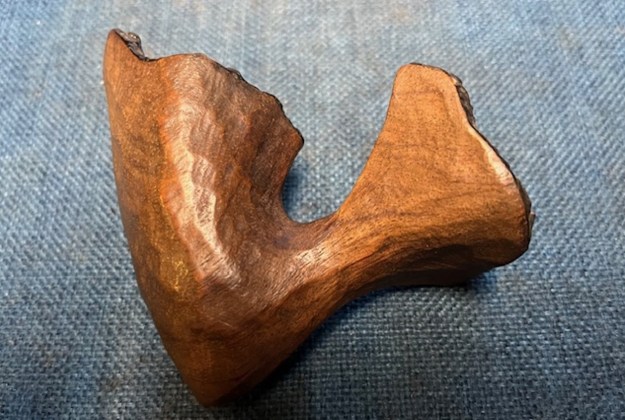
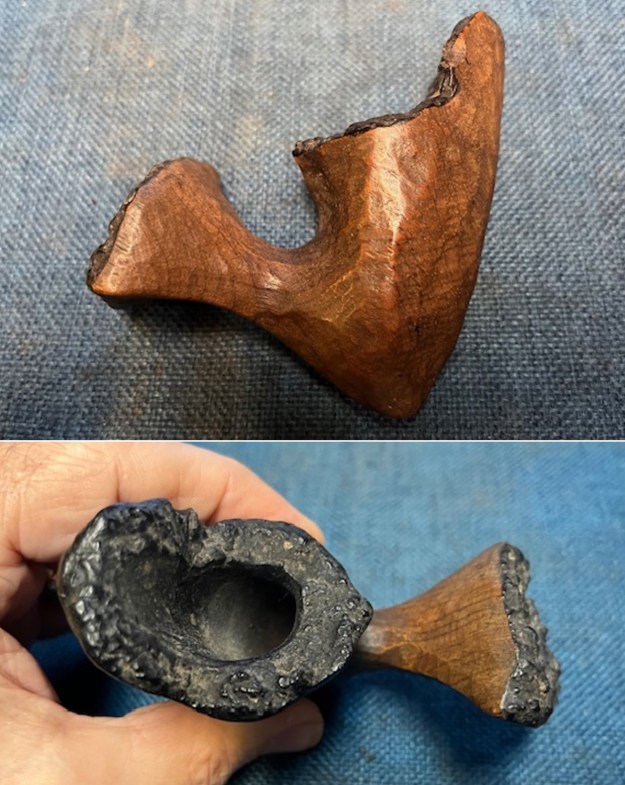
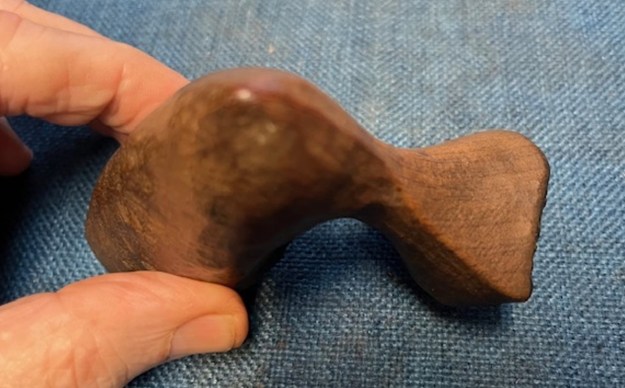
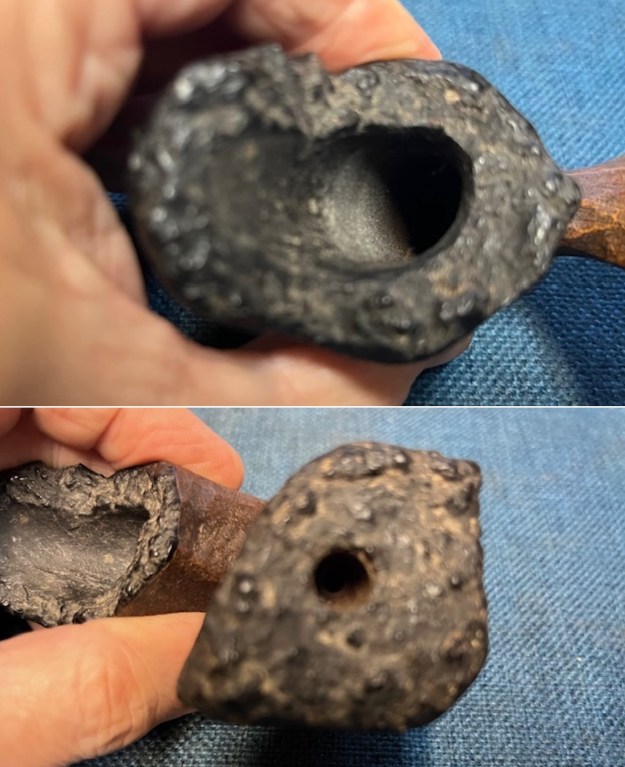
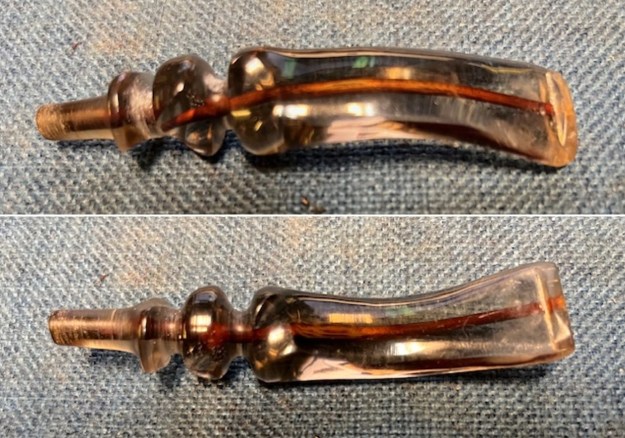
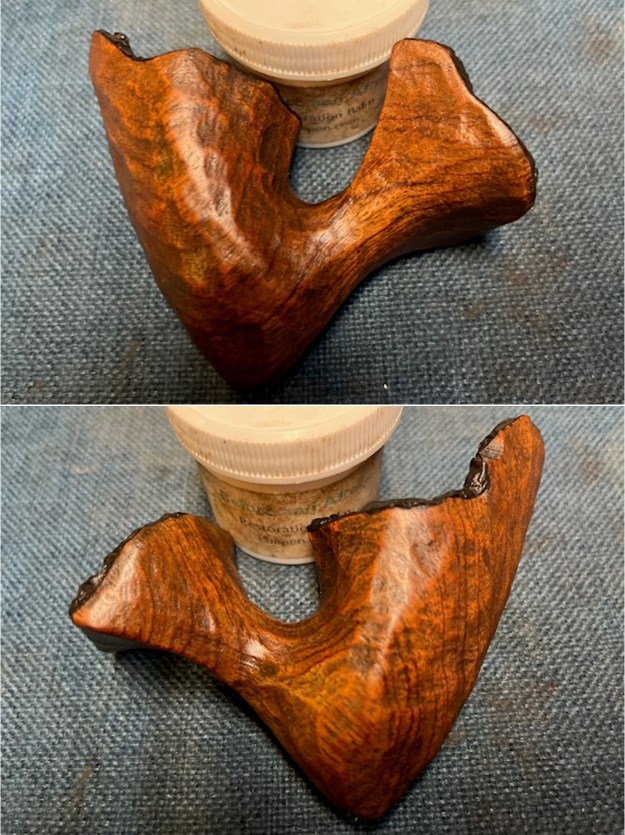
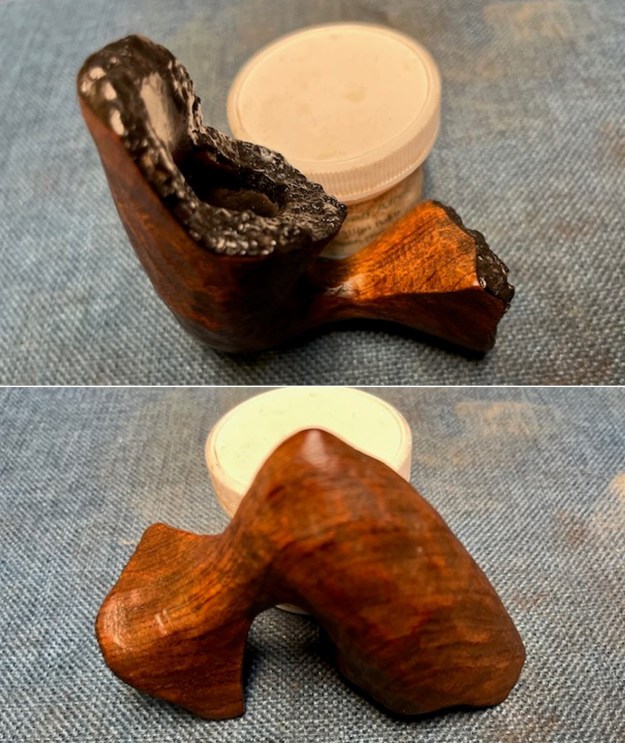
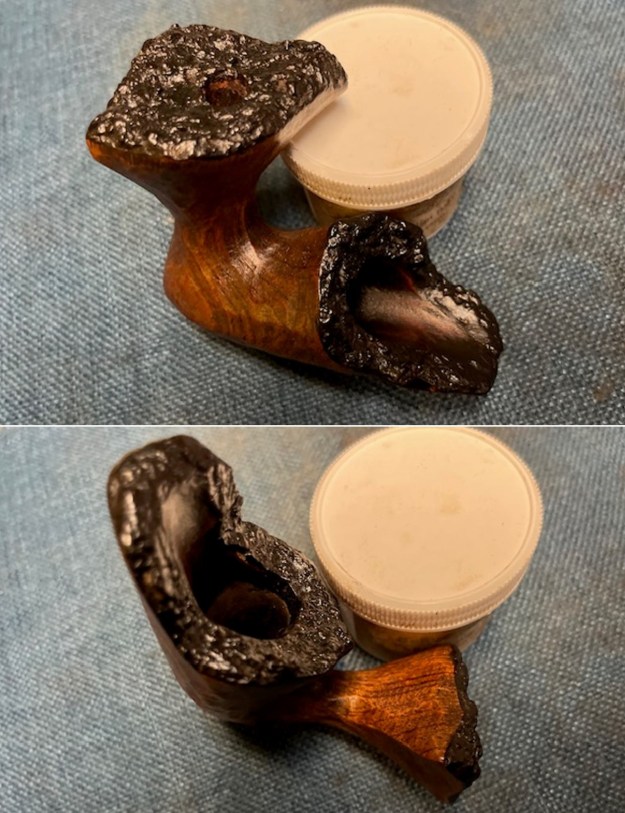
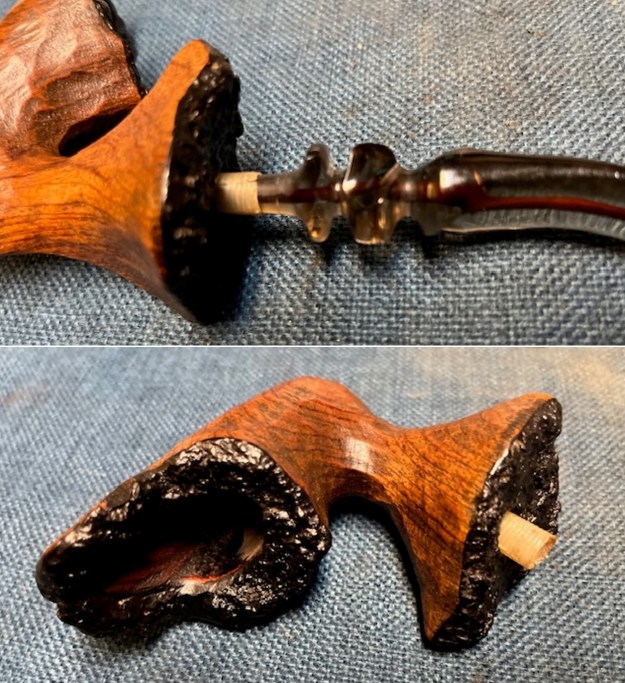
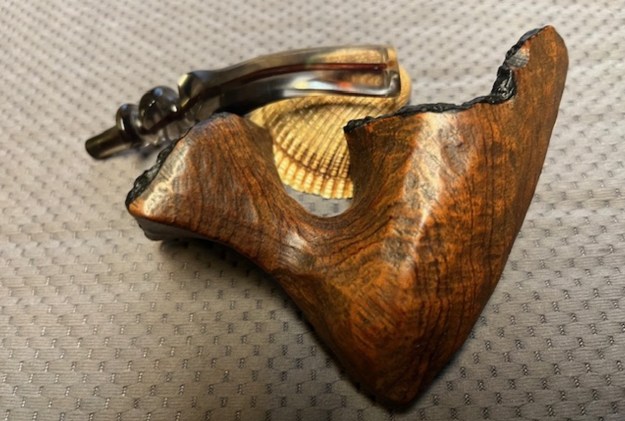
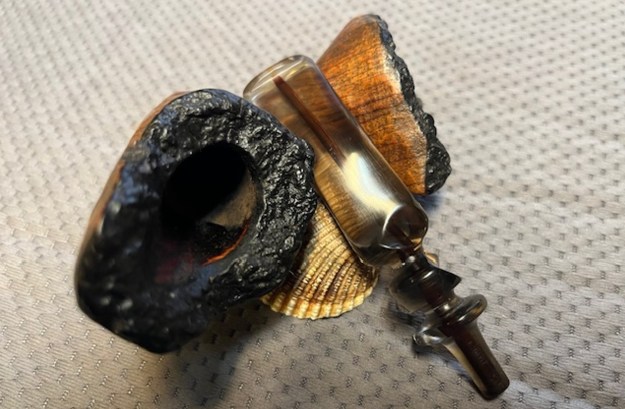
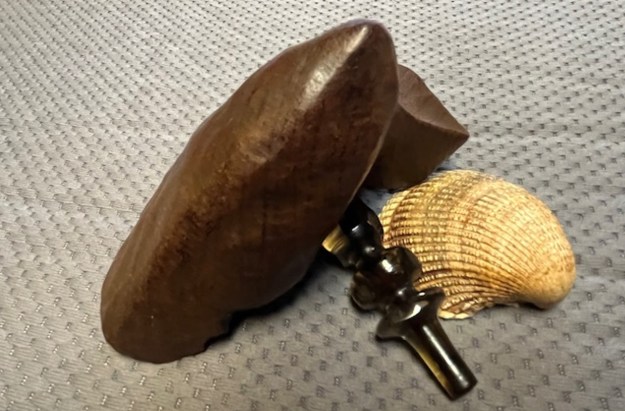
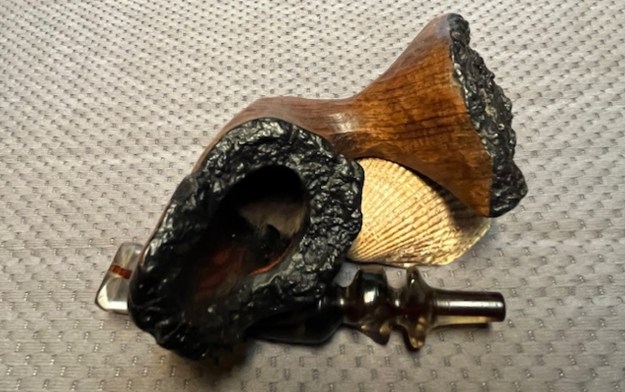
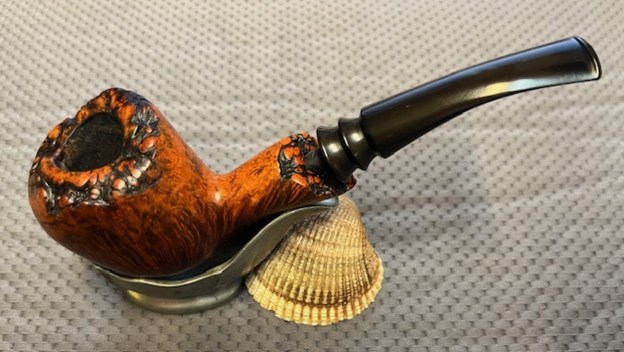
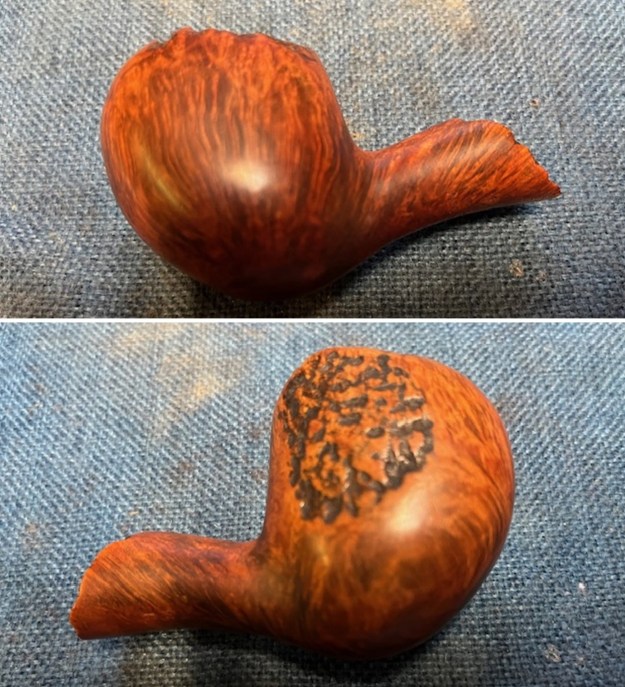
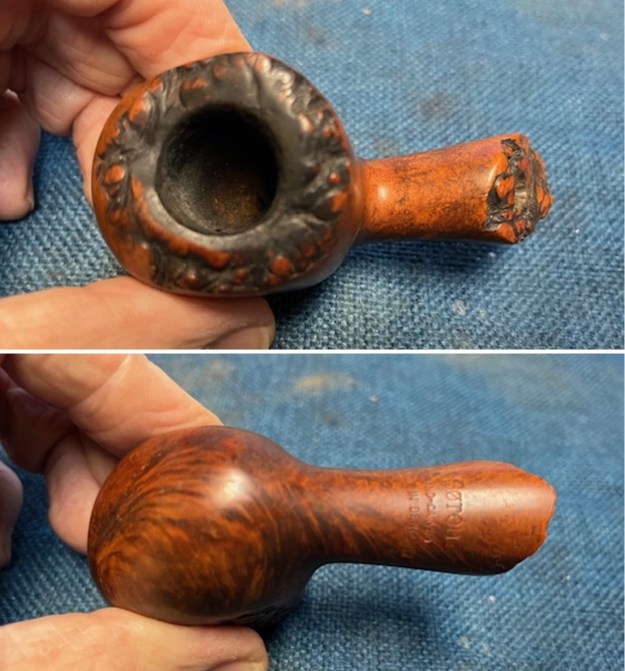
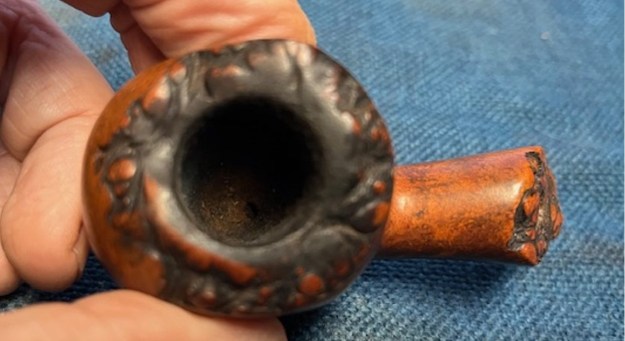
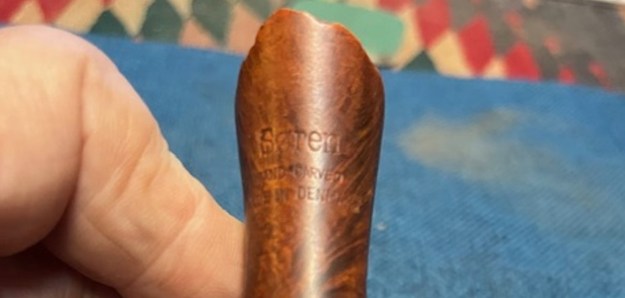
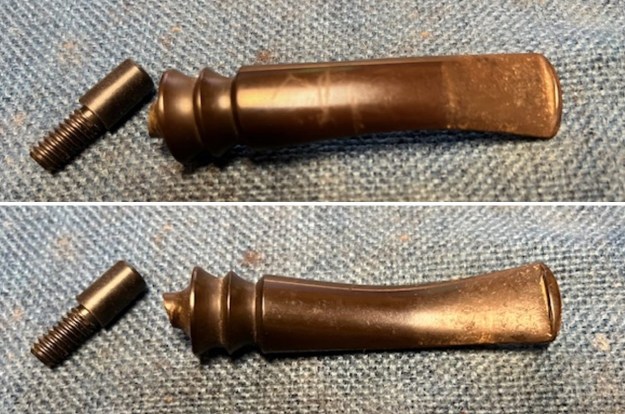
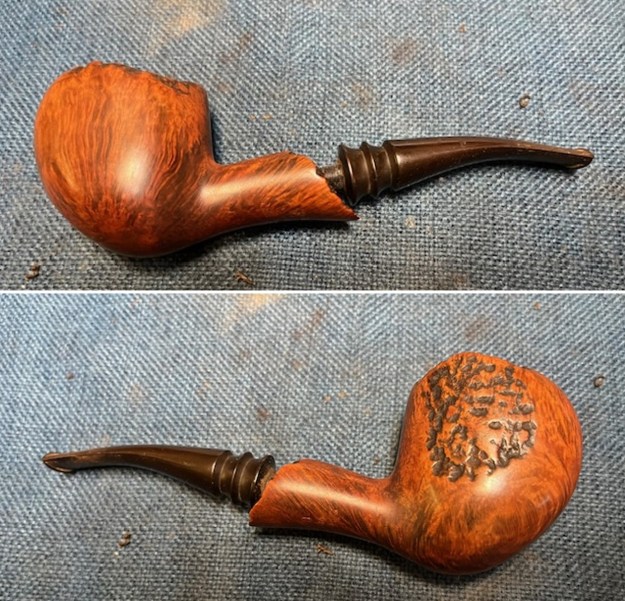
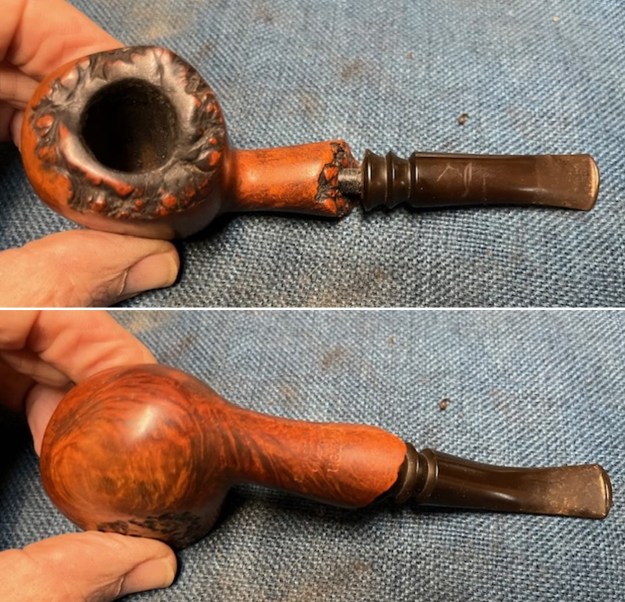
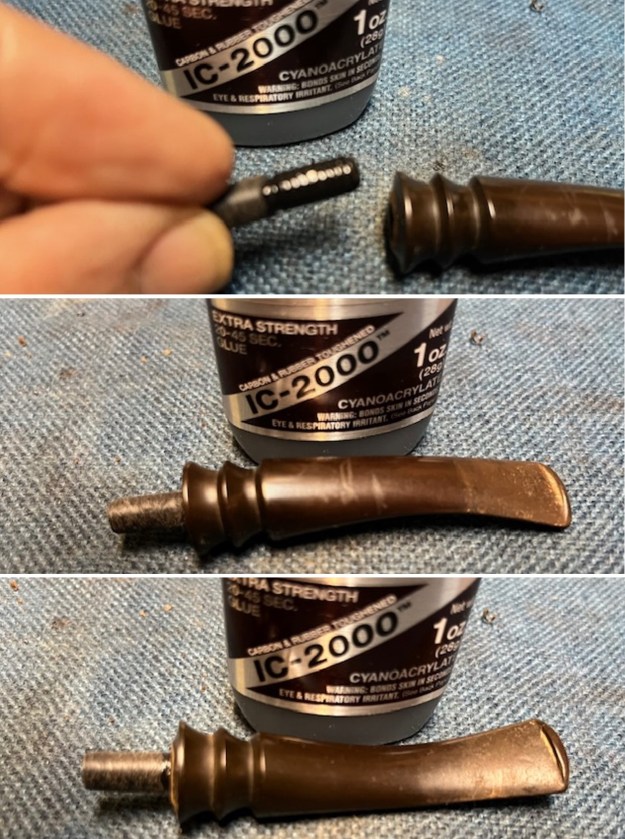
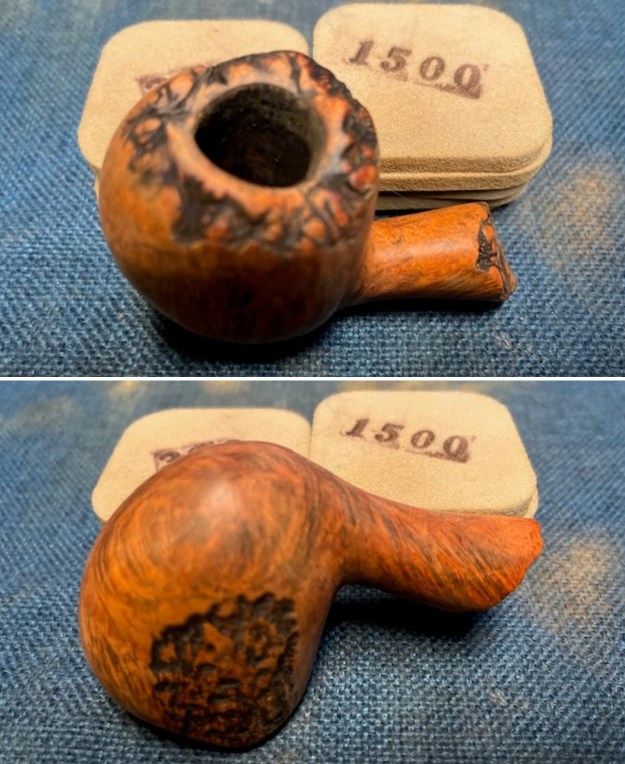
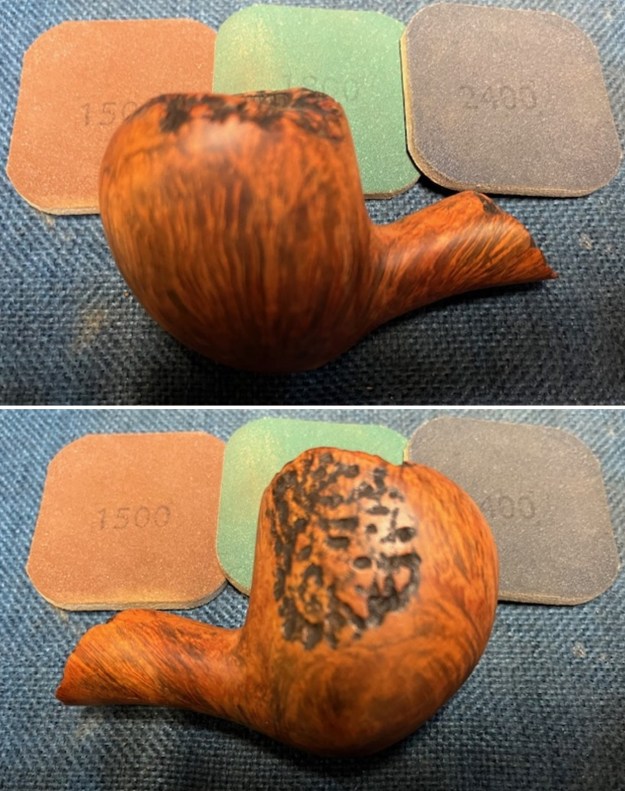
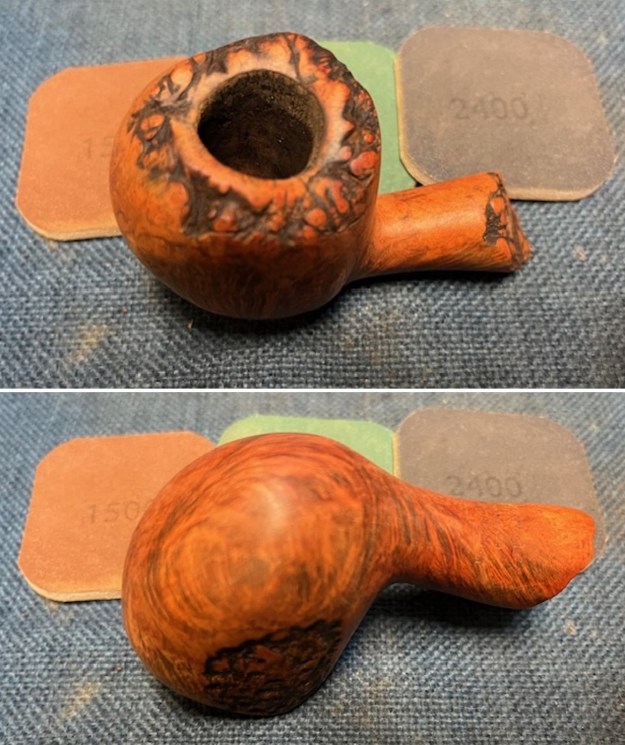
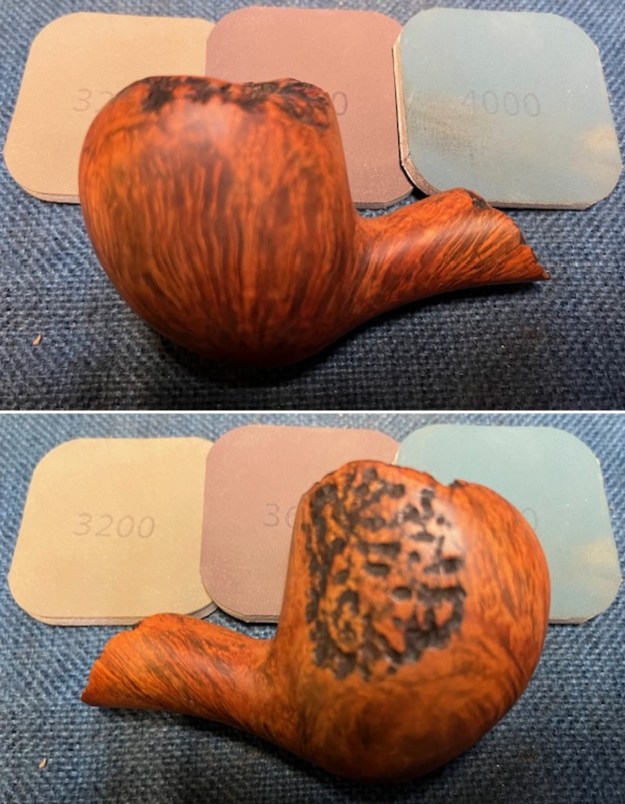
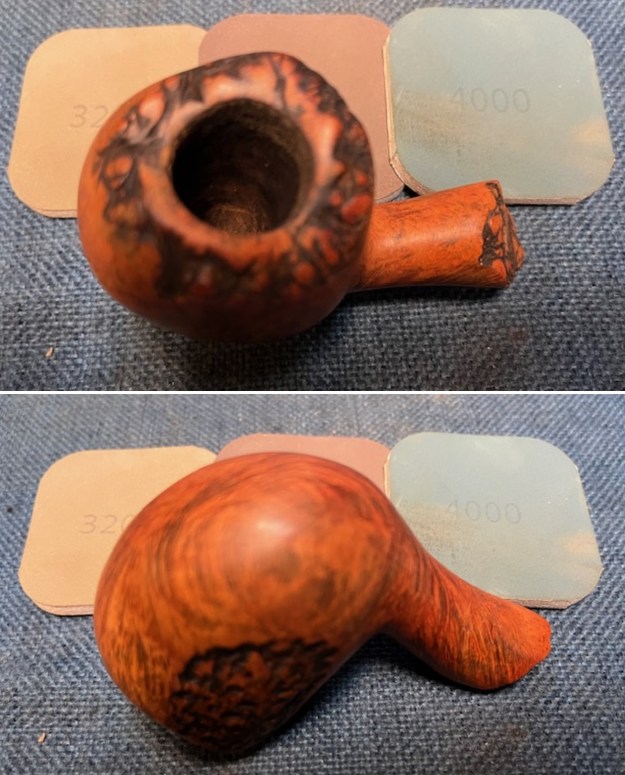
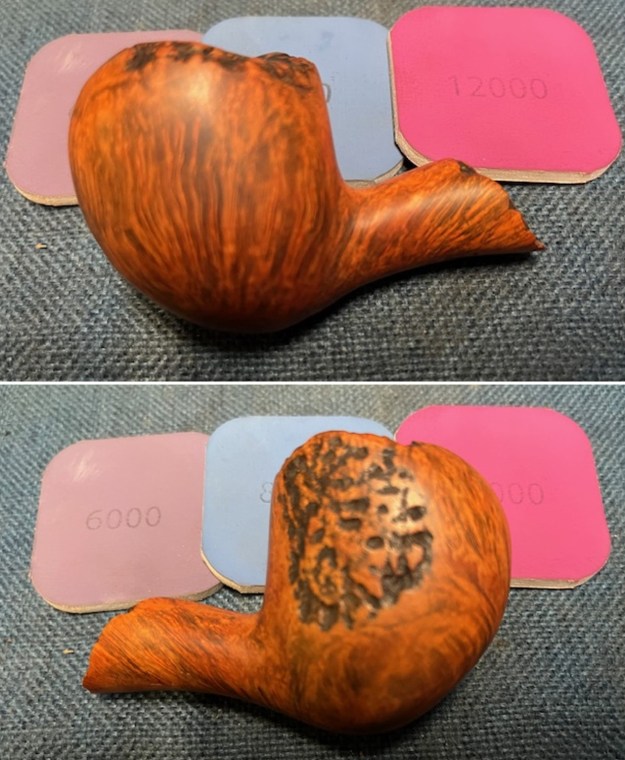
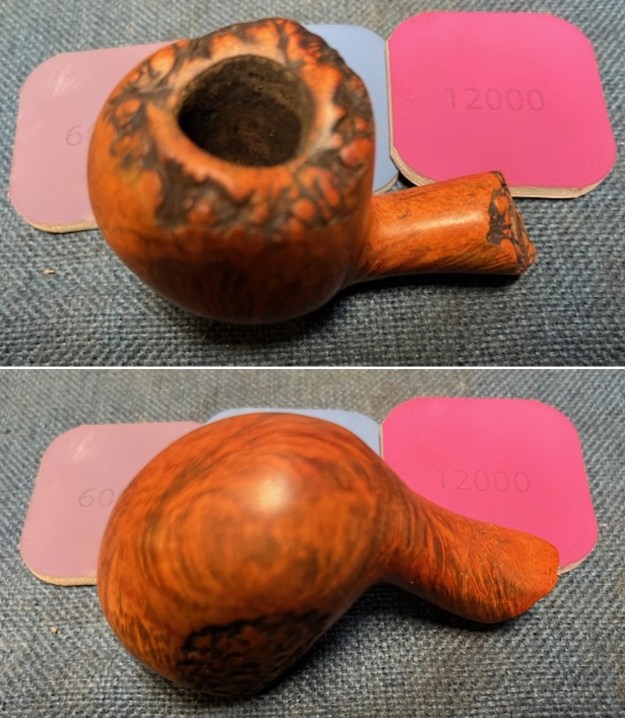
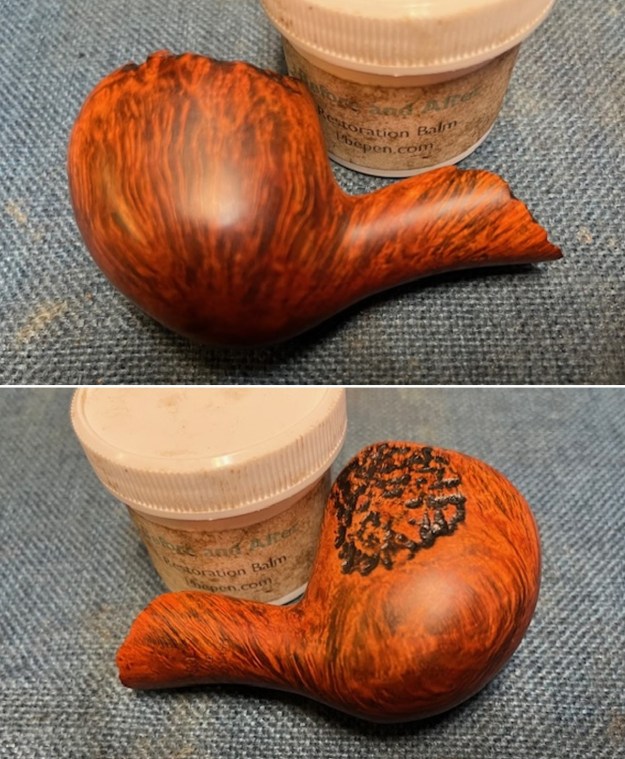
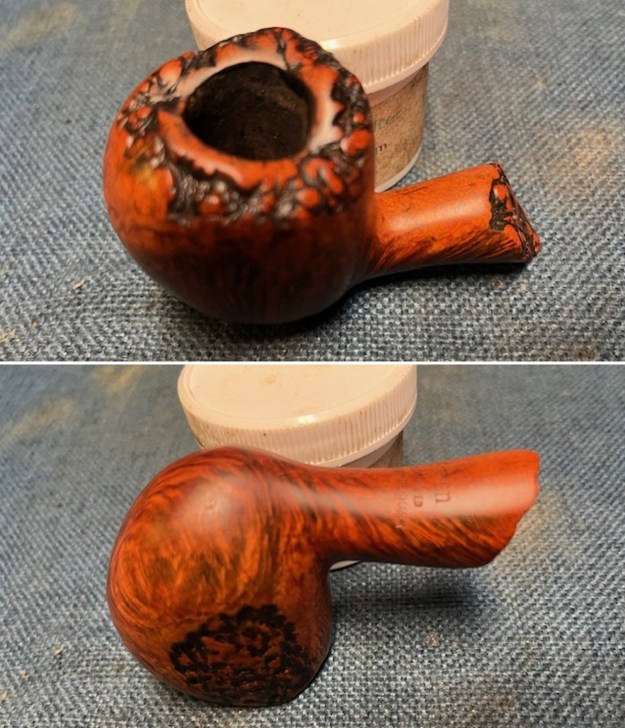
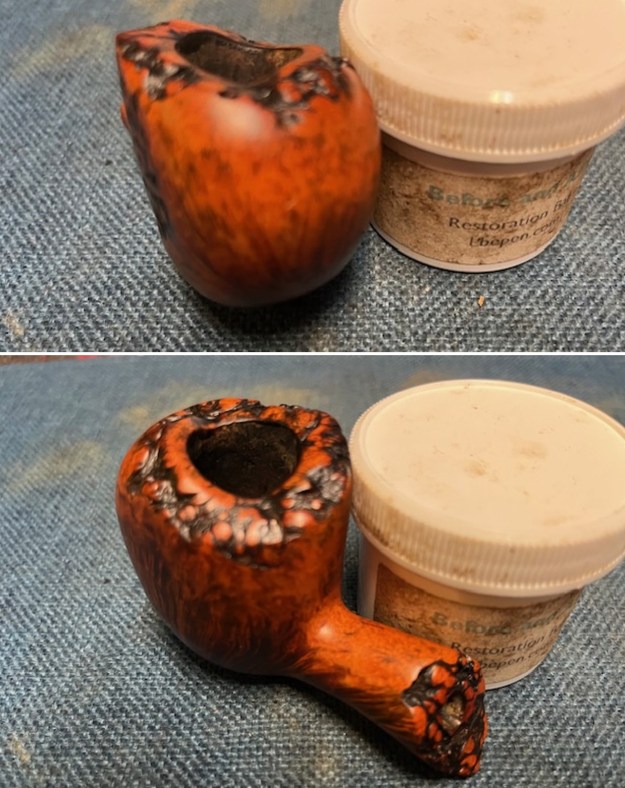
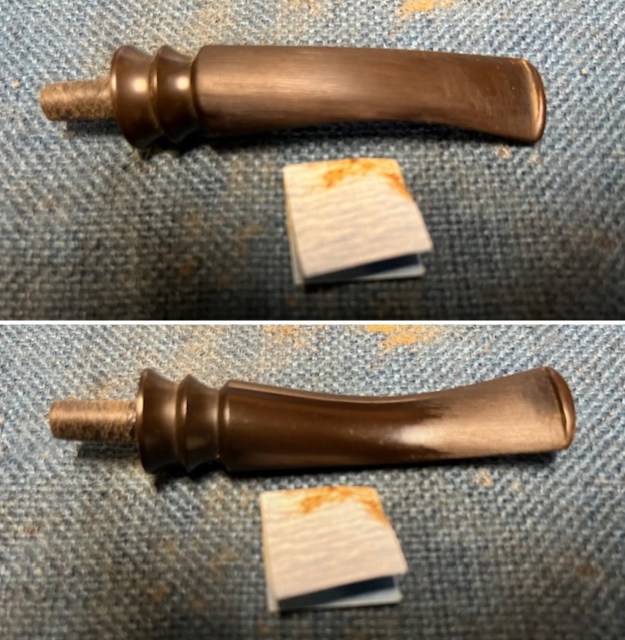
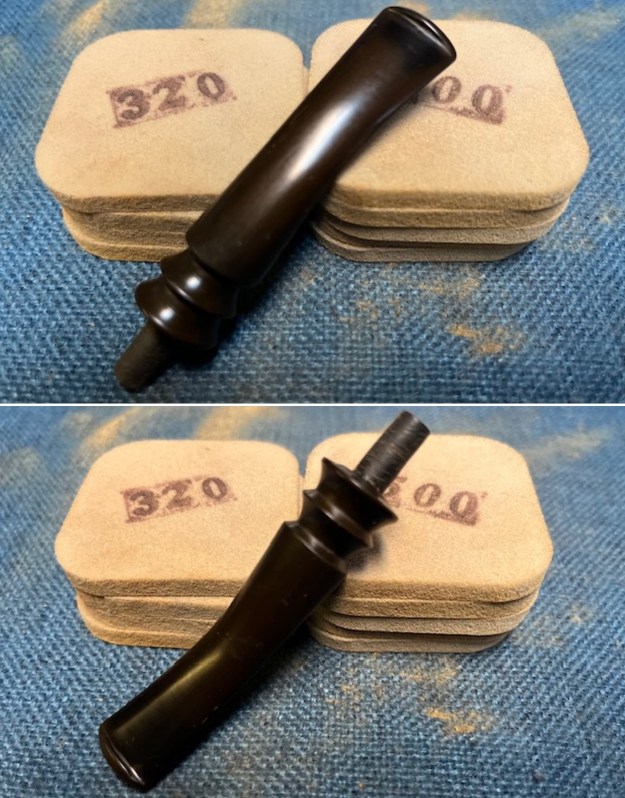
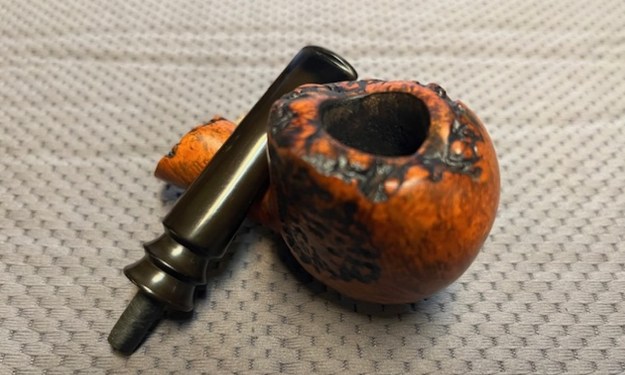
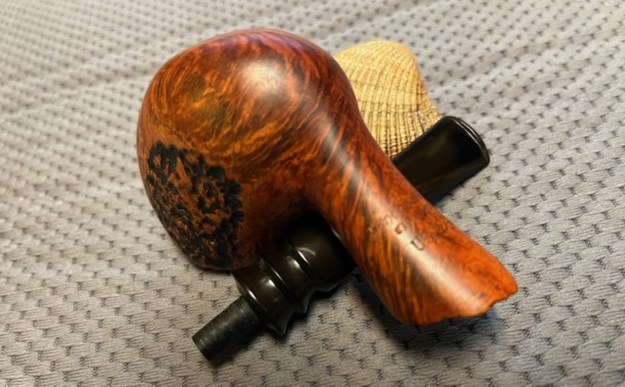
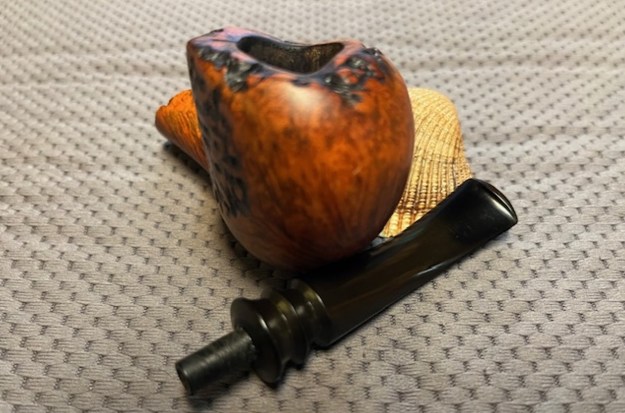
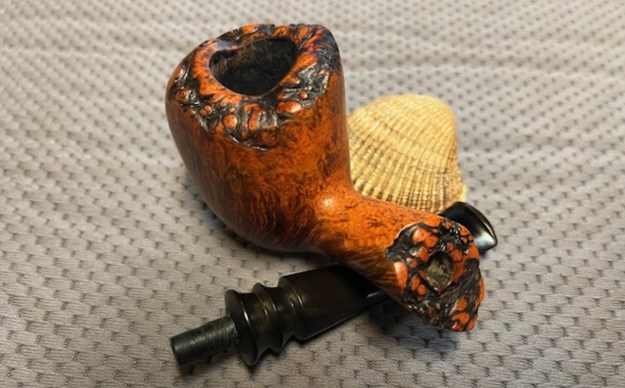
This interesting Freehand with both smooth and sandblast finishes came to us from an estate we purchase from Santa Cruz, California USA on 05/28/2024. It is a unique looking pipe that took some work to figure out the stamping. With some digging and comparing we knew that the stamping on the underside of the shank just ahead of the vulcanite shank extension read Frasorteret [over] Hand Made [over] In [over] Denmark. You might well ask why we had to figure it out. That is simple in the half of the name line was cut off by the shank extension. The pipe has a flat bottom so it is a bit of a sitter. The finish is dirty with dust and oils in the sand blast portions on the bowl sides. The smooth portions are also dirty with oils and dirty ground into the finish. The plateau rim top has some darkening toward the back of the bowl as well as thick lava filling it the grooves in the finish. The bowl has a moderate cake. The vulcanite shank extension is oxidized and also dirty. The stem is actually a poor replacement that is a saddle stem for a straight shank. The pipe would have originally had a fancy freehand style military style stick stem that sat in the extension. It will need to be replaced. Jeff took some photos of the pipe before he started his work on it. He took photos of the rim top to show the moderate cake in the bowl and the thick lava coat and debris in the plateau finish on the backside of the rim top. You can see that it basically fills in the grooves of the finish. He took photos of the stem to show the oxidation and calcification on it but at some level it does not matter as it will be replaced. Jeff took one photo of the right side of the bowl to give a sense of the finish on the bowl sides. There are no other photos at this point.He captured the stamping as best as possible on the underside of the shank next to the vulcanite shank extension. It reads as noted above.It seemed to me that Frasorteret pipes came from the creative carving of Preben Holm so I wanted to confirm that memory. When you get a certain age memory can fool you! I turned first to Pipephil’s site (http://www.pipephil.eu/logos/en/logo-f4.html). It tied the line to Preben Holm but there was not too much more information at this point.I turned to Pipedia (https://pipedia.org/wiki/Frasorteret) to gather further information. There the information was scant but none the less made the connection to Preben Holm very clear. Here is the information.

The Frasorteret line of pipes were made by Preben Holm and were nearly identical to his normal line of pipes but for fills and pits and the like. The pipes were stamped Frasorteret Made in Denmark.

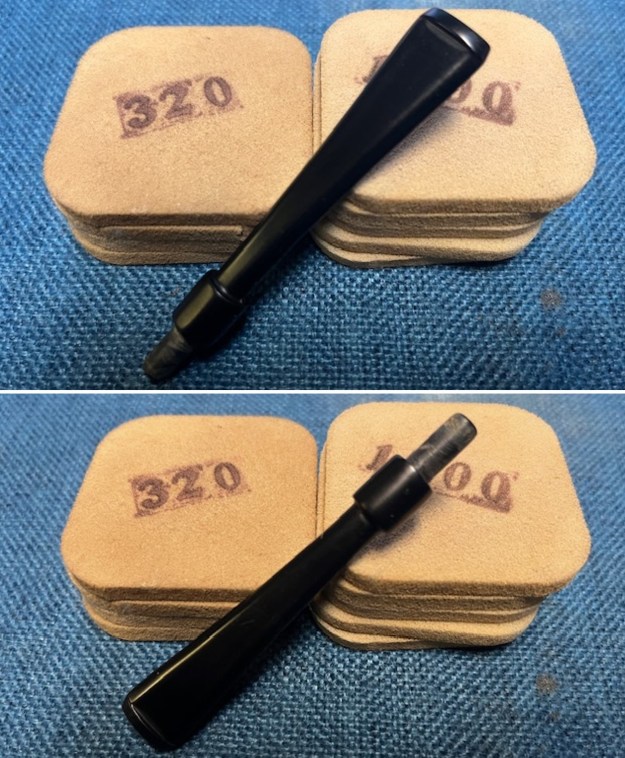
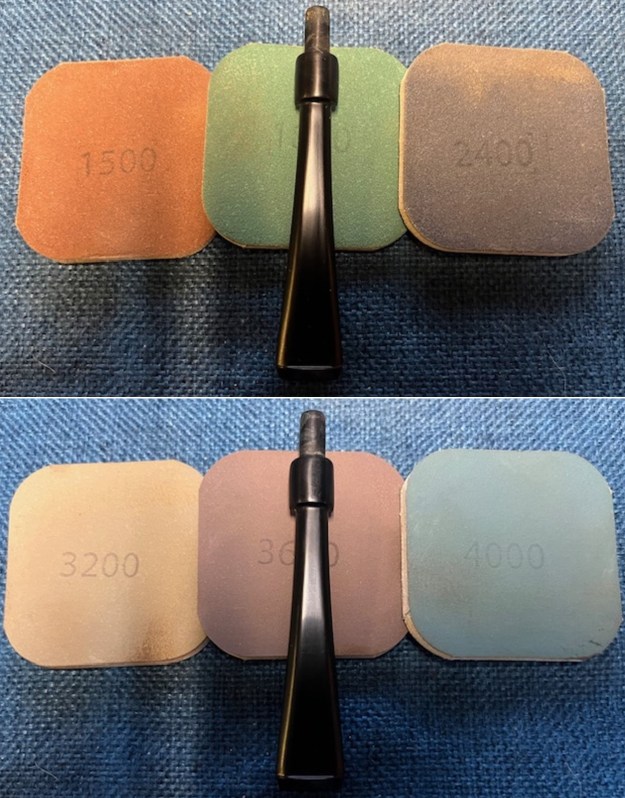
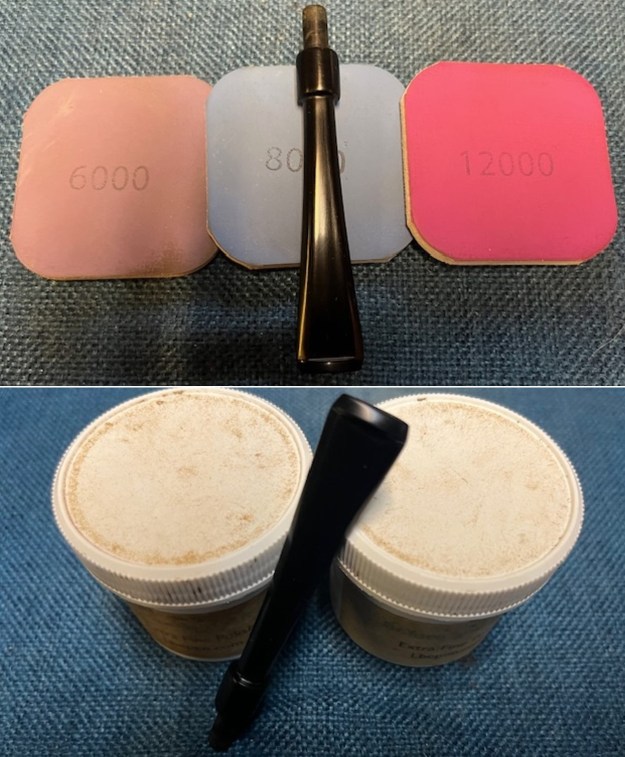
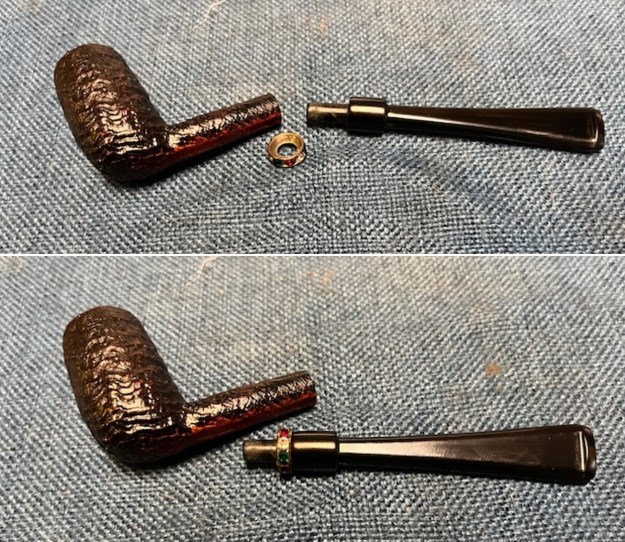
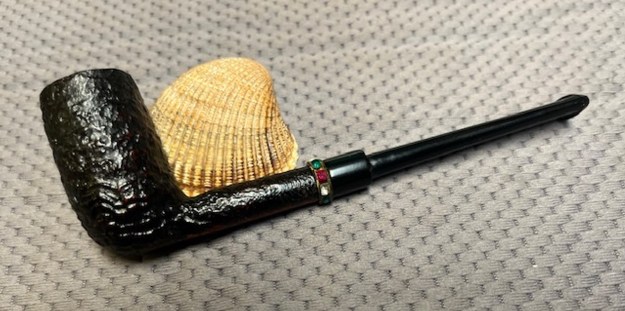
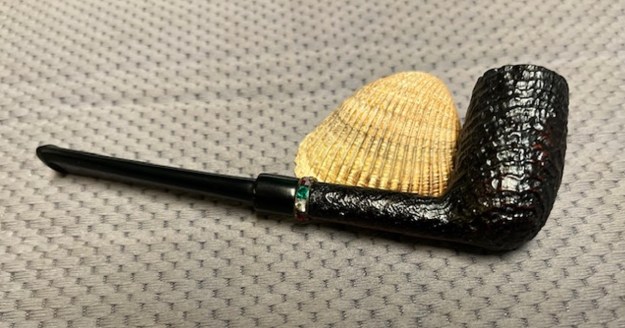
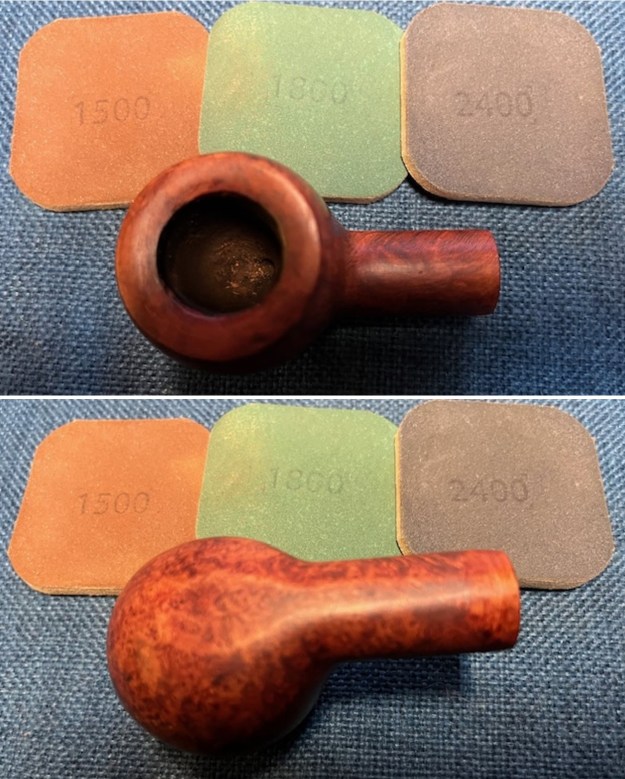
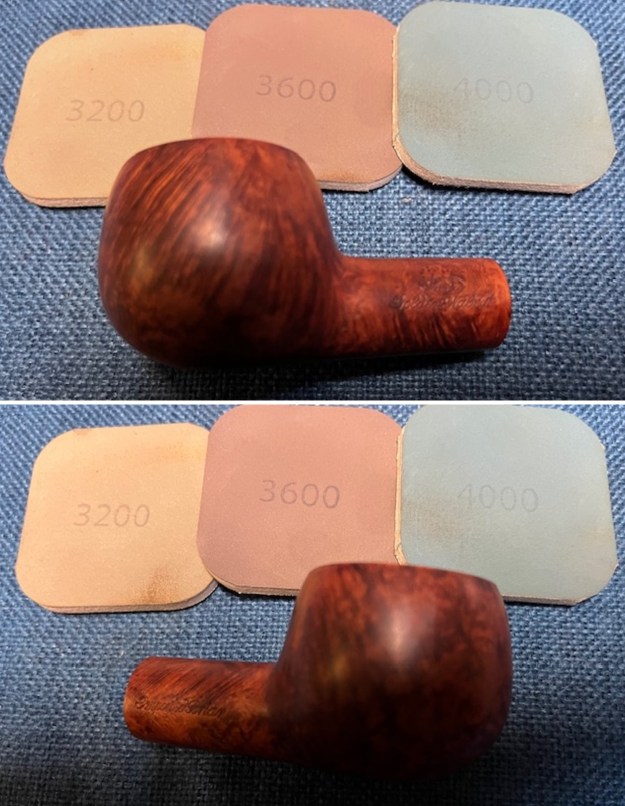
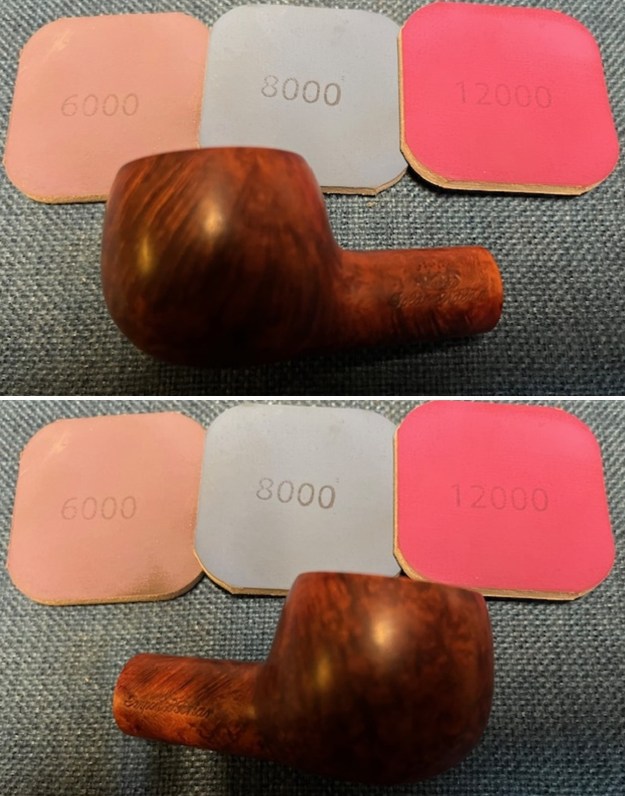
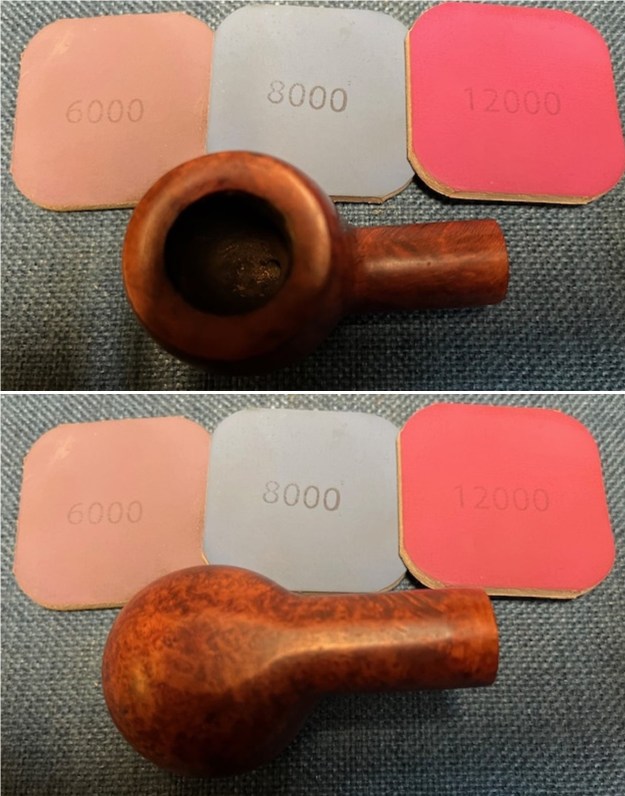
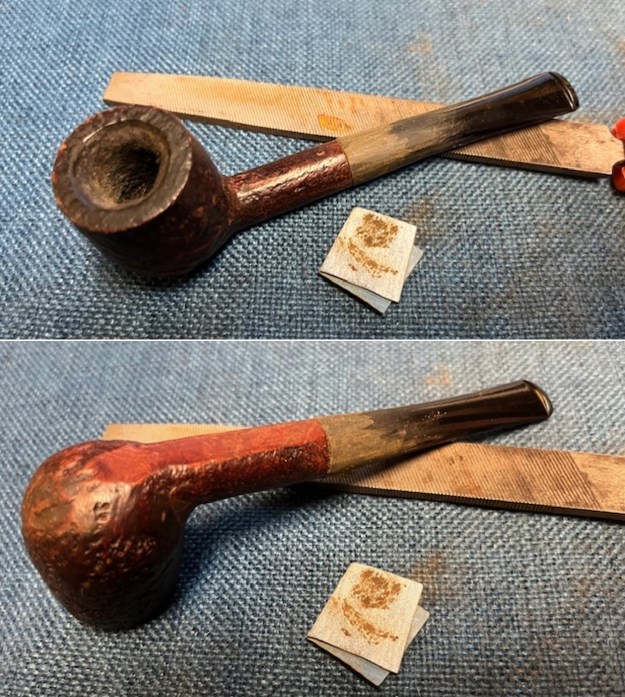
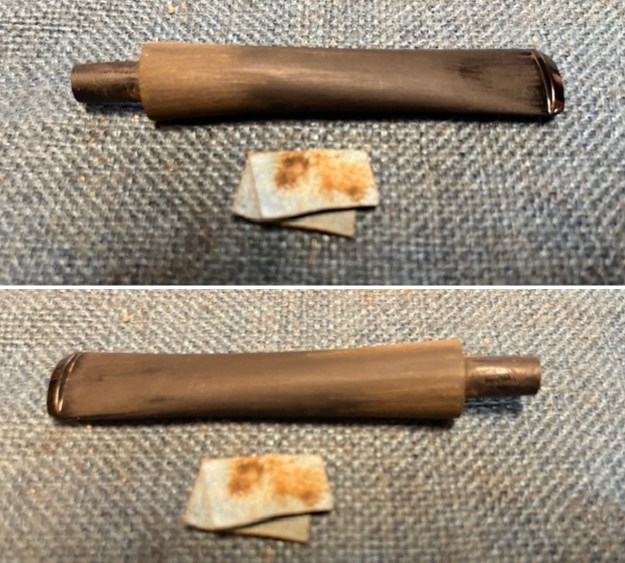
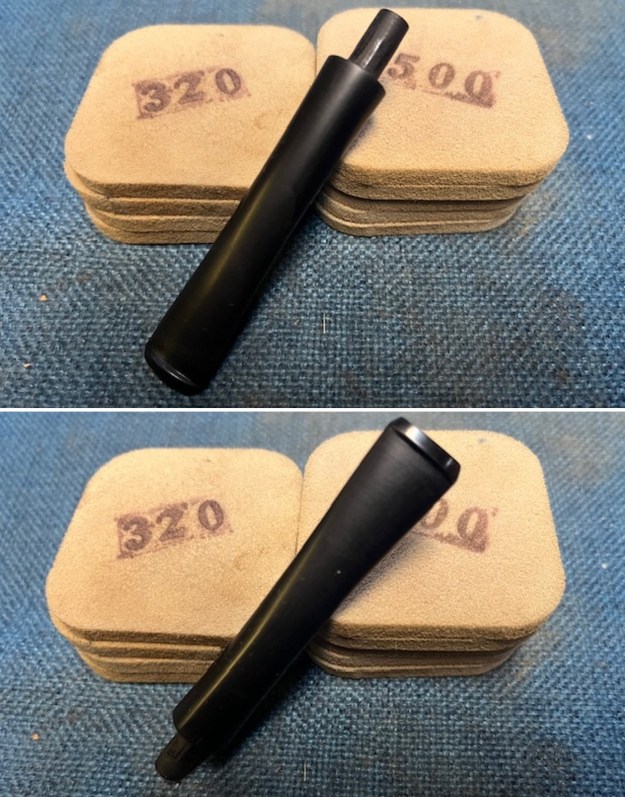
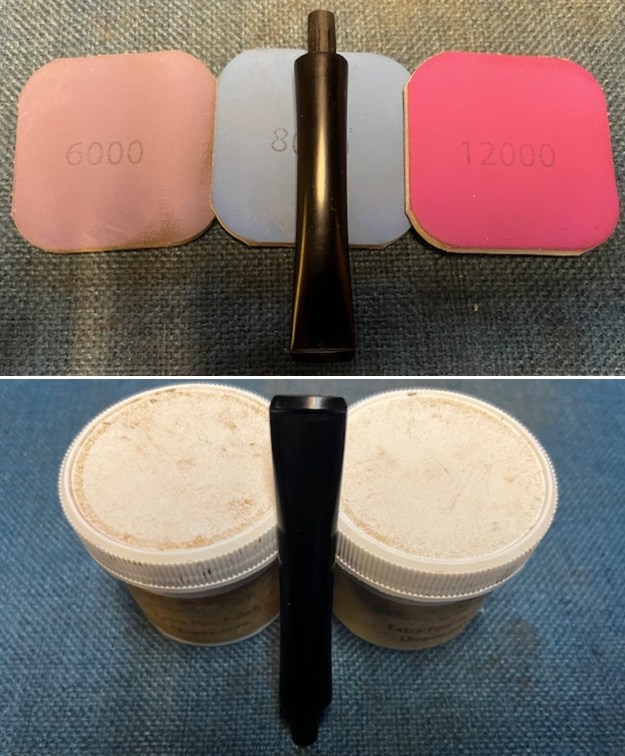
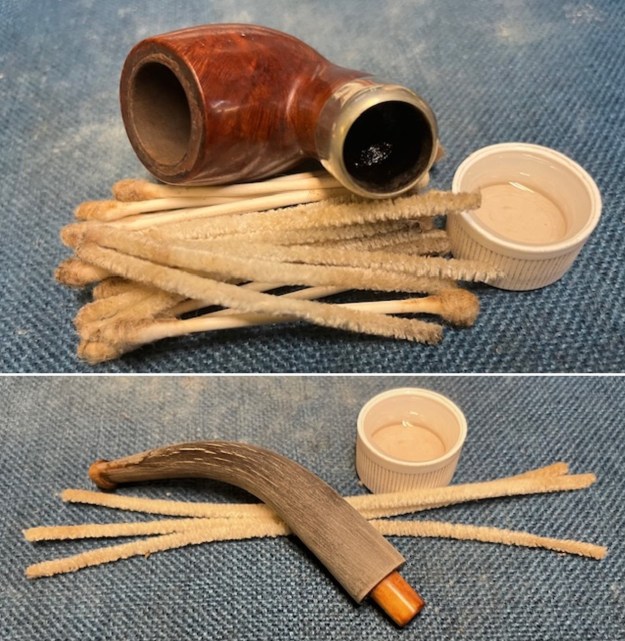
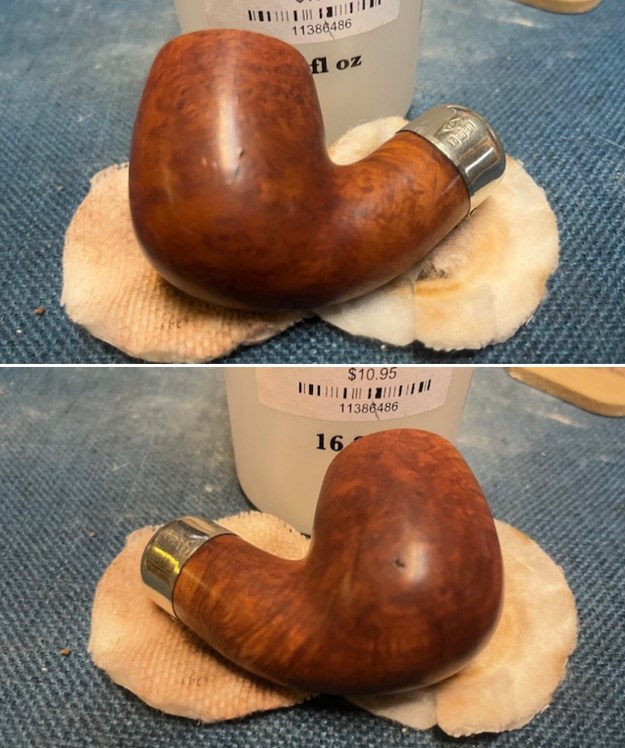
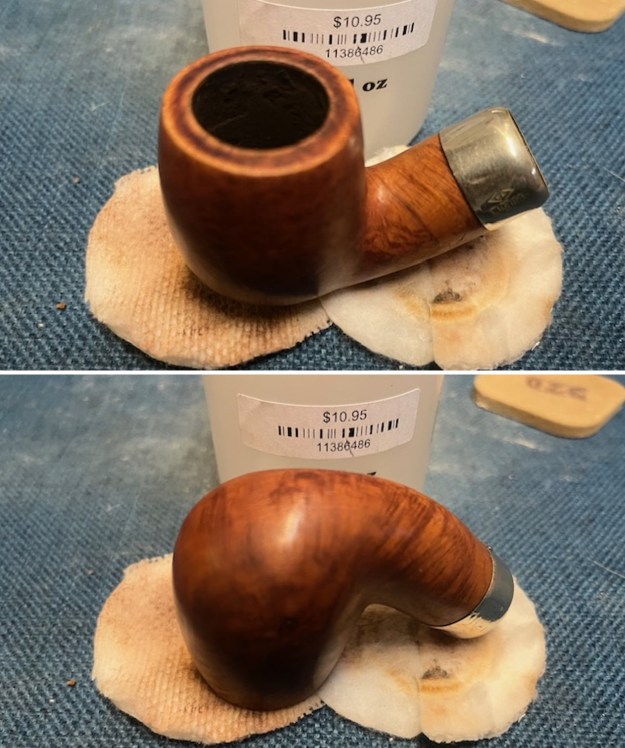
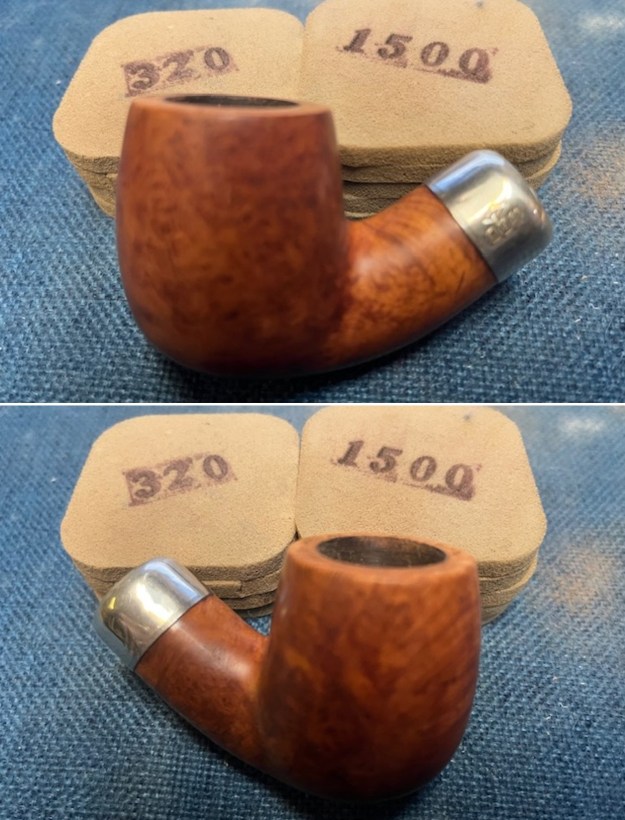
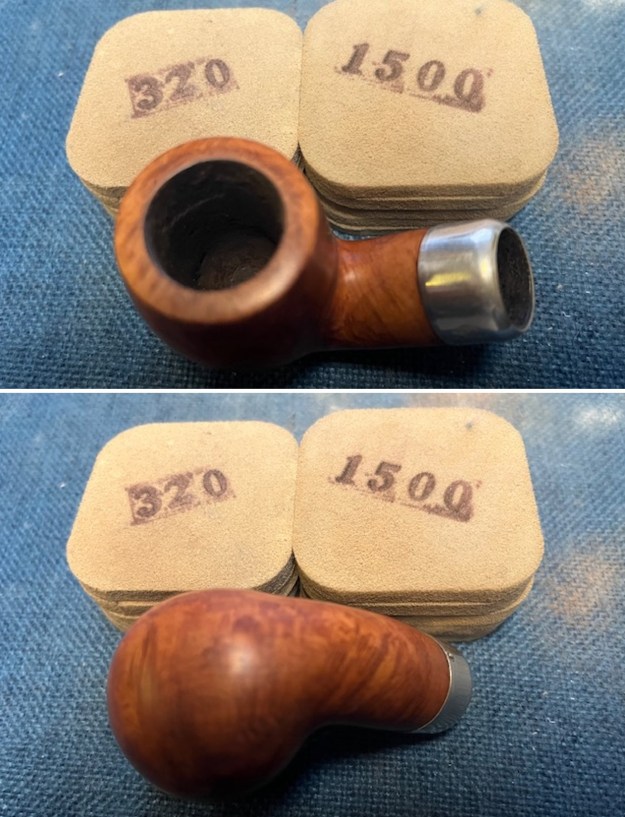
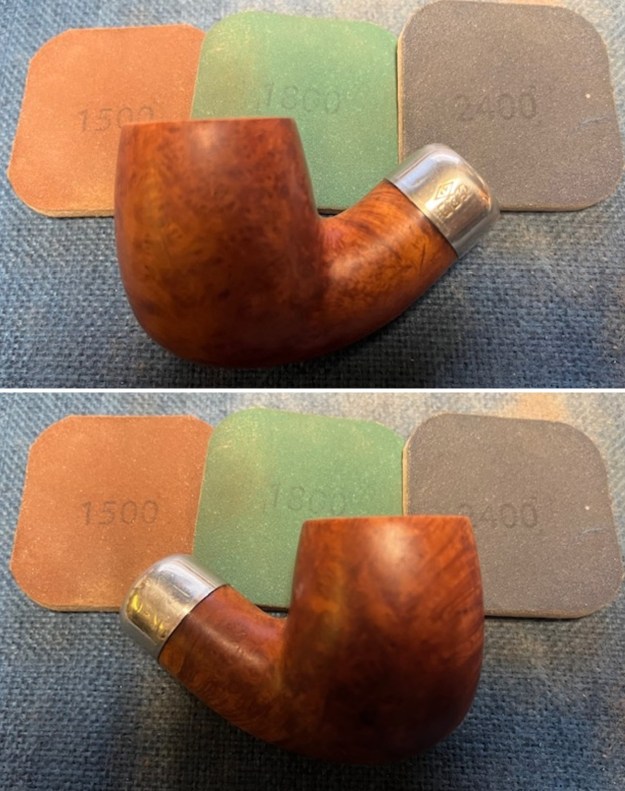
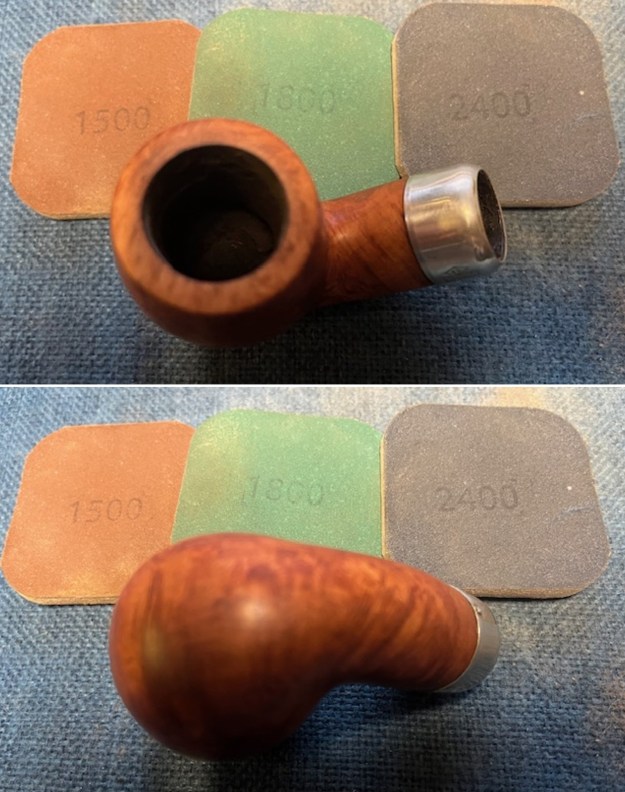
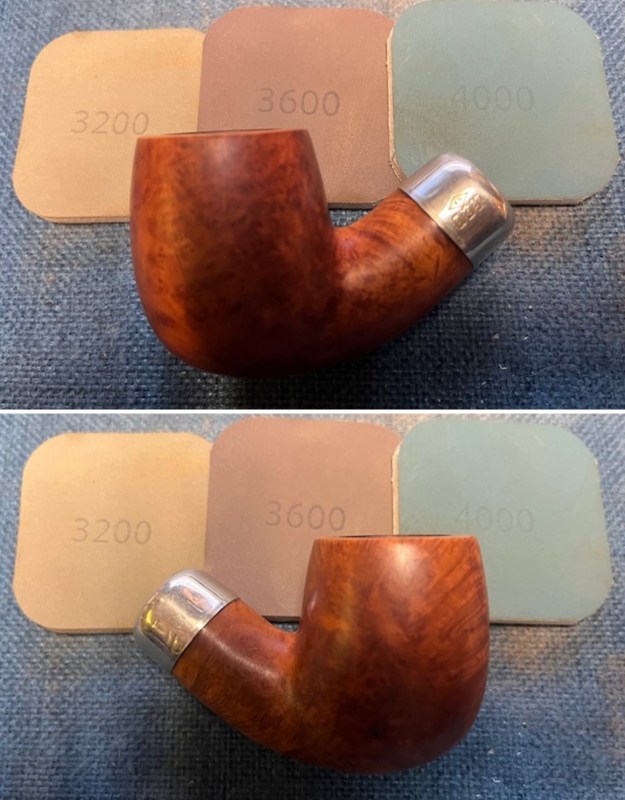
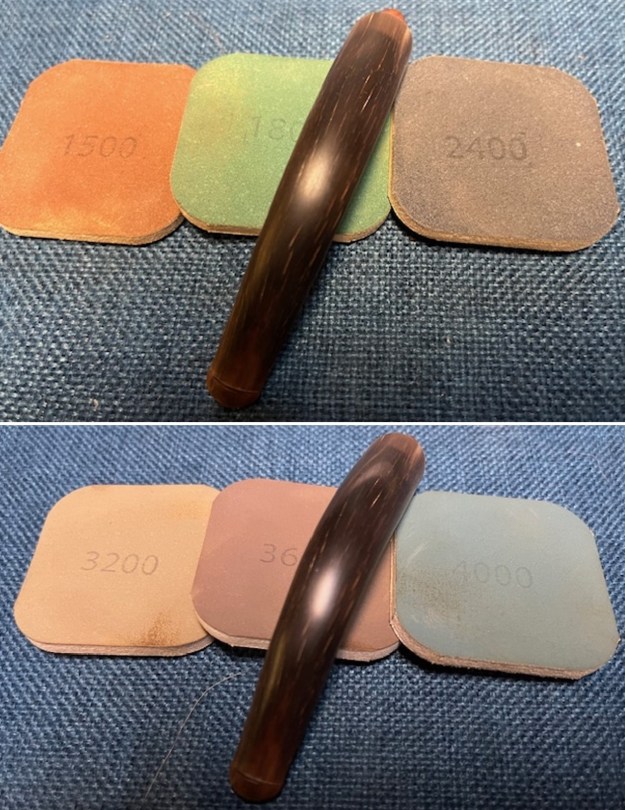
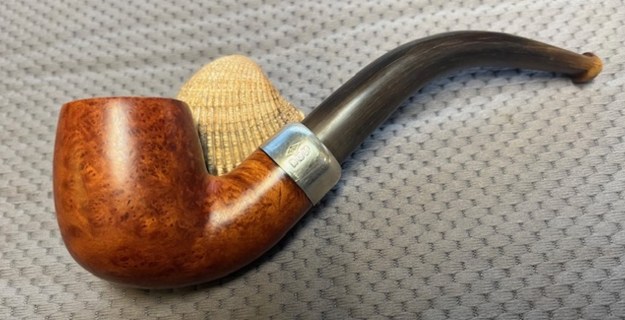
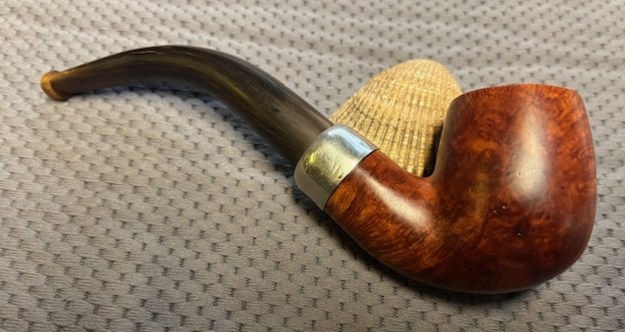
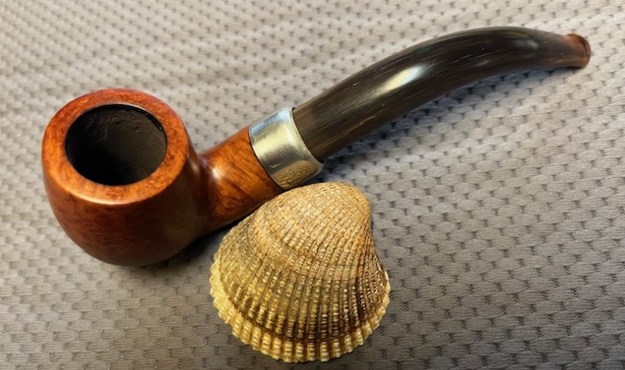
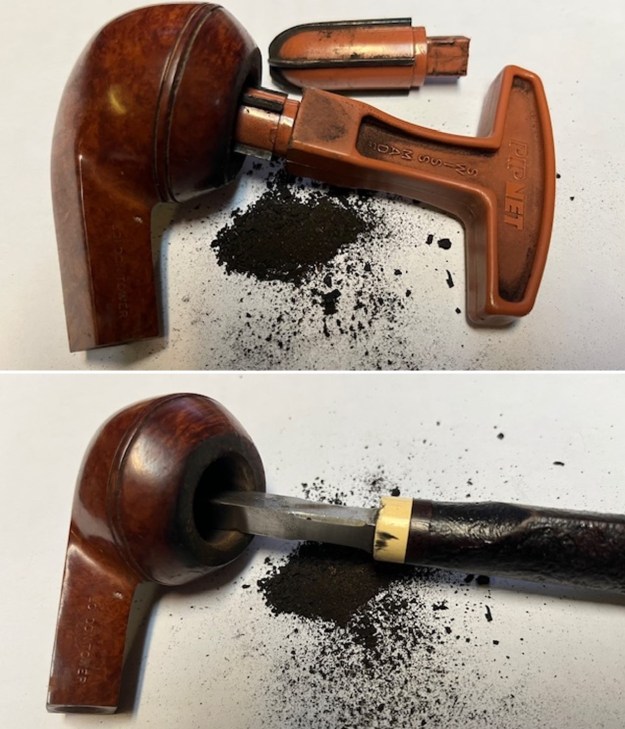
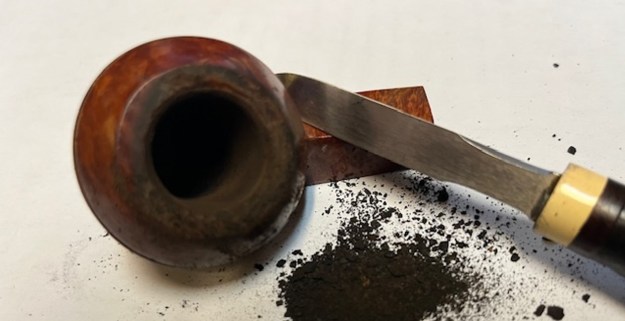
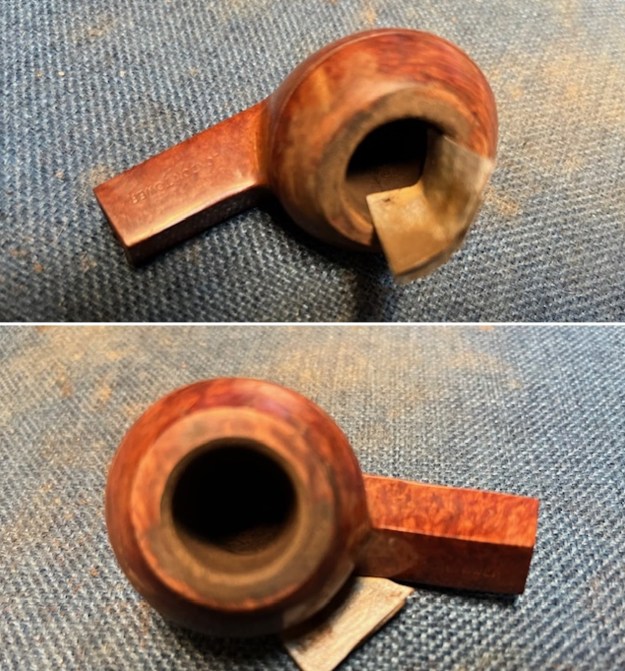
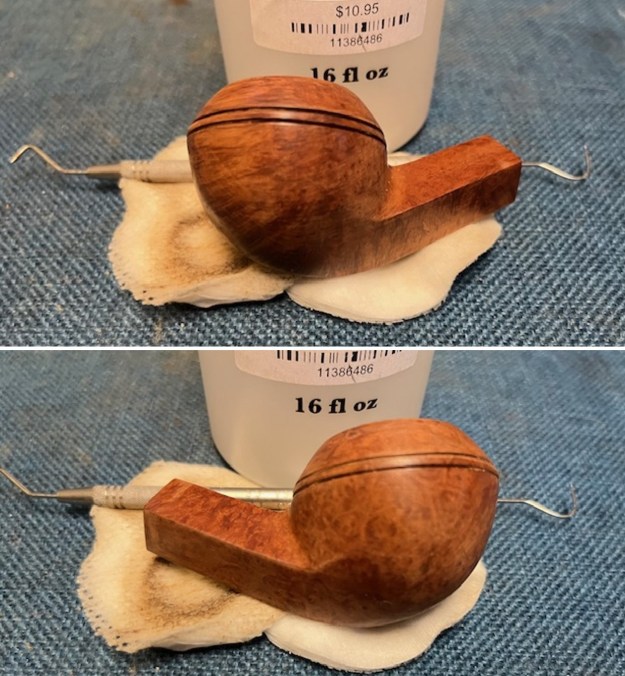
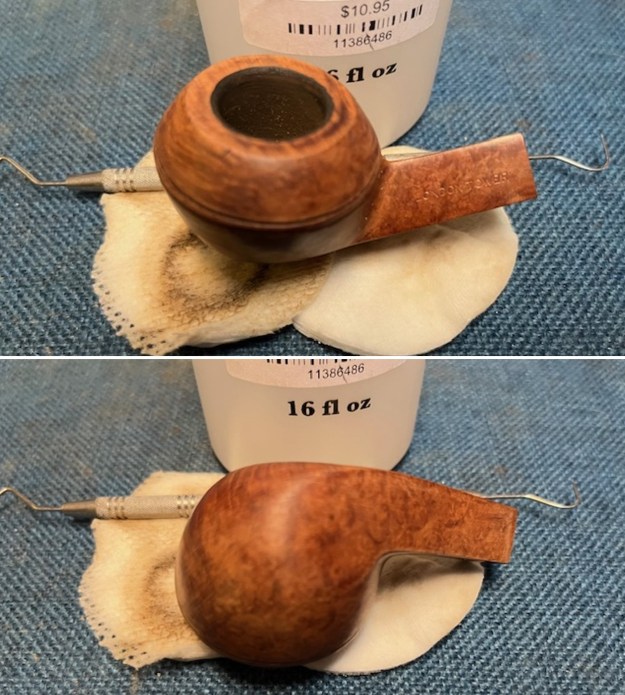
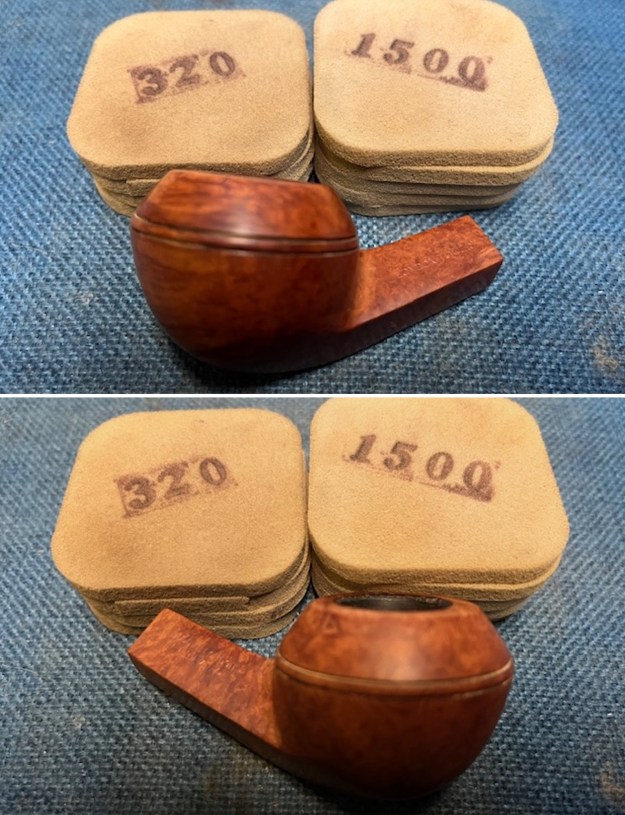
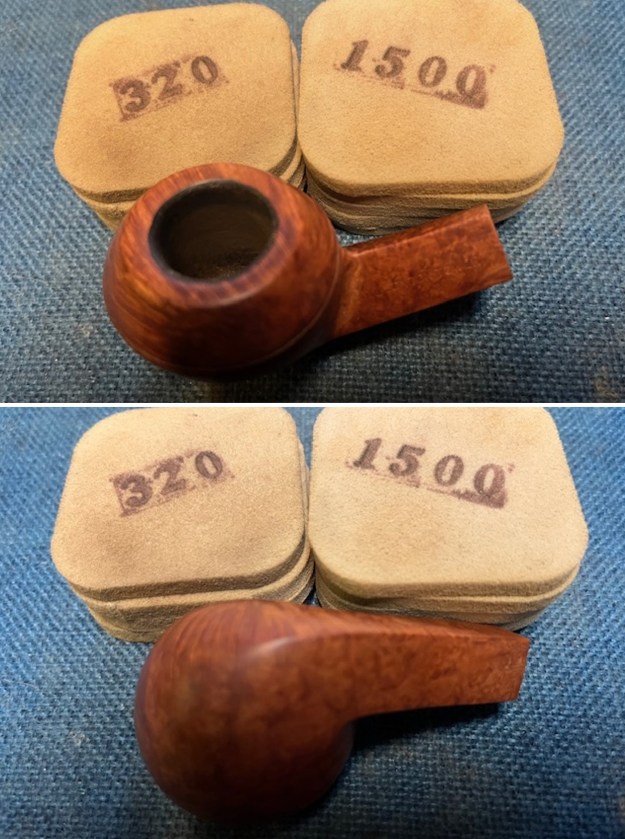
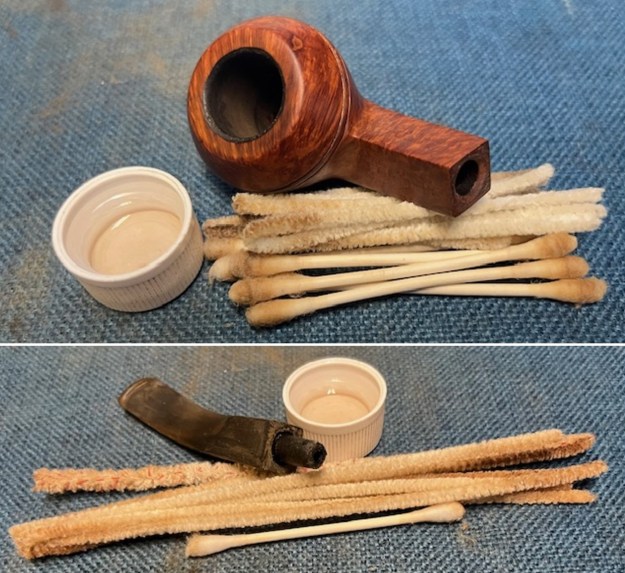
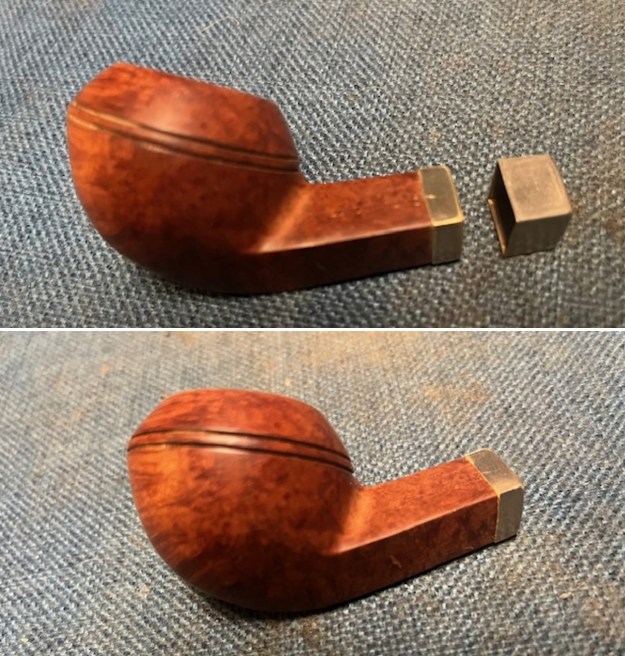
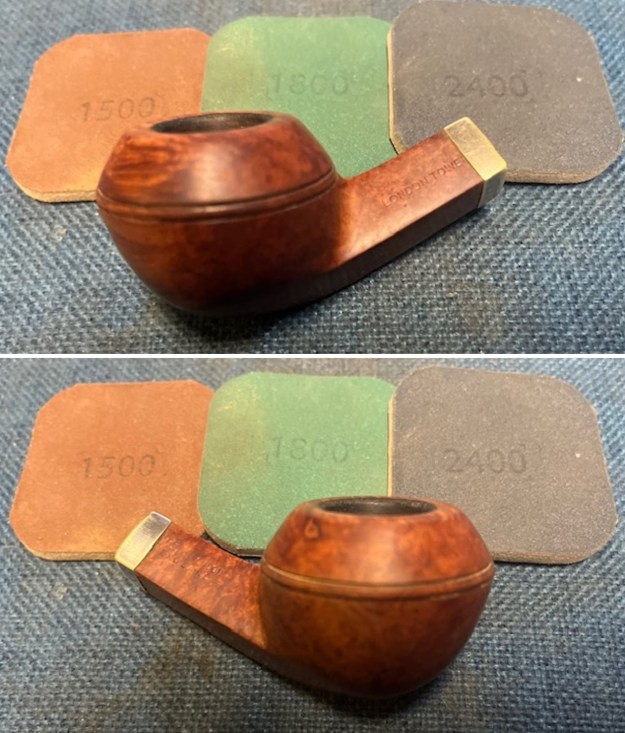
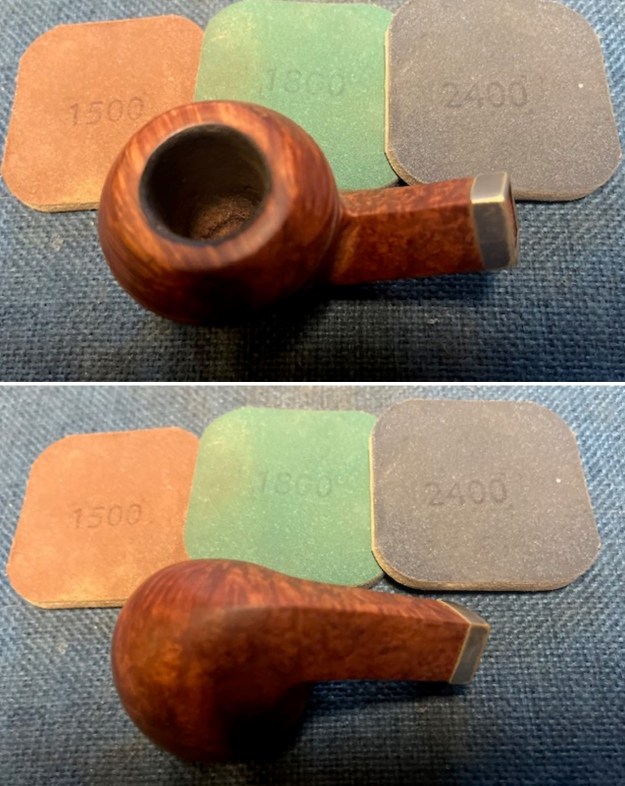
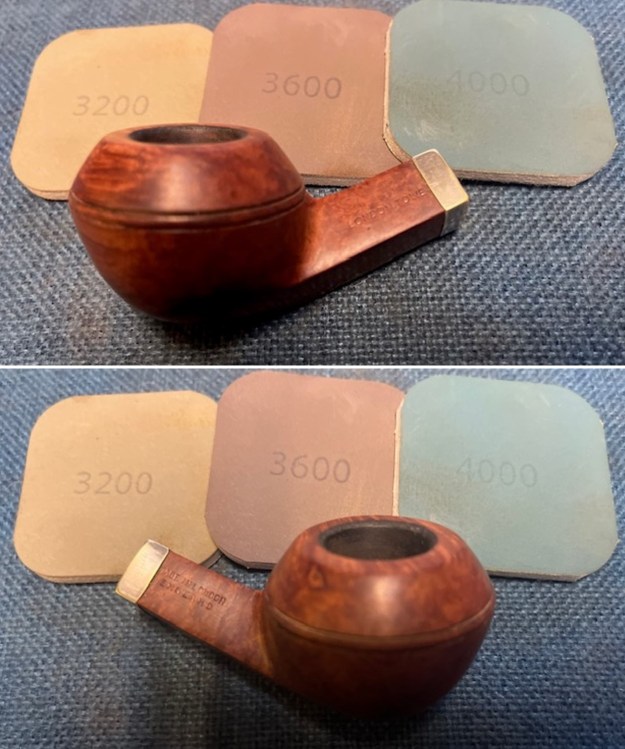
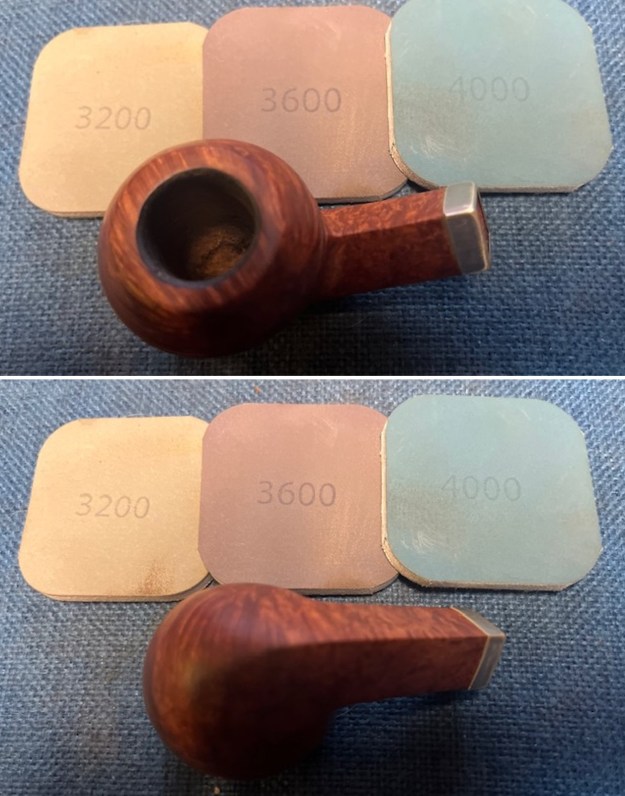
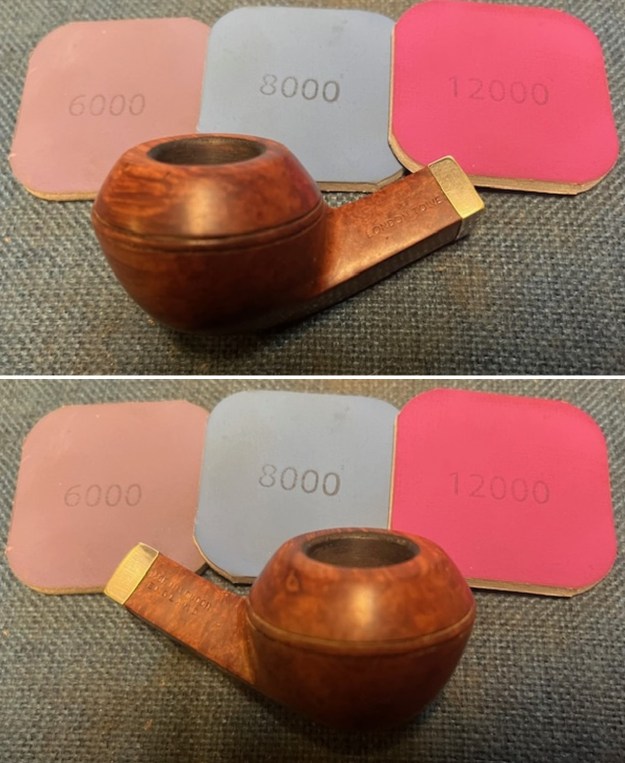
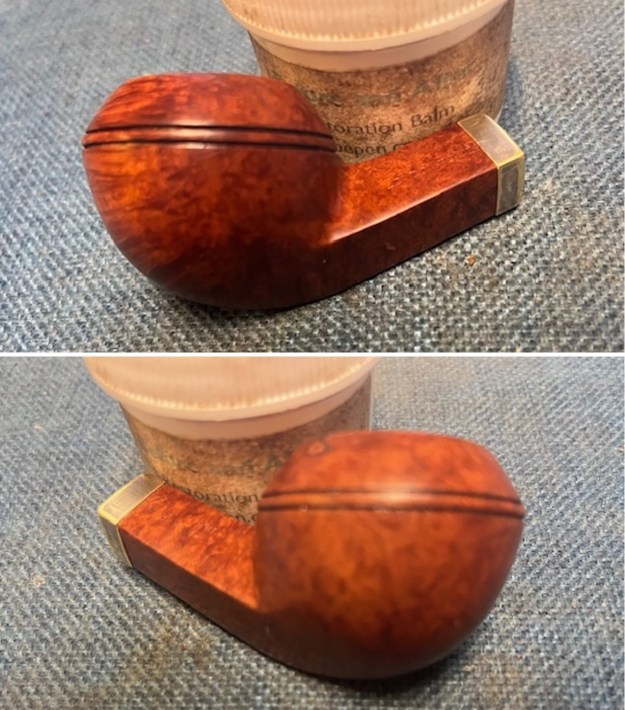
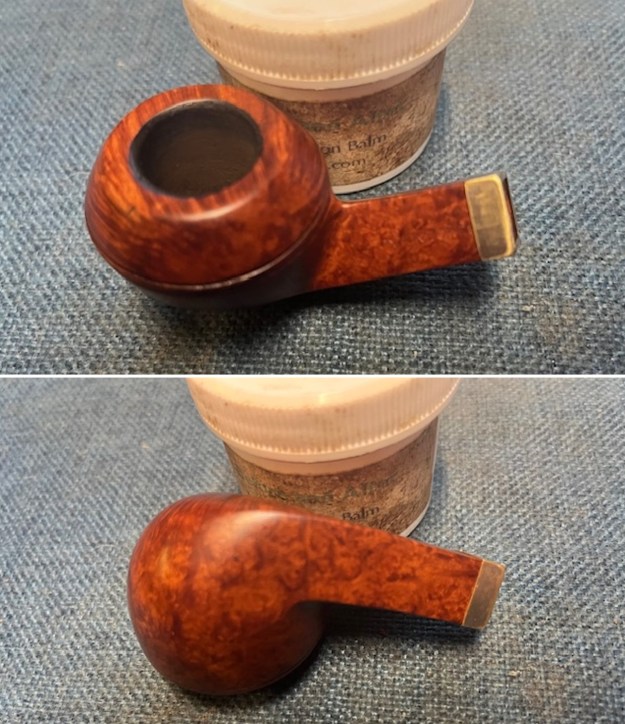
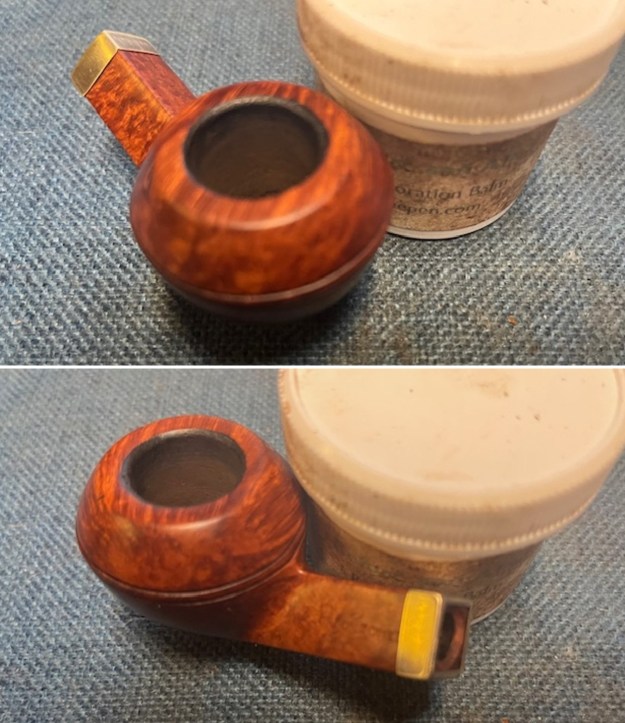
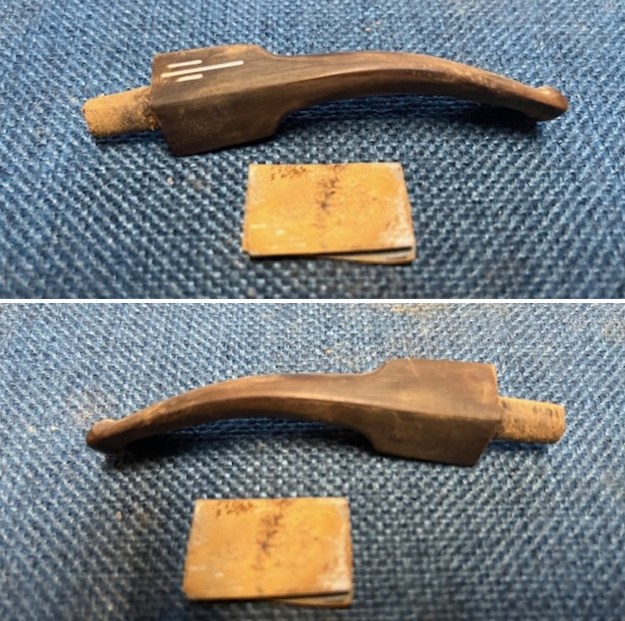
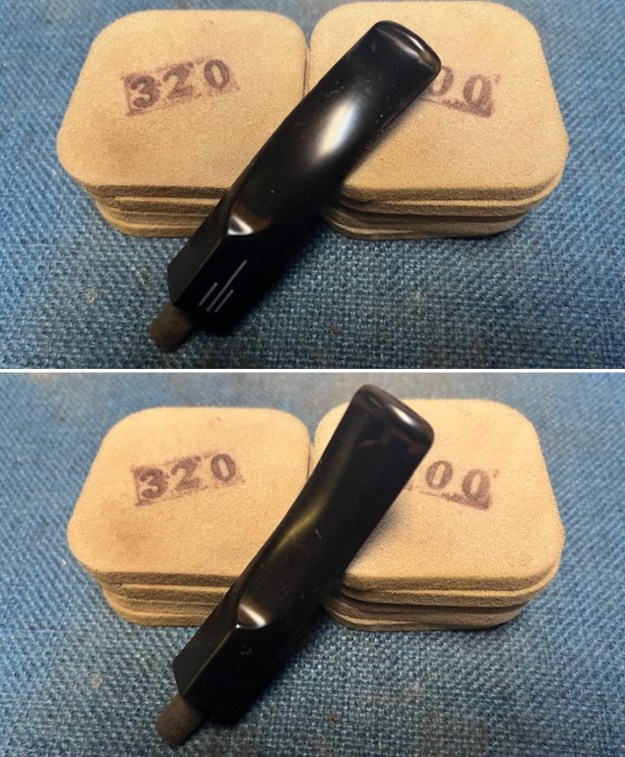
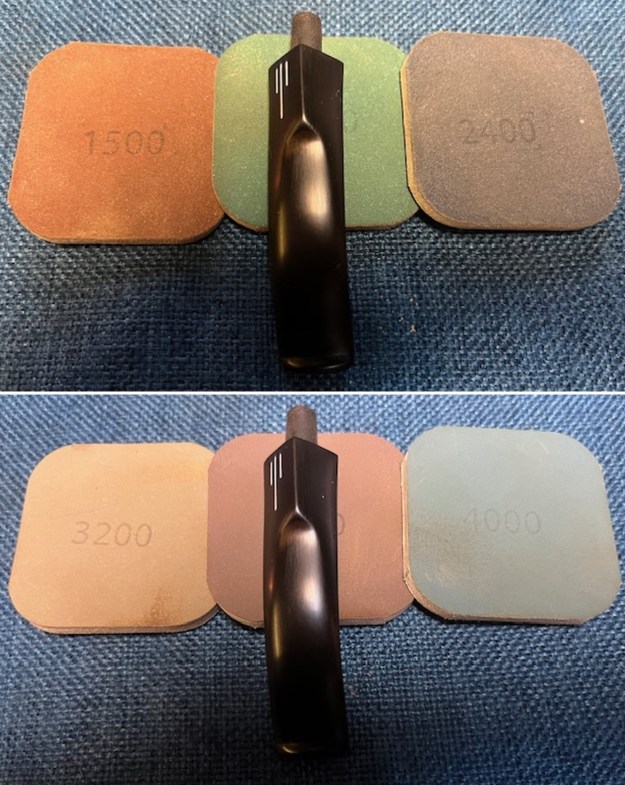
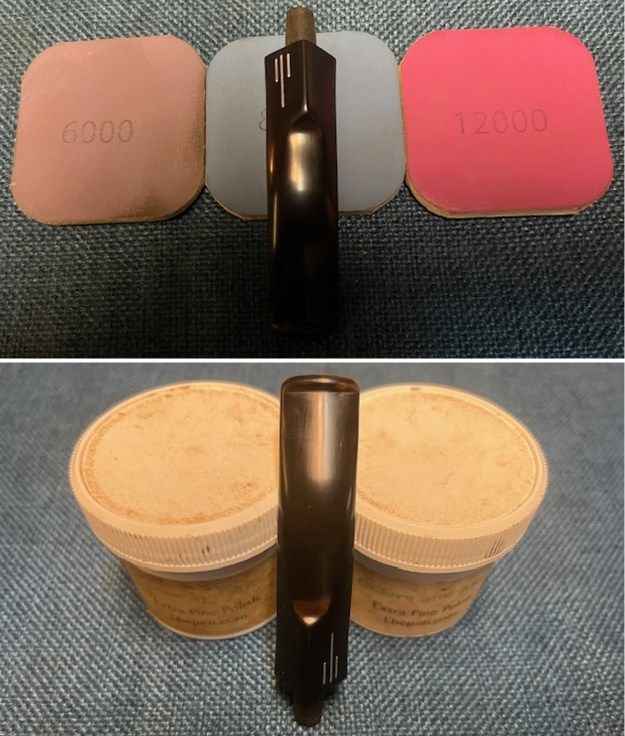
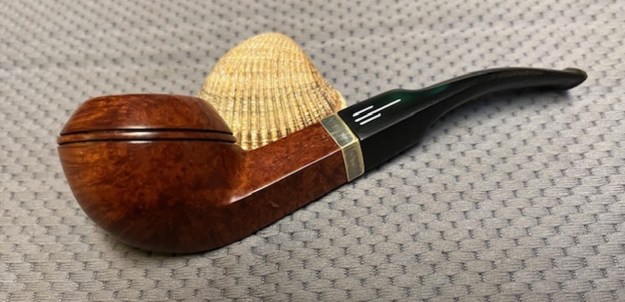
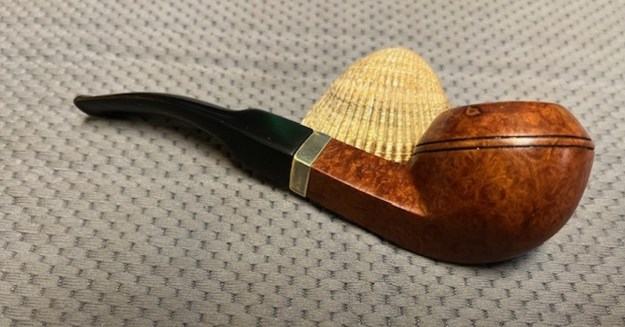
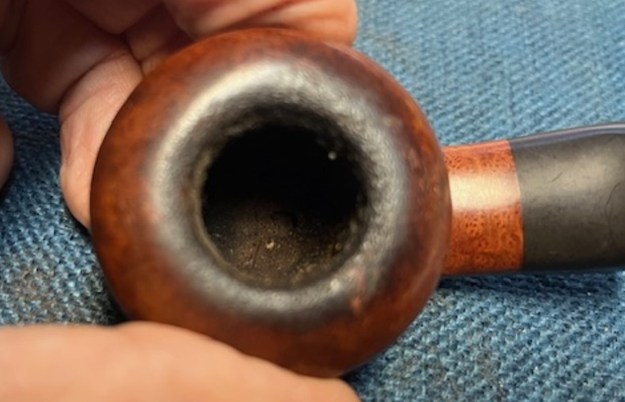
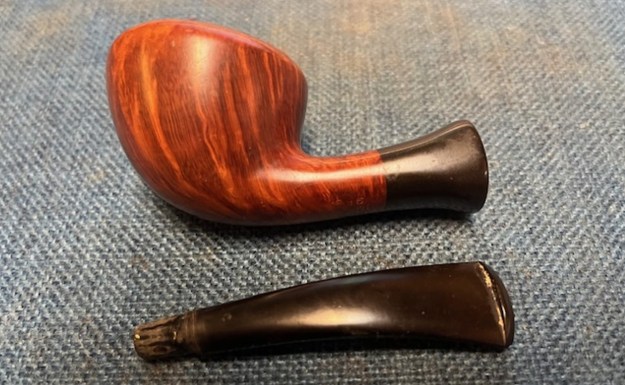
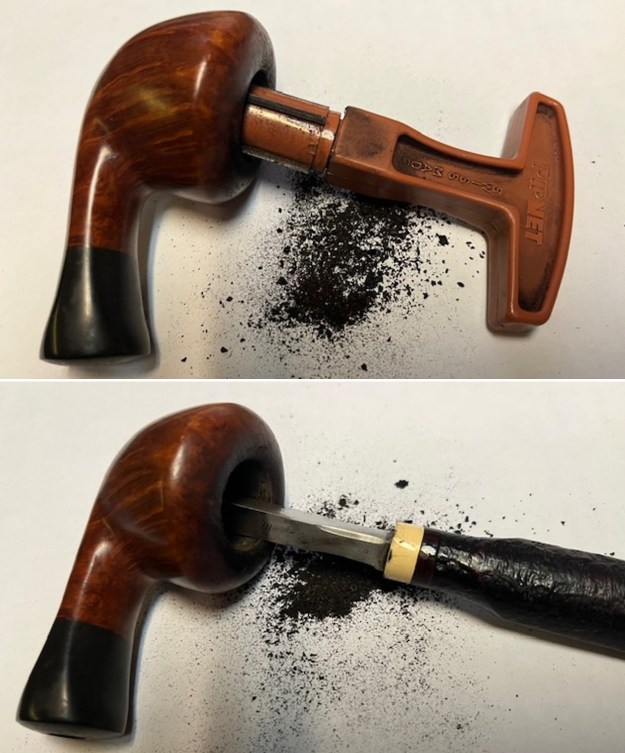
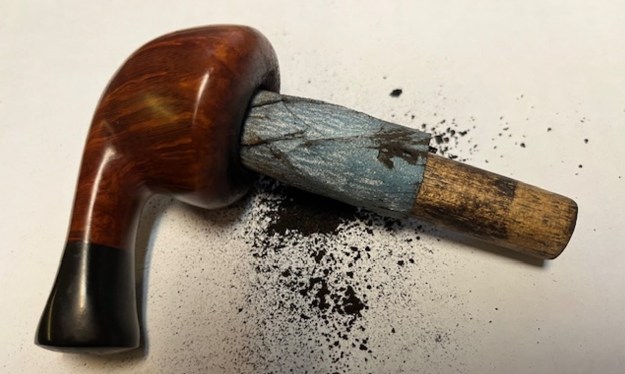
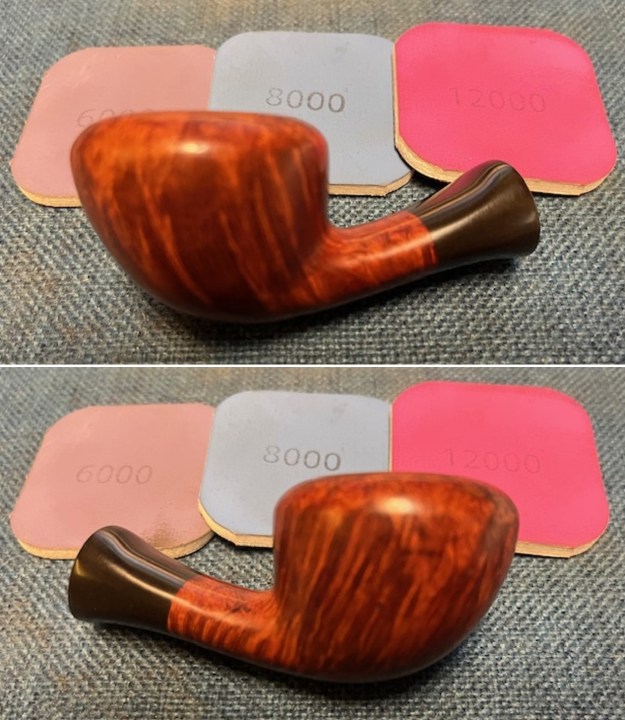
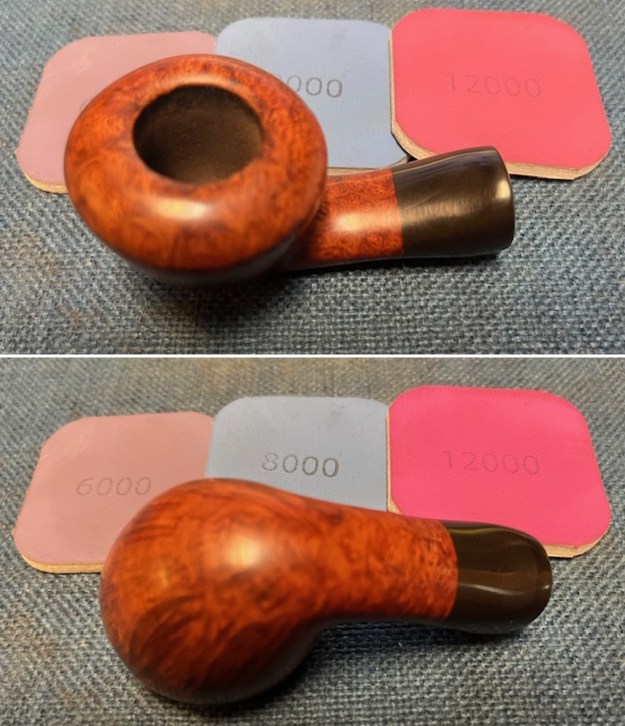
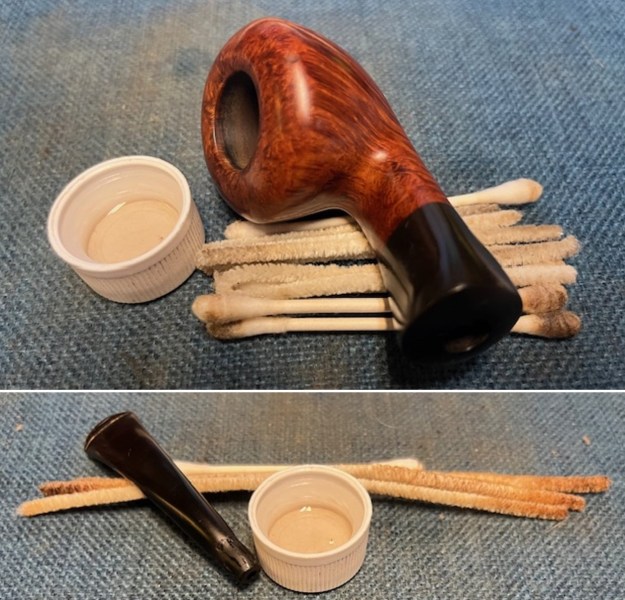
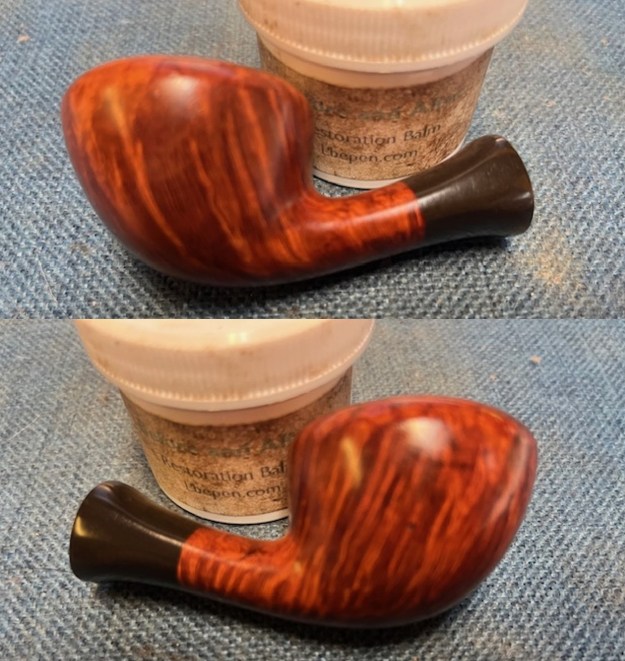
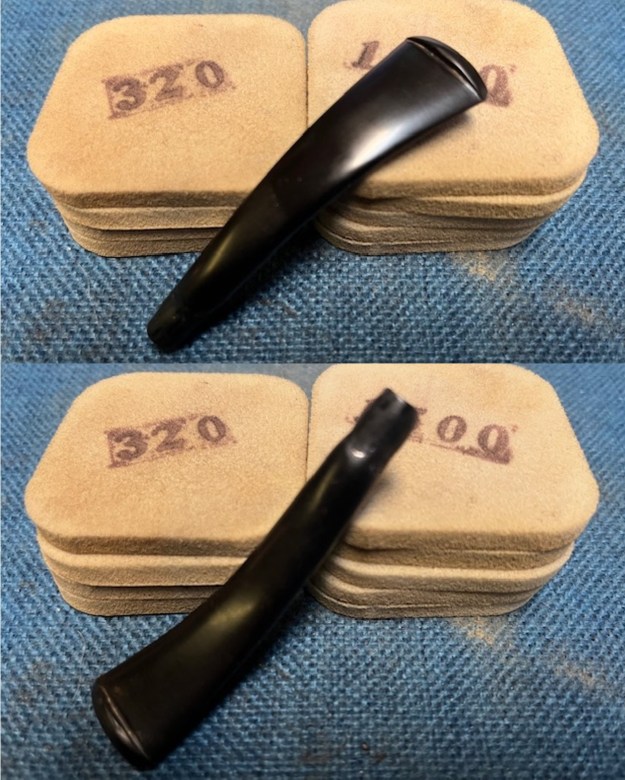
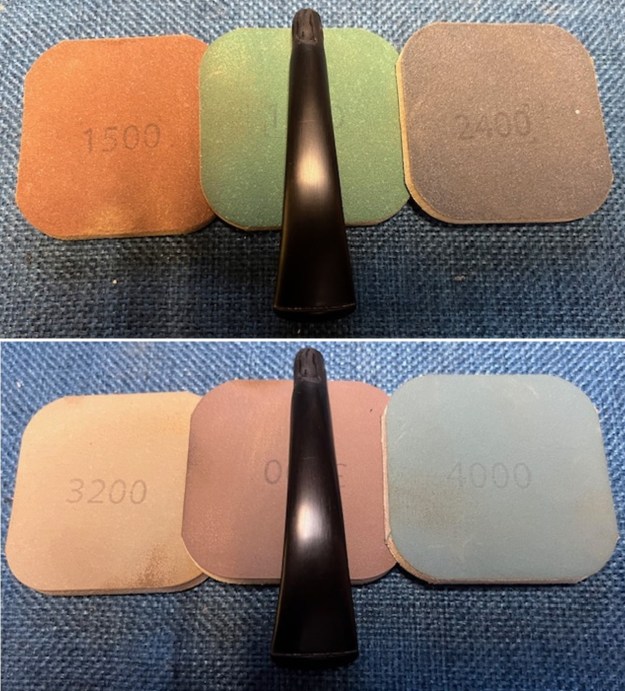
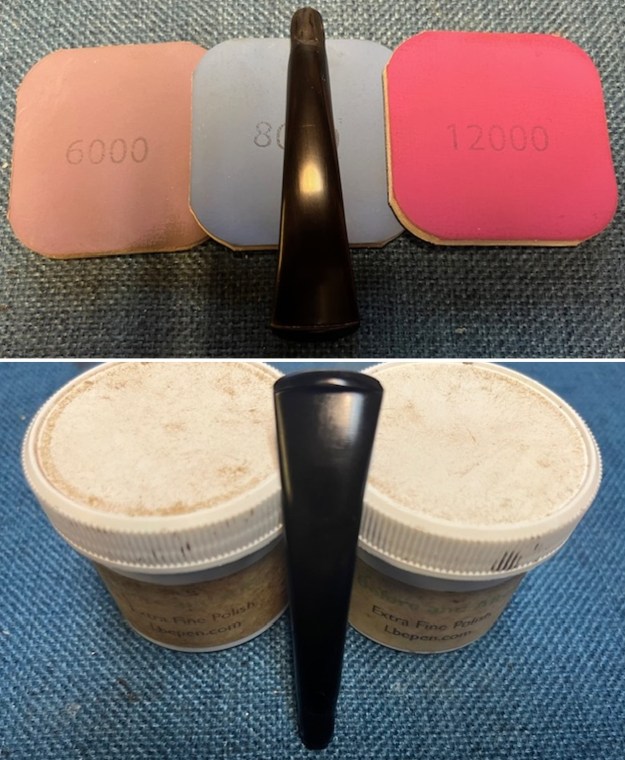
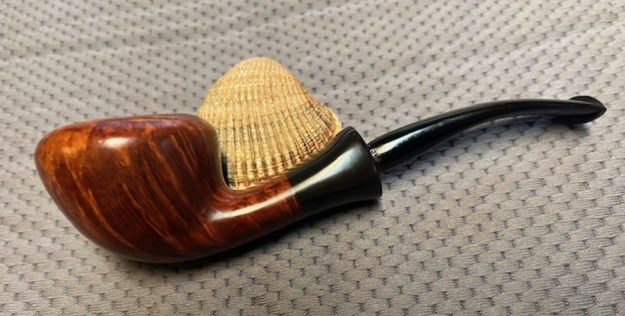
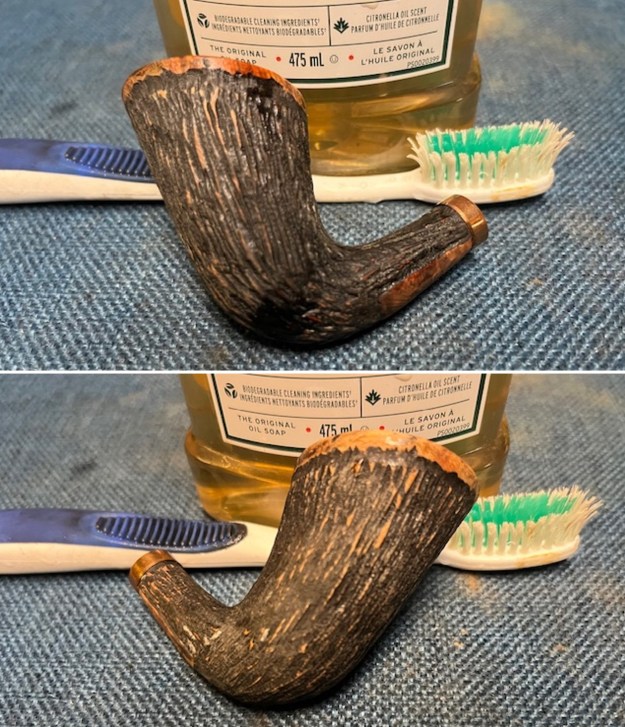
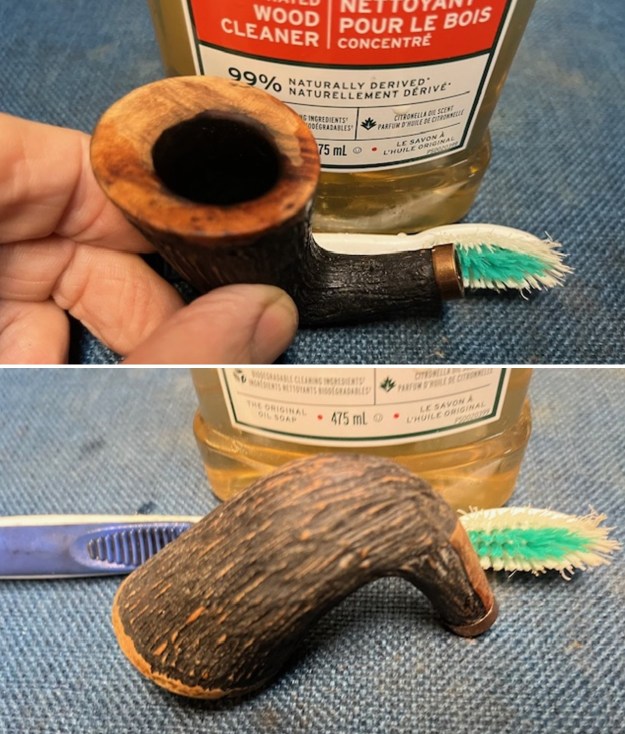
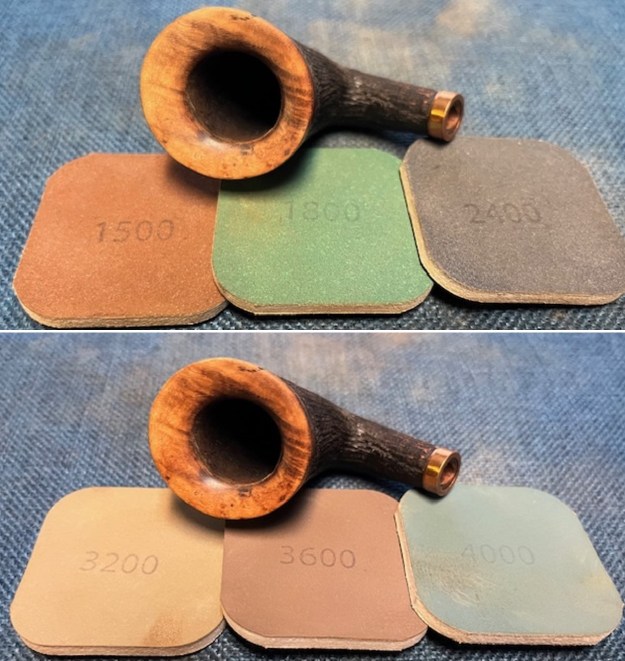
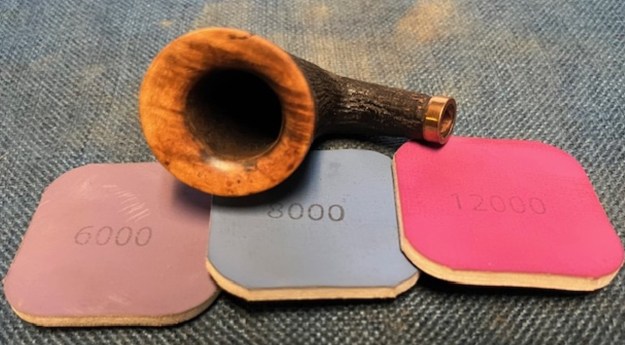
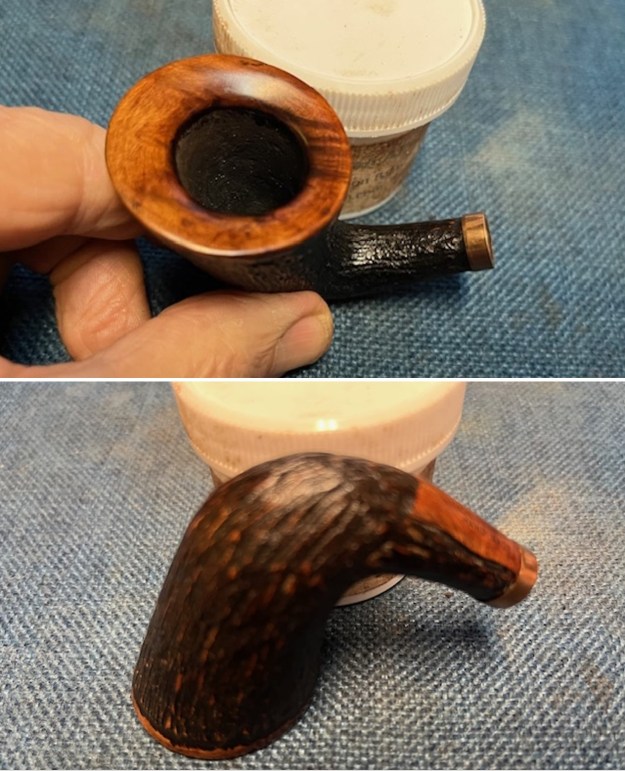
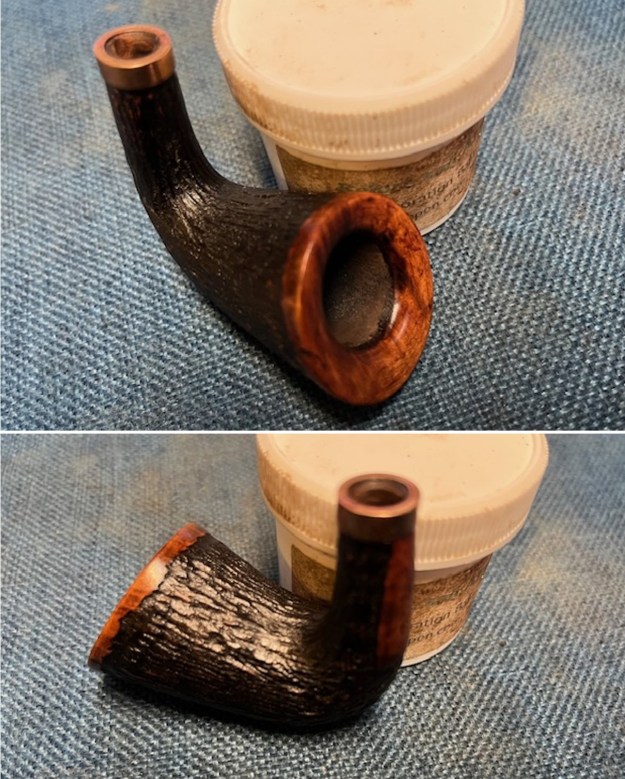
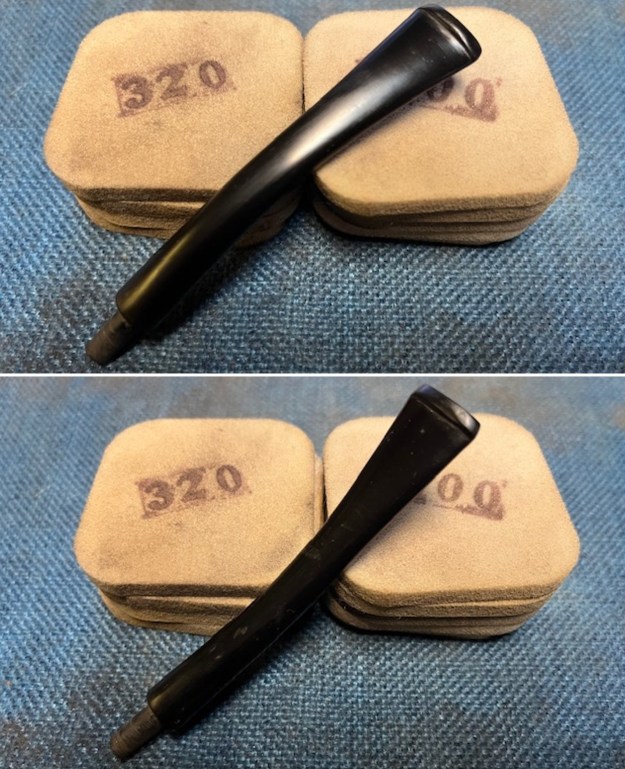
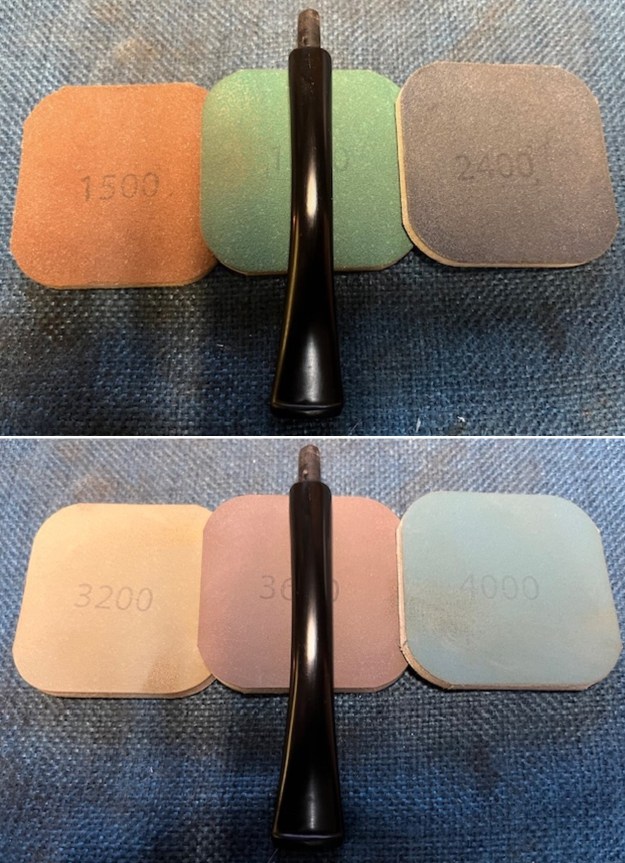
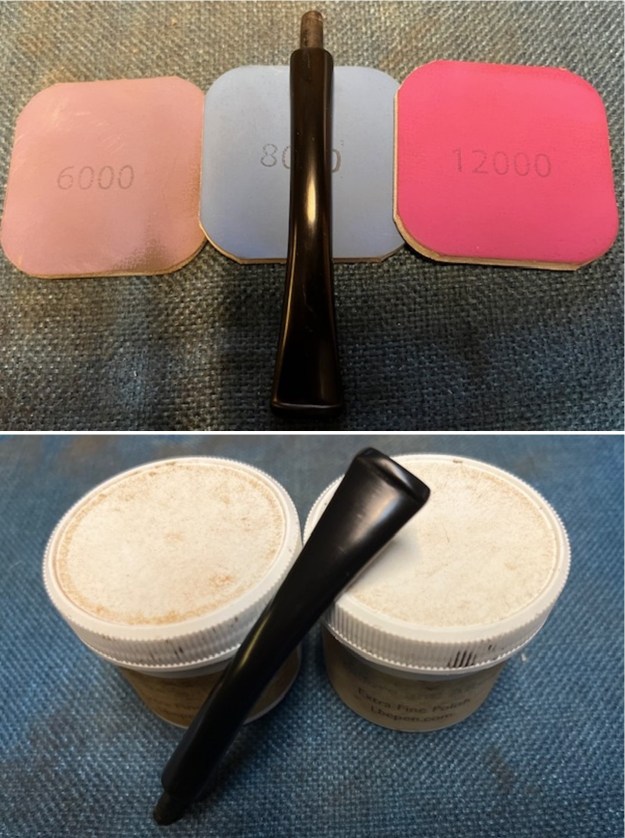
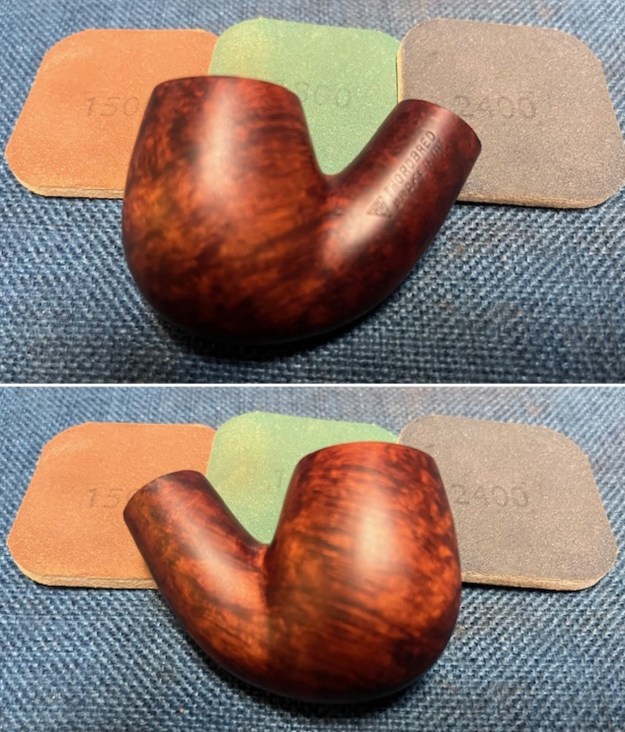
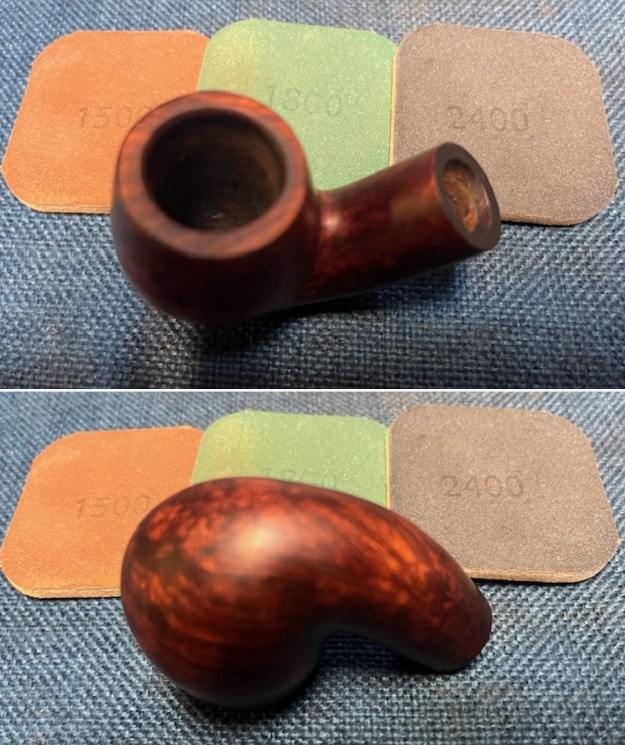
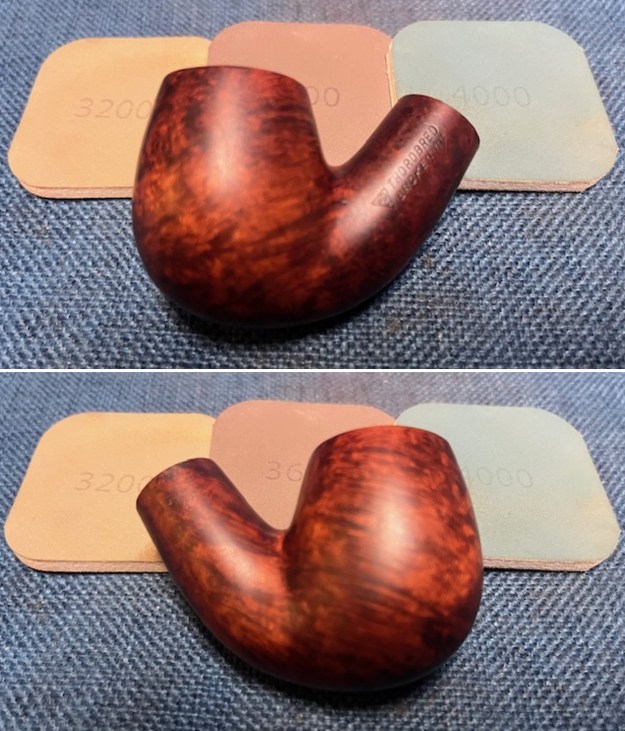
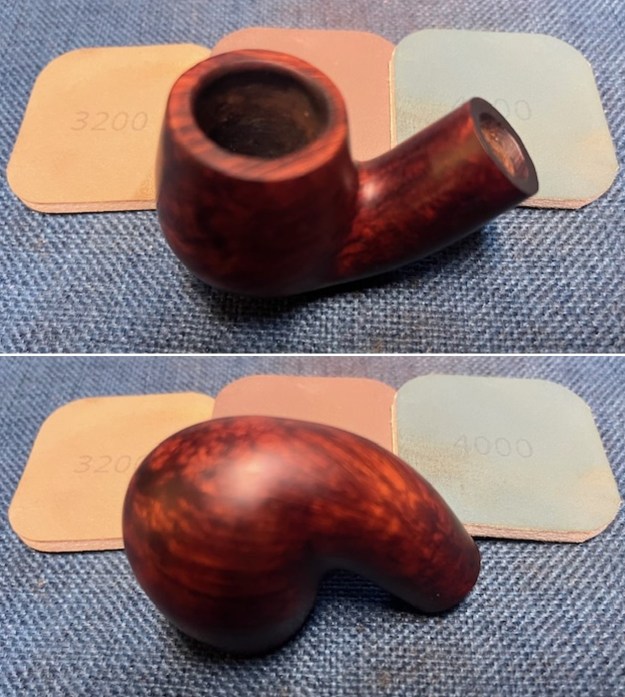
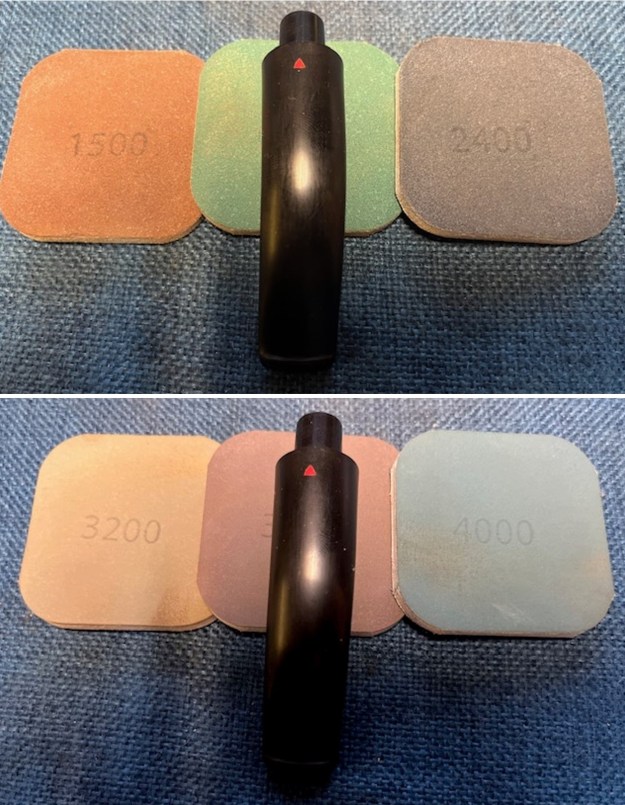
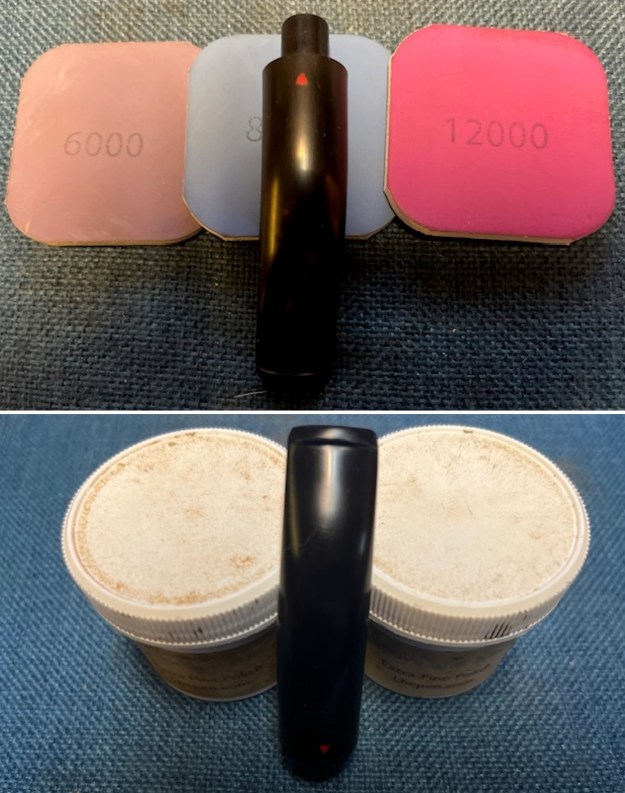
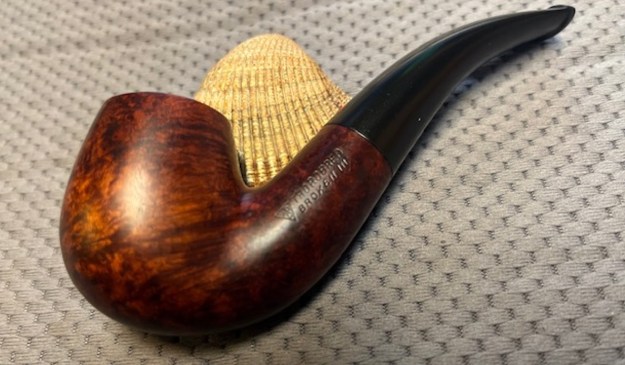
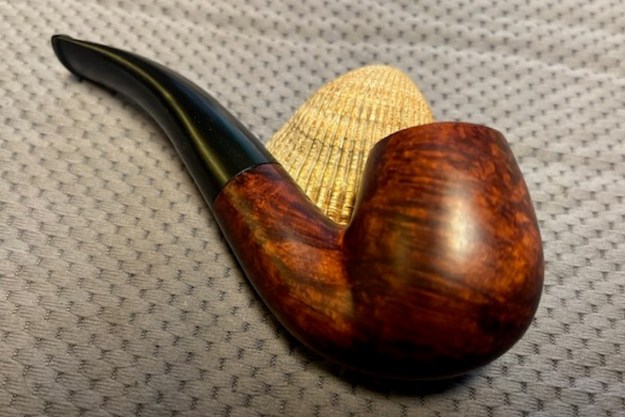
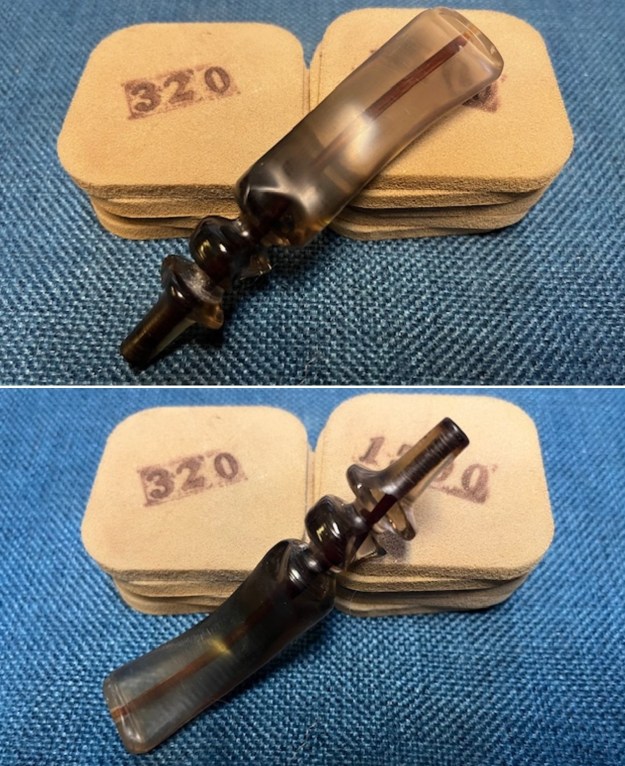
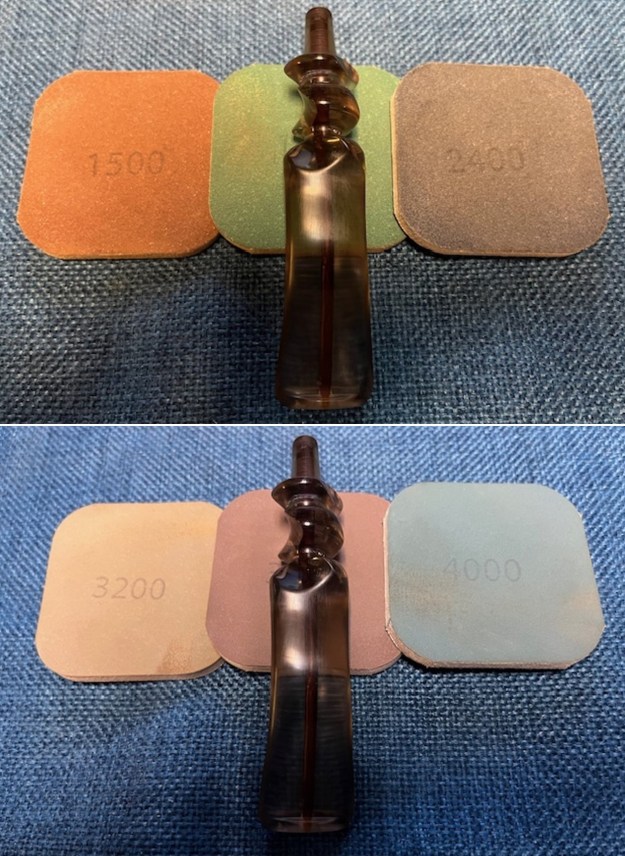
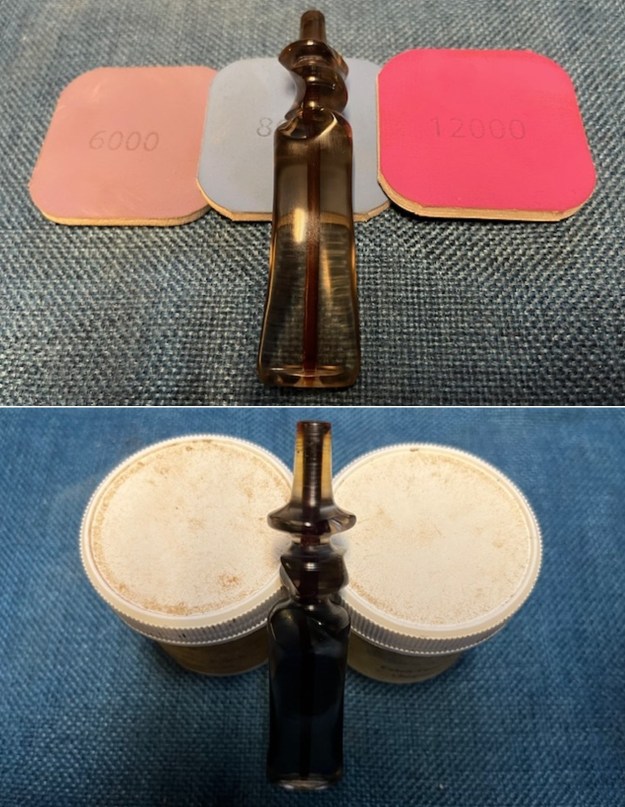
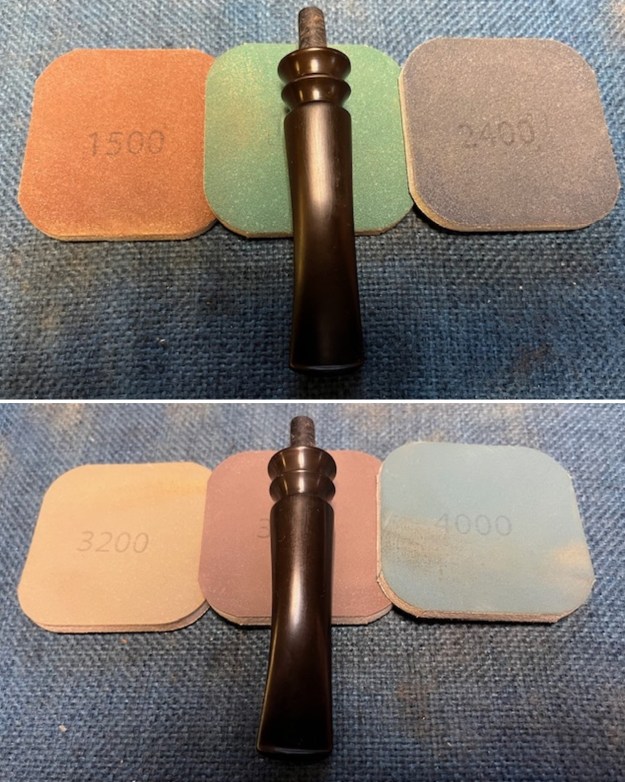
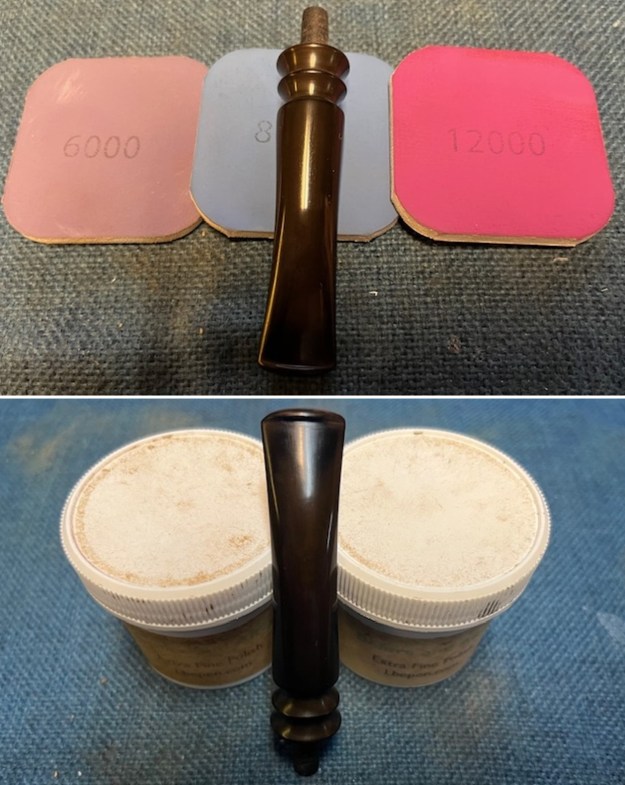
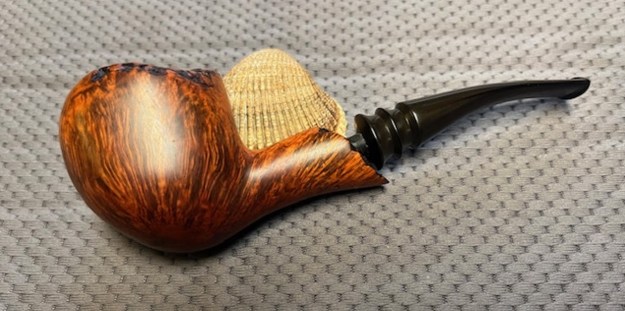
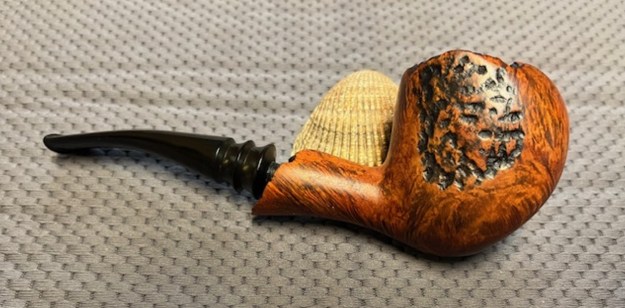
Now I had the background I needed. I was ready to start working on this pipe. As usual, Jeff had thoroughly cleaned up the pipe. I probably don’t say enough about how much I appreciate him doing the hard clean up work before I even get the pipes. He does an amazing job. He had reamed the pipe with a PipNet pipe reamer back to bare briar and removed the remnants of the cake with a Savinelli Fitsall Pipe Knife. He used a small blade to pick out the thick lava on the rim top. He scrubbed the bowl with undiluted Murphy’s Oil Soap and a tooth brush. He rinsed it under running warm water to remove the soap and grime. He cleaned out the inside of the shank and the airway in the stem with alcohol, cotton swabs, pipe cleaners and shank brushes. He soaked the stem in Briarville’s Pipe Stem Deoxidizer and rinsed it off with warm water. I took photos of the pipe and the stem that came with it before I started my part of the restoration work. Preben’s Holm’s magic is very visible in the shaping of the pipe. I took photos of the bowl and rim top to show the clean condition. The bowl walls look very good. The replacement stem looks very clean and will be a good addition to my can of stem options. I tried to capture the stamping on the shank underside. It is a bit blurry but it is still very readable and clear as noted above. I took a photo of the pipe with the replacement stem removed. It really makes it clear to me that it is a replacement.The pipe was ready for me to work on but I decided first to go through my stems. I went through both vulcanite and acrylic stems which may sound easy but I have several hundred stems to sort through. I was looking for something that flowed with the delicate shape of the bowl and shank and was simply weightless looking. I found what I was looking for and took a photo of it with the stem I found. I like the looks of the new choice. What to do next? I figured I might as well continue working on the stem since I had already started. I sanded out the tooth chatter on the stem end and worked on the oxidation with a folded piece of 220 grit sandpaper.I sanded the stem with 2×2 sanding pads – 320-3500 to start the polishing process and further remove the oxidation and marks. I wiped the stem down after each sanding pad with Obsidian Oil. It was beginning to look very good.I love watching the shine develop on the vulcanite as I polish it with micromesh sanding pads – dry sanding with 1500-12000 grit pads. I wiped it down after each pad with Obsidian Oil. I finished this part of the polishing by using Marks Hoover’s Before & After Pipe Stem Polish – both Fine and Extra Fine. I wiped it off with a soft cloth and gave the stem another coat of Obsidian Oil. I set the stem aside and turned my attention to the bowl. I used some Soft Scrub to work on the oxidation on the vulcanite shank extension. I did a lot of scrubbing on it and the oxidation came off the vulcanite and it looked much better. I polished the smooth portions of the briar and the vulcanite shank extension with micromesh sanding pads – dry sanding with 1500-12000 grit sanding pads. I wiped the bowl down with a damp cloth after each pad. I wiped the shank extension down with Obsidian Oil. I take photos of the three groups of pads for my own viewing primarily as I am looking for progress in polishing. Once again, by the end of the process it looked quite good. I rubbed the bowl and shank down with Before & After Restoration Balm. I worked it into the surface of the bowl sides and shank with my fingertips. I worked it into the plateau finish with a shoe brush. It works to clean, enliven and protect the briar. I let the balm sit for 15 minutes and buffed with a cotton cloth to raise the shine. The grain came alive. This newly restemmed Frasorteret Hand Made in Denmark Freehand is a great looking pipe with some interesting shaping around the sides of the bowl and vulcanite shank extension. You can easily see the handiwork of Preben Holm in the shaping of the pipe. The beautiful grain around the smooth portions and sandblast on the other portions of the bowl is quite stunning and works well with both the shape and the polished vulcanite shank extension and the military stick mount stem. I put the new stem back on the bowl and carefully buffed the pipe with Blue Diamond on the buffing wheel using a light touch on the briar. I gave the bowl and the stem multiple coats of carnauba wax on the wheel and followed by buffing the pipe with a clean buffing pad. I hand buffed the pipe with a microfiber cloth to deepen the shine. The finished Preben Holm Hand Made Frasortert Freehand fits nicely in the hand and feels great. Give the finished pipe a look in the photos below. The dimensions of the pipe are Length: 6 inches, Height: 2 ¼ inches, Outside diameter of the bowl: 1 ¼ inches, Chamber diameter: 7/8 of an inch. The weight of the pipe is 42 grams/1.52 ounces. I will be putting it on the rebornpipes store in the Danish Pipemakers Section shortly. If you wish to add this interesting pipe to your rack it is a great addition. Send me a message or an email. Thanks for reading this blog and my reflections on the pipe while I worked on it. I appreciate your support and time!

Restoring an older MLC Redmanol French Briar Crosby Style Pipe with a Redmanol Stem


by Steve Laug

This older MLC billiard (almost a Bing Crosby shape though certainly a predecessor) is early 20th century pipe. It came to us from Mark in Missoula, Montana, USA and was a pipe from his Grandfather’s collection. He sent us a cigar box of pipes from that collection that included a lot of interesting pipes for us to work through. Mark also included a biographical sketch on his Grandfather, W.B. Bollen (written by Mark’s Father). His Grandfather, WB Bollen was quite involved in the state of Oregon and the Pacific Northwest of the USA in the field of agriculture through Oregon State University in Corvallis, Oregon. The sketch is called Recollections of W.B. Bollen and I am in the midst of reading it while I work on the first of these pipes – the MLC Billiard. According to Pipedia, (https://pipedia.org/wiki/M._Linkman_%26_Co) the initials MLC stand for M. Linkman Company which was thought to mean Mary Linkman Company. They were a Chicago based company that produced both briars and meerschaums. The company was named for the mother of the same Linkman who branded pipes under that same name and then eventually became the Dr. Grabow pipe manufacturer with which we are familiar. Pipephil’s site gave a little more information at this link (http://www.pipephil.eu/logos/en/logo-l4.html). M. Linkman and Co. was established by Louis B. Linkman and August Fisher in 1898. The company closed down in the 1950s and the Dr Grabow branch was sold to Henry Leonard and Thomas Inc.(HLT), There was also a note that early Linkman’s pipes were stamped MLC in an oval.

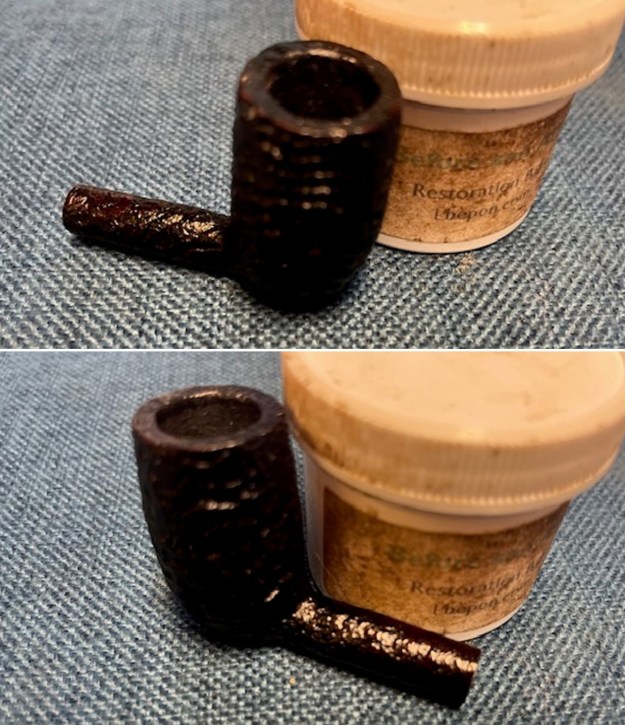
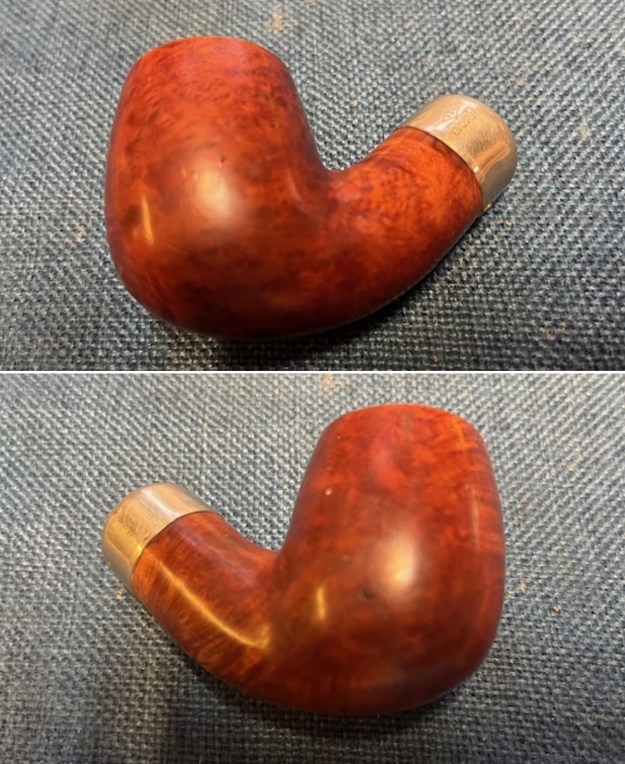
I have written a bit more about the MLC brand on several early blogs (https://rebornpipes.com/2016/11/12/an-interesting-the-nuvo-mlc-italian-briar-hidden-in-a-wdc-case/ https://rebornpipes.com/2017/08/17/restoring-a-sad-old-mlc-bent-billiard/). The second link included this older photo of the Linkmans that is really fascinating. I am including it below.If you have followed this blog for a while you have come to know that I love really old pipes and this one fits into that category of pipes. It is stamped MLC in an oval over Redmanol over French Briar on the left side of the shank. The stamping is faint but readable with a light and lens. There are no other stampings on the briar. The band is Sterling Silver and is dented and worn but also bears the MLC oval logo stamped on the topside. It is a pencil shank billiard with a thin “unbreakable” tube lined Redmanol stem. The bowl exterior was absolutely filthy. There was darkening and oils ground into the briar. The thick cake in the bowl and the lava coat on the edges and rim top made it hard to know what the condition of the rim edges. There also appeared to be a thin hairline crack on the backside of the bowl from the rim edge about 2/3 of the way down to the shank. There was also a large silver “O” on the front of the bowl which I believe refers to Oregon Agricultural College (which later became Oregon State University). As with other schools in the 1920s pipes were made honouring the institution and were available to graduates and students. This fits the time frame for this pipe. W.B. Bollen received his BS in Horticulture in 1921 and an MS in Soil Bacteriology in 1922, both from Oregon Agricultural Colledge. I am fairly certain that this dates the pipe that I am working on. The Redmanol Stem was in good condition with the usual chips, nicks and tooth marks of a pipe that is over 100 years old. Jeff took the photos that follow before started the cleanup. You can see from the photos the condition of the pipe.He took photos of the rim top and bowl to show the condition of the pipe. You can see the thick cake, the lava on the rim top, an out of round inner edge and a potential crack on the rim top at the back of the bowl. He also took photos of the Redmanol stem to show its condition as noted above. He took photos of the sides of the bowl to show the grain underneath the dirt and grime ground into the finish. You can also see the nicks in the briar and the oxidized silver O that is on the front of the bowl. There is a lot of beauty underneath the grime. While he was unable to capture the stamping on the shank side he was able to capture the stamping on the silver band. Underneath the oxidation and scratches, it is still clear and reads MLC in an oval over Sterling.Now that I knew a bit of the history of the pipe both in terms of the maker and the pipeman who enjoyed it, I turned to work on the pipe itself. Jeff had thoroughly cleaned up the pipe. He had reamed the pipe with a PipNet pipe reamer back to bare briar and removed the remnants of the cake with a Savinelli Fitsall Pipe Knife. He scrubbed the bowl with undiluted Murphy’s Oil Soap and a tooth brush. He rinsed it under running warm water to remove the soap and grime. He cleaned out the inside of the shank and the airway in the stem with alcohol, cotton swabs, pipe cleaners and shank brushes. He soaked the stem in Briarville’s Pipe Stem Deoxidizer and rinsed it off with warm water. I took photos of the pipe before I started my part of the restoration work.  I took photos of the bowl and rim top to show the clean condition. The damage on the inner edge of the bowl is evident as is the crack on the rim top above the crack on the back of the bowl. The crack extends across the rim top and just slightly into the bowl. That is to be expected. The bowl walls look very good. The Redmanol Stem looks very clean and the chips and nicks are visible the length of the stem. The silver band looks far better.I tried to capture the stamping on the shank side and band in the photos below. They are faint and very hard to capture. It is there but hard to see with out a lens. I removed the stem from the shank and took a photo of the parts of the pipe. It is a beautiful pencil shank pipe. I also took a photo of the Silver “O” on the bowl front. It is nicely done and the tarnish is gone. I decided to address the out of round inner edge of the bowl first. I used a folded piece of 220 grit sandpaper to smooth out the damage on the edge and to give it a slight bevel to bring it back to round. I sanded out the damage on the rim top to smooth it as well. It definitely looks better.I turned to deal with the crack in the back of the bowl that I mentioned above. The first photo sows the crack. It is hairline and starts on the rim top as shown above and extends down the bowl about 2/3 of the distance to the shank. It is a single crack so I used a small micro Drill bit on my Dremel and put a small hole at the bottom of the crack to stop it from going further. You will notice some small nicks in the surface of the briar where the drill hit as I guided it to the crack end.I wiped the back of the bowl down with alcohol on a cotton pad to clean up any debris from the drilling and any that might be in the fine crack. I ran a thin bead of clear CA glue down the crack and in the drill hole and nicks. I used a dental spatula to press fine briar dust into the crack through the glue. Once it cured I sanded the repaired area with a folded piece of 220 grit sandpaper to smooth out the repair. I polished it with a 400 grit sanding pad and then stained the area with a Cherry stain pen to match the rest of the surrounding briar. I polished the briar with micromesh sanding pads – dry sanding with 1500-12000 grit sanding pads. I wiped the bowl down with a damp cloth after each pad. I take photos of the three groups of pads for my own viewing primarily as I am looking for progress in polishing. Once again, by the end of the process it looked quite good. I rubbed the bowl and shank down with Before & After Restoration Balm. I worked it into the surface of the bowl sides and shank with my fingertips. It works to clean, enliven and protect the briar. I let the balm sit for 15 minutes and buffed with a cotton cloth to raise the shine. The grain came alive. I set the bowl aside and turned my attention to the stem. The scratches, tooth chatter and marks easily were addressed by dry sanding the stem with 320-3500 grit sanding pads. I wiped it down after each pad with Obsidian Oil. It looked very good at this point in the process.I polished the Redmanol stem with micromesh sanding pads – 1500-12000 grit pads to further remove the remaining scratches. I wiped the stem down with Obsidian Oil after each sanding pad. I used Before & After Pipe Polish – both Fine and Extra Fine to further polish the stem. I rubbed it down with a final coat of Obsidian Oil and let it dry. This 1920s MLC Redmanol French Briar Pencil Shank Billiard with a Redmanol stem is a great looking pipe with some interesting scalloping around the sides of the bowl. An added bonus if you are an Oregon Agricultural College Fan there is a silver “O” on the front of the bowl. The beautiful grain around the bowl is quite stunning and works well with both the shape and the polished silver band and “O” and the Redmanol taper stem. I put the stem back on the bowl and carefully buffed the pipe with Blue Diamond on the buffing wheel using a light touch on the briar. I gave the bowl and the stem multiple coats of carnauba wax on the wheel and followed by buffing the pipe with a clean buffing pad. I hand buffed the pipe with a microfiber cloth to deepen the shine. The finished MLC Redmanol French Briar Billiard fits nicely in the hand and feels great. Give the finished pipe a look in the photos below. The dimensions of the pipe are Length: 6 ¾ inches, Height: 1 ½ inches, Outside diameter of the bowl: 1 ¼ inches, Chamber diameter: 7/8 of an inch. The weight of the pipe is 24 grams/.85 ounces. I will be putting it on the rebornpipes store in the American Pipemakers Section shortly. If you are an avid Oregon fan or know one then this is the piece of history for you. Send me a message or an email. Thanks for reading this blog and my reflections on the pipe while I worked on it. I appreciate your support and time!


Restoring and Restemming a BBB Own Make Thorneycroft Sand blast Canadian 506


by Steve Laug

The next pipe I decided to work on is one from a Dan in South Carolina. He contacted me several weeks ago now about a pipe that he had come across in his things that was on that his mom had picked up for him. Now 16 or 17 years later he decided it is time to work on it. He wrote me the email below regarding this pipe and how he came upon. It piqued my interest because to be honest with you I love all things BBB.

Hello,
I recently stumbled on an old billiard pipe that my mom had bought me at an antique store while I packing up for a move. I was 16 or 17 at the time so I couldn’t use it and basically forgot about it until now, at 33, I’m starting to get into pipe tobacco more and more. The pipe has the “BBB” inside a diamond with “OWN MAKE” underneath that on the top of the shank, and “THORNEYCROFT Made In ENGLAND” with “506” just below it on the underside of the shank.

The problem is it has no stem, and the end of the shank where the stem would fit into, has many marks that I can’t tell whether they are chew marks or if they are just a part of the grain etc. To my very untrained eye the pipe seems to be in OK condition otherwise.

Being very new to this hobby and not knowing many resources yet or really what to do, and seeing your restorative work, I’d like to ask if you restore pipes for people or if you might be able to point me in the right direction on how I should go about making this pipe smokeable once again, or if it might not be worth it except for sentimentality sake. I’m able to provide pictures of the pipe if needed as well.

Thank you,
Dan

I wrote Dan back and asked him to send me some photos of the pipe so that I could see what I was dealing with in this pipe. He sent some amazing photos of various angles of the pipe and I was hooked. I asked him to send it up and I would restore and restem it for him. Here are the photos that he included for me. The first four photos are overall views of the pipe as a whole. The craggy sandblast, the typical rustication on the shank end that I have seen on most of these Thorneycroft pipes, and the delicate but classic look of a Canadian are all well captured. Dan sent photos of the bowl and rim top as well as photos of the sides of the bowl. I appreciate the detail in these photos. The bowl shot shows the tar and cake on the sides and heel of the bowl and the lava build up in the sandblast of the rim top. It should clean up fairly easy. He also notes with a red circle what appears to be a chip on the left side of the bowl on the outer edge of the rim. The more I examine it the more I think it is probably a part of the blast. But I will know more once I have it in hand. His close up photos of the shank show the rustication and the washed out stain on the shank end. I think it is the typical BBB rustication that I have seen on the shank end of the Canadians and long shank pipes in the Thorneycroft line. Dan did a great job capturing the stamping on the shank top and underside. It reads as he noted in his opening email.He took close up photos of the rustication as well. It is rugged and I have to say that I like it. Once it is restained it will look quite nice. The photo of the shank end shows that there are no crack in the shank. There is a nick on the lower right side that is probably a flaw in the briar.I did a search on Pipephil’s site (http://www.pipephil.eu/logos/en/logo-bbb.html) and looked for the specific Thorneycroft line. The second pipe in the list is stamped the same way as the one that I am working on and the stamping on the stem is the same. The Made in England stamp is identical to the second one. I looked on Pipedia and found several references to the BBB Own Make Thorneycroft pipe but nothing specific (https://pipedia.org/wiki/BBB). I also found an advertisement courtesy of Doug Valitchka from 1957 that had a great description of the Thorneycroft that I include below. It reads as follows:

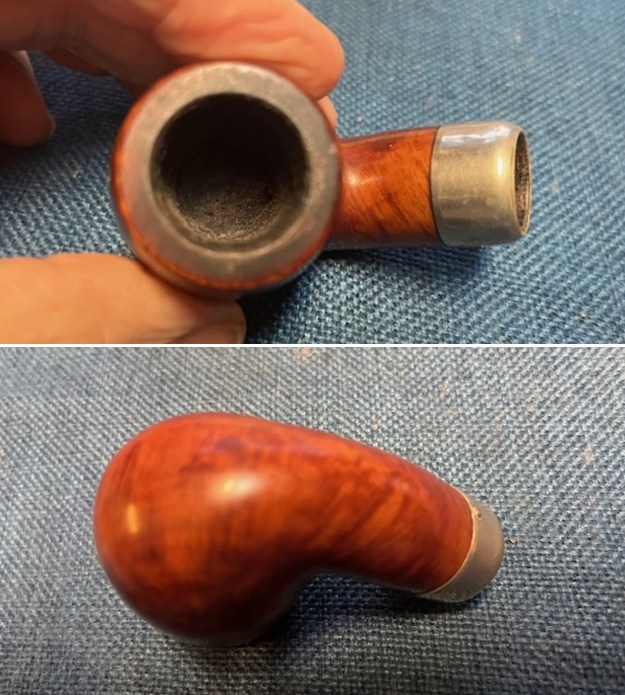
Beautifully balanced, superbly lightweight and mellow smoking… these qualities have made the BBB Own Make Thorneycroft famous. First tough, age-old Algerian briar is carefully selected and cured then the bowls are carefully hand-turned. Now comes the special process of sand- erosion. The soft parts of the briar are literally blasted away leaving a hard bowl of unusual beauty, durability and sweetness. A mouthpiece of finest English Ebionite, inlaid with the famed metal emblem, and a specia dry smoking condenser tube complete the picture. Available in all 24 BBB shapes…I took some photos of the bowl as it was when I unpacked it. It was stamped as Dan noted above and was clear and readable. The rough shank end of the pipe was not damaged but had lost the stain that had originally coloured it. The little nick in the shank end does not damage the airway in the shank. The nicks that were noted on the edge of left side of the bowl appeared to me to be part of the blast and should be left as is. The bowl had a light cake on the walls and there was a light lava coat on the rim top where it had filled in some of the blast. The inner edge of the rim was in excellent condition with no damage. The outer edge had no damage either but there was some roughness to it due to the sand blast finish on the edge. It looked very good however. I took photos of the bowl to show the condition when I received it from Dan. I have included them below. I was hoping I had a BBB stem for the Canadian but I did not have one with the brass insert. I did have one that was a pretty decent fit. It would need to be adjusted in terms of the top, bottom and sides of the stem to fit the shank dimensions but it was the right length and shape for the pipe. It had a great shape on the slot that would give a good spread to the smoke.Now it was time to clean up the bowl. Since the cake was thin I used a Savinelli Fitsall Pipe Knife to scrape out the cake that was in the bowl. I took it back to bare briar and then sanded the walls with a piece of dowel wrapped with 220 grit sandpaper. The bowl walls were in very good condition with no checking or burn damage.I wiped off the bowl with a damp cloth and was amazed at how little dust came off the finish. Dan had obviously wiped it down before he sent it. I also wiped down the rim top and it was quite clean as well. I used a black and a walnut stain pen to stain the shank end rustication to match the rest of the briar. It looked very good. Once it was buffed and polished it would be a perfect match. I used a brass bristle wire brush to knock off the remaining debris in the sandblast on the rim top. It looks very good with some deep blast sections on the top right and left. Beautiful blast in all ways.I cleaned out the internals of the shank, mortise and the airway in both the shank and the new stem with alcohol, cotton swabs and pipe cleaners. The pipe smells fresh and ready to smoke again.Now that it was clean it was time to do a few minor surface repairs. The first of these was a small repair to a flaw on the shank end on the inner edge of the mortise on the lower left side. I used a tooth pick to put a drop of CA glue in the flaw and smooth it out on the surface. I did the same to the pit on the outer edge of the rim on the right side toward the back. Both were cosmetic rather than structural but it improved the look of the bowl in those spots. I smoothed out the repair on the shank end with a folded piece of sandpaper and touched the paper to the repair on the rim edge as well. I stained both with a Walnut stain pen and blended them into the surface. I rubbed the briar down with Before & After Restoration Balm. I worked it into the briar with my fingertips and a shoe brush to work it into the finish. The product works to clean, enliven and preserve the briar. I let it sit for 10 minutes then I buffed it with a cotton cloth to deepen the shine. The depths of the blast in the briar really comes alive with the balm. I worked on the fit of the stem to the shank with a folded piece of 220 grit sandpaper. I needed to reduce the diameter of the stem from top to bottom and from right to left. I worked on it for quite a bit of time sanding, sanding and more sanding until the fit to the shank was good and the transition between the shank and stem was smooth.I polished the stem once it fit with 320-3500 grit sanding pads. I wiped it down after each pad with a cloth impregnated with Obsidian Oil. By the end the stem took on a good shine and the fit was very good.I polished the vulcanite stem with micromesh sanding pads – 1500-12000 grit pads. I wiped it down with Obsidian Oil after each sanding pad. I used Before & After Pipe Polish – both Fine and Extra Fine to further the stem. The photos below show the polished stem. I am pretty happy with the restoration and restemming of this BBB Own Make Thorneycroft Sandblast Canadian. There is a sandblast finish to the bowl that is rugged and rich looking. The newly fit stem is clean and smooth and looks good on the shank. I put the stem back on the bowl and carefully buffed the pipe with Blue Diamond on the buffing wheel using a light touch on the briar. I gave the bowl multiple coats of Conservator’s Wax and the stem multiple coats of carnauba wax on the buffing wheel and followed that by buffing the entire pipe with a clean buffing pad. I hand buffed the pipe with a microfiber cloth to deepen the shine. The finished BBB Own Make Thorneycroft Canadian fits nicely in the hand and feels great. Give the finished pipe a look in the photos below. The dimensions of the pipe are Length: 5 ¾ inches, Height: 1 ¾ inches, Outside diameter of the bowl: 1 1/8 inches, Chamber diameter: ¾ of an inch. The weight of the pipe was 30grams/1.02ounces. I will be sending it back to Dan shortly. I look forward to hearing what he thinks of it. Thanks for reading this blog and my reflections on the pipe while I worked on it. It is a privilege to be a part of the restoration and preservation of these old timers with a back story!

Restemming and Restoring an Astley’s Sandblast Cherrywood


by Steve Laug

Not too long ago I received and email from Nick, a fellow up the coast of British Columbia. He was not too far away and had gotten my information from City Cigar, a pipe and cigar shop that I do a lot of repairs for. He wrote the following email about two pipes he want me to restem for him.

Dear Steve,

I have a couple of pipes in need of new stems. City cigar suggested you might be able to help.

One is a diplomat, the other a cherrywood. Are you able to make new ones if I get the bowls to you?

I asked him to send me some photos of the pipe so I could see what he had and what I would be working with. I have a pretty good idea of the stems that I have and could tell him quite quickly once I saw the pipe if it was something I could work on.

He wrote back and sent me another brief email and included two photos of his pipes. This email made me think twice about the pipe because of what he wrote.

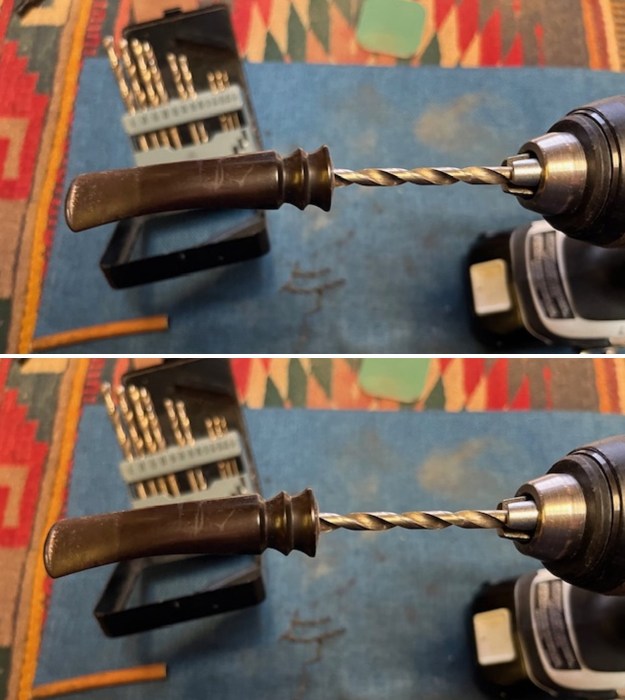
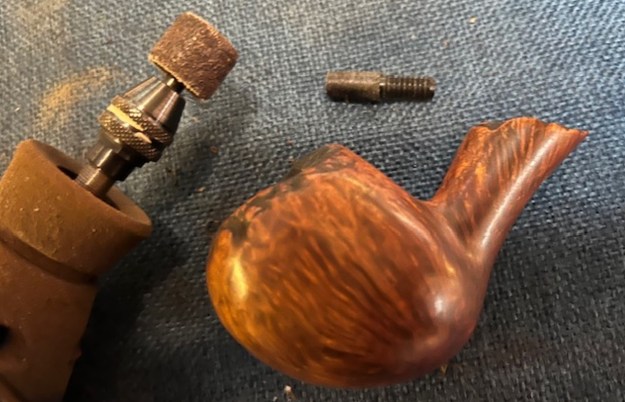
In trying to pull the tenon in the silver collared pipe, the diplomat I broke off a brass screw. It will need drilling I think. Best NickThe pipes arrived this week and I was surprised to find that they were both Astley’s pipes. I chose to work on the Cherrywood first. It had a lovely sandblast finish what was dirty and was stamped on a smooth panel on the underside of the shank. It read Astley’s [over] 109 Jermyn St. [over] London. The stamping was clear and readable. The bowl of the pipe had a moderate cake with some dust and debris in the sandblast of the rim top. The inner and outer edges of the bowl looked good. The pipe was missing the stem but Nick had sent along the snapped tenon in the bag with the pipes. I took photos of the stem to get a sense of what it looked like before I started my clean up. I took a photo of the rim top to capture the condition of the bowl and rim top. I like to capture that condition before I started my work on the pipe. You can see the dust in the sandblast on the rim top and the cake in the bowl. It is a nice looking pipe.I took a photo of the stamping on the underside of the shank and it is much clearer than the photo shows. It reads as noted above. Interestingly there was no shape number on the shank so it was a bit of a mystery pipe.Before I started my work on the pipe I did a bit of reading. I knew that I had work on an Astley’s Cherrywood previously and done a blog on it. A quick search on the blog took me to it. Here is a link (https://rebornpipes.com/2014/09/27/breathing-new-life-into-an-astleys-48-cherrywood/). I quote a portion of the blog below on the pipe. I found that it was a pipe that had a similar shape and had a shape number. I am also including some photos of the pipe when I had finished the restoration. The finish was not a sandblast but a rustication pattern that was very tight. The shape was the same as the one I was working on. This pipe was stamped on the heel of the bowl rather than the shank but it was the same. What was good about it was that it showed me the kind of stem that was originally on the pipe. That would guide me in fitting a new stem.This bowl had been stamped on the smooth bottom and read Astleys over 109 Jermyn St. Under that was stamped London over 48. I looked up the shape in an old Astleys catalogue (page pictured below) and found the 48 was a Round Cherrywood Briar. The description stated that it was a copy of an old English Cherrywood with a flat base. The bend on the stem can also be seen in the photo below from the catalogue.I started my work on the pipe by reaming it with a PipNet reamer using the second cutting head to take the cake back to bare briar. I cleaned up the reaming with a Savinelli Fitsall Pipe Knife. I sanded the walls of the bowl with 220 grit sandpaper wrapped around a piece of dowel to smooth out the walls. There was no checking or burn marks on the bowl walls it looked very good. I used a brass bristle wire brush to clean out the debris in the sandblast finish on the rim top. It looked much better at this point.I cleaned out the inside of the pipe – airway into the shank, the mortise and shank walls with pipe cleaners, alcohol and cotton swabs. I worked on it until it was very clean.I scrubbed the exterior of the pipe with undiluted Murphy’s Oil Soap and a tooth brush. I rinsed it off with warm running water and dried it off with a soft towel. The bowl looked good. The rim top had some fading that I would need to restain. I restained the faded rim top with a Mahogany stain pen to match the rest of the bowl and shank. The match to the rest of the bowl is quite perfect and it really makes the grain pop in the sandblast.I worked some Before & After Restoration Balm into the surface of the briar with my fingertips and a shoe brush to clean, enliven and protect it. I let the balm sit for a little while and then buffed with a cotton cloth to raise the shine. The following photos show the bowl at this point in the restoration process. I am very happy with the results. With the bowl completed it was time to pick out a stem to fit the shank of the pipe. I wanted it to be the same diameter as the shank and fit snug in the shank. I went through my stems and found one that looked a lot like the Astley’s stem on the Cherrywood in the photos above. It is a saddle stem with a thin blade. It is used but it should clean up very well.
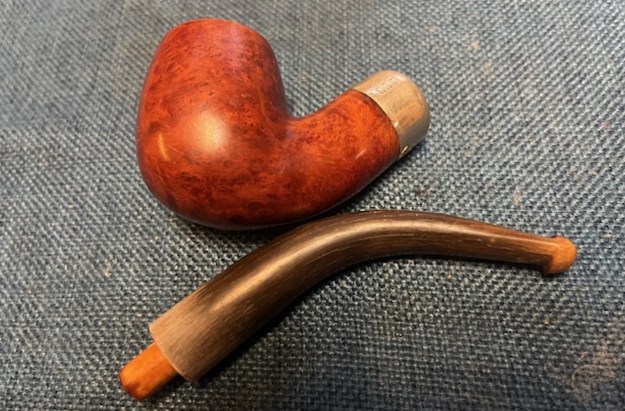
I cleaned out the airway in the stem with pipe cleaners and alcohol. The internals cleaned up very well. I also cleaned up the externals at the same time.I created a slight step down on the end of the tenon to secure a snug fit in the shank. I started the process with files and finished the shape with a Dremel and a sanding drum. Once it was finished it looked very good. It was similar in shape to the tenon on the Heritage pipe. It was going to work very well.I filled in the tooth marks along the edge of the button with some rubberized black super glue. By this time the repairs on the stem had cured so I flattened them out with a folded piece of 220 grit sandpaper. I worked over the button edge. It was beginning to shape up well.I sanded the stem with 320-3500 grit sanding pads and wiped the stem down after each pad to remove the sanding debris. It began to take on a deep shine.I polished the vulcanite stem with micromesh sanding pads – 1500-12000 grit pads. I wiped it down with a damp cloth after each sanding pad. I used Before & After Pipe Polish – both Fine and Extra Fine to further polish the stem. I wiped it down with a final coat of Obsidian Oil and set it aside. The sandblast Astley’s 109 Jermyn St. London Cherrywood is a real beauty and the finish and shape are well done and have a classic English look. The newly fit vulcanite saddle stem polished up on the buffing wheel with Blue Diamond and had a rich glow. I gave the bowl multiple coats of Conservator’s Wax and the stem multiple coats of carnauba wax on the buffing wheel and followed that by buffing the entire pipe with a clean buffing pad. I hand buffed the pipe with a microfiber cloth to deepen the shine. The finished Astley’s Cherry with a saddle stem fits nicely in the hand and feels great. Give the finished pipe a look in the photos below. The dimensions of the pipe are Length: 6 inches, Height: 2 inches, Outside diameter of the bowl: 1 ½ inches, Chamber diameter: ¾ of an inch. The weight of the pipe is 1.48 ounces/42 grams. I have one more pipe of Nick’s to restem and then I will be sending them back to him. Thanks for reading this blog and my reflections on the pipe while I worked on it. There are many more to come!

Restemming an UNSMOKED NOS WDC Military Bit Billiard


by Steve Laug

About a year ago I visited an older pipe repair man (when I say older I mean older than me). He gave me a lot of pipe parts – stems, bases, bowl, tenons and bands On Monday, August 25 after a visit with my brother Kenneth and I went to visit my contact again. This time he had more stuff that he wanted to get rid of from his parts. Once again, we received more stems and tenons. But he also put in a box of pipes that were in various states of repair or disrepair. There were quite a few that needed to be restemmed. One of those pipes was an interesting Billiard with a nickel ferrule stamped WDC in the triangle on the left side of the shank and the same on the left side of the nickel ferrule. It was in great shape for having been knocked around for a long time in a box of bowls and pipes. The finish was dirty but the bowl was unsmoked and very clean. There was a very shiny coat of varnish on the outside of the bowl and at least one fill on the back side of the bowl. The nickel was also clean and unoxidized. I would need to come up with a stem for it. I took a photo of the stamping on the left side of the shank. It is clear and reads as noted above. The stamp is also gold and very readable. I also tried to capture the stamping on the nickel ferrule. The shine tends to blur that stamp.I started my work on the pipe by wiping it down with acetone to remove the shiny varnish coat. It worked very well. The acetone loosened the glue on the ferrule and it came off when I was wiping it down. I cleaned up the glue on the shank end with the acetone cloth so that the briar was free of it. I used a dental spatula to spread some all purpose glue on the shank end. I pressed the nickel ferrule in place on the shank end and wiped off the excess glue with a damp cloth. I set it aside to allow the glue to cure. I sanded the briar with 320-3500 grit sanding pads. I dry sanded it and then wiped it down with a damp cloth after each sanding pad. The varnish finish was gone and the fills in the bowl sides were very visible. I polished the bowl with micromesh sanding pads – dry sanding with 1500-12000 grit pads and wiping down the bowl after each pad with a damp cloth. The briar took on a more natural shine than what was present when the bowl was varnished. I worked some Before & After Restoration Balm into the surface of the briar with my fingertips to clean, enliven and protect it. I let the balm sit for a little while and then buffed with a cotton cloth to raise the shine. The following photos show the bowl at this point in the restoration process. I am very happy with the results. I set the bowl aside and went through my stems. I found an unused vulcanite stem that had an orific button and a gentle that fits the style of the age of the pipe. It is also unsmoked and still bears a price tag on the underside. There is some oxidation around the tag and on both sides. I removed the sticky label with acetone on a cotton pad. I sanded the stem surface with 220 grit sandpaper to remove the nicks in the surface and the oxidation. It began to look much better as the work went on.I sanded the stem with 320-3500 grit sanding pads and wiped the stem down after each pad to remove the sanding debris. It began to take on a deep shine.I polished the vulcanite stem with micromesh sanding pads – 1500-12000 grit pads. I wiped it down with a damp cloth after each sanding pad. I used Before & After Pipe Polish – both Fine and Extra Fine to further polish the stem. I wiped it down with a final coat of Obsidian Oil and set it aside. The smooth WDC Billiard with a nickel ferrule and military vulcanite bit is a real beauty and the finish and shape are well done and have a classic English Billiard look even though this is an American Made pipe. The vulcanite military bit polished up on the buffing wheel with Blue Diamond and had a rich glue. I polished the nickel ferrule with a jeweller’s cloth. I gave the bowl and the stem multiple coats of carnauba wax on the buffing wheel and followed that by buffing the entire pipe with a clean buffing pad. I hand buffed the pipe with a microfiber cloth to deepen the shine. The finished WDC Billiard fits nicely in the hand and feels great. Give the finished pipe a look in the photos below. The dimensions of the pipe are Length: 5 ½ inches, Height: 1 ½ inches, Outside diameter of the bowl: 1 ¼ inches, Chamber diameter: ¾ of an inch. The weight of the pipe is 1.20 ounces/33 grams. I will soon be adding it to the rebornpipes store in the American Pipe Maker section. If you are interested in adding this pipe to your collection send me a message or an email. Thanks for reading this blog and my reflections on the pipe while I worked on it. There are many more to come!

Restoring a Piece of Danish Pipe History – a Suhr Kobenhavn Bruyere Extra Dublin


By Steve Laug

The next pipe on the table is an interesting short stemmed, sandblast Dublin that I found in a display cabinet. We purchased it from an Antique Mall in Lincoln City, Oregon, USA on 08/24/2024. The pipe is stamped on the underside of the shank Suhr [over] Kobenhavn. That is followed by Bruyere [over] EXTRA. The band covers some of the next portion of the stamp but it looks like it reads By Hand [over] a shape number beginning with 9. The band is stamped Birmingham Sterling Silver and has a T date stamp. The shank is cracked and I assume that someone put an English band on it that in no way reflects the country of origin. The bowl had a thick cake and lava overflowing on the rim top and inner edge. The sandblast finish was dirty with grime in the sandblast. The stem is worn and has been cut off and a button shaped at the end. There was no bother taken on the slot and it is uneven and rough. It leaves a short snorter of a pipe that does not quite look right.  I took photos of the pipe before I started my clean up work. I have included them below. I took a photo of the rim top, bowl and the surfaces of the stem to give a sense of the condition of the pipe. The bowl is out of round toward the front of the bowl. There was a thick lava coat on the rim edges or top filling in the sandblast. The stem is heavily oxidized, calcified and dirty. It has also been cut off a bit crooked and the button is not clean. The Sterling Silver shank band is dented, scratched and oxidized. It has also been cut at an angle.I took photos of the stamping on the sides of the shank. It is clear and readable and read as noted above. I took a photo of the pipe with the stem removed. It is definitely dirty and very oxidized on the shank extension and the stem.While I was looking at the pipe in the Antique Mall I looked up the Suhr brand on Pipephil’s helpful site where he has some great resources on stamping (http://pipephil.eu/logos/en/logo-s13.html). I had a fleeting memory of the name but I could not give it any data. I read about the brand and looked at the shape of the pipe shown on the site which was very similar to the pipe I was looking at. I was pretty convinced that the pipe at the shop was made by the same Suhr as shown on Pipephil’s site. The photos included also gave a clear picture of what the original stem may have looked like on the pipe when it left the maker. I bought it based on that information and added it to the purchase.

I have added the information, photos and a screen capture of the section below for the purpose of putting the information together with the restoration. Suhr’s Pibemageri (pipe workshop) was owned by Teophil Suhr. Poul Rasmussen († 1967), Svend Axel Celius or Sven Knudsen used to produce the pipes proposed in the shop.

It is not established the red-white dot is Suhr’s original logo. it may be the symbol used by Poul Rasmussen himself. See also: Anne Julie (widow of Poul Rasmussen)

When I got home and before I began working on the pipe I reread PipePhil’s info included above and turned to Pipedia for more (https://pipedia.org/wiki/Suhr%27s_Pibemageri). I quote from that site below.

Suhr’s Pibemageri was a pipemaking workshop started by Teofil Suhr in Copenhagen central to the birth of the modern Danish pipe. When Sixten Ivarsson, then a debt collector newly moved to Copenhagen, broke his pipe, it was to Suhr’s he went for a repair, only to find a broken lathe and no pipemaker. Soon after, he was working as the foreman at Suhr’s, where, among others, Peter Micklson got his start and Sven Axel Celius learned pipemaking from Poul Rasmussen and his then foreman Sven Knudsen. Pipes from Suhr’s were stamped with the workshop name Suhr, and on occasion carried the same red and white dot used by Anne Julie to this day.

While it is said to be a disagreement with Suhr’s that led Ivarsson to leave for Stanwell, and all of these names went on to greater fame in later years, it would be impossible to overstate the importance of Suhr’s to the evolution of the modern smoking pipe.

I googled Suhr to find more information. I found some on the Smokingpipes.com web site (https://www.smokingpipes.com/pipes/new/suhr/). I quote the information on the brand there.

Suhr is a venerable name, tracing back to the 1940s in Copenhagen, where it was primarily a pipe repair shop before picking up pipe manufacturing. Sixten Ivarsson served as foreman there in the 1940s before moving on to Stanwell. When he left, Poul Rasmussen became foreman and made Suhr pipes until his death in 1967. His widow, Anne Julie, started making pipes at that time, and eventually trained other carvers, including Tom Eltang.

The grandson of famous pipe makers Poul Rasmussen and Anne Julie, Johannes Rasmussen trained with Tom Eltang for years before carrying on the Suhr name.

When Johannes decided to pursue pipe making, he went full circle in his family history and contacted Tom Eltang for an apprenticeship. While at the Eltang workshop, he learned the basics and began exploring his own creative voice, expanding his artistic reach until confident about breaking out on his own.

It was natural to resurrect the Suhr name for his pipes. Johannes credits his grandparents and Tom Eltang for his inspiration, and they were all part of Suhr history. He maintains a keen understanding of his place in the historical legacy of pipe making, in which he stands on the shoulders of giants.

I also turned to another site listed by google called Worthpoint. The site also showed a Suhr pipe and the description is very similar to mine (https://www.worthpoint.com/worthopedia/bruyere-extra-suhr-kobenhavn-hand-1864270360). I quote the site’s description below.

No cracks or rim chips. Reads “2085 BRUYERE EXTRA SUHR KOBENHAVN BY HAND ” on the shank.

The shape number 2085 is the only difference in the stamp. The order of the stamp is slightly different but the data is the same. From that it helped me interpret what is partially hidden under the silver band. I now knew that it read By Hand and the shape number starting 9.

Now it was time to work on the pipe. I started my work by reaming the cake and debris in the bowl. I reamed it with a PipNet pipe reamer using the 1st and 2nd cutting heads to remove the cake. I took it back to bare briar. I followed that by scraping out what remained on the bowl walls with a Savinelli Fitsall Pipe Knife. I sanded the walls smooth with 220 grit sandpaper wrapped around a piece of dowel. The bowl walls looked very good with no burn damage or checking on the walls. I scraped the rim to with the Fitsall knife to remove the thick lava coat. I went over it with a brass bristle brush to clean out the grooves in the sandblast rim and it was starting to look better.I cleaned out he internals of the shank, mortise and airway in the shank and the stem with alcohol, cotton swabs and pipe cleaners. I hard started shaping the new stem (an older worn Stanwell saddle stem seemed a fitting one to use). I paused to clean it at this point.I scrubbed the dirty bowl with a tooth brush and undiluted Murphy’s Oil Soap. I rinsed it off with warm water and dried it with a cotton cloth. It did a great job removing the oils and tars and overall the bowl looked much better. I touched up the outer edge where it was worn and the top of the rim with a Maple Stain Pen. The colour was a perfect match. The only frustration was the burn damage on the front of the inner edge now really is visible. I think I will need to go back and work on that area. I worked over the inner edge again with a folded piece of 220 grit sandpaper to give it a bevel and try to minimize the damage. Once finished I restained it with the Maple Stain Pen.I rubbed the briar down with Before & After Restoration Balm. I worked it into the sandblast finish with my fingertips and a shoe brush. The product works to clean, enliven and preserve the briar. I let it sit for 10 minutes then I buffed it with a cotton cloth to deepen the shine. The briar really comes alive with the balm. The blog is slightly out chronological order as I worked on the stem fit before I worked on the bowl but I decided to write it this way. Using your imagination walk with me through the stem fitting process. I had to search for a stem in my collection of stems that would work with this pipe. I wanted a saddle stem that had some more length on it and would require a minimum of shaping and contouring. I had a tired older Stanwell saddle stem that I think looked very similar to the Suhr in the photos on PipePhil. I think it is quite appropriate to use a Stanwell stem on this Danish piece of history. I would need to reshape the saddle portion and clean up the tenon but the stem would do the trick. Before I cleaned up the pipe I ft the stem to the shank to get a sense of what it looked like. It would take a lot of shaping and sanding to get the fit right but I liked the look. Whoever had banded the pipe in the past had put the band on crooked so the shank end was no longer straight It was off to the left side and the stem would not face against the shank well. Since I was going to make a mess with the stem I decided to do the fitting work before I cleaned up the pipe. I used a Dremel and a Sanding drum to shape the saddle portion to fit the follow of the shank. It took a bit of work but I was able to get a rough fit. I heated the band with my heat gun to loosen the band. It was tightly in place. I used some acetone to try and it to failed. It seemed that the band had been glued in place on the shank with epoxy during the repair. It refused to move! So, the Danish Pipe would be permanently joined with a British Sterling band from Birmingham made in either 1943 or 1968. The stamping on the band was not altogether clear though it was a T. The only I am sure of is that it was added after market as a repair using a band that was handy. Left with that unmovable nature I had to work with what I had. I used a topping board with 220 grit sandpaper and hand sanding to flatten the shank end and square it up for a better stem fit. The stem fit better against the shank. Now I needed to sand the sides to shape them to match the shank curves. I worked over the stem with 220 grit sandpaper while I sat on my front porch. I shaped it in place on the shank just to make sure the fit was right. The shape of the shank appears to be oval but it is flat on the bottom and domed on the top. It took a lot of sanding and shaping to get the fit right but the photos show where it is after much sanding. Chronologically it was at this point in the process that I removed the stem and went back and scrubbed the bowl to clean up the mess. I cleaned it and used the Balm on it. While it sat doing its magic I started the polishing process on the stem. I sanded it with 320-3500 grit sanding pads. I wiped it down after each sanding pad with an Obsidian Oil impregnated cloth. It really began to take on a finished look.I polished the vulcanite stem with micromesh sanding pads – 1500-12000 grit pads. I wiped it down with Obsidian Oil after each sanding pad. I used Before & After Pipe Stem Polish – both Fine and Extra Fine to further polish the stem. I gave it a final coat of Obsidian Oil and let it dry. This beautiful Suhr Kobenhvn Bruyere Extra Zulu with a newly fit saddle looks amazing. The briar is clean and the finish really came alive. The rich brown stains gave the finish a sense of depth with the polishing and waxing. I put the stem back on the bowl and buffed the pipe with Blue Diamond on the buffing wheel using a light touch on the briar. I gave the bowl multiple coats of Conservator’s Wax and the stem multiple coats of carnauba wax on the buffing wheel. I buffed the pipe with a clean buffing pad to raise the shine. I hand buffed the pipe with a microfiber cloth to deepen the shine. The finished Suhr Kobenhvn Zule really is a beauty and feels great in the hand and looks very good. Give the finished pipe a look in the photos below. The dimensions of the pipe are Length: 5 ¼ inches, Height: 2 inches, Outside diameter of the bowl: 1 ¼ inches, Chamber diameter: ¾ of an inch. The weight of the pipe is 28 grams/.95 ounces. This beautiful pipe will reside in my collection at least for a while as I enjoy this piece of Danish Pipe History. If the condition of the pipe when it was found is any indicator, the pipe should be a great smoker. Thanks for reading this blog and my reflections on the pipe while I worked on it. It was a fun one to work on.
Renewing an UNSMOKED Briarcraft Smokemaster Custom Made Patent Apple


By Steve Laug

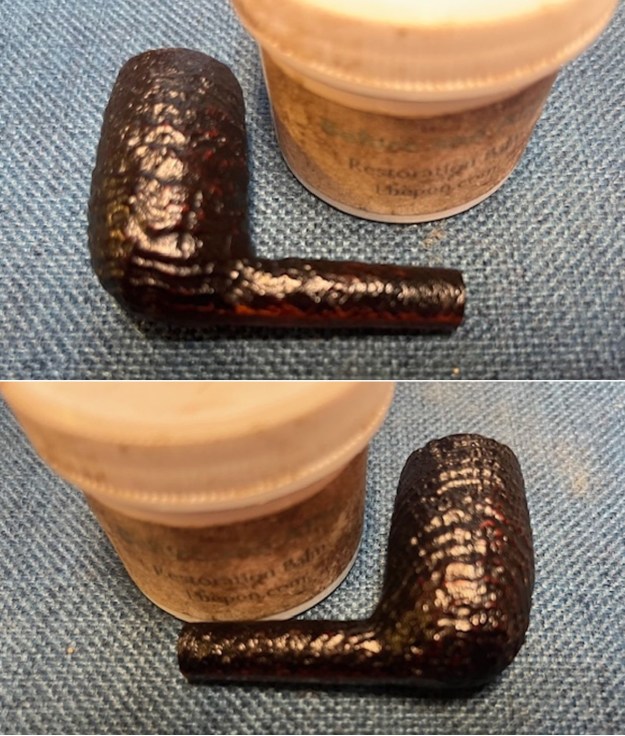
The next pipe is one that has been sitting here for quite awhile in a box of unsmoked/new old stock pipes that I have here. I went through them yesterday and sorted the out. I put all of them on the rebornpipes store but this one. There was just something about it that grabbed my eye. It is a classic apple shaped pipe that is stamped on the left side of the shank and has a white hollow star next to the shank followed by the Briarcraft logo – a B in a diamond. Next to that it is stamped Custom [over] SMOKEMASTER [over] Made. On the right side of the shank it was stamped Pat. 2.166.537. The was a white letter B on the left side of the shank – the Briarcraft logo. We picked up the pipe on 11/09/2023 from a seller in Nampa, Idaho, USA. The pipe is unsmoked and the bowl is fresh. The finish on the bowl and shank is very shiny with varnish or possibly shellac but it is peeling and cracking in places. The grain on the pipe was quite stunning and would really shine through once the finish was gone. It was an incredibly lightweight pipe to hold. The stem is dirty with some sticky stuff from possibly a price tag and some nicks and scratches from laying around a long time somewhere. I took photos of the pipe to show its condition before I started working on it. It was going to be a pretty simple cleanup. I took closeup photos of the unsmoked, new briar bowl and rim top to clearly show the condition of both. The condition matches what I described above. I also took photos of the stem to show the sticky spots and scratches on the stem surface ahead of the button on each side. I took photos of the stamping on the sides of the shank. It is clear and readable as noted above. The varnish around the stamping and the white star is peeling and crackled. The B logo on the left side of the stem is clear and in good condition. I removed the stem and took a photo of the pipe to give a sense of the proportions of the pipe. I tried to capture the three holes in the end of the tenon. I laid the stem on the shank to try to capture it and I held it and took a photo of the tenon end. It is an interesting drilling that almost looks like a mouse head with the two ears.I had cleaned up a Smokemaster Bard Billiard in the past but it did no have the original stem like this one. I went back and reread the blog to remind myself of what I had learned in the process of working on that pipe (https://rebornpipes.com/2013/12/23/giving-a-smokemaster-bard-billiard-a-facelift/). I have included a bit of the information that I had included on that blog below:

I knew nothing about Smokemaster pipes and had no idea who made them. The finish and shape reminded me a lot of Dr. Grabow pipes that I have reworked but that was not enough for me. As has become my habit with pipes I don’t know about, I did a bit of research on the web and found out that the pipe was made by the Briarcraft Pipe Company. The Company was very prosperous between 1920 and 1940. They produced both Briarcraft pipes and a line of seconds under the following names: Airo, Arcadian, Briarmeer, Smokemaster, Cavalcade, Hallmark, Sterling Hall, Filter Kleen and Wimbledon. They closed their doors in 1950.

The pipe that I was working on currently was definitely made pre-1950 and the stamping was clearly made by Briarcraft. The beauty of that is that the pipe was clearly made between between 1920-1950 when they closed their doors. Perhaps when I check the patent information I will learn more and be able to pin down the date a bit more.

I turned to the article on Pipedia (https://pipedia.org/wiki/Smokemaster) to see what I could learn there. I was expecting a bit of info on both Briarcraft and Dr.Grabow. So it would take a bit of filtering.

Smokemaster pipes are unusual in that they had two different makers in different time periods, and in the style of their tenon.

The tenon had a single aluminum inner tube and two holes which were meant to hold a pipe cleaner folded in half, one end in each hole. The pipes were first made by Briarcraft, in lines including the Custom-made, Standard, and Bard. That company went out of business in the 1950s. In 1967 Dr. Grabow bought the rights to the name and the system, and began producing Smokemasters in three lines, stamped 100, 200 and 300. These pipes had a red diamond logo on the stem.

In addition, both Briarcraft and Dr. Grabow made Smokecraft pipes which were not stamped with that name, but with L. L. Bean. The pipes continued to be produced into the 1990s in Sparta, North Carolina, and were offered as a mail order pipe on packets of Dill Pipe Cleaners at one point. They are no longer produced.

I have included two advertisements from the site that had helpful information on the special filter system using pipe cleaners. Read over the first advertisement below. It has the same patent number as the pipe I am working on. It also has a clear explanation of the unique pipe cleaner filter system in the stem. The second advertisement show the same pipe with the specifics of an L.L. Bean pipe that has the same pipe cleaner filtration system. I then turned to Pipephil’s site (http://pipephil.eu/logos/en/logo-s9.html) to have a look at the information included there. I have included a screen shot of the information there. The logo on the stem of the shank of the pipe I am working on is identical to the one shown in the first photos below. I have included only the section on the Briarcraft version of the pipe made prior to the buyout by Dr. Grabow.I found out that the Smokemaster had a very unique filter system and was distinct from other filter systems in that it did not include a stinger apparatus. Rather it used a slotted tenon/tube that had two special holes in it (shown in red in the drawing below of the tenon end). A folded pipe cleaner was inserted into the two holes and extended the length of the shank. It collected the tars and moisture of the smoke and could be easily changed and replaced by the pipe smoker. The diagram below shows the design from the end of the tenon.I did a patent search and it gave me the following information. This includes both the original description by the inventor and also a diagram submitted at the time of the patent application. I found it at this site:

https://www.google.com/patents/US2166537?dq=2166537&hl=en&sa=X&ei=r2u4UtPOHI_ZoAT9moHYCg&ved=0CEAQ6AEwAQ

I have included that information below on the same patent number:

Description
1939 – B. M. SHOEMAKER 2,166,537
TOBACCO PIPE Filed Oct. 12, 1934 crnar B.M. Shoemaker INVENTOR v ATTORNEY Patented July 18, 1939 UNITED STATES PATENT OFFICE

1 Claim.

My invention relates to tobacco pipes and more particularly to the type in which the bit and bowl portions are separately united to each other.

The principal object of my invention is to maintain the smoke passage in the pipe substantially free of solid deposits, making for general cleanliness in the interior of the pipe and sweet, cool smoking qualities.

I accomplish this object by arranging within the pipe a readily replaceable absorptive member which is designed to receive condensate and solid matter from the smoke as it passes through the pipe. The preferred form of such absorptive member is an ordinary pipe cleaner which, as is well known in the art, comprises a highly flexible metallic core portion carrying a large number of bristles extending there from.

One embodiment of the invention is illustratively exemplified in the accompanying drawing in which Fig. 1 is a longitudinal sectional view of a pipe; Fig. 2 is a transverse sectional view on the line 22 of Fig. 1; Fig. 3 is a transverse sectional view on the line 3-3 of Fig. 1; Fig. 4 is a broken elevation view of a metallic tube or liner constituting one of the pipe elements; Fig. 5 is an elevation view broken intermediate its ends, of the form of absorptive member used in the present construction.

Referring to the drawing, and more specifically to Figs. 1 to 3, denotes the pipe bowl, 1 the bowl stem, 2 the bit and 3 the tenon by which the bit and bowl stem are separately united. The bowl stem has the usual well l4 and the bit the usual smoke or draft passage 15. The bit 12 is further provided with three bores, 15b, c, d, and forming a continuation of the smoke passage 16. A metal tube 16 is provided which is longitudinally slotted at its lower portion and through the slot l8 the products of well be omitted. The tube l6 lies in the bore 15b. The pipe cleaner is doubled upon itself and the two legs or branches of the pipe cleaner enter the bores 15c and l5d and rest there during use of the pipe. The bores 15c and l5d parallel the bore 15b at opposite sides of its longitudinal centre. The embodiment of the invention described is a very desirable construction inasmuch as it receives a standard length pipe cleaner, which in its folded position in the passage 14 is offset from the axis thereof, and which when rotated or twisted with the tenon to seat the same the folded strands of the cleaner engage and brush or clean the wall of the bore.
The operation of the device is very simple. The pipe is sold complete with the pipe cleaner in position. After the pipe has been used for a length of time it will be found that the pipe cleaner is practically saturated with deposited matter. Thereupon the pipe cleaner is simply removed from the pipe and a new one inserted in its place. If desired, the cleaner may also be used in the ordinary manner, naturally before it has become fouled, by moving it back and forth once or twice through the draft passage l5 and/or tube.

What I claim is: In a tobacco pipe, a bowl portion having a stem provided with a central bore, and a bit portion for said stem, the bit having a centrally disposed smoke passage and grooves arranged in the bottom of said passage, a tubular liner mounted in the smoke passage and adapted to project into the bore of the stem, said liner having its underside provided with a longitudinal slot opening into the grooves and bottom of the central bore of the stem beyond the bit, and an absorptive member mounted in said grooves and arranged under the liner throughout its length to receive condensate from the liner and to wipe the wall of said bore when the bit is turned.

BERNARD M. SHOEMAKER.
Classifications

U.S. Classification 131/184.1, 131/203

International Classification A24F1/00

Cooperative Classification A24F1/00, A24F2700/03

European Classification A24F1/00
I find that kind of information fascinating and am always intrigued by the ongoing urge of pipe designers to provide a cooler and cleaner smoke for the pipeman who uses their inventions. The patent information helped me to also pin down the date of manufacture. In this case I now knew that the pipe I had in hand was made between 1939 and 1950, a nice 11 year window. It was a real beauty and with the clean up it would only look better. Now it was time to work on the pipe itself.

I began by removing the peeling and spotty varnish coat with acetone on a cotton pad. What made this a bit tricky was the white stamped star outline on the left side of the briar next to the bowl. It had been painted and I did not want to damage that colour. Once the varnish coat was removed I polished the briar with micromesh sanding pads – dry sanding with 1500-12000 grit sanding pads. I wiped the bowl down with a damp cloth after each pad. By the end of the process it looked quite good. I rubbed the bowl and shank down with Before & After Restoration Balm. I worked it into the surface of the bowl sides and shank with my fingertips. It works to clean, enliven and protect the briar. I let the balm sit for 15 minutes and buffed with a cotton cloth to raise the shine. The grain came alive. I polished the vulcanite stem with micromesh sanding pads – 1500-12000 grit pads. I wiped it down with Obsidian Oil after each sanding pad. I used Before & After Pipe Polish – both Fine and Extra Fine to further polish the stem. I rubbed it down with a final coat of Obsidian Oil and let it dry. With the stem cleaned up it was time to fit the tenon with the folded pipe cleaner filter as shown in the photos of the advertisements and also patent information. I took photos of the process. This Unsmoked Briarcraft Smokemaster Custom Made Pat. 2.166.537 is quite a stunning pipe now that it has been stripped and restored. The beautiful grain around the bowl works well with both the shape and the polished vulcanite taper stem. I put the stem back on the bowl and carefully buffed the pipe with Blue Diamond on the buffing wheel using a light touch on the briar. I gave the bowl and the stem multiple coats of carnauba wax on the wheel and followed by buffing the pipe with a clean buffing pad. I hand buffed the pipe with a microfiber cloth to deepen the shine. The finished Briarcraft Smokemaster Custom Made Apple fits nicely in the hand and feels great. Give the finished pipe a look in the photos below. The dimensions of the pipe are Length: 6 inches, Height: 1 ½ inches, Outside diameter of the bowl: 1 inch, Chamber diameter: ¾ of an inch. The weight of the pipe is 22 grams/.78 ounces. I will be putting this interesting old timer in my own collection of unique pipes. Thanks for reading this blog and my reflections on the pipe while I worked on it. I appreciate your support and time!
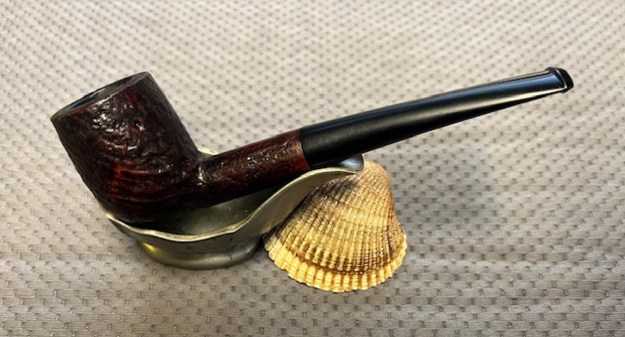
Restoring and Restemming a John Crouch Heavyweigh Rhodesian


By Steve Laug

A while back I received an email reaching out about a pipe that the writer, Anthony had acquired long ago and wanted to know if I had heard of it. He wrote the following email:

Hello, I am just wondering if in all your refurbishings you’ve come across any pipes stamped with the name John Crouch? I would love to send you photos but don’t see a way possible to do that. I’ve had this for 20 years and don’t really remember where I picked it up. Any help would be greatly appreciated. Thank you for your time.

I wrote him back and asked for photos of the pipe and the stamping so I had something to work with. For me this always helps in the hunt for the identity as generally it gives me a lot of information. Anthony wrote back and sent some photos for me.

Hi Steve, thank you for the quick response!! Here are a few shots I have of this beauty. It’s one of the only bulldogs I’ve seen without the double lines engraved into it. Like I said in my first message. I’ve had it for 20+ years. If I had to guess I picked it up in Colorado when I lived out there. I would love to hear what you think. Thanks again!!! ps. if you need more photos let me know. The third photo he included gave a clear look at the stamping on the left side of the shank. It read John Crouch [over] HEAVYWEIGH [over] Italy. My initial thinking before doing any digging on the brand is that it was a pipe made for a pipe shop by someone like Savinelli (Italy). It is stamped with what I think is the shop name. I think that the “T” is missing on the end of HEAVYWEIGH as the shank is to short for the stamp. But some digging will clear that up.I wrote Anthony back with what I found. I was surprised that Pipedia included the brand but not surprised that it confirmed my suspicions about it being a pipe shop pipe. Here is my email:

The pipe is a beauty Anthony. I did a bit of digging and found this information on https://pipedia.org/wiki/John_Crouch

“John Crouch Tobacconist embodies the essence of Virginia. After all, tobacco is Virginia’s oldest industry. Years ago, tobacco was believed to have medical properties and a tobacconist was consulted in much of the same way that a pharmacist is today. In those days, a tobacconist would create a blend of tobacco products to ease an ailment. John Crouch Tobacconist has been home to the Washington areas’ nicest and largest humidor for over 30 years.” Apparently they also have pipes made for them under their name. I have also included photos from that listing. Hope that helps – Steve

I am including the following photos from Pipedia and the advertising page that Anthony sent as well as they give a clear picture of the manufacturer of the pipe and the shop it was made for. Now I really want to visit this shop! Anthony wrote back and I include that below. I think his idea of calling or emailing them is perfect. He also asked if I would consider working on it if he chose to send it to me.

Hey Steve, Thanks for the info. I, too, found this but didn’t think it was associated with the shop in Virginia!!! I guess I need to give them a call or email them to try to get to the bottom of this. Thanks for the help. Actually, two other things. 1.Is there a reason so few bulldogs lack the double engraved lines around the bowl? 2. If down the line what would a refurbishing run me? Rough estimate, nothing set in stone find of thing. Again. Thanks for your quick responses and your time.

I answered him that I would gladly take on the project for him for the chance to see the pipe up close and personal. I answered his other questions about the lack of rings around the bowl cap. Some time went by and he wrote again.

I also wanted to thank you for helping me figure out my John Crouch Heavyweigh pipe!! I contacted and talked with one of the guys down there in Alexandria, VA. He said, yes, back in the 70’s they in fact imported these Italian pipes then stamped and sold them. I would love to send you this pipe for a restoration. If you could send me your address I’ll send it off in the next few days. I should have ask first if you have time or backed up on restorations? Or when would be a good time to send it to you?

I look forward to seeing what you can do to this amazing pipe. I love how detailed your blog posts and restoration process are!!

Thank you again and hope to hear from you soon.

I answered and Anthony wrote that he had sent the pipe to me. He also included another piece of information that would be important in the restoration and repair.

Hey Steve… I should tell you I did break a chunk of the stem off. I slipped off a step as I was walking down then and unfortunately one of my reactions was to bite down and it broke the mouth piece of the stem. I think I have them still. If I can find the pieces should I send them?

Thank you in advance. I can’t wait to see the transformation and the documentation on the blog. All the best!! Anthony

The pipe arrived yesterday just as I finished the repair on the table that was ahead of it. Great timing! I opened the box and took photos of the pipe as I examined it to get a clear assessment of the work that lay ahead of me. Before I took the photos I removed the Softee Bit from the stem so I could see the damage on the stem top that Anthony had mentioned. I love the shape of the pipe – to me a Rhodesian without the rim cap rings but still the right shape. The pipe is well used and must be a great smoker. There was a moderate cake in the bowl and lava on the rim top. The inner edge of the bowl is rough and shows some reaming damage leaving it out of round a bit. The finish is dirty and there are some spots of varnish or shellac remaining around the bowl and shank. There are a few fills but they are solid. The pipe is stamped on the left side of the shank and reads as noted above. The stamp is clear and readable. I wonder if the HEAVYWEIGH stamp is missing the “T” but suppose we won’t know for sure. The stem is well fit but the damage on the topside was more extensive than I thought once I remove the Softee Bit. I have mad patches this big before but really never have been happy with the suspected lack of durability of them. I think this one would be better off with a new stem. I took some closeup photos of the bowl and rim top to show the condition. You can see the damage on the inner edge and the generally roughness of the top and edge. The photos of the stem surface show the size of the damage. I hope you can see my rationale for restemming this one rather than making a patch that large.I took a photo of the stamping on the shank. It is clear as noted. You can also see why I wondered if the HEAVYWEIGH portion is missing the T. You can also see the shellac or varnish on the shank in this photo. To give a sense of the proportion of the of the pipe I removed the stem and took a photo of it. This will help me when I choose a new stem for it.Now to work on the pipe itself. I started by reaming it with a PipNet Pipe Reamer. The bowl was large enough that I used the second and third cutting heads. I took the cake back to bare briar. I cleaned up the reaming with a Savinelli Fitsall Pipe Knife. I also scraped off the lava build up on the rim top with the knife. I sanded the bowl walls with 220 grit sandpaper wrapped around a dowel. I took it back to smooth walls. The walls looked very good with no sign of checking or burning. I cleaned out the shank, mortise and the airway in the bowl with pipe cleaners, cotton swabs and isopropyl alcohol. It took a lot of cleaners but I got the grime and oils out of the shank and though the pipe smelled of tobacco it was much cleaner smelling than previous to that. I chose not to clean the stem since I was going to replace it.With the internals cleaned I turned my attention to the rim top. I worked over the inner edge of the bowl and the rim top with a folded piece of 220 grit sandpaper. I then gently topped the bowl on a topping board with 220 grit sandpaper. I cleaned up the inner edge a bit more. The pipe looked amazingly good. I wiped down the bowl with acetone soaked cotton pads to remove the varnish/shellac coat. It was particularly heavy around the stamping on the shank – both sides. It took much work to remove the shiny coat. I sanded the bowl with sanding pads – 320-3500 grit pads. I dry sanded it and wiped it down with a damp cloth after each pad. I was able to remove all of the shiny coat and the bowl began to take on a natural shine. I stained the rim top with a Cherry stain pen to match the rest of the briar. I also stained the lighter areas around the shank end. The rim top looked much better.I polished the briar with micromesh sanding pads – dry sanding with 1500-12000 grit pads. I wiped it down after each sanding pad with a damp cloth to remove the sanding debris on the surface. I rubbed the bowl down with Before & After Restoration Balm. I worked it into the surface of the briar with my fingertips to clean, enliven and protect it. I used a shoe brush to work it into the twin rings around the bowl cap. I let the balm sit for a little while and then buffed with a cotton cloth and shoe brush to raise the shine. I set the bowl aside and turned my attention to a new stem. I found a blank in my can of stems that was close to the right diameter and just slightly longer. With a few adjustments to the tenon and the diameter at the shank the fit will be good. You can also see the large broken chunk missing on the original stem in the photo below. In the second photo below, I knocked off the casting debris with a Dremel and sanding drum in preparation for using my tenon turning tool.I used the PIMO tenon turner to bring the tenon down close to the size that I wanted. I do this in stages as the tool can chip the tenon if you take too big a bite at one time. The second photo shows it getting closer. I paused mid turn to show how it cuts away material. Once I cleaned it up the fit was very close. Some sanding would make the fit perfect. I used a small flat file to remove the casting marks on the sides of the stem and fine tune the tenon fit in the bowl and took some photos of where it stands at this point.I started sanding the diameter of the stem to match the shank and then decided to give it a quick bend. I heated it with the flame of a lighter until the vulcanite was soft then bent the end to get the angle correct. I checked it against the original stem and the bend matched. Good to go! Now I had a lot of hand sanding to do to trim back the diameter to fit the shank. I do this next part all by hand with the stem removed and constantly putting it on the shank and checking progress. It is tedious so I can think of other things while sanding. It makes the process a bit of a respite. I can’t tell you how many hours of sanding this took but it is finally there. The fit is right and now it is time to polish it. Once the fit was correct, I started polishing out the scratch marks and smoothing the stem with 320-3500 grit sanding pads. I wiped the stem down after each sanding pad with an Obsidian Oil impregnated cloth. It removes the dust and also gives the sanding pads some bite. By the final pad it was looking quite good.Following my usual process in restoration I polished the stem with micromesh sanding pads – dry sanding with 1500-12000 grit sanding pads. I wiped it down after each sanding pad with Obsidian Oil. I polished it further with Before & After Stem Polish – both Fine and Extra Fine. I gave it a final coat of Obsidian Oil and set it aside to absorb the oil. The John Crouch Heavyweigh(t) Rhodesian has been restemmed and is finished other than the final waxing and buffing. I polished the new stem with Blue Diamond to polish out the remaining small scratches and gave it several coats of carnauba. I buffed the pipe with a clean buffing pad on the buffer to raise the shine. I hand buffed it with a microfiber cloth to deepen the shine. The pipe polished up pretty nicely. The finished pipe is shown in the photos below. The dimensions are Length: 5 ½ inches, Height: 1 ½ inches, Outside diameter of the bowl: 1 ¼ inches, Chamber diameter: ¾ of an inch. The weight of the pipe is 45 grams/1.59 ounces. It does not feel heavy and the weight certainly does not put it in a heavy category for me. I will be sending it back to Anthony shortly. I look forward to hearing what he thinks of it once he has it in hand. If the condition was any indicator it is a good smoker. Thanks for walking through the restoration with me as I worked over this John Crouch Heavyweigh(t) Rhodesian.

Cleaning up another one of my GBD 9438 restorations from many years ago


by Steve Laug

I have always liked the GBD 9438 shaped pipe and this one was one that I picked up many years ago when I first started working on pipes. I found it at an antique shop. It was in the early days when I picked up most every pipe I found. I believe that like others I found in the early days this pipe cost me about $6CDN. Just remembering that reminds me how much things have changed over the years. It became a favourite shape of mine and over the years I have purchased many more 9438 pipes made by GBD for their main and their seconds lines such as Irwin and Dr. Plumb. I have added them to my collection. Here is a link to a blog I did on my collection back in 2013 (https://rebornpipes.com/2013/12/12/my-gbd-9438-saddle-stems-and-tapered-stem-rhodesians/). I have 12 – some were in rough shape and others not so bad. I have been sorting through my pipe collection and thinning out pipes that I am willing to part with. I have sold many already and others are currently on the store. For the most part these pipes have been early restorations and all needed a bit of work to bring them up to my current standard. I have set aside three 9438 pipes that I decided to rework. This is the third of them. It is one I restored twice in 2012 (https://rebornpipes.com/2012/09/15/a-beatup-gbd-9438-given-a-new-look/, https://rebornpipes.com/2012/09/14/irwin-943810-by-gbd-a-makeover/). It is one that I did a lot of work on at that time – both refinishing and restoring. It was a real mess that picked up off eBay. The stamping is very faint on the shank sides. It is stamped on the left side and it looked like there was a faint brand name Irwin (maybe) [over] London Made (faint but still readable with a lens). On the right side it is stamped with the faint six-digit shape number 943810. I have seen that shape number on Dr. Plum and on Irwin Rhodesians, both made by GBD. While it was very workable and I had not smoked it much over the years. I knew that the original restoration on it was less rigorous than my current standards. So, before I listed it for sale I wanted to work it over again. I took photos of the pipe to give a sense of the beauty.
I took photos of the pipe’s bowl and rim top to show the light cake in the bowl and the rough inner edge of the bowl. The outer edge of the bowl looks very good. The rim top is also nicked and damaged slightly. I also took photos to capture the condition of the stem. It had some light oxidation and tooth chatter and marks on the top and underside ahead of the button.I took photos of the stamping on each side of the shank. It is faint and I was unable to capture it with the photos below. There is no logo or inlaid stamp on the sides of the saddle stem. I took the stem off the shank and took a photo of the look of the pipe. It a nicely grained 9438 shape pipe. There is some beautiful grain around the bowl and shank.I decided to address the damage to the rim top and inner edge of the bowl. To deal with the rough inner edge of the rim and the rim top damage I worked on the edge with a piece of 220 grit sandpaper. I used a piece of 220 grit sandpaper on a wooden ball to further clean up the bevel. It took a bit of work to smooth out the damage and the darkening on the inner edge of the bowl. It looked much better at this point. I reamed the bowl with a Savinelli Fitsall Pipe Knife to take out the cake. I removed ti back to bare briar. I sanded the bowl walls with a piece of 220 grit sandpaper wrapped around a dowel to smooth out the walls. It looked very good. No burn damage or checking on the bowl walls.I scrubbed out the shank and the stem with pipe cleaners, cotton swabs and alcohol to remove the tars and oils. The shank was dirty though the stem airway was not too bad. It cleaned up well. I touched up the rim top and lightened areas on the shank end with an Oak Stain pen. I was able to blend it into the surrounding briar around the bowl and rim top. It looks mch better than when I started.I polished the briar with micromesh sanding pads – dry sanding with 1500-12000 grit pads. I wiped it down after each sanding pad with a damp cloth to remove the sanding debris on the surface. I rubbed the bowl down with Before & After Restoration Balm. I worked it into the surface of the briar with my fingertips to clean, enliven and protect it. I used a shoe brush to work it into the twin rings around the bowl cap. I let the balm sit for a little while and then buffed with a cotton cloth and shoe brush to raise the shine. I set the bowl aside and turned to address the stem. I sanded the stem surface with 320-3500 grit sanding pads to remove all the marks remaining from the tooth damage. I wiped the stem down after each pad with a cloth impregnated with Obsidian Oil. It looked much better.I polished the vulcanite with micromesh sanding pads – 1500-12000 grit pads. I wiped it down with Obsidian Oil after each sanding pad. I used Before & After Pipe Polish – both Fine and Extra Fine to further polish the stem. I gave it a final coat of Obsidian Oil and set it aside to dry. This GBD Made Irwin London Made 943810 Bent Rhodesian cleaned up much better this time around and looks very good. The Before & After Restoration Balm brought the colours and grain out in the finish on the pipe. It works well with the polished vulcanite saddle stem. I put the stem back on the bowl and carefully buffed the pipe with Blue Diamond on the buffing wheel using a light touch on the briar. I gave the bowl and the stem multiple coats of carnauba wax on the buffing wheel. I followed that by buffing the entire pipe with a clean buffing pad. I hand buffed the pipe with a microfiber cloth to deepen the shine. The finished Irwin London Made 943810 Rhodesian fits nicely in the hand and I think it feel greats as it heats up with a good tobacco. Give the finished pipe a look in the photos below. The dimensions of the pipe are Length: 5 inches, Height: 1 ½ inches, Outside diameter of the bowl: 1 ½ inches, Chamber diameter: ¾ of an inch. The weight of the pipe is 1.87 ounces/53 grams. It is time to move it on to someone who will give it proper attention. I will be adding this one to the British Pipemakers Section of the rebornpipes store shortly. If you want to add it to your collection let me know. Thanks for reading this blog and my reflections on the pipe while I worked on it.

Reworking another trade, a Borlum KB&B Italian Briar Unbreakable Stem Bent Billiard


by Steve Laug

A month or so ago I received an email from a fellow in Japan who had some pipes he wanted to sell. We came to an agreement and he sent me a few. One of them was this interesting smooth finish Bent Billiard. This pipe is stamped on the left side of the shank with the words BORLUM in an arc over KB&B in a cloverleaf. Underneath that it is stamped ITALIAN BRIAR in a reverse arc. On the right side of the shank it is stamped UNBREAKABLE BIT. The stamping was clear and readable. The band on the shank is cosmetic and original and reads KB&B in a cloverleaf [over] Nickel Plated. The bowl had been reamed and the pipe cleaned. The shank is very clean inside and the pipe smelled very clean. It was so clean that I don’t think the pipe had been smoked since the fellow in Japan picked it up. The rim top was clean though there were some scratches and darkening and the inside edge of the rim showed some nicks. There was no damage to the outer edges. The finish around the bowl was in decent condition with great grain under some of the grime and scratching. The stem looked good, though it was not centred on the shank. The diameter of the stem extended beyond the band on the right side and a little above the top and underside. I would need to reduce the stem diameter to fit the shank band. There were some light tooth marks and chatter on the top and underside ahead of the button. Overall, I am happy with it but I will need to rework the stem fit to the shank and clean up the rim top and edges. I took photos of the pipe before I started my work on it.  I took a photo of the rim top to show the condition of the bowl and the top. You can see clean bowl and marks on the rim top. The inner edge is slightly out of round. The stem looks good with light tooth damage and no oxidation on the surface of the hard rubber. It will look much better once I trim down the top, underside and the right side of the stem.I took photos to show the stamping on the sides of the shank and the nickel band. It is clear and readable as noted above. You can also see the fit of the stem to the shank on the top and the right side. I took the stem off and took a photo of the pipe to show its condition.

From an earlier Borlum pipe that I had refurbished back in 2014, I had learned a lot about the background of the manufacturer of the brand. I quote from that blog to summarize the historical background of the pipe (https://rebornpipes.com/tag/kbb-borlum-pipes/). The italicized portions of the text come from the blog with minor edits.

I already knew that Kaufmann Brothers and Bondy was the oldest pipe company in the USA, established in 1851. The Club Logo predated Kaywoodie with the “KB&B” lettering stamped within the Club, and a multitude of KB&B lines were in production long before “Kaywoodie” first appeared in 1919. Therefore, I knew that the pipe I had was a pre-1919, pre-Kaywoodie KB&B Made BORLUM.

As noted above, this particular pipe is stamped on the left side of the shank with the words BORLUM in an arc over KB&B in a cloverleaf. Underneath that it is stamped ITALIAN BRIAR in a reverse arc. On the right side of the shank it is stamped UNBREAKABLE BIT. As stated above it was made before Kaywoodie became the flagship name for pipes from Kaufman Brothers & Bondy (KB&B). It was made before the Kaywoodie invention of the “Stinger” was added, and even before shank logos, model stamps and other features invented by Kaywoodie came to be standards of the pipe making industry. It comes from a time when names like Ambassador, Heatherby, Melrose, Suez, Rivoli, Cadillac and Kamello dominated the pre-Kaywoodie scene. Borlum is one of those names.

I learned while researching for that blog and rediscovered while working on this one that the Borlum pipe featured some innovations that were new for the time but commonplace to us. These included (1) a solid rubber bit (vulcanite, ebonite), (2) an aluminum inner-tube construction in the stem that stabilized and strengthened the stem explaining the stamping of “Unbreakable Bit” on the right side of the shank, (3) a standard nickel-plated band (marked KB&B) to strengthen the shank connection for the stem. The stem features the older style more rounded bit tip/orific button, and you can see the aluminum inner-tube fitting just inside the tip.

I have included several pictures that I found on the internet that show the unique stem tube in the Borlum that gives rise to the claim that it has an Unbreakable Bit. The first photo shows the bent stem, third from the left with the same metal tube showing at the button. The second photo shows the other end of the tube in the tenon in the Borlum stem. That told me that the pipe I had was made after 1851 and before 1919. I am guessing that because of the other pipes in this lot dating in the late 1890s to about 1905 this one is probably from that same era. Not too bad for a 100+ year old pipe. During the hunt for information, I also found the next photo of a Borlum display and sales card. What is particularly interesting to me is the diagram at the top of the card showing the interior of the stem in place in the shank. It also includes the claim, “Guaranteed against Breakage”. I love the advertisements and sales brochures of these old pipes. The descriptive language that promises so much and the prices the pipes sold for are a nostalgic journey to the past. Note the $1 and up price tag on the sales card. The pipe that I am working on presently is identical to the bottom pipe on the right side of the photo. I have circled it in red. It has the identical shape, curved shank but has a nickel-plated band like mine. It has the hard rubber stem with an orific button. It is more rounded than the modern flat stem but it is still a comfortable feeling stem in the mouth.Now it was time to work on the pipe. I decided to deal with the diameter of the stem against the shank first. I used a folded piece of 220 grit sandpaper to take off the extra diameter of the stem on the right side and the top and bottom. I also sanded the tooth marks and chatter on the stem surface. It was a lot of handwork and fussing to get the fit correct. Once finished it looked much better. I worked over the stem with 320-3500 grit sanding pads to smooth out the scratches left in the hard rubber surface of the stem. Once finished the stem had a deep shine and really looked much better.I polished the stem surface with micromesh sanding pads. I dry sanded it with 1500-12000 grit pads. I wiped it down between pads with an Obsidian Oil impregnated cloth. I finished polishing it with Before & After Pipe Stem Polish – both Fine and Extra Fine. It looked much better. I set the stem aside and turned my attention to the bowl. I smoothed out the damaged inner edge of the bowl with a folded piece of 220 grit sandpaper. It looked much better. I started polishing out the damage on the rim top with the 220 grit sandpaper. It looked much better.I wiped the bowl down with isopropyl alcohol on a cotton pad to remove the shiny wax or shellac coat on the bowl surface. It cleaned up very well. There was a deep sandpit/flaw on the lower front left side of the bowl. I filled it in with a combination of CA glue and briar dust. I sanded the repair with 220 grit sandpaper and smoothed it out into the surrounding briar. I touched up the sanded spot on the bowl front with a Walnut stain pen. It matched the rest of the bowl surface. Once I polished it some it would blend in very well.I polished the bowl and the shank with 1500-12000 grit micromesh sanding pads. I dry sanded with each pad and wiped the briar down with a damp cloth after each pad. I paused the polishing and touched up the stain on the bowl front and the rim top. It really was looking much better at this point. Once it cured I went back to polishing with the micromesh. I worked some Before & After Restoration Balm into the finish of the bowl, rim top and shank with my fingertips and a shoe brush to get it in to the crevices and valleys. The product works to clean, enliven and protect the briar. I find that the balm really makes the briar come alive again. I let the balm sit for 15 minutes and then buffed with a cotton cloth to raise the shine. The bowl really looks good at this point. I polished the nickel ferrule on the shank end with a jeweller’s cloth. It works to polish and protect the metal from further oxidation. It is a great looking addition to the pipe. With the bowl and the stem finished I put the Borlum KB&B Italian Briar Bent Billiard with an unbreakable stem back together and buffed it on the wheel using Blue Diamond to give it a shine. I gave the bowl and the stem multiple coats of carnauba wax on the wheel. I buffed it with a clean buffing pad to raise the shine. I hand buffed it with a microfiber cloth to deepen the shine. It really is a great looking pipe. The dimensions of the pipe are – Length: 4 ½ inches, Height: 1 ½ inches, Outside diameter of the bowl: 1 1/8 inches, Chamber diameter: ¾ of an inch. The weight of this large pipe is 1.20 ounces /33 grams. This Borlum KB&B Italian Briar Bent Billiard is another great looking pipe. It is much more beautiful in person than these photos can capture. I will be putting it in my older American Pipe Collection to enjoy in the future.  This is another pipe that has the possibility of transporting the pipe man or woman back to a slower paced time in history where you can enjoy a respite. Thanks for walking through the restoration with me.