Tag Archives: Dal Stanton article

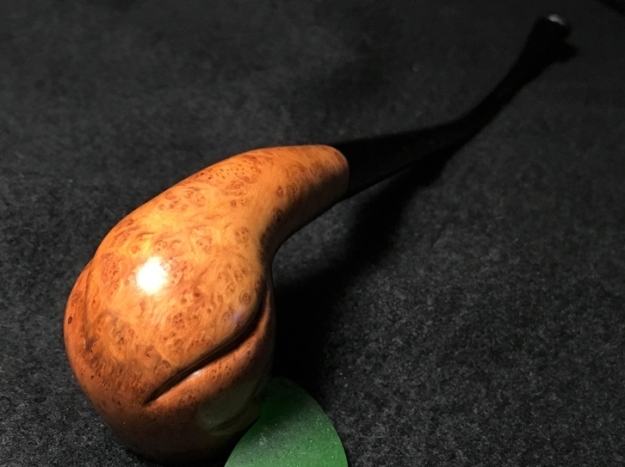
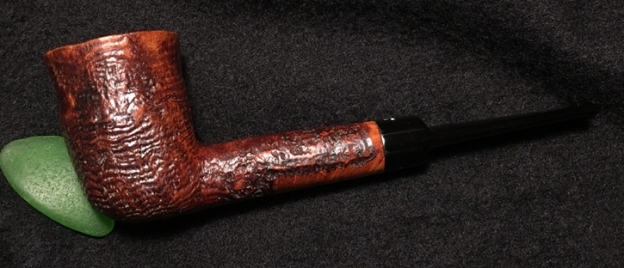
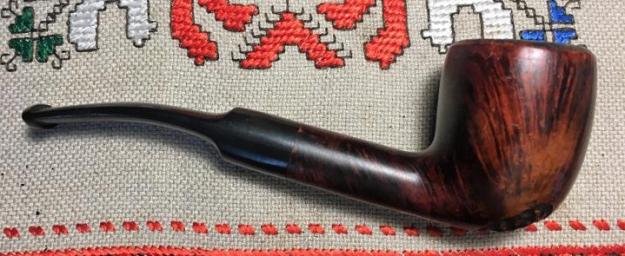
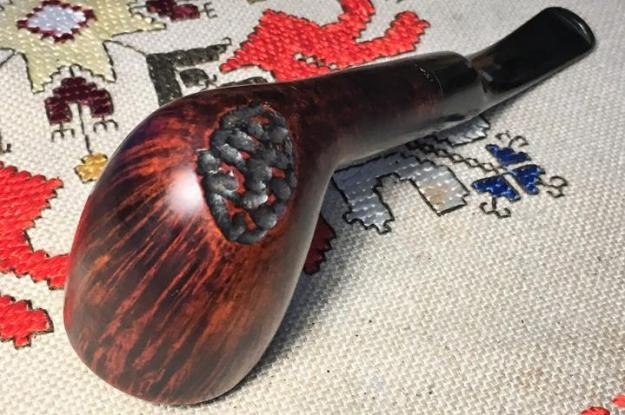
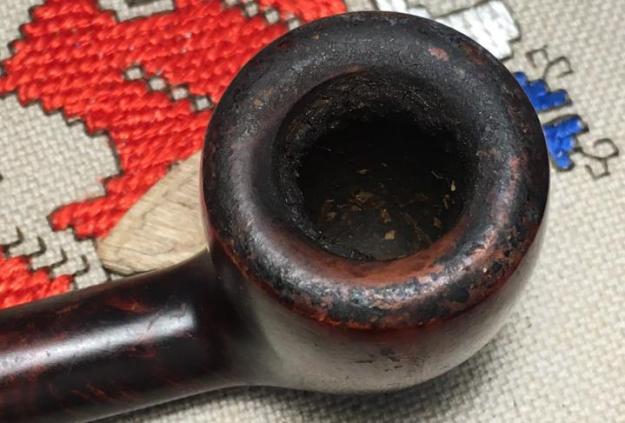
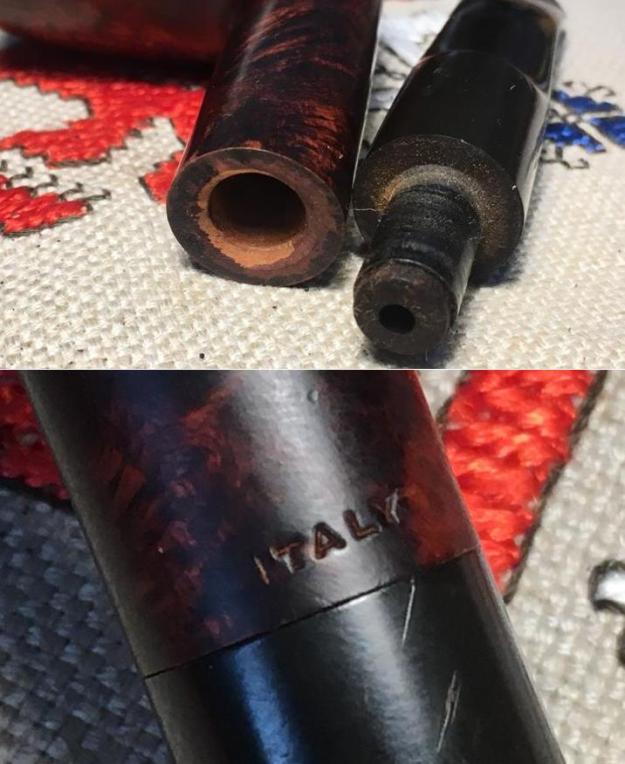
Rebuilding a Rim and Chamber for an Aldo Velani Trio Rusticated Volcano


Blog by Dal Stanton

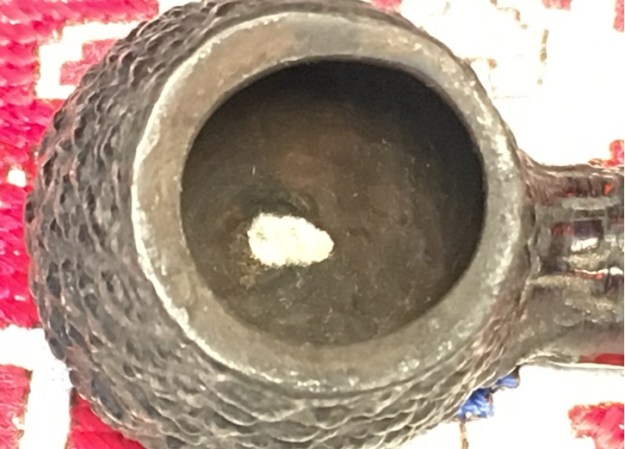
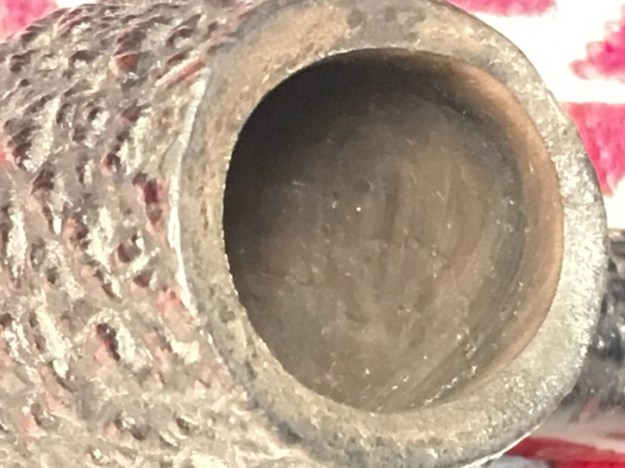
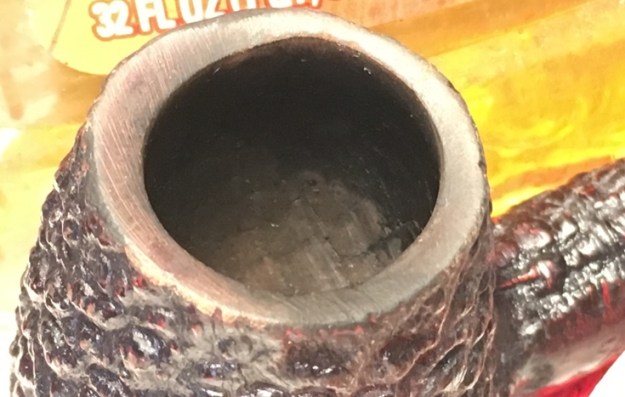
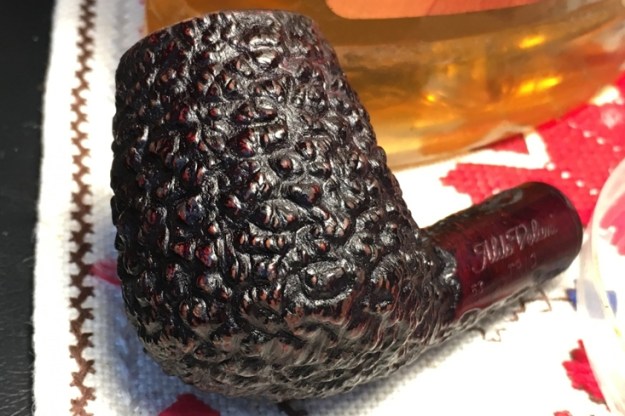
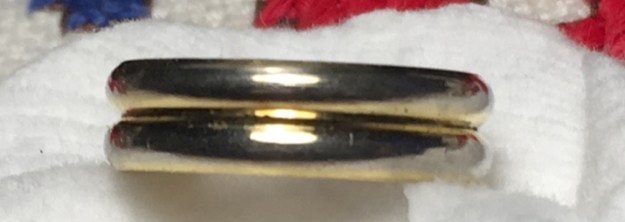
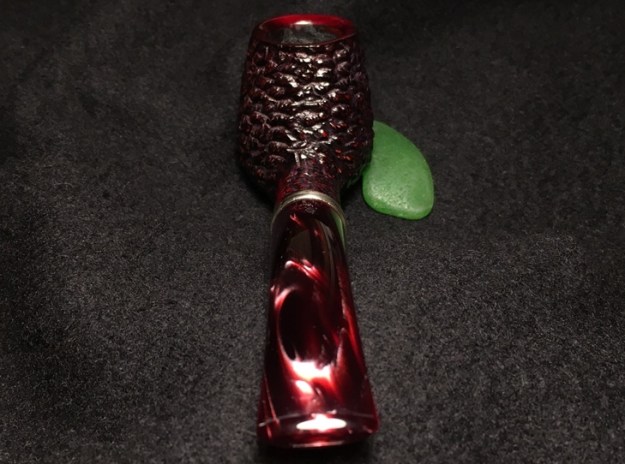
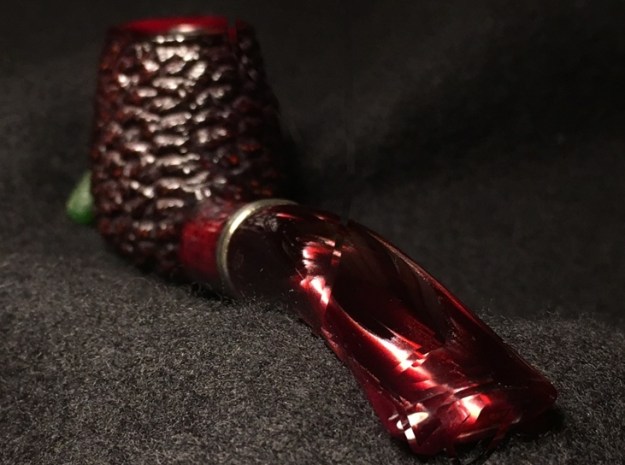
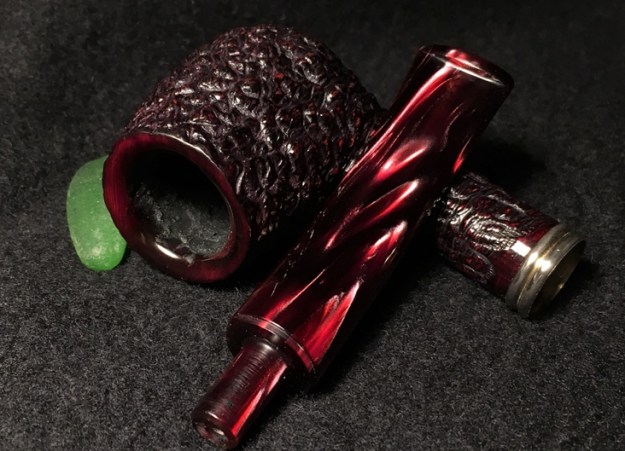
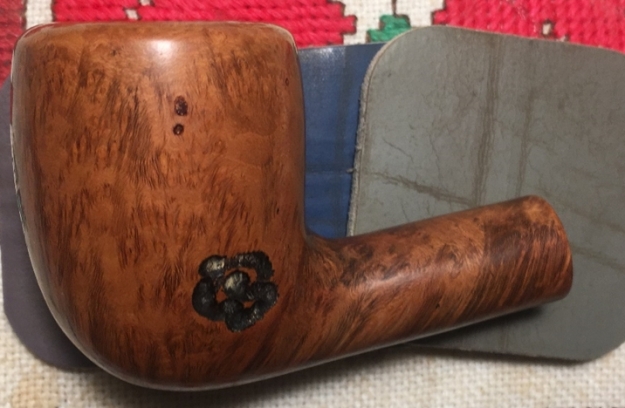
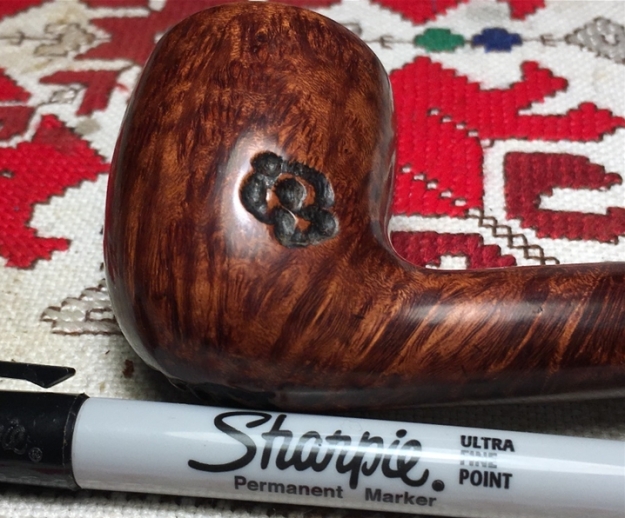
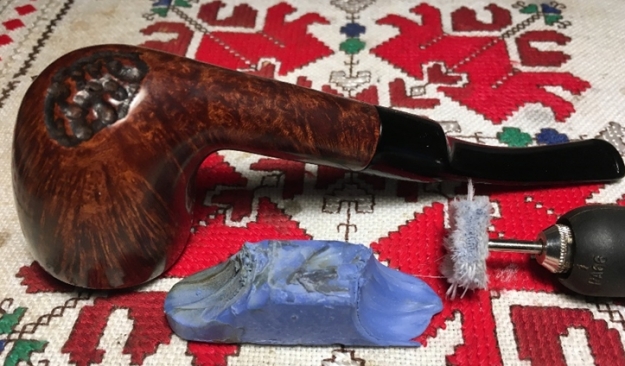
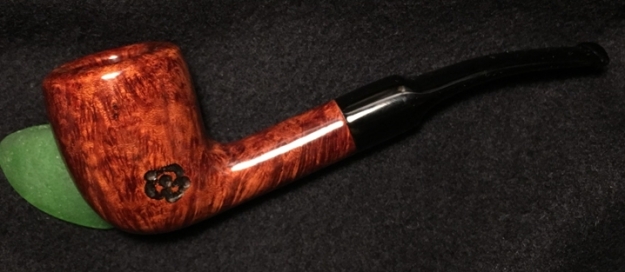
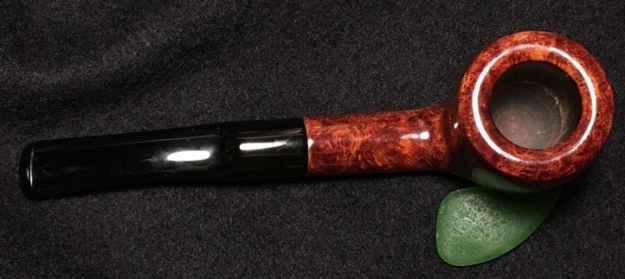
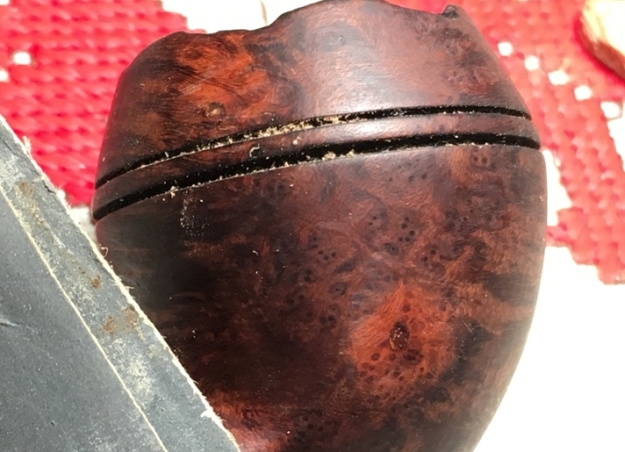
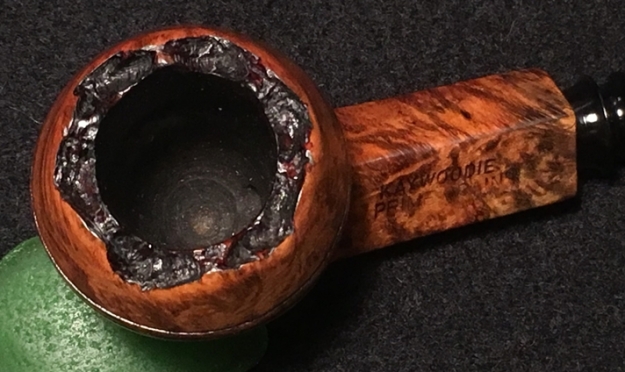
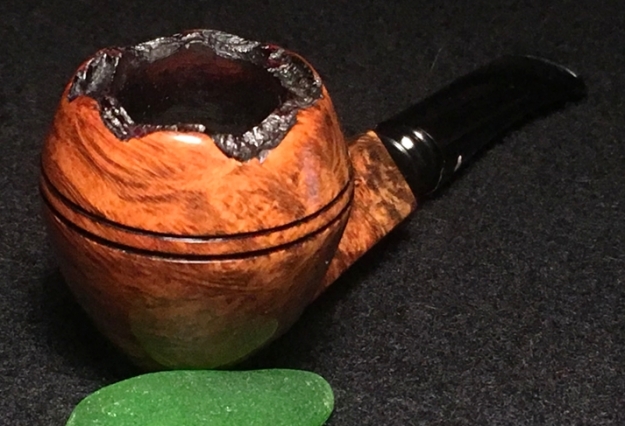
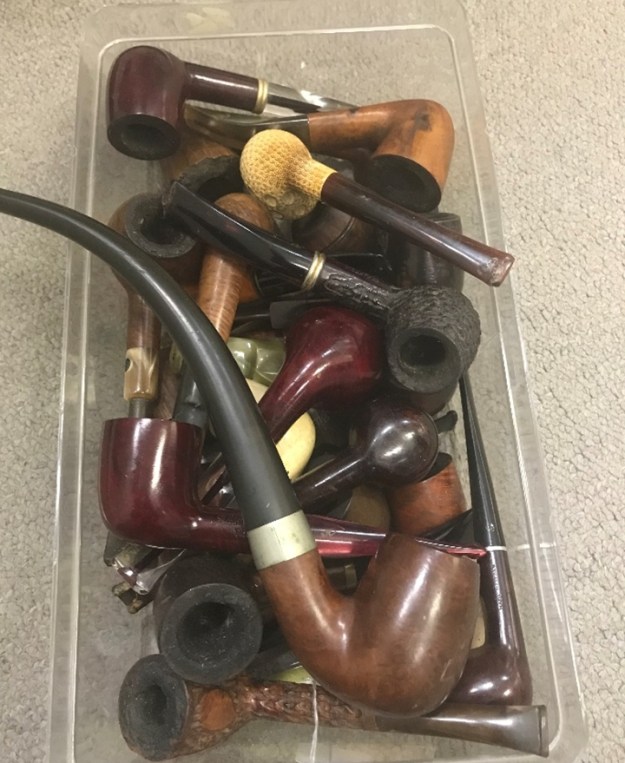
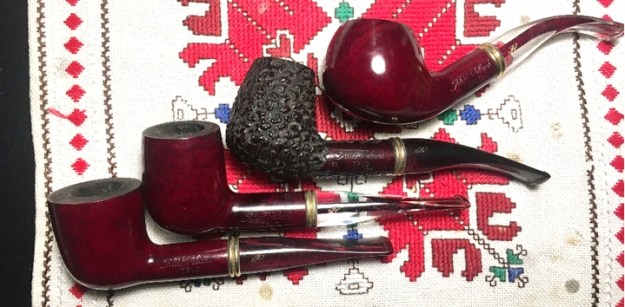
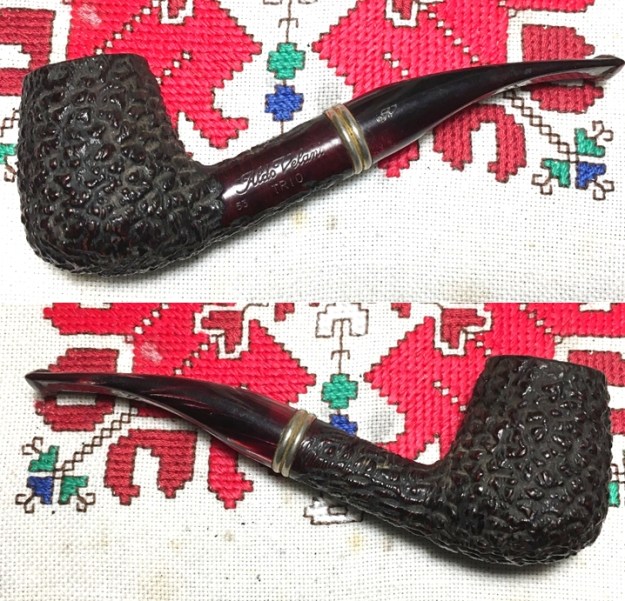
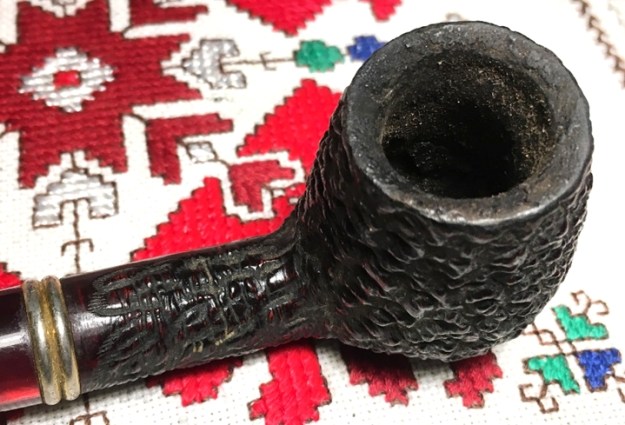
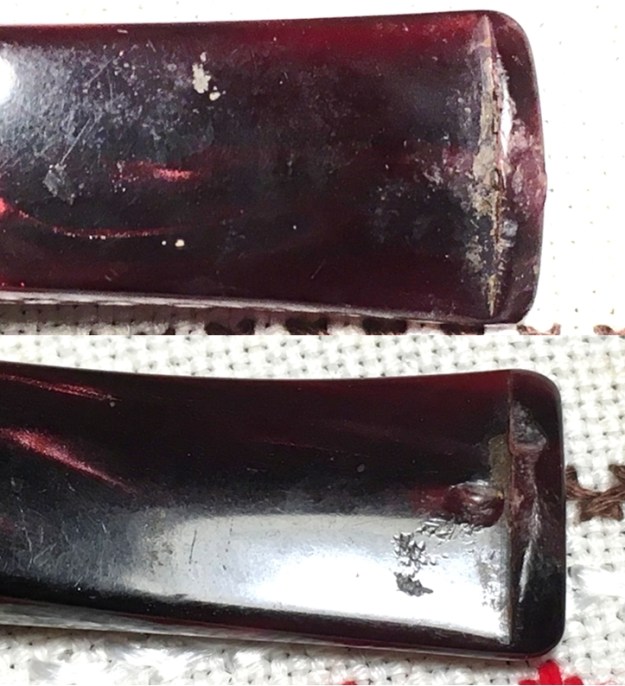
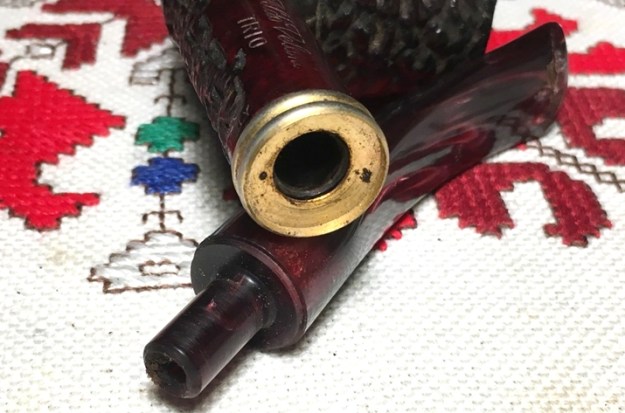
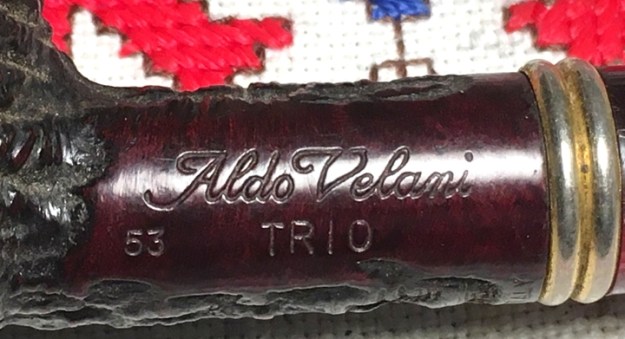
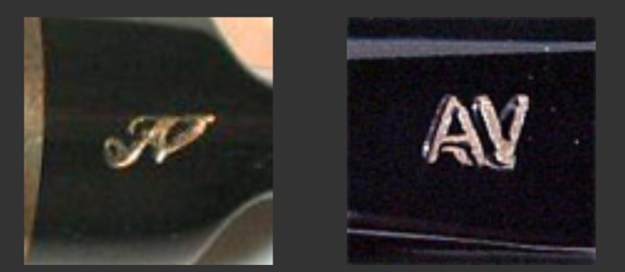
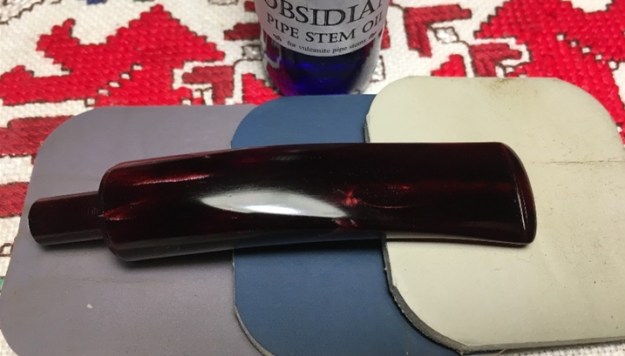
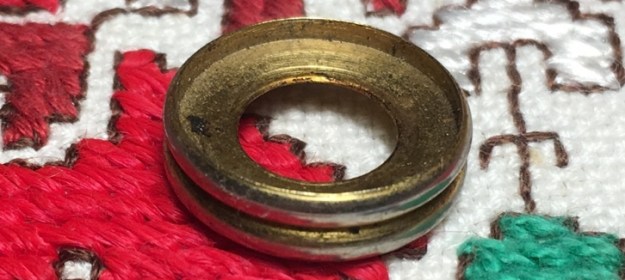
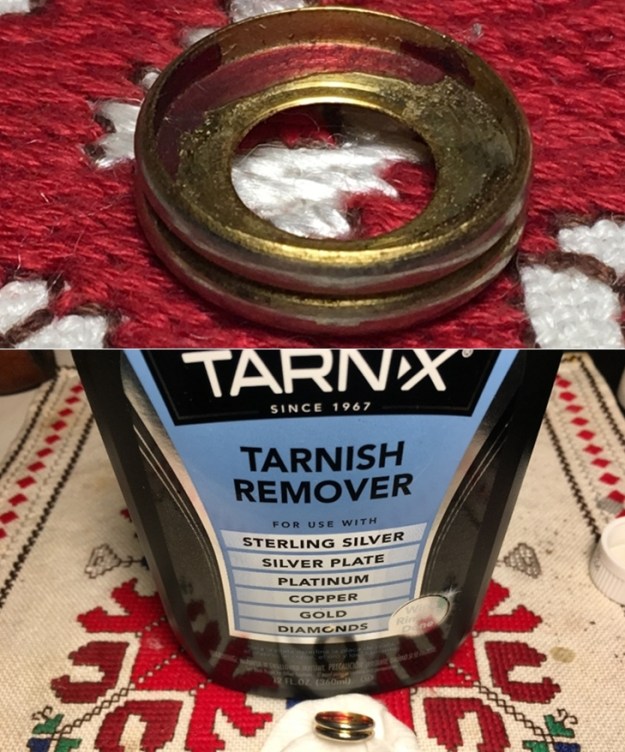
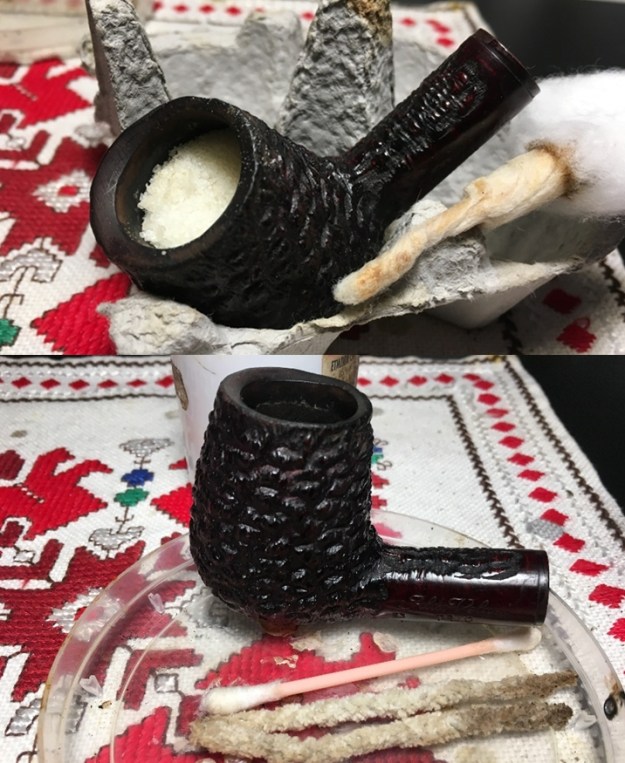
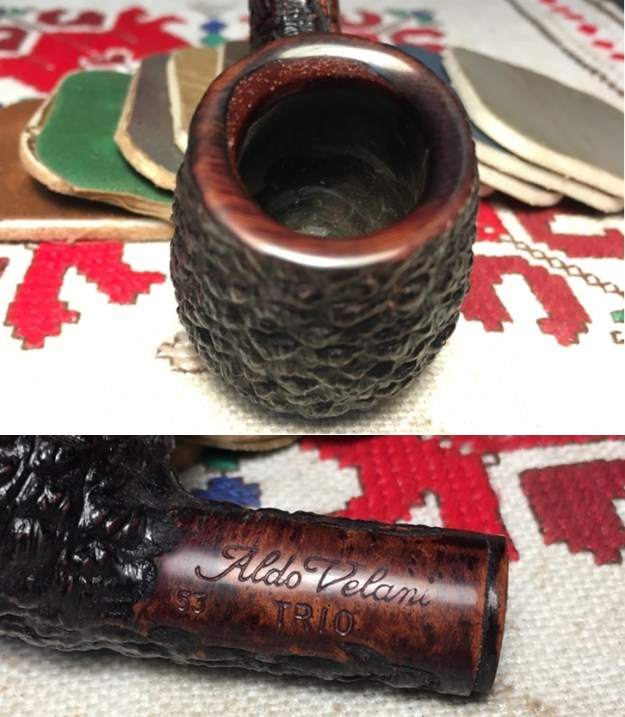
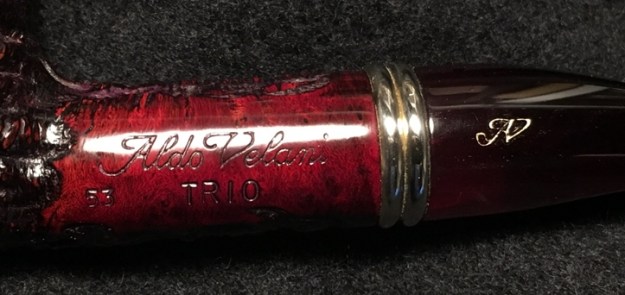
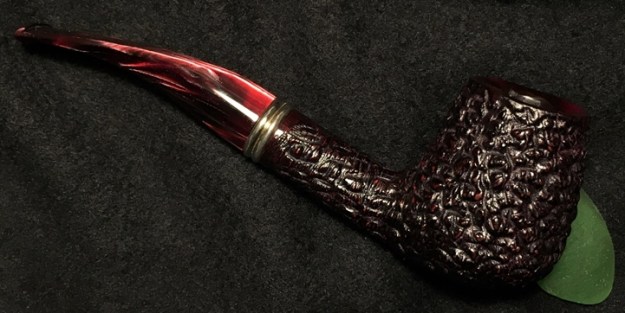
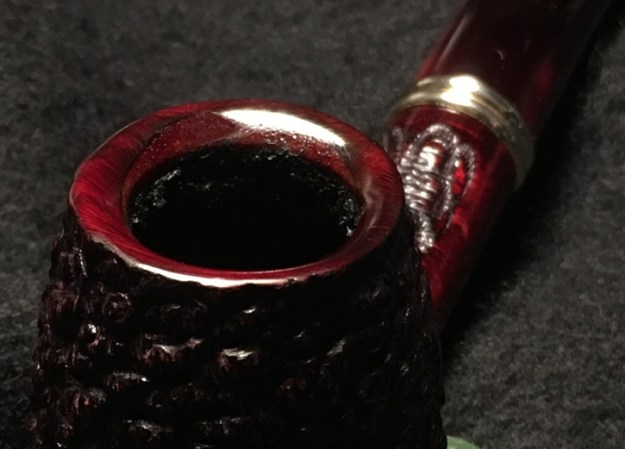
This Rusticated Volcano came to my worktable in what I call the St. Louis Lot of 26 that my son, Josiah, found in an antique shop before last Christmas. He was impressed by the quality of pipes in the Lot and emailed me in Bulgaria with a proposition of going in together for the Lot of 26.  His part in the purchase would be his Christmas present to me – that I would choose a pipe for my own from the Lot.  My part of the purchase would be to restore the pipes to benefit the Daughters of Bulgaria.  It was a proposal hard to refuse and some weeks later I unwrapped the St. Louis Lot of 26 in Denver where our family had gathered for Christmas.  I chose as my gift from Josiah an unbelievable find: a Churchwarden – EP Champion Made in France.  After my restoration of the EPC Majestic, I know that this pipe also has a very auspicious nomenclature dating back to pre-WW2 from the now defunct Paris based A Pandevant & Roy Co. which has now been included in Pipedia as a new entry based on my research during that restoration – Woohoo!  To see my first Pipedia entry, see this LINK!  This picture, after opening the Lot of 26, just happens to have both subjects on the top – the Aldo Velani Trio Rusticated Volcano and my historic EP Churchwarden.Now, back in Bulgaria, on the 10th floor of our formerly Communist apartment complex block, each pipe in the Lot of 26 has been sorted and populated on the website in the ‘For “Pipe Dreamers” Only!’ collection.  Stephen saw the Aldo Velani when I posted a picture on Facebook of the Lot of 26 earlier.  The former steward of this estate liked the Aldo Velani Trio set.  In the Lot, in addition to the Rusticated Volcano came three others from the Aldo Velani Trio set.  The common characteristics of the set is the bright Oxblood hue, the double-ringed gold banding and an assortment of acrylic stems.  The set is obviously meant to appeal to an upscaled expectation.Stephen was drawn to the deeply Rusticated Volcano and after communicating back and forth, he decided to commission it.  Here are more pictures taking a closer look at the Aldo Velani Rusticated Volcano.The rusticated version of the set of Aldo Velani Trio is cast somewhat darker than the smooth briar brothers.  The chamber shows moderate build up of cake and some lava flow over the rim.  This guy was well used by his former steward.The darker ruby red – burgundy acrylic stem shows heavy tooth chatter and chewing on the bit and button.  The lower bit has a deeper bite compression that needs addressing.The amazing ‘fire’ of the acrylic stem presents in a spectrum of ruby red to burgundy and is eye catching and when the entire pipe is cleaned up, will probably steal the show.The gold band I’m assuming is nickel plated as there are no markings showing a gold metal content.  The double-bumped band is attractive and adds a touch of class as it joins the acrylic stem and rusticated stummel.  The band will shine up nicely.The nomenclature on the left shank side is cursive script, ‘Aldo Velani’ [over] ‘TRIO’ with the shape number ‘53’ set to the left side of the smooth shank panel.  Barely visible in the picture below is the stamping ‘Italy’ next to the band and the very bottom. The Aldo Velani stem stamp is interesting and takes a closer look to figure out.  I found in Pipedia’s Aldo Velani article, an example and details of the stamping on an original Aldo Velani box, courtesy of Doug Valitchka.  The stamp depicts a pipe as the front leg of the ‘A’ for Aldo and the back leg of the ‘A’ forms the front riser of the ‘V’ of Velani. The article cited from Pipedia provides helpful information understanding the provenance of the Aldo Velani name:
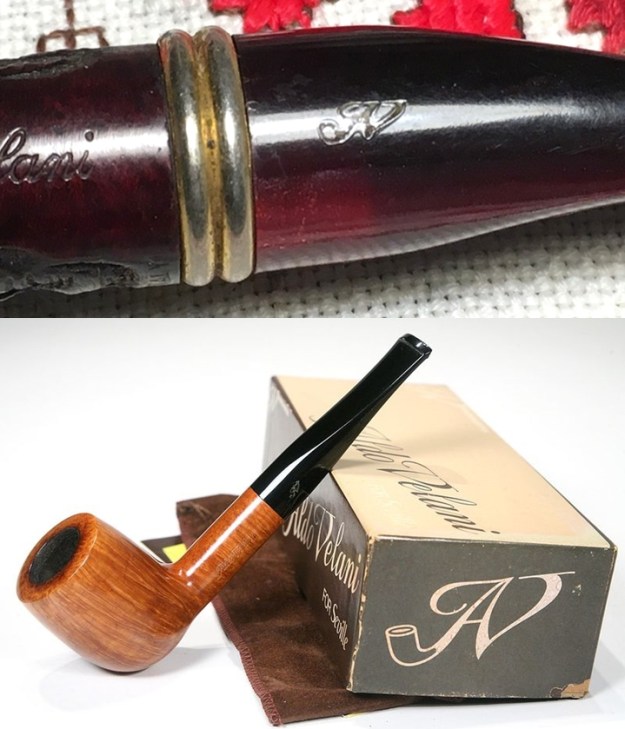
Most Aldo Velani pipes are made in Livorno, Italy, for the USA market by Cesare Barontini. They were previously imported by Lane Limited. Lane spokesman Frank Blews once described Velani’s stylish, intrinsically Italian designs as “Billiards with more ball, bulldogs with more jaw.” The name “Aldo Velani” is actually fictional.

Another Barontini 2nd is named “Cesare”.

I learn two interesting things from this information.  First, Aldo Velani is a faux name that does not describe an Italian pipe house but a specific pipe line.  Secondly, the Aldo Velani is made by the Casare Barontini name based in Livorno, Italy.   Further information is available cross referencing to Casare Barontini in Pipedia:

In 1890 Turildo Barontini opened a factory for the production of briar. In 1925 his son Bruno began to produce the first pipes. Cesare Barontini, son of Bruno, started direction of the factory in 1955, and still runs it together with his daughters Barbara and Silvia.

Sub-brands & Seconds: Aldo Velani. Cesare, L’artigiana, Stuart, Cortina

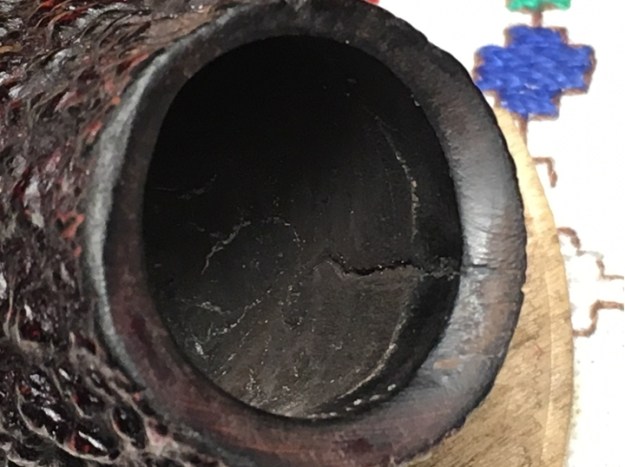
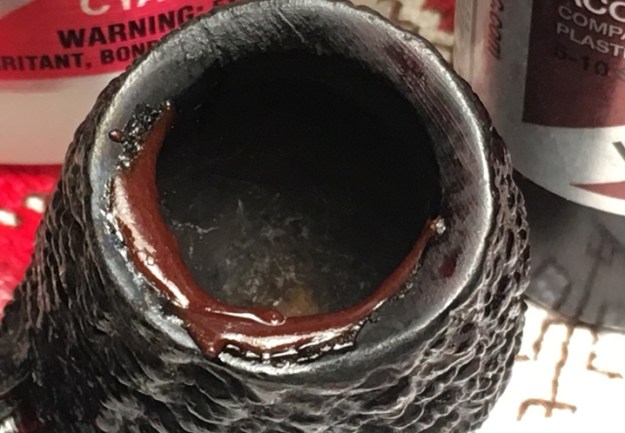
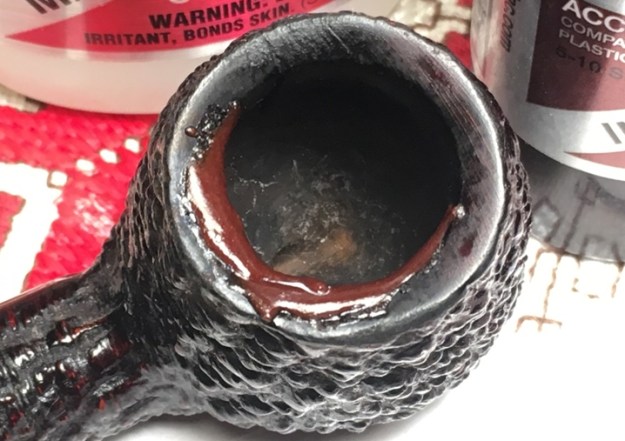
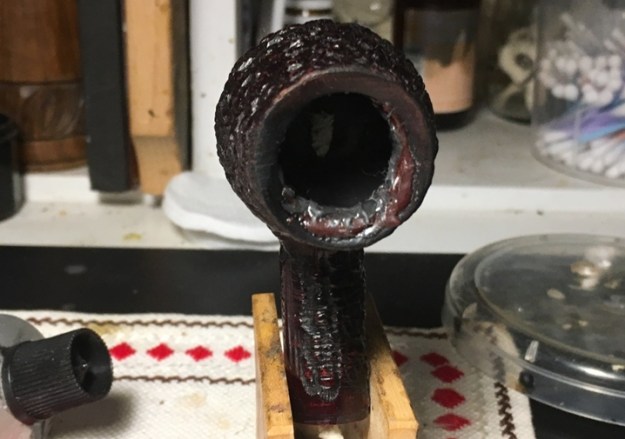
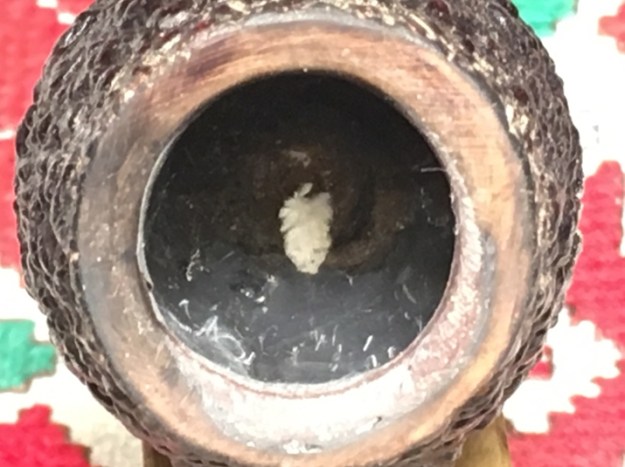
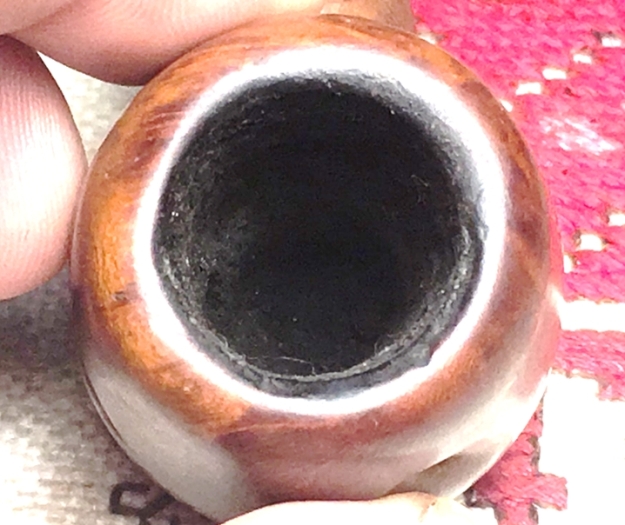
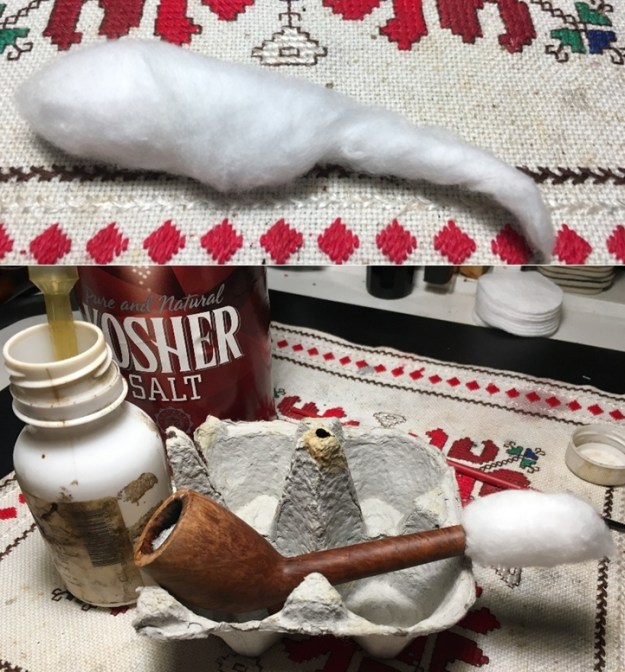
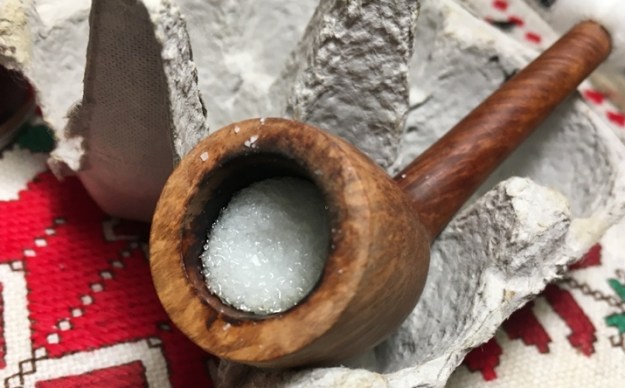
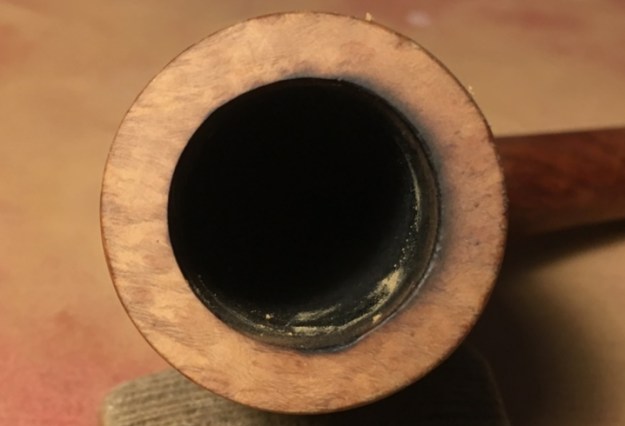
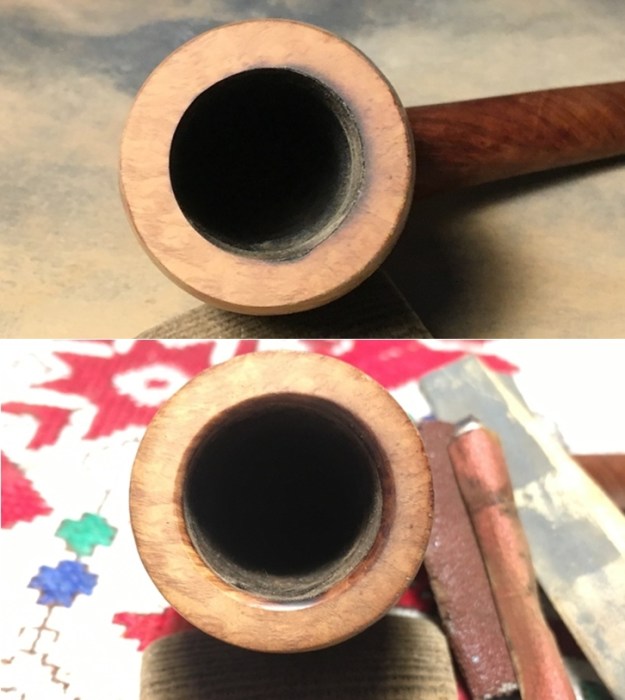
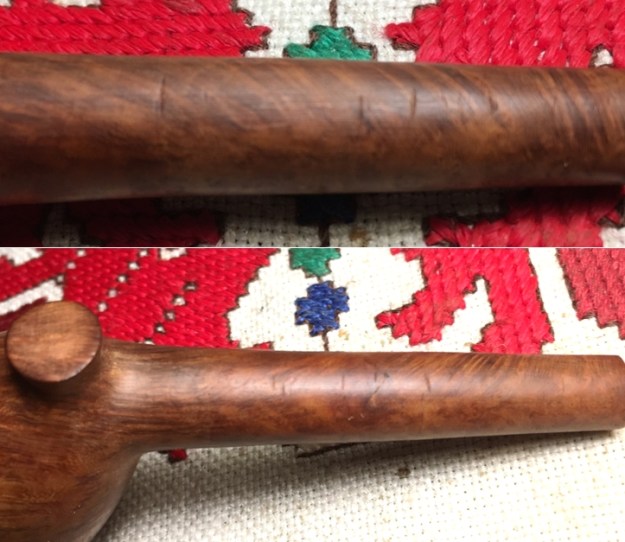
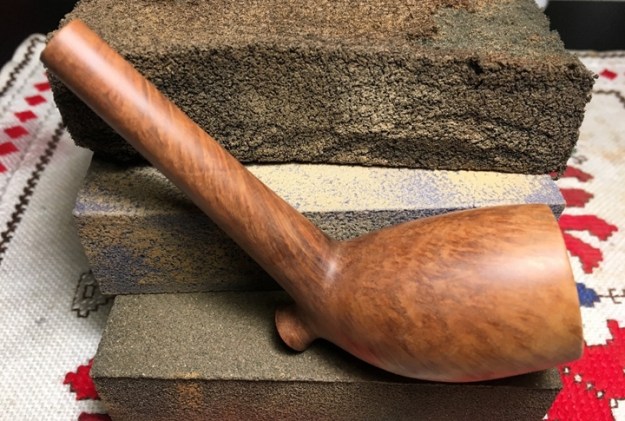
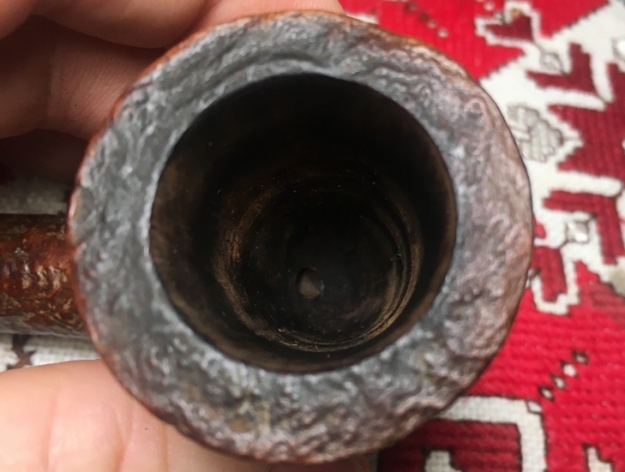
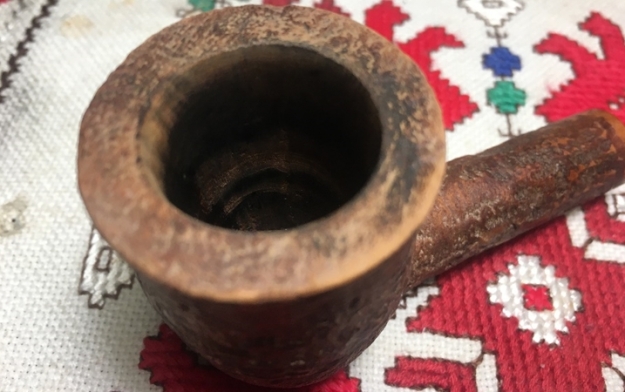
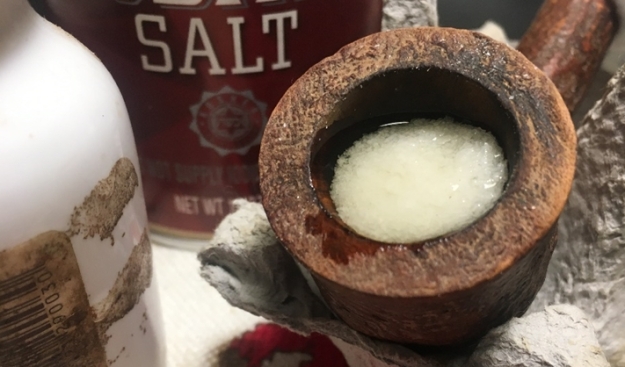
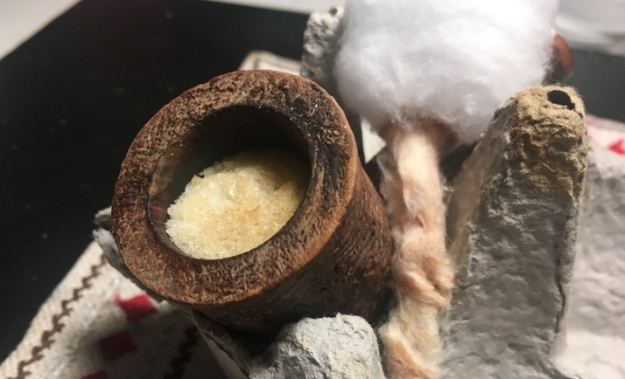
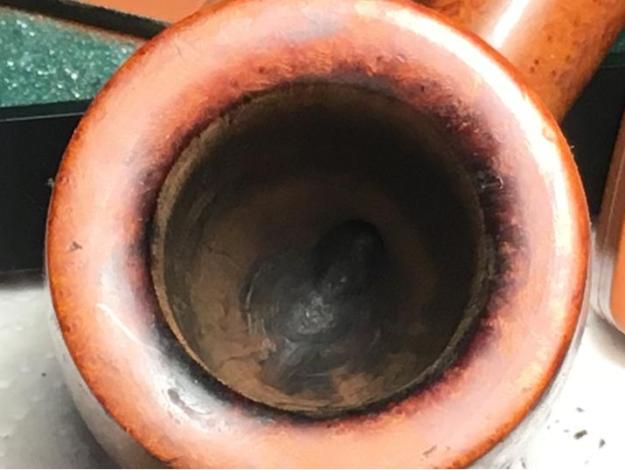
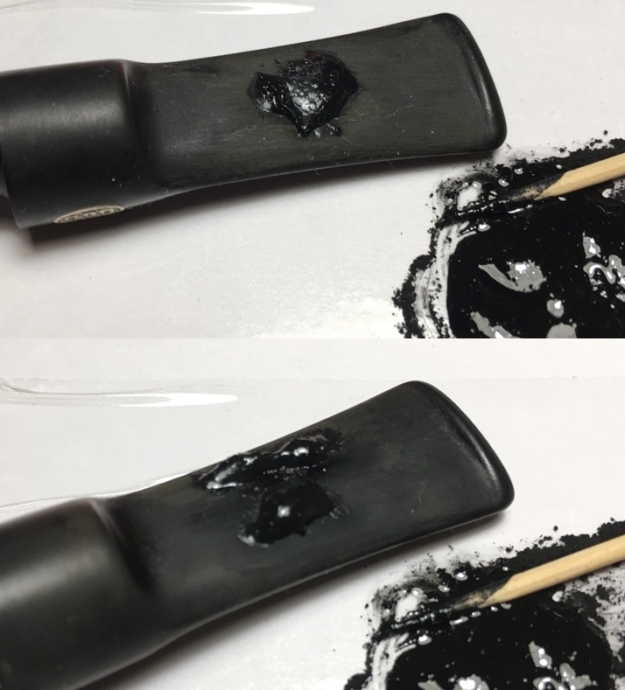
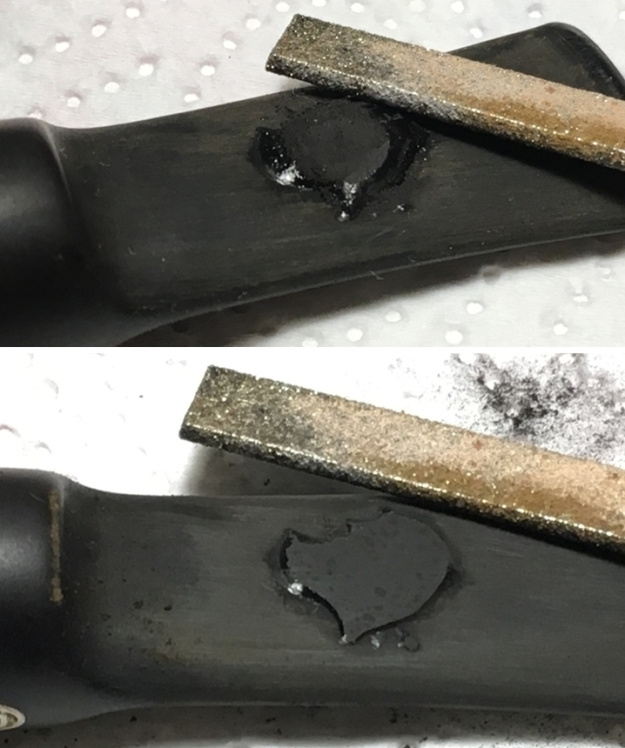
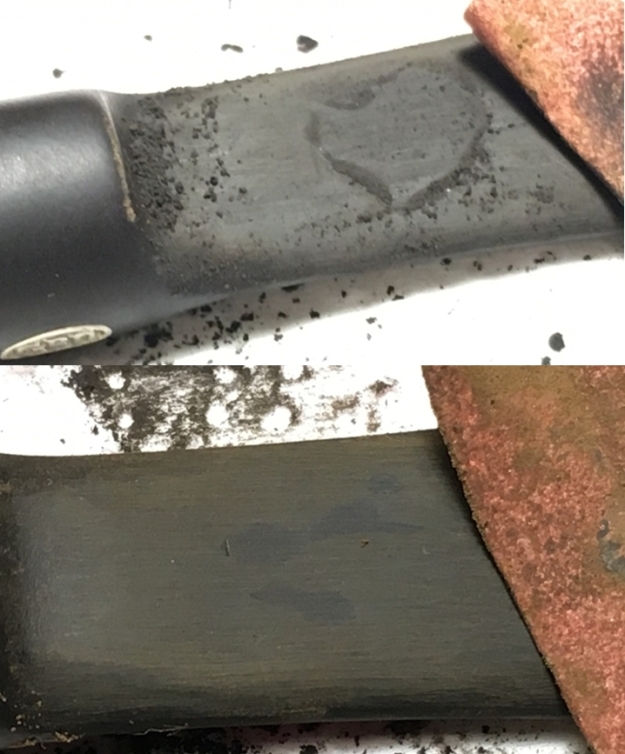
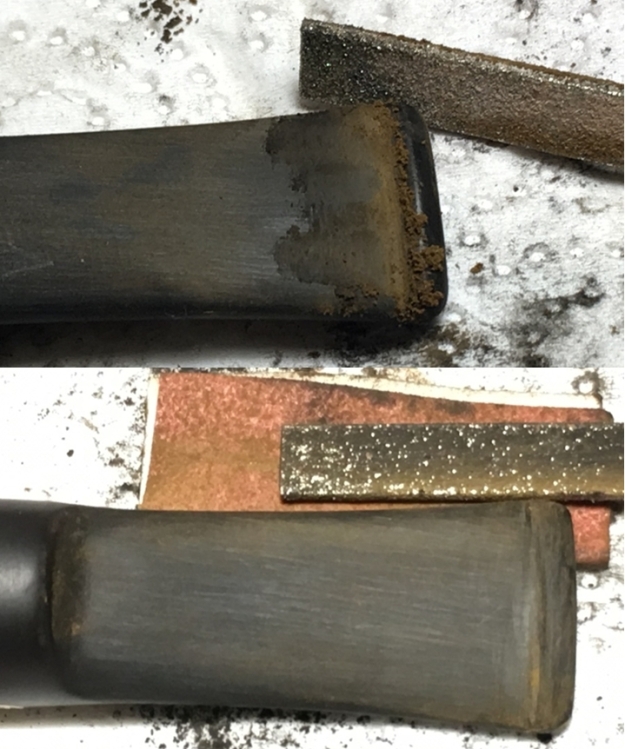
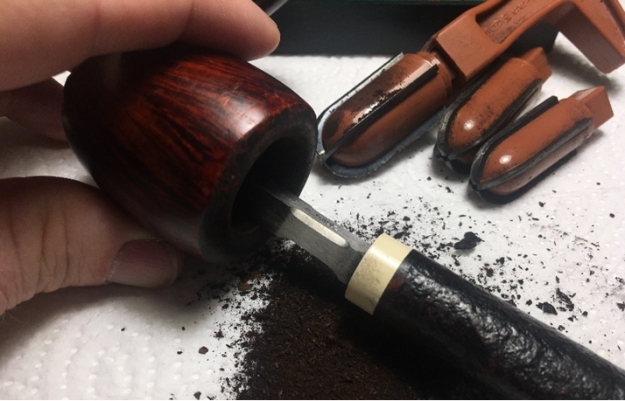
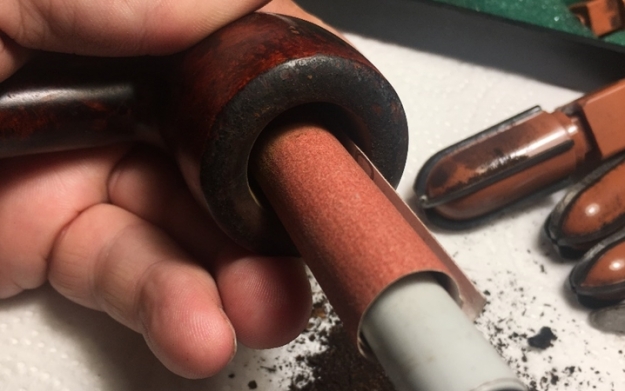
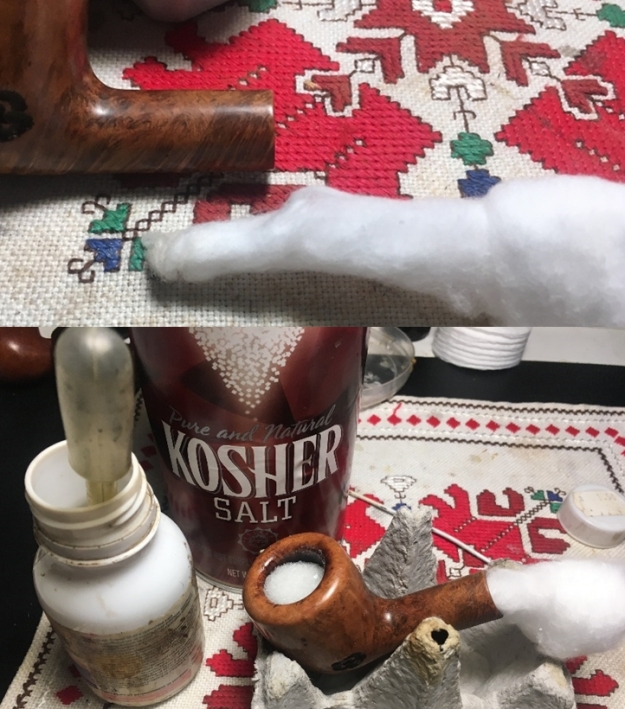
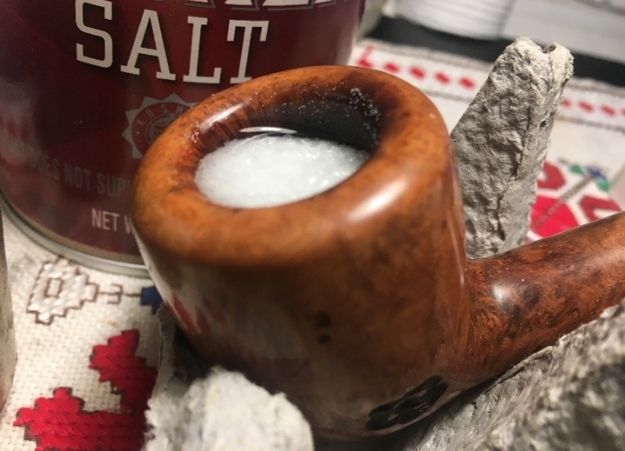
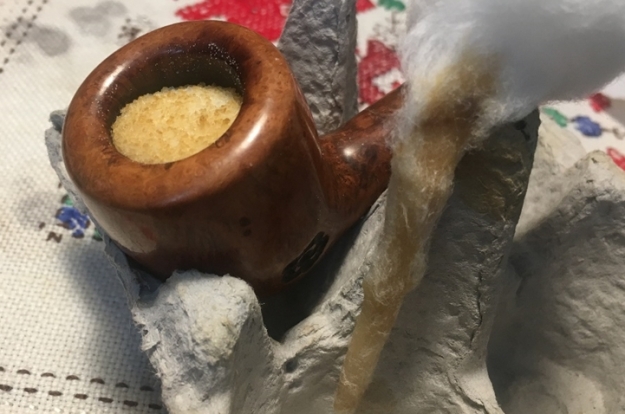
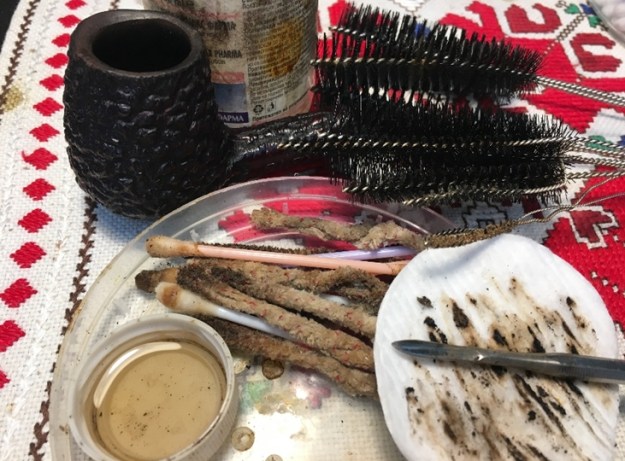
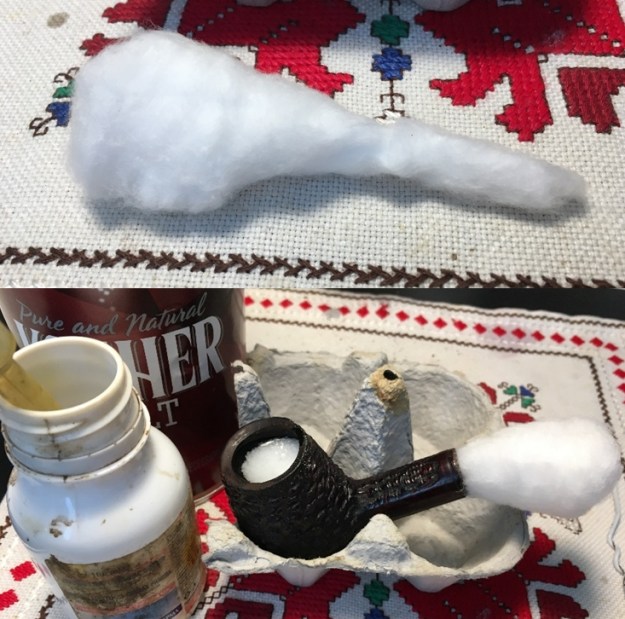
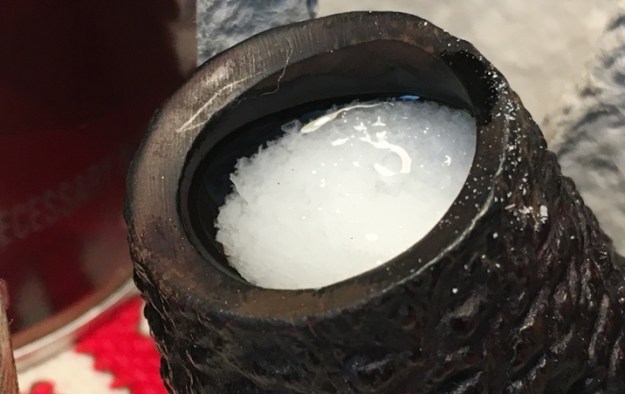
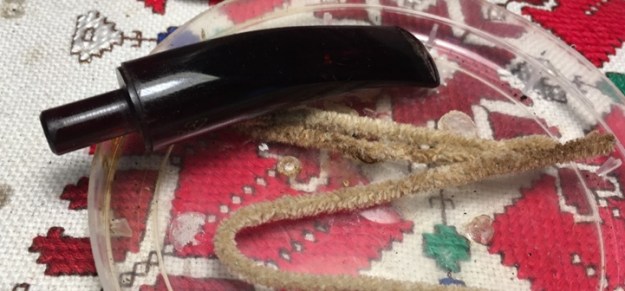
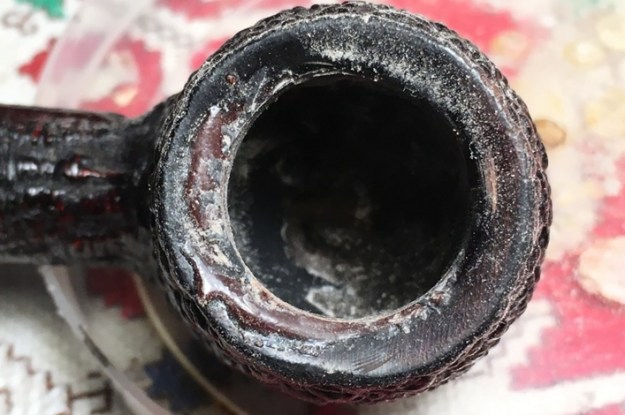
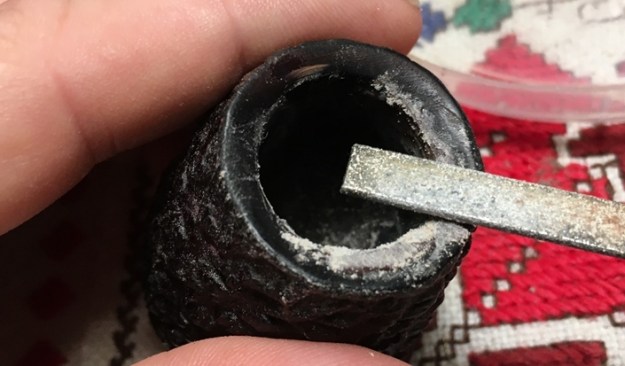
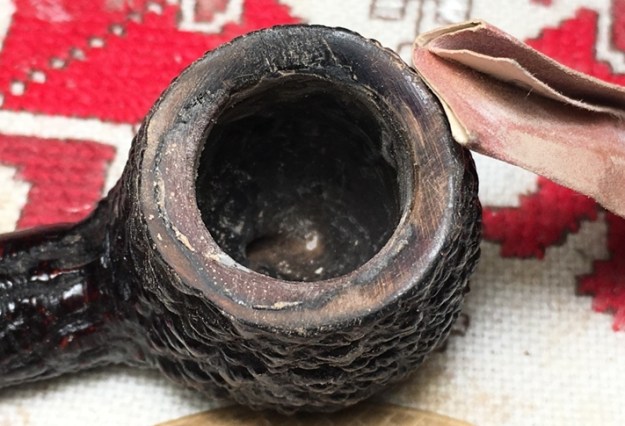
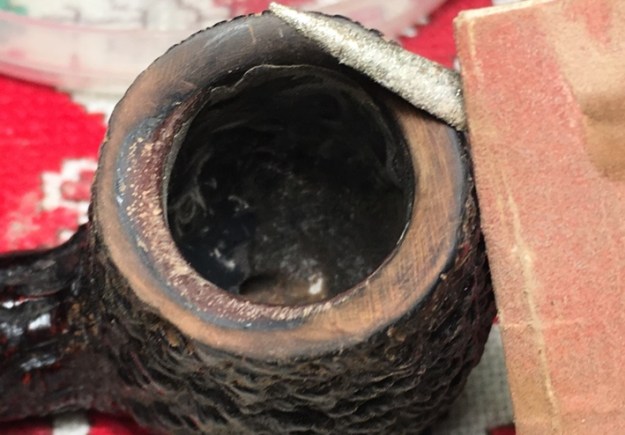
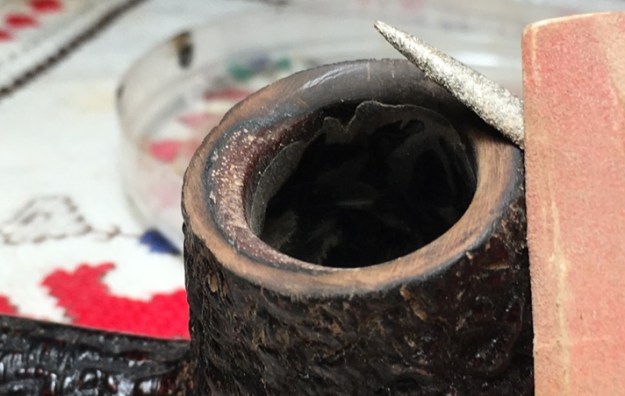
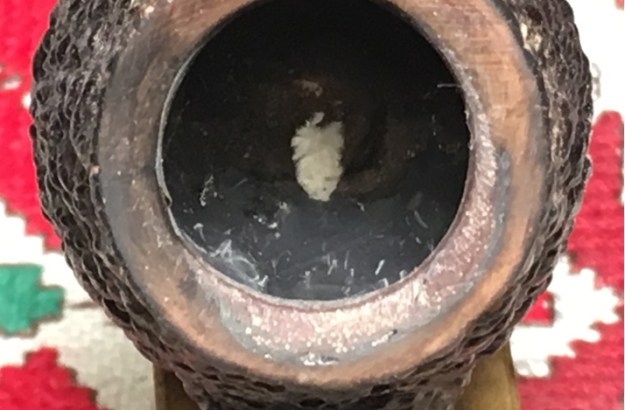
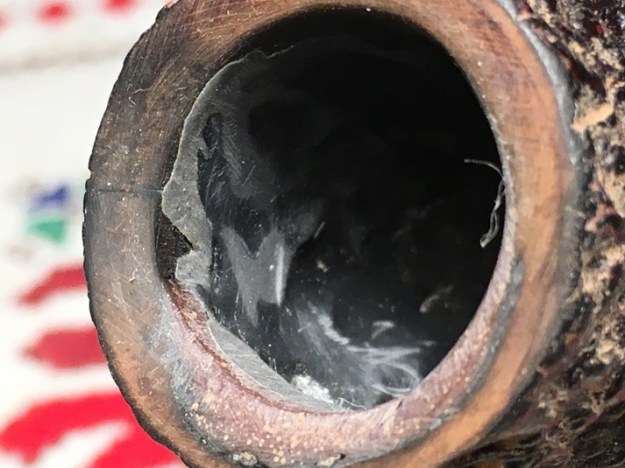
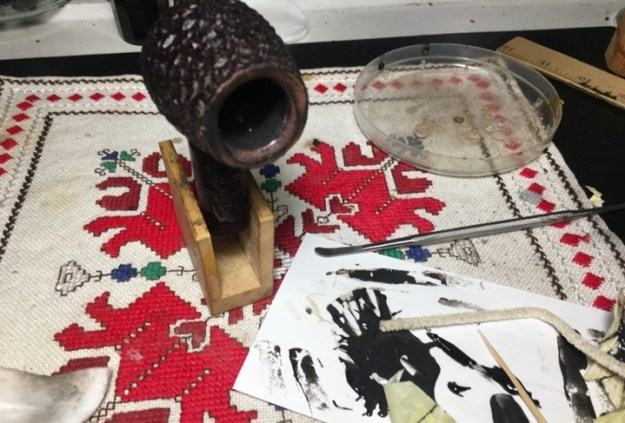
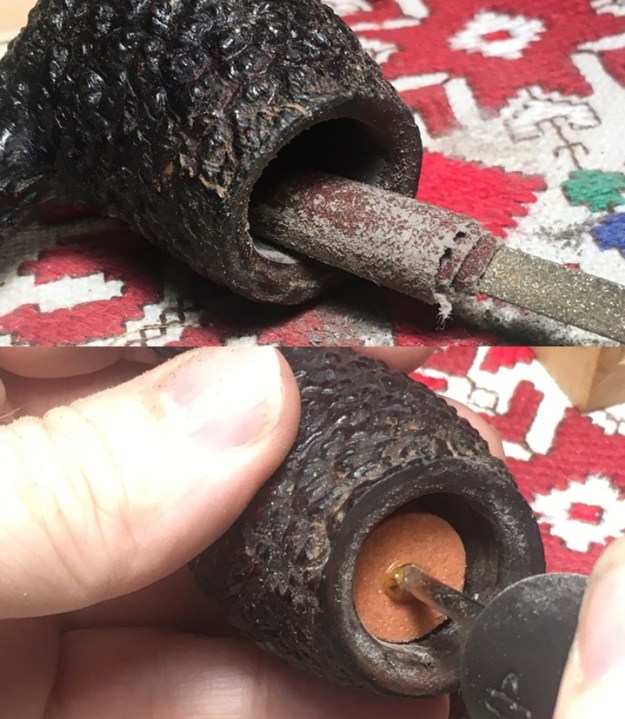
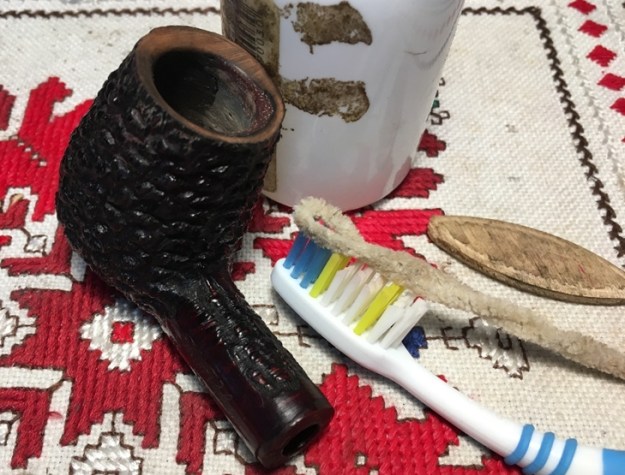
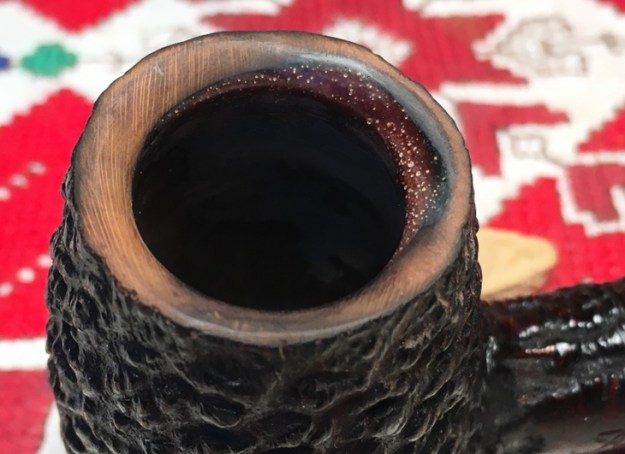
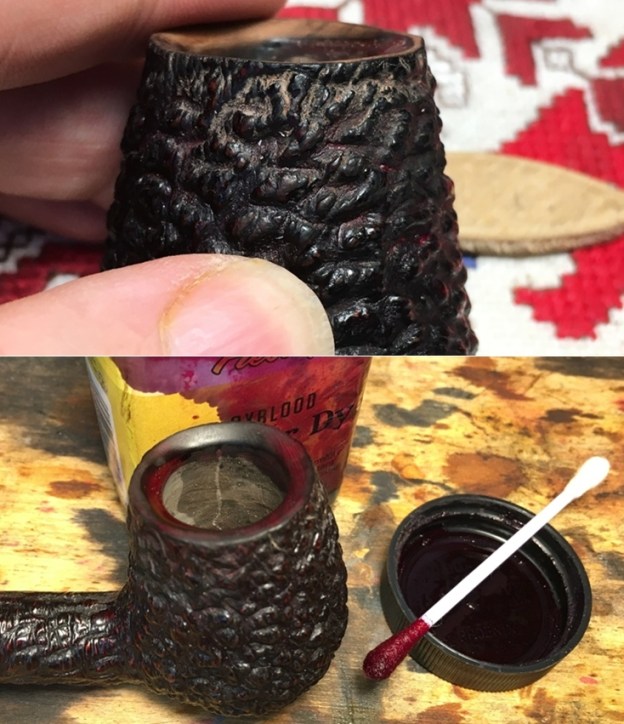
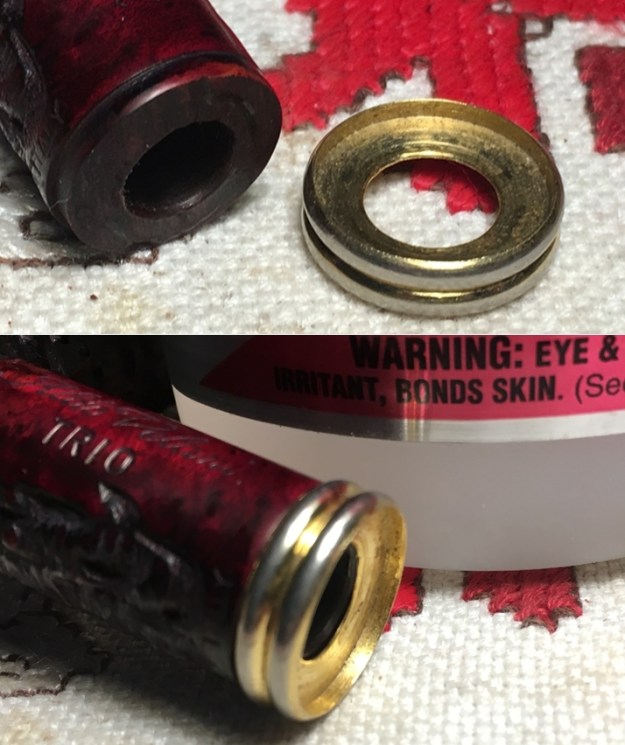
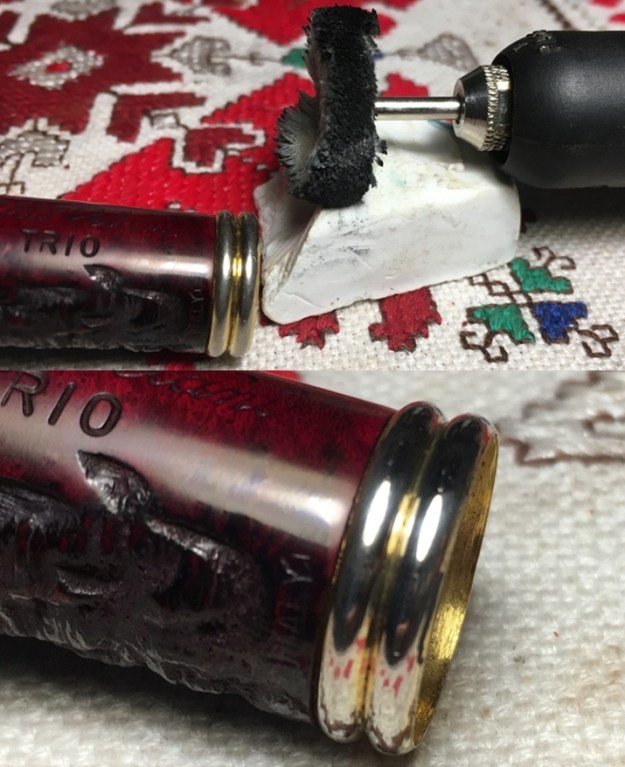
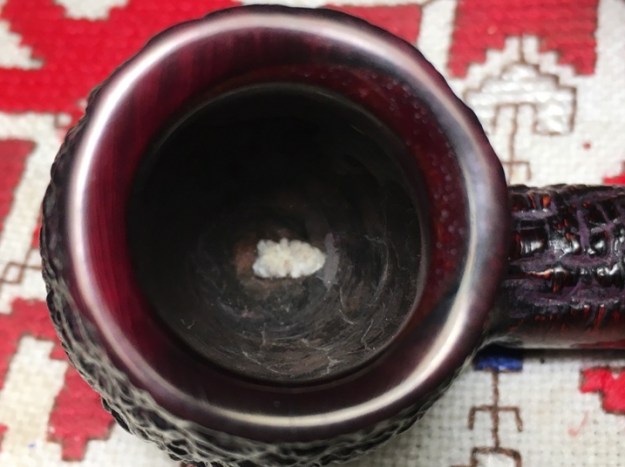
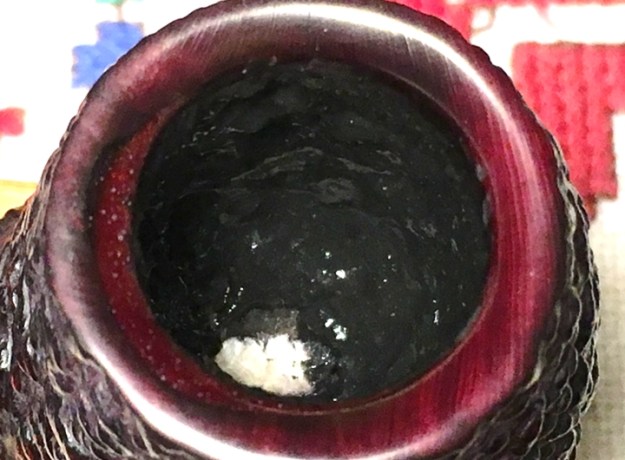
Pipephil’s site has several examples of the Aldo Velani line depicted which tend to be very stylish and nice-looking pipes which confirms the Pipedia assertion that Casare Brontini produced the Aldo Velani lines primarily for export.  It is evident that there was not a consistency in the stem stamping or name style for Aldo Velani as different examples are given.  Here are the stem stamping variations provided by Pipephil:With a better understanding of the Aldo Velani Trio Rusticated Volcano before me, I begin his recommissioning by cleaning him up!  I start by disassembling the parts – I find that the gold band easily is removed which will allow cleaning of each element to be easier.I then take the stummel and ream the chamber using the Pipnet reaming kit.  I use the 2 smaller blade heads then switch to the Savinelli Fitsall tool.  It doesn’t take long digging in the chamber and clearing away the cake that I realize there are problems.  I remove the carbon cake and then sand the chamber wall with 240 grade paper wrapped around a Sharpie Pen to further clean and allow me to see the chamber wall with more clarity.  I wipe the chamber with a cotton pad wetted with isopropyl 95% to aid me in my assessment. The first thing I note was strange was what looks like a ‘stoop’ at the lower back side of the chamber that gives the appearance of the draft hole entering the chamber floor more ‘forward’ than usual.  What becomes more evident as I clear away the thick cake is that the back side of the chamber had fallen away revealing excessively burned briar.  I see carbon fissures reaching into the chamber wall which I continue to remove by scraping with the Savinelli Fitsall Tool knowing that I need to find solid, healthier briar underneath the carbon cake.  After sanding and cleaning, I take these pictures skewed toward an opened aperture to reveal the darker chamber confines with a pipe cleaner giving reference to the draft hole entry.  I was able to find solid briar and now a cleaned surface with only 2 heat fissures that I see but the burning toward the aft of the bowl has reduced the diameter of the briar thickness significantly compared to the forward chamber wall thickness.  The following pictures show what I’m seeing and it’s not good. This final assessment picture below shows evidence of the wall thinning only in reference to the rim’s condition.  The rim is dangerously thin.With much to think about now regarding how to proceed with the chamber damage, I proceed with the normal cleaning regimen which is needful and gives time to think!  Using undiluted Murphy’s Oil soap on a cotton pad and with a bristled tooth brush, I clean the attractive rusticated surface.  I also use a brass wire brush and a little help from my thumb’s fingernail to clean the remaining lava off the labored, bemangled rim.  The cleaning does well and reveals the smooth briar rim motif of the original design of the Aldo Velani.  The smooth briar rim would have popped in contrast to the rustication.  I like it, but unfortunately, much of the original rim is now smoke history. To the internals – I use pipe cleaners and cotton buds wetted with isopropyl 95% to do the job.  With the condition of the chamber lack of care and maintenance, it’s not surprising that the internals are grungy.  I also use a dental spatula to scrape the mortise wall as well as long shank brushes to clean the airway.  In time, the pipe cleaners and buds start surfacing less soiled and I move to the next phase of cleaning the internals.I continue the internal cleaning with a kosher salt and alcohol soak.  I stretch and twist a cotton ball to serve as a mortise wick and then insert it down the mortise into the airway with the help of a straight stiff wire.  I then fill the bowl with kosher salt which, unlike iodized salt, does not leave a ghosted aftertaste.  After putting the stummel in an egg crate to provide some stability, I fill the bowl with isopropyl 95% until it surfaces over the salt.  After a while, the alcohol is absorbed into the salt and cotton wick and I add some more alcohol to top it off and put the stummel aside to soak for several hours. With the kosher salt doing its thing, I turn now to the stem.  The first thing to do is clean the internals using a pipe cleaner and isopropyl 95%.  The pipe cleaners discover not too much resistance.  I then wipe down the acrylic stem external surface to clean it from the grunge so I can examine the surface closely.The stem is in good shape with only expected scratches and scrapes from normal wear.  The bit is a different story with a compressed button and tooth chatter on the upper side and a deep compression on the lower bit with button damage and chatter.  Starting with the upper bit challenges, I sand using 240 grit paper on the bit and button.  I’m thinking that sanding alone might address the damage on this side.  I also use a flat needle file to help shape and freshen the button.  As I had hoped, sanding and filing alone erases the compressions and chatter.The lower bit is a different approach.  I realize from the outset that sanding alone will not address the damage – the compressions on the bit and button are too deep.  Because of this, I apply a patch of thick CA glue to the areas and then use an accelerator too quicken the curing time.  I start with CA glue because I want the footprints of the compressions to be larger so that the CA has more to attach to. I then address the cured CA patch first by filing with a flat needle file and then by sanding with 240 grade paper.  I reshape the button with the file as I work on filing the patch mounds down to the acrylic surface.  Then, switching to 240, I bring the patches down flush with the acrylic surface.  The ruby red and burgundy hues should shine through the transparent CA glue after sanded and polished.Sometimes an air pocket is uncovered in the sanding and filing like in the picture below.  To remedy this, I add another drop of CA glue to fill this. I finish this phase of the repair using the flat needle file and 240 grit paper. To erase the scratches of the 240 grit paper I follow by wet sanding with 600 grade paper and the I apply a 0000 grade of steel wool.Then, the micromesh process using 9 pads from 1500 to 12000.  First, I wet sand with pads 1500 to 2400 and then follow by dry sanding with pads 3200 to 4000 and 6000 to 12000.  I’m not sure it revitalizes the acrylic material, but as I do with vulcanite stems, I apply obsidian oil to the stem after each set of 3 pads.  My – the fire in this acrylic stem is beautiful.  The problem is that it’s difficult to capture with my iPhone 6s camera! Next, I shine up the gold nickel plated double-ringed band – shank cap.  I first wash it with warm water and dish soap using a bristled tooth brush to get into the center crease.  After I dry the band, I then apply Tarn-X with a cotton pad and after scrubbing it well, rinse with cool tap water and dry it.  It looks great.  Later, I will buff it up more with the Dremel. It has been several hours since starting the kosher salt and alcohol soak.  The salt and cotton wick have soiled somewhat, not as much as I thought it would, but perhaps my initial cleaning had accomplished more than I thought!  After I toss the expended salt in the waste, clean the chamber with a paper towel, I also use broad bristled shank brushes to clean the residue salt left behind.  I blow through the mortise to loosen and remove salt crystal remaining in the airway.  Finally, to make sure the cleaning has done the job, I expend a few more pipe cleaners and cotton buds with alcohol and discover that the internals are clean.  Moving on!I’ve had some time to think about the issues with the burning damage to the chamber.  The good news is that there are no burn throughs, but the briar on the back side of the chamber is thin. The rim on the backside is also thinner in comparison to the front side of the rim which is evident in the first picture.  In the second picture I’ve tried to show how the inner chamber has bowed out because of the loss of briar through burning.  During the reaming and removal of all the charred wood, left behind is a bowed cavity where it should be relatively straight-vertical.  The third picture shows the remaining fissure that crawls up the left side of the chamber and impacts the rim. I’ve looked very closely and thankfully, the fissure crack is isolated where it is.  There are no skulking cracks over the rim into the rusticated surface. To give this pipe a longer life, I will employ two different approaches that hopefully will build the rim up and fill the bowl cavity out to increase the mass on the rear chamber wall.  To do this I’ll use JB Kwik Weld to build a new chamber lining and to fill the fissure on the left side of the bowl.  JB Weld will be the main strategy in the chamber itself because of its heat resistant capabilities.  This is the lower chamber strategy.  Before starting this, I will first build out the rim thickness using a mixture of thick CA glue and briar dust to form a putty that will cure and provide the upper scaffolding for a rear rim rebuild. I’ll form this first around the back side of the rim and as I form the rim mold with the putty, I’ll intentionally fashion an ‘under-ridge’ with the briar dust putty.  This ‘under-ridge’ will form the raised boarder that the JB Kwik Weld will butt against when it is applied afterwards.  I hope this plan will work!
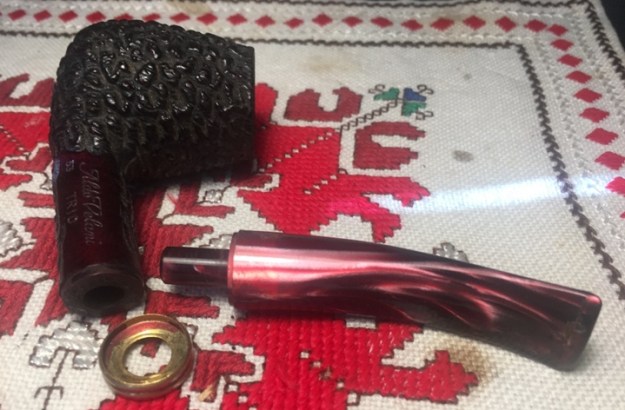
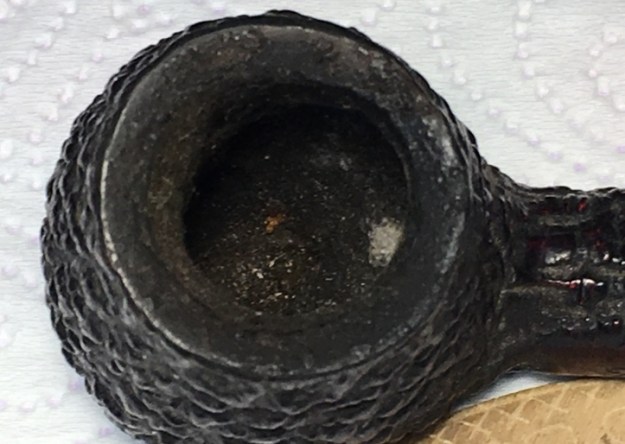
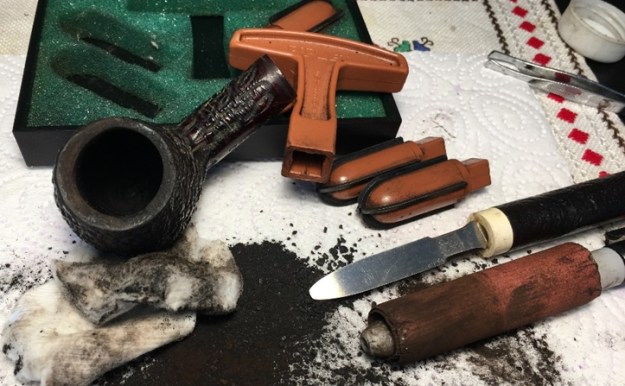
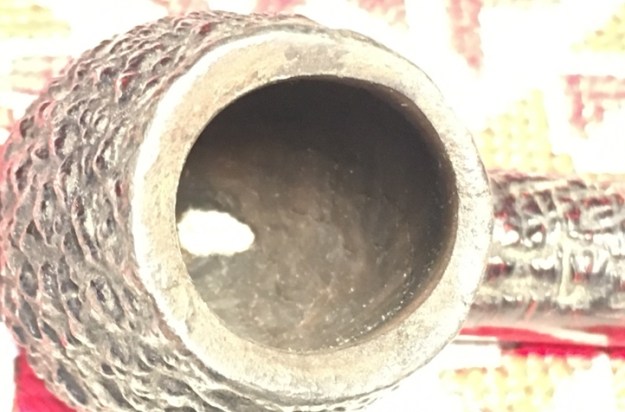
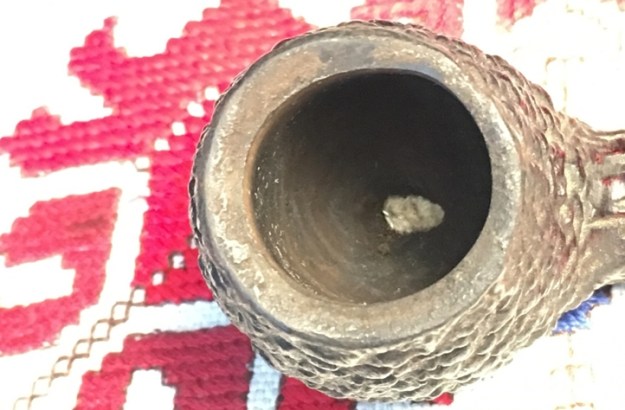
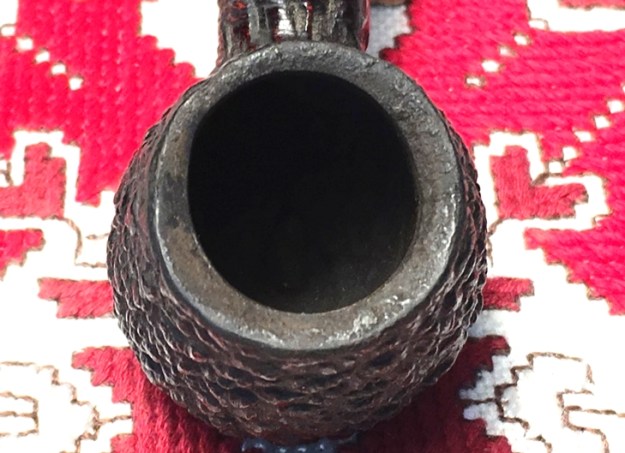
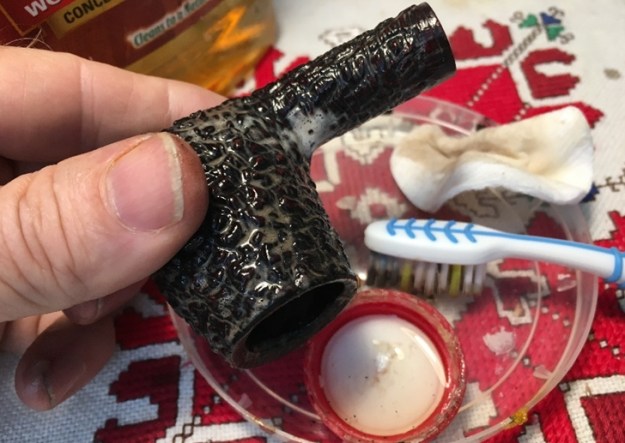
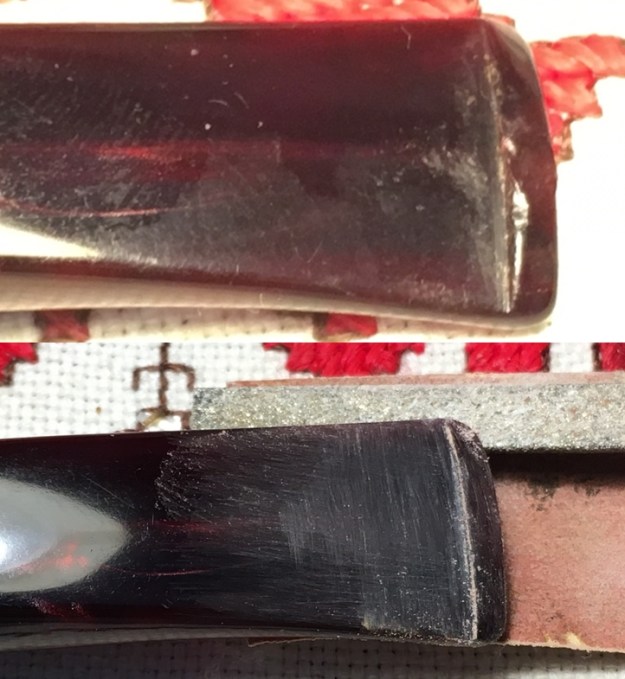
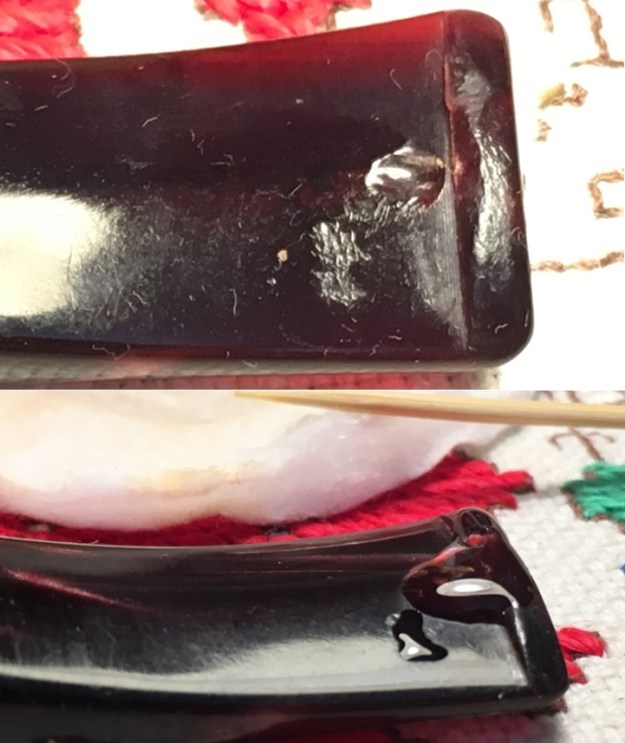
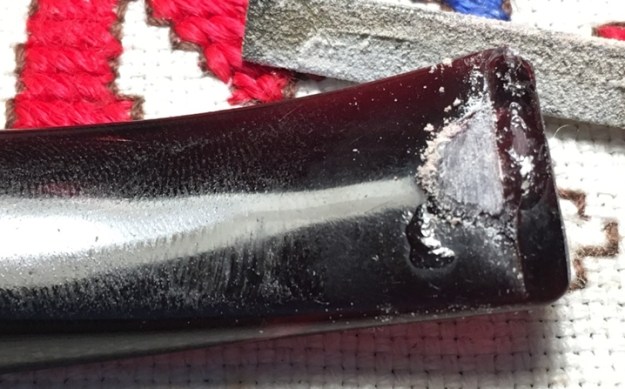
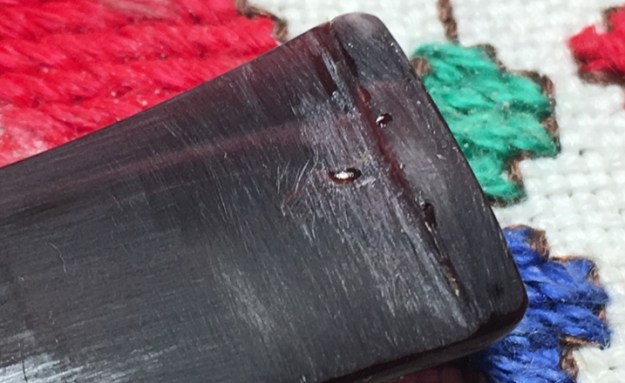
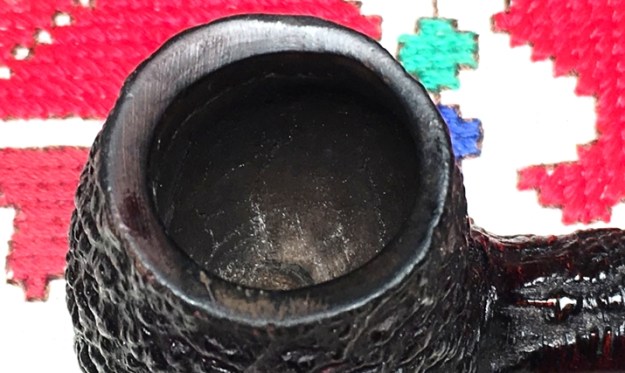
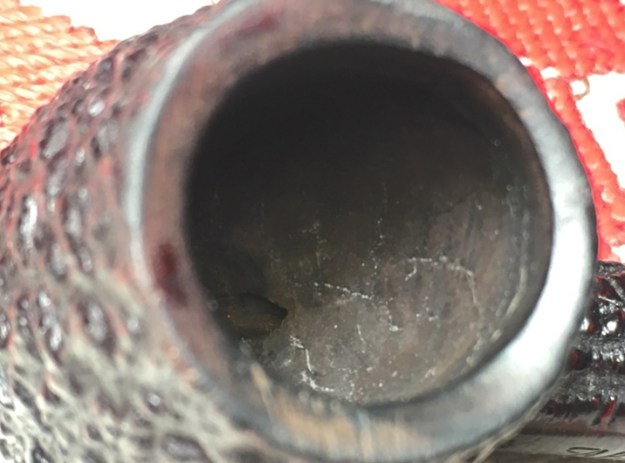
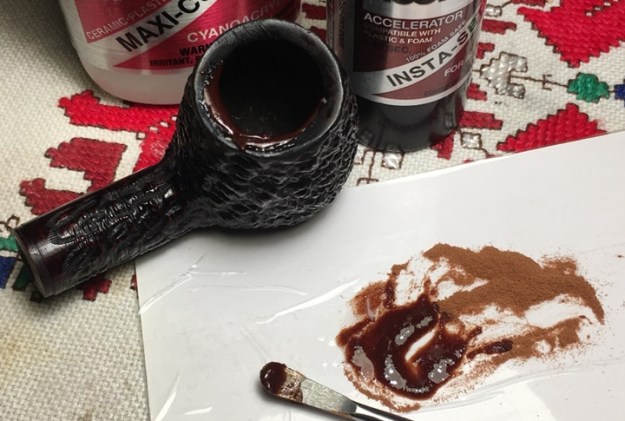
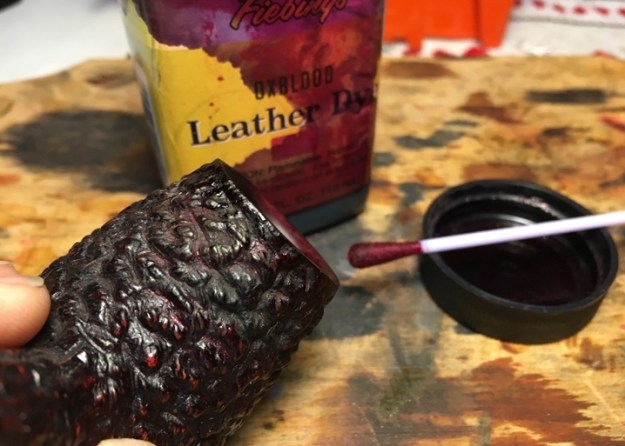
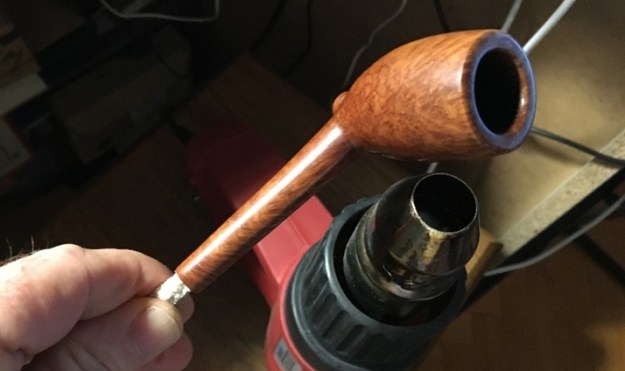
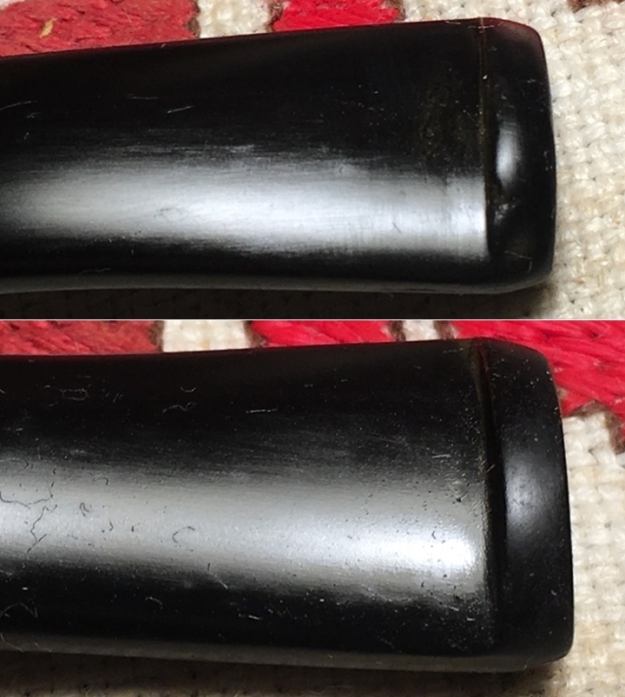
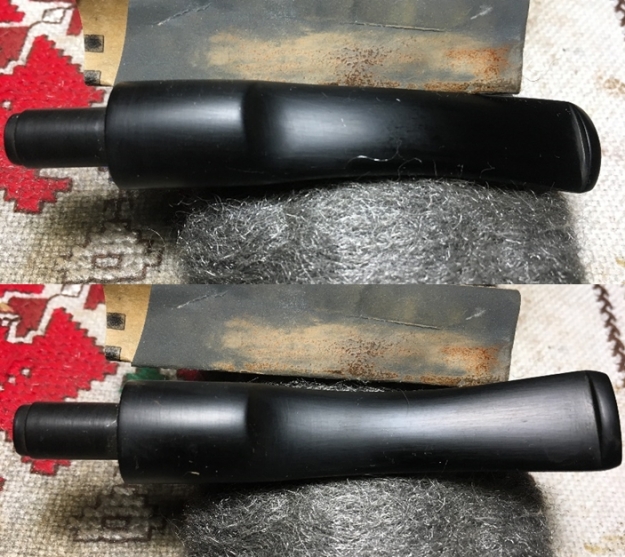
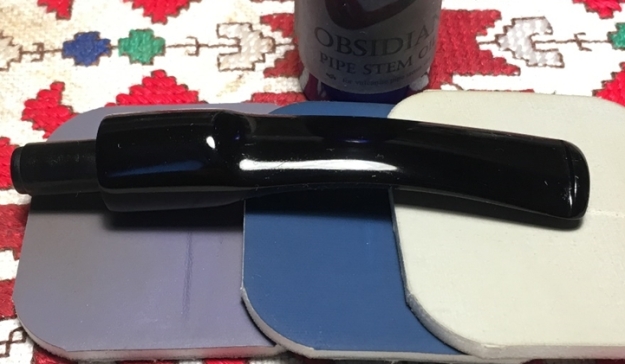
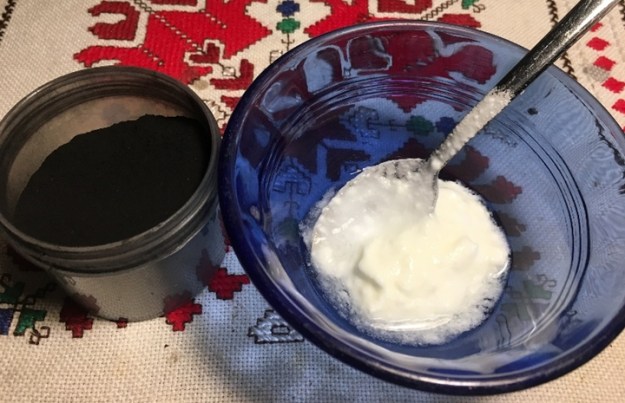
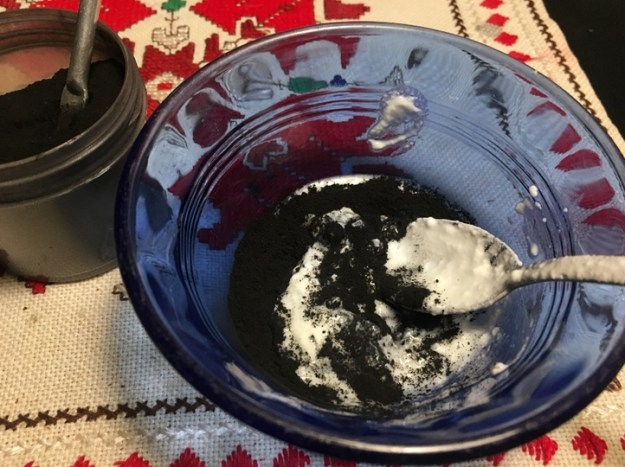
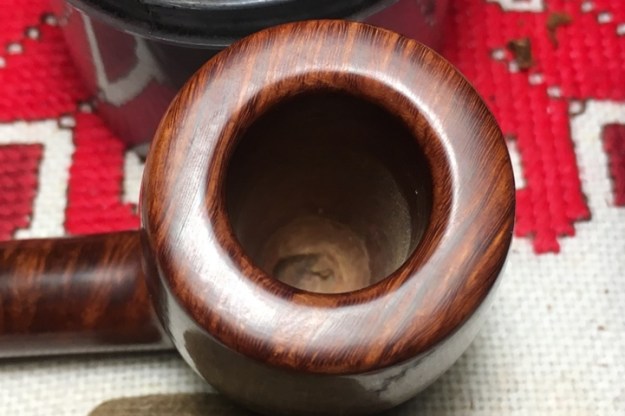
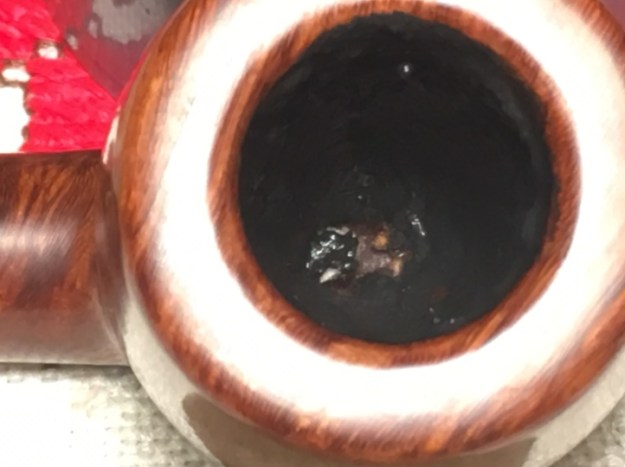
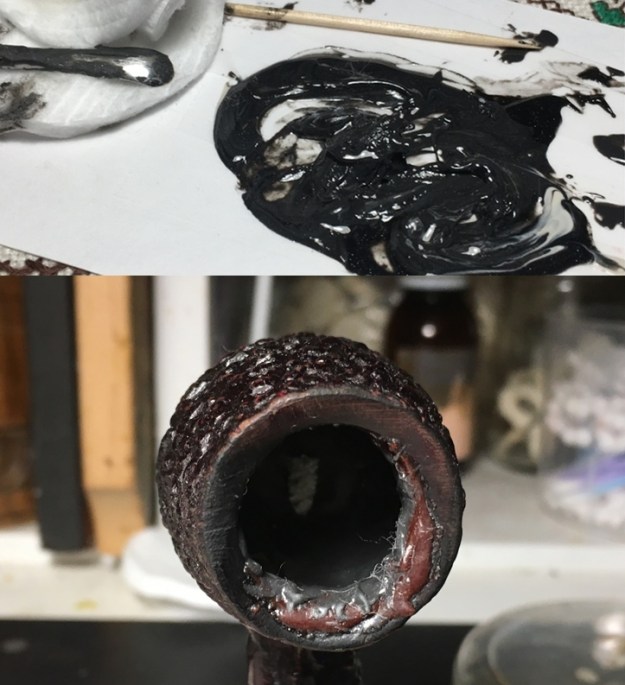
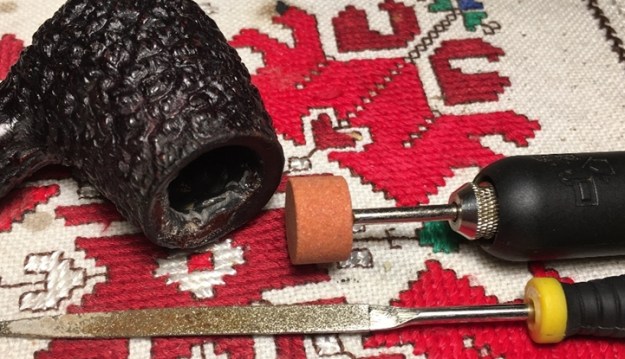
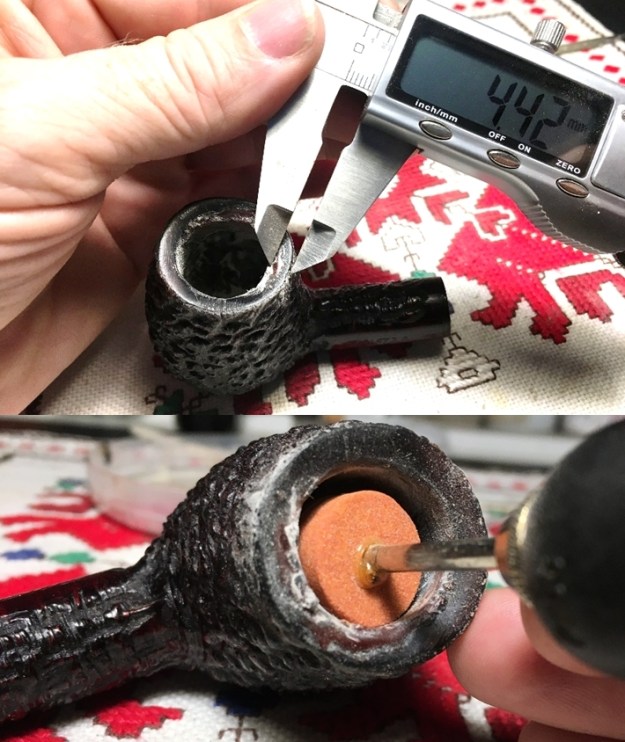
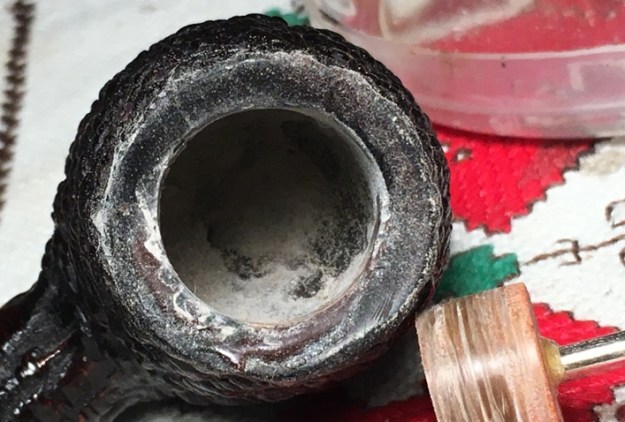
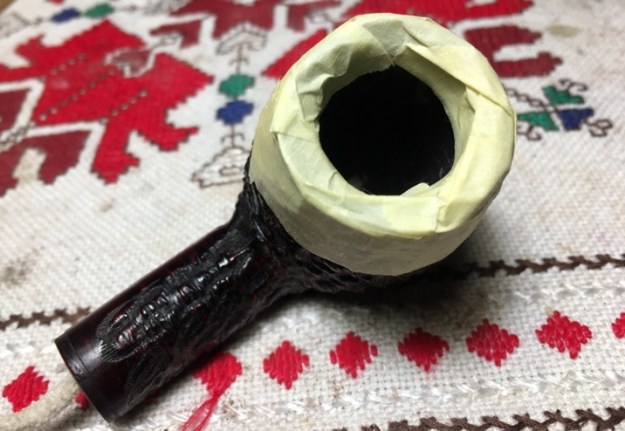
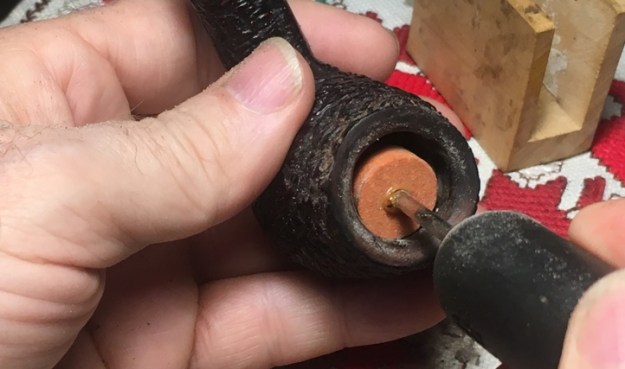
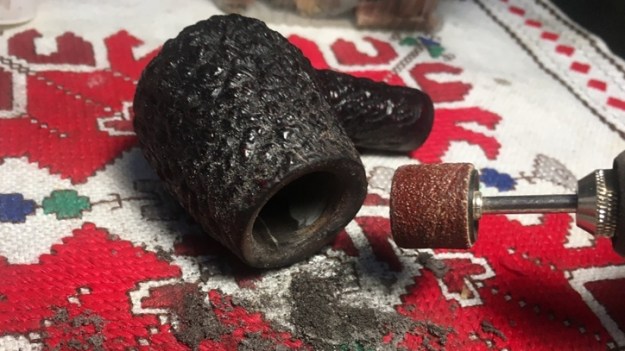
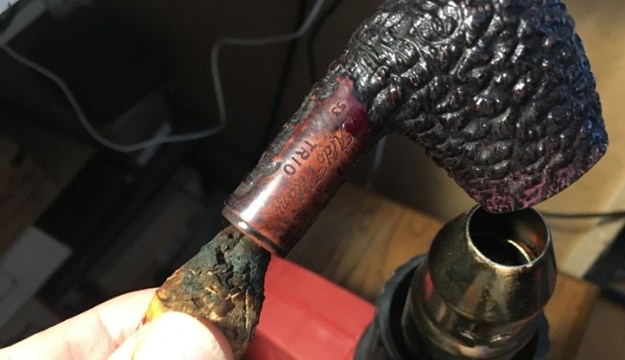
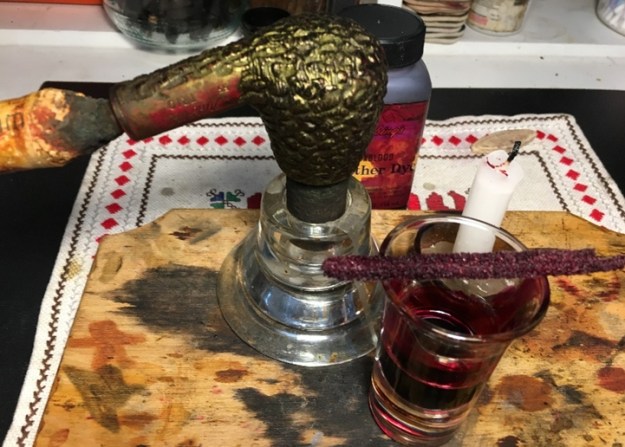
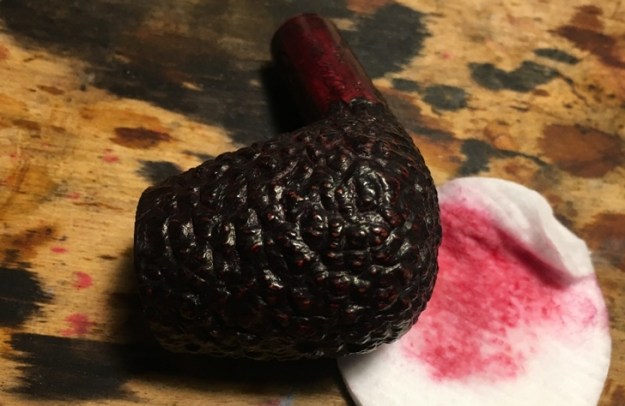
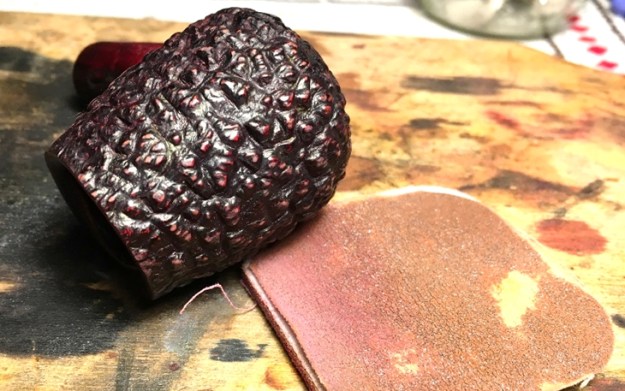
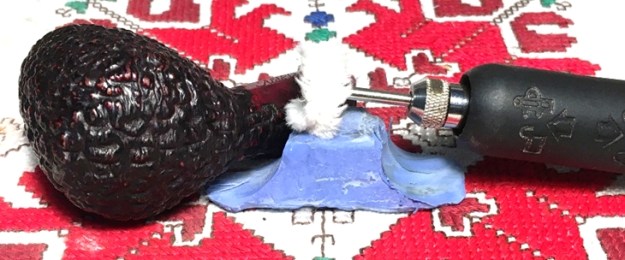
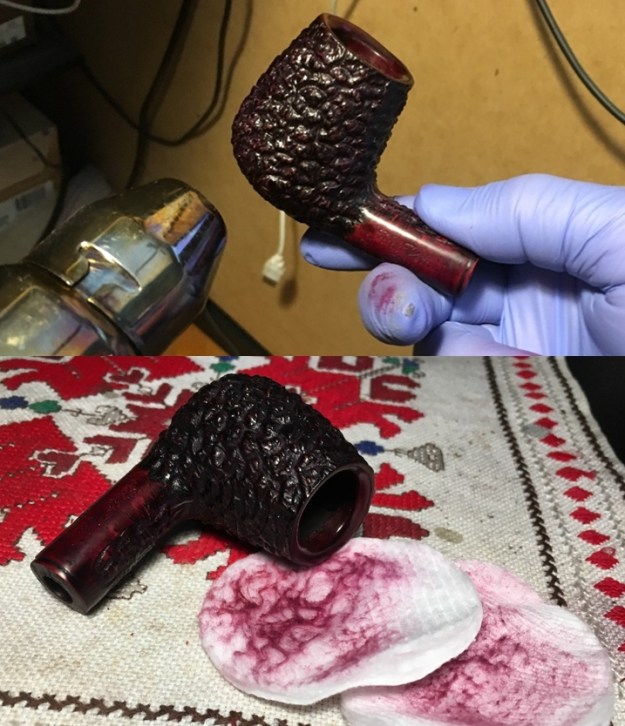
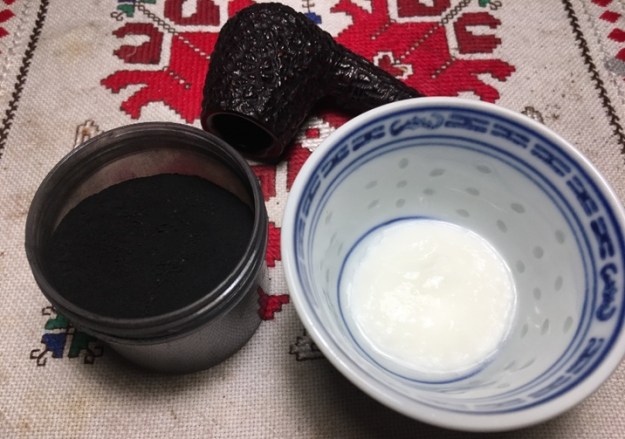
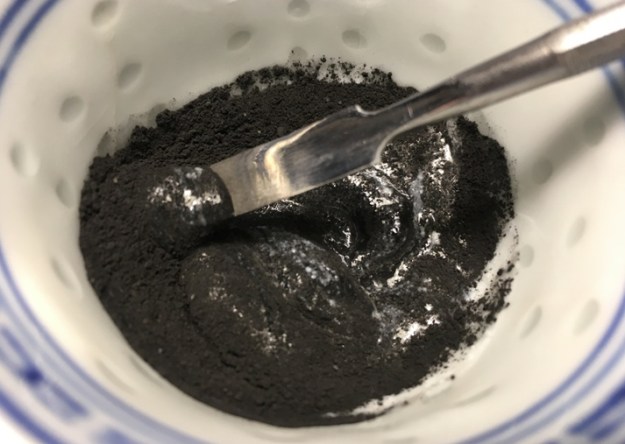
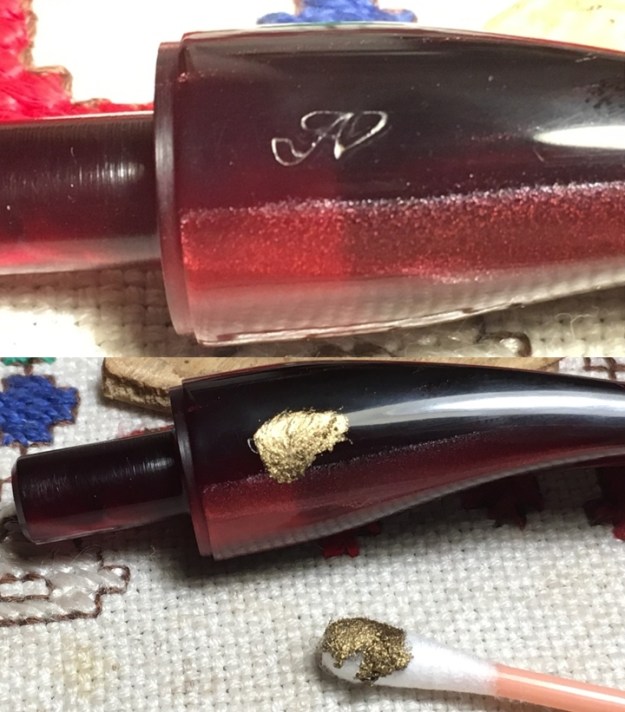
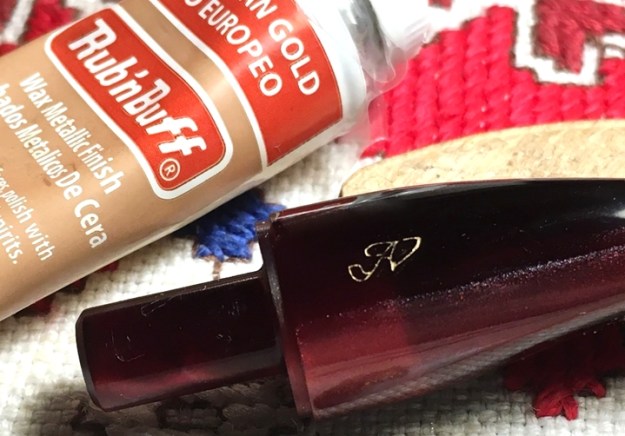
The first thing I do is wipe the bowl and rim with alcohol and a cotton pad to clean the surface.  Then I mix a batch of briar dust and thick CA glue on an index card.  When it’s about the viscosity of molasses so it will hold together and not run, I trowel it to the rim with a curved dental spatula shaping the rim form.  As I’m working, I see that the putty isn’t firming up on the rim as I hoped and so I use an accelerator to help quickly set the putty in place and cure.  I apply three separate batches of putty to build up the rim which are shown in the pictures.  The first phase looks good.  The pictures show the progress. Next, I mix equal parts of the two components of JB Kwik Weld, the steel and hardener.  After the two elements meet, there is about 4 minutes of relative pliability to apply the Weld in place.  After four to five minutes the Weld begins to harden.  I use a spatula to trowel the Weld into the chamber – trying to avoid the rim, but that wasn’t easy to do.  As I apply the Weld into the chamber, I spread it on the back wall and fill the fissure.  As it hardens, I tamp it down and shape.  After applying and shaping, I set the stummel up so that the back of the bowl is down allowing gravity to help.  I turn out the lights and call it a day. The next day I’m anxious to start to work on shaping the rim after the JB Kwik Weld and briar dust putty have thoroughly cured.  My main work horse to begin with is the Dremel mounted with a round grinding stone and a half-rounded needle file.  The grinding stone is the perfect size at 5/8 inches in diameter to fit into the narrowed Volcano summit and yet, large enough to provide a larger and less abrupt grinding footprint.  As I begin to grind the internal lip of the rim patch, I remove the excess briar dust putty patch material.  I go slowly and patiently eyeballing the roundness of the rim.  I decide to employ a caliper to measure the original intact part of the rim to help me measure the removal process.  I would rather leave more and work down slowly sanding with paper than to be greedy with the Dremel grinder and take off too much.After a time, a take a picture to mark the progress removing and rounding. When I’m close to being satisfied with the removal and rounding with the Dremel grinding stone, I use both a flat and half rounded needle files to begin removal of the excess patch material on the rim top.  The entire rim bevels inwardly and slanting toward the chamber and I patiently and gently file in that direction. After filing, I transition to 240 grade paper to continue to shape and to blend the rim patch with the resident briar.  I do a dance back and forth between sanding and filing and eyeballing the angle of the rim slant – seeking as much uniformity as possible!I’m satisfied with where I am at this juncture.  The inner rim looks round and the rim rebuild is holding together very well.  The area is still rough, and I’ll continue to work on that later, but now I turn my attention from the rim rebuild and restoration to the chamber. I wet a cotton pad with alcohol and wipe out the chamber so that I can assess where the chamber repair is with the JB Kwik Weld.  With the shank oriented downwardly, I take a few pictures after replacing the pipe cleaner through the draft hole.  The pictures are difficult to see what I can feel with my finger as I examine the contours of the hardened JB Weld.  The cavity created by the burn damage has been filled partially and reinforced well.  I no longer have any concerns about the thinness of the briar on the back of the bowl.  I don’t believe I can fill the entire cavity with JB Weld and will not try.  But I still can feel an abrupt ridge underneath the rim repair.  This I need to fill to provide a smoother transition from the rim repair to the chamber repair. Orienting the picture now to the left side of the chamber, the JB Weld has filled the fissure very nicely.  I’ll sand the excess off later. After dealing with the fissure proper, I’ll address the upper part of the fissure crack that reaches to the rim.For the second strategic application of JB Kwik Weld, I cover the rim and upper bowl with masking tape to protect from accidental drips of the Weld.  After mixing the two parts of the JB Weld, again I use a dental spatula to apply the epoxy to specific areas underneath the rim rebuild to provide the foundation for a smooth, seamless transition between the two reconstruction areas.  As before, to be careful, I place a pipe cleaner through the draft hole even though there is no plan for Weld to be applied in that area.  After troweling enough JB Weld to the area targeted, I patiently and carefully continuously tamp the area to massage the epoxy into the best positioning.   As the 4-minute window passes, the epoxy is thickening allowing me the final opportunity to shape and smooth the epoxy before it sets.A few hours later, I begin the dance of sanding and utilizing the round grinding stone mounted onto the Dremel.  The sanding paper I use is a coarse 120 grit and I wrap it around the end of the flat needle file to give me some reach and leverage as I apply pressure during the sanding.  The goal is to remove all excess JB Kwik Weld only leaving that which provides necessary filling to the burned-out area and to the heat fissure.  These pictures show the dance, but the reality is this phase is a mess with dust flying all over!  Living and working in our 10th floor flat of a formerly Communist bloc apartment complex in the winter provides much opportunity for me to thank my wife for her patience and helping to take a few of the pictures below! After I’m satisfied with the heavy duty grinding and sanding, I switch to a sanding drum mounted to the Dremel.  It serves to fine tune the sanding and makes my job easier.I finish with the rim/chamber rebuild.  After cleaning the chamber blowing and wiping with a cotton pad wetted with isopropyl 95%, I’m pleased with the outcome.  The pictures show remaining epoxy in the areas of need.  The first picture shows well the fissure that is now secured with epoxy.  The lighter epoxy is visible but to the touch, there is nothing there.The next pictures show the transition between the two repair projects.  The briar dust rim rebuild transitions to the chamber burn repair.  The JB Weld contours to the chamber wall building out the large burned area that threatened the aft chamber wall, but thankfully never burned through.  The aesthetics are still nothing to get excited about but I’m hopeful through the sanding and polishing process the rim rebuild will blend well with the surrounding briar.  Later, I will apply a coating of pipe mud to the chamber to encourage the growth of a new, healthy protective cake. I move on now to fine tuning the rim.  I use 240 grit paper to clean up scratches left over from the restoration project and then I apply 600 grade paper to smooth. With all the sanding, filing and grinding of epoxy and briar, I do a quick clean up of the stummel by taking it to the sink and running tap water over it and scrub it with the bristled tooth brush.  I also wipe the chamber and the rim with a cotton pad wetted with isopropyl 95% and run a pipe cleaner through the airway also wetted with alcohol to make sure all is clean.Next, before progressing further with the sanding of the rim, I color the rim to hide and blend the repairs.  I use straight Fiebing’s Oxblood with a cotton bud to apply several coats of the dye to the rim.  I also touch up the rusticated areas on the peak of the Volcano bowl that had lightened because of all the construction and cleaning going on. I’m hopeful that the dye will also be absorbed by the rim patch area which is speckled now after the sanding.  After applying the dye several times, I give the rim a light wipe of a cotton pad wetted with alcohol simply to blend and gather excess dye. Next, I move directly to applying micromesh pads to the rim and to the smooth briar panel on the left shank flank.  I begin by wet sanding with pads 1500 to 2400 and I realize immediately that I had made a mistake in the order of things.  As soon as I began wet sanding the Oxblood dye that I had just applied was, for the most part, now running down the drain.  I realize that I should have completed the micromesh regimen and then applied dye to the rim.  Not able to change anything at this point, I continue after wet sanding with the first set of three, to dry sand using the remaining pads, 3200 to 12000.  The pictures show the results – the rim looks great regarding the sanding and polishing but the coloring of the rim is lost for the most part.  I also discover as I micromeshed the smooth panel that the color was coming off as well….  I’m encouraged by the fact that we learn as much from what not to do as doing something well.  The pictures show the results. Circumstances create the environment for decisions and decisions shaped by past successes and failures is the definition of wisdom.  What is the wise course of action!? Previously, I planned to keep the original finish as it was and move to the polishing phase.  Now, I decide to apply Fiebing’s Oxblood Leather Dye to the entire stummel and not just as a touch up.  At this point there are too many ‘touch up’ points and it is better simply to refresh the entire bowl with dye.  I assemble all the components of my tabletop dying station and then wipe the stummel down with alcohol to clean the surface.  Using a hot air gun, I heat the stummel to open the briar to be more receptive to the dye pigmentation.After heated, I then apply the Oxblood dye to the stummel using a folded pipe cleaner holding on the cork which is inserted into the shank as a handle.  As I paint the stummel with dye over sections at a time, I ‘fire’ the dye using a lit candle that combusts the alcohol in the aniline dye and sets the dye pigmentation in the wood.  After fully saturating the stummel and covering the whole surface, I set the stummel aside to rest for several hours.Several hours later I’m ready to ‘unwrap’ the fired crust on the surface of the rusticated stummel.Since I’m working with a rusticated stummel, I don’t use a felt buffing wheel as is my approach with smooth briars.  I mount a cotton cloth buffing wheel on the Dremel and set the speed at about 40% full strength, I apply Tripoli compound to the stummel.I’m always fascinated by the way the grain emerges during the unwrapping process with the Tripoli.  The picture below shows the ‘front line’ of the buffing process and the richness of the rusticated surface being revealed.  Yes, surgical gloves!  In this way I keep stain of my hands which keeps my wife happier!With my wife’s help, the next few pictures show my customary ‘Dremel posture’ – my lap top station working on a chopping board.  I keep the overhead lamp close and I’m able to see the movement of the compounds and waxes I apply during the use of the Dremel.Working on rusticated and blasted surfaces are rough on the cotton cloth buffing wheels and I’ll be tossing this one when I’m finished!  I buy buffing wheels in bulk.  The smaller buffing wheel allows me to rotate the orientation of the stummel to follow the rusticated valleys and ridges – I keep moving and it takes a good bit of time to work through the rustication.  Patience reveals good results most of the time!After completing the Tripoli regimen, I wipe the bowl with a cotton pad wetted with alcohol.  I do this not really to lighten the aniline stain but to blend the Oxblood dye and to wipe off excess dye.With a rusticated surface as distinct and deep as this Aldo Velani Trio, I use a 1500 grade micromesh pad and lightly ‘brush sand’ the surface of the stummel.  What this does is sand the tips of many of the rustication ridges and lightens them.  This creates more contrast in the rustication that I first saw many restoration ago, restoring a rusticated fully bent Billiard, Lorenzo Rialto.  The ‘speckled’ effect creates a mesmerizing rusticated surface – I like it.  The picture shows these results.Next, I mount another cotton cloth buffing wheel to the Dremel, maintaining the same speed and I apply Blue Diamond compound to the stummel surface.  I decide not to reunite the stem at this point to apply the Blue Diamond in order to use a different buffing wheel with the acrylic stem.One of the reasons for letting the newly dyed and fired stummel to ‘rest’ for several hours before working on it is that it helps the dye to set and less of it comes off later on the steward’s hands.  This does happen especially the first few times a pipe is put in service and the bowl heats up for the first time.  I’m concerned that the rusticated surface will hold more unseasoned dye surface and to mitigate against Oxblood dye coming off on the hands, I heat the stummel with the hot air gun and with the bowl heated, I wipe it heartily with a few cotton pads to capture the unseasoned dye.  I hope this helps!Before turning to the stem, I have two additional projects to complete before the final phase of applying wax.  I need to remount the gold band/shank cap and polish it.  Also, I need to apply a mixture of sour cream (or natural yogurt) and activated charcoal to the chamber to aid the formation of a cake to serve to buffer the newly repaired chamber wall from the fire.  Starting first with the band, I apply a small drop of thick CA glue inside the cap and then attach it to the end of the shank.  I use a thicker variety so that it doesn’t run and get on something that it shouldn’t!Next, I mount a cotton cloth buffing wheel on the Dremel that is dedicated to the application of White Diamond compound on nickel.  You don’t mix buffing wheels!  I label each wheel for what compound or wax is used and on what surface – metals and wood are different! I also am careful while buffing the band to stay on the metal and not bleed over onto the briar.  The black residue that comes off the metal can darken and stain briar – careful!  Wow!  I thought the cap was shiny before, but now it beams!Next, applying the natural yogurt and charcoal mixture to the chamber walls to provide a buffer between the briar and the burning tobacco helps as a ‘starter’ to develop a protective cake.  I’ve learned that I have used too much yogurt in the past and toss a lot in the waste.  This time, I use much less.I mix the charcoal in until it thickens.  I’ve learned to mix a little more charcoal than I think is necessary so that it is firmer.  The test I’ve used to know when I’ve mixed enough charcoal into the soup is when I can scoop some of the mixture on a flat dental spatula and it doesn’t run off.  That lets me know that it will stay where I put it on the chamber wall and not be overcome by gravity pulling it down to the floor of the chamber.When the mixture seems good, and after I put a pipe cleaner through the draft hole, so it stays clear, I dollop the black mixture using a dental spatula and paint the chamber walls up to the rim.  I got the mixture right.  After covering the chamber walls fully, I take a picture – it’s not easy to see, but it looks good and will serve the needed purpose.  A word to the new steward of the Aldo Velani Trio, when you put the pipe into service do not scrape the chamber to clean it!  Gently stirring the ash loosens it allowing it to dump easily.  Then, use a folded over pipe cleaner and ‘rub’ the chamber wall which cleans adequately.  You want to allow enough time for a cake to develop. With the stummel waiting for the yogurt/charcoal mixture to dry, I now turn to the stem.  I mount another cotton cloth wheel on the Dremel, maintain speed at 40% full power and apply Blue Diamond to the beautiful fiery acrylic stem.  After this, I mount another cotton cloth wheel, maintain the same speed and apply White Diamond compound. After completed, I wipe and buff the stem with a felt cloth to remove the compound dust.Next, I want to spice up this classy stem by refreshing the Aldo Velani stamp on the side of the stem. It is unique with the A and V in cursive script, but to me the clincher is the pipe forming the left leg of the A.  It’s just cool.  With all the gold in the band, I think gold would be a good color to bring out this noteworthy stem stamping given that I don’t have a picture of the original intent but what I see looking closely at the stamp, it may have been gold but I’m not positive.  I use Rub’nBuff European Gold to apply the color.  As the name says, I apply it over the stamp with a cotton bud and then wipe it of with a cotton pad.  I need to rub it well to clean up the excess but what is in the stamping stays in the stamp.  It looks great! Now the home stretch.  The charcoal/yogurt mixture has set up and time to apply carnauba wax. I unite stem and stummel and mount another cotton cloth buffing wheel on the Dremel, increase the speed to about 50% full power.  I increase the RPMs to increase the heat in applying the wax – more heat causes the wax to liquefy more as it’s working into the briar which makes application of the wax to the rougher rusticated surface more likely not gunk up. When applying wax to the stem, I back the speed off to 40% full power.  After completing the application of wax, I give the pipe a hearty hand buffing to raise the shine even more.
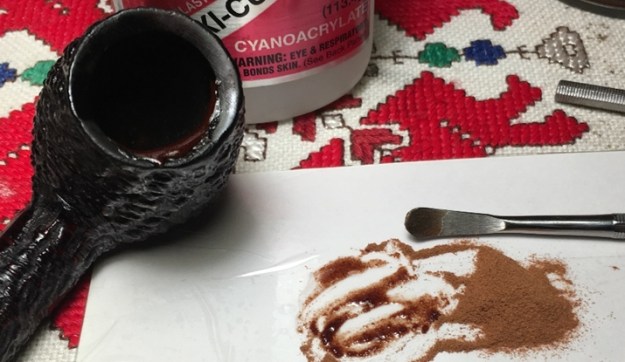
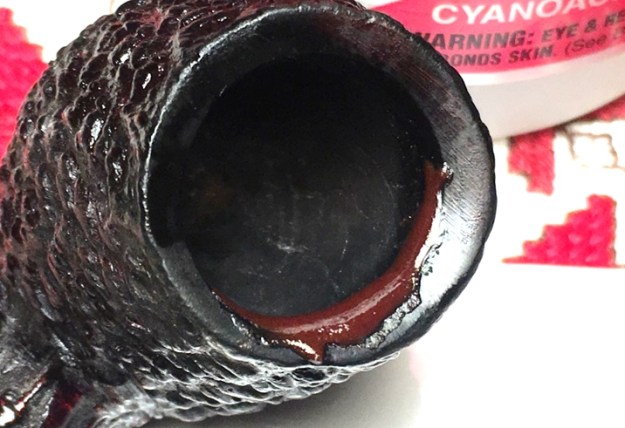
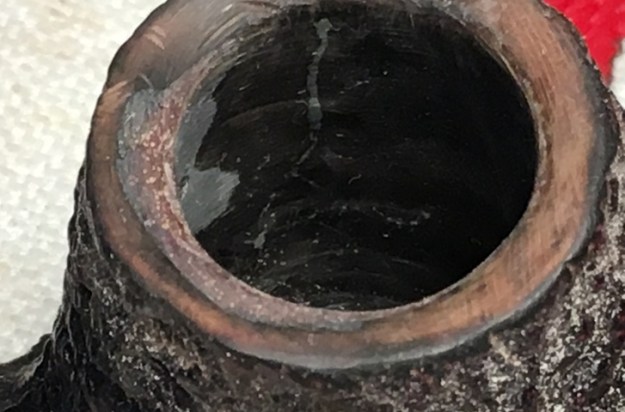
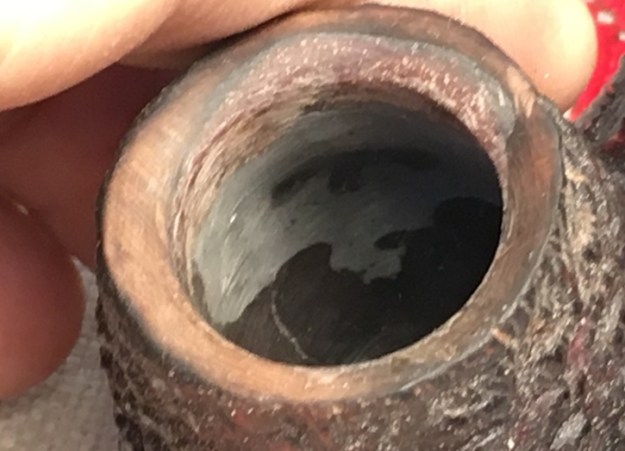
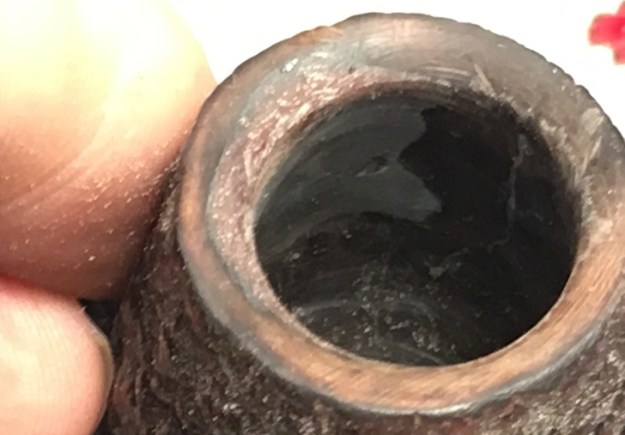
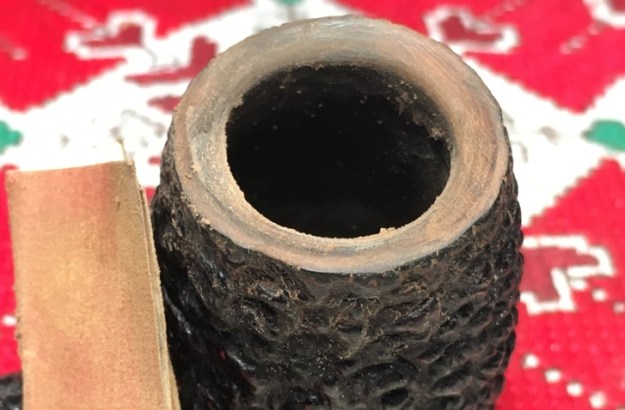
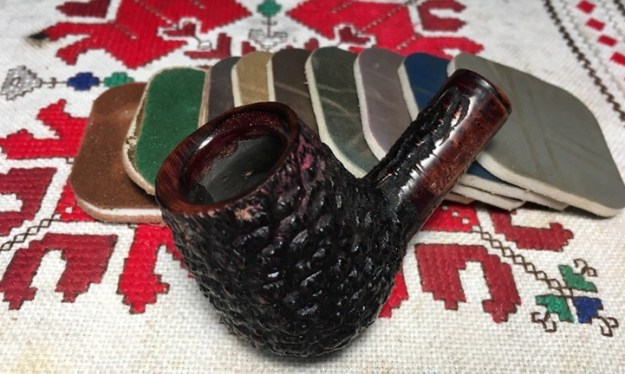
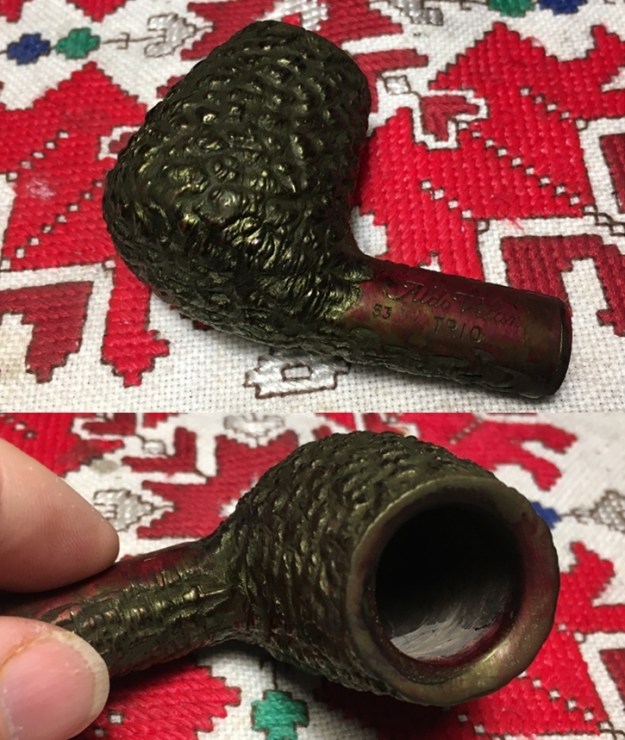
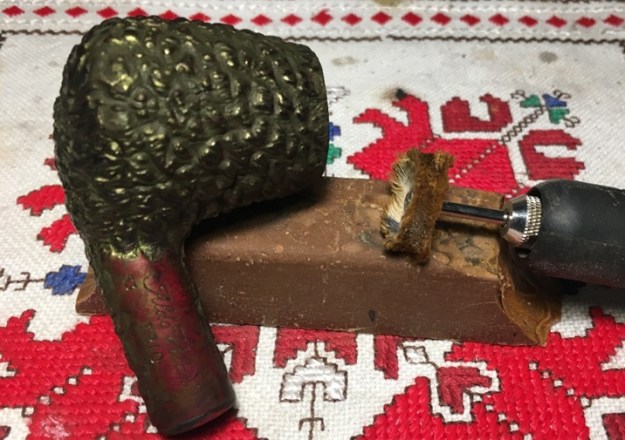
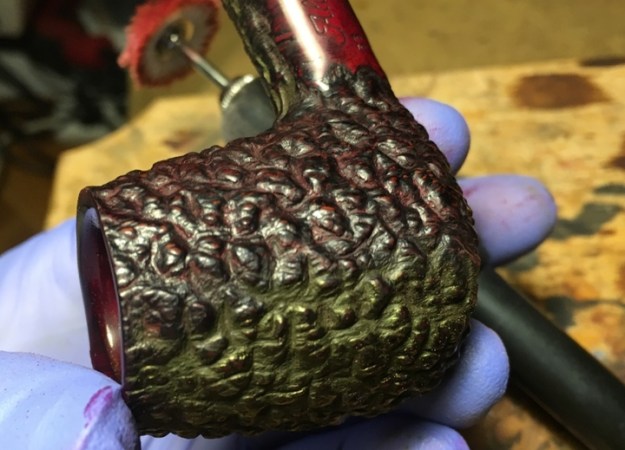
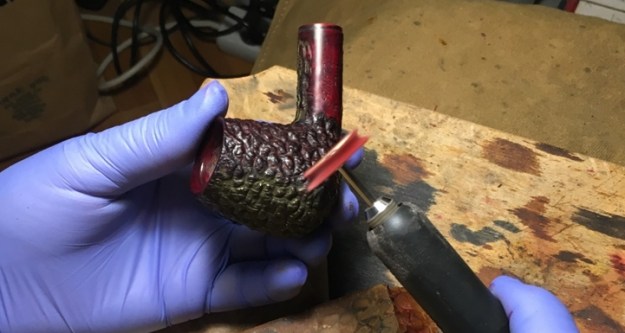
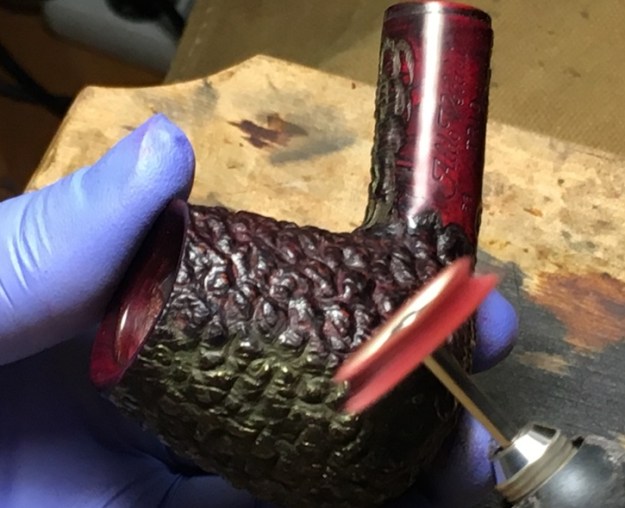
Oh my.  This Barontini Aldo Velani Trio Rusticated Volcano is a classy pipe – I would call it a ‘dinner pipe’.  It requires a more upscale dress code!  This pipe required a lot of work – a repaired stem bit and button, a rim rebuild and a restoration of the damaged chamber.  What a difference!  The rustication is distinctive, and the Volcano shape is enhanced by the craggy rise of the bowl tightening into the summit of the smooth briar rim contrast.  Transitioning to the stem the band adds to the class and the acrylic stem is simply on fire – it’s alive and the Oxblood hue of the briar is… did I say ‘classy’ already?  This Aldo Velani Trio was commissioned by Stephen and he has the first opportunity to claim him from The Pipe Steward Store.  This pipe benefits the Daughters of Bulgaria – women and girls who have been trafficked and sexually exploited. Thanks for joining me!
 

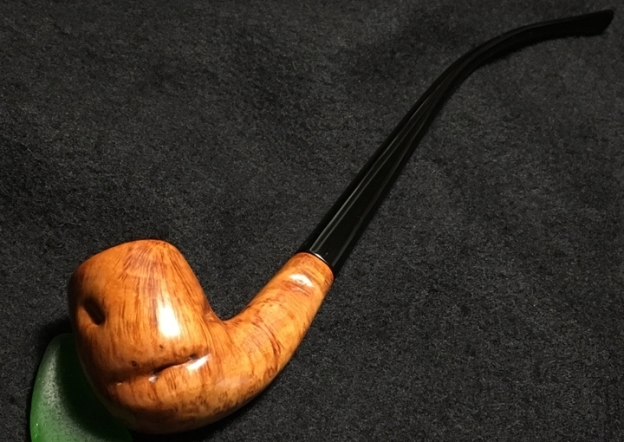
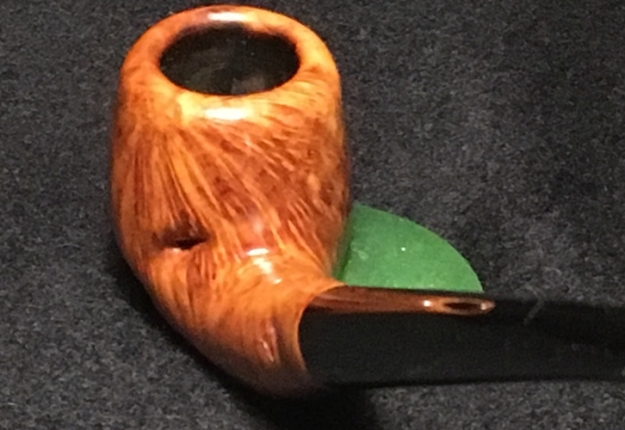
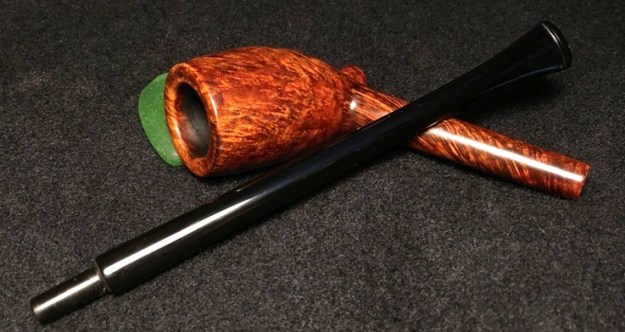
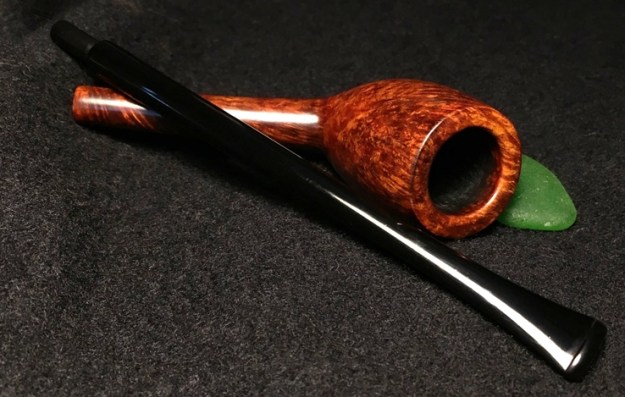
Fashioning a Churchwarden from a Dimpled Bent Billiard Bowl


Blog by Dal Stanton

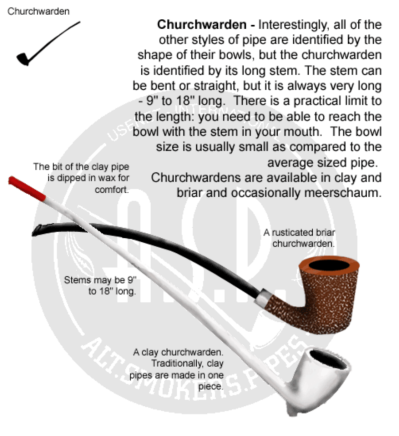
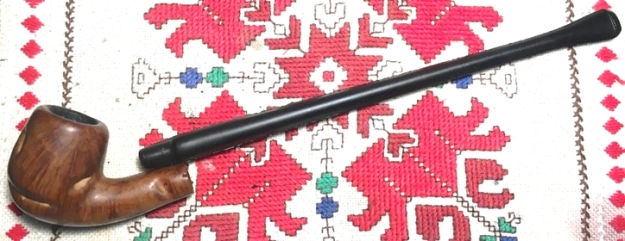
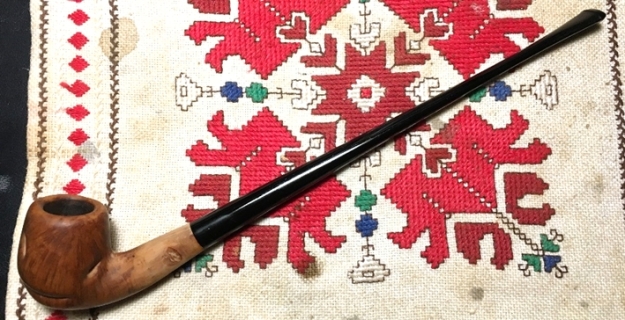
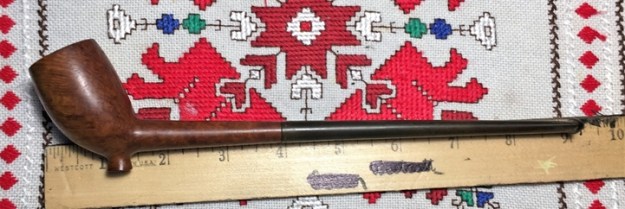
The great thing about the Churchwarden shape is that it is the only pipe that is identified not strictly by the shape of the bowl but by the length of the stem.  Bill Burney’s Pipedia Pipe Chart explanation describes this unique characteristic of the Churchwarden shape.  When I received an email from Coleman, he was looking to add a Churchwarden to his collection.  He wrote:

Hey Dal, I was browsing your website love the pipes, wanted to see if you had any more churchwardens available for commission or sale. I’ve always wanted one, and I can’t think of a better place to buy one than from Daughters of Bulgaria. The longer the stem the better. I really liked the billiard churchwarden, and the French imperial one in the shop that’s already sold. Do you think you’ll get anymore?

Last time I was with Coleman was he was an intern serving with us here in Bulgaria about 5 or so years ago.  He was single then, but as life happens, he is now happily married to Rebecca for 4 years!  He had spoken to Rebecca about adding a Churchwarden to his collection from The Pipe Steward and was agreeable to Coleman’s acquisition because the sales benefit the Daughters of Bulgaria – women and girls who have been trafficked and sexually exploited.  Thank you, Rebecca!

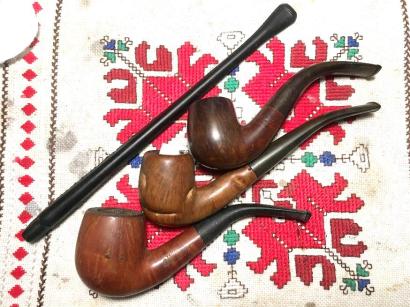
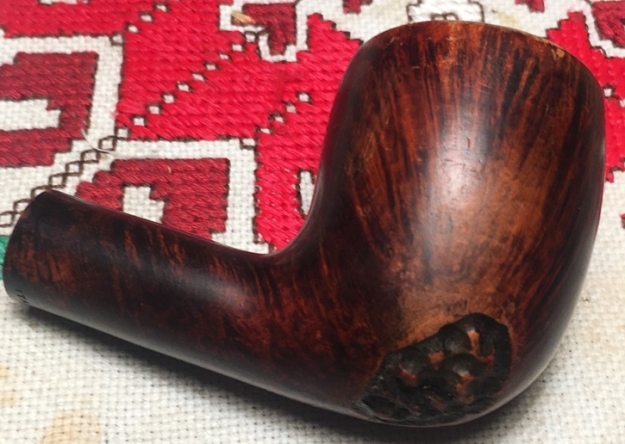
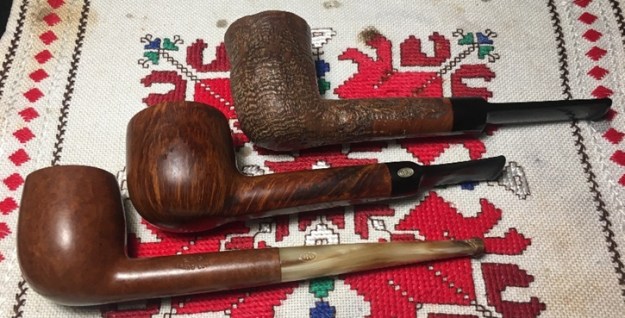
Coleman described wanting a Billiard stummel with a bent shank.  I rummaged through potential stummels that could be repurposed to fashion an acceptable Churchwarden for Coleman.  I found three good candidates and sent pictures to him.  In the end, he settled on the Dimpled Bent Billiard in the center which has great promise for a beautiful display of natural briar grain with interesting rusticated accents.  We discussed the terms and came to an accord and I placed Coleman’s Churchwarden project in the queue.

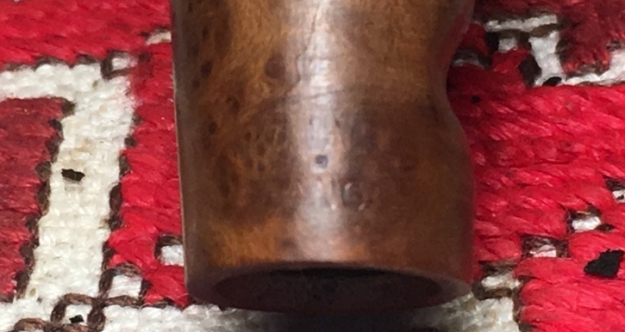
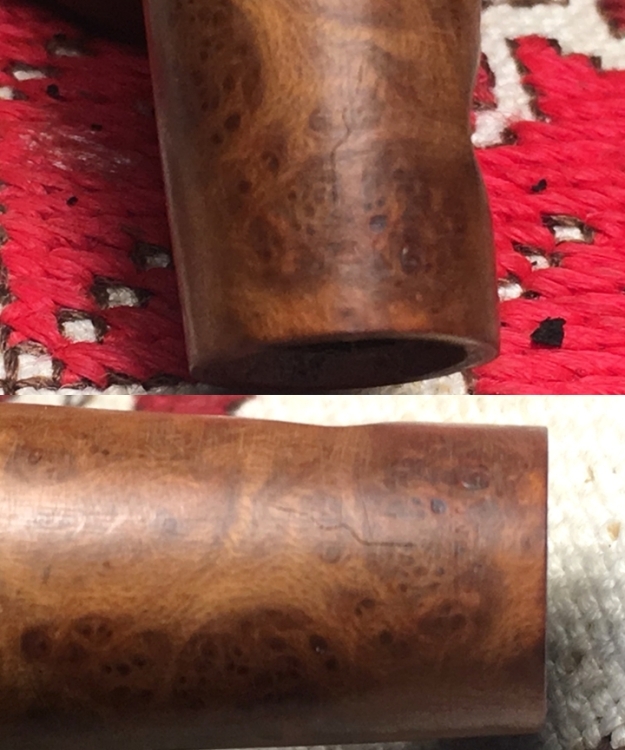
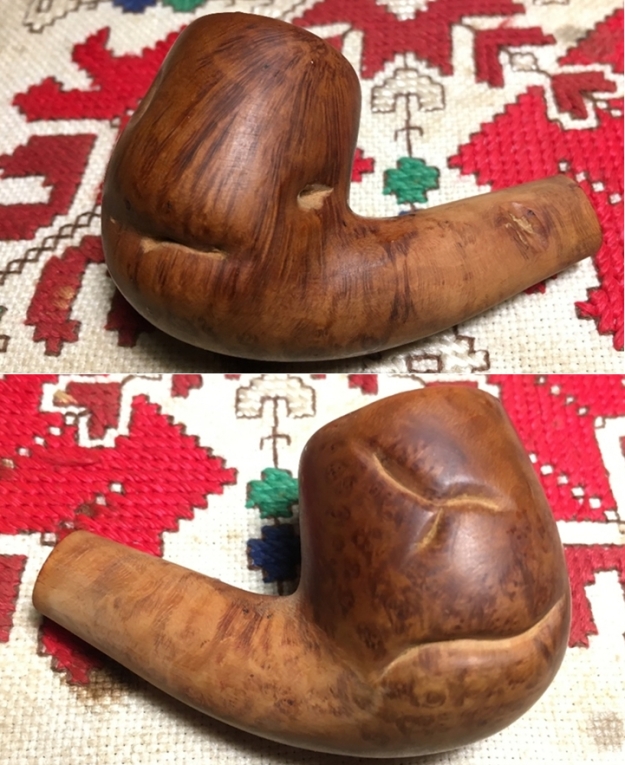
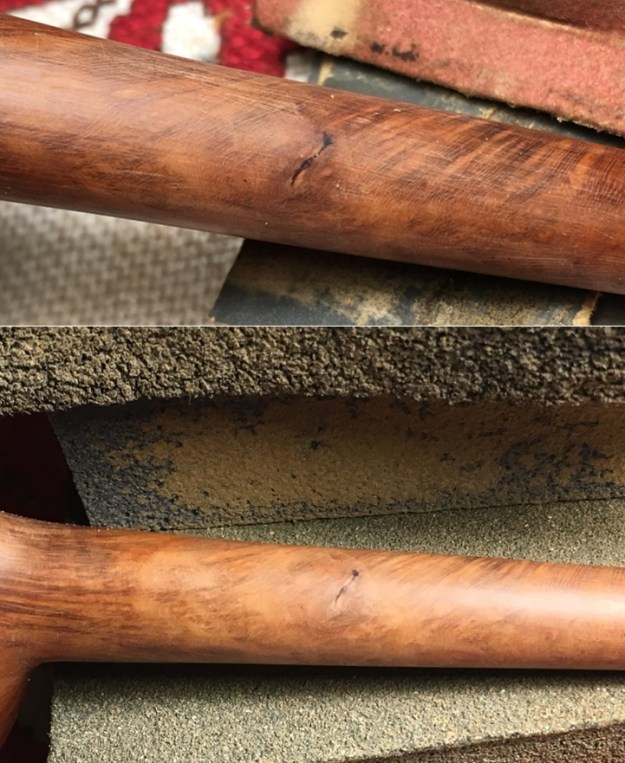
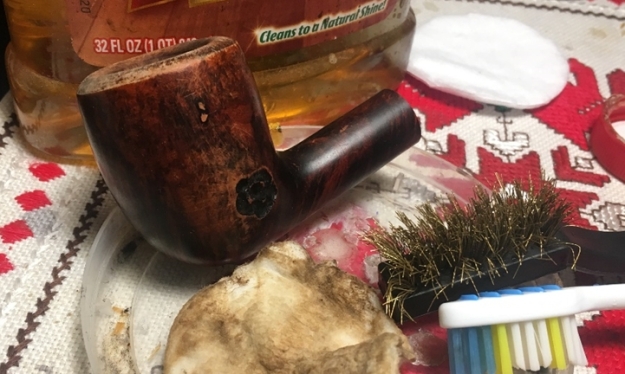
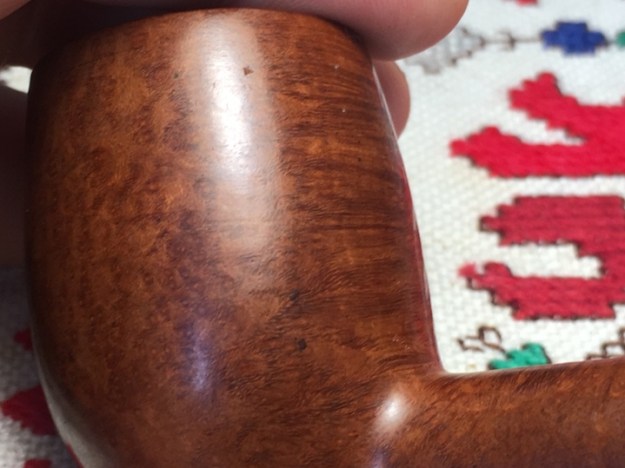
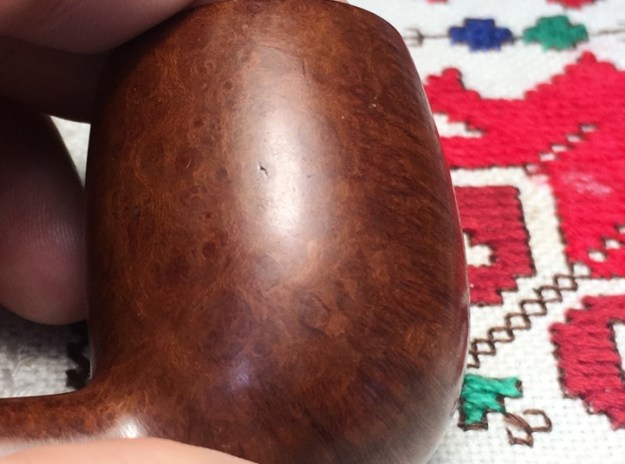
Taking the stummel out and placing it on the work table, when I first acquired the Dimpled Bent Billiard, it came in the Lot of 66 I got off the eBay auction block.  When I initially looked at it, I did not see anything that looked like markings.  With a closer look now, I can just make out on the lower side of the shank the COM being France – I can barely make out ‘ANCE’.  The markings are now so thin that they have nearly passed out of remembrance and undoubtedly will with this fabrication.  I take a closeup of the ghosted marking on the lower shank.What I was not looking for but what is obviously revealed in the closer look at the lower shank is a small stress fracture in the briar.  I take a few more pictures with different angles of light highlighting it.  The good news is that the crack is isolated – not going through to the shank end. I’m assured of this after inspecting closely looking at the shank end and mortise.  My guess is that the small, barely visible crack was formed from a fall where the stem was the first to hit and it pressed up and in opposite reaction, the tenon pressured downwardly on the lower mortise wall and the stress crack resulted on the lower shank. A guess.  I’ll think about what needs to be done about the crack and address it later.The accenting rusticated dimple effect is interesting giving the smooth briar contoured, rustic relief – I like it, and so did Coleman.  The grain shows nice potential in the pictures below. The chamber has some carbon cake build up – I’ll be removing it to give the briar a fresh start.Finally, I take a picture showing the stummel and the Warden stem together – what we’re aiming for!  The bend of the shank sets the stage for a nice, long sweeping Warden stem.I start the Warden fabrication by cleaning the stummel.  Starting with reaming the chamber, I use only the smallest blade head from the Pipnet Reaming kit and follow by scraping the chamber wall with the Savinelli Fitsall tool.  Finally, after wrapping 240 grit paper around a Sharpie Pen, I sand the chamber removing more of the carbon and getting down to the briar.  To remove the carbon dust, I wipe the chamber with a cotton pad wetted with alcohol.  After an inspection of the chamber, it shows no signs of heat damage with cracks or fissures.To clean the external briar, I use undiluted Murphy’s Oil Soap and a cotton pad to scrub.  I also get into the dimples to clean them.  On the rim, the internal lip of the rim is darkened from scorching.  I use a brass wire brush to clean the rim, but even after scrubbing the darkened briar is still evident. The internals of this stummel was no picnic!  Using pipe cleaners and cotton buds dipped in isopropyl 95%, I clean the mortise and airway.  I also do a lot of excavating of tars and oils by scraping the mortise walls with a dental spatula which you can see wiped in plenty on the cotton pad in the picture below.  Using a long shank brush, I’m able to scrub the airway.  It took a good bit of time, but the buds started lightening until enough progress had been made.  Later, I will continue the cleaning by giving the bowl a kosher salt and alcohol soak.I decide to move forward with the stummel repair before beginning the shaping of the Churchwarden stem.  I have two issues to address before moving on.  The rim is scorched and even after cleaning a dark ring persists around the inner lip of the rim.  With the rim already rounded, I will simply go with that flow and bevel out the internal rim damage.  The other challenge is to address the small stress crack on the lower shank.

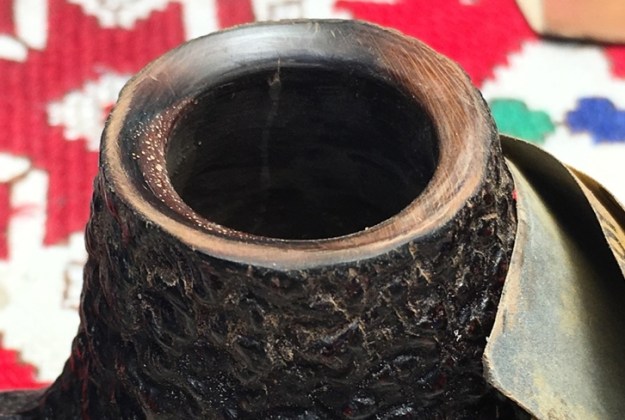
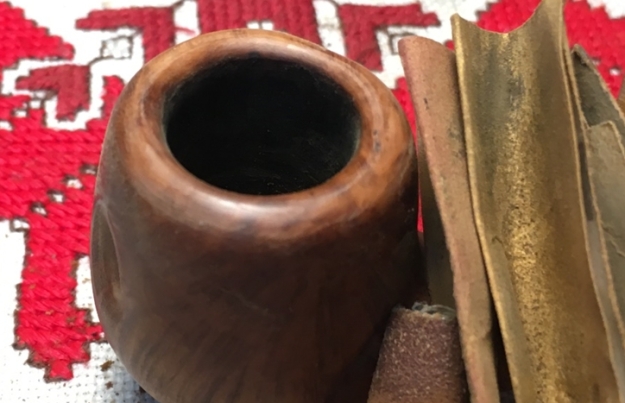
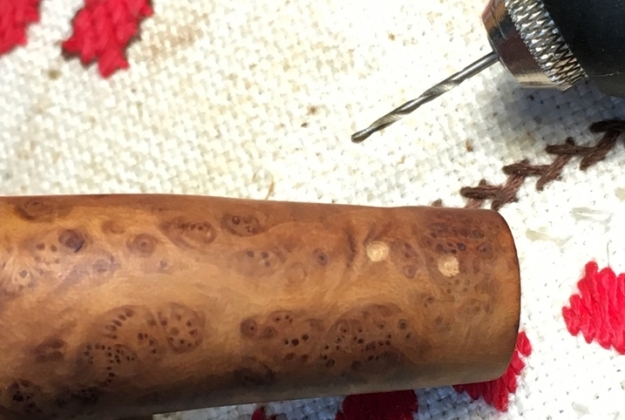
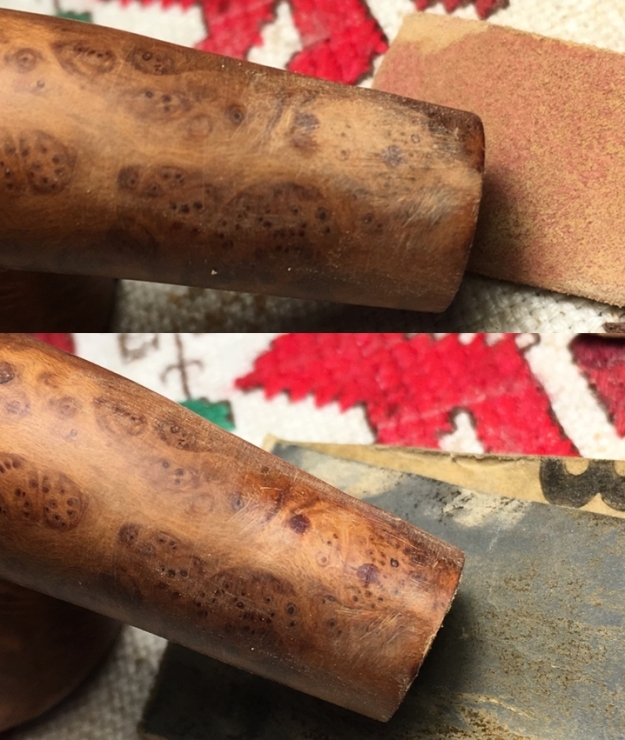
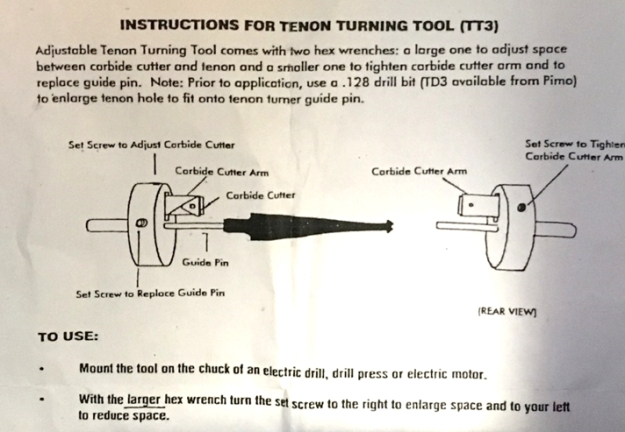
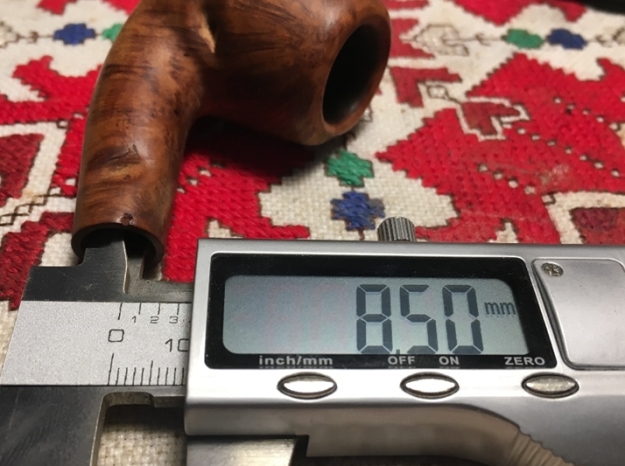
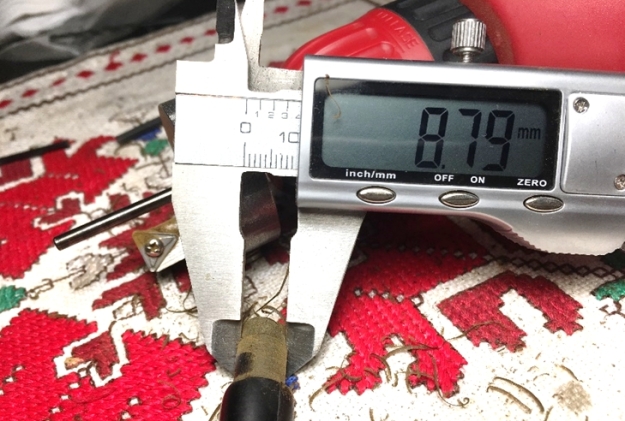
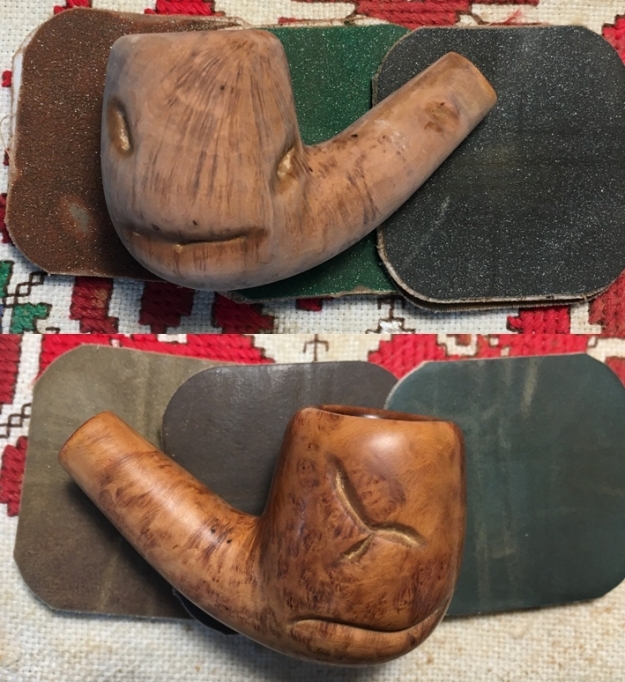
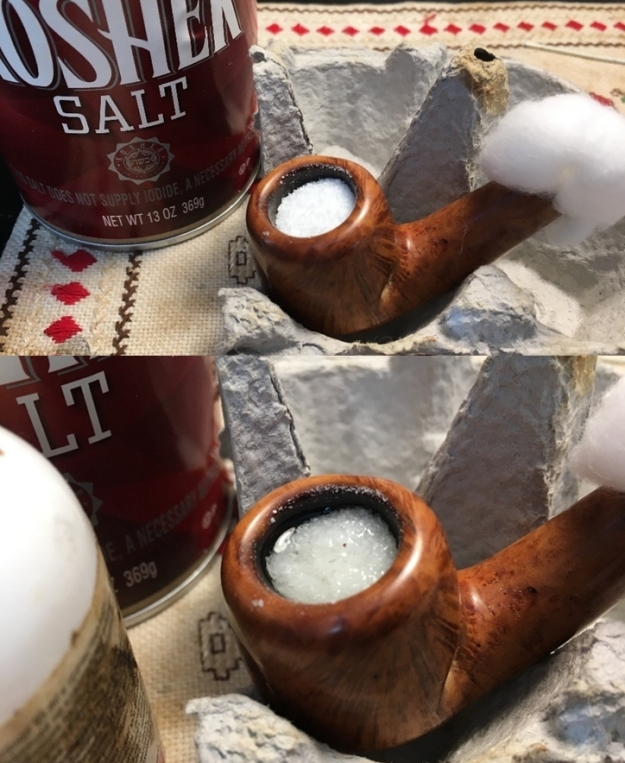
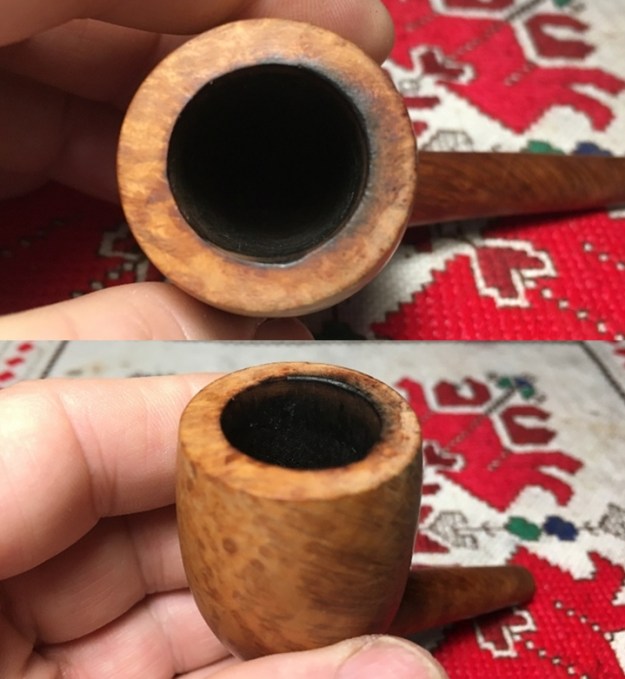
First, I address the rim.  After taking a close-up of the rim to mark the starting point.  In succession, I pinch rolled pieces of sanding papers between my thumb and the inner rim from coarser to less coarse grades: first 120, then, 240, 470 and 600 grade papers.  This removes the damaged briar and freshens the rim and it looks much better.  The rounded rim will look good as a Churchwarden.  Before and after pictures follow: Now, I decide to address the pressure crack on the lower shank.  I will drill two counter-holes at the ends of the crack to guard against the crack growing.  This stops the possibility of the crack creeping in the future.  Drilling these holes is not easy using a hand held Dremel extension with a 1mm drill bit.  Not only do I have the ‘shakes’ as an obstacle of accomplishing a good, true hole drilling, but the depth of the drilling is also of concern.  The shank is not a thick piece of briar!  I do not want to see sunlight coming into the mortise! The first picture is simply of the crack – difficult to see with a magnifying glass.  In order to help guide the drilling, I use a sharp dental probe, again with the aid of a magnifying glass, to mark the ends of the crack with an imprint where the counter-holes will be drilled.Next, I change out the Dremel clamping and mount a 1mm drill bit into the handheld extender.  This is where the jitters really start jittering.  Perhaps, one day I’ll secure a more stable drilling platform but today is not that day!  Thankfully, and I do mean thankfully, the drilling goes well.  Not too much shaking nor too deep. Next, I use thin CA glue because the crack is very subtle, and I want the CA glue to fill and penetrate what it can.  I apply CA glue to the two holes and crack and apply briar dust to the patch.  Hopefully, this aids the holes to later blend.  I put the stummel aside to allow the patch to cure.Several hours later I make it back to the work table and the shank patch has cured and I begin filing the mound with a flat needle file until the patch mound is almost flush with the briar surface.  I then switch to sanding with 240 grade paper to bring the patch flush with the surface and finish at this point with 600 grade paper to smooth it out and blend it.  The patch looks good and I believe the repair was necessary.  It should blend well with the surrounding bird’s eye grain. Time to focus on fashioning the Warden stem with the use of the Pimo Tenon Turning tool which has been a very useful addition to my instruments in my restoration toolbox.  I keep the directions on the wall in front of me!  The visuals give an idea of how this tool works to quickly and accurately resize a tenon.The precast stem is 8 5/8 inches long.  I begin by measuring the inside diameter of the mortise using an electronic caliper.  The measurement is 8.50 mm.  This represents the critical target width of the tenon to fit the mortise.  The precast tenon is obviously fat and I use the Pimo Tool to take off a layer of the fat tenon simply to serve as a starting point.I first pre-drill the airway with the drill bit provided by the Pimo kit to allow the guide pin of the Turning Tool to fit into the airway.After the first ‘fat’ cut of the tenon, the tenon is 9.60mm.  My goal is not to cut the tenon exactly at 8.50mm for a ‘perfect’ fit, but to give myself about .40mm of extra width to then conservatively sand my way to a good tenon/mortise fit. Every mortise is different, and I have found it better to go at it slowly.  So, adding .40 to 8.50 gives me a tenon target width of about 8.90 to aim for using the Pimo tool. With the hex wrench provided I turn the set screw to the left to reduce or tighten the Carbide Cutter Arm of the Pimo tool.  Again for an initial measurement, I only cut small portion of the tenon and measure (picture below).  There’s always the chance of taking too much off!  The test measurement is 8.79mm.  This cut results in the tenon being underneath the 8.90 conservative target but still above the 8.50mm critical measurement.  I take the tenon down to that measurement and begin sanding. To smooth off and form the end of the rough tenon, I make quick work of it with a sanding drum mounted on the Dremel.Gradually sanding with 240 grit paper as well as using a flat needle file, eventually I achieve a good fit.  The tenon is snug but not too snug.You can see in the next picture the overhang of the shank which needs to be sanded down flush with the stem butting against the shank face.  What I also notice is that the face of the stem is shouldered – or down-turned.  This is from not taking off enough vulcanite to have a flat face surface for the stem face to seat against the shank face.  Not shown is remounting the Pimo tool onto the drill and shaving off a bit more of the stem face to improve the junction.  With the flattening of the stem face the tenon seats well.  I go to work sanding the shank to bring it flush with the stem.  I also taper the sanding up the shank to achieve more flow – not having the stuffed pants look.  After sanding the shank/stem junction looks great. Even though the Warden stem is a new precast stem, it must be shaped, filed and sanded to remove vulcanite ripples and manufacturing seams.  I work on the button area with the flat needle file and then 240 grade paper.  I also fully sand the entire stem with 240 grade paper.  You can see manufacturing ripples in the new stem which the sanding smooths out. After completing the sanding with the 240 grade paper, I wet sand the entire stem with 600 grade paper followed by applying 0000 steel wool.  The Warden stem is looking great.  It’s difficult to take good pictures of the Warden stem because the view is always from orbit to get the full length!  So, I provide a few close-ups as well.To hydrate the vulcanite, I then wipe it down with paraffin oil, a mineral oil.I refit the stem with the Dimpled Billiard stem to get a look at the progress.  I’m liking what I’m seeing.Now I need to bend the stem.  I use a hot air gun to heat the vulcanite to make it supple and bendable.  I first put a pipe cleaner in the airway just to make sure the airway does not collapse during the bending.  The general aim is to give the Warden stem a gentle and flowing bend so that the end of the stem is generally in a parallel orientation with plane of the rim.In the end, I re-heat, re-bend, re-heat and re-bend a few times until I was satisfied. I think it looks good.  I go for the flowing look which is more ‘Gandalf-like’ – the subjective bar for all Churchwardens!  I think this will be agreeable to Coleman.With the Warden stem bent, I start the micromesh process by wet sanding the stem with pads 1500 to 2400, then dry sanding with pads 3200 to 4000 and 6000 to 12000.  After each set of 3 pads I apply Obsidian Oil to continue to hydrate the vulcanite.  There is a pop to the freshly sanding/polished vulcanite!Turning now to the stummel, I use sanding sponges to clean the surface of the Dimpled Billiard removing minor cuts and nicks.  I first take some starting pictures then sand the stummel with a coarse sponge followed by medium and then, finish with a light grade sponge.  The sanding goes over the top of the rusticated dimples.  To get into and clean, sand and polish the dimples, later I will use the compounds and the Dremel to do this. I then go directly to sanding with micromesh pads starting with wet sanding pads 1500 to 2400, then dry sanding with pads 3200 to 4000 and 6000 to 12000.  I enjoy watching the grain emerge during the micromesh process. Before going any further with the stummel polishing, I continue the internal cleaning using kosher salt and isopropyl 95% as I indicated earlier. I begin by forming a wick by stretching and twisting a cotton ball to insert into the mortise.  I then fill the bowl with kosher salt, which unlike iodized salt, does not leave an after taste.  I then place the stummel in an egg crate for stability and add isopropyl 95% to the bowl until it surfaces over the salt.  I wait a few minutes while the alcohol is absorbed and top it off once again.  I then set the stummel aside to soak for several hours. The soak did the job.  The discoloration of the salt and wick show the absorbing action of the salt and alcohol.  I toss the expended salt in the trash can, wipe the bowl out with a paper towel and blow through the mortise as well to dislodge remnant salt crystals.  I finish off by expending a few more alcohol wetted pipe cleaners and cotton buds to make sure all is clean, and it is.  Moving on. With Coleman’s agreement, I’m staying with the natural grain color and because of this I utilize Before & After Restoration Balm to condition the briar surface.  The Balm deepens and enriches what is already present in the grain and I like the subtle improved results of using it.  I put some Balm on my finger and rub it into the surface.  The Balm’s texture begins as a thinner oil-like thickness and then gradually thickens into a wax-like texture.  I work the Balm into the rusticated dimples as well. After fully covering the surface, I wait about 30 minutes and then wipe/buff the excess Balm. I use a toothpick also to make sure the dimples are not holding collected Balm.  A few ‘After’ pictures to compare.  It looks great! With the Balm applied, I mount a cotton cloth buffing wheel to the Dremel at 40% speed.  I then apply Blue Diamond compound to the stummel surface taking special care to work the compound into the rusticated dimples. The sanding processes do not get into the crevasses but pass over.  Using the smaller buffing wheel, I’m able to direct the compound into the crevasses.  I also apply Blue Diamond to the Churchwarden stem.  Its easier to keep the stem and stummel separate because of the size of stem and the rotating motion I use with the Dremel.  After completing application of the Blue Diamond, I apply carnauba wax to the stem and stummel using another cotton cloth buffing wheel and leaving the speed the same.  After completing application of the wax, I unite stem and stummel and give the newly born Churchwarden a rigorous hand buffing to raise the shine.

The fabrication of this Dimpled Billiard Churchwarden came out great.  I’m pleased.  The rusticated Dimpled Billiard has beautiful grain with a splay of grain spreading to the rim and much bird’s eye populating the heel of the stummel.  Often, rustication is used to hide blemishes in a lesser quality bowl, but this is not the case with this stummel.  The rusticated dimples are interesting shapes on a beautiful canvas of briar grain.  I believe Coleman will be pleased.  He commissioned this Dimpled Billiard Churchwarden and has the first opportunity to acquire it from The Pipe Steward Store.  This pipe benefits the Daughters of Bulgaria – women and girls who have been trafficked and sexually exploited.  Thanks for joining me!
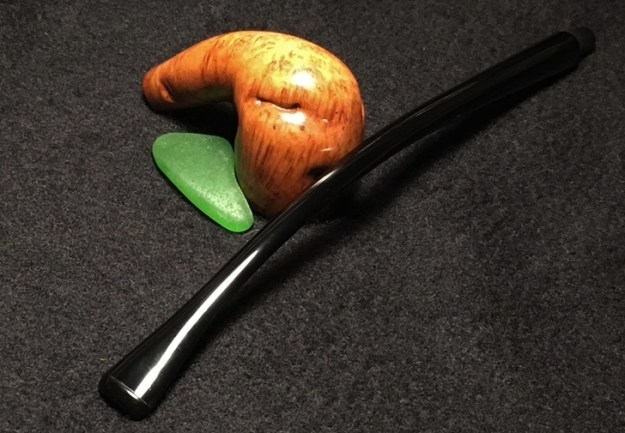
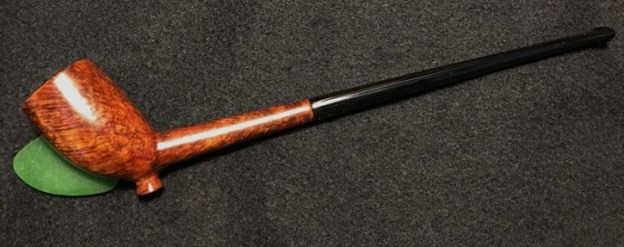
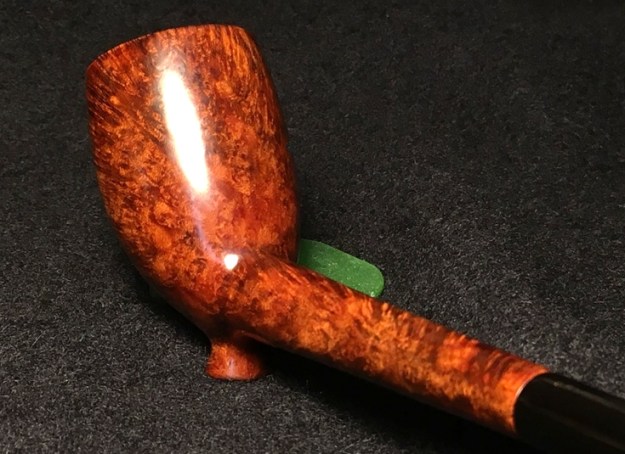
A Cutty Tavern Pipe – Recommissioning a Historical Classic as a Gift for a Steward of History


Blog by Dal Stanton

Tavern Pipe
By Suzie Baker

Summary and excerpts of the artist’s description:
Here the subject poses as an American Colonial man from 1776; he actually posed on Washington’s Birthday.  He has a ruddy complexion and piercing blue eyes. From my perspective, he is more interesting to paint than a golden-haired beauty.

He poses with a tavern pipe. This type of pipe was a communal pipe used in pubs in the 18th century. After each use, the pipe stem was cut away then replaced on the mantel for the next user. I chose a color scheme appropriate to the time period and drew inspiration from Rembrandt’s work in the direct gaze, dark background and loose handling of paint, especially in the clothing….

Let me first tell you the story about the commissioning of the Cutty Tavern Pipe now on my worktable and then I will tell you about the gifted artist I discovered in my research about tavern pipes, Suzie Baker, and her amazing offer to benefit the Daughters of Bulgaria with her ‘Tavern Pipe’.Living in Bulgaria, the opportunities to talk with our grown children (and growing grandchildren!) residing in the US, is a special treat.  My son, Jonathon, reached out to me on FaceTime with a special, ‘historical’ request.  Jonathon desired to commission a special ‘historical’ pipe as a gift for Andrew, a friend who was leaving his job as the assistant curator of the Dearborn Historical Museum – an American city in the state of Michigan that takes its history seriously.   Jonathon, while serving on the mayoral appointed Dearborn Historical Commission, befriended Andrew as Andrew fulfilled his duties as a curator for the museum tasked with safeguarding Dearborn’s history.

Today, Dearborn, a suburb of Detroit, is proud to be one of the most ethnically diverse cities in the world.  Yet, Dearborn’s history is predominantly shaped by the controversial industrialist and auto manufacturer, who called Dearborn his home, Henry Ford (1863-1947).

When Jonathan shared his desire to commission a pipe with some historicity as a gift for a CURATOR of a museum, and that museum was the Dearborn Historical Museum, I was anxious to rise to the challenge that that request presented.  I did a fast dictionary search on Google to see a working definition of ‘Curator’.  This is what I found:

Automobile manufacturer Henry Ford, left, and his son, Edsel, in one of their car showrooms in January 1928. (AP) from Washington Post article (link)

Curator:
a keeper or custodian of a museum or other collection.
“the curator of drawings at the National Gallery”
synonyms: custodian, keeper, conservator, guardian, caretaker, steward

I took special interest in the last word listed as a synonym of curator – ‘steward’, which speaks to my ‘Pipe Steward’ sentiments.  Understanding that we are not the owners ultimately but protecting and caring for that which belongs to others to pass it on.  I understand this as I handle pipes which are laden with their own histories revealed in the nomenclature, but often the history and legacies of that pipe’s steward(s) joins the pipe’s legacy moving together to the future.  As a curator, Andy participated in guarding history.  History by its very nature comes with a blend of beauty and goodness coalescing with ugliness and pain – each side of the pendulum is history which we guard so that we do not forget it and continue to learn from past triumphs and failures – even when it’s not comfortable.

So, the gauntlet was thrown: A Steward of History (Andrew the Curator) is celebrated for his service by the current president of the Dearborn Historical Commission (my son), who reaches out to The Pipe Steward (that’s Dal in Bulgaria) to commission a special pipe, with historical gravitas to adequately serve as an appropriate gift.  Jonathon asked for my recommendations, but relying on the Harry Potter principle in wand selection approach, I turn Jonathon loose

Keens Steakhouse reported to be the oldest pub/restaurant in NYC and that celebrates their history of clay cutty taven pipes and have a serious collection of clay pipes on display (Link from PipesMagazine.com).

looking through my virtual ‘Help Me!’ baskets in the For “Pipe Dreamers” Only! collection to discover which pipe would choose Andrew and let Jonathon know 😊.  After whittling the list down, one pipe did the choosing – the Cutty Tavern Pipe which I acquired from the Lot of 66 off the eBay auction block.  After Jonathon confirmed the commissioning, the first question that came to my mind, since I don’t know Andrew personally, was whether he is the kind of curator that enjoys a trip to the pub after a long day curating at the museum?  This was an important question for my historical research – how do you talk about Tavern Pipes without an appreciation for the natural and historical habitats from which Tavern Pipes have their genesis?  Thankfully, with a confident confirmation, Jonathan assured me that yes, Andrew would enjoy a pub.  With that settled, I began my research.

I found a short description of the Cutty shape on ThePipeGuys site to be a good summary and historical description of the Cutty Tavern Pipe.

Cutty

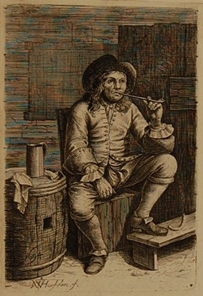
Tavern scene with a man smoking a pipe next to a barrel with a jug on top of it, his left foot resting on a bench. 1694 From the British Museum (Link)

There is no denying the resemblance that the Cutty bears to the clay tavern pipes of a bygone age. Delicately shaped, Cuttys typically have not an ounce of excess briar left in place. This delicacy of shaping necessitates the use of a special drill bit for the tobacco chamber, which tapers even more drastically than a Danish conical bit, and comes to a sharp point at its tip. A special honor is paid to this pipe, in that this type of conical bit is now called the “cutty bit”.

Notice, the ladies are not left out!
From Pinterist Pipe Smoker Group (link)

Many Cuttys still include the “spur” at the foot of the bowl, once again hearkening back to their clay ancestors, but while the spur of a clay pipe was the remnant of the manufacturing process, the briar versions are purely nostalgic. The bowl of the Cutty is heavily canted forward, which helps differentiate it from other long-shanked pipes like the Canadian. The Cutty may sometimes display a very unique stem, which is slim, slender, and round (almost like a straw). However, the majority of modern Cuttys now sport a tapered stem and come in many finishes.

Try simply googling ‘Cutty Tavern Pipe’ and 100s of images begin sharing different shards of the story and one feels like he’s in a time machine.  Of course, the briar descendants of the classic clay workhorse Cuttys of the 1800s and the early 1900s, claim this heritage as their own.

Elizabethans called a pipe a “little Ladell.”

TobaccoPipes.com adds this information in their ‘Complete Guide to Tobacco Pipe Shapes’:

As far as we can tell, the Cutty is the oldest pipe shape that is still available today.  

As early as the 16th century, pipe smokers would settle in at their favorite tavern and–if they had a high enough social status–would pull out a long clay pipe, almost always a Cutty shape.  This shape was common because it was easy to craft in the molds used for clay pipes (William Goldring, The Pipe Book: A History and How to:1973).  

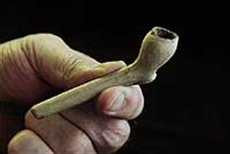
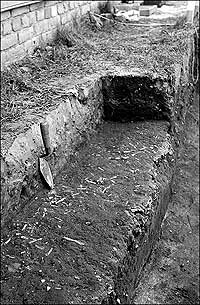
In my digging into the Cutty clay pipe history, I discovered one very interesting and surprising article (at least to me) that a curator would appreciate.  The Colonial Williamsburg Foundation’s (Virginia, USA) website, History.org, published an article by Ivor Noël Hume entitled, “Hunting for a Little Ladle – Tobacco Pipes” (link).  The author describes how archeologist can learn much about different periods of Colonial America in Williamsburg, Virginia’s, history through the recovery of thousands of clay pipe fragments!  As we’ve already mentioned, hygienic concern is the predominant theory.  An excerpt from the author is enlightening:

There are thousands of pipe fragments found in Williamsburg. An early explanation for their ubiquity had it that in colonial-era taverns’ pipes passed from mouth to mouth, but that in the interests of hygiene the previously lip-gripped section was broken off and thrown away. There is no documentary support for that notion, but it is known that used pipes were placed in iron cradles and heat cleansed in bake ovens before being issued to the next round of smokers.

And then I came across this picture that was among 100s of others on the google ‘Tavern Pipe’ image search page results – and I paused.  I see a pipe man in an age gone by and I immediately know what he’s doing as a fellow-pipe man.  Yes, he’s smoking his beautifully shaped long Cutty Tavern Pipe, but he’s doing something else much more important – that his Cutty clay is helping him to do – reflection.  He’s looking out the window, or at the hearth with his eyes, but his heart and soul are elsewhere, seeking understanding or perhaps a much-needed answer.  It is not lost to me as well, that his waiting quill – while ready to move and inscribe on the parchment the sought-out knowledge or answer that his reflection is cultivating, is at rest.  For that moment, the quill waits for the hand’s movement from the heart’s command.

Every pipe man and woman know that smoking a pipe is more than smoking.  It’s a ritual that brings us into calm or fellowship and a slowed time for reflection as we seek to negotiate life and care for loved ones and friends.  The name of the painting I was lost in was simply ‘Tavern Pipe’.  I knew at that moment I wanted to include this painting in the writeup of this special Cutty Tavern Pipe for a special friend of my son – a museum curator would appreciate what I see.

In the next moment I was composing my email to the artist, Suzie Baker, after I clicked on the link taking me to her website where I found her contact information.  This is what I wrote:

Dear Ms. Baker,

I’m writing to you asking for permission to use the picture of your beautiful painting, Tavern Pipe, in a write up I am doing on the restoration of a briar wood Cutty Tavern Pipe.  I came across your www.suziebaker.com site while doing research on tavern pipes.  I will give full credit to your work and website when I cite the information. 

I am an artist of another kind.  You can see my website at www.ThePipeSteward.com.  I collect old, used and often discarded vintage pipes and restore them.  I then sell them world-wide and give the proceeds to the Daughters of Bulgaria – a work in Bulgaria helping women and girls who have been trafficked and sexually exploited.  My wife and I live and work in Bulgaria with the Daughters of Bulgaria.  The pipe restoration hobby is a personal way I try to make a difference by talking about this issue to primarily a men’s world – pipe smokers.  Each restoration has its own write-up which you can see at the website.  I will not use the picture of your painting without permission and if given, will, as I said, give you and your site full recognition.  As a pipe lover and one who enjoys a bowl now and then, your painting captures something of the spirit of those who enjoy, and yes, love not only the smoking of pipes, but the beauty of pipes as they showcase both beauty and design.  I call my work, The Pipe Steward, is because unlike cigarettes and cigars (which I do not like!) pipes are often heirlooms and are passed down from generation to generation.  They often carry with them the memories of those who had them before. 

Thank you for your consideration of this request. 

Best regards, 

Dal Stanton
The Pipe Steward

In the past I’ve written notes like this to individuals and pipe houses asking for information about pipes to aid research and I press the ‘send’ button with a very low expectation that this burst of electrons ever finding their way back to my inbox.  I was surprised when her reply arrived so quickly.  Here is what she said:

Hi Dal,

Thanks for the request and your service to those caught in trafficking, a daunting and worthy cause. 

Yes, I would be pleased for you to use my image in your write-up. In fact, this painting is still available so if the posting results in a sale, I will donate 25-30% of the sale back to your worthy cause. The price and details are listed on my sight in the info under the painting (as seen on a computer screen) or info tag on a Mobile device. 

I am on an airplane currently and about to take off. I can send you the image tomorrow. Please let me know what resolution you require. 

Blessings,

Suzie Baker OPA
Vice President, Oil Painters of America 


Well, as the president of the Daughters of Bulgaria Foundation, her generous offer was something I could not refuse as we work for the benefit of the Daughters.  I appreciated her response and offer.  After looking at her website, I was drawn to the “About Suzie Baker” tab – who is this person?  Not only is she an accomplished artist, wife and mother, but she recognizes that her talent is a gift and she uses this gift to give back to others – especially artists.  There’s much more on this page that describes the accomplishments of this artist who also desires to be a benefactress of women who have been trafficked and sexually exploited. Her ‘calling’ is similar to my own, as I seek to ‘give back’ specially to pipe men and women, the gift of restoring pipes that I am stewarding for a time, and at the same time, seeking to benefit the Daughters.  About Suzie Baker:

Giving Back

This artist also believes in giving back to the community of artists, and she is proud to serve as a Board Member with the Oil Painters of America. “Serving on the board with OPA is and will be a highlight of my career, primarily because of the opportunity it gives me to serve my fellow artists,” she says. “Being on the path of a working artist is a calling. I find helping others on their path a very satisfying pursuit.” She has also earned Signature Member status in numerous other prestigious art organizations: the American Impressionist Society, the

Click the picture for the Daughters!

National Oil and Acrylic Painters Society, the Laguna Plein Air Painters Association, the Outdoor Painters Society, the California Art Club, and American Women Artists.” – from Suzie Baker, Fine Artist at https://www.suziebaker.com/info/suzie

Pipe men and women, if you would like to add the ‘Tavern Pipe’ to your collection of pipes and artwork and help a good and needful cause at the same time, the Daughters of Bulgaria, click the image on the right which takes you to Suzie Baker’s site with a full description of the Tavern Pipe painting, and a higher resolution picture to view. Contact information for Suzie Baker is also included.  When you contact her, simply tell her that it’s for the Daughters.

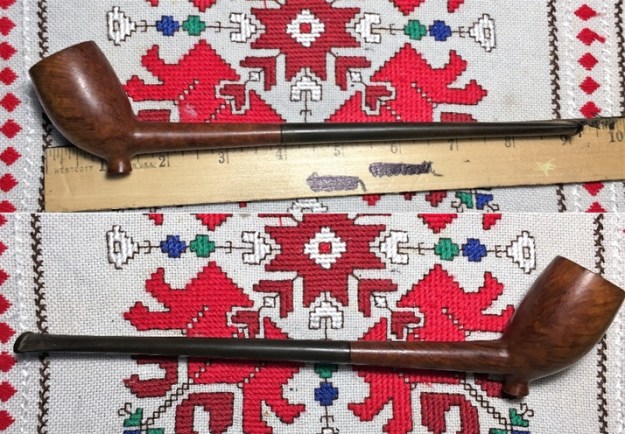
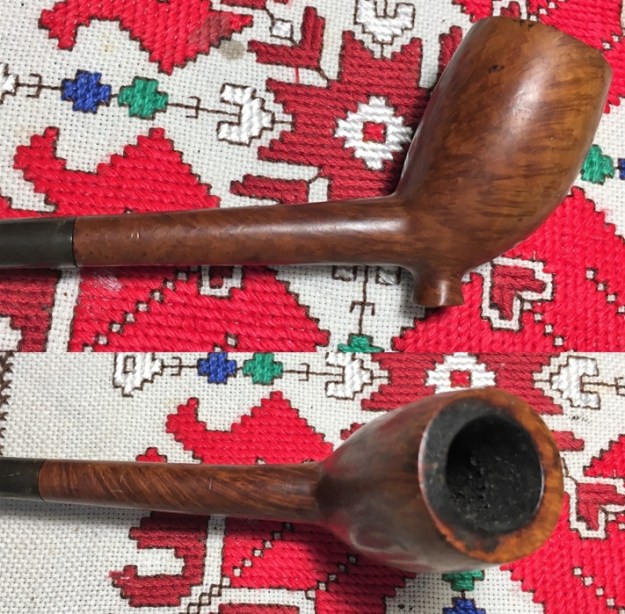
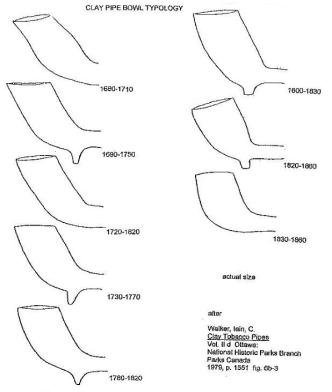
This story has told you about the son, the curator and the artist.  Now, the story turns to the Cutty Tavern Pipe on my work table – the main character!  I was fascinated by the research I did that shed light on this unmarked Cutty.  All the before-mentioned descriptions are true of this 9-inch Cutty Tavern Pipe.  Here are pictures that show you what I’m seeing.     This pipe is the perfect gift for the curator!  One more bit of research that showcases the historical uniqueness of clay Cutty Tavern Pipes and its relations to its briar descendants.  The severely canted and uniquely shaped bowl comes to a point as it ties into the long, pencil thin shank and stem.  A very interesting diagram I discovered at CanadianArchaeology.com (link) of the National Historic Parks Branch of Canada, depicts the historical development of the clay pipe bowl and provides the corresponding dating for that particular style.  As I look at the diagram’s images and comparing them to our Cutty, it was fashioned after the clay Cuttys belonging to the period from 1820 to 1860.  The canting and the bowl width, along with the spur, now ornamental for the briar, all seem to align.  I have no way of dating the Cutty Tavern Pipe heading to Andrew, but its history and heritage wrap around it even in the absence of a verifiable nomenclature.

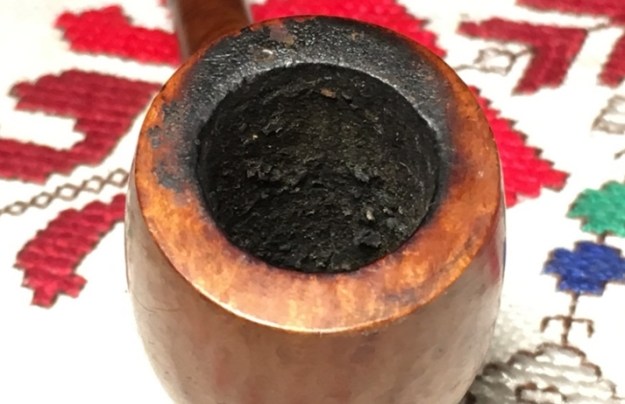
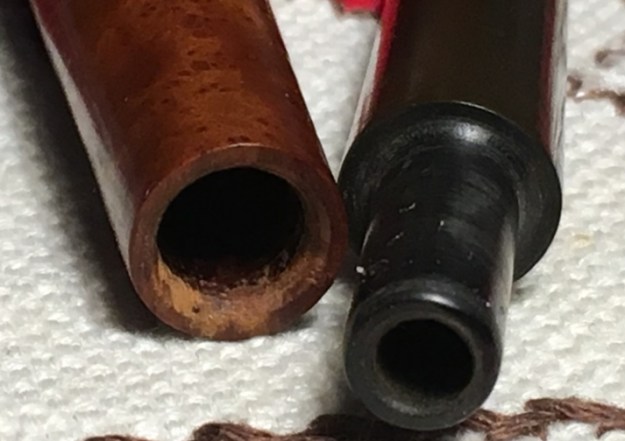
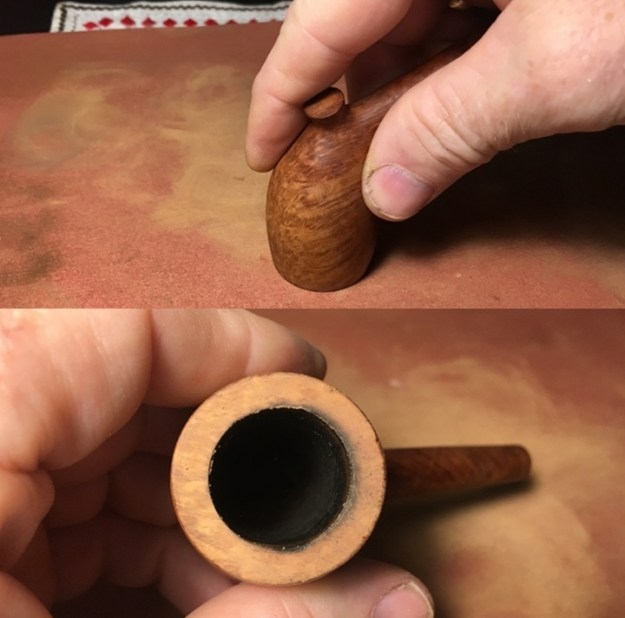
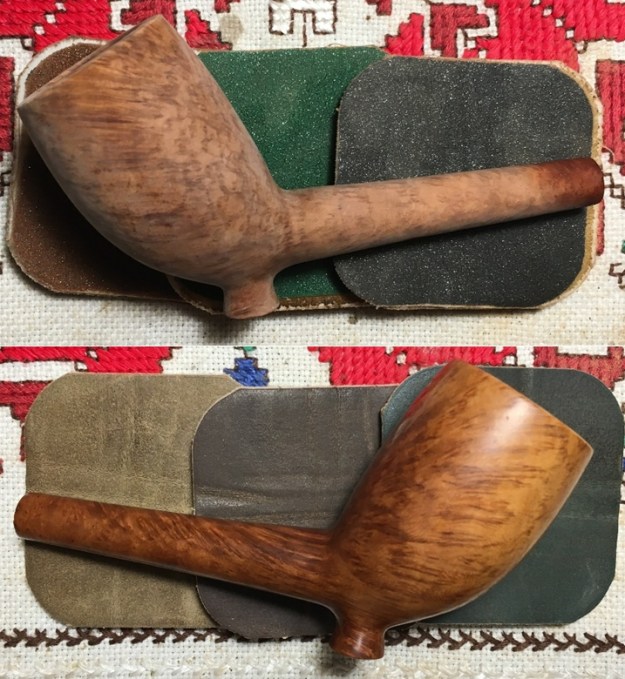
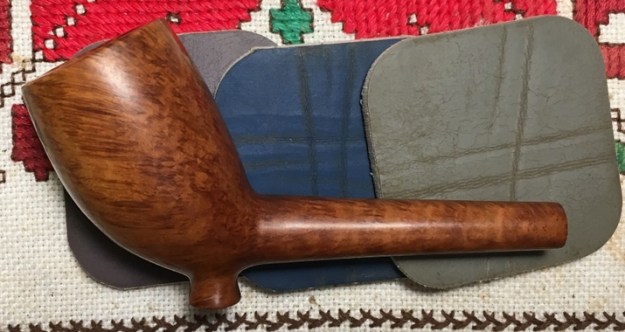
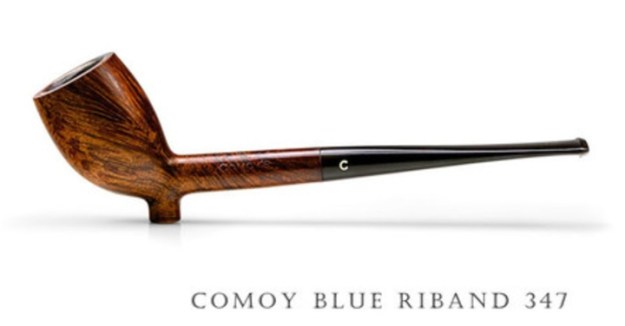
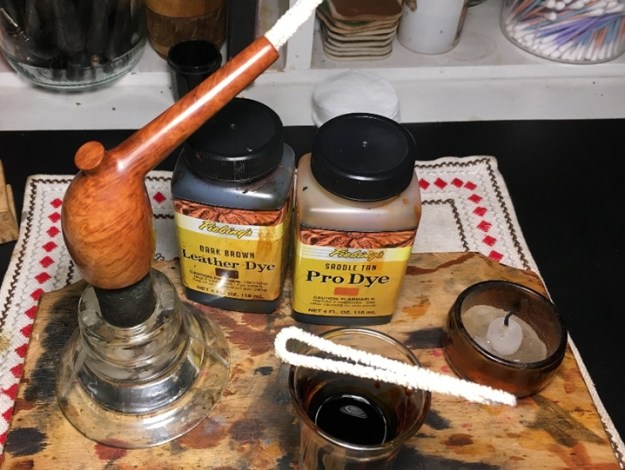
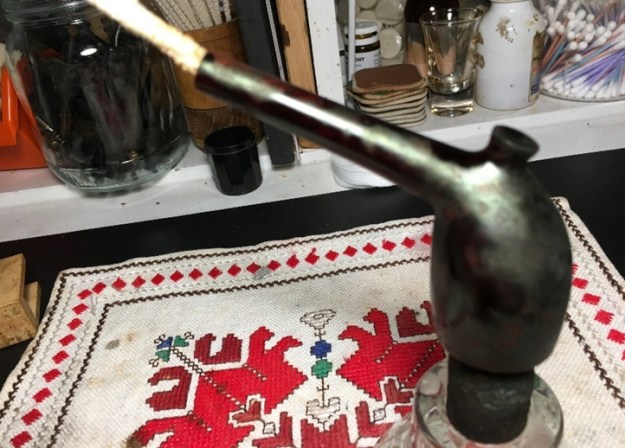
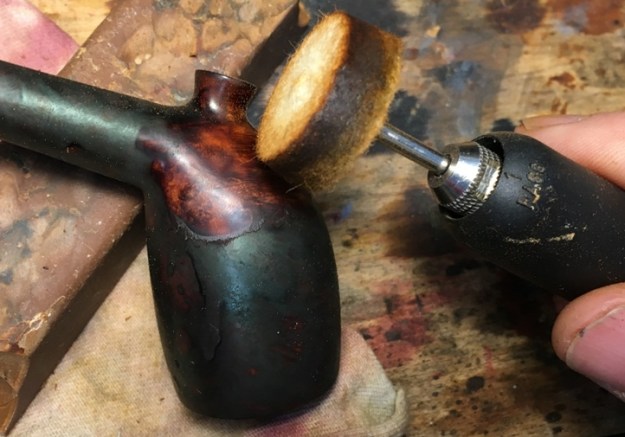
Armed now with a deeper and more comprehensive understanding of the Cutty Tavern Pipe on my table, I take a closer look at his condition.  The briar, somewhat subdued underneath the dirt and grime, is beautiful.  The surface itself shows that it has been well loved and used by a previous steward.  There are nicks and dents over the bowl surface as well as the shank. The pipe shows signs of wear but has been well-cared for.  I say that because, with a shank of only 7/16 inches wide at the stem joint, the fact that the shank hasn’t cracked at this very thin juncture is amazing!  A caution to the future steward, be careful with the stem mounting and removal!  The shank IS pencil thin.  Looking at the rim, there are some dents on the external lip and some significant lava flow over the backside of the rim.  The conical chamber has moderate cake build up which I will remove to provide the briar a fresh start.  The long pencil stem shows some oxidation and tooth chatter on the bit.  The button and slot look to be in good shape.To begin the restoration, using pipe cleaners dipped in isopropyl 95% and long shank brushes, I clean the internal airway of the pencil stem.  It was dirty.After soaking for several hours, I remove the stem and take a closeup shot to reveal the raised oxidation – the olive green layer is now to be removed.To remove the oxidation, I wet sand the stem using 600 grade paper.  Following the sanding, I apply a 0000-grade steel wool on the entire stem as well cleaning the surface further.  To begin the process of rejuvenating the vulcanite, I apply a mineral oil – paraffin oil, to the stem and put it aside to absorb.  It’s looking good!I begin the cleaning process of the stummel by reaming the chamber.  Because of the small, tapering chamber, I do not use my regular Pipnet Ream kit but instead go directly to using the Savinelli Fitsall tool and it does a stellar job.  It reaches very easily to the difficult areas at the floor of the chamber and negotiates well the angle of the conical bowl.  Using 240 grit paper around a Sharpie Pen, I sand the chamber to clean further the carbon cake.  Finally, I clean the carbon dust using a cotton pad wetted with isopropyl 95%.  After inspecting the chamber, I see no heating problems with cracks or fissures.  I move on. Next, to clean the external surface of the stummel I use undiluted Murphy’s Oil Soap with a cotton pad to scrub.  This does a great job.  I also utilize the straight edge of a pocket knife to gently scrape the lava crust from the rim and then use a brass wire brush to work on the burned area of the rim.  The cleaning well removes the finish on the stummel, but there remains a darkened area on the rim where there was scorching.  To complete the basic cleaning regimen, I use pipe cleaners and cotton buds to work on the internals of the mortise.  With the stem internal airway as dirty as it was, I am not surprised to find the mortise equally mucked up with tars and gunk.  After I put on surgical gloves, my first hurdle was to clear the entire airway.  The first pipe cleaners I plunged into the abyss would not push through the draft hole – something was blocking. After a few attempts, the pipe cleaner pushed old tobacco through, and it was finally cleared.  In addition to pipe cleaners and cotton buds dipped in alcohol, I use a long-wired shank brush wetted with alcohol to clean the airway.  A dental probe was also helpful reaching in and excavating the collected tars off the mortise walls.  To increase my cleaning leverage more, I use a drill bit almost the size of the airway, hand turning it as it moves up the airway, scraping the tars of the briar as it goes.  Finally, some headway is realized, and cotton buds begin to lighten.  I’m satisfied with the cleaning for now.With the workday ending, I continue the cleaning of the internals using a kosher salt and alcohol bath.  I first stretch and twist a cotton ball to form a ‘mortise wick’ that I insert into the long, narrow shank of the Cutty.  I use a slender painter’s brush to help force the cotton down the airway.  I then situate the stummel in an egg carton and fill the bowl with kosher salt.  Kosher salt doesn’t leave an aftertaste like iodized salt.  I then fill the bowl with isopropyl 95% until is surfaces over the salt.  I wait a few minutes as the alcohol recedes and then top it off.  I turn out the light to let the salt and alcohol do it job through the night. The next morning the soak has done the expected job.  The kosher salt and cotton wick are soiled after drawing out oils and tars from the internal cavity.  I empty the bowl of salt, wipe the chamber with a paper towel, use a shank brush and blow through the mortise to remove any left-over salt crystals.  To make sure the cleaning is complete, I expend a few more cotton buds and pipe cleaners and find great results. A refreshed pipe for the curator! Moving on!I look now at the rim.  With the dents I see on the outer lip and the scorched darkened briar on the inside of the rim lip, I decide to top the stummel lightly to remove most of the damage to the rim and to freshen the rim lines.  After placing 240 grade paper on a chopping board, with the stummel inverted, I rotate the stummel over the paper several times to top the stummel.  I check to make sure I’m remaining true and finish with a few more rotations. I change the paper on the board to 600 grade and rotate the inverted stummel a few more times to smooth the rim surface further following the coarser 240 grit.  Not all the darkened briar is removed, but I’m not willing to give up more of the rim’s briar.  I focus now on the internal lip of the rim and introduce a bevel to remove more of the darkened briar.  I first cut the bevel using a coarse 120 grade paper followed by 240, then 600.  With each grade of paper, I fold it into a tight roll and then pinch it against the inner rim with my thumb.  I work the rolls around the rim so at the end it is an even, consistent bevel.  I like the subtle softening of the internal bevel and it accomplishes sufficient removal of damaged briar.I move on to the stummel preparation.  As I identified above, I find some significant cuts and dents in the stummel, and especially in the narrow shank.  My guess is that the pipe was stored in a can with the stem inserted first.  The cuts in the shank look like injuries sustained as the shank rubbed against the can edge – my theory.   I take a few pictures to show this.  I decide to fully clean the briar surface and I use 240 grade sanding paper over the entire stummel followed by 470 grade paper.  I then wet sand the stummel using 600 grade paper.  The pictures show the progress. Next, I use sanding sponges to sand and smooth the surface more.  I start with a coarse sponge, then medium then finally, a light grade sponge.  The grain starts emerging during the sponge sanding process.  It looks good. While inspecting the shank afterwards, I notice the crevasse that remains in the shank.  I use a magnifying glass to take a closer look.  It doesn’t appear to be a trauma resulting in a crack but a gouge or cut.  To be on the safe side and for cosmetic reasons, after wiping the area with alcohol to clean it, I apply CA glue to it to seal it. After applying a drop of CA glue on the crevasse, I put the stummel aside giving time for the CA glue patch to cure.With the stummel on the side, I turn back to the stem and look at it again.  The tooth chatter that was evident before was fully removed during the earlier wet sanding with 600 grade paper and 0000 steel wool.  I decide to move now to the micromesh phase by first wet sanding with pads 1500 to 2400 and follow this by dry sanding with pads 3200 to 4000 and 6000 to 12000.  Between each set of 3 I apply Obsidian Oil to revitalize the vulcanite.  The pencil stem looks great! The CA glue patch applied to the crevasse on the shank has cured and is ready to be sanded down and blended.  Using 240 grit paper, I sand down the initial patch mound until it is flush with the briar surface.  Following this, I again use 600 grit paper to erase the 240 scratches and to smooth it out.  As before, I then apply each sanding sponge, starting with the coarse sponge, medium then light. I can still see the scar, but it is now sealed and smooth to the touch and blends in nicely.  A needed detour. With the repair finished, now I apply micromesh pads to the Cutty stummel.  First, I wet sand using pads 1500 to 2400.  Following I dry sand with pads 3200 to 4000 and 6000 to 12000.  The spur even gets its time in the sanding process! During the micromesh phase, I watch the grain emerge and it is beautiful, and see the Cutty bowl design more clearly.  The horizontal grain flanking both sides of the bowl run parallel with the shank.  The cant of the bowl is accented by the grain as the bowl seems to jut out with the grain.  The effect catches the eye.  Added to this is the bird’s eye grain that is on the fore and rear of the bowl.  Whoever turned this block of briar into the Cutty was insightful and could see what the lines would do with the canted Cutty angles.  The picture of the Comoy’s Blue Riband 347 Cutty below (link) has the same eye catching grain motif.  I found this picture of a Cutty as I was doing an online survey looking at the different hues that briar Cuttys come in generally.  Of course, you will find a spectrum of color from dark to light as you look at the googled image pages.  Yet, as I looked at 100s of pictures, what seemed to be resonating with me was the darker hues like the Comoy’s above depicts.  Of course, the clay Cutty is white, but the older ‘English’ classic feel was communicated more through the darker hues like this striking Comoy’s.  My decision was made, and after assembling my desktop staining tools, I mix together Fiebing’s Dark Brown Leather Dye 2 parts to 1 with Fiebing’s Saddle Tan Pro Dye in a shot glass.  After wiping the stummel with alcohol to clean it, I insert into the mortise two doubled pipe cleaners to serve as my handle.  I then heat the Cutty stummel with a hot air gun to open the briar helping it to be more receptive to the dyes.  Using a folded pipe cleaner as an applicator, I ‘wash’ parts of the stummel with the dye and then ‘flame’ it using a lit candle.  As an aniline dye, the alcohol combusts when it meets the flame and as the alcohol burns off in a ‘puff!’ it sets the dye pigment into the briar.  I methodically apply the dyes to the entire stummel flaming as I go. When thoroughly covered, I put the stummel inverted on a cork situated in a candle stick holder to rest through the night allowing the dye to settle.  I discovered that this period of resting is important as it helps guard against the newly applied stain to come off on the fingers later when the pipe is first put into service and the briar is heated for the first time.The next morning I’m ready to start ‘unwrapping’ the fired and dyed stummel.  The firing creates a crust on the surface which I initially remove with the use of a felt buffing wheel applying Tripoli compound.  I mount the felt buffing wheel onto the Dremel, set the speed at the lowest RPMs because I do not want to create too much friction and scorch the briar.I methodically work the felt wheel through the crust revealing the briar grain underneath the crust.  Throughout the process, I purge the felt wheel often as it collects the crusty fired dye.  I stage a picture (below) to show the contrast after the felt wheel applies Tripoli compound and has unwrapped a portion of the stummel revealing the stained grain beneath.  After I complete the initial unwrapping of the entire stummel, I change from a felt cloth buffing wheel to a cotton cloth wheel and increase the speed of the Dremel to 40% full power.  I then apply another round of Tripoli compound with the softer cotton wheel.  I discovered doing this after the felt wheel helps to angle in to the crook of the shank/bowl junction better, but it also removes more dye blotches revealing a sharper grain contrast.After completing the second round of Tripoli, I wipe the stummel with a cotton cloth wetted with alcohol.  This can lighten the finish if I choose to rub more aggressively but I don’t.  I’m satisfied with the color, but the wipe helps blend the finish further and remove excess dye.I follow the Tripoli compound by applying the finer Blue Diamond compound.  I mount another cotton cloth wheel to the Dremel, keep the speed at 40%, and apply the compound.  I apply it to both the stummel and the stem.  Since the stem is longer, it’s easier to keep them separated as I apply the compound.Following the Blue Diamond, another cotton cloth wheel is mounted, the speed remains the same and I apply Carnauba wax to both the stem and stummel.After completing the application of wax, I try to reunite the stem and stummel and discover that the tenon/mortise fit is too snug for comfort.  This often happens after internal cleaning and the briar is wet and that can expand it microscopically – enough that forcing the tenon into this pencil thin shank is a recipe for disaster – cracking a shank is not a fun thing to deal with! To remedy this, I wrap a piece of 600 grit paper around the tenon and sand it down until it fits more easily and snuggly.  This restoration has told an interesting story.  The Cutty Tavern Pipe looks great.  The dark brown finish and polishing regimen has resulted in a unique Cutty bowl drawing even more attention.  The Cutty Tavern Pipe’s lines are classic and harken back to a day gone by when these pipes were fashioned with clay and were held proudly by both those with means and the common man and woman who had gathered with friends to enjoy each other at the pub and a smoke.  A fitting gift for a curator of history and even more so, the commissioning of this pipe by my son, benefits the Daughters of Bulgaria – helping women and girls who have been trafficked and sexually exploited.  The unexpected turn in this story is the painting, ‘Tavern Pipe’, depicting the pipe man and his pipe – an accurate and telling image captured on canvas by the brush of a gifted artist, Suzie Baker, whose generosity is making available a percentage of the sale of this painting to the Daughters of Bulgaria.  Is there a pipe man or woman out there to bring the Tavern Pipe home benefiting the Daughters?  I hope so!  Thank you for joining me!


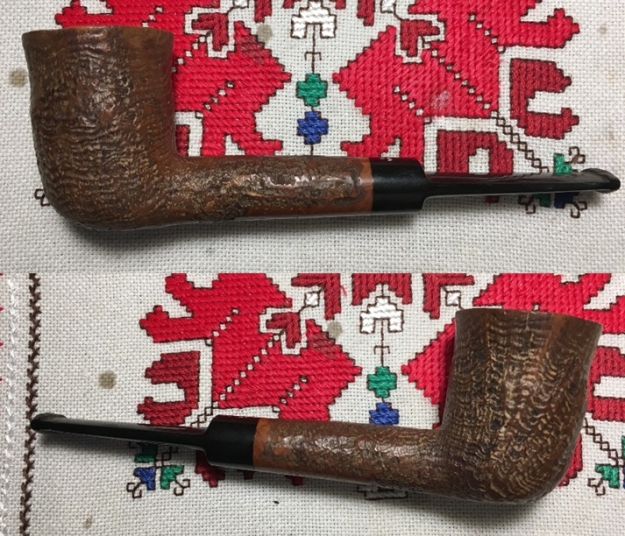
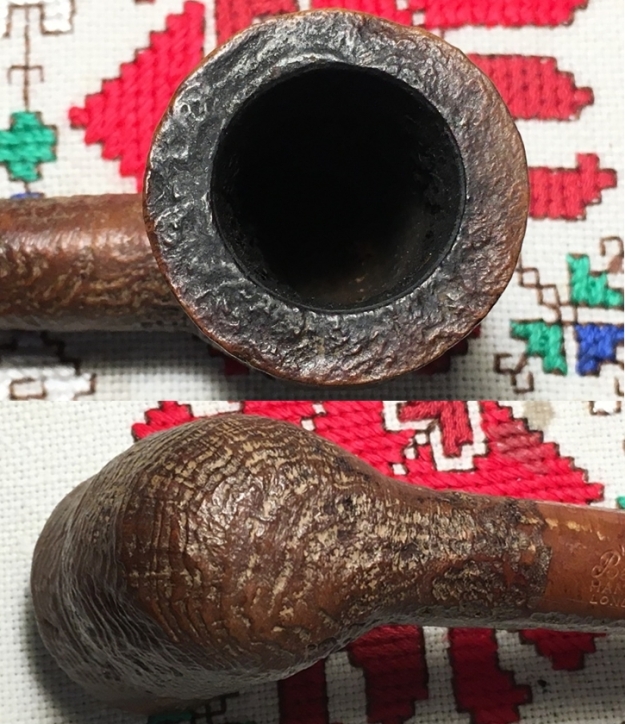
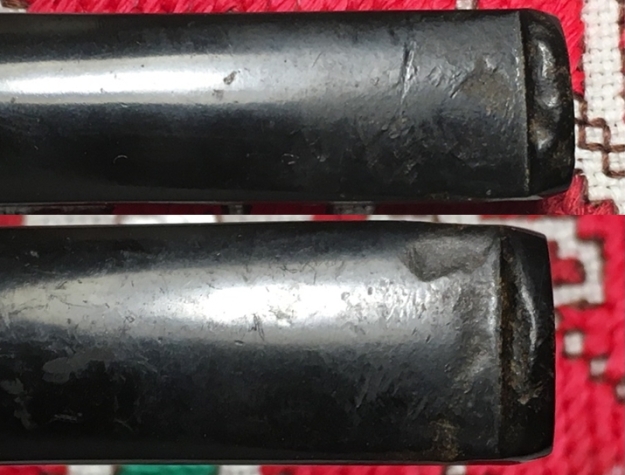
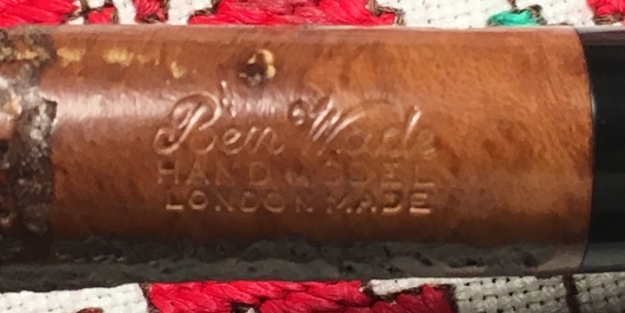
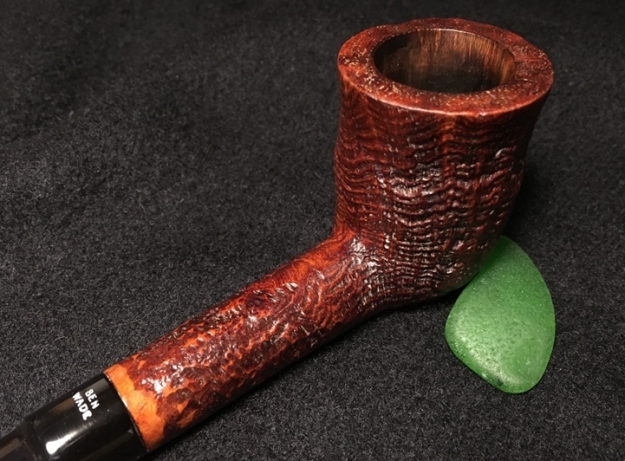
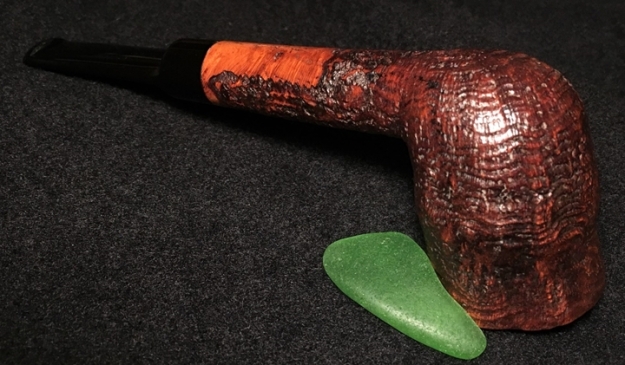
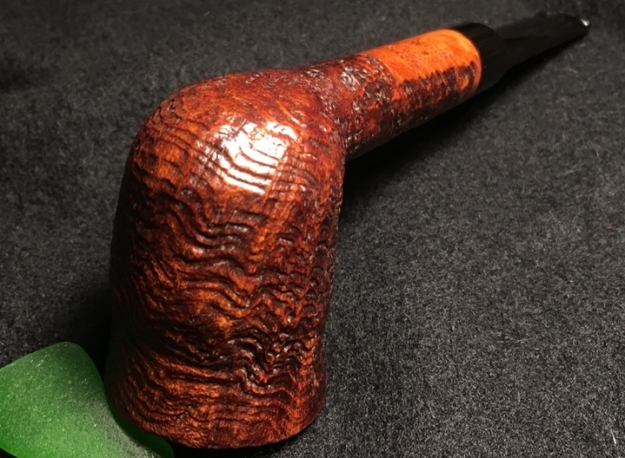
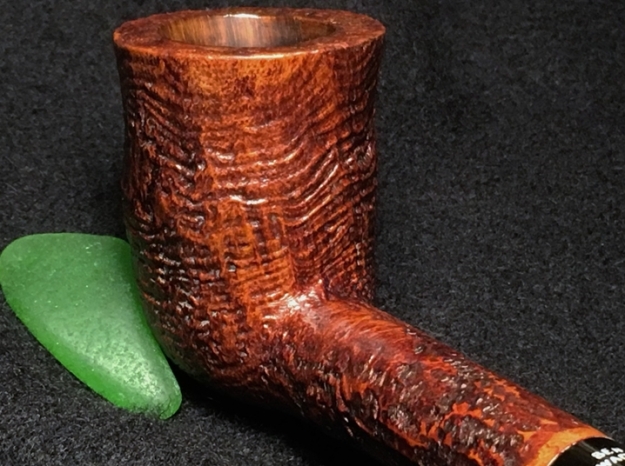
Rejuvenating a Ben Wade Hand Model London Made Billiard


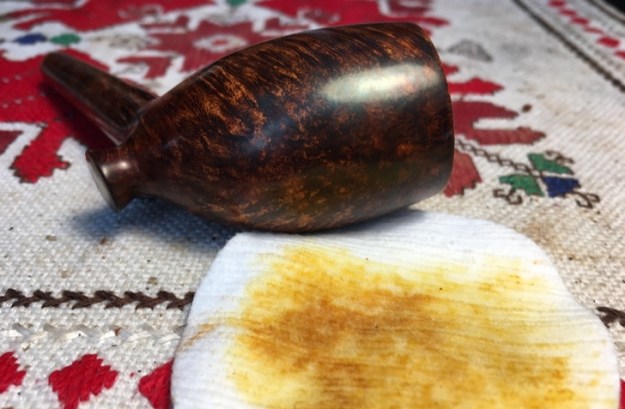
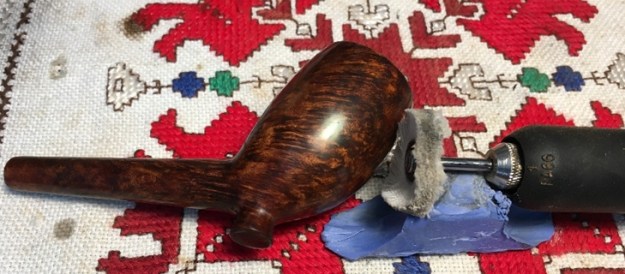
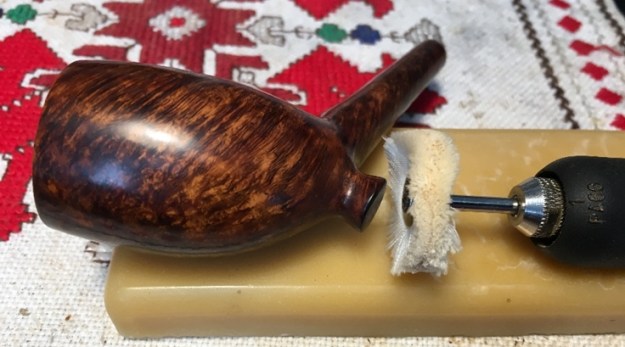
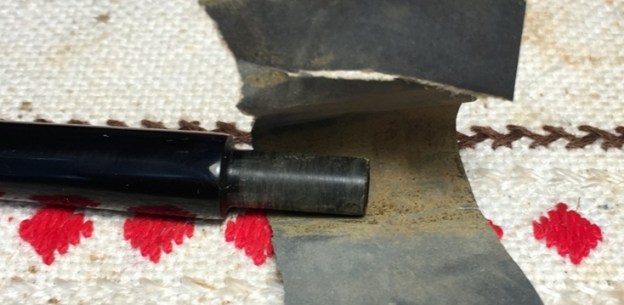
Blog by Dal Stanton

This Ben Wade came to me a couple of years back when I landed, from the eBay auction block, what I have called the Lot of 66. It continues to yield nice collectable pipes. The finish on this Ben Wade is a rustic looking blasted finish which is eye catching with the detail and bowl shaping. It caught Todd’s eye in the For “Pipe Dreamers” Only! collection and is the last of 3 that he has commissioned. Here are pictures of the Ben Wade Hand Model now on my worktable: I’ve discovered through the reading I’ve done about the name ‘Ben Wade’ that it has an up and down history. The Pipedia article is helpful in simplifying the history in four helpful ‘eras’ which I’ve summarized from the Pipedia:

The Family era (1860 to 1962) – the heydays of the English name when the pipes were stamped Made in Leeds, England.

Charatan / Lane second (1962 to 1988) – When Herman G. Lane purchased the name, the transition from a higher quality pipe during the long Family Era transitioned exclusively to the fabrication of machine-made pipes. Lane moved the production from the Leeds factory (closed in 1965) to Charatan’s Prescott Street factory. Ben Wade became essentially lower quality series pipes produced in standard shapes. The pipes during this period were stamped, “Made in London, England” or dropping the “London” and stamped with “England” alone. After Lane died, in 1978 his heirs sold the Charatan and Ben Wade names to Dunhill, which left the production of Charatan/Ben wade at the Prescott Street factor. In 1988 production came to an end for Ben Wade when the Charatan’s Prescott Street factory closed.

Ben Wade turns Danish (1971-1989) – During this era Preben Holm, from Denmark, was in financial difficulties and Herman Lane and he went into partnership producing the Handmade and fancy pipes. These pipes were marked “Ben Wade Made in Denmark”. These pipes gained great popularity, especially as the were marketed in the US. After Lane’s death, Preben Holm, not the businessman, was in financial difficulties and reduced his workforce and production, but at his death in 1989, production of the Danish Preben Holm pipes came to an end.

Resurrection – (1998 to present) – Duncan Briars bought the Ben Wade name from Dunhill in 1998 and production of Ben Wade pipes restarted at the Walthamstow plant, sharing the same space where Dunhill pipes are produced and reportedly benefiting from the same quality of production. During this present era, the stamping on the pipes is: “Ben Wade, Made in London, England”The reason I went through this summary of Ben Wade’s morphing history is because in nothing I’ve read about Ben Wade (and I’m sure there’s more out there), I found no reference to a Ben Wade Hand Model with the COM, London Made. The stamping on the pipe before me is ‘Ben Wade’ [over] HAND MODEL [over] LONDON MADE. The saddle stem has the Ben Wade stamped on the upper side of the stem saddle. My first glance at the blasted finish made me wonder whether this Ben Wade came out during the ‘mystery’ Resurrection period in the Pipedia article. Here is the full text that made me wonder:

As said before Preben Holm’s death marked the third end of Ben Wade and for long years there were no Ben Wade pipes in the shops anymore. But then, all of a sudden they were back in the USA some years ago! Who made these pipes? A concrete manufacturer was not known at first.

The rumors spreading were considerable. Especially because these Ben Wades – originally all blasted and in deep black color – featured so perfect straight and / or ring-grain that they were almost suspicious in view of the prices. The supposition that “Mother Nature” had been given a leg up by means of rustication combined with subsequent blasting was evident as different sources confirmed.

Steve on rebornpipes refers to pipes as having a ‘blasticated’ finish. The process is blasting a rusticated pipe making it appear naturally blasted but the more perfect lines make it seem better than ‘mother nature’ as the Pipedia described. As I look at this Ben Wade, I wonder if it’s from that time period and the grain looks so good, is it blastication? I sent Steve the picture below and his verdict was not blastication, but a really nice looking blasted finish. Yet, I’m stumped by the COM marking. Here’s a close-up of the stummel, very nice natural 3-D blasted grain and not blastication. I sent out pictures of some pictures and the nomenclature to various pipe Facebook groups and the responses I did get, though they were anecdotal, pointed to an earlier period. Paul, from Pipe Smoker of America FB Group, said that he believed it was a Pre-78 and made in Charatan factory. He also said that these were some of his best smokers are London BWs. It sounds good to me!

As I look at the condition of this Ben Wade, the surface needs cleaning to see what the finish will do. The finish is dark and tired as I look at it. The chamber shows light cake buildup and the rim is darkened with some lava flow. The stem will need to be cleaned of the oxidation and the button is chewed some with bite compressions on both the upper and lower bit.

With a better knowledge of the Ben Wade Hand Model Billiard on my worktable, I begin by cleaning the stem airway with pipe cleaners wetted with alcohol and then add it to a bath of Before & After Deoxidizer along with other pipes and stems in the queue. After several hours, I fish out the Ben Wade’s stem and wipe it down with cotton pads wet with alcohol to remove the raised oxidation. The Deoxidizer did a great job.To begin to rejuvenate the stem, I apply a coat of paraffin oil (a mineral oil) to the vulcanite and then put it aside.Next, I go to work on the chamber using the Pipnet Reaming Kit. After putting paper towel down, I ream using 3 of the 4 blade heads available. I follow by fine-tuning with the Savinelli Fitsall tool and finish by sanding the chamber with 240 grit paper wrapped around a Sharpie Pen giving the briar a fresh start. I then wipe the chamber with a cotton pad and alcohol ridding it of leftover carbon dust. After inspecting the chamber, I see no heating or burning problems. I move on! The internals of the mortise and airway are next on the cleaning regimen. Using cotton buds and a few pipe cleaners, things clean up quickly. I also use a dental spatula and scrape the mortise wall and remove very little tars and oils. It’s nice when a stummel isn’t horrendously grungy! Moving on.Moving now to the external blasted finish, I use undiluted Murphy’s Oil Soap with a cotton pad to scrub. I’m wondering how strong the finish is – it appears a bit thin and the cleaning will reveal the answer. I also use a bristled tooth brush as well as a brass wire brush on the rim. After scrubbing, I take it to the sink and rinse the stummel with cool tap water without allowing water in the internals! The verdict is that the finish is worn and the scrubbing on the rim has left bare briar. With the day closing, I want to give the internals a further cleaning using kosher salt and alcohol as a soak. I create a wick from a cotton ball by pulling and twisting it. The wick serves to draw the tars and oils out. I then insert the wick down the mortise and airway with the help of a stiff wire. I then fill the bowl with kosher salt (which leaves no aftertaste) and after placing the stummel in an egg carton to keep it stable; I put isopropyl 95% into the chamber until it fills. I wait a few minutes and top off the alcohol once more. I turn out the light allowing the stummel to soak through the night. The next morning, I discover that the soak has not unearthed too much additional tars and oils from the internals of the pipe. This was confirmed after I followed with a few cotton buds and pipe cleaners dipped in alcohol. Cleaned!Turning my attention now to the Ben Wade stem, the Before & After Deoxidizer did a great job excising the oxidation from the vulcanite rubber compound. Now I focus on the bit and button repair which have some significant bite compressions. I take a closer look with a couple of pictures to mark the start of the repair. I start by painting the bit area with a Bic lighter to heat and expand the vulcanite. After doing this for some time I take comparison pictures to show the unsatisfactory progress. Comparing first:

Upper bit, before and after:Lower bit, before and after:The heating process made little progress. I now mix activated charcoal with CA glue to form a patch material and apply it to the tooth compressions and to the button lips – I’ll need to reshape the button. I first clean the stem area with isopropyl 95%. I then gradually mix thick CA glue with activated charcoal on an index card. I aim for a thickness of molasses so it’s thick enough to stay in place not run but will allow some manipulation once applied. On the first mixing, I mixed too much activated charcoal with the CA glue and got one of the chemical reactions where the mixture hardens instantly giving off an acrid smoke!! This has happened before. I need to apply the mixture before it thickens too much. The next mixtures work well. After applying patch material to both upper and lower I set the stem aside to allow the patch to cure. I turn my attention now to the Ben Wade Hand Model stummel. I like the rustic look of this stummel. What I also like about it is that there is a curving or narrowing in the shaping of the bowl about 2/3s up as it moves toward the rim. With the rough finish, rough is good and the surface reminds me of tree bark! With the stummel being dry and with a light blotchy look in the valleys of the blasted areas, I decide to add some paraffin oil to the briar to hydrate it. Doing this also allows me to get a sneak preview of what the briar will look like somewhat finished, I apply paraffin oil to the surface with a cotton pad. This moisturizes the briar and I like what I’m seeing. The only thing I’m not liking is that the scorched place on the back side of the rim is still evident even with the help of a darkened blend. The pictures show what I’m seeing. I decide to go back to an elbow grease methodology and focus cleaning on the rim with a brass wire brush and Murphy’s Oil Soap. This time Murphy’s has its way. I did do a lot of scrubbing and the rim surface shows the skinned lighter area on the rim where the cleaning was, but the scorched area was removed.To darken the rim to blend with the rest of the bowl, I use a cherry dye stick which matches pretty well and I color the rim as well as the edge of the rim – external and internal. This looks good and will blend in more as I polish.Next, to clean up the lower shank panel, I very quickly and lightly, run the area through the full regimen of 9 micromesh pads from 1500 to 12000 – dry sanding with each. I wasn’t worried about the nomenclature because it is deep and solid, and I sanded very lightly with the pads. This gently cleaned the smooth briar of minor nicks and scratches.I like the look of the finish and decide that it looks good just as it is. In order to deepen and enrich the natural grain, I apply Before & After Restoration Balm. I like this product that can be found at http://www.lbepen.com. I apply some of the Balm to my fingers and thoroughly work it into the briar surface – into the nooks and crannies of the richly blasted briar. After applying, I let the stummel sit for a few minutes – 10 or so, and then I wipe the stummel with a microfiber cloth to remove the excess Balm and to buff it up a bit. I take a picture during the ‘absorbing’ period.The patches on bit and button of the stem are now cured after several hours. I begin to remove the excess patch material on the upper bit using a flat needle file. I’m careful to establish the new inner lip of the button. As I filed to shape the new button lip, I discover a crevasse hidden below which is too severe simply to remove. There are other pockets on the button that don’t look too promising. It is normal in my experience, that its necessary to apply additional patch material to fill pockets and gaps that appear during filing and sanding.To address patching the button problems, this time I use a black CA glue to fill the crevasse and pockets and I apply an accelerator to quicken the curing process. Again, filing and shaping the upper button lip and this time better results are realized.I follow filing by sanding with 240 grit paper (which I forgot to add as a prop to this picture!) to erase the marks left by filing. As with the filing of the button, the finer 240 paper reveal a cluster of pockets in the center bit area in the patch. Again, I spot drop black CA glue to fill the pockets, apply an accelerator and file the excess then sand the bit area with 240 grit paper. The upper bit and button area look good. The same process is repeated on the lower bit and button. It too, looks good. With the bit repairs completed and with the repaired button shaped, I continue by wet sanding the entire stem with 600 grade paper. I’m careful to work around the BEN WADE stem stamp on the saddle. After wet sanding with 600 grit, I apply 0000 steel wool to stem. Finally, I wet scrub the stem with Magic Eraser. I’m satisfied with the progress. I move forward with the micromesh pad regimen wet sanding using pads 1500 to 2400 followed by dry sanding with pads 3200 to 4000 and 6000 to 12000. I follow each set of 3 pads with an application of Obsidian Oil which further rejuvenates the vulcanite. I like that vulcanite pop! The stem looks great. I try to reunite the stem and the stummel and as is the case sometimes, after cleaning the mortise, the briar inside can expand causing the fit with the tenon to become too tight. I do not want to force the stem and risk a cracked shank, so I gently ream the mortise with a half-rounded needle file. Then I gently sand the tenon by wrapping 600 grit paper around the tenon.This works and I am able then to reunite the stem with the stummel and mount a cotton cloth buffing wheel to the Dremel and set the speed at about 40% full power.  I apply Blue Diamond compound to the entire pipe.  I run the wheel along the grain of the blasting to bring out the contrasts of rough briar as well as to buff it up into a shine.  After completing the Blue Diamond, before applying wax, I freshen the Ben Wade white stem stamp.  I clean the area with alcohol and then I dab a bit of white acrylic paint over the stamping.  I then use a cotton pad to tamp the wet paint which draws off the excess paint and helps the paint to dry sooner. Then using a toothpick, I gently scrape off the excess paint leaving a refreshed BEN WADE stamp.  It looks nice and crisp.I then mount another cotton cloth buffing wheel onto the Dremel and apply carnauba wax to the stummel.  I increase the speed of the Dremel from my usual 40% up to about 50 to 60% full power.  I do this to create more heat with the friction of the wheel to encourage the wax to dissolve in the craggy blasted briar surface.  Waxing a rough surface can cause the wax to collect and not to absorb into the surface.  The added heat encourages this and as I look at the waxing action, it looks like it’s having the desired effect.  Nice!  After finishing the waxing process, I then give the stem and stummel a rigorous and substantial hand buffing to remove any excess wax and to raise the shine.

The blasted grain on this Ben Wade Hand Model is distinctive.  It looked so good I thought that it might be the blastification process, but it is the real deal.  The shaping of the bowl also adds to the rustic effect with it tightening near the top and then flaring out.  The blasted briar displays many hues of grain – very eye pleasing.  This is the third of three pipes that Todd commissioned, and he will have the first opportunity to acquire this Ben Wade Hand Model from The Pipe Steward Store.  These pipes benefit the work we do here in Bulgaria with the Daughters of Bulgaria working among women and girls who have been trafficked and sexually exploited.  Thank you for joining me!

Todd’s Second Commission: A GBD New Era London England 9493 Pot with Distinction


Blog by Dal Stanton

This is the second of 3 pipes that Todd commissioned.  I saw this GBD New Era long shank Pot or possibly a wide bowled Lovat, on the eBay block and liked it immediately.  It has seen some serious wear and tear, but he is obviously well loved, and the grain….  Oh my, the vertical grain on the bowl of the Pot shape it distinctive and when cleaned up….  Dream!  Well, my bid was enough when the bell rang, and it didn’t remain in my collection, and Todd saw the potential in the For “Pipe Dreamers” Only! collection and now this GBD New Era is on my worktable.  These pictures take a closer look at the GBD New Era: The nomenclature on both sides of the shank are thin but legible.  On the left flank of the shank is ‘GBD’ encircled in the oval [over] ‘NEW ERA’.  The right side of the shank is stamped ‘LONDON ENGLAND’ [over] 9493, the shape number.  The stem bears the classic brass GBD rondel.

I like this A Brief History of GBD from Pipedia to remind me of the origins.

The company was founded in Paris France in the 19th century by Ganeval, Boundier and Donninger who were no longer associated with the company by the turn of the century. By the time they left the GBD name was well established and thus retained. In 1903 an additional factory was built in England and ran by Oppenheimer. The Paris factory moved to Saint-Claude in 1952. Since 1981 the majority of GBD pipes come from the English factory. At about that same time GBD merged with Comoys, since then all production for both GBD and Comoy comes from a single factory.

The dating of this New Era can be determined with certainty to be before the 1980s. The brass rondel on the stem and straight line “LONDON, ENGLAND” stamping of the nomenclature identify it as being made prior to the merger with Comoy’s in 1982 (or 1981). 

The GBD line, New Era, can be found in catalogs going back to the 1950s.  The example I found on Pipedia’s article on GBD are pages from Circa 1950s Oppenheimer Pipes Catalog, courtesy Václav Blahovec, which I’ve included.

The add to the right is from Pipedia’s discussion on GBD Model Information is credited to the 1961 GBD Flyer, courtesy  Chris Keene’s Pipe Pages, unfortunately now a defunct website.  So, the spread of possible dating for the GBD New Era Pot on my table could span from the 50 through the 70s.

The quality of the New Era line is toward the upper third of GBD lines, from what I read in the Pipedia article.  This last quote from Pipedia’s reprint of Pieces From My GBD Collection, by G.L. Pease (re-published here by permission), sums up well GBD pipes and what I believe is true of the GBD New ERA before me:

Since then, many GBDs have come, many have gone. I’ve tried to select exquisite examples for my collection – pipes that are exemplary in every regard. Not all old GBDs smoke wonderfully, but when they do, they sing. The French made ones, for some reason, seem particularly suited to Virginias. GBDs are not exactly hip. They’re not trendy. They’re not the high-grade pipes du jour. But, they are solid, classic pipes with a long history, and they can be subtly and sublimely beautiful. They can also often be had without sacrificing too much coin.

As I look at the GBD New Era Pot on my worktable, what stands out immediately are the dark blotches on the briar surface, especially on the long shank.  If these were on the bowl or the heel, I would be concerned about heating damage.  But on the shank, the issue is on the briar surface and hopefully cleaning will address it. The chamber has moderate cake build up and the rim shows some lava flow and scorching on the forward part of the rim, yet there is darkening around the entire inner circumference.Oh my, the short saddle stem is oxidized and mauled!  Looking at the bit (upper and lower below) the forensics are not difficult to decipher. One can discern the eye or canine tooth imprinted followed by the first premolar – especially on the upper side.  The lower side is not as distinct, yet the practice is revealed.  The former steward’s ‘hands free’ approach was to insert the entire flat part of the stem on the right side in his (or her?) mouth and clamp down using the stem as a palate to hold the pipe in place.  Hmmmm, deep breath.  Moving on.With a good understanding of the pipe on my worktable, I begin the restoration by cleaning the internal airway of the stem with several pipe cleaners wetted with isopropyl 95% and then I add the GBD’s mangled short saddle stem to a bath of Before & After Deoxidizer along with other pipes in the queue. After the stem soaks for several hours, I fish the GBD stem out of the Deoxidizer and after draining the Deoxidizer, I wipe the stem with cotton pads wetted with alcohol.  A good amount of oxidation is removed, and the stem looks good after cleaning it.To begin the revitalization of the vulcanite, I then hydrate the stem by applying paraffin oil (a mineral oil) to the stem – it absorbs it well.  I put the stem aside for the time.To begin the cleaning regimen of the GBD Pot stummel, I ream the chamber using the Pipnet Reaming Kit. The dimensions of the chamber live up to a grand Pot image – the chamber is 1 inch wide and 1 3/8 inches deep, plenty of room for a bit of tobacco!  After putting down paper towel to minimize cleanup, the width of the chamber causes me to skip the smallest blade head and I use the remaining 3 larger blade heads.  I then transition to scraping the walls further with the Savinelli Fitsall tool and finish the reaming by sanding the chamber with 240 grit paper wrapped around a sharpie pen to give leverage.  After wiping the chamber with a cotton pad and alcohol, I inspect the chamber, and everything looks great – no signs of heat damage.  Now a fresh start for the chamber. Now, turning to cleaning the external briar, I hope that the cleaning will address the large dark blotches on the surface.  I use undiluted Murphy’s Oil Soap and a cotton pad to do the job – and what a job it does! As I scrub with the cotton pad the grunge starts breaking up and eventually the black spots on the shank are removed!  I love Murphy’s Soap!  I work further on the inwardly sloped rim also using a brass wire brush.  This helps, but the rim still has some scorching darkness left.  The pictures show the great progress. Remaining on the cleaning regimen, I now address the internals of the stummel using cotton buds, pipe cleaners wetted with isopropyl 95%.  I also use shank brushes which are perfect for the longer shank of this GBD.  To quicken the process, I also scrape the mortise with a dental spatula.  In time, cotton buds started emerging much cleaner.  Later, I plan to also clean the internal further with a kosher salt and alcohol soak.With some fear and trembling, I study again the mauled saddle stem.  The Before & After Deoxidizer did a good job removing the oxidation.  My first assault on the stem damage will be to expand the stem’s surface to regain the multitude of compressions on the upper and lower bit. I take pictures to mark the starting point for comparison.  Then, using a Bic lighter I paint the vulcanite surface.  As it heats, it expands and hopefully reducing the severity of the compressions.  After one round of heating upper and lower bit several times, I take a picture for comparison.

Upper, before and after:Lower, before and after:Next, using 240 grit sanding paper, I sand the upper and lower bit to get a better understanding of the contours of the remaining damage after using the heating method.  As you can see in the pictures I take after sanding some, the compression areas are revealed more clearly.  I have found from experience is that using charcoal/CA glue as a patch on the vulcanite stem, the patch material needs to have enough depth in the compression to get a good hold.  I have found that patching a compression that is too shallow will not hold, but sometimes these compressions are too deep to sand!  For instance, I debate whether it is better to sand the two lesser upper compressions on the lower bit (second picture) and risk sanding and taking too much of the stem?  And going partially and changing your mind with the view to applying patch material, and then it’s too shallow!  I decide to apply patch material at this point and then sand and see how it comes out.I first wipe the stem with alcohol to clean the area. To form the patch material, I mix CA glue with activated charcoal.  I start with the upper stem side.  I put a small pile of charcoal on an index card and put a blob of thick CA glue next to it.  Then, using a toothpick I pull charcoal into the CA glue mixing it as more is added.  When it thickens to that of molasses, I use the toothpick to trowel the mixture to the compressions needing filling.  I use an accelerator to speed the curing time.  I do the same for the lower bit compressions.  To now begin removing the excess patch material to the upper bit, I use a flat needle file.  The pictures show the progression.After bringing the patch mound down to the surface, I then switch to sanding with 240 grit paper to remove the excess patch material totally.  In the second picture you still see the patches, but the patch is now flush with the stem surface.Remaining on the upper bit, I refresh the button using the flat needle file and follow with 240 grit paper erasing the file marks and fine tuning the button restoration.  The upper bit repair looks great.Now, starting on the lower bit, I do the same using the flat needle file to bring the patch mounds down close to the briar surface.Then, taking over with the 240 paper I sand away the excess patch material totally bring the patch flush with the vulcanite surface.  The second picture looks closer showing pitting in the patch.  This happens when air bubbles are trapped in the patch material and when they are sanded, they are exposed as pits.  I’ll address this later.Moving again to freshen the button lip I use the flat needle file and transition to 240 grade paper to erase the filing scratches and to smooth the stem.  I like the progress!To address the air pockets in the lower patch I first wipe the areas with a cotton pad and alcohol to clean it.  I then paint a fine layer of thin CA glue over the patch area with the CA glue filling the pockets.  After the glue cures, I then sand it with 240 paper.  The patch is patched, and I move on! Now addressing the entire stem, I wet sand using 600 grade paper followed by applying 0000 steel wool.To complete this phase of the stem restoration, I use Magic Eraser on the stem to cleanse it further and then I apply paraffin oil (a mineral oil) with a cotton pad to rejuvenate the vulcanite.  From where we started with this stem, its been through a lot! I put the stem aside.  This work day is ending and the last thing I do is to continue the cleaning of the stummel giving it a kosher salt and alcohol soak through the night.  I first fashion a ‘mortise wick’ by pulling and twisting a cotton ball.  I then stuff it into the mortise and airway with the aid of a stiff straight wire.  I then fill the bowl with kosher salt.  I use kosher salt because it doesn’t leave an aftertaste and the whole process, with the salt and alcohol, freshens the briar and it is much more pleasant for the new steward!  After putting the stummel in an egg crate for stability, I then fill the bowl with isopropyl 95% until it surfaces over the salt.  After a few minutes the alcohol recedes, and I follow by topping off the alcohol once more.  I then turn out the lights. The next morning, the kosher/alcohol soak had done the job.  Both salt and wick were discolored from the process of drawing out the residual tars and oils from the mortise and airway.  After tossing the expended salt I wipe the chamber with a paper towel, push shank brushes through the mortise and blow through the mortise.  To make sure all was cleaned, I utilized a few more cotton buds and a pipe cleaner wetted with isopropyl 95% to finish the cleaning.  Moving on.With the cleaning completed, I study the bowl and the grade of this block of briar is pushing up the New Era reputation stamped on its shank.  Who ever the pipe crafter was in the GBD factory in London was, cut the block beautifully.  The main orientation of the distinct straight grain is astonishingly vertical around most of the bowl.  Predictably, the heel and the rim show the striking results of the horizontal cuts that formed them – bird’s eye grain, the end or cross-section views of the vertical straight grain.  This presentation of bird’s eye carries through the shank as well.   After the cleaning of the surface, the heel already displays beautifully its patch of bird’s eye grain.  The rim’s damaged state at this point, masks the bird’s eye that I see faintly.  The challenge of the rim, but what also makes it attractive, is the tapered cant toward the chamber, so topping is out of the question.  The taper is also gently rounded.  The other thing I see is the thin finish.  The cleaning around the rim created a discoloration so that the upper bowl is lighter – and there’s a water line circling.  The pictures show the things I’m describing. The first thing I do is to wipe the stummel with isopropyl 95% to clean the older finish off so that I’m starting with a clean slate – as much as possible!  The alcohol did a great job, just what I wanted.  Interestingly, what I thought were water lines running around the circumference of the bowl were not caused by cleaning.  I discover that it is also part of the grain structure – fascinating.  With curiosity, I looked back at pictures from the eBay seller and yes, the line pattern was there!  The pictures below look at it again after the cleaning with alcohol. Next, I start addressing the rim damage and sanding.  My goal overall, is to remove the damage and tease out the bird’s eye on the rim so that it is more distinct.  The picture below shows that the bird’s eye is hidden for the most part.  To start conservatively, I use a coarse sanding sponge that will hug the contours of the rim and gently sand.  Let’s see what this does.  The first picture below shows the cleaning of the rim in general and you can still see a scorch mark on the forward rim (at 9 o’clock in the pictures).  The second picture is focusing more into this area and you can better see that the lower area is still darkened from burning.  I’m not satisfied with the results.  Becoming less conservative out of need, I use 240 grit paper and sand the rim – approaching it more like a bevel with the paper rolled and I press the paper with my thumb, conforming to the contours of the rim.  I leverage the fact that the rim is already canted and I simply go with it.  I do the hard work with the 240 sanding the entire rim and focusing on the lower circumference more to remove the charged, discolored briar. I follow the 240 with the same approach but with 600 grit paper.  Now I’m seeing what I want to see!  The briar is cleaner and more responsive.  We’re on the right track.After examining the briar surface of the entire bowl again, I see no fills needing attention, but I detect very small scratches and pitting through normal wear and tear of the years on this GBD.  To address this, I use a medium grade sanding sponge and work on the small imperfections on the briar surface.  After this, I utilize a light grade sanding sponge on the entire surface.  I’m very careful to avoid the thin nomenclature stamping on the shank flanks. I like working with sanding sponges and the results look good.The micromesh regimen is next.  First, I wet sand with pads 1500 to 2400, then dry sand with pads 3200 to 4000 and 6000 to 12000.  Throughout, I’m uber cautious to avoid the thin nomenclature stampings on the shank flanks until the last couple of pads, which I run lightly over the stampings to clean it.  I love the pop of the grain after the micromesh regimen.  This GBD New Era is a very nice pipe. I put the stummel aside for the time and turn now to the waiting, short GBD saddle stem.  I run through the normal micromesh regiment wet sanding with pads 1500 to 2400 and dry sanding with pads 3200 to 4000 and 6000 to 12000, applying Obsidian Oil after each set of 3, when it strikes me that this stem had looked like it was mauled by a dog…and now.  If one works hard enough putting the glare at the right angle, like I did in the pictures below, you can see the residual scaring on the vulcanite stem where the patches were applied, yet these for restored pipes are marks revealing that they’ve had rough spots, but this one will wear his scars proudly. While working on the stem, my mind considers the next steps of the restoration process.  The question is which direction to go with the finishing of the GBD New Era Pot stummel – or bowl – it truly can pack a lot of one’s favorite blend!   Leave the natural briar as it is now or apply a dye.  The guiding principle when restoring vintage pipes with distinctive nomenclature and age is to try as much as one can match the original color motif.  So, I looked for examples of New Era pipes.

While doing research on GBD New Era, I read the very interesting and helpful article reposted in Pipedia: Pieces From My GBD Collection, by G.L. Pease (re-published here by permission).  It’s a good read, I enjoyed it.  What was most helpful was the listing by GBD groups or lines of pipes that were part of G.L. Pease’s collection.  I eagerly looked and found his offerings for New Era.  Not only did he have New Era, but 4 beautiful long, round shank Pot shapes, shape number 9493 like the GBD that Todd has commissioned.  I cropped the picture below to focus on the patina of the 4 Pots and on mainly the smooth briars.  To me, all the pipes leverage toward a reddish hue even though in different shades.  The lower smooth Pot is redder, leaning toward Oxblood or burgundy.  The Pot on the top, is reddish but leaning more toward the browns.  After studying these New Era pipes, I remembered reading about the red leanings of the New Era line from Pipedia’s GBD Model Information. I clipped this description about New Era:This confirmed what I had observed.  The question remains, how to mix dyes and hit the right hue, or as close as one can manage?  As I’ve done before many times with Steve Laug (Rebornpipes) and Charles Lemon (DadsPipes) I reached out to Charles because I recently read one of his blogs, Stem Repairs and a General Freshening for a “Made by Millville” Full Bent, where he discussed his approach to staining.  It was helpful information, well worth reading.  My question to Charles was how he might approach the reddish hues and mixing dyes.  His answer was straightforward and helpful – trial and error!  Yep, I know how to do the latter part of that well.  He did say that he had had success mixing Fiebing’s Saddle Tan and Browns to achieve that general direction, and to mix and test to see how it looks. So, armed with Charles’ input, I went to work mixing the dyes. I ended up with what Charles calls a ‘wash’ – being more diluted (with alcohol with aniline dyes and water with water-based) it can be applied more times as needed to acquire an increasingly darker result.  This approach would necessitate that I improvise my usual approach to staining.  After mixing Saddle Tan and Light Brown, I diluted it with alcohol to lighten the wash.  I assemble my desktop dying components, and I am ready.  I first wipe the bowl down with alcohol to clean the surface.  Following this, I heat the stummel with a hot air gun to expand the briar resulting in it more effectively absorbing the dyes.  After heated, I apply the dye mixture to a portion of the stummel surface with a pipe cleaner that I had folded in half.  After applying the dye to a portion, I fired that portion by placing it quickly over the lit candle.  The flame immediately combusts the alcohol in dye and sets the dye pigment.  I do this several times to cover thoroughly the stummel surface.  After repeating the washing and firing process many times, the bowl has the right look, sufficiently dark that I think will hopefully point in the right direction! It’s time to turn out the lights letting the newly dyed stummel to rest and to set the dye.The new dye set through the night and has settled in.  Allowing this ‘rest’ time helps guard against new dye coming off on the hands during the first uses of the pipe when the bowl heats.  To unwrap the fired dye shell around the stummel I mount a felt cloth buffing wheel in the Dremel, setting the speed to the slowest to avoid scorching the wood.  Felt cloth is more abrasive than cotton.  Added to this, I apply Tripoli compound to ‘plow through’ the thick dye residue.  While applying the more abrasive compound, I purge the wheel often on the edge of the chopping block which is my work station.  Not pictured is that I follow the application of Tripoli with the felt buffing wheel with a cotton cloth buffing wheel and go around the stummel one more time applying Tripoli compound at an increased Dremel speed of about 40%.  This is to fine tune and make sure no dye clumps are left behind. Next, after rejoining the stem and stummel, I apply Blue Diamond compound using a cotton cloth buffing wheel at a 40% speed.  I apply compound to the entire pipe.  When finished I buff the pipe with a felt cloth to remove the residue compound dust.The final step is applying carnauba wax by mounting another cotton cloth wheel onto the Dremel, maintaining the same 40% speed and I apply the wax.  Following this, I use a microfiber cloth and give the pipe a final hand buffing.

This GBD New Era Pot has come a long way.  The stem was mauled and now it looks great.  The patches can be seen in the glare but from where we started….  The grain on this New Era is striking.  I love studying the vertical grain that is distinct and certainly a feast for the eyes.  There is no disappointment with the bird’s eye grain that was teased out so well by the compounds on the rim.  The bird’s eye is small, tight and subtle.  The heel view is equally a cornucopia of bird’s eye.  I think what makes this GBD shape so classically appealing is the (‘Lovat’) long shank stretching the look of the large Pot bowl, which has plenty of space for a slow enjoyable time of fellowship with one’s favorite blend.  Todd resides in the Big Apple as he practices law and this second pipe in the list of three he commissioned will fit well.  He has the first opportunity to acquire this GBD New Era Pot from The Pipe Steward Store.  As with all my pipes, this pipe benefits the work we do here in Bulgaria with the Daughters of Bulgaria – women and girls who have been trafficked and sexually exploited.  Thanks for joining me!
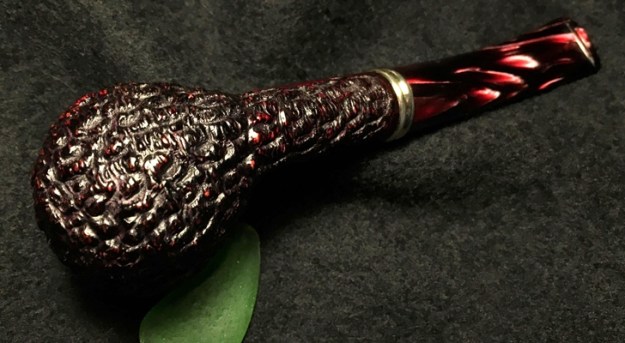
A Special Gift for Her Grandfather in the People’s Republic of China – A Sculpted Rose Billiard of Italy


Blog by Dal Stanton

You need to first hear the story then the restoration of the pipe will come. Let me first tell you about the granddaughter.

Chrystal, age 30, came to Bulgaria for two weeks from the People’s Republic of China.  My wife and I hosted her in our home.  She has a master’s degree and teaches in an English language department in a university near Beijing.  Her keen interest in the well-being of people was the catalyst in becoming aware of the issues of human trafficking and the devaluation and exploitation of women.  Through foreign acquaintances she has in her role as a teacher, she heard about Daughters of Bulgaria – the work here in Bulgaria seeking to help trafficked and sexually exploited women.

Cross cultural adventure – our Bulgarian friend Ellie, translating Bulgarian menu using English for Chrystal, so that Chrystal can call ordering Chinese in Mandarin, with the hope of surprising the Chinese restaurant worker who speaks Bulgarian and Chinese! It worked!

Chrystal’s aspirations to know and understand more about this issue both intrigued her and struck a chord in her own core experience that prompted her to throw caution to the wind and reach out to the Daughters of Bulgaria staff via email about coming to Bulgaria and to learn about the issue and what tangible things are being done to help women coming off streets and out of brothels.   Her email was received with surprise and question – someone from China desires to come to Bulgaria to learn from us!  In the communications with Chrystal that followed, her deep and sincere concern for people in general and in her home, China, was very evident.  She came to Bulgaria during her annual January break from teaching at the university.  We were amazed at how quickly her visa to enter Bulgaria was approved!

During her visit, we had the privilege of learning about the path of her life in China.  As Westerners, we were anxious to learn about Chinese culture and customs and we were also interested in her personal story.

She, like most Chinese women while growing up, personally experienced the effects of the enduring custom of valuing sons over daughters.  With China’s strict one child per family law to control population which recently changed to allowing two children, Chinese families were faced with pressures to have a son – which is the greater honor for the family in a culture where honor is profoundly important.

During the one child per family period, Chrystal’s

Serenaded at a restaurant in Sophia, Bulgarian style!

parents had a baby and it was a girl – the opposite of honor became Chrystal’s experience as she grew up with this subtle sense of shame.  She recounted remembering the acute feeling of self-guilt that she wasn’t a boy and her presence brought dishonor to her family – she wasn’t what her parents wanted.  Growing up, she understood that her parents had to settle for a girl.

To counteract this sense of having lesser value, Chrystal’s smile was pained while looking down recounting how she sought to excel in everything she did as she emerged from childhood into womanhood – trying especially to earn her father’s love and acceptance.  Her passion to excel did have its benefits. It propelled her growing up, in her studies and eventual appointment as a teacher in the university, being observed and appreciated by her supervisor in the professional and academic university environment.  Yet, Chrystal has discovered that even this accomplishment was not enough to reverse the underlying, unspoken sense that she did not measure up – that she would always be the daughter for which her parents had reluctantly settled.  Chrystal confided that this perhaps, is why she was so drawn to learn more about the Daughters of Bulgaria and the profound effects of devaluing of women resulting in human trafficking – it so resonated in her heart and to some extent, in her experience of feeling the impact of not being valued by others – even by those closest to you.

Even though this part of her story is ongoing and unfolding, Chrystal’s concern for others and her simple joy in living (she always seemed to be laughing and smiling!) confirmed to me that she had found a good place in her life – at her core.  The serendipitous trip to Bulgaria, of all things, revealed to me that she’s taking life as it comes and living to the fullest as she is able – growing as a person and seeking to help others in need.  How will she use what she is learning in Bulgaria in China?  She confessed with a smile, she doesn’t know exactly but she believes it will be used in some way that will be evident in time – like a seed planted in soil.

Chrystal with her Grandfather and cousin. Can you guess?

When Chrystal started asking us questions about our life in Bulgaria, she found out that I do something she had never heard of before – restore pipes!  She was fascinated.  And when she heard that I sell restored pipes worldwide to benefit the Daughters, she decided to do her part in helping the Daughters as well.  The first thing she did was post some pictures and information about The Pipe Steward to her friends in China on social media available there.  For the next several days, the stats for www.ThePipeSteward.com launched because of ‘hits’ coming from China – yes, I can see the countries of those looking at the website!

Secondly, and most important in helping the Daughters, was to choose a pipe as a special gift for her grandfather.  I asked her why the gift for her grandfather?  I found out that February is Chinese New Year and it is customary to give gifts or money to family.  I asked her why a pipe?  She said that as a farmer – a common man, her grandfather is considered near the bottom of the social strata and her thoughts of him are of his life as a farmer and that he liked to smoke.  She described him smoking thick cigarettes with strong tobacco and said that he also had an old, long metal pipe that he liked, but she said there was nothing special about it.  (The answer posed in the picture to the right is on the ‘Left’ 😊)

After she methodically explored many ‘Help Me!’ baskets and scrutinizing MANY pipes, she found the special one (or, did it find her? 😊) she would give to her grandfather.  I asked her, out of all the pipes she had studied, why she had chosen the pipe she did?  She smiled as she looked down thoughtfully.  She described the ‘rose’ carving in the briar and said that it reminded her of the rose that forms the logo for the Daughters of Bulgaria – the rose is beautiful but also, fragile and strong.  The ‘rose’ sculpted in the pipe also formed a hope that revealed to me the depth of love that resides in Chrystal despite everything.  She said that when her grandfather smoked this pipe that she hoped that it would remind him fondly of her – that she would be carved in his heart like the rose on the pipe.

With Chrystal’s return to China coming soon, I quickly went to work on the chosen pipe she planned to give her grandfather after returning to China.  Just before her departure from Bulgaria, my wife loaded Chrystal with gifts from Bulgaria for her and her family (but a special jigsaw puzzle for Chrystal!).  I also presented her the restored ‘Rose Pipe’ ready for her grandfather. Her first reaction to seeing it and holding it in her hands was how it had changed!  The second was some concern that her grandfather may not appreciate its value.  She struggled a bit considering keeping it for herself because now it meant so much to her, not to smoke, but to cherish as a reminder of her time in Bulgaria.  It was gratifying to pass this pipe on which I had purchased from a seller in the US New England state of New Hampshire in 2016, brought to Bulgaria and was patiently waiting for Chrystal to come to Bulgaria so it could choose Chrystal and make its way to its new steward, a common man – a farmer in China, Chrystal’s grandfather.

When Crystal left Bulgaria on her trek back to China (on Aeroflot via Moscow and Peking!) she knew that I was writing her story in this write up of the restoration of her grandfather’s pipe.  I agreed to wait to publish this blog after Chrystal promised to send me pictures of her with her grandfather and after she presented the Rose Pipe to him.  True to her word, the pictures arrived less than a week after her departure with these words:

My grandpa really likes your pipe!!! My dad said it is so special and valuable. My mom said it is like an art. Yes, they are happy. My dad even didn’t know my grandpa likes pipe. But it turns out that my grandpa does like it!!  So, my dad is happy. I look forward to your writing [blog write up]. I feel so blessed and so loved to know you!!  By the way, what kind of wood is the pipe made of?With a deepened appreciation for the granddaughter and her love for her grandfather, and for the pipe man in China who has become the new steward of the Rose Pipe, I now tell the story of the restoration of the Sculpted Rose Billiard that was on my worktable but now in China.   First, to answer Chrystal’s question: Briar 😊. The only marking on the pipe is the COM, ITALY, on the underside of the shank.  The pipe has been well loved and used much by examining the chamber and rim.  The chamber shows very thick cake and the rim is gummed up with lava.  Both need to be addressed through reaming and cleaning.  The bowl itself is dark from oils and grime.  The reddish or Oxblood hue is dull and tired.  There are small dents on the surface from normal bumps and at least one small fill that I see that needs checking.  The vertical fire grain beneath the finish is very attractive – showing much, much potential, which I like.  The shank is slightly bent with a nice-looking saddle stem which shows some oxidation but hardly any tooth chatter.  I think this gift for Chrystal’s grandfather will turn out very nicely!  I take a few close-ups to show these issues. To begin the restoration of this special gift for Chrystal’s grandfather, I clean the stem’s airway with a pipe cleaner dipped in isopropyl 95% then I drop it in an OxiClean bath to soak to loosen and raise the oxidation.  After it soaks through the night, I take it out (and realize that I forget to take a picture of it!) and take the stem to the sink and wet sand using 600 grade paper.  This does very well in removing the oxidation.  To hydrate the vulcanite, I then apply paraffin oil (a mineral oil) to the stem and put the stem aside to absorb.  The pictures show these steps. Next, I tackle the thick cake in the chamber.  I take a starting point picture and then employ the Pipnet Reaming Kit blade heads to cut through the cake to give the chamber a fresh start.  I use 3 of the 4 blades available.  I then fine tune the reaming using the Savinelli Fitsall Tool. I follow this by sanding the chamber using 240 grit paper wrapped around a Sharpie Pen.  This gives me leverage to apply pressure and to reach down into the chamber.  I finish by wiping the chamber with a cotton pad wetted with isopropyl 95% to clean the carbon dust. After an inspection of the chamber showing no problems, I move on. I clean the externals of the stummel with undiluted Murphy’s Oil using a cotton pad.  I also use a bristled tooth brush on the sculpting.  I’m anxious to see how this Oxblood hue cleans up.  I also utilize a brass brush on the rim.  Brass brushes do not harm the surface.  The cleaning did a good job on the rounded rim as well as the stummel surface.  The old finish is thin and raw briar is left on the rim. I decide to check the condition of the two small fills on the left upper side of the stummel.  Using a sharp dental probe testing showed that the fills weren’t solid, so I dig out the old fill with the probe.  I see no other fills needing attention, so I decide to address these now. I wipe the area with alcohol to clean it and then I mix a small about of briar dust putty using thick CA glue.  Using an index card, I shovel some briar dust in a small mound.  I then drop some CA glue close to the mound.  Using a toothpick, I then pull briar dust into the CA glue mixing as I go.  As the two mix, it thickens.  When it reaches the thickness of molasses, I apply the mixture to the pits with a small mound of excess to be sanded after it the putty cures.After the briar dust patch sets up, I clean the internals of the mortise and airway using pipe cleaners and cotton buds. I also use a dental spatula to scrape the tars and oils from the mortise wall.  After some effort, the internals are cleaning up and the cotton buds are coming out clean.Turning back to the stummel, the patch has cured and using a flat needle file I file down the briar dust patch to almost flush with the briar surface.  I then use 240 and 600 grit paper to sand it down further to the briar surface and blending the patch.  Amazingly, a face appears for a while as captured in the second picture! I then wipe the entire stummel with alcohol to remove the thin finish and to clean the stummel.  Taking a very close look at the condition of the surface.  I see a lot of nicks, cuts and very small pitting.  The surface is in rough shape. I decide to employ sanding sponges to work on the rough briar surface as well as the rounded rim that has seen better days.  I start with the coarse sanding sponge sanding the smooth surface – I pass over the sculpted areas.  I then graduate from the coarse sponge to the medium grade sponge, then to the fine sanding sponge.  These pictures chronical the progression – starting with the coarsest sponge: Medium sponge: Fine sponge: Moving from sanding sponges, I fine tune further using the micromesh pads.  First, I wet sand using pads 1500 to 2400, then dry sand using pads 3200 to 4000 and 6000 to 12000.  The pictures show the progression. Well, it’s been a productive day!  To finish my ‘pipe work’ day, I’ll continue the internal cleaning of the stummel by allowing it to clean stealthily in a kosher salt and alcohol soak.  To do this I twist and pull a cotton ball to form a wick that I insert and push through the mortise and into the airway.  I then fill the bowl with kosher salt (you can use any kind of non-iodized salt – iodized salt leaves an aftertaste) and give the bowl a shake to settle the salt.  After I place it in an egg crate for stability, I use a large eyedropper and fill the bowl with isopropyl 95%.  After a few minutes, the alcohol is absorbed, and I top off the alcohol once more.  Putting it aside, I shut off the lights. The next morning, the salt and wick have both darkened from drawing out the oils and tars from the internal briar.  I toss the expended salt and wipe the chamber with paper towel making sure to remove left over salt crystals.  To make sure all is clean I run one pipe cleaner and cotton bud wetted with alcohol. Internals are clean!  Moving on. As I’ve reflected on the original reddish, Oxblood hue of the pipe, I think this was partly why Chrystal was drawn to the pipe – with its sculpted rose.  I will apply a dye to the stummel combining Fiebing’s Dark Leather Dye and Oxblood Leather Dye.  I’m envisioning a subtler Oxblood embedded in the darker brown, but leaning more toward the brown than red.  I will mix the two dyes in equal parts and see what happens!  I assemble all the desktop components of my staining process.  I first wipe the stummel with a cotton pad wetted with alcohol to clean it. I insert a shaped cork into the mortise to act as a handle.  After mixing the Dark Brown and Oxblood in a shot glass, I then warm the stummel using a hot air gun.  This expands the briar grain allowing it to absorb the dye more effectively.  After the stummel has been warmed, I apply the dye mixture to the briar surface with a folded over pipe cleaner.  After thoroughly covering the surface, I ‘fire’ the surface using a lit candle.  The alcohol in the aniline dyes immediately combusts when lit and sets the dye pigment in the briar grain.  I repeat this process a few minutes later and set the newly stained bowl aside to rest through the night. With the newly stained stummel resting, I return to the stem waiting in the wings. There are minor tooth chatter and bites on the button. I first freshen the button lips using a flat needle file.  Using 240 grit paper I quickly sand out file scratches and chatter. I then use 600 grit paper on the bit area, erasing the coarser paper scratches and follow by using 0000 steel wool on the entire stem.Moving next to the micromesh phase, I wet sand using micromesh pads 1500 to 2400, then dry sand using pads 3200 to 4000 and 6000 to 12000.  After each set of 3 pads I apply Obsidian Oil to the stem to revitalize the vulcanite.  The stem looks good. I love this part of the restoration process – unwrapping the fired stummel.  After making the decision to dye, often the grain makes its own decisions regarding how the dye is received – I’m never sure how dye mixtures will look in the end.  To unwrap the flamed stummel shell, I mount a felt cloth buffing wheel into the Dremel and set the speed at the slowest RPMs and apply Tripoli compound.  After completing the cycle with Tripoli, to further blend the dye I wipe the stummel lightly with a cotton pad wetted with alcohol.  Before moving to the application of Blue Diamond compound, I use a fine point Sharpie Pen and give a little highlighting to freshen the sculpting on the stummel.  Next, I rejoin stem and stummel and mount a cotton cloth wheel to the Dremel, increase the speed to about 40% full power and apply Blue Diamond compound to the stummel.  Blue Diamond is less abrasive and continues to tease out the natural sanded gloss of the briar.  The briar grain is responding with a smile on its face – oh my! After wiping the pipe down with a felt cloth to clean off the compound dust left by the Blue Diamond, I mount another cotton cloth buffing wheel onto the Dremel, maintain speed at 40% full power and apply a few coats of carnauba wax to stem and stummel.  When completed, I give the entire pipe a hand buffing using a microfiber cloth to raise the brilliant shine and finish up the restoration of Chrystal’s gift for her grandfather.

In Bulgaria, the rose is special.  Even though is a beautiful flower, here in Bulgaria it is not primarily known as a beautiful flower, but as a rugged producer of fine oils and perfumes known and exported world-wide.  This is one of the reasons why the rose became the logo of the Daughters of Bulgaria – but not only a logo, but a symbol of profound value, strength and beauty.  Women who have been trafficked and sexually exploited are treated as valueless property to be used and then discarded.  All people are endowed with intrinsic value – even those that are not treated as Daughters, but are daughters, with identities, stories and value.  When Chrystal chose this ‘Rose’ pipe, she wanted it to be a special gift to her grandfather for the Chinese New Year – a gift that would remind her grandfather of her – not a rose carved in wood, but that she would be carved in his heart.

Chrystal could see the beautiful value and potential of this pipe when she chose it from among many to be her special gift.  She is truly a special young lady – truly a rose.  Thanks for joining me!    


The Gauntlet Thrown: Restoring a ‘New’, Never Smoked RJ ERGI Grand Luxe Horn Stem Billiard


Blog by Dal Stanton

When this pipe came onto my worktable my assumption was that it was French made.  This assumption was formed by it being part of the ‘French Lot of 50’ which I acquired off the French eBay auction block.  Many of the pipes in this Lot bore horn stems which seemed to be the ‘French’ characteristic that formed my assumption that it too, was manufactured in France.  But on my worktable, the only marks stamped onto the Billiard were the ERGI [over] Grand Luxe on the left flank of the shank and an encircled ‘RJ’ stamped on the stem.  Here are the initial pictures of this attractive RJ Billiard with a horn stem and the nomenclature stampings: Intrigued by the question of this pipe’s COM and ‘RJ’ and ‘ERGI’, I went to all my usual places – Pipedia and Pipephil both came up totally empty.  I broadened the search to other blog threads and then to a wide-open Google search campaign.  Nothing.  I posted pictures of the nomenclature on Facebook groups, Gentlemen’s Pipe Smoking Society and Tobacco Pipe Restorers, and received only one response from Mike on GPSS who had this anecdotal information:

Mike: This pipe was made in Paris

Dal: Mike, Thanks. Do you know what RJ is? Company?? Thanks!

Mike: I know that the company closed down in 1998. As for the ERGI I believe it was an abbreviation for where the briar itself was harvested I picked one up years ago while in Paris.  I also remember paying the equivalent of 120 US dollars for it back about 20 years ago.  A really nice smoker. Dense briar.

Armed with Mike’s information about the Paris connection and encouraged by his experience, I Googled more (and a lot!) and also switched over to use Google of France hoping to get different responses.  This did help and I found one other piece of information about another RJ of Paris pipe – formerly on the Worthpoint auction block a Torpedo shape with this scant information.

WONDERFUL VINTAGE TORPEDO PIPE BY RJ PARIS WITH THE MAZE MORTONS PATENT DAMPER

This auction is for a super pipe in a torpedo shape made by RJ Paris (marked to the briar with name) and to the end is a mechanism that allows the damper to open and close – which is marked The Maze Morton’s Patent – a very good and interesting pipe.

An interesting pipe!  Again, a horn stem.  The French must like horn stems or at least ‘RJ’ did.  This confirmed that there was at least one other RJ of Paris pipe out there, but it was also advertised with the “Maze Mortons Patent Damper’.  I then searched again adding this to the search parameters and came up with no additional information – bah!  I’ll keep researching while I work on the pipe and I’m open to anyone reading this write-up to send me a note with more information to add to the scant information I have!

Todd saw this pipe along with two others in the For “Pipe Dreamers” Only! collection – a Ben Wade Hand Model and a very nice GBD Pot with uber grain potential!  Todd is a regular commenter on Rebornpipes and different Facebook pipe groups.  In the past he had offered encouraging words for restorations I had published, so it was great dialoging with him while he chose pipes to commission!  As he whittled his Dreamers list down from 5 pipes to the 3, we discovered we both have 2 grown children living in Denver, a parent living in Florida and connections in the Atlanta area – a small world sometimes in the pipedom community!  Most interesting to me was to discover that Todd is a lawyer and fluent in Mandarin Chinese and who practices both commercial law for corporations and also political asylum cases for individuals.  ‘Political asylum’ cases got my attention and appreciation, especially given our work here in Bulgaria among trafficked women.  Todd’s final three Dreamer’s choices: a Ben Wade, GBD Pot and the RJ on the worktable.With the limited information about the pipe before me and an appreciation for the pipe man who commissioned it, I now look closer at the pipe’s condition.  The interesting thing about this pipe is that it appears to be unsmoked and newish.  The metal tenon appears to be threaded and I’m assuming will take a 5mm filter if one chooses.  The chamber is virgin even though the external briar has some nicks and miniscule pits at places.  The pipe is very attractive, but what strikes me is that the grain of the smooth briar is subdued, even for an unsmoked pipe!  The rim is not marred, but the appearance is sharp and chopped.  Softening the rim presentation would help. The horn stem is in pristine condition and simply needs to be polished.  This ‘restoration’ is primarily a freshening, but my challenge is to show that generally (notice, qualifier!) a good restoration of a ‘new’ pipe will turn out better results than a factory manufactured new pipe.  This is the gauntlet that I’m laying down for myself, and we’ll see! Even though the pipe is unsmoked, I use undiluted Murphy’s Oil Soap and clean the stummel using a cotton pad. Afterwards, I rinse the stummel with cool tap water.  Doing this not only cleans the briar, but I also watch to see how the finish reacts.  As you can see from the results below, the cotton pad picks up some grime.Next, to soften the rim’s ‘cut off’, block look, I introduce both an internal bevel and a gentle external bevel.  At the end, these bevels will soften and will appear simply to be rounded edges, not distinct bevels.  To do the initial shaping, I pinch a tightly rolled piece of 120 grit paper between my thumb and the rim edge and rotate around the circumference.  I follow the 120 with rolled pieces of 240 and 600 grit papers.  In the same way, I introduce a lesser bevel on the external rim edge.  There are some wandering scratches on the rim top that micromesh should erase.Next, to clean up the minor surface imperfections and to tease out the grain, using micromesh pads 1500 to 2400 I wet sand the stummel. I follow by dry sanding using pads 3200 to 4000 and 6000 to 12000.  The grains emerge more distinctly during the micromesh process and I study the patterns.  The block was cut with a primary horizontal cross grain orientation that emerges on the front right and back left bowl quadrants.  On the opposite quadrants, front left and back right – the cross section of the grain emerges in tight bird’s eye patterns.  Very nice – I love the grain!  Decision time.  As I proceeded through the micromesh process, the question I was mulling over in my mind was whether to leave the finish as it is and move on to the compounds and waxing?  Or, to apply a dye and employ the felt buffing wheel technique that will result in heightened grain contrast?  After conferring with my stylistically superior, my wife, I decide to go in the latter direction.  I use Fiebing’s Saddle Tan Pro Dye to do this – an aniline dye.  My aim is not to darken the overall stummel appearance, but to create more contrast in the grains.  I first wipe the bowl with a cotton pad wetted with alcohol to clean it. Then I heat the stummel using the hot air gun which helps expand the briar allowing the grain to be more receptive to the dye.  After heated, using a folded over pipe cleaner, I apply the Saddle Tan dye to the stummel and then fire it with a lit candle.  The alcohol in the dye combusts and sets the pigment in the briar.  After a few minutes, I repeat the process of applying and firing the dye.  I then put the stummel aside to rest for several hours. With the stummel on the resting allowing the dye to fully set, I study the horn stem.  It’s a beautiful piece of horn and the only thing I can do is simply spruce it up.  In the past, I benefited greatly by Steve’s essay on horn stem repair working on my first horn stem, A First Horn Stem on a Throw Away Pipe.  The key thing in repairing horn is to fill the gaps to keep the horn from drying and splintering as horn is very porous.  This stem needs no repairs, but looking closely, I do see normal miniscule porous texture.  The tighter or smoother the horn surface is, helps to guard against the decay of the horn.  I take a few closeups to show this. I treat the horn stem like a vulcanite stem but with greater gentleness 😊.  I run the stem through the micromesh regimen, and I will apply compounds afterward.  I wet sand with micromesh pads 1500 to 2400 and follow by dry sanding with pads 3200 to 4000 and 6000 to 12000.  After each set of three pads, I apply Obsidian Oil to the horn and the horn drinks it up! I’m pleased with the results – even more gloss! While working on the stem, I kept seeing the nickel tenon and thinking that I needed to work on that a bit.  I clean it initially with 0000 steel wool.  After a bit of shining, that’s more like it! The newly stained and fired stummel has been resting for several hours and it’s time to unwrap the fired crust.  I mount a felt cloth buffing wheel to the Dremel and set the speed to the slowest possible, so I don’t scorch the wood with too much friction.  I then apply Tripoli compound to the briar surface which takes quite a bit of time. As the wheel ‘plows’ the crusted dye it loads up quickly requiring me to purge the wheel often.  When finished with Tripoli compound, I wipe the stummel with a cotton pad wetted with isopropyl 95%. I do this to lighten the aniline dye as well as to blend it.  Following this, I mount a cotton cloth buffing wheel to the Dremel, and increase the speed to about 40% full power.  After rejoining the stem and stummel, I apply Blue Diamond compound to both the horn stem and stummel.  When finished, I then wipe the pipe down with a felt cloth to clean it of compound dust before the application of the wax.  The pictures show the process. Before moving to the waxing of the pipe, I apply a mixture of activated charcoal and yogurt (sour cream works too) to form a protective layer for the chamber.  This mixture hardens in the chamber and provides a good starter layer for a cake to develop which protects the briar.  First, I put some natural yogurt in a small dish and then while mixing, I add activated charcoal.  As I add charcoal it thickens.  I want it thick enough, so it doesn’t run after applied to the chamber and I don’t want it so thick that it clumps.  When it looks good, after inserting a pipe cleaner through the draft hole to keep the airway open, I use a cotton bud and paint the chamber wall with the mixture.  With this done, it is late, and I turn out the lights allowing the charcoal/yogurt mixture to cure through the night. The next morning, the chamber coating has cured and I’m ready now to apply the final wax. One more thing to do before applying wax.  I have not seen any other RJ branded pipes that would provide a model informing me about the stem stamp.  The oval-encircled ‘RJ’ appears to have had some color in it, but it’s not clear which.  I decide to dress it up by applying Rub’n Buff European Gold to the stamp.  I apply some over the stamping with a toothpick and after a few minutes, simply scrape most of the excess off using the hard side of a tooth pick and then finish it up by wiping it clean of excess with a cotton pad.  It works exceptionally well and the subtle gold stamping blends well with the horn stem brown and tan hues.  Wow!  I’m liking this. I mount the Dremel with another cotton cloth wheel, maintain 40% full power speed, and apply several coats of carnauba wax to the stummel and horn stem.  After this, I give the entire pipe a good hand buffing with a microfiber cloth to raise the shine.

Earlier, I threw down the gauntlet and made the statement that a well-done restoration has better results than most new, manufactured pipes.  I’ll let you make your own judgement below as I begin with a ‘Before & After’ picture.  John, my fellow GPSC Facebook group member, observed that the RJ pipe he acquired in Paris some years ago had dense briar.  I would say that this ERGI Grand Luxe, if it too is Parisian, displays a grain that could be described the same way.  The bird’s eye is beautiful, tightly wound, and gratuitously showcased throughout the briar landscape – very appealing.  Complementing this beautiful display of briar is the rustic, earthy horn stem with its softly woven brown and tan hues.  I also like the gold embossing of the RJ stamp – it fits well this striking straight Billiard.  This is the first of 3 pipes that Todd commissioned and he will have the first opportunity to acquire it from The Pipe Steward Store.  This pipe benefits our work here in Bulgaria, with the Daughters of Bulgaria – helping women and girls who have been trafficked and sexually exploited.  Thanks for joining me!  Now, ‘Before & After’.  What do you think?


Recommissioning a Vintage French Paul Viou Churchwarden of St. Claude


Blog by Dal Stanton

There’s nothing like a Lot picture on the eBay auction block that makes a pipe man salivate with the question, “Are there any treasures in the beautiful, intertwined, chaotic mass of briar, rubber, horn, and acrylic?”  I received a message from my good pipe man friend to the north of Bulgaria in Romania, Codruț (aka: Piper O’Beard on FB), a happy steward of a Peretti Oom Paul Sitter I restored (Recommissioning Another L. J. Peretti of Boston: An Oom Paul Sitter).  Codruț  sent me some links of Lots on the French eBay auction block.  With piqued curiosity I looked.  Codruț was considering getting into the hunt – he had never purchased a Lot before and he wanted to try his had and restoring.  When I saw the French Lot below, I started salivating a bit(!), and asked Codruț if he minded if I went after it.  With his blessing, I placed a bid and was fortunate to land the French Lot of 50 and bring it to Bulgaria.  What drew my attention to this Lot of 50 initially were all the horn stems that caught my eye.  The second was the classy Pencil Stem Cutty Tavern Pipe laying across the top (unbelievably, still available as I write in the For “Pipe Dreamers” Only! collection!!) and the modernistic, deep blue/white Billiard with a fiery blue acrylic stem lying next to the Pencil Stem Cutty Tavern Pipe (available in The Pipe Steward Store as I write!).  Then I saw the Churchwarden.  All pipe picking scavenging requires one to see through the mass to put together the clues of what is hidden.  The P. Viou Warden’s upside-down bowl starts on the left side (just above a horn stem) and you can trace the long stem underneath the mass where it emerges on the far right, upturned – somewhat masked by the star on the print below.  Aw!  My excitement when the bell rang, and the winning bid was mine!When the French Lot of 50 finally made it to Bulgaria, I opened the box like a young boy opening a treasure!  With all my acquisitions, so that I can keep track of everything, I picture and record every pipe and eventually upload them to the ‘For “Pipe Dreamers” Only!’ collection for pipe men and women to see and commission if a pipe happens to choose them.  Here are some of the cataloging pictures I took of the French Lot of 50 with a better look at the 3 pipes that hooked me as well as the plethora of horn! It didn’t take long for the Churchwarden to find a suitor after he was put online in the ‘For “Pipe Dreamers” Only!’ collection.  A new acquaintance, Josh, who visited Bulgaria last summer, saw the Churchwarden and commissioned him and has been waiting so patiently!  The Paul Viou Churchwarden finally made it to my worktable, and I take more pictures to get a closer look. The reach of the P. Viou’s Churchwarden is 10 1/2 inches (even with an inappropriately tucked stem!) and the height of the bowl is 1 7/8 inches.  The nomenclature is a cursive, P. Viou with a flared underline on the left flank of the shank.  On the right, is the well-known stamping of ‘ST.CLAUDE’, the French birthplace of the production of briar pipes and historically, the mega-center of French pipe manufacturing with a plethora of names calling it home.  There is scant information about the Paul Viou name on the internet that I could find.  Pipedia’s article of Paul Viou is brief:

From Pipes, Artisans and Trademarks, by José Manuel Lopes’

Paul Viou was the brand and name of a French artisan who sold his pipes by correspondence and then he was a pipe supplier for military institutions. He also made sculpted pipes and sometime used horn stems.

The brand is currently sold by Jacques Craen and made by Genod in Saint-Claude, after having also belonged to Paul Guilland and Vuillard. They are stamped P. Viou and made primarily for export.

This information is confirmed by Pipephil.eu with the addition of the date of the current holder of the Paul Viou name, Beaud, happening in 2006: Whether the Churchwarden before me was made under the original artisan or under one of the other eventual holding companies (Guilland, Vuillard, or Genod), I’m not sure how to say with certainty.  I have a few other P. Viou pipes in the French Lot of 50, so perhaps I’ll discover more information as I go!

The condition of the overall pipe is good. The bowl is darkened from time and the normal buildup of oils and grime.  The chamber has some cake buildup but not much.  The Warden stem has some oxidation and the bit is in good condition.  I notice also (picture above) that there’s a gap between the stem and shank.  Often, a simple cleaning will restore a flush seating of the stem, but I’ll keep my eye on this.  The main thing that grabbed my attention when I first held the pipe in my hand was the orientation of the stem.  To me, it is over-bent and almost you could say, tucked.  Wardens, I’ve found, have different kinds of bends.  Most often I’ve observed a sweeping bend where almost the entire stem is engaged in the bend.  This P. Viou has a straight extension until it reaches the very end of the stem and then is bent.  I like it, but the final orientation of the bend should more closely reflect a parallel orientation with the plane of the rim.  For a didactic moment, I trace this concept on a piece of paper to illustrate.Before beginning the cleaning process with the stem, I make this adjustment to the stem.  First, just to be on the cautious side, I insert a pipe cleaner into the bit side of the stem to guard the integrity of the airway, which usually isn’t an issue if the bend is being opened instead of tightened. I also trace the original stem orientation on the paper I used above so that when I bend the stem, I can lay it on the flat surface for a straighter result.  I then heat the end of the stem with a hot air gun.  As it heats, the vulcanite becomes supple and the bend gradually starts straightening on its own.  When it expands enough as I eyeball it, holding the stem in place, I take it to the sink and run cold tap water on it to set the bend.  After the first attempt, the bend is still too tight, so I repeat the process again and the second time is enough.  The pictures show the progression.  I like this orientation much better. Before cleaning the stem, I remove the stinger to aid in the cleaning. I heat the stinger with a Bic lighter and after it heats, the vulcanite holding it loosens its grip.  I gently extract it with the help of pliers.  I personally don’t have a lot of affection for stingers and their role in the smoking experience.  I’ll clean the stinger and include it with the finished pipe and allow the future steward to make the call!  I don’t have long pipe cleaners, but I do have a selection of shank brushes that easily reach through the stem.  I use these dipped in isopropyl 95% to clean the internals of the stem. I also use regular pipe cleaners inserting them from both sides.  Well, it didn’t take long after starting to know that this Warden stem had not been cleaned in some time – if ever!  The reality of the less than optimal situation was confirmed when my wife came in and said that something was stinking…. I should have had gloves and my apron on, but hindsight!  After some cleaning, things are looking better but still not pristine! This nastiness helps me decide the next course of action.  I use an OxiClean bath to work on the oxidation in the vulcanite, but it also serves to further sanitize the internals, yes!  I pour the OxiClean into a larger plastic container that will accommodate the stem.  Before putting the stem in the OxiClean bath, I put a little petroleum jelly over the ‘P.Viou’ stamping to protect it and then let the OxiClean to its thing with both internal and external. With the stem in the bath, I turn now to the Paul Viou bowl by reaming the chamber with the Pipnet Reaming kit using two smaller blades.  I then fine tune by scraping the chamber with the Savinelli Fitsall tool and follow by sanding the chamber with 240 grit paper wrapped around a Sharpie Pen.  After wiping the chamber with a cotton pad and alcohol, I look at the cleaned chamber and it looks good – no signs of heating damage. Next, I use undiluted Murphy’s Oil Soap on the external briar surface to work on the bowl and lava flow on the rim. I also use a bristled tooth brush and a brass wire brush on the rim that will not damage the briar.  The cleaning reveals two thing.  First, by looking at the cotton pad in the picture, the old dye came off during the cleaning.  The rim cleaned up well but revealed burn damage from pulling the flame over the rim instead of being over the tobacco!  Lighting a Churchwarden can be a bit more difficult, especially the way the stem was originally bent on this Paul Viou – I doubt if the steward could see the top of the bowl with the way it was tucked under.  Here are the pictures. To complete the general cleaning regimen, I use cotton buds and pipe cleaners dipped in isopropyl 95% to do the job.  With the grungy condition of the stem, it shouldn’t have surprised me to find the mortise and airway internals sharing the same grungy condition.  Oh my, with the help dental probes and spatulas to scrape the mortise and shank brushes coming in to reinforce the cotton buds and rank and file pipe cleaners, some victory was achieved in this skirmish.  With confidence of having total victory, I will later continue the struggle by giving the internals a kosher salt and alcohol bath to further draw the oils and tars out of the internal briar and to remove any lingering odor.  The picture shows the carnage and the arsenal of this war. Next, I take a closer look at the rim damage.  The lighting practice has scorched the forward left side of the bowl resulting in the thinning of the rim at that point.  I’ve had a lot of experience with this when I restored several L.J. Peretti Oom Pauls from the former steward who was a serial burner and discarder (See for an example: Another LJ Peretti Oom Paul Sitter Recommissioned).  My approach is two-fold with the driving value of always trying to save as much briar as possible!  First, I will minimally top the stummel to remove as much damage as possible.  Then, to blend the internal rim lip damage, I introduce an internal bevel, which in my view, looks good anyway.  With the chopping board on my table, I cover it with a sheet of 240 paper.  The following pictures show the graduated progress.  First, the starting point.Interestingly, the topping process reveals a slight inward dropping pitch of the rim.  This is shown by the outer portion only making contact with the flat topping board. When I decide the 240 grit paper has removed enough of the top, I switch the paper to 600 grit and give the topping a few more rotations to smooth out the rim.Now, step two is introducing a bevel to the internal lip to remove more damaged briar and to blend.  I start with a tightly rolled piece of coarser 120 grit paper to cut the initial bevel.  I follow in succession with 240 and 600 grit papers tightly rolled. To soften the sharp outer edge of the rim and to soften the entire rim presentation, I create an external bevel, but a very small bevel using the same progression of sanding papers.  I think it looks good.  The darkened part of the damage is still visible, but it will be mitigated when the rim is dyed and darkened.The condition of the stummel is good.  I don’t see any problem fills or pitting.  I go with the original finish and aim to match the rim to the bowl. What seems to be a good match is the Mahogany dye stick.  After applying it over the rim, I then blend the dye stick coating by wiping it with a cotton pad wetted with alcohol.  I think it looks good at this stage. The Warden stem has been in the OxiClean bath for several hours.  I take a few close-up pictures to show the oxidation which had surfaced.  I wet sand using 600 grade paper to remove the oxidation.  I’m careful to stay clear of the ‘P.Viou’ stamp.  I follow this with Magic Eraser over the entire stem, including the stamping.  The low abrasion of the sponge works well with cleaning up this area.In order to hydrate the vulcanite, I then apply a coat of paraffin oil (a mineral oil) over the stem and set it aside.Next, using micromesh pads 1500 to 2400, I wet sand the stummel to clean it and begin the fine polishing sanding. 

Following the first set of 3 pads, I begin dry sanding with the next set of 3 pads and after finishing with the first of these, I don’t like the way the stummel looks.  After the wet sanding cycles, the stummel has a pink or mauve hue to it – mauve to me, is sick pink.  Just in case you’re wondering what mauve is, from a quick Google search followed by my mauve toned stummel.  This doesn’t work for me! I placed too much trust in the old stain which is not holding up and leaving behind a less than attractive briar presentation – at least as I look at it.  I wipe the stummel with a cotton pad and alcohol and my thoughts are confirmed.  Even after wiping with isopropyl 95%, the stummel has the mauve residue in the grain.  The reality is, I’m not losing too much traction in the process of this restoration except I will take a detour and put the stummel in an acetone soak to make sure I’m proceeding with the natural briar.  This soak in acetone will also preempt the need to do a kosher salt and alcohol soak.  I put the stummel in the acetone soak and turn out the lights.  Another day is done.The next morning, I fish the stummel out of the acetone soak and it is evident that all the remnant finish is gone. I return to the micromesh sanding process and start again by wet sanding with the initial set of 3, 1500 to 2400.  Following this, using pads 3200 to 4000 and 6000 to 12000, I dry sand the stummel, throughout avoiding the stamped areas on the left and right flanks of the shank.  Wow, without the distraction of the finish, the grain I see emerge is nice.  I see an eclectic blend of large bird’s eye on the sides of the bowl and the horizontal ‘connector’ grains of the bird’s eye displayed on the foreside of the bowl. I still have the Warden stem waiting in the wings for fine tuning, but I want to move forward with the stummel so that it can be ‘resting’ during the stem work.  The grain that has emerged is beautiful and to create a little more ‘pop’ to the grain with more contrast between the darker and lighter grain – harder and softer wood, after debating between Dark Brown and Light Brown, I decide to use Fiebing’s Light Brown Leather Dye to provide the base hue in the grain and then through the use of Tripoli compound applied with a felt buffing wheel, the grain is teased out leaving greater contrast.  I can lighten as well by wiping the bowl with a cotton pad and alcohol since I’m using an aniline dye.

I assemble all the components of my desktop dying station. I first assure that the stummel is clean by wiping it with a cotton pad wetted with alcohol.  After inserting a fashioned cork into the shank to act as a handle, I heat the stummel with a hot air gun to heat the briar and by this, expanding the briar to enable the dye to be absorbed more efficiently.  After heated, I apply Fiebing’s Light Brown Leather Dye over the briar surface with a folded over pipe cleaner.  When fully covered, I fire the aniline dye with a lit candle which immediately combusts the alcohol and sets the pigment in the grain.  After a few minutes I repeat the process and put the fired stummel aside to allow the dye to rest.  I discovered that this ‘resting’ process helps to aid the dye to set and not come off on the hands when the pipe initially goes into service and the bowl is heated.Now that I completed the staining, I turn my attention to the Warden stem.  Taking another close look at the bit area reveals that the sanding to remove the oxidation with 600 grit paper, all but erased any tooth chatter on the bit!  On the lower bit (second picture) I do see one very small dimple that I dispatch quickly with 470 then 600 grade papers.  I then follow by using 0000 steel wool on the entire stem.  I like the results – progress. Before moving on to the micromesh phase, I go the extra mile with the Paul Viou Warden stem.  Using Before & After Fine and Extra Fine Polish, in succession, I apply some of the polish on my fingers and then rub the polish into the vulcanite surface.  The Fine polish has more of a gritty feel to it.  With both polishes, they revitalize the vulcanite as well as continue to extract remnants of oxidation from the rubber compound.  I take a picture while the Extra Fine Polish was doing its thing.  After the application of each polish, I use a cotton pad to wipe off the excess polish.Just when everything was going so well….  After I wipe off the Before & After Extra Fine Polish and was admiring the results, I see a pit on the forward third of the stem…ugh.  Just to make sure I was seeing what my eyes were seeing and my brain was arguing that I wasn’t seeing what I was seeing – I took a sharp dental probe and tested. Well, sometimes you simply must punt the ball – American football slang for just doing what you need to do.  So, using Hyper Bond 12000cps Black CA glue, with a toothpick as my drop guidance system, I spot drop some glue on the pit and wait.After the patch cures, I gingerly use the flat needle file to file down the patch mound – trying not to slip off and produce more patch work!  After the filing, I further remove the excess with 240 grit paper followed by 600 and 0000 steel wool.  Finally, in the locale of the patch I again apply Before & After Fine and Extra Fine Polish.  Well, the pit is filled, but the coloring of the fill is not black-black so it doesn’t blend with 100% satisfaction.  Yet, if one doesn’t know the fill is there, he probably would not see it!  Restoration is not perfection, though we try!  The pictures show the detour. Undaunted, moving forward with the micromesh process, I wet sand with pads 1500 to 2400 and follow by dry sanding with pads 3200 to 4000 and 6000 to 12000.  After each set of 3 pads, I apply Obsidian Oil to continue the revitalization of the vulcanite Warden stem.  Admittedly, taking distance pictures of a Churchwarden stem is less than satisfying, but what I’m seeing close-up is looking good!With the stem on the side, I’m looking forward to ‘unwrapping’ the fired stummel.  Using a felt cloth buffing wheel mounted on the Dremel, I set the speed to the slowest setting, so it doesn’t get too hot with friction.  I then begin the process of removing the fired shell revealing the grain below. My wife helps record the process – my hands are full!  I must purge the felt wheel often as it collects the dye crust.  I do this quickly by running the wheel along the edge of the cutting board which is my lap desk as I work.  The process of using Tripoli compound, which is coarser, and with the felt wheel, which creates more friction than a cotton cloth wheel, is that it can buff off much of the dye that is excess and on softer wood – the lighter part of the grain.  The dye pigment tends to be held by the darker grain.  The effect is that the grain almost looks luminescent with the contrasting hues in the grains. After completing the application of Tripoli, I wet a cotton pad with isopropyl 95% and wipe down the stummel – not really to lighten the color, but to help blend the dye.I then mount a cotton cloth buffing wheel to the Dremel, increase the speed to about 40% full power and apply Blue Diamond to stem and stummel.  As I attempt to reunite the stem and stummel, I discover that the fit of the tenon in the shank is too tight – cracking a shank isn’t anything I want to be contemplating now!  It’s not surprising that after soaking the stummel in acetone the wood absorbs and expand somewhat.  To remedy this, I wrap a piece of 240 grit paper around the tenon and rotate the paper, sanding down the tenon a bit.  I follow by doing the same with 600 grit paper.  After a few tries, the tenon finds a good, snug seating.  I then apply Blue Diamond compound to both stem and stummel.  After finishing with the Blue Diamond, I wipe the pipe down well with a felt cloth to clean the compound dust off the surface.Before applying carnauba wax, I will freshen the ‘P.Viou’ stem stamping.  The condition of the stamp imprint seems good so the paint should hold without problem.  Using white acrylic paint, I put some paint over the stamp and then lightly dab the paint with a cotton pad.  This absorbs the excess paint so that the thinned layer left on the stem dries quickly.  I then scrape the excess paint off by gently scraping with the side of a toothpick.  I finish by gently buffing the newly painted stamp with a cotton pad.  The pictures show the progression. As I said I would do earlier, I clean the stinger with a brass brush and alcohol and a dental probe and give it a quick buff with the Dremel using Blue Diamond compound.  I then reinsert it into the tenon.I mount another cotton cloth wheel onto the Dremel, set speed at 40%, and apply a few coats of carnauba wax to the Warden stem and stummel.  After finishing, I hand buff the pipe with a microfiber cloth to raise the shine.

When one first sizes up a Churchwarden, one usually is drawn to the ‘olde world’ sweep of the long, flowing stem with images of Gandalf smoking and blowing magical smoke rings.  Secondarily, one is drawn to the bowl attached to the stem.  But with this Churchwarden, the bowl is drawing attention as well!  The beautiful, distinctive bird’s eye grain interacting with the other grain patterns is mesmerizing.  The correction to the stem’s bend was strategic and the rim repair is now invisible.  This Churchwarden would be a nice addition to anyone’s collection, and since  Josh commissioned the Paul Viou Churchwarden and has the first opportunity to acquire it from The Pipe Steward Store.  This pipe, as well as all pipes commissioned from the For “Pipe Dreamers” Only! collection benefit the Daughters of Bulgaria – women and girls who have been trafficked and sexually exploited.  Thanks for joining me!
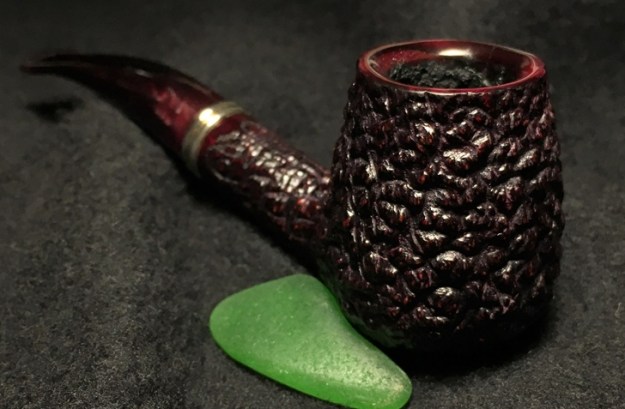
Recommissioning a Stubborn Kaywoodie Prime Grain 205R ‘Fancy’ Bulldog


Blog by Dal Stanton

I acquired this Kaywoodie as a solo in an eBay auction, December of 2017, while my wife and I were on a Christmas trip from Bulgaria to be with family in the United States.   True confession – while in the US I indulged in a few eBay auctions!  They’re exciting, what can I say.  But this Bulldog got my attention. Why?  True confession #2: I’m not a Kaywoodie connoisseur, but I was drawn to the profile of this stout Bulldog bowl proudly cresting with what looked like a crown and reminded me of one of my favorite chess pieces – the Rook or Castle.  The Rook is one of the strongest pieces on the board if properly moved – usually waiting patiently through much of the combat until, strike!  Yes, this is what drew me in to look at the details of the Kaywoodie Prime Grain. The slightly bent fancy stem added class to the Rook and the hue of the pipe leaned somewhat reddish – the complete warrior pipe!  So, I bid and now this guy is on the worktable here in Sofia, Bulgaria, after Paul saw him on The Pipe Steward site in the For “Pipe Dreamers” Only! collection and commissioned him along with the last pipe I restored, a Mastersen Freestyle, which turned out great.  Here are a few of the pictures I saw on eBay of the Kaywoodie Prime Grain Bulldog. With the Bulldog now on my worktable, I take more pictures to get a better look at the condition of the pipe. The nomenclature is stamped on the upper left shank side with KAYWOODIE [over] PRIME GRAIN [over] IMPORTED BRIAR.  The name is marked to the right with the encircled ‘R’ indicating a registered trademark.  The upper right shank side has the ghost of a shape number remaining.  After using a magnifying glass and after several pictures I was able to make it out as, ‘205R’.According to the extremely useful Kaywoodie thread entitled 3 Digit Shape numbers submitted by ‘kwguy’ (who I suspect is the major Pipedia Kaywoodie contributor Bill Feuerbach III, because many who responded to the thread with huge thanks, directed the comments to ‘Bill’), the general dating of this Kaywoodie is pretty straight forward.  Three-digit shape numbers were introduced to Kaywoodie pipes in 1972.  According to kwguy:

Maybe a little background is in order.  In 1972, we closed the West New York factory having completed construction of our new 197,000 square foot factory in Yapank on Long Island.  The plan was to move all pipe production there, but in the interim, the Medico factory in Richmond Hill Queens would handle the final sanding and finishing of all of the Kaywoodie, Yello-Bole and Medico pipes. The thought was eventually those operations would also shift to Yapank as skilled workers could be trained to handle those operations.  (A down turn in the pipe market in the seventies doomed the new plant, but that’s another story)

Having the three lines being finished in one building, would create confusion if there were two shape numbering systems.  So a new 3 digit system was adopted.  The Medico 3 digit system was also changed at this time.  This list will have three columns of numbers.  The first will be the “new” three digit number, used on all Kaywoodie and Medico pipes from 1972-1980.  (We stopped stamping shape numbers in 1980)  The second column is the Kaywoodie two-digit number and the third column is the original Medico 3 digit number, all of which refer to the same shape.

The 205R places this Kaywoodie between 1972 and 1980 according to this information.  Also, in the article, the addition of the ‘R’ indicated a ‘wavy or rusticated rim’.  I found the 205 shape number in the list referenced and I clipped all the Bulldog numbers for comparison and interest:So, the shape number tells me that I have before me a Kaywoodie medium Bulldog with a rusticated or wavy rim and was manufactured in the Medico factory in Richmond Hill Queens between 1972 and 1980.  One additional piece of information comes from the Kaywoodie – My Free Forum, called the “Kaywoodie Master List”.  This is a great resource compiling all the different Kaywoodie lines in alphabetic order.  Through this I found that the ‘Prime Grain’ line was produced between 1958 and 1976.  This information narrows the dating further by lowering the later date – therefore, this Kaywoodie was manufactured between 1972 and 1976 – Ha!, when I graduated from high school in South Florida and the cost of gas to fill my 1968 VW Bug was about .40 US cents/gallon! – of course, this was before the Euro was thought of.  This was also a period of time when huge decisions impacted my life and, like well-placed dominos falling, would bring me to Bulgaria some 45 years later working with the Daughters of Bulgaria and restoring pipes for them!

With a better understanding of this Kaywoodie Prime Grain Bulldog, I take a closer look at the condition.  There is almost no cake build up in the chamber.  The surface of the bowl has chips here and there – a few on the shank.  The biggest issue I see at this point for the stummel restoration is what I unlovingly refer to as the ‘candy apple’ finish that encompasses the stummel.  When you start working on a pipe this shiny, the concern is that the finish is acrylic which is a bear to remove.  I much prefer natural grain showcased without the artificial candy apple sheen that this Kaywoodie has.  The grain underneath the surface looks good.  The fancy stem is attractive but has light tooth chatter and very minor oxidation.  I take a couple of pictures to highlight the chips and the finish.I begin the reclamation of this Kaywoodie Bulldog by cleaning the airway with pipe cleaners dipped in isopropyl 95%.  I then add the fancy stem to a soak of Before & After Deoxidizer with other stems of pipes in the queue.  After the stem soaks for several hours, I fish the Kaywoodie stem out and allow the Deoxidizer to drain off the stem.  With a cotton pad wetted with alcohol, I wipe the stem along with the raised oxidation and the stem looks good.  I then apply paraffin oil (a mineral oil) to the stem to begin its revitalization.  The pictures show the progress.With the stem taking a respite, I turn now to the internals of the Bulldog stummel by reaming the chamber. Even thought the cake is light, I still utilize the two smaller Pipnet Reaming blade heads to do the initial cleaning.  To fine tune the removal, the Savinelli Fitsall Tool does a great job of scraping the wall and reaching down to the floor removing carbon in the hard-reached areas.  Lastly, with a piece of 240 grit paper wrapped around a Sharpie Pen for leverage, the final step to clean the chamber is accomplished with sanding followed by wiping the chamber with a cotton pad wetted with alcohol to remove the remaining carbon dust.  After an examination of the cleaned chamber, all looks good.  No heat cracking or fissures are visible.  The pictures show the progress from start to completion. Moving to cleaning the external, even though I’m pretty sure that Murphy’s Oil Soap will not make a dent on the candy apple finish itself, I use a cotton pad and work on the surface as well as the rusticated rim using a bristled tooth brush.  As I suspected, the finish is clean on top but still very much intact, but the rusticated rim cleaned up quite nicely.Before addressing the finish issue further, I complete the cleaning regimen by now working on the internals of the stummel.  Using pipe cleaners and cotton buds dipped in isopropyl 95%, I go to work.  With the Kaywoodie Synchro-Stem shanking fitting in place, access to the mortise to clean is a bit frustrated.  I don’t use any pipe cleaners as the space is short.  To reach through the metal stinger insert hole I utilize some sharp dental probes to scrape the mortise walls to loosen the oils and tars that have collected.  After many cotton buds, progress is made and I’m satisfied with the cleaning and it’s time to move on.Now, back to the stummel surface and the removal of the acrylic finish.  First, I try the more conservative approach using alcohol with a cotton pad to see if the finish can be removed.  The picture shows that the answer is no with isopropyl 95%.Then, switching to acetone, I again use a cotton pad and focus only on one area to see if it would make a dent.  It did not after concentration for several minutes on a single shank panel.  The next step is simply to allow the stummel to soak for several hours in acetone.  Often, it takes this much time to allow the chemicals to break down the composition of the finish.  Into the acetone soak it goes and I turn my attention to the stem.With the stummel in the cooker, I work on the stem.  The tooth chatter is addressed first with heating the vulcanite by painting the upper- and lower-bit area with a flame.  The button lips are chewed as well.  I use a Bic lighter to do the job.  As the vulcanite heats it should expand recovering to a degree the original shape of the vulcanite.  After heating, the results are not great.  The texture of the vulcanite is harder, more plastic-like than normal.  So, I resort to first refreshing the button with a flat needle file and then sanding out the chatter using 240 grit paper followed by 470 grit. Continuing the process of erasing the scratches of the coarser grade papers with finer grade, I wet sand the entire stem with 600 grit paper then complete this phase using 0000 steel wool.With a closer look at the results, I’m not satisfied with the results on the lower bit area.  I can still see cross-scratches from filing and the coarser grade sanding papers.  I know that there are differing grades of vulcanite/rubber compounds used in fashioning stems, and I’ve not really studied it.  However, in restoring pipes, stems have differing responses to the work done on them.  As I said earlier, this material is harder than usual and begrudgingly gives up his imperfections!  For the lower bit, I back up and dry sand the area using 240, 600, 470 grade papers and 0000 steel wool.  I also try something that I believe I read about on Dad’s Pipes, where Charles Lemon uses the buffing wheel and Tripoli compound – a coarser compound, to work on the removal of oxidation from the stems.  I decide to give it a try – not to remove oxidation per se, but to clear up the scratches left over and also to reach into the forward curves/valleys of the fancy stem. These pictures show more favorable results. The stummel has been soaking in the acetone bath overnight hopefully to loosen the acrylic ‘candy apple’ finish.  I fish it out and am surprised by the fact that the finish looks to be still intact!  I use a cotton pad on the surface and, oh my, this is nasty stuff.  I quickly switch to using steel wool to work on the finish.  The soaking did accomplish one thing – it softened the acrylic surface that allowed the finish to be removed with more force.  The pictures show the different stages – and it wasn’t easy! The most difficult part was removing the acrylic finish from the upper shank panels that held the nomenclature and the ghost of a shape number.  I used steel wool around the edges, but the only abrasion used over the stampings themselves was a cotton pad – this made for a long bout!The candy apple acrylic finish is finally removed after hours of soaking and elbow grease, as they say.  To rehydrate the stummel after all the chemical activity, I wipe paraffin oil on the surface and let it absorb through the night.  The final two pictures in below show this. With the stubborn acrylic finish removed, I now investigate the stummel and identify areas that need addressing. I find 2 old fills on the nomenclature panel.  Using a sharp dental probe, I test and then dig out the old fill material.  I’m thankful that I invested in a legit set of dental tools that are a huge help!  Two more small fills are cleaned out on the right bowl side and small dent just above the ghosting shape number on the upper right shank panel. I take a picture of these areas to chronicle the progress.  Next, to address these areas, I mix a batch of briar dust putty to fill the pits.  To do this I mix some briar dust and thick CA glue.  I place some briar dust on an index card and add a small puddle of thick CA glue next to it.  I then draw briar dust into the CA glue with a tooth pick mixing it as I go. I continue to draw more briar dust into the CA until the mixture thickens to about the consistency of molasses.  I then apply the putty to fill the pits and tamp down, making sure the hole is filled with a bit of excess that will be sanded down when cured.  After filling the pits, I set the stummel aside for the patches to cure. Turning now to the stem, I wet sand using micromesh pads 1500 to 2400.  Following this with pads 3200 to 4000 and 6000 to 12000 I dry sand.  Between each set of 3 I apply Obsidian Oil to help revitalize the vulcanite. With several hours having passed, the briar dust putty patches are fully cured.  I first begin removing the excess putty using a flat needle file.  I file each patch mound to near the briar surface.  Then I switch to sanding with 240 grit paper bringing the patches flush with the surface.  I finish with 600 grit paper.  The pictures show the progress.Filing.240 grit paper. 600 grit paper.With the patches completed and sanded, I now switch to the entire bowl.  I’m anxious to see what the grain does after the micromesh process cleans, blends and buffs out the grain.  I wet sand using micromesh pads 1500 to 2400 and then dry sand with pads 3200 to 4000 and 6000 to 12000.  I like this process.  The pictures show the emerging complexion of the briar landscape. The grain is now able to be seen from underneath the acrylic candy apple finish with the micromesh process also teasing out the grain picture.  I like what I see.  The bird’s eye grain is distinct, but it’s joined with a lot of movement.  When I compare the reddish hue that I originally saw on eBay (picture below) to the natural grain presentation pictured above, hands down I choose the natural grain.  A decision is made – I decide not to color the stummel but to stay with the natural briar hue.With this decided, I will apply Before & After Restoration Balm to the stummel.  Before doing this, I use a dental probe and do a quick clean up of the twin grooves circling the bowl.  I then squeeze a bit of the Balm on my fingers and work it into the briar surface.  I set it aside for about 20 or so minutes while the Balm does its thing.  I like the B&A Restoration Balm because it deepens the rich natural tones of the briar.  I take a picture of the ‘absorbing’ phase.  I then wipe off the Balm with a clean cloth, buffing as I go. Next, using Before & After Fine and Extra Fine Polish, I apply each in succession to the stem.  I work each in with my fingers to further condition and polish the stem.  I wipe both polishes off with a cotton pad and then with a microfiber cloth.I rejoin stummel and stem and I’m thankful that the stem is clocked perfectly.  Usually, with time, the stem can begin to over-clock and not be true.  This stem is ready to go.  I then mount a cotton cloth buffing wheel to the Dremel and with it set at about 40% of full power, I apply Blue Diamond to both the stummel and the fancy stem.  After applying the compound, I wipe the pipe down with a felt cloth to remove leftover compound dust.  Then, after mounting another cotton cloth wheel to the Dremel, I apply a few coats of carnauba wax to the stem and stummel.  With both Blue Diamond and carnauba, I also work into the rusticated rim and curves of the fancy stem – both which are looking great.

I’m very pleased with the results of the Kaywoodie Prime Grain Bulldog.  I went with the natural grain hue rather than coloring the briar and I like the results.  The grain is very active with large, distinct bird’s eye grain populating the landscape.  I also like the horizontal grain running along part of the dome.  The fancy stem with the Kaywoodie ‘shamrock’ looks good.  Paul commissioned this Kaywoodie Prime Grain Bulldog which benefits the Daughters of Bulgaria and since he is the commissioner, he has the first opportunity to acquire the Bulldog from The Pipe Steward Store.  Thank you for joining me!
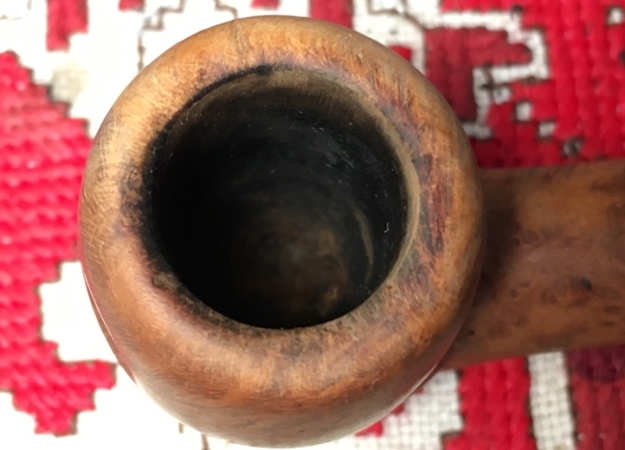
 

Rejuvenating a Captivating Savinelli Punto Oro Corallo di mare 510ks Rusticated Bulldog


Blog by Dal Stanton

This exquisite line of Savinelli Punto Oro Corallo di mare came to me in a single Lot of 66 that I acquired off the eBay auction block.  As I’ve referenced several times before, the Lot of 66 has been very good to me and this pipe confirms this again.  I included a picture of the Lot of 66 below with an arrow marking the Savinelli.  Looking at this picture reminds me of many pipes that have found new stewards and some that have made it to my own personal collection!  Only one regret – the two clay pipes immediately below the Savinelli Punto Oro Bulldog did not make it in the transit from the seller.  Overall, I am very pleased!This Savinelli Punto Oro got the attention of a Texan named Charles in my online collection called For ‘Pipe Dreamers’ Only!.  He contacted me about commissioning the pipe and was hoping to get it by his 50th birthday on December 2.  My first thought was, what a great present for yourself!  Sweet!  Secondly, I thought about the other commissioned pipes in the queue for which other pipe men and women were patiently waiting.  Regretfully, I explained this to Charles and he insisted that I not bump anyone out of the line – I appreciated that!  As I’ve worked the queue down, I have communicated to Charles letting him know the progress and I told him that I knew I wouldn’t have it to him by his birthday, December 2, but I felt very confident that he could celebrate the New Year with this Savinelli.  Well, tomorrow is December 2, and the Savinelli is now on my worktable.  Here are pictures that drew Charles’ interest and why he was willing to wait – by the way, Happy Birthday Charles! The nomenclature is stamped on a smooth briar panel on the lower left of the diamond shank.  It reads, ‘SAVINELLI’ [over] PUNTO ORO [over] 510ks [over] ITALY.  To the left of the COM is the Savinelli stamp.  The stem has a single dot on the upper left panel of the diamond saddle stem. Ever since I started restoring pipes and came into contact with my first Savinelli restoration, a Tortuga, I have appreciated this Italian pipe name.  Before and after WW II, when Italian pipe production was known more for volume than for quality, and not considered by many in the same league with other European pipe makers, Achille Savinelli Jr.’s gravitas took shape to make Savinelli one of the premier names in pipe making today.  This clip from the Pipedia Savinelli article summarizes this well:

Savinelli Pipes began production in 1948 and, although the pipes were of a superior quality and unique in their aesthetic, the brand wasn’t an immediate success. Few new brands are. It takes time for the public to catch on. Retailers were skeptical of placing Italian pipes alongside their best sellers from England or France, and customers, in turn, were hesitant to purchase a Savinelli over pipes by already established, foreign brands. Achille Jr. stood by his product, however; he knew it was only a matter of time before the world realized that these pipes were of a far superior quality, capable of competing with even the most well-established pipe manufacturers in the world. As it turns out, he was right. In less than a year, Savinelli pipes gained prestige in markets all across the world—heralded for their delicate balance of innovation and tradition, of form and function. Savinelli pipes were placed alongside the likes of Dunhill and Comoy’s in tobacconists from the United States to Europe, and, in time, this exposure modified Italy’s reputation; it was not only the premier exporter of briar, but now a premium source of fine briar pipes. (Picture courtesy of Doug Vliatchka)

The shape number listed as a 510ks is an interesting version of the well-known and loved Bulldog shape.  I’ve taken a clip of the 2017 Savinelli Shape chart from the middle of the chart.  This section conveniently shows the 510ks in the center, 3rd pipe down.  Comparing this style of Bulldog to the other two Savinelli Bulldog styles (623 & 624ks) pictured below, the right lower two pipes, the differences are interesting.  The 623 and 624ks are more what I would call traditional or classic Bulldog shapes.  Whereas the 510ks, is taller with a more distinct volcano shaped cone.  It’s an interesting variation and I like it.

The Punto Oro (Gold Point) name is a higher quality line produced by Savinelli.  From the same Pipedia article above, the discussion was the quality of briar used in the manufacturing of Savinelli pipes.  This helpful anecdotal information about the Punto Oro line was made in the article:

This focus on quality begins with sorting, which is conducted in two distinct steps. In the first stage, an artisan sorts through a massive pile of briar blocks, the quality of which can range from complete scrap to pristine gems destined to become Punto Oros or Giubileos.

Perhaps the most interesting information I found on Pipedia was the special Punto Oro edition that Lot of 66 had provided me – the Corallo di mare, or ‘Coral of the Sea’ line.  Of course, the most striking and unique characteristic of this pipe is the amazingly pronounced and expressive rusticated light hued briar.  Pipedia provided an undated page of a catalog of the Savinelli Punto Oro Corallo di mare line.  I include the entire page here:The information block on the bottom is a gold mine of information about the characteristics of this unique briar.   It is described as porous like Block Meerschaum – which is interesting because when I first saw this pipe, I mistook it for Meerschaum until I got a closer look. As with Meerschaum, the claim is that this briar does not need to be broken in.  Yet, most interesting to me was the description of the pigmentation also being like Meerschaum – the more one smokes it the more the pipe will darken into the honey yellow patina.  Fascinating!  This bit of information gave me a new perspective and appreciation for the vintage of the Savinelli Punto Oro Corallo di mare that Charles had commissioned.  The patina on the pipe was a sign of its aging and vintage, as with a Meerschaum pipe.  I take another picture of the briar to show this patina. Wow!The pipe is generally in good condition but needs extensive cleaning.  The chamber has very light cake buildup, but the rim is darkened some by what I believe to be from the lighting practices of the former steward.  The backside of the rim has some scorching.  There is additional darkening from oils and grime.  The stummel is darkened from the patina development from the information related above, but it should lighten some when cleaned in the extreme ridges and peaks of the rusticated briar surface. The stem doesn’t appear to have much oxidation and the bit has very little tooth chatter.  I’m hopeful that this restoration will be more of a refresher!

With a much better understanding of the quality and characteristics of the Savinelli Punto Oro Corallo di mare Bulldog before me, I begin the restoration by adding the stem to a soak of Before & After Deoxidizer along with other pipes and their stems, that have already completed the restoration process.  I let the Savinelli’s stem soak for several hours. After several hours, I remove the Savinelli stem from the soak allowing the Deoxidizer to drain and again pushing a pipe cleaner through the airway to remove the fluid.  I then wipe of the raised oxidation with a cotton pad wetted with isopropyl 95%.  I follow this by wiping the stem with light paraffin oil which cleans it further and revitalizes the vulcanite.Now turning to the stummel, I use undiluted Murphy’s Oil Soap and a bristled tooth brush to clean the rusticated surface with its myriads of nooks and crannies!  I also use cotton pads on the smooth panel and rim.  For the rim, a brass wire brush helps to remove the lava flow.  I find that the tight crevices on the shank are the most uncooperative and I use a sharp dental probe to break up the compacted dirt.  The first picture below shows the compacted crud – the whitesh hue on the shank in the grain is dirt. After a lot of scraping and brushing, finally, I rinse the stummel with cool tap water and it looks great.  The first 4 pictures are before, and then after. Now, after cleaning. Well, I don’t normally do what I just did.  I was so taken with the rusticated finish that I forgot my usual practice of reaming the chamber before cleaning the externals.  Well, back tracking, I use the Pipnet Reaming Kit to clean up the very light cake in the chamber. I quickly discover that there is no cake really to ream with the blade heads, so I graduate quickly to scraping the walls and reaching down to the floor of the chamber with the Savinelli Fitsall Pipe Tool.  I follow by sanding the chamber with 240 grade paper wrapped around a Sharpie Pen and finish by wiping the carbon dust from the chamber with a cotton pad wetted with alcohol.  That was a quick chamber clean up and the pictures show the progress.  After clean, I inspect the chamber walls and it looks great – no heating problems are evident. Next, I turn to the internal cleaning of the mortise and airway.  I discover again, that this pipe has been cleaned well.  I expend one pipe cleaner and cotton bud and I’m convinced that the internals are clean – this doesn’t happen often, but thank you!Before turning to the stem, I decide to push forward with the one noticeable challenge on this stummel – the charred rim.  The conundrum is, if I sand it off by introducing a gentle internal rim bevel, I sacrifice a bit of that valuable rusticated rim real estate which I hate to do.  I scrubbed it well earlier with a brass wire brush which cleaned the rest of the rim nicely, but the inner rim is charred and there isn’t a remedy for that.  The charring is on the front right and the back left – diagonally.  I take another close-up picture from the steward perspective to show what I’m seeing.  Taking the conservative route, I decide to use the brass wire brush again.  I dip the brush in Murphy’s Soap, concentrating on the scorching, I scrub.  Amazingly, after some time, the scorched, damage briar starts giving away and I see more healthy briar.  You can still see where the most damage was (third pictures – lower right), but it will not draw as much attention to itself after the stummel is completed.  I may still need to sand a bit on the inner rim lip, but not a lot.  The pictures show the progress.  I’m amazed. I turn to the stem and use the heating method to deal with the very light bite dents on the bit.  I take a close-up of both the upper and lower bit to show what I see.  Using a Bic lighter, I paint the areas with the flame to heat and then expand the vulcanite which hopefully reclaims its lost space or at least, minimizes the compressions.  Painting the bit with the open flame of the Bic works like a charm as the compression are greatly minimized allowing me easily to sand out the dents using 240 grit paper.  While sanding, I also use a flat needle file to freshen the button lips.  In order to erase the scratches of the filing and 240 sanding, I wet sand the entire stem using 600 grade paper and follow this by sanding/buffing with 0000 steel wool. Pressing forward with the stem restoration, using micromesh pads 1500 to 2400 I wet sand and follow by dry sanding with pads 3200 to 4000 and 6000 to 12000.  Between each set of three I apply Obsidian Oil to revitalize the vulcanite.  I love the gloss pop of the vulcanite after the micromesh cycles! With the stem drying, I look again at the stummel.  There is a light dark ring on the inner lip of the rim persisting.  It’s not a lot and I address it simply using 240 grade paper tightly rolled.  I do not really introduce a bevel but clean the residue scorching and it cleaned up quickly. There is only minor briar erosion on the inner rim where it was scorched – see second picture below on the left. I’ve been looking forward to this phase of the restoration, refreshing of this Savinelli Punto Oro Corallo di mare – Sea Coral.  This unique rusticated finish needs a bit more consideration regarding the approach toward finishing it.  The surface does remind me of coral (and maybe a bit of elephant skin!) and the light hue of this Corallo di mare line evident in the Savinelli advertisement I included above confirms this.  I take some additional close-ups focusing on the hue and texture. Here’s the question which reveals a concern.  The honey brown hue shows the patina of this briar as the information above described.  At this point in the restoration, with other pipes, I might apply Before & After Restoration Balm to enrich the briar.  My concern is that this might overly darken the light complexion of this Savinelli’s briar and I don’t want to do this.  If the briar is more porous than regular briar, as the Savinelli information indicates, it might ‘drink up’ the Balm and a darkened briar might result.  Ok, I’m curious.  I decide to test a spot to see what happens.  I isolate applying a small amount over the smooth nomenclature panel to the shank edge – the edge has some rustication, but not as pronounced as the forward part of the bowl.  Here is the result.It does darken the briar but wow!  The result is a deep honey hue which to me, enhances the appearance. I decide to apply the Balm to the entire surface, but very sparingly.  I put a very small amount on my thumb and rub the Balm into the rusticated surface very briskly and aggressively spreading it across the briar surface.  I also use a bristled tooth brush to brush the area thus helping to deliver the Balm into the crevices.  After completing the application, I again rub the surface aggressively with my thumb to make sure the Balm was spreading evenly over the surface.  I then use a 100% horsehair Kiwi shoe brush to brush the surface to lift the excess Balm and to buff it up.  The result to me looks good – I think.  It’s time to turn out the light and I let the stummel dry through the night.The next morning, I reunite stem and stummel and take a good look – liking what I’m seeing!  I mount a cotton cloth buffing wheel to the Dremel, setting the speed at about 40% full power and I apply the abrasive, Blue Diamond compound.  As I do this, I know I’ll have to pay the piper later – the compound will gunk up in the rustication and it will take a good bit of effort to remove it.  Even though I know this to be the case, I apply the compound because I like the textured highlights and nuanced shading that will result from the fine abrasion.  It will also light the hue which I like as well.  One additional benefit is that it teases out the grain of the briar in the rustication.  The application of Blue Diamond compound on the gnarly surface eventually obliterates the cotton buffing wheel and I switch to a new one.In this picture below, you can see the leftover compound residue which I’ll need to remove, but also look closely at the rusticated mountains – the grain is peaking out.  Doing this kind of detail work even on a rusticated surface transforms presentation subtly – like moving from a regular TV screen to a high definition display.Using a toothpick, sharp dental probe and a bristled brush I painstakingly AND patiently work on cleaning the briar surface of the leftover compound dust.  It’s a bear of a job, but to me, the results are worth it, at least in this case! Before waxing, again I use the horsehair brush on the rusticated surface and I give the bowl and stem a buffing with a felt cloth to remove the residual compound dust.
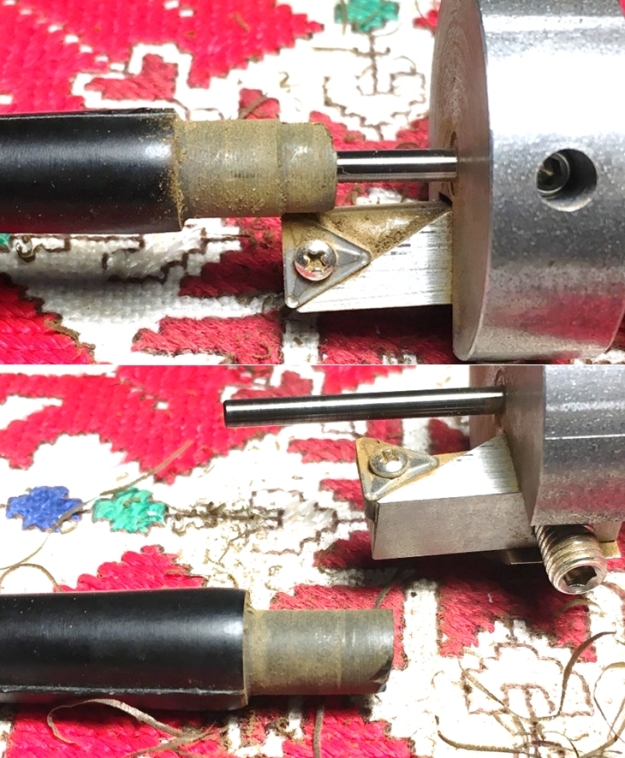
In the interest of full disclosure, as I finished the Blue Diamond process, I became increasingly dissatisfied with how dark the stummel had become after my application of Before & After Restoration Balm.  The rusticated surface lost the light hue that I believe characterized the Corallo di mare line.  What to do?  I failed to take pictures, but what I ended up doing was plopping the entire stummel in a soak of isopropyl 95% for a few hours to remove the applications on the surface.  I wasn’t sure that the alcohol soak would do the job and I wasn’t sure if it might damage the patina.  After a few hours I removed the stummel and after drying, I simply buffed the surface with a clean cotton buffing wheel on the Dremel.  Amazingly, the surface buffed up to a lighter hue that resembled the original.  I was thankful and relieved.

After the grand detour and experiment, I next mount another cotton cloth wheel, increase the speed of the Dremel to about 50% full power and strategically apply carnauba wax to the Savinelli Punto Oro. I increase the speed to provide more RPM and therefore more friction to heat and dissolve the wax, so it is received by the surface more evenly.  I avoid wax buildup as I slowly work the wax into the surface, rotating the Dremel’s buffing wheel to agree with the flow of the rusticated pattern I’m working on.  This takes a good bit of time methodically to work through and cover the surface.  I apply a few coats of wax to both stem and stummel and then buff up the surface using a horsehair brush and then a rigorous hand buffing with a microfiber cloth.

My, oh my.  When I complete a project like this, I marvel at what comes from the many processes the restoration brings to bear.  The rusticated surface on this Savinelli Punto Oro Corallo di mare emulates a coral landscape.  I the intricate design of the rustication process holds my attention as I study the contours.  The light hued briar is also eye catching and unique and my decision to soak the stummel in alcohol to clean it I believe was spot on.  Charles, from Texas, commissioned this pipe from the collection, For ‘Pipe Dreamers’ Only! and he will have the first opportunity in ThePipeSteward Store to bring this Savinelli home to Texas.  This pipe benefits the Daughters of Bulgaria – an effort here in Bulgaria helping women and girls who have been trafficked and sexually exploited.  Thanks for joining me!