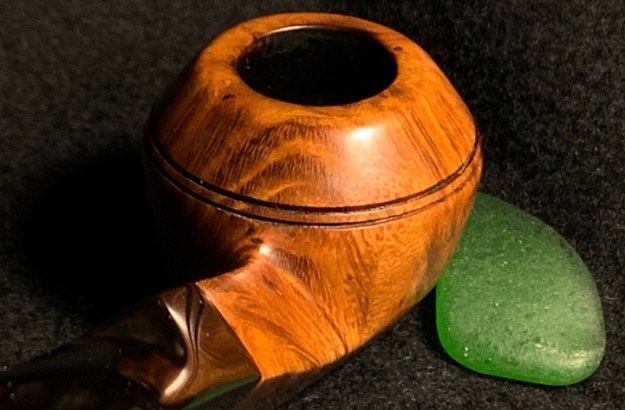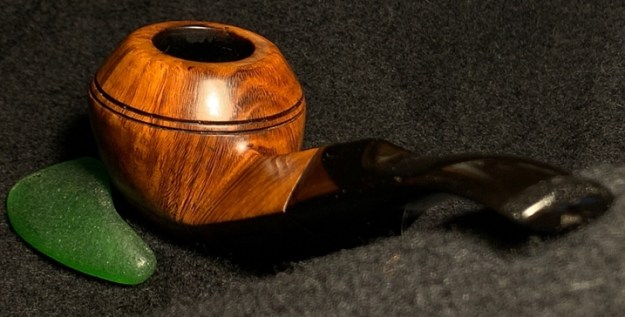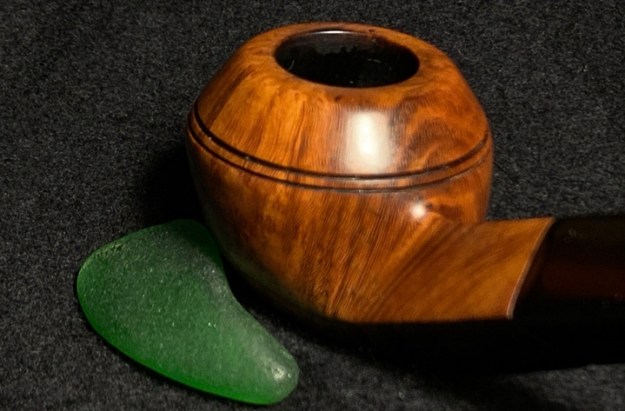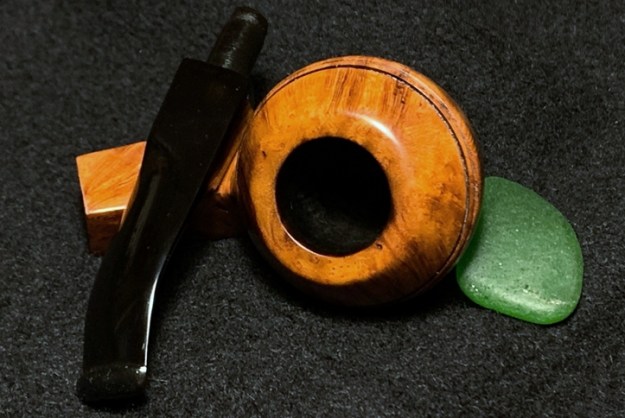
Tag Archives: Dal Stanton article

Ehrlich – Another Iconic Boston Tobacconist (1868-1968): An Ehrlich Special Chimney


Blog by Dal Stanton

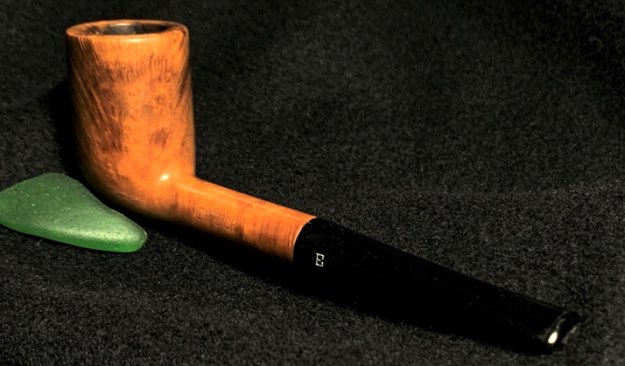
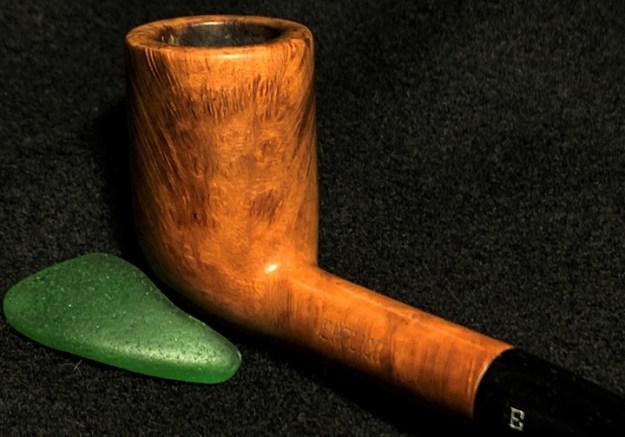
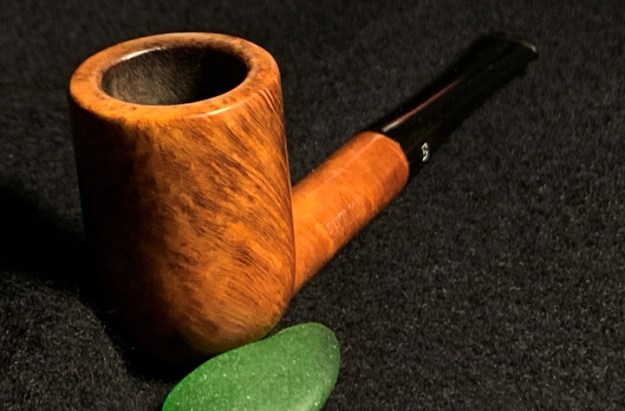
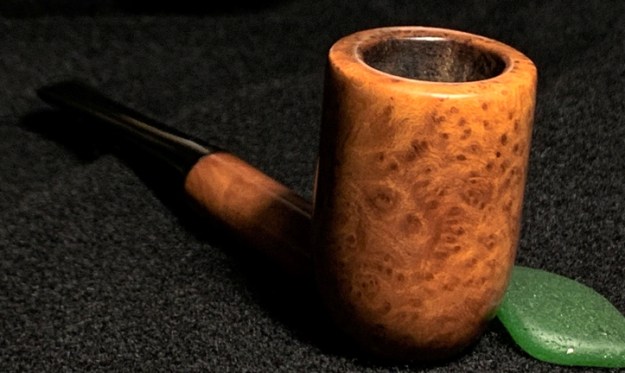
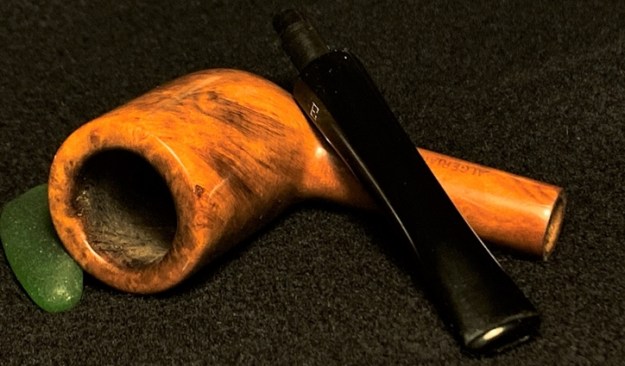
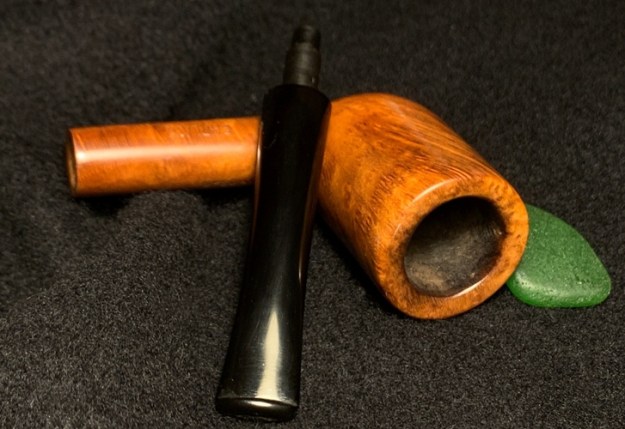
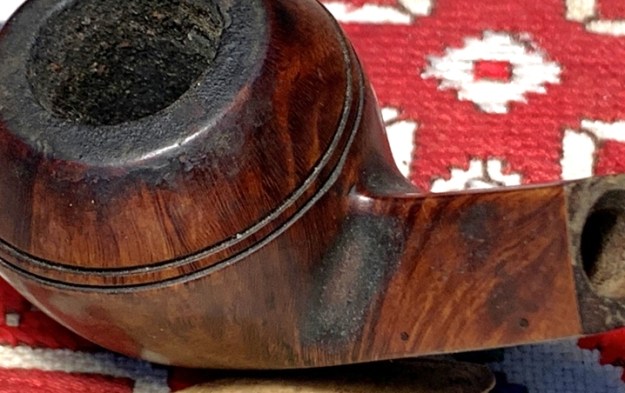
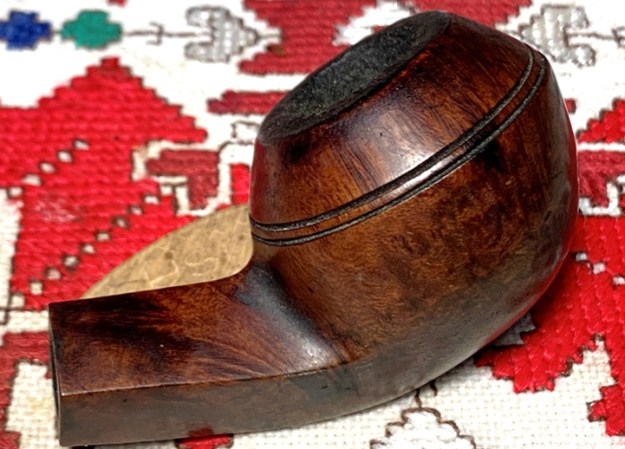
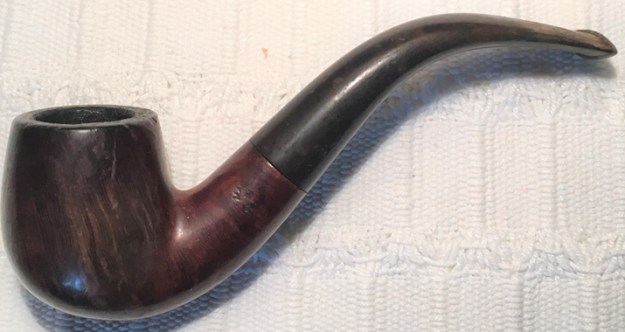
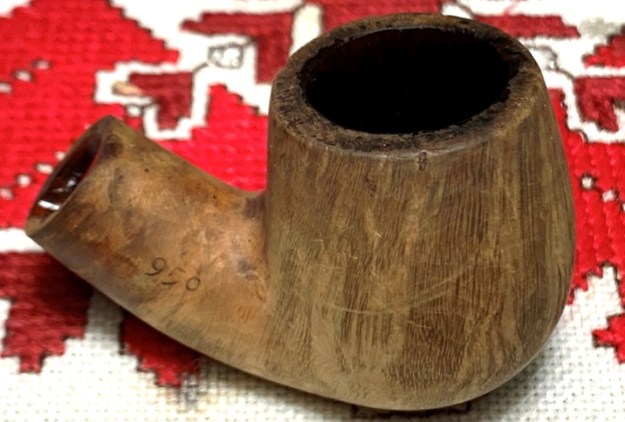
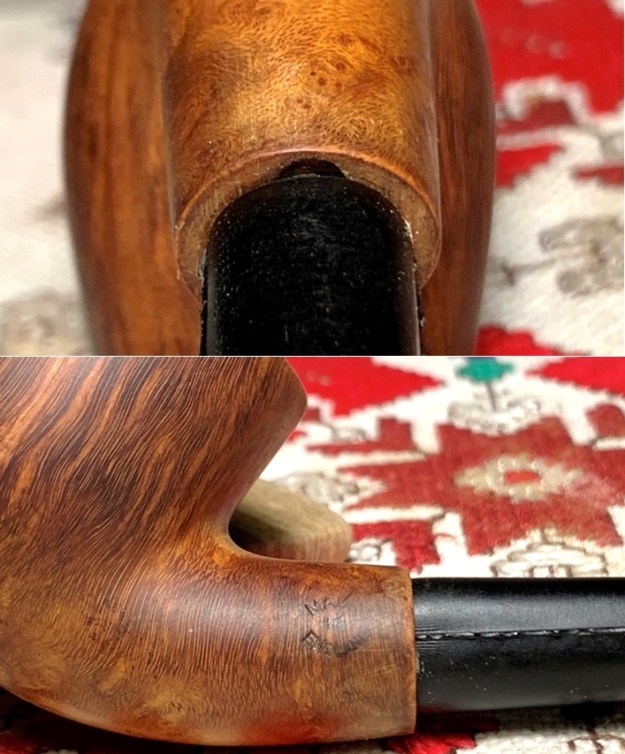
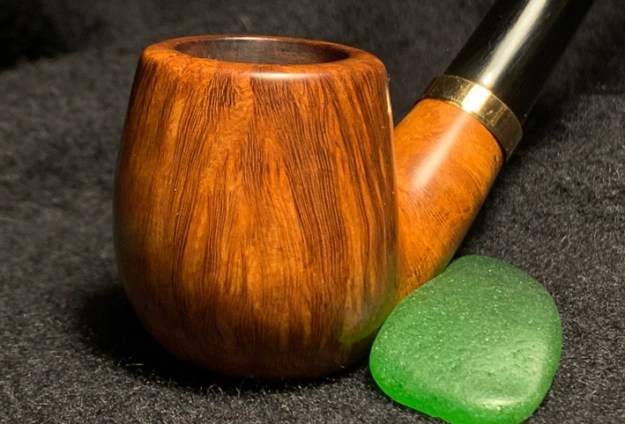
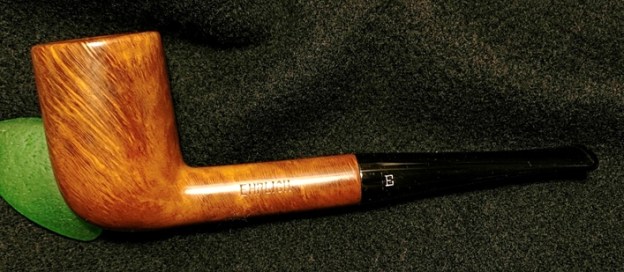
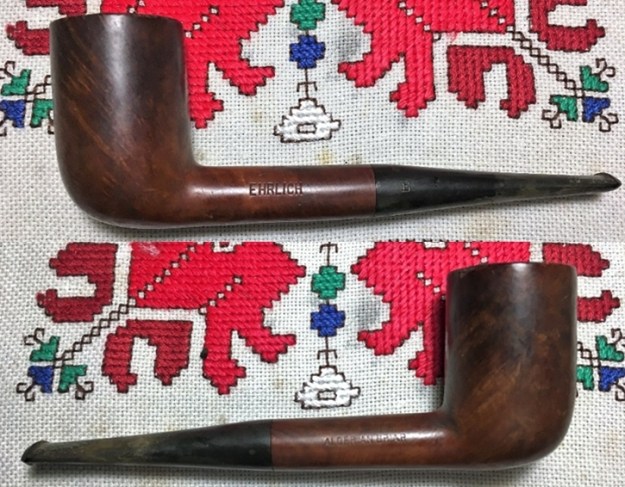
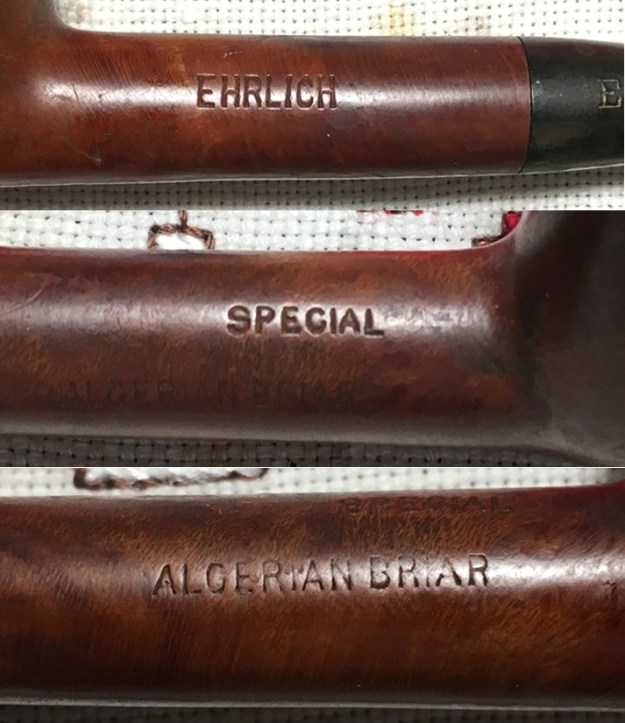
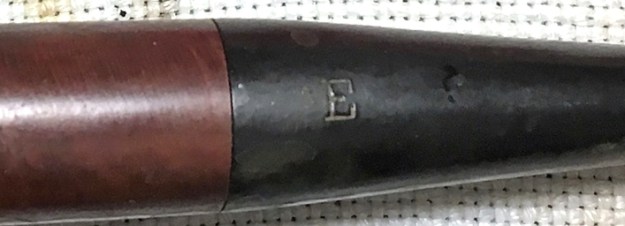
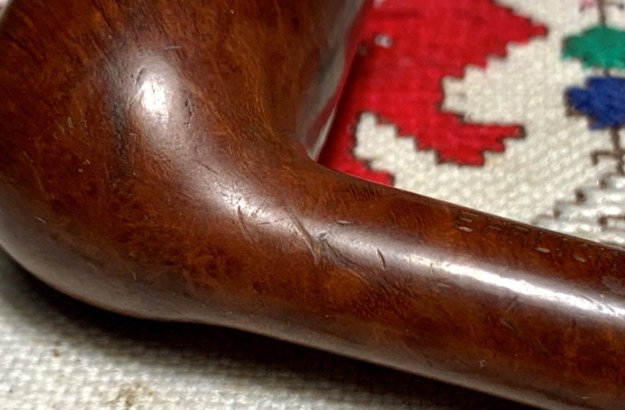
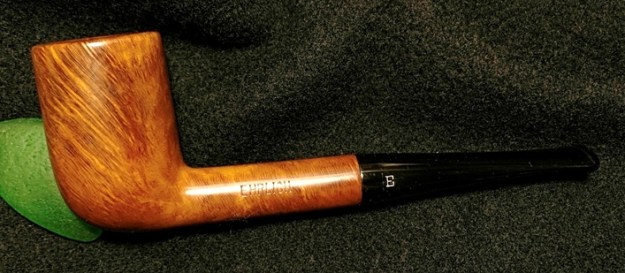
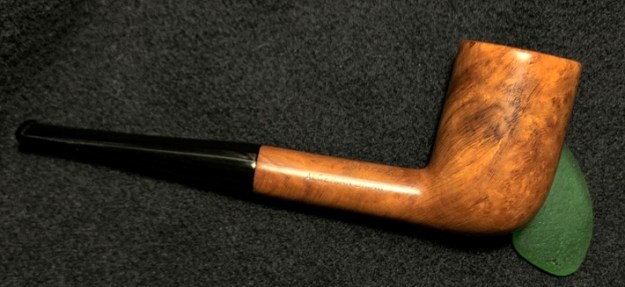
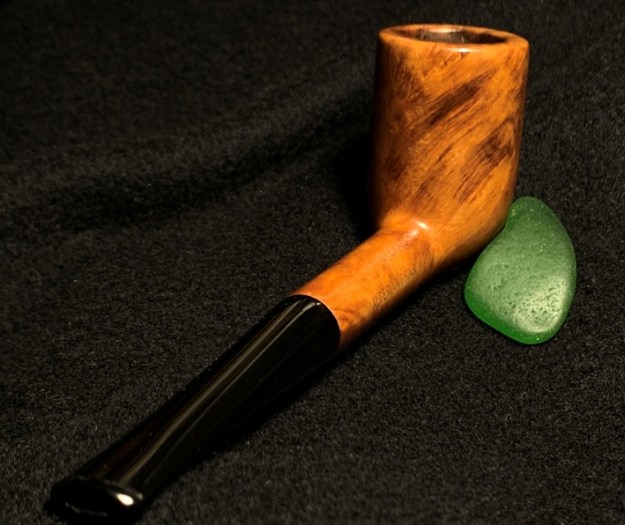
I saw this pipe on eBay from a seller in the New England state of Connecticut.  What drew my attention was the tall bowl – a Chimney shape.  There’s something about ‘Chimneys’ that I like.  They have the basic Billiard workhorse air about them, but with the tall Chimney – it’s like a challenge: pack it high and tight!  My bid held firm and the Ehrlich, which I assumed had a German COM, was added to the online collection, For “Pipe Dreamers” Only! for a pipe man or women to see, ‘dream’ of the possibilities, and commission to benefit the Daughters of Bulgaria – women and girls who have been trafficked and sexually exploited.  Todd saw this Ehrlich and commissioned him along with two other pipes – a Borge Mortensen Handmade of Denmark (see: Link for the restoration) and a Heritage Blasted Apple still in the queue – up next.  Here are the pictures of the Ehrlich Special Chimney that got Todd’s attention. The bowl is stamped with the nomenclature, EHRLICH, on the left shank.  On the upper right-hand side of the shank is stamped, SPECIAL [over] ALGERIAN BRIAR, which is dropped lower on the shank.  The stem is stamped with ‘E’ I had assumed that ‘Ehrlich’ was a German name and I had assumed, wrongly, that the Country of Manufacturing was Germany as well.  I was fully surprised to discover in my initial research that Ehrlich was a tobacconist located in one of my favorite cities, Boston.  This was a pleasant surprise because I have long appreciated the story of the US’s second oldest Tobacconist shop also located in Boston – the L. J. Peretti Co., still in operation and one of the few establishments remaining that mix blends while you test blends as you wait.   My son used to live in Boston and the city has had an attraction to me for its history, its character and yes, its sports team – Boston Red Sox and Bruins – sorry, as a long-time Miami Dolphins fan, I cannot stomach New England’s version of NFL!  My discovery of L. J. Peretti shop pipes, most of which were manufactured in NYC and some in London, started for me a fun advocation of collecting them.  I had never heard of Ehrlich of Boston until finding the article in Pipedia on the Ehrlich name.  I include it here because I enjoy adding to the opus of information, of especially Boston tobacconist shops.
The David P. Ehrlich story

Pipemakers and Tobacconists for a Hundred Years, 1868-1968.
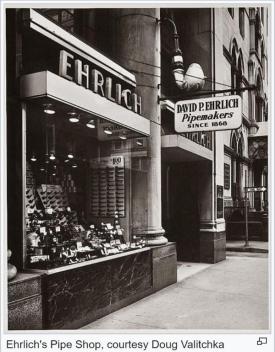
The David P. Ehrlich Company has remained solely in the hands of one family during its century of business, yet it has had several firm names and locations. David P. Ehrlich went to work in 1881 at the age of twenty for Ferdinand Abraham, who dealt in cigars and tobacco and who had begun business in 1868 at 1188 Washington Street in the South End, but in 1880 moved to the center of the city, where the firm has been ever since. David Ehrlich married the boss’s daughter. In 1916 the name became the David P. Ehrlich Company and Mr. Ehrlich devoted the rest of his life to this business. Since David’s death in 1912 it has been owned by – his nieces and nephews including Richard A. and William Ehrlich.

Ehrlich shop has since 1880 had a predilection for historic sites. 25 Court Street was close to the spot where from 1721-1726 James Franklin had, with the assistance of his brother Benjamin, published The New-England Courant. In 1908 the firm moved a few doors up Court Street to number 37, on the opposite corner of the alley that is grandiloquently named Franklin Avenue. This new locution was on the site of the one-time printing office of Edes and Gill, publishers of the Boston Gazette, in whose back room some of the “Indians” of the Boston Tea Party assumed their disguises. Soon after the end of World War II at which time the store was located at 33 Court Street a move around the corner to 207 Washington Street brought the shop diagonally across from the Old State House and onto the site occupied from 1610-1808 by the First Church of Boston. The demolition of 207 Washington Street in 1967 caused still another move to 32 Tremont Street, adjoining King’s Chapel burying Ground, which is the oldest cemetery in Boston.

The David P. Ehrlich Co. has not just occupied sites intimately associated with Boston history and institutions; it has in the past century become a Boston institution in its own right. It has specialized in fine cigars, pipes, and pipe tobacco. In addition to the retail business, the firm has long specialized in the manufacture of pipes, both from Algerian briar root and from meerschaum, a beautiful white fossilized substance, mined from the earth in Turkish Asia Minor. Meerschaum lends itself to carving, and in the nineteenth century there developed in Austria a fashion for carving pipes from it with formidably intricate decoration.
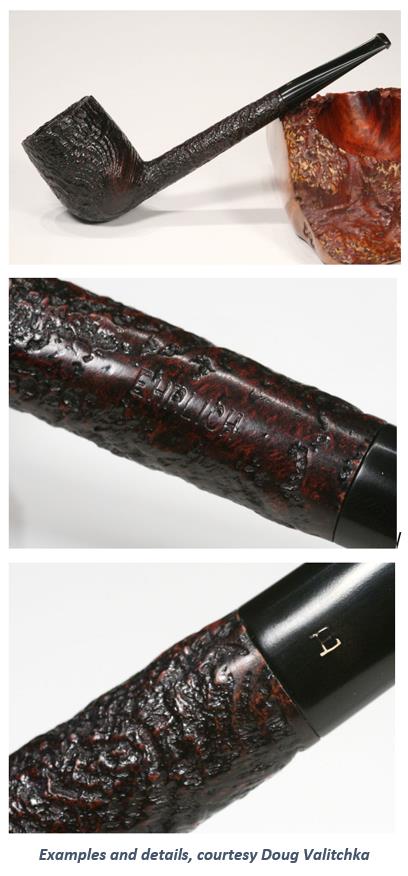
The Ehrlichs have long had meerschaum carvers, who ply their craft in the shop window to the delight of passersby. For years the bearded Gustave Fischer was a familiar figure in the window at 33 Court Street. A succession of craftsmen have continued the tradition. and still make and repair pipes in the window of the new Tremont Street shop. They still turn their meerschaum pipes by hand on a foot operated wooden lathe made in Austria about 1871. Although briars are today turned on power lathes, meerschaum can only be turned on a foot-operated lathe.

As amber was used for the bits in his better pipes, David P. Ehrlich found himself in the amber business as a side line. For years the firm has been noted for amber jewelry in its many types and forms, often purchasing old examples from estates to maintain its large and varied assortment. And with the meerschaum and die amber as a nucleus, a variety of artifacts dealing with tobacco and smoking, as well as prints of Boston have come to decorate the shop. There is a display case in the Boston Museum of Science donated by David P. Ehrlich Company which outlines the story of amber.

Many of the mahogany display cases that were installed in Court Street early in the century have been transplanted to Washington and then to Tremont Streets, so that the present premises, although new, have a strong family resemblance to those that we knew on our earliest visits to Ehrlich’s. This is good sense in Boston, where people do not welcome needless change for its own sake.

In 1956 when the old Harvard Square firm of Leavitt and Peirce was offered for sale, the Ehrlich brothers, because of their Harvard connections, could not resist acquiring it. Richard A. Ehrlich was a member of the class of 1922; his brother William of 1925. As they had known for years this seventy-year-old establishment, which had done business in the same location in Harvard Square longer than any except the College itself, they took it over, with the idea of keeping it as it was, even to the metal ceiling. In 1958, to celebrate its 75th anniversary, David McCord edited for them an engaging volume entitled 75 Aromatic Years of Leavitt & Peirce in the Recollection of 31 Harvard Men . And as Leavitt & Peirce is to Harvard College, so is the even older David P. Ehrlich Co. to Boston – the purveyor of “a brand of special knowledge” built up over a century of honest dealing.

The January 1968 issue of Antiques Magazine carried a feature by Wendell D. Garrett titled “Paraphernalia of smokers and snuffers” describing in considerable detail the impressive collection of paraphernalia and smokers articles from many countries and centuries on permanent exhibit in their Leavitt & Peirce Cambridge tobacco shop. The Boston Public Library in Copley Square devoted twenty-five display cases during the month of January to the David P. Ehrlich Company Centennial Exhibition of Tobacciana made up of the Leavitt & Peirce antique collection, the David P. Ehrlich collection of carved meerschaum pipes and their two venerable Cigar Store Indians.

There are pipes of every price and size and shape, from good ordinary smoking pipes up to briars of the finest grain and meerschaums band cut, turned and polished front the best Turkish blocks. This is in keeping with a catalogue statement: “we have never ceased to regard smoking as an exquisite pleasure, rather than a mere habit.” Another of the principles of the firm is embodied in the observation: “we are pipe makers – not plumbers. There are no tricky gadgets in Ehrlich pipes.” But when a man drops his pipe, the makers will transform themselves into repairmen in a highly efficient manner. All this has been going on for a century, and we confidently trust that it will outlast our time, and then some.

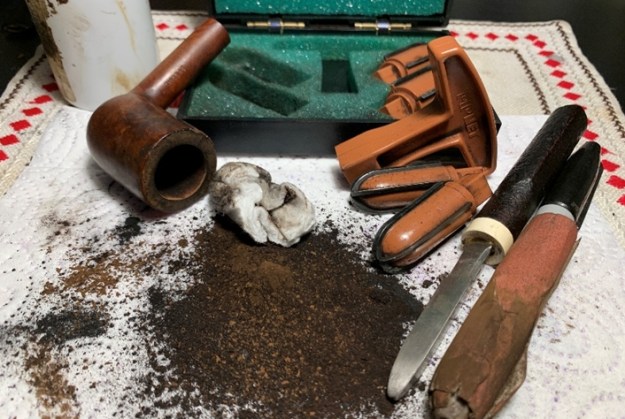
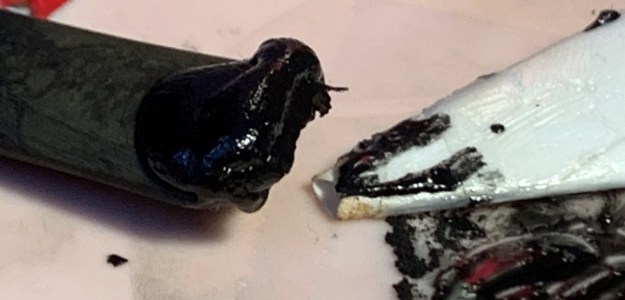
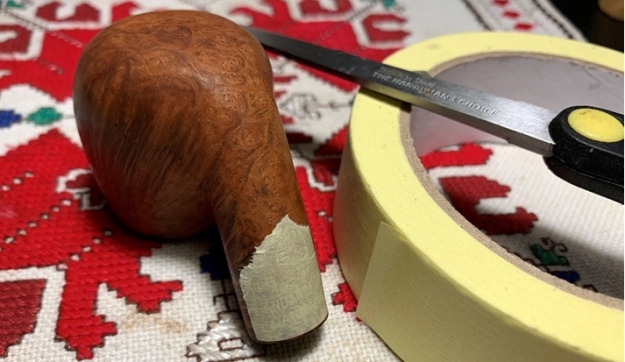
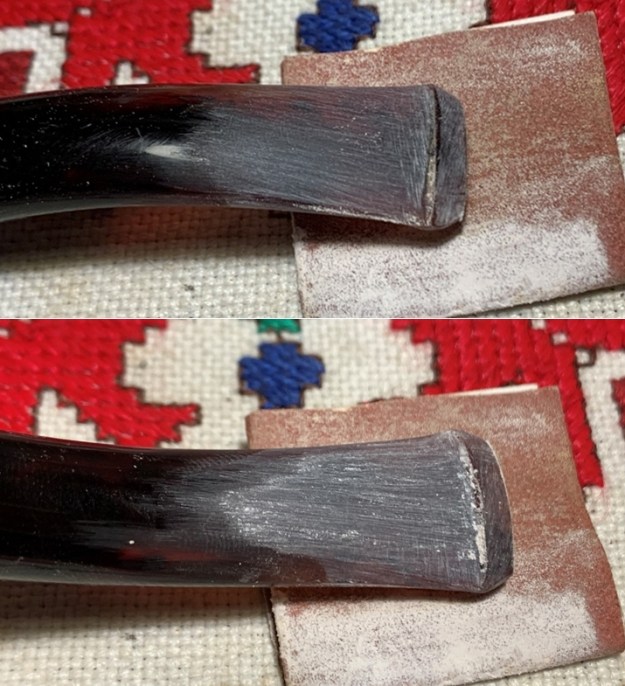
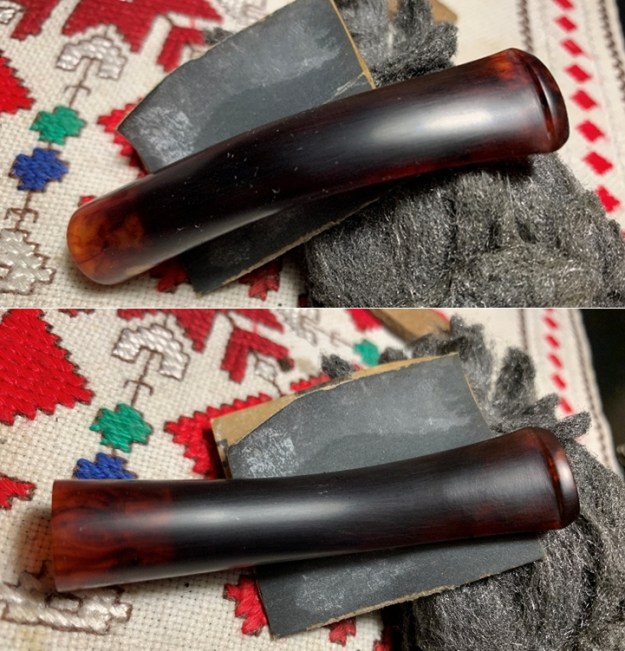
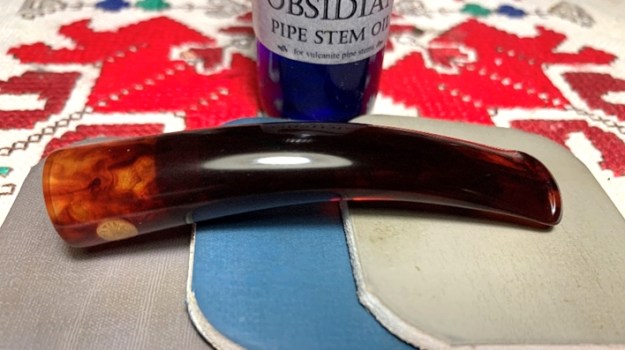
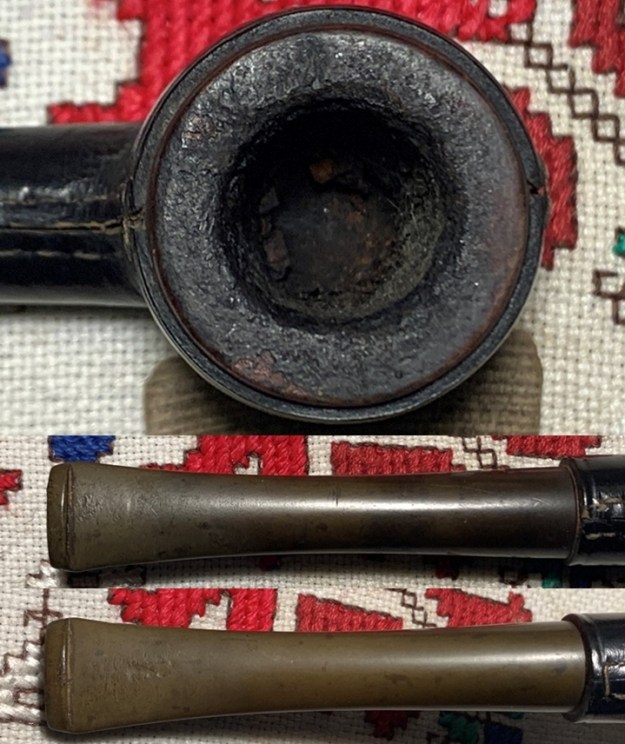
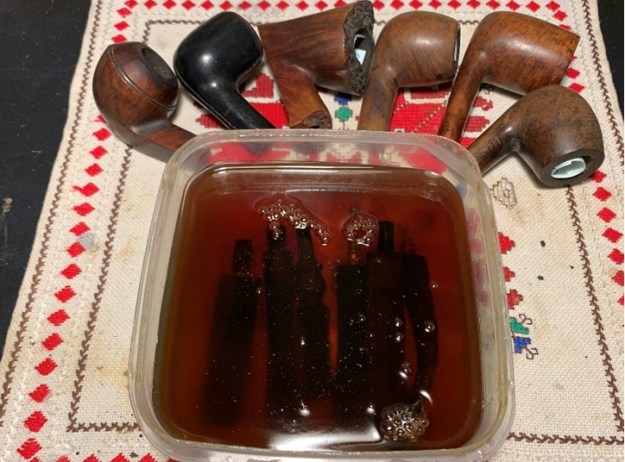
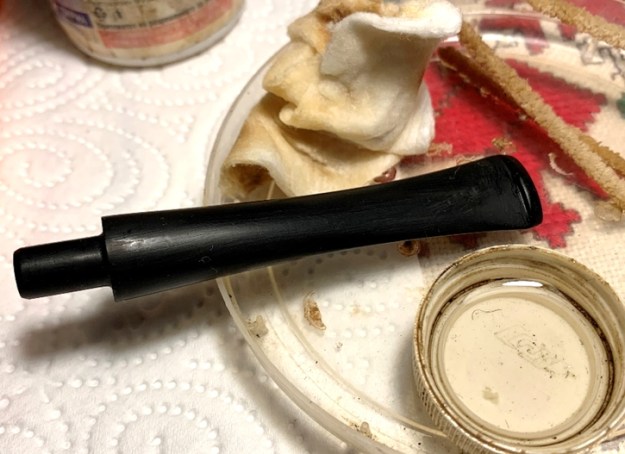
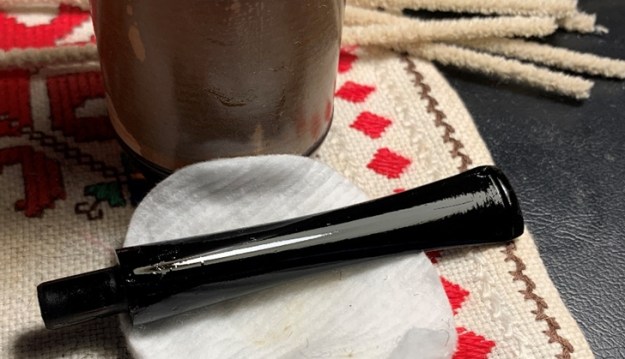
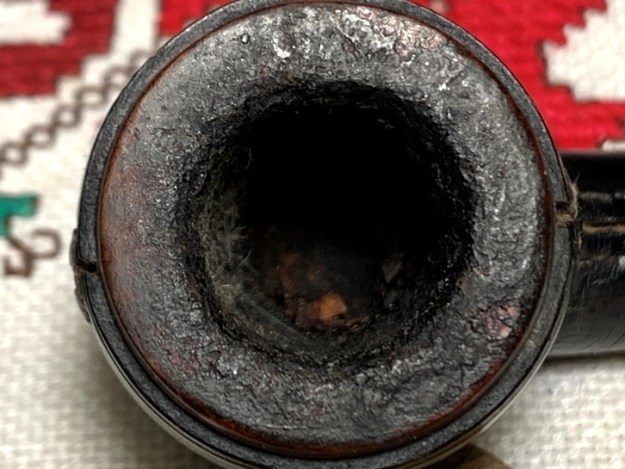
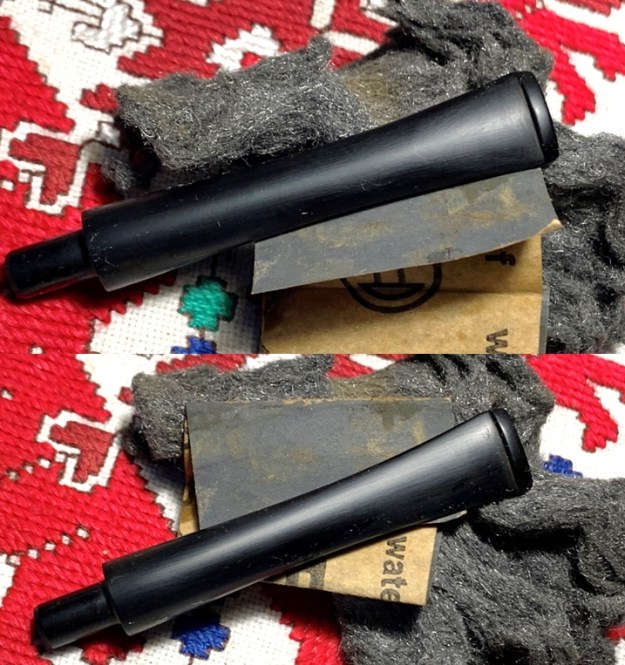
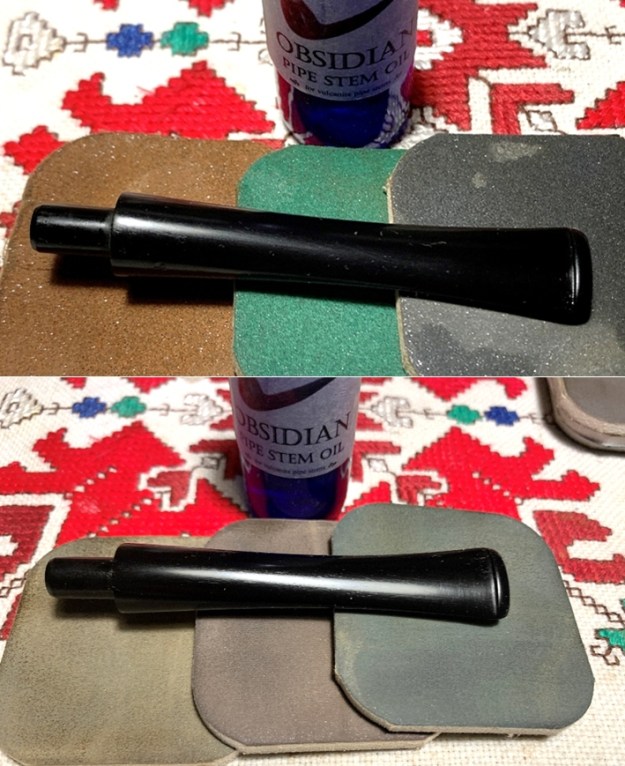
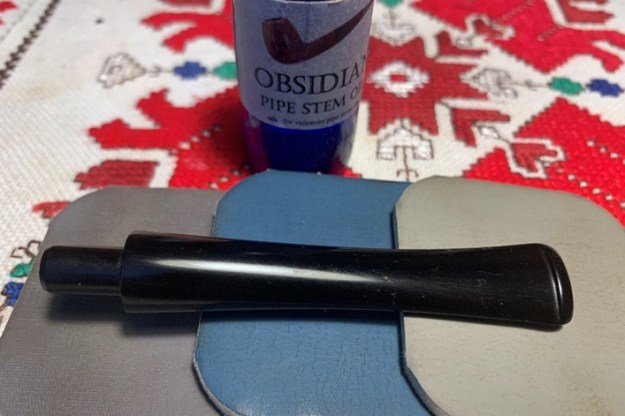
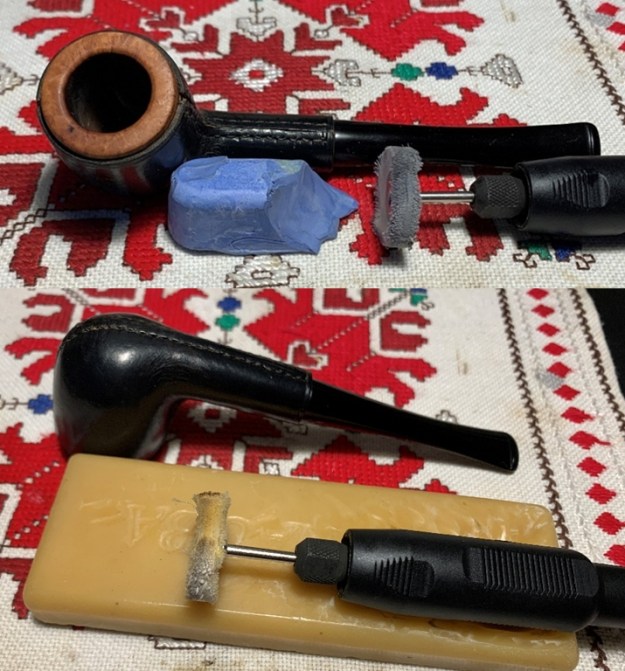
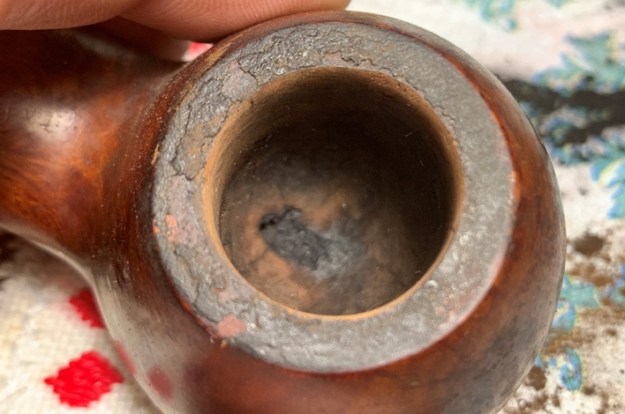
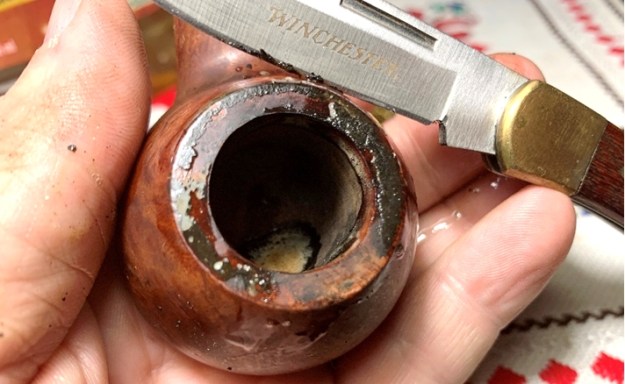
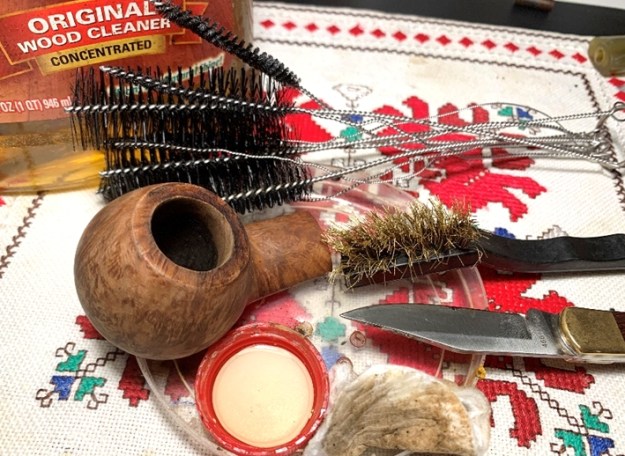
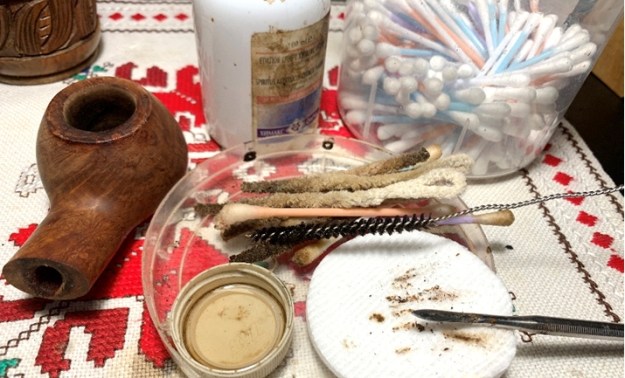
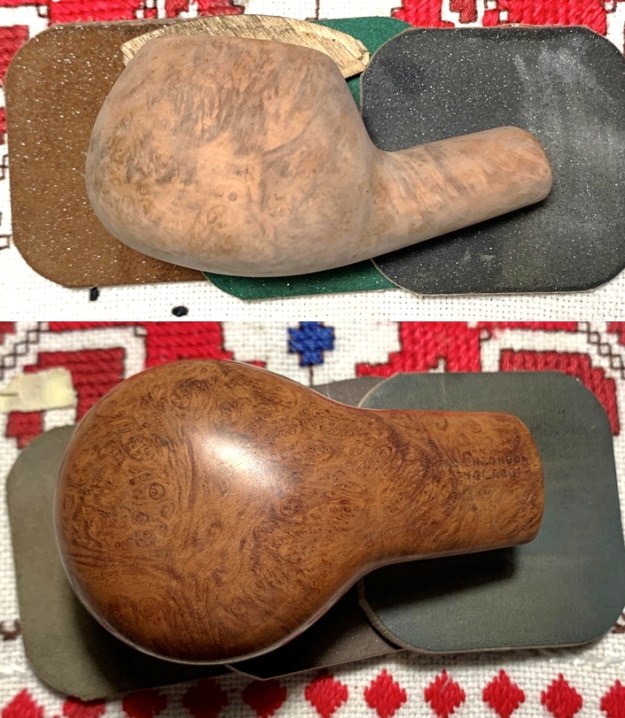
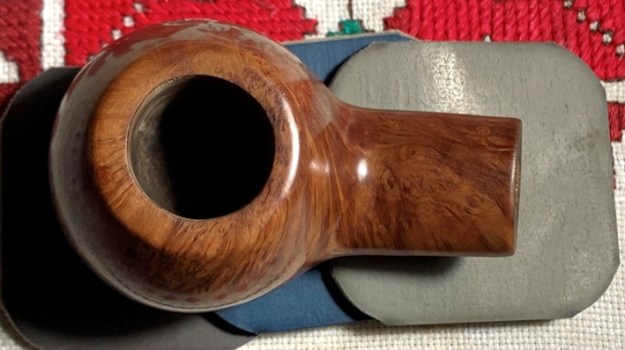
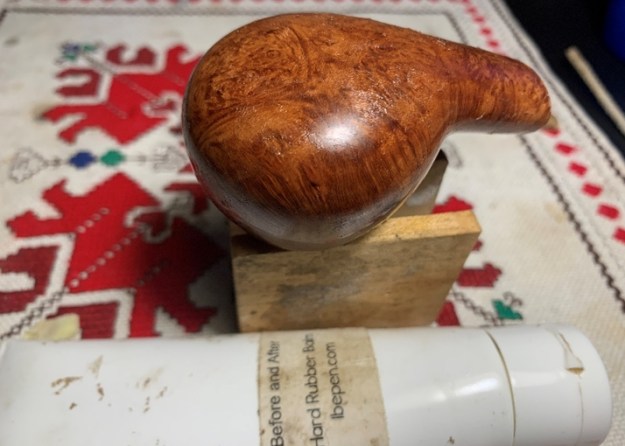
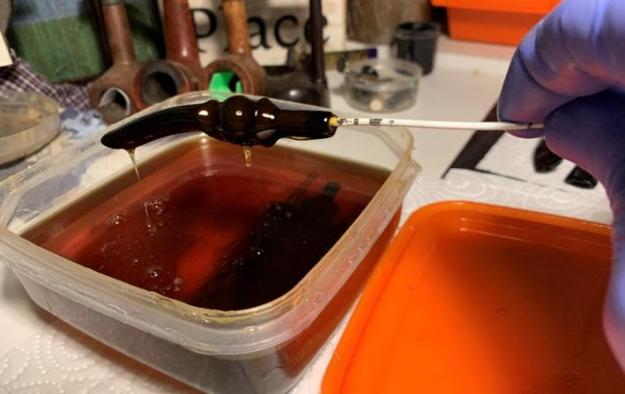
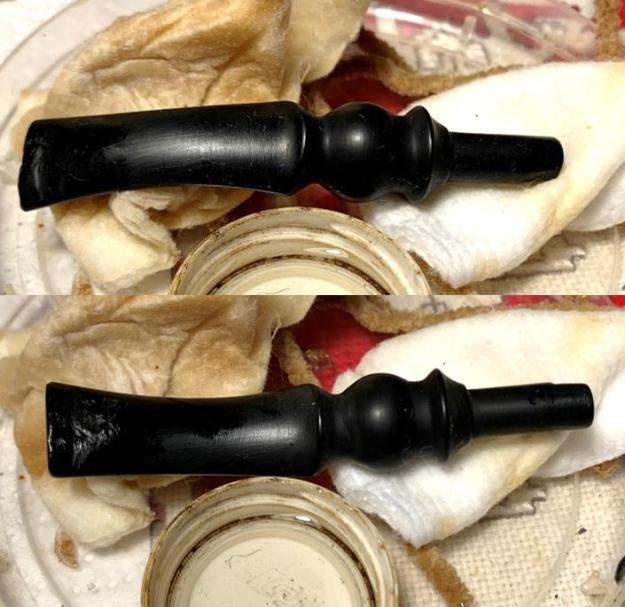
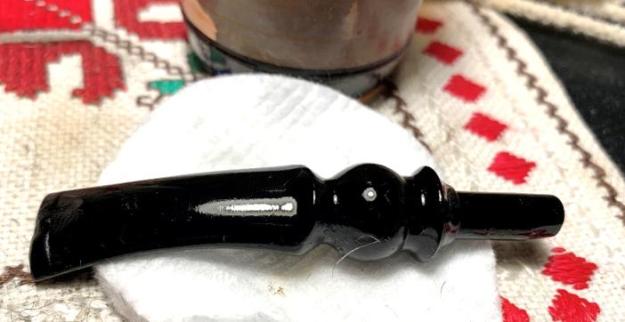
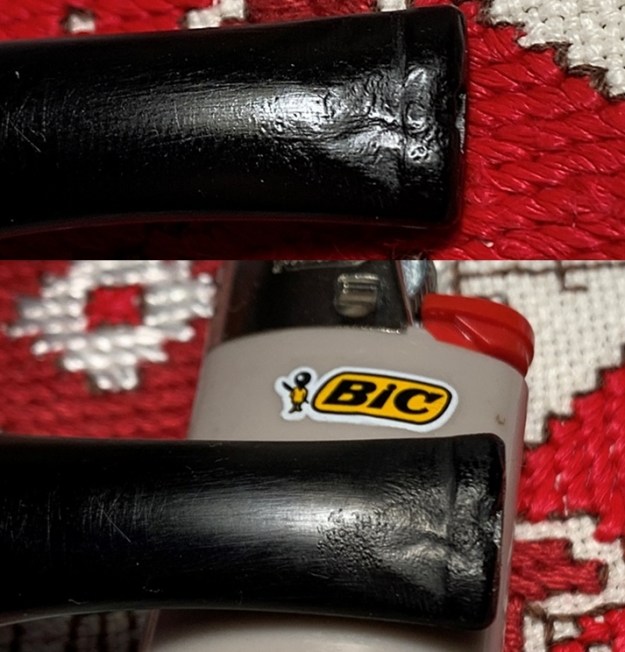
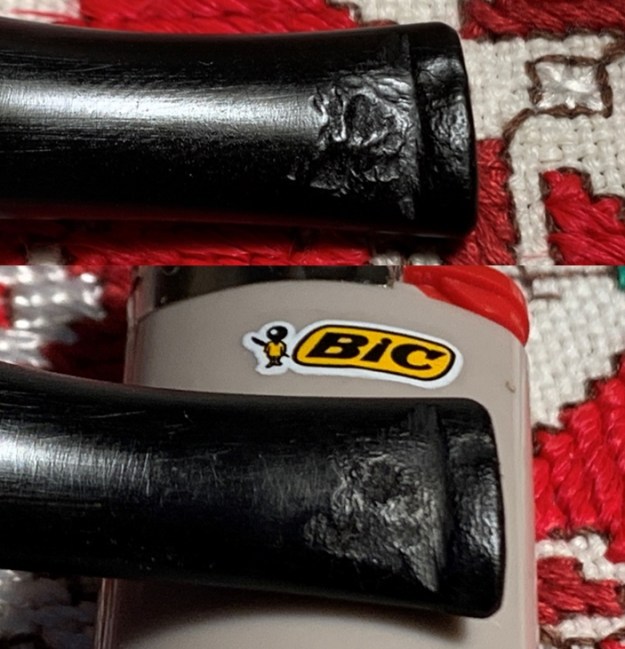
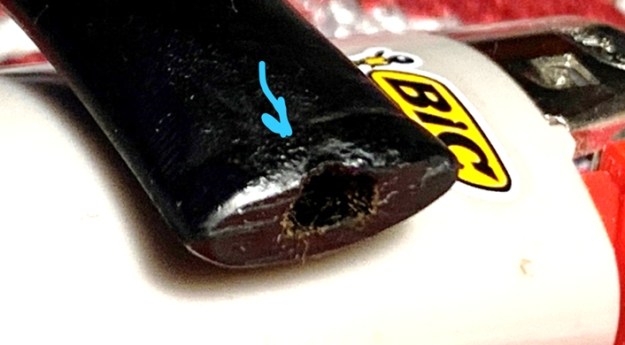
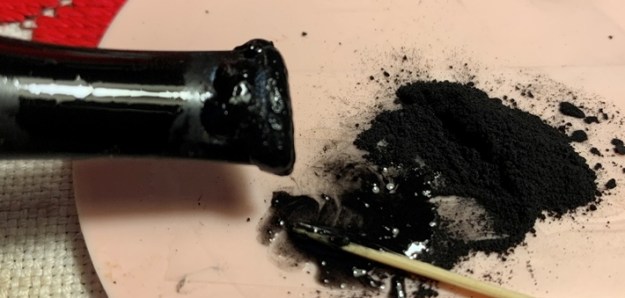
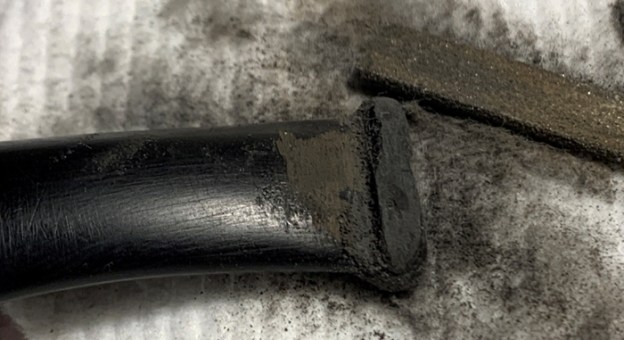
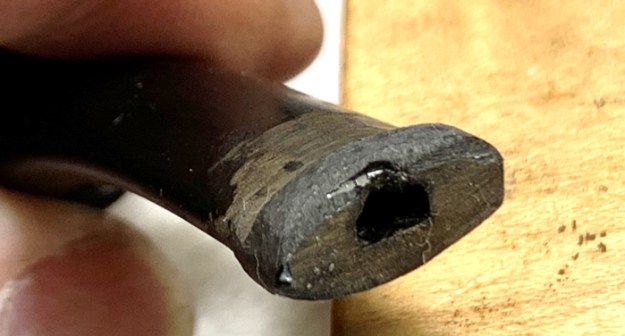
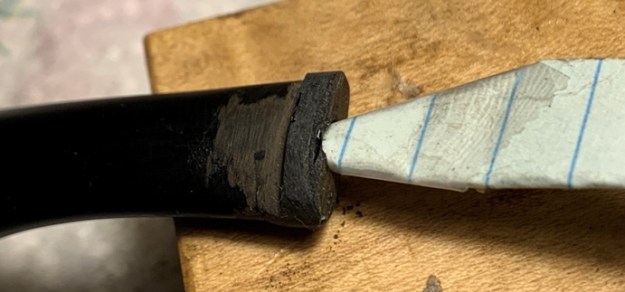
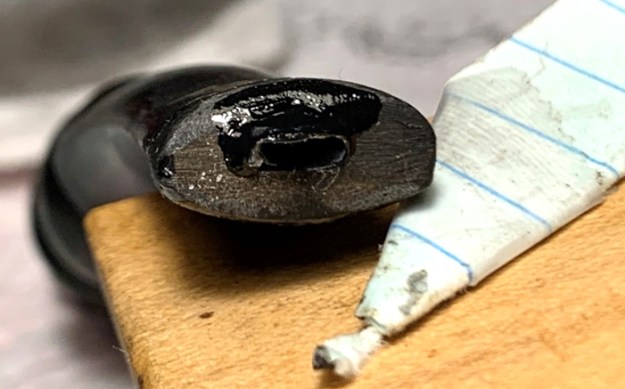
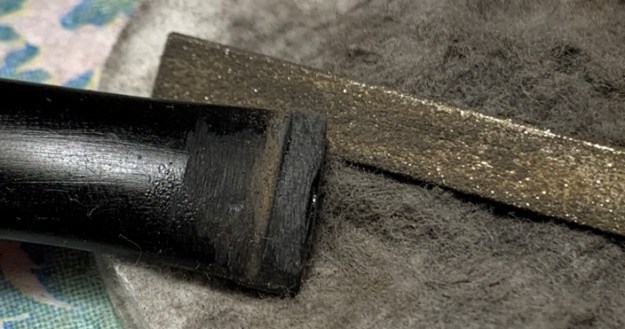
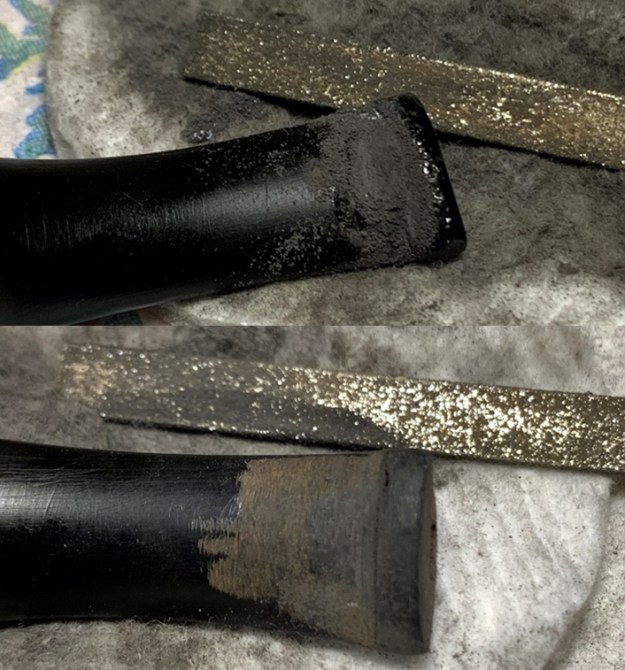
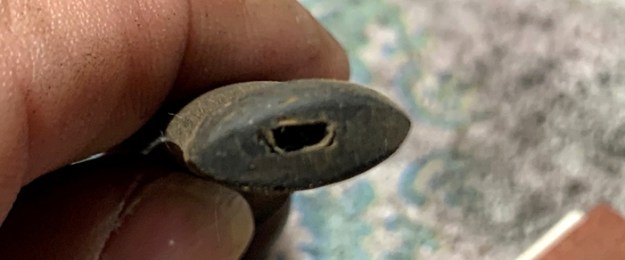
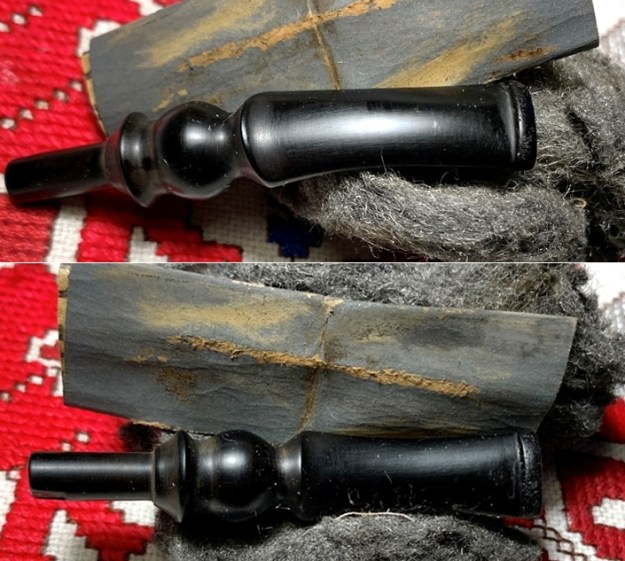
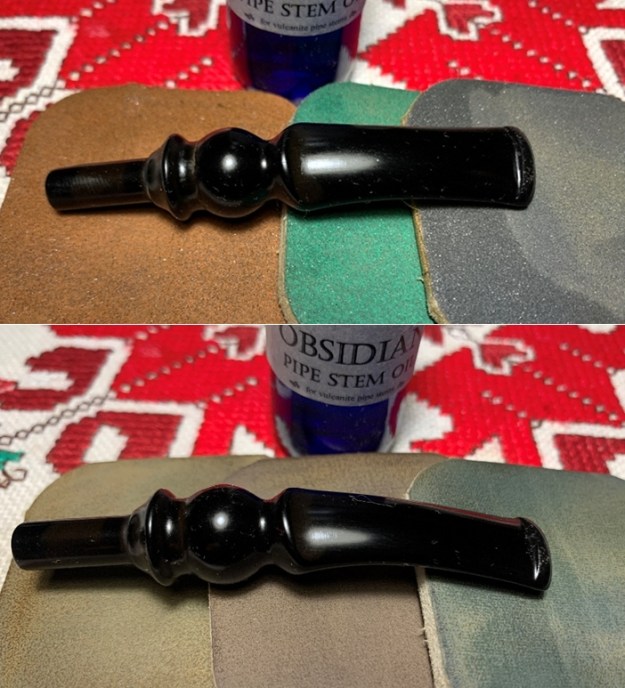
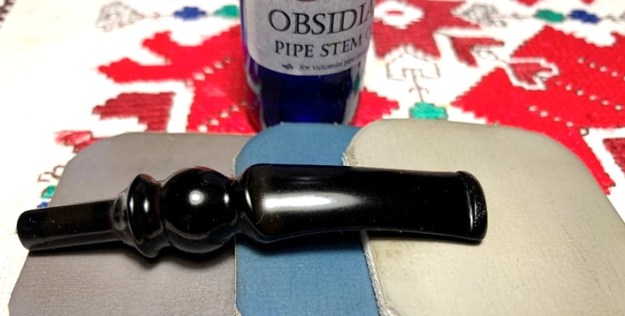
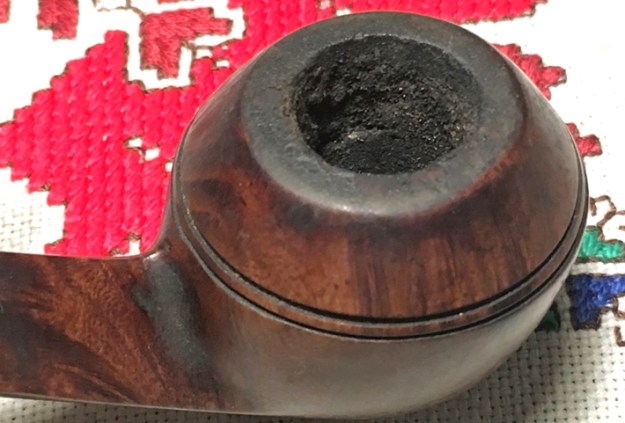
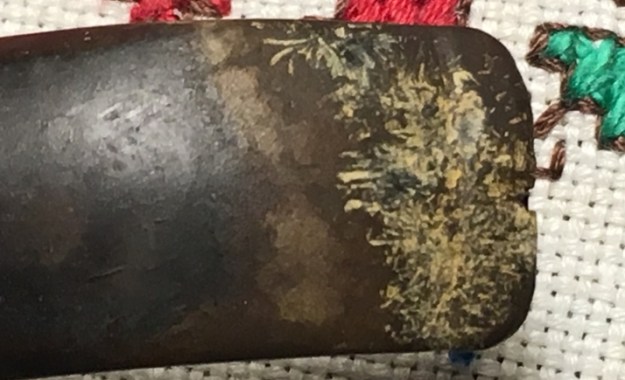
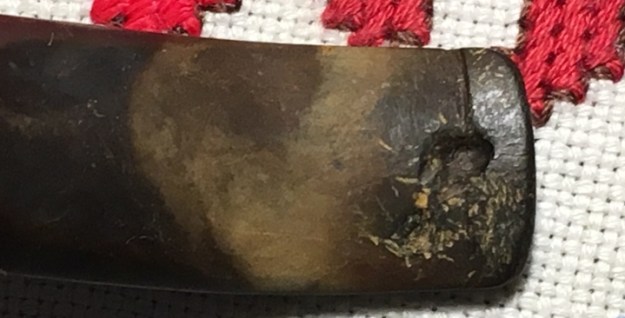
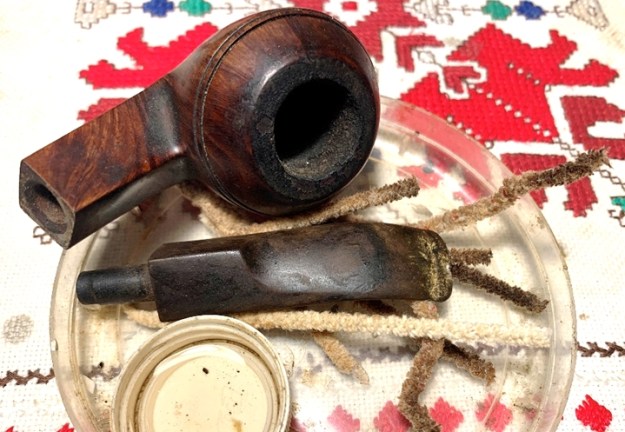
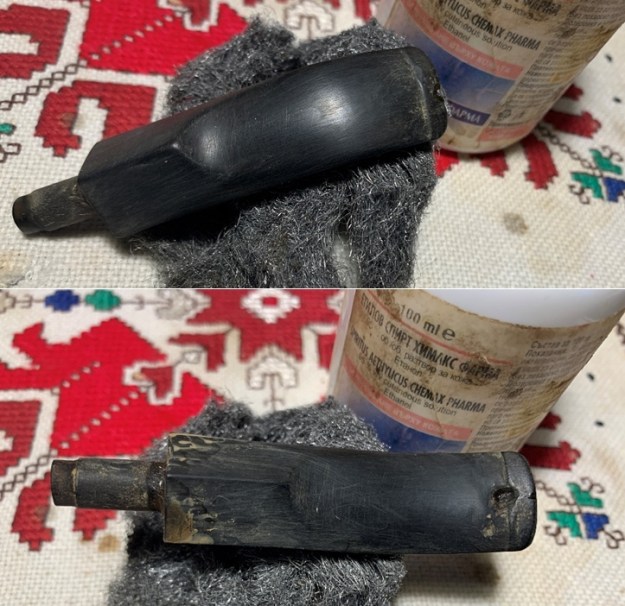
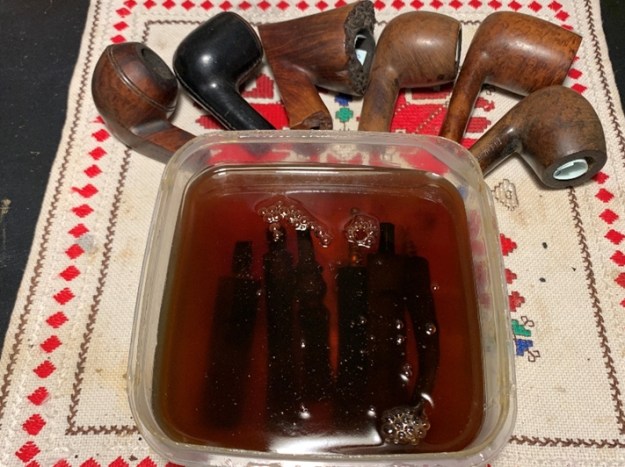
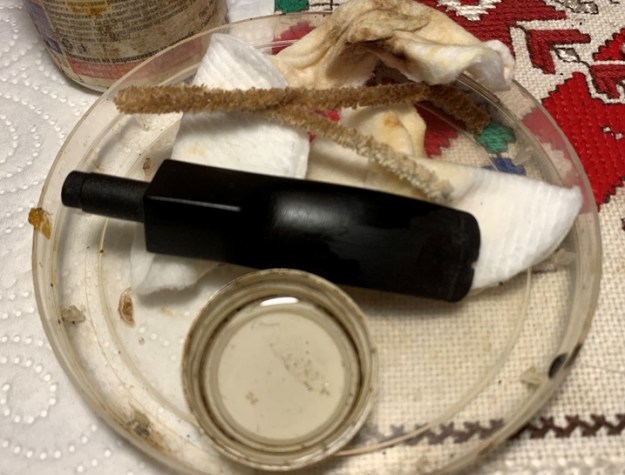
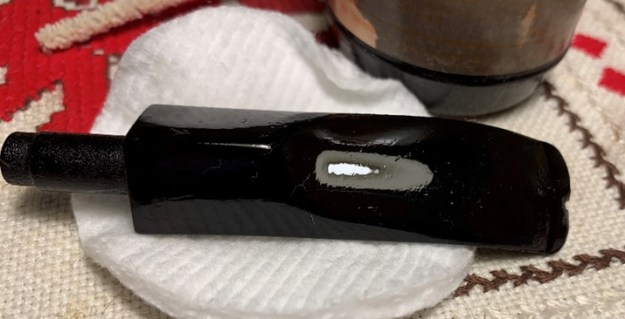
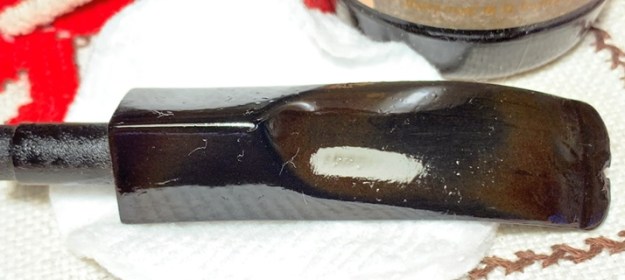
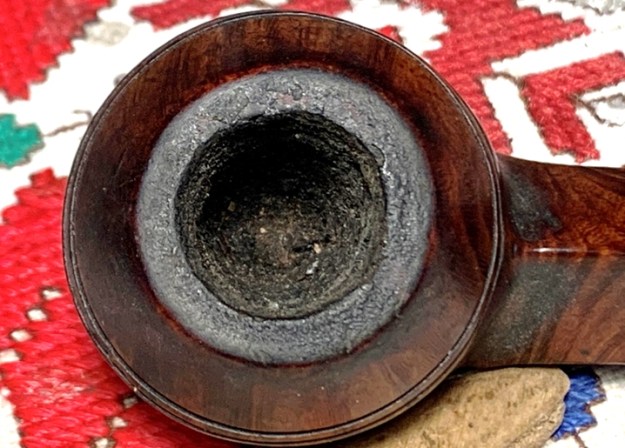
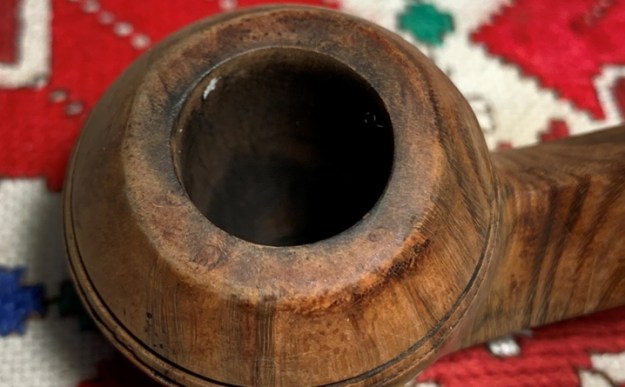
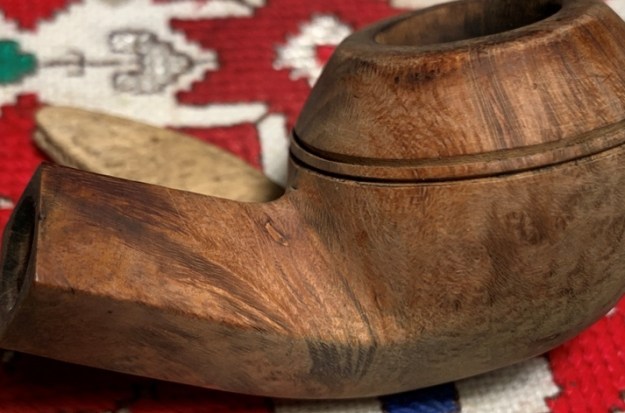
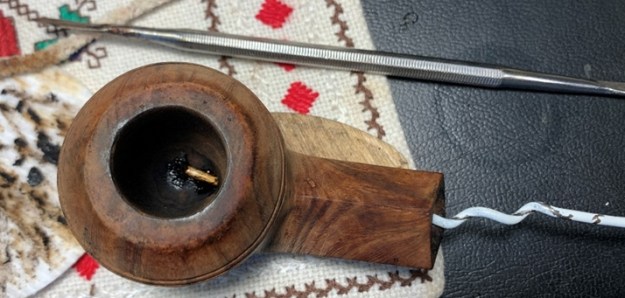
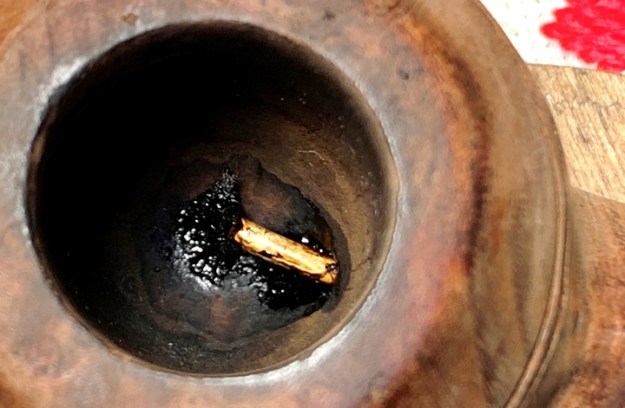
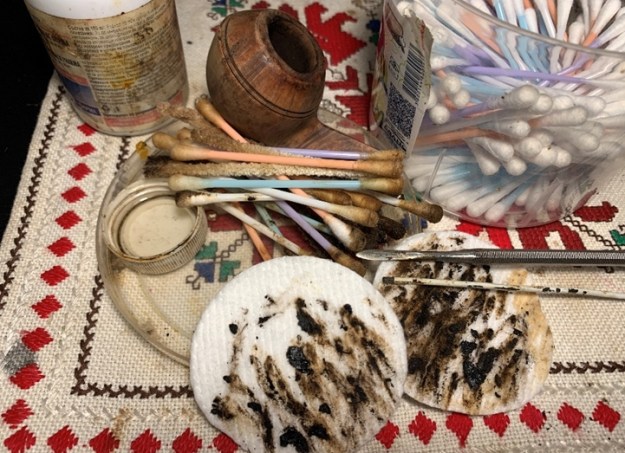
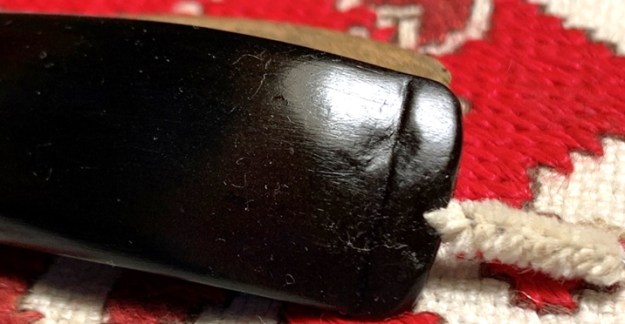
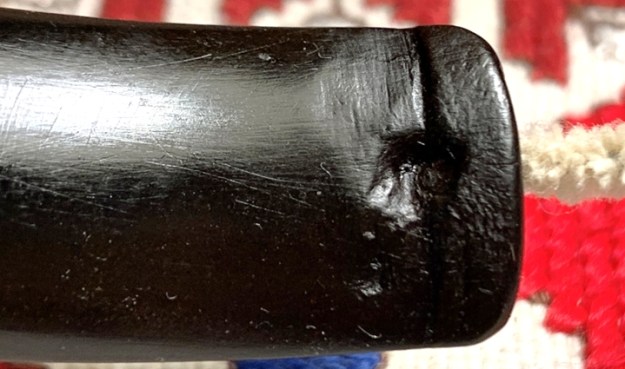
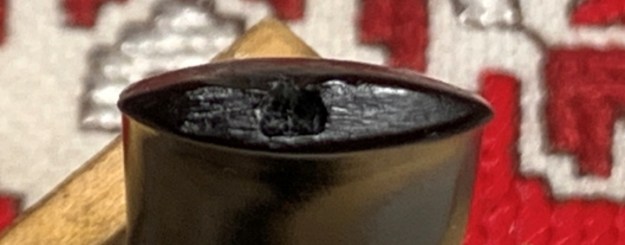
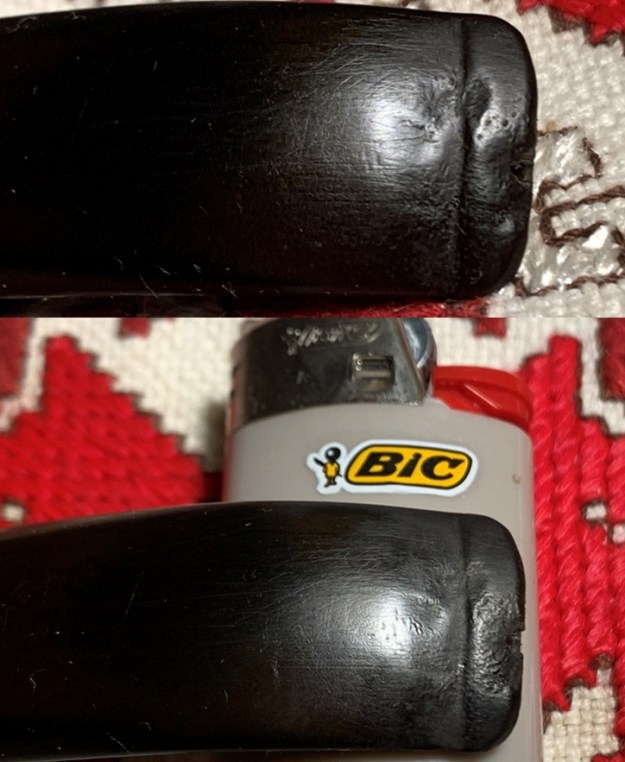
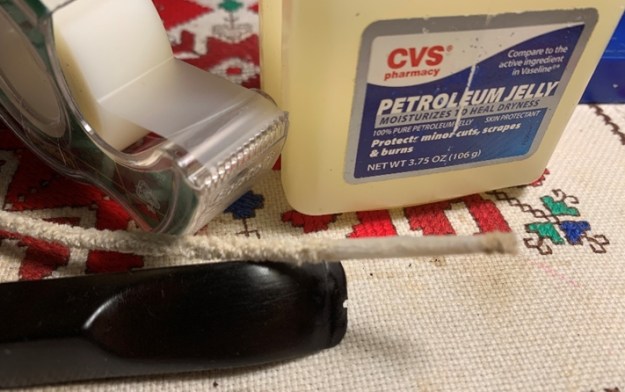
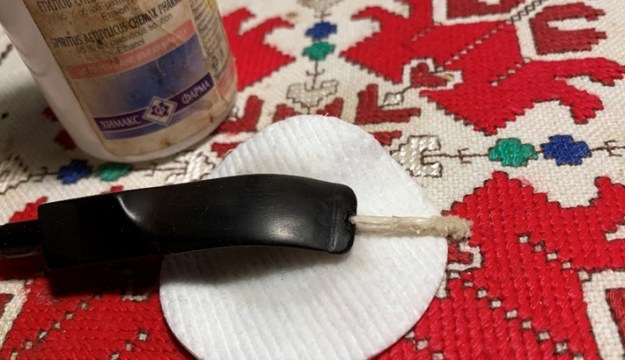
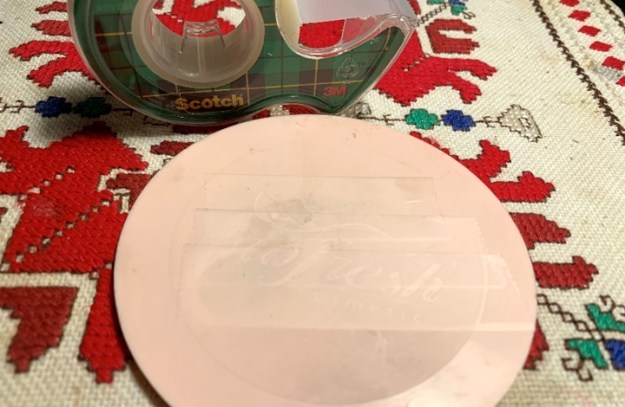
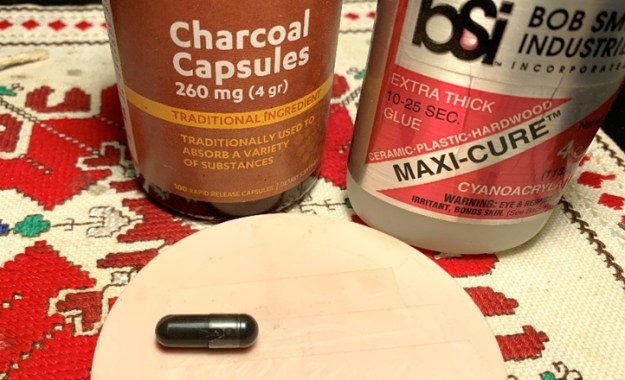
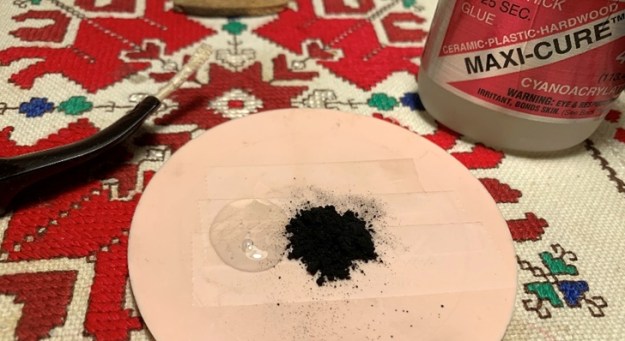
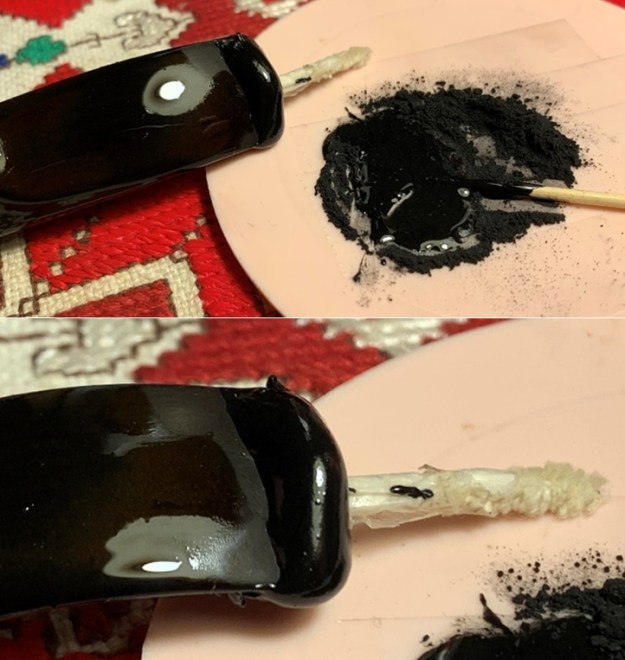
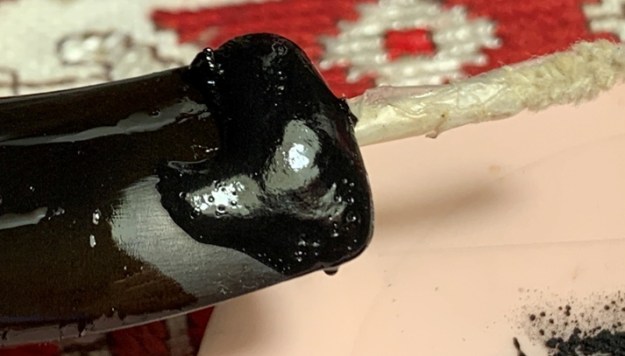
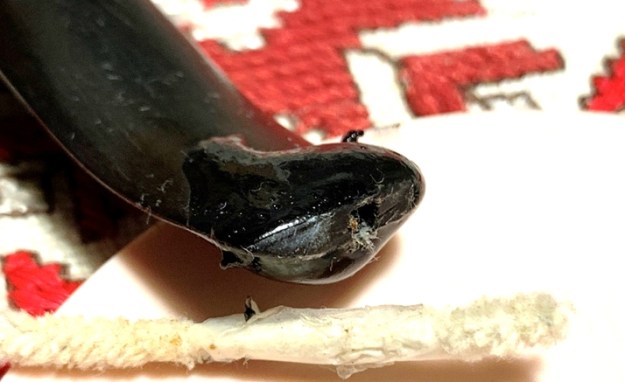
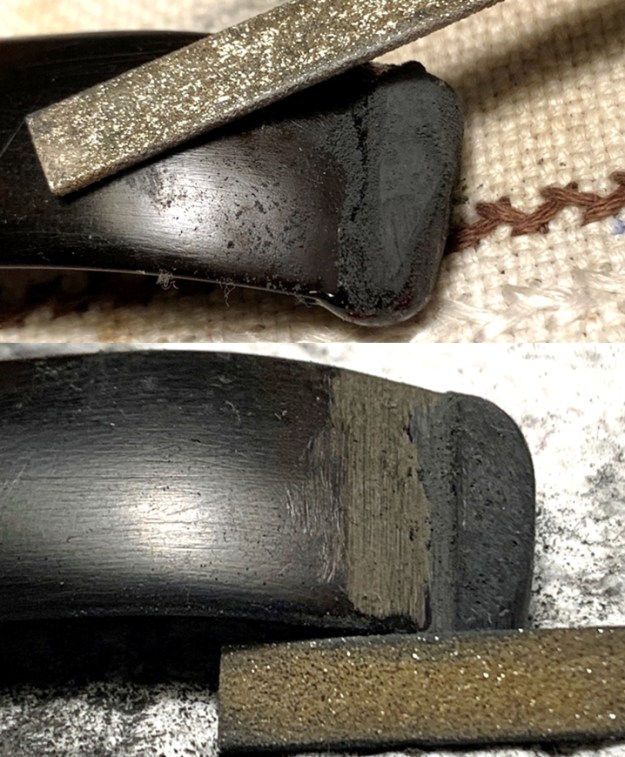
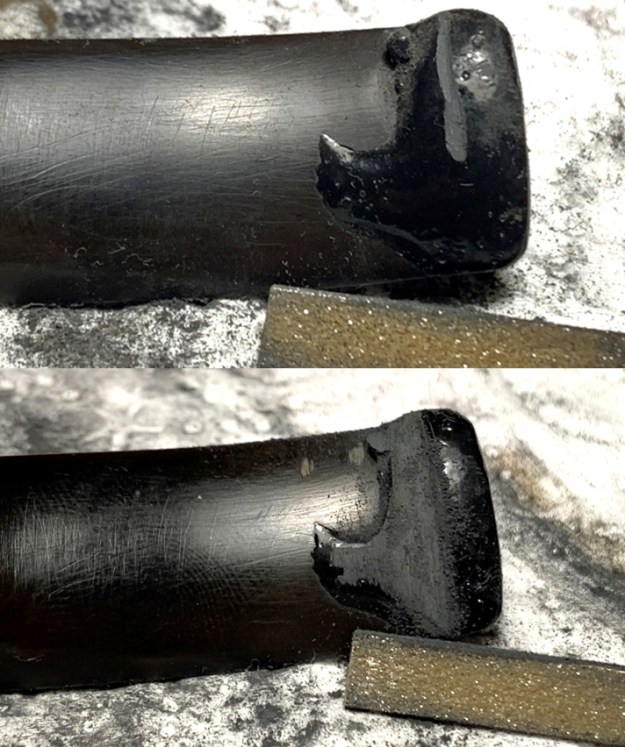
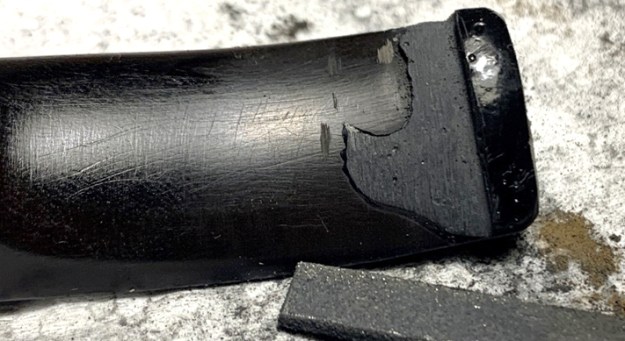
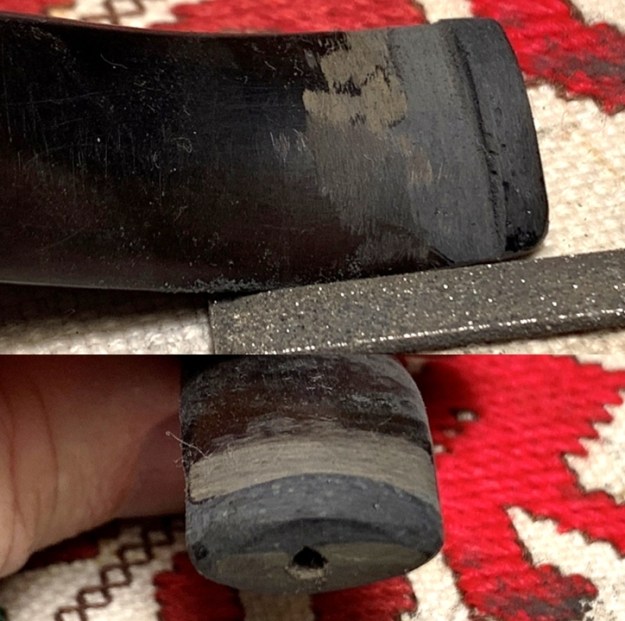
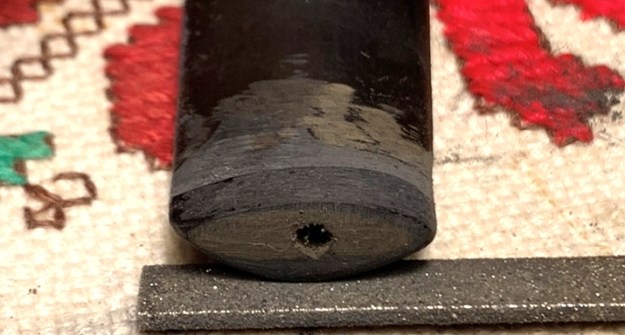
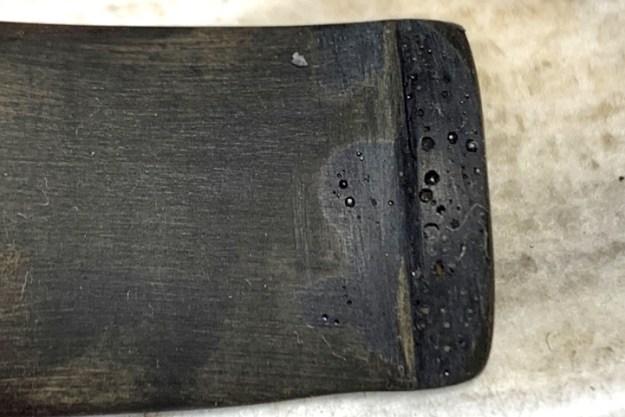
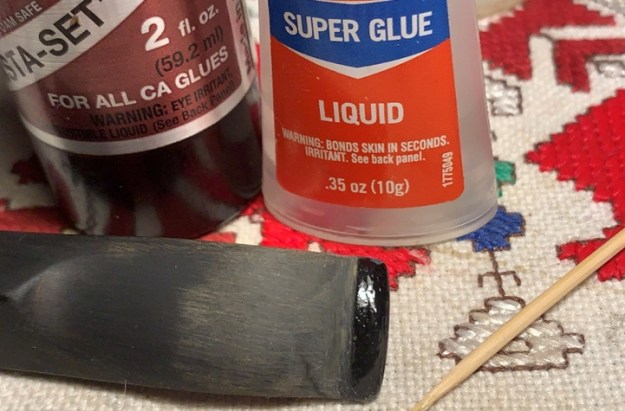
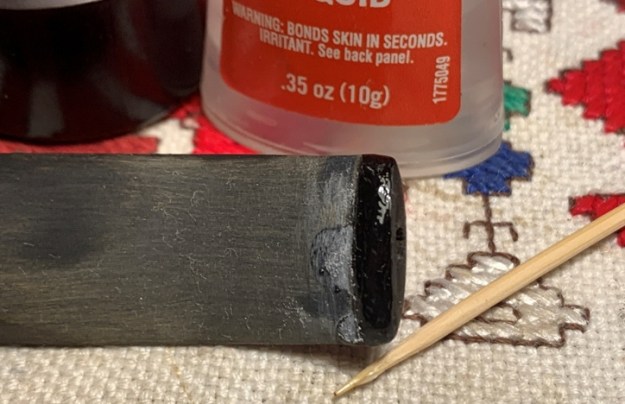
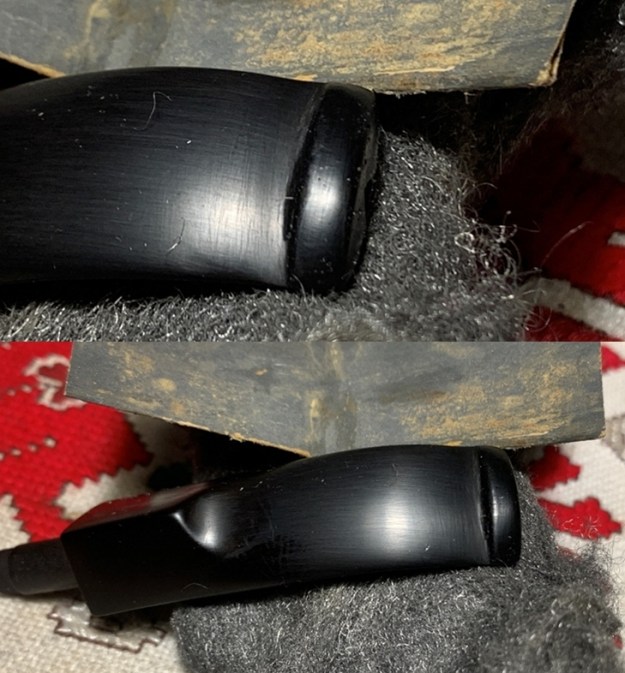
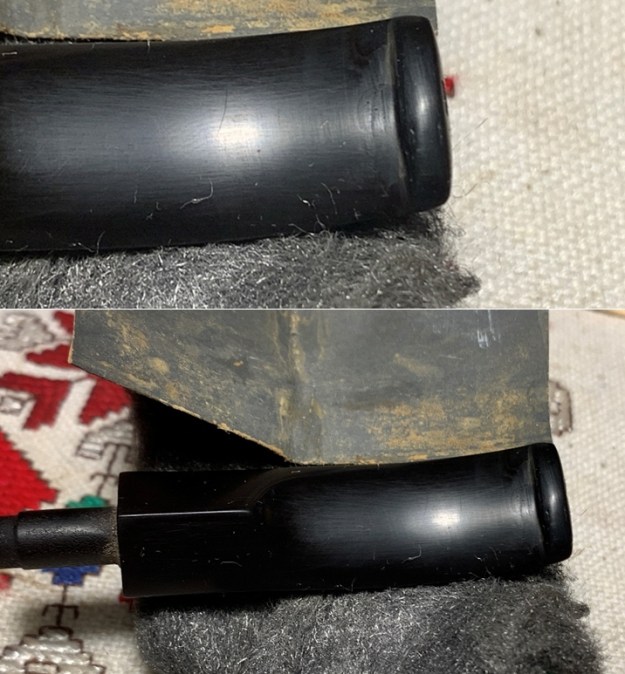
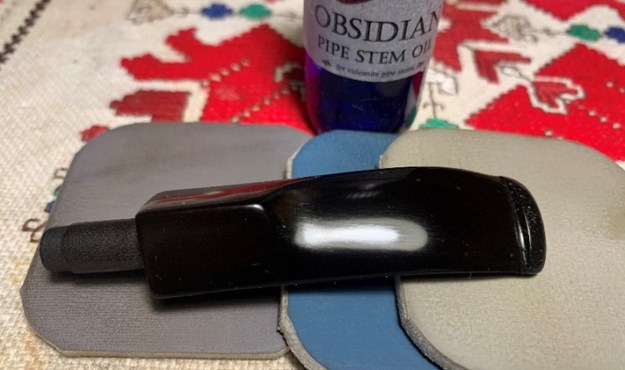
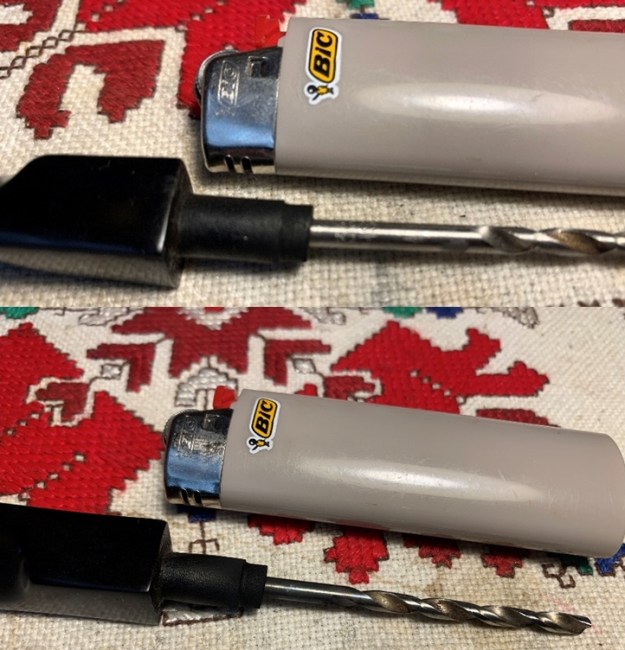
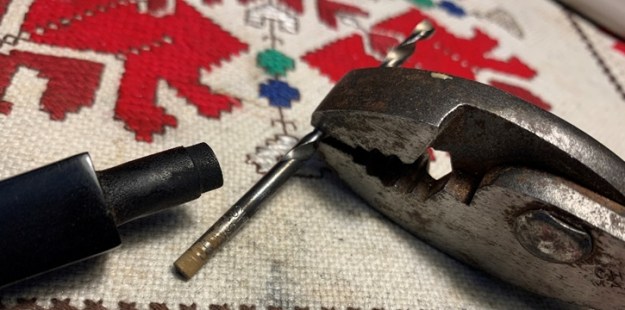
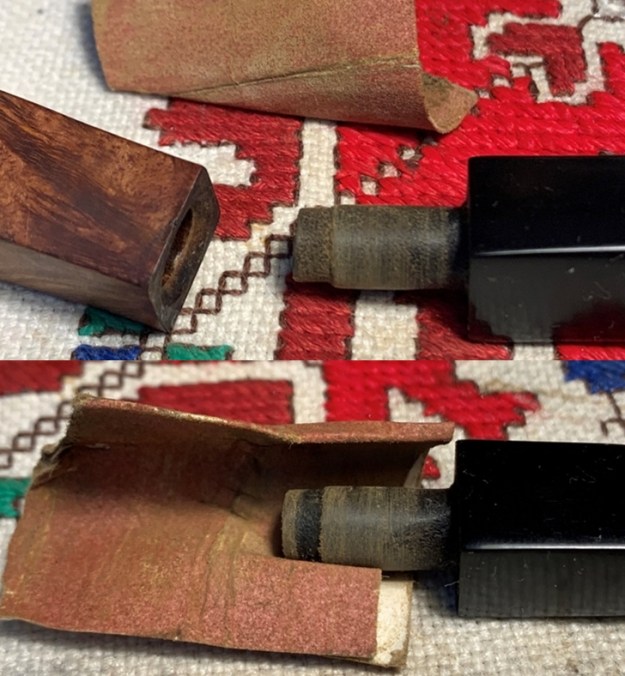
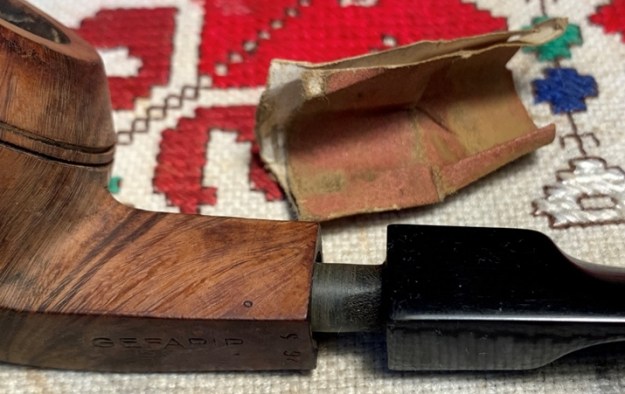
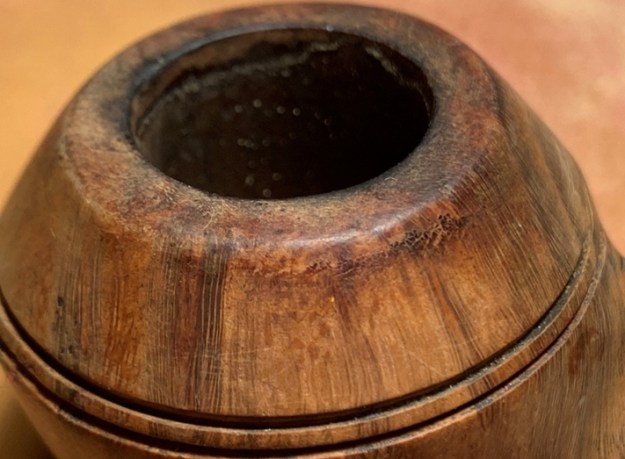
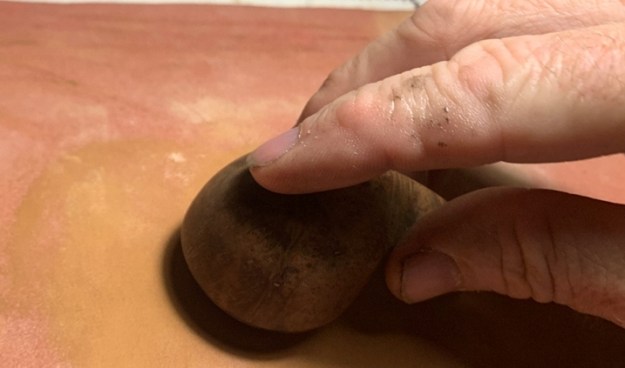
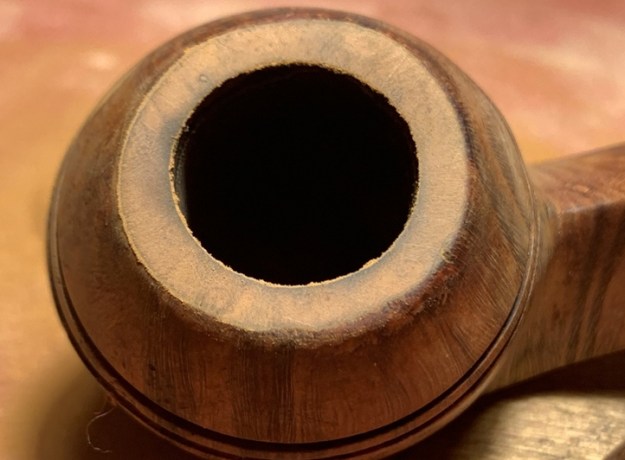
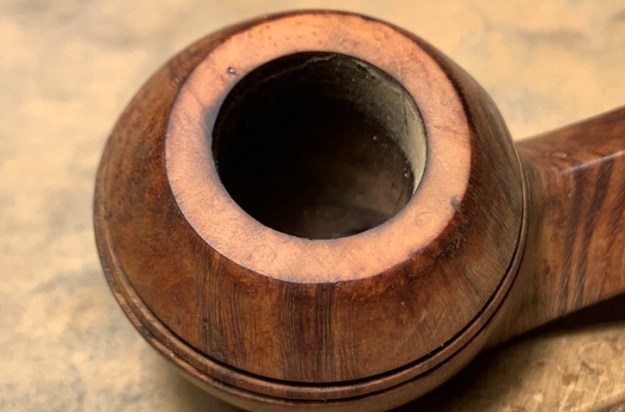
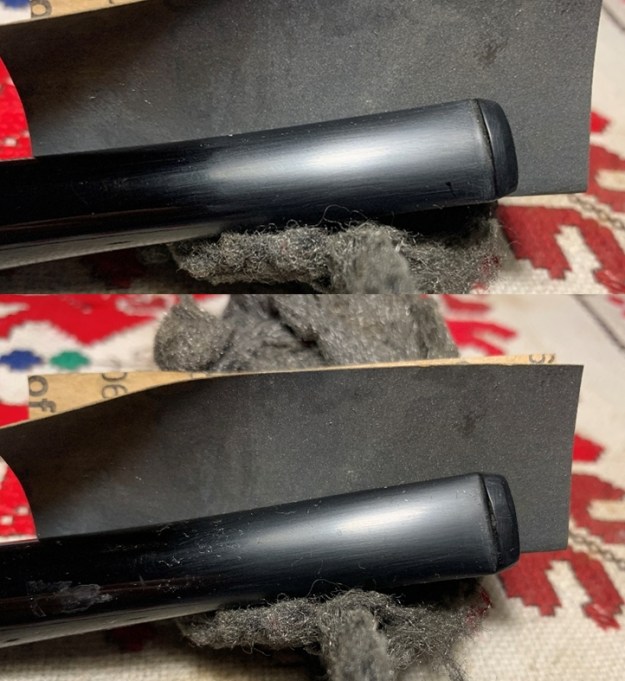
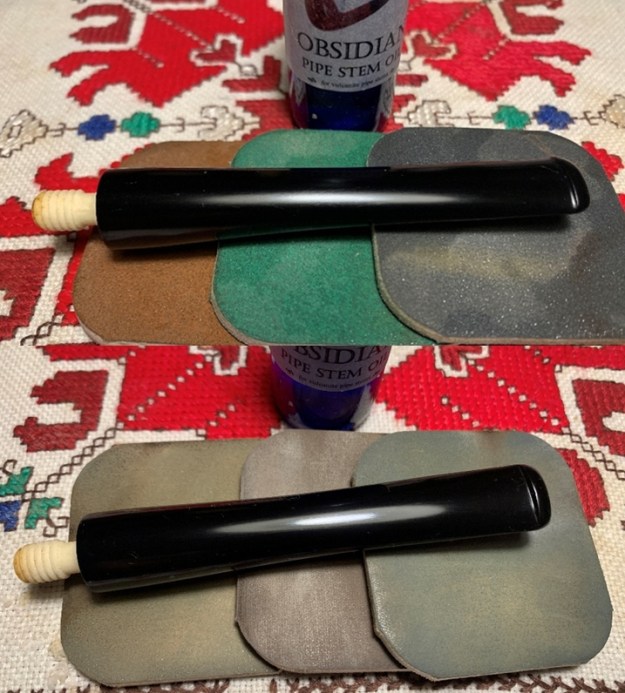
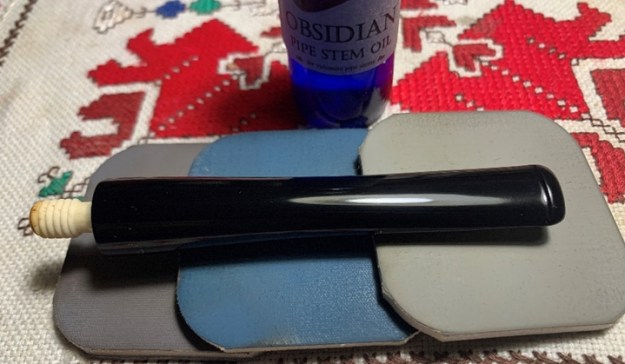
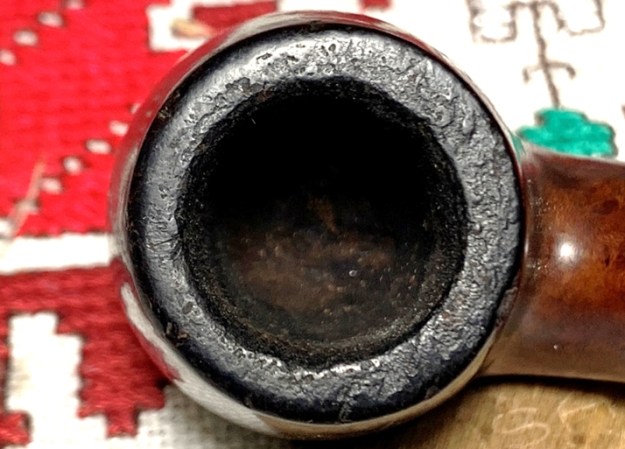
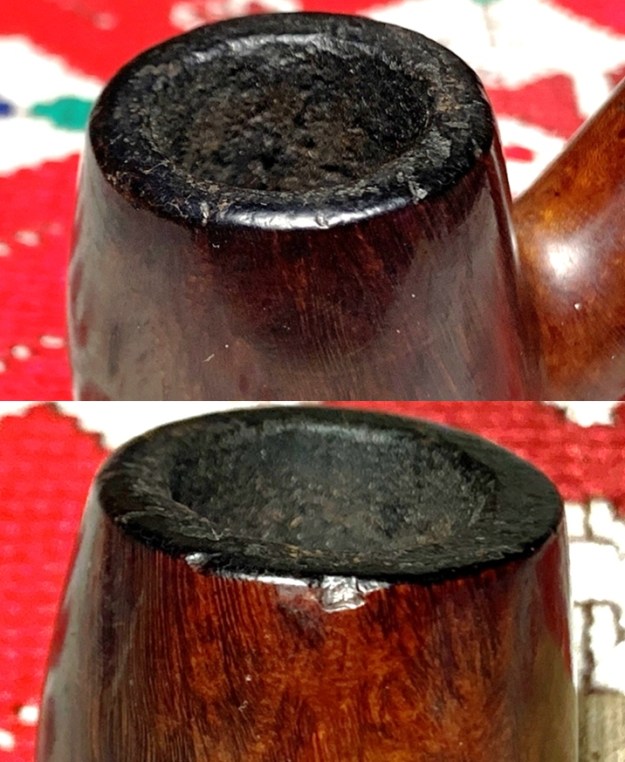
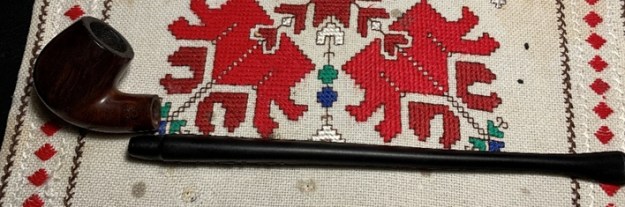
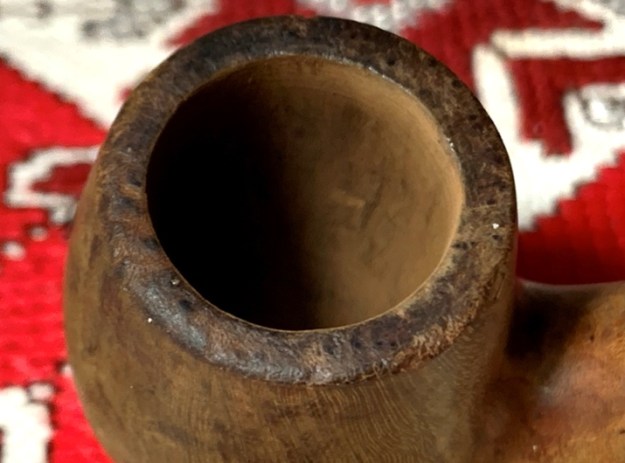
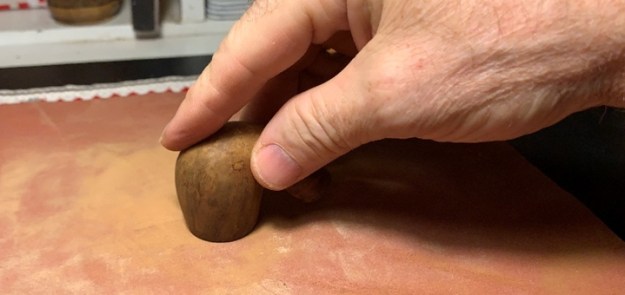
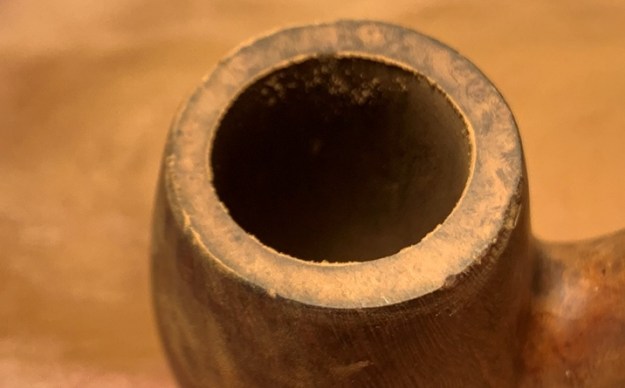
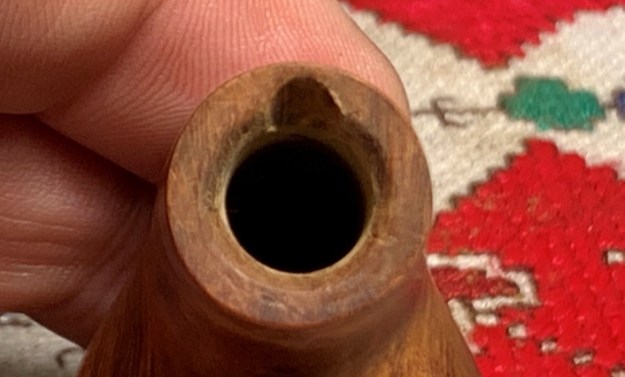
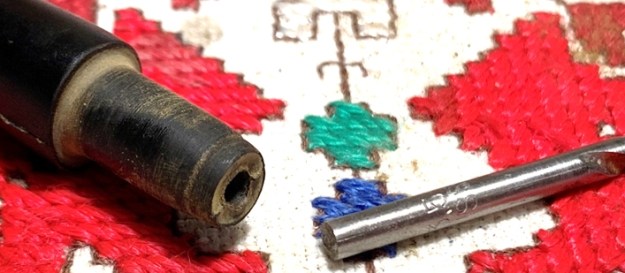
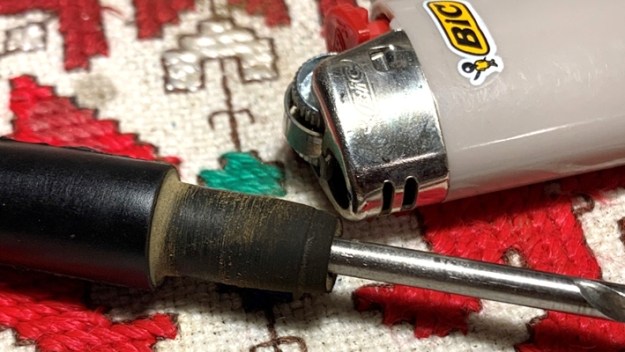
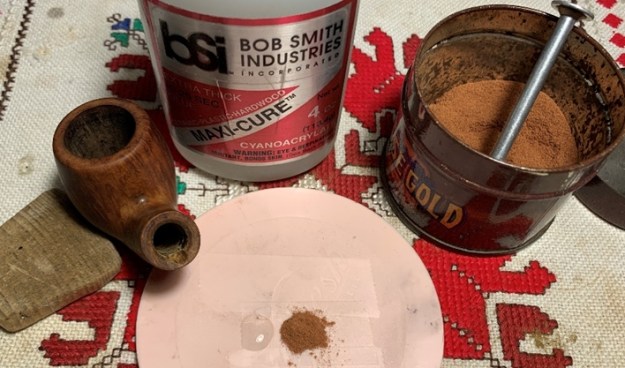
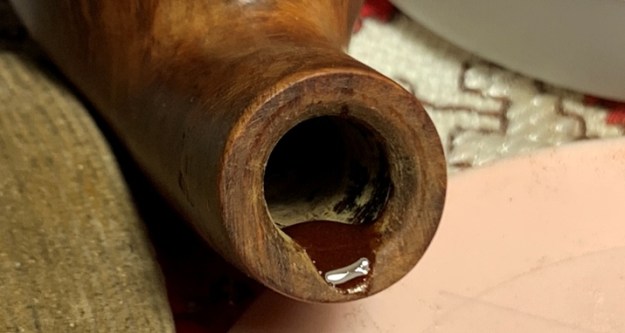
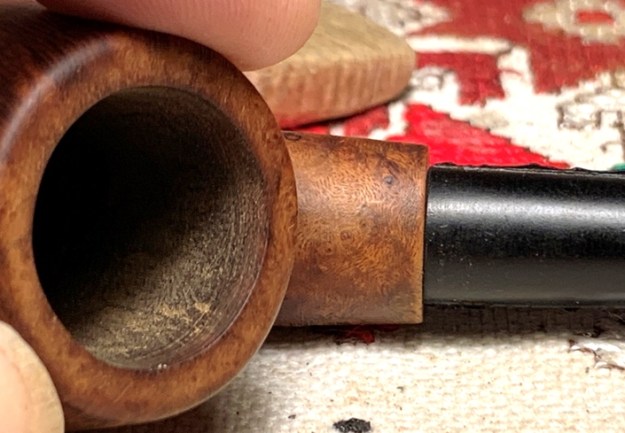
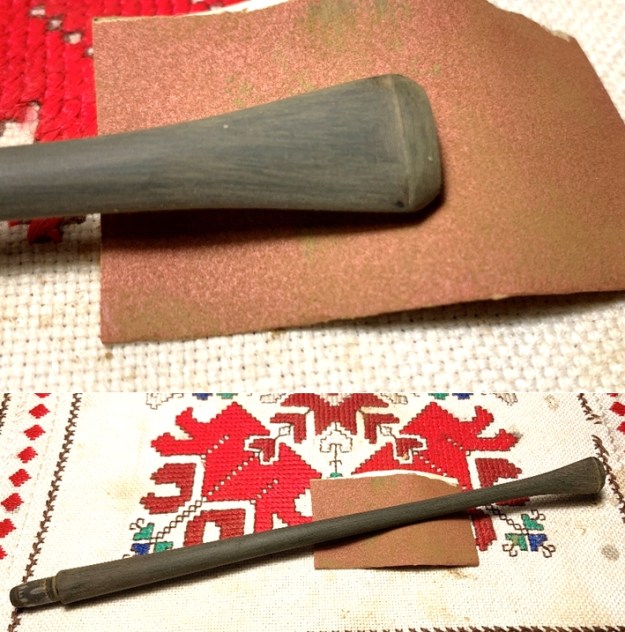
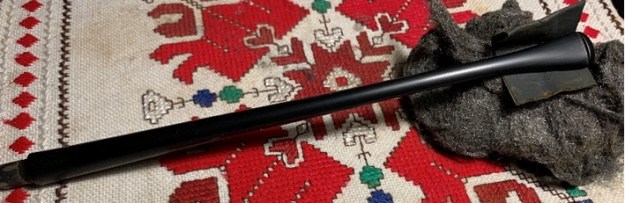
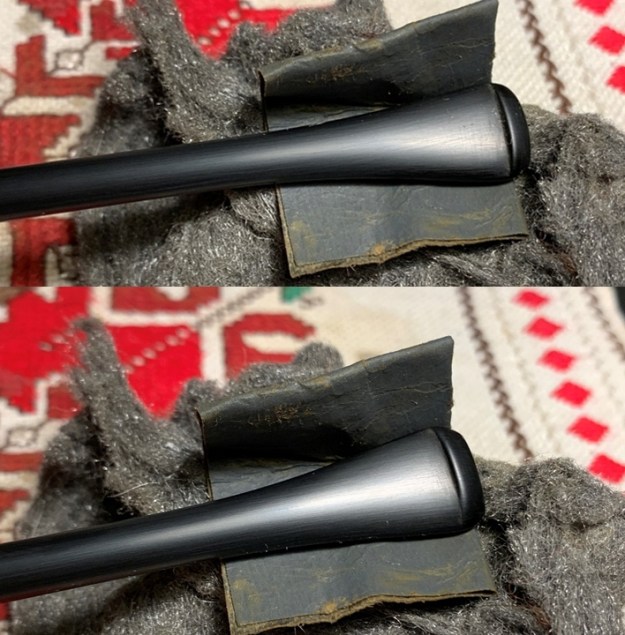
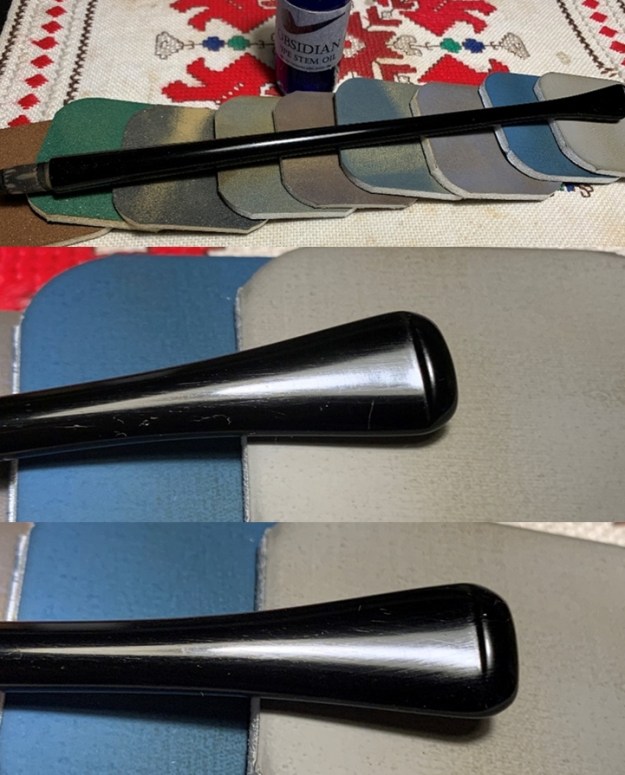
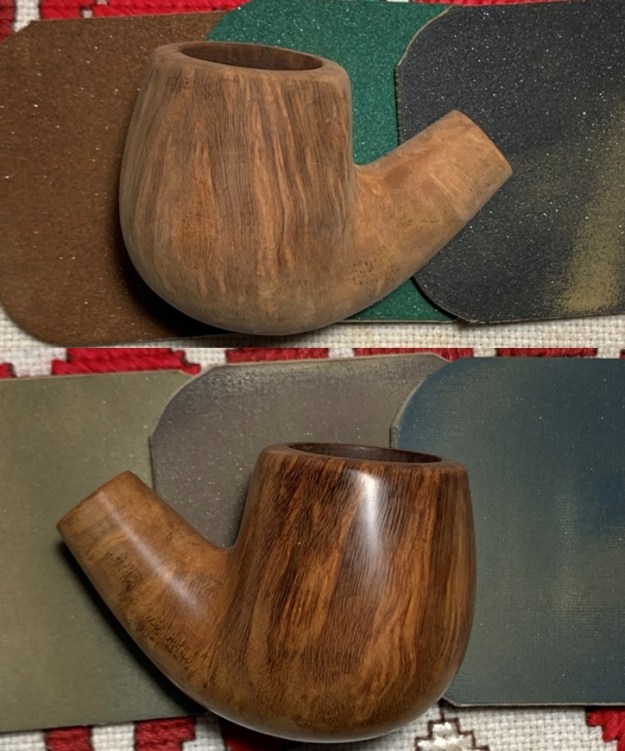
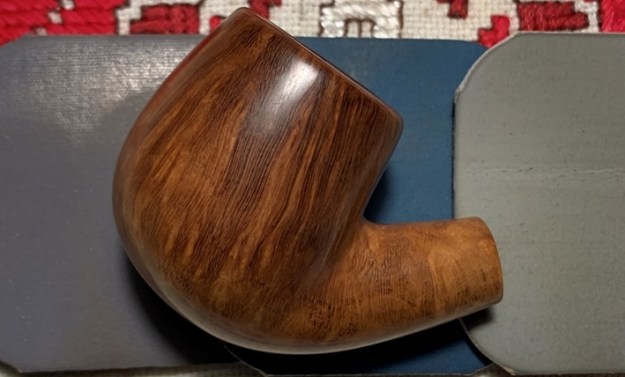
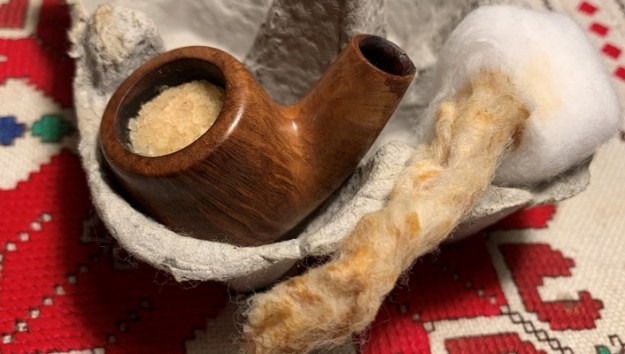
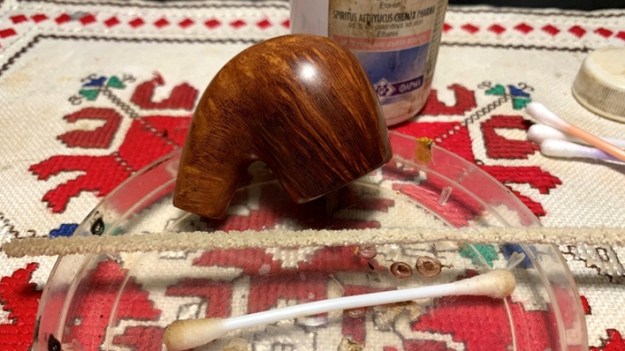
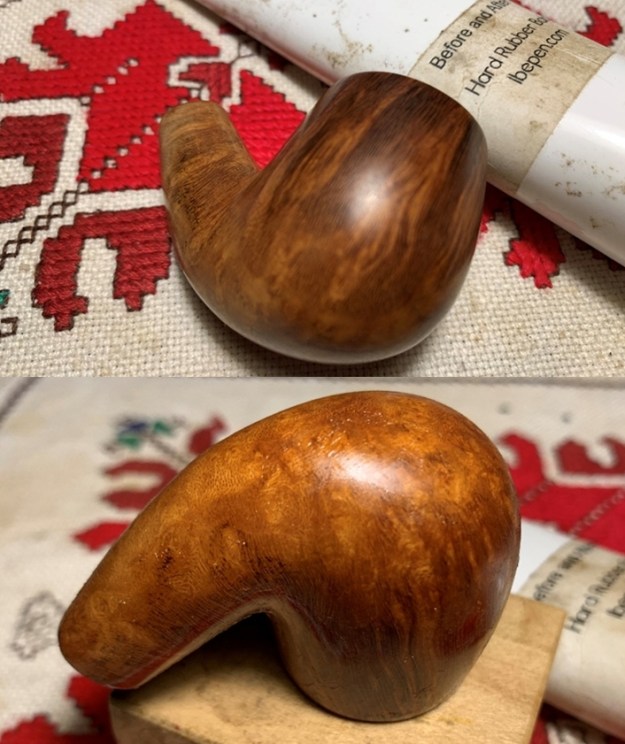
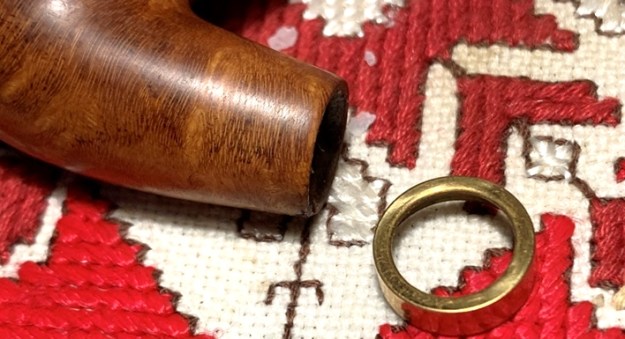
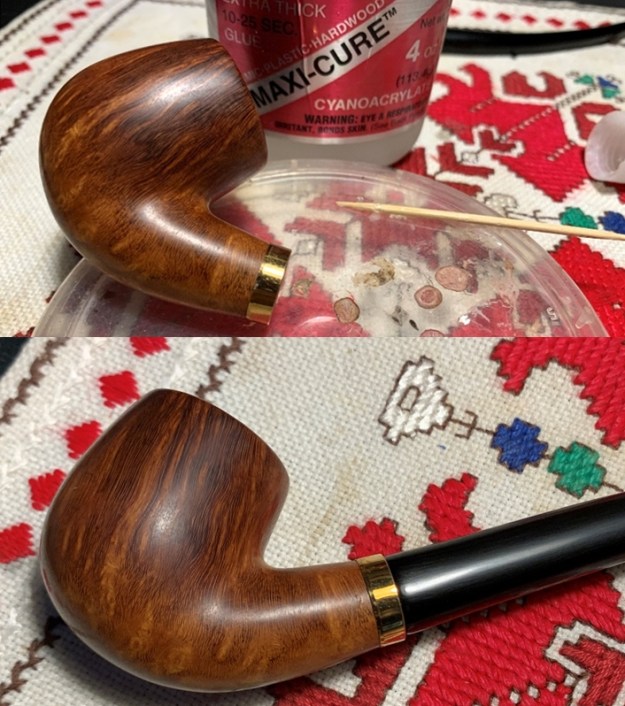
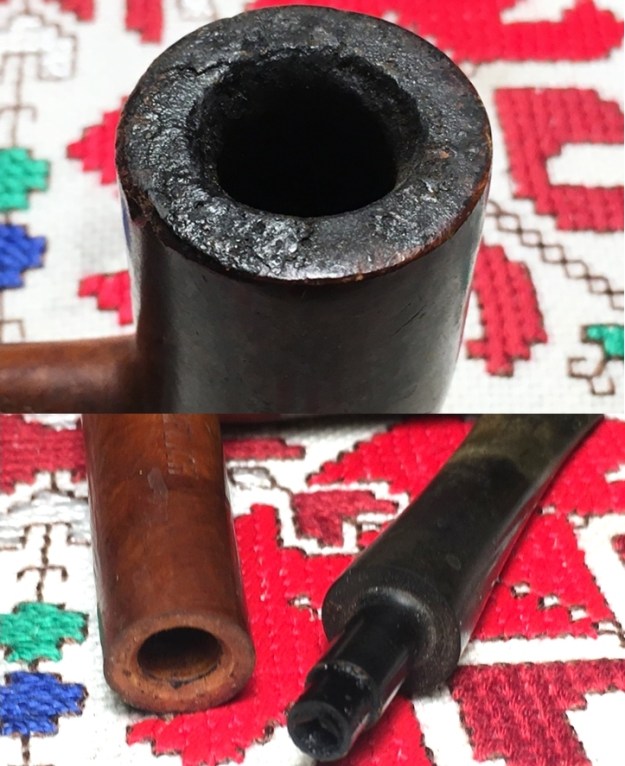
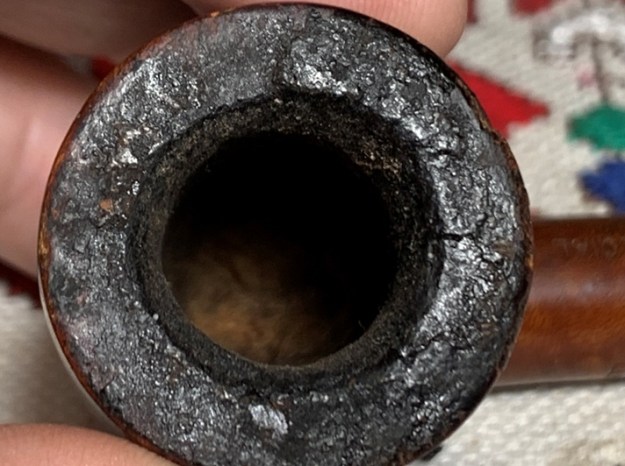
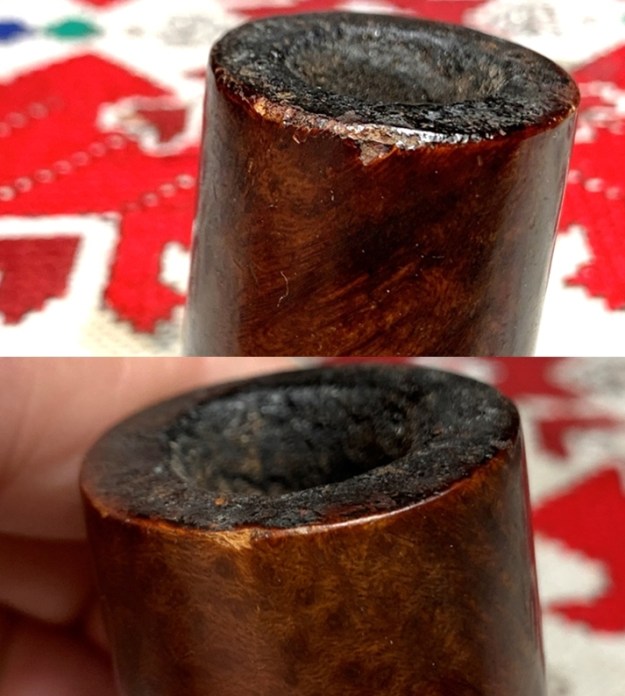
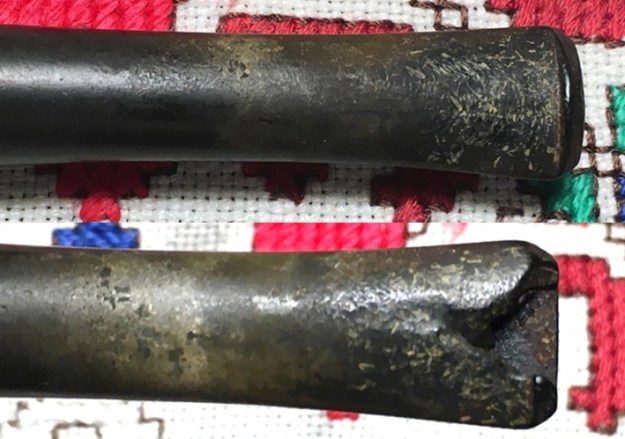
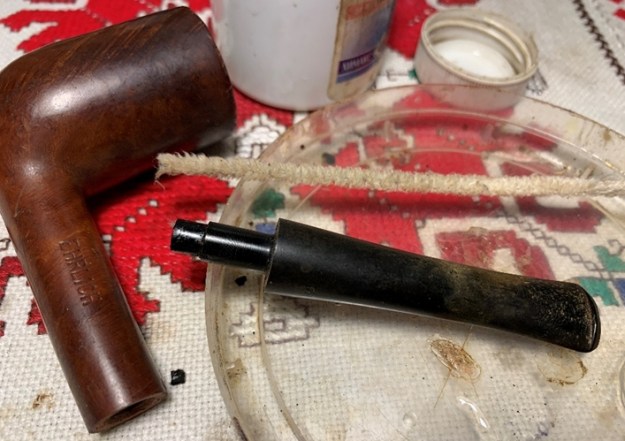
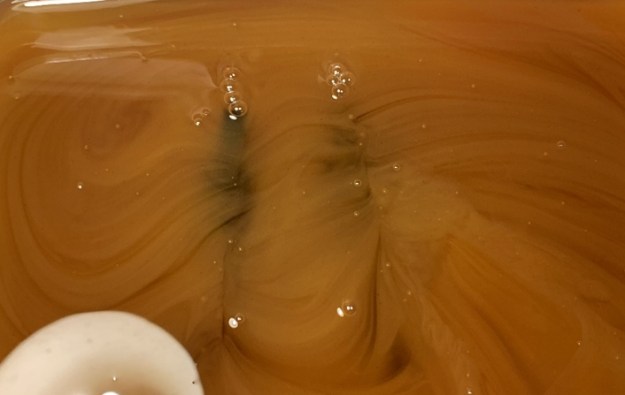
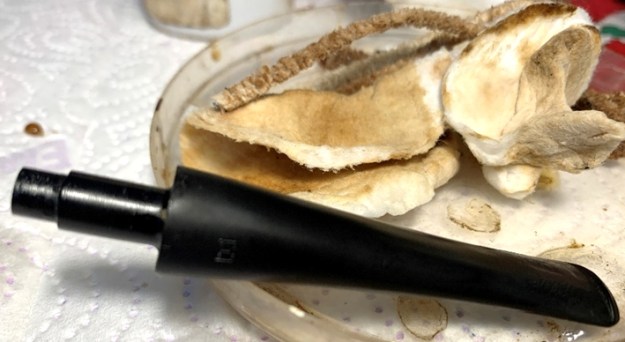
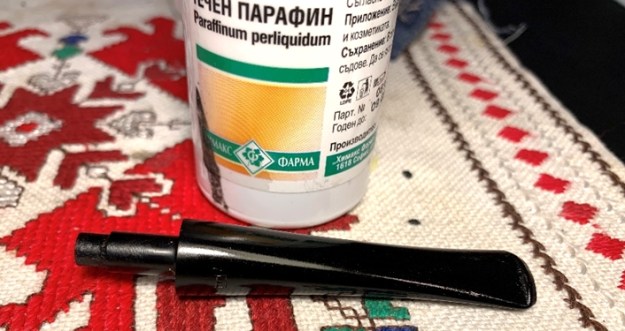
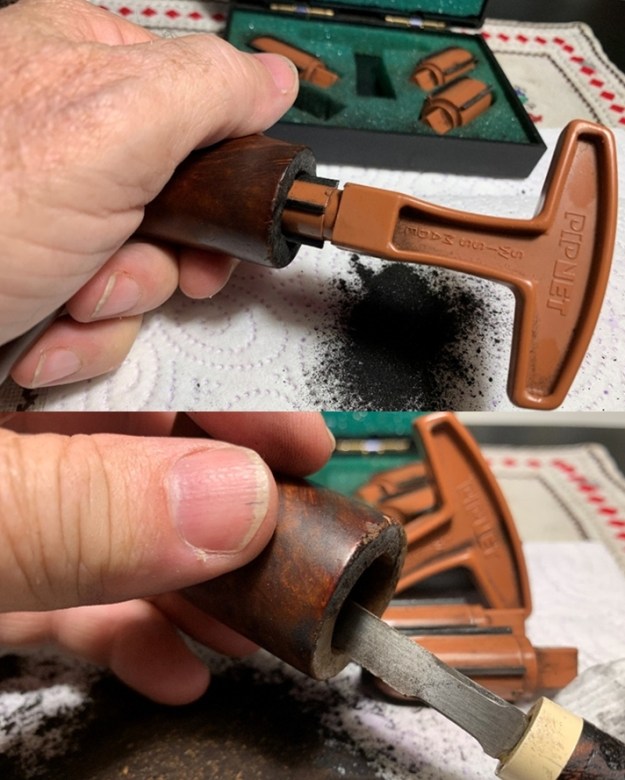
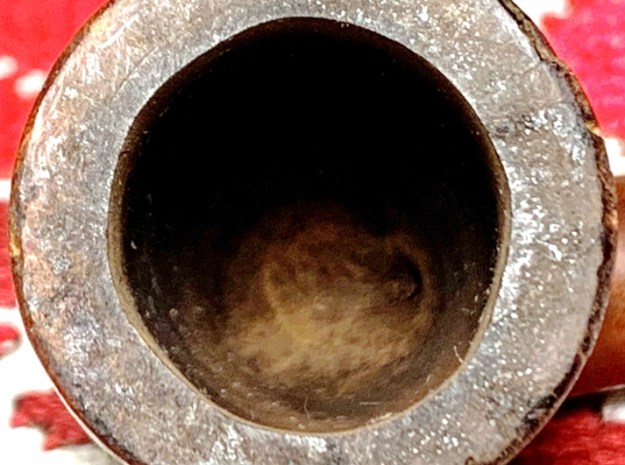
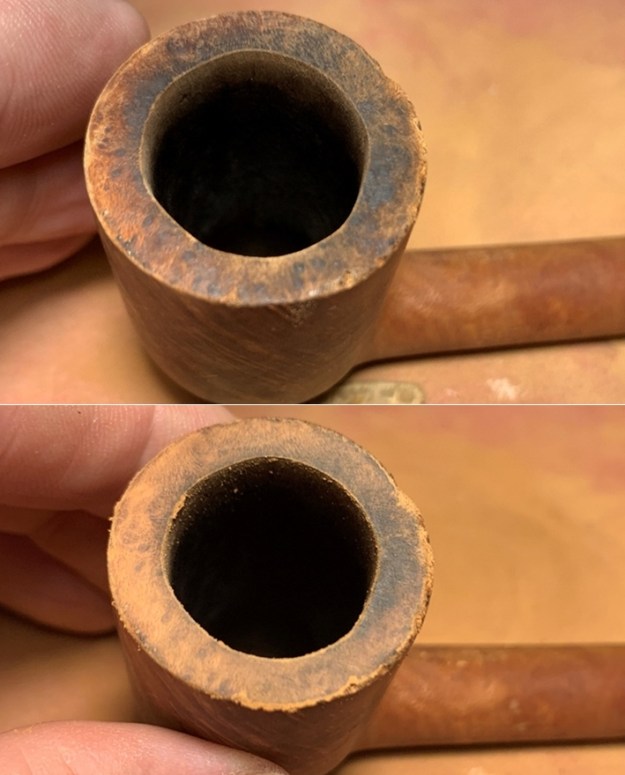
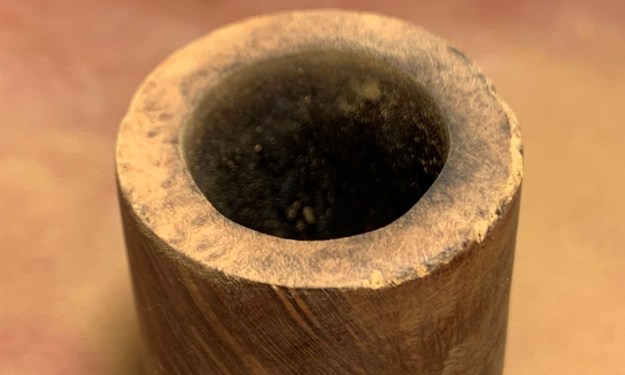
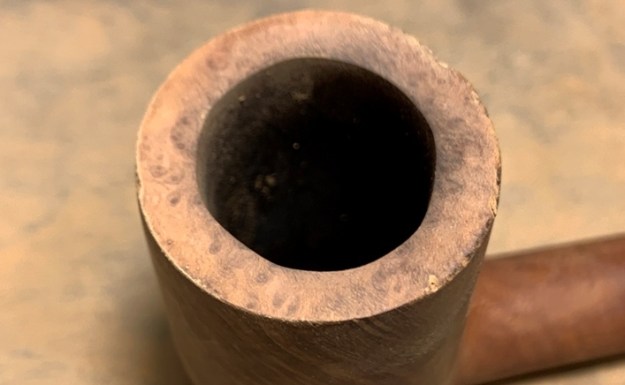
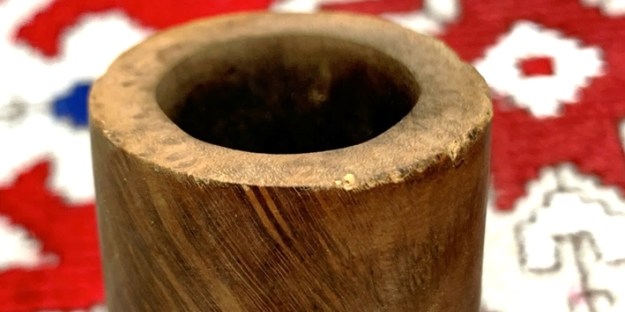
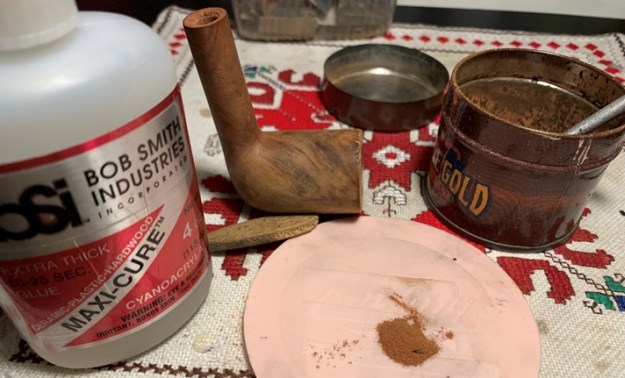
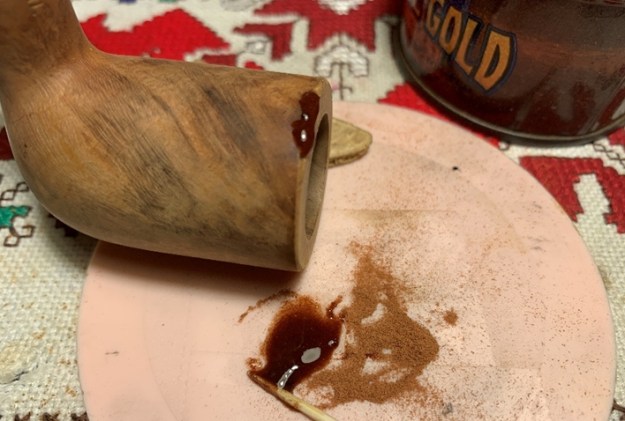
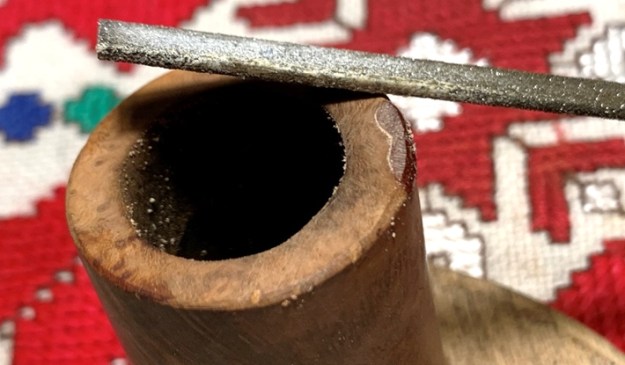
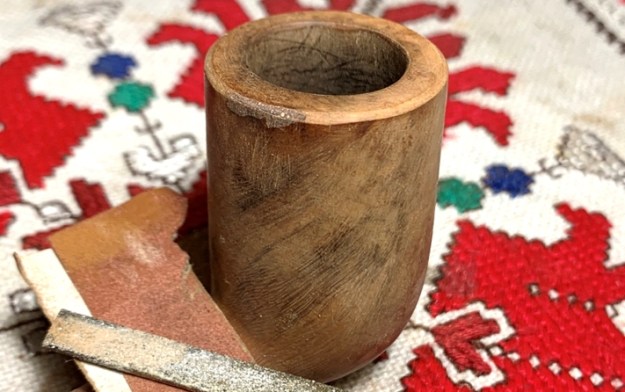
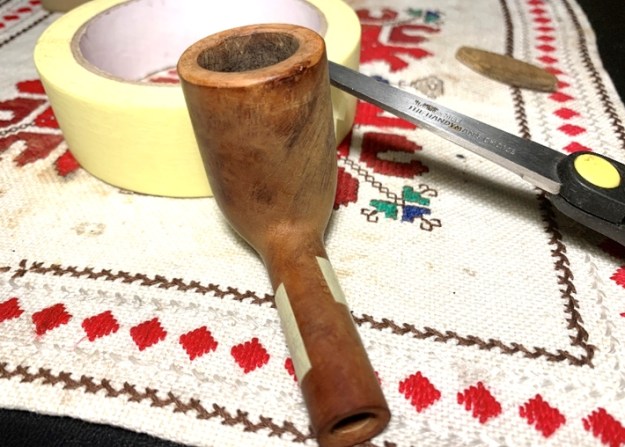
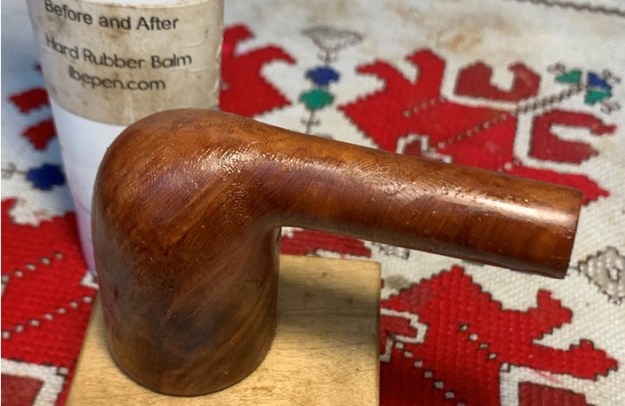
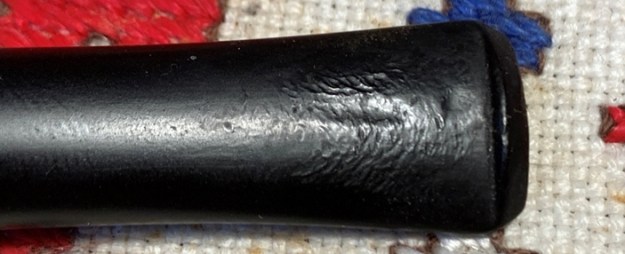
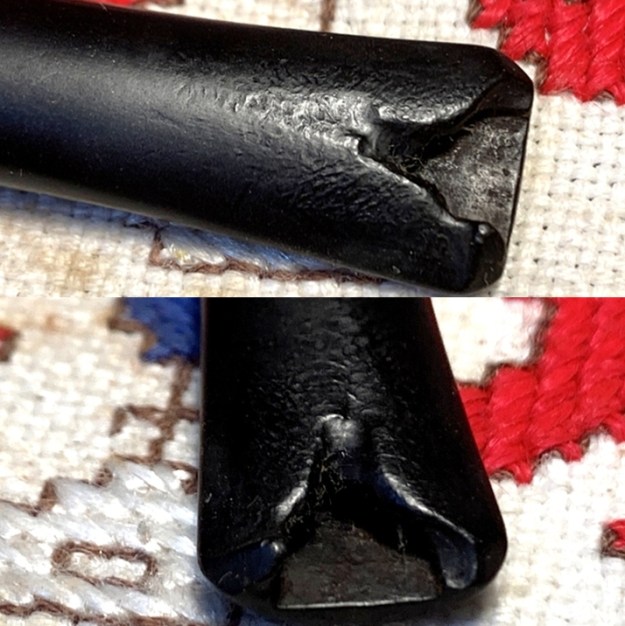
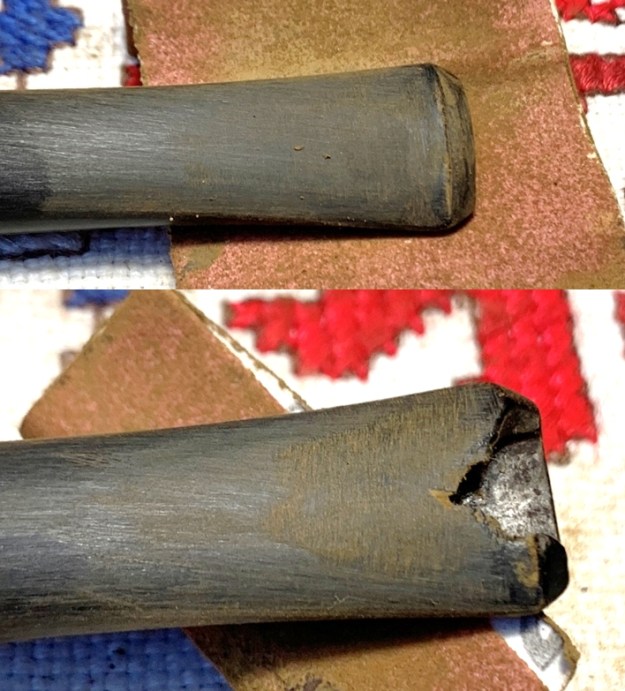
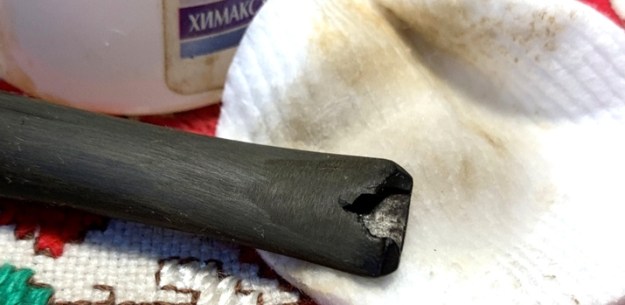
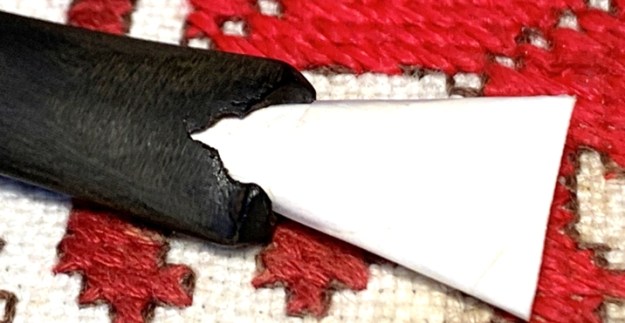
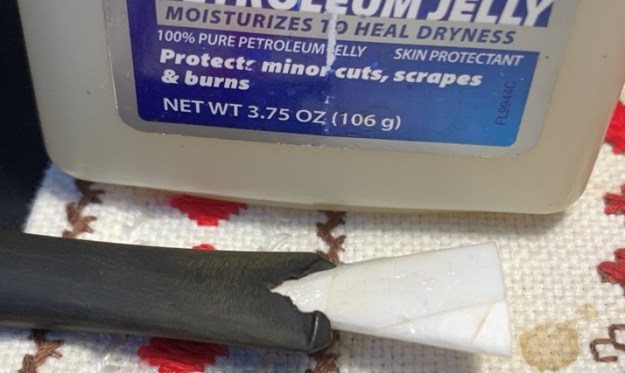
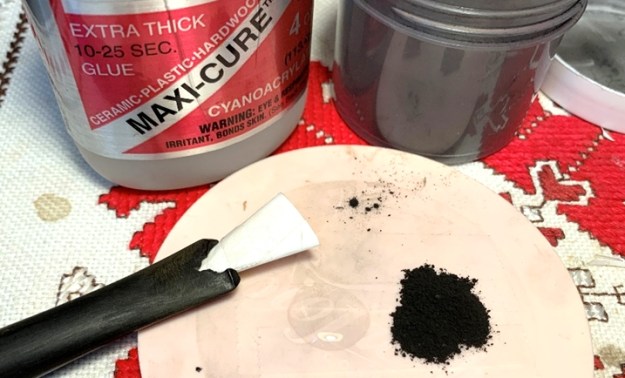
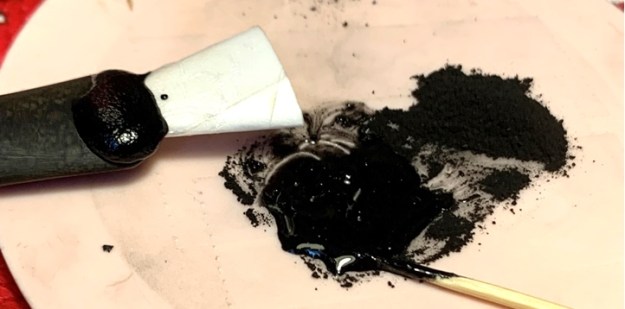
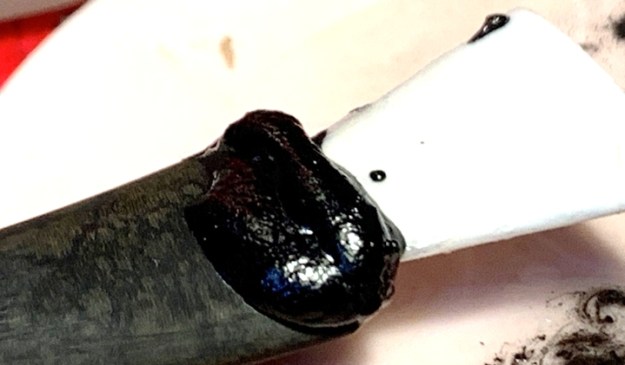
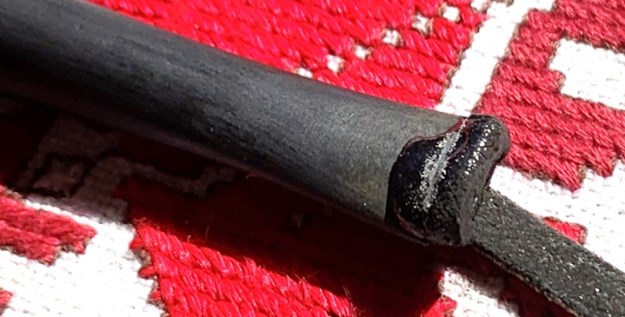
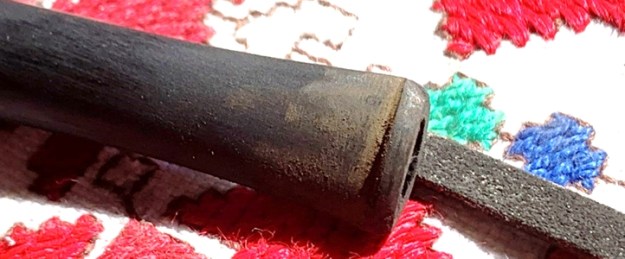
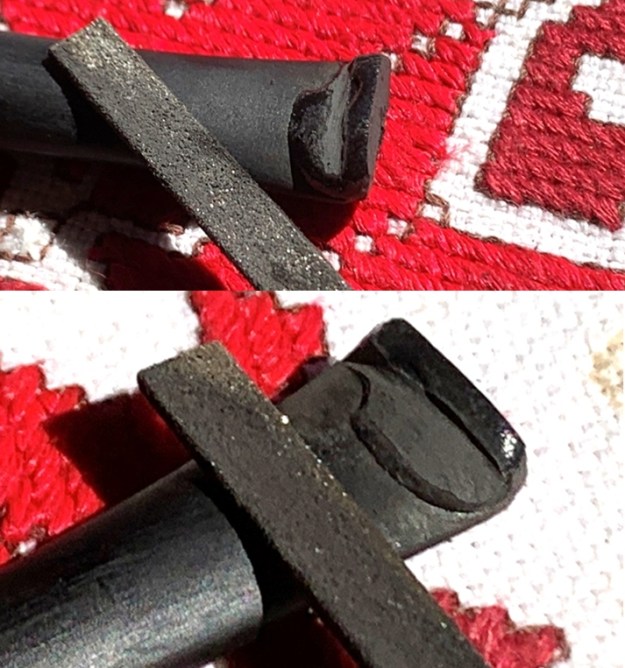
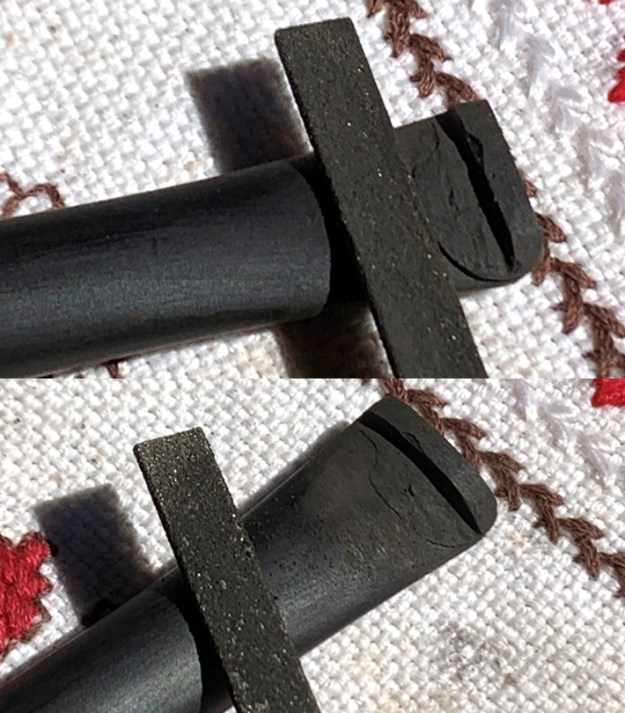
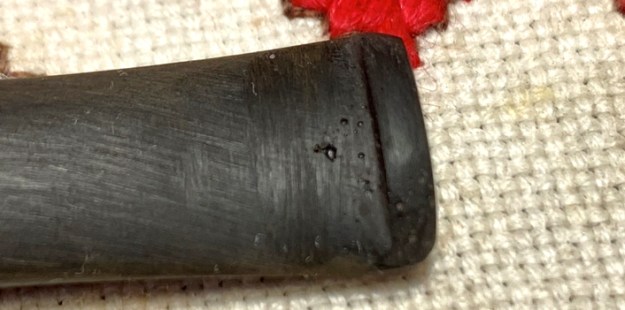
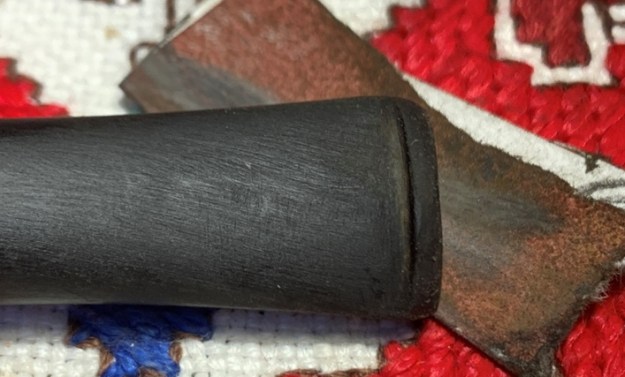
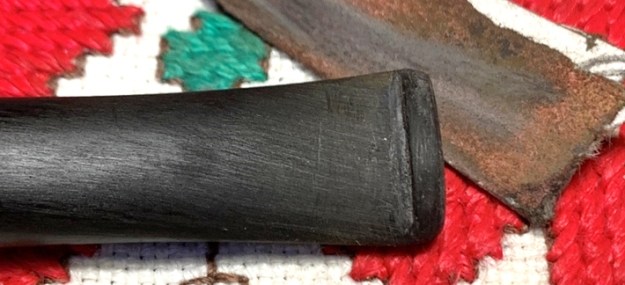
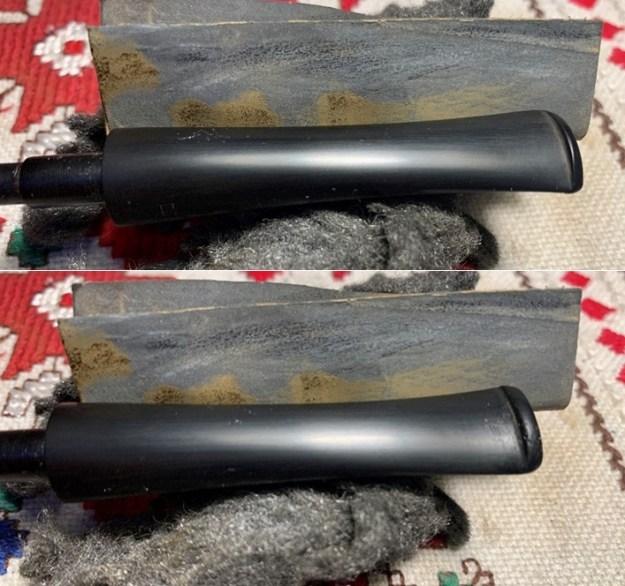
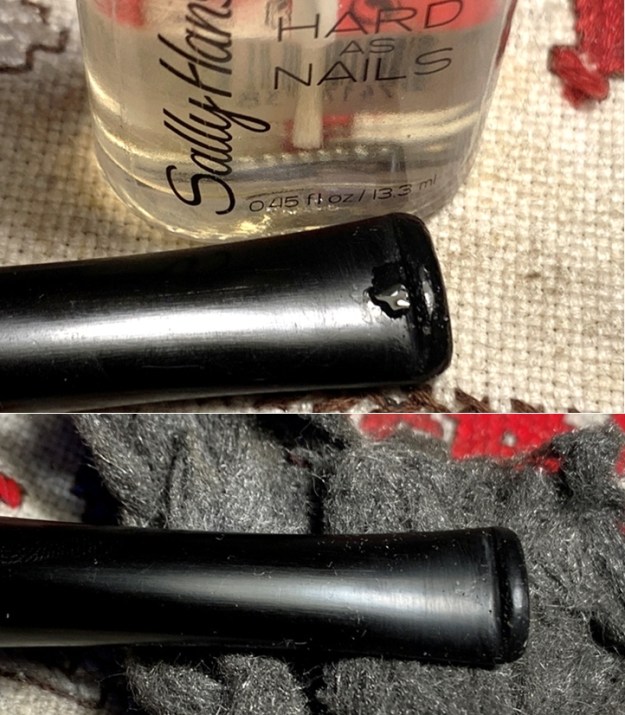
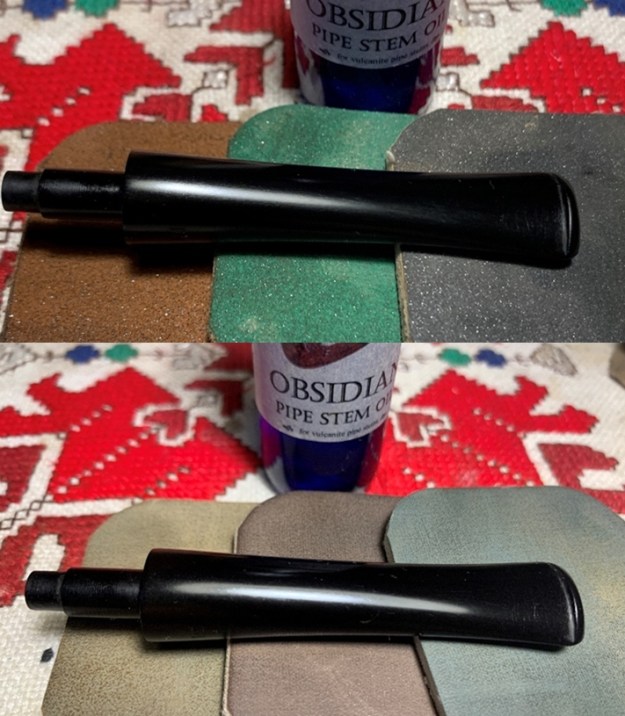
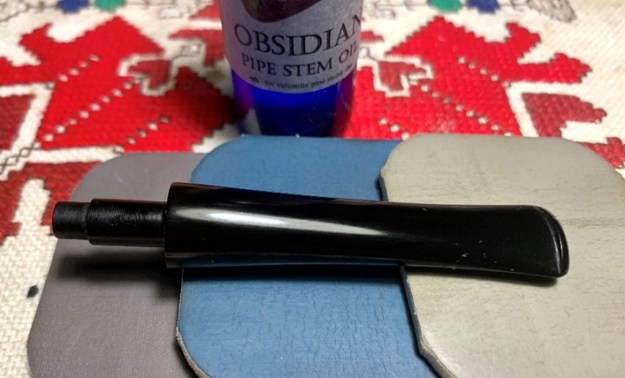
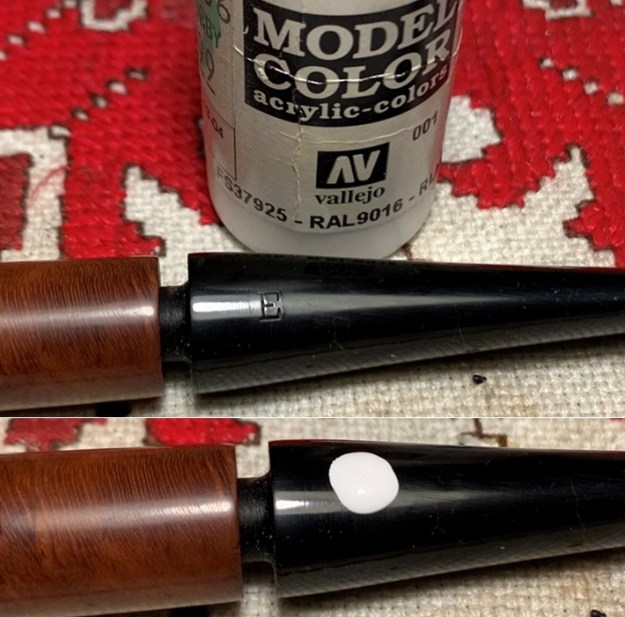
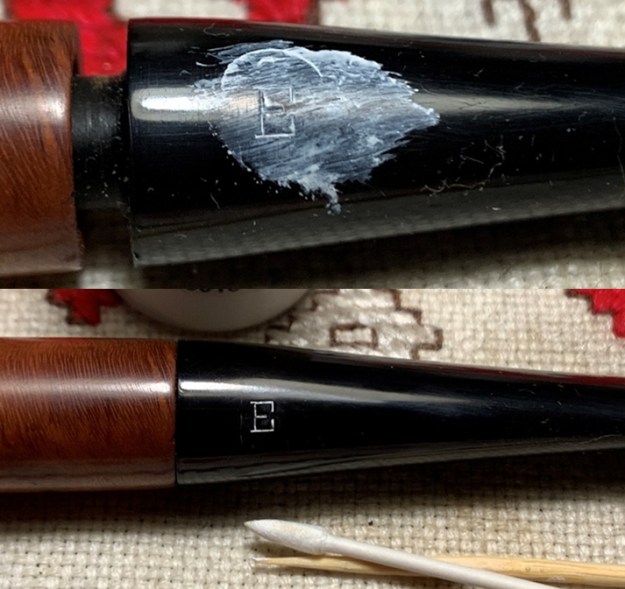
With the information included above, the Ehrlich Chimney now on my worktable dates to at least the late 60s.  With a greater appreciation for the Ehrlich name and the richness of its story, I begin the restoration first with an assessment of its condition.  This old boy is in rough shape. The chamber has thick cake build up which needs to be removed to expose fresh briar for a new start.  The rim is caked with lava.The rim has notches and divots on the lip aft and forward areas.Generally, the briar surface is scratched and dinged a good bit.  The finish is darkened and needs cleaning to remove the surface dirt that has collected.The original stem with the Ehrlich ‘E’ reveals that this pipe was well loved and driven into the ground!  The calcium build-up on the bit is thick along with the oxidation.  The tooth chatter seems to reveal a lot of possible New England winters with the former steward’s teeth chattering as he clinched the stem.  The lower button has disintegrated from biting.  I’m concerned that it’s too damaged for a normal button rebuild.  I love to salvage original stems but this one presents some challenges.  The lower vulcanite surface looks suspect – that there may be a crack in the vulcanite.To start, using a pipe cleaner wetted with isopropyl 95%, the stem’s airway is cleaned.To address the oxidation, a new batch of Before & After Deoxidizer is ready to go to work.  The other pipe’s stem that Todd commissioned, the Heritage Blasted Apple, joins the Ehrlich for a bath.  The fluid is eerie as it swallows the stems!After a few hours of the soak, I use a stiff wire to snag the stem and to allow the B&A Deoxidizer to drain.  I then squeegee more fluid off with my fingers then wipe with cotton pads wetted with alcohol to remove the raised oxidation.  Another pipe cleaner helps to clear liquid from the airway.The B&A Deoxidizer seemed to do an adequate job.  I add paraffin oil to the vulcanite with a cotton pad to further the rejuvenation of the stem.Turning now to the Ehrlich Chimney bowl, I ream the chamber using the Pipnet Reaming Kit.  I use the 2 smaller of 4 blades available in the Kit to navigate the Chimney chamber.  Following this, the Savinelli Fitsall Tool continues the scraping and finally sanding with 240 paper wrapped around a Sharpie Pen cleans the remaining cake. After wiping the chamber with a cotton pad wetted with alcohol to remove the carbon dust, an inspection of the chamber reveals no problems with heating or cracking.   I also scraped the rim with the Savinelli Fitsall tool to remove the crusting lava flow.Next, the external briar surface is dark and dirty. I use undiluted Murphy’s Oil Soap on a cotton pad to clean the briar surface.  I also use a brass wire brush to clean the rim.  The brass brush does not damage the wood surface.  After scrubbing, I transfer the bowl to the sink and continue cleaning using hot water and shank brushes.  Using anti-oil dish soap, the shank brushes reach into the mortise and after scrubbing and rinsing thoroughly, I bring the bowl back to the worktable.The cleaning does a good job.  The briar is lighter, but the rim is still discolored. It doesn’t happen often but returning to the internal cleaning with pipe cleaners and cotton buds reveals a clean pipe!To clean the rim, I use the topping board covered with 240 grade paper to begin.  The topping board will remove the discoloration with fresh briar, and it will help remove the divot damage on the rim edge.  The next pictures show the progression of the topping. Next, the 240 grade paper is replaced with 600 grade paper and several more rotations follow.  What emerges on the rim are round bird’s eye patterns of grain.I decide to stop the topping not to lose more briar real estate off the rim.  There remain some divots on the edge of the rim.To remedy this, instead of taking off more briar to remove the divots, I mix Thick CA glue with briar dust to form a putty to fill the divots.  After putting a small amount of briar dust on the plastic disc, covered with scotch tape for easier cleanup, a few drops of CA glue are placed next to the dust and then mixed with a toothpick.  Gradually, briar dust is pulled into the CA glue and mixed until it thickens to the consistency of molasses.  Using the toothpick as a trowel, putty is placed on the divots.  When sufficiently covered, I put the stummel aside for the putty to cure.After some time, the briar dust putty has cured.  I first use a flat needle file to remove the excess putty until it is flush with the rim surface.  I also use 240 grade paper to smooth the patch further.I also sand the side of the patch with 240 paper.  Finally, using 240 sanding paper tightly rolled, I cut a small bevel around the circumference of the rim to remove smaller cuts and divots and to blend the rim patch.  After the 240 paper, 600 grade paper is used to further smooth and blend.  The rim looks good.  I move on.To further clean the briar surface of nicks and scratches, I utilize sanding sponges.  Before applying the sanding sponges, I cover the Ehrlich Special nomenclature with masking tape.With the tape protecting the nomenclature, I first apply a coarse sanding sponge followed by a medium grade then a light grade.  Sanding sponges address the minor blemishes on the briar surface well without too much invasion. On a roll, I also apply the full regimen of micromesh pads beginning with wet sanding with pads 1500 to 2400.  Following this I dry sand with pads 3200 to 4000 and 6000 to 12000.  The grain comes out well through the micromesh process. One more step before putting the stummel aside to focus on the stem.  Applying Before & After Restoration Balm teases out the subtle hues of the briar grain.  Whenever possible, the natural briar is my preferred presentation of a pipe.  The Balm does a great job.  After placing some of the Balm on my fingers, I work it into the briar surface.  The Balm starts with a crème-like consistency but thickens to a waxy feel as the Balm is worked.  After applying the Balm, I put the bowl aside for 10 to 15 minutes then wipe off the excess Balm with a cloth and buff up the surface.Turning now to the stem, I take another long, focused look at the condition of especially the underside of the bit and button, but the upper bit has some issues too.  First the upper side. The tooth chatter is profound and there are two compressions that are in the center of the stem.  The one closest to the button is rounded, resembling an eye-tooth compression.  The other one is interesting as it runs parallel with the length of the stem.  The angle makes it difficult to imagine it to be a bite, unless it’s a back molar….  That could be, but the compression appears to run parallel to the airway tunnel directly below.  For the upper bit, I’ll attempt to raise the compressions using the heating method and follow by sanding out the chatter.  Fortunately, the upper button lip is in good shape.When I first examined the stem, before cleaning, I was concerned that there might be a crack running down the stem coming from the button break.  Looking at it now, even under a magnifying glass, thankfully, there is no sign of a crack.  That good news barely tempers the catastrophic break of the bit and lower button.  Interestingly, the lower bit shows evidence of also having parallel compression as the top side.  The area extending to the immediate left (in the picture below) of the break is compressed.  The forensics it seems, point to the former steward clinching the stem between his molars for a hands-free mode.  It worked until the force of the clinching on the underside faulted – the rest is history. To repair, I will first attempt to raise as much of the compression through the heating method, then rebuild the button with a mixture of CA glue and activated charcoal dust.  The new steward will need to treat the button with some TLC because a rebuild is not as strong as an original surface. The heating method is painting the compressions with the flame of a Bic lighter.  With the heating of the vulcanite, a rubber compound, the rubber expands to retake its original condition, or closer to it.  After painting the upper and lower with the flame, the compressions are noticeably less pronounced but still evident.Next, using 240 grade sanding paper, I sand out the residual compressions on the upper and lower bit.  The paper also removes the tooth chatter very nicely.  With the button rebuild now before me, I first clean the area with a cotton pad wetted with alcohol.A piece of index card stock serves well to create a wedge to serve as a form.  The wedge fits into the airway to form the mold that will allow the patch material to fill the cavity yet keep the airway open.After covering the wedge with scotch tape, I place some petroleum jelly on the tape to keep the patch material from bonding onto the wedge – allowing the wedge to be removed without problems.The patch material is a putty created from mixing Extra Thick CA glue with activated charcoal dust. A small mound of the charcoal is placed on the plastic disk which acts as my mixing pallet.  I also put scotch tape down on the disk to help in the cleaning.   Next to the mound of charcoal dust, a small puddle of CA glue is placed.I use a toothpick to gradually pull charcoal into the CA glue mixing as I go.  When the putty forms and reaches the viscosity of molasses, I use the toothpick to trowel the putty onto the wedge, filling the damaged area with patch material.I build a mound of the patch material to be more than is needed.  This allows filing to shape the new button by removing the excess and shaping as I go.The wedge is removed easily with a tug.Next, the filing process begins.  I start from the end of the stem to remove the excess to first form the slot facing.With the slot facing flat and flush with the surviving upper button lip, starting with the upper bit, I use the flat needle file to refresh the surviving upper button lip.Next, flipping over to the lower bit, the flat needle file begins to shape the lower button lip.  The next few pictures show this progress. The process is slow, but patience pays off nicely.  The lower button looks good.  A few air pockets show up in the patch area.  I’ll sand and work on removing these as I go.Using 240 grade paper first on the upper bit, the residual chatter and compressions are fully erased.Next, focusing on sanding the lower bit area, 240 paper does well in smoothing out the scratches left by the needle file.  Shaping the button is coming along well.Next, using 600 grade paper, I wet sand the entire stem upper and lower.  Following this, 000 steel wool is applied to smooth the surface further.  The repair is looking great.Some air pockets remain on the lower bit and button lip repair.  I paint a small amount of acrylic nail polish to fill these microscopic pockets.  Again, I apply the 000-steel wool to the acrylic patch.With the stem repair complete, I move on to the full regimen of micromesh pads.  Using pads 1500 to 2400, I wet sand followed by dry sanding with pads 3200 to 4000 and 6000 to 12000. Between each set of 3 pads, Obsidian Oil is applied to the stem to rejuvenate it and to retard the growth of oxidation. Now on the home stretch.  I rejoin the stem and Ehrlich Chimney stummel after a small amount of sanding on the tenon.  After the cleaning, the fit was a bit tight.  After the sanding, the tenon engaged the mortise nicely.  After mounting a cotton cloth buffing wheel to the Dremel, and setting the speed to about 40% full power, Blue Diamond compound is applied.  After completing the application of the compound, I buff the pipe with a felt cloth to remove the compound dust in preparation for the wax.  Before applying carnauba wax, I have one more project to complete.  The Boston tobacconist Ehrlich ‘E’ needs some attention on the stem.  Using white acrylic paint, I put a small drop of paint over the ‘E’ and then tamp the wet paint with a cotton pad.  This flattens the paint and dries it.  I then gently rub the surface with the side edge of a toothpick which clears away the excess paint leaving the ‘E’ filled.  I repeat this process twice to render the finished product.  It looks great. After mounting another cotton cloth buffing wheel to the Dremel leaving it at the same speed, I apply carnauba wax to the entire pipe.  To finish, a microfiber cloth is used to give the pipe a rigorous hand buffing to raise the shine.
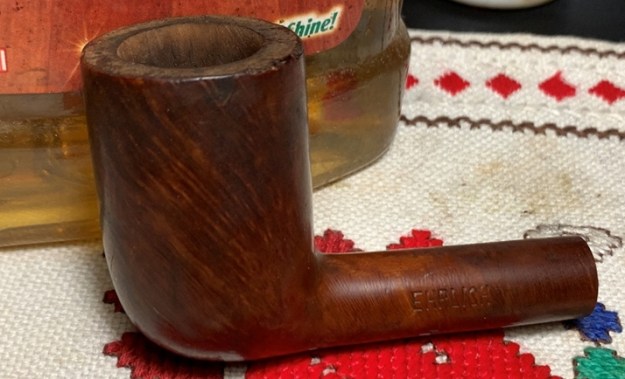
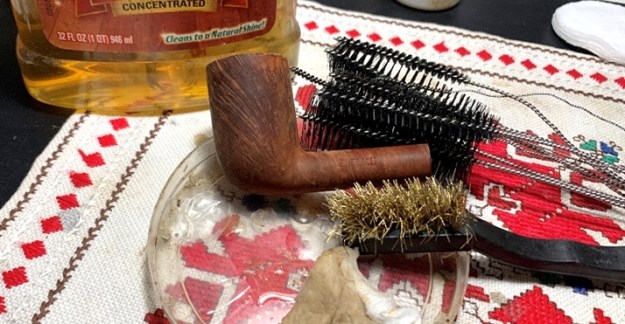
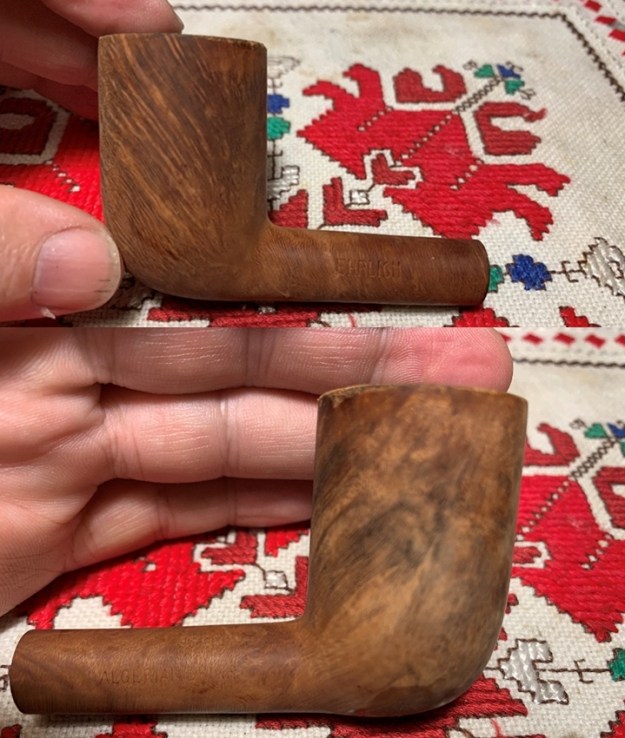
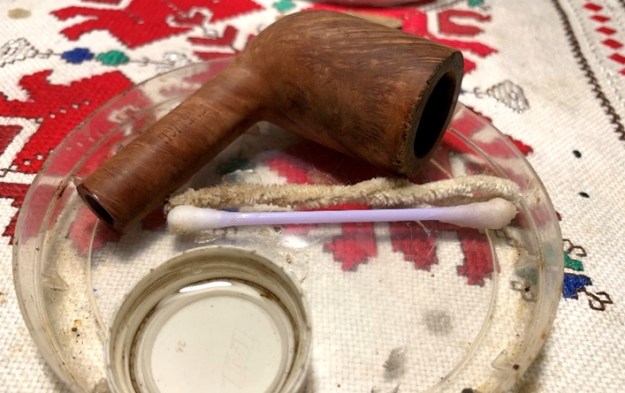
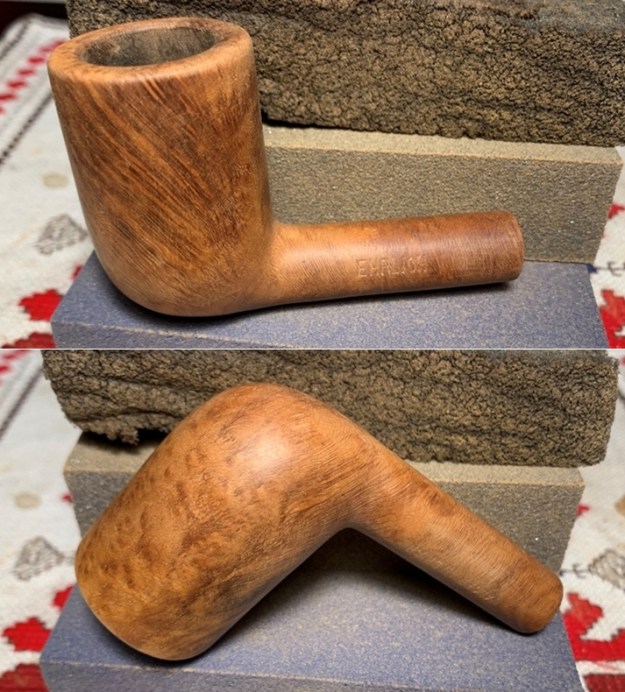
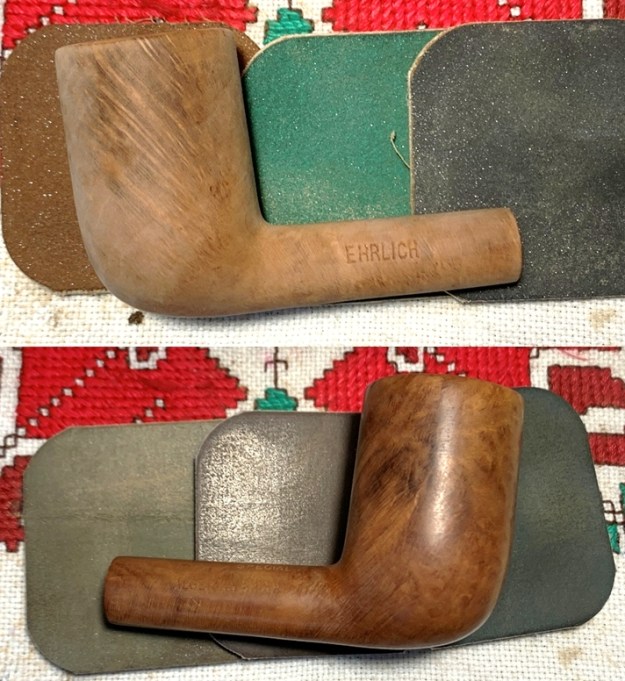
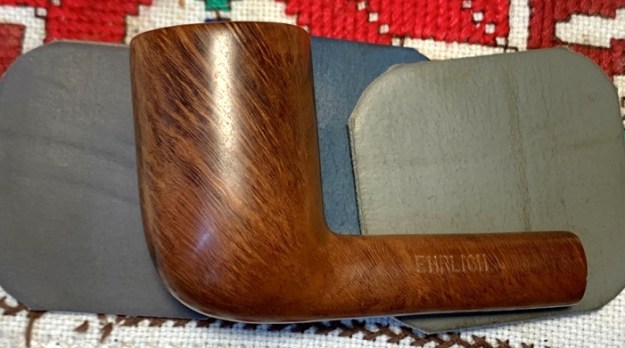
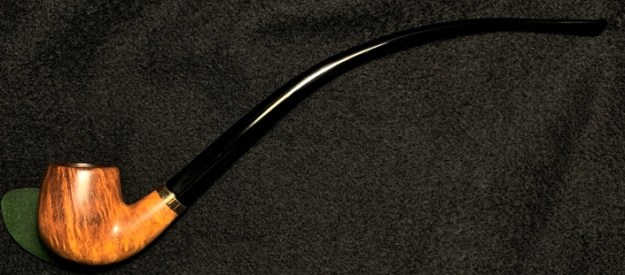
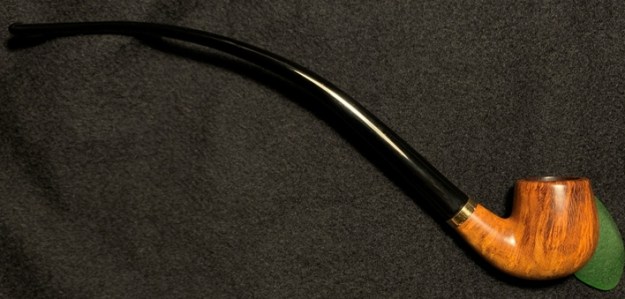
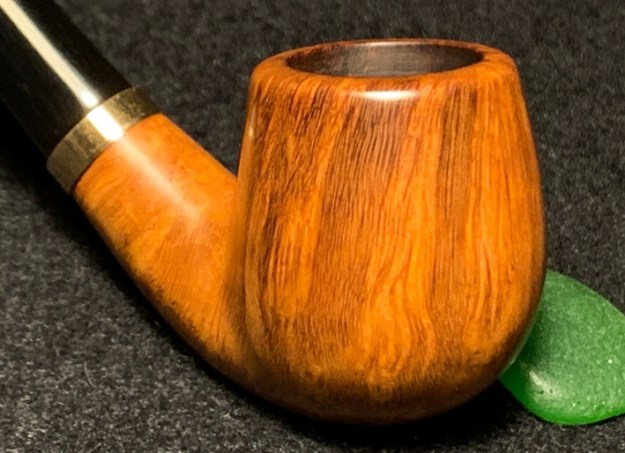
This Ehrlich Special Chimney turned out well.  I appreciated learning about the history of the Ehrlich name as one of Boston’s Tobacconist shops.  The button repair looks good and what a change from the molar damage with which the restoration began.  The vertical fire grain on the left side of the Chimney is nice and the bird’s eye grain on the right completes the ensemble. Without doubt, the pipe fits nicely in the palm.  I enjoyed this restoration and Todd who commissioned the Ehrlich Special Chimney, will also have the first opportunity to secure him from The Pipe Steward Store.  This pipe benefits the Daughters of Bulgaria – women and girls who have been trafficked and sexually exploited.  Thanks for joining me!


A Danish Borge Mortensen Handmade Brandy Recommissioned


Blog by Dal Stanton

This attractive Bent Brandy got my attention on the European side of eBay.  The seller in Germany posted several pictures.  The name, Borge Mortensen, was new to me, but my experience with Danish pipes had been good.  I was attracted as well to the Cumberland stem, but the lack of bend on it struck me as awkward – not the best orientation, but perhaps that was a Danish characteristic?  When the time ended my bid was enough and the pipe soon arrived here in Bulgaria for me to take a closer look.  I also posted it in the For “Pipe Dreamers” Only! online collection to be commissioned by another pipe man or woman benefiting the Daughters of Bulgaria – women and girls who have been trafficked and sexually exploited.The Mortensen also got the attention of Todd, who has commissioned other pipes from me in the past.  Todd is an avid pipe man and contributor to several discussion groups online.  Through our communications, I’ve discovered his love and concern for China in his professional work.  I’ve appreciated our growing relationship cultivated by our common appreciation for pipes.  This relationship developed when I had asked Todd if he minded being ‘bumped’ in the queue line to allow me to restore a very special pipe for a very special guest visiting with us here in Bulgaria for a few weeks.  Chrystal’s visit from China was a special time and resulted in a memorable blog posting for me:  A Special Gift for Her Grandfather in the People’s Republic of China – A Sculpted Rose Billiard of Italy.  Chrystal presented her grandfather the pipe for Chinese New Year and sent pictures to commemorate that special event.

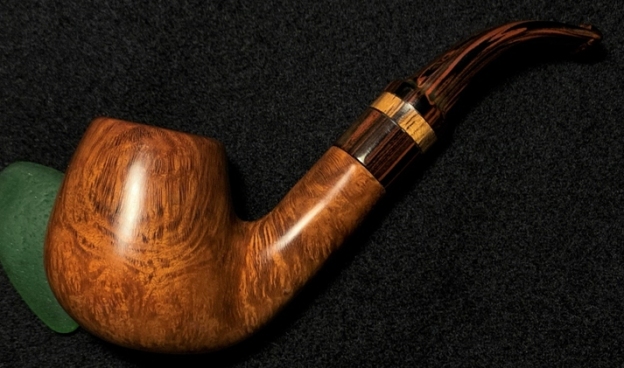
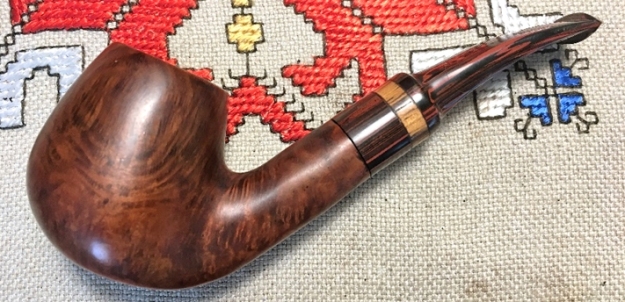
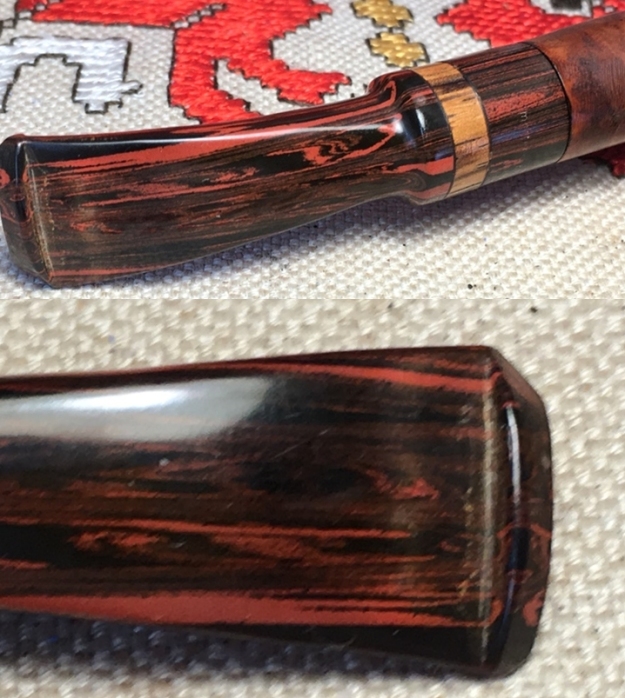
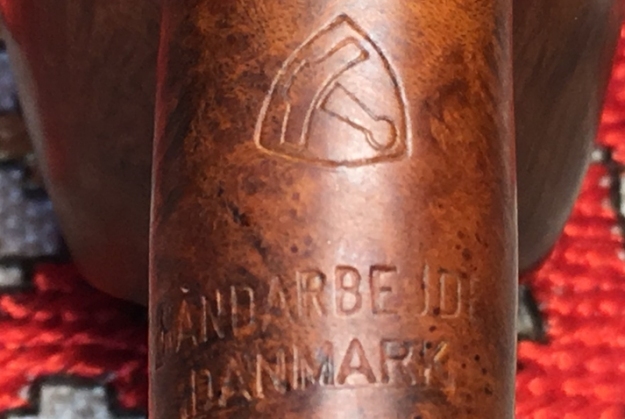
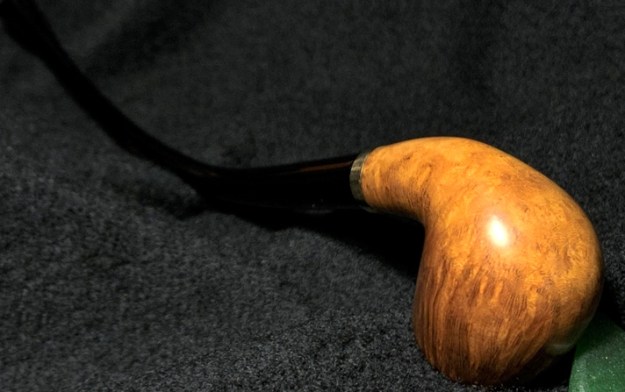
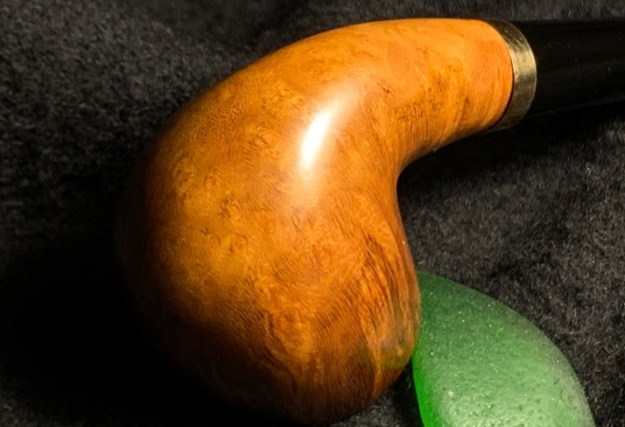
Through this initial encounter with Chrystal, I learned of Todd’s connection with China through his professional pursuits and since then we’ve shared more of each other’s life and family through our emailing….  We’ve decided to share a bowl in the future when our paths can merge on the same continent!  Todd saw this Borge Mortensen Handmade and commissioned it, along with two others that are next in the queue.  Now on the worktable, I take more pictures to get a closer look at the Danish Borge Mortensen. The nomenclature condition is good.  On the top of the Cumberland stem, ‘Mortensen’ is stamped but is thin.  The markings on the underside of the bent shank are impressive. A tilted hammer is ensconced in a shield shaped outline.  Underneath the hammer shield is HANDARBEJDE [over] DANMARK.  A quick trip to Google Translate renders “Handmade”. Scant information is available online about Borge Mortensen.  A quick search on the internet will show a few examples having been sold at different sites.  A small article is found on Pipedia with accompanying pictures ‘courtesy of Doug Valitchka’.

Borge Mortensen of Denmark

In the following example, the name is stamped very small on the top of the turned part of a Cumberland stem. The side has a unique symbol ” the hammer (Mjolnir) of Thor, the god of thunder “. There is also limited stamping on the wood: HANDARBEJDE, DANMARK.  From the examples online of Borge Mortensen pipes and from the Pipedia article (with the same information mirrored in Pipephil.eu) it seems that Mortensen pipes are standard with a Cumberland stem.  The additional information also describes the origin of the Mortensen symbol – the hammer of Thor, of Norse mythology. I would say that this is a distinctive Dane symbol and is cool.

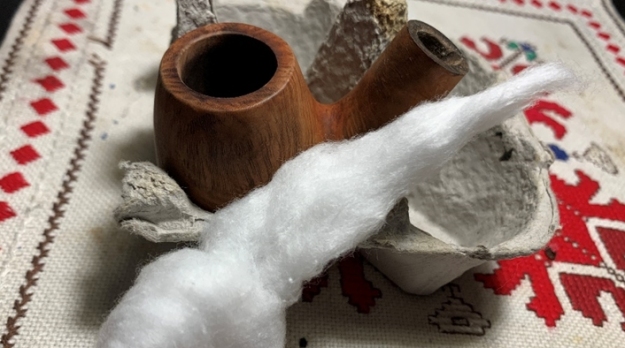
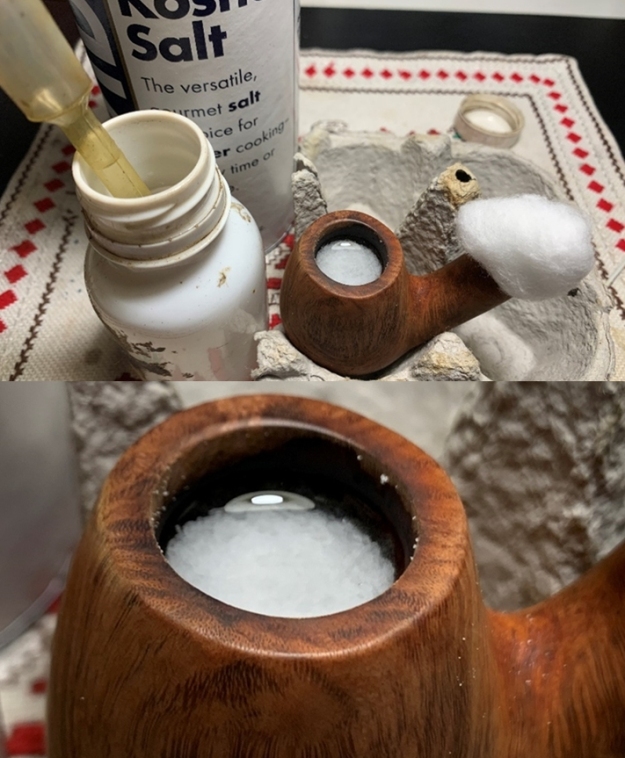
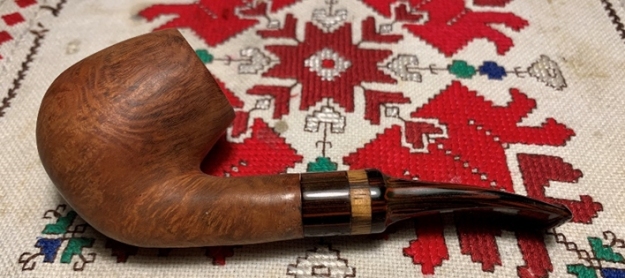
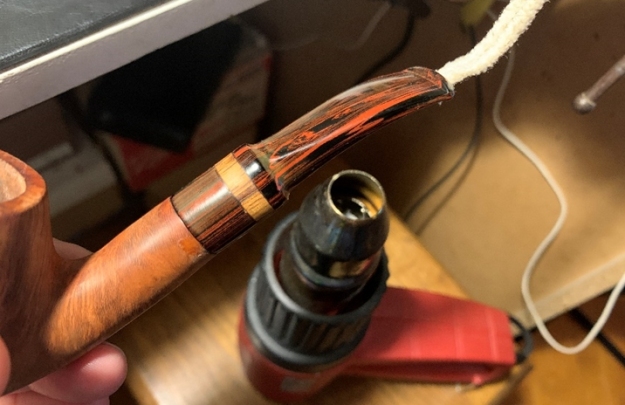
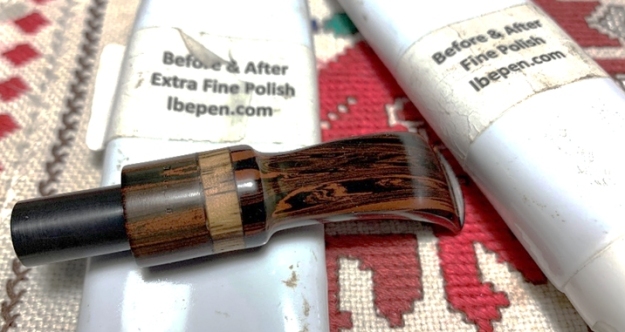
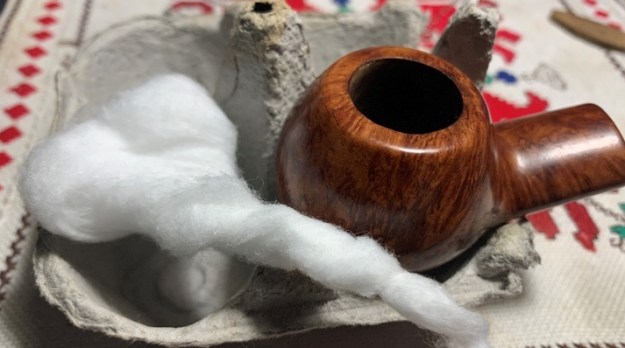
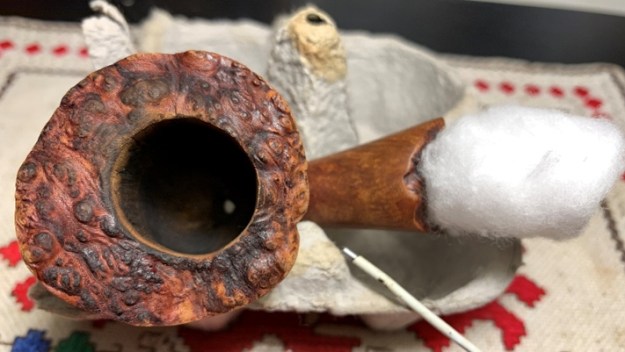
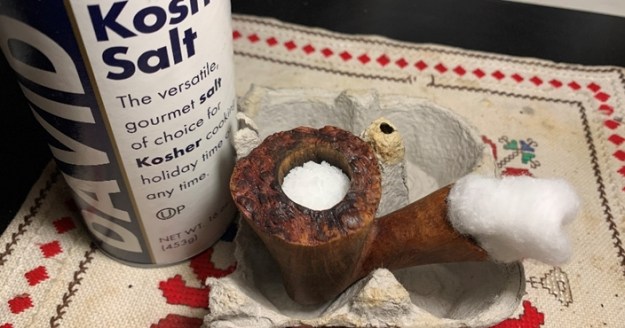
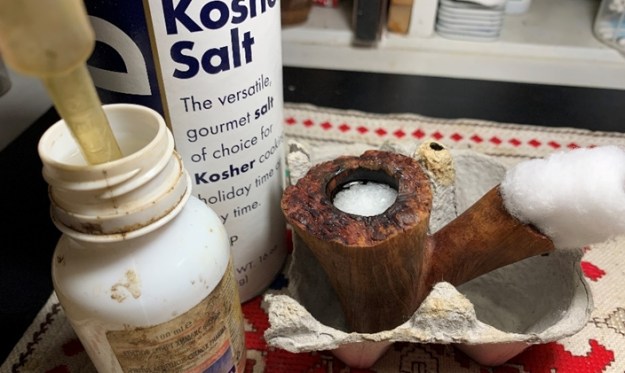
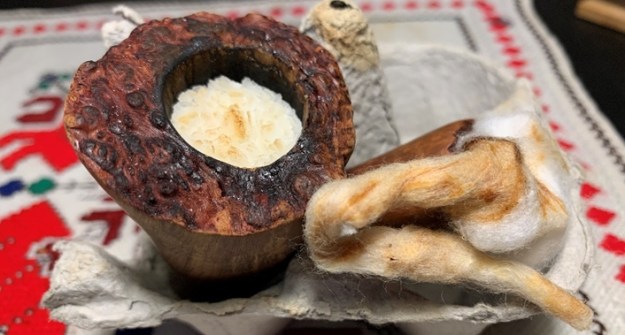
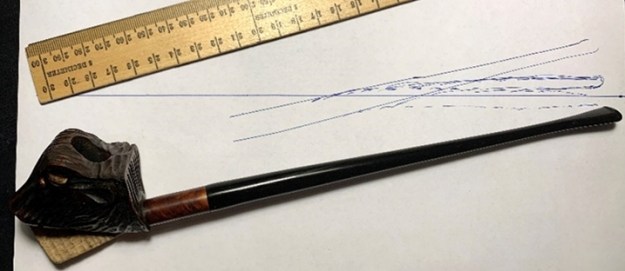
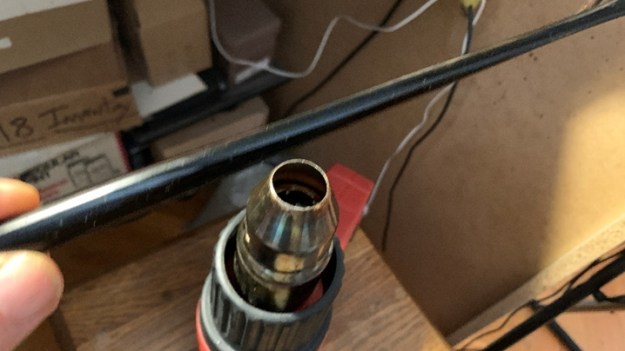
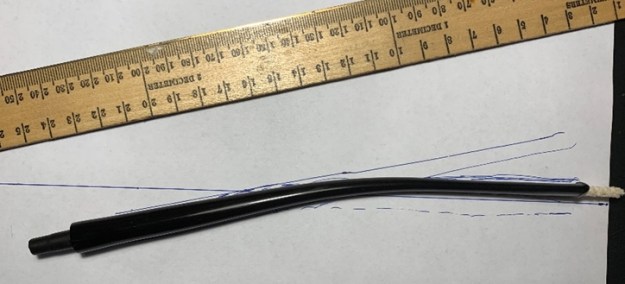
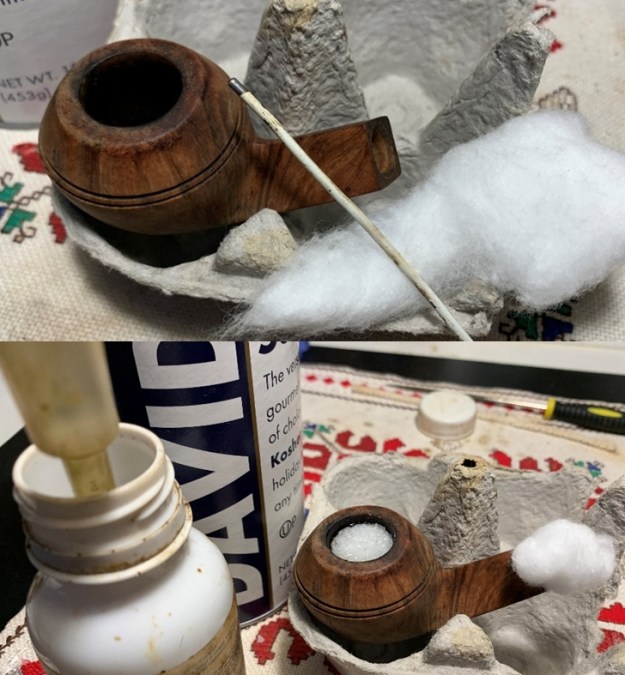
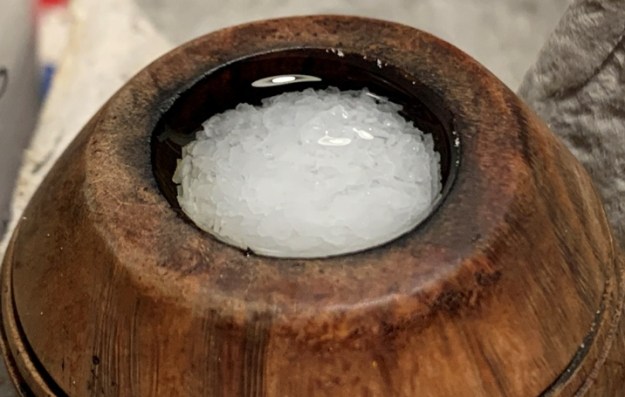
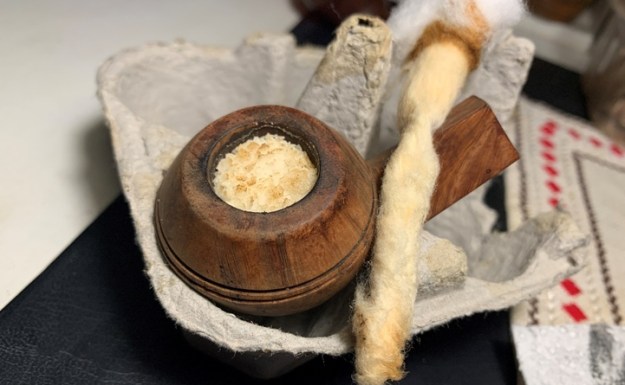
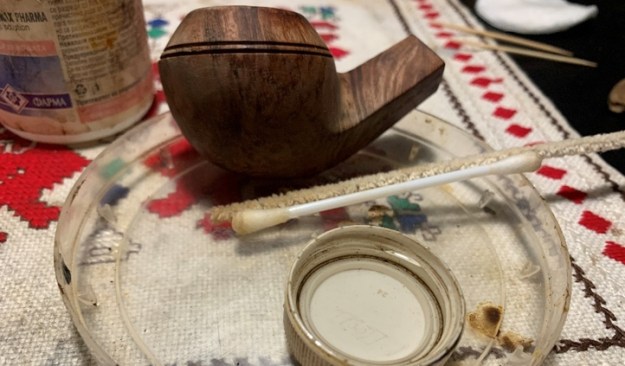
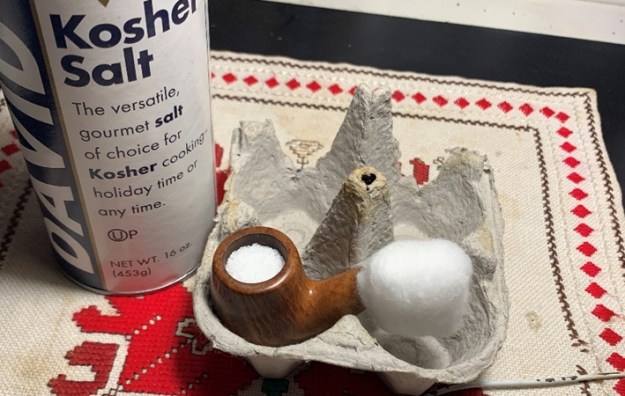
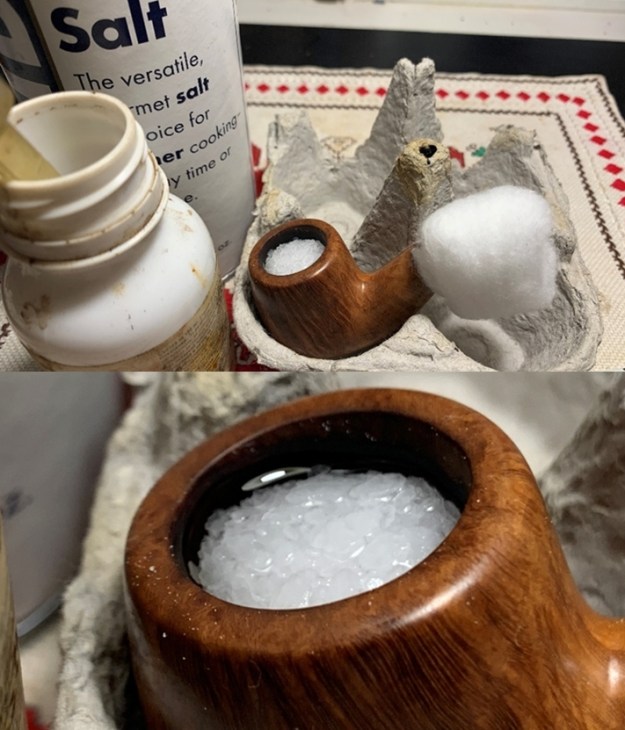
The condition of the pipe is generally good.  The chamber appears to have been reamed but I will clean it further.  The bowl shows nice grain and is generally in clean condition and the grain on the Brandy shape is very nice showing no fills.  The Cumberland stem shows almost no tooth chatter.  One issue is that the 9mm filter holder has separated from the stem and is stuck in the shank.  Care is needed in dislodging the plastic tube – breaking it will not be good.  The lighting is a bit different with the picture below since I’m using natural light while on my ‘Man Cave’ balcony enjoying spring weather on the 10 floor – with a great view!  A cameo appearance enjoying my L. J. Peretti Giant Egg loaded with Peretti Tobacconist of Boston’s, Black Virginia. A delightful time! To dislodge the filter holder from the shank, I put the bowl in the freezer with the hope that the cooling of the wood might help loosen it. While in the freezer, I turn to the Cumberland stem and clean the internals with pipe cleaners and cotton buds wetted with isopropyl 95%.  A small dental spoon tool is used to scrape the internal cavity of tars and oils. The upper and lower bit shows roughness which needs to be removed. Using 240 grade paper, I sand the upper and lower bit area as well as the button.Following the 240 paper, I wet sand the entire stem with 600 grade paper and follow with applying 000 steel wool.  I avoid the ‘Mortensen’ stamping on the top of the stem saddle section.Next, using the full regimen of 9 micromesh pads, I wet sand the stem with pads 1500 to 2400, then dry sand with pads 3200 to 4000 and 6000 to 12000.  Between each set of 3 pads, Obsidian Oil is applied to rejuvenate and protect the stem from oxidation. Moving back to the stummel – I had placed the stummel in the freezer in hopes that it would enable me to extract the plastic filter sheath.  After taking the bowl out of the freezer, I am able to hand turn the sheath and it comes out easily.  After taking another look at the chamber, the reaming job that had been done on it was not enough.  There remained carbon residue.  Using the Pipnet Reaming kit, I use 2 of the 4 blades available – starting with the smallest.  I follow this by using the Savinelli Fitsall Tool to scrape the chamber walls further.  To finish, I use 240 grade paper wrapped around a Sharpie Pen to sand the chamber to remove what carbon cake remained to expose fresher briar. After cleaning the chamber with a cotton pad wetted with isopropyl 95%, I inspect the chamber, and all looks good – no signs of heating problems.Next, moving to the external cleaning, using undiluted Murphy’s Oil Soap on a cotton pad, I scrub the briar surface.  Following this, I take the bowl to the kitchen sink and clean the mortise and airway with shank brushes and anti-oil liquid dish soap.  After scrubbing the internals well with hot water, I rinse the bowl thoroughly and transfer it back to the worktable and take a few pictures of the now cleaned surface – it looks good. Using pipe cleaners and cotton buds wetted with isopropyl 95%, I continue cleaning the internals.  A small dental spoon also works well to scrape old tars and oils off the mortise walls.  In time, the buds and pipe cleaners begin to emerge lighter and I call this phase of the internal cleaning finished.With the hour being late, I continue the internal cleaning using a kosher salt and alcohol soak.  After twisting and pulling a cotton ball to form a mortise ‘wick’, I use a stiff wire to help guide it down the mortise toward the draft hole.  The wick helps to draw out the old tars and oils to clean and refresh the bowl. Kosher salt is then used to fill the bowl which leaves no after taste and helps to freshen the briar.  With the bowl stabilized in an egg carton, a large eye dropper fills the chamber with isopropyl 95% until it surfaces over the salt.  After a few minutes, the alcohol is drawn into the salt and cotton wick, and I top it off one more time and turn out the lights.The next morning, I was surprised to see almost no soiling of the salt and cotton wick.  This means that the internals are clean indeed!  After removing the expended salt, wiping the chamber with paper towel, and forcefully blowing through the mortise, the expended salt residue is removed. I follow with a pipe cleaner and cotton bud dipped in isopropyl 95% to be sure all is clean.Before bending the Cumberland stem, the filter sheath needs to be reattached so that the stem can be seated correctly in the mortise.  The ribbing on the heavy plastic sheath clearly defines the correct orientation.  Using thick CA glue, a small amount of glue is applied around the ribbing of the sheath and a toothpick helps to spread it.  The sheath is then inserted firmly into the stem cavity and allowed to cure.With the sheath firmly in place, the filter sheath tenon seats well into the mortise.Next on the project list – to provide the Cumberland stem with a bend.  Ideally, the stem orientation should roughly parallel the plane of the rim.  The shortness of this stem creates a challenge for such a tight bend.  The diagram below shows the estimated bend and orientation that is the goal.  To be on the safe side, I insert two pipe cleaners into the airway to safeguard the integrity of the airway with the tight bend.  Using the hot air gun, I gradually and patiently warm the stem where the bend is to occur.  The pipe cleaners extending out from the stem are useful as a handle as the hot air warms the Cumberland blend of black and red vulcanite and becomes supple.When the stem becomes sufficiently supple from the heating, I gently bend the stem over a block of wood tightened in the vice.  The rounded curve on corner of the block acts as the mold to provide a tight even bend.After the stem is bent over the block, I hold it steady to allow the rubber to cool by itself.  After the stem firms up in its bend, I then take it to the sink and run cool water over the stem to solidify the bend.  The first attempt is good.  After taking it back to the worktable and placing it on the template I drew, I’m satisfied with the orientation of the bend.  The pipe cleaners do the job and they come out with a little tugging.The bend is good, but after a quick inspection, the underside of the stem has rippled.  This affect can happen with a sharp bend and I probably should have bent the stem sooner in the process before the stem sanding.  We learn with each restoration! To remove the rippling on the underside of the stem resulting from bending the stem, I do a quick detour with 240 grain paper, followed by 600 grade and 000 steel wool.  A quick run through all 9 micromesh pads, 1500 to 12000 with Obsidian Oil between each set of 3, bring the stem back to an acceptable state!  I move on. With the stem now on the sidelines, I focus on the Borge Mortensen stummel.  Not wishing to contribute to the erosion of the Thor’s Hammer Shield nomenclature, I cover the area with masking tape.  Beginning with the rim, there is residual darkened briar from the former steward’s lighting the chamber.  To address this, I use 240 grade sanding paper to sand very gently to clean the rim.  I also sand the interior rim edge to clean and freshen.Following the 240 sanding, I provide a gentle topping using medium and light grade sanding sponges.  This cleans the rim up well.Next, taking the bowl to the sink, I wet sand the stummel with pads 1500 to 2400 and dry sand with pads 3200 to 4000 and 6000 to 12000.  Wow!  I think for the first time in this restoration I’m taking note of the beautiful use of the grain in this Danish Bent Brandy shape. Mark Hoover’s Before and After Restoration Balm works wonders.  After putting a small amount on my fingers, I work the Balm into the briar surface.  The Balm brings out the more subtle tones of the briar hue.  After applying the Balm and letting it set for about 10 minutes, I use a microfiber cloth to wipe off the excess Balm and then buff up the briar surface.While I was waiting for the Restoration Balm to do its thing on the stummel, I apply Before & After Fine and Extra Fine Polish to the Cumberland stem. I start with the Fine Polish applying it to my finger and then rubbing it into the stem.  After rubbing it in, I leave it for about 10 minutes then wipe off the excess with a cloth.  The next stage is applying the Extra Fine Polish in the same way.  Mark’s claim for this product is that it not only rejuvenates but it continues the process of removing oxidation.  After the stem sets for about 10 minutes with Extra Fine Polish on it, again the excess is wiped off with a cloth and the stem is buffed.Now in the home stretch.  After rejoining the stem and stummel, a cotton cloth buffing wheel is mounted to the Dremel to apply Blue Diamond compound to stem and stummel.  With the speed set at about 40% full power the fine abrasive is applied to the surface.Following the application of the compound, after changing to another cotton cloth buffing wheel on the Dremel, maintaining the same speed, carnauba wax is applied to the entire pipe.  After the wax it applied, using a microfiber cloth, I give the pipe a rigorous hand buffing to raise the shine.The grain on this Borge Mortensen Handmade in Denmark is stunning.  The Bent Brandy shape uses the flow of the grain as it moves upwardly toward the top of the Brandy rim – the distinctive bird’s eye grain on the heel of the Brandy corresponds to the vertical grain.  The Cumberland stem is nice and the bend sets the right balance.  Todd commissioned this Borge Mortensen benefitting the Daughters of Bulgaria and he will have the first opportunity to acquire it in The Pipe Steward Store.  Thanks for joining me!

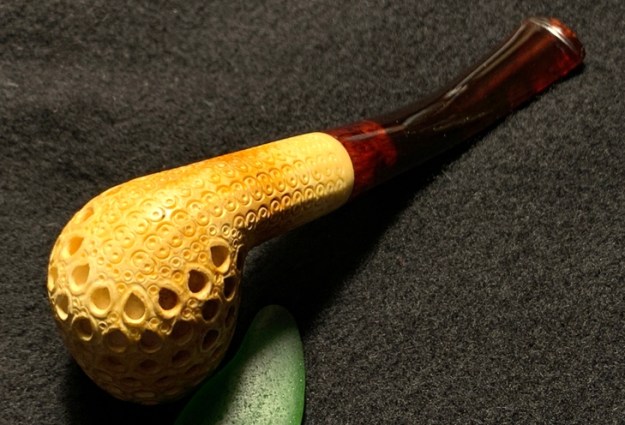
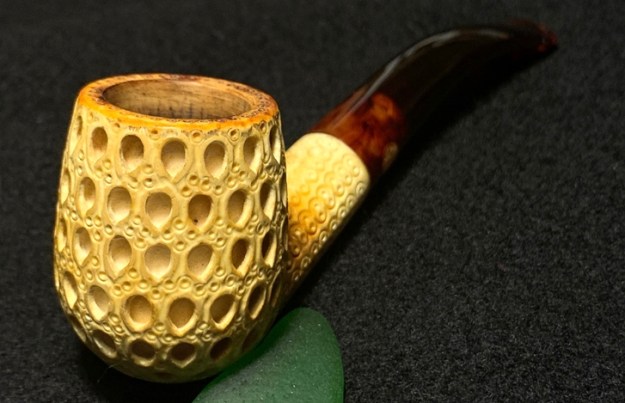
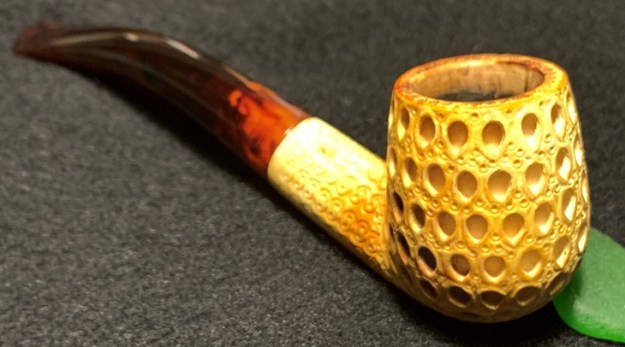
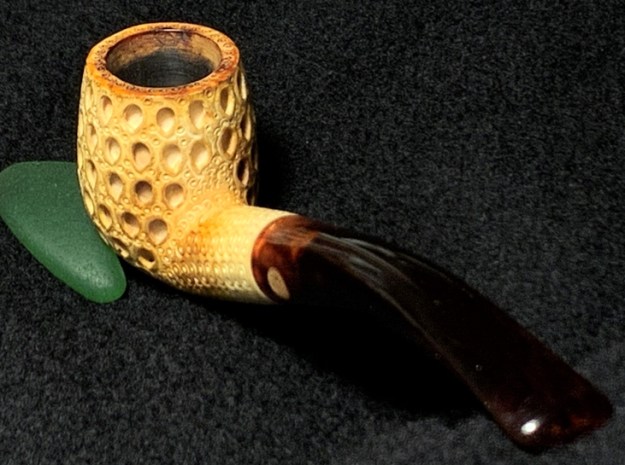
Another Black Sea Coast Treasure – An Altinay Lattice Tear Drop Meerschaum


Blog by Dal Stanton

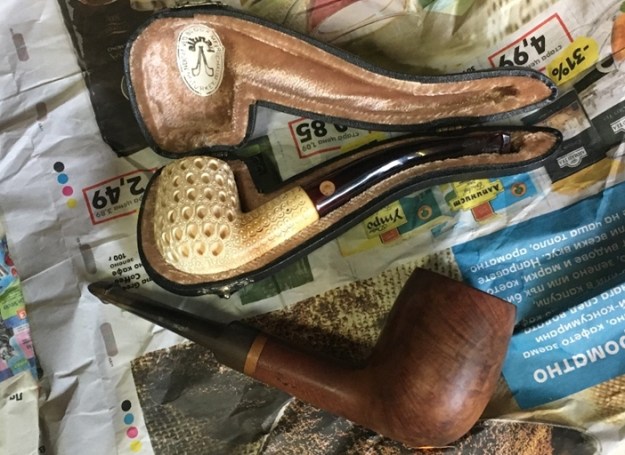
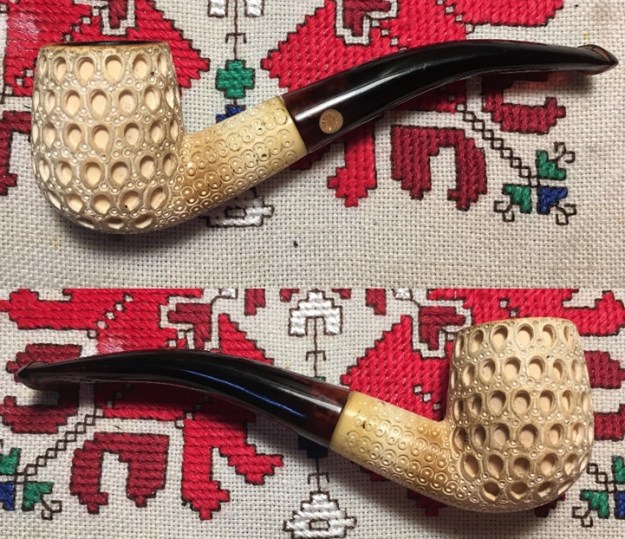
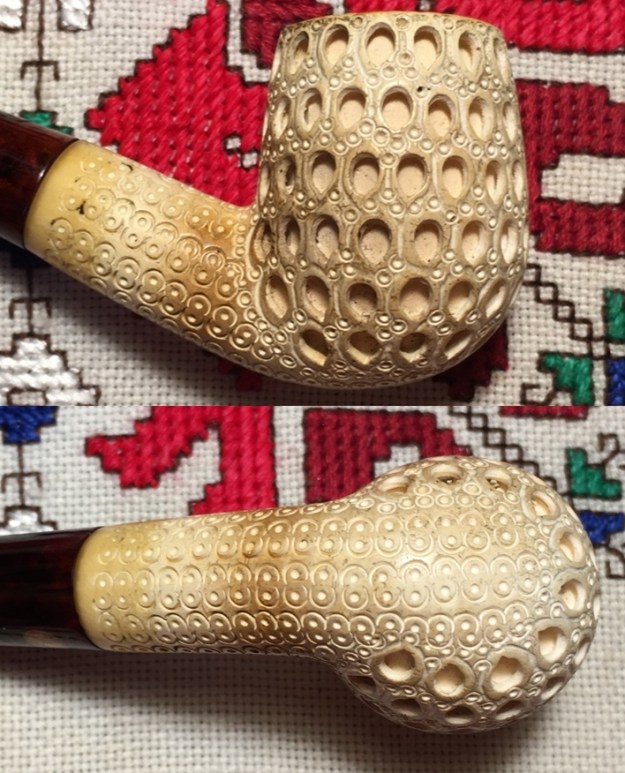
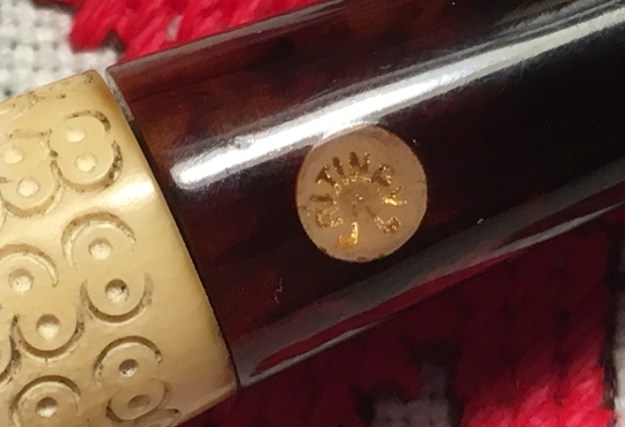
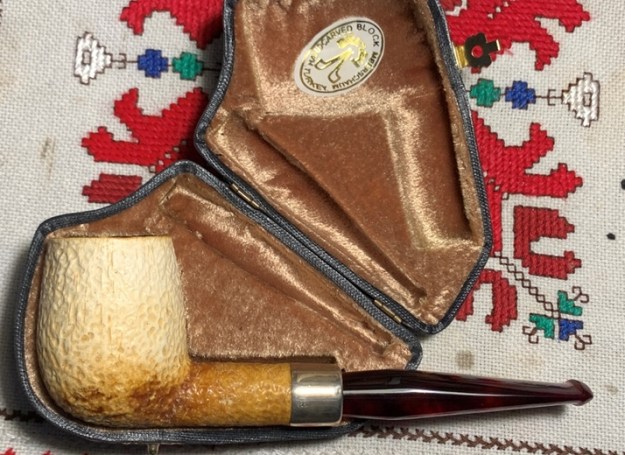
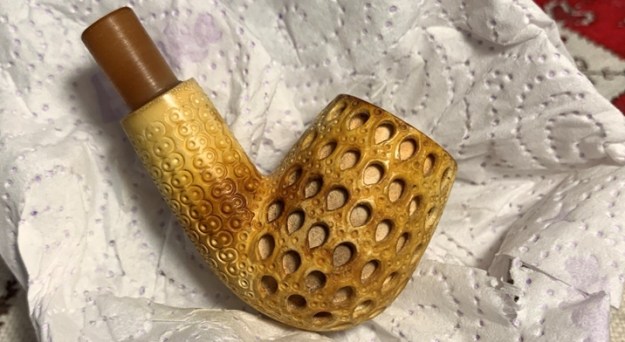
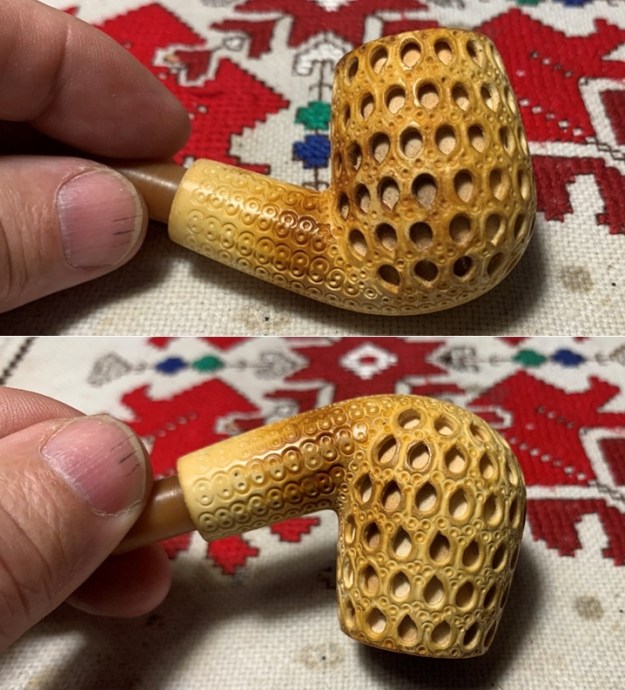
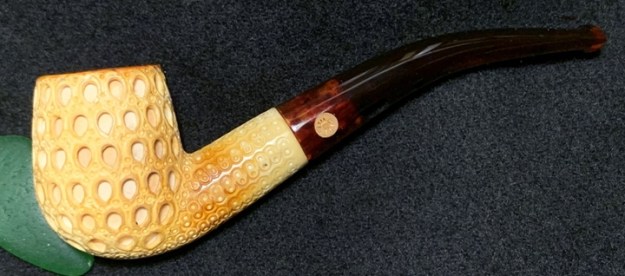
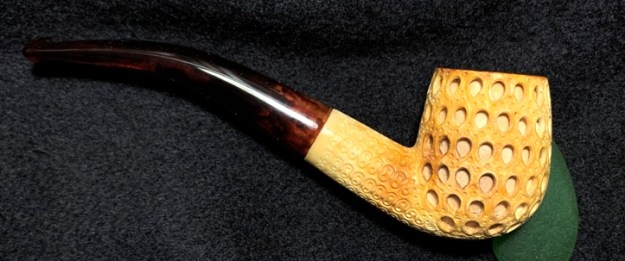
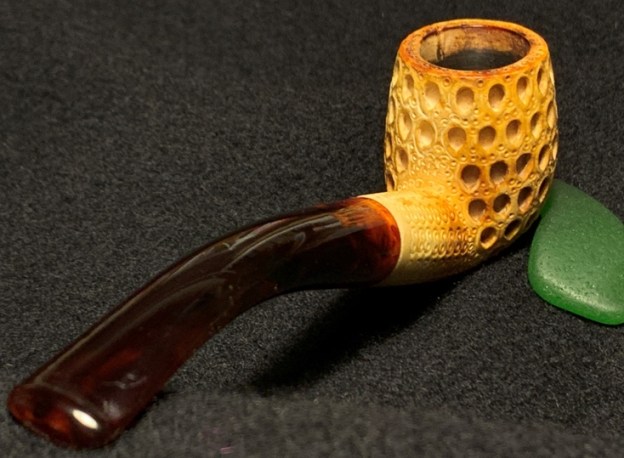
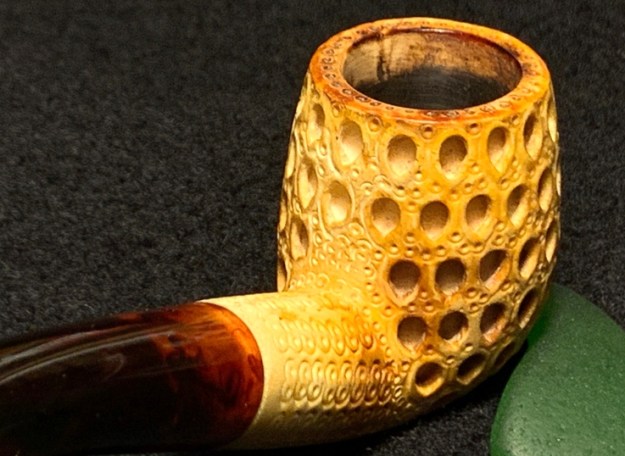
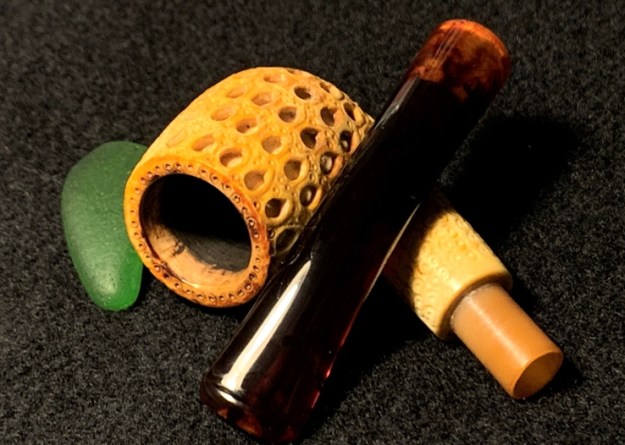
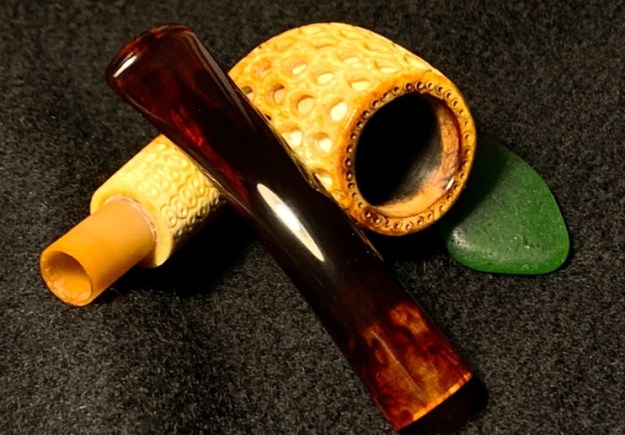
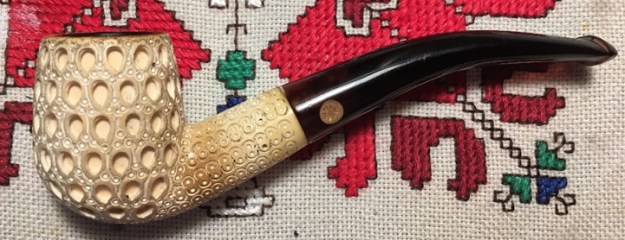
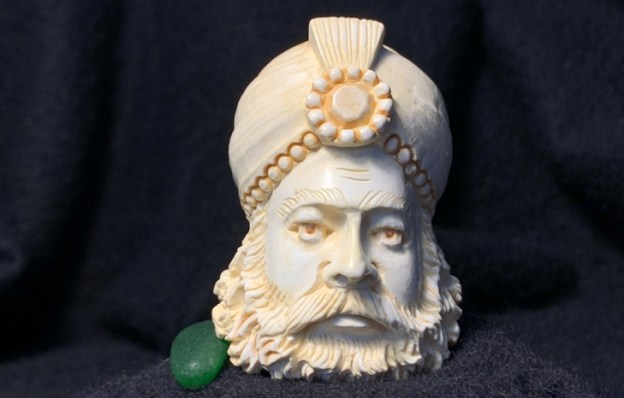
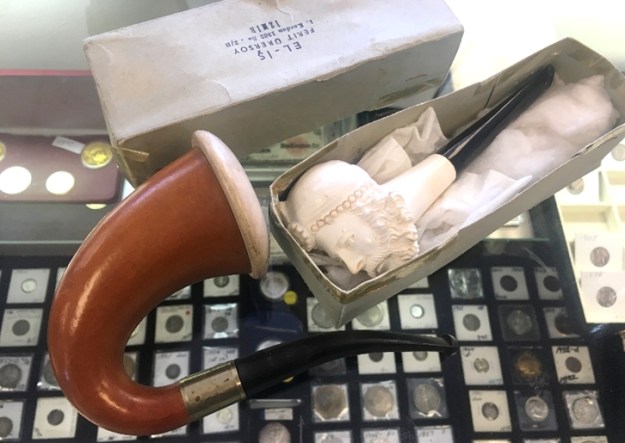
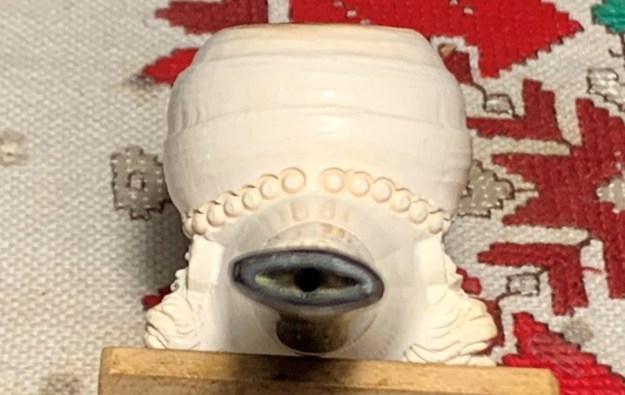
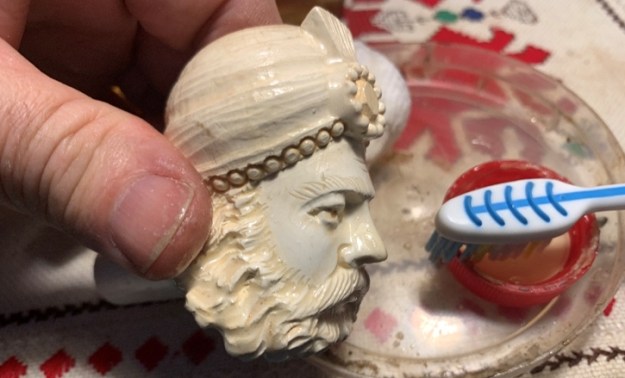
I love pipe picking especially in ‘hole in the wall’ treasure hunts on the Black Sea.  My wife and I were on summer holiday enjoying Bulgaria’s Black Sea venues.  I discovered this ‘hole in the wall’ antique shop on previous trips to the city of Burgas and on this return, I was not disappointed.  I purchased 7 pipes waiting to be adopted after negotiating with Kaloyan, the shop owner.  His mother was also there watching over things and she called Kaloyan on her cell phone when I asked about the pipes that I had found displayed.  He must have been down the street perhaps at a café taking a break and a smoke because his arrival in a matter of seconds commenced the negotiations for the 7 and a friendship emerged as a byproduct!  After taking my phone number he assured me if more treasures came his way that he would call.  As my wife and I were leaving, shaking hands with Kaloyan and grandmotherly mom, a look of shocked wonder came over Kaloyan’s face – he told us to wait and he ran back into the shop returning with two other pipes that were not in view that he had almost forgotten.  He reemerged with treasures in hand, a Vauen 6294 EX Billiard Saddle Stem (still available to be commissioned in For “Pipe Dreamers” Only!  Basket 3) and the Altinay now on my worktable.  I was immediately drawn to the exquisite detailed carving of the Altinay, a name I’m very familiar with among Meerschaum pipe carvers in Turkey.  The Altinay was petite but the detail amazingly complex and tight.  It also had developed some of the valued patina at the shank/bowl junction – the normal area.  Added as frosting on the Altinay cake was the original case – each carrier box is hand crafted for each pipe because each pipe is uniquely different being hand-carved.  The negotiations commenced for a second time adding the Vauen and Altinay to my growing Black Sea treasure trove.The entire Burgas Black Sea lot made it back to Sofia with us and eventually became available to be commissioned online in virtual “Help Me!” baskets in my For “Pipe Dreamers” Only! collection benefiting the Daughters of Bulgaria – women and girls who have been trafficked and sexually exploited.  This is where Jason found the Altinay and a French Leather Clad Longchamp which he commissioned.  The Longchamp came out great and now the Altinay awaits attention.I took these pictures of the Altinay Meerschaum on my worktable to get a closer look. The stem has the inlaid Altinay roundel marking its provenance.  The carrier box gives additional information: Altinay – Handcarved Block Meerschaum – Turkey.  Altinay’s website (https://www.altinaypipes.com/) is a quality presentation of their craftsmanship.  The ‘About’ tab on their site gives this information:

ALTINAY TURKISH COMPANY PRODUCING BEAUTIFULLY DESIGNED AND HANDMADE MEERSCHAUM PIPES AT OUR OWN MANUFACTURING FACILITY IN ESKISEHIR, TURKEY.

TIME BEGAN FOR ALTINAY IN 1964, WHEN WE EMBARKED ON A JOURNEY TO MAKE BEAUTIFULLY DESIGNED PIPES OF EXCEPTIONAL QUALITY. INSPIRED BY A LOVE OF CARVING MASTERPIECE PIPES WE ACHIEVED TO HAVE DISTRIBUTORS IN EACH EUROPEAN COUNTRY, USA, RUSSIA AND CHINA.

AND NOW, OUR PIPES ARE THE MOST POPULAR AND MOST WANTED MEERSCHAUM PIPES WORLDWIDE. WE DESIGN AND HAND CARVE TOP QUALITY PIPES BY USING FINEST QUALITY BLOCK MEERSCHAUM.

EACH PIPE IS DESIGNED TO APPEAL TO THOSE WHO SHARE OUR PASSION FOR – AND APPRECIATION OF – MASTERY BEHIND A BEAUTIFUL MEERSCHAUM PIPE. WE HOPE YOU ENJOY THE SAME SATISFACTION WHEN YOU TRY AN ALTINAY PIPE, AS WE DO IN CREATING ONE.

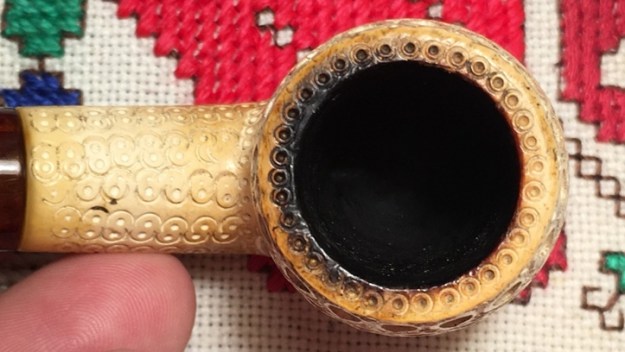
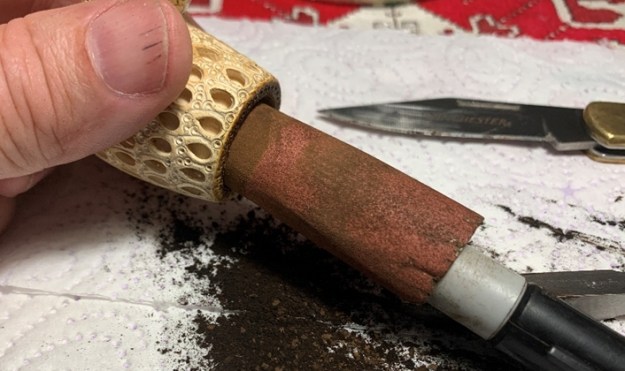
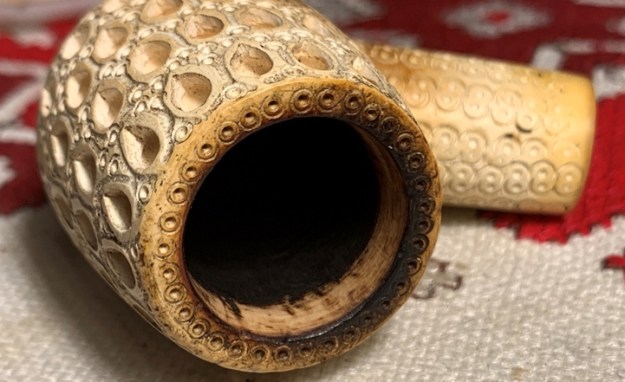
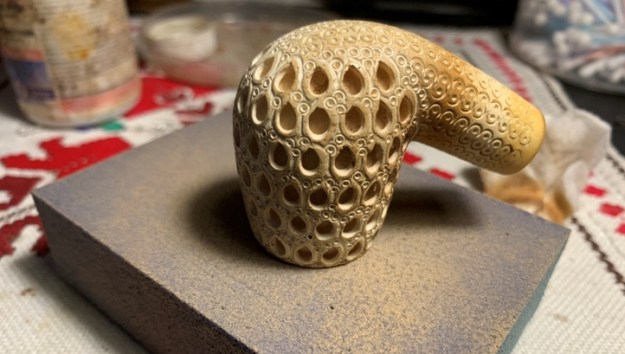
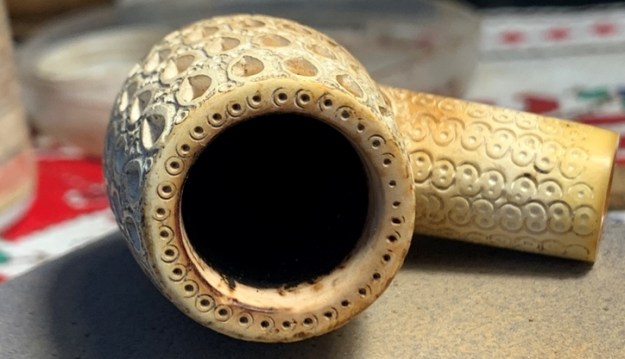
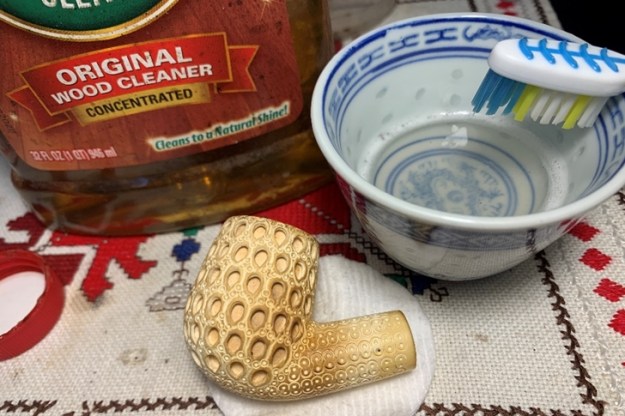
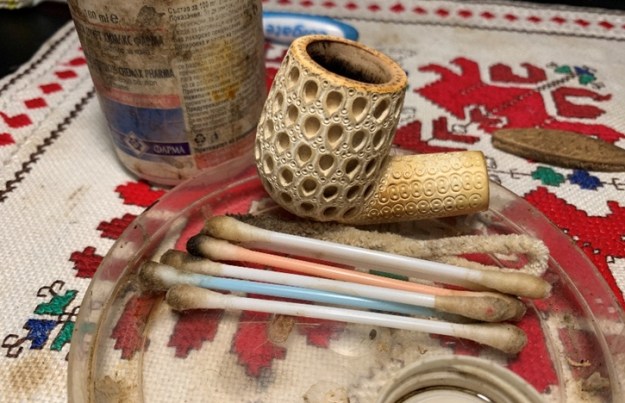
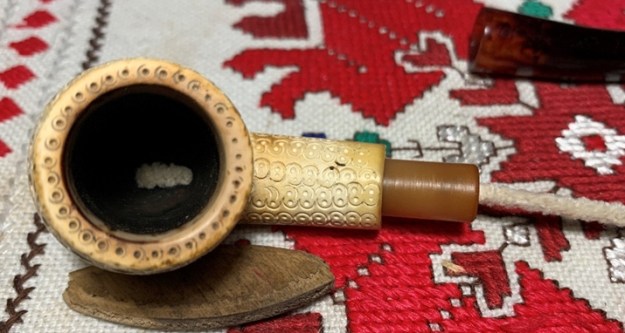
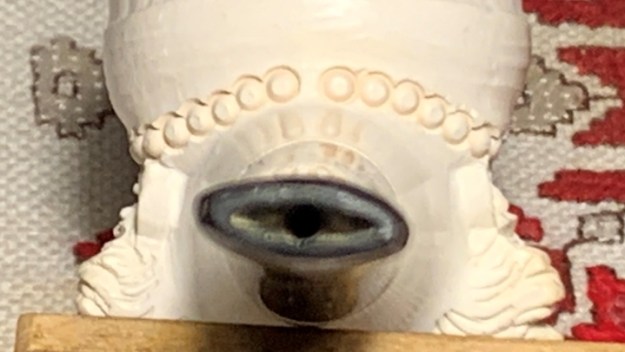
Another tab offers testimonials which I could add to.  I added an Altinay Meerschaum to my personal collection on a trip to Istanbul only last summer.  I found my Altinay Dimpled Billiard at the Grand Bazaar in Istanbul.  After looking at literally 100s of Meerschaums in the various shops in the bazaar maze, and all the carvings that characterize the Meerschaum genre, I settled on this classic shaped Altinay.  It now reveals the growing patina as the honey brown color expands on what started as a snow-white Meer surface.The Altinay on my worktable is in good shape regarding the condition of the Meerschaum lattice tear drop bowl.  It needs cleaning and the rim has lava darkening especially on the aft quadrant.  As you would expect with a healthy Meerschaum, there is very little cake build up in the chamber.  A Meer pipe needs/wants no cake build up to protect the chamber as with briar bowls. Another unique feature of Meerschaum pipes is that they do not need to rest.  They can be reloaded immediately and another bowl of one’s favorite blend can be enjoyed.The acrylic stem shows tooth chatter on the upper and lower bit which should sand out easily.Structurally, the only challenge is the lose 9mm filter tenon pictured below.  When I first unlinked the stem and the bowl and the plastic tenon was loose, I wasn’t sure which direction the threaded part of the plastic tenon was supposed to go – was it screwed into the mortise or into the stem?  I tested both directions and the only configuration that allowed the stem to seat with the shank was with the threaded part inserted into the mortise.  Yet, the threads would not grip anything revealing that the threads had been stripped. For now, I put this issue aside and start on the cleaning of the Altinay Meerschaum.  I first clean the acrylic stem airway using pipe cleaners wetted with isopropyl 95%.  The filter cavity is cleaned using cotton buds.Turning now to the Meer chamber, the carbon build-up is light, but I address it first by carefully scraping the chamber walls with the Savinelli Fitsall tool.  Using a reaming kit with blade heads is not a good idea with Meerschaum as the torque required could possibly crack the Meerschaum and that would not be a good thing.  The Savinelli tool works well to scrape evenly as well as to reach into the lower contour’s angles with the end of the tool being gently curved.  I scrape a little with a Winchester pocketknife and transition to sanding the walls with 240 grade paper wrapped around the Sharpie Pen. After wiping the bowl out with a cotton pad wetted with isopropyl 95% to remove carbon dust, the following picture shows that the lower chamber remains darkened, but it is clean by the touch and looks good.  I move on.The pictures above and below show well the blackened state of the rim resulting from lighting.  The condition of the Meerschaum will never again be the snow white that Meerschaums start with emerging from the factory or carver.  My desire is to remove as much of the charring from the rim without damaging the ornate carving on the rim.  My hope is to soften the contrasting coloring and then later, after applying a bee’s wax treatment, which helps color the Meerschaum toward the sought for patina which increases the value of the pipe.  The bee’s wax will help blend the hues in the Meerschaum.I use a cotton pad wetted with alcohol and work on the rim – working to break up the charring.I do a very gentle topping on a sanding sponge to encourage the charring to break up.  The medium sanding sponge is a very mild abrasive.The results are good.  The charring is removed in large measure.The plastic filter sheath is placed in alcohol to soak to see if it will help clean up the plastic – to lighten it or to lessen the stain. To clean the external Meer lattice surface, I mix a small portion of Murphy’s Oil soap in hot water.  It is a very diluted mixture.  I want the benefits that the agents that the soap has but I don’t want to saturate the surface with soap.  I use a bristled toothbrush to apply the soap water to the bowl and scrub the tear drop windows of the lattice work.  The mild soap removes the dirt and grime but does not remove the growing patina on the shank.I damp rinse with a dry cotton pad that draws out the moisture.  I set the stummel aside to allow it to fully dry.Shifting to the internals, using pipe cleaners and cotton buds wetted with isopropyl 95%, the internal cavity is clean in short order.The plastic filter sheath was soaking in alcohol and after fishing it out, I clean the internal cavity with cotton buds to remove the leftover gunk as well as to lighten the stained surface.  I used needle files on the end of the sheath to smooth it on the external threaded side as well as to open the air hole.  The brass bristled brush was also helpful to clean the caked crud in the threads and on the end.Switching now to the stem, the tooth chatter on the upper and lower bit is addressed with 240 sanding paper to erase the chatter. Following the 240 paper, the entire stem is wet sanded with 600 grade paper followed by applying 000 steel wool,Going directly to the micromesh regimen, using pads 1500 to 2400 the stem is wet sanded.  Following this, dry sanding continues the process using pads 3200 to 4000 and 6000 to 12000.  I like the way the micromesh pads have brought out the glassy pop of the acrylic stem. I’m at the point now, before moving to applying bees wax to the bowl, I want to fix the filter sheath – to reattach it.  Several months ago I reached out to the general email address I found on the Altinay website (altinaypipes.com).  I wanted to find out more information and I was hopeful that I might get a response.  I wrote with this question:

Greetings, I have one of your pipes.  The problem is that in the mortise insert that the filter tenon screws into is missing. So, now the tenon does not screw in to hold the stem firmly in place. Do you have replacement tenon systems? It is a 9mm filter tenon. This is a beautiful pipe and I’m hoping to put it back into action. Thank you.

I was surprised to see this response from Said whose last name is ‘Altinay’ arrive so quickly.

Dear Stanton

Of course we have replacement systems but even if you replace it with a new one, it will not be what you want.

While removing the mouthpiece if the pipe still hot, tenon can become stripped. It’s related to shank not tenon.

The method to be applied at this stage is fixing tenon with epoxy or etc..  Can you send me the photos of the pipe?and tenon?

Kind Regards

Said Altınay

I responded with pictures and this note and Said’s helpful reply:

Said,

Thank you so much for your response.  Yes, I understand what you are saying.  The internal shank insert is stripped – all that remains that I can see is the ‘skin’.  I’ve included pictures.  I look forward to hearing back from you.

Regards,

Dal Stanton

Dear Stanton

As I guess, there is no problem at tenon screw. Internal shank is stripped. As I said it needs to be fixed with epoxy or adhesive etc. If you want we can make the maintenance of this pipe….

Kind Regards

Said

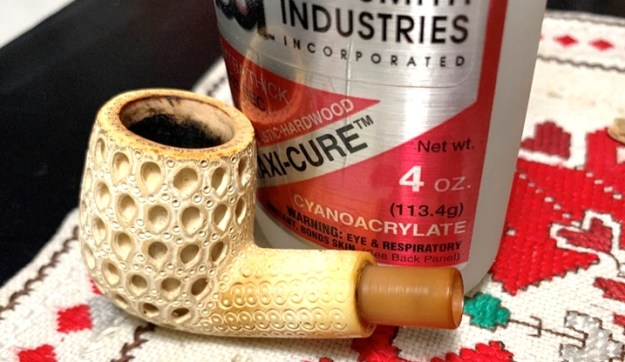
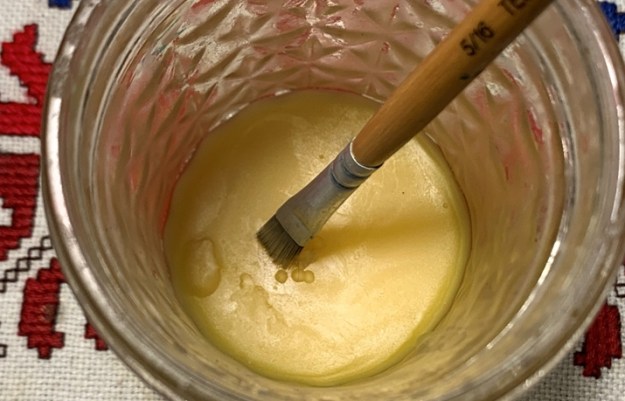
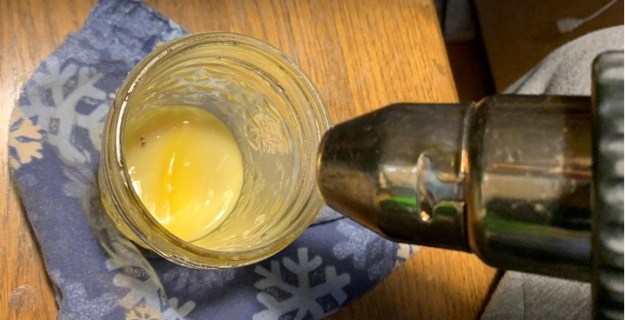
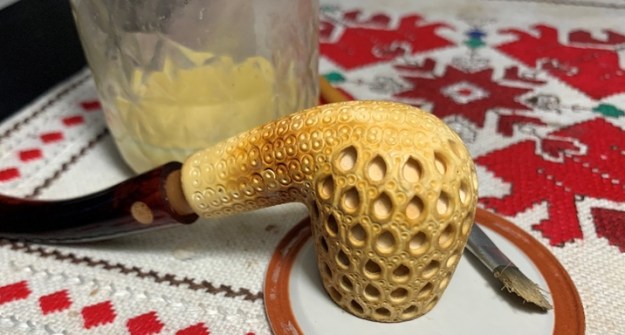
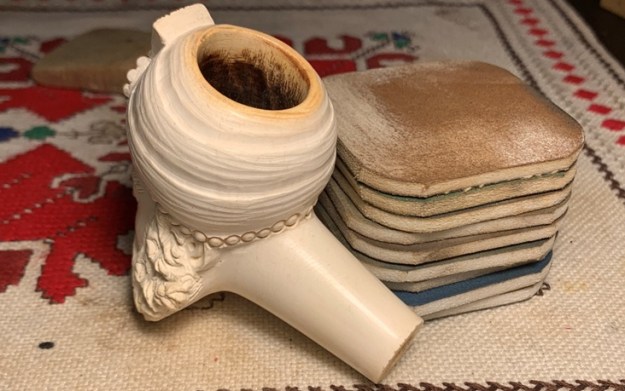
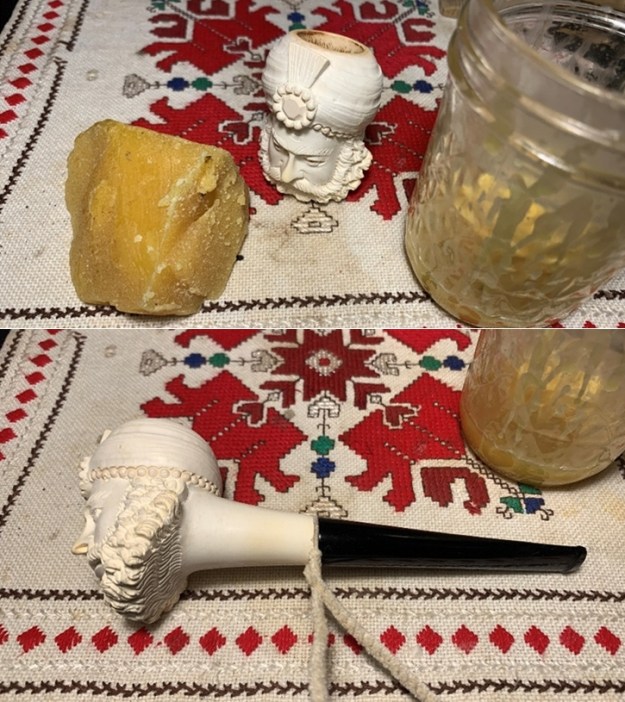
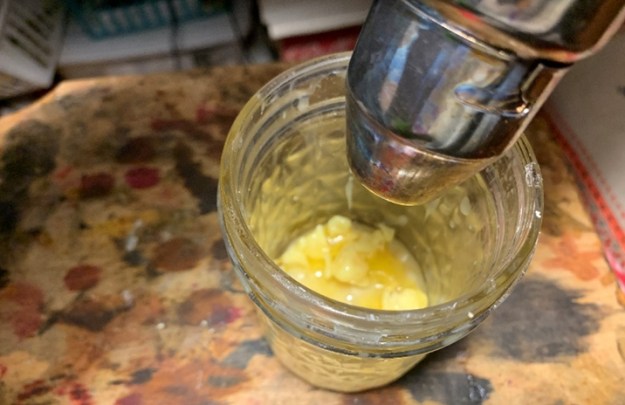
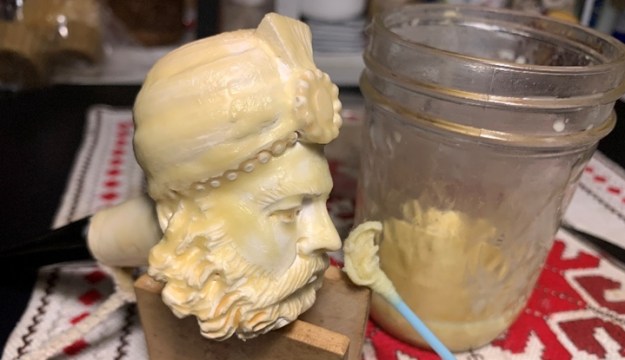
I like to record interchanges like this and my appreciation for Said Altinay’s response to my questions.  With his information, I was able to confirm that the problem is with the shank and that the threads are stripped.  What was especially helpful was what would be his approach to repair – he would use an epoxy glue to reattach the filter holder.  I was unclear on this because gluing back into place create a more permanent repair – not like a screw in attachment.  So, if the expert whose name is Altinay says he would repair it this way, well… I first start with a test fitting and run a pipe cleaner through to make sure that the path from the insert to the draft hole was in alignment.  I had no problem finding the draft hole with the pipe cleaner.After the test fitting, I then apply BSI Maxi-Cure Extra Thick CA glue around the perimeter of the lower plastic filter sheath or tenon.  I then carefully insert the tenon and seat it well in the mortise.After the CA glue sets, I rejoin the stem and Meer stummel to look.  I like what I see.  The stem’s alignment is perfect.Applying bees wax helps to protect the Meerschaum as well as to help cultivate the coloring or the patina. The bees wax is readily available in the outdoor markets here in Bulgaria where honey is sold.  I have a mason jar of wax that has already been heated and melted.  I use a paint brush, not with synthetic hair which will melt in the heat, to apply the liquefied wax to the stummel.I warm the congealed wax with the hot air gun until it liquefies.After heating the Meer stummel as well with the hot air gun, I use the brush to paint the liquefied bees wax onto the Meer surface.  I’m not able to take a picture of the process because I don’t have enough hands! I keep the hot air gun on while on my lap (not burning me) and keep it aimed at the Mason jar on the stool in front of me between my legs.  I do the painting over the top of the Mason jar so that I’m not traveling too far with the brush and the hot air continues to keep the wax liquefied and the stummel warm.  This helps the wax to absorb into the porous Meerschaum surface and not to congeal in clumps on the surface.After I apply the wax with the brush thoroughly over the surface, including in the tear drop lattice windows, I allow the Meer stummel to cool down and after cooled, I first wipe the surface with a paper towel.  I do this to remove the thick areas of the wax sitting on the surface that wasn’t absorbed.  I then follow this by buffing the stummel with a microfiber cloth – not pictured.  You never know quite how the Meerschaum will receive the bees wax treatment.  This Altinay block of Meerschaum darkened a great deal as it soaked in the wax.  Nice!After rejoining stem and stummel, I mount the Dremel with a cotton cloth buffing wheel and with the speed set at about 40% full power, Blue Diamond compound is applied to the acrylic stem.  After this, after changing to another cotton cloth buffing wheel, a few coats of carnauba wax is applied to the stem at the same Dremel speed.  I finish this restoration by giving the pipe a rigorous hand buffing to raise the shine.

The patina that the bees wax treatment teased out of the Meerschaum is an added value to the collectability of this pipe.  Altinay is known for the quality of its Meerschaum block.  This petite bent Latticed Tear Drop Meerschaum is no exception.  The tightly carved intricacy of this classic Meerschaum genre is a great one to add to the collection and the addition of the custom made Altinay case completes the ensemble.  Jason has the first opportunity to add this commissioned pipe from The Pipe Steward Store to his Longchamp which benefit the Daughters of Bulgaria.  Thanks for joining me!

Breathing Fresh Life into a French Longchamp Leather Clad Billiard


Blog by Dal Stanton

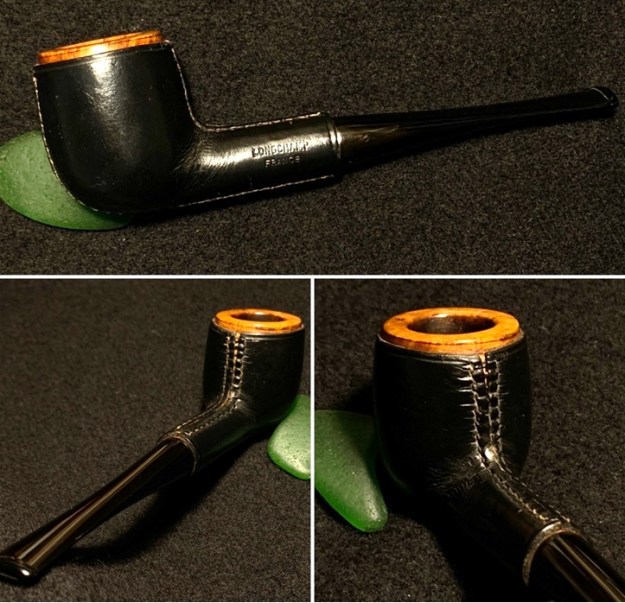
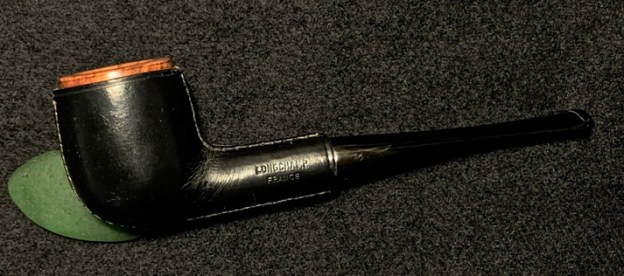
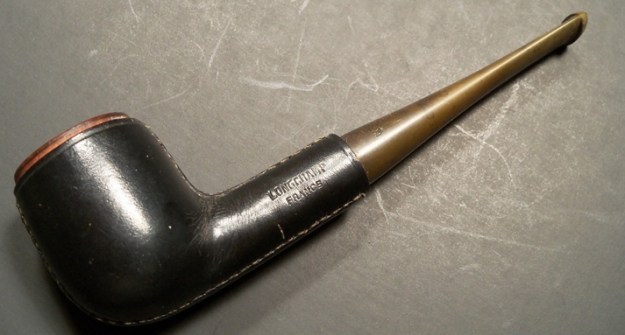
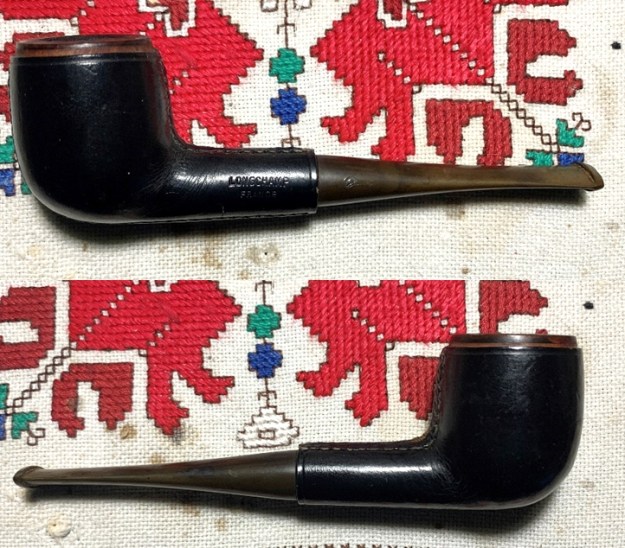
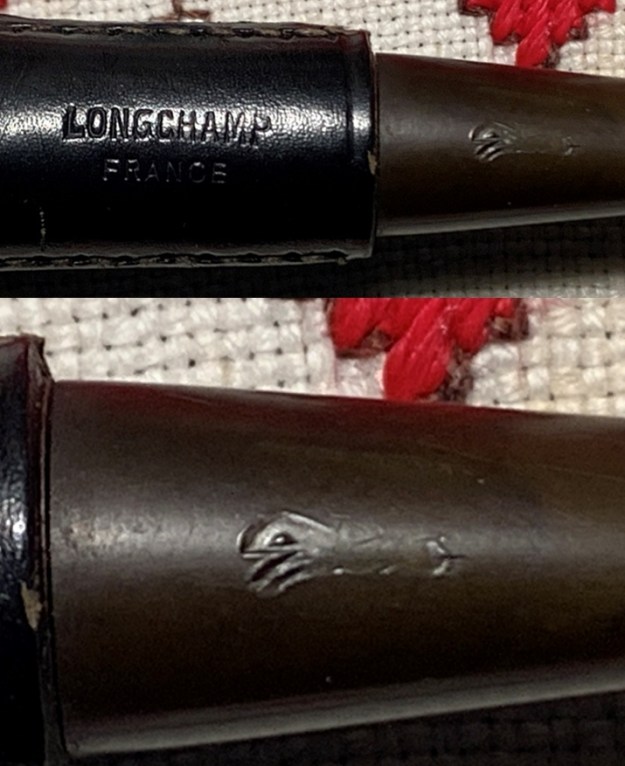
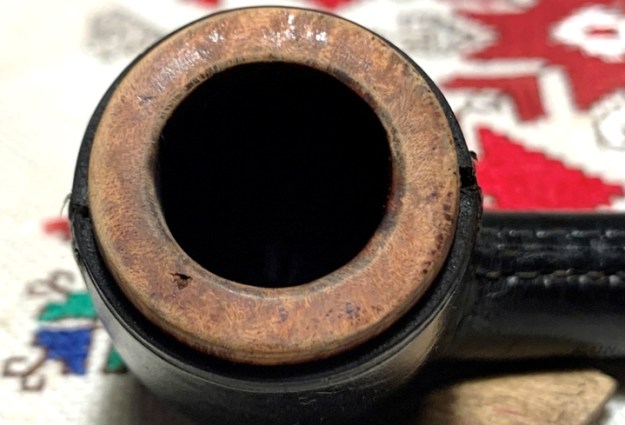
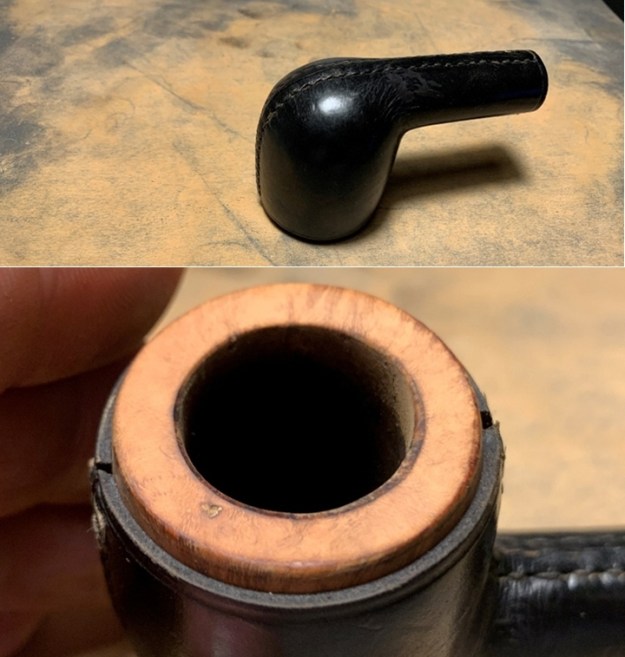
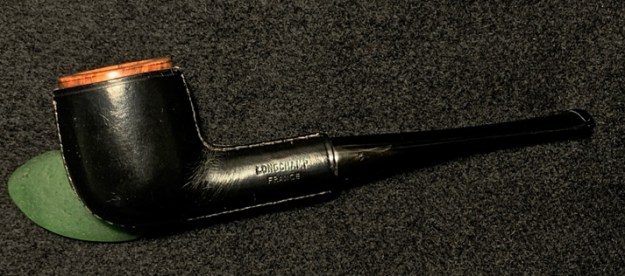
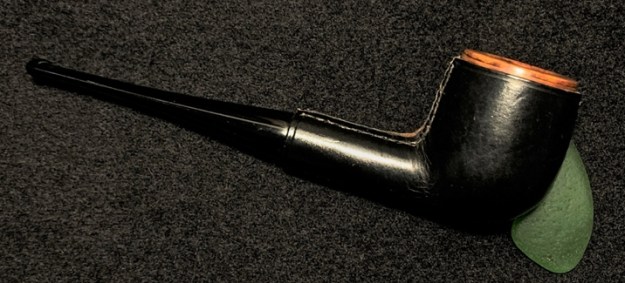
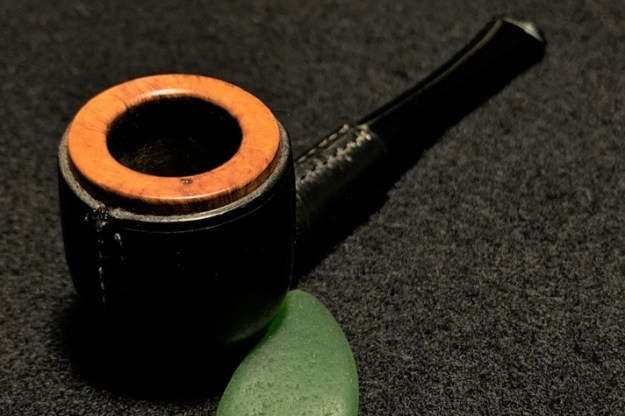
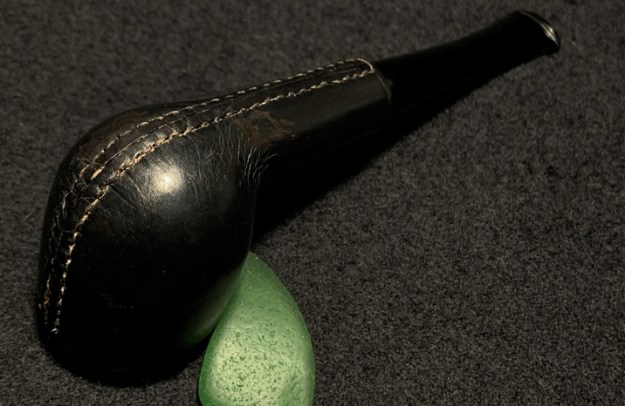
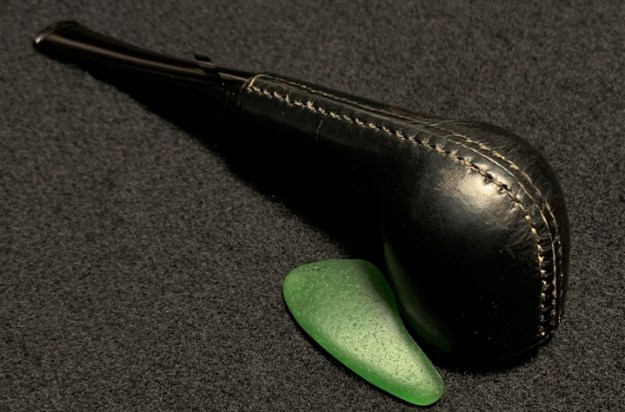
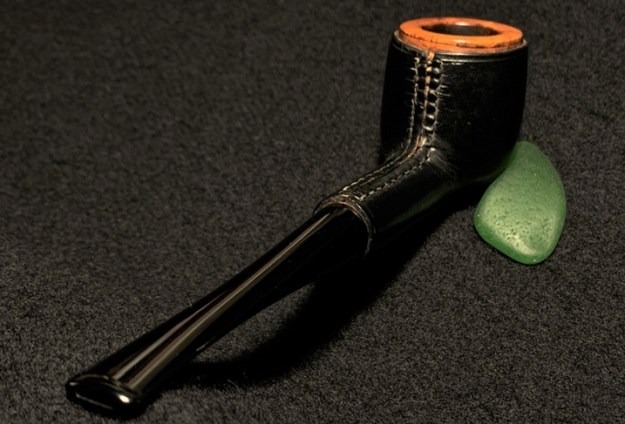
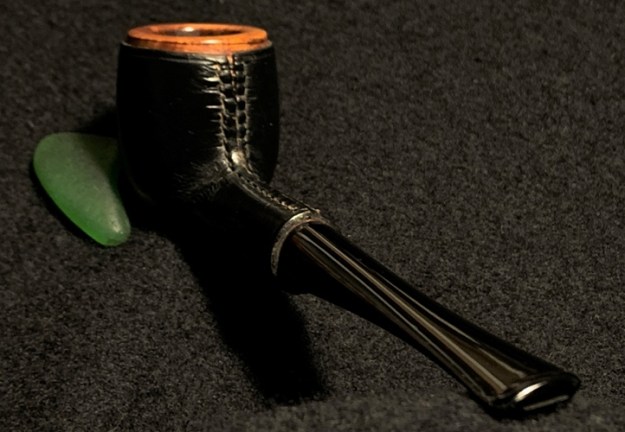
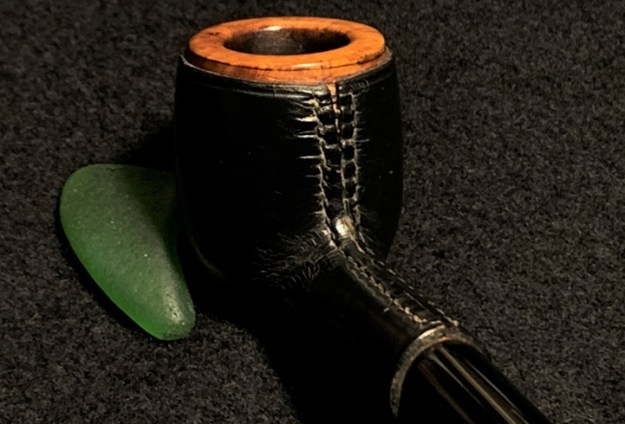
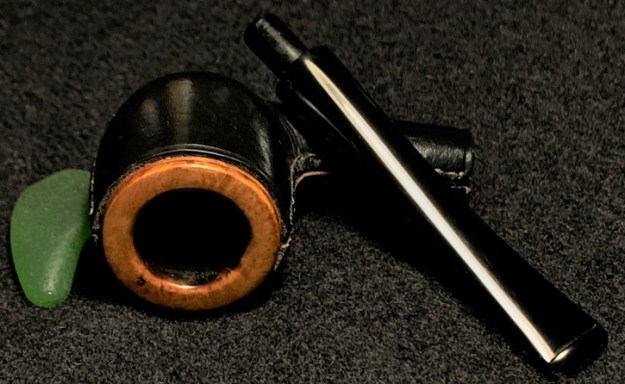
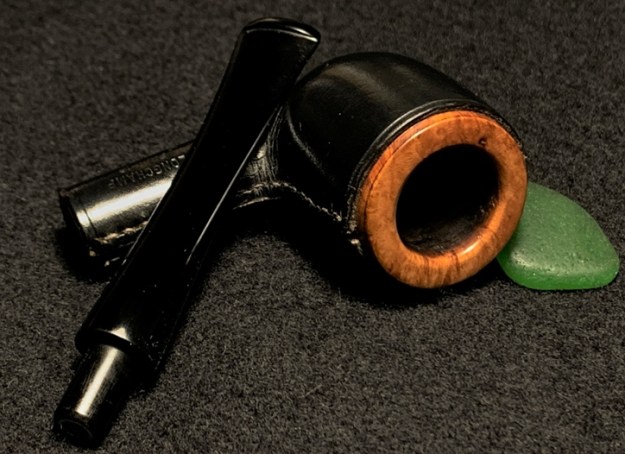
I saw this leather wrapped Longchamp on the eBay auction block from a seller in the USA state of Indiana.  Up to that point in time, a leather clad pipe was not part of my collection and the price was right when the final minutes ticked off the clock my bid weathered any challengers. The black leather drew my attention with the potential of cleaning the rim for a nice contrast with briar.  Here’s the Longchamp that got my attention. I brought the pipe back to Bulgaria and put it in the For “Pipe Dreamers” Only! online collection and this is where Jason saw the Longchamp.  Jason sent me an email and commissioned the Longchamp and expressed satisfaction in being able to help support the work we do here in Bulgaria with the Daughters of Bulgaria.  He also said that he heard about The Pipe Steward for the first time when I was interviewed by Brian Levine.  Last year, I had a great time being interviewed by Brian Levine of the Pipes Magazine Radio Show! I told the story of how I began restoring pipes as The Pipe Steward and how this intersects with the efforts here in Bulgaria working with the Daughters of Bulgaria.  Jason also commissioned a very nice Altinay Tear Drop Lattice Meerschaum which is next on the worktable.After getting the Longchamp to Bulgaria, I took more pictures to get a closer look. The nomenclature is stamped into the leather on the left flank of the shank. It reads, LONGCHAMP [over] FRANCE.  There is also a stamp of what looks like a horse in motion on the stem.The practice of wrapping briar bowls with leather started in France as a creative and economically savvy way to sell sub-par bowls that were part and parcel of France’s austerity measures during WWII.  Pipedia’s article uncovers this bit of pipe history in the article devoted to Longchamp:

In 1948 Jean Cassegrain inherited a small shop near the French Theater on the Boulevard Poissonnière in Paris, called “Au Sultan”. Articles for smokers and fountain pens were offered there. Now, the absolute bulk of the pipes Cassegrain found in the inventory was from war-time production and due to the sharp restrictions on pipe production the French government had enforced in 1940, these pipes were of very poor quality and showed large fills. Strictly speaking, they were not marketable now that the French pipe industry produced pipes of pre-war standards again. In this situation Cassegrain had the probably most enlightened moment in his life: he took some of these pipes to a leather worker who clad bowls and shanks in leather. Only the rims of the bowls and the shanks’ faces remained blank.

E voila – the pipes looked pretty good now and were eye-catching enough to become an instant success in sale. Above all among the thousands of Allied soldiers who populated Paris in those days. The thing worked well, and even unexperienced pipesters liked the covered pipes very much for they did not transmit the heat to the hand. Very soon Cassegrain had sold the old stock of pipes, and the leather-clad pipes became his only product. He began to place orders with renowned firms like Ropp or Butz-Choquin.

I love stories of innovation like the story of Jean Cassegrain and the creation of the Longchamp name which came from the name of a horse racing park near Paris.  Pipedia concludes the article with this comment:

After 1970 the interest in leather-clad pipes slowly diminished. The Longchamp pipes were offered for the last time in the 1978 catalog though previously placed orders were delivered until 1980.

The splendid success inspired many other renowned producers to offer their own lines RoppButz-ChoquinGubbelsGBD… Maybe Savinelli was the very last producing them for the label of the famous designer Etienne Aigner.

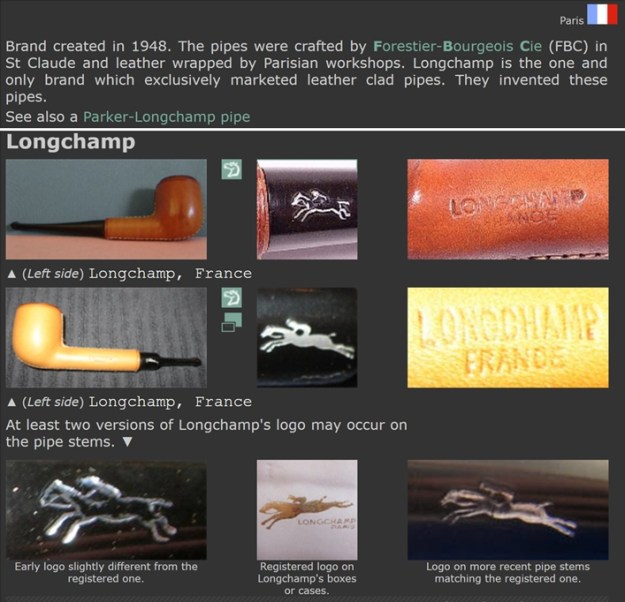
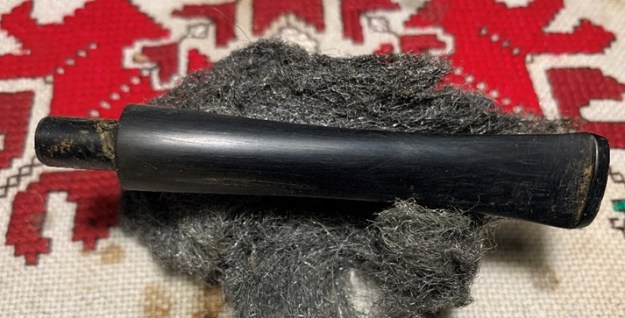
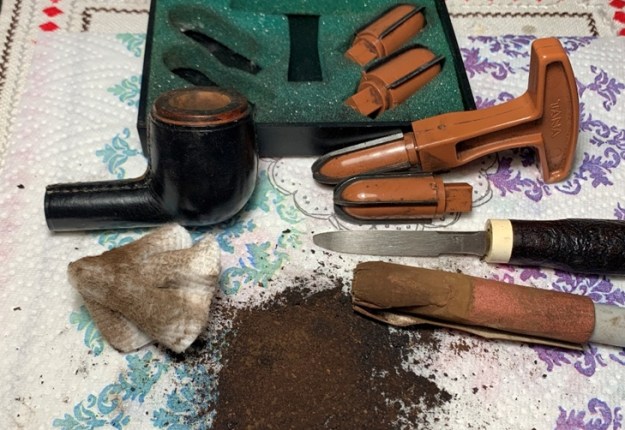
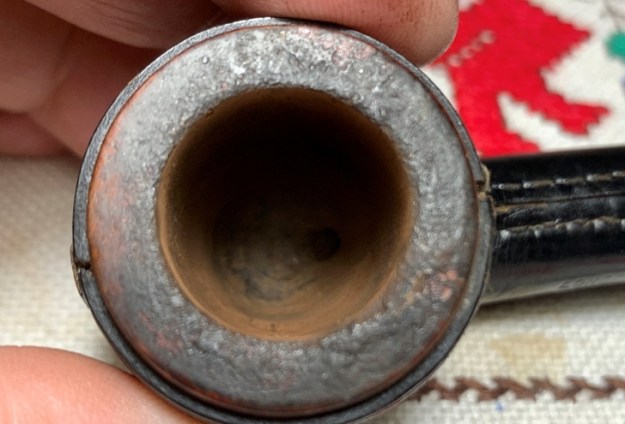
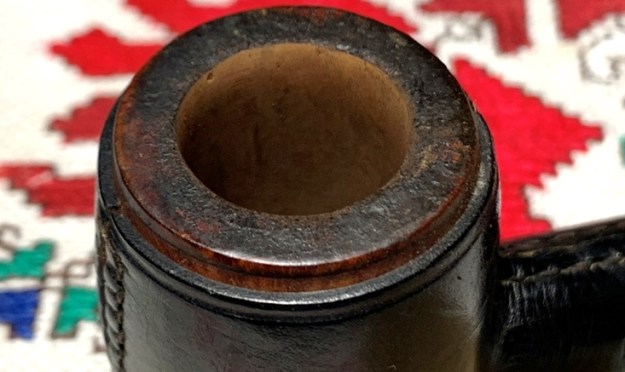
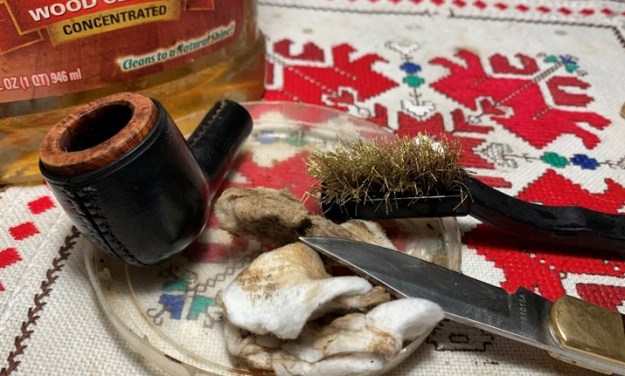
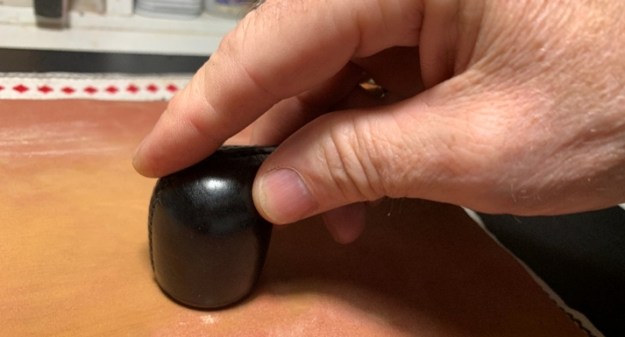
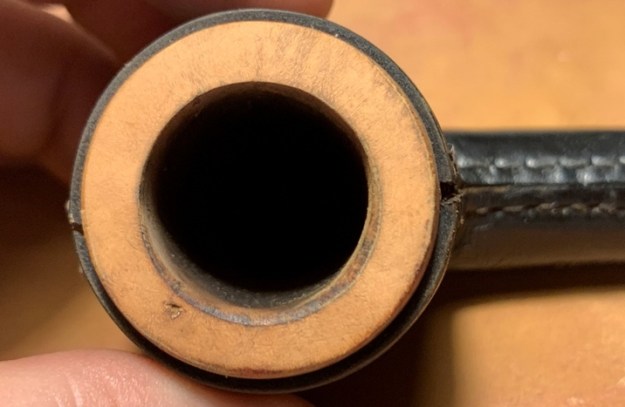
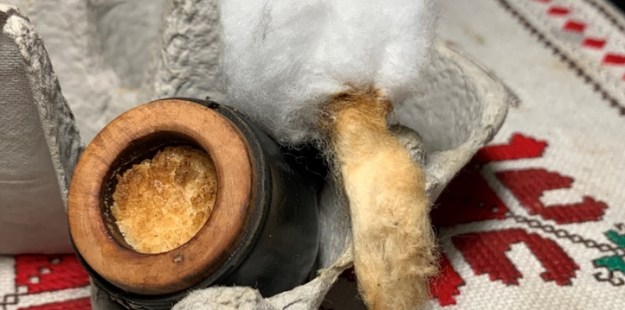
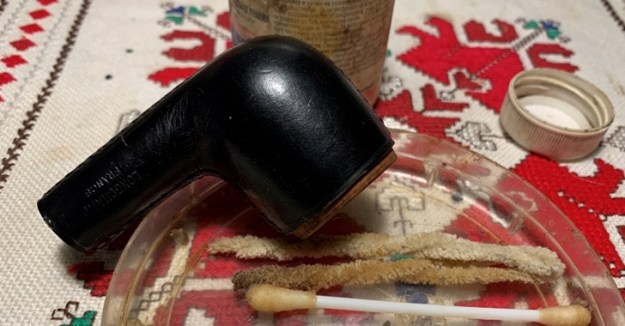
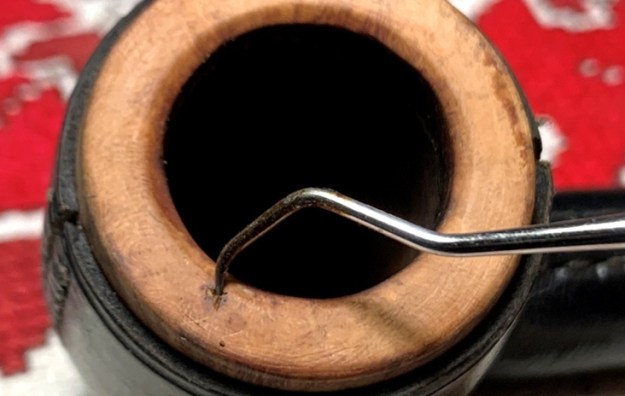
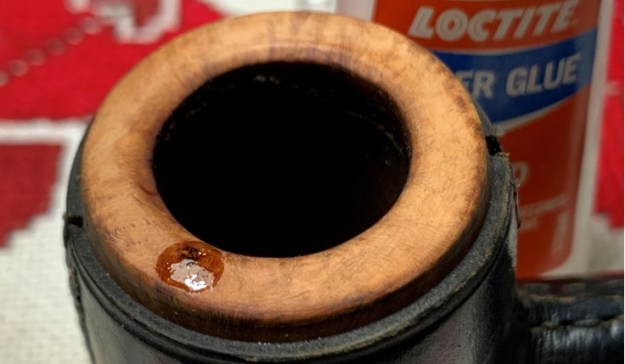
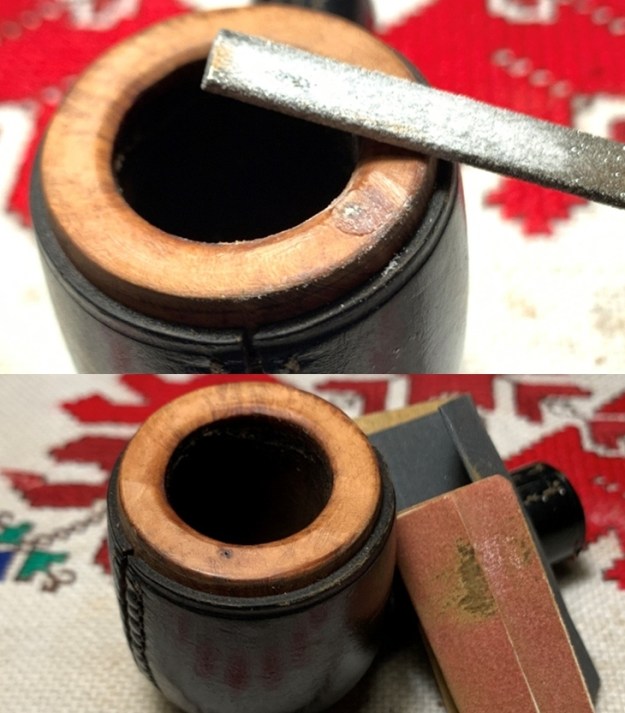
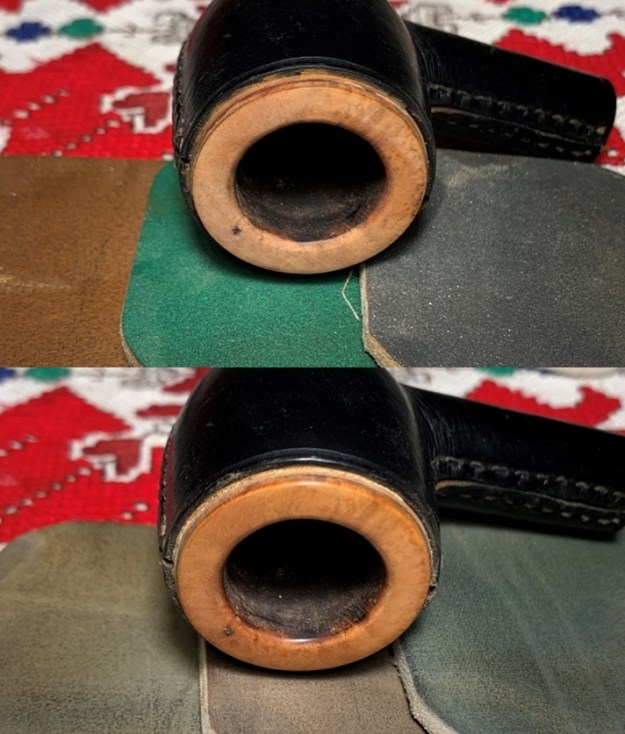
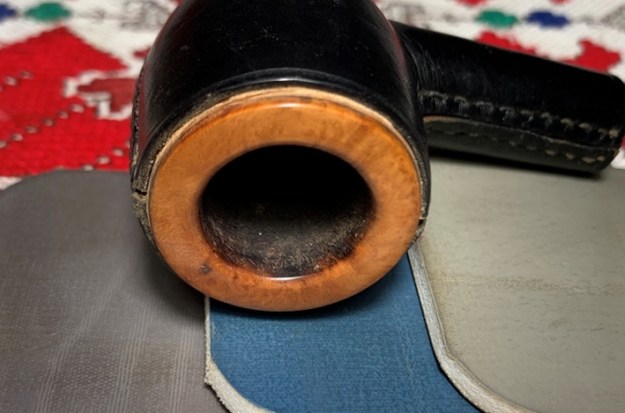
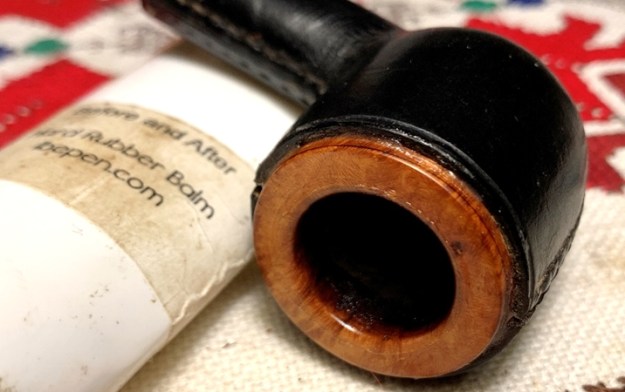
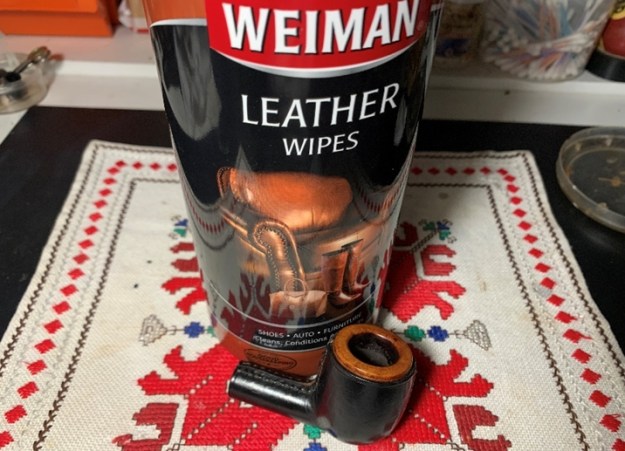
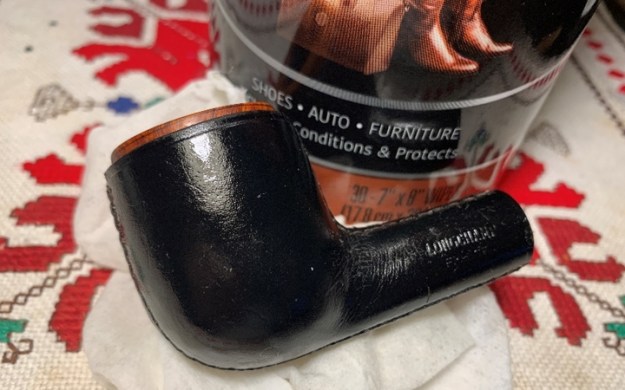
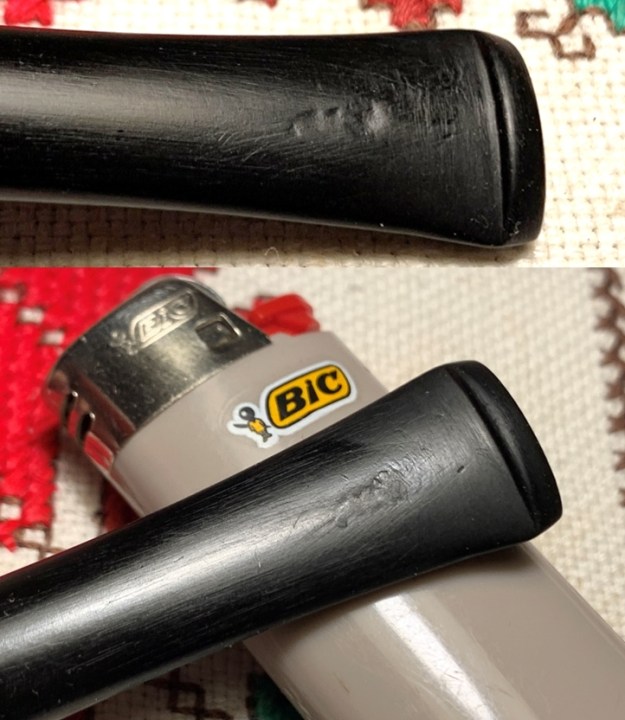
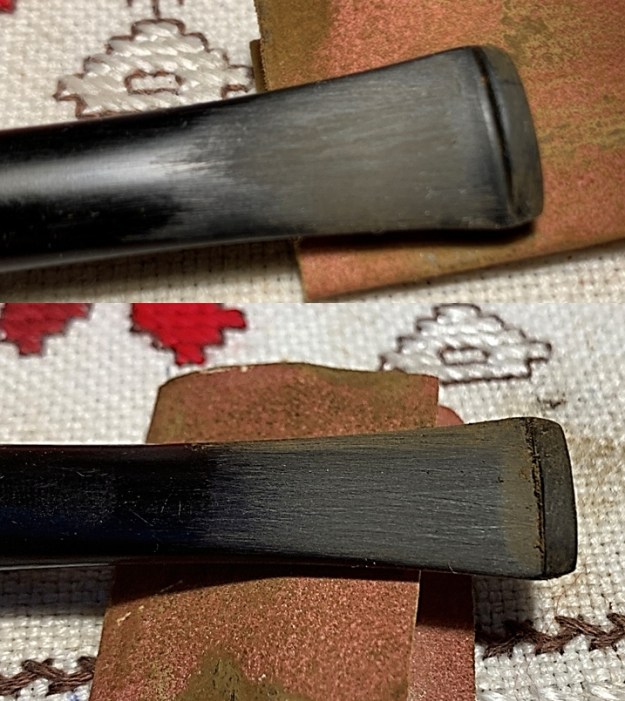
The dating of the pipe on my table would be no older than 1978.  The article also gave sense to the horse stamped on the stem.  I found more about this in the Longchamp panel provided on Pipephil.eu.  The panel shows the different versions of the very thin, ghosted horse stamping on the Longchamp matches the example on the lower right with the caption stating that this logo was on the more recent stems – so dating is for this pipe is most likely in the 70s.With this knowledge increasing my appreciation of the Longchamp story, I take a closer look at the Longchamp on my worktable.  The general condition of the leather appears to be very good.  I see no tears.  The chamber of the Billiard shape has some cake build up but not bad.  The rim is caked with lava flow, but it should clean up nicely revealing the briar beneath. The stem has oxidation and light tooth chatter, but nothing serious.  I begin the refreshing of this French Leather Clad Longchamp by addressing the oxidation in the stem.  I first clean the airway with pipe cleaners wetted with isopropyl 95%.To break up the thick oxidation, 000 steel wool is applied to the stem. I’m careful to avoid the thin Longchamp stamping.  I have found that this helps give the oxidation removal a head start before putting the stem into the soak with Before & After Deoxidizer.Next into the Before & After Deoxidizer with other stems of pipes in the queue.  I leave it in the soak for about 4 hours.When I fish the stem out of the Deoxidizer, I drain and squeegee the liquid off with my fingers.  I then put another pipe cleaner wetted with alcohol through the airway to clean it of the Deoxidizer.  Then using cotton pads wetted with alcohol, the raised oxidation is wiped off.I like to use paraffin oil to help begin the process of rejuvenating the vulcanite stem.  I wipe the oil on with a cotton pad and put the stem aside to absorb the oil.With the stem now on the sideline, I turn to the stummel to begin cleaning out the carbon cake.  After putting paper towel down for easier cleanup, I use the Pipnet Reaming Kit to do the job.  I take another picture of the chamber to mark the start and I use 2 of the 4 blade heads available.  After this, the Savinelli Fitsall tool further scrapes the chamber walls and I finish with sanding the chamber with 240 grade paper wrapped around a Sharpie Pen.  I then wipe the chamber with a cotton pad and after inspection, determine that there are no heating problems with the chamber briar. Next, cleaning the rim to remove the thick oil and tar crud that has collected will be a job.  I do not wish to immerse the leather with Murphy’s, though I don’t think it would be a problem.  So, focusing to keep the cleaning only on the rim, I use Murphy’s Oil Soap undiluted and a cotton pad to begin softening the crusted rim. Using a Winchester pocketknife to scrape the rim, I carefully remove more of the crusting.  Finally, I use a bristled brass wire brush to work on the rim and then take the stummel to the sink and rinse the soap from the rim.There’s a huge difference on the rim after the cleaning.  It appears that there originally was a bevel on the inside lip of the rim.Next, to freshen the lines of the rim and to continue to clean the dark stains off the briar, I use the topping board with 240 grade paper.  I only rotate the stummel a few times. A small pit is revealed on the front-left rim after the first round of topping.  This will need to be filled.I rotate the inverted stummel several more time after transitioning from 240 grade paper to 600.To clean the internal rim lip as well as to refresh the internal bevel, I tightly wrap a piece 240 paper and shape the bevel.  Following this, I use 600 grade to smooth out the bevel.Next, using cotton buds and pipe cleaners dipped in isopropyl 95% the internal cleaning commences.  A small dental spoon is also used to scrape the internal mortise wall removing tars and oil build up.  After the cotton buds begin to emerge lighter, I call it clean at this stage.With the hour being late, I transition to utilizing a kosher salt and alcohol soak through the night to continue the internal cleaning.  It is my usual practice to do this to refresh the pipe for the new steward.  After creating a ‘wick’ by pulling and twisting a cotton ball, the wick is inserted into the mortise using a stiff wire to help guide it down through the mortise into the airway.  The wick helps to draw out the residual tar and oil from the briar.  I then fill the bowl with kosher salt which, unlike iodized salt, leaves no aftertaste.  After placing the stummel in the egg carton for stability, using a large eye dropper, the bowl is filled with isopropyl 95% until it surfaces over the salt.  After a time, the alcohol is drawn into the pipe and after topping off the alcohol, I turn off the lights! The next morning the salt and wick are soiled the brown showing the additional cleaning this process provided.  After cleaning the stummel of the expended kosher salt using a paper towel and blowing forcefully through the mortise, I follow with a few additional pipe cleaners and cotton buds to clean the remaining remnants of tar and oils.  All is good and I move on.Next, addressing the hole on the rim, I first dig out and clean the pitted area using a sharp dental probe. After wiping the area with alcohol to assure that it is clean, I then spot-drop the hole with regular clear CA glue.After the CA glue cures, a flat needle file is used to file the patch down. Following the filing, 240 and 600 sanding papers smooth the area further.Transitioning then to applying the full regiment of micromesh pads, I wet sand with pads 1500 to 2400 and follow with dry sanding with pads 3200 to 4000 and 6000 to 12000.  The micromesh process brings out the grain nicely.  I love the briar/leather contrast created by the rim. Applying Before & After Restoration continues to bring out the more subtle hues of the rim’s briar grain.  Applying first the Balm with my fingers and working it into the briar, I then set it aside for a few minutes for the Balm to be absorbed.  After about 20 minutes I wipe off the excess Balm and buff the rim with a microfiber cloth.To treat the black leather, I use ‘Weiman Leather Wipes’ to clean and condition the leather.  This product works very well.  The leather is very attractive with a clean, healthy sheen. I put the stummel aside and transition to the stem, which is not in too bad of shape.  There are some tooth chatter and compressions on the upper bit which I first address with the heating method.  Using a Bic lighter, the bit is painted with the flame heating and expanding the vulcanite.  As the vulcanite is heated it expands to reclaim its original shaping – or closer.  The pictures show a before and after comparison.  The compressions are still visible but much reduced.I follow by sanding the upper and lower bit using 240 grade paper to erase the residual chatter and what remains of the compressions.I then take the stem to the kitchen sink and wet sand the entire stem using 600 grade paper – careful not to sand the very thin running horse stamping on the stem.  Following the 600 grade paper, 000 grade steel wool is applied to smooth further.Next, I transition directly to applying micromesh pads to the stem by wet sanding with pads 1500 to 2400 then dry sanding with pads 3200 to 4000 and 6000 to 12000.  Between each set of 3 pads, Obsidian Oil is applied to rejuvenate the vulcanite as well as helping to prevent oxidation. On the home stretch – after mounting a cotton cloth buffing wheel to the Dremel, with the speed set at about 40% full power, Blue Diamond compound, a fine abrasive, is applied to the stem and briar rim.  Following this, after another buffing wheel has been mounted at the same speed, carnauba wax is applied to the stem and briar rim.  The restoration is completed with a rigorous hand-buffing to raise the shine of both the stem and briar rim, but also the black leather wrap.This Leather Clad French Longchamp is a nice pipe.  The leather gives that comfortable laid-back feel and the contrasting briar rim and white seams of stitching provide a great aesthetic presentation.  The classic Billiard workhorse shape has a great feel and balance in the hand – ready for a new steward!  Jason has the first opportunity to claim this French Longchamp from The Pipe Steward Store benefiting the Daughters of Bulgaria – women and girls who have been trafficked and sexually exploited.  Thanks for joining me!
 

Giving New Life and Stem Alignment to a Made in London England Diplomat


Blog by Dal Stanton

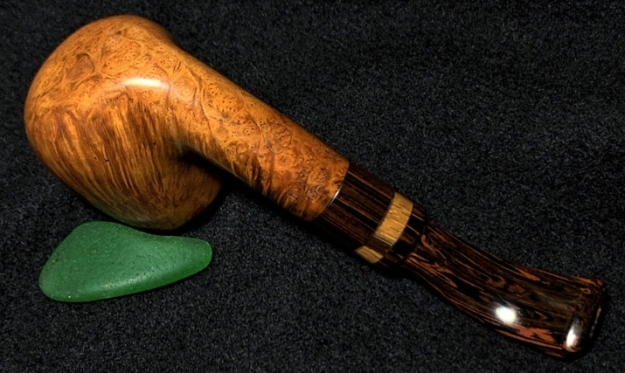
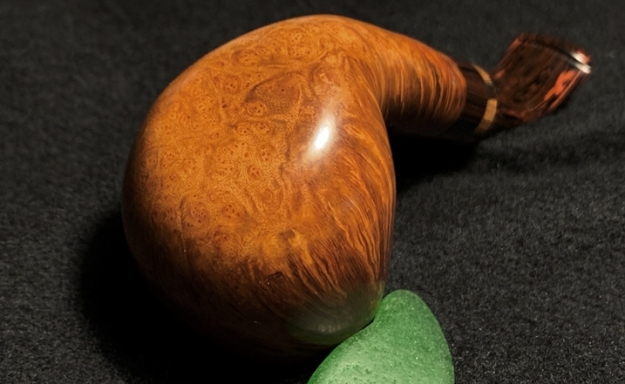
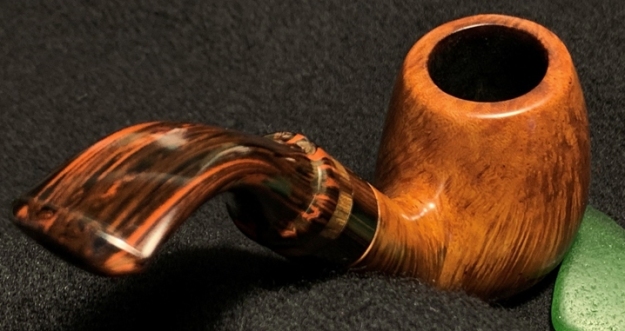
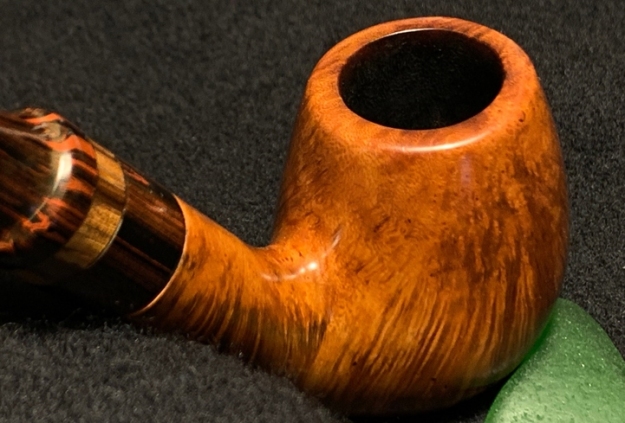
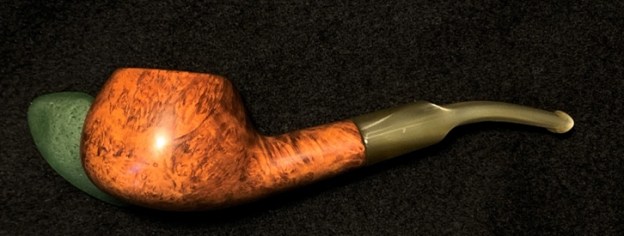
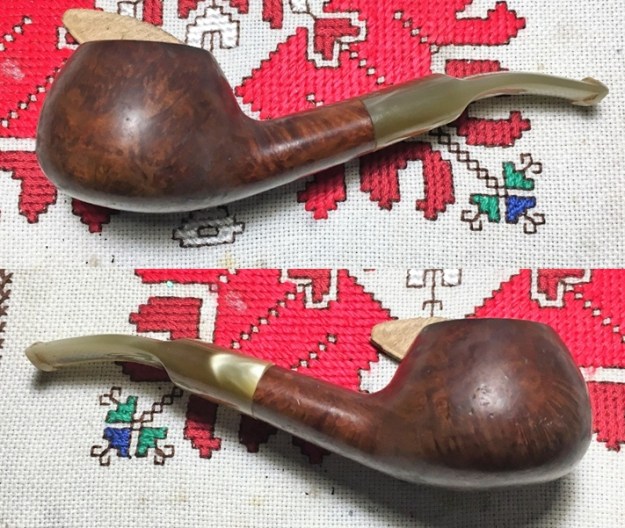
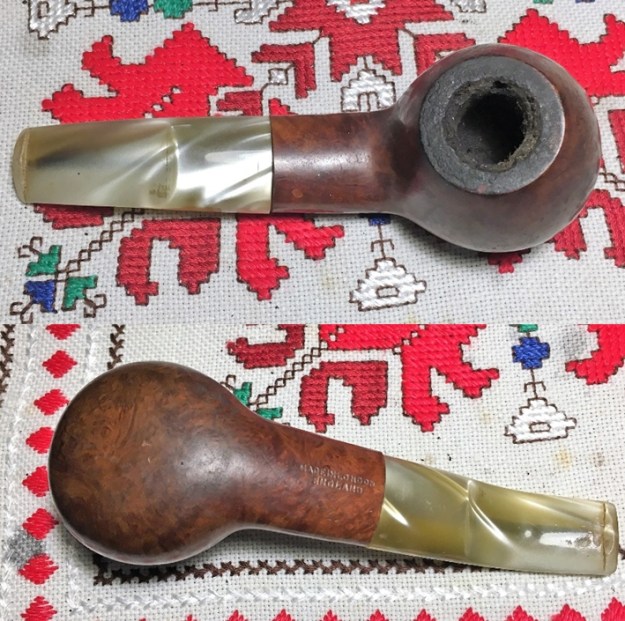
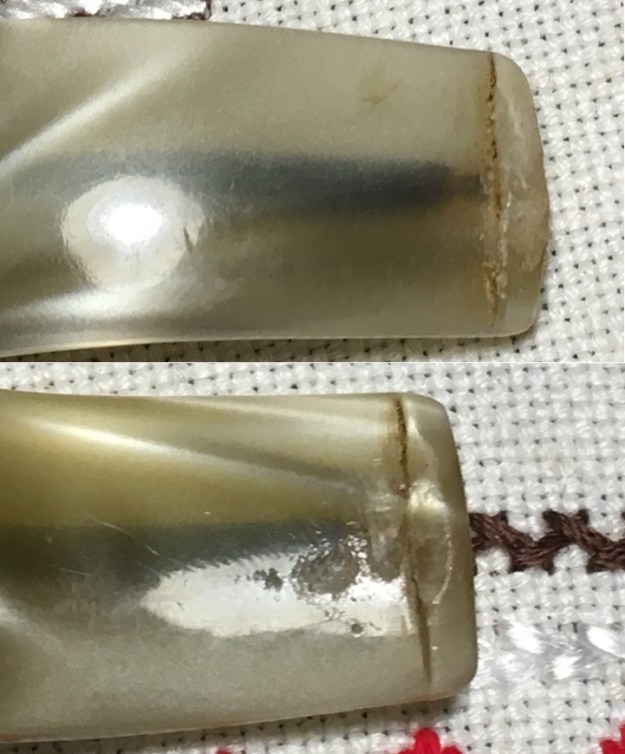
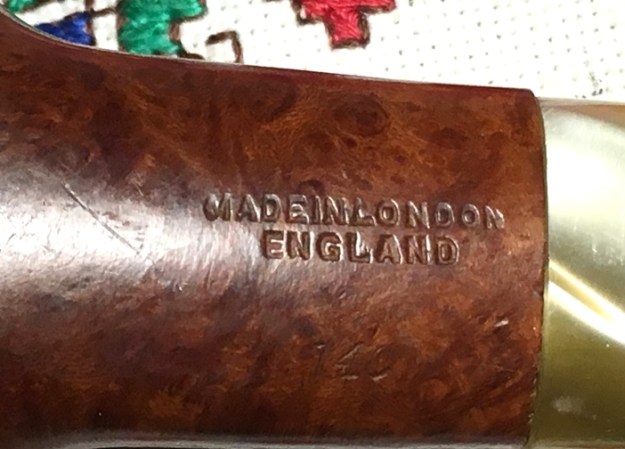
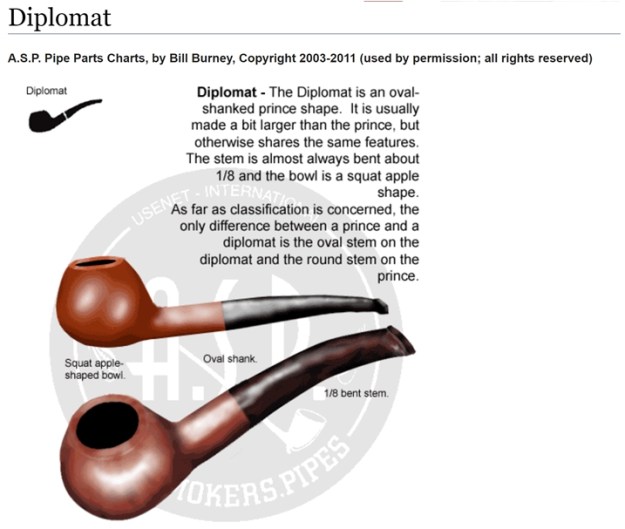
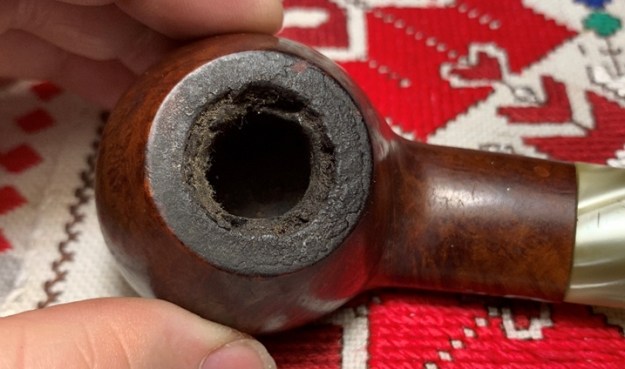
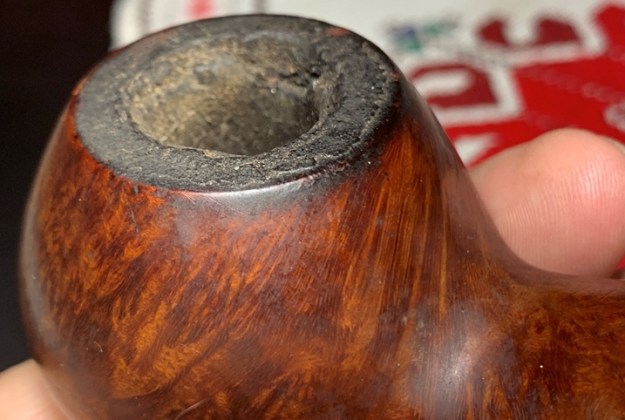
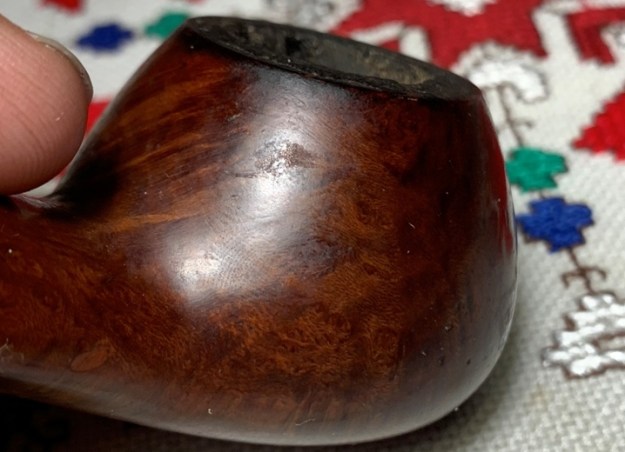
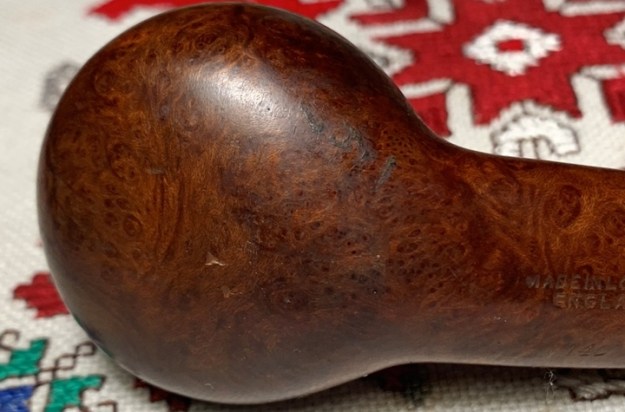
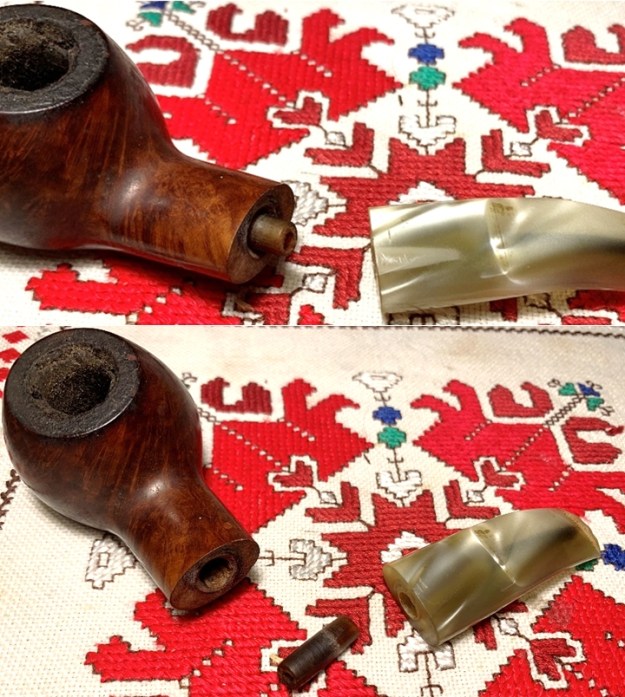
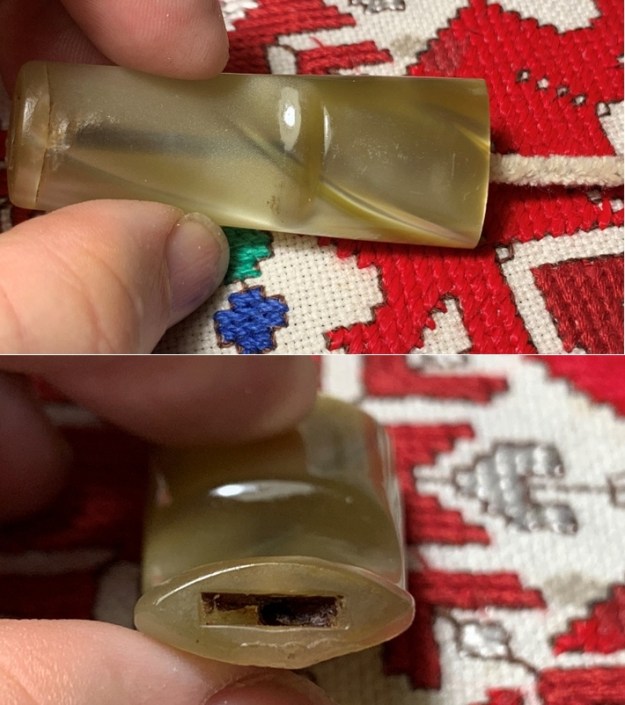
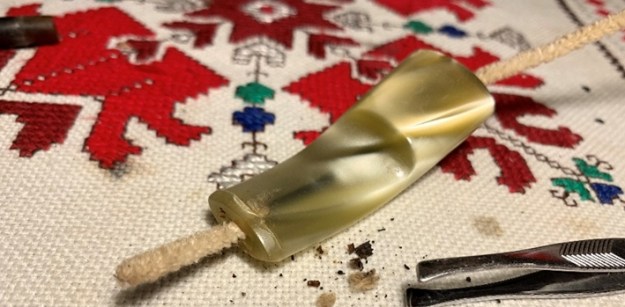
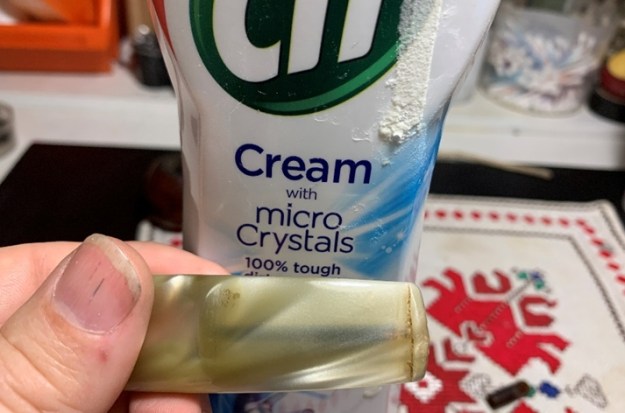
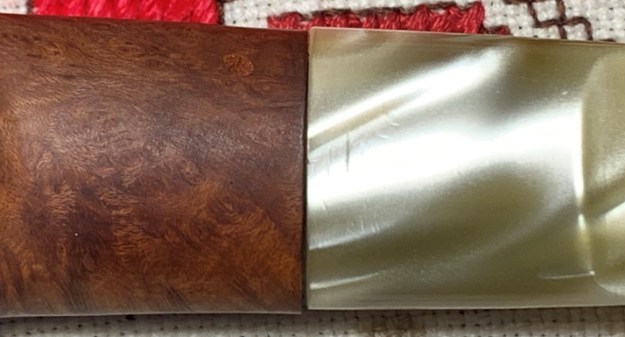
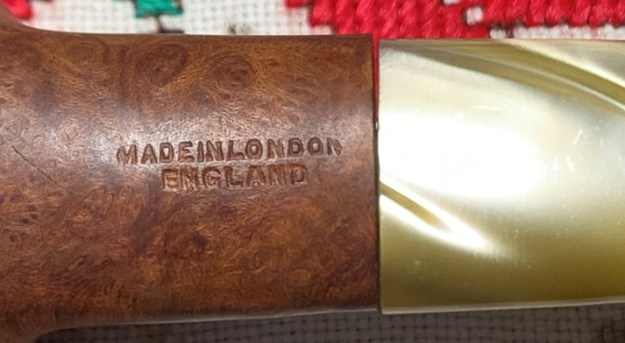
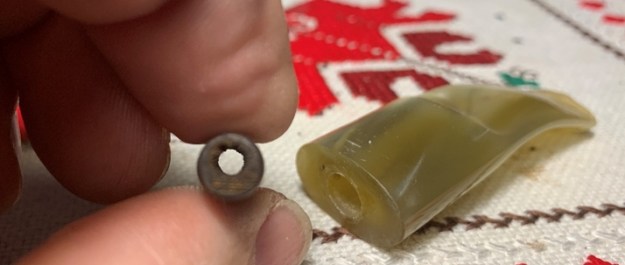
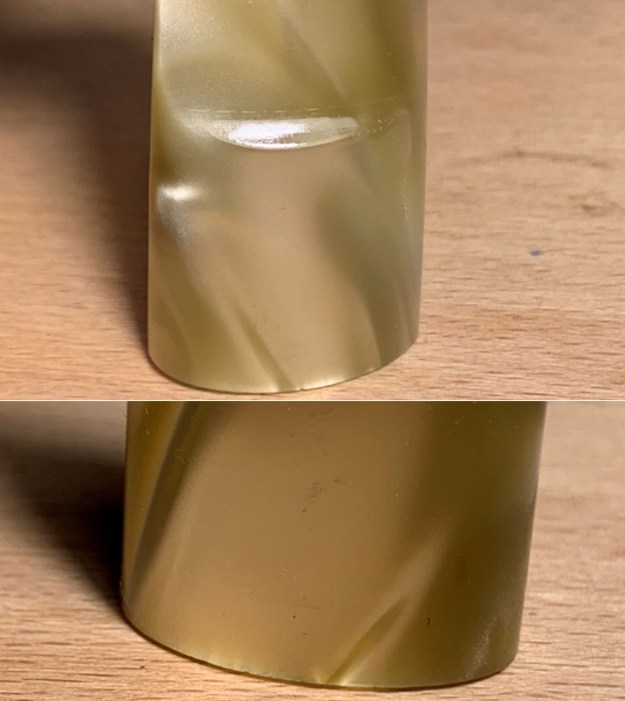
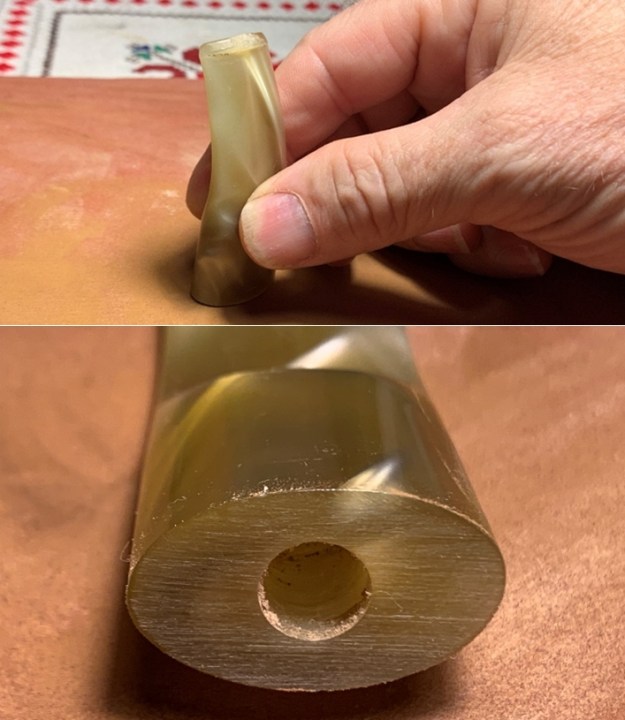
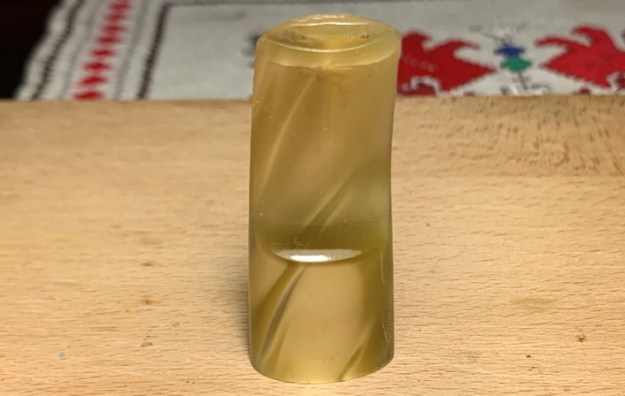
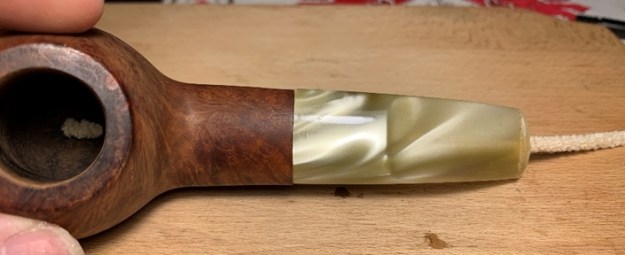
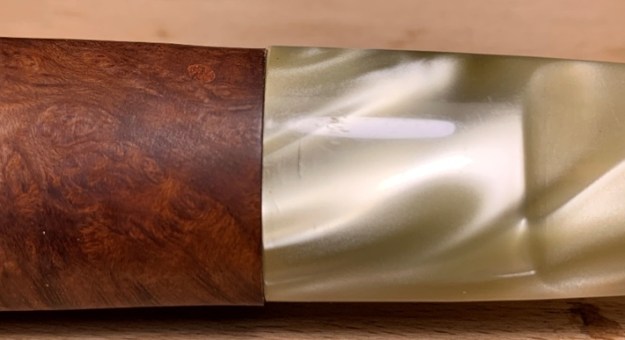
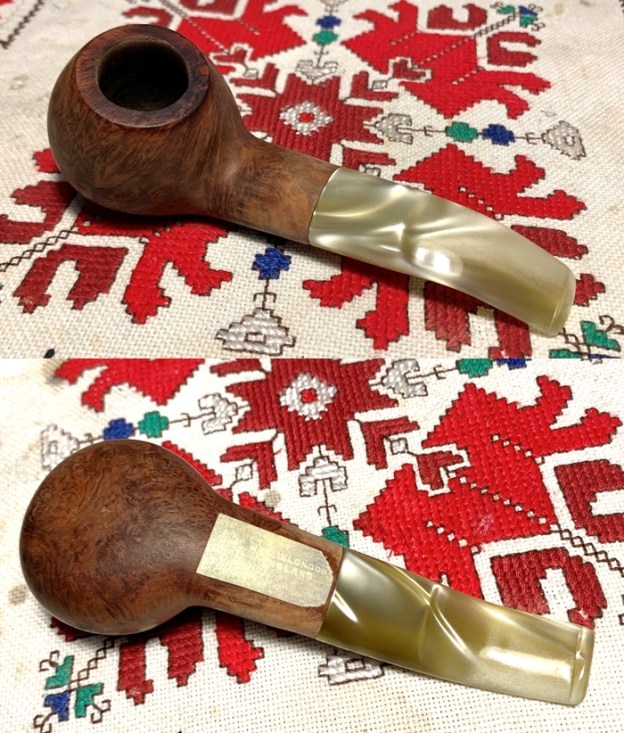
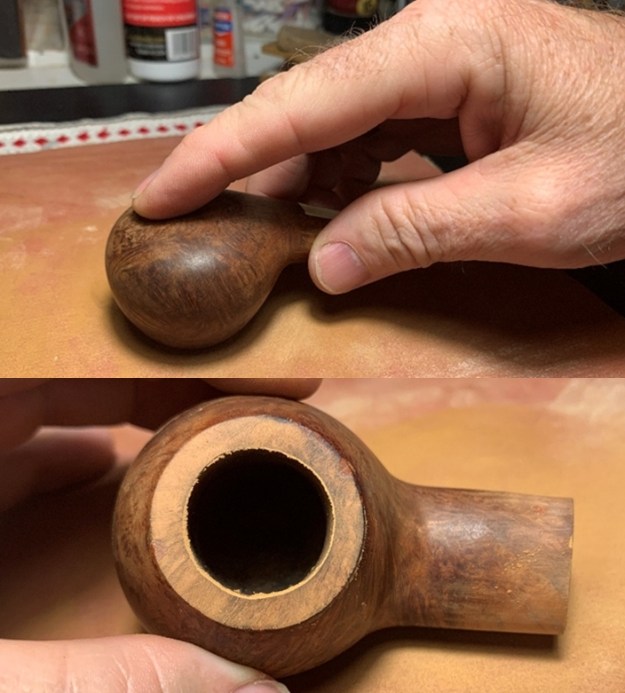
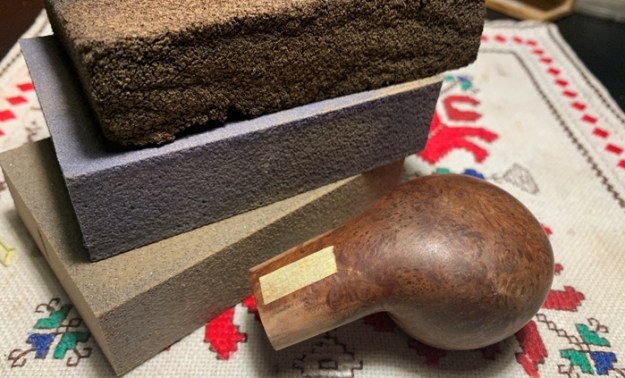
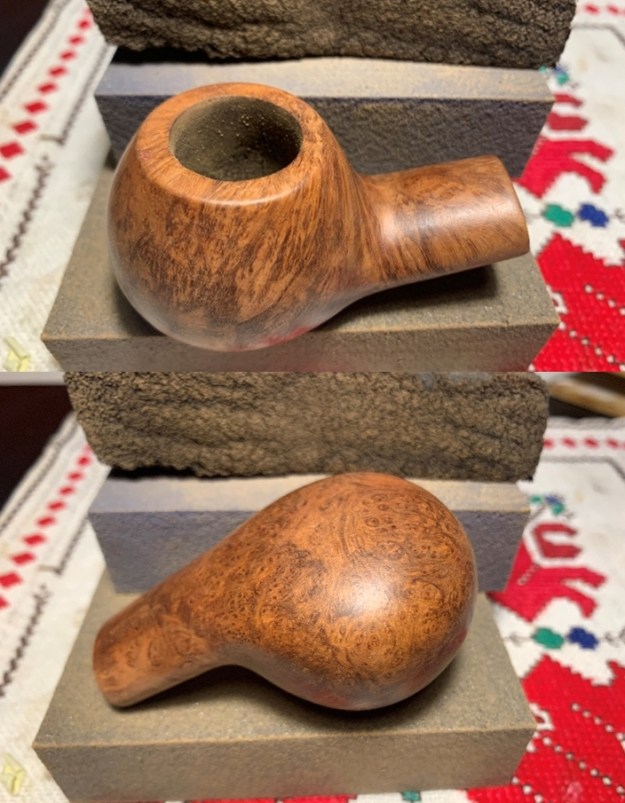
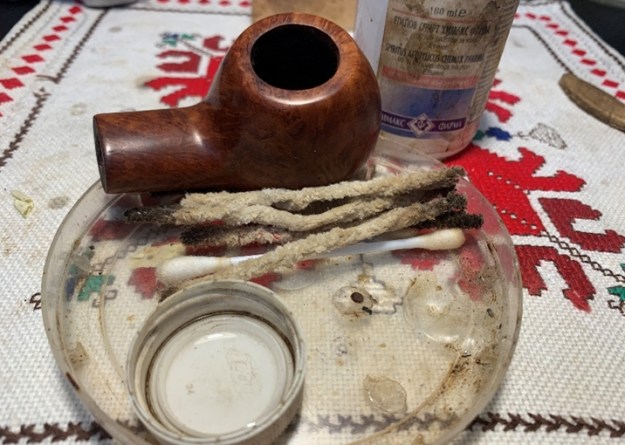
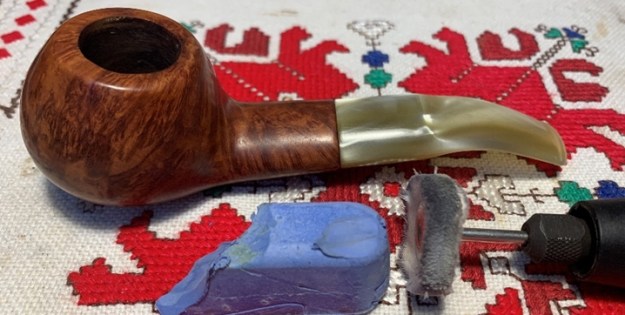
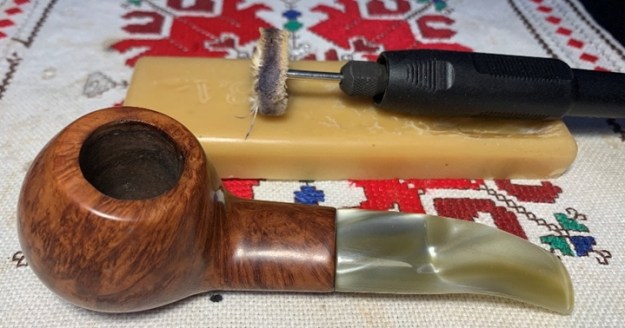
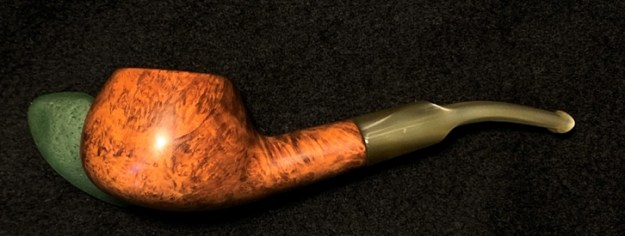
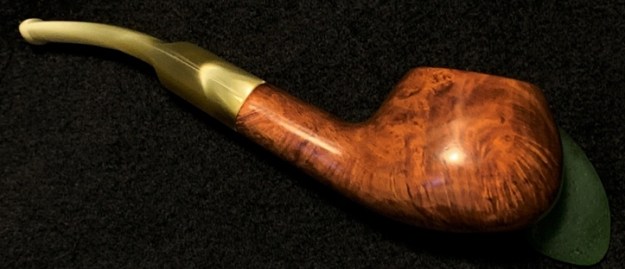
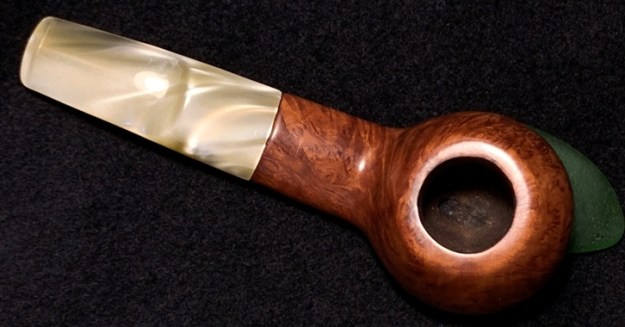
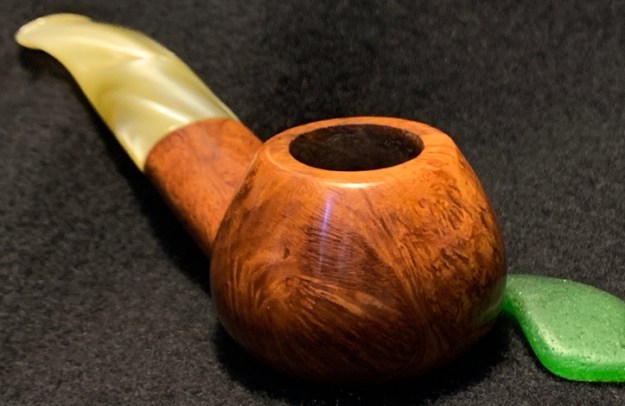
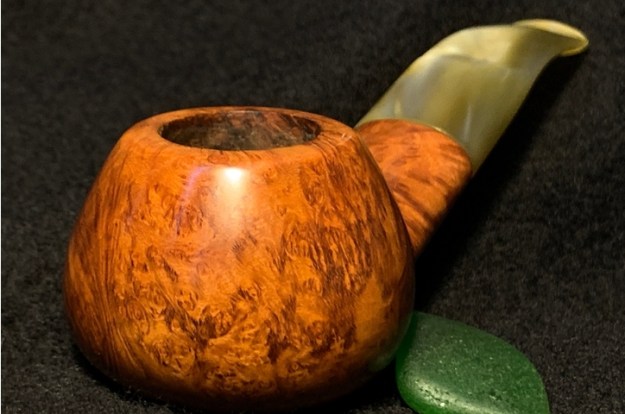
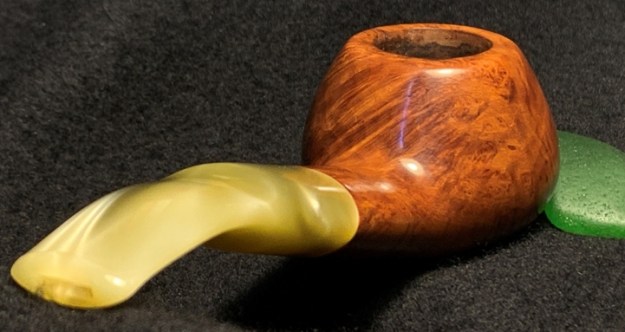
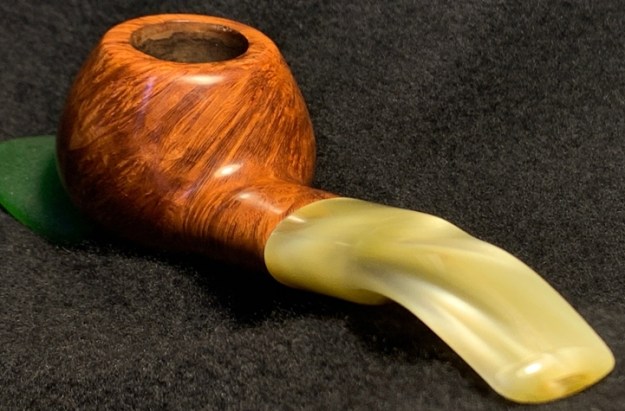
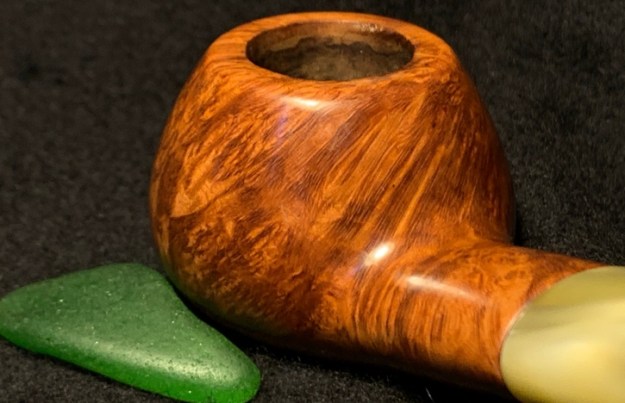
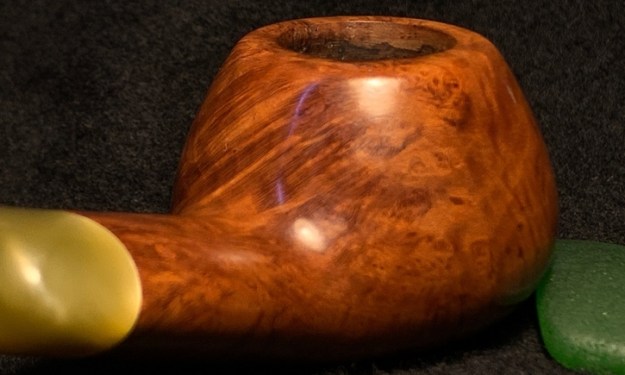
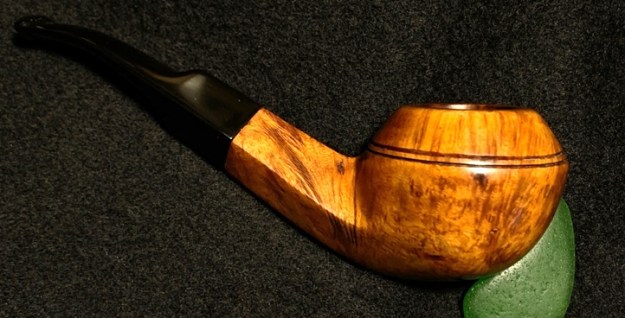
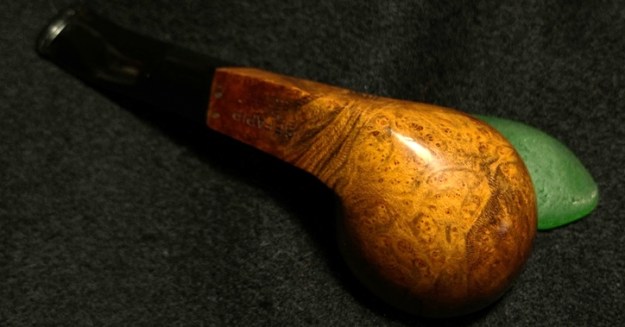
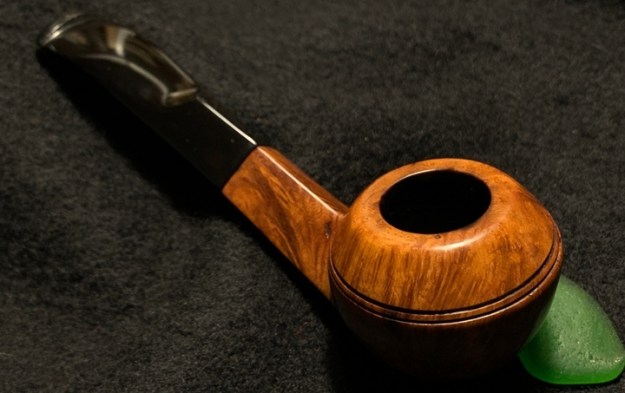
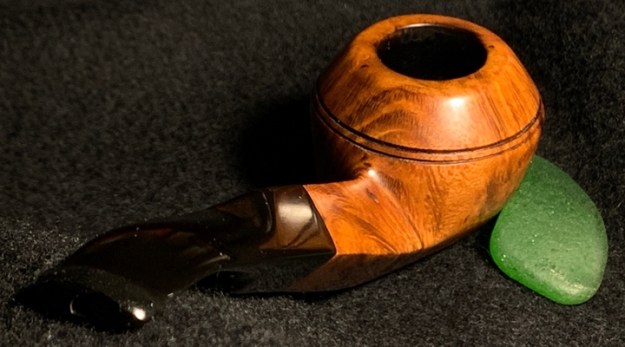
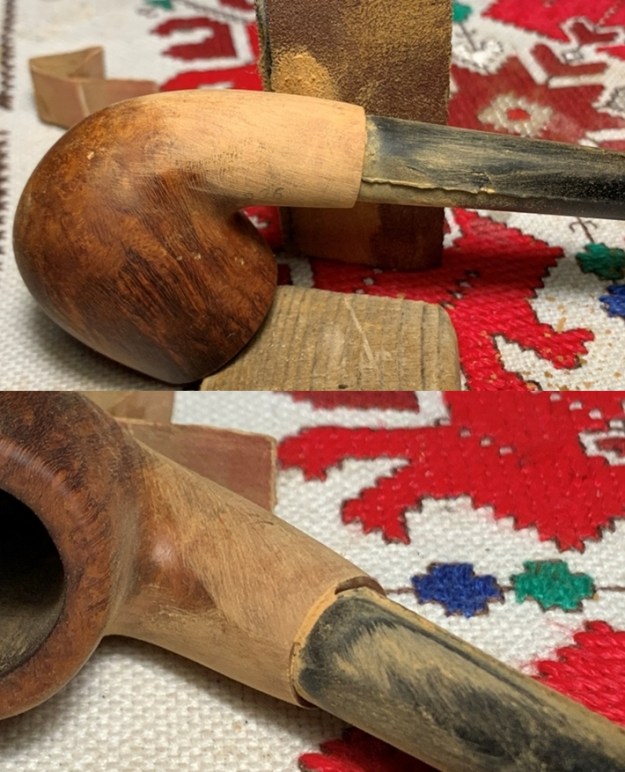
When I put this pipe in the For “Pipe Dreamers” Only! online collection, I identified it as a Squat Apple. It came to me from the lot my son helped me to procure from an antique shop in St. Louis.  When Andy chose this as his next pipe after commissioning the probable Preben Holm Danish Freehand which I just finished restoring (See: Recommissioning a Mysterious Freehand, Made in Denmark – Preben Holm?) I fished it out of the ‘Help Me!’ basket and put it on the table and the ‘Squat Apple’ sort of fit, but not quite.  Volcano?  No, too rounded.  Here are the pictures of the ‘Squat Apple’ that got Andy’s attention. The only markings are found on the lower side of the oval shank, MADE IN LONDON [over] ENGLAND.  Below the COM is what I assume is a shape number, ‘140’.   Not a lot to go on to determine origins.The ‘Squat Apple’ wasn’t sitting well with me so I looked at Bill Burney’s great Pipe Shapes Chart on Pipedia and found the shape classification that worked better – Diplomat.  Interestingly, my ‘Squat Apple’ designation was used by Bill Burney to describe the Diplomat.  I clipped the panel to show the description of the Diplomat:The English Diplomat now on my worktable is not a bad looking pipe but has a few issues.  The Diplomat’s chamber has a thick layer of cake and the lava flow on the rim is thick – it needs some cleaning as well as the stummel.The after section of the rim reveals the darkening of the briar that has been scorched through the lighting practices of the former steward.As the following three pictures show, the stummel is darkened from grime and oils on the surface.  You can see some very nice grain lurking beneath.  There are also dings and scratches on the stummel from normal wear. The acrylic stem is attractive, but I’m guessing that it’s a replacement stem.  My first observation looked like the stem simply didn’t fit with a wobble and gaps showing between the shank and stem facings.  When I removed the stem the acrylic tenon was stuck in the mortise and not attached to the tenon.  It didn’t take much to dislodge the rogue tenon but after inserting it into the tenon and trying the fit again, the wobble and looseness is evident and if I’m able to reattach the acrylic tenon and keep the stem facing flush with the shank facing before the CA glue sets, it should do well.I then noticed the darkened airway through the translucent acrylic.  As I suspected, after inserting a pipe cleaner into the airway from the shank side, I discover that there is blockage in the stem. In the picture below, I’ve placed my fingers roughly where the inserted pipe cleaner stops and the blockage begins.  This can be a pain!  The following picture with the slot view shows blockage very near to the opening.I decide to try to ‘bull’ through the blockage with a pipe cleaner and to my surprise, the pipe cleaner was able to break through and not a lot of gunk came out.  Good to go.Before moving toward re-attaching the tenon to the acrylic stem, I’ll first do the cleaning.  I’m trying a ‘Soft-Scrub-like’ product we have here in Bulgaria called Cif brand to try to clean the darkened internal airway.  The label describes micro-crystals and a bleach component as the active agents.  I’m using Jeff Laug’s recommendations from his blog (Got a filthy estate pipe that you need to clean?).Holding the translucent acrylic stem up to the light provides a good Xray of the airway and how it’s darkened.  We’ll see how much the cleaning removes the internal buildup and lightens the airway. I go to work with the Cif product and start by using bristled pipe cleaners dipped in Cif to begin breaking up the tars and oils that have crusted inside the airway. At first there was no noticeable progress except for the darker discoloration of the pipe cleaners which meant something was happening.  I add after the pipe cleaners shank brushes.  I transferred the shank brushes, Cif and stem to the kitchen sink where using hot water, I continued the cleaning with the Cif and brushes.  At this point, progress was evident.  A combination of the brushes and cleaner AND the hot water helps break down the crud.Back to the worktable, the follow-up light Xray shows the results.  Nice!  I move on.I put the stem aside and move to the stummel cleaning before I start on the repairs to the stem and tenon.  Not only do I prefer working on cleaned pipes, but often the cleaning process can change the mortise environment because we are working with wood.  Cleaning often loosens tenon fittings.  So, before moving to more permanent repairs, it’s a good principle to get the cleaning done first.  Looking again at the chamber, the cake is moving from moderate to thick cake.  Using the Pipnet Reaming Kit I start with the smallest blade head and end up using 3 of the 4 blade heads available in the Kit. The Savinelli Fitsall Tool works well to follow by doing fine-tune scraping of the chamber walls.  I complete the cleaning by wrapping 240 grade paper around a Sharpie Pen which provides the leverage as I sand the chamber to remove the final vestiges of carbon cake to expose fresher briar to have a clean start. After wiping the chamber with a cotton pad wetted with alcohol to clean the carbon dust, I take a picture as I examine the chamber walls for heating damage.  All looks great. Moving now to the external cleaning of the stummel, I employ undiluted Murphy’s Oil soap on a cotton pad to scrub the surface and rim covered by lava flow.  In the immediate picture below, the sharp-edged pocketknife is helpful to remove the caked crusting.  You can see the progress being made as the blade is carefully scraping the rim top without cutting into the wood.  After the knife edge, the brass bristled brush cleans the rim further without damaging the wood.After working on the rim and stummel surface, I take the stummel to the kitchen sink using hot water and clean the internals using shank brushes and anti-oil dish soap liquid.  After thoroughly rinsing the stummel with water, back on the worktable a picture records the present cleaning state.Again, focusing on the internals, now using cotton buds and pipe cleaners wetted with isopropyl 95%, cleaning continues.  Also employed is a dental spoon to scrape the mortise walls – which produces very little.  A shank brush wetted with isopropyl 95% is used saving on pipe cleaners.  When the pipe cleaners and buds start emerging lighter and cleaner, I call this phase completed to be continued later using a kosher salt and alcohol soak.Now looking again at the tenon repair of the acrylic stem.  The tenon that was part of the Diplomat was not attached and since it’s not, fitting it to see how it will work is not easy – it shifts and moves.  The first two pictures below show the result when I insert the tenon tightly into the stem cavity to test it out.  The first picture is from the top perspective.  Notice that the stem is offset to the right (top of the picture) so that the stem is overhanging on the top and the shank is overhanging the bottom of the picture.Now looking at the underside of the fit, the offset is augmented by the gapping that is evident.Not only do the pictures reveal the seating difficulties of the tenon, but the drilling through the tenon for the airway is not centered.  This has potential challenges on at least two fronts.  First, it potentially creates a hang-up lip as pipe cleaners are pushed through.  This is not huge as usually simply twisting the pipe cleaner in the airway solves this hindrance.  Secondly, is that if the tenon needs to be expanded, I will not use the heating method to expand it.  The reason for this is that the offset drilling has created a very thin wall of acrylic which will probably split if expansion is attempted.  The alternative will be to simply paint the exterior of the tenon with acrylic clear polish or CA glue.  This builds out the tenon circumference.As I was fiddling with the tenon trying to figure out the best approach, another issue surfaced.  On a hunch, the question came to mind, ‘Is the acrylic stem facing flat?’  I took out the chopping board that serves as a topping board and I placed the stem facing flat against it.  I discover that there is a dance in it – a microscopic rocking.  Just to be on the safe side for comparison, I also place the shank facing down on the board and find that its rock solid. You can see from the second picture the culprit looks to be around the airway – old glue protruding.  I decide to address this straight away by placing 240 grade paper on the board and ‘top’ the stem facing to flatten it – carefully!  Instead of rotating like I would if it were a stummel being topped, I drag laterally along the paper.  After a few ‘drags’ on the topping board, another test on the flat chopping board is much better.  The stem facing is now flush with no rocking.I again do a test fitting with the unglued tenon in place, reengage the stem to bring the facings flush.  To see if a pipe cleaner would snag on the tenon, I insert one through without problem.If I can glue the tenon and achieve this much, I’ll be satisfied.  Sanding can address the overhangs where the shank and stem do not line up.A lot of time has elapsed thinking and testing, now it’s time for action!  I use BSI Extra Thick Maxi-Cure CA glue.  Using a piece of 240 grade sanding paper, I sand the part of the tenon that will be inserted into the mortise.  I want it round and smooth. After cleaning the area with alcohol, I place a small amount of glue around the circumference of the tenon just above where the tenon will be inserted into the mortise.  In this way I hope to avoid glue getting into the airway on the end of the tenon. Yet, I don’t put a lot of glue on it to avoid CA glue being forced out the top onto the stem facing.  After placing the glue, I insert the glued part of the tenon partially into the stem cavity and then insert the mortise side of the tenon into the mortise and engage the parts.  In this way, while the glue is still pliable, the tenon gives way to the flush orientation of the shank and stem facings. After doing this, I leave the pipe for several minutes allowing the CA glue to cure and hopefully hold the tenon in place! I’m hopeful for a solid and snug seating. I decide to move forward with working on the acrylic stems button.  The top button lip has been compressed on the left side and the lower lip has also been chewed.  The tooth compressions on both upper and lower sides need filling. I use regular CA glue combined with an accelerator.  Starting on the topside and apply CA to the problem areas – also on the lip to build it.  I do the same for the lower bit and button lip.  With each application of CA glue, I use the accelerator to hold the patch in place and cure the glue more rapidly. I next use a flat needle file to file the CA glue patches over the tooth compressions down to the stem surface on both the upper and lower bit.  I file and shape the button repair as well.To remove the scratches left by the file, 240 grade paper is used on the bit and button but also on the whole stem.Focusing the sanding on the junction now, I sand out the edges that were hanging over the shank and stem facings.  I first cover the nomenclature with masking tape to protect it. The sanding moves around the circumference of the junction and I like the way the stem and shank now are in alignment and the union is flush.Next, I wet sand the entire stem with 600 grade sanding paper and follow with applying 000 steel wool. I’m on a roll with the stem, which I normally like to get out of the way so I can work on the stummel!  Next, I apply the full battery of 9 micromesh pads to the acrylic stem.  First, I wet sand using pads 1500 to 2400 and follow by dry sanding with pads 3200 to 4000 and 6000 to 12000.  Even though I don’t believe it makes a difference but seems to enrich the acrylic surface.  I love the pop of the stem – almost luminescent. After reuniting stem and Diplomat stummel, I get a sense of where things are.  I’m liking what I see!  While the stem was probably not the original, I like the combination and thinking now about how to finish the bowl to take advantage of the striking hues of the acrylic stem. At this point, if the micromesh process brings out the grain well and there is no nuanced lightening of the wood on the shank where the major sanding was, I’ll leave it in the natural briar state.  If there is indication that the shank sanding stands out, I’ll apply a stain.  The briar patterns are very nice – time to bring it out!Next, to freshen the rim and to remove the darkened old finish, I take the stummel to the topping board.Not much is needed – only a cosmetic topping.  With the stummel inverted on 240 grade paper, I give the stummel a few rotations to clean things up.Then switching to 600 grade paper, the stummel is rotated several more times.With the rim refreshed, sanding sponges will address the tired finish on the bowl and the normal nick and dents.  I see no major issues to address on the stummel surface – no fills.With the ‘Made in London, England’ covered by masking tape to protect it, I make sure that the sanding sponges address the shank area well.  I want to blend the lightened area that was sanded.  Using a coarse sanding sponge to do the initial heavy sanding, it removes the minor nicks and old tired finish.  After using the coarse sponge, I remove the masking tape covering the nomenclature for the application of the medium and light graded sponges.  The sponges are not rough enough to impact the nomenclature which is healthy.To fine tune further, the full set of micromesh pads are applied by first wet sanding with pads 1500 to 2400.  Following this, dry sanding with pads 3200 to 4000 and 6000 to 12000 bring out the grain which is beautiful. On a roll, and very enthused by the richness of the honey brown hue emerging and the detailed grain, I apply Mark Hoover’s product (www.ibepen.com), Before & After Restoration Balm which does a great job teasing out the deeper natural hues of the briar.  With some Balm on my fingers, I work it into the briar well and then set it aside for about 20 minutes for the Balm to be absorbed by the wood.  I then wipe off the excess with a cotton cloth dedicated to this and then buff the stummel with microfiber cloth.The day is coming to its close and I continue the internal cleaning using a kosher salt and alcohol soak.  This further cleans as well as freshens the bowl for the new steward.  I first fashion a ‘wick’ by stretching and twisting a cotton ball which is then inserted into the mortise and airway with the help of a stiff wire.  This wick helps to draw out the tars and oils from the internal chamber walls.I then fill the chamber with kosher salt which does not leave an aftertaste and place the bowl in an egg carton for stability.Using an eyedropper, isopropyl 95% fills the chamber until it surfaces over the salt.  After a few minutes the alcohol is absorbed, and the alcohol is topped off.  I let the soak work on the cleaning through the night.The next morning the salt and wick are soiled revealing the added cleaning of the chamber and mortise.  After dumping the expended salt and wiping the chamber with paper towel, I blow through the mortise to loosen and remove salt crystals remaining.To make sure all is clean, I follow with some pipe cleaners and cotton buds.  This is a good step in the cleaning process because the dirty pipe cleaners revealed that the airway was still in need of more cleaning.  After more pipe cleaners wetted with isopropyl 95%, the pipe cleaners were emerging cleaner and lighter.  I declare after a time, ‘Clean!’ and I move on.After reuniting the stem and stummel and mounting a cotton cloth buffing wheel on the Dremel, setting the speed at about 40%, the fine abrasive Blue Diamond is applied to the entire pipe.  After completing this, I use a felt cloth to buff the pipe to remove compound dust in preparation for applying the wax.Finally, after changing to another cotton cloth buffing wheel, carnauba wax is applied to the pipe and I after this, I give the pipe a hand buffing using a microfiber cloth to raise the shine.The grain on this Made in London England Diplomat is superb.  I’m extremely pleased with the repair to the acrylic stem.  It is now beautifully seated in the mortise, straight balanced and snugly secure.  The waves in the acrylic pop and the Diplomat shape, with the broad heal, makes for a very nice feel in the palm.  Andy from Maryland commissioned this English Diplomat and will have the first opportunity to acquire him in The Pipe Steward Store.  This pipe benefits the Daughters of Bulgaria.  Thanks for joining me!

Recommissioning a Mysterious Freehand, Made in Denmark – Preben Holm?


Blog by Dal Stanton

I came into possession of this attractive Danish Freehand when I acquired what I call the St. Louis Lot of 26 which my son, Josiah, helped me secure when he was a student in St. Louis.  He texted me from St. Louis about this box of pipes that were for sale at an antique shop he found.  Josiah wanted to split the cost of the Lot with me so that I could pick out a pipe in the Lot that would join my personal collection and would be his gift to me. The rest of the pipes would benefit the Daughters of Bulgaria – our work here in Bulgaria with women and girls who have been trafficked and sexually exploited.  It was a win/win proposition!  I chose as his gift to me the Champion Churchwarden in the center of the picture below.  The rest of the Lot of 26 went to my online collection I call For “Pipe Dreamers” Only! where pipe men and women can choose a pipe – or a pipe chooses them – to be commissioned for restoration.

Andy has commissioned pipes from The Pipe Steward before and I love it when pipe men (and women) keep coming back!  The pipe calling his name from the St. Louis Lot of 26 is the Danish Freehand marked in the picture below.As a return patron of The Pipe Steward which benefits the Daughters of Bulgaria, Andy’s contribution has been appreciated.  His first commission was a striking Monarch Bent Ball (see: Link) and then a Churchwarden I fashioned from a throw-away bowl (see: Link) which was on his list to add to his personal collection.  Andy came back again and commissioned a Trent Lev-O-Lator Half Bent Billiard (see: Link) that turned out beautifully.  His three previous restorations are pictured below. Now, the striking Danish Freehand now on the worktable. Here are pictures of the Freehand that got Andy’s attention. When I first acquired this Lot of 26 and it made its way here to Bulgaria, I was anxious to get a closer look at this Freehand.  When I first saw it in the pictures that Josiah sent, I thought that it might be a Karl Erik.  When I finally looked at the Freehand on the worktable here in Sofia, I had to work hard to find any identifying markers.  With the help of a magnifying glass and carefully angled lighting, I could only make out with certainty extremely ghosted lettering, ‘Made in Denmark’.  The next two pictures show this ghosted lettering.Yet, in the two pictures following with the light angled differently, the second picture being a blow-up of the first, I can make out just above the ‘Made’, I think I can see two letters: ‘N’ and possibly another ‘N’ or a ‘W’?  And to the far right, possibly the number ‘5’ or another letter?  Often these are phantom letters that form from the grain and our desire to see something that’s not there!  Phantom or not, there’s not a lot to go on.With this meager information I looked at Pipephil.eu where you can search by country.  I clicked on Denmark and as you might expect, several options surfaced of Danish pipe names and carvers.  With the possibility of the phantom ‘N’ being the first letter of a name, I looked at the N section to see if any of the names and pipes made by these might resemble the Danish Freehand on my worktable – reaching at straws!With no leads, I sent a note and pictures of this Freehand off to Steve with his rebornpipes.com depth of experience to draw upon again!  Perhaps there was something he would see in the pipe that would lean toward a Danish style and maker.  The next day I received Steve’s reply which was encouraging:

It has the look of a Preben Holm… under the pipes he made is a group of them – freehands labeled Monte Verde I wonder if that is not what is there.

Steve included the Pipephil.eu link that took me to the Monte Verde panel attributed to Preben Holm.  Wow! Again, I look at the lettering on the lower panel of the Freehand and it could be….  The ‘Made in Denmark’ looks like the same, all cap letters.  With Steve’s input the likelihood of Freehand being a Preben Holm is enhanced.Not long ago, wishing to add to my personal collection a Freehand with Preben Holm’s name on it, I landed on eBay a beautiful piece of his workmanship. This Freehand is still in need of restoration but putting it along side of the smaller Freehand on my worktable, one can easily see why Steve says that it has the ‘look of a Preben Holm’.  Looking at the curves, the angles of the cuts, even the grain pattern presentation – the resemblance is there. I’m looking forward to restoring this big boy one of these days!The Pipedia ‘Preben Holm’ article is full of information and examples of his work.  The opening paragraph is enough to capture the impact that his work has had – why, like me, adding a Preben Holm Freehand to one’s collection checks a box on most pipe men and women’s pipe bucket list:

Preben Holm (1947 – 1989) has set some marks in pipe history. Just before his 16th birthday in 1963 he sold pipes to the legendary Pipe-Dan shop and at the age of only 22 he headed 45 employees. He was among the first Danish artisans who made “Danish pipe design” famous in the USA in the 1960’s. More than that he was one of the very first carvers who exceeded this moderate Danish design which based on the classical shapes. “Chaising the grain” they turned out wild and dramatic fancy pipes. Combining smooth with blasted surfaces, showing big areas of the original bark at the top of the bowl and at the end of the stem, these pipes were quite shocking to many elder and more conservative pipesmokers.

When he started to sell his pipes to Lane Ltd. under the Ben Wade label, he caused a hype fairly beyond comparison. Especially in the U.S., as most of his pipes were sold there.

Looking now more specifically at the ‘possible’, perhaps probable, Preben Holm on my worktable, the 1 5/8-inch-deep chamber has a light to moderate layer of cake and the plateau is full of grime and lava flow.I am struck by the vertical grain that the carver took advantage of as he shaped the pipe. In the Pipedia Preben Holm article quoted above, I took special note of the phrase, ‘“Chaising the grain” [sic].  Breaking out of the classic shape mold where shape dictated the pipe, in the Freehand movement Preben Holm revolutionized, ‘chasing the grain’ challenged the carver to allow the grain to shape the pipe’s presentation.  This Freehand definitely chased the grain!  The large briar landscape of the peaked stummel is dirty with thick grime as well as some minor dings and scratches from normal use. The fancy stem has deep oxidation and calcium build-up on the bit.  The bit and button have been mercilessly chewed like cud!  The former steward saved money on not purchasing bite guards but it’s obvious this pipe was loved!  To smoke the pipe hands-free would require this kind of clenching with the size of the stummel.To begin the restoration, using pipe cleaners wetted with isopropyl 95%, the fancy stem airway is cleaned.With the oxidation so thick and with calcium caked on the mouthpiece, before putting the stem into a soak of Before & After Deoxidizer, I decide to get a head start on breaking up the crud.  I use 000 grade steel wool on the stem.  I recently read Jeff Laug’s rebornpipes blog on his cleaning methods (Got a filthy estate pipe that you need to clean?) which is very helpful.  One thing he mentions about stem cleaning is to use ‘Soft Scrub’ which unfortunately I didn’t have for this stem.  I used alcohol with the steel wool, but next time I’ll try to find a comparable product to use here in Bulgaria.After attacking the oxidation and calcium build-up with the steel wool, I’m hopeful that the Before & After Soak will prove to be more productive than in the past with heavily oxidized stems.  The Danish Freehand joins other stems of pipes in the queue for a soak of several hours.After soaking for some time, I use a stiff wire to fish the fancy stem out of the Deoxidizer and allow the fluid to drain.  Notice that I have surgical gloves on – I squeegee the excess fluid off the stem with my fingers.I then wipe/scrub the surface with a cotton pads wetted with isopropyl 95% to remove the raised oxidation.  The Before & After Deoxidizer seems to have done a good job after prepping the oxidation first with the steel wool.At this point, I apply paraffin oil to the stem to begin the rejuvenation of the vulcanite.  I put the stem aside and turn to the stummel.With the stummel in hand, I take a closer look at the conical chamber and the minor/moderate carbon cake build-up.  I’m not sure how well the Pipnet Reaming Tool’s blade heads will fit this chamber, but I’ll give it a go. I use the first two smaller blade heads, but as I suspected, the chamber narrows too much for the blades to reach the floor of the chamber, so I use the blades simply to scrape the walls. It was then that I remembered a reamer that I picked up a few years ago at a flea market somewhere in Kentucky when my wife and I were in the States.  The Kleen Reem Pipe Tool has some years on it.  I remember when I found it, I thought that it might come in handy. I love old boxes and paraphernalia.  The company printed underneath the name is W. J. Young Co. Peabody.  A quick look on the internet revealed that Peabody is in the US state of Connecticut.  The reamer is in a case with several shortened pipe cleaners.  I’m not sure what the function is of the pipe cleaners. Taking a closer look at the reamer I discover the smaller knob on the end unscrews and sheathed inside I withdraw a drill bit.  As I rotate the end knob of the reamer, the three blades expand in unison as a metal cylinder pushes the blades open.  The workings are solid. With my curiosity piqued, I dig a bit more on the internet to see if I can find more information.  I find a classic owner’s leaflet (See: LINK) extolling the benefits of keeping one’s pipe clean and the benefits of the Kleen Reem Pipe Tool. Below the text, a schematic of the reamer clearly describes the critical working parts.The next page of the leaflet solved the mystery of the miniature pipe cleaners.  The picture shows a pipe cleaner hooked on the end of the shank reamer.  I look at mine and discover that its not a hook, but a small hole through the pipe cleaner is threaded.  I would imagine that it puts a lot of torque on the crud in the airway when the shank reamer is rotating. After reading the ‘Directions for Use’ below, I decide to see for myself if the claim holds true: ‘The Kleen Reem Pipe Tool fits any pipe….’ The claim held true, at least for this Danish Freehand!  The end of the reamer blades reached down to the floor of the chamber and I expanded the blades gradually as I rotated the reamer moving up the chamber.  A great debut for this vintage old boy Kleen Reem Pipe Tool!  I follow the Kleen Reem by scraping the walls further with the Savinelli Fitsall Tool and finish by sanding the chamber with 240 grade paper wrapped around a Sharpie Pen. After wiping the chamber with a cotton pad wetted with alcohol to clean the carbon dust, I inspect the chamber walls to find everything looking great.Transitioning to cleaning the external briar surface, using undiluted Murphy’s Oil Soap, I scrub the surface using a cotton pad as well as a bristled toothbrush on the plateaus – rim and shank. I then transfer the stummel to the kitchen sink where I continue the cleaning using shank brushes with anti-oil dish liquid soap (out of Jeff Laug’s Playbook!) and using warm to hottish water, I clean the mortise and airway.  I also use the brass wire brush on the rim plateau where the lava overflow is still hanging on.  After the cleaning, a few pictures show the results.  The plateau is cleaned of the caked crud and most of the dark color is gone.  The old wax build-up and finish, if there was much of a finish, seems now to be gone.  Fresh briar. Continuing the internal cleaning, pipe cleaners and cotton buds wetted with isopropyl 95% go to work on the mortise and airway. I also employ a small dental spoon to scrape the mortise walls.  When I was doing this I suddenly thought, ‘Why am I not testing out the Kleen Reem shank reamer?’  I pull it out of the Kleen Reem case again and rotate it into the airway.  The reamer grabs with traction and begins to move slowly through the airway as I rotate the reamer.  It makes it through to the draft hole and I retract it without difficulty.  It works!I decide to drink the Kool Aide and try out the miniature pipe cleaners.  I thread one through the hole on the tip of the reamer per the directions I read earlier.  I’m wondering to myself, how is all of this going to fit and move through the airway??  I decide to wet the pipe cleaner some with isopropyl 95% as I do regular pipe cleaners.  I push it into the mortise and the halves of the pipe cleaner fold back like slanted wings as I begin rotating the reamer as I did before.  As before, the reamer grabs and gains purchase while the rotation of the reamer pulls the tool into the airway.  It makes it to the draft hole and as before, before trying with the pipe cleaner, I retract it without trouble.I am amazed!  When I extract the reamer, I discover that the pipe cleaner was neatly embedded in the troughs of the reamer – sweet!  The pipe cleaner provides a slightly expanded ‘brushing’ activity while the reamer does the plowing with its blades.  The second picture below shows the pipe cleaner unwrapped a bit.  I’m impressed with the engineering of this tool. After several more cotton buds and pipe cleaners, they begin to emerge lighter and cleaner and I call it ‘cleaned’ for the moment.The hour is late and before the lights go out, I’ll continue the internal cleaning with a kosher salt and alcohol soak.  This both continues to clean the internal briar walls, but also refreshes the bowl for the new steward’s enhanced enjoyment!  I first fashion a mortise ‘wick’ by pulling and twisting a cotton ball.  The wick serves to help draw the tars and oils out of the briar. I then guide the wick down the mortise into the airway with the aid of a stiff wire.  With the wick in place, the chamber is filled with kosher salt.  Kosher salt leaves no aftertaste unlike iodized salt. With the bowl in an egg crate to keep it stable, I add isopropyl 95% to the chamber with a large eyedropper until it surfaces over the salt.  After a few minutes the alcohol is drawn into the pipe and I again add some alcohol to top it off.  I put it aside, turn out the lights and let it soak through the night! The next morning the soak has done the job.  The soiling of the wick and salt indicates the absorbing action of drawing the tars and oils out of the briar.  After tossing the expended salt in the waste, a paper towel and blowing through the airway clears the pipe of salt crystals.I put the stummel aside to address the chewed-up stem.  I take a few pictures to show the upper, lower then a lateral view of the button.  The results of the biting and clenching are not only the severe teeth damage but also that the button is so compressed, there’s essentially no lip left to hang the pipe normally.  This is not good even when you’re not a clencher.  My approach will first seek to expand and raise the tooth compressions and chatter as much as possible on the upper and lower bit.  I’ll attempt this using the heating method with a Bic lighter.  I don’t believe there’s any way to avoid having to rebuild the button to restore a proper lip to hang the Freehand.  First, using a Bic lighter, I paint the upper and lower bit with the flame.  My hope is to minimize the compressions so that sanding is all that will be necessary on the bit. I take a start picture of upper and lower, then after using the Bic lighter for comparison.

I believe the process did minimize the damage as the heated vulcanite expanded toward its pre-damage condition, but we’re a long way from where we need to be! The button was so thin on the top that the flame burned a small bit of the upper lip in the center and it broke off leaving a divot in the middle of the upper lip. To rebuild the button, I mix activated charcoal with BSI Extra Thick Maxi-Cure CA glue.  To help in cleaning, I put scotch tape down on a plastic disk that serves as my mixing pallet, and then clean the bit with a cotton pad and alcohol.  I place a small pile of charcoal on the disk and then a dollop of the glue next to it.  I gradually mix as I pull charcoal into the glue using a toothpick.As the mixture thickens, I trowel the charcoal/CA mixture onto the button to build a mound over the repair site for the button and on the bit area to fill tooth compressions remaining in the vulcanite.  An accelerator is used on each side of the bit to quicken the curing time.After cleaning up, the flat needle file is first used to begin the rough shaping of the button.Starting with the upper side, I file and gradually shape the button.After making progress on the upper bit and button, the patch just above the small air slot that was thin earlier and burned some, is not adequately filled.  With a magnifying glass I see a gap in the patch.To do a quick patch fill above the slot, I fashion a piece of index card into a sharp point that will fit into the slot to form a mold barrier.  I cover the tip of the card stock with a piece of scotch tape to keep the glue from sticking. Using a medium-thick black CA glue, I spot drop the glue in the center above the slot and spray it with accelerator.After waiting a few minutes for the black CA glue to thoroughly cure, I wiggle the card stock out of the slot with no problems of sticking.  The patch above the slot looks good and I continue filing.I finish the roughing out of the upper button with the flat needle file.I transition to filing and shaping the lower button and bit.With the lower roughing out completed, I transition to 240 grade paper and sand to smooth more and to erase the scratching left from the file. Next, using 600 grade paper, I wet sand the entire stem.  I follow this by applying 000 grade steel wool to the entire fancy stem.  It takes some time to work sand in the grooves and around the bulges of the stem.Stem work is the most time consuming and meticulous part of a pipe’s restoration, usually.  I look at the possible Preben Holm Freehand stummel waiting for attention and I would rather put the stem aside and switch to the ‘milk and honey’ part of a restoration, but I press on with the stem applying the full battery of micromesh pads starting with wet sanding with pads 1500 to 2400.  I follow this by dry sanding with pads 3200 to 4000 and 6000 to 12000.  In between each set of 3 pads, I apply Obsidian Oil which helps rejuvenate the vulcanite stem as well as helping retard the development of oxidation. After finishing the micromesh process, I note that the button rebuild patch material has air pockets showing.  This happens often with this repair. To remedy this, I use clear acrylic nail polish to paint the button with the small brush that comes with the bottle.  The acrylic fills the pockets.  After applying, I put the fancy stem aside for the acrylic polish to cure.With the stem on the side, I now take another look at the Danish Freehand stummel.  The grain is beautiful, and the surface is in very good shape but shows normal nicks and scratches from normal wear. I will use micromesh pads to refresh the briar surface but first I cover the area of the last vestiges of the nomenclature.  I do not wish to contribute to its demise.Using pads 1500 to 2400, I wet sand the surface.  Following this, using pads 3200 to 4000 and 6000 to 12000, I dry sand the large briar landscape.  It’s exhilarating to see the metamorphosis of the grain through each minute gradation of grade provided by each successive micromesh pad.  It’s as if the grain is coaxed out.  I love the grain on the Danish Freehand.  If this is indeed a work of Preben Holm, it is truly ‘chasing the grain.’ To tease out further the natural hues of the briar, Mark Hoover’s product (www.ibepen.com), Before & After Restoration Balm, does the job well. After putting some Balm on my fingers, I work it into the briar surface including the rim and shank plateaus.  I then put the stummel aside for about 20 minutes, then wipe/buff the excess using a microfiber cloth dedicated to this. I follow with another microfiber cloth to buff the surface further.Next, I use another product of Mark Hoover, Before & After Fine and Extra Fine polishes.  Not only does the polishes revitalize the vulcanite, Mark says that it also has properties that continue to fight or remove oxidation.  Starting with the Fine polish, like the Balm, after placing a small amount on my finger, I work it into the vulcanite and let it set for a few minutes.  With the polishes, I like removing the excess initially with a paper towel – it absorbs and is a bit rougher which seems to help in the polishing at this stage.  I follow the Fine with the Extra Fine polish in the same manner.  The stem looks great.Next, I address the plateaus of rusticated briar – a hallmark characteristic of many Freehand pipes.  This Freehand appears to have had a darkened plateau originally and I use a fine point black Sharpie Pen to do the highlighting and darkening. I also darken and freshen the straight highlight carvings on the heel. I focus on the inner two thirds of the rim plateau intentionally leaving some of the rustication on the outer edge natural briar – I like contrasting and texturing.  I do the same with both plateaus and the heel sculpting. In order to ‘weather’ the freshly darkened plateaus so that the black doesn’t look new, I lightly sand the plateaus with the roughest micromesh pad, 1500 grade.  What this also does is lighten the peaks of the rustication giving more depth of contrast – I like this! The home stretch – after mounting a cotton cloth to the Dremel with the speed set at about 40% full power, Blue Diamond compound is applied to stem and stummel. Following Blue Diamond, another cotton cloth buffing wheel is mounted on the Dremel, and maintaining the same speed, carnauba wax is applied to the Freehand.  After applying the wax, I use a microfiber cloth to give the pipe a rigorous hand buffing to raise the shine.If this Danish Freehand is not a Preben Holm, it’s an excellent facsimile.  The vertical grain is mesmerizing.  It reaches up the 2 1/2 inch height of the Freehand’s front bowed bowl section and culminates in the classic rusticated plateau.  The plateau measures 1 3/4 inches across surrounding a 1 3/4 inch deep chamber that will hold an ample load of tobacco.  The length from the front point to the button is 5 3/4 inches.  The button re-build came out well – I’m pleased.  Andy commissioned this Made in Denmark Freehand and will have the first opportunity to claim it in The Pipe Steward Store benefiting the Daughters of Bulgaria.  Thanks for joining me!

Transforming a Hornless Sculpted Bull’s Head into a Churchwarden with Horns


Blog by Dal Stanton

I would have never come up with this on my own.  Seth already commissioned the restoration of a French GEFAPIP 500 Bent Bulldog which he found calling his name in the online collection of pipes I call, For “Pipe Dreamers” Only!.  The Bulldog needed a lot of stem work which included deep oxidation, a button rebuild and re-seating the stem/shank fit.  I was pleased with the results of that transformation pictured below.While I was working on the GEFAPIP Bulldog, Seth emailed me with a question – could he commission a Churchwarden project by repurposing another pipe’s bowl listed in For “Pipe Dreamers” Only!.  A Sculpted Bull’s Head with a bent stem had gotten his attention and with a little ‘dreaming’ applied, Seth could envision the Bull’s Head mounted on a Warden stem.  I found the Bull’s Head in the inventory and pulled it out to look at through Seth’s eyes… Yep!  I could see it, too.  What was missing in the mix were the Bull’s horns.  I responded that we could do this and after working out the details, I added the Bull’s Head CW project to follow the Bulldog project! Here are pictures of the Sculpted Bull’s Head which got Seth’s attention: The Bull’s profile is detailed and a bit on the whimsical side, especially with his missing horns.  He seems to be smiling in the picture above.  There are no identifying marks on the pipe.  When the Bull made it to the worktable, the question that came to my mind was how would I fashion the missing horns?  I took this question to ‘Google search’ to find other sculpted bull heads to get some ideas.  I clipped a screen shot of the search results and you can see that the horns are not uniform which is true of real bulls.  I looked through the pictures to see if I could find a bull that resembled Seth’s Bull, but I could not.  The interesting thing was that I found that many bull heads were from Italy.  What I noticed as well, was the similarities and differences between the pipes.  The eyes were made of differing materials and also the shaping of the ears situated behind the horns were distinctive and showed bulls sculpted by the same ‘school’ or carver.  After concluding the online search, I decided that I would send a note to Seth asking him to do the same search and to let me know what horns looked best – with the understanding this Bull’s Head will be mounted at the front end of a Churchwarden stem.  I’m thinking about the balancing and general look.  After sending the email, I place the Bull’s Head stummel with a Warden stem to get an overall sense of proportion.  I like it!I begin the Sculpted Bull’s Head Churchwarden project with the general cleaning of the stummel before fashioning the stem.  I take a picture of the chamber showing very little cake buildup, but I do see vestiges of the former steward’s tobacco.  I use the Savinelli Fitsall Tool to scrape the walls of the narrower than usual chamber.  After wrapping 240 grade paper around a Sharpie Pen, sanding the chamber removes more carbon.  I finish this phase by wiping the chamber with a cotton pad wetted with isopropyl 95%.  After inspecting the chamber, I determine that all looks good. Moving to the cleaning of the external surface, using undiluted Murphy’s Oil Soap and a bristled tooth brush I go to work scrubbing all the crevasses of the sculpting.From the worktable, I transfer the Bull’s Head to the kitchen sink where I rinse the surface with warm water as well as clean the internals.  Using anti-oil dish soap, long shank brushes scrub the internals.  Afterwards, the stummel is rinsed thoroughly – inside and out.The appearance of the Sculpting is realistic, especially the carving around the eyes. I continue cleaning the internals using cotton buds and a pipe cleaner – all dipped in isopropyl 95%.  The internals are good, and I move on.With the stummel clean, it’s time to begin fashioning the Warden stem.  The first step is to take some measurements using my German made electronic caliper – one of the best additions to the toolbox I’ve made.  I measure the internal diameter of the mortise to establish the target size of the tenon.  The measurement is 6.80mm.  Next, after mounting the drill bit provided by the PIMO Tenon Turning Tool set, the airway is drilled out to receive the Guide Pin of the TTT. After drilling the airway, the TTT is mounted.  The first cut of the tenon is intentionally larger to act as a starting point for the measurement.  In the picture below the guide pen is in the now enlarged airway.  In the past, I’ve learned the hard way that it’s critically to cut the tenon of the precast Churchwarden stem all the way to and through the raw stem facing.  I’ve put an arrow at the facing that is shouldered coming from the casting.  If this shoulder is not removed, it simply migrates to the pipe which is not good.I do the initial cut of the tenon through the ‘shoulder’ so that a sharp 45-degree angle is left which will be able to seat more exactly with the shank facing.Again, I measure and the tenon after the initial cut and it is 8.92mm.  The difference between the starting cut and the target size of the tenon (6.80mm) is 2.12mm. In order to approach the target size conservatively through sanding, 40mm is added to the target size of the tenon to create a ‘fat’ target – to leave a bit of sanding to be able to customize the fit.  Adding .40mm to 6.80mm gives a fat target of about 7.20mm.  This is what I aim for with the PIMO Tenon Turning Tool before transitioning to sanding the raw tenon.After a few cuts closing in on the ‘fat’ target, I settle for 7.31mm.  I now transition to sanding. Using a coarse 120 grade, I pinch the paper around the tenon as evenly as possible and rotate the stem while holding the paper stationary.  My goal is to size down the tenon evenly so that the whole tenon is maintaining contact snuggly on the mortise walls once seated.  Progress is patient as I sand and test the fit. As the progression moves closer to completion, I transition to 240 grade paper to do the final sanding.The tenon is fitting well – snug but not too tight.  The pictures below show the seated stem.  The stem is almost perfectly flush with the upper shank, but the stem is fat on the lower quadrant.After taping the shank with a layer of masking tape to buffer the briar from the heavy sanding, I attack the fat lip of the lower stem using coarse 120 grade sanding paper.  The goal is to sand the excess vulcanite to form a uniform shank/stem union.After achieving a good union at the shank, I continue the sanding with the 120 paper over the entire precast Warden stem.  The stem, even though it is new, has the casting seam down both sides that needs sanding and uneven rippling that needs smoothing. After the 120 grade paper, I follow by sanding the entire stem with 240.After the stem proper has been sanded, I switch the focus to the rough precast button.  Pictures of the upper and lower raw button show the imperfections that are first filed using a flat needle file.After doing the major shaping with the file, I follow with 120 and 240 sanding papers to fine tune the button shaping.Without a doubt, the least pleasing aspect of fashioning Churchwardens is sanding the stems and dealing with all the rubber dust!  I’m thankful to move to the fine sanding stage by wet sanding with 600 grade paper followed by applying 000 grade steel wool to the entire stem.Next, with the stummel and stem united, I remove the masking tape to begin sanding with micromesh pads.  At this point, I focus the sanding on the stem/shank junction and the stummel.  Sanding the shank with the stem engaged keeps the junction edges from shouldering.  I also sand the stummel to clean it up.  There’s no doubt that this Bull’s Head sculpting will remain ‘rough’ and rustic, but I want to sand the smooth briar points of the Bull’s head: shank, underside, muzzle and the high points of the sculpting ridges.  Pictures of the landscape show the smooth briar patches that will be the focus of the micromesh pads. I begin by first wet sanding with pads 1500 to 2400, followed by 3200 to 4000 and 6000 to 12000. Next, I address the stummel’s hue.  The original pictures of the Sculpted Bull’s Head indicate an original darker stummel.  What I believe will look good is to darken the stummel again and then lightly sand the peaks of the sculpting to bring out highlights giving the overall appearance more depth and contrast. The crevasses of the sculpting will hold on to the darkened hue while the peaks will lighten.  I’ll use Fiebing’s Dark Brown Leather Dye to do the job.  After removing the stem, I clean the stummel using a cotton pad and isopropyl 95%. It takes a bit of time as I get into each crevasse of the sculpting.I assemble the staining station and use the hot air gun to warm the stummel before applying the stain. This opens the briar to help its receptivity to the dye. Unlike my normal approach of flaming the aniline dye after painting it on the briar surface, with the rough texture I apply a simple dye wash and allow it to dry and set. I use the bent over pipe cleaner to apply dye in all the crevasses of the sculpted surface.  After applying the leather dye, I let the stummel rest for several hours.With the stummel resting now, I turn back to the stem.  Before, with the stummel attached, I have already applied micromesh to the junction area.  Now I continue with the rest of the stem starting with wet sanding with micromesh pads 1500 to 2400 then dry sanding with pads 3200 to 4000 and 6000 to 12000.  Between each set of 3 pads, Obsidian Oil is applied to the stem.  Steve did an informative blog on comparing Obsidian Oil with Briarville’s, No Oxy Pipe Stem Oil (See LINK).  His conclusion was that both seemed to be equally good products.  What I didn’t know before reading Steve’s blog was about the anti-oxidation properties of Obsidian Oil.  It doesn’t remove oxidation if already present, but it hinders the growth of oxidation.  As a result, I’ve started using Obsidian Oil for the maintenance of my own pipes in rotation. Putting the stem aside for the time, I take up the stummel which has been resting for several hours after applying the dye.  I use a cotton pad wetted with alcohol to give the stummel a wipe to remove excess dye. Next, I mount a cotton cloth buffing wheel to the Dremel with the speed set at about 40% full power.  I apply a light application of Blue Diamond compound and I intentionally keep the compound light because I want to avoid caking in the crevasses.  My focus is primarily buffing on the smooth briar and the peaks of the sculpting.After application of the compound, I use a felt cloth to give the stummel a rigorous buffing to remove the compound dust from the surface.  I very much like the results.  The effect I was shooting for with the contrast between the smooth briar peaks and the darker crevasses is evident. The rough, rustic texture is preserved but the smooth briar pops in comparison.  I’m surprised also by the mahogany leaning hue resulting from the dark brown dye that I applied.  The following pictures show what I see. I decide to condition the dried Sculpted Bull’s Head stummel using Before & After Restoration Balm. I place some Balm on my fingers and work it well into the crevasses of the sculpting and over the smooth briar surfaces.  During this process, I note that the dye applied to the stummel earlier is coloring the Balm somewhat as it’s worked into the briar.  I also see some coloring on my fingers.  After working the Balm in well, I place it aside to allow the Balm to do its thing and then I use a cotton cloth that I will discard to wipe the excess Balm which is also colored somewhat with the fresh brown dye that is lifting off the stummel. To address the leaching dye issue, which is normal for newly dyed woods – briar is no exception, is to heat the stummel with the hot air gun which helps the dye to fully leach.  When the stummel is heated, I wipe it first with a cotton cloth and then with a paper towel.  The hopeful result of this is after the pipe reaches his new steward, when the steward fires it up for the first few uses, dye will not leach on his hands from the heated stummel – or be minimized greatly!Next: bending the Warden stem.  After reuniting the stem and stummel I place the pipe on a piece of paper to sketch the angle of curve needed to help as a template.  I first draw a horizontal line to serve as the plane of the plateau.  I use the horizontal shelf behind the angled chamber stack to line up with the horizontal plane.  After outlining the unbent angle, I sketch the bend to bring it into alignment with the horizontal to serve as my template.Even though the bend needed is not great, a pipe cleaner is inserted into the end of the stem to guard the airway integrity during the bend.  Using the hot air gun, the middle of the stem is heated because this is where I want the bend to be so that the end of the stem resolves nicely along the horizontal plane.  I remove the stummel so that I can place the stem flat on the template after it is heated so that the stem is not angled or twisted to the left or right during the vulcanite’s supple stage.As the stem heats, I’m careful to keep ‘up’ up, so that the fit of the stem in the mortise isn’t accidentally flipped!  As the rubber heats, I gently apply pressure to the bend area.  When the heating has sufficiently warmed the vulcanite, I bring the stem to the template and create the bend according to the template and hold it in place for a few minutes as the rubber cools and the bend is held in place.  The first attempt renders perfect results!  I move on.With the stem now bent, I catch it up with the stummel by applying Blue Diamond compound to the entire stem.  After mounting a cotton cloth buffing wheel onto the Dremel and with the speed set at about 40% full power, I apply compound to the stem.  After finishing the application, I wipe/buff the stem with a felt cloth to remove the leftover carbon dust.I’m very pleased how things are shaping up.  Before the final polishing, I have one project left which is a little daunting: the horns.  I’ve been thinking throughout (and even before starting!) the restoration how I was going to address the fashioning of the horns.  The sides of the Bull’s head have holes which provide the diameter of the horn mass.  As I looked at many examples on the internet of sculpted Bull’s heads, I found that there are a several varieties of horn style which is true with real life bulls!  To narrow in on a style, I described sending Seth an email asking him to do some online research.I received his reply stating that he liked the shorter, stockier horns that turn up slightly on the ends.  He also sent a couple pictures to illustrate his desires which were very helpful.  As I’ve thought about this part of the project, fashioning one horn is not the greatest challenge, but fashioning two is!  The challenge is to match the two but in reverse orientation – left and right horns!  The pictures Seth provided are helpful, but there is a contrasting complexity even between the two examples he sent.  The picture on the left shows the horns set on a vertical platform shaped on the side of the bull’s head to allow the visible horn to have more mass with (I’m assuming) a smaller peg inserted into the holes.  Whereas, the example on the right, more like what I have on my worktable, the horn diameter and mass are confined to the diameter of the hole.  It seems to be that the general proportion of the examples Seth sent below and many of the online examples I’ve seen is that the visible horn is about half the width of the bull’s head. Unfortunately, in my 10th floor flat in the formerly Communist period apartment block, I do not possess much in the way of precision wood working equipment, like a lathe!  Shaping the horns will be by hand using a Dremel, files and sanding paper.  I plan to use cherrywood as the material for the horns.  Cherry trees grow almost everywhere in Bulgaria and there are several in the green area in front of our block.  A couple years ago I harvested a couple very straight branches from a cherrywood tree in the front green area to dry out and to use with a project of restoring a French made cherrywood Ropp stummel and stem.  I trimmed them down and they’ve been in my bucket waiting for some time – now, very much dried and ready.  The Ropp project will continue to wait! I begin with horn number one.  First, I cut a length of the cherrywood stem the width of the bull’s head.  I know that roughly half of this will be the horn.  The other half will be what is eventually inserted in the hole which is the ‘peg’ side.In order to give a center orientation for the peg, I use a small sanding drum to trace a guide circle.After drawing a line around the piece of wood to mark the extent of peg shaping, I use a sanding drum in a circular motion around the end  and gradually shape out the peg. As I was progressing on shaping the horn peg, I notice the line of a grain crack – ugh.  I decide to see if it might work after some sanding and filing, but the crack will be a problem.  I’m hoping that this is not characteristic of this wood! I move on and start over.With the second start, I decide not to cut the short piece of cherrywood but to shape the horn peg first.  I do this so that I can save wood if I must cut it off again and restart.  Again, I mark the center horn peg template and use the sanding drum mounted on the Dremel to shape the peg.I sanded and tested the fit a few times until the horn peg finally found home in the side of the bull’s head! Next, I cut off the smaller piece measuring to leave a little more than half the width of the Bull’s head.  I leave extra length to enable me to sand down to a good fit.Next, with the picture that Seth sent to me showing the horn style he likes, I draw a horn template on the cherrywood inserted into the hole.  The most critical thing at this point is to have a guide to help me stay within close parameters of proportion as I shape the horn step by step.Remembering that the first horn is easier than the second, I use the rounded angle of the sanding drum to create a consistent angle for the upswing of the horn tip.  I’ll do the same for the second horn to minimize differences.  With the Dremel set to slow, I press the drum into the wood to create the horn tip upswing angle. I then remove the remaining excess wood on the upper side of the horn bringing the top parallel with the upper side of the peg. Next, I turn the horn shaping over, with the horn tip facing down, to now work on the bottom of the horn. The hand saw cuts the excess off the cherrywood piece so that the cut is very close to the end of the horn.  This saves on sanding.Again, using the sanding drum mounted on the Dremel, I begin to take wood off the lower side of the horn piece.  I start by sanding a horizontal base-line which identifies the horn’s lower side.As the sanding moves toward the end of the cherrywood – toward the horn tip that is facing downwardly, I curve the sanding so that the angled underside of the horn is shaped toward the inverted horn tip.The roughing out of the upper and lower horn is looking good and it resembles a paddle at this stage.  The next 3 pictures show the horn from the different angles and the excess wood on the end identified by the template is still needing to be sanded to better define the horn tip. I insert the rough horn into the bull head to make sure I’m tracking in a good direction.  I’m looking for good proportions. So far, very nice – but again, the first horn is easier!I transition to a smaller sanding drum to begin the removal of the excess wood on the front and back portions of the rough horn.  The horn starts to emerge very nicely during this part of the sanding which is patient – I am very careful sculpting with the sanding drum.  I can’t replace wood!After patient shaping, I test the emerging horn and it looks great!  The proportions are good on both the horizontal and vertical axis.With the challenge of now replicating the roughed-out horn, but in reverse, I try to emulate the same process and patiently move step by step.  I draw the peg template and again use the drum to shape out the peg.When the peg arrives in time with a good fit, I use the finished horn to draw a template on the second horn piece.Again, using the sanding drum, the angle is notched out creating the pitch toward the horn tip.As before, I then remove the excess on the top bringing it roughly parallel to the upper side of the peg.  With this done, I cut the cherrywood for a more manageable piece.To shorten this part of the write-up, after much careful sanding, shaping and test fittings, I arrive at two roughed-out horns.They aren’t identical but close enough to pass for the real deal!To leave the horns in semi-rough condition with some texture, I sand both with 240 and 600 grade papers.  This smooths the cherrywood but keeps the horns more rustic.I’m not sure what it will do with the raw cherrywood, but I apply Before & After Restoration Balm to see what happens.  After applying the Balm with my fingers, I let the Balm do its thing for about 20 minutes.  The light cherrywood didn’t change much, but there is a more of a ivory-like hue to it now. Not bad.Almost in the home stretch.  Using BSI Maxi-Cure Extra Thick CA glue, I glue the horns in place.  After placing a drop in each hole, with a toothpick, I spread the glue around the circumference of the hole.  I then insert each horn and pitch it up as Seth requested.Now the home stretch.  All that is lacking is applying carnauba wax to the pipe.  After reuniting stem and stummel, I mount a cotton cloth buffing wheel to the Dremel and set the speed to about 40% full power.  I apply carnauba wax to the stem and Sculpted Bull’s Head stummel and horns.  I’m careful to go light on the wax in the sculpting staying primarily on the smooth briar and peaks. After application of the wax, I give the Churchwarden a rigorous hand buffing with a microfiber cloth to raise the shine.Oh my!  I love it, and I trust that Seth will as well.  His idea of turning this Sculpted Bull’s Head into a Churchwarden is a winner hands down.  The sculpting cleaned up nicely and the dark brown dye with the contrast highlighting with smooth briar is attractive, but the rustic air of the pipe is preserved.  I’ve never fashioned horns in a restoration before this project, but I believe the Bulgarian cherrywood looks good and does a good job emulating the horns.  Fashioning the horns wasn’t easy, but I’m pleased with the outcome. As the commissioner of this project, Seth will have the first opportunity to acquire this Sculpted Bull’s Head Churchwarden from The Pipe Steward Store.  This pipe benefits the Daughters of Bulgaria, women and girls who have been trafficked and sexually exploited.  Thanks for joining me!
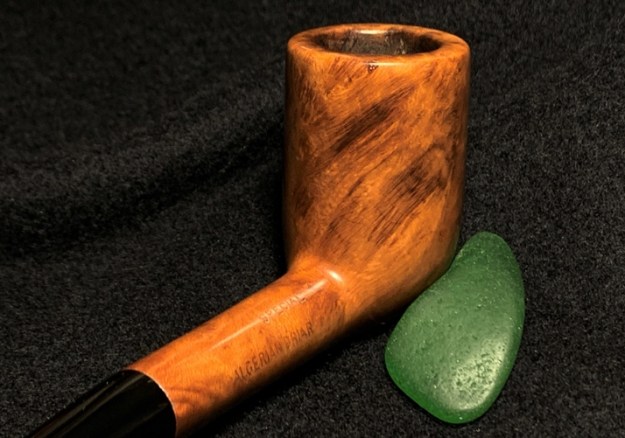
A Button-Rebuild Helps Reclaim a Beat Up French GEFAPIP 500 26 S Bent Bulldog


Blog by Dal Stanton

I acquired this Gefapip 500 26 S Bent Bulldog in the acquisition of what I call the ‘St. Louis Lot of 26’.  My son, Josiah, found the Lot for sale in an antique shop in St. Louis where he was doing his Masters work on a counseling degree.  He texted to me in Bulgaria the details with the proposal that we split the cost of the purchase – that I would choose one of the pipes as a gift from him and the remainder would go into the For “Pipe Dreamers” Only! online collection for pipe men and women to commission to benefit the Daughters of Bulgaria – our work here in Bulgaria with women and girls who have been trafficked and sexually exploited.  It was a win/win proposition and the HUGE Champion Churchwarden in the center became my gift from Josiah.  I made out like a bandit!Several of these pipes have already found their way to new stewards and another is on deck for restoration.  Seth saw the St. Claude produced Bent Bulldog (arrow in picture above) and sent me this note:

Hi Dal, first of all, I just want to say that I’ve been checking your website pretty frequently since you spoke at our church’s (Faith PCA in Cumberland, MD) mission conference a year or two ago. Since hearing about the work you and Beth do through the Daughters of Bulgaria, I knew I wanted to donate in some way and have been waiting to find the right pipe to get.

My wife and I visit many churches in the US when we’re there talking about our life and work in Bulgaria.  Seth was at one of these conferences and I love getting notes like this.  One of the pipes he had in mind was the Bulldog.  Later, Seth added another commission project to the GEFAPIP Bulldog, by asking me to fashion a new Churchwarden from a Sculpted Bull’s Head – I’m looking forward to this one!  His biggest challenge is the missing horns which I will need to fashion!I’m grateful for Seth’s patience in waiting for his commissions to reach the worktable.  Here are pictures of the Bent Bulldog.The provenance of the pipe is found on the lower left panel of the diamond shaped shank.  The nomenclature is GEFAPIP [over] 500 [over] FRANCE.  Running parallel to the shank facing to the right is what I’m assuming is a shape number: ’26 S’.  The ‘500’ and ‘FRANCE’ stampings are very thin, so I need to be careful to safeguard these.A quick look in Pipedia reveals pertinent information about the French origins of this GEFAPIP.  The information is brief but helpful.

Gefapip was a French brand from the St Claude region. Their products appeared in the 1979 Tinderbox catalog, with prices ranging from $17.50 to $62.50.

The following catalog page (1979 Catalog page, courtesy Doug Valitchka) was included with the text and it added helpful information that the GEFAPIP name was started by a group of master carvers in the St. Claude region.  The production line pictured in the catalog page are examples of shapes smoked in the Saint Claude region in the 1890s according to the caption.A visit to Pipephil.eu did not produce new information but gave some additional examples of GEFAPIP pipes. The stem stamping of a ‘modernistic’ pipe shape shown in the panel unfortunately is not visible on the Bent Bulldog’s stem.  I don’t know if it was ever there or was worn away over the years.Looking more closely at the Bulldog itself, reveals that it has been smoked hard and put out to pasture.  The rim has lava flow along with a thick carbon cake buildup in the chamber. The briar surface is covered with a darkened film of grime and oils that need cleaning.The stem is deeply oxidized to the point of what I believe is calcium buildup on the surface concentrated in the bit area.  The bit has been chewed severely with the upper button bite caving in on the slot.The underside also has a severe tooth hole almost puncturing through to the airway.  The entire button will need rebuilding to address these issues.The shank junction seems to be in good shape at first glance, but I see that former sanding and wear has created some shouldering on the corners of the stem facing.The restoration of the French GEFAPIP Bent Bulldog begins with the needy stem to address the deep oxidation.  I first clean the airway with pipe cleaners dipped in isopropyl 95%.Trying to get a jump on breaking up the oxidation in the vulcanite, I apply a 00-grade steel wool to the surface before putting the stem in a soak of Before & After Deoxidizer.  This seems to help.I’ve purchased a new batch of the Deoxidizer from Mark Hoover (lbepens1@gmail.com), but I wanted to give the current batch one more use before tossing it!  Generally, I like the Before & After Deoxidizer’s performance except when deep oxidation is present.  Consistently, I find that it doesn’t remove this deep oxidation but perhaps masks it and generally I find that following the Before & After Treatment sanding to remove the oxidation is needed.  The stem of the GEFAPIP Bulldog joins other pipes in the queue (Longchamp, Danish Freehand, Kaywoodie Standard, Italian Billiard and Brewster) for a soak in the Deoxidizer.I give the soak several hours, though I don’t believe the additional time adds more cleaning, and after fishing out the Bulldog’s stem and draining off the excess liquid, I run another pipe cleaner wetted with isopropyl 95% through the airway to clean away the Deoxidizer.  I also rigorously wipe off additional oxidation raised through the soak process using cotton pads wetted with isopropyl 95%.After this, to help revitalize the vulcanite stem, I wipe paraffin oil on the stem.  Paraffin oil is a mineral oil I can find easily here in Bulgaria.With the help of the setting of the camera on my iPhone X, the remnant of deep oxidation remaining in the vulcanite is visible.  I will need to fully sand the stem to clean it thoroughly.Putting the stem aside for the time, I take a closer look at the stummel with a fresh picture of the chamber.  The picture below is difficult to discern the canonical shape of the chamber as the cake thickens toward the floor of the chamber.I also do a quick inventory of the briar surface in need of cleaning.  The dark spots of oils and grime hide the beautiful grain peeking in from underneath. After laying out paper towel to minimize cleanup, to clean out the carbon cake buildup in the chamber I use the Pipnet Reaming Kit to get down to the fresh briar.  I use two of the four blade heads available in the kit.  Then, switching to using the Savinelli Fitsall tool, scraping the chamber walls continue.  Finally, after wrapping a Sharpie Pen with 240 grade paper, the chamber is sanded to finish the reaming process.  After cleaning the chamber of carbon dust with a cotton pad wetted with isopropyl 95%, inspection of the chamber shows some minor heating veins, but healthy briar now has a fresh start.  I move on.Transitioning now to the external cleaning, undiluted Murphy’s Oil Soap is used with a cotton pad to scrub the briar surface.  A dental probe is helpful in cleaning the pair of parallel dome grooves separating the upper and lower Bulldog bowl.  A brass bristled brush helps to clean the lava flow on the rim as well.  Brass bristles are used because they are gentler on the briar surface yet provide some abrasive cleaning action. From the cleaning on the worktable, the bowl is transferred to the kitchen sink and rinsed with hot water.  Using long shank brushes, the internal cleaning starts by using anti-oil liquid dish soap.  After a thorough rinsing, back on the worktable the results of the cleaning are examined.The surface cleaned up very well.  The dark spots that were especially evident at the shank/bowl junction were cleaned away very nicely.The rim shows continued darkening, but this will be addressed with some sanding to clean the briar.The nice quality of this block of briar is evidenced by the emerging grain and that I found only one, very small fill on the right upper shank panel.  There’s a slight ridge where the fill has shrunk after being wet, a normal phenomenon.  I may touch it up with some clear CA glue.Switching now to the internal cleaning proper, cotton buds and pipe cleaners are employed after wetted with isopropyl 95%.  The internals are grungy.  Using a smaller pointed dental spoon, I excavate huge amounts of tars and oils scraped off the mortise walls.  My first effort at pushing a pipe cleaner through the draft hole is frustrated by a blockage.  With the help of a stiff piece of wire, the blockage is pushed through – a hunk of gunk! With a lot of effort expended, the buds and pipe cleaners start emerging in a lighter state until I call it a truce!  I’ll continue the internal cleaning later with a kosher salt/alcohol soak.  The pictures show the first assault. I decide to move straight away to the kosher salt and alcohol soak.  I first twist a cotton ball by pulling and twisting it to form a ‘wick’ that is inserted into the mortise with the help of the stiff wire.  Then, after filling the bowl with kosher salt which leaves no aftertaste and placing the stummel in an egg carton for stability, using a large eye dropper, the chamber is filled with isopropyl 95% until it surfaces over the salt.  After a few minutes, the alcohol is absorbed into the pipe and I top it off again and set the stummel aside for several hours allowing the soak to do the work. Switching focus now to the stem, I take a few pictures to take a closer look.  With the residual oxidation remaining in the stem, it is a given that the stem will be fully sanded to address this.  The upper bit has compressions including damage to the button lip.  In the picture, after inserting a pipe cleaner, the split in the button becomes more visible.  The lower bit is so damaged that no amount of sanding will resolve these issues.  With the upper bit, I’ll first use the heating method to expand the vulcanite to lessen the amount of sanding needed.I note that the button doesn’t have a slot but simply an airway hole. To begin, I use a Bic lighter to paint the upper bit to lessen the severity of the compressions before rebuilding the button.  I take a picture to mark the start and another picture to show the progress.  The second picture does reveal that the vulcanite expanded some and this is good.Next, the entire button needs to be rebuilt using a mixture of activated charcoal and Extra Thick CA glue.  To begin, I wrap a piece of Scotch tape around the end of a pipe cleaner then rub Petroleum Jelly over the tape.  I then insert the pipe cleaner into the airway and position the tape so that it straddles the air hole in the button.  This is to guard the integrity of the airway so that the patch material doesn’t seal it.I then clean the upper- and lower-bit area with alcohol.With a plastic disk serving as a mixing pallet, scotch tape is used to help in the cleanup.  I mix on a non-porous surface to provide consistency in the way the CA glue mixes with the activated charcoal.  That is, I do not mix on card stock or something like this because it absorbs moisture out of the glue and causes the glue to behave less consistently while mixing.  I use an activated Charcoal Capsule to provide the charcoal – it is pure and is not lumpy.After removing the charcoal from the capsule, I add a small puddle of the Extra Thick Maxi-Cure CA glue produced by BSI.  It works well for me.I use a toothpick to mix the CA glue and charcoal by drawing the charcoal into the glue as I mix.  When it thickens enough so that it’s not running off the toothpick, I then trowel the mixture onto the button – upper and lower.  The patch mounds should be more than what is needed so that sanding brings the newly fashioned button down to the right size and shaping. After the patch material sets, just like it should work, the petroleum jelly coated pipe cleaner was removed with a few small tugs.After several hours the patch material is fully cured.  The long patient process of filing and shaping the button begins with a flat needle file.  The following pictures show the gradual progression on the upper button lip. Next, transitioning to the lower button lip and the patch to bit. The filing phase is completed as the pictures show the upper and lower bit and views of the airhole – upper and lower orientation. Transitioning to 240 grade paper I begin sanding which continues the smoothing and shaping of the button but also expands the sanding to the entire stem to address the deep oxidation.  I employ a plastic disk to sand against to avoid shouldering the stem facing.  It is no surprise to see the emergence of air pocket pits in the patch material as the sanding continues.  I would like to figure out how to minimize this! The upper and lower stem is shown. The sanding with 240 paper is completed and I wipe the button off with a cotton pad wetted with isopropyl 95% to get a closer look at the patch pitting in the rebuild button. To address this and to fill the pits, I use regular clear CA glue.  I put a small amount of CA glue on the lip of the button and then spread it over the lip to create a thin layering of glue over the surface.  This layering of CA glue fills the pits.  I spray the glue with an accelerator to hold it in place and to quicken the curing time. Next, after taking the stem to the kitchen sink, the whole stem is wet sanded with 600 grade paper and after the sanding, 000 is applied to the entire surface of the stem to smooth it further – including the newly rebuilt button with the CA glue painting of the button.  The results are looking good for the upper and lower stem. I put the stem to the side for now and turn again to the stummel which has been undergoing a kosher salt/alcohol soak for several hours to continue cleaning and refreshing the internals.  The salt and mortise ‘wick’ are soiled revealing the passive activity of drawing out the tars and oils from the internal mortise walls.  After tossing the expended salt into the waste, I wipe the bowl with paper towel and blow through the mortise to remove salt crystals.To make sure all is fully cleaned, I use one pipe cleaner and cotton bud to confirm this.  I also take a whiff of the chamber and it is smelling sweet and ready for its new steward!  Moving on!I continue with the stem applying the full regimen of micromesh pads.  First, with pads 1500 to 2400 wet sanding is followed by dry sanding with pads 3200 to 4000 and 6000 to 12000.  Between each set of 3 pads, Obsidian Oil is applied to rejuvenate the vulcanite stem and to retard future oxidation development.  The stem looks great and the button rebuild does as well. Continuing to help in the revitalization of the vulcanite stem, I apply Before & After Fine Polish and then Extra Fine Polish in that order.  After each application by working the polish into the vulcanite with my fingers, afterwards wipe the excess with paper towel.  The stem looks good.After completing this phase of the stem restoration, to get a look at the overall progress, I reunite the stem and GEFAPIP Bent Bulldog stummel.  Two issues emerge after reuniting the stem and stummel.  First, the tenon/mortise fitting has loosened as a result of the cleaning processes.  This often is the case.  The seating of the tenon needs tightening.  The second issue is that the shank/stem alignment is off slightly creating a gap between the stem and shank on the left side – right side of the second picture below. This gapping is enhanced somewhat by the rounded corners of the stem facing that I identified earlier. Before addressing the gap, to tighten the tenon’s fit in the mortise, I find a drill bit one size larger than what will fit into the airway. Then, using a Bic lighter to heat the tenon until the vulcanite softens; the drill bit is forced into the airway gradually.  After inserting the very beginning of the bit, I re-heat the tenon with the Bic lighter to again soften the vulcanite.  I then force the bit into the airway further.  With each advance of the slightly larger drill bit into the airway, the vulcanite is expanded thus increasing the diameter of the overall tenon resulting in a tighter fit in the shank.After the bit has reached the end of its journey expanding the tenon, I take the stem to the kitchen sink and cool the tenon with the drill bit remaining inserted.  This cools the vulcanite and it hardens resulting in holding the expanded tenon diameter.  Back at the worktable, to remove the bit, which is now stuck, I grip the end of the drill bit with plyers and while holding the bit stationary, I rotate the attached stem so that gradually the bit is released from the tenon’s grip.The procedure works very well so that the tenon is now too large to fit after a test fitting.  Using 240 grade paper wrapped around the now expanded tenon, while holding the sanding paper stationary, I rotate the entire stem so that the sanding on the tenon moves toward a custom fit and is sanded uniformly.After some sanding, another test shows progress, BUT the tenon is never forced into the mortise which increases the dreaded shank cracking noise to be heard!Finally, the tenon is seated into the mortise and I examine the fit.  The truth is that the stem fitting is not good, and it appears that this was a factory issue or is it a replacement stem?  I don’t think so, but it looks like the drilling was off some so that the stem and shank facing are not perfectly flush.  The resulting gaps are easily seen in the pictures below. To address this issue, since the gapping is in the lower quadrant of the stem/shank facings, I fold a piece of 240 sanding paper and insert the now two-sided edge of the paper in the upper quadrant sandwiched between the stem and shank.  Sanding the folded paper like a hand saw – back and forth – has the effect of removing the material equally on both sides which has the hoped result of closing the gaps in the lower quadrant.This takes some time – ‘hand saw’ sanding and testing – to see very gradual progress.  Re-fitting a catawampus stem/tenon/shank junction is not easy in general, but when one is dealing with a diamond or squared shank, it’s much more difficult.  Why?  A rounded junction is much easier to blend the opposites coming together.  With the corners and edges of a diamond shank, it is much easier to see problems stand out.  The following pictures show progress, but perfection is not found in this life!The other thing that is troublesome with this junction is that the corners have been rounded or shouldered.  I noted this before and this picture brings attention to this.  The next two pictures show this as well as a lingering gap that my OCD tendencies will not ignore!To help remove the shouldering and hopefully provide more movement toward a better fitting, I bring out the stem topping board.  With a hole drilled in the board, I place 240 paper over the hole and force the tenon through the paper into the hole.  With the tenon inserted into the hole, I then rotate the stem carefully to sand down the stem facing – thus, removing the shouldered edge and creating a sharper facing – hopefully!After the topping, I cover some of the stem with masking tape and sand the junction with 240 then 600 grade paper to bring things into a tighter alignment removing the edges I can feel as I rub my finger over the junction.  I’m avoiding the lower left panel which holds the nomenclature.This sanding and the topping have worked very well.  Not perfection, but a much better union is evident.I continue sanding the junction with the addition of 000 grade steel wool avoiding the nomenclature panel altogether.  Satisfied, I move on!After putting the stem to the side, I turn to the stummel and take a closer look at the Bulldog’s scratched and nicked rim.  It’s not in terrible shape but shows signs of normal wear and tear.  I take it to the topping board for a light topping to refresh the Bulldog rim. I first turn the inverted stummel several rotations on 240 sanding paper placed on top of a chopping board.  This does well as a portable topping board.The topping progression is shown in the next few pictures as the scratches are removed and the rim lines re-established.  The first picture concludes the 240 topping and the second after changing to 600 grade paper. Moving now to the stummel surface, as with the rim, it shows scratches and nicks from general usage. To address these minor issues, using sanding sponges cleans the surface but are not too invasive.  I first use a coarse grade followed by medium and light grades.  The transformation is stark as the grain begins to emerge and I like what I see! From the sanding sponges, I transition to applying micromesh pads to the stummel.  Using pads 1500 to 2400, I wet sand followed by dry sanding with pads 3200 to 4000 and 6000 to 12000.  The grain is very nicely teased out through the process.Detour – After the first set of 3 pads which wetted the stummel.  I took a closer look at a fill on the upper right shank panel.  This is the most noticeable fill I’ve detected, and the fill has remained solid, but is lightened in contrast to the surrounding briar.  Before moving to the next set of micromesh pads, I darken the fill using a mahogany dye stick.  This does a good job of darkening the fill.  The continued sanding helps to blend the fill. Before moving on to the finishing phase, the dome grooves receive a cleaning using a sharp dental probe to remove packed briar dust and such.With the grooves cleaned of debris, I next apply Mark Hoover’s (www.ibpen.com) Restoration Balm to the stummel.  I like this product because it brings out the subtleties of the natural briar grain.  After putting some of the Balm on my finger, I apply it to the stummel surface and work it into the briar.  I then set it aside for 20 minutes or so allowing the Balm to do its magic.  I use a cloth dedicated to removing the excess Balm after it has set.  I then buff the stummel with a microfiber cloth.  Nice!  The picture shows the Balm on the surface doing its thing.The home stretch – after mounting a cotton cloth buffing wheel to the Dremel, setting the speed at about 40% full power, Blue Diamond compound is applied to the entire pipe – stem and stummel.  Following this, a felt cloth is used to buff removing compound dust from the surface in preparation for applying wax.  I run a dental probe around each of the dome grooves to remove caked compound.  After changing to another cotton cloth buffing wheel, carnauba wax is applied to the stem and stummel at the same speed as the compound. Finishing the restoration, a microfiber cloth works well to give a rigorous hand buffing to disperse any wax build up and to raise the shine.

The most daunting challenges in bringing this GEFAPIP 500 S Bent Bulldog back into service was the stem work – rebuilding the button and helping the tenon/mortise fitting.  The oxidation was stubborn as well.  In the end, it was worth the effort.  The classic Bulldog shape is to me a pipe with attitude.  This Bulldog, a product of St. Claude, France, is no exception.  The vertical grain encompassing most of the dome resolves on the underside of the bowl in bird’s eye grain and swirls very pleasing to the eye.  The stem’s quarter bend is nice for resting in the palm in a relaxed way for reflecting on life and family.  Seth, from Maryland, will have the first opportunity to claim this Bulldog from ThePipeSteward Store which benefits the Daughters of Bulgaria.  Thanks for joining me!

Refreshing an El – Iş Sculpted Sultan Meerschaum found in Denver


Blog by Dal Stanton

I acquired this beautiful Sculpted Sultan Meerschaum on a pipe picking expedition at the Homestead Antique Mall in Arvada, Colorado – a suburb of Denver, last year (2018) when my wife and I were in Denver celebrating Christmas with our family. The expedition was very fruitful with the acquisition of two exquisite pipes – a Gourd Calabash and the Sculpted Meerschaum now on my worktable. The Calabash is still in my inventory and is available to be commissioned!   I haven’t had the time to post pictures of it in the online collection, For “Pipe Dreamers” Only!  A picture of the fruit of that pipe picking day was taken on the counter at Homestead Antique Mall.One year later, Christmas of 2019, our daughter, Johanna, and her husband, Niko, came to Bulgaria to celebrate Christmas with us!  Niko and Johanna were Joined by our son, Josiah and his friend, Katie.  We’ve had a great time together and I’m thankful that they have been with us.  I fashioned Churchwardens for both Niko and Josiah and gave them as gifts for Christmas.  Here is first, Josiah’s then Niko’s Christmas Churchwardens – which turned out very well. When Niko came to Bulgaria, through our conversations he described his priorities for his growing pipe collection.  One was a Churchwarden – which Christmas gifting took care of.  The other was to add a Meerschaum to replace a cheap Meer that he had that disintegrated in his hand while using!  I showed him the Sculpted Sultan Meerschaum in my Pipe Steward inventory and he decided to commission it benefiting our work here in Bulgaria with the Daughters of Bulgaria – women and girls who have been trafficked and sexually exploited. I was glad to do this, but the challenge was to refresh the Meerschaum before Niko and Johanna leave on their return trip to Nashville, where they live.  Here are pictures of the El – Iş Sculpted Sultan now on my worktable. The detail of this sculpted Meerschaum is exquisite.  It bears a traditional face which is seen in the offerings of Meerschaum carvers in Turkey. I’ve visited Istanbul many times and am always amazed at the variety of Meerschaum pipes one can find.  When I found this Meerschaum in Arvada, Colorado, at the Homestead Antique Mall, it was with the original box.  This box gave the information that is often missing from unmarked Meerschaum pipes.  The name on the top of the box was ‘El – Iş’ Ferit Urersoy, 1, Kordon 1382 So – 2/B, Izmir.  I’ve had the opportunity to visit Izmir which is located south of Istanbul on the Aegean coast.  In the Bible it is the city of Smyrna made famous in the book of Revelation as the city of many poor and those who were suffering from tribulations.

Looking on the internet to find more information about the ‘El – Iş’ name and manufacturer.  Google Translate offers a rough translation of ‘El – Iş’ as ‘Hand Business’ or ‘Hand Made’.  Ferit Urersoy most likely is the carver or possibly company owner with the address of a shop in Izmir following.  Using Google Maps, I was unable to isolate anything with the address given, but I discover that ‘Kordon’ is given as a general name to the much of the costal section that runs along the city bordering the Aegean (see: Wikipedia – Kordon).  Even with this help, the address is not helpful in identifying a specific location in Izmir.  Doing simple searches of ‘El – Iş’ and ‘Ferit Urersoy’ render many Meerschaum pipes with the same identifying information, but no primary information pointing to the Turkish manufacturer whose name is on many Meerschaum pipes in circulation.

One very interesting piece of research that came up was a full-page description of the origins of Meerschaum and its care once a pipe. The name El – Iş is prominent throughout but unfortunately, it offers no additional information. (See link: https://www.sportscards.com/)I was about to give up on locating a shop in Izmir when I recalled the Wikipedia reference to Kordon provided the information of a region in the city of Izmir – Alsancak.  I entered this information into the Google search engine, and it resulted in a side bar link to Google Maps which I followed. What I didn’t see before was that many of the streets are labeled with numbers fitting the 4-digit pattern which identified the El – Iş reference to 1382 as a street number.  It took a little detective work, but I finally found street no. 1382 in the center of the Google Map pictured below with the yellow highlight.I employed Google Map street view and came to the end of my search.  I believe this is the block of buildings, on the beginning of street 1382 numbering where 2/B would be located (green highlighting in the picture above).  I cannot find a shop here in this section, but it is possible that it was here but now is long gone.  This is as far as this search will take me!With the elusive origins of this El – Iş Block Meerschaum Sculpted Sultan research finished for now, I look more closely at the pipe on my worktable.  The black acrylic stem has some minor tooth chatter on the upper and lower bit.The Meerschaum surface on the shank has some signs of wear with some scratching which should easily sand out.  The Meerschaum shows no signs of developing the coveted patina which usually first starts showing on the shank. This would indicate that the pipe has not been smoked a great deal.The chamber has some minor buildup of carbon – normal for a Meer.  Meerschaum, a soft stone, requires no carbon cake to protect the surface as with the briar chamber.  Meers are popular for this reason – they do not need to be broken in nor do they need to be rested between use.  Smoke a bowl, reload it and he’s ready to go!  I’ll remove the buildup bringing it down to the Meer surface.  The rim has minor darkening which should clean up. I see one other issue regarding the stem.  The screw in tenon has worn some and is over-clocked slightly.  I’ll see if I can back it up to have a straighter orientation.I start the sprucing up of the El – Iş Sculpted Sultan by cleaning the chamber.  I first scrape the chamber walls with the Savinelli Fitsall tool which produces very little.  I follow by sanding the chamber with 240 grade paper wrapped around a Sharpie Pen to clean the chamber further.  As the picture below shows, there was very little buildup in the chamber – this is good. I wipe the walls with a cotton cloth wetted with isopropyl 95% to clean it of the sanding powder.  The chamber looks good and I move on. The Meerschaum surface looks good.  To clean it I use undiluted Murphy’s Oil Soap on a cotton pad to clean.  I also employ a bristled toothbrush to get into the crevasses of the sculpted detail of the face and especially the beard. I rinse the stummel with cool tap water. Next, I address the traumas on the left side of the shank.  They are not too noticeable but using micromesh pads to sand, should erase the blemish.I use the first and most abrasive micromesh pad, 1500, to sand out the marks.  I continue around the shank using the micromesh pad simply to clean up the shank.I also address some of the discoloration around the top of the chamber, though the reality is, it’s not really a problem and I’m not trying to remove the coloring fully. I finish by taking the shank and the top of the turban through all the 9 micromesh pads to clean and to smooth.Unlike briar pipes, Meerschaum does not use carnauba wax to finalize the finish.  The practice of using bees’ wax to shine the Meer is the standard practice.  A blog of Charles Lemon at Dad’s Pipes is in my file box to use as my guide for this procedure (See: Quick Clean-up of a Tulip Meerschaum Sitter – Dad’s Pipes).  I mentioned before how Meerschaum pipes change color as they are smoked, and this patina increases the value of the pipe.  Not only does bees’ wax shine the Meer but it also enhances the growth of the patina as one uses the pipe and the tobacco oils are absorbed into the Meerschaum.  I reattach the stem to the stummel but place a pipe cleaner between the stem and shank to tighten against.  This creates a gap so that wax does not get on the stem and the stem acts as my handle. I keep the congealed bees’ wax that has been used previously in a mason jar.  Using the hot air gun, the wax is reheated and liquefies. The stummel is also warmed with the air gun. Using a cotton bud, I paint the stummel with the liquefied bees’ wax and carefully work it into all the nooks and crannies of the Sultan’s carved face and beard.  When the bees’ wax is applied, the stummel is put on a cloth for it to cool.  The pictures show the bees’ wax application. With the stummel to the side, I remove the stem and refocus on the tooth chatter on the upper and lower bit.  Using 240 grade sanding paper I sand the bit area removing the small compressions.  Then I remember…!Well, as I started to sand, the nagging in my mind finally surfaced.  I had been so focused on the external surface of the Sultan, that I forgot to clean the internals of both the stummel and the stem….  So, after putting the sanding paper down, the stem’s airway is cleaned with a couple pipe cleaners wetted in isopropyl 95%.  I’m relieved that the stem cleaned very easily.  Unfortunately, the stummel’s internal cleaning might be a bit more difficult while attempting to protect the newly waxed finish!Returning to sanding the upper and lower bit, 240 grade paper dispatches the tooth chatter quickly.Following the 240 grade, I wet sand with 600 grade paper over the bit area alone – upper and lower.  Following the 600 grade sanding to erase the 240 scratches, applying 000 steel wool smooths the bit area further.Now, addressing the whole stem, wet sanding with micromesh pads 1500 to 2400 is then followed by dry sanding with pads 3200 to 4000 and 6000 to 12000.  Between each set of 3 pads, Obsidian Oil is applied to the very nice looking black acrylic stem. Earlier, I took the following picture that shows the stem over clocked by a small amount.  This often happens with screw in tenons of all materials as the rubbing wears the mass away and the interlocking pressure lessens – producing a stem that screws in a bit too much.An easy way to address this is to apply an acrylic material to the threads of the acrylic tenon.  CA glue can serve this function, or as I use, clear acrylic fingernail polish does a good job.  Using the fine brush that comes with the bottle, the acrylic liquid is painted on the threads.  When cured, the mass of the threads is increased slightly which translates into the tenon tightening a bit sooner which hopefully corrects the orientation of the stem!  After applying the polish, the stem is set aside for the liquid to fully set.Going backwards a few steps in the process, I decide to leave the now cooled and congealed bees’ wax in place on the stummel while I clean the internals – which should have been earlier in the process!  Thankfully, as with the stem airway, the internals are cleaned with two cotton buds and one pipe cleaner!  Moving on.Now focusing on the cooled bees’ wax stummel, I use a clean cotton cloth to wipe off the excess bees’ wax which is not an easy task.  The congealed excess wax takes some firm wiping to be removed.  With most of the excess removed, a hardy hand buffing with a microfiber cloth finishes the removal of excess wax and the Meerschaum surface responds by shining up as well as absorbing the honey-colored bees’ wax which encourages the development of patina.  After buffing with a micromesh cloth, a new, clean, cotton cloth buffing wheel is mounted onto the Dremel to apply a final buffing to the Sultan sculpting.  With the Dremel’s speed set at about 60% full power, faster than usual, the added heating of the high speed buffing helps further to dissolve and work the bees’ wax into the Meerschaum.With the buffing complete, I rejoin the black acrylic stem with the Meerschaum stummel.  I had applied acrylic fingernail polish to the threads to tighten the grip and to correct the overclocking of the stem.As hoped, the stem tightens sooner and I’m able to leave the stem in a correct orientation.  I’ve already told Niko to be careful not to over-tighten the stem – which will result in overclocking!With the stem remounted, I load another cotton cloth buffing wheel to the Dremel, setting the speed at 40% full power, and apply Blue Diamond compound to the stem.  After completing the application, I wipe the stem with a felt cloth to remove the compound dust from the stem before waxing.Next, another cotton cloth wheel is mounted, and carnauba wax is applied to the stem at the same speed.To complete the sprucing up of the El – Iş Sculpted Sultan Meerschaum, I give the entire pipe a rigorous hand buffing with a microfiber cloth to raise the shine.

I’m pleased with the results of refreshing this very detailed Sultan Meerschaum sculpting.  The black acrylic stem contrasts well the light Meerschaum stummel and causes the sculpting to pop.  The bees’ wax did a great job teasing out the coveted patina.  My son-in-law, Niko, commissioned this pipe which benefits the Daughters of Bulgaria.  It’s already packed in his bags along with the Churchwarden he found under the Christmas tree here in Bulgaria!  Thanks for joining me!
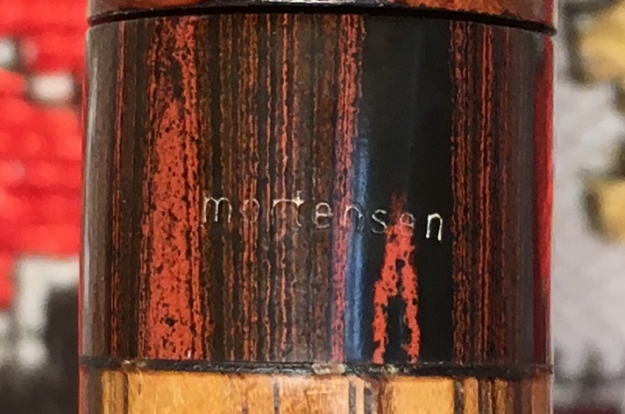
Fashioning a Second Churchwarden, “Made in England” for a Special Christmas Gift


Blog by Dal Stanton

I completed the first Christmas CW project by repurposing an Italian Permofilter rusticated bowl and mounting it on a Warden stem.  It is to be a gift for my son, Josiah, who came to Bulgaria from St. Louis to celebrate Christmas in Sofia, Bulgaria, with Mom and Dad!  Josiah’s Churchwarden came out well!Our daughter, Johanna, also has come to Bulgaria for Christmas.  She and her husband, Niko, arrived first and so my work fashioning a CW as a Christmas gift for Niko is a bit clandestine trying to keep it a secret until Christmas Day!  Niko hasn’t been easy to figure out for a pipe gift!  I was first going to give him a sculpted Meerschaum because I knew he had one before – a cheaper one that disintegrated in his hand while smoking it.  Yet, after he arrived, he saw that I was working on a Churchwarden for ‘someone’ who had commissioned one (actually, it was Josiah’s Churchwarden that I had commissioned myself!) and he wanted a Churchwarden, which was also on his priority list to add to his collection.  When I fished around regarding which he would rather have – trying not to spill the beans that I was gifting him a pipe, he said that a Churchwarden was higher on the list.  So, the Sculpted Meerschaum goes back into the inventory benefiting the Daughters of Bulgaria – our work helping women and girls who have been trafficked and sexually exploited!The bowl I’m repurposing is from an unbranded petite bent Billiard that is marked only with the nomenclature, ‘Made in England’ on the left shank side and a shape number on the right, ‘950’.  I acquired this pipe in the ‘Lot of 66’ and it has been waiting for someone to commission him in the For “Pipe Dreamers” Only! collection. It is an attractive pipe and the grain shows much potential.  I did a quick search of the main shape number charts of English pipe names such as BBB and GBD but found no reference to a shape 950 that helped me with identifying the origins of this pipe.Now with the stummel on the worktable to transform it into a Churchwarden, I take more pictures to take a closer look.  The chamber has light to moderate cake build up and the lava flow over the rim is thick.  The rim width is also imbalanced with a thinning of the rim on the front left.  Undoubtedly, the point where the former steward drew down the flame to light the blend.The rim also has its share of nicks, cuts and chips.  The stummel also has several dents and pits here and there which need addressing.  As expected, the grime is thick on the darkened stummel.  Yet, the grain underneath shows great potential. The grain is primarily vertically oriented around the stummel. The stummel has the feel of having some age.  By the shape and looks of it, I would guess that it is from the 1960s or earlier.  The plan is to transform the petite bent Billiard into a Churchwarden by mounting it to a precast Warden stem that measures 8 5/8 inches in length.  I acquire Warden stems from Tim West at www.jhlowe.comI begin this CW Christmas project for Niko with the cleaning of the stummel.  First, after spreading paper towel to aid in cleaning, I use the Pipnet Reaming Kit to address the cake build up in the chamber.  I again take a close-up picture of the chamber showing the light cake build up to mark the start.  I use only the smallest of the 4 blade heads available in the Pipnet Kit.  Transitioning to the Savinelli Fitsall Tool, I scrape the chamber walls further and follow by sanding the chamber wall with 240 grade paper wrapped around a Sharpie Pen.  The left-over carbon dust is then removed with a cotton pad wetted with isopropyl 95% and after an inspection of the walls, I find no problems with heating. Moving now to the cleaning of the external surface, the surface is scrubbed using a cotton pad wetted with undiluted Murphy’s Oil Soap.A brass wire brush is also helpful in scrubbing the rim top addressing the lava caked on it.  I also utilize my Winchester pocketknife to scrape the rim.  To rinse the soap, the stummel is transferred to the kitchen sink where the stummel is rinsed with warm water.  Using different sized shank brushes with anti-oil dish soap, the mortise and airway are cleaned. Finally, after rinsing and back at the worktable, a picture records the results of the cleaning.  The old worn finish is all but gone revealing the briar beneath. The scratches and imperfections are very evident mingling with the distinctive grain patterns. Next, using cotton buds and pipe cleaners wetted with isopropyl 95%, cleaning the internals is addressed. As the picture below shows in stark visual imagery, the internals were a bear to clean!  Using a small dental spoon, I also excavate a lot of tars and oils scraped off the mortise walls.  From what I am able to see and feel down the mortise with the probe, the internal design has a trap and the angled airway is drilled over the top of the trap angling toward the draft hole entering the chamber.  The trap has done the job of collecting the gunk, but the steward did not seem to know that frequent cleaning of the trap would keep this guy in better shape!  Finally, after many expended pipe cleaners and buds, they began to emerge lighter. Later, the internal cleaning will continue with an alcohol and kosher salt soak further to clean and refresh the internals.Now looking at the stummel, I know that the shank will be undergoing a good amount of sanding to shape the shank during the stem fitting process.  Therefore, the restoration work that I now do on the stummel external surface will not progress beyond the shank sanding at this point.  I start at the top looking at the rim’s condition.  It’s in bad shape with nicks and chips around the rim’s edge and the scorching damage resulting in the thinning on the left front quadrant.  I use the topping board to begin addressing these issues. With 240 paper on top of the chopping board that serves as the topping board, I rotate the inverted stummel several times on the board. After a few rotations, I stop to look. With this first picture, the contours of the rim thinning are clearer.  I continue to rotate on the topping board.These next pictures show the progression of the topping a step at a time. I stop with the 240 topping even though edge damage remains.  I will rectify this with beveling instead of removing more rim real estate.  I switch the paper to 600 grade and smooth the rim top further with this finer grade sanding paper.  After several rotations on the board, I’m satisfied with the topping board results.  Nice looking bird’s eye grains are peeking through the rim surface.Addressing the edge problems, 120 grade paper is used first to cut an outer edge bevel to remove the remaining cuts and chips on the edge.  Following the 120 paper 240 grade paper is used to smooth out the bevel.Again to freshen the rim lines after the beveling, I do a very quick topping again with 240 and 600 grade paper.I finish the rim repair by sanding the bevel on the outside and inside rim edges with 600 grade paper.  It looks good.  I move on.Continuing now to address the stummel proper, I will do what I can to spare the remnant nomenclature on the shank sides as I sand out the problems on the stummel.  I use sanding sponges to address the cuts and dents on the stummel surface.  First, using a coarse sponge to sand, I follow with a medium grade and a light grade sponge.  Wow!  This block of briar is impressive with vertical flame grain running around the bowl and as you would expect, bird’s eye grain populating both the heel and rim.  Very nice.  I’ve progressed all I can now with the stummel until the stem sizing and placement is completed.  The first step in this process is to size and fit the Warden precast stem’s tenon into the mortise.  As with the first Churchwarden gift project for my son, Josiah, Niko’s Churchwarden Made in England bowl’s mortise is measured to establish the ideal target measurement for the tenon.  This measurement is 8.61mm. 40mm is added to this ‘target size’ to establish the ‘fat size’ target.  This is a conservative sizing of the rough tenon in order to patiently and more slowly sand the tenon to the target size.  This allows for customizing the tenon as well as avoiding the danger of cutting too much with the Pimo Tenon Turning Tool.  The ‘fat size’ is right at 9mm.Next, to establish a starting measurement sizing of the rough tenon of the precast Warden stem, the PIMO tool is used. To do this, the first step is to drill the airway with a drill bit provided by the PIMO kit to allow the PIMO tool’s guide pin to fit the airway. After mounting the drill bit on the hand drill, the airway is easily enlarged with the bit.  Next, after mounting the PIMO tool on the hand drill, using the Allen wrenches provided by the PIMO kit, I adjust the carbide cutter arm to be just a bit smaller than the rough tenon size.  This is simply to cut a uniform starting measurement size. I accomplish the initial cut and take a measurement of 9.46.  The difference between this measurement and the fat target of 9mm is .46mm. Again, I adjust the carbide cutter arm to close this gap.  After adjusting, I do a test cut by only cutting a little of the tenon and then measure.    The reason for doing the initial test cut is that if you over cut and the tenon is too small… well, you have a very loose fit!  My test cut was too much – 7.63mm! The target size, actual mortise measurement is 8.61mm.    After widening the cutting arm, I make another test cut and measure – 8.93mm.  This is good enough for achieving the fat target. I complete the tenon cut at 8.93mm.  I take the cut all the way to the stem facing – making sure that there is a square cut and no shouldering on the stem facing.Transitioning now to sanding, I first use a coarse 120 grade paper to do the heavy lifting.  As I sand, I test periodically to see the progress of the tenon’s entry movement into the mortise.  I grip the paper around the tenon and then with my other hand rotate the stem to create the sanding movement.  This keeps the tenon round as well. The pictures show the progress. When the tenon is close to fitting, I switch to 240 grade paper.  The stem finally seats into the mortise.When I eyeballed the shank size and the stem next to it, I knew that the shank was a bit larger than the stem and I would need to sand the shank some to taper the shank toward the stem size.  When the stem was seated, I saw how much of an overhang there was – it’s not a little.This angle however, revealed another issue that I did not foresee. On the lower shank, just below the stem is the hollow caused by the angled drilling of the airway.  I take a close-up of this cavity and then remove the stem to show the inverted mortise and drilling. Oh my. This creates some challenges. As if to add insult to injury, I discover another issue.  The tenon has a slight rock or wiggle when it’s fully engaged.  What this means is that the front of the tenon was sanded down too much and is not in contact with the mortise wall.  The tenon closer to the stem facing is making contact.  When I pivot the stem vertically, it rocks a little.  Not good. I decide to address the lose tenon first and think about the rest. To expand the tenon, I use a drill bit to insert into the airway.  I choose a drill bit which is the next size larger than what will fit into the airway.  I then use a Bic lighter to heat the tenon to warm the vulcanite.  When the vulcanite is warm enough, it softens and then I push the bit in the airway which expands the tenon.  After heating and inserting the bit, I take it to the kitchen sink and run cold water on the tenon to set the expanded vulcanite.  With the aid of a pair of pliers, the bit is retracted and again the tenon is inserted into the mortise.  The procedure worked well – the tenon tightened and there is now no rocking.  Moving on. After giving some thought to the conundrum of the shank and Warden stem placement, I recognize that I will not be able to save the bowl’s scant nomenclature.  To taper the shank in a balanced way, will require the sanding to start further up the shank.  I also decide that I will fill the drilling channel with briar dust putty to remove the hollow and make this area solid.  Finally, I decide to fit the shank with a band to mask the hollow as well as to give the emerging Churchwarden an added bit of class. First, to fill the drilling channel, I mix a small amount of briar dust and thick CA glue.  I use a plastic disk as a mixing pallet and to help with cleanup I put scotch tape down to mix on.  After putting a small amount of briar dust on the pallet, thick CA glue is placed next to it.  Using a toothpick, the briar dust is pulled into the CA glue and is mixed with the toothpick.  When the mixture thickens, I use the toothpick to trowel the putty into the drilling channel in the mortise.  I then set the stummel aside allowing the putty to cure through the night – lights out!The next morning, the putty has cured, and I go to work filing the fill to match the curvature of the mortise. A half-circle tapered needle file does the job well. The next pictures show the patch material now filling the hollow of the airway drilling and as well the necessary sanding to remove the excess overhang of the shank facing over the stem. To begin the sanding to remove the excess over the stem facing and to taper the shank, a coarse 120 grade paper makes the work more efficient.  The sanding includes the entire shank to provide a more gradual tapering toward the stem.  Without this, a ‘stuffed pants’ appearance is left.  The stem remains engaged in the mortise throughout the sanding process.After a good bit of sanding, the alignment is looking good.  As usual, on the sides where the precast stem seams are, the sanding is more directed.  The pictures show the alignment at this point using 120 grade paper alone.  The tapering of the shank looks good. I mark the upper side of the stem with a piece of scotch tape so that I later refit the stem with the correct orientation.  The next thing I want to see it how a band or shank cap will work.  Some months ago, the word went out about a pipe man on French eBay selling bags with a variety of copper rings, bands, caps, and spacers at a very decent price.  I don’t know who started the rumor – Steve, Paresh, Victor?, but several of us were able to order a supply for our work desks. The package containing the supply had a card, Pipe Estate at www.pipes-estate.com.  I have been waiting for an opportunity to utilize this addition to my inventory.After dumping the multitude of copper fitments on my worktable, it was fun taking a closer look at all the available sizes and shapes.  But the question always is, will there be one in all these that will work??As if I were holding the Holy Grail, I found a few that looked hopeful, but one was perfect.  A copper shank cap that fit the shank perfectly and reaches over the end of the shank to provide a spacer.  Perfect!Remounting the stem, I oohed and awed at the beauty and wonder of this addition to the creation of this Churchwarden going to Niko for Christmas!  There was a sacrifice in having to sand away the ‘Made in England’ marking on the shank which bums me out in a huge way, but I’m pleased with the shank tapering and the contribution of the copper shank cap to the ensemble. The rest of the Warden stem is awaiting sanding, but for the time, I continue sanding to smooth and finish the stummel.  Following the coarse 120 paper that did the main work on the tapering, 240 and 600 grade papers continue the process of smoothing the shank surface. Next, I put the stummel aside and continue sanding the remainder of the Warden stem with 120 sanding paper. I also use a flat needle file to shape the raw, precast button. Following the filing and 120 grade paper, 240 grade continues the smoothing process by erasing the scratches left behind by the coarser filing and sanding. Following the 240 paper, wet sanding with 600 grade paper erases the scratches of the 240 sanding and then applying 000 grade steel wool completes this phase of the sanding process.  One picture of the entire stem is taken followed by closeups of the upper and lower bit. The full regiment of micromesh pads is applied next by wet sanding with pads 1500 to 2400 then dry sanding with pads 3200 to 4000 and 6000 to 12000.  Between each set of 3 pads, Obsidian Oil is applied to vitalize the vulcanite stem.  Again, I take one picture of the entire stem from the orbital shot and two closeups of the upper and lower bit after the final 3 micromesh pads.With the micromesh process completed, it is time to bend the Warden stem.  I like to draw a template of a bend so that I’m not simply eyeballing the process.  The general goal is to have the mouthpiece of the Warden stem on a parallel trajectory with the plane of the rim.  On the diagram below, I draw a horizontal line representing the plane of the rim.  I also rough sketch the current disposition of the unbent stem.  Then I rough in a bend starting about 1/3 the distance from the shank and complete the sketch parallel with the rim plane.  This is the guide template.The hot air gun focuses on the area about 1/3 up the stem for the first bend attempt.  I bend the fat part of the stem first to have a more even and sweeping bend as it takes longer for the fat part to become supple than the thin part.  As the stem is rotated over the hot air, gentle pressure is applied and when the stem starts to bend, I know it’s reaching the state of shaping.  As the bottom third becomes supple, I move the heating up the stem a bit now to warm the middle.  All the while rotating back and forth and around.After the stem heats enough using the hot air gun, I place the pipe on the template and hold it in place until it holds its position.  I’ve found that even though it takes longer this way, I’ve lost the shape I want if I transition the pipe to the kitchen to run the stem under cool water to quicken the cooling.  The first attempt is good.  There’s a nice flowing bend but the final trajectory is a little wide.The second attempt is very close to what I want, but it’s still a hair wide.One more time heating does the trick.  This time I take the stem to the sink and run it under cool water to cool the vulcanite and hold the bend that has been created.With the Warden stem completed until the final polishing phases, I turn again to the stummel.  Using the full regiment of micromesh pads, with pads 1500 to 2400 I wet sand, followed by dry sanding with pads 3200 to 4000 and 6000 to 12000.  The bowl’s grain emerges through the process and I like what I’m seeing.  The bowl is fully wrapped with a vertical flame grain with bird’s eye grain populating the heel and rim – as you would expect being the cross-view perspective of the flame grain. With the hour growing late, I continue the internal cleaning and refreshing process using a kosher salt and alcohol soak. The first step is to fashion a ‘wick’ from pulling and stretching a cotton ball.  The wick serves to draw tars and oils out from the mortise cavity. Using a stiff wire, the wick is guided down the mortise. Then the bowl is filled with kosher salt which doesn’t leave an aftertaste as the iodized version.  The stummel is then placed in an egg carton for stability.Using a large eyedropper, isopropyl 95% fills the bowl until it surfaces over the salt.  After a few minutes the alcohol is absorbed, and I top off the alcohol one more time and set the stummel aside to soak through the night.The next morning, the soiling of the salt and wick evidences the processes active through the night.  The tars and oils were drawn from the internal briar surface.  I toss the expended salt and wipe the bowl with a paper towel.  I also blow through the mortise to loosen and remove any remaining salt crystals.To make sure all is cleaned, one cotton bud and one pipe cleaner dipped in isopropyl 95% were all that was needed to verify the results of the internal cleaning – cleaned!  I move on.Next, using Before & After Restoration Balm, the external briar is freshened and enlivened.  Mark Hoover’s Restoration Balm (www.ibepen.com) works very well to bring out the natural hues and to deepen them.  I place some of the Balm on my fingers and work it into the briar surface.  Afterwards, I place it the stummel aside for about 20 minutes to allow the Balm to do its thing.  Then the excess Balm is wiped/buffed off with a micromesh cloth.  The results are as hoped – a beautiful piece of briar is now more beautiful. Before moving on to the fine polishing and waxing phase, the copper shank cap/band needs to be attached to the shank. I test fit the cap over the shank and insert the stem.  The fit still looks good.  Next, with great caution, I place a drop of thick CA glue on the end of a toothpick and this apply the glue to the inside of the ring/cap.  Using the end of the toothpick, I run the glue around the entire underside and then slip it over the shank and press it into place.  I do this without excess glue seeping out from around the edges – relief!  I do not reengage the stem for a few minutes to allow the CA glue to cure – I don’t risk getting glue on the stem! On the home stretch!  With a cotton cloth buffing wheel mounted to the Dremel with the speed set at about 40% full power, I apply Blue Diamond compound to the stem and stummel avoiding the copper band.  When completed, I use a felt cloth to buff the pipe to remove compound dust before applying the wax.  Next, changing to another cotton cloth buffing wheel maintaining the same speed, carnauba wax is applied as well to the stem and stummel followed by a rigorous hand buffing with a microfiber cloth to raise the shine.
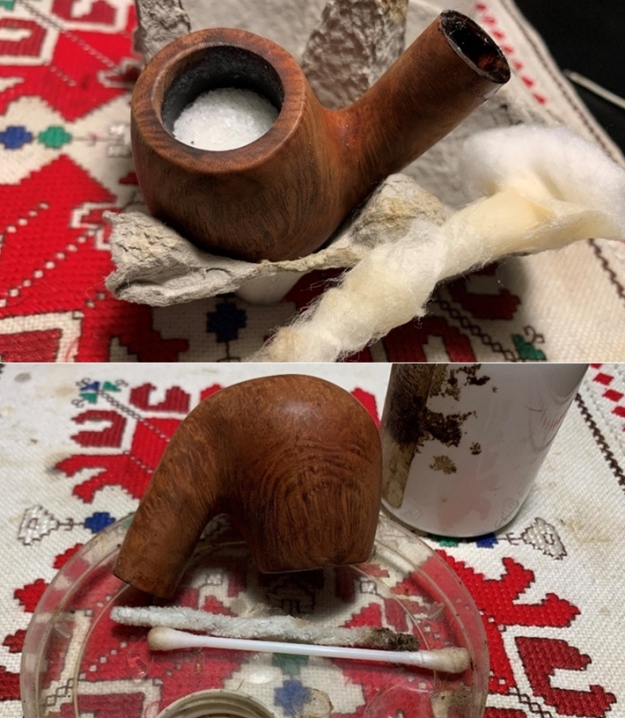
Wow!  The grain on this stummel catches the eye with the flame grain circling the bowl.  This bowl works well as a Churchwarden.  The size is perfect, and the shank pitch puts the long flowing Warden stem at a nice trajectory.  The addition of the copper band/shank cap is classy and works very well to transition the bowl and the stem.  I believe my son-in-law, Niko, will enjoy this Churchwarden which will be wrapped and waiting for him under the tree!  Thanks for joining me!