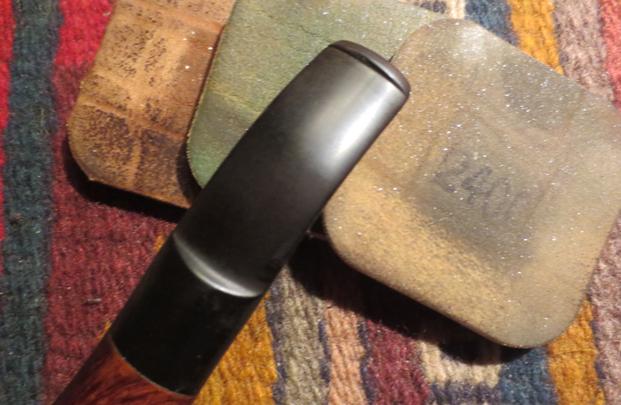
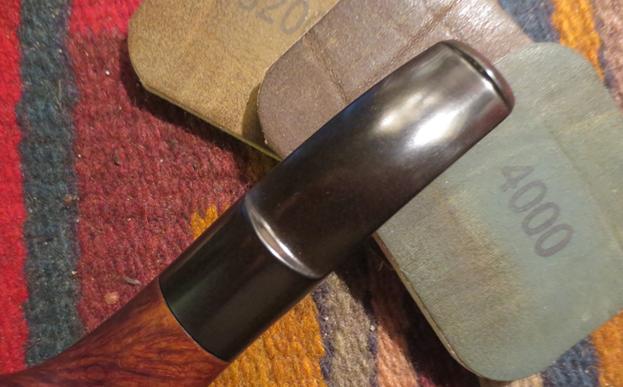
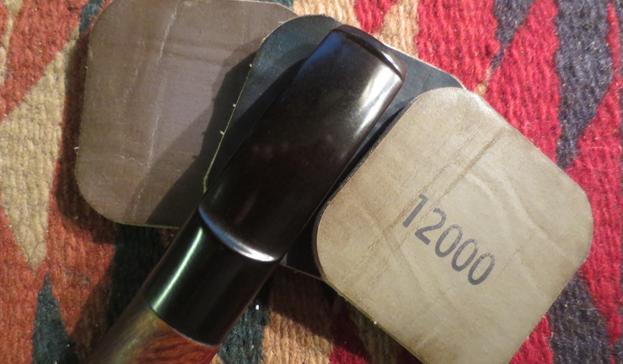
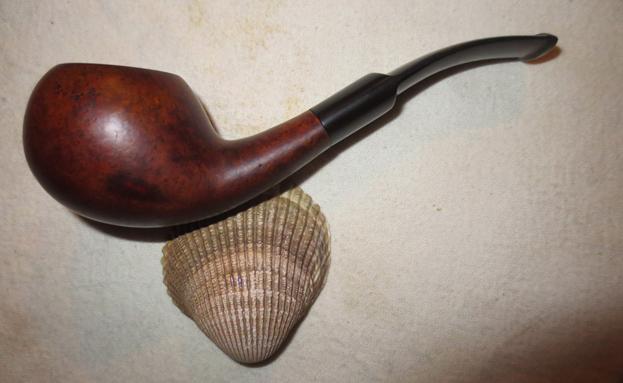
Tag Archives: contrast staining

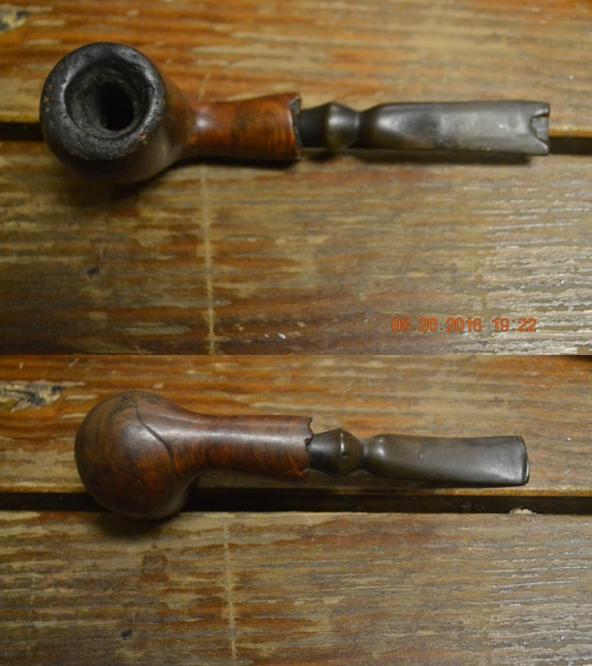
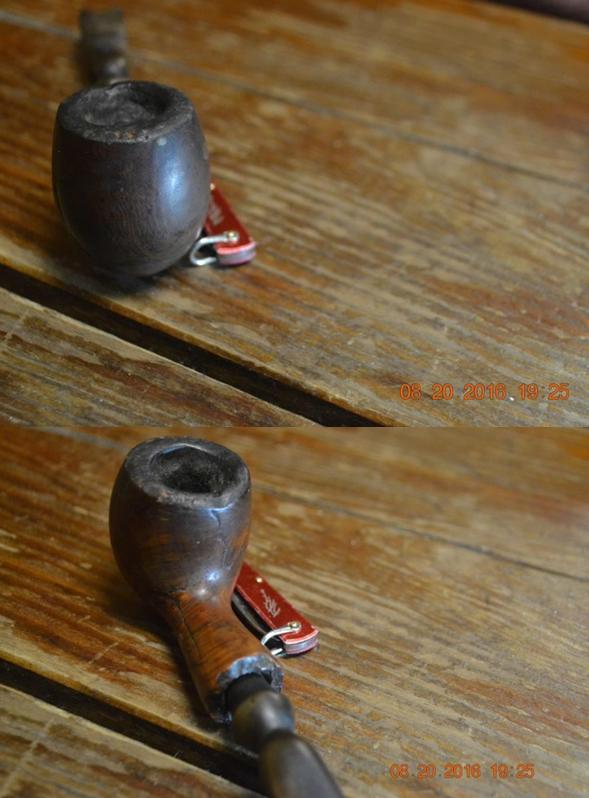
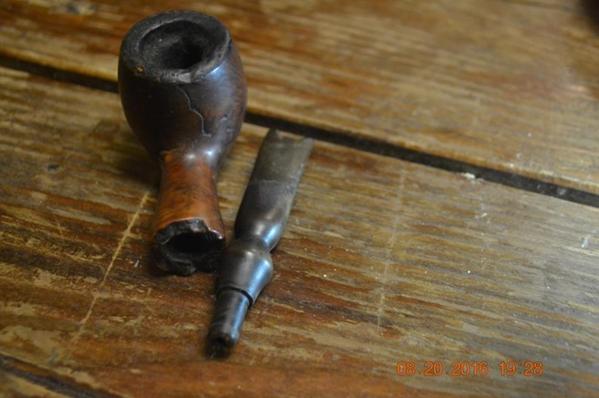
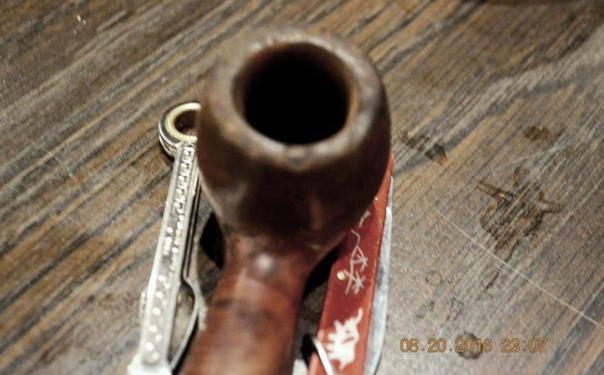
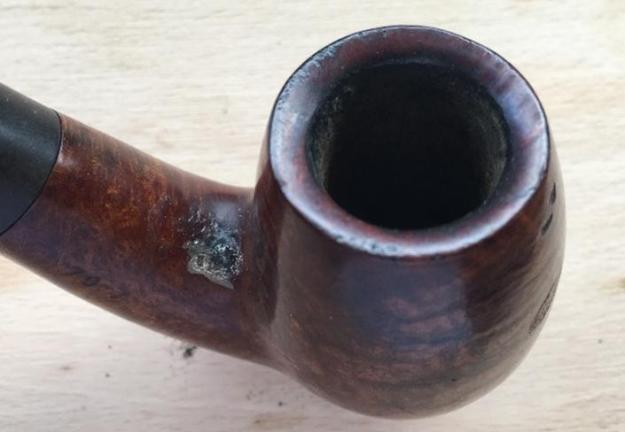
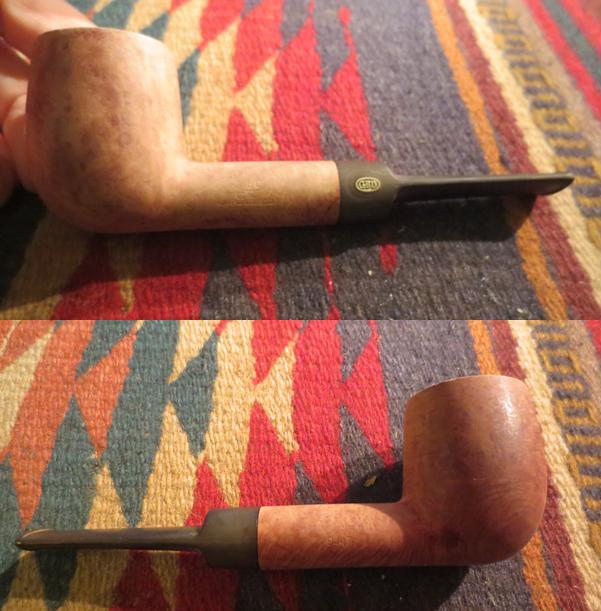
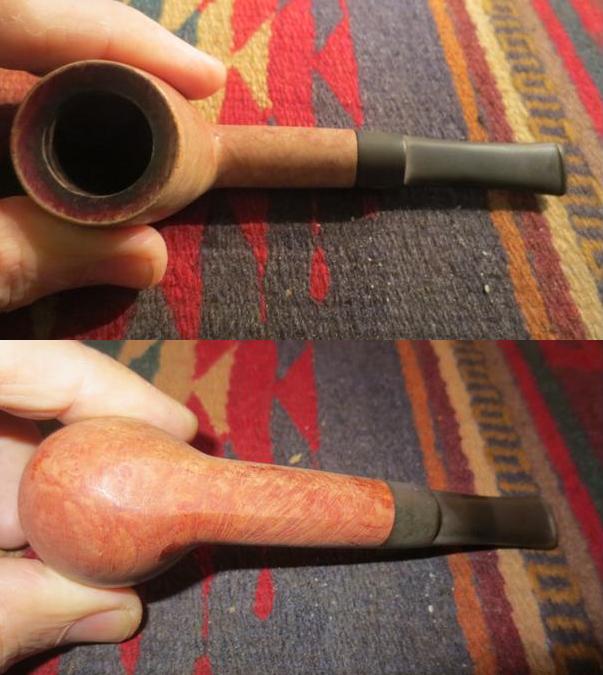
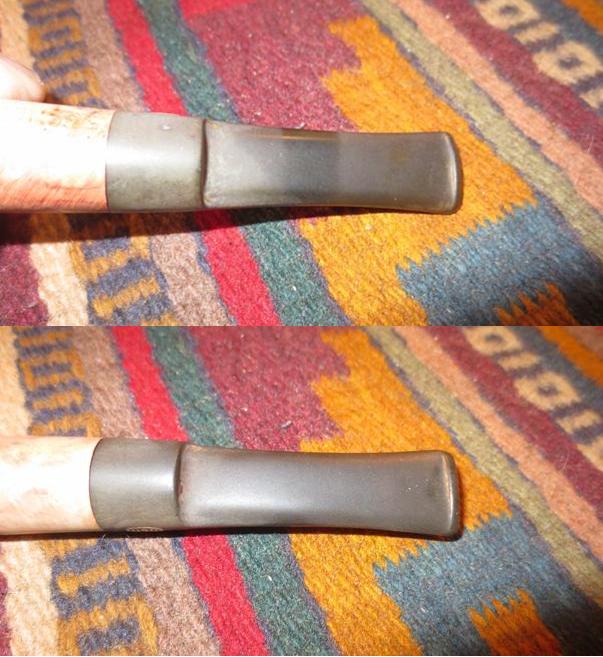
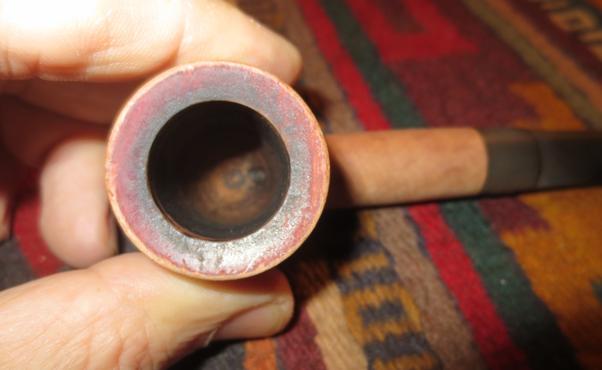
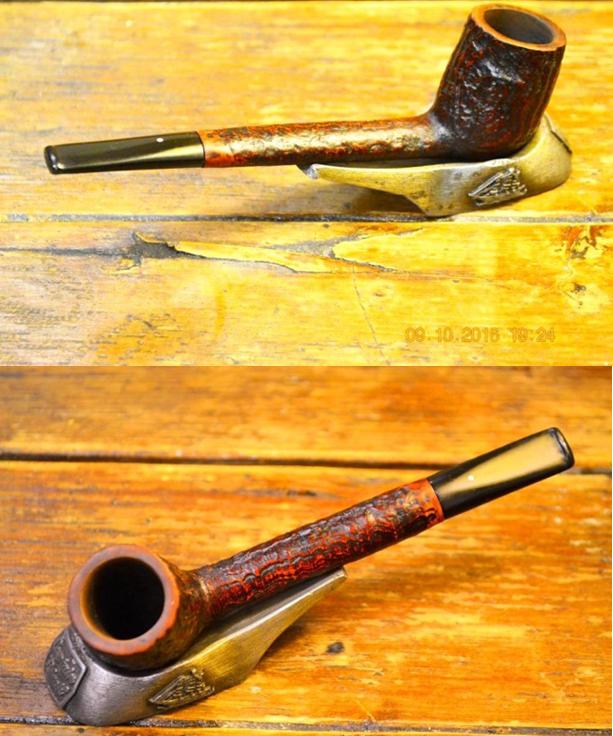
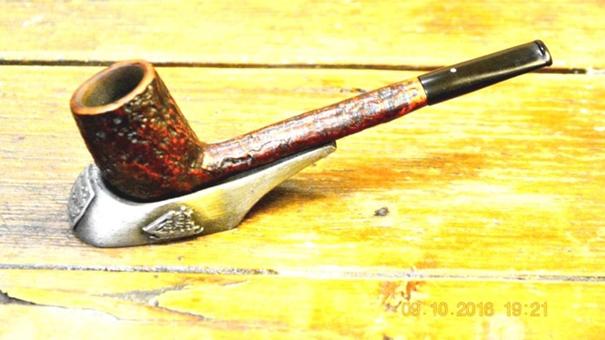
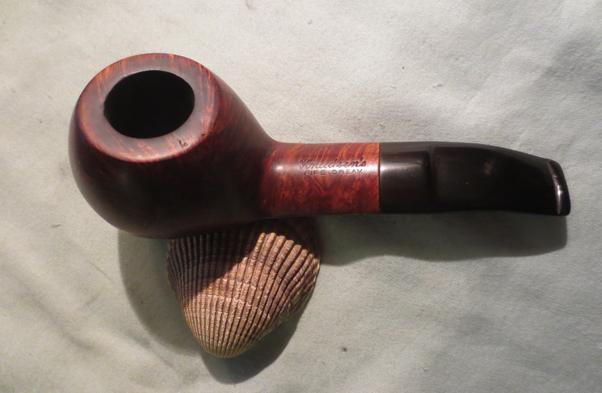
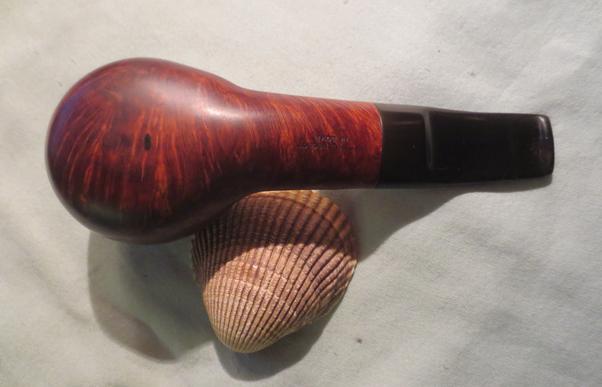
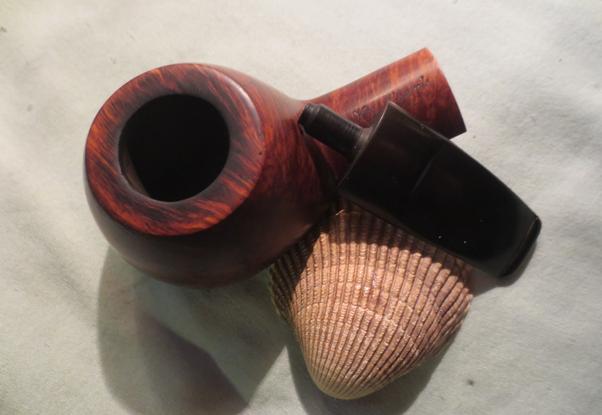
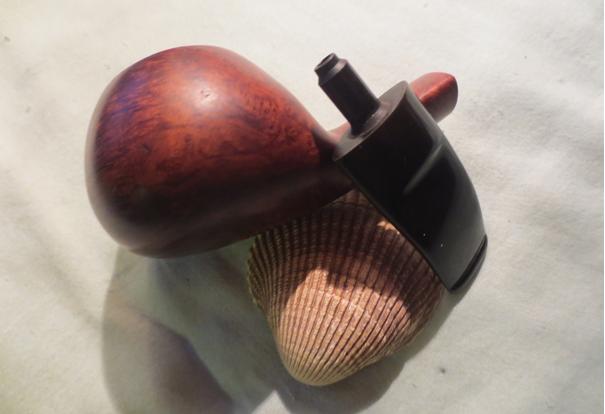
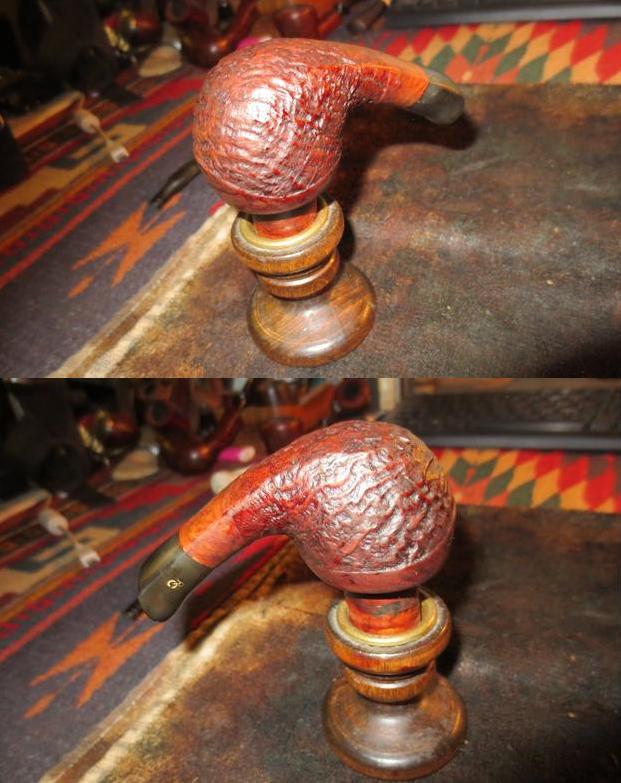
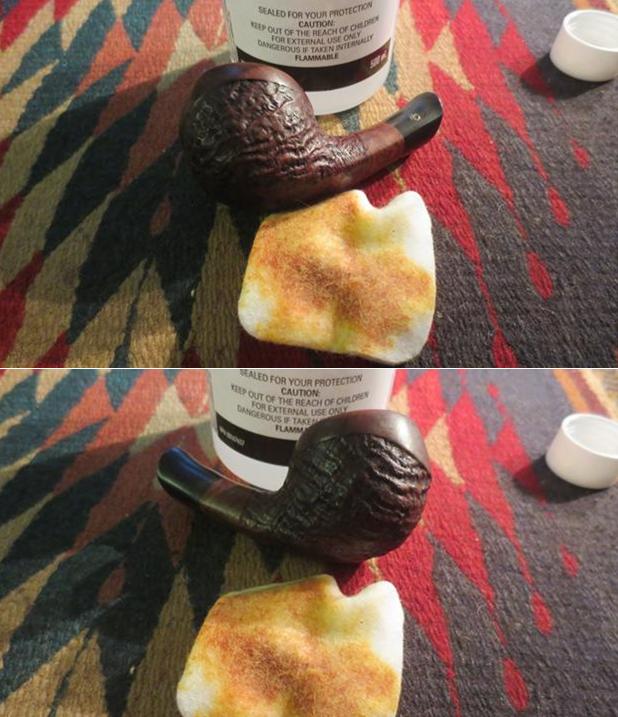
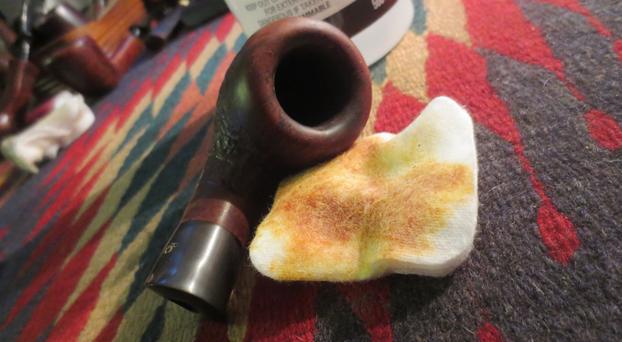
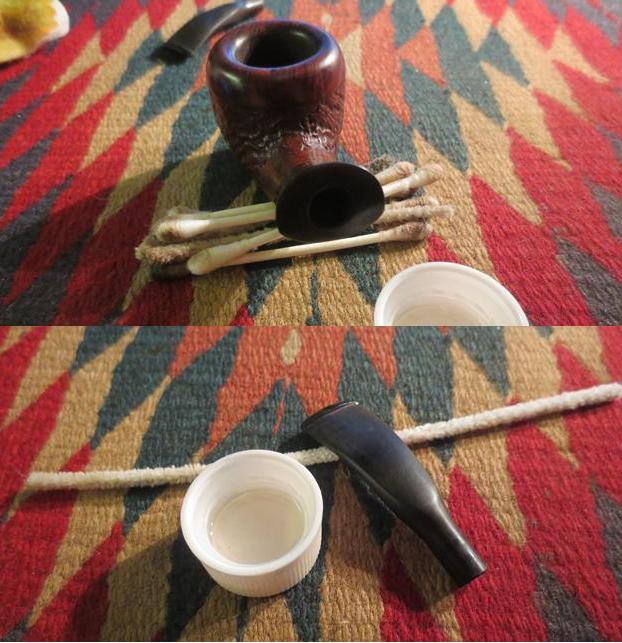
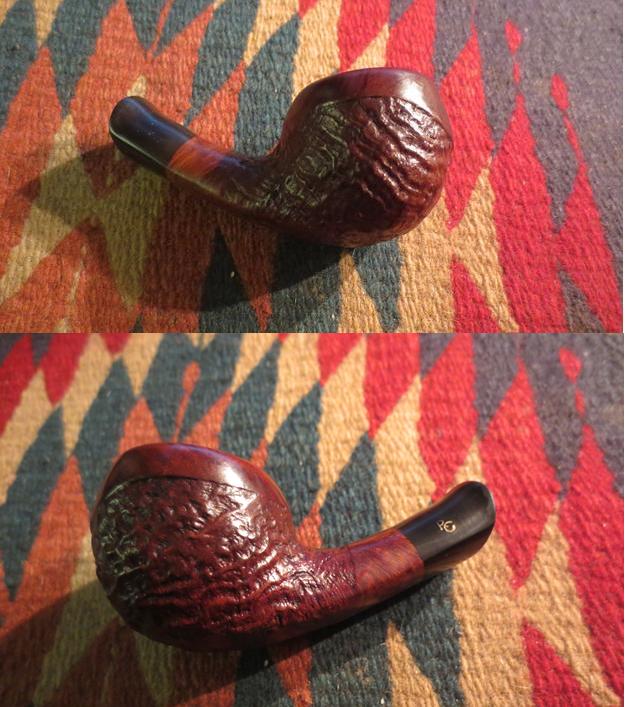
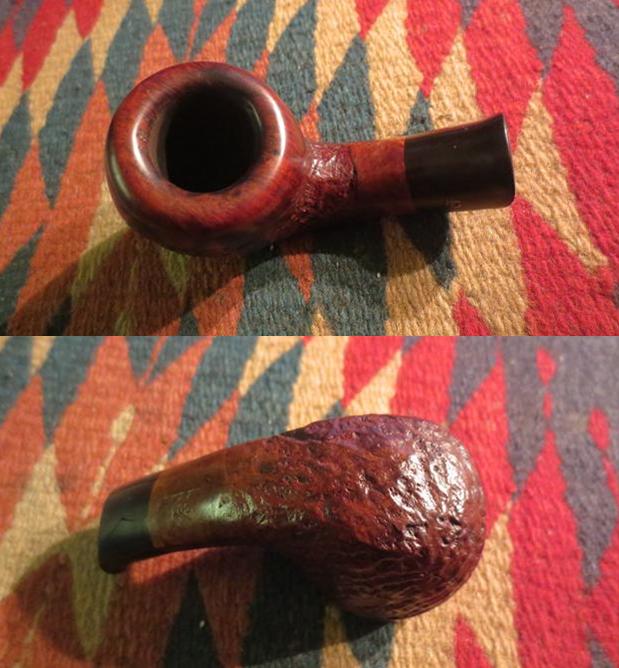
Letting Go of a 1954 Dunhill Patent Sandblast Canadian


Robert M. Boughton

Member, International Society of Codgers
Member, North American Society of Pipe Collectors
Member, Facebook Gentlemen’s Pipe Smoking Society
http://www.roadrunnerpipes21.biz (under construction)
http://about.me/boughtonrobert
Photos © the Author except as noted

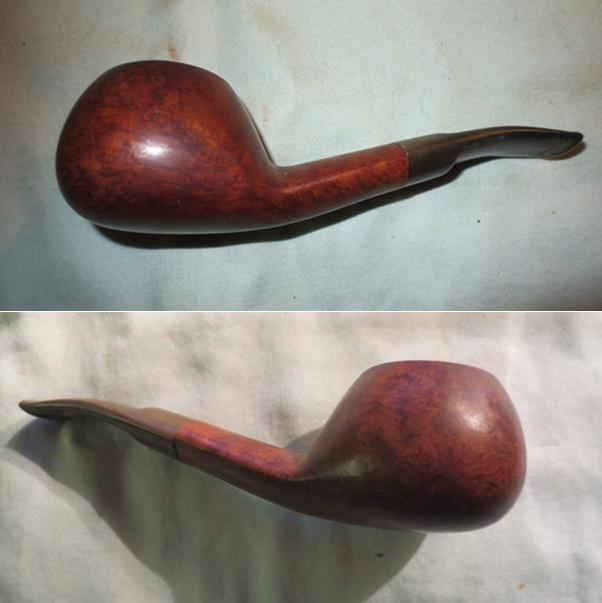
Two years ago, I became the sudden, very fortunate and most of all surprised owner of four Dunhill pipes.  Two – a natural Bruyere billiard #4103 and a sandblasted Shell Briar billiard #114 – were made in years not yet determined, although I suspect 1977 and 1965 respectively.  The other two are a 1976 smooth Root Briar #433 and the 1954 sandblast Shell Briar Patent Canadian that is the cause of my mixed sorrow and pleasure in blogging its refurbish.  You see, the four splendid examples of briar’s best use were gifted to me by a good friend who was ordered by his cardiologist to stop enjoying his beloved pipes, the only reason he gave them to me, and now I am forced to offer one for sale.  Of course, the logical choice happens to be the jewel of my eye.

Larry L., as I will call him, was my patron in two senses of the word: for his generosity, and his status as the first person to buy a pipe on my original online store, and then another.  He was a regular member of my local pipe club for a short time when he was 90 years old, which, based on the date of the bounteous gift makes him 92 now.  Now he is the club’s only Emeritus Member.  I’ve stayed in touch with Larry, by email and phone and several times in person, and although his physical and mental faculties are fit, he lacks the zest for life he had while savoring his large collection by himself and I’m sure more so in the company of his fellow pipe peers, where he was the fastest draw I’ve ever heard with raunchy and off-color jokes.

I have to question the wisdom of his young, well-meaning doctor who forced Larry to quit the hobby and activity he loved more than anything but his wife.  And so to refurbish the pipe for sale after the cursory cleaning I performed when it was gifted to me was not an easy decision.  When times are rough, the cost can be dear.  At least I know I will get a decent price for the sacrificial and beautiful piece of craftsmanship or sleep better keeping it.  My only happiness is the opportunity to share the details of the ’54 Canadian with readers.

When I first took a careful look at the pipe to date it, I thought the sandblasted Canadian was much older based on one of the many erroneous dating methods published online.  Then, a few months ago as I began to advertise the pipe for sale on various forums, I made a better estimate but was still off by three years.  On that occasion I had not understood parts of the dating flowchart on Pipephil.  Returning to the same chart four days ago, with clarification of what Pipephil meant by “Dunhill aligned with Shell” in the nomenclature, I took a third stab at dating the sandblast Shell Briar, starting with Patent No. 417574, on Google’s Patent Search service.  Google Patents almost always finds the desired invention, but again I came up with nothing.

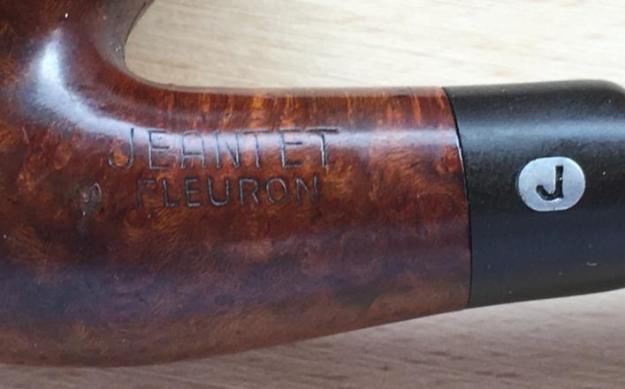
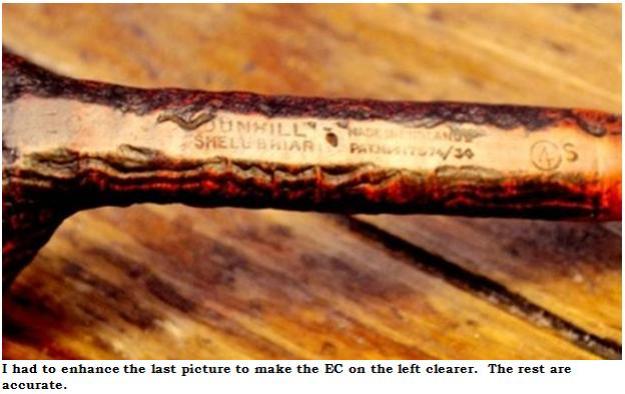
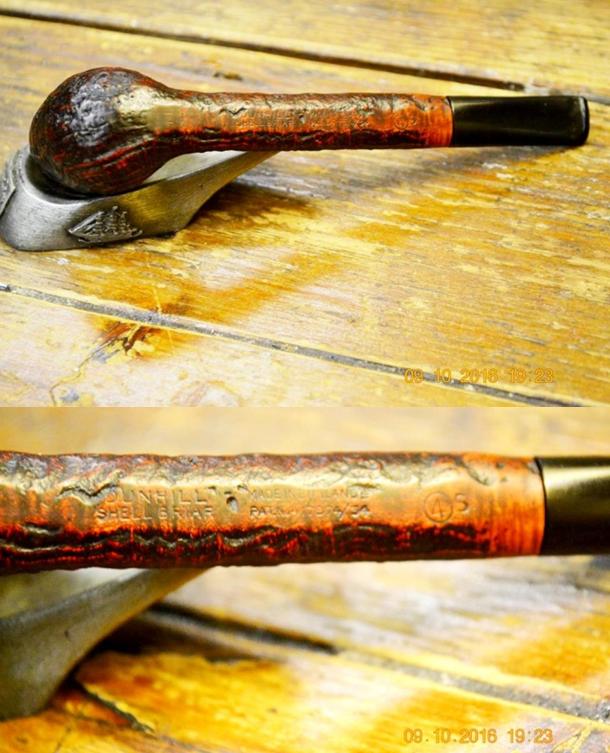
The nomenclature on the pipe reads, in capital blocks, EC on the far left of the smooth sitter bottom; Dunhill above Shell Briar; Made in England and a small 4 with a line under it above Patent No. 417574/34, and then to the far right, a circled 4 with an S.  I have since learned, or come to believe from the veracity of certain sources, that EC is Dunhill’s way of indicating the pipe is a 5½″ Canadian; Shell is the type of finish characterized by deep, rugged sandblasting and a black stain, and the circled 4 with an S is a combination bowl size (running from 1-6) and group code, seeming to indicate in this case a Shell.  I also was informed that 1954 was the last year of the Patent nomenclature and the same year Shell was replaced with Shell Briar.

Somewhat late, to be sure, I came to the conclusion the Patent might be British.  I found the Espace.net link for the European Patent Office shown in the sources below, and had no trouble locating the Patent No. GB417574, granted October 8, 1934.  From this research, it wasn’t difficult to understand the /34 represents the year the proprietary rights were granted to Dunhill for the special tube system within the bit and shank and extending to the mortise hole, and not the year of manufacture.  Steve was good enough to explain something, the answer to which I suspected, when he clarified that “aligned with,” in respect to the words Dunhill and Shell, means beside and not above and below.   As it turned out, therefore, mine was not aligned.  This is central to dating the Dunhill.

Therefore, following the flowchart shown at the first source link below, I answered yes to the pipe having a suffix and Patent Number and then clicked on Narrow Down Your Dating.  The next page said at the top, “Your Dunhill pipe has been crafted between 1921 and 1954.”  Again I followed the yes line under “The Patent Number is 417574/34,” then (and here is the key to whether the pipe was made c. 1940 or c. 1950) no to “Dunhill stamping over London or Dunhill stamping aligned with Shell.”  This led down to Dunhill suffixes 2-4, and mine being the little 4 with a line under it, the chart led to the bottom line: 1950 + suffix, making the year of manufacture 1954.  I tell you, this has to be the most clandestine dating system I have encountered, reminiscent of the sort of codes and tradecraft of MI6, or what Le Carré called by a more apt name, the Circus.  But I found my year of manufacture at last.

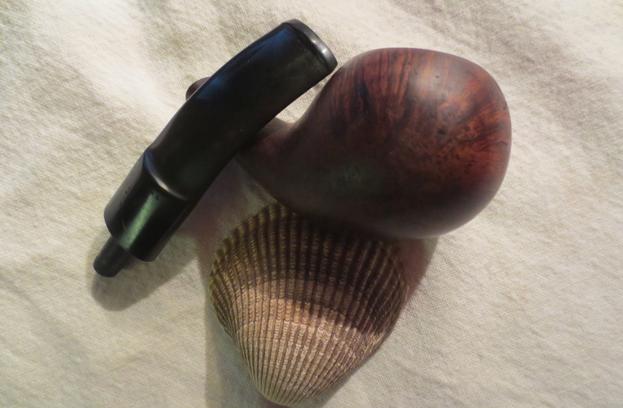
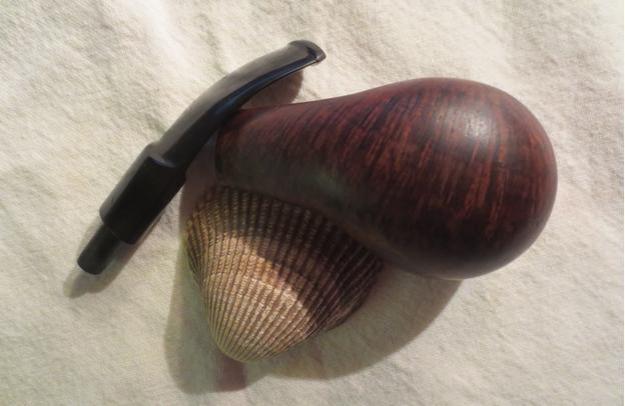
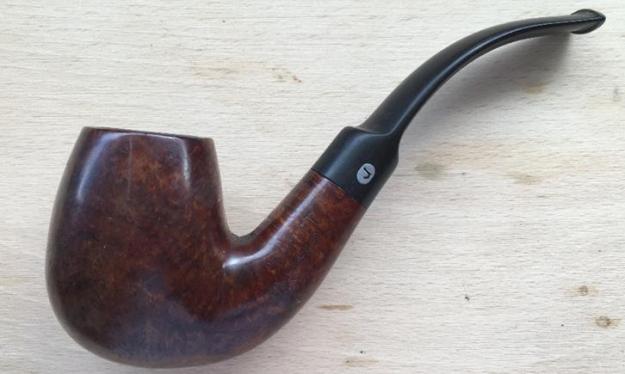
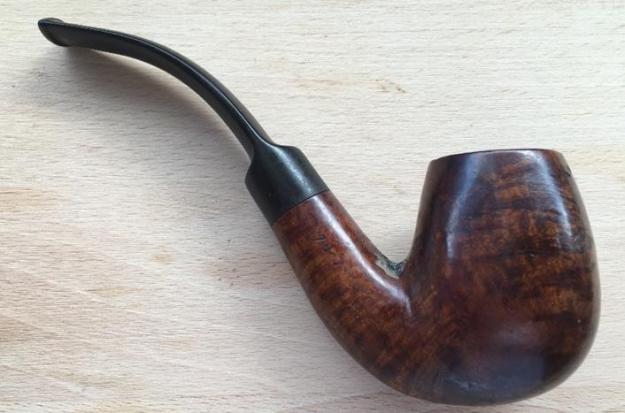
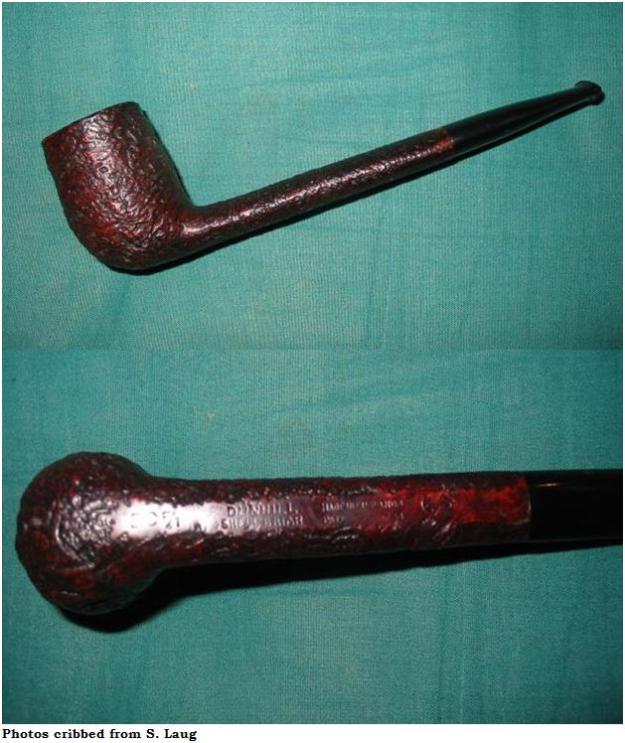
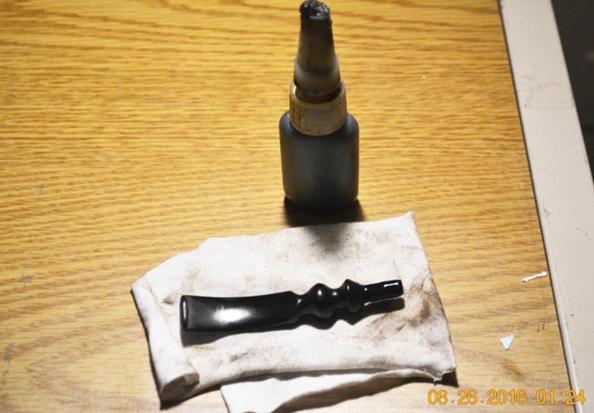
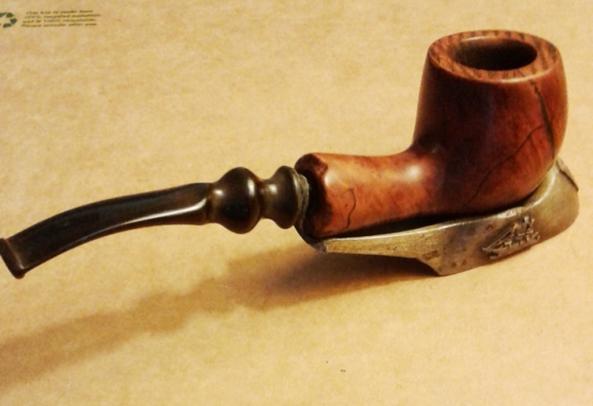
A couple of days ago, double-checking my course through the flowchart, I came across a blog by Steve, called “Reflecting on My Dunhill Collection,” from two years ago.  My conclusion was vindicated by the following photos of his “ultimate pleasure” from one batch of pipes he received, a 1954 Dunhill Canadian identical to mine.dunhill1Having emailed Steve the updated result from the flowchart, I read his response within seconds after copying and pasting the photos of his pipe above: “That is my birth year pipe…what does it look like?”  I referred him to his own blog and inserted the two pics of the twins above, adding that they are identical except for a lighter shade I gave mine.

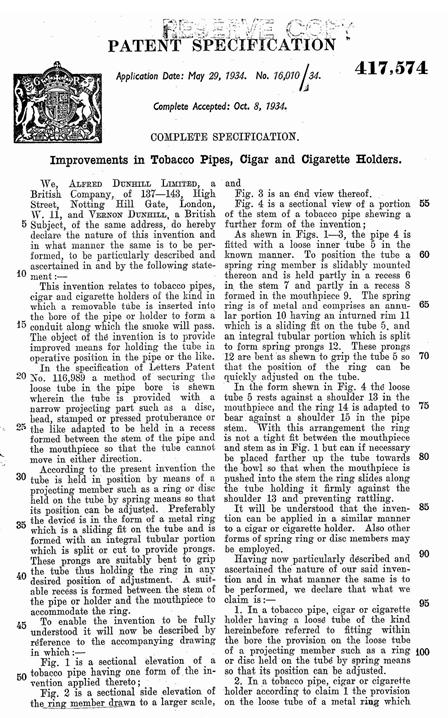
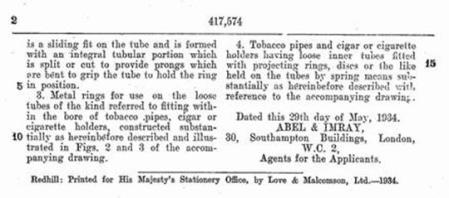
Here is a copy of GB417574. dunhill2 dunhill3 dunhill4The Patent is fascinating on several levels, some of which will be described later.  Of particular importance to this blog is its detailed description of the system in which an improved, removable metal tube “is inserted into the bore…to form a conduit along which the smoke will pass.”  A revised, spring ring to hold the tube in place with better effect than earlier Patents is added to supplement an improvement that was part of another Patent, GB116989, requested along with this one but granted the next year.

The version in the 1954 Canadian has two tubes and rings, one pair in the shank and leading to the mortise and the other within the mouthpiece and the rest of the bit.  These innovations are not only clever but quite durable and effective, and the tubes can be seen with close scrutiny within the openings of the push tenon and shank.  The most amazing aspect of the invention is the tiny size of its pieces that somehow fit the slim bit and shank of the Canadian.

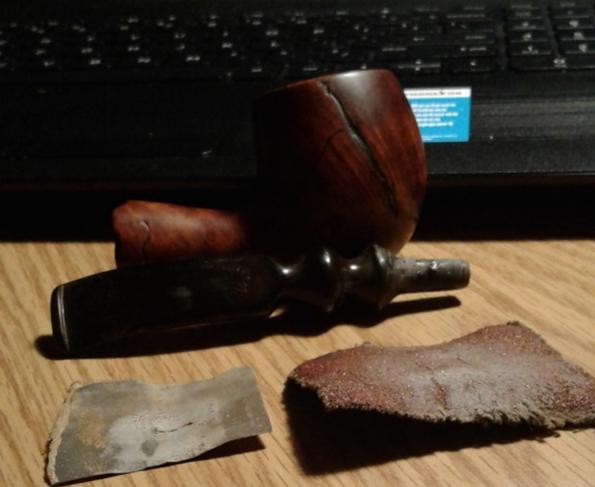
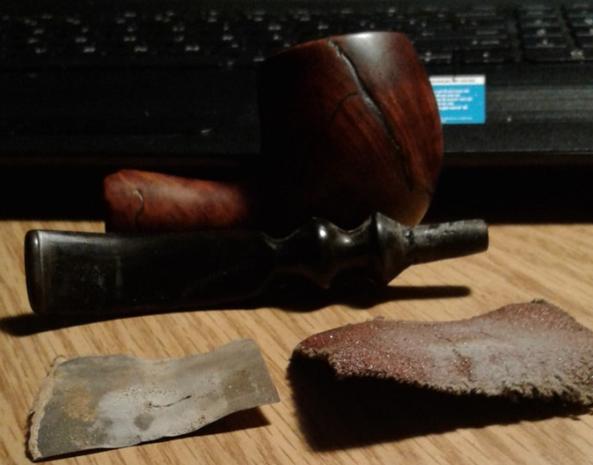
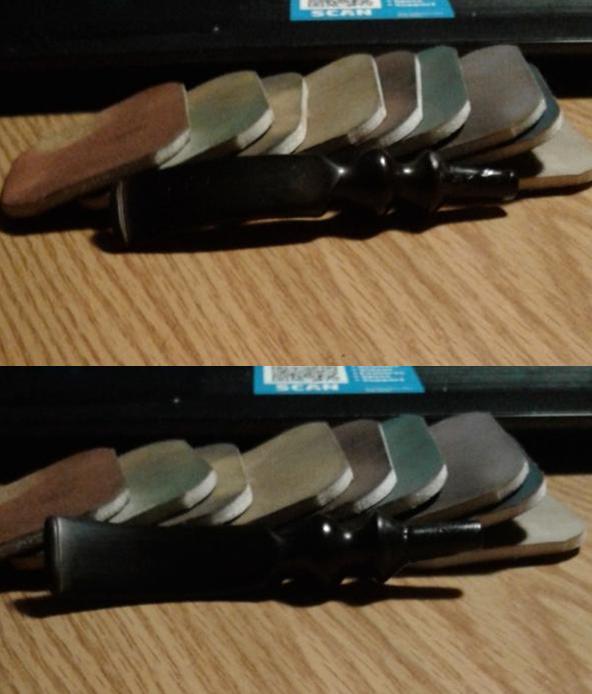
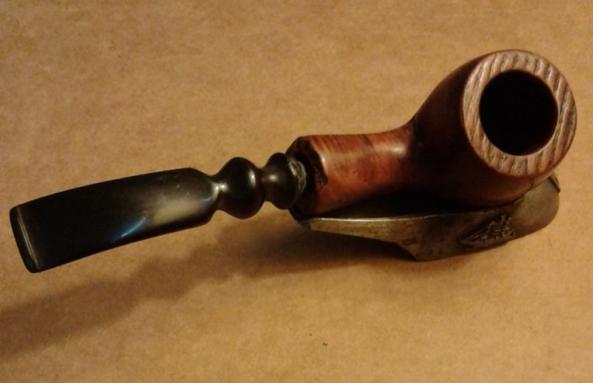
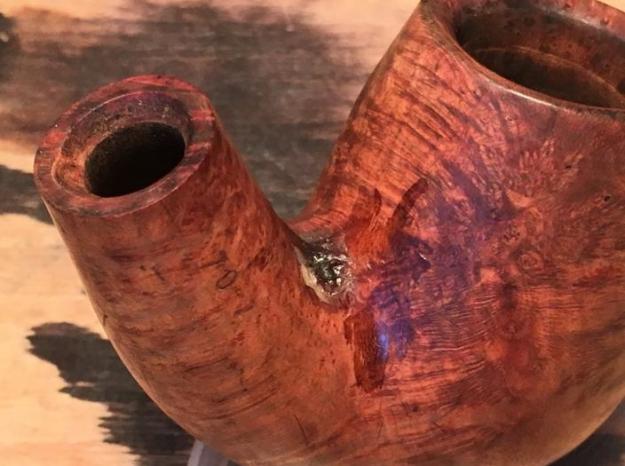
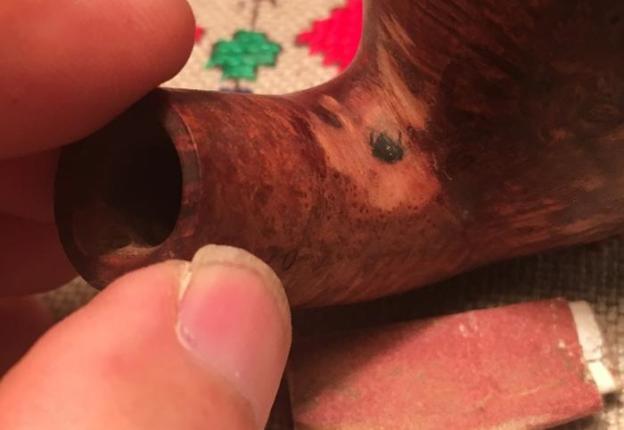
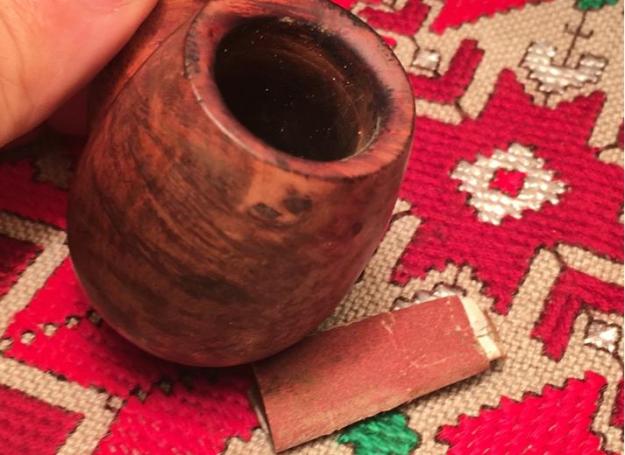
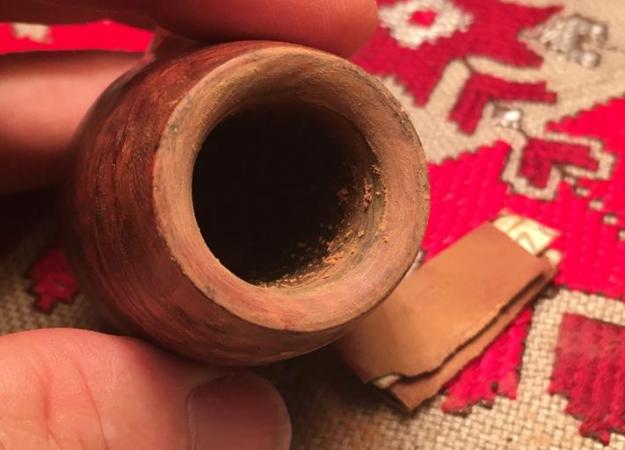
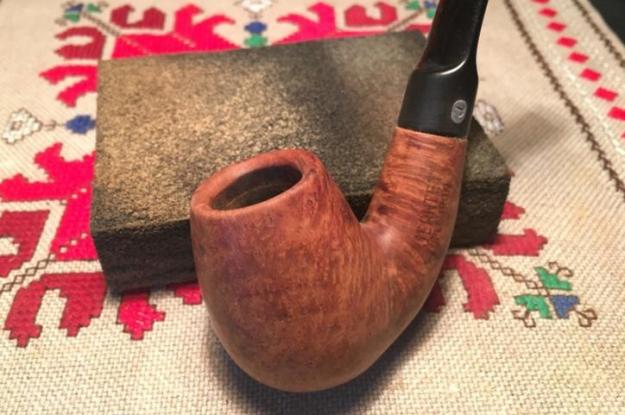
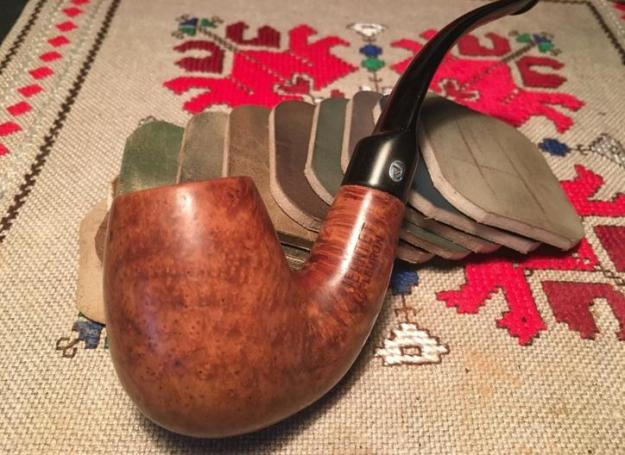
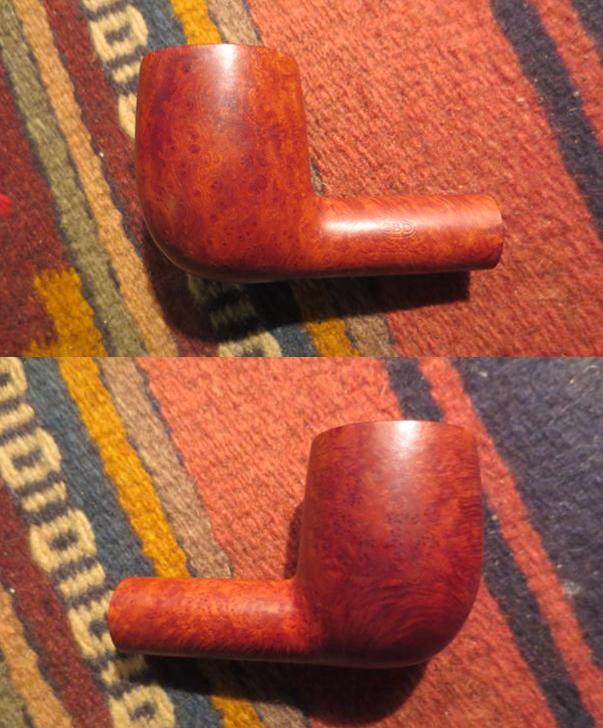
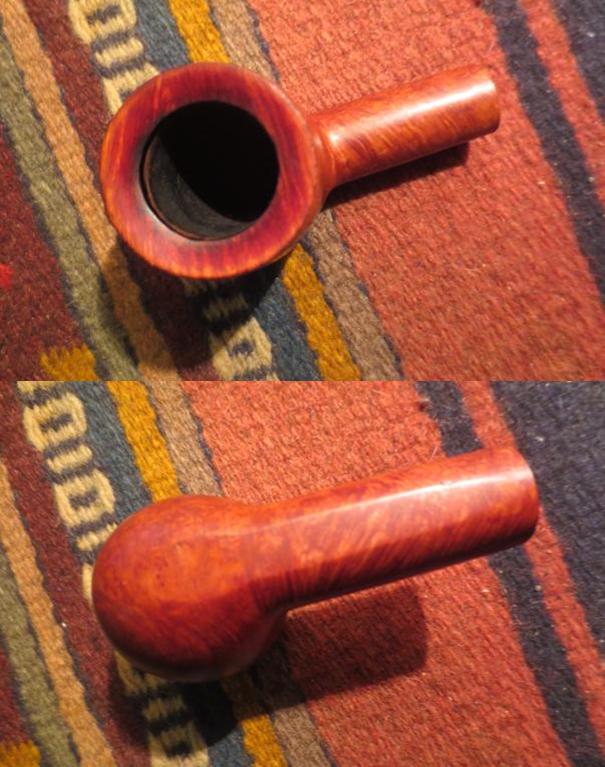
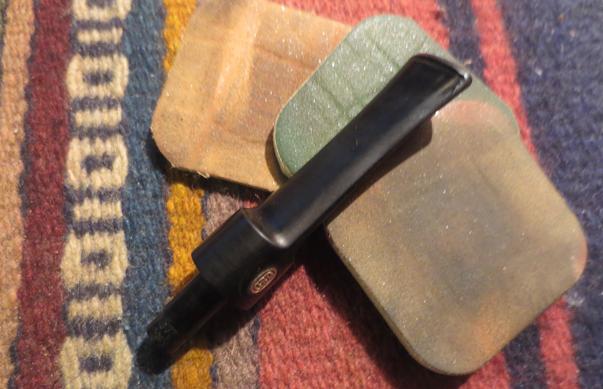
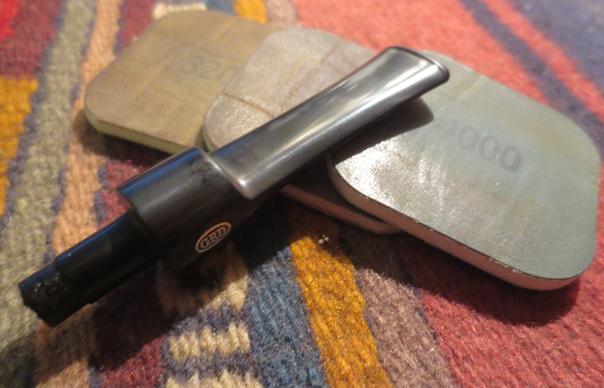
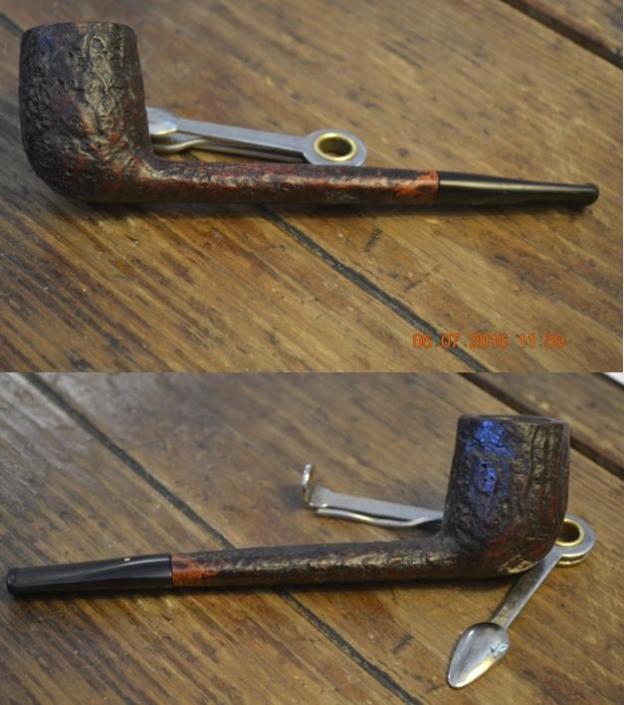
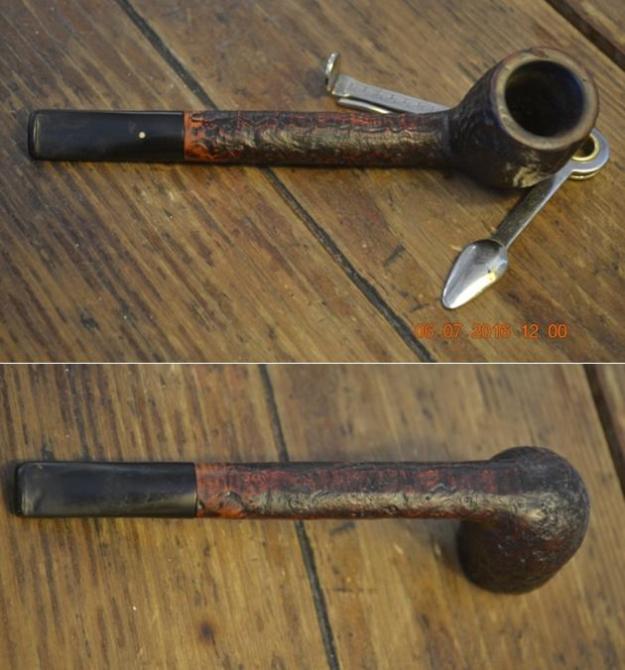
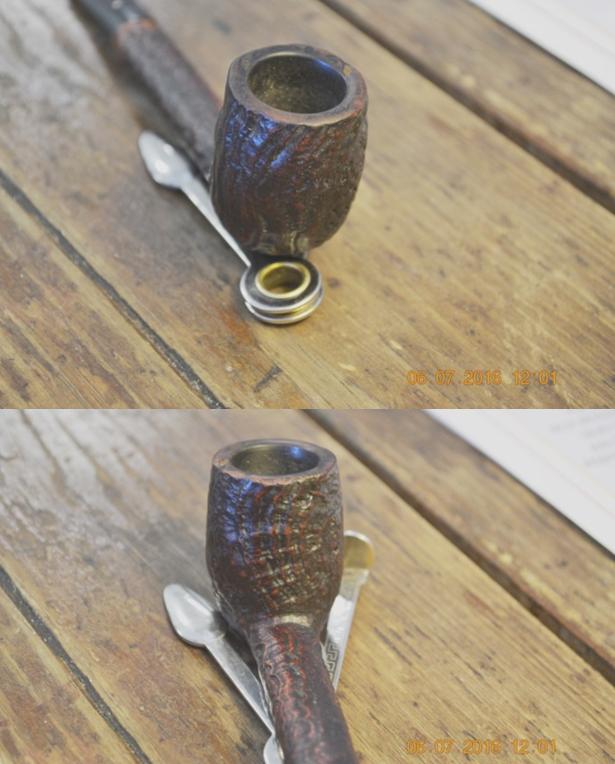
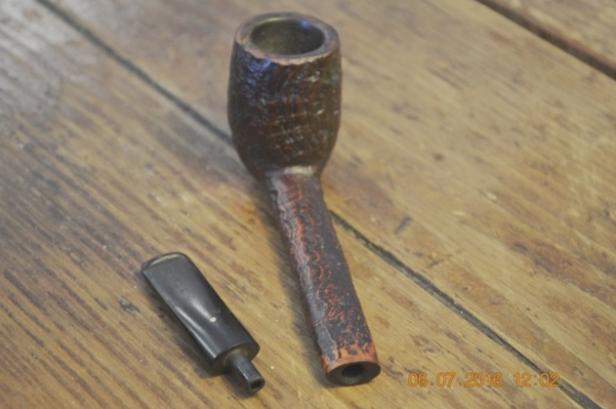
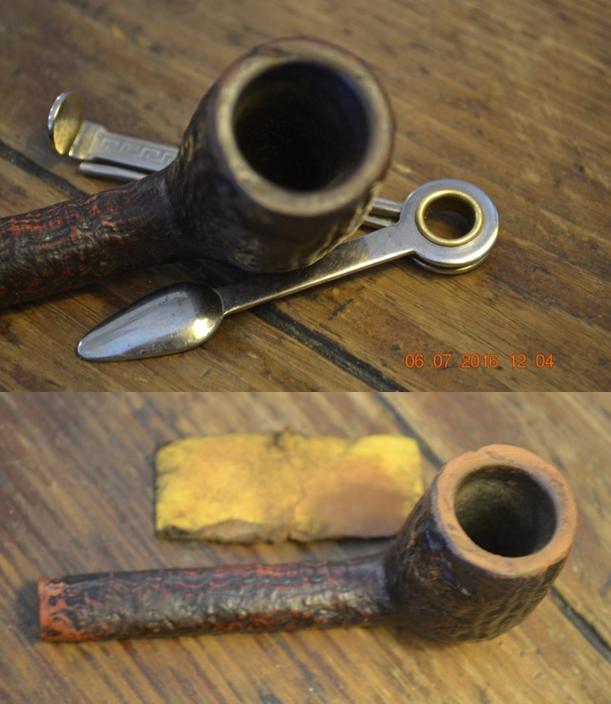
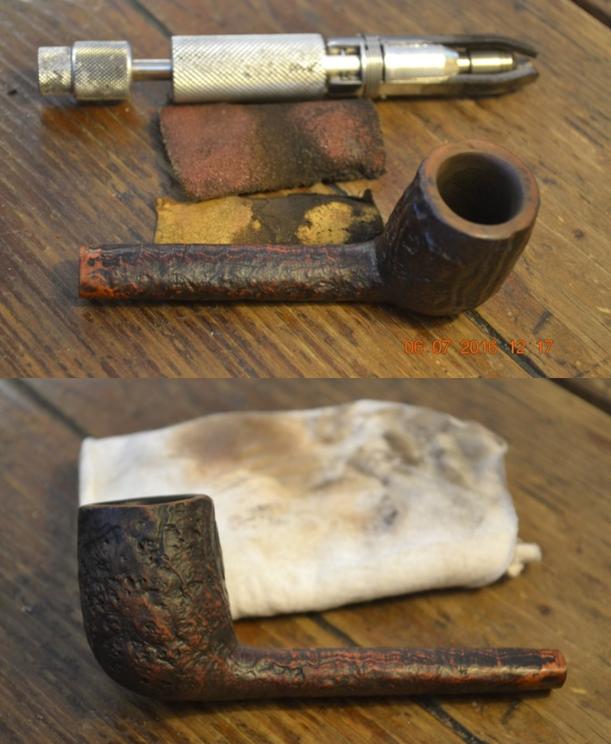
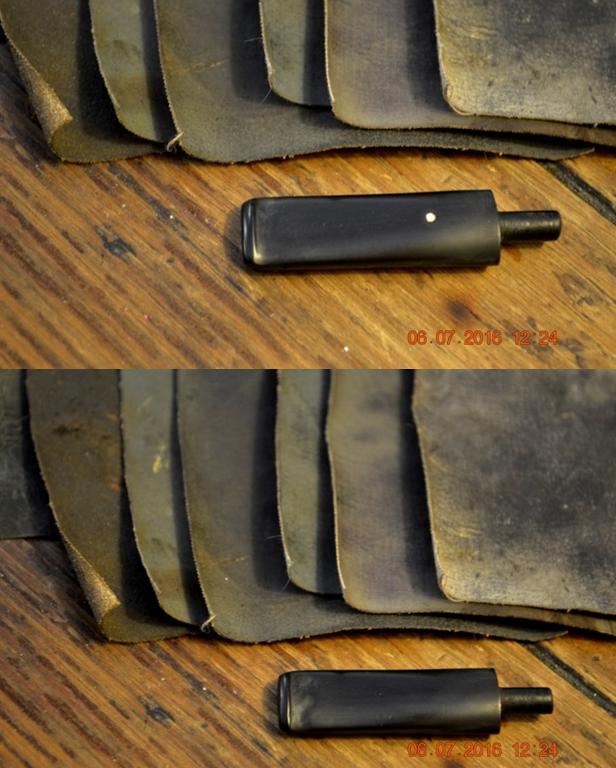
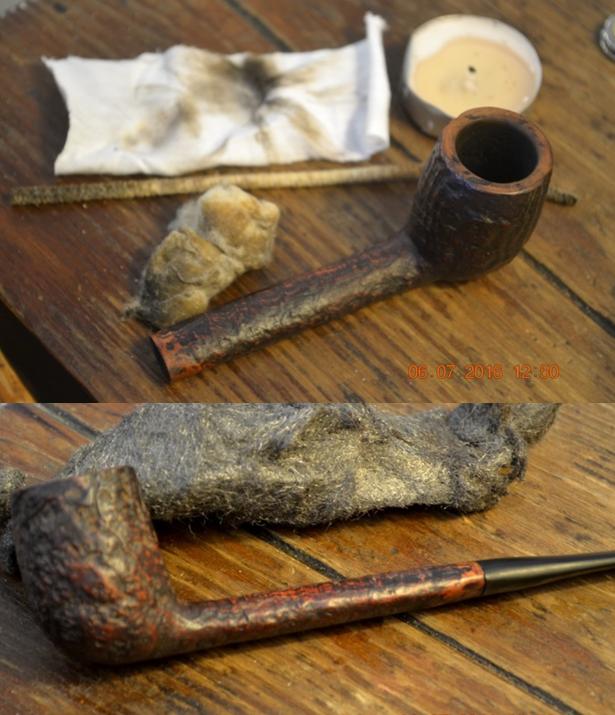
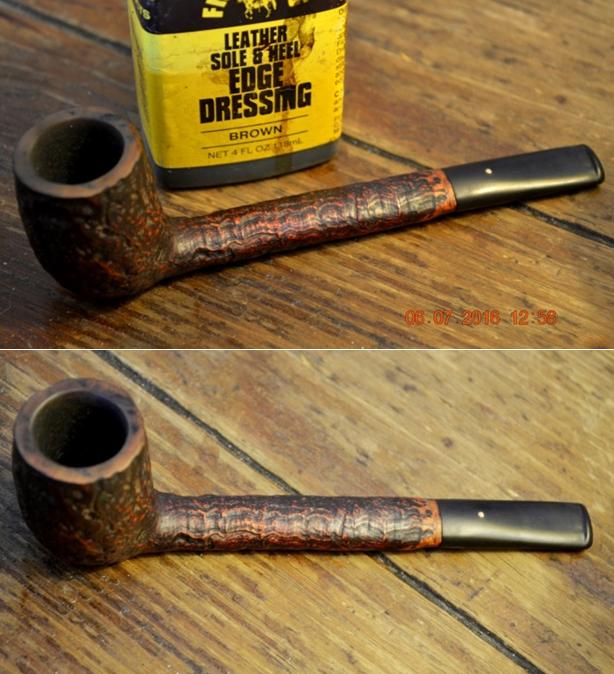
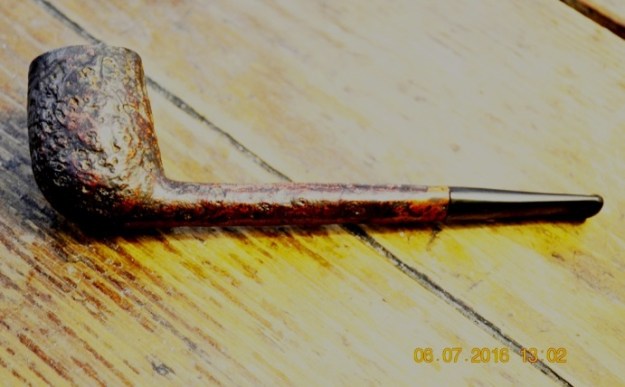
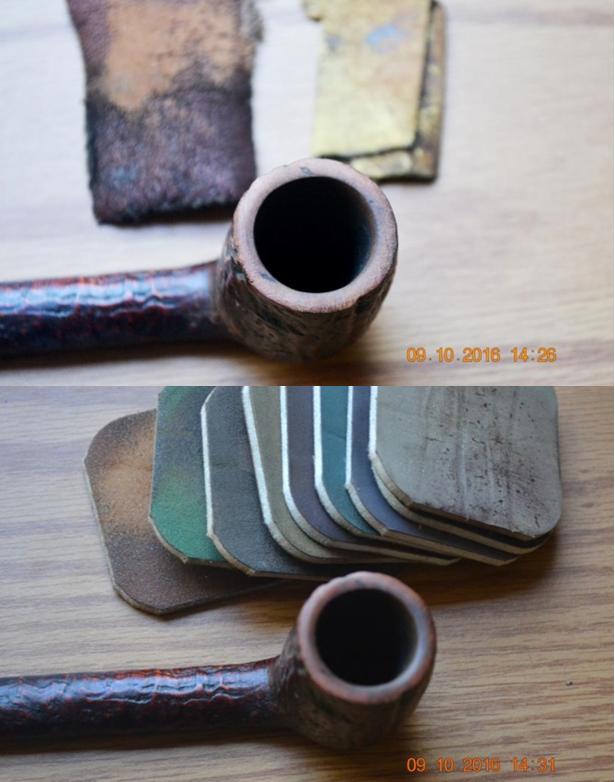
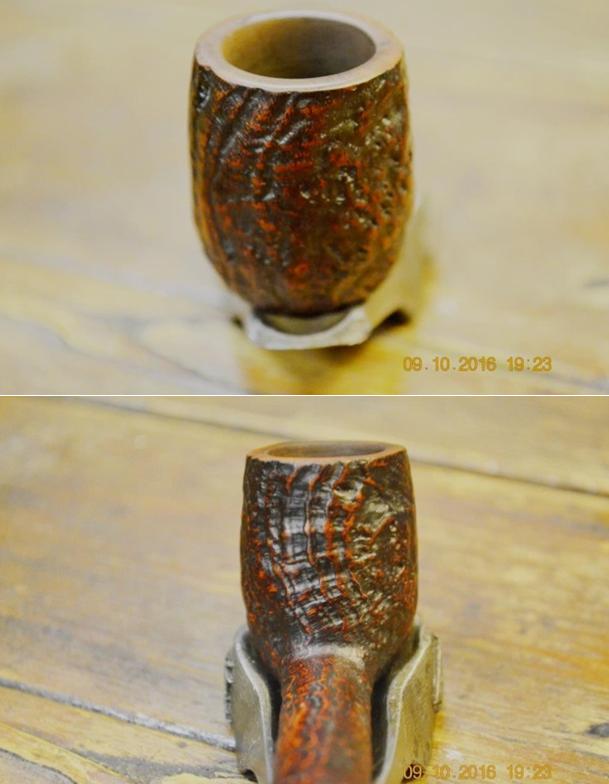
The pipe was in great condition when I received the gift.dunhill5 dunhill6 dunhill7 dunhill8 dunhill9To start the restore, I went at the rim with 220-grit sandpaper because of some dings that were too deep for micro mesh or even very fine paper.  Even so, more work was needed later, as will be shown.  Then I reamed the chamber and sanded it smooth with 180- and 320-grit paper and wiped the exterior using a soft cotton gun cleaner cloth with a little purified water.dunhill10 dunhill11I figured I might as well knock off the bit, which was in good shape but needed some quick work with the only viable micromesh kit I had at the time.  This was only last June, but my old set of usual pads was decimated and not yet replaced.dunhill12 dunhill13Retorting the pipe, I decided to take off a little of the darker color to show more of the natural rust hue of the briar, using super fine 0000 steel wool.dunhill14I re-stained the rim with Fiebing’s Medium Brown alcohol-based boot conditioner, flamed it with a Bic and micro meshed off the thin coat of char with 800 and 12000.dunhill15The touch-ups above were made June 7.  I revisited the Canadian after transferring all of the photos so far, as well as seven more of the “finished” pipe, from my DSLR memory stick to the computer.  Next is the left side view as it appeared two months to the day later.dunhill16I should have kept the original top view from when I thought the work was complete in July.  As I did not, you’ll just have to take my word that the rim work was, I must confess, sloppy.  And so, here is the rim after sanding again, with 180- and 320-grit papers, micro meshing all the way, staining with the medium brown and flaming it again, and micro meshing off the thin band of light char with 4000, 8000 and 12000 micro mesh once more.dunhill17 dunhill18The true finishing touches were adding a thick coat of Halcyon II wax, setting the stummel aside for a half-hour and buffing on the clean electric wheel as much of the wax as possible into the wood while removing the excess.dunhill19 dunhill20 dunhill21 dunhill22The Patent, again, is an engaging document.  In fact I consider the text worth reading despite its detailed description that is styled in universal Patent-ese.  Somehow this Patent, among the millions of sterile, lackluster examples that tend to put most unaccustomed readers to sleep, shines with refined elegance one would expect only from the British.  The just-more-than-one-page of text as well as the drawings have a secure place in pipe history.  And then there are the little touches to enjoy   For example, easy to miss, with the eyes scanning and expecting to read “shown,” is the repetition of the antiquated (chief. Brit., as the staid but thorough Oxford English Dictionary might add) “shewn.”  Still more overlookable is the typical economy of language displayed in the first paragraph, referring to “We, Alfred Dunhill Limited, a British Company, of 137-143, High Street, Notting Hill Gate, London, W. 11, and Vernon Dunhill, a British Subject, of the same address….”  At last, seen only by the greatest of Anglophiles, is the printer’s credit that states:

“Redhill: Printed for His Majesty’s Stationery Office, by Love and Malcomson, Ltd. – 1934.”

Redhill is a U.K. town next to Surrey, south of London.  Love and Malcomson Ltd. was a British printer and later book publisher established in 1901 and lasting until 1983, when it was dissolved.  The reference to His Majesty at the time of printing was King George V (r. 1910-1936).  Easy to forget are the other His Majesties during Love and Malcomson’s illustrious time: prior to George V, King Edward VII (r. 1901-1910); King Edward VIII (r. 1936), until he became the only monarch in British history to abdicate – for the woman he loved – and King George VI (r. 1936-1952) of “The King’s Speech” fame.

And then, of course, there is Queen Elizabeth II (r. 1952-present), to whom Love and Malcomson was a loyal British Company for the first 31 years of her monarchy that has so far lasted 64 years, the longest of any British sovereign.

I’ll finish up with a fascinating tidbit about Dunhill history, what Saturday Night Live might have called a “Deep Thought by Jack Handy.”  I never even considered the origin of the now famous White Dot atop Dunhill pipe stems.  Then one day my research took me to a Pipedia page with a time line.  Among the long list of dreary, bygone dates and facts, I came across this single, novel and somewhat sad bit of intelligence: in 1915, five years after the company formed, Alfred and his advisors came to the bright idea that their customers should be given some help whilst reattaching the bit, like, I suppose, after removing it to clean.  I can’t with honesty know what they were thinking.  But anyway, that conundrum gave birth to the now revered single White Dot – so that Dunhill buyers everywhere might know which side of the stem goes on top!  I don’t know about the rest of you, but I find this reasoning behind the White Dot somehow discouraging, disappointing and downright depressing.  I mean, did Alfred Dunhill Limited, the mighty British Company, get so many complaints about which side was up to conclude its loyal fans must be stupid?  And were they maybe really that dense?  The whole thing is just too much for me.  My deepest thoughts on the meaning of the mysterious single White Dot have been dashed forever.  I think I need to take a nap now, as the melancholy Jack Handy would do. dunhill23

SOURCES

http://www.pipephil.eu/logos/en/dunhill/cledat-en1.html
http://www.rdfield.com/Articles/A%20Dunhill%20Pipe%20Dating.htm
https://rebornpipes.com/2012/11/01/dunhill-pipe-shapes-collated-by-eric-w-boehm/
https://pipedia.org/wiki/Dunhill#Shell
http://www.loringpage.com/attpipes/dundate.htm
https://rebornpipes.com/2014/03/23/reflecting-on-my-dunhill-collection/
http://www.epo.org/searching-for-patents/technical/espacenet.html#tab1
https://worldwide.espacenet.com/publicationDetails/originalDocument?CC=GB&NR=417574A&KC=A&FT=D&ND=3&date=19341008&DB=en.worldwide.espacenet.com&locale=en_EP
https://worldwide.espacenet.com/publicationDetails/biblio?FT=D&date=19341008&DB=en.worldwide.espacenet.com&locale=en_EP&CC=GB&NR=417574A&KC=A&ND=4
http://www.cooperativepatentclassification.org/cpc/scheme/A/scheme-A.pdf
http://www.pipephil.eu/logos/en/dunhill/cledat-en1b.html
https://companycheck.co.uk/company/00070719/LOVE-AND-MALCOMSON-LIMITED/companies-house-data
https://en.wikipedia.org/wiki/English_and_British_monarchs_family_tree_(simple)
https://pipedia.org/wiki/Dunhill
http://www.historyonthenet.com/monarchy/timelinetwentiethcentury.htm

Repairing and Rejuvenating a Soren Danish Freehand


Blog by Steve Laug

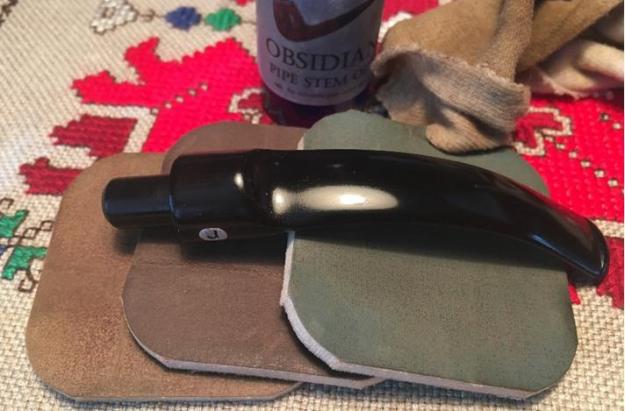
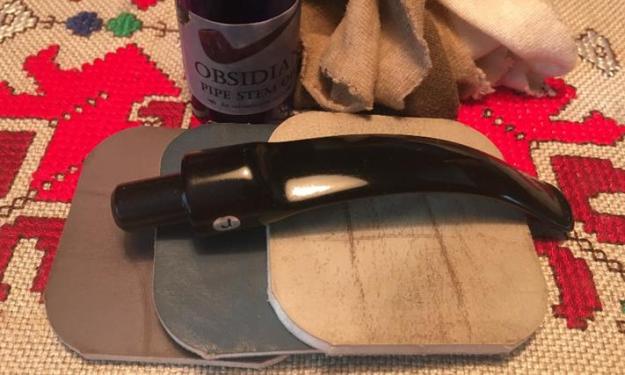
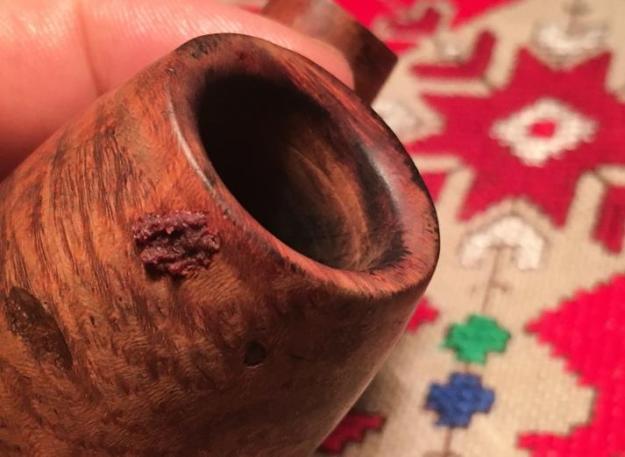
soren1aThe fifth pipe I am working on for Steve in Dawson Creek, British Columbia is a beautiful freehand that is stamped Soren Hand Carved over Made in Denmark on the underside of the shank. The finish is not bad. There were two cracks in the plateau rim top with one of them just on the rim and the other one coming down the left side about ¼ inch. These would need to be repaired. The bowl had a light cake and there was overflow onto the plateau top. This would need to be scraped clean. The shank end was also plateau and it had a lot of dust in the grooves. The finish on the bowl was dirty and there were some small nicks on the sides. It has a diamond-shaped freehand stem that was lightly oxidized and had tooth marks on the top and the underside near the button.soren1I looked up the brand on pipephil (http://www.pipephil.eu/logos/en/logo-s10.html) and found that the brand was carved by Søren Refbjerg Rasmussen. Pipes that he made for the European market were mostly stamped “Refbjerg” while those made for the US market were stamped “Soren”. Thus I knew that one I was working on was imported into the US market.soren2I took a close up photo of the rim and the bowl to show the condition of the pipe when I took it out of the box. The thick cake on the top of the bowl rim filled in much of the plateau surface. You can see the thickness of the cake in the bowl. In the photo you can see that it is thicker at the top than at the bottom of the bowl.soren3I took photos of the stem to show the light oxidation and the scratching and wear to the stem. There were small tooth marks on the top and underside of the stem near the button.soren4I took some photos of the condition of the bowl and the finish before I started cleaning the pipe. I wanted to be able to track the difference in the cleanup of the briar. In the second photo below I used a dental pick to try to pick at the thick cake on the rim. It would not be the way to clean up the rim.soren5I reamed the cake back to bare briar using the Savinelli Pipe Knife. In the photo below you can see the crack on the left side near the rim. I have circled it with red to highlight the crack.soren6I used a microdrill bit to drill a cap hole at the end of the crack to keep it from spreading further down the side of the bowl. The crack was not long so it was an easy fix.soren7I cleaned the top of the rim with a brass bristle brush to clean out all of the grooves and the areas of plateau on top of the bowl. It worked far better than the dental pick to clean off the thick cake on the bowl top. In the photo below you can see the two small cracks. I have circled both of them. I cleaned them out with a dental pick so that they were open. The crack did not go down into the interior of the bowl.soren8I pushed briar dust into the crack and the end cap hole and the put super glue on top of the dust. I put more dust on top of the glue. The three photos below show the repairs.soren9 soren10I sanded the repaired areas with 220 grit sandpaper to remove the excess briar dust and super glue and blend the repairs into the surface of the briar.soren11After sanding the repairs I wiped down the bowl with alcohol to remove the grime on the surface of the briar. I carefully wiped down the area of the repairs.soren12 soren13The next photo shows the repaired area on the side of the bowl toward the top.soren14I touched up the repaired areas with a medium stain pen to blend those lighter areas on the side and on the rim with the colour of the stain.soren15I buffed the pipe with Blue Diamond on the buffing wheel and gave it multiple coats of carnauba wax. I buffed it with a clean buffing pad. I took the next photos of the bowl after buffing.soren16The photo of the top of the bowl shows the newly stained and contrast finish on the rim. I used a black Sharpie pen to colour in the grooves in the top of the rim and the end of the shank. I used the stain pen over that. On the bottom of the bowl the birdseye grain shows some dark stain in the grain.soren17 soren18I cleaned out the mortise and the airway in the shank and the stem with cotton swabs, pipe cleaners and alcohol until they were clean.soren18aI polished the stem with micromesh sanding pads – wet sanding with 1500-2400 grit pads and dry sanding with 3200-12000 grit pads. I rubbed the stem down with Obsidian Oil after each set of three grits. I set the stem aside to dry.soren19 soren20 soren21I buffed the bowl and stem together with Blue Diamond polish and gave it several more coats of carnauba wax. I buffed the pipe with a clean buffing pad and with a microfiber cloth to deepen the shine. The finished pipe is shown in the photos below. It is ready to go back to Steve in Dawson Creek. It is the fifth of the pipes I have been working on for him. I am looking forward to hearing what he thinks of them when he has them in hand. Thanks for looking.soren22 soren23 soren24 soren25 soren26 soren27 soren28 soren29


Back in Flight – A Pair of Mastercraft Sparkless Cigar-Pipe Zeppelins


Blog by Steve Laug

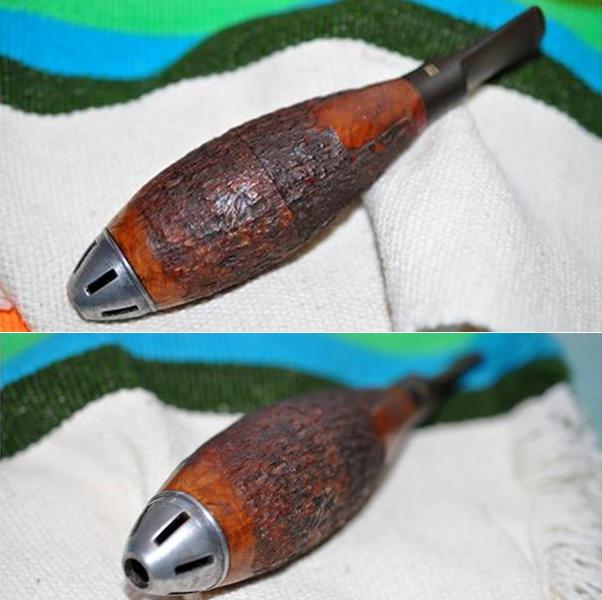
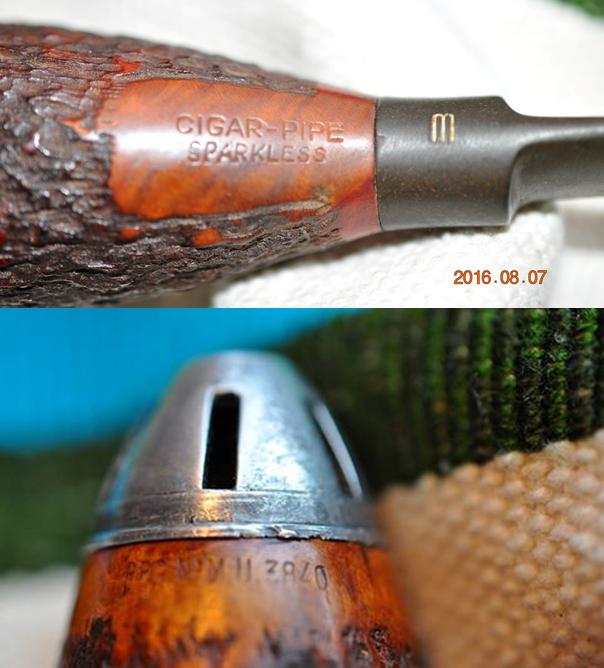
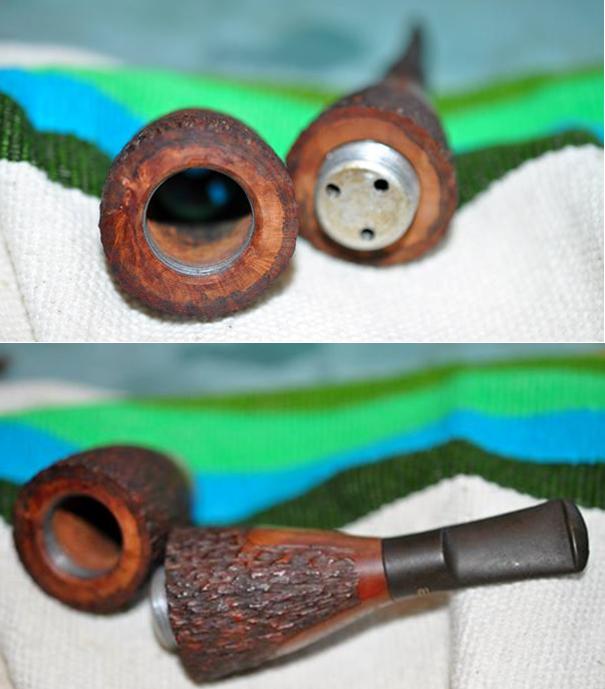
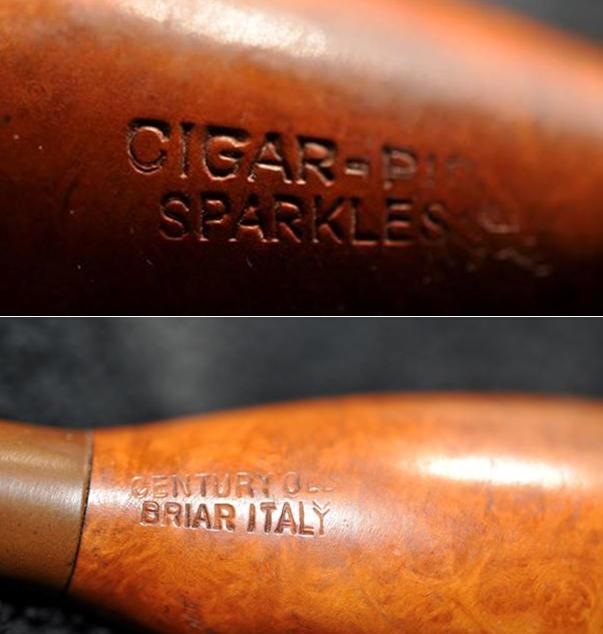
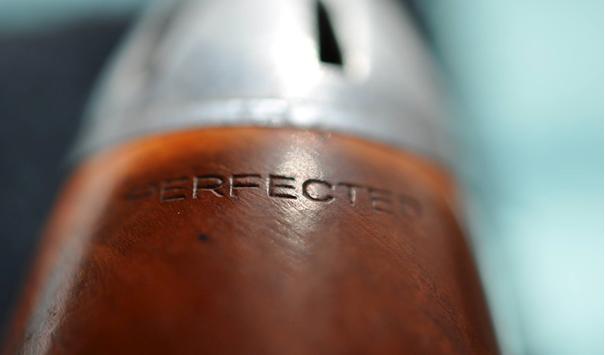
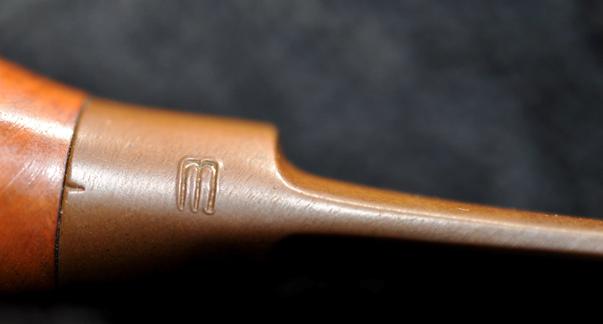
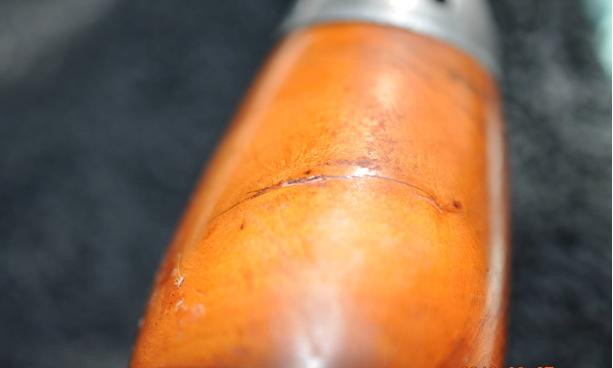
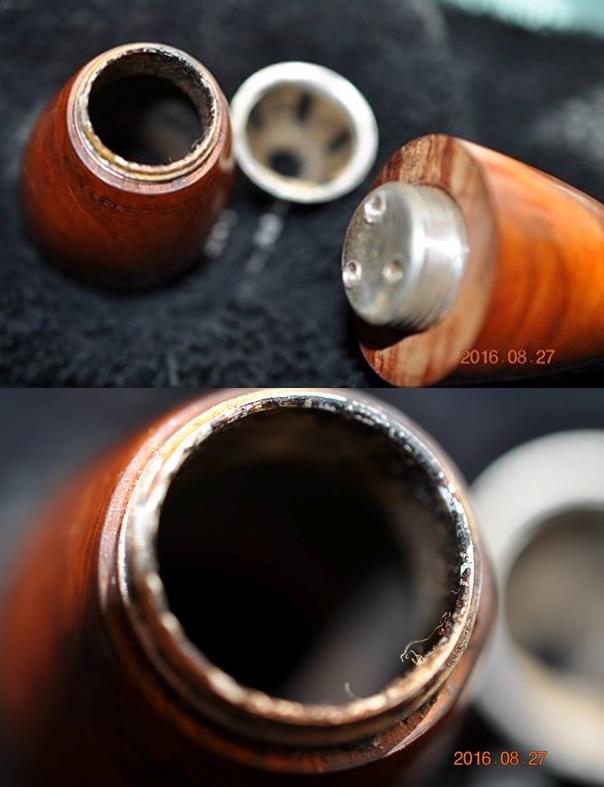
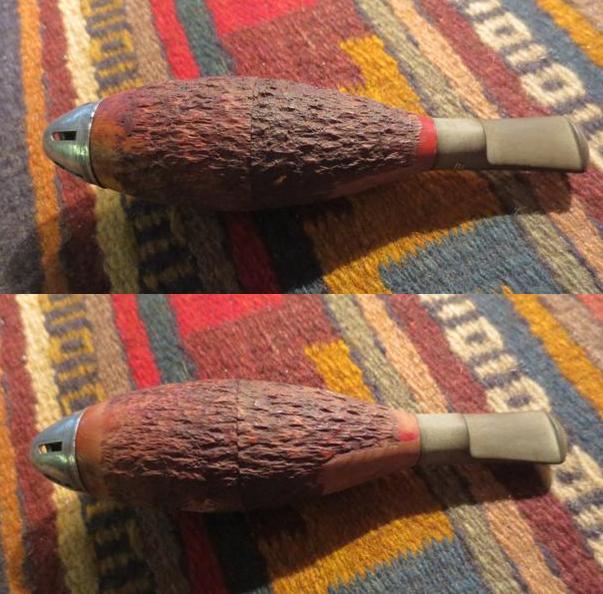
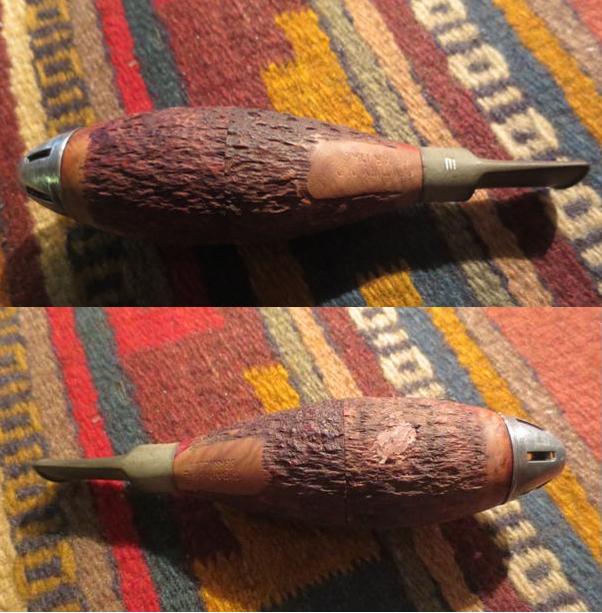
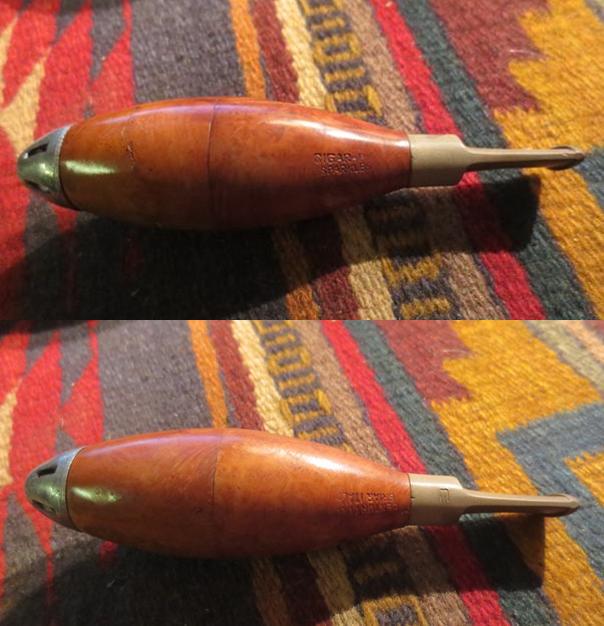
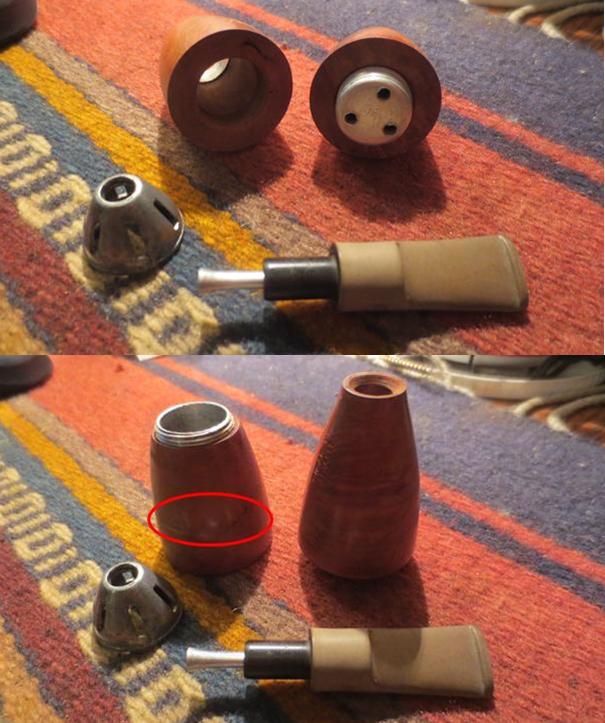
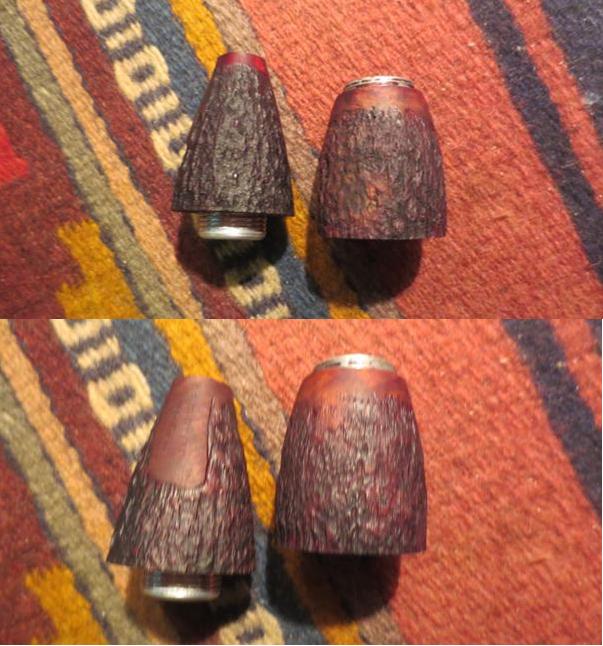
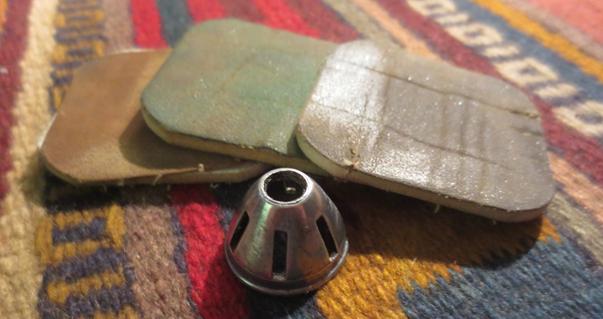
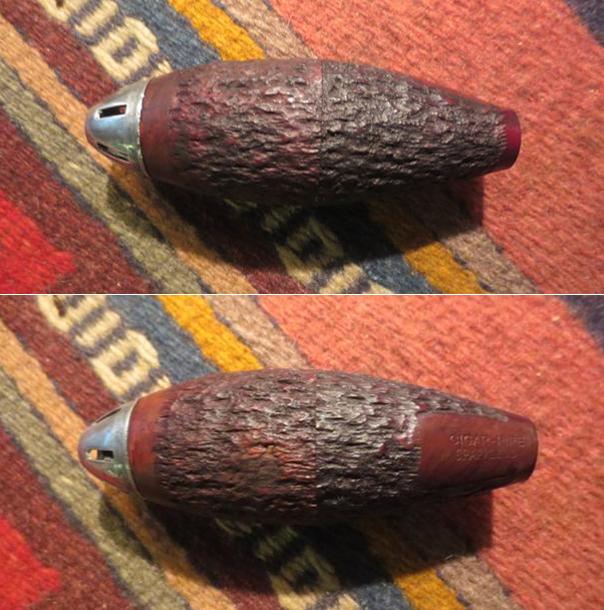
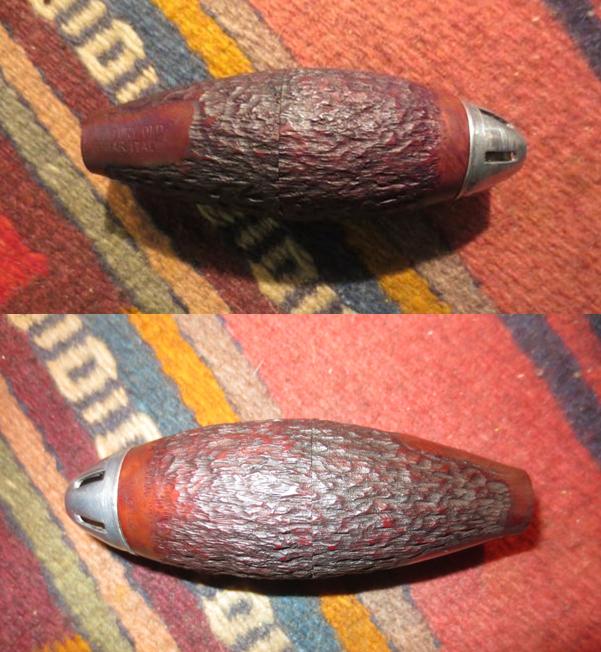
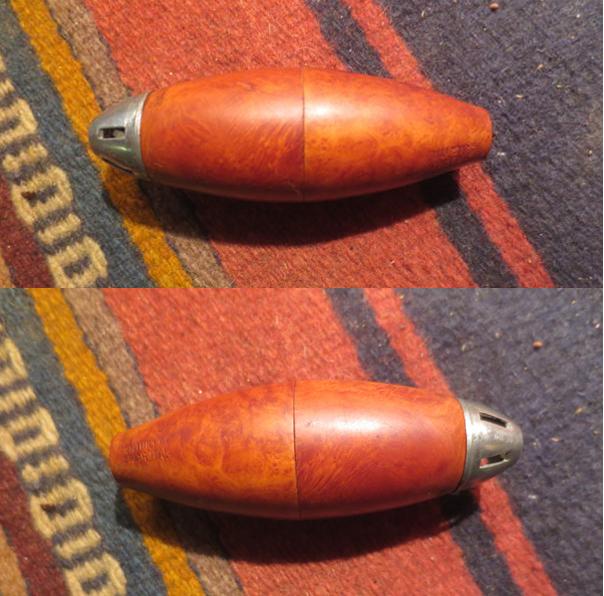
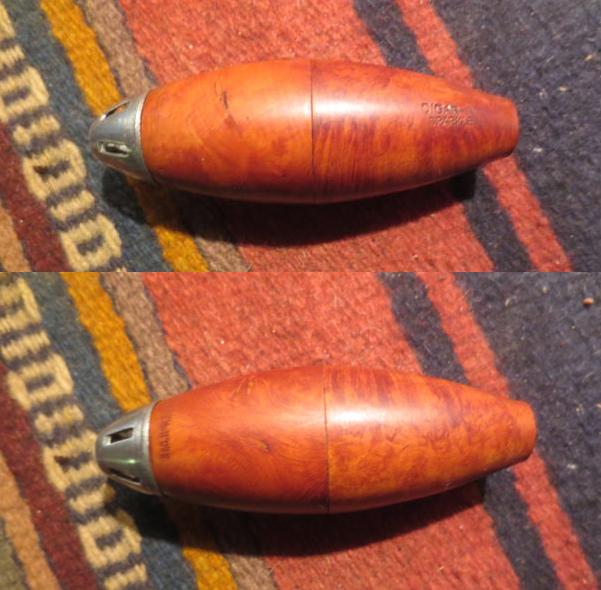
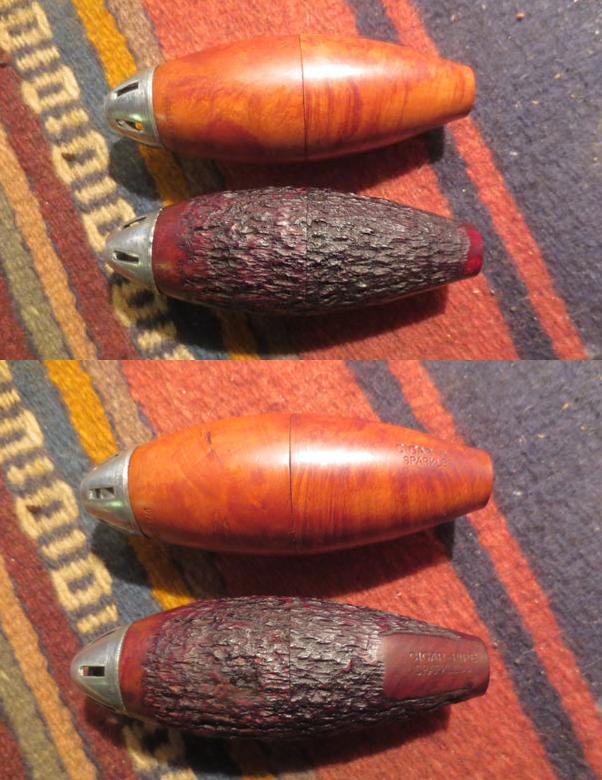
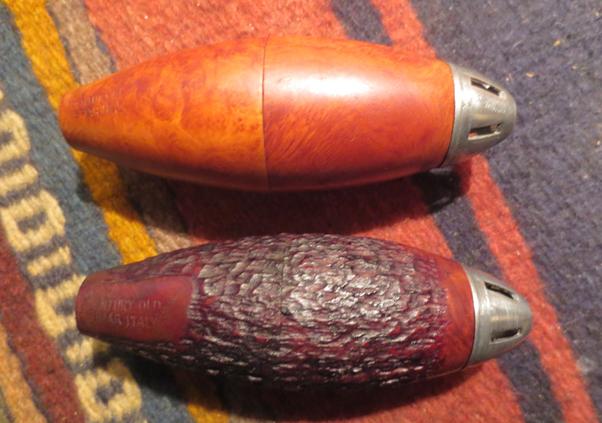
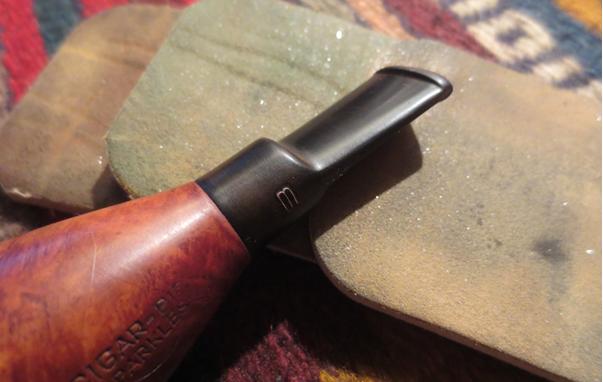
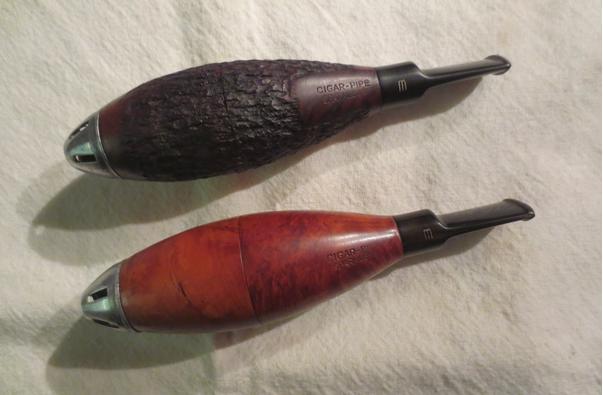
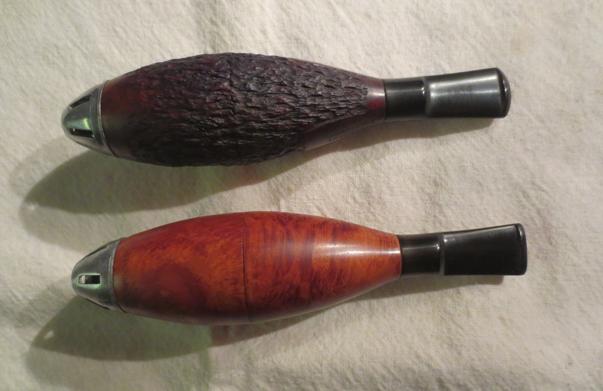
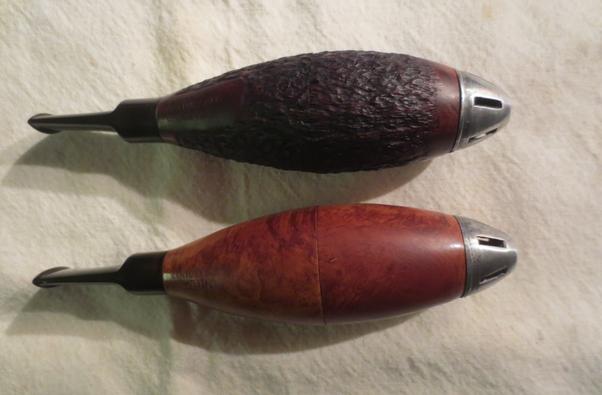
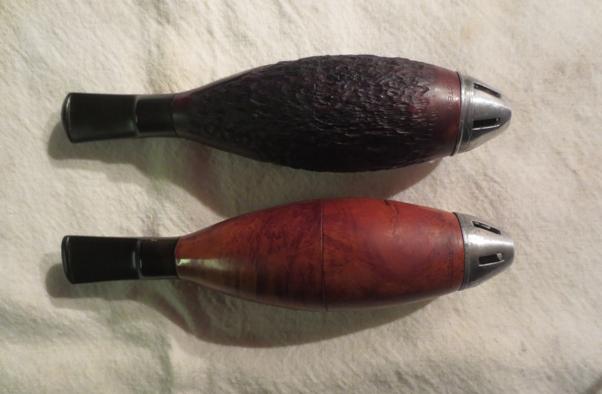
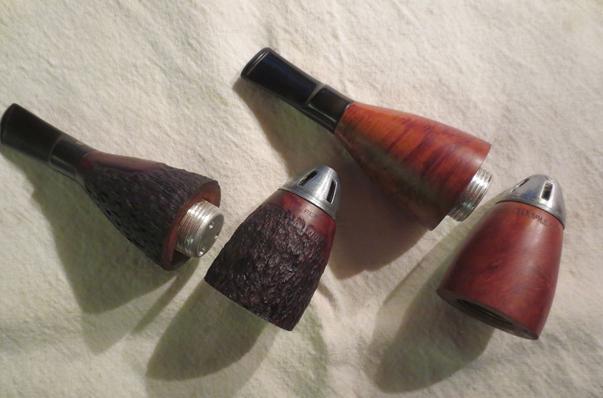
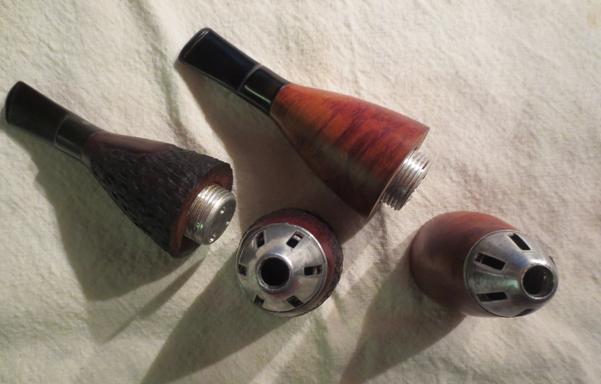
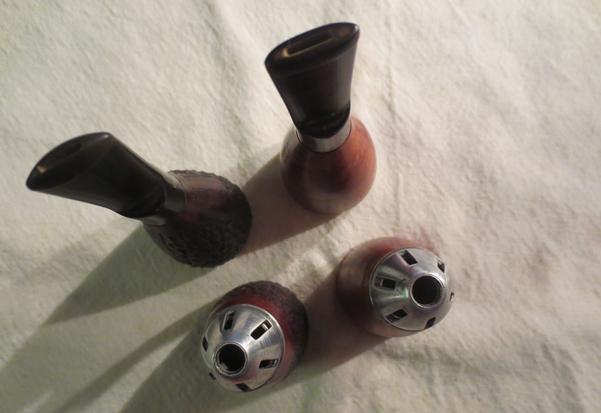
My brother sent me two Zeppelin pipes – a rusticated and a smooth one. He included the following photos of the two pipes that he took when they arrived in Idaho before he cleaned them up. The first one is a rusticated Sparkless Cigar Pipe. It has an interesting rustication pattern on the briar parts. I always want to know how a pipe is stamped as it is part of the restoration process for me. This one has quite a bit of stamping on it. Along the tip of the briar where the polished aluminum nose cone screws into the briar it is stamped PERFECTED on one side and Reg. No. MU3840 on the other. The stamping runs along the briar just below the nose cone. On the other end of the pipe, on what are the sides when the mouthpiece is in place it is stamped CENTURY OLD BRIAR ITALY on what would be the left side and on the right side it reads CIGAR-PIPE over SPARKLESS. The first two photos below show the pipe as it looks when put together.cigar1The next four photos show the stamping on the pipe and the M on the stem which told me I was dealing with a Mastercraft pipe.cigar2 cigar3The last two photos show what the pipe looks like when it is taken apart.cigar4The second Cigar Pipe that my brother sent to me was a smooth one that is identical in size and shape to the rusticated one. It even bears the same stamping on the pipe. It is stamped along the briar just below the polished aluminum nose cone. On one side it reads PERFECTED and on the other side is reads Reg. No. MU3840. Like the rusticated version is stamped on what would be the sides of the shank when the stem is in place. On the left side it reads CIGAR-PIPE over SPARKLESS and on the right side it reads CENTURY OLD BRIAR ITALY. The first photo is of the pipe put together.cigar5The next three photos show the stamping on the nose cone and the shank of the pipe.cigar6 cigar6aThe next photo shows the M stamp on this stem as well exactly like the one on the rusticated pipe above. It is thus also a Mastercraft pipe.cigar7The next photo shows what appears to be a crack on the upper portion of the cigar pipe. It would need to be checked out once I had it in hand. My brother was pretty sure that it was a fill in the briar as it did not go all the way through the piece.cigar8The next three photos show the pipe after it has been taken apart. Each of the pipes was made of four pieces.cigar9 cigar10I have seen a lot of these pipes for sale in shops and on eBay but I had never had one in my hand so I had never done any research into them or what “sparked” their invention. So now that I had two of them I figure it was time to look up some information. I looked on the pipephil website and found that they were made by Mastercraft and that there were some further articles in the odd pipes section of the site. Here is the link to that part of the site. http://www.pipephil.eu/oddpipes/pipcig/sparkless2.html. The trouble is that the articles were in French. I used Google Translator to translate them into English and then did some serious editing to the translations. I am including both articles in full here. The first one is written about the smooth briar versions and the second is about the rusticated versions.

Overseas manufacturers of pipes are not deprived of market of cigar pipes based on the mythical model of the 1920s. The best-known is called Sparkless [1] and comes from the Mastercraft House which was issued in several finishes. Two of them will allow you to judge fully of these strange pipes (The article included two photos of two different smooth finishes on the pipes – a stained and an unstained version).

It should be noted on at the outset that it is stockier than its Germanic Zeppelin cousin. When the pipe is disassembled we note that the two wooden parts screw into another – one side is threaded wood on the interior of the piece and the other side has a metal threaded end that turns into the wooden threads. There may be some doubts about how well this type of connection will hold up under use. There is no place for a filter in the Sparkless pipes unlike the Zeppelin. This pipe is adapted to the tastes of American smokers.

You should know that Mastercraft had a long standing near-monopoly of imports of European briar and particularly Italian briar. This explains the stamping ITALY on the side of the pipe.

The stamping is as follows:

On one side it is stamped Cigar Pipe, Sparkless and on the other side it is stamped Century Old, Briar Italy. On the nose of the pipe it is stamped Perfected on one side and Reg. No. M.U. 3840 on the other side.

The measurements of the pipe are as follows: The length is 13.9 cm and the height is 3.2 cm.

Where the German maker, Vauen offers one model of the Zeppelin pipe, the American Mastercraft diversifies its range. To the two versions of the Sparkless model mentioned above we add here two other variations in the form of pipe, rusticated in natural finish.

These variations to this atypical pipe probably spoke to a limited audience. Let’s face it the quality of the woodwork on the two models rusticated models isn’t the most refined in the light of the criteria of the XXI century. But don’t lose sight of the variety that was offered when these pipes were made was radically new.

My preference is usually saddle bit pipes. But I confess that by comparing the Zeppelin to the Pipe-Cigar Mastercraft models, the Zeppelin has more elegance due to the continuity of the shape to the tip compared to the general shape of the Cigar-Pipe. The German made Zeppelin pipe appears as a whole very consistent where each part (tip – stove – metallic cap) is the continuation of the other. This consistency and flow is less noticeable for this North American pipe.

The complete disassembly of the pipe shows that the stem in ebonite has a condensation system reduced to its simplest expression here: a small aluminum tube. It should be noted that these systems don’t bring great benefits for smoking and on the contrary can add moisture and condensation. They are often the origin of disturbances in the draw of the pipe and cause of particularly unpleasant gurgle. But it should not hurt.

The details of the stamping nomenclature reflects that the origin of the pipes is Italian and are potentially made by Lorenzo.

On one side it is stamped Cigar Pipe, Sparkless and on the other side it is stamped Century Old, Briar Italy. On the nose of the pipe it is stamped Perfected on one side and Reg. No. M.U. 3840 on the other side.

The measurements of the pipe are as follows: The length is 13.9 cm and the height is 3.2 cm.

Armed with the interesting information I went to work on the two Cigar-Pipes that I had. One was the darker coloured rusticated pipe and the second was the natural coloured smooth one. I thus had two of the finishes that are mentioned in the above information.

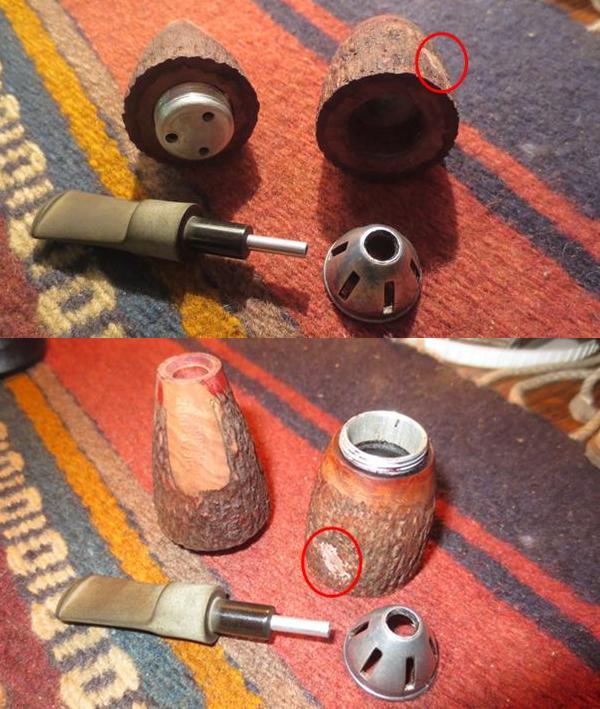
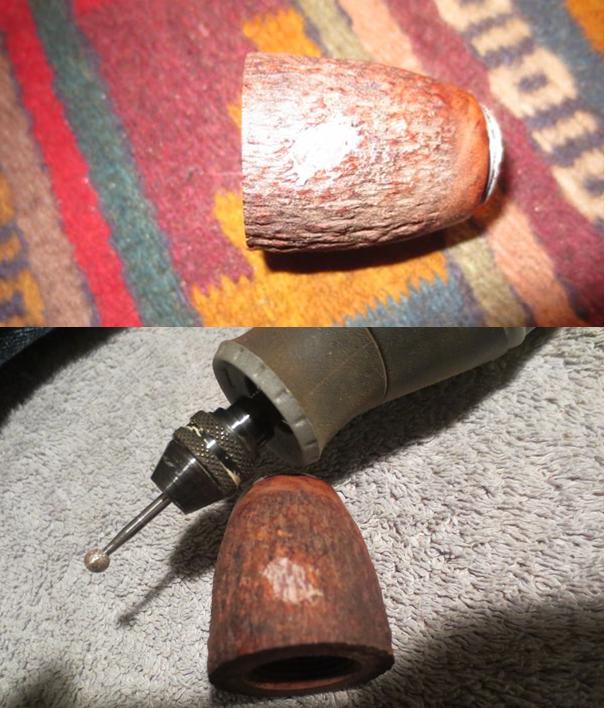
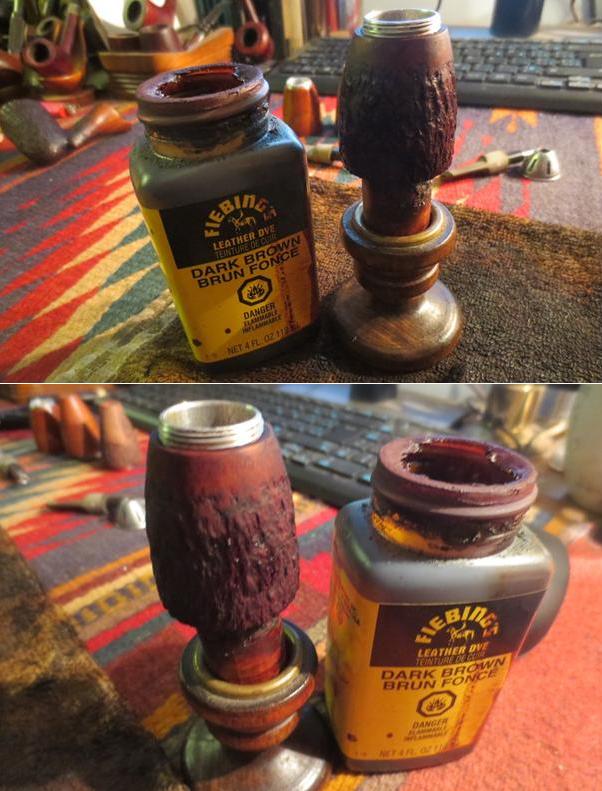
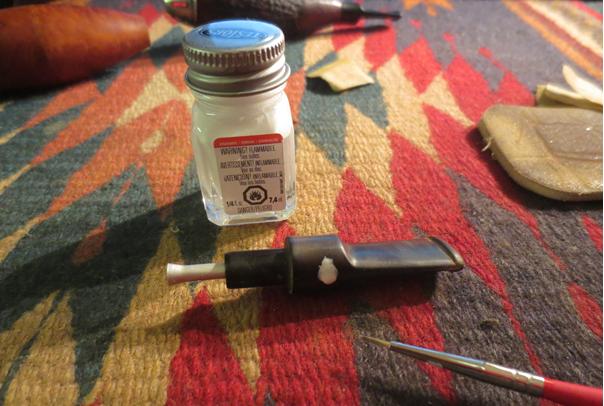
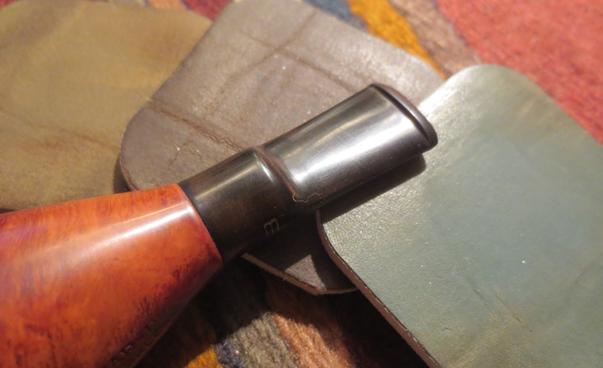
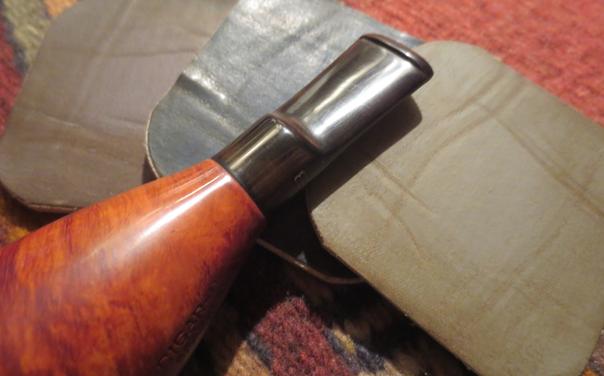
I started with the rusticated pipe. My brother had done the lion’s share of cleanup work on both of these pipes. Judging from the internals and the externals he did a great job cleaning out all of the gunk and grime. The rusticated briar was cleaned with a tooth brush and Murphy’s Oil Soap and in doing so he was able to remove the majority of the finish. The next four photos show the exterior of the pipe. The stem was oxidized and the letter M on the stem was faint. The finish was dull. The aluminum nose cone was dull. There was a fill on one side of the pipe that stood out as it was smooth and the rest of the bowl was rusticated.cigar11 cigar12I took the pipe apart and took pictures of all of the parts. In the second photo below you can see the fill on the briar piece on the right side of the photo. It is silver/grey in colour so it really stands out.  I circled it in red. The aluminum internals are clean. The inner tube on the stem is clean as well. I was able to slide it out of the stem and clean behind it. There was no grime there.cigar13After I took apart the rusticated one and took the photos I did the same with the smooth pipe. The smooth pipe would be the one I worked on next. Once again my brother had done the lion’s share of cleanup work. Judging from the internals and the externals he did a great job cleaning out all of the gunk and grime. The smooth briar was cleaned with a tooth brush and Murphy’s Oil Soap and in doing so he was able to remove the majority of the finish. There still was a varnish coat on the briar. That would need to be wiped with acetone and sanded. The next four photos show the exterior of the pipe. The stem was oxidized and the letter M on the stem was faint. The finish was dull. The aluminum nose cone was dull. There was a fill on one side of the pipe that stood out as it was smooth and the rest of the bowl was rusticated.cigar14 cigar15I took the pipe apart and took pictures of all of the parts. In the second photo below you can see what looks like a crack on the side of the briar piece on the left of the photo. It is a thin line that runs horizontal across the briar and there is a second divot next to it just out of the photo. I circled it in red. The aluminum internals are clean. The inner tube on the stem is clean as well. I was able to slide it out of the stem and clean behind it. There was no grime there.cigar16I started working on the parts on the rusticated cigar-pipe first. I decided to start with the silver grey fill and try to get it blend into the briar. I used the Dremel with a round head burr to carve lines in the fill that matched the pattern on the bowl sides. I figured if I could make the pattern match I could hide it.cigar17I stained the briar parts with a dark brown aniline stain thinned 50/50 with isopropyl alcohol. I applied the stain with a folded pipe cleaner and then flamed it. I stained both parts of the bowl with the stain and flamed them. I repeated the process until the coverage was even.cigar18I took some photos of the newly stained parts of the pipe. The first photo shows the coverage of the stain on the fill. I had used a black Sharpie Pen to fill in the newly cut grooves from the Dremel and then put the brown stain over the top.cigar19I polished the aluminum nose cone with micromesh sanding pads from 1500-2400 grit. I hand buffed it with a microfibre cloth.cigar20I put the pipe back together and took photos of the newly finished pipe.cigar21 cigar22I set the rusticated one aside and turned to work on the smooth one. I wiped it down with acetone on cotton pads to try to penetrate the varnish coat. Parts of it came off and parts stubbornly refused to move. I sanded the briar with a medium and fine grit sanding sponge and was able to get the entire varnish coat off. I wiped it down with acetone again to remove the dust.cigar23I picked out the fill that looked like a crack and filled it in with briar dust and clear super glue. Once it dried I sanded it smooth with 220 grit sandpaper and the sanding sponge.cigar24 cigar25Since the original Mastercraft smooth Cigar-Pipe came in a natural finish and this one appeared to have that rather than a Bruyere finish I rubbed it down with a light coat of olive oil and then gave it a coat of carnauba wax. I put the pipe back together so that I could see the finished briar portion.cigar26 cigar27I put the rusticated and smooth pipes together and took some photos of the stain and finished briar parts with the polished nose cones. The pipes are looking great at this point in the process. I still had to sand both stems at this point but the briar was done and the pipes were clean.cigar28 cigar29Now it was time to work on the stems. The stem on the rusticated pipe was cleaner and took less work so I did it first. I sanded it with micromesh sanding pads – wet sanding with 1500-2400 grit pads and rubbing it down with Obsidian Oil. I touched up the M stamp on the left side of the saddle with acrylic paint and a fine bristle brush. I sanded off the excess paint with the 1500-2400 grit pads. (I forgot to take a photo of that part of the process.) I dry sanded the stem with 3200-12000 grit pads and rubbed the stem down with Obsidian Oil after each set of three pads. I set it aside to dry.cigar30 cigar31 cigar32While I worked on the stem from the rusticated pipe I had the stem from the smooth one soaking in an Oxyclean bath. It soaked for about six hours. I took it out of the soak and took the next two photos.cigar33I sanded the stem with 220 grit sandpaper to remove the oxidation that had been softened by the oxy bath.cigar34I touched up the stamping on the stem with white acrylic paint and a small fine brush. Once it dried I scraped off the excess and then polished it.cigar34aThe stem was a bear to clean up and remove the oxidation even after soaking in an Oxyclean soak. I wet sanded it with 1500-2400 grit micromesh sanding pads and dry sanded it with 3200-12000 grit pads. I rubbed it down between each set of three pads with Obsidian Oil. I set it aside to dry.cigar35 cigar36 cigar37I buffed the pipe with Blue Diamond on the buffing wheel and worked over the stem quite a bit to remove the oxidation that remained. I gave the pipe multiple coats of carnauba wax and buffed it with a clean buffing pad to protect and give it a shine. I hand buffed it with a microfibre cloth. The finished pair of Zeppelin style Cigar-Pipes by Mastercraft is shown below. There is something about the oddness and shapes of the pipes that attract me to them. I don’t know when they will be used but when they are it should be an interesting experience. Thanks for looking.cigar38 cigar39 cigar40 cigar41 cigar42 cigar43 cigar44 cigar45

Charatan Made Knudsen’s Pipe Dream Oval Shank Banker brought back to life


Blog by Steve Laug

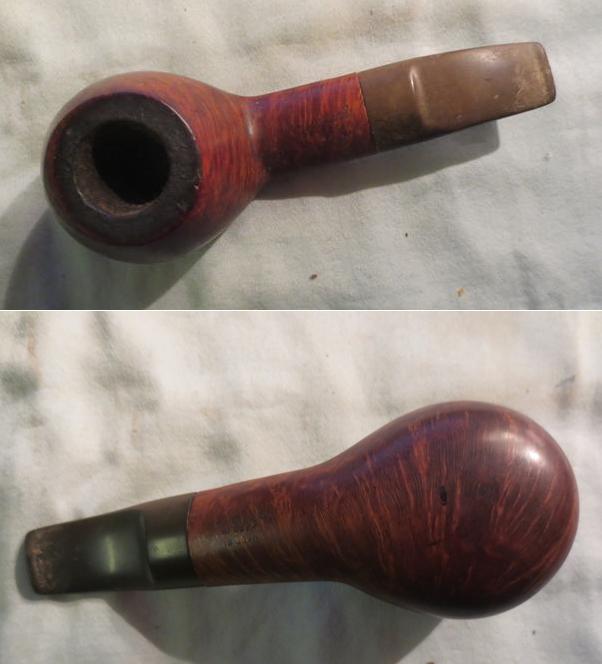
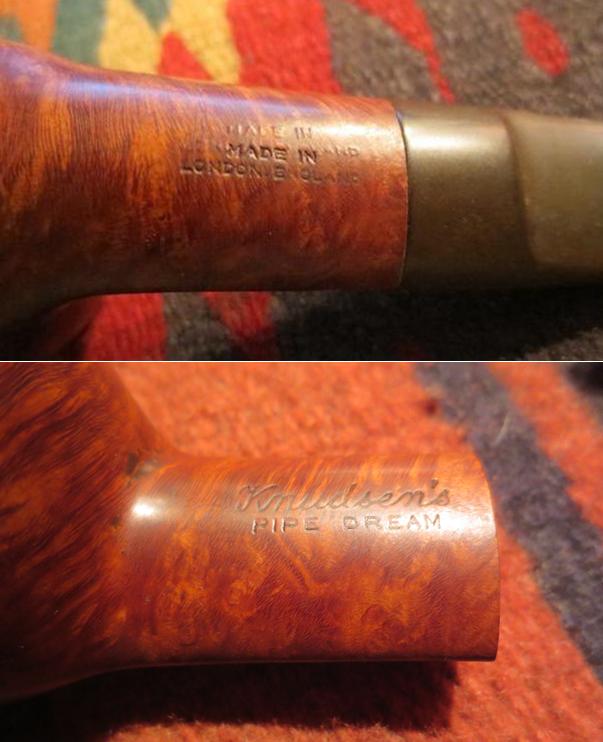
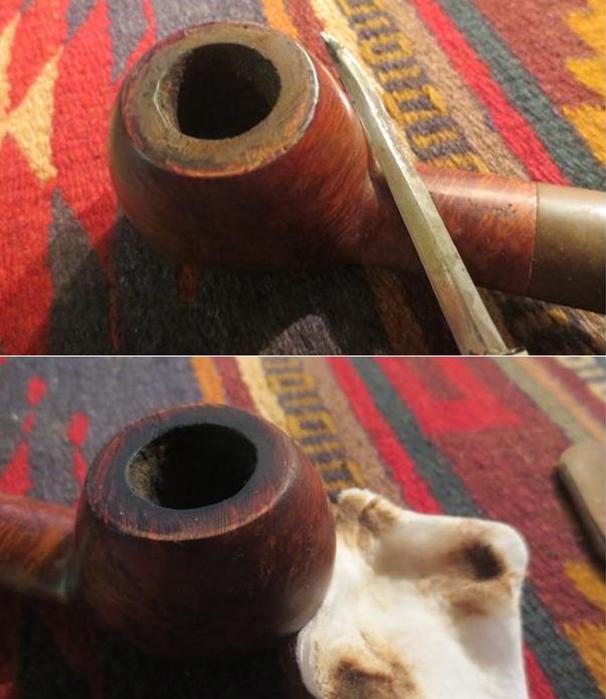
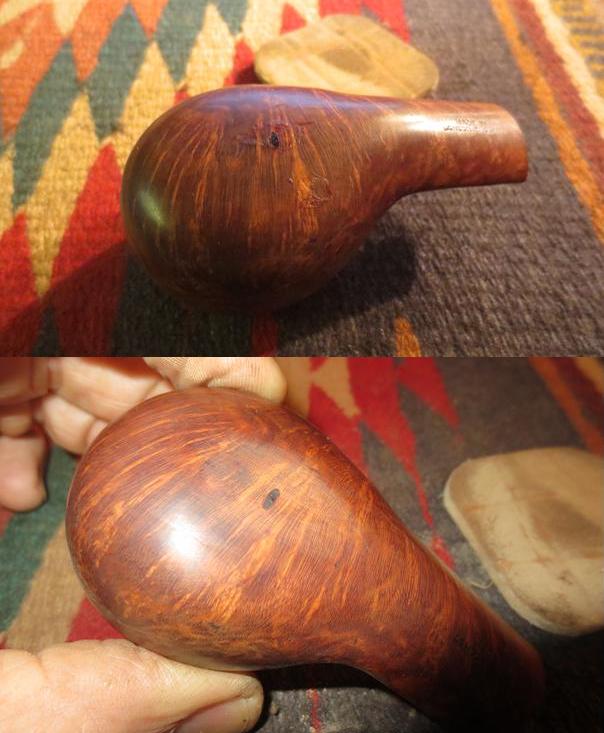
This great looking Banker shaped pipe is another one from the pipe man up in Dawson Creek, British Columbia. I am not sure if it was also one of his Grand dad’s pipes but it definitely has some age. It is stamped Knudsen’s Pipe Dream on top of the shank and Made in London England on the underside. From my research I am pretty confident that the pipe was made by Charatan as the shape is on their shape charts. However, it does not have the Banker shape number. I took the photos below to give an idea of the shape and the condition of the pipe when it arrived at my work table. The first thing that stood out to me is that there is a lot of promise under the grime – the birdseye grain and cross grain are peaking through. There was one fill on the underside of the bowl that was chipped but otherwise tight in the sandpit. The finish appears to be really good under the grime with no dings or dents in the briar. There was a thick cake in the bowl that runs like lava runs over the rim of the bowl. It is hard to know for sure if there is damage to the rim underneath the thick cake. The stamping is readable and the Made in London England stamp on the underside of the shank appears to have been done twice though one of them is quite faint and slightly above the other. The stem is worn and has deep tooth marks on the top and bottom sides and the button is worn. I was looking forward to working on this pipe.

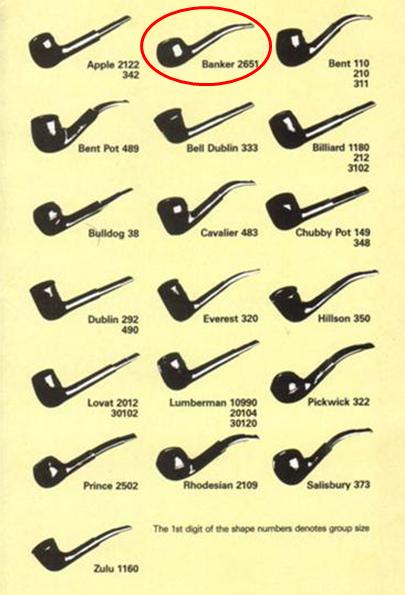
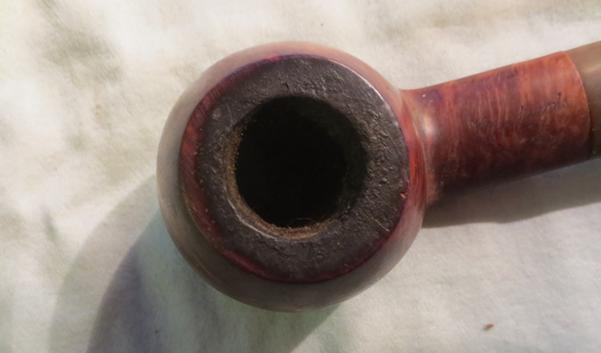
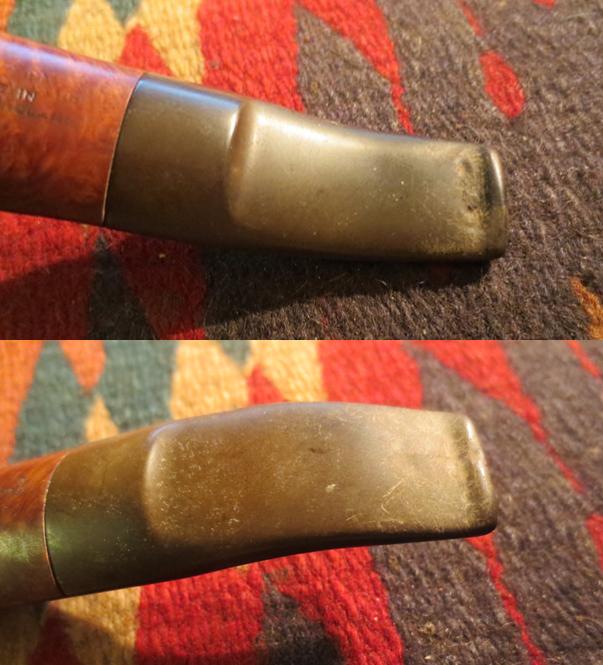
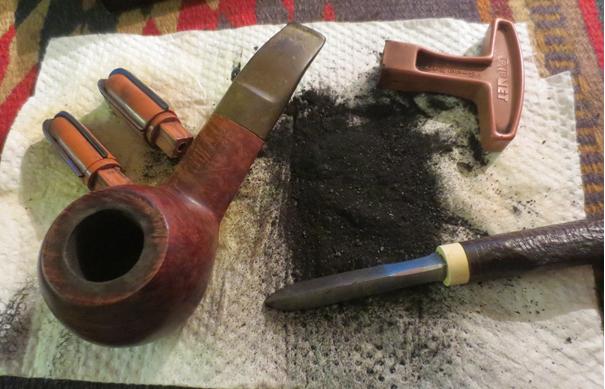
I did some digging to see if I could find anything out about the brand stamp on the top of the shank. I found that there is a Knudsen’s Pipe Dream Pipe Shop in Regina, Saskatchewan. The address and phone number is as follows: 4621 Rae St, Regina SK S4S 6K6, Phone: 306-585-1616. There was also a Knudsen’s Pipe Dream sandblasted Dublin that had sold on the smokingpipes.com website. The web address and link to the pipe is https://www.smokingpipes.com/pipes/estate/england/moreinfo.cfm?product_id=132697. They list it as an English made pipe. To me it also looks like a Charatan shape.bank1 bank2I found this page from a Charatan Catalogue online. The link said that it was Charatan even though the page does not say so. I have circled the Banker shape in red in the picture below. It is in the middle column at the top of the page. The shape would thus be a 2651.bank16I took a close up photo of the rim top to show the thickness of the cake on the rim and in the bowl. You can see why it is hard to assess what is going on with the inside of the bowl and the rim from this photo. A lot of work will need to be done before I can actually know the condition of the bowl and the rim.bank3I also took close up photos of the stem showing the bite and tooth marks on the top and bottom near the button.bank4I wanted to photograph the stamping as well. You can see the faint double stamping of Made in London England in the first photo and you can clearly see the name Knudsen’s Pipe Dream in the second photo.bank5I scraped the rim with a sharp pen knife to scrape off the thick buildup. I generally do this to try to preserve the stain coat on the rim. In this case I also wanted to see if there was damage under the cake on the rim top before I topped the bowl. Once I had it scraped off I wiped it down with alcohol on a cotton pad.bank6I reamed the bowl with the PipeNet reamer and the Savinelli Pipe Knife and took the cake back to bare briar. I wanted to assess damage to the interior wall of the bowl. Thankfully there was none this time around.bank7I repaired the chipped fill and the deep nick on the underside of the bowl with clear superglue. I did not use briar dust this time as neither repair was deep. I lightly sanded the spot with 220 grit sandpaper and then with 1500-2400 grit micromesh sanding pads.bank8

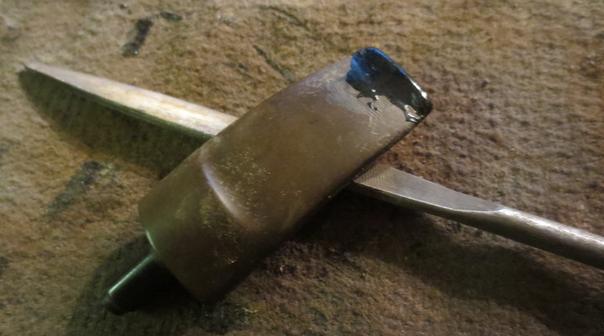
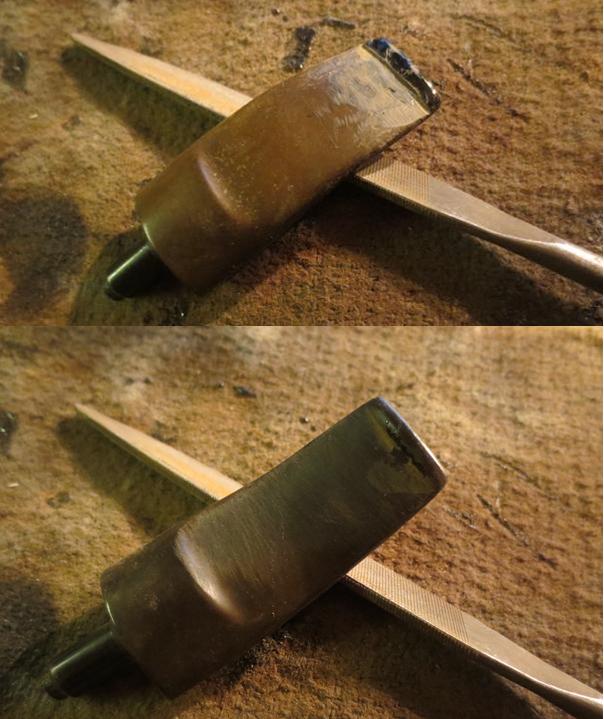
I cleaned out the mortise and airways in the bowl and stem with pipe cleaners, cotton swabs and alcohol until they were clean.bank9I needed to repair the small groove (looks like a crack but does not go through the surface) in the button and on the surface of the stem as well as the tooth marks but before I could do that I needed to redefine the button edges. I used a needle file to recut the sharp edge and smooth out the ridges and bumps on the stem. With the file I was able to smooth out the groove on the button surface and the stem. With this done it was clear that there was not a crack. I wiped the stem down with alcohol and then built up the damaged areas with black super glue. I also repaired the spots on the underside of the stem with the black super glue.bank10 bank11When the glue had cured I filed the repairs back until they were even with the surface of the stem. I also recut the edge following the path I had previously cut.bank12I sanded the repaired areas and the entire stem with 220 grit sandpaper to smooth out the surface and to remove the oxidation.bank13I wiped down the bowl with a light coat of olive oil to make the grain stand out and to see if there was any glaring light spots that needed to be touched up with a stain pen. It looked good. Once I polished and waxed the bowl I think it would be good to go. The photos below show the bowl at this point in the process. It really is a beautiful piece of briar.bank14 bank15I polished the repaired stem with micromesh sanding pads – wet sanding with 1500-2400 grit pads and dry sanding with 3200-12000 grit pads. I tried something new this time to try to defeat the frustrating oxidation on the stem. Instead of wet sanding with water I wet the stem with a light coat of olive oil and sanded it with the pads. It worked really well to cut through the oxidation. I wiped the stem dry after wet sanding and dry sanded without the oil. The finished shine is deep.bank17 bank18 bank19I buffed the bowl and stem with Blue Diamond on the buffing wheel to raise the shine. I gave it multiple coats of carnauba wax and buffed it with a clean buffing wheel. I hand buffed it with a microfibre cloth. I am hoping Steve enjoys this one. It is one beautiful old pipe. It helps that it carries a family story with it. Thanks for looking.bank20 bank21 bank22 bank23 bank24 bank25 bank26 bank27

Bewitched, Bothered and Bewildered by a Mastersen


Robert M. Boughton
Member, International Society of Codgers
Member, North American Society of Pipe Collectors
Member, Facebook Gentlemen’s Pipe Smoking Society
http://www.roadrunnerpipes21.biz (under construction)
http://about.me/boughtonrobert
Photos © the Author except as noted

I’m wild again, beguiled again
a simpering, whimpering child again
bewitched, bothered and bewildered am I.
I couldn’t sleep and wouldn’t sleep
when love came and told me, I shouldn’t sleep
bewitched, bothered and bewildered am I.
— “Bewitched (Bothered and Bewildered,” 1940), lyrics by Lorenz Hart (1895-1943), music by Richard Rodgers (1902-1979), a great American musical team

INTRODUCTION
Since the song “Bewitched” was introduced by Vivienne Segal in the 1940 Broadway musical “Pal Joey,” there have been many covers. Written for a woman, quite a few have made it “their” song, from Ella Fitzgerald to Lady Gaga. Men have taken their shots, also, from Frank Sinatra to Rod Stewart. But when I was a teenager, I had the enduring privilege of seeing Lena Horne at the Mark Taper Forum in Los Angeles, and she did it, as the Chairman of the Board would say, her way. She sang some parts like a choir mistress in Heaven and spoke others in the husky asides of a barfly, keeping the audience enthralled and on the befuddling edge of tears and laughter. And so to hear the song in my mind is to relive the gruff silkiness of the lady’s inimitable voice.

My mother has always been a devotee of Freudian psychology. Being more agnostic regarding the Austrian neurologist who pioneered psychotherapy, my father tended toward dismissing all of the man’s work despite the lasting innovations. Therefore, in general, I began to take my mother’s view of the matter, until I was older and found a balance between my parents that they, alas, did not.

Now, bear with me, there’s a point coming. My dad told me one day that the songs people whistle or hum, without even thinking about it, reveal their subconscious moods. He was in the frequent habit of popping out such tidbits of knowledge, and for that I am forever grateful. I realized I had stopped listening to anything else he said maybe a half-hour earlier, having dissociated deep into myself, as far away from my dad as I could get. In fact, at least on a conscious level, I forgot my dad was there until he made the casual comment, and I stopped humming. I had to stop everything, including the gardening and general cleanup work we were doing on the patio, to figure out what was the tune, and I still remember now: “Cat’s in the Cradle,” by the late great Harry Chapin.

That’s right, I was humming about a father and son who never take the time to sit down together and have serious talks. I was not aware I even knew the story of the lyrics that well, but liked the tune. My dad and I had both heard it countless times, no doubt, as the spring afternoon I’m describing was in 1978, when I was 16, and the song came out in 1974 and won the Grammy for Best Male Pop Performance. Snatches of the words came to me: “I’m gonna be like you, Dad, you know I’m gonna be like you,” and “But we’ll get together then, you know we’ll have a good time then,” and “He’d grown up just like me, my boy was just like me.” The smirk on my dad’s face, with its annoying and condescending twist of the lips, said everything. He knew he had figured me out at last, although not his own contribution, and he was right, so I grinned, my own expression of false pride I learned from my father. I could see it stung my dad, and I’m now sad to say I was happy.

Thinking back on that encounter with my dad, as I began to find my own twisted path in the world, I consider it odd that he so berated basic Freudian theory of deep subconscious conflicts influencing our conscious actions. After all, humming a Harry Chapin tune that summed up my subconscious feelings at the time seems to me nothing less than proof of a simple variation on what we still refer to as a Freudian slip. Had my conscious mind picked the song, it would have been “”Don’t Think Twice, It’s Alright,” by Bob Dylan.

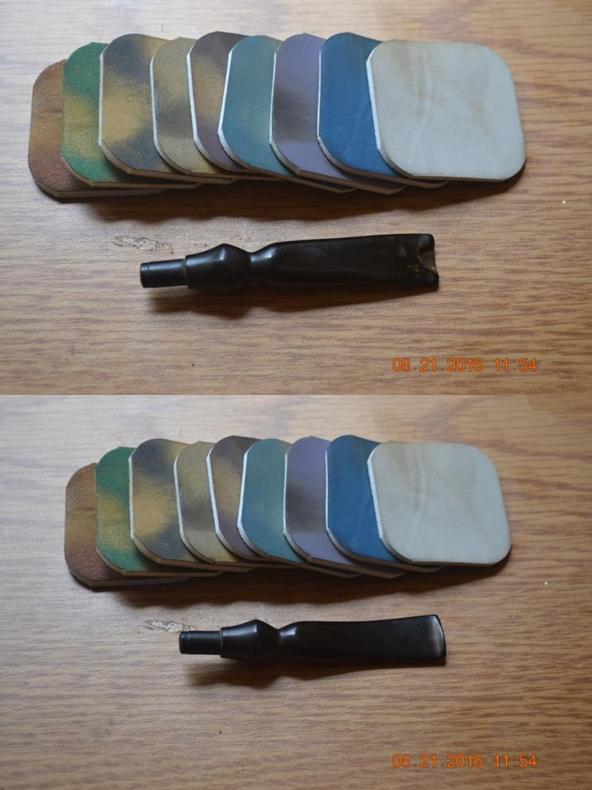
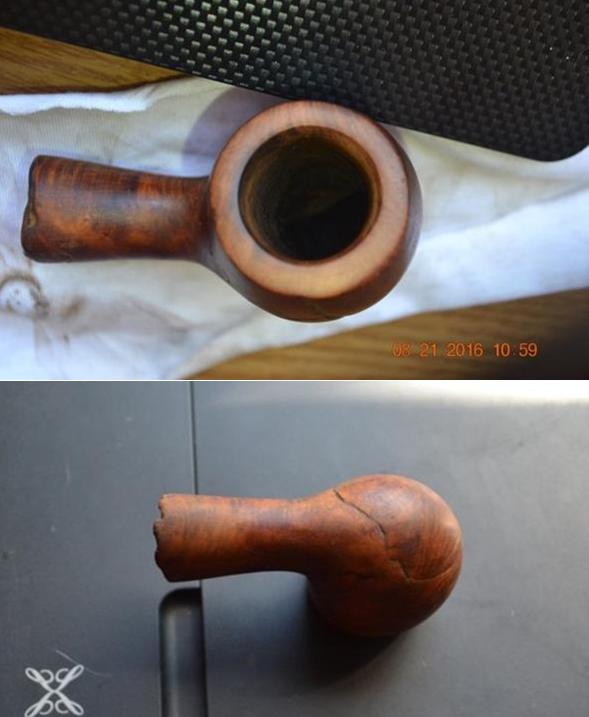
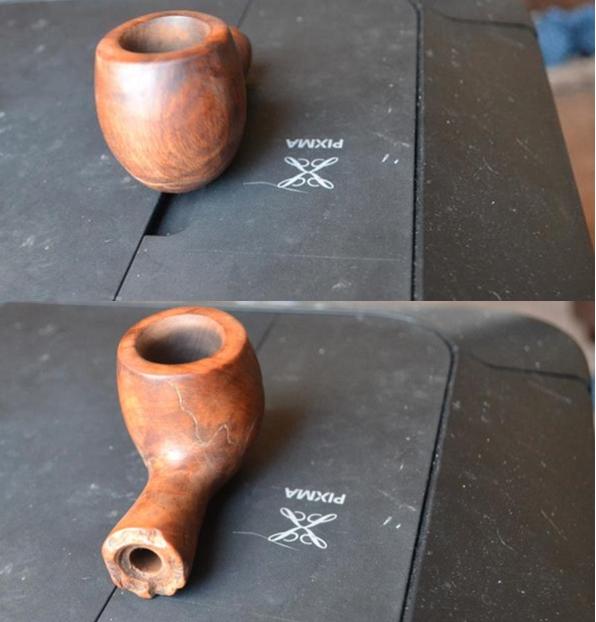
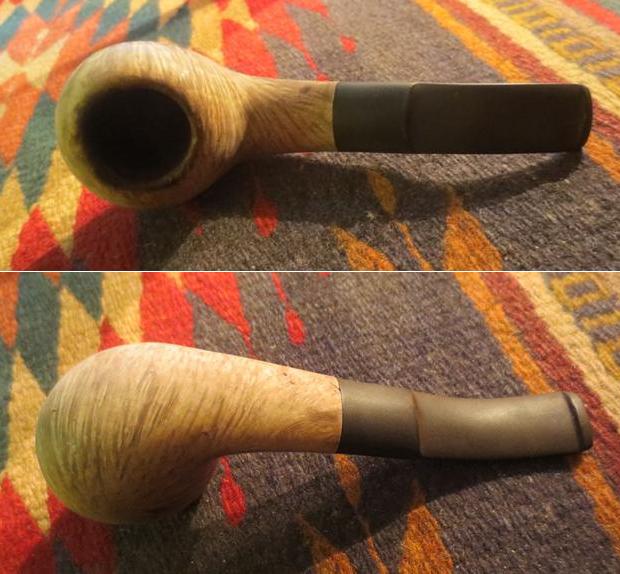
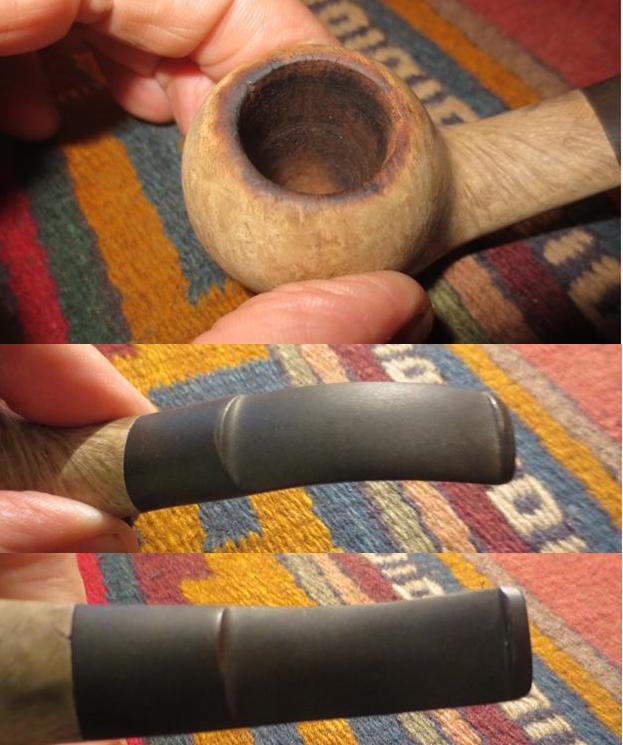
As I began work on this ornery, perplexing pipe 16 days ago, and continuing through to its completion, I found that I was humming the refrain from “Bewitched.” Sometimes I even broke out into the repetition of words that came back to me. And so I understood I was making a musical Freudian slip of sorts. The Mastersen freehand had many flaws to overcome, and I was indeed bewitched, bothered and bewildered at the challenge of removing them. I had also come to love the pipe without ever having tried it and, like the story of “Bewitched,” despite its presenting difficulties.mas1 mas2 mas3 mas4So blackened and grungy was its bowl, so almost thorough the filling of the chamber with cake, so worn and grimy the shank, and so ruined the once typical Danish freehand plateau style rim as well as the reparable-but-not-worth-the-work bit, I did not even know what brand of pipe I had.

That is, until a happy coincidence that occurred at the monthly Moose Lodge meeting of my pipe club on the third Thursday of last month, August 18. One of my fellow pipers, Daryl (for whom I cleaned up an antique KB&B Redmanol socket pipe not long ago), showed me a beautiful Mastersen of which I snapped a photo with my Nikon. Due to the increasing instability of that camera, which is cheaper to replace than repair, the photo is nowhere to be found. At any rate, I handed my dingy and as yet unknown pipe to Daryl, who said, “Ah, another Mastersen!”

That was how I learned what I had. I ask you, what are the odds? Bestowed with a vision of the potential for a real beauty if restored with the necessary attention and care, I experienced a sudden sense of urgency to fast-track my Mastersen. I still did not even know how it was spelled, thinking it was the same as Bat Masterson, the famous TV dandy, gambler and lawman played by Gene Barry, who preferred his wits and cane to his gun for four seasons from 1958-1961. The same error by other pipe collectors and sellers accounts for the reason more examples can be found online using the spelling of Bat’s last name.

I did, however, pick up a few pieces of information along the way about Mastersen pipes. According to pipephil.com, and suggesting the brand is still in production, “Mastersen is [emphasis added] a brand of the former Shalom Pipe Co. [of Israel] which was later bought by Mastercraft.” Mastercraft, in turn, was taken over by Lane Ltd. A contributor to the Dr. Grabow Collector’s Forum (DGCF) noted the Shalom connection but added that Mastersen pipes were manufactured from the late 1960s to the mid-1970s as redemptions for Brown and Williamson’s Sir Walter Raleigh tobaccos. In this case, I suspect Pipephil was correct but meant to make clear that Mastersen was made by Shalom only, and the DGCF man had it right about the time period and redemption points.

Here are two shots of Mastersens I found online, the first with nice vertical grain, and the second showing the plateau rim type natural to the brand’s freehand pipes. Neither is anywhere near the quality of the specimen Daryl is so lucky to own, with its exquisite, perfect, vertical grain and strawberry blonde shade.mas5RESTORATION
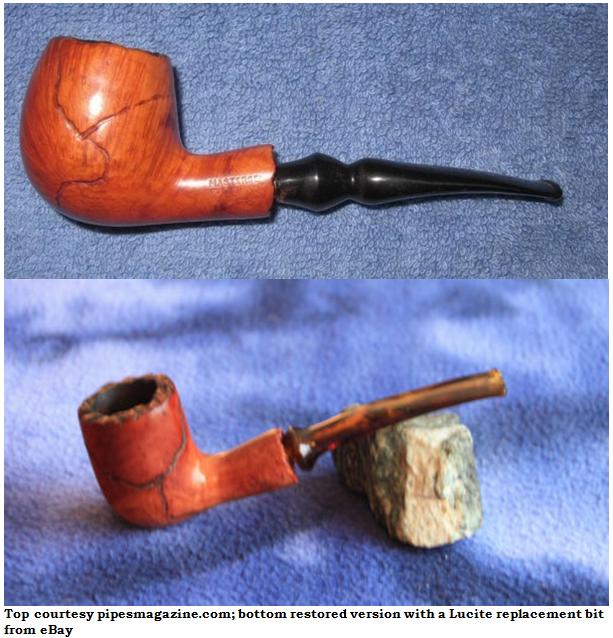
Daryl’s beautiful example of what a Mastersen freehand could look like served as a wondrous counter-spell to the initial bewitchment that froze my thoughts of starting the job. Still, I was bothered by the apparent lack of any plateau remaining on the rim and the resulting need to do something about that dilemma. And of course the stem bewildered me more than a bit. (Ha-ha.)

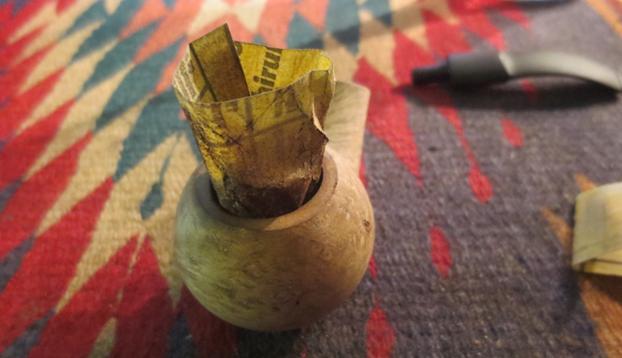
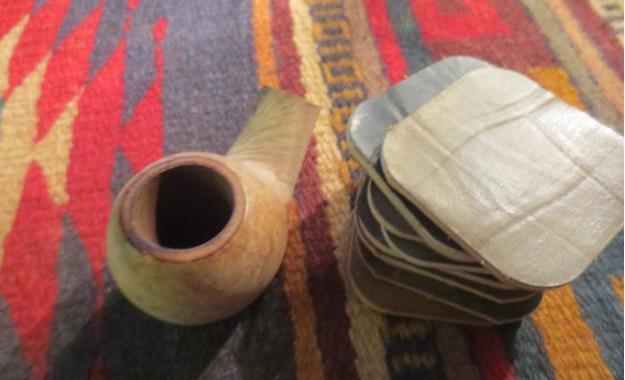
Setting the bit aside for the time being, I began my assault on the stummel by soaking it in Everclear and then giving the still-caked chamber a 40-minute preliminary reaming, as that single good, long one proved insufficient to mend the old ways of the small space. The next pictures show before, during and after. mas6 mas7 mas8I continued the corrective measures with both my Senior Reamer and a new “one size fits all” type I found online. The little thing was so inexpensive I couldn’t help getting one to see if it worked. I have to say it has its uses, which are limited, but this chamber of horrors was one of them. I suppose the best way to describe the only function I’ve found for the less powerful reamer is by comparison to micro meshing after sanding. The small reamer has a certain precision that smooths away some of the rough edges left by its Senior counterpart. Maybe for those of you who have seen real combat on the battlefield, it would be like sending in the Army Corps of Engineers to clean up the devastating work of Marines.
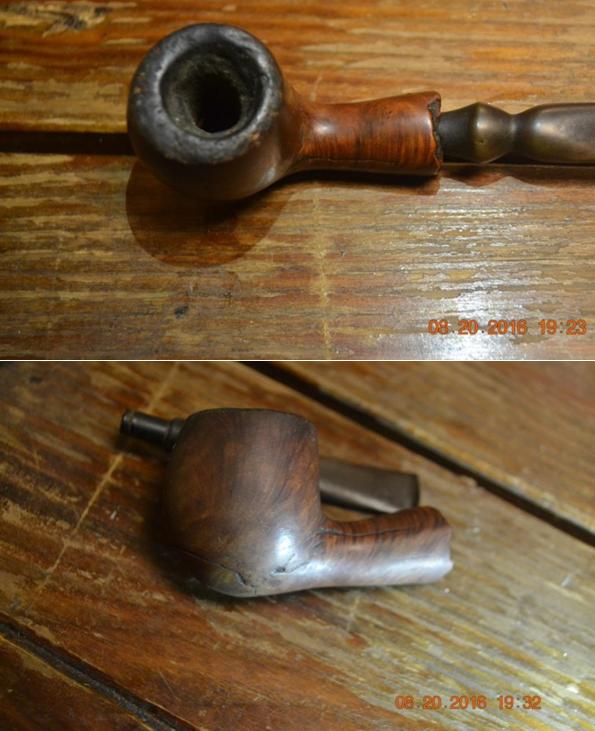
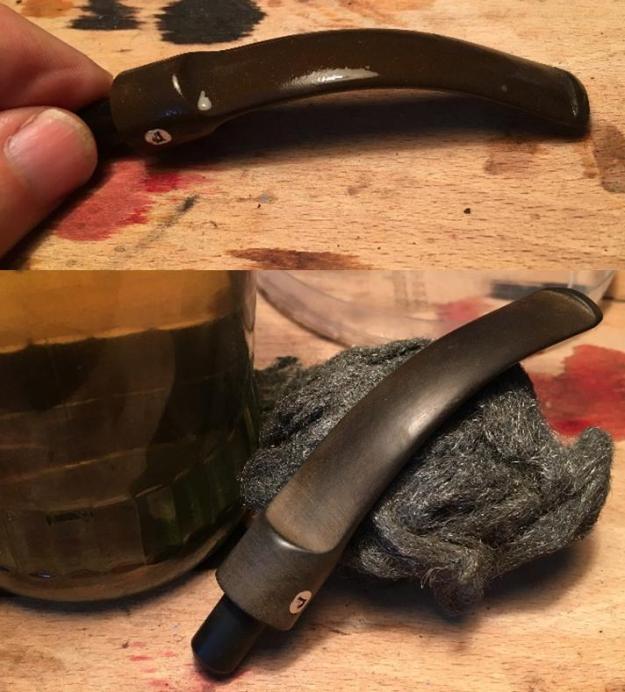
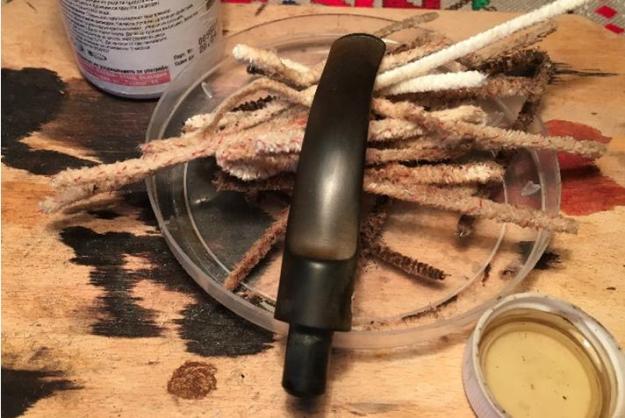
The reaming complete, I turned to sandpaper, first on the rim and chamber with 150-grit, then working up the fine line to 180, 220 and 320.mas9I used the same progression of paper, minus the 150-grit, on the bowl and shank. That was enough for the first night.mas10 mas11 mas12The next day, Saturday, I slept late, meaning 9 or so in the morning, for the only time my cerebral RAM can access. I arose in an excellent mood made better by starting my first giant mug of strong, rich French Market coffee mellowed with chicory. Since I was in such a clear, positive frame of mind, I savored the moment more by turning to the bit that was wrecked by the havoc of some poor soul who must have suffered from a sort of waking temporomandibular joint disorder, even though there is no such malady since the real thing occurs while one sleeps. It’s called everyday teeth grinding when one is cognizant, and if a pipe smoker is that angry he ought to give up the best known form of relief from stress altogether. I ran a couple of cleaners through the air hole, first a dry run and then soaked with Everclear, and used the last of my supply of OxiClean to give the bit a bath. And now I’m gonna show you some 8×10 color glossies of that ordeal. You see, I was still of the mind that I might take the time to salvage the heinous wound to the mouthpiece of this bit.mas13 mas14 mas15 mas16By this time I already knew I was going to find a replacement somewhere, but once I start something I have to see it through. Therefore, I used more of the fine steel wool and then micro meshed from 1500-12000, just for the sake of it. Be all you can be (for now), mighty bit!mas17 mas18I did find a replacement in a bag from my recent move to better digs that I’ll show you later, because I’m sick of the entire idea of bits for now and it’s out of order, and I did keep the original for some unknown pipe I will restore for my own use rather than to sell to a trusting and hapless buyer.
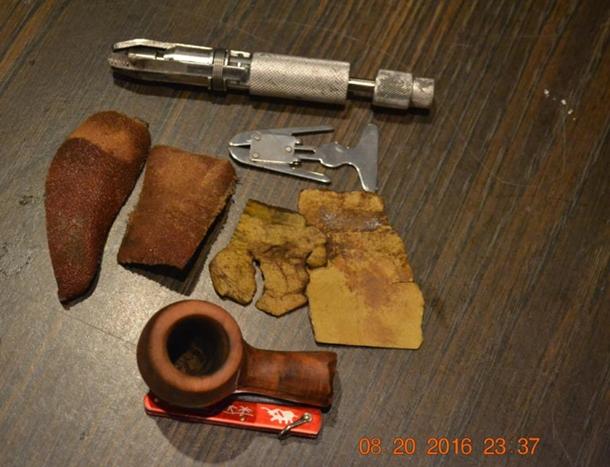
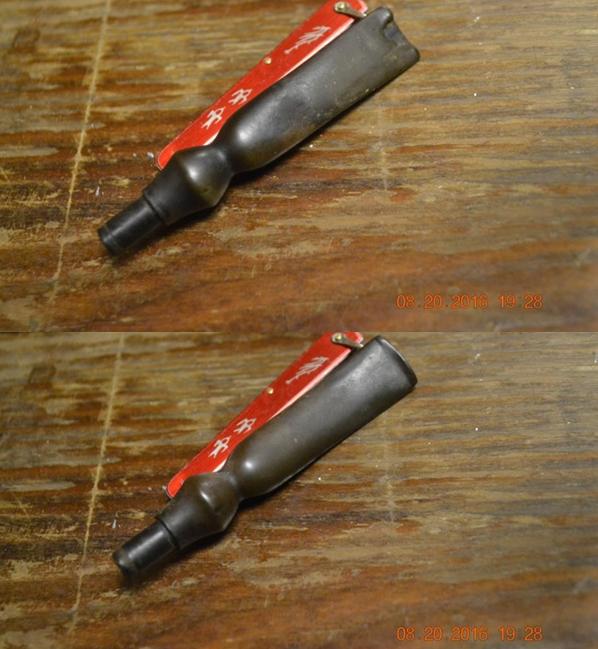
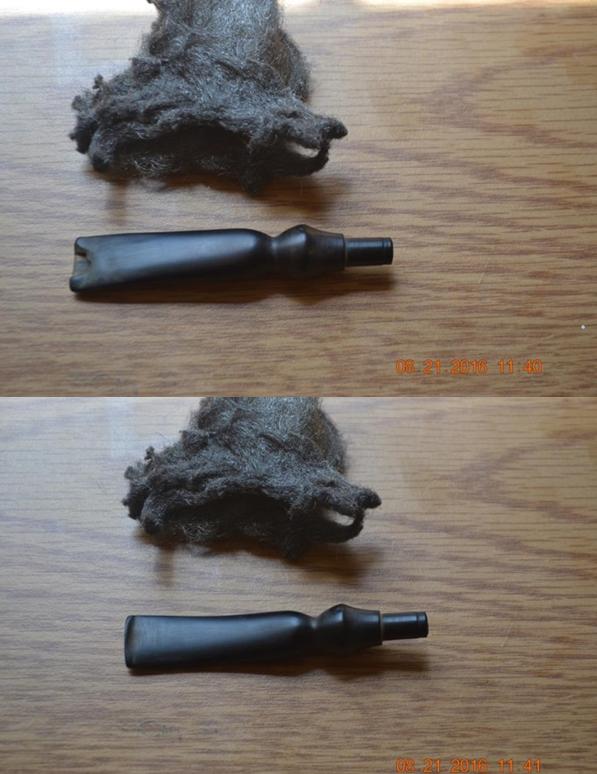
Grabbing the steel wool again, I put it to better use on the stummel, with gentle rubbing.mas19 mas20 mas21Lo! How a simple micro mesh progression from 1500-12000 will change the hue of briar!mas22 mas23 mas24Three days almost to the hour after I began this project, there was no more putting off the inevitable: doing something to make the rim rough rather than the usual desired velvety smooth. Part of me that had no trouble adapting to the rule “If it isn’t broken, don’t fix it,” one of my dad’s many maxims, hated the notion of touching a rim that was “perfect” the way it was.
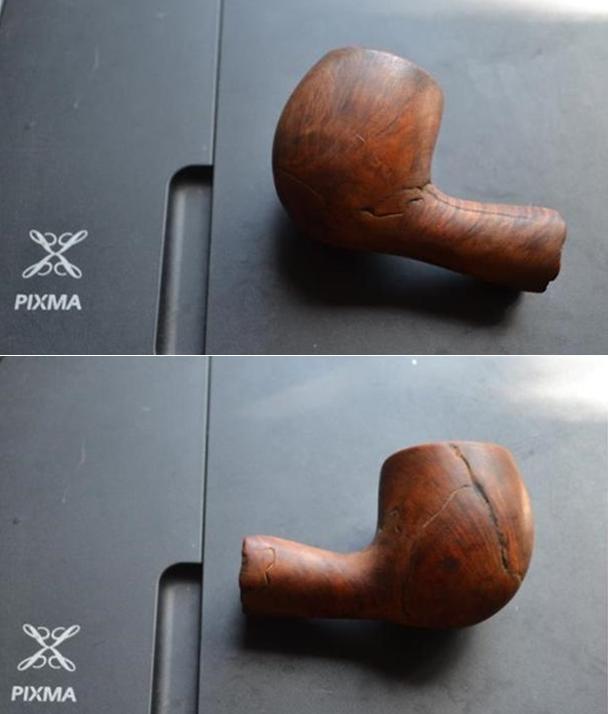
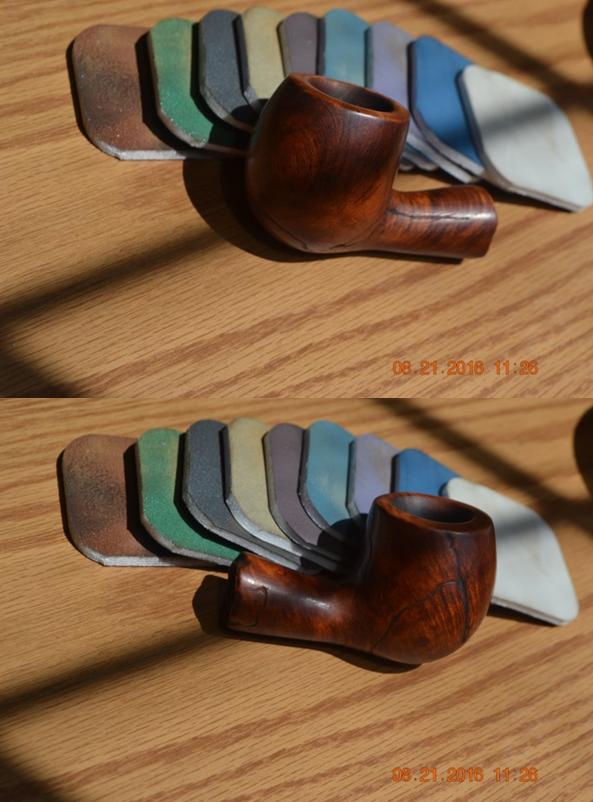
In the end, I knew that a smooth rim on a Danish freehand style pipe was anything but perfect, and I considered my options, which seemed to me to number three. 1) I could rusticate the circular top, but the Mastersen freehand is not a rustic pipe. 2) I could reshape the top and try to roughen it up, but I’ve never done that before, to be honest. 3) I could leave it flat but give it some sort of texture.

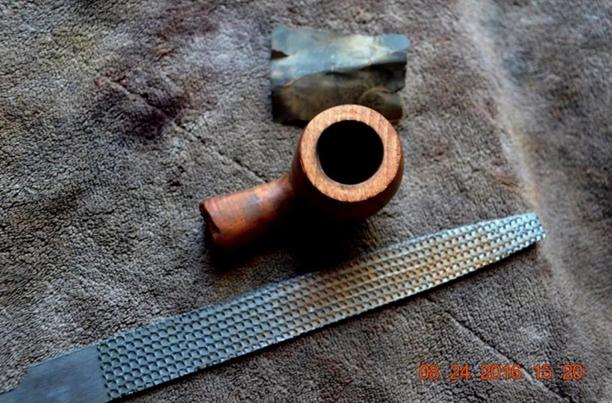
The last choice seemed the best way to go, and that’s what I did. Starting out with a couple of level but tentative strokes of a wood file, I succeeded in making the following beginning, which I later gave more depth. mas25I came across a surprising number of other Mastersen freehand restorations, and two of them recounted the same obliteration of the rim and chamber stuffed with carbon char. The common rim problem suggests to me a straight, shallow plateau that lends itself to being burned away by the average pipe enjoyer. I don’t know what to make of the mystery of the overflowing chambers. The two reviews of these pipes’ level of smoking quality are very high, one coming from a regular participant in an online pipe forum and the other from my friend Daryl. Given my run on inexplicable coincidences, maybe both Mastersens were smoked close to death by the same perp.
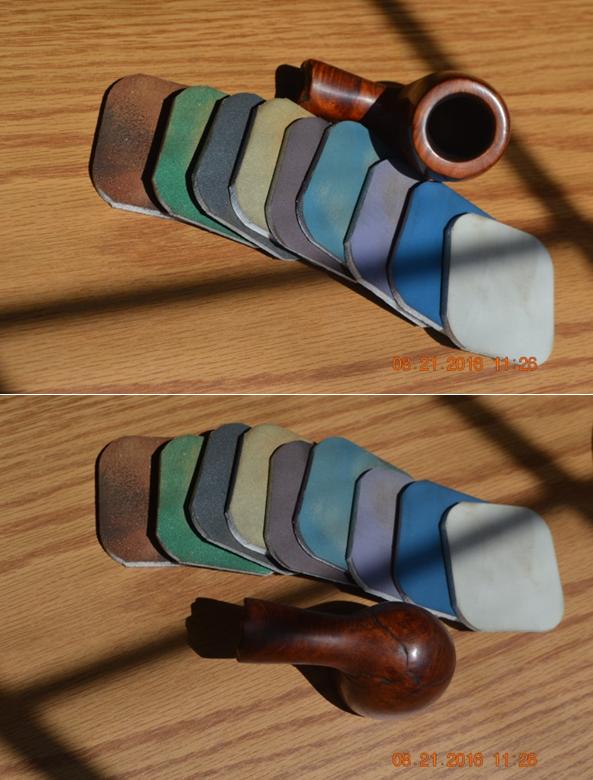
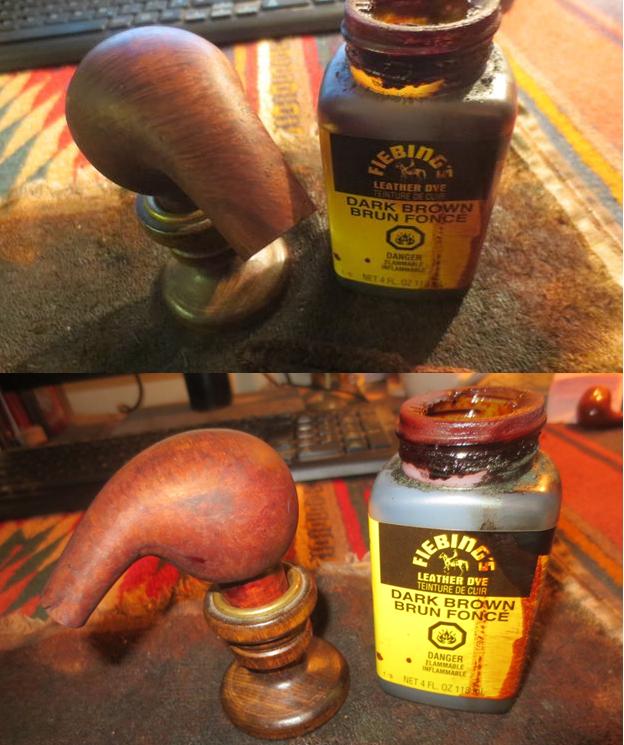
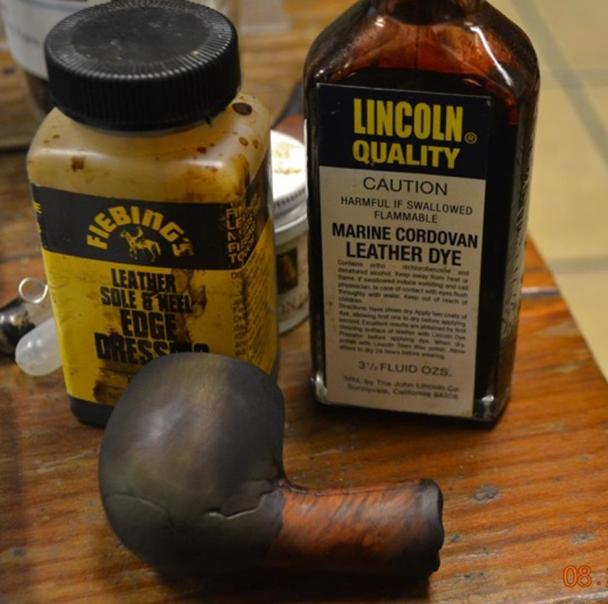
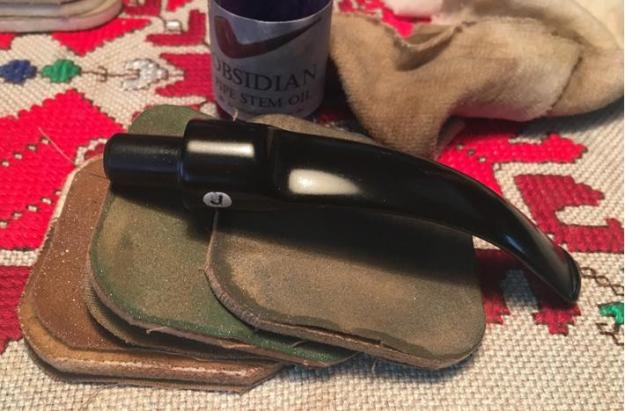
But on with the restore I must go. The beautiful briar needed a light stain, and I didn’t want to overdo that part of the task. The only problem was that I wanted the bowl to be a tad darker than the shank, and the darker stain I had was very dark, Lincoln Marine Cordovan (deep maroon) alcohol-based leather conditioner. Taking a wild chance, I used that on the bowl and rim and Fiebing’s Brown on the shank. I was surer than the first people to test the A-Bomb were with the risk they took that I could remove enough of the excess darkness from the bowl without scratching it. The scheme still must sound plain crazy. Anyway, after flaming out the alcohol with a Bic, I set it aside for 10 minutes. mas26 mas27The father of my best friend in high school used to wake up or snap out of a reverie, stretch, yawn and say, “Well, hell!” Those are the words that came to my very conscious mind as I chose 500-grit paper to begin eliminating the ash-like residue and over-darkness from the stain. mas29I applied Halcyon II wax and let it sit for 20 minutes before rubbing the stummel with the same soft cotton cloth shown above.mas30The next photos don’t quite show the subtle difference, but it is there, as I think the final shots will reveal. I was almost done, I thought. All that was left with the stummel was to make the color still lighter. Using the finest third of my micro mesh pads, I gave it a strong buff with 4000, 8000 and 12000, and even then resorted once more to the super fine steel wool. My rim work is clear here.mas31 mas32The stummel finished, I looked for the bit and remembered I had not yet built up the tenon that was too narrow to fit the Mastersen shank. With other more pressing business to tend, I did not begin that stage for another two days. When the other matters were caught up for the time being, I considered the discolored replacement bit and gave it an OxiClean bath with a scoopful from a new tub of the powdered detergent and bleach and removed the resulting crud that was leeched out of the Vulcanite/Ebonite with 320- and 220-grit paper. I also buffed with the full range of micro mesh. As a point of interest, did you know if you Google Ebonite, almost all of the links are to bowling balls? It seems that is now the primary material for the balls used by serious participants in that sport, as it can be given color. mas33 mas34I started the process of building up the tenon with Black Super Glue. This part took several more days. After the first layer, I added fine scrapings of Vulcanite from an old bit thrashed beyond hope of repair.mas35 mas36 mas37 mas38At last the two pieces of the puzzle fit together, and I connected them.mas39 mas40 mas41 mas42 mas43 mas44 mas45 mas46CONCLUSION
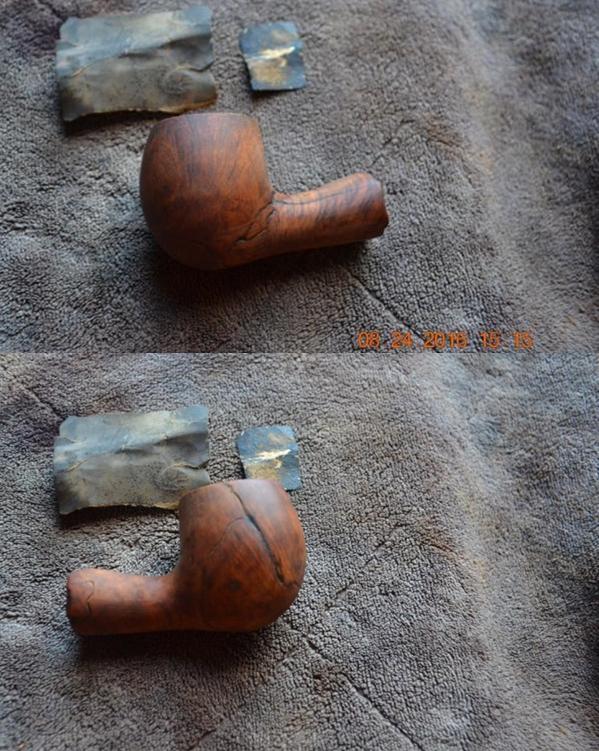
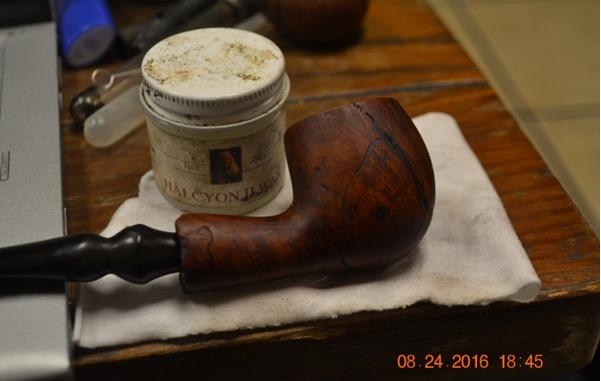
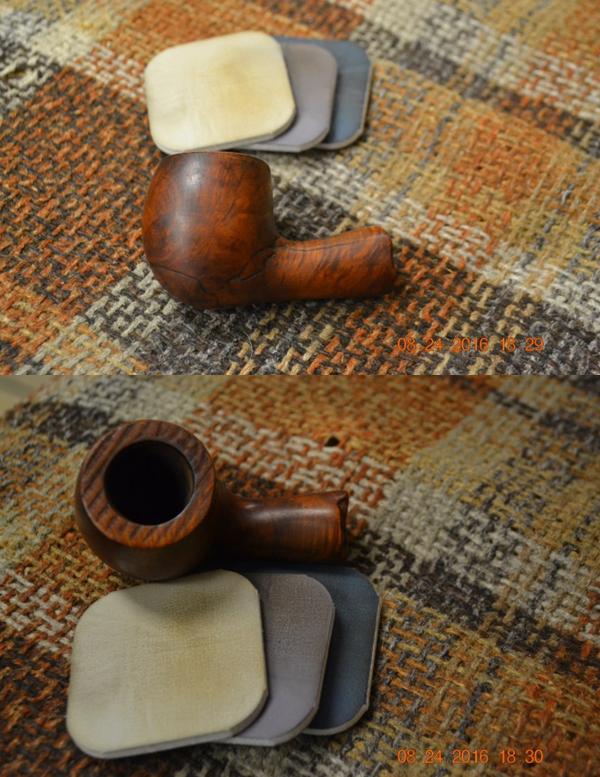
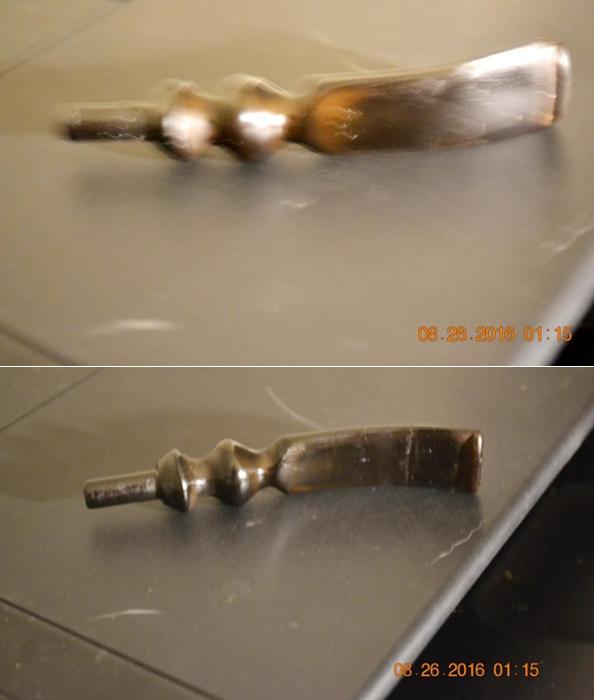
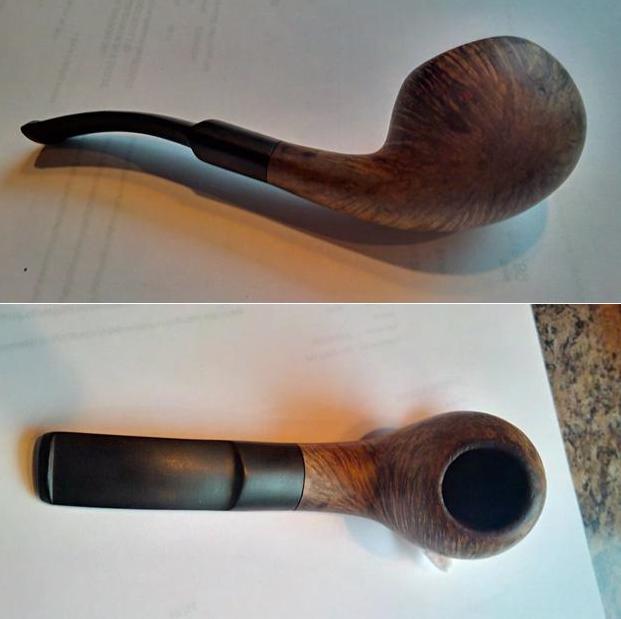
Although the grain does not have the same uniform, vertical tightness and the color is not as light as I hoped to achieve, I can say without hesitation the task was worth every bit of bewitchment, bother and bewilderment I encountered. But this seems like the perfect way to celebrate Labor Day, although this was a labor of love, not work.

But in all honesty I should add that Daryl’s recent fine acquisitions are beginning to get on my nerves.

SOURCES
http://articles.latimes.com/1991-04-17/news/vw-125_1_head-music
http://drgrabows.myfreeforum.org/archive/mastersen__o_t__t_502.html
http://www.pipephil.eu/logos/en/logo-m3.html
http://drgrabows.myfreeforum.org/viewtopic.php?t=502&start=0
http://piperestorer.com/home/318-masterson-freehand-made-in-israel.html
http://pipesmagazine.com/forums/topic/by-request-the-restoration-of-my-masterson-freehand
https://www.bowling.com/shopping/ebonite/bowling-balls?gclid=Cj0KEQjwr7S-BRD96_uw9JK8uNABEiQAujbffJTXbPGJnkV_ebKRiCbi6AG7xKzy_Nd0Q5G2OeTLs3gaAoV-8P8HAQ#all

Underneath the Grime lay a beautiful Royal Guard 504


Blog by Steve Laug

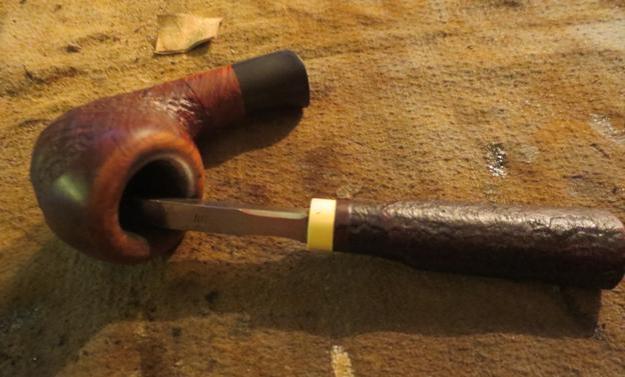
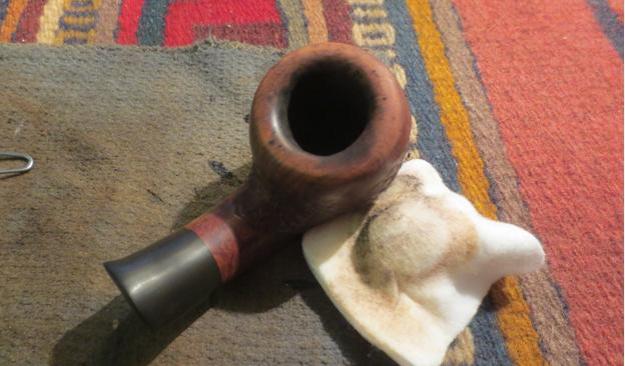
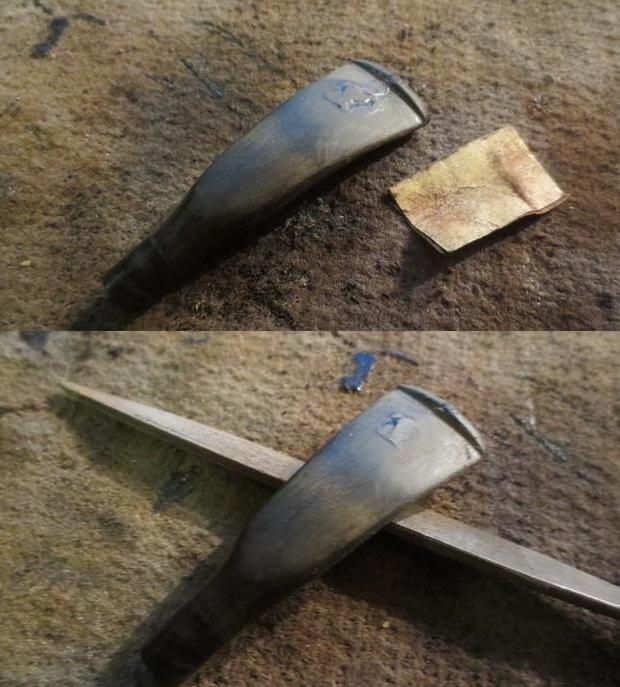
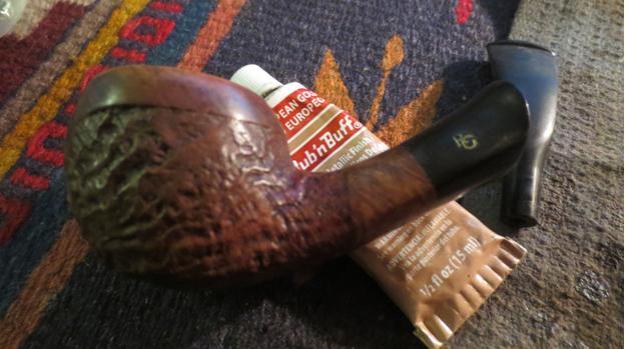
I have a box of pipes from a friend in Dawson Creek to clean up. In trade for a few restorations he was the one who gave me the Preben Holm Pair. I asked him to prioritize which pipes he wanted me to tackle first. Number one on his list was a Stanwell made Royal Guard 504 that combines smooth and sandblast areas into the finish. It was in rough shape. The finish was dirty and worn with the brown top coat worn down. The vulcanite shank extension was oxidized and the RG stamp on the left side was faded. The bowl was thickly caked and the lava overflow on the top of the bowl was also very thick. I was a bit concerned that underneath the cake I would find burn. You can never tell – sometimes a thick cake protects the rim top and sometimes it hides a lot of rim damage. Once I got into the cleanup I would be able to tell better with this one. The stem was lightly oxidized and there was tooth chatter and bite marks on the top and the bottom sides near the button. The top edge of the button had a small dent as well. The deepest tooth mark was on the topside of the stem and would need to be repaired. But even under all the grime I could see that this pipe would be a thing of beauty once it was finished.RG1 RG2I took a closeup photo of the rim to show how thick the cake was in the bowl and the extent of the overflow on the rim. It was very thick and quite hard.RG3I reamed the bowl with the first three cutting heads on the PipNet reamer and then cleaned it up more with the Savinelli Pipe Knife. The amount of carbon that came out of the bowl was amazing.RG4I used a pen knife with a thin stiff blade to carefully scrape off the buildup on the rim. It was pretty thick and hard so I slowly and carefully flaked it off with the knife.RG5I scrubbed the bowl and rim with acetone on a cotton pad and was able to remove the grime and the buildup of wax and oils in the grooves of the sandblast.RG6There were some scratches and nicks in the curved top of the rim that needed to be sanded out. I also sanded the inner bevel on the rim. I used 180 and 220 grit sandpaper to remove most of the damaged areas. The photo below shows the rim after quite a bit of work. There was still more sanding to do at this point.RG7I did some more work on the rim with sandpaper and on the inner edge of the rim with the Savinelli Pipe Knife and was able to smooth out some more of the damage.RG8I wiped down the inner edge of the bowl and the rim with alcohol to see where I stood with the rim resurfacing. It was starting to look really good.RG9I used black super glue to repair the deep tooth mark on the top side of the stem. When it dried I sanded it and filed it smooth the surface of the stem.RG10I sanded the shank extension with micromesh sanding pads. I wet sanded it with 1500-2400 grit pads and dry sanded it with 3200-6000 grit pads. I rubbed it down with Obsidian Oil. I used some European Gold Rub n’ Buff on the stamping on the stem to refresh it.RG11I restained the bowl with a dark brown aniline stain cut by 50% with alcohol. I applied the stain and flamed it with a lighter. I repeated the process until I was satisfied with the coverage.RG12I wiped the bowl down with isopropyl alcohol to even the stain coat and make it more transparent. The combination of grains in the sandblast and underneath is beautiful.RG13 RG14I scrubbed out the internals with alcohol, pipe cleaners and cotton swabs until the airways in the shank and the stem and the mortise in the shank were clean.RG15I buffed bowl with Blue Diamond on the buffing wheel and then gave it multiple coats of carnauba wax. I buffed it with a clean buffing pad to raise the shine.RG16 RG17Once I had the repair smoothed out and blended into the surface of the stem top I polished the stem with micromesh sanding pads. I wet sanded it with 1500-2400 grit pads and dry sanded it with 3200-12000 grit pads. I rubbed the stem down with Obsidian Oil after each set of three pads. Once I had finished I set the stem aside to dry.RG18 RG19I forgot to take a photo of the stem after sanding it with the 6000-12000 grit pads. I took the pipe to the buffer and buffed the stem with Blue Diamond and then gave the pipe multiple coats of carnauba wax. I buffed it with a clean buffing pad and with a microfibre cloth to deepen the shine. The finished pipe is shown in the photos below. I am hoping the pipe man in Dawson Creek likes the new look to this old pipe. It is truly a beauty. Thanks for looking.RG20 RG21 RG22 RG23 RG24 RG25 RG26 RG27
What to do with a cracked bowl – Options for their repair


Blog by Steve Laug

Often a pipe crosses my work table that has a dual attraction – it had obviously been someone’s favourite pipe or it was one that belonged to a loved one and it was severely damaged with a cracked bowl that provides a challenge. No one wants to throw away a pipe that is part of a family history and has deep personal stories attached. The cracked bowl can make that appear to be the only choice. However, it is not the only choice as there are other options. Each of these options has been used repeatedly by me or by one of the other writers on rebornpipes. They do work well and provide more years of service from a cracked pipe.

Method #1 The bowl can be shortened if the cracked portion is high enough on the bowl.

Method #2 A cracked bowl can be shortened and a new section can be spliced on top of the remaining bowl. The original height can be restored.

Method #3 The crack can be filled in and repaired with a mixture of briar dust and super glue that is used like putty. Others have used chimney repair/mortar repair mix or JB Weld to repair the cracks.

Method #4 The cracks can be stitched together with small pieces of wire set at angles to pull the crack back together.

In this blog I will explain each of these methods of dealing with cracked bowls. I will talk through the process of each of the four options and provide photos to illustrate the work. Each of the photos come from previous blog posts on rebornpipes.

Method #1 Shortening a cracked bowl. This is by far the easiest method of repairing a cracked bowl. I only use this method in cases where the crack is not long and the look of the bowl once I have removed the offending portion is still pleasing to the eye. I have received bowls that were cut off this way and were just too ugly to leave. (The photos that I am using on this repair came from a pipe purchased on eBay from the Dutchman. It was a Rhodesian that he had cut off and then sold the pipe as fully restored. It was not! I reshaped the pipe and reclaimed it.) My methodology is basic and straightforward.

1. Use a microdrill bit on a Dremel to drill a pin hole at the end of the crack. This stops the crack from spreading further.

2. Cut off the cracked portion of the bowl using a coping saw, table saw or band saw. I have even used a Dremel and sanding drum to bring it reasonably close to the finished height.
crack13. Top the newly cut off bowl to ensure that it is straight and smooth. Check it often in the process to make sure that things are straight.

4. Reshape the new top of the bowl either by hand or with the Dremel to give it a finished look that tapers upward from the bulging sides of the bowl. (This pipe took a lot of shaping work. The next three photos give different angles of the progress along the way.crack2crack35.  Sand out the scratches left behind by the Dremel sanding drum and fine tune the shaping of the bowl and rim with 220 grit sandpaper. I have found that this grit of sandpaper is very effective for shaping and leaves behind scratches that are easier to sand out than 180 grit or coarser grits. It still cuts away the excess but does not leave a lot of damage to the finish to repair.crack46. Sand the bowl with a medium and a fine grit sanding sponge. This will polish the briar and when you have finished with it you will see the scratches that have been left behind that require further attention.Crack57. Wipe the entire bowl and shank down with acetone to remove the finish on the lower portion of the bowl. It will also remove a lot of the stain that is present in that portion so that blending in the two areas of the bowl is easier to achieve.

8. I finish sanding the bowl with micromesh sanding pads – wet sanding it with 1500-2400 grit pads and dry sanding it with 3200-12000 grit pads. Each successive grit of micromesh sanding pad polishes the bowl more. The bowl is ultimately very smooth and the scratches that remain stand out and can be addressed by repeating the process noted in 5 and 6 above.crack69. Heat the bowl with a heat gun or blow dryer and stain it with an aniline based stain. The heated briar opens the pores so that the stain is taken in. I light the stain on fire with a lighter and it sets it in the grain.

10. If the stain is too dark, wipe it down with a cotton pad and alcohol.

11. Buff it with Blue Diamond and give it several coats of carnauba wax. Buff it with a clean buffing pad to raise the shine.Crack712. If you have done a good job reshaping the bowl it will look natural. Examples of this are a billiard that with shortening become a pot, an apple that with shortening becomes a prince… etc.

Method #2 Splicing two bowls together. A cracked bowl can be shortened and a new section can be spliced on top of the remaining bowl. The original height can be restored. This method is labor intensive and involves cutting the bowl off of a donor pipe that is junk and then working to fit it to the cut off base of a cracked bowl.

1. Cut of the cracked portion of the bowl and flatten the remaining base and shank on a topping board.

2. Cut off the donor bowl the same height as the cracked portion you removed from the other bowl. Don’t worry about diameter or finish at this point.crack83. Drill a series of microdrill holes in the base. These will go around the bowl centered in the briar that remains of the bowl walls.crack94. Cut off pieces of stiff metal or a paper clip. In this case I used small brads. These pieces need to be about 3/4 to 1 inch tall.

5. Set the wires in the drilled holes in the base of the pipe. They should stand straight up all around the bowl.

6. Set the cut off bowl on top of the wires and line up the front, back and sides. Push down on the bowl hard enough to mark the holes that need to be drilled on the cut off bowl but not too hard as you will bend the wires.

7. Remove the cut off bowl and microdrill the holes in that portion to match the bottom.

8. Super glue the pins or wires in place in the base. Once the glue sets put the top portion of the bowl on the pins. Do not push it into place at this point.crack109. Paint the surfaces of the both pieces of the bowl with a two-part epoxy and slowly press the top portion of the bowl onto the pins. Maneuver it until the bowl lines up on the bottom portion.crack1110. Let the epoxy cure. Then use a Dremel and sanding drum or a spade drill bit to even out the inside of the bowl. You want a clean fit of the bowl sides so that there is no ledge or shelf between to two halves.crack1211. Use a Dremel and sanding drum to reshape the bowl so that the parts align and the transition is smooth and the bowl looks natural. Fill in any gaps in the joint with super glue and briar dust.crack1312. At this point you have a choice. You can either rusticate the entire bowl or you can rusticate the joint of the two bowls.

13. Mix a batch of bowl coating using charcoal powder and sour cream or plain yogurt. Stir them together until you get a charcoal grey paste. Paint the inside of the bowl with the mixture using a folded pipe cleaner. Make sure to smooth it out. Set the bowl aside to dry. Once it cures the inside is complete.crack14crack1514. Stain the bowl and rim to your own taste. If you rusticate it you can do a contrast between black and brown or even different browns to accentuate the grooves and smooth portions.crack16

Method #3 Filling the crack. The crack can be filled in and repaired with a mixture of briar dust and super glue that is used like putty. Others have used chimney repair/mortar repair mix or JB Weld to repair the cracks.

1. Drill a pin hole at the end of the crack to stop it from spreading further down the bowl or across the bowl.crack172. Clean out the crack in the bowl with a dental pick to remove the debris and any dust from the crack.

3. Press briar dust into the crack with a flat blade or a dental spatula. I use the dental pick to make sure that there are no air pockets in the dust.crack184. Some folks vary the slightly and mix the slow curing super glue and briar dust on a small jar lid and press the mixture into the crack. Personally I use the method I explained above and put the glue in afterwards. Both methods or variations will work.

5. Fill in the crack over the briar dust with clear super glue. I have found that this takes time and should be done slowly so as not to overdo.

6. Press more briar dust into the super glue to ensure that the crack is filled in.

7. Once the repair is cured I sand the patch with either a folded piece of 180 grit sandpaper or a Dremel and sanding drum. I sand it until it is even with the bowl sides. I love using this method on sandblast pipes as it is easy to blend the repair into the finish.crack198. Smooth out the sanded area with 220 grit sandpaper and then with micromesh sanding pads.

9. I use a stain pen or a black sharpie to stain the repair and then restain the entire bowl to blend in the patch with the bowl colour.crack20crack2110. Mix a batch of bowl coating using charcoal powder and sour cream or plain yogurt. Stir them together until you get a charcoal grey paste. Paint the inside of the bowl with the mixture using a folded pipe cleaner. Make sure to smooth it out. Set the bowl aside to dry. Once it cures the inside is complete.crack22
Method #4 Stitching the Cracks. The cracks can be stitched together with small pieces of wire set at angles to pull the crack back together. This method was used by Charles Lemon on a pipe we worked on together. The pipe traveled back and forth across Canada. Charles stitched the bowl together with brass wire. Here is his methodology. With this method I am giving more detail to explain the process.

1. There were two major cracked areas at the front and back of the bowl. Both cut all the way through the chamber walls, all but slicing the bowl in half lengthwise. The front crack looked like a clean break running from the rim down the face of the bowl to the bottom of the tobacco chamber. The rear crack wasn’t as straightforward. Instead of a single linear crack, the damage at the rear started at the rim, dropped down to roughly the centre of the bowl, and took a sharp left as it sought out an old fill – a natural weak spot in the briar. From the fill the crack had “spidered”, with thinner cracks running up, down and across the bowl. The cracks could be visibly moved by squeezing and releasing the bowl. Without some way to lock the briar in position, the bowl would have to be retired.crack23crack24crack252. Drill a pin hole at the end of each of the cracks to ensure that the existing spider cracks did not run further into the briar. Be careful not to drill through to the tobacco chamber. These “end cap” holes would stop the cracks.crack263. In a bowl as seriously damaged as this one glue alone would not provide sufficient holding power to keep the cracks tight and immobile. There would need to be some sort of physical reinforcement of some kind to ensure that the bowl stayed in one piece after being placed back in service.

Charles and I took on this pipe as a challenge to a conversation we had had earlier regarding when or if a bowl was irreparable.

4. The cracks would have to be pinned using metal wire. In this case a length of 1.2mm brass rod did the trick. Match the diameter of the rod to a micro drill bit and drill pin shafts across the crack, through the curved walls of the bowl, without drilling into the chamber. These shafts only had one end and the pin would be inserted across the cracks.

5. The next close-up picture shows the flat angle of the drilling. A brass rod is in position to show how the process will work. The rod length was marked and then cut shorter so that when fully seated in the shaft, the outer end of the rod would be below the outer surface of the briar. The brass pin was roughened with 220-grit sandpaper to give the glue more gripping surface. Super glue was dripped into the shaft before pushing the pin home.crack276. The second shaft was at an angle relative to the first one – in the photo it is clear that it’s not even close to parallel. This is deliberate. Each pin was drilled at an opposing angle to its neighbours. Doing this assured that any movement of the briar as it heats and cools will be blocked by one or more pins. If the pins were parallel, pressure in the wrong direction could push the crack open again.
7. In all ten brass pins were installed – four in front and six in back – and seven end cap holes were drilled to stop the cracks (all but one of these in the back). The red lines in the photos below show the direction of the pin shafts. You can see how the pins work to stitch the crack shut. The front repair doesn’t look too bad, but the rear of the bowl looks like it was attacked by termites!crack288. With the pins in place the crack no longer moved. The lack of movement shows that the bowl was acting as a single piece of briar instead of several bits of loosely connected wood.

9. Patch the 17 end cap and the pin holes with super glue and briar dust as shown in the photos below.Crack2910. When the glue has cured in the fills, file and sand the patches until they are flush with the surface of the briar.crack3011. Sand the entire bowl with micromesh sanding pads to remove the scratches in the briar and further blend the repairs into the briar. The photo below shows the filled end cap and rod holes. They are smooth and flush with the briar.crack3112. At this point the bowl is ready to stain. The large number of repairs required a darker finish than would have originally been used on this pipe. In this case the stain undercoat was Fiebing’s Black water-based leather dye. This was used to bring out the grain. When that coat had dried the bowl was polished with 0000 steel wool and water. This left the grain stained black while the rest of the wood remained lighter. The second stain coat was a wash of Fiebing’s Dark Brown stain diluted about 50% with alcohol that was used as a wash over the briar repeatedly until the coverage was good. After that coat had dried a medium stain pen was used over the repaired fills to help push them to the background without obliterating the grain altogether.

13. Buff the pipe with White Diamond on the buffing wheel and give it multiple coats of carnauba wax. Buff lightly with a clean buffing pad to give the pipe a shine. In the photo below you will note that the fills and cracks have disappeared almost completely. The stain is translucent enough to allow the grain to shine through. The cracks across the rim are hard to find. The repairs are still visible under strong light, but the repair passes the casual inspection test.crack3214. To further stabilize the repair JB Weld was pressed into the cracks on the inside of the bowl. After the JB Weld had cured sand out the excess. The idea is to only leave the JB Weld in cracks themselves and leave behind smooth chamber walls.crack3315. Mix a bowl coating of either the kind described in the other methods above or the one that Charles used on this pipe. He mixed activated charcoal powder and maple syrup. He coated the walls with the syrup and then packed the bowl with charcoal powder. Once dry dump out the excess powder. The coating provides an extra layer of protection for the repairs as well as a consistent surface upon which to build a new layer of cake.crack3416. Wipe down the bowl exterior and let the interior cure.

17. The photo below shows the repaired rim and the repaired interior with the bowl coating. The pipe was finished.crack35crack36
In all of the methods used the repaired pipes have been repeatedly smoked since the repair was made and there is no sign of cracking continuing or spreading. Each bowl has begun to build up cake and the pipes are serving well in delivering a cool dry smoke. The old battered and repaired pipe has a restored dignity and will last for more years to come.
Revitalizing a Savinelli de luxe Milano 118KS


Blog by Steve Laug

Sav1This pipe came to me from my brother. I am not sure if he found it in one of his antique shop forays between Idaho and Nebraska or on a recent trip to California or even if he found it on eBay. It really doesn’t matter in the long run where it came from. Though sometimes I wish that the pipes I cleaned up could talk and tell their stories. It was obviously a favourite of the pipeman who owned it. It was well smoked but not broken down. The pipe is stamped on the smooth underside of the bowl and the shank with clear and distinct markings. On the bottom of the bowl it reads Savinelli over de luxe over Milano. Next to that it was stamped with the Savinelli Shield logo and the shape number 118KS. Under that is stamped Italy. It is a standard Pot shaped pipe with a large bowl that is one inch in diameter.

The sandblast shown on the pipe in these photos is stunning. Even under the tar, oils and dirt the pipe is quite beautiful. The bowl had a fairly thick cake that had overflowed onto the rim and filled in the grooves. The dust and dirt had filled many of the grooves of the blast on the sides of the bowl and the shank. The stem was oxidized but was high quality vulcanite. In the photos below it is inserted upside down with the brass/gold bar that generally was on the left side of the saddle was turned to the right side. There was some tooth chatter on the top and bottom sides of the stem. On the top side of the stem (which was turned upside down) there was a deep tooth mark.

My brother took these three photos before he cleaned up the pipe. He reamed it with a PipNet reamer to rid the bowl of the cake and scrubbed the exterior with Murphy’s Oil Soap to remove the tars and grime. He cleaned out the airway in the shank, the mortise and the stem airway and removed all of the tar that had collected there.Sav2When the pipe arrived it was spotless. The sandblast really stood out with clarity as can be seen in the next set of four photos. The ring grain, the birdseye and even the flame grain showed but there was also an under grain that shown through that was beautiful as well.Sav3 Sav4I took some close up photos of the pipe. The first shows the stamping on the bottom of the bowl. You can see the clear markings on the pipe and how they stand out on the flat smooth bottom of the bowl and the shank. The second photo shows the rim. There was still light dust and grit in the grooves of the rim.Sav5I also took some close up photos of the stem. I turned it right side up and the tooth mark on the topside near the button is visible in the first photo below. The underside of the stem showed some tooth chatter. Both sides are oxidized.Sav6I used a brass bristle brush to clean out the debris from the grooves in the rim top. It did not take much but once finished the rim was not as dark. I ran a couple of cotton swabs and alcohol through the shank and it was very clean.Sav7I wiped the bowl down with acetone on a cotton pad to remove dust from the bowl surface in preparation for staining the bowl. I applied some dark brown stain thinned by 50% with isopropyl alcohol using a folded pipe cleaner. I flamed the stain and then repeated the process.Sav8I hand buffed the bowl with a microfibre cloth to raise a shine. The next four photos show the bowl after the initial hand buffing. The grain really stands out clearly in these photos.Sav9 Sav10I sanded out the bite marks with 220 grit sandpaper. Thankfully they were not as deep as I thought and were easily removed. I sanded the oxidation as well and gave the stem a general workover.Sav11I polished the stem with micromesh sanding pads – wet sanding it with 1500-2400 grit pads and dry sanding with 3200-12000 grit pads. I rubbed the stem down with Obsidian Oil after each set of three pads. I gave the stem a final rubdown with the oil after sanding with the 12000 grit pad and set it aside to dry.Sav12 Sav13 Sav14
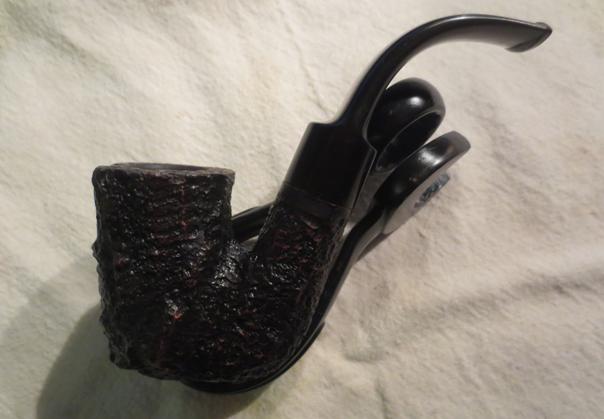
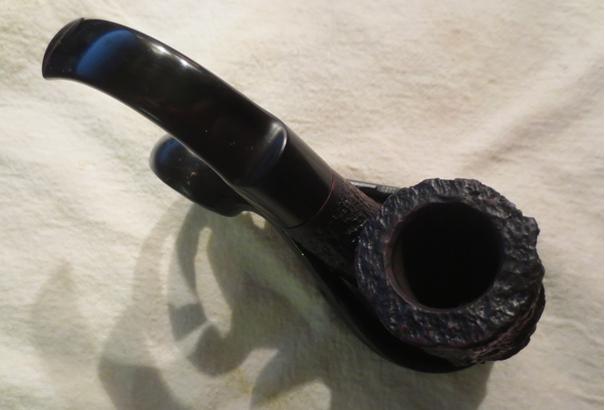
I buffed the bowl and stem with Blue Diamond on the buffing wheel to polish it. I used a light touch on the bowl so as not to get the polish stuck in the grooves of the sandblast. The stem took some work to polish off some of the stubborn oxidation at the shank stem union. I polished the stem with multiple coats of carnauba wax a buffed it with a clean buffing pad. I hand waxed the bowl with Conservator’s Wax and buffed the bowl with a clean buffing pad. I hand buffed the pipe and stem with a microfibre cloth to deepen the shine. The finished pipe is shown in the photos that follow. It is a great looking pipe with an amazing sandblast finish that is worth taking the time to look at. Thanks for looking.Sav15 Sav16 Sav17 Sav18 Sav19 Sav20 Sav21

I love the shape of this Comoy’s Regent’s Park London Made Canted Volcano


Blog by Steve Laug

This pipe takes advantage of the grain to the maximum. The shape has flame, mixed and stunning birdseye on the sides, top and bottom of both the bowl and the shank. This is another of the pipes that my brother Jeff found. The stamping is faint but readable with a lens. It is stamped on top of the shank with the words Regent’s Park over London Made. On the underside of the shank stamped diagonally from front to back it reads Made in England. From the photos that Jeff set me the pipe was in decent shape. The finish was spotty and dirty. The rim was clean and undamaged with a light and spotty lava coat. Comoy1The stem was lightly oxidized and there was a deep and large tooth mark on the top side near the button. I have learned that there is usually a match to that on the underside of the stem. The canted volcano shape is very nice. In the photo below it appears that there were some small pin prick fills on the back side of the bowl just above the shank.Comoy2From what I can find online the pipe is made by Comoy’s. They made the Hyde Park brand and it appears they also made the Regent’s Park brand – both which are Comoy’s seconds and are named after London Parks. I found this Comoy’s Shape Chart on-line which shows the pipe as a Modern 625. I have circled it in red – it is shown on the bottom of the right column, last pipe.Comoy3As usual now, my brother did a stellar job cleaning up the pipe before he sent it to me. He reamed it and scrubbed the exterior with Murphy’s Oil Soap so the finish was very clean. He cleaned out the internals as well. The pipe was ready for me to work on the finish and stem repairs when I received it. The next four photos show what the pipe looked like when it arrived to my work table.Comoy4 Comoy5I took a close up photo of the rim to show the slight damage – almost cut marks on the top of the rim surface. The inner and outer edge of the rim is fairly undamaged though so it will not take much to clean up this rim. I also took close up photos of the stem to show the large bite/tooth marks on the top and bottom sides near the button.Comoy6 Comoy7I cleaned up the tooth marks with sandpaper, a dental pick and alcohol. I filled in the deep dents with black super glue and let it cure. I forgot to take photos of the repairs before I sanded them out. Once the glue had cured I sanded both sides of the stem with 220 grit sandpaper to smooth out the repair to match the surface of the rest of the stem.Comoy8I also filled the pin holes in the back side of the bowl with clear super glue and briar dust. Again I forgot to take a photo of the glue and dust mixture. Once it dried I sanded the bowl with 220 grit sandpaper and blended the repairs into the surface of the briar. The surface was smooth to touch .Comoy9I sanded the slash marks on the rim with 220 grit sandpaper to minimize them. It did not take too much sanding to remove them. I also sanded the inner beveled edge of the rim to clean it up and remove the darkening.Comoy10I sanded the bowl and rim with a medium and a fine grit sanding block. I worked to remove the scratching left behind by the 220 grit sandpaper. I carefully avoided the areas on the shank that held the already faint stamping.Comoy11 Comoy12I sanded the stem with the sanding block as well.Comoy13I wet sanded the stem with 1500-2400 grit micromesh sanding pads and rubbed it down with Obsidian Oil. I dry sanded it with 3200-4000 grit pads and gave it another coat of oil. I finished sanding it with 6000-12000 grit pads, gave it a final coat of Obsidian Oil and set it aside to dry.Comoy14There were some scratches on the top of the stem. I would need to work on them some more at this point.Comoy14a Comoy14bOnce I buffed the stem with Blue Diamond the scratches would be blended into the stem surface. I gave the bowl a coat of Danish Oil and Cherry Stain to highlight the red of the briar. I set it aside to dry for about twenty minutes.Comoy15I wiped the bowl off with a soft cloth and hand buffed it lightly to get a clear picture of the finish and the grain on the bowl.Comoy16 Comoy17I polished the bowl and stem with Blue Diamond on the buffing wheel. I buffed out the scratches in the stem and the briar. I gave the bowl and stem multiple coats of carnauba wax to protect it. I buffed it with a clean buffing wheel to raise the shine. I hand buffed the pipe with a microfibre cloth to deepen the shine. The finished pipe is shown in the photos below.Comoy19 Comoy20 Comoy21 Comoy22 Comoy23 Comoy24 Comoy25