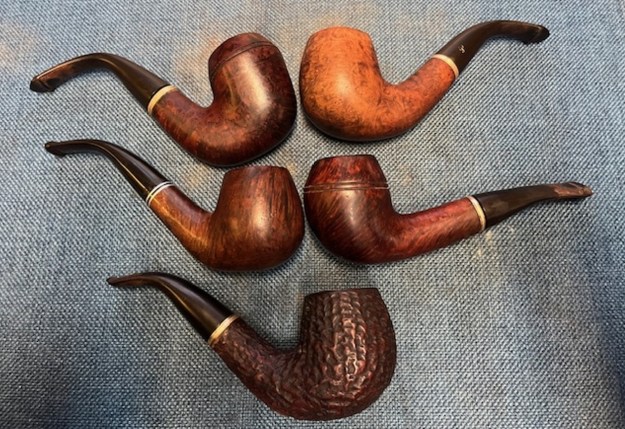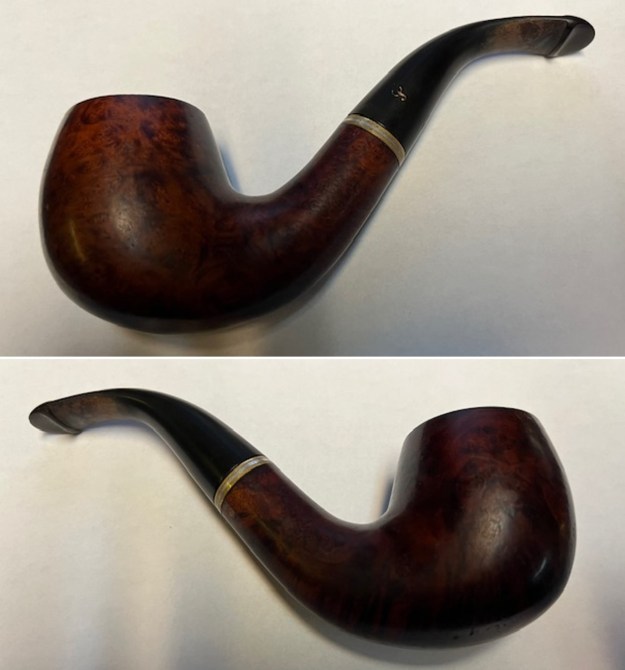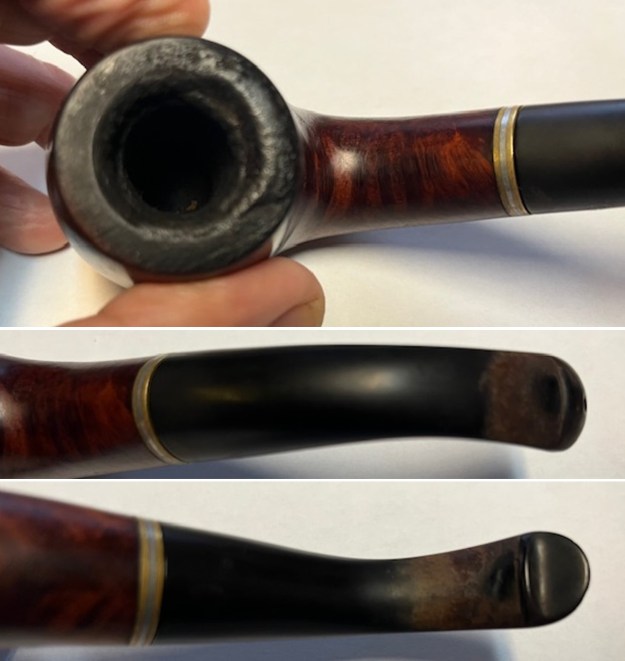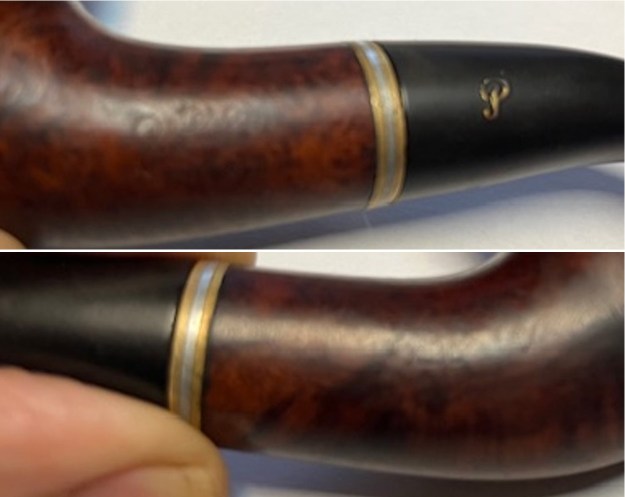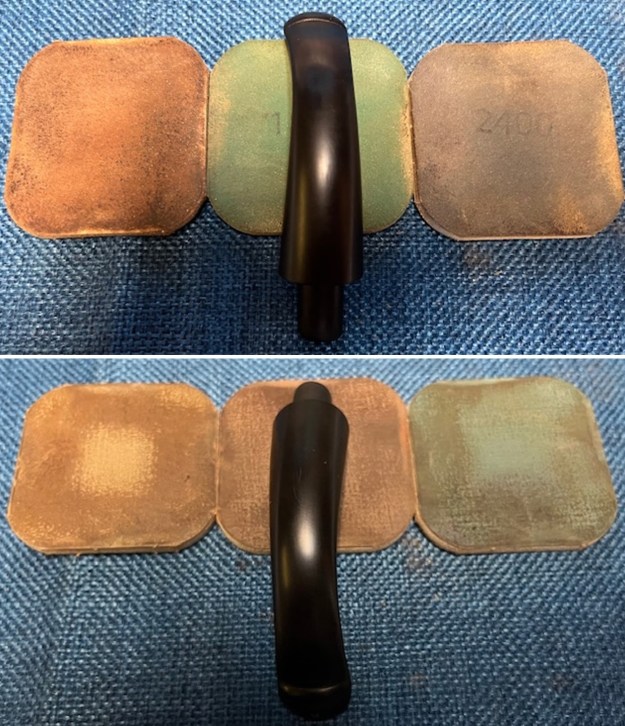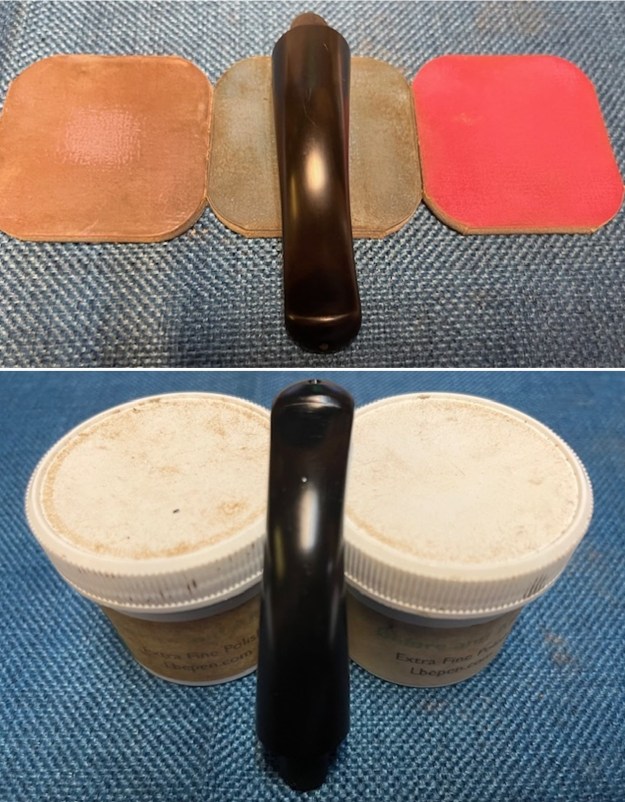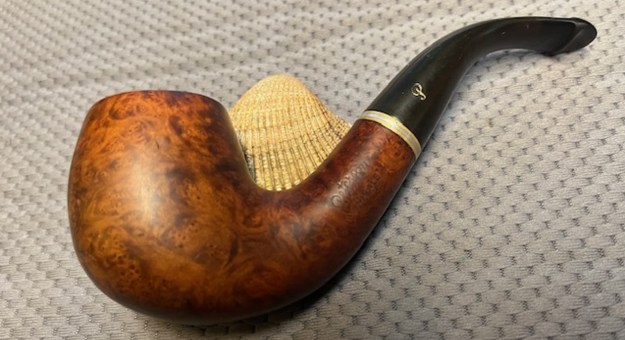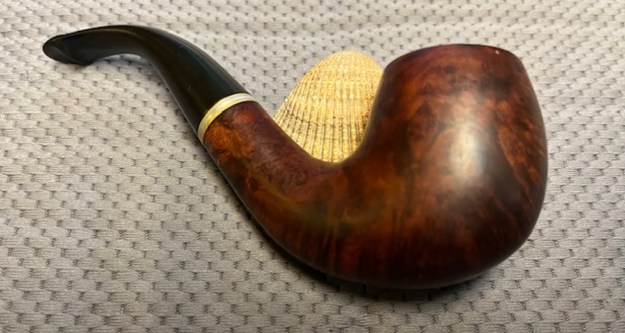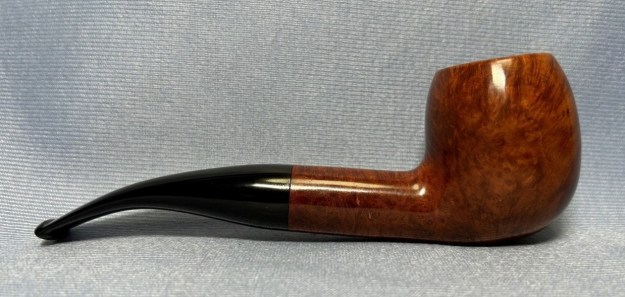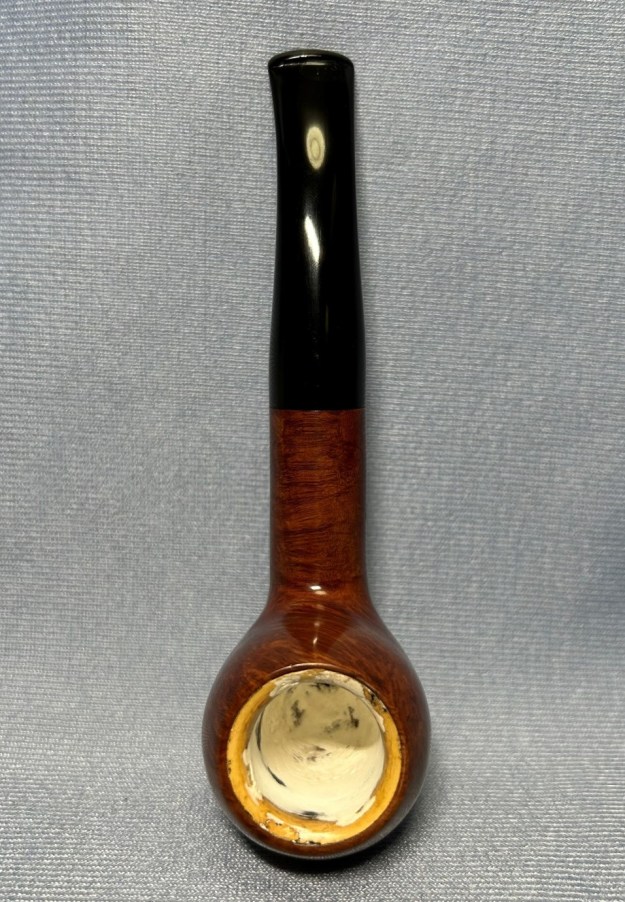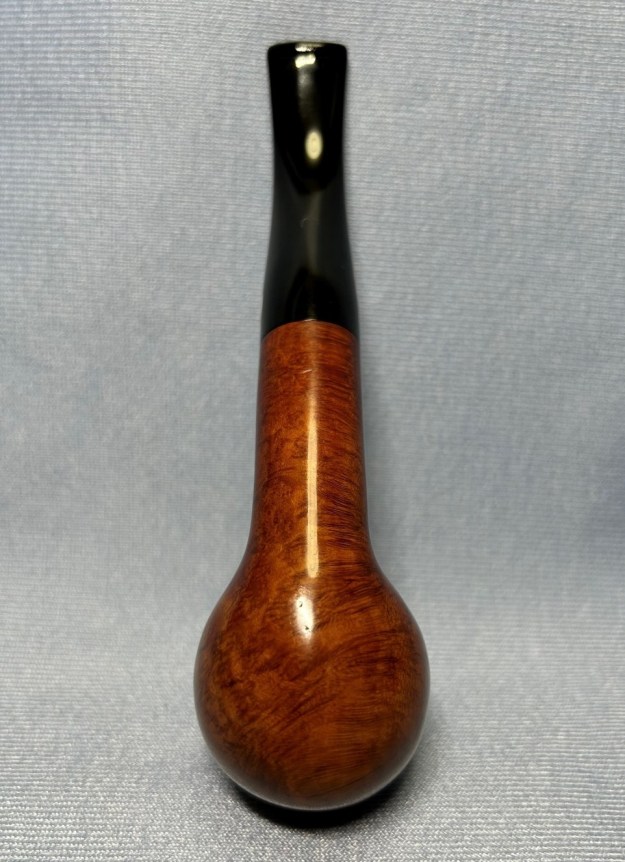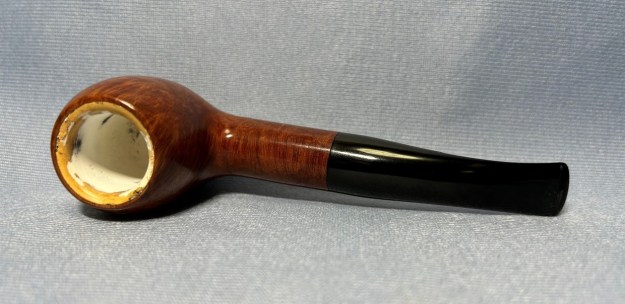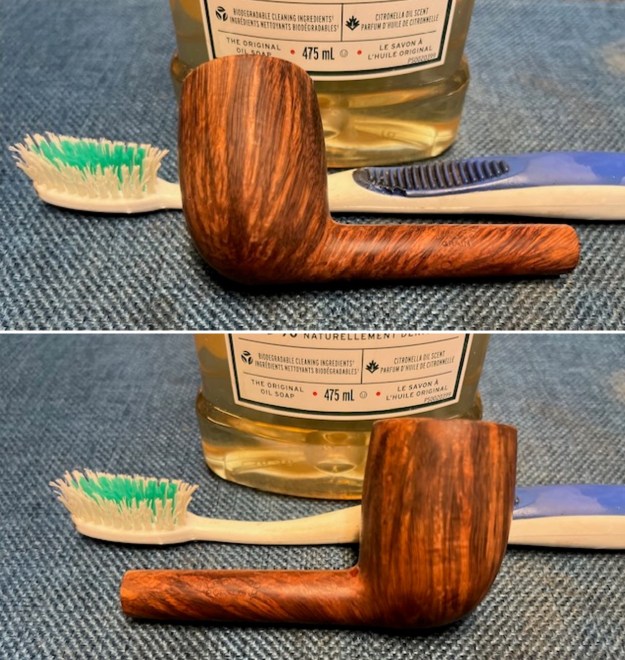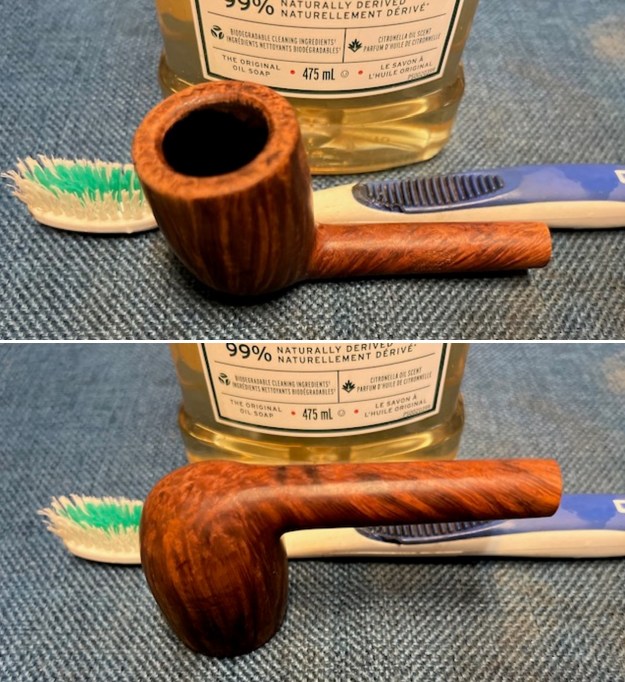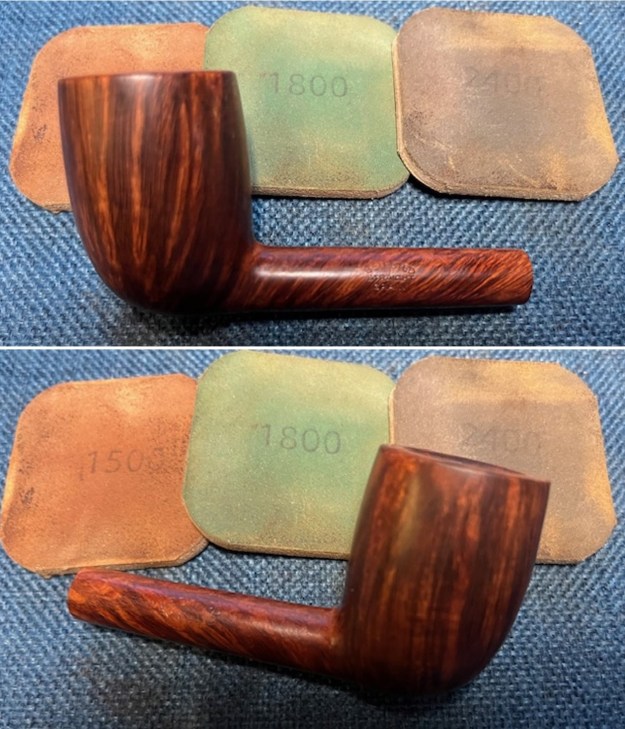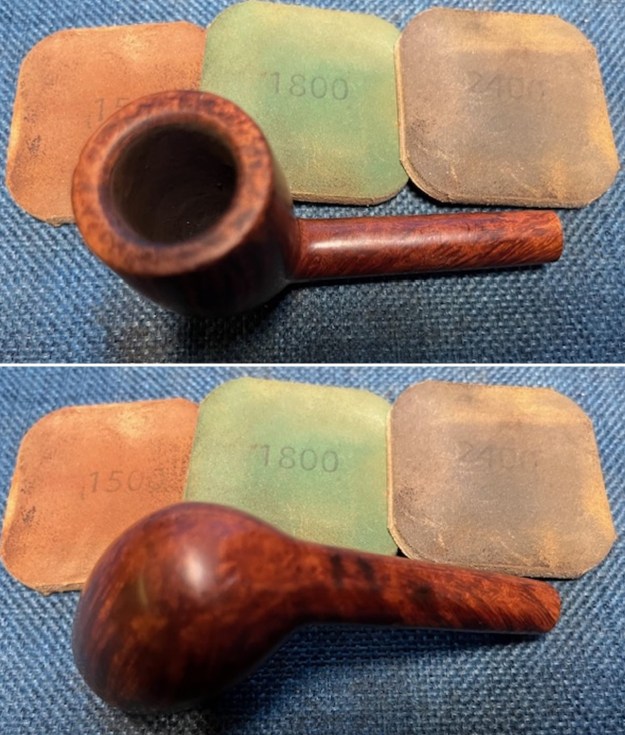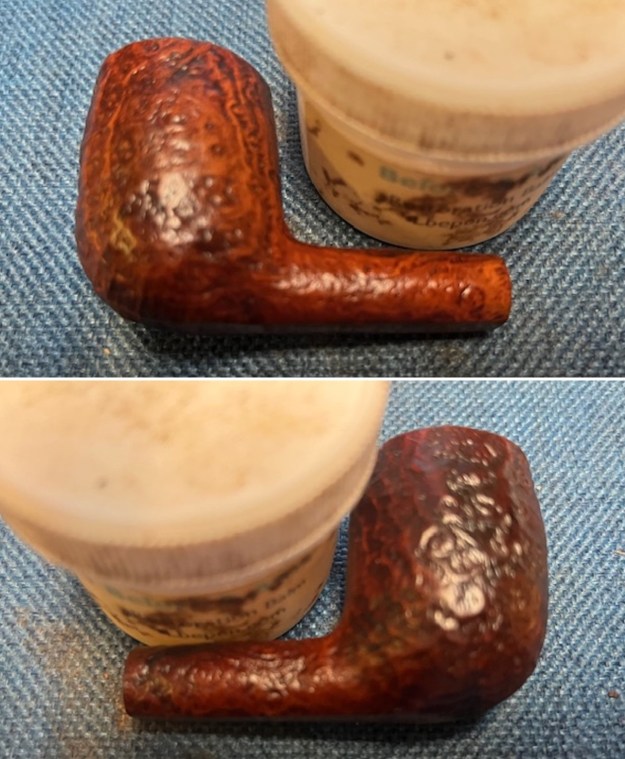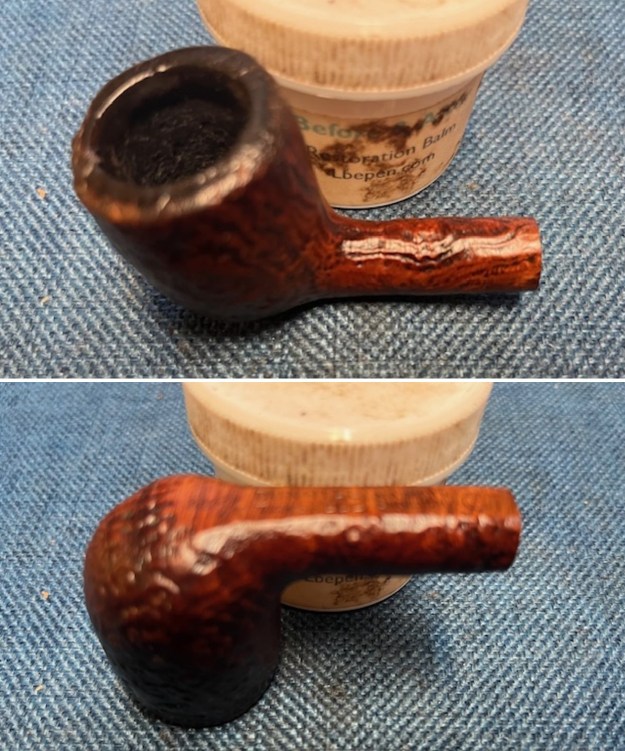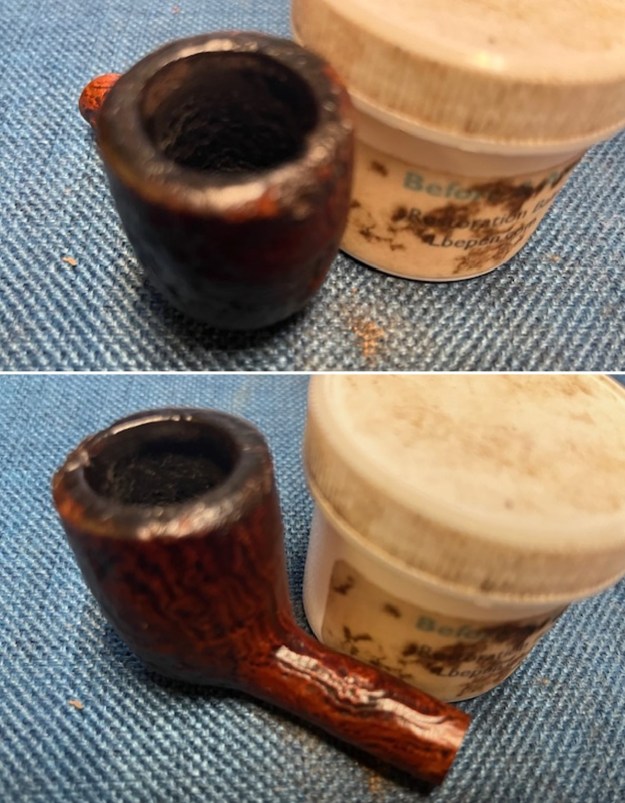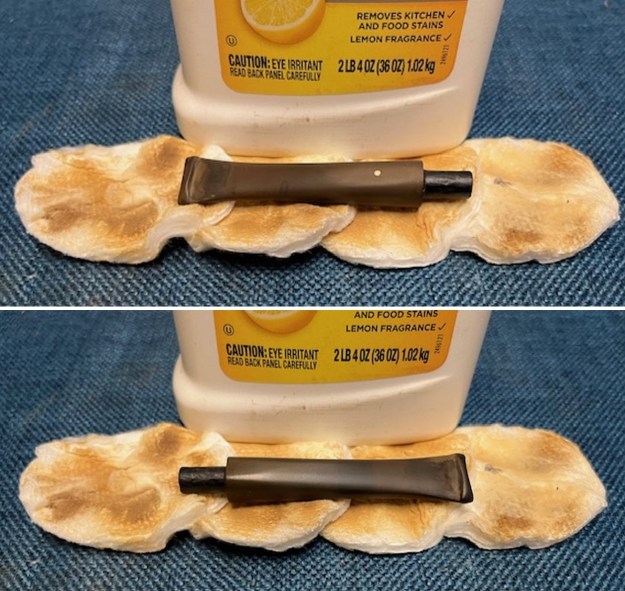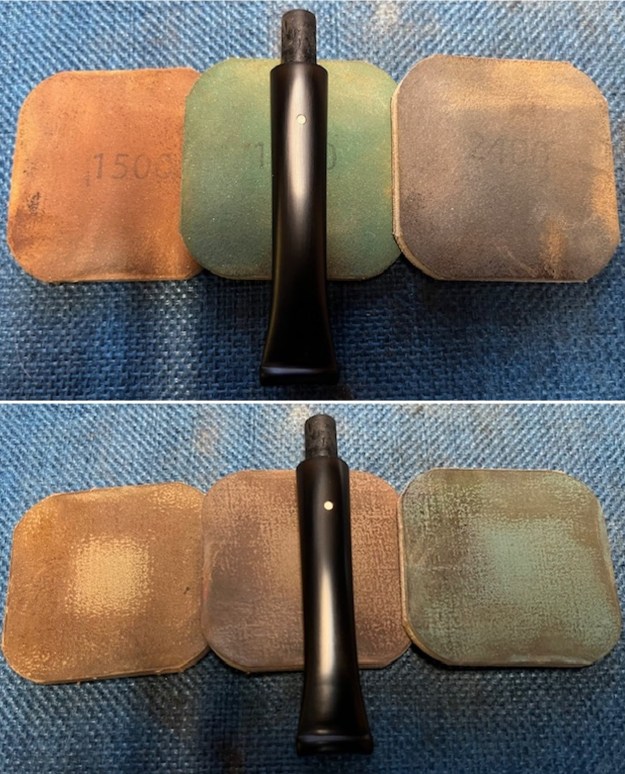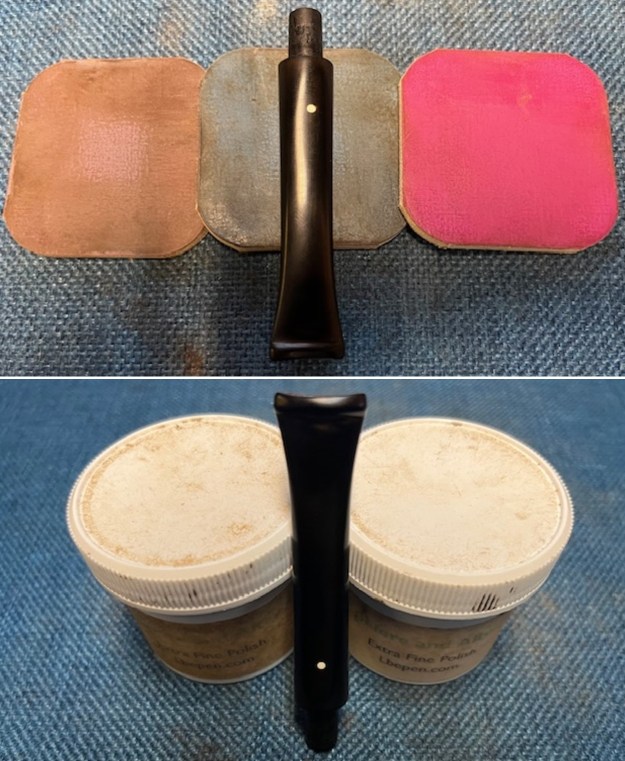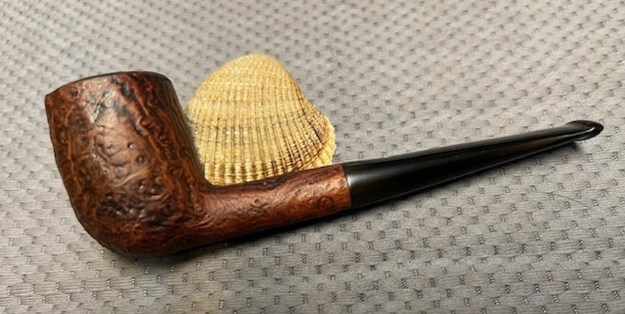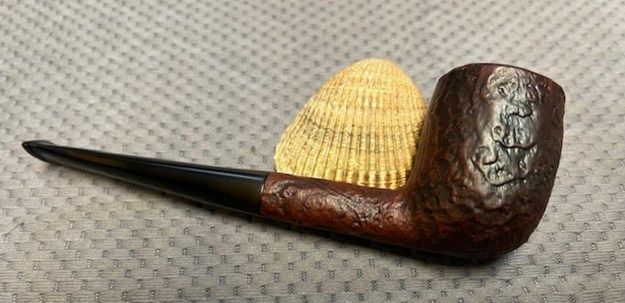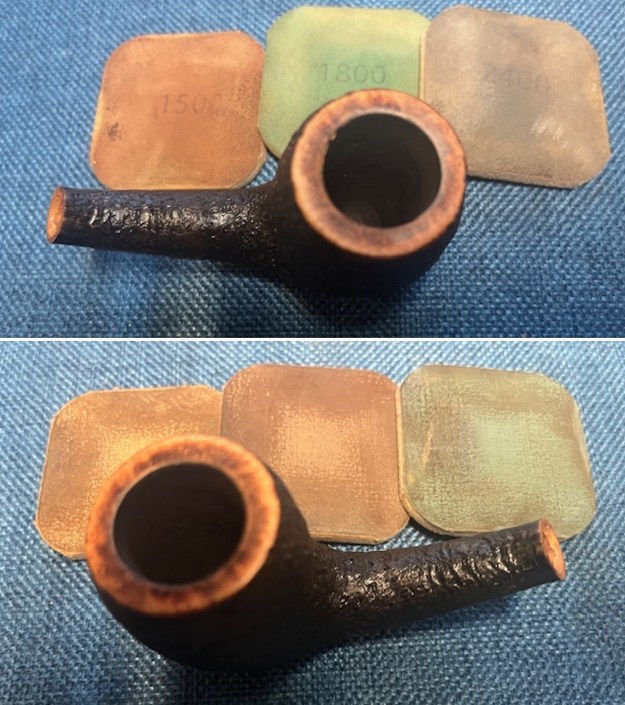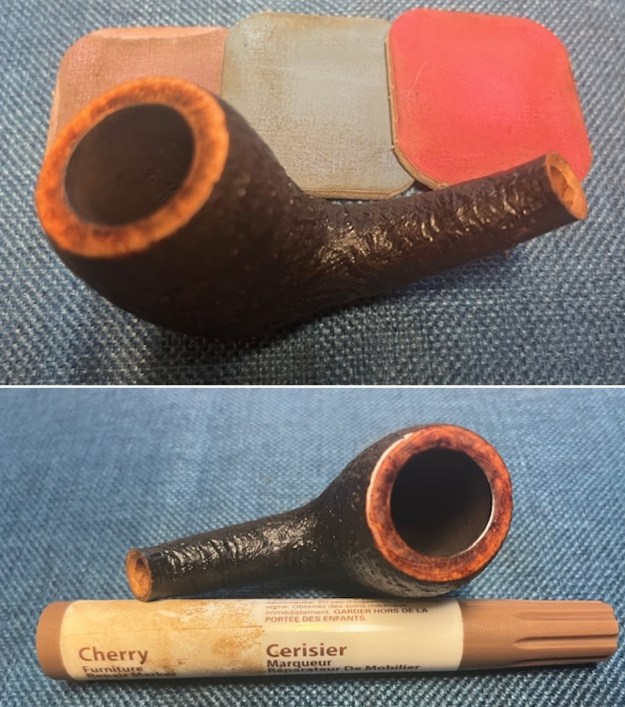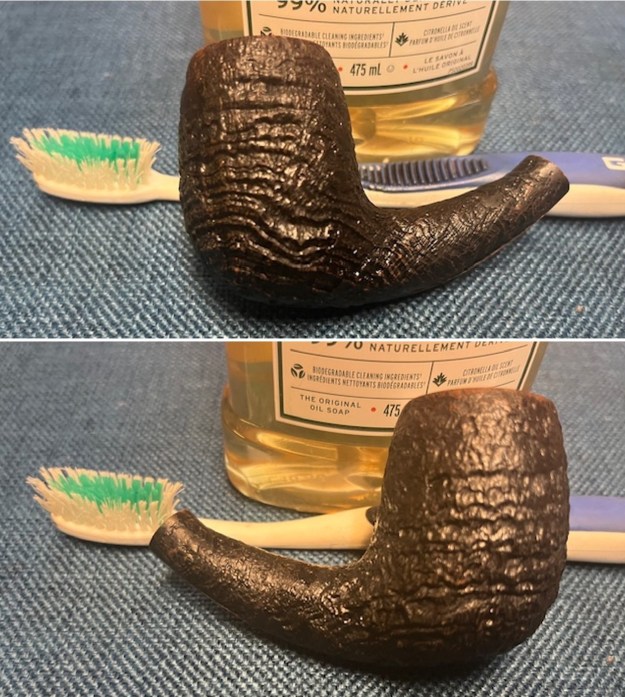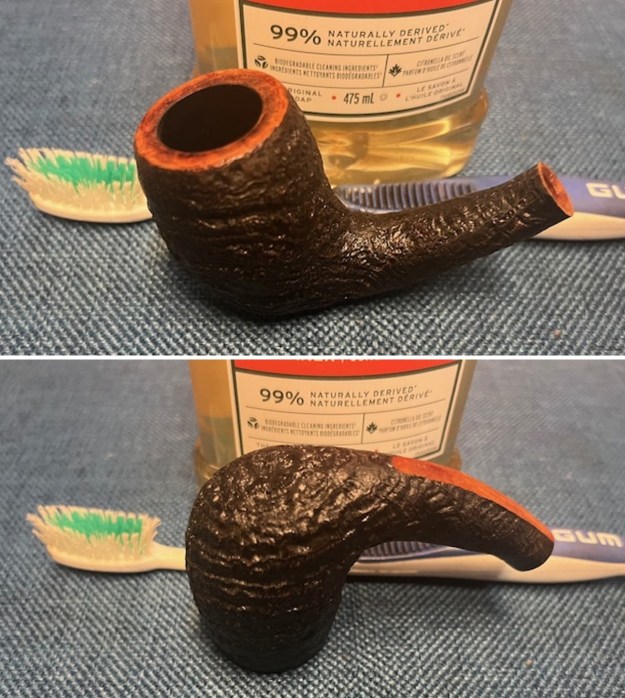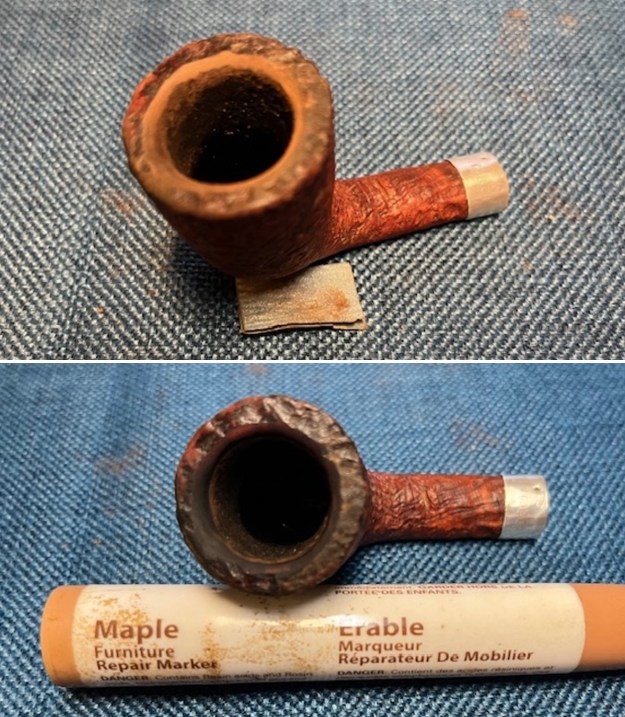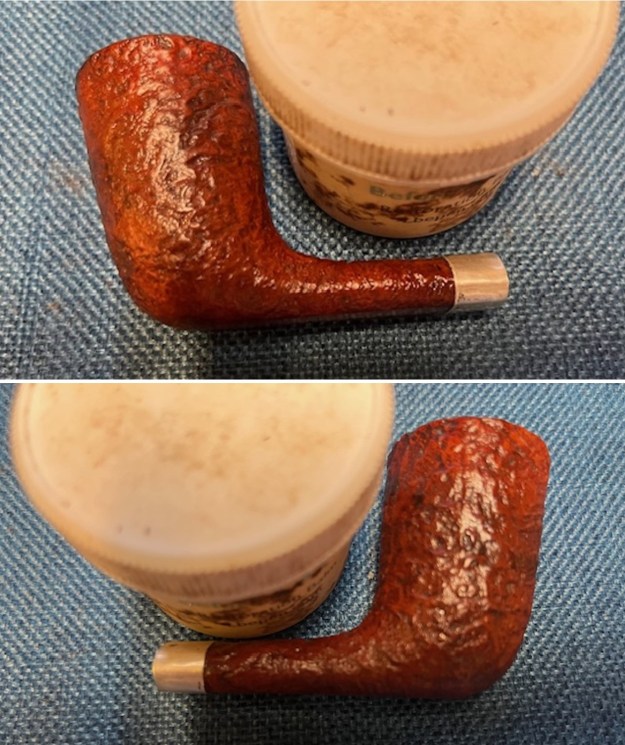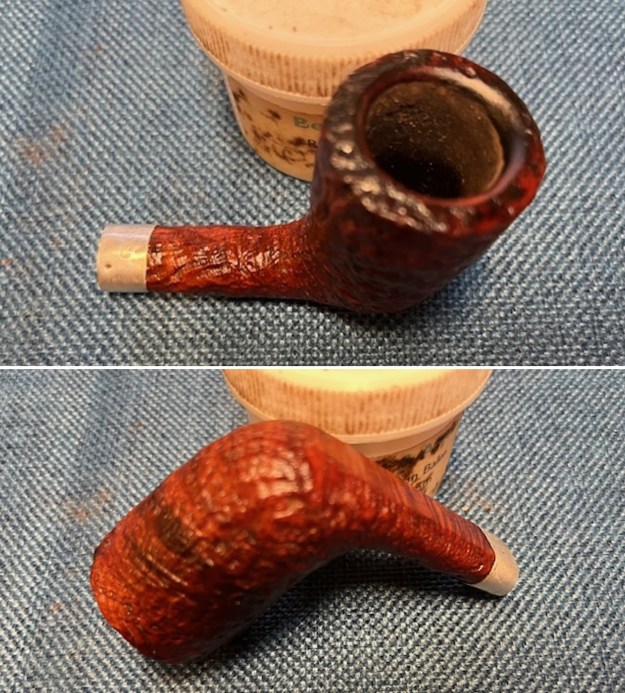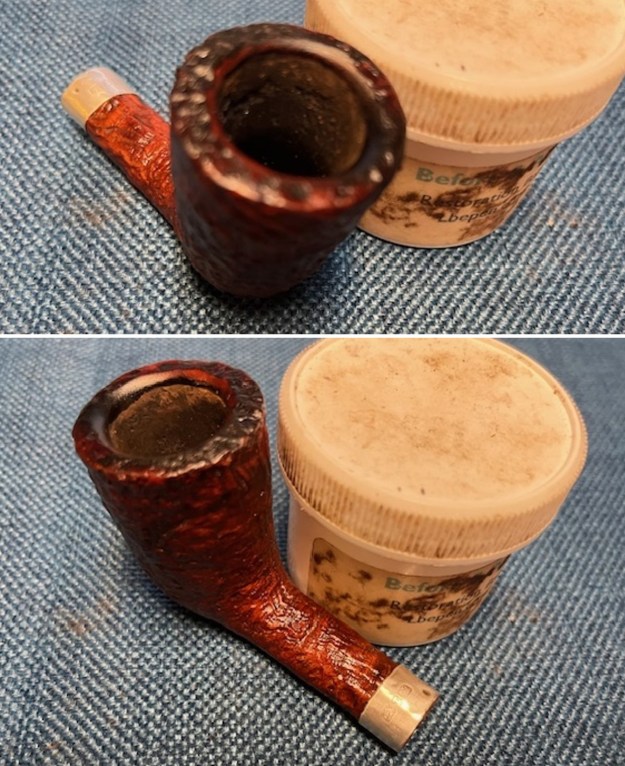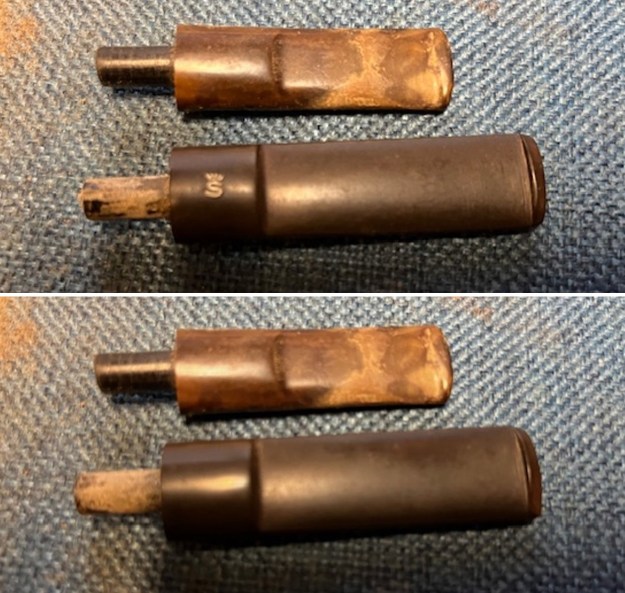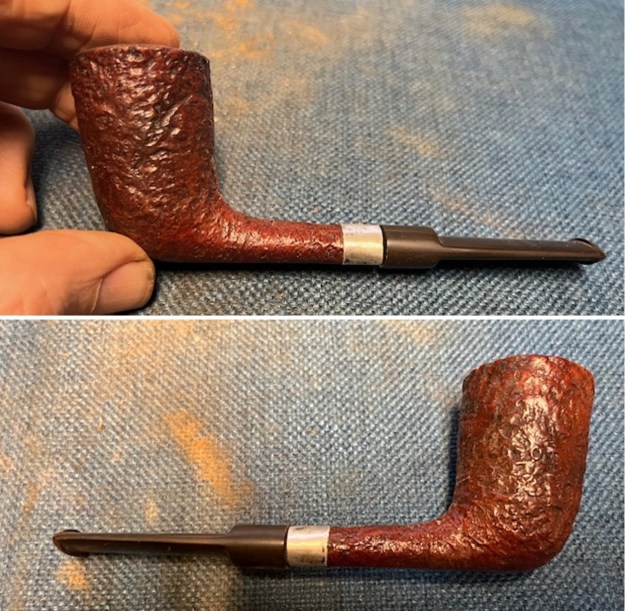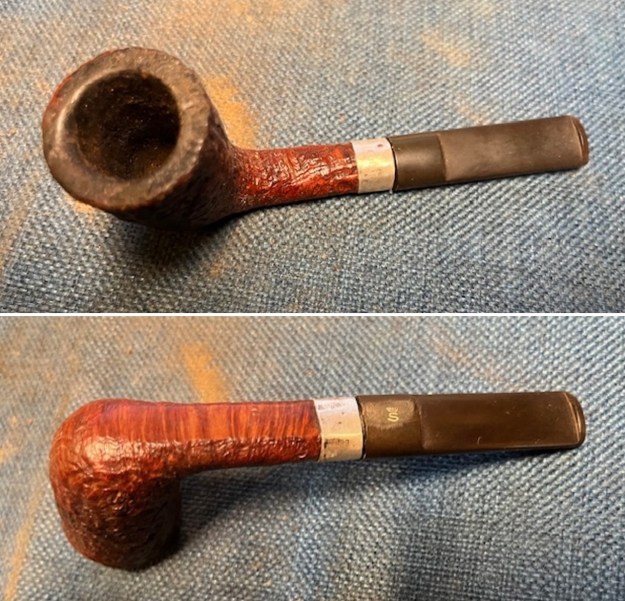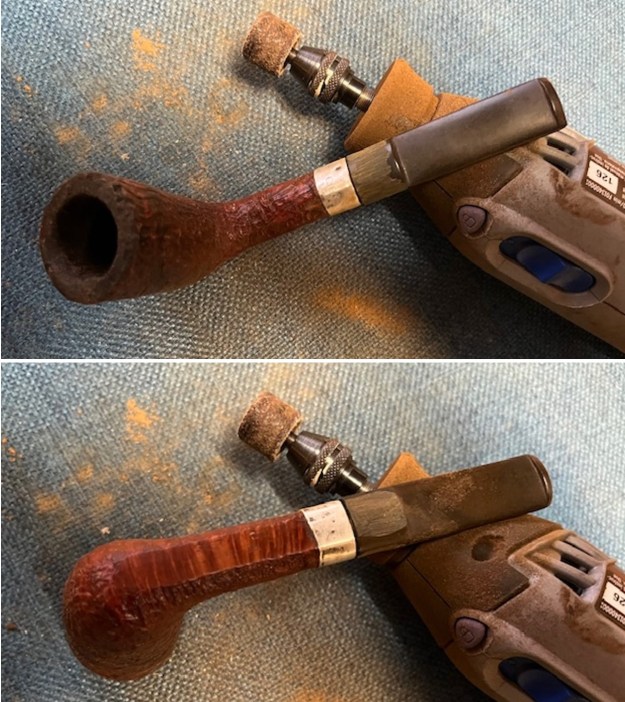
Tag Archives: buffing

Restoring a Beautiful Savinelli Punto Oro


by Kenneth Lieblich

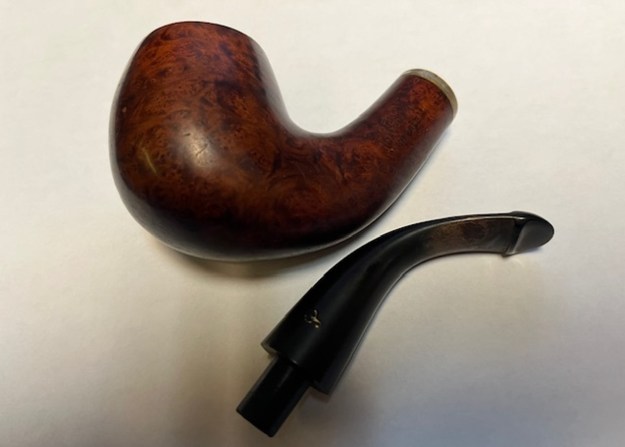
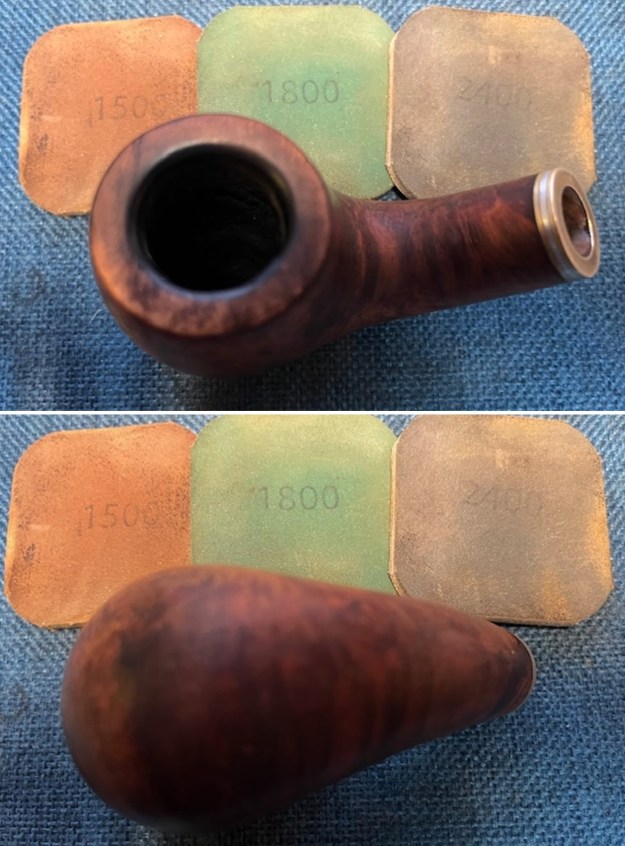
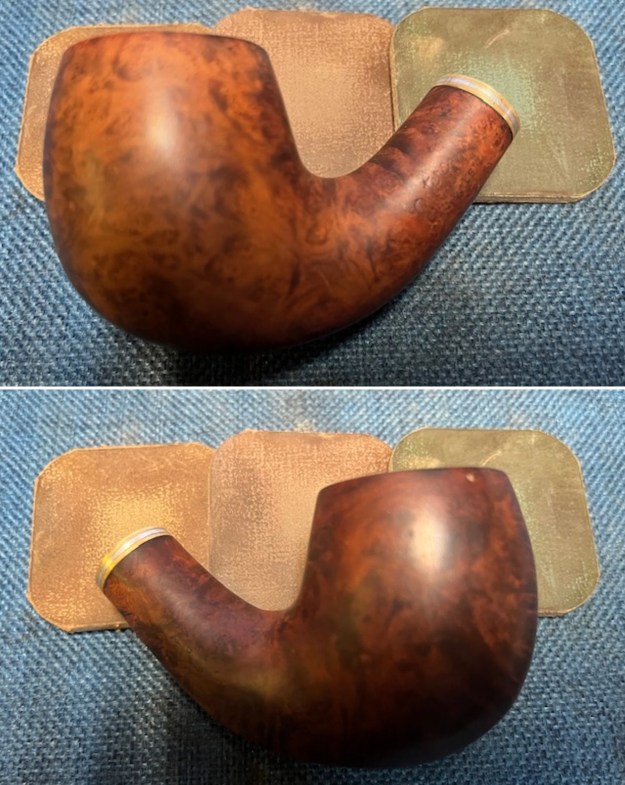
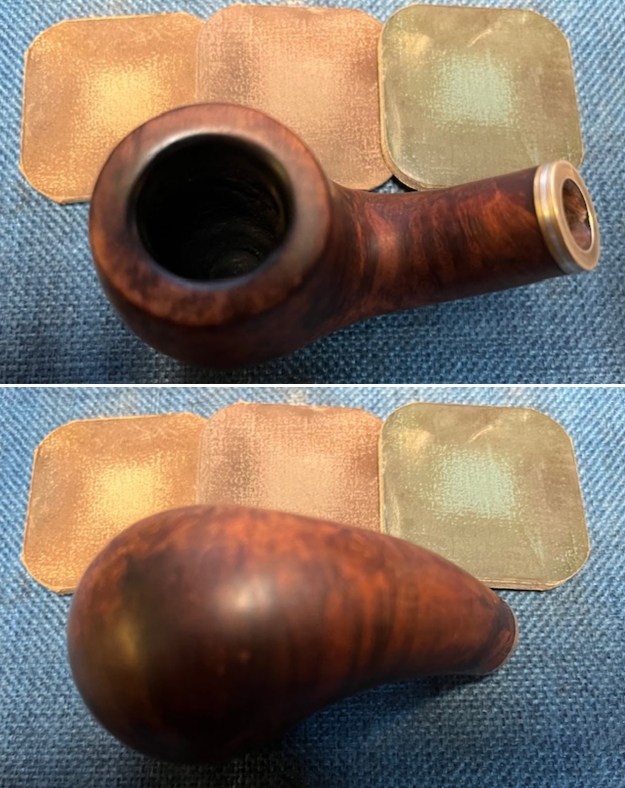
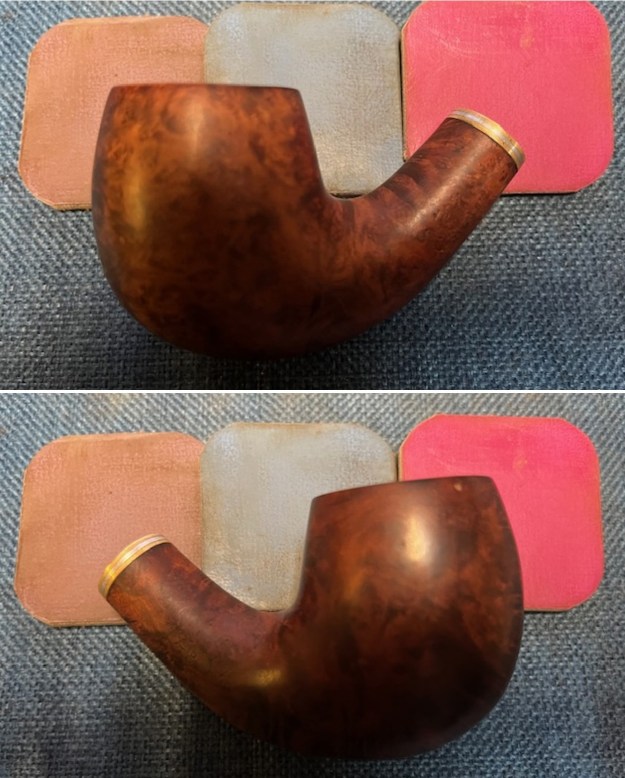
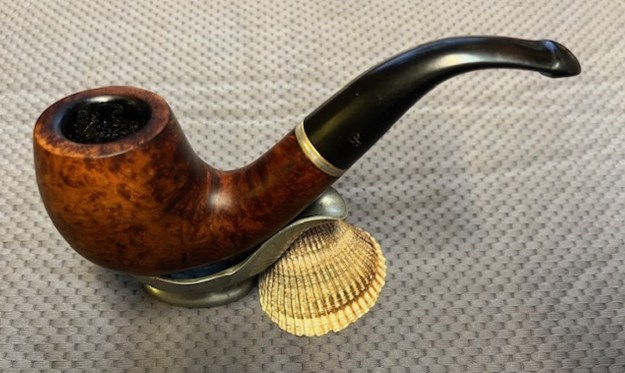
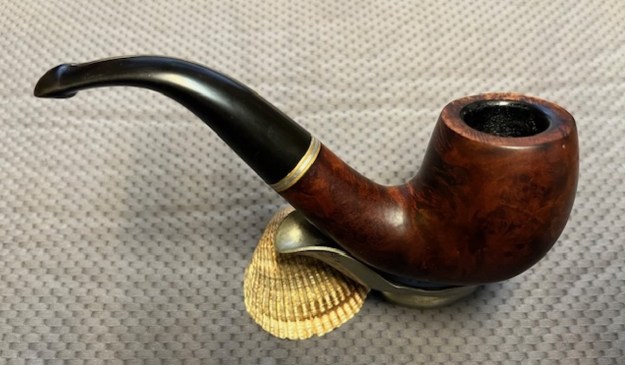
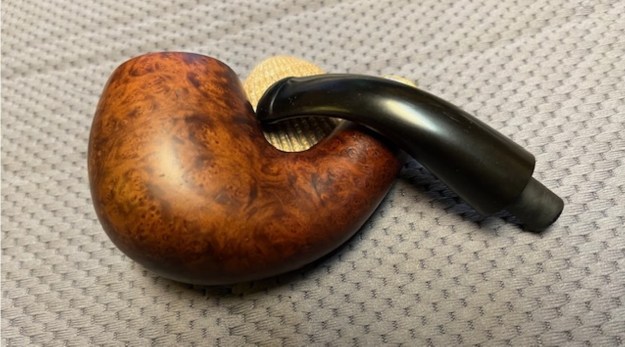
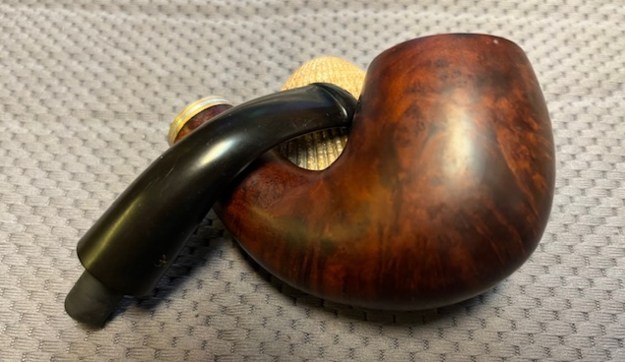
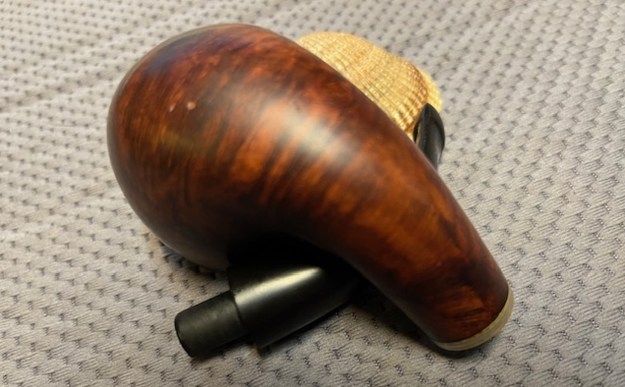
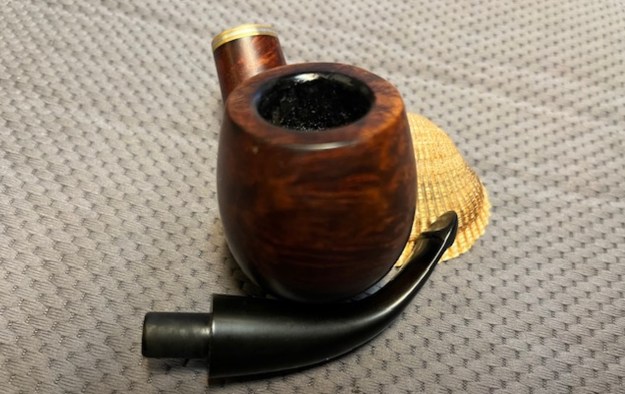
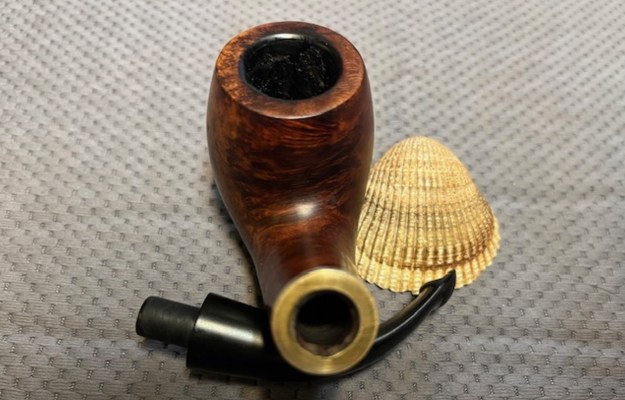
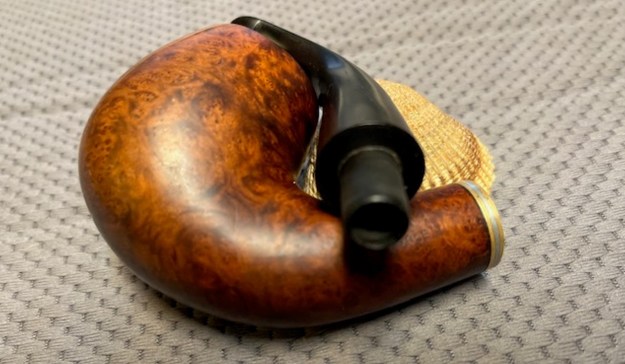
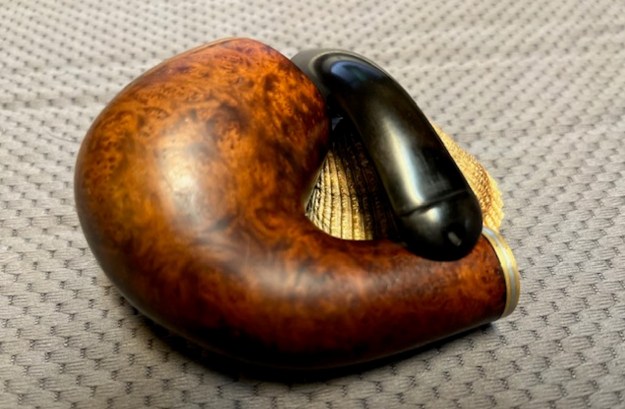
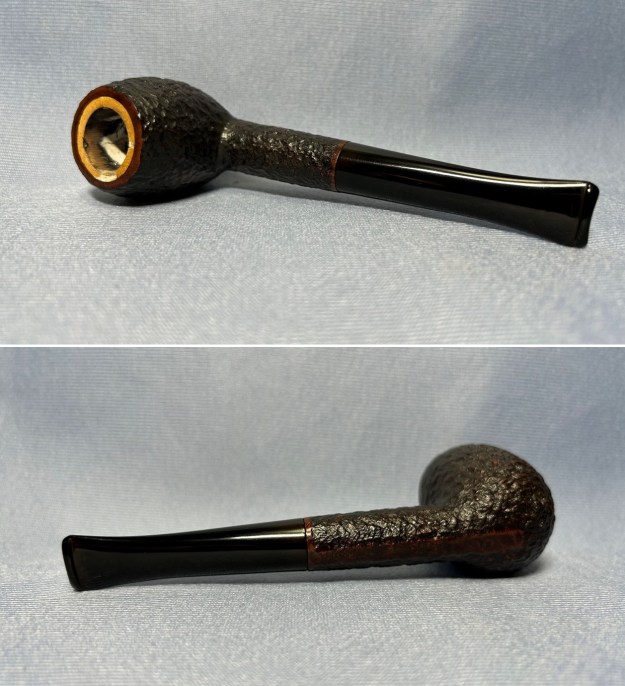
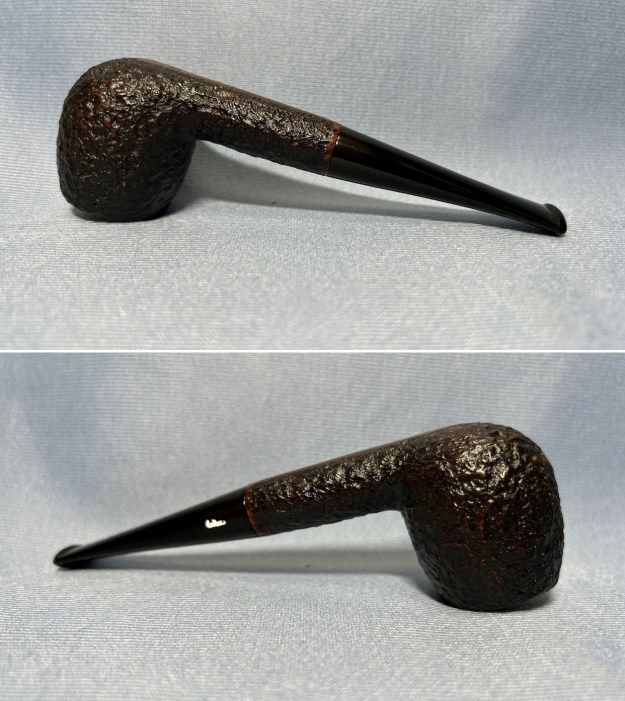
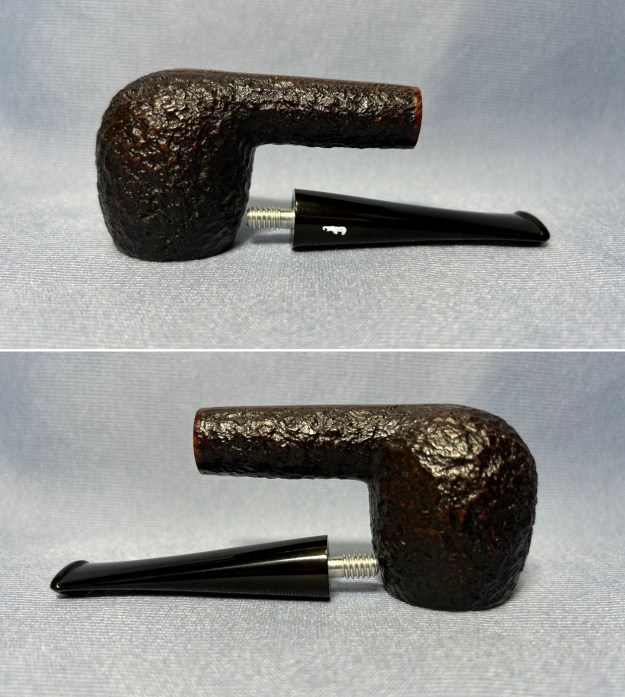
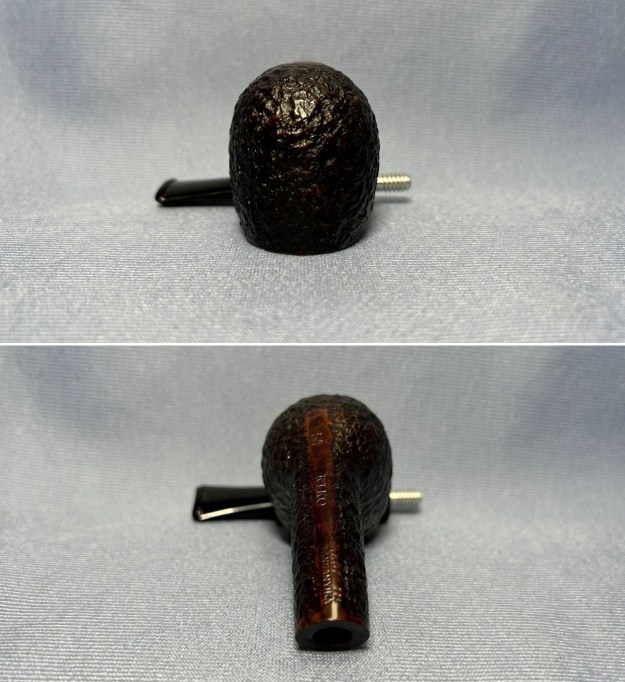
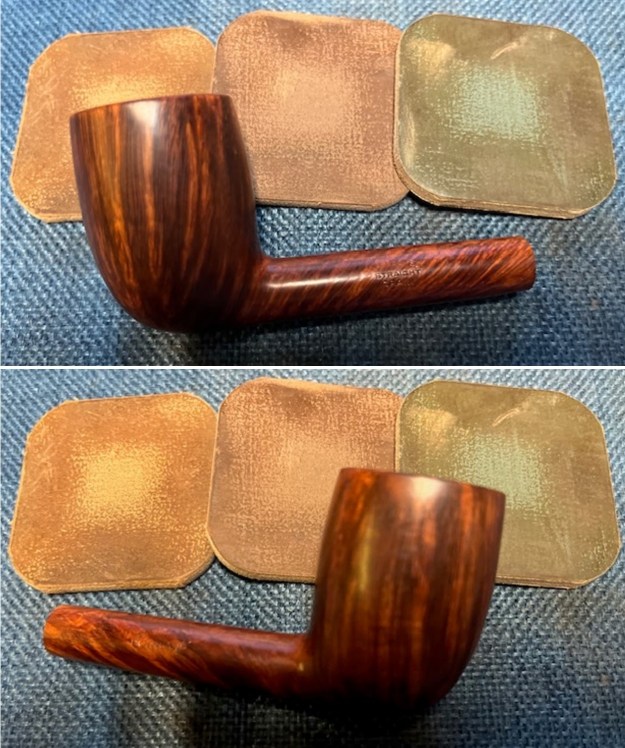
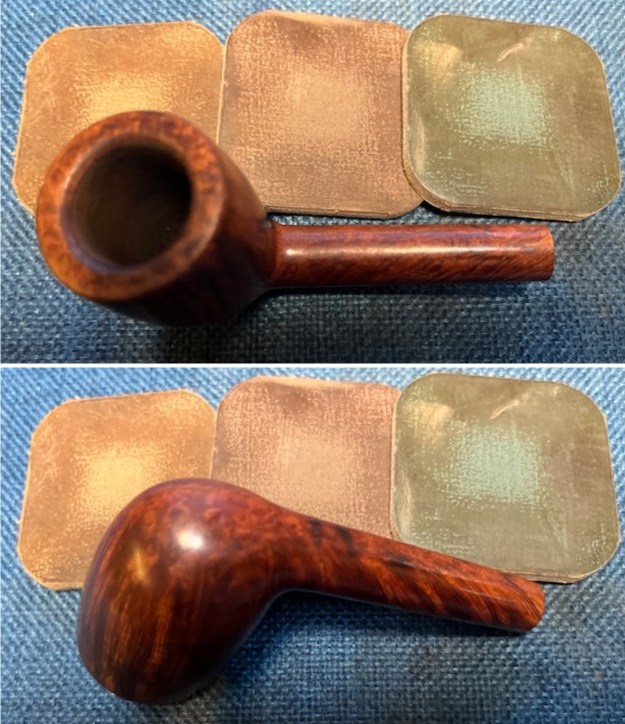
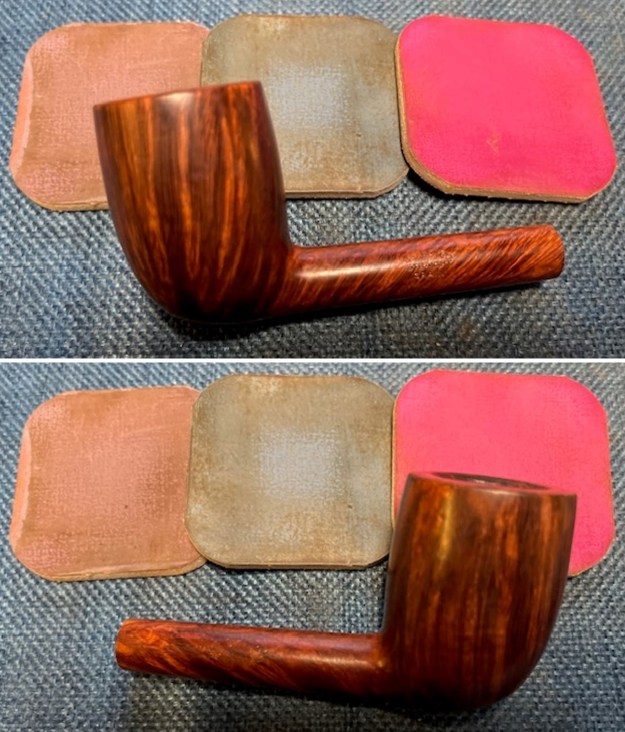
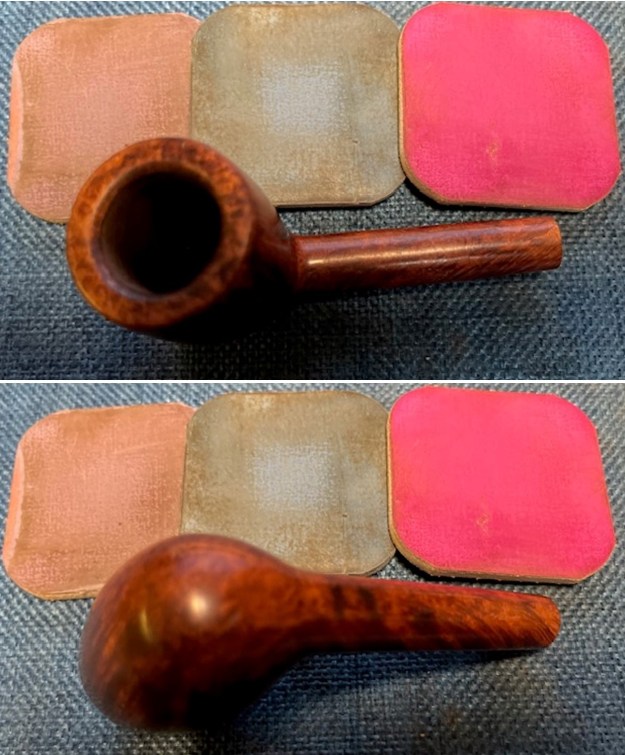
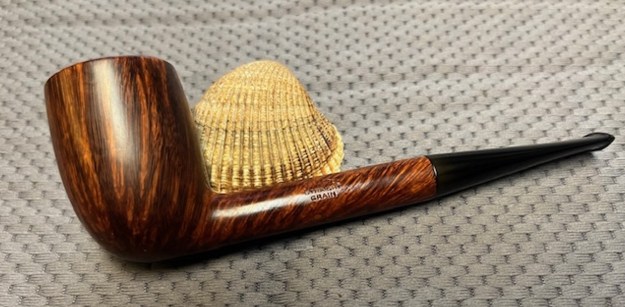
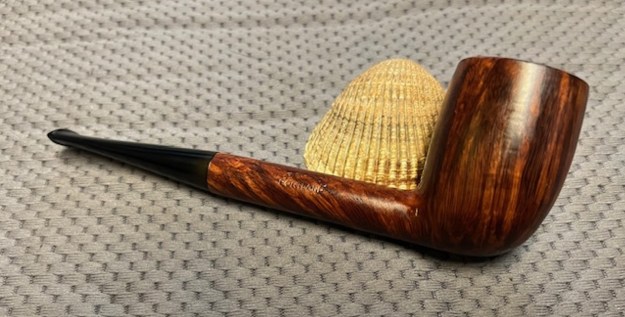
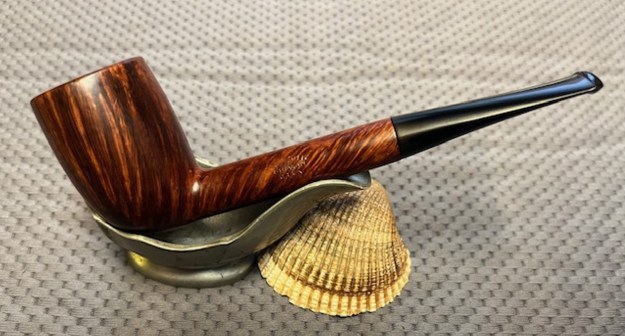
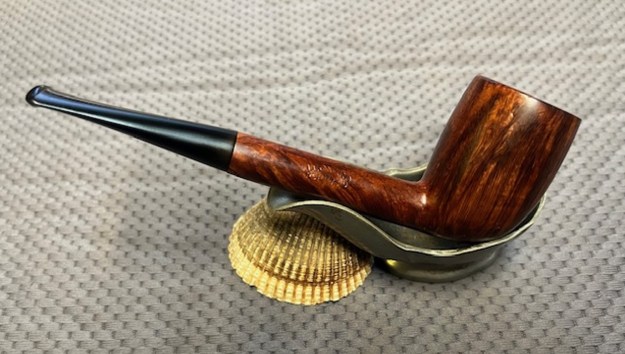
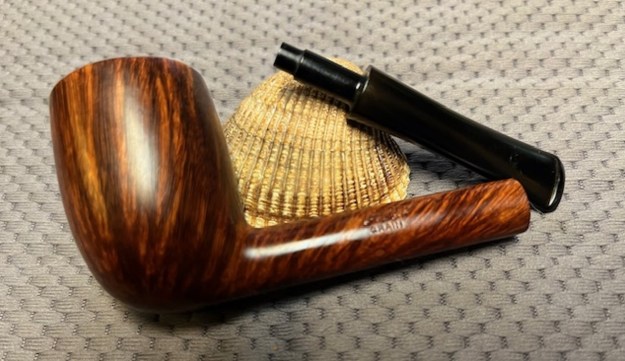
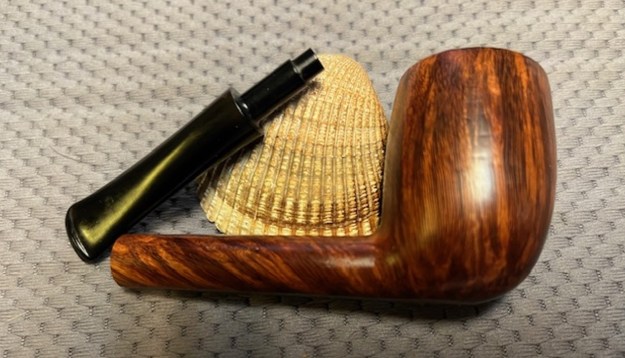
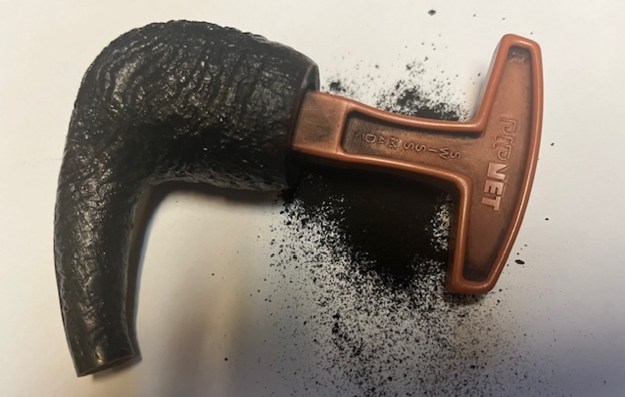
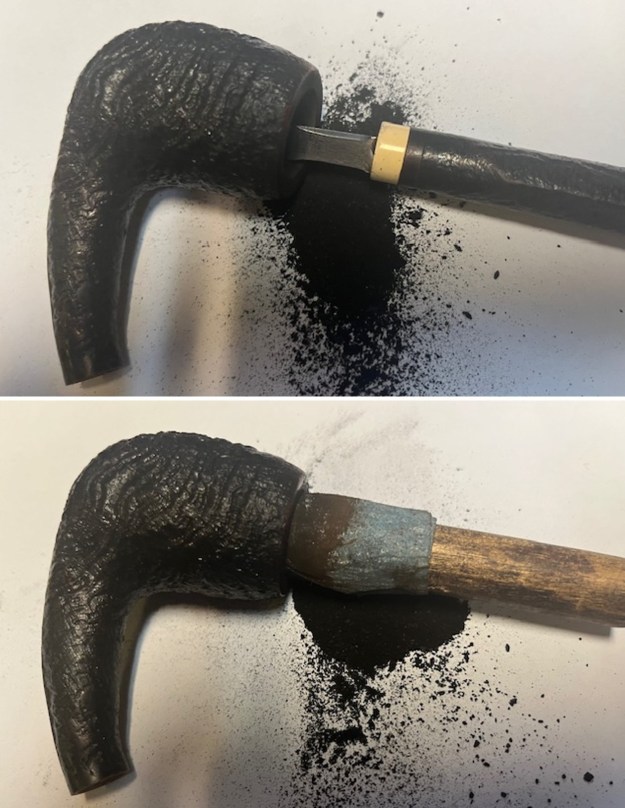
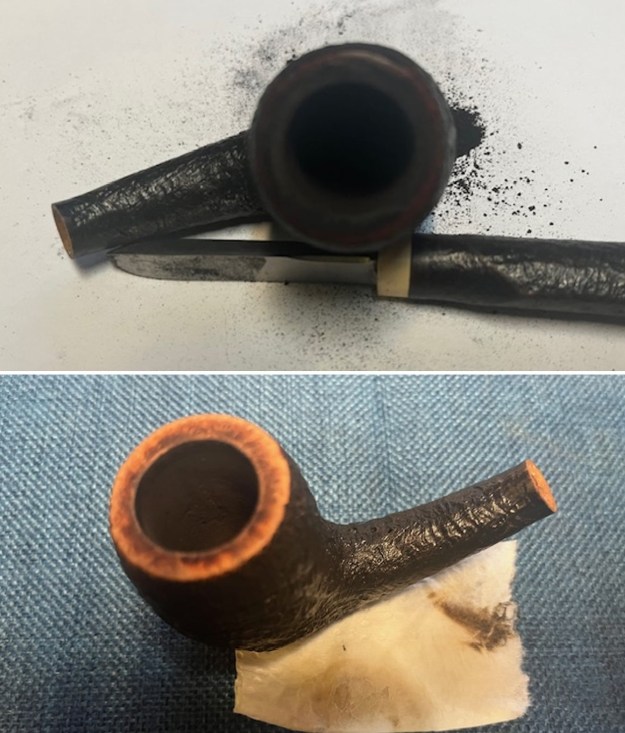
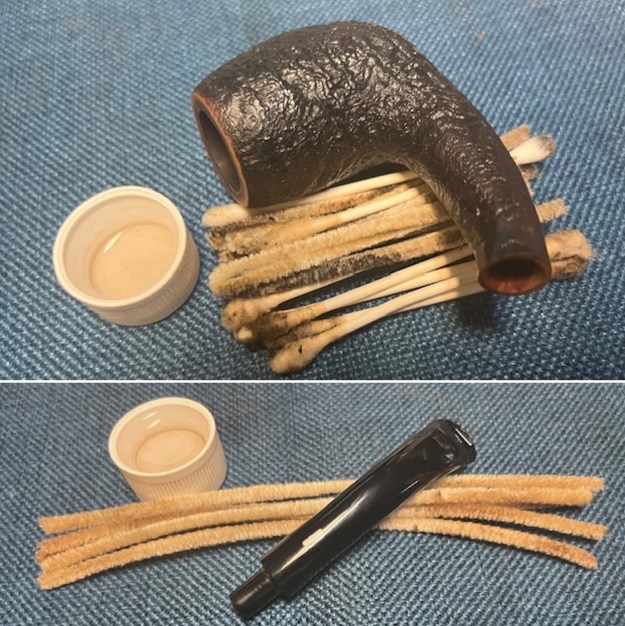
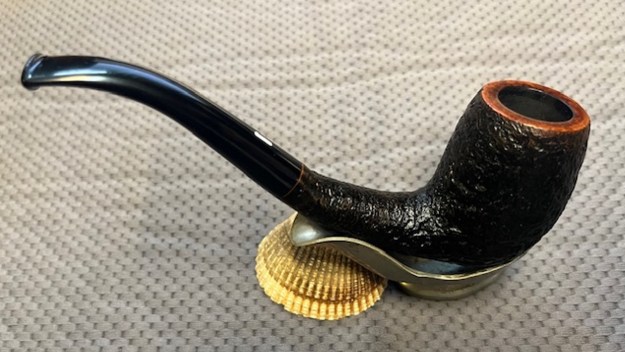
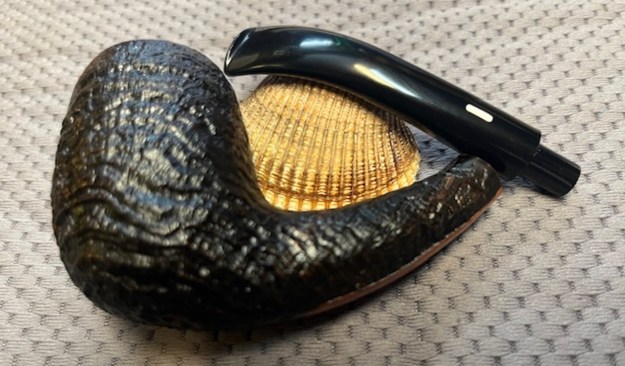
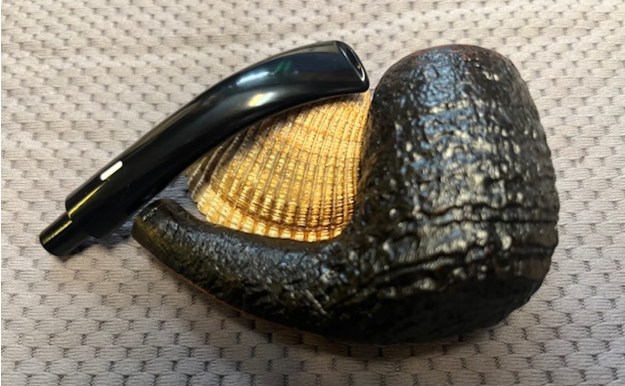
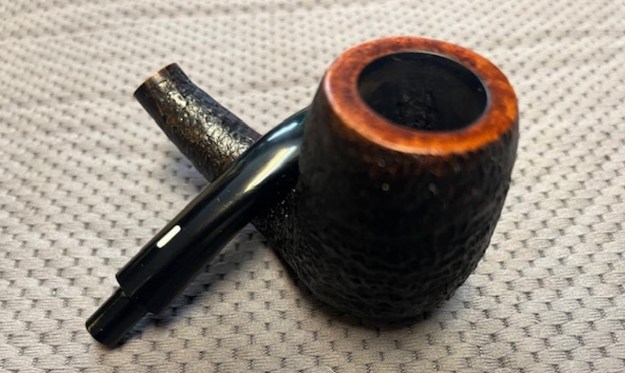
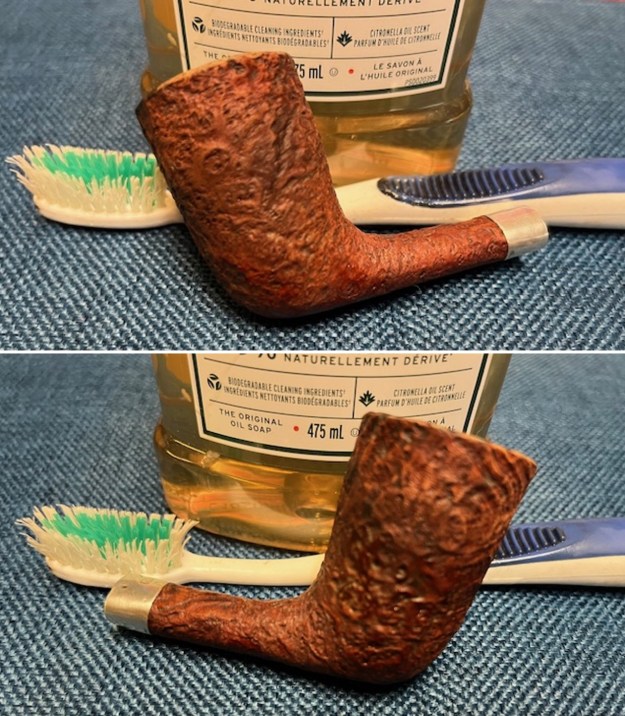
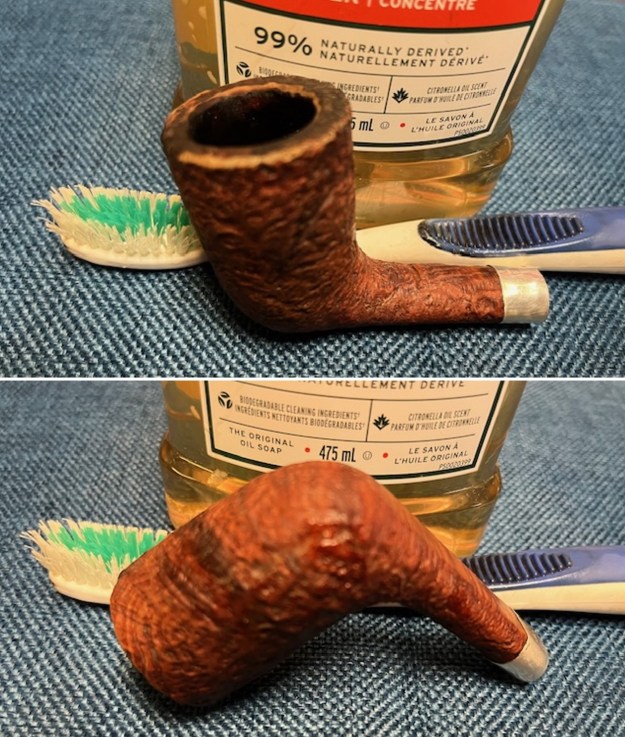
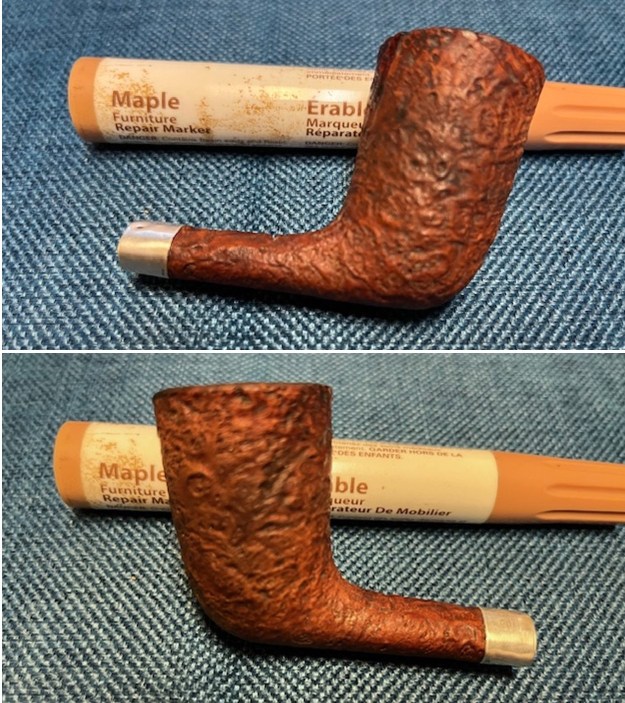
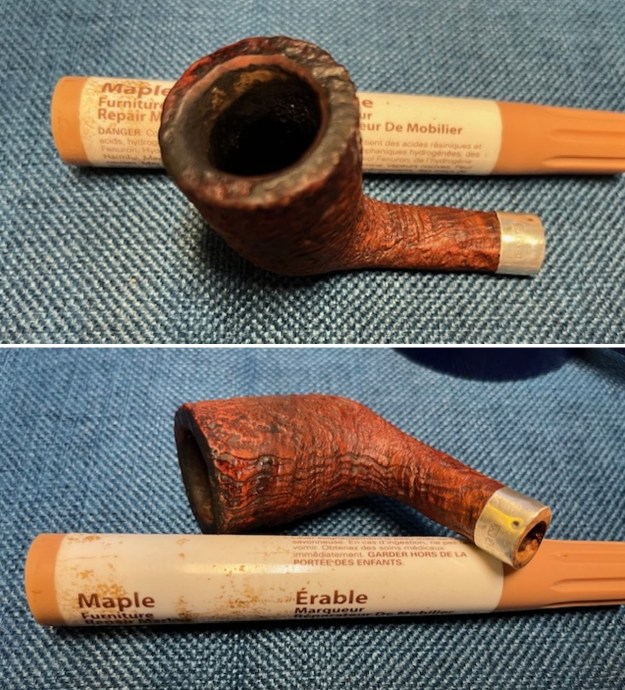
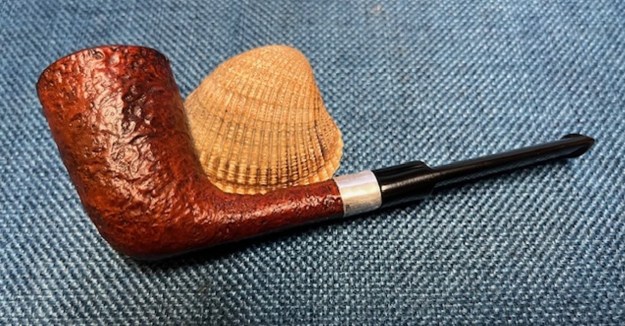
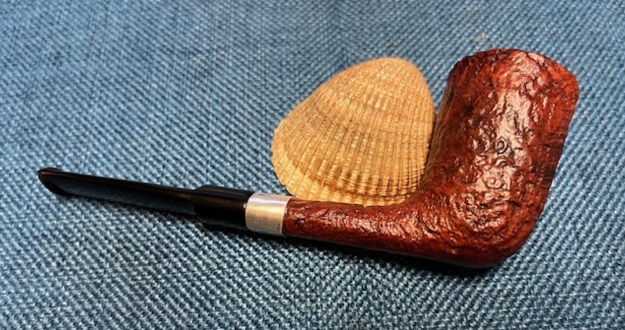
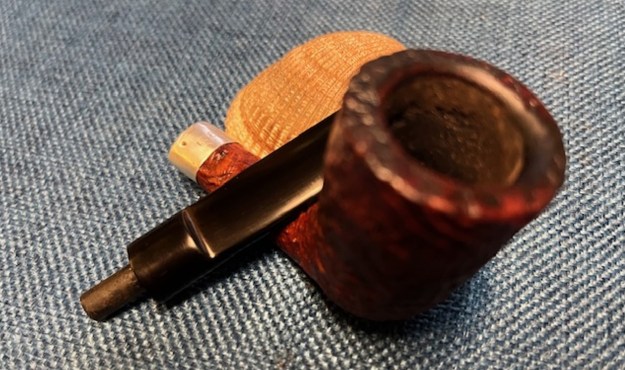
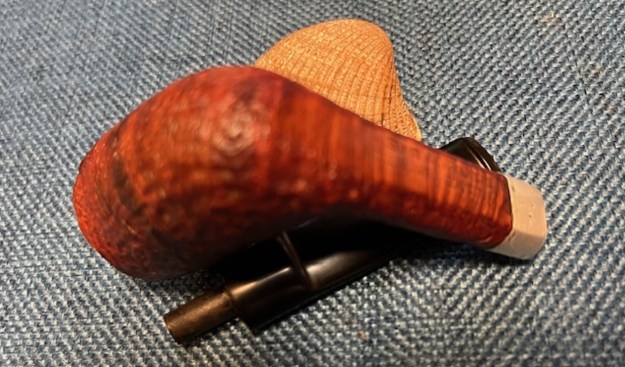
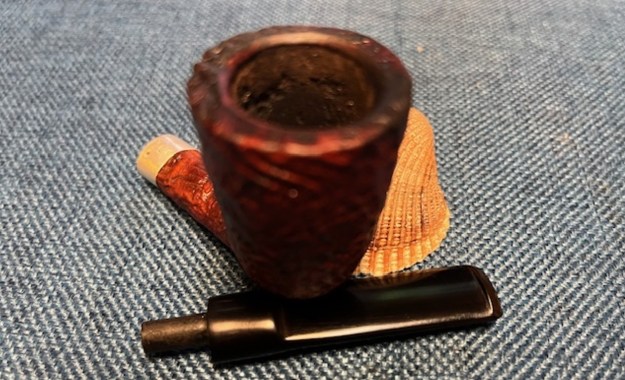
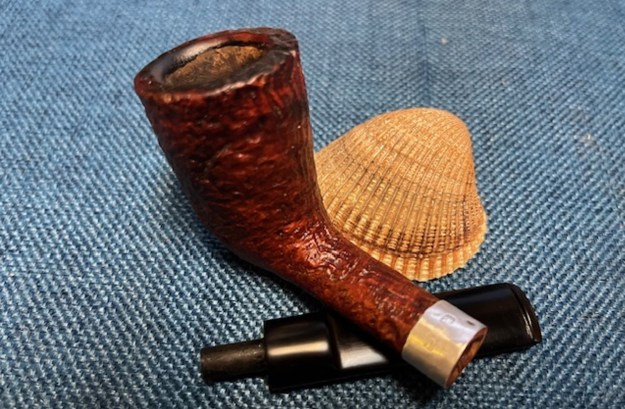
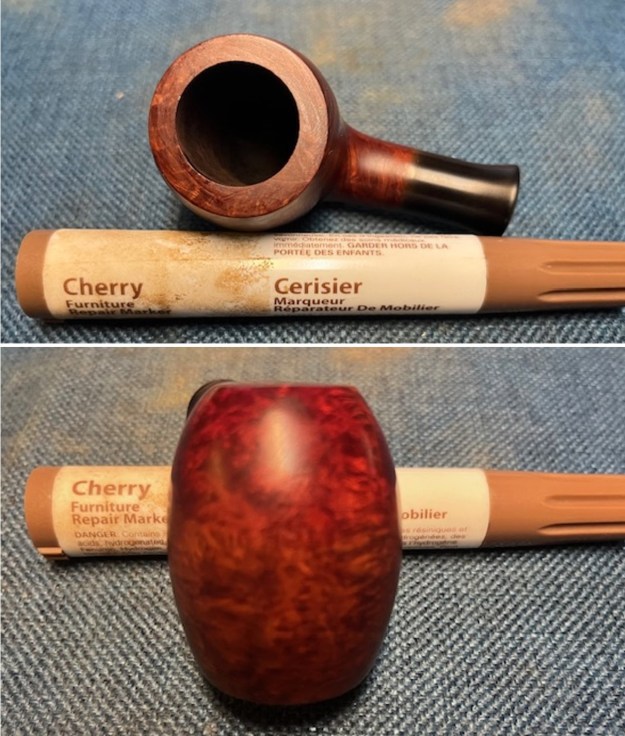
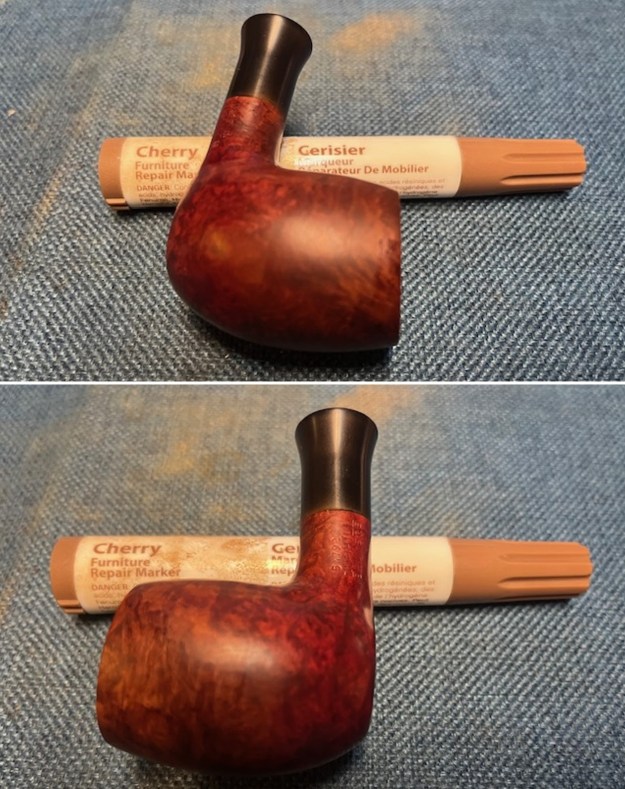
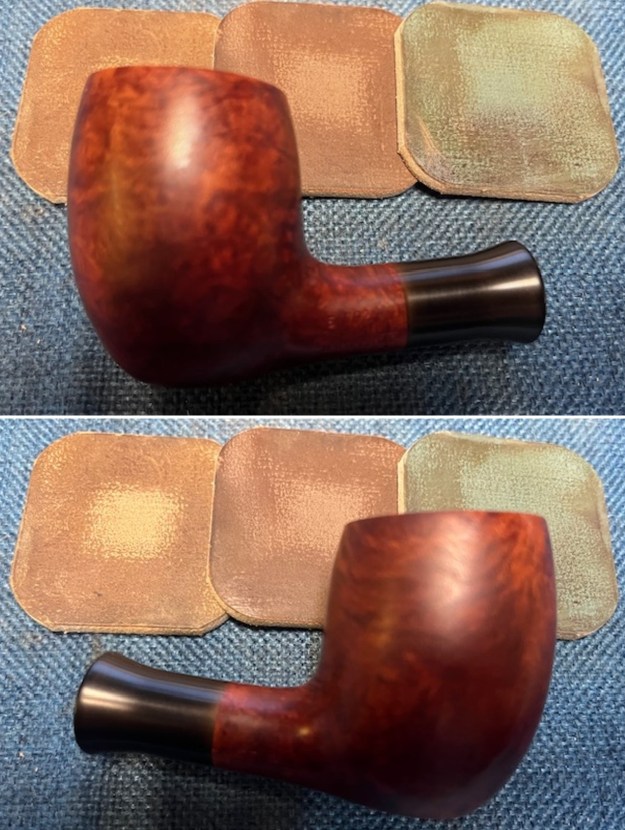
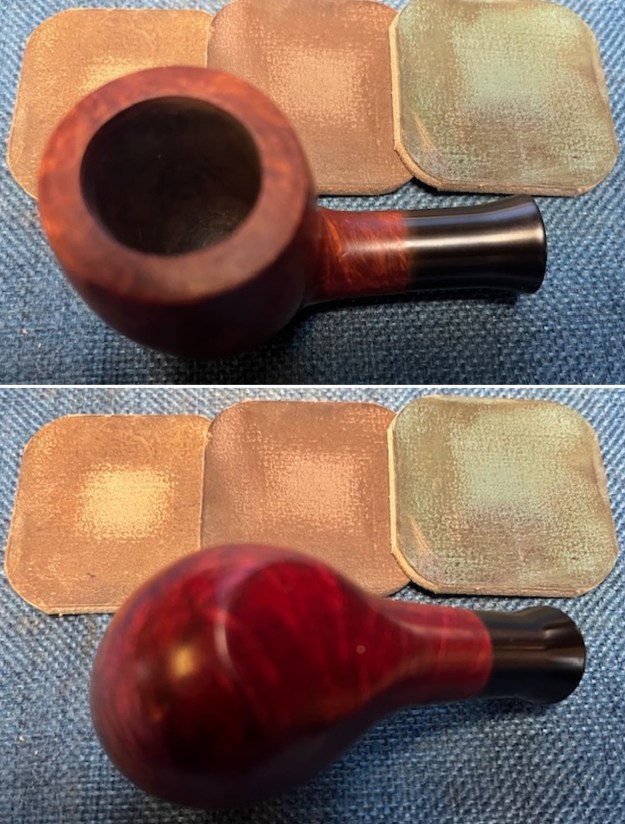
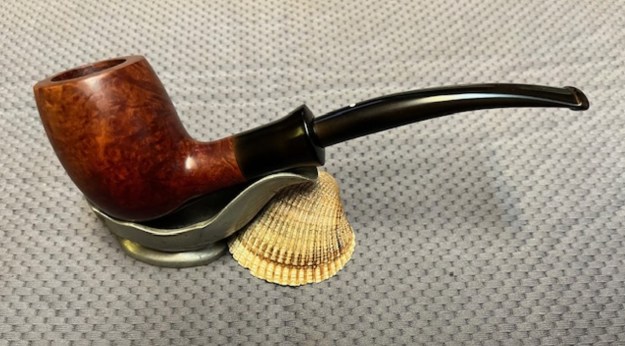
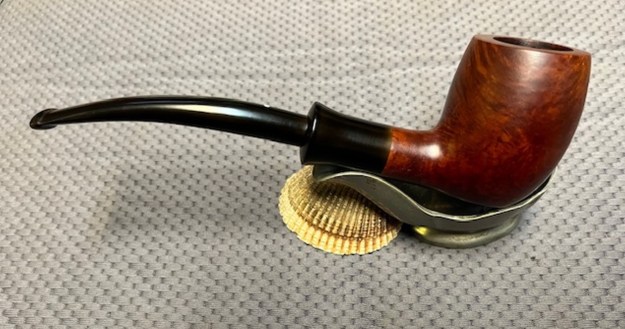
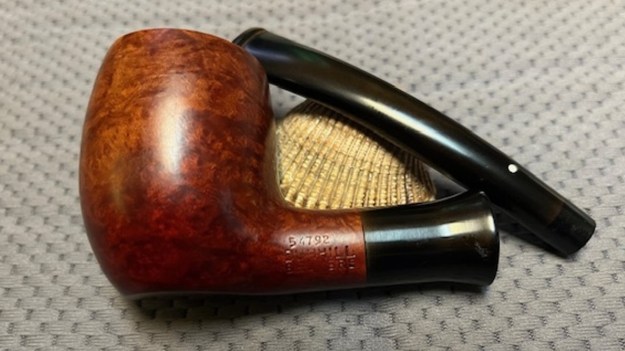
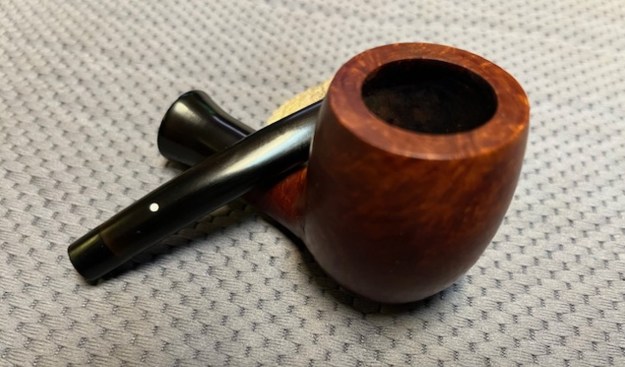
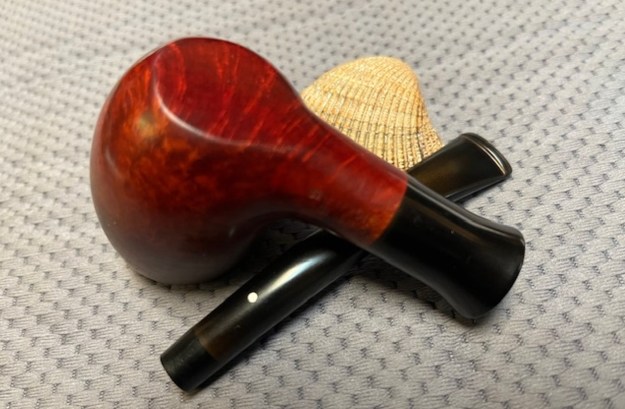
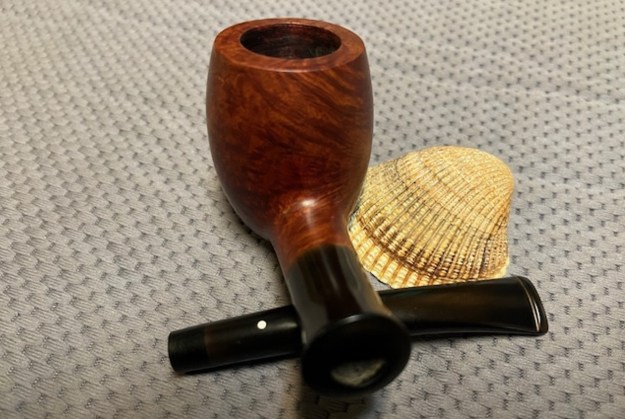
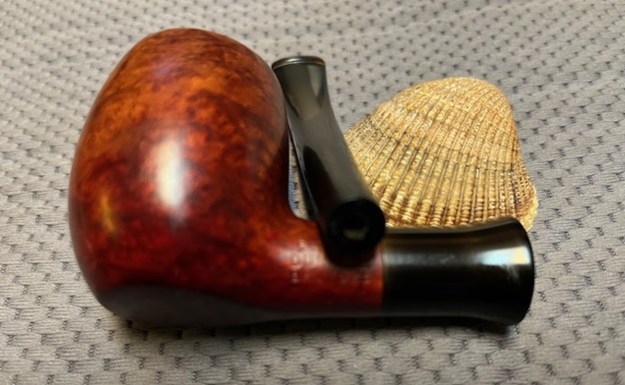
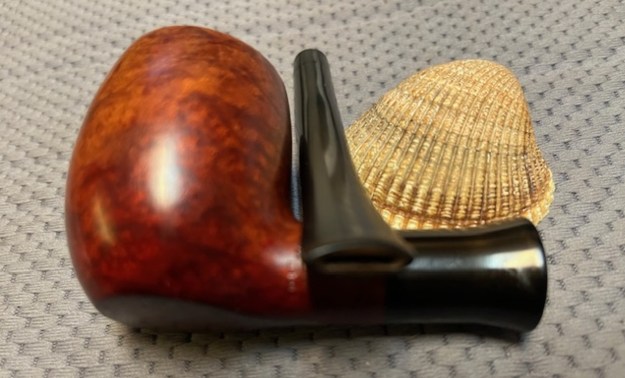
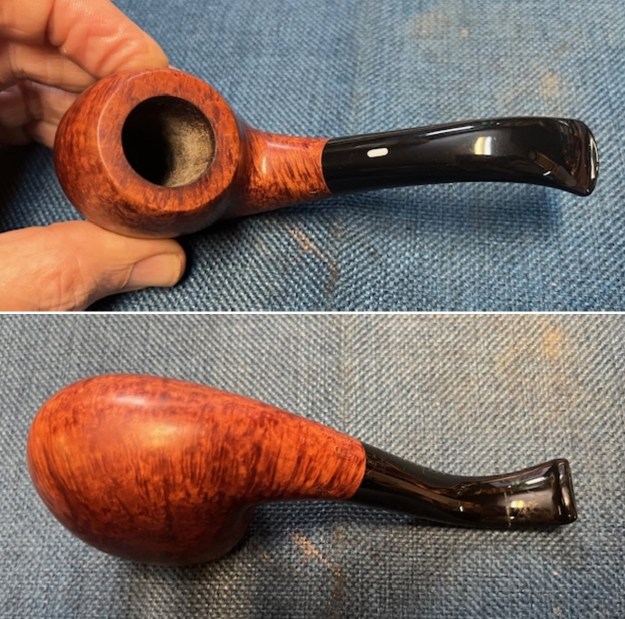
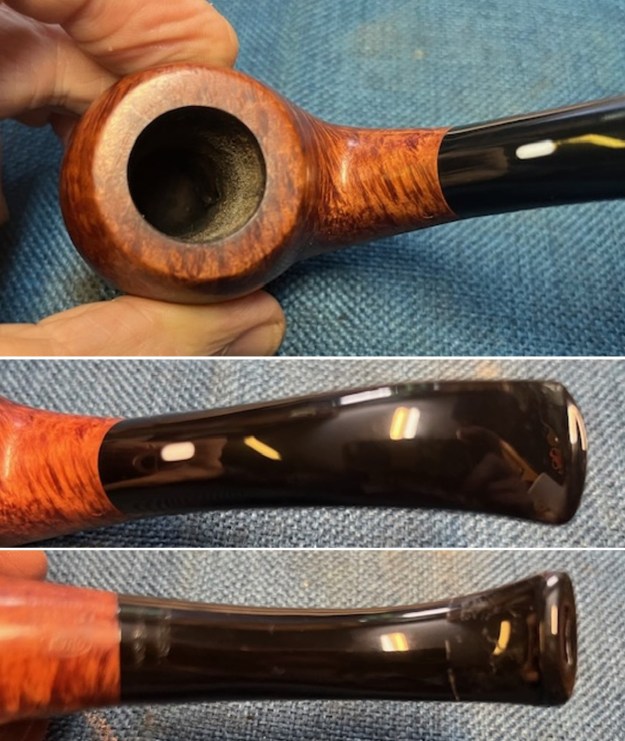
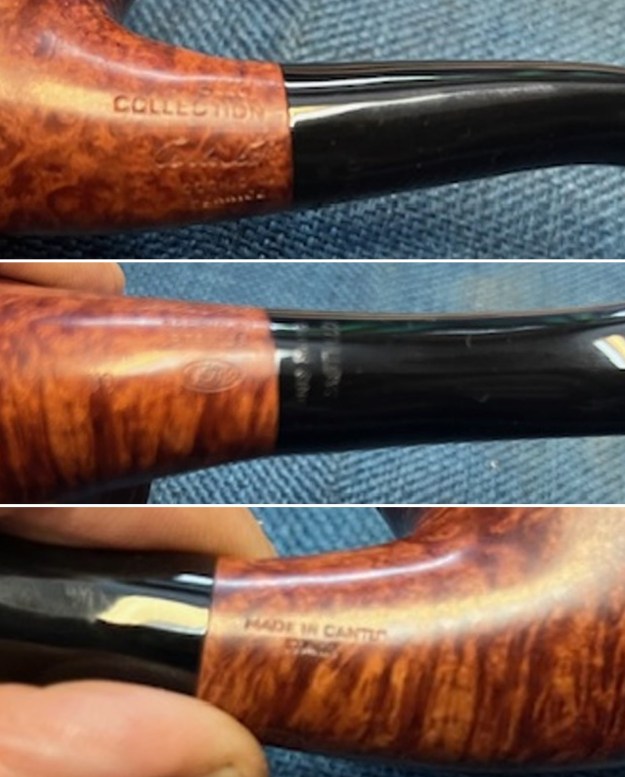
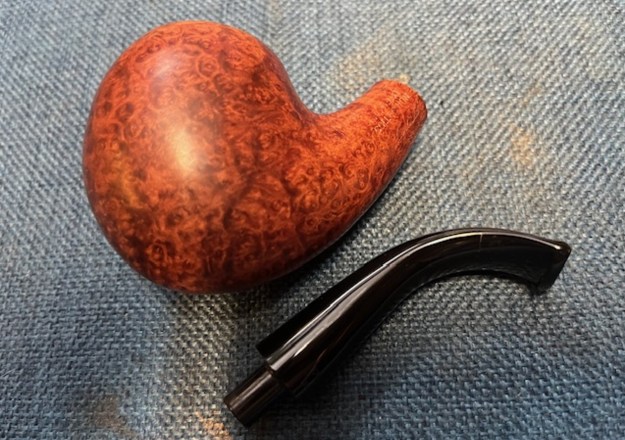
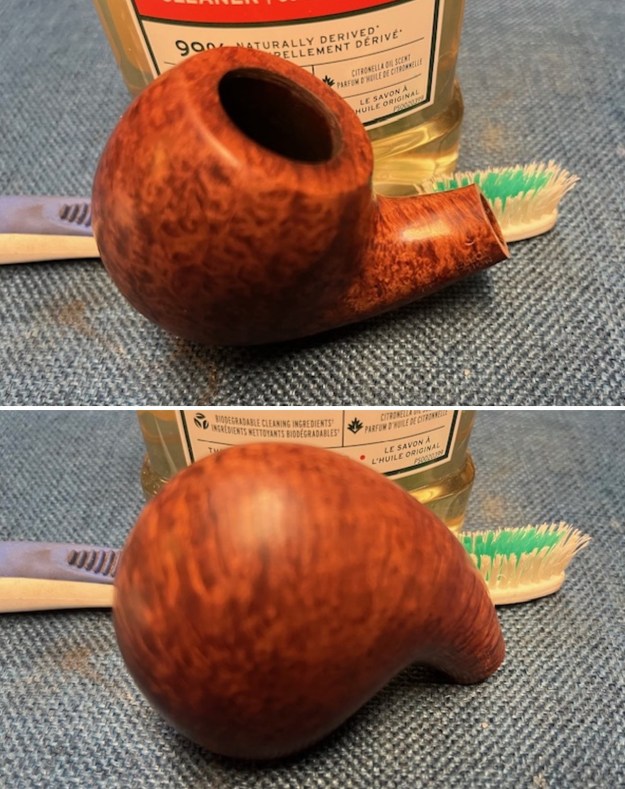
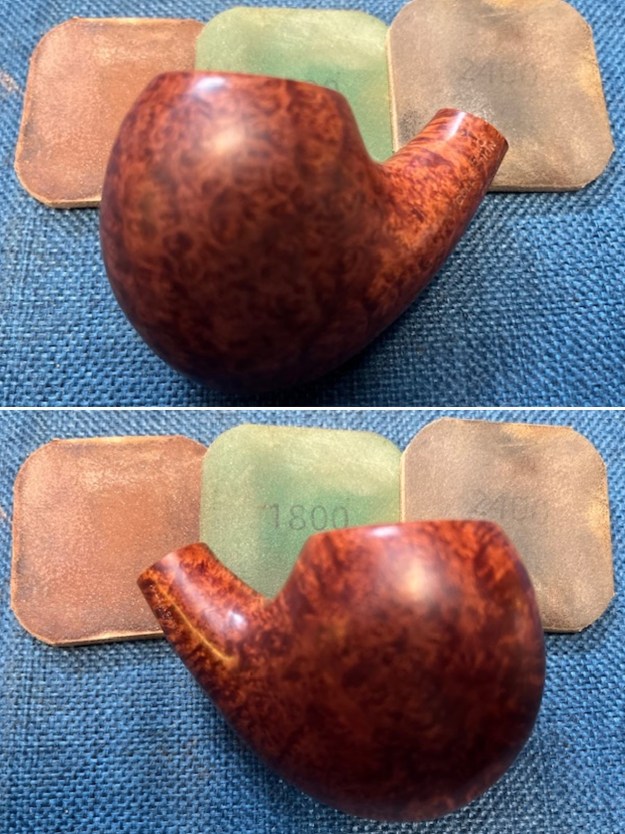
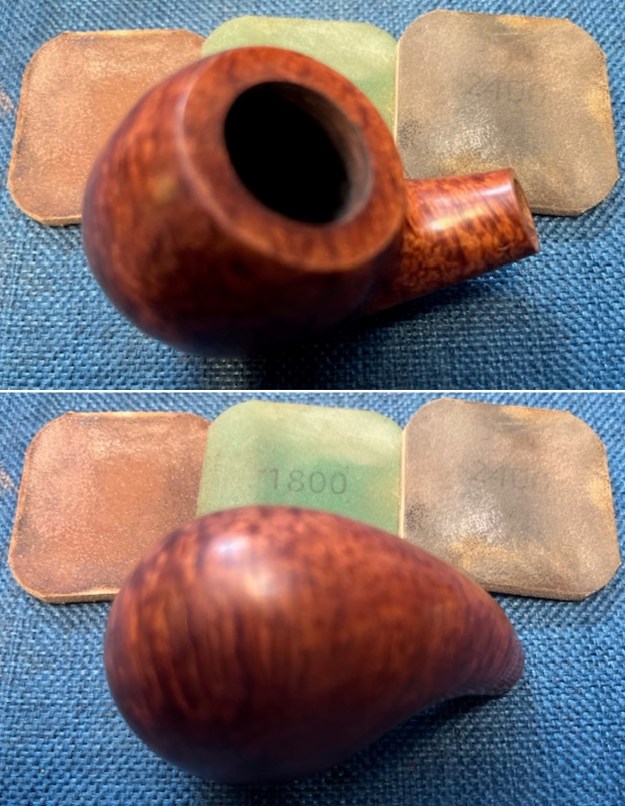
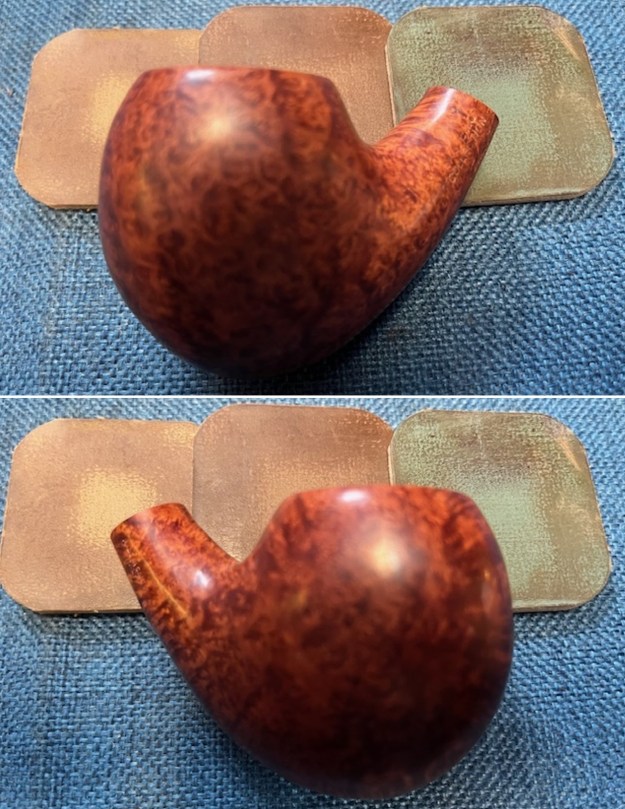
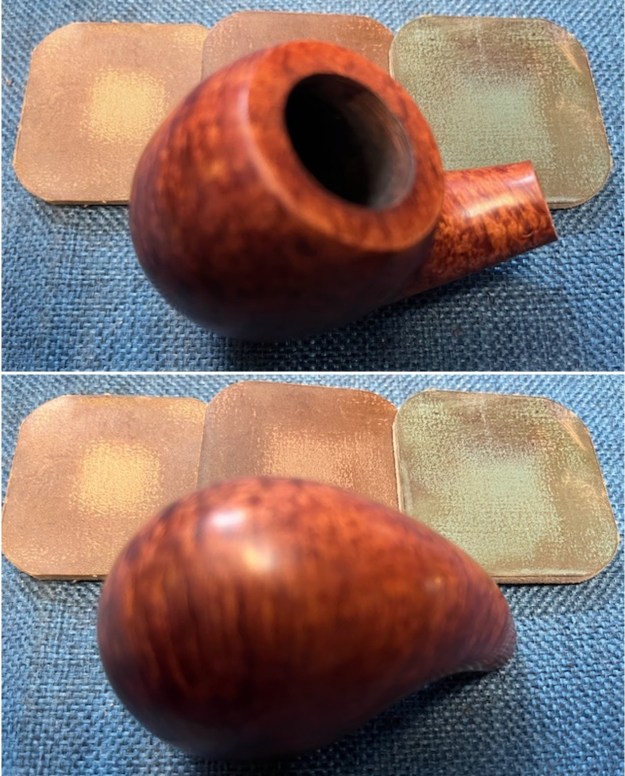
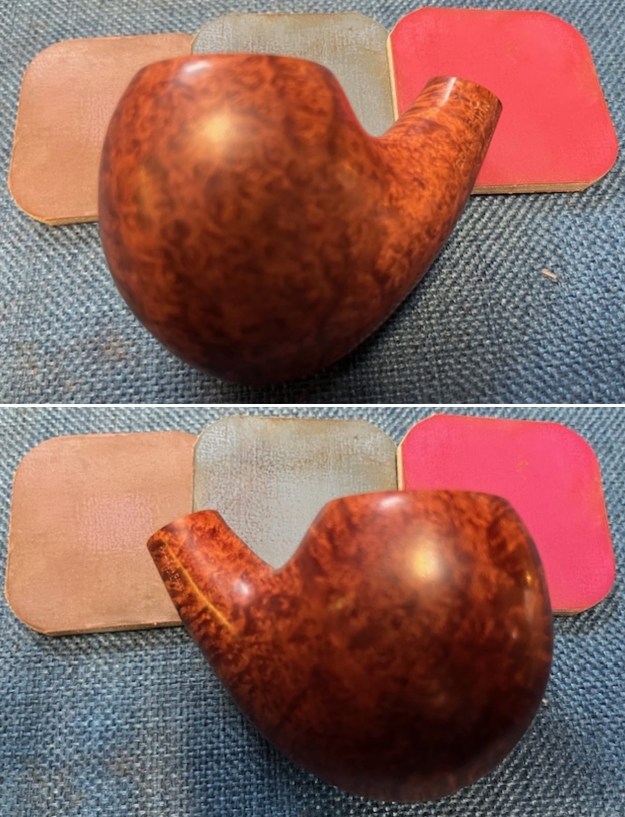
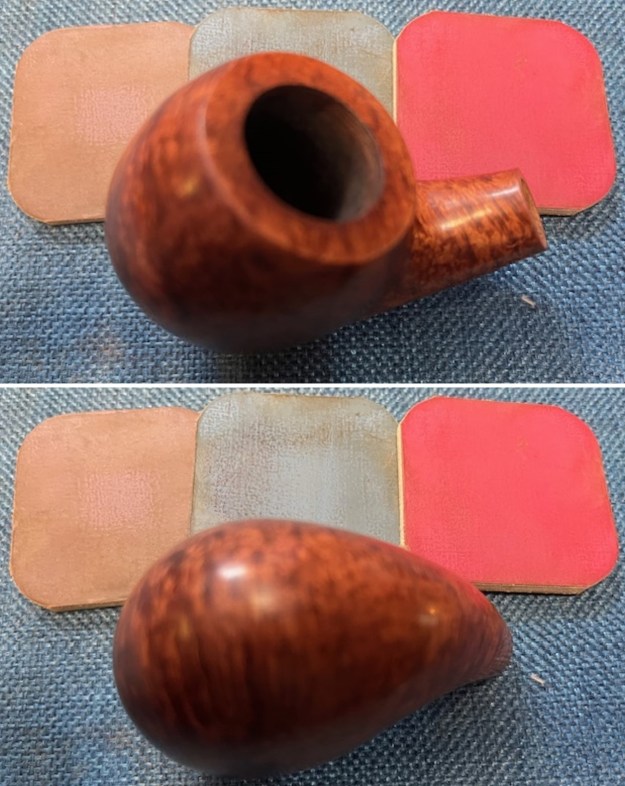
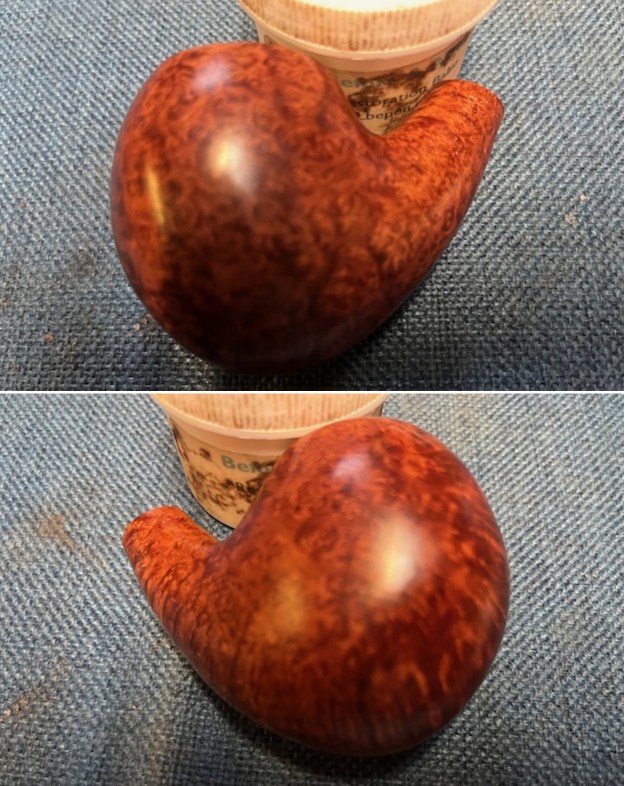
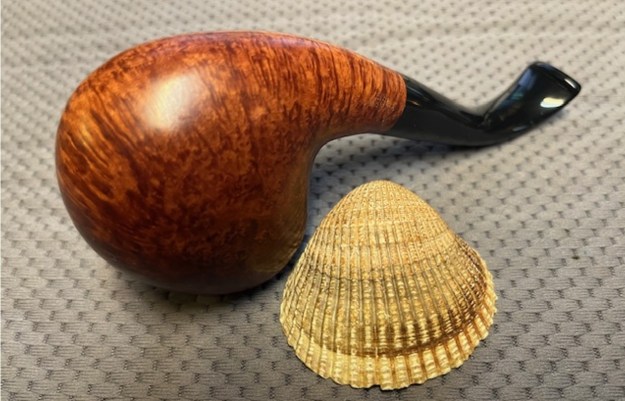
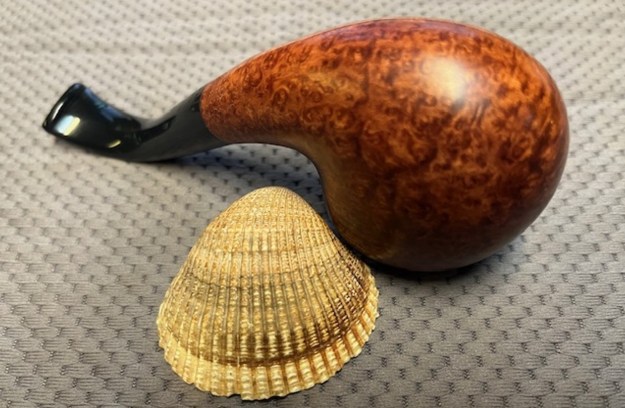
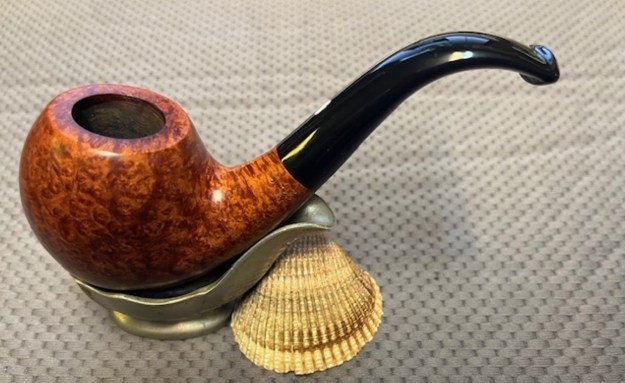
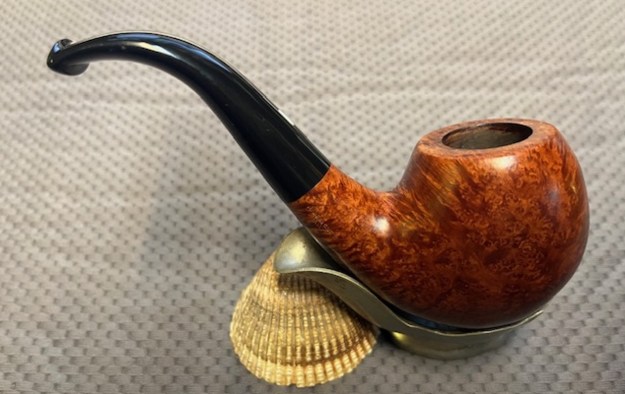
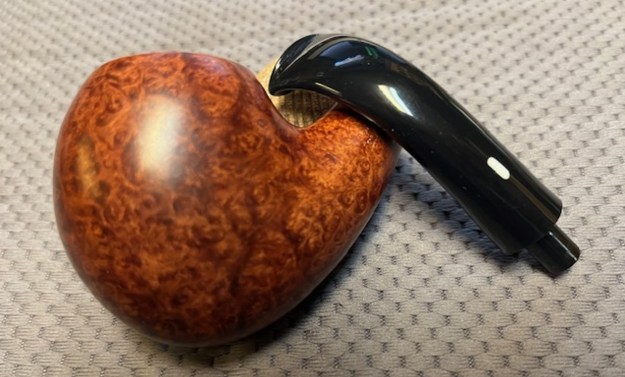
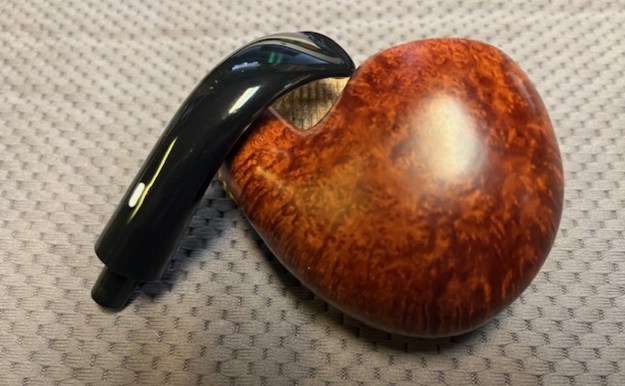
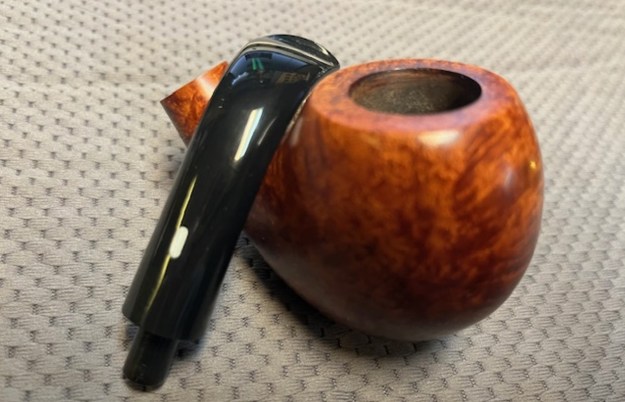
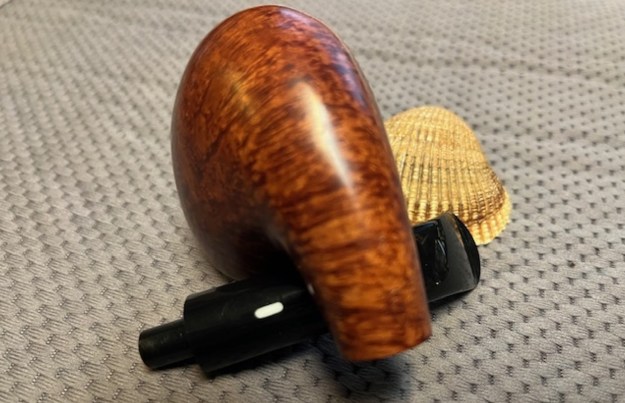
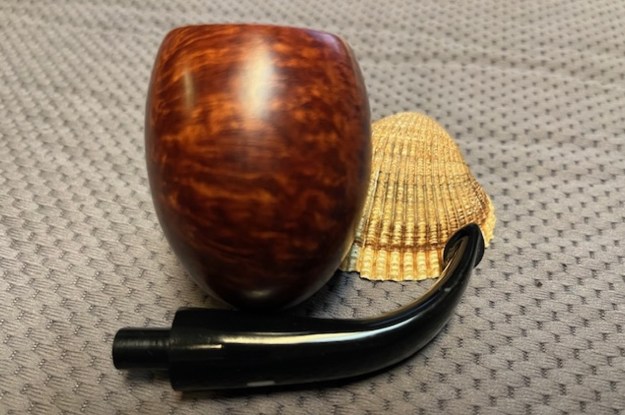
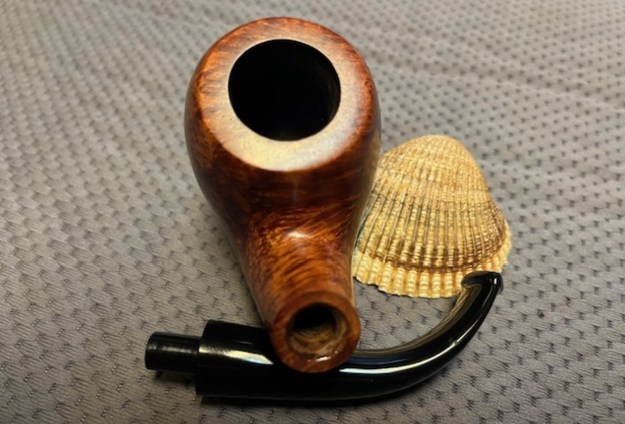
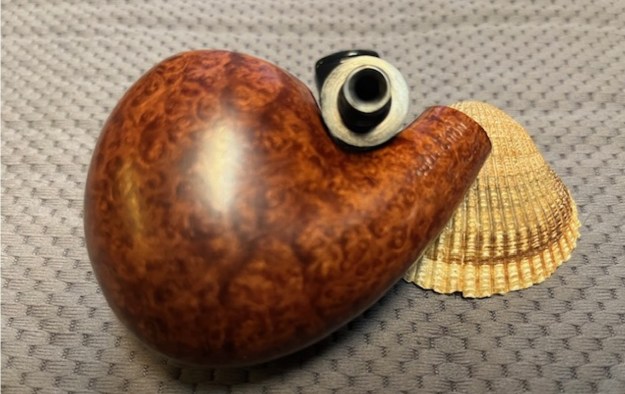
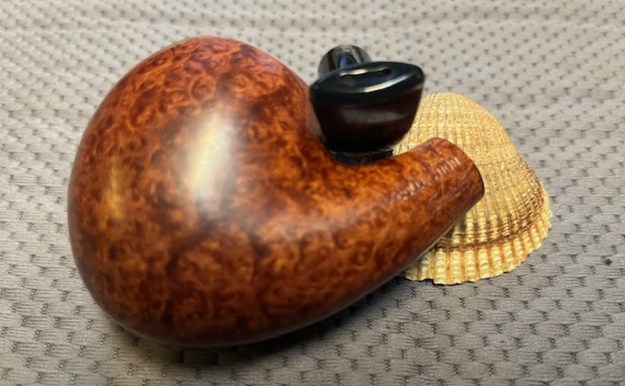
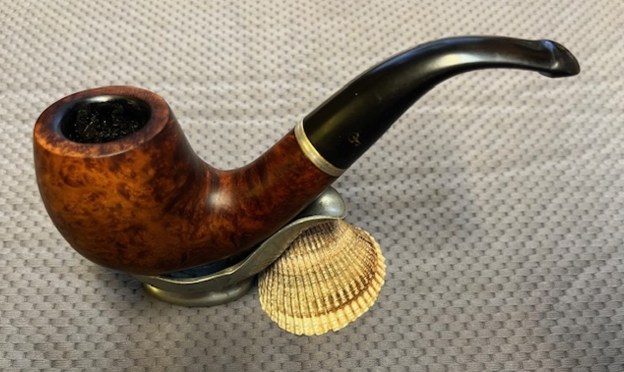
Next up on my restoration adventures is this Savinelli Punto Oro 915 KS. I acquired it from an older gentleman in Vancouver. He said he bought this (and the other pipes I got from him) more than “fifty years ago” – his words. That would date it to the early seventies, which fits with the style of the pipe. This is an unusual shape, to be sure. Savinelli calls it a Dublin – and so it is – but it has a luxurious, hourglass look to it as well. It has an elegant, elliptical shank and tapered, vulcanite stem. Perhaps I’ll call it a clessidra di Dublino. It’s a wonderful pipe and it deserves to be part of someone’s collection again. This pipe promises to be a great smoker. Let’s look at the markings. The top side of the shank reads Savinelli [over] Punto Oro. Savinelli, of course, is an Italian company, and the words Punto Oro mean literally, “gold point”. On the underside of the shank is the lovely Savinelli crown, next to which are the marks 915 KS [over] Italy. Naturally, the number refers to the shape and KS means “King Size”. Finally, there is a gold-coloured dot on the stem (made of brass) – a very nice touch.Savinelli is one of the most recognized names in pipe smoking and they have a long and storied history. You can read about them from their own website or from Pipedia’s article about them. However, I was particularly interested in learning more about the Punto Oro line. Sadly, Pipedia had nothing on this subject. I checked with Pipephil and they did have a bit of information, which I display below.I also found a bit of information on the Punto Oro line from Savinelli’s own website. They write:

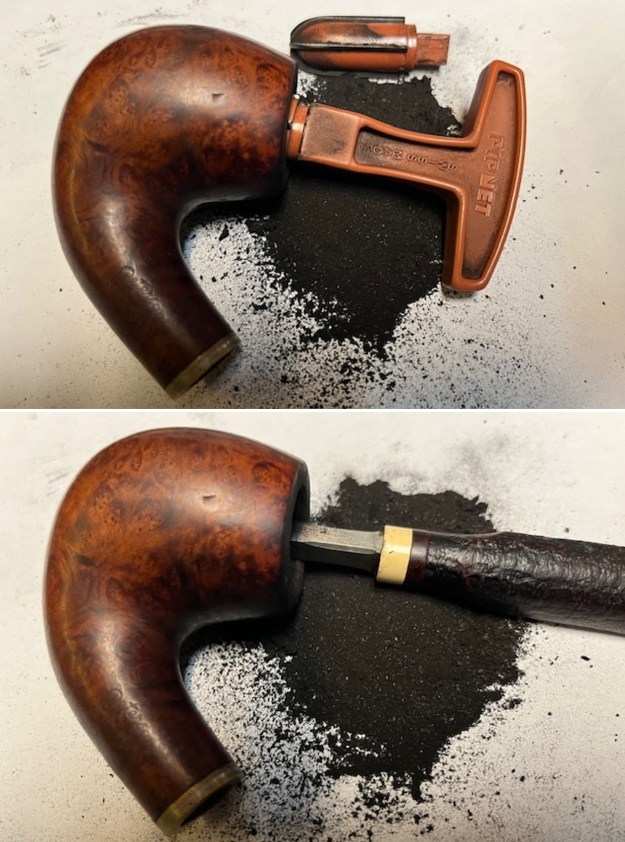
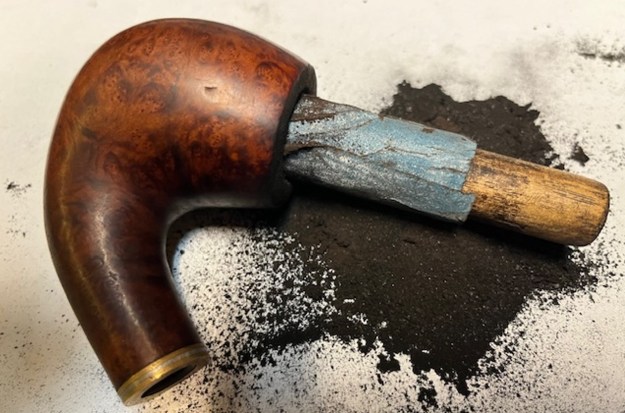
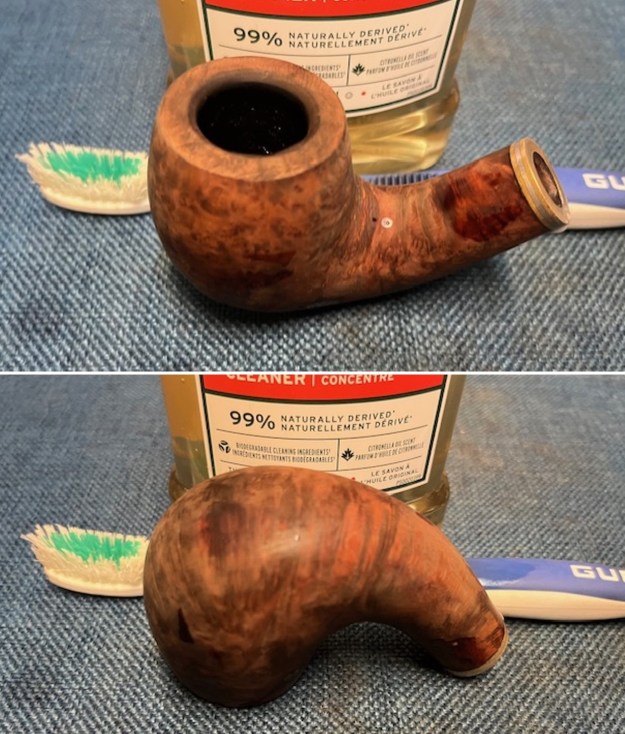
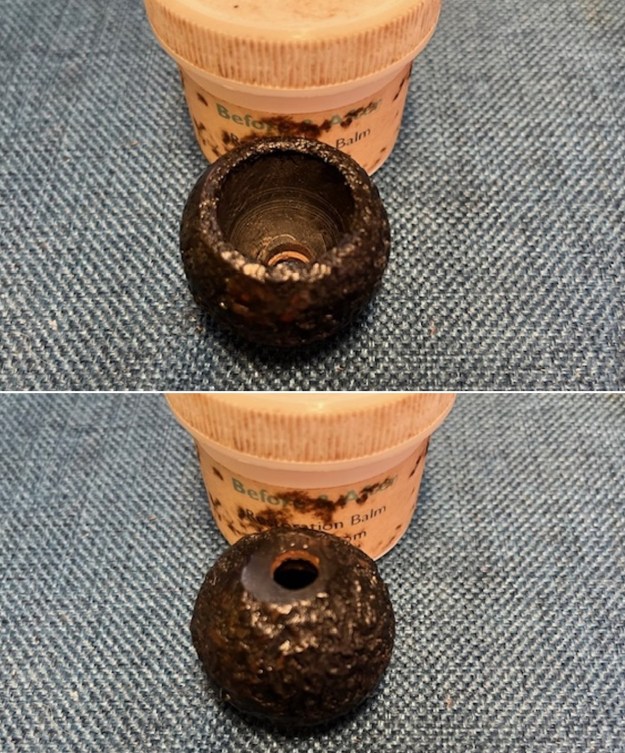
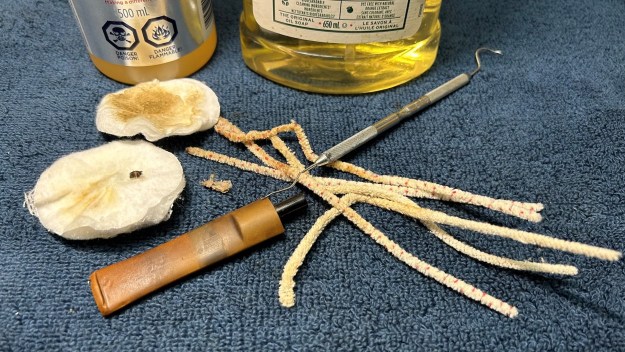
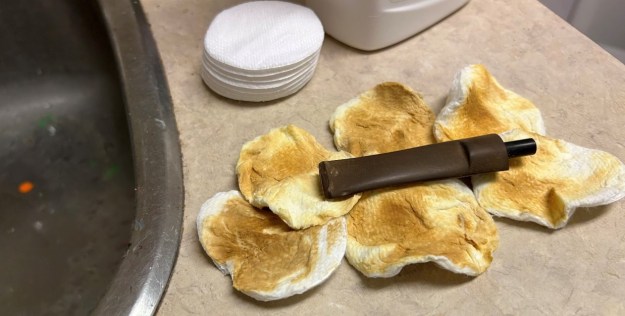
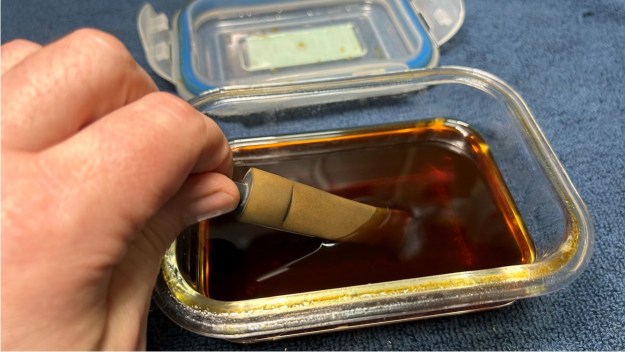
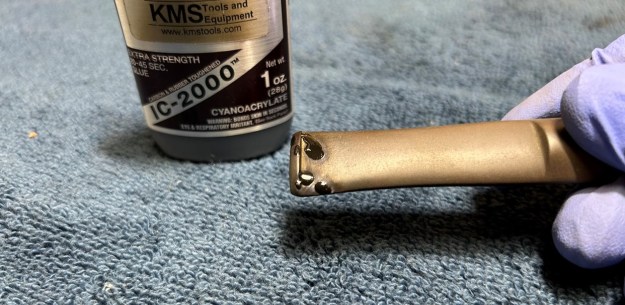
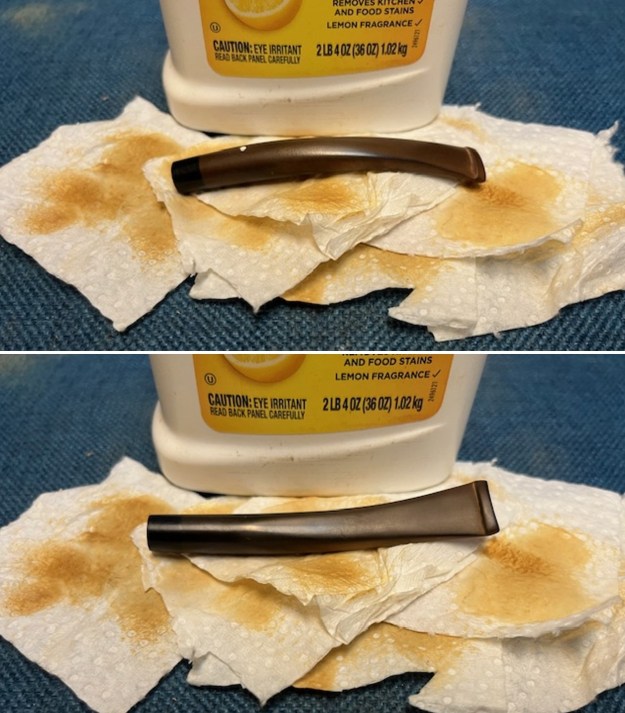
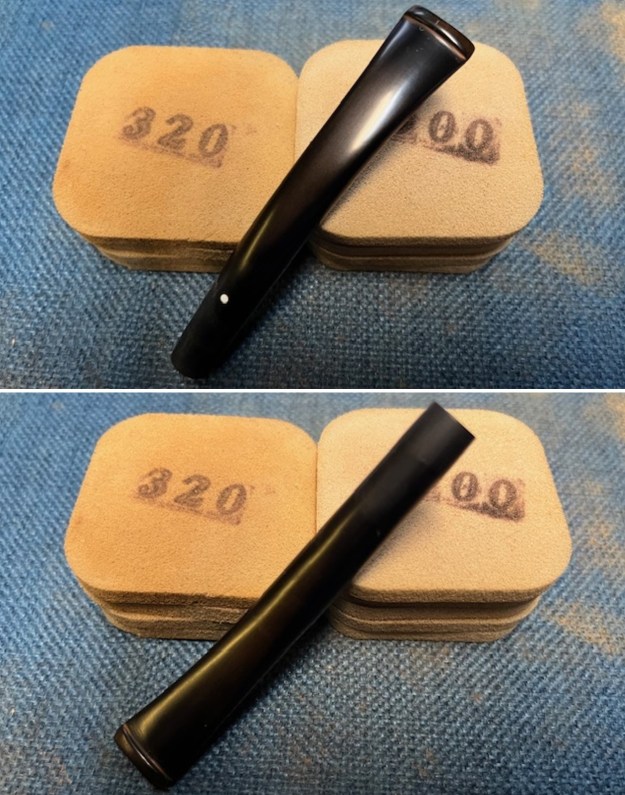
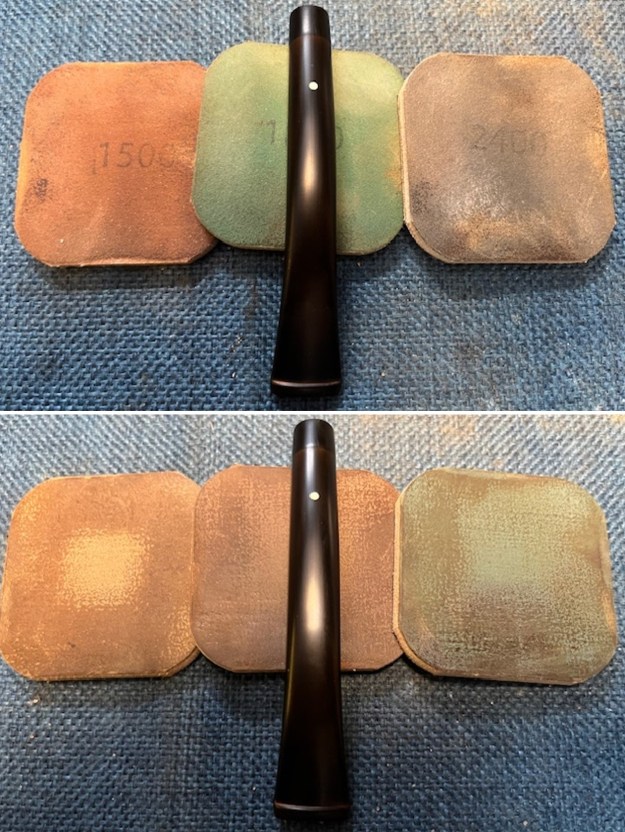
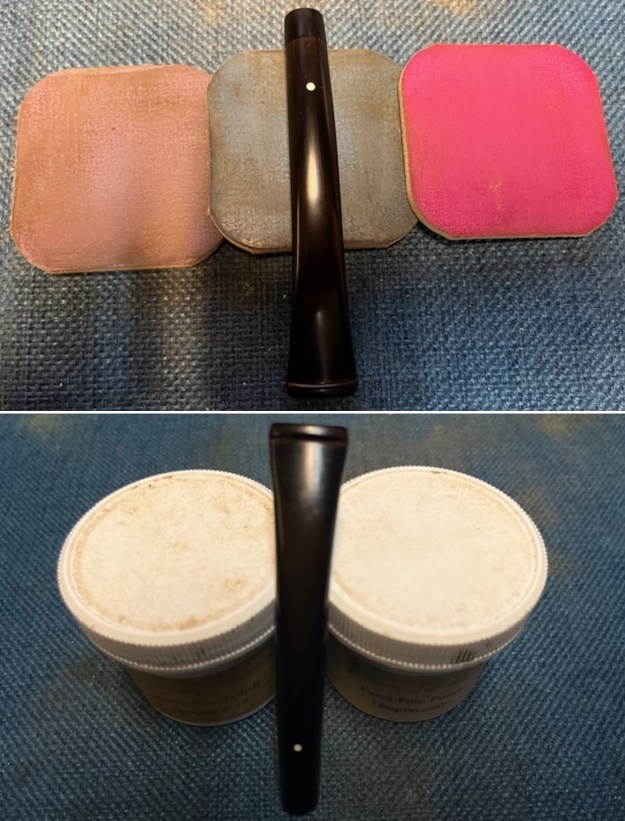
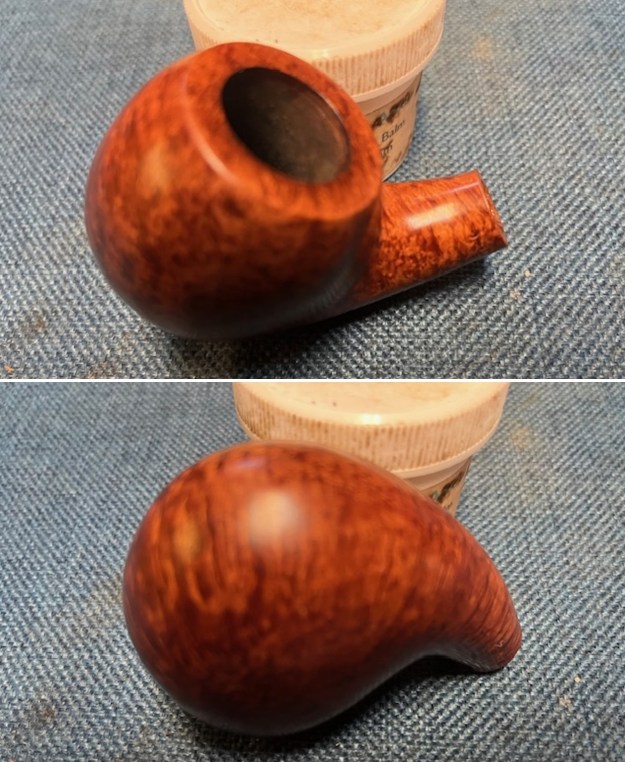
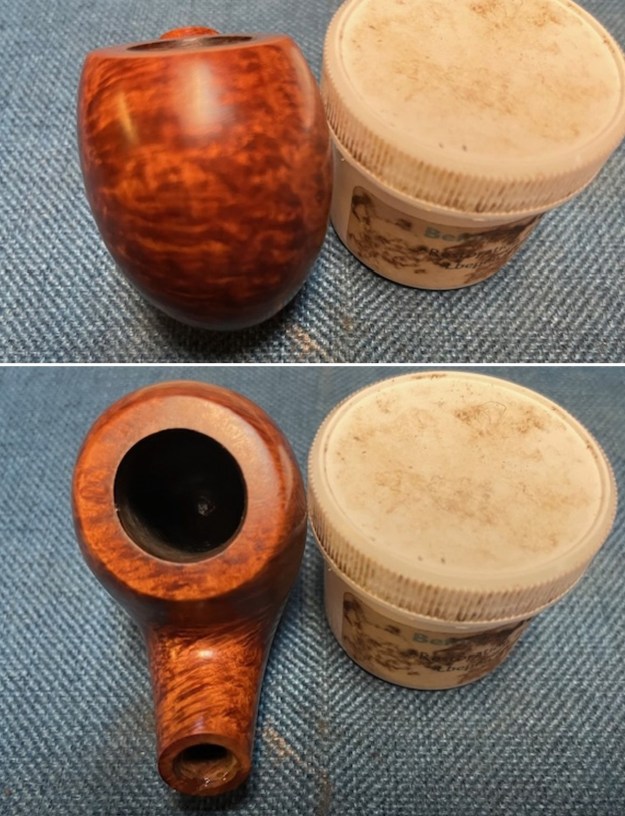
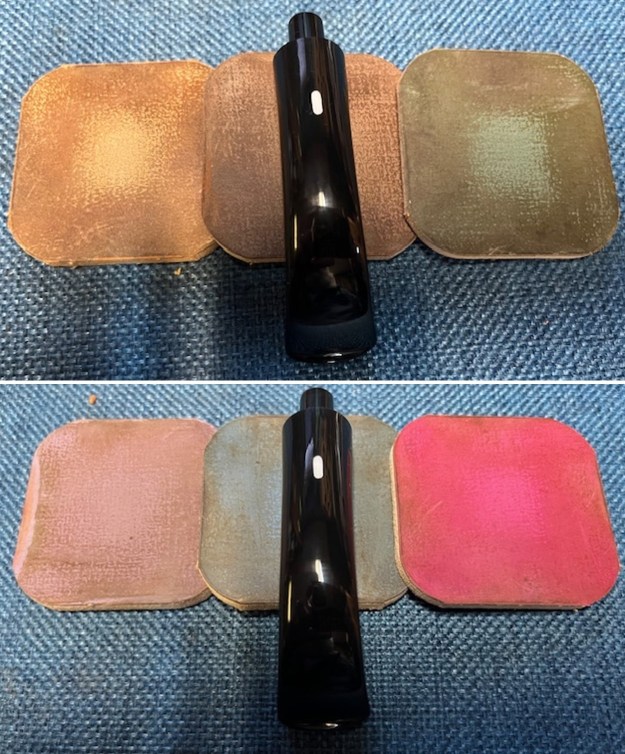
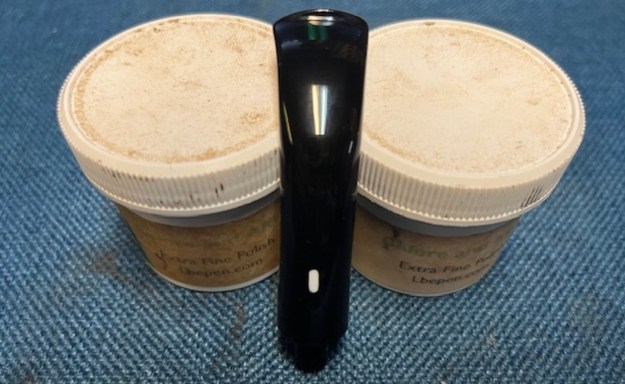
PUNTO ORO pipe was the first pipe created by Achille Savinelli after the opening of the factory in 1958; a pipe that has always distinguished the Savinelli brand, its elegance, reliability and tradition. It is a top quality pipe with a wonderful grain. It is important to know it is very difficult to find a briar piece suitable to become a PUNTO ORO: just 1,2% of the whole choice is selected for this series, therefore not all our shapes are always available for these pipes.This was a well-loved pipe – and it shows in the best way. The stem on this pipe definitely shows signs of use. There were quite a few scratches in the vulcanite. There was also some calcification and oxidation. The stummel looked elegant, but tired. There were indications of lava on the rim and plenty of cake in the bowl. Also, the briar had a few little nicks along the rim from the years of love of its previous owner. Most concerning though, was a field of nicks on one side of the briar. Eek! More on that later. Well, the usual cleaning procedures were in order for this pipe. I started on the stem by wiping it down with some Murphy’s on a cotton round. Then, I cleaned out the insides of the stem with pipe cleaners and lemon-infused isopropyl alcohol. It wasn’t too dirty.Once that was done, the stem went for an overnight soak in the Before & After Hard Rubber Deoxidizer. After soaking, I cleaned off the de-oxidizing fluid with alcohol, pipe cleaners, et cetera. The oxidation had migrated to the surface and I used SoftScrub to work it off.Before I moved on to the Micromesh pads, I built up the tooth damage on the stem with black cyanoacrylate adhesive and let it fully cure. I used my miniature files to take down the majority of the dried glue. I then sanded it down with 400-grit sandpaper to meld seamlessly into the stem. I then used all nine Micromesh pads (1,500 through 12,000 grit) to bring out the lovely black lustre on the stem. I also used Obsidian Pipe Stem Oil in between each pad scrubbing. This also really made the brass dot pop! Putting the stem aside, I moved on to the stummel. I used both the PipNet Reamer, the KleenReem, and some sandpaper taped to a wooden dowel to take the bowl down to bare briar, as I wanted to ensure there were no hidden flaws in the walls of the bowl. Fortunately, there were none.I then proceeded to clean out the insides of the shank with Q-tips, pipe cleaners, and isopropyl alcohol. There was an enormous amount of nastiness inside this stummel and – boy-oh-boy – it took a lot of cotton to get this thing clean! A de-ghosting session seemed like a good idea. This de-ghosting consisted of thrusting cotton balls in the bowl and the shank, and saturating them with 99% isopropyl alcohol. I let the stummel sit overnight. This caused the oils, tars and smells to leech out into the cotton. Finally, a relatively clean and fresh-smelling bowl emerged. I then moved on to cleaning the outside of the stummel with Murphy’s Oil Soap and some cotton pads. What a difference that made! I also cleaned the insides with some soap and tube brushes. I examined the vast range of bumps in the briar. I dug out my iron and a damp cloth to try to raise them. The hot and moist steam can often cause the wood to swell slightly and return to shape. This worked incredibly well – I was absolutely delighted with the results. I took a close look at the rim. In order to save as much of the rim as possible, I used a piece of machine metal to very delicately scrape away as much lava as I could. I do this before automatically jumping to my topping board. This worked well and the topping board was not needed. Instead, I filled in a couple of nicks and used a wooden sphere and some pads to even out the top side and make it beautiful. After this, I used all nine Micromesh pads (1,500 through 12,000 grit) to make everything smooth. I applied some Before & After Restoration Balm and finally saw the beauty of my work. Off to the bench polisher I went. I applied some White Diamond and a few coats of carnauba wax and they added the finishing touch. This Savinelli Punto Oro 915 KS clessidra di Dublino was in need of a new lease on life. I am pleased to announce that this pipe is for sale! If you are interested in acquiring it for your collection, please have a look in the “Italy” pipe section of the store here on Steve’s website. You can also email me directly at kenneth@knightsofthepipe.com. The approximate dimensions of the pipe are as follows: length 5⅞ in. (150 mm); height 2 in. (51 mm); bowl diameter 1⅝ in. (39 mm); chamber diameter ¾ in. (20 mm). The weight of the pipe is 1½ oz. (46 g). I hope you enjoyed reading the story of this restoration as much as I enjoyed restoring it. If you are interested in more of my work, please follow me here on Steve’s website or send me an email. Thank you very much for reading and, as always, I welcome and encourage your comments.

Restoring a Deeply Loved Peterson’s Diamond Shank Bent Billiard with a P-lip Stem


Blog by Steve Laug

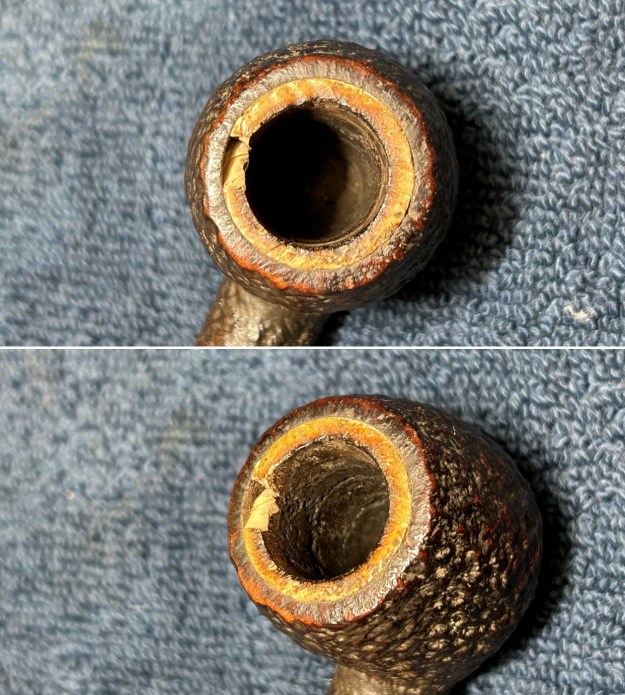
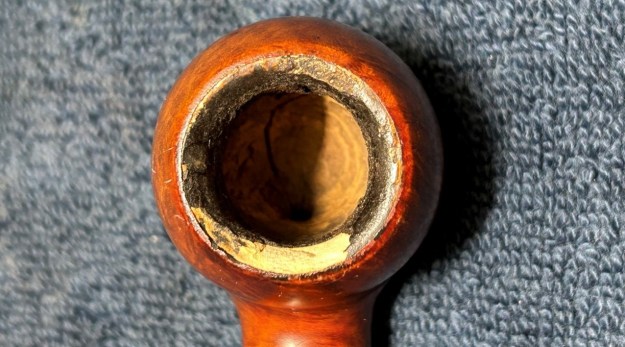
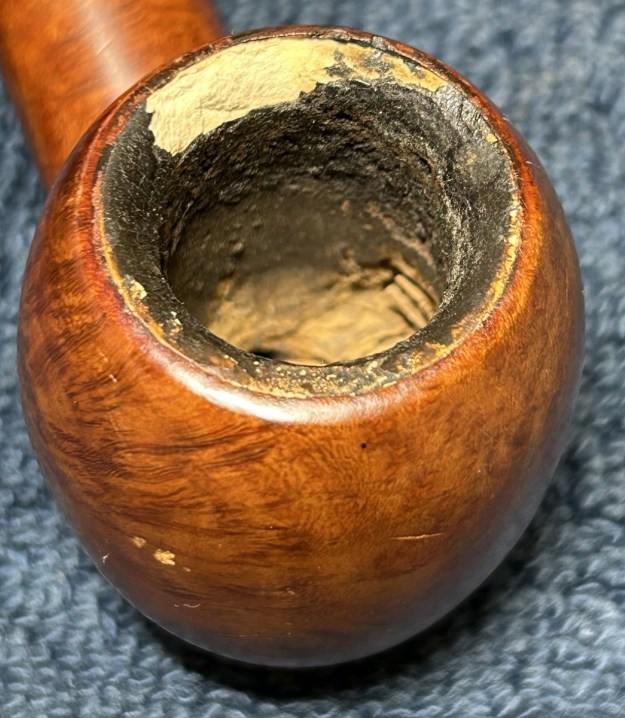
The next pipe on the work table is a lovely Peterson’s style briar pipe. We purchased it from a seller in Spring Branch, Texas, USA on 02/29/2024. It is a classic Peterson’s diamond shank, bent billiard shaped bowl. It has a worn rusticated finish with a rich brown stained bowl that really highlights the remnants of the blast. The bowl is dirty with grime in the finish. There is a light cake in the bowl and a lava overflow on the rim top and edges filling in the blast finish. The stamping on the pipe is on the underside of the shank and is illegible. It looks like it could read Peterson’s and something below that is not clear and the shape number cannot be read. The Sterling Silver band on the shank is oxidized and stamped. It reads K&P [over] Sterling [over] Silver. Underneath that are three hallmarks – a seated Hibernia with her arm on a harp, a crowned harp and a date stamp with an italic “P”. The stem has no stamping or logo on the diamond sides. It is oxidized, calcified and has very light tooth chatter and marks on both sides ahead of the P-lip button. It was obviously someone’s favourite and must have always been in his hand or mouth. Jeff took photos of the pipe before he started his cleanup. Jeff took photos of the bowl and stem to show the condition of the pipe. The rim top was very dirty with lava in the blast on the surface. The edges were hard to see their condition under the lava coat. The bowl had been reamed recently so there was just minimal cake on the walls in the lower portion. Only clean up would tell the full story. Jeff took photos of the top and underside of the p-lip stem showing the light tooth chattering, calcification and oxidation on the stem surface. Jeff took photos of the sides and heel of the bowl to show the condition of the finish. You can see the grime in the sandblast and the generally worn finish around the sides of the bowl and shank. Even under the wear, dirt and debris of the years it looked very good. Jeff took a photo of the stamping on the left underside of the diamond shank. The stamping was unreadable as can be seen in the photo. There are also some deep scratches in the smooth area of the stamp. The Sterling Silver Band is stamped as noted above and is very readable under the oxidation.  As is my habit before I start working on a particular pipe I want to know more about the pipe and the line. This one is a mystery because of the loss of the stamping. I do know that it is probably a Donegal Rocky as the rustication and the silver band fit that line of pipes. I turned to Pipephil (http://pipephil.eu/logos/en/logo-peterson-ser.html) to see if I could learn anything about it from the photos that are included. There was nothing even close. However, I followed a link on the silver hallmarks connected to the Mark Twain pipe I just completed. That was the most promising information I have found so far. I have included a screen capture of the pertinent section below.

I wanted to understand the date mark and dig further. The band on the pipe I am working on has the three hallmarks noted in the photo above. They are as follows. The first is Hibernia seated, arm on a harp (for the country of manufacture – Ireland). Next to that is a Crowned Harp designating the sterling quality. Finally, it is followed by the date stamp which in this case is Celtic style, italic upper-case P. I have included information on the hallmarks below:Date letters of Assay Office Dublin
Twenty letters of the alphabet of different fonts together with the shape of the escutcheon identify the year in which the piece was verified by the assay office. I have drawn a rectangle around the matching letter P in the chart below which dates the pipe as a 1980.Now I knew that the pipe was a Republic Era Rusticated pipe that was made in 1980. I could not find a shape like the one I had here on the table. I did find a pipe with a similar style rustication and band that was on my rebornpipes site. It is simply stamped Peterson’s Dublin. There is a similarity to the worn on that I am working on now. The pattern is similar on this one. Here is the link: (https://rebornpipes.com/2022/04/14/restoring-an-interesting-long-shank-rusticated-petersons-of-dublin-canadian/). I have included some photos of the pipe rustication and the stamping on the heel and the Sterling Silver shank band to show the possibility of similar stamping on my mystery pipe. I am also including a portion of that blog where I dug out the stamping on the pipe and the band. I quote from that blog below as there are some very pertinent clues to the possible stamping that is missing on this pipe.

I turned to the Peterson’s Pipe by Mark Irwin and Gary Malmberg to ferret out information on the stamping of this pipe to try to pin down a date. Under the section, Dublin on Page 298 I found information on the stamping on this pipe. I quote:

Dublin (1906-2003) Although DUBLIN appears under PETERSON’S on many pipes  over the decades, it has served  mostly as part of the brand name. The word first appeared on pipes hallmarked 1906-11, stamped PETERSON’S over PATENT over DUBLIN. The simpler PETERSON’S over DUBLIN appeared on pipes hallmarked 1912 after the expiration of the patent… Specimens of the former will bear either an Irish COM or LONDON MADE over ENGLAND  COM and almost certainly date from 1945-62.  It was first mentioned in print as part of a model name in the ’68 price list, as K&P Dublin…

I looked also at the information on page 304 about the K&P stamping on the silver band. I quote below.

K&P Another set of three marks, each in a shield-shaped frame are frequently mistaken as hallmarks and are seen on sterling bands. See Maker’s Mark…

On page 305

 K&P on Mount …A second style of maker’s mark, K&P in three shields, was registered on June 26,1908 and has been in continuous use since.

On page 307

Maker’s Mark Collectors frequently mistake this row of three shields for hallmarks, especially on pipes made between 1938-68 when Peterson sterling mounts had no proper hallmarks. Collectors tend to label these faux hallmarks. The three shields are not hallmarks at all but their presence on the mount does confirm the mounting is sterling.

Now at least I had a time frame for the pipe. It had the three maker’s marks in three separate shields (K&P). The sterling silver band on my pipe had three Silver Hallmarks so I knew that it was made after 1938-1968 when no such marks were used. The K&P stamp on the silver and the Dublin stamp on the shank of the above Canadian match what I am surmising must have been stamped on this pipe. I am guessing of course but think that the pipe may well have been stamped Peterson’s [arched over] Dublin followed by Made in the Republic of Ireland stamp (in three lines). That and the silver hallmark date of 1980 place the pipe as a Republic Era Pipe which dated it from 1950-1989. Armed with that history and having a sense of the possible brand it was now time to do a bit of spiffing with the pipe itself.

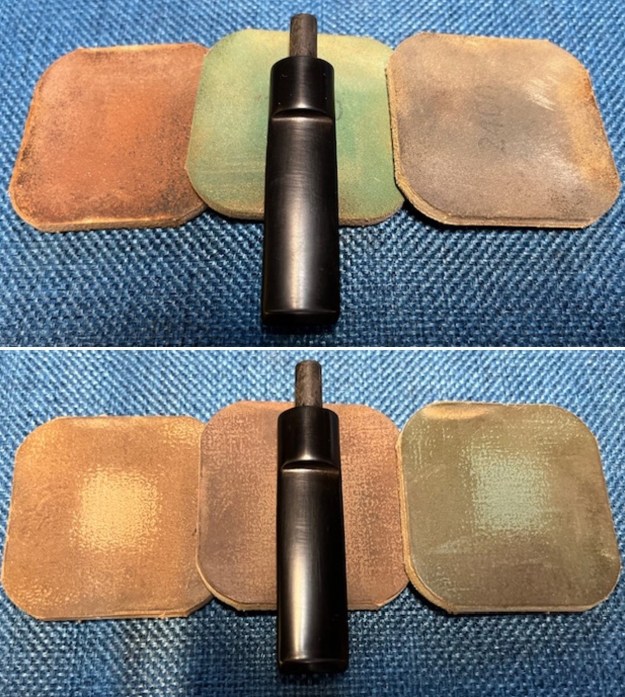
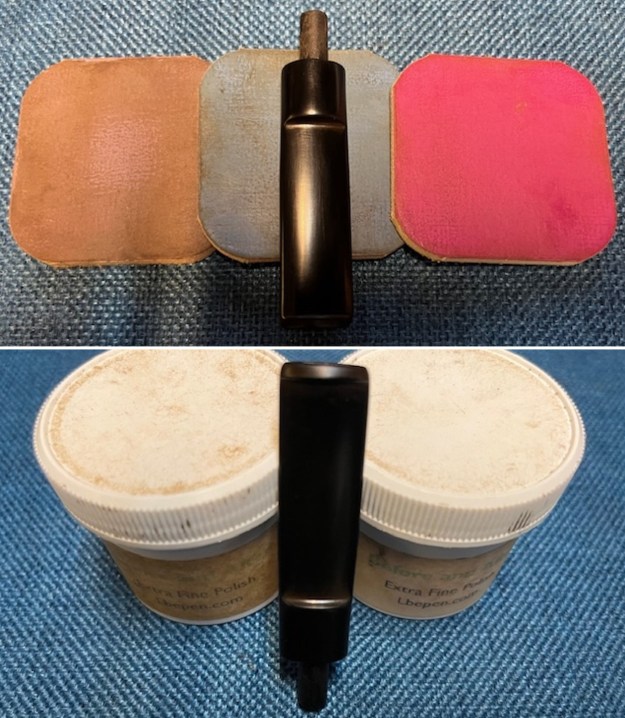
Now it was time to work on the pipe. Jeff had done a great job cleaning up the pipe as usual. He reamed the pipe with a PipNet reamer and cut back the cake back to the bare briar. He cleaned up the walls with a Savinelli Fitsall Pipe Knife. He scrubbed the interior of the bowl and shank with pipe cleaners, cotton swabs, shank brushes and alcohol to remove the tars and oils. He scrubbed the exterior of the pipe with Murphy’s Oil Soap and a tooth brush to remove the grime from the finish. He worked on the rim top lava and darkening with the soap and tooth brush. It looked much better. The silver ferrule looked better and the tarnish was reduced. He soaked the stem in Briarville’s Pipe Stem Deoxidizer and rinsed it off with warm water. When I brought it to the work table I wanted to see if I could resurrect the stamping so I rubbed in a coat of Before & After Restoration Balm. I forgot to take pictures before but trust me it was a very clean pipe all the way around. Here are some photos after sitting with the Balm and being hand buffed with a cloth. It is a beautiful pipe. I took some close up photos of the rim top and also of the stem surface. I wanted to show how well it had cleaned up. The rim top and edges looked very good. It should polish up really well. I also took photos of the stem to show the condition. The tooth marks and chatter are present but hard to see in the photos which is good. It means that none of them are too deep. The stem was clear of oxidation.I took photos of the stamping on the sides of the shank. You can see that the stamping is virtually invisible and not readable. I removed the stem and took a photo of the pipe to have a look at the parts and overall look. The new stem looked really good with the bowl. As you read above I had jumped the gun and rubbed some Before & After Restoration Balm into the surface of the briar with my fingertips to clean, enliven and protect the briar. I let the balm sit for 15 minutes and then buffed with a cotton cloth to raise the shine. The photos show the bowl at this point in the restoration process. My hope was that the balm might raise some of the stamp to be readable. Sadly, it did not do so and the mystery remains. I used a knife, a wet cloth and my gas stove top to try to steam out the deep scratches on the smooth panel on the shank. It works quite well and the knife allows me to specifically put the blade on the scratch. The scratch is still present but not as deep.I polished the silver ferrule with a jeweller’s cloth to remove the tarnish and further protect the silver from the intrusion of more tarnish. I polished the stem with micromesh sanding pads – wet sanding with 1500-12000 grit sanding pads. I wiped it down after each sanding pad with Obsidian Oil. I polished it with Before & After Pipe Stem Polish – both Fine and Extra Fine. I am excited to finish this Republic Era 1980 Peterson’s Rusticated Diamond Shank Bent Billiard. I put the pipe back together and buffed it lightly with Blue Diamond on the buffing wheel. I gave the bowl multiple coats of Conservator’s Wax and the stem multiple coats of carnauba wax. I buffed the pipe with a clean buffing pad to raise the shine and hand buffed it with microfiber cloth to deepen the shine. It is fun to see what the polished bowl looks like with the polished black acrylic stem with the silver band. It really was a beautiful pipe. The grain shining through the rich red stain on this Peterson’s Rusticated Bent Billiard is nice looking and the pipe feels great in my hand. It is light and well balanced. Have a look at it with the photos below. The dimensions are Length: 5 inches, Height: 1 ¾ inches, Outside diameter of the bowl: 1 inch, Chamber diameter: ¾ of an inch. The weight of the pipe is 1.66 ounces/47 grams. It is a beautiful pipe and one that will be on the rebornpipes store in the Irish Pipe Makers Section soon. If you are interested in adding it to your collection let me know. Thanks for walking through the cleanup with me as I worked over this pipe. Thanks to each of you who are reading this blog. Remember we are not pipe owners; we are pipemen and women who hold our pipes in trust until they pass on into the trust of those who follow us.

Breathing New Life into a Republic Era Petersons Mark Twain


Blog by Steve Laug

The next pipe on the work table is a lovely Peterson’s style briar pipe. We purchased it from a seller in Spring Branch, Texas, USA on 02/29/2024. It is a classic Peterson’s De Luxe style Bent Billiard. It has a smooth, rich brown stained bowl that really highlights the stunning grain in the briar. The bowl is dirty with grime in the finish. There is a moderate cake in the bowl and a heavy lava overflow on the rim top and edges. The stamping on the pipe is clear and readable and on the left side it reads Peterson’s [over] Mark Twain. On the right side it reads Made in the Republic of Ireland (three lines). The Sterling Silver Ferrule is stamped Peterson’s [over] Dublin followed by Sterling [over] Silver and three hallmarks. The stem had a P logo stamped on the topside of the taper. It is oxidized, calcified and has light tooth chatter and marks on both sides ahead of the P-lip button. Mark Twain has always been one of my favourite authors. I love his wit and style of humour. The fact that this is a classic Mark Twain pipe is part of the fascination of working on pipes for me. I have seen only a few of these from the line so this is going to be a pleasure to work on. Jeff took photos of the pipe before he started his cleanup. Jeff took photos of the rim top and stem to show the general condition of the pipe. The bowl is moderately caked and the rim top and edges have a heavy coat of lava overflowing on to them. The stem is oxidized, calcified and has light tooth chatter and tooth marks on the top and underside near the button. The “P” logo stamp on the top of the stem is faded and dirty. Jeff took photos of the bowl sides and heel to show the condition of the finish around this bowl. It has some great straight grain on the sides and birdseye on the top and heel. The silver ferrule is oxidized and dirty. He took photos of the stamping on the shank sides. You can see that it is clear and reads as noted above. He also captured the stamping on the sterling silver ferrule on the shank end. It is also very clear and reads as noted. The P logo is faded but readable on the topside of the stem. As is my habit before I start working on a particular pipe I want to know more about the pipe and the line. I turned to Pipephil (http://pipephil.eu/logos/en/logo-peterson-ser.html) to get a quick overview of the Mark Twain pipe. I have included a screen capture of the pertinent section below. When I clicked on the photo of the second pipe above it took me to a photo of the hallmarks that looked identical to the ones on the pipe I am working on. It made me question the date mark and dig further. The note below the photo said, “Peterson Mark Twain (not from the two numbered editions). That photo has a red arrow pointing to the P date stamp. Now to dig a little deeper.The band on the pipe I am working on has the three hallmarks noted in the photo above. They are as follows. The first is Hibernia seated, arm on a harp (for the country of manufacture – Ireland). Next to that is a Crowned Harp designating the sterling quality. Finally, it is followed by the date stamp which in this case is Celtic style capital T. I have included information on the hallmarks below:Date letters of Assay Office Dublin
Twenty letters of the alphabet of different fonts together with the shape of the escutcheon identify the year in which the piece was verified by the assay office. I have circled the matching letter T in the chart below which dates the pipe as a 1984.I turned to Pipedia and there was nothing specific about that stamping. I am including the link to the Pipedia’s article on Peterson pipes. It is a great read in terms of the history of the brand (https://pipedia.org/wiki/Peterson).

I turned then to the definitive pipe book, The Peterson Pipe by Mark Irwin and Gary Malmberg to find more information on the pipe and the stamping on it. I turned first to the short entries and on page 308 found the following information.

Mark Twain (1981-) System pipe design copied from a photograph of Samuel L. Clemens’s pipe held at the Mark Twain Boyhood Home and Museum in Hannibal, Missouri. Arguably Peterson’s most famous and widely known commemorative, it was first introduced as a limited edition 400 numbered pipes in 1981 and offered in smooth and rusticated finishes to this day. Based on shape 14 from 1906 catalog…

There was also a note to turn to another chapter for further information. There is a section in the book on page 174-176 on the Mark Twain variations. There on page 176 in a paragraph entitled, “The Mark Twain System” I found some helpful information which I quote below.

The Mark Twain System. Usually known as the De Luxe, 2400 unnumbered pipes were originally released in 1981 with the hallmark P, and available in smooth as well as rusticated finishes. It is stamped PETERSON’S in script over Mark Twain on the obverse of the shank. The front side of the mouthpiece is stamped with a white P. The pipe retailed for $75 in a red oversized gift box and sometimes included a reproduction of the John Adams etching. De Luxe Quality models were released several times over the years, with later documented examples bearing hallmarks from 1982, 1984-1987, 1990-1991, 1994 and 1997.

This section was extremely helpful in that it described the pipe I was working on to a T. So, I knew that the pipe was a Mark Twain System known as the De Luxe. It was one of 2400 pipes that were released in 1981 with the hallmark on the silver ferrule – exactly like the one I was working on. Since my pipe was dated to 1984 I knew it was part of the original run of pipes as noted in the last paragraph above.

Lastly, I remembered that the late Jim Lilley had written a very interesting piece on Mark Twain pipes on Pipedia. I quickly turned to that article to read through it again. I highly recommend that you take time to read it as it is full of great information and is a fascinating read  (https://pipedia.org/wiki/A_Closer_Look_at_the_Mark_Twain_Original_and_New_Pipes). I have included a pertinent portion of the article and a portrait of Mark Twain and his pipe below.

Peterson started production of the Mark Twain Series in 1980 with a numbered production run from 1 – 400. Then again in 1981 with a numbered production run from 1 – 1000. In 1983, Peterson started producing Mark Twains without numbers, (except the 1985 limited Gold issue), until about 1989. However, they must have had another production run later as there is evidence of Mark Twains with 1998 silver marked bands.

The pipes are typically large, full bents, with P-lip tapered stems, and a hallmarked silver collar. They are akin in quality to Deluxe System pipes, and as such, are also available in the smooth, sandblast, and rustic finishes. The Mark Twains have legendary high-quality smoking, with good draw and excellent with Virginia and flake blends.
Cost/Value: $250 – $1000 plus, depending on which series and precious metal finish. The originals are regularly available on eBay and with offerings hotly contested at auction.

Now it was time to work on the pipe. Jeff had done a great job cleaning up the pipe as usual. He reamed the pipe with a PipNet reamer and cut back the cake back to the bare briar. He cleaned up the walls with a Savinelli Fitsall Pipe Knife. He scrubbed the interior of the bowl and shank with pipe cleaners, cotton swabs, shank brushes and alcohol to remove the tars and oils. He scrubbed the exterior of the pipe with Murphy’s Oil Soap and a tooth brush to remove the grime from the finish. He worked on the rim top lava and darkening with the soap and tooth brush. It looked much better. The silver ferrule looked better and the tarnish was reduced. He soaked the stem in Briarville’s Pipe Stem Deoxidizer and rinsed it off with warm water. When the pipe arrived here this week I took photos of it so you can see what I see. It is a beautiful pipe. I took some close up photos of the rim top and also of the stem surface. I wanted to show how well it had cleaned up. The rim top and edges looked very good. It should polish up really well. I also took photos of the stem to show the condition. The tooth marks and chatter are present but hard to see in the photos which is good. It means that none of them are too deep. The stem was clear of oxidation.I took photos of the stamping on the sides of the shank. You can see that it is stamped as noted above. It is clear and readable. I removed the stem and took a photo of the pipe to have a look at the parts and overall look. The new stem looked really good with the bowl. I polished the briar with micromesh sanding pads – dry sanding with 1500-12000 grit pads and wiping the bowl down after each sanding pad. The grain really began to shine through. It is a beautiful pipe. The polishing of the rim top and inner edge brought the rim top colour to match the rest of the bowl. I worked some Before & After Restoration Balm into the surface of the briar with my fingertips to clean, enliven and protect the briar. I let the balm sit for 15 minutes and then buffed with a cotton cloth to raise the shine. The photos show the bowl at this point in the restoration process. I polished the silver ferrule with a jeweller’s cloth to remove the tarnish and further protect the silver from the intrusion of more tarnish. I set the bowl aside and worked on the stem. I touched up the white P stamp on the topside of the stem with some White Acrylic Nail Polish. I pressed it into the stamp with a tooth pick and polished it off once dry with a worn 1500 grit micromesh sanding pad.I polished the stem with micromesh sanding pads – dry sanding with 1500-12000 grit sanding pads. I wiped it down after each sanding pad with Obsidian Oil. I polished it with Before & After Pipe Stem Polish – both Fine and Extra Fine. I am excited to put the final touches on this 1984 Made in the Republic of Ireland Peterson’s Mark Twain System Pipe. I put the pipe back together and buffed it with Blue Diamond on the buffing wheel. I gave the bowl and the stem multiple coats of carnauba wax. I hand buffed the pipe with a clean buffing pad to raise the shine. It is fun to see what the polished bowl looks like with beautiful straight and birdseye grain on the bowl sides, top and bottom. Added to that the polished black vulcanite stem combined with the bowl and the Sterling Silver ferrule made a stunning pipe. This smooth Classic Peterson’s Mark Twain System is great looking and the pipe feels great in my hand. It is light and well balanced. Have a look at it with the photos below. The dimensions are Length: 5 ½ inches, Height: 1 ¾ inches, Outside diameter of the bowl: 1 ¼ inches, Chamber diameter: ¾ of an inch. The weight of the pipe is 70 grams/2.47ounces. I will be putting it on the rebornpipes store in the Irish Pipe Makers Section shortly. Let me know if you are interested in adding it to your collection. Thanks for walking through the restoration with me as I worked over this pipe. Thanks to each of you who are reading this blog.

New Life for a Butz-Choquin Supermate Lovat


Blog by Kenneth Lieblich

Another pipe in my ongoing “French Collection”, this one came in a lot of pipes from a local auction. It’s a good-looking pipe, despite its considerable superficial blemishes. This pipe is a Lovat – a member of the Canadian family of pipe shapes. It has a long, round shank with a short, saddle stem. It was made by the famous and long-standing French pipe maker Butz-Choquin and is a wounded but very attractive pipe. As I don’t have photos of the restoration process this time, I am merely doing a “before and after” display of this charming pipe. Both Pipedia and Pipephil have good write-ups on the history of Butz-Choquin and I encourage you to read both. Also, Steve has restored quite a few and it’s worth having a look at his writings too. For the moment, here is some information from Pipedia:

The pipe, from Metz to Saint-Claude.

Jean-Baptiste Choquin of Metz started out as a tobacconist. This enterprise was prosperous; he had several employees. Among those, there was a certain Gustave Butz who was its first workman and who became his son-in-law by marrying Choquin’s daughter Marie in 1858. 

In 1858 Jean-Baptiste Choquin created, in collaboration with Gustave Butz, the Choquin pipe. This bent pipe with a flat-bottomed bowl was finished with an albatross-bone mouthpiece, fixed with silver rings.

In 1858, still in Metz, Gustave Butz built an establishment for the manufacture of the Choquin pipe which took the name of. In 1951, the Berrod-Regad company bought the trademark, continuing manufacture until 2002. Departing from Metz, the workshop was relocated to Saint-Claude, then also called “the world capital of the briar pipe”, under the Berrod-Regad group. The Berrod-Regad group would go on to completely rebuild the network of representatives until finally entering the export market in 1960 and has since won several prizes, as well as the Gold Cup of French good taste.

In a few years, the brand’s collection increased from ten to seventy series. 135 years after it was founded, the pipe is still well-known not only in France but throughout the world. In 2002, the Berrod family, wishing to preserve manufacture of pipes in Saint-Claude, handed over the company to Fabien Guichon, a native of the area, who will continue to develop the brand during the 21st century.Meanwhile, Pipephil says this:

The origin of the brand reaches back to 1858 when Jean-Baptiste Choquin in collaboration with his son-in-law Gustave Butz created their first pipe in Metz (France). Since 1951 Butz-Choquin Site officiel Butz Choquin, pipes de Saint-Claude jura. BC pipe de bruyere luxe is a brand of the Berrod-Regad group (Saint-Claude, France).

Jean Paul Berrod managed the company from 1969 to 2002 when he retired and sold the corporate to Mr Fabien Gichon. Denis Blanc, allready owner of EWA, took over the S.A. Berrod-Regad in 2006.

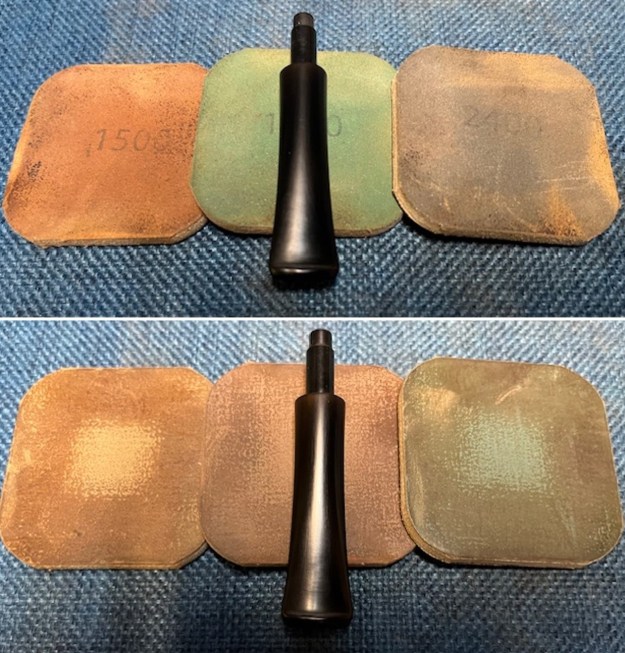
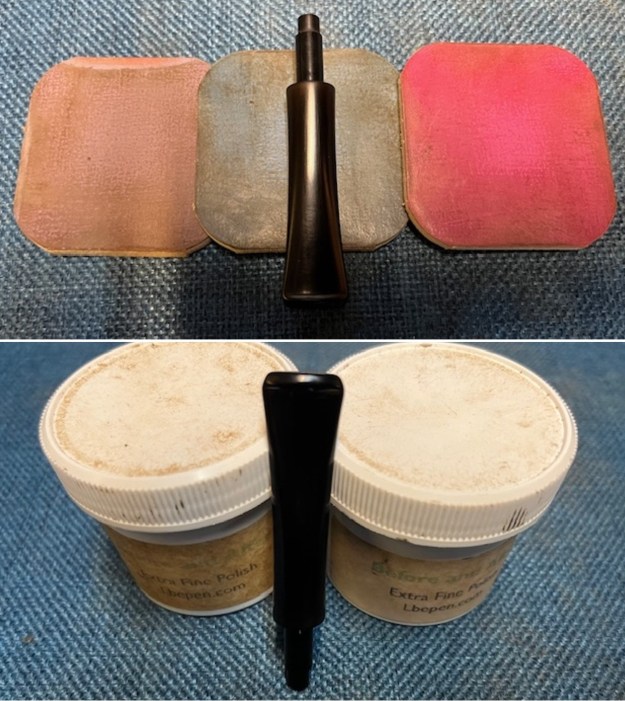
In an old Butz-Choquin catalogue, I found the pipe shape in question, listed with its requisite number:On the left side of the shank, it reads Butz-Choquin [over] Supermate (which is the model name). On the right side of the shank, it reads St Claude, France [over] 1602. On the left side of the stem is the company’s logo, a “BC”. The logo is in decent condition, but not perfect. This pipe was heavily used – in fact, pretty much everything is wrong with this pipe. The stem has been chomped and smashed by the onslaught of teeth. There is horrific calcification and oxidation. It’s been scratched and beaten and battered. The stummel has fared no better. It’s clearly been through the wars. It’s filthy and badly stained by who-knows-what. The bowl is full of cake and the rim is overflowing with lava. There are burns and bumps and scrapes. The wood itself is actually very attractive – despite a couple of fills – but it will take all of my “nous” (as my English friends would say) to get this pipe back to life. I scrubbed the stem with Murphy’s Oil Soap on some cotton pads. I also took a BIC lighter and ‘painted’ the stem with its flame in order to lift the few bite marks and dents. Then I cleaned out the inside with pipe cleaners and lemon-infused isopropyl alcohol.

I wiped down the stem with SoftScrub cleaner to remove surface oxidation. Then the stem went for an overnight soak in the Pipe Stem Oxidation Remover. The next day, I used SoftScrub again with some cotton rounds.

After this, I used some nail polish to restore the logo on the stem. I built up the tooth dents on the stem with black cyanoacrylate adhesive and let them fully cure. I then used my Micromesh pads and Obsidian Pipe Stem Oil to make it look great. I reamed out the stummel and removed all the filth. Fortunately, there was no damage to the interior walls. I used cotton rounds and some Murphy’s Oil Soap to scrub the outside of the stummel and a toothbrush with Murphy’s for the lava on the rim of the pipe.

I then proceeded to clean out the insides of the shank with Q-tips, pipe cleaners, and lemon-infused isopropyl alcohol. I followed that up by cleaning the insides with some dish soap and tube brushes. I then de-ghosted the and the bowl was nice and clean after this.

I repaired the fills in the wood, then took my Micromesh pads to sand and smooth everything out. Because of the suffering this pipe endured, I decided to apply some stain to the wood and I was absolutely delighted with the results. The pipe looked so good!After that, a light application of Before & After Restoration Balm brought out the best in the stummel’s grain. I took it to the buffer. A dose of White Diamond and a few coats of carnauba wax were just what this pipe needed.

This Butz-Choquin Supermate 1602 lovat looks amazing now – in fact, it hardly looks like the same pipe! Its beauty is back again and it is ready to be enjoyed by the next owner! I am pleased to announce that this pipe is for sale! If you are interested in acquiring it for your collection, please have a look in the ‘French’ pipe section of the store here on Steve’s website. You can also email me directly at kenneth@knightsofthepipe.com. The approximate dimensions of the pipe are as follows: length 5⅔ in. (144 mm); height 1¾ in. (44 mm); bowl diameter 1⅓ in. (33 mm); chamber diameter ¾ in. (20 mm). The weight of the pipe is 1 oz. (29 g). I hope you enjoyed reading the story of this pipe’s restoration as much as I did restoring it. If you are interested in more of my work, please follow me here on Steve’s website or send me an email. Thank you very much for reading and, as always, I welcome and encourage your comments.

Breathing Life into a Dunhill Bruyere 250EX F/T Made in England2 2A Billiard


Blog by Steve Laug

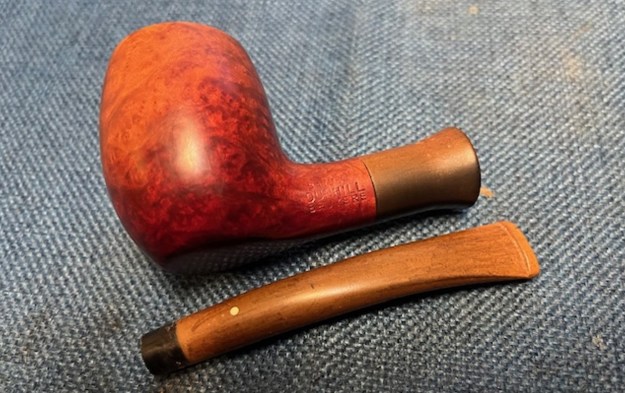
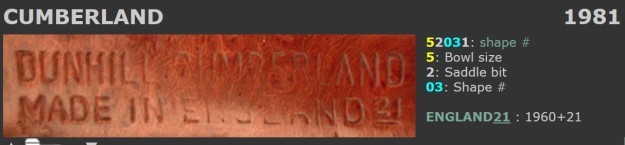
The next pipe that I am working on came from our connection in Copenhagen, Denmark we purchased on 01/08/24. It was very dirty and rich combination of red and brown stains when it started. The smooth finish around the bowl was dirty and had hand oils ground into the finish. The bowl had a thick cake and a coat of lava flowing onto the inner edge and the rim top. There was also some burn damage on the rim top and the outer edge of the bowl and down the front. The classic fishtail stem was very dirty, oxidized and had light tooth marks and chatter on both sides ahead of the button. There was a white spot on the topside of the stem. The fit of the stem to the shank is perfect. The pipe is stamped on the left side of the shank and read 250 EX F/T followed by Dunhill [over] Bruyere. On the right side it is stamped Made in London [over] England with the superscript 2 (date stamp) after the D of England. That is followed by 2 (size of pipe) in a circle A for Bruyere. Jeff took photos of the pipe so I could have a sense of what it looked like before he started his work on it. Jeff took photos of the bowl and rim top to show the cake in the bowl with remnants of tobacco stuck on the walls of the bowl. There was a thick lava build up on the top of the rim and the edge of the bowl. There appeared to be some burn damage on the top front and outer edge of the bowl. Only clean up would tell the full story. Jeff took photos of the top and underside of the stem showing the tooth chatter, marks and oxidation on the stem. Jeff took photos of the sides and heel of the bowl to show the condition of the finish. You can see the grime in the finish around the sides of the bowl and shank. Even under the dirt and debris of the years it looked very good. Jeff took photos of the stamping on the sides of the shank. The stamping was faint in spots but nonetheless still readable as you can see from the photos. It read as noted above. I turned to Pipedia’s section on Dunhill Root Briar Pipes to get a bit of background on the Dunhill finishes (https://pipedia.org/wiki/Dunhill#Root_Briar). I quote:

Bruyere

The original finish produced (usually made using Calabrian briar), and a big part of developing and marketing the brand. It was the only finish from 1910 until 1917. A dark reddish-brown stain. Before the 1950s, there were three possible finishes for Dunhill pipes. The Bruyere was a smooth finish with a deep red stain, obtained through two coats, a brown understain followed by a deep red.

There was a link on the above site to a section specifically written regarding the Bruyere finish (https://pipedia.org/wiki/Dunhill_Bruyere). I turned there and have included the information from that short article below.

Initially, made from over century-old briar burls, classified by a “B” (denoted highest quality pipe); “DR” (denoted straight-grained) and an “A” (denoted first quality), until early 1915. After that, they became a high-end subset to the Dunhill ‘Bruyere’. The DR and B pipes, a limited production, they should be distinguished as hand-cut in London from burls as opposed to the Bruyere line which was generally finished from French turned bowls until 1917, when the Calabrian briar started to be used, but not completely. Only in 1920 Dunhill took the final step in its pipe making operation and began sourcing and cutting all of its own bowls, proudly announcing thereafter that “no French briar was employed”.

Bruyere pipes were usually made using Calabrian briar, a very dense and hardy briar that has a modest grain but does very well with the deep red stain.

“Before the 1950s, there were three possible finishes for Dunhill pipes. The Bruyere was a smooth finish with a deep red stain, obtained through two coats, a brown understain followed by a deep red. The Shell finish was the original sandblast with a near-black stain (though the degree to which it is truly black has varied over the years). Lastly, the Root finish was smooth also but with a light brown finish. Early Dunhill used different briars with different stains, resulting in more distinct and identifiable creations… Over the years, to these traditional styles were added four new finishes: Cumberland, Dress, Chestnut and Amber Root, plus some now-defunct finishes, such as County, Russet and Red Bark.”

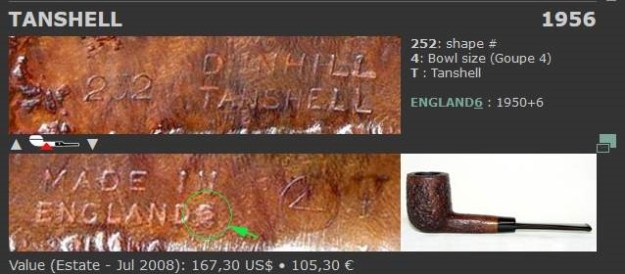
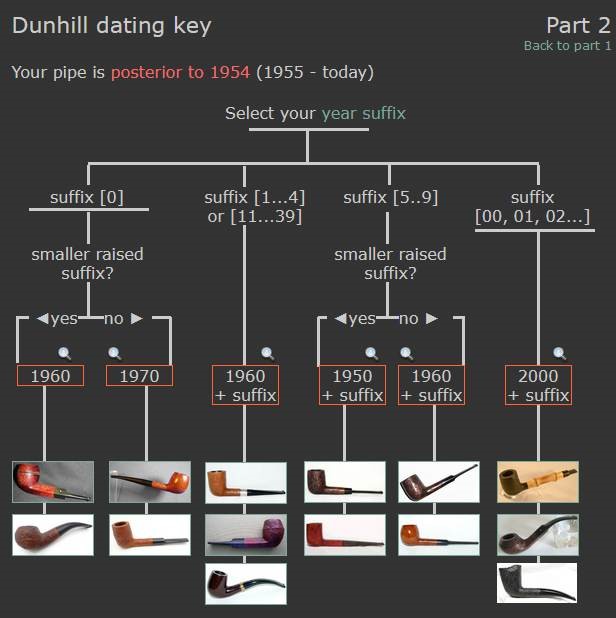
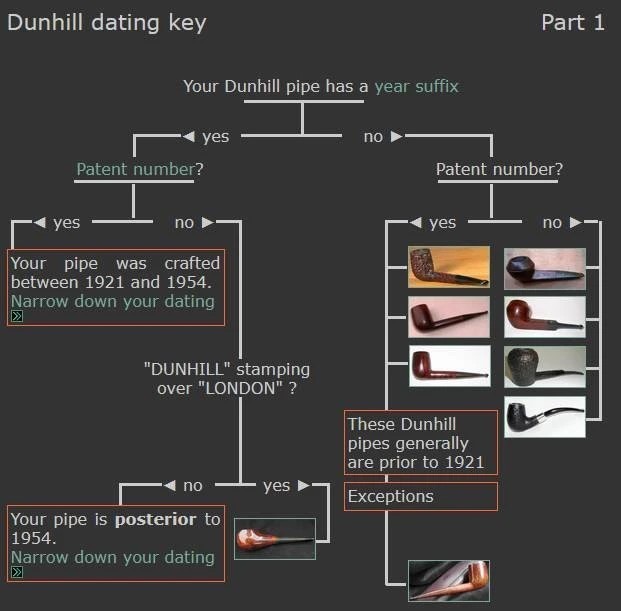
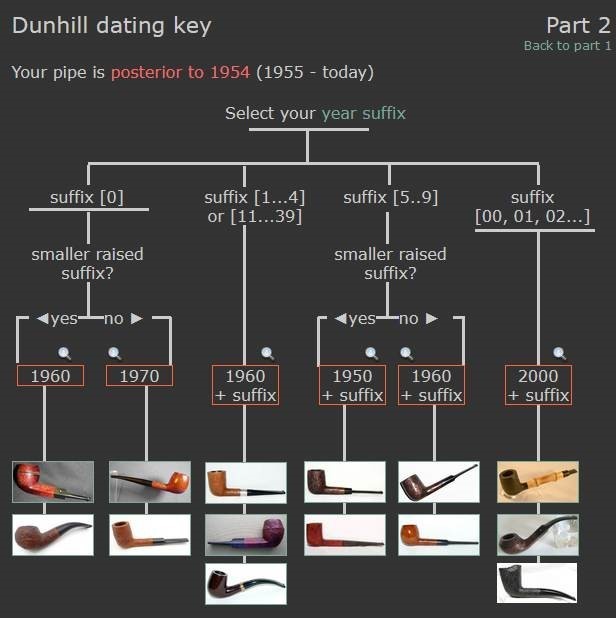
There was also a link to a catalogue page that gave examples and dates that the various finishes were introduced (https://pipedia.org/wiki/File:Dunnypipescatalog-1.png).I turned to Pipephil’s dating guide to show how I arrived at the date of manufacture for this pipe (http://www.pipephil.eu/logos/en/dunhill/cledat-en1a.html). I am including the chart that is provided there for the dating a pipe. I have drawn a red box around the section. Since the pipe I am working on has a suffix 2 that is raised. It to the 1960 line on the chart below. It also gave me the formula for dating the pipe – 1960 + suffix 2 = 1962.In an earlier blog I had come across the EX stamp – in this case 250EX. From what I found on that blog I quote below: https://rebornpipes.com/2020/05/09/breathing-life-into-a-1957-or-is-it-a-1967-dunhill-root-briar-251-ex606-billiard/

I posted a question on the stamping on the Tobacco Pipe Restorers Group on Facebook and got this response from Alfredo Baquerizo:

This is a Root Briar from 1957 shape 251, group 3 and the R is for root. It’s an EX an exchange pipe by warranty Dunhill system. The 606 I think that is the exchange pipe number, I’m not sure.

I also posted on the Vintage Dunhill Pipes Group on Facebook and enjoyed the responses. One of the posters there, Jean-Paul Varon gave this information.

Ex606 = exchange of a pipe under guarantee.

That was the extent of the information that I could find at this point. It seems likely that the EX is the Dunhill Exchange Warranty system. Is it possible that the 250EX could be that the original 250 F/T pipe has been exchanged for this replacement?

I now knew that I was working on a Bruyere that came out in 1962. The shape of the pipe was one of many Billiards that Dunhill put out and that the #250EX F/T was a normal billiard shape with a taper stem. As noted above the EX could be an exchange.

I turned to work on the pipe itself. Jeff had carried out his usual thorough cleanup of the pipe. He had reamed it with a PipNet reamer to remove the cake and cleaned the reaming up with a Savinelli Fitsall Pipe Knife. He scrubbed the internals of the bowl and stem with alcohol, cotton swabs and pipe cleaners. He scrubbed the externals with undiluted Murphy’s Oil Soap and rinsed the bowl off with running water. He soaked the stem in Briarville’s Pipe Stem Deoxidizer and once it had soaked rinsed it off with warm water to remove the residual solution. He dried it off and scrubbed it down with Soft Scrub All-Purpose cleaner to remove any oxidation that was still on the stem. The pipe looked very clean when I received it. I took a photo of the rim top to show the condition. You can see the clean bowl. The bowl is in excellent condition and is clean. The rim top and the inner edge show some darkening and damage to the inner and outer edge. The stem came out looking clean. There were some tooth marks and chatter on both sides ahead of the button. I took photos of the stamping on the shank. It is faint but still very readable. There was also a very faint stamp on the stem but I am still not certain it is the correct stem because of the fit and shape of the stem. I removed the stem from the shank and took a photo of the pipe parts to show what I was working with. This weekend when I visited with Jeff I picked up a bottle of Before & After Briar Cleaner developed by Mark Hoover that had been sent to me. This evening I decided to try out the product. I applied it to the bowl and scrubbed the surface with a tooth brush. I wiped off the product with a clean paper towel and it had removed a lot of the remaining darkening on the surface of the briar. I took photos of the pipe to show how well it worked. I was very pleased how clean the rim top and side of the bowl came out. I started my work on the pipe by addressing the damage on the inner edge of the bowl to bring it back to round using a folded piece of 220 grit sandpaper. I gave it a slight bevel to accommodate the damage. Even after reworking the edge there was some damage that remained on the left front inner and outer edge of the bowl. I left it as removing it would damage the shape and thickness of the bowl walls.I polished the briar with micromesh sanding pads. I dry sanded it with 1500-12000 grit sanding pads and wiped the bowl down after each pad with a damp cloth. By the final pads the briar really had a shine. The bowl had a trough worn in the bottom caused by aggressive use of pipe cleaners. I mixed up a batch of pipe mud – cigar ash and water and put a pipe cleaner in the airway. I pressed the pipe mud into the trough with a dental spatula and a folded pipe cleaner to raise the bottom of the bowl.I rubbed the briar down with Before & After Restoration Balm. I worked it into the briar with my fingertips. The product works to clean, enliven and preserve the briar. I let it sit for 10 minutes then I buffed it with a cotton cloth to deepen the shine. The briar comes alive with the balm. I set the bowl aside and turned my attention to the stem. I “painted” the stem with the flame of a light to lift the tooth marks from the surface. I was able to lift them significantly. I filled in what remained with a clear CA glue. I used some small files to flatten out the repairs to the surface. I sanded what remained with a folded piece of 220 grit sandpaper. The stem really began to look very good. I sanded the stem with sanding pads- using 3200-3500 grit sanding pads. I wiped the stem down with a cloth impregnated with Obsidian Oil after each sanding pad. The stem was beginning to look much better.I polished the vulcanite with micromesh sanding pads – 1500-12000 grit pads. I wiped it down with Obsidian Oil after each sanding pad. I used Before & After Pipe Polish – both Fine and Extra Fine to further polish the stem. It really took on a shine and I knew that once it was buffed it would look amazing. This Dunhill Bruyere 250EX F/T Group 2A Billiard from 1962 is a beautiful looking piece of briar that has a shape that follows grain. It is a great looking pipe that came out looking even better after the cleanup. The Bruyere is an early finish that Dunhill specialized in making. The finish on the pipe cleaned up well. The red and brown stain on the bowl works well to highlight the grain. The polished black vulcanite taper stem adds to the mix. With the grime gone from the finish and the bowl it was a beauty and is eye-catching. There was some burn damage on the outer edge of the bowl that remained. I put the stem back on the bowl and buffed the pipe with Blue Diamond on the buffing wheel being careful to not buff the stamping. I gave the bowl and the stem multiple coats of carnauba wax on the buffing wheel and buffed it with a clean buffing pad. I hand buffed the pipe with a microfiber cloth to deepen the shine. The finished Bruyere 250EX F/T Billiard is quite nice and feels great in the hand. Give the finished pipe a look in the photos below. I can only tell you that like the other pipes I am working that it is much prettier in person than the photos capture. The dimensions of the pipe are Length: 5 ½ inches, Height: 1 ½ inches, Outside diameter of the bowl: 1 inch, Chamber diameter: ¾ of an inch. The weight of the pipe is 27 grams/.95 ounces. It will soon be added to the British Pipe Makers Section on the rebornpipes store. Thanks for walking through the restoration with me as I worked over another beautiful pipe. Remember we are not pipe owners; we are pipemen and women who hold our pipes in trust until they pass on into the trust of the next generation.

New Life for a Dunhill Bruyere 251 F/T Billiard 3A


Blog by Steve Laug

The next pipe that I am working on came from an estate sale in Oregon City, Oregon, USA we purchased on 03/21/24. It was very dirty and rich combination of red and brown stains when it started. The smooth finish around the bowl was dirty and had hand oils ground into the finish. The bowl had a thick cake and a coat of lava flowing onto the inner edge and the rim top. The classic fishtail stem was very dirty, oxidized and had light tooth marks and chatter on both sides ahead of the button. There was a white spot on the topside of the stem. The fit of the stem to the shank is perfect. The pipe is stamped on the left side of the shank and read 251 F/T followed by Dunhill [over] Bruyere. On the right side it is stamped Made in London [over] England with the number 7 (date stamp) after the D of England. That is followed by 3 (size of pipe) in a circle A for Bruyere. Jeff took photos of the pipe so I could have a sense of what it looked like before he started his work on it. Jeff took photos of the bowl and rim top to show the cake in the bowl with remnants of tobacco stuck on the walls of the bowl. There was a spotty lava build up on the top of the rim and the edge of the bowl. The rim top looked pretty good but it was hard to know for sure if there was damage under the lava. Only clean up would tell the full story. Jeff took photos of the top and underside of the stem showing the tooth chatter, marks and oxidation on the stem. Jeff took photos of the sides and heel of the bowl to show the condition of the finish. You can see the grime in the finish around the sides of the bowl and shank. Even under the dirt and debris of the years it looked very good. Jeff took photos of the stamping on the sides of the shank. The stamping was faint in spots but nonetheless still readable as you can see from the photos. It read as noted above. I turned to Pipedia’s section on Dunhill Root Briar Pipes to get a bit of background on the Dunhill finishes (https://pipedia.org/wiki/Dunhill#Root_Briar). I quote:

Bruyere

The original finish produced (usually made using Calabrian briar), and a big part of developing and marketing the brand. It was the only finish from 1910 until 1917. A dark reddish-brown stain. Before the 1950s, there were three possible finishes for Dunhill pipes. The Bruyere was a smooth finish with a deep red stain, obtained through two coats, a brown understain followed by a deep red.

There was a link on the above site to a section specifically written regarding the Bruyere finish (https://pipedia.org/wiki/Dunhill_Bruyere). I turned there and have included the information from that short article below.

Initially, made from over century-old briar burls, classified by a “B” (denoted highest quality pipe); “DR” (denoted straight-grained) and an “A” (denoted first quality), until early 1915. After that, they became a high-end subset to the Dunhill ‘Bruyere’. The DR and B pipes, a limited production, they should be distinguished as hand-cut in London from burls as opposed to the Bruyere line which was generally finished from French turned bowls until 1917, when the Calabrian briar started to be used, but not completely. Only in 1920 Dunhill took the final step in its pipe making operation and began sourcing and cutting all of its own bowls, proudly announcing thereafter that “no French briar was employed”.

Bruyere pipes were usually made using Calabrian briar, a very dense and hardy briar that has a modest grain but does very well with the deep red stain.

“Before the 1950s, there were three possible finishes for Dunhill pipes. The Bruyere was a smooth finish with a deep red stain, obtained through two coats, a brown understain followed by a deep red. The Shell finish was the original sandblast with a near-black stain (though the degree to which it is truly black has varied over the years). Lastly, the Root finish was smooth also but with a light brown finish. Early Dunhill used different briars with different stains, resulting in more distinct and identifiable creations… Over the years, to these traditional styles were added four new finishes: Cumberland, Dress, Chestnut and Amber Root, plus some now-defunct finishes, such as County, Russet and Red Bark.”

There was also a link to a catalogue page that gave examples and dates that the various finishes were introduced (https://pipedia.org/wiki/File:Dunnypipescatalog-1.png). I turned to Pipephil’s dating guide to show how I arrived at the date of manufacture for this pipe (http://www.pipephil.eu/logos/en/dunhill/cledat-en1a.html). I am including the chart that is provided there for the dating a pipe. I have drawn a red box around the section. Since the pipe I am working on has a suffix 7 that is not smaller or raised. It to the 1960 line on the chart below. It also gave me the formula for dating the pipe – 1960 + suffix 7 = 1967.I now knew that I was working on a Bruyere that came out in 1967. The shape of the pipe was one of many Billiards that Dunhill put out and that the #251 was a normal billiard shape with a taper stem.

I turned to work on the pipe itself. Jeff had carried out his usual thorough cleanup of the pipe. He had reamed it with a PipNet reamer to remove the cake and cleaned the reaming up with a Savinelli Fitsall Pipe Knife. He scrubbed the internals of the bowl and stem with alcohol, cotton swabs and pipe cleaners. He scrubbed the externals with undiluted Murphy’s Oil Soap and rinsed the bowl off with running water. He soaked the stem in Briarville’s Pipe Stem Deoxidizer and once it had soaked rinsed it off with warm water to remove the residual solution. He dried it off and scrubbed it down with Soft Scrub All-Purpose cleaner to remove any oxidation that was still on the stem. The pipe looked very clean when I received it. I took a photo of the rim top to show the condition. You can see the clean bowl. The bowl is in excellent condition and is clean. The rim top and the inner edge show some darkening and damage to the edge. The stem came out looking clean. There were some light tooth marks and chatter on both sides ahead of the button. I took photos of the stamping on the shank. It is faint but still very readable. There was also a very faint stamp on the stem but I am still not certain it is the correct stem because of the fit and shape of the stem. I removed the stem from the shank and took a photo of the pipe parts to show what I was working with.

I started my work on the pipe by addressing the damage on the inner edge of the bowl to bring it back to round using a folded piece of 220 grit sandpaper. I gave it a slight bevel to accommodate the damage.The pipe had cleaned up so well that I turned to polish the briar with micromesh sanding pads. I dry sanded it with 1500-12000 grit sanding pads and wiped the bowl down after each pad with a damp cloth. By the final pads the briar really had a shine. I rubbed the briar down with Before & After Restoration Balm. I worked it into the briar with my fingertips. The product works to clean, enliven and preserve the briar. I let it sit for 10 minutes then I buffed it with a cotton cloth to deepen the shine. The briar comes alive with the balm. I set the bowl aside and turned my attention to the stem. I polished the vulcanite with micromesh sanding pads – 1500-12000 grit pads. I wiped it down with Obsidian Oil after each sanding pad. I used Before & After Pipe Polish – both Fine and Extra Fine to further polish the stem. It really took on a shine and I knew that once it was buffed it would look amazing. This Dunhill Bruyere 251 F/T Group 3 Billiard from 1967 is a beautiful looking piece of briar that has a shape that follows grain. It is a great looking pipe that came out looking even better after the cleanup. The Bruyere is an early finish that Dunhill specialized in making. The finish on the pipe is in excellent condition. The red and brown stain on the bowl works well to highlight the grain. The polished black vulcanite taper stem adds to the mix. With the grime gone from the finish and the bowl it was a beauty and is eye-catching. I put the stem back on the bowl and buffed the pipe with Blue Diamond on the buffing wheel being careful to not buff the stamping. I gave the bowl and the stem multiple coats of carnauba wax on the buffing wheel and followed that by buffing it with a clean buffing pad. I hand buffed the pipe with a microfiber cloth to deepen the shine. The finished Bruyere 251 F/T Billiard is quite nice and feels great in the hand. Give the finished pipe a look in the photos below. I can only tell you that like the other pipes I am working that it is much prettier in person than the photos capture. The dimensions of the pipe are Length: 5 ½ inches, Height: 1 ¾ inches, Outside diameter of the bowl: 1 ¼ inches, Chamber diameter: ¾ of an inch. The weight of the pipe is 34 grams/1.20 ounces. It will soon be added to the British Pipe Makers Section on the rebornpipes store. Thanks for walking through the restoration with me as I worked over another beautiful pipe. Remember we are not pipe owners; we are pipemen and women who hold our pipes in trust until they pass on into the trust of the next generation.

Restoring a Beautiful Dunhill Root Briar 36 F/T Made in England Liverpool


Blog by Steve Laug

The next pipe that I am working on came from an estate sale in Oregon City, Oregon, USA we purchased on 03/21/24. It was very dirty and rich combination of brown stains when it started. The smooth finish around the bowl was dirty and had hand oils ground into the finish. The bowl had a thick cake and a coat of lava flowing onto the inner edge and the rim top. The classic fishtail stem was very dirty, oxidized and had light tooth marks and chatter on both sides ahead of the button. There was a white spot on the topside of the stem. The fit of the stem to the shank is perfect. The pipe is stamped on the left side of the shank and read 36 F/T followed by Dunhill [over] Root Briar. On the right side it is stamped Made in London [over] England with the number 5 (date stamp) after the D of England. Stamped slightly to the right of the D there is a smaller 6 stamped that gives a secondary date. Typically, the secondary stamp signifies the year that the pipe was sold. That is followed by 4 (size of pipe) in a circle R for Root Briar. Jeff took photos of the pipe so I could have a sense of what it looked like before he started his work on it. Jeff took photos of the bowl and rim top to show the cake in the bowl with remnants of tobacco stuck on the walls of the bowl. There was a lava build up on the top of the rim and the edge of the bowl. The rim top looked pretty good but it was hard to know for sure if there was damage under the lava. Only clean up would tell the full story. Jeff took photos of the top and underside of the stem showing the tooth chatter, scratching and oxidation on the stem. Jeff took photos of the sides and heel of the bowl to show the condition of the finish. You can see the grime in the finish around the sides of the bowl and shank. Even under the dirt and debris of the years it looked very good. Jeff took photos of the stamping on the sides of the shank. The stamping was clear and readable as you can see from the photos. It read as noted above. I wanted to unpack the Dunhill stamping on the shank and work to understand each element of the stamp. I generally use the Pipephil site to gather as much initial information as possible (http://pipephil.eu/logos/en/dunhill/root-briar1.html). The stamping is interpreted as follows: The number 36 the Liverpool shape. The F/T stamp is used to designate Fish Tail stem. The Root Briar stamp refers to the smooth finish. The number 5 following the D of England would give the date the pipe. The number 6 or secondary number would identify the year that the pipe sold for warranty purposes. The Circle 4R shows it is a Group 4 sized pipe and the R is the designation for a Root Briar. The photo below shows a pipe that is stamped similarly to the one that I am working on.
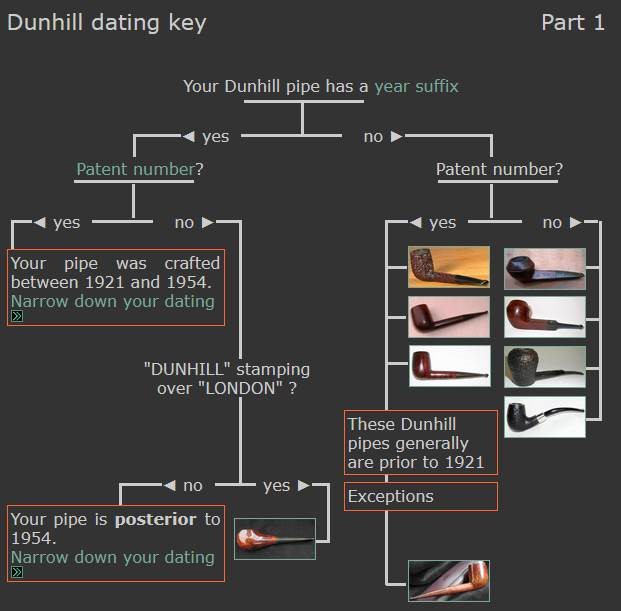
Pipephil also has some helpful dating keys on the site that are basically flow charts that you can walk through to date your pipe (http://pipephil.eu/logos/en/dunhill/cledat-en1.html). I turned to Part 1 of the Dating Key and followed the chart. This pipe has a 5 following the D in England. There was no patent number so that took me to the section on the chart below (column one) which instructed me that the pipe could be dated as being made “posterior to 1954”.I followed the link under “Your pipe is posterior to 1954. Narrow down your dating”. That took me to Page 2 of the dating key (http://pipephil.eu/logos/en/dunhill/cledat-en1a.html). The third column (suffix 5…9) led me to the section with a 5 after the D in England. There was a directive for dating the pipe spelled out as follows: 1960 + suffix 5 which gives the pipe a date of 1965. I believe that the secondary  number 6 refers to the pipe being sold in 1966.I then turned to Pipedia’s section on Dunhill Root Briar to get a bit of background on the Dunhill finishes (https://pipedia.org/wiki/Dunhill#Root_Briar). I quote:

Root Briar

Introduced in 1931 and highly prized because the grain is more pronounced in this finish (usually made using Corsican briar – was made exclusively from that briar into the 60s). The Root Briar finish requires a perfectly clean bowl with excellent graining. Therefore, it is the most expensive of the Dunhill pipes. Corsican briar was most often used for the Root finish since it was generally more finely grained. This is a rare finish, due to the scarcity of briar suitable to achieve it. These pipes are normally only available at Company stores, or at Principle Pipe Dealers. Straight grained pipes were formerly graded A through H, but are now only “Dr’s” and graded with one to six stars, with the letters G and H still used for the very finest pieces.

Dunhill introduced its third major finish, the Root finish, in 1931. Corsican mountain briar is characteristically beautifully grained and the Root was made exclusively from that briar into the 1960s. The pipe was finished with a light natural stain to allow the beauty of the graining to show through. Although always available with a traditional black vulcanite bit, the Root was introduced in either 1930 or more likely 1931 and fitted with a marble brown dark and light grained vulcanite bit that has since become known as the ‘bowling ball’ bit because of the similarity in appearance between the bit’s finish and that of some bowling balls of the time. With the war, however, the bowling ball bit was dropped from production. Through 1954 (and after) the Root pipe nomenclature (including shape numbers) was identical to that of the Bruyere except that instead of the “A” of the Bruyere, the Root was stamped with an “R”. In 1952 when the finish rather then LONDON was placed under DUNHILL, ROOT BRIAR rather then BRUYERE was used for the Root. Loring, J. C., The Dunhill Briar Pipe, The Patent Years and After (self-published, Chicago, 1998).

I turned to work on the pipe itself. Jeff had done an amazing cleanup of the pipe. He reamed the cake with a PipNet reamer and cleaned up that with a Savinelli Fitsall Pipe Knife. He scrubbed the internals of the bowl and stem with alcohol, cotton swabs,pipe cleaners and shank brushes. He scrubbed the externals with undiluted Murphy’s Oil Soap and rinsed the bowl off with running water. The rim top had some darkening and there was some damage to the inner edge of the rim. He soaked the stem in Briarville’s Pipe stem Deoxidizer and once it had soaked rinsed it off with warm water to remove the residual solution. He dried it off and rubbed it down to remove any oxidation that was still on the stem. The pipe looked very good when I received it. I took a photo of the rim top to show the condition. You can see the clean bowl. The bowl is in excellent condition and is clean. The rim top and the inner edge show some darkening and damage to the edge. The stem came out looking clean. There were some light tooth marks and chatter on both sides ahead of the button. I took photos of the stamping on the shank. It is faint but still very readable. There was also a very faint stamp on the stem but I am still not certain it is the correct stem because of the fit and shape of the stem. I removed the stem from the shank and took a photo of the pipe parts to show what I was working with. I started my work on the pipe by addressing the damage on the inner edge of the bowl to bring it back to round using a folded piece of 220 grit sandpaper. I gave it a slight bevel to accommodate the damage. The pipe had cleaned up so well that I turned to polish the briar with micromesh sanding pads. I dry sanded it with 1500-12000 grit sanding pads and wiped the bowl down after each pad with a damp cloth. By the final pads the briar really had a shine. I rubbed the briar down with Before & After Restoration Balm. I worked it into the briar with my fingertips. The product works to clean, enliven and preserve the briar. I let it sit for 10 minutes then I buffed it with a cotton cloth to deepen the shine. The briar comes alive with the balm. I set aside the bowl and turned my attention to the stem. I moved on to further smooth out the surface of the vulcanite. I sanded it with 320-3500 grit sanding pads to further clean up the scratches and file marks on the surface of the stem.I polished the vulcanite with micromesh sanding pads – 1500-12000 grit pads. I wiped it down with Obsidian Oil after each sanding pad. I used Before & After Pipe Polish – both Fine and Extra Fine to further polish the stem. It really took on a shine and I knew that once it was buffed it would look amazing. This 1965 Dunhill Root Briar 36 Taper Stem Liverpool has a beautiful, unique Dunhill Root Briar finish that highlights the beautiful grain. The finish highlights some great grain around the bowl and shank. It has the rare finish of a Dunhill Root Briar. The polished black vulcanite taper stem adds to the mix. I put the stem back on the bowl and buffed the pipe with Blue Diamond on the buffing wheel being careful to not buff the stamping. I gave the bowl and the stem multiple coats of carnauba wax on the buffing wheel and followed that by buffing it with a clean buffing pad. I hand buffed the pipe with a microfiber cloth to deepen the shine. The finished Dunhill Root Briar 36 Liverpool is quite nice and feels great in the hand. Give the finished pipe a look in the photos below. The dimensions of the pipe are Length: 5 ½ inches, Height: 1 ¾ inches, Outside diameter of the bowl: 1 ¼ inches, Chamber diameter: ¾ of an inch. The weight of the pipe is 1.27 ounces/35 grams. Thanks for walking through the restoration with me as I worked over another beautiful pipe. If you are interested in adding it to your collection I will be adding it to the British Pipe Makers Section of the rebornpipes store. Thanks for your time.

Restoring a Colm Magner Boxing Glove for my Own Collection


Blog by Steve Laug

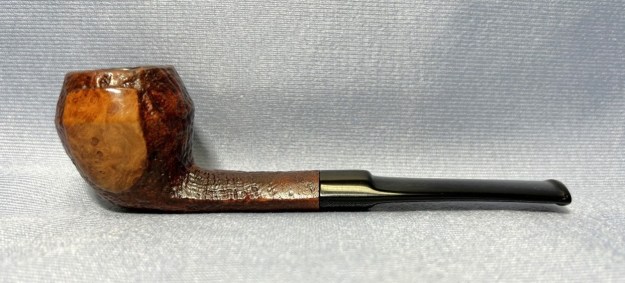
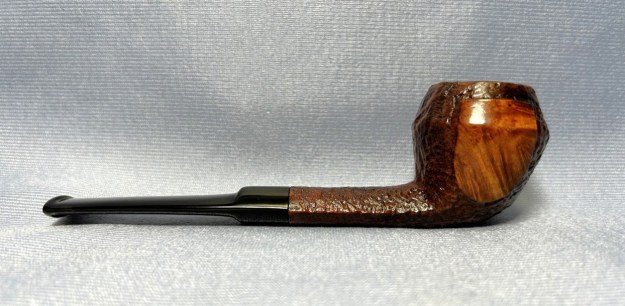
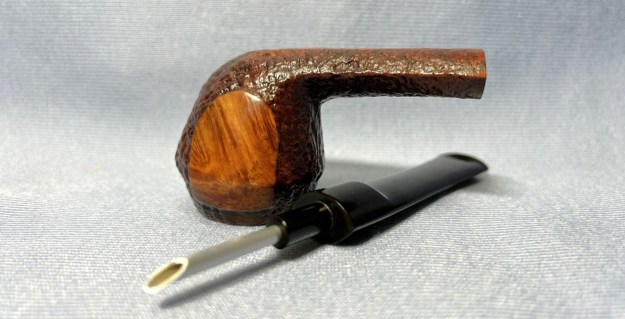
I have been looking for a Colm Magner pipe for a long time. I have watched them come and go on eBay and never quite found the one that really captured me. Not too long ago there was fellow on Facebook selling some pipes for his father. One of the pipes was a Colm Magner that ticked all my boxes and it came in a black calfskin pipe sock. It was a shape that Magner called a boxing glove. It reminds me a lot of the signature Vesz Raindrop shape. It was a smooth finish with two patches of rustication – one on each side. It is a small random pattern with some small patches of rustication on the shank sides. The stem was custom fitted acrylic. I have included the photos that the seller included in his advertisement below. It was a great looking pipe and I looked forward to receiving it. The pipe is stamped on the underside of the bowl and reads Magner [over] Handmade [over] Canada. The stamping is clear and readable. I had the pipe shipped to Jeff in Oregon. Yesterday when I met him in Washington I picked up the pipe. The finish was slightly dull and there was a light cake in the bowl. The inner edge and the rim top looked very good with no lava overflowing and no damage. The stem is acrylic and had some light tooth chatter on the top and underside next to the button edge. There was also some calcification against the sharp edge of the button on both sides. I took photos of the pipe when I brought it to the work table this morning. It was a real beauty that I could not wait to load up and enjoy. I took photos of the bowl, rim top and the top and underside of the stem to show the condition of the pipe before I started my work on it.I took a photo of the stamping on the bowl. It is clear and very readable as noted above. Before I started working on the pipe I decided to look up information on the brand. I knew so little about Colm Magner that a bit of reading would be a great help to building my knowledge of the maker. I turned first to Pipephil’s site (http://www.pipephil.eu/logos/en/logo-m1.html). I did a screen capture of the section and have included the side bar information below. Artisan: Colm Magner (born 1961) started carving pipes in 1998. He is an actor who has had roles in movies and television shows shot in Toronto.

For more detailed information I turned to Pipedia and read the section on Magner found in the Canadian Pipe Makers section (https://pipedia.org/wiki/Colm_Magner). I have quoted to article in part below.

Colm Magner, born in 1961, is a Canadian pipemaker who presently lives and works in New York City.He previously taught Drama and Playwriting at UPEI, and continues to carve pipes and make hand-made original jewelery. Colm, who has worked as an actor/writer/director in TV/Film and theatre for over 25 years, began carving pipes while working at the Shaw Festival Theatre as an actor in 1998.

The Canadian Business Magazine introduced him as “Canada’s Up and Coming Young Pipe Maker” saying enthusiastically that Magner, concerning his artistic expression and the precision of his crafting, has already left behind many who have been carving for decades.

Fellow pipe maker Stefan Seles: “I have had the good fortune to know Colm for the past couple years and he has grown exponentially as a pipe maker in that short period of time. His signature shape that you may have seen in Columbus is called the ‘Boxer’, a sort of kidney shaped chin sitter. He sells his pipes directly to the shops in Toronto.” He used to make his way around town by public transit usually with his dear dog Liam, who recently passed away.

A word of advice about his pipes…Colm is a consummate Virginia, Virginia Perique smoker. I have found that his pipes seem to smoke best with those type of blends in them, especially the ‘Boxer’.”

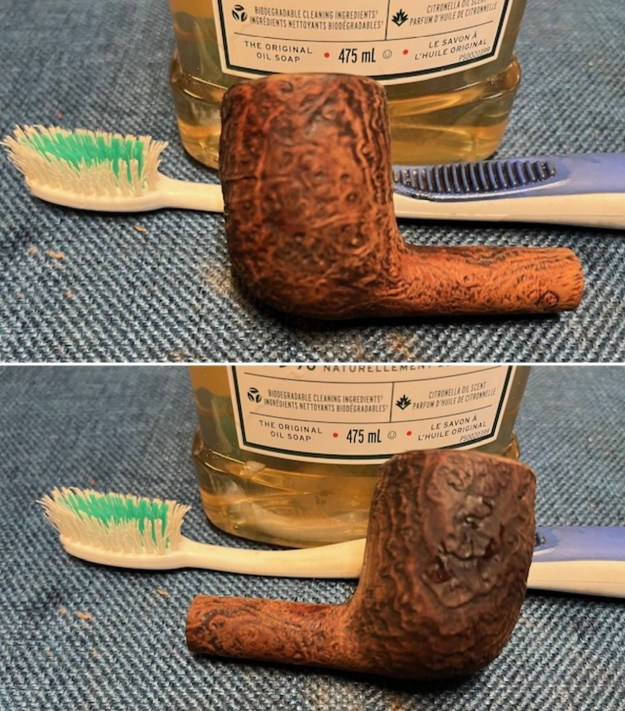
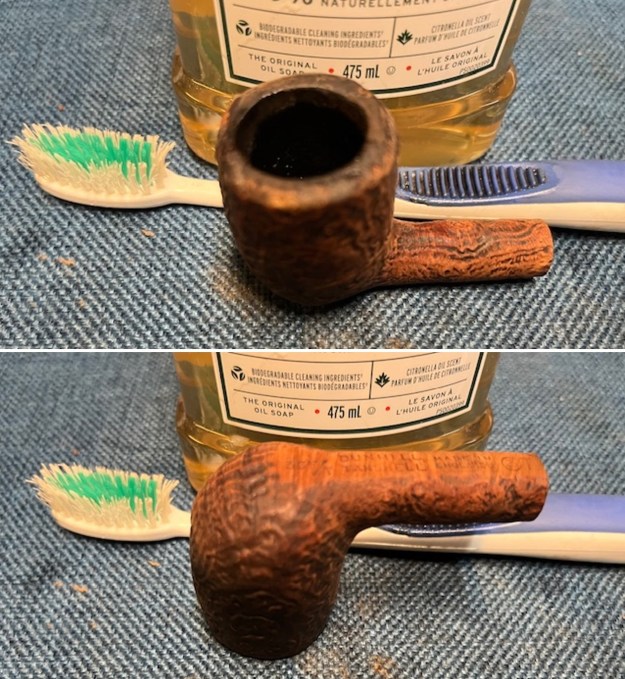
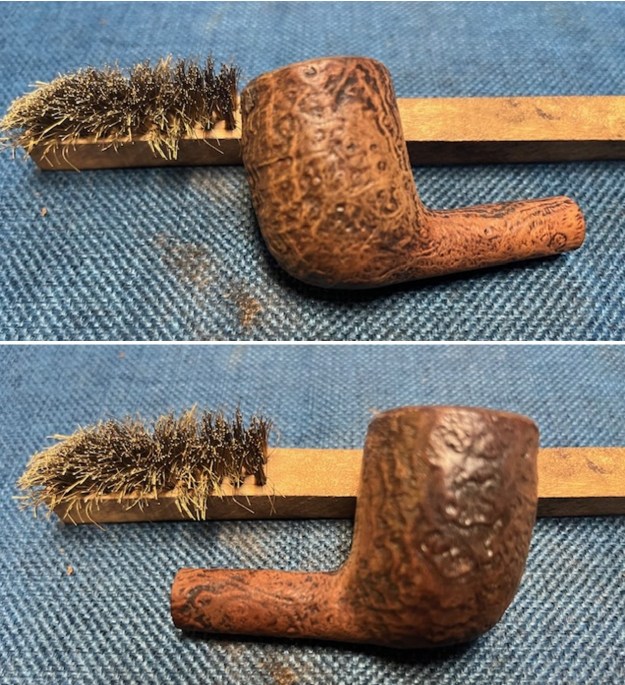
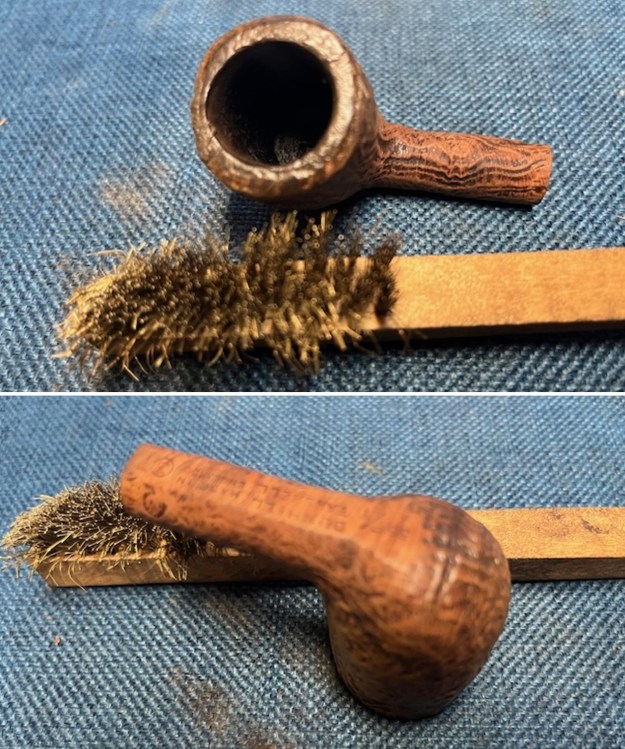
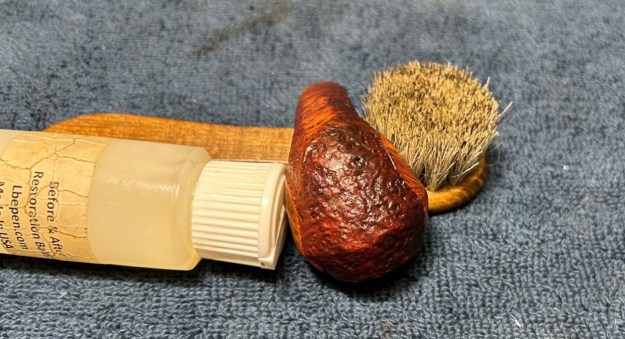
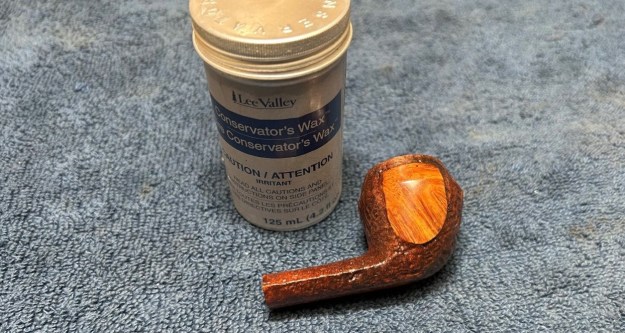
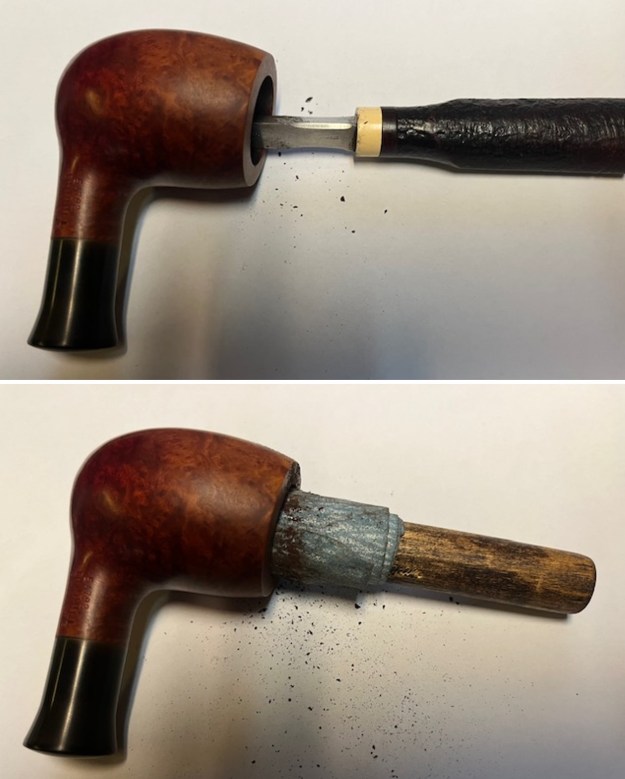
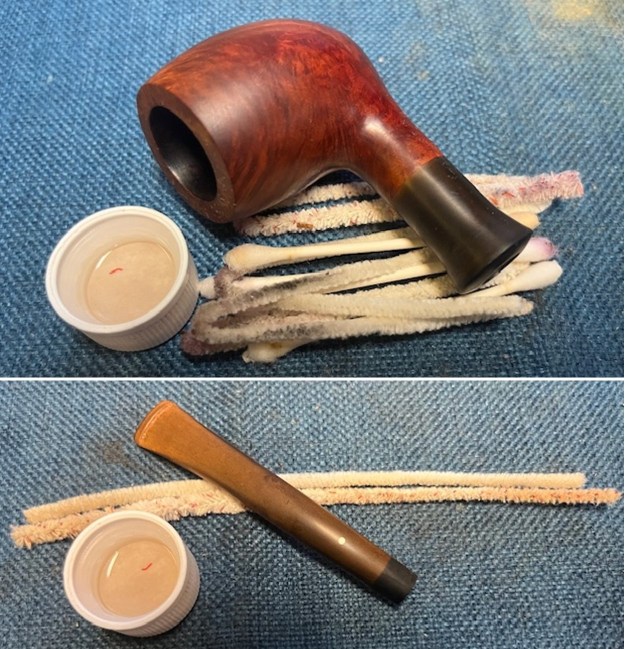
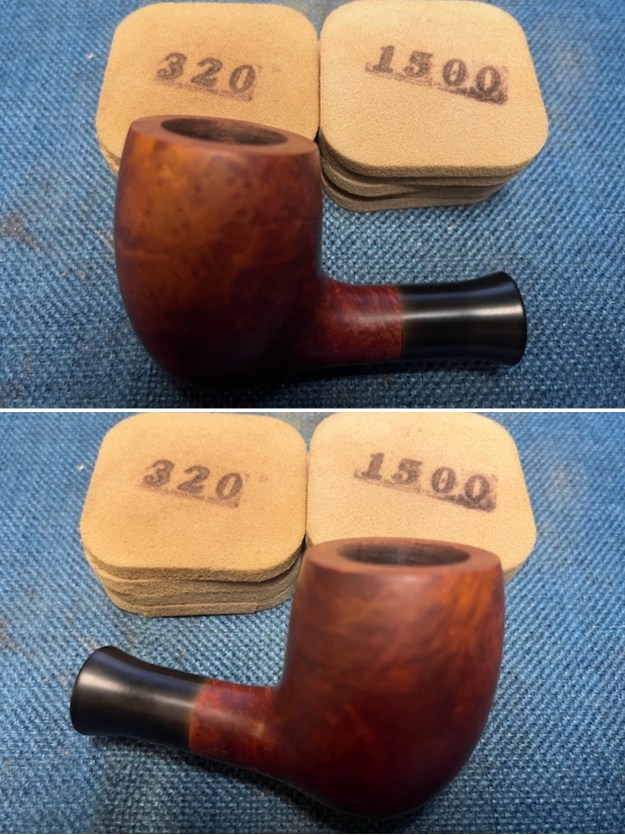
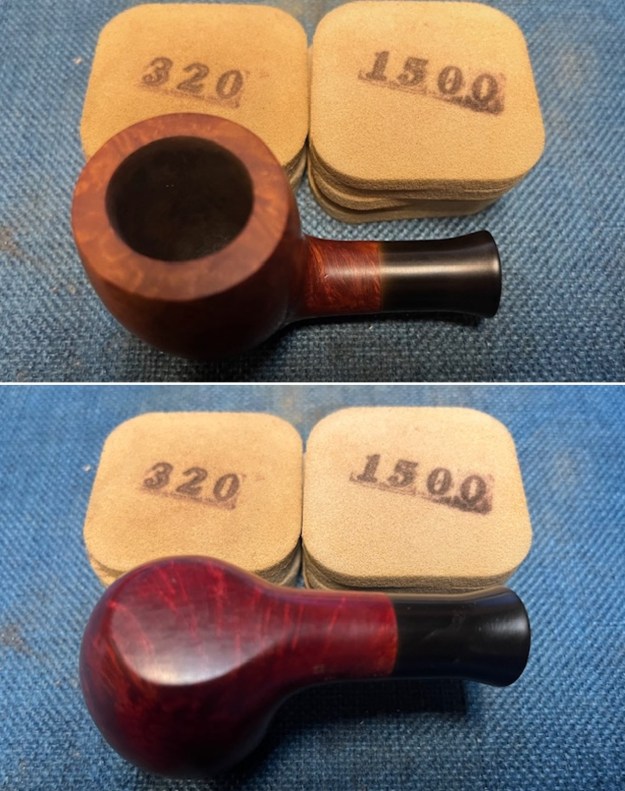
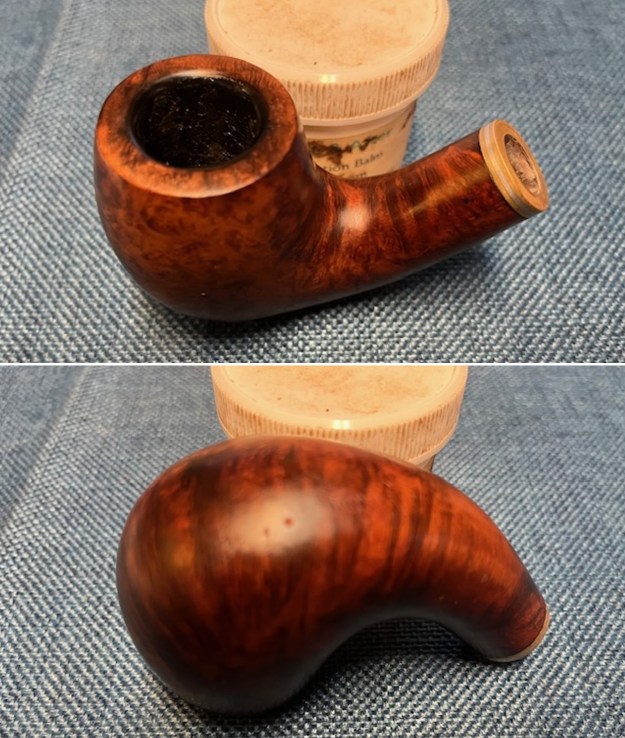
Armed with that information it was time to work on the pipe. I reamed the bowl with a PipNet pipe reamer to take out the cake on the bowl walls. I took it back to bare briar. I cleaned up the reaming with a Savinelli Fitsall Pipe Knife to remove all the remnants of the cake. I sanded the bowl walls with 220 grit sandpaper wrapped around a piece of dowel. Once finished, the bowl looked clean and cake free. I cleaned out the shank and the airway in the shank and the stem with pipe cleaners, cotton swabs and alcohol to remove the tars and oils. It smelled significantly cleaner once the pipe was cleaned.I scrubbed the exterior of the bowl with a tooth brush and undiluted Murphy’s Oil Soap. I scrubbed the pipe vigorously to get the dust and debris out of the rustication. Once finished, I rinsed it off with warm water. I also scrubbed out the inside of the bowl at the same time. The pipe had cleaned very well so I polished the briar with micromesh sanding pads. I dry sanded it with 1500-12000 grit sanding pads and wiped the bowl down after each pad with a damp cloth. By the final pads the briar really had a shine. I worked some Before & After Restoration Balm into the briar with my fingertips. I used a horse hair shoe brush to get into the rustication around the shank end and patches on the bowl sides. The product works to clean, enliven and preserve the briar. I let it sit for 10 minutes then I buffed it with a cotton cloth to deepen the shine. The briar really comes alive with the balm. I set the bowl aside and turned my attention to the stem. I polished the acrylic with micromesh sanding pads – 1500-12000 grit pads. I wiped it down with Obsidian Oil after each sanding pad. I used Before & After Pipe Polish – both Fine and Extra Fine to further polish the stem. It really took on a shine and I knew that once it was buffed it would look amazing. I set the bowl aside and turned my attention to the stem. I polished the acrylic with micromesh sanding pads – 1500-12000 grit pads. I wiped it down with Obsidian Oil after each sanding pad. I used Before & After Pipe Polish – both Fine and Extra Fine to further polish the stem. It really took on a shine and I knew that once it was buffed it would look amazing. I put the acrylic stem back on the Colm Magner Handmade Canada Boxing Glove and took it to the buffer. I worked it over with Blue Diamond to polish out the remaining small scratches. I gave the bowl and the stem several coats of carnauba wax and buffed the pipe with a clean buffing pad to raise the shine. I hand buffed it with a microfiber cloth to deepen the shine. The pipe polished up really well and the rim top looked good. I was happy with the look of the finished pipe. The photos below show what the pipe looks like after the restoration. The Magner Handmade Canada Boxing Glove is a beautiful and unique Magner signature shape. The polished, reshaped vulcanite taper stem looks really good with the browns of the briar. The dimensions of the pipe are Length: 5 ½ inches, Height: 2 ½ inches, Outside diameter of the bowl: 1 ½ inches wide x 1 ½ inches long, Chamber diameter: ¾ of an inch. The weight of the pipe is 2.75 ounces/78 grams. This is a pipe that I plan on enjoying for a long time to come. From what I have read Magner’s are phenomenal Virginia and Virginia and Perique smokers so I am looking forward to enjoying those in this pipe. The tall bowl and shape are incredibly comfortable in the hand. Thanks for walking through the restoration of this beauty with me.
Sherlock Holmes Rusticated Squire Bent bulldog


Blog by Steve Laug

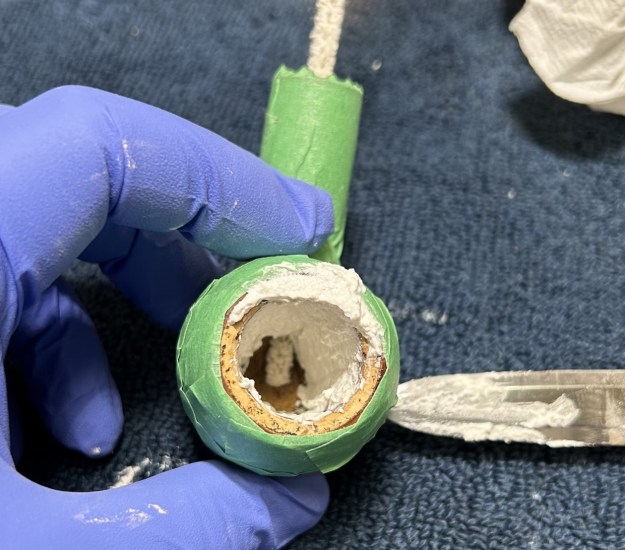
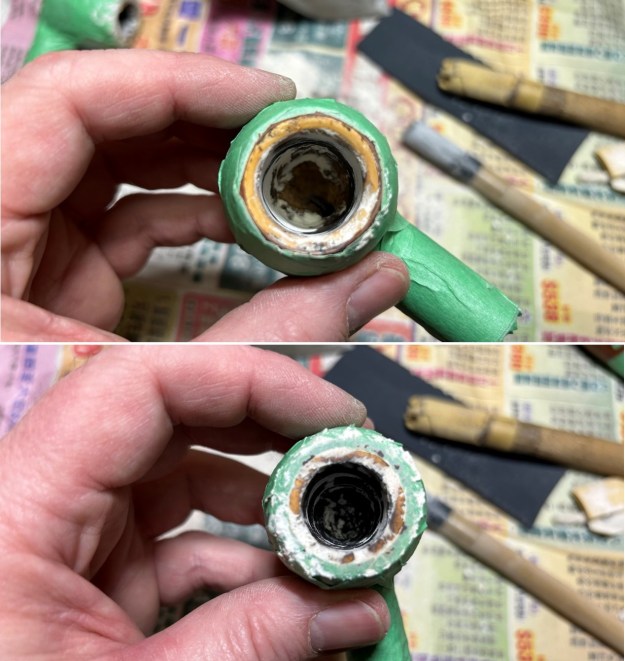
The next pipe that I am working on came from our contact in Copenhagen, Denmark we purchased on 01/08/24. It was very dirty and was a reddish, brown coloured pipe when it started. The rusticated finish around the bowl was dirty and had hand oils ground into the rusticated finish. The bowl had a thick cake and a thick coat of lava onto the bevelled inner edge of the rim top. The rim top had some serious burn damage on the back left and front right that left the bowl out of round. The classic p-lip stem was very dirty, oxidized and had light tooth marks and chatter on both sides ahead of the button. There was a silver inset P logo on the left topside of the diamond stem. The fit of the stem to the shank is perfect. The pipe is stamped on the left underside of the diamond shank and read Peterson’s [over] Sherlock Holmes[over] Squire. That is followed by Made in the Republic of Ireland (in three lines). There is a Sterling Silver band on the shank end that is stamped on the topside with the Sherlock Holmes Series Logo – the outline bust of Sherlock with Peterson ‘s arched above and Sterling Silver arched below. Below that it bears three hallmarks in the silver band – Hibernia seated for Ireland, a crowned harp designating the .925 quality and finally the date mark which in this case is an italic K dating the pipe as made in 1996. It is clean but oxidized. Jeff took photos of the pipe so I could have a sense of what it looked like before he started his work on it. Jeff took photos of the bowl and rim top to show the cake in the bowl with remnants of tobacco stuck on the walls of the bowl. There was a thick lava build up on the rusticated top of the rim and the bevelled edge of the bowl. The rim top had burned areas on the front and rear and the bevel was destroyed. Only clean up would tell the full story. Jeff took photos of the top and underside of the p-lip stem showing the tooth chatter, scratching and oxidation on the stem surface and wear on the edges of the button. Jeff took photos of the sides and heel of the bowl to show the condition of the finish. You can see the grime in the rustication around the sides of the bowl and shank. Even under the dirt and debris of the years it looked very good. Jeff took photos of the stamping on the underside of the shank. The stamping was faint in spots but readable as you can see from the photos. It read as noted above. The Sterling Silver Band is stamped as noted above and is very readable under the oxidation. I wanted to know more about the Peterson’s Sherlock Holmes Line so I turned to the Pipedia article on the line and read it carefully to see where this pipe fit in the line of pipes making up the line. (https://pipedia.org/wiki/Peterson#1950_-_1989_The_Republic_Era). I quote what I found out below.
1987 saw the introduction and Issue of the first Sherlock Holmes ‘Original’ Series of pipes. The Sherlock Holmes series is probably the most successful series of pipes ever introduced by Peterson in terms of numbers. It was first issued to honour Sir Arthur Conan Doyle’s famous fictitious detective character, Sherlock Holmes. Holmes is perhaps the most famous pipe smoking character in fiction…

The Sherlock Holmes Series: Probably the most popular and successful series of pipes ever produced by Peterson. Including the Meerschaum version of the seven day sets. Both briar and Meers can be purchased either as individual pipes or complete seven day sets and stands. Expect to pay around $250 for briars and $300 for individual Meerschaums. The Adventures of Sherlock Holmes runs around $1000 for a 4 pipe boxed set. Complete 7 day sets and stands can be up to $1500 – $2000.

At this point I knew that the original line was introduced in 1987. I did not know the sequence of pipes after the Original first pipe. More work was necessary. So, I followed the links included to another article call the Pete Sherlockiana Group. There was photo there of the full collection of various Sherlock Holmes lines that were issue. I have included the link and the information include with the group photo that shown of the collection below.

Here is the link (https://pipedia.org/wiki/File:Pete_SherlockianaGroup.JPG). The description under the photo read as found below:

Sherlockiana Group, which includes: The ‘Original’ 7 day set w/stand, The ‘Return’ 7day set w/stand, The Meerschaum 7 day set w/stand, The ‘Adventures of’ 4 pipe collection, and Various ‘Silver Specials’I still wanted to know where it fit in the order of release so I did a bit more digging into the pipe. I wanted to know the name of the pipe and what line of the Sherlock Holmes series it was in when it was released. I Googled and came across a link to an advertising brochure on Smokingpipes.com. (https://www.smokingpipes.com/smokingpipesblog/single.cfm/post/closer-look-petersons-sherlock-holmes-pipes-infographic). I have included it below. From that I knew that I was dealing with a Pipe from the Original release of the line from 1987, 1989-1991. It was called the Squire. The pipe is a large bent Bulldog.

I also found a link to a chart on Tobaccopipes.com that was an exploration the Sherlock Series. Here is the link (https://www.tobaccopipes.com/blog/exploring-the-peterson-sherlock-holmes-series/). Each name on the original list on the site can be clicked on for a description of the pipe that is named.I clicked on the Squire name in the chart above and it took me to the following link and information (https://www.tobaccopipes.com/blog/exploring-the-peterson-sherlock-holmes-series/#baker_street). It states that the pipe was in the Original Collection and came out between 1989-1991. The text below the photos reads as follows:

The Squire is named for one of the twelve short stories making up The Memoirs of Sherlock Holmes, “The Adventure of the Reigate Squire.” The name certainly underscores a stateliness that is apt for this slight bent Bulldog. 

The diamond shank elegantly bends into the low base of the squat bowl so that the bowl almost seems to be held from below, offered nonchalantly in the loose cradle of an upturned hand. The Squire’s squat bowl belies its capacious chamber. With a broad, strong base below the bead lines, the Squire evokes the ample Bull-Moose shape.  

In all, the Squire touts a distinguished appeal, but a bit less rigid than the conservative Baker Street. Even with that sharp, diamond shank, there is a relaxed posture.

With that information in hand I knew what I was dealing with in terms of the stamping and the age of this pipe. I knew from the information that the pipe was made during the Republic Era between 1950 and the present. The Squire pipe came out as part of the Original Sherlock Holmes Series and thus should have been made between 1989 and 1991. However, here is the anomaly. The silver hallmarks date the pipe to 1996. Now it was time to work on the pipe.

Jeff cleaned this filthy pipe with his usual clean up process. This one was a real mess and I did not know what to expect when I unwrapped it from his box. He reamed it with a PipNet pipe reamer and cleaned up the reaming with a Savinelli Fitsall Pipe Knife. He scrubbed out the internals with alcohol, pipe cleaners, shank brushes and cotton swabs until the pipe was clean. He scrubbed the exterior of the bowl with Murphy’s Oil Soap and a tooth brush to remove the grime and grit on the briar and the lava on the rim top. The finish looks very good with great looking grain showing through the deep rustication around the bowl and shank. There is some fading on the rim top stain that I will work on but it is a beauty. Jeff soaked the stem in Briarville’s Pipe Stem Deoxidizer to remove the debris on the acrylic surface. When the pipe arrived here in Vancouver for the second stop of its restoration tour I was amazed it looked so good. I took some close up photos of the rim top and also of the stem surface. I wanted to show what an amazing job Jeff did in the cleanup of the rim top. I also wanted to show the damage to the rim top. There is burn damage on the on the left side that the right back side is also damaged and looks thin. The rustication on the rim top is also burned off and only remains on the left side quite clearly. I also took close up photos of the stem to show the condition of the vulcanite. It was quite clean other than the light tooth marks and chatter on both sides of the stem ahead of the button. There is also some deep oxidation still remaining on the stem surface.One of the things I appreciate about Jeff’s cleanup is that he works to protect and preserve the nomenclature on the shank of the pipes that he works on. The stamping on this one was faint in spots to start with so I was worried that it would disappear altogether with the cleanup. He was able to preserve and maintain its condition in the process. I took some photos to show the clarity of the stamping. I have noticed that many restorers are not careful to protect the stamping in their cleaning process and often by the end of the restoration the nomenclature is almost destroyed. I would like to encourage all of us to be careful in our work to preserve this as it is a critical piece of pipe restoration! I took the stem off the shank and took a photo of the pipe. The silver P logo on the left side of the stem is in excellent condition. Now it was time to work on the pipe. I decided to address the issues with the rim top. The first photo below shows the rim top damage before I worked on it. I know that this kind of reworking is a bit controversial and that some would just clean it up and leave it. But for me this pipe begged for a reworking and renewal so I did that. I topped the bowl on a topping board with 220 grit sandpaper. Once finished I took a photo of the rim top. It clearly shows the damage to the top and the edges. I used a wooden ball and some 220 grit sandpaper to give the inner edge a bevel and minimize the damage to the briar. It took some work to make it happen and the next few photos show the progress in the work. I used a Dremel and a series of burrs to rusticate the rim top. I stained it with a Mahogany stain pen after the rustication. I took a photo of it and show it below. I was not happy with the rustication as it just was not as rustic looking as the rest of the bowl and shank. I used a rusticating tool that a reader of the blog gave me to deepen the rustication on the rim surface. It was what was needed. I stained it with a Mahogany stain pen to match the finish on the bowl. I used a brass bristle wire brush to knock off loose briar particles. It looked good! I rubbed the bowl and rim down with Before & After Restoration Balm. I worked it into the rusticated surface of the briar with my fingertips and a horse hair shoe brush to clean, enliven and protect it. I let the balm sit for 10 minutes and then buffed with a cotton cloth to raise the shine. I really like watching the Balm do its magic and bring the briar alive. I polished the Sterling Silver shank band with a jeweller’s cloth to remove the tarnish and also to preserve and protect the silver. It looks much better with the shine. I set the bowl aside and turned my attention to the stem. I “painted” the stem surface with the flame of a lighter to lift the tooth marks. I was able to lift them significantly. They looked better. I filled in what remained with clear CA glue. I used some small files to flatten the repairs and start to blend them into the surface. I sanded it with 220 grit sandpaper. It looked significantly better at this point in the process. I scrubbed the stem surface with Soft Scrub to remove the remaining oxidation on the stem. It took some work but I was able to remove it and the stem looked better.I sanded the stem with 320-3500 grit sanding pads to remove the remaining oxidation and smoothing out the repaired area.I polished the stem with micromesh sanding pads – dry sanding with 1500-12000 grit pads. I wiped the stem down after each sanding pad with Obsidian Oil. I polished it with Before & After Pipe Stem Polish – both Fine and Extra Fine. I gave it a coat of Obsidian Pipe Stem Oil. It works to protect the stem from oxidizing. I set it aside to dry. I am excited to be on the homestretch and look forward to seeing the Republic Era 1996 Sherlock Holmes Squire Bent Bulldog put back together, polished and waxed. I put the bowl and stem back together and lightly polished the bowl and stem with Blue Diamond to polish them. I gave the bowl multiple coats of Conservator’s Wax and the stem multiple coats of carnauba wax. I buffed the pipe on the wheel with a clean buffing pad to raise the shine. I hand buffed it with a microfiber cloth to deepen the shine. The depths of the rustication really pop with the wax and polish. The shiny black acrylic stem is a beautiful contrast to the red and browns of the bowl, thick shank and Sterling Silver Band. This Peterson’s Sherlock Holmes Squire Bulldog was a fun pipe to work on. The pipe is tactile in the hand and should feel great as it is warmed up when smoking. The finished pipe is shown in the photos below. The dimensions of the pipe are Length: 5 ½ inches, Height: 2 inches, Outside diameter of the bowl: 1 ½ inches, Chamber diameter: 7/8 of an inch. The weight of the pipe is 2.19 ounces/ 62 grams. I will soon be putting it on the store in the Irish Pipemakers Section if you are interested in adding it to your collection.

As always, I encourage your questions and comments as you read the blog. Thanks to each of you who are reading this blog. Remember we are not pipe owners; we are pipe men and women who hold our pipes in trust until they pass on into the trust of those who follow us.

Restoring a Peterson’s Sherlock Holmes Rusticated Professor Bent Billiard


Blog by Steve Laug

The next pipe that I am working on came from an estate sale in Oregon City, Oregon, USA we purchased on 03/21/24. It was very dirty and was a reddish, brown coloured pipe when it started. The rusticated finish around the bowl was dirty and had hand oils ground into the rusticated finish. The bowl had a moderate cake and a thick coat of lava onto the bevelled inner edge of the rim top. The classic p-lip stem was very dirty and had light tooth marks and chatter on both sides ahead of the button. There was a silver inset P logo on the left side of the stem. The fit of the stem to the shank is perfect. The pipe is stamped on the left underside of the shank and read Peterson’s [over] Sherlock Holmes. That is followed by Made in the Republic of Ireland (in three lines). There is a Sterling Silver band on the shank end that is stamped on the topside with the Sherlock Holmes Series Logo – the outline bust of Sherlock with Peterson ‘s arched above and Sterling Silver arched below. Below that it bears three hallmarks in the silver band – Hibernia seated for Ireland, a crowned harp designating the .925 quality and finally the date mark which in this case is an italic F dating the pipe as made in 1991. The stamped band has turned partway to the top of the shank rather than the left side. It is clean but oxidized. Jeff took photos of the pipe so I could have a sense of what it looked like before he started his work on it. Jeff took photos of the bowl and rim top to show the cake in the bowl with remnants of tobacco stuck on the walls of the bowl. There was a lava build up on the rusticated top of the rim and the bevelled edge of the bowl. The rim top looked pretty good but it was hard to know for sure if there was damage under the thick lava. Only clean up would tell the full story. Jeff took photos of the top and underside of the p-lip stem showing the tooth chatter, scratching and oxidation on the stem surface and wear on the edges of the button. Jeff took photos of the sides and heel of the bowl to show the condition of the finish. You can see the grime in the rustication around the sides of the bowl and shank. Even under the dirt and debris of the years it looked very good. Jeff took photos of the stamping on the underside of the shank. The stamping was faint in spots but readable as you can see from the photos. It read as noted above. The Sterling Silver Band is stamped as noted above and is very readable under the oxidation. I wanted to know more about the Peterson’s Sherlock Holmes Line so I turned to the Pipedia article on the line and read it carefully to see where this pipe fit in the line of pipes making up the line. (https://pipedia.org/wiki/Peterson#1950_-_1989_The_Republic_Era). I quote what I found out below.

1987 saw the introduction and Issue of the first Sherlock Holmes ‘Original’ Series of pipes. The Sherlock Holmes series is probably the most successful series of pipes ever introduced by Peterson in terms of numbers. It was first issued to honour Sir Arthur Conan Doyle’s famous fictitious detective character, Sherlock Holmes. Holmes is perhaps the most famous pipe smoking character in fiction…

The Sherlock Holmes Series: Probably the most popular and successful series of pipes ever produced by Peterson. Including the Meerschaum version of the seven day sets. Both briar and Meers can be purchased either as individual pipes or complete seven day sets and stands. Expect to pay around $250 for briars and $300 for individual Meerschaums. The Adventures of Sherlock Holmes runs around $1000 for a 4 pipe boxed set. Complete 7 day sets and stands can be up to $1500 – $2000.

At this point I knew that the original line was introduced in 1987. I did not know the sequence of pipes after the Original first pipe. More work was necessary. So, I followed the links included to another article call the Pete Sherlockiana Group. There was photo there of the full collection of various Sherlock Holmes lines that were issue. I have included the link and the information include with the group photo that shown of the collection below.

Here is the link (https://pipedia.org/wiki/File:Pete_SherlockianaGroup.JPG). The description under the photo read as found below:

Sherlockiana Group, which includes: The ‘Original’ 7 day set w/stand, The ‘Return’ 7day set w/stand, The Meerschaum 7 day set w/stand, The ‘Adventures of’ 4 pipe collection, and Various ‘Silver Specials’.I still wanted to know where it fit in the order of release so I did a bit more digging into the pipe. I wanted to know the name of the pipe and what line of the Sherlock Holmes series it was in when it was released. I Googled and came across a link to an advertising brochure on Smokingpipes.com. (https://www.smokingpipes.com/smokingpipesblog/single.cfm/post/closer-look-petersons-sherlock-holmes-pipes-infographic). I have included it below. From that I knew that I was dealing with a Pipe from the Original release of the line from 1987, 1989-1991. It was called the Professor after Professor James Moriarty. The pipe is a large and elegant swan necked bent billiard.

I also found a link to a chart on Tobaccopipes.com that was an exploration the Sherlock Series. Here is the link (https://www.tobaccopipes.com/blog/exploring-the-peterson-sherlock-holmes-series/). Each name on the original list on the site can be clicked on for a description of the pipe that is named.I clicked on the Professor name in the chart above and it took me to the following link and information (https://www.tobaccopipes.com/blog/exploring-the-peterson-sherlock-holmes-series/#baker_street). It states that the pipe was in the Original Collection and came out between 1989-1991.The text below the photos reads as follows:

In 1893, the short story “The Adventure of the Final Problem” was publish in The Strand, introducing Sherlock’s heel, Professor James Moriarty; the shape for which the nemesis is named certainly has quite the heel. 

With the Professor, we are right back to the bold, husky design at the heart of the Peterson House Pipe style. 

The plump heel gives a bulbous visual weight to the base of the bowl. The silhouette offers a bit more splay to accommodate the 1/3 bend. I’m eschewing the swan neck and Nessie comparisons for this stem, I see more of a strong elephant’s trunk in the Professor. It fits just right for the thickset bowl. Though that bowl naturally attracts one’s focus, the stem bears a proportionate strength that keeps the shape in balance. The Professor’s outward reach and large bowl may not make for a comfortable clench, but it practically begs to be cradled in the palm.

With that information in hand I knew what I was dealing with in terms of the stamping and the age of this pipe. I knew from the information that the pipe was made during the Republic Era between 1950 and 1989. The Professor pipe came out as part of the Original Sherlock Holmes Series and was made between 1989 and 1991. Now it was time to work on the pipe.

Jeff cleaned this filthy pipe with his usual clean up process. This one was a real mess and I did not know what to expect when I unwrapped it from his box. He reamed it with a PipNet pipe reamer and cleaned up the reaming with a Savinelli Fitsall Pipe Knife. He scrubbed out the internals with alcohol, pipe cleaners, shank brushes and cotton swabs until the pipe was clean. He scrubbed the exterior of the bowl with Murphy’s Oil Soap and a tooth brush to remove the grime and grit on the briar and the lava on the rim top. The finish looks very good with great looking grain showing through the deep rustication around the bowl and shank. There is some fading on the rim top stain that I will work on but it is a beauty. Jeff soaked the stem in Briarville’s Pipe Stem Deoxidizer to remove the debris on the acrylic surface. When the pipe arrived here in Vancouver for the second stop of its restoration tour I was amazed it looked so good. I took some close up photos of the rim top and also of the stem surface. I wanted to show what an amazing job Jeff did in the cleanup of the rim top. The rim top was and inner edge were in excellent condition. The stain had washed out a bit so I would need to restain those areas but otherwise it is beautiful. I also took close up photos of the stem to show the condition of the acrylic. It was quite clean other than the light tooth marks and chatter on both sides of the stem ahead of the button.One of the things I appreciate about Jeff’s cleanup is that he works to protect and preserve the nomenclature on the shank of the pipes that he works on. The stamping on this one was faint in spots to start with so I was worried that it would disappear altogether with the cleanup. He was able to preserve and maintain its condition in the process. I took some photos to show the clarity of the stamping. I have noticed that many restorers are not careful to protect the stamping in their cleaning process and often by the end of the restoration the nomenclature is almost destroyed. I would like to encourage all of us to be careful in our work to preserve this as it is a critical piece of pipe restoration! I took the stem off the shank and took a photo of the pipe. The silver P logo on the left side of the stem is in excellent condition. I decided to start my work on the pipe by restaining the rustication on the rim top. I touched it up with a Mahogany Stain Pen to blend it into the rest of the rustication around the bowl and shank. The photo shows the look at this point. I rubbed the bowl and rim down with Before & After Restoration Balm. I worked it into the rusticated surface of the briar with my fingertips and a horse hair shoe brush to clean, enliven and protect it. I let the balm sit for 10 minutes and then buffed with a cotton cloth to raise the shine. I really like watching the Balm do its magic and bring the briar alive.  It is looking quite good at this point. I still needed to turn the band on the shank. The Sherlock Holmes Logo on the band was on the top of the shank and should have been on the left side. I heated it with a lighter and then turned it carefully with a towel wrapped around it. I gave the shank end a light coat of white all-purpose glue and then pressed the band onto the shank and aligned the stamp properly on the left. I wiped off the excess glue with a damp cotton pad so as not to leave any of the glue in the rustication around the shank and band. It looked much better.I polished the Sterling Silver shank band with a jeweller’s cloth to remove the tarnish and also to preserve and protect the silver. It looks much better with the shine. I set the bowl aside and turned my attention to the stem. I polished the stem with micromesh sanding pads – dry sanding with 1500-12000 grit pads. I wiped the stem down after each sanding pad with Obsidian Oil. I polished it with Before & After Pipe Stem Polish – both Fine and Extra Fine. I gave it a coat of Obsidian Pipe Stem Oil. It works to protect the stem from oxidizing. I set it aside to dry. I am excited to be on the homestretch and look forward to seeing the Republic Era 1991 Sherlock Holmes Professor Bent Billiard put back together, polished and waxed. I put the bowl and stem back together and lightly polished the bowl and stem with Blue Diamond to polish them. I gave the bowl multiple coats of Conservator’s Wax and the stem multiple coats of carnauba wax. I buffed the pipe on the wheel with a clean buffing pad to raise the shine. I hand buffed it with a microfiber cloth to deepen the shine. The depths of the rustication really pop with the wax and polish. The shiny black acrylic stem is a beautiful contrast to the red and browns of the bowl, thick shank and Sterling Silver Band. This Peterson’s Sherlock Holmes Professor was a fun pipe to work on. The pipe is tactile in the hand and should feel great as it is warmed up when smoking. The finished pipe is shown in the photos below. The dimensions of the pipe are Length: 5 ½ inches, Height: 2 inches, Outside diameter of the bowl: 1 ¼ inches, Chamber diameter: ¾ of an inch. The weight of the pipe is 2.40 ounces/ 69 grams. I will soon be putting it on the store in the Irish Pipemakers Section if you are interested in adding it to your collection.

As always, I encourage your questions and comments as you read the blog. Thanks to each of you who are reading this blog. Remember we are not pipe owners; we are pipe men and women who hold our pipes in trust until they pass on into the trust of those who follow us.