Tag Archives: Bowl – finishing

Refreshing a Stanwell Gilt Edged 124 Ivarsson Design


Blog by Steve Laug

I received an email a few weeks ago from Mario. He has been following the blog for some time now and had enjoyed reading the posts. He wrote that he had purchased a pipe on Ebay for a good price. He attached some photos of the crack in the shank and wondered if I would be willing to take it on. I wrote back and asked for some photos so he sent me the following two photos. The first shows what appears to be a crack in the shank just ahead of the gold band between the shank and the stem. I have circled the damaged area in red in the photo below.stan1The second photo shows the shank end of the pipe. The band wraps over the end of the shank which was a plus to my mind. The band was tight on the shank according to the seller. My thinking was that the band would hold the crack together and it would be easier to work with. (The tenon on the stem is also a 9mm filter stem).stan2I wrote back and told him I would be glad to work on it. He wrote back when the pipe arrived at his place. As he looked it close up he wrote that the crack did not look as bad as he had expected. It appeared to be possibly a flaw in the briar. He also wrote that the end of the flaw near the band did extend to the edge of the band. He packed up the pipe and sent it to me in Vancouver. When it arrived I loved the look and shape of the pipe. The long shank and the shape of the bowl work well together. The gilt ring around the outer edge of the bowl and around the shank is what gave the pipe its name. It is stamped Stanwell of Gilt Edged on the left side of the shank. On the underside it reads Made in Denmark. On the right side of the shank it reads 124 which is the Stanwell Shape number. According to information compiled by the late Bas Stevens regarding Stanwell shapes the 124 is a freehand, long conical shank, with a short saddle mouthpiece. It was designed by Sixten Ivarsson. Here is the link to the full blog post that Bas gave permission to post on rebornpipes: https://rebornpipes.com/2013/09/03/stanwell-shapes-compiled-by-bas-stevens/

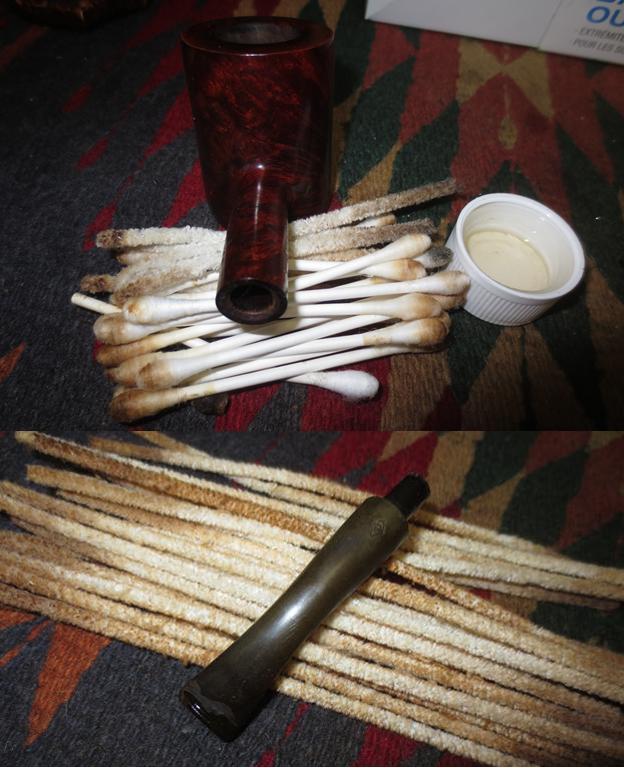
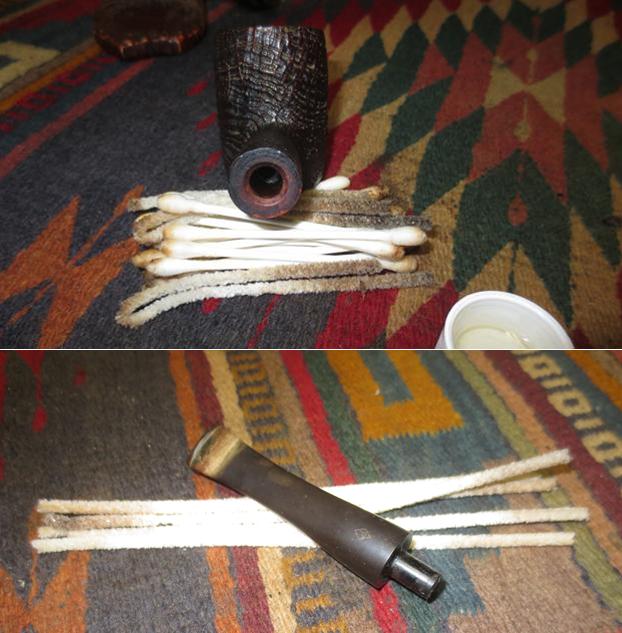
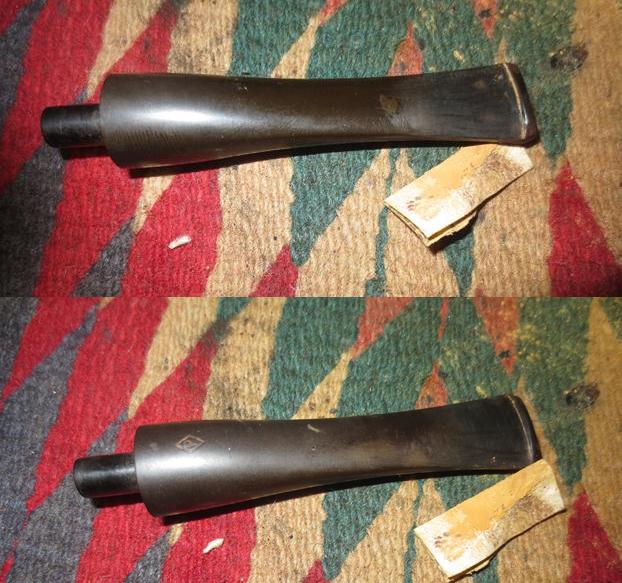
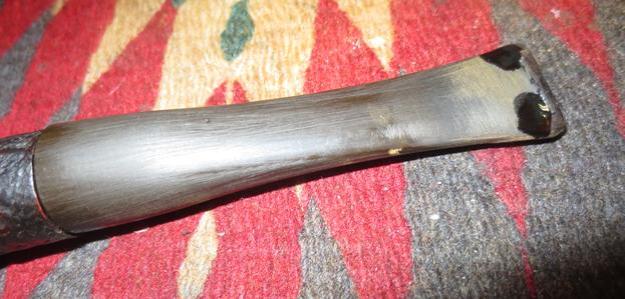
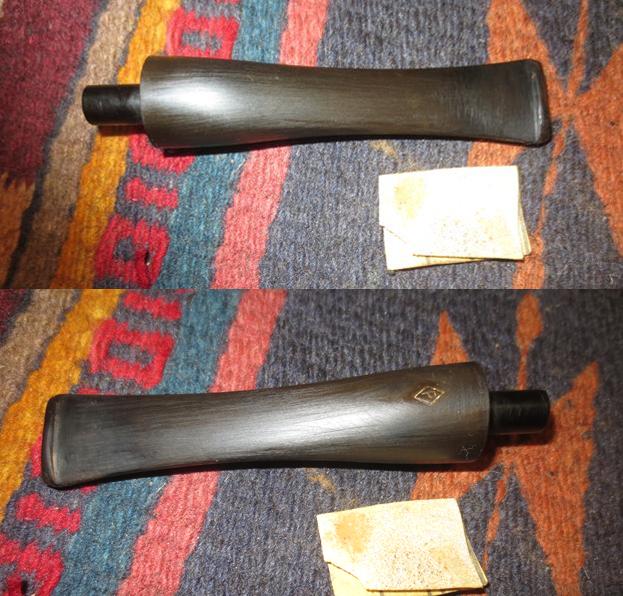
I took the following photos of the pipe when it arrived and before I started to work on it. You can see the damage to the rim – including both dents and a slight burn on the back inner edge toward the right side. There were also some dents on the top of the shank just ahead of the crack in the briar. The pipe was sold as clean and restored but it was far from clean by the smell of tobacco and the oils in the shank and stem.stan3 stan4There was some tar and oil on the top of the rim so I wiped it off with a cotton pad and took the following close up photo. It is hard to see but there were light dings in the rim top and the damage at the rear which I have circled in red.stan5The stem was clean on the surface but there were ripples and ridges from buffing as well as some slight tooth indentations on both sides near the button and on the button.stan6I sanded the damaged/flawed area on the top of the shank and probed it with a dental pick. Interestingly if it was a crack it was sealed tightly and there were no soft spots in the surface. It also appeared that the top finish had run slightly leaving a sag mark on the shank. I examined it with a bright light and lens and could see that the flaw ended a good 1/8th inch before the band and that the other ended. I decided to not drill the ends of the crack because it was a tight fit and also because when I looked at the inside I could see no trace of the crack coming through. I filled it in with clear super glue and when it dried I sanded it smooth with 220 grit sandpaper.stan7I cleaned up the rim top with 220 grit sandpaper and lightly beveled the inner edge to clean up the burned spot. I did not want to bevel it too much but only enough to match the rest of the rim bevel. When I finished shaping it I sanded it with 1500-2400 grit micromesh sanding pads to remove any scratch marks. I steamed out the dents on the top of the shank and polished them and the repair with micromesh sanding pads. I stained the rim edge and repair with a medium brown stain pen. I used a black Sharpie pen to continue the grain marks through the repair on the shank.stan8I buffed the pipe with Blue Diamond on the buffing wheel and hand buffed it with a microfibre cloth. I took the following photos of the pipe and sent copies to Mario. We are both really pleased with the way the pipe has come out to this point.stan9 stan10Here are some close up photos of the shank repair and the rim clean up. It looks much better than when I began the work.stan11I set the bowl aside and started to work on the stem. I sanded both sides with 220 grit sandpaper and took the photos to show the marks, ripples and dents on the surfaces.stan12I cleaned out the tenon area with alcohol, cotton swabs and pipe cleaners to remove all of the oils and tars in airway and the area where the filter would have been. It took a lot of pipe cleaners and cotton swabs to remove all of the debris. The next photo shows about half of the cotton swabs and pipe cleaners that I used on the stem.stan13I examined the inside of the mortise and airway with a pen light and could see that the shank was thickly caked with a hard coat of tars. I used a dental spatula to scrape away the debris in the mortise. It took a lot of scraping to remove the buildup to see the briar. I cleaned out the shank and airway with alcohol, cotton swabs and pipe cleaners until it was clean. The pipe smelled much cleaner though still smoky.stan13a stan14I pressed cotton balls into the bowl and rolled a cotton pad and inserted it in the shank. I used an ear syringe to fill the bowl with alcohol. I tipped it so that the alcohol ran into the shank. I filled it until the cotton was covered in the bowl. I set the bowl aside to let the alcohol do its work in drawing the oils out of the briar. I set the bowl aside and turned to the stem.stan15I finished sanding it with the 220 grit sandpaper to remove all of the ripples and dents in the stem surface. I polished the stem with micromesh sanding pads – wet sanding it with 1500-2400 grit pads and dry sanding it with 3200-12000 grit pads. After each set of three pads I rubbed the stem down with Obsidian Oil. After the last rubdown of oil I set the stem aside and let it dry.stan16 stan17 stan18I let the cotton balls and alcohol sit in the bowl for 6 hours. I took the following photo of the darkened cotton balls. I removed the cotton balls and cleaned out the shank, airway and bowl with cotton swabs and pipe cleaners. I was able to remove a lot more of the tars in the shank.stan19Once the shank was clean and the walls were clean and had dried I put the stem in place on the shank. I buffed the pipe and stem with Blue Diamond on the buffing wheel. I gave the bowl and stem several coats of carnauba wax and buffed it with a clean buffing pad. I hand buffed the pipe with a microfibre cloth. The finished pipe is shown in the photos below. The stem is smooth and glassy, the rim is much better and looks smooth, and the flaw/crack in the shank is smooth to touch and virtually invisible.  It will be heading back to Mario this week and I look forward to hearing what he thinks of his pipe now. Thanks for walking along with me through this restoration.stan20 stan21 stan22 stan23 stan24 stan25 stan26 stan27 stan28 stan29

Brandy Bent Unmarked – another ‘Hole in the Wall’ Find


Blog by Dal Stanton

The Brandy before me now was a very nicely bundled pipe when I recently purchased the Stanwell Silver Mount which I’ve already restored (See HERE).  I landed these pipes at the treasure trove I call the ‘Hole in the Wall,’ an antique shop in the center-city of Sofia, Bulgaria.  My sites were on the Stanwell which was the prize, with its silver and class, but when I saw the Brandy, I plucked it out of the basket to bundle with the Stanwell – hopefully to land a more favorable purchase price for the pair.  The Stanwell and Brandy came home with me that day, and the picture I took below commemorated that day’s finds.  The next picture shows the results of the Stanwell Silver Mount’s restoration – a beautiful, dressy pipe.brandy1 brandy2The Brandy drew my attention as well because the bowl is a significant presence in the palm as I cradled the expansive bowl.  When I first saw it, I thought it might be a Volcano shape because of the hefty, expansive base of the stummel and the tightly restrained cone moving upwardly culminating in the rim. Yet, looking at Pipedia’s Pipe’s Chart by Bill Burney (see below), my later thoughts were confirmed that this indeed is a Brandy – actually, the first in my collection.  The stummel measures 1 3/4 inches in diameter at the broadest point of the ‘brandy glass’ bulge and the stummel tightens to the rim which measures 1 1/4 inches.  The height of the stummel is 1 7/8 inches.  This bowl is nicely shaped and proportioned – I like it!brandy3I take more pictures when I take the Brandy out of the ‘Help Me!’ basket and place him on my work table.brandy4 brandy5 brandy6 brandy7 brandy8With the stem in the Oxi-Clean, I continue with the clean-up of the stummel internals using cotton swabs and pipe cleaners dipped in isopropyl 95%.  After moderate resistance, pipe cleaners and cotton swabs started coming out cleaner.  Later, I will give the bowl a kosher salt/alcohol soak to further clean and freshen the internals and readying it for a new steward.brandy12With the internals cleaned with the frontal approach, I now look at the external surface.  I first scrub the rim and entire stummel with undiluted Murphy’s Oil to see if it makes much of a dent on the cloudy finish.  I have my doubts.  Well, after scrubbing the surface with Murphy’s Soap and I can see my reflection on the surface, I know that I’m dealing with an acrylic finish – the candy wrapper finish.  For manufacturers of pipes that put this kind of finish on a pipe, I can only think of two reasons to do so – it is a more cost-effective mass application of shininess – a chemically produced sheen that takes minimal time and man-hours, and to hide imperfections in the briar.  Switching to acetone to remove the finish, first, I use cotton pads, then the more persuasive help of 0000 steel wool.  The finish comes off with little effort and I begin to see why the finish is dark – there are several fills that the dark stain was masking.   I have no problems with darker hues to mask fills and imperfections, but I do not like the acrylic shine finish.  Pictures show the progress and the surface revealed.brandy13 brandy14 brandy15Before dealing with the fills, I sand the outer surface of the stummel and rim with a course grade sanding sponge to remove the superficial nicks and damage.  This works well.  I follow with a medium grade then a light grade sanding sponge to smooth and clean the surface of imperfections.brandy16I take a close look at the fills on the surface of the stummel and scrape them with a sharp dental probe to find out whether they are solid or if they are in danger of pitting.  Generally, they seem to be in good condition.  I do detect one pit and I drop-spot some super glue and apply an accelerator to cure the glue rapidly.  When the superglue is fully cured, I use a flat needle file to file it down near to the briar surface, then I use a rolled piece of 240 grit paper to sand it down to the surface, removing all the excess glue.  Then I use 600 grit paper just to smooth the surface of the patch.brandy17 brandy18Sanding with the sanding sponges removed most of the dents I detected earlier on the rim.  I want to freshen the inwardly sloped bevel to improve the lines of the rim.  I first cut an inner bevel with a rolled piece of coarser 120 grit paper.  Then I follow this by using 240 and 600 grit paper over the entire surface of the rim from the lower inner lip to the higher rim edge.  The result is a more tapered and sloped bevel and a crisper rim edge as the lower bevel blends into the upper slope.  The pictures show the progress.brandy19Next, I wet sand the stummel with micromesh pads 1500 to 2400 and when I complete this cycle, what I see I am not expecting.  Every fill on the stummel had softened and some had come out.  Apparently, the fill was not glue based, but simply a colored wood putty that would sit underneath the acrylic finish.  I haven’t seen anything like this up to this point.  Oh well….  I take the sharp dental probe and continue to dig out all the old filler putty and clean the holes left behind.  This restoration is taking an unexpected turn and it will take a bit of time to fill and sand down each of these 16 fill spots.  With briar dust and superglue, I mix a batch of putty and apply putty to each hole.  I leave excess over each fill area to be able later to sand each fill down flush to the briar surface.  I put the stummel aside for the patches to cure for about 12 hours.  The pictures show the digression.brandy20 brandy21With the putty patches curing, I take the stem out of the Oxi-Clean bath and take a picture of the oxidation raised on the stem.  I then wet sand the stem with 600 grit paper followed by 0000 steel wool to remove the raised oxidation from the stem.  The stem is looking good.brandy22Before I proceed with the micromesh pad sanding, I clean the internals of the stem using pipe cleaners and cotton swabs dipped in isopropyl 95%.  Using a sharp dental probe, I also dig out gunk from the slot.  The stem internals were dirty but pipe cleaners eventually prevailed.brandy23I then begin the micromesh cycle by first wet sanding with pads 1500 to 2400, followed by dry sanding with pads 3200 to 4000, then 6000 to 12000.  After each set of 3, I applied Obsidian Oil to the stem to revitalize the vulcanite.  The pictures show the progress, and a slight interruption when my daughter FaceTime’s me from Nashville between cycles – the pictures also show this wonderful interruption!   With the stem looking good, I put it aside and return to the stummel.brandy24 brandy25After the briar dust patches cure on the stummel surface, I begin the long process of filing and sanding the excess putty off the patches to bring the putty flush with the briar surface.  I first use a flat needle file to bring the excess almost to the surface and then I use 240 grit paper to smooth further, blending the patch with the surface.  With as many fills that I had, it provided ample practice to perfect my approach!  After smoothing all the briar dust putty patches, I find that some patches have small air-pockets revealed as I sand.  With these, I spot-drop some superglue, apply an accelerator to rapidly cure the glue, then re-sand those areas until the patches blend with the surface.  The pictures slow the slow progress.brandy27 brandy28 brandy29 brandy30With my day ending, I decide to clean the stummel internals further with a kosher salt and alcohol soak.  This cleans further as well as freshen the stummel for a new steward.  I stretch and twist a cotton ball to create a ‘wick’ to insert down the mortise.  This helps draw out the oils and grime.  Then I place the stummel in an egg carton for stability and fill the chamber with kosher salt.  The kosher salt is without iodine which can leave a taste.  I shake the stummel a bit with my palm over the chamber to displace the salt in the mortise a bit.  I then fill the fire chamber with isopropyl 95% until it rises a bit over the salt.  I then put the stummel aside for the night allowing the salt and alcohol to do the work.brandy31The next morning, the salt and cotton ‘wick’ had darkened signifying the job of drawing out tars and oils was achieved.  I dump out the expended salt by thumping the stummel on the palm and tossing the wick. I wipe the chamber with paper towel, and then use multi-sized round bristled brushes in the chamber and mortise to rid the stummel of residue salt.  I complete the cleaning job by plunging a few more cotton swabs and pipe cleaners into the mortise and draft hole and find that all the tars and oils have been removed.  I determine the Brandy’s cleaning, ‘Completed’!  The pictures show the progress.brandy32 brandy33 brandy34I turn again to the briar surface of the stummel.  With all the patch work done, I make a quick inspection of the surface looking for little shiny spots which would indicate that some residue excess of superglue was remaining on the briar surface.  I quickly address these with a rapid sanding with 240 grit paper.  From there, I return to a light grade sanding sponge and re-sand the entire surface aiming to help the blending with the plethora of patches and the briar surface.  brandy35I then proceed through the cycles of micromesh pads, 1500 to 12000.  The volatile nature of the grain in this block of briar becomes evident – it is evident that the block was taken from the upper or outer regions of the briar bush’s ‘burl’.  Its grain is more turbulent than you would find deeper inside the burl, where grains are a spectrum of non-existent to orderly currents of grain.  This excerpt from an article from Pipes & Tobaccos (1999) about briar grains from R. D. Field, I found very helpful in understanding briar grains:

Any burl, whether it be 30 years old or 130, does not possess what we call grain in its totality. When a burl is split in half a variety of patterns are able to be discerned in that: The center of the burl has no grain. The center, or heart, contains all the liquid held in the burl which is red in color and is known as blood. The wood surrounding this blood is also of a reddish tint and is devoid of capillaries as the water has got to where it was meant to be for storage.  Capillaries surround the center and, depending on the growing pattern of the burl and how it was split, can take the shape of straight grain, cross grain, flame grain, mixed grain, etc.

As we approach the upper part of the burl from where the branches emerge a pattern known as “branch wood” can be seen. Because the branches of the shrub actually start their growth within the burl the wood in these portions takes on some of the characteristics of the emerging branch. To look upon a swirling piece of briar devoid of other grain character (whether in a finished pipe or as part of the burl) is to look upon branch wood.

The many fills in this piece of briar I believe is due to it being an example of a block taken at a ‘branch wood’ formation seen in the pictures below.  The pictures show the progression through the micromesh pad cycles.brandy36 brandy37

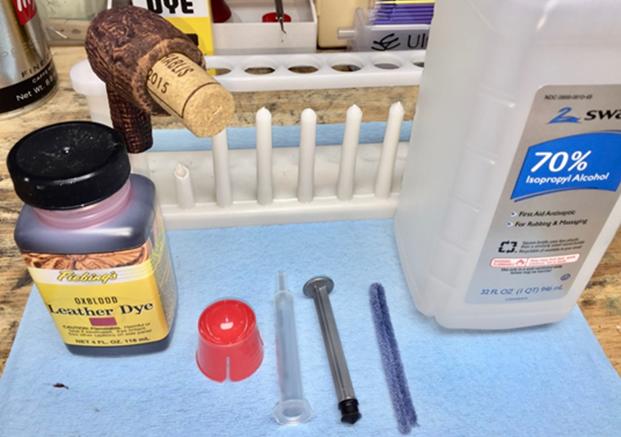
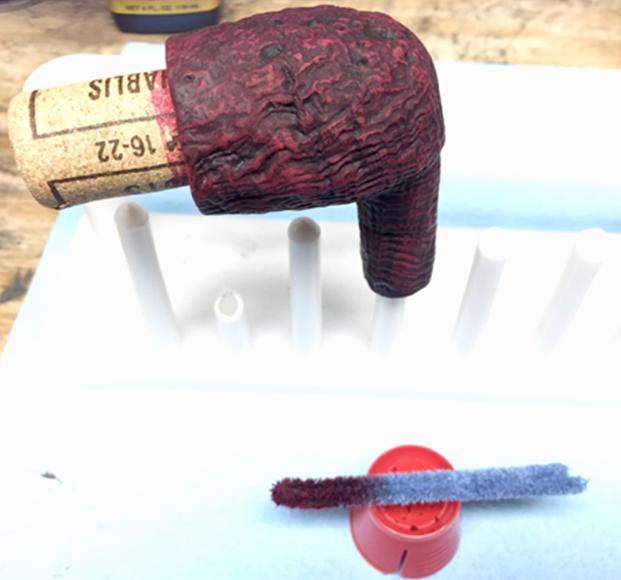
The next step in the project is to stain the stummel.  I will aim for a darker hue but I want to contextualize this Brandy by bending the hue toward the reds using Fiebing’s Oxblood Leather Dye mixed with Fiebing’s Dark Brown Leather Dye including a hint of black, non-aniline dye.  I found a picture on the internet (below) that envisions the perfect ambiance for this Brandy after he’s restored and recommissioned! I’m aiming for the darker hue of the brandy that is displayed.  Dreamstime is doing a good job promoting the brandy glass, but truth be known, the Brandy shaped pipe I have would have been a better choice for display!  Acknowledging a totally unscientific approach to the mixture, if I find the results too red, I will probably follow by a straight application of Fiebing’s Dark Brown Leather Dye as an overcoat.brandy38After the dyes are mixed in a shot glass, I heat the stummel with an air gun to expand the grains to absorb the dye more efficiently.  Then, using a bent-over pipe cleaner, I apply the dye mixture liberally over the surface, utilizing a cork inserted into the mortise as a handle.  When applied, I fire the stummel with a lit candle, and the alcohol in the dye immediately burns off and sets the dye in the grain.  To make sure I’ve achieved total coverage, I repeat the process again, finishing by firing the dye, and putting the stummel aside to rest for several hours.  The pictures show the staining process.brandy39 brandy40A little anxious to unwrap the flamed dye crust, my impatience wins out and I mount the felt wheel on the Dremel high speed rotary tool.  I set the speed to the slowest available and using Tripoli compound I begin removing the crust to reveal the briar underneath.  Then, using a cotton cloth wheel, I apply Blue Diamond compound to the stummel, also using the slowest speed available.  After the Blue Diamond, I’m seeing two things – the hue is a bit redder than I wanted and I am seeing light spots that need darkening.  I use a mahogany dye stick and darken the light areas to blend.  Then, I take out the Fiebing’s Dark Brown Leather Dye, and set up for another application of dye to the stummel. With a folded pipe cleaner I apply Fiebing’s Dark Brown Leather Dye two times, as before, flaming after each application, then setting the stummel aside to rest.  Pictures tell the story.brandy41 brandy42After a few hours, I repeat the process of applying both Tripoli and Blue Diamond compounds to the stummel surface.  Following the compound application I hand buff the stummel with a flannel towel to remove the residue compound dust on the stummel.  I do this before applying the carnauba wax.  Changing to the cotton cloth wheel on the Dremel, I increase the speed to 2, the second slowest speed of 5 – being the fastest.  I reattach the stem and stummel and apply to both several coats of carnauba wax and then give the pipe a rigorous hand buff with a micromesh cloth to bring out the shine.brandy43This Brandy Bent Unmarked had a lot going against it after I discovered the multitude of fills necessary to restore and recommission this pipe.  Considering the odds against it, I think it looks very good.  The grain is very expressive.  I like the dark brown finish as the overcoat of the oxblood – it fits well the Brandy shape.  I sell my restorations with the profits helping the work we do with the Daughters of Bulgaria – those sexually exploited and trafficked.  This Brandy is ready to serve a new steward.  If you’re interested in adopting him and helping the Daughters, check out The Pipe Steward Store.  Thanks for joining me!brandy44 brandy45 brandy46 brandy47 brandy48 brandy49 brandy50

The Berwyck Poker Compromise


Blog by Aaron Henson

Last summer’s tip to Dallas netted me several great pipes. One of which was my first poker.  It was in a basket in an out of the way corner of a second hand store.  Very dirty and grimy but I could tell the grain underneath was beautiful with a nice contracting stain.  The stem was broke off about half way but I thought I could turn it into a nice stubby.  I looked forward getting it home and start working on it.ber1 ber2The stem had a heavy amount of oxidation and a buildup of white near the broken end.  This leads me to guess that the previous owner had used a softy bit to compensate for the broken stem.  I set the stem to soak in a mild Oxi-clean bath to raise the oxidation. After 24 hours I removed the oxidation with a magic eraser and an application of Walker Briar Works Pipe stem cleaner.ber3 ber4I wiped down the outside of the stummel with 91% on a cotton pad to remove the dirt and oils.  I was looking for any hidden issues that might be need to be addressed.  Thankfully there were none just a few handling dents/scuffs.  In fact, there weren’t even any fills.  The grain was beautiful and the existing contracting stain really made it stand out.

There was a healthy buildup of tars on the rim but not a lot of cake in the bowl.  What little cake there was came out easily with my reaming tool.  I smoothed out the interior of the bowl with 80-grit paper wrapped around a ½ inch dowel.ber5I like to clean the inside of the pipe before working on the outside so next came the interior of the shank. Lots of cotton swabs dipped in alcohol eventually saw it clean.

Next, I finished the bowl by doing a salt and alcohol soak.  I plugged the shank with a cotton swab and filled the bowl with salt.  Sometimes I use cotton balls but this time I chose salt – no reason why.  I filled the bowl to the top with grain alcohol and let it soak 24 hours.  This leached out a lot of the leftover tars and removed the smell of the old tobacco from the bowl.

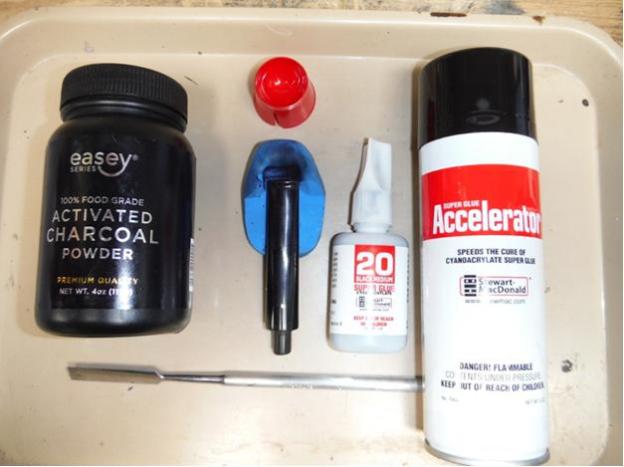
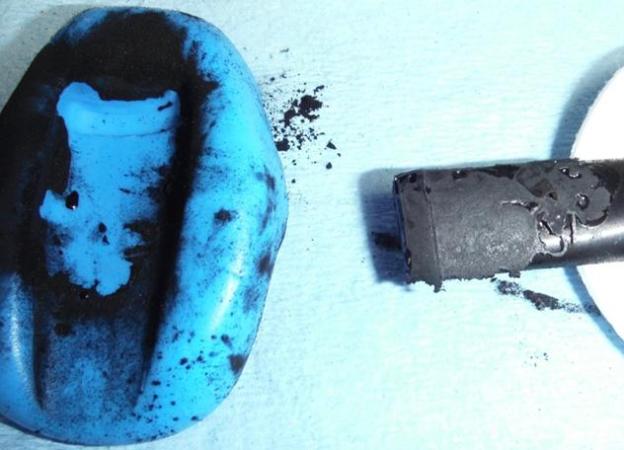
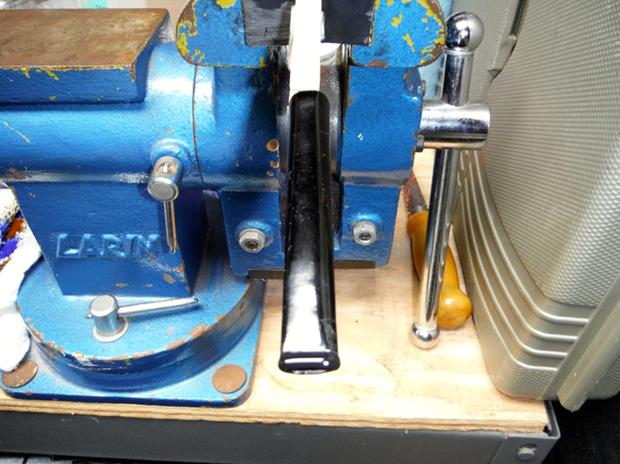
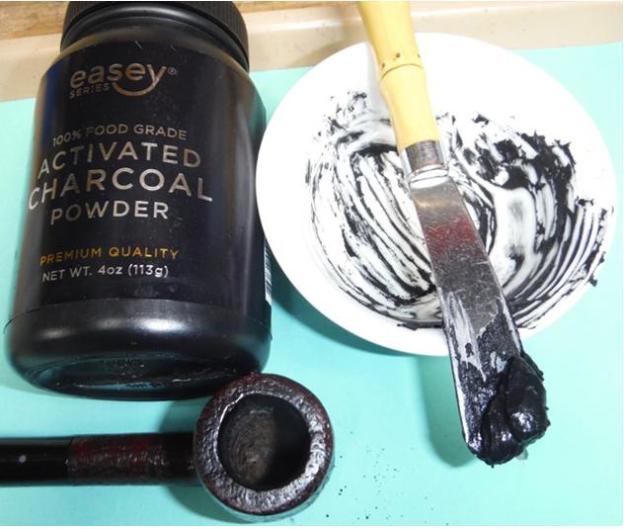
Not wanting to top the bowl, I tried something new.  I placed a little Oxi-clean powder on a green pad in a shallow dish of water. Inverting the bowl, I worked it in a circular motion on the pad.  This had the desired effect and only a little bit of sanding was required on the rim.ber6Returning to the stem I began work on a new button. I taped off the end and mixed up a slurry of black super glue and charcoal powder using a tooth pick to apply it to the stem.  Several coats of slurry were needed to build up the button.ber7 ber8After the slurry dried, I used a flat file to rough out the shape of a new button.  Trying it out, I realized that the stem was too thick and narrow to be comfortable.  So I began to file the top and bottom of the stem to make it a more comfortable fit.  But as I did so, I had another revelation: the Berwyck was a filtered pipe.  The filter chamber extends back to where I was trying to shape a flat spot in the stem. ber9While I didn’t file into the airway I decided not to continue for fear that I would.  It was at this point that I decided to abandon the idea of a stubby and start looking for a replacement stem.  I figured I had a few of options: 1) I could buy an old stem that matched, 2) I could make my own stem using the tenon of the old stem, 3) I could splice a fish tail onto the existing stem (this would allow me to keep the spade trademark – thank you, Dal for this idea), or 4) I could try Dr. Grabow and see if the factory could supply me with a new stem.

I started with the last option first.  I figured if I was willing to buy and old stem, why not buy a new stem with a better chance of a good fit.  I sent an email off to International Pipes & Accessories, the Dr. Grabow factory in Sparta, North Carolina, but received a disappointing response.  So my next course of action was to begin a search online for someone with an old stem to sell that would fit.  I eventually posted the story of my quest on the Dr. Grabow Collectors Facebook page.  It was not long before I was contacted by Joe Mansueto, the moderator for the Dr. Grabow Collectors Forum.  Joe very kindly offered to use his contacts at International Pipes and too my surprise he was told that I should send the pipe to them.

I had not completed the work on the stummel and I wanted to have it at the 95% complete point before sending to the factory.  So, steamed out the dents using a wet terry cloth rag and my wife’s clothes iron.  Next came a light sanding with 1500-3200 grit micro mesh pads.

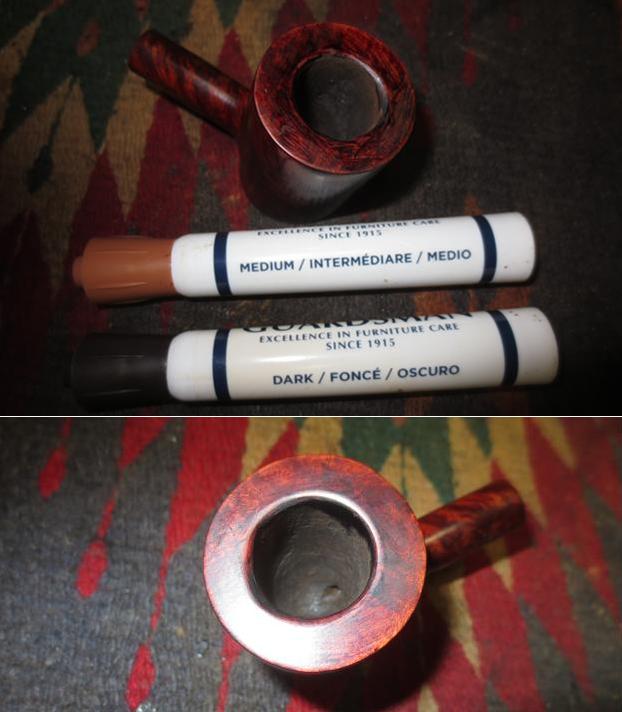
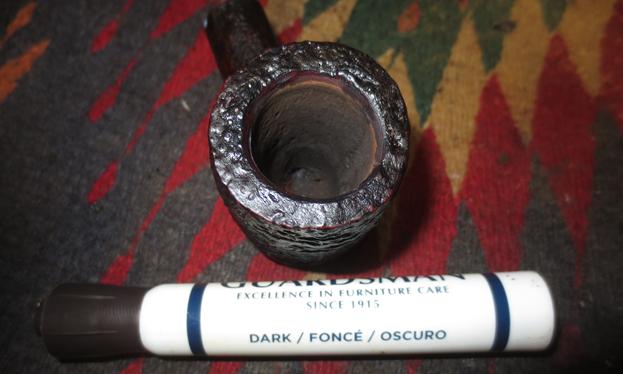
The rim was is in need of some stain and I had just received a set of Guardsman stain pens I bought from Amazon.  This was my chance to try the out.  I was very happy with the way they worked.  I have used other stain pens in the past but with less than satisfactory results.  Blending the three pens I got a good color match with the rest of the stummel.

With the stummel done, I packaged up the pipe with a hand written letter describing the situation and my connection with Joe.  I included a $15 check ($12 for the stem and $3 for return shipping) and sent the pipe off to Sparta.  The pipe left on a Thursday and arrived in North Carolina on Monday.  I had no idea what to expect for timing so I determined to wait as patiently as I could, figuring it would be 3-4 weeks.

To my pleasant surprise it was just a week and a half later.  I was on the road in Texas again when my son told me that a package had arrived from Dr. Grabow.  When I got home I was like a kid at Christmas wanting to get the pack open and see what Santa sent me.  I was not disappointed.  The new nylon stem looked great.  It returned all the grandeur and dignity that the pipe once had.  I was glad now that the stubby conversion had not worked out.

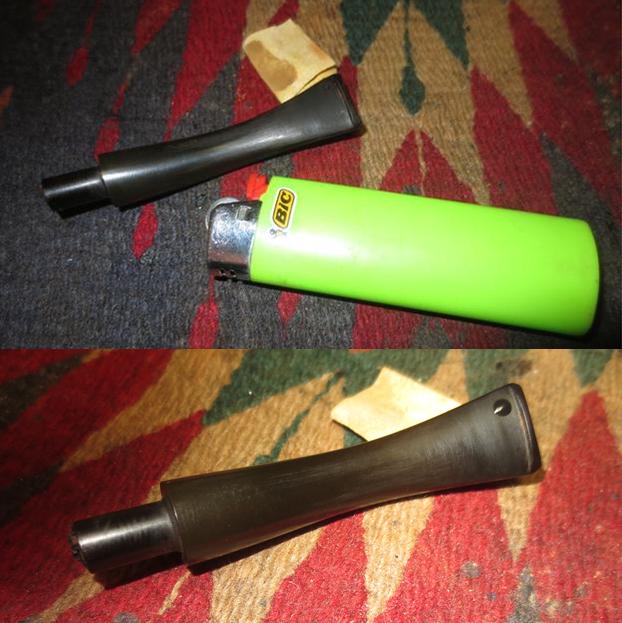
Although I am not a big fan of nylon stems, mostly to the fact that they are a pain to repair, clean and polish.  But this one being new was not a problem.  I did polish the stem using 6000-12000 grit micromesh.  The stem also needed a little deburring at the air hole and smoothing out on the face of the button.  All of which was done in short order.

I finished the pipe at the buffing station while smoking a bowl of McClelland’s Stave Aged in a Yello-bole Chesterfield – a previous repair.  I started with red diamond rouge on a rag wheel then finished with three coats of carnauba wax.  I could not be happier with the results.  Thank you for taking the time to read this.ber10 ber11 ber12


Hole in the Wall Gold Mine: Butz-Choquin Cocarde Major Rhodesian


Blog by Dal Stanton

Even though it was a snow trudging kind of day, making it to the ‘Hole in the Wall’ paid off again.  I mentioned this visit before when I was writing up the restoration of the Stanwell Silver Mount.  On this visit, I saw the Stanwell for the first time, but didn’t bite.  The next time I would!  On this visit, I found another very nice example of St. Claude, France’s claim to fame as an historic center of pipe production – rivaling the UK for market share in Europe.  When I saw the Butz-Choquin Cocarde Major in the pipe basket on the cluttered Hole in the Wall shelf, my initial reaction was its size – a hefty guy.  My first assessment was that it was a Bulldog shape, then I noted the large rounded shank – a Rhodesian or a Bullmoose?  This one is going home with me regardless!  I looked in the basket for a good pipe to bundle and I saw an attractive, diminutive, Bent Billiard Sitter with a swan neck stem – unmarked, but a very nice looking pipe.  When I got home I took a quick picture of the bundled pair and put them in the ‘Help Me!’ basket for later attention.butz1 butz2When I take the BC Cocarde Major out of the basket, I am anxious to recommission this nice-looking Rhodesian, I decide.  The first thing I do is pull up Google Translator and insert Cocarde Major in the French to English machine.  I did not study French in school so help is appreciated.  I want to know if special meaning is attached to this St. Claude BC.  Cocarde translated into English as the word, ‘Cockade’ which was defined as, a rosette, roundel or knot of ribbons worn in a hat as a badge of office or party, or as part of a livery. With a little looking on the internet, I found these interesting French examples of Cocardes.butz3With this meaning for ‘Cocarde’ it put doubt in my mind regarding my original thought that ‘Major’ referred to large or big.  Attaching Major to the idea of the French symbol of national pride, it is most likely pointing to a level of rank, or when ‘Major’ is attached to another rank (e.g., sergeant-major) it denotes the ranking of one superior among those of the same rank.  I emailed a colleague living and working in Toulouse, France, whose command of the language could help.  His comments confirmed what I was thinking:

The word cockade refers to a national symbole for the French, like “cocarde tricolore’ refers to the French flag which is, of course, one of the most important symbols of the French people and national pride.  It has many meanings, but for example official cars or planes have this symbol on it.  You are right about the word Major, refering to a military grade. Used as an adjectif, “majeur” it means big.   I would conclude that this is simply the name of the pipe.  You can’t translate it literally.  The pipe’s name implies in my opinion that it is a symbol of French pride, like the French insignia for a general in the military.

With the symbols of French pride stamped on this BC Rhodesian, I have a greater appreciation for the pipe when I take more pictures now on my worktable.butz4 butz5 butz6 butz7 butz8The stampings on the left side of the shank are “Butz-Choquin” in an arched script over “Concarde” over “Major”.  On the right side is, “St Claude” arched over “France” over “1028”, the BC shape number.  Per Pipedia’s history of the name, when Jean-Baptiste Choquin of Metz, started out as a tobacconist and the business prospered.  In 1858, one of his employees, one Gustave Butz, fell for his boss’ daughter and they were married.  That same year, Butz and Choquin came together to form the enterprise that is now known as Butz-Choquin, and eventually moved the operation from Metz to St. Claude, known as “the world capital of the briar pipe”.  Looking on the internet, I found another BC shape ‘1028’ but was called a ‘Bourbon Major’.  The shape was that of a Bulldog, with the diamond shank.  I know there is debate regarding the difference between Bulldog and a Rhodesian classification, but I am happy with Bill Burney’s descriptive difference in the Pipedia shapes Chart, that the difference between the two is, the Rhodesian has a round shank and the Bulldog, a diamond.

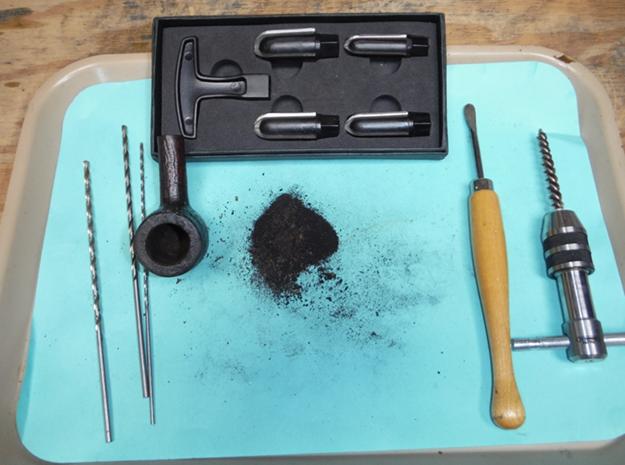
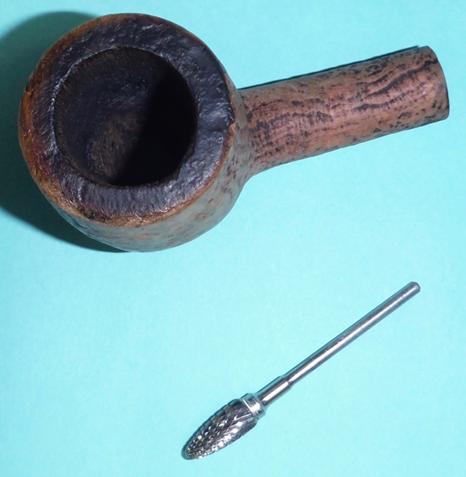
So, looking more closely at the BC Rhodesian in front of me, I see that the surface is generally in good shape – striking grain patterns.  There are two noticeable fills that need addressing.  There is also a chip over the shank, where the double grooves meet – the grooves forming the border between the upper and lower cones of the Rhodesian stummel.  The chamber has thick carbon cake buildup and needs removal down to the briar for a fresh start.  The stem has very little oxidation and a couple distinct clincher tooth marks on the top bit and chatter above and below.  The stamped ‘BC’ stem marking is in good shape but the white color needs touching up.  The following pictures show the question areas on the stummel – mainly fills and the chip.butz9 butz10Even though the oxidation is minor, I put the stem in an Oxi-Clean bath for a few hours to raise the oxidation to the surface.  I first cover the stem ‘BC’ stamp with petroleum oil.  Turning to the stummel, I take the Pipnet Pipe Reamer kit and use the two smaller blades of the four available and remove the cake using first the smallest, then graduating to the next larger when the blade stops meeting resistance.  This cake is hard and crusty but vacates in short order.  I fine tune the reaming with my Savinelli Pipe Knife.  I’ve grown to like this handy tool.  What The Pipe Smoker blog says about it is spot on:

Basically, a three-sided scraper, it can be placed in the chamber exactly where it needs to be placed and then cake is scraped off with a simple movement of the wrist. It allows full control over where the cake is being reduced. It has a rounded tip, which means that it will not damage the bottom of the bowl. It makes no difference, whether the chamber is straight or conical, I can use the same tool on either. It requires no adjustment. 

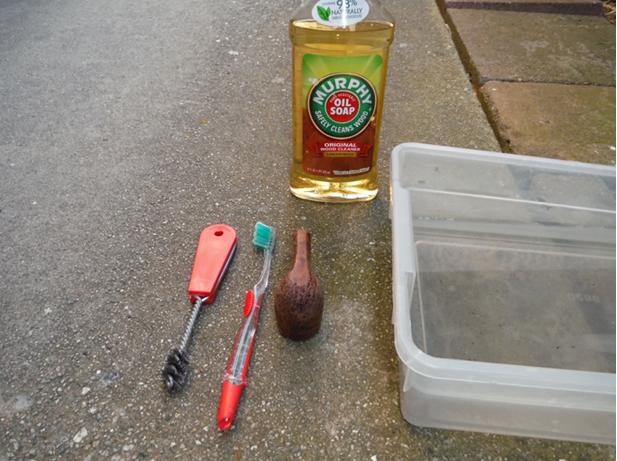
After the Savinelli pipe knife scrapes the chamber wall, I wrap 240 grit paper around a Sharpie pen and sand the chamber removing the last vestiges of carbon.  I then wipe the bowl with a cotton pad wetted with isopropyl 95%.  The chamber looks great.  I fold up the paper towel and my work station is clean again.  Pictures show the progress.butz11 butz12 butz13 butz14I then switch to the internals of the stummel and clean the mortise and airhole with pipe cleaners and cotton swabs dipped in isopropyl 95%.  After some extended effort, pipe cleaners and cotton swabs are coming out clean.  Later, I’ll add another measure of cleaning by giving the stummel a kosher salt and alcohol soak.  I like to go the extra mile when I’m preparing a pipe for a new steward.  The picture shows the progress.butz15Turning to the stummel externals, I remove the grime on the surface and clean the rim.  I use undiluted Murphy Oil Soap with cotton pads.  I use a bristle tooth brush as well to clean the double grooves circling the cone.  I also employ a brass brush to clean the lava and grime off the rim.  The pictures show the progress.butz16Time to fish the stem from the Oxi-Clean bath.  It’s amazing that even when the stem looks to have little oxidation, the Oxi-Clean bath raises the oxidation to the surface.  I wet sand with 600 grit paper to remove the bulk of the oxidation from the vulcanite and then follow-up using 0000 steel wool. Throughout this process, I give care to work around the ‘BC’ stem stamping.  Pictures show the progress.butz17With the tooth dents on the upper bit, I attempt to remove by using a lit candle’s heat to raise the indentations by expanding the vulcanite but it wasn’t working well.  So, I apply a small drop of super glue to the spots and then apply an accelerator to cure the glue.  After a few minutes, I use the flat edge needle file to file down the superglue patches to the vulcanite surface.  While I have the file out, I file the button lip, upper and lower, to give them more definition.  I follow with applying 240 grit paper to remove the file marks and to fine tune and blend the superglue patches.  I follow with 600 grit paper and then 0000 steel wool.  The pictures show the progress.butz18 butz19 butz20 butz21I clean and freshen the internals of the stummel further with a Kosher Salt/alcohol soak for several hours.  I set the stummel in a sturdy egg carton and twist a cotton ball and feed it into the mortise, pushing it in with a straight wire.  I then fill the chamber with kosher salt which is not iodized – which can leave a taste.  Then, I fill the chamber with isopropyl 95% until it surfaces above the salt.  The pictures show the process.butz22The next morning, the salt/alcohol soak had run its course and from the darkening of the salt and the cotton wick, the process effectively cleaned and freshened the stummel internals even after the plethora of pipe cleaners and cotton swabs.  I dump the old expended salt and thump the stummel on my palm, then use a paper towel and wipe the bowl.  I use bristle brushes to clean the mortise and again, pipe cleaners through the airway to finish the cleanup.  As billed, the soak works.  Pictures show the soak results.butz23With the internals of the stummel clean, I clean the internals of the stem.  Using pipe cleaners dipped in isopropyl 95% I work on the stem.  After I begin, even though the ¼ bent saddle stem is not an extreme bend, I’m surprised that I am not able to move a pipe cleaner through the stem without difficulty.  Finally, I pass a bristled pipe cleaner through and move it back and forth, hoping that it loosens up the passageway. It doesn’t.  I decide to use the technique that Charles Lemon used on Dad’s Pipes (See here: Link) of expanding the airway by heating the stem and moving a pipe cleaner through.  Just to be on the safe side, I draw an outline of the stem’s bend to use as a template for a comparison after I re-bend the pipe back to the original.  I first straighten the stem by warming it with a heat gun until the vulcanite becomes pliable.  After inserting a pipe cleaner through the stem, I then reheat the stem and return the stem to the ¼ bend.  Now, back to the original curve comparing to the template, without difficulty I complete the cleaning of the stem using isopropyl dipped pipe cleaners moving freely through the airway.  I also clean the crud out of the slot with a dental probe.  Pictures show the process.butz24 butz25Before starting the micromesh phase to raise the luster of the BC bent stem, I use Miracle Eraser on the ‘BC’ stem stamp to remove the oxidation without applying an abrasive to the stamp.  It does seem to help.  Then, I wet sand the stem using micromesh pads 1500 to 2400, followed by dry sanding with 3200 to 4000, then 6000 to 12000.  I complete each set by applying Obsidian Oil to revitalize the vulcanite.  To watch the stem gradually pop, is an amazing process.  This Butz-Choquin is cleaning up nicely.  I set the stem aside to dry.butz26 butz27Now I return to the stummel and take a close look.  After cleaning with Murphy’s Soap, I detect about 4 or 5 fills on the surface that need addressing. The fills are solid but with some, I’m able to scrape of the upper layer of the fill.  There is also a chip in the double grove going around the stummel.  With the smaller fills, that are not pitted, I use dye sticks, starting with a lighter hue and graduating to a darker hue, until the blend is best.  I then use a lightly dampened cotton pad with isopropyl 95% to dab the areas to blend further with the surrounding briar.  The pictures show the progress.butz28 butz29With those more pitted, I mix a bit of superglue and briar dust to form a putty and apply on the pitted fills.  Carefully, I also paint the groove chip and before the putty start hardening, I clear overflow putty from the grooves with a sharp dental probe.  I use an accelerator to cure the briar dust putty patches more rapidly.   After a short time, I sand each putty fill to bring it to the briar surface.  I first carefully use a flat needle file to work the putty hills down to almost surface level then I use 240 grit paper to sand to the surface level.butz30 butz31 butz32Decision time.  I want to restore this Butz-Choquin as close to the original shade as I can.  I discovered on TobaccoPipes.com a BC in the same shape group as the Cocarde Major – 1028.  In the picture below, the shade of the stummel is light and I think I can achieve this by simply sanding the stummel and restoring the briar to its original natural luster – MINUS what appears to be an acrylic finish below. I can still decide to apply a stain at the end of the sanding process after I have a better idea of the briar as it emerges.  The shape below is a BC Cocarde 1025 – the only difference I detect is the tapered stem versus the saddle stem.butz33First, I want to freshen the rim lines and re-cut an inner bevel which will look better and remove discoloration on the inner rim edge.  The rim has a subtle slant toward the chamber.  I cut the initial bevel using a coarse 120 grip paper rolled tightly.  When I reestablish the bevel, I follow by sanding with 240 grit sanding paper.  I then sand the stummel using a medium grade sanding sponge, followed by a light grade sanding sponge.  I am careful to work around the stampings on the sides of the shank.  Before I move on to the micromesh sanding, I use dye sticks to help blend the fill patch areas that are not yet blending.  After applying the dye stick, I then lightly dab the area with a cotton pad slightly wetted with alcohol.  This helps blend with the surrounding briar.  The pictures show the progress.butz34 butz35 butz36 butz37I follow by using micromesh pads 1500 to 2400 and wet sand the stummel.  After this, I dry sand using 3200 to 4000 then finish with pads 6000 to 12000.  I then run a toothpick through both grooves connecting the upper and lower domes of the Rhodesian to remove residue remaining from the sanding process.butz38 butz39To step back and take in the big picture, I reunite stem and stummel and take a picture.  I see two distinct briar dust putty fills that are looking like I should have used a clear superglue fill instead.  They are darker than the surrounding grain environment – not an ideal situation.butz40I decide I can live with the fill on the upper cone, next to the rim.  It is smaller and I hope that it will blend after applying a light brown stain which is looking like will be needed.  With the larger lower fill, I will delicately try reaming the fill with the point of a Dremel tool to remove the putty.  Depending on how that goes, the next step will be to shape the fill somewhat so that the shape is less circular and flows more with the surrounding grain pattern.  Then, I will fill the new hole with clear superglue, sand and again be back to where I am now – hopefully with better blending.  Phase one seems to go well – very carefully.  With the Dremel tool I clean the putty fill and shape the pit circle to flow with the grain.  I then spot-glue and use accelerator to cure the new clear patch.  Looking good so far.   I use a flat needle file to remove the superglue fill mound almost to the briar surface, then I use 240 grit paper rolled, to strategically stay on top of the glue to bring it down to surface.  I follow with 600 grit, then steel wool, then the full array of 9 micromesh pads, 1500 to 12000.  I touch up a bit with a light dye stick and blend with a cotton pad with a bit of alcohol.  I am now back to where I was at the beginning of the detour. The fill is still visible, but doesn’t jump out proclaiming, “Here I am, Boys!”  The pictures show the detoured progress.butz41 butz42 butz43 butz44Now, to promote blending throughout the entire stummel, I use Fiebing’s Light Brown Leather Dye.  I warm the stummel to open the grains to receive the dye.  Using a doubled-over pipe cleaner I liberally apply the dye over the stummel careful to achieve full coverage, rim and grooves.  I then flame the aniline dye with a lit candle and the alcohol immediately burns off, setting the dye in the grain.  To achieve total coverage, I repeat the process above after a few minutes, complete with flaming.  I put the stummel aside to rest and I’ll return to it after work this evening.butz45One last task to do before heading to work.  I want to freshen the ‘BC’ stem marking with white acrylic paint.  I put a small dab of paint over the ‘BC’ and then use a toothpick to spread the paint, making sure the marks are fully covered.  Tonight, after the paint is fully cured, I’ll scrape off the excess leaving a fresh Butz-Choquin stem.butz46Back home and ready to go.  The white acrylic paint has fully cured on the stem marking.  I take a toothpick and gently scrape the excess paint away using the side of the toothpick.  Doing this, the toothpick passes over the top of the stamping leaving the indentations fully renewed.butz47Time to ‘unwrap’ the fire crusted stummel after applying Fiebing’s Light Brown Leather Dye.  Using the felt wheel, I set the speed of the Dremel to the slowest possible and using Tripoli compound, after purging the wheel of old compound with the sharp edge of the Dremel’s adjustment wrench, I remove the crust from the stummel.  I take a picture to show this process.  After the crust is removed, I use cotton pads wet with isopropyl 95% to wipe down the stummel.  I lighten the stummel’s hue a good bit aiming for the original as closely as possible and to blend the dye across the grain.  When I reach the hue that looks good, I switch to a cotton cloth wheel mounted on the Dremel, and after reuniting stem and stummel, I apply Blue Diamond compound both.  I’m loving watching the grain on this BC Cocarde Major Rhodesian start popping – it is truly an amazing process and the components of such fine abrasion produce such a result in the briar. When completed with Blue Diamond I give the pipe a buff with a felt towel, not so much for shining but to remove residue compound before I apply the wax.  After mounting the cotton cloth wheel on the Dremel, I increase the speed to the second slowest speed and apply several coats of carnauba wax to stem and stubble.  When finished, I rigorously hand buff the pipe with a micromesh cloth.butz48 butz49The grain on this Rhodesian is placed perfectly to enhance the proud, chin forward carriage of the stummel.  The horizontal flame grain crosses the heel of the stummel and flows to the sides terminating in bird’s eye – a beautiful showpiece of briar that is well-suited to bear the name of French pride – Cocarde Major.  This Butz-Choquin Rhodesian, another traveler from St. Claude, is looking for a new steward.  I sell the pipes I restore and give the profits to benefit the work we do here in Bulgaria with the Daughters of Bulgaria – rescuing women and children who have been trafficked and sexually exploited.  If you are interested in adding this Butz-Choquin Cocarde Major Rhodesian to your collection, you can find it at the store at my blog site, The Pipe Steward.  Thanks for joining me!butz50 butz51 butz52 butz53 butz54 butz55

Rejuvenating a Made in Leeds, England Ben Wade Natural Grain Lovat


Blog by Steve Laug

This little Ben Wade Lovat is the fourth pipe of the lot from Eastern Canada that I am restoring for a pipe man from there who sent it to me. It is stamped on the left side of the shank BEN WADE over Natural Grain and on the right side of the shank it reads Made in Leeds over England and a shape number 20 V near the bowl shank junction. The finish was natural and either unstained or stained with a light tan stain. The grain is quite good on the pipe. The rim is in rough shape from having been knocked on hard surfaces to remove the dottle. There were dents, dings and roughening. The bowl was slightly out of round. The stem was good quality vulcanite and has light oxidation at the joint of the stem and shank. There was tooth chatter and tooth marks on the top and bottom side near the button.ben1 ben2I took some close up photos of the rim and the stem. You can see the damage to the outer and inner edges of the rim as well as dents in the rim top. The cake has been poorly reamed from the bowl and there were some gouges in the briar walls that will need to be sanded out. The stem photos show the tooth chatter and marks as well as the small band of oxidation next to the shank.ben3 ben4I have always heard that the Ben Wade Company made quality English made pipes prior to its purchase by Herman Lane but I did not have any idea of the history of the brand. I did a bit of research on it and found the following helpful information on Pipedia. The link follows the quoted portion.

The company was founded by Benjamin Wade in 1860 in Leeds, Yorkshire, where it was located for over a century. Ben Wade started as a pipe trader, but yet in the 1860’s he established a workshop to produce briar pipes. The pipes were made in very many standard shapes – always extensively classic and “very British”. Many models tended to be of smaller dimensions. Ben Wade offered a very high standard of craftsmanship and quality without any fills. Thus the pipes were considered to be high grade and a major competitor to other famous English brands. The often heard comparison to Charatan seems to be a little bit inadequate because those days’ Charatans were entirely handmade.

In the II World War the factory was destroyed by German air raids on Leeds. But the Ben Wade family decided to re-build it immediately after the war and pipe production was re-started soon and successfully linked to the fame from the pre-war years. Even though the owner family decided to leave pipe business and sell off the firm. The family went into negotiations with Herman G. Lane, president of Lane Ltd. in New York at about the same time as the Charatan family. Lane Ltd. bought both firms in 1962.

Herman G. Lane had been Charatan’s US sole distributor since 1955 and Charatan always remained his pet child. But Ben Wade was treated in another way by its new owner. The fabrication of pipes was reduced and the factory in Leeds was closed in 1965 finally.

So this was the end of Ben Wade pipes stamped “Made in Leeds, England”. https://pipedia.org/wiki/Ben_Wade

The pipe I was working on was stamped “Made in Leeds, England” thus effectively dating it to the period the company was owned by the family. I know that it was made before the closing of the factory in 1965. So I had the last date it could have been made. Judging from the age of the rest of the auction lot my guess would be that this pipe also came from the 1930s. The style and cut of the stem leads me to place it in that period.

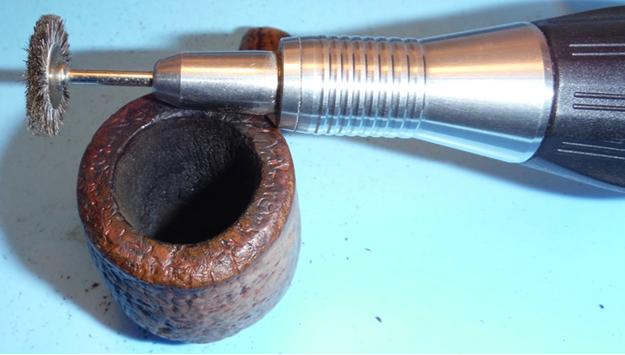
I cleaned up the reaming in the bowl with a Savinelli Fitsall Pipe Knife and took the cake back to bare wood. It took some work to smooth out the gouges in the bowl walls. I was able to remove many of them leaving only a remnant behind. I wrapped a dowel with sandpaper and sanded the bowl walls after I had reamed it.ben4a ben5To remove the damage to the rim edges and the top I topped the bowl on the topping board. I did a minimal topping to just even things out and clean up the surface.ben6I scrubbed the bowl surface with acetone on cotton pads to remove the grime and oils that were embedded in the bowl sides. I wanted to get the briar clean so I could retain the natural finish.ben7 ben8I used a folded piece of 220 grit sandpaper to give the inside rim a light bevel to bring the bowl back into round. I also used in on the outside edge to soften it.ben9With the bowl clean I lightly sanded it with a medium and a fine grit sanding sponge to take out the scratches and smooth out the finish. I sanded it with 1500-2400 grit micromesh sanding pads as well. When I had finished sanding it I wiped it down with a last wipe of alcohol on a cotton pad in preparation for giving it a light coat of oil. I rubbed the bowl down with olive oil and polished it by hand.ben10 ben11I set the bowl aside and turned my attention to the stem. I sanded the entire stem with 220 grit sandpaper to remove the oxidation and the tooth chatter. I “painted” the tooth marks in the stem with a lighter flame until they lifted. I sanded the damaged areas with the sandpaper until the surfaces were smooth and showed no more sign of tooth damage.ben12I wet sanded the saddle portion of the stem with 1500-2400 grit micromesh pads and then used Rub ‘n Buff European Gold to fill in the portions of the BW stamp that still showed on the stem surface.ben13I cleaned out the interior of the mortise and the airways in the shank and the stem with alcohol, cotton swabs and pipe cleaners until they were no longer dirty and oily. As you can see from the photos below it took a few swabs and cleaners to get to that point.ben14I polished the stem with micromesh sanding pads – wet sanding with 1500-2400 grit pads and dry sanding with 3200-12000 grit pads. I rubbed the stem down with Obsidian Oil after each set of three pads. After the final rubdown with oil I set the stem aside to dry.ben15 ben16 ben17Once the oil had dried I buffed the bowl and stem with Blue Diamond on the buffing wheel and then gave them both multiple coats of carnauba wax. I buffed the pipe with a clean buffing pad to raise the shine and hand buffed it with a microfibre cloth to deepen the shine. The finished pipe is shown in the photos that follow. It came out quite nice with the grain popping through over the bowl and shank. The pipe will soon join the others in the lot on the return trip to Eastern Canada. Thanks for looking.ben18 ben19 ben20 ben21 ben22 ben23 ben24 ben25


An old Sasieni Sashar London Made 901 Billiard


Blog by Steve Laug

The third pipe I worked on from the pipe man in Eastern Canada who picked up that old lot at an auction is one that is stamped on the left side of shank with the name Sashar over London Made. On the right side of the shank it is stamped with the shape number 901. The rim was worn and whoever cleaned the pipe before I got it removed a lot of the finish. The inner bevel of the rim had a burned area on the right front side. The outer edges of the bowl were worn. The stem was good quality vulcanite and had light oxidation and tome tooth marks on both sides of the stem near the button. The inside of the shank and the stem was very dirty with tars and oils. There was a stinger in the tenon that extended into the bottom of the bowl. There was a light cake in the bowl that would need to be cleaned up as well.sas1 sas2I remembered that the Sashar line was made by Sasieni. I could not remember any other information on the brand. I did a Google search and found that there was a write up on rebornpipes – go figure. I looked and it was a blog that Al Jones wrote on a Sashar pipe that he worked on. Here is the link https://rebornpipes.com/2016/12/19/sasieni-sashar-restoration/.

I did some more searching and found a short writeup on Wesley’s – a pipe shop in South Africa about the pipe brand. It was under a heading there entitled SASIENI. I quote from that site the following: “Joel Sasieni started as an apprentice with Charatan, moved to Dunhill when it opened in 1910, and started his own company in London in 1918 making high grade pipes largely for the US market. They also manufactured pipes under the brand name Sashar (specifically for South Africa) for pipes a little down the line. The company was sold in 1979 and the pipes are now made by a completely different firm.” http://www.wesleys.co.za/refurb04.html

Now I had a bit of information on the brand. It was a Sasieni made pipe manufactured under the Sashar brand name for South Africa. Armed with that information I turned to working on the pipe. I took close up photos of the rim top and inner edge as well as the tooth marks on the stem. In the photo of the bowl you can see the damage on the inner edge of the bowl. The bowl was slightly out of round and there was a burn mark evident mid rim on the right side of the bowl.sas3 sas4In order to clean out the airway in the stem I needed to remove the inner tube from the tenon. I heated it with a lighter until the oils and tars holding it in place warmed up. I wrapped the jaws on a pair of pliers and used it to turn the inner tube out of the tenon. With the tube removed I was able to clean out the airway without impediment.sas5I used a folded piece of 180 grit sandpaper to rework a bevel on the inner edge of the bowl. Once I had the bevel cut I worked on it again with 220 grit sandpaper and 1500 grit micromesh sanding pads. I rolled a piece of 220 grit sandpaper into a tube and wrapped it around a dowel and then my finger to sand the inside of the bowl and clean up the remaining cake on the walls.sas6 sas7I used a dark brown stain pen to restain the top of the rim and the inner and outer edge of the bowl. I spot coloured it with a black Sharpie pen and blended the two together to get the finish to match the rest of the bowl.sas8I used a wet cloth and a butter knife to steam out the dents in the back side of the bowl. I heated the knife in the flame of the burners on my kitchen stove. When hot, I folded a wet towel against the dents in the briar and laid the hot knife on the wet cloth. It generated a fair amount of steam. I repeated the process until the dents were lifted.sas9 sas10I used 99% isopropyl alcohol, cotton swabs and pipe cleaners to clean out the mortise and the airway in the shank and the stem. They were not too dirty so it took very few cleaners to clean it. Once the stem was clean I put the inner tube back in place in the tenon.sas11I sanded the tooth chatter on the stem at the button with 220 grit sandpaper to remove it and the few tooth marks that were also present on both sides of the stem near the button.sas12I polished the stem with micromesh sanding pads – wet sanding with 1500-2400 grit pads and dry sanding with 3200-12000 grit pads. I rubbed the stem down with Obsidian Oil after each set of three pads. After the last set of pads I gave it a final coat of oil and let it sit and dry.sas13 sas14 sas15I buffed the bowl and stem with Blue Diamond on the buffing wheel to polish the briar and the vulcanite. I gave them both multiple coats of carnauba wax and buffed it with a clean buffing pad to raise the shine. I hand buffed it with a microfibre cloth to deepen the shine. The finished pipe is shown in the photos below. It is ready to go back to its owner in Eastern Canada. Thanks for looking.sas16 sas17 sas18 sas19 sas20 sas21 sas22 sas23
New Life for a KBB Yello-Bole Sandblast 2705 Billiard


Blog by Steve Laug

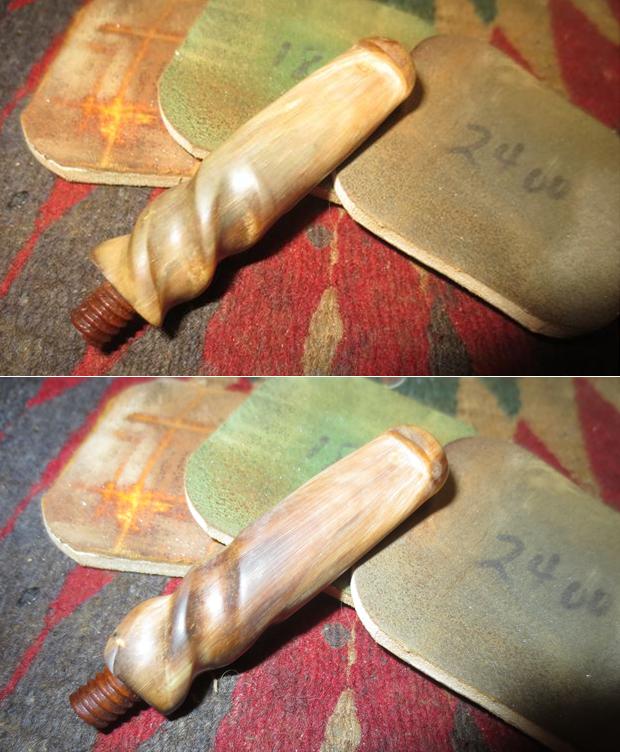
This is the second pipe that was sent to me by a fellow Canadian for a cleanup and restoration from the lot he had picked up in a local auction for a great price. This one is an older Yello-Bole sandblast billiard with the KBB cloverleaf on the underside of the shank. It has a great looking rugged sandblast on the bowl that highlights the grain. The overall finish appeared to be in good shape though the crevices in the blast were dirty. The bowl had been cleaned before the auction and there was some scratching on the bowl walls. There was still an overflow of tars in the finish that remained on to the rim in the parts that were not damaged. The outer edge of the rim had the look of a pipe that had been smoked hard and knocked out on anything close at hand no matter what it did to the pipe. There were nicks and dings all the way around the rim top and edges. The first five photos that I have included are ones that I received from the pipe’s owner when he emailed and asked me about repairing his find. The first is an overall view of the pipe. yb1The second and third photos are close up shots to clearly show the extent of the damage to the rim top and outer edges. As far as I could see from the photos the inner edge of the rim appeared to be in great shape. The outer edge was another story.yb2The last two photos he sent show the fit of the stem against the shank and the stamping on the underside of the shank. From the first photo it did not appear that the stem was properly seated in the shank. My experience has been that the stems on these older Yello-Bole pipes had an excellent fit but when tars collected around the walls of the shank surrounding the spade stinger the stem would not properly seat. I was hopeful this would be the case with this one. The second photo shows the clear stamping on the underside. It is stamped with the four digit shape number 2705 which is a billiard number and after the 5 is the letter u. The KBB cloverleaf is followed by the classic Yello-Bole stamp and under that it reads Algerian Bruyere.yb3When the pipe arrived I snapped some photos of the condition of the pipe before I started the cleanup. The stem had light oxidation and the yellow O logo was perfect. The inside of the shank was quite dirty so my assumption regarding the reason that the stem did not seat properly was correct. Unfortunately before I took the photos I had done some cleaning on the rim top and edges. I used a sanding block on the edges to knock off loose debris and a dental pick on the rim. I touched up the raw briar with a black Sharpie pen because I have learned that when it is mixed with a dark brown stain I can get a match to the colour of the stain on the bowl. blast1 blast2At this point in the process I used a brass bristle tire brush to scrub out the crevices and sandblast on the top surface. I did this to prepare the rim for restaining, to clean out the blast crevices and to smooth out some of the roughness I have found that this brush does a great job in lifting the dust and tar while not damaging the briar. The brass bristles are soft and do not scratch the briar but make easy work of the tars and build up on the rim of a blast. I scrubbed the inner beveled edge with the brush and it came out looking undamaged. The sandblast reappeared on the rim top as well.blast3I used the black Sharpie pen again to add a dark colour in the chips and nicks in the finish around the edges and the top of the bowl. When that was finished I stained the bowl with a dark brown aniline stain thinned 50/50 with isopropyl alcohol. I fired the stain with a lighter and repeated the process until I was satisfied with the coverage on the bowl. You can see that the nicks along the edges of the rim look very good. The rim top needs to be polished and it will look the same after I have waxed and buffed it.blast4 blast5I probably should have cleaned up the inside of the bowl earlier but as I worked on the rim first it almost escaped my notice. In the last photo above I could see the cake in the bowl and what appeared to be some damage to the inside wall of the left side. I used a Savinelli Fitsall Reaming knife to take the cake out of the bowl. I was able to ream back the walls and the apparent damage disappeared. I used a pen knife to scrape the hard tars that had collected in the shank and mortise. I was amazed at the amount of powder that came out of the shank. It was thick and black and proved my point made earlier about it keeping the stem from seating properly against the shank.blast6I scrubbed the mortise and the airways in the stem and the shank with 99% isopropyl alcohol, pipe cleaners and cotton swabs until I removed all of the grit and grime from those areas. I cleaned the spade stinger with alcohol and pipe cleaners and polished it with 0000 steel wool until it shone.blast7The pipe smelled of old aromatics and even with the bowl and shank clean the smell was present. I stuffed the bowl with cotton balls and used an eye dropper to fill it with isopropyl alcohol. I have found that cotton balls work as well as Kosher salt does and it is not as messy. I put a cotton swab in the shank up to the entrance of the airway into the bowl as it wicks alcohol into the shank and draws out the oils in that area. I put the pipe bowl upright in an ice-cube tray and let it sit over night to let it do its magic. The second photo shows the cotton balls, discoloured with the oils after sitting 8-9 hours. Once I removed the cotton balls I scrubbed out the shank and airway to remove any remnants of alcohol left behind and set the bowl aside to dry.

I have written about this alternative to the salt and alcohol treatment in an earlier blog that can be read here. https://rebornpipes.com/2013/02/10/sweetening-a-pipe-an-alternative-to-the-salt-and-alcohol-treatment/blast8I sanded the stem with 220 grit sandpaper to remove the light oxidation and the light tooth chatter at the button. It did not take too much sanding to remove those from the stem.blast9I polished the stem with micromesh sanding pads – wet sanding with 1500-2400 grit pads and dry sanding with 3200-12000 grit pads. This is my normal routine and if you have been following the blog for any length of time you know that I always follow this procedure with the stems. Between the 4000 grit pad and the 6000 grit pad I buffed the stem with White Diamond and then went on to use the final three grits of micromesh pads. I gave the stem a rubdown with Obsidian Oil after each set of three pads and after the last set put it aside to let the oil dry.blast10 blast11 blast12I hand waxed the bowl with Conservator’s Wax and buffed it with a shoe brush. I find that the wax does not clump in the crevices of a sandblast finish like carnauba does so I always hand wax this kind of finish. I buffed the stem with Blue Diamond on the buffing wheel and gave it multiple coats of carnauba wax. I buffed the bowl and stem with a clean buffing pad to raise the shine and then hand buffed it with a microfibre cloth to deepen the shine. The finished pipe is ready to go back across Canada to its owner. It is a beauty and I think he will enjoy it. Thanks for looking.blast13 blast14 blast15 blast16 blast17 blast18 blast19 blast20


Reworking a very damaged Toogood’s Make “A” Billiard 12F.


Blog by Steve Laug

I was contacted by a fellow Canadian who had just picked a nice selection of 6 older pipes at an auction. He picked them up for a very good price. Five of the six pipes were in very good shape. There was an older Dunhill Duke St. SW Lovat, an L&Co small billiard, an older KBB Yello-Bole 2705 sandblast billiard, a Ben Wade Natural Grain Lovat, a Sashar billiard made by Sasieni for South Africa and this older Toogood’s Make A billiard. The little billiard is stamped on the left side of the shank 12F and next to that is Toogood’s over Make over A. On the top of the shank flowing down the right side it reads Made in over England over Sun Dried over in Surrey. I was unfamiliar with the brand and I could not find any information on it on the web. My usual sites did not give me any information. I checked in my copy of Who Made That Pipe and information that the brand was made by Mason & Toogood. It listed 12 different variations on the brand. I have included a screen capture of the section from the book that shows the brand.too1aI searched the web for information about Mason & Toogood in Surrey, England but I could not find anything under that heading either. Perhaps some of you reading this may have some information on this brand.
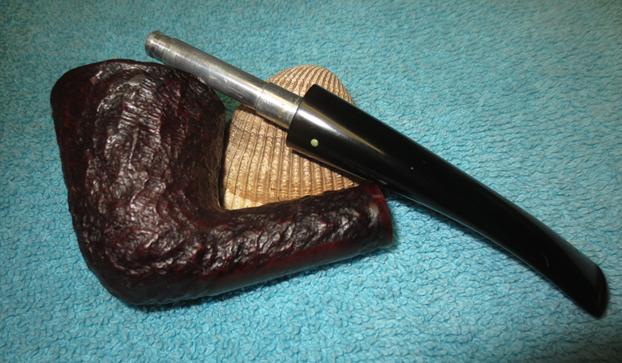
I took some pictures of the pipe before I did any clean up or restoration on it. I chose to work on this one for the challenge more than anything else. I knew that even once it was restored it would not have any particular value but I like the challenge and enjoy seeing what I can do. You can see the deep gouges on the right side of the bowl from the rim down about ¼ inch. There were also some deep marks and scratches just below the gouges. I took photos of the side of the bowl and also from the top down showing the depth and extent of the damage to the right side.too1 too2I took a photo of the stamping on the shank sides to record the information and to see if any of you recognize it once you see the photos.too3I took some close up photos of the damaged bowl side and the rim top. These show the depth of the gouge and the deep nicks on the rim and the bowl side. It was in rough shape and would take some patience to rebuild the side and the rim.too4I reamed the bowl back to bare briar with a Savinelli Fitsall Pipe Knife in preparation for the work on the side and rim top.too5I decided to top the bowl on the topping board to remove the damage on the rim top. The gouges on the top of the rim were not as deep as the side. The photo below shows the rim top after topping the bowl.too6The next series of photos show the rebuild of the rim edge, top and side of the bowl with a mixture of clear super glue and briar dust. I layered on the glue and the dust to bring the level of the side up to the same thickness and height as the rest of the bowl.too7I sanded the repaired area with 180 grit sandpaper to smooth out the repair and blend it into the surface of the bowl. Once I had it smoothed out I sanded it with 220 grit sandpaper to smooth out the scratches. The next series of photos show the progress of the repair at this point.too8 too9I sanded the bowl repair with a medium and a fine grit sanding sponge and then with 1500-3200 grit micromesh sanding pads. I was able to remove the scratches in the briar with the sanding pads. I stained the bowl side with a dark brown stain pen to match the rest of the bowl colour. This was the first coat of stain. I would follow it with darker coats to try to blend it in better with the bowl side.too10I sanded the freshly stained rim and bowl side with 1500-3200 grit micromesh sanding pads to remove the scratches that showed up on the pipe after the first coat of stain. I restained the bowl side and top with a dark brown aniline stain and flamed it with a lighter. I gave it a second coat and repeated the flaming of the stain to set it in the grain.too11I buffed the bowl with White Diamond on the buffing wheel to raise the shine. The photo below shows the bowl at this point in the process. I still needed to blend the repair into the briar with a black Sharpie Pen. The photos below show the repair before the black Sharpie touch ups.too12The stem was in pretty decent shape with light oxidation. The stem had an aluminum inner tube that was set in the tenon and seemed extend quite a ways up the inside of the airway in the stem.too14I sanded the stem with 220 grit sandpaper to remove the scratches and the tooth chatter on the stem surfaces at the button on both sides. I smoothed out the surface of the stem and then polished it with micromesh sanding pads. I wet sanded with 1500-2400 grit sanding pads and dry sanded it with 3200-12000 grit pads. I rubbed the stem down with Obsidian Oil after each set of three pads. After the final sanding pad I gave it a last rub down with the oil and set it aside to dry.too15 too16 too17I buffed the bowl and stem with Blue Diamond on the buffing wheel. I gave it multiple coats of carnauba wax and buffed it with a clean buffing pad to raise the shine. I hand buffed it with a microfibre cloth to deep the shine. The repair still shows on the right side; but the pipe is useable and it looks pretty good. The repair blends into the stain on the rest of the bowl. It is smooth to touch and the rim also is in good order. The finished pipe is shown in the photos below. I took some close up photos of the repaired side and rim to show how they look up close. While I still do not know who made the pipe, I like the look of the pipe. The maker laid out the pipe to flow with the grain. The straight and flame grain on the bowl sides, front and back sides looks great and the sandblast on the bottom of the bowl and shank looks good. Thanks for looking. too18 too19 too20 too21 too22 too23 too24 too25 too26 too27
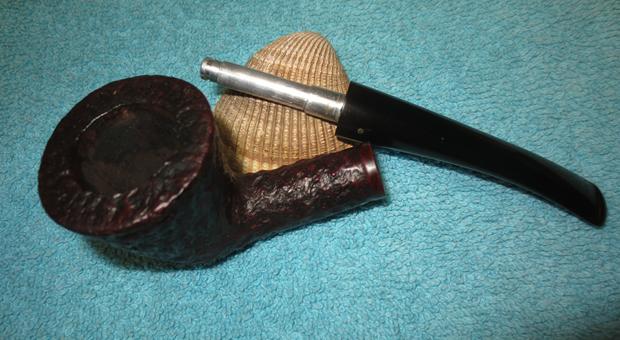
A Simple Cleanup of a 1977 Dunhill Bruyere ¼ Bent Dublin 21143


Blog by Steve Laug

After a month hiatus from pipe refurbishing I am finally getting back into the swing of things. I decided to do some more work on the batch of pipes I picked up from the local tobacco shop. They had come from the estate of an old time pipe man whose widow had given them back to the store to dispose of. The shop owner had given me the task of cleaning up and restoring the lot and putting them up for sale. I had cleaned up four of the old Peterson’s and also an older GBD Marquis before I went away on my work trip. The next pipe that I turned my attention to was a lovely petite Group 2 Dunhill Bruyere ¼ bent Dublin. It is stamped on the left side of the shank with a five digit shape number – 21143 and next to that it reads Dunhill over Bruyere. On the right side of the shank it is stamped Made in England with the number 17 after the D in England which I believe dates the pipe as being made in 1977. The bowl has a cake and there is a lot of overflow of the lava onto the rim top. The finish is in decent shape though dirty. The stem is a fishtail with oxidation and the signs that the previous owner had used a rubber Softee bit. Even so there are still tooth marks on both the top and underside of the stem near the button.dun1 dun2I took some close up photos of the stamping on both sides of the shank. You can see the shape number clearly on the left side. It reads 21143. I have learned that reading the numbers gives a lot of information. From past experience with four digit numbers I know that the first number tells me the size of the bowl – a Group 2. The second number tells me the style of the original stem which in this case is 1 referring to a tapered stem. The third and fourth numbers reference the shape number of the pipe which is number 14 and on the Dunhill charts is a Bent Dublin. The only number I am not clear about it the final digit 3. That will take some more work to see if I can narrow down what it refers to. The rest of the stamping is pretty straightforward on the left and right side of the shank.dun3Since I had not seen the five digit shape stamping before I first turned to Pipephil’s site to see if there was help there. I have used his Dunhill information and found it a great help in deciphering the stamping in the past. However in this case his site did not give any information on the last digit of the five digit stamping. It gave me the information that I already knew – which was the interpretation of the stamping on the pipe. It was made in 1977 and was a Group 2 sized pipe with a taper stem in the 14 Shape which was a bent Dublin. It did not give me the information on the final number in the shape group – the 3. He left that number blank in his interpretation of the stamping on the pipe.
For that I had to do some more searching. I decided to go for a straightforward approach to my problem and typed in the following in the Google search box: “What does the fifth digit in a five digit Dunhill shape stamp mean?” The search engine came up with a conversation online on just this topic. It referenced me to the alt.smokers.pipes site on Google groups. That conversation held the clues I was looking for. I have copied the portion by RC Hamlin in answer to a question from another member regarding the five digit stamping on his pipe. Here is the link: https://groups.google.com/forum/#!topic/alt.smokers.pipes/Fk-8EWxZXCs . I quote the response from RC Hamlin in full.

RC Hamlin, PCCA  20/04/2000 http://www.pipesmoke.com & www.pipeguy.com

John, your pipe is a 1977 Vintage – for modern Dunhill’s, dating them is very easy, just start with 1960 and add the dating digit(s). 1967=7, 1977=17, 1987=27, 1997=37. Do not get hung up on underlines, dots, big/small digits etc. for modern Dunhill’s, just use 1960 as a base and add the dating number to it – simple.

That information confirmed what I already knew and gave a simple formula that I thought would be helpful to others seeking to date a Dunhill pipe. He went on in the following paragraphs to give an answer regarding the five digit shape number.

As far as the 5 digit pipe number (48063) you have a group 4 or “medium” Dunhill. I have a whole briefcase full of Dunhill material from the Dunhill archives, factory, Lane, etc. One of these days I’ll retire and write that online book I’ve been trying to do for years. The most interesting item I have is an actual “stamp” guide from the factory that “signed in” each stamp that Dunhill received from 1922 to 1980 (ish) – a LOT of stamps were used, not always as picture perfect as a written “guide” would have to believe. Very few people outside of Dunhill have seen this stamp guide, some authorized, some have seen my copy and used it without fully studying it, either way….Dunhill’s are not “perfect” in their nomenclature.

The 5 digit shape number was introduced around 1975 to “improve” the original 2 & 3 digit (letters and/or numbers) Dunhill shapes. It worked so well that it was discontinued around 1978 in favor of the current 4 digit shape numbers which are really very simple. The modern shape numbers give the size (1st digit), stem type (2nd digit, 1=taper, 2=saddle) and shape number (last 2 digits). Example: a Billiard is shape #03 so a 4103 would be a group 4, taper bit billiard. Change that to 5203 and you have a group 5, saddle bit billiard. ODA’s use their original 8xx shape numbers and you will see things like HT (hand turned) with no shape number but usually a circled group number (5), etc.

While the information was good and let me know that the pipe was from that time period from 1975-1978 when Dunhill used five digit shape numbers it still does not tell me what the fifth digit meant on the pipe on my worktable. I did a bit more searching and the only thing I turned up was that the fifth digit could have been some kind of stock number from Dunhill. That seems odd, but I am not sure we will ever know what the last digit of the five digit stamps means. Do any of you have a further lead on the meaning? Let us know.

Time to get back to the refurbishing of this 1977 Dunhill Bruyere. I took some close up photos of the rim and the stem to show the condition of the pipe when I started my work on it. You can see the extent of the thick cake on the rim and in the bowl and also the wear and tear to the surface of the stem and the button.dun4 dun5I started the restoration by reaming the bowl. I decided to work on the crumbling cake with the Savinelli Fitsall Reaming Knife and took the cake back to bare wood. I used a small sharp pen knife to carefully scrape the lava off of the rim top. I scrubbed the rim with saliva on cotton pads until I removed all of the hardened cake. I sanded the rim top with a medium and a fine grit sanding sponge to take off the residual tars that remained. I finished by sanding the top of the rim with micromesh sanding pads from 1500-4000 grit.dun6 dun7I cleaned out the slot in the button with a dental pick to remove the clogged buildup on both sides of the slot narrowing the airway considerably. I sanded the stem with 220 grit sandpaper to remove the calcification and to minimize the dents. I heated the dents by “painting” them with the flame of a lighter and was able to raise them. I sanded the repaired dents and blended them in with the sandpaper. I reshaped the top edges of the button on both sides. dun8I scrubbed out the mortise and the airways in the shank and the stem with pipe cleaners, cotton swabs and alcohol until the swabs and cleaners came out white.dun9I polished the stem with micromesh sanding pads – wet sanding with 1500-2400 grit pads and dry sanding with 3200-12000 grit pads. I rubbed the stem down between each set of three pads with Obsidian Oil. I was able to remove all of the scratching and the oxidation on the stem.dun10 dun11 dun12I reconnected the stem and the bowl and buffed the pipe with Blue Diamond on the buffing wheel and then gave the entire pipe multiple coats of carnauba wax. I buffed it with a clean buffing pad to raise a shine and by hand with a microfibre cloth to deepen the shine. The finished pipe is shown in the photos below. It looks far better than when I started cleaning and refurbishing it. It should give the next pipe man who takes on its care a long life of good smokes. Thanks for looking.dun13 dun14 dun15 dun16 dun17 dun18 dun19 dun20 dun21


‘Gramps’ – A Redonian Deluxe London Made 26 Rescued


Blog by Dal Stanton

I know exactly where I was when Charles Lemon, of Dad’s Pipes, posted his blog Family Heirloom Comes in from the Cold on December 22.  I was dutifully, pushing the shopping cart at the Target in Golden, Colorado, while my wife and I were engaged in last-minute Christmas shopping.  Well, my wife was shopping and I was catching up on pipe blog reading with my iPhone 6s.  The story Charles told was of a pipe (without a stem) discovered on a stroll in a pasture, how it arrived there was a mystery, which, after some research looking at old photos, was determined to belong to a great-great uncle.  The restoration was to be a Christmas gift for the great-great nephew, the pipe finder’s step-father….  It was an excellent restoration on Charles’ part, but the story itself, the condition of the pipe, the fact that it was found after how many years – contributed to one of the core reasons I love restoring pipes.  As I read Charles’ heart-warming story, I found myself rooting for the pipe to make it and to again be restored to the lineage of the steward.  While I continued faithfully to keep pace with the shopping cart, dodging frantic shoppers and kids on too much sugar and reading Charles’s post, ‘Gramps’ came to mind.  The first time I saw the pictures of ‘Gramps’ and read the eBay seller’s comments, I determined to place my bid to rescue the old, worn out, tossed aside, pipe.  Why did I immediately name him ‘Gramps’?  Here is what the eBay seller said:

Vary rare REDONIAN Pipe.  Found at the Estate Auction of a 98-year-old man.  (Who said smoking will kill ya?…no way). So the pipe has some ware marks up by the mouth piece, see pictures.  Pipe is marked bowl piece is marked 26 on one side and SARDINIAN de Luxe Made in London on the other.  It is a used pipe.  Ready to be Enjoyed, Gifted or Resold…ENJOY!  

With a smile on my face while looking at Gramps’ pictures, notwithstanding the ‘mild’ exaggeration of the seller’s sales bravado, “Ready to be Enjoyed, Gifted or Resold…ENJOY!”, this is what I saw:red1 red2 red3I have no idea if I can bring Gramps to drink of the Fountain of Youth or not, but I’m now looking at him on my worktable here in Sofia, Bulgaria.  The markings on the left shank are Redonian Deluxe over London Made.  The right side of the shank bears the mark, 26, which I assume is the shape number.  Surprisingly, the stem stamping is legible – a red ‘R’ ensconced in a circle.  A look at Pipedia and I discover that the Redonian was made by the John Redman Ltd./British Empire Pipe Co. in London, the same company that was a possible manufacturer of the L. J. Perretti I restored not long ago – the Perretti Co. is based in Boston and the second oldest Tobacconist in the United States.  According to the Pipedia article, John Redman Co. pipe lines, along with Redonian, include Aristocrat, Buckingham, Buckingham Palace, Canberra, Captain Fortune, Dr John, Golden Square, Richmond (not Sasieni),  and Twin Bore.   I take some additional pictures of ‘Gramps’ for a fresh look.red4 red5 red6 red7 red8 red9Like Charles’ patient, this pipe looks to have been left outside or exposed in a barn or something, as half of it seems to be colored differently – laying on its side for some time.  The stem has the heaviest oxidation I’ve seen to date – perhaps something else is going on – it appears to be leprous!  The surface is so soiled and the cake so thick – there appears to be a spider web in the fire chamber – I really can’t determine the condition of either the stummel or stem, so after taking some pictures from my work table, I plop the stem in Oxi-Clean to start dealing with the stem leprosy and I plop the stummel along with spider web, in an alcohol bath – isopropyl 95% to soften the ages of crud clinging to the stummel – inside and out.red10About 24 hours later, I retrieve the stem from the Oxi-Clean bath and the oxidation was raised to the vulcanite surface as hoped and expected.  I first attack the oxidation by wet standing the stem with 600 grit sanding paper.  I’m very careful to stay clear of the Redonian ‘R’ stamping and work around it.  I sand for quite some time.  After making some progress, I switch to using 0000 steel wool to take off more oxidation and smooth in the process.  Again, I’m steering clear of the ‘R’ stamping.  I wish I would have taken a picture at this point.  The stem is looking much improved except for the circle ‘R’ stamping – still encased in thick oxidation.  I know that taking anything abrasive to the stamping will erode it and for me, this is anathema.  I try another tack – I think I remember reading somewhere about using Mr. Clean Magic Eraser.  I brought it to Bulgaria from the US and hadn’t used it yet.  The sponge that emerges from the box would not be abrasive – I hope.  So, I wet the sponge and start working on the area of the stamping. I start very cautiously and gingerly apply pressure with the sponge Magic Eraser.  When I discover that it is not eating away at the stamping I apply more pressure.  Before long I was working on the area aggressively.  Very gradually, and without perceptible damage to the ‘R’, the oxidation disappeared – or at least, in very large measure.  The last picture in the set below shows the magic brought by the Magic Eraser! I’m pleased with the progress cleaning up a once, leprous stem!red11 red12Satisfied with the progress on the stem, I fish the stummel out of the alcohol bath.  I use several pipe cleaners attempting to open the airway between the mortise and draft hole – unsuccessfully.  I then use about a 6-inch length of hanger wire as a probe and to ream the airway gently.  After a while, I finally push through the ancient muck and reconnect the mortise and bowl.  After this, I put the stummel back in the alcohol bath to soak further after stirring up and opening the internals.red13 red14 red15Out of the bath again, I take Q-tip cotton swabs and pipe cleaners and clean the gunk out of the mortise and draft airway while it is still loosened.  It’s cleaning up well, but I need to ream the bowl to remove the softened cake and the old residues.  I want Gramps to have a new start down to the fresh briar.  I use the Pipnet reaming kit using the two smaller blades of the four available.  The cake comes easily.  I fine tune the reaming more using the Savinelli pipe knife.  I then take 240 grit sanding paper, wrapped around a Sharpie Pen and sand the chamber walls to remove the remaining carbon.  I finish by cleaning the bowl using cotton pads wetted with isopropyl 95%.  The fire chamber looks good – no problems, no burn throughs detected visually. The pictures mark the progress.red16 red17 red18With the bowl reamed and cleaned, I now turn to the stummel externals.  I take another critical look at the stummel surface and lava flow on the rim and take a few pictures to show the condition of the briar before I use Murphy’s Oil Soap.  I want to mark the progress moving from the desperate condition in which the Redonian Deluxe started.  I use undiluted Murphy’s Soap and scrub the rim and stummel surface with cotton pads. I also use a bristled tooth brush to scrub the surface.  After cleaning, I rinse the stummel with warm tap water careful not to allow water into the stummel internals.  The rim cleans nicely and it looks good.  Looking at the briar surface, not surprising I detect several pits which need to be either sanded or filled.  What is emerging from underneath the gunk, grime and grunge is a piece of briar holding much potential to shine with the gradual appearance of some nice-looking grain.  With my work day ending, I decide to apply olive oil to the stummel to hydrate the very dry wood – letting it absorb the oil through the night. The pictures show the progress.red19 red20 red22 red23The next morning, I decide to further clean and purify the stummel using the salt/alcohol soak.  I fill the bowl with Kosher Salt and cover the opening with my palm and shake the stummel to distribute the salt.  I then place the stummel in an egg carton to give stability, and fill the stummel with isopropyl 95% until it surfaces over the salt.  I then cork the mortise and let it sit and do its thing – letting the salt absorb the crud.  I then turn to the stem.  I clean the stem internals using pipe cleaners dipped in alcohol.  Using a sharp dental probe, I dig gunk out of the slot to clean it.  It takes a while to work a pipe cleaner all the way through the stem.  Once I do accomplish this, I use a bristled pipe cleaner with alcohol to run it back and forth several times to clear and clean the airway – hopefully allowing a pipe cleaner easier passage.red24 red25After cleaning the internals of the stem, I now look at the condition of the button area.  The 98-year-old grandpa that owned the Redonian did not leave teeth marks (is that a clue to his dental condition??) but the upper and lower bits are almost flush with the stem surface. This is not good – the button edges are necessary to hang the pipe properly on the teeth so that one does not bite the stem leaving the teeth chatter and dents one must remove when restoring a pipe!  I will use charcoal/superglue putty to build up the button area.  I form a wedge made of index card and fit it into the slot of the stem to keep putty from covering the opening.  I open a capsule of activated charcoal and pour the powder on an index card.  I then put a small puddle of Hot Stuff Special ‘T’ CA glue (extra thick glue) next to the charcoal powder.  With a toothpick, I draw charcoal into the glue, mixing it as I go.  I continue to add charcoal powder until I reach a thickness like molasses.  When I reach this viscosity, I then dollop the putty around the button area – more than is needed to provide excess to sand down to the proper button proportions.  I use an accelerator to set the putty.  I then remove the wedge from the slot and put the stem aside to cure.  The pictures show the process.red26 red27 red28Several hours have passed since the stummel began its salt/alcohol soak.  The salt has darkened some, so I assume it’s done its work!  I dump the used salt from the stummel and thump it on my palm to remove lodged salt crystals.  I take a paper towel and wipe out the bowl.  Using a bristle brush, I clean the mortise to remove any salt lodged in the internals. I want to be sure all the salt is purged.  I then return to using Q-tip cotton swabs, pipe cleaners and isopropyl 95% to complete cleaning the internals.  With 2 Q-tips, the verdict is in – the Kosher Salt and alcohol soak did a great job drawing out the muck and freshening the mortise.  I complete the job by wiping the chamber with a cotton pad with isopropyl 95%.  Done.  The pictures show the result!red29With the stummel now clean, I take a close look at the stummel surface to be reminded of the question areas.  I take a few pictures to show these. The stummel is in surprisingly good condition for what it looked like when I started.  I find some pitting on the surface that I will fill with superglue.  I also detect a rim ‘skin’ on the front end of the stummel.  There are also other nicks around the rim from normal wear and tear. I start preparing the stummel surface by sanding with a medium grade sanding sponge to remove a layer off the finish – to determine where fills are needed.  After using the medium grade sanding sponge, I apply super glue to the 3 places on the stummel I detected earlier to fill the larger pits and a small crevasse and put the stummel aside for the superglue fills to cure.  The pictures show the progress.red30 red31 red32Now to return to the stem’s button rebuild.  The charcoal superglue putty has fully cured and ready for shaping.  I take pictures of the upper and lower bit to mark the progress.red33The technique I’ve developed for button shaping is to start at the end of the stem, using a flat needle file I file to establish the vertical – perpendicular slot area – that it’s flat.  This establishes a base-line for the end of the button and shaping the rest (I forgot to document this in a picture!).  I then start with the upper button area with the flat needle and begin filing from the stummel-side toward the end to establish the straight edge of the button’s ‘lip’.  I gradually file this toward the stem’s end until it appears a good depth for the upper button. I then file top of the bit’s lip to shape in further.  When I’m satisfied with the upper button shaping, I then flip the stem over doing the same with the lower button seeking to match the upper. When the basic filing is completed, I use a pointed needle file to enlarge the slot.  The pictures show the button rebuild process.red34 red35 red36To remove the roughness of the files, I then use 240 then 600 and finally 0000 steel wool to further perfect the shape and to cover the treads left by the files. Which often is the case, air pockets encased in the charcoal/superglue are exposed during the shaping and sanding process. I apply some CA glue to the button surface and paint it with a toothpick to cover the pin-sized air pocket holes and then spray an accelerator on the glue to cure it more rapidly.  After a while, I return with 240, 6000 paper and then 0000 steel wool to remove the excess CA glue on the button and complete the button rebuild.  The pictures show the completion of the button rebuild.red37 red38 red39With stem internals cleaned, and new button completed, I transition to the externals.  Using micromesh sanding pads 1500 to 2400, careful to guard the Redonian ‘R’ stamping, I wet sand the stem and follow the set by applying Obsidian Oil.  I then use micromesh pads 3200 to 4000 and after, pads 6000 to 12000 following each set with an application of Obsidian Oil.  I set Gramps aside to soak in the Obsidian Oil.   All I can do is to say, ‘Oh, my!’  Gramps is responding well to the TLC. The pictures tell the story – I can’t but help to throw in a reminder of how far we’ve come! red40 red41With a reborn stem waiting, I turn to the stummel.  The 3 pit-holes that were filled with superglue are cured.  Using 240 grit paper I sand the excess glue to the surface and blend the patches. red42 red43I take a close-up picture of the rim and inspect the rim more closely.  Along with nicks, I can see that rim lines are not sharp.  There is evidence of a bevel on the inside ring of the rim which is scorched.  I decide to mildly top the stummel and reestablish a crisp bevel. The bevel will also remove the scorching I see.  I use 240 grit paper on a chopping board and rotate the inverted stummel in an even, circular motion to remove old briar.  I stop and check things after every couple of revolutions to make sure I’m staying level.  I only take off enough to leave the former bevel more distinct.  To recut the inner bevel, I use 120 grit paper rolled very tightly to create a hard-sanding surface.  I want the bevel to be straight and uniform.  I follow the 120 using 240 grit also tightly rolled to remove the coarser lines.  The topping and bevel look good.  The bowl is in-round.red43 red44 red45After completing the rim and bevel, I take a medium grade sanding sponge and then a light grade sanding sponge and sand the stummel to blend the superglue fills – careful to work around the Redonian Deluxe London Made markings on the stummel.  Then, using micromesh pads 1500 to 2400 I wet sand the stummel, followed by dry sanding using micromesh pads 3200 to 4000 and then 6000 to 12000.  I never tire seeing the grain emerge during this process.  After I complete the micromesh cycles, I unite stummel and stem to get a look at where we are.  Gramps is looking good. The pictures show the progress – woops, I forgot to take a picture after the first micromesh cycle!red46 red47 red48I’m liking very much the progress of the Redonian Deluxe London Made – aka, Gramps.  I decide to use Fiebing’s Dark Brown Leather Dye with Gramps.  I think the rich depth of the leather dye will create the subtle expression of the straight grain hugging the bottom of the stummel as it expands into horizontal patterns and scattered bird’s eye on top.  I give the surface a quick wipe with a cotton pad to clean and remove any leftover briar dust.  I use my wife’s hair dryer to warm the stummel to expand the wood to help the grain to be more receptive to the dye.  I use a cork in the shank as a handle and I then take a folded over pipe cleaner and apply the dark brown dye over the entire surface.  After this, I fire the wet dye which immediately burns the alcohol and sets the dye in the grain.  In a few minutes, I repeat the process concluding with firing the wet dye.  I put the crusted stummel aside to rest.  I decide to do the same and call it a day.  The pictures show the progress.red49The next day, after a full day’s work, I’m anxious to look at Gramps, and with the Dremel I begin unwrapping the fired dye crust.  After mounting a dedicated felt wheel for applying Tripoli, I set the Dremel’s speed for 1, the slowest possible, and first purge the wheel with the sharp edge of the Dremel’s tightening wrench – to rid it of old compound and to soften the felt wheel.  I apply very little pressure on the briar surface, allowing the RPMs and compound to do the work for me.  To reach the inside of the bent shank elbow with the Tripoli compound, I switch to a smaller, pointed felt wheel to get in the tight angles.  With the Tripoli finished, I rejoin the stem to the stummel and I mount a Blue Diamond dedicated felt wheel and again buff stem and stummel.  When completed, I hand buff the pipe with a cotton cloth to remove the compound dust left over.  The pictures show the progress.red50 red52With the abrasive application of the compounds finished, before I apply carnauba wax to the stummel and stem, I want to dress up Gramps’ stem stamping.  The original appears to have been red so I take red acrylic paint and apply a dab over the Redonian ‘R’ and circle and let it dry thoroughly – overnight.  When dry, I gently rub/scrape off the excess with the flat side of a toothpick which protects the paint in the indentations.  After this, I rub it well with a cotton pad to clean the remainder of the excess – gently leaving a rebranded stem – very nice, a refreshed stem stamping.  The pictures show the results.red53 red54With the Redonian stem stamp completed, I reunite stem and stummel and mount the cotton cloth Dremel wheel and apply several coats of carnauba wax to the pipe. I increase the speed of the Dremel to 2.  I follow the carnauba wax with a vigorous hand-buff using a micromesh cloth to dissipate wax that was not spread evenly and to deepen the gloss of the shine.
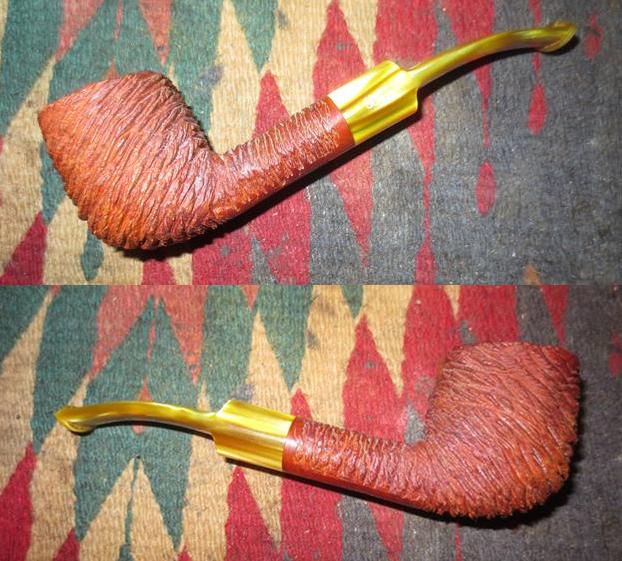
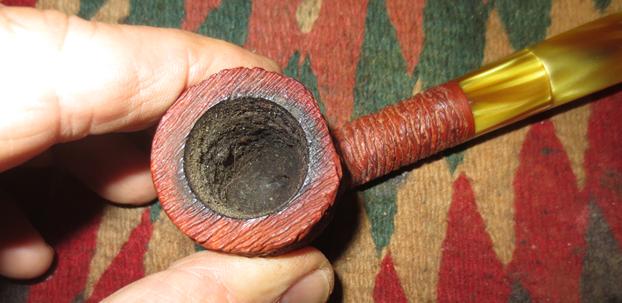
When I think about the 98-year-old steward from whose estate this Redonian Deluxe London Made came, I cannot believe he would have dreamt his pipe would one day start a new lifetime serving another steward.  I gave this old, worn pipe the nickname, ‘Gramps.’  Bear with me one more time to put a picture of ‘Gramps’ in front of the younger man he has now become.  I’m amazed at the transformation and it is why I love this hobby – the pictures speak for themselves.  I sell my restorations with the profits helping the work we do with the Daughters of Bulgaria – those sexually exploited and trafficked.  This Redonian Deluxe London Made is ready to serve a new steward.  If you’re interested in adopting him and helping the Daughters, check out ‘Gramps’ at The Pipe Steward Store.  Thanks for joining me!red55 red56 red57 red58 red59 red60