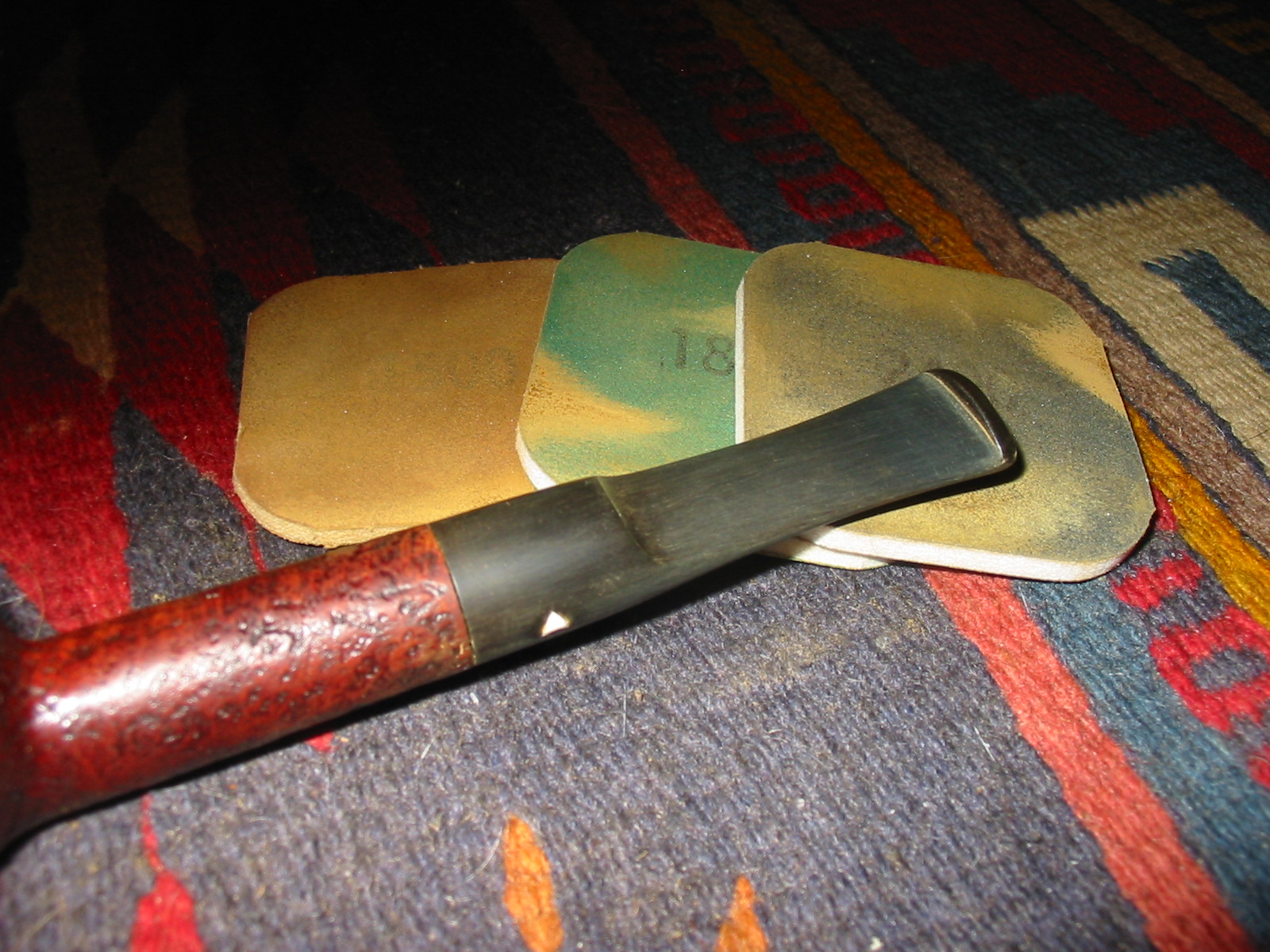
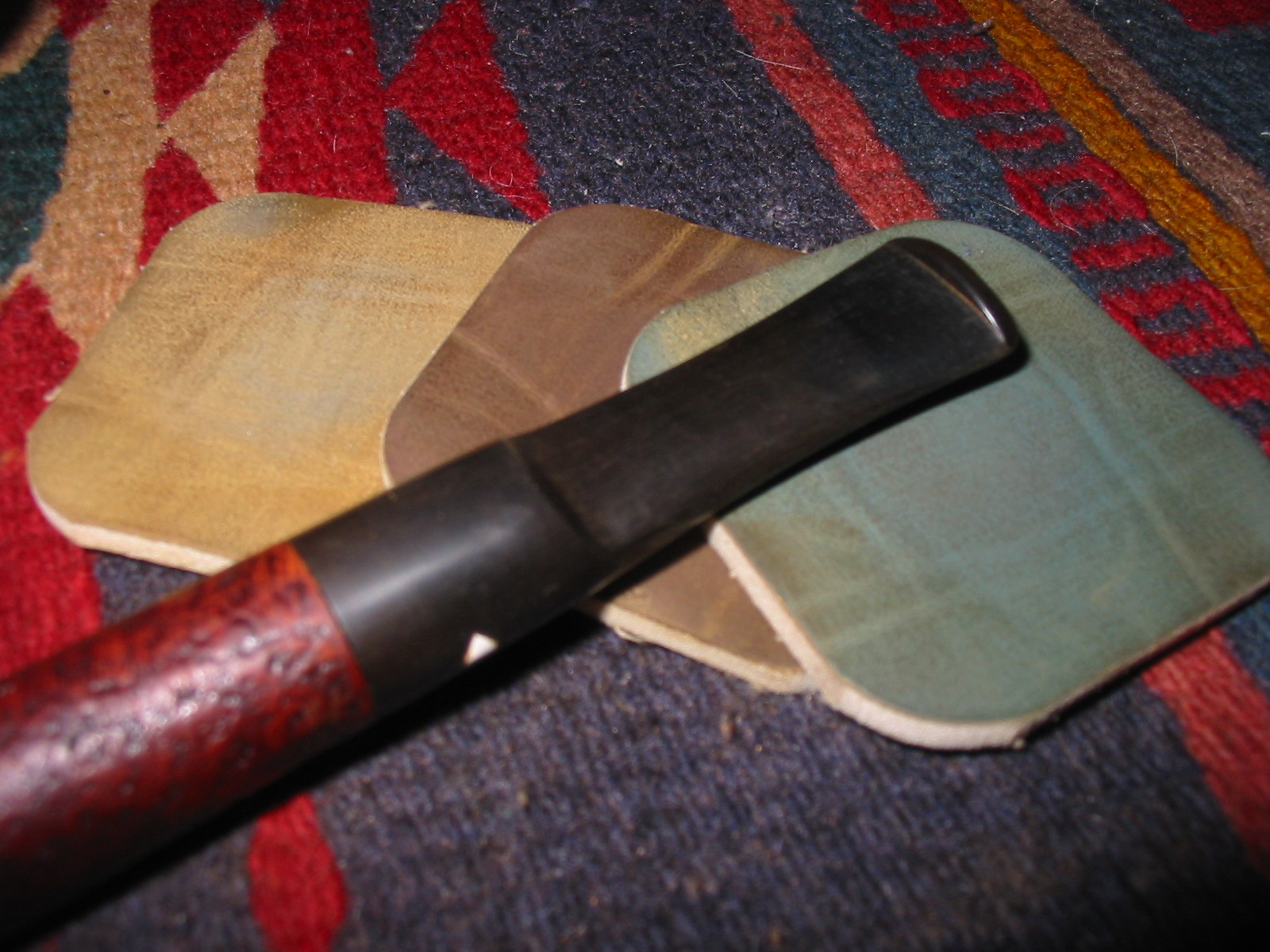
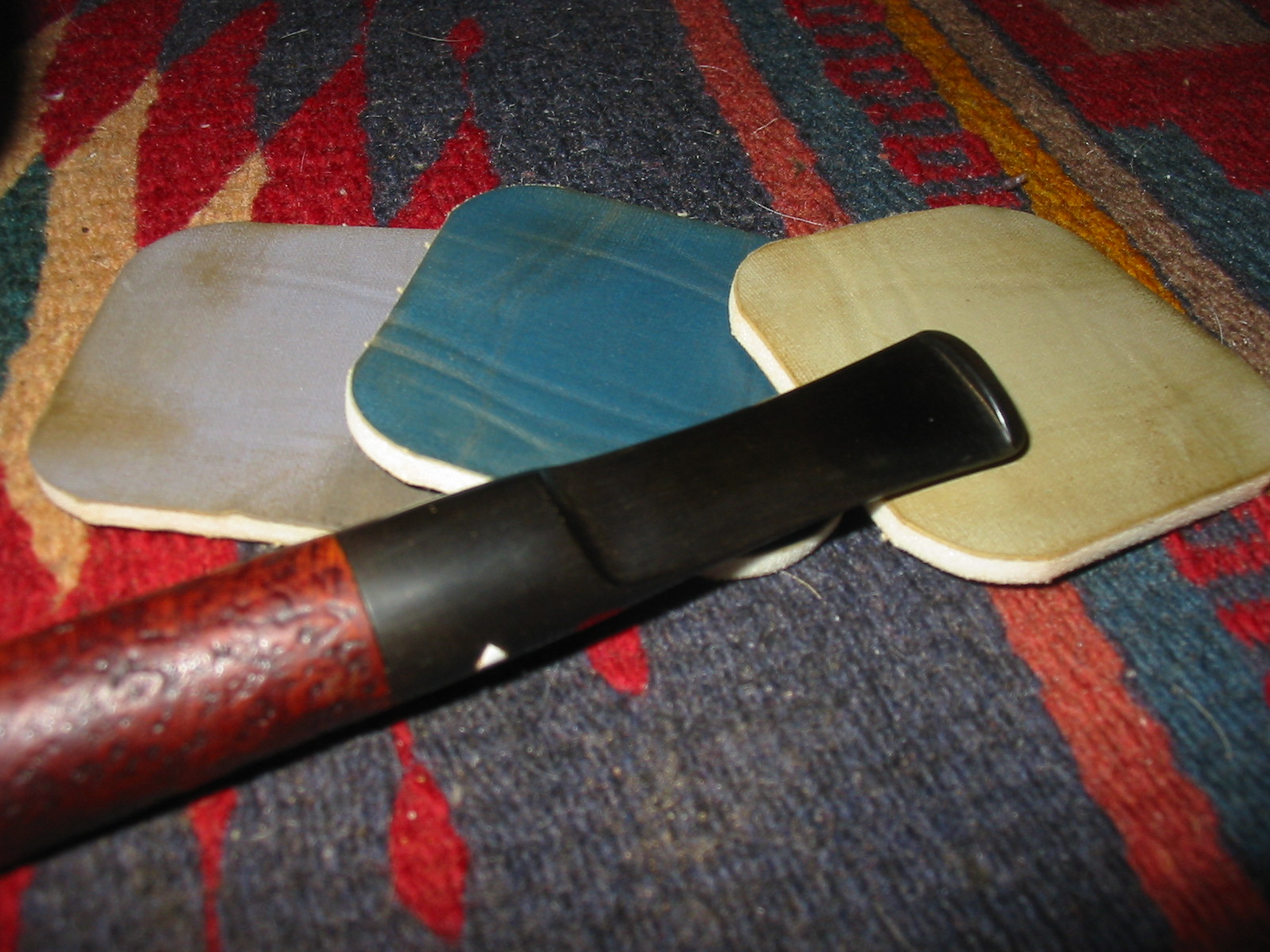
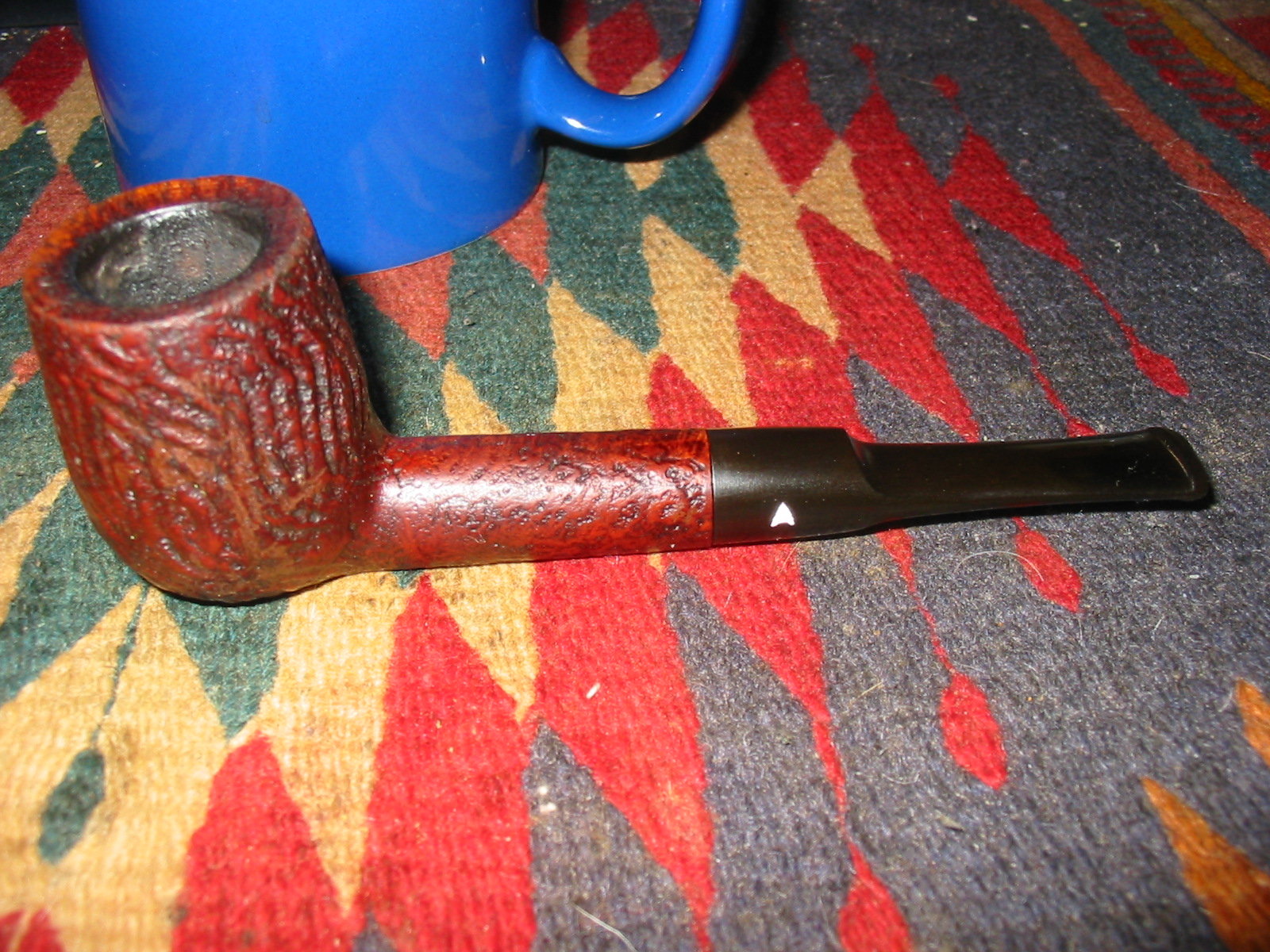
The Pipe Hunt – Rule #3: Check out every tobacco tin


Blog by Steve Laug

This third rule is one that I have learned through a lot of trial and error. I have walked through and entire shop and found nothing, only to ask at the counter if there are any pipes or tobacco items available and be taken back to a shelf of tins. The shop owner took the lid off several to reveal pipes and pipe items to me. They went back to their till and I went through the shop with new eyes. I not only found pipes in the tins but also found old tobacco that was smokable as well.I have found tins of Dobie Four Square Green, Prince Albert, Half and Half, Flying Dutchman, MacBarens Scottish Mixture, Amphora Brown and Red and others too numerous to mention all available for little cost. In every case, a little hydration and even the open tins provided enjoyment for me. It was these finds that keep me looking through old tins. I have looked and found them in antique malls, thrift shops, rummage sales, thrift shops and even garage sales. There does not seem to be any rhyme or reason to what I may find in the hunt.

This particular rule has, since that lesson from the shop keeper, played out quite naturally for me. I now always shake every tobacco tin or open each one when I come across it on the shelf. I dig through the piles of tins in the displays – not just tobacciana displays but also collectible tin displays, removing cookie tins, oil cans, spice tins etc. to hand pick every tobacco tin I can possibly check. The only way I am certain they are empty is if I can see the shiny or rusty bottom of the tin through the open lid. I take each of them down and if open, remove lid and look inside. If the tin closed I shake it and see if the contents are still inside and solid. I can often tell by the weight when I pick it up that it has something inside. I have also learned to not get my hopes up too soon as I have opened seemingly full tins with great expectancy and found button collections or nails and screws. Nonetheless I continue checking them out.

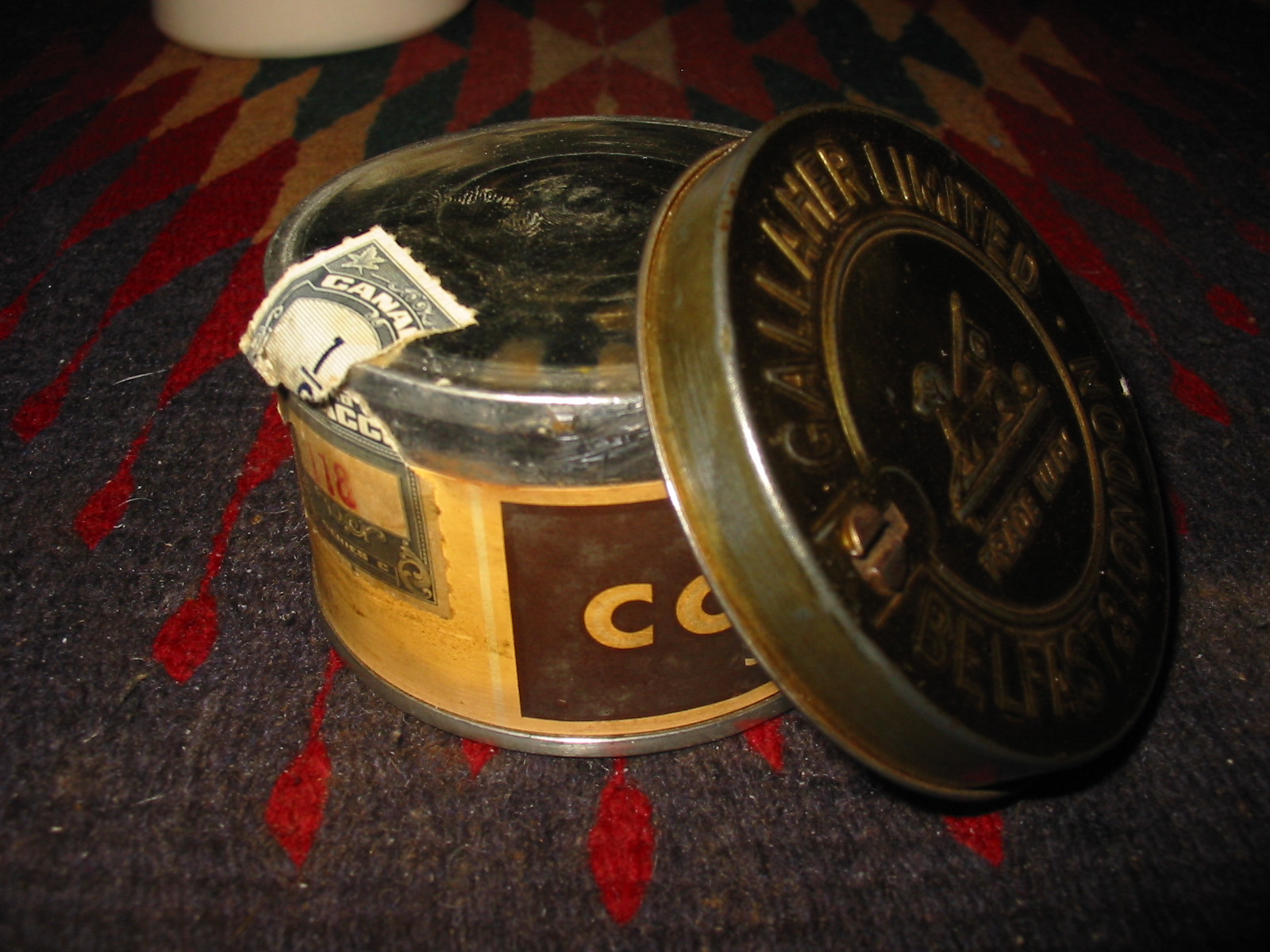
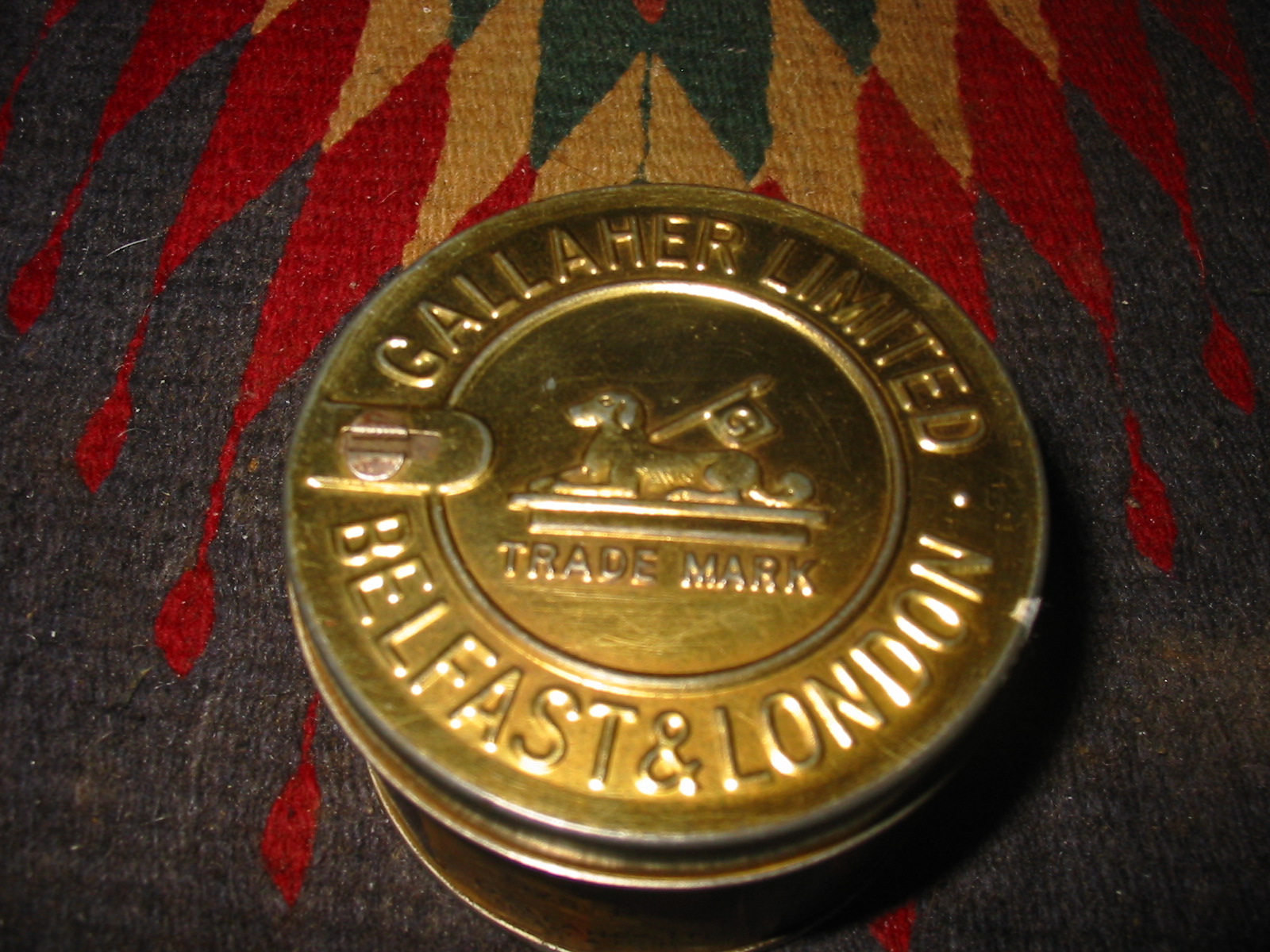
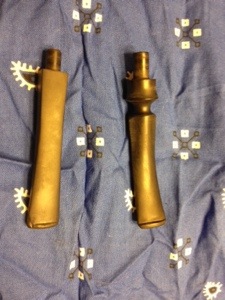
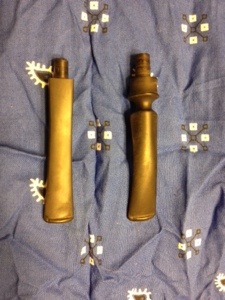
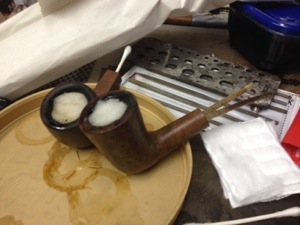
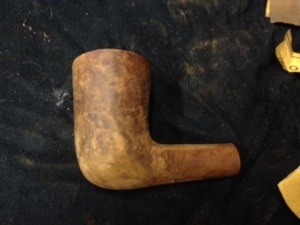
The wisdom of following this rule while I am on the hunt was proved to me twice in the last month of pipe hunting. I found two older tins of tobacco that I enjoy and which are no longer available in their original renditions. The first one was an unopened cutter tin of Gallaher’s Condor Sliced. (I wrote about finding this tin earlier on the blog https://rebornpipes.wordpress.com/2013/10/11/tobacciana-dating-an-old-cutter-top-tin-of-condor-sliced/ ) I am not entirely certain regarding the age of the tin but the seal in unbroken and the tin shows no sign of rust on the outside or at the bottom or top edges of the tin. All of which leads me to believe that the tobacco inside is still in great shape. It also does not rattle around when it is shaken which is great news to me. I have found that the rattling inside a tin is a bad sign and can mean that the seal has been broken and the tobacco may be dry and dusty. However, the point is that clearly Rule #3 was proved true once again. I reached for a tin of tobacco on display in an antique mall and came back with this old unopened tin of tobacco. The bonus for me is that it is a blend I enjoy!I am still in the process of deciding whether to smoke it or keep it in the collection for display. The verdict is still out on that decision.
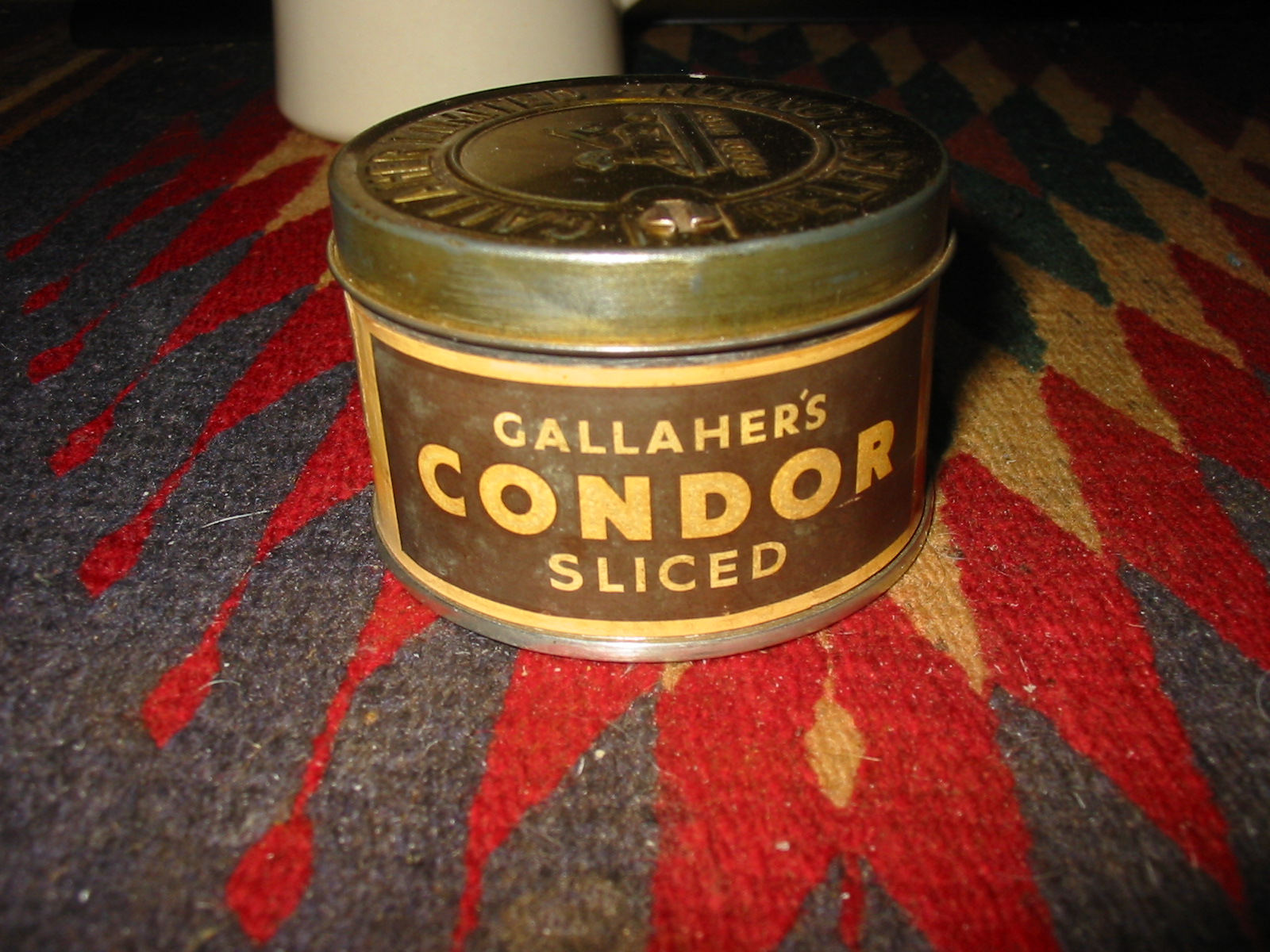
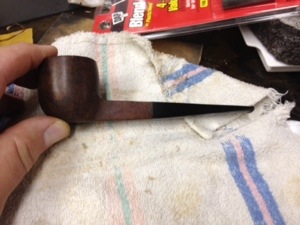
IMG_1940

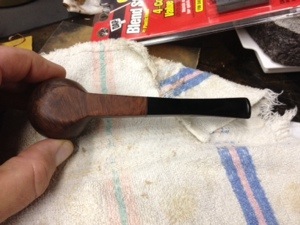
IMG_1945

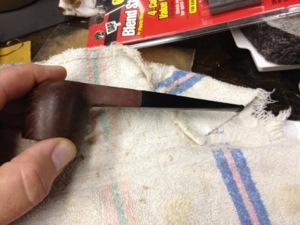
IMG_1941

The second tin that I found this past weekend when my son-in-law and I were wandering through some antique malls and shops. As usual I was on the prowl for pipes and tobacciana. This old tin was situated deep in the back of the display case that made up the front sales counter of the antique mall. It was well enough hidden that I had missed it the first two times I scanned the display looking for pipes and tobacciana. When I was settling my bill for a pipe I had found I looked down for just a moment at the case. And out of the corner of my eye I saw the tin. It was well hidden behind some other items – poker chips, lighters, decks of cards and pocket knives so it was easy to pass over. I paused in my paying the bill and asked the clerk if I could see the tin. As she moved the other pieces away from it I could see the tin still had a lid on it and seemed like it also had something inside from the way she handled it as she gave it to me.

I took the tin in my hand and found it had a bit of weight to it – it was not empty. I gave it a light shake to see if the items inside rattled – if it was tobacco it would have a different kind of rattle than nails or screws or even buttons. It sounded like tobacco to me. I checked the lid and could see that it had been opened. I twisted it off and found that when I opened it there was a slight whoosh of air meaning that there was still a seal on the tin. When it was open, I could see that the tobacco inside was a broken flake and was not dried out too much. I picked up a small piece and found that it still had some bend and play in it rather than crumbling in my fingers.

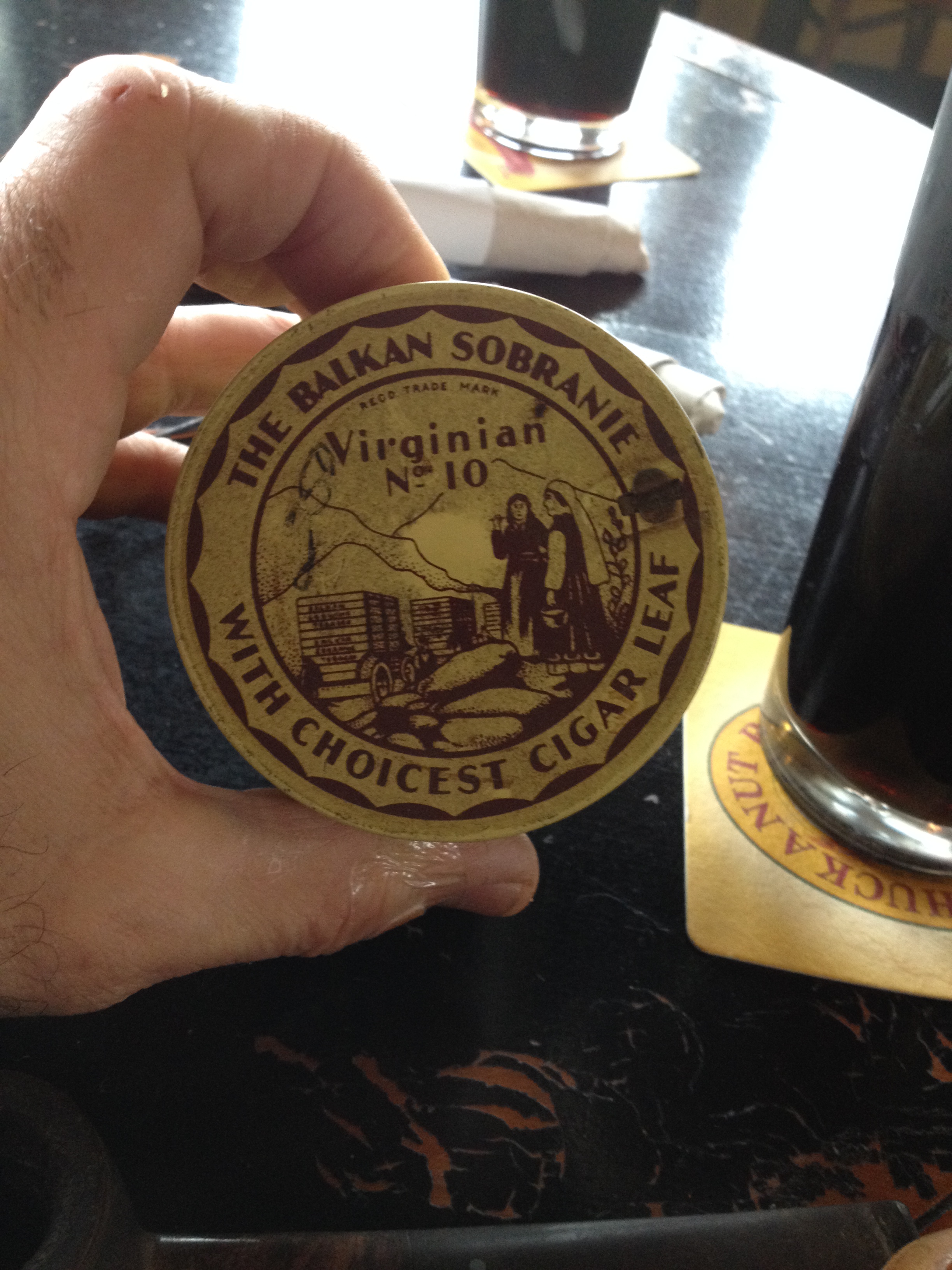
This tin was an old cutter top can of Balkan Sobranie Virginia No. 10. I have smoked this blend in the past and thoroughly enjoyed the taste of it so I was sold on it before I knew the cost. I looked on the backside of the can and saw that they were selling it for $4 – a full four ounce tin of very mature and smokable Virginia. It smelled heavenly and the low price for a tin of this age made my heart skip a beat. That fact that it was full was a bonus to me no matter what the clerk thought. She apologized for the “inconvenience” of the tobacco still in the can, but I was excited about it. I decided to play it cool though and settled my accounts – a pipe and the tobacco and left the store having spent just under $15 US. Once outside to the car, I explained what I had found to my son-in-law and then opened the tin and took a deep whiff. This tobacco smelled divine and the moisture content was perfect for smoking according to my liking. It sits on my desk waiting for me to fill a pipe this evening and give it a smoke.
IMG_0486

IMG_0488

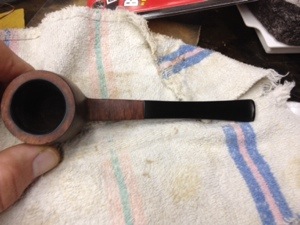
Both of these finds illustrate the point of Rule #3. It is worth checking all old tobacco tins for potential finds. Some will have tobacco that you can smoke and others will have pipes, tampers, lighters or pouches that can still be used. The list of finds that I have come across leads me to continue to shake and check out all the old tins that I come across on my journeys. I know that each and every tin I pick up could potentially have something worth keeping inside its confines. Whether that find be a pipe related item or just some good smoking tobacco really does not matter to me for both are part of the potential that keeps me picking up old tins and checking them out.
GBD Century Pot Reclaimed


Blog by Greg Wolford

This GBD pot shaped pipe came with the Edwards Algerian Briar that I restored recently. Most of the stem work and clean-up done on this pipe was done at the same time as the Edwards and in the same manner, so I won’t go into that process in this article but you can read it here.

The stem was, upon closer inspection, a replacement; there are no markings, the tenon is a tad short, and you can see the tool marks from the turner. The nomenclature was very faint and I needed good light and some magnification to read it accurately. The right side of the shank has the GBD in an oval and the model Century stamped on it. The left side has the London England in a straight line, meaning it is a pre-Cadogan pipe that should’ve had an inlaid rondel on the stem, over the shape number 9486. Since the stamping was so faint already I didn’t want to risk any sanding or buffing and make it worse, or remove it. I decided to only top the bowl and sand nowhere else on this pipe. These photos are post-alcohol bath, cleaning and most of the stem work.

20131019-210745.jpg

20131019-210757.jpg

20131019-210809.jpg

20131019-210822.jpg

20131019-210837.jpg

I used 320 grit wet/dry paper to top the bowl, which was badly dinged and burned. I worked it in circles on my bench, checking every so often on the progress. I worked out a smooth, flat rim with much of the charring gone. But the edges had a few sharp dings that I ended up leaving rather than trying to take the bowl down much farther or bevel off the nice edge I’d gotten. The finish now was non-existent on the rim and my options were pretty limited on how to match it up again; I decided that the stain markers I’d recently bought were the best choice and started with them. I “drew” on the finish with the marker one “round” at a time, blending it with my finger, and letting it set for a minute of so before continuing. When I got the rim to a point I was okay with I moved on to that last of the stem work.

I micro meshed the stem from 1500-4000 grits. The stem wasn’t ultra shiny but the pipe was not going to be a prize so I was happy with the level of shine and removal of oxidation I had and stopped there.

Since I didn’t want to buff the pipe I opted to wax it by hand. Before any wax, I polished the stem and the stummel with plastic polish, not something I’ve ever done before and actually by accident this time; I was polishing the stem and absentmindedly applied the polish to the wood before I realized it. I recalled someone reviewing another polish somewhere saying “an abrasive is an abrasive, no matter what it’s intended purpose” and I hoped I hadn’t made anything worse. It actually made the wood look better, and also the stem, to my surprise without harming the nomenclature.

After I buffed the entire pipe clean by hand with an old t-shirt, I applied some paste wax by hand and let it set up for about 10 minutes before hand buffing it back off, to a fairly nice shine. This is the completed pipe:

20131019-212602.jpg

20131019-212613.jpg

20131019-212626.jpg

20131019-212637.jpg

I’m not a big fan of the pot shape, though I do like GBDs in general. The pipe’s poor condition that I received it in made it hard to do a restoration on without re-stemming it and possibly reshaping the bowl and loosing the stamping altogether. I don’t know what I’ll end up doing with this one yet – I may still re-stem it when I get a square stem to do it with – but I do believe this reclaimed briar will still make someone a good smoker, just not a stunning looker.

Medico Ventilator — Unventilated (Thanks Ed for the idea)


When I read this post by Ed James (Ozark southpaw) on Pipe Smoker Unlimited. This is the link to his post: http://pipesmokerunlimited.com/showthread.php?3186-Medico-Ventilator-unventilated I thought I would love to try that as well. Here is Ed’s first post in that thread that got me started thinking about the project. Ed also is a refurbisher of long standing and does excellent work. Here is his website: http://www.ozarksouthpawpipes.com/index.html

On PSU Ed wrote; “I’ve had a few of these and they smoke fine, although sometimes it was hard to get the filter seated so the pipe will draw as it should. If you’re not familiar with the Ventilators, they cannot be smoked without a filter. I smoke mostly filtered pipes, but thought I would see if I could make a Ventilator filterless. Accomplished it by turning a piece of briar the length of the shank and epoxying it in place. For the stem I used a vulcanite blank after replacing the tenon with delrin and adding a ring of tortoise shell acrylic. On my third bowl in it and it is smoking fine.”

Here is the pipe – pictured below. It is a nice looking sandblast that Ed “unventilated”.
Un-Ventilated Ventilator 2013-08-27 001 (1280x960)

Un-Ventilated Ventilator 2013-08-27 003 (1280x712)

Un-Ventilated Ventilator 2013-08-27 005 (1280x1013)

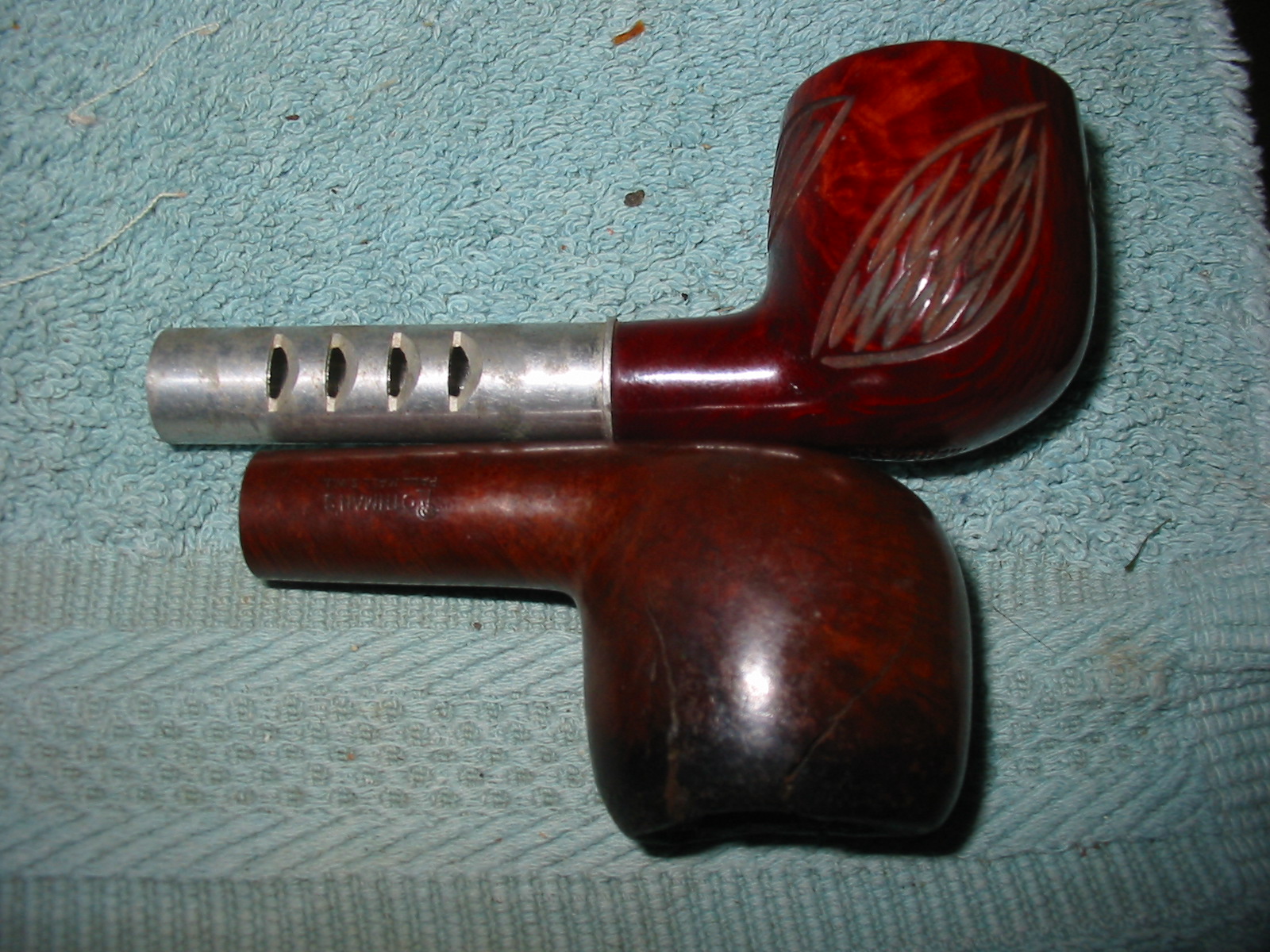
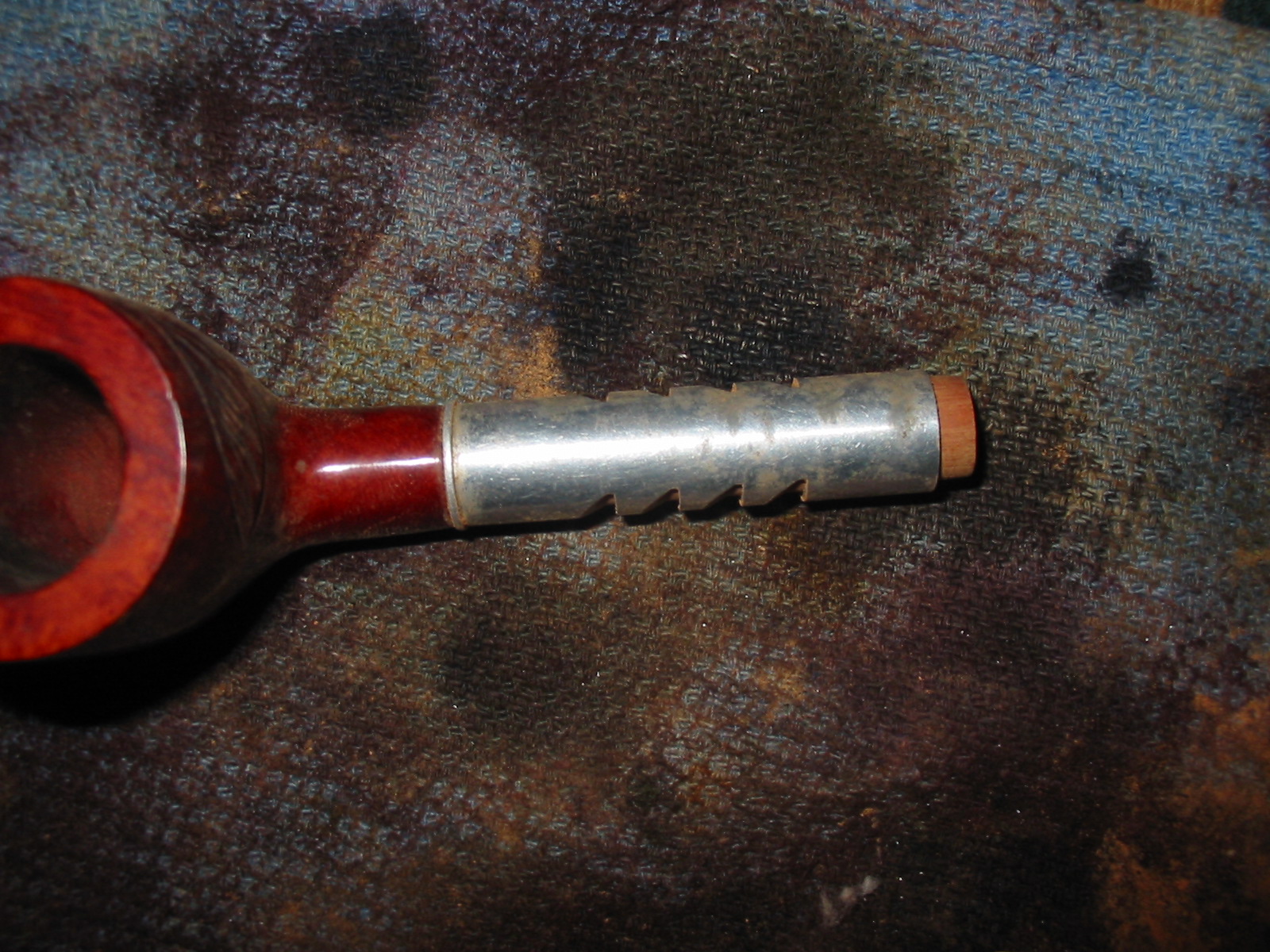
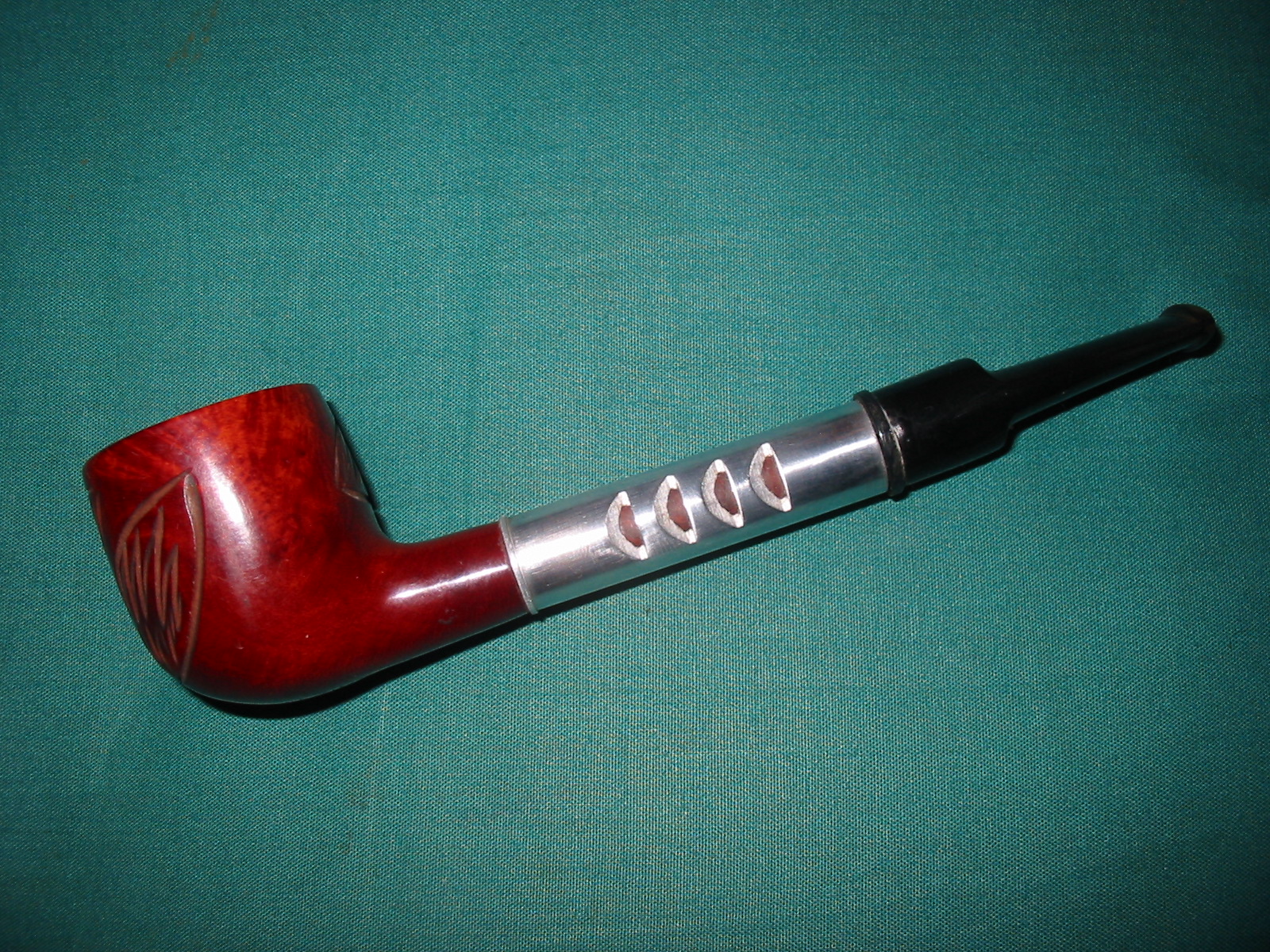
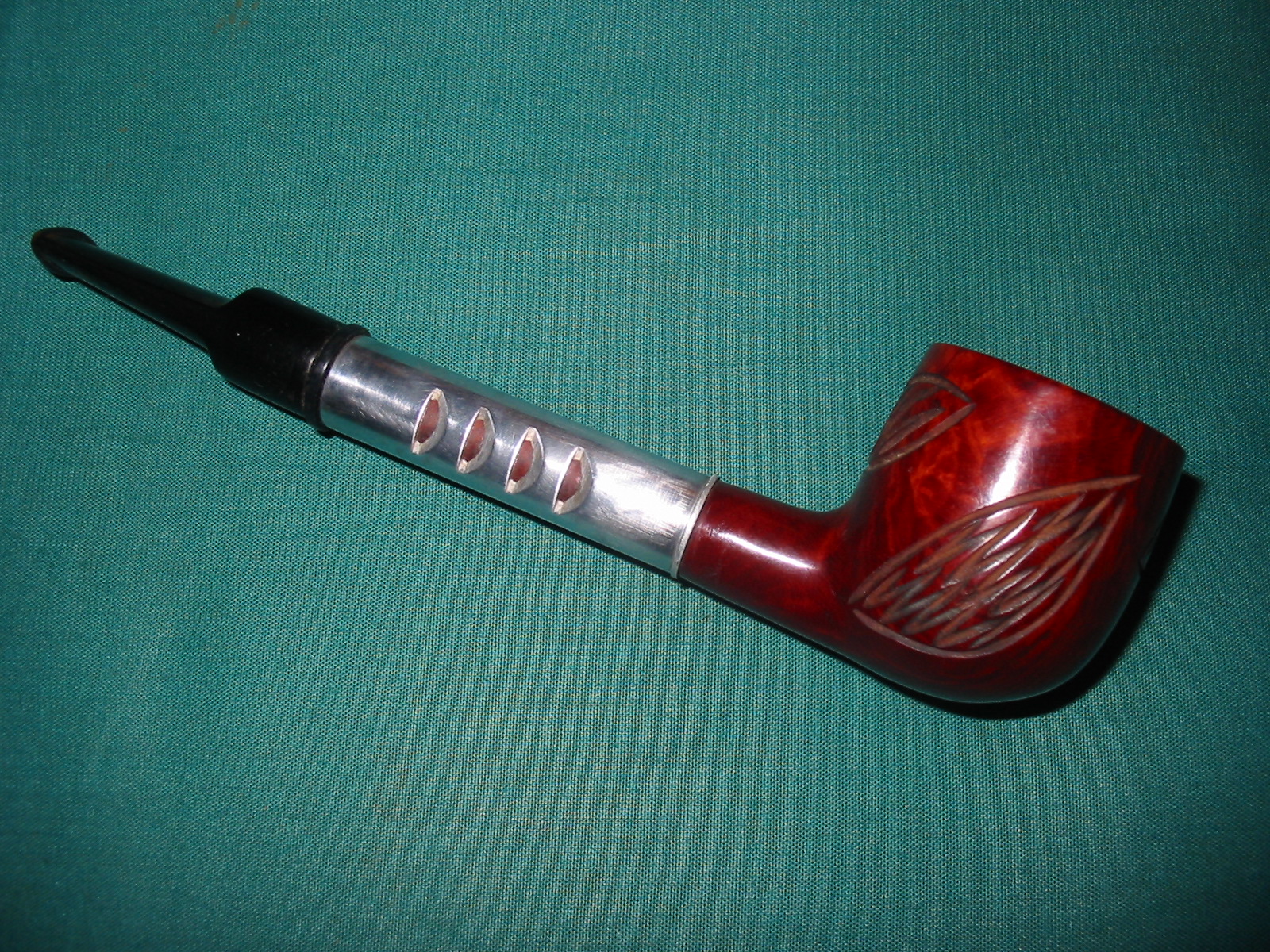
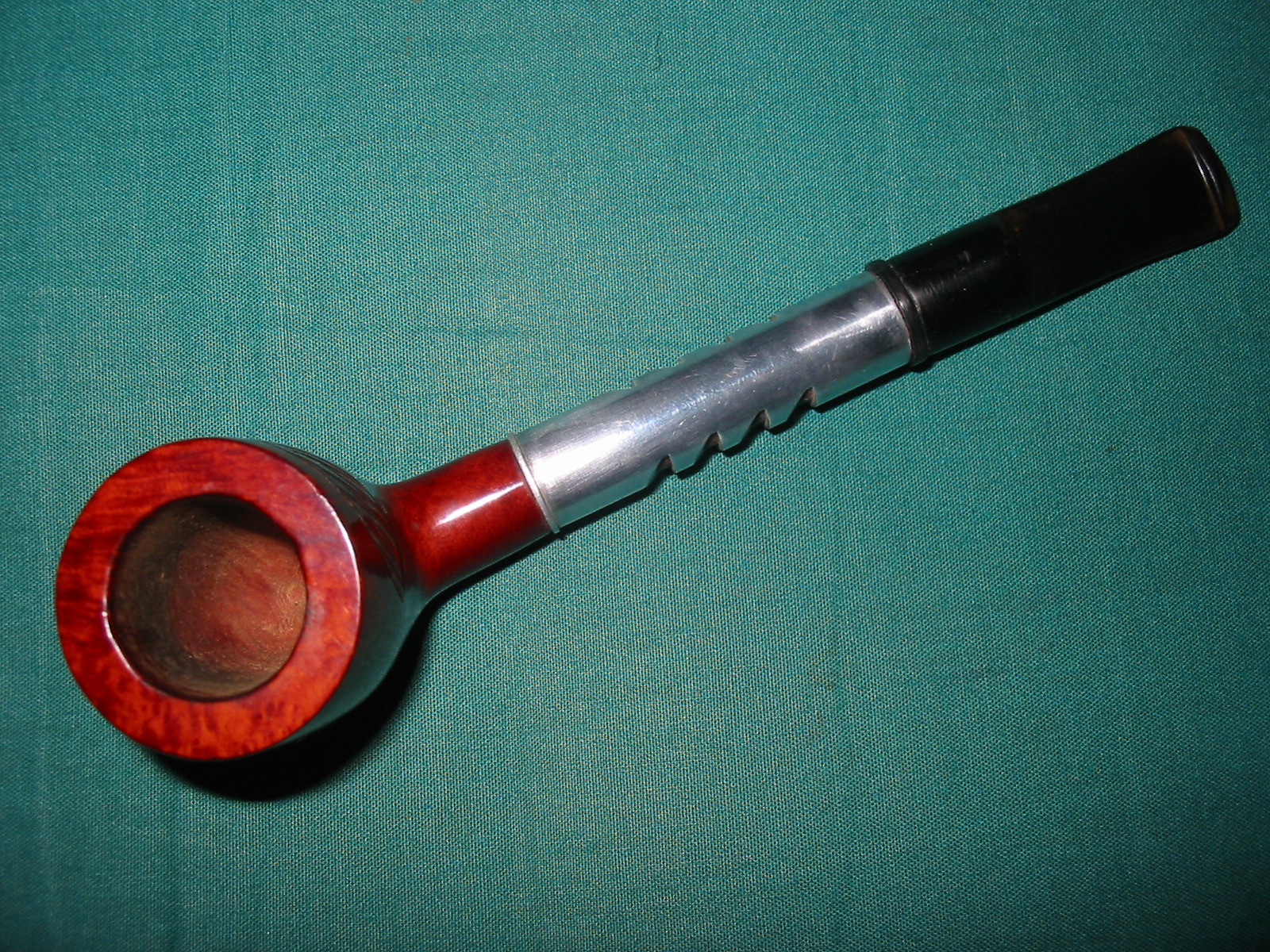
So today was the day that I got to finally work on “unventilating” one of my own. Mark Domingues (dogtalker) recently sent me a few old bowls and pipe parts that needed some work. In that package was a Medico Ventilator. It was not as nice as the one Ed worked on, pictured above, but it was a Ventilator sans stem nonetheless and it was the opportunity I was looking for to try my hand at unventilating the Ventilator. This bowl was absolutely clean. I don’t think that it had been smoked other than maybe the first light or so. The bottom 2/3s of the bowl was still virgin briar. The bowl had the typical Medico lacquer coat and there were carved leaves all around the outside of the bowl. I decided to leave the finish alone and rework it as it stood. One day I may remove the finish but for now it will remain as it is.
IMG_2148

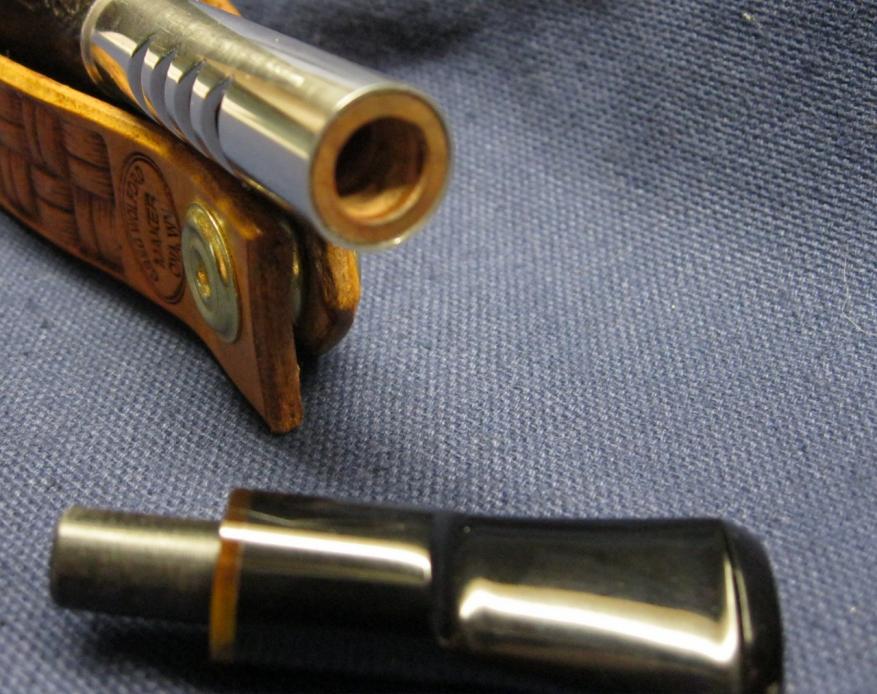
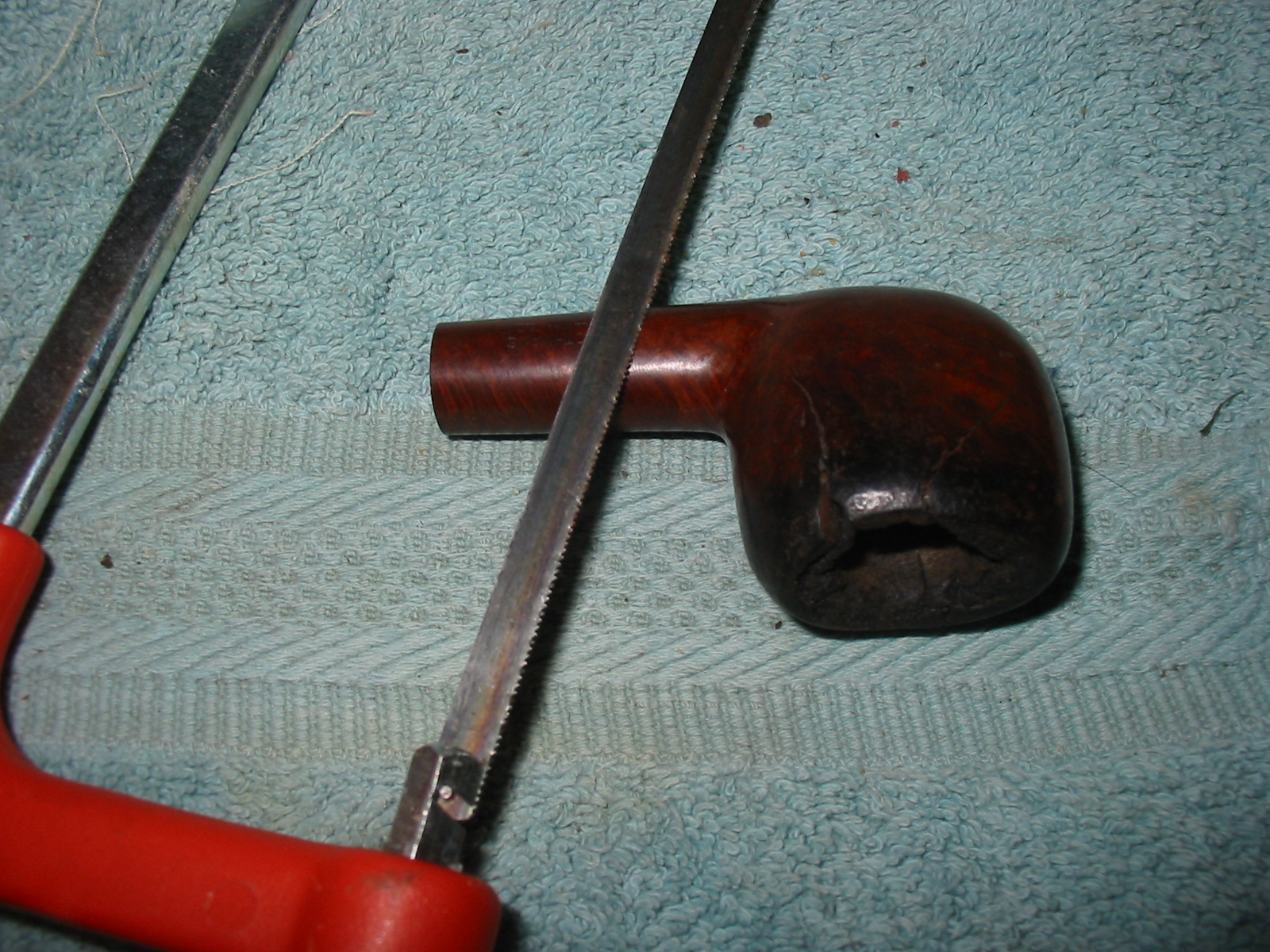
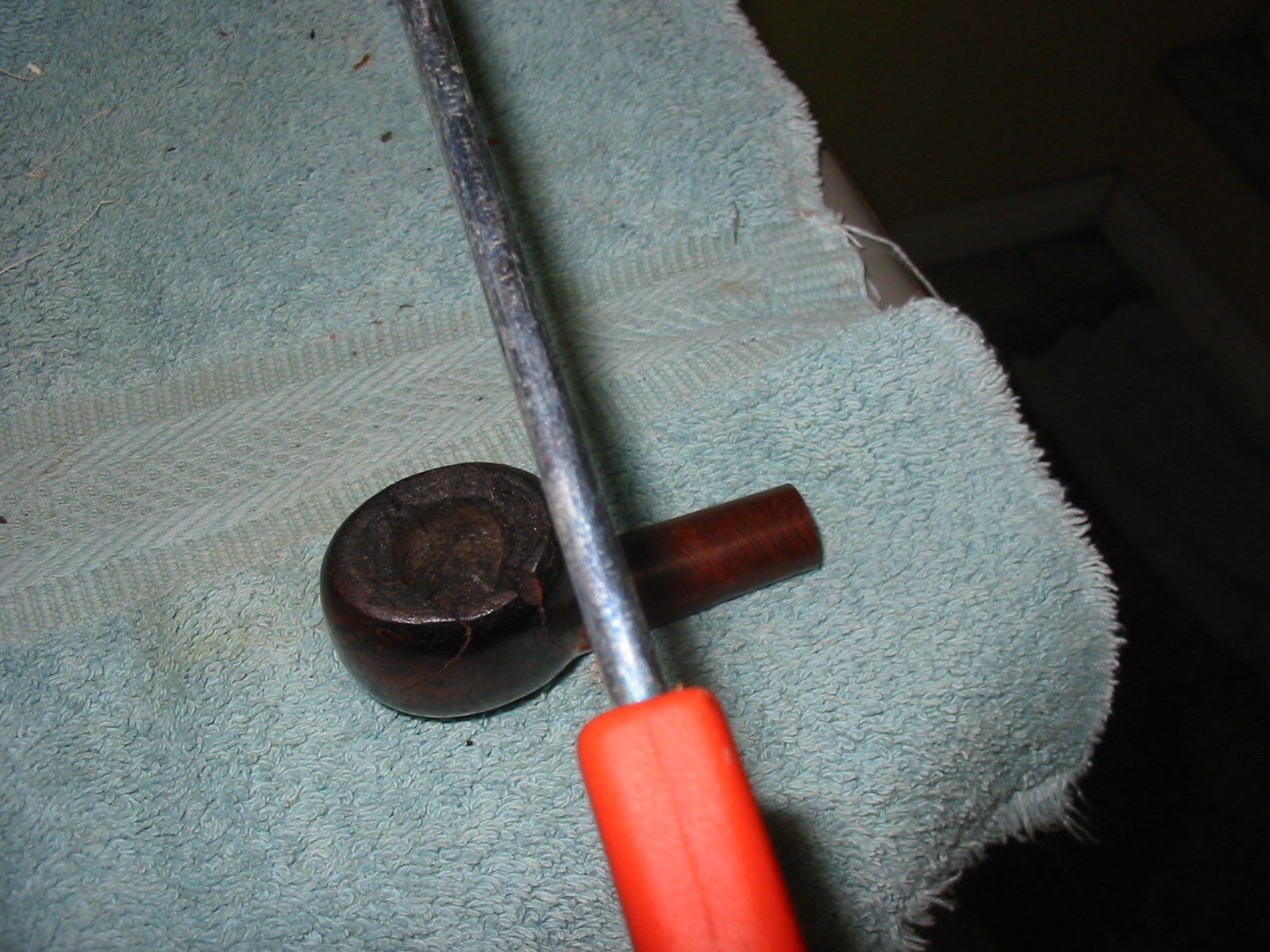
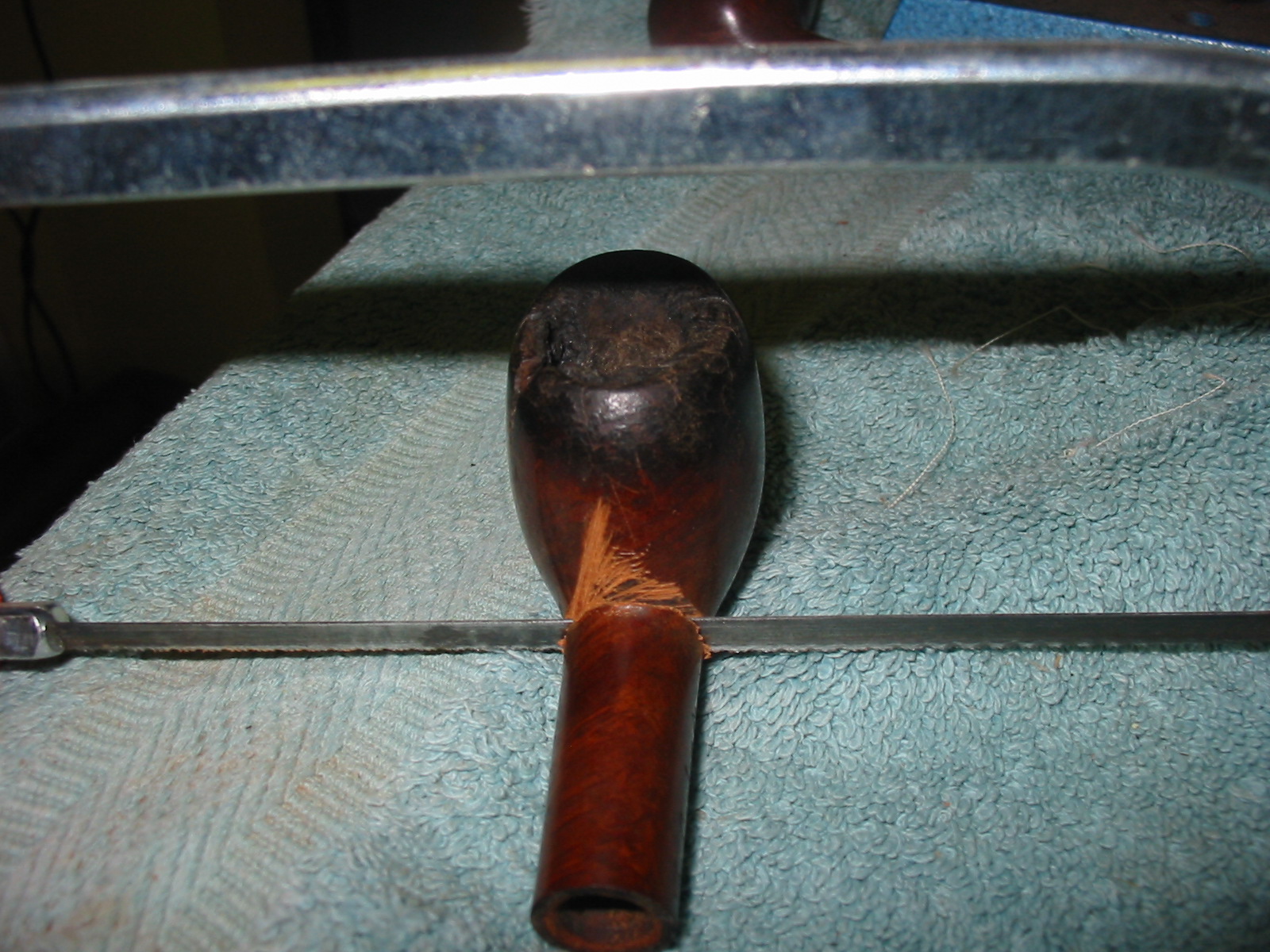
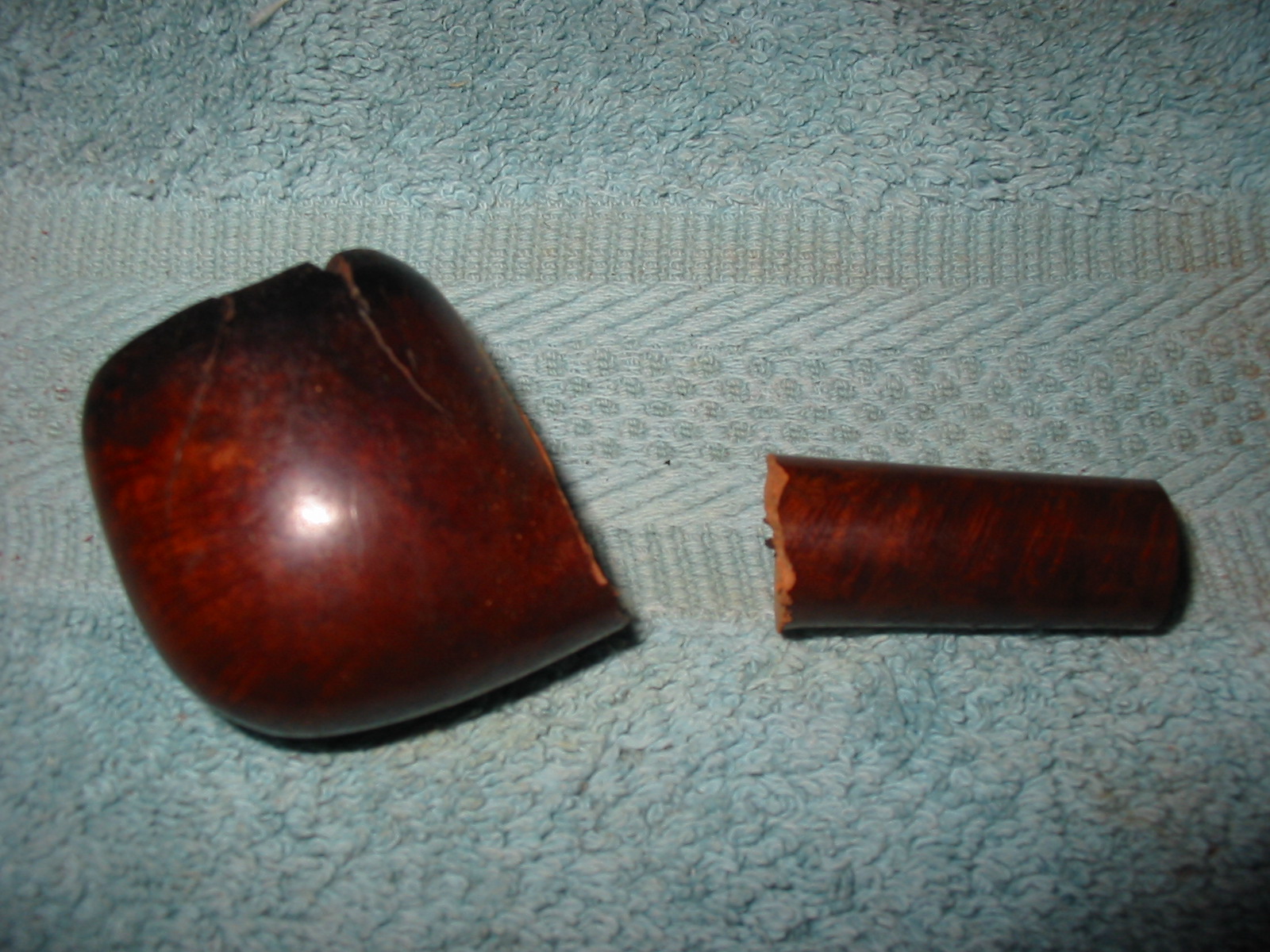
I have kept a few unredeemable bowls around in my box of stuff and they came in handy this time. I took two different bowls out of the box and used a hack saw to cut off the shank as close as I could to the back side of the bowl. My plan was to follow Ed’s instructions noted above about turning a piece of briar to fit inside the Ventilator tube. I do not have a lathe so I decided to repurpose some briar shanks to do the same job.
IMG_2151

IMG_2152

IMG_2153

IMG_2154

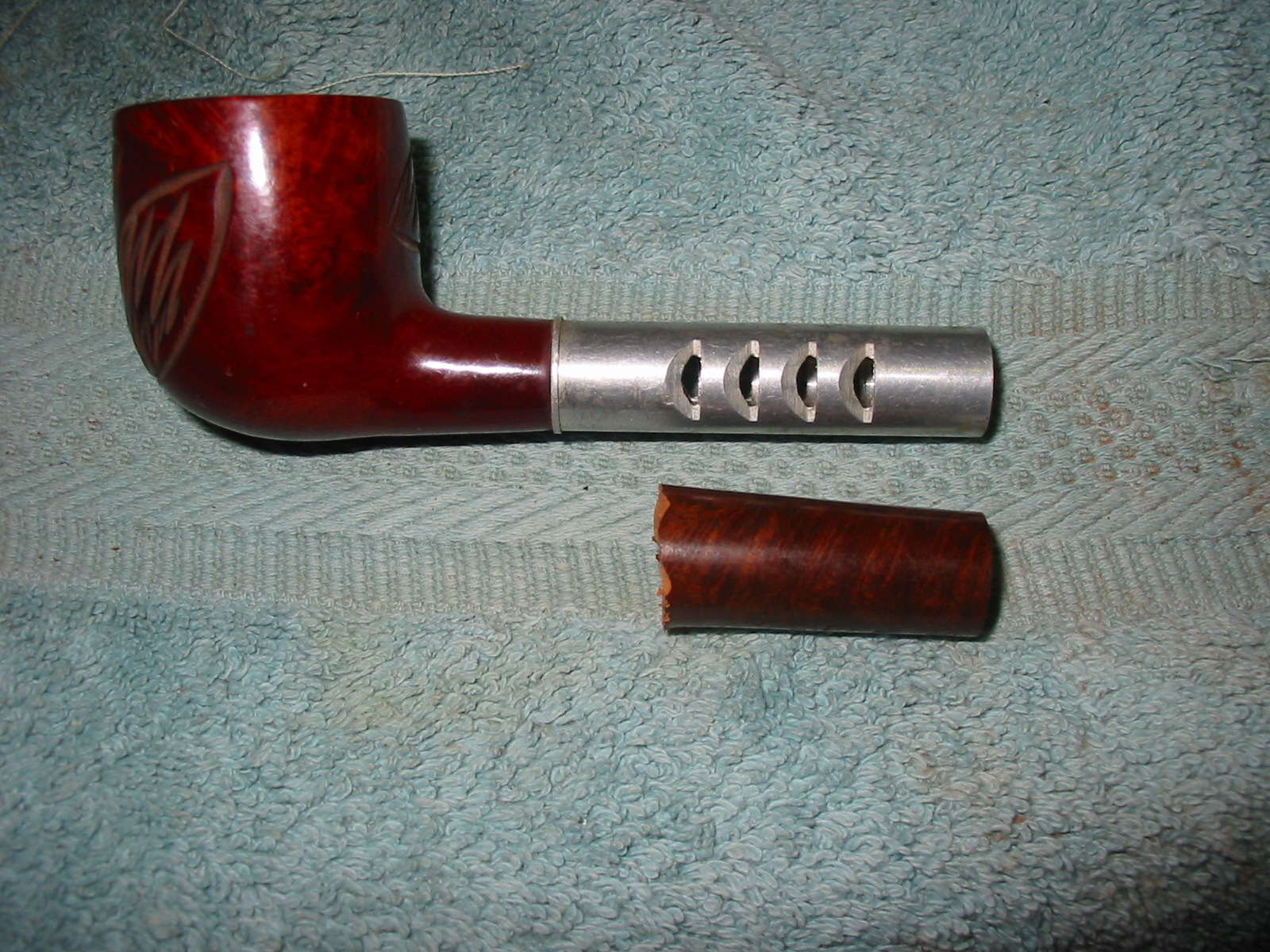
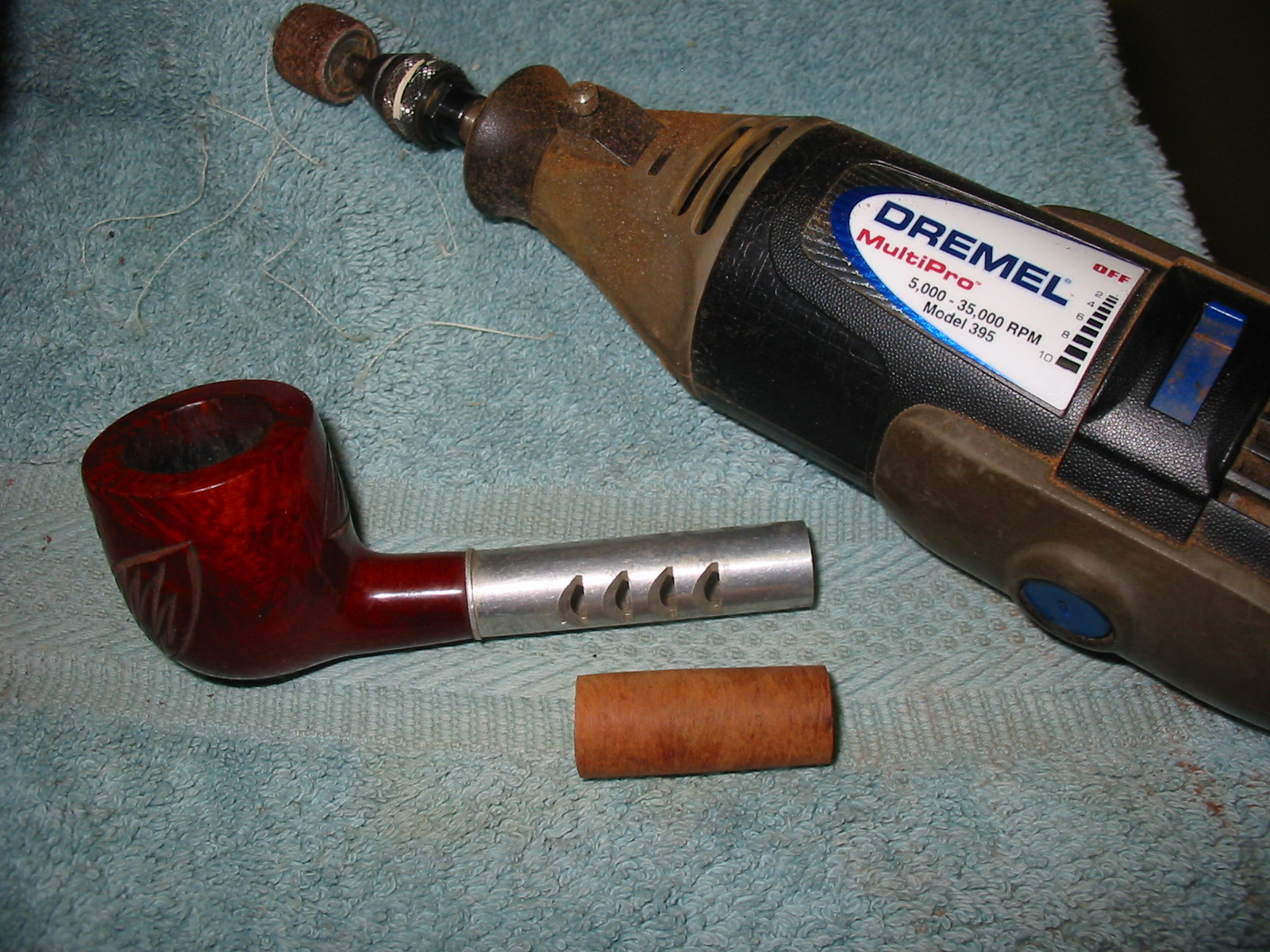
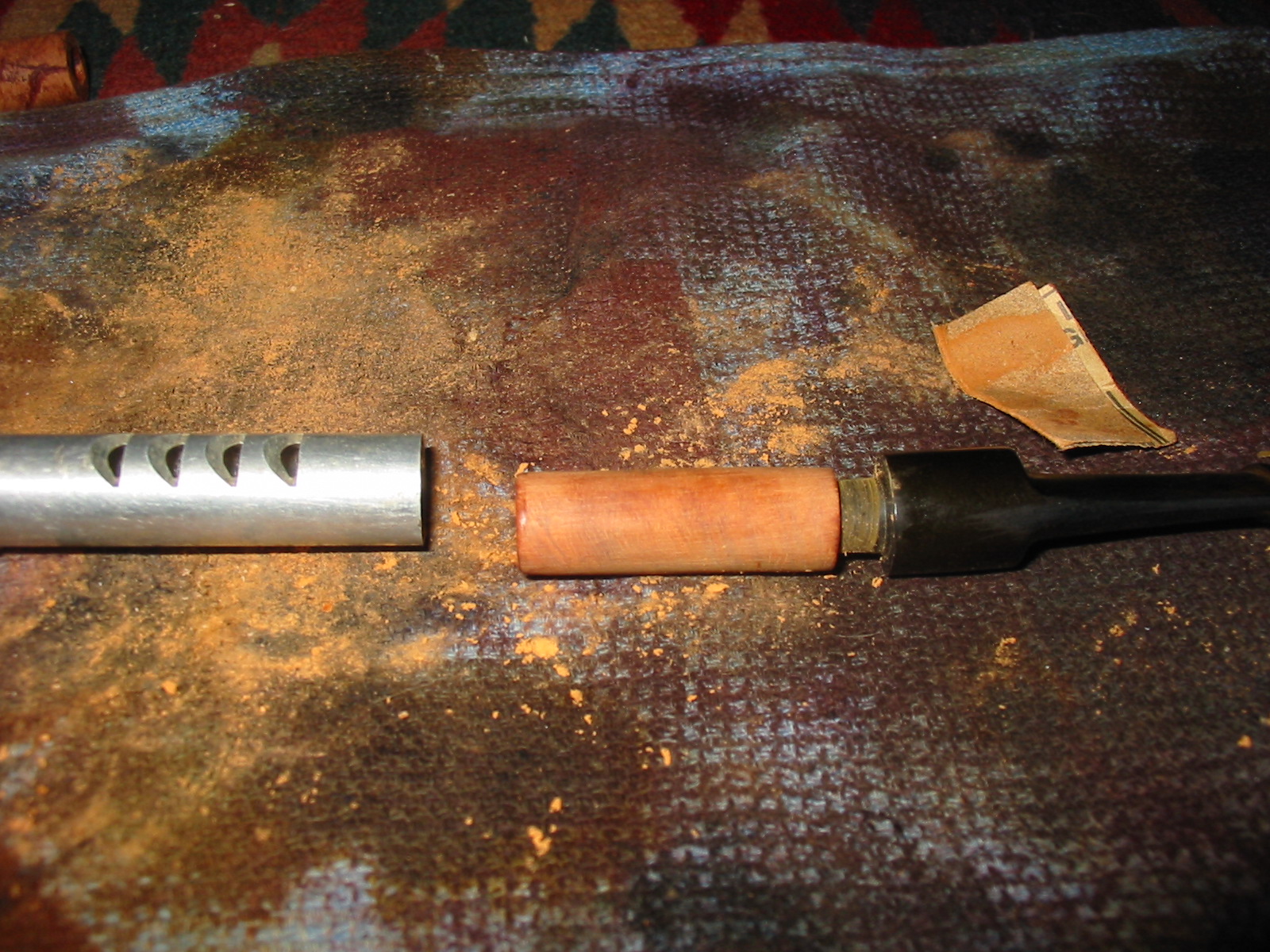
After cutting them off the bowl they were ready for me to begin shaping them. I used a Dremel and sanding drum to take the diameter of the cut off shanks down to the diameter of the tube on the Medico. The next seven photos show the process of removing the excess briar. I used two different pieces of slightly different lengths that could be used depending on the stem I chose to use. The one pictured in the first seven photos below was about ½ inch shorter than the length of the tube. I thought about using a plug in the bottom of the tube but later decided to use the longer of the two briar tubes.
IMG_2155

IMG_2156

IMG_2157

IMG_2174

IMG_2171

IMG_2172

IMG_2173

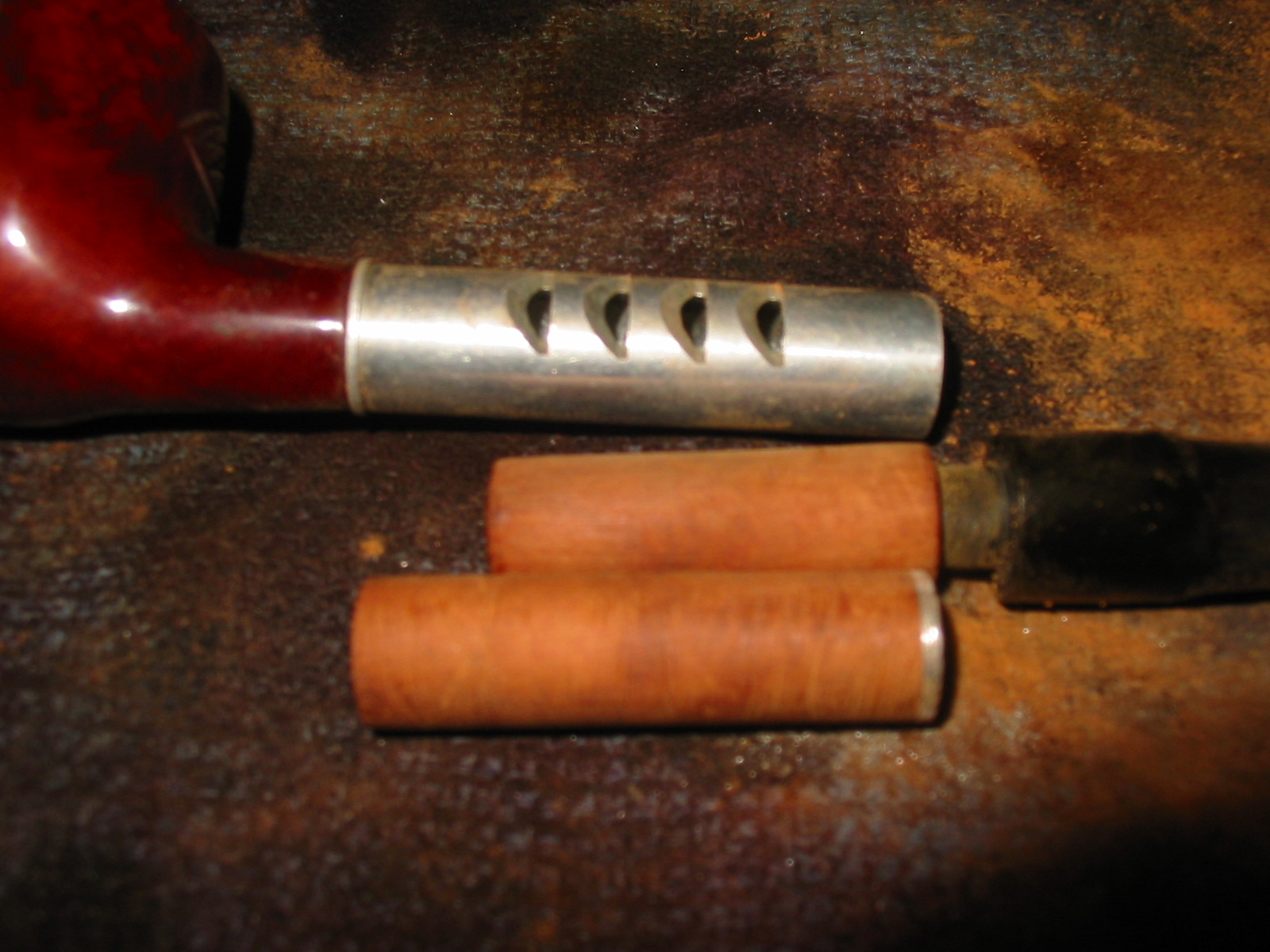
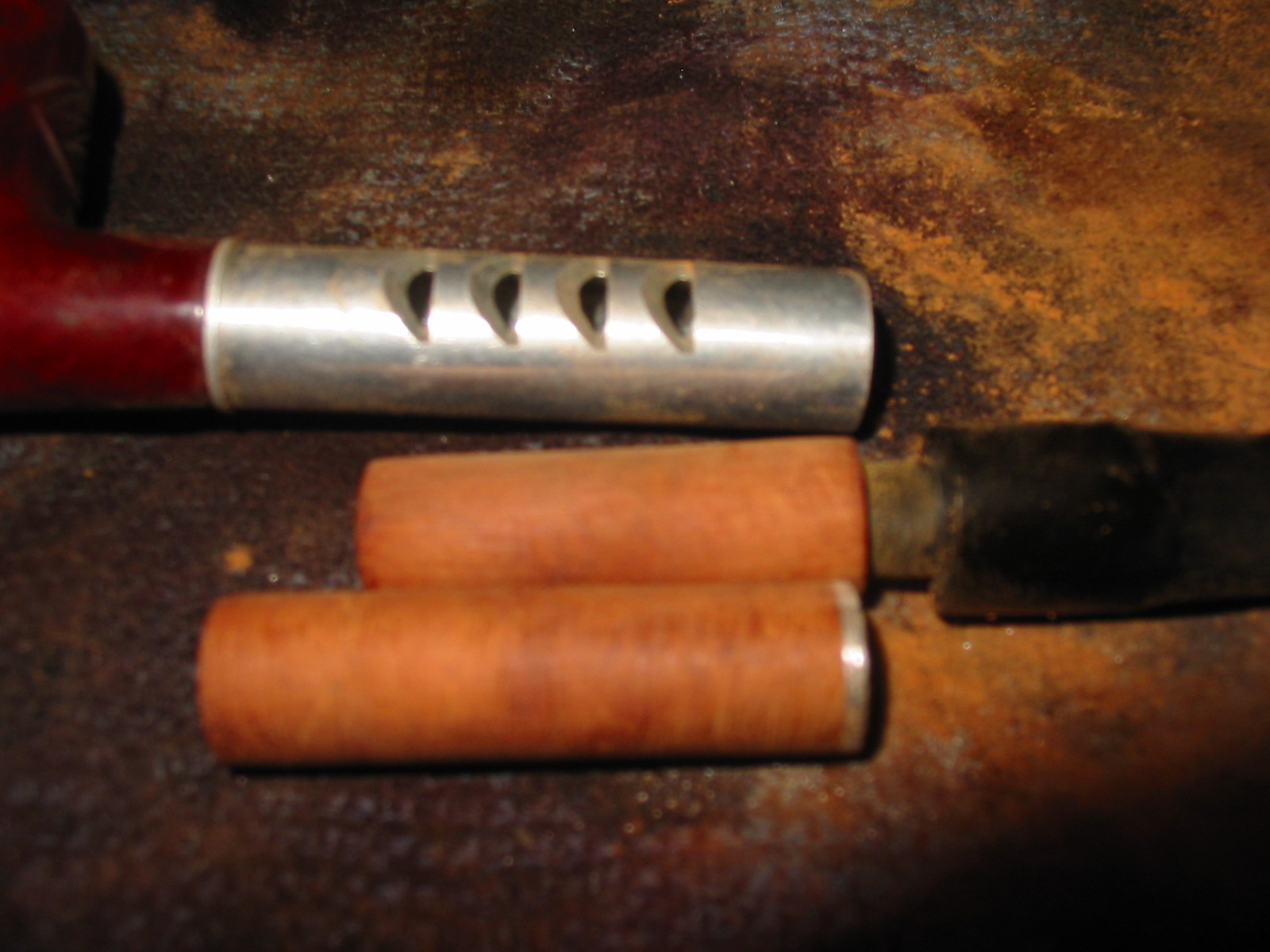
I used both the Dremel and 220 grit sandpaper to shape the briar tube to fit in the Ventilator. The first one was just briar. The second one was off of a screw mount shank. I decided to leave the aluminum in the shank and use that to but up against the aluminum seat in the Ventilator tube.
IMG_2158

IMG_2159

IMG_2160

I sanded both tubes so that I could try both and see which one I wanted to use. I chose the long of the two with the aluminum base. I inserted it in the shank of the Ventilator with the aluminum end in first. I pressed it into place in the tube. It is a pressure fit so I did not need to glue it to fasten it in place. I chose not to use epoxy or glue to hold it in place and opted instead for a tight fit. Once in place it was slightly longer than the tube. The aluminum was tight against the interior and could go no further. I used the Dremel with the sanding drum on it to remove the excess briar. Once was flush against the aluminum it was time to fit a new stem to the shank.
IMG_2161

IMG_2162

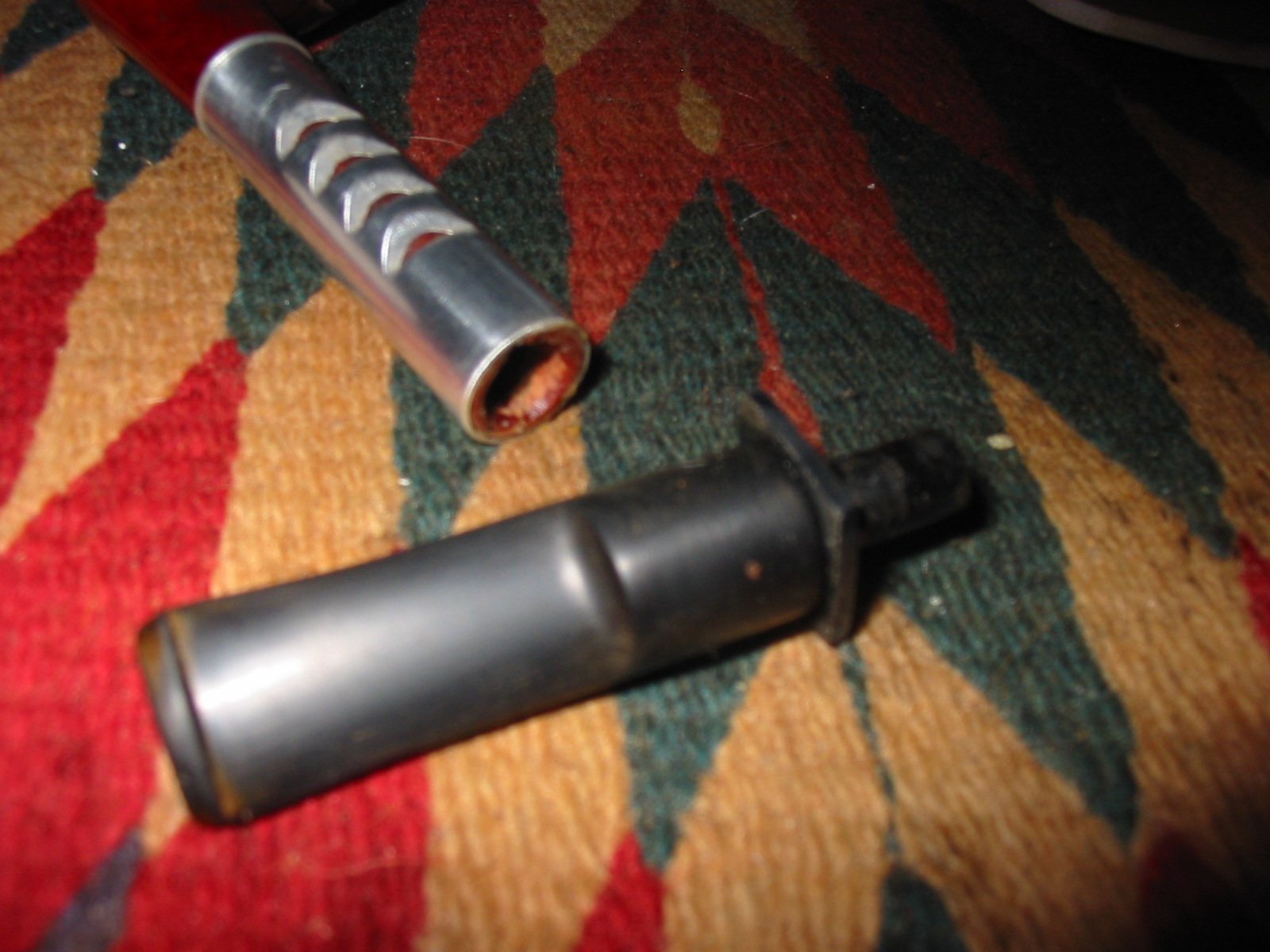
I had several saddle stems in my can of stems that would work on the new shank insert. I turned the tenon down with a PIMO tenon turner until it was close to the right size and then finished with sandpaper and files. I used a file to shape the seat in the insert so that the stem would sit well against the tube. The next three photos show the newly seated stem in place.
IMG_2164

IMG_2165

IMG_2168

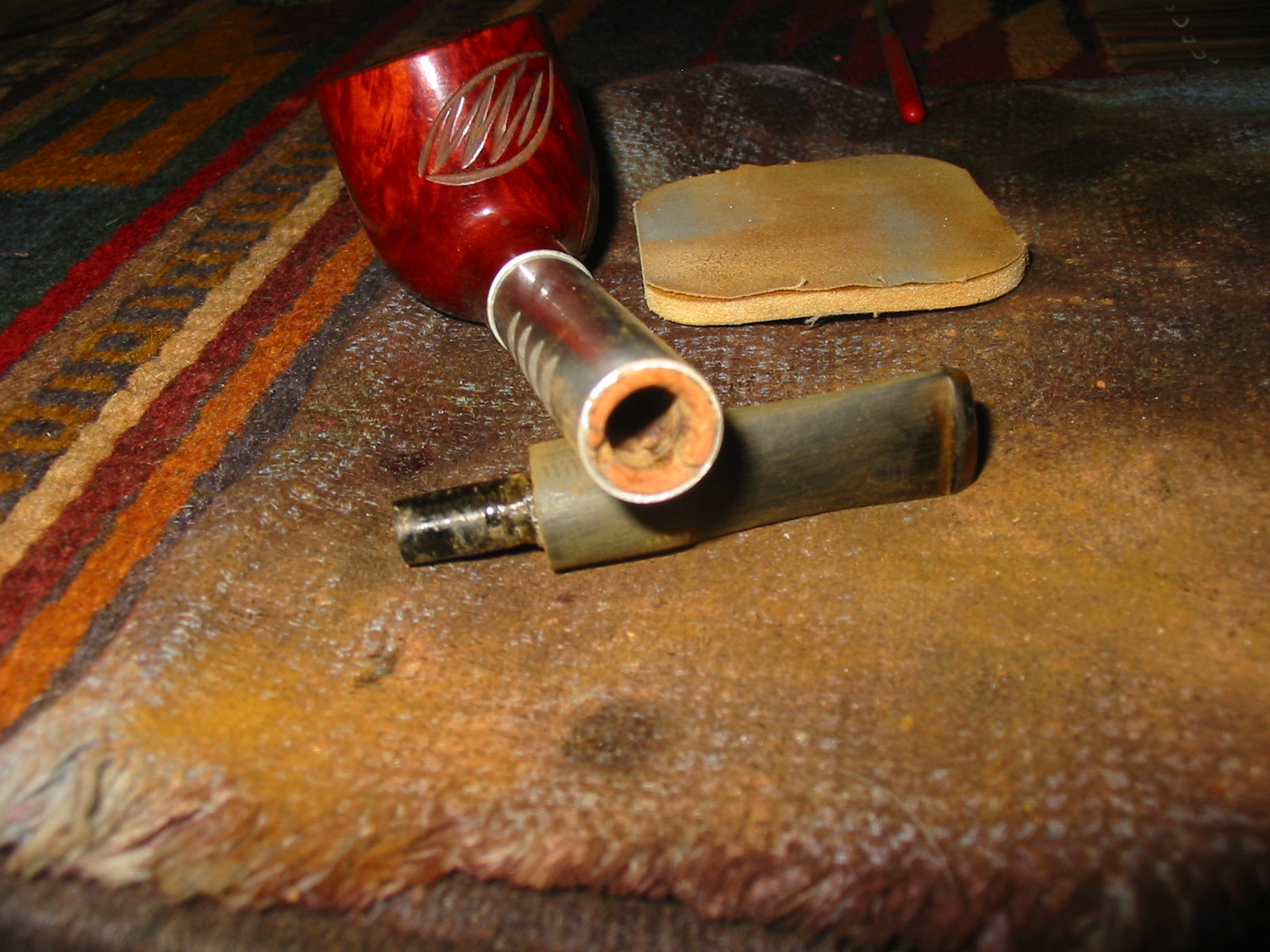
I took the photo below to show the fit of the briar tube in the aluminum shank. There was a small divot out of the edge that is visible at about the ten o’clock position on the shank. This would be smoothed out as I beveled the inner edge of the shank inward.
IMG_2169

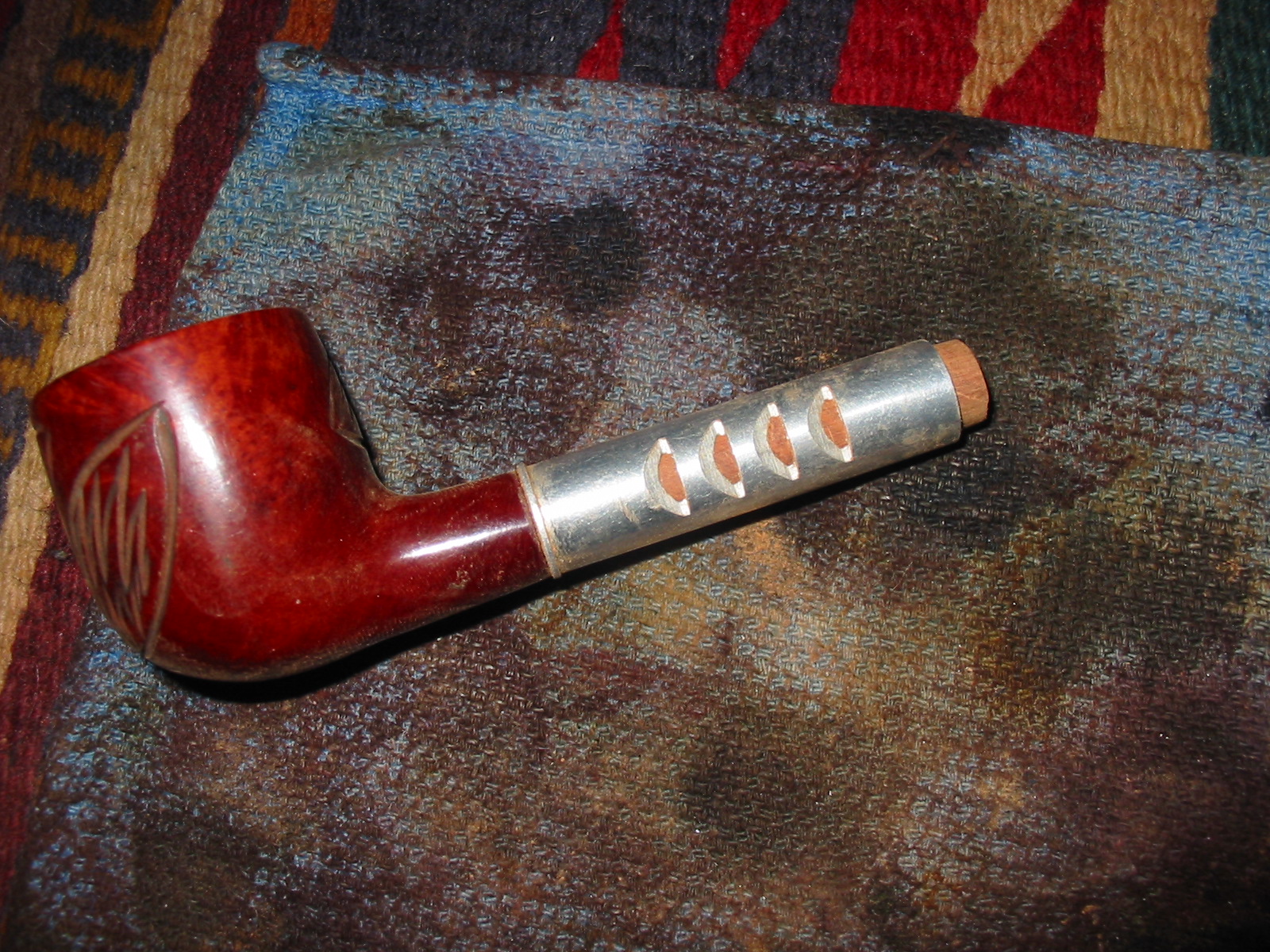
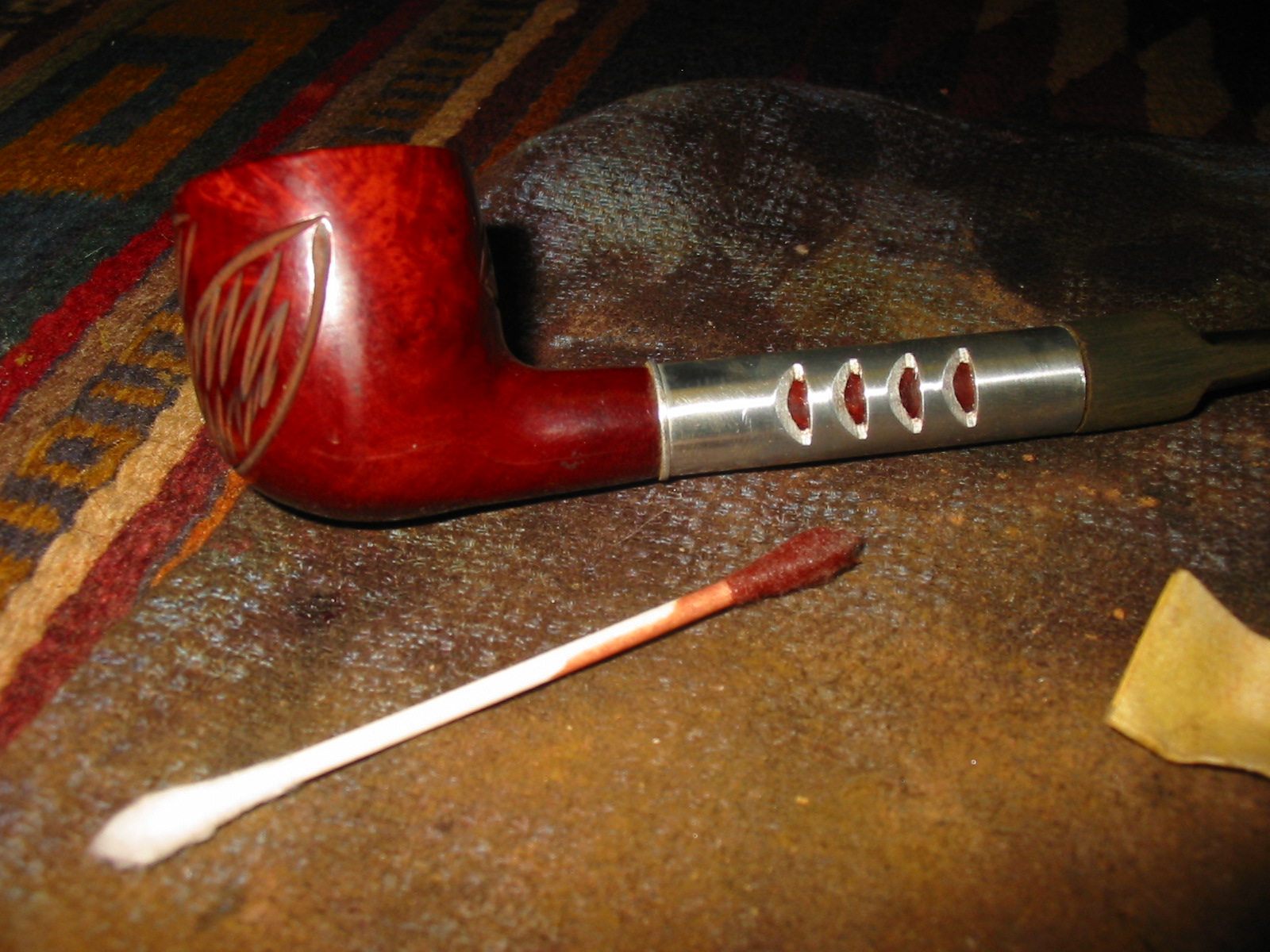
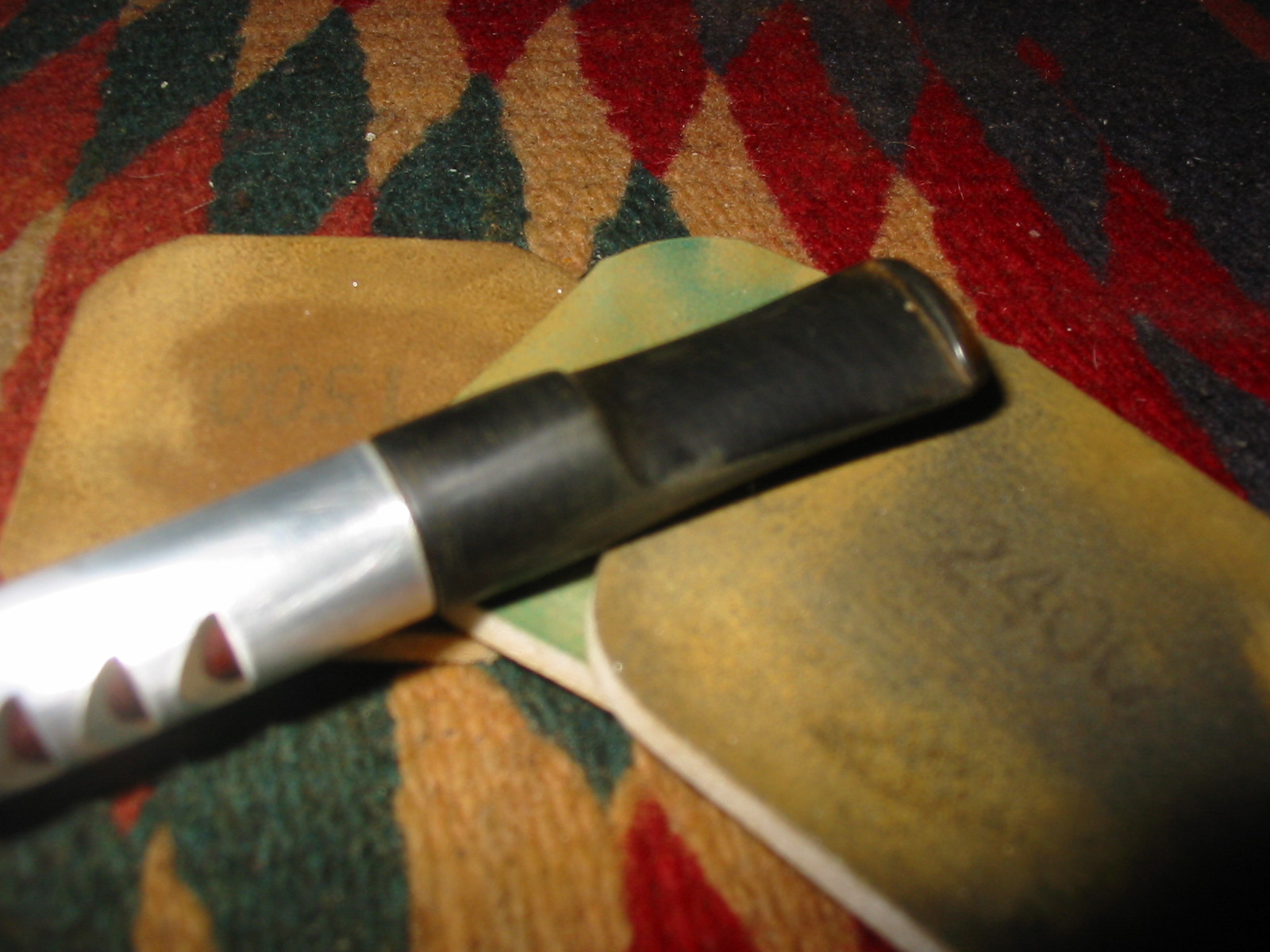
I beveled the shank inward with small round needle files to give the stem a proper seat in the shank. I used some cherry aniline stain to stain the briar shank inset in the fins on the aluminum. I applied the stain with a cotton swab and wiped it off. I sanded the aluminum with micromesh sanding pads. I used the 1500 and 1800 grit to polish the aluminum and remove the scratches that were present on the shank.
IMG_2170

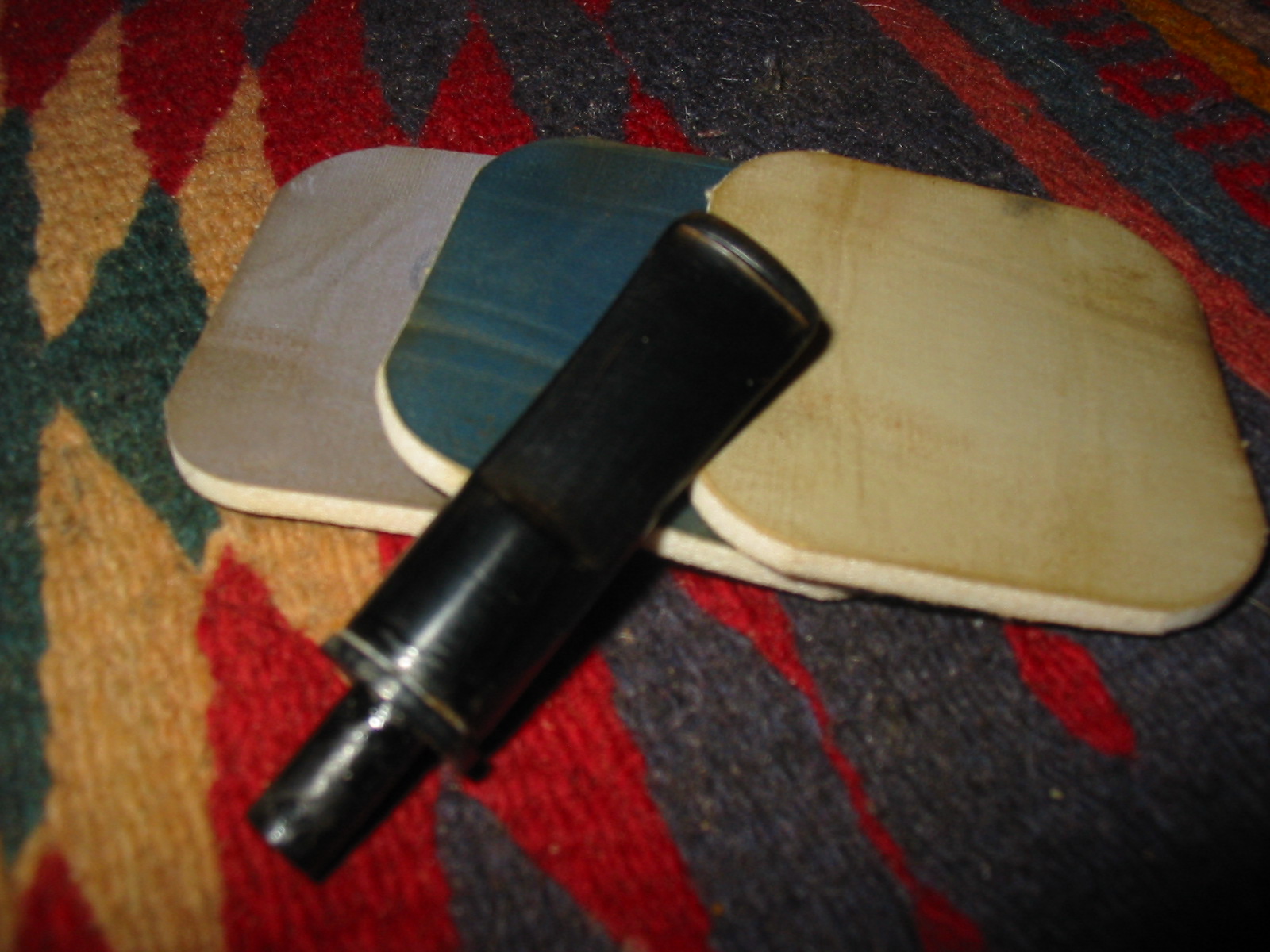
I sanded the stem with a Dremel and sanding drum and then with 220 grit sandpaper to bring the diameter down to match the shank. I continued to sand until the scratches were minimized. Then I progressed to sanding with the micromesh sanding pads. I wet sanded with 1500 and 1800 grit and then dry sanded with the remaining grits of pads from 2400-12,000 grit. I decided to fit an acrylic ring on the stem with a slight ridge to match the slight ridge at the junction of the aluminum and the briar near the bowl. I liked the look of the black blue ring so I epoxied it in place. It began as a square piece of acrylic that had been a spacer on another stem. I shaped it with a Dremel to build a slight ridge that would parallel the one on the front of the aluminum shank.
IMG_2177

IMG_2178

IMG_2179

IMG_2180

IMG_2183

IMG_2184

IMG_2185

With the spacer glued in place the new look of the stem was more complete to my eye. The stem still needed a lot of sanding and shaping. I used the 1500 and 1800 grit micromesh sanding pads once again to sand the newly added ring and the stem. I worked through 2400 and 3200 grit sanding pads to give yet more polish to the stem. I wet sanded right through 3200 grit this time, something I rarely do to polish the ring and the stem. I continued to dry sand the stem to a shine with the remaining grits of micromesh sanding pads (3600-12,000).
IMG_2186

IMG_2187

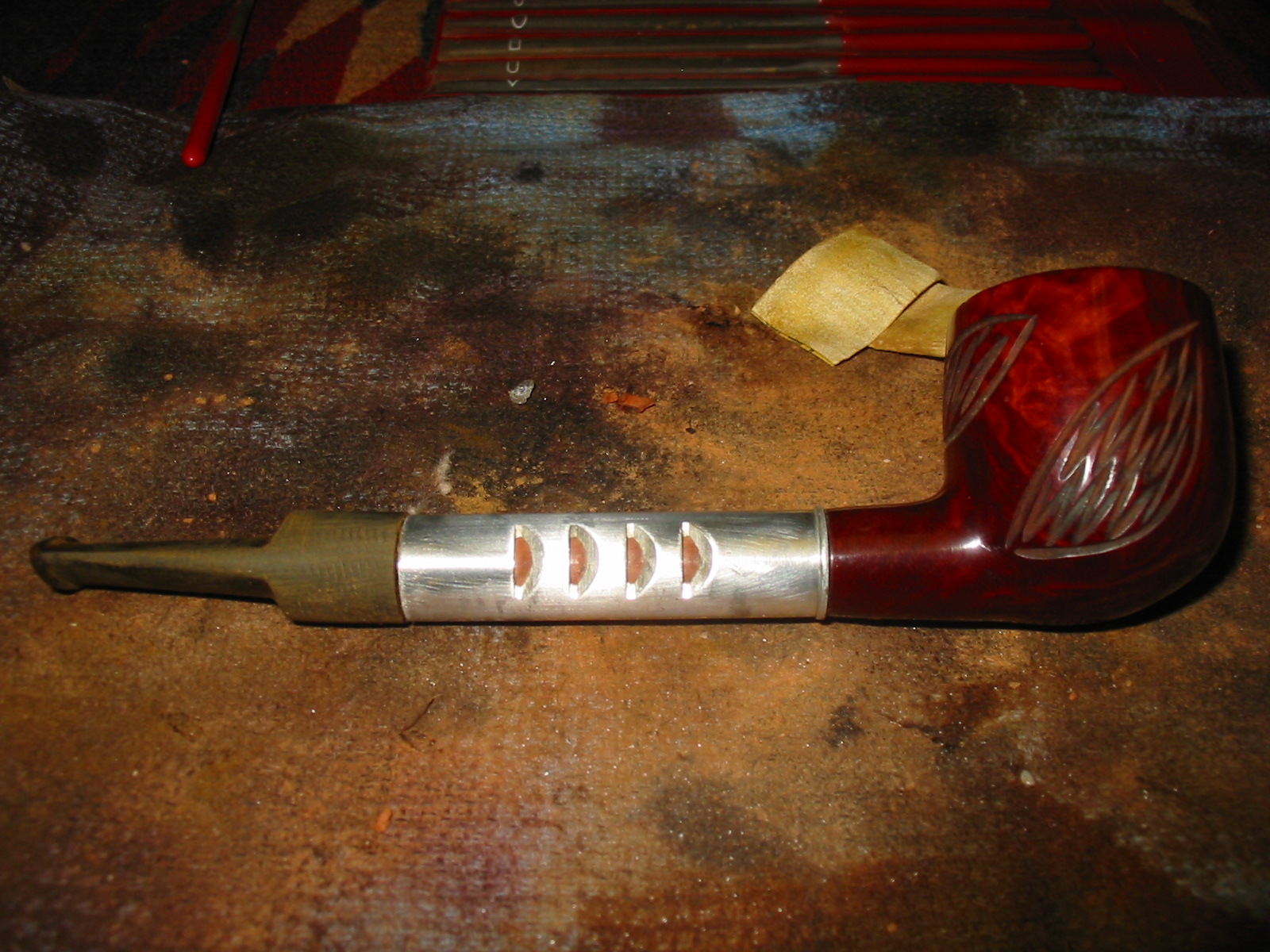
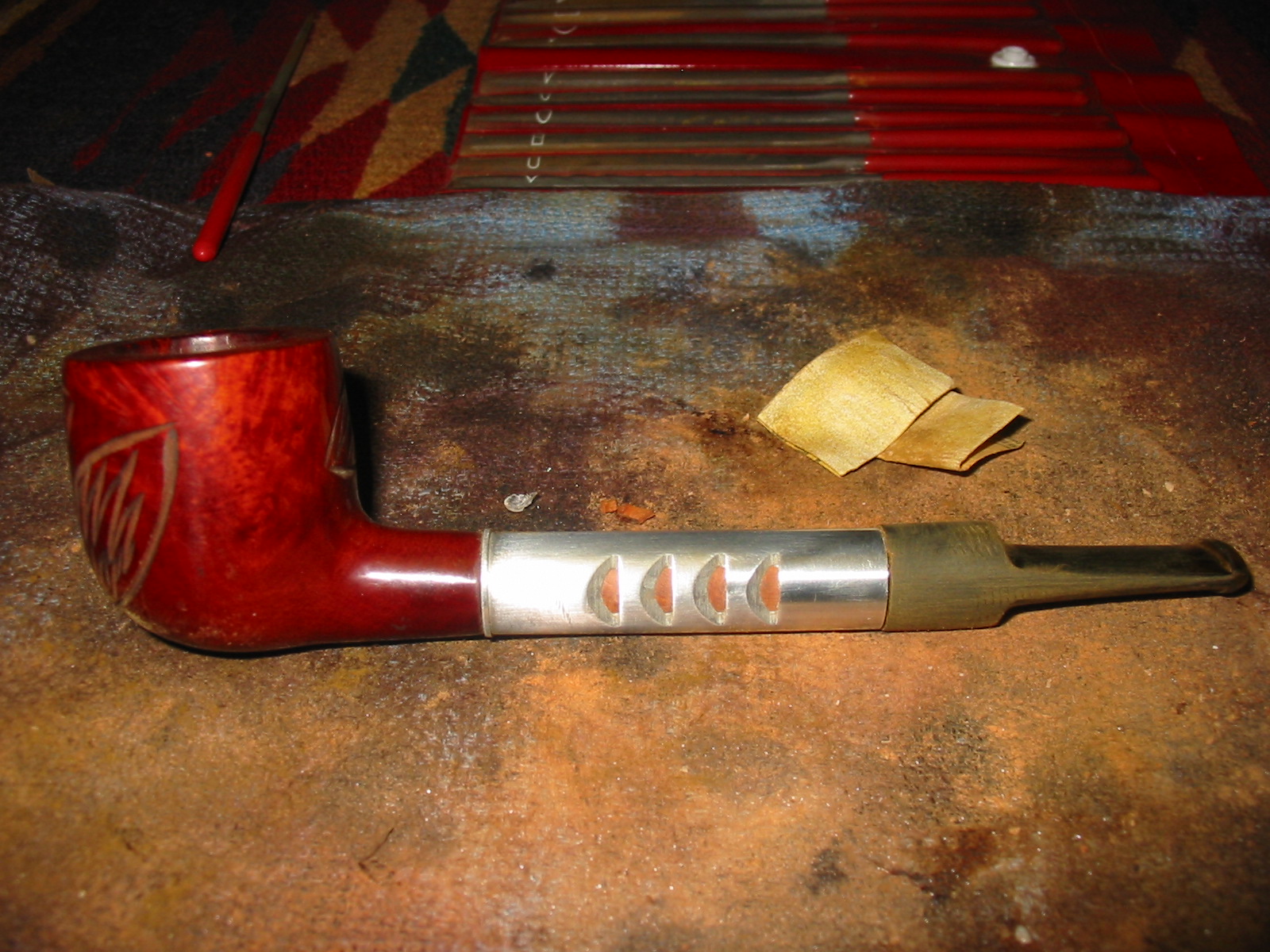
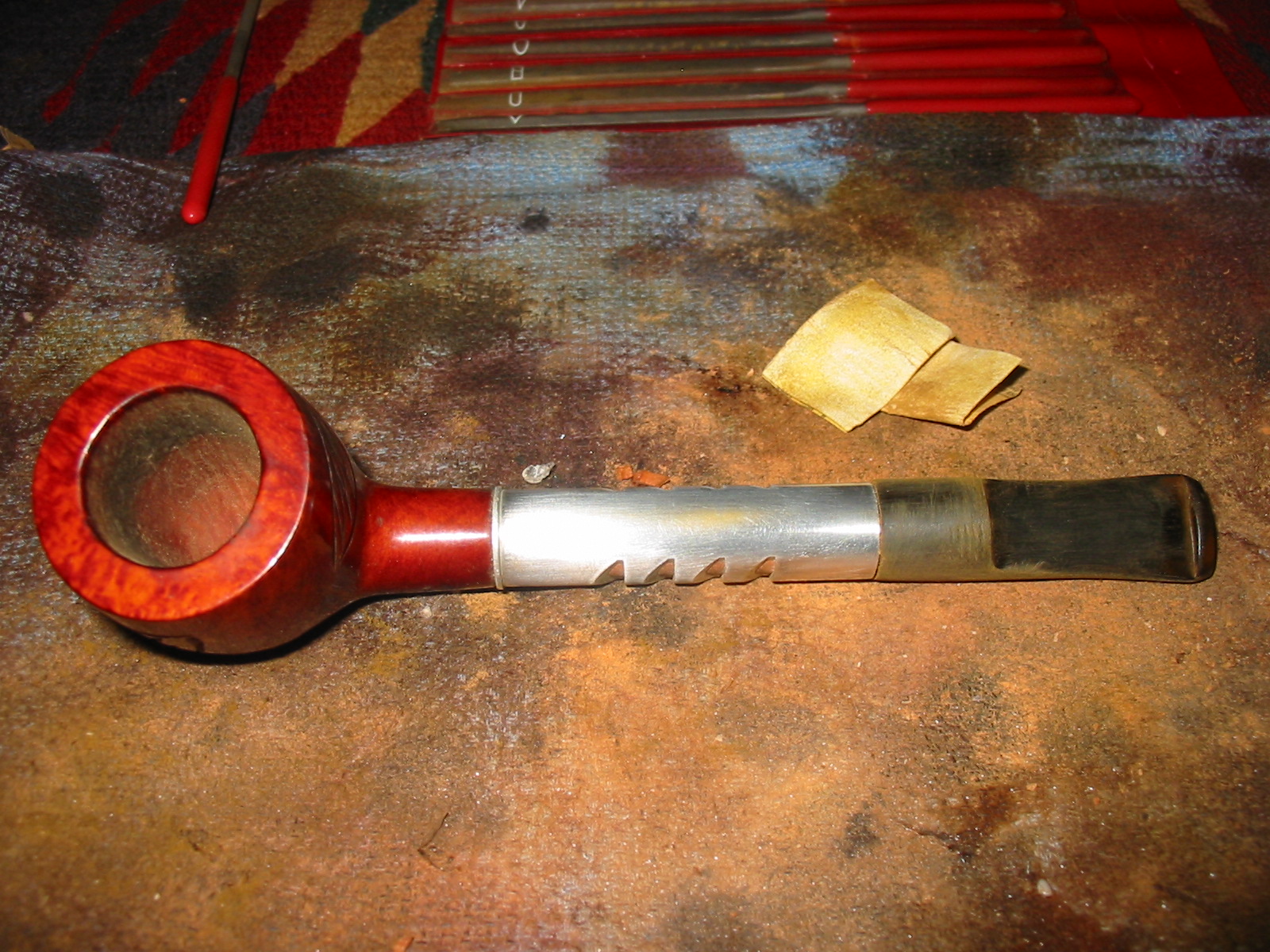
Once the sanding was finished I buffed the stem with White Diamond on the buffing wheel and then gave the pipe and stem several coats of carnauba wax and buffed with a clean flannel buff to give it a shine. The finished pipe is pictured below. It is now a working pipe – an “unventilated” Ventilator. Thanks Ed, for the great idea on doing this Ed. It was fun to figure out how to make it work. Your “groundbreaking” made it much easier however!! Again I say thank you.
IMG_2188

IMG_2189

IMG_2190

IMG_2191

Abrasives Conversion Chart


Blog by Greg Wolford

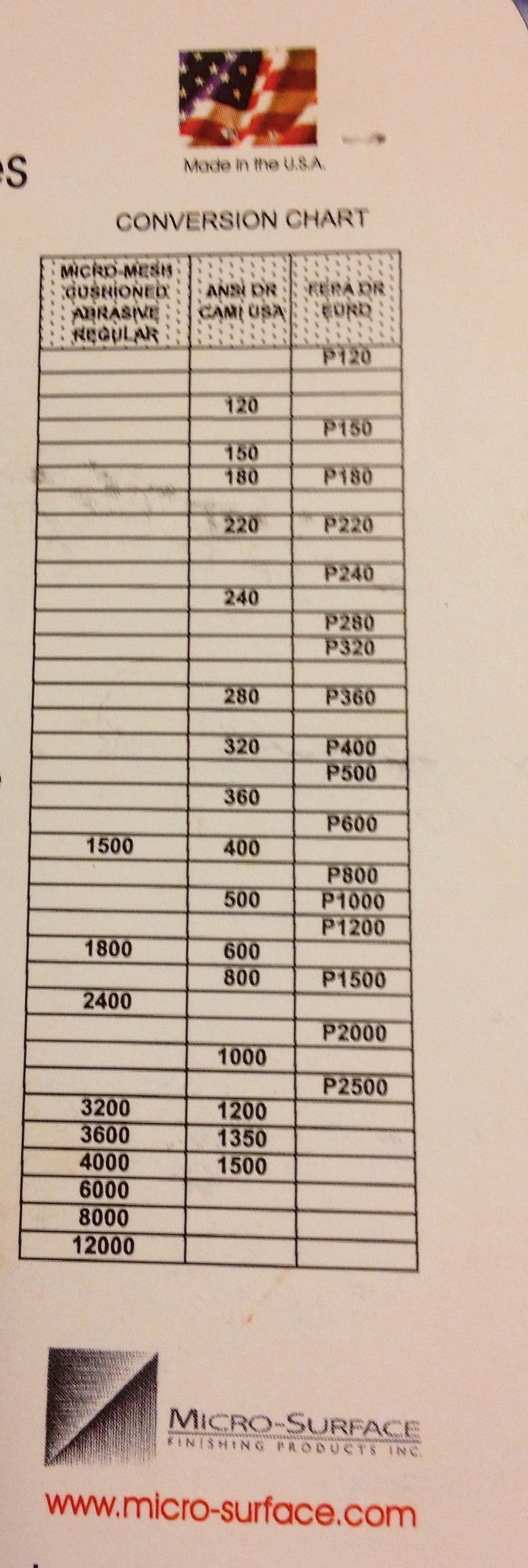
Not long ago I was searching to find the equivalent of one sandpaper grit to another, trying to find what most closely matched 1500 micro mesh in sandpaper. I don’t remember finding what I wanted, not easily anyway. Today I ran across this conversion chart that was exactly what I wanted: It came with my last order of micro mesh and I didn’t realize of remember it. So I thought it might be a handy resource to share here for easy access for everyone.

20131019-134353.jpg

Here is the more complete Chart that Al comments about below:
Micromesh Conversion

I had no idea Douwe Egberts made pipes


Blog by Steve Laug

When I posted the find of this pipe on Twitter, I received an email from Al Jones (upshallfan) that pretty well summarized my thinking. I post a bit of that email here: Douwe Egberts pipe??? We used them for our restaurant coffee program for many years (they provide the on-demand brewers used by Burger Kings as well). They are now owned by Sara-Lee. Who knew they made pipes! I’ll look forward to that restore and history lesson… If I had thought a bit more about it I would have remembered that Amphora tobacco was once made by Douwe Egberts but I did not remember that.

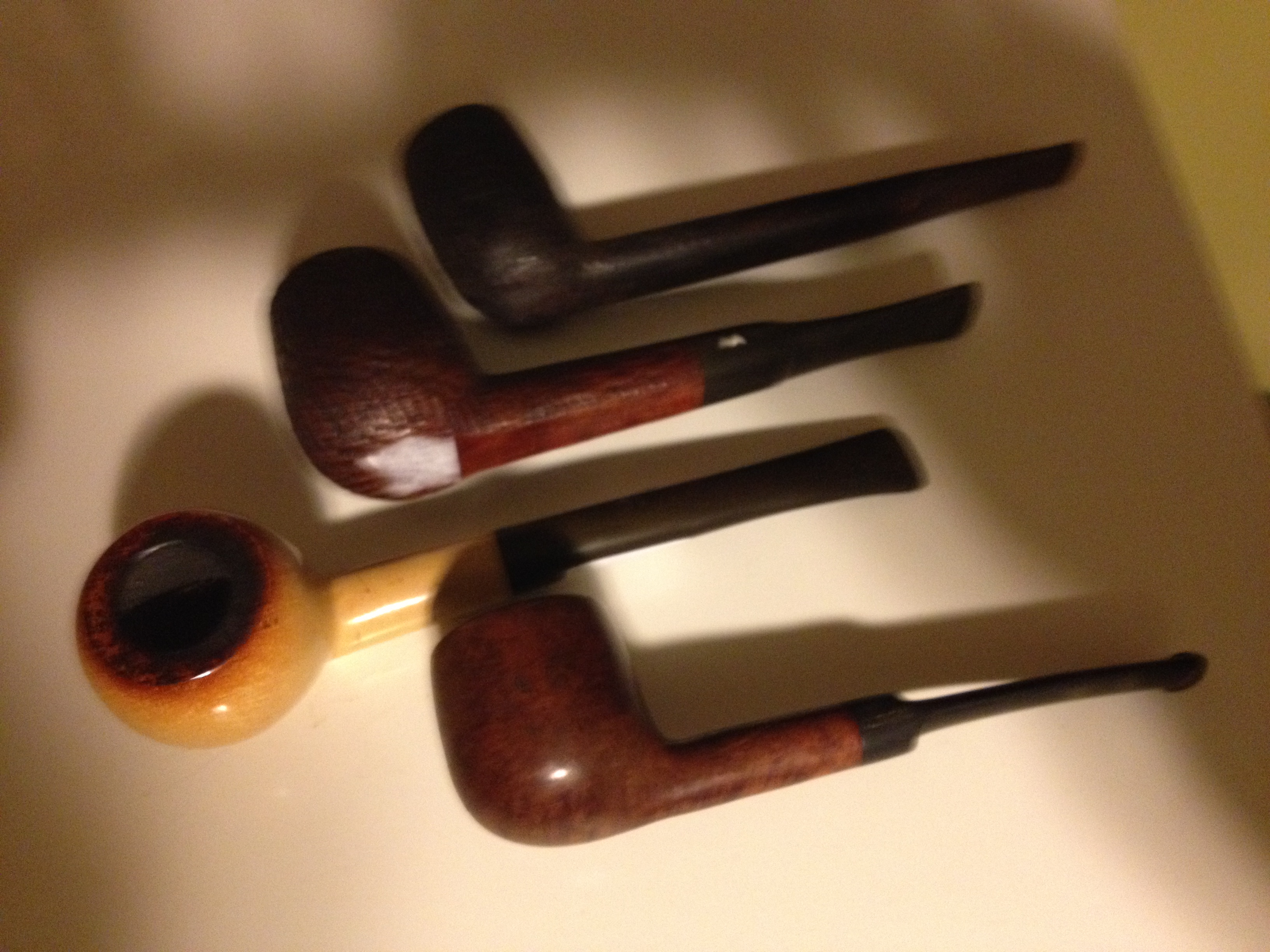
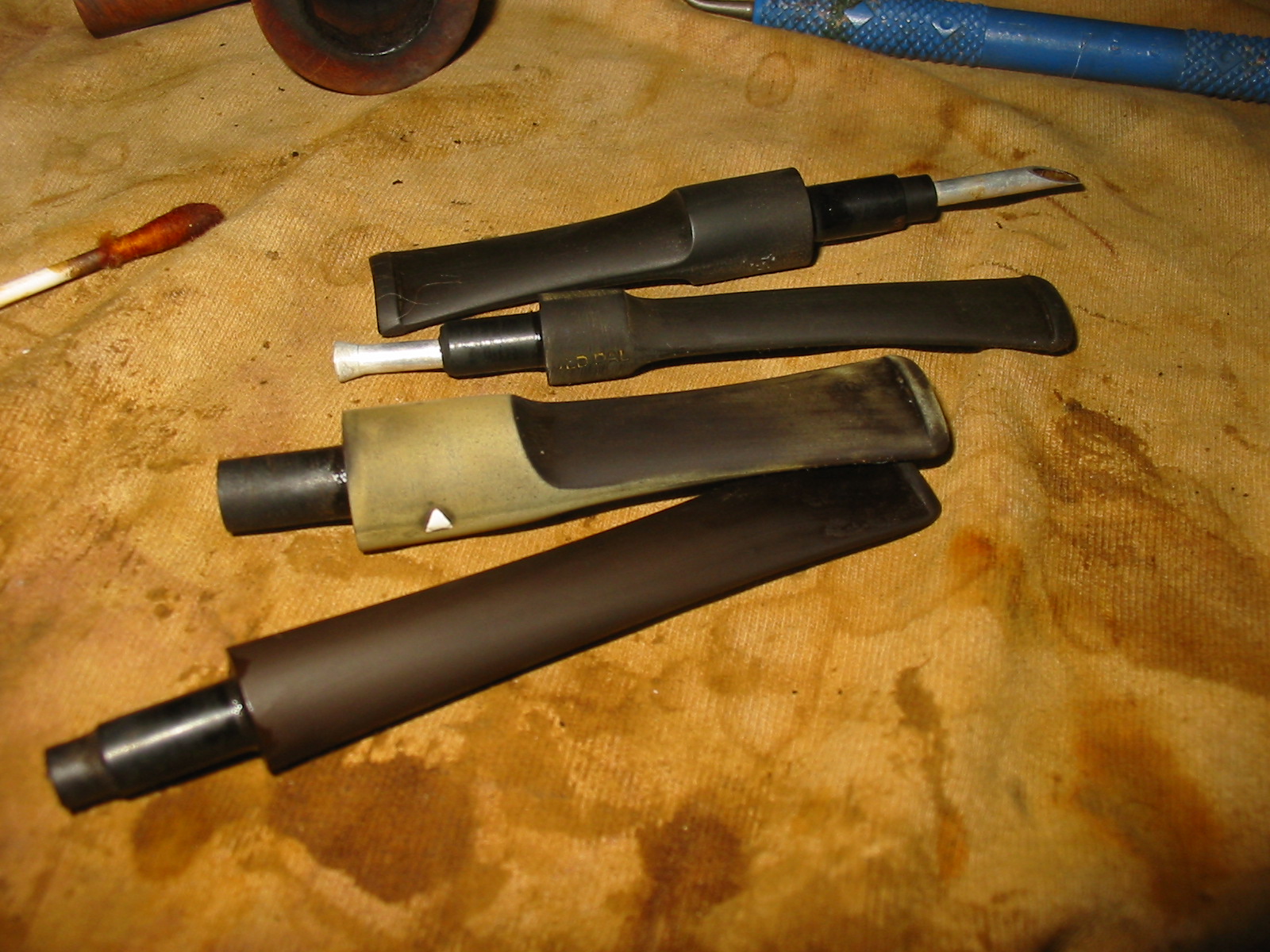
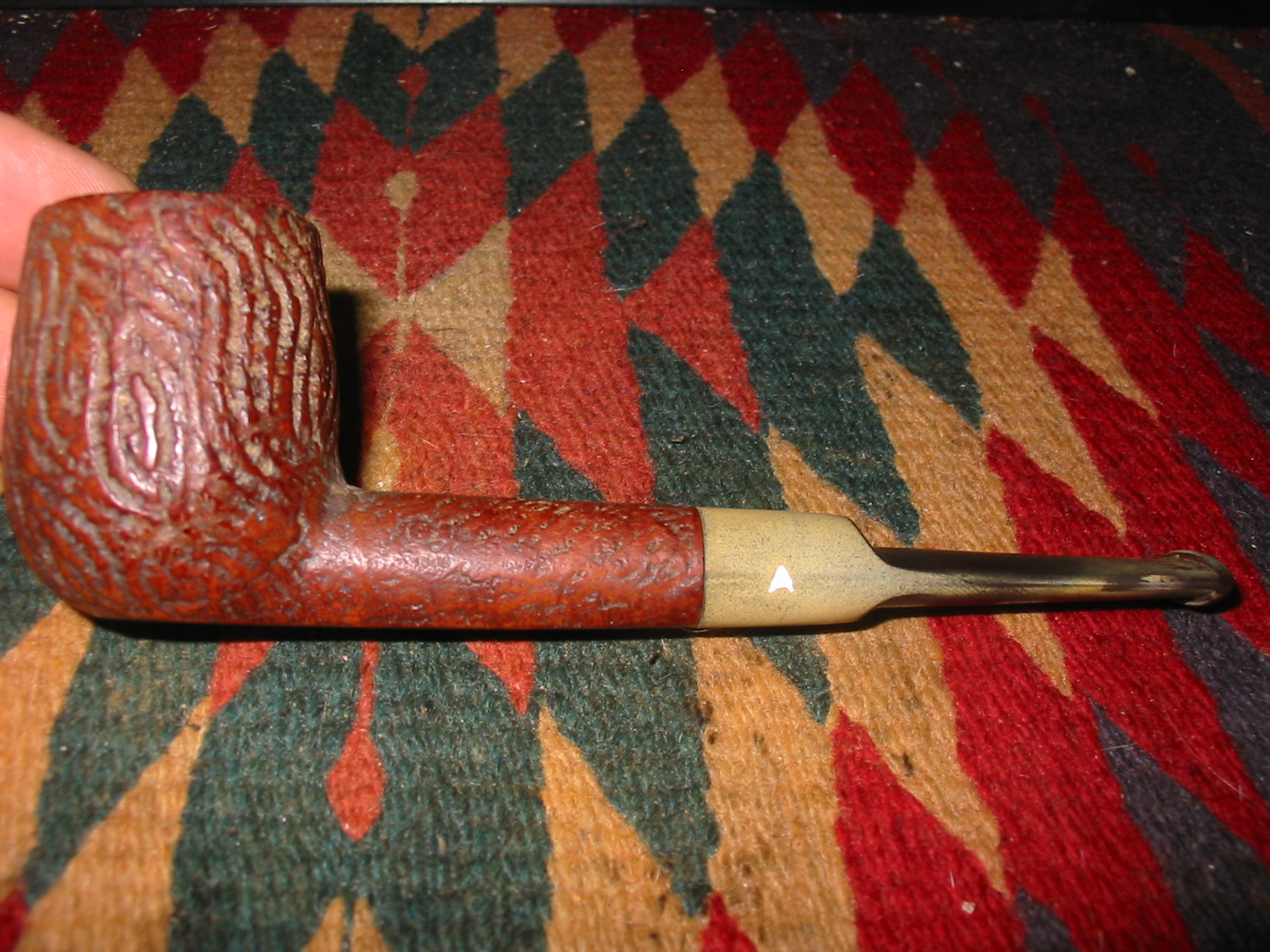
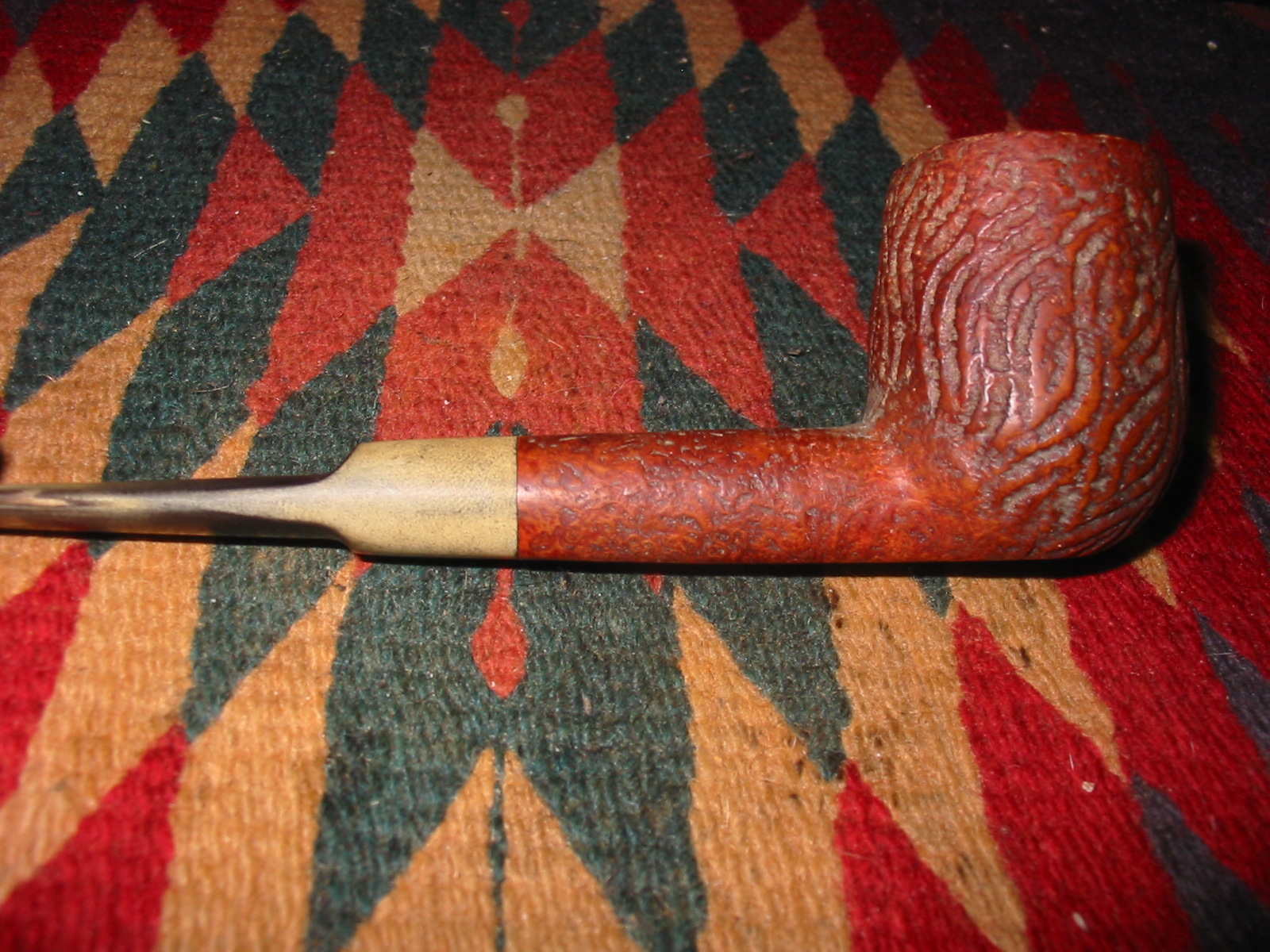
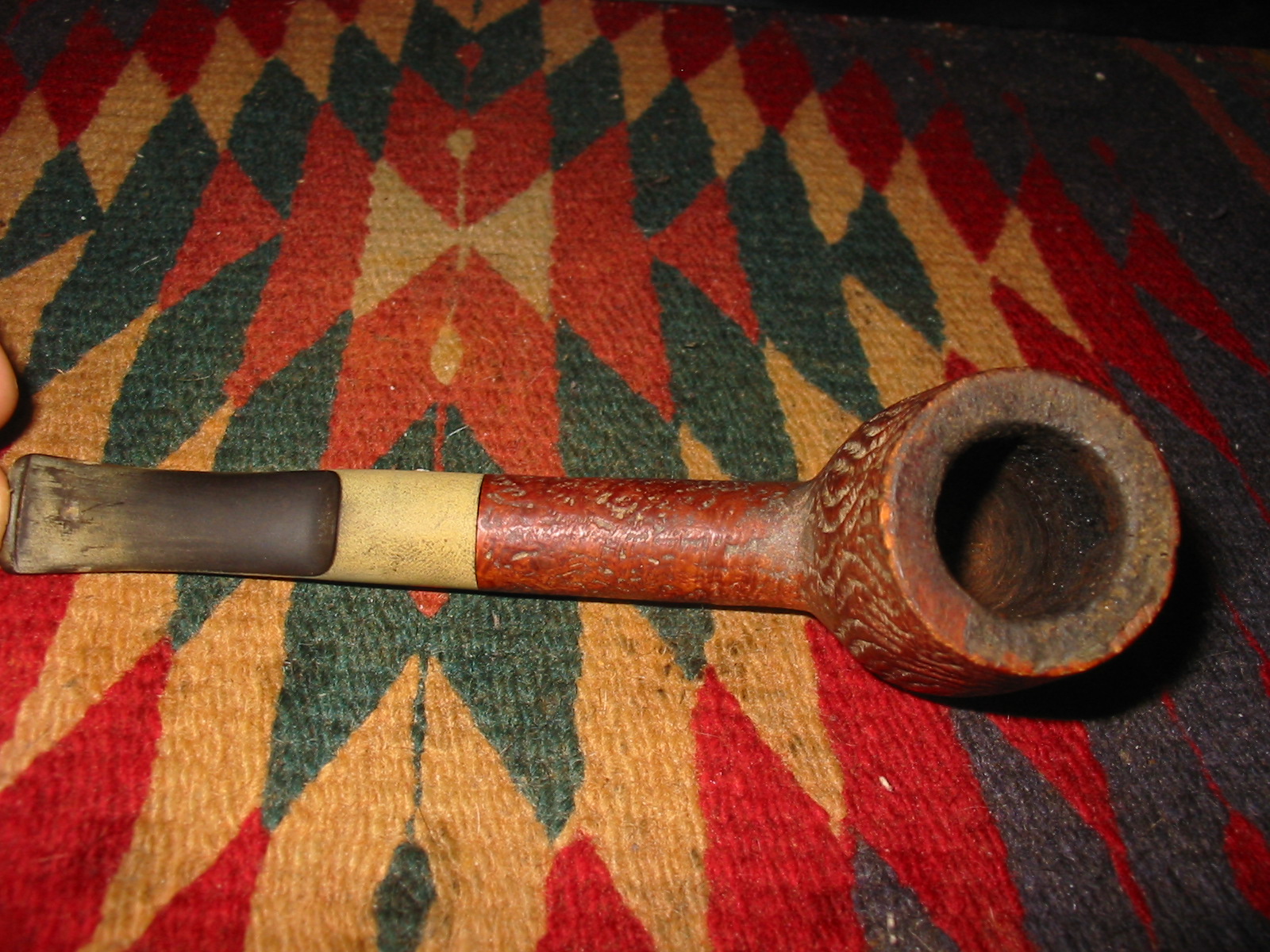
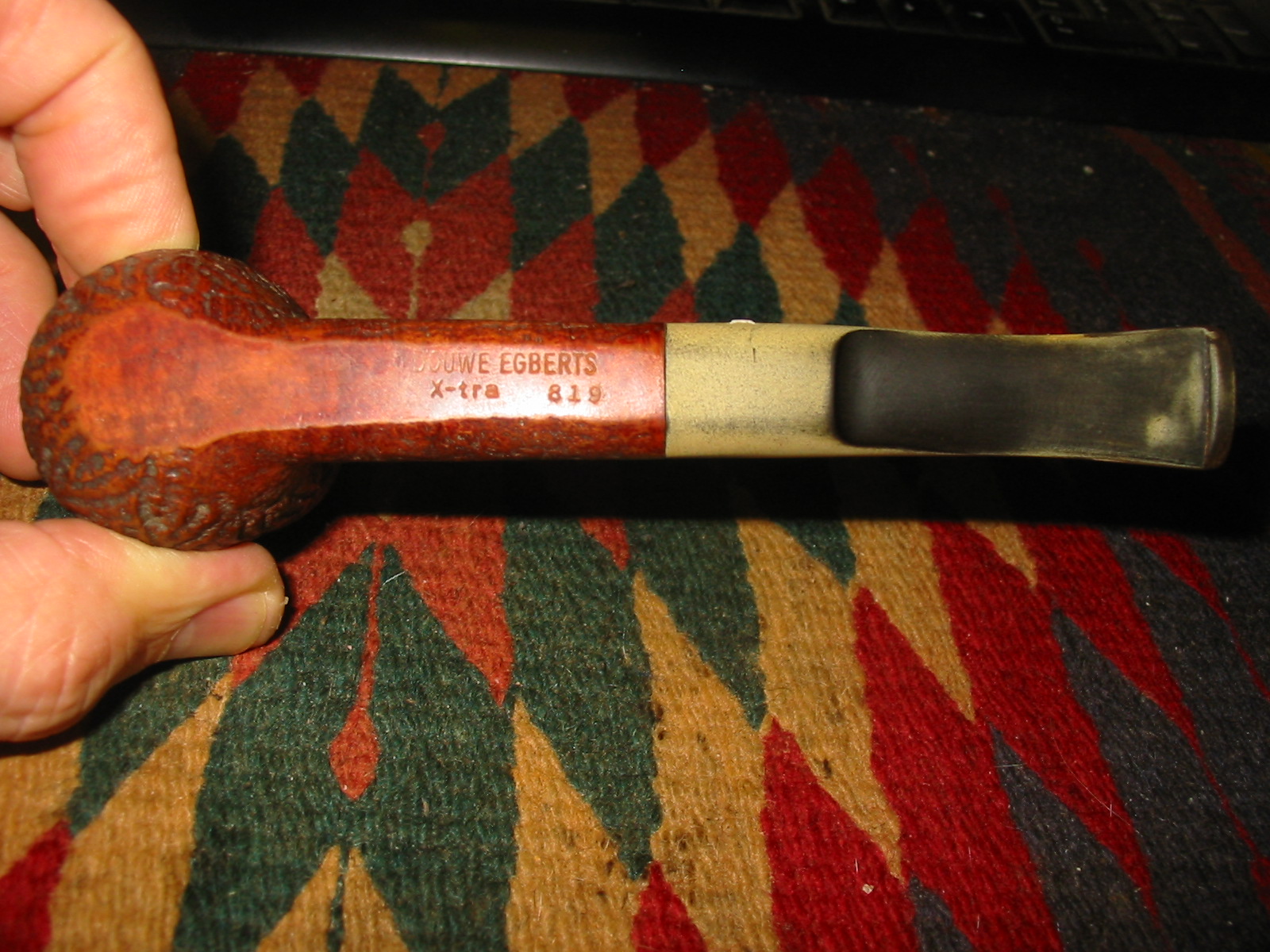
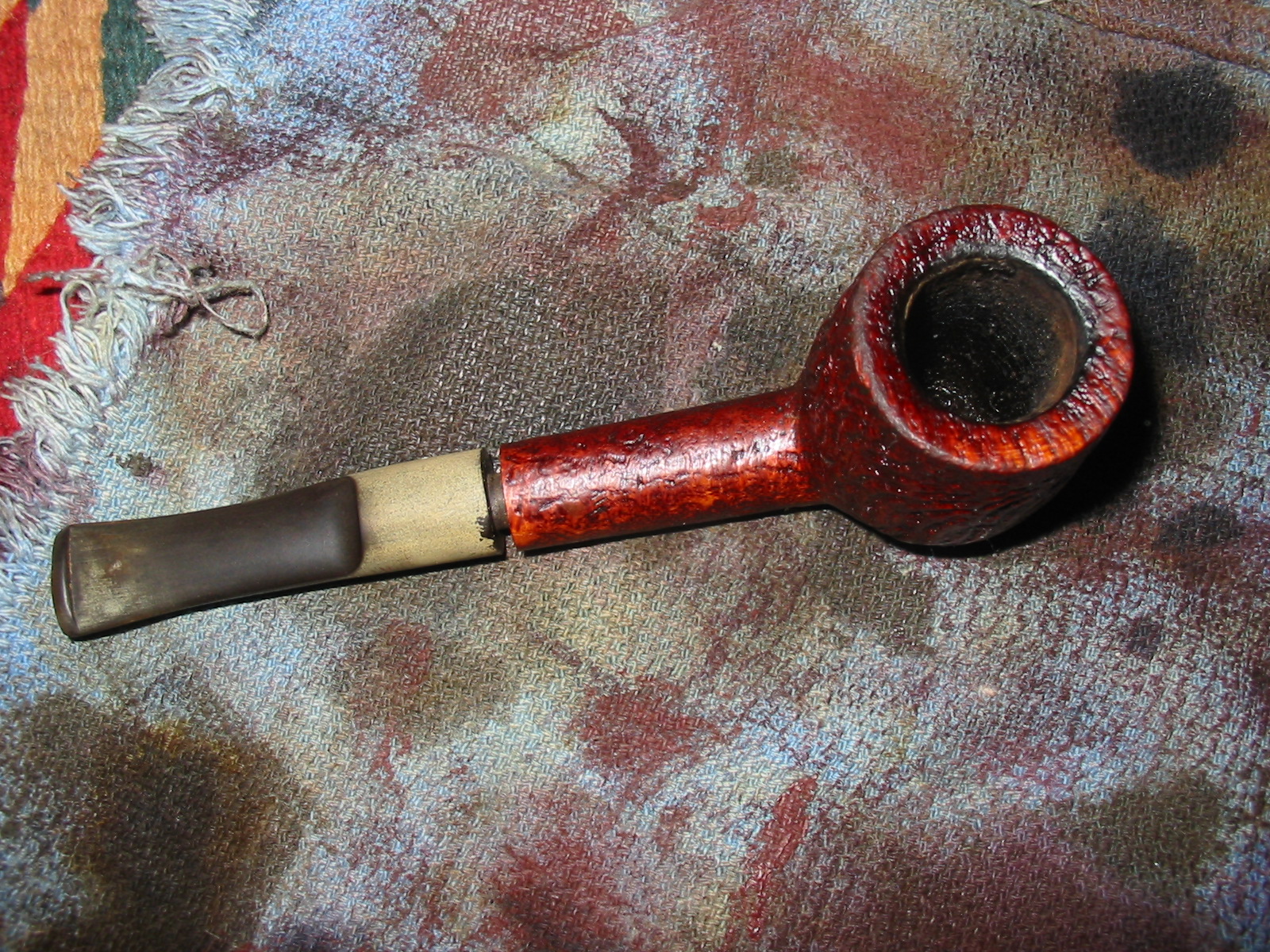
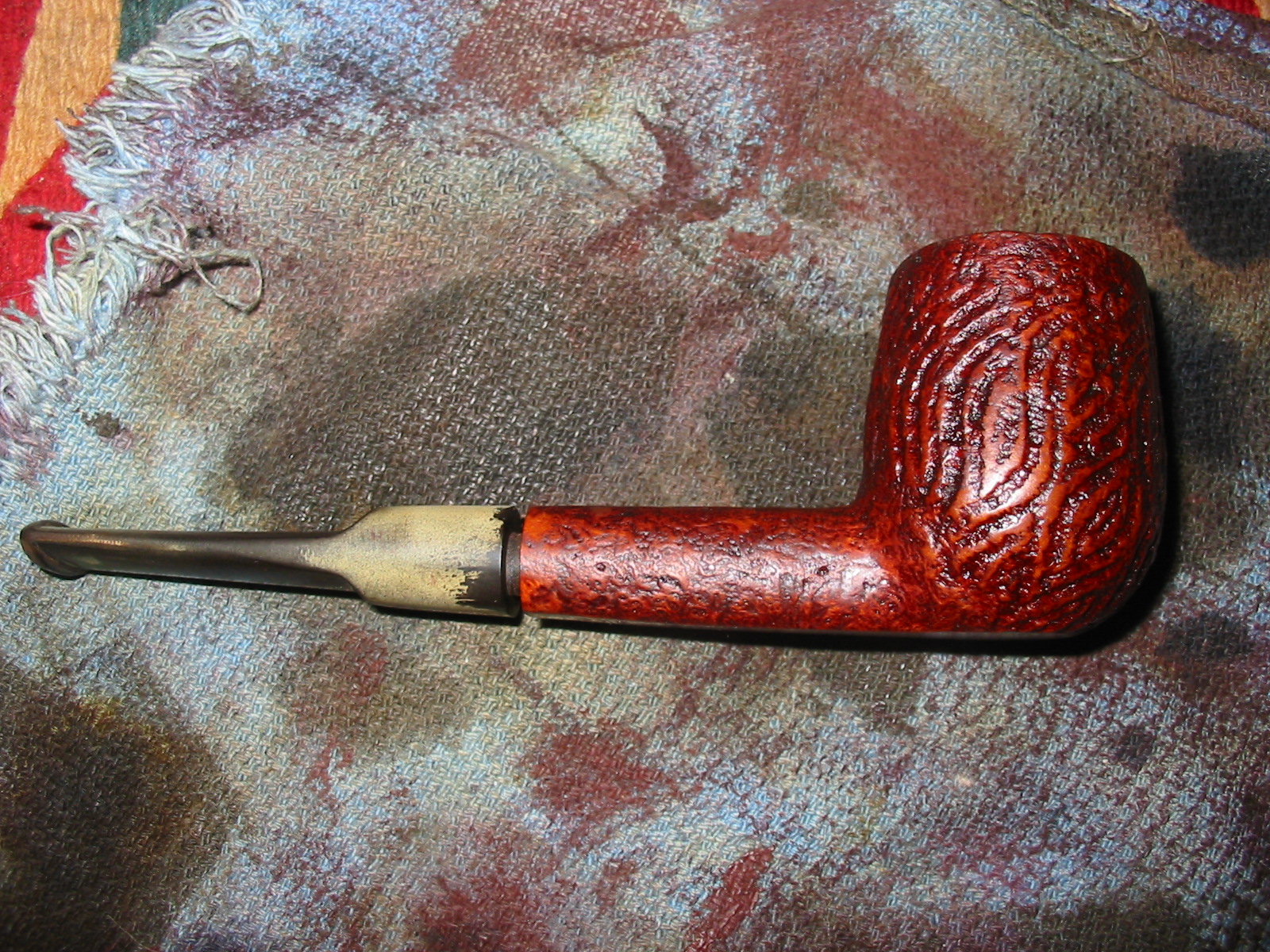
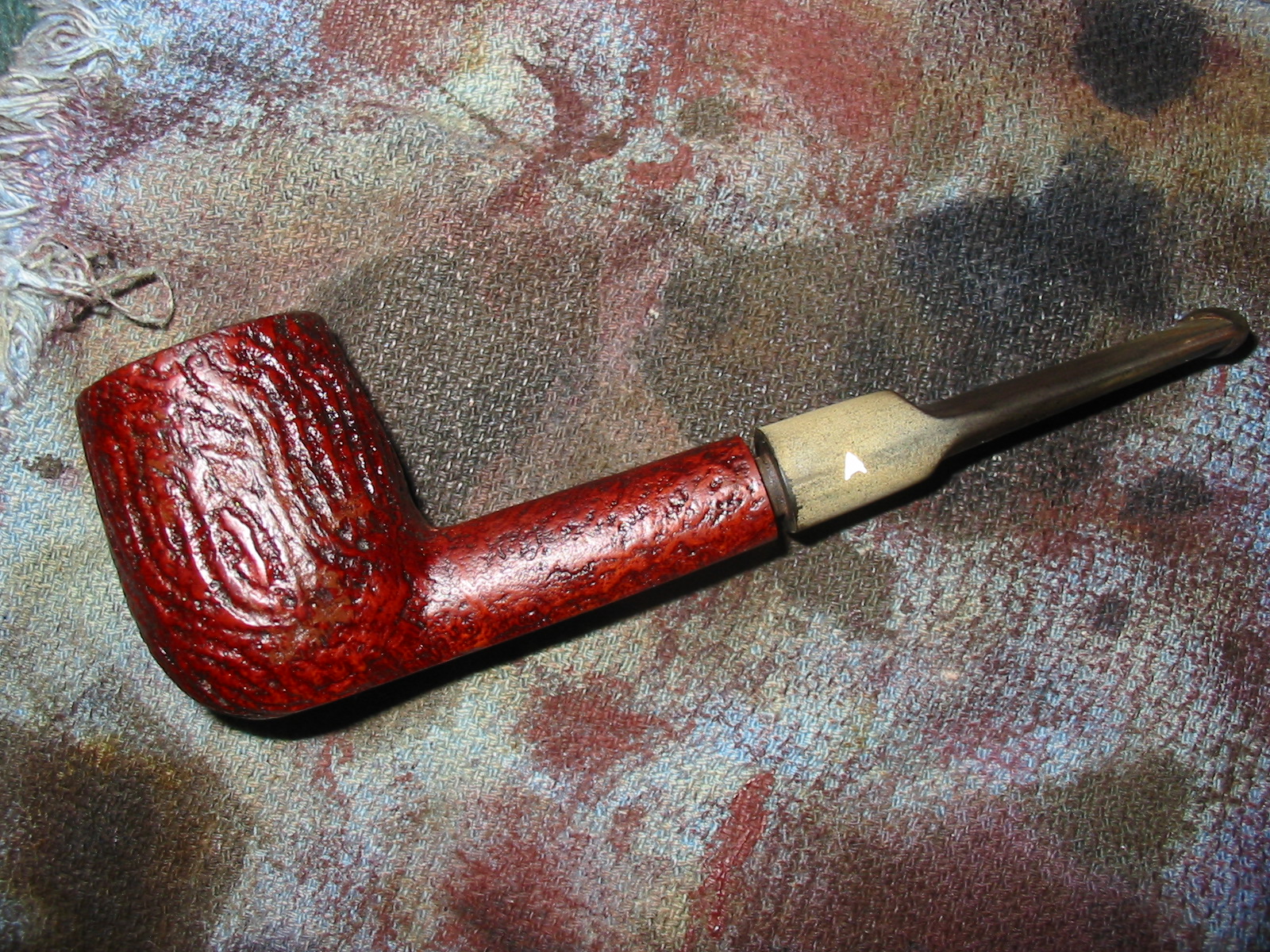
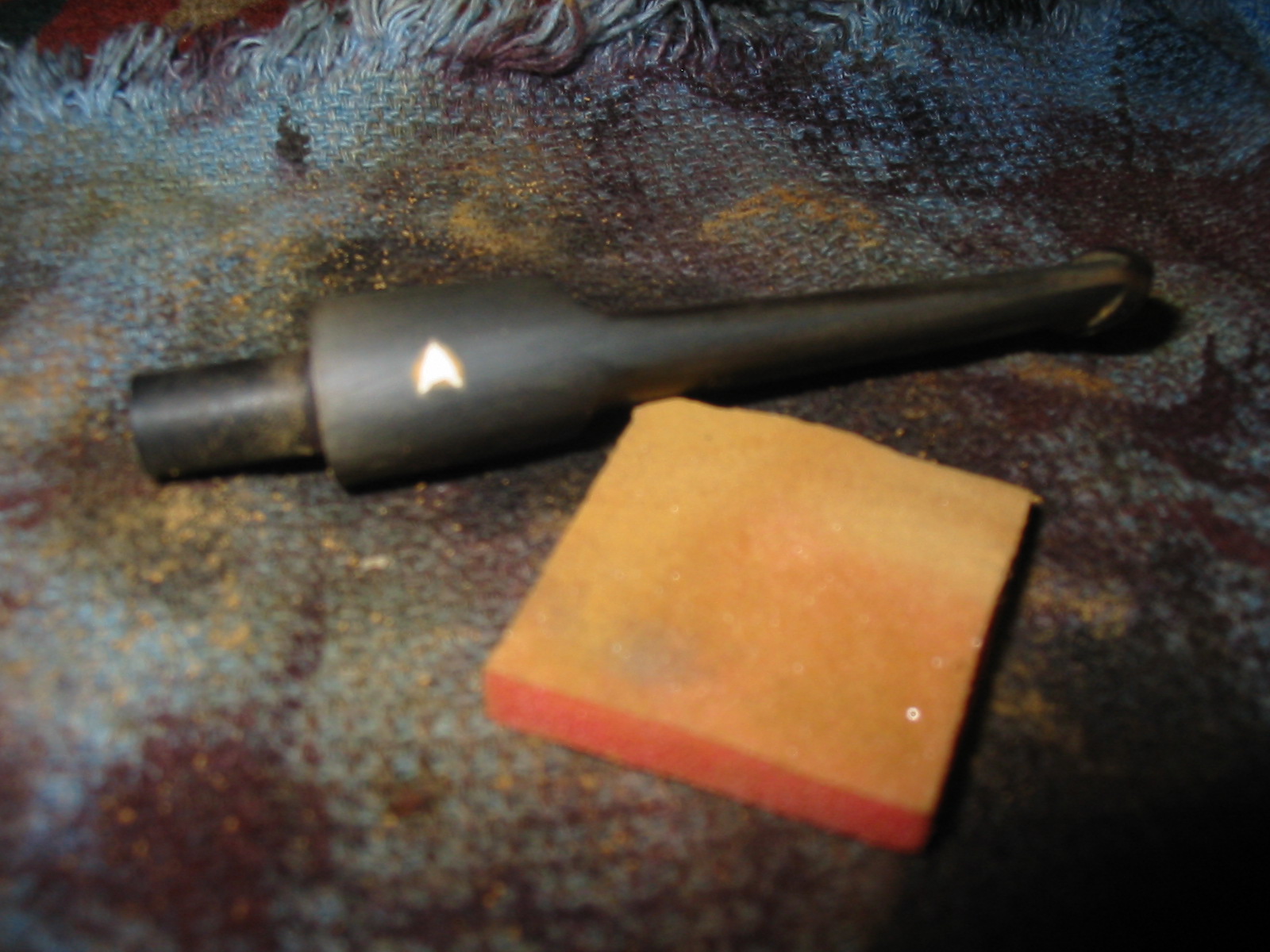
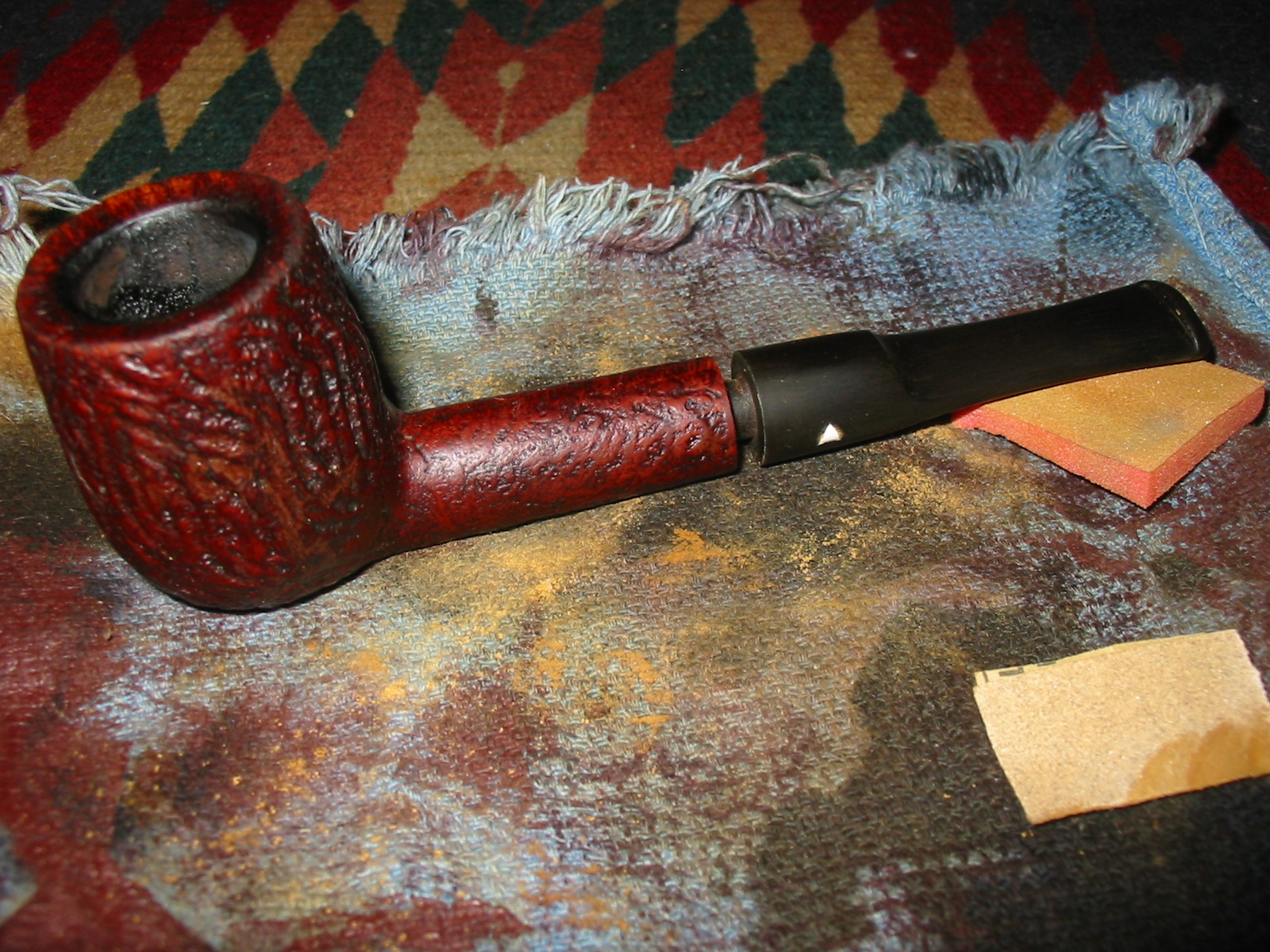
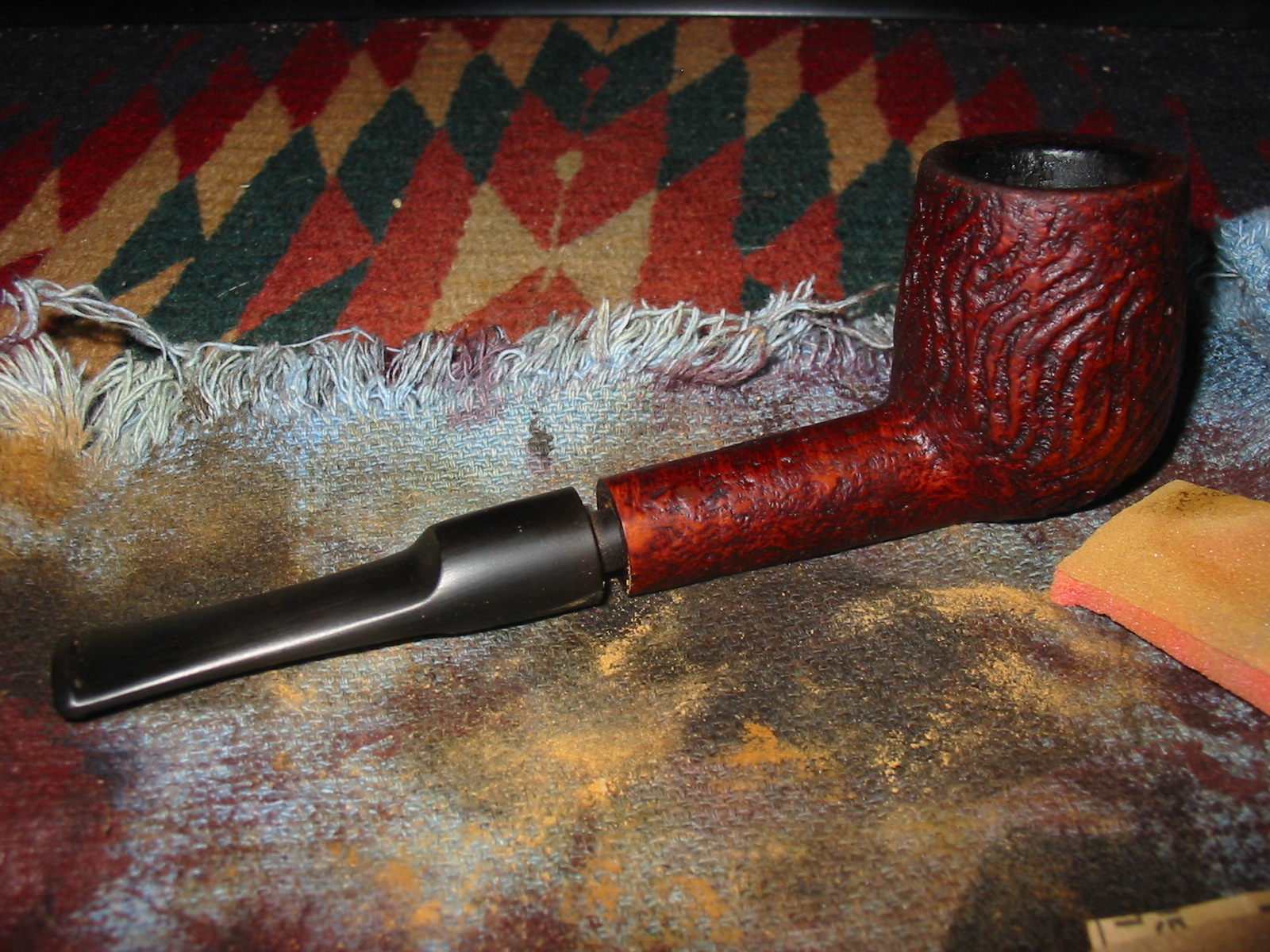
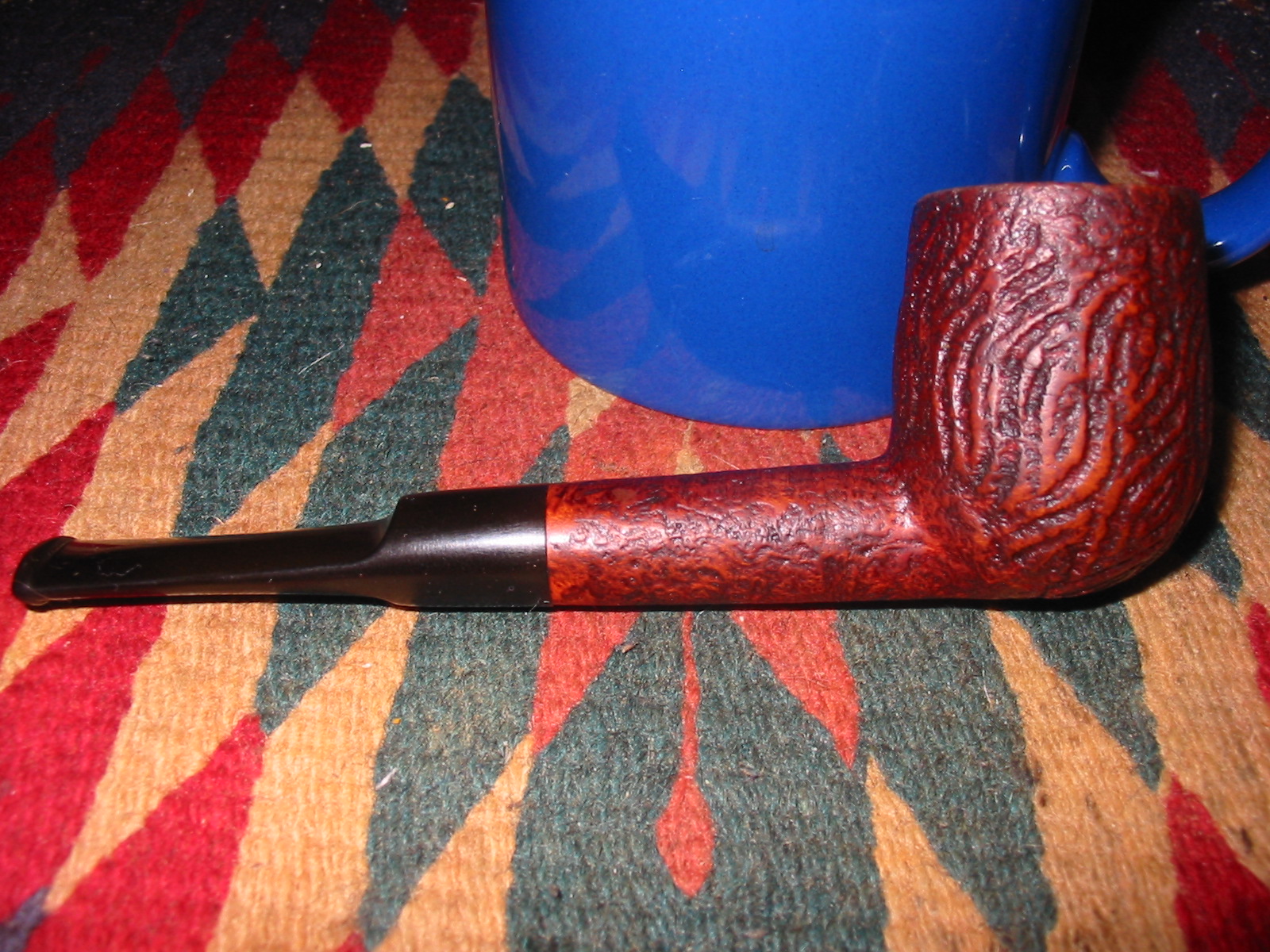
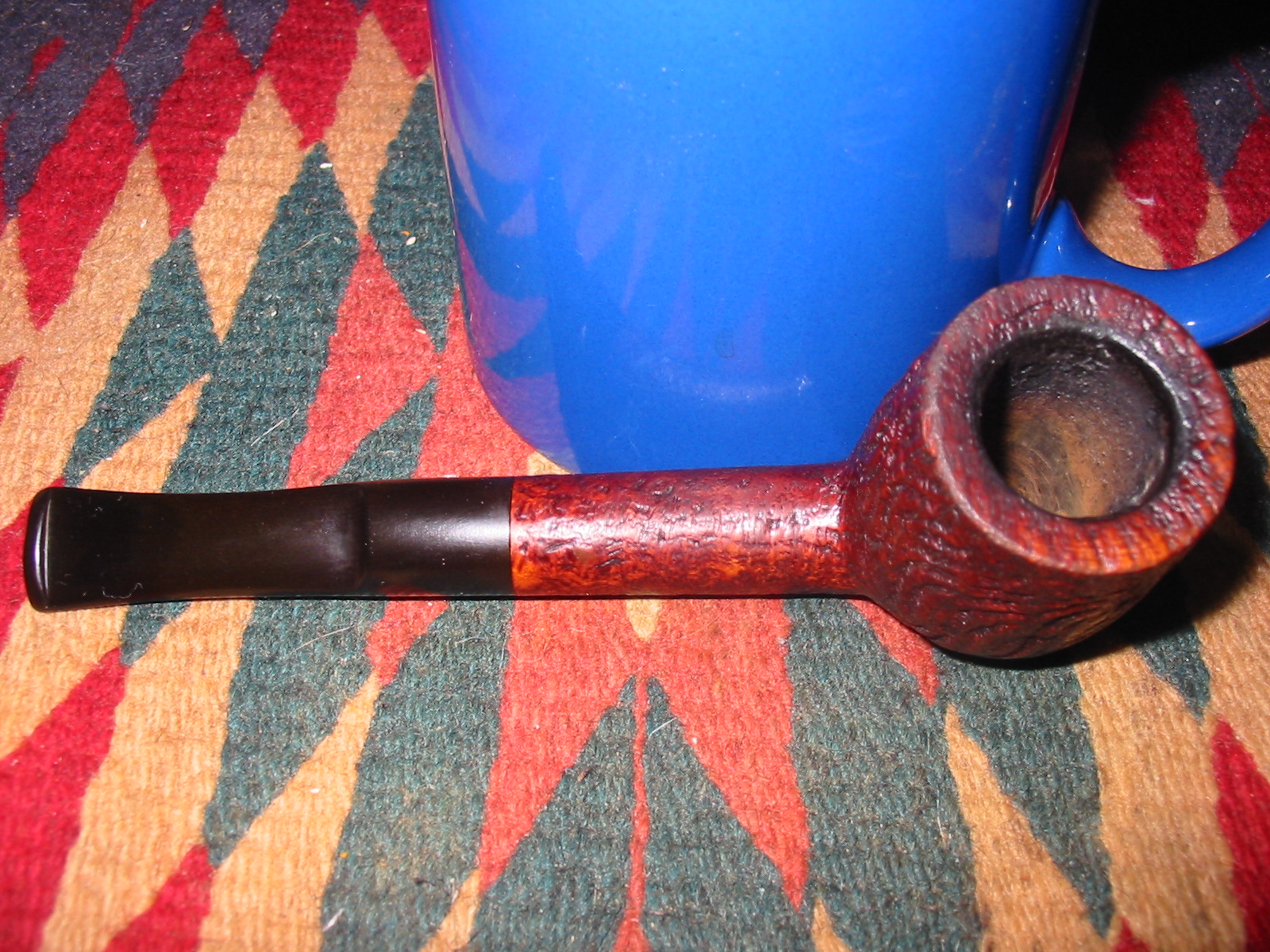
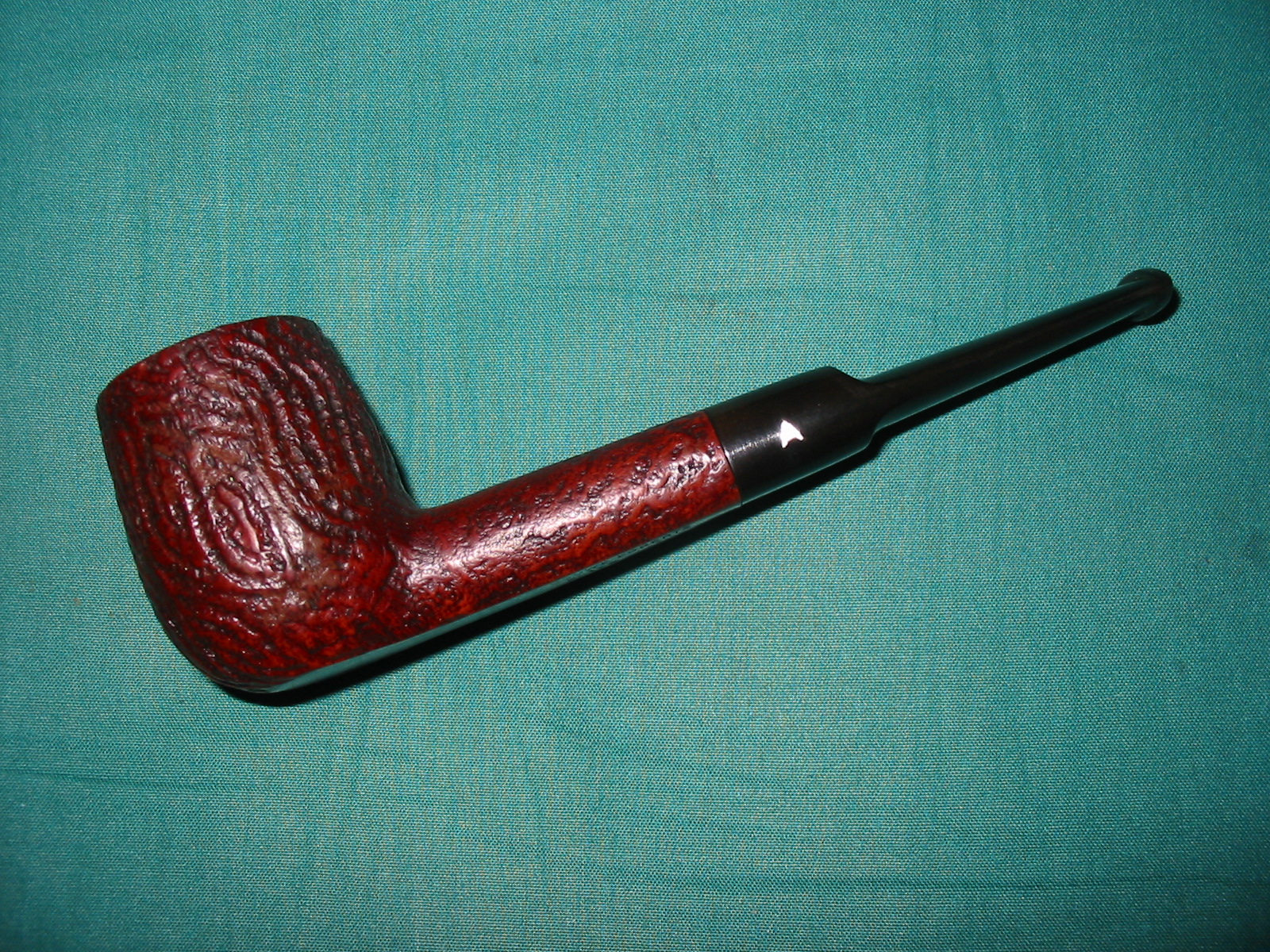
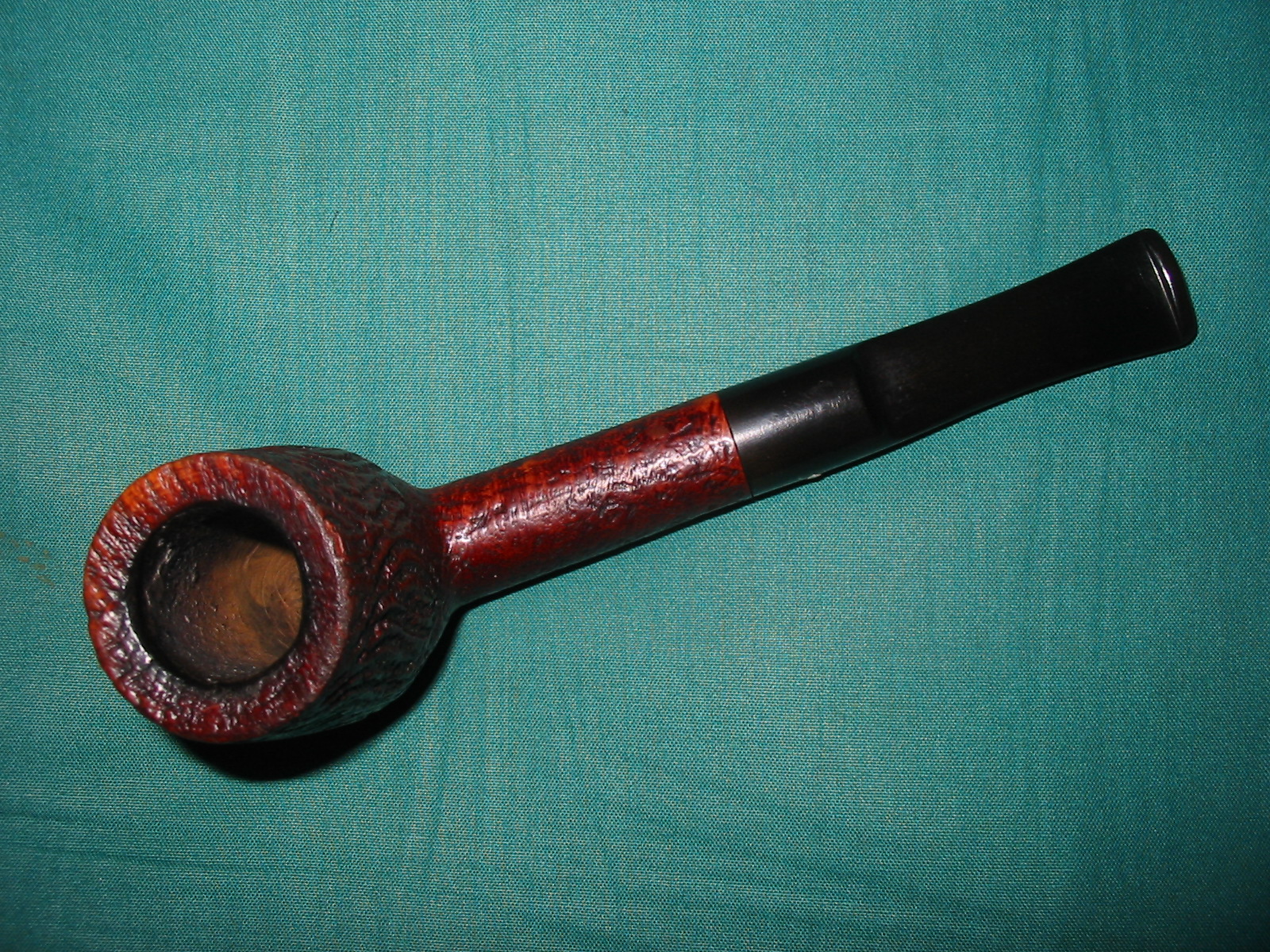
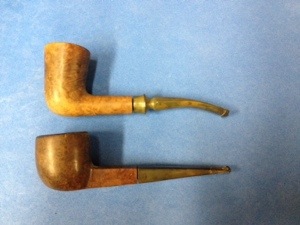
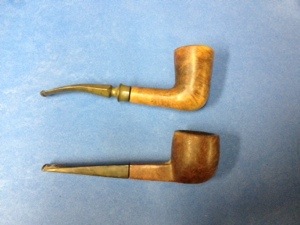
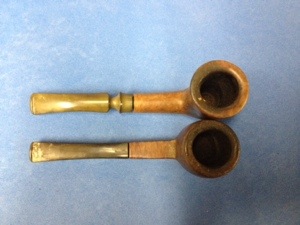
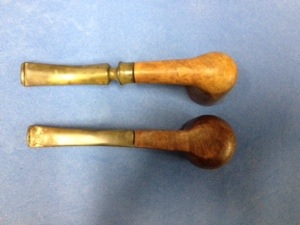
The one I picked up is a nice rusticated briar billiard. It is stamped Douwe Egberts X-tra 819. The stem also has a logo – an upward pointing white arrow-head. The bowl had a thick cake and the rim had a buildup of cake and tars. The bowl had what appears to be a combination of sandblasted and rusticated finish. The shank is sandblasted and it appears that the bowl was rusticated first and then sandblasted afterwards. The rustication has a rough edge appearance to it like it was blasted after the patterns were cut. The finish was dirty and worn and the stem had hints of oxidation under the grit and grime. There was minor tooth chatter on the top and bottom of the stem near the button. In the photo below, taken on my iPhone the pipe I am speaking about is the second one down from the top of the photo. (I apologize for the blurriness of the photo.)
IMG_0470

Wikipedia states that Douwe Egberts (often abbreviated as DE) is a Dutch corporation that processes and trades coffee, tea, and other groceries. Its full name is Douwe Egberts Koninklijke Tabaksfabriek-Koffiebranderijen-Theehandel NV, which translates as “Douwe Egberts Royal Tobacco Factory – Coffee Roasters – Tea Traders, Plc.” http://en.wikipedia.org/wiki/Douwe_Egberts

The late Bob Runowski (Morelysson) had this to say about the brand: Douwe Egbert was a conglomerate which used to manufacture Amphora. I don’t recall if the conglomerate ever owned pipe manufacturing. DE offered pipes as a premium for coupons in Amphora Pipe Tobacco, I think in the ’60s. Strange to me, though, because their Amphora pipes were always stamped “Amphora”. I did smoke a fair amount of Amphora Brown in my time. It was quite common for most tobacco firms to offer some inducement for the smoker to continue to buy their products. One of the better known was the Reynolds offerings for PA and CH users. H&H used to include a pipe tool (tamper/knife).

As Bob spoke of above, I have seen DE offering pipes with Amphora coupons. But those pipes were consistently stamped Amphora –and sometimes X-tra as the DE one I have is stamped. Generally they also bore the Made in Holland stamp as well. This pipe is not stamped with any other than the Douwe Egberts stamp.

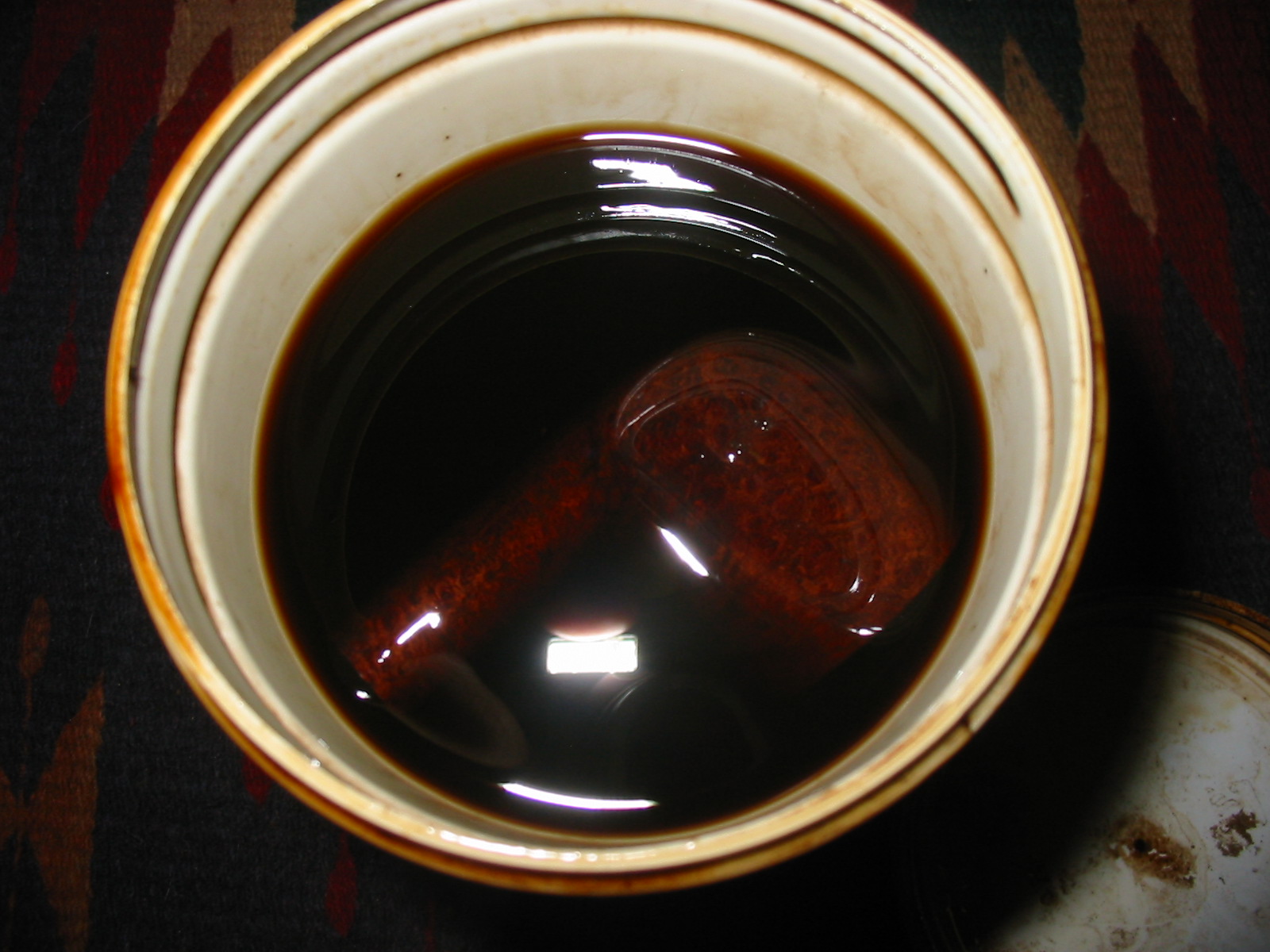
I reamed the bowl with a PipNet reamer to remove the cake, taking it back to bare wood. This pipe had a heavy aromatic smell so I decided to go back to the beginning and clean it out. Once I had reamed it I dropped it in an alcohol bath to soak for several hours.
IMG_2067

IMG_2066

I dropped the stem in a Oxyclean bath while the bowl was soaking. The Oxyclean softens the oxidation and makes it much easier to remove.
IMG_2068

After a two hour soak, I took the bowl and the stem out of their respective baths and dried them off. In the first photo below you can see the oxidation has all risen to the surface of the DE stem. It is the third stem from the top in the photo.
IMG_2080

I pushed the stem back into the shank once the shank had dried out and took some pictures to show the state of the pipe after the soaks.
IMG_2118

IMG_2119

IMG_2120

IMG_2121

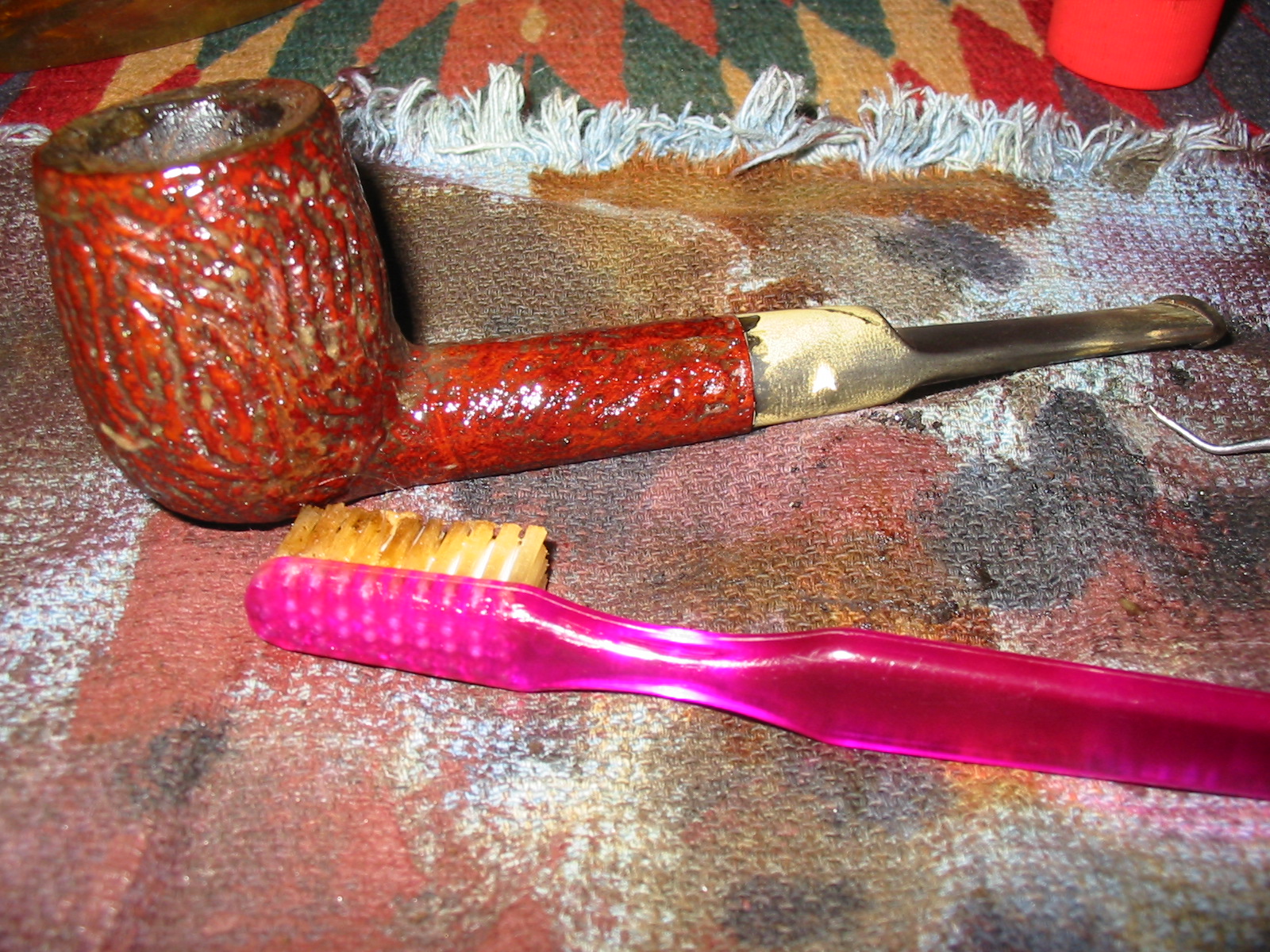
I scrubbed the exterior bowl and shank down with a soft bristle tooth brush and Murphy’s Oil Soap to remove the grime and build up in the grooves of the finish. I also scrubbed top of the rim with the tooth brush and used a dental pick to remove the buildup from the grooves of the finish. Once I had scrubbed the bowl I rinsed it with warm water under the tap. I scrubbed it with the warm water to remove the soap and then dried it with a soft cloth.
IMG_2122

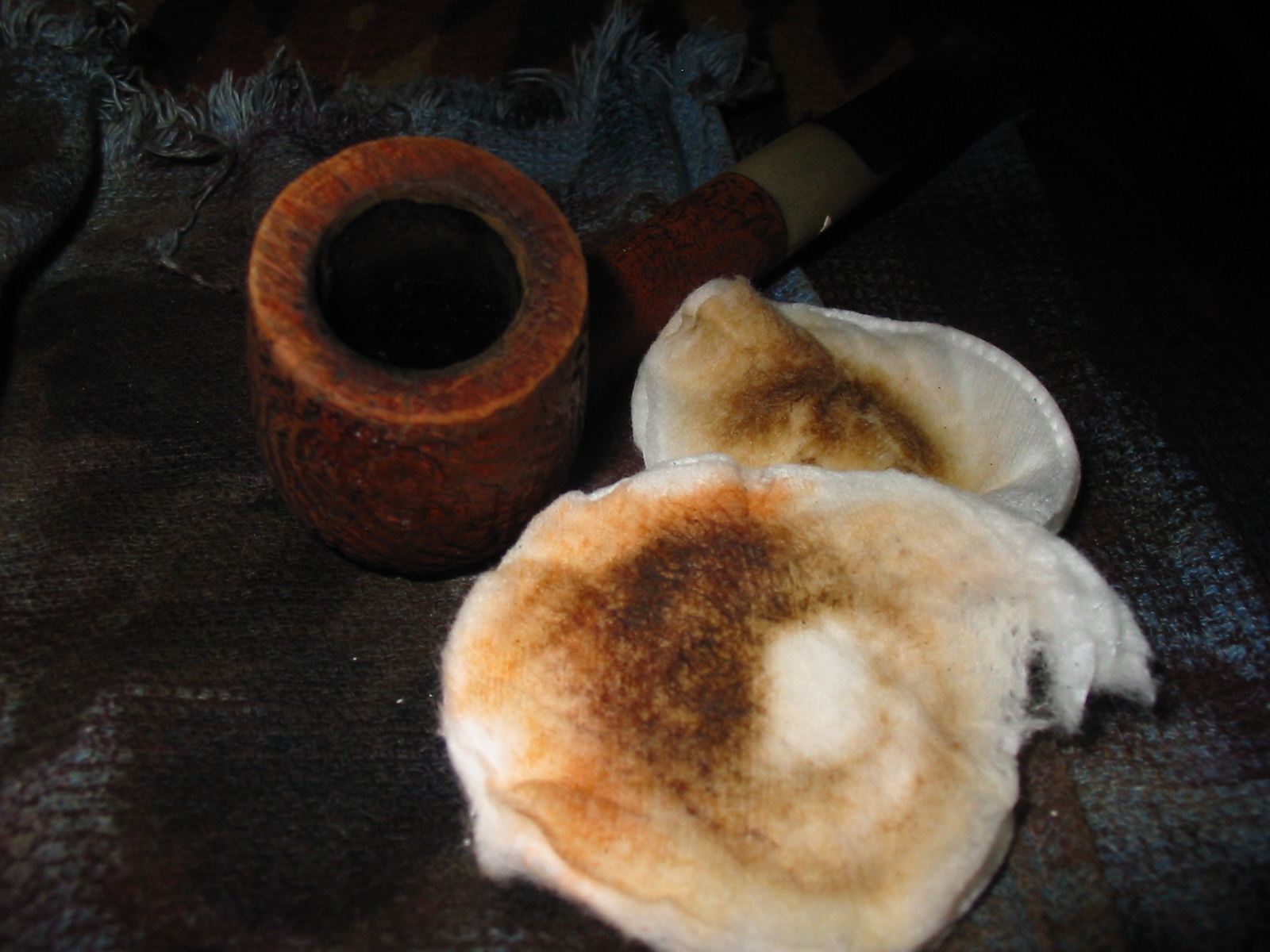
I wiped the bowl down with acetone on cotton pads to clean off the remainder of the finish on the pipe. I worked on the rim until it was clean and free of the buildup that was deep in the grooves.
IMG_2123

I restained the bowl and shank with a dark brown aniline stain, flamed it and then gave it a coat of Linseed oil with a light cherry stain.
IMG_2124

IMG_2125

IMG_2127

This time around in the cleaning process I had gotten ahead of myself and stained the pipe before I had thoroughly cleaned out the interior of the pipe. IT WAS AN ERROR. Normally I clean and scrub the interior the same time I do the outside. It makes the cleaning with Everclear much easier and if the alcohol drips on the surface no harm is done. Doing it after the staining made the cleaner process fussy and I had to be careful not to harm the finish of the newly stained bowl and shank.
IMG_2128

Once the interior was cleaned I set the bowl aside and worked on the stem. I sanded the stem with a fine grit sanding sponge to remove the surface oxidation. The Oxyclean had done a great job in bringing it all to the surface.
IMG_2129

IMG_2130

IMG_2131

I put the stem back in the shank and did some work on the tooth marks on the top and bottom of the stem. I flamed them with a Bic lighter to lift them as much as possible. On the top side the marks disappeared altogether between the light sanding and the flame of the lighter. On the underside one deeper bite mark remained. I continued to flame it and sand until I had minimized its appearance on the stem.
IMG_2132

IMG_2133

I dry sanded the stem with micromesh sanding pads from 1500-12,000 grit. Each successive grit removed more of the scratches on the vulcanite and brought a deeper shine to the stem.
IMG_2134

IMG_2135

IMG_2136

I rubbed down the stem with Obsidian Oil and set it aside to dry and soak into the stem and buffed it by hand.
IMG_2137

IMG_2138

IMG_2139

IMG_2140

I took it to the buffer and buffed it with White Diamond and then with carnauba wax. I gave it multiple coats of wax and then buffed the pipe with a soft flannel buffing pad to give it a shine. The finished pipe is pictured below.
IMG_2142

IMG_2144

IMG_2143

IMG_2146

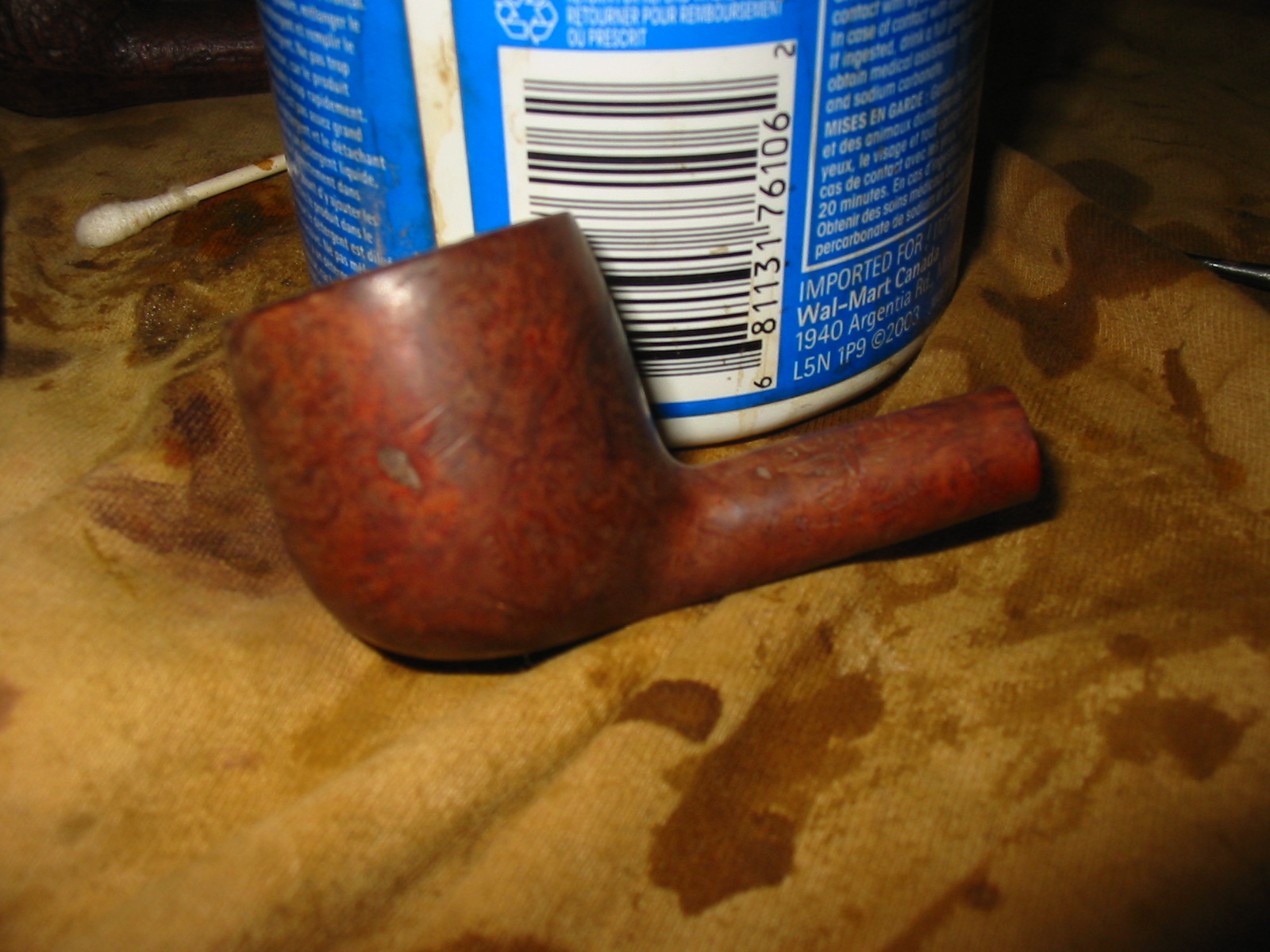
Reworking an Old Pal Pencil Shank Pot


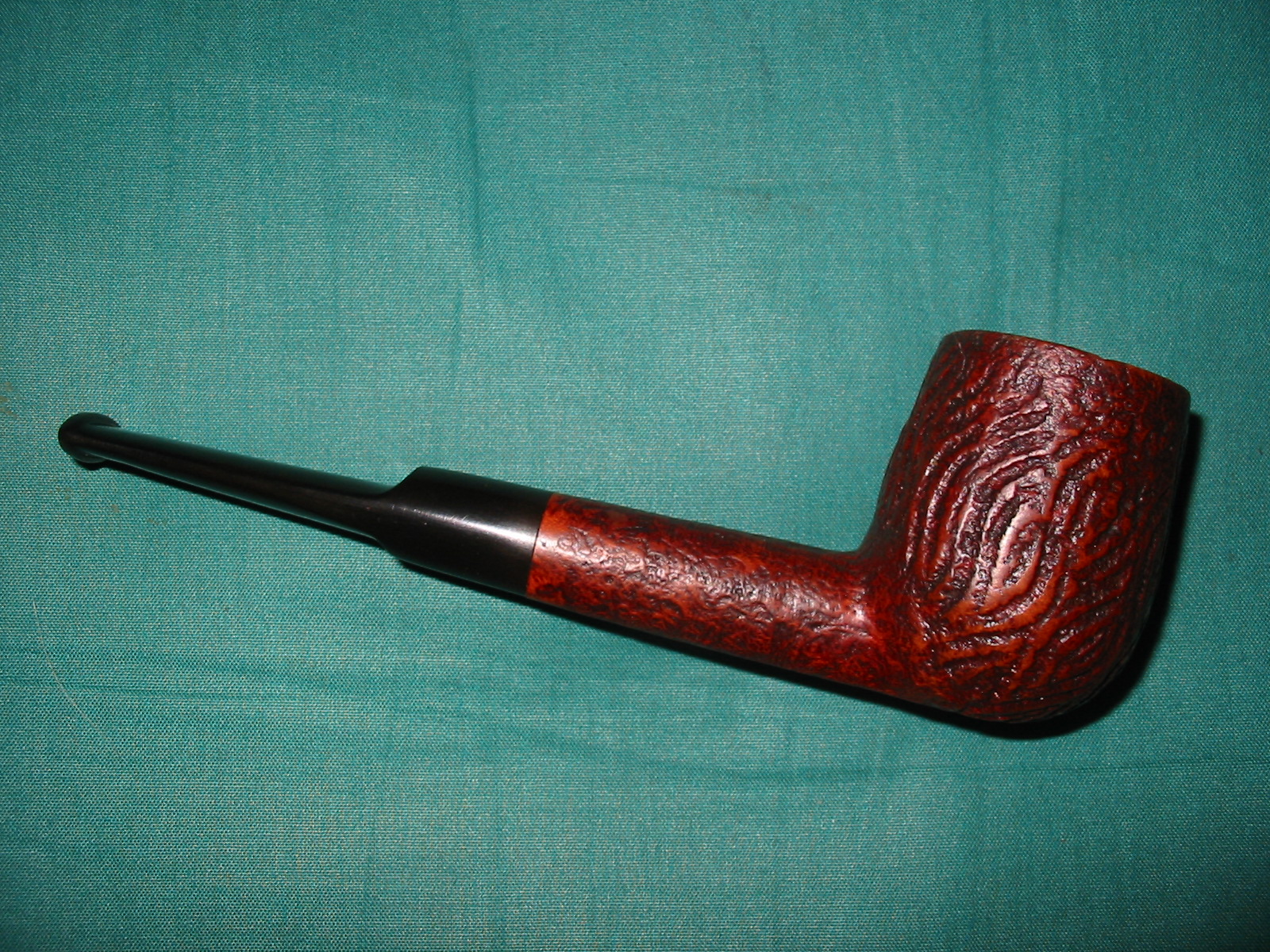
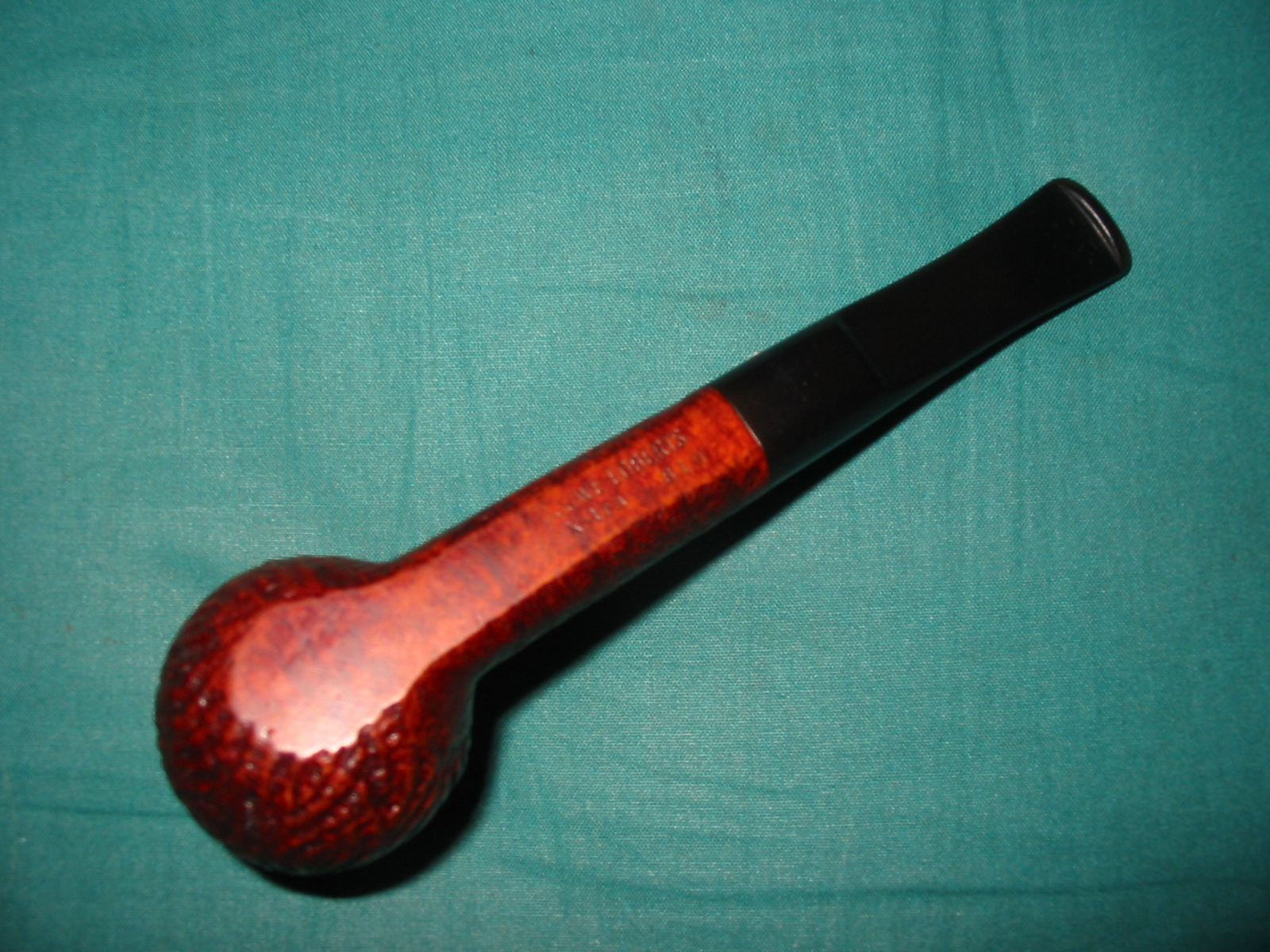
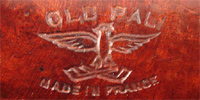
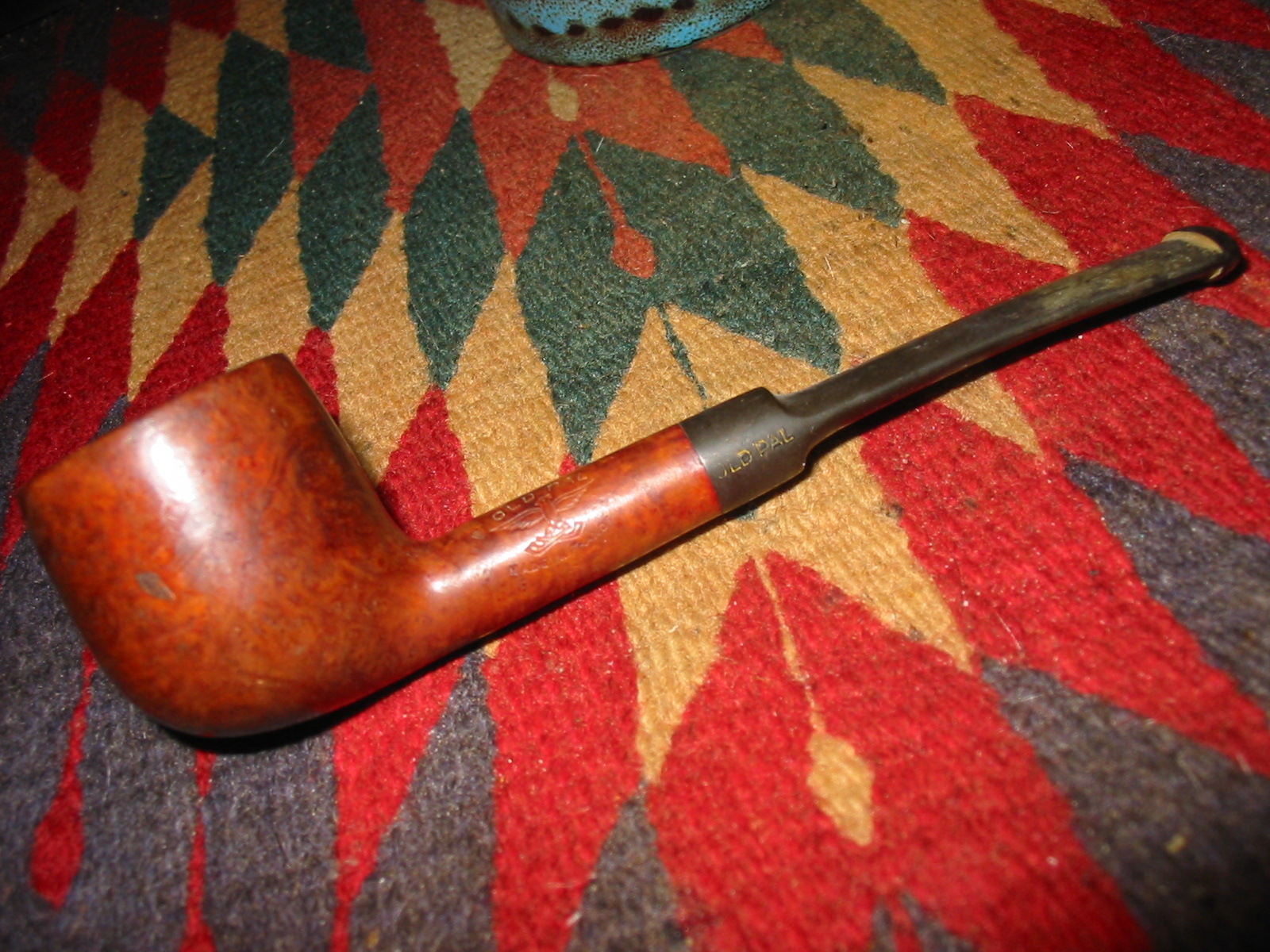
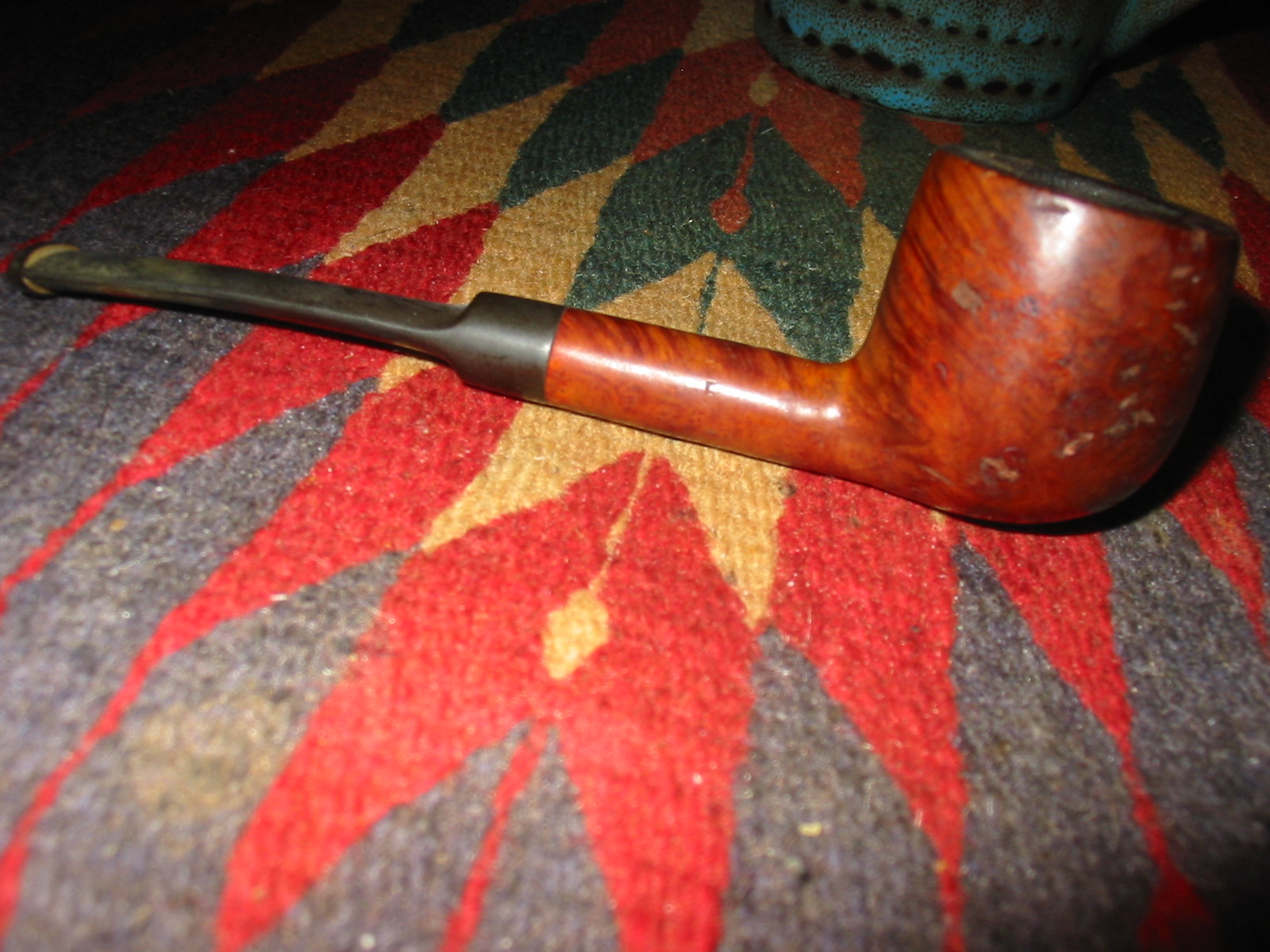
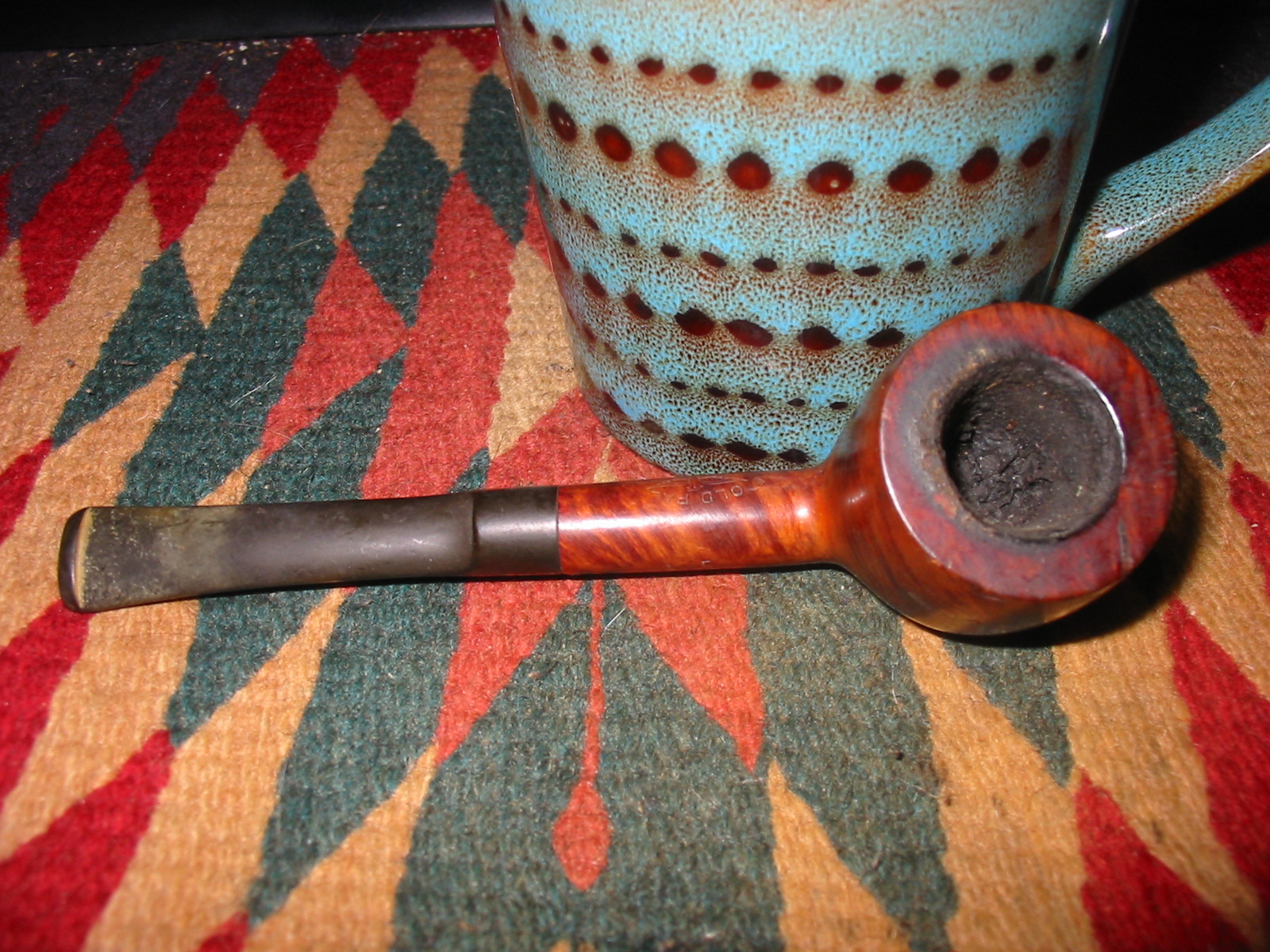
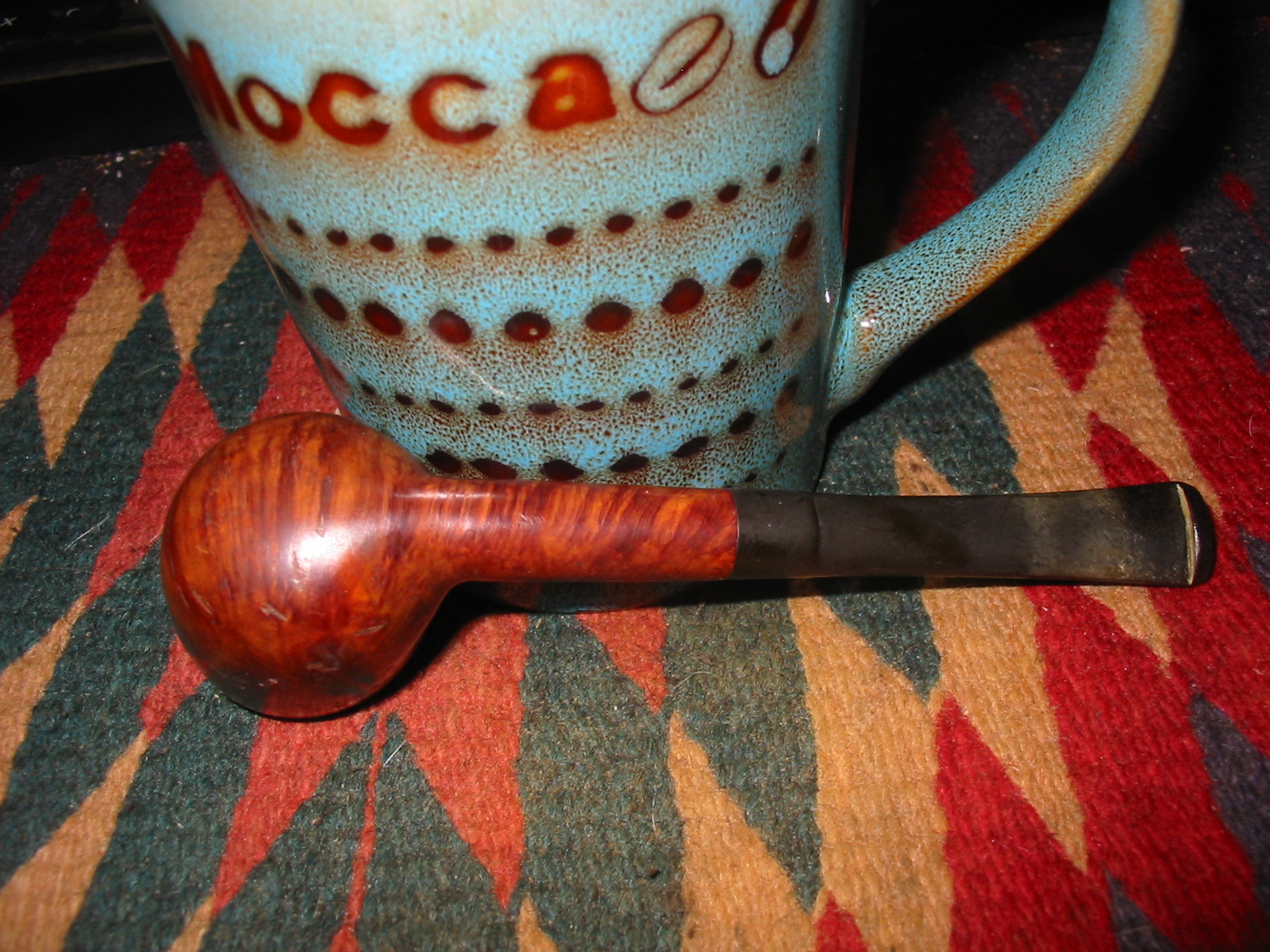
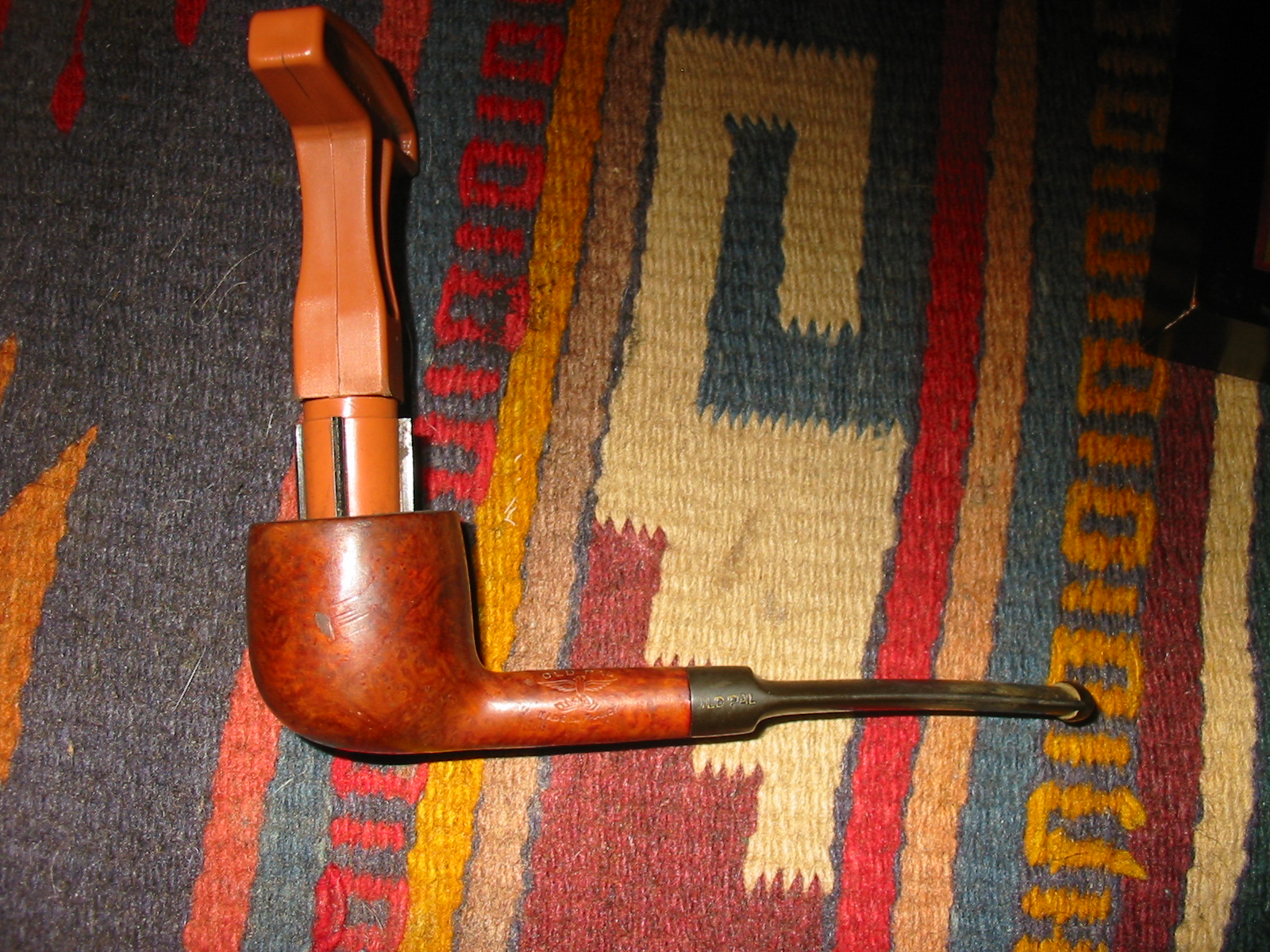
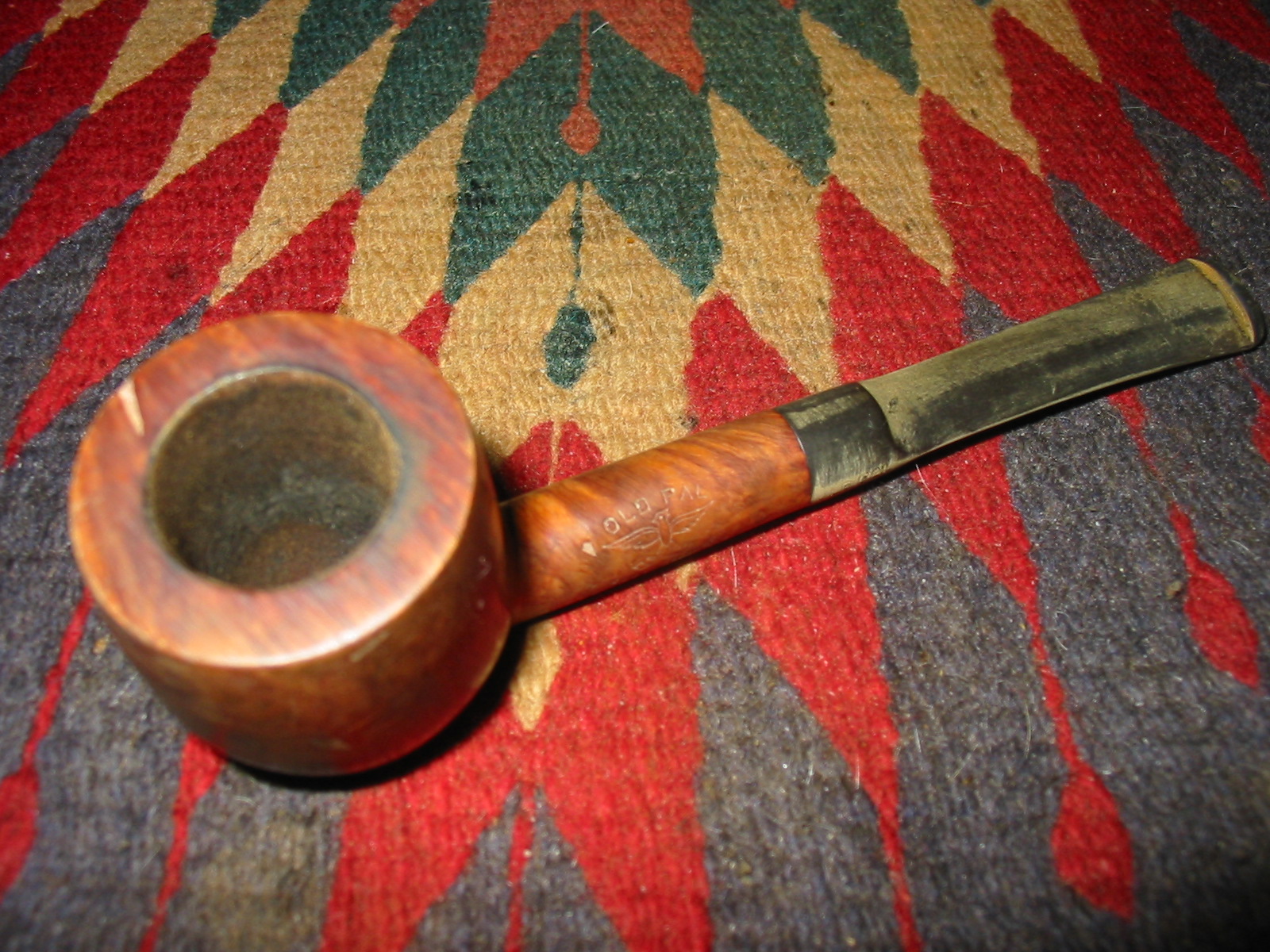
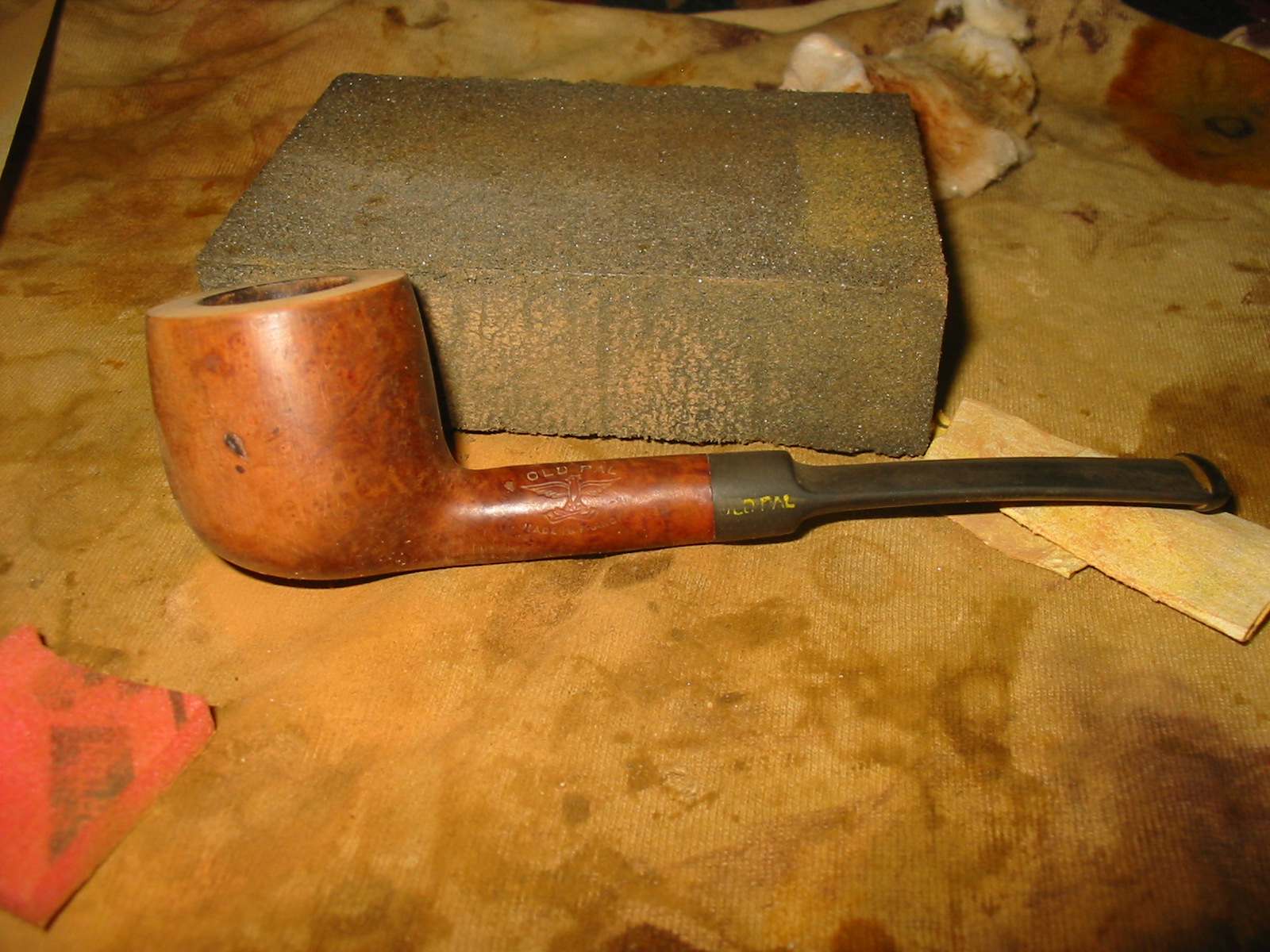
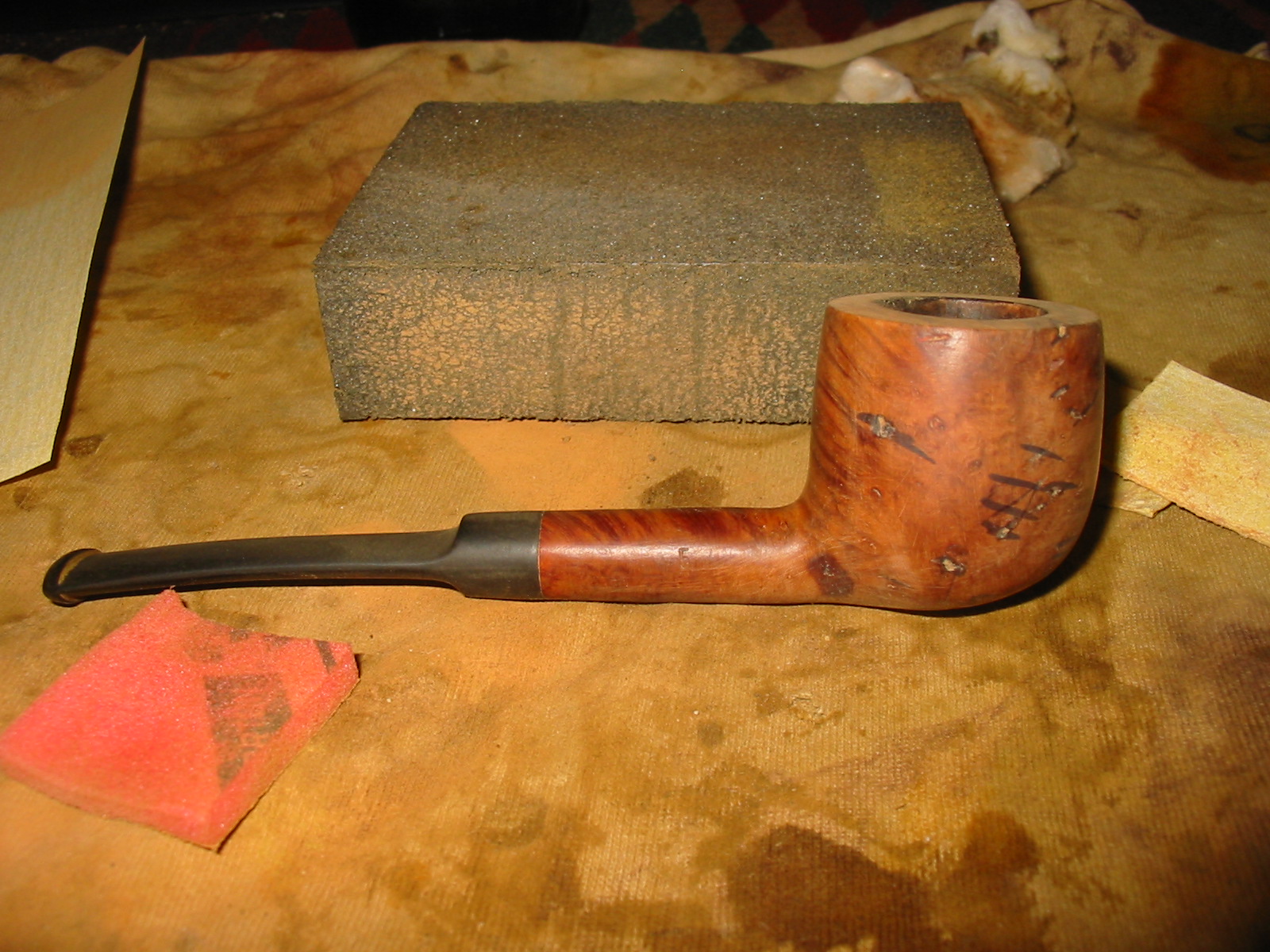
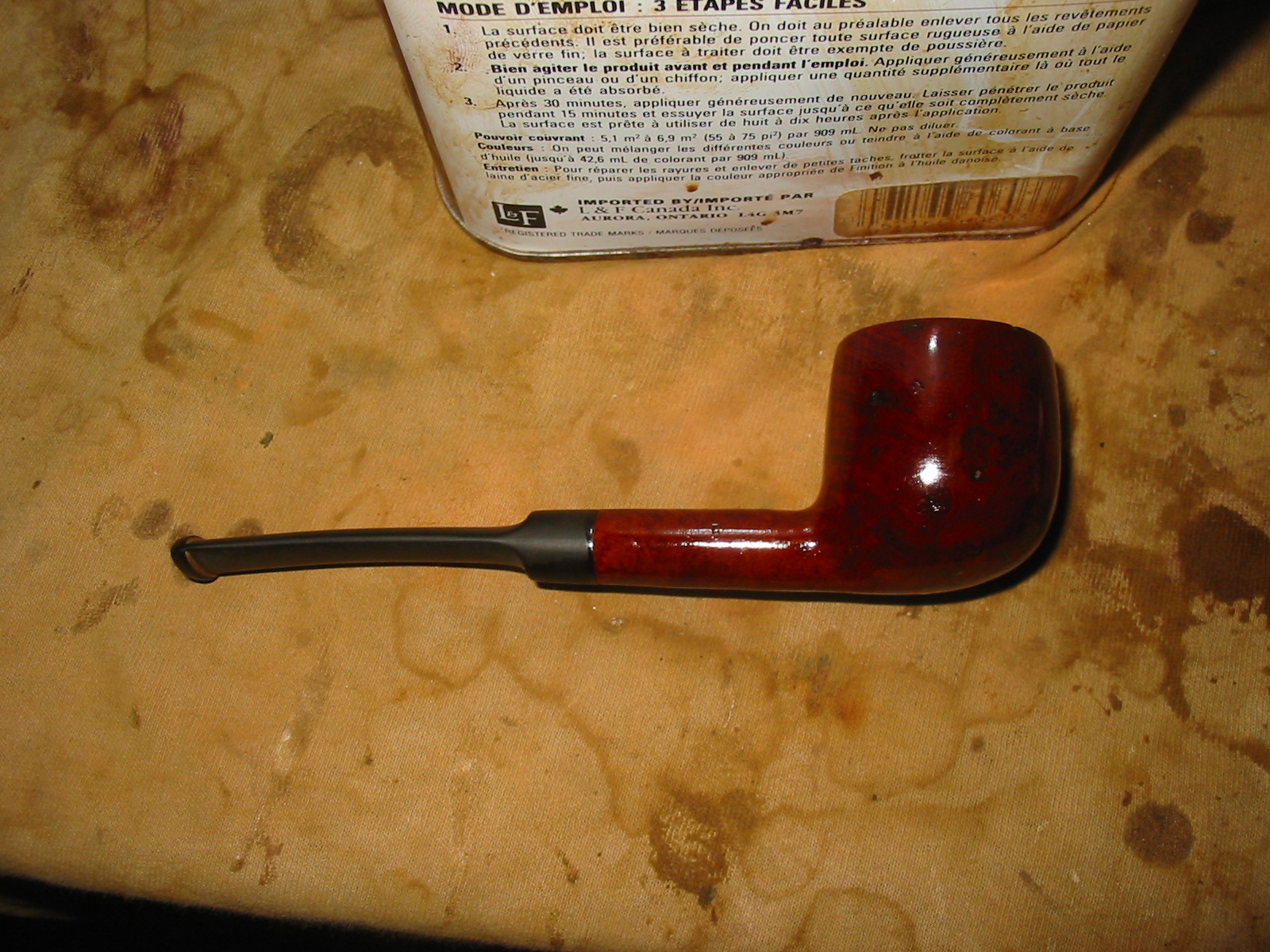
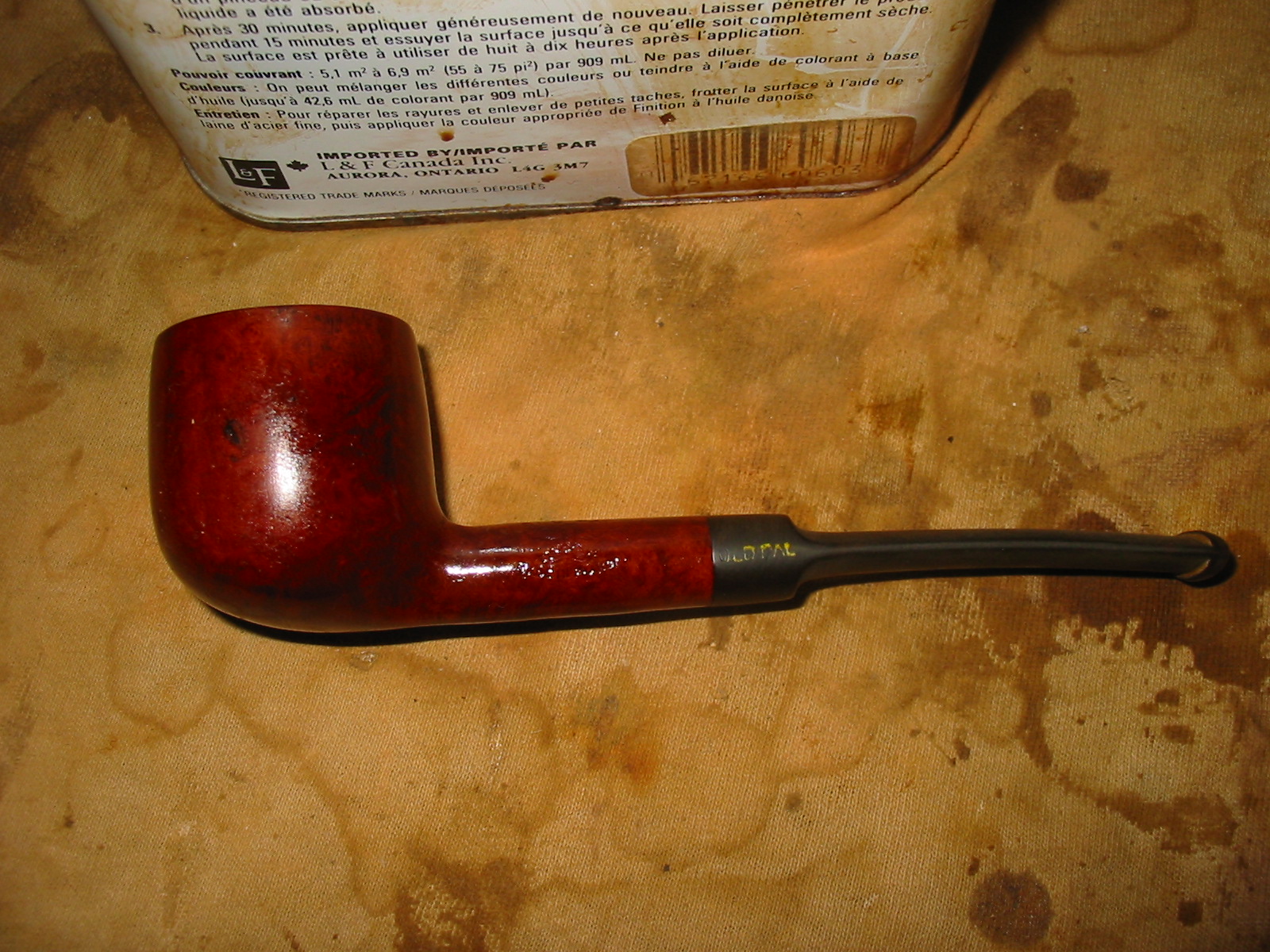
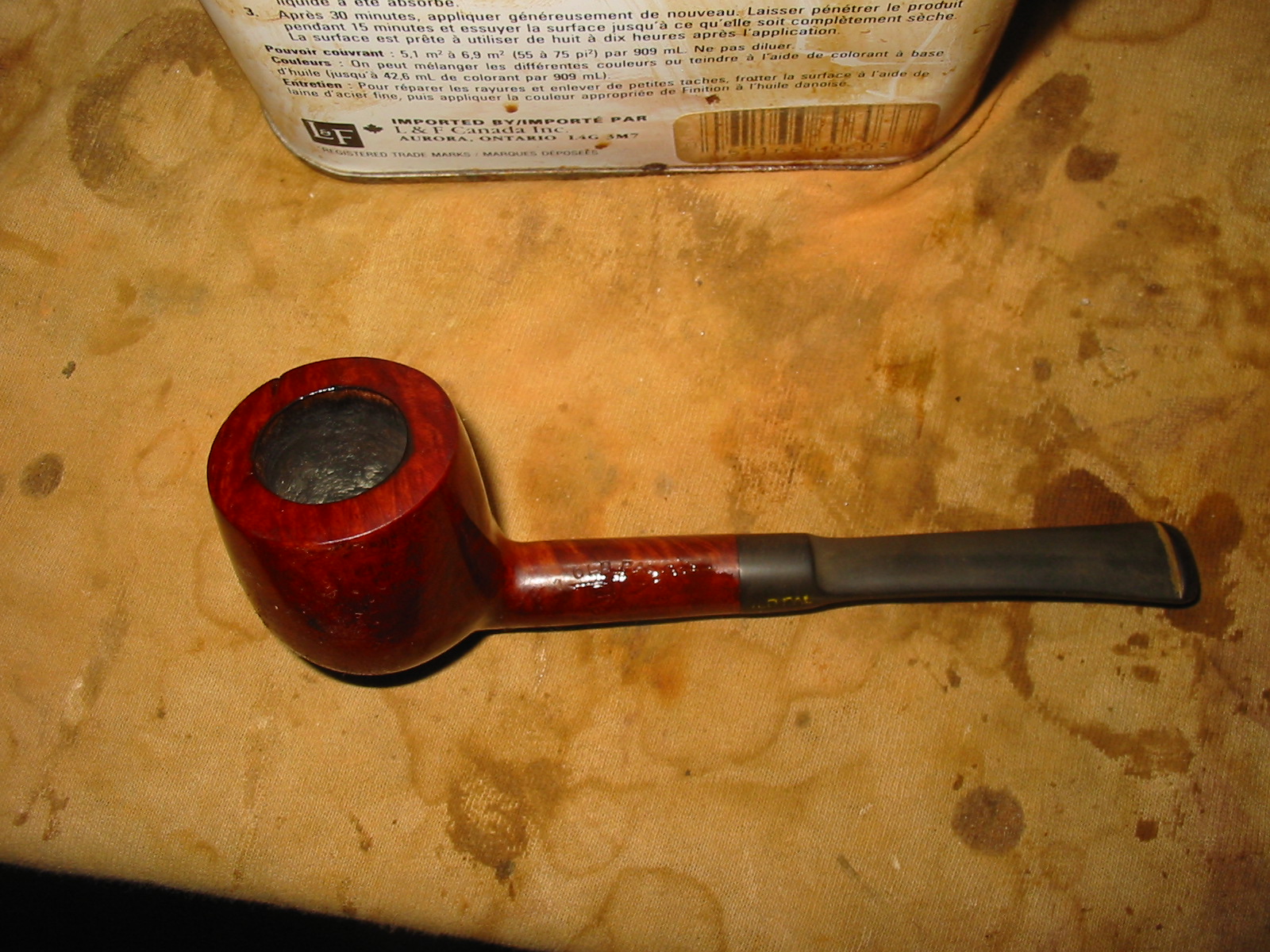
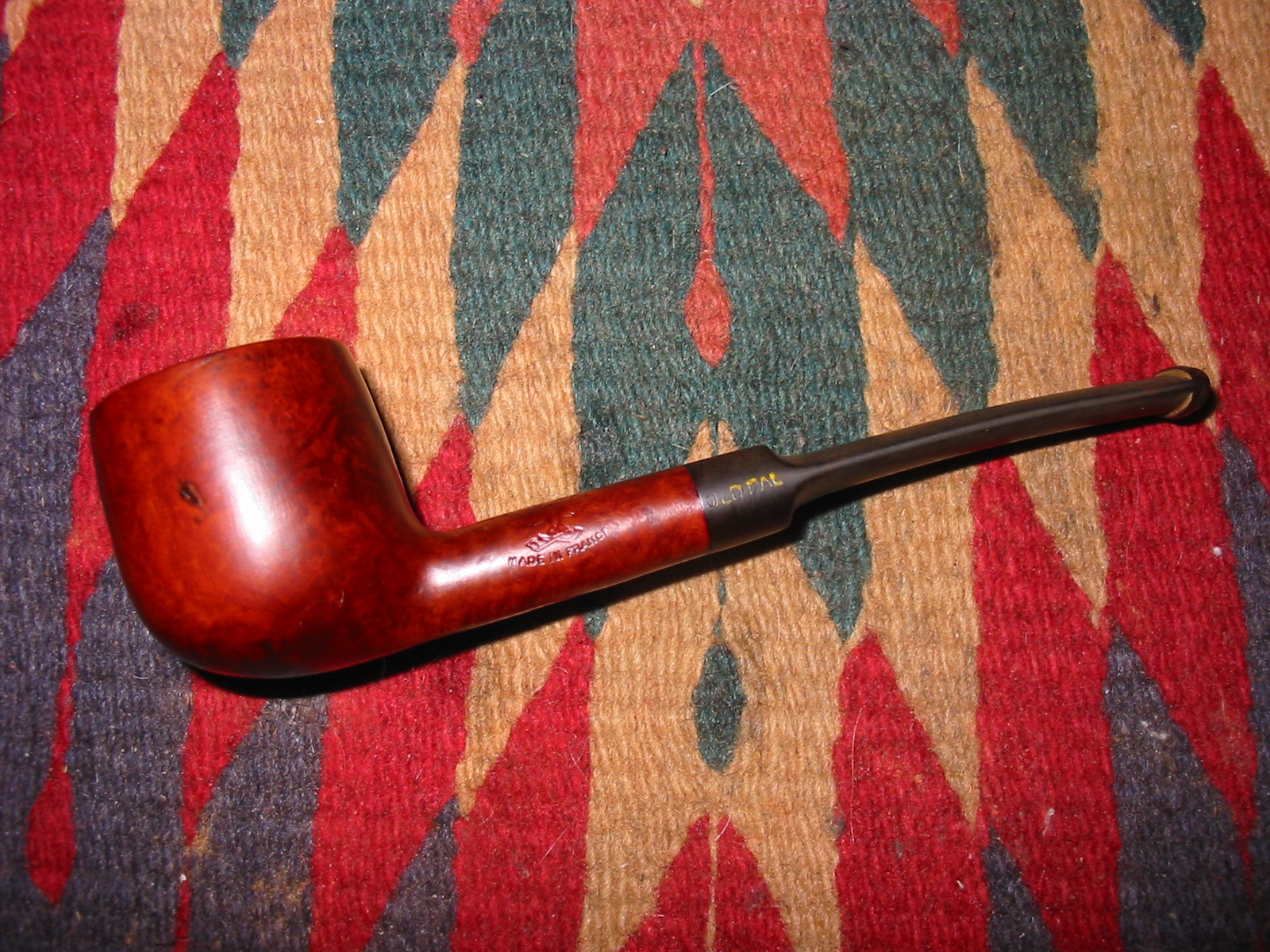
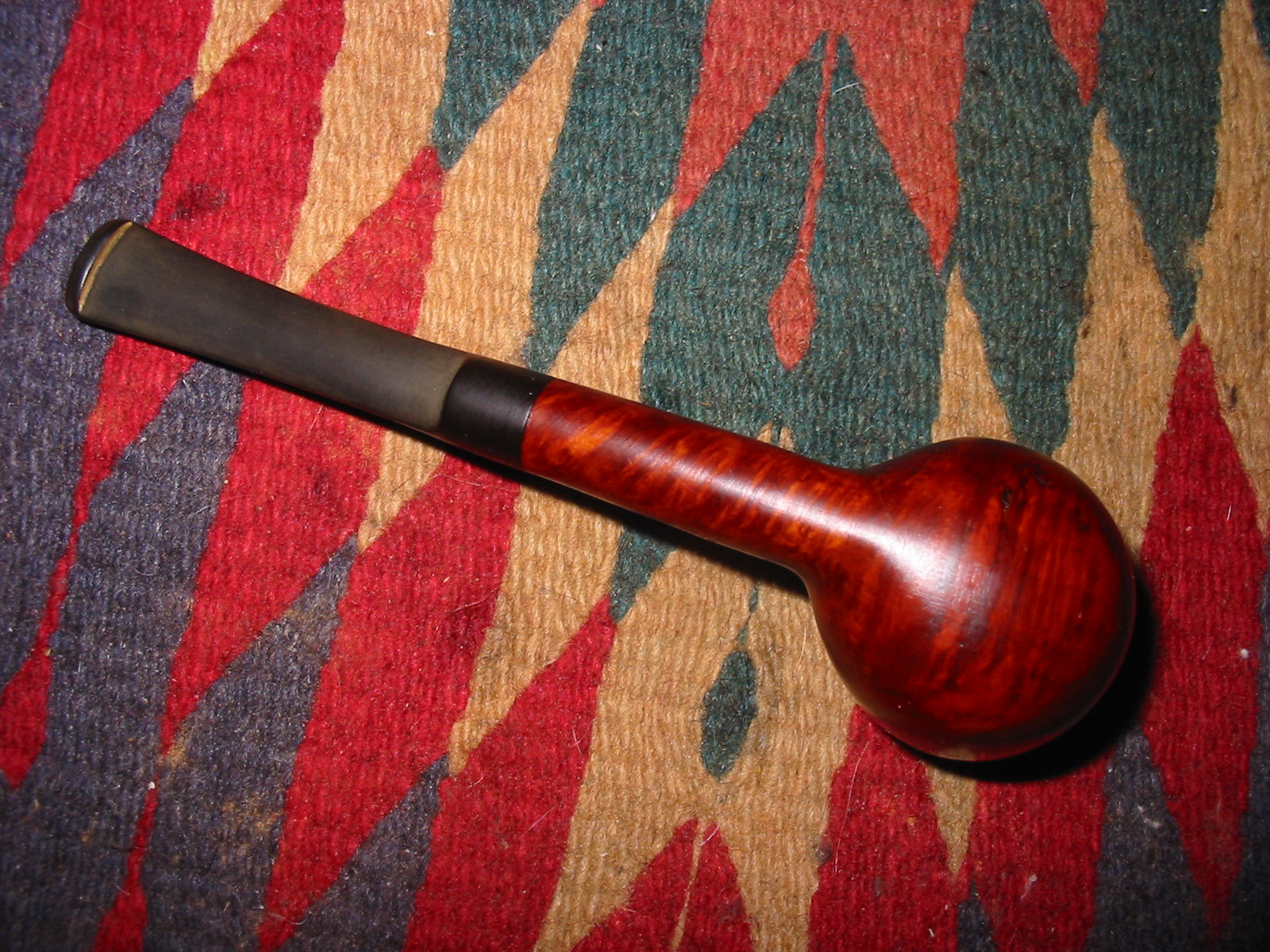
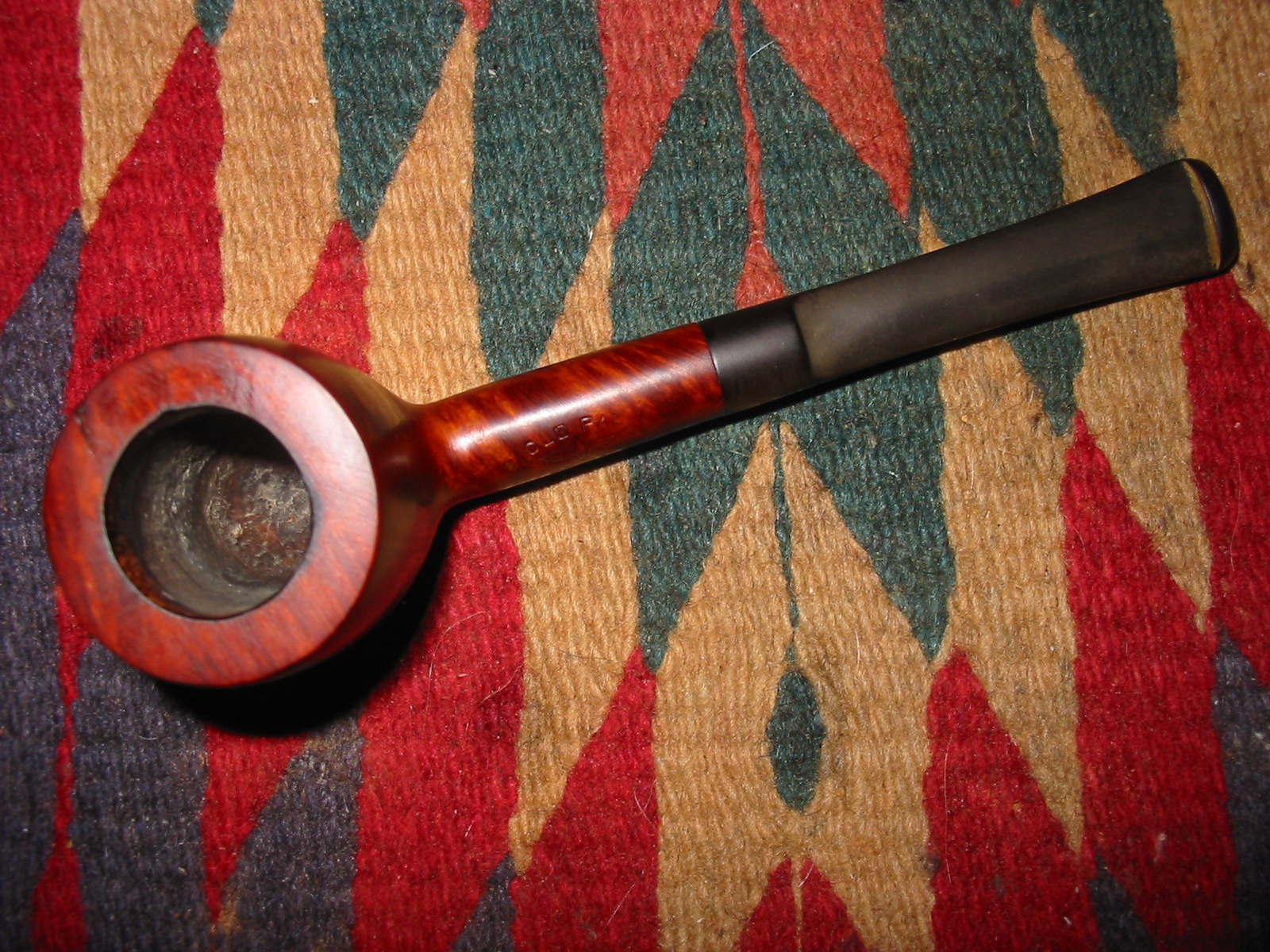
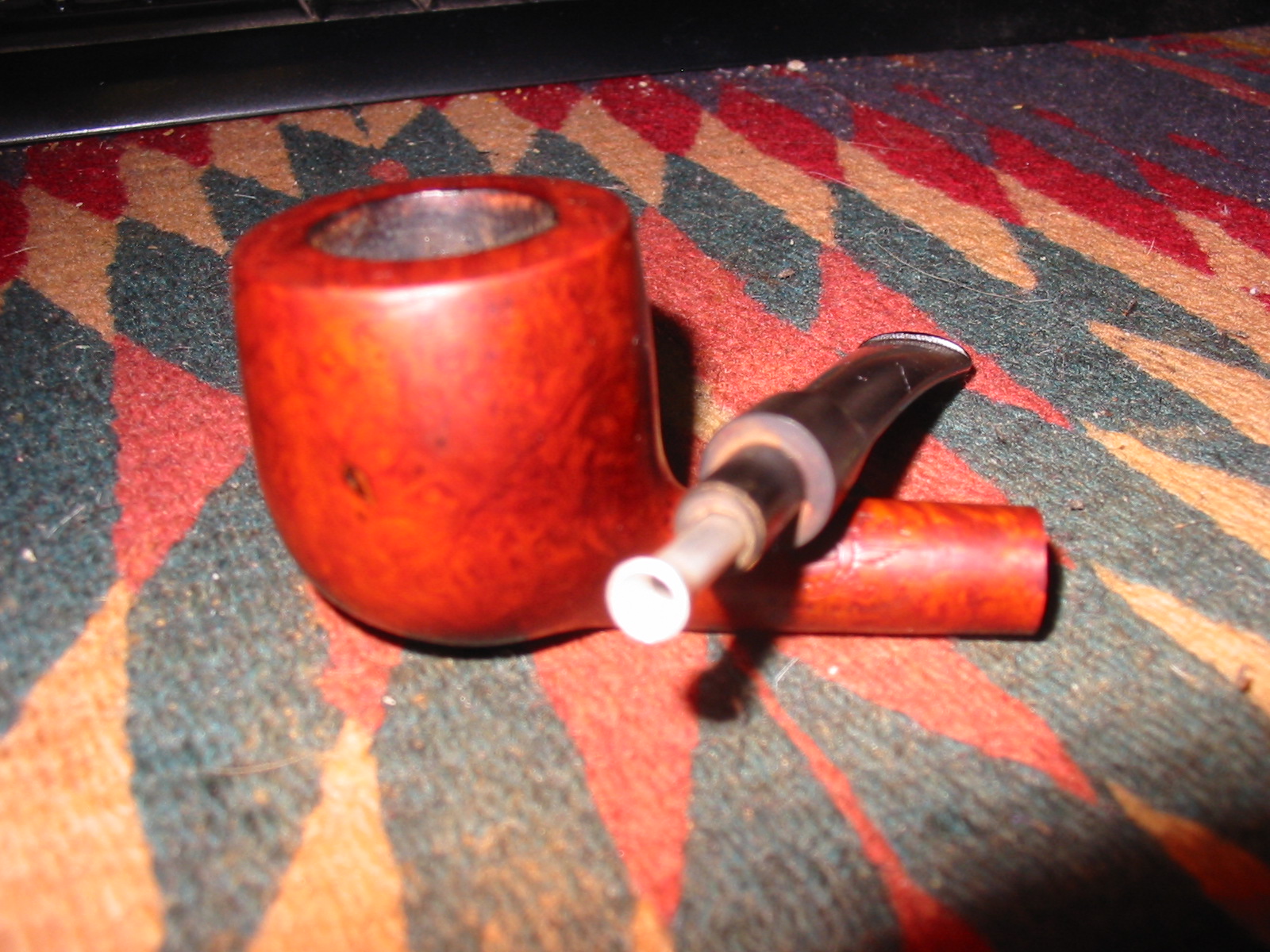
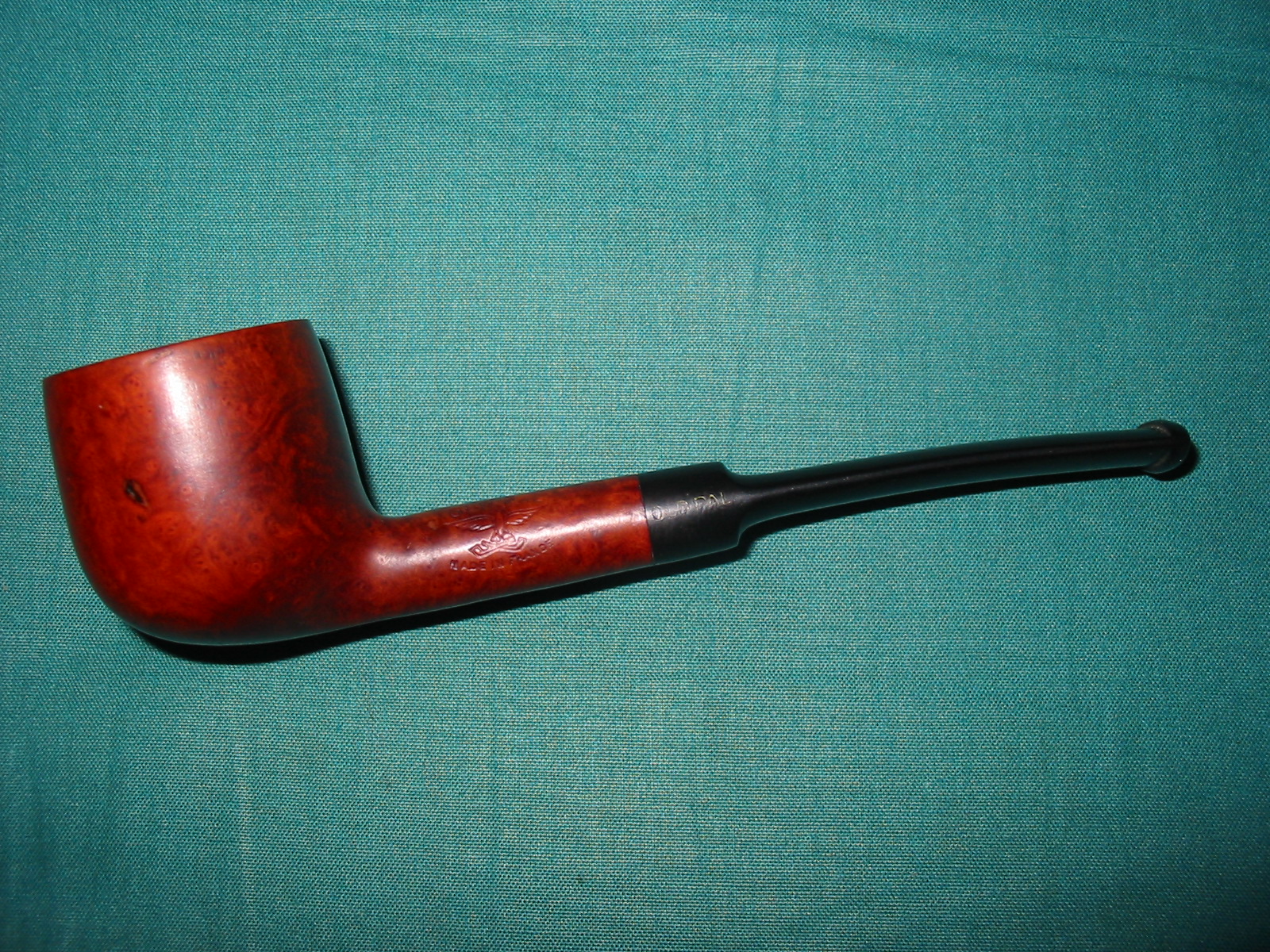
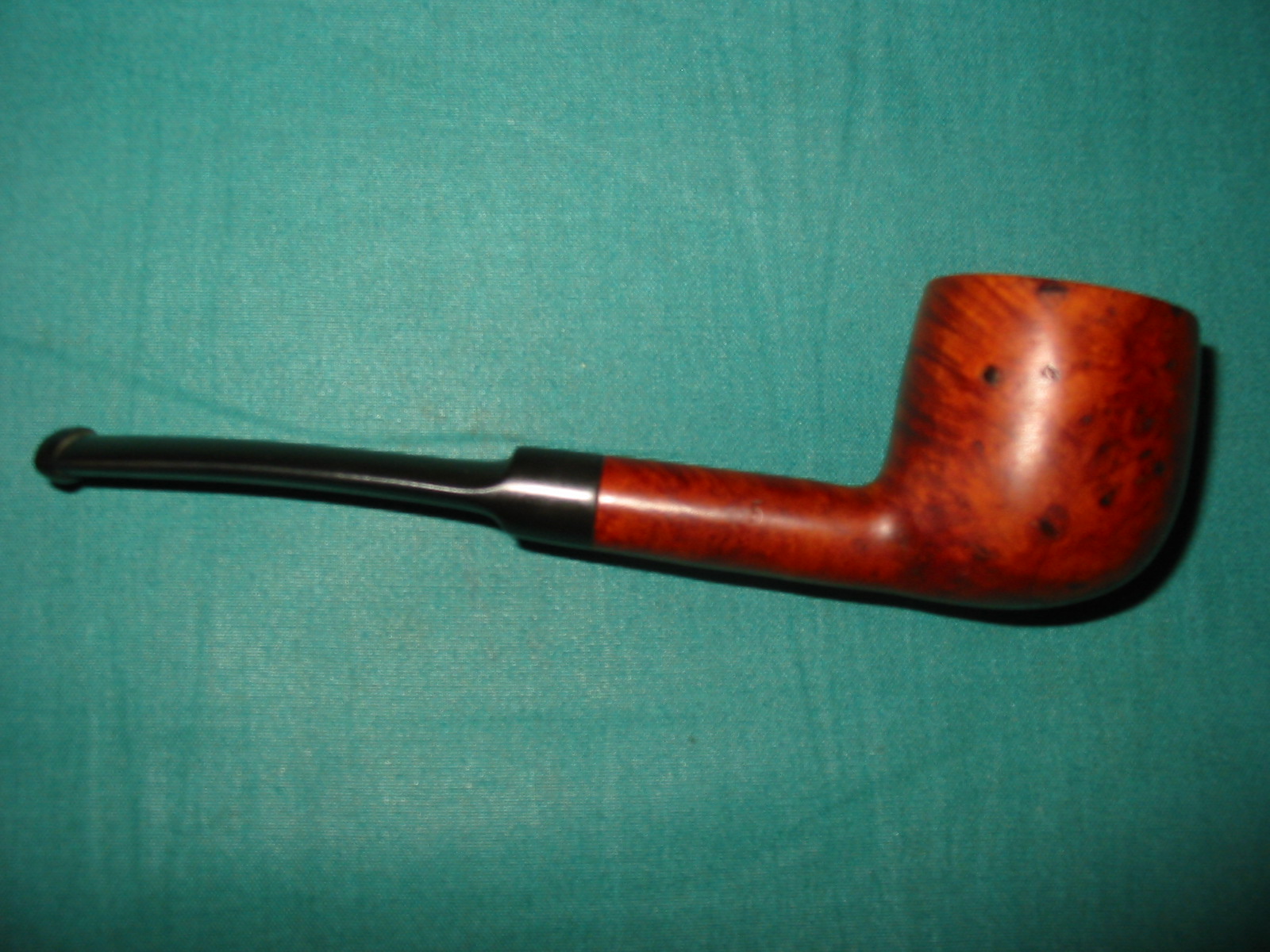
I just finished cleaning up another of the old pipes I found on my trip. It is a petite pot shaped pipe with a pencil shank. The overall length is barely over 5 inches and the weight is negligible. It is stamped on the left side of the shank in arc – Old Pal, over an Eagle with spread wings and then underneath Made in France.
oldpal2b
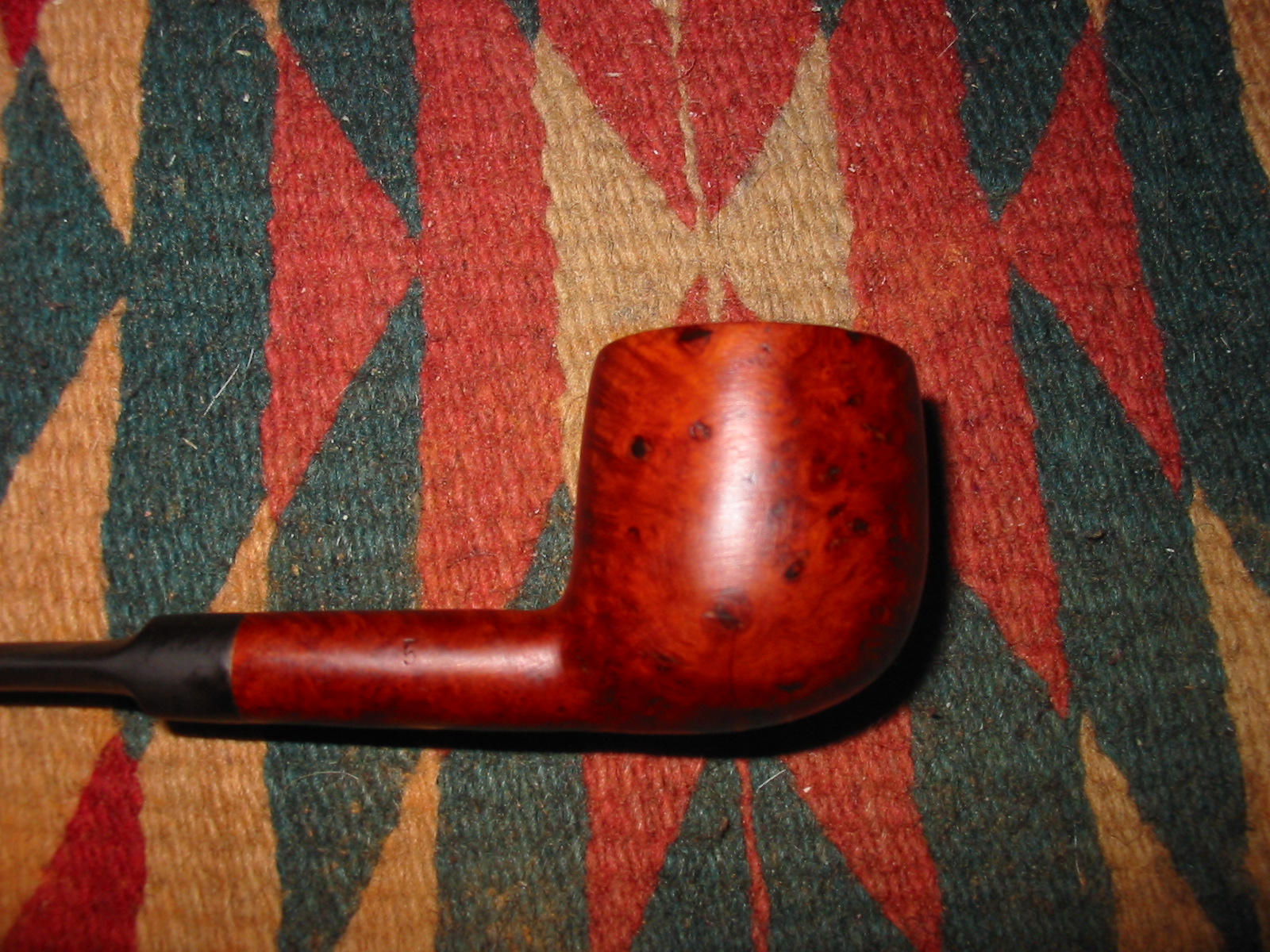
On the right side of the shank it is stamped 5 which I assume is the shape number. The stem is also stamped with the words OLD PAL on the left side of the saddle portion. On this particular pipe it is faint. In checking on the background information on “Who Made That Pipe” I found that it had two French makers for Old Pal listed. The first of those is Marechal Ruchon and Cie. (Incidentally it is the company that owned the GBD brand). The second maker listed is Rubinovich & Haskell Ltd. The bird emblem is probably the key, but I can find no reference to it. My own thinking is that the brand was made by Marechal Ruchon & Cie. I was able to dig up this brief summary of the MR&C brand. Ganeval, Bondier and Donninger began making pipes in 1850 and rapidly gained prominence in briar pipe making. Of the three, Bondier survived the others by 30 years, but new partners took their places. The name of the company changed to Bondier Ulrich & Cie, then Bine Marechal & Cie and finally to A Marechal, Ruchon & Cie. August Marechal and Ferdinand Ruchon saw the firm into the 20th century, their names being used for the company for well over 50 years.

Prior to 1899, Marechal, Ruchon & Co. became A. Oppenhiemer’s sole agent for cigarette papers but still remained in the pipe making business. Then in 1902, Marechal, Ruchon & Co.. owners of GBD and referred to as French pipe makers, merged with A. Oppenhiemer. In the 1915 London Directory of briar pipe makers one will find: “”Marechal, Ruchon & Co. – 38 Finsbury Sq. E.C.; London works, 15 & 16 Featherstone St. E.C. and Oppenhiemer, A. & Co. – 38 Finsbury Sq. E.C. listed separately.

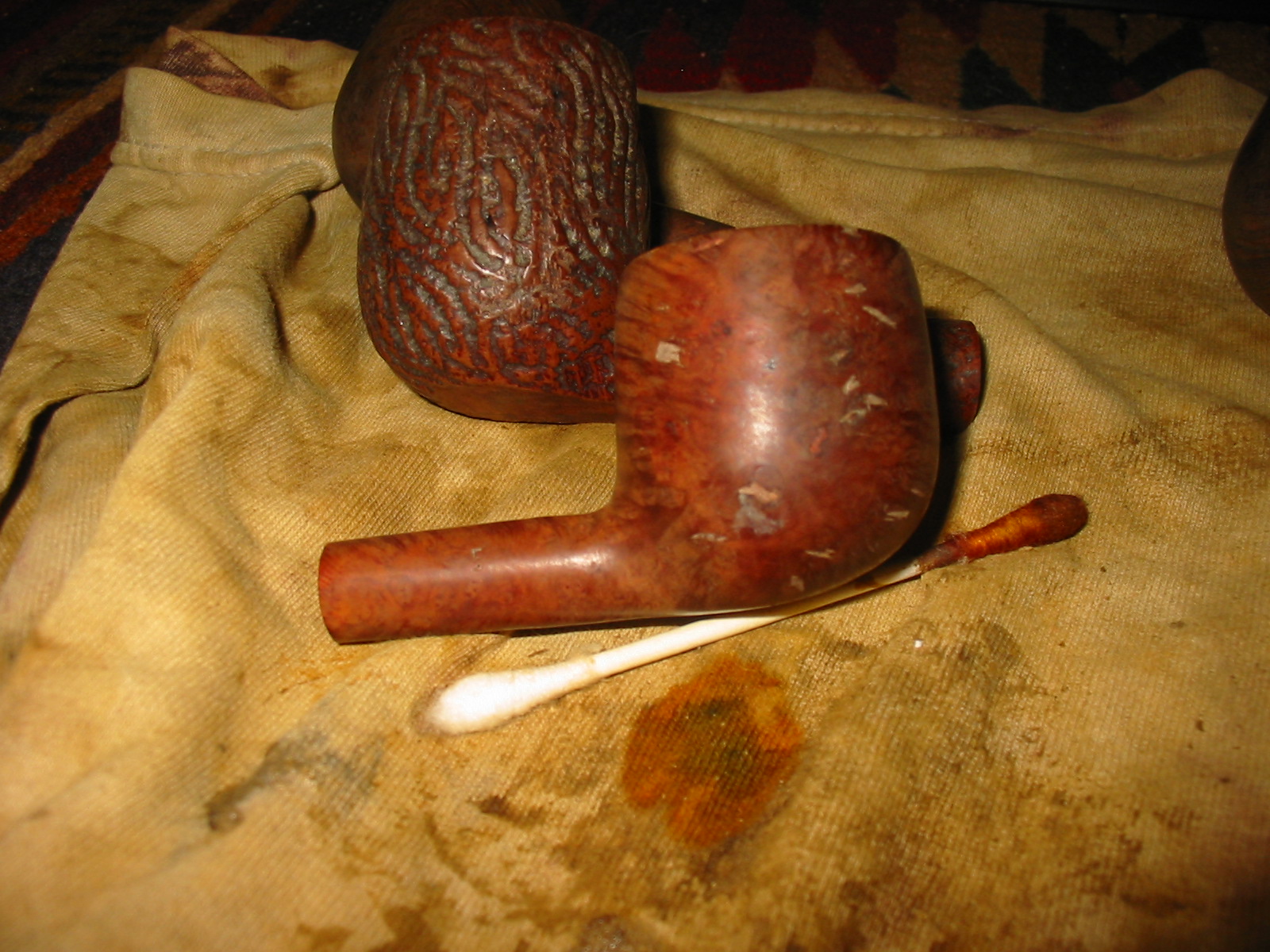
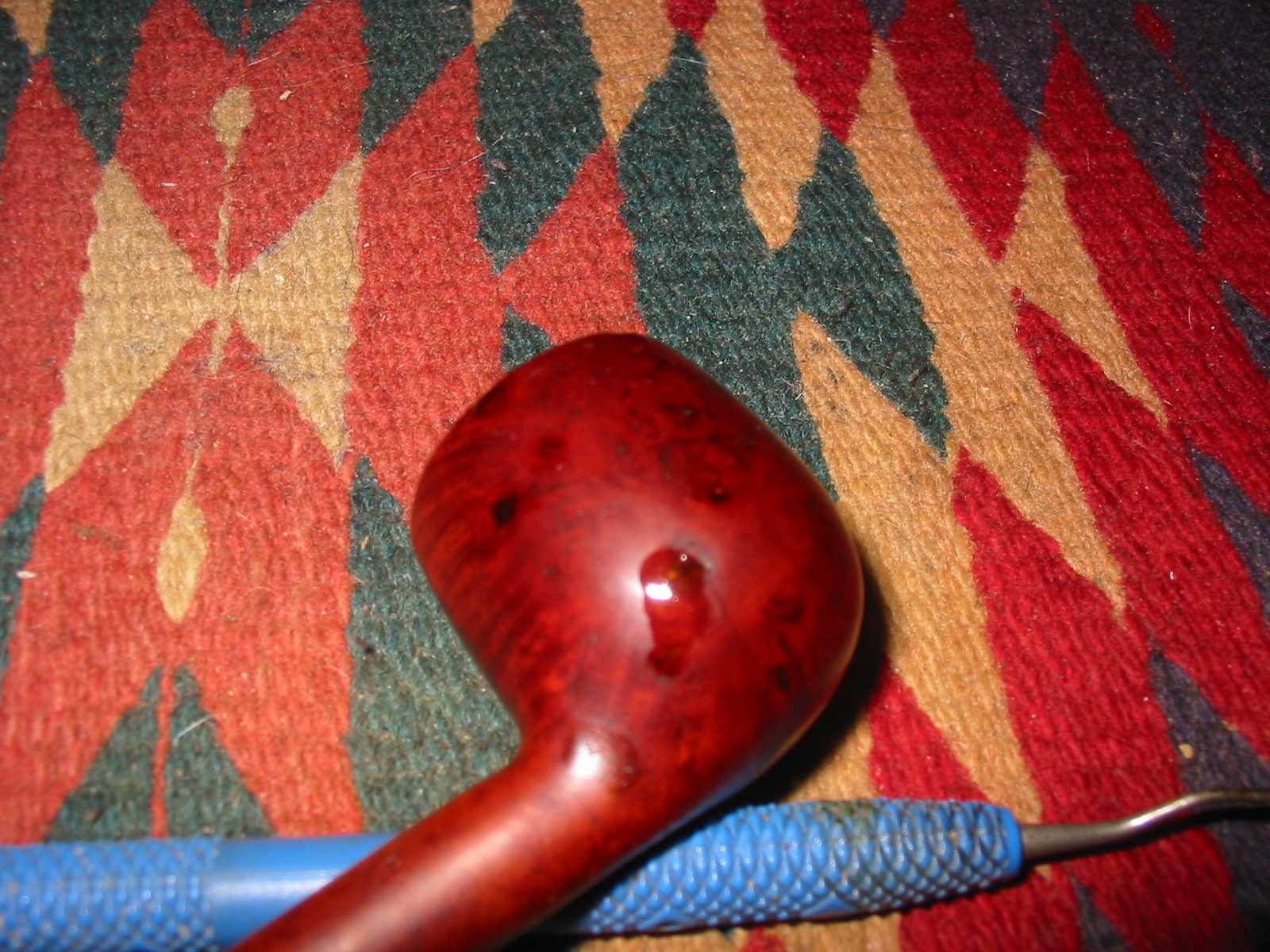
With that background information I worked on this old pipe to clean it up and restore it. When I picked it up the bowl was badly caked and packed full. The rim was dirty and tarred with what appeared to be a fill on the top of the rim right side. The entire right side of the pipe was full of fills of various sizes and shaped. There was one fill on the left side as well. The grain on the bowl was mixed and the finish was pretty beat up. The fills were shrunken and they left small pits in the surface of the pipe. The stem was oxidized and had tooth chatter on both sides near the button. The shank and airway were dirty and tarry. When the stem was removed there was an interesting flared tube that extended into the shank from the end of the tenon. The end looked like the bell of a horn. This was badly tarred and the inside of the tube was packed with debris.
IMG_2048

IMG_2049

IMG_2051

IMG_2052

I separated the stem and the bowl. The bowl was reamed with a PipNet pipe reamer back to a thin cake. Then I dropped the bowl in an alcohol bath to soak away the grime and to soften the fills. I drop the stem in an Oxyclean bath to raise the oxidation and soften it. I scrubbed both while in their respective baths to loosen the grime and buildup on the surfaces. I removed the bowl from the alcohol bath after two hours of soaking. I cleaned out the inside of the shank and the bowl as well as the inside of the stem. The trumpet like tube came out of the tenon and I cleaned it inside and out and reset it in the tenon. It is an interesting contraption as it is flared and the flared end rests against the end of the mortise directing the smoke directly into the mouthpiece. I have not seen that design before (see the photo below after the stem cleanup paragraph).
IMG_2067

IMG_2053

IMG_2066

IMG_2068

IMG_2071

I used a dental pick to dig out the fills that had softened in the bowl. My objective was to remove them altogether and replace them with a briar dust and superglue fill that turns black and gives a different look than the red putty fills.
IMG_2079

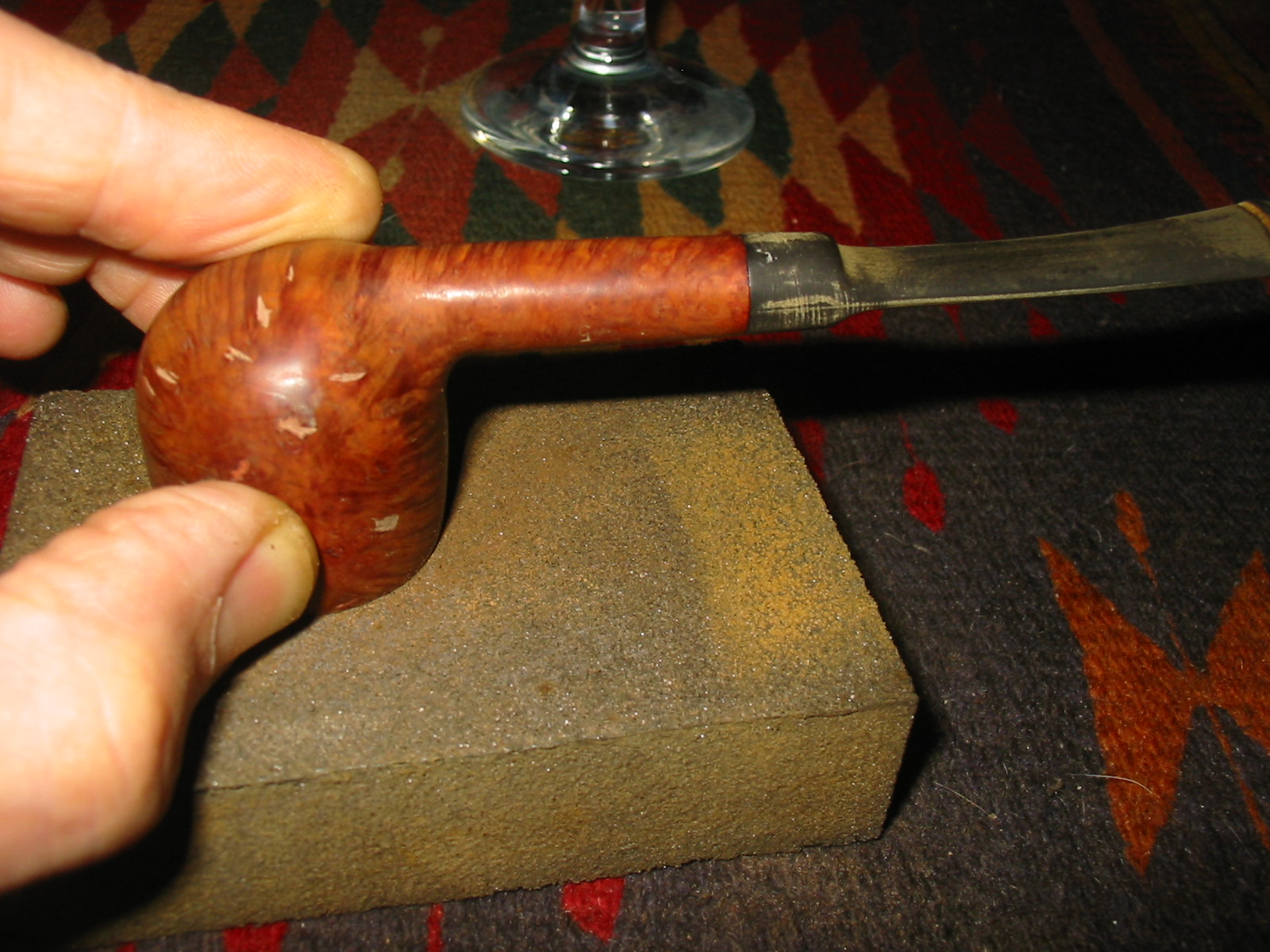
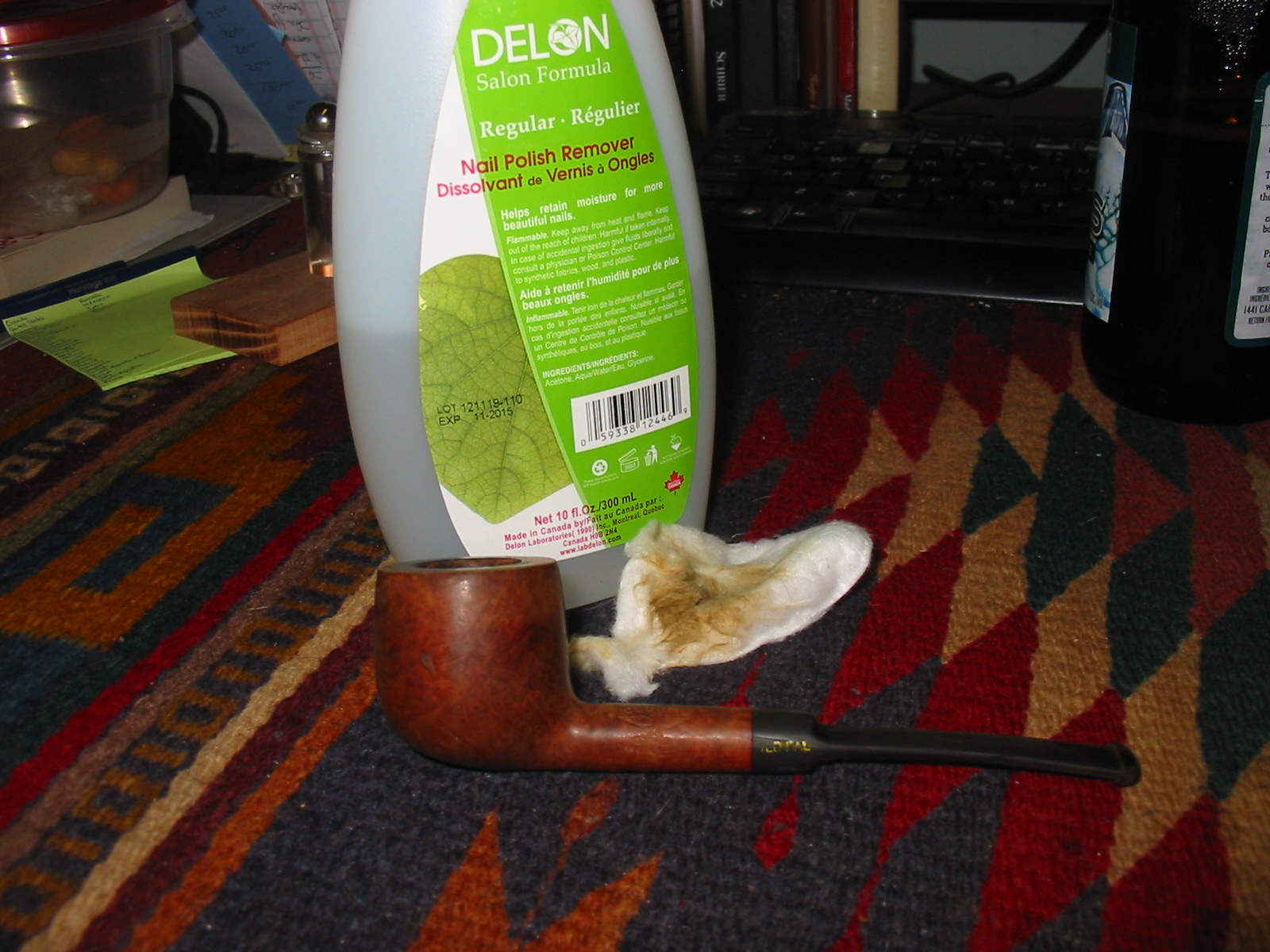
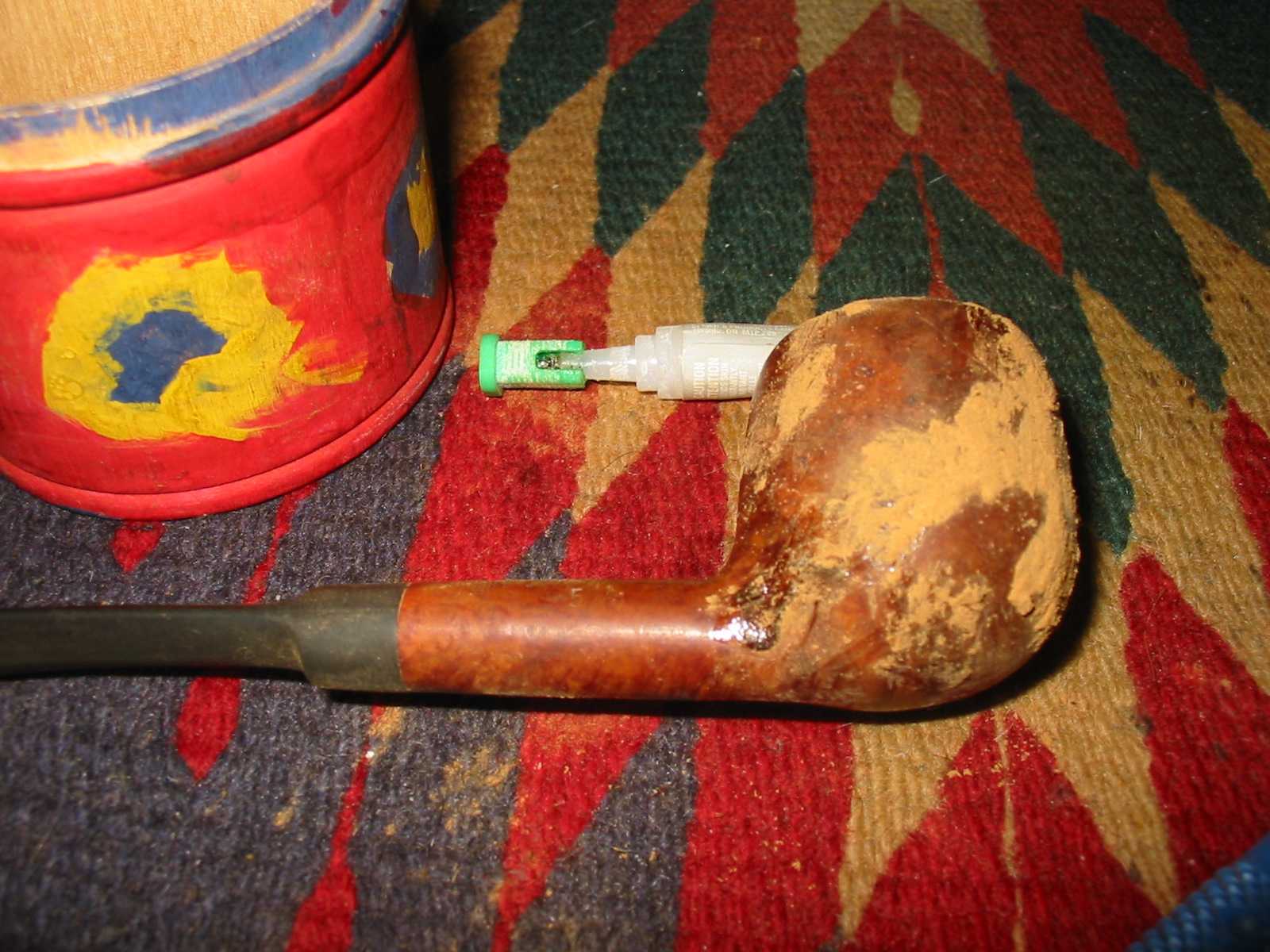
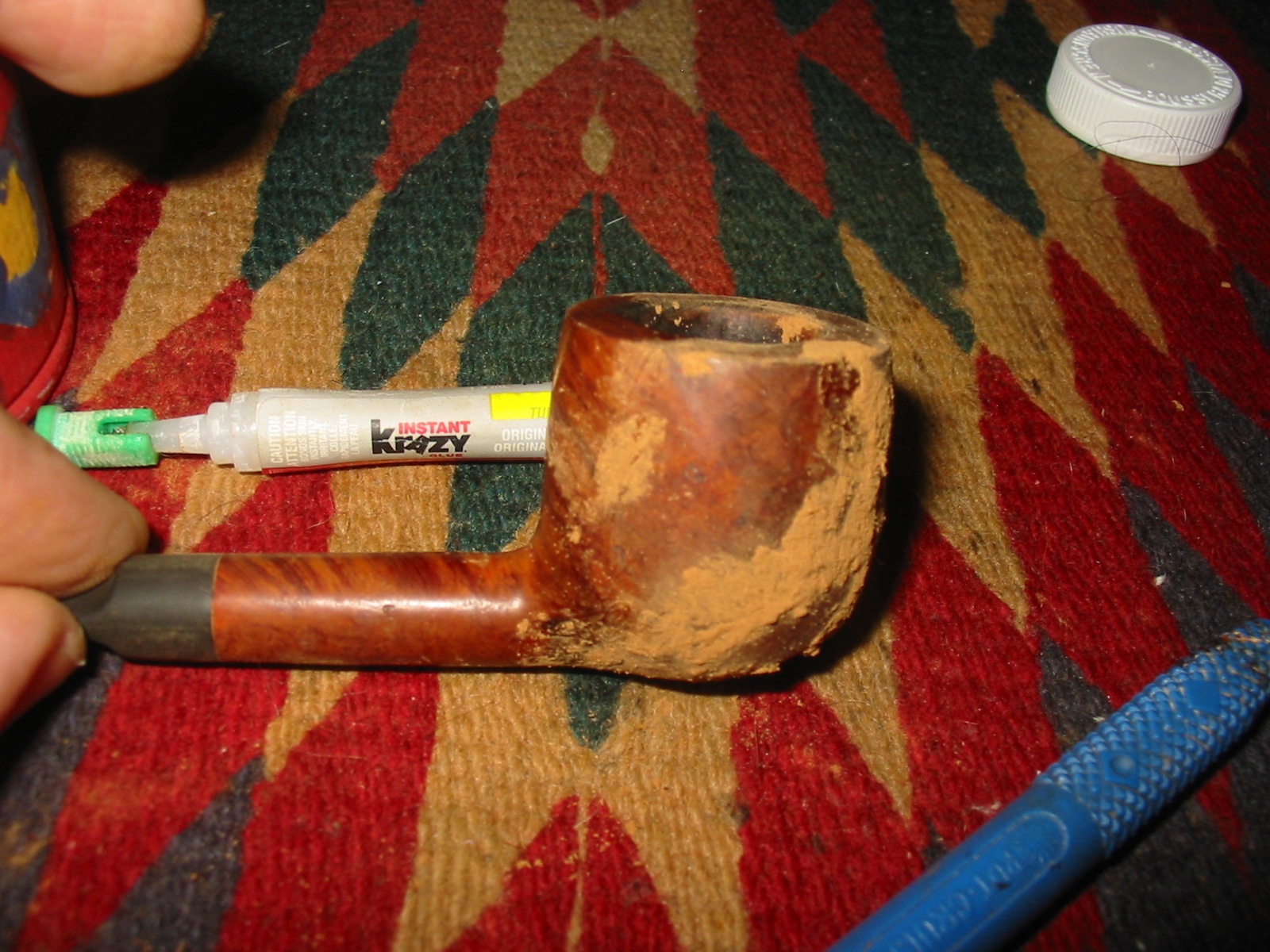
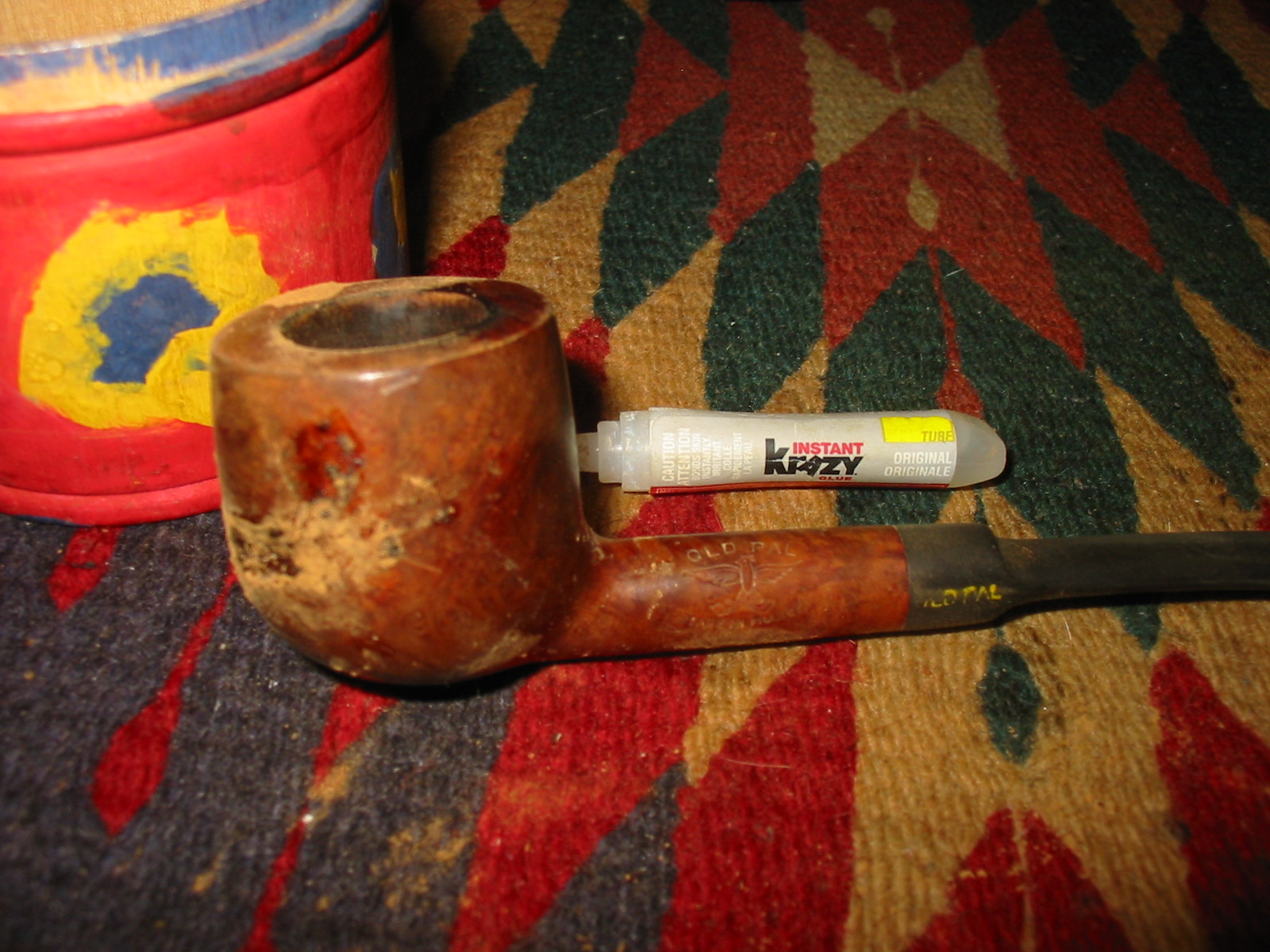
After removing the fills I wiped down the bowl with acetone on a cotton pad to remove the finish from the bowl and to remove extraneous dust from the holes where the fills used to be. I repeated this process until the bowl was clean. Once finished I used a drop of superglue in each pit and then pressed briar dust into the holes using a dental pick. I repeated the process until the fills were repaired. I then sanded the bowl to remove the excess briar and superglue fill material with 220 grit sandpaper, medium grit sanding sponges and a fine grit sanding block.
IMG_2081

IMG_2082

IMG_2089

IMG_2090

IMG_2091

IMG_2092

IMG_2093

The black marks on the right side of the bowl highlight the fills in the bowl. I have often used a permanent black marker to blend in the fills to the grain. I decided to try that with this pipe as well.
IMG_2094

IMG_2095

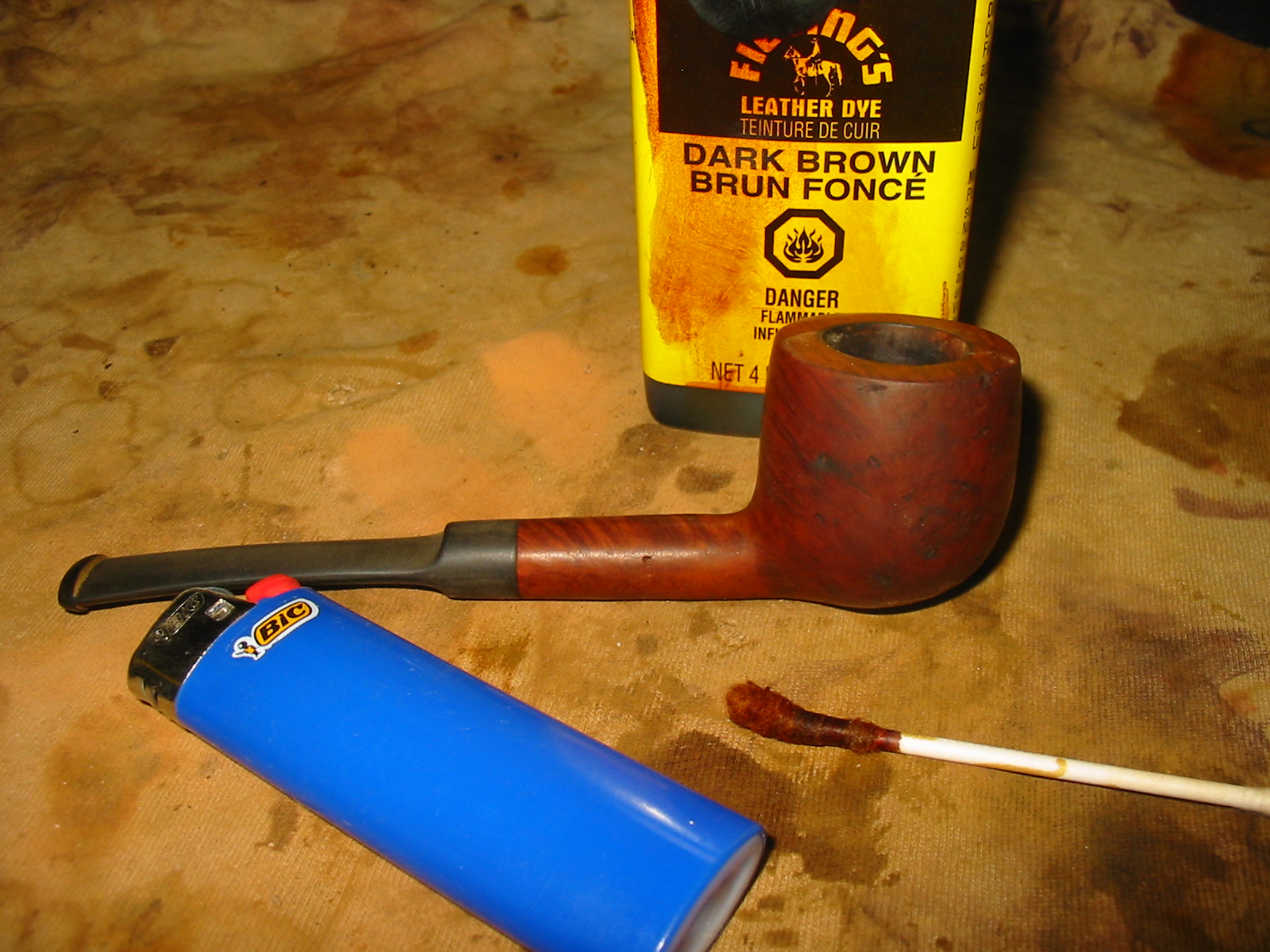
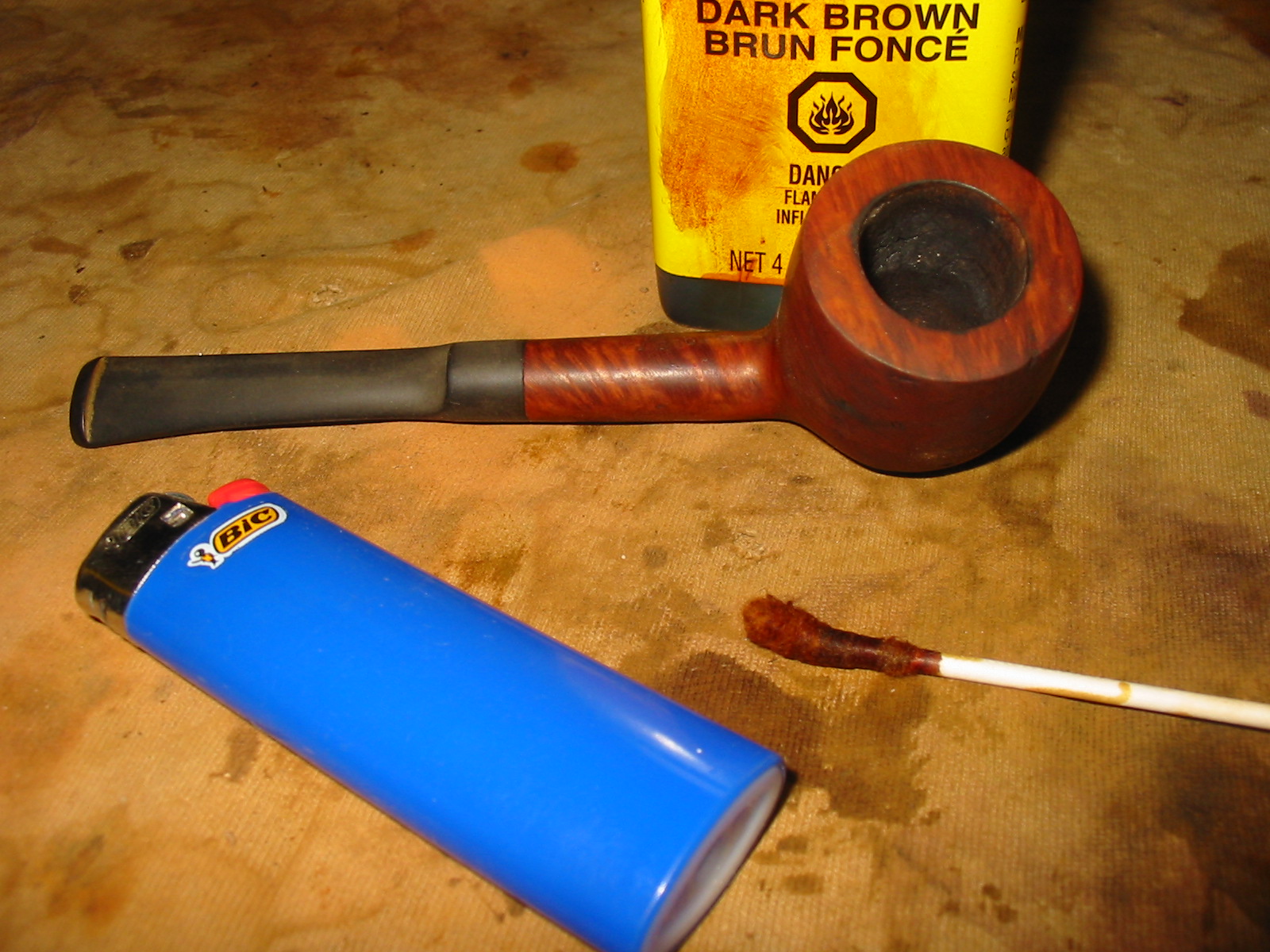
I gave the bowl several coats of dark brown aniline stain mixed 1:1 with alcohol. I applied the stain, flamed the bowl, reapplied and reflamed until the colour was even over the entire surface. I then took it to the buffer and buffed the bowl with red Tripoli and White Diamond to polish the stain. I also wanted to see how well the fill material was working. I have found that as it dries it can still shrink.
IMG_2098

IMG_2099

IMG_2100

IMG_2101

I brought it back to the work table and gave it a coat of linseed oil.
IMG_2102

IMG_2103

IMG_2104

The fills had shrunk and left divots in several spots so I reapplied the superglue and briar dust (less this time around). I sanded the bowl with a sanding sponge and a fine grit sanding block to smooth out the surface. I reapplied the stain and the linseed oil and then buffed the bowl.
IMG_2105

IMG_2110

IMG_2109

IMG_2108

IMG_2107

IMG_2106

I took the stem out of the bath and wiped it down. The majority of the oxidation wiped off with a damp cloth and then I polished it with Meguiar’s Scratch X2.0 and wiped it off the stem. I wiped the stem down with a polishing cloth and buffed it with White Diamond.
IMG_2080

IMG_2111

I applied a coat of Obsidian Oil and when dry rubbed it off. I reinserted the stem and buffed the stem with multiple coats of carnauba wax. I took the pipe to the buffer and buffed the entirety with carnauba wax and a soft flannel buff to a shine. The following pictures show the finished pipe.
IMG_2112

In the bright flash of the camera the fills on the right side of the bowl appear to stand out more than they do in the natural light. They tend to look dark spots in the birdseye of the grain. They do not stick out as badly as they appear in the photo below.
IMG_2113

IMG_2115

IMG_2114

The final picture I have included is one of the Old Pal pipe with a package of Old Pal Pipe Cleaners that I picked up at an antique shop in Edmonton. The two form a nice complement to one another.
IMG_2117

The Pipe Hunt – Rule #2: Look Inside ALL Small Boxes, Cupboards and Drawers


Blog by Steve Laug

A second rule of the pipe hunt that I have learned over the years is that not all pipes and tobacco related items are in plain view as I walk around a shop. This took time to learn and by and large I learned it by asking sellers if they had any old pipes or tobacco items for sale. I used to do this after an initial walk through but now ask as soon as I enter a shop. It saves time and generally is a way of engaging in a conversation that may lead to more pipes. When the answer was affirmative I followed them to the stall or spot in the shop and watched where they had placed the items. This quickly taught me where to look. But they would also often have pipes or items at home or in the back room and they would gladly bring them out for me. I have learned that it never hurts to ask.

As a result I quickly look through a shop (I know quickly is a relative term but to me it is quicker than it used to be and way more focused). I walk through after my initial scan and open small drawers, cupboards, cigar boxes, and look inside revolving display cabinets. This may seem intrusive but trust me, it is not (well at least in my mind it isn’t). Small typography cabinets can hold pipes and tobacciana. Revolving display cases can hold pipes, tampers, lighters and other pipe related objects. I have found wind caps, tampers, Baccy Flaps, Bakelite stems, pipe holsters and other items too numerous to list by just going through these revolving cases slowly looking for tobacciana. Coffee cans, tobacco tins and old cigar boxes can often hide old pipe paraphernalia in their interiors. Don’t hesitate to have a look. Here is a tale of an old pipe I picked up by doing what I am suggesting – a nice older bent billiard for $20. I can tell you it was well worth opening drawers and digging deeper.

My wife Irene and I love doing an antique mall crawl on our days off. We generally visit as many as we can fit in before lunch and then have a good lunch at a neighbourhood pub before finishing the day with visiting a few more shops on our way home. Over the years one of our favourite spots is found not far from Vancouver. Just across one of the many bridges and upriver it is a spot with several antique shops and several larger antique malls. On the day of this tale we had visited several of them in the morning and so far had struck out on any significant finds of pipes or tobacciana for me or anything of interest for her. We had stopped for a great lunch at the local pub and were now visiting the last of the shops. We were almost finished looking and still empty handed. I had passed by some very high priced drugstore pipes – no deprecation intended here as I have many of them in my collection but I am not willing to pay the exorbitant prices that sellers mark these – $50 or more is an unacceptable price in my opinion.

I turned down the last aisle. It was lined from floor to ceiling on the right side of the aisle with display cases. These cases had drawers underneath that were labeled with different key items that resided inside. I did a quick walk by of the display cases checking them out. In one I found a couple of older Brighams that I noted. I would need to get the sales clerk to open the displays for me so that I could look at them more closely. That could wait. I turned my attention to the drawers beneath the cases. In the middle case I opened a drawer labeled miscellaneous collectibles and dug through it. There in the middle of the drawer, nestled among lots of unrelated items such as linens and doilies I found an older looking pipe that captured my attention. I stopped for a minute before picking it up. (I have a habit of trying to guess what the pipe might be before I actually look at. Quirky I know but it is what it is.)
1938 Dunhill Shell

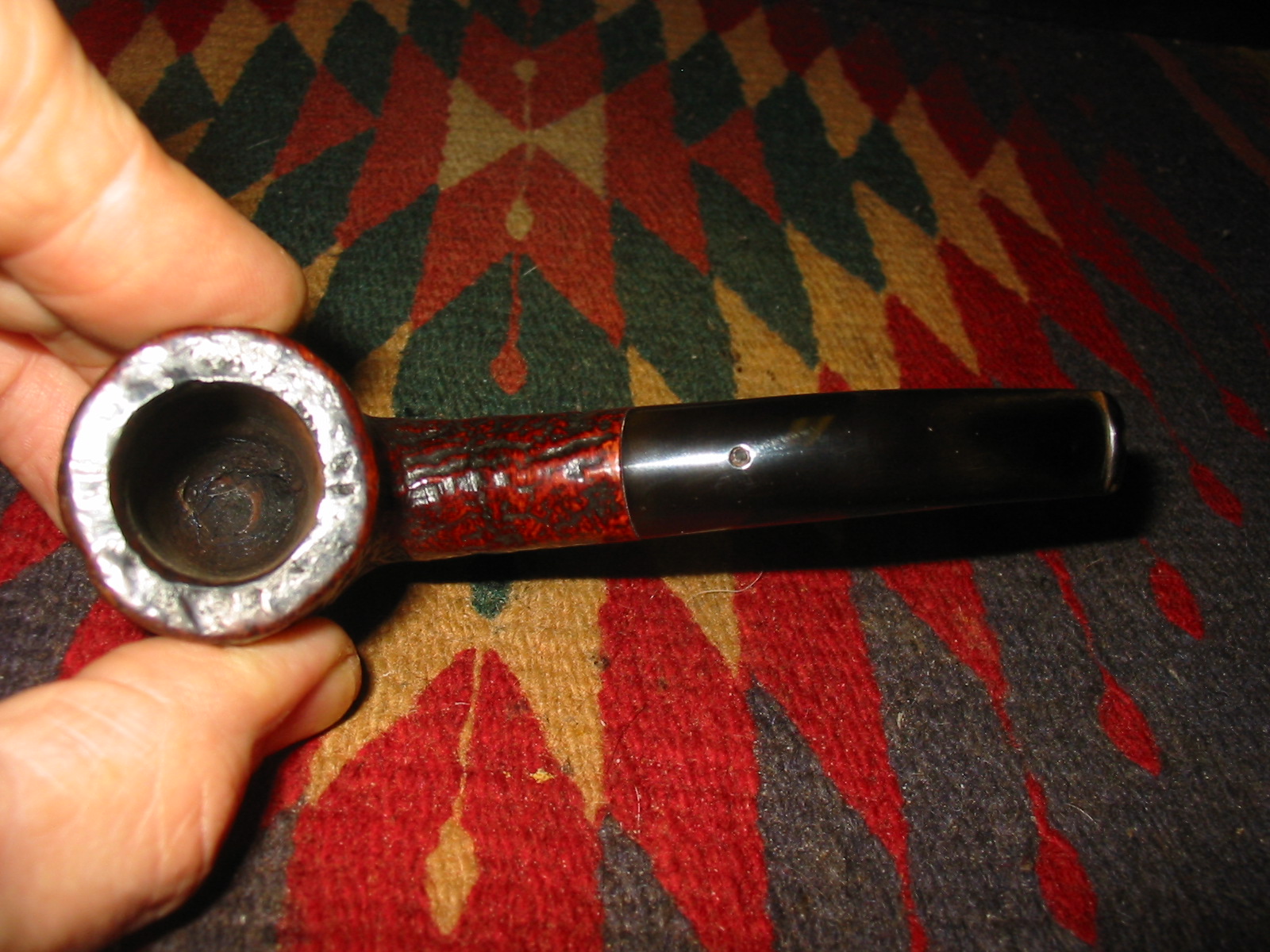
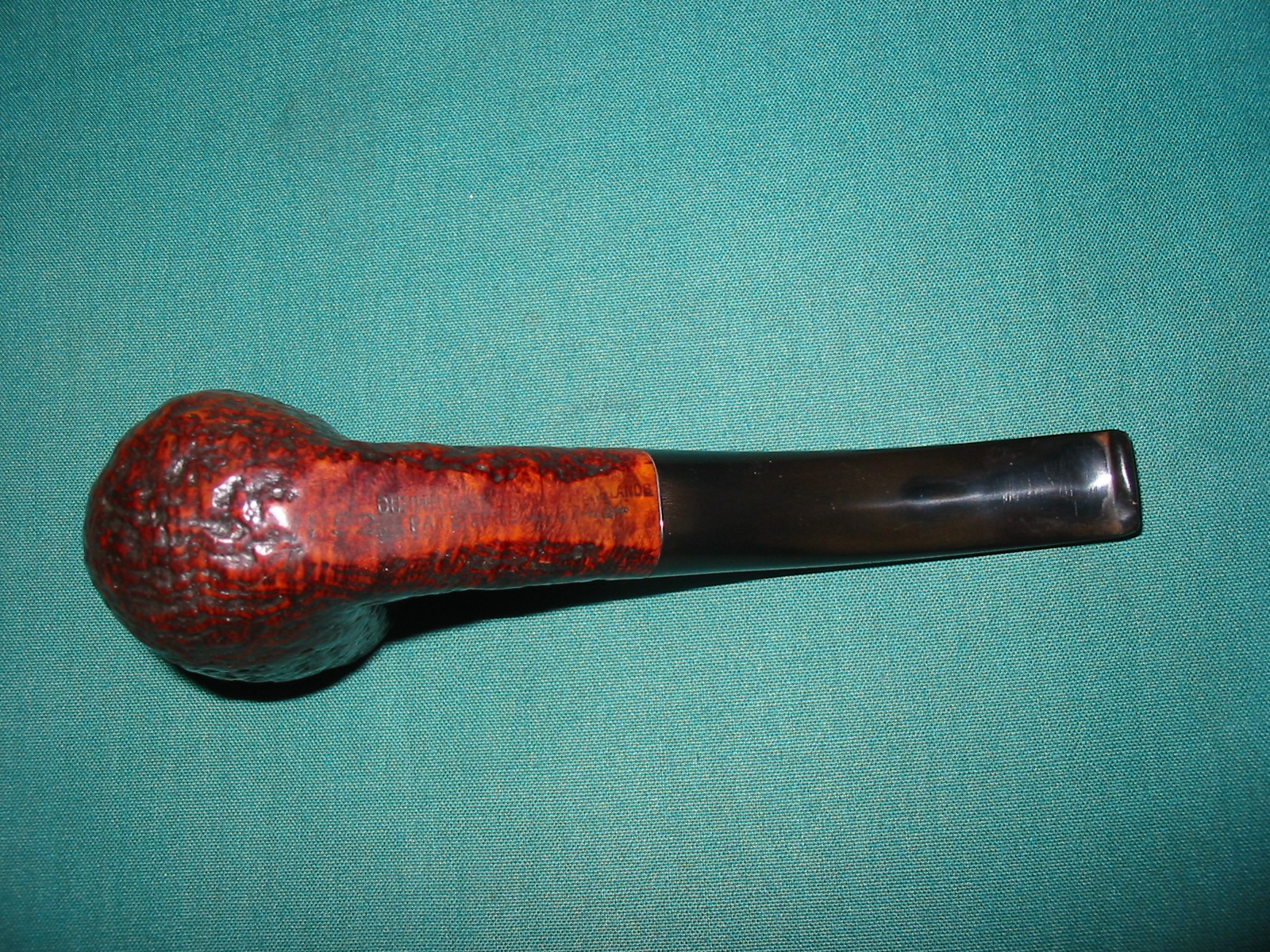
I made my guess (a Dunhill of some sort) and then I picked it up. It was a sandblast bent billiard. I turned it over in my hands and noted a slightly darkened white spot in the top of the stem and then read the stamping on the underside of the shank. It read Dunhill Shell Made in England 8 and underneath that it was stamped Patent No. The number itself was obscured in the dirt and grime that accompanied the old pipe. It was caked with a heavy carbon buildup and the stem was oxidized and had several small tooth dents on the top and bottom of the stem. Other than that it was a good clean find. To say that I was excited is to understate the case. Here in the drawer under the display cabinet I had found not just a Dunhill pipe for $20 but a Patent Era Dunhill pipe with fairly clear stamping and in a condition that would easily be refurbished. I was ecstatic. I called my wife over to show her the cause of my ecstasy and she just shook her head – another pipe. Big deal. She wandered off and I was left standing there.
I almost totally forgot the Brighams and just stood there basking in the joy of discovery! This is what I always dreamed of finding one day in my pipe hunts. And now here it was in my hands. I could hardly believe my good fortune on finding it. I shook myself and carefully cradled the old pipe while I went and found the sales clerk. She brought the keys with her and opened the case so that could add the two old Brighams to the lot. I carried the three pipes to the counter and paid for them before they disappeared in my dreams. The clerk carefully wrapped them in tissue paper and placed them in a bag for me. She handed me receipt for my purchase and I went looking for Irene. I had my haul and I was finished. I just wanted to get home and do some research on this lot.

When I got home I went to my basement work table and used my jeweler’s loupe to check out the stamping more clearly. I had read the majority of the stamping correctly at the shop. I was also able to read the patent number on the bottom of the pipe. I looked up the information on John Loring’s Dunhill dating site and found that I had a 1938 Patent Era Dunhill Shell bent billiard. I could not have been more pleased. I cleaned up the old timer carefully and gave it several coats of wax. Here are a few pictures of the restored pipe.
IMG_2083

IMG_2084

IMG_2088

IMG_2086

It is this kind of find that keeps me pulling out the drawers and looking in the boxes and behind tins and displays. I am confident that there are other hidden treasures out there. So Rule #2 will always be right up there next to the first rule I posted about earlier. I will look in every nook and cranny while I am working my way through a shop looking for “treasures”. Will you join me in following this rule of the hunt?

An Edwards Dublin Reborn


Blog by Greg Wolford

A couple of weeks back I saw two old pipes on eBay that were being sold as a lot that caught my attention: an Edwards Algerian Briar in a Dublin shape and a GBD pot with, what I was pretty sure was, a replacement stem. The combined opening bid and shipping cost was below $20 and it was late in the auction with no bidders yet. The seller had provided a poor description and only two poor photos, which must be the reason for no bids yet I thought. Since I am a fan of GBD pipes and have been wanting an Edwards (since hearing Brian Levine talk about them on the Pipes Magazine Radio Show a few moths ago and it being in a shape I really like I tossed in the opening bid. To my surprise, I won the auction for the under $20 total opening bid with shipping included. Here are the photos from the seller:

20131014-150328.jpg

20131014-150337.jpg

When they arrived they were in a bit worse condition than the pictures showed: very dirty, heavily caked, some very large fills, and lots of oxidation. But the stems (the GBD is a replacement) were free of holes and deep teeth marks, something I was glad to see. (This post will mainly be on the Edwards, though some of the GBD will be included. Eventually I’ll post that job, too, when I finish it.) Here are some photos of what they actually looked like when I got them:

20131014-150723.jpg

20131014-150734.jpg

20131014-150748.jpg

20131014-150800.jpg

The Edwards had a lot of build up on the rim. As I cleaned it I realized that all of it wasn’t build up but a fair amount of charring and a larger fill on the back of the rim of the bowl. There was also the largest full I’ve ever seen on the bottom of the shank. I decided that I wouldn’t try to remove and refill these areas but just refinish the pipe with them as they were. Although very large, they wouldn’t effect my personal enjoyment of this pipe so I didn’t feel there was any good reason to cool with them, and I had some concern that fills that large, disturbed, might present problems down the road.

20131014-151256.jpg

20131014-151325.jpg
I reamed back the thick cake to a nicer, even level, using all four bits on my Castleford reamer.

20131014-151514.jpg
I then put the bowls into an alcohol bath and the stems into an OxyClean bath and left them overnight to soak.

The next day I starts with the stems, taking them out of the bath and washing them under warm water with dish soap. I was surprised at how easily the oxidation came off after this with a miracle eraser scrub; I’ve used miracle erasers many times, but not on all stems, and have never had such good results. I wish I knew what the variable was to give me this result this time but I don’t. Next I scrubbed the stems out with alcohol and pipe cleaners until they came out white.

20131014-152048.jpg

20131014-152100.jpg

20131014-152111.jpg

20131014-152120.jpg

At this point took the bowls out of there bath and wiped them down. In the photos you can probably see (above) that the stem/shank union was not flush at all. I figured the problem was a buildup of tar and gunk in the shank so I set the bowls at an angle, shank tilted up, and placed cotton balls in the bowls. I filled them with alcohol with a syringe and then also filled the shanks the same way, plugging them with cotton swabs. I let them soak while I worked on the stems, changing the cotton swabs out as they drew out tars; I changed them three times I think, going to doubled over pipe cleaners the final time.

20131014-152727.jpg

I polished the stems with plastic polish, making sure they were literally squeaky-clean before using micro mesh pads 1500-4000 grits, wet, to bring up a shine. The condition was very nice, to my eye, at this point, and the bowl needed a lot more attention so I set the stems aside to get to the bowl.

The shanks were very thick with build up even after the soaking. I used the Senior Reamer drill bit on the GBD but it was too large for the Edwards; I chose I smaller bit for it, the size of which escapes me. After many bristled and smooth pipe cleaners the shanks were finally gunk free and the stems seated well once again.

I sanded the bowl rim to reduce the damage of the charring as much as I could while trying to not alter the shape. This was a challenge and I left a little more char, which I tried to blend later with dye, than I’d normally like but I really wanted to keep as much briar as I could for the shape and for insulation since the walls aren’t very thick to start with. I also lightly sanded the rest of the stummel, while avoiding the already faint nomenclature, to remove the last of the finish and some scratches with 320/400 grit wet/dry paper.

20131014-153502.jpg

20131014-153514.jpg

20131014-153525.jpg

20131014-153539.jpg

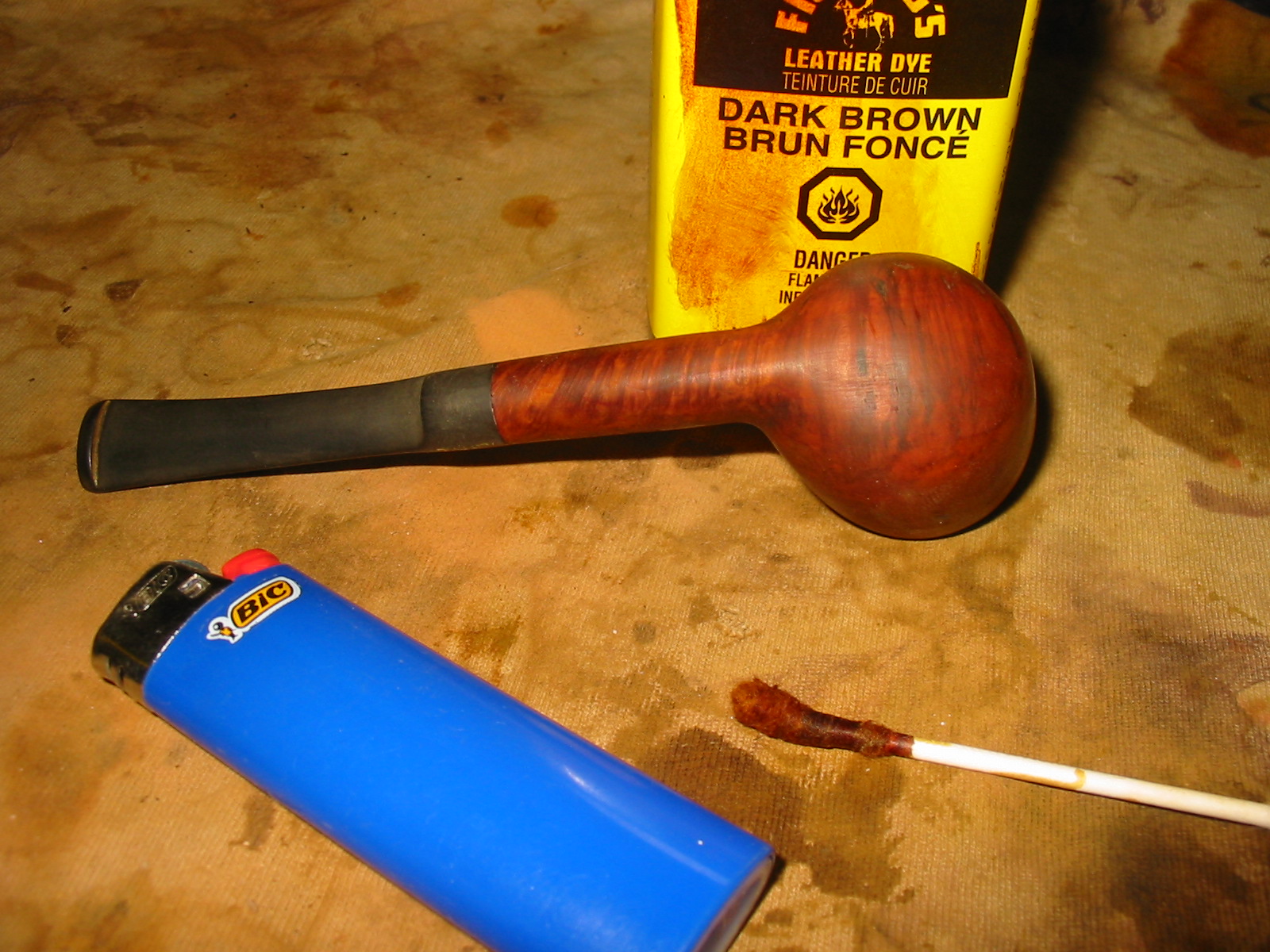
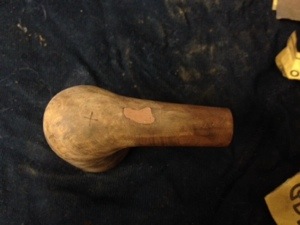
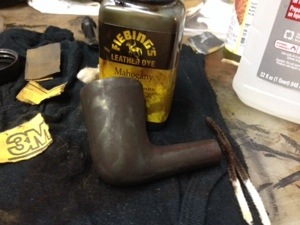
To start, I put a little stain on the rim of the bowl using some furniture touch up markers I found at our local Walmart: three markers for $4 I think. I wanted to get a base coat started before I went forward. Next I applied a coat of mahogany leather dye to the entire pipe; it is dark but not as red as some of the other color choices Fiebings makes and I thought it might help hide some of the defects and being up the contrast at the same time. I didn’t flame this in, by the way, since I didn’t want to change the entire color of the pipe. After it had set for about 10 minutes I sanded it back off with 400 grit paper to where I liked it.

20131014-160104.jpg

20131014-160115.jpg

20131014-160129.jpg

20131014-160150.jpg

20131014-160205.jpg

20131014-160219.jpg

20131014-160232.jpg

20131014-160244.jpg

20131014-160257.jpg

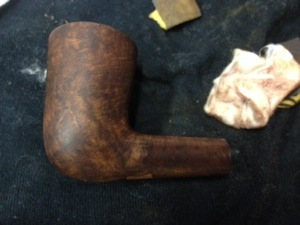
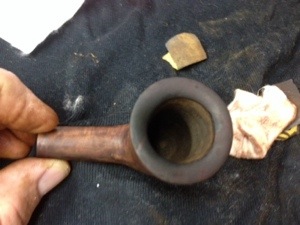
At this point I was pretty happy with the overall results: most of the defects were fixed or hidden, except for the two biggest fills, which didn’t hide as well as I’d liked but about as I expected. Off to the buffer the pipe went now: the entire pipe, stem and all, got a buffing with tripoli, white diamond, and carnauba wax, flowed with the clean, soft buff and a hand final buff. The final result is one I’m pleased with: a nice looking and good smoking old pipe.

20131014-160658.jpg

20131014-160709.jpg

20131014-160721.jpg

20131014-160732.jpg

Louis Blumfeld 1901 BBB Bent Billiard – by James Gilliam of jsecpipes.com


When James posted his work on this pipe on the pipe forums I was amazed at how beautiful it looked. Wow a 1901 BBB – one of my favourite pipe makes and one of the old ones as well. Imagine the surprise when I got an email at the same time asking if I would like a write up and photos of the restemming for the blog. I did not have to think twice to answer that email. I quickly fired back an affirmative and what you have below is the story from James. Thanks again James for taking the time to document your work on this old timer. Enjoy smoking that great piece of pipe history. Below is his tale.

Every story has a beginning and this one even has a pre-story. The excerpt below was posted on several forums I’m a member of so I thought I would repeat it just for those that haven’t seen the posts.

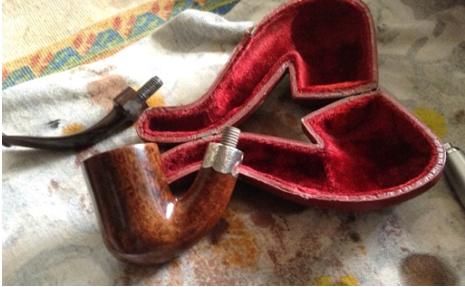
“As some of you know I attend the 100km van Ieper in Belgium nearly every year since 2002. It’s a walk around the WWI Battlefields that consumed Ieper. I’ve been bitten by the pipe making bug, and how and along the way dabbled in restorations just because, but my search for a pre-WWI era pipe is finally over. I ended up getting this piece of history from Alan at Reborn Briar. Now he did the pipe restoration.. and a brilliant job he did, the only thing the pipe was missing was a stem.. well I can do that… I decided not to bore out the mortise and left it threaded, made a threaded tenon out of horn, since I don’t have any workable bone, and decided against using Ivory…… and went with Cumberland for my stem material.. I’m happy…Happy Columbus Day everybody”

Now for the rest of the story. What sticks around in usable condition for over 100 years… not too much, but since I’m kinda into this pipe thing, tobacco related history rates up there for my interest factor. This past July I was able to attend the Newark (UK) Pipe show, set up a table and sell some pipes. You never really sale (or at least I don’t) all the pipes you want to sale, but you do get to meet a lot of really interesting people, and the next table over was Alan Chestnutt from Reborn Briar. I’m always amazed at the folks like Steve and Alan that get into the restoration business. I’ve done a few, even wrote an article about it, but creation is where my passion lies.

Anyway, talking with Alan pre-World War I pipes came up, and fast forward to September he had one that he was going to restore but without a stem. As I mentioned above, stems are no problem…. that’s the making/creating/using machinery aspect I like. When the pipe arrived I was amazed at how well it looked. I mean wow, 1901, and all that.

The only real thing that threw me was the threaded mortise. Looking around the shop I pickup up a few of my mistake mouthpieces and tried fitting a few. The 7mm tenon fit without a problem, as it just slid into the mortise. But later that night while sitting around thinking about the mouthpiece I figured I’d make it as close to the original as I could. The stems profile was already in the leather case. So what do we know at this point.. 1900’s meant ivory, bone, or the like type of tenon. I don’t have any bone to use and didn’t really want to use ivory……but being a pipe maker I do have horn. I usually end up keeping the horn points after using the remainder of the material for a shank extension.

So horn it was to be. I shaped the tenon, drilled and set out to thread the tenon. I’m sitting with a 8mm tenon drilled to 4mm for the airway and went about threading the horn. Unfortunately it crushed under the pressure of my die, but I guess it only made sense… so I made another, except this time I threaded it first and then drilled it… And here is where the pictures come into play.

Threaded tenon, prior to drilling
Jogli1

And it fits just like it is supposed to. Looking right above the pipe you can see my trial delrin tenon with new threads.
Jogli2

Mouthpiece rough cut and drilled. The mortise is also threaded. I cleaned up the junction end before the next steps, so the fit would be flush
Jogli3

Epoxy’d and left to rest a while.
Jogli4

And it fits. So at least the scary parts are now done.
Jogli5

Drawing on the Cumberland to get my bearings at to decide where I want the saddle to sit. The line closest to the junction was chosen.
Jogli6

Jogli7

Time to sand a bit with a machine.
Jogli8

And done
Jogli9

Now it’s file time.
Jogli10

Now it’s sandpaper time.
Jogli11

And more sandpaper… I probably left a step or two out here…just to save the pictures, but my process is machine, medium cut file, fine cut file, another fine cut file, nail files, 180, 220, 320, 400, 600, 800, 1200 sandpaper, buffing paste, more sanding, high glass paste (Sometimes more sanding to remove scratches I missed) and a final buff. Here you can see the stem is bent to its final form.
Jogli12

And now it’s all shiny.
Jogli13

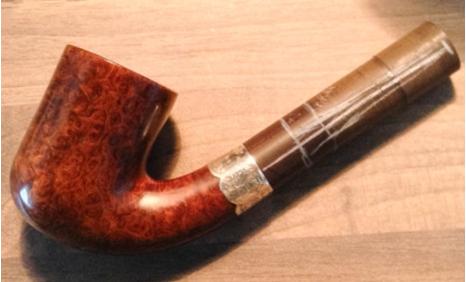
And here are the final pictures. Alan did the bowl, I did the stem and I have a pipe that is twice my age… gotta love it. Hope you enjoyed my story.
Jogli14

Jogli15

Jogli16

Jogli17

Cleaning a Bristol Mat Geante – by AJ Verstraten (AKA Bananabox-Ninja)


This post has been written by a Dutch reader of the blog, AJ Verstraten who contacted me a few weeks ago. Several emails later and we had exchanged a lot of ideas and tips. I thought it would be of interest for others here to read about AJ’s ultrasonic cleaner addition to the process. It was one I had not heard of before so I asked him to write up a piece on it with pictures of a pipe that he put through his process. AJ was graciously willing to write it up and submit it for posting here. Thanks AJ for your willingness to do this. It is great to hear from others about the methods they are using and how they work. The photos are well done and the words well written. Without further ado here is AJ’s article.

Greetings, my name is AJ and I hail from the Dutch city of Dordrecht. I go by the internet name of ‘Bananabox-Ninja’ and I am more easily found under that name then under AJ.

A few weeks ago I broke my knee in a motorcycle accident and it was put in a plaster cast with the instruction to let it rest and heal up. In this time I stumbled upon Steve’s website through ‘Het Pijprokersforum’ a forum of Dutch and Belgium pipe smokers.

As I like to refurbish pipes myself and I had time to kill I went through his whole website and learned many, many new things. In the weeks that followed I tried to get a hold of the things Steve used and tried them myself, like the black superglue and the grinding pads for example. Blown away by how well some things worked out I sent an email thanking Steve for all the tips and asking if he had ever used an ultrasonic cleaner. He replied that he had not but that he was interested to know in the workings and would I like to write about it?

So this weekend I cleaned a pipe from my ‘project-box’ and snapped pictures from beginning to end including the ultrasonic cleaning method I currently use. (The numerical key below the photo identifies the tools in the photo.)

These are the tools I tend to use in the cleaning/refurbishing of a pipe, currently I have some tools on order and they have not come in yet.
001 Tools LR

1 – Polishing wheels and waxes
2 – Sanding paper (600 & 1000), sanding pads (1500 to 12000) and modeling files.
3 – Ultrasonic cleaner
4 – Old socks (but clean)
5 – Vaseline and 96% alcohol
6 – Hard and soft bristled pipe cleaners
7 – Q-tips (cotton swabs)
8 – Pliers
9 – Assortment of drills
10 – Senior pipe reamer
11 – Games Workshop paint
12 – Electric motor (0-2000 RPM) with grinding wheel (1500)
13 – Toothpicks

The pipe I chose to work on and record is a nice straight, big chambered Bristol Mat Geante, I presume the Geante is for its size as the chamber is rather big or as we say in Dutch a ‘Speciekuip’ (mortar trough). As far as I can tell Bristol a B-brand from France but I am unable to pinpoint exactly. I personally like the bird’s-eyes all over the left and right side of the bowl.
002 The Pipe LR

As you can see the stem has oxidation all over and the bowl itself is rather dull. Not visible on this photo are the 2 bite marks on the stem.

First I cleaned the pipe on the inside with alcohol and pipe cleaners until they came out almost white. If there is a thick layer of tar in the air canal I use the drills to scrape the inside out lightly using drills of various diameters. Tar will give way far more easily than the ebonite or acrylic it is in.

In this case it was not needed as the pipe’s previous owner was very tidy or had not smoked it much.

Then with just water and the grinding wheel I removed the heavy oxidation from the stem, careful not to create a round shoulder or to grind off too much for it to create a ridge.

003 Set up LR

004 Half way LR

005 Full LR

Using the sanding paper wrapped around a file I removed the hard to reach oxidation on the mouth bit.
006 Filing and sanding LR

007 Sanding wrap LR

008 Sanding result LR

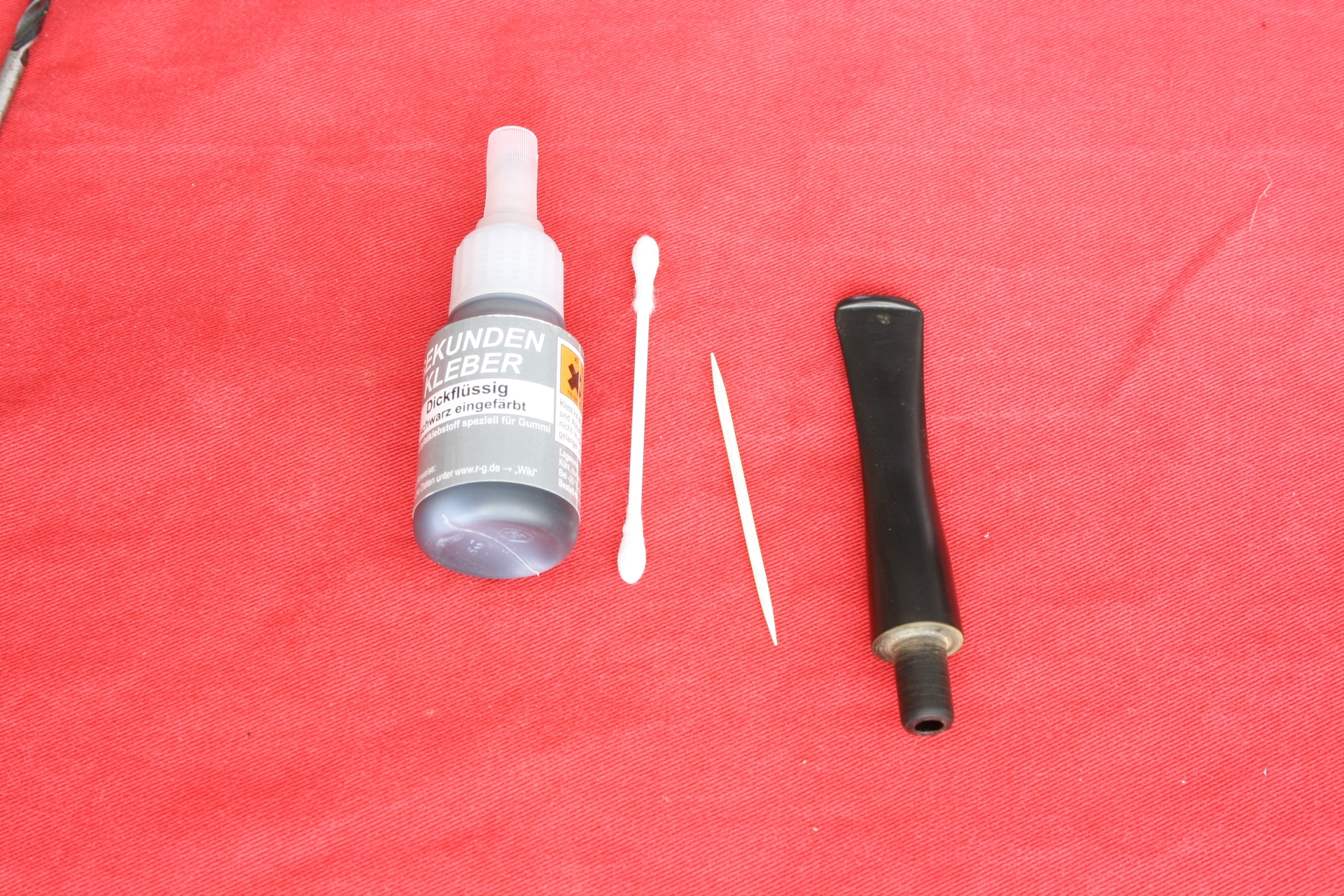
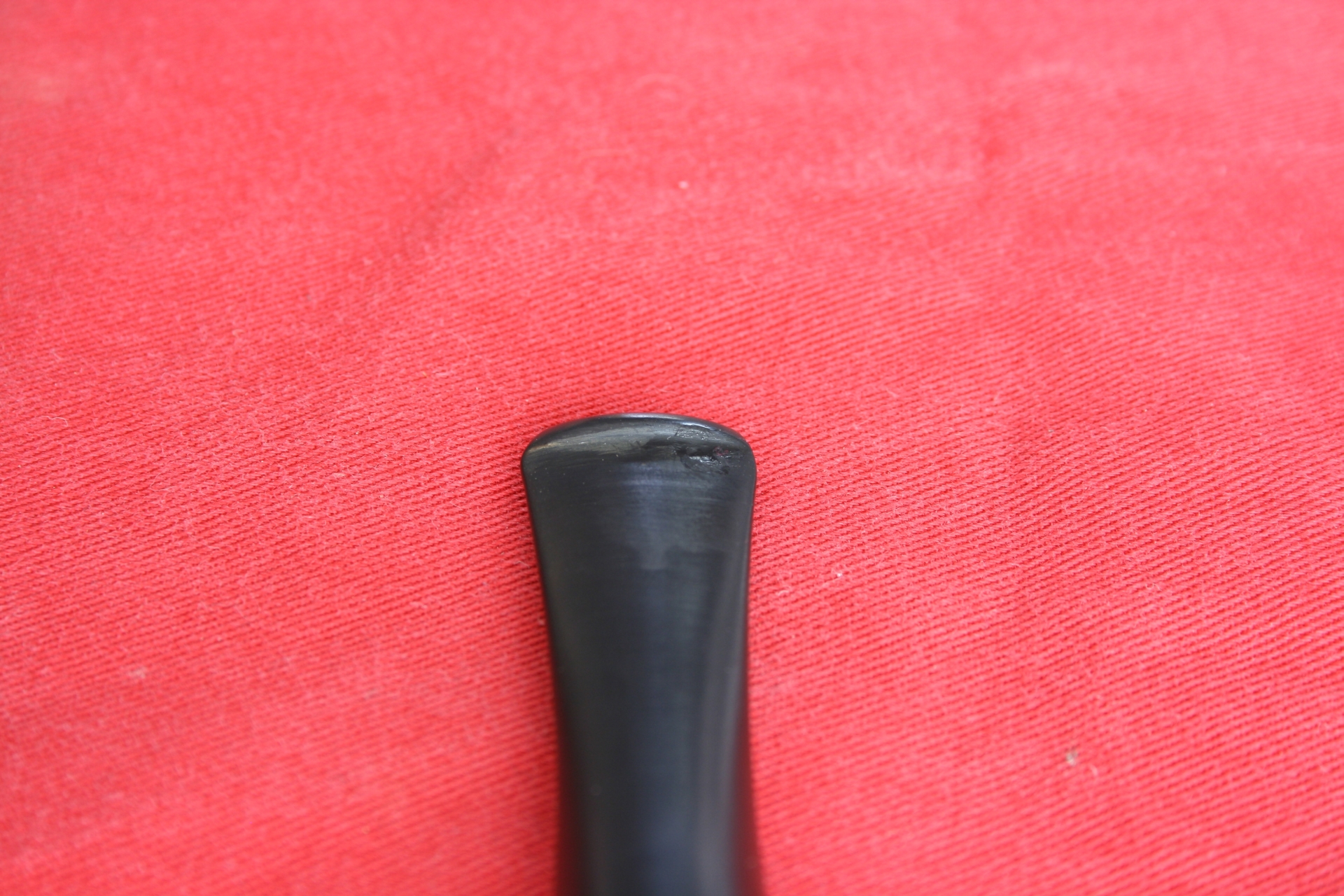
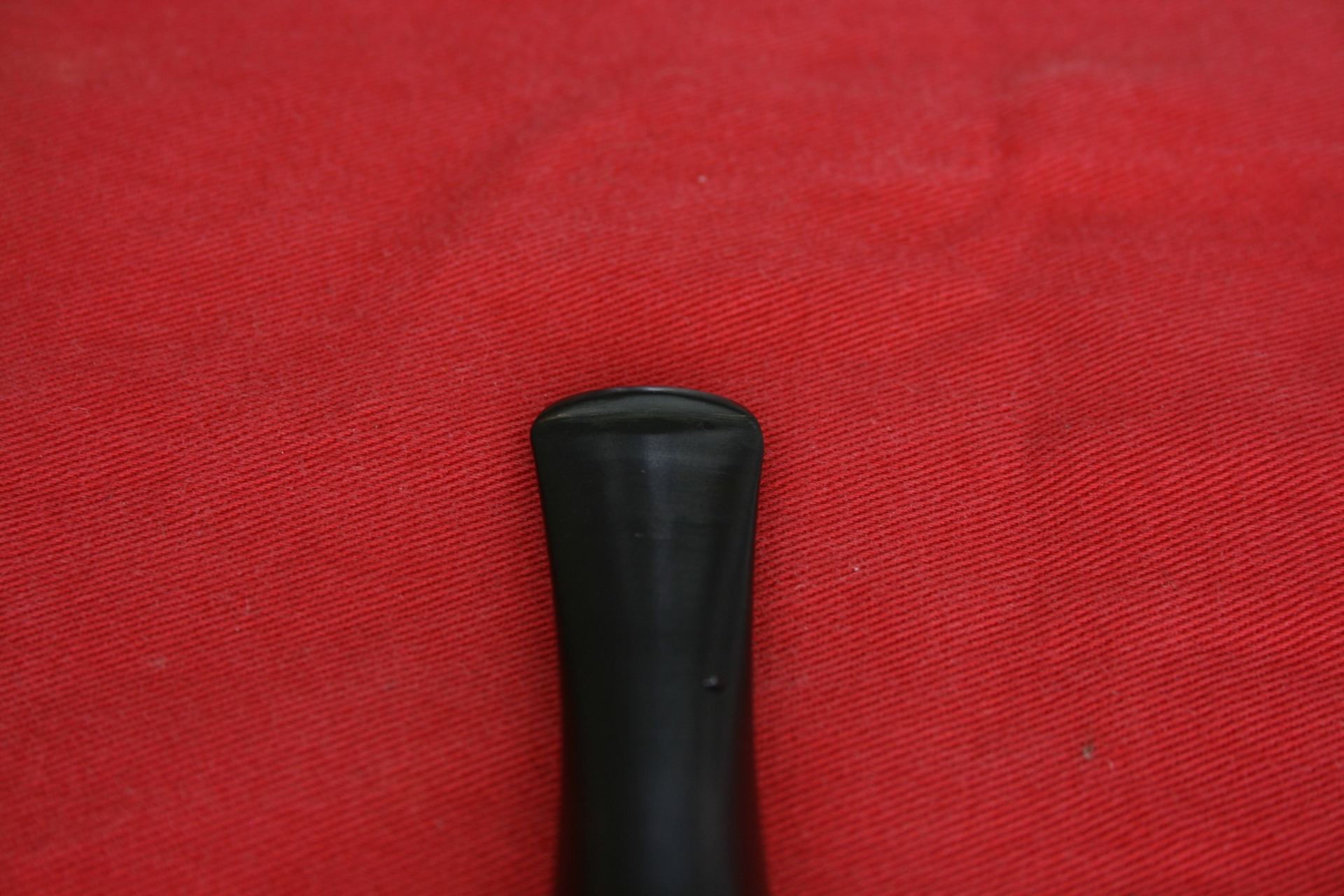
And afterwards to fill the bite marks using the superglue, q-tips and toothpick.
009 Superglue LR

010 Filled SG LR

011 Sanded SG LR

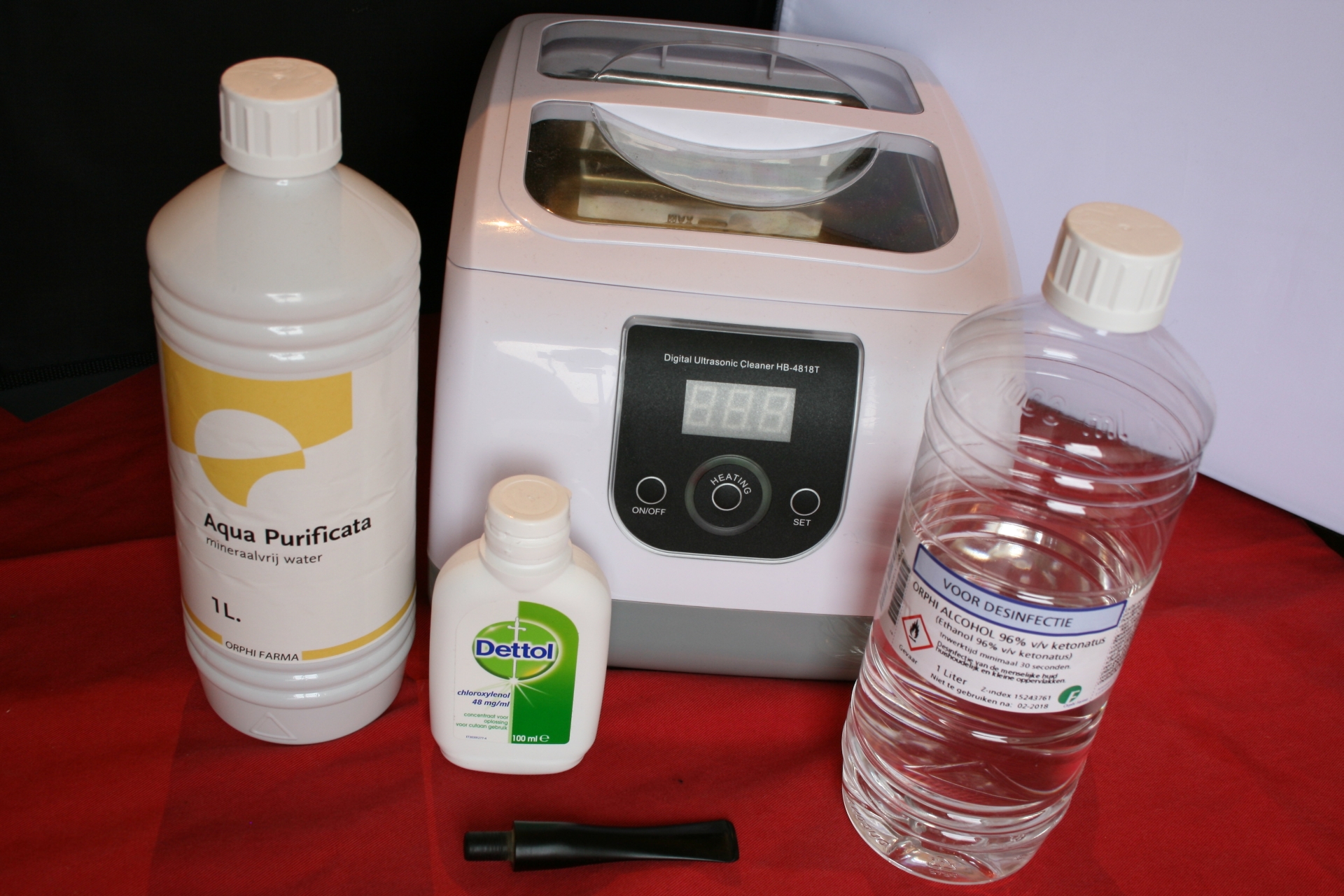
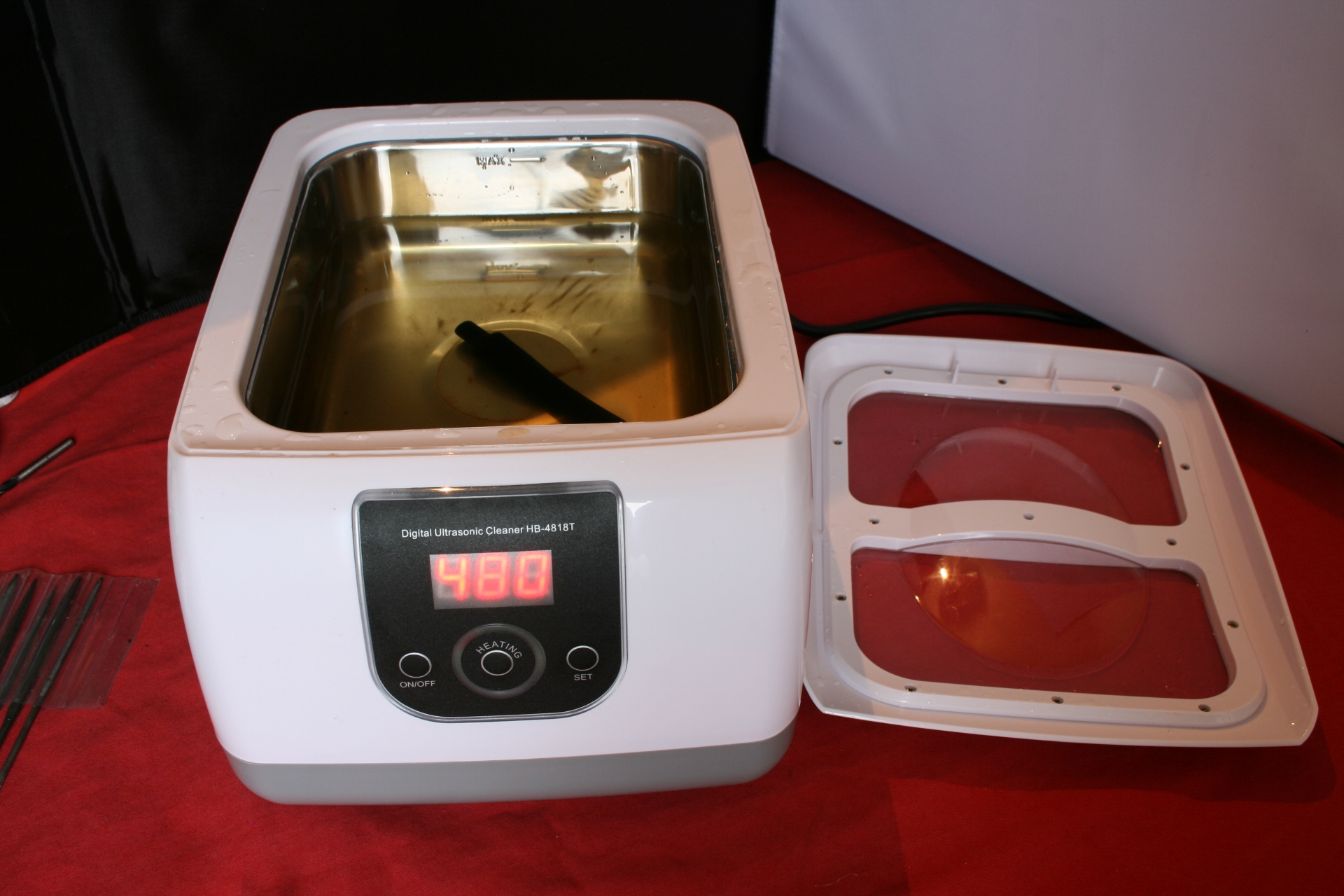
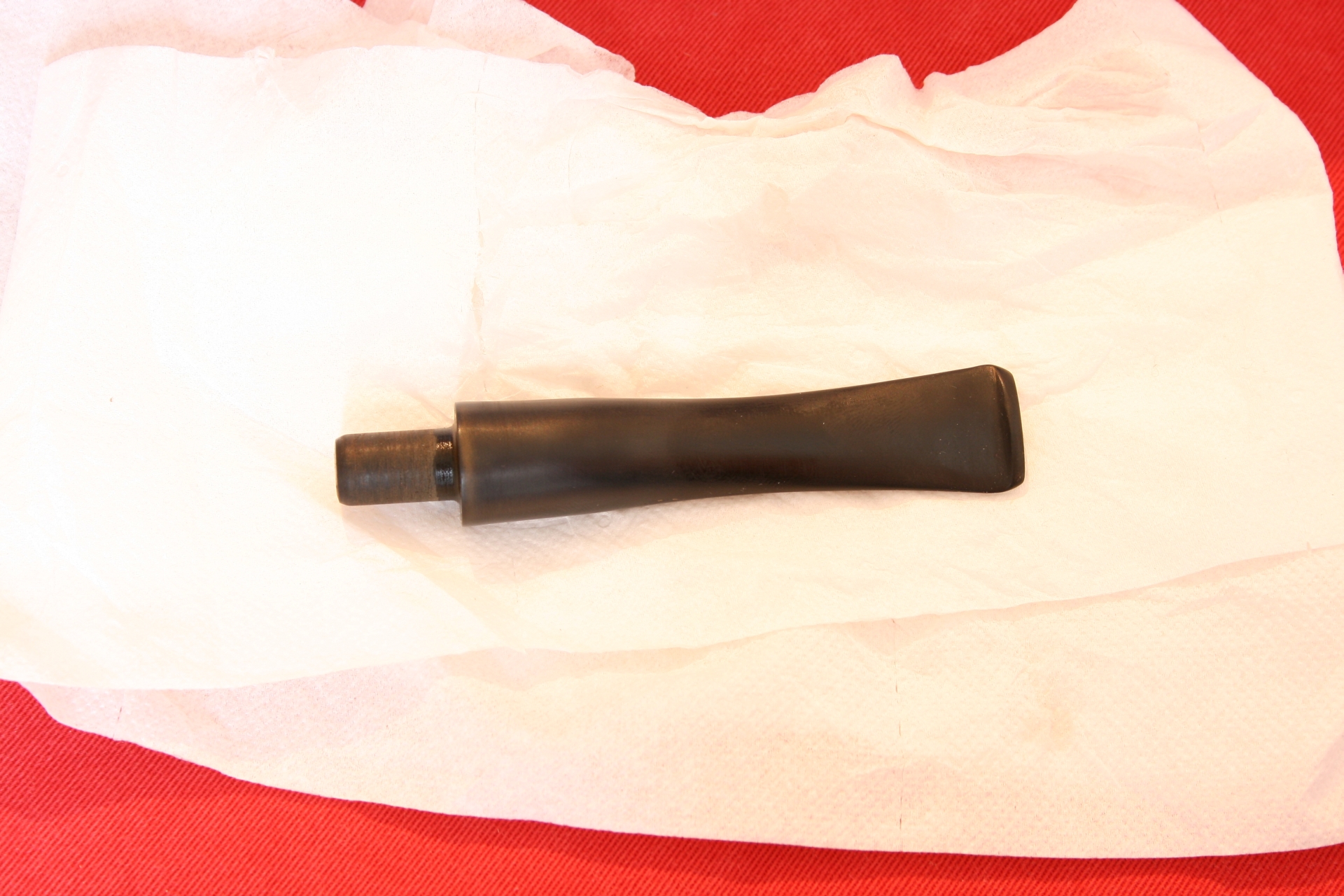
Now the stem was ready for the ultrasonic bath. This is a new method I have only recently started using and so far I am positive on the results. Using a mixture of 50-50 water and alcohol with a teaspoon of disinfection agent, place the stem in the liquid and let the bath go at it for 8 minutes.

This bath can also heat up to 40 degrees but seeing as ebonite tends to bend back to it’s original shape if heated too much I leave that feature off.

You’ll notice in the last picture that the stem looks almost the same as it went in, however when you pull a pipe cleaner through it, there will be some mild discoloration coming out of the stem.

This method of cleaning is a good way to get the last remaining specks of dirt out of those hard to reach places, I myself was skeptical at first but I was swayed when I pulled the pipe cleaner through it after the bath I found that it did do its job.

It does not however remove oxidation completely, I tried with an unprepared stem and it came out browner than going in.

So as an extra step I find it a great addition to my cleaning process.
012 Sonic cleaning fluids LR

013 Turn on LR

014 Waiting LR

015 Sonic done LR

In the mean time I cleaned some of the soot from the top of the bowl with some spit and the old sock. Especially the part of the sock that fits over your ankle is rather coarse and excellent for this process. The chamber had a nice smooth coal layer in it so I left it in there.

After the bath I gave the inside of the stem few more scrubs with the pipe cleaner and the outside another run with the grinding wheel.

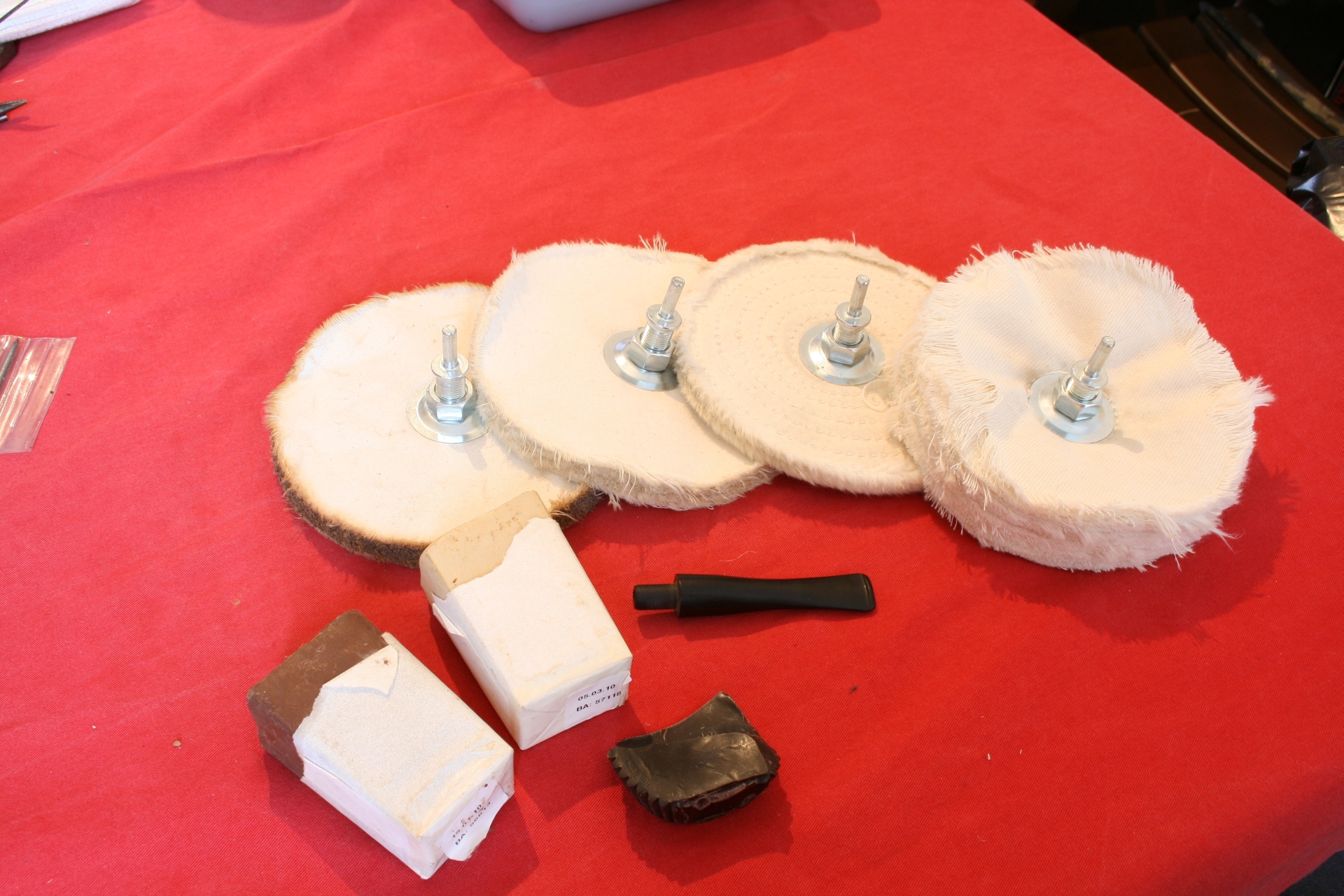
Then I started polishing with the wheels and the waxes.
016 Polishing LR

First a pre-polish with brown, followed by white, a coat of carnauba wax and a final buff.

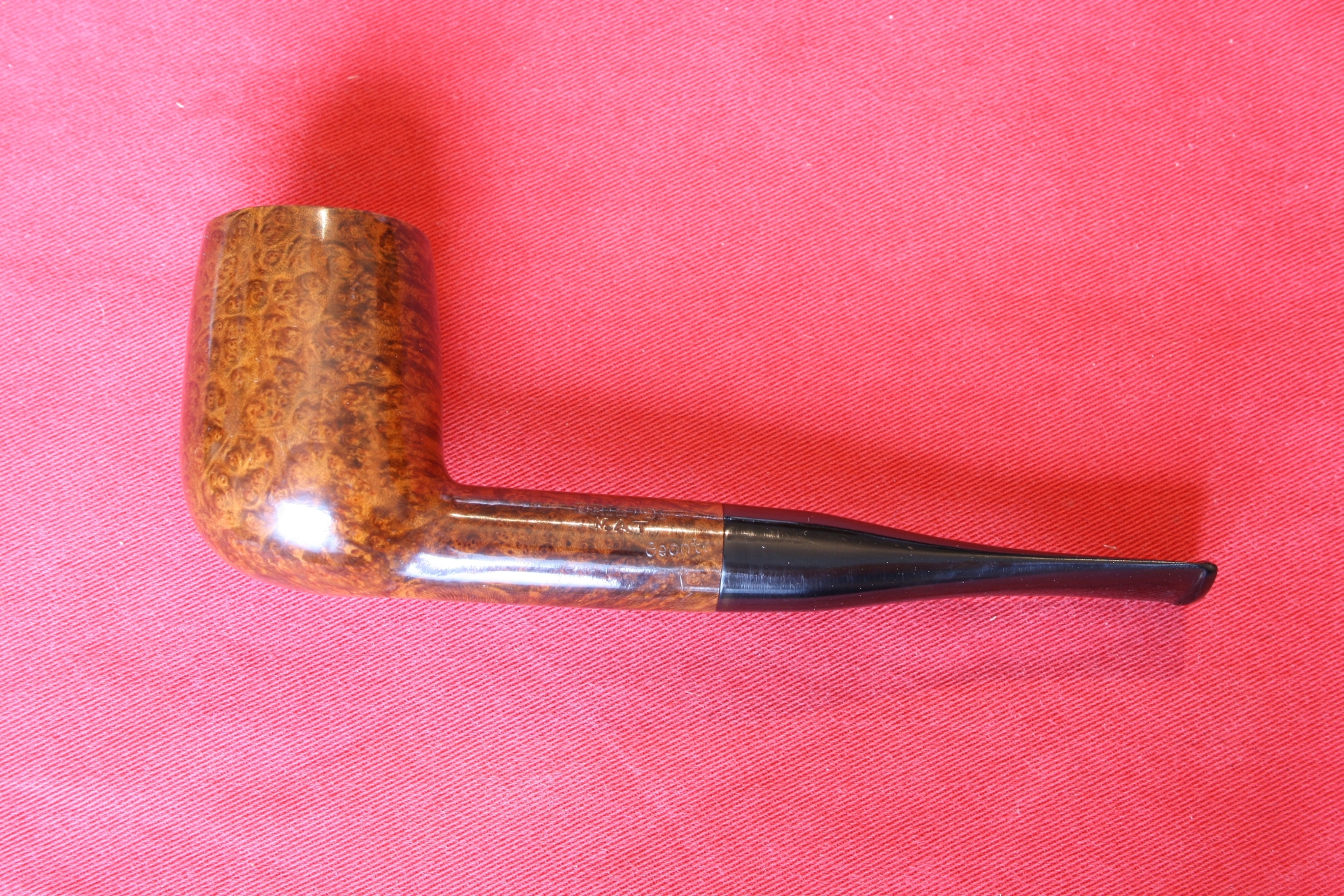
The end result as you can see below:
017 Pipe done LR