Author Archives: rebornpipes

A Unique Vertical Oval Shank Meerschaum Reborn


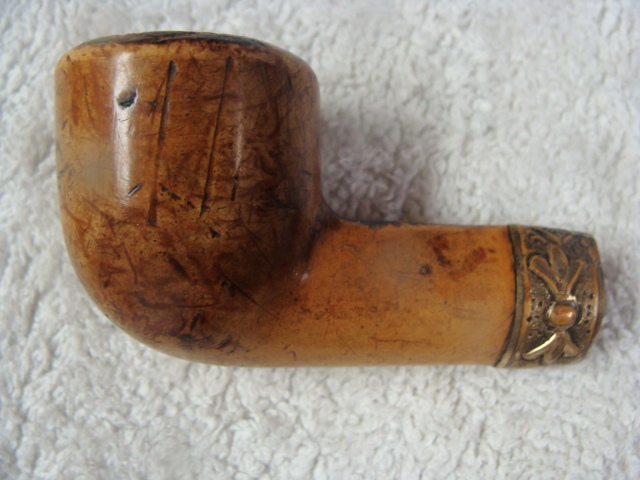
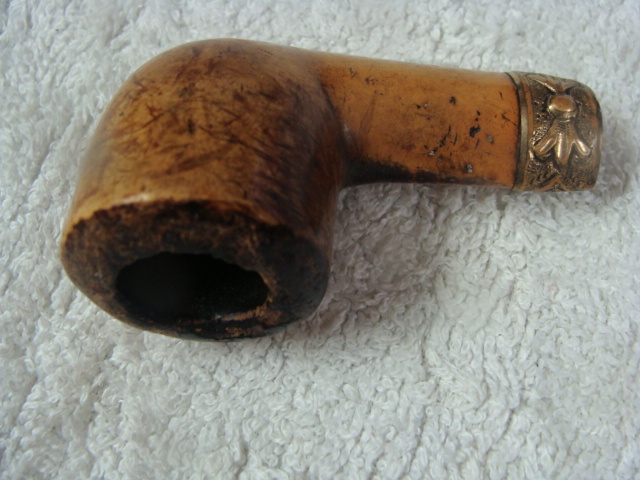
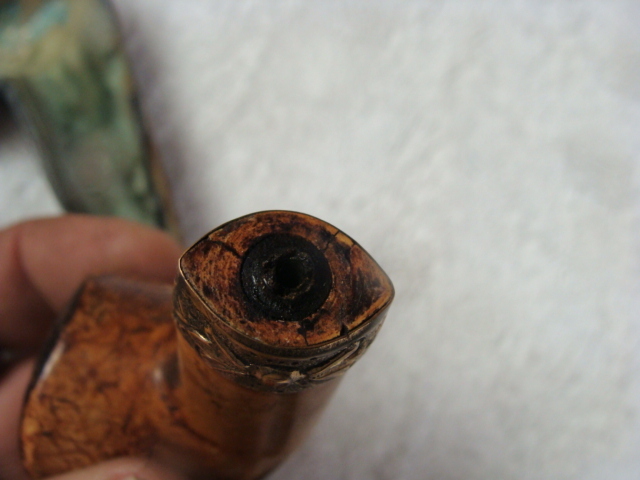
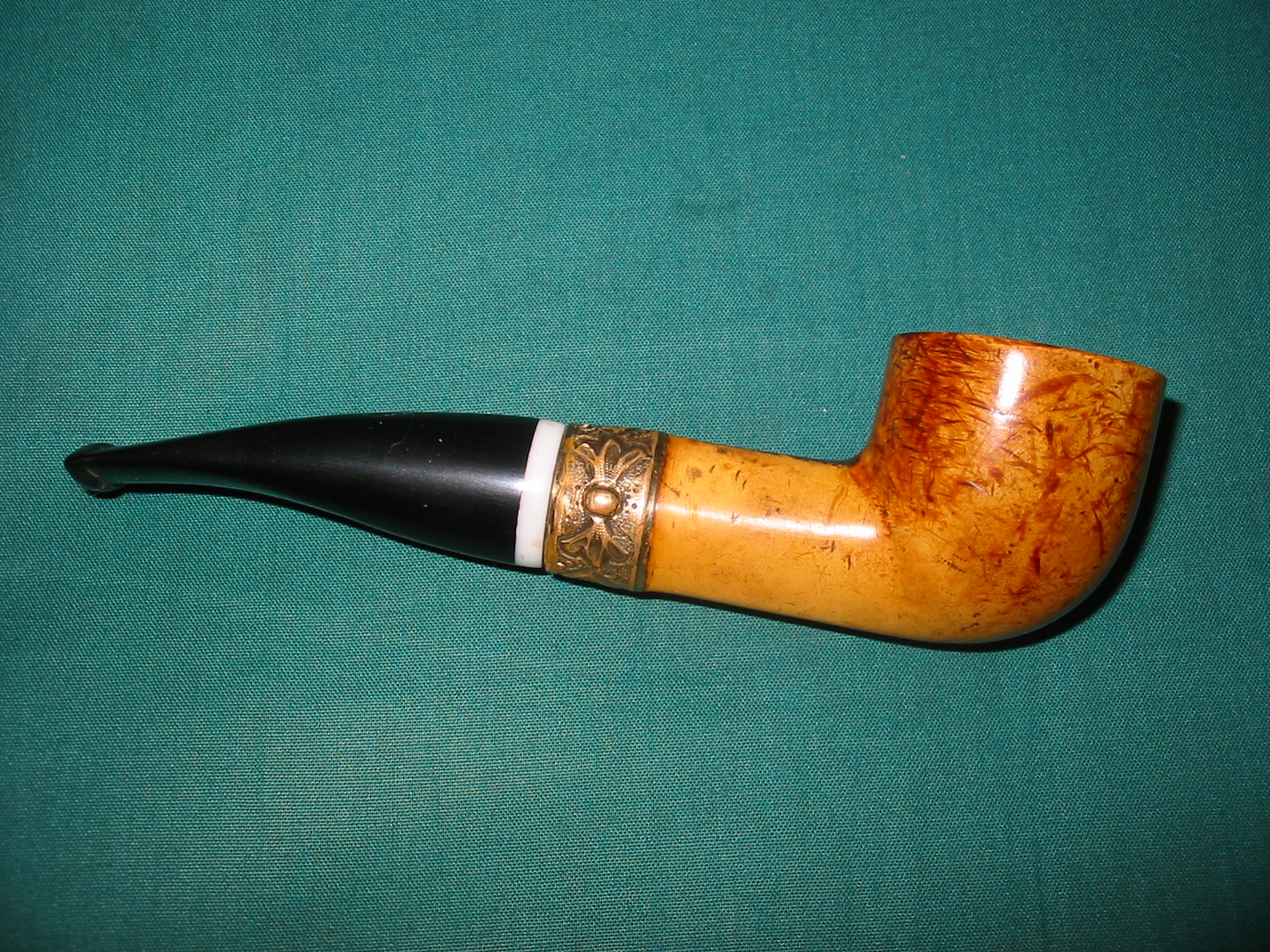
I saw this old Meerschaum pipe bowl on Ebay and decided to put a low bid on it. I was not surprised to have won it and paid for it quickly. The seller packed it very well and shipped it off to Vancouver, Canada. Below are the Ebay photos that caught my attention. I think the thing that intrigued me the most was the vertical oval shank on the pipe. To restem that pipe would be a great challenge – find a stem large enough to work with and shape it until it fit. I thought I had just the stem in my box – a gift from a friend on Pipesmokers Unleashed Forum, Robert.

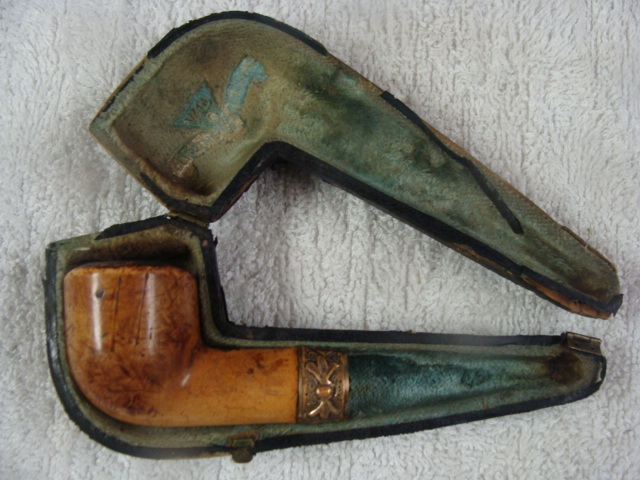
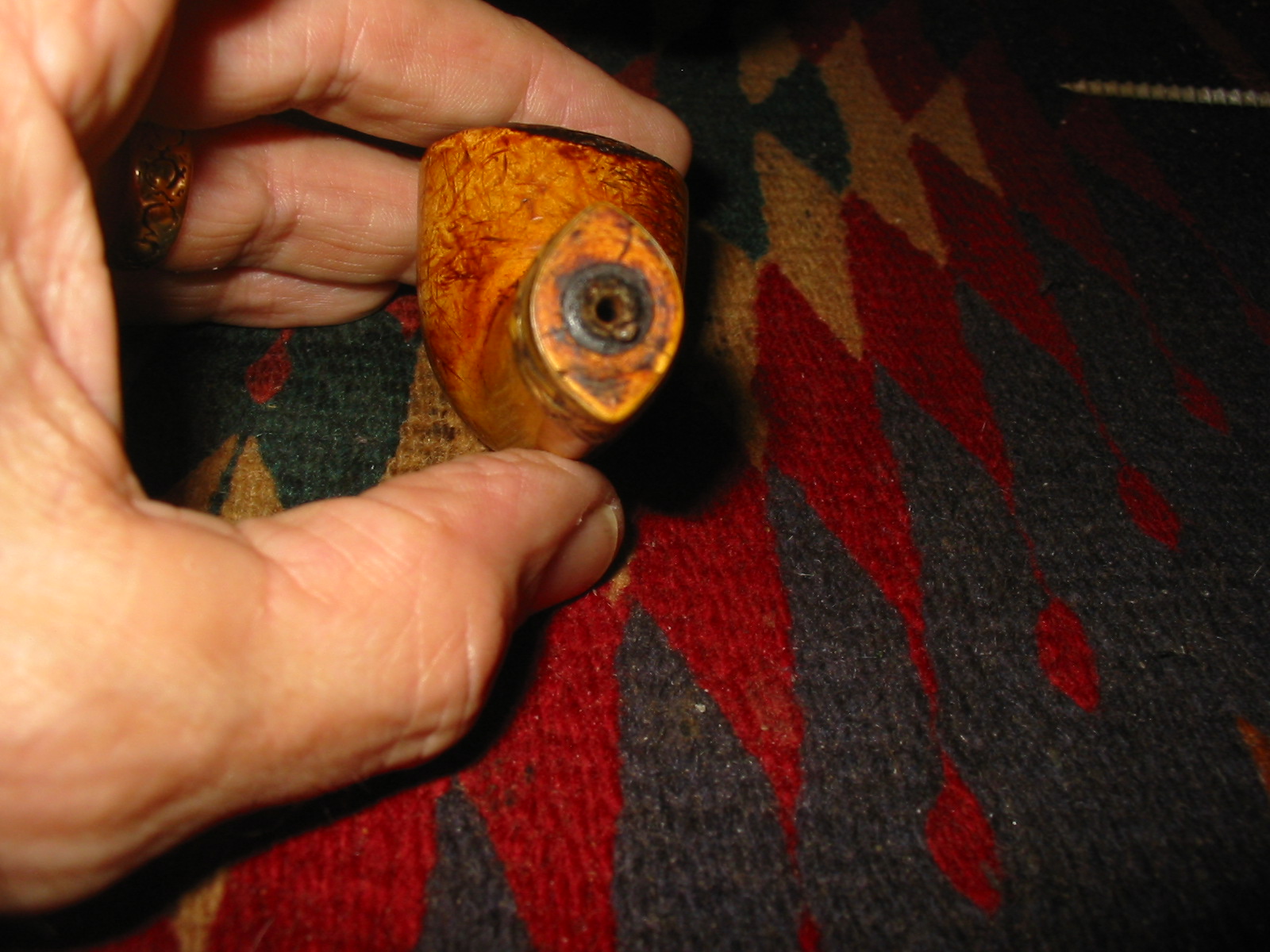
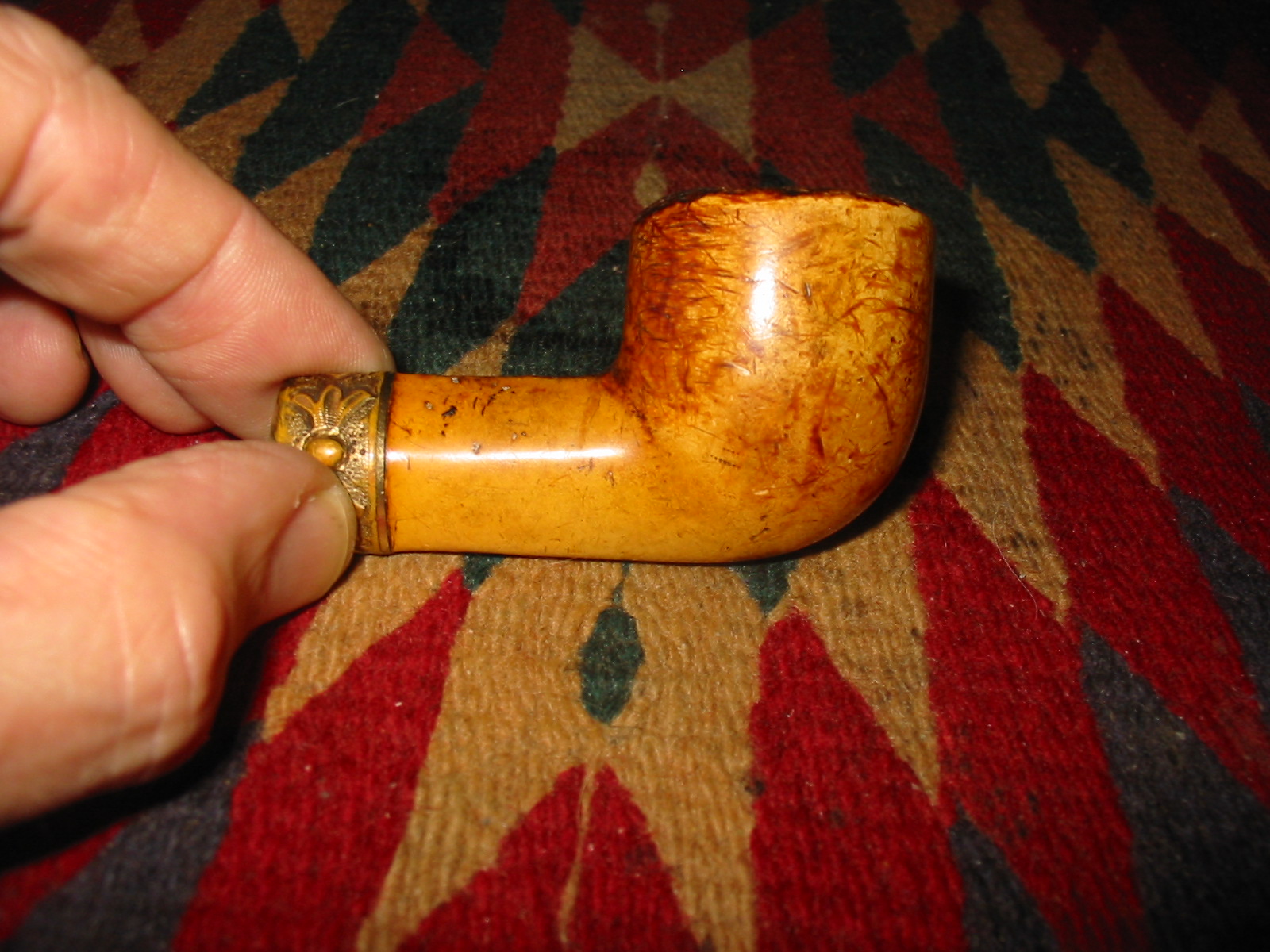
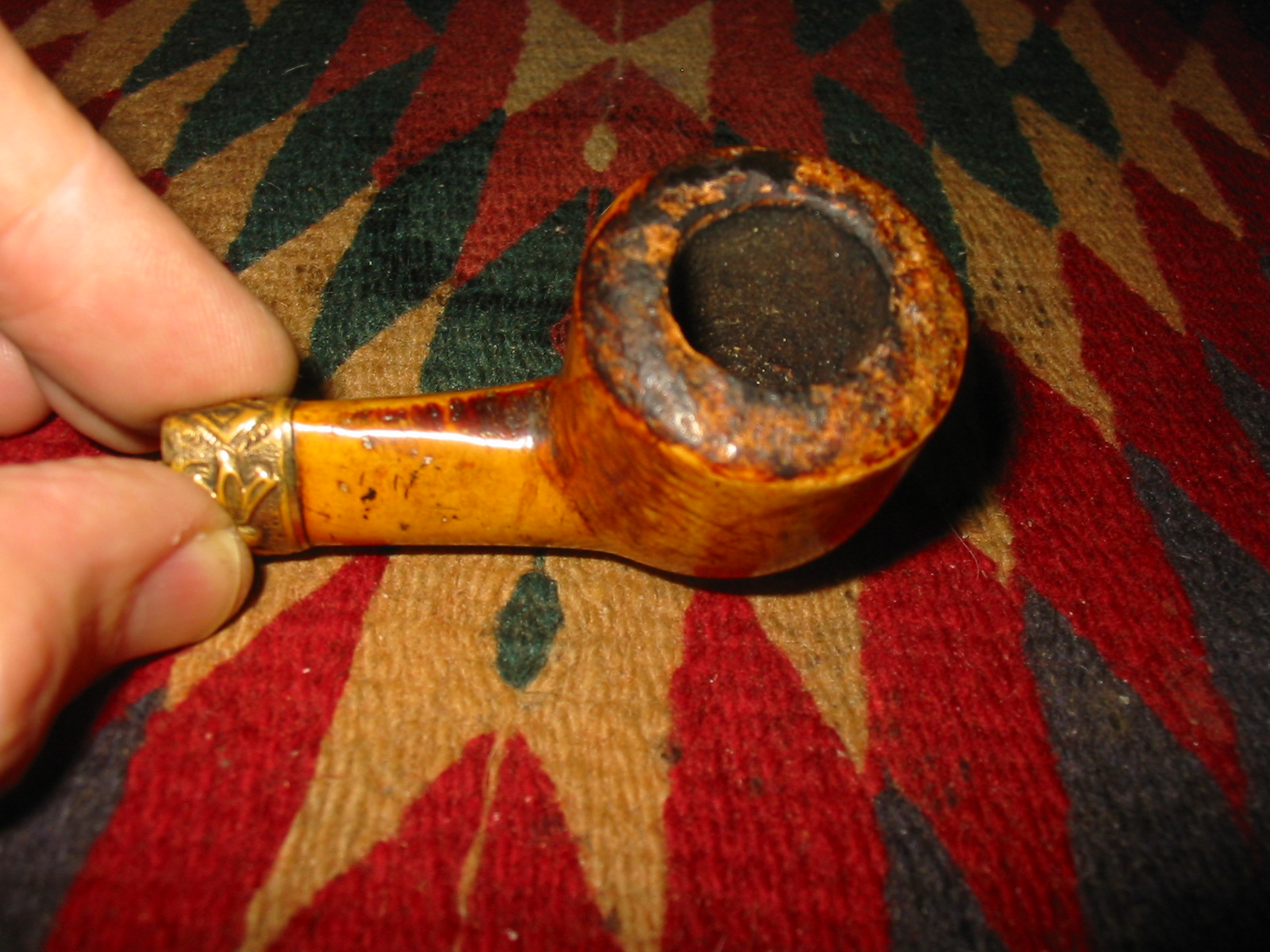
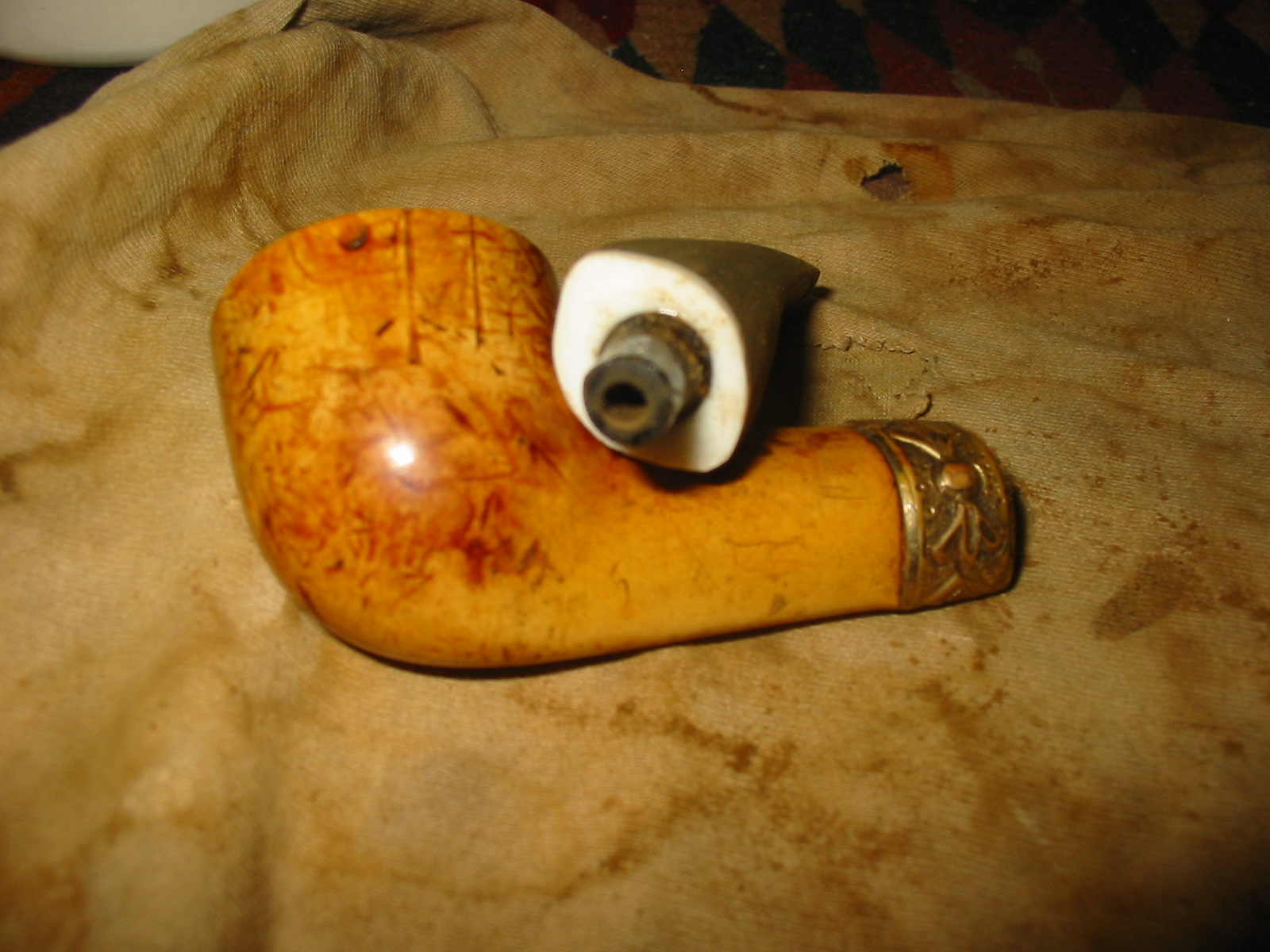
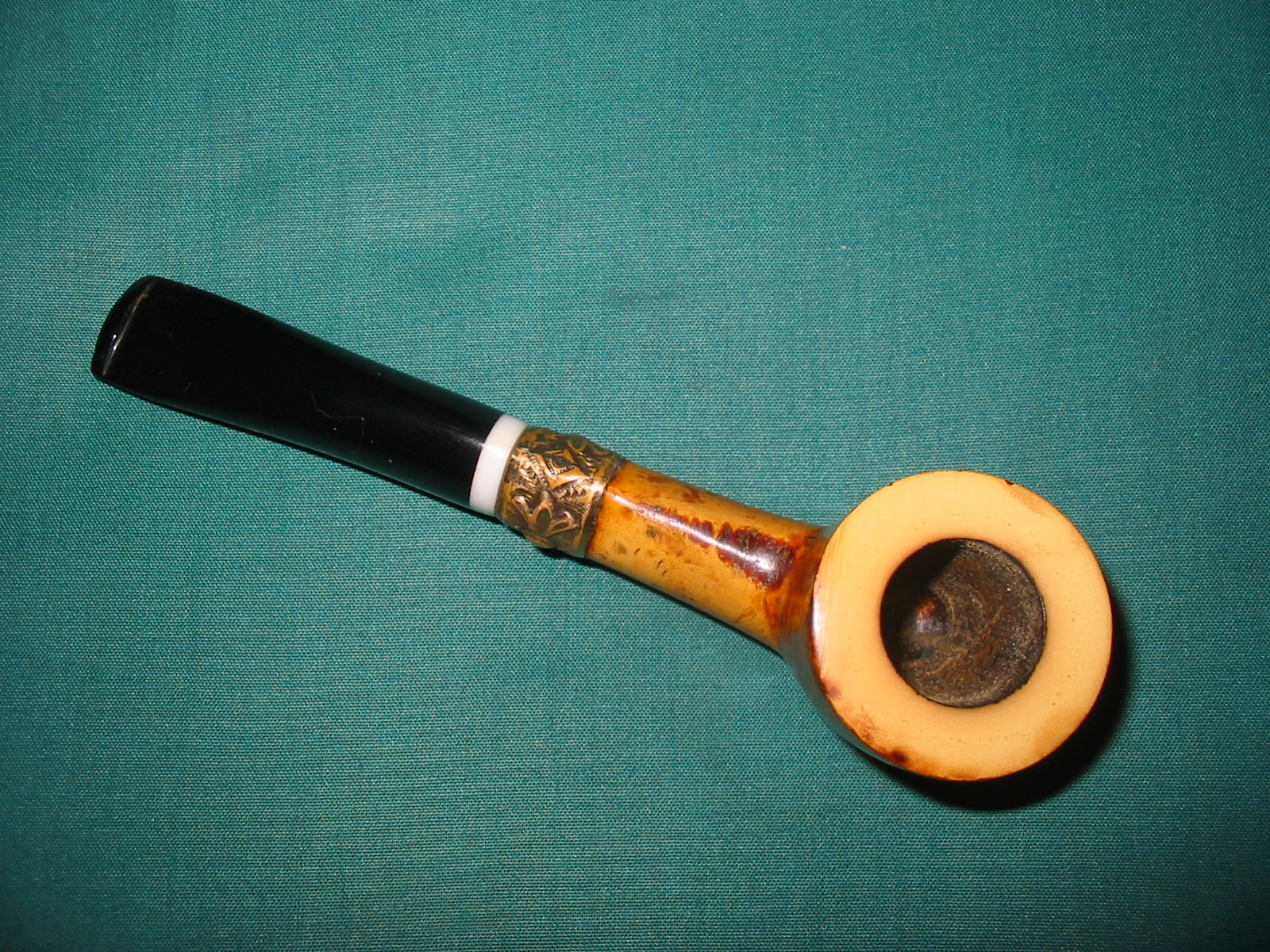
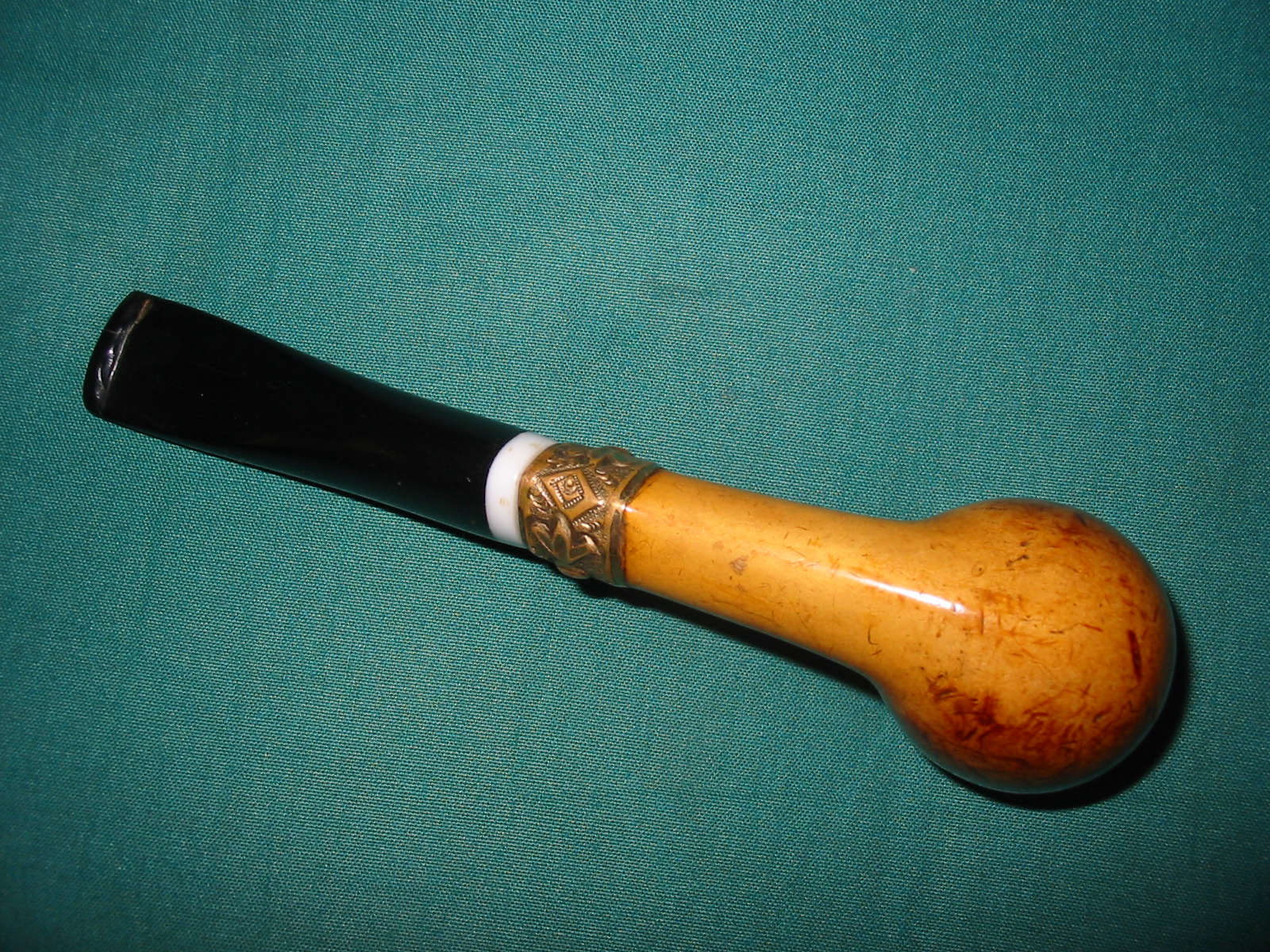
From the photos it looked to be in rough shape. The pipe case said it was a WDC but I have no way of knowing if that is true. The gold filigree on the band looks like the old WDC pipes of the late 1890s but I am still uncertain as to the maker. It was in rough shape as can be seen from the photos. There were many scratches and gouges around the outside of the bowl. The shank had marks on the top that looked like someone had taken a file to it. The rim was probably the worst. With the rough edges on the back right side of the bowl the rim/top appeared to be angled to the right side and worn down. The tar build up was heavy in the bowl and on the rim. The tenon was broken off in the shank. It appeared to be an old bone tenon and a bone insert in the mortise that was threaded to take the screw in tenon. I am assuming the pipe probably had an amber stem in its first appearance in the shop but that was long since broken and lost. The WDC case was also very rough – the edges were worn away, the wood broken and a hinge dangling unused. The inside was badly stained.

meer1

meer3

meer4

meer5

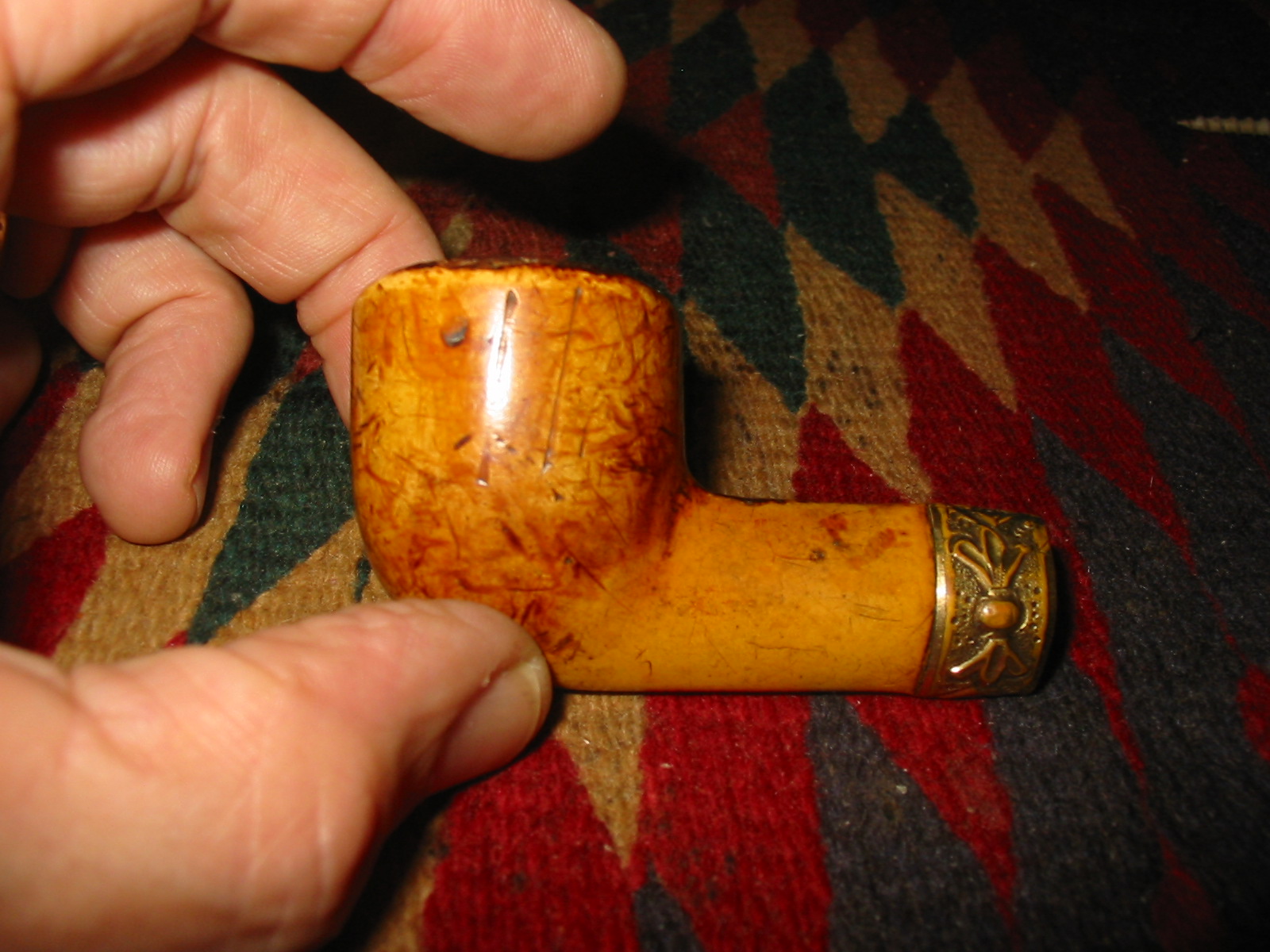
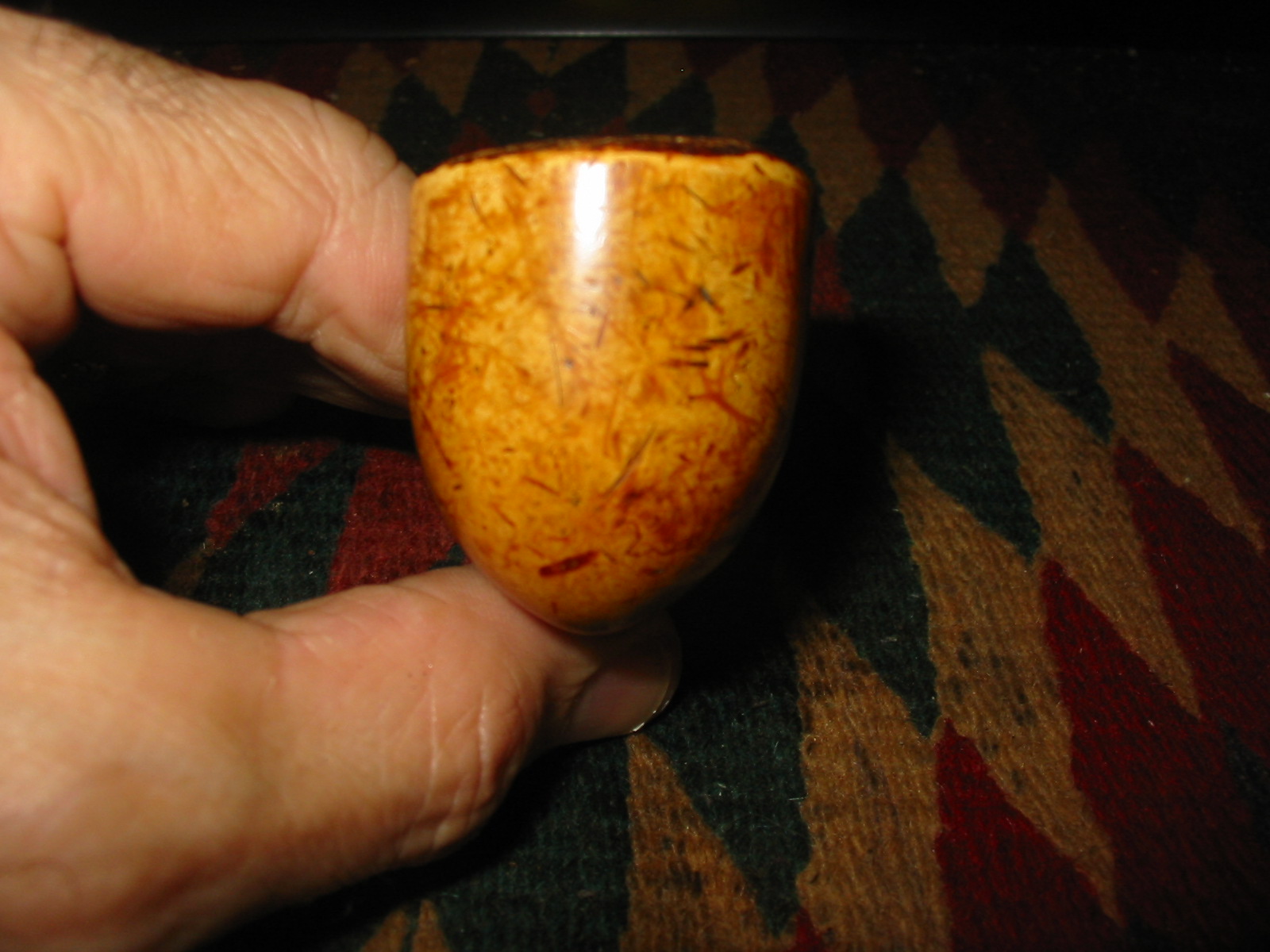
Yesterday afternoon I came home from work early and found a package awaiting me – I knew that the meer had arrived. I had to laugh when I cut open the box – it had a previous label a Funeral Home in Ohio. I don’t know if that was a commentary on the pipe bowl that resided inside the box or if a funny coincidence. I cut the tape and opened the box. The pipe inside was both in worse shape than I had imagined from the seller’s excellent pictures and in better shape. The meer under the band was cracked as can be seen in the photo above and that was as it was when it arrived. The scratches in the surface of the bowl were not as deep as they appeared in the photos and the pipe when place on the rim on a flat board was actually not slanted to the right – the damage to the outer edges of the right back side made it appear worse than it actually was in reality. The next photos show the pipe on the work table just out of the box.

IMG_1799

IMG_1800

IMG_1801

IMG_1802

IMG_1803

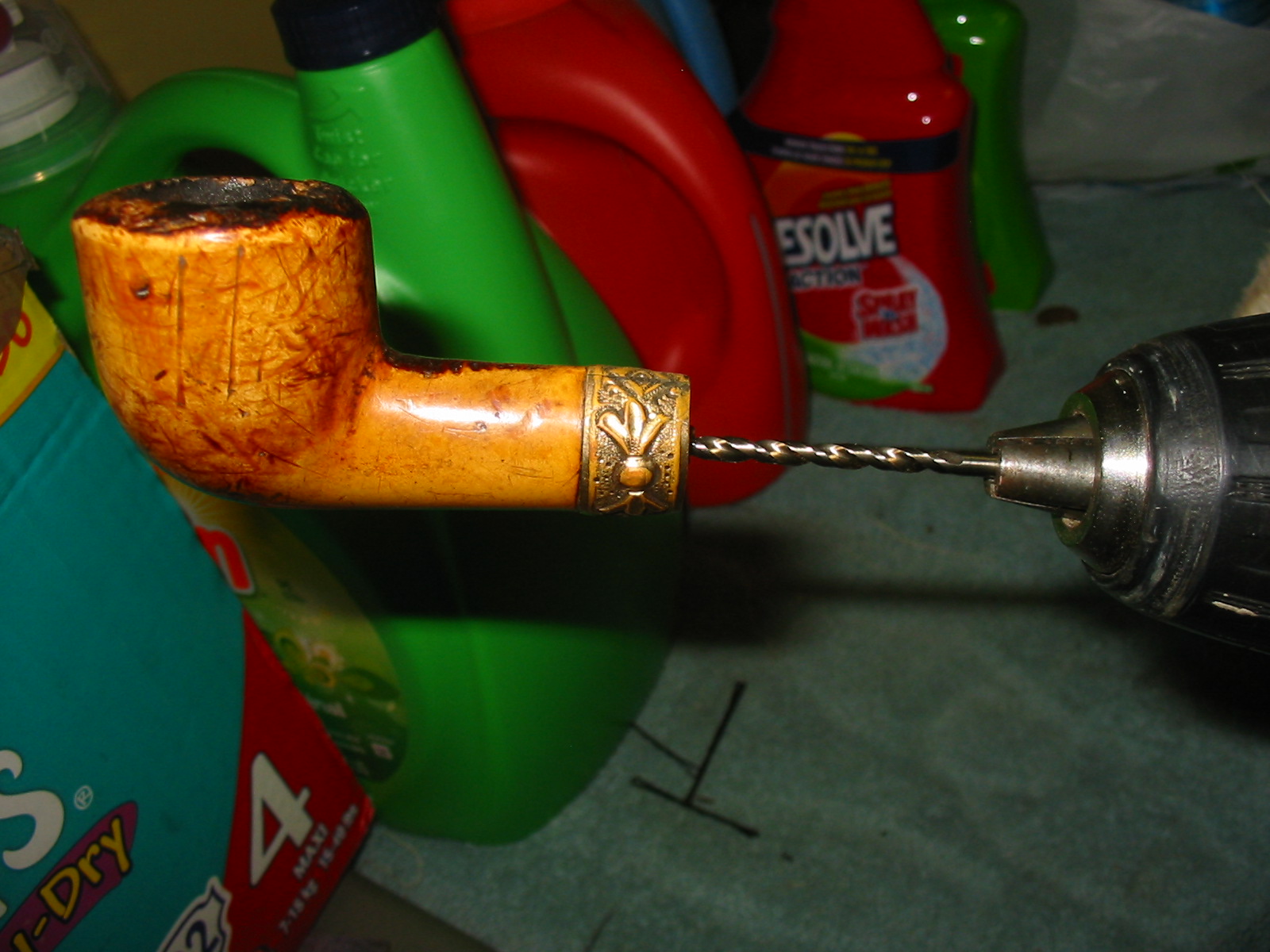
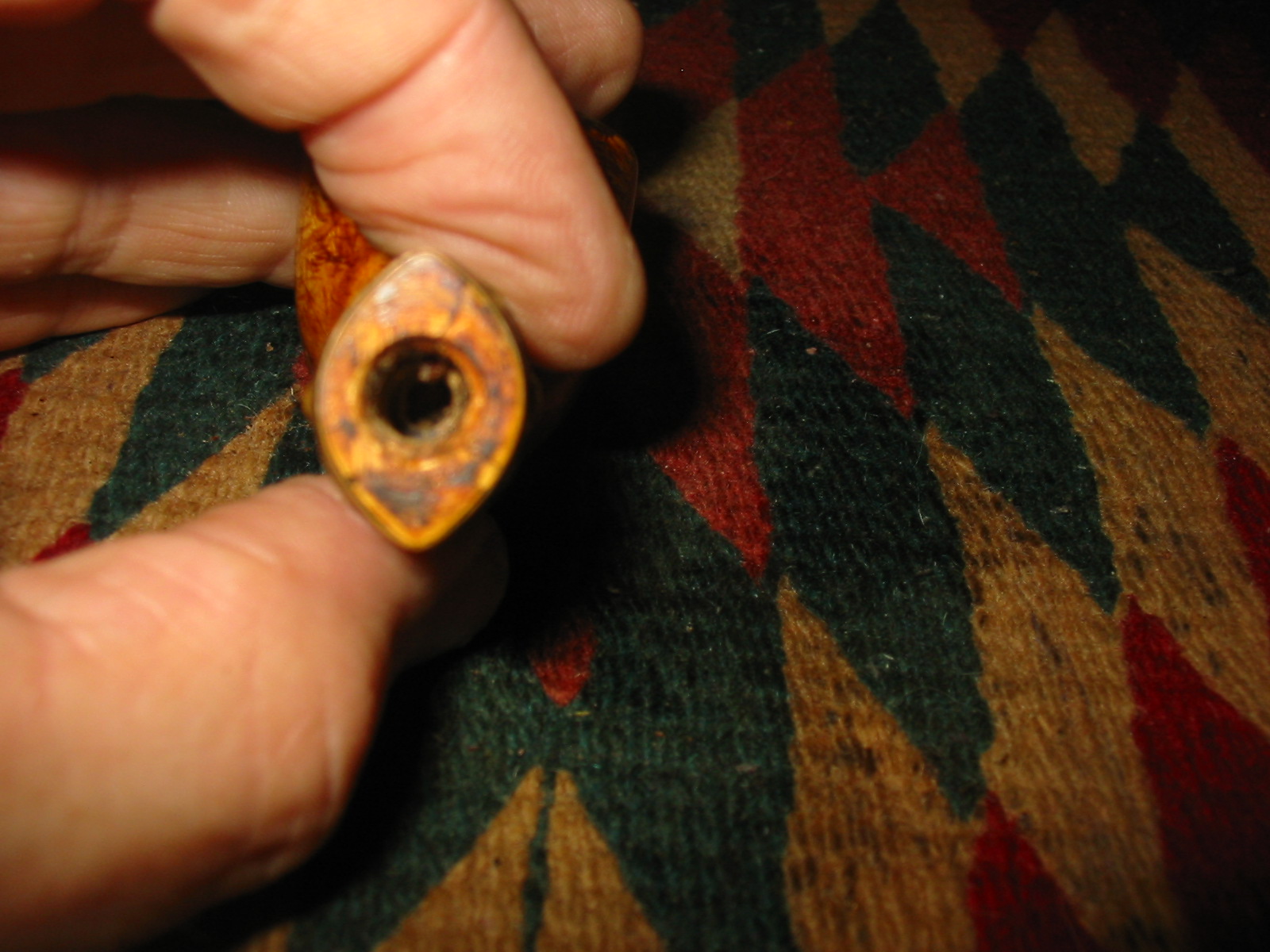
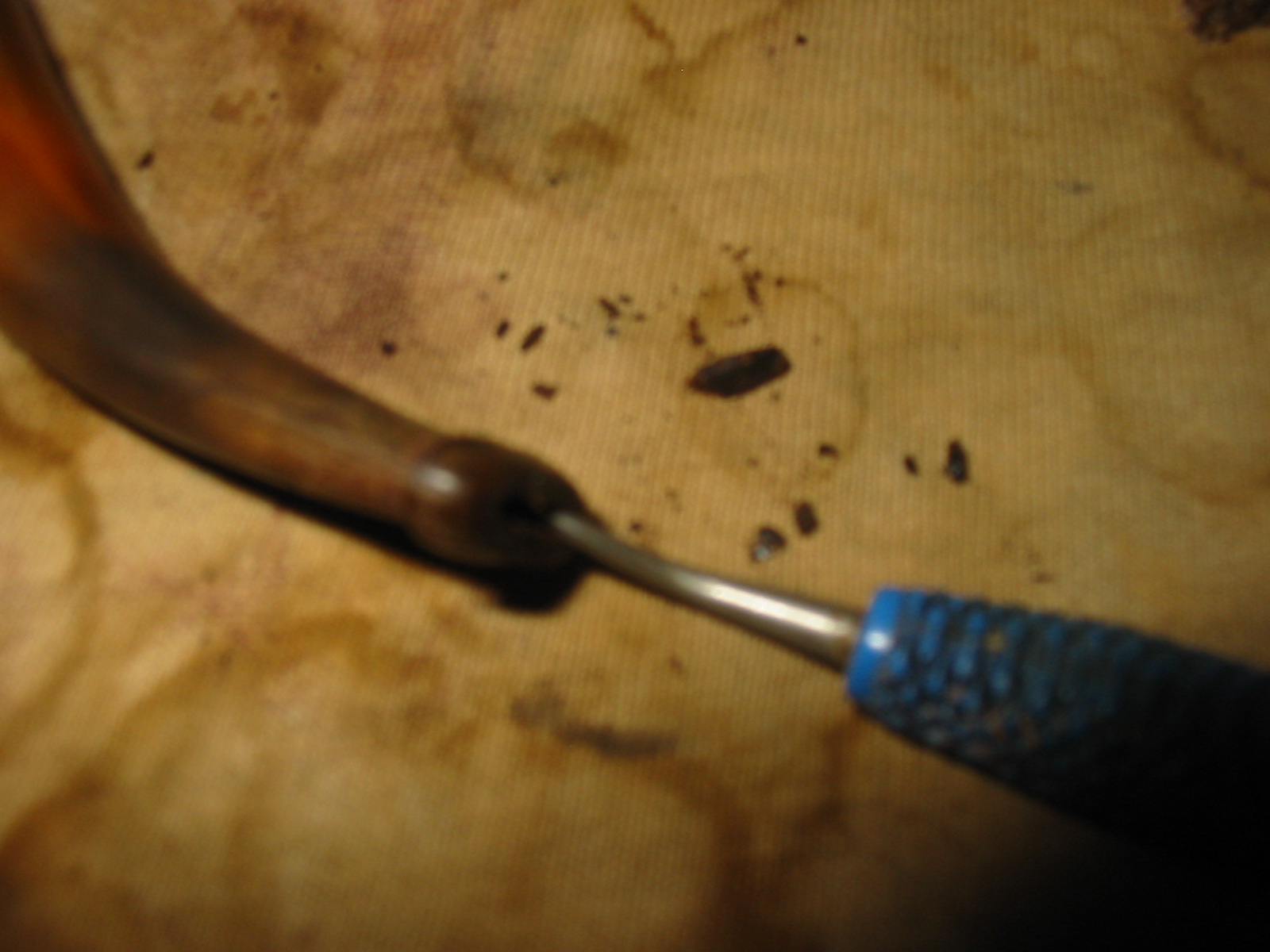
After examining it carefully with my lens and a dental pick I decided to begin the clean up by trying to remove the tenon. I used the screw that I generally use to remove a tenon to no avail. The threads in the mortise were locked tight around the tenon. I picked at it with the dental pick and was unable to remove it that way either. I decided to drill out the old tenon. So I set up a cordless drill with a drill bit slightly larger than the airway in the broken tenon. I slowly drilled the airway with the bit and exchanged it for increasingly larger bits until I had the airway cleared of the debris. I then used a ¼ inch bit to open the mortise and clear out the remaining debris of the mortise and tenon. The second photo below shows the mortise after I opened it up. I used a dental pick to clean out the remaining pieces and hand turned the quarter-inch drill bit into the mortise to smooth out the walls of the airway and open it to receive a new tenon.

IMG_1804

IMG_1806

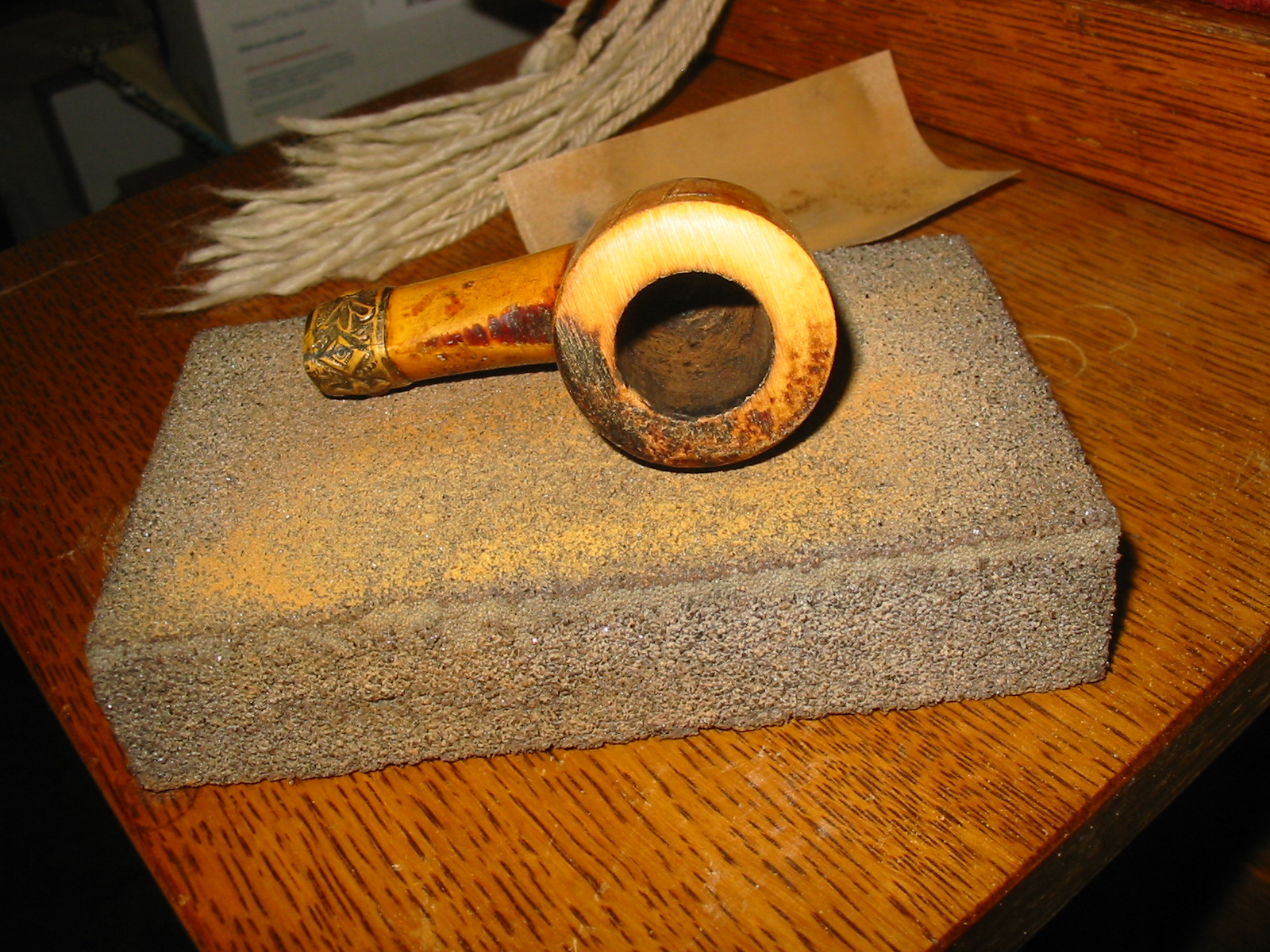
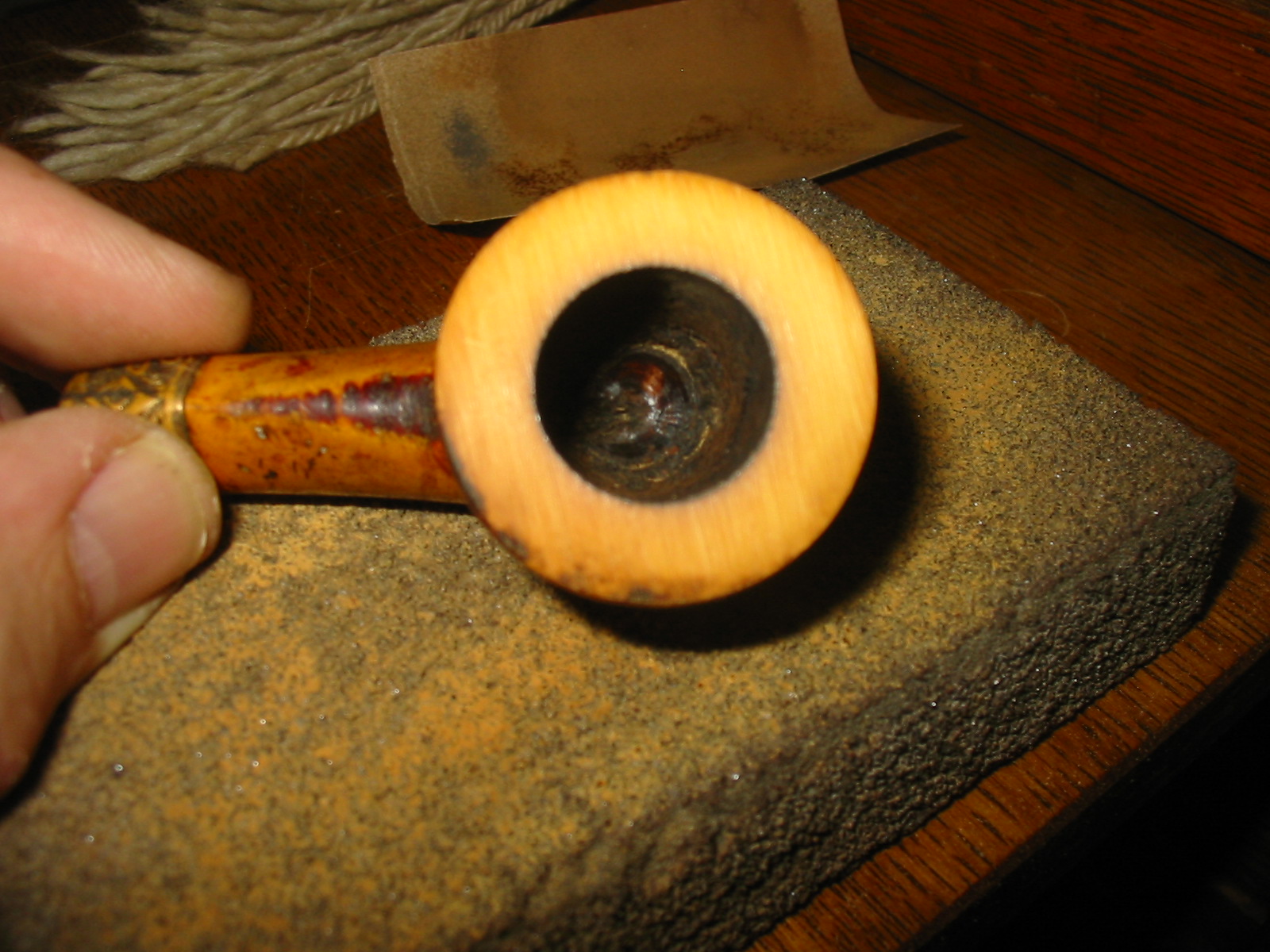
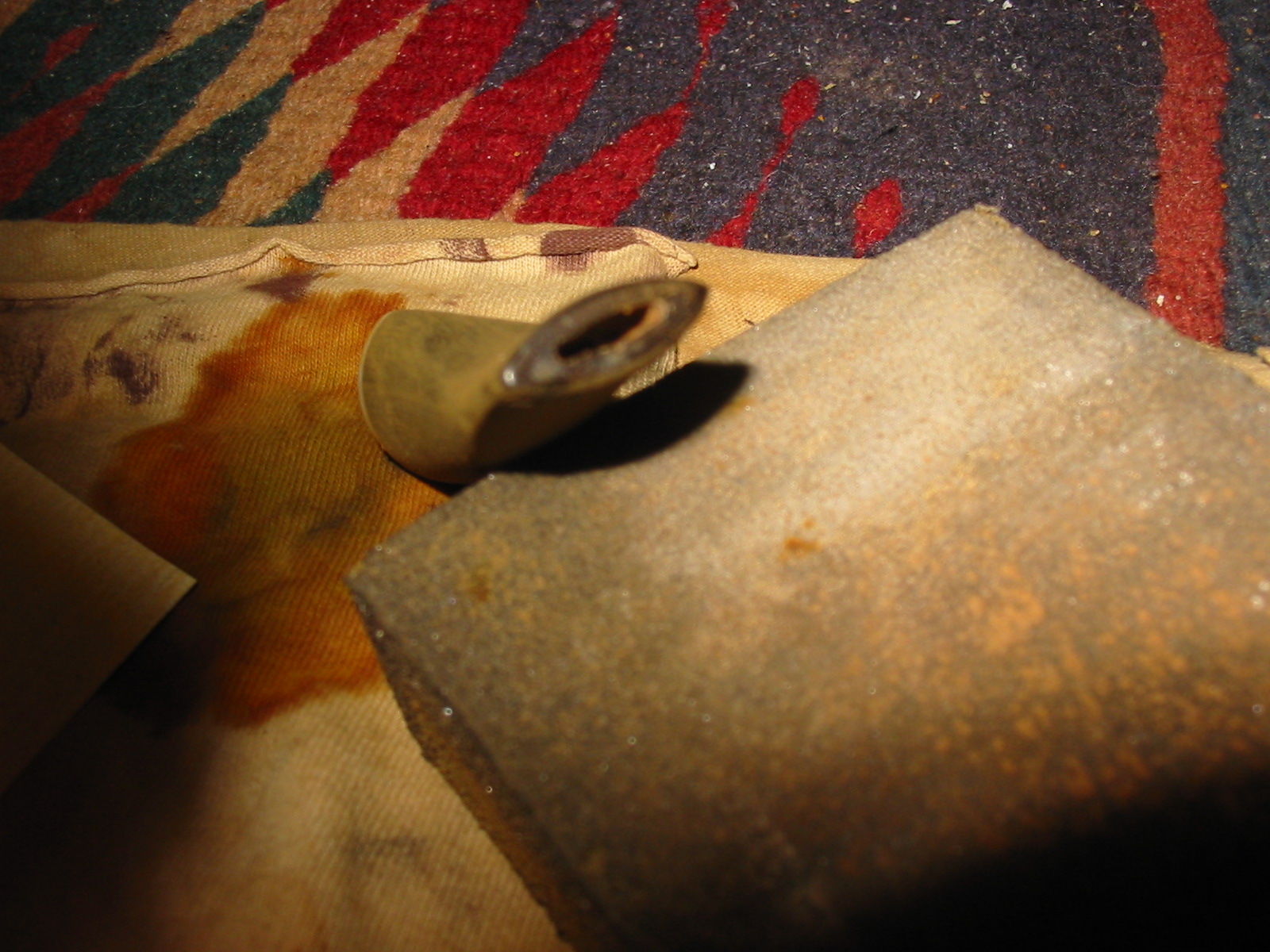
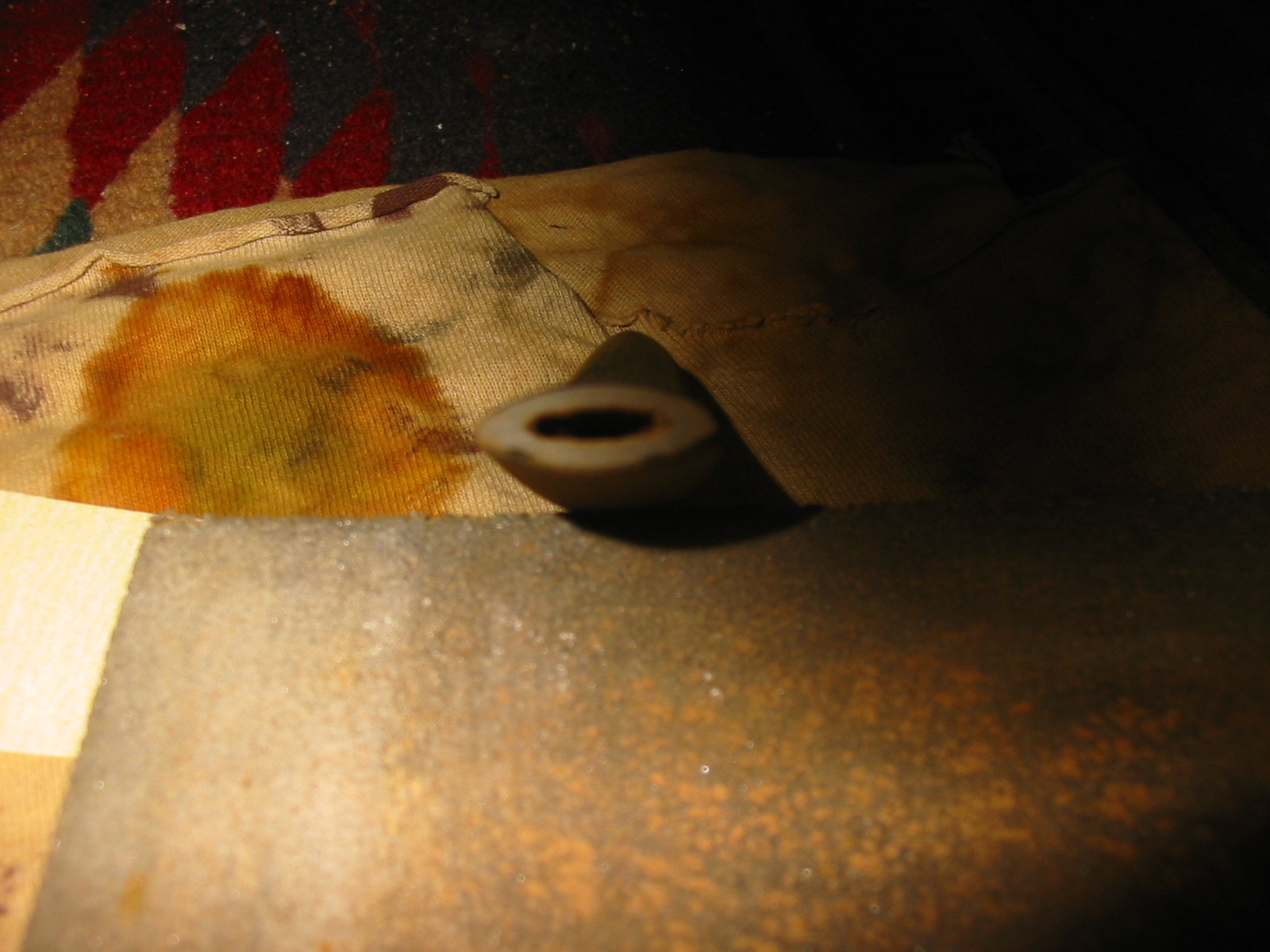
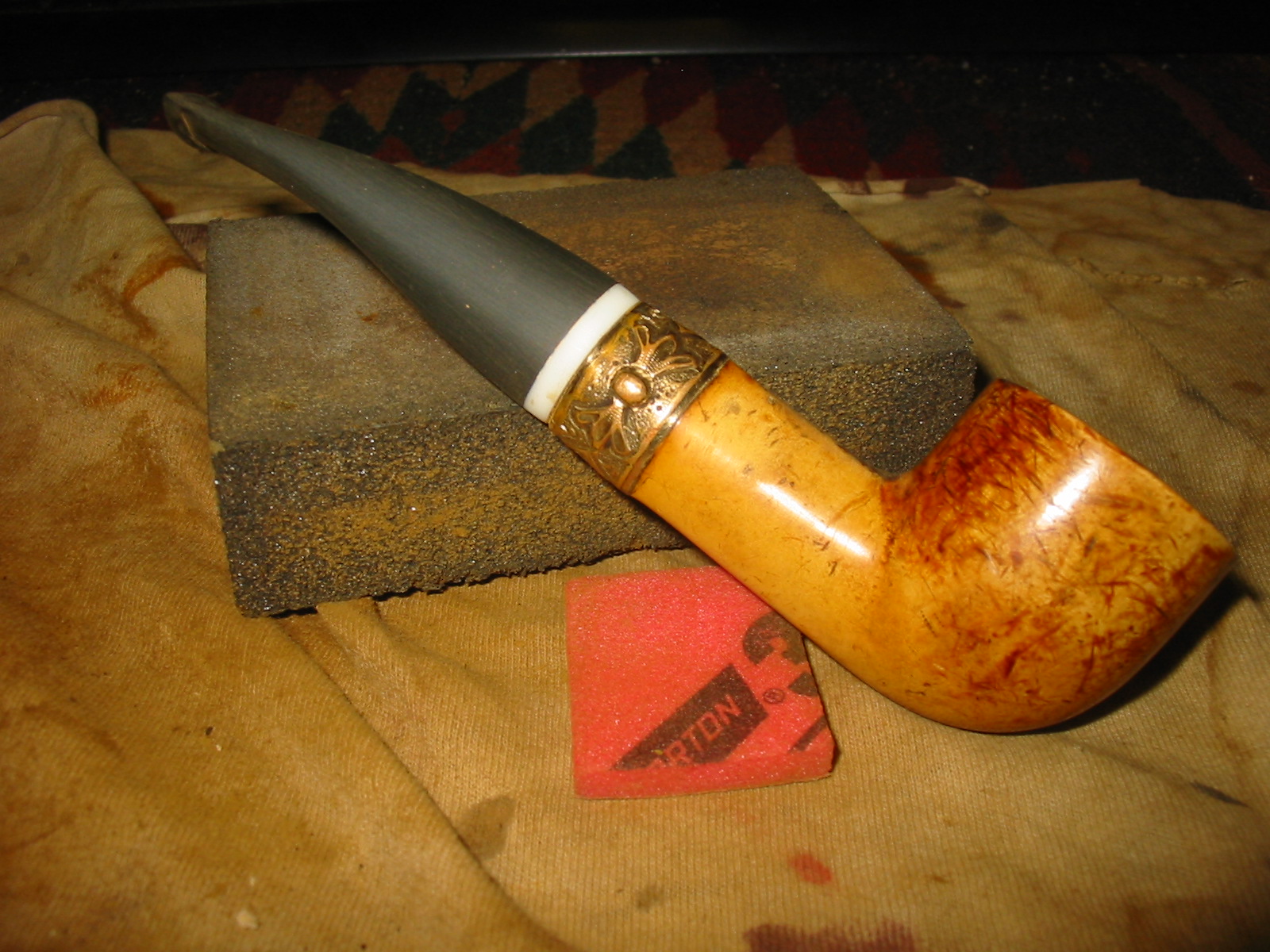
I took the pipe bowl back to the work table and set up a coarse sanding block on my worktable to top the bowl of the meer. I have used this block in the past with good success on the softer meerschaum material. I placed the bowl, rim down on the surface of the block and sanded it in a clockwise direction (no reason for that other than I am right-handed). I sanded it, checking often to see how the rim was cleaning up until the surface was clear and the top of the bowl once again level. Surprisingly I did not have to remove too much material from the rim to clean up the surface.

IMG_1805

IMG_1808

IMG_1809

IMG_1810

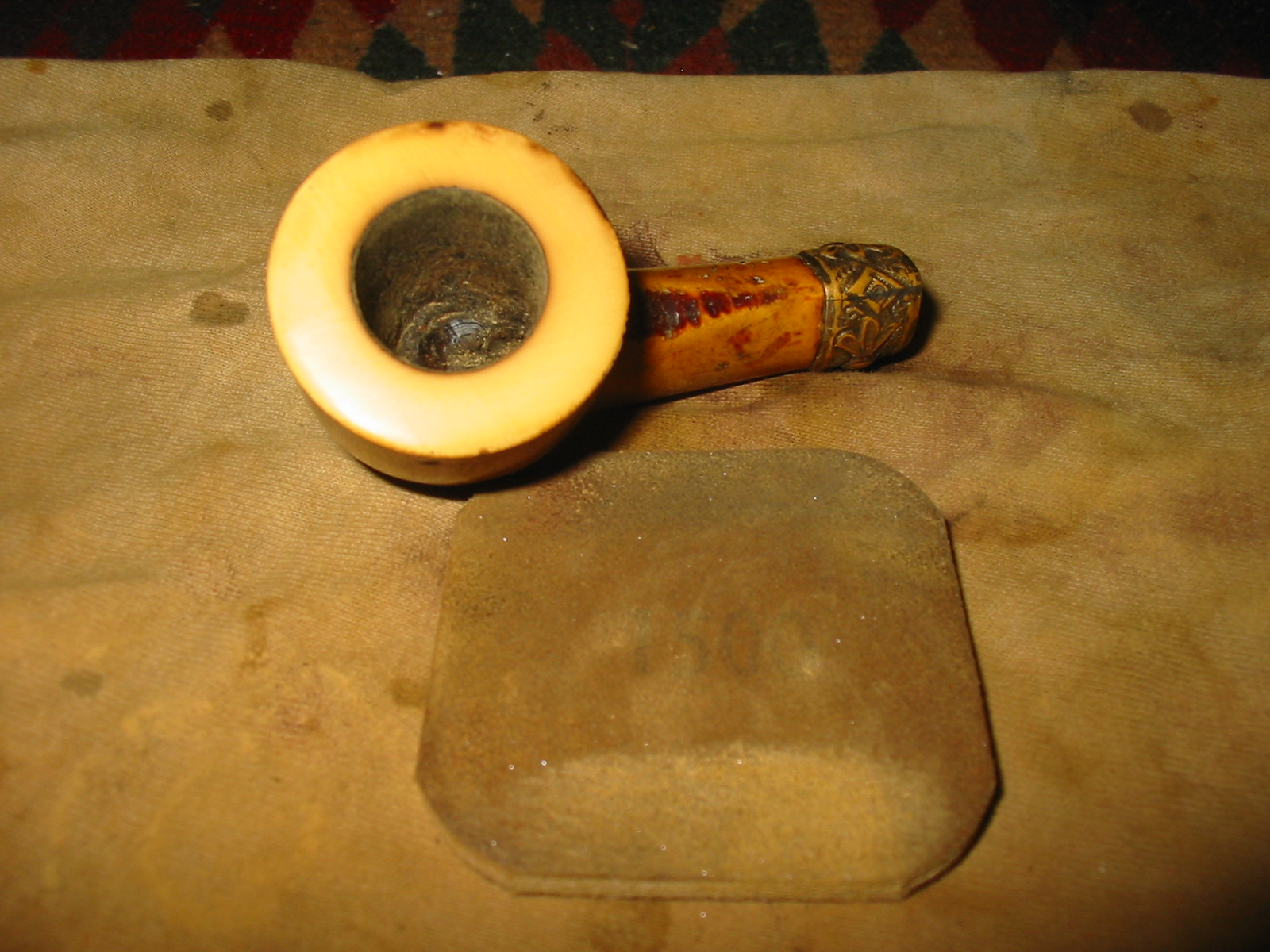
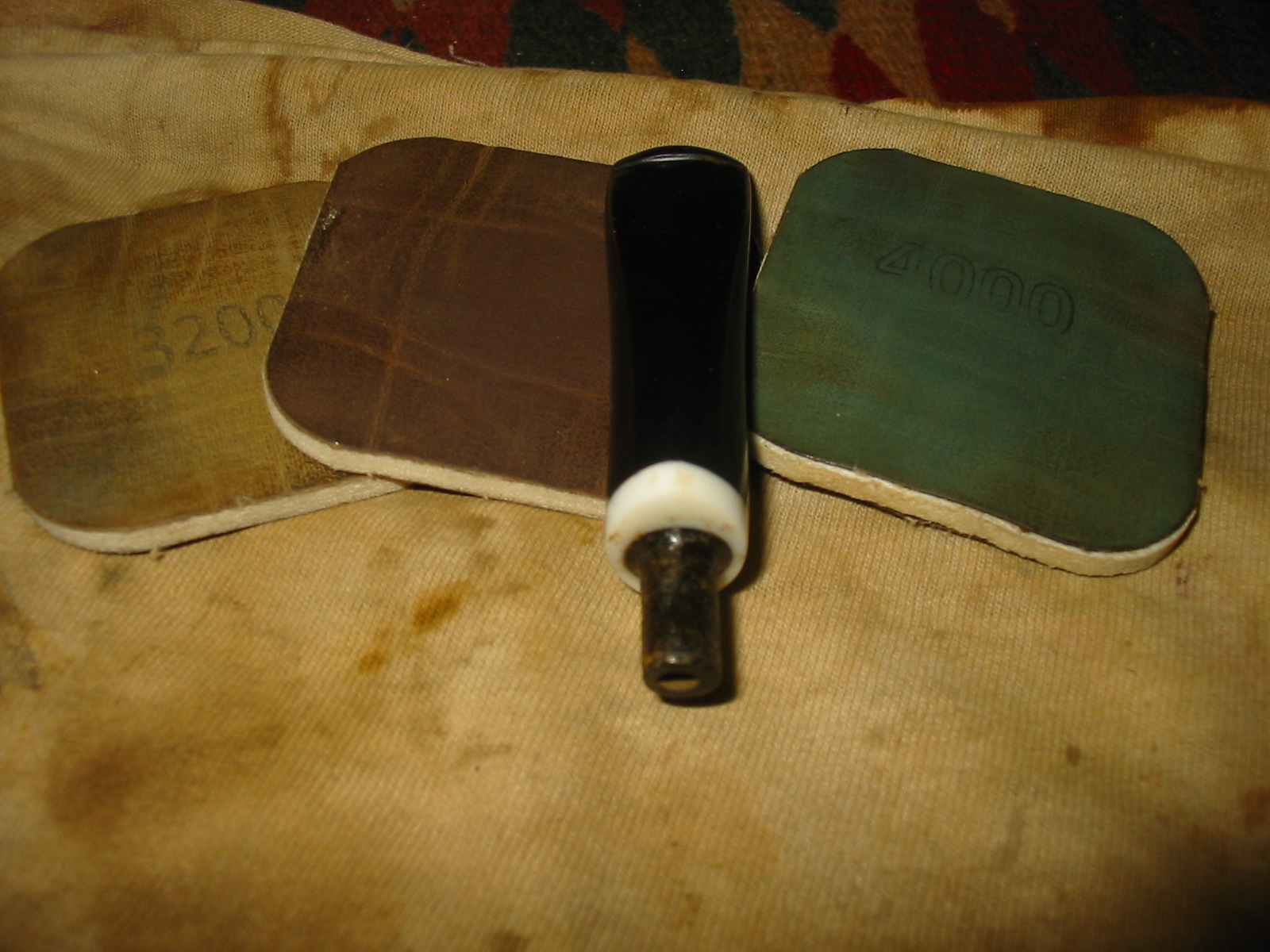
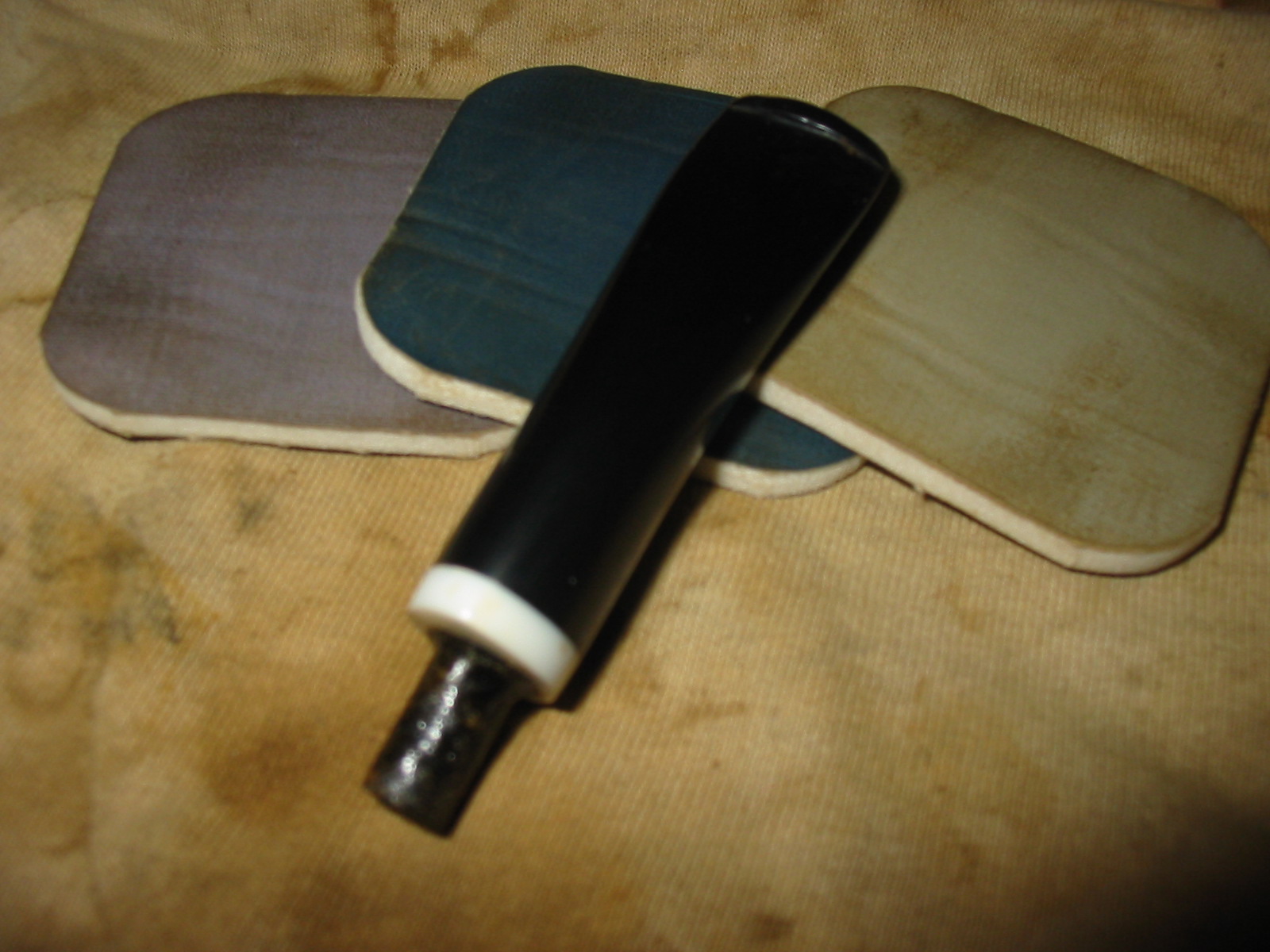
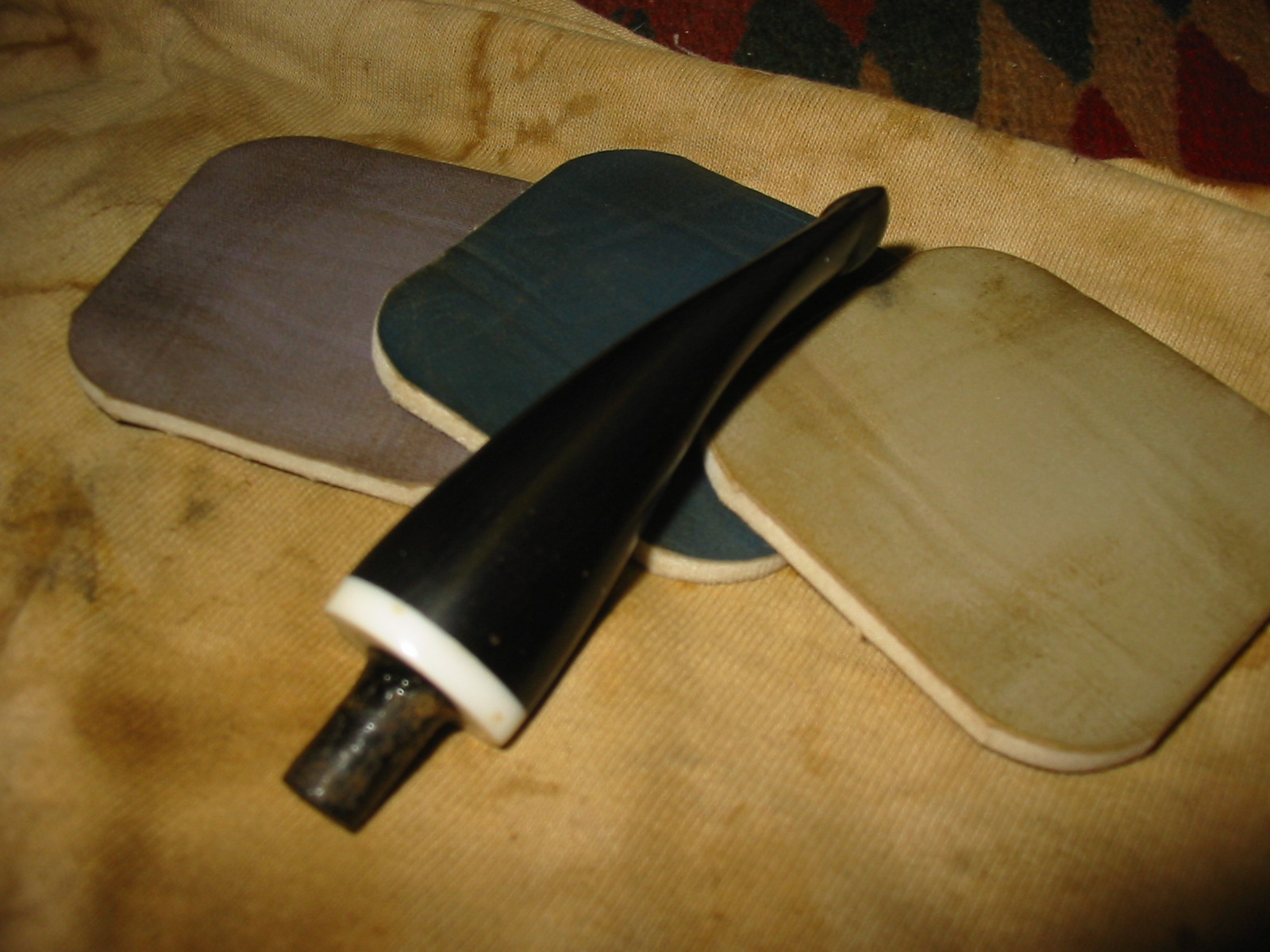
When I had finished the sanding, I used micromesh sanding pads to sand the top smooth once again and remove the scratches from the coarse sanding block. The micromesh sanding pads from 1500 – 12,000 grit bring a shine back to the surface of the meer and prepare it for rewaxing once the pipe is finished.

IMG_1811

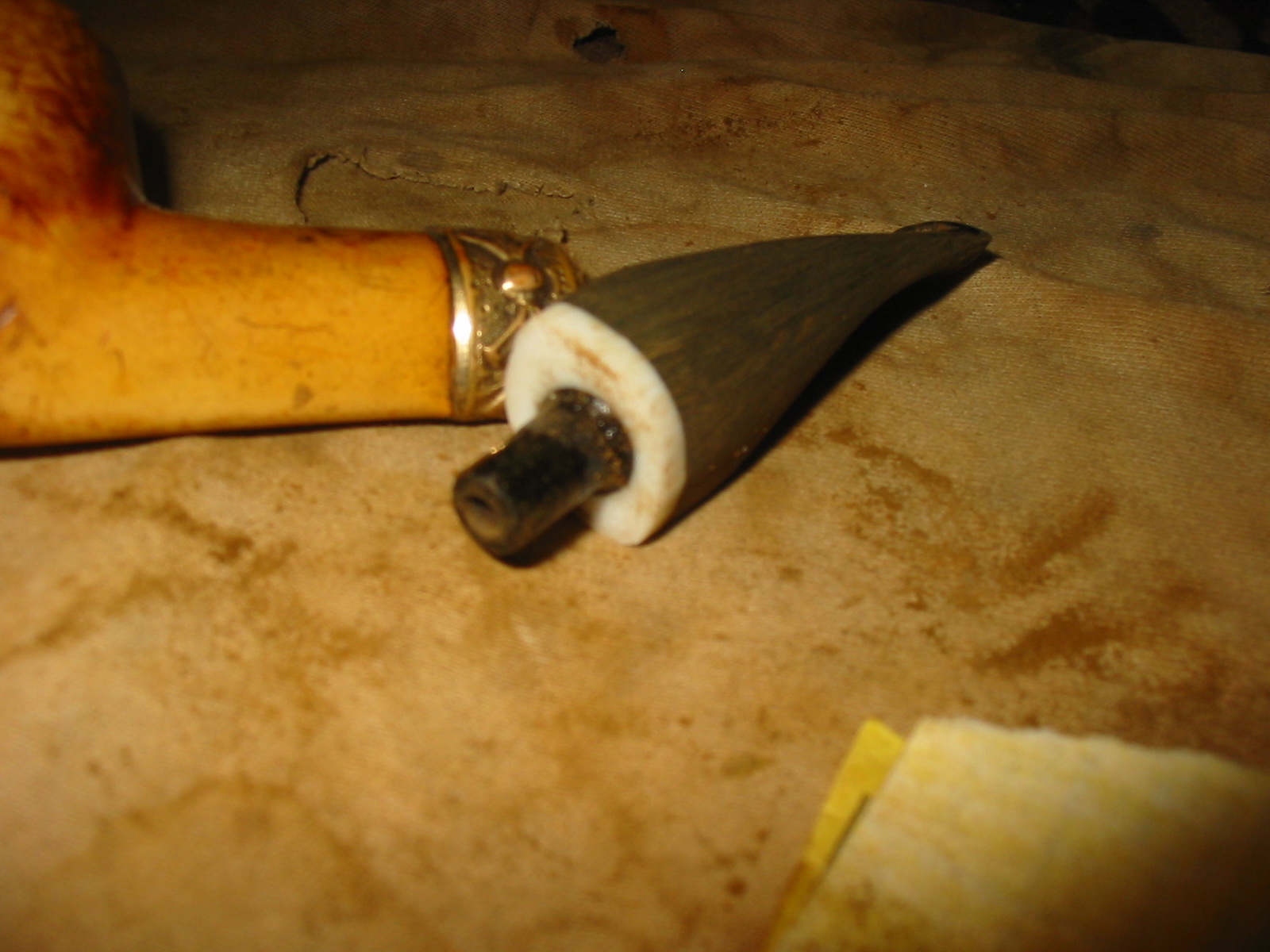
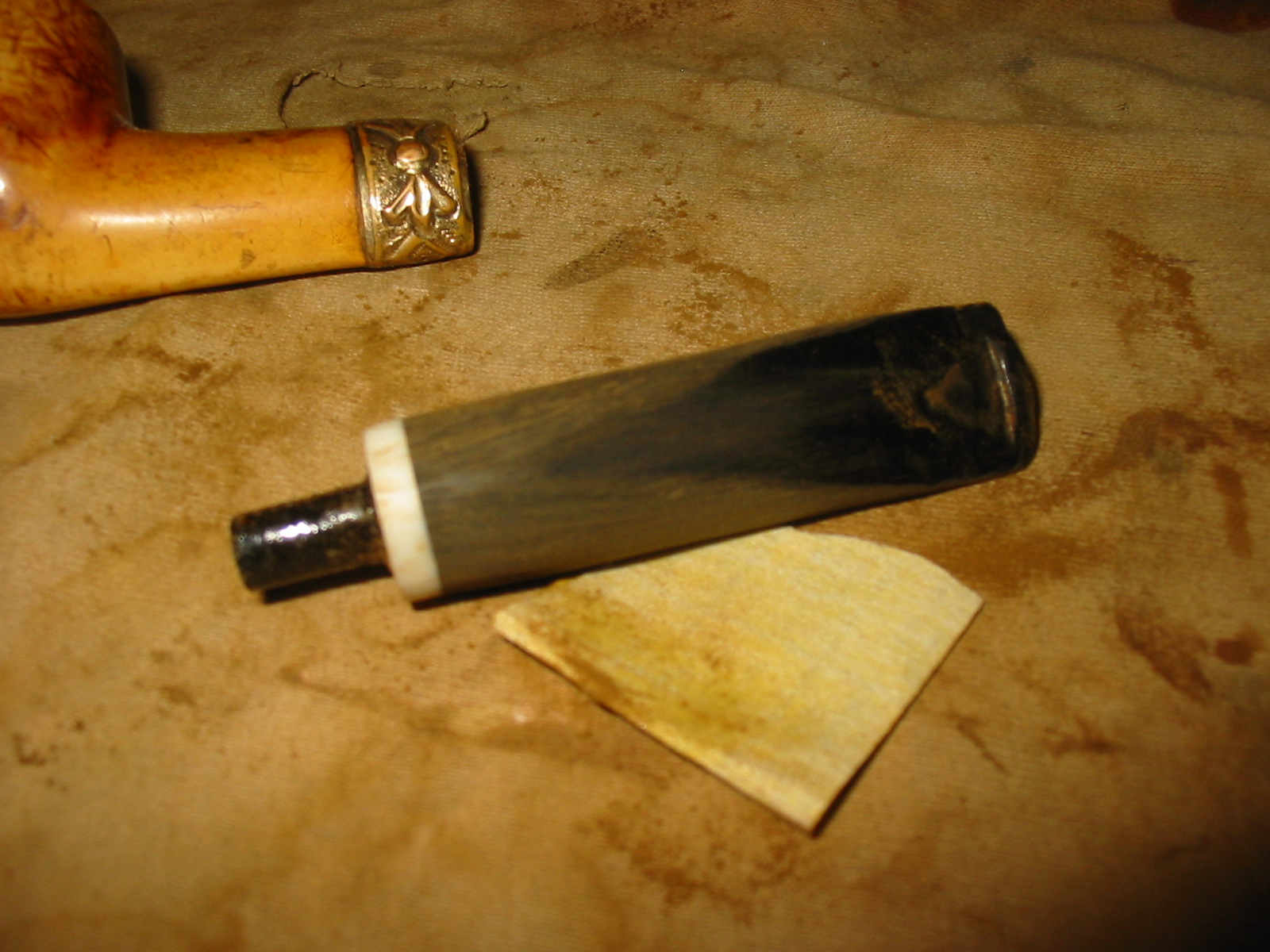
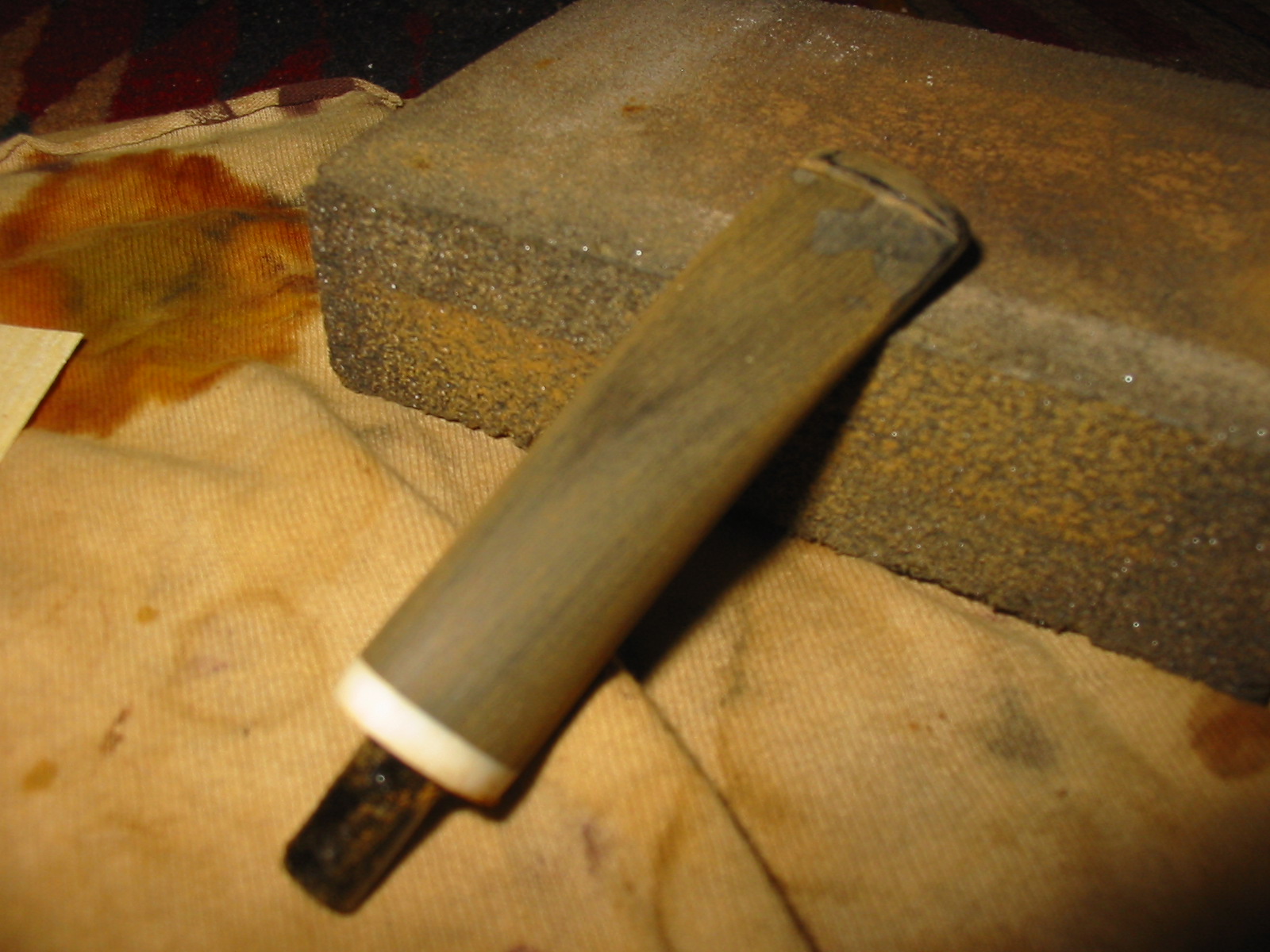
At this point in the process I decided to see if I could fit a new stem on the pipe. The diameter of the oval shank was quite large and would require a large diameter round stem. To make it an oval stem would require that much of the existing vulcanite of the stem would have to be removed in the shaping process. I had an old Brebbia stem that a friend on Pipe Smoker Unleashed Forum sent me for an old Peterson that I was restemming. The tenon was too small for the Pete but too large for the old meer. I used a Dremel with a sanding drum to remove the excess material from the tenon until the fit was very close. The remainder of the fitting was done with a wood rasp and sandpaper. Once the tenon was finished I pushed the stem into the old meer to check on the fit of the tenon in the newly opened mortise. As can be seen in the photo below, the fit was perfect. You can also see from that photo how much work would need to be done to fit the stem to match the shank of the pipe.

IMG_1812

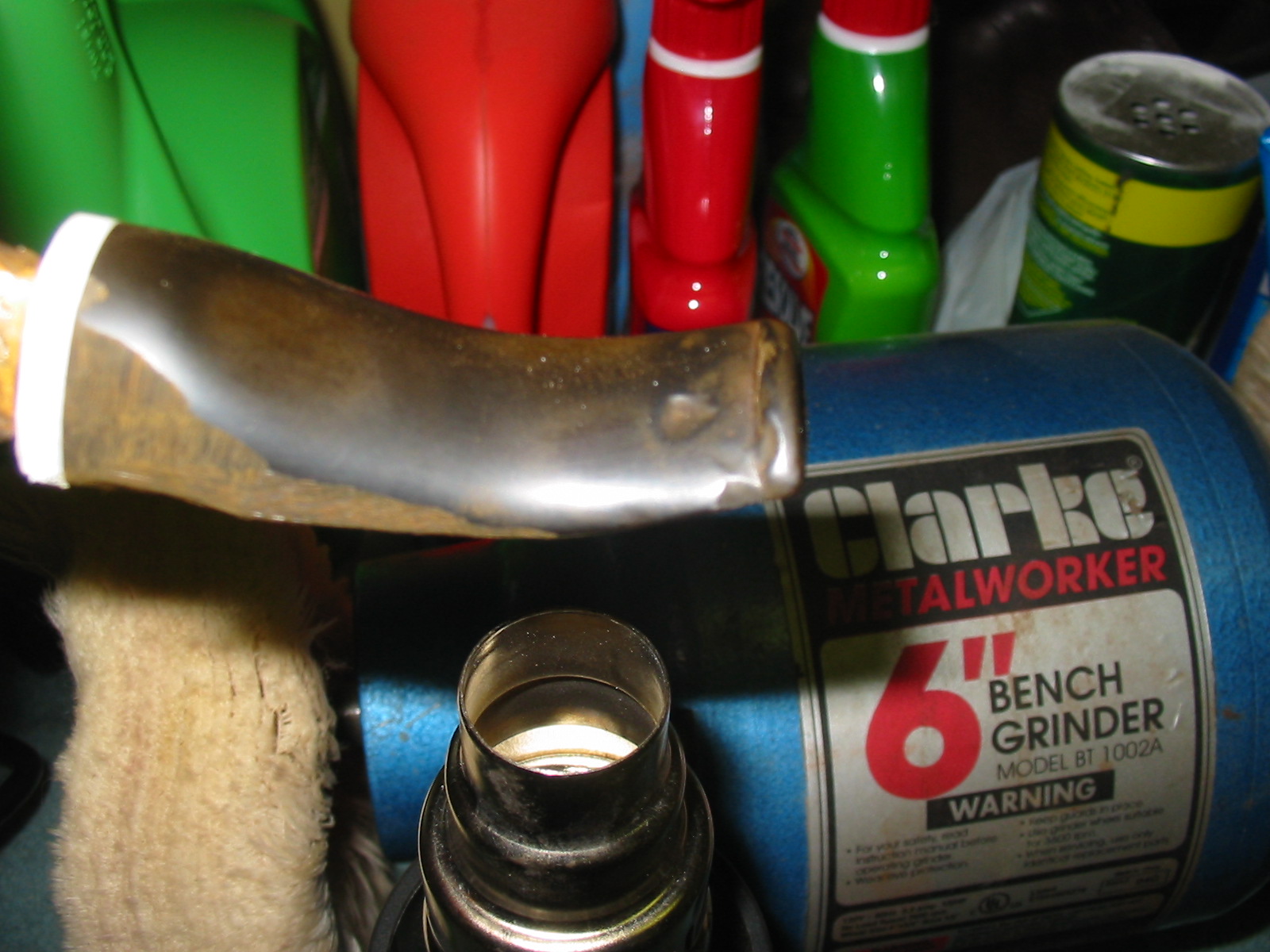
The stem had deep bite marks on the top and the bottom near the button. They did not break the surface of the vulcanite. I decided to heat the surface of the stem with a heat gun and try to lift the dents from both sides as much as possible. I also wanted to straighten the stem significantly to give a better profile to the pipe. The heat gun worked to achieve both aims. The tooth marks lifted quite a bit and would have to be filled with black superglue to finish the work and the bend straightened to the angle I wanted for the new stem.

IMG_1813

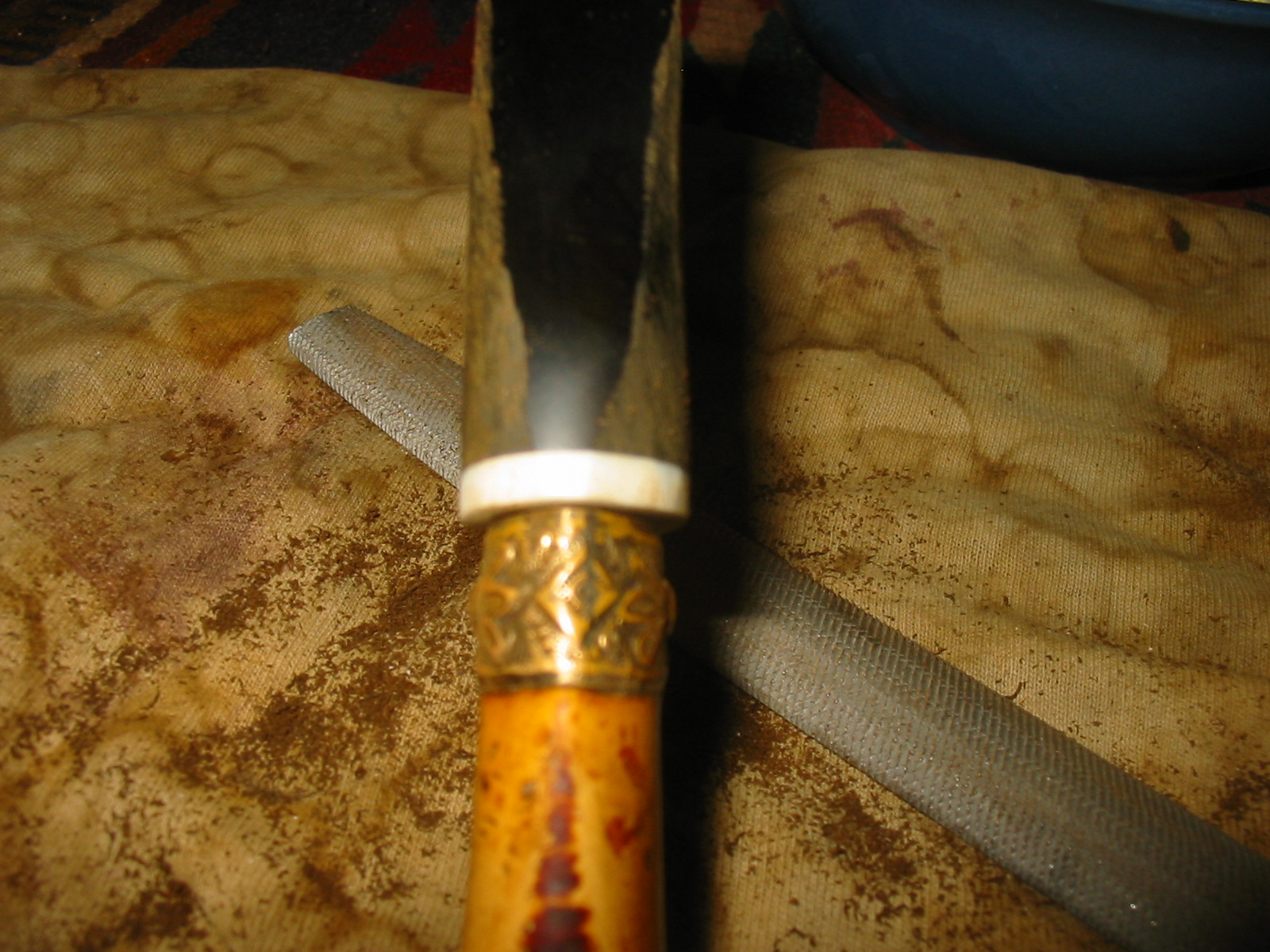
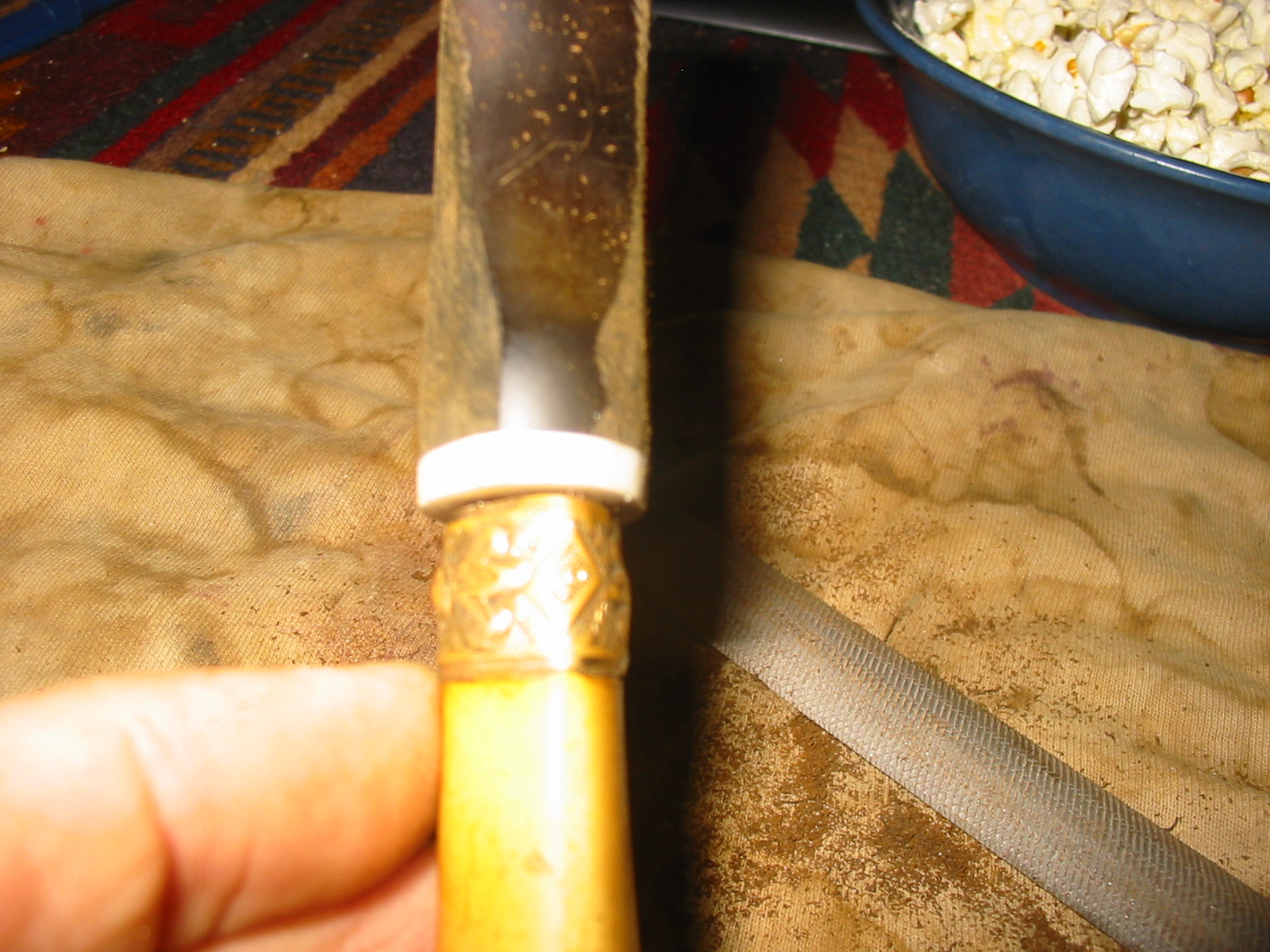
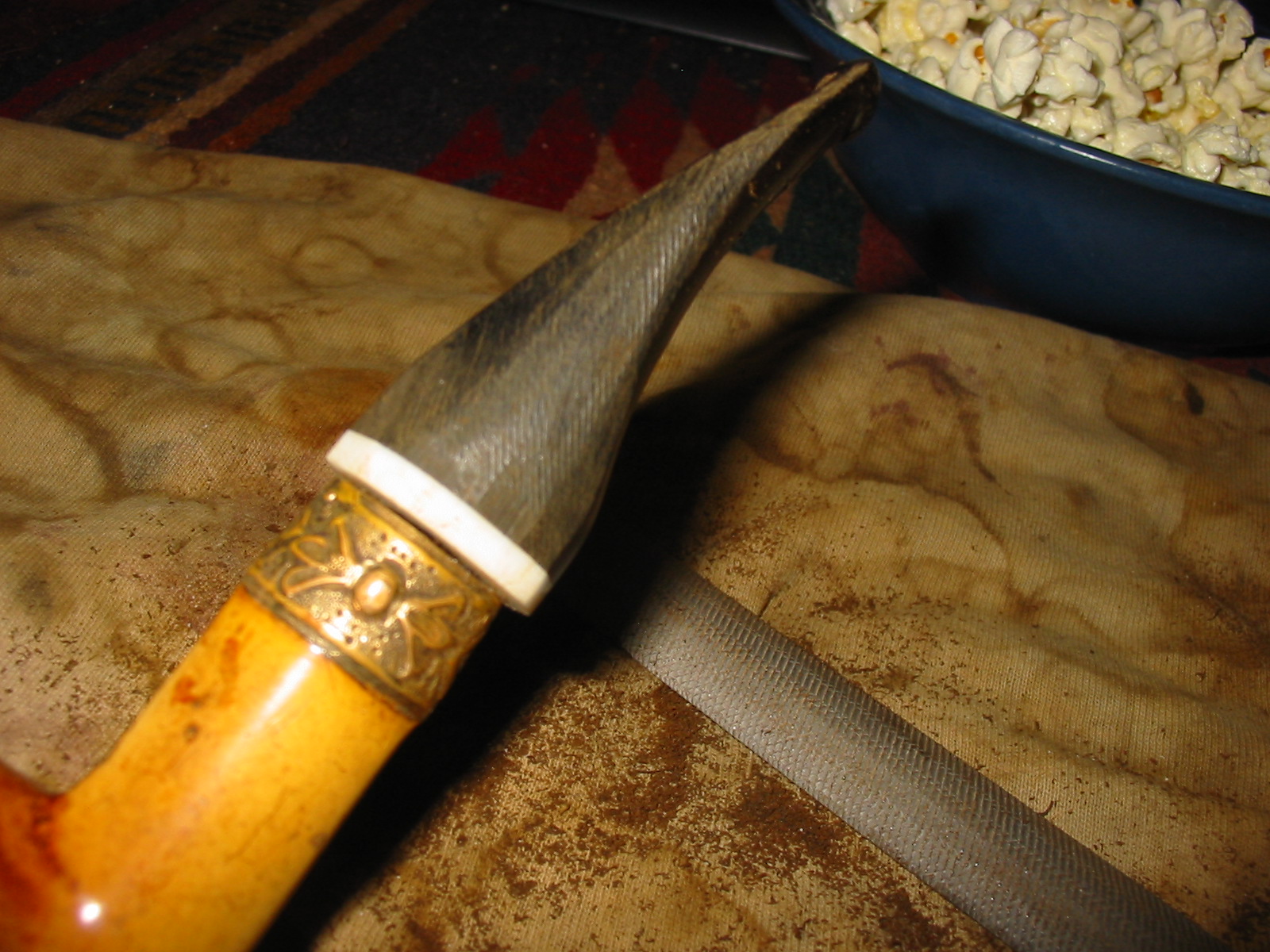
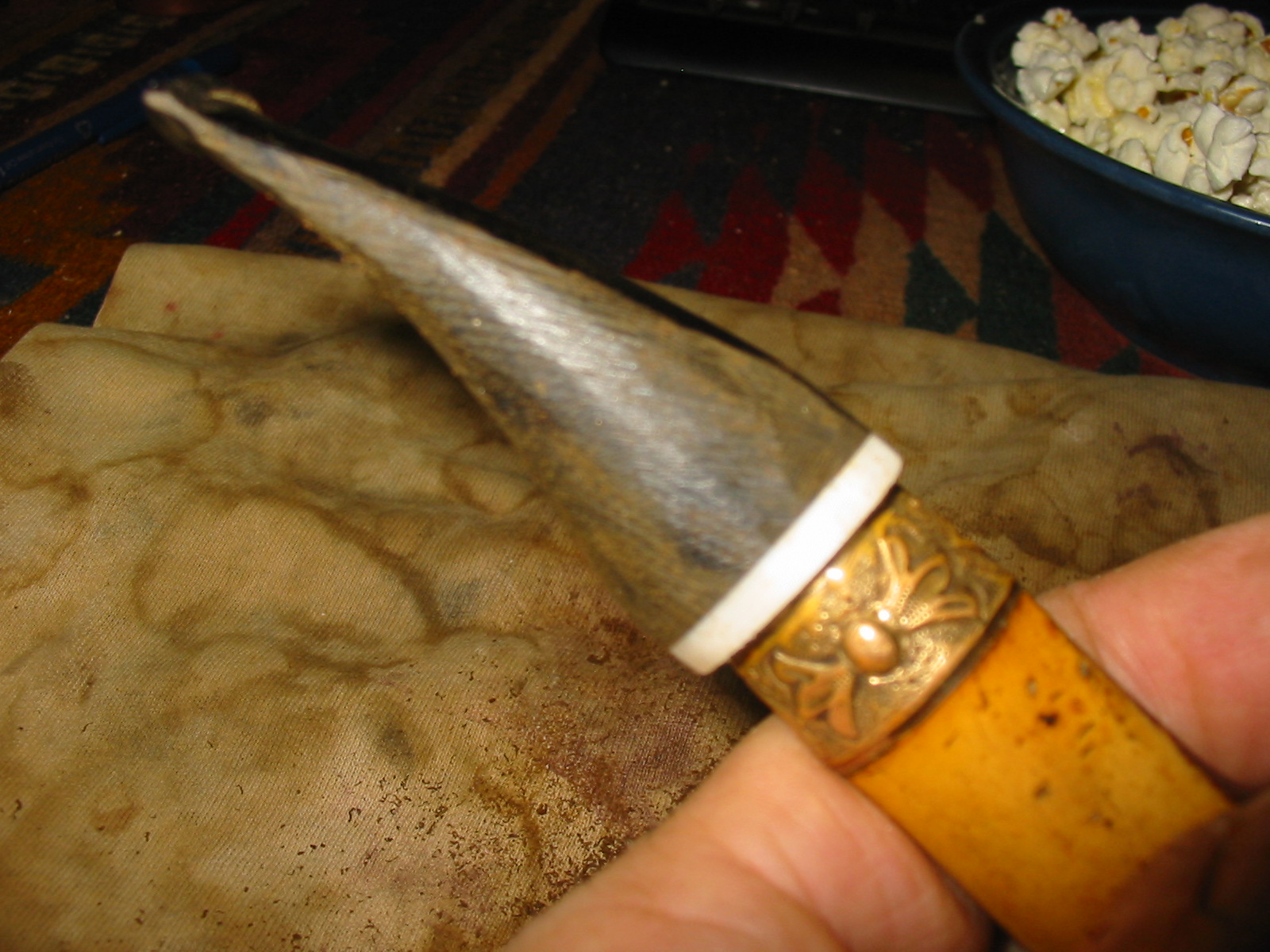
I sanded the initial excess vulcanite off the diameter of the shank with the sanding drum on the Dremel. Once I had removed a large portion I took it back to the work table and used a rasp to continue to shape and reduce the stem to the right proportions. The next series of eight photos shows the effectiveness of the rasp in shaping the stem. (In the midst of the shaping my daughters brought down a bowl of popcorn for a snack while I worked – that appears in several of the photos.)

IMG_1814

IMG_1815

IMG_1816

IMG_1817

IMG_1818

IMG_1819

IMG_1820

IMG_1821

I removed the stem from the shank and cleaned up the tooth dents so that I could fill them with black superglue. The glue takes quite a bit of time to cure so I waited until I was finished for the evening and then filled the dents and set the stem aside to cure over night.

IMG_1822

IMG_1823

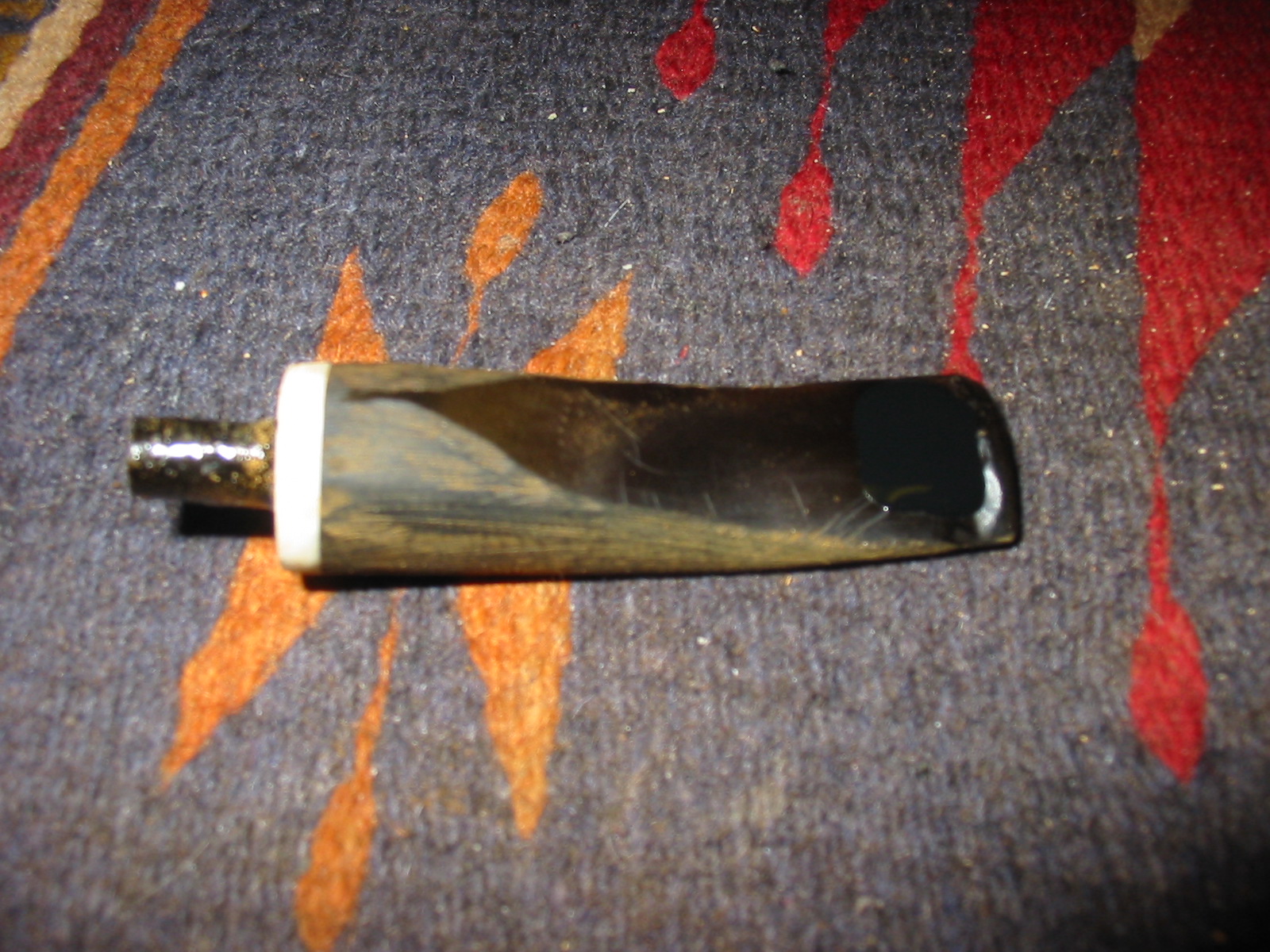
This morning I sanded the stem with 220 grit sandpaper and also sanded the superglue patch on the underside of the stem. The next four photos show the stem as it begins to take shape and the repaired spot on the underside of the stem. The oval is coming along nicely but there was still a lot of excess material that still needed to be removed.

IMG_1824

IMG_1825

IMG_1826

IMG_1827

I continued to sand the stem to further tune the shape of the oval to match the shank. I used 220 grit sandpaper to remove the excess and shape the stem. I worked on the superglue patch on the underside of the stem with the 220 grit sandpaper as well. In the next series of three photos you can see the shape I am aiming for with this stem. You can also see the size of the patch on the stem. The patch is still larger than the marks it covers so more sanding will need to be done on it to blend it into the vulcanite.

IMG_1828

IMG_1829

IMG_1830

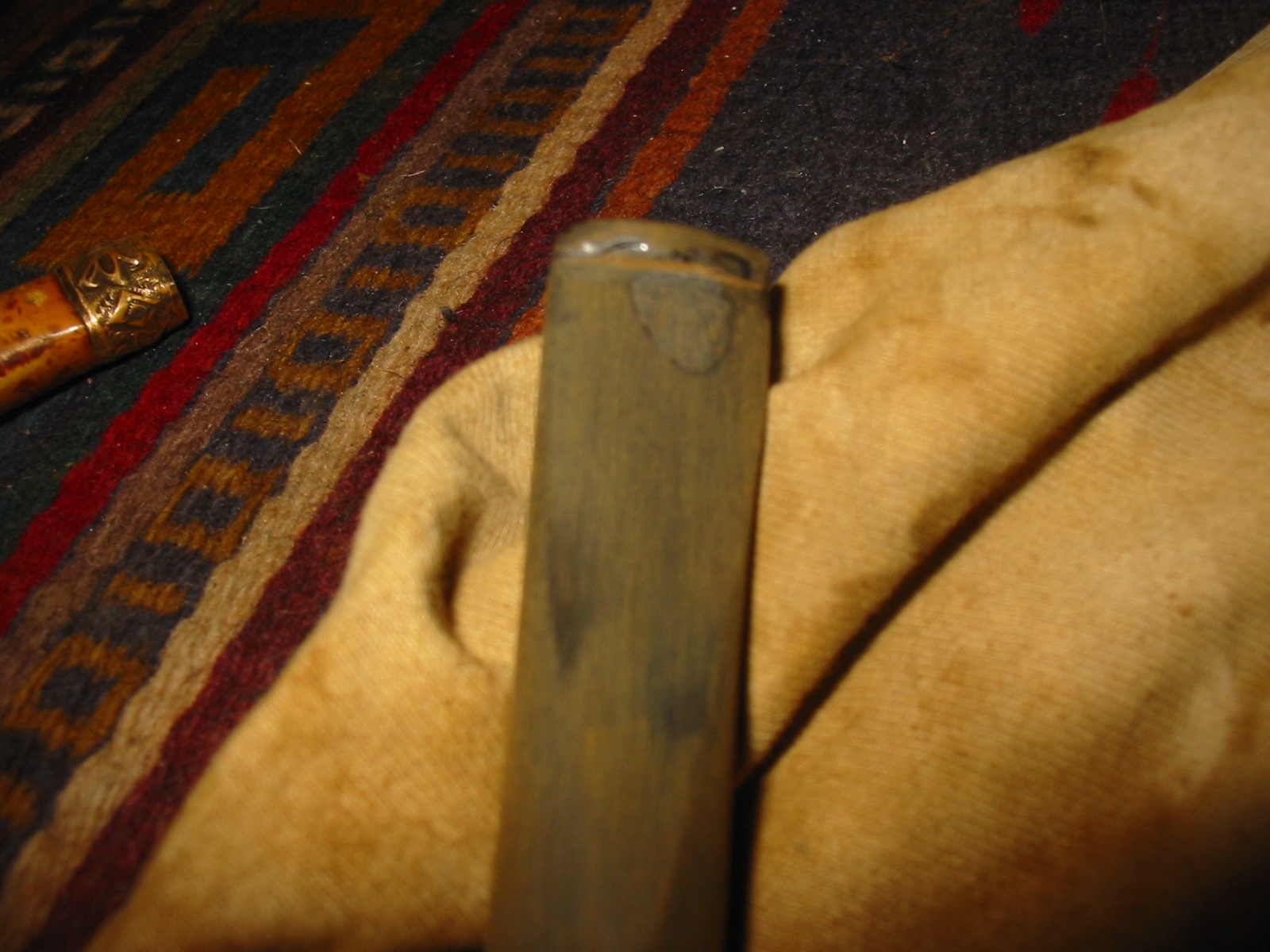
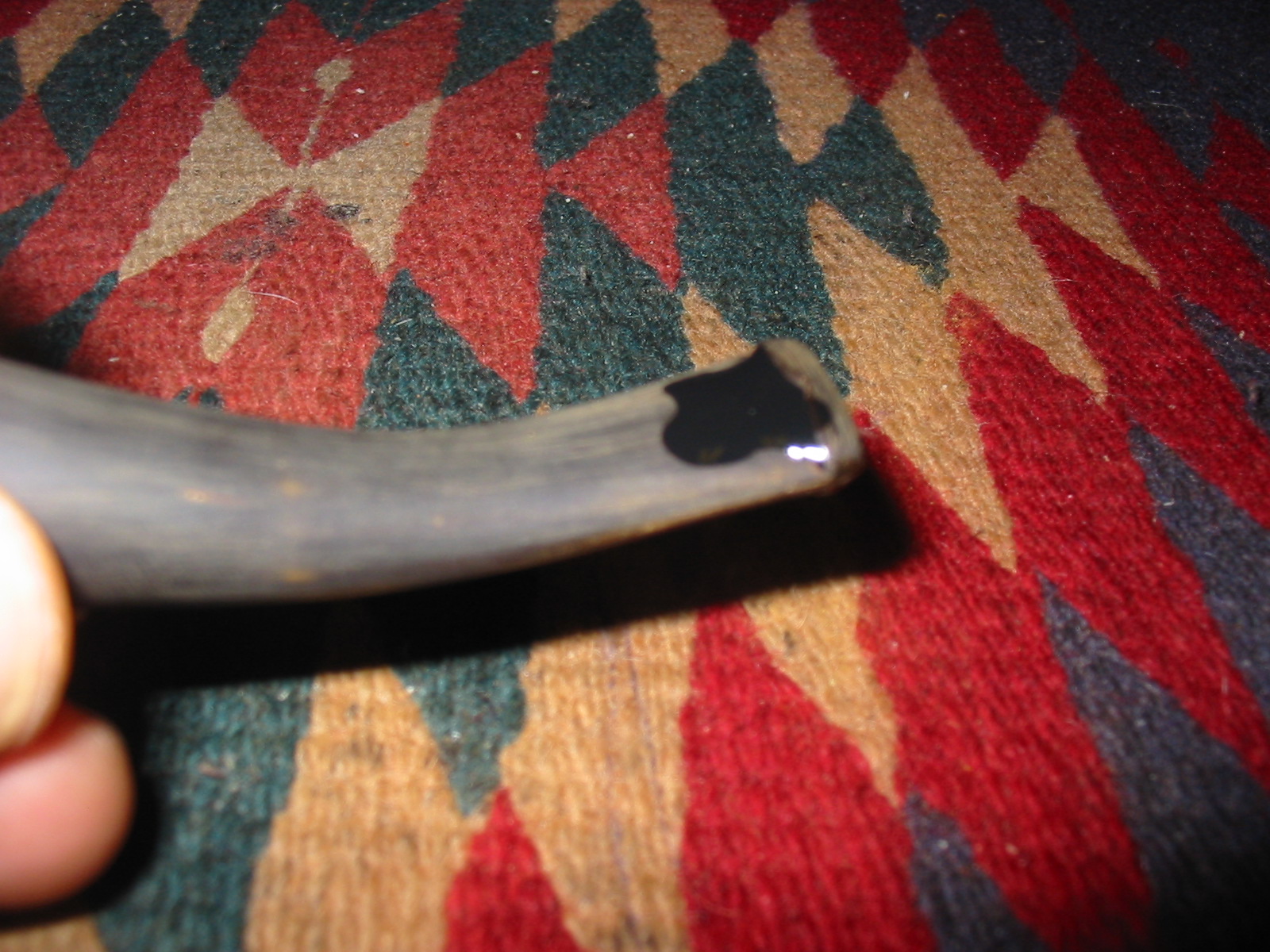
I cleaned up the bite marks on the top of the stem and applied the black superglue patch to that surface as well. I set it aside while I worked on the bowl. I wiped the bowl down with Murphy’s Oil Soap on a cotton pad to clean off the grime on the surface while leaving as much of the old patina as possible. The first photo below shows the superglue patch. I applied it and used a dental pick to push it around the surface and also build up a few tooth marks on the edge of the button. The second photo below shows the patch after it had dried and I had sanded the patch with 220 grit sandpaper.

IMG_1831

IMG_1833

While working on the stem I decided to open the button to make it simpler to insert a pipe cleaner. I used needle files to make the slot larger. The second photo shows the opened slot in the button. I sanded the inside of the slot with a folded piece of sandpaper to smooth the surface and polish the slot.

IMG_1834

IMG_1835

I took the pipe back to the Dremel and sanding drum to remove more of the excess vulcanite. I had the basic shape in hand and just wanted to get it closer to the size of the shank before doing the finish sanding. I brought it back to the work table and sanded with 220 grit sandpaper until the fit was right. The next four photos show the progress in the fitting of the stem.

IMG_1837

IMG_1838

IMG_1839

IMG_1840

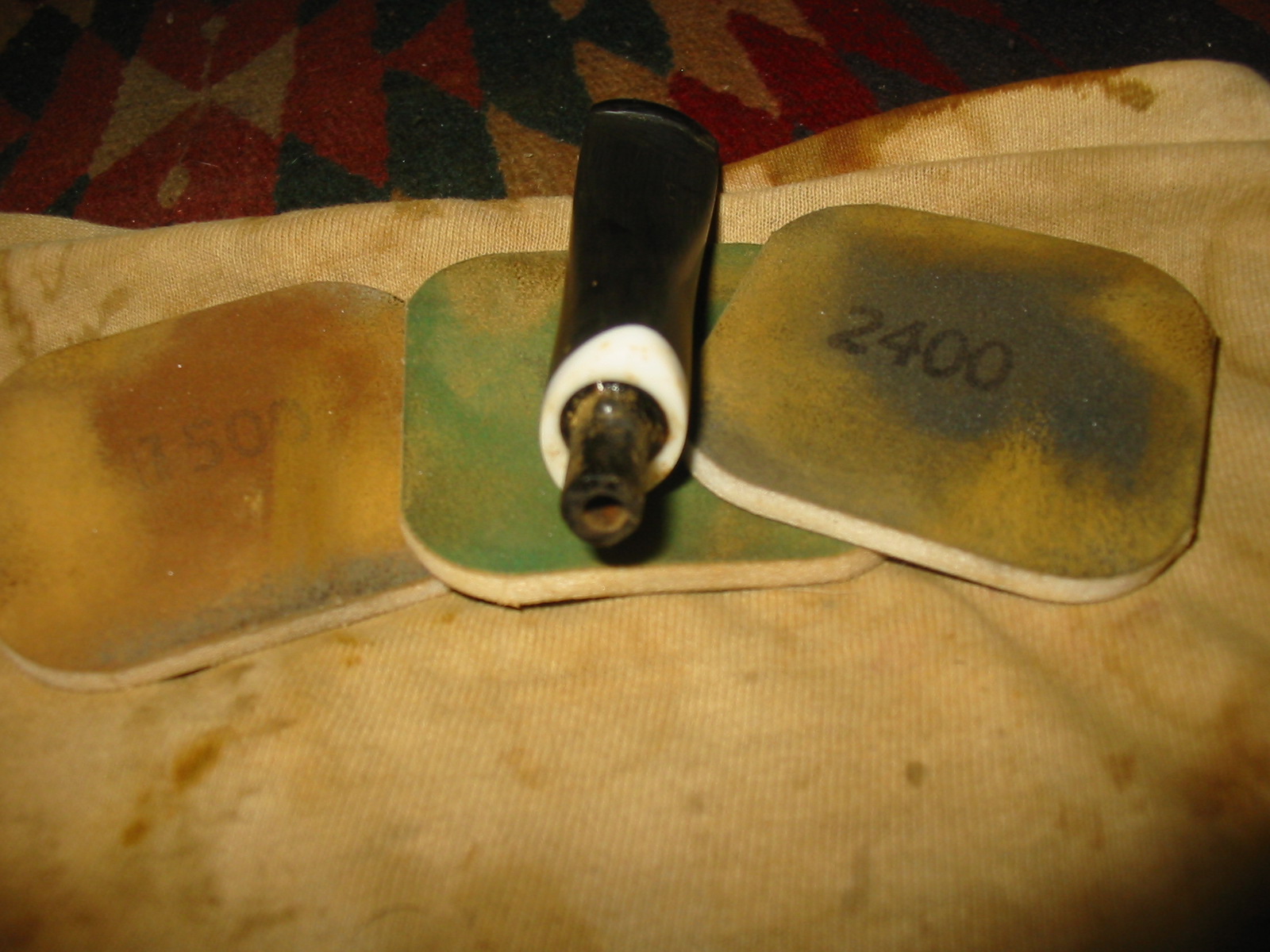
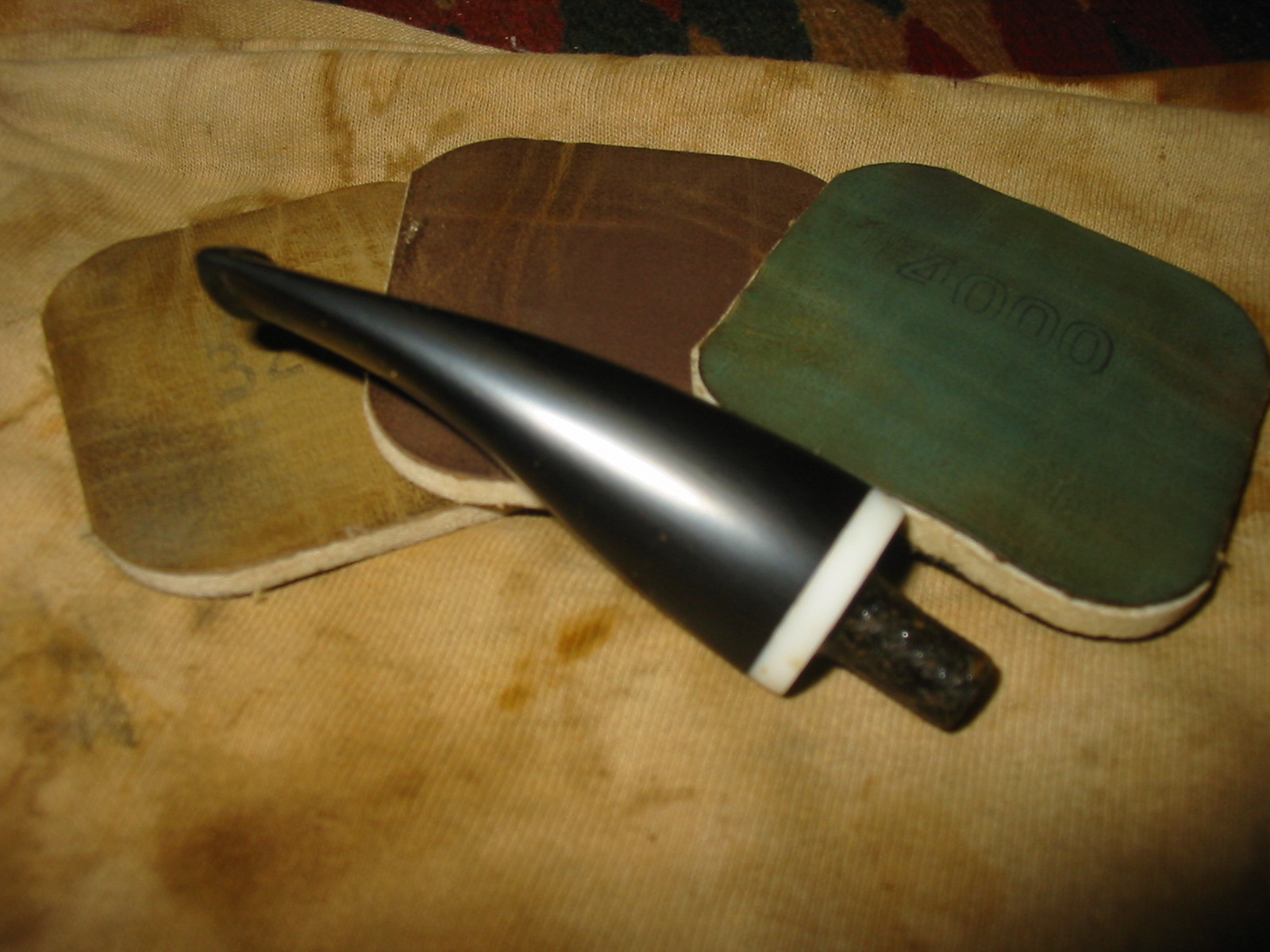
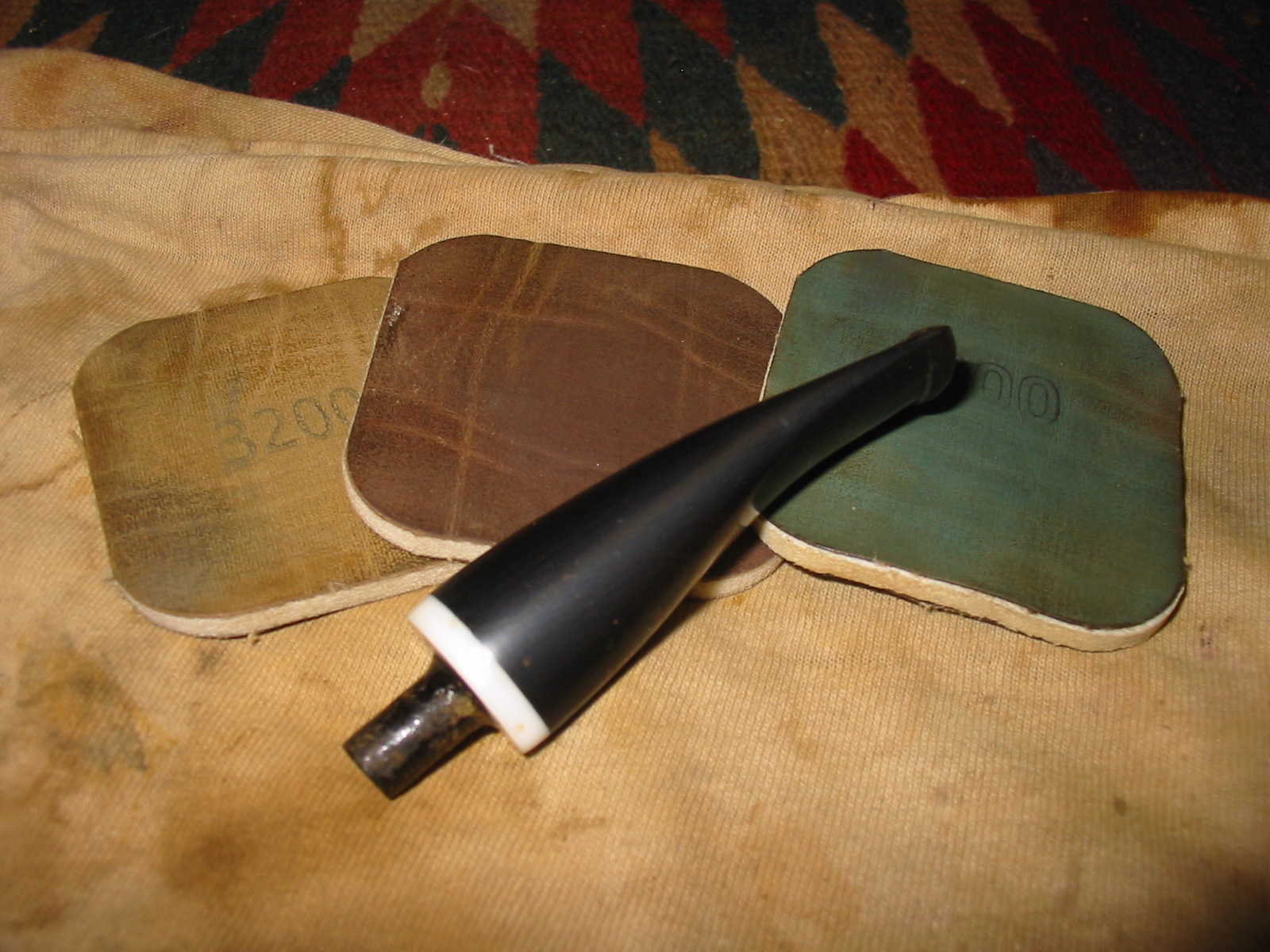
I sanded the stem with a medium grit sponge backed sanding pad. It helped to remove the scratches left behind by the 200 grit sandpaper. Then I sanded the stem with micromesh sanding pads from 1500-12,000 grit to polish and shine the vulcanite and the patched areas. The white Lucite band that was a part of the stem began to take on a shine as well in the process. The next nine photos capture what took about an hour to achieve in the sanding process. I wet sanded with the 1500, 1800 and 2400 grit sanding pads and dry sanded with the remaining grits of micromesh.

IMG_1841

IMG_1842

IMG_1844

IMG_1845

IMG_1846

IMG_1847

IMG_1848

IMG_1849

IMG_1850

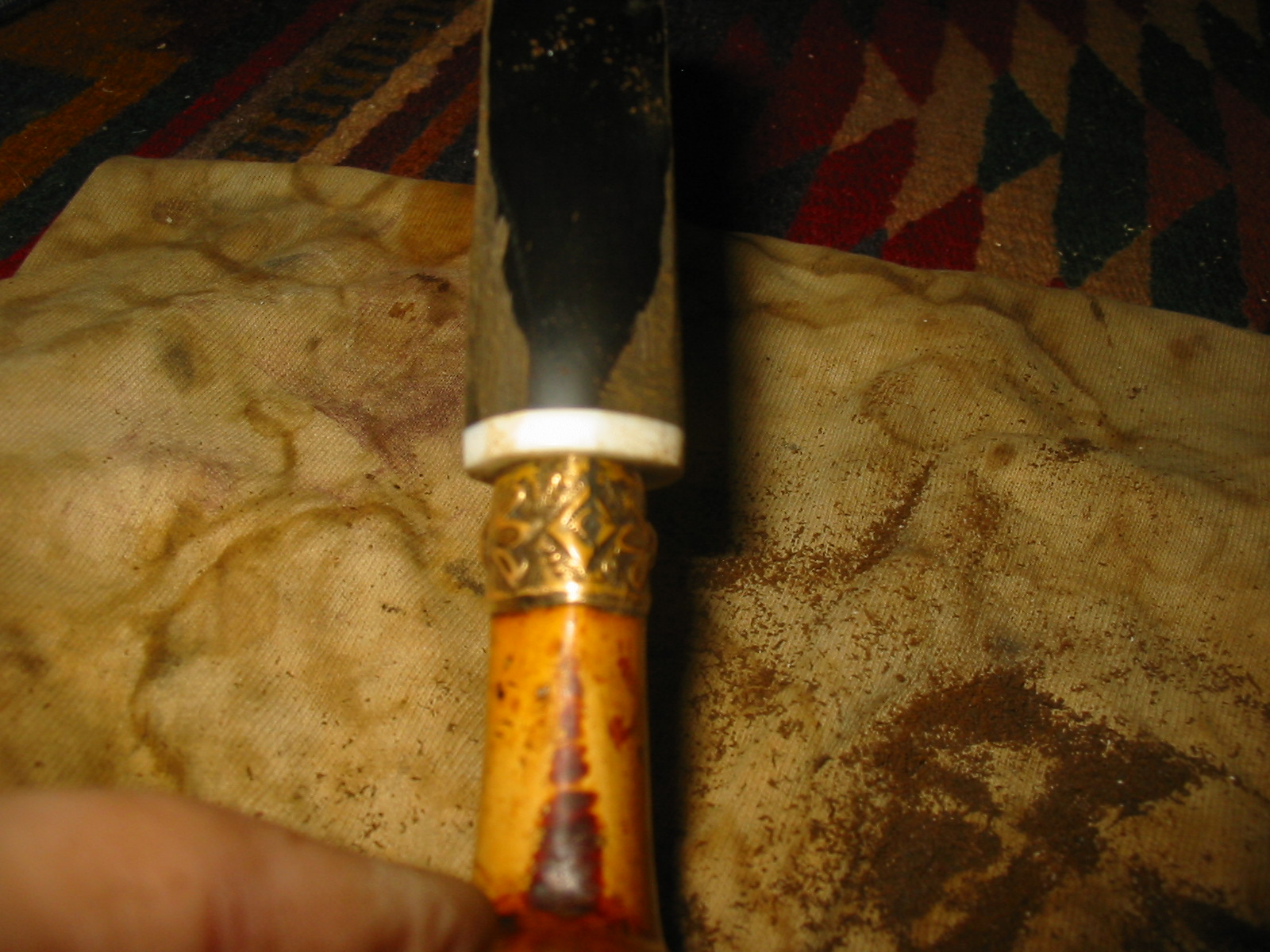
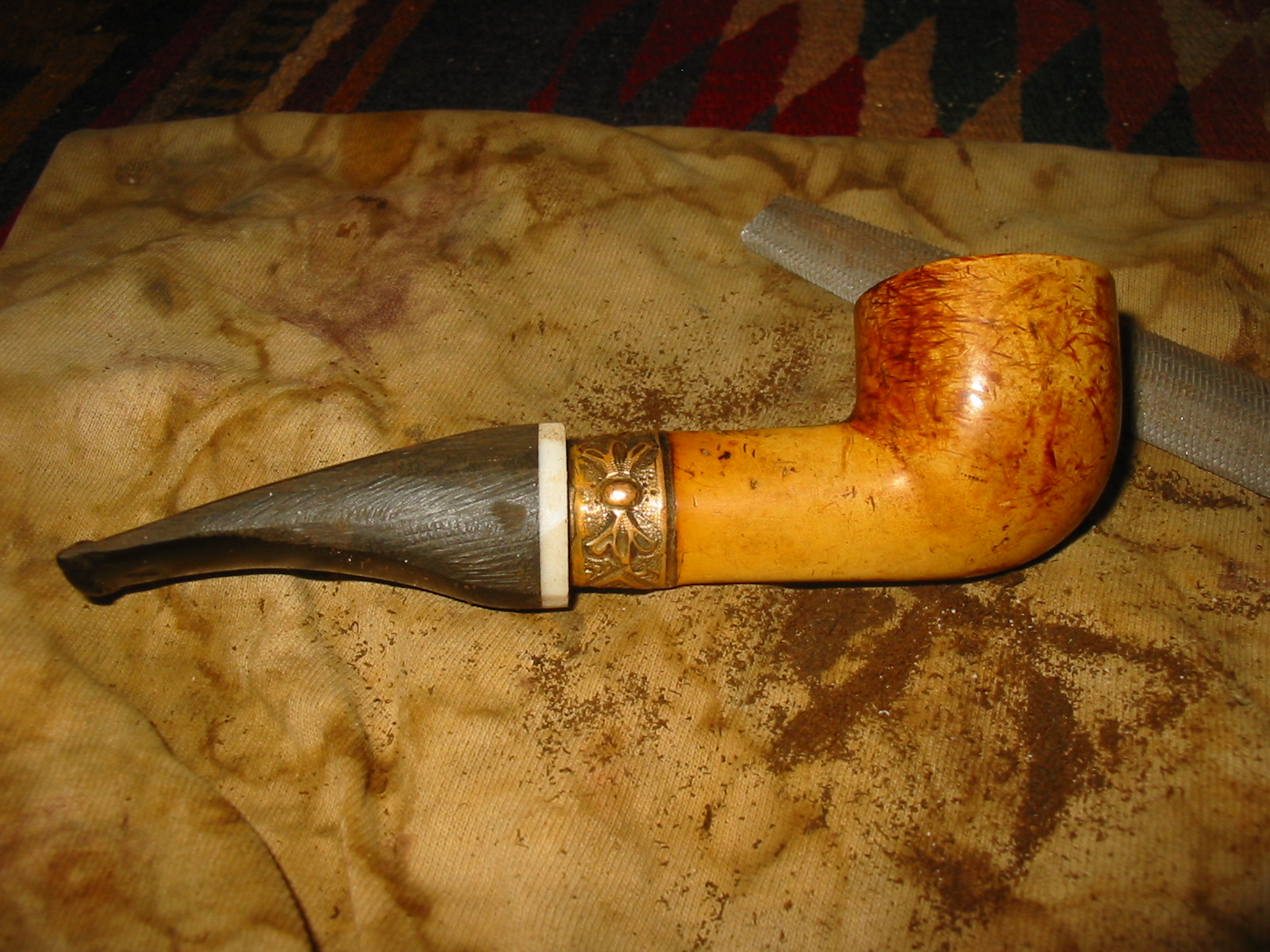
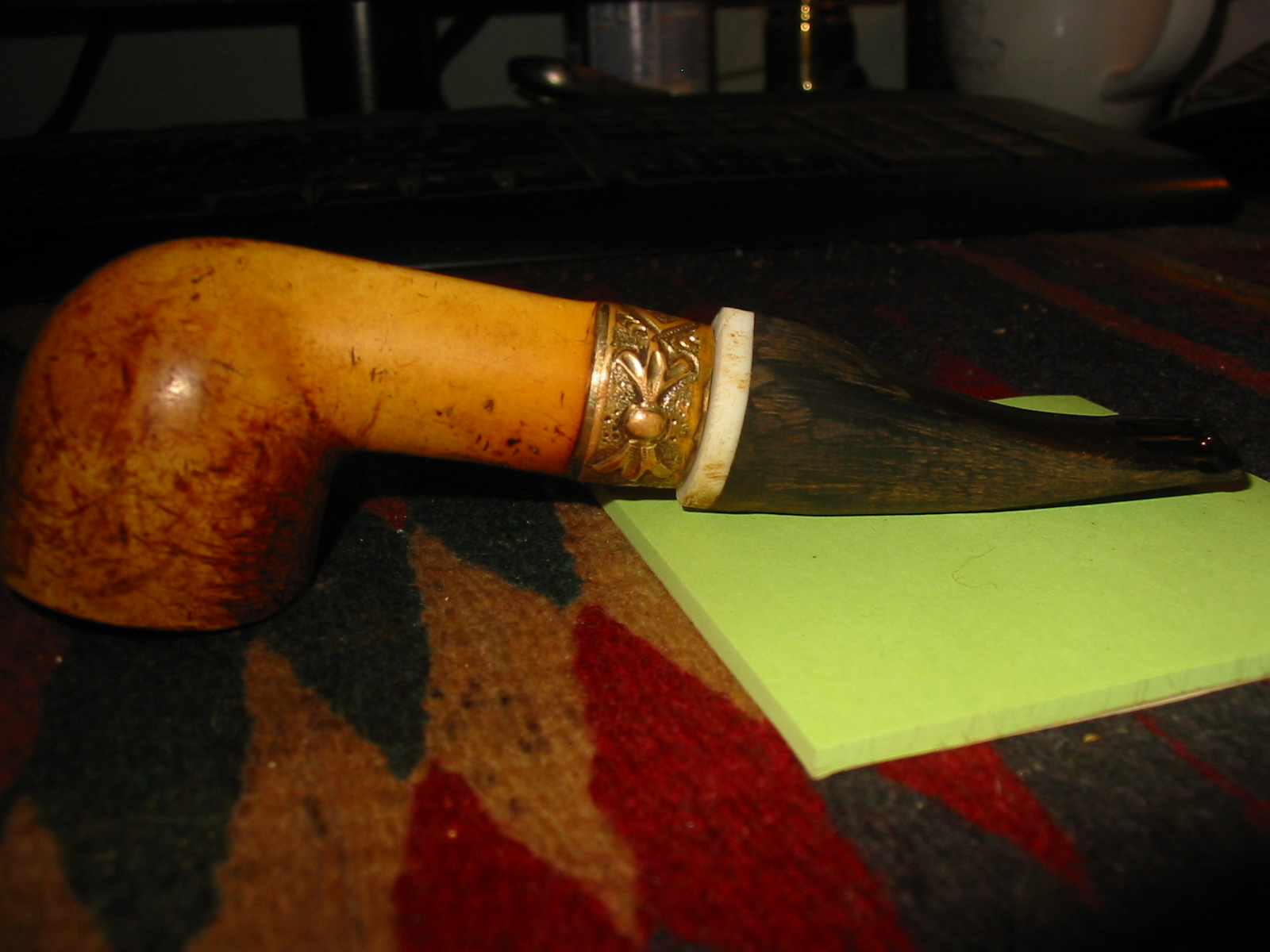
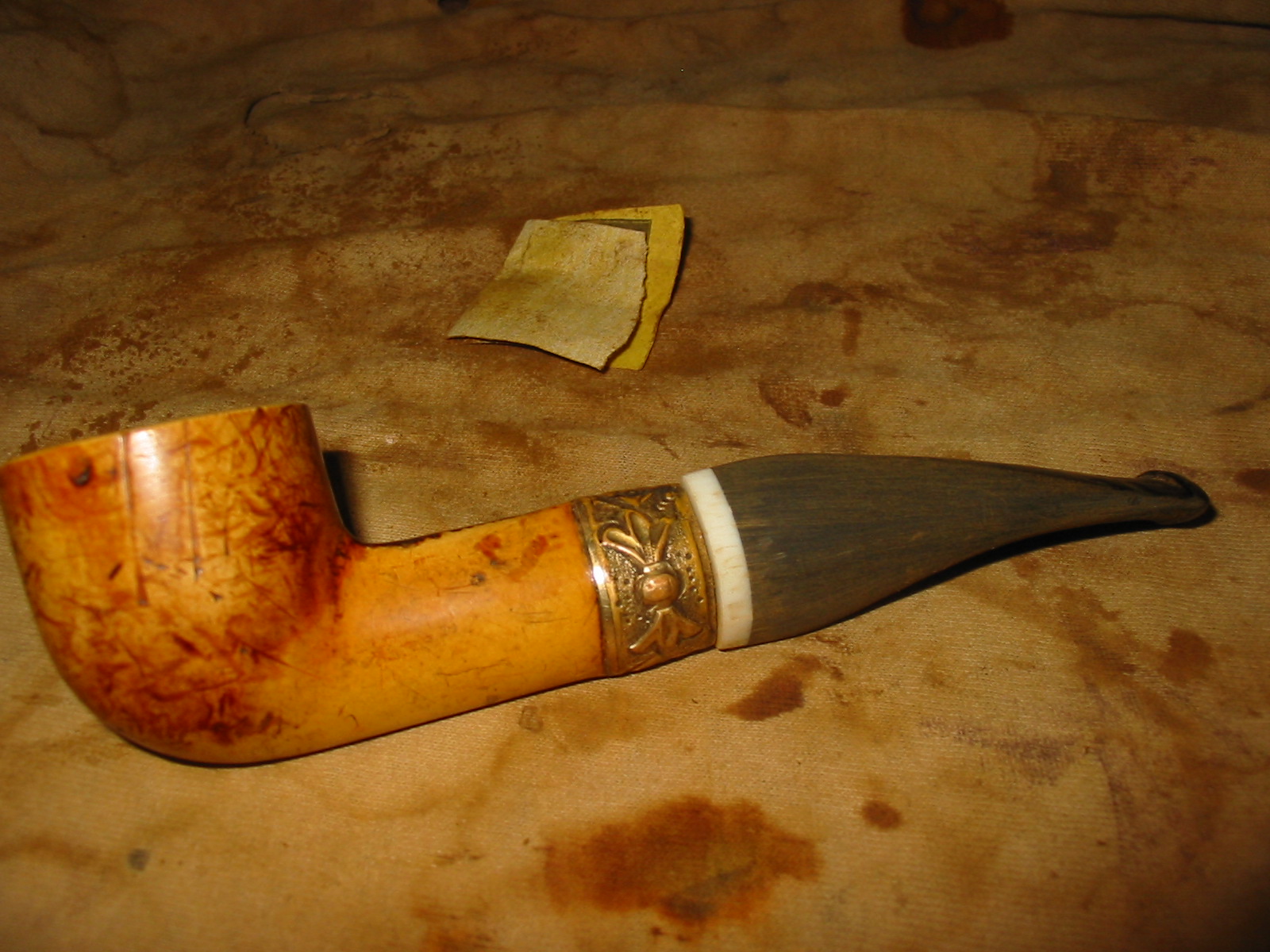
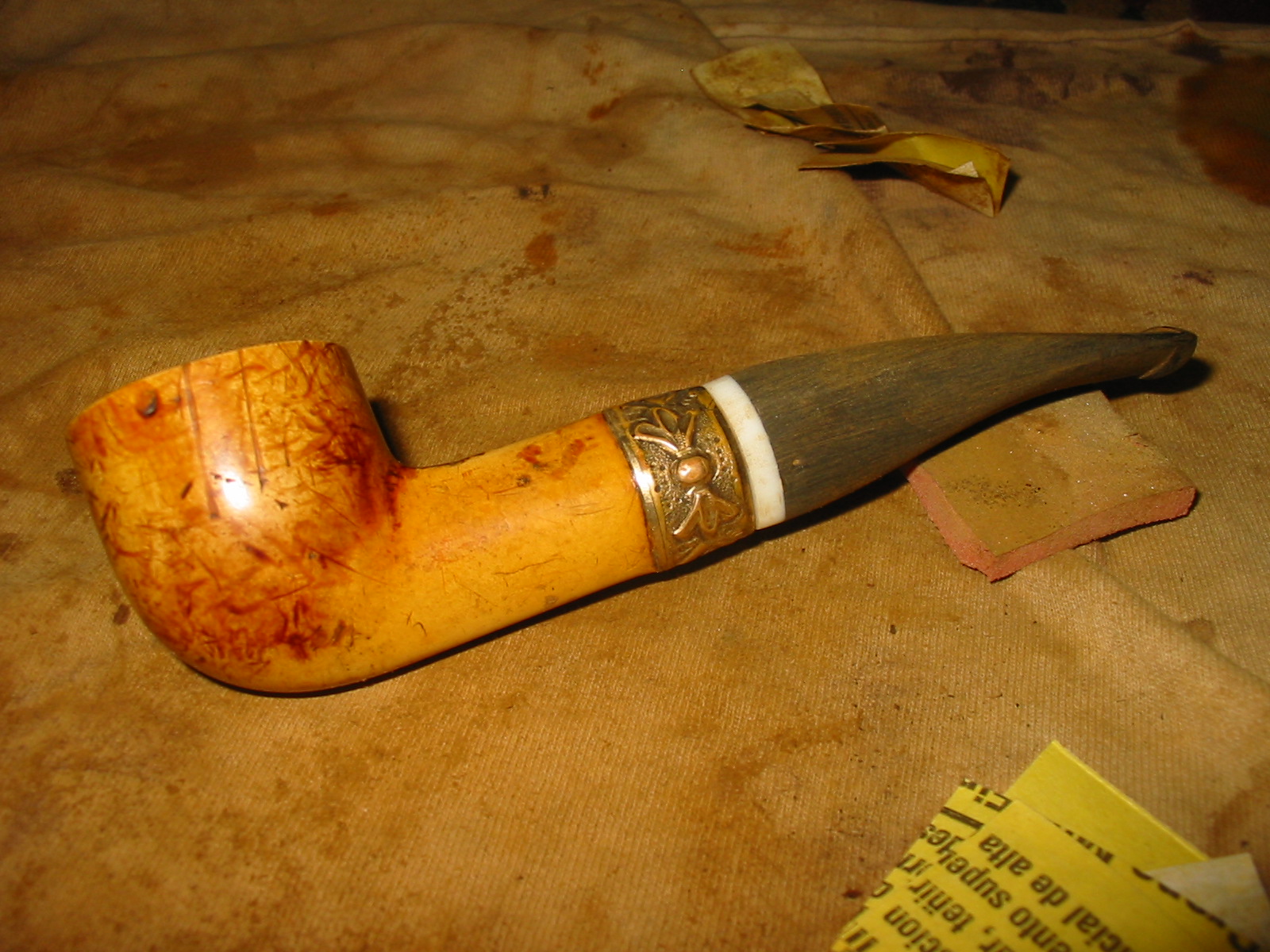
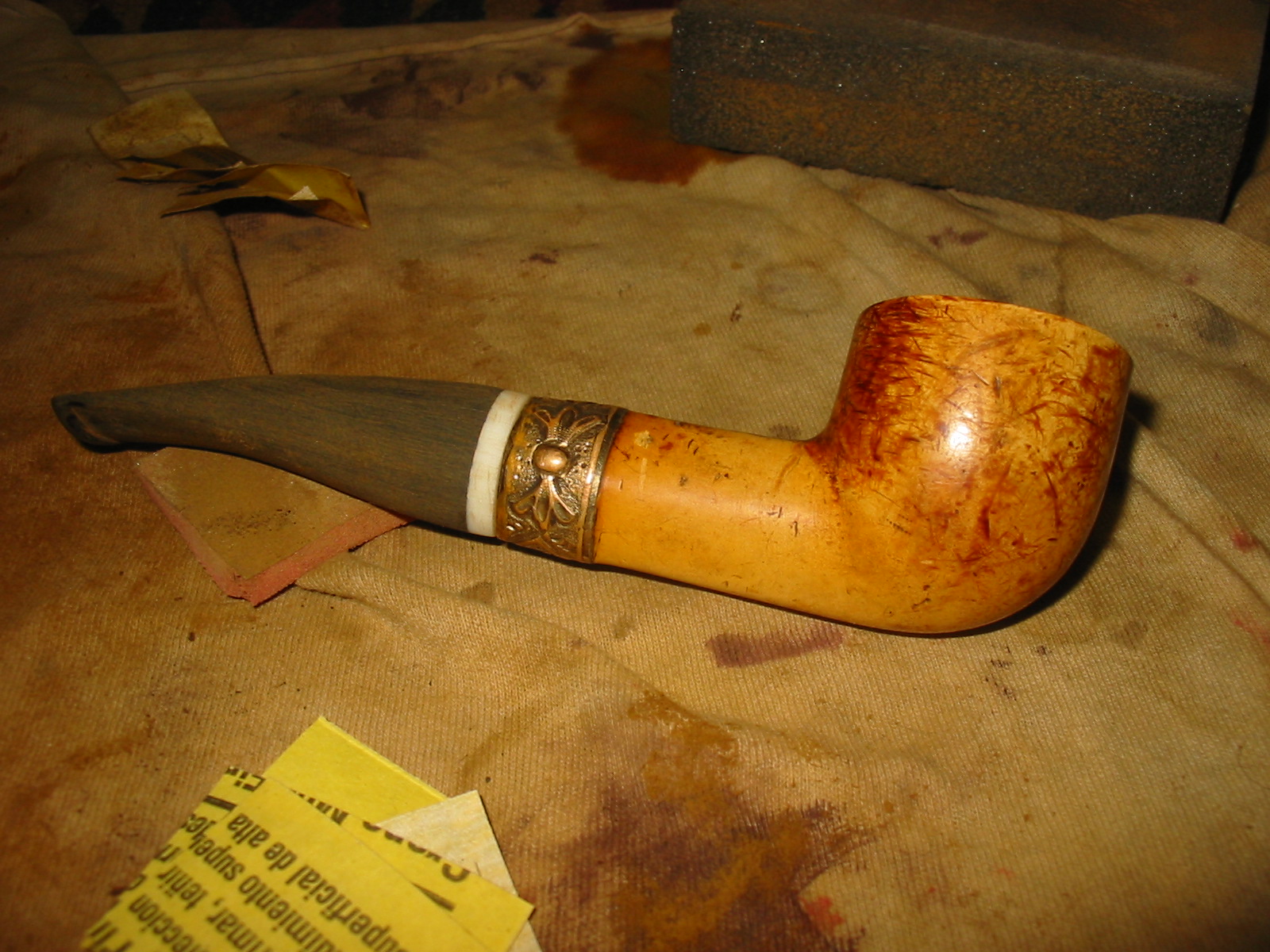
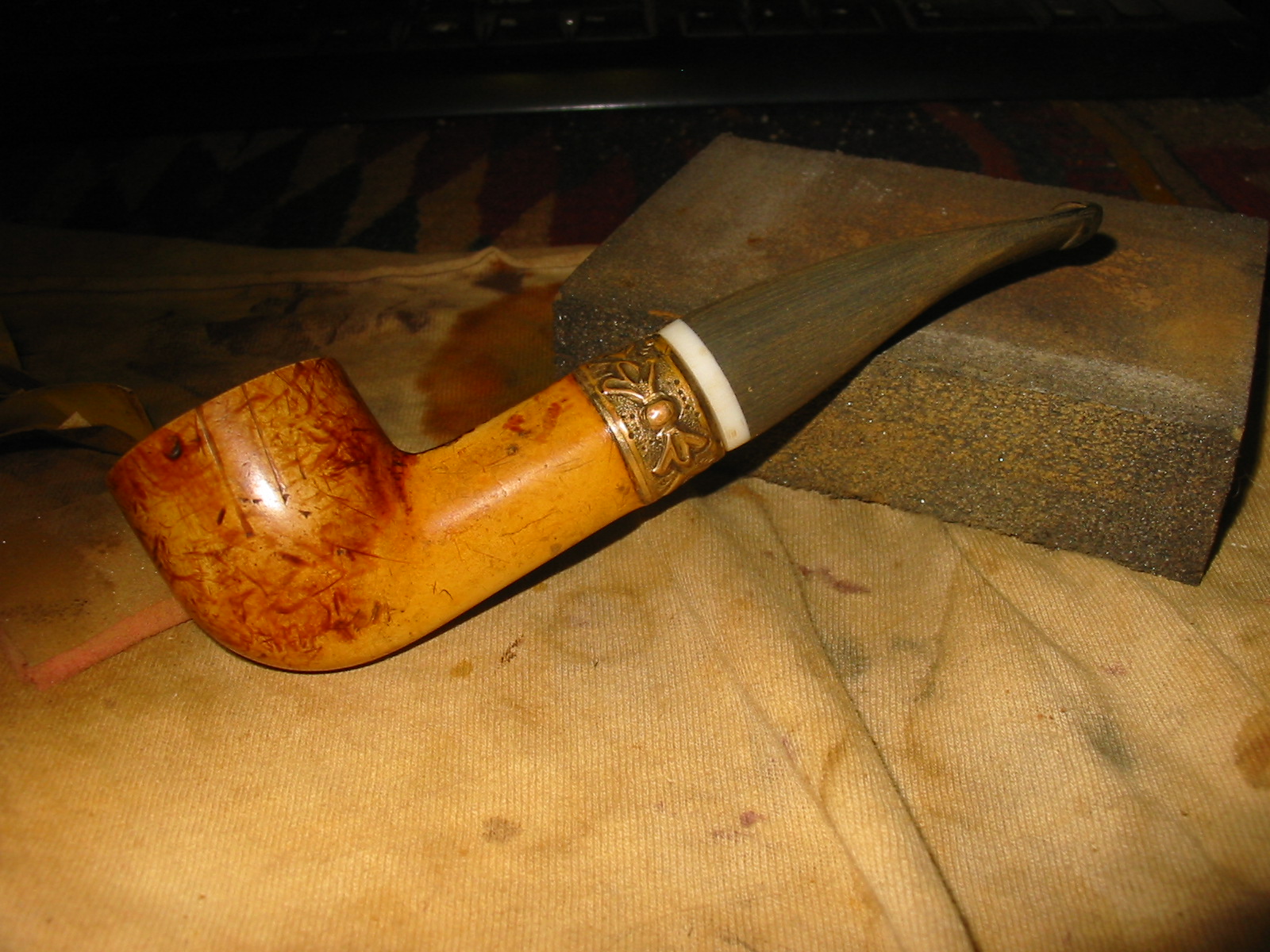
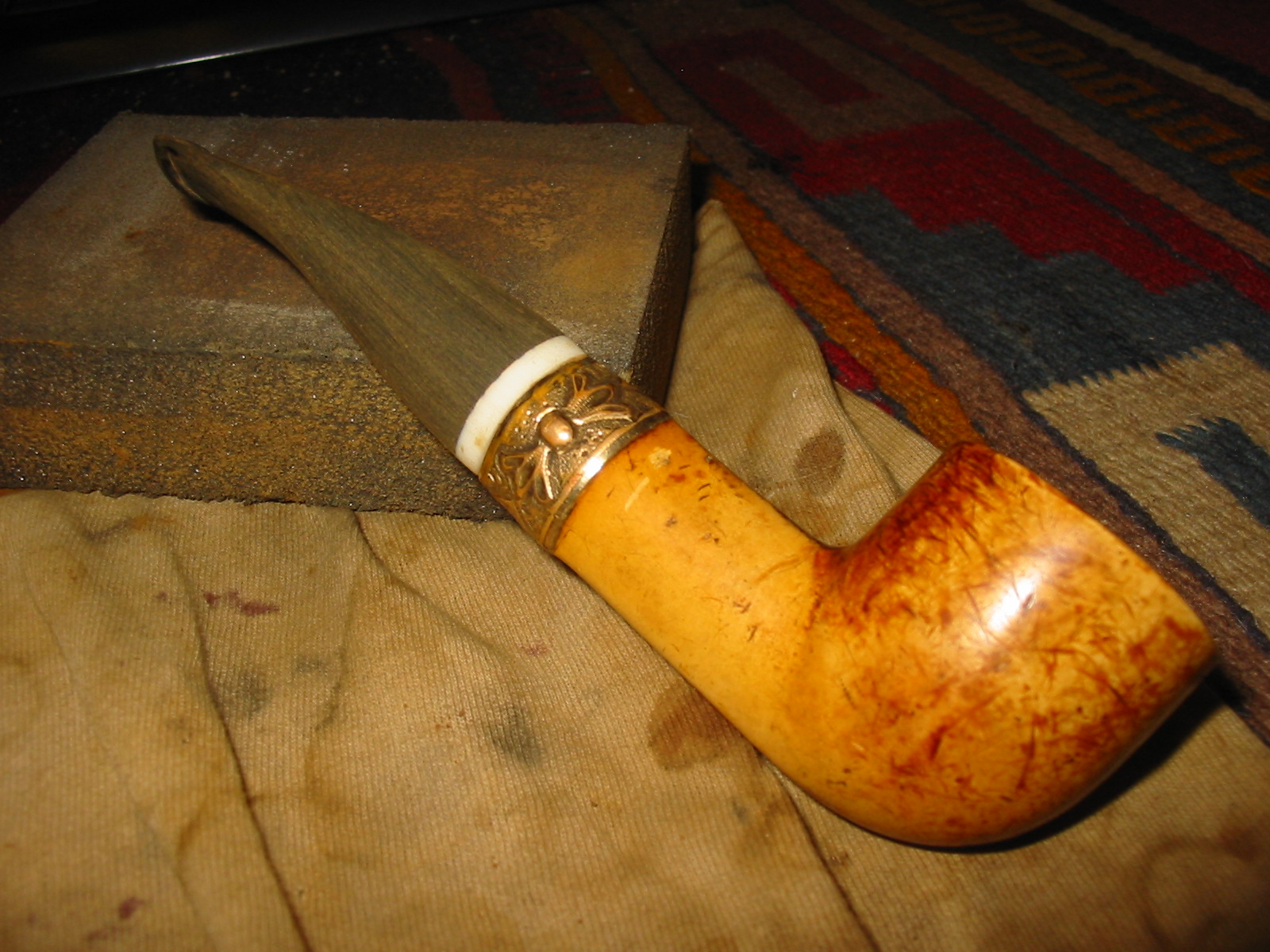
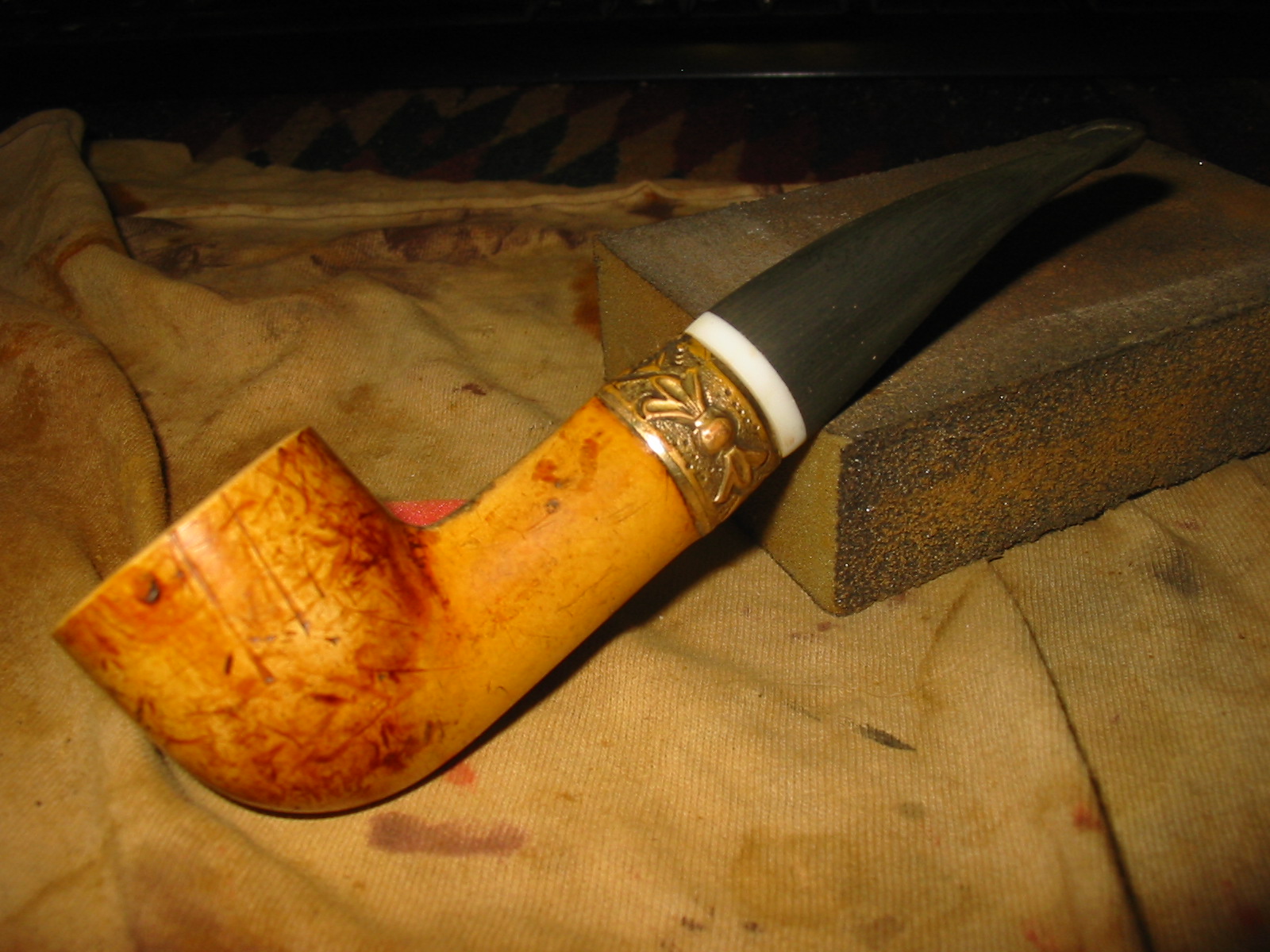
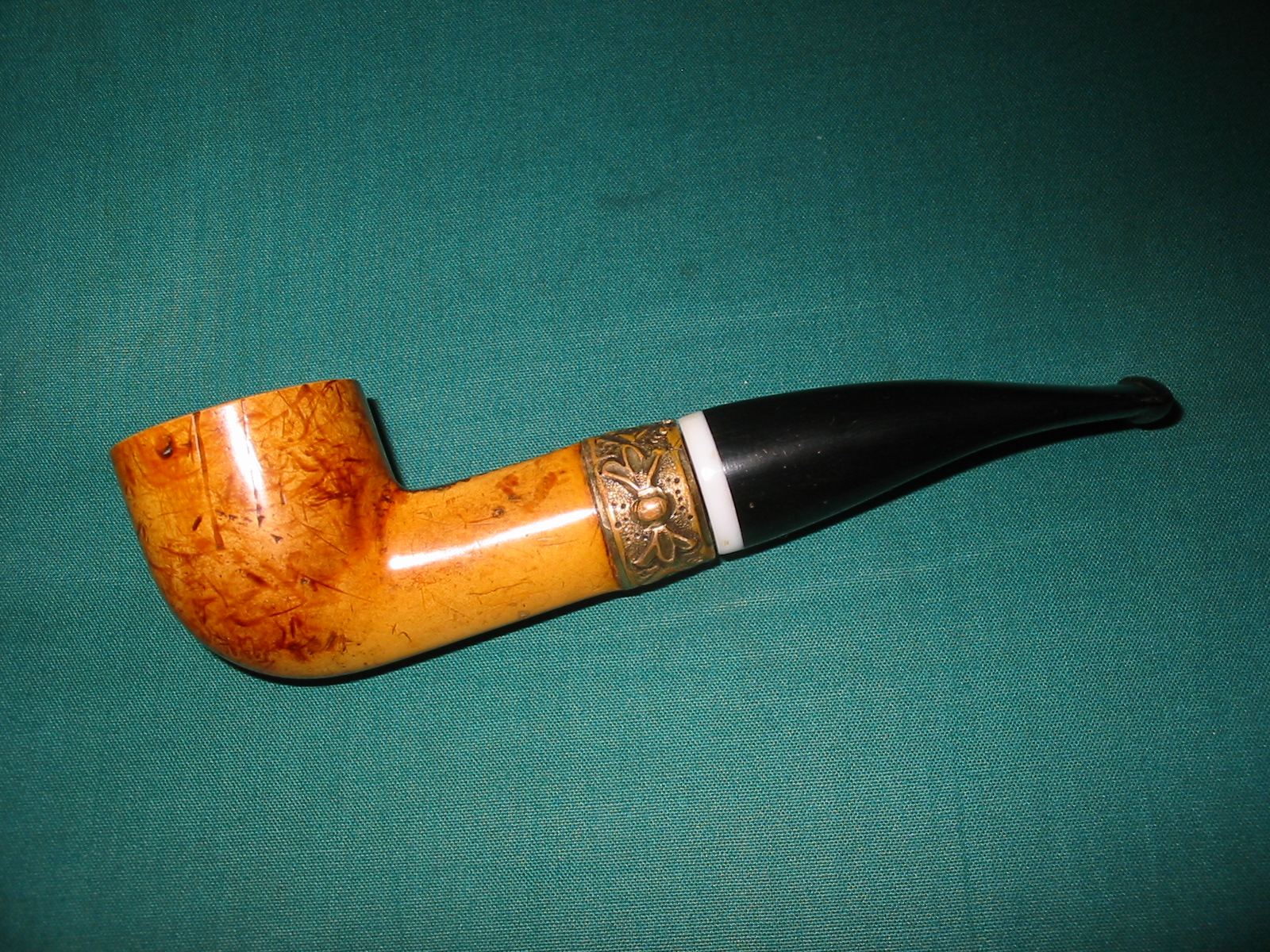
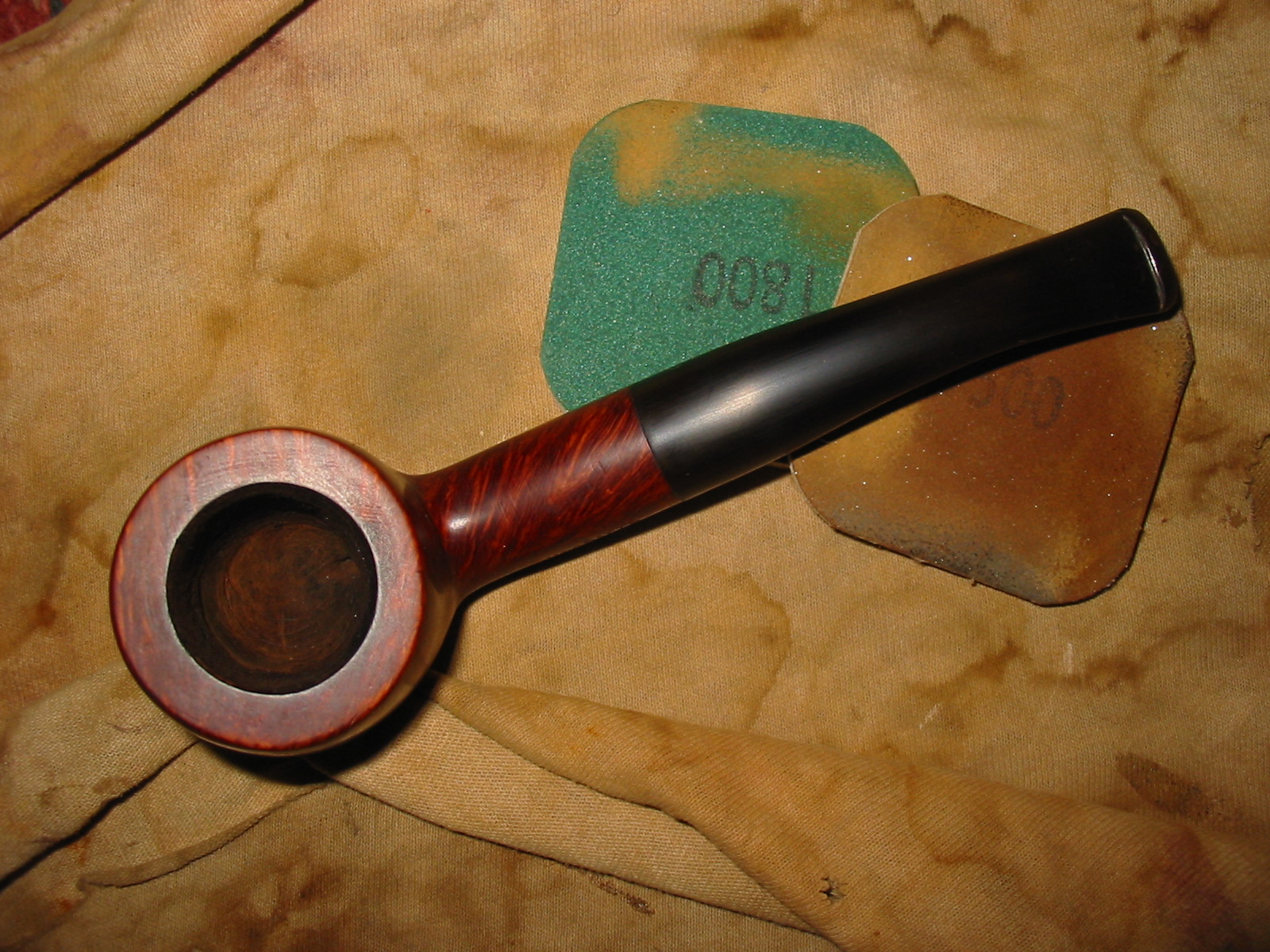
I buffed the stem with White Diamond and a blue plastic polishing compound to bring out the final shine on the stem. I hand waxed the meerschaum with beeswax and hand buffed it with a shoe brush. The next four photos show the finished pipe with the new stem. I like the marks and scratches in the meer as they seem to speak of the long journey the pipe took to get to me. The white Lucite band on the stem fits nicely in my thinking against the gold of the filigree band. The slight bend it the stem works nicely for me. From the last two photos you can see the oval shape of the stem now that it is completed. It has come a long way from the round stem I received as a gift from Ron.

IMG_1851

IMG_1852

IMG_1853

IMG_1854

A Gift Pipe Stand from Greg Wolford


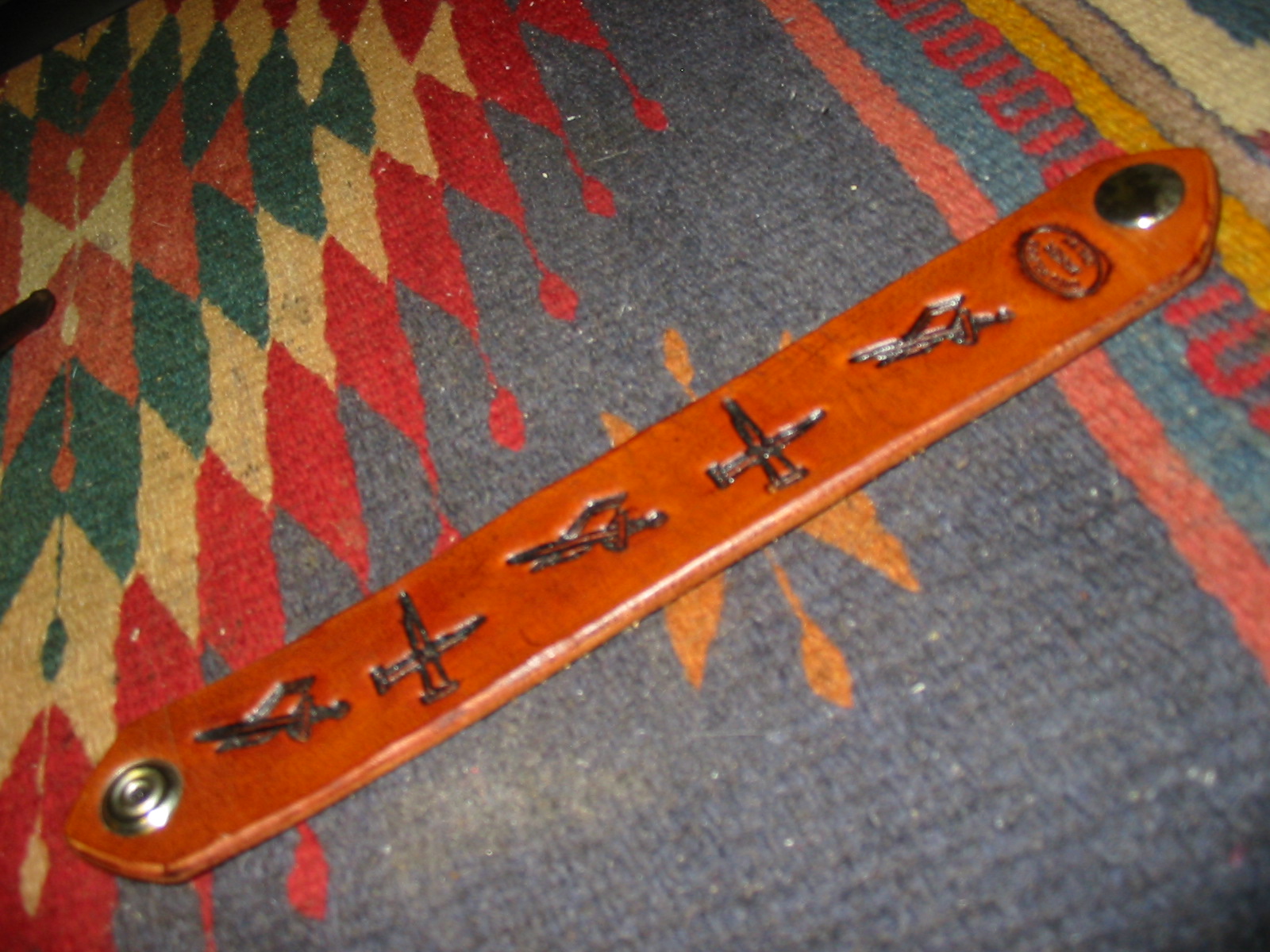
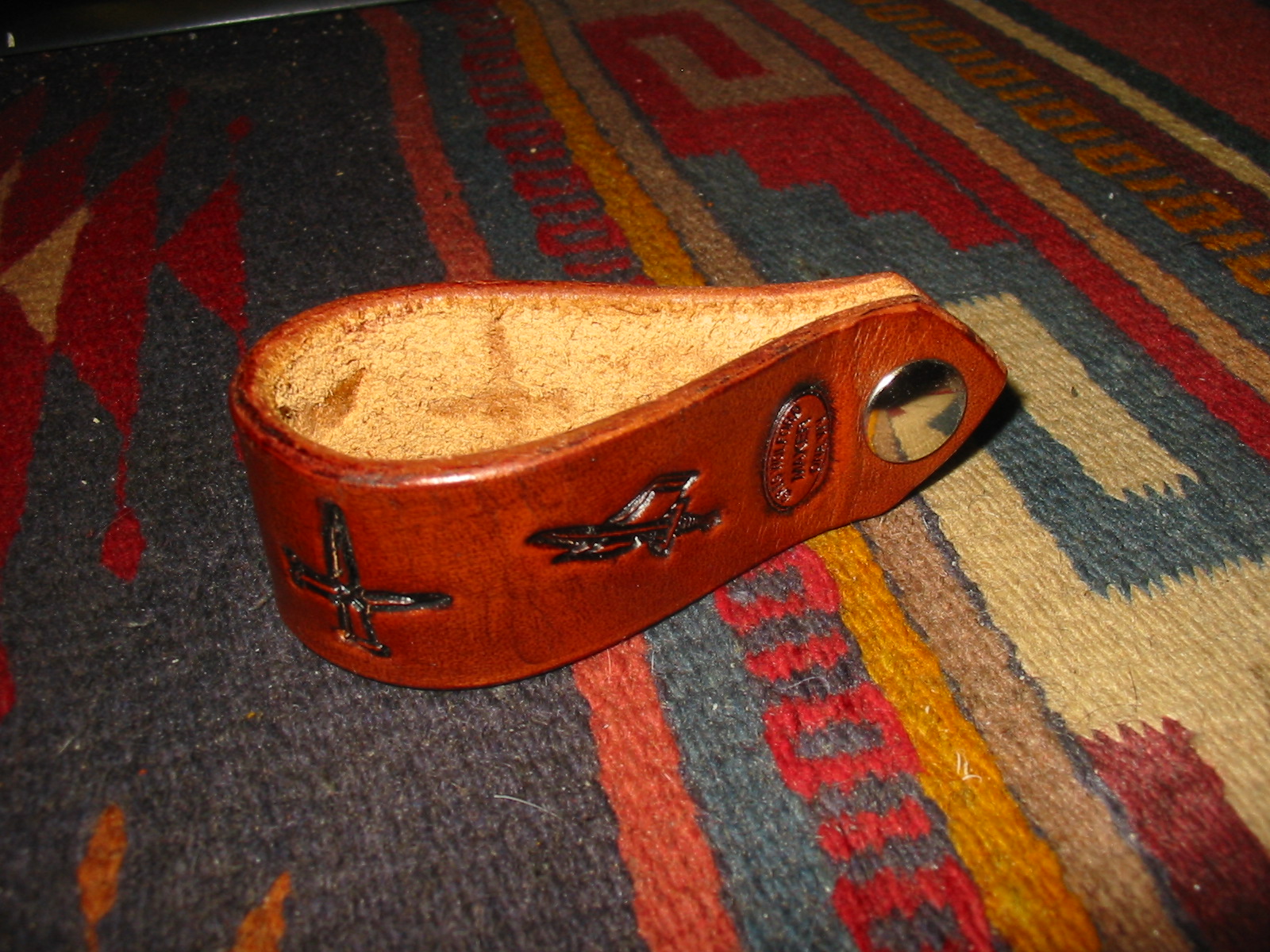
I have looked at Greg’s leather work for quite a while now. If you follow the links from the bottom of his posts here on the blog you will see some of the work that he does. He also has an Etsy Store where he sells his leather goods http://www.etsy.com/shop/WolfysLeather?ref=search_shop_redirect . He always has a great assortment of pipe stands and pipe holsters that he fashions from leather that he shapes, stamps and stains. He also does custom leather work to order and has a website that has contact information http://my.sociopal.com/wolfysleathe . This week I was gifted a pipe stand by Greg. It is a generous piece of leather that Greg stamped with a cross made of nails and a Bible with a sword across it. It is stained a rich dark brown colour with silver/nickel snaps on the ends. The edges are beveled and the antiquing in the stamps and on the edges give the leather a rich aged look.

IMG_1795

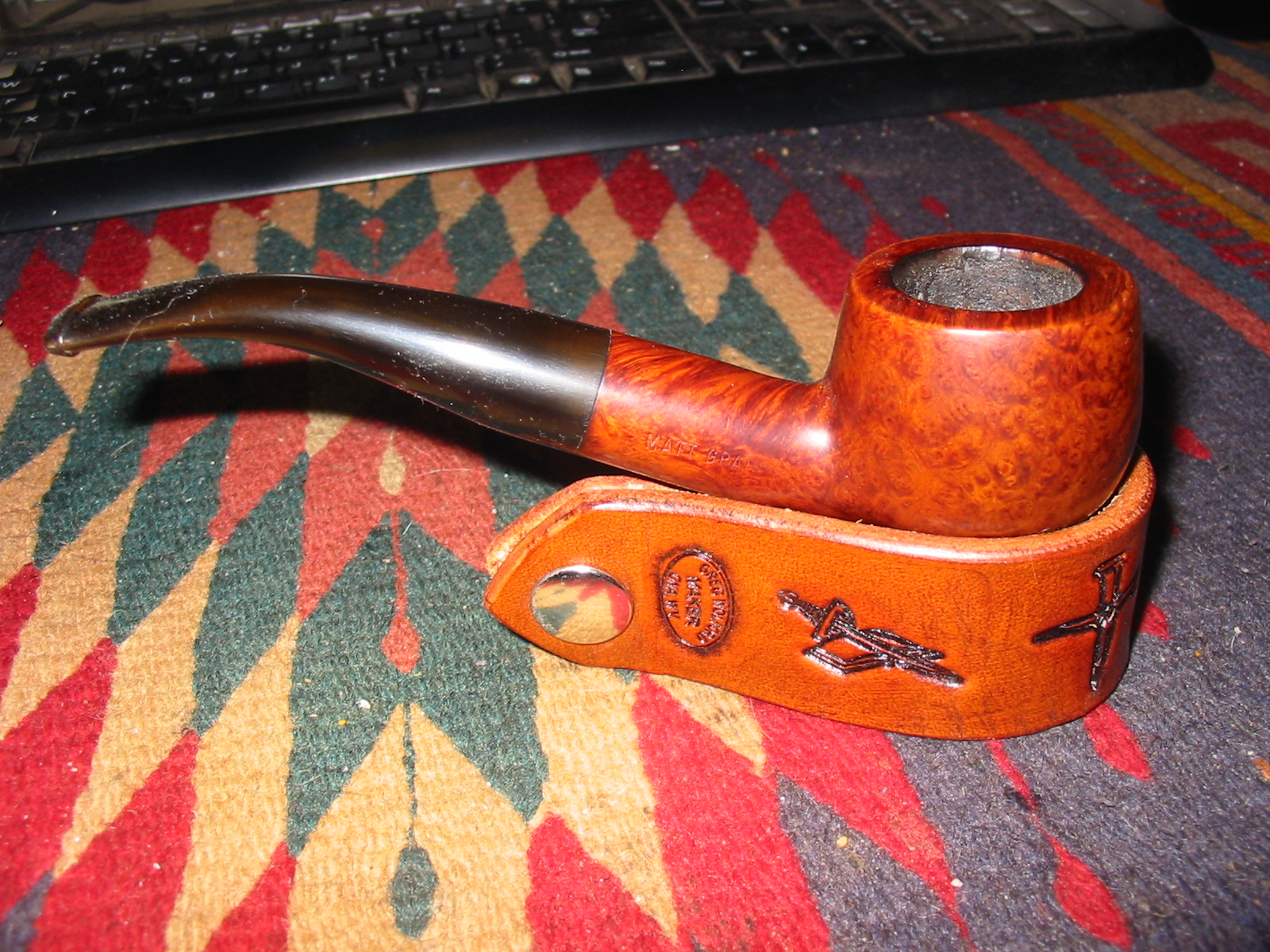
When the snap is connected the leather forms a tear drop shaped pipe stand. It fits easily in a pipe bag or a coat pocket and is readily accessible for a pipe stand on the go. Greg did a great job on it. The size of the stand is pretty much one size fits all as a variety of pipes of different sizes and shapes fit the stand with room to spare. The stand is snapped into place in the photo below.

IMG_1796

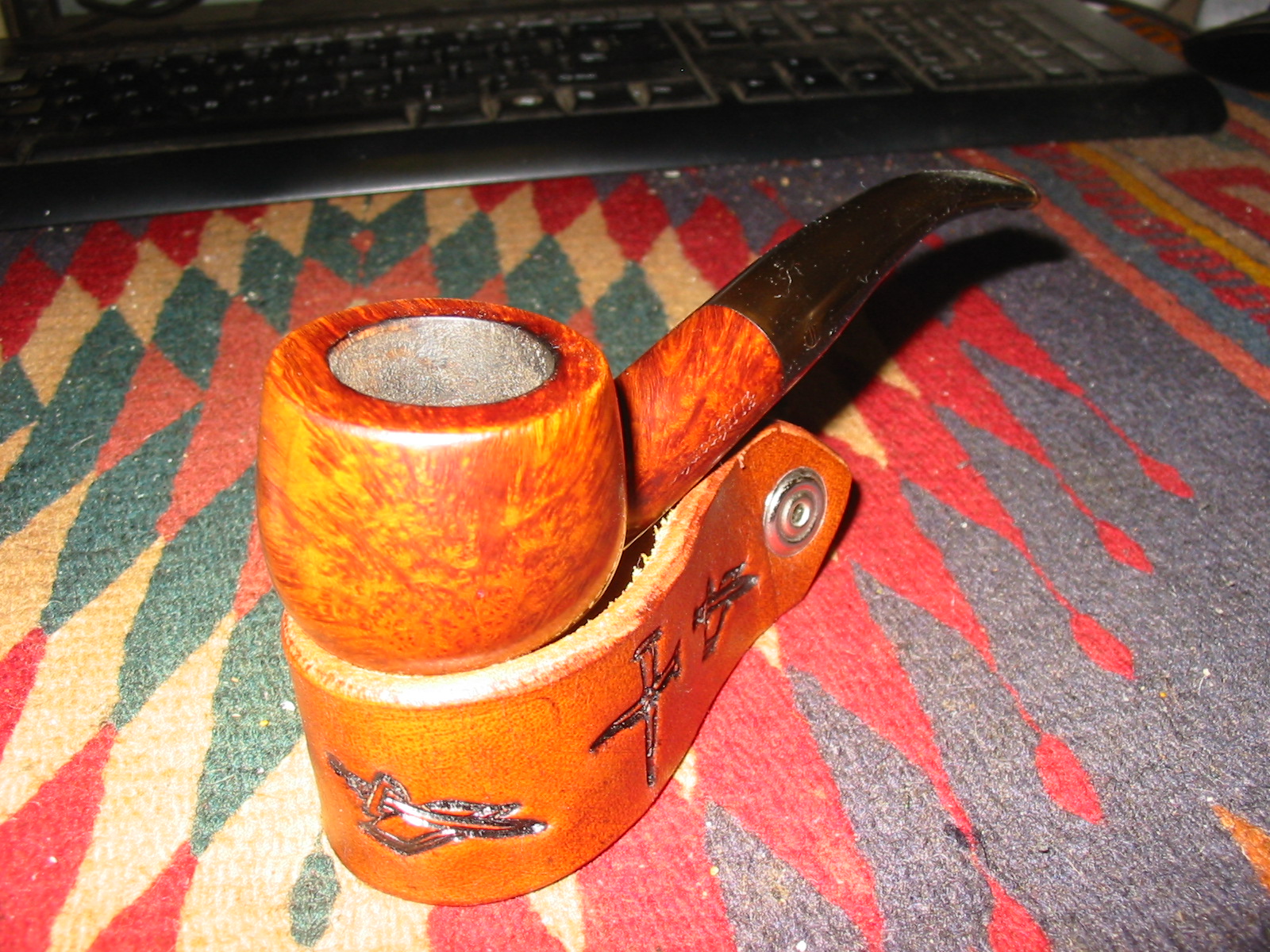
In the last photos below I have my Churchill’s pipe resting in the stand. It is a wide bottomed pot shaped bowl and it fits easily in the rest. It is one I plan on keeping in my pipe bag for my travels as it is easy to pack, takes up little room and quickly provides a resting spot for my pipe.

IMG_1797

IMG_1798

Greg also included some care instructions with the stand that are very helpful and certainly something that I would not think of had he not included them in the package. I am including them in this post to show the craftsmanship and customer care that Greg provides with his leather products. In Greg’s words:

“I recommend that you wax it every few months, 2-6, depending on how you use it, with Kiwi shoe polish. This will help it to stay water resistant by protecting the top coat over the dye and the antiquing in the stamping. You can use neutral or brown if you want to add to/enhance the color. I have made a short YouTube video on the how, why and what to use for this process which can be viewed in the YouTube video below.

Thank you Greg for the great pipe stand. I am enjoying using it as a part of my pipe smoking routine. It sits on my desk where it is accessible when I am at home and goes in the pipe bag when I am traveling. It is a perfect accessory for me. I would encourage any interested pipemen to contact Greg about getting a custom made pipe stand from him. You will not regret your decision.

A Schulte deLuxe Reborn – by Joey Bruce


Blog by Joey Bruce

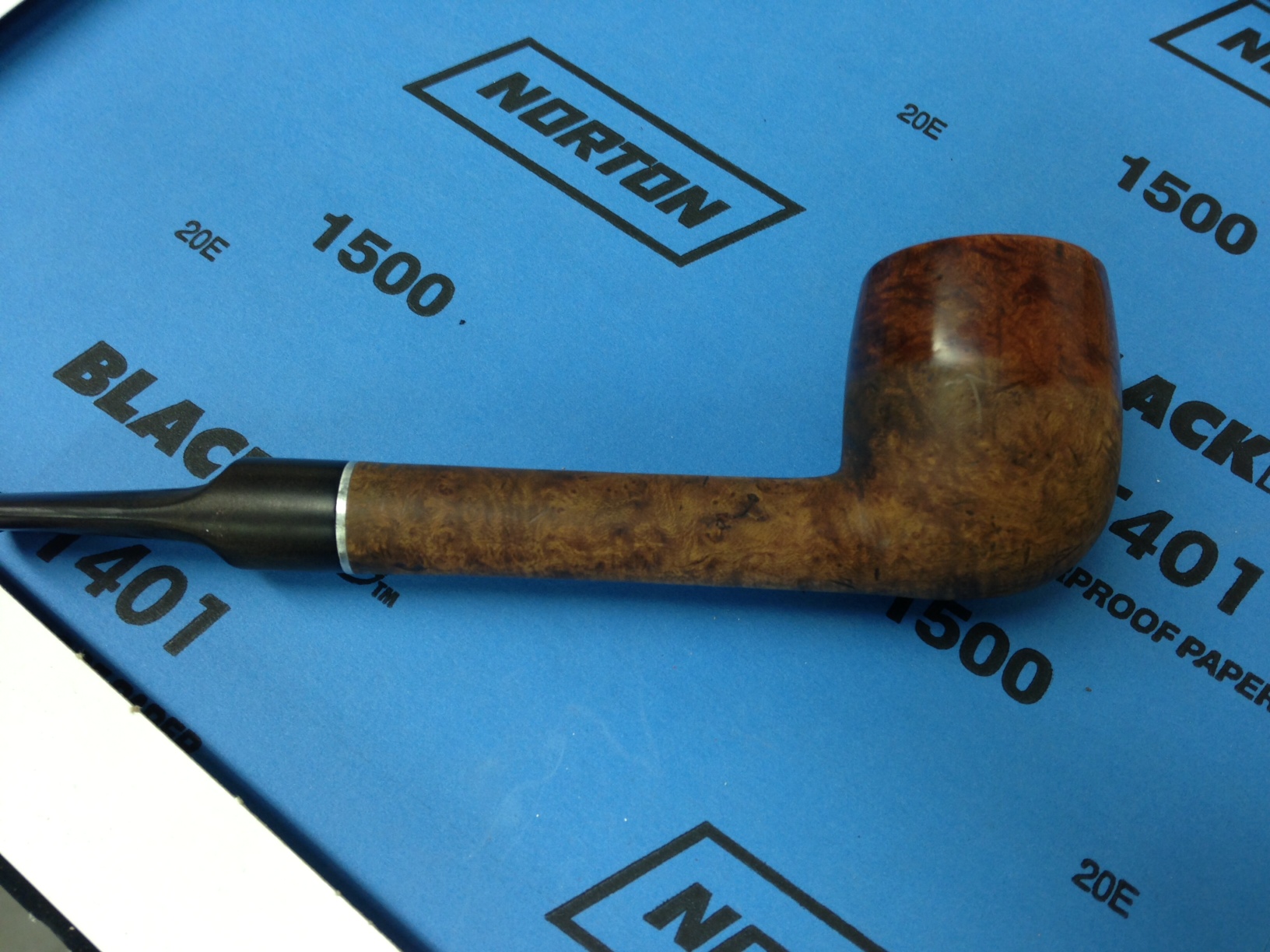
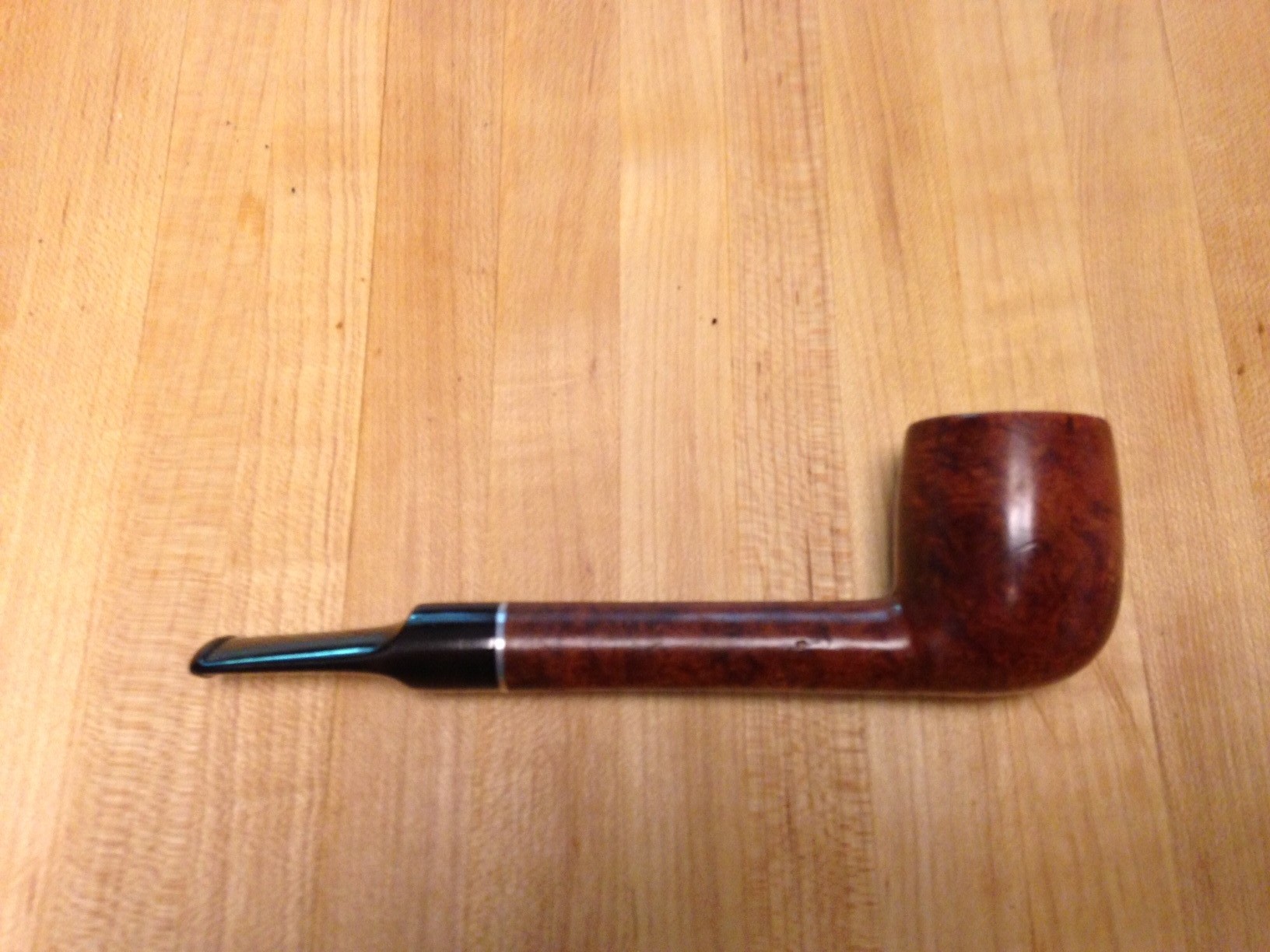
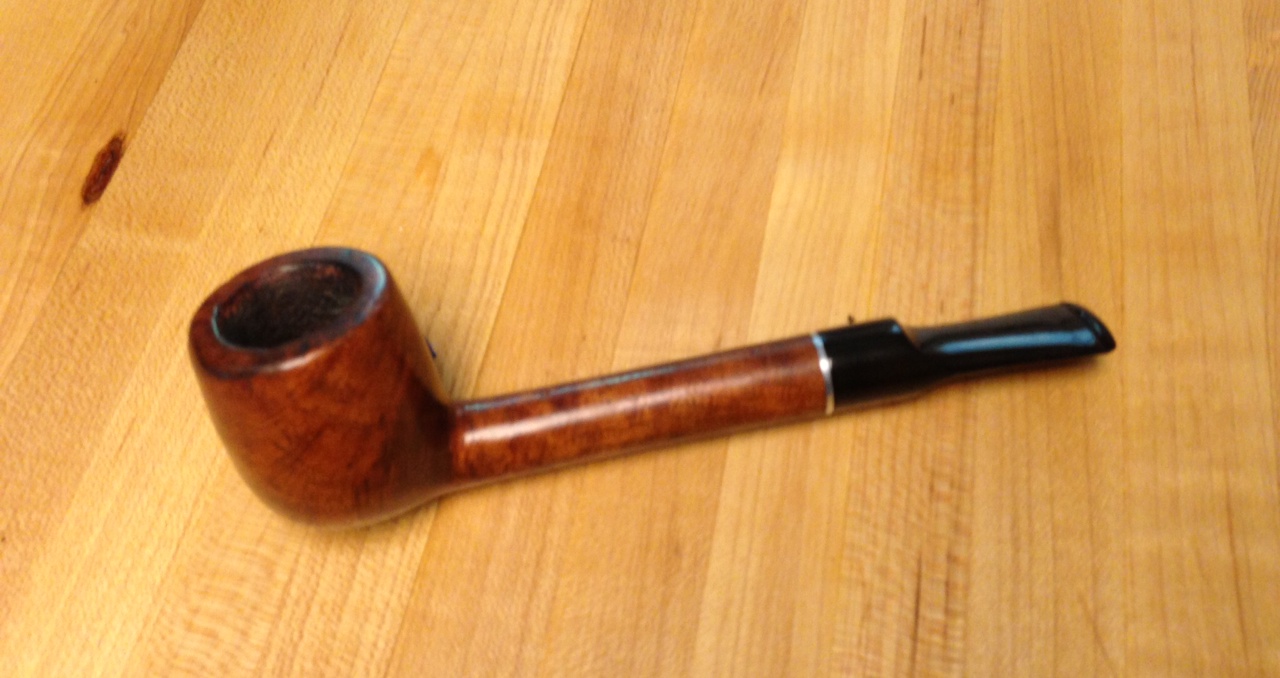
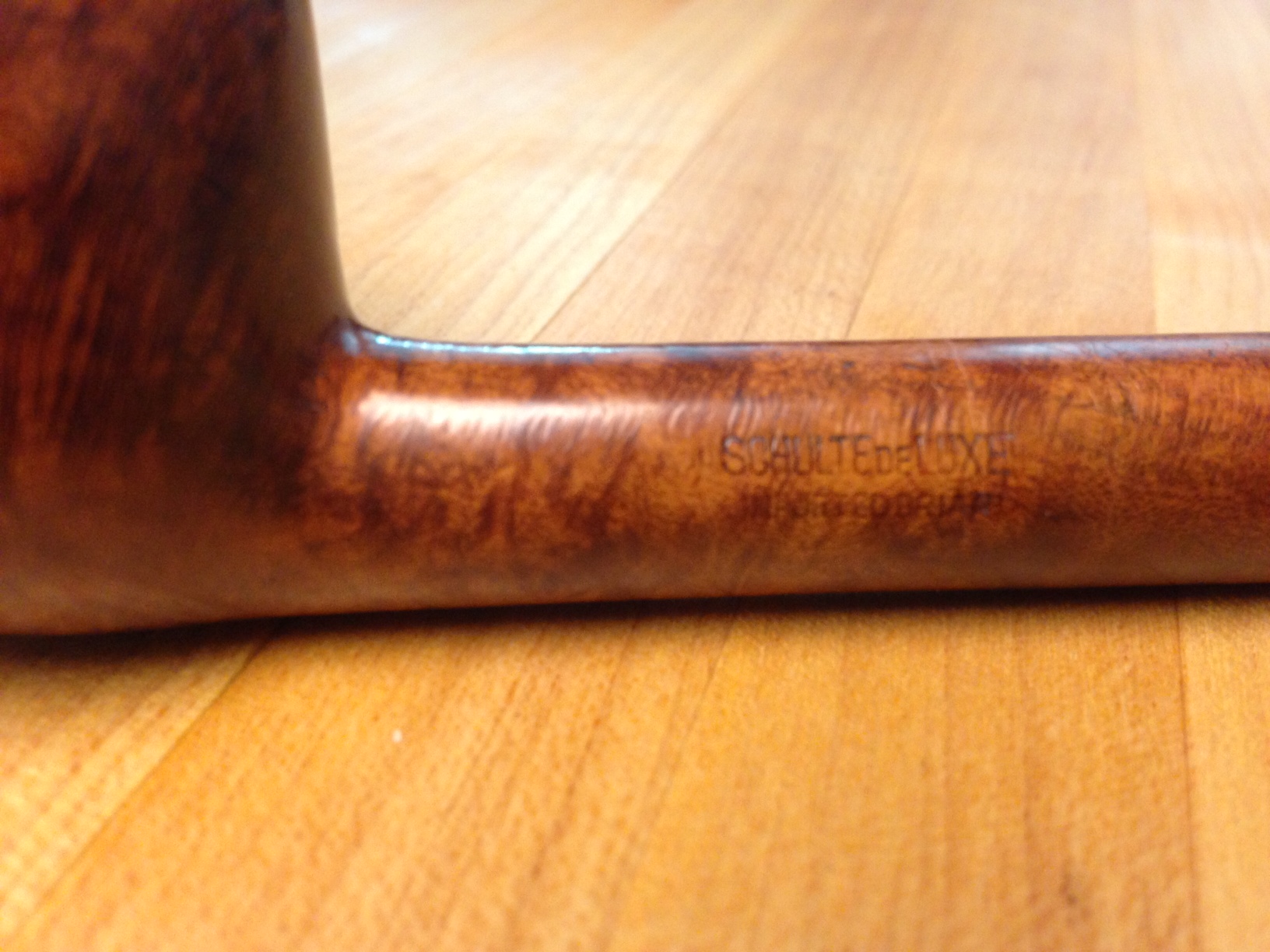
Joey has been a reader of the blog for a while now. Then about a month ago now I received and email from him with some questions on an old pipe he had picked up. It turned out to be a WDC bulldog that was in rough shape. We exchanged a few emails and over the course of reworking that old-timer I could see that Joey was hooked on this hobby! I invited him to do a write-up on some of his work and post it here for others to be encouraged and challenged. Last evening he sent me this article on an old Schulte deLuxe that through his efforts had been reborn. What follows is his article and photos. Thank you Joey for taking the time to write this up and send a copy to me. It is great to have you posting on the blog as a writer. Enjoy his work readers.

Hello all. Just dipping my toes into the pipe refurbishing world. I’ve been reading the posts here obsessively for a while now and couldn’t resist trying it for myself. I’ve always loved restoring things whether it’s, old bikes, cars or motorcycles. All the way to obscure things like pens and sewing machines. So it was a natural move into this. Hopefully I won’t bore you. At the very least you’ll be able to see the difference between and amateur like me and the real deal like Steve and Greg.

I recently bought a few estate pipes off eBay. Most were in such great shape they didn’t need anything more than a spit shine. A few I used as practice. Trying out different techniques I’ve read here and see what I like the best. This weekend I went to a flea market and grabbed a bunch of old cheapos that were laying in a box for a few bucks. Figured I’d get more practice and this time actually take pictures.

Schulte1

Schulte3

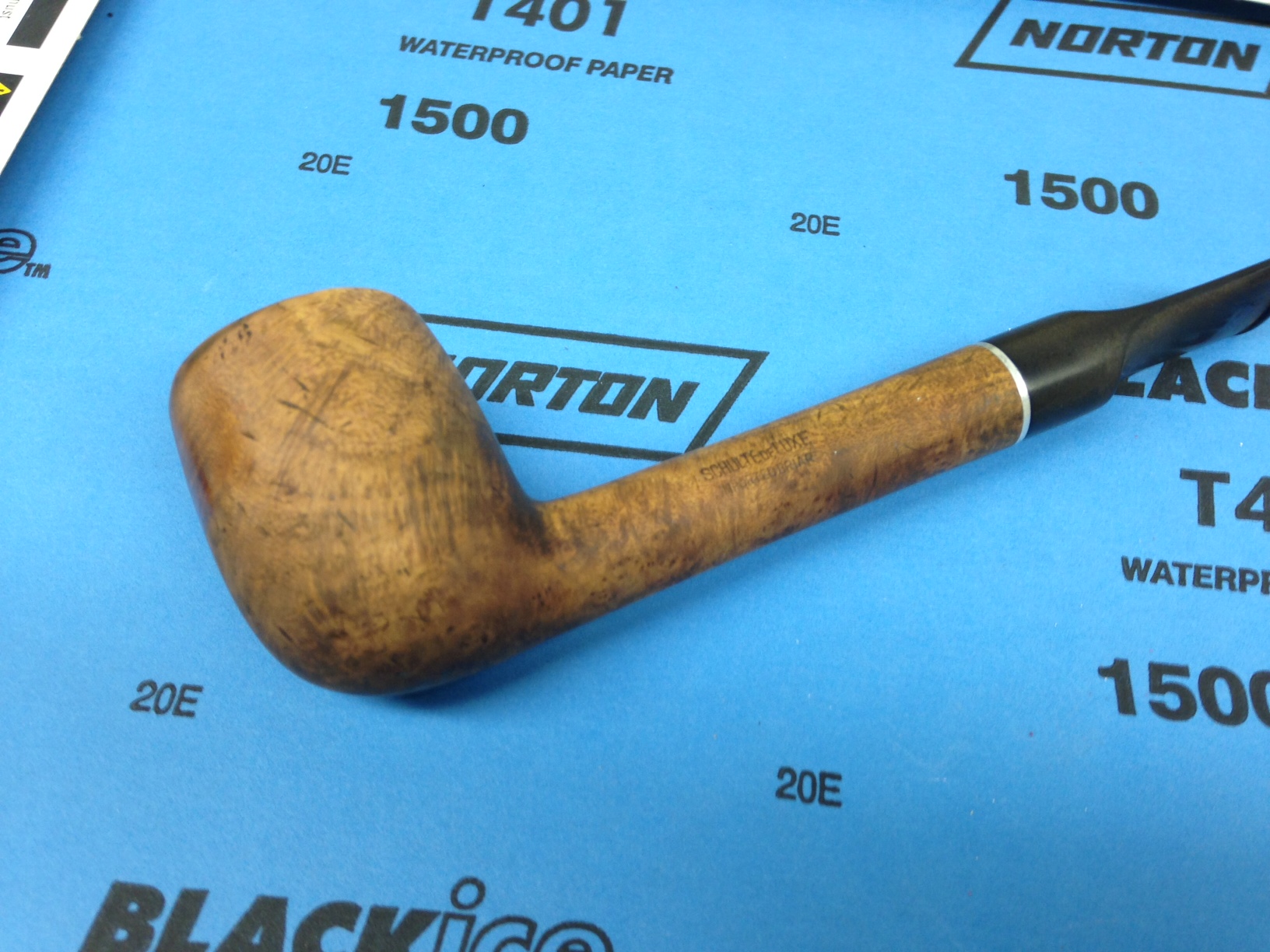
I grabbed the Schulte deLuxe first as that one seemed like it would be the easiest. First I soaked the stem in an Oxy Clean and water solution (no real ratio. Just about half a tbs to 3/4 water. But really just guessed) to bring out the oxidation. Then I wet sanded it with 1500 grit sandpaper (all I had. Would have been easier to work my way up to that but I just went with what was here) until all the oxidation was removed. After a little elbow grease I took it over to the polishing wheel (Ryobi bench grinder with two 6″ polishing wheels) and hit it up with some red rouge. Working it back and forth until it had a nice smooth shine. Then moved to the other wheel with Eastwood Supply’s version of White Diamond. Working it with a much gentler touch. Wiped off the residue and voila. Better than new.

Schulte2

Schulte4

Schulte5

I moved onto the bowl. This time I decided to try wet sanding the bowl just to see what would happen. I hypothesized that a quick wet sand might just remove the grit and grime. Turns out it quickly moved right past that and into the stain. I probably won’t do that again unless the bowl needs serious work but it was worth a shot. Wet sanding did work well on the top of the bowl to remove the tar. Much quicker than the spit shine method.

Schulte6

Schulte7

You can see how one turn on the bowl with the red rouge turns the wet sand into a nice shine. Probably my favorite part of this whole thing is when you break it all down to its base and start to rebuild it.

Schulte8

Schulte11

Schulte10

Schulte9

I did the same to the bowl as I did to the stem. Took about an hour on the wheel for both. And I’m pretty happy with how it turned out. I have yet to polish them with any wax to keep the shine up. I just haven’t picked any carnauba wax up and I’ve noticed the super bright shine dulls after a few days so I’ll be sure to grab some wax ASAP.

If you’re reading still thanks and I hope this helps anyone who is just getting started.

Cheers.

THANK YOU For an incredible year at rebornpipes


rebornpipes has been operating the blog since the end of May 2012. For the remainder of 2012 the site had 39,646 views. Since January of 2013 we have had double the views with 79,026 views. There are 492 different posts on the blog written by myself and 11 individuals who have posted about their refurbishing work. I have included the list of contributors from the Thanks to Contributor’s page. Have a look at their credentials and their posts. You can search the blog by author name now and select those you want to read. In addition there are guest articles written by another 7 individuals.

1. Al Jones – Al was the first to contribute his writings and photographs to the blog under the name upshallfan. Al does incredibly nice refurbs and adds a nice touch of class to the blog.

2. Fred Bass – Fred is the Meer Guru in my opinion and to have several of his pieces here on the blog is incredibly helpful. Fred brings a love of the meer and years of experience in cleaning, breaking them in and caring for them to the table.

3. Gan Barber– what can I say about Gan? Over the years we have fired emails back and forth with ideas and suggestions and insight into our joint hobby. I am thankful to have Gan posting here as in many ways he has been a mentor to me in this hobby.

4. Chuck Richards – Chuck, like Gan, has been someone with whom I bounce ideas and methods back and forth. Chuck also keeps the challenges in front of me and I learned much from him.

5. Kirk Fitzgerald – Kirk is a relative newcomer to the refurbishing craft but he has an amazing talent with a chisel and carving knife. His contributions on his method of rustication have been well received and it is a pleasure to have him contribute here as well.

6. Piet Binsbergen – I have corresponded with Piet for awhile now and we connected over Keyser Pipes. A mutual friend on the forums – Muddler – connected us when I was searching for Keyser stems. Piet is an artist at heart and by profession. His love of the briar and restoring it comes out in his work and his words. It is great to have added him to the pool of contributors.

7. James Gilliam– I asked James to contribute from the perspective of a pipe maker what it was like to do refurbishing. James makes some amazing pipes and has done a great article on his perspective on our craft. His website is JSEC Pipes at http://jsecpipes.com/ I appreciate James willingness to contribute to the blog and it is a pleasure to have him contribute.

8. Al Shinogle – I contacted Al Shinogle and received his permission to post his article on opening the airway on a pipe. Al continues to do some great refurbishing work on estate pipes that he revives and passes on to old timers. I look forward to future articles by Al.

9. Greg Wolford – is one of the blog’s readers and comments often on various posts. He contacted me with several articles on the pipes he has refurbished and the methods he has used. Greg writes well and is a fine photographer in his own right as well. I look forward to reading what he contributes in the days ahead.

10. Robert Boughton – Robert is one our newest contributors to the blog. He is a new practitioner of the refurbishing art being tutored by Chuck Richards in the finer points of refurbishing. It is a pleasure to have him writing for the blog and adding a new voice to the posts. His research and his work are well done. Thanks Robert.

11. Brian Devlin – Brian is a 62 year old retired electronic manufacture and design company owner living in Blairgowrie, Scotland. He is a stroke survivor (I like him already as I too am a stroke survivor) having survived 3 major strokes 7 years ago. He loves his new home, pet rabbit and morning ritual with pipe and rabbit in his garden. He frequents EBay to hunt for pipes that he buys and skillfully refurbishes to smoke. It is great to have Brian writing about some of his refurbs on the blog. Enjoy his work.

Added to that list of regular contributors there are also articles that have been written by the following individuals:

1. Bas Stevens – Bas is the go to person for information and history on Stanwell pipes. He has one of the most beautiful Stanwell collections that I have ever seen. I appreciate Bas’ willingness to have his piece on Stanwell shapes available on the blog.

2. Mark Domingues – Mark is another reader of the blog and has lately contributed some of his work. Mark collects Peterson pipes and his work is a pleasure to read about. Mark seems to never shy away from trying things that are daunting at best and certainly some that others would consider futile. Thanks you Mark for writing for us.

3. Eric Boehm – Over the years on the forums I have read Eric’s posts with interest. He has collated and collected some great information that it is our privilege to be able to share here on the blog. I thank Eric for his willingness to pass on his writing through the blog.

4. Les Sechler – Les graciously gave permission to put his article on Barling pipes on the blog. Les possesses a wealth of information on Barling’s and Dunhill pipes. He has always been gracious when I contact him for help on various projects. Thanks Les for being a willing and able correspondent.

5. Martin Farrent – Martin graciously gave permission to put his article on Dating Loewe Pipes by Period on the blog. I look forward to reading more of Martin’s work in the future. His knowledge of Loewes pipes is incredibly helpful and insightful. Thank you Martin.

6. Mike Leverette – Mike was a very good friend and the consummate pipeman. He was a fountainhead of information on all things Peterson and also one who shared a common interest with me regarding alternative woods used in pipes. He knew and loved the older historical alternative woods used by American pipe makers. All of Mike’s articles on the blog are published posthumously from pieces he sent to me over the years before his death. Mike I miss the chats and the ready wit that characterised you so much.

7. Alan Chestnutt – Alan is a professional pipe refurbisher doing work on the web as Reborn Briar ( http://www.estatepipes.co.uk/ ). His work is extremely well done and his website also has a wealth of information and some of the pipes he refurbishers are for sale through the site. Thanks Alan.

Including the articles that I post we thus have 19 different writers on the blog. I am so thankful for the willingness of others to add articles on their expertise and experiments in the art of refurbishing pipes.

The spread of the blog is quite extensive now, covering 150 different countries. It is remarkable to go to the various Referrers to the blog and read articles there that have been translated into other languages. I have also read newsletters, emails, forum posts from many of the different countries pipesmokers and found them referring favourably to the blog. All of this more than meets the expectation I had when I started rebornpipes. I wanted it to be a place to share our collective learning regarding the work we do as hobby refurbishers. It has been a pleasure to receive emails and also comments on the articles from many of you with your additions and helpful information that sits in the comments below each article and in some cases have been integrated into the material for a more complete compendium.

I think as we move into our second year at rebornpipes I would encourage others of you who read the blog and practice some of the tricks learned here to comment on the posts and to also submit articles and photos of the pipes you have been refurbishing. Share the tips and tools you have learned and developed as you have worked on the pipes at your table. Your articles are always welcome and the list of authors is wide open for additions.

Again I want to take this opportunity to say thank you to the pipe smoking community for your reception of the work of rebornpipes and your continued readership. I do not take it for granted in this busy world in which we live that you would take time to read the articles we post here and share them in your circles of pipesmokers. Thank you.

Steve Laug
rebornpipes

Adjusting a Misaligned Tenon


On the old Churchill’s bent pot I picked up on Ebay and wrote about in a previous article I spoke of adjusting a misaligned tenon to tighten up the gap between the shank and the stem. Al Jones commented in his reply to that blog post that he would like to hear more about the procedure I used to achieve the correction. I have written this article in response to Al’s question.

The Churchill’s pipe had a slight cant to the tenon. It did not allow the stem to line up correctly. It had a gap at either the top of the bottom of the shank and no matter how it was inserted you could see light in the gap. I have seen the mishaps, and experienced some firsthand, when the tenon is pressed after heating to try to expand it. The misalignment is often dramatic and hard to repair. In the past I have had to just start over with a different stem. I decided to experiment with a different fix on this old Churchill’s.

Churchill 2

Churchill 3

My first attempt at heating the tenon involved the boiling water method that is used to bend stems. I set a bowl of water in the microwave and heated it for two minutes and then dipped the pipe stem, tenon first, into the water to heat it. I repeated that several times until the tenon was pliable and then dried it and inserted into the mortise. I pressed it into place carefully and held it while I cooled it. The results of the first attempt are below – still a gap and the addition of an oxidized stem to remedy. As I thought about the process and the desired end I concluded that a possible issue was that I had not heated the tenon enough to truly get a flexible bend to it. The caution is to proceed very slowly in the process so that you do not snap the tenon and necessitate a different fix.

IMG_1740

IMG_1741

I put the tenon in the shank and left a gap of approximately a ¼ to a ½ inch. I then used heat gun with a tip that reduced the area of the heat to about an inch diameter circle. I held the pipe above the heat and rotated it quickly to evenly heat the gap, and thus heat the tenon. I apologize for the blurriness of the photos but the general set up is clear. Hold the pipe above the heat about three or four inches, rotate it quickly as you do not want to burn the vulcanite.

IMG_1776

IMG_1777

IMG_1778

Once the stem was warm I carefully pushed it into the shank. You want the stem warm enough that the tenon is flexible and not stiff or it will break off as you work it. The tricky part is to slowly and evenly push the stem into place. A variation in the push to either side will only make the problem worse. Once it is tightly against the shank I gently moved it until the fit was tight between the shank and stem. I held it tightly in place with my thumb and fingers as I cooled the stem and shank under cold water to set the new adjustment. It took several attempts to get it to sit properly.

IMG_1780

IMG_1781

Once the cooling was done I held the stem in place for a few minutes as I walked back to my work table. The finished fit was snug and no light shone through the stem shank union as it had previously. I have included the last three pictures below to show the finished fit of the stem to the shank. You can read about the restoration of the pipe in another blog post on the Churchill Bent Pot. https://rebornpipes.wordpress.com/2013/09/08/churchills-bent-pot/

IMG_1772

IMG_1771

IMG_1770

Churchill’s Bent Pot


Blog by Steve Laug

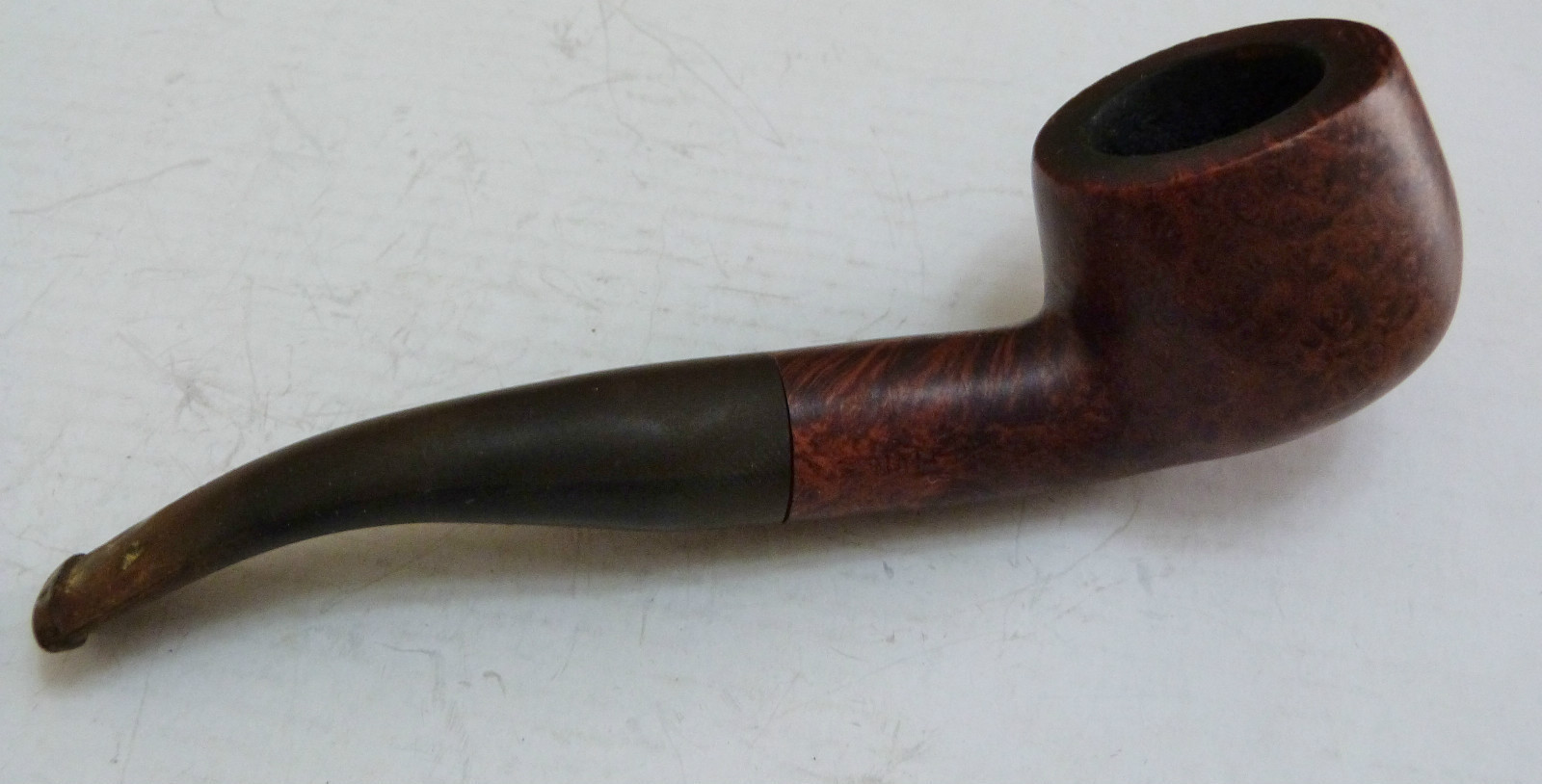
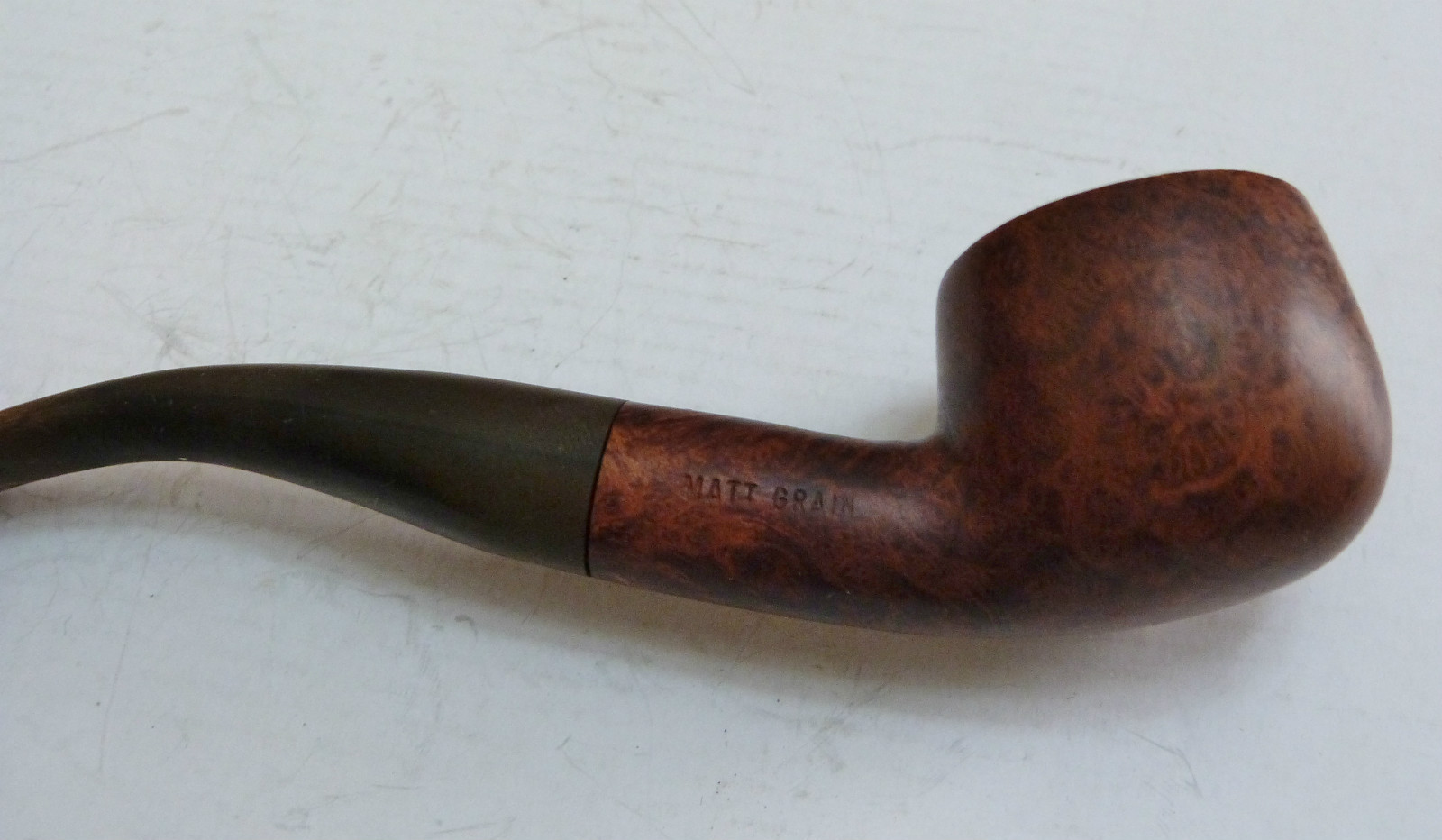
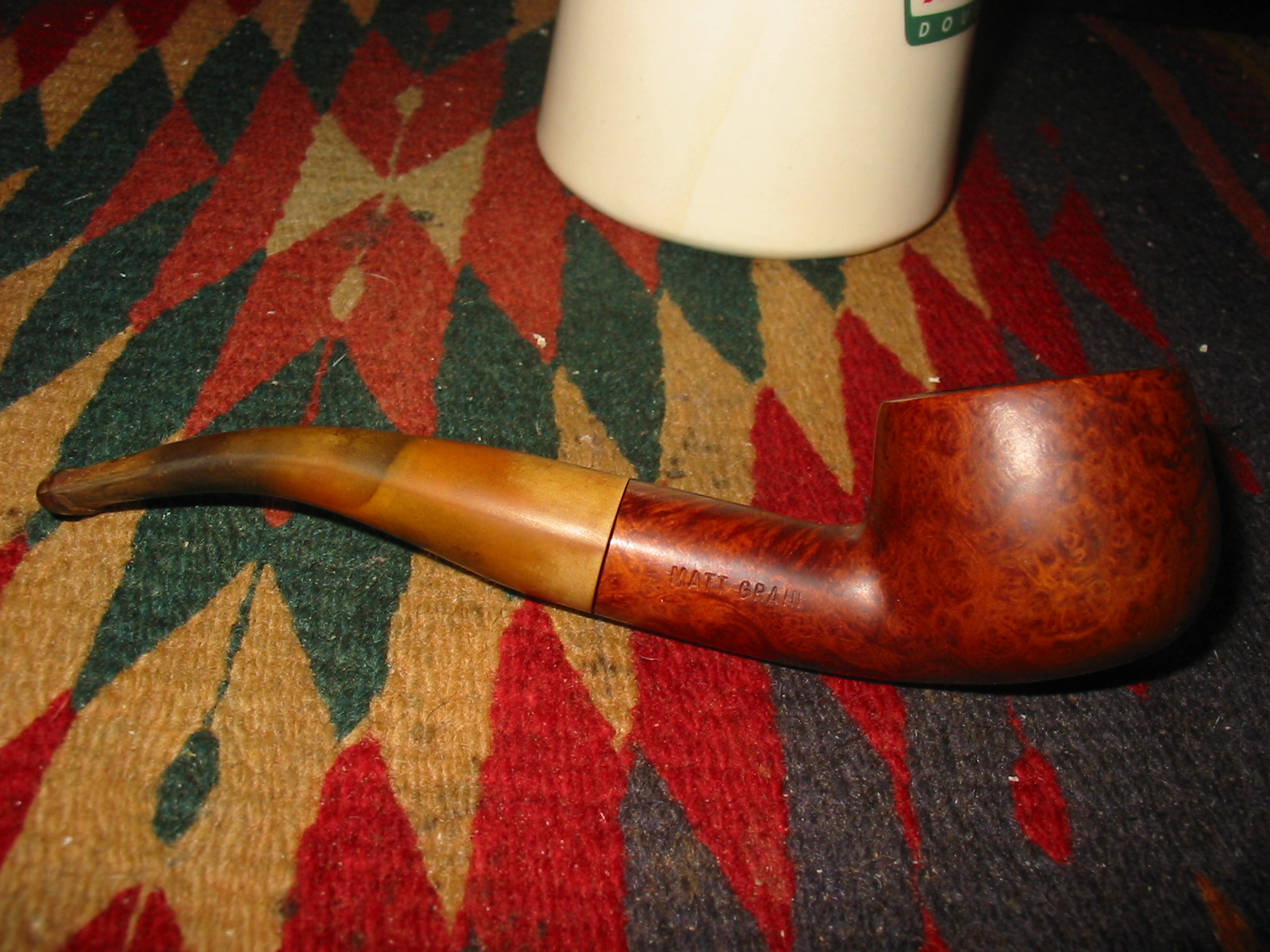
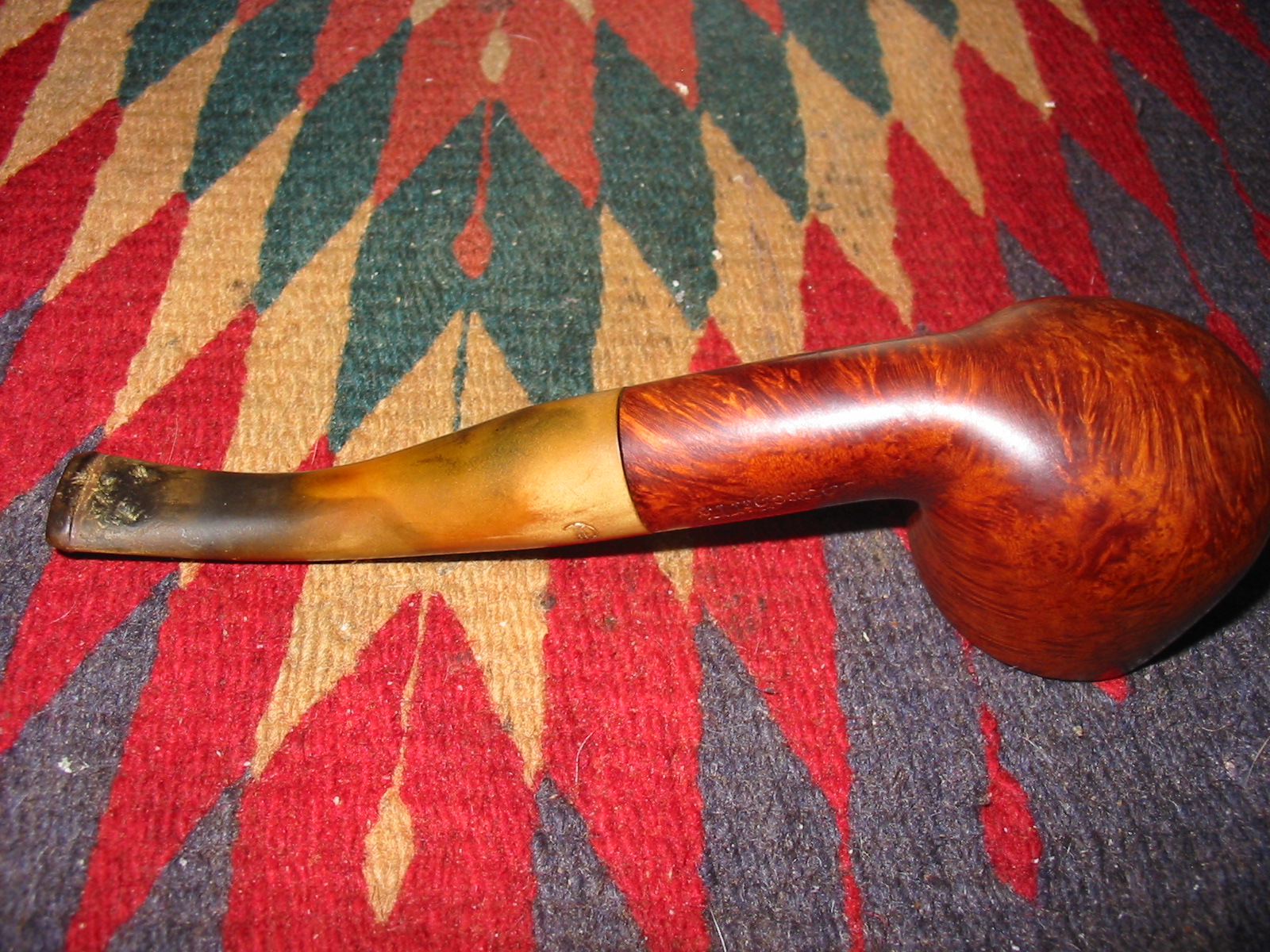
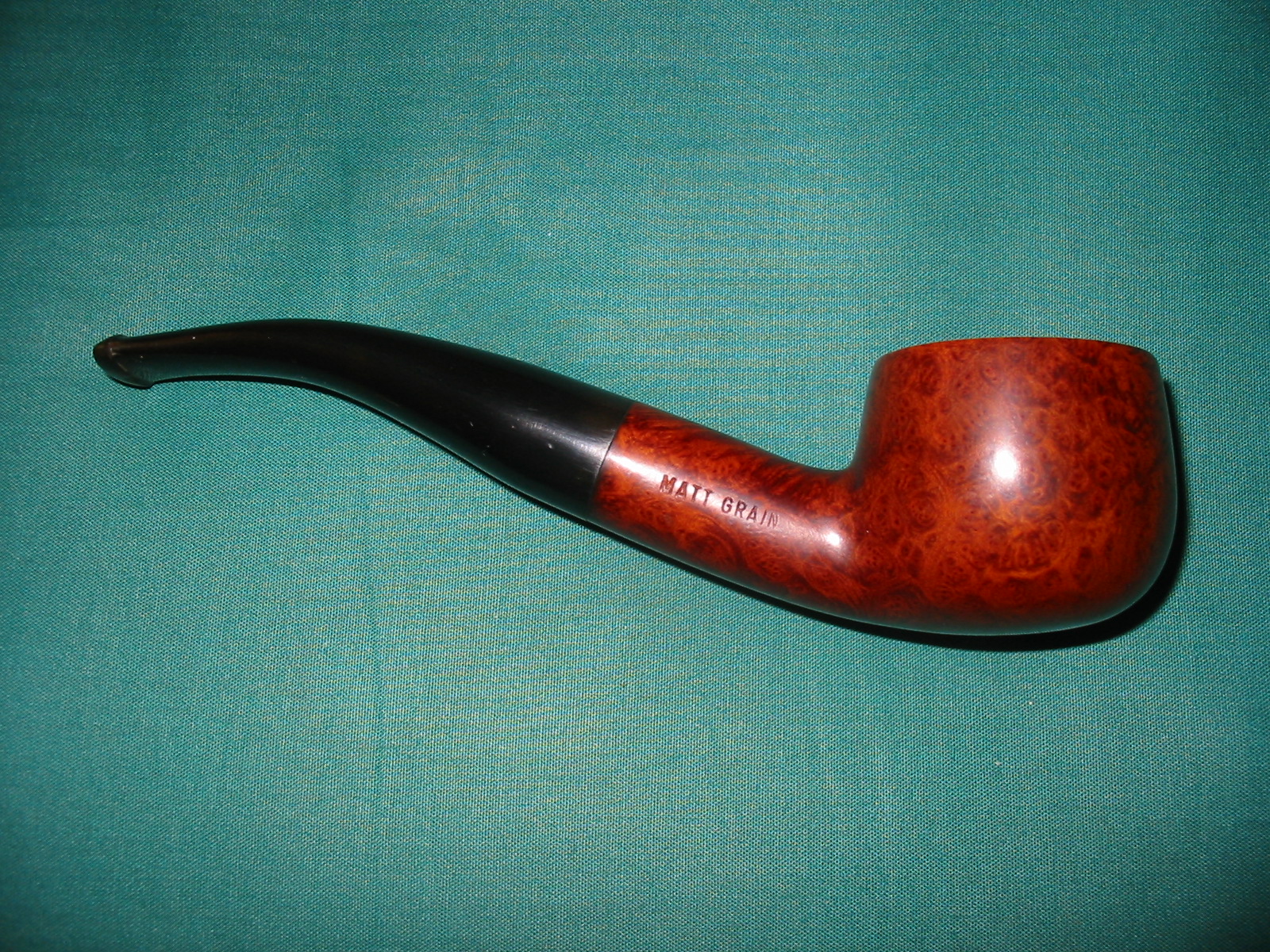
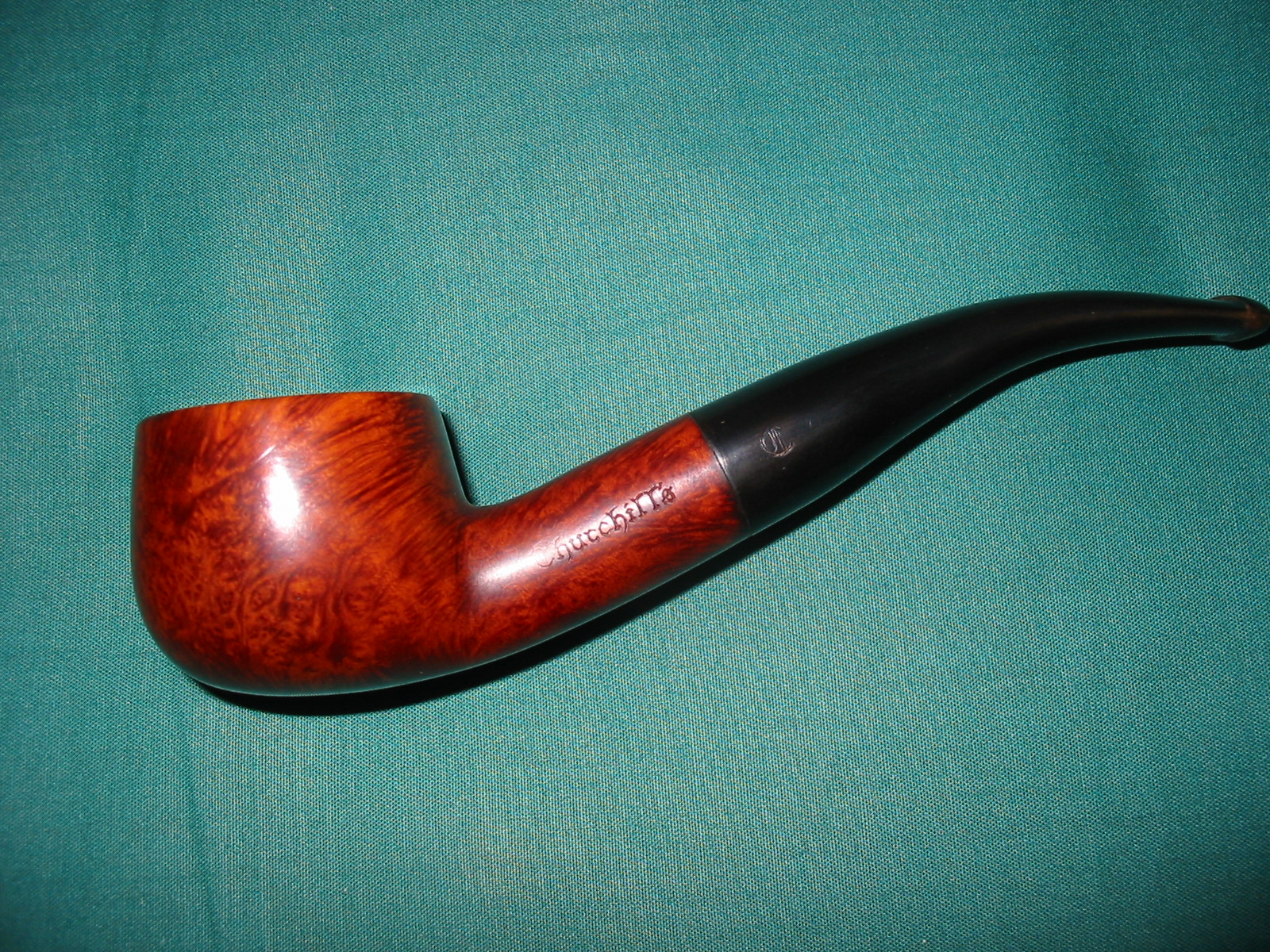
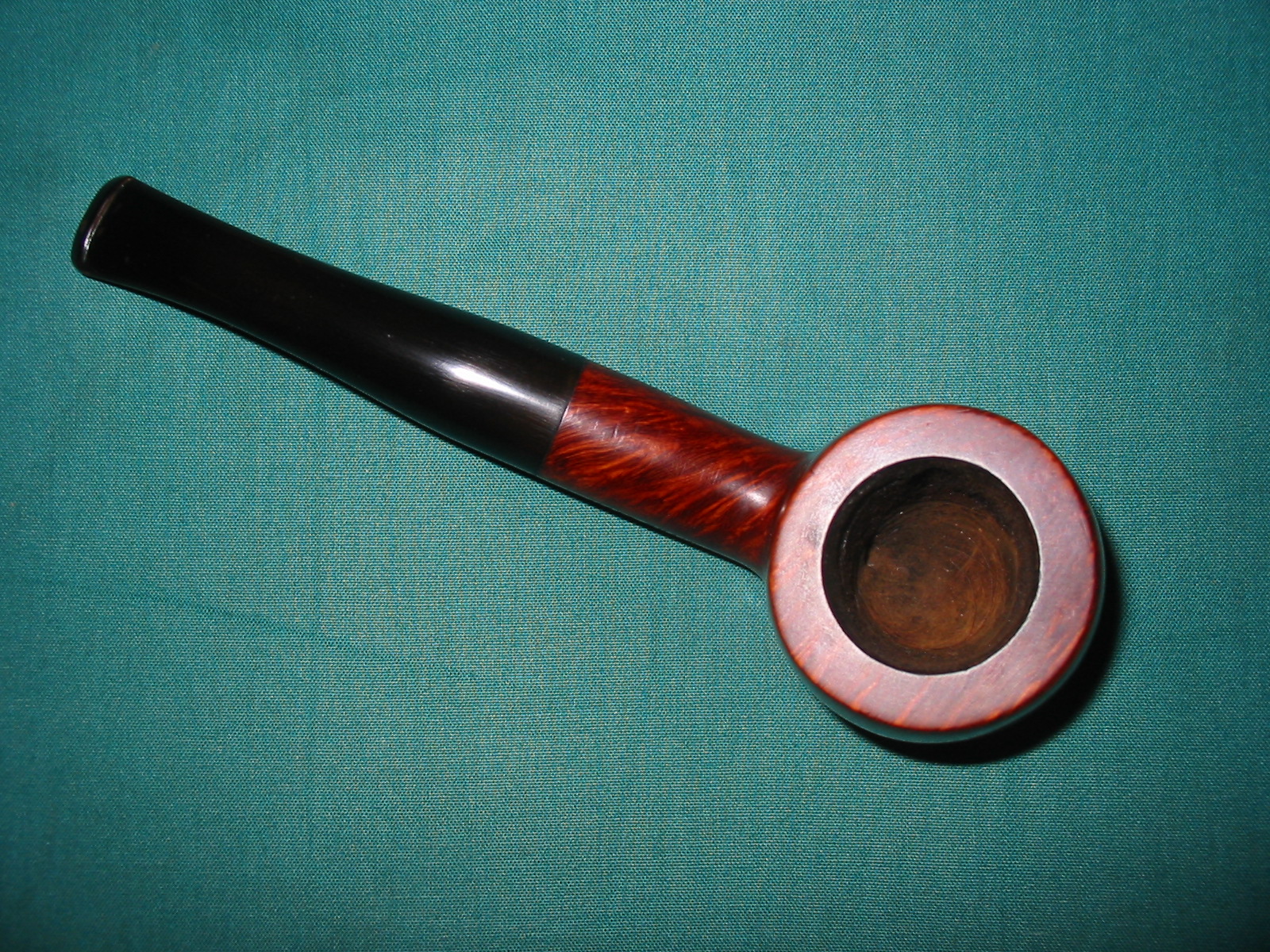
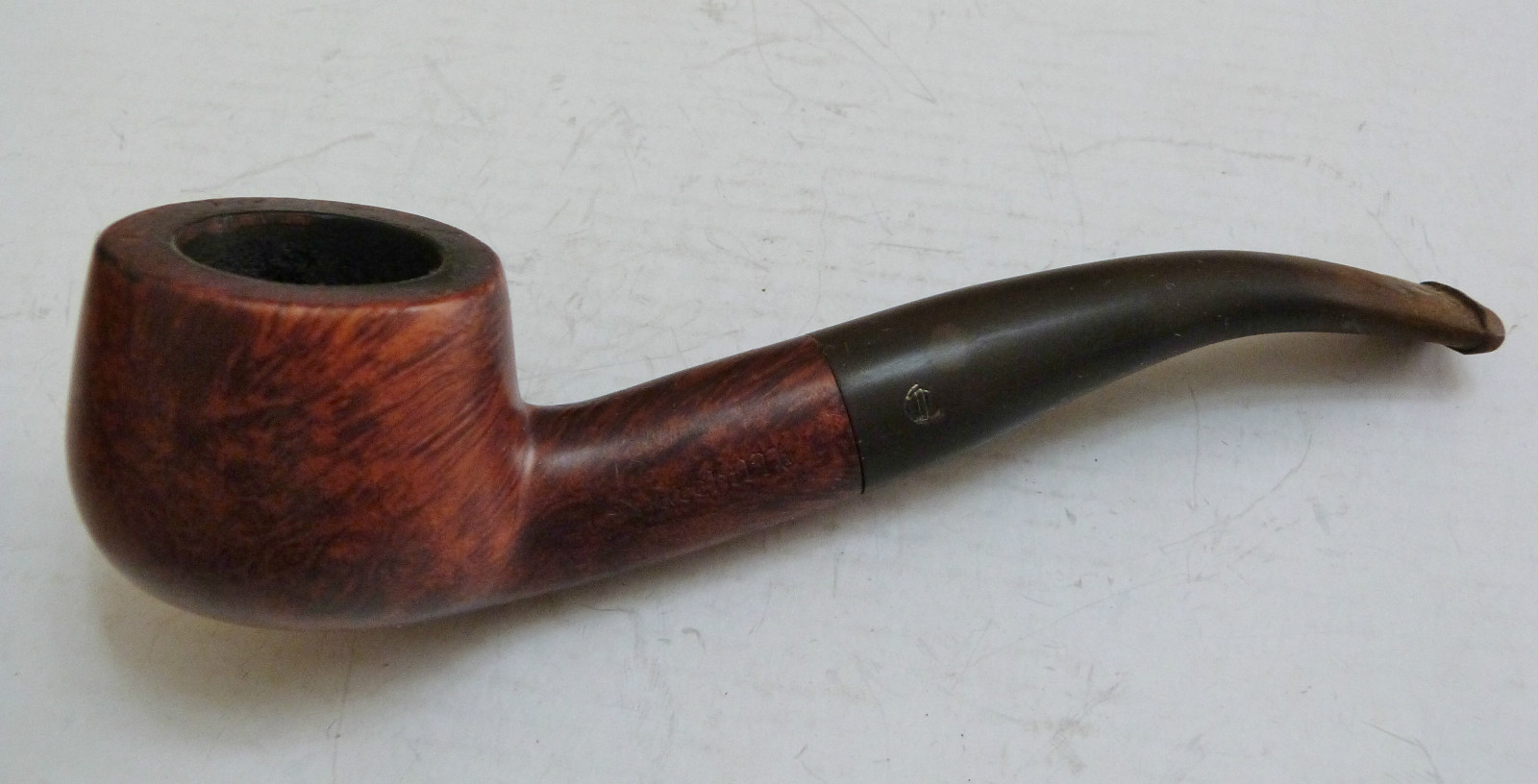
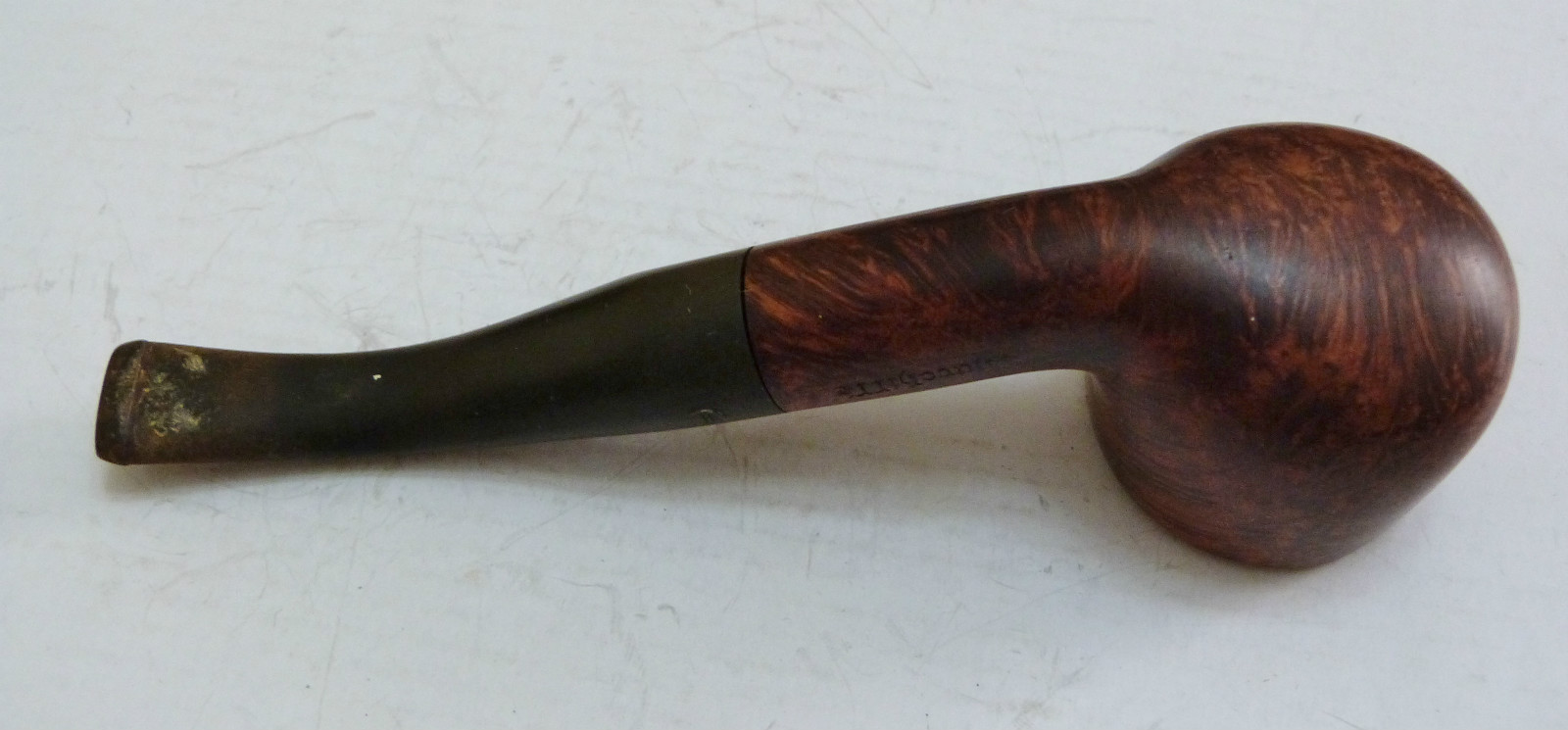
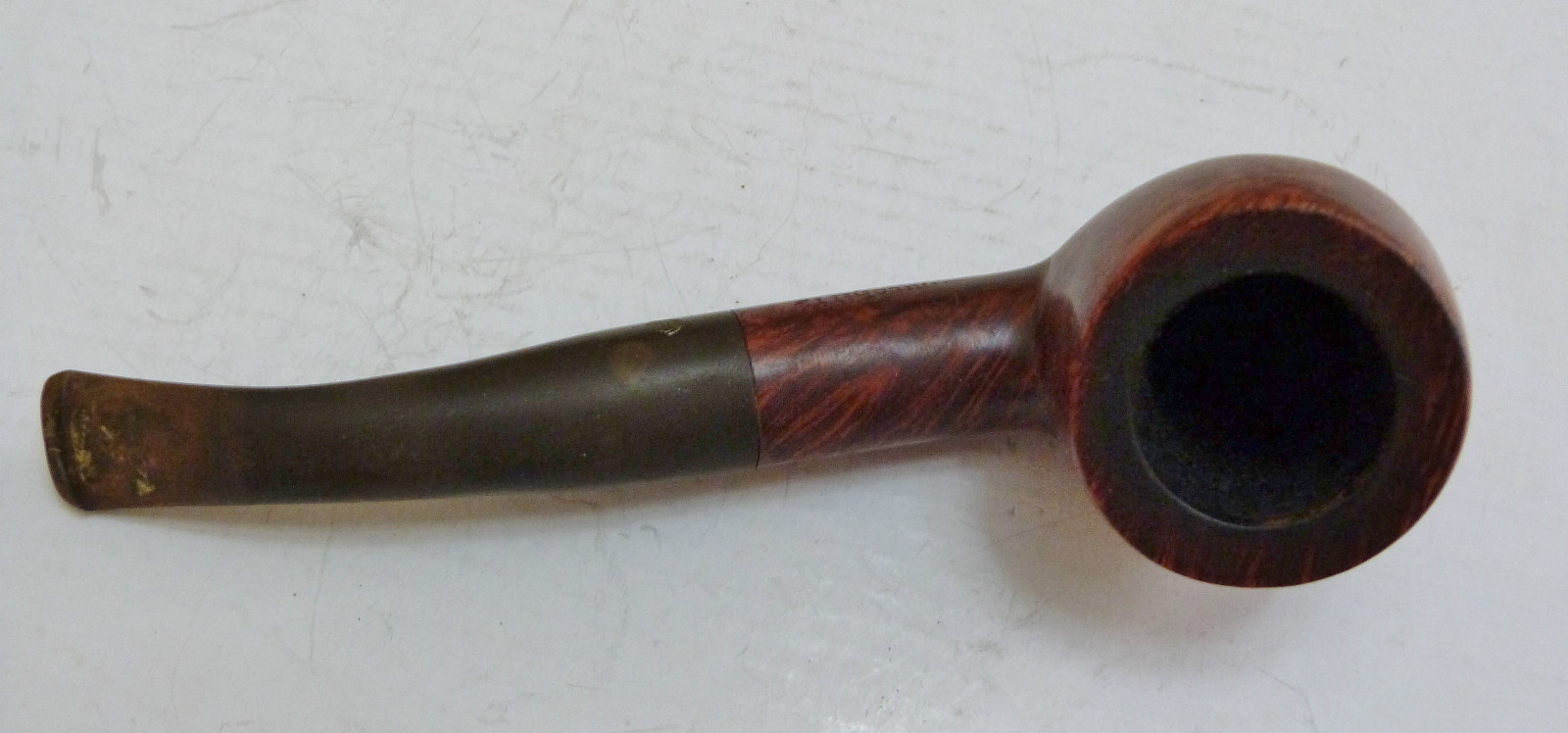
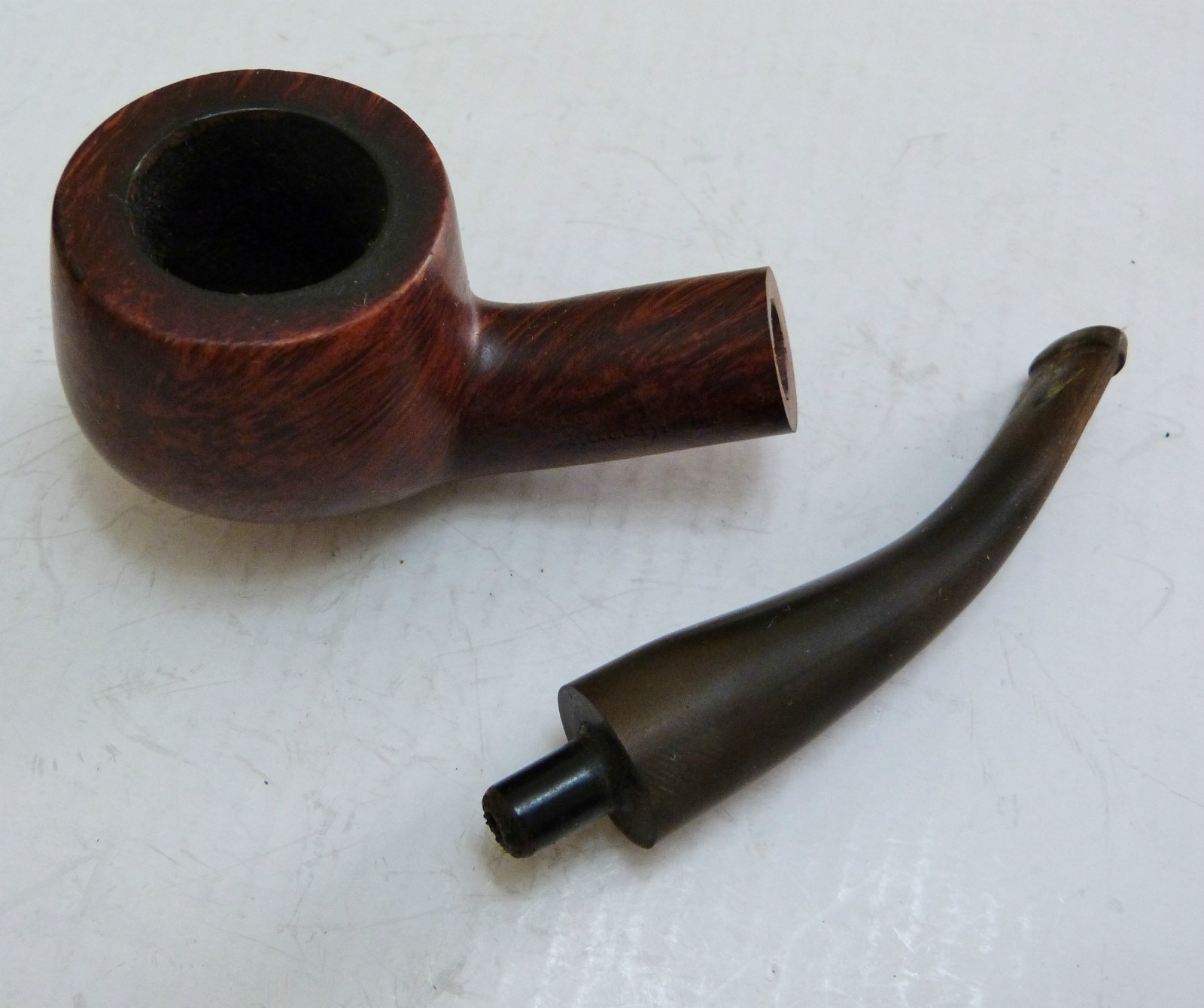
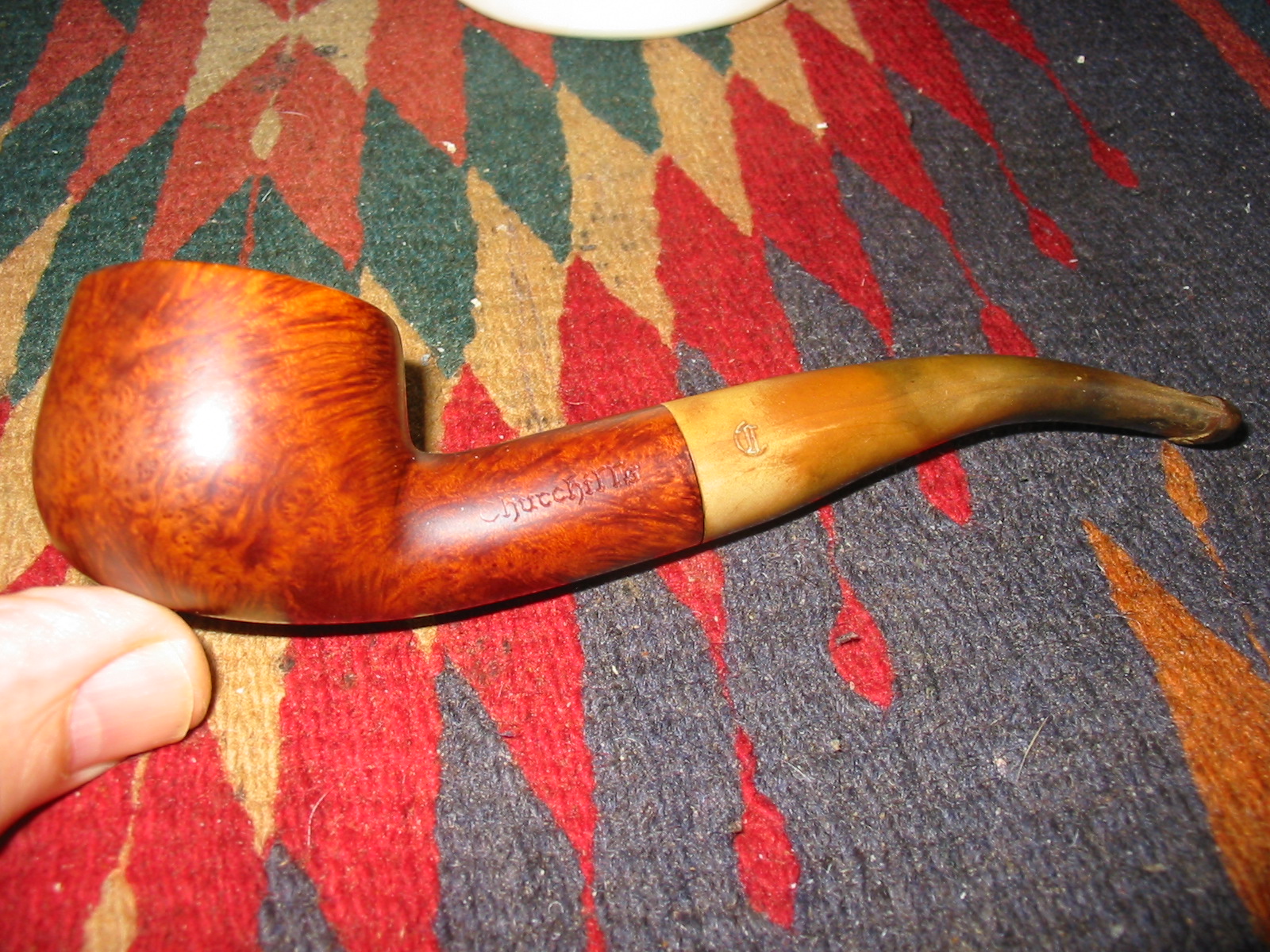
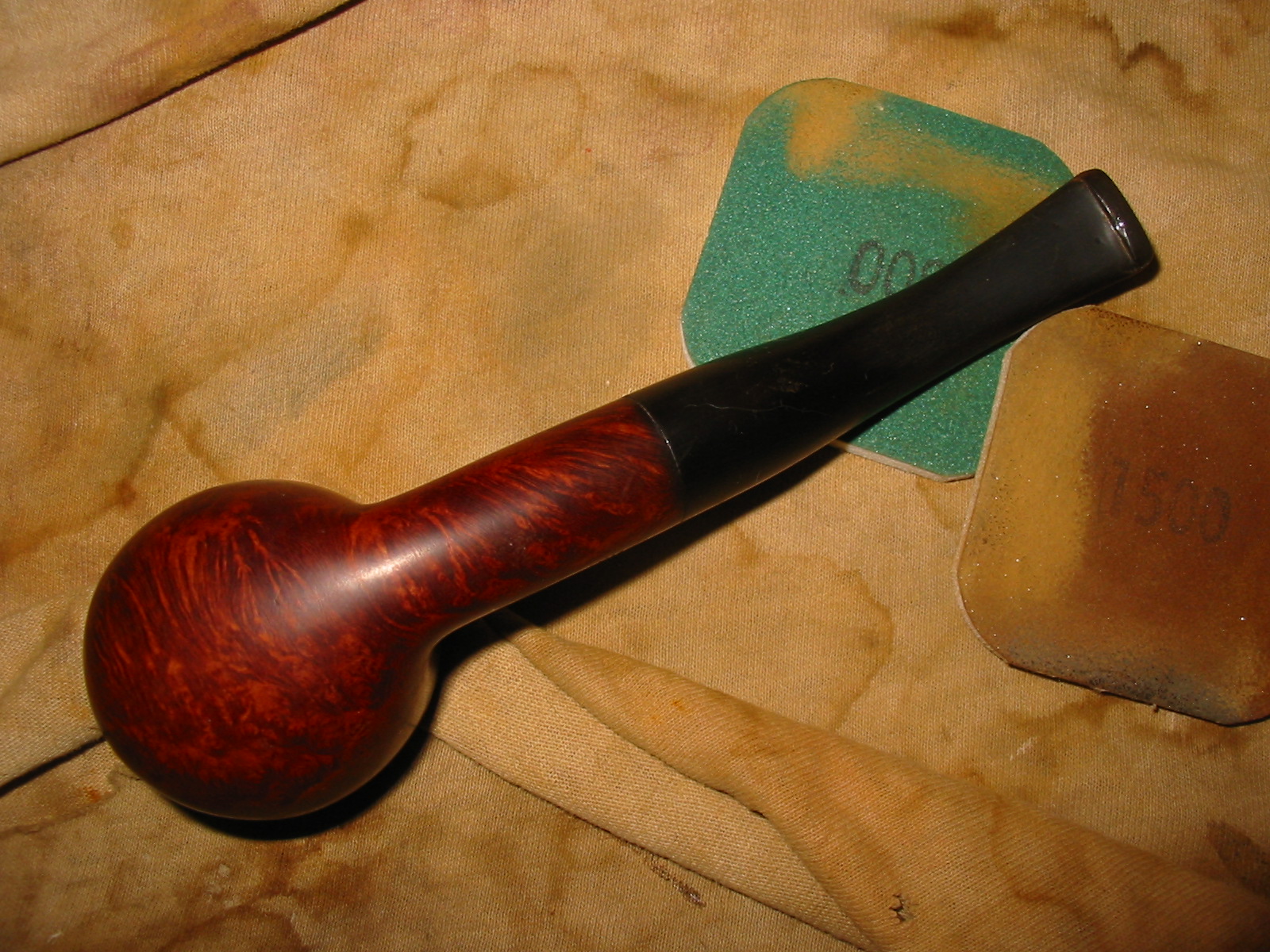
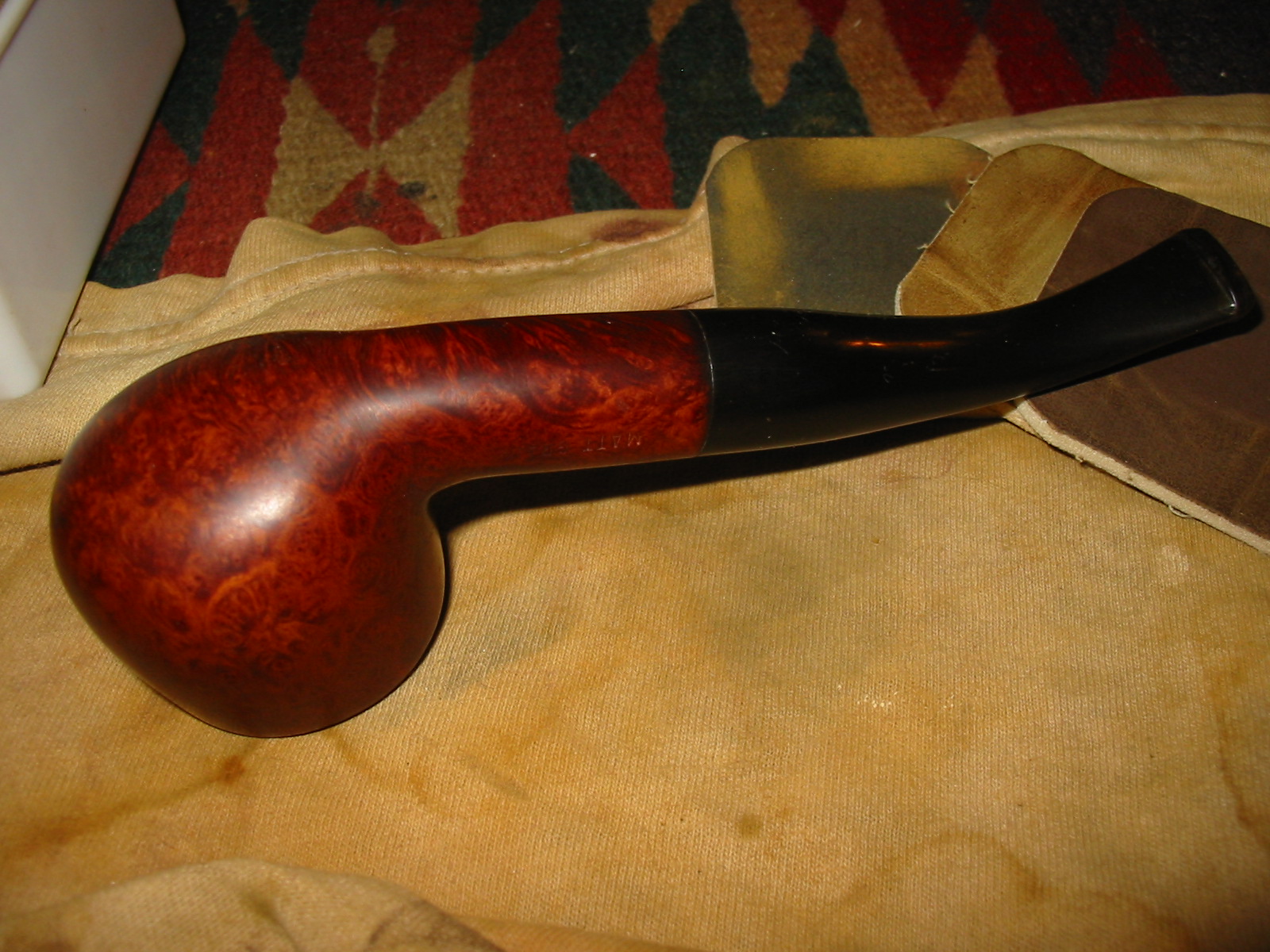
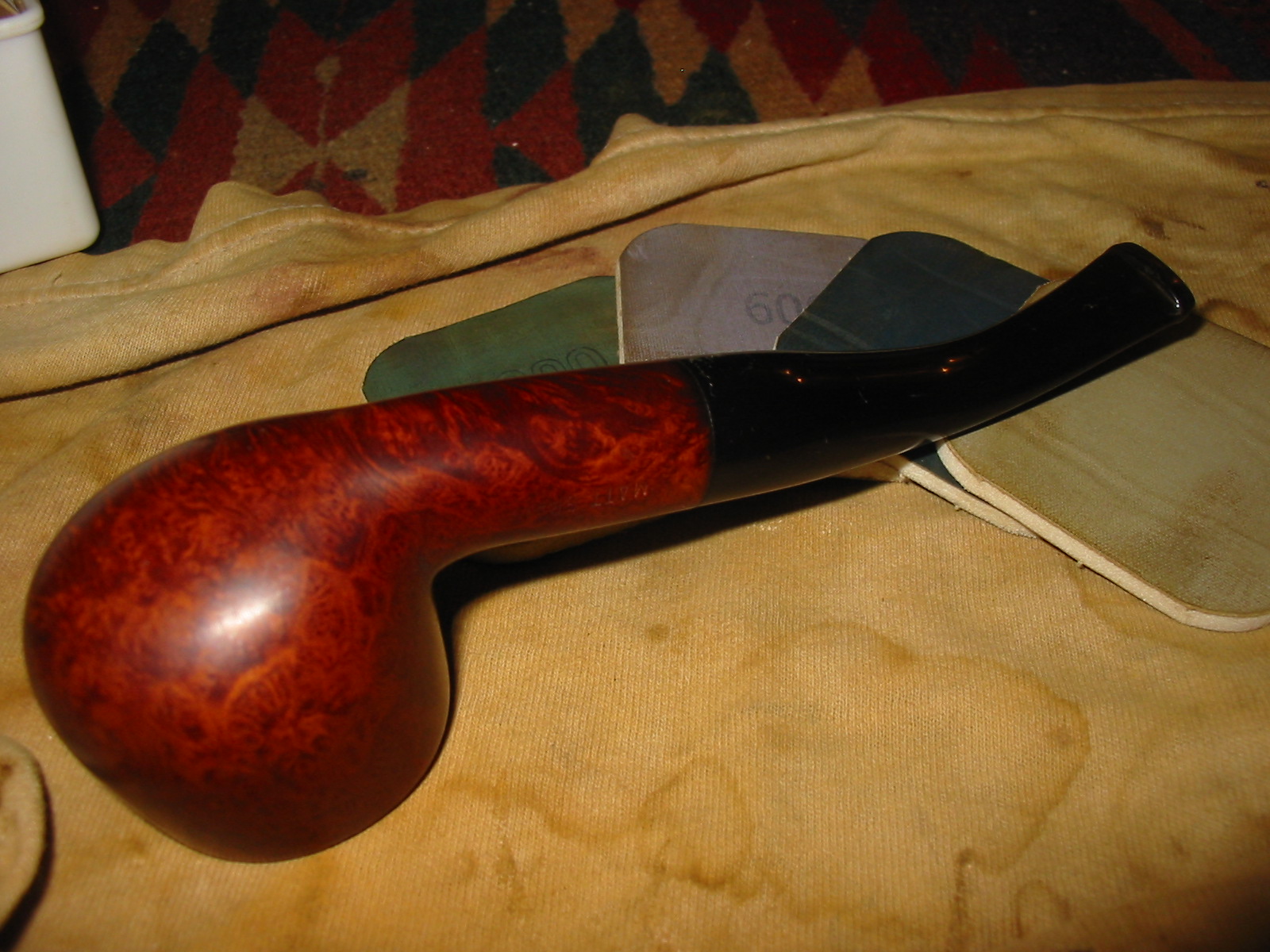
I saw this pipe come up on Ebay and love the shape. Some have called it a bent pot but I am not sure that the name captures the shape but I will call it that nonetheless. Churchill’s was not a brand I was familiar with but it looked very good. The stamping on the pipe is very simple on the left side of the shank it is stamped Churchill’s and on the right side it is stamped Matt Grain. The bowl had been reamed back by the seller before shipping and was well done. No damage to the roundness of the bowl. The inside of the shank was filled with chips of carbon from the reaming and they were stuck in the tar in the shank. The buildup was enough that the stem did not seat in the mortise and there was a gap in the fit of the stem and shank. The rim had some tarry buildup. The stem sat at an angle to the shank as if the tenon was bent slightly. There were three deep tooth marks on the top and the bottom of the stem near the button. The oxidation was present but not heavy at this point. The stem was also plugged with tars and the airflow was very constricted. There was an old English style C stamped on the stem. The first nine photos below were provided by the Ebay seller.

Churchill 1

Churchill 2

Churchill 3

Churchill 4

Churchill 5

Churchill 6

Churchill 7

Churchill 8

Churchill 10

Logo NEW Logo 2012 Small

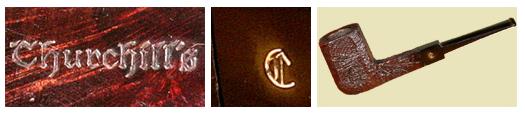
I am fairly certain that the pipe came from Churchill’s Tobacco Shop in Norwich, England. I found the following information on the Pipes and Logos website http://pipephil.eu/logos/en/logo-c4.html On the site there is a small paragraph which I have copied as follows: “Churchill’s Tobacco shop is situated in St Andrew’s Street at the corner of Bridewell Alley in Norwich, England. The shop was next to a church and at the bottom of two hills, and that’s how it became “Churchill’s”. Former manager: John Elvin (retired on May, 31 2008). Current owner (2008): Keith Garrard.” I have included these pictures from that website as they show the stamping on both the shank and stem that is identical to the pipe that I have just refurbished.

Church

According to the Churchill’s website it is the last remaining specialist tobacconist in Norwich, originally standing at 32 St Andrews Street for over 23 years. http://www.churchillsofnorwich.com/index.php?_a=viewDoc&docId=1 The site also notifies the shop’s clients that Keith Garrard, who had a wealth of knowledge and was an avid pipe and cigar smoker himself, passed away on 23rd March 2012. His wife Coral continues to maintain the business in his honor.

I decided to try to remedy the bent tenon on the pipe to begin with. I heated it in a cup of boiling water to try to adjust it and tighten the fit in the mortise. I was able to adjust the fit and get a good tight seat with no gap between the shank and the stem. However, in the process the water oxidized the stem badly. The four photos below show the adjusted fit of the stem and also clearly show the bite marks on the stem – top and bottom near the button.

IMG_1738

IMG_1739

IMG_1740

IMG_1741

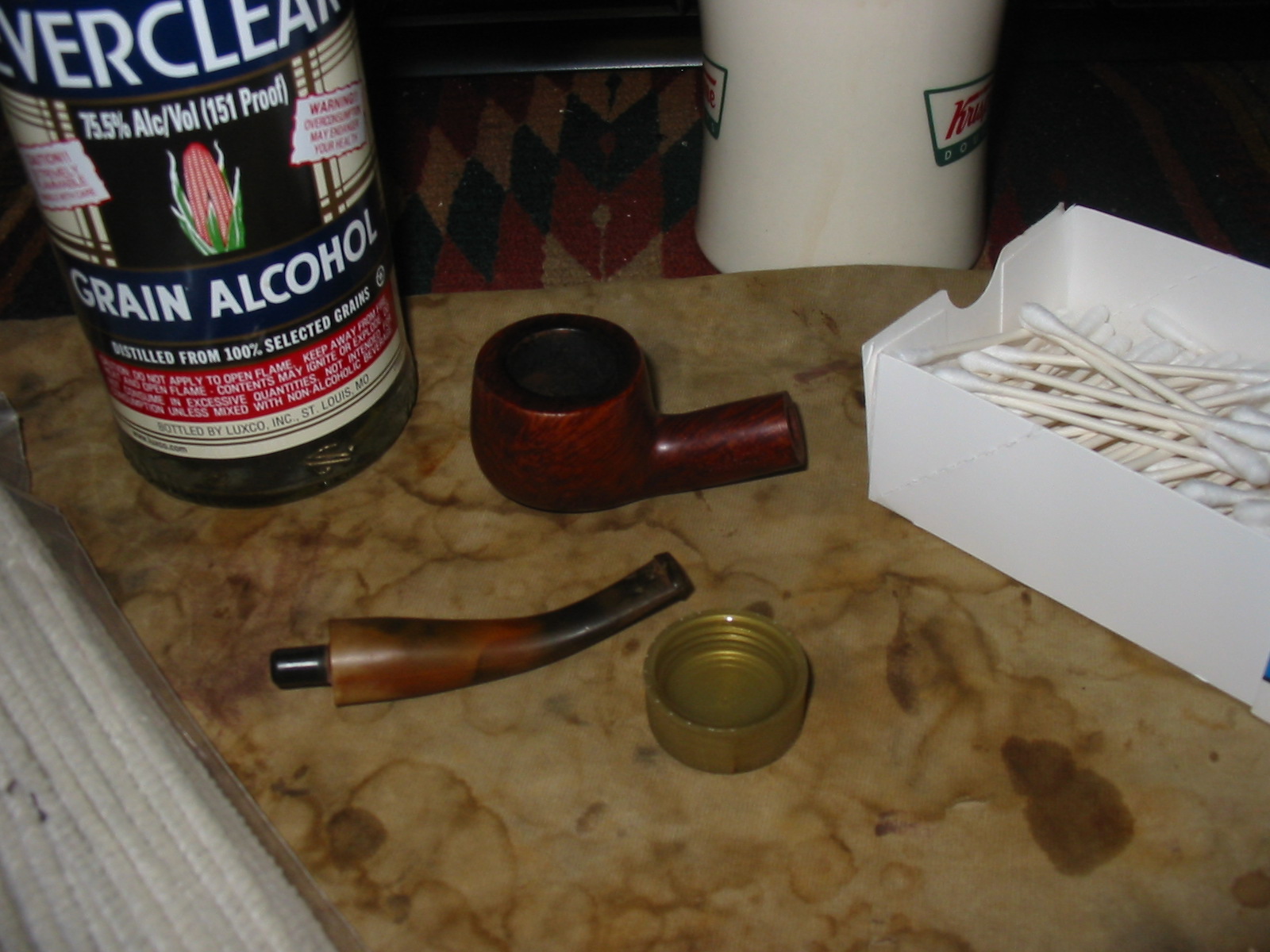
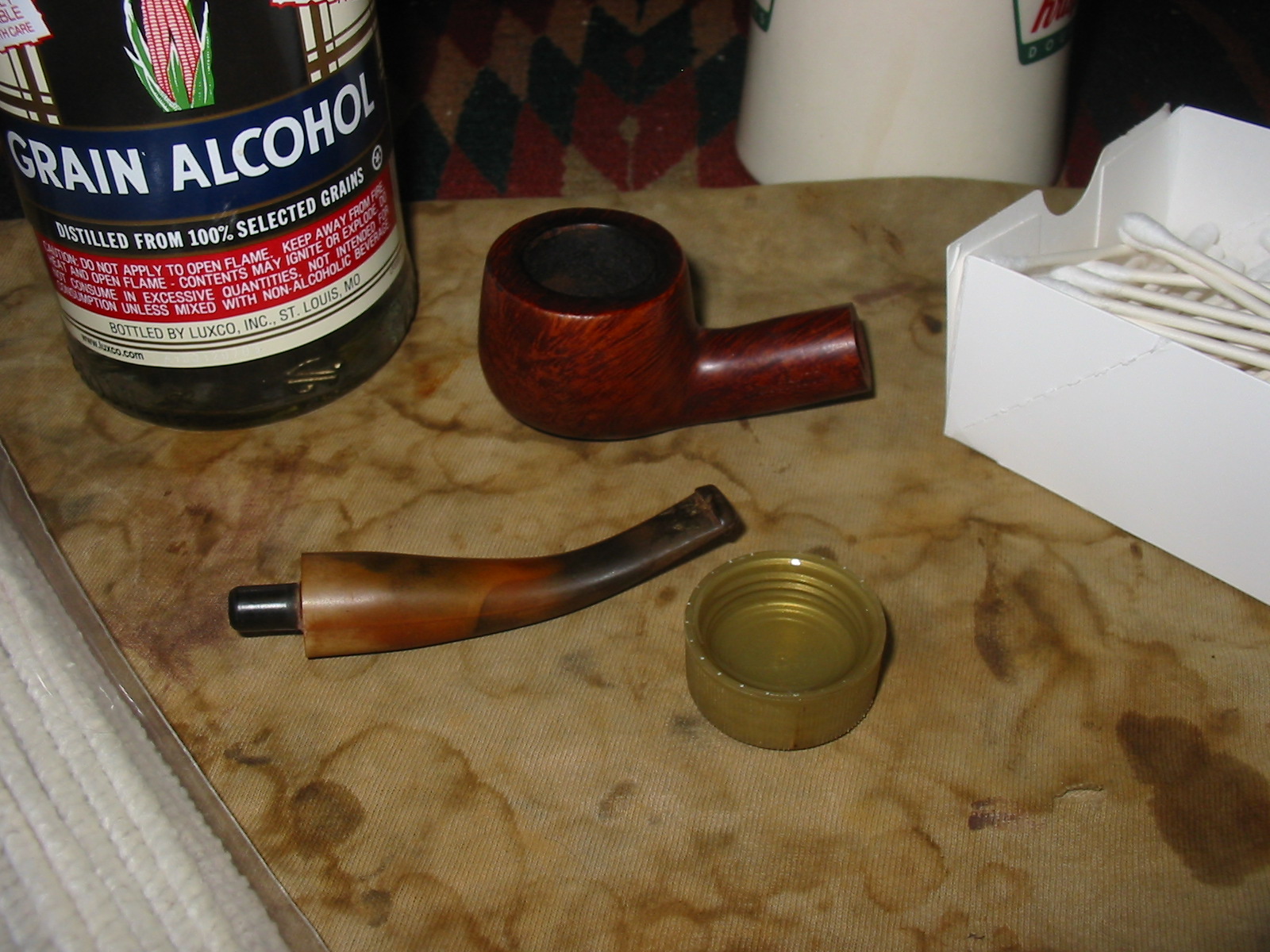
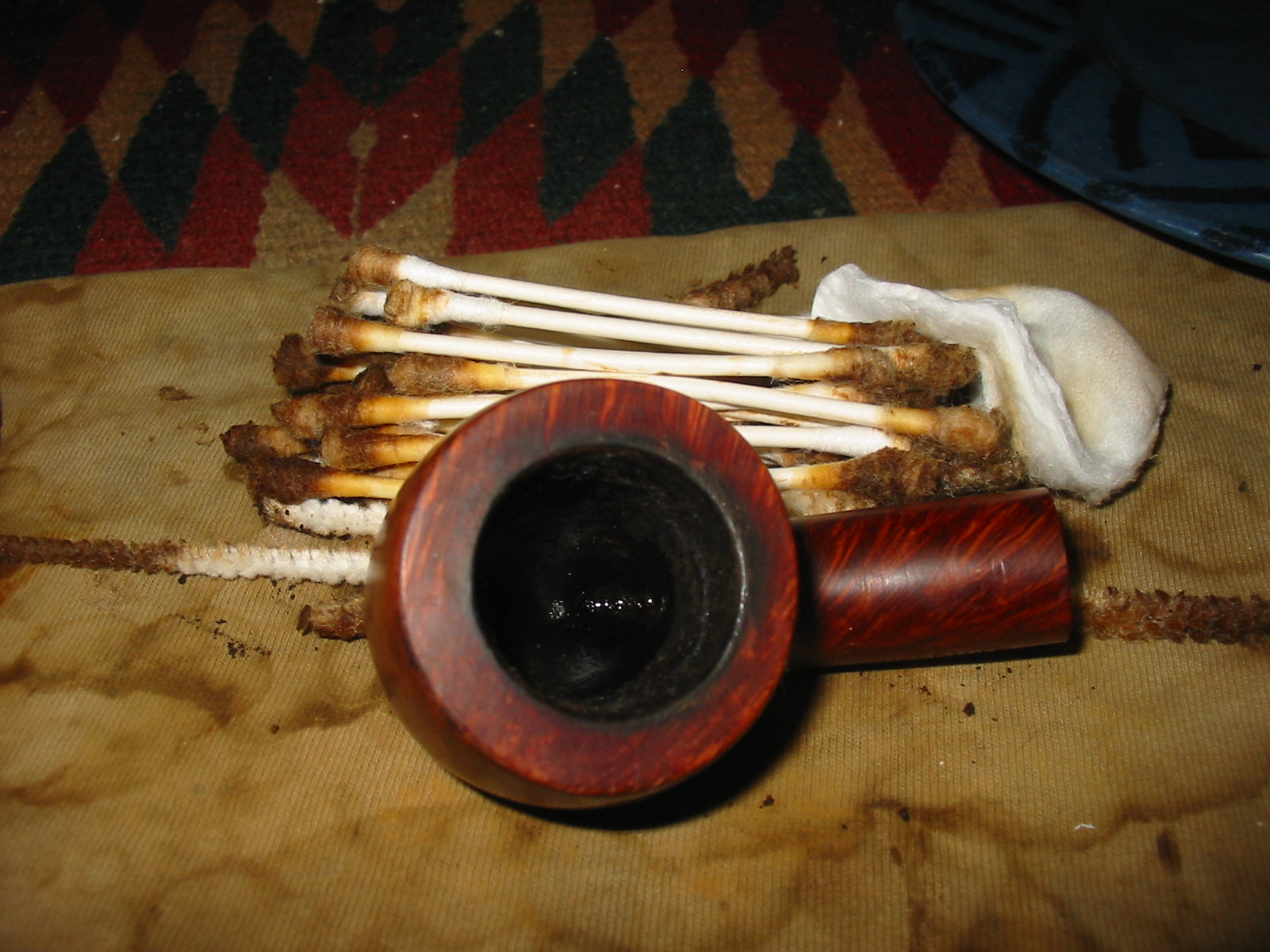
I scrubbed the inside of the shank with Everclear and cotton swabs. I cleaned the airway with bristle pipe cleaners and then fluffy pipe cleaners. I continued to scrub it until the pipe cleaners and cotton swabs came out clean. I cleaned the rim of the bowl with saliva and a cotton pad until the grime was gone. It took a bit more than a cotton pad and saliva so I also used a very fine grit sanding block to knock off the remaining tar, being careful to not break the finish.IMG_1743

IMG_1744

IMG_1745

The stem took a bit of work as it was plugged with grit and tar. I used a dental pick to clean out the slot. To the right of the stem in the photo is some of tar and grit I picked out of the slot. I used a straightened end of the pick to clean deeply in the slot. I then used pipe cleaners soaked in Everclear and pushed them through the blockage. I also opened the slot with needle files to facilitate easy access with pipe cleaners. The slot was very narrow which also made the blockage hard to get at.

IMG_1746

I sanded the stem with 220 grit sandpaper to clean up the surface around the bite marks. In the next three photos the bite marks are visible. I heated them to lift them as much as possible. The bite marks on the top were less troublesome than the ones on the underside. Fortunately the stem was quite thick so that the tooth marks did not go all the way through the vulcanite.

IMG_1747

IMG_1748

IMG_1749

I picked the tooth marks clean with a dental pick and then used black super glue to patch the deep marks that remained. Once the glue had cured and was hard I sanded the patches with 220 grit sandpaper and then a medium grit sanding sponge to smooth out the surface and blend in the patch. The next three photos show the patch after it had been applied and after sanding.

IMG_1750

IMG_1752

IMG_1753

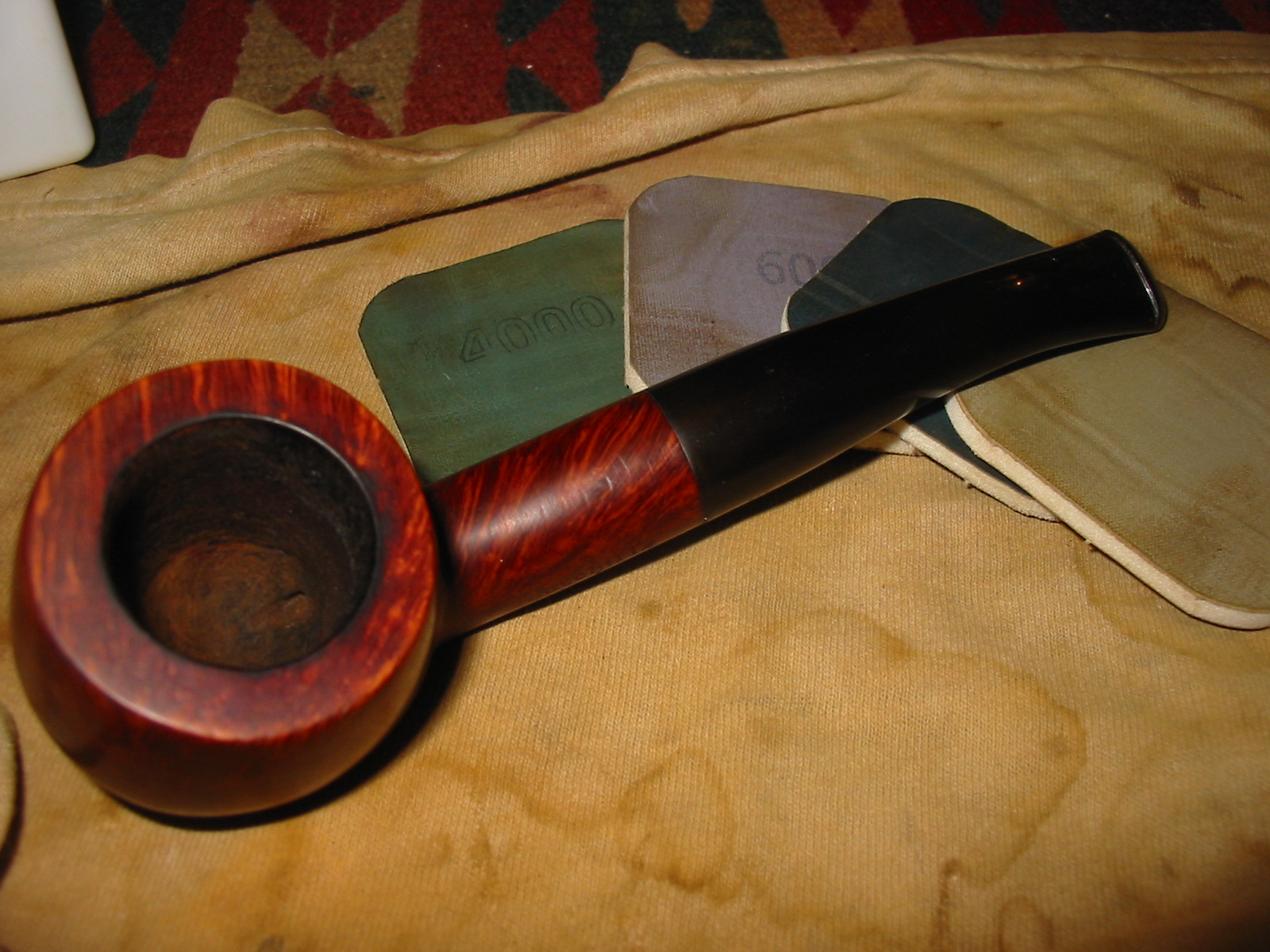
I sanded the stem with micromesh sanding pads from 1500-12,000 grit to finish removing the oxidation and the scratches left behind by the various sandpapers I used. The next series of photos show the progress of the shine after each group of sanding pads.

IMG_1755

IMG_1756

IMG_1757

IMG_1758

IMG_1761

IMG_1762

I wiped the stem down with Obsidian Oil and rubbed it into the surface of the stem. Once it had dried I rubbed it and polished it with a shoe brush before taking the pipe to the buffer. I buffed it with White Diamond and then carnauba wax. I gave it a polish with a clean flannel buffing wheel. The next four photos show the finished pipe. I really like the way the matte finish came alive. The grain really pops. This was an easy refurbish as the finish was in very good shape under the top layer of grime.

IMG_1770

IMG_1771

IMG_1772

IMG_1773

Why I smoke a pipe – Eric Boehm


Blog by Eric Boehm

Here is another of Eric’s pieces – this one is a great essay on why he smokes a pipe. I love the ideas that he has collected in this essay and his straightforward answer to those who question his pipe smoking. Thanks Eric for letting me post this here.

I routinely use this missive as a broad sheet to answer the question of “Why I smoke a pipe”. A question so often asked by many of my anti-tobacco friends. Friends, I might add, that give me a hard time whenever I light up my tobacco pipe. You see, I’m a reader, and my heroes are those I read about. And usually they involve men who smoked a pipe.

Run your eyes down the list below of names and see how many you recognize. Collectively, I would argue, these men actually made the 20th Century, both literally and figuratively. To a man, all avid pipe smokers, each and every one. Moreover, many lived well beyond the average lifespan of their day, many passing in their mid to late-eighties.

Albert Einstein, Mark Twain, William Faulkner, John Steinbeck, Norman Rockwell, Orson Wells, JRR Tolkein, CS Lewis, Douglas MacArthur, Admiral Arleigh Burke, Stanley Baldwin, Neville Chamberlain, Bing Crosby, President Gerald Ford, Carl Sandburg, Harold Macmillan, Konrad Lorenz, Errol Flynn, Edgar Rice Burroughs, John D. MacDonald, Warner Baxter, Thomas Selfridge, Charles Nelson Reilly, Ossip Zadkine, Max Frisch, Paul Casals, Jack Lynch, Patrick Moore, Anthony Hulme, Ronald Colman, Alexander Kent, Jacques Brel, Lino Ventura, Alfred Wainwright, Rudolph Bultmann, Philippe Sollers, Jean Gabin, Leo Malet, G.E. Moore, Gilbert Ryle, Edmund Husserl, J.L. Austin, Lalo Schifrin, James Whitmore, Anthony Quayle, Ralph Richardson, Bernard Grebanier, Jean-Paul Sartre, Stanley Holloway, Carl Jung, Paul Kruger, Curd Jurgens, Gerard Walschap, Trevor Howard, Tony Benn, Rod Hull, Trevor Baylis, Joss Ackland, Frank Muir, Manny Shinwell, Jack Hargreaves, Warren Mitchell, Rupert Davies, Russ Abbot, Van Gordon Sauter, Walter Cronkite, Robert Fulghum, Milorad Pavić, Glenn Ford, Erwin Shrodinger, Moustapha Akkad, Evelyn Waugh, Harold Wilson, Bertrand Russell, Alf Landon, Edgar Buchanan, Dean Jagger, Edward G. Robinson, Rudyard Kipling, Aaron Spelling, P.G. Wodehouse, Allen Dulles, Otto Klemperer, Henry Fonda, Lee Van Cleef, Jack Lemmon, Peter Cushing, Barry Fitzgerald, Hume Cronyn, Graham Chapman, Nigel Bruce, Bennet Cerf, Raymond Chandler, Alexander Graham Bell, Arthur Frank, Richard E. Byrd, Gregory Peck, Albert King, Clarence “Gatemouth” Brown, Edward Abbey, Juan Trippe, Frank Sinatra, General George S. Patton, Jacques Derrida, Hurbert Hoover, Sid James, Fred Trueman, Vincent Schiavelli, Eric Morecambe, Stephen Fry, Fred Thompson, Roscoe Dickinson, Guy N. Smith, Gunter Grass, Sean O’Casey, A.A. Milne, Sir Compton Mackenzie, Laurie Lee, W. Somerset Maugham, J.B. Priestly, Andre Dubus, Gordon Parks, F.A. Mitchell-Hedges, W.W. Denslow, William Conrad, William Gillette, Edwin Hubble, Rober Oppenheimer, Niels Bohr, Robert Young, Clark Gable, Fred MacMurray, Ralph Bellamy, Cary Grant, David Ogilvy, Sir Winston Churchill, King George VI, Arthur Miller, Ernest Hemingway, John Ford, Shelby Foote, Herschel Burke Gilbert, Thomas Johnston Taylor, Theodor Geisel (Dr. Seuss), Sir John Mills, Owen Barfield, Alan Christopher “Al” Deere, Elliot Harold Paul, Healey Willan, Harold Tucker Webster.

After perusing such a list, I ask: Can it be that the greatest minds of the 20th Century were all common miscreants, who did not fully fathom “what they were doing to themselves”? Are we, with all our advances of modern science, more intelligent than they were? How many men today can you count that can measure to the list above? I am hard pressed to find a handful, if that.

We current tobacco pipe smokers actually represent the historical legacy of a community of world pipe smokers, a community which, in the not too distant past, encompassed some 35% of the adult males in the United States. Lest it not be forgotten, these anonymous pipe smokers were our grandfathers, and allowed for the freedoms many of us enjoy today. Although far fewer in number today, we nevertheless still hold the candle to the memory of these men and the deeds they accomplished, with, of course, a pipe in hand.
__________________
Thanks everyone for your positive comments. Whenever I catch flack from anti-tobacco folks, friends, wife & children included especially those do-gooder “soccer moms” driving minivans, who quickly shield their children’s eyes when they see me – I go to length to point out just exactly who historically smoked a pipe. If Albert Einstein saw the sense to smoke a pipe, just to name one – or Shelby Foote, one of my favorites – then who in blue blazes are they to question my choice to smoke a pipe in public? (I started this thread after coming home from a 4th of July picnic, where it was clearly intoned to me that pipe smoking was not allowed in a NJ public park! On account of the kids).

Everyone says they miss the America depicted by Norman Rockwell, or reminisces fondly on the “greatest generation” who fought against fascism in the Second World War. Well, nearly all those joes smoked a pipe! And I don’t mean hidden away in their man caves, but out on the street, holding their kid’s hand, or carrying groceries home. That’s why I like reading Marc Munroe Dion so much. Smoking a pipe in public puts the brakes on society’s mindless, head-strong rush into an uncertain future. In short, it puts the mute button on our infotainment world. Which is something I like. Thanks for letting me rant. I’ll get off the soap box now.
______________________________________
If I’m ever in London, I think I’ll go to the Speaker’s Corner – that point where Oxford Street and Hyde Park meet, in the shadows of Marble Arch – and carry on an oral tradition that is becoming somewhat lost to a modern culture of email and online chat rooms. For over 150 years, Speaker’s Corner has been one of London’s most eccentric attractions. Soapbox central! There, with a large clenched Dunhill group 6 billiard, containing smouldering Pirate Kake, and reeking of 70% Latakia – my chest festooned with a large placard bearing the likeness of Alfred Dunhill – there I shall read out the proclamation entitled “Why I smoke a pipe”. Should be able to get through the first several paragraphs before the Bobbies cart me away in a white coat!
____________________________________
Parting thoughts –
My comments were: “Wow! I am dumbfounded. Personally I don’t give a hoot how pipe smokers are perceived by the wider society. I smoke a pipe throughout the day because I am a pipe smoker. Period. I smoke in private and I smoke in public. I also smoke in the can. If someone has a problem with it, they can contact my lawyer. Really, I could care less what others think of me and my pipe. Life is short enough as it is to worry about what the neighbors think. Get a life. Smoke a pipe. And let’s try not to think too deeply about it. Eh?”

Stem Repair Failure – by Mark Domingues


This is an interesting piece that Mark wrote on a stem repair that not even I would have undertaken. To me this stem was a goner. The hole and missing vulcanite would make a patch virtually impossible in my opinion. But my hat’s off to Mark for giving it a go. He writes up the repair and the failure of the repair in a clear and concise way. Thanks Mark for blazing the trail on this and letting know about one that did not work.

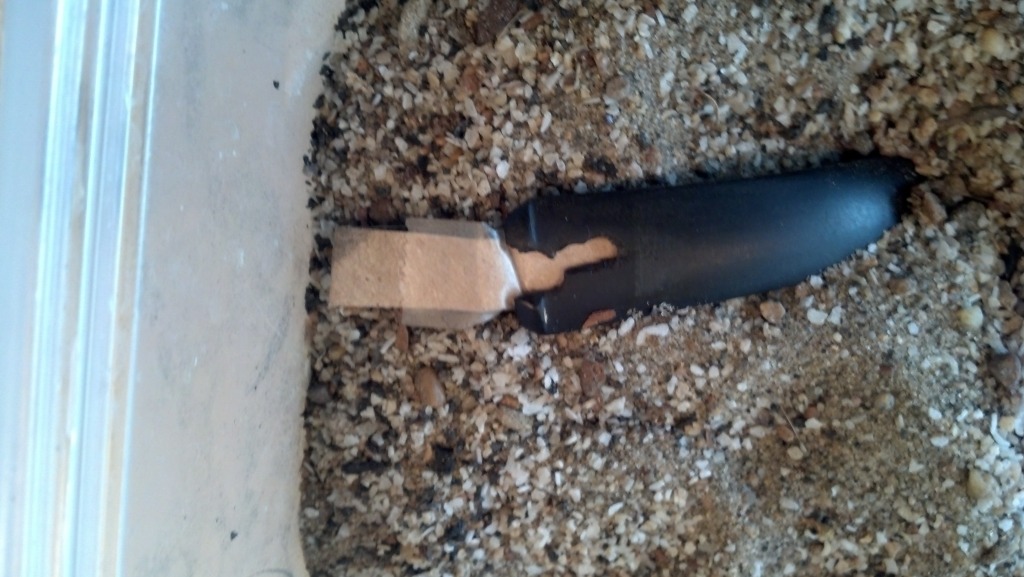
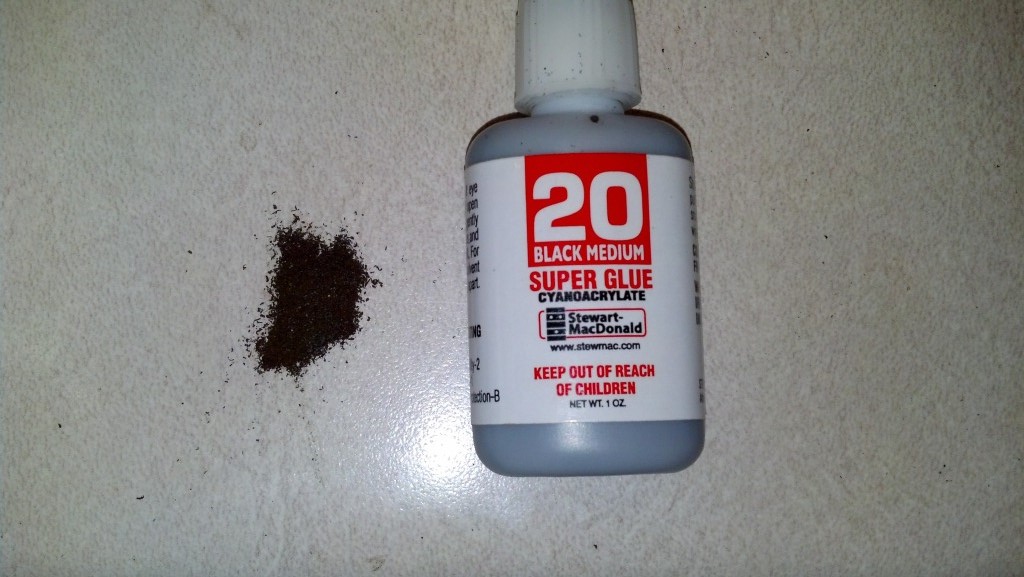
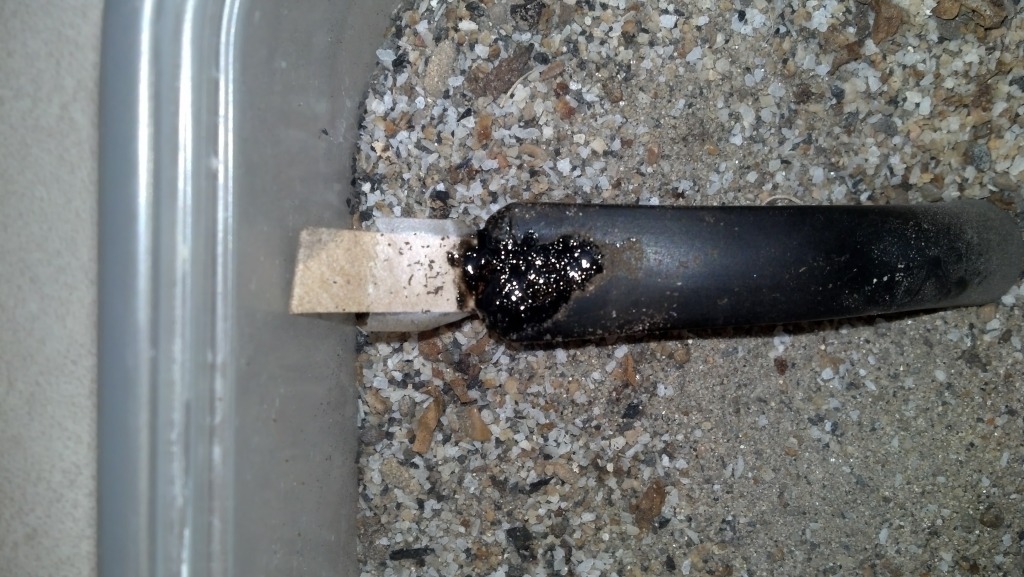
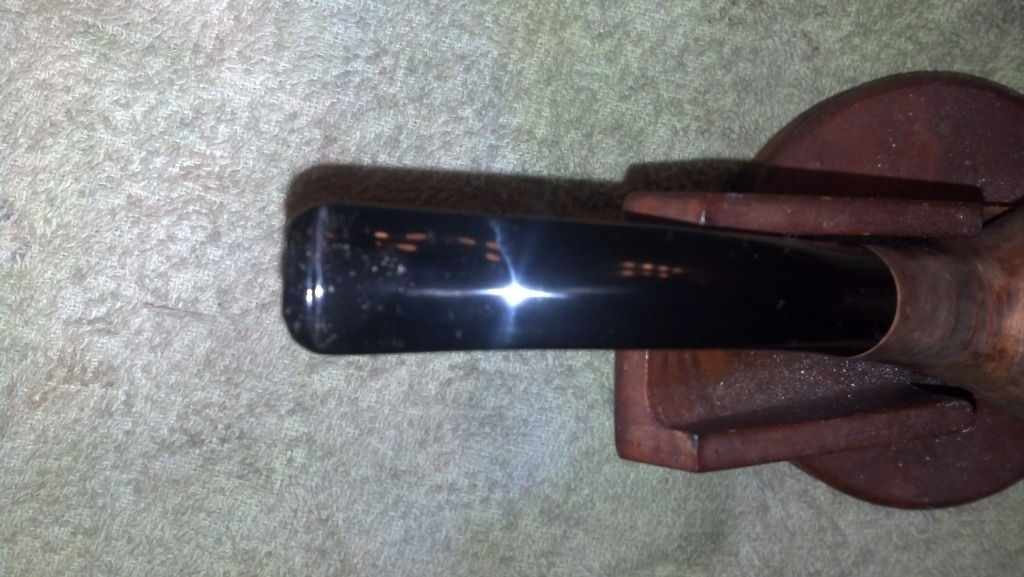
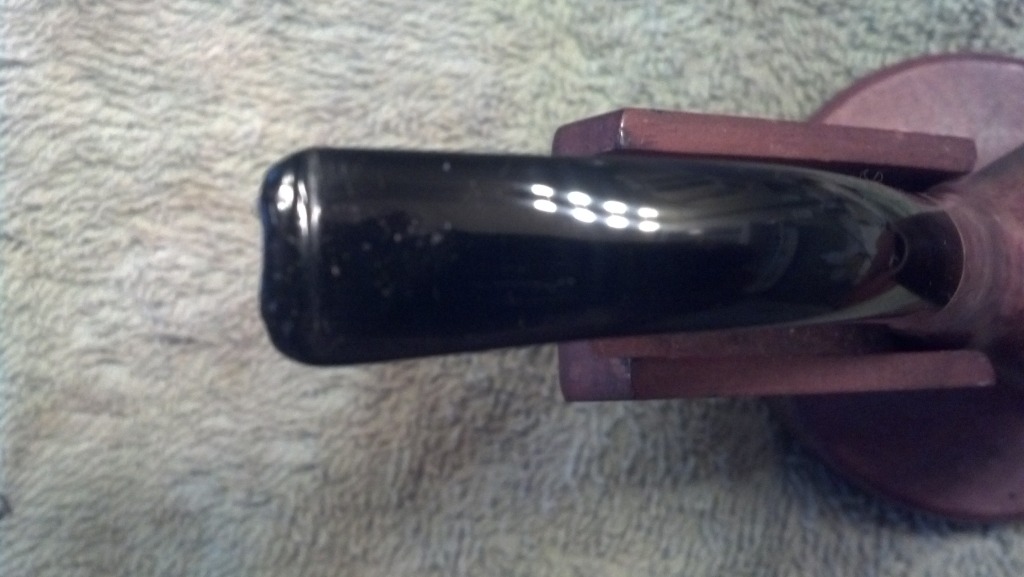
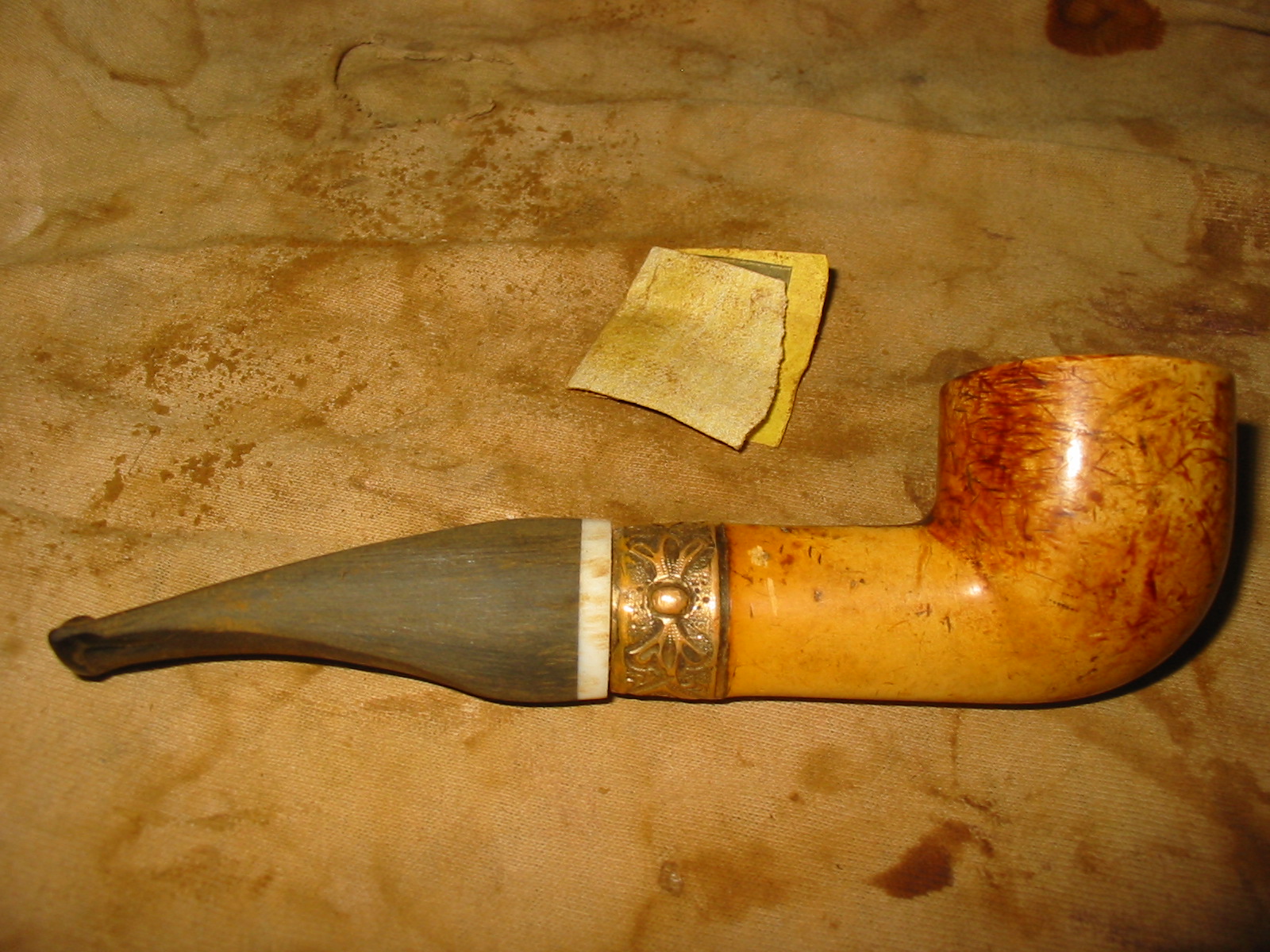
I got a Peterson Shamrock off Ebay with a chunk missing from the stem near the bit. I figured I would try to shape a repair using black super glue and vulcanite dust from an old stem. Instead of using the Oxyclean soak, I “painted” the stem with a bic lighter to remove the oxidation. I put a piece of cardboard wrapped with scotch tape and smeared with Vaseline in the bit end. Then put some glue on the cardboard, sprinkled dust and dripped more glue to make a patch. Since it was a curved stem, I placed it in my bowl of sand I use to do the alcohol and cotton ball treatment. I used to do the alcohol/salt but this is far easier and has the same effectiveness IMHO.
stem1

stem2

stem3

stem4

After drying, I used files and wet/dry paper moving from 320 up to 2000 to get the stem shaped. I used a needle file to reshape the bit, and then took it to my buffer wheels to really shine it. I think it came out great. The camera has some white spots that aren’t on the stem. It looks like a new stem!

stem5

stem6

Well, the repair LOOKED beautiful but didn’t hold!! Running a pipe cleaner through it a week later, it cracked and just crumbled away back to the original picture. I’m wondering about the ratio of glue to vulcanite dust, or like someone said on a pipe forum, the 2 different materials will not hold due to expansion and contraction when heated. Maybe I will try again with more glue, less dust.

Peterson Pre-Republic Shamrock – by Mark Domingues


Mark has been following the blog for awhile now and posting his work on Pipe Smokers Unleashed pipe forum. I have been reading about his work for awhile now and invited him to write about his refurbs for the blog. I am hoping this is the first of many posts that he will do for us on his restorations.

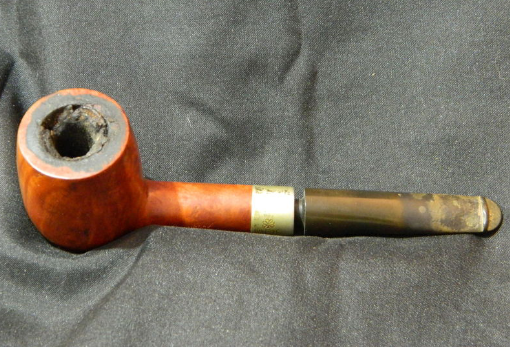
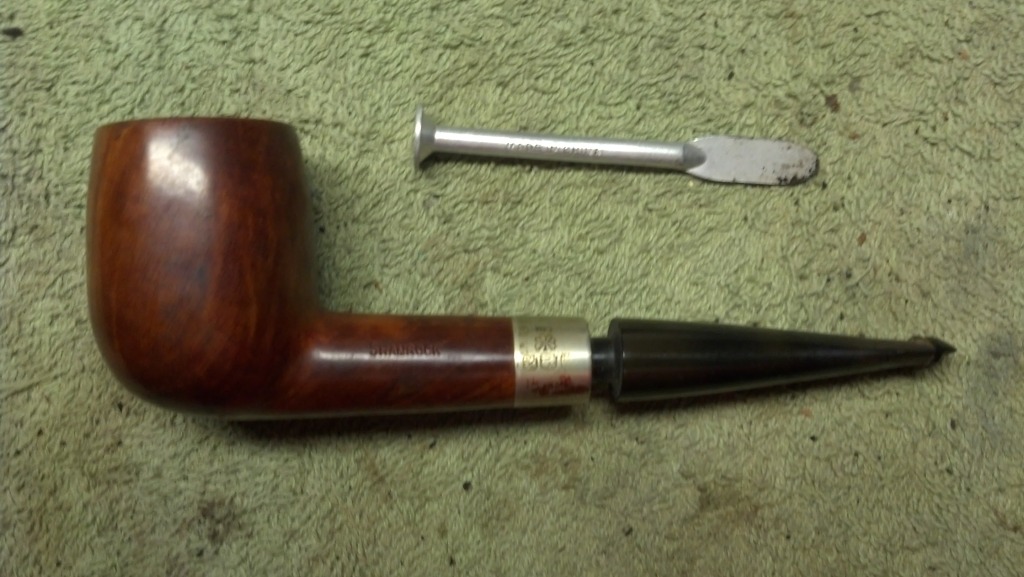
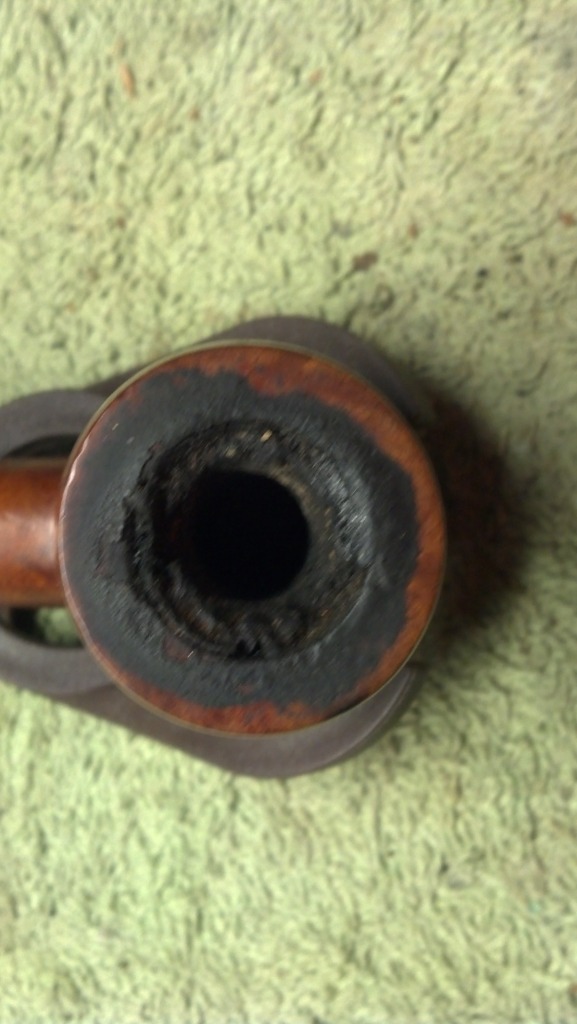
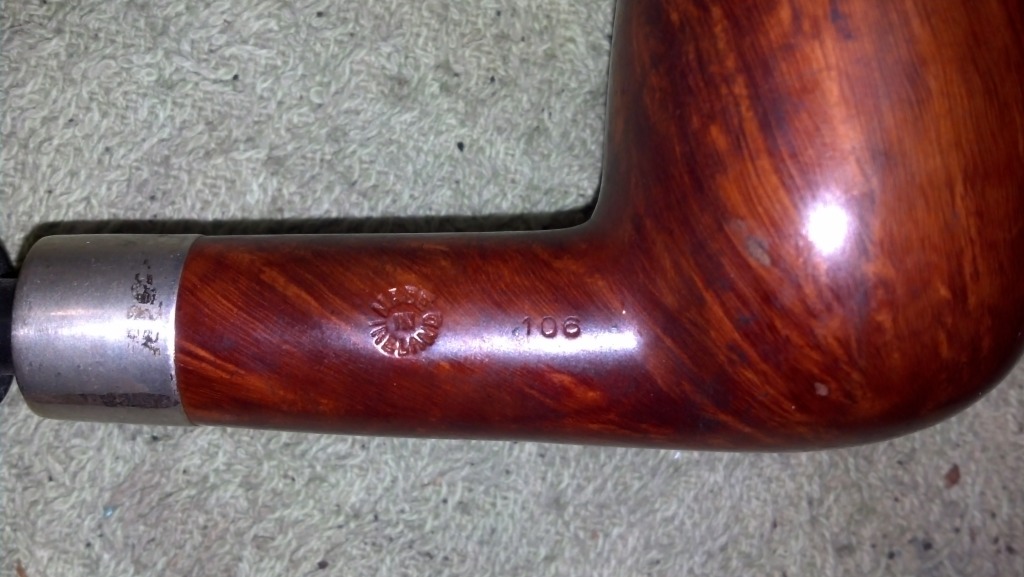
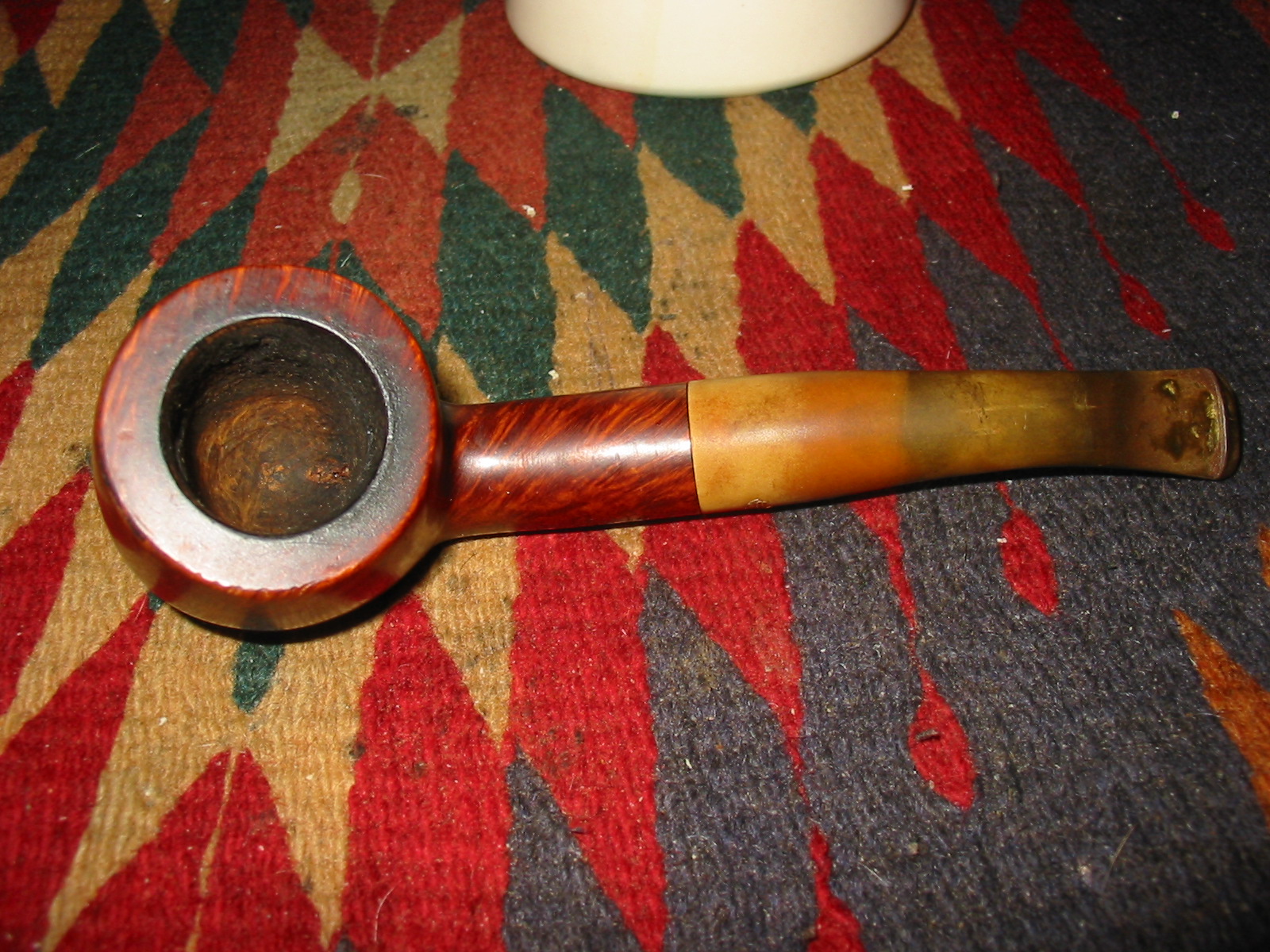
This is my first full writeup on a pipe. I got this Pre-Republic Shamrock shape 106 billiard on eBay. It has the circle COM dating it between 1947-49. The pics from eBay were enough to scare away the casual smoker. The bowl was heavily caked and had severe lava flow on the rim. The calcified stem didn’t fit all the way into the shank, in fact it was stuck. But the nomenclature was crisp and when I saw the “Made in Ireland” circle format, I knew I had to have it!
Pete1

When I got the pipe in, it was just as shown. The cake was so thick I couldn’t get my pinkie into the bowl very far. The stem had a tooth mark divot on the p-lip opening and was frozen into the shank upside down.

Pete2

Pete3

Pete4

First thing I did was use a cotton pad to wipe the outside of the bowl to get rid of 65+ years of grime. The bowl stain was still in excellent condition. Put the pipe in the freezer for 30 minutes then was able to free the stem. I soaked the bowl with the alcohol/cotton ball routine overnight. The next day I reamed the bowl, worked an alcohol soaked shank brush into the shank until the buildup was gone. When dry, the stem fit perfectly!
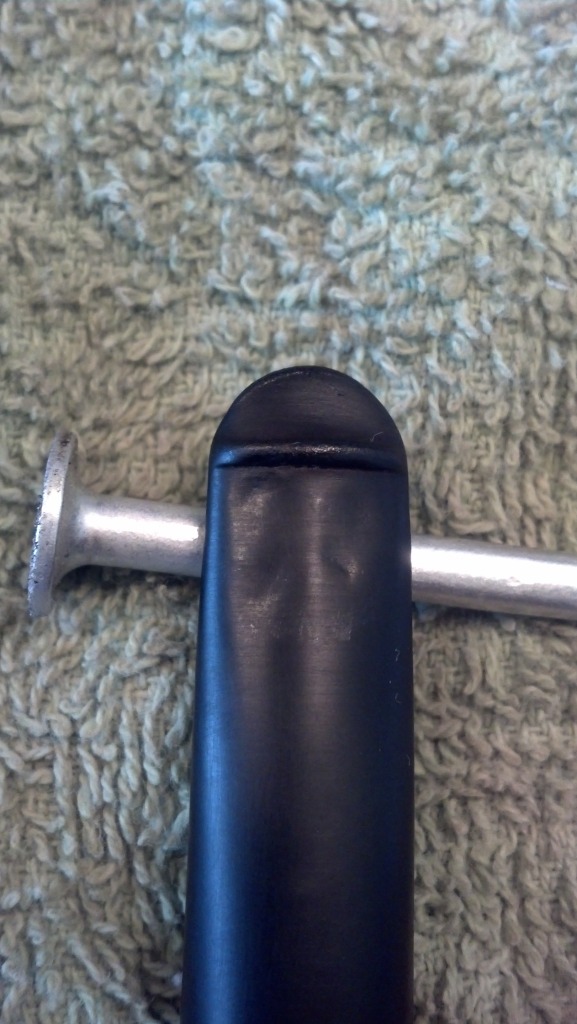
Here is the stem after “painting” it with a bic lighter to remove oxidation and raise up tooth depressions. Note the large divot in the airhole.

Pete5

Pete6

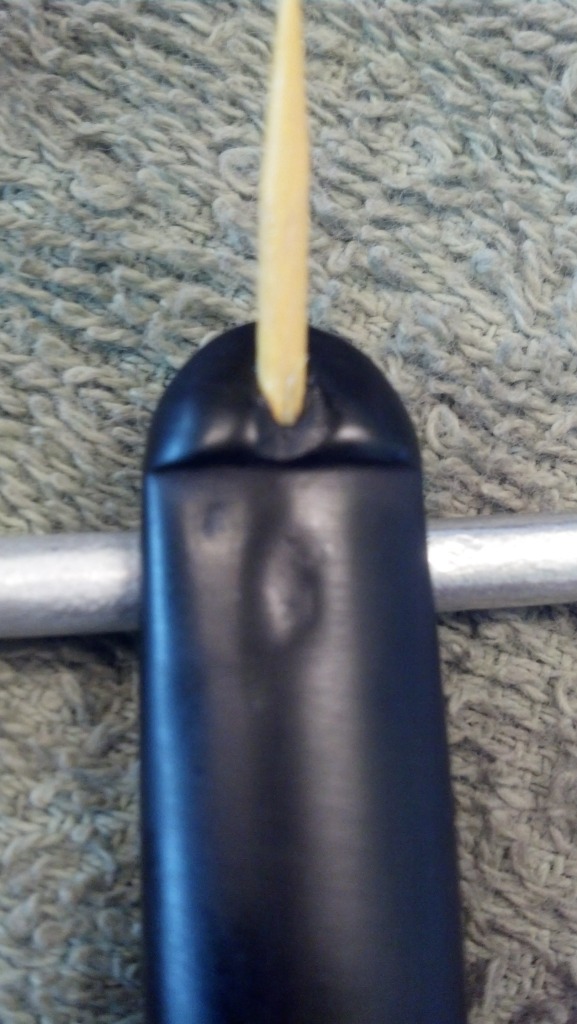
I put a Vaseline coated toothpick in the opening and used the StewMac black superglue to close up the opening to a more normal size, filling in the divot over several days.

Pete7

Using 320 grit wet/dry sandpaper on up to 1200 grit, I reshaped the stem where the glue was built up. Then moving to the Beall 3 wheel buffing system I hit the pipe with Tripoli, white diamond and carnauba wax. Each wheel is dedicated to each compound and is attached to a ½ hp motor on an old barstool in my garage (mancave). I put an old quilt under the buffer because occasionally the pipe or stem I am working on will jump out and hit the concrete. This gives it a soft cushion should it happen. Here is the finished pipe, one of my new favorites!

Pete8

Pete9

Newbie tips (web links for the uninitiated) – Eric Boehm


Blog by Eric Boehm

Eric originally posted this compendium of information on Smokers Forums. I found it to be a helpful collation of information for both the beginning and the long time pipe smoker. His recommendations and the collection of web links is a great beginning point. Each of those who use it can add your own additions and adjustments as you use the material but Eric has done a great service to pipemen everywhere with this information. I wrote to him and asked his permission to post it on rebornpipes. He graciously consented. I have edited it to make the introduction broader than that of its original format. The material is just too valuable to be lost. Thanks Eric for your work on this. To all the readers of rebornpipes – enjoy the wealth of information.

…The old adage, “And though it is much to be a nobleman, it is more to be a gentleman” (– Anthony Trollope) pretty well sums up the experience of becoming a pipeman. It wasn’t so long ago, that wisdom was imparted in the old Brick & Mortar tobacco shop, where one could spend the afternoon, leaning on the counter, sampling tobaccos, learning about pipes, and shooting the breeze with the old timers – gentlemen all. Generations grew up that way. Unfortunately, those days are long gone – chalk it up to “progress”, the faster pace of life, skyrocketing costs, stagnant paychecks – in short, all leading to more work for less gain. Pipe smoking is my way of regaining a balance in a troubled world.

When I first started to smoke a pipe in the late 1980s, I remember being a bit overwhelmed by the number of choices. The primary question was – what to smoke? Although everyone classifies their pipe tobaccos differently, I can see about 15 different categories: (1) Straight (non-flake) Virginias; (2) Virginia Flakes (Light); (3) Virginia Flakes (Full); (4) Virginia /Kentucky Blends; (5) Virginia / Burley Blends; (6) Burley Blends; (7) Virginia / Perique Blends; (8) Virginia / Oriental Blends; (9) Light / Medium Latakia Mixtures; (10) Medium / Full Latakia Mixtures; (11) Lakeland Style (Unscented); (12) Lakeland Style (Scented); (13) Ropes and Plugs; (14) Cigar Leaf Blends; and (15) Aromatics. This classification is my riff on the one provided by the Pipe Club of Norfolk (UK). Within each category, of course, there exists a multitude of individual blend choices. Thus, as a newbie you will never want for a wide variety of choices – in fact, many pipemen pursue the perfect smoke as the pursuit of their “Holy Grail”.

I was also overwhelmed, in my beginnings, by the multitude of pipe materials to choose from (e.g., briar, corn cob, cherrywood, morta [bog wood], olive, maple, clays, meerschaum, metal, etc.) and the multitude of pipe styles to choose from (e.g., quarter bents, half bents, full bents, straights, etc.), not to mention the incredible array of pipe shapes (e.g., acorn, pear, apple, author, bent apple, bent ball, bent billiard, bent brandy, bent bulldog, bent Dublin, bent egg, bent pot, billiard, blowfish, brandy, bulldog, calabash, Canadian, cavalier, chimney, churchwarden, cutty, Dublin, freehand, hawkbill, horn, Liverpool, Lovat, lumberman, Oom Paul, panel, poker, pot, prince, Rhodesian, skater, tomato, volcano, Zulu). Then there were the terms associated with the architecture of the pipe itself (e.g., lip, bit, stem, tenon, stem face, shank face, shank, stummel, bowl, mortise, draft, plenum, heel, foot, rim, chamber, etc.). And lest we forget the types of stem choices (e.g., saddle, tapered, military/army style, screw type, combination type, etc.) and bit style (e.g., standard, wide comfort, fishtail, P-lip, regular and double bore, denture bit, and double comfort bit, to name but a few). A good place to begin to appreciate these terms might be Pipedia, a “wiki for pipes”.

Sitting in my garage in the early 1980s with a clenched Dr. Grabow pipe, full of Captain Black White, I was also trying to learn the basic technique of smoking a pipe – primarily how to avoid tongue bite and palate scorching. I mean if it’s not comfortable, why the hell spend time at it? I finally managed to learn how to develop the slow rhythmic cadence of imbibing tobacco in a pipe, that, when done right, can lead to a significant satisfactory state of mind. There definitely is a “zone” or “Zen state of mind” – call it relaxation if you will – that is reached when smoking a pipe, especially with quality tobacco. I believe it’s this actual mental state that draws me back to the pipe, time and again, rather than to any chemical addiction to the nicotine itself. I would even go so far as to state that, historically, it was the gift of tobacco pipe smoking that was bequeathed to the European by the New World Amerindian, who saw pipe smoking as a religious or sacramental exercise.

What might appear to be a steep learning curve for the beginner has, I am sure, led to the gradual demise of pipe smoking in our culture, in favor of the dreaded cigarette – a fatal transition that occurred throughout the 1950s and 60s. Combined with the physical disappearance of the small mom and pop tobacco shop, where the tradition of pipe smoking was orally passed down “father to son”, so to speak, it spelled the end of the wide-spread pipe smoking culture.

As I grew up in the 1960s, I distinctly remember many pipe smokers in the streets and shops, but by the end of the decade, an entire generation gave up the pipe for the cigarette. Chalk it down to advertising, or the faster pace of life. I know that deep, repeated inhalation of tobacco will most definitely kill you. I have seen it in family members first hand. Perhaps it is this that has driven the anti-tobacco movement to mistakenly group all tobacco products as dangerous. Of historical interest to the new pipe smoker, it would be worthwhile to visit the various sites listing the biographies of famous pipe smokers, many of whom lived well into their late 80s. I think I speak for many of us when I say that pipe smoking has progressed far beyond a mere hobby, and, in fact, has become a way of life. A deeply satisfying way of life, I might add.

Why did I decide to write this article? I found that as I was welcoming new members to an online pipe smokers forum, I began to think what I would be seeking in an on-line community of pipe smokers, if I were new to the game. Due to accumulated wealth of information available in the archives on most pipe forums, a real wealth of data related to the pipe and cigar smoking community may at times seem a bit overwhelming to the newbie. I realized that what I would be seeking initially would be a single thread that could serve as an introduction to the pipe smoking craft. The thread would contain a list of hyperlinks that related to: (1) Forum options, (2) Blogs, (3) e-Magazines, (4) Societies and Clubs (5) Tobacco reviews, (6) Retailer Listings, (7) Retailers (8) Less expensive pipes, (9) Estate Pipes, (10) More expensive pipes, (11) Pipe repair sites, (12) Pipe cleaning / maintenance sites, (13) Pipe smoking technique links, (14) Pipe books, (15) Famous pipe smokers, (16) Introductions to pipe tobaccos and, finally, (17) a series of my favorite pipe related quotes.

Essentially, this is what I have prepared here: A single package of links that would enable the newbie to at least get a firm footing in the craft of pipe smoking. With a firm basis of links, the newbie would then be off to a running start and have access to the wealth of information available of the internet. It should be remembered that these are merely recommendations, and do not constitute all the links that are out there. As such, the links are meant to be jumping off points for those of you who are new to pipe smoking – nothing more, nothing less. (I would also like to take this opportunity to ask my fellow pipe travelers if there are sites not listed that you think should be, please, by all means, let me know, and I would be more than happy to oblige you). In the end, as a new pipe smoker, you will eventually find what works for you, through trial and error. Hopefully, these links will minimize the latter. Of course, you’ve already done the best thing by joining up with this forum. My goal throughout is simply to try to retain the newbie so that our pipe smoking community can continue to grow. The more the merrier. So, here goes…

(1)Forums:
http://www.smokersforums.co.uk/forums.php
http://pipesmagazine.com/forums/
http://pipechat.info/index.php?PHPSE…1nb194t81e6v3&
http://forum.pipes.org/discus/discus.cgi
http://www.puff.com/forums/vb/general-pipe-forum/
http://www.pipemakersforum.com/
http://thepipesmoker.wordpress.com/
http://www.pipesmokerscubby.com/forum.php

(2)Pipe Blogs:
http://glpease.com/BriarAndLeaf/
http://www.apassionforpipes.com/
http://www.qualitybriar.com/blog/
http://pipedia.org/index.php?title=Main_Page
http://www.smokingpipes.com/blog/index.cfm
http://olefattguy.blogspot.com/
http://briarfiles.blogspot.com/
http://smokingpipetobacco.com/
http://pipesmagazine.com/blog/category/kevins-blog/
http://pipesmagazine.com/blog/catego…-of-the-ashes/
http://talbertpipes.blogspot.com/
http://www.brothersofbriar.com/
http://blog.enriquepipes.com/
http://www.pipemakersforum.com/
http://www.loringpage.com/
http://meanderingsmoke.blogspot.com/ (Meandering Smoke)
http://www.pipesmokerunleashed.com/ Pipe Smoker Unleashed

(3)Pipe eMagazines:
http://pipesmagazine.com/ (Pipesmagazine.com)
http://www.pt-magazine.com/ (Pipes & Tobacco Magazine)
http://www.pipesmokemag.com/ (Pipe Smoke Magazine)

(4)Societies & Clubs:
http://naspc.org/ (North American Society of Pipe Collectors)
http://www.corpipesmokers.org/ (Conclave of Richmond Pipe Smokers)
http://www.seattlepipeclub.org/ (Seattle Pipe Club)
http://www.pipeshowonline.com/ (Pipe Show On-line)

(5)Tobacco Reviews:
http://www.tobaccoreviews.com/
http://luxurytobaccoreviews.com/
http://pipes.priss.org/
http://smokingpipetobacco.com/
http://pipesmagazine.com/blog/catego…bacco-reviews/
http://members.bellatlantic.net/~vze43wza/pipes.html

(6)Retailer listings:
http://pipesmagazine.com/pipe-store-locator/
http://www.pt-magazine.com/home.php?id=40
http://www.rtda.org/links.html

(7)Retailers:
http://www.smokingpipes.com/ (Smokingpipes)
http://www.cupojoes.com/ (CupOJoes)
http://www.iwanries.com/home.cfm (IwanRies)
http://www.uptowns.com/index.php (Uptowns)
http://www.pipesandcigars.com/ (Pipes & Cigars)
http://cornellanddiehl.com/ (Cornell & Diehl Tobacco)
http://www.4noggins.com/ (4 Noggins)
http://www.mac-baren.com/TopMenu/Main-2.aspx (Mac Baren Tobacco)
http://villigerstokkebye.com/ (VilligerStokkebye Tobacco)
http://www.pipetobacco.com/Merchant2…AFFIL=6E0Bo1ga
http://www.paylesspipes.com/ (Payless Pipes)
http://www.pipesandcigars.com/ (Pipes & Cigars)
http://www.lewispipe.com/ (Lewis Pipe & Tobacco)
http://www.thebriary.com/ (The Briary)
http://www.alpascia.com/pipes/ (Al Pascia)
http://www.mkelaw-pipes.com/ (Mkelaw Pipes)
http://www.libertytobacco.com/ (Liberty Tobacco)
http://www.pipemakers.org/ (Pipe Makers Emporium)
http://www.cigarandtabacltd.com/ (Cigar &Tabac, Ltd.)
http://www.faderstobac.com/ (Fader’s)
https://www.facebook.com/pages/The-B…34344463248233 (The Briar & the Burley) http://www.kramerstobaccoshop.com/fr…eframeset.html (Kramer’s Pipe & Tobacco Shop) http://www.greentreetobacco.net/home.html (Greentree Tobacco Co. Inc.)
http://www.obsidianpipe.com/ (Haunted Mists New Obsidian Oil anti-oxidation curative) http://www.parklanetobacconist.com/ (Park Lane Tobacconist)
http://tobaccoshop.com/tobacco.html (Tobacco Shop of Ridgewood NJ)
http://www.pipestud.com/ (Pipestud – rare tobacco tins)
http://www.justforhim.com/catalog/ (JustForHimTobbacconist)
http://www.marscigars.com/ (Mike Rutt’s Mars Cigars & Pipes)
http://fujipub.com/briarpatchcigar/ (Briar Patch & Cigar)
http://www.alleghenysmokeworks.com/ (Allegheny Smoke Works)
http://www.abnersworld.com/ (Abners’ World)
http://www.tobacco-barn.com/t-so-pipesandtobacco.aspx (Tobacco Barn)
http://www.ljperetti.com/ (L.J. Peretti)
http://www.outwesttobacco.com/ (Out West Tobacco)
http://www.rdfield.com/ (R. D. Field LLC)
http://www.thebriary.com/ (The Briary)
http://www.thebriarpipe.com/ (The Briar Pipe)
http://www.tinderbox.com/index.fx? ca…6406&cid=&csm= (The Tinder Box) http://www.chiefcatoonah.com/index.html (Chief Catoonah Tobacconist)
http://www.smokershaven.com/about-us.aspx (Smokers Haven)
http://www.pipeshop.com/ (Pipeshop.com)
http://www.milantobacco.com/ (Milan Tobacco)
http://mccranies.com/store/ (McCranie’s Pipe & Tobacco)
http://www.natsherman.com/ (Nat Sherman)
http://gatlinburlier.com/ (The Gatlinburlier Tobacconist)
http://www.smfrankcoinc.com/ (S.M. Frank & Co.)
http://www.boswellpipes.com/ (Boswell Pipes)
http://www.briarblues.com/ (Briar Blues)
http://www.brighampipes.com/2006%20Update.htm (Brigham Pipes)
http://www.pipeandpouch.com/avcopi.html (Pipes & Pouch)
http://www.pipes2smoke.com/ (Maxim Engel)
http://www.meerschaumstore.com/categories.asp (Meerschaum Pipes)
http://www.milantobacco.com/pipes.htm (Milan Tobacco)
http://www.aab-taxfreepipes.com/defa…=false&lang=uk (Bisgaard Pipes)
http://www.neatpipes.com/store/comersus_index.asp (Neat Pipes)
http://www.finepipes.com/ (Fine Pipes International)
http://www.lenuvolepipes.com/ (Le Nuvole Pipes)
http://www.pulversbriar.com/ (Marty Pulvers)
http://piapipes.com/default.asp?lang=uk1 (Pia Pipes)
http://www.jamesislandpiper.com/ (The James Island Piper)

(8)Less Expensive Pipes:
http://www.corncobpipe.com/ (Missouri Meerschaum corn cob pipes USA)
http://www.charlespipes.com/charlespipecollectibles (Stanwell Pipes)
http://www.peterson.ie/pipes/pipes.html (Peterson Pipes Dublin)
http://www.drgrabow.net/ (Dr. Grabow Pipes USA)
http://www.smfrankcoinc.com/kaywoodie/index.htm (Kaywoodie Pipes)
http://www.smfrankcoinc.com/ybmd/index.htm (Medico &Yello-Bole Pipes)
http://www.boswellpipes.com/index.html (Boswell Pipes USA)
http://www.premierpipes.com/Falconpi…lconpipes1.htm (Falcon Pipes)

(9)Estate Pipe Listings:
http://www.estatetobaccopipes.com/search (Ticker tape estate pipe listings)
http://exilesplace.dk (Exile’s Pipes)
EBay favorite sellers: This’ll get you started on the estate listings…
ashtonpipes1
coopersark
pipestud
thesecondhandsmoker
great-estate-pipes
bruyerepipestinashobby
pipegirl1380
beeshquatrolife
jatane
treasurepipes

(10)More Expensive Pipes:
http://www.qualitybriar.com/ (Quality Briar)
http://www.twofriendspipes.com/(Two Friends Pipes)
http://www.oldnelliepipes.com/ (Old Nellie Pipes)
http://ssl.cybersun.com/4Dscripts/we…enterstore?ams (Mark Tinsky Pipes)
http://www.downiepipes.com/home.html (Stephen Downie Pipes)
http://www.remingtonpipes.com/ (Adam Remington Pipes)
http://www.baweaverpipes.com/ (Bruce Weaver Pipes)
http://www.ashton-taylor.com/ (Ashton-Taylor Pipes)
http://www.annejulie.com/pipes.html (Anne Julie Pipes)
http://www.chhedapipes.com/ (Chheda Pipes)
http://www.bonaquisti.com/ (Bonaquisti Pipes)
http://www.cornelius-maenz.de/ (Cornelius Maenz Pipes)
http://www.pohlmannpipes.com/ (Brad Pohlmann Pipes)
http://jwh.fastmail.fm/ (Jack Howell Pipes)
http://www.smokingpipes.com/pipes/ne…dson/index.cfm (Adam Davidson)
http://www.willpurdy.com/index.htm (Will Purdy Pipes)
http://www.parkspipes.com/ (Michael Parks Pipes)
http://www.shurewoodbriarpipes.com/Welcome%21.html (Colin Rigsby Pipes)
http://www.beckerpipes.com/ (Paolo Becker Pipes)
http://www.perrywhitepipes.com/ (Perry White Pipes)
http://www.florovpipes.com/ (Alex Florov Pipes)
http://www.pipendoge.de/mehret_infoengl.htm (Tom Richard Pipes)
http://www.hedingpipes.com/ (Peter Heding Pipes)
http://www.heeschen-pipes.dk/default.asp (Peter Heeschen Pipes)
http://www.matzhold-peter.at/ (Peter Matzhold Pipes)
http://www.ailarov.com/ (Sergey Ailarov Pipes)
http://www.smpipes.com/ (Steve Morrisette Pipes)
http://www.tatupipe.com/english.html (Tatsou Tajima Pipes)
http://www.pipendoge.de/mehret_infoengl.htm (Tom Richard Mehret Pipes)
http://www.jalanpipes.com/ (J. Alan Pipes)
http://www.lobnik.com/ (Gregor Lobnik Pipes)
http://www.ming-kahuna.com/ (Ming Kahuna Pipe Accessories)
http://www.pipemoretti.com/ (Moretti Pipes)
http://perrywhitepipes.com/ (Perry White Pipes)
http://www.vollmer-nilsson.com/ (Vollmer & Nilsson Pipes)
http://www.willpurdy.com/index.htm (Will Purdy Pipes)
http://www.wolfgang-becker-pfeifen.de/ (Wolfgang Becker)
http://www.crosbypipes.com/ (John Crosby Pipes)
http://www.moritz-pipes.com/Bitmap/A…8/album_01.htm (Jurgen Moritz Pipes)
http://www.kentpipes.com/ (Kent Rasmussen Pipes)
http://www.shekitapipes.com/ (Konstantin Shekita Pipes)
http://www.ballebypipes.com/gallery/index.html (Kurt Balleby Pipes)
http://www.larryssonpipes.com/ (Larrysson Pipes)
http://www.maigursknetspipes.com/smo…71present.html (Maigurs Knets Pipes)
http://www.pipendoge.de/Revyagin_infoengl.htm (Michail Revyagin Pipes)
http://www.von-erck.com/ (Lee Von Erck Pipes)
http://raddavispipes.com/ (Rad Davis Pipes)
http://emarklepipes.com/ (Ernie Markle Pipes)
http://claessenpipes.com/ (Dirk Claessen Pipes)
http://www.andersenpipes.dk/ (Søren Eric Andersen Pipes)
http://www.formerpipes.com/former.html (Former Pipes)
http://www.p-i-p-e.com/ (Andrew Marks Pipes)
http://www.kevinarthurpipes.com/ (Kevin Arthur Pipes)
http://www.davidjonespipes.com/index.php? page=about (David Jones Pipes)
http://www.drbobpipes.com/pipes.html (Dr. Bob Pipes)
http://www.pipestudio.com/ (Elliot Nachwalter Pipes)
http://www.lunapipes.com/ (Luna Pipes)
http://www.rmperkins.com/ (RM Perkins Pipes)
http://www.enriquepipes.com/fr/accueil.htm (David Enrique Pipes)
http://www.danishpipemakers.com/makerindex.html (Danish Pipemaker List)

(11)Pipe Repairs:
http://www.nightowlpipeworks.com/home/ (Night Owl Pipe Works)
http://www.precisionpiperepair.com/ (Precision Pipe Repair)
http://www.walkerbriarworks.com/ (Walker Briar Works)
http://www.jhlowe.com/tobacco_pipe_repairs.htmhttp://www.norwoodspiperepair.com/ (Norwood’s Pipe Repair)
http://www.lewispipe.com/repair.htm (Lewis Pipe Repair)
http://www.jmarini.com/ (J Marini Pipe Repair)
http://www.americansmokingpiperepairs.com/ (American Smoking Pipe Repairs)

(12)Pipe cleaning & Maintenance:

http://pipedia.org/index.php?title=Pipe_care/cleaning

(13)Pipe smoking techniques:
http://pipedia.org/index.php?title=P…ing_techniques

(14)Books on pipes:
http://www.briarbooks.com/

(15)Famous Pipe Smokers:
http://josephcrusejohnson.blogspot.com/http://homepage.mac.com/ericmelby/Pi…us/famous.html http://www.fumeursdepipe.net/personnalites13.htm

(16)Introductions to Pipe tobaccos:
http://pipedia.org/index.php?title=Pipe_Tobaccoshttp://www.glpease.com/http://www.pipeclubofnorfolk.co.uk/touchstones.php

(17)Favorite pipe quotes:
“The fact is, Squire, the moment a man takes to a pipe, he becomes a philosopher. It’s the poor man’s friend; it calms the mind, soothes the temper, and makes a man patient under difficulties. It has made more good men, good husbands, kind masters, indulgent fathers, than any other blessed thing on this universal earth.” – Sam Slick, The Clockmaker

“I believe that pipe smoking contributes to a somewhat calm and objective judgment in all human affairs.” – Albert Einstein

“As an example to others, and not that I care for moderation myself, it has always been my rule never to smoke when asleep, and never to refrain from smoking when awake.” – Mark Twain

“A pipe is a tool by which we use our breath to turn leaves into ashes.” – Marty Pulvers

“A cigarette is to be smoked. A cigar is to be enjoyed. A pipe is to be savored.” – Groucho Marx

“A woman is an occasional pleasure but a cigar is always a smoke”. – Groucho Marx

“Nowhere in the world will such a brotherly feeling of confidence be experienced as amongst those who sit together smoking their pipes.” – The Results and Merits of Tobacco, 1844, Doctor Barnstein

“The value of tobacco is best understood when it is the last you possess and there is no chance of getting more.” – Bismarck.

“Pipe smoking is the most protracted of all forms of tobacco consumption. It may explain why pipe smokers are generally regarded as patient men and philosophers.” – Jerome E. Brooks, from The Mighty Leaf, Tobacco Through the Centuries

“Well, it keeps my hands busy, and my mouth shut.” – Exile

“…So it shall be for all time. If discord has broken out between two beings, let them smoke together. United by this bond, they will live in peace and friendship thereafter.” – Attributed to the Great Manitu, the Great Spirit.

“A pipe is the fountain of contemplation, the source of pleasure, the companion of the wise; and the man who smokes, thinks like a philosopher and acts like a Samaritan.” – Edward George Bulwer-Lytton, 1st Baron Lytton

“The pipe draws wisdom from the lips of the philosopher, and shuts up the mouth of the foolish; it generates a style of conversation, contemplative, thoughtful, benevolent, and unaffected.” – William Makepeace Thackeray, from The Social Pipe

“It smelled like cherry or chocolate or chestnuts roasting on an open fire. Or leaves burning in the back yard in those long-ago autumns when you were still allowed to burn leaves in the back yard. In those days, pipe smoke was a man’s signature scent. It was the incense in the Church of Dad, a burnt offering to the god of domesticated masculinity, a symbol of benevolent paternalism. A passing whiff of your father’s or grandfather’s brand — Erinmore Flake, say, or Royal Yacht Mixture — can summon vivid memories even decades after his death. Smell is a key that unlocks the vault of memory, and the rich aroma of pipe smoke conjures up a lost world of armchairs and ashtrays, humidors and dark-wood racks holding pipes with WASPy names like Dunhill and Ferndown and Hardcastle. It was a world of wise, contemplative men who sat and smoked and read serious, leather-bound literature, as well as a world of rugged outdoorsmen, canoeists and fly fishermen and clipper ship captains who puffed their pipes as they pored over nautical charts before sailing ’round the Horn. It was a magical world, part reality and part myth, and now it has all but disappeared, fading like smoke.” – Peter Carlson (Washington Post Staff Writer), Sunday, June 19, 2005, title: “Bowled Over No Longer”. (I’d like to add that our presence on this site refutes that pipe smoking “…now has all but disappeared, fading like smoke”).