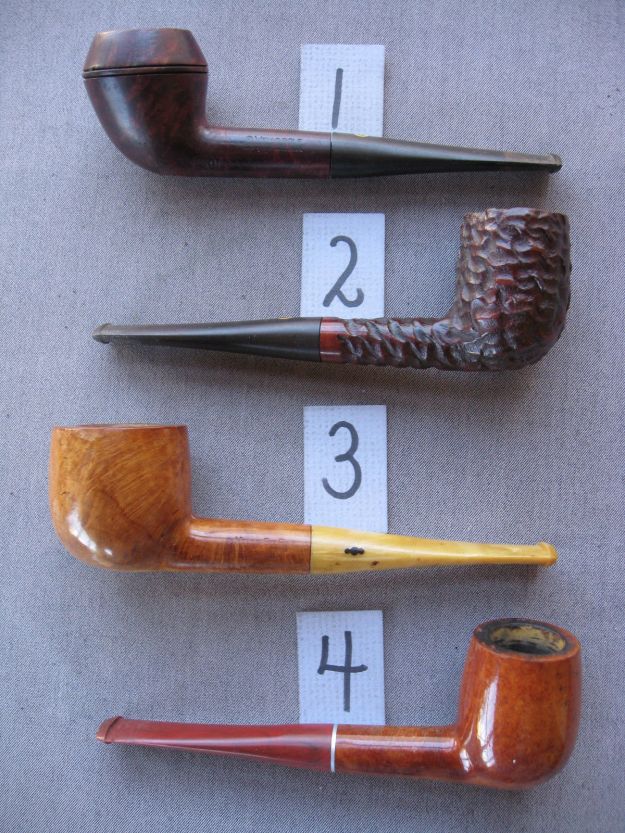
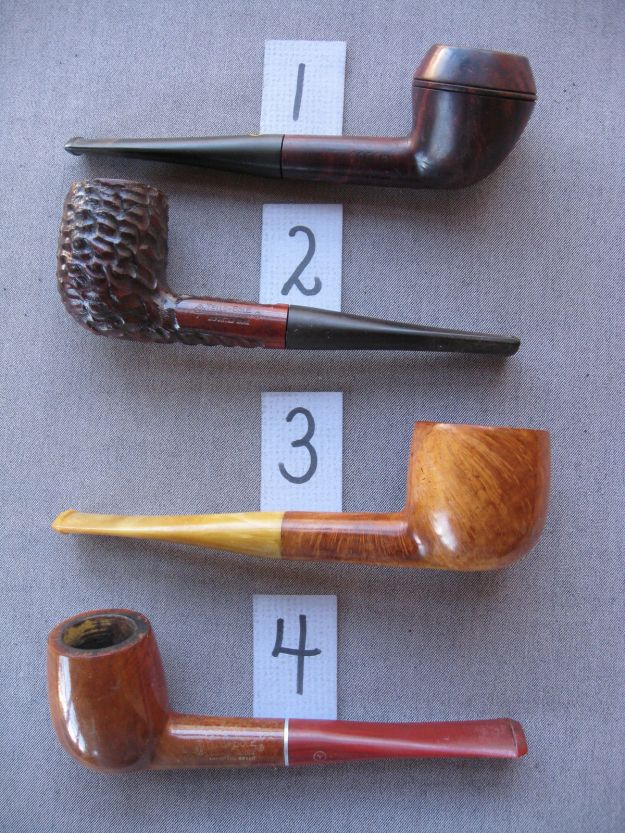
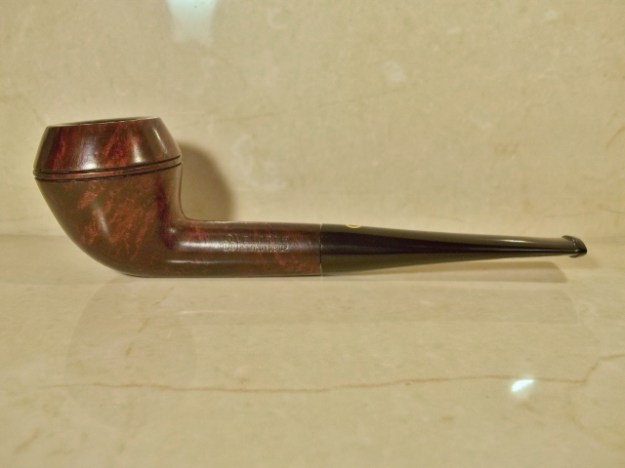
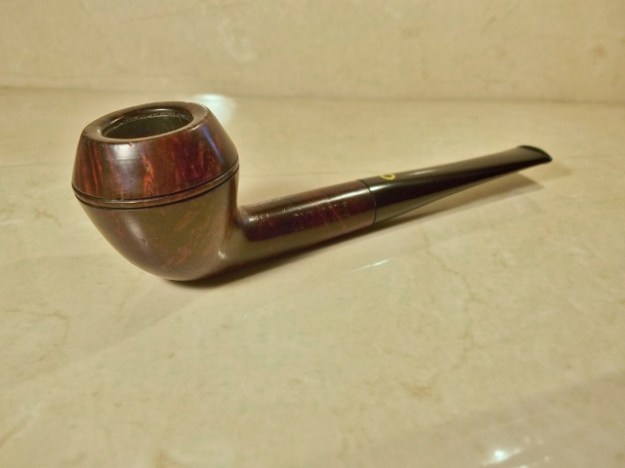
Author Archives: rebornpipes

A Concise History of the Gubbels Pipe Business from Arno van Goor, the Dutch Pipe Smoker


Steve, here is the Arno van Goor blog that describes so well the evolution of the great Dutch pipe family business known today as E. Gubbels B.V. in the Netherlands.  Dhr. van Goor’s sources are friends of his who know the Gubbels family and business, members of the Gubbels family itself, including Elbert Jr., as well as employees.  The information in the following blog, therefore, is culled from direct interviews and other contacts.  There is also the fact that Arno is Dutch and therefore closer to the action, as it were!  He was gracious enough to provide permission to re-publish the fascinating living history in this forum, although at first I thought it would be excerpts from another, longer blog that had the same basic info.  I have been careful to copy and paste the material as close as possible to the format set out by Arno in the original on his website, The Dutch Pipesmoker, at https://dutchpipesmoker.wordpress.com/.  However, most of the hyperlinks have been removed, and also the photos below were consistently wrapped in the original text paragraphs alternating from the left to right sides.  Perhaps you can fix that!  I want to take this opportunity to express my extreme gratitude to Arno for his invaluable wellspring of data on the Gubbels family and business.  It gives the most illuminating picture I have found.

— Robert M. Boughton

The following is © 2015 by Arno van Goor.  Used by permission.

2015 PRF-pipe made by Big Ben
by arno665

Dre unveiling the new forum year-pipe

Dre unveiling the new forum year-pipe

In my Hospitable Heukelum 2014 blogpost I revealed that the 2015 PRF forum year-pipe was going to be made by Dutch pipe-brand Big Ben.  Like I told before, normally Shaun arranges the whole project but sadly he had been very ill this year.  Despite his sickness he managed to reach out for help and Dre answered his call.  Dre (Andre) has very good connections with the Gubbels family from the Big Ben and Hilson pipe factory and regularly visits the place.  So he asked if they could mean anything for the PRF [the Dutch/Belgian Pipe Smokers Forum, abbreviated PRF from the Dutch Pijprokers Forum] pipe project.  Unfortunately Big Ben only fire up their machines for a minimum of 500 pipes and the forum can never reach that number.  BUT they had an alternative solution.

2015 PRF forum year-pipes

2015 PRF forum year-pipes

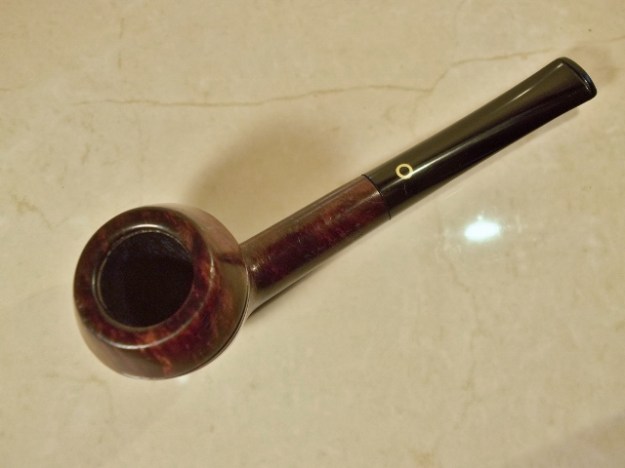
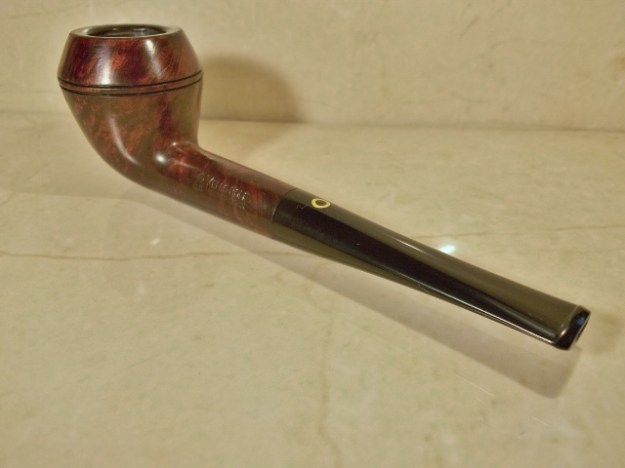
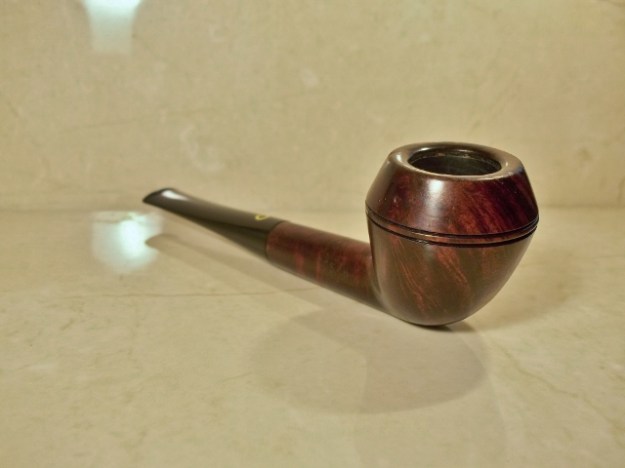
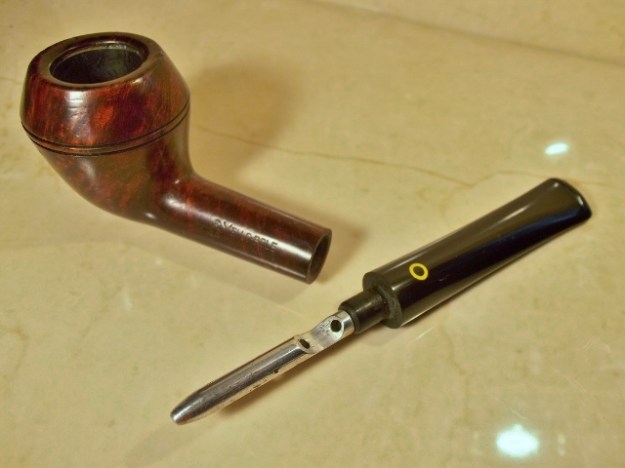
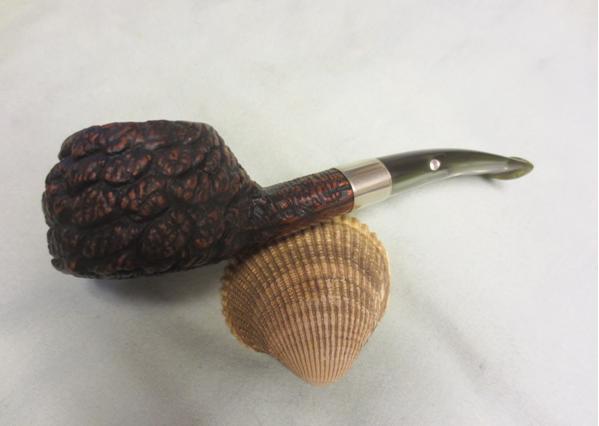
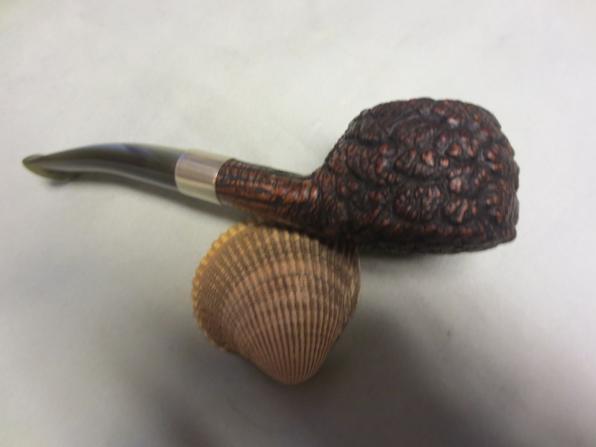
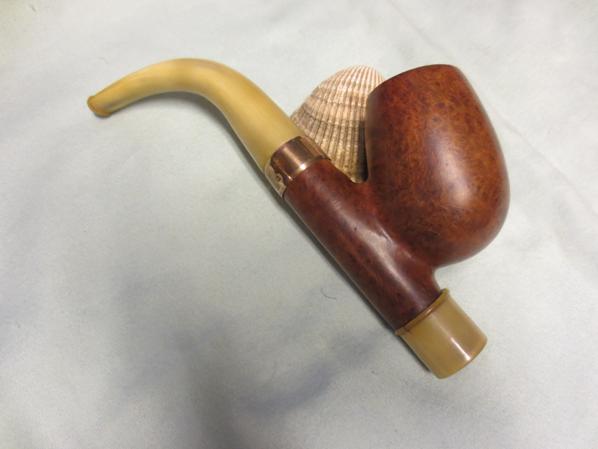
Throughout the years Gubbels kept pipe-bowls from their Barbados range behind with an exceptional grain and we could have those! Plus they added a metal ring on top of the bowl which made the pipe look even better. Then there was another problem, one can’t buy directly from the Gubbels factory. Luckily Primera Wouters in Weert were prepared to distribute the pipes. When Shaun and Dre told this and showed the pipe they got a very well deserved applause. Just over 60 pipes were available and when forum-members could order them they all were gone in no time! To be perfectly honest, I did not apply for one. I simply did not like the shape, but came to regret it later.

My first proper pipe: a Hilson Event

My first proper pipe: a Hilson Event

When I wanted to begin with pipe-smoking I knew nothing except that a Big Ben was a good pipe to start with. However, I preferred a model that was made by Hilson, a Hilson Event. The store owner explained to me that Hilson was made in the same factory as Big Ben. “Ok, I’ll take it!” I said and bought my first pipe. Later I bought a Big Ben which roughly had the same model as the Hilson Event because I simply liked that shape back then. Both pipes I do not have any more, I gave them away when my tastes began to develop and change.

Johannes Henricus Gubbels & Anna Maria Gubbels

Johannes Henricus Gubbels & Anna Maria Gubbels

The histories from Big Ben and Hilson have a lot of similarities and from a point in time even intertwine. It all started for the Gubbels family in 1873 with the shop of Johannes Henricus Gubbels in the Dutch city of Roermond. There he sold things like newspapers, walking sticks, umbrellas, toys and last but not least, smoking accessories. One of the suppliers of those was a German man called Jean Knödgen who had started to make clay pipes in 1846 in the Belgian city of Bree. For a long time Johannes ran his business together with his wife, Dijmphna Hubertina. After her death in 1896 he got married again to Anna Maria in 1899. She bore him two children and when Johannes died in 1911 she continued the business. In 1924 her 2 children, Antonia and Elbert Gubbels, established the “A & H Gubbels” company which specialized in the wholesale trading of smoking accessories.

ben5Meanwhile in Belgium the Bree pipe factory had a new owner. Jean Hillen, the son-in-law of Knödgen, had bought the company at the end of the 19th century. He had also made contact with French pipe-makers in the area of Saint-Claude who supplied him with briar wood and Jean would finish them off. Thus, alongside the traditional clay pipes, he was able to offer more modern pipes. Around 1924 Hillen was perfectly capable of creating briar pipes on his own.

Elbert Gubbels Sr.

Elbert Gubbels Sr.

Up to WWII Elbert Gubbels extended his business, mainly getting his supplies from France and England. Unfortunately The Netherlands were invaded by German troops in 1940 so the family fled north where they tried to make a living by buying and selling what little there was available. In 1945 at the end of the war they returned home to continue the business. A difficult task as material was lacking and importing stuff was almost impossible. In that period Elbert Gubbels, now the sole owner of the business, decided to follow in Jean Hillen’s footsteps. He became totally independent and produced everything himself. The factory began with 2 machines and 3 French artisans in a small workshop.  In Bree a factory already existed and the sons of Hillen also worked there. Jos was in charge of sales and Albert production. The brand name of the pipes that were sold abroad was simple: Hilson, to be precise, Hillen and Sons.

ben7Gubbels had no brand name yet, he just had the name “EGRO” which stood for “Elbert Gubbels Roermond”. The number of machines, personnel, working space and quality of product were increased which resulted in a higher output. That made it necessary to expand the market experience and the wholesale network were no longer sufficient. A brand name was needed in order to increase sales, especially abroad. At that time another Dutch company, “De Rijk & Zonen” from Amsterdam, was doing badly. It was not a large company and to be honest, not so interesting. But it did sell British-made pipes with a sought-after, glamorous brand name well-known in many countries: Big Ben. So in 1956 Gubbels bought the whole De Rijk company. As a result exports soared in Europe, the USA, Canada and many other countries.
Big Ben Pipo

Big Ben Pipo

Meanwhile the business Hilson was flourishing, producing a wide range of well-crafted and creative pipes. These were selling well in Europe and elsewhere thanks to their excellent reputation and good value for money. On the other hand the production of Gubbels was more traditional in style: natural or black briar models, straight or bent, just classic pipe design. Well, one exception. In that period the Pipo pipe appeared, a very small “nose-burner” designed by Alfons Gubbels, the son of Elbert, who had by that time joined the business together with his brother Jos. Alfons was in charge of production and Jos sales. The unorthodox Pipo pipe was highly successful, selling world-wide, including the USA. At the end of 1972 the company moved into a bigger factory. Also the much coveted title “Royal”, in the name of Queen Juliana, was granted. Thus the company name became “Elbert Gubbels en Zonen – Koninklijke Fabriek van Tabakspijpen” (“Elbert Gubbels and Sons – Royal Dutch Pipe Factory”).

ben9At the end of the 1970’s there were only two pipe factories left in the Benelux countries, those of Gubbels and Hillen. Two different but also complementary enterprises. Gubbels sold well in America with their Big Ben pipes while Hilson was a popular pipe-brand on the German market. However, both companies produced high-quality workmanship. So in 1980 Gubbels bought Hillen, who sadly was experiencing serious financial difficulties. It was decided that all machines, material and experts were to be moved to the Gubbels factory.

Alfons Sr. and Elbert Jr.

Alfons Sr. and Elbert Jr.

At first the two brands had some difficulty in co-existing. For example, some Big Ben pipes of that period could be confused with Hilsons and vice-versa. All by all that period of adjustment was positive, characterized by a high output. However, something was changing in the world of pipes and the market crisis meant that quite a few things had to be re-considered. It was not enough to increase quality in order to compensate for the drop in quantity. Greater investments had to match high-performance products. In 1989 Alfons (Fons) junior (technical production and design) and Elbert junior (sales) took over from their father Alfons senior and uncle Jos and the family tradition was carried on.
ben11Since then the company has striven for excellence in every aspect of their production and above all in their mission: offering an increasingly discerning clientèle unique pipes. So since 2008 Rainer Barbi, the late famous German pipe maker, has been contributing to production and had the task of remodeling the Hilson brand until his unfortunate death. Also another great pipe maker, Former, has recently decided to offer Gubbels his creative sensitivity, art and some of his time. Besides manufacturing Big Ben, Hilson and other more minor brands Gubbels has also worked in partnership with other companies to create or refine unique models, such as Porsche Design (from 2005 to 2013) and currently Bentley. Unfortunately the financial crisis hit Gubbels in 2012 and the banks no longer wanted to finance the company. Who smokes these days?? So bankruptcy was a logical consequence, an unpleasant period. But the Gubbels family pulled through with capital of their own and had a new start. There was a change of direction with 20 instead of 28 employees and despite the difficult market the export is growing. The Gubbels company is on the rise once again.
ben12Back to the forum-pipe, I really wanted to see the process in the factory so with thanks to Dre and Fred I could phone Elbert Jr. for an appointment. He already knew my name, I could pay a visit, see the process, take pictures, ask questions, no problem at all. I knew a bit what to expect because I had been before at the new factory with a group of the PRF-forum just before the financial crisis hit Gubbels back in 2011. So on a morning I drove to Herten (municipality of Roermond) dressed to impress because eeyz, you can’t arrive in jeans and a sweater at the only pipe-factory left in The Netherlands right? Because of the crisis the Gubbels offices had moved in the big building used by several companies so I happily announced myself at the wrong desk. Luckily the friendly secretary of the neighbouring enterprise pointed me in the correct direction. After a good ring at the doorbell of Gubbels one of the employees let me in, guided me to the visitor room and went to get Elbert Jr. Before he walked in I was able to quickly snap some pictures of the displayed pipes.

Assembly hall

Assembly hall

Just like on the phone Elbert jr. is a very nice man to talk to, clearly someone with a passion for his company and the products made there. We chatted away for a while until he got a call from his brother that he was ready for me. Elbert Jr. guided me to the big assembly hall where all pipes are made and Fons Jr. was waiting for my arrival. For the outside world Elbert Jr. is the face of Gubbels but inside the factory Fons Jr. reigns supreme. At this moment he is the only one there who knows and is able to perform all the necessary steps in the creation of a pipe. The other employees just know a few steps of the process. Which worries him sometimes, I mean, what if he becomes ill? But they are working on that.

Fons Jr. and a colleague had prepared (as far as they could) the steps in the finishing of the forum-pipe so I could take pictures of it. Remember, all the bowls and mouthpieces were already roughly made. Below you can see all 10 steps of the process:

1. Mounting the mouthpiece.
2. Sanding the pipe from coarse to fine with different sizes of sanding discs.
3. Staining the pipe (3 layers of stain are applied in total) where the first layer of stain is set aflame to fixate it.
4. Removing excess stain.
5. Sanding off more of the stain to make the grain better visible.
6. Milling out space for the metal top-ring.
7. Spraying a lacquer finish on the pipe.
8. Buffing the pipe to make it extra shiny.
9. Putting on the metal top-ring.
10. Tadaaa!! The finished product.

[GO TO THE ORIGINAL BLOG AT https://dutchpipesmoker.wordpress.com/2014/12/16/2015-prf-pipe-made-by-big-ben/ TO VIEW THE PHOTO COLLAGES AND VIDEOS THAT BEGIN AT THIS POINT.]

Fons Jr. adjusting the Lamberthod machine

Fons Jr. adjusting the Lamberthod machine

After explaining all the steps of the process Fons jr. guided me further around the factory. In the back there was a smaller hall with a big basket stacked full with briar and equipment to shape the bowls including a big modernized version of the Lamberthod machine. Of course the precise operation of everything was demonstrated. Seeing the immense Lamberthod device in action was very impressive, especially because Fons Jr. had left the hood open so I could make some pictures. Afterwards he had to laugh when he looked at me, because my classy black suit was totally covered in the sawdust that came out of the machine. “You will still find it in your clothes when you go to sleep tonight” he said with a big grin.

Warehouse

Warehouse

I also was led through the immense warehouse where you can find lots of pipes, pipes and ehrr. Pipes! Uncountable boxes, drawers and crates stacked on to each other filled with unfinished pipe bowls, stems in all shapes and colours, (metal) rings etc. An impressive sight! There was only a small pallet with ebonite mouthpieces, Gubbels does not really use them because acrylic is more durable. Last but not least we went to a part of the warehouse where a couple of friendly ladies were packing orders.

ben16When the tour was finished Fons jr. and I sat together so he could explain the forum-pipe process to me once more and I could write down the steps. We talked a bit more and then it was time for me to leave and for him to go back to the assembly hall. I must say, my respect for Gubbels and especially for Fons jr. had really grown. If you just look at the new Bentley pipes and know how much difficult handwork is needed for the creation of those.

OLYMPUS DIGITAL CAMERAAnyway, I wish all people who have ordered the 2015 PRF forum year-pipe lots of smoking pleasure with it! It is an extraordinary pipe with stunning grain for a very, very good price and I really regret I did not order one now. Thanks go out to Dre, Shaun, Fred, Elbert Jr., Fons Jr., Fons Sr. and the employees at Gubbels for making the forum pipe and this blogpost possible!

[GO TO THE ORIGINAL BLOG AT https://dutchpipesmoker.wordpress.com/2014/12/16/2015-prf-pipe-made-by-big-ben/ TO VIEW THE PHOTO COLLAGES AND VIDEOS THAT BEGIN AT THIS POINT.]

Spotlight: Ladies Pipes, Part 6/7, an Albertson Baby Bent Brandy


Robert M. Boughton

Member, International Society of Codgers
Member, North American Society of Pipe Collectors
Member, Facebook Gentlemen’s Pipe Smoking Society
https://www.facebook.com/roadrunnerpipes/
http://about.me/boughtonrobert
Photos © the Author except as noted

Pipe: a primary masculine symbol with authoritarian overtones but also indicative of reliability and contentment.
— The Dictionary of Visual Language, 1980, by Philip Thompson and Peter Davenport

INTRODUCTION
Never before or since has a definition been more right in both parts yet presupposed in the one as that stated above.  Nobody who enjoys and defends the pleasures derived from placing tobaccos into instruments known as pipes, igniting the leafy concoctions and drawing the resulting flavorful smoke into the mouth to taste, contemplate and above all savor, in most cases without inhaling, would deny the latter point.  But the former – which should be noted uses the strict adjective primary, meaning before all else in importance, rather than the more lenient adverb primarily, or for the most part – affirms the societal perception that no normal woman should want to partake of the same practice.  After all, why on God’s green earth would any decent _________ (insert little lady, gal, chick, babe, bird, girl, lass or whatever term comes to mind and makes most women grit their teeth) want to trespass on what might be the last bastion of manly domination on the planet?

The source of the definition – printed once in hardback and then again, in 1983, in softcover, both times by British publishers – is an excellent collection of iconic symbols assembled with scientific soundness.  Its authors called it “The Dictionary of Graphic Clichés,” a far more apt title than that which they were compelled to choose by the original publisher, under the false notion that the book should have a more agreeable name.  This decision may very well be the reason the astute study has been out of print for 33 years.  Nevertheless, used hardbacks still start at $469 and paperbacks at $96 on Amazon, suggesting a work of genuine and lasting significance.  But the likelihood of many takers at those prices is more doubtful than that the book would still be generating far more royalties if it continued to be available in general circulation at a reasonable cost to the average consumer.

The truth is thalbert1at many more women than may ever be known are as devoted to pipes and the blissful indulgence of those wonderful devices’ every facet: the astonishing variety of makers, shapes, styles, materials and sizes; the like availability of diverse tobaccos for every taste, and tobacciana.  Women are just as prone as men to the same acquisition compulsion in these categories.  Female artisans craft pipes, for their own use or sale.  The owner of my favorite local tobacconist is a woman.  Clubs and other associations exclusive to females devoted to the overall shared and altogether personal experience of pipes can be found in every corner of the world.

Indeed, searching online for this last aspect of pipe equality yields the greatest proof of the ubiquitous presence of female connoisseurs, who seem to avoid the male-dominated and likewise -biased haunts of the mainstream pipe establishment, and for good reason.   Only one woman is a member of my pipe club.  I know of but a single woman on the membership roster of the Smokers Forums UK, although old-timers recall in a vague way a past when there were “some more.”   And Jeff Knoll of the North American Society of Pipe Collectors reported, as I recall, that of the 1000+ members of the NASPC, only 10 are not men.  That’s about one percent, a woeful ratio.

I embarked upon my seven-part series of blogs last May 4.  My specific intentions were two-fold: to reveal and give recognition to the far greater number of women pipe smokers than is acknowledged by most of those who are, and no one disputes in all probability will remain, in the majority, and to promote acceptance of the formidable minority.  My more general desires were to foster an exploration and discussion of the contributions women make to the relaxing activity/hobby; to open a dialog between the segregated camps.  A side story that crossed my perhaps naïve mind was the idea of discovering possible differences in approach to pipes between their male and female devotees that might be of interest to all involved in the activity that is, after all, a love affair of sorts.  With one installment after this left before the series is complete, I believe I have gone still further than I expected but hope to wrap up some loose pieces before the end, whether most of my readers, or lack thereof, like it or not.

The sixth installment will show the refurbishing of a small Albertson easy bent sandblasted brandy from Belgium.  Hard information on the Albertson line is difficult to come by to an inordinate degree.  Through an incredible stroke of good fortune, I happened upon a font of factual information on the pipe’s real origin.  First I had to navigate past Pipephil and Pipedia, whose sketchy claims proved to have little substance and were parroted throughout the cyber world.

Pipephil describes Albertson as a brand “made at Hilson’s Factory,” then in the Hilson description refers readers to Albertson as a second.  About Hilson, Pipephil’s entry is muddled but notes its genesis was in 1846, when a German pipe crafter named Jean Knödgen started producing clay pipes in the town of Bree, Belgium.  As it turns out, that limited intel is about all that is accurate.  Jean Hillen, Knödgen’s son-in-law, bought and ran the business until his two sons took over.   After World War II, when briar was scarce, Albert Hillen, the brother in charge of production, created Hilson (a combination of Hillen and son).  Although I anticipate the exact time period in which Albertson pipes were made, from the one person who would know beyond a doubt, I do not expect it to arrive any time soon.  I suspected its name also was formed from a combination, of Albert and son, and later confirmed the guess.  With the Hilson brand, Hillen became independent of other countries, taking full control of pipe production.

Here’s the scoop, based upon the singular knowledge and much appreciated contribution of Arno van Goor, a Dutch pipe smoker and historian.**  The patriarch of the family-run pipe giant known today as E. Gubbels B.V., Johannes Henricus Gubbels, began in 1870 with a modest mercantile business in Roermond, a town in the southeastern area of the Netherlands.  Gubbels’ first products were diverse and included umbrellas, walking canes, toys and smoking accessories.  Knödgen was one of Gubbels’ suppliers of the last category.

Johannes Gubbels died in 1911, and his second wife carried on the business until 1924, when their two children, Antonia and Elbert, established A&H Gubbels, a wholesale trader specializing in pipe accessories.  After World War II, as the sole owner of the family business and because of the scarcity of supplies as well as the impossibility of importing them, Elbert did as Hillen had before him, going independent in every respect.

With the informal name EGRO (for Elbert Gubbels Roermond), Gubbels had no brand name.  Then, in 1956, when Gubbels bought De Rijk & Zonen of Amsterdam – a small company that was floundering – Gubbels not only acquired a brand but more machines than the two he had and more employees than the three.  But the most significant changes were his decision to convert from a wholesale to an export business with a very popular brand of pipes at the time, known as Big Ben.  The Big Ben pipes had been made in England and sold by De Rijk, and Gubbels began producing them as his own brand.  The result was an exponential increase of sales in Europe, the USA and Canada.

At the same time, Hillen’s Hilson brand faced severe financial problems despite its high reputation and value as far as the cost to consumers was concerned. When Gubbels bought Hilson, he was able to move into a bigger factory. To the Hilson and Big Ben lines was added a very small nose-burner called the Pipo, designed by one of Elbert’s two sons named Alfons who was then in charge of production. The Pipo, although an unknown style of pipe at the time, was highly successful and sold worldwide. By 1972, Queen Juliana of the Netherlands bestowed upon Gubbels the honored title “Royal,” and the house of Gubbels became Elbert Gubbels en Zonen – Koninklijke Fabriek van Tabakspijpen (Elbert Gubbels and Sons – Royal Dutch Pipe Factory).

After increasing its production and sales at a steady rate through the 1970s, the demand for the “luxury items” fell, and so did Gubbels’ Royal Dutch Pipe Factory (RDPF) as investors backed out.  One of the biggest misconceptions online and elsewhere is that Gubbels and the RDPF were separate entities.  On March 3, 2012, De Limburger daily newspaper in Maastricht, Netherlands reported the bankruptcy of that name, and the “news” that the last pipe-maker in the Netherlands was out of business echoed on pipesmagazine.com, and thence round the world.

It seems the rumors of the death of the venerable pipe-maker were greatly exaggerated.  Yes, the Gubbels-RDPF name was gone, but the family persevered with capital of its own, reducing the company staff from 28 to 20 employees.  Today, and not just according to the masthead of the History page of its own website, “E. Gubbels B.V. in the Netherlands, established in 1870, is a globally acclaimed and leading manufacturer of fully hand-made briar-root tobacco pipes.”

RESTORATIONalbert3 albert4 albert5 albert6 albert7The little brandy could have been touched up and cleaned much faster if I had felt like leaving well enough alone.  Of course, I did not.  A close look at the photos above shows two minor scrapes, one on the middle front of the bowl and the other near the bottom, that cut to the wood and gave me an idea.  The refurbish therefore began with a long soak, about five hours, in Everclear.  I have some black sandblast and rustic pipes that I love the way they are, but for the most part, in restoring at least, I prefer to end up with some of the natural rusty color of the briar showing, but not because of dings and whatnot.albert8When the initial stripping was finished, I was not surprised to see much of the black stain still holding tight.  I rubbed off the alcohol and some more of the blackness with some small cotton gun cleaner squares and swabbed the chamber with more, then went at the surface of the stummel with 150- and 220-grit sandpaper.  While I was at it, I ran an alcohol-soaked cleaner through the bit, which shows how well-used was the dainty pipe.  Even after that, a second Everclear soak was in order.albert9 albert10 albert11 albert12Repeating the aftermath of the previous alcohol strip, except for using super fine “0000” steel wool instead of paper, I eliminated more of the old black stain.  The next pictures don’t show the focused work I did on the crevices.albert13 albert14 albert15A few choice turns of the Senior Reamer in the chamber followed by 220-grit paper made the retort easy after the two soaks in Everclear, the more serious paper work in the chamber and several regular cleaners as well as the wire brush type through the shank.albert16albert17To re-stain the stummel, I used Lincoln Marine Cordovan, or dark maroon, alcohol-based boot conditioner.  You know I flicked my Bic to flame out the alcohol.  Afterward I buffed the residual char off with a micro mesh pad of some high number and used the steel wool to take off the excess stain to the point where I was happy. albert18 albert19 albert20 albert21While the Halcyon II wax soaked in, I considered the bit with its peculiar stinger that seemed to be designed for extra use as a tobacco pick. The peculiarity is the same as those in Dunhill pipes – it is an inner tube. This was often used in pipes by Gubbels. The tube extended into the bottom of the bowl the longer side sat in the bowl bottom and the angled shorter side faced upward. I went over the bit with wet micro mesh from 1500-12000.albert22 albert23 albert24Using red and White Tripoli and White Diamond on the bit with the electric buffer and just the clean buffer on the wood, the Albertson brandy was finished.albert25 albert26 albert27 albert28Photos taken on the front case at Stag Tobacconist

CONCLUSION
Anyone who doubts the high standing of the Gubbels name, consider this.  Some left-over Big Ben Barbados natural bent Dublin pipes with exquisite grain, crowned for the occasion with special metal rim fittings, were the 2015 Year Pipes of the Dutch/Belgian Pipe Smokers Forum (PRF, for Pijprokers Forum, the Dutch translation of something that should be obvious).  Dhr. van Goor, the fortuitous source of all of my factual information concerning Gubbels and a member of PRF, wrote in the second blog below: “Just over 60 pipes were available and when forum-members could order them they all were gone in no time!  To be perfectly honest, I did not apply for one.   I simply did not like the shape, but came to regret it later.”albert2And for some of the ladies, there are these Big Ben Pipes, averaging 5” long and very stylish.albert29On the other hand, if you prefer something of still smaller proportions, there is the Albertson brandy described above, which is the smallest conventional tobacco pipe I have ever owned.  It measures 4¼” long; the bowl is 1½” high; the rim is 1” across, and the chamber diameter is ¾” x 1⅞”.  In other words, perfect for the female pipe aficionado who prefers a petite and light yet elegant pipe.  And it’s for sale on my new webstore noted above!

SOURCES
http://www.eyemagazine.com/feature/article/the-dictionary-of-visual-language
https://www.amazon.com/The-Dictionary-of-Visual-Language/dp/0140511172
http://www.pipephil.eu/logos/en/logo-a3.html
http://www.pipephil.eu/logos/en/logo-h3.html#hilson
https://pipedia.org/wiki/Albertson
http://www.gubbelspipes.com/
http://pipesmagazine.com/blog/pipe-news/maker-of-big-ben-porsche-hilson-pipes-declares-bankruptcy/
**https://dutchpipesmoker.wordpress.com/tag/gubbels/
**https://dutchpipesmoker.wordpress.com/2014/12/16/2015-prf-pipe-made-by-big-ben/

A Bleak Looking Royal Danish with an indistinguishable shape number


Blog by Steve Laug

My brother Jeff found this old pipe either on eBay or in his travels and picked it up. He sent me photos of the pipe when he received it. It looked pretty bleak to me but there was some promise in the interesting shape of the pipe and the grain that was visible in the photos. There were also some dark spots on the sides of the bowl that I wondered about as I looked at the photos. The finish was very dirty and underneath the grime it was gone. There were some burn marks around the top of the bowl. The bowl was lightly caked but very dirty. The stem was lightly pitted and oxidized but there were no tooth marks or chatter on the stem.dan1 dan2My brother cleaned the pipe really well and the grime and remnants of the finish were all gone by the time I received the pipe. I took some photos of the pipe before I started to work on it. The dark spots on the sides of the bowl are visible in the photos below. The damage to the rim is also visible. There are some nicks in the top of the bowl and some burned areas that will need to be addressed. He cleaned out the airway in the shank and the stem as well as the mortise area. I noticed however that there was a slight ledge in the mortise that was hard and made me wonder what was happening there.dan3 dan4I took a close up photo of the bowl to show the extent of the damage to the inner edge of the rim and the rim top. The bowl was quite out of round and the burn marks though not deep were prevalent in the briar. I took some close up photos of the stem as well to show the condition they were in when I started the clean up.dan5I topped the bowl on the topping board with 220 grit sandpaper until all of the damage was removed.dan6I sanded the inside of the bowl and the inner edge of the rim with a tube of sandpaper until the edge was smooth and round.dan7I sanded the top of the rim with micromesh sanding pads – wet sanding with 1500-2400 grit pads and dry sanding with 3200-12000 grit pads. The rim took on a shine.dan10I wiped the bowl down with acetone on a cotton pad to remove the remaining debris and worked on the dark areas. The dark areas turned out to be fills and the darkening occurred around the edges of the fills.dan8 dan9I warmed the briar and then stained it with a dark brown aniline stain mixed 50/50 with isopropyl alcohol. I flamed the stain to set it in the briar and then repeated the process until the coverage on the bowl was good.dan11I hand buffed the bowl with a microfiber cloth to see what the coverage looked like particularly over the filled areas. The photos below show the pipe at this point in the process. The putty spots are visible in the first two photos. I have circled them in red to make them clear. Both fills were solid and tight but had a red overtone that stood out.dan12The top of the rim came out looking really good. The burned spots and damage to the rim top and inner edge have been minimized.dan13I recleaned the interior of the shank using the dental spatula to scrape away the hardened tars and oils. I scrubbed it with pipe cleaners, cotton swabs and alcohol until it was clean. I cleaned up the airway in the stem with bristle cleaners and was able to remove the last of the tars.dan14The stem fit against the shank with a slight gap on the right side. I heated the tenon with a Bic lighter and while it was still soft held it straight in the shank until it cooled.dan15On the underside of the shank next to the stem there was a chipped area where the briar was missing from the shank. I cleaned out that area and filled it in with clear super glue and briar dust. Once it dried I sanded it smooth with 220 grit sandpaper and then polished it with 1500-4000 grit micromesh sanding pads. I used a dark brown stain pen to touch up the sanded area.dan16I sanded the stem with 220 grit sandpaper to smooth out the pits and roughness. I polished it with micromesh sanding pads. I wet sanded it with 1500-2400 grit pads and dry sanded it with 3200-12000 grit pads. I rubbed the stem down with Obsidian Oil between each set of three pads. After the final rubdown I let the stem dry.dan17 dan17a dan18I used a black Sharpie Pen to draw “grain” lines through the fills and used the dark brown stain pen to blend the pen lines into the body of the pipe. I buffed the pipe and stem with Blue Diamond polish on the buffing wheel to finish cleaning up the small remnants of oxidation. I gave it several coats of carnauba wax and buffed it with a clean buffing pad. I hand buffed it with a microfibre cloth. The finished pipe is shown in the photos below. Thanks for looking.dan19 dan20 dan21 dan22 dan23 dan24 dan25 dan26


A Birthday Pipe and a Pirate Curse


Great work on that Charles. Well done. That was the largest black stain I have seen. I too have used the bleach treatment and it does work. It is labour intensive however. Good job sticking it with it and conquering the mess.

Charles Lemon's avatar

“Step up, lad,” cried Silver. “I won’t eat you. Hand it over, lubber. I know the rules, I do; I won’t hurt a depytation.”

Thus encouraged, the buccaneer stepped forth more briskly, and having passed something to Silver, from hand to hand, slipped yet more smartly back again to his companions.

The sea-cook looked at what had been given him.

“The black spot! I thought so.”

– Robert Louis Stevenson, Treasure Island

Stevenson’s Black Spot was the last thing a pirate captain wished to receive. I loved reading the story as a kid, but I never thought I’d have to deal with a dreaded Black Spot of my own restoring pipes.

This pipe belongs to a fellow pipe club member who contacted me to ask for help. He had been given a rather handsome Vauen Natura pipe as a gift for his 60th birthday and was in the process…

View original post 969 more words

Another nice find at the ‘Hole in the Wall’ – Jeantet Fleuron 70-7


Blog by Dal Stanton

The Jeantet Fleuron before me was mentioned when I posted the restoration of a beautiful BBB Banker Bent Volcano.  I found both pipes last April, during a visit to ‘The Hole in the Wall’ antique store near the Zhenski Pazar (Women’s Market) in downtown Sofia, Bulgaria.  In order to achieve a better bargain for the BBB Banker I grabbed the Jeantet out of the basket as a good candidate for a bundled deal, which helped me negotiate 30 Bulgarian Leva for the pair – not a bad deal!  When I arrived home from the Hole in the Wall I took these pictures:dal1 dal2 dal3 dal4 dal5 dal6 dal7 dal8The bent egg shape is in pretty good condition with an attractive elongated bowl that fits well in the hand.  The left side of the shank is marked with Jeantet (pronounced, ‘Zhawn-Te’) over Fleuron and on the right what I assume is the shape number 70-7.  The stem has the nice Jeantet J stamp.  Looking at Pipedia to do a little research on this name led me to Sainte Claude, France, considered to be the birthplace of the serious production of briar pipes and scores of French made pipe names claim Saint Claude as home. My curiosity piqued, I wanted to know why St. Claude, France?  Was the briar in good supply there?  I looked to the history of the city itself to see what I could find.  I unearthed an archived New York Times article written March 20, 1983, in the ‘Shoppers World’ travel section entitled, THE PIPE CAPITAL OF FRANCE – very interesting and worth reading.  I found the answer to the question, ‘Why Saint Claude and pipes?’ with this article I found posted on Fumerchic.com with these informative excerpts:
In the 15th Century, Saint-Claude was canonised by Pope Louis XI, the city took on the name Saint-Claude alone and remained a favoured site for pilgrims.
Since Saint-Claude was one of the stops on the Way of Saint James, the monks, who had been turning wood since the 7th century, began crafting wooden religious objects like crucifixes and rosaries. These monks slowly began training craftsmen, which lead to the establishment of the first wood turning workshop in Saint-Claude.

The craftsmen developed the manufacture of wooden items and widened the scope of their operation by making toys (spinning tops, whistles and rattles), so children and pilgrims could play during their pilgrimages. The number of turning workshops then grew. The main materials they used were wood, bone and ivory.

But with the introduction of tobacco to France, of smoking tobacco in particular, the wood turning workshops adapted by making snuff boxes and pipes made from local boxwood. The pipe craftsmen of Saint-Claude gradually forged themselves a reputation for an unparalleled level of manual skill and expertise.

So, it wasn’t the plentiful supply of briar that put Sainte Claude on the pipe-makers’ map but industrious wood-turning monks who passed their wood working skills on to local craftsman.  The story went on with the discovery of a non-burning pipe made from our beloved briar:

During the 19th Century, pipes from Saint-Claude underwent a profound change. Boxwood had been the wood used to make the pipes until then, but it produced a bitter taste when smoked. Around 1855, a businessman passing through Saint-Claude presented a Saint-Claude wood turner with a pipe, the bowl of which did not burn, carved from a heavy wood in dark shades. It was the first pipe made from briar. The arborescent briar pipe is highly resistant to heat and fire, giving the smoker the greatest possible pleasure from the plumes of tobacco smoke. The craftsmen of Saint-Claude therefore began using briar instead of boxwood, ensuring the Saint-Claude pipe caused excitement in the pipe smoking community. The number of workshops grew, with names like Chacom and Butz-Choquin appearing for the first time, while the craftsmen began producing more and more high-quality pipes thanks to their expertise that became globally renowned among pipe smokers.

Considered to be the capital of briar wood pipes, EoleChacomBayard,Butz-ChoquinDenicoteaJeantet and Ropp are well-known names all originally claimed by Saint Claude, France. The works of Saint Claude’s craftsmen are also present, for example, in the unique handmade pipes created by Pierre Morel (link).

One more factoid about Saint Claude’s history caught my attention.  In 1966, Saint Claude established the Confrérie des Maîtres-Pipiers de Saint-Claude (The Brotherhood of Master Pipe-Makers in Saint-Claude) to promote the expertise of the many masters that have historically resided and worked in Saint Claude.  Famous personalities are inducted as the “Premier Pipe-Smoker of the Year’ to serve as ambassadors for the pipe industry in Saint Claude.   For every personality chosen, Paul Lanier (awarded the prestigious meilleur ouvrier de France title in 1991), crafts a pipe that includes a portrait of the inductee, thus perpetuating the tradition of the sculpted briar pipe.  I think this is a very cool tradition and found it very interesting that the first likeness below strongly resembles the master pipe restorer who oversees Rebornpipes.com!dal9According to Pipedia, the Jeantet name came on to the scene in 1775.  The 1800s saw great expansion of production of Jeantet pipes primarily through the development of local cottage industry – farming out different aspects of the pipe production to small shops in Saint Claude.  Consolidated production grew in the 1900s but in the 1960s sales dwindled in spite of attempts to modernize.  This final part of my research comes from Pipehill:

1988
The company was taken over by S.A. Cuty Fort Entreprises(1) while keeping its label. It established in the group beside Chapuis-Comoy (Chacom), Jean Lacroix and Emile Vuillard.  Today (2010) the brand isn’t part of the group any more. The label owned by Dominique Jeantet still exists but pipe production is discontinued.dal10When I take this product of Sainte Claude, France, the Jeantet Fleuron, out of the ‘Rescue Me’ basket, I take a closer and more appreciative look at the pipe.  First impressions mark the nice shape of the stummel – I like the tapered egg shape that culminates in a tightly circled rim beveled on the inner chamber side.  The bowl shows minor cake and appears to have been cleaned before but I will bring it down to the briar and clean it well.  The stummel surface has minor dents and ‘blemishes’ on the finish.  A significant ‘scab’ is evident where the shank and bowl converge on the topside.  It doesn’t appear to be a burn through but this will need attention after cleaning the exterior surface.  The rim has minor dent marks on the blade edge of the beveled rim.  When I take off the stem, I notice that in the mortise is a metal cylinder – some sort of a metal airway or a stinger that got loose?  With a few thumps on my palm, the rogue stinger shakes loose (pictured below).  After attempting to insert it into the end of the tenon, I have questions as to whether this stinger is original – the fit is very loose which explains why it slipped down into the stummel airway.  I decide the stinger is history and it goes in the spare parts bucket.  Minor teeth dents are on the underside of the bit. I take some close up shots for a better look at problem areas.dal11 dal12 dal13 dal14 dal15 dal16I begin by putting the stem in an OxiClean bath to soak in order to raise the oxidation out of the vulcanite.  Then I take my Pipnet Reaming Kit and work on the light cake build up in the bowl.  I use the two smaller blades of the four blades available to me to ream the bowl.  After this I use 240 grit sanding paper to further clean and smooth the chamber wall.  I like working on a clean pipe so I take pipe cleaners and Q-tips dipped in isopropyl 95% and work the mortise and stummel airway.  The internals were surprisingly clean so it didn’t take long.

Now to the external surface.  I use undiluted Murphy Oil Soap on the stummel with cotton pads to remove the grime and hopefully to eradicate some of the blemishes I detect on the surface.  After cleaning with Murphy Soap I rinse the stummel with cool tap water avoiding water entering the fire chamber or mortise.  The ‘scab’ at the upper junction of the shank and bowl is starting to look like a botched superglue repair job.  I’ll need to give some thought as to how to address this eyesore on an otherwise attractive piece of briar – I’m starting to see the briar’s potential.  The pictures show the progress. dal17 dal18 dal19 dal20I put the stummel aside and turn to the clean-up of the stem.  I fish the stem out of the Oxyclean bath.  It did the job of ‘surfacing’ the dull greenish oxidation and I initially attack it with 000 steel wool.  I then clean the internal airway with bristled and smooth pipe cleaners dipped in isopropyl 95%.  The stem put up more resistance than the stummel.  After several pipe cleaners I’m satisfied that the airway is ready for service.dal21 dal22Next, the ‘scab’ on the bowl surface.  I take 240 grit sanding paper rolled as close to a blade as I could make it and sanded the gummed up super glue patch – at least I believe that is what it is – at the junction between the upper shank and bowl.  I sand the super glue or epoxy down to the surface.  When I remove the buildup bump it appears to be a patch – I don’t believe it’s a burn through, but it’s definitely a fill.  It appears to be solid so I leave it as is and hope to blend it when I finish the stummel.  Next I prepare a batch of briar dust super glue putty to fill in two holes just below the rim at about 1 o’clock (picture below).  I use a toothpick as a trowel to pack the holes well and to leave an overflow so that it will sand out smoothly with the surface.  The final repair is to apply black super glue to two small tooth dents on the underside of the bit.  When cured, it will sand smooth and polish well.  The pictures show the progress of the patch work.dal23 dal24 dal25 dal26After the KE-150 Black super glue patch on the underside of the bit cures, I take 240 grit sanding paper to smooth out the patch bumps bringing them down to the stem surface level.  I do the same to remove light tooth chatter on the upper side.  To redefine the button, I use the needle file to shape the contours of the button lip top and bottom.  I again use 240 grit to remove the file marks and remove light tooth chatter.  With micromesh pads grit from 1500 to 2400 I wet sand the stem and apply Obsidian Oil.  Unfortunately, after admiring the shine beginning to move to the surface, I also saw some small ‘patches’ of oxidation remained visible – a bit near the button and on both upper and lower parts of the saddle stem that tapers from shank level down to button level.  If this part of the saddle stem has a special name, I’m not sure what it is!  I was frustrated and therefore forgot to picture this!  I put the stem back in the Oxyclean bath for another baptism.  The pictures below represent the micromesh process after the second bath, which raised the residue oxidation to the surface and I remove it beginning with the 1500 grit micromesh pad.  Following the 1500 to 2400 micromesh wet sand cycle (again!) I apply Obsidian Oil.  With pads from 3200 to 4000 grit I dry sand and follow again with applying Obsidian Oil to the stem.  I complete the micromesh polishing with pads 6000 to 12000, apply Obsidian Oil and put the stem aside to dry.  I’m pleased with the results even though I had a detour.  The pictures show the progress on the stem repairs and polishing.dal27 dal28 dal29 dal30 dal31With the stem ready for a stummel, I start working on completing the Jeantet’s re-commissioning by using 240 grit sanding paper to remove the cured briar dust super glue putty patch on the holes just below the rim.  I’m careful to sand strategically by folding the paper and using it like a blade directly on the patch so I don’t unintentionally sand into the rim’s sharp beveled top edge – that would not be good to deface the rim!  I take a before and after picture to show the progress.  The rim already has a very nice bevel, but to remove the dents and pitting on the rim I use 240 grit paper folded and work on the rim.  I pinch the paper with my thumb on the beveled contour as I rotate the stummel.  I find that this method allows for an even movement and a consistent bevel angle to develop.  With the bevel already in place, I simply go with the contour that is already present but remove the damage producing a fresh beveled surface.dal32 dal33 dal34Well, all work on the Jeantet came to a halt for about 3 weeks as my wife and I enjoyed our annual R&R on the Black Sea coast near the fishing town of Sozopol.  Reading books and enjoying the beach is one of our favorite things to do to relax and decompress from the work we do in Bulgaria.  A special joy to us during these weeks was the visit of our daughter and her husband from Denver, Colorado.  They joined us at the Black Sea for our last few days on the beach and from there we took them to see different sights in Bulgaria as well as spending the last week of their visit on the beautiful Greek island of Santorini!  Another great part about their visit was that they brought supplies and pipes I had ordered and purchased from eBay.  They also brought another prize – the Savinelli pipe knife to add to my tool box that I won in a fierce bid on eBay!  During this time of R&R I also visited several antique shops in different Bulgarian towns and secured some future restorations – it was a good time but now, back to life and the Jeantet Fleuron!

With stem reattached to the stummel I use a medium grade sanding sponge on the bowl.  Following this, I utilized all 9 micro-mesh sanding pads, 1500 to 12000 to sand/polish the bowl preparing it for staining. I’m liking the briar grains beginning to make an appearance on the Jeantet.  The pictures show the progress on the stummel surface.dal35 dal36I’m anxious to try out one of the supply items that my daughter and son in law brought from the US – Fiebing’s Leather Dye.  They brought dark brown and oxblood colors and I decide to try the dark brown on the Jeantet.  One of the challenges that I have finding supplies in Bulgaria is not having good selection of aniline (alcohol based) dyes or stains that would readily ‘flame’ helping to set the stain in the wood. I remove the stem and give the bowl a cleaning with alcohol with a cotton pad to make sure it is clean from the residue left over from sanding.  I set the bowl up on the cork and candle stand, inverted to apply the dark brown dye that I have chosen.  Using a cotton dauber, also a new arrival from the US, I apply the dye liberally over the inverted bottom of the bowl allowing the dye to saturate the briar surface.  I’m able to rotate the bowl with the cork in hand to make sure dye reaches the rim beveled surface on the bottom. When the surface is covered I flame it with a butane lighter which evaporates the alcohol from the dye and sets the color more deeply in the grain.  After it cools to the touch, I repeat the process above a second time, applying dye and flaming.  The pictures below show the progress but also the fact that I need to figure out a better way of pouring the dye into the lid so I’m not wasting so much on my work board missing the briar!  After cooled, I use cotton pads with isopropyl 95% and wipe down the newly stained bowl to lighten it and even out the dye application.  This allows the grain to jump out more it seems to me.dal37 dal38 dal39I let the bowl sit overnight to thoroughly dry and set the newly stained surface.  I turn to my Dremel using a felt wheel with Tripoli compound on the bowl surface and stem to begin the polishing process.  I utilize the slowest RPM speed and keep the wheel moving over the briar surface – not pressing too much allowing the wheel and compound to do the work.  I follow the Tripoli with Blue Diamond – also with its own dedicated felt wheel (each compound has dedicated wheels) and again, allow the RPMs, wheel and compound to do the work, keeping the movement of the wheel moving on the stummel surface.  For the carnauba wax application, I switch from a felt wheel to a cotton cloth wheel and also increase the RPM speed on the Dremel by one number.  I have discovered that the carnauba needs a bit more ‘heat’ to spread evenly over the surface.  I apply several coats of carnauba wax over the bowl surface and stem.  I love to watch how the briar grain increasingly pops with each step of the polishing process.  The beauty of the grain on the Jeantet Fleuron is living up to its name – Fleuron.  Since I didn’t study French in school, Google translate provided the English meaning of Fleuron – ‘finial’, which is, according to Dictionary.com, “a relatively small, ornamental, terminal feature at the top of a gable, pinnacle, etc.”  Or, simply, a nice finishing touch!  I complete the Jeantet Fleuron with a clean cotton cloth wheel buff with the Dremel and then a rigorous buffing by hand with a microfiber cloth to bring out the grain even more and deepen the shine.

Since my wife has lovingly started to put her foot down regarding my growing collection of pipes (I’m sure some of you have faced this as well!) this Jeantet Fleuron 70-7 will make a debut on eBay Europe and US to find a good home! I am considering how to sell more restored pipes and giving the profits to help further the work we do here, with the Daughters of Bulgaria – Bulgarian women who are sexually exploited and trafficked.  If you’re interested in adding the Jeantet to your collection, leave a comment below.  Thanks for joining me!dal40 dal41 dal42 dal43 dal44 dal45 dal46 dal47


This BBB Tiger Grain Bulldog was in rough shape


Blog by Steve Laug

I have always liked older BBB pipes. I used to buy them on eBay when no one was hunting for them for almost nothing. The prices they are today they are generally untouchable for me. Once in a while though one slips under the radar. This Tiger Grain with a Lucite stem was one my brother caught in his ongoing prowl of eBay. He got it for a decent price. It is either a newer BBB or it has a replacement stem on it. My thinking tends toward the previous – a newer pipe from when Cadogan took over the line. The pipe is stamped on the left side of the shank with BBB in a Diamond and underneath it reads Tiger Grain. The right side of the shank reads London England and the number 4. The next two photos show the condition of the pipe when it arrived in Idaho. The bowl finish on the bowl was dirty and there were rough spots. The rim had burn marks on the outer and inner edges on the front side. The beveled rim was thickly caked with the overflow from the cake in the bowl. The Lucite stem had tooth marks and was covered with sticky debris. The airway in the stem was darkened with tars and oils. The mix of bright yellows, white and greys looked good underneath the grime. The dark black/brown airway stood out like a sore. With the exterior that dirty I could only guess that the inside was also very dirty.bbb1My brother once again did the major clean up on this pipe. He reamed the bowl with a PipNet reamer and took the cake back to bare briar. He scrubbed the exterior with Murphy’s Oil Soap to remove all of the grime and grit. He was able to scrub away much of the rim build up and the surface of the stem. He scrubbed the internals with pipe cleaners and cotton swabs. When the pipe arrived in Vancouver it was pretty clean. I took the following photos of the pipe before I began to work on it.bbb2 bbb3I took a close up photo of the rim to show the small amount of cake on the rim and the burn marks on the front of the pipe on both the inner and outer edge of the rim. I circled the burned spot with a red circle in the photo below.bbb4There was a red tone to the briar. I rubbed it down with a light coat of olive oil and brought out the red. I wanted to see what the bowl and rim looked like when it had been oiled.bbb5I sanded the rim and bevel with a folded piece of 220 grit sandpaper to remove the remaining cake and clean up the bevel on the rim. When I finished the rim was clean but it still showed the burn marks and the inner bevel on the rim was also darkened.bbb6I decided to top the bowl on the topping board to remove the damaged rim top and the burn marks. I sanded it until the rim top was smooth and the outer edge was clean.bbb7I polished the topped bowl with micromesh sanding pads – wet sanding with 1500-2400 grit pads and dry sanding with 3200-12000 grit pads. When I finished the rim was smooth and polished.bbb8I worked on the mortise and shank with pipe cleaners, cotton swabs and alcohol. I used a dental spatula to scrape out the mortise. Once I was finished cleaning it the shank and airway was clean. I also scrubbed out the airway in the stem with pipe cleaners and alcohol. I used bristle pipe cleaners- both thin and thicker to scrub out the tars and dark stains.bbb9 bbb10I sanded out the tooth marks on the top and underside of the stem to remove them and blend them into the surface of the Lucite.bbb11aI polished the stem with micromesh sanding pads – wet sanding it with 1500-2400 grit pads and dry sanding it with 3200-12000 grit pads. I wiped it down with a damp cloth between each grit of micromesh pads.bbb12 bbb13 bbb14I buffed the pipe and stem with Blue Diamond on the buffing wheel to polish the pipe. I carefully avoided the stamping. I gave the bowl and stem several coats of carnauba wax and buffed it with a clean buffing pad. I hand buffed it with a microfibre cloth to deepen the shine. The finished pipe is shown in the photo below. It is a nice looking pipe. The bowl and rings are in perfect shape. The new rim top looks like it has always been there. Thanks for looking.bbb15 bbb16 bbb17 bbb18 bbb19 bbb20 bbb21 bbb22

The Thrill of the Hunt and a Bakelite Learning Curve with a 1920’s Grundel Special Canadian


Charles what a fascinating piece of Pipe history. Great detective work and great cleanup on a unique pipe. Well done.

Charles Lemon's avatar

I recently attended a large, semiannual antiques and vintage items sale about an hour away from home. It was one of those outdoor, rain or shine, events and so of course it rained the entire time I was there. Despite a golf umbrella, raincoat and waterproof hiking boots, I was wet to the skin within a few minutes. In any other situation I may have contemplated packing it in and getting warm and dry instead of squelching through wet grass, but I was on the hunt for estate pipes, and would not be deterred by something as mundane as bad weather.

I love the hunt. It’s part of what makes estate pipes so exciting. You never know when you’ll stumble across something interesting, rare, or historically significant. Valuable would be nice too, but let’s not push it. This turned out to be a good day of hunting. I spent three…

View original post 1,267 more words

A unique old WDC Turin Rustic Volcano


Blog by Steve Laug

When I saw this one on eBay I sent a message to my brother and asked him to bid on it. He did and we got it. I love the rustication on the Turin Rustic series. It is rough and yet dignified at the same time. The seller billed it as restored/refurbished and clean. By and large that was true. The shank and the inside of the stem were very clean. The rim had been knocked about a bit and the inner edge of the rim was rough and uneven. The bowl had been reamed. The stem was polished though there were deep tooth marks on the top and underside of the stem next to the button.demuth1 demuth2My brother took the above photos and the following ones before he cleaned the pipe. You can see the damage to the rim top and the inner edge in the next photo. The second photo shows the stamping on the left side of the shank.demuth3Though I knew a bit about the WDC pipe maker and the William Demuth Company I thought it might be good to review the history before I started restoring the pipe. I googled the Turin Rustic to see what I could find. It immediately referred me to a post on the Kaywoodie Forum that in turn was an excerpt from pipedia.org. Here is the link.

http://kaywoodie.myfreeforum.org/archive/w.d.c.-master-list__o_t__t_191.html

William Demuth, a native of Germany, entered the United States at the age of 16 as a penniless immigrant. After a series of odd jobs he found work as a clerk in the import business of a tobacco tradesman in New York City. In 1862 William established his own company. The William Demuth Company specialized in pipes, smoker’s requisites, cigar-store figures, canes and other carved objects.

The Demuth Company is probably well known for the famous trademark, WDC in an inverted equilateral triangle. William commissioned the figurative meerschaum Presidential series, 29 precision-carved likenesses of John Adams, the second president of the United States (1797-1801) to Herbert Hoover, the 30th president (1929-1933), and “Columbus Landing in America,” a 32-inch-long centennial meerschaum masterpiece that took two years to complete and was exhibited at the World’s Columbian Exposition in Chicago in 1893.

The Presidential series was the result of Demuth’s friendship with President James A. Garfield, a connoisseur of meerschaum pipes. Demuth presented two pipes to Garfield at his inauguration in 1881, one in his likeness, the other in the likeness of the President’s wife. Later, Demuth arranged for another figurative matching the others to be added to the collection as each new president acceded to the White House, terminating with President Hoover.

In 1897 Ferdinand Feuerbach joined the Demuth Company and by 1903 had become the production manager. Feuerbach is credited with developing Demuth’s popular Royal Demuth and Hesson Guard Milano pipelines. He left in 1919, when Sam Frank Sr. needed an experienced pipe man to run his pipe factory, located at 168 Southern Blvd., in the Bronx. Feuerbach and Frank had been close friends since Frank started his own business in 1900 and was closely associated with the sales staff of WDC, selling their line of pipes.

In early 1937, the City of New York notified S.M. Frank & Co. of their intent to take by eminent domain, part of the land on which the companies pipe factory was located. This was being done to widen two of the adjacent streets. As a result of this, Frank entered into negotiations to purchase the Wm. Demuth Co.’s pipe factory in the Richmond Hill section of Queens. It was agreed upon that Demuth would become a subsidiary of S.M. Frank and all pipe production of the two companies would be moved to Demuth factory. New Corporate offices were located at 133 Fifth Avenue, NYC.

Demuth pipes continued to be made at the Richmond Hill plant till December 31. 1972. Then the Wm. Demuth Company met its official end as a subsidiary company by liquidation. Demuth’s mainstay pipe, the Wellington continued to be offered in the S.M. Frank catalog until 1976. In the mid-80’s, the Wellington even made a brief return as a direct to the consumer offer.

When the pipe arrived from Idaho it was quite clean and ready to work on. I took some photos of it before I started.demuth5 demuth6The next photo shows the rim and the damage to the surface. There were a lot of dents and dings as well as some roughness on the right side toward the front of the bowl. The inner edges was also worn and rough.demuth7The next photos show the condition of the stem – it had some deep tooth marks on the top and underside that are visible in the photo below.demuth8I “painted” the surface of the vulcanite with the flame of a Bic lighter to lift the dents and I was able to raise all but one of them completely. Even the worst one on the underside came up so that is only needed a little patch. The rest of them I was able to sand smooth with 220 grit sandpaper.demuth9I cleaned the sanded area on the underside of the stem with alcohol and then filled in the remaining tooth mark with a spot of clear super glue. Once it dried I sanded it smooth with 220 grit sandpaper and blended it into the surface of the stem.demuth10I rolled a piece of sandpaper and sanded out the inside of the bowl and the inner edge of the rim to smooth out the damage.demuth12

I touched up the rough spots on the inner edge with a piece of 220 grit sandpaper and smoothed out the edge until it was back in round. In the photo below you can see the damage to the top and outside edge of the bowl toward the front. It looked like it had been knocked out on concrete.demuth13I decided to lightly top the bowl on the topping board with 220 grit sandpaper until the rim top was smooth and clean of damage.demuth13aI sanded the rim top with micromesh sanding pads from 1500-12000 grit until the surface of the rim was clean and smoothly polished.demuth13bI used a light brown stain pen and touched up the rim top. The next four pictures show the bowl after I had rubbed it down with a light coat of olive oil. I love the rustication on the bowl sides and bottom. It really is a unique pattern.demuth13c demuth13dI polished the stem with micromesh sanding pads – wet sanding with 1500-2400 grit pads and dry sanding with 3200-12000 grit pads. I rubbed the stem down with Obsidian Oil after each set of three pads. After the final rub down I set the stem aside to dry.demuth14 demuth15 demuth16

I buffed the bowl and stem with Blue Diamond on the buffing wheel. I gave the stem multiple coats of carnauba wax and buffed it with a clean buffing pad to raise the shine. I hand wax the bowl with Conservator’s Wax and buffed it with a clean buffing pad. The finished pipe is shown in the photos below. The finish shines and the pipe belies its age. It is a beauty. Thanks for looking.demuth17 demuth18 demuth19 demuth20 demuth21 demuth22 demuth23 demuth24 demuth25


Cleaning up a Long Shanked Jeantet Lumberman


Blog by Steve Laug

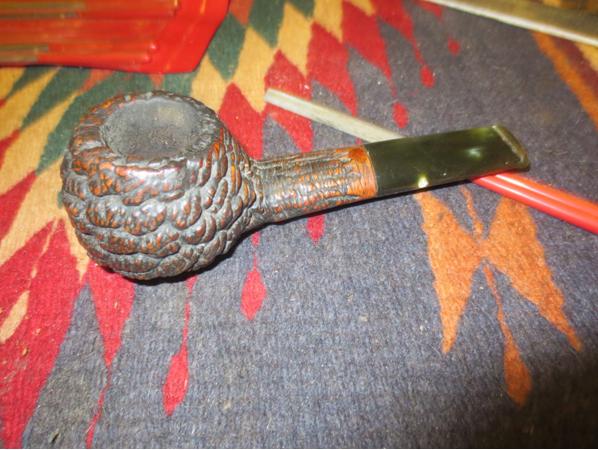
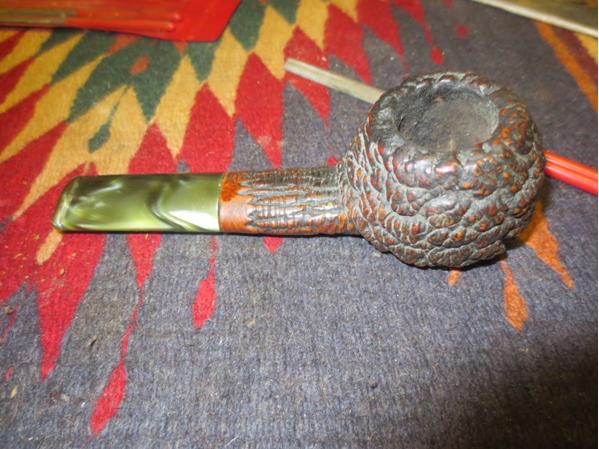
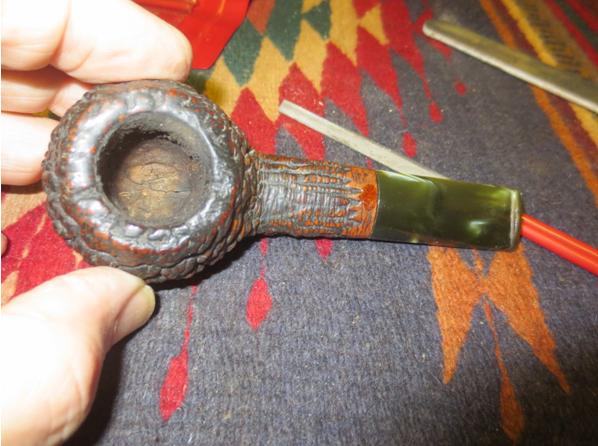
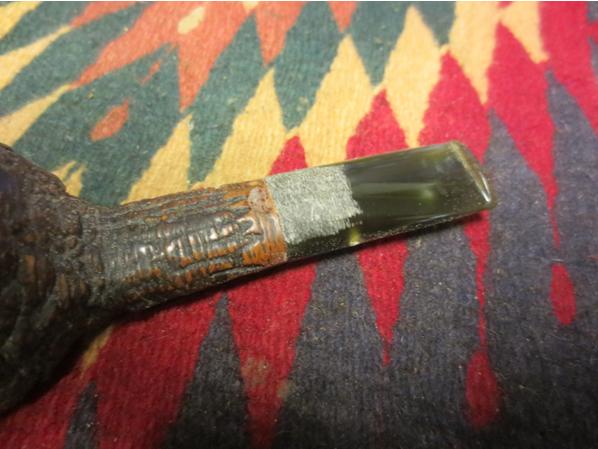
This lightly sandblasted long shank Canadian is stamped Jeantet over Lumberman on the underside of the shank. The tortoise-shell Lucite stem is stamped with a J in a circle on top of the freehand style stem and on the underside it is stamped Hand Cut and France. The shank extension is made of acrylic made to look like faux bone. The mortise is lined with a brass insert to stabilise the shank extension. The tenon is Delrin. The fit in the shank is snug and clean. The slot in the stem was dirty with a black buildup in the edges and the Y-shaped opening. The shank smelled dirty and strongly of aromatic tobacco. The finish was dirty but looked to be in good condition under the grime. There was a large nick in the right side of the bowl half way down the side. It was rough to the touch. The rim was tarry and dirty but underneath it was smooth. The inner and outer edge of the rim looked in good condition. There was a light cake in the bowl. It is a big pipe – 8 inches long, 2 inches tall, bowl is 1 ¾ inch deep, the bowl diameter is ¾ inch.jean1I have had a few older Jeantet pipes over the years but never one that was quite like this one. It is truly a beautiful piece of workmanship. I looked up information on two of my go to websites for information. The first was pipehphil’s Logos and stamping site. There I found that the Jeantet Company joined the Cuty-Fort Enterprises group (Chacom, Ropp, Vuillard, Jean Lacroix…) in 1992. In 2010 it dropped out and the brand isn’t part of the group any more. The label once again is owned by the Jeantet family (Dominique Jeantet). The production of pipes is currently discontinued. Dominique Jeantet retired in 2000. http://www.pipephil.eu/logos/en/logo-jeantet.html

The second site I looked on was Pipedia (https://pipedia.org/wiki/Paul_Jeantet_SA). There I found information from a book by José Manuel Lopes’ entitled Pipes, Artisans and Trademarks. Since I have the book here I went and read it first hand in the book. Here is what I found there.

Paul Jeantet SA (formerly Ebonite Co. is a French factory in Saint-Claude, and the name and business of the business man who in 1912 began making vulcanite stems for the pipe industry. Coming from a family of pipe makers (see Jeantet), Paul started using ebonite for the stems.

Paul Jeantet SA factory (1905 Saint-Claude), from the Jeantet Website: At one point the company was producing 35 million stems a year, and is still one of the few to produce ebonite stems in Europe.

From the Jeantet website: Founded in 1905 by Paul JEANTET, our company is being progressing in the field of rubber compound. Since the 70´s, JEANTET élastomères has been controlling the both processes of over molding and adhesion rubber / metal. Our manufacture is set in a 7000 m2 block, based in Saint-Claude, France. We are at one hour far from Geneva and one hour and a half far from Lyon. From prototype to mass production, JEANTET élastomères, certified ISO 9001, guarantee you availability and speed answers to all your asks of quotation.

Today, our group includes three companies specializing in vulcanized and thermoplastic elastomers : JEANTET élastomères, IXEMER ans PERROT. We are at your disposal for the creation and the development of innovating solutions. In 2014, the Group JEANTET took back the clientele of the Swiss company DUFOUR industries, what consolidates an important presence on the Swiss market of parts in Elastomers. (The Lopes’ book included the following contact information for the brand.

Contact Information:
JEANTET élastomères
Website: http://www.jeantet.com
6 Faubourg des Moulins
39200 SAINT-CLAUDE
Phone: +33 (0)3 84 45 79 00
E-mail: jeantet@jeantet.com

When the pipe arrived in Vancouver in a lot of pipes that Jeff sent me it caught my eye. It is a beautiful pipe. I took the next four photos to show the condition of the pipe when I started working on it.jean2 jean3I took a close up photo of the bowl and the rim. You can see the light cake in the bowl and the overflow on the back and the right side of the rim top. Underneath it looks like there is some good-looking grain.jean4I sanded the rim clean and took off the burned areas on the rim top with 220 grit sandpaper. I followed that by sanding the rim with 1500-4000 grit micromesh sanding pads. I wiped it down with alcohol and then used a light and a medium brown stain pen to touch up the rim to match the rest of the bowl.jean5I rolled a piece of sandpaper and sanded the inside of the bowl and the inner edge of the rim to clean up the damage left behind by the burns.jean6I waxed the bowl and shank with Conservator’s Wax and buffed it with a shoe brush to give it a shine.jean7I cleaned out the inside of the mortise, the airway in the shank and the stem with pipe cleaners, cotton swabs and alcohol until it was clean.jean8I polished the tortoise coloured Lucite stem with micromesh sanding pads – wet sanding with 1500-2400 grit and dry sanding with 3200-12000 grit pads. I wiped the stem down with a damp cloth to remove the grit and grime.jean10 jean11 jean12I buffed the pipe with Blue Diamond on the buffing wheel to polish the stem and the rim. I buffed the bowl and stem with carnauba wax and buffed it with a clean buffing pad to raise the shine. I hand buffed it with a microfibre cloth to deepen the shine. The finished pipe is shown in the photos below. It is a beautiful pipe and one I have not seen before. There is something about it that draws the eye. For a pipe this large it is well-balanced and proportionally works well. Thanks for looking.jean13 jean14 jean15 jean16 jean17 jean18 jean19 jean20

New Life for a Danish Made Don Regular Author 34


Blog by Steve Laug

The next pipe on the work table is a nice little author shaped pipe that was stamped Don Regular next to Made in Denmark and the shape number 34. The finish on the briar was quite clean on the sides, shank and bottom of the bowl. The rim was thickly caked with tars and oils and the bowl had a thick cake. The stem was in good shape with some tooth chatter on the underside of the stem next to the button. There were no tooth marks or gouges in the stem surface. The button was in excellent condition. The D stamping on the stem was readable but light in some places along the tails of the D. The next two photos show the pipe as it was when my brother received it from the eBay seller.don2 don3He took the next three close up photos to show the condition of the bowl and rim, the stamping on the smooth portion on the underside of the shank and the stem logo.don5don4I had not seen a Don Regular pipe before so I did a bit of digging to see what I could find. I found a note on Pipedia that it may have been a Bari sub brand but it was unsubstantiated. I did some more digging and found that the pipephil website verified that the Don was a second brand to Bari pipes and was made by them.

Here is what the link on pipedon1phil said: Brand founded by Viggo Nielsen in 1950 and sold to Van Eicken Tobaccos in 1978. At this time Age Bogelund managed Bari’s production. The company has been bought in 1993 by Helmer Thomsen. Bari’s second lines: Don, Proctushttp://www.pipephil.eu/logos/en/logo-d7.html.

My brother scrubbed the exterior of the pipe with a tooth brush and Murphy’s Oil Soap under running water. He dried off the pipe. He cleaned out the internals of the pipe with pipe cleaners and cotton swabs. He also cleaned off the stem. The next four photos show what the pipe looked like when it arrived in Vancouver.don6 don7I took a close up photo of the rim as well. My brother had gotten a lot of the tars and oils off the rim but there was still some deep in the grooves of the sandblast. There as a light cake around the inside of the bowl rim.don8I scrubbed the rim with a brass bristle tire brush until all of the grime came free of the rim. I scrubbed it back and forth until the ridges and grooves were clean and free of debris and tars. I wiped it down with alcohol until it was clean. I rubbed the bowl down with a light coat of olive oil and buffed the bowl with a shoe brush. The following four photos show the pipe at this point in the process.don9 don10I hand painted the white back into the D on the stem using a small paint brush and acrylic white paint. I scraped off the excess paint. There were some scratches around the D that also took paint so I would need to work on it some more.don11I polished the stem with micromesh sanding pads – wet sanding with 1500-2400 grit pads. I worked on the area around the D to try to clean up the letter. I dry sanded with 3200-12000 grit pads and rubbed the stem down with Obsidian Oil between each set of three pads. I set the stem aside to dry.don12 don13 don14I buffed the stem with Blue Diamond and worked on the area around the D to see if I could minimize the scratches. I was able to reduce the scratches around the D and improve the overall look of the stamping. I gave the bowl several coats of Conservator’s Wax and buffed the bowl and stem with a clean buffing pad to give it a shine. The finished pipe is shown in the photos below. The sandblast and the contrast stain work well together. It is a beautiful old pipe. Thanks for looking.don15 don16 don17 don18 don19 don20 don21 don22