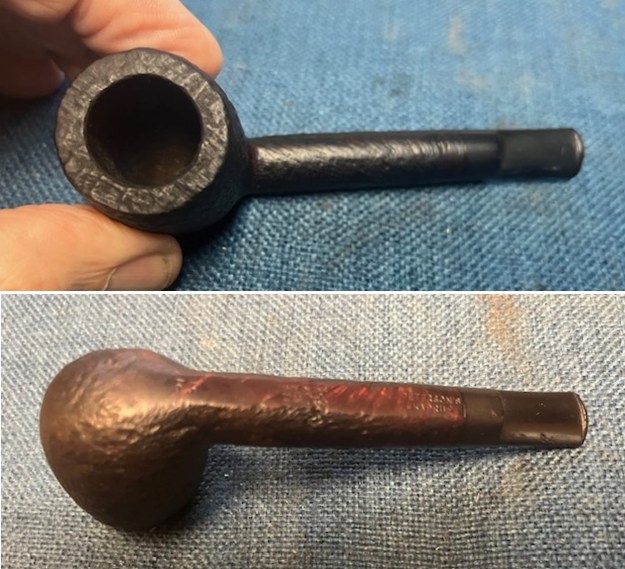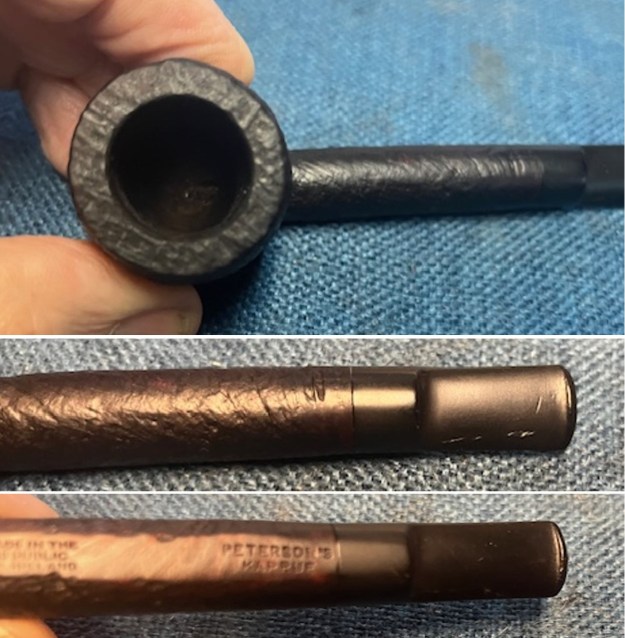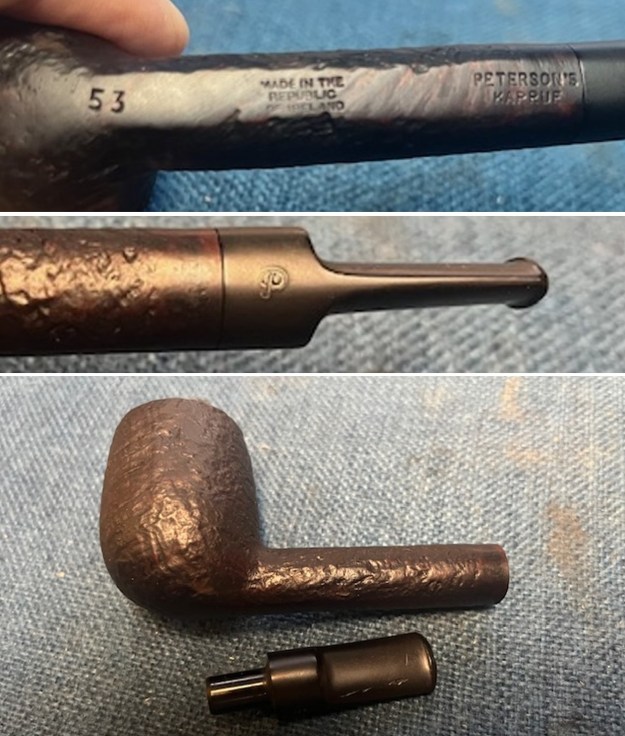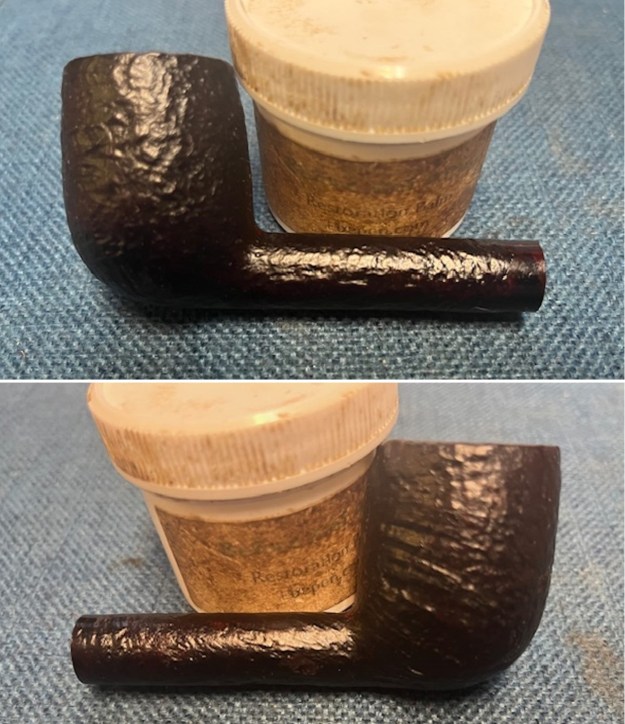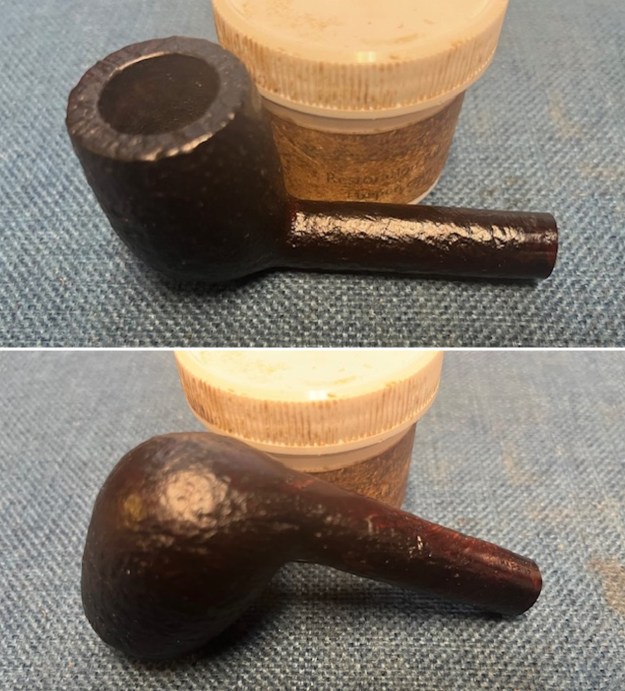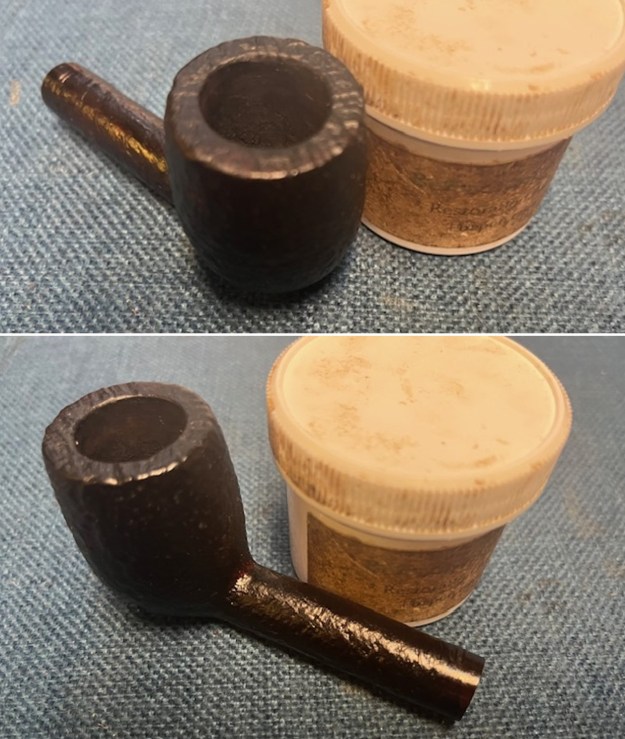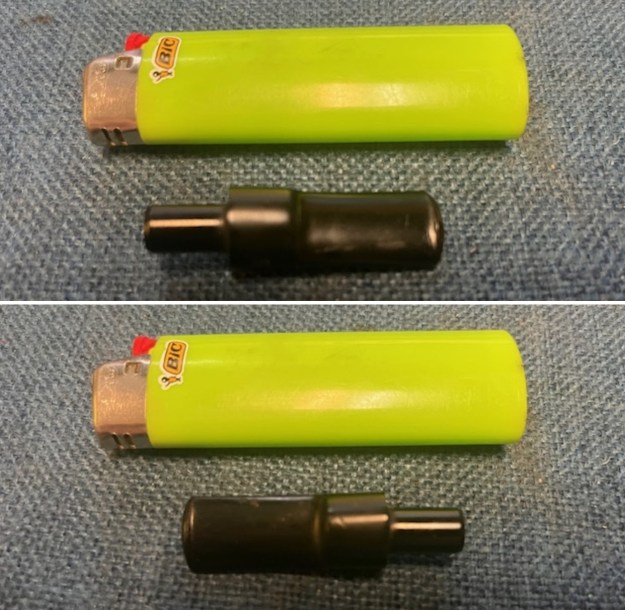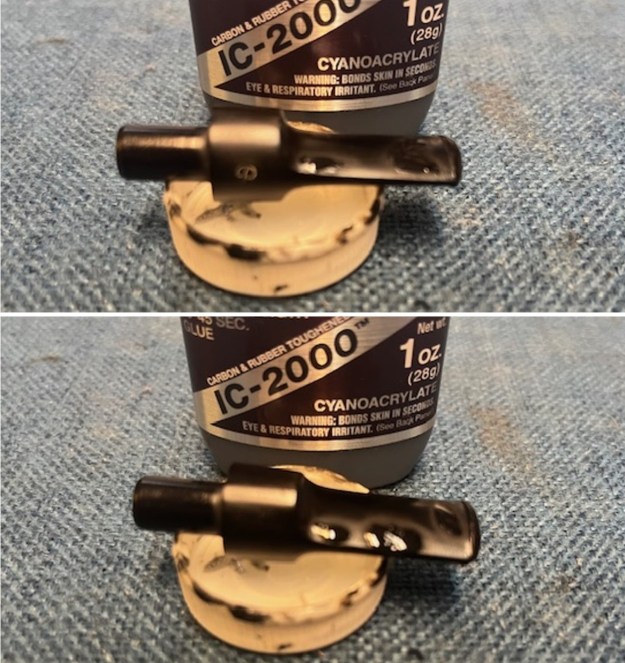
Tag Archives: Stem repairs

New Life for a Peterson’s System Standard 301 Smooth Pot


by Steve Laug

We received the next pipe from our source in Copenhagen, Denmark on 01/29/2024. It is another fitting New Year’s restoration. It is a Peterson’s 301 Bent Pot. It is stamped on the left side of the shank and reads Peterson’s [arched over] System [over] Standard. On the right side it is stamped Made in the Republic of Ireland (in three lines) [over] the shape number 301. The nickel ferrule on the shank is lightly oxidized and stamped K&P [over] Petersons. The pipe is dirty, obviously another favourite smoker. There is grime ground into the finish. There is a thick cake in the bowl and a thick overflow of lava on the inner edge and the smooth rim top. The nickel ferrule is lightly tarnished and stamped as noted. The stem is dirty, very oxidized but does not have tooth marks of chatter on either side. Jeff took photos of it before he started his clean up work. I have included those below. Jeff took photos of the rim top and stem to show the general condition of the pipe. The bowl is heavily caked and there was some darkening and a lava overflow on the rim top and the inner edge. The stem looks amazingly good for a pipe of this age. Jeff took photos of the bowl sides and heel to show the look of the sandblast that was around this bowl. The blast really highlights the grain underneath and is quite beautiful around the sides of the bowl and shank. It is another nice looking pipe. He took photos of underside of the shank to show the stamping. The stamping is clear and readable in the photos below and is as noted above. The stamping on the nickel ferrule is clear and readable as noted above. I have included a link to the Pipedia article so that you can read the history of the brand (https://pipedia.org/wiki/Peterson). Take some time to read through it as it is a great read.

I turned to “The Peterson Pipe” by Mark Irwin and Gary Malmberg to get some background on the Peterson’s System Line. On page 314 it had the following information.

Peterson’s over System – Pipes stamped Peterson’s System have been documented as early as 1920. A ’20 brochure is the earliest printed reference to the Peterson System. The pipe came in three quality grades (no mark, 2, or 3) until 1959, thereafter as De Luxe (no mark), Premier (the old 2) and Standard (the old 3).

Peterson’s over System over Standard (c1945-)

I learned previously that the shape 301 was not introduced until 1975. Considering the Republic stamp, this one would likely date between 1975 and 2000. My guess is that the pipe was made somewhere between 1975 and mid-80s. Now it was time to work on the pipe.

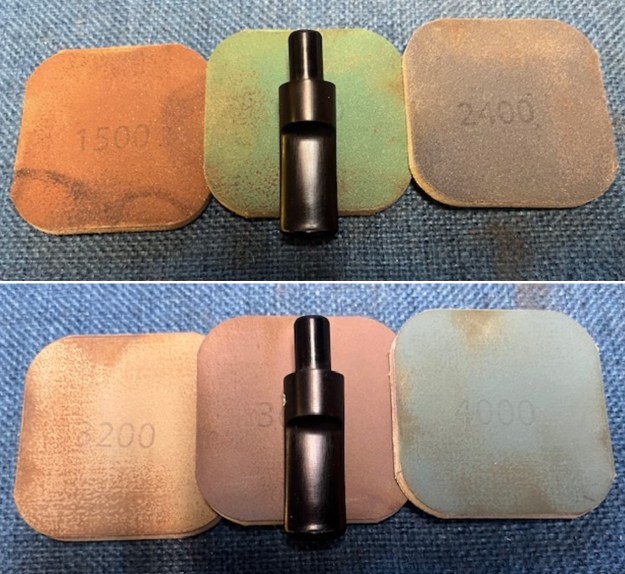
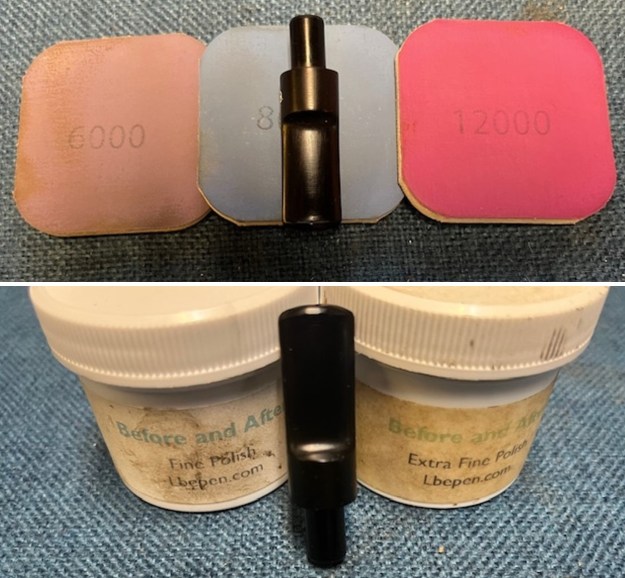
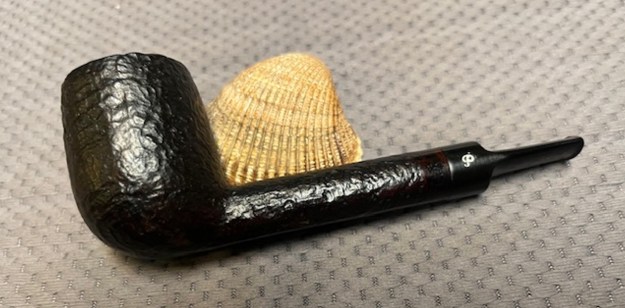
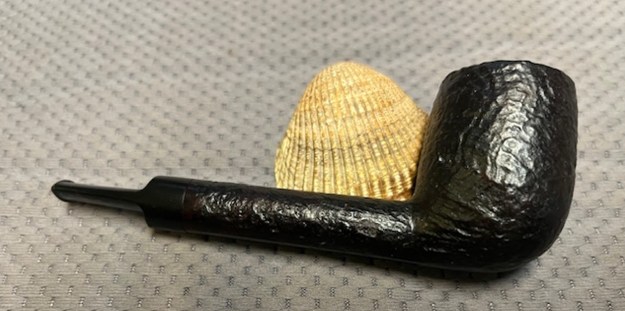
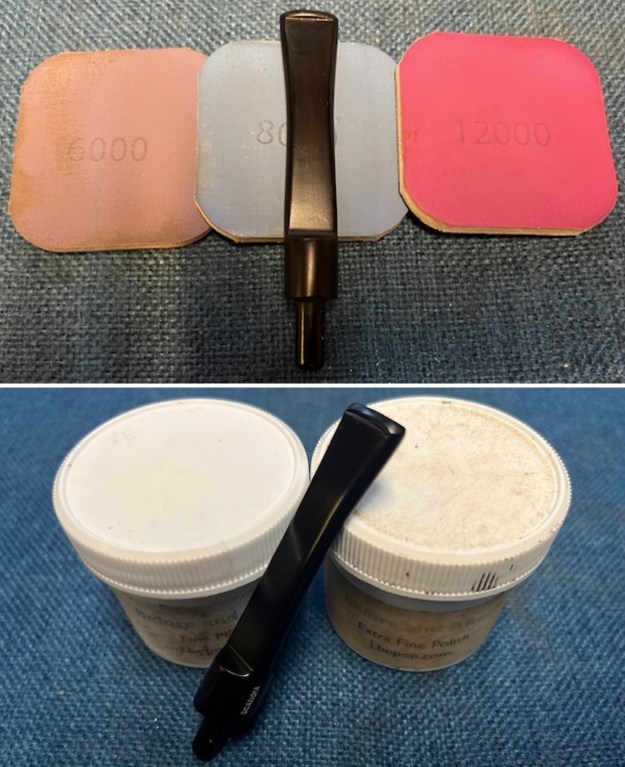
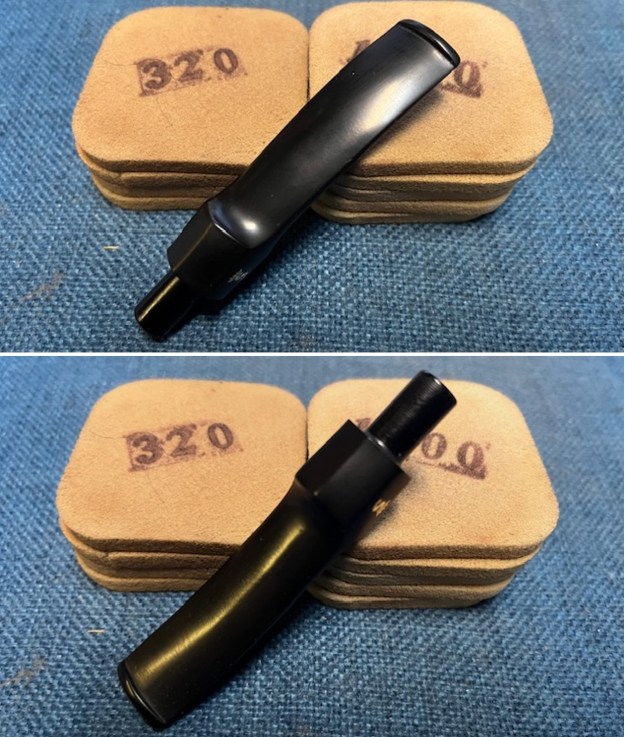
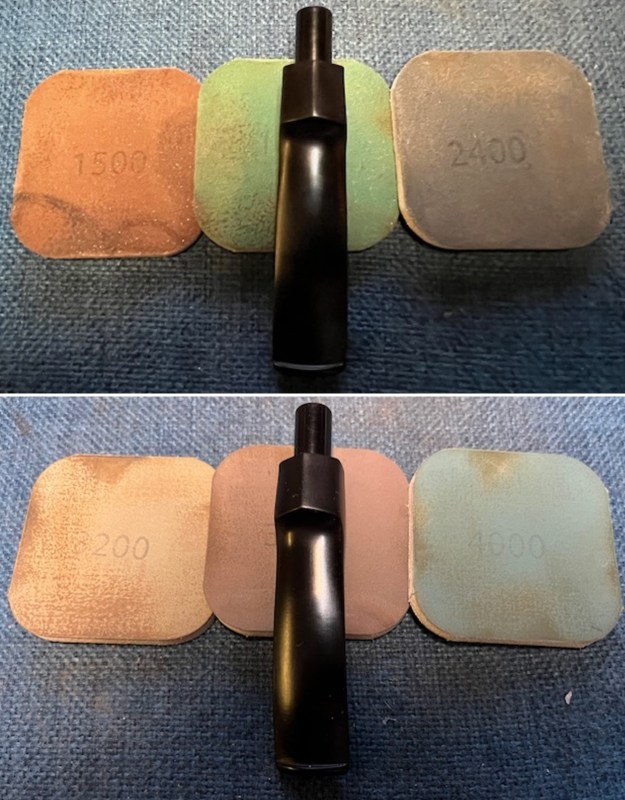
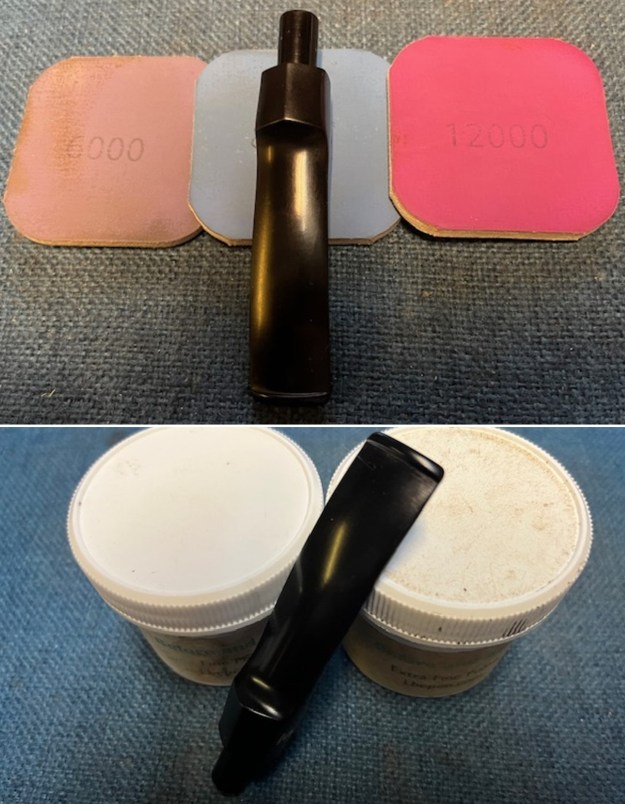
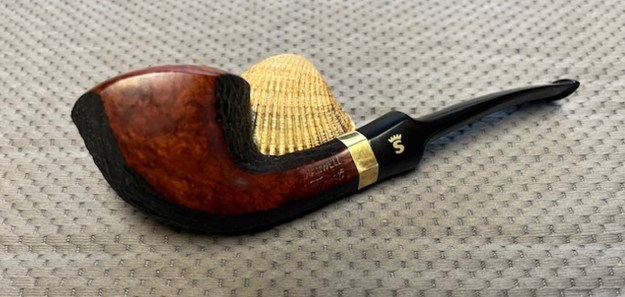
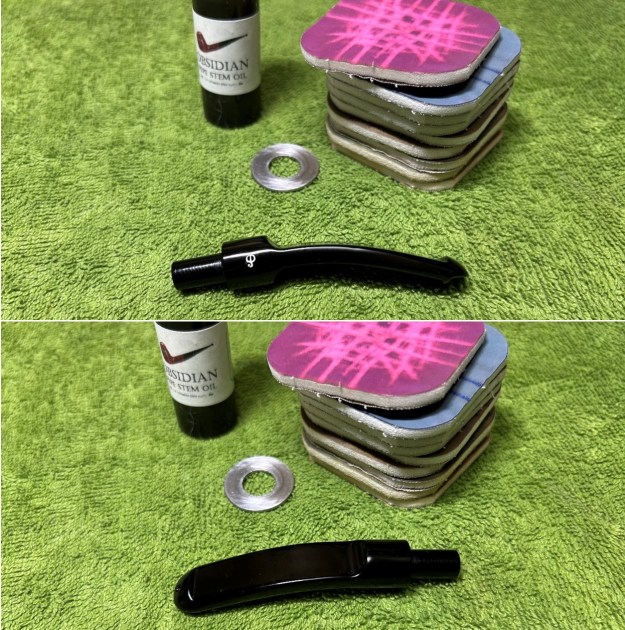
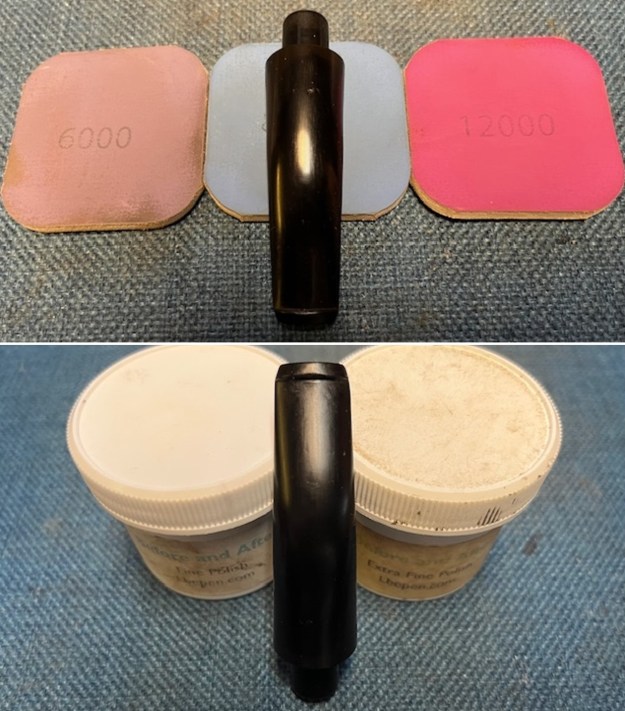
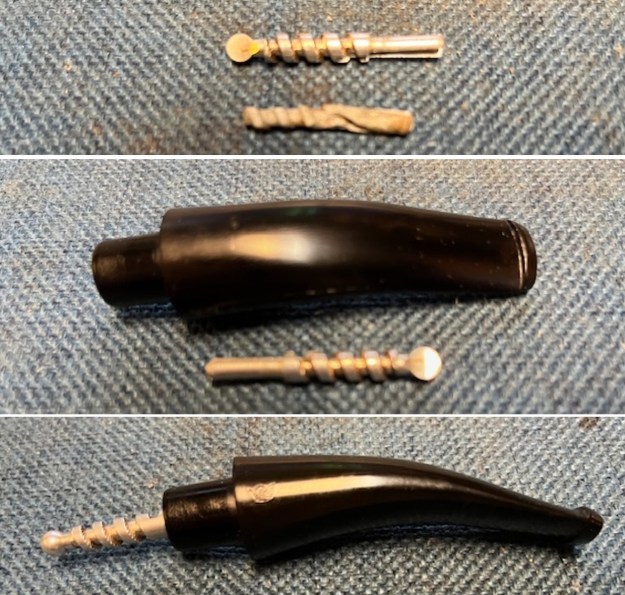
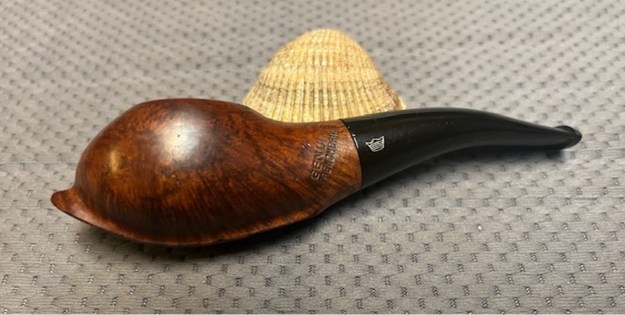
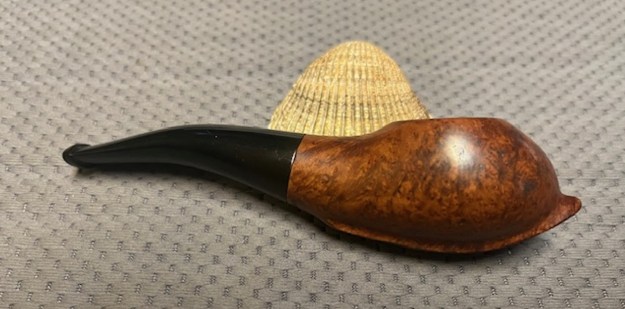
With that information at hand I turned to work on the pipe itself. Jeff had thoroughly cleaned up the pipe. He reamed the pipe with a PipNet Pipe Reamer and cleaned up the remnants with a Savinelli Fitsall Pipe Knife.  He scrubbed the bowl with undiluted Murphy’s Oil Soap with a tooth brush. He rinsed it under running warm water to remove the soap and grime. He cleaned out the inside of the shank and the airway in the stem with alcohol, cotton swabs and pipe cleaners. He scrubbed the exterior of the stem with Soft Scrub to remove as much of the oxidation and calcification as possible. He soaked the stem in Before & After Deoxidizer and rinsed it off with warm water. I took photos of the pipe before I started to work on it.  I took close up photos of the bowl and the stem. You can see the reamed bowl and the clean rim top and edges. It looks good. There is a bit of darkening on the inner edge at the back. The stem surface was clean but there are light tooth marks and chatter on both sides on and ahead of the button.I took a photo of the stamping on the underside of the shank. It is faint in spots but readable as noted above. I removed the stem from the shank and took a photo to give a sense of the proportions of the pipe. It is really quite nice looking. I polished the briar with micromesh sanding pads – dry sanding with 1500-12000 grit pads. I wiped the bowl down between pads with a damp cloth to remove any sanding debris. The briar really took on a rich shine. I rubbed the bowl and shank down with Before & After Restoration Balm. I worked it into the surface of the bowl sides and shank with my fingertips to clean, enliven and protect the briar. I let the balm sit for a little while and then buffed with a cotton cloth to raise the shine. I sanded the stem with 320-3500 grit sanding pads and wiped it down with a cloth and Obsidian Oil to remove the debris. It began to take on a rich shine.I polished the vulcanite stem with micromesh sanding pads – 1500-12000 grit pads. I wiped it down with a damp cloth after each sanding pad. I used Before & After Pipe Polish – both Fine and Extra Fine to further polish the stem. This nice looking Republic Era Peterson’s System Standard 301 Bent Pot with a classic Peterson’s P-lip vulcanite stem looks much better now that it has been restored. The rim top and edges cleaned up very well. The dark brown stains on the bowl came alive with the polishing and waxing. I put the stem back on the bowl and carefully buffed the pipe with Blue Diamond on the buffing wheel using a light touch on the briar. I gave the bowl multiple coats of Conservator’s Wax and the stem multiple coats of carnauba wax on the buffing wheel and followed that by buffing the entire pipe with a clean buffing pad. I hand buffed the pipe with a microfiber cloth to deepen the shine. I left a few of the wounds in the briar left by the journey as they do not detract. The finished Peterson’s System Standard 301 is a beauty and fits nicely in the hand and looks very good. Give the finished pipe a look in the photos below. The dimensions of the pipe are Length: 5 ½ inches, Height: 1 ¾ inches, Outside diameter of the bowl: 1 ½ inch, Chamber diameter: ¾ of an inch. The weight of the pipe is 59 grams/2.01 ounces. I will be putting it in the rebornpipes store in the Irish Pipemakers Section soon. If you are interested in adding this pipe to your collection send me a message or an email. Thanks for reading this blog and my reflections on the pipe while I worked on it. There are many more to come!
Restoring a Handsome Portland Pipe Co. “Falcon Briar”


by Kenneth Lieblich

This is the next pipe that I restored for a local family. One of the gentlemen selected this fine Canadian shape for his own. It’s a good-looking pipe and worthy of restoration. This pipe comes from the Portland Pipe Co., which I’ve written about before. This specific pipe has some interesting markings – let’s take a look. On the top of the shank, it reads Portland Pipe Co [over] B.B& S Ltd. [over] London made – England. On the left side of the shank, it reads Falcon Briar. On the right side of the shank, it reads P2 – presumably a shape code. Two things puzzled me: the term “Falcon Briar” and the code “P2”. They didn’t conform to anything I already knew about Portland. Here is a review of my digging for information on Portland Pipe Co.I began my research with José Manuel Lopes’ book, Pipes: Artisans and Trademarks. As the photo shows, there was a little information, but not a lot.The connection with Barling was interesting, so I also checked Wilczak and Colwell’s book, Who Made That Pipe? From the photos below, you can see that the Portland Pipe Co. is connected to Barling too.Time to check online. Pipephil had a similarly brief write-up (included here).Pipedia was a bit more informative. Their page on the Portland Pipe Co. includes the following information (the typos are in the original and are NOT mine):

Portland Pipe Company was an English pipe maker, and appears to have started in the 1930’s, and went out of business in 1962. It’s though they had ties to Barling pipes from the 1930’s. They might have been a sub-brand or “second” which was separate from, but fully owned by Barling’s all along. It also thought that after Portland closed down, and during Barling’s corporate era (BB&S), Barling picked up some of the Portland brand (Londoner, Cragmoor and Portland) and made them for a while. WILCZAK & COLWELL in their book “Who Made That Pipe?” acknowledge the brand as from England, though some have been made in Italy as well (see Pipephil.eu). The Brand John Peel is a pipe which has the stamping: JOHN PEEL, A PORTLAND PIPE, MADE WHOLLY IN ENGLAND. I have a model with is also stamped SPECIAL, it’s a stack design with shape number 801. This pipe might have been made either by Portland or Barling. According to a 1940 price sheet, the following models were offered, along with the correlating prices:

 Vintage (10/6)
Exchange (7/6)
Londoner (7/6)
Mosaic (7/6)
Portland Super (7/6)
Crustor (5/6)
Diploma (5/6)
Port Royal (5/6)
Port-de-Luxe (5/6)
Portland Patent (5/6)
Souk-el-Arba (5/6)
Times (4/6)
British Sovereign (3/6)
John Peel (3/6)
Jubilee (3/6)
Sirdar (3/6)
Campaigner (2/6)
Dandy (2/6)
First Call (2/6)
Knobby (2/6)
Topsall (2/6)
Topsall Comfort (2/6)
Portman (2/-)
British National (1/6)
Ruf Kut (1/6)

This doesn’t mention anything about “Falcon Briar”. However, there are a few other tidbits of information. The PipesMagazine.com forums include an interesting comment from Barling expert Jonathan Guss:Finally, over at the Very Keen on Pipes website, a reader commented on one of their posts by saying:

“… Portland pipes make up one of the great mysteries of London pipe making. No one knows when Barling bought Portland but most of us barling guys believe it was mid to late 30’s. I saw a reference once online using the year 1936 but this cannot be confirmed. Next, John Peel was for a long time thought to have been a shop but there is no evidence proving that. However, John Peel pipes were almost certainly made by Portland. What most of use want in a pipe of this type is a pipe made before 1962, when the barling family was let go by the new owners and the brand went into a downward spiral quality wise. Re Portland, a number of them have recently turned up as a result of a “garage find” of a batch of pipes from the Toronto Canada area and they were mixed in with other wood from the 50’s and that seems to indicate a 50’s date of manufacture. Note: in those days several of the larger pipe makers made pipes or just bowls for other brands and these were mostly Charatan, Comoy and other makers such as Orlick. What is almost certain is that never did barling make / sell any pipes that were not carved by barling carvers untill after 1970. So, Portland and Peel were never actually barling made, these pipes were either made by Portland in house or, in later years past 1962, by Charatan and others. Also, if one looks at the style of the bits it evident that Portland and Peel pipes were not made that long ago, probably 50’s and 60’s unless there is a BB&S stamp which indicates post 1970 age (the & symbol being the give away since B.B.S was used in the older pre 1962 era.) Just some info for you to keep in mind… “

This is interesting stuff and then Steve gave me another possible detail. Apparently, Comoy’s used to make a line of pipes called ‘Falcon’ and another called ‘Royal Falcon’. Perhaps this bowl was made by Comoy, but later picked up by Portland. This could explain why the pipe contains the ‘Falcon Briar’ line. Pipephil has this tidbit:By inference (and some educated guesswork), this pipe was made in England, probably in the 1970s (or, at least, post 1970), by the Portland Pipe Co. However, there may be a Comoy connection too. I am happy to be educated by someone who knows more.

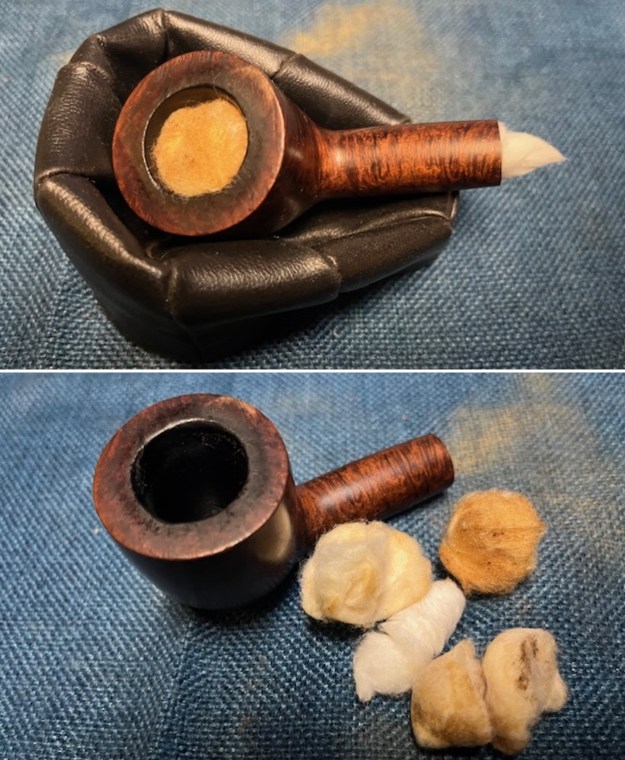
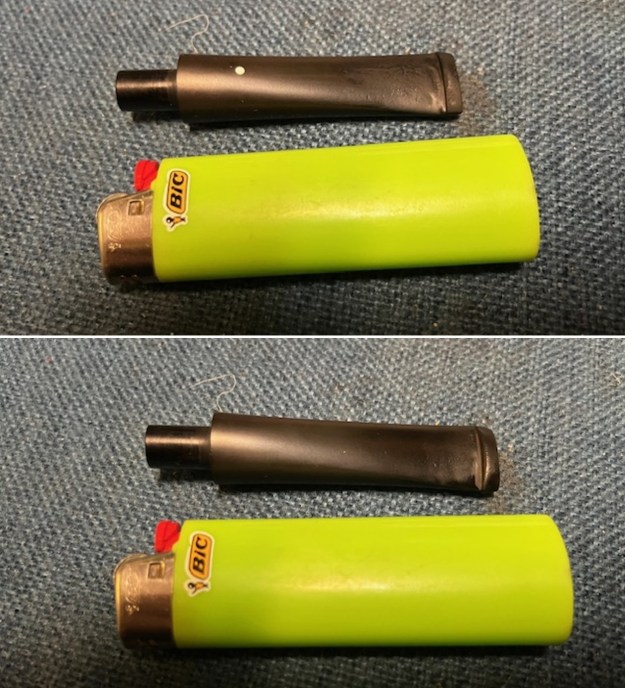
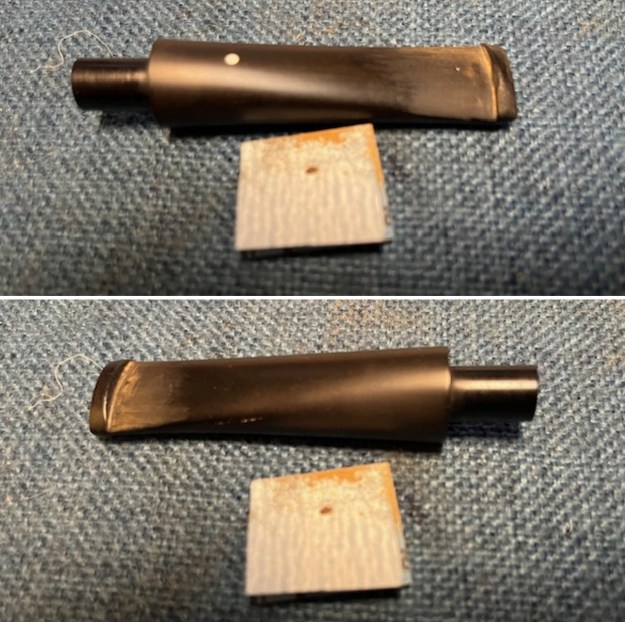
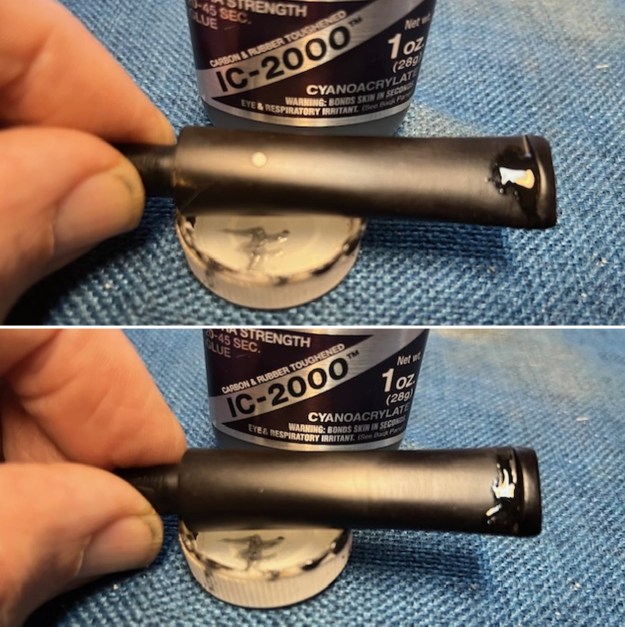
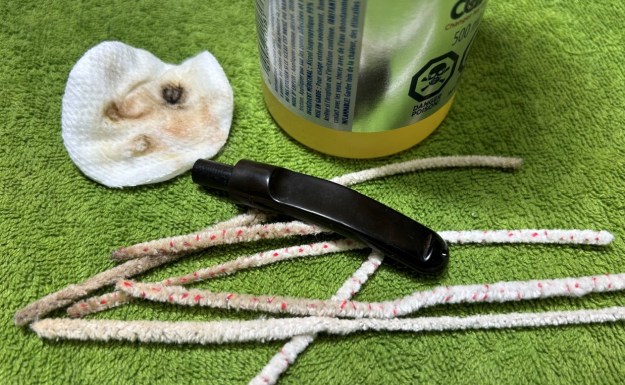
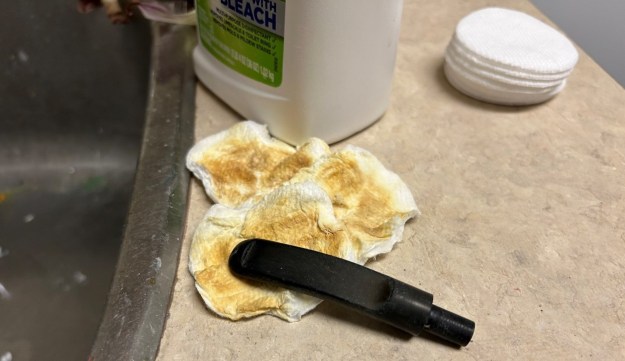
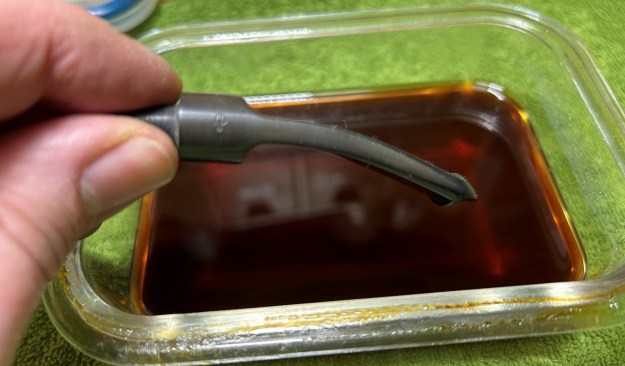
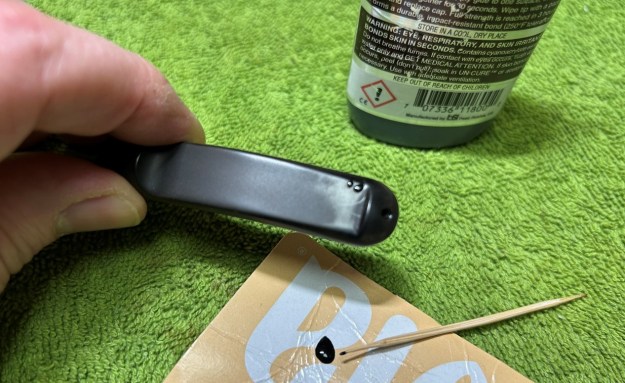
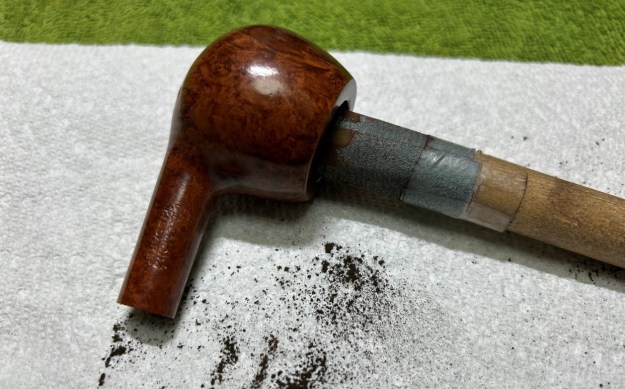
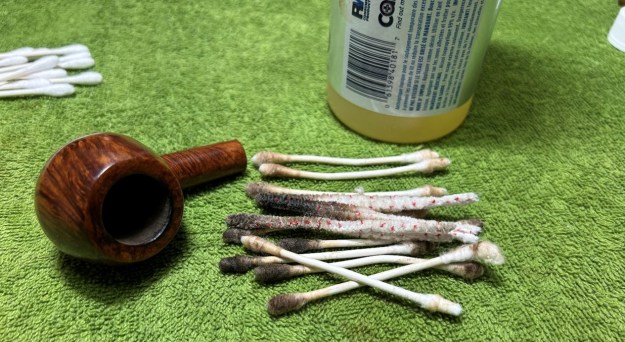
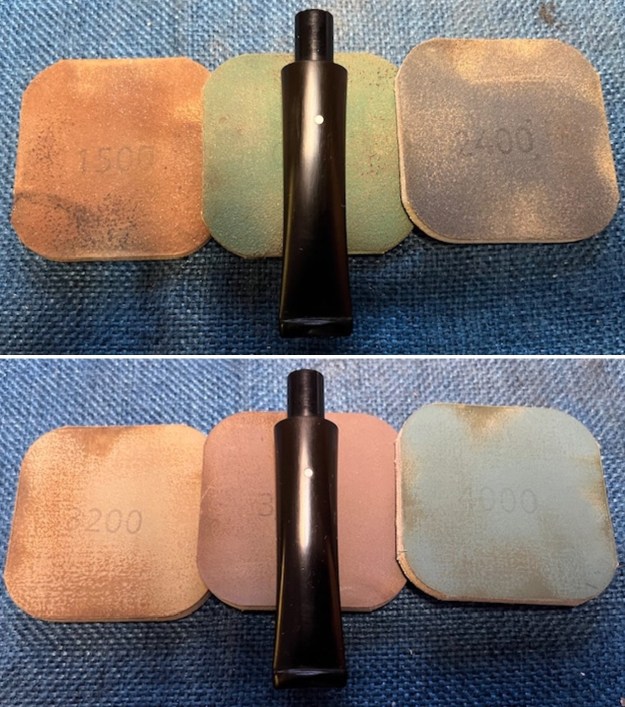
The pipe was in good condition and didn’t require any major surgery. The bowl was a bit dirty and banged up, but nothing serious. Similarly, the stem had some tooth marks and scrapes, nothing to worry about.To start, I used a disposable lighter and ‘painted’ the stem with its flame. The gentle heat of the flame can cause the dents in the vulcanite of the stem to expand back into shape. This helped a little bit.I used oil soap on a few cotton rounds and wiped the stem down to provide an initial cleaning of filth before moving on to the next steps. The primary cleaning comes next. I cleaned the inside of the stem with both pipe cleaners and cotton swabs dipped in 99% lemon-infused isopropyl alcohol. I scrubbed thoroughly to make sure the interior was clean.The goal of the next step is the removal (or minimization) of oxidation. Going to my sink, I used cream cleanser, cotton rounds, and a toothbrush, and scoured the stem to remove as much surface oxidation as possible. As the photos show, the result is a hideous brownish mess – but better off the stem than on it.Once the stem was reasonably clean, I soaked it overnight in some de-oxidation fluid. This solution works to draw oxidation in the stem to the surface. This is a major aid and important step in ensuring a clean stem. The following day, I drew the stem out from its bath and scrubbed the lingering fluid with a toothbrush.Once clean and dry, I set about fixing the marks and dents in the vulcanite. This is done by filling those divots with black cyanoacrylate adhesive, impregnated with carbon and rubber. I left this to cure and moved on.The penultimate step for the stem is sanding. First, with my set of needle files, I reduce the bulk of the cyanoacrylate repairs. I want to remove the excess adhesive as near to the surface as possible, without cutting into the vulcanite. Following that, I use all nine of the micromesh sanding pads (1,500 through 12,000 grit) to sand out flaws, even out the vulcanite, and provide gentle polishing of the finished surface. I also apply pipe-stem oil while using the last five micromesh pads. There is a wonderful, deep black shine to the stem when I am done.Now that the stem is (nearly) complete, I can move on to the stummel. The first step for me is to ream out the bowl – that is to say, remove all the cake inside the bowl. This accomplishes a couple of things. First (and most obviously), it cleans the bowl and provides a refurbished chamber for future smoking. Second, when the old cake is removed, I can inspect the interior walls of the bowl and determine if there is damage or not. Everything looked good inside the bowl. My next step was to remove the lava on the rim. For this, I took a piece of machine steel and gently scraped the lava away. The metal’s edge is sharp enough to remove what I need, but not so sharp that it damages the rim. This worked well. Similar to the stem, I then cleaned the insides of the stummel with both pipe cleaners and cotton swabs dipped in 99% lemon-infused isopropyl alcohol. The pipe turned out to be a bit dirtier than I expected.I then decided to ‘de-ghost’ the pipe – that is to say, exorcize the remaining filth from the briar. I filled the bowl and the shank with cotton balls, then saturated them with 99% isopropyl alcohol. I let the stummel sit overnight. This caused any remaining oils, tars and smells to leach out into the cotton.To tidy up the briar, I also wiped down the outside with some oil soap on cotton rounds (and a toothbrush). This does a good job of cleaning any latent dirt on the surface of the briar. The last step of the cleaning process is to scour the inside of the stummel with some soap and tube brushes. This is the culmination of a lot of work in getting the pipe clean.In order to lessen the nicks on the rim, I ‘topped’ the pipe – that is to say, I gently and evenly sanded the rim on a piece of 220-grit sandpaper. This effectively minimizes the damage, without altering the look of the pipe.I used all nine micromesh pads (1,500 through 12,000 grit) on the outside of the stummel to finish it off. This sanding minimizes flaws in the briar and provides a beautiful smoothness to the wood. I rubbed some Before & After Restoration Balm into the briar and let it sit for 20 minutes or so. The balm moisturizes the wood and gives a beautiful depth to the briar. I then buffed it with a microfibre cloth. For the final step, I took the pipe to my bench buffer and carefully polished it – first with a white diamond compound, then with three coats of carnauba wax. This procedure makes the pipe look its best – the stummel sings and stem glows.This Portland Canadian is a very handsome pipe and will provide many years of smoking pleasure. I hope you enjoyed reading the story of this pipe as much I as I did restoring it. If you are interested in more of my work, please follow me here on Steve’s website or email me directly at kenneth@knightsofthepipe.com. The approximate dimensions of the pipe are as follows: length 6 in. (153 mm); height 1⅞ in. (48 mm); bowl diameter 1⅓ in. (33 mm); chamber diameter ⅔ in. (17 mm). The weight of the pipe is 1⅜ oz. (40 g). I hope you enjoyed reading the story of this pipe’s restoration as much as I did restoring it. If you are interested in more of my work, please follow me here on Steve’s website or send me an email. Thank you very much for reading and, as always, I welcome and encourage your comments.

Restoring a Collectible JULS Freehand Straight Brandy with a Taper Stem with an Ebony Inlay


by Steve Laug

I was recently contacted by a fellow here in Vancouver about some pipes he had. He was referred to me by a local pipe shop. I was unclear if he wanted them cleaned or exactly what. When he came on the weekend he brought six pipes in two pipe boxes for me to have a look at. I spoke with him about the cost of restoring them. It finally became clear to me (I guess I am slow) that he wanted to sell the pipes. He was tasked with the job by his sister in law as the pipes were from her late husband’s collection. As I unpacked them it was clear that they were some nice pipes and some were higher grade. All but one was smoked and had the heavy smell of fruity aromatics to them. Some had cake in the bowl and lava on the rim. Of the six, four of them had significant rim damage – bowls out of round, burn marks, cut marks. The saddest part is that the damage was most significant on the higher end pipes. Most of them had tooth marks in the stems. Obviously, they had been his late brother in laws favourites and he had enjoyed them. He left them with me and I went over them, researched the brands and wrote up an offer for him to present to his sister in law. By the end of the day we had a deal. The six pipes now have a new home and the fruity smell needs to be exorcised!I am turning my attention to the fifth of the six pipes I purchased. The bottom right pipe of the six is unsmoked. The last of the five that needed work is just above the unsmoked one. It is another beautiful looking pipe that looks to be Danish Made. It is a straight Brandy stamped on the underside of the shank and reads JULS [over] Freehand. The bowl had beautiful straight grain around sides. The shape is impeccably done. The finish was dirty but otherwise all was good it appeared. The rim top was clean of cake and lava. The inner edge of the bowl was damaged all the way around and was slightly out of round. The bowl had been recently reamed and it was clean. Like the others, there was a pipe cleaner trough from the entrance of the airway into the bowl but much less prominent. It could have been caused by an overzealous reaming that left the bottom damaged. The stem was slightly oxidized and had light tooth marks and chatter on both sides of the stem ahead of the button. The stem had what looked like an Ebony wood inlay toward the shank end of the stem spaced between vulcanite at the tenon and the rest of the blade. The transition between the wood and the vulcanite was not smooth on either end. The JS engraving on the topside of the stem was faded but still readable. It also came with a soft felt pipe sock that had a Johs stamp on it. I took photos of the bowl and rim top to give you an idea of what I see. Once again it is too bad that Word does now allow for the inclusion of smells because this sweet vanilla is filling my work area. I have a candle going to mask the smell a bit. You can see the damage to the rim top and inner edge of the bowl. The bowl is lightly caked. The stem is lightly oxidized and has light tooth marks and chatter on both sides ahead of the button. There is also a faint stamp on the top of the stamp.I took a photo of the stamping on the underside of the shank. It is faint but readable with a lens as noted above. The stamp on the top of the stem is a JS etched on the top by hand. I took a photo of the bowl with the stem removed to give a sense of the proportion and appearance of the pipe. To help me understand the stamping a bit more I turned to Pipephil’s site and read what it said about Svendborg Hand Carved pipes (http://pipephil.eu/logos/en/logo-j4.html). I have included a screen capture of the section below as well as the side bar information below the capture. Artisan: Julian Schäffer. He began carving pipes in 1982 and almost stopped the job in the early 90s. His 2001 collection brought 14 high grade pipes together.

From the information I found that the pipe was carved by Julian Schäffer during the 8 years that he carved pipes – 1982-1990. He was known to carve high grade pipes.

Next, I turned to Pipedia for more information and detail (https://pipedia.org/wiki/Juls). I find that the articles there often fill in some more information on the relationships and history of a given brand. In this case I found that also true. The article is very brief and quotes Pipes, Artisans and Trademarks, by José Manuel Lopes I quote it in full below.

JULS pipes are by the German artisan Julian Schäffer, who began carving pipes in 1982, and worked with Former and Rainer Barbi. Influenced by Danish design, his pieces are both with and without 9mm filters, and have ebonite stems. They are collectors’ items today. The brand ran from 1982 to the beginning of the 1990s, when Julian ceased production, and moved on to other activities. Stamp: JULS

I turned to Google and found several listings for JULS pipes that were selling on the estate portion of smokingpipes.com. There was a brief description of a Billiard for sale there that gave more information as well that was further confirmation concerning the brand. Here is the link (https://www.smokingpipes.com/pipes/estate/germany/moreinfo.cfm?product_id=612079). I quote:

Crafted by German artisan Julian Schäffer, Juls pipes were heavily influenced by Danish design sensibilities, with Schäffer having worked with carvers such as Former and Rainer Barbi. Juls pipes began production in 1982, with Schäffer ending his production around the early 1990s. This Billiard from the German carver illustrates his deft understanding of Danish design, its composition replete with soft, sleek line work. The bowl stands tall with an upright posture, formed by smooth, supple walls rising high from the rounded heel toward the flat rim. From a defined transition, a sturdy shank emerges from the bowl, punctuated by a broad accent of dark wood at the shank end as its meets a slender stem with a trim expansion ring at its base. A warm, hazelnut stain dresses the stummel, showcasing whorls of birdseye across the bowl’s left flank. – Joshua Carroll

Now I knew that the carver was Julian Schaffer and that his pipes had an obvious Danish design look to them. He had trained with Hans Former and Rainier Barbi in Germany, both who were master carvers. I also knew that the pipe was made in the short period between 1982-1990 when he stopped carving.

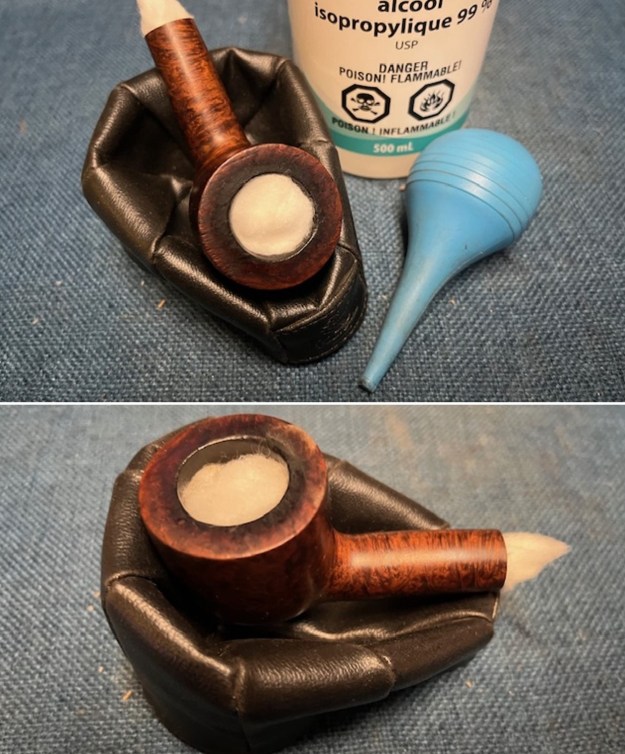
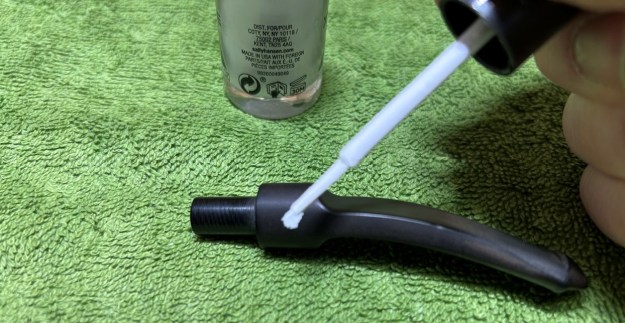
I reamed the bowl with a Savinelli Fitsall Pipe Knife to take back the cake to bare briar. I sanded the walls smooth with some 220 grit sandpaper wrapped around a piece of dowel. I have to say that I was spooked by what I found on the S. Bang Brandy I just finished. I ran my fingers over the sides of the bowl and gladly they were smooth. As mentioned above the bottom of the bowl showed a trough carved in the bottom of the bowl. It was certainly not as deep as the other two pipes but appeared to be carved by zealous use of pipe cleaners. I was able to ream out the ridge with the Pipe Knife. It looked much better. I took a photo of it as best as I could but it is hard to see. I sanded the walls with a piece of 220 grit sandpaper wrapped around a dowel. It was smooth to touch.I cleaned out the stinky, fruity smelling tobacco oils and tars in the shank and the airway in the stem. I used 99% isopropyl alcohol, cotton swabs and pipe cleaners and was able to remove the debris and some of the stench. I needed to “deghost” the bowl and try to exorcise the smell. I stuffed bowl with cotton bolls and used an ear syringe to fill it with alcohol. I set it aside to let the alcohol do its work and wick the oils into the cotton. While it sat for the afternoon, I did some other work. The next morning when I came back to it the cotton and alcohol had wicked out the oils and tars. The cotton was brown and the bowl smelled much better. The damages demanded some restoration and repair. I started with the rough inner edge of the rim. I used a folded piece of 220 grit sandpaper to minimize the damage on the inner edge of the rim and smooth it a bit. I was careful to not change the profile of the rim top and edges. I mixed up a batch of bowl coating – sour cream and activated charcoal powder to give a top coat  on the bottom of the bowl and the walls to facilitate the build up of a cake in the bowl. I applied it to the bowl with a folded pipe cleaner and painted it on the sides and pressed it into the trough marks on the bottom. Once finished I set it aside to cure. I love this recipe for a bowl coating as it leaves no residual taste once the coating cures. It is black and provides perfect protection. I rubbed the exterior of the bowl and shank down with Before & After Restoration Balm. I worked it into the surface of the briar with my fingertips to clean, enliven and protect the briar. I let the balm sit for a little while and then buffed with a cotton cloth to raise the shine. The Balm did its magic and the grain stood out. I set aside the bowl and turned my attention to the stem. I touched up the J.S. Logo stamp on the topside of the taper stem with Rub’n Buff Antique Gold. I robbed it into the stamping with a tooth pick. Once it had cured I buffed it off with a cotton cloth then wiped it down with some Obsidian Oil. It looked very good.The transitions between the ebony and the vulcanite had a slight ridge and the bite marks and chatter were not too deep. I was able to smooth out the transitions between the ebony inset and the vulcanite and the tooth chatter and remove the light oxidation with 320-3500 grit sanding pads. I wiped the stem down after each pad with an Obsidian Oil cloth. It was beginning to look very good.I polished the stem with micromesh sanding pads – 1500-12000 grit pads. I wiped it down with a damp cloth after each sanding pad. I used Before & After Pipe Polish – both Fine and Extra Fine to further polish the stem. I put the cleaned and restored Julian Schäffer JULS Freehand Straight Brandy and its vulcanite taper stem with a Ebony Insert back together. The rich browns and blacks of the contrasting stain makes the grain come alive with the polishing and waxing. I carefully buffed the pipe with Blue Diamond on the buffing wheel using a light touch on the briar. I gave the bowl and the stem multiple coats of carnauba wax on the buffing wheel and followed that by buffing the entire pipe with a clean buffing pad. I hand buffed the pipe with a microfiber cloth to deepen the shine. The finished Julian Schäffer JULS Freehand Straight Brandy really is a beauty and fits nicely in the hand and looks very good. Give the finished pipe a look in the photos below. The dimensions of the pipe are Length: 6 ½ inches, Height: 2 ½ inches, Outside diameter of the bowl: 1 ¼ inch, Chamber diameter: ¾ of an inch. The weight of the pipe is 2.79 ounces/79 grams. This pipe will soon be on the Pipes From Various Makers Section of the rebornpipes store if you would like to add it to your collection. Send me a message or an email. Thanks for reading this blog and my reflections on the pipe while I worked on it.
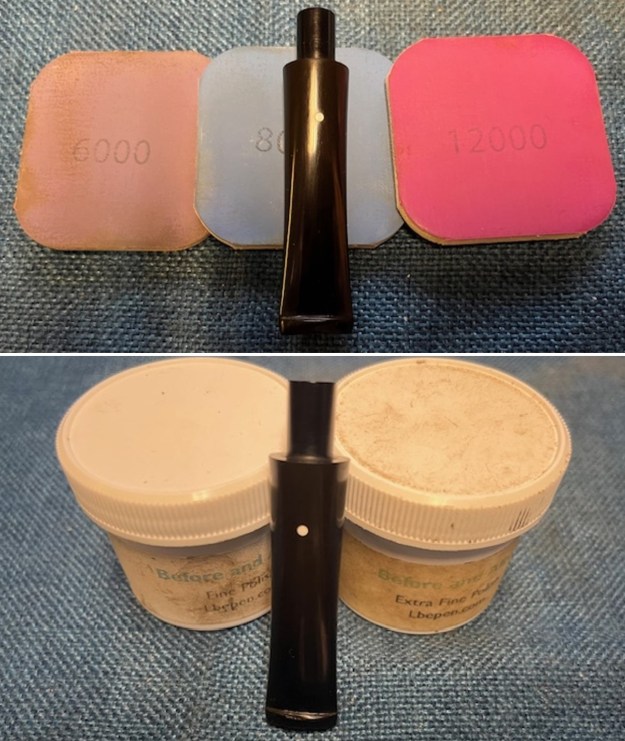
A Mistreated Jan Hansen Svendborg C Hand Carved Bent Brandy with 9MM Filter Stem


by Steve Laug

I was recently contacted by a fellow here in Vancouver about some pipes he had. He was referred to me by a local pipe shop. I was unclear if he wanted them cleaned or exactly what. When he came on the weekend he brought six pipes in two pipe boxes for me to have a look at. I spoke with him about the cost of restoring them. It finally became clear to me (I guess I am slow) that he wanted to sell the pipes. He was tasked with the job by his sister in law as the pipes were from her late husband’s collection. As I unpacked them it was clear that they were some nice pipes and some were higher grade. All but one was smoked and had the heavy smell of fruity aromatics to them. Some had cake in the bowl and lava on the rim. Of the six, four of them had significant rim damage – bowls out of round, burn marks, cut marks. The saddest part is that the damage was most significant on the higher end pipes. Most of them had tooth marks in the stems. Obviously, they had been his late brother in laws favourites and he had enjoyed them. He left them with me and I went over them, researched the brands and wrote up an offer for him to present to his sister in law. By the end of the day we had a deal. The six pipes now have a new home and the fruity smell needs to be exorcised!I finished the last of the repairs that I had in my queue yesterday and returned to work on the lot above. I chose to work on the third of these pipes. It is a beautiful looking but another sadly abused pipe that is readily recognizable as Danish Made. It is stamped on the underside of the shank and reads C (grade stamp) [over] Svendborg [over] Danish [over] Hand Carved [over] Jan Hansen. The bowl had beautiful straight grain around sides. The shape is impeccably done. The finish was dirty but otherwise all was good it appeared. The rim top was clean of cake and lava. The inner edge of the bowl was damaged all the way around and was slightly out of round. The bowl had been recently reamed and it was clean. There was a pipe cleaner trough from the entrance of the airway into the bowl and the opening was widened into the trough. It was definitely damaged and my guess would be an overzealous reaming that widened the trough and left the bottom damaged. The filter stem was slightly oxidized and had light tooth marks and chatter on both sides of the stem ahead of the button. There is a horn like acrylic spacer on the shank end of the stem. The J.H. stamp on the left side of the stem was faded but still readable. It also came with a soft felt pipe sock. I took photos of the bowl and rim top to give you an idea of what I see. Once again it is too bad that Word does now allow for the inclusion of smells because this sweet vanilla is filling my work area. I have a candle going to mask the smell a bit. You can see the damage to the rim top and inner edge of the bowl. The bowl is clean. The stem is lightly oxidized and has light tooth marks and chatter on both sides ahead of the button.I took a photo of the stamping on the underside of the shank. It is clear and readable as noted above. I took a photo of the bowl with the stem removed to give a sense of the proportion and appearance of the pipe.To help me understand the stamping a bit more I turned to Pipephil’s site and read what it said about Svendborg Hand Carved pipes (http://pipephil.eu/logos/en/logo-s14.html). I have included a screen capture of the section below as well as the side bar information below the capture. Brand founded in 1970s by Henrik Jørgensen, Poul Ilsted and Tao Nielsen. They bought an old factory (Nordisc Pibefabriker) in Svendborg on Funen island. Poul and Tao gradually bow out from machine manufactured pipes (1982) and Henrik Jørgensen manages the brand until its take over by Design Berlin (D) in the late 90ies. Kaj C. Rasmussen jointed the firm for several years. 17 employees worked for this brand under Henrik Jørgensen direction

From the information I found there the Jan Hansen stamping was clear for me. It is a pseudonym used by Henrik Jorgensen. His own initials would not have been used as they could easily be misunderstood. HJ was used for Hitler Jugend. That helps me understand a bit more. I know that the pipe is like the third pipe in the above photo and bears the same stamping and shape. My assumption is that the pipe was made after Ilsted and Nielsen bowed out which would put the date of the carving between 1982 and the late 90’s when Design Berlin took over. The Danish Hand Made stamping also confirms that assumption.

Next I turned to Pipedia for more information and detail (https://pipedia.org/wiki/Svendborg). I find that the articles there fill in some interesting information on the relationships and history of a given brand. In this case I found that also true. I quote pertinent pieces of the article. If you would like more information follow the above link.

Jens Tao Nielsen and Poul Ilsted Bech met each other when working together for Erik Nørding and soon became close friends. Both felt a bit tired to make nothing but bizarre fancy shapes and agreed they wanted to produce pipes of more style and more classicism. They decided to establish their own brand “Tao & Ilsted” – But how to do it?

A good fortune brought them in contact with Henrik Jørgensen, a passionate pipe lover and a wealthy Copenhagen banker who was willing to retire from bank business and change his career to become a pipemaker. The trio joined in 1969 and decided to start a new pipe brand together. Nielsen and Ilsted started to search for a suitable workshop while Jørgensen took care of the finances. In early 1970 the partners found an old, closed down pipe factory in Svendborg on Funen, and bought it shortly after for a mere 16.500 Danish Kroner. It was the earlier Nordic Pipe Factory – Nordisc Pibefabriker – maybe the oldest Danish pipe factory. And now it became the home of Svendborg Piber…

…But in spite of it’s magnificent success the trio fell apart after less than two years, when wilful Poul Ilsted stepped out declaring he didn’t want to make serial pipes anymore, but wanted to make individual specimens… Strange enough, he approached this aim returning to Nørding!

Ilsted’s argumentation doesn’t seem to be absolutely fair: even though Svendborg turned to produce mainly serial pipes under Seiffert’s influence each of the three partners was free to work on his very own one of a kind pieces as well! Since it was Seiffert’s basic idea to profit from – especially – Tao ‘s and Ilsted’s creativity to design new shapes. There are many knowledgeable collectors who confirm that these early Svendsborg pipes class among the most individual, innovating and exciting designs Danish pipecrafters created at that time…

The firm developed well and prospered throughout the 1970’s but around 1980 dissensions between Tao and Jørgensen occured. Tao: “Most pipes were delivered to the United States and whereby the Americans tried to dictate us the conditions. It was not only so that their taste and their view on aesthetics were simply horrible – no, moreover they wanted that the pipes should be as cheap as possible. That did not suit my plans at all, for I strove for high quality and artistic freedom in the end.”

Tao and Jørgensen, who tended to accommodate the US customers’ wishes, could not find a compromise on their different opinions, and so Tao left the firm in 1981 and opened his own pipe workshop near the harbour of Svendborg.

…Henrik Jørgensen continued Svendborg Piber bravely for more than a decade on his own until he finally sold the brand to Seiffert around the midst of the 1990’s. Seiffert, focusing on their mainstay brand Sillem’s, sold Svendborg – a ghost brand now – again before 2000 and the current owner is Planta’s Design Berlin.

The article also included this set of pages from a catalogue that were interesting as they included the Handcarved line. The philosophy that drove the brand is also there to read.

Catalog page, courtesy Doug Valitchka

That gives a good picture of the history and development of the Svendborg brand and the connection to some of the great carvers of Danish pipe history. It also confirmed the identification of Jan Hansen as a pseudonym used by Henrik Jorgensen. Armed with that information I turned to work on the pipe in hand.

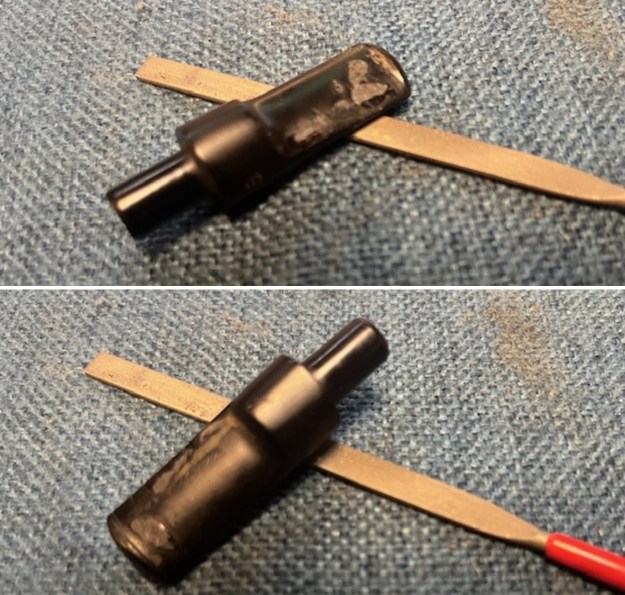
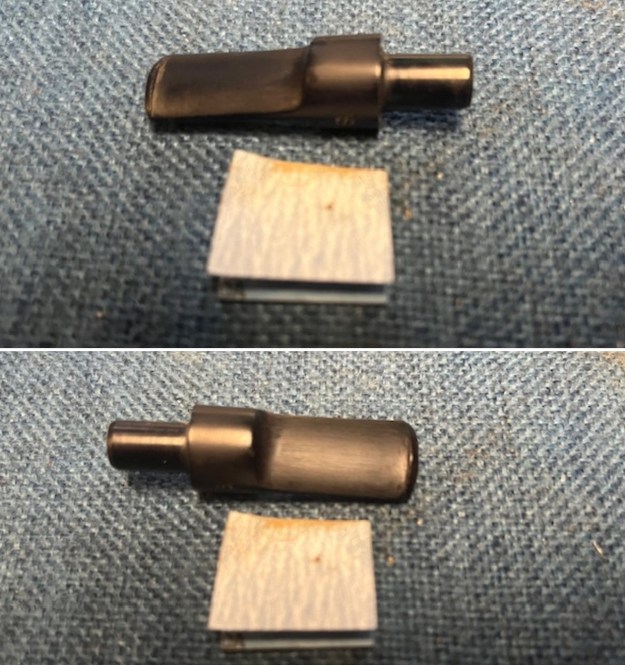
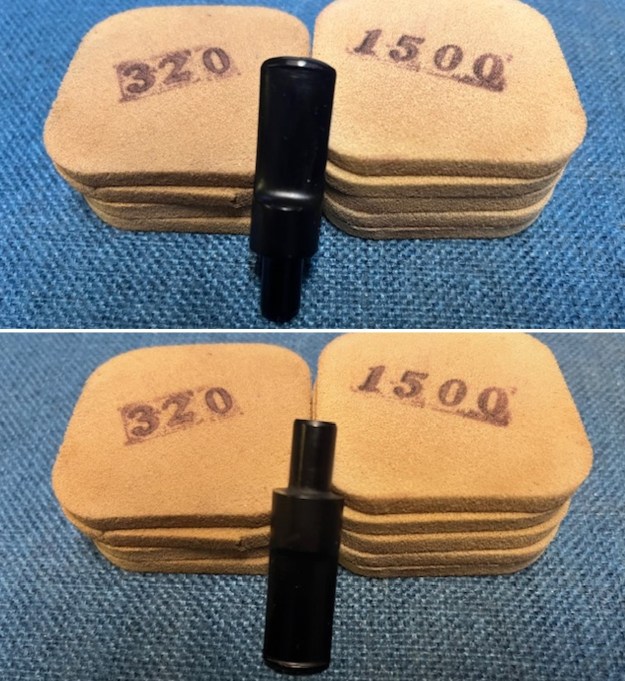
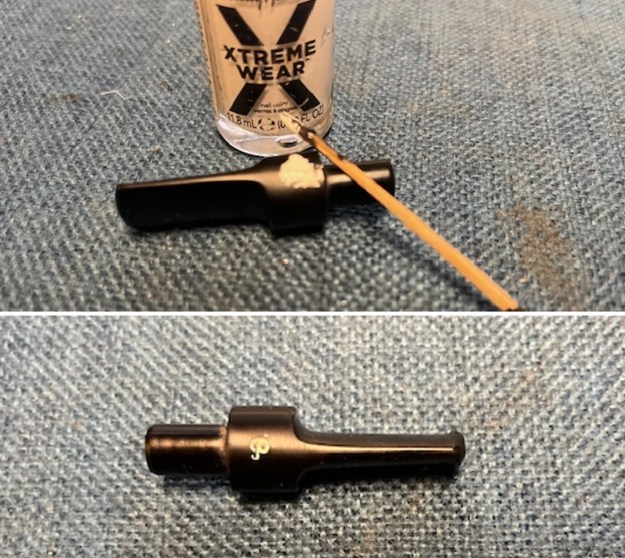
I reamed the bowl with a Savinelli Fitsall Pipe Knife to take back the cake to bare briar. I sanded the walls smooth with some 220 grit sandpaper wrapped around a piece of dowel. I have to say that I was spooked by what I found on the S. Bang Brandy I just finished. I ran my fingers over the sides of the bowl and gladly they were smooth. As mentioned above the bottom of the bowl showed a trough carved in the bottom of the bowl. It appeared to be carved by zealous use of pipe cleaners. There was a ridge around the bottom of the bowl around the trough. I was able to ream out the ridge with the Pipe Knife. It looked much better. I took a photo of it as best as I could but it is hard to see. I cleaned out the stinky, fruity smelling tobacco oils and tars in the shank and the airway in the stem. I used 99% isopropyl alcohol, cotton swabs and pipe cleaners and was able to remove the debris and some of the stench.I needed to “deghost” the bowl and try to exorcise the smell. I stuffed bowl with cotton bolls and used an ear syringe to fill it with alcohol. I set it aside to let the alcohol do its work and wick the oils into the cotton. While it sat for the afternoon, I did some other work. The next morning when I came back to it the cotton and alcohol had wicked out the oils and tars. The cotton was brown and the bowl smelled much better. The damages demanded some restoration and repair. I started with the rough inner edge of the rim. I used a folded piece of 220 grit sandpaper to minimize the damage on the inner edge of the rim and smooth it a bit. I was careful to not change the profile of the rim top and edges. There was what looks like a pipe cleaner cut trough on the bottom of the bowl and some over zealous reaming that took the bowl bottom below the entry of the airway into the bowl. This is another mess that is actually sad when you consider the quality of the pipe. It is another high-end pipe that was badly abused. I mixed up a batch of JB Weld and put a pipe cleaner in the shank to keep the airway from plugging. I pressed the mixture into the bottom of the bowl with a folded pipe cleaner. I pressed it into the heel with a pipe nail. Unlike the S. Bang, this one was  pretty clean of damage on the bowl sides. I put the bowl upright to allow the repair to cure. Once it cured I would need to sand it smooth and clean up the repairs. The first photo shows the overreamed and gouged spot in the heel of the bowl. The next photos show the repair process and tools. Once the repair cured (the next morning) I sanded the bottom with 220 grit sandpaper on a dowel and small needle files to smooth them out and minimize the amount of JB Weld in the bowl. Once the Weld has hardened it takes some time. Once finished I wiped the walls and heel of the bowl down with some isopropyl to remove the debris.I rubbed the bowl and shank down with Before & After Restoration Balm. I worked it into the surface of the briar with my fingertips to clean, enliven and protect the briar. I let the balm sit for a little while and then buffed with a cotton cloth to raise the shine. The Balm did its magic and the grain stood out. I mixed up a batch of bowl coating – sour cream and activated charcoal powder to give a top coat and to facilitate the build up of a cake in the bowl. I applied it to the bowl with a folded pipe cleaner and painted it on the bottom and the sides. Once finished I set it aside to cure over night. I set aside the bowl and turned my attention to the stem. I touched up the J.H. Logo stamp on the left side of the saddle stem with white acrylic fingernail polish. I rubbed it into the stamping with a tooth pick. Once it had cured I scraped it off with a pen knife and then lightly sanded it off with a 320 grit sanding pad. It looked very good. The bite marks and chatter were not too deep and I was able to polish them out and remove the light oxidation with 320-3500 grit sanding pads. I wiped the stem down after each pad with an Obsidian Oil cloth. It was beginning to look very good.I polished the stem with micromesh sanding pads – 1500-12000 grit pads. I wiped it down with a damp cloth after each sanding pad. I used Before & After Pipe Polish – both Fine and Extra Fine to further polish the stem. I fitted the stem with a Dr. Perl Junior 9MM filter made by Vauen. The pictures below show the brand, the filter and the fit of the filter in the tenon.I put the repaired and reworked Jan Hansen Svendborg Danish Hand Carved C Grade Bent Brandy and its vulcanite saddle filter stem back together. The rich browns and blacks of the contrasting stain makes the grain come alive with the polishing and waxing. I carefully buffed the pipe with Blue Diamond on the buffing wheel using a light touch on the briar. I gave the bowl and the stem multiple coats of carnauba wax on the buffing wheel and followed that by buffing the entire pipe with a clean buffing pad. I hand buffed the pipe with a microfiber cloth to deepen the shine. The finished Svendborg Danish Hand Carved Bent Brandy really is a beauty and fits nicely in the hand and looks very good. Give the finished pipe a look in the photos below. The dimensions of the pipe are Length: 6 inches, Height: 2 inches, Outside diameter of the bowl: 1 inch, Chamber diameter: ¾ of an inch. The weight of the pipe is 2.50 ounces/70 grams. This pipe will soon be on the Danish Pipe Makers Section of the rebornpipes store if you would like to add it to your collection. Send me a message or an email. Thanks for reading this blog and my reflections on the pipe while I worked on it.
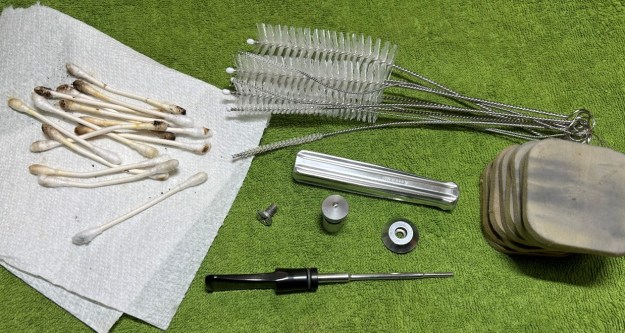
A Sadly Mistreated S Bang Copenhagen Made in Denmark Grade “A” Bent Brandy


by Steve Laug

I was recently contacted by a fellow here in Vancouver about some pipes he had. He was referred to me by a local pipe shop. I was unclear if he wanted them cleaned or exactly what. When he came on the weekend he brought six pipes in two pipe boxes for me to have a look at. I spoke with him about the cost of restoring them. It finally became clear to me (I guess I am slow) that he wanted to sell the pipes. He was tasked with the job by his sister in law as the pipes were from her late husband’s collection. As I unpacked them it was clear that they were some nice pipes and some were higher grade. All but one was smoked and had the heavy smell of fruity aromatics to them. Some had cake in the bowl and lava on the rim. Of the six, four of them had significant rim damage – bowls out of round, burn marks, cut marks. The saddest part is that the damage was most significant on the higher end pipes. Most of them had tooth marks in the stems. Obviously, they had been his late brother in laws favourites and he had enjoyed them. He left them with me and I went over them, researched the brands and wrote up an offer for him to present to his sister in law. By the end of the day we had a deal. The six pipes now have a new home and the fruity smell needs to be exorcised!I finished the last of the repairs that I had in my queue yesterday and turned to work on the third of these pipes. It is a beautiful looking but sadly abused S. Bang Bent Brandy that is readily recognizable. It is stamped on the underside of the shank and reads S. Bang [arched over] Copenhagen [reverse arch and over] Handmade [over] in Denmark [over] the Grade Stamp “A”. The bowl had beautiful straight grain around sides. The shape is impeccably done. The finish was dirty but otherwise all was good it appeared. The rim top was clean of cake and lava. The inner edge of the bowl was damaged all the way around with burn damage on the right front edge of the bowl that had been sanded out. It appeared as if someone had given the damaged area a poorly done bevel to clean up that damage. The bowl is out of round. There is a light cake in the bowl. The stem was clean but and had light tooth marks and chatter on both sides of the stem ahead of the button.More damage would come to light soon enough. I took photos of the bowl and rim top to give you an idea of what I see. It is too bad that Word does now allow for the inclusion of smells because this is filling my work area. I have a candle going to mask the smell a bit. You can see the damage to the rim top and inner edge of the bowl. There is a light cake in the bowl. The stem is dirty and has light tooth marks and chatter on both sides ahead of the button.I took a photo of the stamping on the underside of the shank. It is clear and readable as noted above. I took photos of the bowl with the stem removed to give a sense of the proportion and appearance of the pipe. To help me understand the stamping a bit more I turned to Pipephil’s site and read what it said about S. Bang pipes (http://pipephil.eu/logos/en/logo-s1.html). I have included a screen capture of the section below as well as the side bar information below the capture. Sven Bang opened his tobacco and pipe shop in 1968 in Copenhagen. He was more a business man than a pipe carver and began to hire pipemakers. About half a dozen succeeded each other in his workshop during the 1970’s (Ivan Holst Nielsen, Jan Wideløv, Phil Vigen…). At least Per Hansen and Ulf Noltensmeier stayed and when Sven retired in 1983 they took over the company (in 1984) keeping its name.

To close my understanding of the pipe I turned to Pipedia (https://pipedia.org/wiki/S._Bang). I quote the section from the article where the company changed hands from S. Bang to Hansen and Noltensmeier in 1984. It is a great read so I have included it below.

Svend Bang retired in 1984. Evidently, he felt a great deal of pride in the product that he initiated throughout his career and retirement and until his death in 1993.

Once Hansen and Noltensmeier took over the company (in 1984) they knew it was best to retain the S. Bang name – the two carvers always shared the same philosophy about that. Noltensmeier and Hansen were determined to maintain top quality at the expense of increased numbers. The only change they made concerns the stamping on the pipes changing from the English version “COPENHAGEN” to the Danish “KOBENHAVN”.

Still, they are two separate carvers, with their own styles and preferences. Each makes his own pipes – there is no “assembly line” construction at S. Bang. They bounce ideas off of each other, of course, and admit that when problems arise in a pipe, it is nice to have a partner to discuss them with.

Though they carve pipes as individuals, there are similarities in their work. All Bang pipes are made with black, hand-cut vulcanite stems.

The same engineering is used by both carvers as well. The shape and size of the tobacco chambers vary according to size and design of the pipe, but each carver follows the same design guidelines for choosing the proper chamber dimensions. The smoke channel is always engineered for optimum performance.

Bang pipes are noted for the high definition and fine contrast in the grain. They undergo a double staining process to achieve that effect. The technique makes the grain leap from the bowl of the pipe, making well-grained wood become extra ordinary. The same colouring, however, will produce different results in different pieces of briar, making each pipe truly individual.

I knew from what I had read the pipe I have was made for the European market and bore an “A” grading which is quite high. I also knew that it was made before 1984 when the stamping Copenhagen was replaced by Kobenhavn. Ulf and Per worked there before they took over in 1984. Now it was time to work on the pipe.

I reamed the bowl with a Savinelli Fitsall Pipe Knife to take back the cake to bare briar. I sanded the walls smooth with some 220 grit sandpaper wrapped around a piece of dowel. This is when all the internal damages were revealed. It was a sad moment. I ran my fingers over the sides of the bowl and felt some nicks and flaws on the walls. The bottom of the bowl also had an odd bump in it. I shone a light in the bowl and it seems that there was repair on the bottom of the bowl. The hard material filling in part of the heel was probably JB Weld. It was rock hard but it appeared that half of the repair was missing. I could see that there was a trough carved in the bottom of the bowl and that the repair had been made to cover that. It would need to be redone. I took a photo of it as best as I could but it is hard to see. I cleaned out the stinky, fruity smelling tobacco oils and tars in the shank and the airway in the stem. I used 99% isopropyl alcohol, cotton swabs and pipe cleaners and was able to remove the debris and some of the stench. I needed to “deghost” the bowl and try to exorcise the smell. I stuffed bowl with cotton bolls and used an ear syringe to fill it with alcohol. I set it aside to let the alcohol do its work and wick the oils into the cotton. While it sat for the afternoon, I did some other work. When I came back to it the cotton and alcohol had wicked out the oils and tars. The cotton was brown and the bowl smelled much better. The damages demanded some restoration and repair. I started with the badly bevelled rim top and inner edge. I used a folded piece of 220 grit sandpaper to minimize the damage on the inner edge of the rim and smooth it a bit. I was careful to not change the profile of the rim top and edges. This pipe will be staying with me so I wanted the rim top cleaned up and smooth. The condition of the bowl and rim top when I received it really took away from the amazing work that always characterizes an S. Bang pipe. (The second photo was taken after I had put the JB Weld in the bottom of the bowl. The point though of the photo is to show the repaired rim.)Under the damaged repair to the bowl bottom there is what looks like a pipe cleaner cut trough. It had been repaired but half of the repair fell out of the bowl. There are also a few pits on the inside walls once I removed the cotton pads. This is actually sad when consider the quality of the pipe. It is a high-end pipe that was badly abused. I mixed up a batch of JB Weld and put a pipe cleaner in the shank to keep the airway from plugging. I pressed the mixture into the half of the repair that was missing in the bottom of the bowl with a folded pipe cleaner. I applied it to the gouges in the sides of the bowl to smooth them out and protect the bowl walls from possible burnout. I put the bowl upright in a pipe rest to allow the repairs to cure over night. Once it cured I would need to sand it smooth and clean up the repairs.This morning I sanded the bowl walls and bottom with 220 grit sandpaper and small needle files to smooth them out and minimize the amount of JB Weld in the bowl. Once the Weld has hardened it takes some time. Once finished I wiped the bowl down with some isopropyl to remove the debris. I polished the repaired rim top with micromesh sanding pads – dry sanding with 1500-12000 grit pads and wiped it down the bowl after each sanding pad. I rubbed the bowl and shank down with Before & After Restoration Balm. I worked it into the surface of the briar with my fingertips to clean, enliven and protect the briar. I let the balm sit for a little while and then buffed with a cotton cloth to raise the shine. The Balm did its magic and the grain stood out. I mixed up a batch of bowl coating – sour cream and activated charcoal powder to give a top coat and to facilitate the build up of a cake in the bowl. I applied it to the bowl with a folded pipe cleaner and painted it on the bottom and the sides. Once finished I set it aside to cure over night. I set aside the bowl and turned my attention to the damage on the stem. I painted the stem surface with the flame of a lighter to lift the tooth marks. I lifted them some. I filled in what remained of the marks on the top side with black CA glue. I set it aside to cure. Once the repairs cured I flattened them out with 220 grit sandpaper to blend them into the stem surface. I was able to polish out the repairs with 320-3500 grit sanding pads. I wiped the stem down after each pad with an Obsidian Oil cloth. It was beginning to look very good.I polished the stem with micromesh sanding pads – 1500-12000 grit pads. I wiped it down with a damp cloth after each sanding pad. I used Before & After Pipe Polish – both Fine and Extra Fine to further polish the stem. I put the repaired and reworked S. Bang Copenhagen Grade A Bent Brandy back together and took the pipe to the buffer. I buffed the bowl and stem with Blue Diamond to polish the briar and the vulcanite. Blue Diamond does a great job on the smaller scratches that remain in both. I gave the bowl and the stem several coats of carnauba wax and buffed the pipe with a clean buffing pad to raise the shine. I hand buffed it with a microfiber cloth to deepen the shine. Considering the mess the pipe was in when I started working on it I am amazed at how well it turned out. The finished pipe is shown in the photos below. This is a beautiful S. Bang Grade A Bent Brandy – the vulcanite saddle stem and rim top and smooth finish combine to give the pipe a great look. The polished straight grain briar and the polished black, vulcanite stem looks really good. The rich grain stands out on the bowl and shank. The dimensions of the pipe are Length: 5 inches, Height: 2 inches, Outside diameter of the bowl: 1 ¼ inches, Chamber diameter: 7/8 of an inch. The weight of the pipe is 1.83 ounces/51 grams. This beautiful, restored S. Bang will be staying with me for awhile. Thanks for walking through the restoration with me on this beauty!
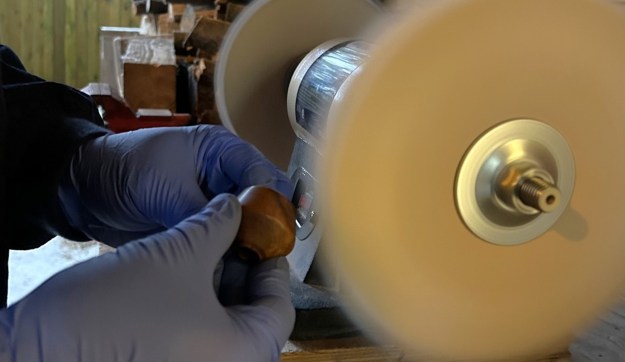
Restoring and Repairing a Tinsky American Sandblast Dublin Reg No C 486/*S 5


by Steve Laug

Just before the Postal Strike here in Canada I received an email from Baker regarding a Tinsky American Smoking Pipe that he had purchased that needed some attention. He sent me a link in the email to a series of photos showing the issues with the pipe.

Hey Steve…

I got an American Smoking Pipe bent Dublin from the 80’s several months ago and just noticed a big crack opening up in the bottom of the bowl….

This pipe also has a dry, desiccated look and feel to it — almost like a piece of driftwood. What do you think? Is this something you can help with? I’m not in a rush but it’s too good a pipe to let fade away.

Best regards, Baker

I have included the photos that Baker sent me below. It truly is a dry looking sandblast pipe with some issues of cracks and flaws in the briar. The first photo gives a profile of the pipe.He also took photos of the rim top and bowl. You can see from the photos that the bowl has a moderate cake. It does not appear that there are cracks on the inside of the bowl in the photos. There is some darkening around the inner edge. The rim top has some beautiful and rich grain. He took several photos of the crack in the bowl radiating from a flaw in the briar. It is on the front of the heel. There was also a large flaw on the lower front of the bowl. He included a photo of that as well.He also included a photo of the stamping on the underside of the shank. It reads American in an oval [over] REG. NO. [over] C 486/*S 5. It is clear and readable. I have collected and smoked Mark Tinsky’s pipes for over 30 years now and thoroughly enjoy them. I cannot speak highly enough about the quality and craftsmanship of his pipes. I have pipes made by Mark and by Curt Rollar in my collection and both are great smokers and pipes that reach for regularly in my choice of pipes. I turned to his website for a quick summary of the history of the brand (http://www.amsmoke.com/Index%20Folder/PipeHist.html). I quote from the site as it is a short, concise history.

The American Smoking Pipe Co. was formed in 1978 by Mark Tinsky and Curt Rollar. Both started making pipes for Jack Weinberger (JHW Pipes) while in high school and throughout college. Determined to blaze their own path, they formed their own company- its goal to create unique pipes, lightweight and comfortable, where attention to detail was the rule not the exception. Exulting in their new freedom, they carved out new shapes that were balanced between the radical freehand era of the 70’s and the board pipe look of other conservative companies. Hungry for recognition, they stormed the Eastern and Southern shops looking for markets to sell their pipes. Many hidebound retailers refused to try something new, preferring to sell, well, what has always sold before. However, their pipes did take root in many shops and the business thrived.

They continued expanding their pipe making capabilities, adding employees to help finish the pipes. In 1990, over a disagreement over how much to expand, Curt Rollar left the company. This put a break on expansion and coupled with a U.S. recession and rising anti-smoking fervour served to limit production to supplying existing retailers, thus ending a decade of growth. With pipes sales in decline, we turned to pipe repair as a way to supplement revenues. Finding that we liked fixing things, American concentrated on pipe repair. While working hard at repair and manufacture American is ready once again to expand its markets through its existing network of shops serviced by pipe repair.

The pipe I am working on is stamped American in an oval with a Reg. No. [over] C 486/*S 5 as noted above. The stamp tells me that the pipe was made in April of 1986. The S stamp could signify that the pipe is a sandblast but I am not sure. The 5 is the size of the pipe.

We chatted and he prepared to send the pipe to me. THEN THE CANADA POSTAL STRIKE HAPPENED. I had an idea of shipping it to a mailbox in the US and then I could get it from there rather than wait for the strike to end. Baker shipped it and it arrived quite quickly. Sadly, I was ill as was Kenneth so we were not able to head south to pick up the pipe. Kenneth picked it up and dropped it off Friday.

I took photos of the pipe before I started my work on it. It was dry and desiccated on the outside as Baker noted. There was a moderate cake in the bowl and some darkening on the rim edge. The crack and flaws are very visible in the photos. The blast seemed almost worn and tired. The variegated brown acrylic stem looked good with a few tooth marks and chatter on both the top and underside of the pipe. Have a look. I took a photo of the bowl and rim top to show the condition of both. The rim top is smooth and has some beautiful birdseye grain. You can see the debris in the bowl and darkening on the inner edge. I also took photos of the acrylic stem showing the tooth marks and chatter on both sides ahead of the button. I took a photo of the stamping on the underside of the shank. It is clear and readable as noted above. I took a photo of the bowl with the stem removed to give a sense of the proportion and appearance of the pipe without the stem.I took some photos of the crack and flaws in the bowl. The photos show the one in the heel and on the front of the bowl. Now it was time to start working on the pipe itself. The bowl was slightly conical so I reamed it with a Savinelli Fitsall Pipe knife taking it back to bare briar. I sanded the bowl walls with 220 grit sandpaper wrapped around a piece of dowel. The bowl was significantly cleaner.I used a brass bristle wire brush to knock of the debris on the briar of the sandblast. Once I did that I decided to address the crack and fills in the heel of the bowl. I used my lens and light to magnify the crack and drill a small microdrill hole at each end of it with my Dremel.I filled in the drill holes in the briar and the track of the crack with clear CA glue. I used a dental spatula to press briar dust into the superglue over the crack and the drill holes. At the same time, I repaired the flaw on the front of the bowl. I went over the repaired areas with a brass bristle wire brush to knock off the excess glue and briar dust. I scrubbed the exterior of the bowl with a tooth brush and undiluted Murphy’s Oil Soap. I scrubbed the smooth rim top and the sandblast walls with the toothbrush. I rinsed it off with warm running water and dried it with a soft towel. It looked much better and the rim top looked clean. The grain under the sandblast stood out clearly. I cleaned out the internals of the shank and the airway in the stem with alcohol, cotton swabs and pipe cleaners to remove the buildup tars and oils. It smelled significantly better.I sanded the smooth rim top and edge with 320-3500 grit sanding pads. I was able to remove the darkening and really begin to see the grain.I polished the rim top with 1500-12000 grit micromesh sanding pads – dry sanding with each pad and wiping it down with a damp cloth between pads. It took on a rich shine. I rubbed the bowl down with Before & After Restoration Balm. I worked it into the surface of the briar with my fingertips and a shoe brush to get it in the grooves. It works to clean, restore and preserve the briar. I let it do its magic for 15 minutes then buffed it off with a cotton cloth. The pipe looks incredibly good at this point in the process. I set the bowl aside and turned my attention to the stem. I filled in the deep marks in the acrylic stem with black rubberized CA glue. Once it hardened I flattened the repairs out with a small file. I sanded the stem with 220 grit sandpaper to blend them into the rest of the acrylic stem and started the polishing them with 600 wet dry sandpaper. I sanded the stem with 320-3500 grit sanding pads. I wiped the stem down after each sanding pad to remove the sanding debris and dust. The stem looked very good.I set the bowl aside and turned my attention to the stem. I polished the stem with micromesh sanding pads – 1500-12000 grit pads. I wiped it down with a damp cloth after each sanding pad. I finished polishing it with Before & After Pipe Stem Polish – both Fine and Extra Fine and buffed it off with a cotton cloth. I gave it a coat of Obsidian Oil to preserve and protect the stem. This American Reg. No. C 486/*S 5 Sandblast Dublin is a great looking pipe now that it has been restored. The brown stains really highlight the grain and the polished finish is stunning. I put the stem back on the bowl and carefully buffed the pipe with Blue Diamond on the buffing wheel. I gave the bowl and the stem multiple coats of carnauba wax on the buffing wheel and followed that by buffing the entire pipe with a clean buffing pad. I hand buffed the pipe with a microfiber cloth to deepen the shine. The finished American Mark Tinsky Dublin fits nicely in the hand and feels great. Give the finished pipe a look in the photos below. The dimensions of the pipe are Length: 5 ½ inches, Height: 2 ¼ inches, Outside diameter of the bowl: 1 ¾ inches, Chamber diameter: 7/8 of an inch. The weight of the pipe is 52 grams / 1.83 ounces. I will be packing this up and sending it back to Baker this week. I am looking forward to hearing what he thinks of it. Thanks for reading this blog and my reflections on the pipe while I worked on it. As always, I encourage your questions and comments as you read the blog. Thanks to each of you who are reading this blog. Remember we are not pipe owners; we are pipe men and women who hold our pipes in trust until they pass on into the trust of those who follow us.

Repairing and Restoring the last of the Six pipes – a Damaged Plateau Rim Top on a Knute of Denmark Freehand


by Steve Laug

In November I received an email from Mario about working on some of his Dad’s pipes. Here is what he wrote to me.

I am desperately seeking help restoring and repairing some of my dad’s smoking pipes. I have tried reaching out to the only two known pipe repair establishments I could find in the entire country but one is not currently taking repair orders and the other said she didn’t want to try to repair these pipes without having even seen them. Would you be willing to take on the repairs or can you recommend anyone? Thank you much!!!—Mario

I wrote him back and asked him to send me photos of the pipes. He sent some single photos of the meerschaum bowl and stem, several of the leather clad Canadian and the photo of the rack and six pipes shown below. I looked through the photos and this is what I saw. There were two leather clad pipes a Canadian and a Pot. Both of them were cracked on the shanks and had been self-repaired with wire to hold the cracked shank together. The leather cladding was torn and the stitching was rotten and broken around the bowl. To me they were both unrepairable. There was a lovely older Meerschaum figural with a horn stem that needed a good cleaning and repairs to the horn stem. There were two Knute Freehand pipes with original stems that were dirty but fixable. The plateau on the smooth one had a large chunk of briar missing. There was a Wilshire Dublin with a chewed and misfit stem. Finally, there was a billiard that had been restemmed with a fancy GBD saddle stem on it. They were a messy lot but I told him to send them on to me. They arrived yesterday and the condition of the pipes in the photos was confirmed. They were a mess and needed much work. I have included Mario’s group photo below to show the lot. This afternoon I decided to start working on the final of the six pipes from Mario – a Knute of Denmark smooth freehand. It had a plateau rim top and shank end. The bowl had a thick cake on the walls and a heavy lava coat in the plateau rim top. There was a missing chunk of briar or perhaps a fill that had come loose in the plateau finish on the right side running from the inner edge almost to the outer edge. The finish was dirty and had grime ground into the sides of the bowl. The stamping on the underside read Knute [over] of Denmark. There was a hairline crack on the underside of the shank extending from the shank end over the K in the Knute stamp. It had a fancy turned, vulcanite saddle stem that had lots of tooth marks and chatter on both sides near the button. There was a split on the top side of the stem and on the button. I took photos of the pipe when I unpacked it to examine it. I have included those below. I took a photo of the bowl and rim top to show the condition of both. You can see the debris in the bowl and lava in the plateau surface of the rim top. The missing chunk on the right topside of the bowl is also very visible with debris and lava in the hole. I also took photos of the heavily oxidized and calcified stem showing the heavy tooth marks and chatter on both sides ahead of the button. There was also a hairline crack in the topside of the stem from the button edge forward.I took a photo of the stamping on the underside of the shank. It is clear and readable as noted above. I took a photo of the bowl with the stem removed to give a sense of the proportion and appearance of the pipe without the stem.Before I started my work on the pipe I wanted to remind myself of the provenance of the pipe. I remembered that it was linked to Karl Erik as I have worked on quite a few Knute Freehands. I wanted to know where this pipe fit into the Karl Erik lines so I turned to the first of two sites that I always check to gather information on a brand.  I turned to the first source of information site – Pipephil’s (http://www.pipephil.eu/logos/en/logo-k3.html) got a quick overview on the brand once again connecting it to Karl Erik. I turned to Pipedia (https://pipedia.org/wiki/Karl_Erik). Pipedia had this great picture of Karl Erik Ottendahl and I decided to include it here as a reminder of the artisan who first carved and released this pipe. Reminded of the tie to Karl Erik, I knew a bit about the pipe at hand. I turned to address the pipe itself. There it is clearly identified and linked to Karl Erik Ottendahl. It is designated as a second and frequently having rustication. The interesting thing is that his pipe does not look like a second at all and I wonder if the Knute is a line of Karl Erik’s rather than a second. Who knows? This one is a beautifully grained smooth Freehand pipe. Now it was time to work on the pipe and bring it back to life. The large pit in the plateau rim top and the crack in the shank needed to be repaired and the bowl brought back to life.

I started my work on the pipe by starting the process of cleaning the pipe. I carefully reamed the bowl with a PipNet Pipe Reamer remove from the bowl leaving bare briar. I cleaned up the remnants of cake with a Savinelli Fitsall Pipe Knife and removed the remaining debris. I sanded the bowl walls smooth with a piece of 220 grit sandpaper wrapped around a piece of dowel. I scraped the lava coat off the rim top – both the rusticated portion and the smooth ring of the meerschaum bowl top with the Savinelli Pipe Knife and removed all of it. I scrubbed the exterior of the bowl with a tooth brush and undiluted Murphy’s Oil Soap. I scrubbed the rim top with a brass bristle wire brush to clean off the lava and debris in the plateau. I rinsed it off with warm running water and dried it with a soft towel. It looked much better and the rim top looked clean. The grain stood out clearly. I cleaned out the deep pit in the rim top. It appeared that the hole was original a fill that had fallen out. I used qtips and alcohol to clean out the grime in the hole in the plateau.I rebuilt the missing fill with clear CA glue and briar dust. Once it was in place I used a brass bristle wire brush to give it patterns like the rest of the rim top.I sanded out the inner edge of the bowl with a dowel and 220 grit sandpaper to smooth out the repair on the edge and round out the edge. I went over it again with the brass bristle brush and blew off the dust. It was looking quite good.I used a black stain pen to fill in the valleys in the plateau on the rim top and on the shank end. The black will give depth to the finish once it is sanded and polished.I repaired the hairline crack in the shank underside with clear CA glue and held it closed until the repair cured. Once it hardened it was ready to be sanded. I carefully sanded it around the stamping so as not to damage it.I sanded the smooth briar and the high spots on the plateau with 320-3500 grit sanding pads. I wiped the briar down between each sanding pad. The briar took on a rich shine and the grain stood out in all its glory. I polished the briar with micromesh sanding pads – dry sanding with 1500-12000 grit pads and wiped it down the bowl after each sanding pad. Some of the photos of the sanding are a bit out of focus but overall the bowl took on a shine.
I rubbed the bowl and shank down with Before & After Restoration Balm. I worked it into the surface of the bowl sides and shank with my fingertips to clean, enliven and protect the briar. I worked it into the nooks and crannies in the plateau on the rim top and the shank end with a horsehair shoe brush. I let the balm sit for a little while and then buffed with a cotton cloth to raise the shine. The Balm did its magic and the grain stood out. I mixed a bowl coating with activated charcoal powder and sour cream. I put a pipe cleaner in the shank and applied the mixture to the walls of the bowl with a folded pipe cleaner. I wanted to protect the bowl repair while Mario enjoyed smoking it again. I set it aside to cure overnight. I set the bowl aside and turned my attention to the stem. I scrubbed it down with Soft Scrub to deal with the oxidation and calcification on the stem surface. It looked much better once scrubbed and on the centre of the stem it had a Crown K logo that was often on Knute of Denmark pipes.I filled in the deep bite marks on the top and underside of the stem with black CA glue. It is strengthened with charcoal powder and rubber. I let the glue cure and flattened the repairs with a small needle file. I reshaped the button and it began to take shape and look much better. I paused the process and touched up the Crown K on the stem top with Rub’n Buff Antique Gold. I worked it into the stamp on the stem and then rubbed it off with a soft cloth. I followed that by wiping the stem down with an Obsidian Oil cloth. The stem looked better and the stamping was clear and readable.I sanded the repairs with 220 grit sandpaper to smooth out the stem surface and also remove more of the oxidation in the stem surface.I sanded the stem to smooth it out with 320-3500 grit sanding pads. I wiped the stem down after each pad with an Obsidian Oil cloth. It was beginning to look very good.I polished the stem with micromesh sanding pads – 1500-12000 grit pads. I wiped it down with a damp cloth after each sanding pad. I used Before & After Pipe Polish – both Fine and Extra Fine to further polish the stem. I gave it another rub down with Obsidian Oil and let it dry. I put the stem back on the Knute of Denmark Smooth Freehand Sitter pipe and took the pipe to the buffer. I buffed the bowl and stem with Blue Diamond to polish the briar and the vulcanite. Blue Diamond does a great job on the smaller scratches that remain in the vulcanite. I gave the bowl and the stem several coats of carnauba wax and buffed the pipe with a clean buffing pad to raise the shine. I hand buffed it with a microfiber cloth to deepen the shine. The pipe polished up really nicely with a great contrasting stain look to the briar. The finished pipe is shown in the photos below. This is a beautiful Karl Eric Made Knute of Denmark Freehand – the fancy turned stem and plateau rim top and shank end give the pipe a great look. The dimensions of the pipe are Length: 6 inches, Height: 2 ¼ inches, Outside diameter of the bowl: 1 ¾ inches wide x 1 7/8 inches long, Chamber diameter: 7/8 of an inch. The weight of the pipe is 2.22 ounces /63 grams. This is the final pipe of 6 pipes that am restoring for Mario from his Dad’s collection. I look forward to hearing what he thinks of this newly restored pipe. Later this week I will pack them up and send them home to him. Thanks for reading this blog and my reflections on the pipe while I worked on it!

The Nameless Pipe has a Name


by Kenneth Lieblich

I recently had the pleasure of meeting with a family – and nine of the male family members each wanted a pipe! I was only too happy to help them out. The youngest member of this throng was 18 years old and picked out the pipe you see here. It is a charming and beautifully curved Zulu. I decided to work on it first because I liked it so much. Not only is it handsome, but it is well made too. However, there were no pipemaker’s marks on the pipe at all. No name of any sort – kind of. The only thing to be seen was that the previous owner carved his own name into the shank: Ray. I’m afraid I don’t know who Ray is, but he had a nice pipe. So, the nameless pipe has a name after all. It’s now being passed on to a fine young man with a good head on his shoulders. When I was talking to him about the pipe, I commented that I could investigate sanding off the name if he wished. He said no – it was part of the pipe’s history and he wanted to leave it. Smart kid. Alas, no markings mean no history. However, I can report that the pipe was well smoked in its past. The stummel was in good shape, but there was evidence of lots of smoking once upon a time. As you can see, there appears to be some burning on the rim, but I’ll have to take a closer look for damage. The stem was pretty worn – lots of tooth marks and scratches. Also, a bit of calcification and oxidation.
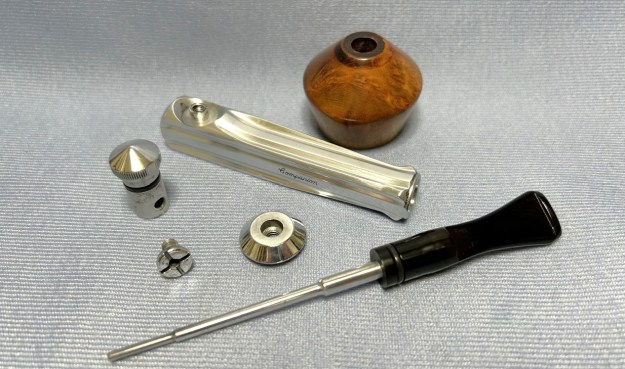
As a first step, I used oil soap on a few cotton rounds and wiped the stem down to provide an initial cleaning of filth before moving on. I used a disposable lighter and ‘painted’ the stem with its flame. The gentle heat of the flame can cause the dents in the vulcanite of the stem to expand back into shape. In this case, it actually worked fairly well and I got some improvement. The primary cleaning comes next. I cleaned the inside of the stem with both pipe cleaners and cotton swabs dipped in 99% lemon-infused isopropyl alcohol. I scrubbed thoroughly to make sure the interior was really clean.The goal of the next step is the removal (or minimization) of oxidation. Going to my sink, I used cream cleanser, cotton rounds, and a toothbrush, and scoured the stem to remove as much surface oxidation as possible. As the photos show, the result is a hideous brownish mess – but better off the stem than on it.Once the stem was reasonably clean, I soaked it overnight in some de-oxidation fluid. This solution works to draw oxidation in the stem to the surface. This is a major aid and important step in ensuring a clean stem. The following day, I drew the stem out from its bath and scrubbed the lingering fluid with a toothbrush. Once clean and dry, I set about fixing the marks and dents in the vulcanite. This is done by filling those divots with black cyanoacrylate adhesive, impregnated with carbon and rubber. I left this to cure and moved on.The penultimate step for the stem is sanding. I use all nine of the micromesh sanding pads (1,500 through 12,000 grit) to sand out flaws, even out the vulcanite, and provide gentle polishing of the finished surface. I also apply pipe-stem oil while using the last five micromesh pads. There is a wonderful, deep black shine to the stem when I am done.Now that the stem is (nearly) complete, I can move on to the stummel. The first step for me is to ream out the bowl – that is to say, remove all the cake inside the bowl. This accomplishes a couple of things. First (and most obviously), it cleans the bowl and provides a refurbished chamber for future smoking. Second, when the old cake is removed, I can inspect the interior walls of the bowl and determine if there is damage or not. I used a reamer, a pipe knife, and a piece of sandpaper taped to a wooden dowel. Collectively, these ensure that all the debris is removed. My next step was to remove the lava on the rim. For this, I took a piece of machine steel and gently scraped the lava away. The metal’s edge is sharp enough to remove what I need, but not so sharp that it damages the rim. This work revealed that – Deo gratias – the burning was superficial and the underlying wood was totally intact.The inside of the stummel needs to be cleaned thoroughly. Similar to the stem, I then cleaned the stummel with both pipe cleaners and cotton swabs dipped in 99% lemon-infused isopropyl alcohol. With this pipe, it didn’t take too long to get it clean. I then decided to ‘de-ghost’ the pipe – that is to say, exorcize the remaining filth from the briar. I filled the bowl and the shank with cotton balls, then saturated them with 99% isopropyl alcohol. I let the stummel sit overnight. This caused any remaining oils, tars and smells to leach out into the cotton.To tidy up the briar, I also wiped down the outside with some oil soap on cotton. This does a good job of cleaning any latent dirt on the surface of the briar. The last step of the cleaning process is to scour the inside of the stummel with some soap and tube brushes. This is the culmination of a lot of work to get the pipe clean.The charring on the rim is notable. I took a solid wooden sphere, wrapped a piece of 220-grit sandpaper around it, and sanded the inner edge of the rim. This achieves two things: first, it removes some of the burn marks; and second (and more importantly), the circular shape and motion of the sphere gradually returns the edge to a perfect circle.
I used all nine micromesh pads (1,500 through 12,000 grit) on the outside of the stummel to finish it off. This sanding minimizes flaws in the briar and provides a beautiful smoothness to the wood.  I rubbed some Before & After Restoration Balm into the briar and let it sit for 20 minutes or so. The balm moisturizes the wood and gives a beautiful depth to the briar. I then buffed it with a microfibre cloth. For the final step, I took the pipe to my bench buffer and carefully polished it – first with a white diamond compound, then with three coats of carnauba wax. This procedure makes the pipe look its best – the stummel sings and stem glows.This is a very handsome pipe and will provide many years of smoking pleasure for my friend. I hope you enjoyed reading the story of this pipe as much I as I did restoring it. If you are interested in more of my work, please follow me here on Steve’s website or email me directly at kenneth@knightsofthepipe.com. The approximate dimensions of the pipe are as follows: length 5⅝ in. (142 mm); height 1¾ in. (44 mm); bowl diameter 1⅓ in. (33 mm); chamber diameter ¾ in. (19 mm). The weight of the pipe is 1 oz. (31 g). I hope you enjoyed reading the story of this pipe’s restoration as much as I did restoring it. If you are interested in more of my work, please follow me here on Steve’s website or send me an email. Thank you very much for reading and, as always, I welcome and encourage your comments.

Restoring a Horn Stemmed Meerschaum Figural


by Steve Laug

In November I received an email from Mario about working on some of his Dad’s pipes. Here is what he wrote to me.
I am desperately seeking help restoring and repairing some of my dad’s smoking pipes. I have tried reaching out to the only two known pipe repair establishments I could find in the entire country but one is not currently taking repair orders and the other said she didn’t want to try to repair these pipes without having even seen them. Would you be willing to take on the repairs or can you recommend anyone? Thank you much!!!—Mario

I wrote him back and asked him to send me photos of the pipes. He sent some single photos of the meerschaum bowl and stem, several of the leather clad Canadian and the photo of the rack and six pipes shown below. I looked through the photos and this is what I saw. There were two leather clad pipes a Canadian and a Pot. Both of them were cracked on the shanks and had been self-repaired with wire to hold the cracked shank together. The leather cladding was torn and the stitching was rotten and broken around the bowl. To me they were both irreparable. There was a lovely older Meerschaum figural with a horn stem that needed a good cleaning and repairs to the horn stem. There were two Knute Freehand pipes with original stems that were dirty but fixable. The plateau on the smooth one had a large chunk of briar missing. There was a Wilshire Dublin with a chewed and misfit stem. Finally, there was a billiard that had been restemmed with a fancy GBD saddle stem on it. They were a messy lot but I told him to send them on to me. They arrived yesterday and the condition of the pipes in the photos was confirmed. They were a mess and needed much work. I have included Mario’s group photo below to show the lot.I have also included three of the photos of the meerschaum that Mario sent to me as well. The first of the photos show the bowl top and what is either a metal cup lining the bowl or at least a metal rim top/cap. The meerschaum shows some great colour/patina as well as some chips and scratches and perhaps some repaired cracks in the surface. The horn stem also shows some wear and tear on the horn surface and some roughening. This afternoon I decided to start working on the fifth of the pipes from Mario – a figural carved freehand. It was a figural with a richly carved bearded man wearing a lion’s head as a cap on his head and a metal rim cap. The stem was made of horn that had lots of tooth marks and chatter on both sides near the button. The stem is dry and some of the striations are separating at the button end. The tenon has been wrapped with waxed thread to soften the fit of the stem in the mortise of the meerschaum. The bowl had a thick cake on the walls and a heavy lava coat the metal insert or the rim top. Which one is true will become clearer as I work on it. It was internally a mess. The finish was dirty and had grime ground into the sides of the bowl. That in many ways obscured the beauty of the patina on the bowl. There were nicks and deep scratches in the beard and in the smooth parts of the bowl but otherwise it seemed sound. The carving and filigree as well as scratches and nicks. There was no stamping or identifying marks on the meerschaum shank. I took photos of the pipe when I unpacked it to examine it. I have included those below. I took a photo of the bowl and rim top to show the condition of both. You can see the darkening on the metal insert rim top. There was a heavy cake in the bowl. The grooves in the carved meer are very dirty with debris. I also took photos of the stem showing the tooth marks and chatter on both sides ahead of the button.I took photos of the carving around the bowl. To me it looks like a mountain man wearing a bear’s head hat. The beard and carving are well done. The eyes even have lots of character.  The side profile shows the bear’s head hat or head dress. I removed the stem from the shank and took a photo of the parts. It is a well-proportioned pipe.I noted the tenon on the horn stem was wrapped with thread and then waxed. It would need to be cleaned up but it was interesting. It certainly was a self repair of the fit of the stem.It was now time to clean up the pipe. II checked the metal rim cap and found it was not a bowl insert but rather just a rim cap. It was dirty but easily removed.I scraped the bowl with a Savinelli Fitsall Pipe Knife to remove the thick cake on the walls. I sanded the bowl walls with 220 grit sandpaper wrapped around a dowel to smooth out the bowl walls. The walls were clear of damage and felt smooth to touch. I scrubbed the externals of the bowl and shank with undiluted Murphy’s Oil Soap and a tooth brush. I worked over the bowl, shank and rim top with the soap and then lightly rinsed it off warm water. The bowl looked extremely good. The grime was gone and the existing patina looked very rich and variegated. It is a beautifully carved pipe. I cleaned the metal rim top with 0000 Steel wool and a tooth brush and reset it in the bowl and rim top. It looked much better and smelled cleaned.I cleaned out the internals of the shank and the airway in the stem with pipe cleaners, cotton swabs and alcohol. The shank was quite dirty but the airway in the stem was surprisingly clean. For awhile now I have been using Clapham’s Beeswax Salad bowl finish for waxing meerschaums. It is a combination of Beeswax and Carnauba. I worked it into the grooves with a shoe brush and into the deep grooves with cotton swabs. I let it harden then buffed it with a soft cloth to raise the shine. The patina looked very good. I set the bowl aside and turned my attention to the horn stem. I sanded it with 320-3500 grit sanding pads. I wiped it off between pads with an Obsidian Oil impregnated cloth to remove the debris of the sanding.I polished the stem with micromesh sanding pads – 1500-12000 grit pads. I wiped it down with an Obsidian Oil cloth after each sanding pad. I used Before & After Pipe Polish – both Fine and Extra Fine to further polish the stem. I gave it a final coat of Obsidian Oil. I put the horn stem back on the Figural Carved Mountain Man Meerschaum pipe and buffed the pipe. I gently buffed waxed bowl with a clean microfibre cloth to raise the shine. I gave the stem several coats of carnauba wax and buffed it with a clean buffing pad to raise the shine. I hand buffed the stem with a microfiber cloth to deepen the shine. The pipe polished up really nicely and the patina gave depth to the carving. The finished pipe is shown in the photos below. This is a beautiful Figural Carved Mountain Man Meerschaum – the horn saddle stem and patinaed meer combine to give the pipe a great look. The dimensions of the pipe are Length: 6 ½ inches, Height: 2 ¼ inches, Outside diameter of the bowl: 1 ¾ inches wide x 2 inches long, Chamber diameter: ¾ of an inch. The weight of the pipe is 3.56 ounces/101 grams. This is the fifth of six pipes that am restoring for Mario from his Dad’s collection. I look forward to hearing what he thinks of this newly restored pipe. One more to go then the lot will go back to him. Thanks for reading this blog and my reflections on the pipe while I worked on it!
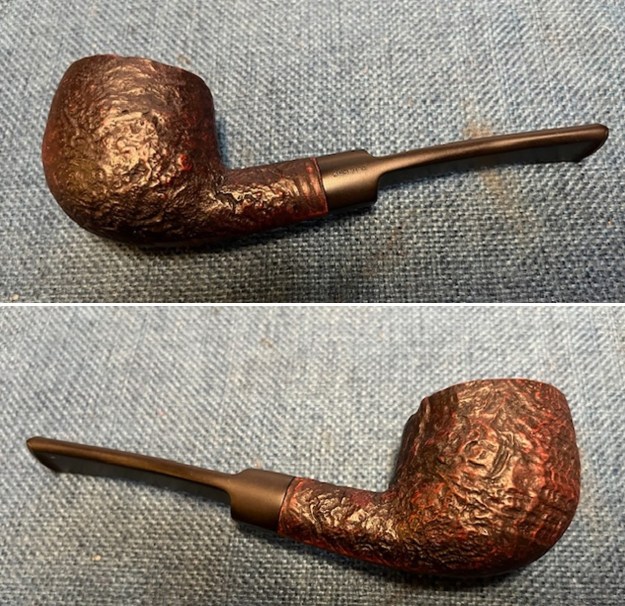
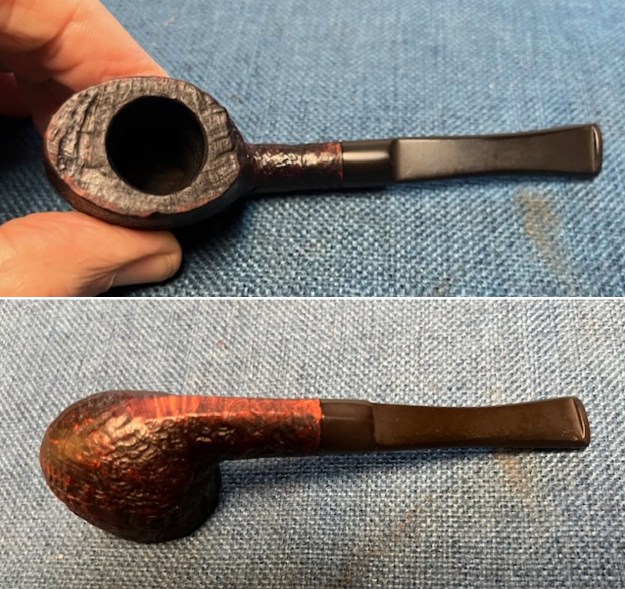
Restoring and Repairing a Cracked Bowl on a Knute of Denmark Sandblast Freehand


by Steve Laug

In November I received an email from Mario about working on some of his Dad’s pipes. Here is what he wrote to me.

I am desperately seeking help restoring and repairing some of my dad’s smoking pipes. I have tried reaching out to the only two known pipe repair establishments I could find in the entire country but one is not currently taking repair orders and the other said she didn’t want to try to repair these pipes without having even seen them. Would you be willing to take on the repairs or can you recommend anyone? Thank you much!!!—Mario

I wrote him back and asked him to send me photos of the pipes. He sent some single photos of the meerschaum bowl and stem, several of the leather clad Canadian and the photo of the rack and six pipes shown below. I looked through the photos and this is what I saw. There were two leather clad pipes a Canadian and a Pot. Both of them were cracked on the shanks and had been self-repaired with wire to hold the cracked shank together. The leather cladding was torn and the stitching was rotten and broken around the bowl. To me they were both irreparable. There was a lovely older Meerschaum with a horn stem that needed a good cleaning and repairs to the horn stem. There were two Knute Freehand pipes with original stems that were dirty but fixable. The plateau on the smooth one had a large chunk of briar missing. There was a Wilshire Dublin with a chewed and misfit stem. Finally, there was a billiard that had been restemmed with a fancy GBD saddle stem on it. They were a messy lot but I told him to send them on to me. They arrived yesterday and the condition of the pipes in the photos was confirmed. They were a mess and needed much work. I have included Mario’s group photo below to show the lot.This afternoon I decided to start working on the fourth of the pipes – a sandblast freehand. It was the one on the left top held in the hand in the photo above. It was a Freehand Shape with a plateau rim top and a smooth shank end. It had a fancy turned saddle stem that was oxidized, calcified and had lots of tooth marks and chatter on both sides near the button. The bowl had a thick cake on the walls and a heavy lava coat in the plateau on the rim top. It was internally a mess. The finish was dirty and had grime ground into the sides of the bowl. There a crack running from the heel of the bowl half way up the bowl on both sides mid bowl. The shank was in good shape with no nicks or cracks. The pipe was stamped on the underside of the shank and read Knute [over] Of Denmark. There was no other stamping on the shank sides. I took photos of the pipe when I unpacked it to examine it. I have included those below. I took a photo of the bowl and rim top to show the condition of both. You can see the debris in the bowl and lava in the plateau surface of the rim top. I also took photos of the heavily oxidized and calcified stem showing the tooth marks and chatter on both sides ahead of the button.I took a photo of the stamping on the underside of the shank. It is clear and readable as noted above. I took a photo of the bowl with the stem removed to give a sense of the proportion and appearance of the pipe without the stem. I took photos of the crack in the bowl sides before I started my clean up and repairs. It looks like the kind of crack that come from a bowl being dropped on a hard surface.Before I started my work on the pipe I wanted to remind myself of the provenance of the pipe. I remembered that it was linked to Karl Erik as I have worked on quite a few Knute Freehands. I wanted to know where this pipe fit into the Karl Erik lines so I turned to the first of two sites that I always check to gather information on a brand. I turned to the first source of information site – Pipephil’s (http://www.pipephil.eu/logos/en/logo-k3.html) got a quick overview on the brand once again connecting it to Karl Erik. I turned to Pipedia (https://pipedia.org/wiki/Karl_Erik). Pipedia had this great picture of Karl Erik Ottendahl and I decided to include it here as a reminder of the artisan who first carved and released this pipe. Reminded of the tie to Karl Erik, I knew a bit about the pipe at hand. I turned to address the pipe itself. There it is clearly identified and linked to Karl Erik Ottendahl. It is designated as a second and frequently having rustication. The interesting thing is that his pipe does not look like a second at all and I wonder if the Knute is a line of Karl Erik’s rather than a second. Who knows? This one is a very well done sandblast pipe. Now it was time to work on the pipe and bring it back to life. The crack needed to be repaired and the bowl brought back to life.

I started my work on the pipe by starting the process of cleaning the pipe. I carefully reamed the bowl with a PipNet Pipe Reamer remove from the bowl leaving bare briar. I cleaned up the remnants of cake with a Savinelli Fitsall Pipe Knife and removed the remaining debris. I sanded the bowl walls smooth with a piece of 220 grit sandpaper wrapped around a piece of dowel. I scraped the lava coat off the rim top – both the rusticated portion and the plateau rim top with the Savinelli Pipe Knife and removed all of it. I cleaned out the internals of the bowl and shank with pipe cleaners, cotton swabs, shank brushes and 99% isopropyl alcohol. It was very clean and it looked and smelled far better. I also cleaned out the internals in the stem with the same tools and alcohol.I scrubbed the externals of the bowl and shank with undiluted Murphy’s Oil Soap and a tooth brush. I worked over the bowl, shank and rim top with the soap and then rinsed it off warm water. The bowl looked extremely good. The cracks around the bowl heel and sides were clean. The plateau top had some darkening and burn marks. I worked over the rim top with a brass bristle wire brush to clean up the rim top. I sanded the rim top high spots in the plateau with a 320 grit sanding pad. The clean high spots would provide a great contrast.Now it was time to address the crack in the bowl running up both sides from the heel. The inside of the bowl is clean and no cracks run through from the outside of the bowl. I am pretty confident that the cracks came when the pipe was dropped on the ground. I used a micro drill bit and drilled small pilot holes at the end of the crack on each side of the bowl. I have circled the drill holes on both sides of the pipe in red for quick reference. I filled in the cracks with clear CA glue and briar dust and used a dental spatula to press the material into the crack.I worked over the repaired areas with a brass bristle wire brush. I followed the flow of the sandblast finish with the brush and was able to clean up the debris from the repairs in the grain of the crack. I worked some Before & After Restoration Balm into the sandblast finish and the plateau rim top. I worked it in with my finger tips on the smooth portions of the finish and with a shoebrush on the plateau and the sandblast. I let the Balm do its magic for 15 minutes then buffed it off with a cotton cloth. The rich colours of the finish on this Knute looked amazing. I painted the walls of the bowl with a mixture of sour cream and activated charcoal powder. The mixture works to provide a bowl coating. I applied it with a folded pipe cleaner. I put a pipe cleaner in the airway to close the entry into the bowl. The bowl coating would give the bowl some initial protection as it is broken in through smoking. The natural buildup of carbon will further protect the bowl. I set the bowl in a pipe rest to let the mixture harden and cure. I set the bowl aside and turned my attention to the badly oxidized stem. I scrubbed the stem surface with Soft Scrub cleanser to break through the oxidization and calcification. It took a lot of scrubbing and scraping of the grime from the surface but it finally began to show black. There were deep tooth marks on the top and underside of the stem ahead of the button. I filled them in with black CA glue strengthened with rubber and carbon. It dries hard but it still is a bit flexible. I flattened the repairs with small flat file. I sanded the repaired areas and the rest of stem with 320-3500 grit sanding pads to smooth it out and remove remaining oxidation. I wiped the stem down after each pad with an Obsidian Oil cloth. It was beginning to look very good.       I polished the stem with micromesh sanding pads – 1500-12000 grit pads. I wiped it down with a damp cloth after each sanding pad. I used Before & After Pipe Polish – both Fine and Extra Fine to further polish the stem. I put the stem back on the Knute of Denmark Sandblast Freehand pipe and took the pipe to the buffer. I carefully buffed the bowl and stem with Blue Diamond to polish the briar and the vulcanite. Blue Diamond does a great job on the smaller scratches that remain in the vulcanite. I gave the bowl multiple coats of Conservator’s Wax and the stem several coats of carnauba wax and buffed the pipe with a clean buffing pad to raise the shine. I hand buffed it with a microfiber cloth to deepen the shine. The pipe polished up really nicely with a great contrasting stain look to the briar. The finished pipe is shown in the photos below. This is a beautiful Karl Eric Made Knute of Denmark Freehand – the fancy turned stem and plateau rim top give the pipe a great look. The dimensions of the pipe are Length: 6 inches, Height: 2 ½ inches, Outside diameter of the bowl: 1 ½ inches wide x 2 inches, Chamber diameter: 7/8 of an inch. The weight of the pipe is 2.26 ounces/64 grams. This is the fourth of six pipes that am restoring for Mario from his Dad’s collection. I look forward to hearing what he thinks of this newly restored pipe. Thanks for reading this blog and my reflections on the pipe while I worked on it!