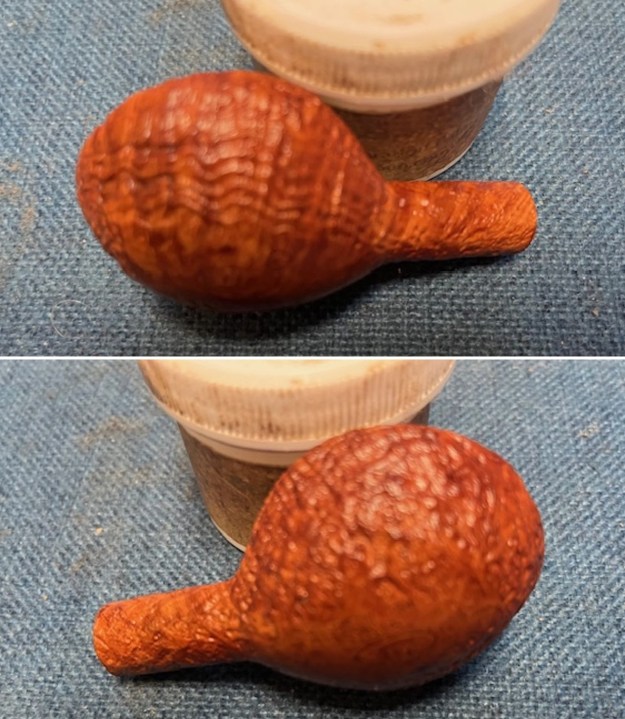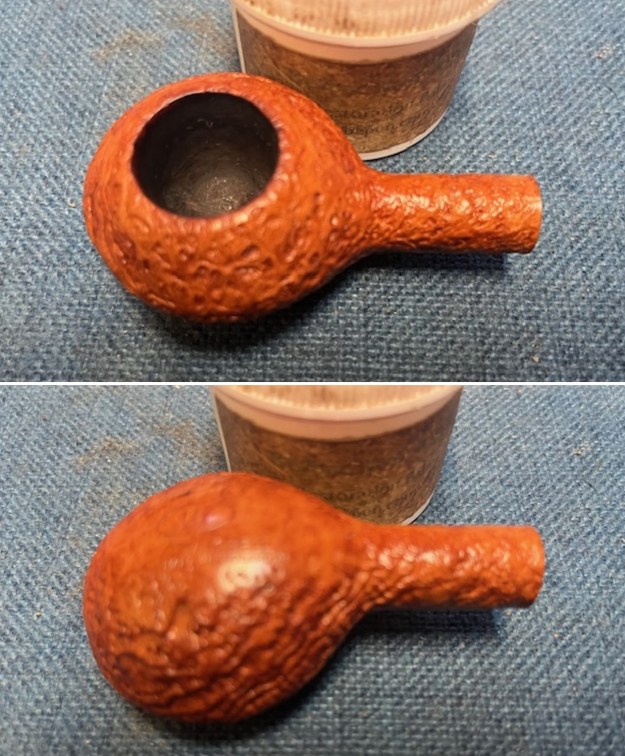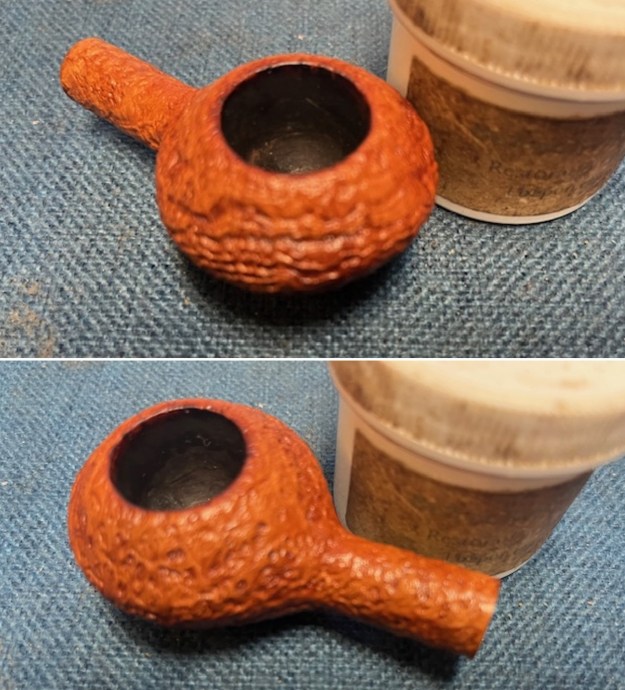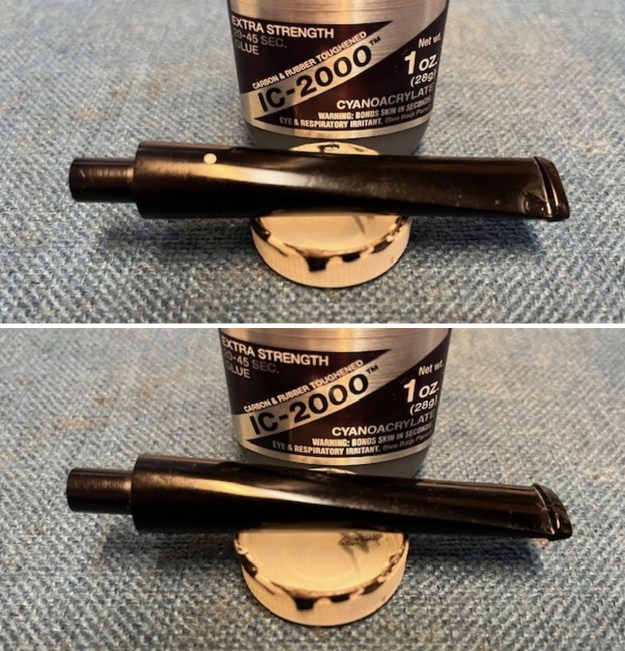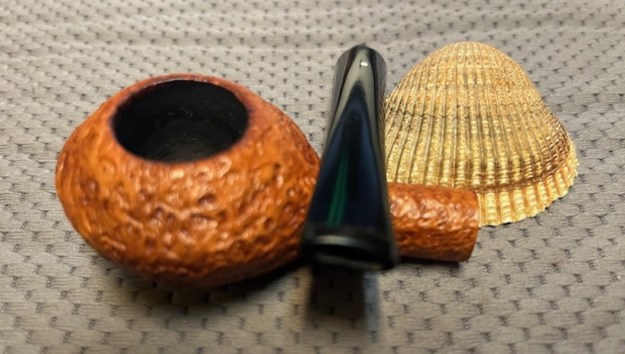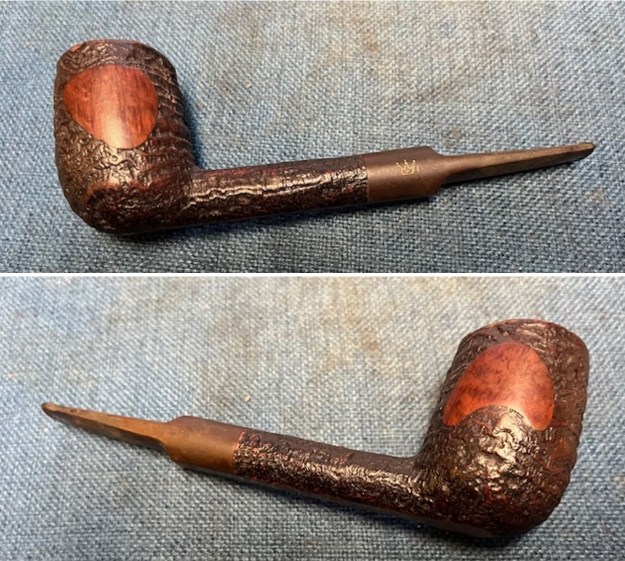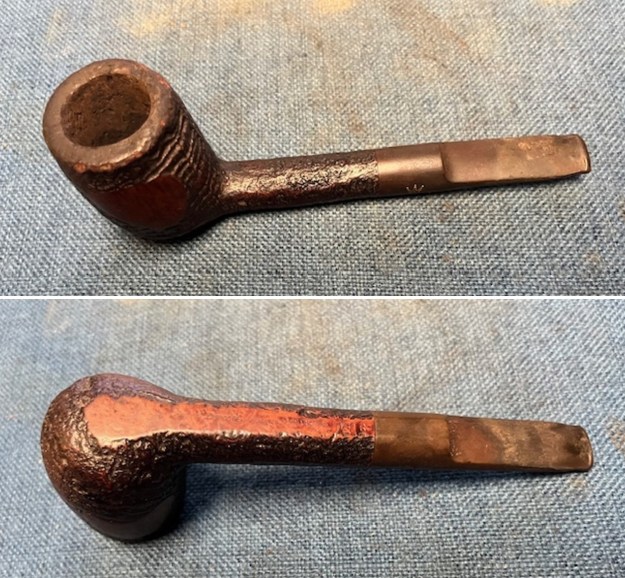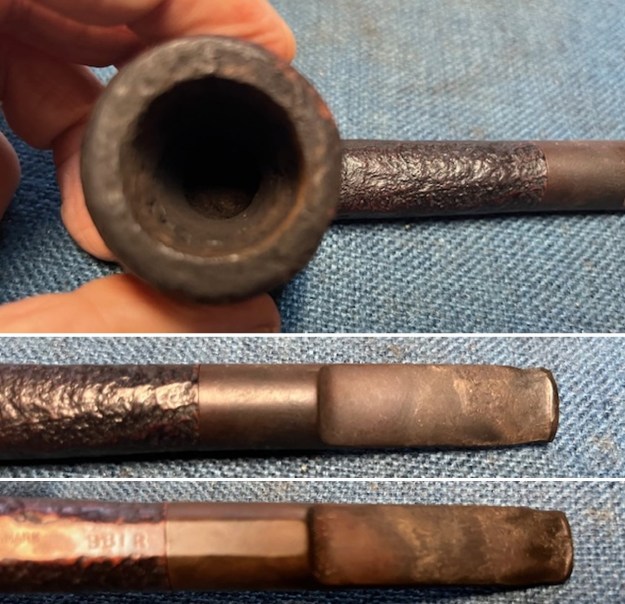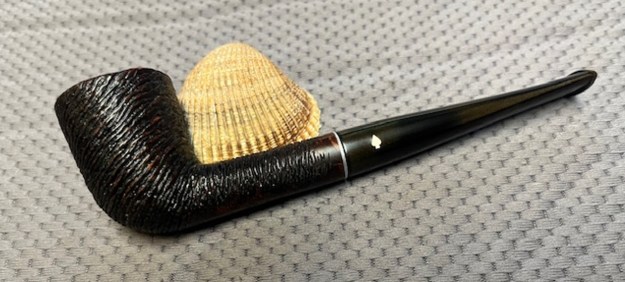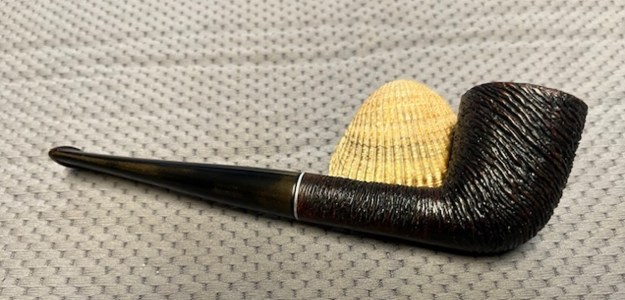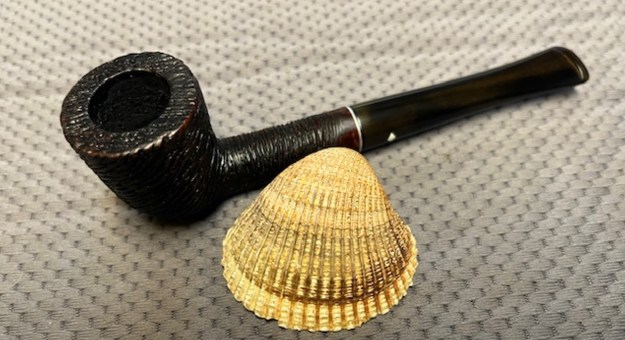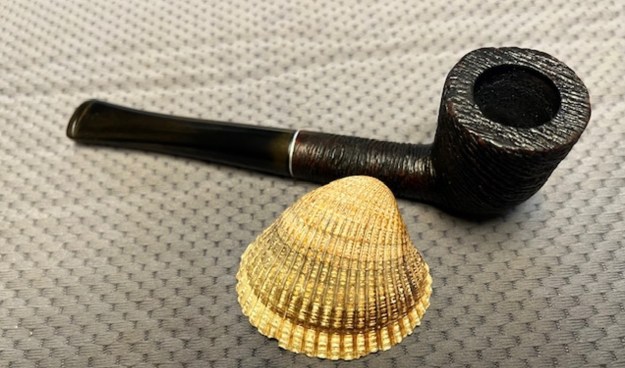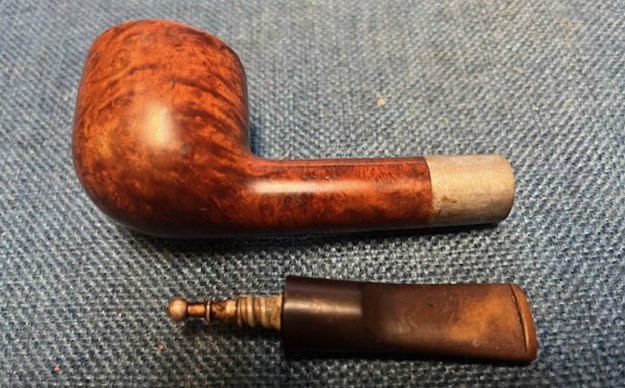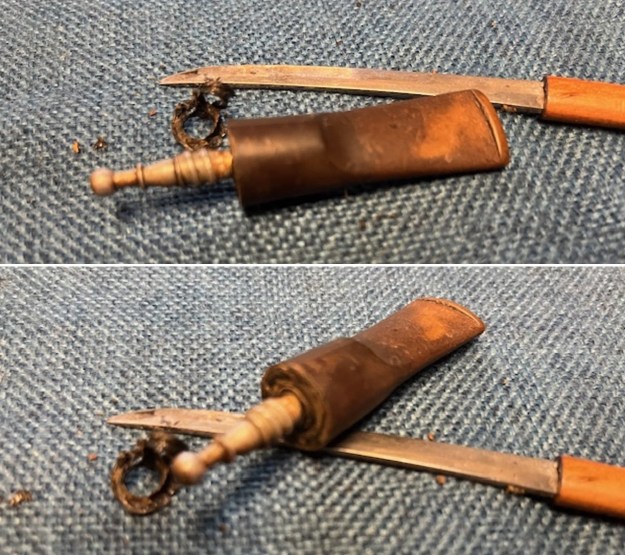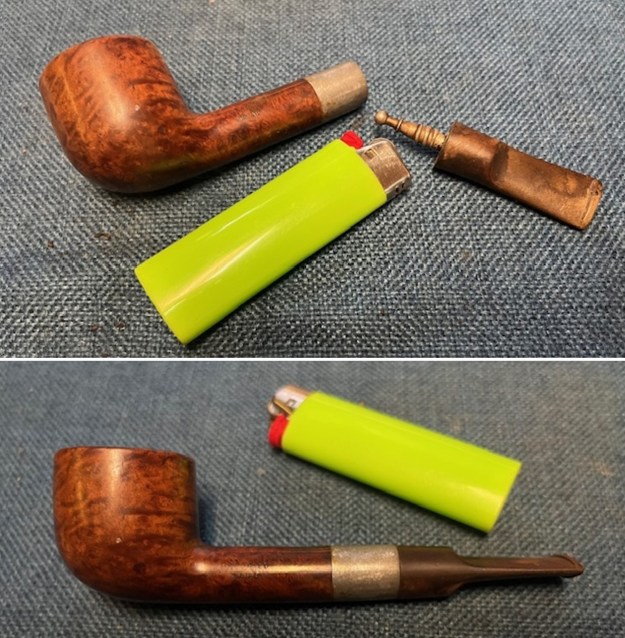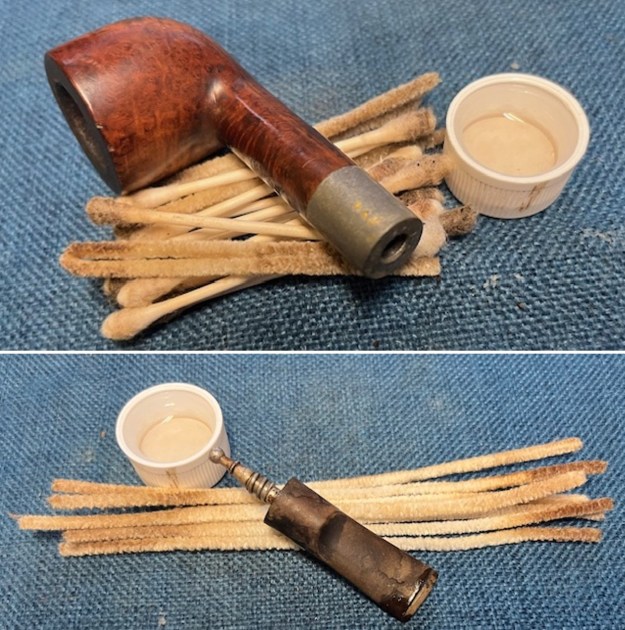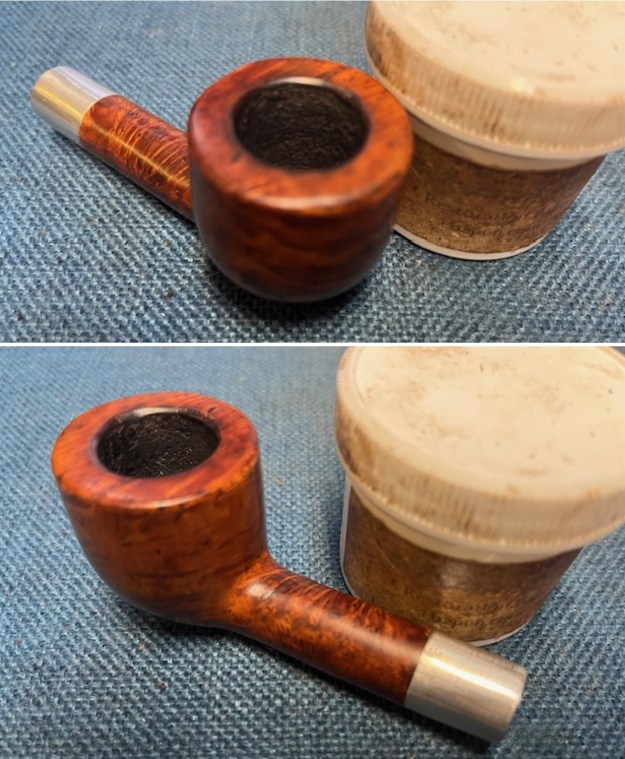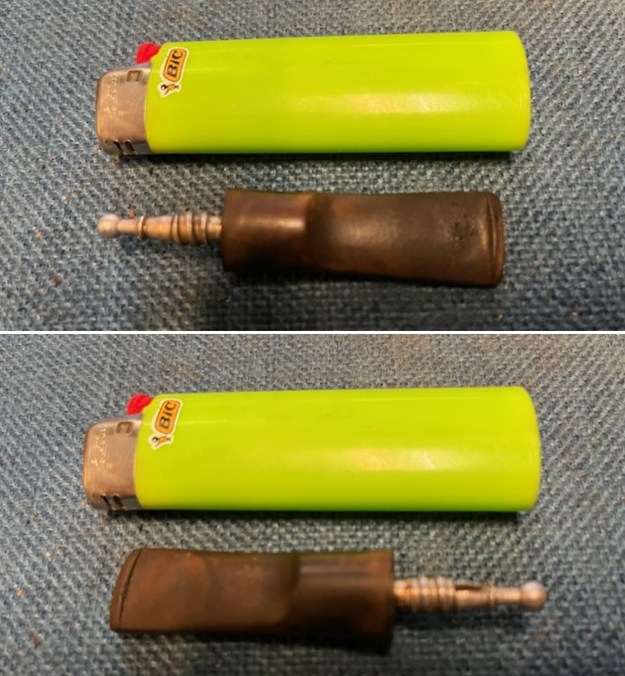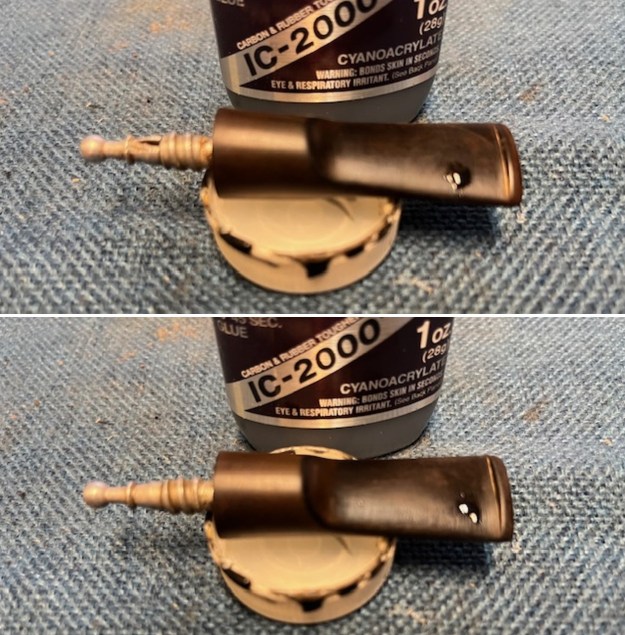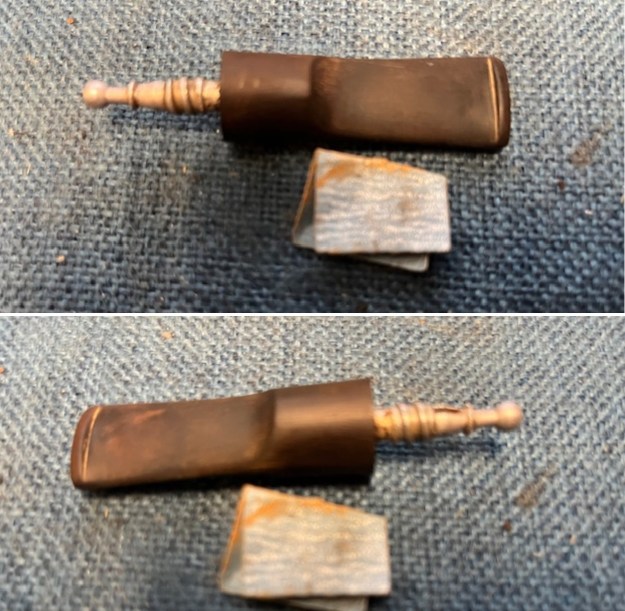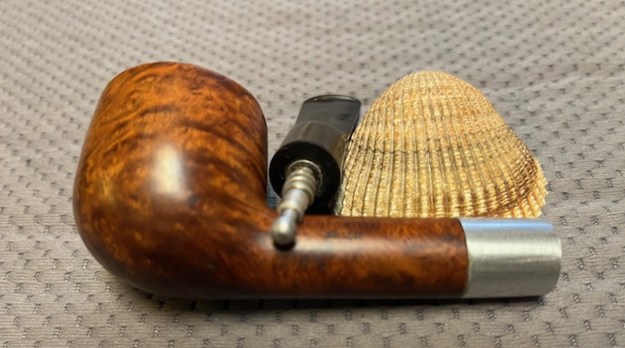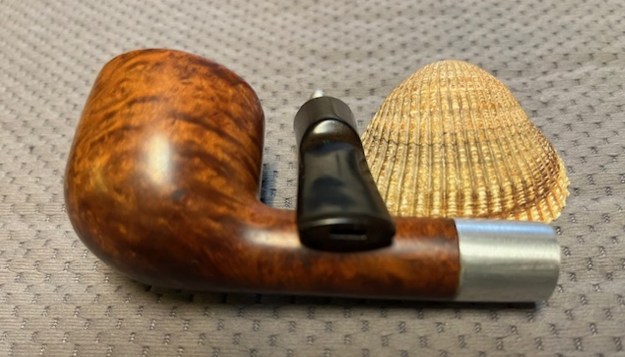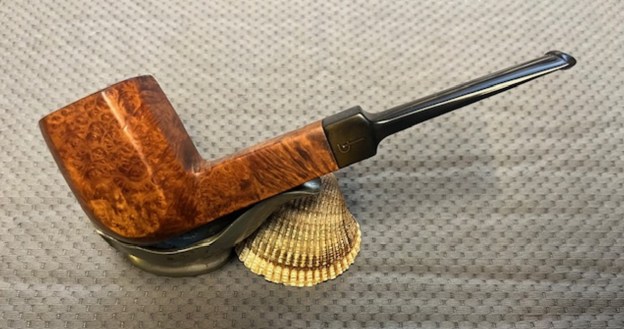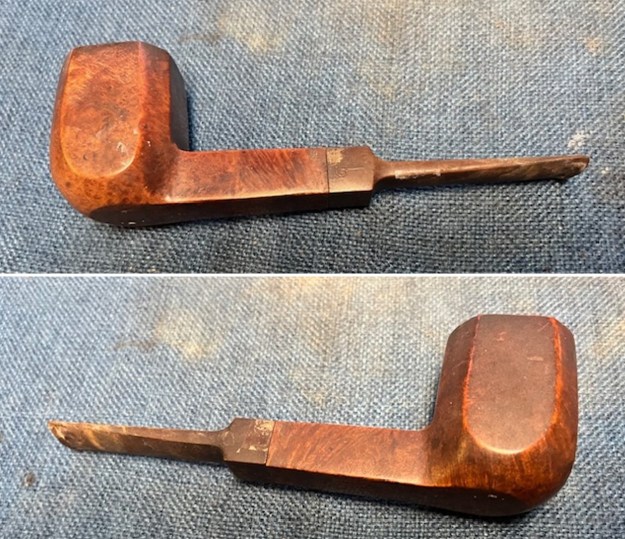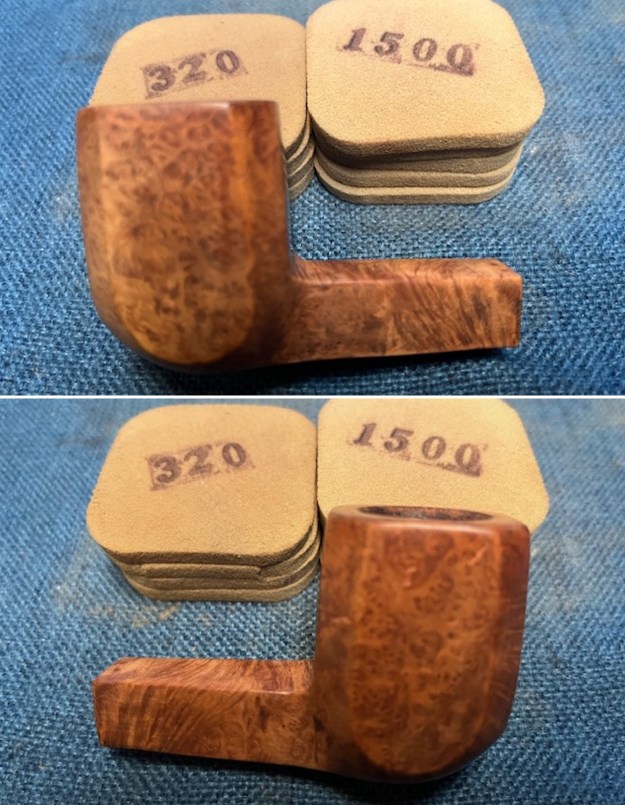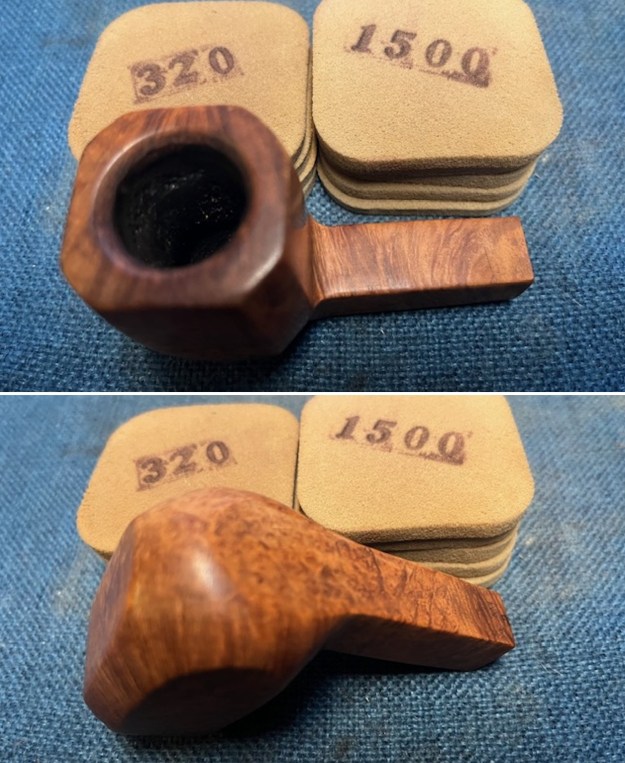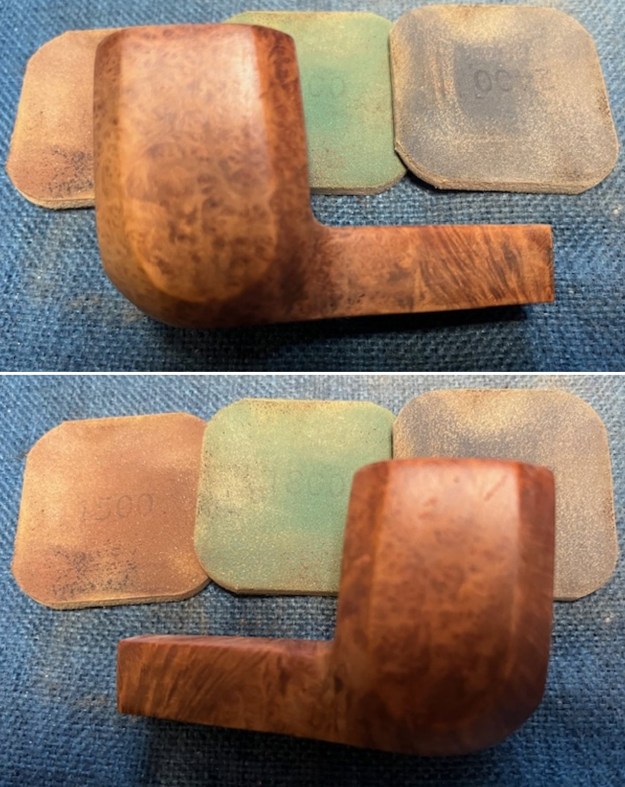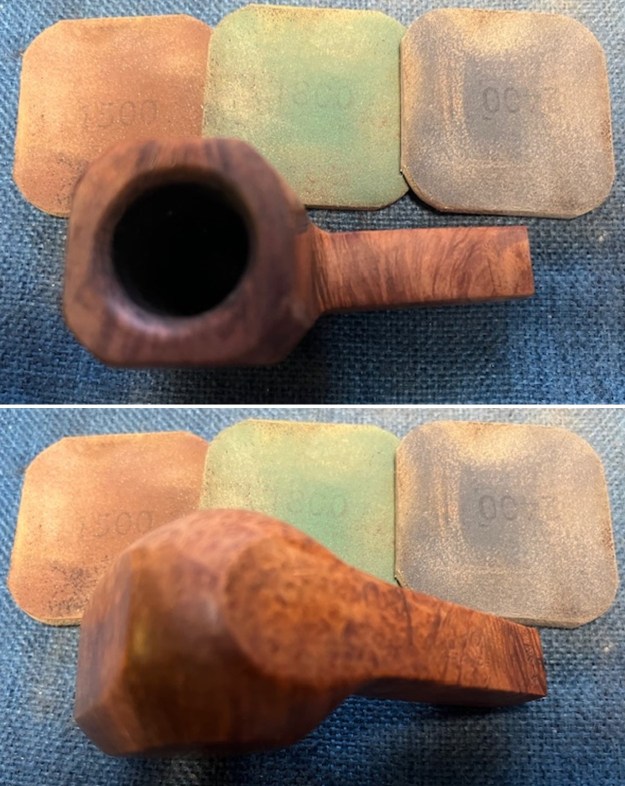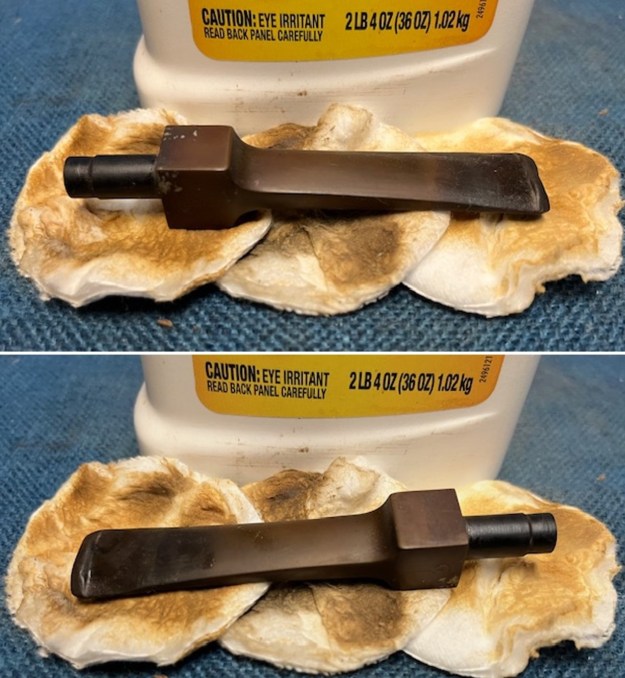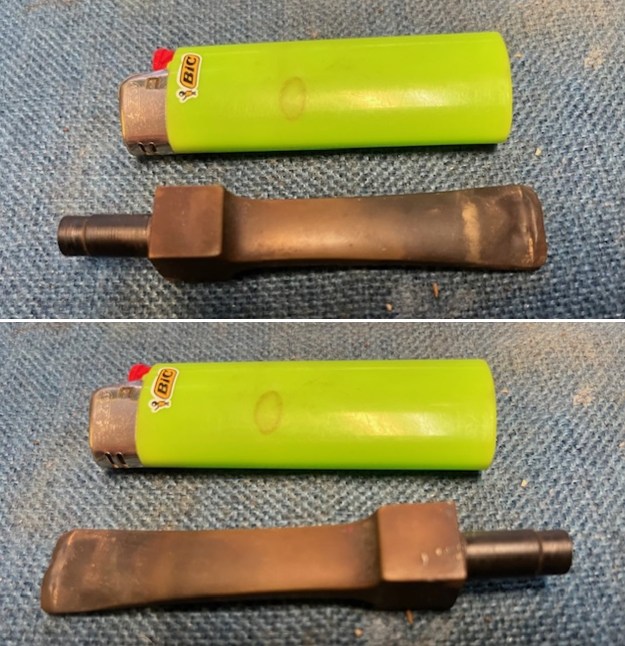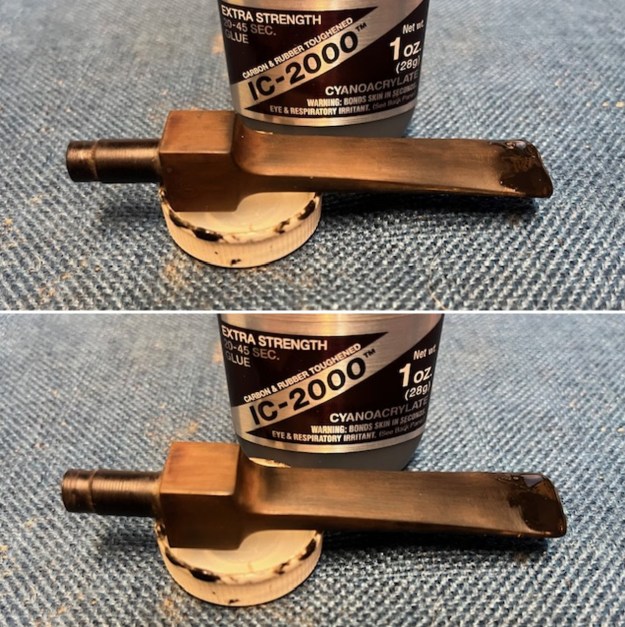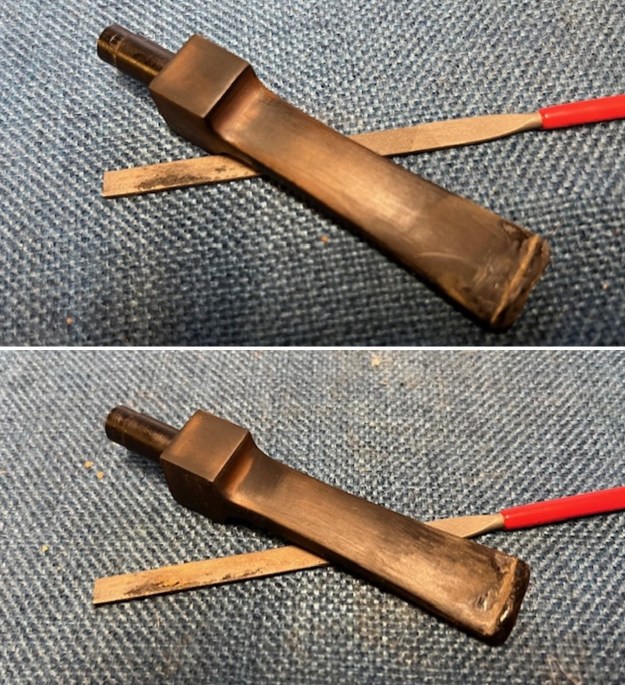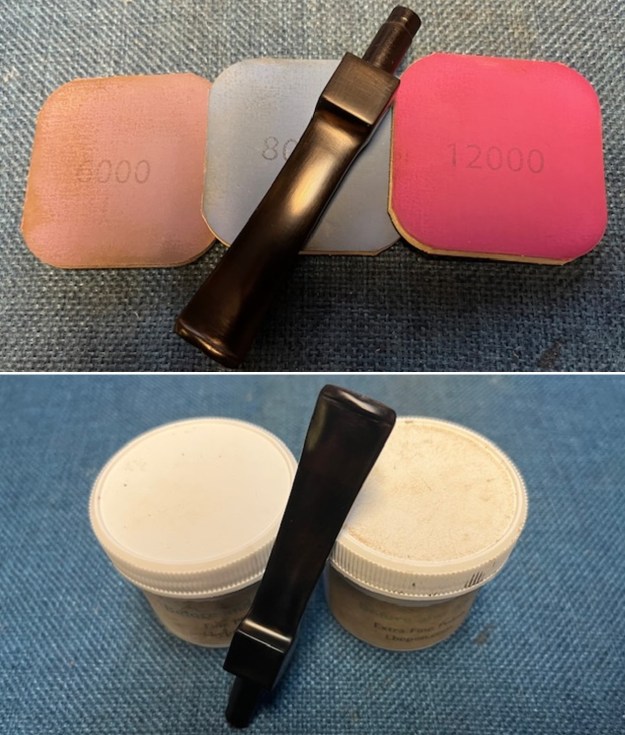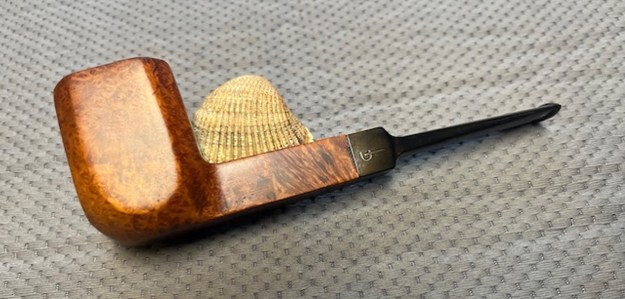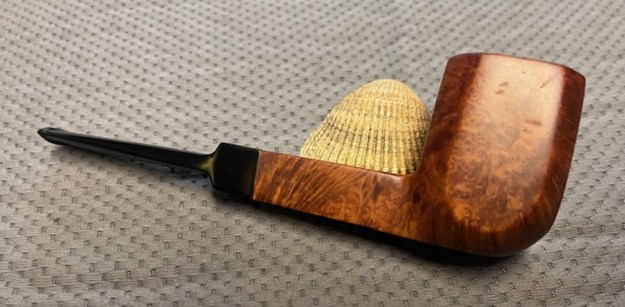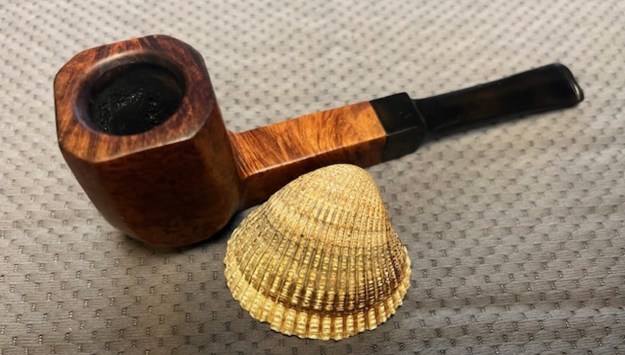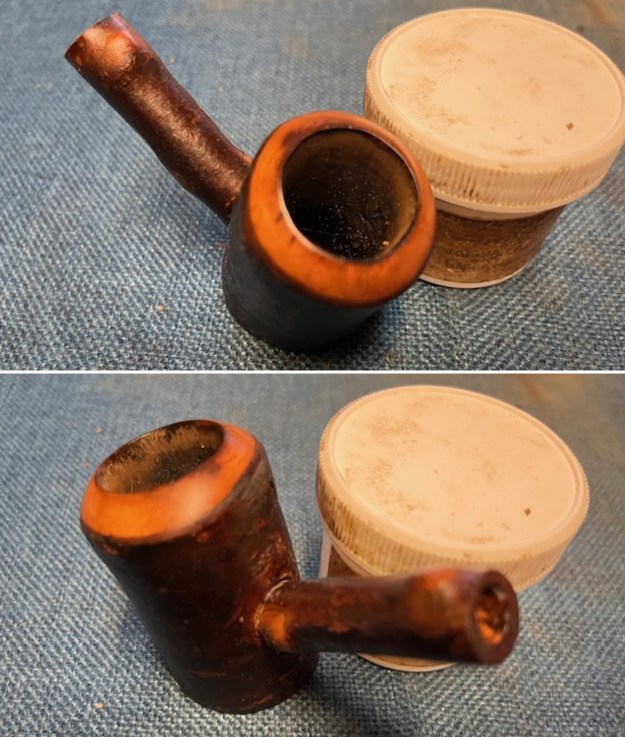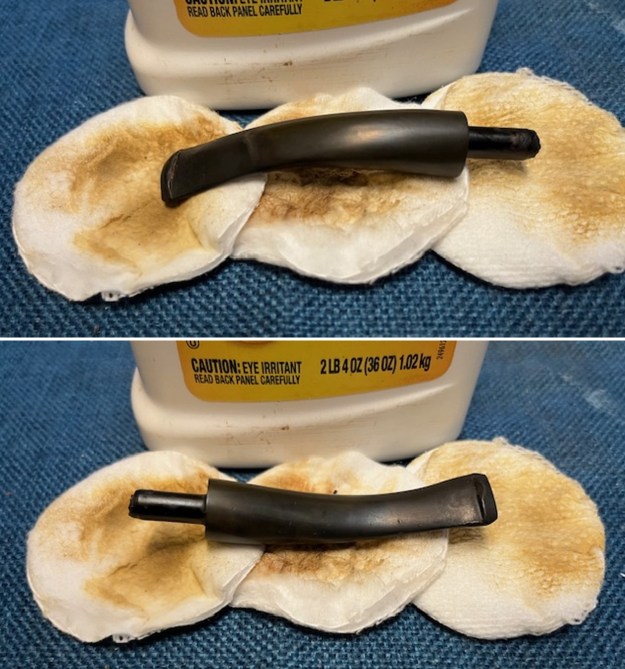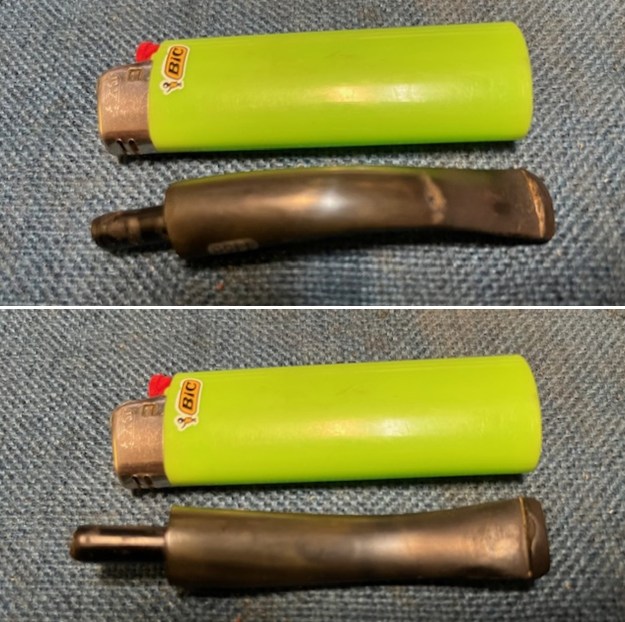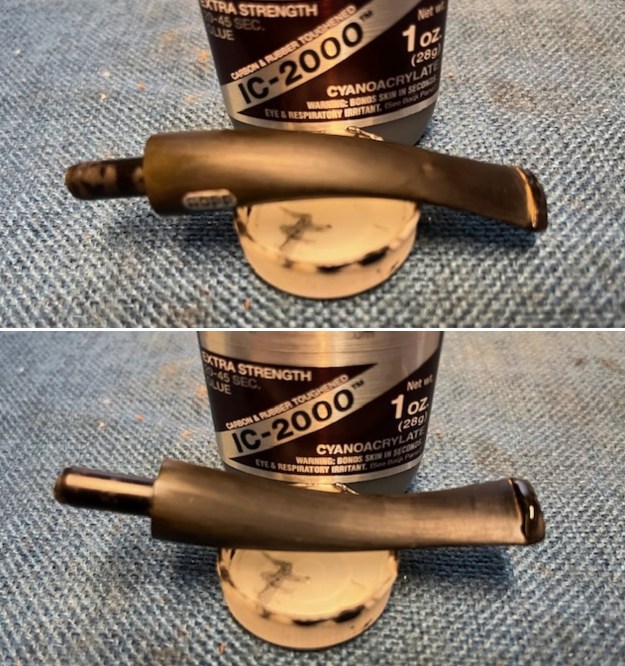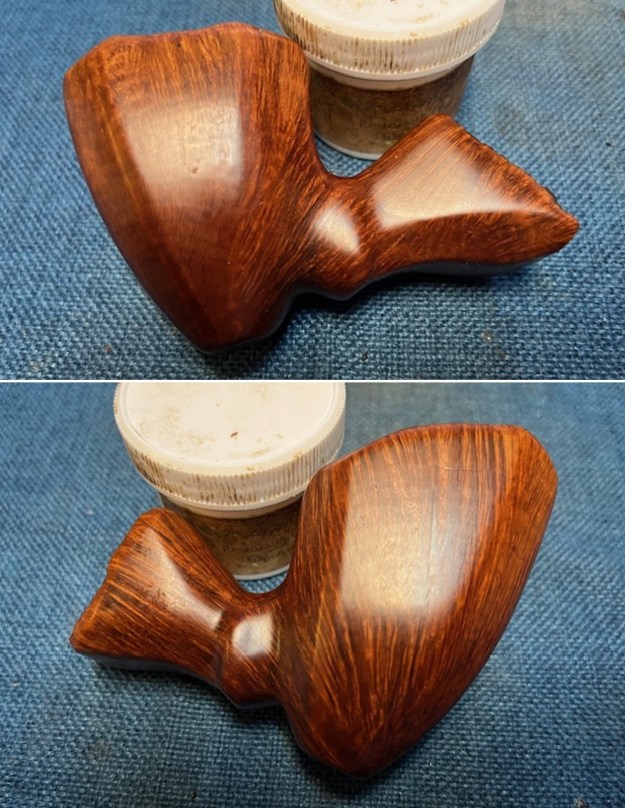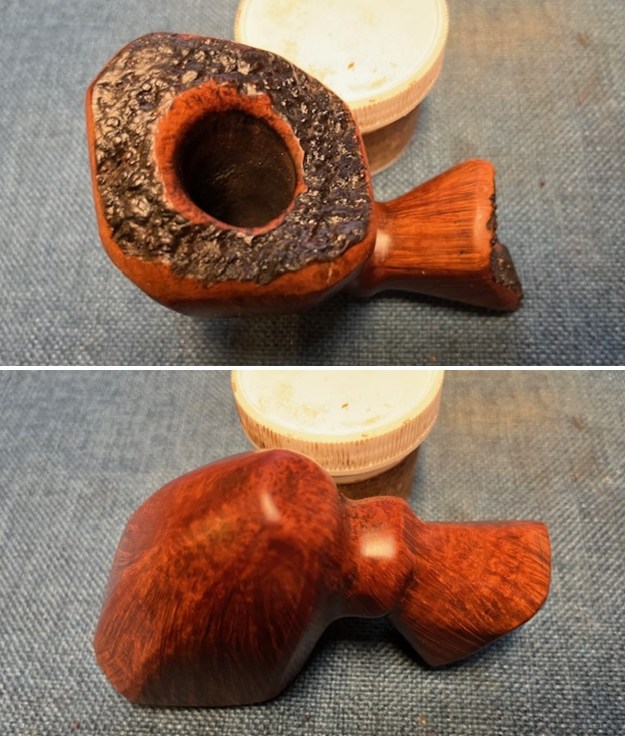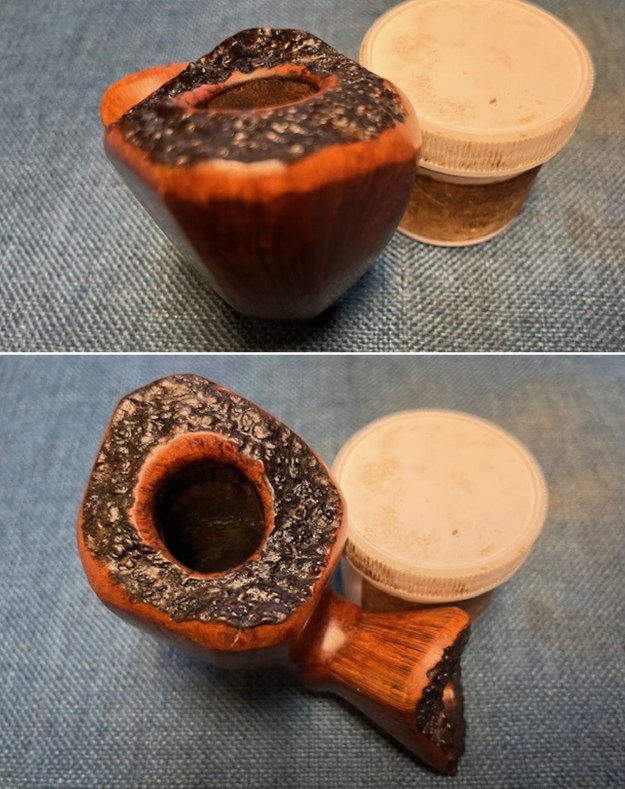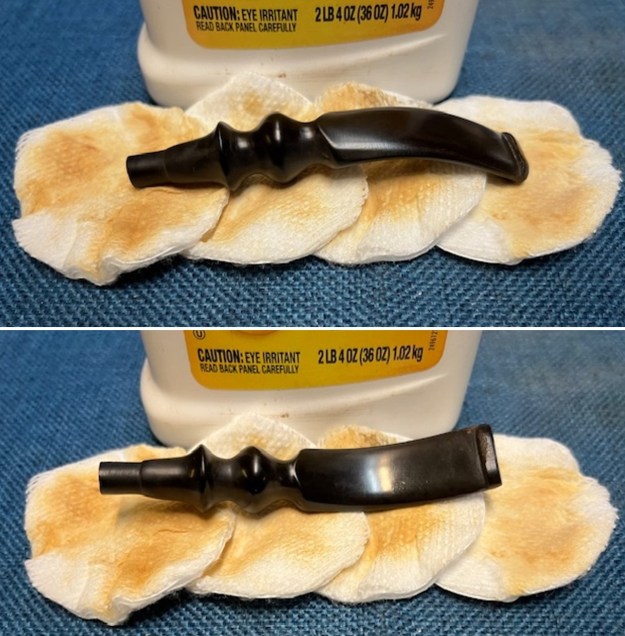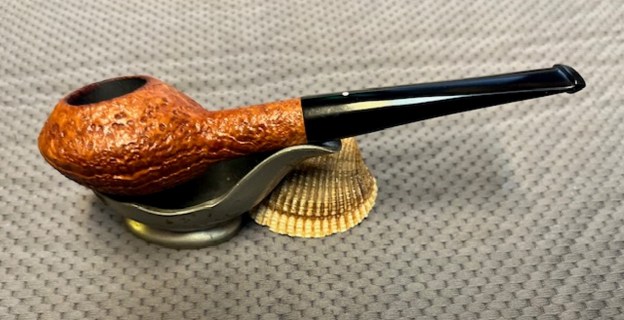
Tag Archives: Stem repairs

Restoring a Dunhill Amber Root 4106 Pot


by Steve Laug

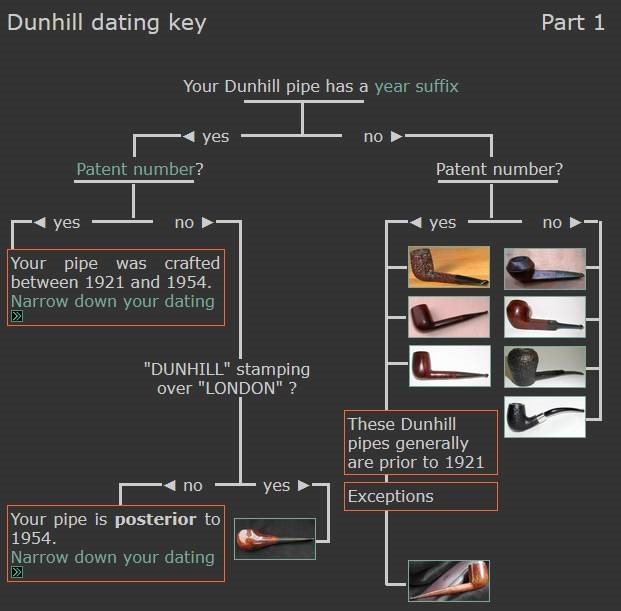
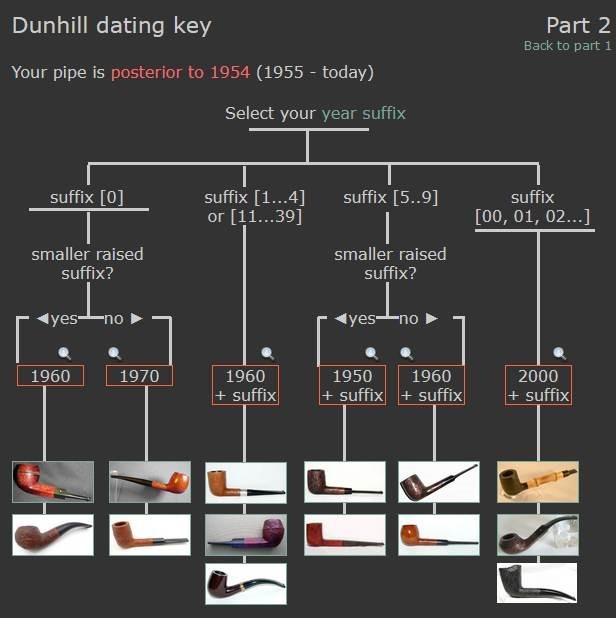
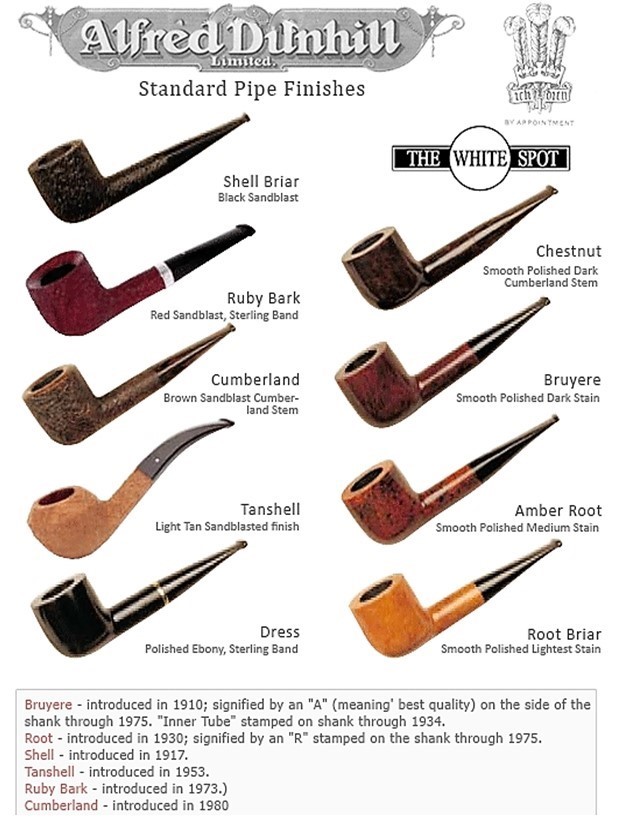
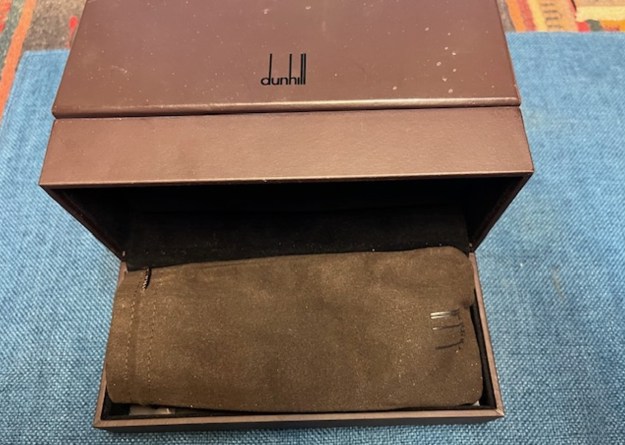
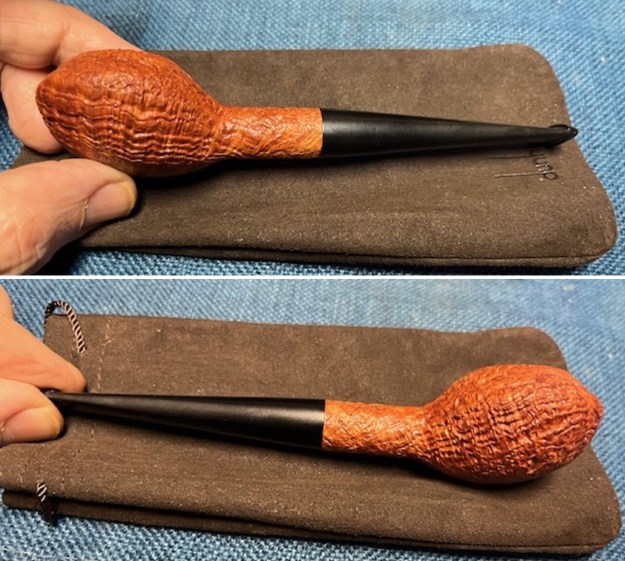
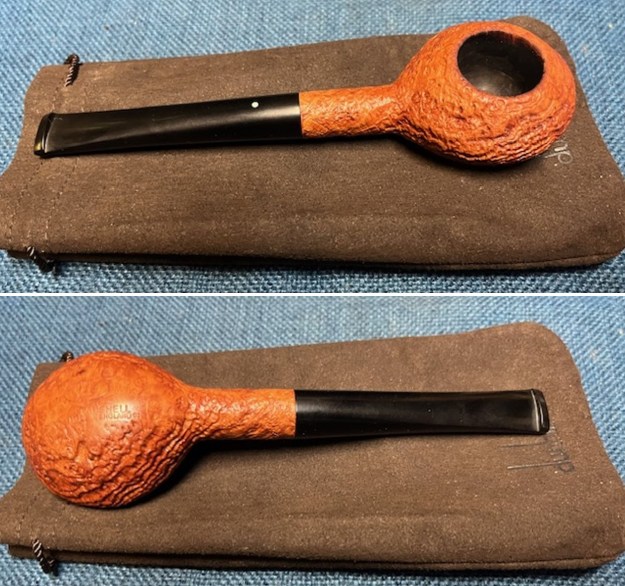
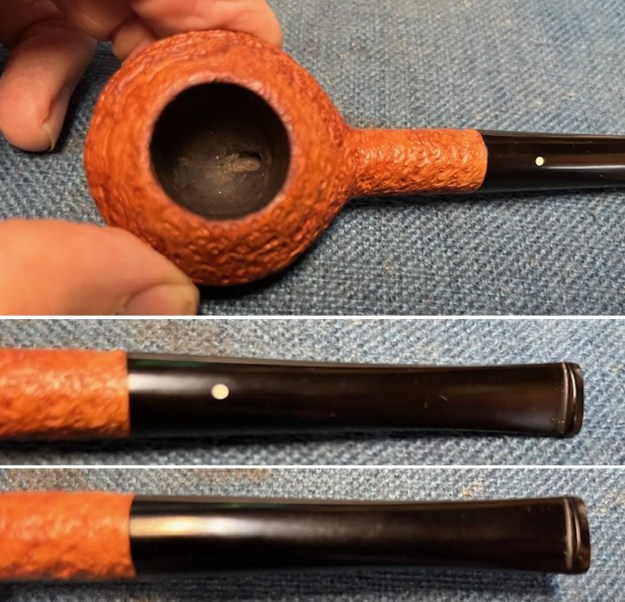
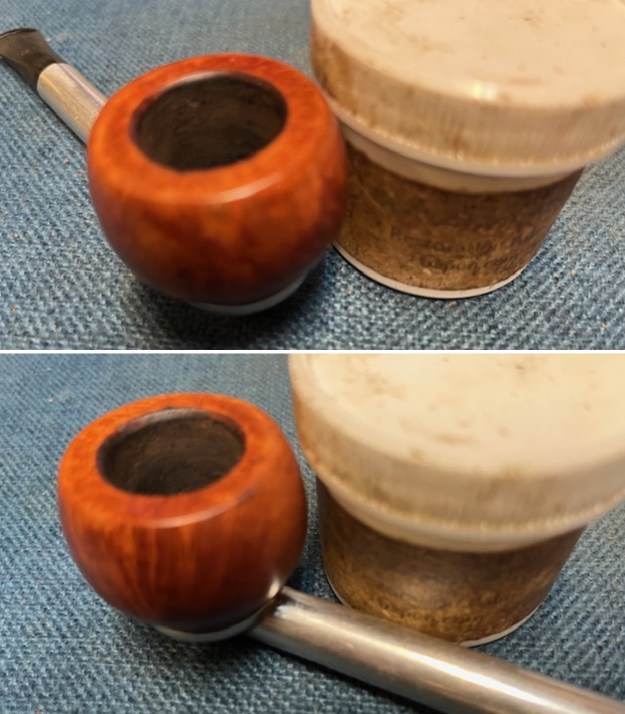
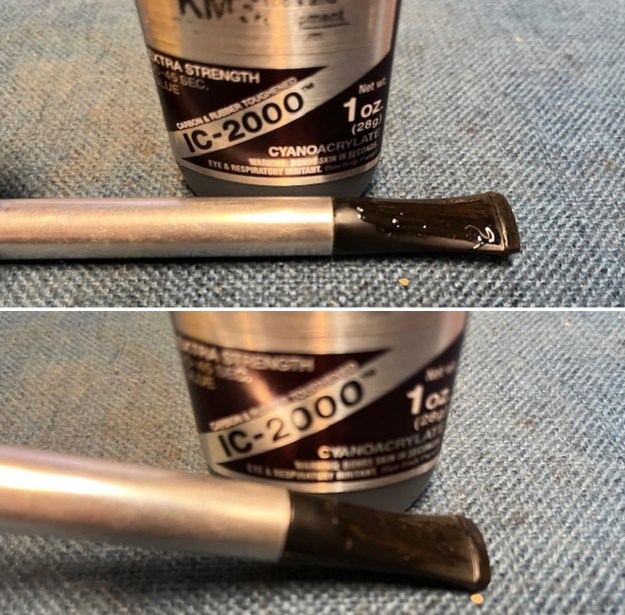
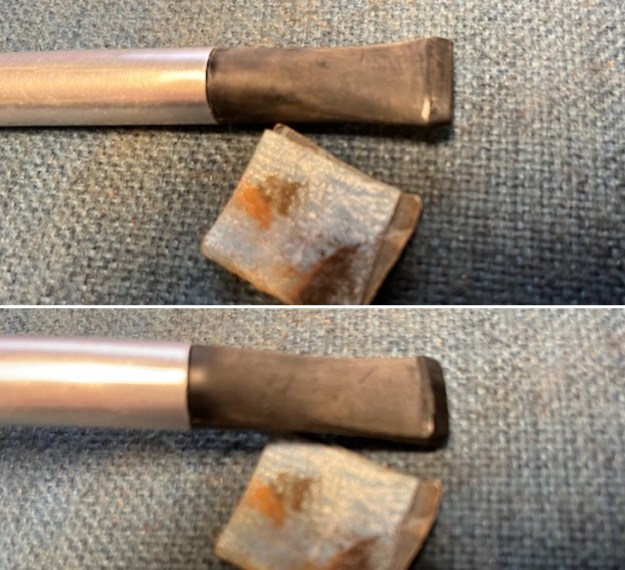
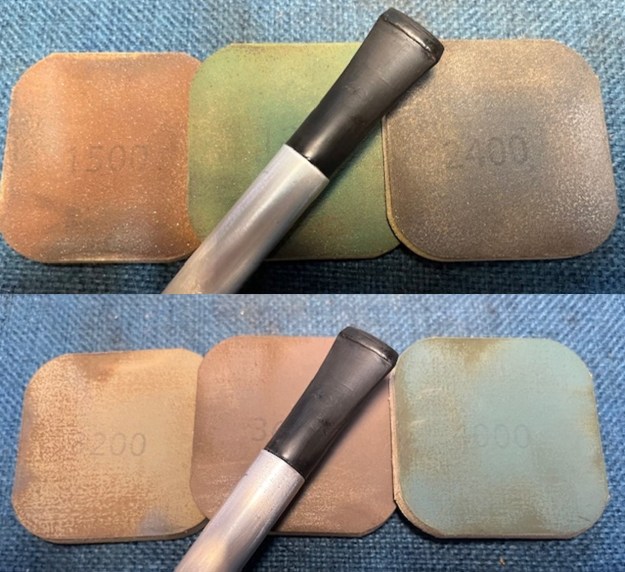
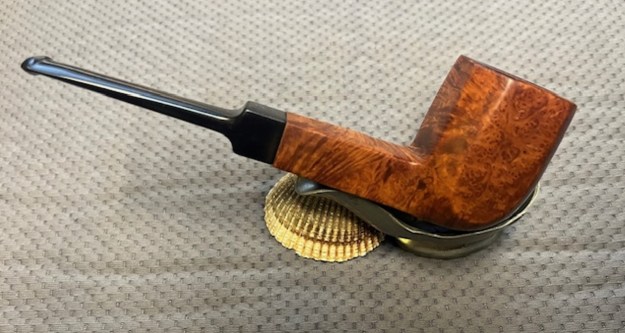
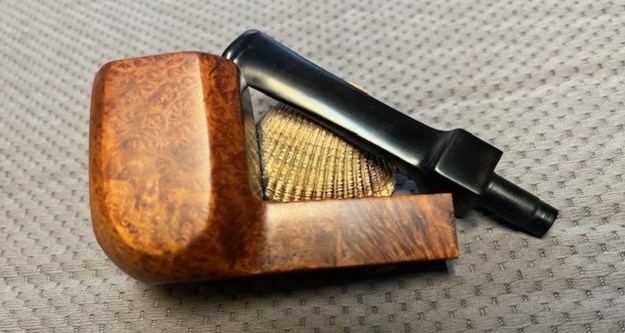
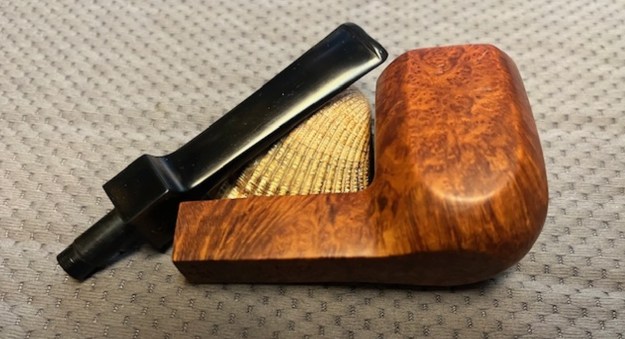
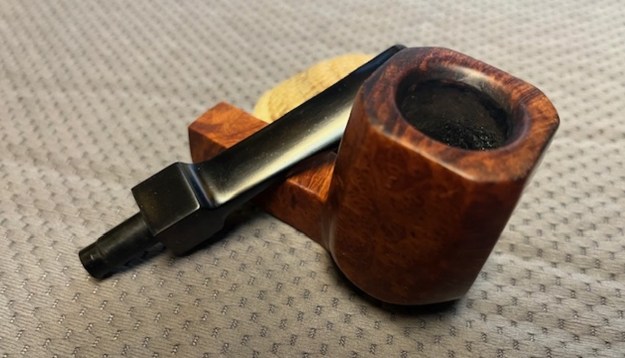
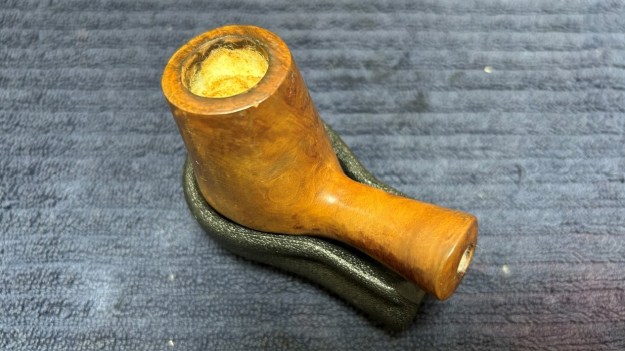
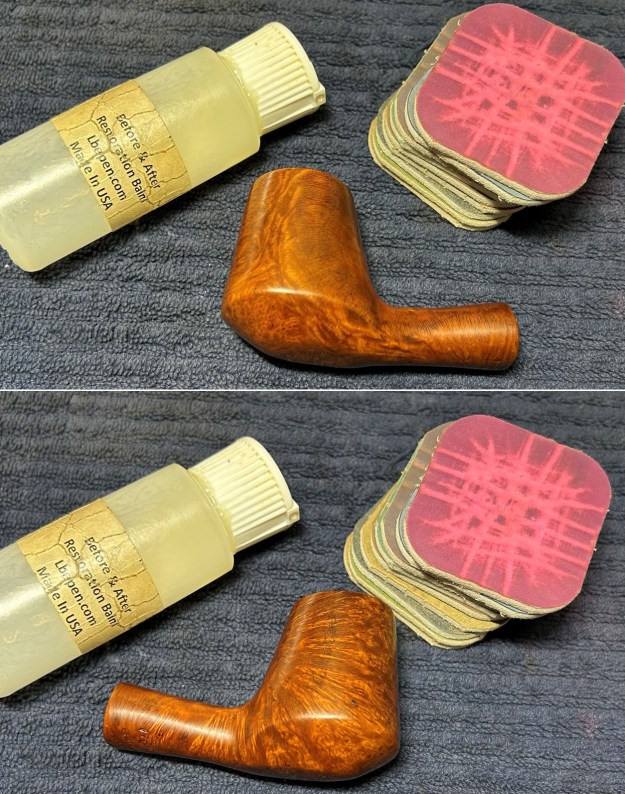
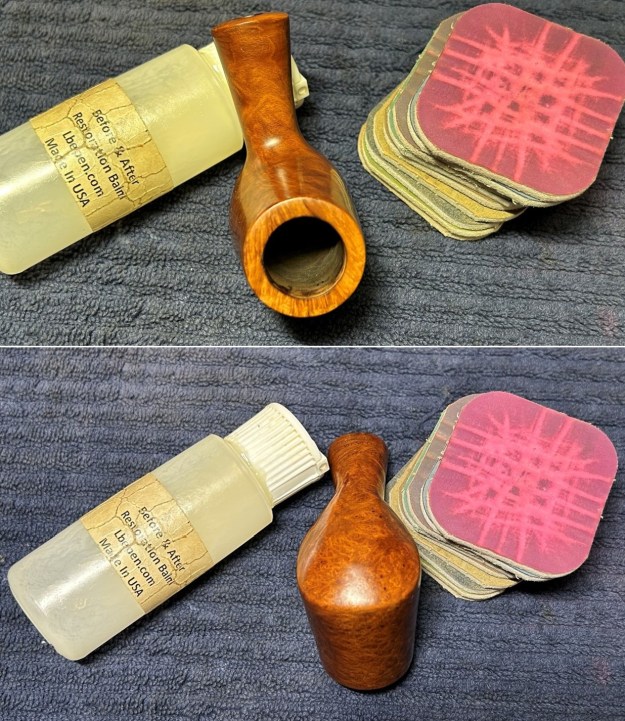
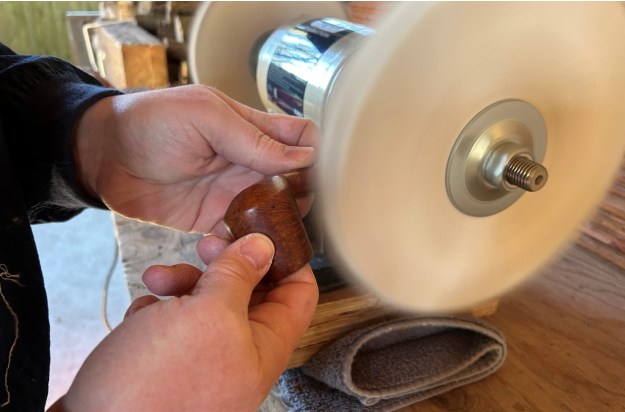
The first pipe on the table since I returned from my long Asia trip for work is one that was sent to me by Jim for restoration. It is a nice-looking Dunhill Amber Root Pot. The stamping on the left side of the shank reads 4106 (the shape number), near the bowl shank junction. It is followed by some unique stamping that reads Alfred [over] The White Spot [over] dunhill’s. On the right side it is stamped Amber Root [over] Made in England15. The pipe was in decent condition, just well used and stunk of an aromatic, vanilla tobacco. The outside of the bowl and shank were dirty and dull with hand oils but the flash on the photos shows the nice grain. The bowl had been reamed recently and there was no cake in the bowl. The rim top had some darkening around the inner edge and on the top. The inner edge has some damage and is slightly out of round. The outer edge looked good. The vulcanite taper stem was oxidized and had some light tooth marks on the top and underside ahead of the button. The shank of the pipe was quite dirty with the oils and tars of the aromatic tobacco that had been smoked in it. I took photos of the pipe when I brought it to my work table and before I started the clean up. Try to imagine how the pipe smelled. Even your imagination cannot begin to capture the smells of the briar in your hand. The relatively clean bowl looks quite good. There are some nicks in the inner edge from zealous reaming that left it rough and damaged. The vulcanite, taper stem was dirty, lightly oxidized and has tooth chatter and marks on both sides. I took photos of the bowl, rim top and the stem to show the condition of both.The stamping on the sides of the shank are shown in the photos below. It looks very good with portions of it faint but readable. It reads as noted and explained above. I tried to capture the detail in the photos below. I also took a photo of the pipe with the stem removed to show the proportion of this pipe. It is really a beauty. I wanted to unpack the Dunhill stamping on the shank and work to understand each element of the stamp. I generally use the Pipephil site to gather as much initial information as possible (http://pipephil.eu/logos/en/dunhill/amber1.html). The stamping is interpreted as follows: The number 4106 is the shape number that unpacks as follows: the 4 is the bowl size, 1 is the normal identifier for a taper stem, 06 is the shape designation – a Pot. The Amber Root stamp refers to the finish. The superscript 15 following the D of England would give the date the pipe.Pipephil also has some helpful dating keys on the site that are basically flow charts that you can walk through to date your pipe (http://pipephil.eu/logos/en/dunhill/cledat-en1.html). I turned to Part 1 of the Dating Key and followed the chart. This pipe has a number 15  following the D in England. There was no patent number so that took me to the section on the chart below (column one) which instructed me that the pipe could be dated as being made “posterior to 1954”.I followed the link under “Your pipe is posterior to 1954. Narrow down your dating”. That took me to Page 2 of the dating key (http://pipephil.eu/logos/en/dunhill/cledat-en1a.html). The last column (suffix 00, 01, 02…) led me to the section with a 15 after the D in England. There was a directive for dating the pipe spelled out as follows: 2000 + suffix which gives the pipe a date of 2015. From that I knew that the pipe was made in 2015. I chose this column rather than the second column which would have dated it as 1975 because of the date that the Amber Root was released by Dunhill being 1995. I hope that the logic of the dating is clear. I then turned to Pipedia’s section on Dunhill pipes to get a bit of background on the Dunhill finishes (https://pipedia.org/wiki/Dunhill#Root_Briar). I quote:

Amber Root – Introduced in 1995. A warm yellow-orange stain, reminiscent of the original Root Briar finish. Cumberland stems were used, although recently, Amber Root pipes have appeared with black stems. This is also a limited production pipe that is found in mainly Company stores and Principle Pipe Dealers. Straight grained pipes are made available in this finish under the name Amber-flame and are graded from one to three flames.

Note: While the Amber Root finish existed in the past with Cumberland and black Vulcanite mouthpieces (now we use usually the black Vulcanite variety only)[32].

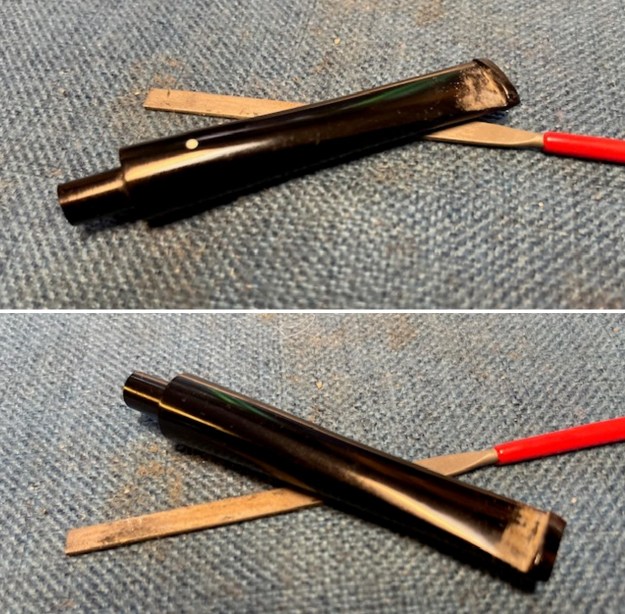
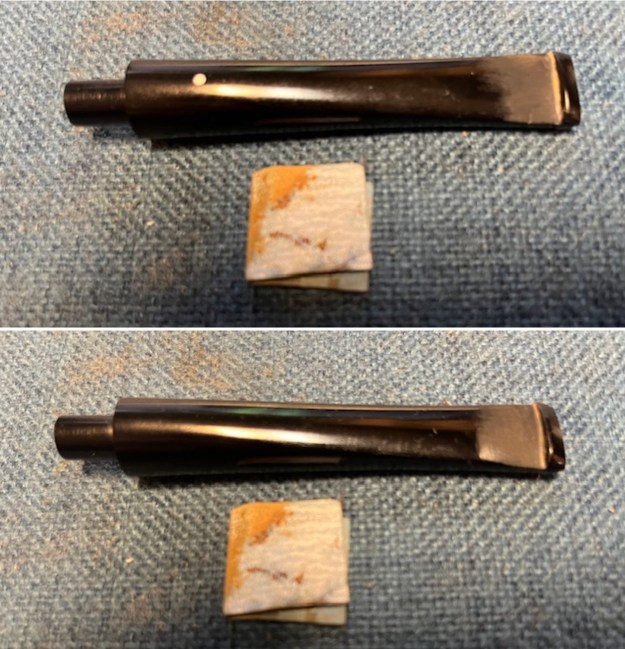
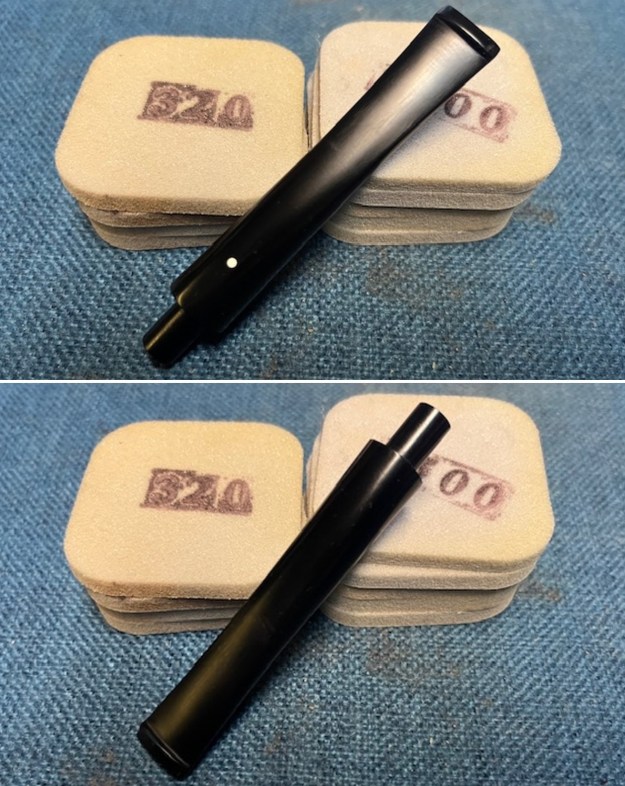
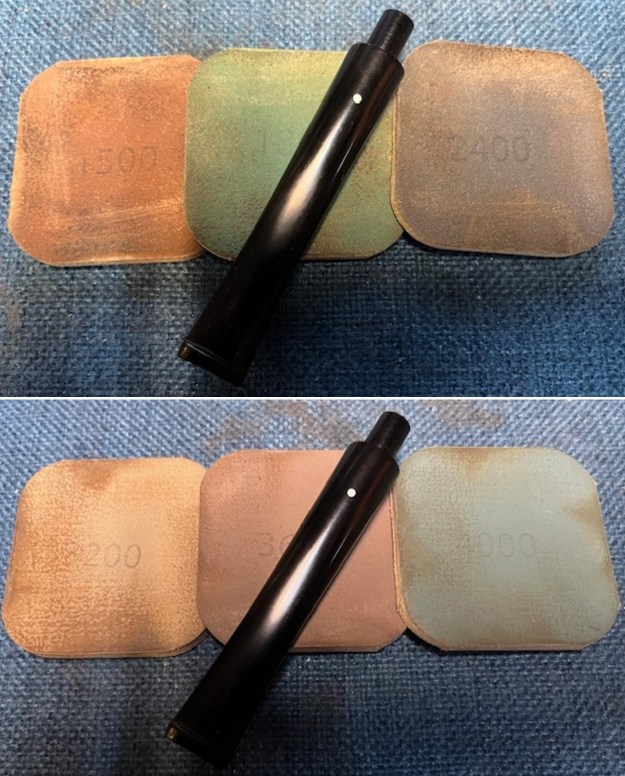
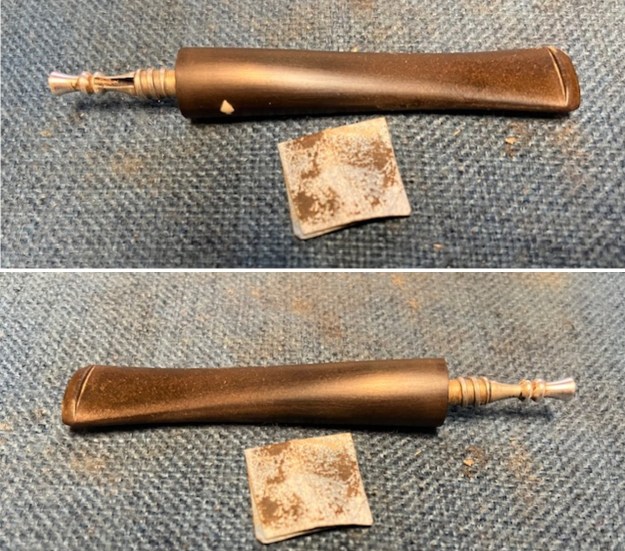
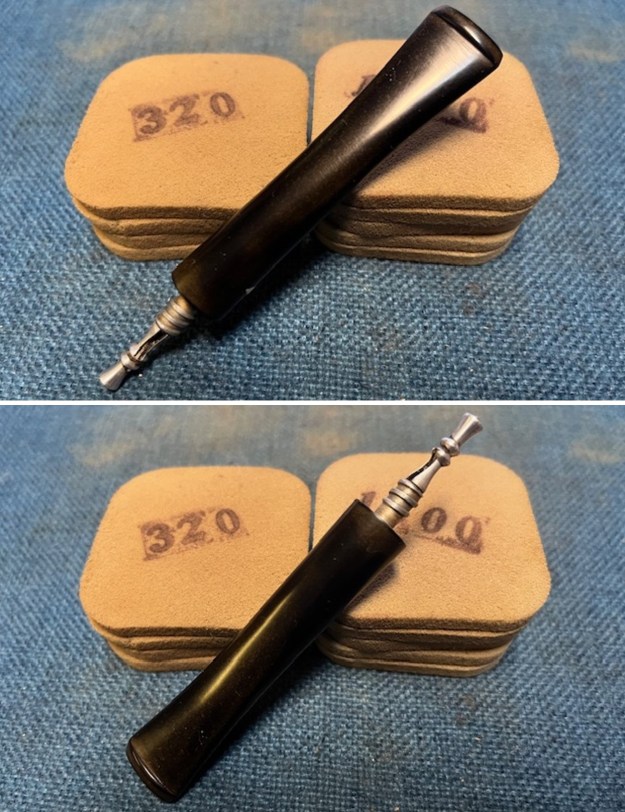
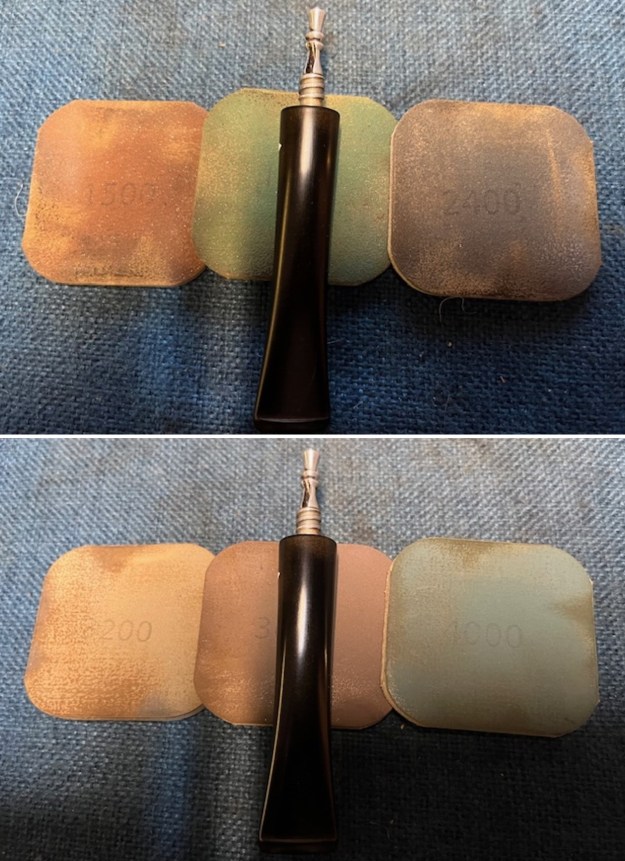
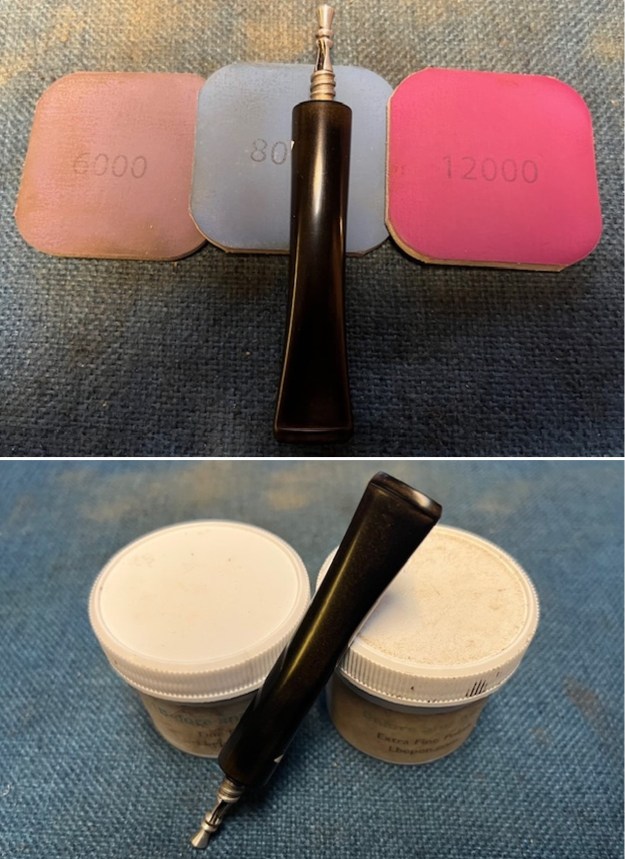
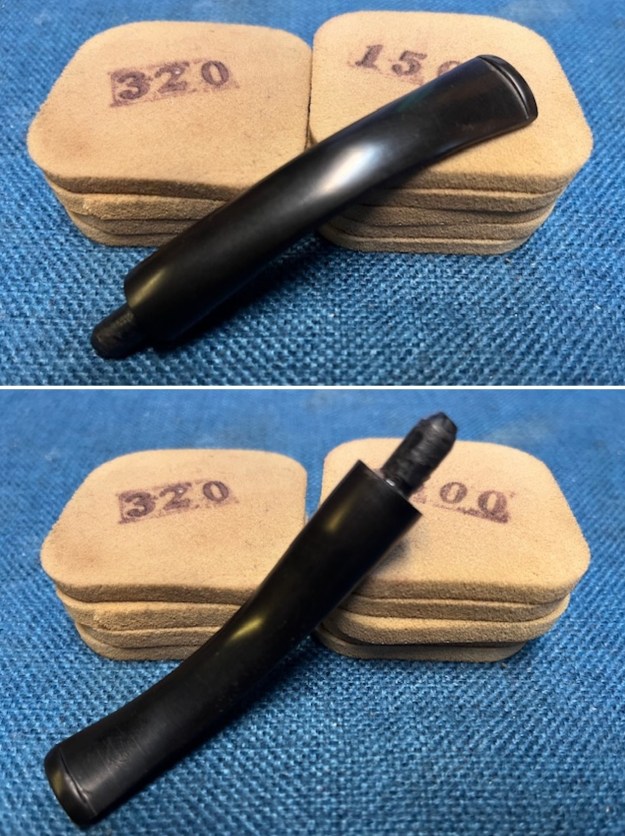
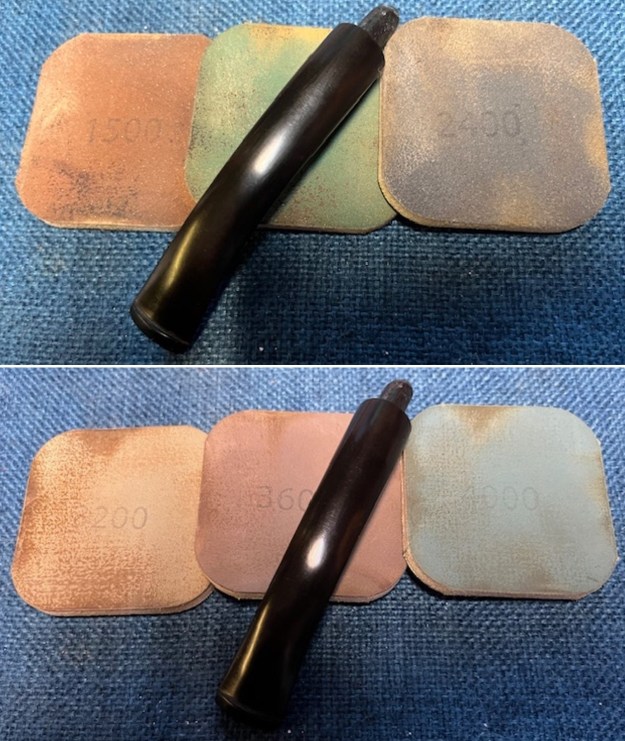
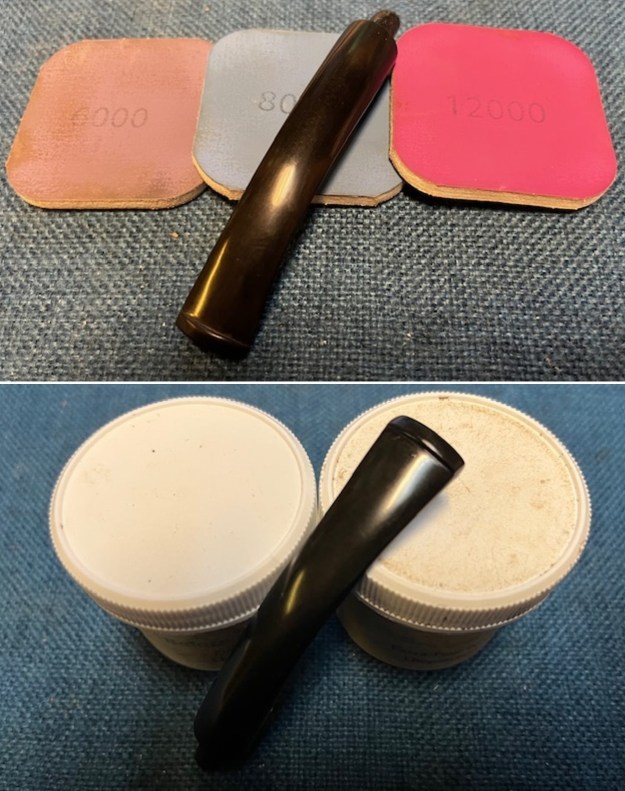
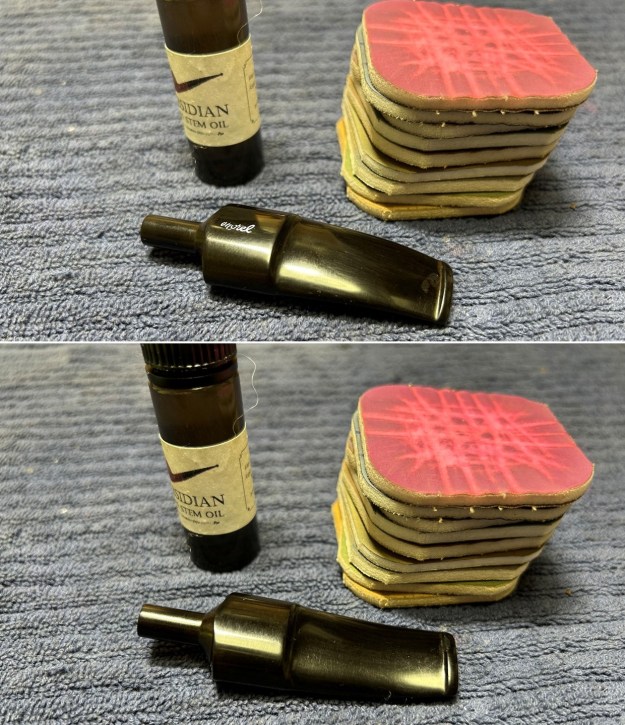
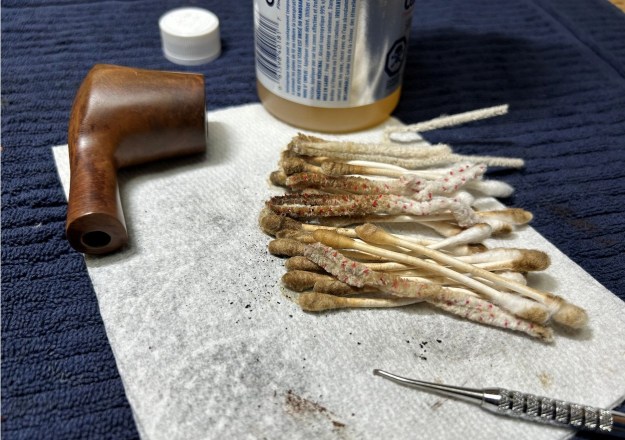
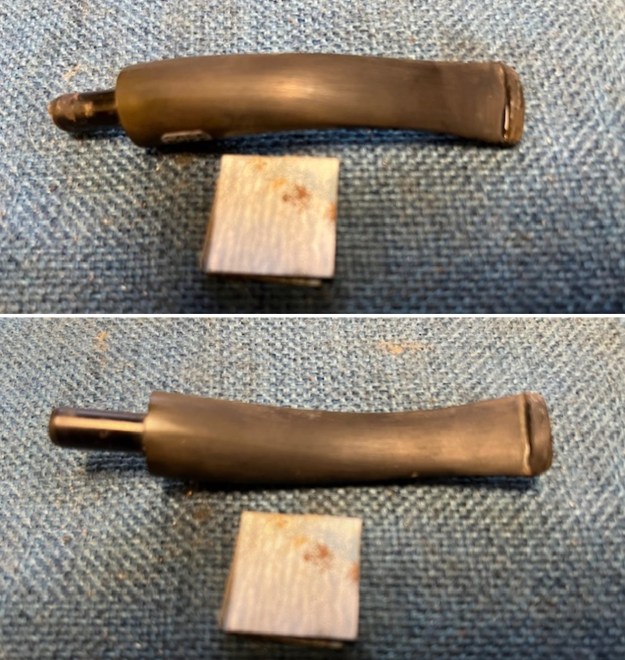
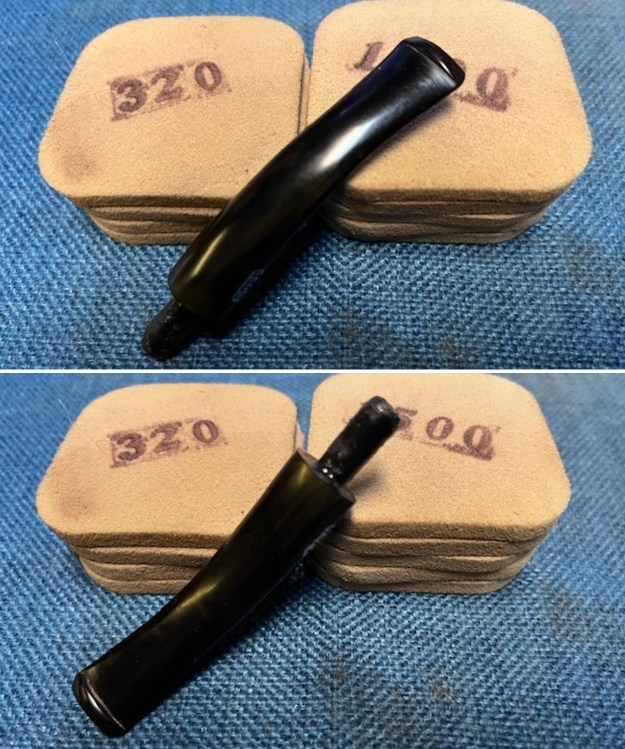
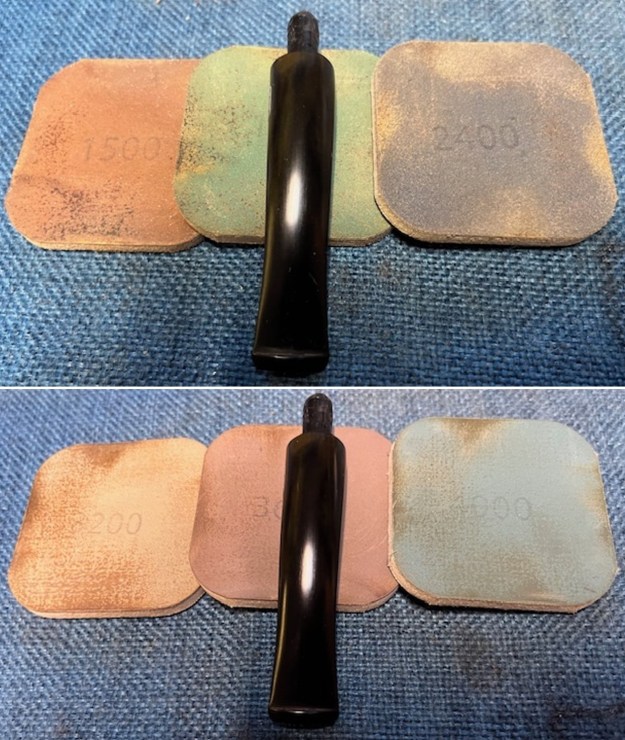
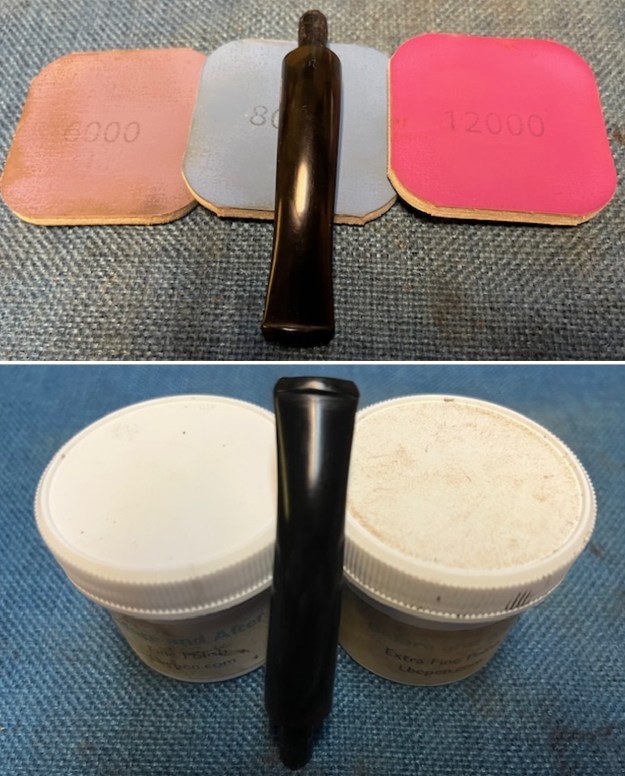
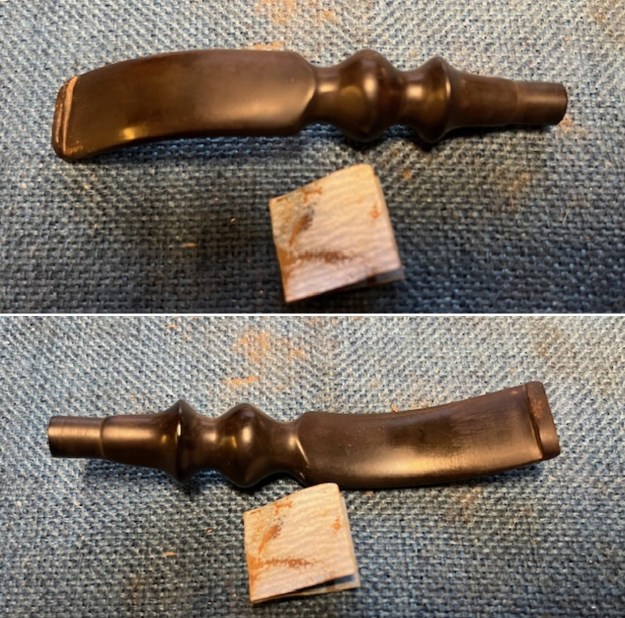
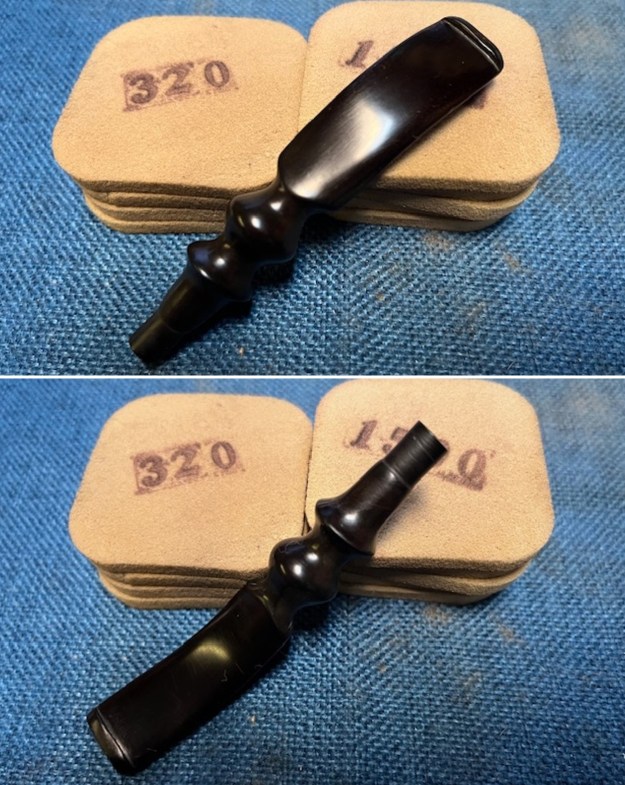
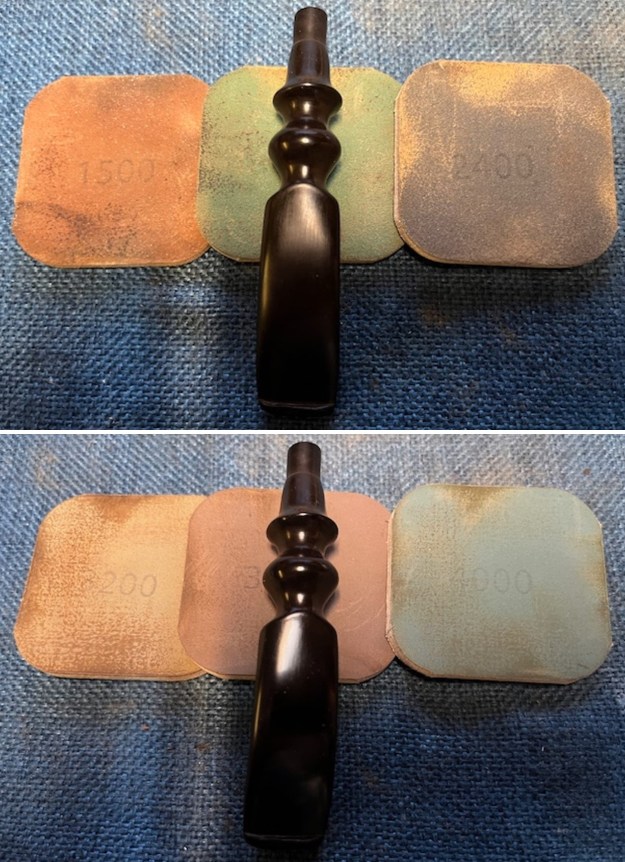
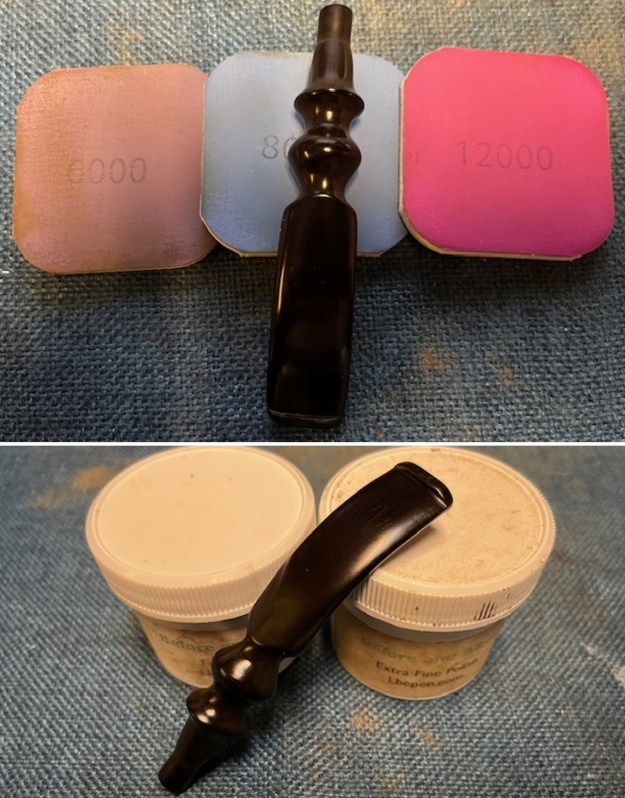
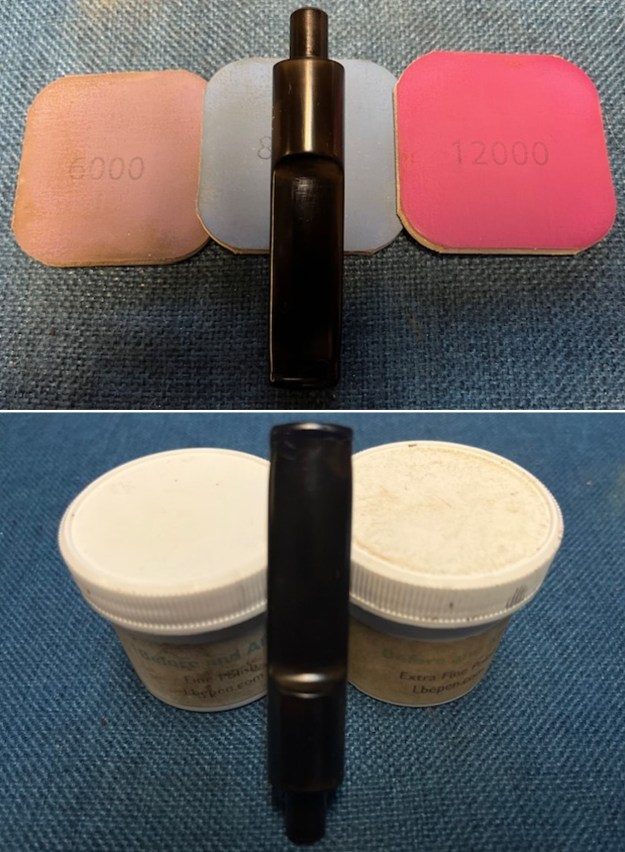
I have also included a chart from the site spelling out the Standard Pipe Finishes and giving a timeline. You can see that the Amber Root Finish (a smooth polished medium stain) was introduced in 1995 so this is definitely dates this 15 year stamped pipe to 2015. I turned to work on the pipe itself. I cleaned out the mortise and airway in the shank and the stem with alcohol, cotton swabs and pipe cleaners. I was able to remove a lot of the grime and oils in the shank but the stench of the strong aromatic still remained.To help remove the ghost in the bowl I stuffed it with cotton bolls and rolled a plug from cotton for the shank end. I filled the bowl with 99% Isopropyl alcohol and let it sit overnight to wick out the strong oils and tars from the bowl walls and the shank. In the morning when I checked it the cotton was heavily darkened with the oils. I removed them and set the bowl aside to airdry. I set the bowl aside to airdry after deghosting and turned to address the stem issues. I “painted” the surface of the stem with the flame of a Bic lighter to lift the tooth marks. I was able to lift them all considerably. I filled in the two deep marks – one on each side of the stem just ahead of the button – with black rubberized CA glue. Once it cured, I used a small, flat needle file to recut the button edge and flatten the repair. I sanded the repairs with 220 grit sandpaper to blend them into the surface. It looked significantly better at this point. I sanded the stem with 320-3500 grit sanding pads to further blend in the repairs and remove the residual light oxidation on the stem surface. I am happy with the way that it looked at this point.I polished the vulcanite with micromesh sanding pads – 1500-12000 grit pads. I wiped it down with Obsidian Oil after each sanding pad. I used Before & After Pipe Polish – both Fine and Extra Fine to further polish the stem. I set the stem aside and went back to the bowl. I used some Before & After Briar Cleaner to remove the tars from the finish. I scrubbed the surface of the bowl with a tooth brush. I rinsed of the debris with warm water and dried it off with a soft cloth. I used a folded piece of 220 grit sandpaper to smooth out the rough inner edge of the bowl. I also sanded the scratches and the darkening of the rim top with the sandpaper. It did not take much and it looked much better.There was a dent on the right side of the bowl toward the heel. I used a damp cloth and a hot knife to steam the dent out as much as possible. I was able to lift it to a large degree but not completely with the steam. I polished the rim top and bowl with micromesh sanding pads – dry sanding with 1500-12000 grit pads and wiping the bowl down with a damp cloth to remove the dust. The rim top and the bowl came out looking very good. I worked some Before & After Restoration Balm into the surface of the briar with my fingertips to clean, enliven and protect the briar. I let the balm sit for 15 minutes and then buffed it off with a cotton cloth to raise the shine. The photos show the bowl at this point in the restoration process. I rubbed the briar down with Before & After Restoration Balm. I worked it into the briar with my fingertips. The product works to clean, enliven and preserve the briar. I let it sit for 10 minutes then I buffed it with a cotton cloth to deepen the shine. The briar comes alive with the balm. This 2015 Dunhill Amber Root 4106 Pot with a vulcanite taper stem has a beautiful, unique Dunhill smooth finish with great grain. The medium orange brown finish highlights some great grain around the bowl and shank. It has a unique finish and the polished taper stem adds to the mix. I put the stem back on the bowl and buffed the pipe with Blue Diamond on the buffing wheel being careful to not buff the stamping. I gave the bowl and the stem multiple coats of carnauba wax on the buffing wheel and followed that by buffing it with a clean buffing pad. I hand buffed the pipe with a microfiber cloth to deepen the shine. The finished Dunhill Amber Root 4106 Pot is quite nice and feels great in the hand. Give the finished pipe a look in the photos below. The dimensions of the pipe are Length: 5 ½ inches, Height: 1 ¾ inches, Outside diameter of the bowl: 1 ½ inch, Chamber diameter: ¾ of an inch. The weight of the pipe is 1.55 ounces/44 grams. Thanks for walking through the restoration with me as I worked over another beautiful pipe. I will be sending it back to Jim on the weekend. I look forward to hearing what he thinks of this beauty. Thanks for your time.

Giving Some Life Back to a Kirsten Companion K


by Kenneth Lieblich

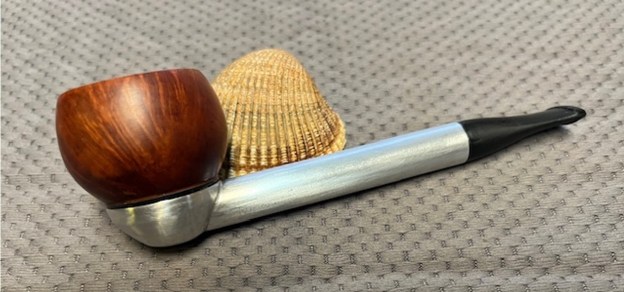
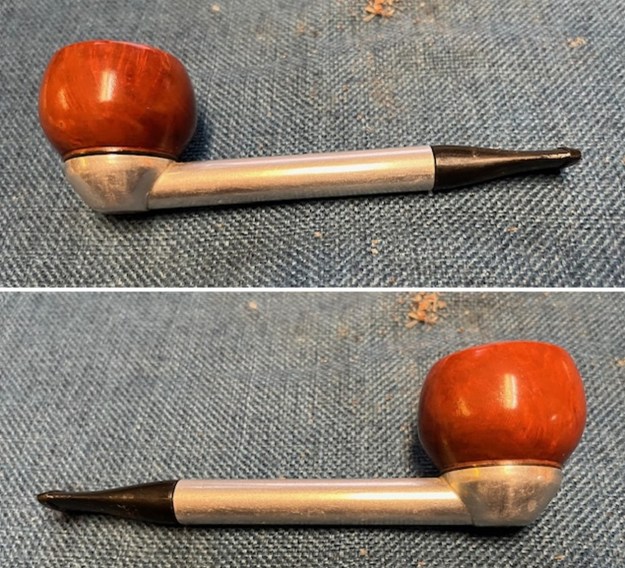
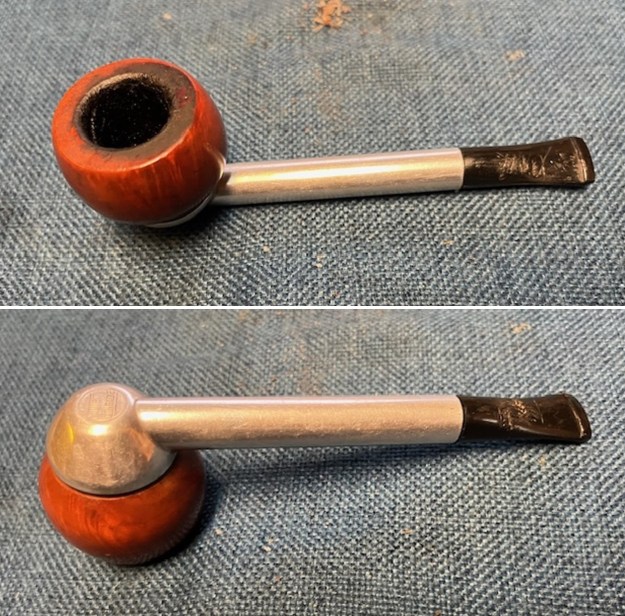
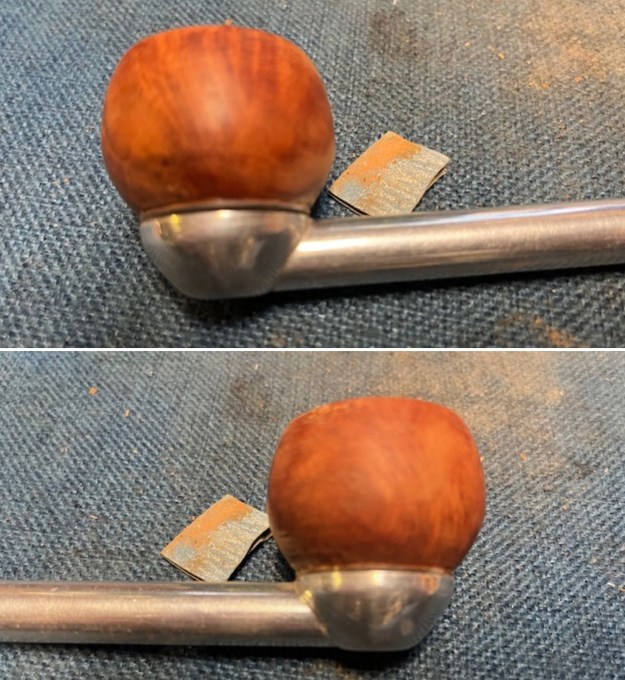
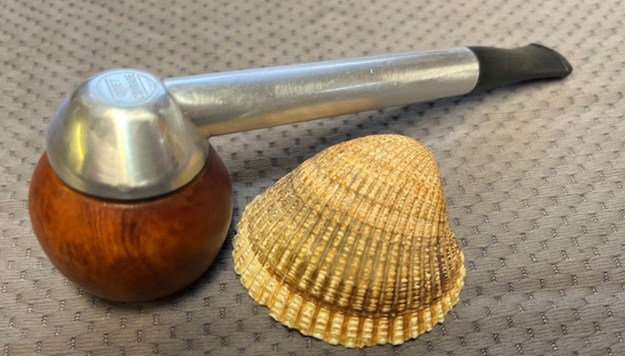
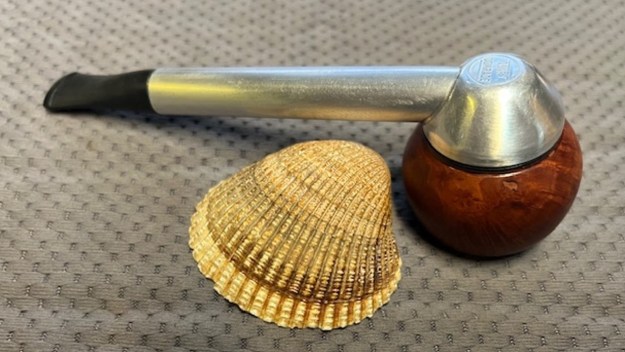
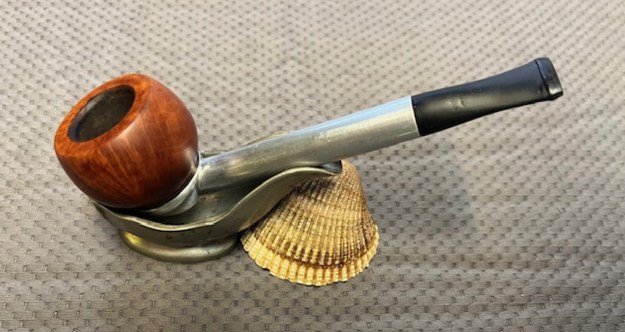
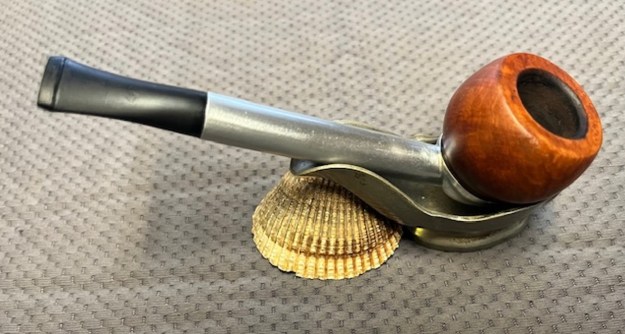
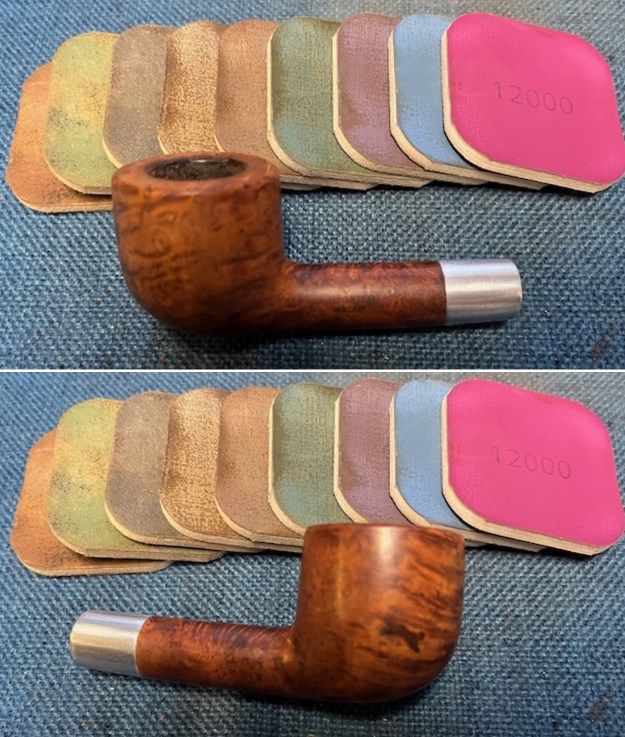
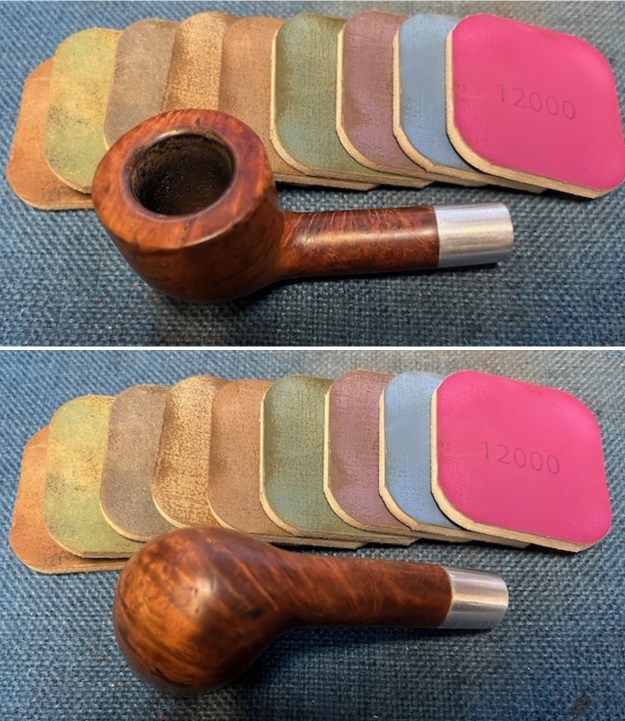
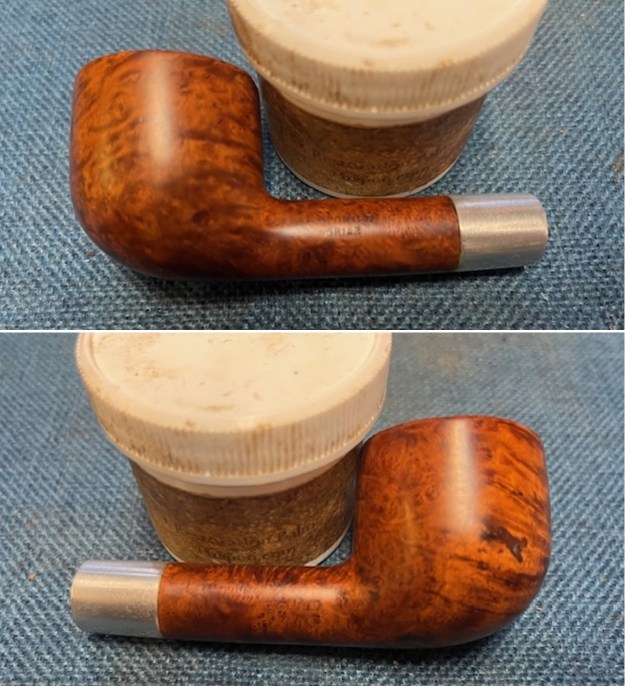
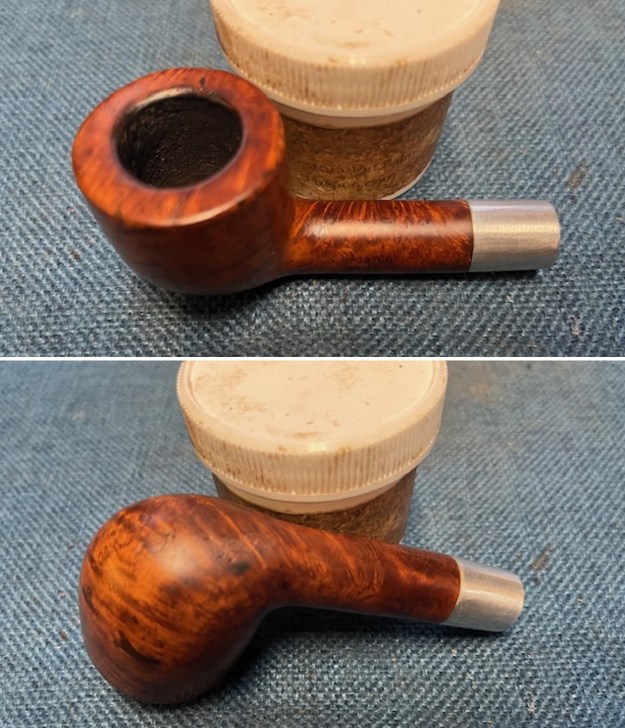
The latest restoration story belongs to a handsome Kirsten Companion ‘K’. Once again, this pipe is going to a young man from a local family who wanted some pipes restored. I’ve always been interested in Kirsten pipes – I’m not sure I always like them, but I always study them. The young fellow who acquired this pipe wanted something unusual and unlike the rest of his family – and he certainly got that! I quite like Steve’s description of Kirsten pipes:

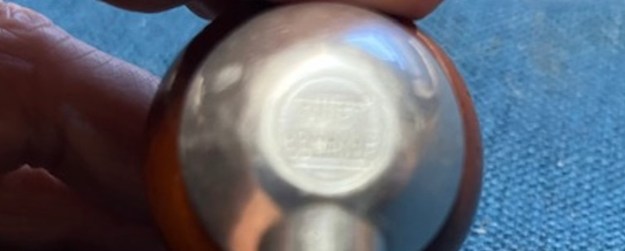
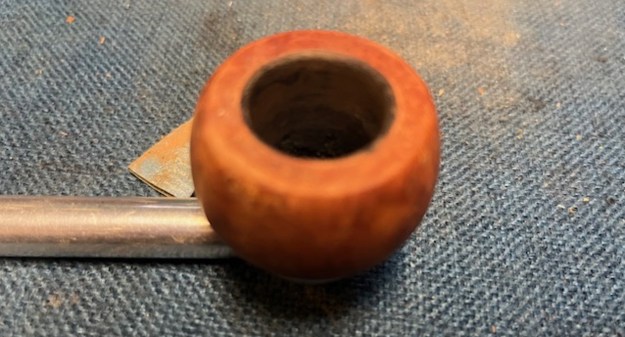
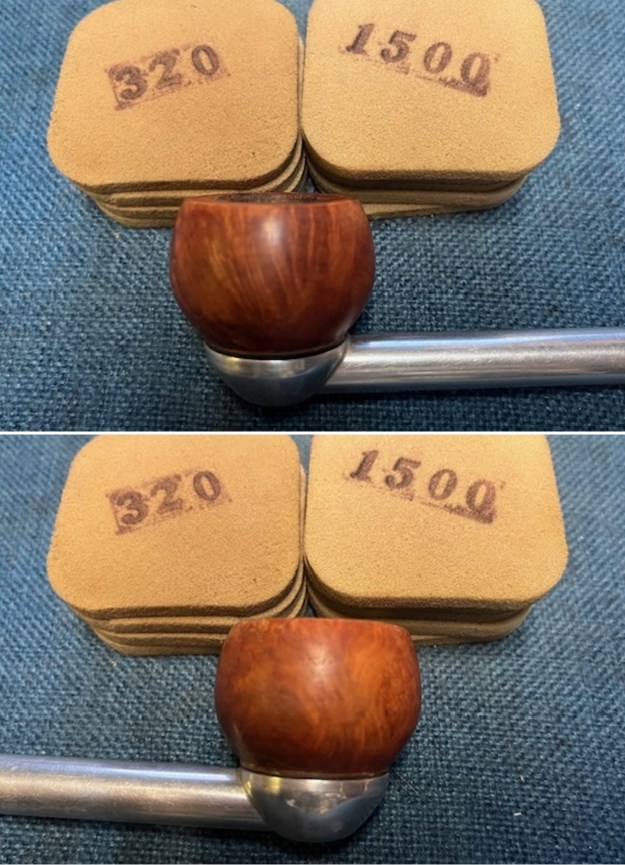
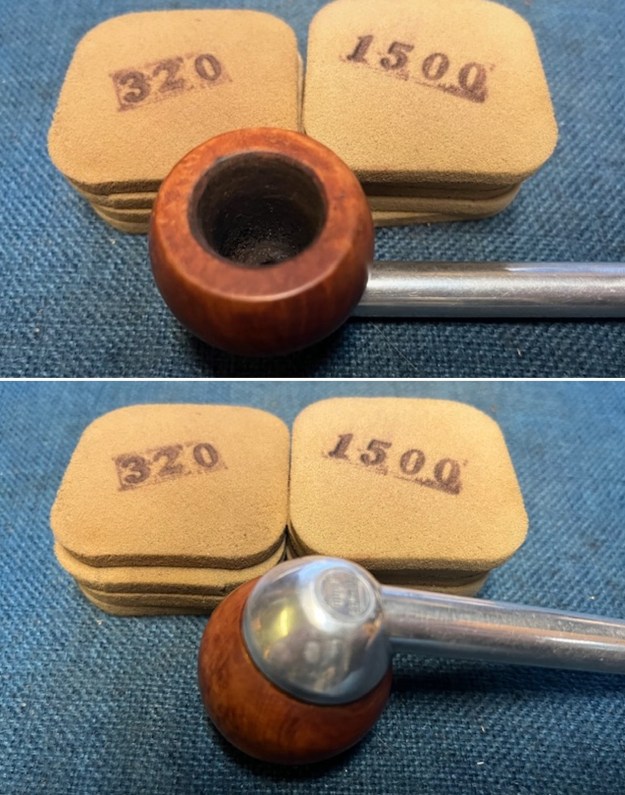
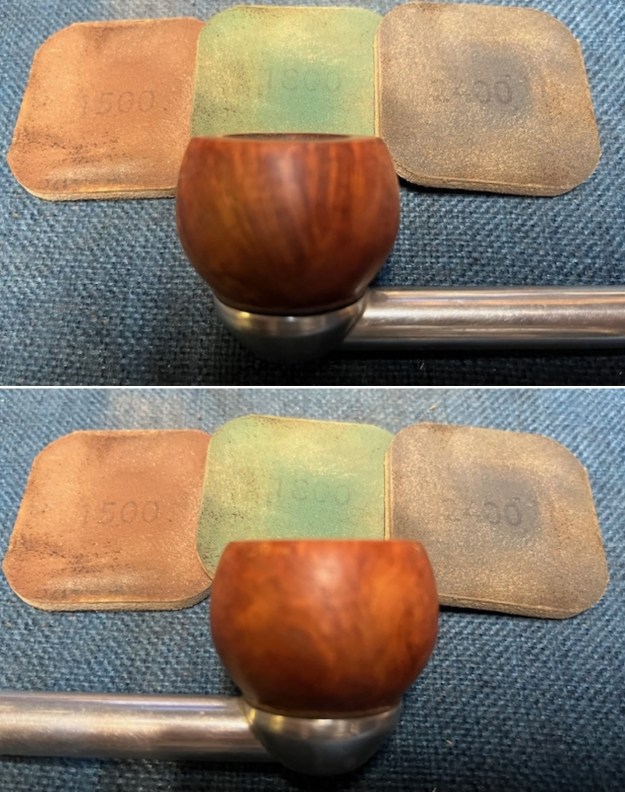
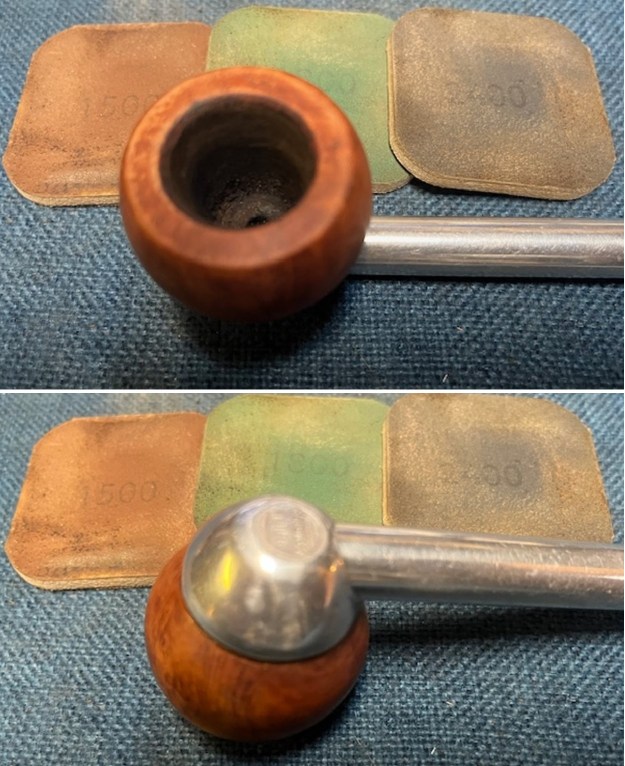
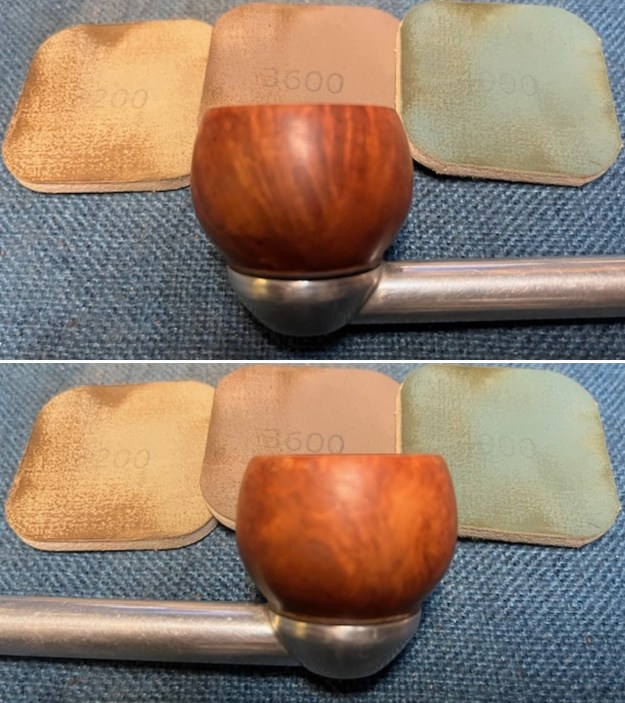
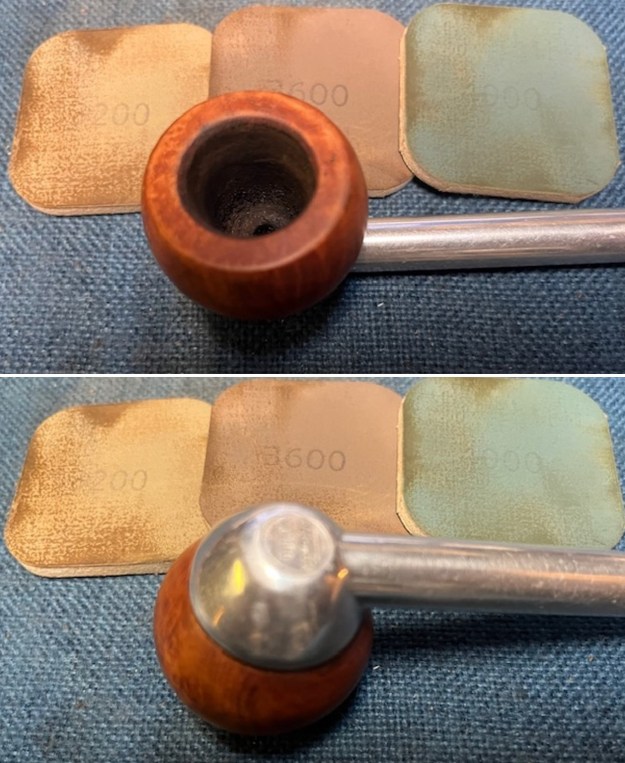
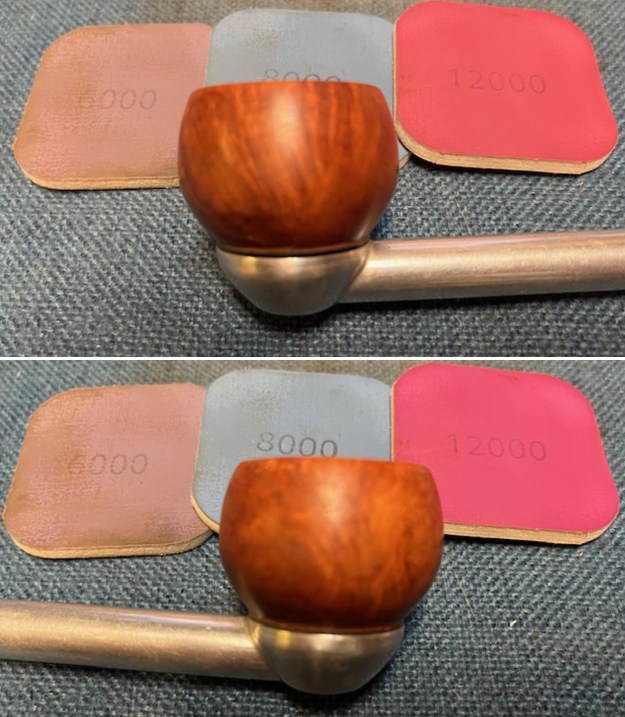
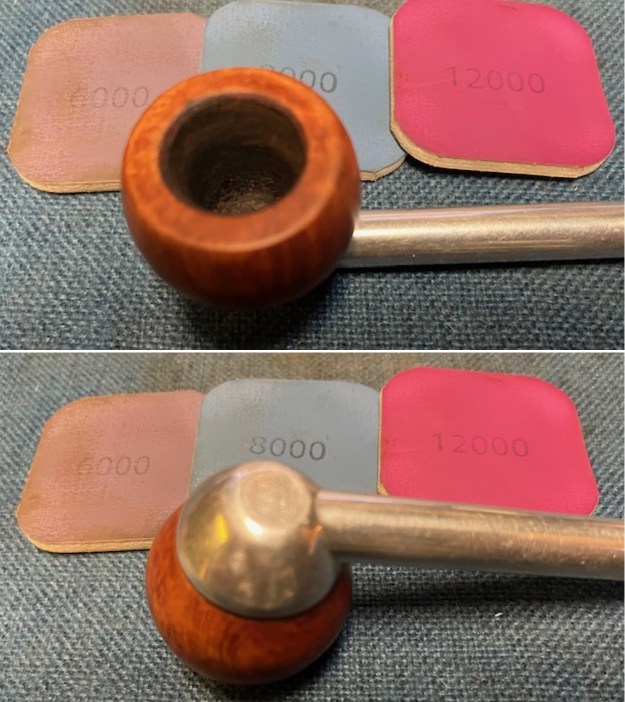
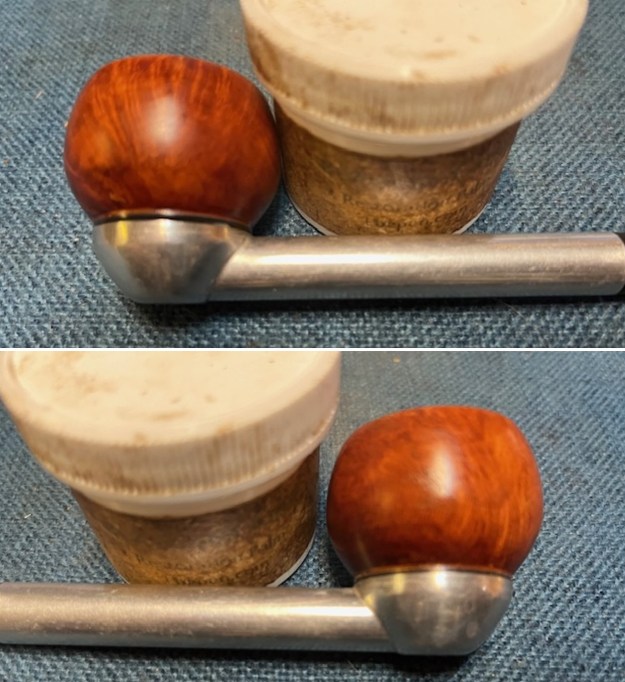
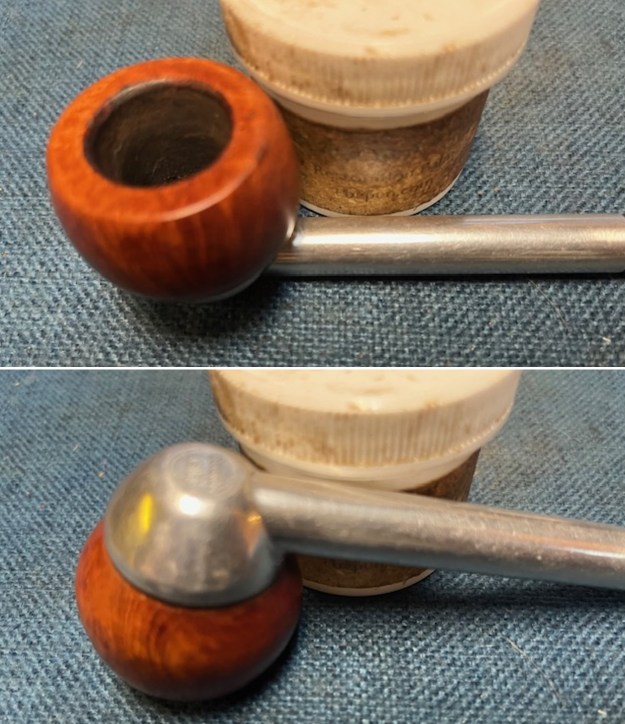
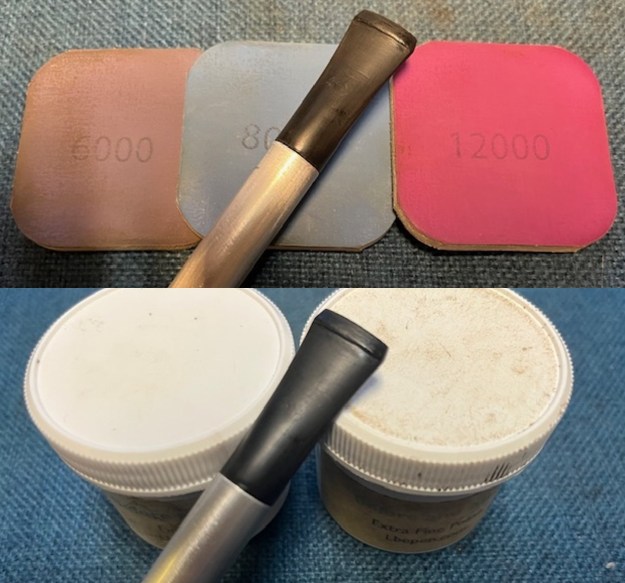
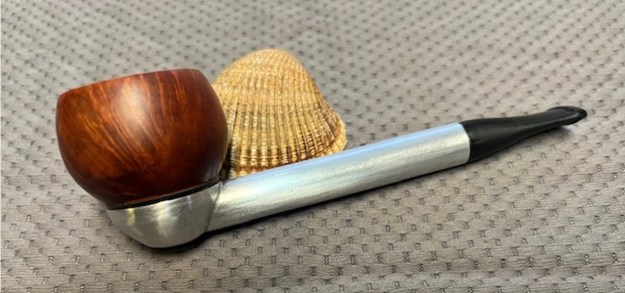
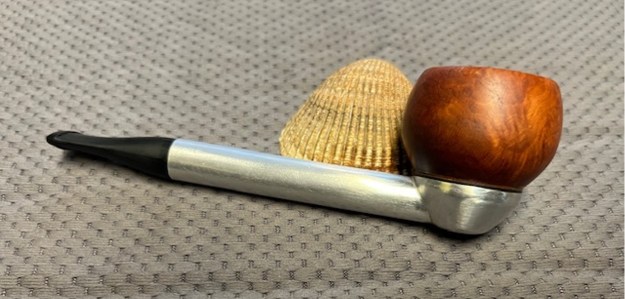
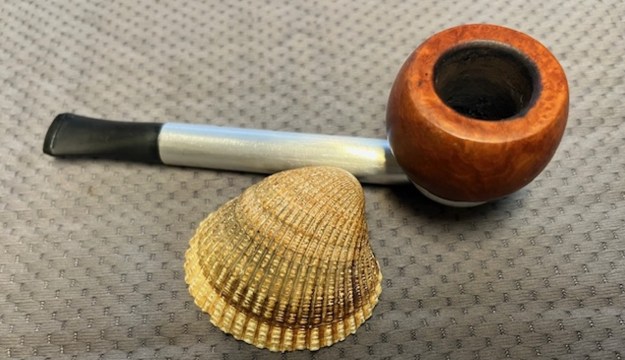
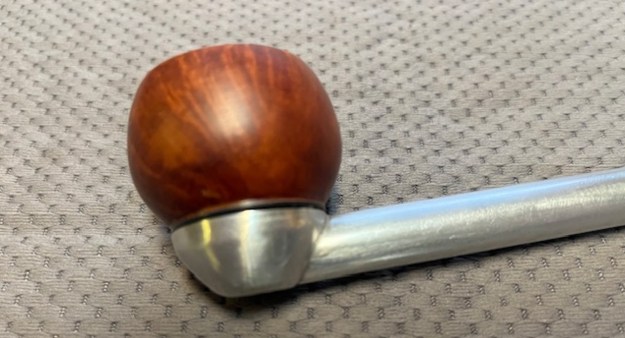
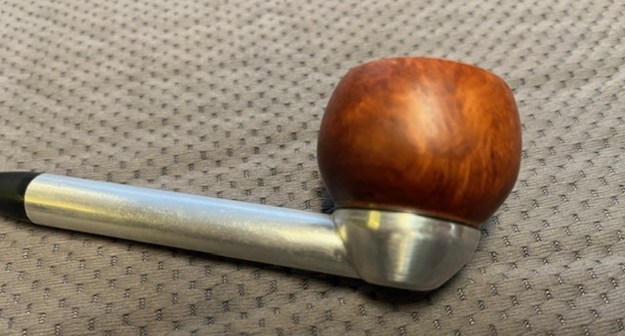
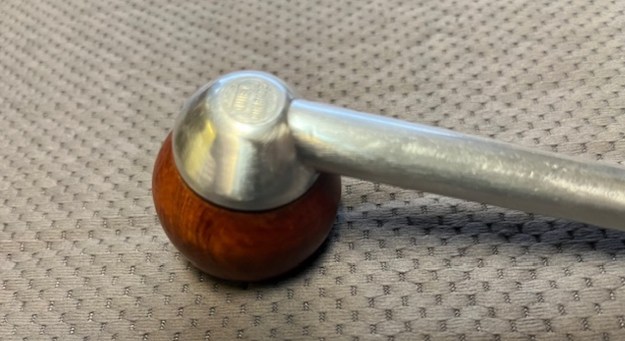
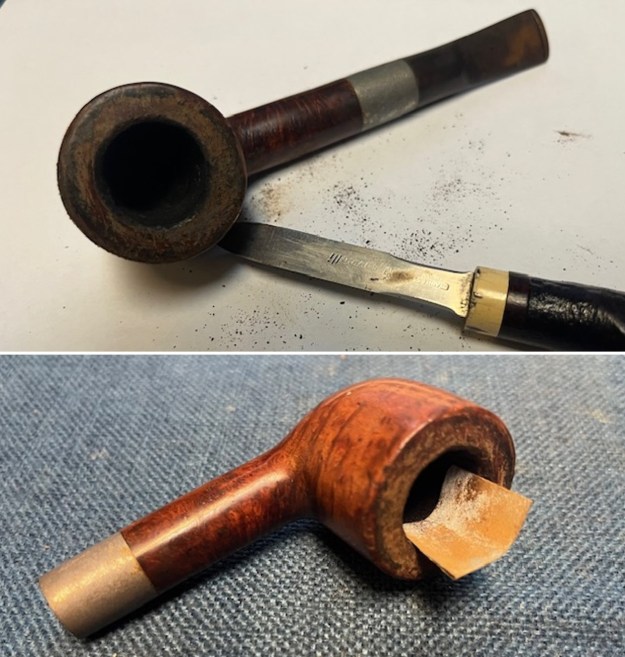
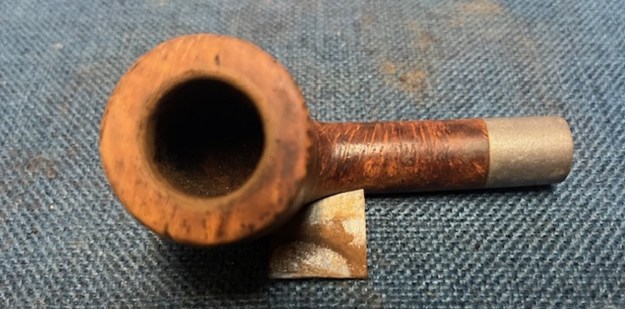
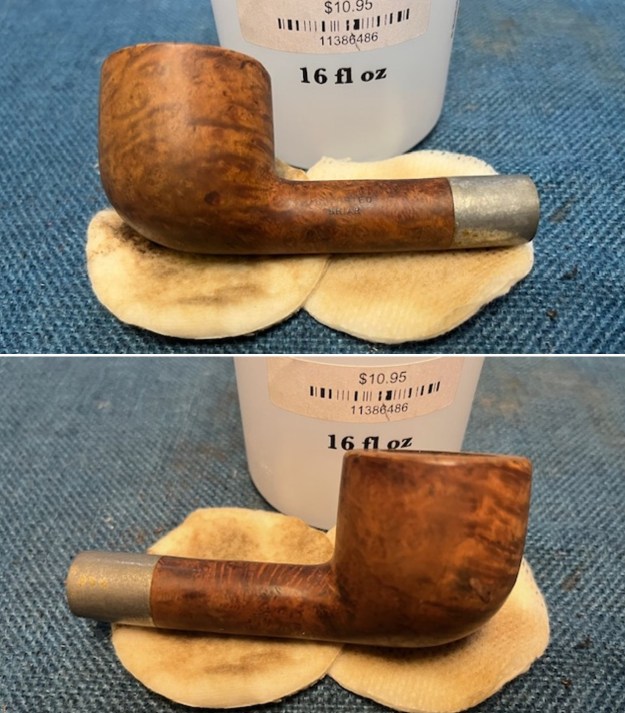
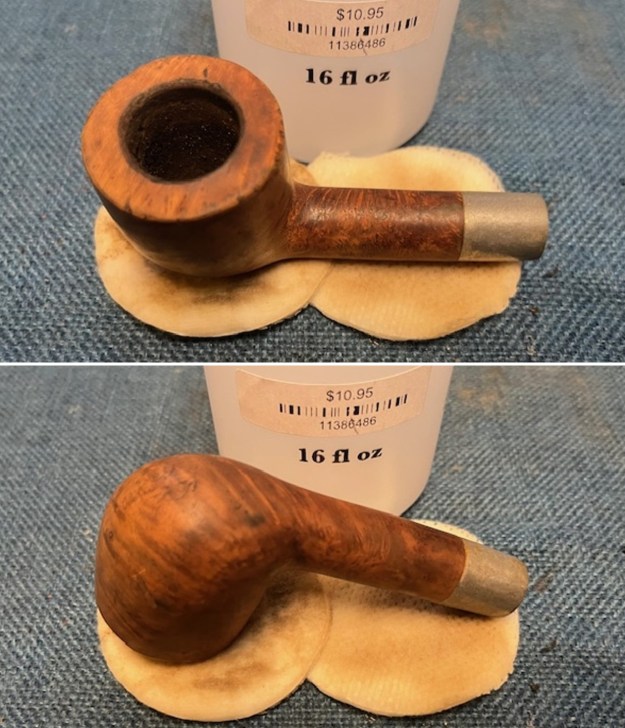
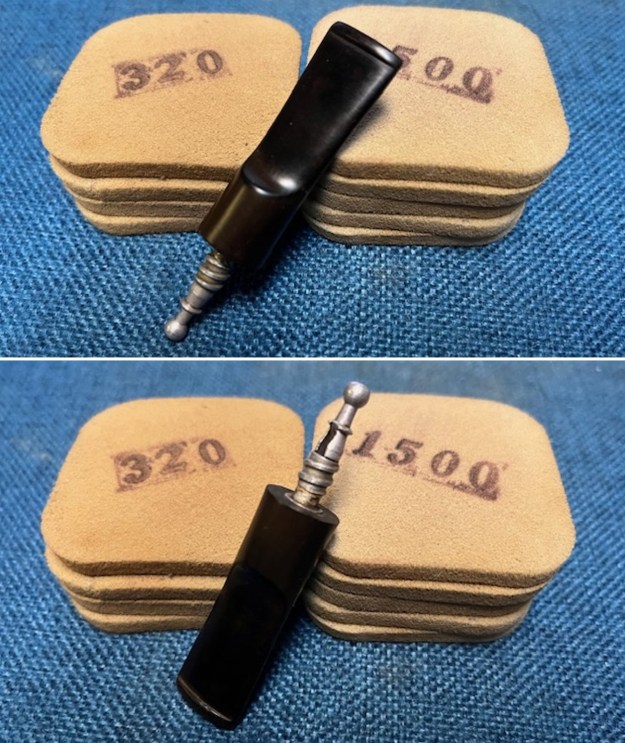
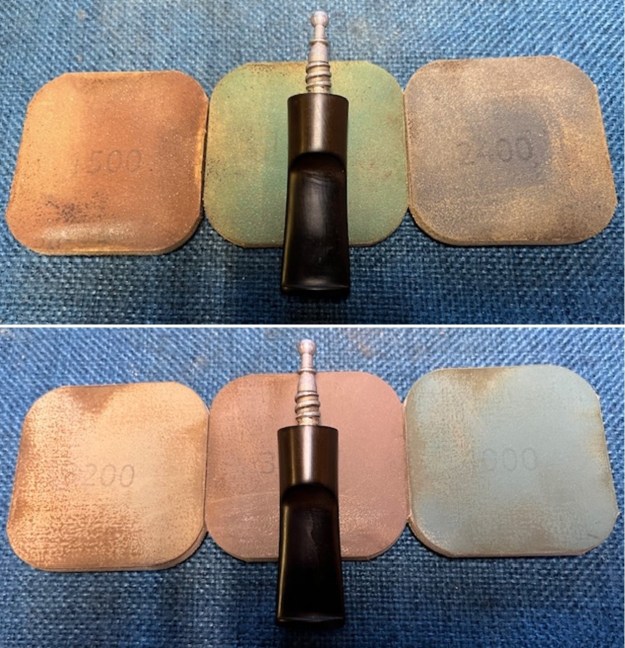
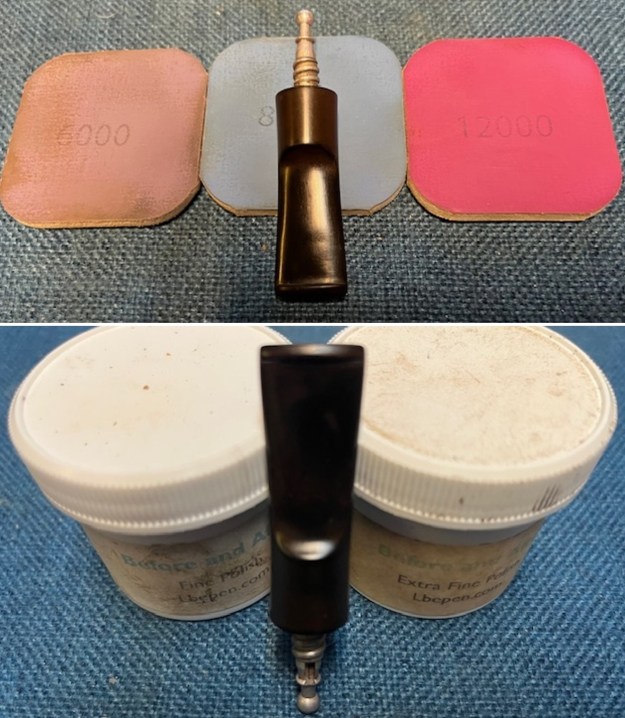
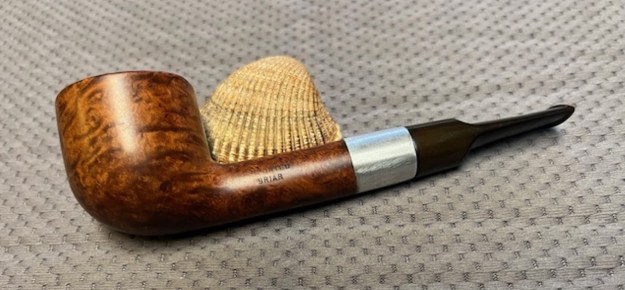
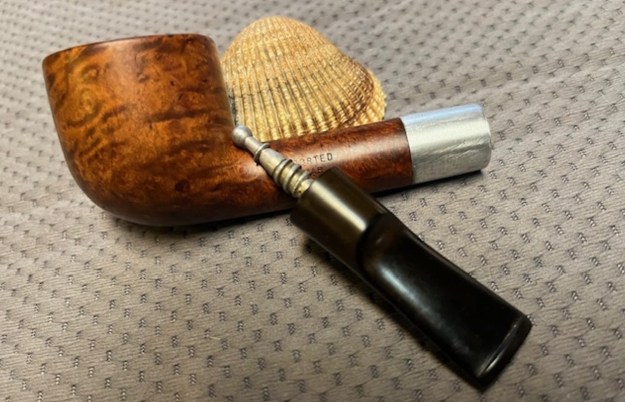
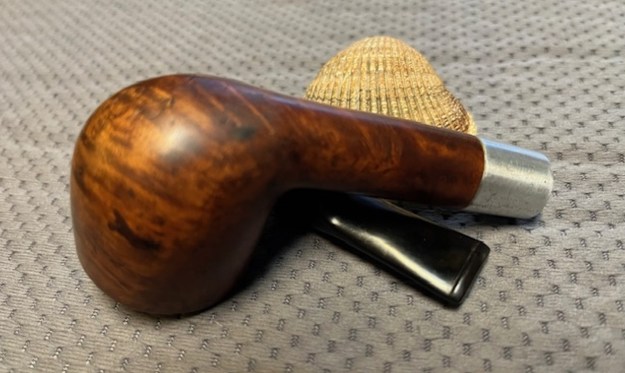
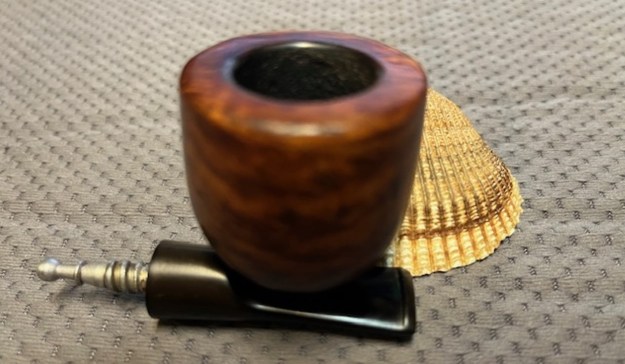
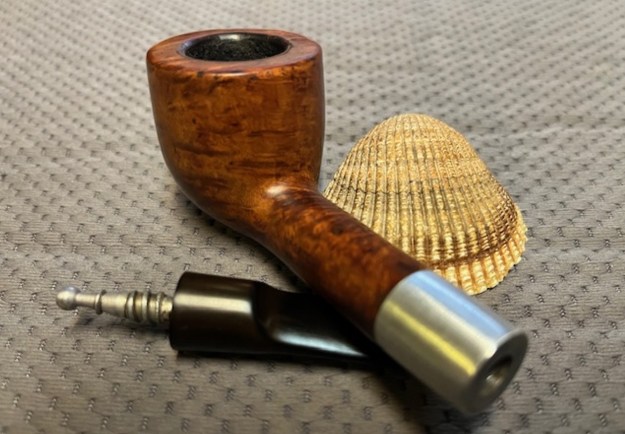
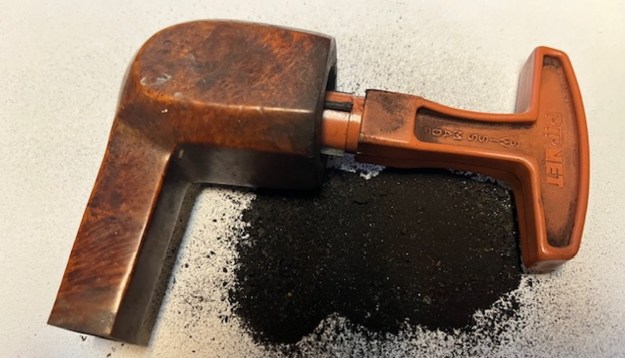
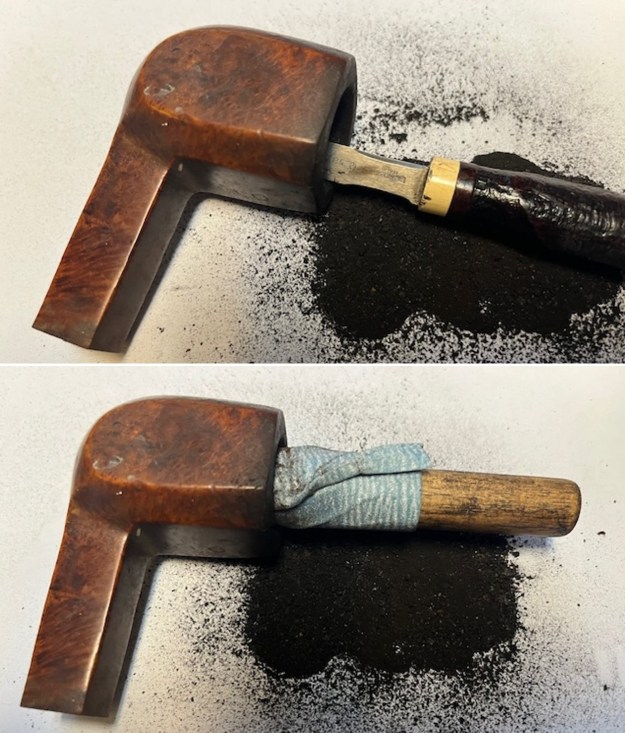
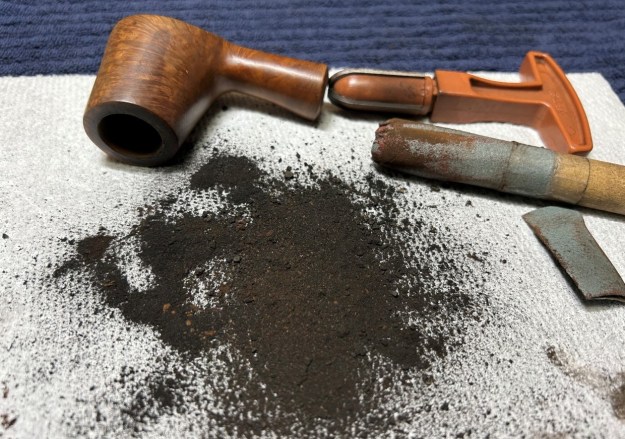
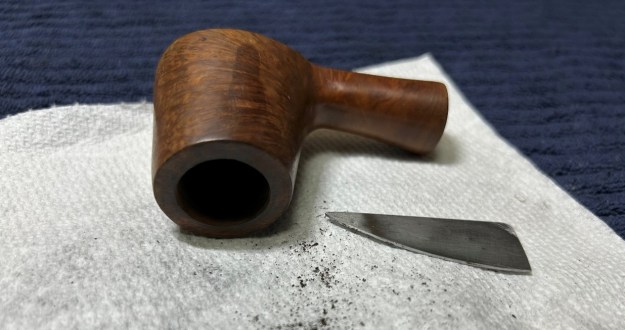
Kirsten pipes have always been a bit of an enigma to me. The combination of briar and aluminum is unique. It is a pipe that is not really fish or fowl in terms of briar or metal. It is a pipe with an aluminum radiator with a bowl attached to it. The vulcanite stem is attached to an aluminum metal pin that extends the length of the radiator. On the end is a valve that controls the flow of air to bowl and is adjustable. This pipe has some markings. Interestingly, the name Kirsten is not one of them, but this is unquestionably a Kirsten pipe. On the left side of the aluminum body is the word, Companion. On the underside of the body are the words, Made in U.S.A. – next to that is the shape letter, K.Kirsten pipes have a long and interesting history. Naturally, Pipedia has a long article on this, but, in fact, that information comes from the fascinating Smoking Metal website. I encourage you to read the various articles they have on Kirstens.Let’s examine the pipe a bit. The aluminum is in decent shape – no major dents or scratches. There are merely micro-scratches, but no big deal. Similarly, the stem was in really nice shape. Only very minor tooth wear. Little oxidation and calcification. However, the briar bowl did have some issues. It had some cake in the bowl and was fairly dirty. The main problem was a significant burn on the rim. I’d have to take a closer look at that.My first step was to take the entire pipe apart. Here is a good photo of the various components of this Kirsten – plus the screwdriver I used to take the pipe apart.I decided to work on the briar bowl first on this occasion. The first step for the bowl is to ream it out – that is to say, remove all the cake inside. This accomplishes a couple of things. First (and most obviously), it cleans the bowl and provides a refurbished chamber for future smoking. Second, when the old cake is removed, I can inspect the interior walls of the bowl and determine if there is damage or not. I used a reamer, a pipe knife, and a piece of sandpaper taped to a wooden dowel. Collectively, these ensure that all the debris is removed.The damage to the rim is significant. In order to lessen the burns and nicks on the rim, I ‘topped’ the pipe – that is to say, I gently and evenly sanded the rim on a piece of 220-grit sandpaper. This effectively minimizes the damage, without altering the look of the pipe.Some of the burn remained on the rim, so I took some crystalized oxalic acid and dissolved it in warm water. I took some cotton swaps, dipped in the solution, and rubbed the burned spot vigorously. Some of the burn was removed, but, unfortunately, some will always remain as part of this pipe’s history.To tidy up the briar, I also wiped down the outside with some oil soap on cotton rounds (and a toothbrush). This does a good job of cleaning any latent dirt on the surface of the briar. The last step of the cleaning process is to scour the inside of the stummel with some soap and tube brushes. This is the culmination of a lot of hard work in getting the bowl clean.I took a solid wooden sphere, wrapped a piece of 220-grit sandpaper around it, and sanded the inner edge of the rim. This achieves two things: first, it removes some of the burn marks; and second (and more importantly), the circular shape and motion of the sphere gradually returns the edge to a perfect circle. I then used all nine micromesh pads (1,500 through 12,000 grit) on the outside of the stummel to finish it off. This sanding minimizes flaws in the briar and provides a beautiful smoothness to the wood. I rubbed some Before & After Restoration Balm into the briar and let it sit for 20 minutes or so. The balm moisturizes the wood and gives a beautiful depth to the briar. I then buffed it with a microfibre cloth. On to the stem. I cleaned the inside with both pipe cleaners and cotton swabs dipped in 99% lemon-infused isopropyl alcohol. I scrubbed thoroughly to make sure the interior was clean.The goal of the next step is the removal (or minimization) of oxidation. Going to my sink, I used cream cleanser, cotton rounds, and a toothbrush, and scoured the stem to remove as much surface oxidation as possible. As the photos show, the result is a hideous brownish mess – but better off the stem than on it.Once the stem was reasonably clean, I soaked it overnight in some de-oxidation fluid. This solution works to draw oxidation in the stem to the surface. This is a major aid and an important step in ensuring a clean stem. The following day, I drew the stem out from its bath and scrubbed the lingering fluid with a toothbrush.I used all nine of the micromesh sanding pads (1,500 through 12,000 grit) to sand out flaws, even out the vulcanite, and provide gentle polishing of the finished surface. I also applied pipe-stem oil while using the last five micromesh pads. There was a wonderful, deep black shine to the stem when I was done.Next was the aluminum body of this old Kirsten. In order to loosen up some of the old filth, I soaked all the metal pieces in a vinegar solution. This was only mildly successful and I would need to do more.Just like other pipes, I cleaned the insides thoroughly with cotton swabs dipped in 99% lemon-infused isopropyl alcohol. This wasn’t enough – I also cleaned the inside of the aluminum with my cream cleanser and some tube brushes. That worked well! I then used my grey micromesh pads and polished the metal to a beautiful shine. Boy, it looked terrific after that.For the final step, I took the bowl to my bench buffer and carefully polished it – first with a white diamond compound, then with three coats of carnauba wax. This procedure makes the pipe look its best – the stummel sings and the stem glows.All done! This Kirsten Companion K looks fantastic again and is ready to be enjoyed by its new owner. It was great fun to work on. The approximate dimensions of the pipe are as follows: length 5⅓ in. (136 mm); height 1⅞ in. (48 mm); bowl diameter 1½ in. (39 mm); chamber diameter ⅞ in. (22 mm). The weight of the pipe is 1⅝ oz. (49 g). I hope you enjoyed reading the story of this pipe’s restoration as much as I enjoyed restoring it. If you are interested in more of my work, please follow me here on Steve’s website or send me an email at kenneth@knightsofthepipe.com. Thank you very much for reading and, as always, I welcome and encourage your comments.

Restoring a Republic Era Peterson’s Kapruf Sandblast Lovat 53


by Steve Laug

Today is cold and snowy day in Vancouver. I know in comparison to where many of you live it is not cold but to us it is. I am preparing for a trip to Asia for work so this is likely the last pipe I will work on for a while. I have chosen a Peterson’s Lovat. It is a sandblast pipe that came to us from our contact in Copenhagen, Denmark on 04/11/2024. There was grime ground into the sandblast finish on the bowl sides. I love the way the contrast of the brown and black stains gave the blast a sense of depth. It was stamped on the flat underside of the shank and had the shape number 53 on the heel of the bowl followed by Made in the Republic of Ireland (three lines). To the right of that it is stamped Peterson’s [over] Kapruf. This pipe must have been a favourite of the pipe man who used it as it had been well smoked. There was a thick cake in the bowl and some lava overflowing onto the sandblast rim top. The inner edge of the bowl looked good. The stem is an original fishtail style but the slot is merely a single opening like an old style orific button. Strange but original! The stem was oxidized and there were light tooth marks and chatter on the top and underside ahead of the button on both sides. Jeff took photos of the pipe before his cleanup work. Jeff took photos of the rim top and stem to show the general condition of the pipe. The bowl is thickly caked and the rim top and edges look to be in good condition despite the lava overflow in the sandblast of the rim top. The photos of the stem show the oxidation and the light tooth marks on the top and underside near the button. Jeff took a photo of the bowl sides and heel to show the blast that was around this bowl. It is a great sandblast and the choice of stain adds depth to the appearance of the bowl. He took photos of the stamping on the underside of the shank. It is clear and readable and reads as noted above. I turned to “The Peterson Pipe” by Mark Irwin and Gary Malmberg to get some background on the Kapruf line. On page 306 it had the following information.
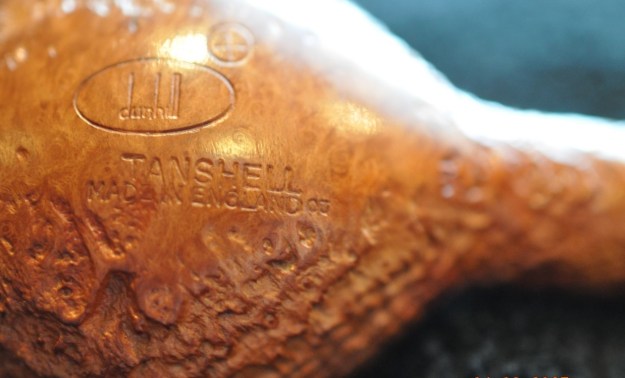
Kapruf and “Kapruf” (c.1922-87) Sandblast (hence the name, Kapp-rough) P-lip or fishtail mouthpiece, in catalogs from 1940-87. Early documented specimens stamped IRISH over FREE STATE, no Eire specimens documented. Mid-century specimens may be stamped LONDON MADE [over] ENGLAND or MADE IN ENGLAND forming a circle or MADE IN [over] IRELAND, all dating no later than 1970. Those of recent vintage stamped MADE IN THE [over] REPUBLIC [over] OF IRELAND.

I knew that I was working on a KAPRUF that was made between 1970-1987 as it is stamped MADE IN THE REPUBLIC OF IRELAND as noted above. Now it was time to work on the pipe.

Jeff had done a great job cleaning up the pipe as usual. He reamed the pipe with a PipNet reamer and cut back the cake back to the bare briar. He cleaned up the walls with a Savinelli Fitsall Pipe Knife. He scrubbed the interior of the bowl and shank with pipe cleaners, cotton swabs and alcohol to remove the tars and oils. He scrubbed the exterior of the pipe with Murphy’s Oil Soap and a tooth brush to remove the grime from the finish. He worked on the rim top lava and darkening with the soap and tooth brush. He scrubbed the inside of the stem with alcohol and pipe cleaners. He scrubbed the exterior with Soft Scrub and then soaked it in Briarville Pipe Stem Deoxidizer. He washed it off with warm water to remove the Deoxidizer. The pipe looked far better when it arrived. I took some close-up photos of the rim top and the stem surface. I wanted to show how well it had cleaned up. The rim top and the inner and outer edges look very good. I also took close up photos of the stem to show the light chatter and marks on the surface near the button.I took a photo of the stamping on the underside of the shank. You can see that it is stamped as noted above. It is faint but readable. I took the pipe apart and took a photo of the pipe. It is a good looking pipe and has an interesting sandblast on the bowl.I worked some Before & After Restoration Balm into the surface of the briar with my fingertips and a horse hair shoe brush to clean, enliven and protect the briar. I let the balm sit for 15 minutes and then buffed with a cotton cloth to raise the shine. The photos show the bowl at this point in the restoration process. I set the bowl aside and turned my attention to the stem. I “painted” the stem surface with the flame of a lighter to try and lift the marks. It did not do much. I repaired the tooth marks and deep scratches in the surface with black CA glue. Once they cured I used a small file to flatten them and then sanded them further with 220 grit sandpaper. I sanded the stem with 320-3500 grit sanding pads. I wiped it down after each sanding pad with an Obsidian Oil impregnated cloth. It really began to take on a shine.I paused the polishing to touch up the P stamp on the left side of the saddle stem with some acrylic fingernail polish. I worked it into the stamp with a toothpick and then scraped off the excess once it had dried.I polished the stem with micromesh sanding pads – wet sanding with 1500-12000 grit sanding pads. I wiped it down after each sanding pad with Obsidian Oil. I polished it with Before & After Pipe Stem Polish – both Fine and Extra Fine. I wiped the stem down with Obsidian Oil and set it aside to dry. I am always excited to finish working on a pipe. This Peterson’s Made in the Republic of Ireland Kapruf 53 Lovat is no exception. I put the pipe back together and buffed it with Blue Diamond on the buffing wheel. I gave the bowl and the stem multiple coats of carnauba wax. I buffed the pipe with a clean buffing pad to raise the shine and hand buffed it with a microfibre cloth to deepen the shine. It is fun to see what the polished sandblast bowl looks like with the black vulcanite saddle stem. This Classic looking Peterson’s Kapruf Sandblast 53 Lovat feels great in my hand. It is light and well balanced. Have a look at it with the photos below. The dimensions are Length: 4 ¾ inches, Height: 1 ¾ inches, Outside diameter of the bowl: 1 ¼ inches, Chamber diameter: ¾ of an inch. The weight of the pipe is 28 grams/.95 ounces. I will be putting it on the rebornpipes store shortly in the Irish Pipe Makers section if you are interested in it. Thanks for walking through the restoration with me as I worked over this pipe. Thanks to each of you who are reading this blog.

Breathing Life into a Scandia 418 Made in Denmark Sandblast Oval Bowled Opera pipe


by Steve Laug

The next pipe on the table is one that was also at the bottom of the box of pipes I am working on. We picked it up at an antique store in Aurora, Oregon, USA on 11/11/2021. It is a Stanwell made Scandia sandblast pipe – a 418 Opera shape with an oval saddle stem. The oval shaped bowl (external with a 3/4 inch diameter chamber), oval shank and saddle stem made up a nicely shaped pipe. The sandblast though dirt and grime showed some interesting colour mixes and the blast was very interesting.  It was stamped on a smooth panel on the underside of the shank and reads 418 (shape number) [over] Made in Denmark followed by the stamp SCANDIA. The finish was dirty grime ground into the sandblasted bowl and rim top as can be seen in the photos. There dust in all of the deep crevices of the blast. The bowl had a thick cake with some tobacco debris in the bowl. There is a heavy cake in the bowl and an overflow of lava on the sandblasted rim top. The stem was oxidized, calcified and there were light tooth marks and chatter on both sides and on the top and bottom ahead of the button. Jeff took photos of the pipe before he cleaned it up so you could see what we saw. Jeff took photos of the rim top to show lava build up around the rim, the edges and cake in the bowl. There was tobacco debris in the bowl as well. The lava actually had filled in some of the nooks and crannies in the sandblast. The oval saddle stem was a good fit to the shank. It was oxidized, calcified and had light tooth marks on the stem ahead of the button. Jeff took some photos of the bowl sides and heel to show the absolutely dirty finish ground into the sandblast. It was a dirty pipe but I think it will be a beautiful one once we are finished.   The stamping on the underside of the shank is shown in the photos below. It is clear and read as noted above. On the left side of the saddle stem it is stamped SCANDIA in white.I remembered that the Scandia brand was a Stanwell second so I quickly turned to Pipephil’s website to check it out (http://www.pipephil.eu/logos/en/logo-s4.html). I have included the screen capture of the pertinent section below.It was my turn to work on the pipe now. I was really looking forward to what the pipe would look like once Jeff had worked his magic. What would the rim top look like? What would the dirty sandblast on the bowl look like? I had no idea. When I took it out of the box I was struck great job cleaning up the pipe Jeff had done. It was impressive! He had reamed the pipe with a Pipnet piper reamer and taken the cake back to bare briar. He cleaned up the remaining cake with a Savinelli Fitsall Pipe Knife. He scrubbed the interior of the bowl and shank with pipe cleaners, cotton swabs, shank brushes and alcohol to remove the tars and oils. He scrubbed the exterior of the pipe with Murphy’s Oil Soap and a tooth brush to remove the grime from the finish. He worked on the rim top lava and darkening with the soap and tooth brush. He scrubbed the inside of the stem with alcohol and pipe cleaners. He scrubbed the exterior with Soft Scrub and then soaked it in Briarville’s Pipe Stem Deoxidizer. He washed the stem off with warm water to remove the Deoxidizer. The pipe looked far better. I took photos of the pipe when I received it before I started working on it. I took photos of the bowl and rim top as well as the stem to show how clean they were. You can see the ridges and valleys in the briar rim top and the inner edge of the bowl is very clean and looks good. The stem is clean and the tooth marks on both sides are very minimal.I took a photo of the stamping on the underside of the shank. The stamping is clear and readable as noted above. I took a photo of the pipe with the stem removed to show the overall look of stem, tenon and profile of the pipe. It really is a beautifully shaped pipe.I rubbed the briar down with Before & After Restoration Balm. I worked it into the briar with my fingertips and a horsehair shoe brush to get it into the crevices of the sandblast. The product works to clean, enliven and preserve the briar. I let it sit for 10 minutes while I worked on the stem. After the time passed I buffed it with a cotton cloth to deepen the shine. The briar really comes alive with the balm.    I touched up the SCANDIA stamp on the left side of the saddle stem with white acrylic fingernail polish. I worked it into the stamp with a tooth pick. I scraped away with my fingernail and also cleaned up the remnants around the stamp with 320 grit sandpaper.I sanded out the tooth marks on the stem on both sides next to the button with 220 grit sandpaper. I cleaned up the sanding marks with 320-3500 grit sanding pads. I wiped it down with Obsidian Oil and it looked much better. I polished the stem with micromesh sanding pads – 1500-12000 grit sanding pads. I wiped the stem down with an Obsidian Oil cloth after each sanding pad. I gave the stem a final polish with Before & After Pipe Stem Polish – both Fine and Extra-Fine. I gave the stem another coat of Obsidian Oil. This interestingly stained sandblast Stanwell Made Scandia 418 Oval Bowled Opera style pipe with a vulcanite saddle stem turned out very nice. The mix of dark brown stains highlights the nooks and crannies of the sandblast around the bowl sides and bottom. The finish on the pipe looks very good. I put the stem back on the bowl and carefully buffed the pipe with Blue Diamond on the buffing wheel. I gave the bowl and stem multiple coats of carnauba wax on the buffing wheel and followed that by buffing the entire pipe with a clean buffing pad. I hand buffed the pipe with a microfiber cloth to deepen the shine. The finished Scandia 418 Opera is very nice and feels great in the hand. Give the finished pipe a look in the photos below. It is a nice pipe whose dimensions are Length: 5 ½ inches, Height: 1 ½ inches, Outside diameter of the bowl: 1 ½ inches long x 1 inch wide, Chamber diameter: ¾ of an inch. The weight of the pipe is 1.06 ounces/30 grams. Thanks for walking through the restoration with me as I worked over another beautiful pipe. This pipe will be going on the rebornpipes store shortly in the Danish Pipe Makers Section. If you are interested in adding it to your collection let me know! Thanks for your time. As always, I look forward to your comments and observations.
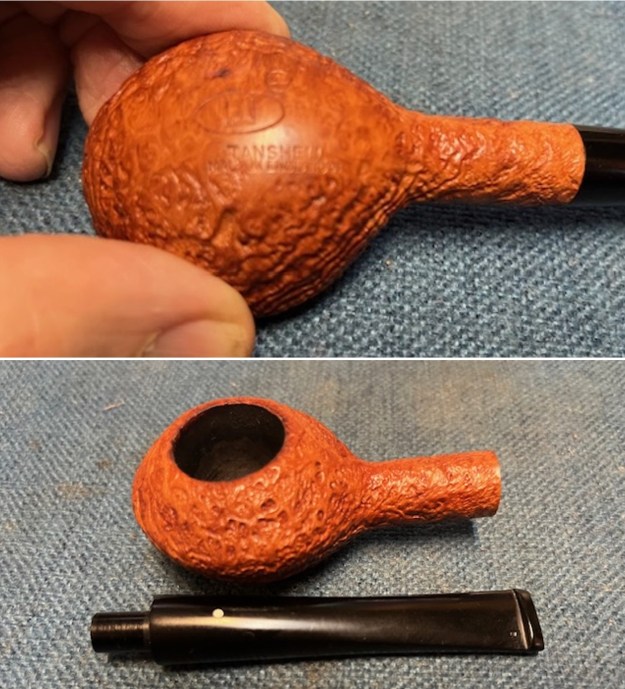
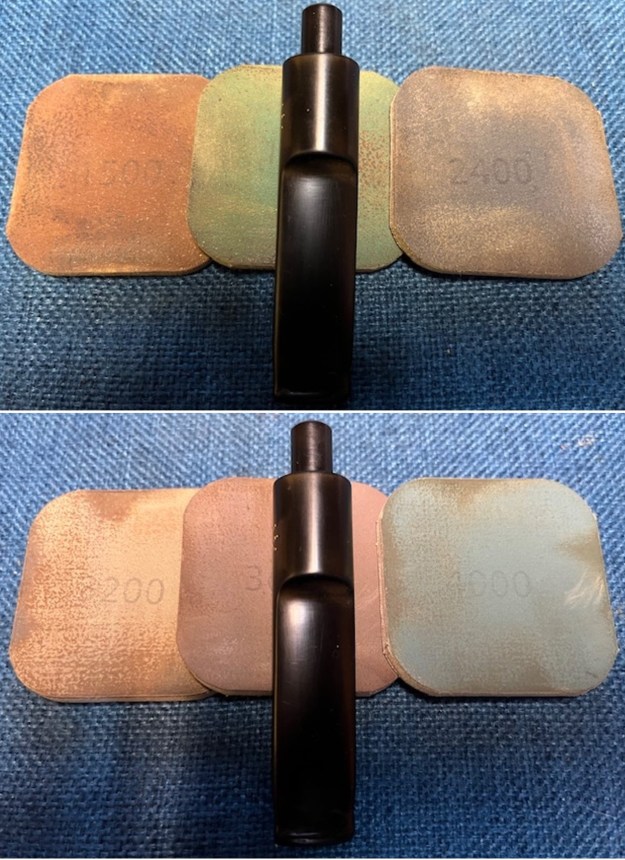
Restoring a sandblast Jarl T.V. Made in Denmark Long Pipe


by Steve Laug

Once again it may seem I have endless choices of pipes to work on. While we do have a lot of pipes that are in the queue to be restored it is far from endless. This next pipe I chose to work on was one that was given to us by a wonderful lady in Flagstaff, Arizona, USA on 01/22/2019. The pipe is stamped on a smooth panel on the underside of the shank and reads Jarl T.V. [over] Made in Denmark. This one is a slightly bent Billiard shape with a sandblast bowl and shank. It has a long churchwarden style stem. There is a smooth briar around the shank end that is a great touch. The exterior of the pipe was dirty, with dust in the sandblast. There was a moderate cake in the bowl and some lava on the rim top. The stem was long and had a slight bend. There was no logo or stamping on the stem.  It was lightly oxidized and had light tooth marks and chatter on both sides ahead of the button. Jeff took photos of the pipe before he started his clean up work. Jeff took photos of the rim top and stem to show the general condition of the pipe. The bowl is heavily caked and there was lava on the rim top and the inner edge. The stem was lightly oxidized, calcified and had some tooth marks and chatter. It should cleanup very well. Jeff took photos of the bowl sides and heel to show the smooth rim top, left and right bowl sides along with the beautiful blast that was around this bowl even though the grime on the finish hides it some. The pipe had obviously been well loved and cared for by the previous pipeman. He took photos of the sides of the shank to show the stamping. The stamping is clear and readable in the photos below as noted above. I turned to Pipephil for a review of the brand (http://www.pipephil.eu/logos/en/logo-j1.html). I did a screen capture of the section of the site that showed the Jarl T.V. pipe. It says that the brand was carved by Jorgen Larsen.I turned to Pipedia for further information regarding the brand (https://pipedia.org/wiki/Jarl). I quote below:

In December of 2010 Ellen Jarl wrote that Jarl pipes were made by her grandfather, Niels Mogens Jørgensen in a little factory in the town of Bramdrupdam, just outside Kolding, Denmark. We have no reason to doubt that Niels Mogens Jørgensen is the maker of these pipes.

There was a difference regarding the maker of the pipes. Pipephil identified the maker as Jorgen Larsen and Pipedia says it is Niels Mogens Jorgensen. It appears that the information on Pipedia has more proof that the maker is Niels Mogens Jorgensen. I am proceeding with that information in this restoration.

Jeff had thoroughly cleaned up the pipe. He reamed the pipe with a PipNet Pipe Reamer and cleaned up the remnants with a Savinelli Fitsall Pipe Knife. He scrubbed the bowl with undiluted Murphy’s Oil Soap with a tooth brush. He rinsed it under running warm water to remove the soap and grime. There was some darkening on the inner edge of the rim and top that would need to be dealt with. He cleaned out the inside of the shank and the airway in the mortise and the stem with alcohol, cotton swabs, shank brushes and pipe cleaners. He scrubbed the exterior of the stem with Soft Scrub to remove as much of the oxidation as possible. The vulcanite stem was clean but had light tooth marks and chatter on both sides ahead of the button. There was no logo on the stem or stamping of any kind. I took photos of the pipe before I started my work on it. I took photos of the bowl and rim top to show how well it had cleaned up. The edges and top were very clean and in excellent condition. The stem had some tooth chatter and light marks just ahead of the button.I took photos of the stamping on the smooth panel on the underside of the shank. They are readable as noted above. I took the stem out of the shank and took a photo of the overall look of the pipe.I started my work on the pipe by rubbing the bowl down with Before & After Restoration Balm. I worked it into the surface of the bowl sides and shank with my fingertips. The product works to clean, enliven and protect the briar. I let the balm sit for a little while and then buffed with a cotton cloth to raise the shine. I set the bowl aside and turned my attention to the stem. The stem was in good condition and I was able to start sanding out the chatter and marks with 1500-12000 micromesh sanding pads. I wiped the stem down after each pad with an Obsidian Oil impregnated cloth. I polished it with Before & After Pipe Stem Polish – both Fine and Extra Fine and gave it another coat of Obsidian Oil. I always look forward to this part of the restoration when all the pieces are put back together. I put the pipe back together and buffed the bowl and stem with Blue Diamond on the buffing wheel. I gave the bowl multiple coats of Conservator’s Wax and the stem multiple coats of carnauba wax. I buffed the pipe with a clean buffing pad to raise the shine. I hand buffed it with a microfiber cloth to deepen the shine. It is fun to see what the polished bowl looks like with the sandblast standing out clearly and the smooth rounded shank end contrasting well. The black vulcanite stem stands out as a shiny black contrast to the colours of the bowl. This Jarl T.V. pipe or Churchwarden is beautiful and feels great in my hand. It is one that could be clenched and smoked while doing other things as it is very light weight and well balanced. It must have been a fine smoking pipe judging from the condition it was when we received it. Have a look at it with the photos below. The dimensions are Length: 10 inches, Height: 2 inches, Outside diameter of the bowl: 1 1/8 inches, Chamber diameter: ¾ of an inch. The weight of the pipe is 1.09 ounces/32 grams. This is one that will go on the rebornpipes online store in the Danish Pipe Makers Section shortly. If you want to carry on the legacy of the previous pipe man let me know. Thanks to each of you who are reading this blog. Remember we are not pipe owners; we are pipemen and women who hold our pipes in trust until they pass on into the trust of the next pipeman or woman.

Restoring a Stanwell Facet Hexagon Dublin with a Brass Band and vulcanite stem


by Steve Laug

It may seem I have endless choices of pipes to work on. While we do have a lot of pipes that are in the queue to be restored it is far from endless. This next pipe I chose to work on was one that we purchased a few years ago on 10/17/2022 from our connection in Copenhagen, Denmark. The pipe is stamped on the left side of the shank and reads Stanwell [over] Facet. There is no country of origin stamp on the pipe. This one is a unique beauty with a Hexagonal shape combining a smooth rim top and smooth facets on the right and left side of the bowl. The front and back of the bowl and the top and underside of the shank were sandblasted on the two facets on the front and the back of the bowl. The exterior of the pipe was dirty and worn with dust in the sandblast. There was a thick cake in the bowl and some lava and darkening on the rim top flowing around the top of the rim. The shank had a gold band/ferrule on the shank end. The stem is a fancy hexagonal saddle stem with a gold “Crown S” logo on the left side of the saddle stem. It was lightly oxidized and had light tooth marks and chatter on both sides ahead of the button. Jeff took photos of the pipe before he started his clean up work. Jeff took photos of the rim top and stem to show the general condition of the pipe. The bowl is heavily caked and there was lava on the rim top and the inner edge. The stem was lightly oxidized and had some tooth marks and chatter. It should cleanup very well. Jeff took photos of the bowl sides and heel to show the smooth rim top, left and right bowl sides along with the beautiful blast that was around this bowl even though the grime on the finish hides it some. The pipe had obviously been well loved by the previous pipeman. He took photos of the sides of the shank to show the stamping. The stamping is clear and readable in the photos below as noted above. Before I started working on the pipe I decided to do a bit of digging on the shape and the design. I turned first to a blog on rebornpipes by Bas Stevens the was a compilation of Stanwell shapes (https://rebornpipes.com/2013/09/03/stanwell-shapes-compiled-by-bas-stevens/). There I found the shape number for this faceted pipe was 163. The information given there said that the shape was a Freehand, “Facet”, hexagonal, with brass ring by Jess Chonowitsch. It was a shape designed by Jess Chonowitsch and that was interesting to me.

So now I knew that the pipe was a Stanwell Facet and the shape was the classic Chonowitsch design hexagonal pipe with a brass ring on the shank end. Now it was time to work on the pipe.

Jeff had thoroughly cleaned up the pipe. He reamed the pipe with a PipNet Pipe Reamer and cleaned up the remnants with a Savinelli Fitsall Pipe Knife. He scrubbed the bowl with undiluted Murphy’s Oil Soap with a tooth brush. He rinsed it under running warm water to remove the soap and grime. There was some darkening on the inner edge of the rim and top that would need to be dealt with. He cleaned out the inside of the shank and the airway in the mortise and the stem with alcohol, cotton swabs, shank brushes and pipe cleaners. He scrubbed the exterior of the stem with Soft Scrub to remove as much of the oxidation as possible. The vulcanite stem was clean but had light tooth marks and chatter on both sides ahead of the button. There was an inlaid brass “Crown S” on the left side of the saddle stem. I took photos of the pipe before I started my work on it. I took photos of the rim top and bowl as well as the stem to give a sense of the condition of both. The rim top had some darkening to the inner edge and rim top on the back side. The stem cleaned up well and there were some small tooth marks on the top and underside ahead of the button.I took photos of the stamping on the left side of the hex shank. The are readable as noted above. I took the stem out of the shank and took a photo of the overall look of the pipe.I decided to start my work on the pipe by addressing the darkening and damage on the inside edge of the bowl and the rim top. I used a folded piece of 220 grit sandpaper to clean up the bevel on the inner edge of the bowl. I wiped the top and edges down with a damp cloth and the rim top and edges looked much better.I polished the briar with micromesh sanding pads – dry sanding with 1500-12000 grit pads. I wiped the bowl down after each pad with a damp cloth. I rubbed the bowl down with Before & After Restoration Balm. I worked it into the surface of the bowl sides and shank with my fingertips. The product works to clean, enliven and protect the briar. I let the balm sit for a little while and then buffed with a cotton cloth to raise the shine. I set the bowl aside and turned my attention to the stem. I filled in some small tooth marks with clear CA glue. Once cured I sanded them smooth to blend into the surface of the vulcanite with the 220 grit sandpaper. I started the polishing of the stem with 320-3500 grit sanding pads to polish the stem surface and smooth out the marks. The stem was looking better with the polishing.I polished the stem with micromesh sanding pads – 1500-12000 grit pads. I wiped it down with Obsidian Oil after each sanding pad. I used Before & After Pipe Polish – both Fine and Extra Fine to further polish the stem. This Jess Chonowitsch Designed Stanwell Faceted Hexagon Freehand 163 with a hexagon vulcanite saddle stem is a great looking pipe now that it has been restored. The beautiful grain on the polished smooth portions of the briar and the sandblast front and back of the bowl are stunning. I put the stem back on the bowl and carefully buffed the pipe with Blue Diamond on the buffing wheel. I gave the bowl and the stem multiple coats of carnauba wax on the buffing wheel and followed that by buffing the entire pipe with a clean buffing pad. I hand buffed the pipe with a microfiber cloth to deepen the shine. The finished Stanwell Facet 163 Dublin fits nicely in the hand and feels great. Give the finished pipe a look in the photos below. The dimensions of the pipe are Length: 5 ½ inches, Height: 1 ¾ inches, Outside diameter of the bowl: 1 ¾ inches, Chamber diameter: ¾ of an inch. The weight of the pipe is 48 grams/1.69 ounces. I will soon be adding it to the rebornpipes store in the Danish Pipe Making Companies Section. If you are interested in this pipe send me a message or an email. Thanks for reading this blog and my reflections on the pipe while I worked on it. There are many more to come!

Restoring a Fine Peterson Kildare 405S


by Kenneth Lieblich

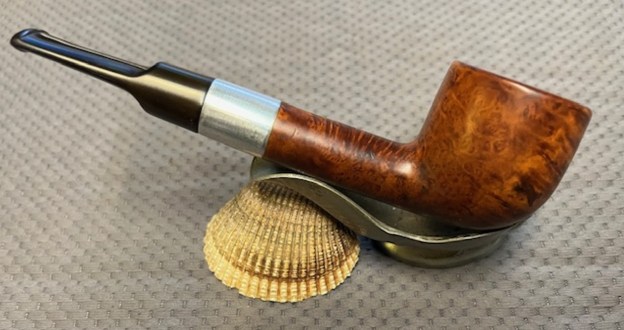
This is another in a series of pipes I cleaned up for a local family. Today, it’s a handsome Peterson Kildare 405S Prince with a P-lip saddle stem. It was a pleasure to work on this pipe, as it didn’t require too much elbow grease. In my research, I was interested to learn that this shape is apparently uncommon. The markings are as follows: on the left shank, we read Peterson’s [over] “Kildare”; on the right shank, we read Made in the [over] Republic [over] of Ireland. Immediately to the right of that is the shape number, 405S. Finally, on the stem, we see the stylized P of the Peterson Pipe Company.In looking up this pipe shape, I came upon a page from Mark Irwin’s blog, Peterson Pipe Notes. It had some useful information on the 400 series in general and this very pipe in particular:

The 400-shape group has come to the forefront with Peterson’s recent reboot of the 406 “Large Prince”. It’s an interesting and usually overlooked group, comprised of straight shapes influenced by the classic English chart. Insofar as the catalogs are concerned (which are never, of course, identical with actual production dates), the shape group begins quite understandably shortly after Peterson opened its London factory in the Bradley Buildings in 1937—England at the time being one of Peterson’s “Big Three” markets (the other two being the US and Germany). As a group, the shapes reflect the smoking styles of the mid-twentieth century—the 1940s, 50s and 60s—the decades that produced most of them. That is, they are smaller pipes than most pipemen (and women) use today and they’re lighter, designed for the comfort of constant clenching in an office or factory environment where both hands were needed, and for the shorter, probably more frequent smokes that the interruptions of the workday entails. While I’ve been able to document 21 shapes, probably no more than 8 to 10 were ever offered at one time, and for most decades considerably less. Once in a while Peterson, being the counter-cultural wags they are, will subvert the English aesthetic by giving a shape a “bit of the Irish,” adding what they call an “S/B” or “Semi-Bent” mouthpiece—a piece of Peterson lore that even Peterson has forgotten!

The 405s was first announced in the 1979 update to the 1975 catalog and released in the various Classic Range lines, documented in the Kildare, Kildare Patch and Sterling. It was extremely short-lived, however, and is not found in any subsequent Peterson catalogs. Whether it was slightly larger or smaller than the 406 and 407 is hard to say, especially when the 406 and 407 almost seem to be interchangeable.

I also understand that the 405S most closely resembles the modern-day 408. The two are not identical, but pretty close. Let’s look at the condition of the pipe. As mentioned, the condition is really quite good. There’s a bit of wear and tear on the rim of the bowl, but nothing serious – and it looks like the inside of the bowl was cleaned out at some point. The stem also has a few tooth marks, but no significant calcification and only a bit of oxidation.To begin, I used oil soap on a few cotton rounds and wiped the stem down to provide an initial cleaning of filth before moving on to the next steps. The primary cleaning comes next. I cleaned the inside of the stem with both pipe cleaners and cotton swabs dipped in 99% lemon-infused isopropyl alcohol. I scrubbed thoroughly to make sure the interior was clean.The goal of the next step is the removal (or minimization) of oxidation. Going to my sink, I used cream cleanser, cotton rounds, and a toothbrush, and scoured the stem to remove as much surface oxidation as possible. As the photos show, the result is a hideous brownish mess – but better off the stem than on it.Once the stem was reasonably clean, I soaked it overnight in some de-oxidation fluid. This solution works to draw oxidation in the stem to the surface. This is a major aid and an important step in ensuring a clean stem. The following day, I drew the stem out from its bath and scrubbed the lingering fluid with a toothbrush.Now that the stem is clean and dry, I set about fixing the very minor dents in the vulcanite. This is done by filling those divots with black cyanoacrylate adhesive, impregnated with carbon and rubber. I left this to cure and moved on.After this, I painted the logo on the stem with some nail polish. I restored the logo carefully and let it fully set before proceeding.The penultimate step for the stem is sanding. First, with my set of needle files, I reduce the bulk of the cyanoacrylate repairs. I want to remove the excess adhesive as near to the surface as possible, without cutting into the vulcanite. Following that, I use all nine of the micromesh sanding pads (1,500 through 12,000 grit) to sand out flaws, even out the vulcanite, and provide gentle polishing of the finished surface. I also apply pipe-stem oil while using the last five micromesh pads. There was a wonderful, deep black shine to the stem when I was done.Now that the stem is (nearly) complete, I can move on to the stummel. The first step for me is to ream out the bowl – that is to say, remove all the cake inside the bowl. This accomplishes a couple of things. First (and most obviously), it cleans the bowl and provides a refurbished chamber for future smoking. Second, when the old cake is removed, I can inspect the interior walls of the bowl and determine if there is damage or not. In this case, the bowl was clean enough that I only used a a piece of sandpaper taped to a wooden dowel to remove the little debris.Similar to the stem, I then cleaned the stummel with both pipe cleaners and cotton swabs dipped in 99% lemon-infused isopropyl alcohol.I then decided to ‘de-ghost’ the pipe – that is to say, exorcize the remaining filth from the briar. I filled the bowl and the shank with cotton balls, then saturated them with 99% isopropyl alcohol. I let the stummel sit overnight. This caused any remaining oils, tars and smells to leach out into the cotton.To tidy up the briar, I also wiped down the outside with some oil soap on cotton rounds (and a toothbrush). This does a good job of cleaning any latent dirt on the surface of the briar. The last step of the cleaning process is to scour the inside of the stummel with some soap and tube brushes. This is the culmination of the work of getting the pipe clean.I then used all nine micromesh pads (1,500 through 12,000 grit) on the outside of the stummel to finish it off. This sanding minimizes flaws in the briar and provides a beautiful smoothness to the wood. I rubbed some Before & After Restoration Balm into the briar and let it sit for 20 minutes or so. The balm moisturizes the wood and gives a beautiful depth to the briar. I then buffed it with a microfibre cloth. For the final step, I took the pipe to my bench buffer and carefully polished it – first with a white diamond compound, then with three coats of carnauba wax. This procedure makes the pipe look its best – the stummel sings and the stem glows.All done! This Peterson Kildare 405S looks fantastic again and is ready to be enjoyed by its new owner. The approximate dimensions of the pipe are as follows: length 5½ in. (139 mm); height 1½ in. (37 mm); bowl diameter 1⅝ in. (40 mm); chamber diameter ¾ in. (19 mm). The weight of the pipe is 1¼ oz. (36 g). I hope you enjoyed reading the story of this pipe’s restoration as much as I enjoyed restoring it. If you are interested in more of my work, please follow me here on Steve’s website or send me an email at kenneth@knightsofthepipe.com. Thank you very much for reading and, as always, I welcome and encourage your comments.

Restoring an Unusual Freehand Dublin


by Kenneth Lieblich

Today, for your viewing pleasure, I have a charming – almost whimsical – pipe from the Shalom Pipe Company of Israel. This pipe came to me in an auction lot of various and sundry things. I thought the shape was quite peculiar, with it’s large, deep bowl and sandblasted exterior. It’s light and handsome – and it looked to be in good condition, so I chose it for my next restoration. There’s only one mark on the pipe – and that is the word Shalom on the left of the shank. I was familiar with the company, but went to Pipedia to see what they had to say.

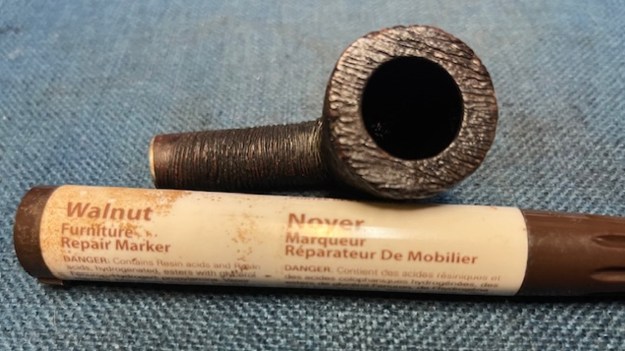
Not much is known about Israel’s sole pipe factory though it’s reported to have operated quite successfully on international markets. Beside the brand “Shalom” the mainstay brand was Alpha – especially well known in the USA. Alpha was popular for a range of fresh and unusual shapes. Series (afaik): Caprice (s), Citation (s), Classic (b), Pedestal (s), Regent, Region (b), Rex (s). (1) (1) (b) = blasted, (s) = smooth. Alpha also produced at least one of its Citation forms for Carey’s “Magic Inch” series. Mentioned in context with Shalom Pipe Factory was a Danish pipemaker named ‘Muki Liebermann’, who later lived and worked in the USA. Muki is known for his unique briar bending technique and his original shapes that gave inspiration to many of the most praised Danish pipemakers. Shalom was taken over by Robert L. Marx of New York City, later Sparta, NC, then of Mastercraft. Mastercraft continued the Alpha pipes introducing new lines.This made me wonder if this pipe was, in fact, made by Muki Liebermann – I have no evidence of that, but it certainly fits. Anyway, nothing here gave me any information about this specific pipe, but I clicked on the Alpha link to see if I could find further information. Indeed, I found that the same shape of my pipe was also released by Alpha (slightly different stem, but the stummel is the same). See below…Let’s take a closer look at the pipe itself. The stummel was in good shape. Dirty, of course, but nothing looked damaged or overly worn. The stem was also generally ok – it had the usual wear and tear. The only thing that gave me pause was a couple of tooth dents. But I felt confident that I could resolve that. I used oil soap on a few cotton rounds and wiped the stem down to provide an initial cleaning of filth. The primary cleaning comes next. I cleaned the inside of the stem with both pipe cleaners and cotton swabs dipped in 99% lemon-infused isopropyl alcohol. I scrubbed thoroughly to make sure the interior was clean.I used a disposable lighter and ‘painted’ the stem with its flame. The gentle heat of the flame can cause the dents in the vulcanite of the stem to expand back into shape. In this case, it didn’t work too well – but no big deal.The goal of the next step is the removal (or minimization) of oxidation. Going to my sink, I used cream cleanser, cotton rounds, and a toothbrush, and scoured the stem to remove as much surface oxidation as possible. As the photos show, the result is a hideous brownish mess – but better off the stem than on it.Once the stem was reasonably clean, I soaked it overnight in some de-oxidation fluid. This solution works to draw oxidation in the stem to the surface. This is a major aid and an important step in ensuring a clean stem. The following day, I drew the stem out from its bath and scrubbed the lingering fluid with a toothbrush.Now that the stem is clean and dry, I set about fixing the marks and dents in the vulcanite. This is done by filling those divots with black cyanoacrylate adhesive, impregnated with carbon and rubber. I left this to cure and moved on.The penultimate step for the stem is sanding. First, with my set of needle files, I reduce the bulk of the cyanoacrylate repairs. I want to remove the excess adhesive as near to the surface as possible, without cutting into the vulcanite. Following that, I use all nine of the micromesh sanding pads (1,500 through 12,000 grit) to sand out flaws, even out the vulcanite, and provide gentle polishing of the finished surface. I also apply pipe-stem oil while using the last five micromesh pads. There was a wonderful, deep black shine to the stem when I was done.Now that the stem is (nearly) complete, I can move on to the stummel. The first step for me is to ream out the bowl – that is to say, remove all the cake inside the bowl. This accomplishes a couple of things. First (and most obviously), it cleans the bowl and provides a refurbished chamber for future smoking. Second, when the old cake is removed, I can inspect the interior walls of the bowl and determine if there is damage or not. I used a reamer and a piece of sandpaper taped to a wooden dowel. Collectively, these ensure that all the debris is removed. Pleasingly, the walls of the bowl looked to be in good condition.Similar to the stem, I then cleaned the stummel with both pipe cleaners and cotton swabs dipped in 99% lemon-infused isopropyl alcohol. With a pipe this dirty, it took quite a while and much cotton to get clean.I then decided to ‘de-ghost’ the pipe – that is to say, exorcize the remaining filth from the briar. I filled the bowl and the shank with cotton balls, then saturated them with 99% isopropyl alcohol. I let the stummel sit overnight. This caused any remaining oils, tars and smells to leach out into the cotton.To tidy up the briar, I also wiped down the outside with some oil soap on cotton rounds (and a nylon-bristle brush for the rim). This does a good job of cleaning any latent dirt on the surface of the briar. The last step of the cleaning process is to scour the inside of the stummel with some soap and tube brushes. This is the culmination of a lot of hard work in getting the pipe clean.I used a few of the smoother micromesh pads – but just on the flat section where the logo is. After that, there were a few spots that needed to be tinted in the same colour as the rest of the stummel. I used some of my furniture pens (which is simply dye in pen form) to match the colour. I rubbed some Before & After Restoration Balm into the briar and let it sit for 20 minutes or so. The balm moisturizes the wood and gives a beautiful depth to the briar. I then buffed it with a microfibre cloth. For the final step, I took the pipe to my bench buffer and carefully polished it – first with a white diamond compound, then with three coats of carnauba wax. This procedure makes the pipe look its best – the stummel sings and the stem glows.

All done! This Shalom freehand Dublin looks fantastic again and is ready to be enjoyed by its next owner. I am pleased to announce that this pipe is for sale! If you are interested in acquiring it for your collection, please have a look in the ‘Various Makers’ section of the store here on Steve’s website. You can also email me directly at kenneth@knightsofthepipe.com. The approximate dimensions of the pipe are as follows: length 6⅛ in. (155 mm); height 2⅛ in. (54 mm); bowl diameter 1½ in. (37 mm); chamber diameter 1 in. (24 mm). The weight of the pipe is 1¼ oz. (38 g). I hope you enjoyed reading the story of this pipe’s restoration as much as I enjoyed restoring it. If you are interested in more of my work, please follow me here on Steve’s website or send me an email. Thank you very much for reading and, as always, I welcome and encourage your comments.

Restoring an Odd, Old Genuine French Briar Slug Style Pocket Pipe


by Steve Laug

The next pipe on the table is one that has always interested me. Jeff called it a Slug and we purchased it on 07/27/2019 from a seller in Wilkes Barre, Pennsylvania, USA. The stamping on the left side of the pipe reads Genuine French Briar at an angle on the short shank. On the underside at the stem shank union it is stamped Made in France. It is clear and readable. The hard rubber stem has a crown stamped on the left side of the taper. The finish on the pipe did not have a shiny varnish coat but it was very dirty and had oils ground into the bowl sides. There were a lot of nicks and scratches in the briar. The rim was darkened and hard to tell whether it was burned or just tarry. The bowl was nicked and out of round but it also had a cake that would need to be reamed out before addressing the out of round inner wall of the rim. The hard rubber stem had nicks and gouges on both side that looked liked someone had used pliers to try to remove it. There was light tooth chatter on the top and underside ahead of the button, however, it was clean and sharp as was the slot in the in the end of the button. Jeff took some photos of the pipe before he started his clean up work on it. You can see what I have pointed out above in the photos. Jeff took some close-up photos of the damage to the rim and the stem. Looking closely at the photos of the rim top of the photo you can see the damage to the rim itself and the scratches in the top. The bowl also has a thick cake with some lava on the top and edges. The photo of the underside of the stem shows the nicks and gouges in the rubber. The top side also mirrors that though there is no photo of it. Jeff took photos of the grain around the bowl sides and the heel. It is interesting to note the also foot like bottom of the bowl which looks like the tread of a slug. The bowl is very dirty and oily on the outside and there are many nicks and scratches in the finish. The next photos show the stamping on the sides of the shank and the logo on the stem. It is clear and readable as noted above. Jeff removed the stem to show the damaged and corroded stinger that was in the shank. It appeared to me to have corroded a portion off the end as the bottom of the bowl showed a trough where it extended into the bowl.I knew that there were several blogs on rebornpipes about this style of pipe and in the middle of the night it hit me that they had horn stems so I did a quick search on the blog for horn stems and found two articles. The Mokin is an article on a restoration by Anthony Cook and is very helpful. The second is one I did on a Bruyere Garantie Pocket pipe and it is also a help in solidifying what I knew about the shape and the pipe. Here are the links:

https://rebornpipes.com/2015/10/20/ship-shape-refurbishing-a-mokin-corsaire-7087/

https://rebornpipes.com/2015/11/09/cleaning-up-a-bruyere-garantie-pocket-pipe-with-a-horn-stem/

Since this pipe is stamped Genuine French Briar I did a quick search on the blog for both Genuine French Briar and GFB pipes. I have restored a few of those over the years so I have included those links as well to try to pin down the history of the brand.

I went back and reread the posts on the GFB pipes I had refurbished to remind myself of their history. There I described the process of hunting down information on the brand. I summarize that here for those may not have read the posts. I quote below from the articles the pertinent information on the brand.

(https://rebornpipes.wordpress.com/2013/06/07/restemming-and-reclaiming-an-older-unsmoked-gfb-briar-calabash/ , https://rebornpipes.wordpress.com/2013/04/01/restoring-a-gfb-bent-billiard-another-reclamation-project/, https://rebornpipes.com/2013/11/21/restoring-an-older-gfb-three-star-horn-stem-bent-bulldog/#)

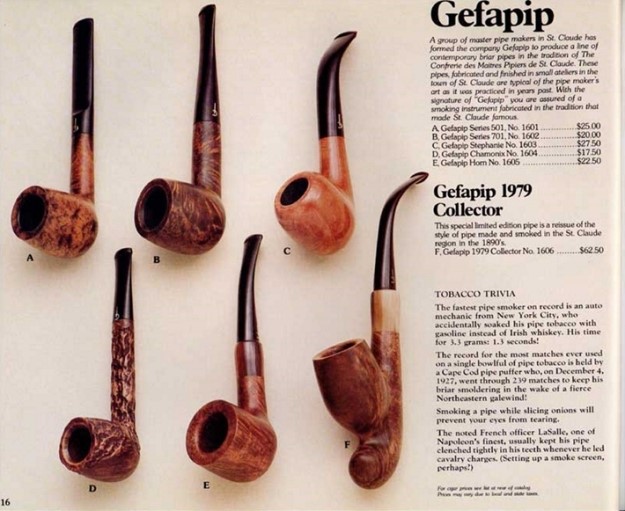
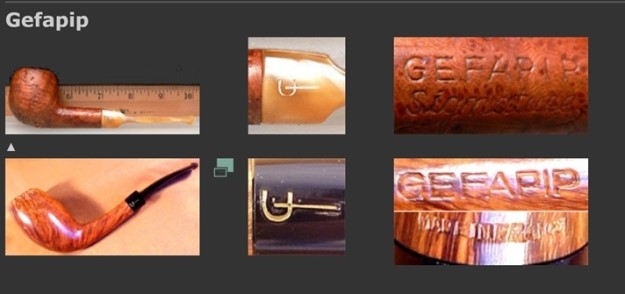
The first thing I found was information that the GFB brand was an older French Trademark and that it came from Saint Claude, France. A more focused search for GFB French Briar Pipes led to information that the stamping GFB stood for Great French Briar – something about that did not seem right to me so I continued to look and finally came across the following advertisement from a Sears Catalogue that I have included below. It shows a full page of GFB pipes and the header says GENUINE FRENCH BRIAR. That made much more sense to me, and all three of the GFB pipes I had worked on match the pipes in the catalogue. It was good to be reminded of the old brand. I am pretty sure that all three of my GFB pipes come from either the late 1890’s or the early 1900’s.Judging from the description above, the pipe I am working on is an older French Made pipe by the GFB company – Genuine French Briar. The best I can tell the pipe was made in the early 1900s. I have worked on horn stem examples of this but this is one of the first with  a hard rubber stem. Now it was time to work on the pipe itself.

Jeff had done a great job cleaning up the pipe as usual. He reamed the pipe with a PipNet reamer and cut back the cake back to the bare briar. He cleaned up the walls with a Savinelli Fitsall Pipe Knife. Surprisingly the walls looked unscathed from the heavy cake. He scrubbed the interior of the bowl and shank with pipe cleaners, cotton swabs and alcohol to remove the tars and oils. He scrubbed the exterior of the pipe with Murphy’s Oil Soap and a tooth brush to remove the grime from the finish. He scrubbed the inside of the stem with alcohol and pipe cleaners. He scrubbed the exterior of the stem with Soft Scrub and then soaked it in Briarville’s Pipe Stem Deoxidizer. He washed it off with warm water to remove the Deoxidizer. When I examined the stem, it looked very good. The pipe looked far better when it arrived. I took some close up photos of the rim top and edges to show how well it had cleaned up and the edges around the bowl. I also took close up photos of the stem to show the gouges, scratches and light tooth chatter on the surface ahead of the button on both sides.I took photos of the stamping on the sides of the shank. It is clear and readable as noted above. I removed the stem and took a photo of the pipe to have a look at the parts and overall look. I worked on the out of round bowl with a folded piece of sandpaper to smooth out the damaged areas and bring it back to as close to round as I could get it. I smoothed out the rim top at the same time to remove damage on the surface.I sanded the scratching and marks around the bowl sides with 320-3500 grit sanding pads. I wiped the briar down after each sanding pad. I was able to smooth out most of the marks and the bowl looked much better. I polished the briar with micromesh sanding pads – dry sanding with 1500-12000 grit sanding pads. I wiped the bowl down with a damp cloth after each sanding pad. The grain really began to sing. I worked some Before & After Restoration Balm into the surface of the briar with my fingertips to clean, enliven and protect the briar. I let the balm sit for 15 minutes and then buffed with a cotton cloth to raise the shine. The photos show the bowl at this point in the restoration process. I set the bowl aside and filled in the deep nicks and gouges with black CA glue. Once it cured I sanded out the chatter on both sides of the stem ahead of the button with 220 grit sandpaper.I sanded the stem surface with 320-3500 grit sanding pads. The repairs were blended in and the chatter was gone on both sides ahead of the button looked very good. The stem began to shine.I polished the stem with micromesh sanding pads – dry sanding with 1500-12000 grit sanding pads. I wiped it down after each sanding pad with Obsidian Oil. I polished it with Before & After Pipe Stem Polish – both Fine and Extra Fine. I went through my collection of stingers and found one that was probably much like the broken one that was in this tenon. It extended into the bowl the correct distance judging by the bowl bottom. It would work well. I fit it in the stem after polishing it.I am excited to finish this GFB Genuine French Briar Pocket Pipe. Jeff called it a slug and that certainly fits the shape. I put the pipe back together and buffed it with Blue Diamond on the buffing wheel. I gave the bowl and the stem multiple coats of carnauba wax. I hand buffed the pipe with a clean buffing pad to raise the shine. It is fun to see what the polished bowl looks like with beautiful mixed grain all around it, looks great with the polished black hard rubber stem. This smooth Old GFB Pocket Pipe is both ugly and great looking at the same time. The pipe feels great in my hand. It is light and well balanced. Have a look at it with the photos below. The dimensions are Length: 5 inches, Height: 1 ¼ inches, Outside diameter of the bowl: 1 inch, Chamber diameter: ¾ of an inch. The weight of the pipe is 35 grams/1.23 ounces. It turned out to be a beautiful pipe. I am not sure what I am going to do with it at the moment. I have it on my desk and keep picking it up and looking at it. Thanks for your time as I walked through the restoration.

Amazing Grain on a Charatan Perfection 2122DC


by Kenneth Lieblich

This beauty is a pipe I acquired recently and it turned out so well – especially compared with how it looked when I found it. I took a liking to it immediately and figured you would too, so I cleaned it up poste haste. The pipe is light, attractive, and comfortable – and the grain is just so warm and inviting. This is an apple shape with a ‘Double Comfort’ saddle stem. Let’s look at the markings. On the left side of the shank are the words, Charatan’s Make [over] London England [over] Perfection. The right side of the shank shows the model, 2122DC. The ‘DC’ suffix here indicates what we already know: the pipe has a ‘Double Comfort’ saddle stem. Finally, the stem has the letters C and P – with the C penetrating into the P. This is notable for dating purposes. I believe this pipe comes from the Dunhill era. Using Pipedia’s Charatan dating page (which you can see here), I saw that this pipe has

  • Double comfort mouthpiece
  • In the CP logo, the C enters the P
  • Absence of £ on the shank
  • Presence of the letters DC just after the shape number

Having said that, dating these pipes precisely is always a tricky business. A good estimate would be late 70s-early 80s. Meanwhile, I was also curious about the model name ‘Perfection’. Once again, Pipedia indicated that ‘Perfection’ was one of Charatan’s Make’s ‘Apprenticeship’ standard shape grades.On with the restoration! I used oil soap on a few cotton rounds and wiped the stem down to provide an initial cleaning of filth before moving on to the next steps. The primary cleaning comes next. I cleaned the inside of the stem with both pipe cleaners and cotton swabs dipped in 99% lemon-infused isopropyl alcohol. I scrubbed thoroughly to make sure the interior was clean.I used a disposable lighter and ‘painted’ the stem with its flame. The gentle heat of the flame can cause the dents in the vulcanite of the stem to expand back into shape. In this case, it did help a bit – but only a bit.The goal of the next step is the removal (or minimization) of oxidation. Going to my sink, I used cream cleanser, cotton rounds, and a toothbrush, and scoured the stem to remove as much surface oxidation as possible. As the photos show, the result is a hideous brownish mess – but better off the stem than on it.Once the stem was reasonably clean, I soaked it overnight in some de-oxidation fluid. This solution works to draw oxidation in the stem to the surface. This is a major aid and an important step in ensuring a clean stem. The following day, I drew the stem out from its bath and scrubbed the lingering fluid with a toothbrush.Now that the stem is clean and dry, I set about fixing the marks and dents in the vulcanite. This is done by filling those divots with black cyanoacrylate adhesive, impregnated with carbon and rubber. I left this to cure and moved on.After this, I painted the logo on the stem with some nail polish. I restored the logo carefully and let it fully set before proceeding.The penultimate step for the stem is sanding. First, with my set of needle files, I reduce the bulk of the cyanoacrylate repairs. I want to remove the excess adhesive as near to the surface as possible, without cutting into the vulcanite. Following that, I use all nine of the micromesh sanding pads (1,500 through 12,000 grit) to sand out flaws, even out the vulcanite, and provide gentle polishing of the finished surface. I also apply pipe-stem oil while using the last five micromesh pads. This was a surprisingly difficult stem to restore, but, in the end, we got there. There was a wonderful, deep black shine to the stem when I was done.Now that the stem is (nearly) complete, I can move on to the stummel. The first step for me is to ream out the bowl – that is to say, remove all the cake inside the bowl. This accomplishes a couple of things. First (and most obviously), it cleans the bowl and provides a refurbished chamber for future smoking. Second, when the old cake is removed, I can inspect the interior walls of the bowl and determine if there is damage or not. I used a reamer and a piece of sandpaper taped to a wooden dowel. Collectively, these ensure that all the debris is removed.My next step was to remove the lava on the rim. For this, I took a piece of machine steel and gently scraped the lava away. The metal’s edge is sharp enough to remove what I need, but not so sharp that it damages the rim. This work revealed that, fortunately, everything was in good shape. No issues.The inside of the stummel needs to be cleaned thoroughly. Similar to the stem, I then cleaned the stummel with both pipe cleaners and cotton swabs dipped in 99% lemon-infused isopropyl alcohol.I then decided to ‘de-ghost’ the pipe – that is to say, exorcize the remaining filth from the briar. I filled the bowl and the shank with cotton balls, then saturated them with 99% isopropyl alcohol. I let the stummel sit overnight. This caused any remaining oils, tars and smells to leach out into the cotton.To tidy up the briar, I also wiped down the outside with some oil soap on cotton rounds. This does a good job of cleaning any latent dirt on the surface of the briar. The last step of the cleaning process is to scour the inside of the stummel with some soap and tube brushes. This is the culmination of a lot of hard work in getting the pipe clean.I used all nine micromesh pads (1,500 through 12,000 grit) on the outside of the stummel to finish it off. This sanding minimizes flaws in the briar and provides a beautiful smoothness to the wood. I rubbed some Before & After Restoration Balm into the briar and let it sit for 20 minutes or so. The balm moisturizes the wood and gives a beautiful depth to the briar. I then buffed it with a microfibre cloth. For the final step, I took the pipe to my bench buffer and carefully polished it – first with a white diamond compound, then with three coats of carnauba wax. This procedure makes the pipe look its best – the stummel sings and the stem glows.All done! This Charatan’s Make Perfection 2122DC apple looks fantastic again and is ready to be enjoyed by its next owner. I am pleased to announce that this pipe is for sale! If you are interested in acquiring it for your collection, please have a look in the ‘British’ section of the store here on Steve’s website. You can also email me directly at kenneth@knightsofthepipe.com. The approximate dimensions of the pipe are as follows: length 5⅞ in. (149 mm); height 1⅔ in. (43 mm); bowl diameter 1½ in. (37 mm); chamber diameter ¾ in. (19 mm). The weight of the pipe is 1¼ oz. (39 g). I hope you enjoyed reading the story of this pipe’s restoration as much as I enjoyed restoring it. If you are interested in more of my work, please follow me here on Steve’s website or send me an email. Thank you very much for reading and, as always, I welcome and encourage your comments.