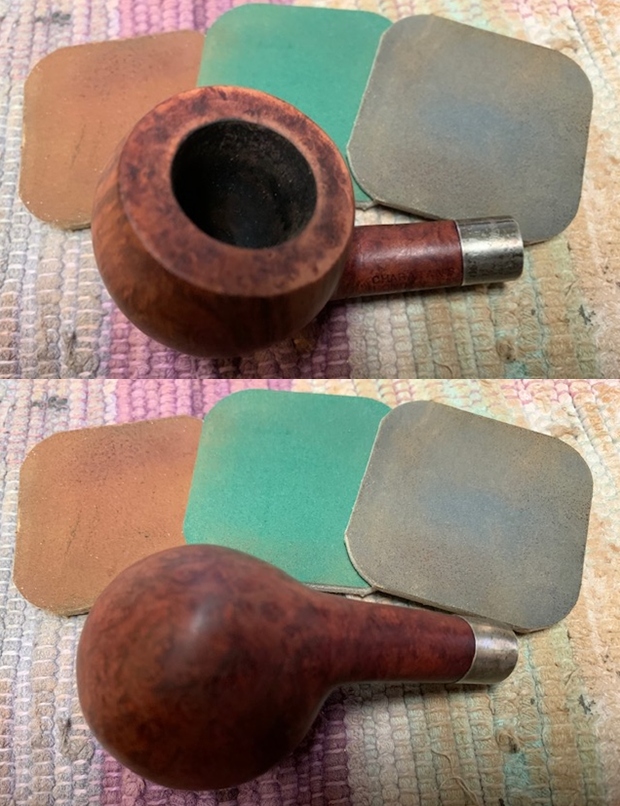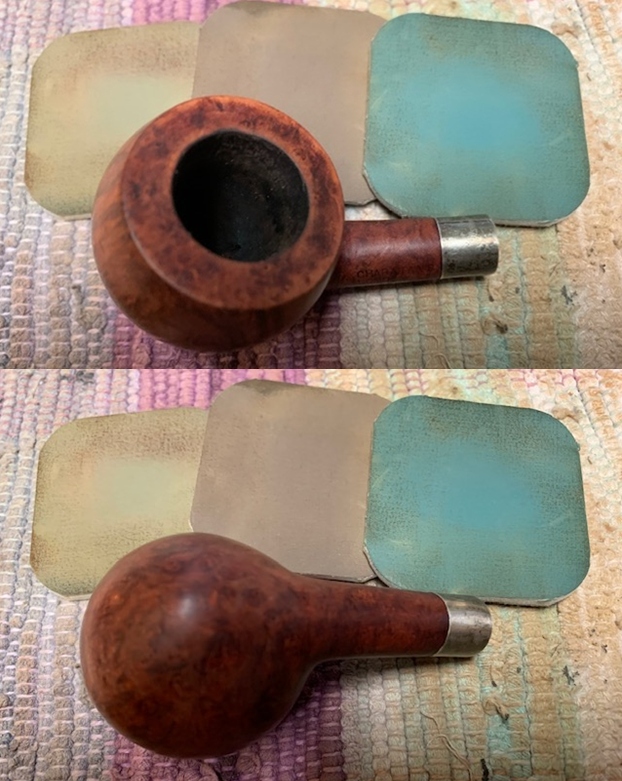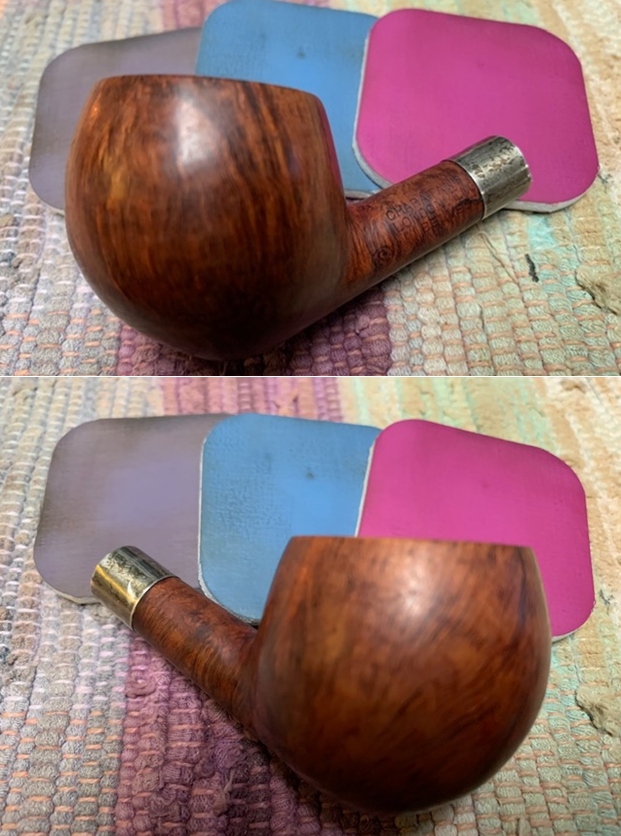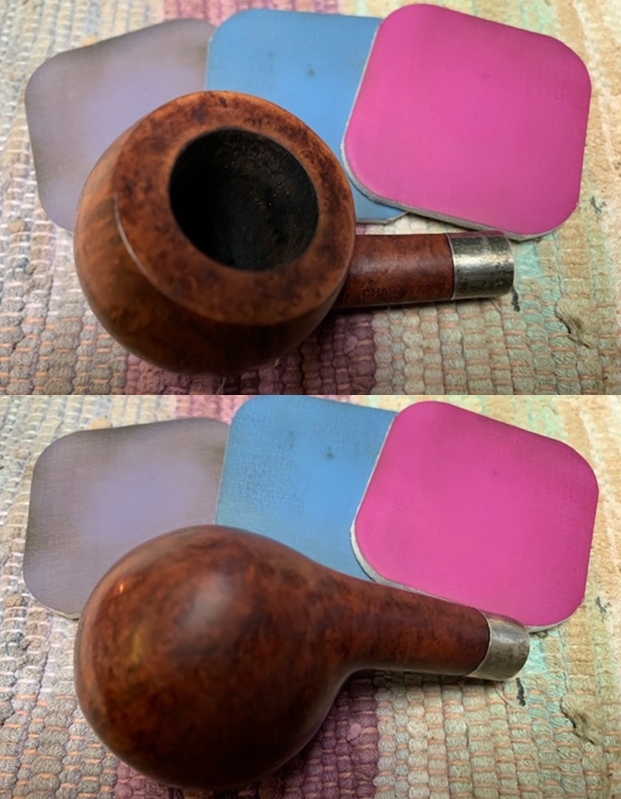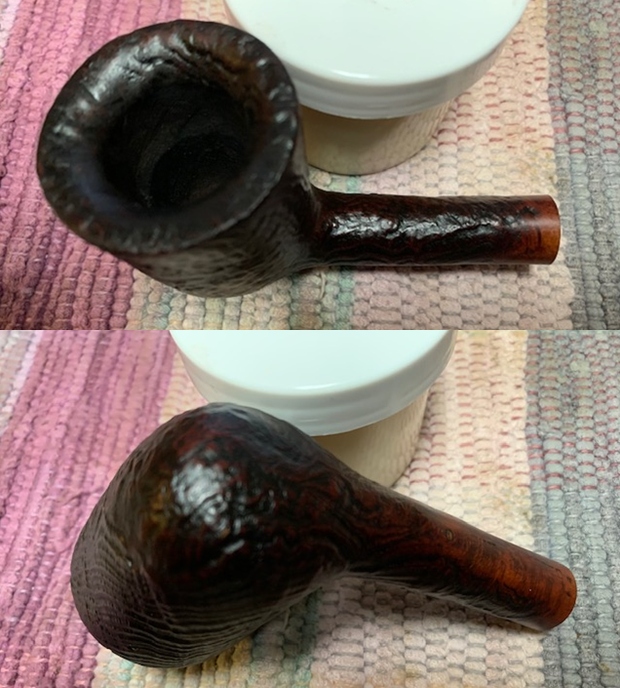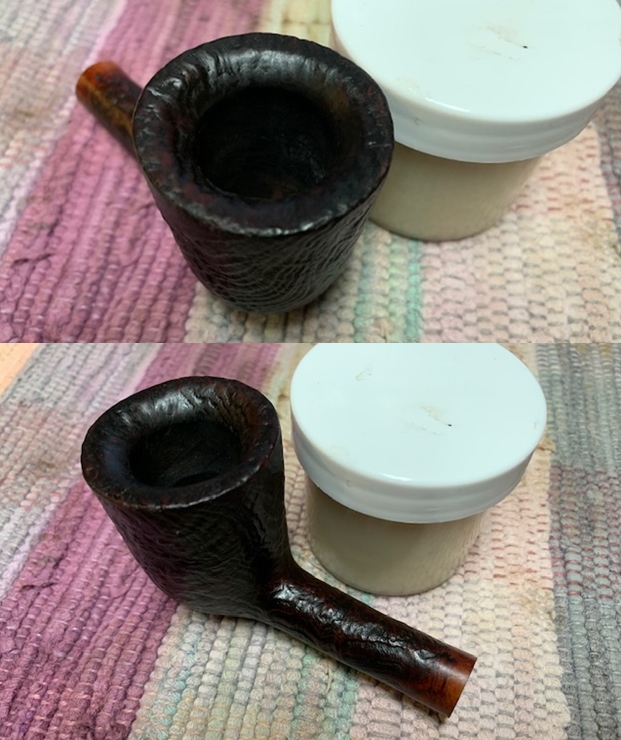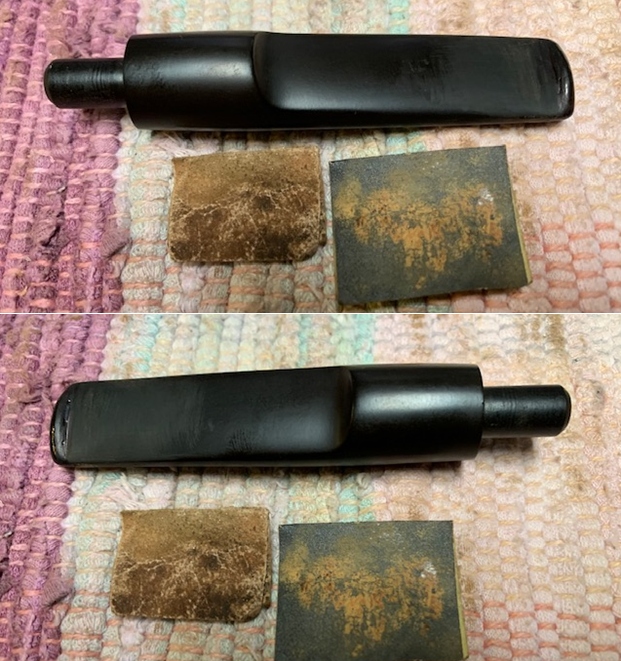
Tag Archives: shaping a stem

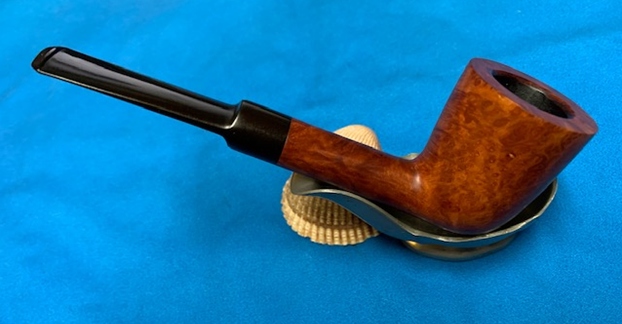
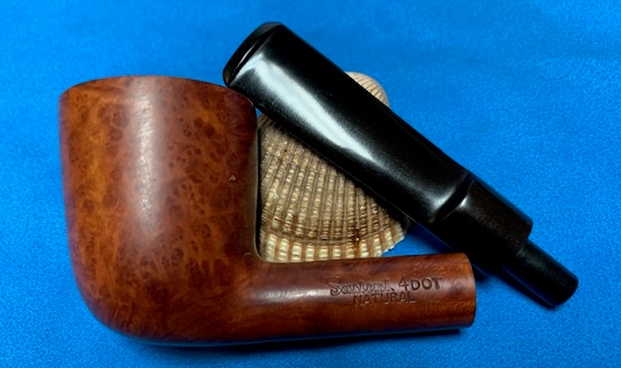
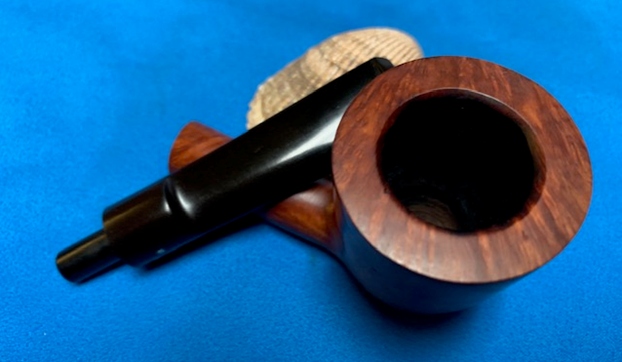
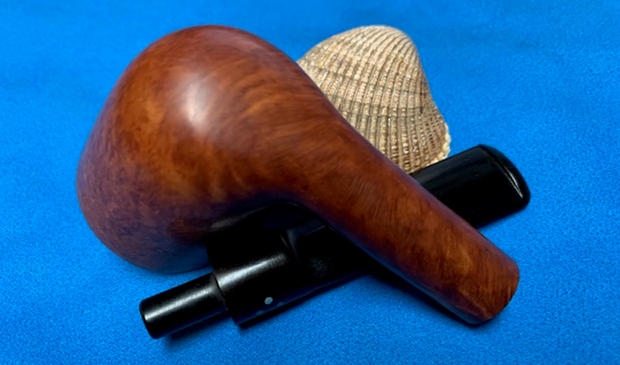
Renewing a Sasieni 4 Dot Natural #4 Dublin


Blog by Steve Laug

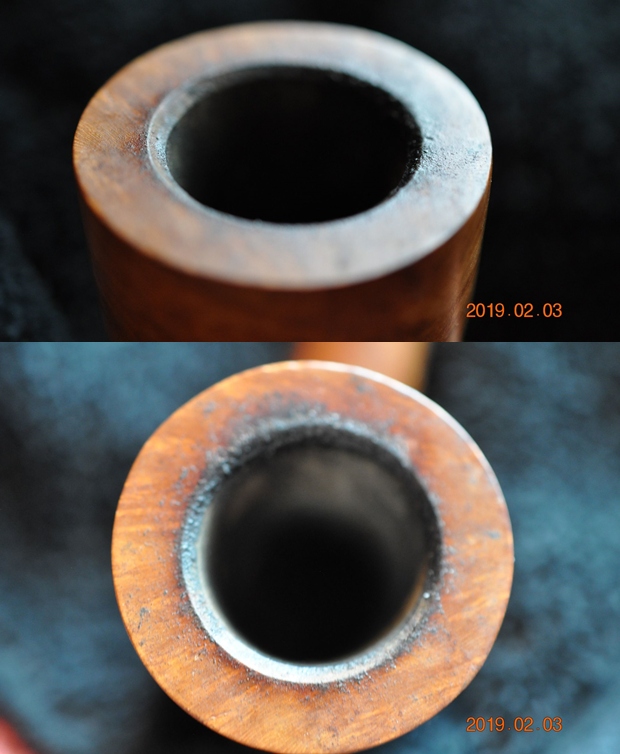
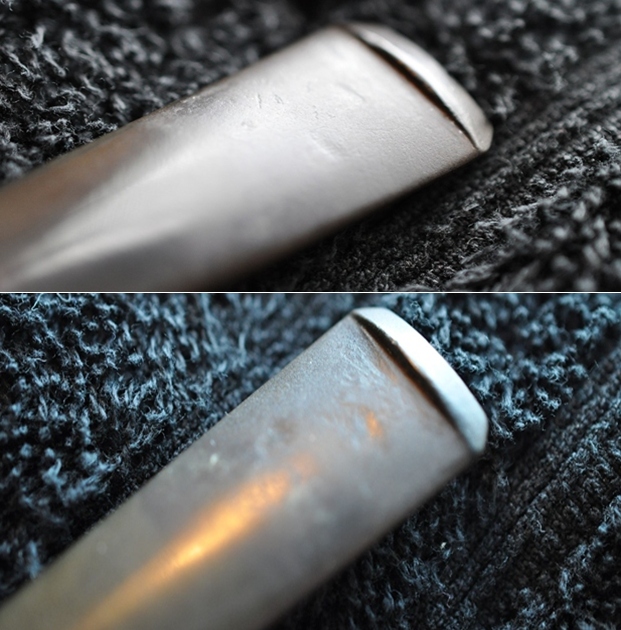
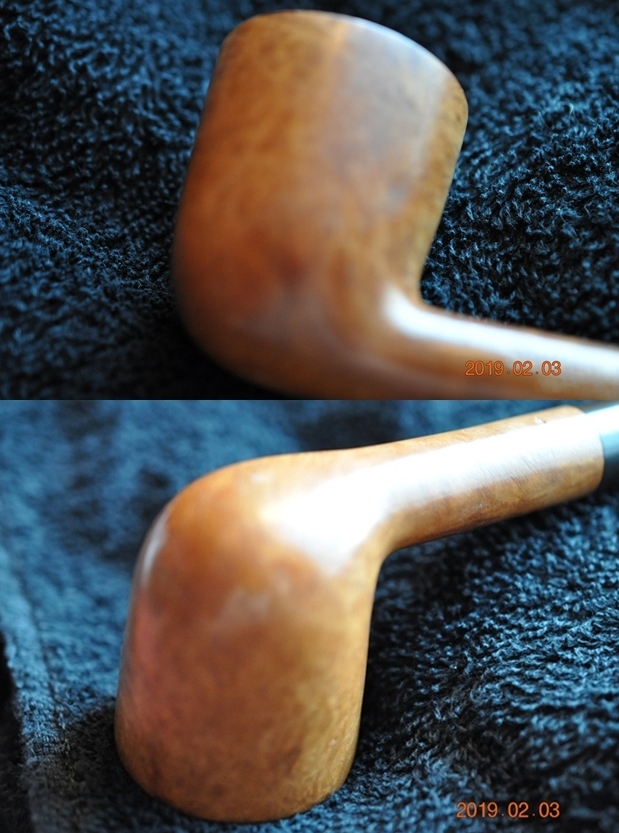
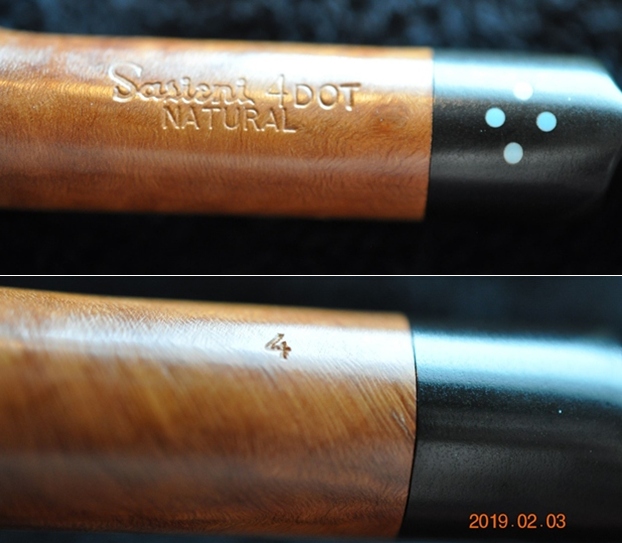
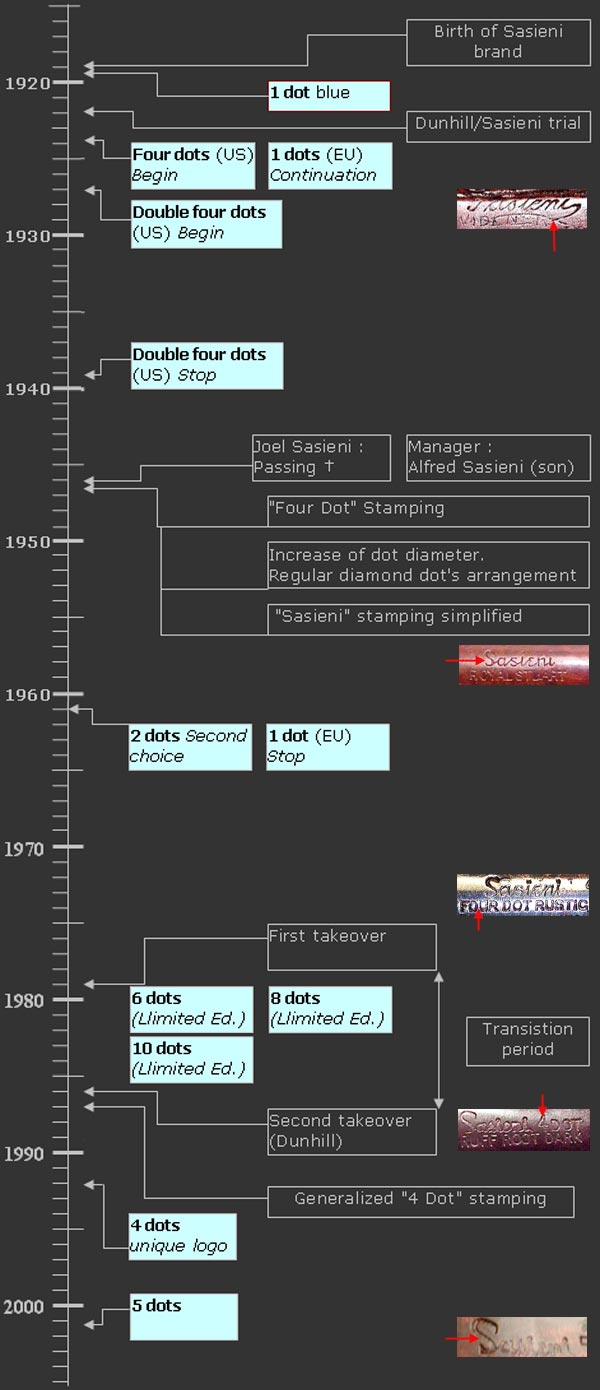
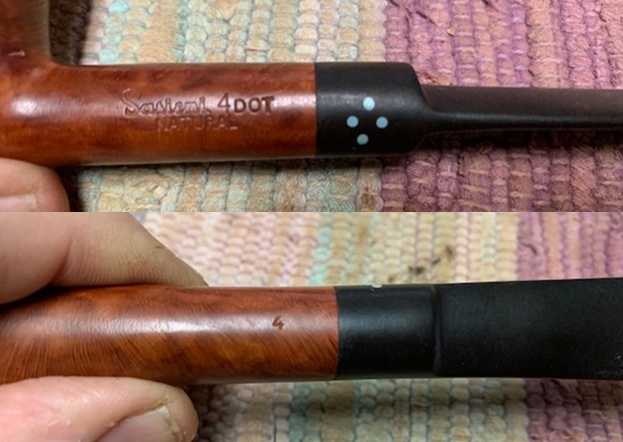
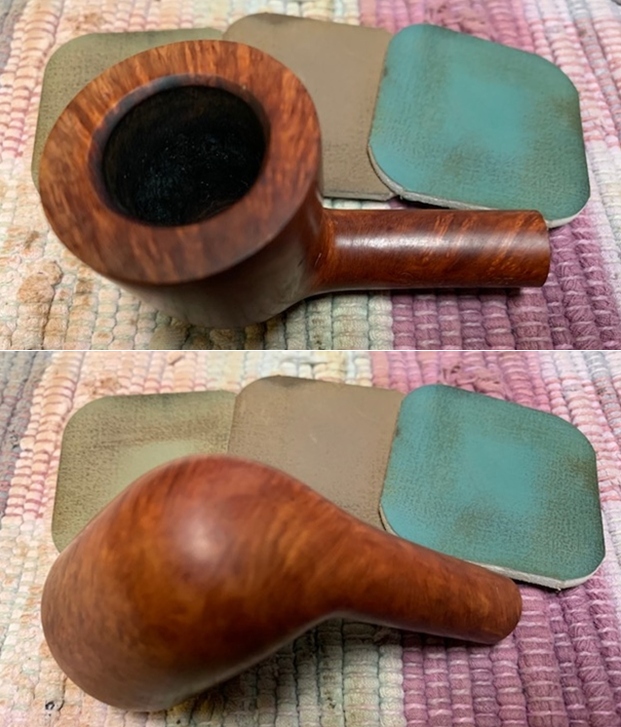
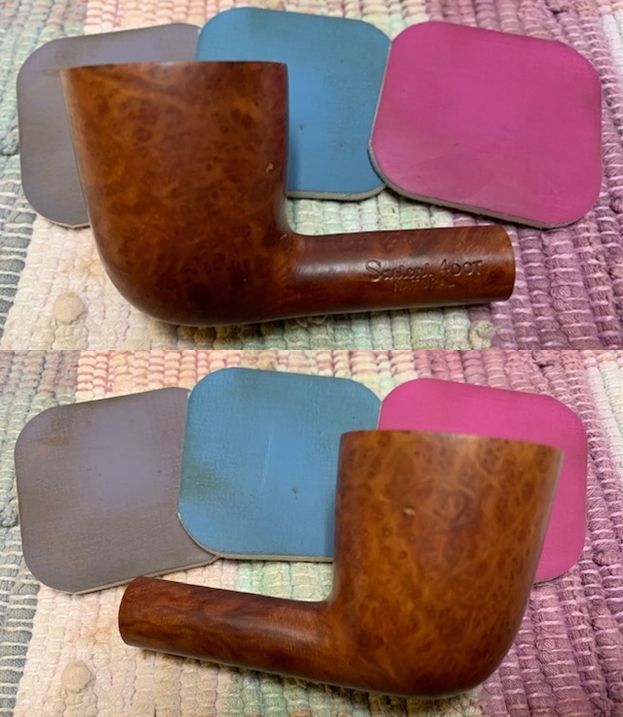
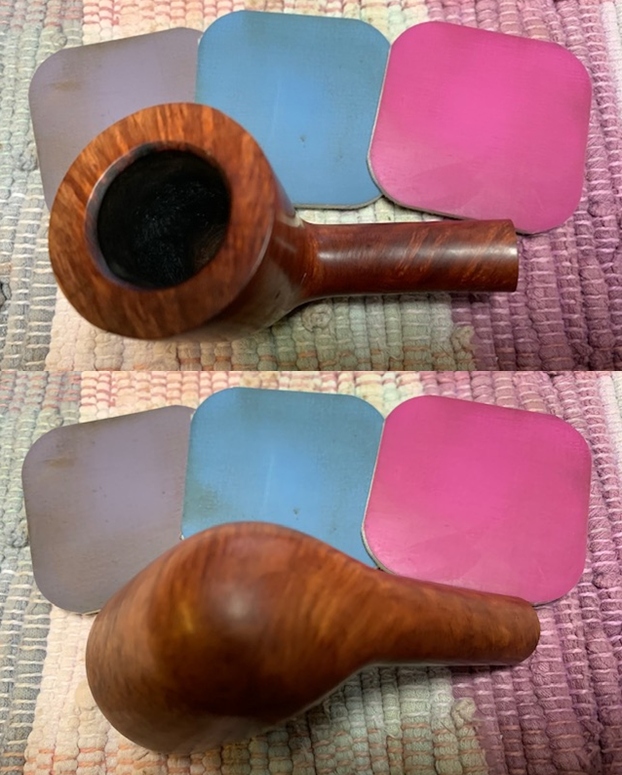
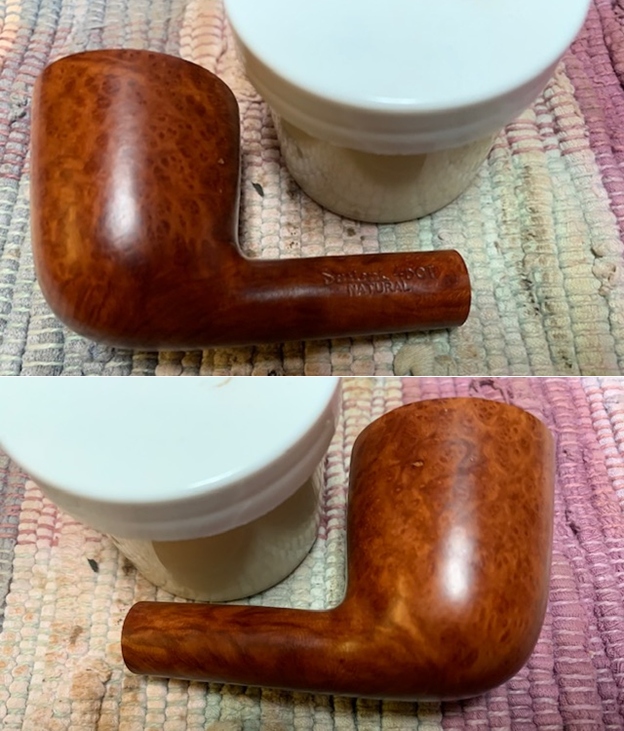
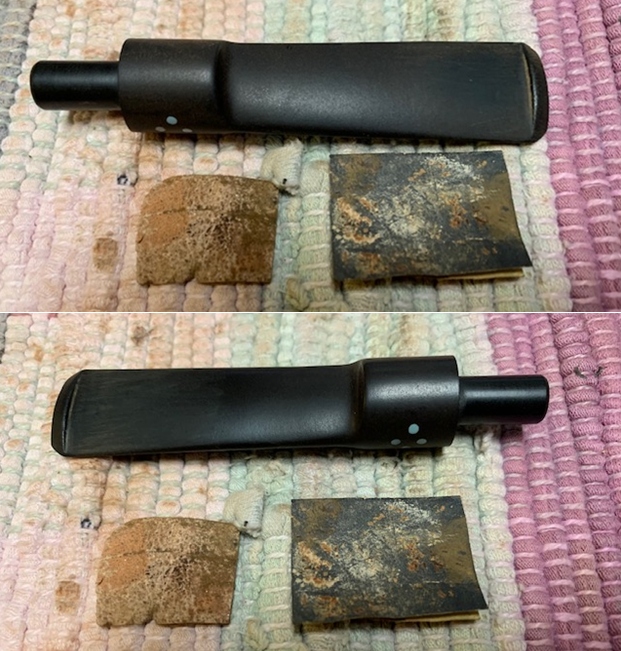
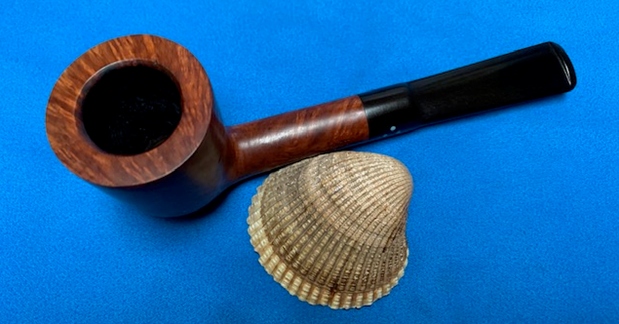
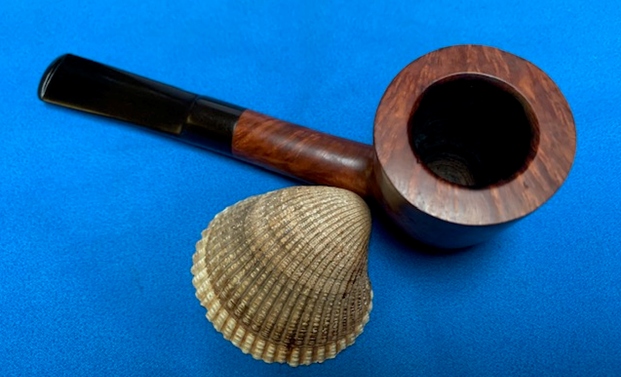
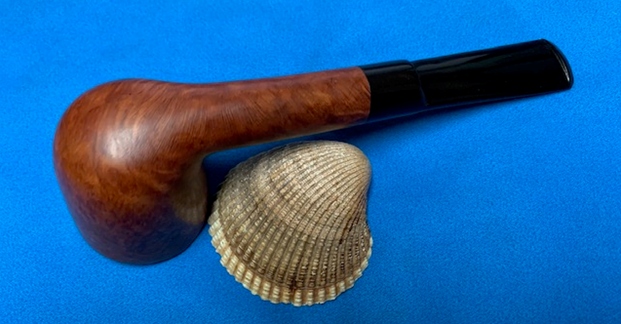
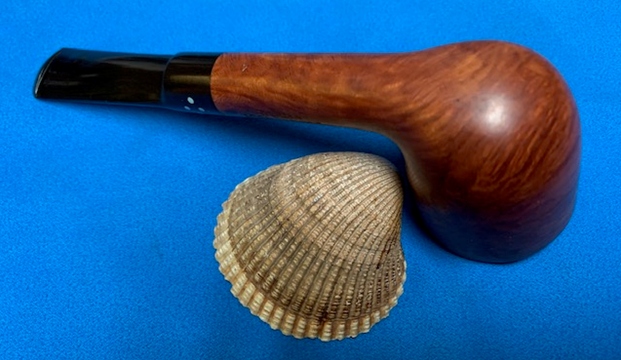
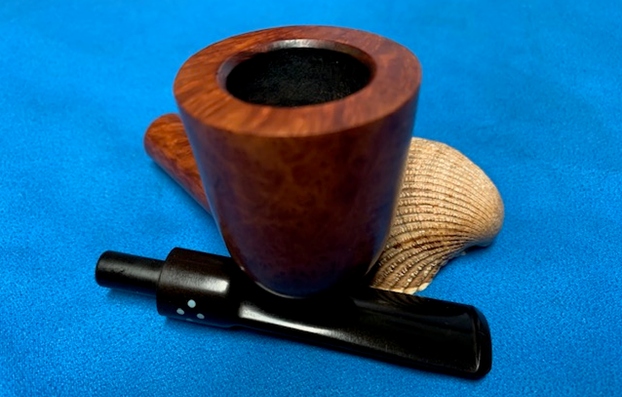
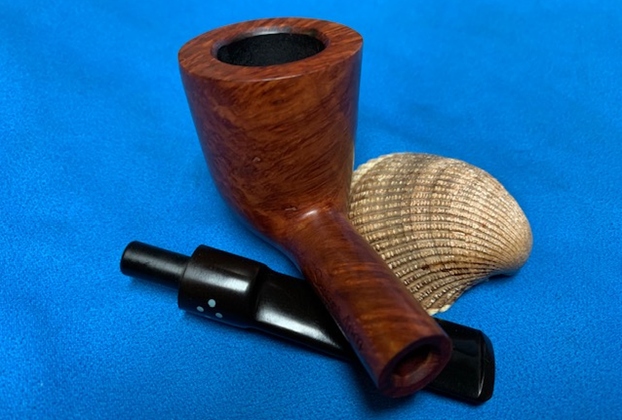
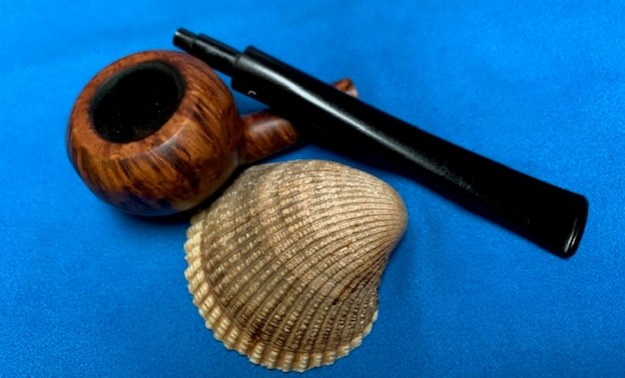
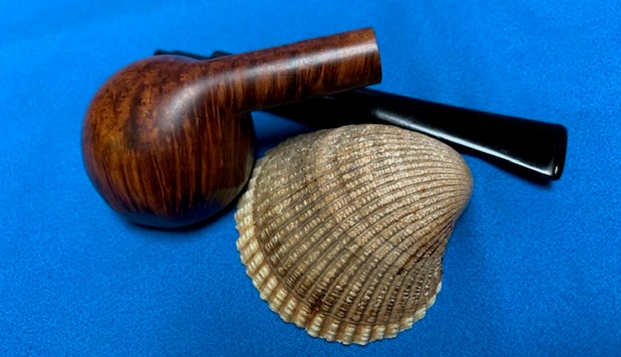
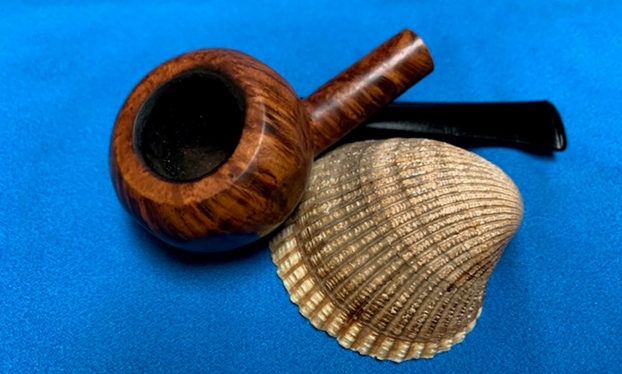
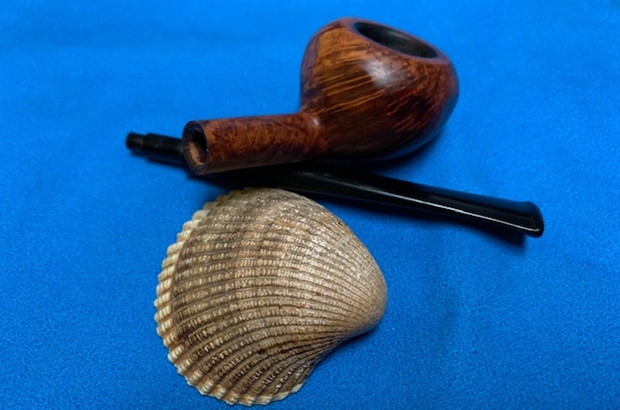
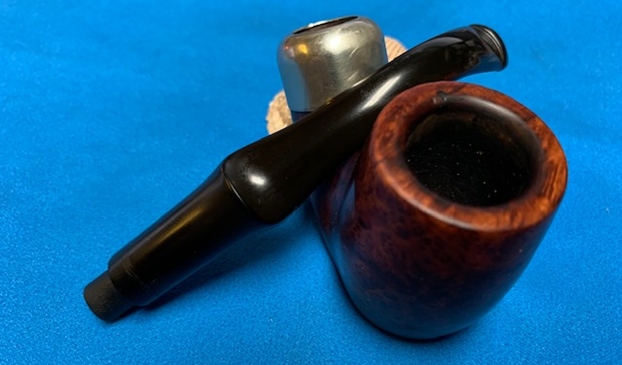
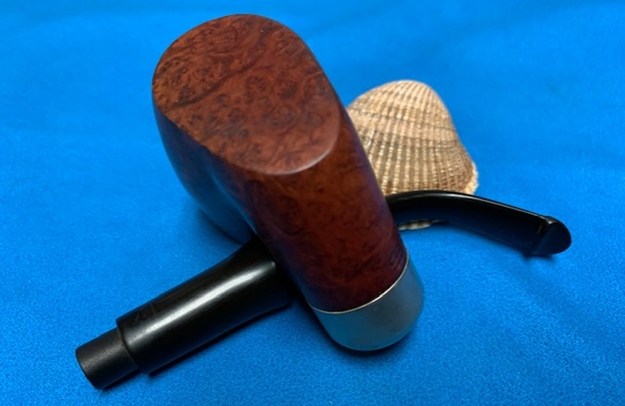
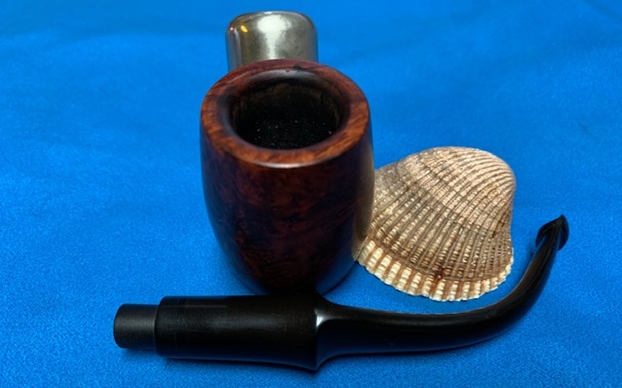
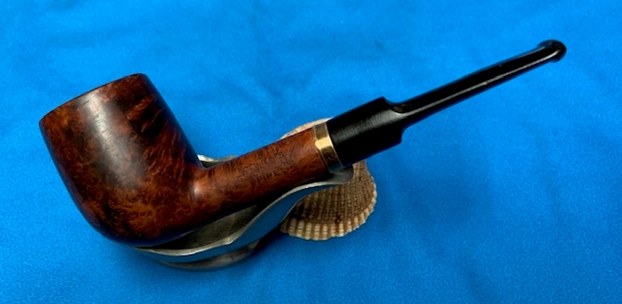
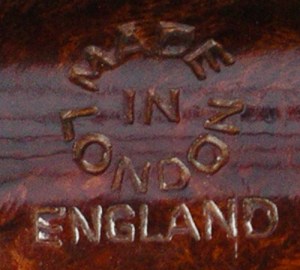
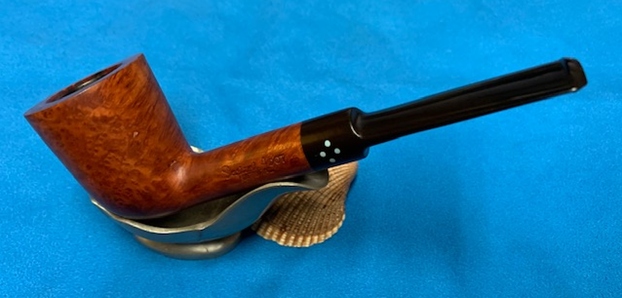
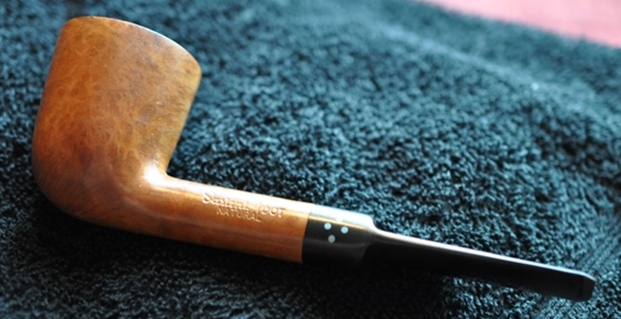
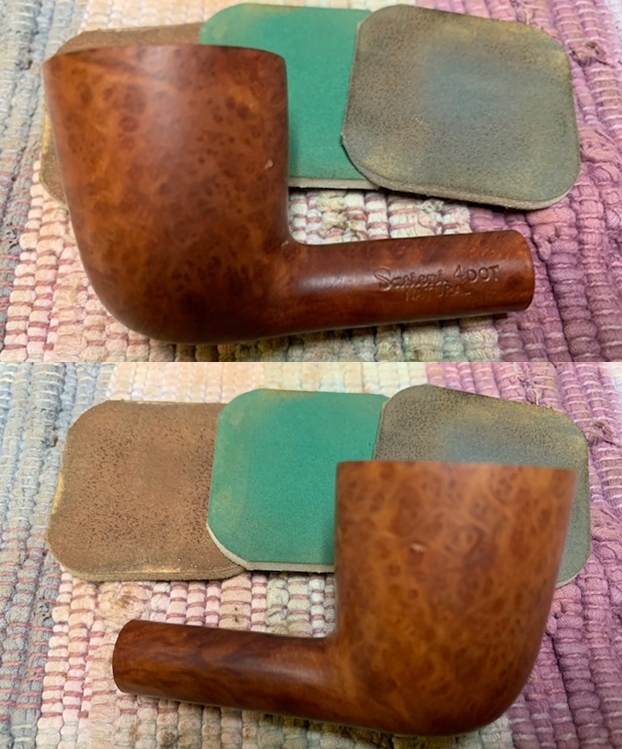
The next pipe on the work table came to us from a group of pipes that we purchased from fellow in Cornwall, Pennsylvania, USA.  The pipe is an interesting looking piece. It has a unique shape and certainly not one that I would readily identify as a Sasieni shape but it is! It is a smooth finished forward canted Volcano shaped pipe with some nice grain around the bowl. The pipe is stamped on the topside of the shank and reads Sasieni [over] Two Dot [over] London Made. On the right side of the shank it is stamped with the shape number 60 near the bowl and the rugby shaped Made in England COM stamp near the stem. There was a lot of grime ground into the smooth finish on the briar. There were also to small pinholes in the right side of the mid bowl that are strange. The bowl was heavily caked with a lava coat flowing onto the top of the rim. The inside and outside edges looked to be in good condition but we would know more once Jeff had cleaned it. The stem was oxidized, calcified and had tooth chatter and marks on the top and underside near the button. There were two light blue dots on the top of the oval saddle stem. It had promise but it was very dirty. Jeff took some photos of the pipe before he started his cleanup work.   He took a photo of the rim top and bowl to give a clear picture of the thickness of the cake and tobacco debris as well as the lava on the rim top and inner beveled edge. He also took photos of the top and underside of the stem to show the oxidation and the chatter and tooth marks.   Jeff took photos of the sides and heel of the bowl to give a picture of what the briar looked like. There looks like there may be some nice grain around the sides under the blah finish and grime. The stamping on the right and undersides of the shank are clear and readable and read as noted above.  The 4 light blue dots are visible in the photo below. I turned to Pipephil’s site and specifically the timeline for Sasieni that is included there to see when the Four Dot changed to 4 Dot (http://www.pipephil.eu/logos/en/infos/sasieni-timechart.html).I have included a screen capture of the timeline below. From the time line I was able to learn that the 4 Dot stamping was introduced in the late 1980 – perhaps 1987. Thus I knew that I was not dealing with an earlier family period pipe but a newer one relatively speaking.
I turned then to Pipedia to focus in on that period and get an idea of where this pipe fit in the timeline and the hierarchy of the brand (https://pipedia.org/wiki/Sasieni). I found the section I was looking for in the article and have included it below. For more information on the brand be sure to read the full article.

…Somewhat later still, this was modified to reflect the finish, e.g. Four Dot Walnut, or Four Dot Natural. All these changes seem to have been made in the years between 1946 and 1950. Therefore a pipe with new style dots and old style stamping almost certainly has a replacement stem.

This system changed little if at all in the ensuing thirty years. When the company was sold in 1979, one of the first things the new owners did was to eliminate the town names from the shanks. The dots were enlarged yet further, and the Sasieni name, though still done in script, was larger, as was the rest of the shank nomenclature, which in all other ways was similar to the Pre-Transition nomenclature. While these pipes are not as collectible as the family made pipes, they were made with care and are high quality.

The nomenclature changed again in 1986, with the sale of the company to the Post-Transition firm. The three line nomenclature was changed to two lines, with the first reading “Sasieni 4 Dot” and the second identifying the finish, e.g. Natural, Walnut, or Ruff Root. Note how 4 Dot is spelled, using an Arabic numeral 4, as opposed to spelling out the word “four”. This is the easiest way to spot a Post-Transition Sasieni, as the new company has used both script and block lettering to spell the word “Sasieni” on the shank.

Now I knew I was working on a Post-Transition Sasieni made after 1986. It bore the Sasieni 4 Dot stamp and the second line Finish stamp – in this case Natural. It clearly differentiated this 4 Dot for the Four Dot pipes that I have worked on in the past.

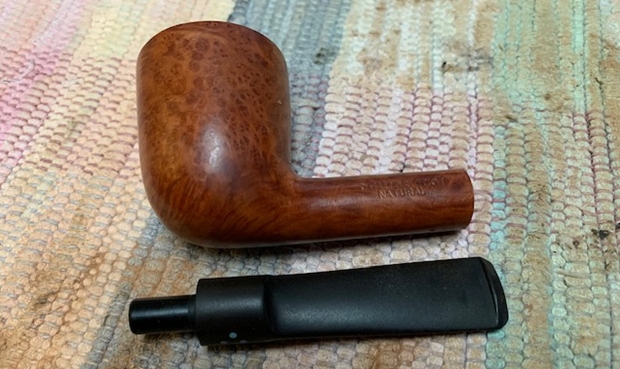
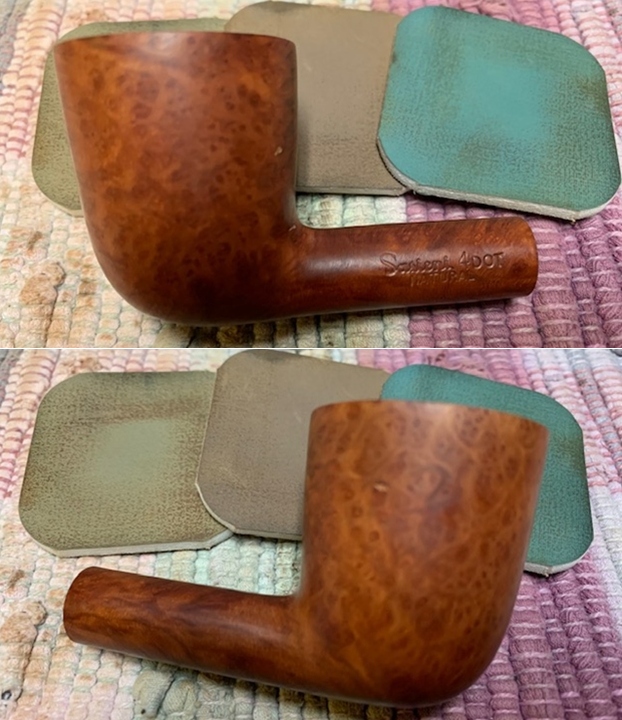
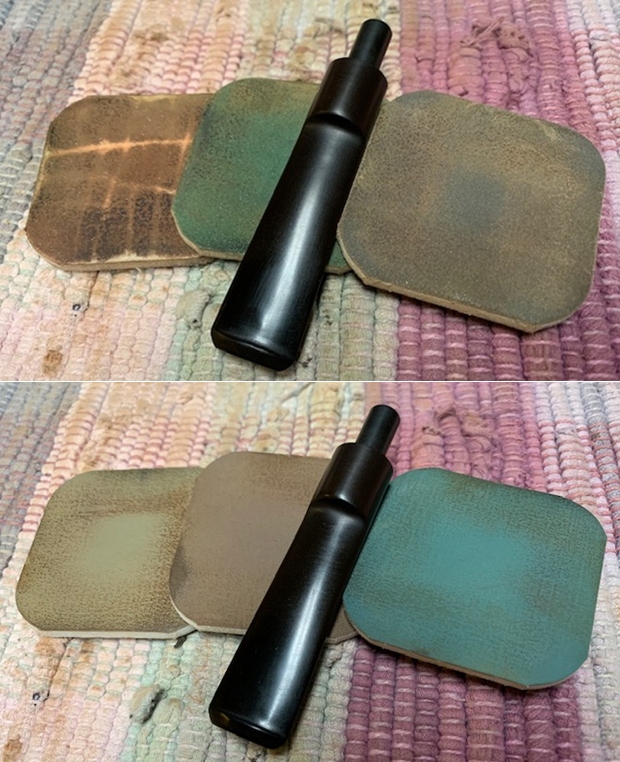
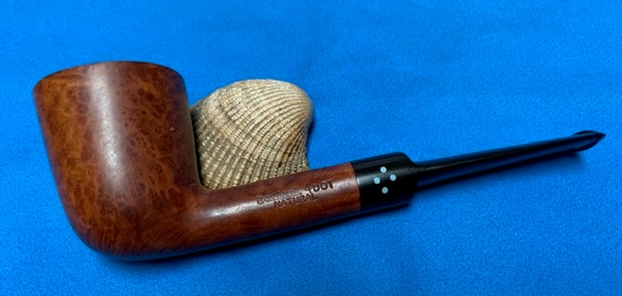
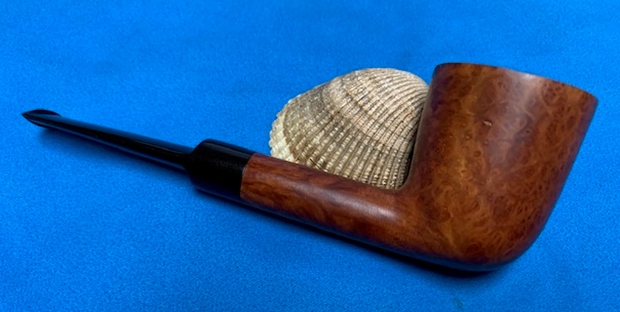
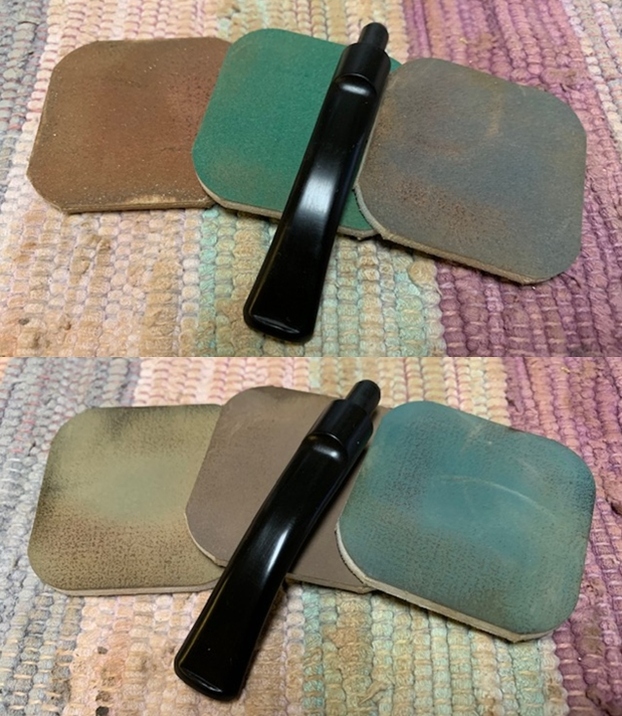
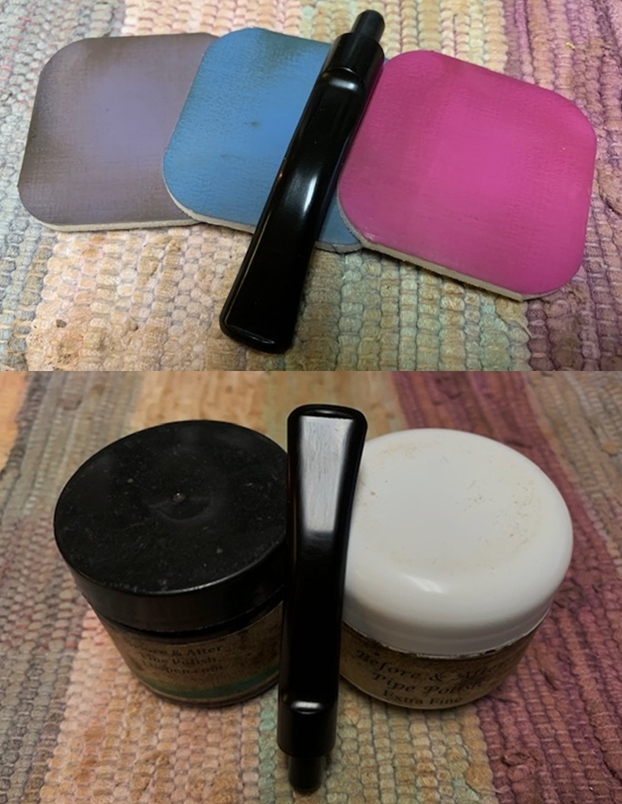
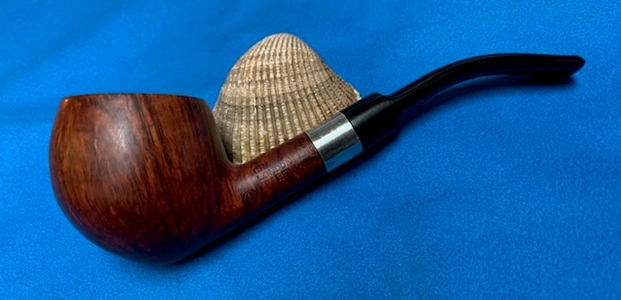
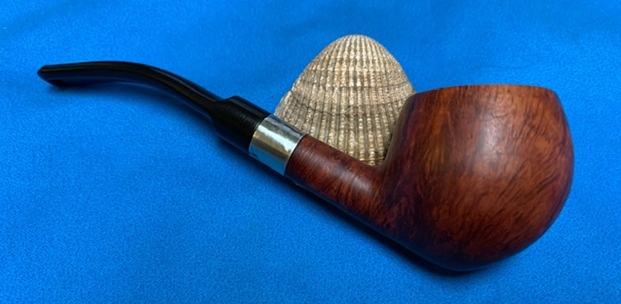
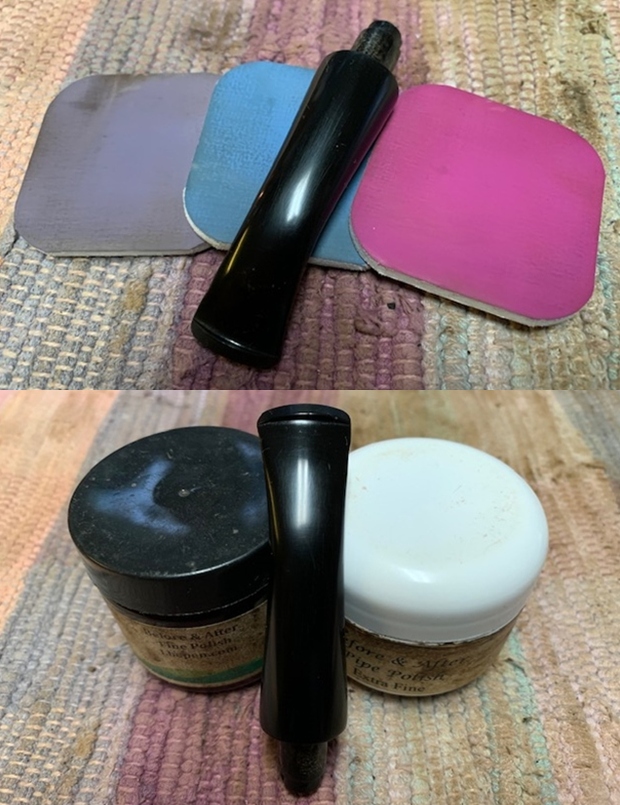
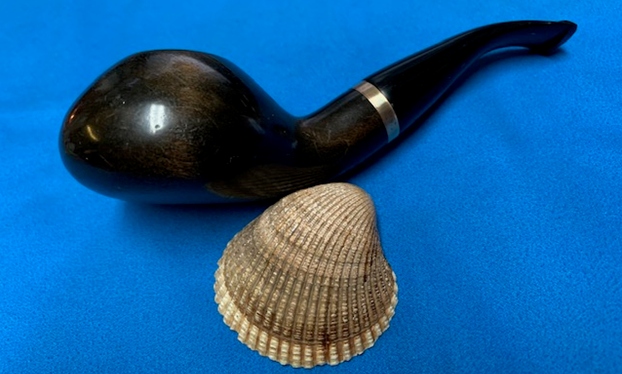
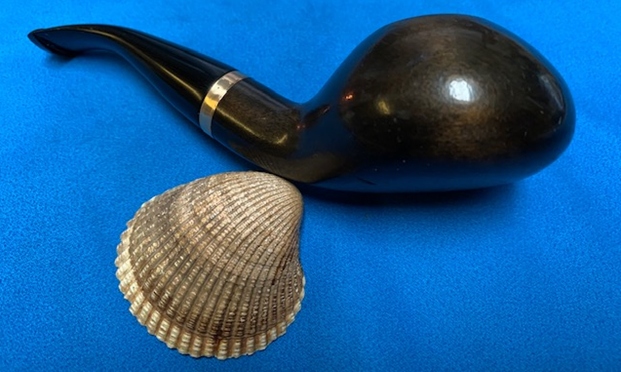
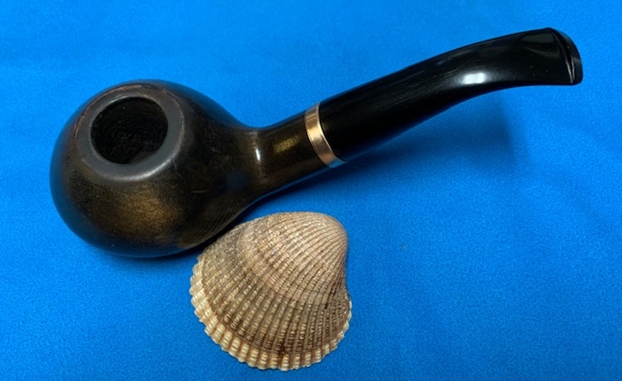
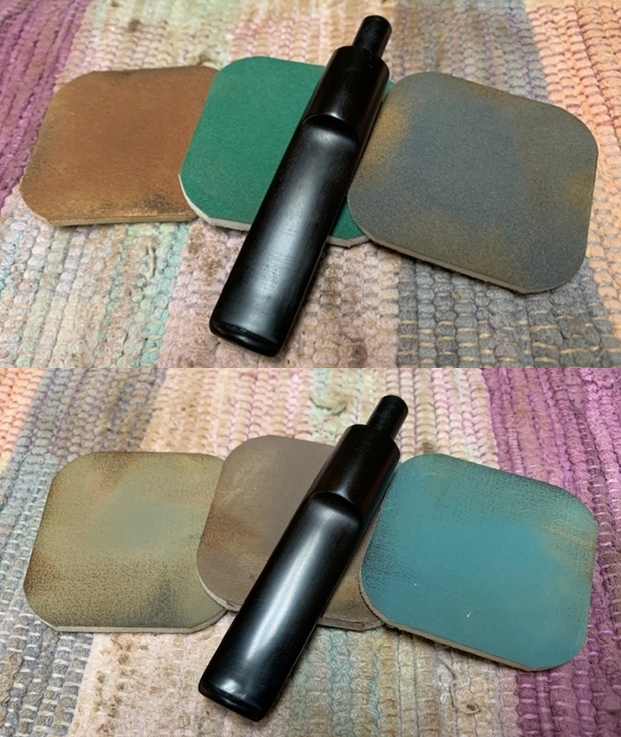
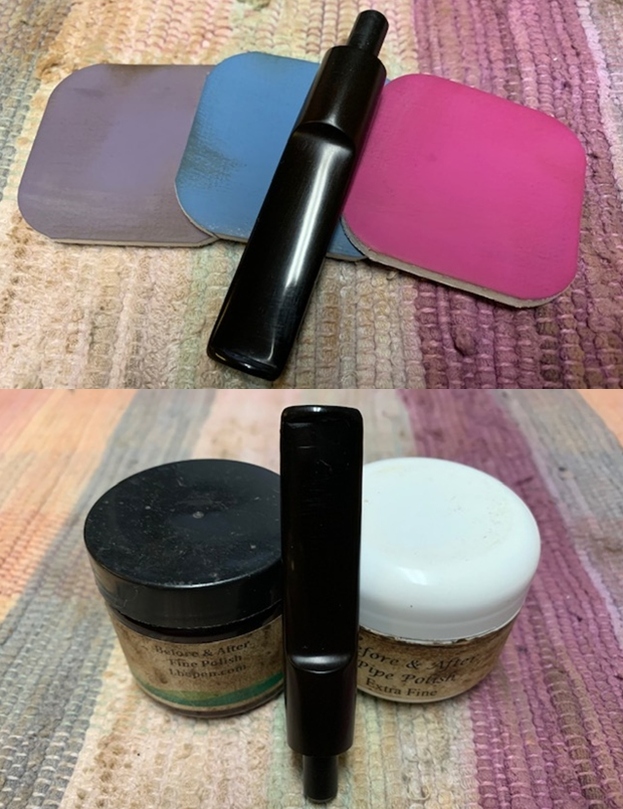
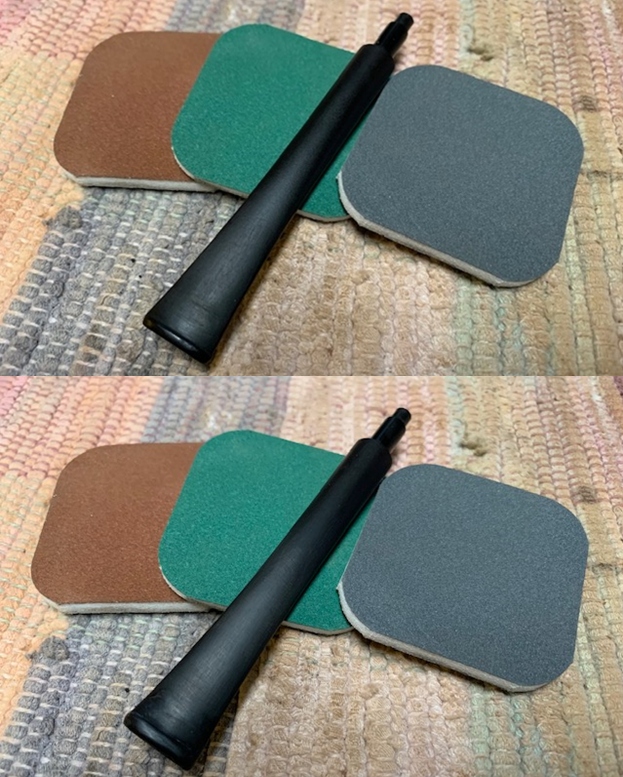
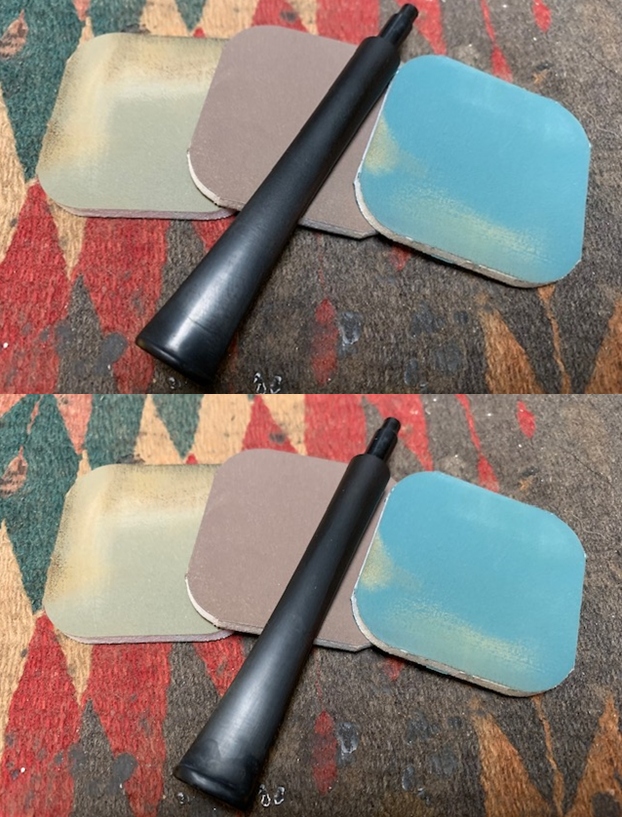
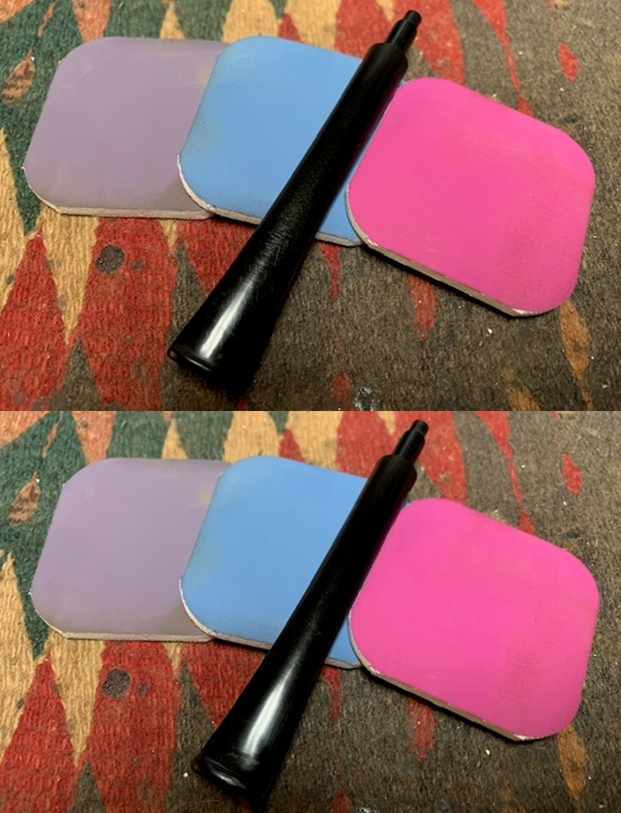
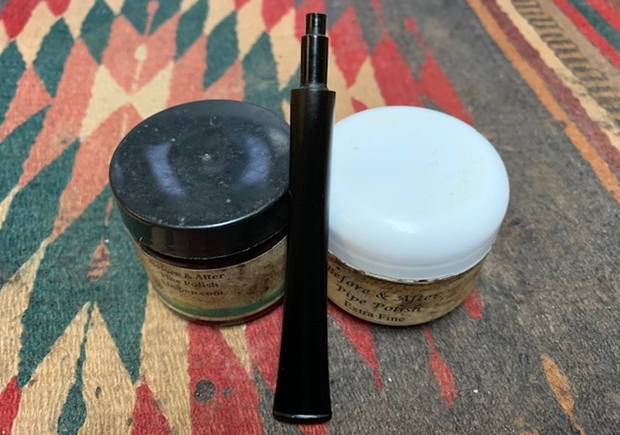
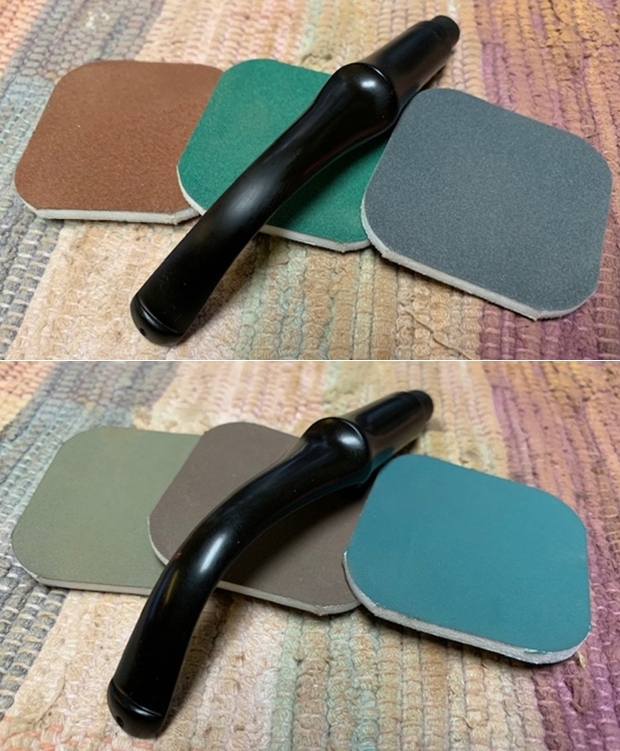
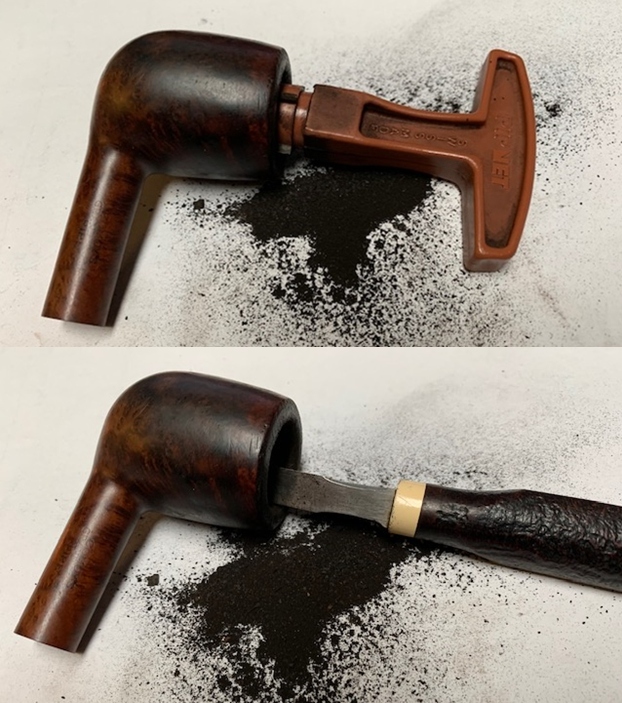
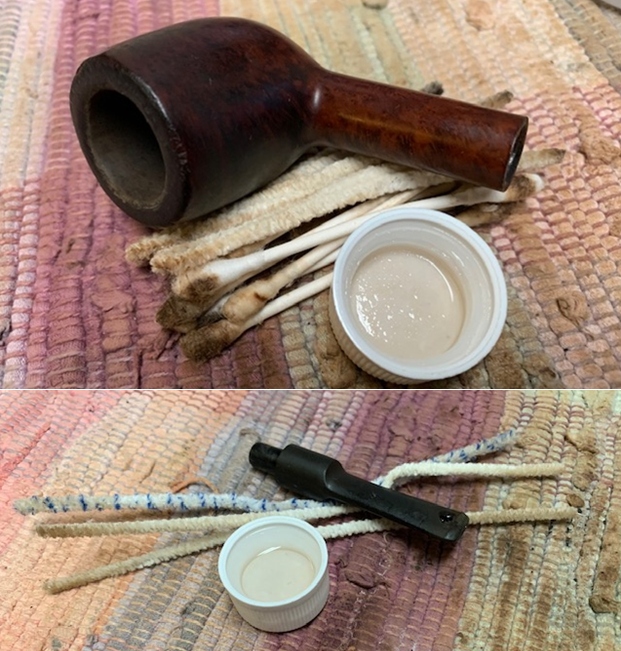
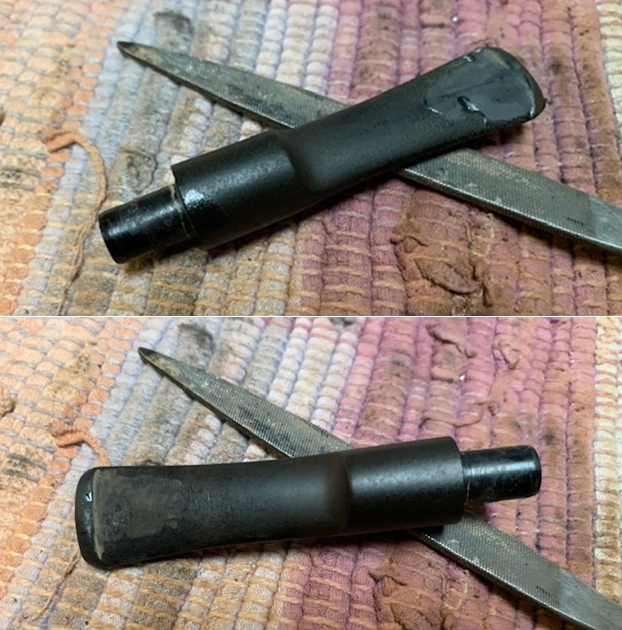
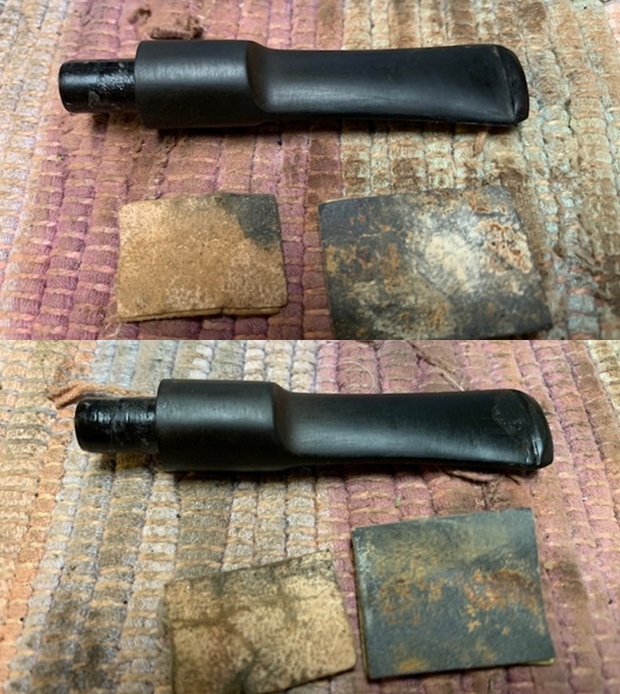
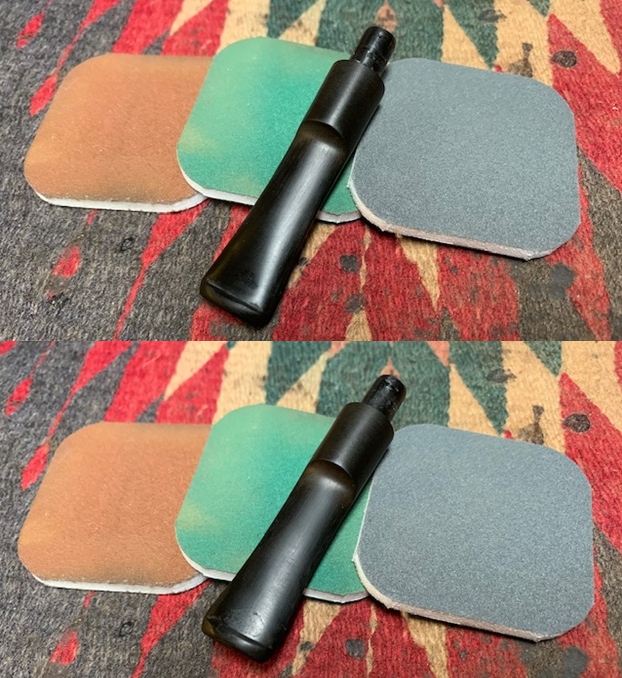
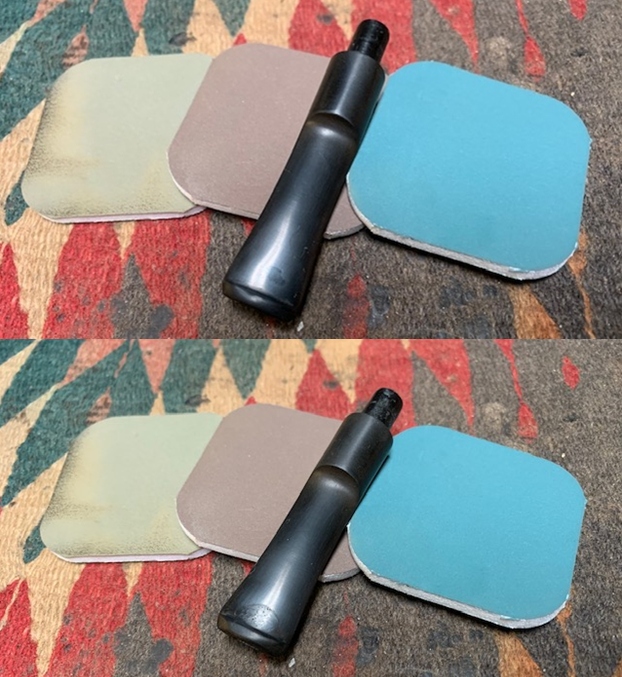
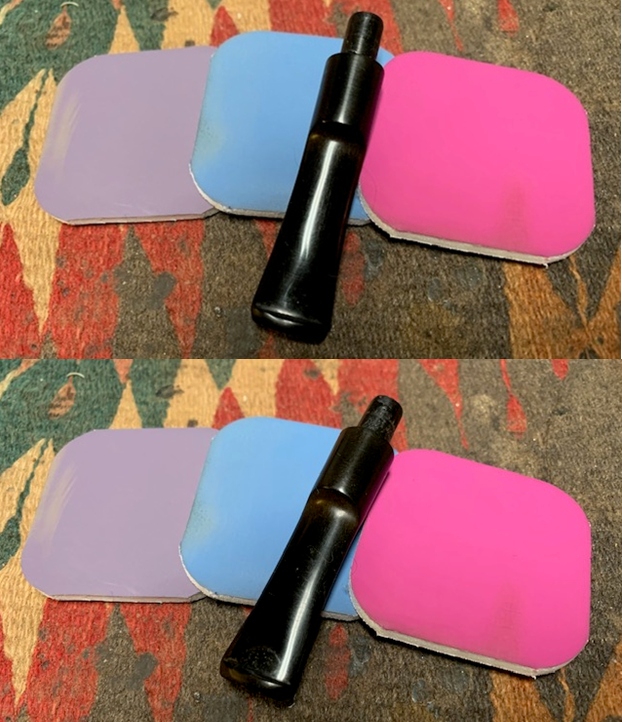
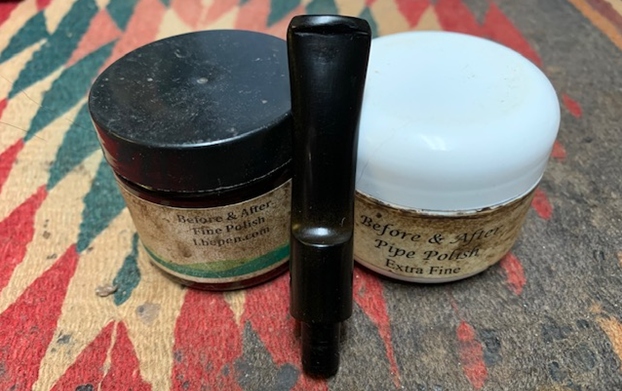
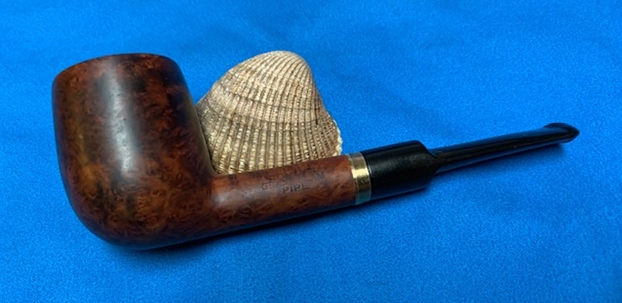
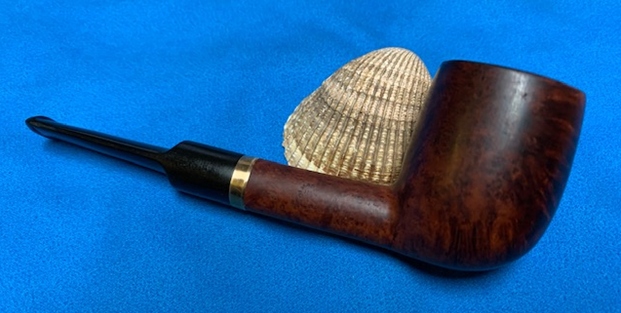
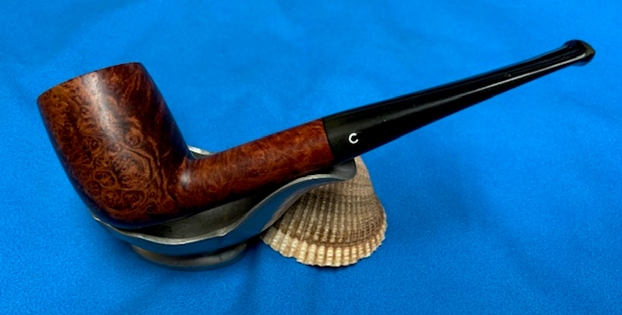
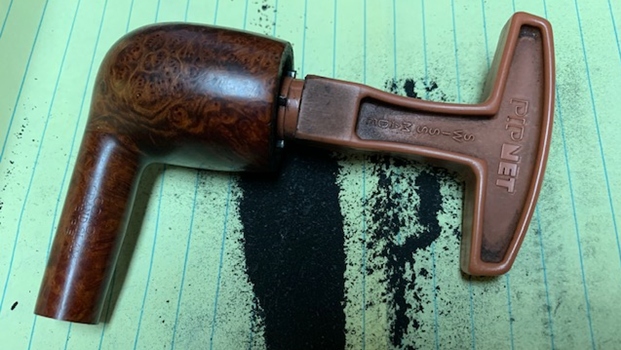
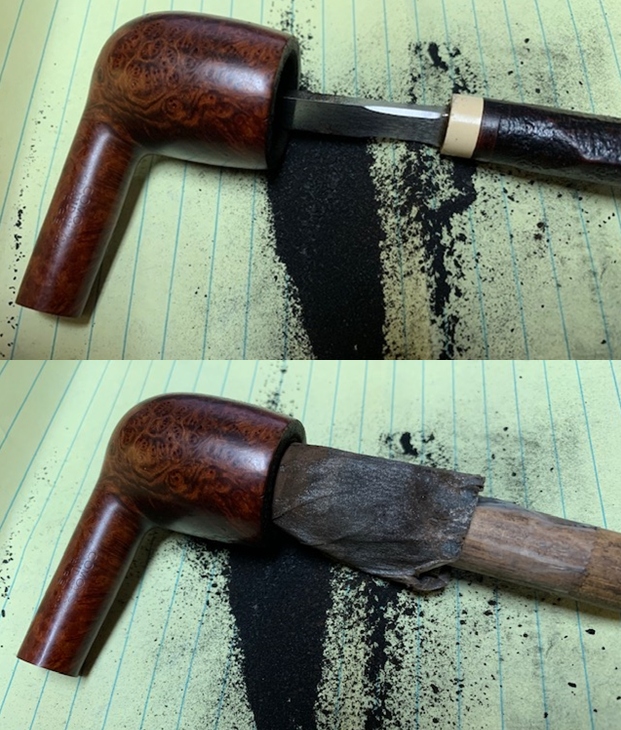
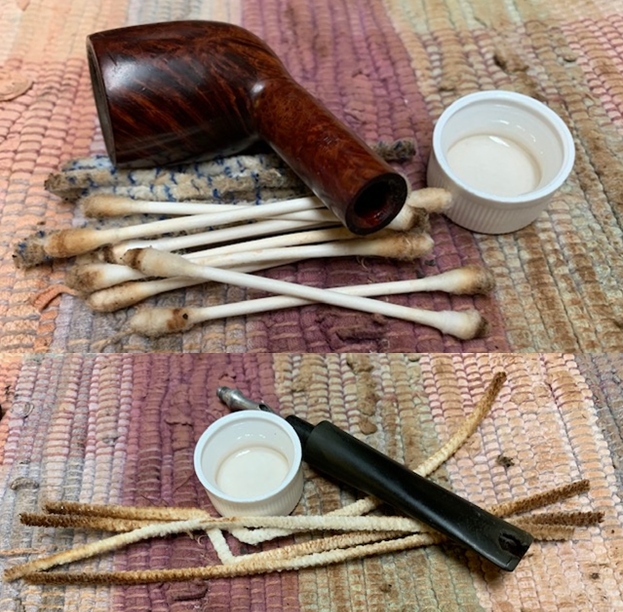
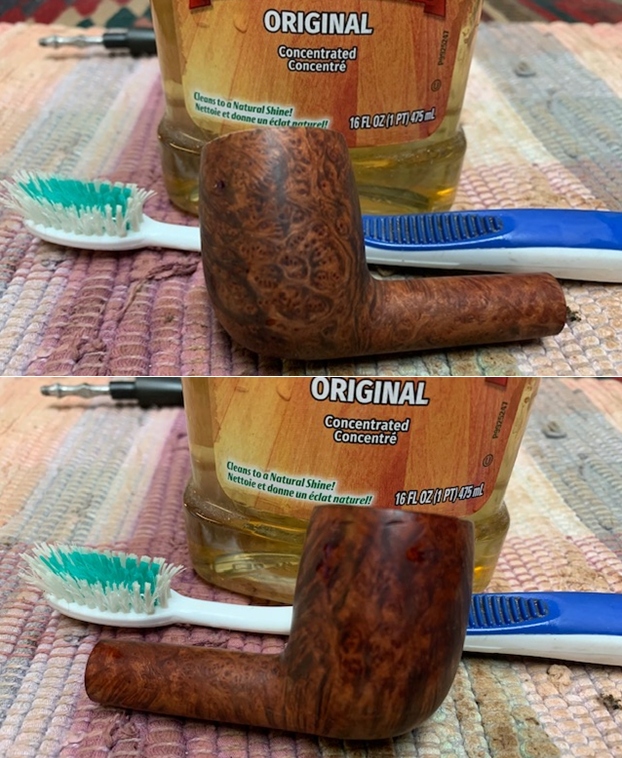
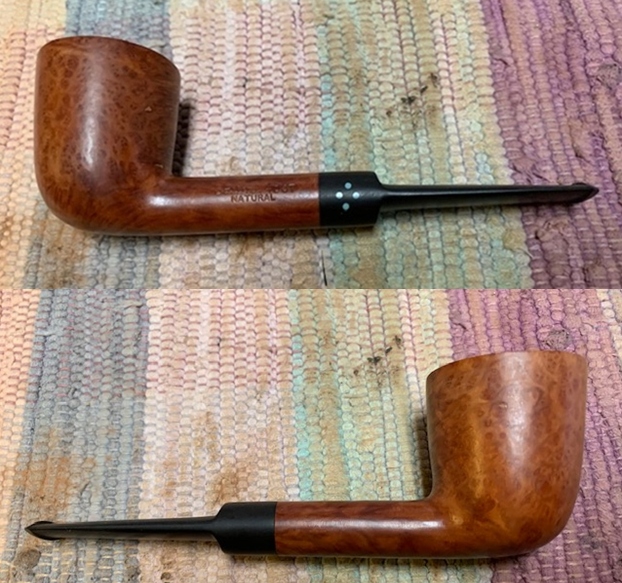
Now on to working on the pipe. Jeff had cleaned up the pipe with his usual penchant for thoroughness. He reamed the pipe with a PipNet pipe reamer and removed the rest of it with a Savinelli Fitsall Pipe Knife.  He scrubbed the bowl with undiluted Murphy’s Oil Soap with a tooth brush. He rinsed it under running warm water to remove the soap and grime. He cleaned out the inside of the shank and the airway in the stem with alcohol, cotton swabs and pipe cleaners. He soaked the stem in Before & After Deoxidizer and rinsed it off with warm water. I took photos of the pipe once I received it.   The rim top cleaned up really well. The rim top and outer edge of the bowl appear to be in good condition. The beveled inner edge also looked good. The stem surface looked good with a few small tooth marks and chatter on both sides near the button.  There was also some remaining oxidation visible on the stem. The stamping on the left and underside of the shank is clear and readable and reads as noted above.    I removed the stem and took a photo of the pipe to give a sense of the whole. The stem is a saddle with 4 Blue dots on the left side.Now it was time to do my work on the pipe. I polished the repaired areas and the rest of the briar with micromesh sanding pads – wet sanding with 1500-12000 grit pads and wiping it down after each pad with a damp cloth. I rubbed the bowl and shank down with Before & After Restoration Balm. I worked it into the surface of the bowl sides and shank with my fingertips to clean, enliven and protect the briar. I let the balm sit for a little while and then buffed with a cotton cloth to raise the shine. The grain came alive and the flaws while visible look better than when I began. I set the bowl aside and turned to work on the stem. I “painted” the stem with the flame of Bic lighter to lift the tooth marks in the surface of the vulcanite. While I was able to life most of them a few remained on each side. I filled these in with clear super glue. Once the repairs cured I sanded them out with 220 grit sandpaper to blend them in and started the polishing with 400 grit wet dry sandpaper.  It was in good condition and the tooth marks were light so I figured they would polish out fairly easily. I polished the vulcanite stem with micromesh sanding pads – 1500-12000 grit pads. I wiped it down with Obsidian Oil after each sanding pad. I used Before & After Pipe Polish – both Fine and Extra Fine to further polish the stem.       This Post-Transition Sasieni 4 Dot Natural Dublin is a great looking pipe now that it has been restored. The Natural finish around the bowl is quite beautiful and highlights the grain and works well with the polished vulcanite saddle stem. I put the stem back on the bowl and carefully buffed the pipe with Blue Diamond on the buffing wheel using a light touch on the briar. I gave the bowl and the stem multiple coats of carnauba wax on the buffing wheel and followed that by buffing the entire pipe with a clean buffing pad. I hand buffed the pipe with a microfiber cloth to deepen the shine. The finished Sasieni 4 Dot sits nicely in the hand and feels great. Give the finished pipe a look in the photos below. The dimensions of the pipe are Length: 5 ½ inches, Height: 2 inches, Outside diameter of the bowl: 1 ½ inches, Chamber diameter: 7/8 of an inch. I will be putting it on the rebornpipes store shortly. If you are interested in adding this pipe to your collection send me a message or an email. Thanks for reading this blog and my reflections on the pipe while I worked on it. There are many more to come!

Breathing Life into a Charatan’s Make London England Belvedere 373 Salisbury


Blog by Steve Laug

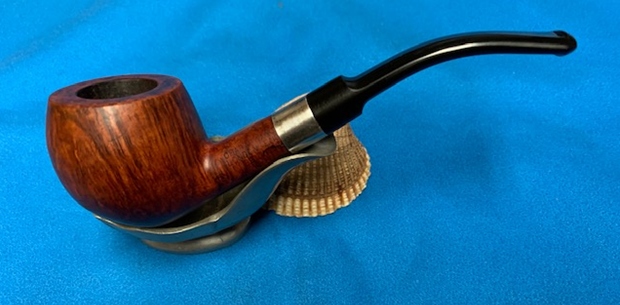
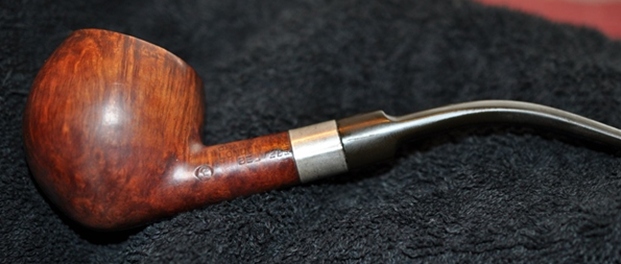
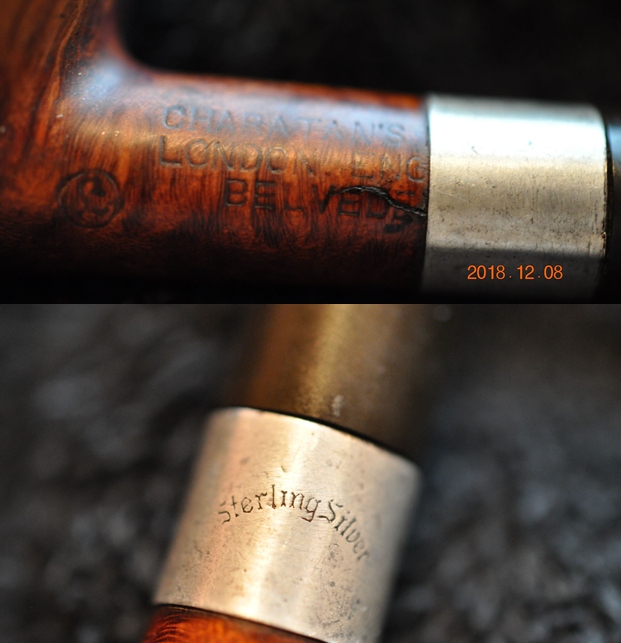
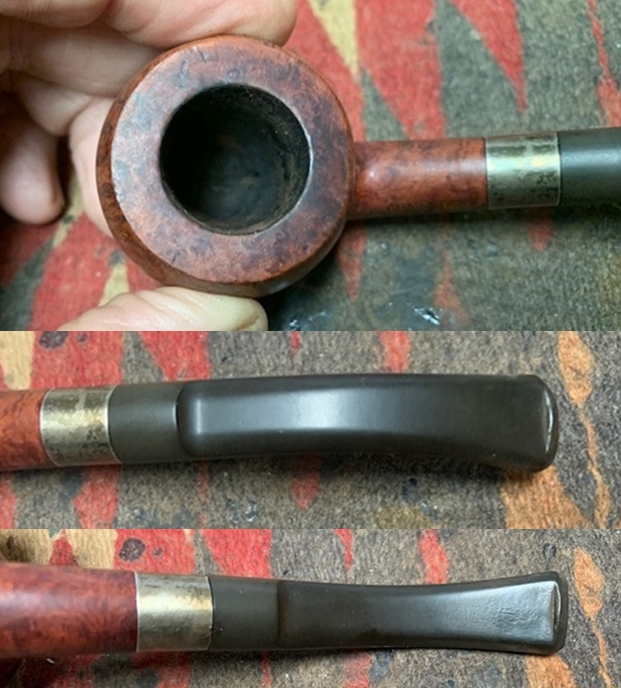
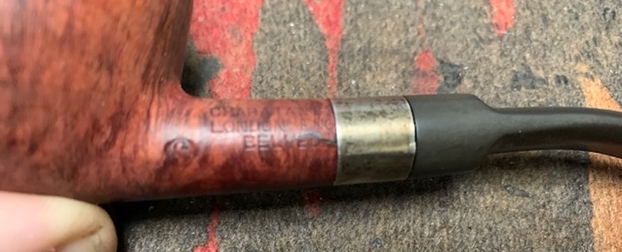
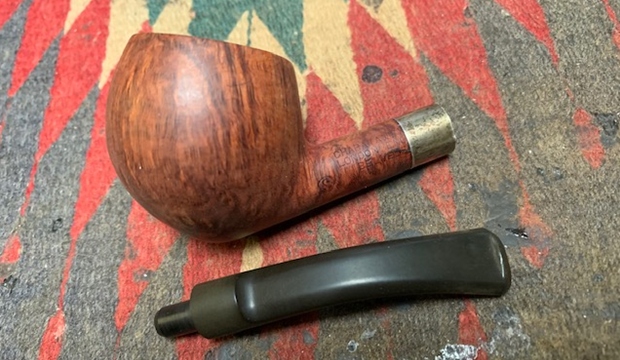
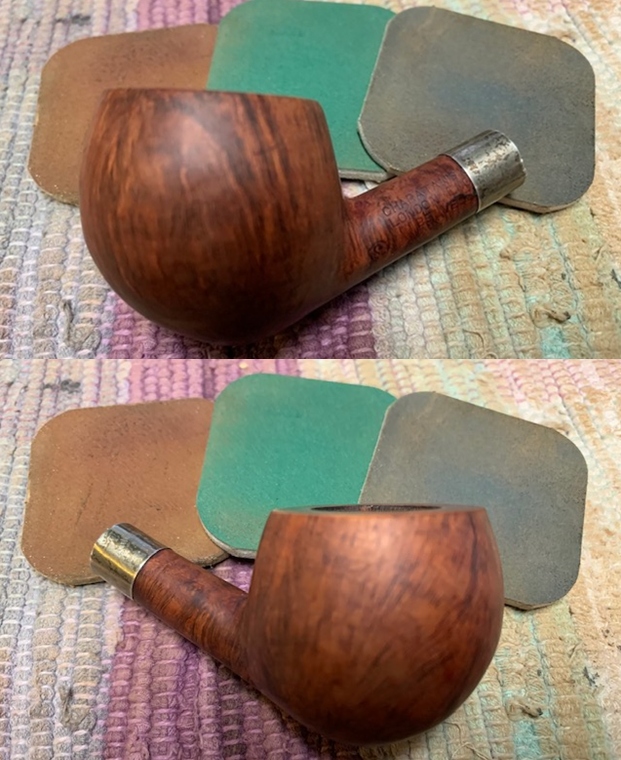
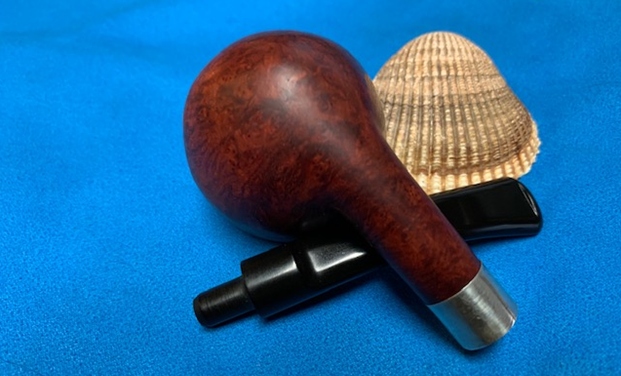
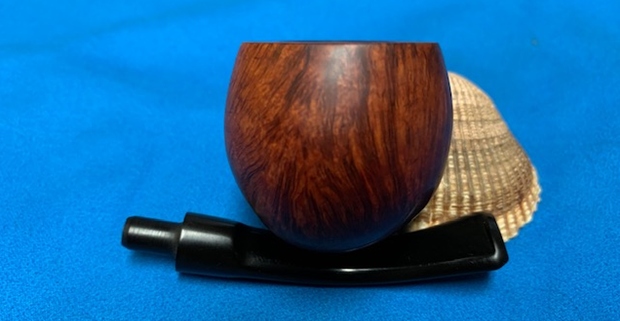
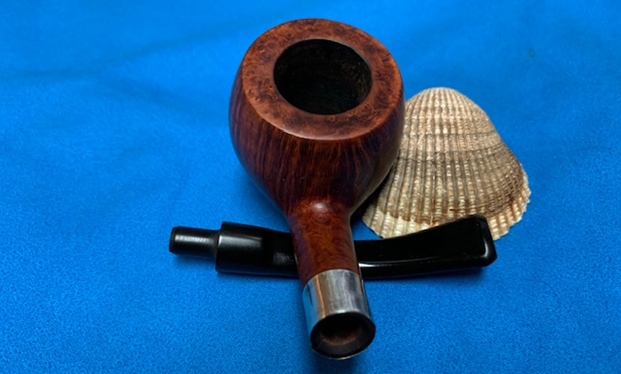
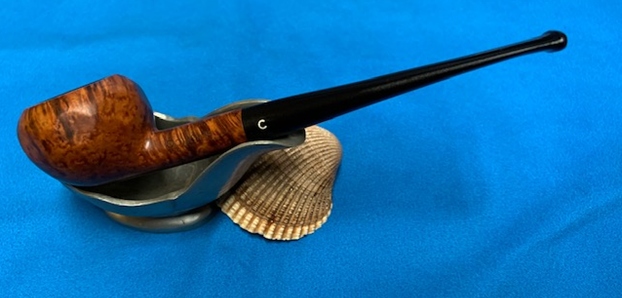
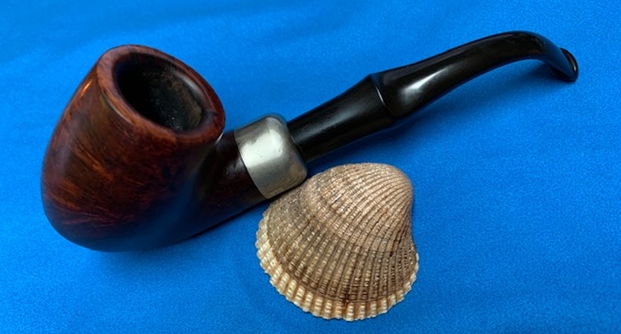
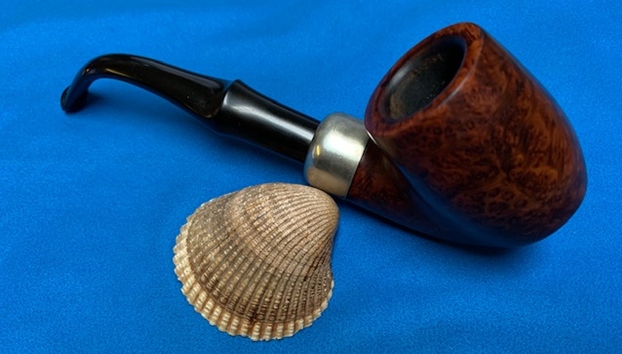
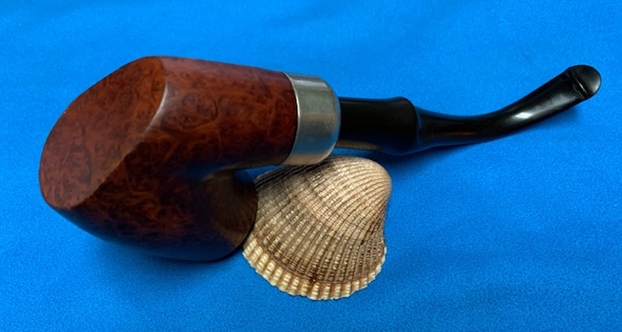
The next pipe on the work table came to us from an antique store in Brookings, Oregon, USA.  The pipe is smooth, nicely grained acorn shaped pipe with a Sterling Silver repair band and a saddle stem. The pipe is stamped on left side of the shank and reads Charatan’s Make [over] London England [over] Belvedere. There is also a cursive L in a circle that identifies it as a Lane Era pipe. A good portion of the stamp is covered by the silver repair band. There is no stamping on the right side of the shank. There was a lot of grime and dust ground into the smooth finish. The bowl was caked with a lava coat flowing onto the rim top and inner edge of the rim. The inside and outside edges looked to be in good condition but we would know more once Jeff had cleaned it. The stem was oxidized, calcified and had tooth chatter and marks on the top and underside near the button. There are no stamps on the stem and I think it is probably a replacement stem. The pipe had promise but it was very dirty. Jeff took some photos of the pipe before he started his cleanup work.   He took photos of the rim top, bowl and stem to give a clear picture of the condition of the pipe. The thickness of the cake and tobacco debris as well as the lava on the rim top and inner edge is visible. The photos of the stem show the oxidation, calcification and the chatter and tooth marks on the top and underside. Jeff took a photo the sides and heel of the bowl to give a picture of the grain around the bowl. It is quite stunning.The stamping on the left side of the shank is clear and readable and read as noted above. To begin the work on this one I turned to a previous blog I wrote on a Charatan’s Make Belvedere and copied the material from there below (https://rebornpipes.com/2020/06/06/the-next-pipe-from-bob-kerrs-estate-a-charatans-make-belvedere-2012/). I quote:
To try to figure out the era of the Charatan’s pipe I was working on I turned to the Pipephil website, Logos and Stampings. There is some really helpful information on each of the lines of Charatan’s Make pipes that entered the market. Here is the link to the section of the site that I turned to (http://www.pipephil.eu/logos/en/logo-charatan.html). There is an alphabetical listing of the lines but the Belvedere they showed had a stem made for a 9mm filter while the one I have is a nonfiltered pipe. The site did give a short history of the brand. I quote the portion that is most pertinent.

The brand was founded in 1863 by Frederik Charatan. When his father retired in 1910, Reuben Charatan took over the family business. All the pipes were handmade until 1973. The brand name has been overtaken by Dunhill in 1978 and sold in 1988 to James B. Russell Inc.(NJ, USA). During the period 1988-2002 Charatans were crafted by Butz Choquin in St Claude (France). Dunhill re-purchased Charatan brand name in 2002 and Colin Fromm (Invicta Briars, Castleford) followed up on freehand production.

I turned to Pipedia to see if I could find more information on the brand and possibly a link to the Belvedere line (https://pipedia.org/wiki/Charatan) but once again in the general article it was not listed.  It did give a little more historical information. I quote the pertinent parts and have highlighted in red the sections that give information on this particular pipe.

In 1863 Frederick Charatan, a Russian/Jewish immigrant, opened a shop in Mansell Street, located in the borough of Tower Hamlets, London E1, where he began to carve Meerschaum pipes. These pipes got very popular soon, and thus Charatan moved to a bigger workshop in Prescot Street, just around the corner. Here he began to make briar pipes which should make the name famous the world over. Charatan was the first brand to make entirely hand-made briars from the rough block to the finished pipe including the stems. The nomenclature “Charatan’s Make” refers to this method of production and was meant to differ Charatan from other brands who “assembled” pipes from pre-drilled bowls and delivered mouthpieces.

Being the undisputed No. 1 in English pipemaking, Charatan was approached by Alfred Dunhill who was unsatisfied with the quality of the pipes he imported from France. During 1908 – 1910 Dunhill bought pipes from Charatan paying exorbitant prices to ensure he had some of the very best pipes for sale in England. In 1910 he lured away Joel Sasieni, one of Charatan’s best carvers, and opened his own small pipe workshop on 28 Duke Street. On the retirement of his father in 1910 Reuben Charatan took over the family business…

…The pre-Lane period (prior to 1955) and the Lane era pipes (1955 to until sometime between 1979 – 1984) are of primary interest the collector. The Lane era is often quoted as beginning about 1950… Charatan records are almost non-existent before Lane due to a factory fire, making it difficult to date pre-Lane pipes. Charatan used 4 basic grades prior to 1950: Supreme, Selected, Executive, and Belvedere. After 1950 Herman Lane’s influence began, and the grades started to expand. In 1955 Lane took over sole distributorship of Charatan in the US. In 1957 he introduced the Supreme S. Most of his other introductions were from the 60’s and early 70’s…

The section called Miscellaneous Notes had some interesting information. The pipe I was working did not have the Double Comfort (DC) bit but I am pretty certain that the stem was a replacement. It has Serif L on the shank makes the Lane Era designation certain.

Charatan records indicate the DC (Double Comfort) bit was introduced in the 50’s, but some report seeing them in earlier production. Still others indicate they were introduced by Lane in 1960. Regardless, the DC bit is not an accurate way to date a pipe because many Charatan’s were made with regular and saddle type bits throughout the “Lane Era”…

…The Lane Trademark serif and circled L indicates the pipe is from the “Lane Era” (approx. 1955 to 1979 -1984?), however it appears that both the English factory or Lane themselves sometimes, or perhaps even often forget to stamp the L on a pipe. The Charatan factory was known for inconsistencies, especially in stampings. Therefore, although an L on the pipe definitely defines it as a Lane Era pipe, the lack of it could simply mean the pipe missed receiving the stamp from the factory. The lack of the trademark could also mean the pipe was destined for the European market.

I continue digging further into the dating of the pipe, but what I had found was a good start for me. If some of you would like to try your hand at dating it more accurately as to the time period it came out you might want to check out the article on Pipedia on Dating Charatans (https://pipedia.org/wiki/Dating_of_Charatans).

I also reread the article on Pipedia by the Italian fellow who contributed some really helpful information on the brand (https://pipedia.org/wiki/Charatan_-_Milan_2014). I quote the section on the Second period: Reuben Charatan 1910 – c. 1962

– In 1962 Herman Lane took over the business from the Charatan family, although he had already influenced production from the 1950s.

– The pipes were mostly larger than the previous ones and corresponded in size to Dunhill group 5. These are slightly less rare, but still difficult to find.

– Stem: Usually in ebonite, saddle shaped or tapered, bearing a fine “CP” stamp, underbore system (see below) used when necessary.

– Shank: The shape code is stamped on it together with the nomenclature “CHARATAN’S MAKE LONDON ENGLAND” arranged in two lines. From 1955 onwards on the models marketed for the USA there is also a serif and circled capital “L” (but not all models bear this) which resembles the pound sterling symbol. The “L” is for Lane, the importer.

From 1958, Lane changed the nomenclature for models marketed for the US to clarify the message: “MADE BY HAND”.  In this period the underbore was introduced. Its manufacturing period ranged between 1920 and c.1930. This model was equipped with a duralumin plunger trap fitted in the stem, which served to clean the residue more easily. This particular model bore a special stamp on the stem, and also had its own catalogue…

QUALITY GRADES…The stem did not only display the stamps mentioned above. Another stamp that can help dating is the one referring to the quality of the pipe. Until Herman Lane arrived on the scene there were four quality grades. Starting with the lowest: Belvedere, Executive, Selected, and Supreme. Lane went on to add higher grades from time to time: Supreme S, Supreme S100, S150, S200, S250, S300, Coronation, Royal Achievement, Crown Achievement, and Summa Cum Laude; these last three are extremely rare and almost impossible to find. He also invented other, different grades, even changing the previous pipe classification standards. We will not go into detail here, but it means that if we find an S100 or Coronation the pipe was manufactured following Herman Lane’s acquisition. In particular, the FH mark, or Freehand pipe was commissioned to the famous Danish craftsman, Preben Holm.

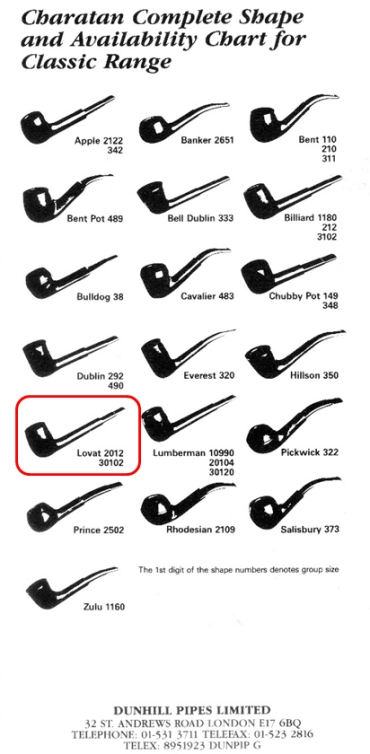
I am also including a shape chart from that site. I drew a green rectangle around the 373 Salisbury shape as it is the same shape that I am working on. (The red rectangle was for the previous Lovat 2012 that I worked on.

Now I knew a bit about the pipe I was working on. I had a shape name and number that I did not have previously as it is covered by the silver band. It was now time to work on this Salisbury shaped Charatan’s Make Belvedere.

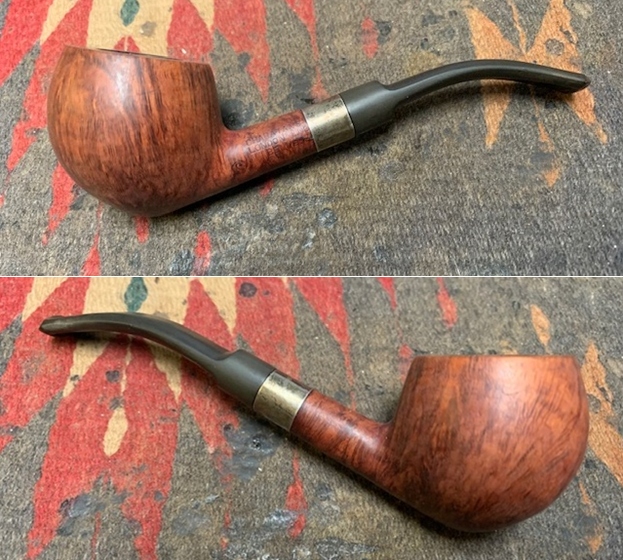
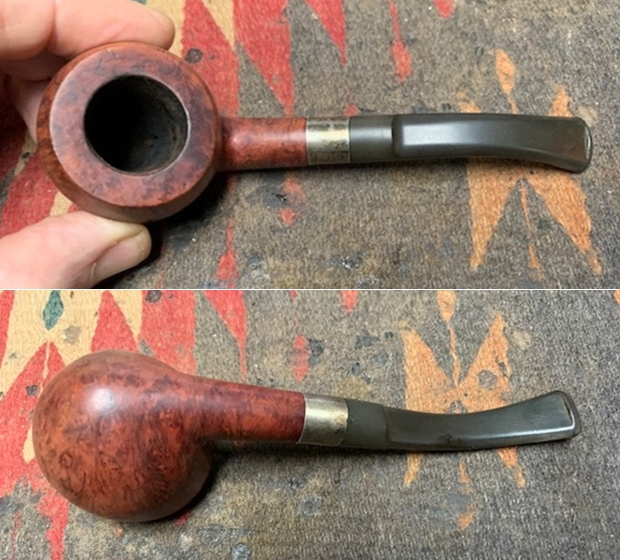
Jeff had cleaned up the pipe with his usual penchant for thoroughness. He reamed the pipe with a PipNet pipe reamer and removed the rest of it with a Savinelli Fitsall Pipe Knife.  He scrubbed the bowl with undiluted Murphy’s Oil Soap with a tooth brush. He rinsed it under running warm water to remove the soap and grime. He cleaned out the inside of the shank and the airway in the stem with alcohol, cotton swabs and pipe cleaners. He soaked the stem in Before & After Deoxidizer and rinsed it off with warm water. I took photos of the pipe once I received it.  The rim top cleaned up really well. The rim top and outer edge of the bowl appear to be in good condition. There is some damage on the inner edge on the rear back of the bowl. The stem surface looked good with some remaining oxidation and some tooth marks and chatter on both sides near the button.  The stamping on the right and left side of the shank is clear and readable and reads as noted above.  There is also a repaired crack extending into the word Belvedere that explains the silver band on the shank.I removed the stem and took a photo of the pipe to give a sense of the whole. It would clean up and be a gorgeous pipe.Now it was time to do my work on the pipe.  I polished the briar of the bowl and rim top with micromesh sanding pads – dry sanding with 1500-12000 grit pads. I wiped the briar down after each pad with a damp cotton pad.    I rubbed the bowl and shank down with Before & After Restoration Balm. I worked it into the surface of the bowl sides and shank with my fingertips to clean, enliven and protect the briar. I let the balm sit for a little while and then buffed with a cotton cloth to raise the shine.   I polished the sterling silver band with a jeweler’s cloth to remove the tarnish and protect the silver from further tarnish. I set the bowl aside to work on the stem. I put the stem in the Pipe Stem Oxidation Remover from Briarville USA. I am still experimenting with the product to remove the oxidation that remained on the stem. I let it soak overnight and took it out of the bath and wiped it down with a paper towel. I scrubbed the surface of the stem with Soft Scrub to remove the remnants of oxidation on the stem surface. The photos show the stem at this point. I sanded out the tooth marks on the top and underside of the stem with 220 grit sandpaper and started the polishing with 400 grit wet dry sandpaper.    The stem was in good condition and the tooth marks were light so I figured they would polish out fairly easily. I polished the vulcanite stem with micromesh sanding pads – 1500-12000 grit pads. I wiped it down with Obsidian Oil after each sanding pad. I used Before & After Pipe Polish – both Fine and Extra Fine to further polish the stem.   This Charatan’s Make Belvedere in a 373 Salisbury Shape is a great looking pipe now that it has been restored. The rich, brown stained finish around the bowl is quite beautiful and highlights the gorgeous straight and flame grain. The finish works well with the polished Sterling Silver repair band and the vulcanite saddle stem. I put the stem back on the bowl and carefully buffed the pipe with Blue Diamond on the buffing wheel using a light touch on the briar. I gave the bowl and the stem multiple coats of carnauba wax on the buffing wheel and followed that by buffing the entire pipe with a clean buffing pad. I hand buffed the pipe with a microfiber cloth to deepen the shine. The finished Charatan’s Make Belvedere Acorn/Salisbury sits nicely in the hand and feels great. Give the finished pipe a look in the photos below. The dimensions of the pipe are Length: 5 ¾ inches, Height: 1 ¾ inches, Outside diameter of the bowl: 1 ½ inches, Chamber diameter: ¾ of an inch. I will be putting it on the rebornpipes store shortly. If you are interested in adding this pipe to your collection send me a message or an email. Thanks for reading this blog and my reflections on the pipe while I worked on it. There are many more to come!
Restemming a Mr. Brog Pear Wood No. 48 Chochla Squashed Tomato


Blog by Steve Laug

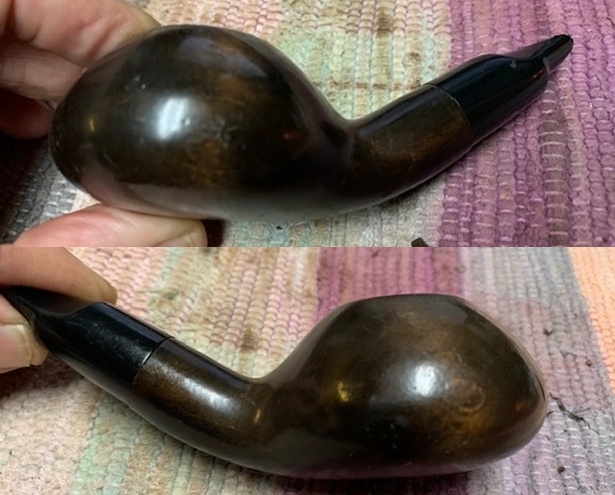
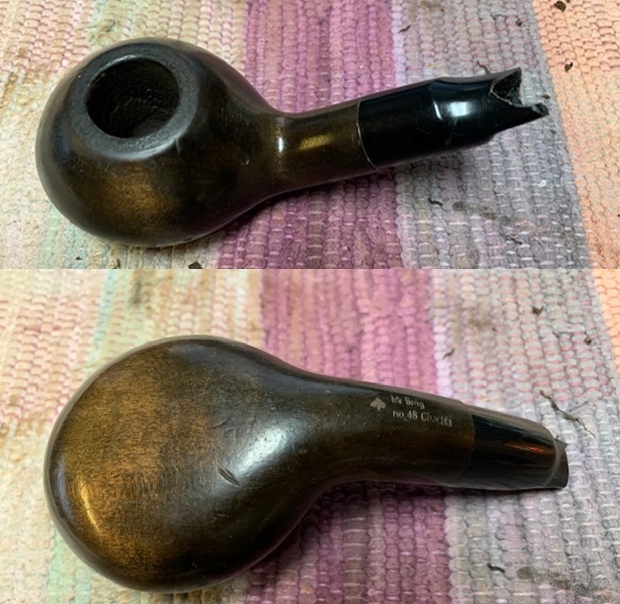
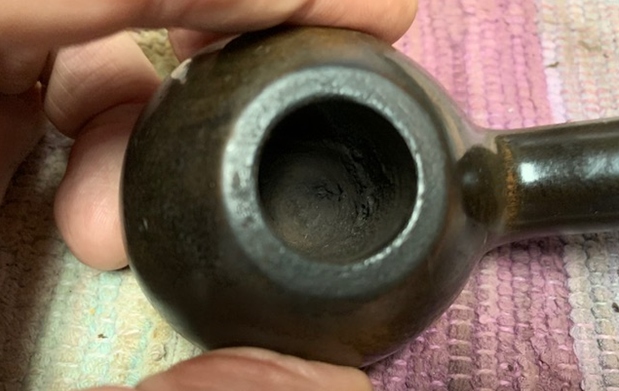
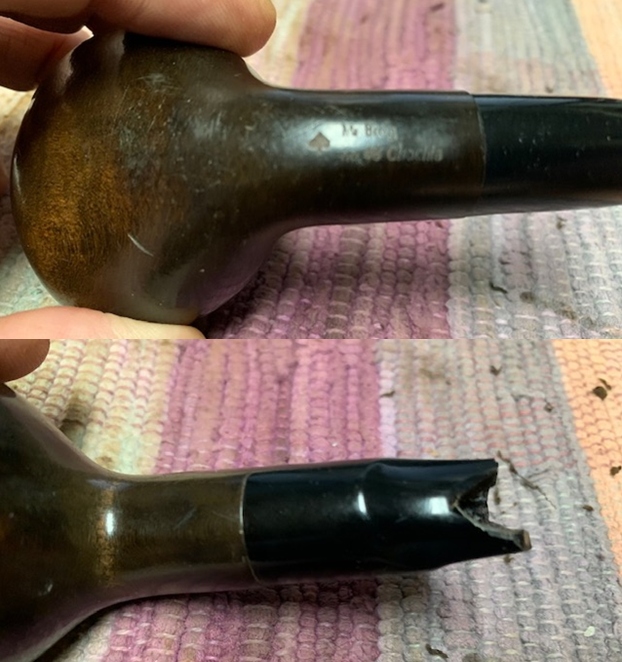
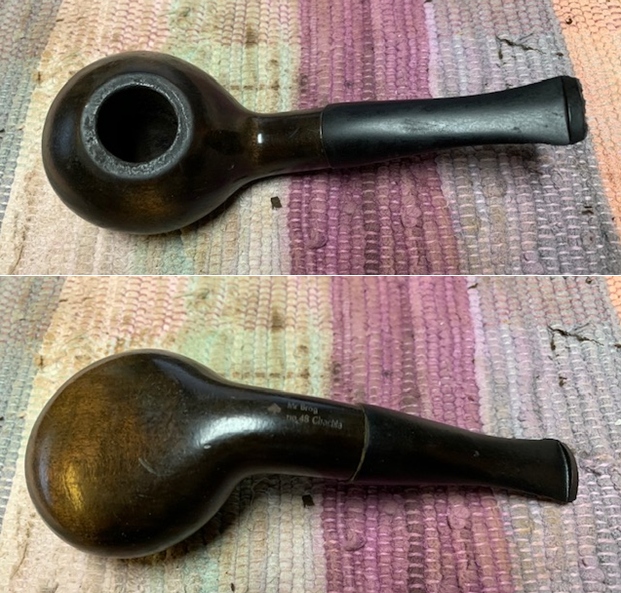
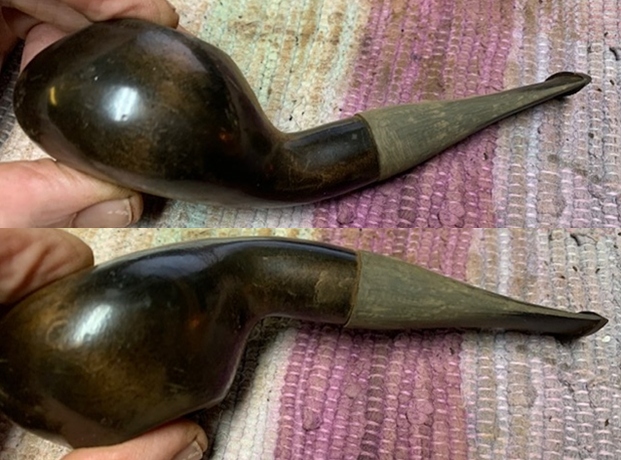
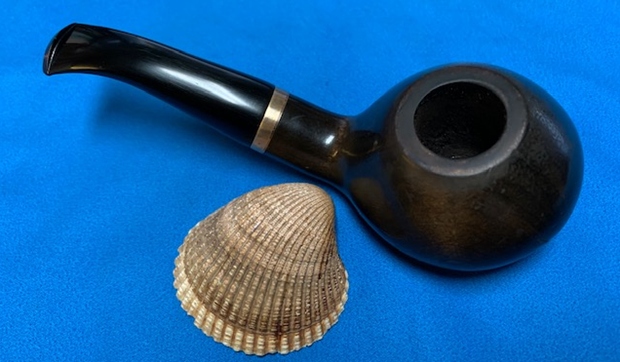
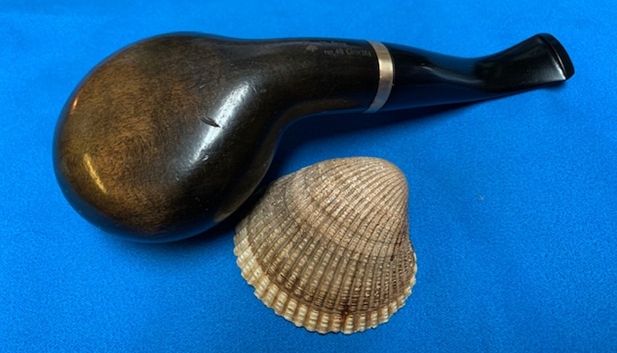
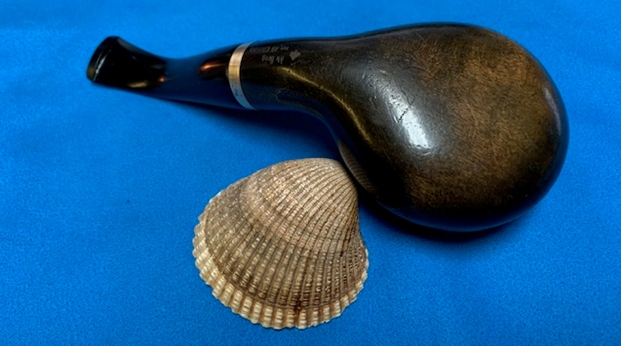
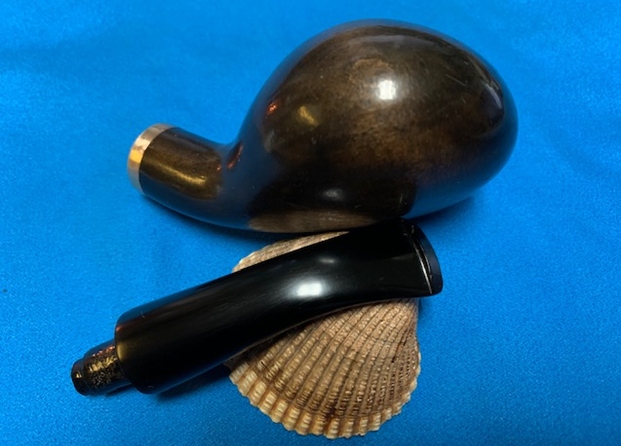
Last week I received an email from a friend in Calgary who I had lost track of over time. We knew each other on Smokers Forum UK and had emailed back and forth for a while but I bet it has been over 8-9 year since I had heard from him. He wrote reminding me of who he was and asking me if I would be willing to put a new stem on his brother in-law’s Mr. Brog pipe. I really am trying to not take on more work and get caught up on the backlog of pipes that Jeff and I have picked up along the way but I did not feel like I could say no so the pipe is now on the desk top. The pipe was not briar but was made out of pear wood. I have smoked a few pear wood pipes in the past and they have been good smoking pipes. The broken stem was made for a filter but the owner wanted it replaced with a regular stem so that was going to be simpler for me. I took some photos of the pipe showing the remnant of the broken stem. Before I started working on the pipe I wanted to see what the original stem looked like and I wanted some background information on the Pear Wood Pipes. I decided to check on the Mr. Brog Website (https://mrbrog.com/collections/pear-wood-pipes) to see what I could find out.

The first information that I found was the following information on the wood the pipe was made of. I quote

Pear wood is a great alternative to briar wood. Pear wood is very dense and a hard wood which is great for a pipe you can have for the years to come. Also pear wood gives off a very pleasant smell and taste while smoking.

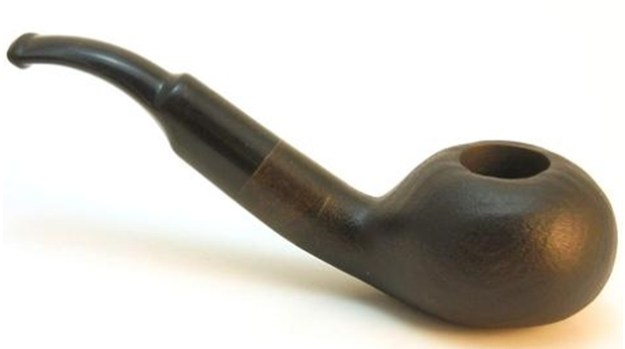
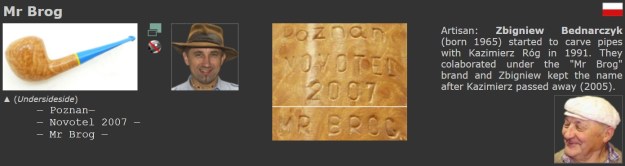
I then turned to the catalogue of pipes and shapes that were available in pear wood and looked specifically for the Chochla No. 48. I found the shape and the pipe listed but it was in a sandblast finish. The shape and the original stem were clearly visible (https://mrbrog.com/collections/pear-wood-pipes/products/smoke-pipe-chochla-no-48-pear-wood-root-hand-made-by-chochla?variant=32087227597). I have included a picture from the website. Now I knew what the stem length and shape were for the broken piece that I had.I decided to do a bit of digging on the history of the brand. I turned first to Pipephil’s site to get a quick overview (http://www.pipephil.eu/logos/en/logo-m8.html). From there I learned that the brand started in Poland in 1991 in the area known as the “St. Claude of Poland’. It was started by Zbigniew Bednarczyk along with Kazimierz Rog. Zbigniew kept the name after Kazimierz died in 2006.I turned to Pipedia for a bit more detail of the history (https://pipedia.org/wiki/Br%C3%B3g).

Pracownie Fajek Bróg was founded as Mr Bróg in Przemysl, “the Saint-Claude of Poland”, in 1991. Master craftsman Kazimierz Rog, the senior partner, had been a pipemaker since 1947, starting as an apprentice and later partner of Wiktor Winiarski and Zbigniew Mazuryk, followers of legendary Ludwik Walat. Zbigniew Bednarczyk was completely new to pipemaking, but as a non-professional sculptor, painter and poet he surely had pretty enough artistic disposition.

Mr Brog started out offering 10 models of briar pipes and 10 models made of wild pear, wild cherry and other unexpected materials, available both smooth and rusticated and polished with natural waxes only. The experience of the old master and the dynamic passion of his young friend made the brand soon well-known in Poland. Little by little they enlarged their program turning towards a more artistically minded way of pipemaking. This was the bedrock for success on international markets.

Kazimierz Róg, highly honored, passed away after a lengthy illness on June, 26th 2006. The firm is continued by Zbigniew Bednarczyk and his wife Renata.

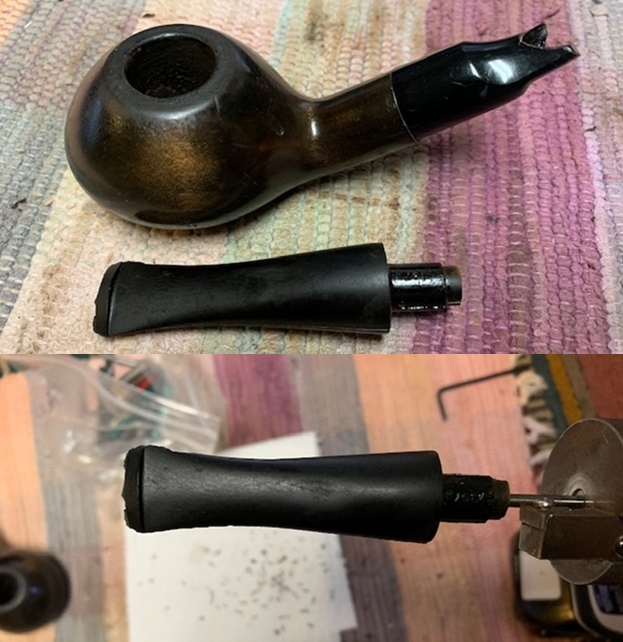
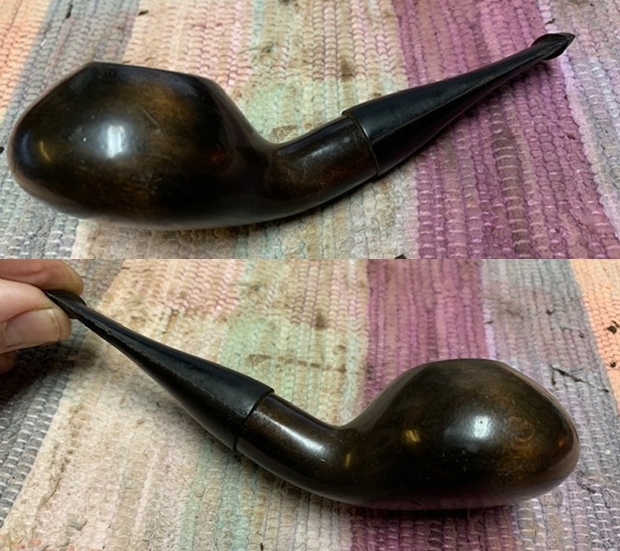
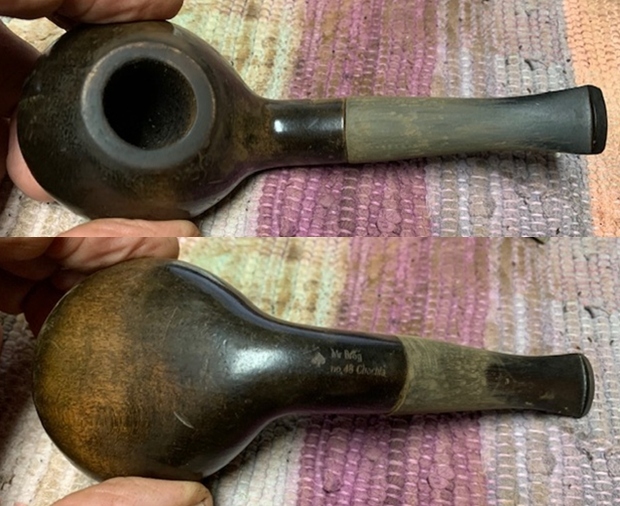
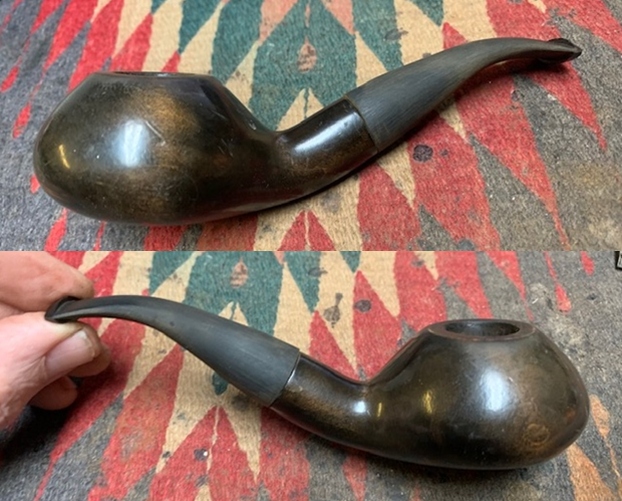
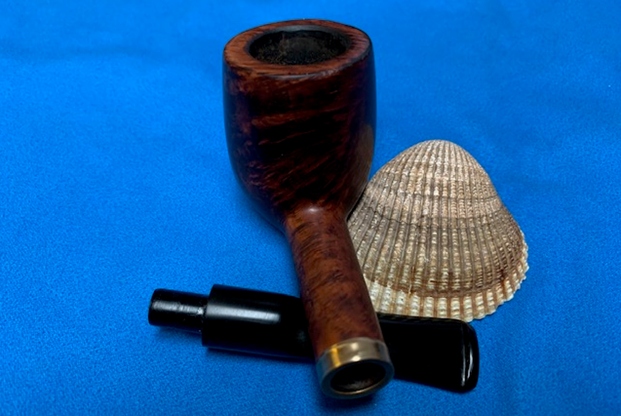
From the article as well as time spent on the Mr. Brog website I learned that the brand included both briar and pear wood pipes. That was new information for me. Now I had the background information I needed and it was time to work on the pipe. I started by taking a few close up photos of the pipe with the broken stem to give an idea of the condition of the pipe. It was well smoked and a bit dirty but in decent condition. Before I sent it back I would clean up the bowl and rejuvenate the finish. I went through my stem until I found one that was approximately the same length as the one in the photo. It was a vulcanite taper stem and would need to be fit to the shank and mortise but I think it would look good when finished. I used the PIMO tenon turning tool to clean up the tenon and the flat edge of the stem so that it would seat right in the shank.I put the stem on the shank and took photos of the look at this point. The length of the stem will work well with the pipe. It will need to be given a bend but the look works.  I used a Dremel and sanding drum to take down most of the excess diameter of the stem. I get it as close as I can and do the rest of fitting by hand. I sanded the stem with 220 grit sandpaper to remove more of the excess diameter of the stem. Still more work to go on it but it is getting there. I used a heat gun to bend the stem to fit the flow of the bowl and shank.  I gave the fellow a call in Calgary because I had an idea to add a decorative brass band on the shank end. I sent him a photo of it before I set it in place on the shank end. He was excited about it because his brother in law is a hobby machinist who loves working with brass. I pressed the band onto the shank end and polished it.    With the band in place I put the stem in the shank and took some photos. I needed to do a bit of adjusting to the stem diameter at the topside. But the stem was looking very good at this point and the band was a great touch.   I rubbed the bowl down with Before & After Restoration Balm and worked it into the surface of the pear wood with my finger tips. I let it sit on the bowl for 10 minutes and buffed it off with a soft cotton cloth to raise a shine.   I set the bowl aside and turned my attention to the stem. I polished out the scratching left behind by the shaping of the stem. With each progressive sanding pad – 1500-12000 grit pads – the stem began to take on a shine. I wiped the stem down after each sanding pad with Obsidian Oil. I finished the stem with Before & After Fine and Extra Fine Polish. I buffed the stem with a soft cloth to raise the shine.   The Mr. Brog Pear Wood Chochia No. 48 Squashed Tomato turned out really well with its new stem. The brass band that I put on the shank for decorative purposes gave a splash of bling to flow of the pipe. I put the stem back on the shank and buffed it lightly with Blue Diamond to raise the shine. I gave the bowl and stem multiple coats of carnauba wax and buffed it with a clean buffing pad. I hand buffed the bowl with a soft cloth to deepen the shine. The dimensions of the pipe are Length: 6 inches, Height: 1 ½ inches, Outside diameter of the bowl: 1 ½ inches, Diameter of the Chamber: ¾ of an inch. I will be packing it up and sending it back to Calgary. I am looking forward to hearing from the pipeman there what he thinks of his new pipe. Thanks for reading through my thoughts and reflections as I worked on this pear wood pipe.

Righting a Wrong- Restemming a Hilson “Viva” # 278 Freehand Pipe


Blog by Paresh

This pipe had been purchased by me on eBay many eons ago and was the first pipe for me from the web store. I had this pipe in my rotation when it fell out of favor after I got a few pipes from Steve and I had commenced my journey in to the world of restoring my huge cache of inherited pipes. I felt that this pipe just did not smoke right, but what was the issue never crossed my mind and neither did I put my mind to it since I now had other pipes to enjoy!!

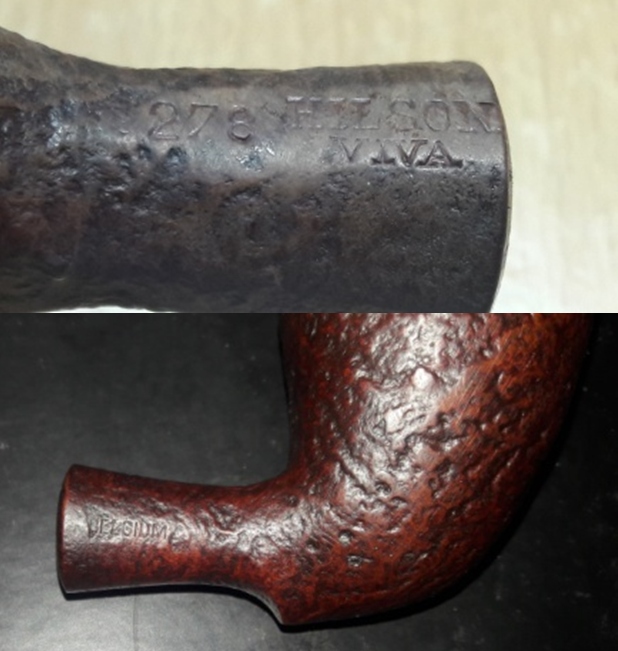
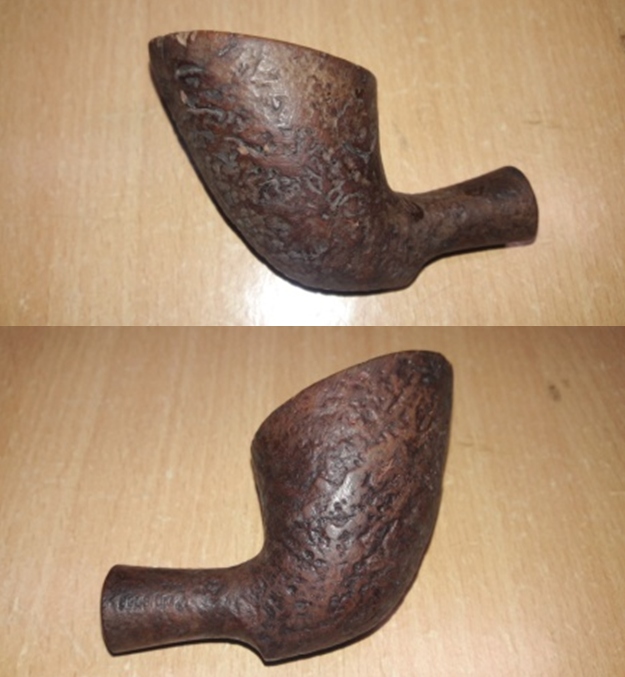
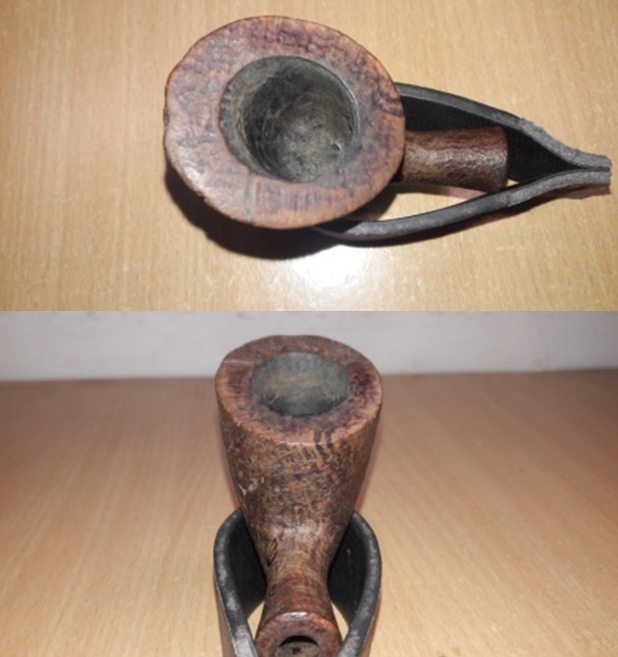
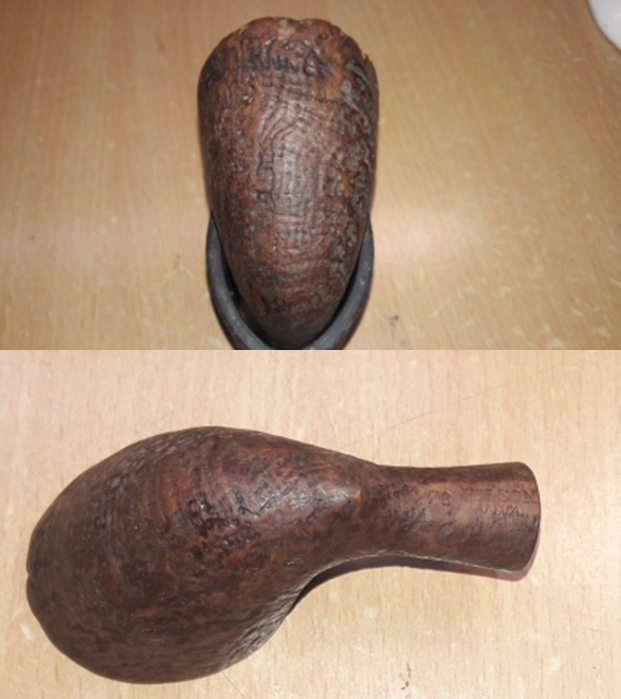
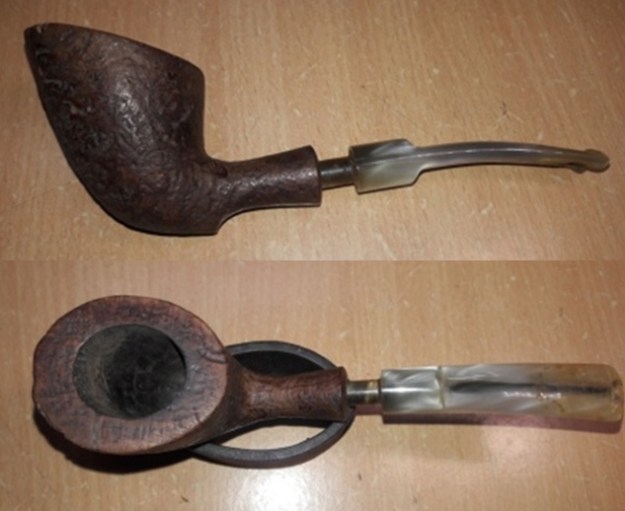
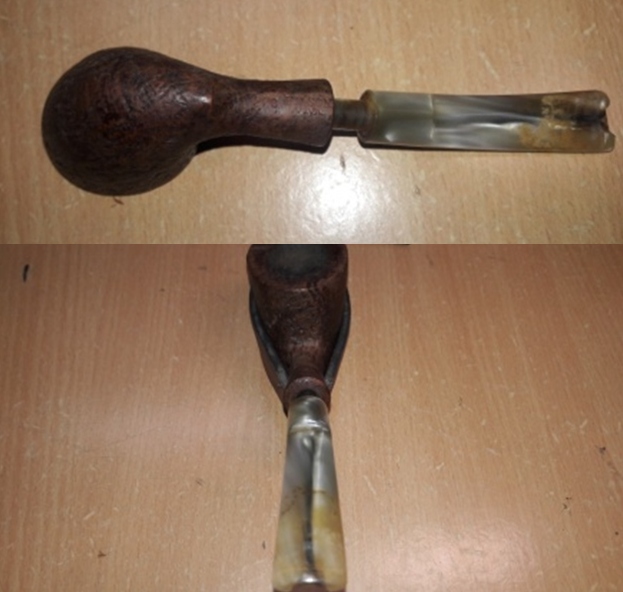
When Steve had visited me last year, we went through the entire pipe collection and this particular pipe caught Steve’s attention. He immediately remarked that the stem was not the right one for this pipe!! It was a replacement stem and a poorly executed job. With the problem diagnosed in a jiffy, we went about identifying a suitable stem for replacing the one currently on the pipe, which was by the way, also in a jiffy!! We found one and the pipe was soon consigned to oblivion. However, this time around after having recently worked on a stem replacement project, I decided to complete the replacement on this Hilson pipe as well. Here are a few pictures of the pipe with the stem that was replaced by the Seller. This pipe has Cutty-like foot, a Dublin like taper from the top of the rim to the foot of the stummel and the front rim top has a pronounced backward rake towards the shank. These features and for the lack of a defined shape, I rather prefer to call it a freehand. The stummel has very shallow sandblasted surface all around with a smooth shank bottom which bears the stampings seen on this pipe. It is stamped on bottom smooth surface of the shank as “HILSON” over “VIVA” in block letters with the shape number “# 278” stamped towards the stummel. The right side of the shank is stamped with COM stamp “BELGIUM” towards the shank end. The stampings are crisp and clear.I looked for information on this brand on rebornpipes.com. The information contained therein is both informative and an interesting read. Given below is the link to the write up;

https://rebornpipes.com/2016/06/11/restoring-my-paris-finds-a-pair-of-hilson-double-ecume-sandblast-pipes/

I visited pipedia.org to see if could learn more about this brand. I learned that this pipe was well respected brand in 1960s- 70s as makers of good quality pipes at very moderate prices which traced it’s roots way back to 1846 in the City of Bree!!! The brand faced financial crisis in the 1980s and was brought over by Elbert Gubbels & Zonen B.V. in the Netherlands. Here is the link to the web page;

https://pipedia.org/wiki/Hilson

The information gleaned from the two write ups makes me certain that the Hilson VIVA pipe that I am working on is Pre 1980s.

Initial Visual Inspection
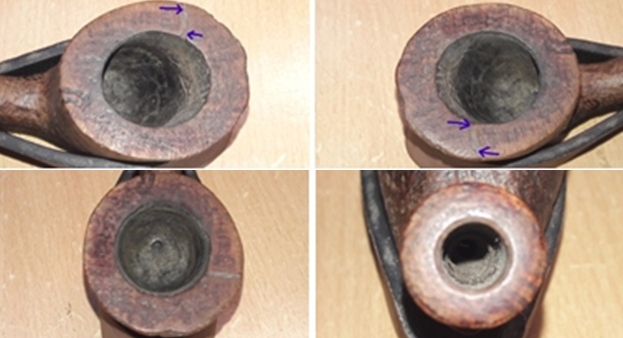
This pipe has been with me for many years and at one point in time was an integral part of my pipe rotation. However the lure of new got the better of me and in my exuberance to try out the newer additions to my pipe collection, this pipe kept falling further and further down the pile. So when Steve suggested replacing the stem, I got this pipe out of oblivion. The stummel has a shallow sandblasted surface that has accumulated a little dust and dirt in the crevices of the sandblast. The left side of the stummel has a few fills and probably, I think, is the reason for the stummel to be sandblasted. Once the stummel surface has been thoroughly cleaned and the fills exposed, will I decided to refresh these fills or let them be. Before being stowed away, the chamber and the mortise had been completely reamed and cleaned. However, with passage of time, the mortise and the chamber walls are covered in dust and coupled with the high moisture content in the atmosphere, has coated the walls in a thin layer of grime. There is an even layer of thin coat of dust that has hardened over the thick chamber walls. The rim top surface shows very shallow sandblast and was cleaned earlier by me. It is now that I have observed a fill on the left side that runs from the inner to outer edge (indicated by indigo arrows). Both the inner and the outer rim edges are sans damage. The inner walls of the chamber are solid and thick. The chamber odors are mild. The draught hole is dead center and at the bottom of the chamber and coupled with the new stem that would replace the old one, makes me believe that the smoking quality of this pipe should improve manifolds. Further cleaning of the chamber and mortise should completely eliminate the ghost smells from the chamber.The Process
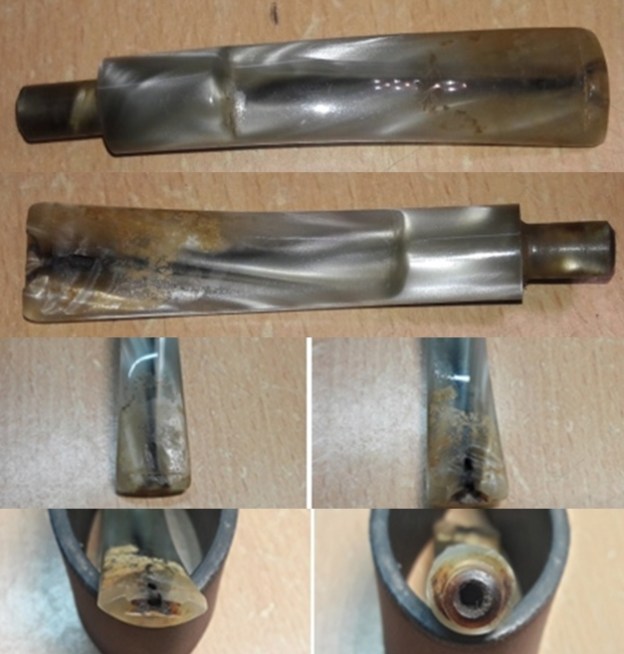
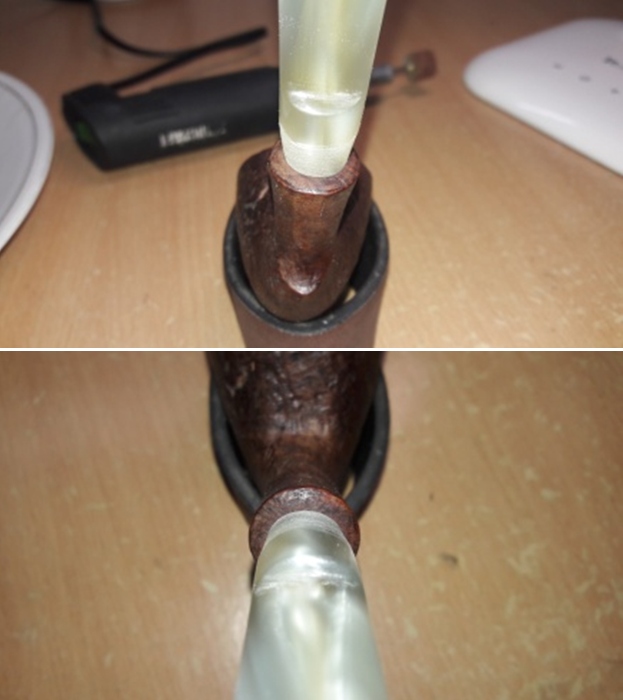
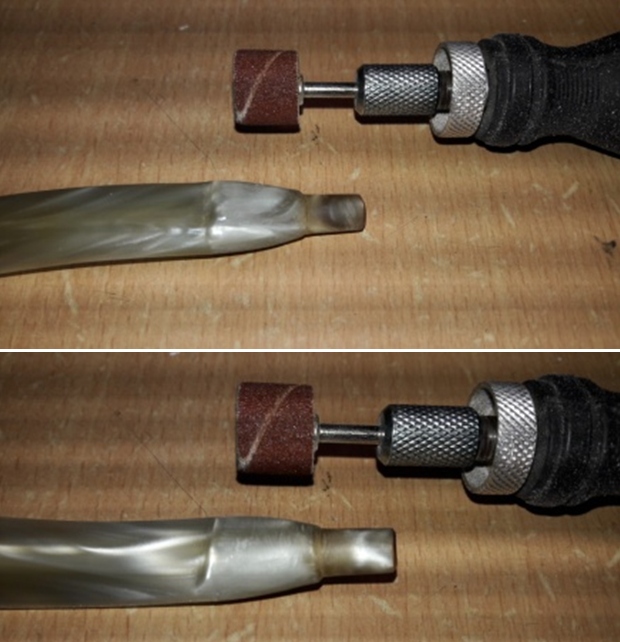
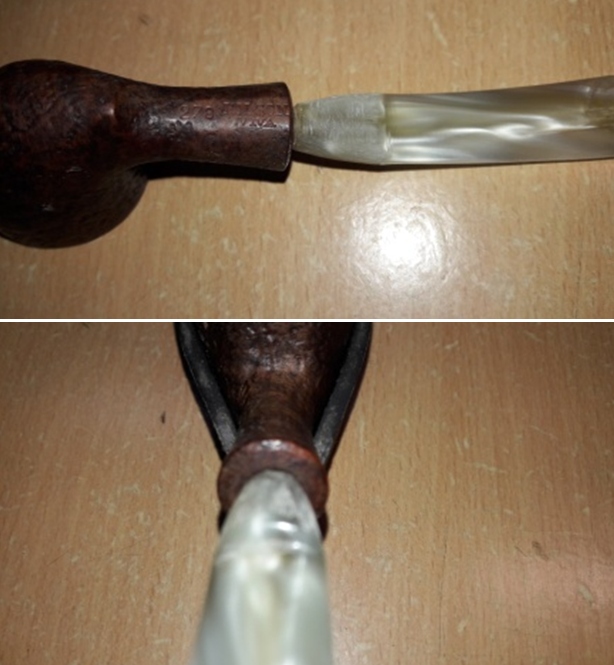
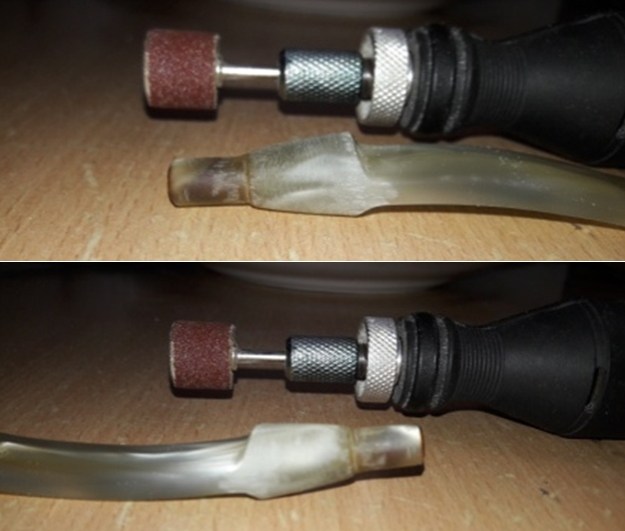
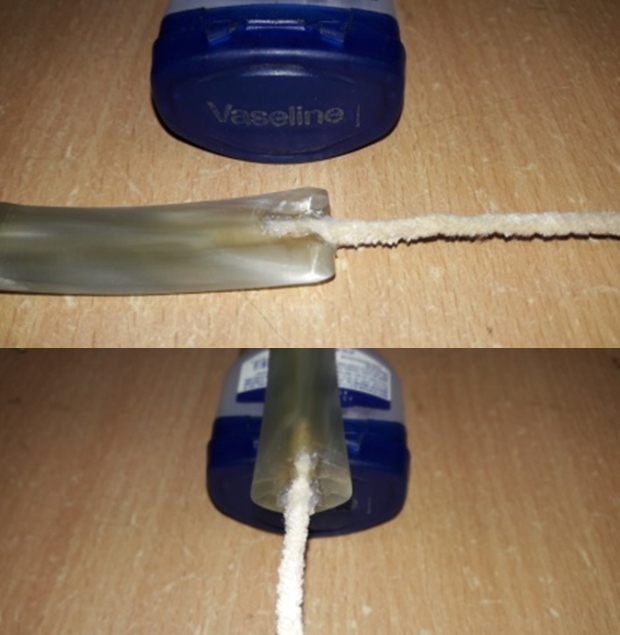
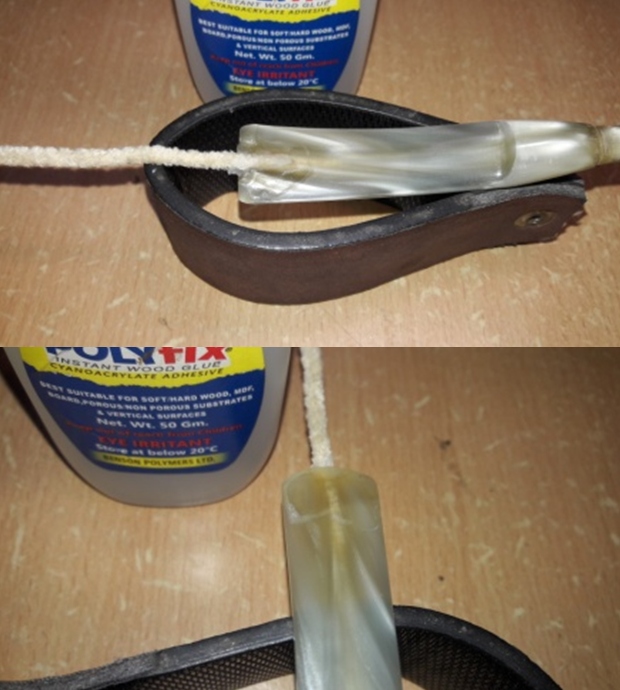
The first issue to be addressed in this project was to replace the previously poorly executed stem replacement job. The whistling sound emanating from the shank when air was drawn from the stem was a pointer that the alignment of the stem air way and mortise/ draught hole was skewed. I tried the pipe cleaner test and it was with great effort and maneuvering that the pipe cleaner came out through the draught hole. Steve and I had selected a pearly variegated acrylic saddle stem with swirls of light browns and grays as a replacement stem for this pipe. It was decided that this saddle stem be modified in to a military mount stem with the tenon seating as close to the walls of the mortise as possible. Here is how the pipe looks with this pearly saddle stem. The tenon would need to be sanded down for it to seat in to the mortise and this would be the trickiest part of this stem replacement. I would have to be very careful to sand it evenly and equally from all around and ensuring this while sanding down manually and eyeballing the evenness is not as easy as it would be while using a tenon turning tool (which I am still on a lookout for at a good price!!).   The replacement pearly variegated acrylic saddle stem too came with its own set of damages. The stem was badly damaged with heavy and deep tooth indentations in the bite zone over the upper stem surface. The button edge on the upper stem surface is also deformed with heavy tooth indentations. The lower stem surface, in addition to the tooth chatter, had a large chunk of the surface chewed off from the bite zone including the button. The bite zone on either surface is covered in a thick layer of calcification, probably a result of using a rubber bit. The stem airway appears BLACK and completely clogged with accumulated saliva, oils and tars. The tenon end and horizontal slot are clogged with gunk. The bite zone and buttons on either surfaces will have to be reconstructed and reshaped. The airway will be a bear to clean. Only after the stem has been thoroughly cleaned and sanitized, the issue of seating of the stem in to the mortise will be dealt with. I cleaned the external surface of the stem with a Scotch Brite pad and liquid dish washing soap. Once the external surfaces were clean, I cleaned the stem internals with a small shank brush and liquid dish soap. I gently scraped out the gunk and grime from the tenon and slot openings with my fabricated knife and dental tools. I thoroughly rinsed the stem surface and internals under warm running water till the stem was sparkling clean. I have realized that using small shank brush and liquid soap reduces consumption of pipe cleaners by about 85%. This is considerable savings considering that I pay thrice the cost of pipe cleaners on cost of shipping!! Next, I ran a couple of dry pipe cleaners through the stem to clean and dry it out. I avoid using isopropyl alcohol in cleaning stem air way just to guard it against crazing (call it my paranoia to use alcohol on an acrylic or Perspex stem!!). The stem surface, tenon end, slot and the air way is now clean. After about an hour of cleaning and ton of elbow grease, I can now handle this stem without any disgust!! I shall first adjust the tenon to achieve a snug seating in to the mortise and thereafter manipulate the saddle portion of the stem to achieve the taper for a military mount style stem. I mounted a 150 grit sanding drum on to my hand held rotary tool and sand down the tenon till I had achieved a rough seating of the tenon in to the mortise. My previous experience has taught me an invaluable lesson; “SAND ONCE AND CHECK TWICE”!! Once I had achieved a rough seating, I got down to the arduous and time consuming task of manually sanding down the tenon with a folded piece of 220 grit sandpaper till I had achieved a perfect seating of the tenon in to the mortise. Here I was extra careful and vigilant while sanding the sides of the tenon and frequently checked the alignment of the stem airway with the shank airway and finally the draught hole. Excess sanding of any one side of the tenon disturbs this alignment even though the seating may appear to be snug and seamless. I gave final check to progress being made and the seating was perfectly snug and seamless with all the airways perfectly aligned. I am very happy with the progress until now!!Next step was to shape the saddle portion to resemble a military mount style stem profile. Continuing with the same assembly of sanding drum and rotary tool used for tenon turning, I gradually start sanding the saddle portion from the tenon end and progressively working my way upwards. I frequently checked the profile of the stem with the stummel. Here is how the pipe appears at this stage. Getting there, but not close yet!! I continued with sanding down the saddle further till I had a nice taper with the saddle edge merging with the tenon. The profile of the pipe has drastically improved and as per my mantra “LESS IS MORE”, I decided to proceed with manual sanding and shaping with a piece of 220 grit sandpaper to match the surfaces and fine tune the seating of the stem in the mortise.  However, contrary to my mantra, I was still not very pleased with the stem profile. Unable to identify what exactly was amiss, I shot off a couple of pictures of the progress made to Steve and sought his advice. He suggested that I should give a bit more taper to the tenon end and it would be good. Ah…. The stem was a bit broad at the shoulders and that’s what was wrong!! I re-profiled the saddle shoulders with the 150 grit sanding drum. This now looks and feels much better and the flow of the stummel in to the stem is about perfect. Here are a couple of pictures that will give the Readers an idea of the seamless merging of the flow of the stummel in to the flow of the stem. With the profiling and seating adjustments to the stem now completed, I can turn my attention to the stem repairs. Next I inserted a pipe cleaner smeared with petroleum jelly in to the stem airway through the slot end. The coating of petroleum jelly on the pipe cleaner prevents the superglue from sticking to the pipe cleaner and seeping in to the air way and blocking it. I applied a generous coat of superglue over the bite zone, including over the buttons, on the lower surface which had a through hole and set it aside to cure. Once the fill had hardened to an extent that it was not runny, I applied a coat of superglue over the upper surface and set the stem aside for the fills to harden completely. Once the fill has hardened, I shall file and sand the fills to match the surface of the stem and sharpen the button edges on either surface.  While the stem fills and repairs were curing, I worked on the stummel by reaming the chamber with my fabricated knife to remove the remaining carbon deposit and the hardened coat of dust and grime. Once the cake was reamed back to the bare briar, I used a 150 grit sand paper followed by 220 grit sand paper to remove all the traces of remaining cake and also to smooth out the inner walls of the chamber surface. Finally, to remove the residual carbon dust, I wiped the chamber with a cotton pad wetted with 99.9% pure isopropyl alcohol. The chamber walls are sans any damage. The outer and inner rim edge is in great shape. The rim top surface is in decent condition, save for the fill on the left side. The ghost smells are greatly reduced and may be eliminated after the shank/ mortise are thoroughly cleaned. With the bowl internals clean, I move to clean the exterior of the stummel. I used a hard bristled tooth brush and Murphy’s Oil soap to scrub the stummel and rim top. After the scrub with oil soap, I washed the stummel under running warm water with anti oil dish washing detergent till the stummel surface was clean and dried it using paper towels and soft cotton cloth. I simultaneously cleaned the shank internals with the detergent and hard bristled shank brush and set the stummel aside to dry out naturally. The stummel surface has cleaned up nicely with the beautiful shallow sandblast patterns on full display. There are two major fills that would need to be refreshed; one on the rim top surface and the other on the left stummel surface. The ghost smells are completely eliminated and the pipe now smells fresh, odorless and clean. The shank air way is nice and open. I am sure that the pipe will turn out to be a fantastic smoker with a full wide and open draw. Next I addressed the issues of the two fills in the stummel surface. With a sharp dental tool, I gouged out the fill to the left side and one on the rim surface. Using the layering method, I filled these gouges with a mix of briar dust and CA superglue till the mound of the mix was slightly above the rest of the stummel surface. This helps in a better blending of the fill with the rest of the stummel surface while sanding and reduces the scratches caused by the use of a needle file as you have a correct perspective of the sanding that is required. I set the stummel aside for the fills to cure. While the stummel fills were set aside to cure, the next afternoon, I worked on the stem fills which had cured completely. With a flat head needle file, I worked on the filling till I had achieved a rough match with the surrounding surface and had sufficiently sharpened the button edges. I further sand the fills with a piece of 180 grit sand paper to achieve a better match. I used a slot file to even out the horizontal slot edges and widen it a bit. I am very happy with the stem profiling and repairs at this stage in restoration and also the buttons now have a nice crisp edge to them.   Thereafter, I began the process of final fine tuning of the seating of the stem in to the mortise, shaping the saddle for a sharper military mount look and bringing a nice shine to the surface by sanding with 320, 600, 800 and 1000 grit sandpapers. The technique that I used is very simple; sand one side, check the seating and if the seating is not snug, sand the relevant side and continue to do so till I achieved a snug airtight fit. The closer I came to the perfect fit, the higher grit sand paper I used. A lot of patient and diligent work, I reached the point where I felt “ no more sanding… this is the perfect seating and perfect military mount profile!!”. My mantra “LESS IS MORE” was also playing at the back of my mind. I had simultaneously sanded the entire stem surface through all the above mentioned grit sand papers. I was very pleased with my efforts as I had achieved a perfect snug seating of the stem in to the mortise while being able to maintain the semblance of a military mount stem!! To bring a deep shine to the acrylic stem, I went through the complete set of micromesh pads, wet sanding with 1500 to 12000 grit sandpapers. I wiped the stem with moist cloth after each pad. At the end of micromesh cycle, I polished the stem with “Before and After Fine & Extra Fine” paste. The finished stem is shown below.With the stem re-profiling and repairs completed, I turned to the stummel repairs. The fills had cured nicely and using a flat head needle file, I sand the fill till I had achieved a rough match with the surrounding stummel surface. I sand the fills with a piece of 220 grit sand paper to further blend in the fills with the stummel surface. Next, I rubbed a small quantity of “Before and After Restoration Balm” deep in to the briar and in to the crevices of the sandblast with my finger tips and let it rest for a few minutes. The balm almost immediately works its magic and the briar now has a nice vibrant appearance with the beautiful sandblast patterns displayed in their complete splendor. I further buffed it with a horse hair brush. The contrast of the lighter browns of the sandblast with the natural patina of the rest of the stummel adds an interesting dimension to the appearance of the stummel.  To check and verify the correctness of the alignment of the stem airway, the tenon opening, shank/ mortise airway and finally through the draught hole, I did the PIPE CLEANER TEST.  The pipe cleaner passed through cleanly and without any obstruction from the slot end right through the draught hole.   I have now reached the homestretch in this restoration project. To complete the restoration, I mount a cotton cloth buffing wheel on to my hand held rotary tool and polished the stummel and stem with Blue Diamond compound. This compound helps to remove the minor scratch marks from the stem surface that remain from the sanding. I mounted another cotton buffing wheel that I have earmarked for carnauba wax and applied several coats of the wax. I finished the restoration by giving the entire pipe a rigorous hand buffing using a microfiber cloth to raise the shine further. The finished pipe looks amazingly beautiful and is ready to move on to another piper to be enjoyed for a long time. P.S. The finished pipe really looks amazing and with the thick chamber walls, a perfect wide open draw with perfectly aligned airway, this will definitely be a fantastic smoker. The pearly variegated acrylic saddle stem has a nice pearly sheen to it and the swirls of browns and grays add to the visual drama. The rebuilt lower bite zone does show sign of repairs, but it always does with acrylic stems. The beautiful pearl white of the stem appears yellowish in the above pictures and also the background does change in couple of photographs. This is so because of the reflection of light from the prop that is being used. I still need to work on my photography skill set in order to highlight the beauty of the finished pipes!!

Any reader interested to add this beauty to their collection, may please let Steve know and this pipe can be shipped to you from across the seas to be enjoyed for years to come.

A note of thanks to all the readers who have joined me in this journey that has been such a pleasure! You and your loved ones are always in our prayers…

Breathing Life to a Tired and Worn Handmade in Denmark Dublin


Blog by Steve Laug

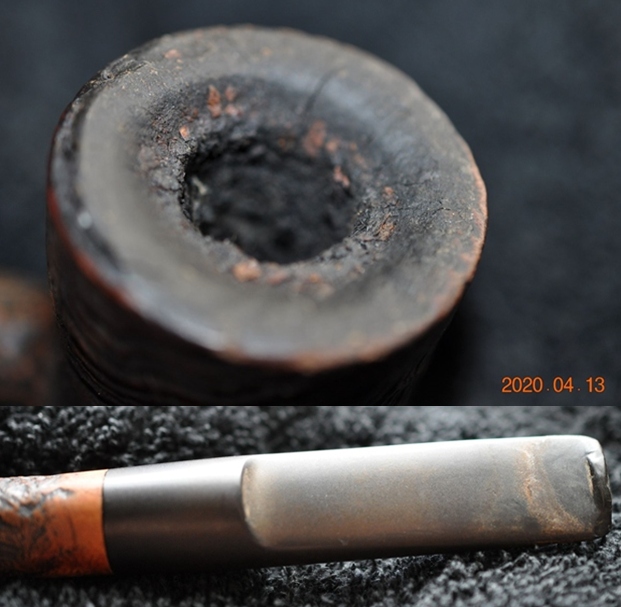
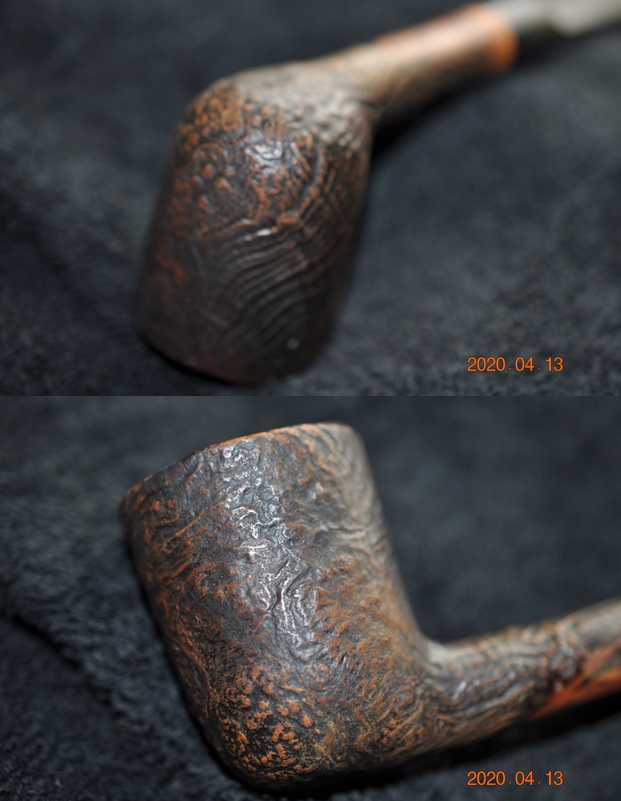
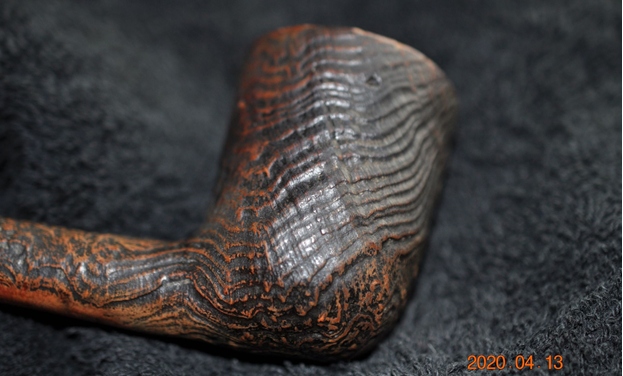
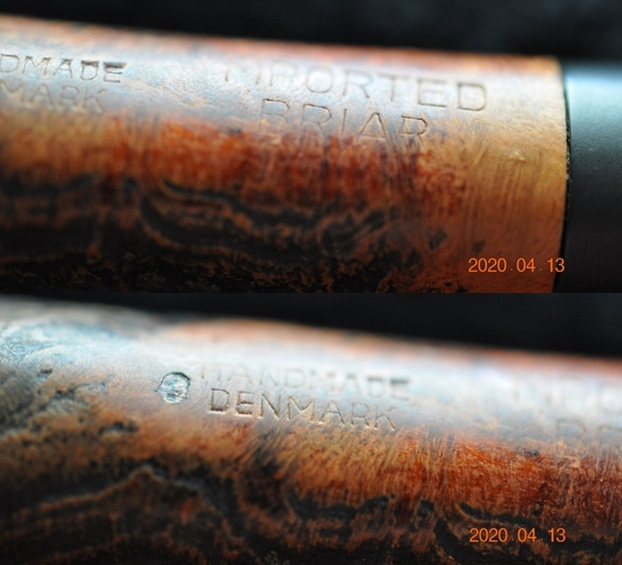
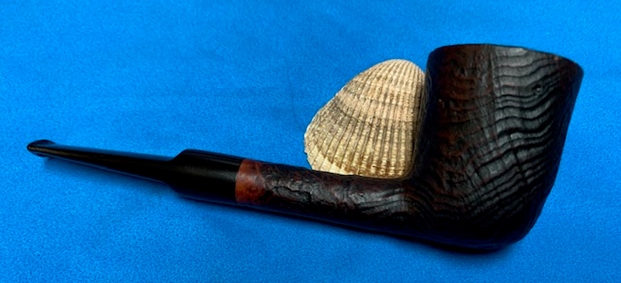
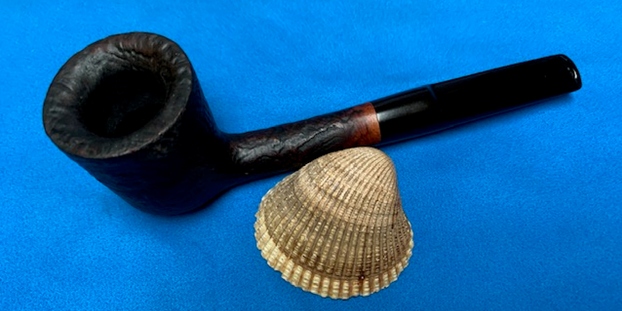
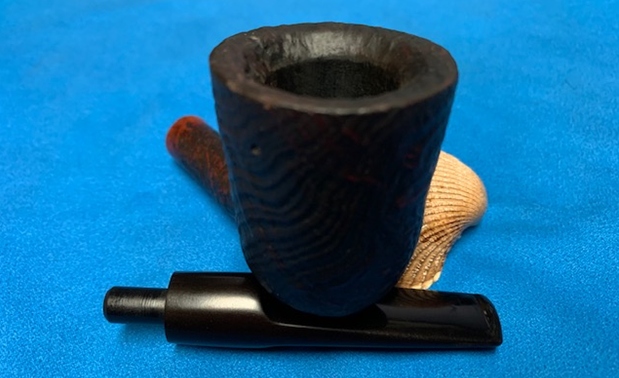
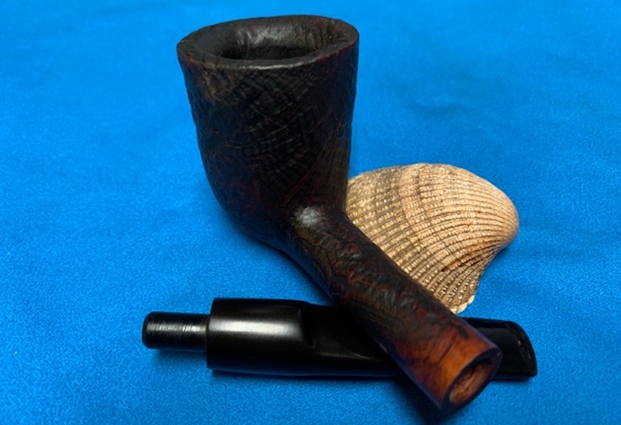
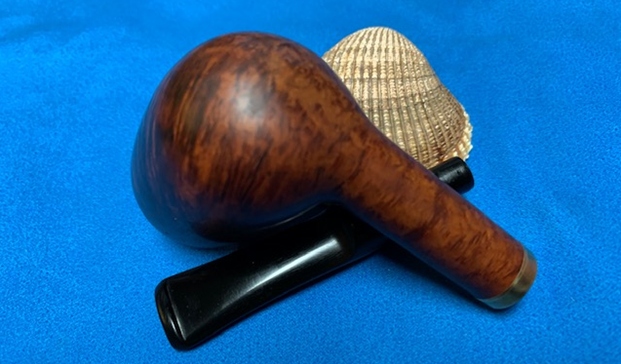
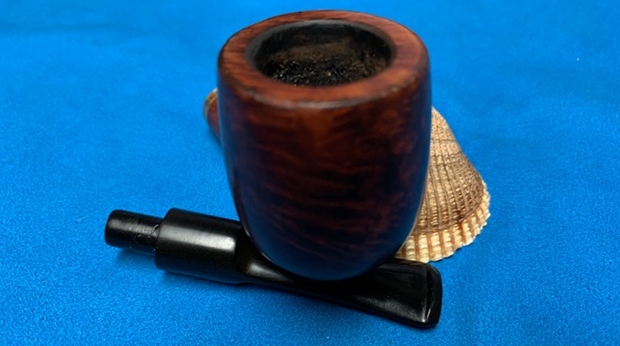
The next pipe on the work table came to us from a group of pipes that Jeff and I picked up from a fellow in Hermann, Missouri, USA. The pipe is sandblast Dublin shaped pipe with a mix of brown stains. It is a medium sandblast with shallow valleys and ridges around the bowl and shank. The pipe is stamped on smooth panel on the underside of the shank and reads Handmade [over] Denmark that is followed by a second stamp that reads Imported [over] Briar near the stem end. The pipe was tired and worn looking with a lot of grime and dust in the crevices and valleys of the sandblast finish. The bowl was heavily caked with a heavy lava coat flowing onto the beveled sandblast rim top. It was hard to know what the rim and top looked like under all of the thick lava cake. The stem was oxidized, calcified and had tooth chatter and deep tooth marks on the top and underside near the button and on the button surface. It had promise but it was very dirty. Jeff took some photos of the pipe before he started his cleanup work. He took photos of the rim top and bowl to give a clear picture of the thickness of the cake and tobacco debris as well as the thick lava on the rim top and inner edge. He also took photos of the top and underside of the stem to show the oxidation and the chatter and deep tooth marks. Jeff took a photo the sides and heel of the bowl to give a picture of the sandblast and the worn finish on the bowl.   The stamping on the top and underside of the shank are clear and readable and read as noted above. This was a mystery pipe – the stamping read Handmade Denmark and Imported Briar and lead to no further information on the maker. I decided to leave the mystery and just work on the pipe itself. Jeff had cleaned up the pipe with his usual penchant for thoroughness. He reamed the pipe with a PipNet pipe reamer and removed the rest of it with a Savinelli Fitsall Pipe Knife.  He scrubbed the bowl with undiluted Murphy’s Oil Soap with a tooth brush. He rinsed it under running warm water to remove the soap and grime. He cleaned out the inside of the shank and the airway in the stem with alcohol, cotton swabs and pipe cleaners. He soaked the stem in Before & After Deoxidizer and rinsed it off with warm water. I took photos of the pipe once I received it.  The rim top cleaned up really well. The rim top and outer edge of the bowl appear to be in good condition. The stem surface looked good other than the deep tooth marks on the button surface and stem on both sides near the button.  The stamping on the underside of the shank is faint and readable and reads as noted above.I removed the stem and took a photo of the pipe to give a sense of the whole. The bowl looked very good and once I cleaned up the stem the pipe would look very good.Now it was time to do my work on the pipe. The bowl was in such good condition that I rubbed the bowl and shank down with Before & After Restoration Balm. I worked it into the surface of the bowl sides and shank with my fingertips and a horsehair shoe brush to clean, enliven and protect the briar. I let the balm sit for a little while and then buffed with a cotton cloth to raise the shine.    The tooth marks on the top and underside of the button and stem service were very deep and no amount of heating or sanding them would lessen them. I filled them in with black super glue and set the stem aside to let the repairs cure. Once they had hardened I used a needle file to flatten the repair to match the surrounding vulcanite. I sanded the stem with 220 grit sandpaper to smooth out the remaining chatter on the top of the stem and further blend in the repair on the underside. I started the polishing process with 400 grit wet dry sandpaper. I polished the vulcanite stem with micromesh sanding pads – 1500-12000 grit pads. I wiped it down with Obsidian Oil after each sanding pad. I used Before & After Pipe Polish – both Fine and Extra Fine to further polish the stem.     This Danish Handmade Imported Briar Sandblast Dublin is a great looking pipe now that it has been restored. The rugged sandblasted brown stained finish around the bowl is quite beautiful and highlights the nooks and crannies of the sandblast. The finish works well with the polished vulcanite oval taper stem. I put the stem back on the bowl and carefully buffed the pipe with Blue Diamond on the buffing wheel using a light touch on the briar. I gave the bowl multiple coats of Conservator’s Wax and the stem multiple coats of carnauba wax on the buffing wheel and followed that by buffing the entire pipe with a clean buffing pad. I hand buffed the pipe with a microfiber cloth to deepen the shine. The finished Danish Handmade Sandblast sits nicely in the hand and feels great. Give the finished pipe a look in the photos below. The dimensions of the pipe are Length: 6 inches, Height: 2 inches, Outside diameter of the bowl: 1 ½ inches, Chamber diameter: 1 inch. I will be putting it on the rebornpipes store shortly. If you are interested in adding this pipe to your collection send me a message or an email. Thanks for reading this blog and my reflections on the pipe while I worked on it. There are many more to come!

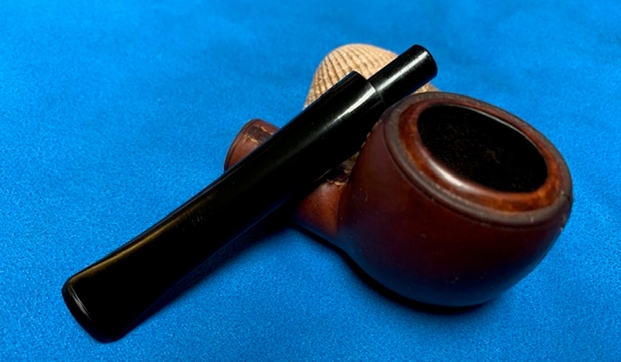
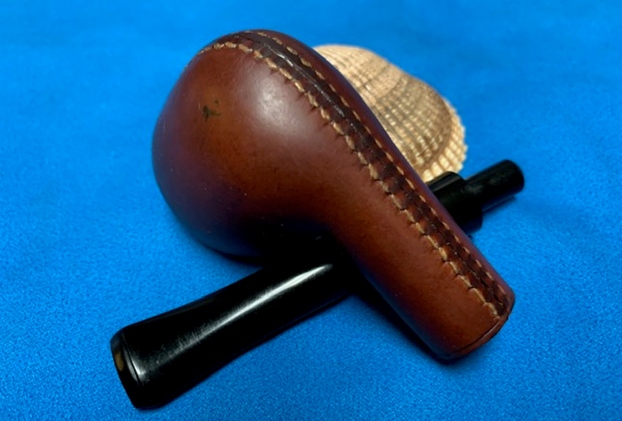
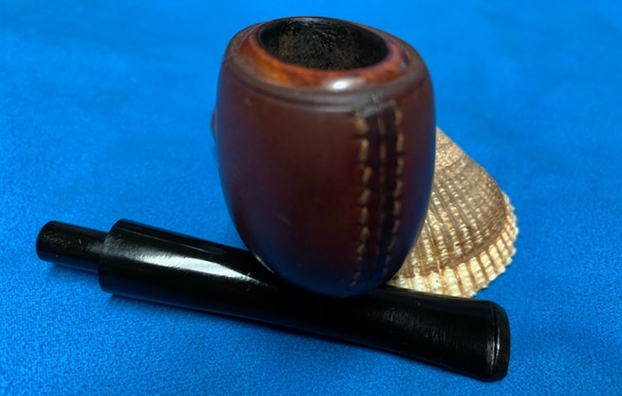
Restoring a Longchamp France Leather Clad Opera Pipe


Blog by Steve Laug

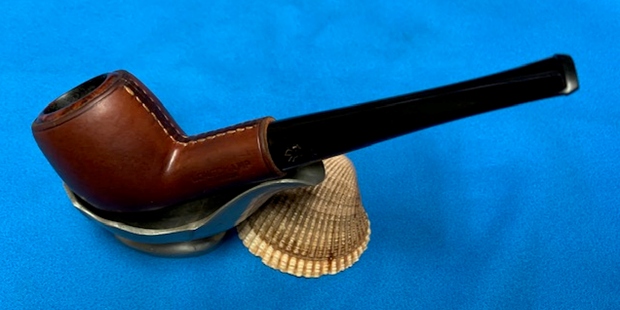
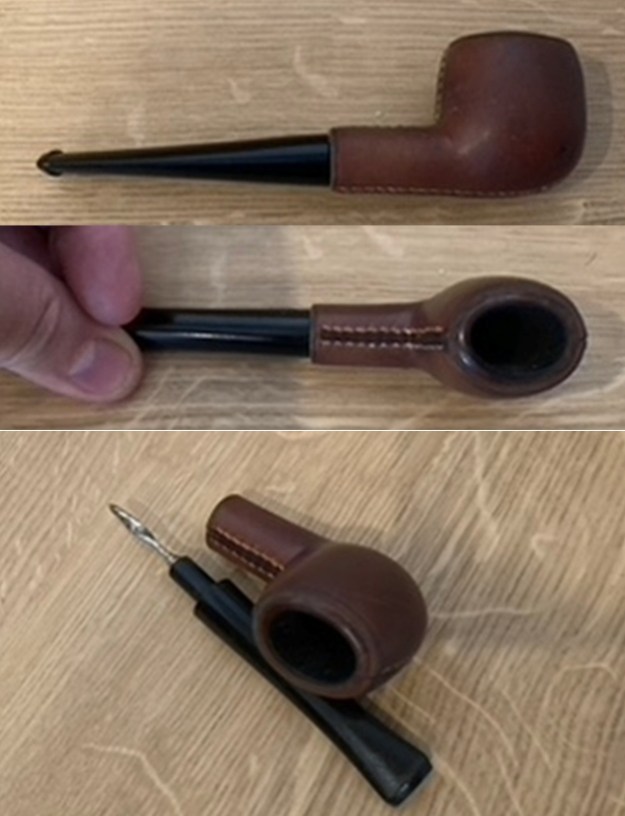
The next pipe I have chosen to work on was an interesting Longchamp Leather Clad Opera Pipe. It came to me from a friend, Lee who wanted me to have a look at it and clean it up. He wrote me the following email.

Steve,

I’m reaching out because I’ve recently procured a set of Longchamp pipes, and am interested to get your input on how to remove the ‘stinger’ in one of the pipes, in addition to sending the other pipe for you to restore (it’s in overall decent shape, but I love the work you did on the ‘oval’ bowl, and would like my pipe to be similarly treated). So… do you have any guidance on stinger removal, and can you provide information on your lead-time and address to which I ship the pipe I’d like restored?

Merci! –  Lee

I wrote Lee and asked him to send me some photos of the pipe and give a description of the issues that he saw with the pipe. I wanted to know if there were any issues that he could see. I have included the three photos that he sent and the description of what he saw needed to be done.

Hey, Steve – per request, photos below – first, the pipe I’d like you to tune up (3 photos) Note, there’s a small crack at the bottom of the mortise – couldn’t get good resolution of it – if you can ’save’ it, great (I know that part is deeply problematic) – otherwise, cleaning up the stem, cleansing the chamber, removing the stinger, and conditioning the leather would be great – let me know. — Lee

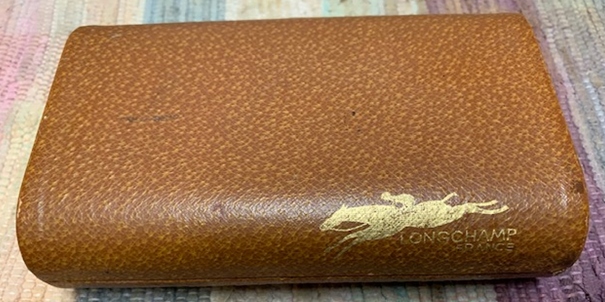
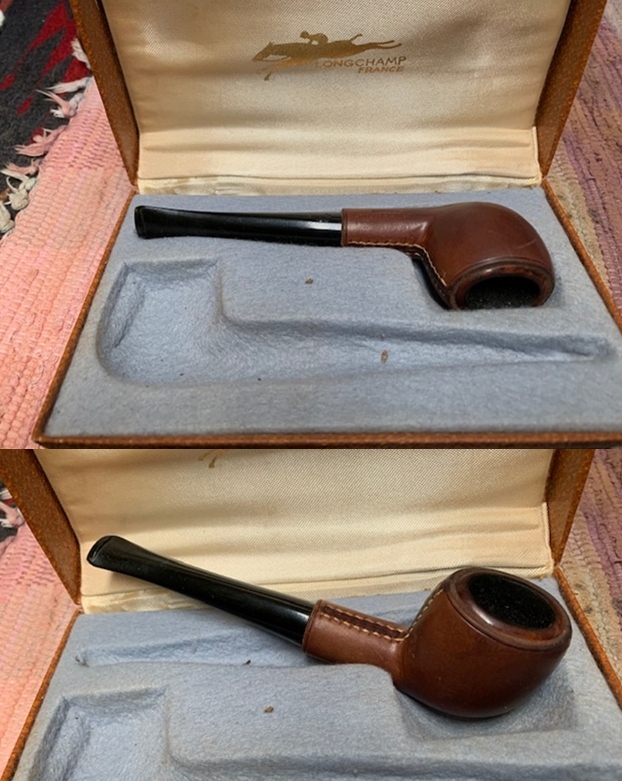
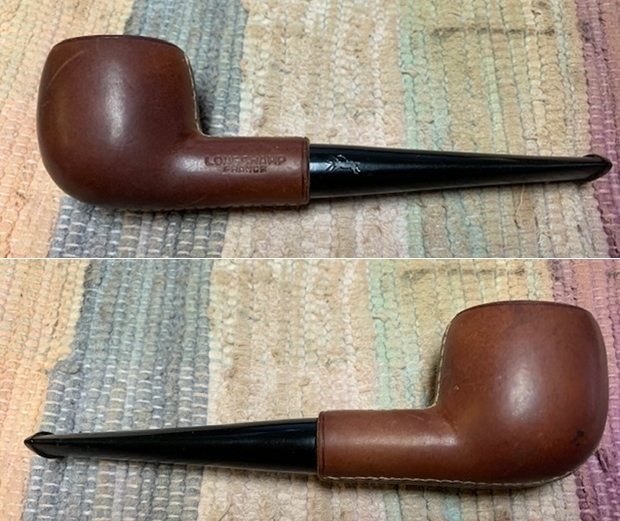
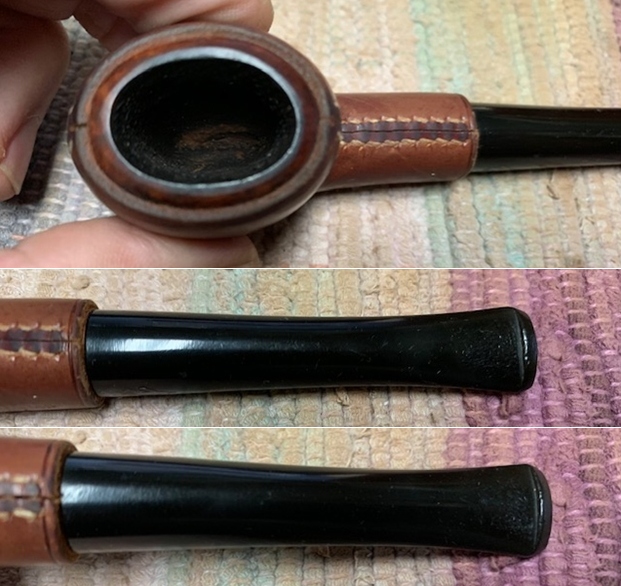
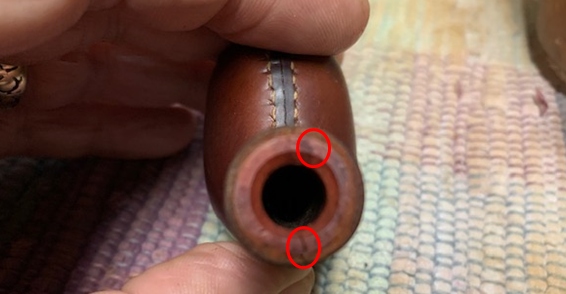
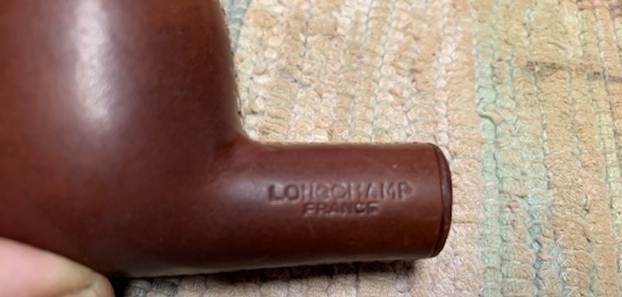
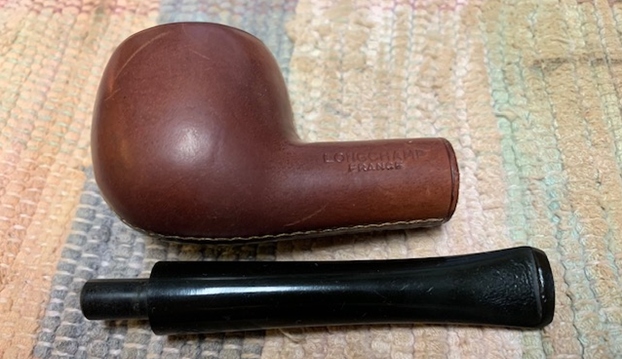
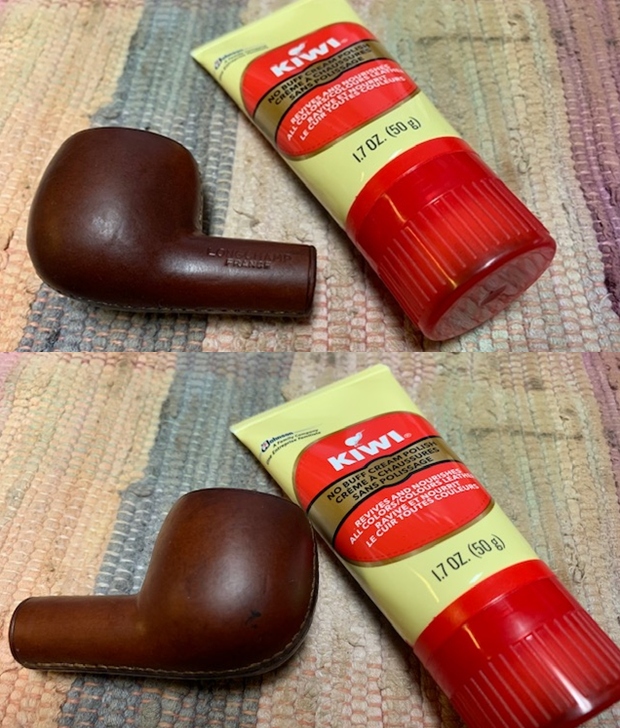
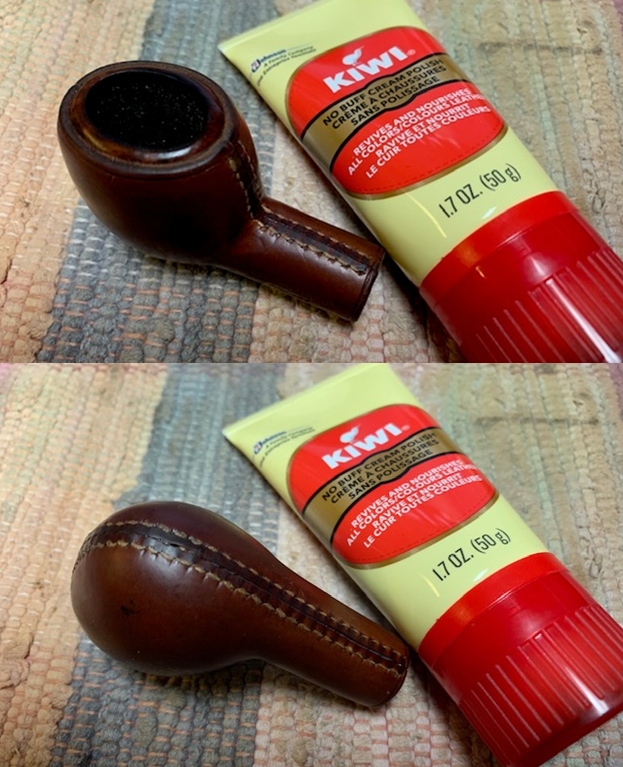
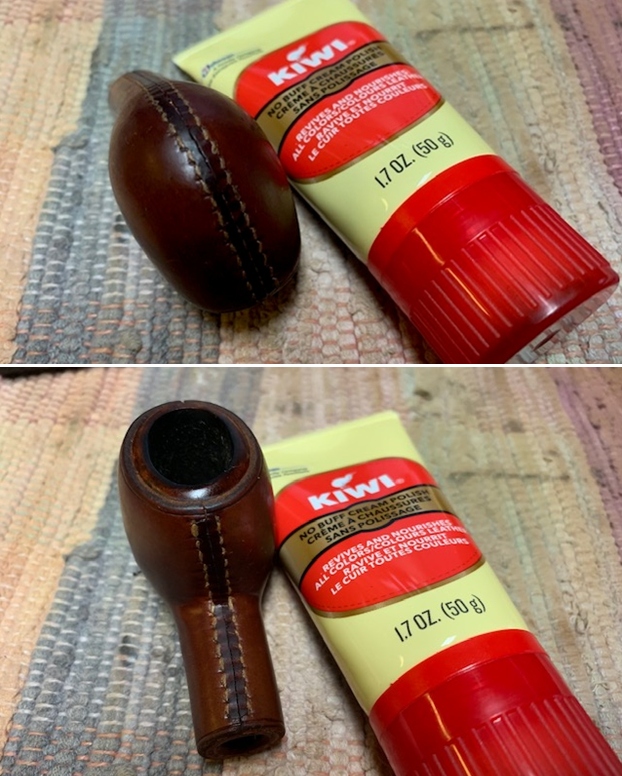
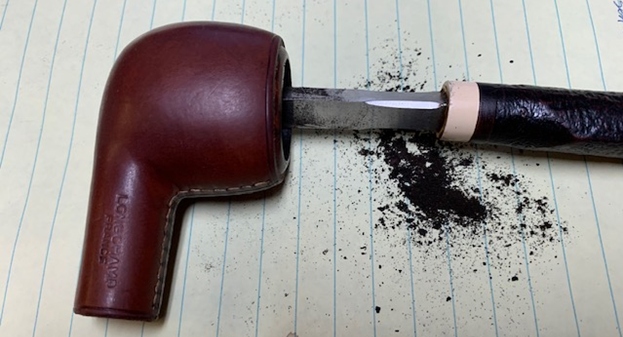
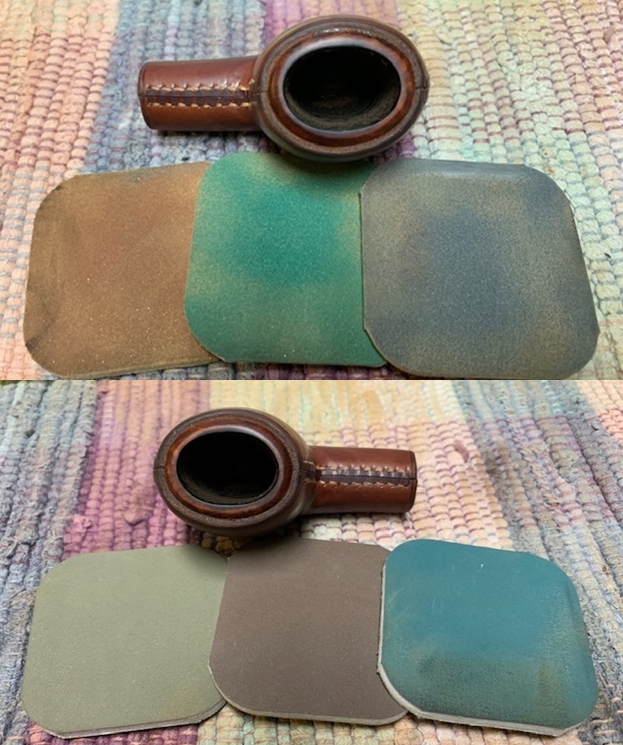
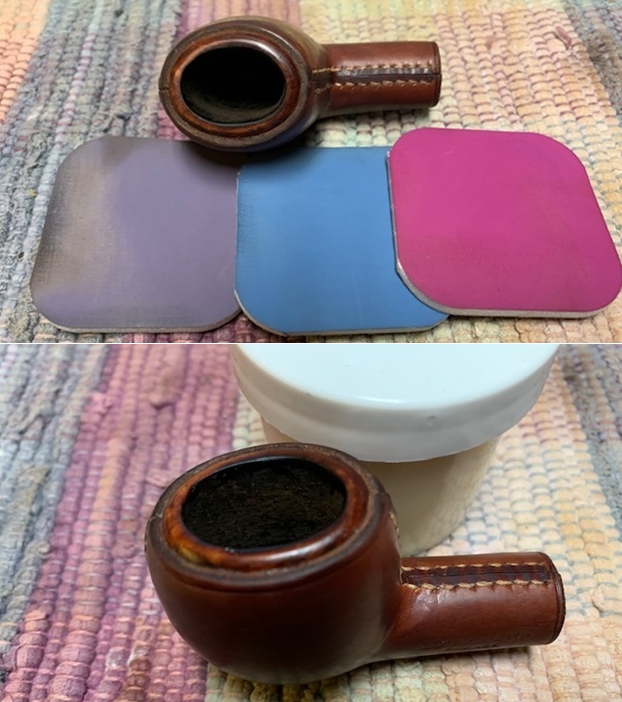
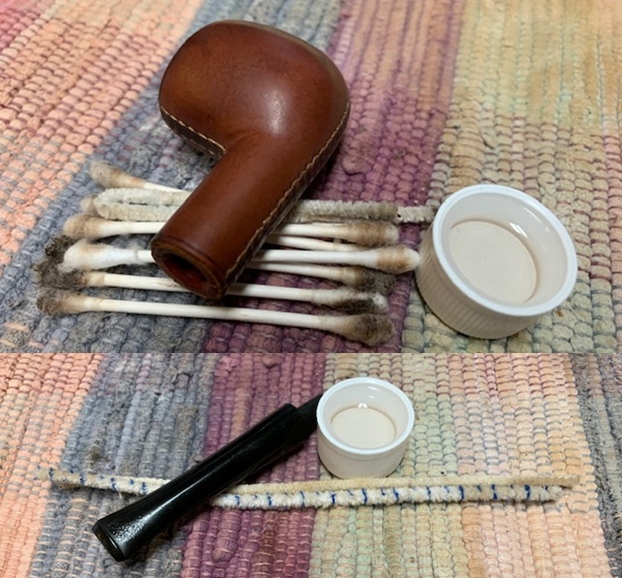
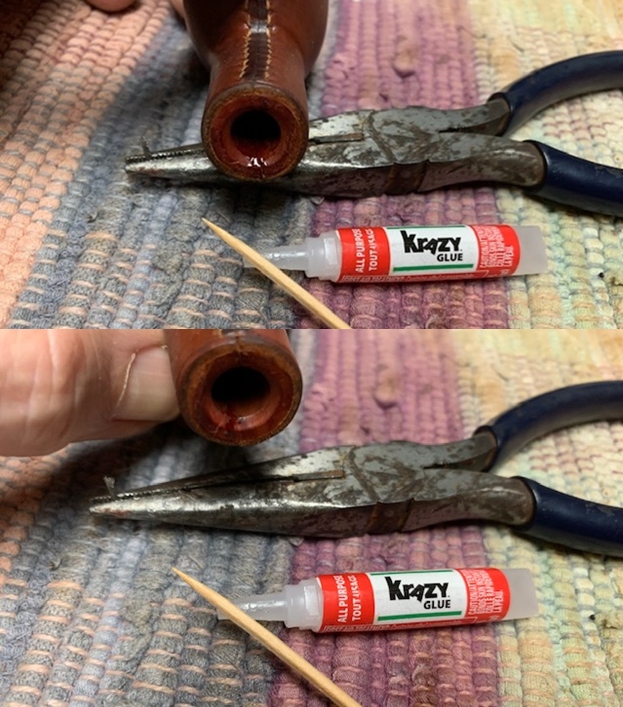
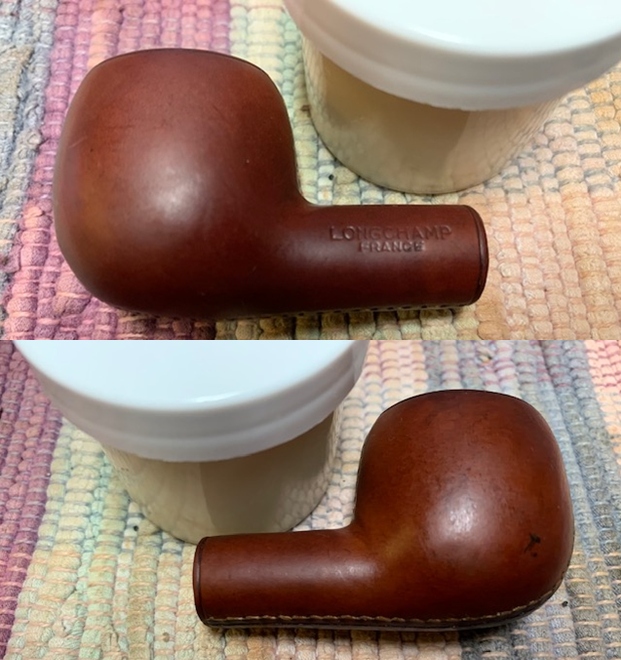
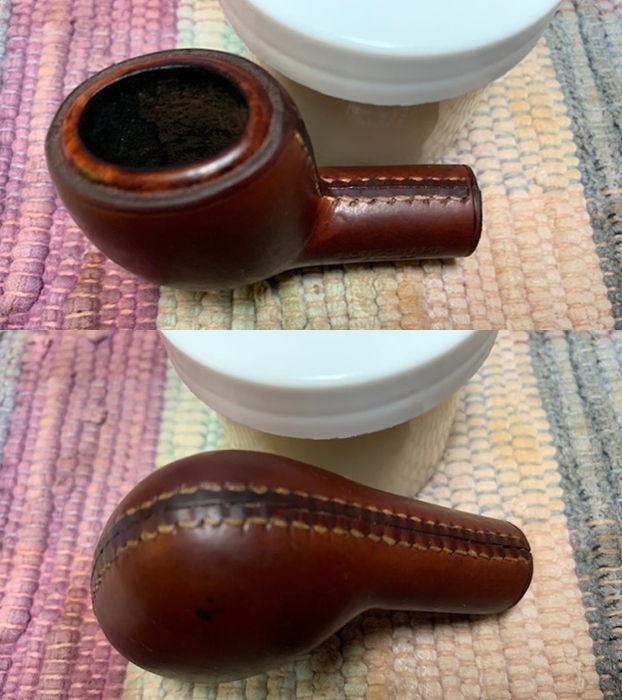
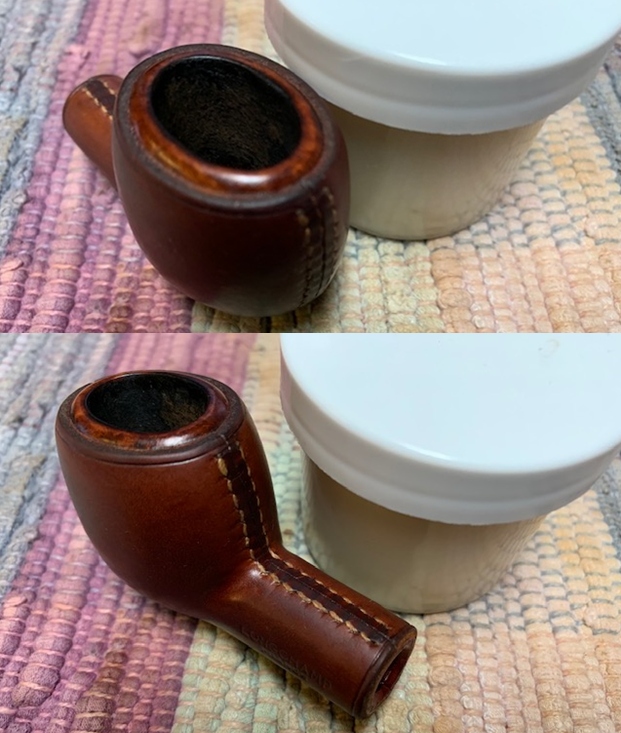
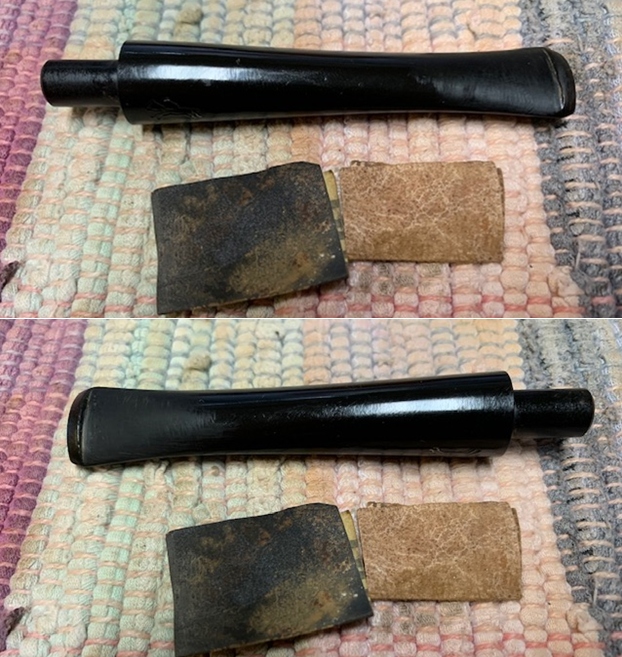
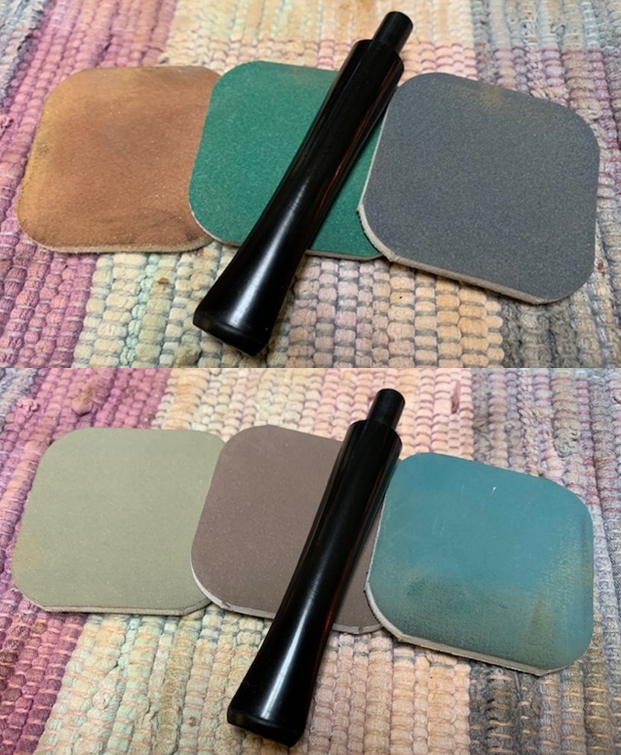
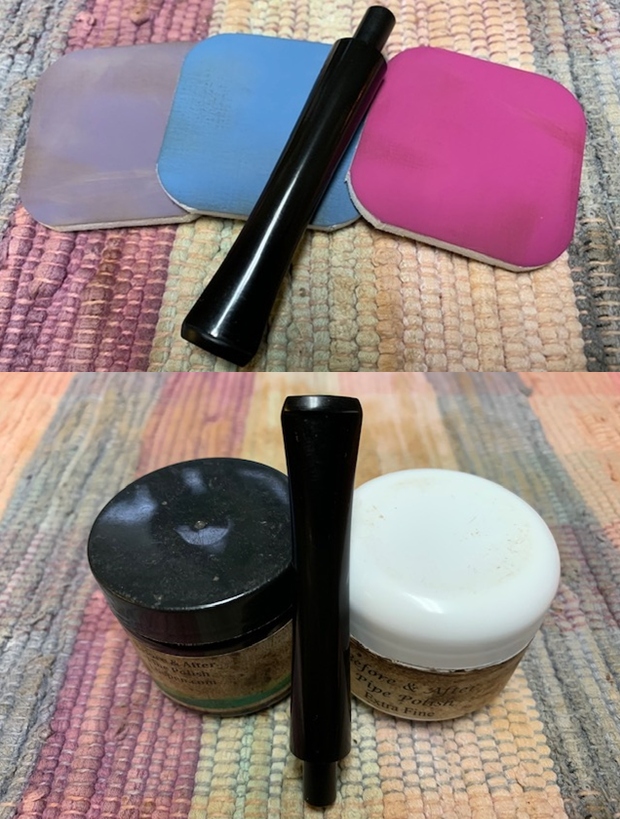
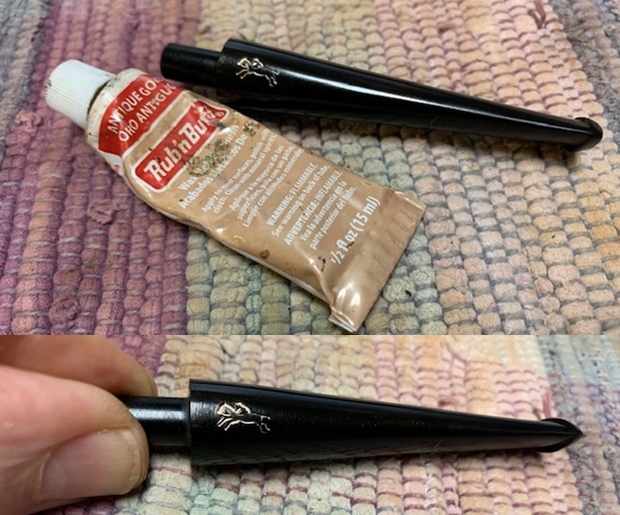
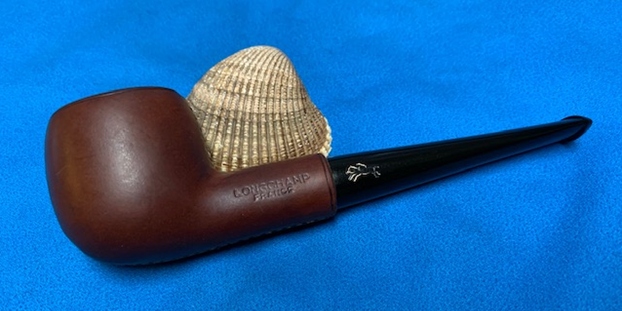
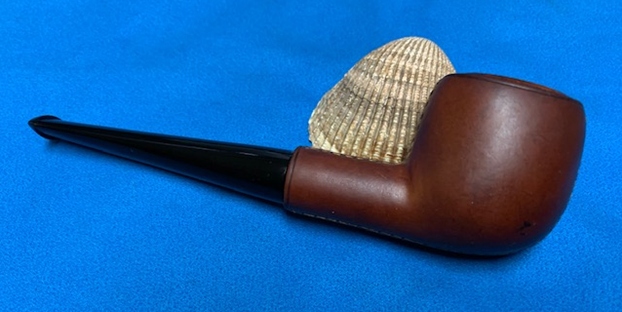
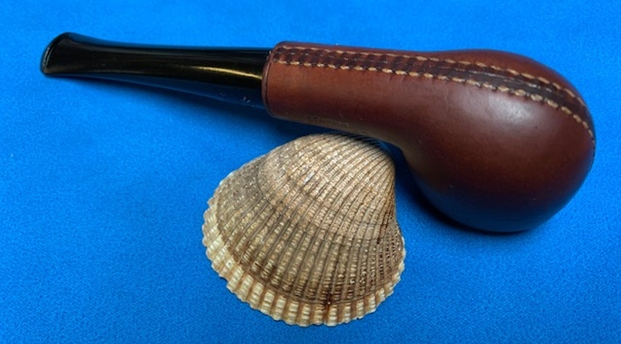
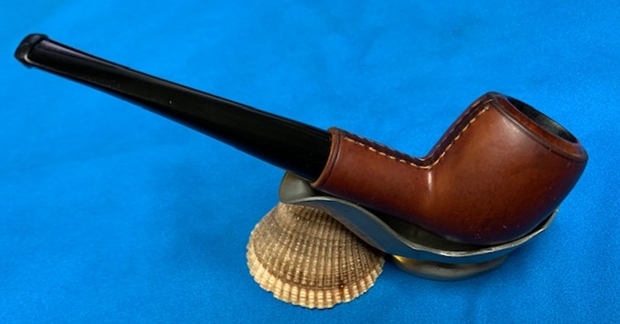
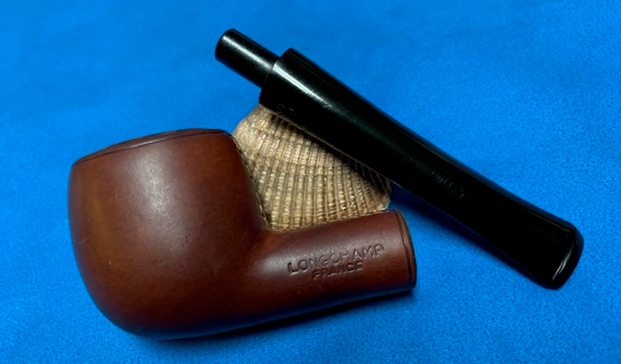
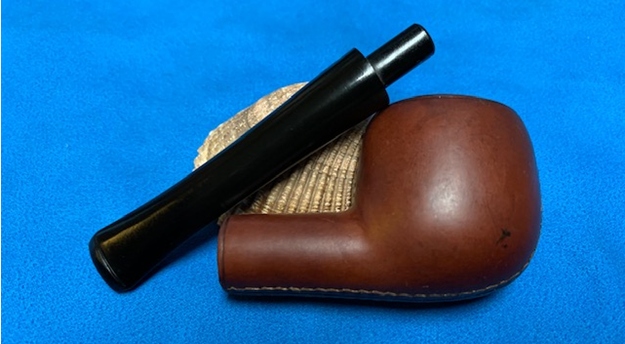
I wrote him back and told him to send me the pipe. Lee sent the pipe and I received it on Thursday. It arrived in a Longchamp France Leather Covered Set Box. The box was made for two. I think that he probably has the other pipe but the one in the box was the Opera that he wanted me to deal with. I took photos of the case and the pipe in the case when I opened it up. I have included them below. It is a nice looking leather case with white satin lining on the lid and a grey felt base. The oval bowled pipe had a thin cake in the bowl and a light coat of lava on the rim top. The shank was tarry and oily with black grime. The leather had a few scuff marks on the sides. It was stamped on the leather on the left side of the shank. The stamping was readable. It read Longchamp [over] France. The vulcanite taper stem had a race horse and jockey stamped on the left side.  The stitching on the leather was in excellent condition but the leather itself was a bit lifeless. The stem was quite clean with no oxidation or calcification. There were light tooth marks and chatter on the top and underside on and near the button. I took photos of the pipe before I started cleanup work. They tell the story of the pipe that I was going to work on. I took a photo of the rim top to show the interior the oval bowl and cake in the bowl and the darkening on the inner edge. The stem is clean other than having tooth marks and chatter on the top and underside near the button.   I removed the stem from the shank to have a look at the shank to see the crack that Lee had spoken of and found that there were actually two cracks – one on the top and one on the underside of the mortise. I have circled them in red in the photo below.  I took a photo of the stamping on the left side of the shank. It read as noted above. The stamping is clear and readable.I took the pipe apart and took a photo of the pipe. It is an interesting looking pipe. Lee had removed the stinger from the tenon and it was threaded as I had suggested.I cleaned the leather with KIWI Leather No Buff Cream Polish. It is a product that revives and nourishes the leather. The product is applied with the sponge applicator that is integrated under the cap. The leather looked very good at this point. I scraped the oval bowl with a Savinelli Fitsall Pipe Knife to remove the cake in the bowl. Once I had it cleaned out I wiped the bowl down with a cotton pad to remove the dust and debris from the reaming. I polished the briar with micromesh sanding pads – wet sanding it with 1500-12000 grit pads. After each pad I wiped the briar down with a damp cloth. The rim top looks very good after the polishing. I was able to remove all of the debris on the inner edge as well as on the rim top. I rubbed the rim top down with Before & After Restoration Balm and buffed it off after about 10 minutes. It works to enliven and protect the briar. I cleaned out the inside of the shank and the airway in the stem with alcohol, cotton swabs and pipe cleaners. Once I removed the debris the pipe smelled clean.  Repairing the cracked shank on a leather clad pipe is a real challenge. Fortunately the leather is very tight around the shank end. I applied some clear super glue to the cracks on the inside of the shank – both the top and bottom of the mortise. I let the glue seep into the cracks and sealed it with a top coat of glue. I smoothed it out with the tooth pick to leave the inside of the shank smooth.I worked some Before & After Restoration Balm into the surface of the leather with my fingertips. While it was made to clean, enliven and protect briar I have also used it effectively on both briar and meerschaum. I let the balm sit for a little while and then buffed with a cotton cloth to raise the shine. The photos show the bowl at this point in the restoration process.    I set the bowl aside and turned my attention to working on the stem. I sanded out the tooth marks with a folded piece of 220 grit sandpaper and started polishing it with 400 grit wet dry sandpaper.   I polished the stem with micromesh sanding pads – wet sanding with 1500-12000 grit sanding pads. I wiped it down after each sanding pad with Obsidian Oil. I polished it with Before & After Pipe Stem Polish – both Fine and Extra Fine.     I touched up the horse and jockey stamp on the left side of the taper stem with Rub’n Buff Antique Gold. I rubbed it on with a tooth pick and worked it into the stamp. I buffed it out with a cotton pad. The finished racing horse came out looking very good.I have never really liked leather clad pipes but there is something about this oval bowled Opera pipe is a great looking pipe. This LONGCHAMP FRANCE OPERA Pipe is very nice looking and it is ready to head back to Lee. I buffed the stem with Blue Diamond on the buffing wheel and gave it multiple coats of carnauba wax. I hand buffed the pipe with a clean buffing pad to raise the shine. It is fun to see what the refreshed leather looks like with the polished briar rim top. Added to that the polished black vulcanite stem is a beautiful touch. The pipe LONGCHAMP OPERA feels great in my hand. It is light and well balanced. Have a look at it with the photos below. The dimensions are Length: 5 ½ inches, Height: 1 ¾ inches, Outside diameter of the bowl: 1 wide x 1 ½ inches long, Chamber diameter: ½ inch wide x ¾ of an inch long. It is a beautiful pipe and one that will be heading back to Lee later this week. I think he will enjoy adding this beauty to his collection. Thanks for walking through the restoration with me as I worked over this pipe. Thanks to each of you who are reading this blog.

A Tale of the Rebirth of 3 Pipes – Pipe #2 – a Comoy’s Tradition 3591 Panel Prince


Blog by Steve Laug

By default this nice little Prince moved to the third slot while waiting for the stem repair to cure. It is now finished and it is a really nice looking pipe. Give the blog a read.

Last week I received an email from a fellow named Stanley who had gotten my info from the local Pipe and Cigar shop. He wrote that he had a trio of Comoy’s pipes that needed to be worked on. Two of them were Grand Slam Pipes and one was a Tradition. We connected via email and he said he would drop them off this week for me to work on. I am including part of his email so you have a sense of what I would be working on. I am also including the two photos that he attached to the email for me to see.

Hey Steve,

I had recently the chance to talk to a very kind and excellent gentleman over at City Cigar, I unfortunately was never able to get his name. However I mentioned I was looking for some replacement stems and he gave me your info…

…The pipes in question are attached in photos, I’ve never done any sort of pipe restoration in my life but I have attempted to take the cake down with a pocket knife. If you’d do it, would you be able to do a ream/clean on the three, as well as deal with the stems?

If possible, I’d prefer to save the original stems by repairing them, but it seems to me that most people remedy this problem with a replacement stem. Whatever you think is best I will go with.

If you think that I’d be better off without the stinger insert in the shape 64, then would you be able to remove it? I’m afraid I’d break the stem if I tried haha.

The 484b also seems to have a crack starting near the “Comoy’s Grand Slam” part of the shank, where it meets the stem. Is it possible to deal with this?

That is all! Please let me know what you think!

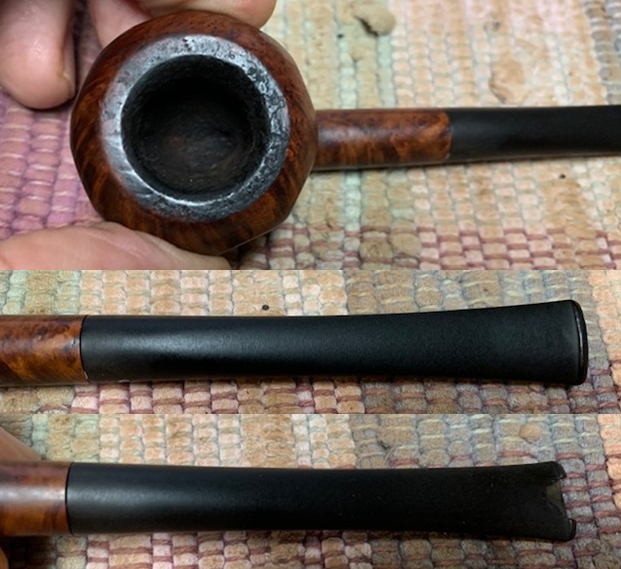
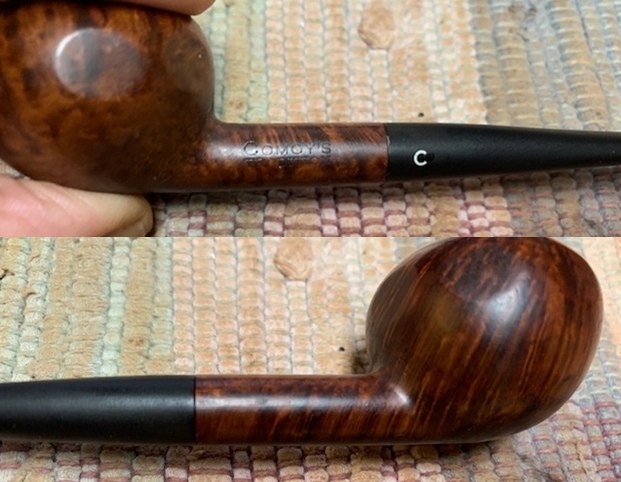
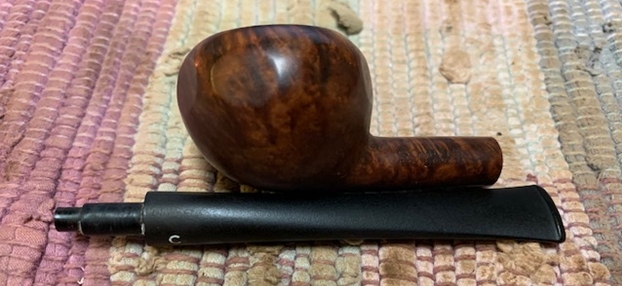
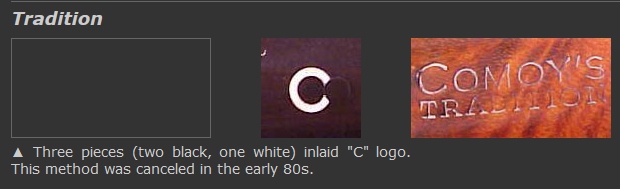
Thanks!  Stanley Last night Stanley stopped by and dropped off the three pipes. I took photos of pipes as there were when I opened the bag they were in. All three pipes were very dirty but the reaming had been started as noted in his email. The stems all had bite throughs on the underside. The bottom pipe in the photo below is a Grand Slam Pipe shape 64 Billiard. The stem has a 3 part C on the left side. The middle pipe is a Tradition 3591 Prince with 8 flattened panels on the bowl near the top. The stem also has a bite through and a missing divot. It also has a 3 part C on the left side. The top pipe in the photo is also Grand Slam Pipe 484B with a replacement stem that also has a bite through. The shank is also cracked on the left side.The last pipe left to work on in this threesome is the Tradition 3591 Panel Prince. It is a beautifully grained Comoy’s Prince that really is a pipe of Pipe Smoking History. The pipe is stamped on the left side of the shank and reads COMOY’S [over] Tradition. On the right side it has the shape number 3591 (the stamp is faint) next to the bowl/shank junction and that is followed by a Comoy’s COM stamp is worn away. The finish had a lot of grime ground into the smooth finish on the bowl and some darkening around the sides of the bowl. The bowl had been scraped but there was still a moderately heavy cake. There was an overflow of thick lava on the top of the rim and on the inner bevel of the bowl. It was hard to know what the rim top and inner edge of the bowl looked like under the grime. The stem was lightly oxidized and there was a large bite through on the underside. There was a three part inlaid C on the left of the taper stem. The pipe had promise but it was very dirty. I took photos of the pipe before he started his cleanup work.   I took photos of the rim top and bowl to give a clear picture of the thickness of the cake and the overflow of lava on the rim top. It is hard to know if there is damage to the inner edge of the bowl because of the lava coat. I also took photos of the top and underside of the stem to show the condition of the stem surface and the bite through on the underside.   I took photos of the stamping on both sides and underside of the shank. They read as noted above. I also included a photo of the 3 part C logo on the left side of the taper stem. I removed the stem and took a photo of the pipe to give a sense of the whole. It is a well shaped billiard. Once the stem was off you can see the step down tenon that was on these older Comoy’s pipes.I looked on Pipephil’s site for information on the Comoy’s Tradition and found the following information I have included a screen capture (http://www.pipephil.eu/logos/en/logo-comoy.html). It has the three part C which dated it to 1946 and following. The stamping is the same as the one I am working on.I turned to the article on Pipedia about dating Comoy’s pipes but the style of the stamping (https://pipedia.org/index.php?title=Comoy%27s_Dating_Guide#1917_to_the_end_of_the_1930.27s_.28at_least_1938.29). I have include the section in the screen capture below that date this pipe to the 1950s.

Now the Comoy’s stamp can be found in three variants in the 1950s

  1. A simple block-letter style without serifs but with the C larger than the other letters and the apostrophe before the “S”.
  2. A return to the slightly more fancy block letters with serifs and the apostrophe. (It seems that some grades carried different stamps, or at least that the stamping changed in different years for some grades.)
  3. A simple block-letter style without serifs and without the apostrophe and with the “C” the same size as the rest of the letters. This stamp was probably not used very long.
  4. A simple block-letter style without serifs but with the apostrophe before the “S” and with the “C” the same size as the rest of the letters.

Inlaid “C”

C” was first inlaid in the side of the mouthpiece around 1919. This was a complex inlay needing three drillings. First, a round white inlay was inserted, then the centre of the white was drilled out, and a smaller round black inlay was inserted. Finally, another drilling was made to remove the open part of the “C,” and an even smaller black inlay was inserted. This inlaid “C,” known as the “three-piece C,” was continued until the Cadogan era in the 1980s. However, the “C” in the 1920s and early 30s is much thinner and more delicate than the one post-WW II.

That article gave me some helpful information regarding the pipe that I was working on. I knew that the stamping and logos identified the pipe as having been made in following WW2 and from what I can see from the above information it is a 1950s era pipe.

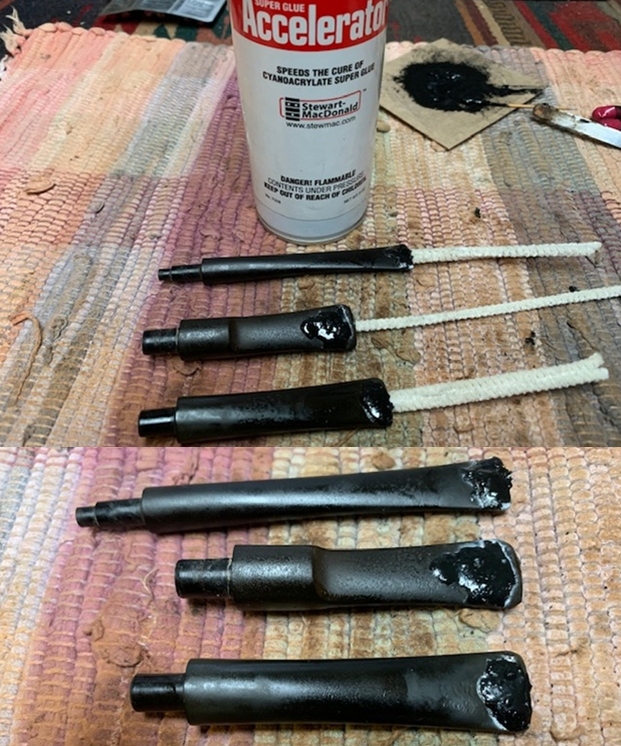
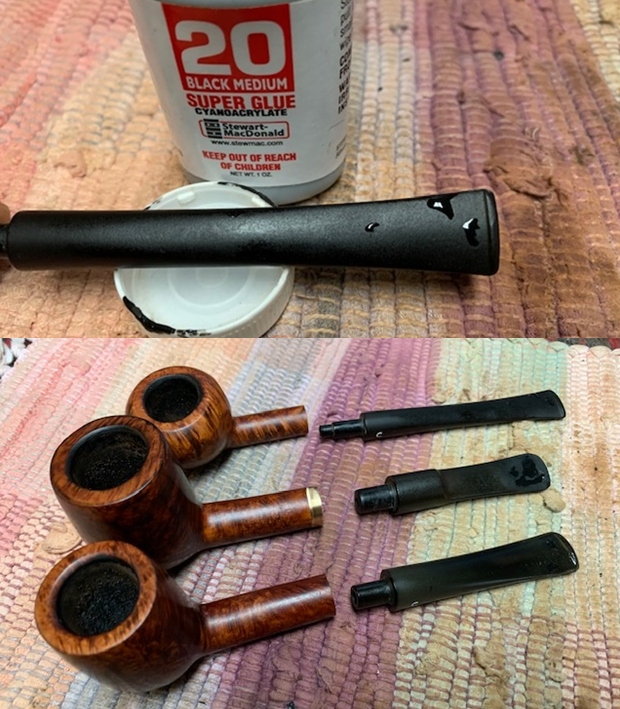
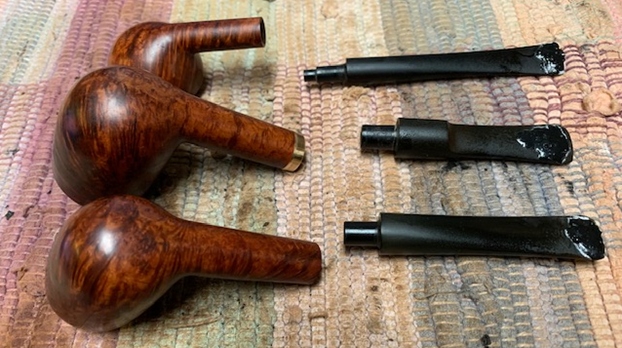
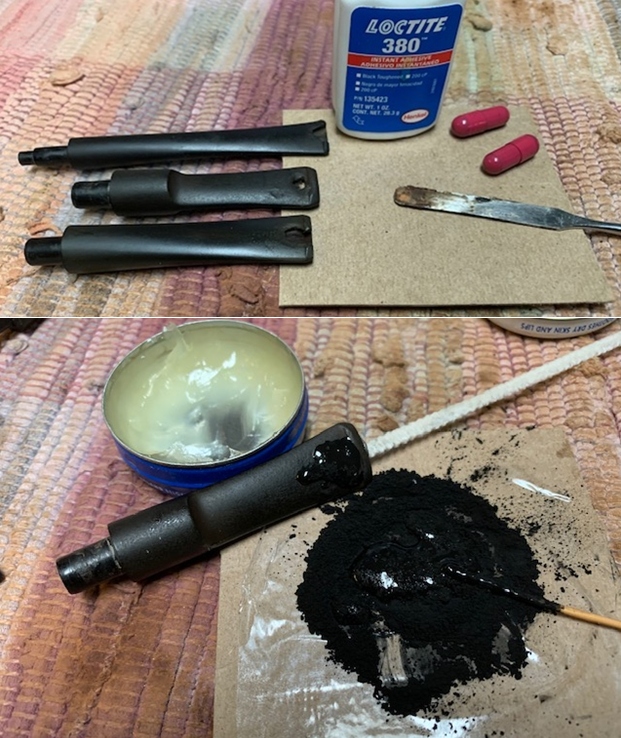
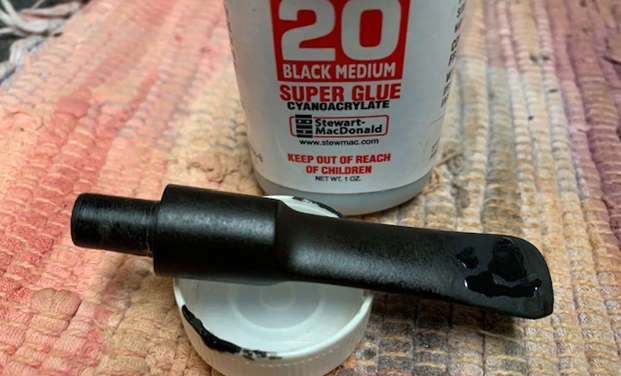
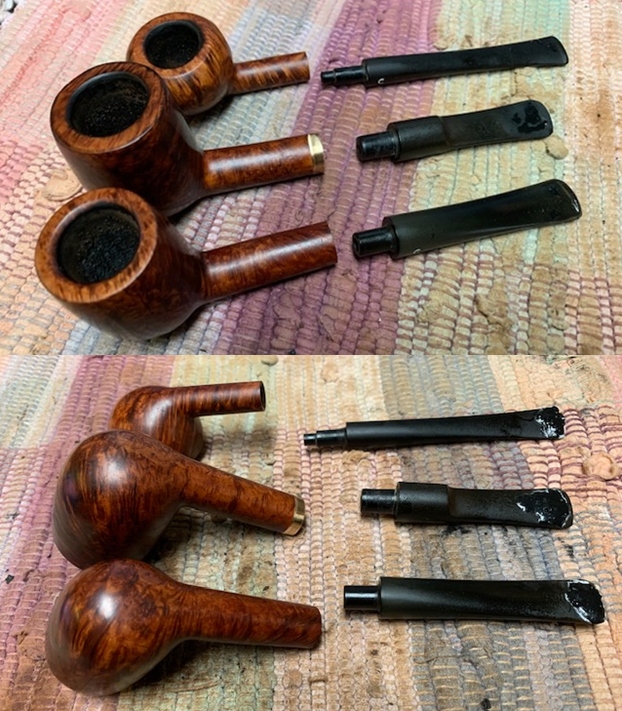
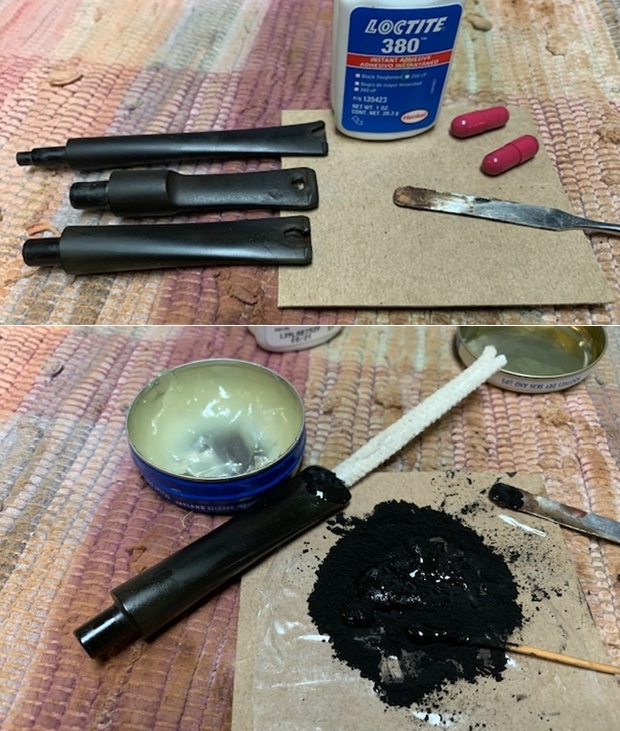
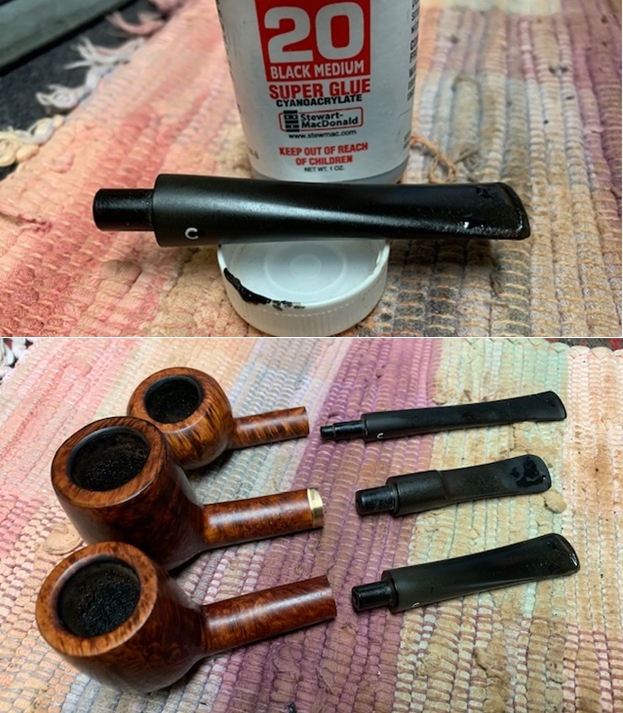
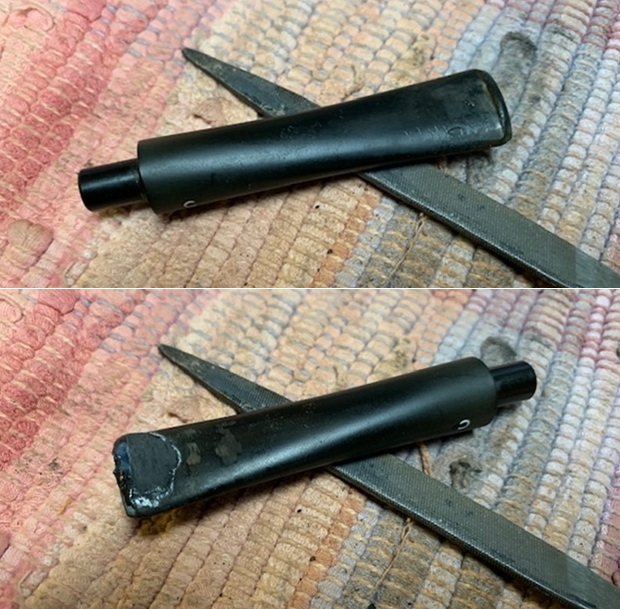
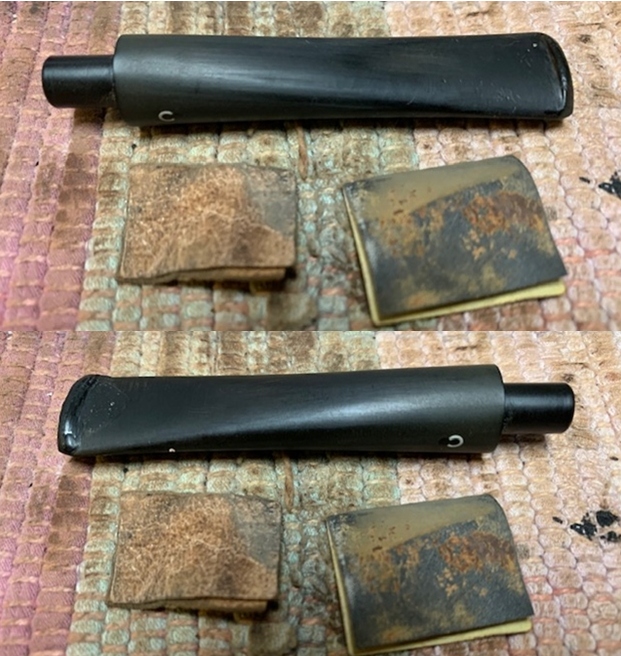
I reamed the bowl with a PipNet pipe reamer using the 2nd and 3rd cutting head to remove the remaining cake back to briar. I followed up with a Savinelli Fitsall pipe knife to remove the remnants of cake. I sanded the walls of the bowl with a piece of 220 grit sandpaper wrapped around a piece of dowel. I scrubbed out the mortise and the airway in the shank and the stem with alcohol, cotton swabs and pipe cleaners. I scrubbed the exterior of the bowl, rim, shank and stem with a tooth brush and Murphy’s Oil Soap to remove the oils and tars on the rim and the grime on the finish of the bowl. I rinsed it under running water and dried it off with a soft cloth.      I was able to remove some of the lava build up on the rim top and finished by scraping it with the Fitsall knife and then a piece of 220 grit sandpaper.  I cleaned up the bevel with the sandpaper at the same time. I polished the bowl and the rim top, sides and shank with micromesh sanding pads – wet sanding with 1500-12000 grit pads and wiping it down after each pad with a damp cloth. I carefully avoided the stamping on the shank so as not to damage the stamping.   I rubbed the bowl and shank down with Before & After Restoration Balm. I worked it into the surface of the bowl sides and shank with my fingertips to clean, enliven and protect the briar. I let the balm sit for a little while and then buffed with a cotton cloth to raise the shine.    I set aside the bowl and turned my attention to the stem repairs. I cut a piece of cardboard for a pallet, put aside two charcoal capsules, and set out the spatula and the Loctite 380 black CA glue. I greased a pipe cleaner with Vaseline and inserted it in the stem. I filled in the hole in the stem with a mixture of charcoal powder and Loctite. I used the spatula to fill in the bite throughs on all of the stems. I sprayed the repair with an accelerator to set the glue and removed the pipe cleaners from the stems.        I filled in the deep tooth marks on the top side of the stem with black super glue and set the stems aside to let the repairs cure. I took a photo of the three pipes at this point to give a feel for where things stood. I smoothed out the repairs with a needle file and started blending them into the surface of the stem. I sanded the remaining repairs with 220 grit sandpaper to further blend it into the stem surface. I started polishing it with 400 grit wet dry sandpaper.   I polished the vulcanite stem with micromesh sanding pads – 1500-12000 grit pads. I wiped it down with a damp cloth after each sanding pad. I used Before & After Pipe Polish – both Fine and Extra Fine to further polish the stem.     This 50s era Comoy’s Tradition 3591 Panel Prince with a vulcanite taper stem is a great looking pipe now that it has been restored. I did a lot of work on the bowl and repaired the bite through on the stem. The rich browns and blacks of the contrasting stains came alive with the polishing and waxing. I put the stem back on the bowl and carefully buffed the pipe with Blue Diamond on the buffing wheel using a light touch on the briar. I gave the bowl and the stem multiple coats of carnauba wax on the buffing wheel and followed that by buffing the entire pipe with a clean buffing pad. I hand buffed the pipe with a microfiber cloth to deepen the shine. The finished Comoy’s thin shank Panel Prince is a beauty and fits nicely in the hand and looks very good. Give the finished pipe a look in the photos below. The dimensions of the pipe are Length: 5 ¾ inches, Height: 1 1/8 inches, Outside diameter of the bowl: 1 ½ inches, Chamber diameter: ¾ of an inch. He will be stopping by to pick them up soon. I am looking forward to what Stanley thinks of his repaired pipe. He had said the threesome were his favourite pipes. This is the second of  the three but the last one I finished. Thanks for reading this blog and my reflections on the pipe while I worked on it. There are many more to come!
New Life for a Peterson’s Republic Era System Standard 306 Bent Sitter


Blog by Steve Laug

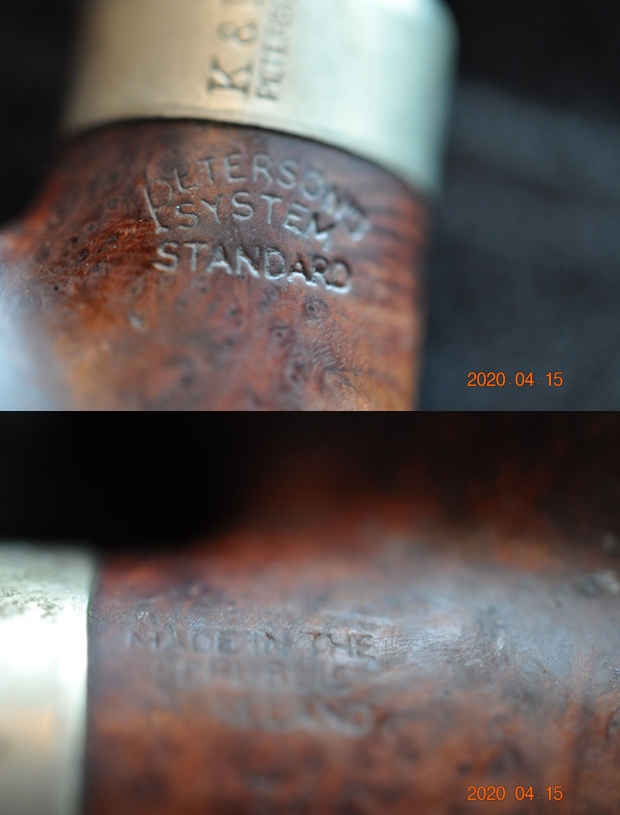
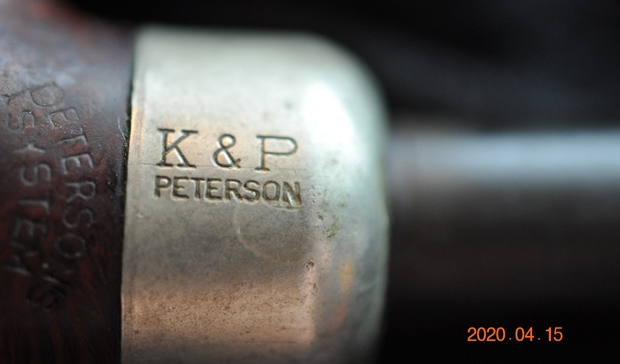
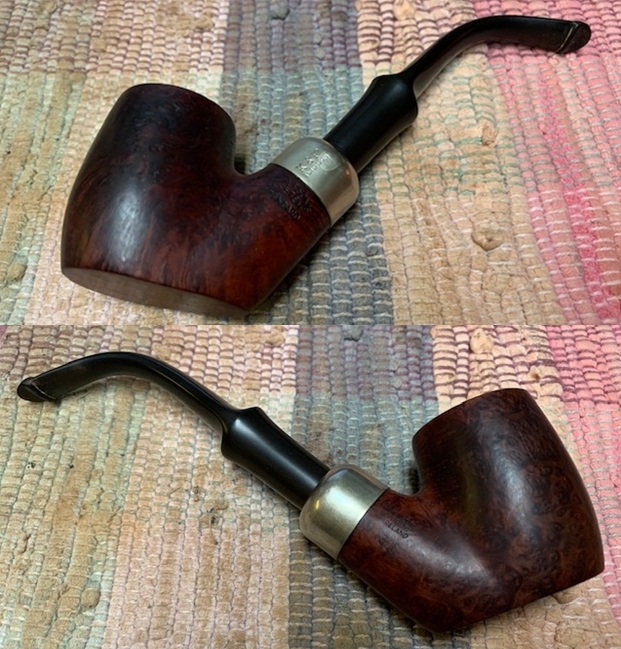
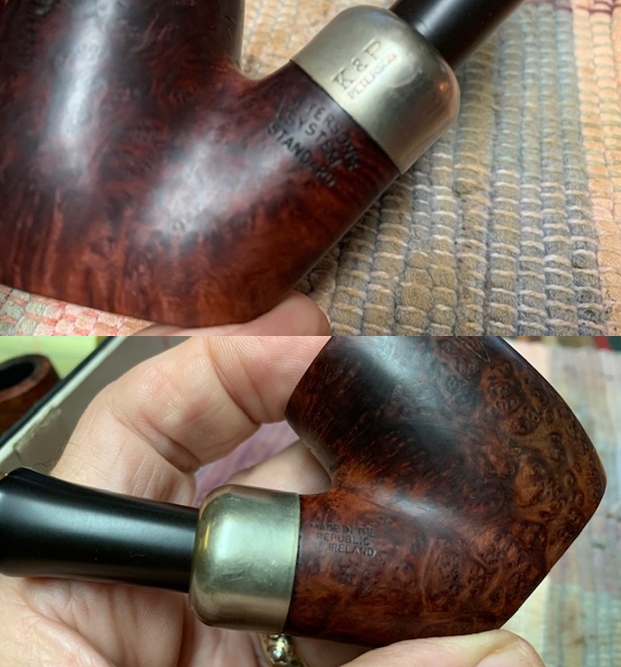
The next pipe I have chosen is a smooth Peterson’s System Standard Sitter that was incredibly dirty. The grime on the finish pretty much obscured the grain around the bowl sides. The contrast of the dark stain made the grain stand out clearly. Jeff and I picked it up as part of group of pipes we traded for from Hermann, Missouri, USA. It was stamped on the left side of the shank. The stamping was readable. It read Peterson’s [arched over] System [arched over] Standard. On the right side of the shank it was stamped Made in the Republic of Ireland [over] the shape number, 306. It was in rough condition when he brought it to the table. The finish was dirty with grime ground into the briar sides and rim. There was a thick cake in the bowl and an overflow of lava on the rim top and the beveled inner edge of the bowl. The stem was oxidized, calcified and had light tooth marks and chatter on the top and underside on and near the button. Jeff took photos of the pipe before his cleanup work. They tell the story and give a glimpse of the promise that we see in this pipe.  Jeff took photos of the rim top to show the interior the bowl and the beveled inner edge. It is heavily caked with a thick lava overflow. The stem is oxidized, calcified and has tooth marks on the top and underside near the button.   Jeff took some photos of the bowl sides and heel to show grain that was around this bowl. It is a nice looking pipe.  He took a photo of the sides of the shank to show the stamping. The stamping is readable in the photos below and is as noted above – it reads Peterson’s [arched over] System [over] Standard. The nickel ferrule is also stamped K&P Peterson’s on the left side. On the right side it is stamped Made in the Republic of Ireland [over] shape number 306. I am including the information from Pipedia’s article on Peterson pipes. It is a great read in terms of the history of the brand (https://pipedia.org/wiki/Peterson). I have included a bit of the pertinent history here.

1950 – 1989 The Republic Era  – From 1950 to the present time, the stamp for this era is “Made in the Republic of Ireland” in a block format generally in three lines but two lines have been used with or without Republic being abbreviated.

During the 1950’s and 60’s the Kapp & Peterson Company was still in the ownership of the Kapp family. However 1964 saw the retiral of the company Managing Director Frederick Henry(Harry) Kapp.

I knew that I was dealing with a Republic Era pipe made between 1950-1989. The K&P mark on the nickel band ties to Kapp & Peterson brings the date to the time between 1950-1964. Now it was time to work on the pipe.

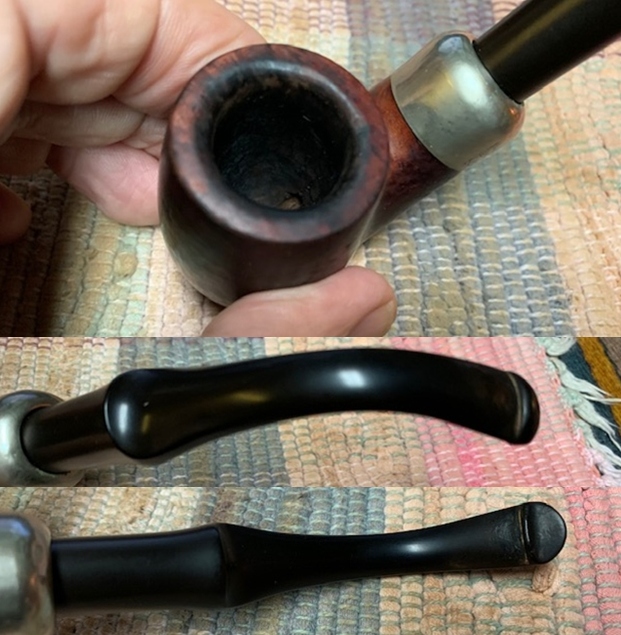
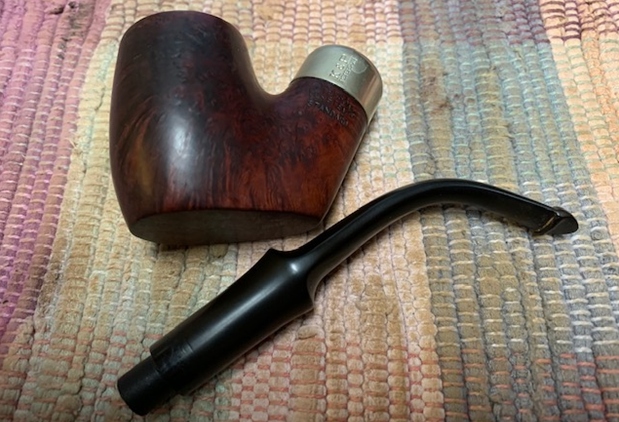
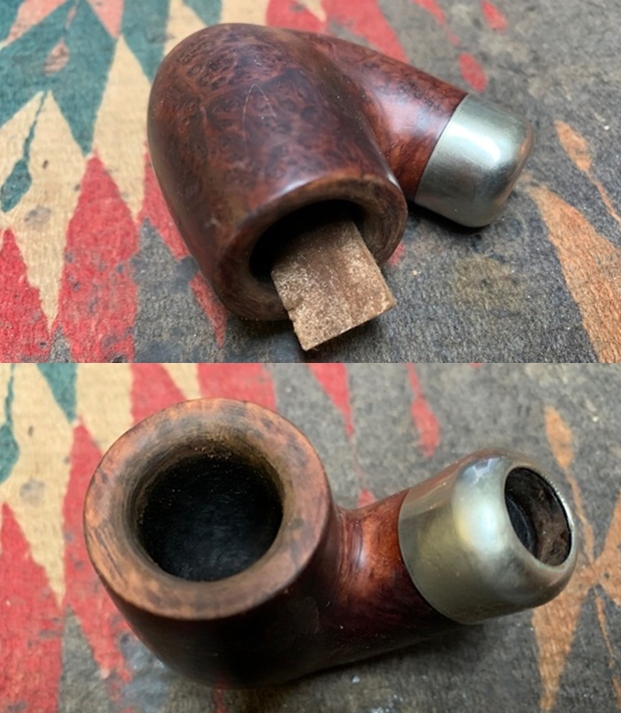
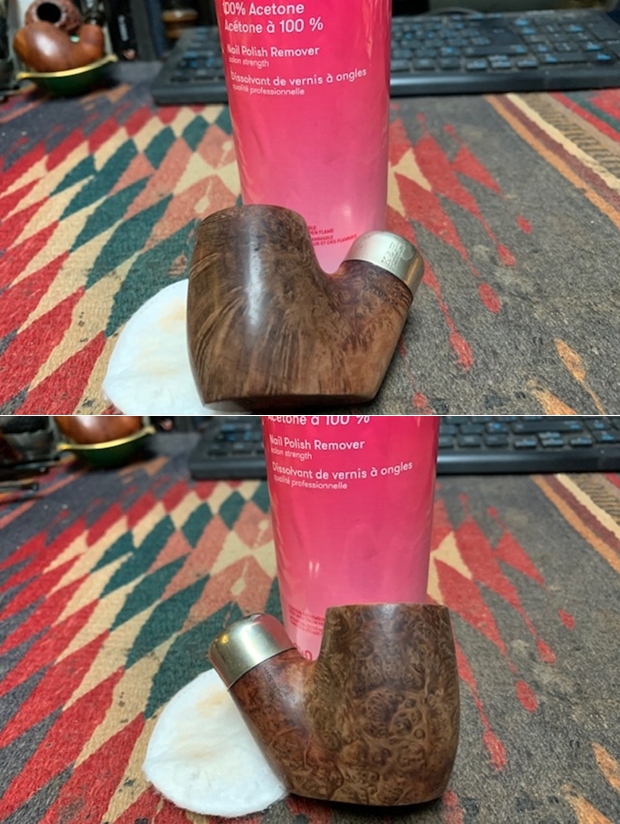
Jeff had done a great job cleaning up the pipe as usual. He reamed the pipe with a PipNet reamer and cut back the cake back to the bare briar. He cleaned up the walls with a Savinelli Fitsall Pipe Knife. He scrubbed the interior of the bowl and shank with pipe cleaners, cotton swabs and alcohol to remove the tars and oils. He scrubbed the exterior of the pipe with Murphy’s Oil Soap and a tooth brush to remove the grime from the finish. He worked on the rim top lava and darkening with the soap and tooth brush. He scrubbed the inside of the stem with alcohol and pipe cleaners. He scrubbed the exterior with Soft Scrub and then soaked it in Before & After Deoxidizer. He washed it off with warm water to remove the deoxidizer. The pipe looked far better. The stamping on the side of the stem was very light and the white that had remained was gone. I took some close up photos of the rim top and also of the stem surface. I wanted to show how well it had cleaned up. The rim top and edges show a darkening but are not damaged. It should clean up really well. I also took close up photos of the stem to show the tooth marks on the surface and on the button.  I took a photo of the stamping on the left side of the shank. You can see that it is stamped as noted above. It is clear and readable. I took the pipe apart and took a photo of the pipe. It is a good looking pipe and has some great grain around the bowl and shank.I decided to start my restoration work on this one by dealing with the rim top and the damaged beveled inner edge of the bowl. I sanded the rim top and the inner edge of the bowl with 220 grit sandpaper to remove the darkening and damage.  I started polishing it with 400 grit wet dry sandpaper.I wiped the bowl down with acetone on a pad to remove the remnants of the finish on the briar before I did the repairs to the chips and nicks on the bowl sides. With the bowl cleaned off I filled in the deep nicks and cuts in the briar with clear super glue.   Once the glue repairs cured I sanded them smooth with a folded piece of 220 grit sandpaper to blend it into the surface of the surrounding briar. I polished the briar with micromesh sanding pads – wet sanding it with 1500-12000 grit pads. After each pad I wiped the briar down with a damp cloth.  I worked some Before & After Restoration Balm into the surface of the briar with my fingertips to clean, enliven and protect the briar. I let the balm sit for a little while and then buffed with a cotton cloth to raise the shine. The photos show the bowl at this point in the restoration process. With that done the bowl was finished other than the final buffing. I set it aside and turned my attention to the stem. I filled in the tooth damage with clear CA glue and set the stem aside to cure. I sanded out the repaired tooth marks and chatter with 220 grit sand paper to blend them into the rest of the stem surface. I started to polish it with a folded piece of 400 wet dry sandpaper. Once it was finished it had begun to shine.    I polished the stem with micromesh sanding pads – wet sanding with 1500-12000 grit sanding pads. I wiped it down after each sanding pad with Obsidian Oil. I polished it with Before & After Pipe Stem Polish – both Fine and Extra Fine.     I am excited to finish this Republic Era Peterson’s System Standard 306 Sitter. I put the pipe back together and buffed it with Blue Diamond on the buffing wheel. I gave the bowl and the stem multiple coats of carnauba wax. I hand buffed the pipe with a clean buffing pad to raise the shine. It is fun to see what the polished bowl looks like with the grain popping through on the bowls sides and rim top. Added to that the polished black vulcanite stem with the shining nickel ferrule was beautiful. This mixed grain on the smooth finish Peterson’s Sitter is nice looking and the pipe feels great in my hand. It is light and well balanced. Have a look at it with the photos below. The dimensions are Length: 6 ½ inches, Height: 2 inches, Outside diameter of the bowl: 1 ¼ inches, Chamber diameter: ¾ of an inch. It is a beautiful pipe and one that will be on the rebornpipes store soon. If you are interested in adding it to your collection let me know. Thanks for walking through the restoration with me as I worked over this pipe. Thanks to each of you who are reading this blog. Remember we are not pipe owners; we are pipemen and women who hold our pipes in trust until they pass on into the trust of the next pipeman or woman.

A Tale of the Rebirth of 3 Pipes – Pipe #3 – a Comoy’s Grand Slam Pipe 484B Billiard


Blog by Steve Laug

While this is the third and last of the trio I ended up finishing it second. The little panel prince has some added challenges that I was not expecting so it will actually be finished last even though I started on it second. Ah well the surprises of pipe restoring are part of fun.

Last week I received an email from a fellow named Stanley who had gotten my info from the local Pipe and Cigar shop. He wrote that he had a trio of Comoy’s pipes that needed to be worked on. Two of them were Grand Slam Pipes and one was a Tradition. We connected via email and he said he would drop them off this week for me to work on. I am including part of his email so you have a sense of what I would be working on. I am also including the two photos that he attached to the email for me to see.

Hey Steve,

I had recently the chance to talk to a very kind and excellent gentleman over at City Cigar; I unfortunately was never able to get his name. However I mentioned I was looking for some replacement stems and he gave me your info…

…The pipes in question are attached in photos, I’ve never done any sort of pipe restoration in my life but I have attempted to take the cake down with a pocket knife. If you’d do it, would you be able to do a ream/clean on the three, as well as deal with the stems?

If possible, I’d prefer to save the original stems by repairing them, but it seems to me that most people remedy this problem with a replacement stem. Whatever you think is best I will go with.

If you think that I’d be better off without the stinger insert in the shape 64, then would you be able to remove it? I’m afraid I’d break the stem if I tried haha.

The 484b also seems to have a crack starting near the “Comoy’s Grand Slam” part of the shank, where it meets the stem. Is it possible to deal with this?

That is all! Please let me know what you think!

Thanks!  Stanley Last night Stanley stopped by and dropped off the three pipes. I took photos of pipes as there were when I opened the bag they were in. All three pipes were very dirty but the reaming had been started as noted in his email. The stems all had bite throughs on the underside. The bottom pipe in the photo below is a Grand Slam Pipe shape 64 Billiard. The stem has a 3 part C on the left side. The middle pipe is a Tradition 3591 Prince with 8 flattened panels on the bowl near the top. The stem also has a bite through and a missing divot. It also has a 3 part C on the left side. The top pipe in the photo is also Grand Slam Pipe 484B with a replacement stem that also has a bite through. The shank is also cracked on the left side.I decided to finish the last pipe of the trio while I waited for some stem repairs to cure on the second pipe – the Tradition Prince. I had left the pipe in the worst condition to work on last. It was another Grand Slam Pipe shape 484B or maybe 4846 as it is hard to read. It was in rough condition. The finish has a lot of dirt and dark grime ground into the briar but it appears to have some nice grain underneath all of that. I hope to be able to set that free with cleaning. It was probably a Comoy’s Billiard but somewhere along the way it had been given a replacement stem that turned it into a saddle billiard. The stamping is faint but with a light and lens reads COMOY’S [over] Grand Slam [over] Pipe. On the right side it has the shape number 484B(?6) next to the bowl/shank junction and that is followed by a very faint Comoy’s COM stamp that reads Made in London in a circle [over] England. There was a crack in the shank about an inch long on the left side extending into the Grand Slam Stamp. It is a hairline but is a definite issue. It appears that when it was restemmed the shank cracked. The pipe is dirty so it is not readily apparent. The bowl had been scraped but there was still a moderately heavy cake. There was an overflow of thick lava on the top of the rim and on the inner bevel of the bowl. The top and outer edge had been hammered and had a lot of damage. The replacement saddle stem was pitted and rough. There was a large bite through on the underside. This was the pipe I was the most worried about when I assessed the damage. I took photos of the pipe before he started his cleanup work.    I took photos of the rim top and bowl to give a clear picture of the thickness of the cake and the overflow of lava on the rim top. You can see the thick lava and the damage to the inner and outer edge of the bowl. I also took photos of the top and underside of the stem to show the condition of the stem surface and the bite through on the underside.    I took photos of the stamping on both sides of the shank. They are faint but read as noted above. I removed the stem and took a photo of the pipe to give a sense of the whole. It is a well shaped billiard. Once the stem was off I noted that tenon had a thick coating of wax as did the shank which made me wonder if that had cause the crack.I looked on Pipephil’s site for information on the Comoy’s Grand Slam Pipe and found the following information I have included a screen capture (http://www.pipephil.eu/logos/en/logo-comoy.html). The one I am working on is like the second one in the screen capture below. It has has a replacement saddle stem so there is no C on left side. The stamping on the shank is the same as the one I am working on.I turned to the article on Pipedia about dating Comoy’s pipes but the style of the stamping (https://pipedia.org/index.php?title=Comoy%27s_Dating_Guide#1917_to_the_end_of_the_1930.27s_.28at_least_1938.29). I have include the section in the screen capture below that date this pipe to the 1950s.

Now the Comoy’s stamp can be found in three variants in the 1950s

  1. A simple block-letter style without serifs but with the C larger than the other letters and the apostrophe before the “S”.
  2. A return to the slightly more fancy block letters with serifs and the apostrophe. (It seems that some grades carried different stamps, or at least that the stamping changed in different years for some grades.)
  3. A simple block-letter style without serifs and without the apostrophe and with the “C” the same size as the rest of the letters. This stamp was probably not used very long.
  4. A simple block-letter style without serifs but with the apostrophe before the “S” and with the “C” the same size as the rest of the letters.

Made in London England

Appears in two versions. This is again stamped in a circle with “MADE” at the top, “IN” in the middle, and “LONDON” at the bottom, with “ENGLAND” in a straight line beneath. It can be assumed that this stamp was first used in the export drive in the early 1950s. On a Bulldog Sandblast from the early 50s the Comoy name no. 2 above was used together with “MADE IN LONDON” over “ENGLAND”. There are no known examples of pre-WW II Comoy’s stamped in this way. The second version is the same as above but in a “rugby ball ” shape. This shape is verified on Comoy´s “Extraordinaire” pipes.

That article gave me some helpful information regarding the pipe that I was working on. I knew that the stamping and logos identified the pipe as having been made in following WW2 and from what I can see from the above information it is a 1950s era pipe.

I reamed the bowl with a PipNet pipe reamer using the 2nd and 3rd cutting head to remove the remaining cake back to briar. I followed up with a Savinelli Fitsall pipe knife to remove the remnants of cake. I sanded the walls of the bowl with a piece of 220 grit sandpaper wrapped around a piece of dowel. I scrubbed out the mortise and the airway in the shank and the stem with alcohol, cotton swabs and pipe cleaners.   I scrubbed the exterior of the bowl, rim, shank and stem with a tooth brush and Murphy’s Oil Soap to remove the oils and tars on the rim and the grime on the finish of the bowl. I rinsed it under running water and dried it off with a soft cloth. I was topped the bowl on a piece of 220 grit sandpaper and a topping board to smooth out the damage on the surface of the rim and reduce the damage on the edges. I used a folded piece of 220 grit sandpaper to clean up the beveled inner edge of the rim. With the general cleanup finished I decided to address the cracked shank. I have circled the area of the crack in red in the photo below. I removed the stem and spread the crack slightly and used a tooth pick to put super glue in the crack. I pressure fit a thin band on the end of the shank to bind it together. The band allowed the glue to cure and the crack virtually disappeared. The band is thin enough not do obscure the stamping on the shank sides.I polished the bowl and the rim top, sides and shank with micromesh sanding pads – wet sanding with 1500-12000 grit pads and wiping it down after each pad with a damp cloth. I carefully avoided the stamping on the shank so as not to damage the stamping. I rubbed the bowl and shank down with Before & After Restoration Balm. I worked it into the surface of the bowl sides and shank with my fingertips to clean, enliven and protect the briar. I let the balm sit for a little while and then buffed with a cotton cloth to raise the shine.      I set aside the bowl and turned my attention to the stem repairs. I cut a piece of cardboard for a pallet, put aside two charcoal capsules, and set out the spatula and the Loctite 380 black CA glue. I greased a pipe cleaner with Vaseline and inserted it in the stem. I filled in the hole in the stem with a mixture of charcoal powder and Loctite. I used the spatula to fill in the bite throughs on all of the stems. I sprayed the repair with an accelerator to set the glue and removed the pipe cleaners from the stems.     I filled in the deep tooth marks on the top side of the stem with black super glue and set the stems aside to let the repairs cure. I took a photo of the three pipes at this point to give a feel for where things stood. I smoothed out the repairs with a needle file and started blending them into the surface of the stem. I sanded the remaining repairs with 220 grit sandpaper to further blend it into the stem surface. I started polishing it with 400 grit wet dry sandpaper.     I polished the vulcanite stem with micromesh sanding pads – 1500-12000 grit pads. I wiped it down with a damp cloth after each sanding pad. I used Before & After Pipe Polish – both Fine and Extra Fine to further polish the stem. This 50s era Comoy’s Grand Slam Pipe 484B Billiard with a replacement vulcanite saddle stem turned out to be a nice looking pipe now that it has been restored. I did a lot of work on the bowl and repaired the bite through on the stem. The rich browns and blacks of the contrasting stains came alive with the polishing and waxing. The thin brass shank band adds a touch of class to the pipe. I put the stem back on the bowl and carefully buffed the pipe with Blue Diamond on the buffing wheel using a light touch on the briar. I gave the bowl and the stem multiple coats of carnauba wax on the buffing wheel and followed that by buffing the entire pipe with a clean buffing pad. I hand buffed the pipe with a microfiber cloth to deepen the shine. The finished Comoy’s Billiard is a beauty and fits nicely in the hand and looks very good. Give the finished pipe a look in the photos below. The dimensions of the pipe are Length: 5 ½ inches, Height: 1 ¾ inches, Outside diameter of the bowl: 1 ¼ inches, Chamber diameter: ¾ of an inch. I am looking forward to what Stanley thinks of his repaired pipe. He had said the threesome were his favourite pipes. While this was the last of  the threesome it pushed ahead of number 2 in the queue so there is one more to come! Thanks for reading this blog and my reflections on the pipe while I worked on it. There are many more to come!
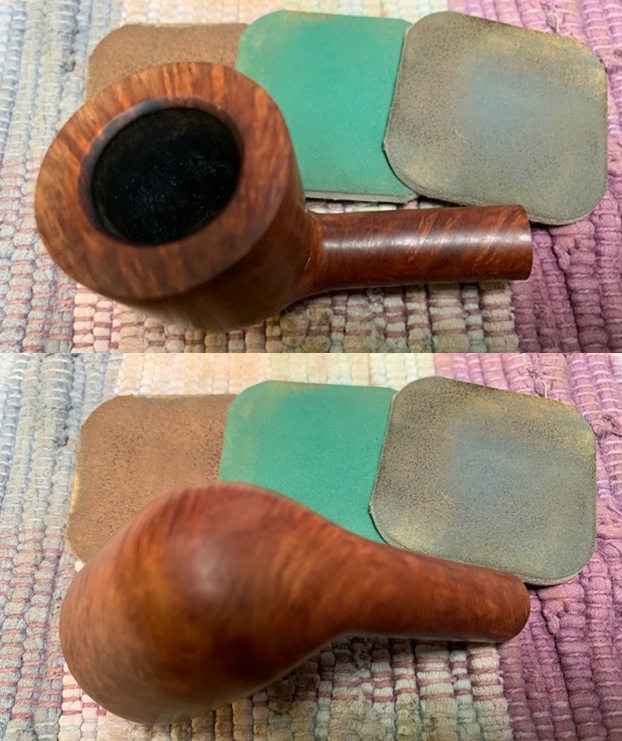
A Tale of the Rebirth of 3 Pipes – Pipe #1 – a Comoy’s Grand Slam Pipe 64 Billiard


Blog by Steve Laug

Last week I received an email from a fellow named Stanley who had gotten my info from the local Pipe and Cigar shop. He wrote that he had a trio of Comoy’s pipes that needed to be worked on. Two of them were Grand Slam Pipes and one was a Tradition. We connected via email and he said he would drop them off this week for me to work on. I am including part of his email so you have a sense of what I would be working on. I am also including the two photos that he attached to the email for me to see.

Hey Steve,

I had recently the chance to talk to a very kind and excellent gentleman over at City Cigar, I unfortunately was never able to get his name. However I mentioned I was looking for some replacement stems and he gave me your info…

…The pipes in question are attached in photos, I’ve never done any sort of pipe restoration in my life but I have attempted to take the cake down with a pocket knife. If you’d do it, would you be able to do a ream/clean on the three, as well as deal with the stems?

If possible, I’d prefer to save the original stems by repairing them, but it seems to me that most people remedy this problem with a replacement stem. Whatever you think is best I will go with.

If you think that I’d be better off without the stinger insert in the shape 64, then would you be able to remove it? I’m afraid I’d break the stem if I tried haha.

The 484b also seems to have a crack starting near the “Comoy’s Grand Slam” part of the shank, where it meets the stem. Is it possible to deal with this?

That is all! Please let me know what you think!

Thanks!  Stanley Last night Stanley stopped by and dropped off the three pipes. I took photos of pipes as there were when I opened the bag they were in. All three pipes were very dirty but the reaming had been started as noted in his email. The stems all had bite throughs on the underside. The bottom pipe in the photo below is a Grand Slam Pipe shape 64 Billiard. The stem has a 3 part C on the left side. The middle pipe is a Tradition 3591 Prince with 8 flattened panels on the bowl near the top. The stem also has a bite through and a missing divot. It also has a 3 part C on the left side. The top pipe in the photo is also Grand Slam Pipe 484B with a replacement stem that also has a bite through. The shank is also cracked on the left side.I decided to work on the Grand Slam Pipe 64 Billiard. It is a beautifully grained Comoy’s Billiard that really is a pipe of Pipe Smoking History. The stamping is the significant marker that points this out for me. It is stamped on the left side of the shank and reads COMOY’S [over] Grand Slam [over] Pipe. On the right side it has the shape number 64 next to the bowl/shank junction and that is followed by a Comoy’s COM stamp that reads Made in London in a circle [over] England. On the underside there was a *6 stamped at the stem/shank junction. The finish had a lot of grime ground into the smooth finish on the bowl and some darkening around the sides of the bowl. The bowl had been scraped but there was still a moderately heavy cake. There was an overflow of thick lava on the top of the rim and on the inner bevel of the bowl. It was hard to know what the rim top and inner edge of the bowl looked like under the grime. The stem was lightly oxidized and there was a large bite through on the underside. There was a three part inlaid C on the left of the taper stem. When the pipe arrived it had a Softee Bit over the damaged stem. The pipe had promise but it was very dirty. I took photos of the pipe before he started his cleanup work. I took photos of the rim top and bowl to give a clear picture of the thickness of the cake and the overflow of lava on the rim top. It is hard to know if there is damage to the inner edge of the bowl because of the lava coat. I also took photos of the top and underside of the stem to show the condition of the stem surface and the bite through on the underside.I took photos of the stamping on both sides and underside of the shank. They read as noted above. I also included a photo of the 3 part C logo on the left side of the taper stem.   I removed the stem and took a photo of the pipe to give a sense of the whole. It is a well shaped billiard. Once the stem was off I noted that tenon had a Comoy’s Grand Slam metallic stinger threaded in the stem. It was missing the cap on the end that held the leather washer in place the apparatus was damaged and I would not be able to fit a new cap on the end. I would remove it from the tenon so that I could clean the stem and do the repairs.I looked on Pipephil’s site for information on the Comoy’s Grand Slam Pipe and found the following information I have included a screen capture (http://www.pipephil.eu/logos/en/logo-comoy.html). The one I am working on is like the second one in the screen capture below. It has the three part C which dated it to 1946 and following. The stamping is the same as the one I am working on. The *6 is the size of the washer on the end of the stinger.I turned to the article on Pipedia about dating Comoy’s pipes but the style of the stamping (https://pipedia.org/index.php?title=Comoy%27s_Dating_Guide#1917_to_the_end_of_the_1930.27s_.28at_least_1938.29). I have include the section in the screen capture below that date this pipe to the 1950s.

Now the Comoy’s stamp can be found in three variants in the 1950s

  1. A simple block-letter style without serifs but with the C larger than the other letters and the apostrophe before the “S”.
  2. A return to the slightly more fancy block letters with serifs and the apostrophe. (It seems that some grades carried different stamps, or at least that the stamping changed in different years for some grades.)
  3. A simple block-letter style without serifs and without the apostrophe and with the “C” the same size as the rest of the letters. This stamp was probably not used very long.
  4. A simple block-letter style without serifs but with the apostrophe before the “S” and with the “C” the same size as the rest of the letters.

Made in London England

Appears in two versions. This is again stamped in a circle with “MADE” at the top, “IN” in the middle, and “LONDON” at the bottom, with “ENGLAND” in a straight line beneath. It can be assumed that this stamp was first used in the export drive in the early 1950s. On a Bulldog Sandblast from the early 50s the Comoy name no. 2 above was used together with “MADE IN LONDON” over “ENGLAND”. There are no known examples of pre-WW II Comoy’s stamped in this way. The second version is the same as above but in a “rugby ball ” shape. This shape is verified on Comoy´s “Extraordinaire” pipes.

Inlaid “C”

C” was first inlaid in the side of the mouthpiece around 1919. This was a complex inlay needing three drillings. First, a round white inlay was inserted, then the centre of the white was drilled out, and a smaller round black inlay was inserted. Finally, another drilling was made to remove the open part of the “C,” and an even smaller black inlay was inserted. This inlaid “C,” known as the “three-piece C,” was continued until the Cadogan era in the 1980s. However, the “C” in the 1920s and early 30s is much thinner and more delicate than the one post-WW II.

That article gave me some helpful information regarding the pipe that I was working on. I knew that the stamping and logos identified the pipe as having been made in following WW2 and from what I can see from the above information it is a 1950s era pipe.

I reamed the bowl with a PipNet pipe reamer using the 2nd and 3rd cutting head to remove the remaining cake back to briar. I followed up with a Savinelli Fitsall pipe knife to remove the remnants of cake. I sanded the walls of the bowl with a piece of 220 grit sandpaper wrapped around a piece of dowel. I scrubbed out the mortise and the airway in the shank and the stem with alcohol, cotton swabs and pipe cleaners. I scrubbed the exterior of the bowl, rim, shank and stem with a tooth brush and Murphy’s Oil Soap to remove the oils and tars on the rim and the grime on the finish of the bowl. I rinsed it under running water and dried it off with a soft cloth.    I was able to remove some of the lava build up on the rim top and finished by scraping it with the Fitsall knife and then a piece of 220 grit sandpaper. There were some deep cuts on the bottom right side of the bowl and on the top right side near the edge. I filled these in with a spot of clear super glue.   I polished the bowl and the rim top, sides and shank with micromesh sanding pads – wet sanding with 1500-12000 grit pads and wiping it down after each pad with a damp cloth. I carefully avoided the stamping on the shank so as not to damage the stamping.   I rubbed the bowl and shank down with Before & After Restoration Balm. I worked it into the surface of the bowl sides and shank with my fingertips to clean, enliven and protect the briar. I let the balm sit for a little while and then buffed with a cotton cloth to raise the shine.    I set the bowl aside and turned my attention to the stem. I heated the stinger with a Bic lighter and unscrewed it with a pair of pliers.I set aside the bowl and turned my attention to the stem repairs. I cut a piece of cardboard for a pallet, put aside two charcoal capsules, and set out the spatula and the Loctite 380 black CA glue. I greased a pipe cleaner with Vaseline and inserted it in the stem. I filled in the hole in the stem with a mixture of charcoal powder and Loctite. I used the spatula to fill in the bite throughs on all of the stems. I sprayed the repair with an accelerator to set the glue and removed the pipe cleaners from the stems.  I filled in the deep tooth marks on the top side of the stem with black super glue and set the stems aside to let the repairs cure. I took a photo of the three pipes at this point to give a feel for where things stood.   I smoothed out the repairs with a needle file and started blending them into the surface of the stem. I sanded the remaining repairs with 220 grit sandpaper to further blend it into the stem surface. I started polishing it with 400 grit wet dry sandpaper. I polished the vulcanite stem with micromesh sanding pads – 1500-12000 grit pads. I wiped it down with a damp cloth after each sanding pad. I took photos of both sides of the stem to show the repair work on both sides.     This 50s era Comoy’s Grand Slam Pipe 64 Billiard with a vulcanite taper stem is a great looking pipe now that it has been restored. I did a lot of work on the bowl and repaired the bite through on the stem. The rich browns and blacks of the contrasting stains came alive with the polishing and waxing. I put the stem back on the bowl and carefully buffed the pipe with Blue Diamond on the buffing wheel using a light touch on the briar. I gave the bowl and the stem multiple coats of carnauba wax on the buffing wheel and followed that by buffing the entire pipe with a clean buffing pad. I hand buffed the pipe with a microfiber cloth to deepen the shine. The finished Comoy’s Medium Billiard is a beauty and fits nicely in the hand and looks very good. Give the finished pipe a look in the photos below. The dimensions of the pipe are Length: 5 ½ inches, Height: 1 ¾ inches, Outside diameter of the bowl: 1 ¼ inches, Chamber diameter: ¾ of an inch. I am looking forward to what Stanley thinks of his repaired pipe. He had said the threesome were his favourite pipes. This is the first of  the three. Thanks for reading this blog and my reflections on the pipe while I worked on it. There are many more to come!