Tag Archives: rewaxing a Meerschaum pipe

A Challenging Restoration of a c.1921 No Name Meerschaum Billiard


Blog by Paresh Deshpande

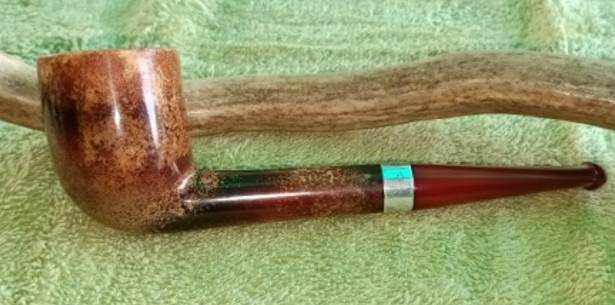
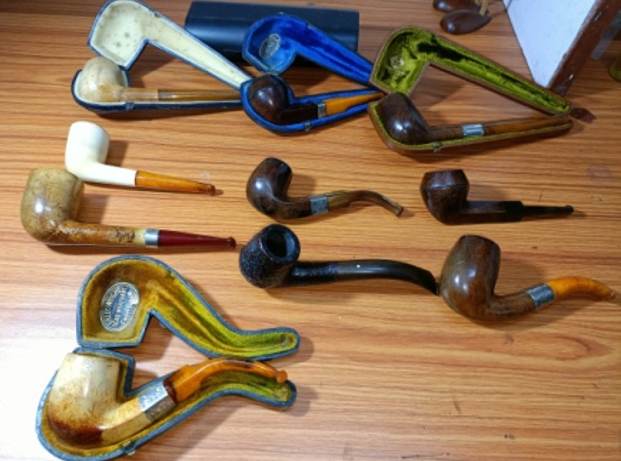
During the summer of last year while browsing on Pinterest, I came across pictures of some beautiful pipes and following the links led me to an old gentleman from the UK who was willing to sell these pipes either single or as a lot. There were around 60 odd pipes. I went through the pictures that were sent along with the rates and selected 10 pipes. After a prolonged and interesting interaction, we managed to arrive at a price point. Soon these pipes landed on the shores of India and went in to Customs hold for nearly a month. Finally, it was released and I laid my hands on these pipes after a wait of nearly 3 months! Here is a picture of the lot that I had taken moments after opening the parcel.Since then, I have refurbished, repaired a family era Barling’s Make Bulldog (yellow arrow), a c.1901 Samuel McLardy (green arrow) and added them to my personal collection while the c. 1960 Dunhill Shell (blue arrow) has made it’s way to my dear friend to enjoy. This estate lot had a beautiful block Meerschaum billiard with a Redmanol stem (red arrow) that called out to my wife. She liked the size, heft and simple classic straight lines of billiards and the way the red of the stem complimented the overall appearance of the pipe. The following picture will identify the pipes that have been restored and the meer that is now on my work table.This solid meerschaum is sans any stampings on the stummel or stem and lack of any housing case makes establishing the provenance of this pipe a tad impossible. The only pointer to this pipe being English is the stampings on the Sterling Silver ferrule at the shank end and should help in dating this pipe and identify the silversmith who mounted it on this pipe. It is stamped “H.T” in an oval over three sterling silver hallmarks. From left to right the first cartouche is with a LION PASSANT certifying silver quality followed by a cartouche with symbol for Chester Assay Office and the last cartouche contains the date code letter “V”.In order to link the maker’s mark on the silver band to a silversmith registered with Chester Assay office. I visited https://www.silvermakersmarks.co.uk/Makers/Chester-HP-HZ.html#HT  and I have reproduced the findings below that most closely matched the probable silversmith (highlighted in red).The cause for doubt in my mind with respect to the findings above is the fact that the “H.T” stamping on the silver band is enclosed in an oval whereas that shown above is in a square cartouche. However, the comment of Henry Tongue being a Pipe mounter and the period are perfectly matched. Thus the circumstantial evidence makes me want to believe that the pipe mounter of this Meerschaum pipe is Henry Tongue.  Any esteemed Reader is most welcome to shed more definitive information for the benefit of other members.
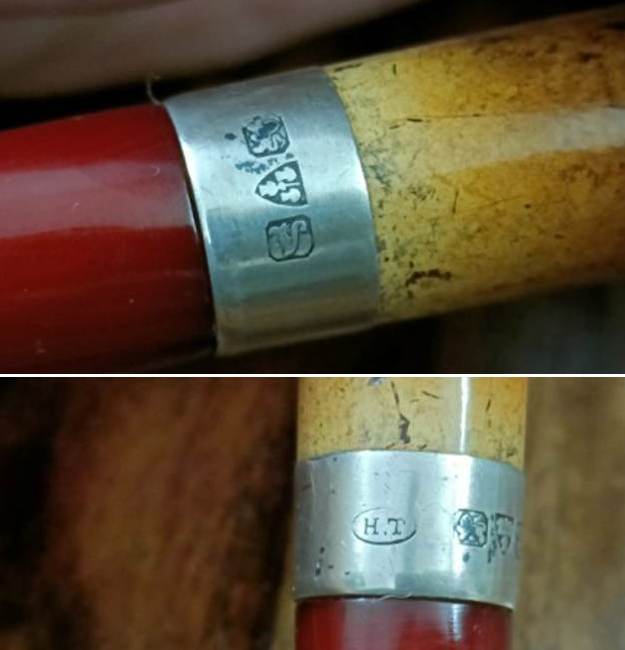
The next step was to ascertain the dating on this silver band. I frequent www.silvercollection.it for exact dating of letter code. The font style and the enclosing cartouche of the letter “V” on the shank band matches to the date year 1921. I have reproduced a screenshot of the relevant section of the date charts and the date year is indicated in red.

Now it was time to get working on the pipe.

Initial Inspection
To begin with, the stummel is dirty and covered in dust, dirt and grime of over a century gone by. The age on this pipe is manifested in the number of all the handling related scratches and marks that it has been subjected to. There is a decent layer of cake in the chamber with lava overflow over the rim top surface. Under all the crud, the rim top is deeply scratched all around. The stem seats loose in the shank. The stem has a couple of tooth indentations in the bite zone and other than that the Redmanol stem is in pretty good condition. Here are a few pictures of the pipe as it sits on my worktable. Detailed Inspection
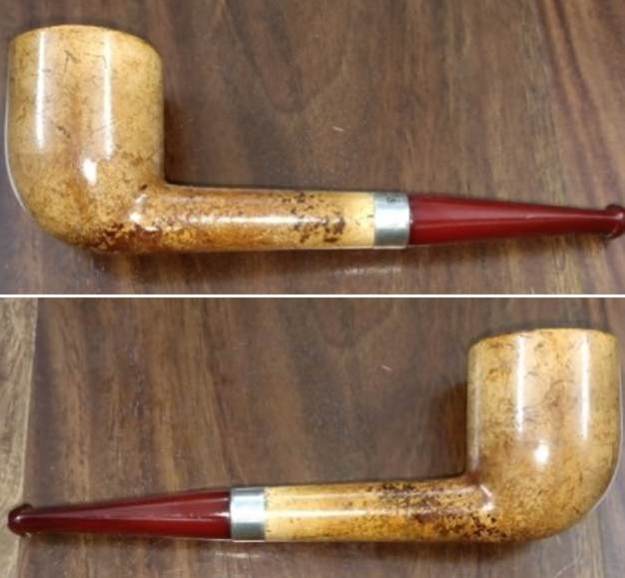
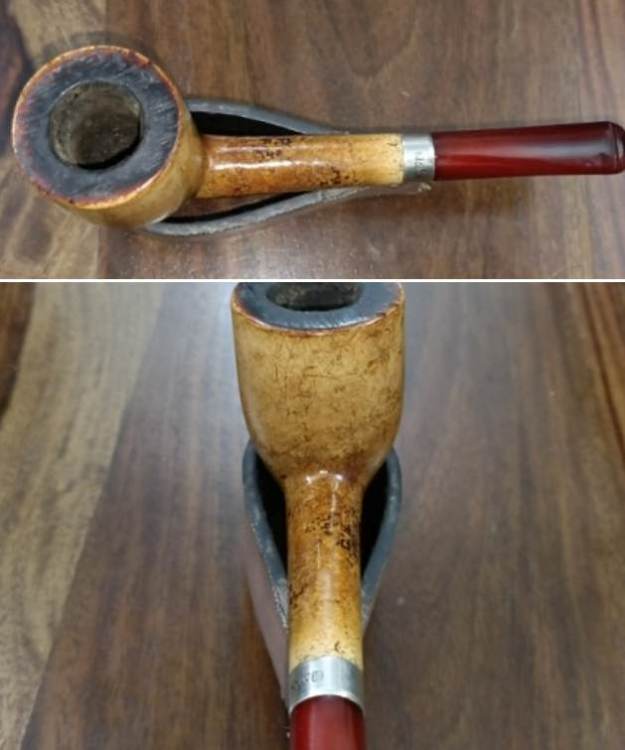
There is a thick layer of cake in the chamber. The rim top surface has lava overflow and has darkened considerably over the entire surface. The rim top is peppered with deep scratches, probably caused when someone, somewhere through the century, tried to remove the crud from the rim top using a sharp knife or it could have been caused as damage due to uncared for storage when the rim top and rest of the stummel was being rubbed against some hard objects. This uncared for storage could be the most likely reason since the stummel too has a number of scratches and marks. The inner and outer rim edges both show a few nicks and dents. The exact extent of damage to the inner rim edge will be ascertained after the chamber and rim surface is rid of all the cake and crud. The chamber walls are thick and feel solid to the touch.The stummel has a number of scratches and marks over the surface. There is a lot of dirt and grime ground in to the stummel surface giving it a dull and patchy appearance. However under all the grime and scratches, the stummel has taken on a beautiful color/ patina through the years of smoking and it is my intent to preserve it through the process. The threads in the mortise are slightly worn out and the mortise itself shows accumulation of oils and grime. Other than these minor issues, the stummel surface is sans any major damage and feels solid to the touch. The opaque cloudy Redmanol stem looks amazing as it is and should add a new dimension to the beauty of the pipe once it is repaired and all polished up. There are a couple of deep tooth indentations in the bite zone (encircled in yellow) that would need to be addressed. The stem airway leading to the round orifice shows remnants of old oils and gunk. The threaded bone tenon is covered in very fine jute threads to increase the diameter of the tenon for improved seating of the tenon in to the mortise. Yet even after this adhoc improvisation, the seating of the stem is pretty loose. I would need to figure out a more accurate, reliable and permanent way to address this issue.The Process
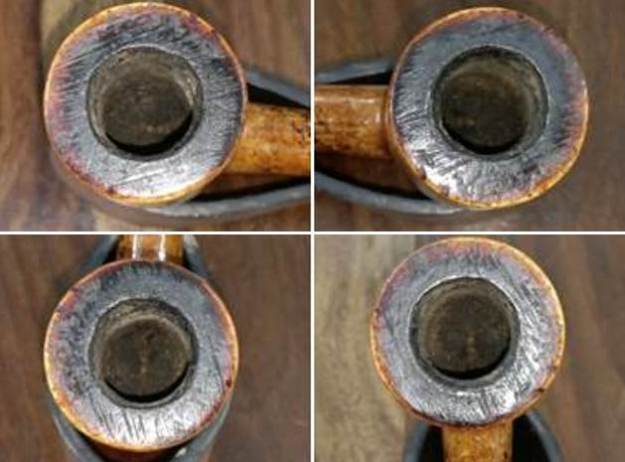
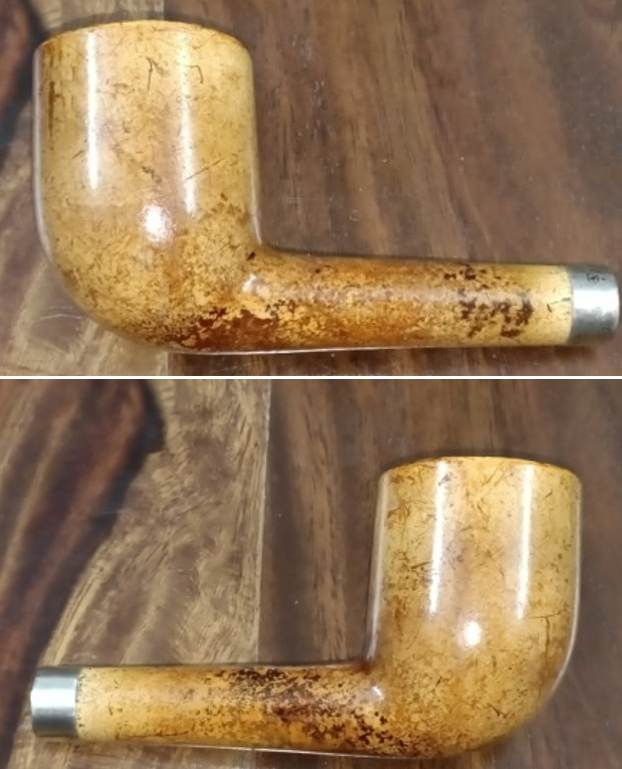
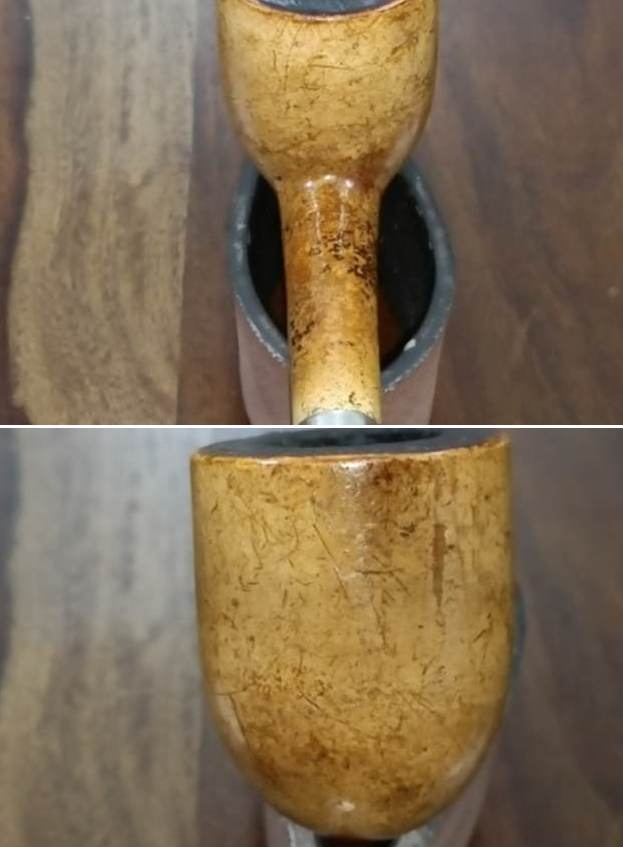
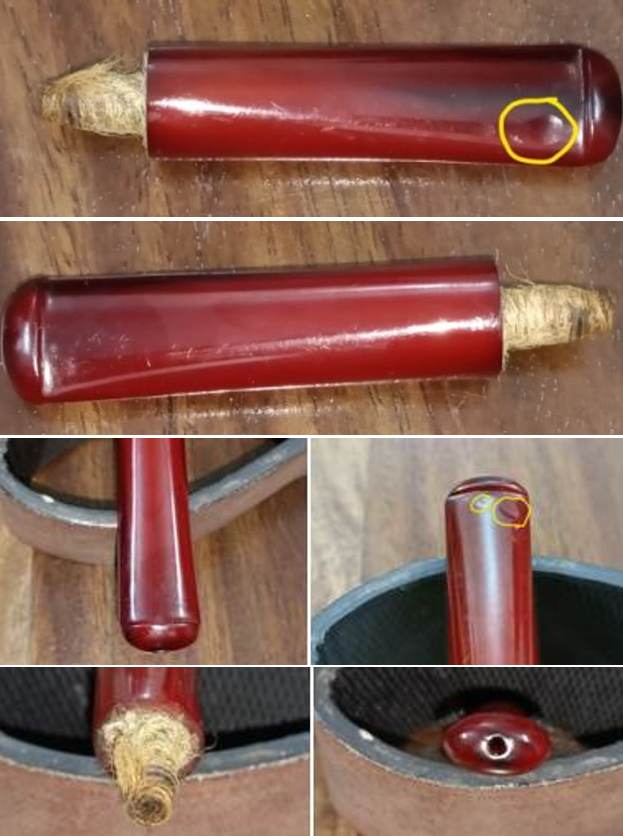
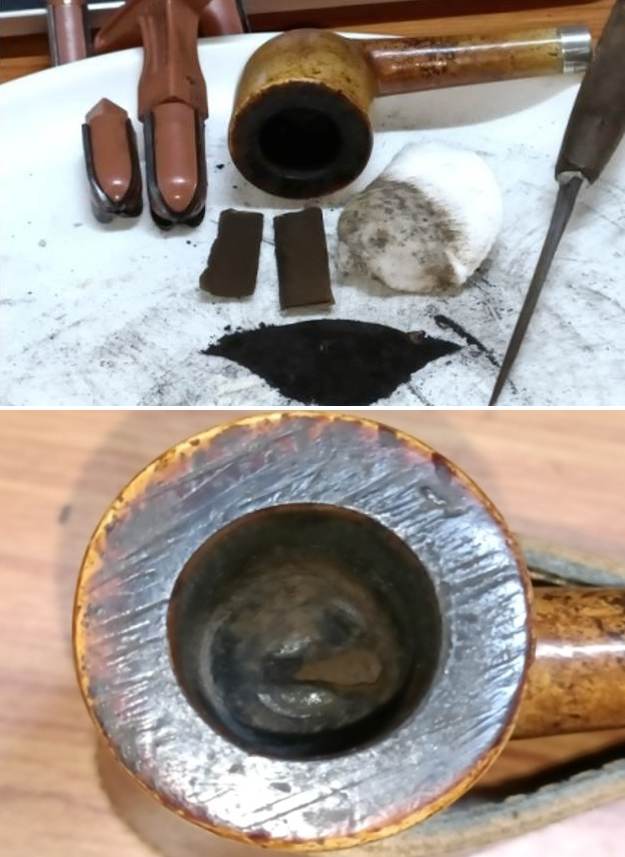
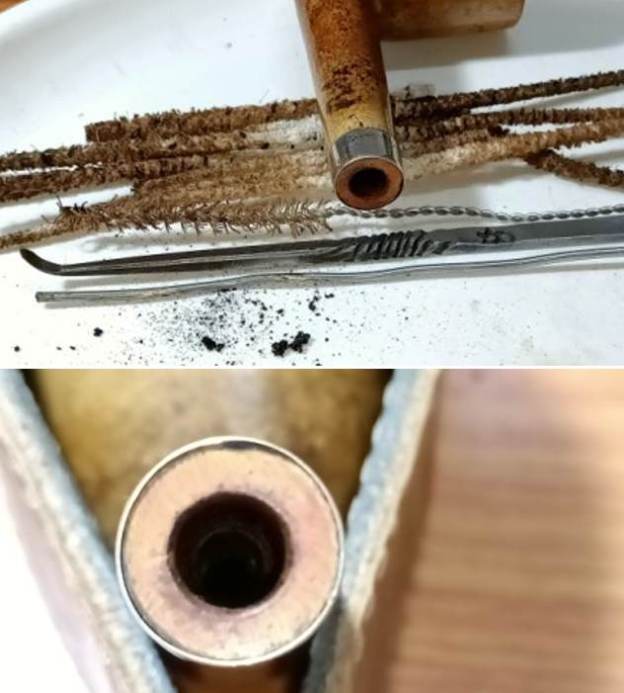
I started work on this pipe by firstly getting rid of the jute threads from the tenon end and followed it with cleaning the airway using thin shank brushes and anti oil dish cleaning soap. I ran a couple of pipe cleaners to clean and dry out the airway. Using a soft brass wired brush; I cleaned out the entire gunk from the threads of the bone tenon.I filled the tooth indentations with clear superglue and set it aside for the glue to cure. Once the glue had cured, using a flat needle I sand the fill to achieve a rough match with the rest of the stem surface. Once I was through with this step, I dry sand the entire stem with 400, 600 and 800 grit sand papers followed by wet sanding using 1000, 1500 and 2000 grit sand papers. This progressive use of higher grit sandpapers helps to, firstly, reduce the sanding marks left behind by the more abrasive ones, secondly, completely eliminate the oxidation and imparting a clean shine to the stem surface. Thirdly, this also helps to even out the minor tooth chatter from the bite zone. To complete the stem polish, I went through the entire set of nine micromesh pads, wet sanding through 1500 to 12000 grit micromesh pads.At this stage of refurbishing this pipe, little did I know that I would be carrying out further tedious and unplanned for repairs to the stem towards the end and till then, for all purposes, I have completed the stem restoration.
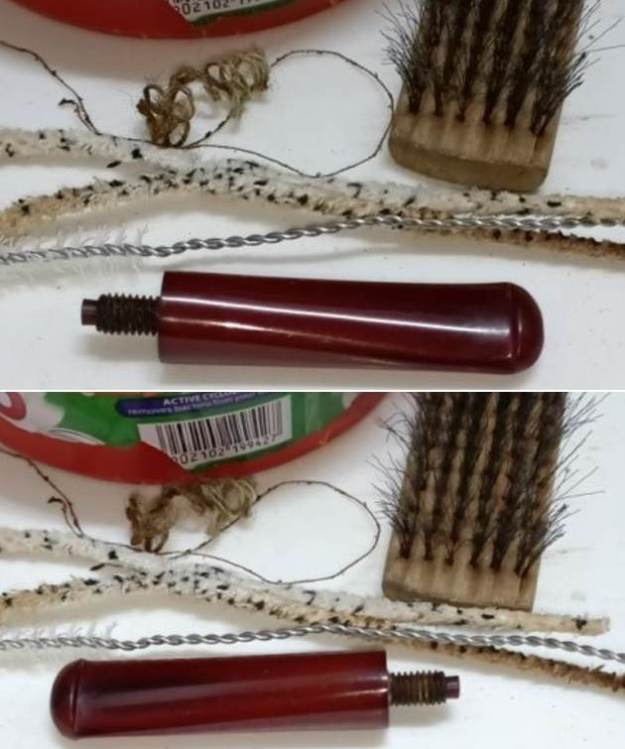
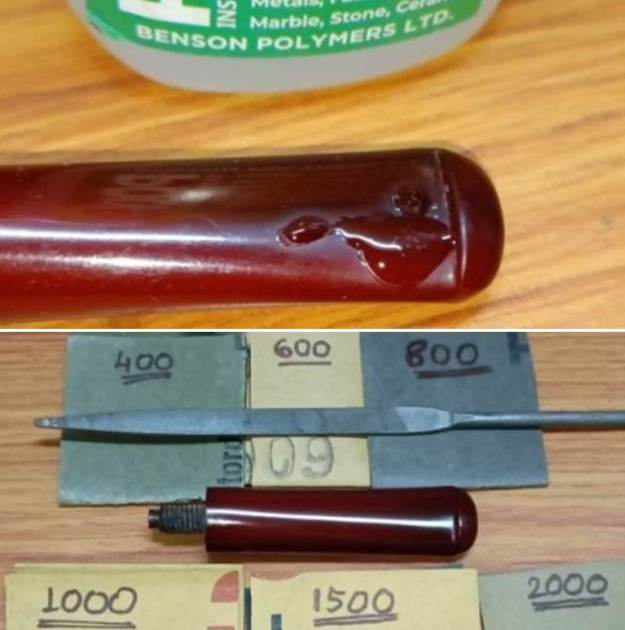
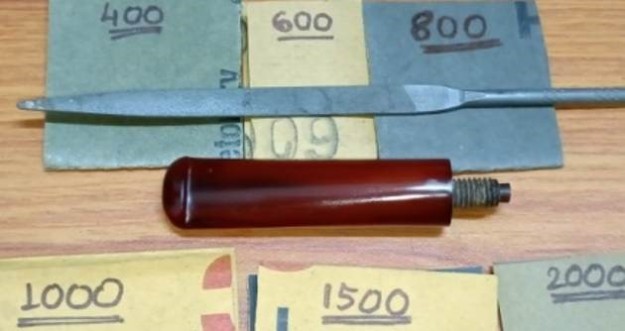
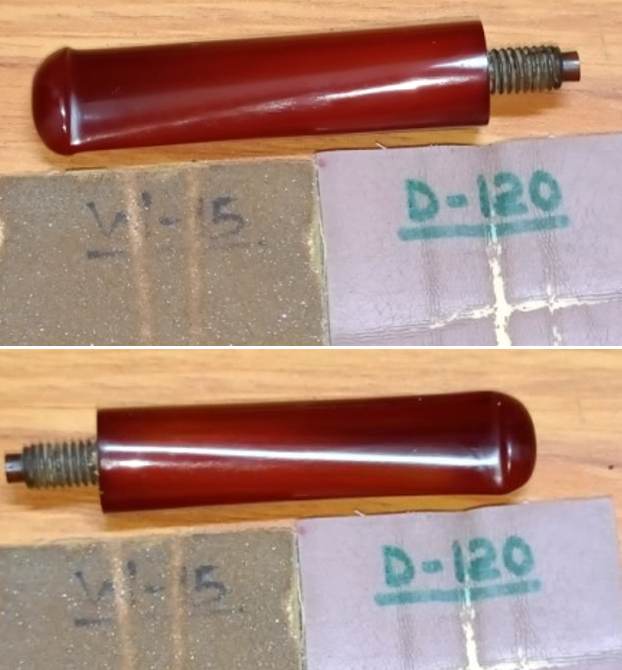
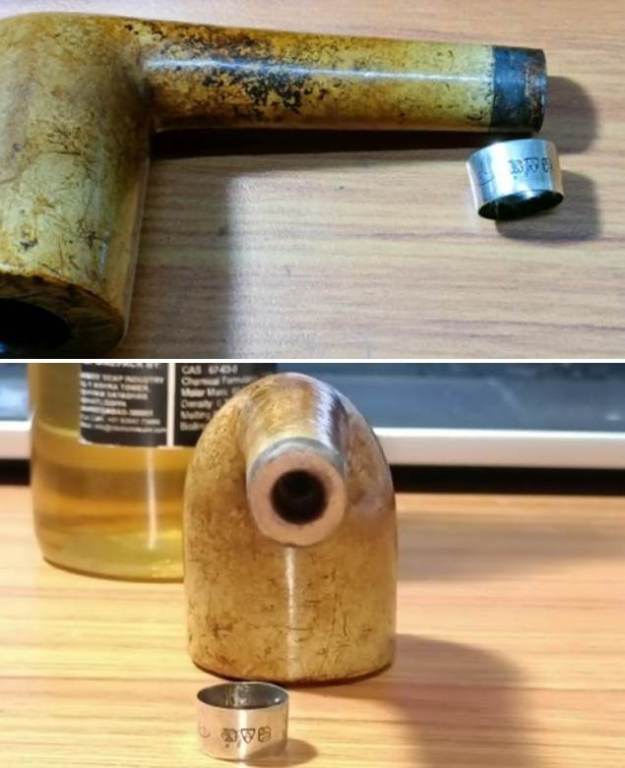
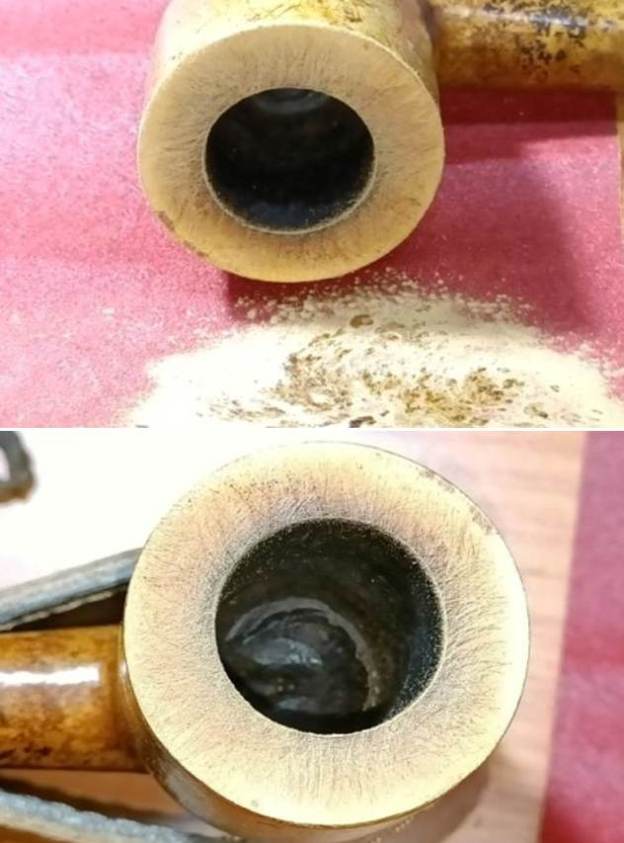
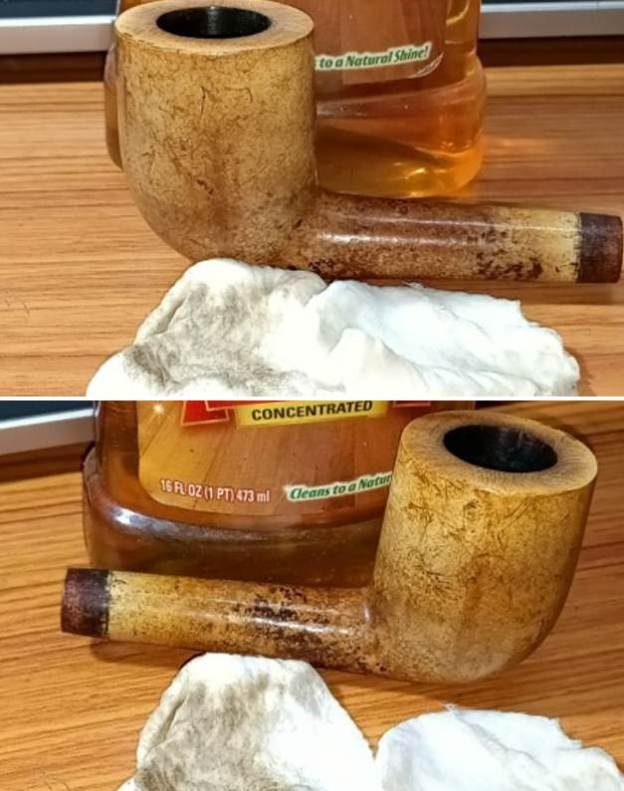
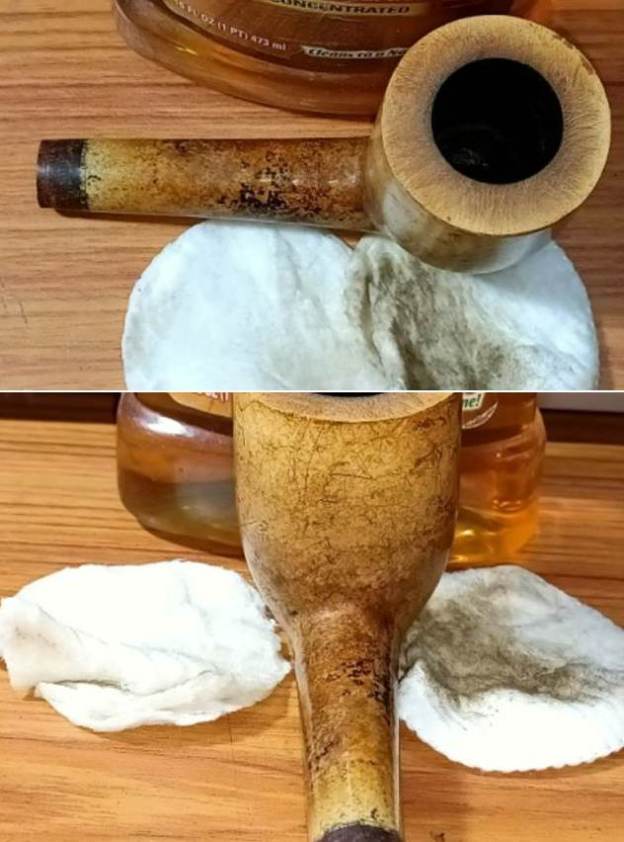
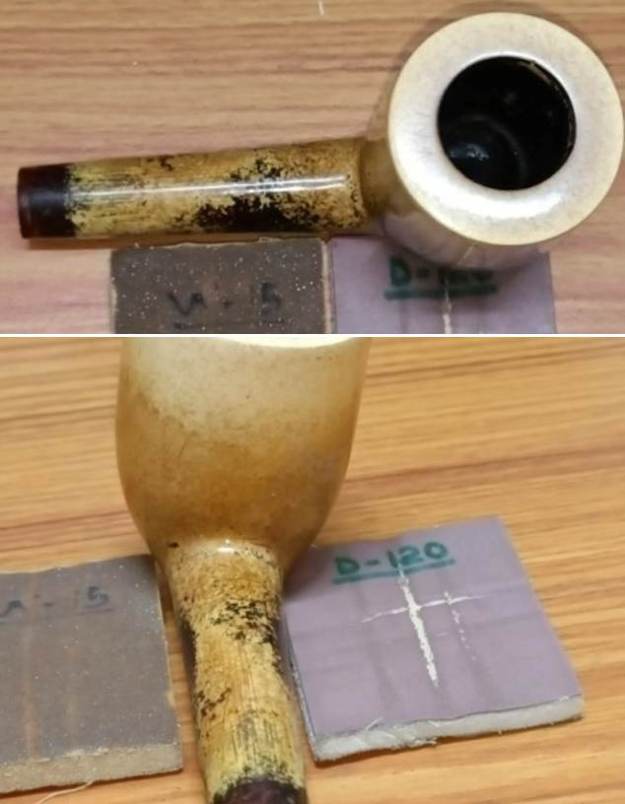
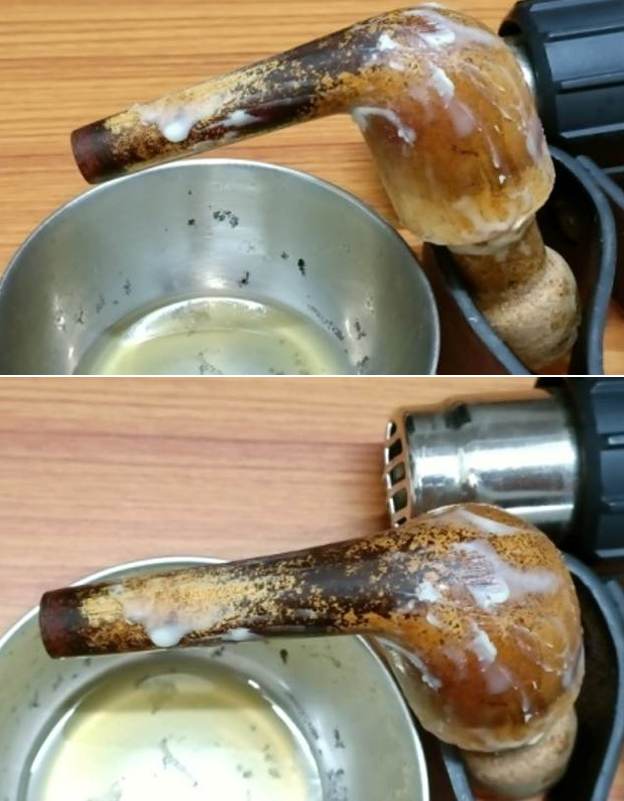
Next, I worked on the stummel. I began the stummel restoration by reaming the chamber with blade size 2 followed by size 3 of PipNet reamer. With my smaller fabricated knife, I scraped out all the carbon from difficult to reach areas. I used a 220 grit sand paper, pinched between my thumb and forefinger, to sand the inner walls of the chamber of the pipe. Once I had reached the bare walls, I wiped the chamber with a cotton swab dipped in isopropyl alcohol. This removed all the residual carbon dust and also rid the chamber of all ghost smells. The walls of the chamber are nice and solid with no signs of cracks. Using a sharp knife, I gently scraped out the overflow of lava from the rim top. The scratches on the rim surface are now clearly visible and so is the extent of damage to the outer edge of the rim. With the stummel internals cleaned up, using my fabricated tool, I scraped out the entire dried gunk from the mortise. I further cleaned the shank internals with a shank brush dipped in alcohol followed by running pipe cleaners through the shank till clean.All the while that I was cleaning the chamber and the shank, the sterling silver band came loose. I was extremely relieved to note that beneath the band, the shank was in pristine condition.To address the damages to the rim surface, I topped the rim top over a piece of 220 grit sandpaper, frequently checking for the progress made as I wanted to restrict the loss of meer material to not more than absolutely necessary. Close inspection of the rim top at this stage revealed that even though few minor scratches are still visible, they are too minor with the surface smooth to the touch. This will further even and smooth out during polishing with micromesh pads.I wiped the stummel surface with a cotton swab and Murphy’s Oil soap. The stummel surface is now free of all the dust and grime. I also cleaned out the last traces of lava from the rim top surface. The stummel and rim top surface now looks dark and dull, but it is clean. The scratches/ lacerations over the stummel surface are now more prominently visible. I shall bring back the rich shine when I polish it further using micromesh pads. This step will also help further reducing a few of the minor scratches and lacerations from the surface. At this point I was caught in a conflict; should I sand the stummel with a piece of 220 grit sandpaper to remove the scratches to make it look pristine and loose the patina that has developed over the years or preserve the coloration and patina. I decided on the later, after all it is the coloration taken on by the meer over the years which is more important and the existing scratches are a part of its journey through the years, is how I convinced myself!! I polished the stummel surface by dry sanding it with 1500 to 12000 grit micromesh pads. Some minor scratches were also addressed while imparting a nice deep shine to the stummel. The patina was also preserved. All in all, I am pleased with the appearance of the stummel at this stage. Next I gave a beeswax polish to the meerschaum bowl. I assembled the equipment and materials that would be needed during the process — a heat gun, paper towels, q-tips and a container for the wax and of course, beeswax. I stuffed the chamber with cork to prevent inadvertent seepage of the melted beeswax into either. Next, I melted a sufficient quantity of beeswax in the container using my heat gun and thereafter heated the stummel. Using the a folded pipe cleaner, I completely coated the stummel with the wax and continued the application till the surface was saturated and set the stummel aside to absorb the wax. I reheated the stummel with the heat gun about 20 minutes later and let the excess wax either be absorbed or drip off from the stummel surface. I rubbed off the excess wax with a soft cotton cloth and brought a deep shine to the surface with a microfiber cloth. The stummel now sports it’s true dark color which was drawn out by wax treatment, absolutely gorgeous I say. Next, I reattach the sterling silver band to the shank end using CA superglue after polishing the band with a silver polishing cloth.The issue that now needed to be addressed was that of the loose seating of the stem in to the shank. I had an option of either coating the tenon with clear nail polish, which is a temporary solution most suitable for briar pipes or using CA superglue to coat the tenon. This is a more permanent solution, but one needs to be careful and work fast as the tenon may get stuck in to the shank as the glue hardens rapidly. I decided to go with using the superglue.
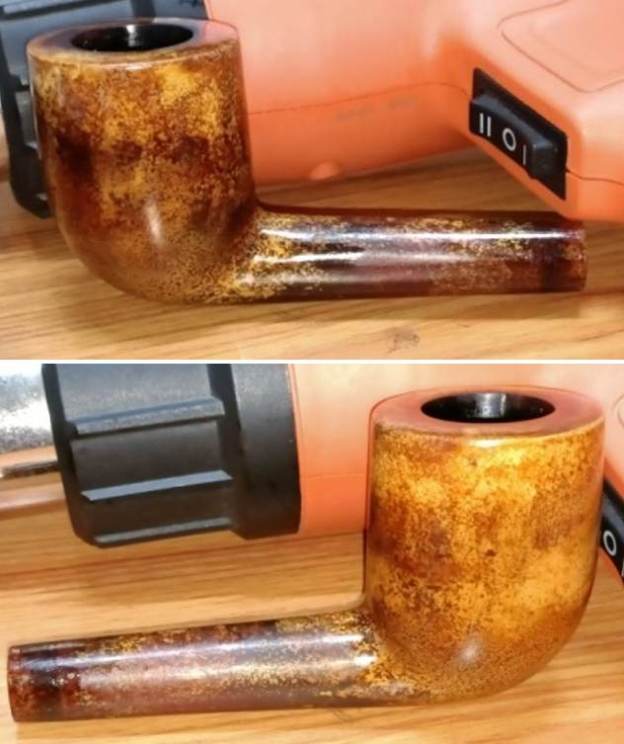
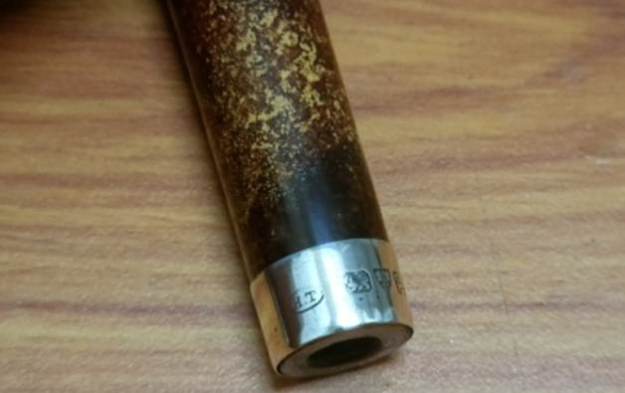
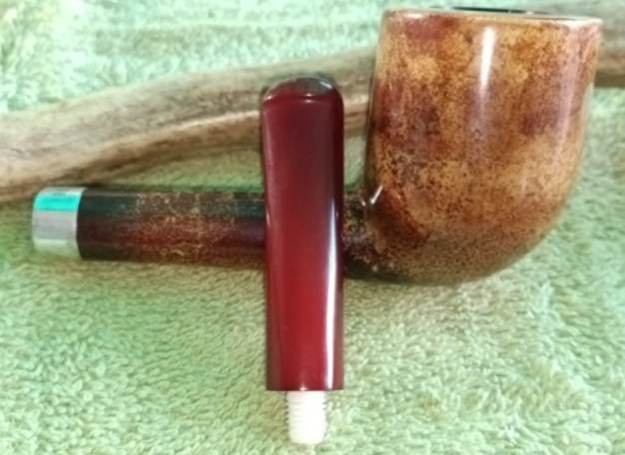
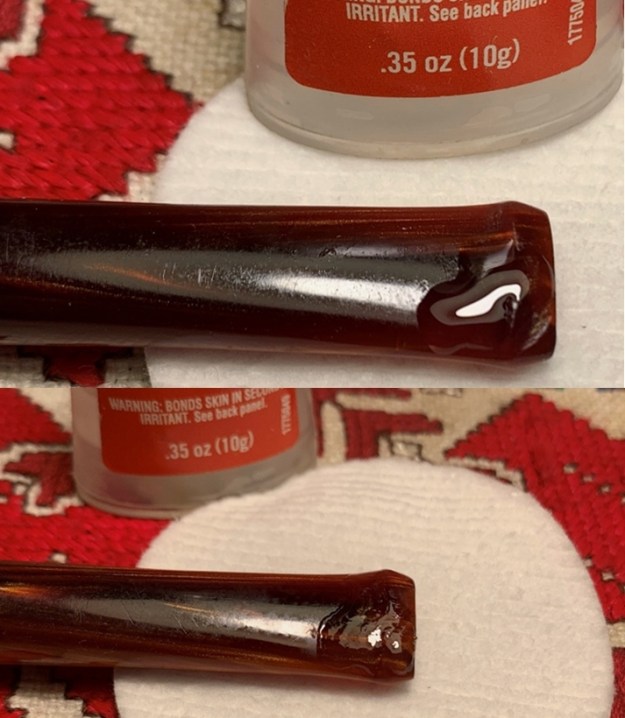
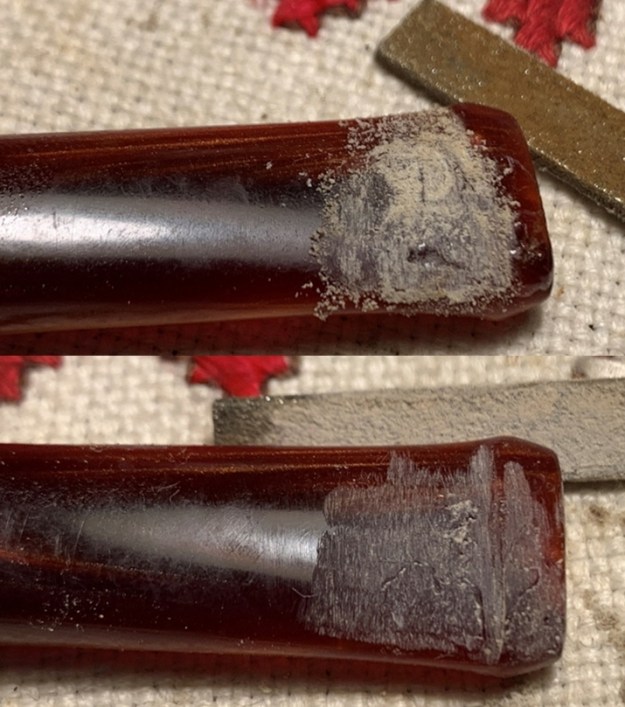
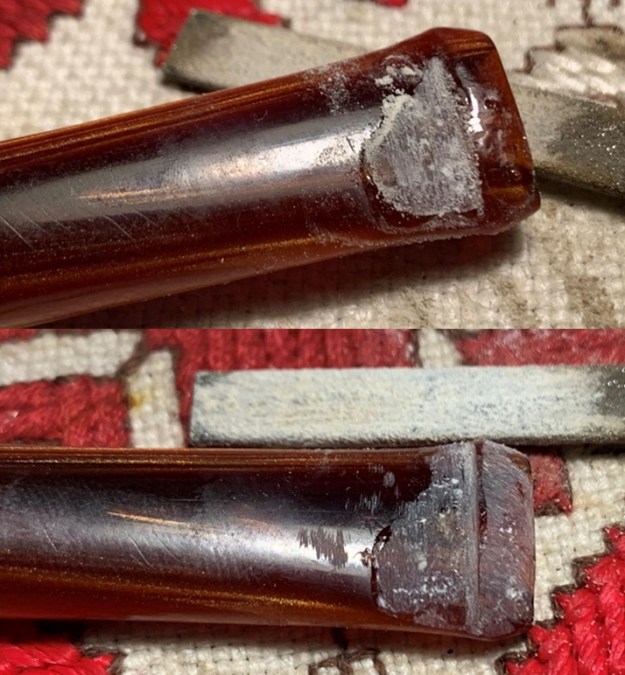
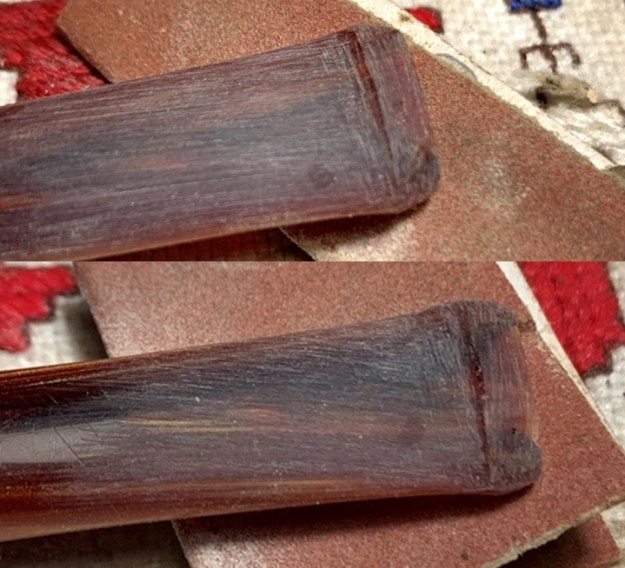
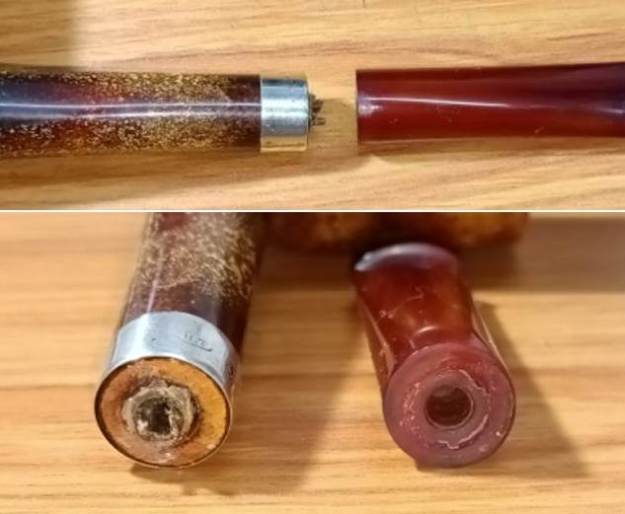
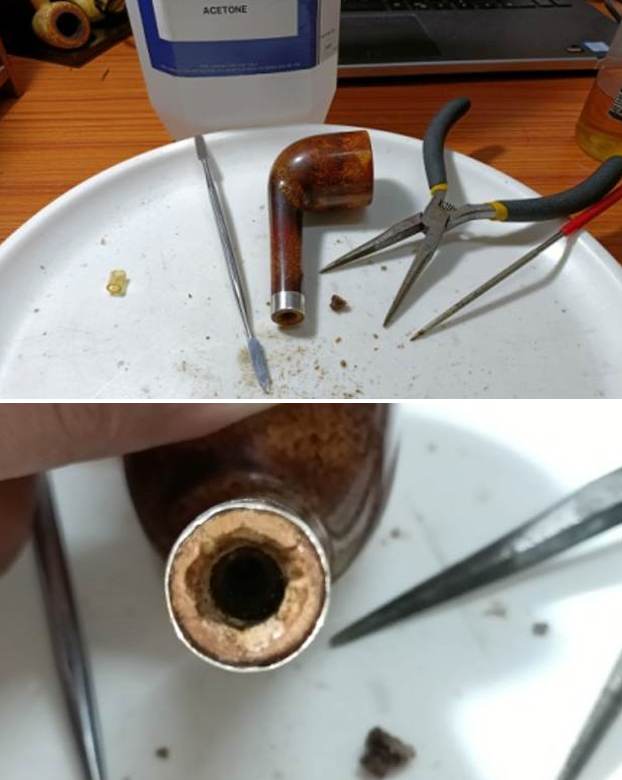
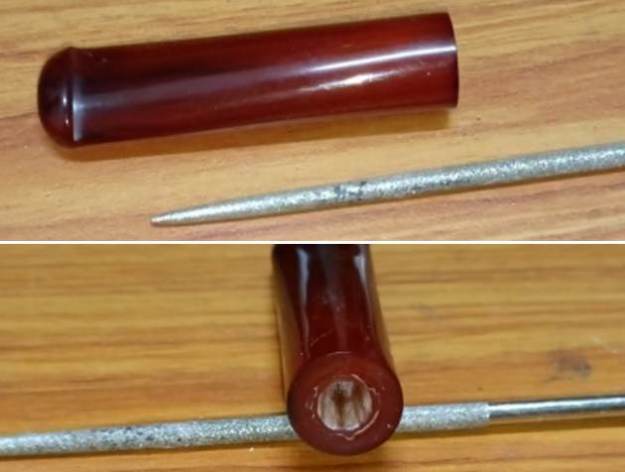
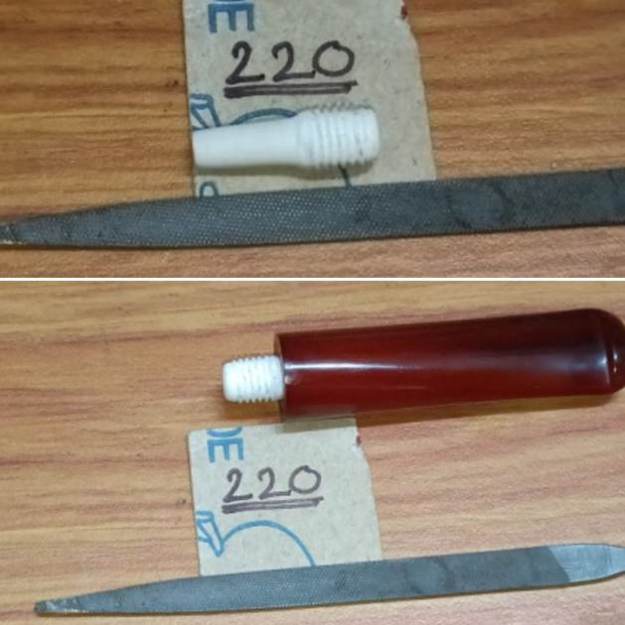
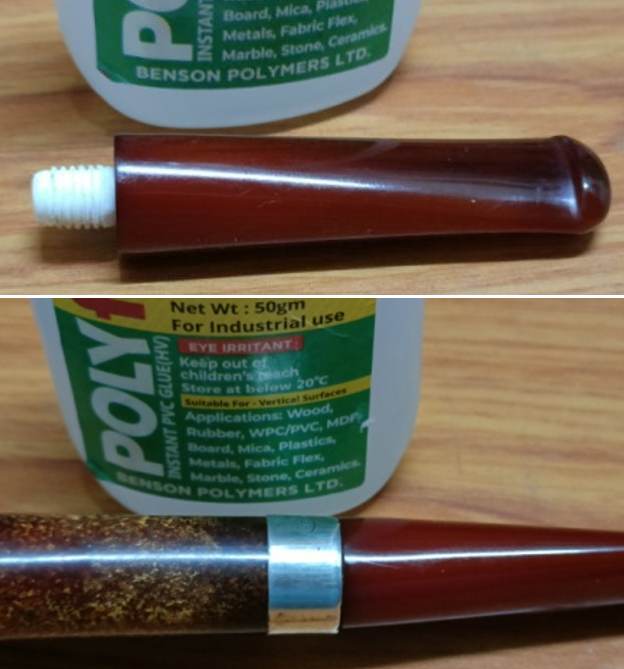
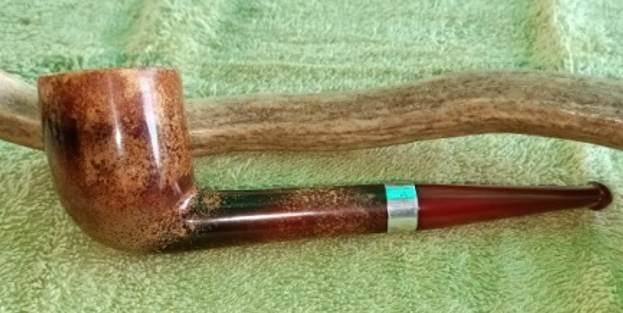
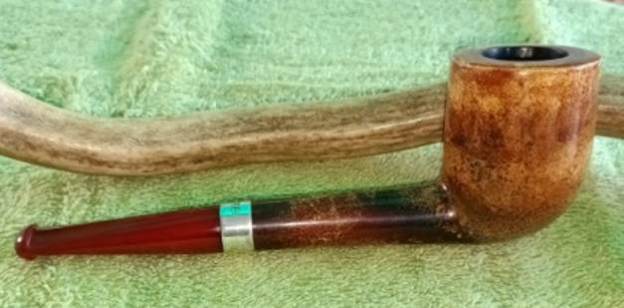
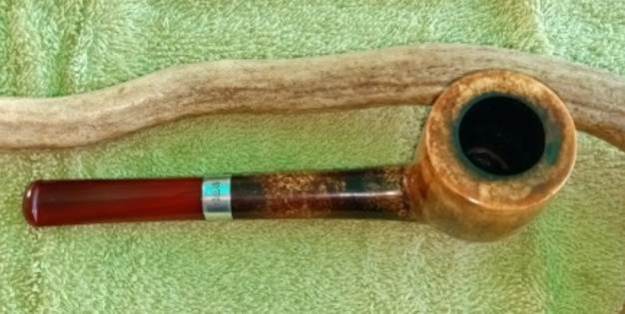
As decided, I applied a layer of superglue over the tenon surface and quickly turned it in to the shank till I had achieved a perfect alignment. I was equally quick to unscrew the tenon out from the shank to avoid having it stuck inside the shank. After a wait of few minutes to let the glue harden, I applied a second layer and followed the same process explained above. After repeating the process thrice, I decided to apply the glue one last time over the tenon to achieve a perfect thickness. Unfortunately this layer turned out to be one too many and as I was turning the tenon in to the shank, the tenon snapped at the stem end leaving it embedded within the shank. This created an altogether unexpected challenge, not to mention additional work and the need to put in extra man hours.The superglue around the broken tenon would first need to be loosened and thereafter the embedded tenon removed. I used pure acetone to loosen the glue around the broken tenon and pried it out using nose pliers, round needle files and dental tools.Next on the agenda was to fix a tenon on to the stem. From my can of spare parts, I shortlisted one Teflon Delrin screw tenon that was nearest match to the shank diameter. The shoulders of the threaded tenon perfectly seated and sealed the shank opening. The smooth end of the Delrin tenon would need some work to seat perfectly in to the stem. Following pictures will give you the general idea.I evened out the stem airway to accept the Delrin tenon using a round needle file. I was careful while working on this Redmanol stem as I did not want chipped edges on this century old stem. I, thereafter, worked the smooth end of the Delrin tenon by sanding it using a flat head needle file. I fine tuned the seating of the tenon in to the stem by sanding using a piece of 220 grit sandpaper. I checked the seating of the stem in to the mortise and alignment of the stem airway, the mortise and the draught hole. Everything was perfectly aligned. Once I was satisfied, I fixed the tenon in to the stem using CA superglue and set it aside for the glue to harden.To give the finishing touches to this gorgeous century old pipe, I reattached the stem with the stummel. I then mounted a cotton cloth wheel on to the hand held rotary tool and applied several coats of carnauba wax over the stummel and the stem. I finished the restoration by giving the pipe a rigorous hand buffing using a microfiber cloth to raise the shine further. The completed pipe, with the shining dark golden hued meerschaum stummel and complimenting red of the Redmanol stem looks lovely, fresh and vibrant; the photographs speak for themselves. I shall be adding it to my ever growing pipe collection. Thanks for the read…Cheers!!!
Restoring one from my own collection – an Andreas Bauer Billiard


Blog by Steve Laug

The next pipe I chose to work on came from an auction back in May of 2018 in Beaumont, California, USA. It came in a nice burgundy leather case with a cream coloured lining. The case is marked on the outside and reads FINEST CULTURED AMBER on the front edge and MADE IN AUSTRIA on the back edge. Those two stamps caught my attention. I always have an eye out for Austrian Made Meerschaums and the Finest Cultured Amber made me wonder what that was.Inside the case the lid was stamped as well and bore the AB logo with Genuine Block Meerschaum around the letters. It is also stamped Hand Made. The case is fitted to a beautiful lightweight meerschaum billiard with what the case describes as a Cultured Amber Stem. I was looking forward to working on this one and potentially adding it to my own collection as it is quite stunning.Jeff took the pipe out of the case and took a photo of it. It is quite clean. The rim to has some darkening and a bit of tars/lava on the back inner edge of the bowl and some developing patina around the rest of the rim top. The stem is very clean with light tooth chatter. The swirls in the stem are rally quite beautiful and very unique to Bauer Meerschaum pipes.         He took photos of the rim top and the stem to show the condition. You can see the issues on the rim top and stem as I noted above. There are also some light scratches on the rim top itself. It should clean up quite well. Jeff took a photo of the side and heel of the bowl. Even though the picture is a bit out of focus you can see the graceful lines of the pipe. It is probably the lightest meerschaum I have worked on. Everything about is speaks to the classiness of this beauty.To confirm the that the logo is indeed from and Andreas Bauer pipe I did a quick Google search and picked up a few pictures of his pipes in their cases that show the same logo and markings on the case lid. My thinking about the logo was confirmed through this quick check. I also found one smaller photo that showed the markings on the exterior of the case. Both the Made in Austria stamp on the back edge and the Finest Cultured Meerschaum stamp on the front of the case. The interior stamps also matched the one that I was working on. It was interesting to also note that in all of the photos I looked at in the search had the same kind of stem composition as the one that I was working on today.

I wanted more information on the brand and also some help in understanding what the Finest Cultured Amber stamping meant on the case. I was familiar with Amber but not the concept of Cultured Amber. It made me think of the difference between Cultured Pearls and Natural Pearls. I wondered if this was similar.

I turned to the first link given on Google to the estate pipe section of smokingpipes.com (https://www.smokingpipes.com/pipes/estate/misc/moreinfo.cfm?product_id=204496). The link took me to tall billiard with a description by Eric Squires that gave me some information on the Cultured Amber stamp. I have included the photo and the description below.Bauers are known for being particularly high quality meerschaums. They are also known for having a curious stem material, “amberoid”. It looks like very nice acrylic, but it takes a static charge like natural amber. That latter aspect is easily explained, as amber itself was one of the main ingredients used to create amberoid. This Billiard is one of only three Bauers I’ve ever personally seen, but three has been enough to notice something else about the stems: despite their material being amber-based, they don’t seem to suffer from the usual wear of pure amber, such as crackling and cracking. – Eric N. Squires

Thanks for the information Eric. It seems that Bauer developed an “Amberoid” or man made amber that looks a lot like acrylic but is like natural amber takes a static charge. He also notes that the material wears better than natural amber.

Another pipe on smokingpipes.com had some more information on the brand in an intro by Bear Graves (https://www.smokingpipes.com/pipes/estate/misc/moreinfo.cfm?Product_ID=46253). I quote the pertinent information below and have made it bold.

Founded in Vienna in 1908, Andreas Bauer quickly developed what would become the single largest producer of meerschaum pipes up until the second Word War. In most “normal” planes of existence, there is supposed to be a trade-off between quality and quantity, but (evidently) the word never got to Andreas Bauer; at the very height of their production they were raking in Gold Medals for excellence and design (such as the one they were awarded at the 1937 Paris World Exhibition).

Then, or now, to own a Bauer meerschaum is to own an iconic meerschaum, the likes of which have never been surpassed… –Bear Graves

I then turned to Pipedia (https://pipedia.org/wiki/Andreas_Bauer) expecting to find a lot of information on the brand but was surprised by the brevity of what I found there. I quote from the site in full below.

Andreas Bauer of Vienna was probably the most famous brand manufacturing Meerschaum pipes – the best of the best. But prior to 1990 Bauer merged with Koncak Meerschaum of Eskisehir / Turkey. Today Strambach of Vienna is the last of all the Austrian Meerschaum manufacturers.

 I found some more information on Worthpoint that was included with a pipe that was being sold (https://www.worthpoint.com/worthopedia/andreas-bauer-block-meerschaum-hand-1778055263). For the most part it confirms what I had learned to this point. I quote:

Andreas Bauer Company Andreas Bauer of Vienna was probably the most famous brand manufacturing Meerschaum pipes – the best of the best. The company was founded 1906 in Vienna, Austria by Andreas Bauer. In 1942 Ernst Bauer became head of the company up to 1971. In 1972 the company was sold to the family Mrstik. In 1990 Bauer merged with Koncak Meerschaum of Eskisehir / Turkey. Bauer Meerschaum Pipes are something very special to smoke. Meerschaum has the characteristic to reabsorb humidity, thus permitting a very cool and dry smoking, furthermore Meerschaum has a very low specific weight, allowing to build very light. This pipe is made pre-merger and dates from 1982. In the late 1970’s early 80’s Bauer used a replication for their amber stems, Cultured amber (Acrylic, Amberiod). Back in the Golden days, Bauer Meerschaum pipes were fitted with fossil amber bit on a bone tenon. “It’s unlikely that pipes of this quality will ever be produced again” Fossil amber application made the smoking of their pipes a very fragile object. Their new adopted stem material still gives the same amber effect and offers the smoker a more robust pipe, that you will enjoy for many years.

With that information I have come to believe that this pipe was made during the late 1970s and early 1980s prior to the merger with Koncak. It is from the period when Bauer used the Cultured Amber stem material that they had come up with. Now it was time to work on the pipe itself.

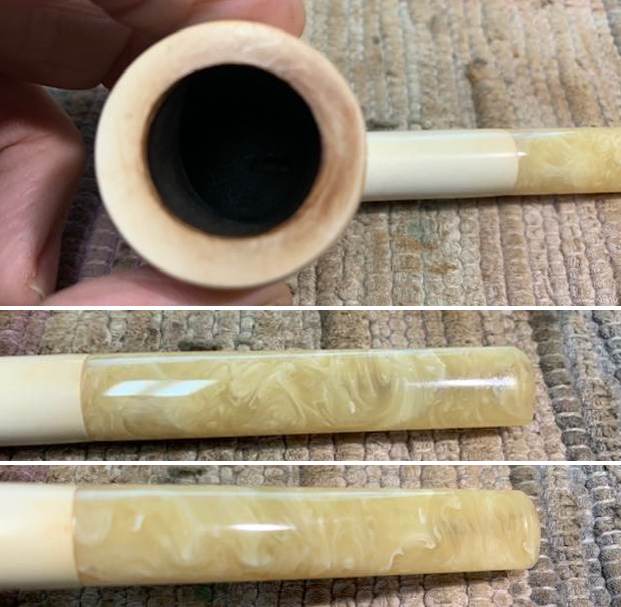
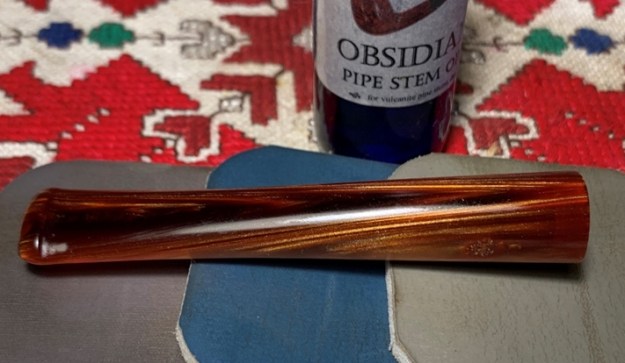
Jeff had cleaned up the pipe with his usual thoroughness. He carefully reamed the pipe with a Savinelli Fitsall Pipe Knife. He scrubbed the bowl with undiluted Murphy’s Oil Soap with a tooth brush. He rinsed it under running warm water to remove the soap and grime. He cleaned out the inside of the shank and the airway in the stem with alcohol, cotton swabs and pipe cleaners. He cleaned the stem Soft Scrub cleanser and rinsed it off with warm water. I took photos of the pipe 3 years later when I finally got around to working on it. First the case and then the inside of it. It really is a beauty to behold. I removed the pipe from the case and took some photos of the pipe. I am quite stunned by how beautiful it was after Jeff’s cleanup. I would not need to do a lot of work to bring it back to full beauty. Just a clean up and possible a rewaxing would bring it to life. The rim top and inner edge of the rim looked very good with some slight darkening on the rim top. The stem surface looked very good with some very light tooth marks and chatter on both sides near the button. I removed the stem and took a photo of the pipe to give a sense of the whole. The has a white nylon integrated tenon that fits snug in the shank. The stem is absolutely gorgeous with the swirling material.I polished the smooth meerschaum with micromesh sanding pads – wet sanding with 1500-12000 grit pads. I worked on the darkening of the rim top at the same time. I wiped the bowl down after each pad with a damp cloth. I wanted it to be as smooth as possible before I rewaxed the bowl. I heated some beeswax in a small metal pan with my heat gun. Once the wax was melted I coated the meerschaum with the liquid wax both by dipping the bowl in it and painting the rest of it with a paint brush. I put a cork in the bowl for a handle and used the heat gun to melt the wax on the bowl and wiped it off with a paper towel. I polished it with a soft cotton cloth to raise the shine on the meerschaum. I was really happy with the way the pipe had turned out. I set the bowl aside and turned my attention to the stem. I polished out the chatter and faint tooth marks with micromesh sanding pads. I dry sanded it with 1500-12000 pads and wiped the bowl down after each pad with a cloth and Obsidian Oil. I finished polished it with Before & After Fine and Extra Fine stem polish. I wiped it down with the cloth and Obsidian Oil one final time and set aside to dry. This Andreas Bauer Hand Made Meerschaum Billiard with a Cultured Amber Taper stem is a beautiful pipe. With the addition of the beeswax the meerschaum took on a slightly darker patina. The polished light weight meerschaum that shines through the polished finish is stunning. I put the stem back on the bowl and carefully buffed the pipe with a clean buffing pad. I hand buffed the pipe with a microfiber cloth to deepen the shine. The finished Bauer Meerschaum Billiard fits nicely in the hand and feels great. Give the finished pipe a look in the photos below. The dimensions of the pipe are Length: 5 inches, Height: 1 ¾ of an inch, Outside diameter of the bowl: 1 ¼ inches, Chamber diameter: ¾ of an inch. The weight of the pipe is 26 grams/ .92 oz. I have been keeping my eye open for a Bauer Meerschaum Billiard for a long time so this one will stay with me. Thanks for reading this blog and my reflections on the pipe while I worked on it. There are many more to come!

Restoring an older BRC Meerschaum Bulldog


Blog by Steve Laug

Jeff and I picked up old cased Bulldog on a pipe hunt on the Oregon Coast. We asked at the counter if the clerk knew if they had any pipes in the store. She opened the counter display and took out this pipe case. The case looked old enough to get my heart going. Generally they have something interesting in them – though I have had the disappointment of opening an empty case. When she handed it to me I felt the weight and knew that there was a pipe inside. I took a deep breath and opened the case and let out a sigh of relief. The pipe looked good and it looked old. Jeff came to the counter then and I showed it to him. A deal was struck and the pipe left the store with us. I left it with Jeff so he would work his cleanup magic on it. Jeff took a photo of the case and with it opened to reveal the pipe and in doing so I was able to relive this find. I still remember the two older women who ran the store and the conversation that the pipe initiated. It was a good day! Jeff opened the case and took a photo to show the embossed label in the cover of the pipe case. It was an oval that with a circle holding BRC split into three quadrants in the centre. On either side it was flanked by Genuine Meerschaum. The case was lined with plush red material and the exterior was covered in a worn brown leather.He took a photo the pipe as he removed it from the case and after he laid it on the table before he did the clean up. The pipe is actually very dirty. There is a thick cake in the and an overflow of lava on the rim top. There appear to be scratches in the rim top surface as well. The bowl is dirty and heavily scratched. The twin rings around the bowl are damaged and filed in with grit and grime. The shank and the lower part of the bowl was starting to get a nice patina. The silver band was very dirty and oxidized. There is no stamping on the shank or the band. The stem is not amber nor is it newer acrylic. I believe it is Amberoid – a man made amber material that was a material consisting of small pieces of amber or sometimes other resins united by heat and pressure. It appears to be the original stem as the fit to the shank is perfect and it is threaded for the bone tenon. There are light tooth marks and chatter on the surface of the stem ahead of the button. Otherwise it is a clean looking stem.Jeff took close-up photos of the bowl and rim top from various angles to capture the condition of the bowl and rim top edges. There was a very thick cake in the bowl and you can see the overflow of lava and scratches in the rim top and edges. You can also see the nicks and damage to the cap of the bowl.Jeff took photos of the sides and heel of the bowl to show condition of the meer. You can see the damage to the rings on the right side and the many scratches around the sides and heel of the bowl.Jeff took photos of the shank stem junction with the tarnished silver band. The shape of the stem is perfect for the shank and band. If it is a replacement stem it is very well done. The next photos of the stem to show the general condition of the amberoid stem shape. The flow of the stem is perfect for the diamond shank Bulldog. He took photos of the top and underside of the stem to show the light tooth chatter on both sides near the button.  He also shows the orific button on the end of the stem. I looked for the BRC brand on Pipedia and on Pipephil with no luck. I have no idea if the pipe is English, French, Austrian or otherwise. There was nothing to help me identify the maker. Ah well it is a well made mystery. If any of you can help out with information on the make I will greatly appreciate your help. Thank you.

Having seen the before pictures on this pipe I did not know what to expect when I unpacked the most recent box Jeff sent to me. The pipe was present in the box with other cased pipes so as I took each one out and opened it I waited to see if it was this one. When I finally opened a case and this pipe was there I did not know what to expect. I put the worn and tired case on my desk and opened it to see what was there. I opened the case and took a photo of the pipe inside.I was astonished to see how clean the pipe was. The pipe appeared to be very clean. The scratches in the meerschaum looked to have lessened a bit but I was not sure. Now it was time to take it out of the case and have a look at it up close and personal. Jeff had done another incredible job in cleaning up this meerschaum. He had carefully reamed the bowl with a Savinelli Fitsall Pipe Knife, scraping away the thick cake on the walls of the bowl. He also scraped off the lava on the rim top. Though there were still scratches it was clean. He scrubbed the exterior of the bowl with Murphy’s Oil Soap and a tooth brush to remove the grime on the bowl and rim and was able to remove much of the grime and dirt. He cleaned out the interior of the bowl and shank with pipe cleaners, cotton swabs and alcohol until they came out clean. The rim top looked much better when you compare it with where it started. There is some still some darkening and scratching but the bowl was clean. He cleaned the stem with Soft Scrub to remove the grime on the exterior and cleaned out the airway with alcohol, cotton swabs and pipe cleaners. I took some photos of the pipe as I saw it. To show how clean the rim top and stem really was I took a close-up photo of the rim and stem. The bowl was clean and cake free. The rim top is quite clean and the inner edge of the bowl has all of the lava removed. There is still some scratching in the meerschaum on the rim top that I would like to remove but it is very clean. The rich golden amber coloured stem looks very good. The surface and the button edge look really good. There are no issues that are there to address. The tarnished silver band had a rich shine to it now as well.I removed the stem from the bowl and took photos of the parts. When I unscrewed it the stem came off the tenon. In this case it was made that way. It was older style bone tenon and it had been anchored in the shank of the pipe. The stem was threaded and screwed on and off the stationary tenon.I decided to address the darkening and scratching on the rim top and edges first. I also worked over the bowl and shank to polish out the scratching as much as I could. I polished it with  the micromesh sanding pads – wet sanding with 1500-12000 grit pads to remove the darkening and the scratches on the rim top and bowl. I wiped it down with a damp cloth to remove the sanding dust. When I finished the bowl and rim top looked significantly better. I have had a jar of Clapham’s Beeswax Polish here for quite a while. I have used it quite often on meerschaum pipes in the past and it works great. I just had forgotten about it until today. I applied several coats to the meerschaum and buffed it out by hand. The bowl was finished so I set it aside and turned my attention to the stem. Since it was quite clean I decided to polish it with micromesh sanding pads – dry sanding with 1500-12000 grit sanding pads. I wiped the stem down after each sanding pad with a cloth containing some Obsidian Oil. I finished polishing it with Before & After Pipe Stem Polish – both Fine and Extra Fine and buffed it off with a cotton cloth. Even though the stem is amberoid I decided to give it a coat of Briarville’s No Oxy Oil to preserve and protect it. I put the bowl and stem back together again and buffed it with a microfiber cloth to raise the shine on the meerschaum and the acrylic stem. The hand buffing adds depth to the shine. I had already given the bowl multiple coats of Clapham’s Beeswax Polish so I buffed the stem with some Carnauba on the buffing wheel. The Beeswax Polish is a soft wax that I can apply with a soft cotton pad and buff with a microfiber cloth. The colours of the pipe came alive and looked great to me. It has a great feel in the hand and the interesting patina should continue to develop as the pipe is smoked. The finished pipe is shown in the photos below. The dimensions of the pipe are Length: 5 inches, Height: 1 ¾ inches, Outside diameter of the bowl: 1 ¼ inches, Chamber diameter: 5/8 of an inch. This Meerschaum Bulldog has some age on it and it is a beauty whose scratches and dings tell a story of its journey. To me they make it interesting. It should make someone a great pipe. It is one that will be on the rebornpipes store very soon. If you are interested let me know. Thanks for reading this blog and my reflections on the pipe while I worked on it.

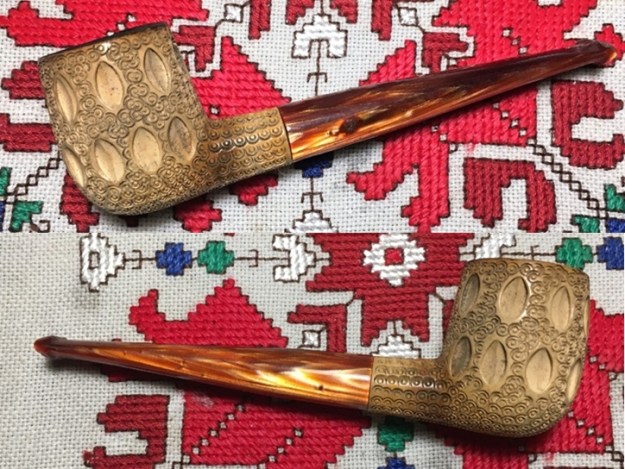
Sprucing Up a Meerschaum Teardrop Lattice Billiard


Blog Dal Stanton

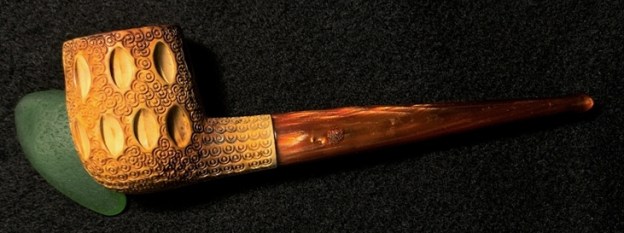
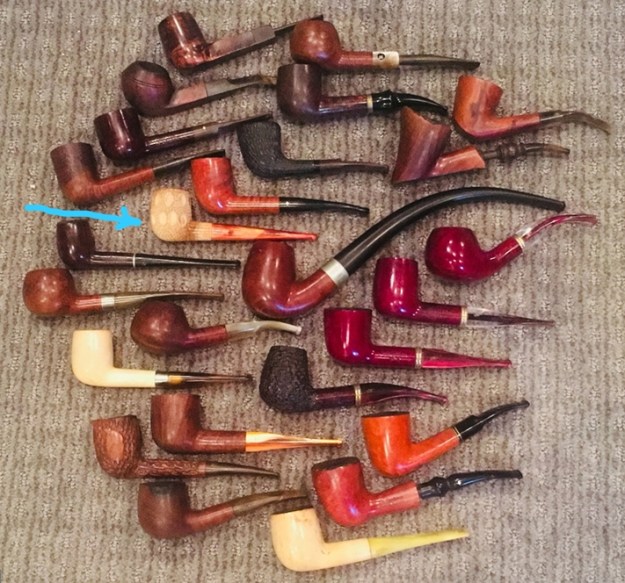
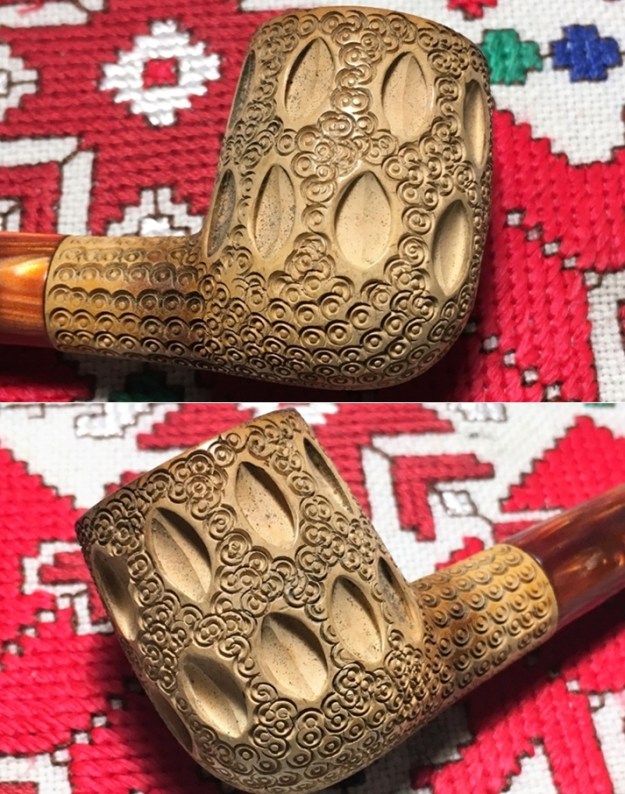
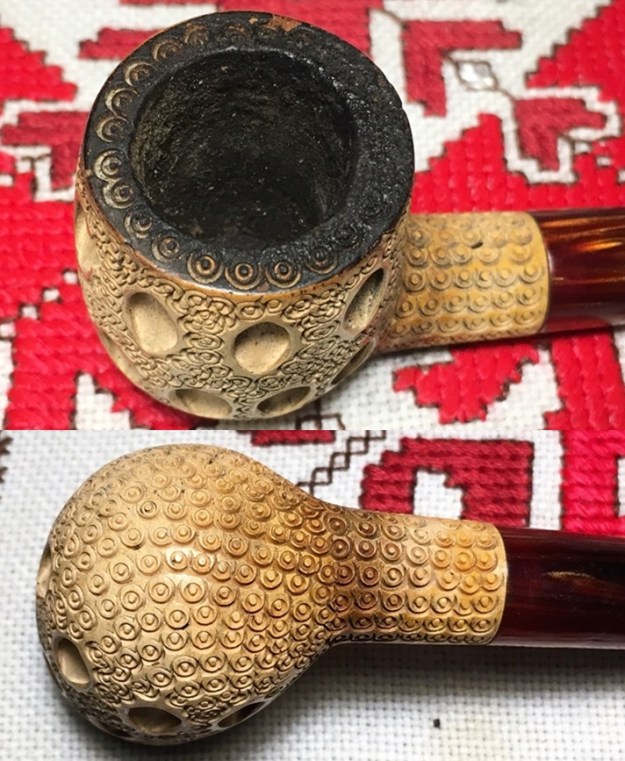
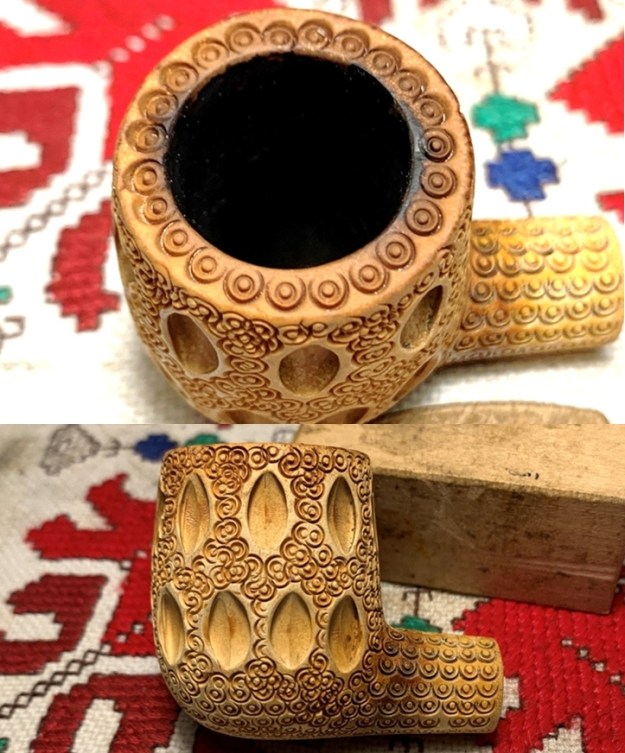
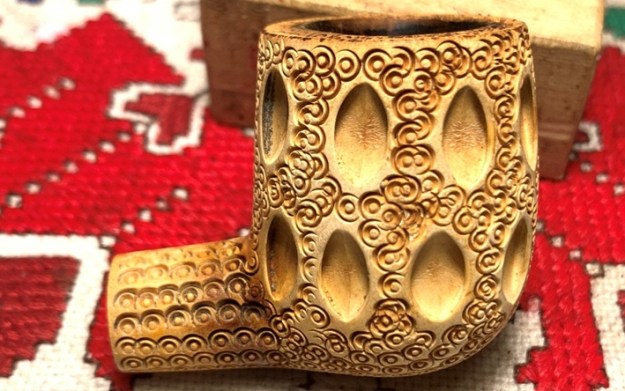
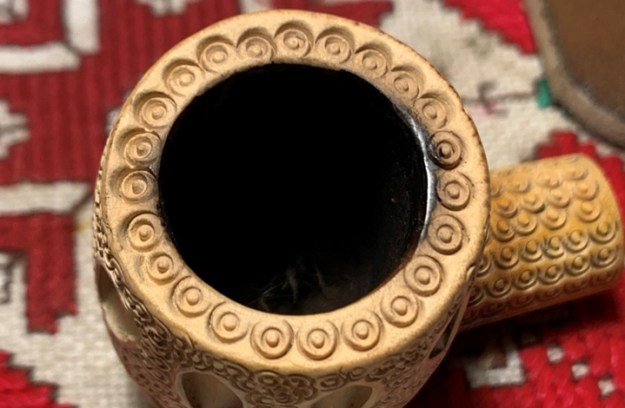
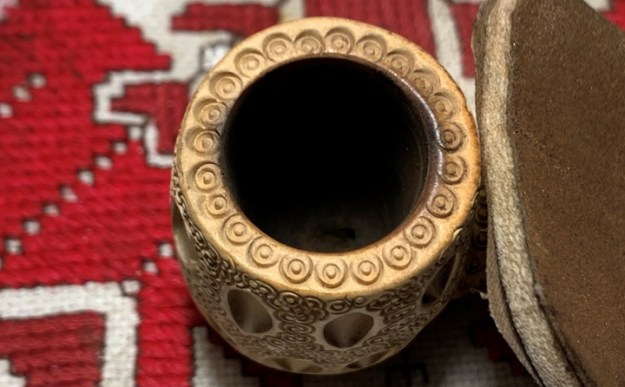
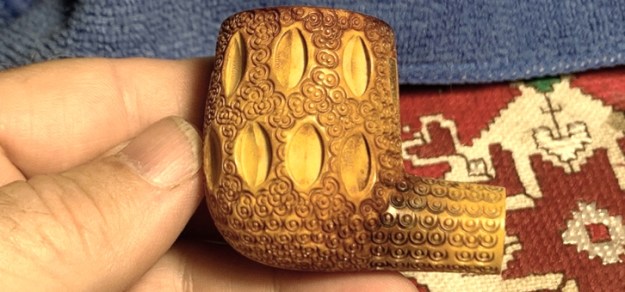
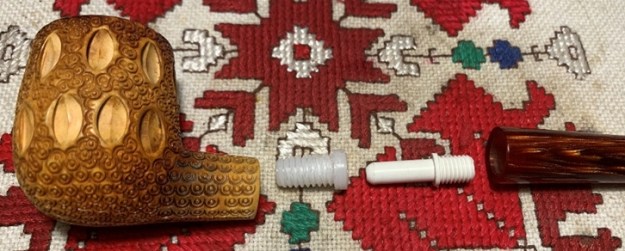
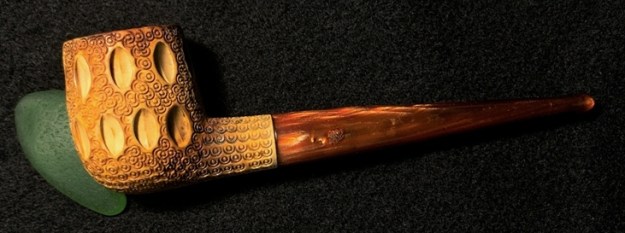
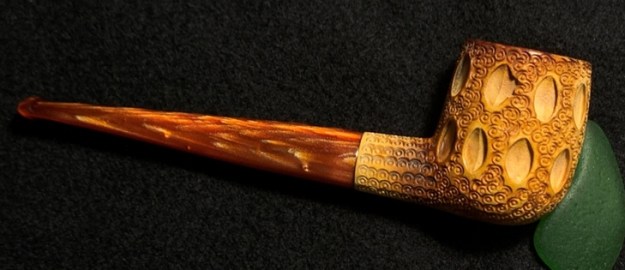
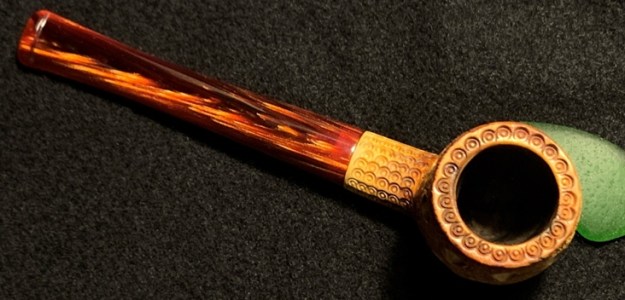
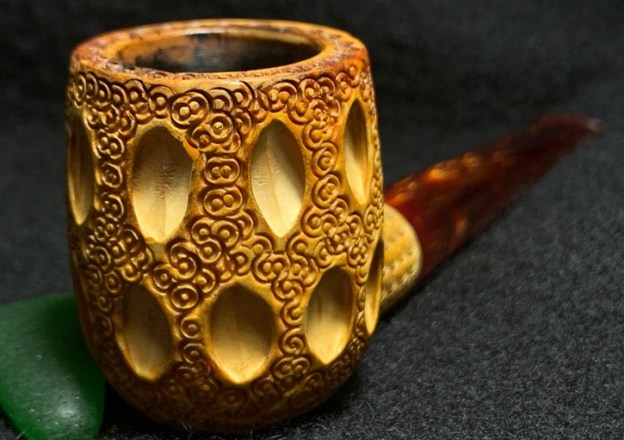
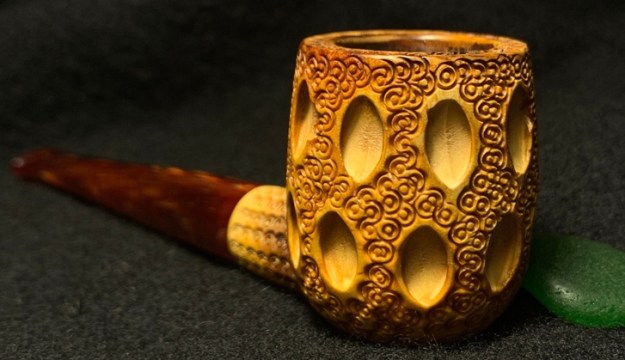
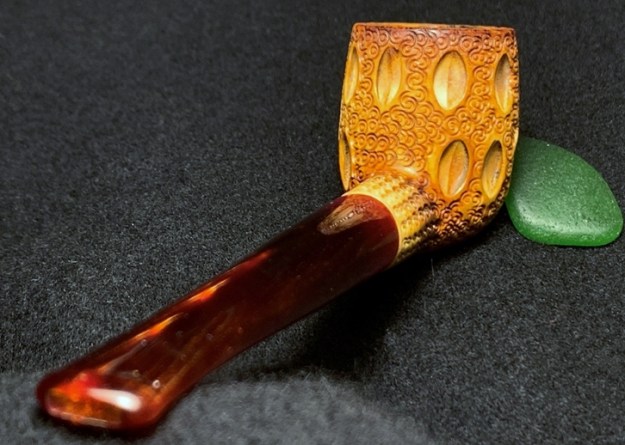
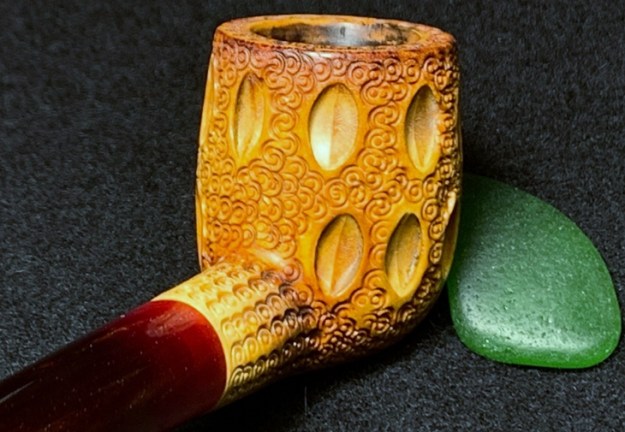
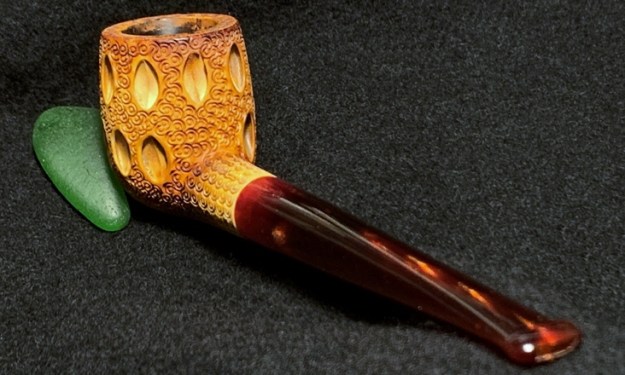
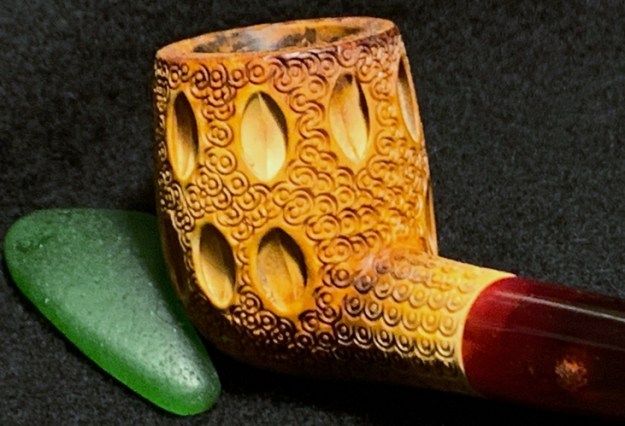
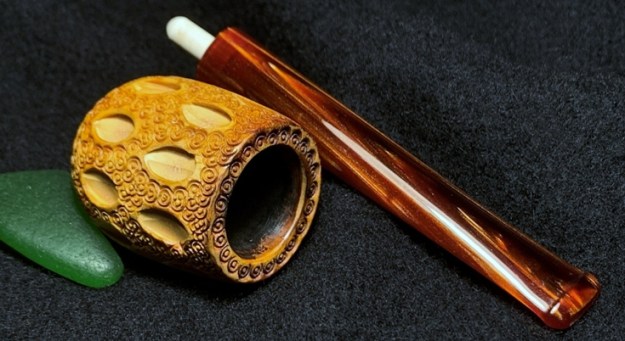
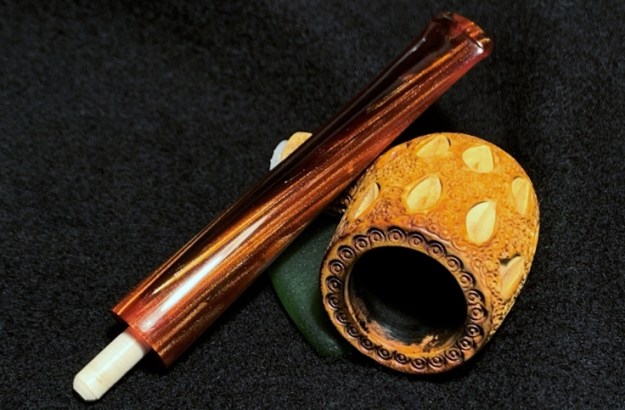
I just completed an Aldo Velani from what I’ve called the St. Louis Lot of 26 (See: Refreshing a Saucy Italian Aldo Velani Trio Bent Apple) and the next pipe in queue is also from this Lot.  The Meerschaum just above the giant Champion Churchwarden’s bowl is on the worktable now.  My son, Josiah found this lot in an antique shop in St. Louis where he was studying.  He sent me a text here in Bulgaria about his find with pictures.  We went in together to purchase the lot with the provision that my son’s part of the purchase would be for me to pick a pipe out of the lot as a Christmas present from him.  I chose the giant Champion Churchwarden!  Other pipe men and women have chosen other pipes from this lot of treasures which are posted in the online collection, For “Pipe Dreamers” Only! .This is where Jeremiah, from the state of California, saw the Meerschaum and commissioned him back when my wife and I were enjoying the Black Sea during our summer R&R.  I appreciate Jeremiah’s patience as his pipe worked up the queue!  Here are more pictures taking a closer look at the Meerschaum Teardrop Lattice Billiard. There are no markings on the pipe.  The size of the Billiard shape is Length 5 5/16 inches, Height 1 5/8 inches, Rim width 1 1/8 inches, Chamber width 3/4 inches, Chamber depth 1 3/8 inches. What is unique about this Meerschaum Teardrop Lattice design are the size of the tear drops, or the egg-shaped carvings – they are large.  The fine circular scallop carvings are in comparison, small and tight.  The Meer is set-up with a basic push/pull tenon which appears to have a crack in the mortise insert (pictured above).  The tenon insert is worn and discolored.  The pipe itself appears to be in great shape in need of cleaning.  The chamber has some carbon build up which is not needed or desired in a Meer chamber.  One of the great things about Meerschaums is that they do not need to rest between uses as with briars.  There is a bit of the coveted patina developing around the scalloped shank and climbing toward the back of the bowl.  This is good.  This brief description from Meerschaum.com that I’ve previously cited is helpful to understand the nature of Meerschaum:

Meerschaum is a very rare mineral, a kind of hard white clay. Light and porous structure of the pipe keeps the smoke cool and soft. The pipe itself is a natural filter which absorbs the nicotine. Because of this peculiarity, meerschaum pipes slowly change their colors to different tones of gold and dark brown. This adds an esthetic enjoyment to its great smoking pleasure. The longer a pipe is smoked the more valuable it becomes due to the color change. Today many old and rare meerschaums have found a permanent place in museums and private collections.

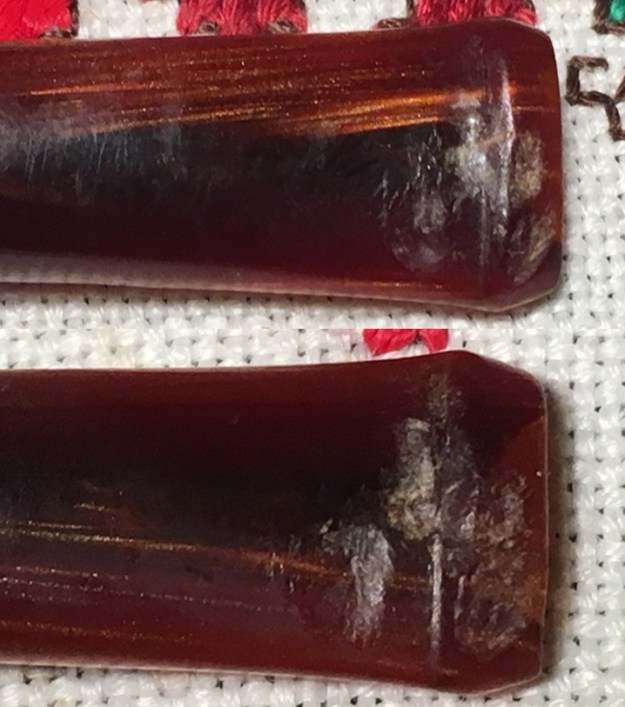
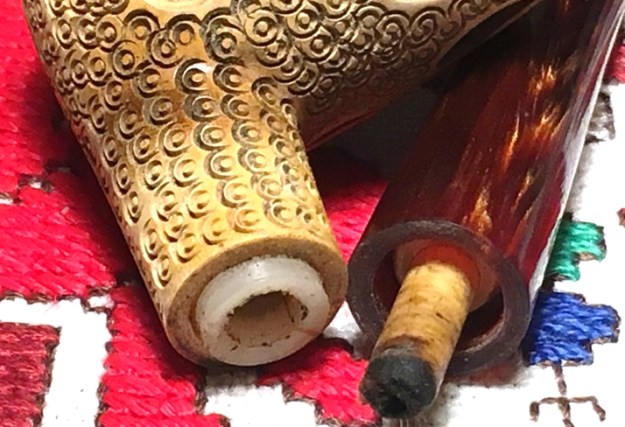
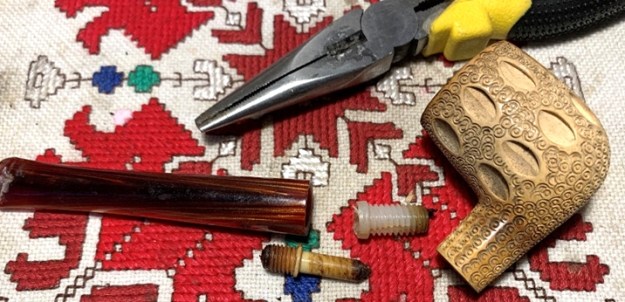
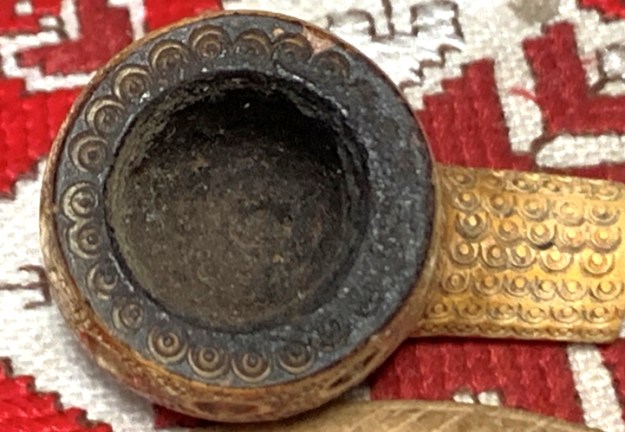
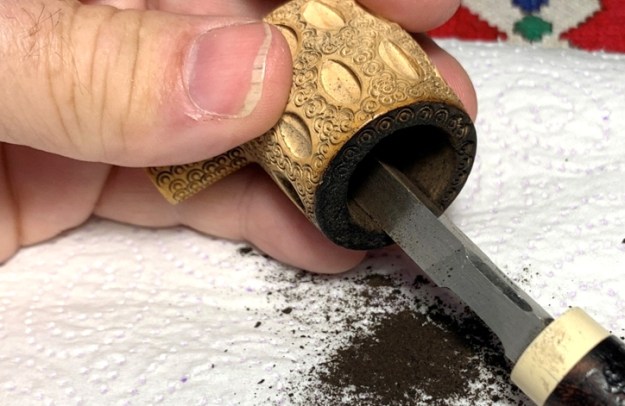
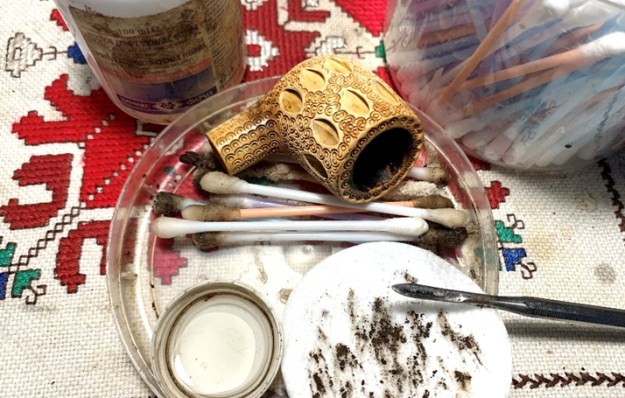
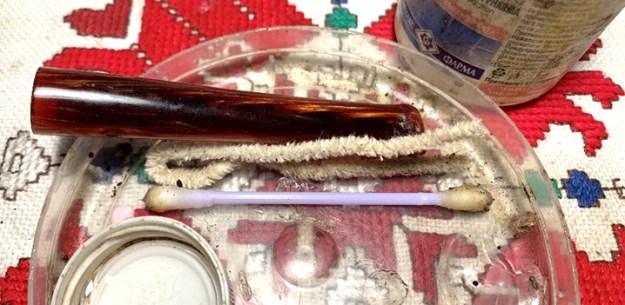
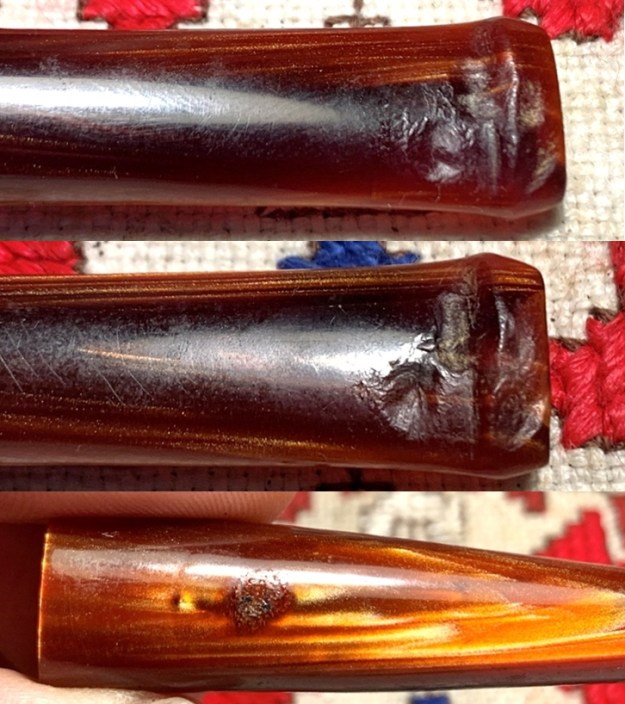
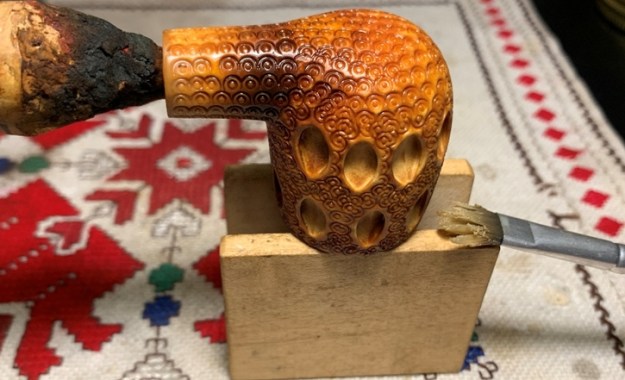
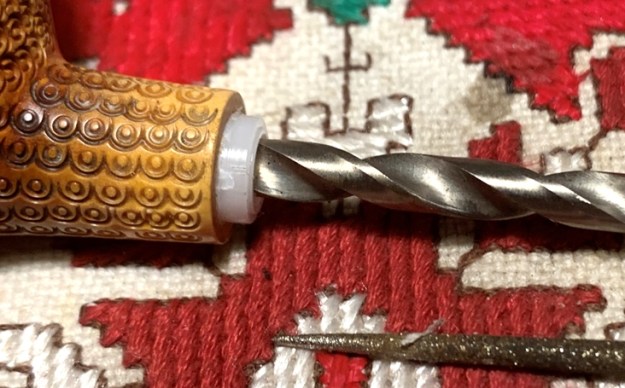
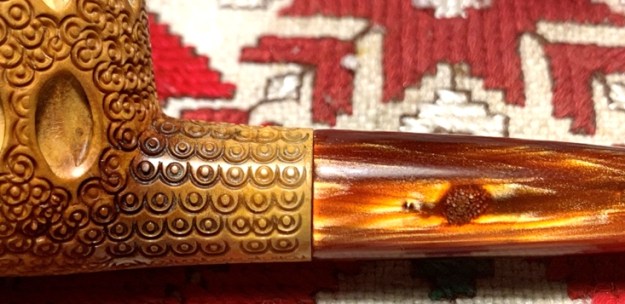
I begin the restoration of this Meerschaum by disassembling the component parts.  This helps with the cleaning.  I also plan to replace the push/pull tenon.  With the help of a pair of needle nose pliers, the push/pull components are easily removed.Taking the stummel in hand, the chamber has moderate carbon cake build up which will be removed.I don’t use the reaming kit with Meerschaum because it produces too much indiscriminate torque on the Meer chamber wall.  A more gentle and strategic approach is the use of the Savinelli Fitsall tool.  I’m able to scrape the chamber walls with the tool in a way that removes carbon buildup but is mindful of the Meerschaum.Following the wall scraping, the chamber wall is sanded with 240 grade paper wrapped around a Sharpie Pen.  This does a good job of removing the last vestiges of carbon build up.  A Meerschaum chamber does not need a cake protection like a briar chamber.An inspection of the chamber after cleaning looks good.  The Meer is still colored but it is clean and smooth to the touch.Cleaning the external surface of the Meerschaum starts with the rim which has lava caked on it, especially on the aft quadrant where most of the lighting occurred.  Using undiluted Murphy’s Oil Soap, I begin on the rim to soften and break up the lava without damaging the scalloped rim carvings.  I am patient to allow the solvents to break up the cake on the rim.  I also gently utilize a brass wired brush on the rim but most of the scrubbing is done with a bristled toothbrush.  I use the toothbrush to clean the rim as well as work into all the carvings of the bowl.  I take the bowl to the kitchen sink and continue cleaning with a cotton pad and toothbrush under warm water.  Not pictured is something I tried for the first time.  I have a Soft-Scrub product here in Bulgaria called CIT which has a gentle bleach and abrasion composition.  I put a small amount on a cotton pad and continue to work on the rim’s darkened condition.  After a thorough rinsing with warm water, the stummel returns to the worktable.I’m very pleased with the cleaning results. The stummel will lighten more because it’s still damp from the cleaning. The rim cleaned up very nicely.  One blackened area remains on the extreme edge of the aft rim quadrant.  Later, I may be able to clean this with very strategic sanding. The patina gathering at the bowl/shank crook remains through the cleaning. Moving now to cleaning the internals, I use cotton buds and pipe cleaners dipped in isopropyl 95%.  I also employ a small dental spoon to scrape the internal walls of old oils and tars.  The more excavated, the faster the cotton buds can clean.  In time the buds emerge in a lightened state and the job is completed.It took no time to dispatch the internal cleaning of the acrylic stem.Focusing now on the stem repairs, I like the brown tone acrylic.  It will clean up well.  The stem bit has significant biting damage to both upper and lower bit that will require patches from the start.  The button is damaged as well.  It appears this stem was the victim of mauling, not just biting.  There is also what appears to be a burn on the side of the stem – that’s the only thing I can think it would be. It is rough to the touch so sanding should help this blemish later.I use regular CA glue to fill the compressions on one side first.  An accelerator is also used to hold the glue in place and to quicken the curing process.After the CA glue cures, I use the flat needle file to remove the excess patch material and to shape and refresh the button lips – both upper and lower.  The first two pictures are the upper.Next the lower.Next, with the filing completed, I continue to sand with 240 grade paper on the upper and lower bit.From the bit, I also sand the entire stem and focus on the burn or blemish on the side of the stem.As I look at the mark on the side of the stem, I believe now it’s simply a blemish in the acrylic.  It is not just surface but seems to go deeper.  I can only sand it out as much as possible.After sanding with 240 paper, I transition to wet sanding the entire stem with 600 grade paper then the 000 grade steel wool fine tunes the acrylic stem – it’s looking great.Transitioning now to the full regimen of micromesh pads, I wet sand with pads 1500 to 2400 and follow with dry sanding with pads 3200 to 4000 and 6000 to 12000.  Between each set of 3 pads Obsidian Oil is applied.  I like the fire in this acrylic stem. I want to strategically sand the burn spot on the extreme back of the inner rim edge.  I use a very light 240 grade paper and follow with a dry 1500 micromesh pad.I think it looks good.  The darkness is not erased but it is reduced.  To enrich and encourage the coveted patina in the Meerschaum, the age-old approach is a beeswax treatment.  Using a hot air gun, the beeswax in the Mason jar is heated until it liquefies.  I also heat the Meer bowl with the gun and then apply the liquefied beeswax to the stummel – painting thoroughly all the nooks and crannies of the sculpting.  During the painting process, I have the hot air gun propped in such a way as to continue to blow hot air on the stummel as I’m painting it.  This helps to keep the wax thin and it is more easily absorbed into the porous Meerschaum.After the stummel is thoroughly coated in beeswax, I put it aside for the stummel to cool.After cooling, I buff the stummel with a microfiber cloth to remove excess wax and to raise the shine.  The Meerschaum literally drank in the beeswax!I decided earlier to replace the old push/pull tenon system with a new set.  The shank acrylic fitment and the stem tenon both screwed in with no problem. When I tried inserting the tenon into the shank receptor, the fit was very tight – too tight to fit without me being nervous about cracking something.  To remedy this, I hand turn a drill bit just a bit larger than the hole and it bores out a slightly more comfortable fit.  This works like a charm. With the stem and stummel reunited, after mounting a cotton cloth buffing wheel to the Dremel and set the speed at 40% full power and Blue Diamond compound is applied only to the acrylic stem.  Following the compound, after wiping the stem with a felt cloth to clean it of compound dust, the same procedure is followed with another cotton cloth buffing wheel and carnauba wax is applied to the acrylic stem.  After this, the entire Meerschaum Teardrop Lattice Billiard is hand buffed to raise the shine.

The design of this Meerschaum is a classic carvers’ template in this genre of pipe.  The patina on the Meerschaum has a good start with the honey honed hues which complement beautifully the fire waves of the acrylic stem.  Jeremiah wanted to add a Meerschaum to his growing collection, and he will have the first opportunity to add this Teardrop Lattice Billiard from The Pipe Steward Store benefiting the Daughters of Bulgaria – women and girls who have been trafficked and sexually exploited.  Thanks for joining me!

Waxing Meerschaums


Blog by Fred Bass

This is another short piece that Fred Bass wrote on waxing Meers. Once again this was saved on my hard drive. I am glad that Fred sent me these pieces and that I can now pass them on through rebornpipes. — Steve

I’m not sure how the wax functions to color Meerschaums, but I do know that coloring a Pipe requires wax, tobacco & heat. The Meerschaums that I’ve seen in the advanced stages of coloring get a sticky surface, especially while being smoked. It’s as if the Block is near total saturation and cannot contain the by-products of smoking as efficiently as new Block, so these resins & moisture migrate past the Pipe’s surface. I remember seeing older Pipe smokers in Pipe & Cigar shops having to smoke their Meerschaums while being held with a cloth, to catch the ooze that was fairly dripping from deep brown colored Meerschaums. That was years ago, when I was called “Kid.”

True Lattice Pipes (ones that allow light to pass thru the ‘windows’ are demonstrations of the Artisan’s high level of skill. They are functional art! I suspect that much of the same skills and technique are used in Figurals that are undercut so that light can pass thru the details of the carving. Admittedly, I’m drawn to the display of Patina these Pipes produce as they are smoked. Rewaxing presents more of a challenge, which I address by using the most refined Bee’s wax I can get (for better absorption) and only in sparing amounts. What I’ve discovered by doing this, is that it’s important to err on the side of caution… Better to use too little an amount of wax, than too much. This allows me to better gage how much wax the Pipe will absorb in a single application. I have better control of this if I paint molten wax onto the Pipe rather than immersion in a liquid wax bath. The key is not to get in a hurry.

The undercut Lattice Meerschaum is truly a reflection of the Carver’s skill and art! Most likely, the discussion of rewaxing them has been going on for as long as they have been smoked. I appreciate the knowledge and experience of Deniz on this topic. The literature does not make a distinction between Lattice and undercut Lattice (or undercut Figurals for that matter) when discussing rewaxing. In the Spring ’03 issue of P&T, Rick Newcombe’s article (How to Color Your Meerschaum Pipe: A Quicker Method Explored) rewaxing is discussed. His 3 points are: 1 – smoke the Pipe; 2- blow smoke on the Pipe and 3- melt beeswax into the Meerschaum. The method, of daubing melted wax onto the Pipe & then using a hair dryer or heat gun to melt the excess off, Rick credits to Beth Sermet of SMS Meerschaums. The Pipe shown in the pictorial displays is a Lattice, but it is not undercut. One thing that Rick does not mention, is that the bit & connector should be removed prior the application of the heat to avoid damage to them. The Pipe’s newly acquired color that results is likely to fade, but with repeated smoking, additional rewaxing and time the color will become permanent. It is possible to crack a Meerschaum with heat, if there are unseen flaws in the Block, but I’ve not experienced this or read of it from others.

Another method was employed by Sailorman Jack. He would rub highly refined beeswax on his Meerschaums while smoking them. This would melt the wax & promote absorption by using the heat of the Pipe created by smoking. I’m not aware if he made a distinction in this method when coloring true Lattice Pipes. The discussion of rewaxing will continue for as long as there are Pipesters that smoke Meerschaum Pipes. It’s an interesting topic, but should not become more important than the main event of actually smoking the Meerschaum. I enjoy looking at Meerschaum art as much as anyone, but I enjoy smoking them more.

I’ve found that quilter’s use high grade Beeswax to give their thread strength, so a fabric store is a good resource. Regarding your question: “Is it better to use 100% beeswax?,” it all depends on what you want to do. This is an area of the Meerschaum crafts that is most guarded by Carvers. Additives can be tallow, different grades of Beeswax, whale oil, lacquers, solvents and pigments. If you find out anything in this part of the arts, I suspect that I’m not alone in wanting to know more. I’ve even seen fire used, for effect. Either suspending a Meerschaum above a fire or wrapping the Pipe’s bowl in wax soaked rags & setting it on fire are done for effect.

What has worked well for me is to wax the Pipe while it’s being smoked. The wax will absorb according to the porosity of the Block and will stop when saturation has been achieved. The excess will wipe off with a clean cotton cloth and will enhance the gloss of the finish. This combination of wax, heat and the by-products of combustion that accumulate within the Block all work together over time to color the Pipe. The amount of wax absorbed by the Block is proportional to it’s porosity. Some Pipes will take a large amount of wax and others will take only a bit at a time. The length of time that the Pipe’s been smoked is also a factor. When I’ve applied wax to Pipes that have been in long service, with little attention paid to waxing, the coloring is darker with wax application & tends to persist for longer periods of time, eventually resolving into a darker color that is permanent. The quality of Block is the most important factor in this waxing for color technique, but other factors that will influence the result are also to be considered. The Pipe’s shape, size & mass present variables to coloration. I’ve read where Cavendish Tobaks will color a Meerschaum faster, due to the high content of oils. I cannot speak to this, as I prefer to smoke Tobaks that I enjoy, which do not generally include Cavendish blends. For me, the smoking experience that the Meerschaum affords is most desirable, while the coloring is secondary. Another factor will be the ambient air temperature. It seems that the Meerschaum breathes more efficiently on warmer days. On colder days, the Pipe’s surface will cool faster and this seems to slow down the absorptive qualities. Indeed, I’ve read of one Pipester’s experience of smoking his Meerschaum from start to finish in subzero temperature, which resulted in the Pipe’s color turn to a mottled grey. In general, it seems that the combination of wax, heat and the by-products of smoking the Pipe lead to coloration, over time. Maintaining a clean surface on the Pipe also seems to matter. The waxing serves to protect the Pipe’s surface, in addition to being a factor in coloration. It has been years since I’ve used the CAO Antiquing Compound, but from what I remember, it was a Beeswax. It may have had other additives or not.

The technique of hot wax application to a Pipe, followed by melting off the excess with a heat source, is one I employ less frequently. It’s just much easier & convenient for me to wax the Pipe as I smoke it. This practice of cold wax application also afford opportunity to finish it even after the Pipe has cooled following a smoke. Sometimes, the Pipe’s finish will be a bit rough, as it has absorbed all of the wax applied to it, leaving the surface unprotected & textured, like the inside of a bowl of an unsmoked Meerschaum. I’ll go ahead and apply more wax to the Pipe and then follow by buffing it with a white cotton cloth. The variations of waxing Meerschaums by the Pipe smoker are many. There are most likely as many technique styles as there are Pipesters. It is an area where individual preference and creativity combine with experience to result in habit. It has been the topic of discussion, for centuries, wherever Meerschaums are smoked. The goals of the Pipester differ from those of the Carver. While the Carver employs Beeswax for product quality, the Pipester uses it for coloration and protection of the patina. I cannot speak to the Carver goals of using signature wax finishes for effect, as I have little understanding of this part of the art. I can speak to the Pipester, from my own experiences… I say, smoke the Pipe & wax as you wish. Let the course of nature proceed over time, but enjoy the smoke while you wait.