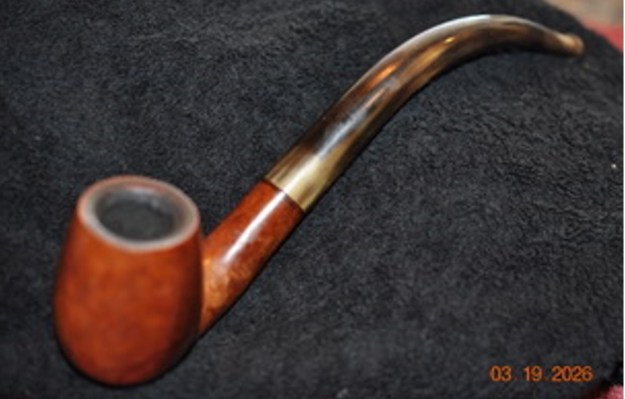
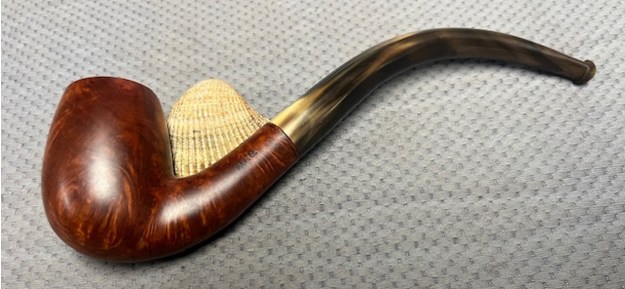
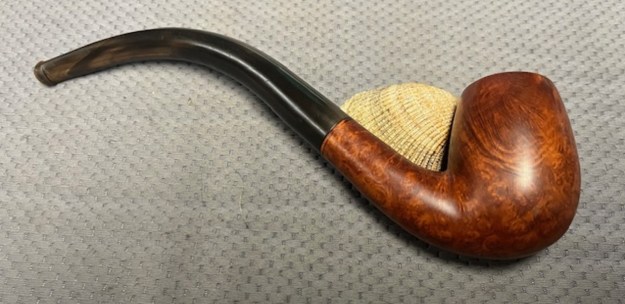
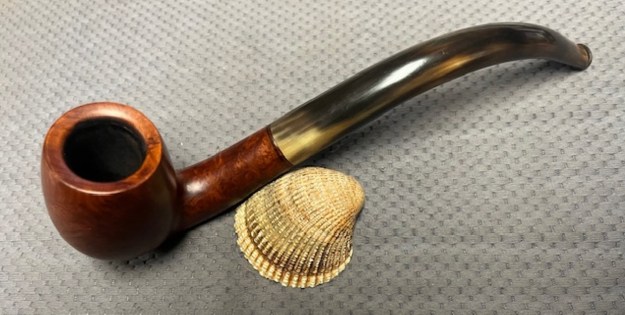
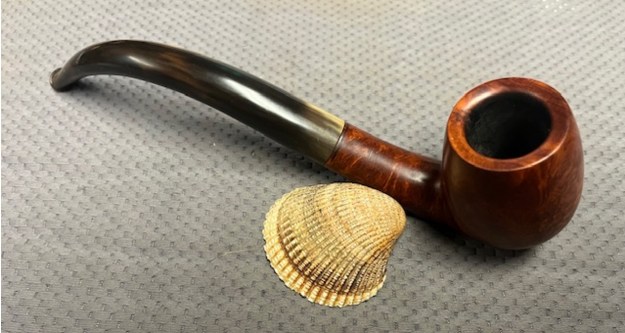
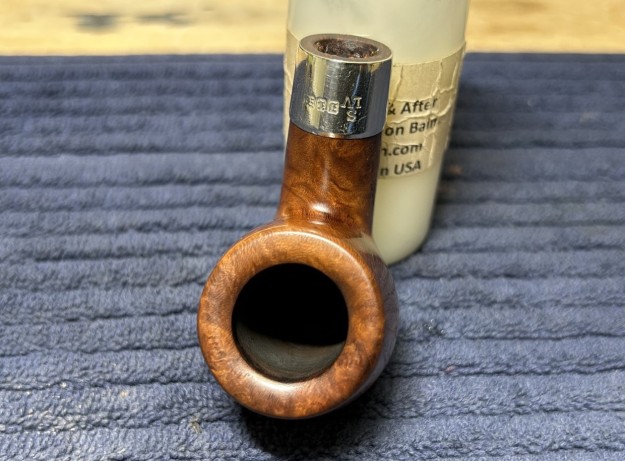
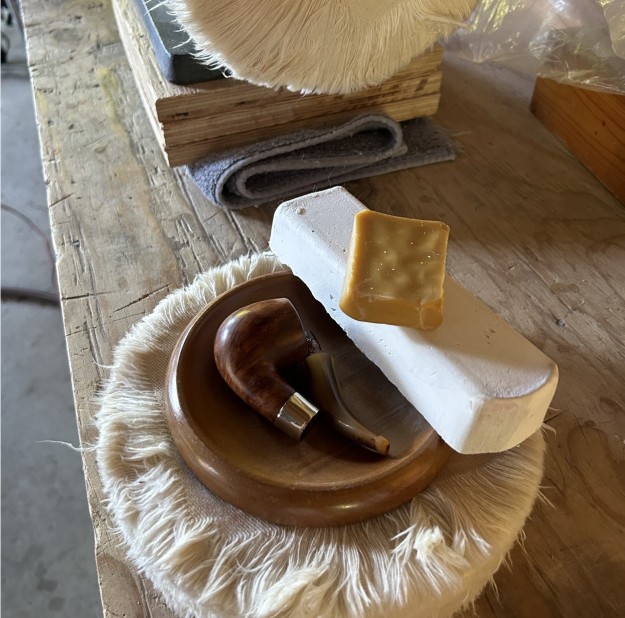
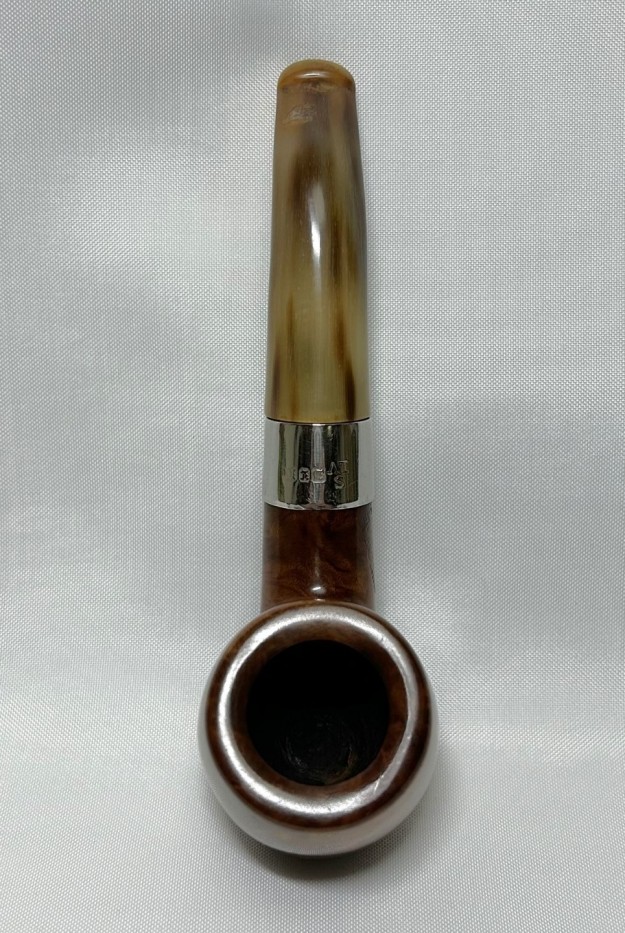
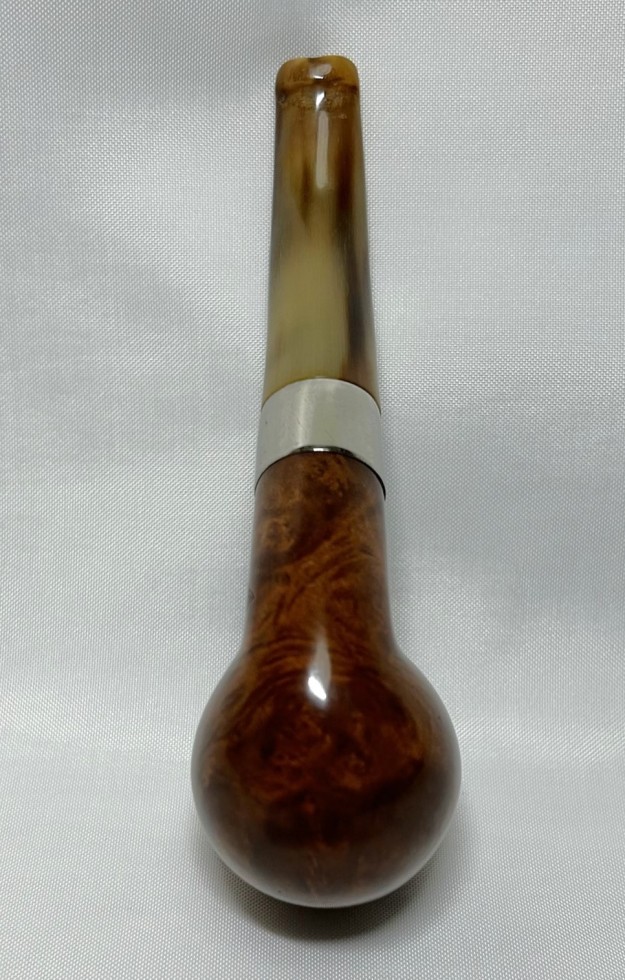
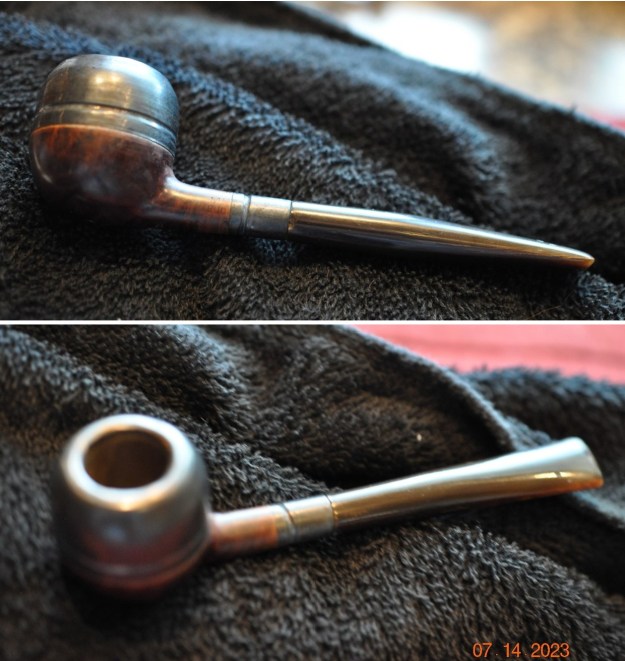
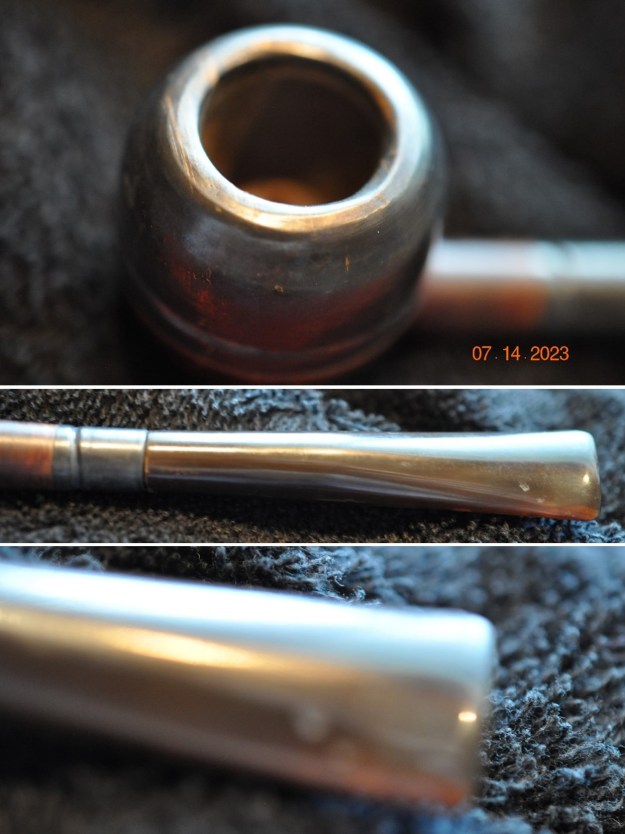
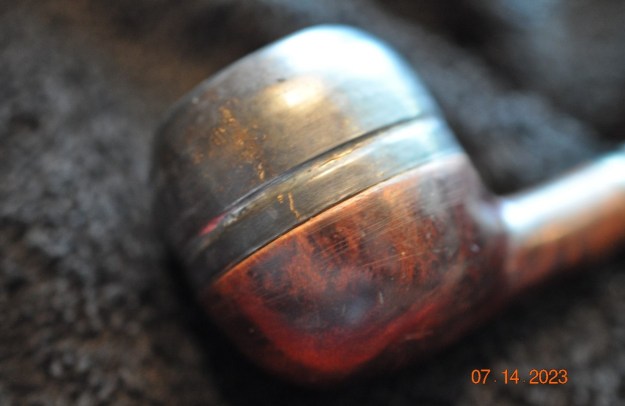
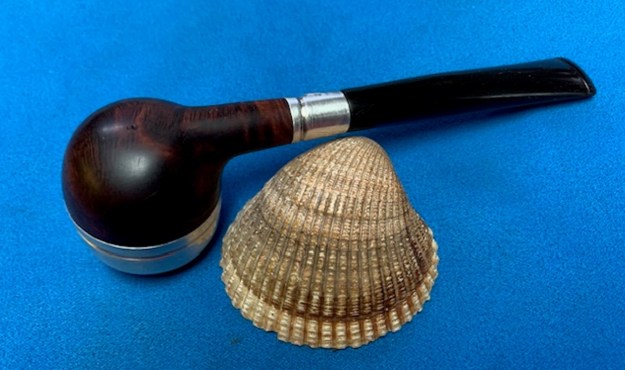
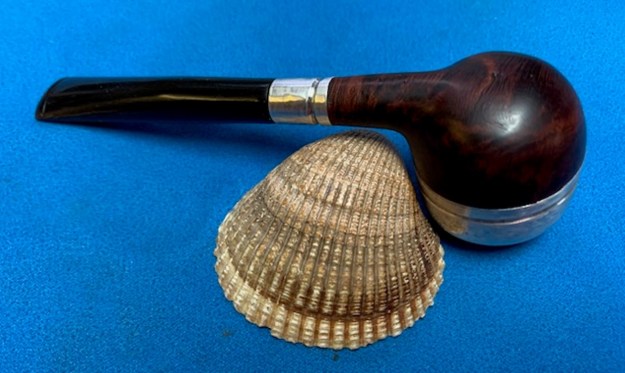
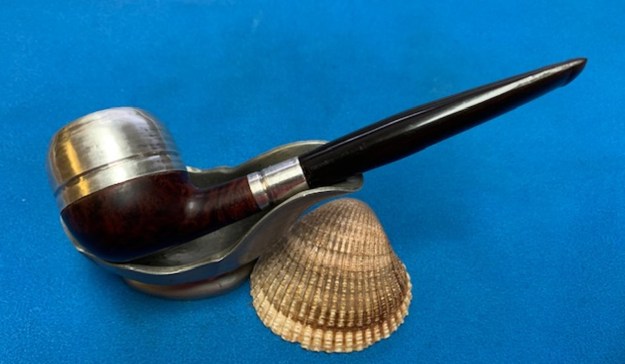
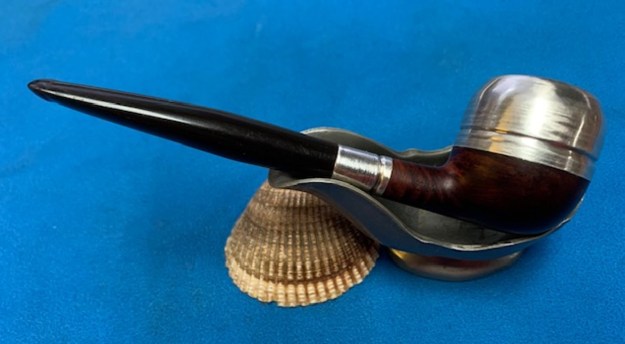
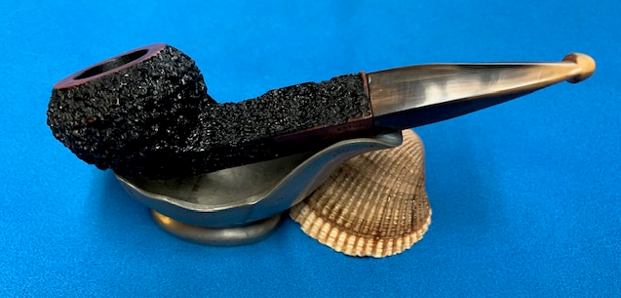
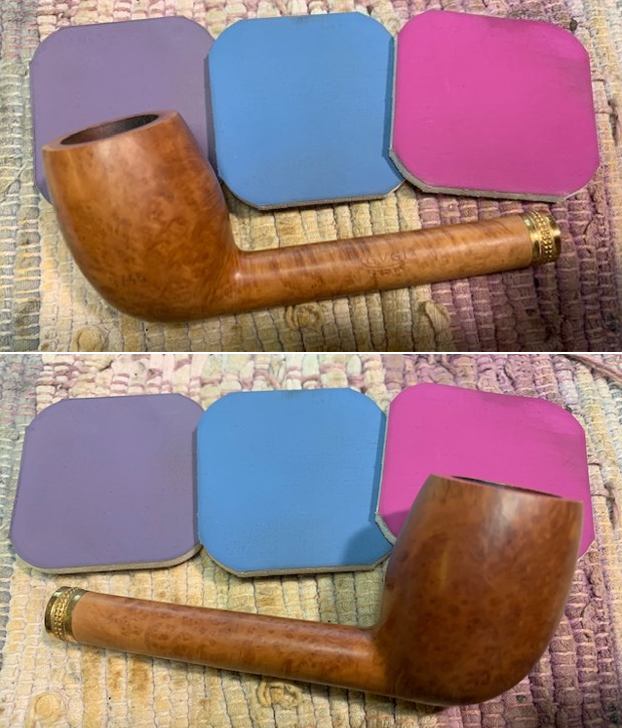
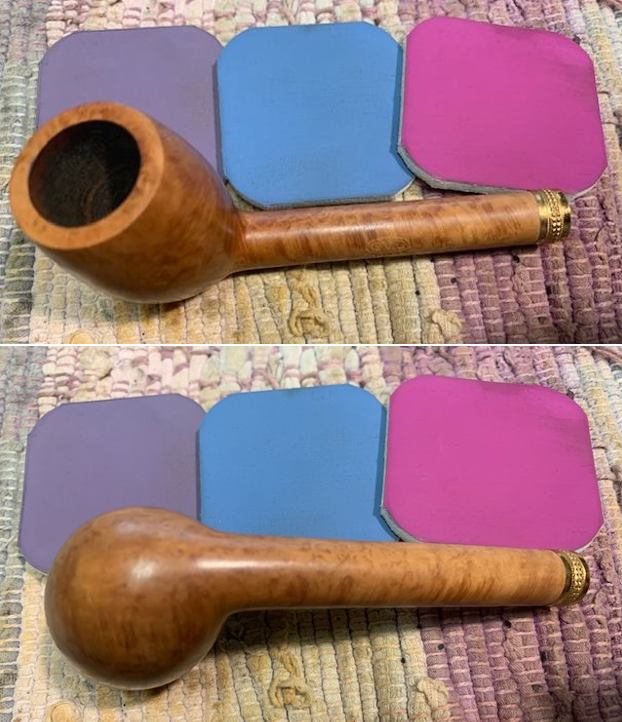
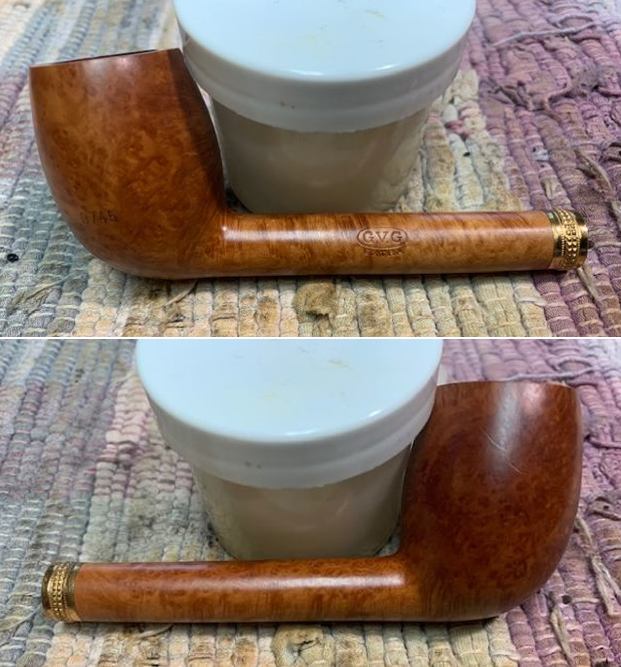
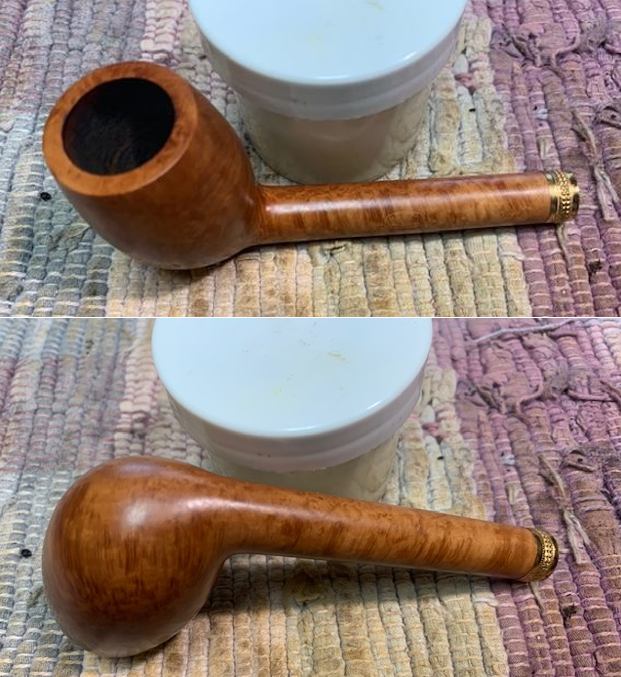
Tag Archives: polishing horn stems

Restoring a Beautiful Ropp Pneumatic Brevete S.G.D.G # 9105


Blog by Paresh Deshpande

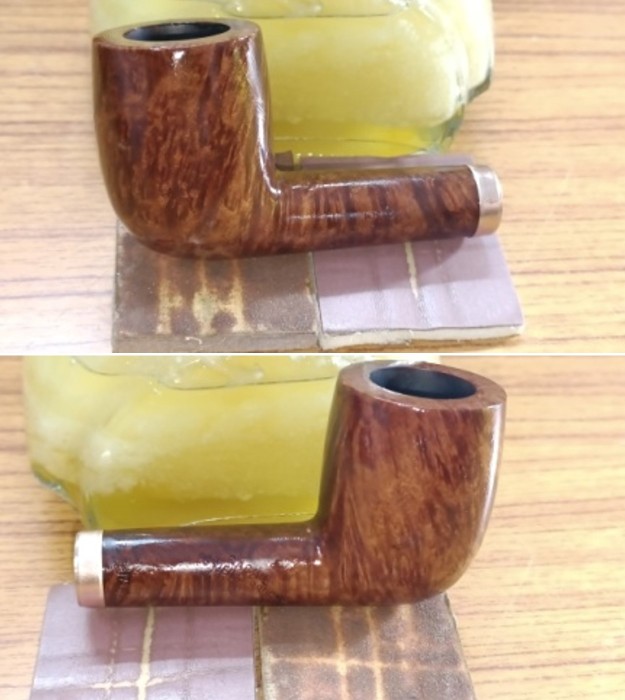
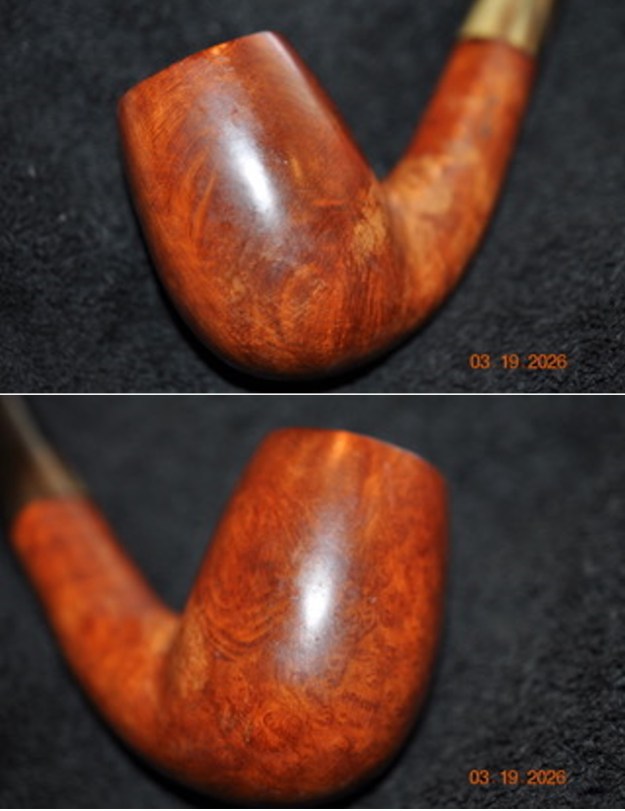
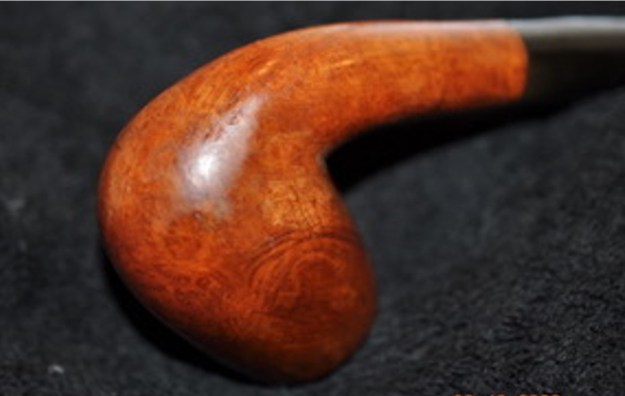
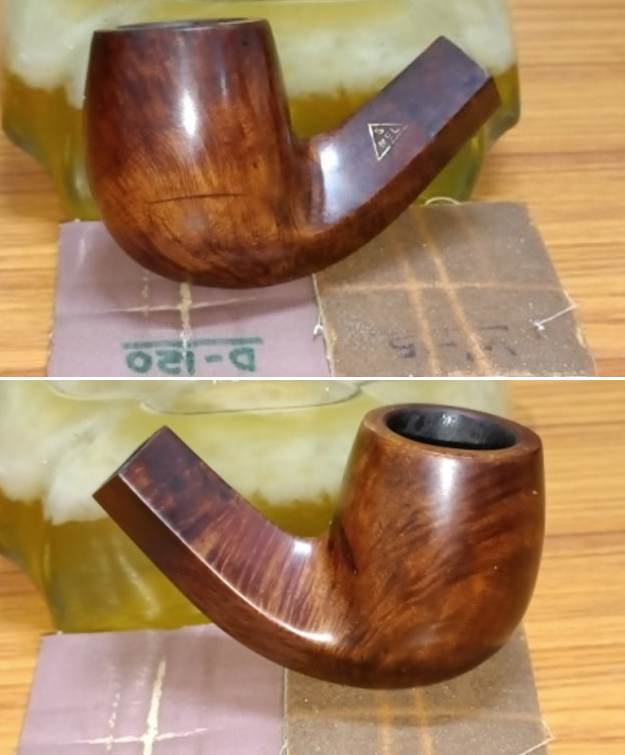
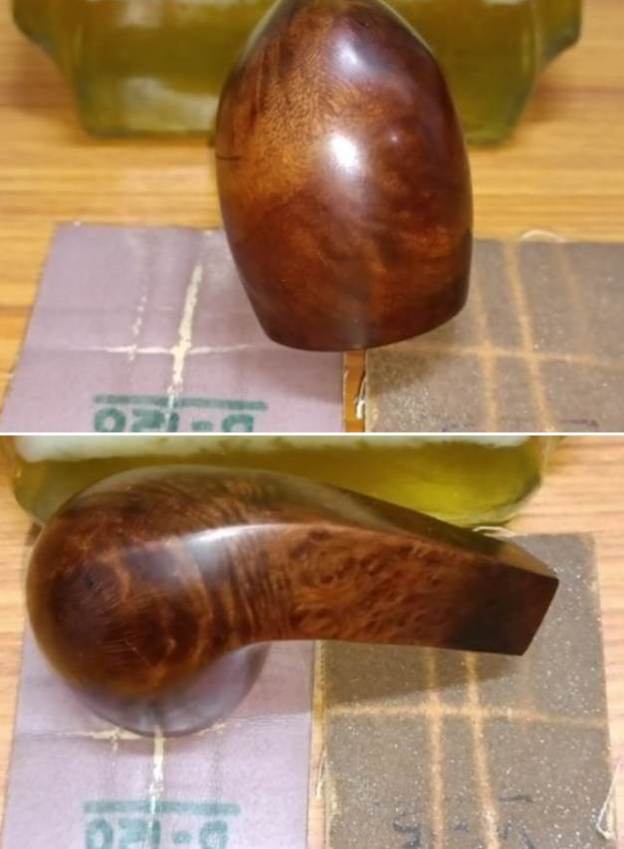
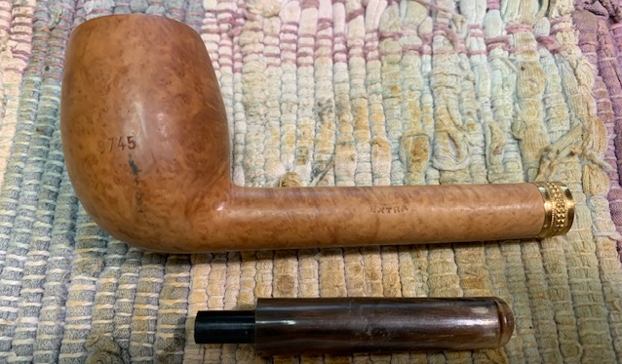
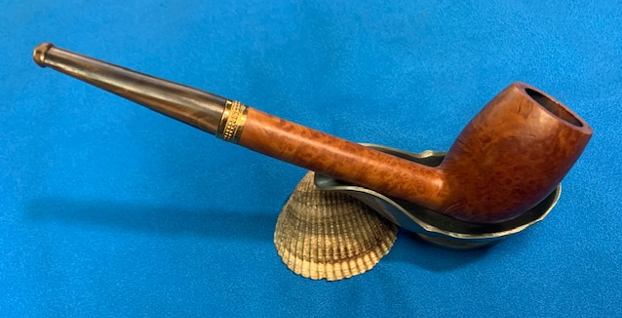
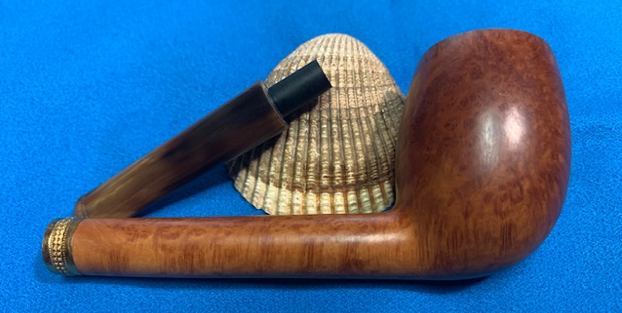
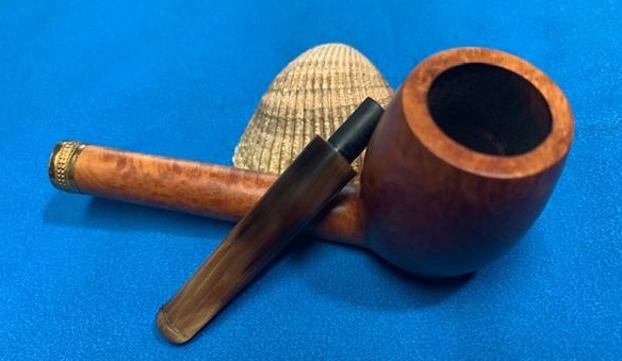
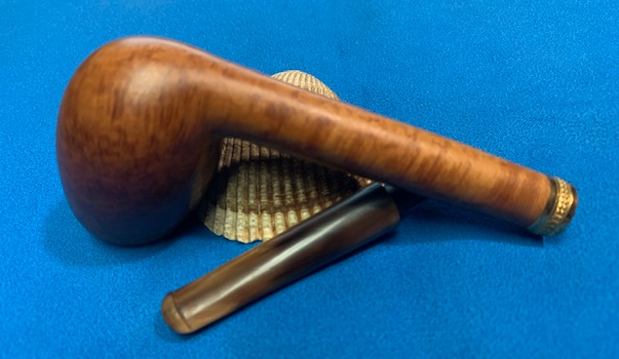
This pipe now on my work table came to me from a lot of 40 pipes that I had purchased from a French seller on etsy.fr just before the outbreak of the pandemic. It’s a beautiful classic billiard shaped pipe with a bone stem and beautiful flame grains along the sides of the stummel and bird’s eye grain over the rim top and the foot of the stummel.

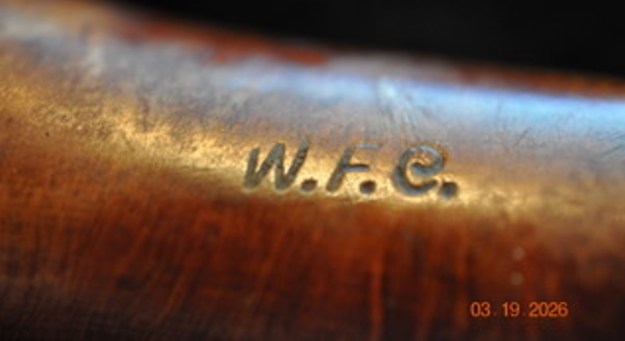
This perfectly proportioned light weight pipe has a medium sized bowl, equivalent to a size 4 Dunhill. The piece of briar is without a single fill and oozes very high quality. The copper band at the shank face adds a classy bling to the appearance of the pipe. The stampings on this pipe is one of the most elaborate that I have come across with “PNEUMATIC” over “BREVETE S.G.D.G” stamped across the left side of the shank at an upward angle. This is followed by “ROPP” in an oval towards the shank end. The right side of the shank is stamped as “RACINE” over “DE VIEILLE SOUCHE” in a downward incline. The shape code “9105” is stamped at its end on the right surface of the shank. The shank opening is lined by a metal ring that extends inside the mortise and is stamped on the metal face as “ROPP” over the upper portion and the lower surface bears the stamp “BREVETE S.G.D.G.”.I had worked on ROPP pipes before and had a fair idea of this French marquee. But it was the stampings which intrigued me and I also knew that I was working on a very early era ROPP and had to know more specific details of this line from ROPP.

I searched the internet and came across this site that had the exact same pipe for sale. The information I got from the description with a link to the website is reproduced below:

https://www.delcampe.net/en_US/collectibles/tobacco-related/pipes-accessories/heather-pipes/tres-rare-pipe-ropp-pneumatic-brevete-s-g-d-g-virole-en-argent-date-1897-ou-1898-a-loccasion-de-linstallation-a-baume-1103869216.html

VERY RARE PIPE ROPP PNEUMATIC patented S.G.D.G silver ferrule dates 1897 or 1898, on the occasion of the installation in Baume

This “Pneumatic” model dates from the very last years of the 19th century: 1897 or 1898, on the occasion of the installation in Baume.

I decided to break down my search parameters to get a better understanding of the stampings as seen on the pipe. I searched for BREVETE S.G.D.G and this is what Wikipedia revealed:-

https://en.wikipedia.org/wiki/Brevet%C3%A9_SGDG

Breveté SGDG was a French type of patent that ceased to exist in 1968. The name was a common abbreviation for “Breveté Sans Garantie Du Gouvernement“ (patent without government guarantees).

In France, the law of 1844 states that patents are issued “without prior examination, at the risk of the applicant and with no guarantee of function, novelty and merit of the invention also in terms of precision or accuracy of the description”.

I also visited various forums to know more about this line of pipes from ROPP. Here is an interesting conversation that I chanced upon on placedelours.superforum.fr and contained a thread discussing a ROPP pipe with similar stampings that were stamped in the exact same way as seen on the pipe currently on my worktable. I have reproduced an English translation of the thread below:-

http://placedelours.superforum.fr/t33004-pipe-ropp-pneumatic

vidu52
Hello to all of you,
For a long time I have been looking for this ROPP brand pipe, marked : PNEUMATIC patented S.G.D.G and with a diamond-shaped punch.

The ROPP brand I find many, but not a single marked “PNEUMATIC” ??
Long : 14 cm approx High 4.5 cm approx, Weight: 42 Grams
I turn to you to try to help me identify this pipe and if possible its degree of rarity.
In advance Thank you….

Nucingen
Very nice pipe, with silver ferrule

this “Pneumatic” model dates from the very last years of the XIXe century: 1897 or 1898, on the occasion of the installation in Baume.
You will know everything about the “Pneumatic” by reading pages 21, 29 and 34 of this very beautiful and interesting book :
https://issuu.com/romainbassenne/docs/ropp_livre_maquette_issuu

However, the link is either no longer active or may not be accessible from my location. In any event, if anyone is able to access it, it is requested to share the information therein on Pneumatic line of pipe from ROPP for info of readers.

https://pipedia.org/wiki/Ropp

Eugène-Léon Ropp (1830 – 1907) had acquired a patent for a cherrywood pipe (wild cherry, lat.: Prunus avium) in 1869. In 1870 he established a workshop to manufacture such pipes in Büssingen (Bussang, Vosges mountains). Around 1893 the business moved into the former mill of Sicard (part of the community of Baume-les-Dames – Département Doubs, Upper Burgundy – from 1895 on).

The pipes were a big success in the export as well. Shortly before 1914 Ropp designated A. Frankau & Co. (BBB) in to be the exclusive distributor in the UK and it’s colonies.

Probably in 1917 a workshop in Saint-Claude in the Rue du Plan du Moulin 8 was acquired to start the fabrication of briar pipes. In 1923 a small building in the environment of Saint-Claude, serving as a workshop for polishing, was added.

Even though cherrywood pipes were the mainstay of Ropp until the company finally closed down in September 1991. The company was taken over by Cuty-Fort Entreprises (Chacom, Jeantet, Vuillard, Jean Lacroix…) in 1994.

I was still not satisfied with the research of this pipe. This pipe has some of the most detailed stampings that I have seen on any pipe. I have deciphered the stampings of ROPP, PNEUMATIC and BREVETE S.G.D.G. The stampings of RACINE, DE VIEILLE SOUCHE yet remains to be understood. Now, my French is what my mother tongue Marathi is to you. I searched the internet for translation and this is what I found.

(a) RACINE: – Root.

(b) DE VIEILLE: – Old stock.

(c) SOUCHE: – Stump.

These stampings together do make sense implying that the briar used to carve this pipe is an old stock briar root stump.

Though the discussion thread and description of the similarly stamped pipe stated above places this pipe to be from the period 1897/ 98, the lack of pictures of the tenon on that pipe and being unable to access the link leading to the book on the PNEUMATIC line of ROPP, I cannot conclusively place the pipe on my work table to be from the period 1897/ 98.

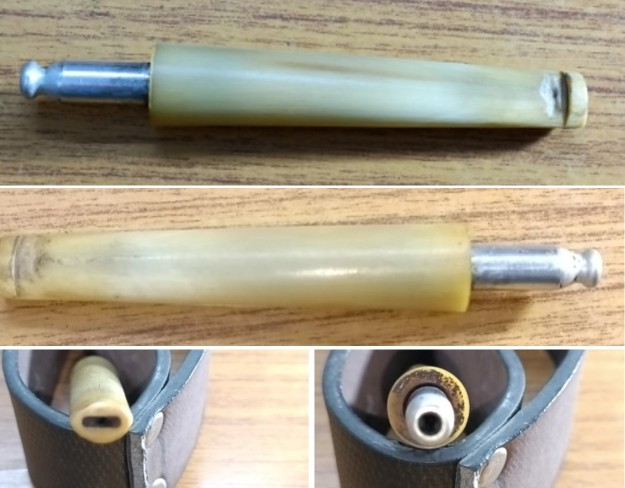
The aluminum tenon in a bone stem with an elliptical slot makes me inclined to place this pipe from during the WW II era, which is from 1940 to 1945/ 6.

That said this pipe is definitely an old timer and is being added to my personal collection.

Initial Visual Inspection
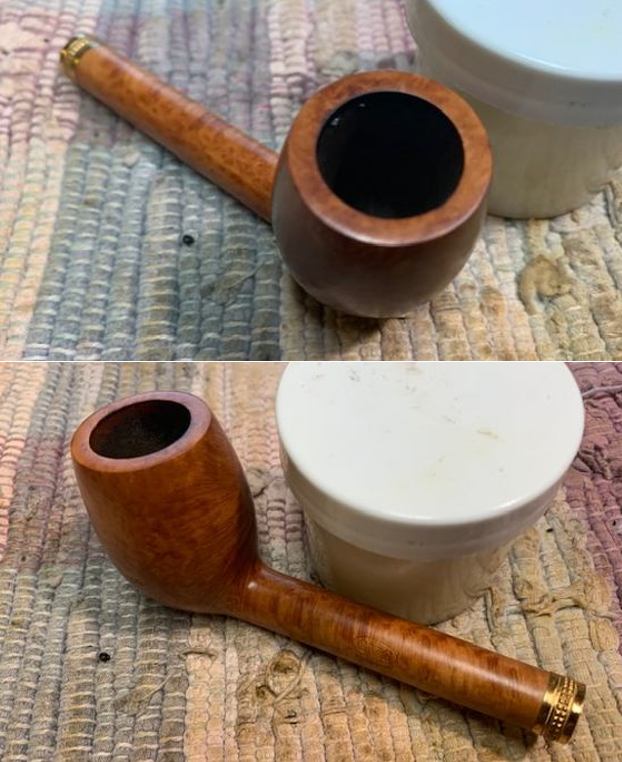
The pipe, as it sits on my work table, is dirty with a thin layer of cake in the chamber, a stummel that is covered in dust and grime and a tapered bone stem that has tooth indentations on either surface in the bite zone. Here are a few pictures of the pipe before I proceed with a detailed visual inspection of each part of the pipe. Detailed Visual Inspection
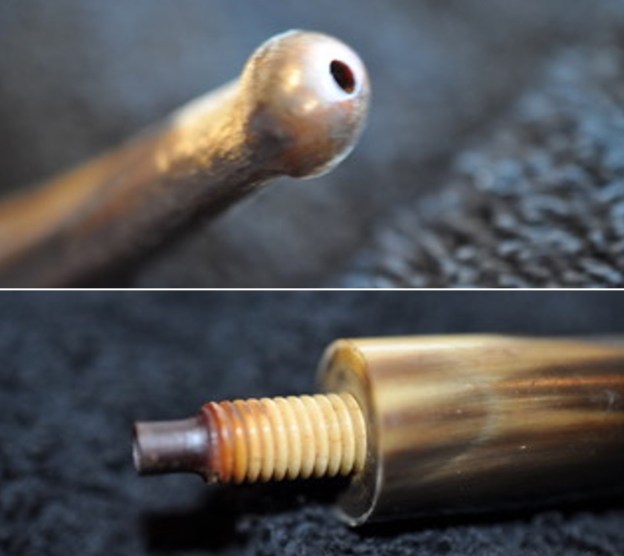
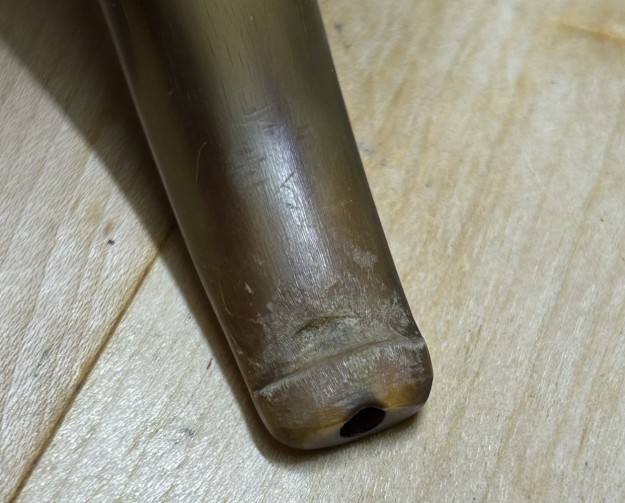
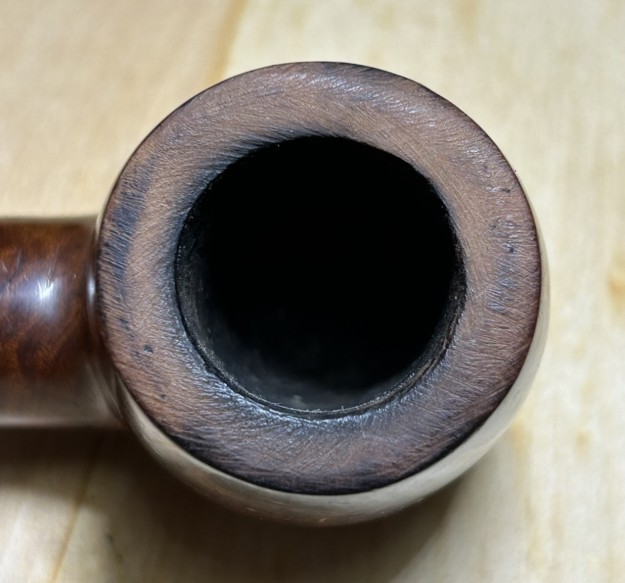
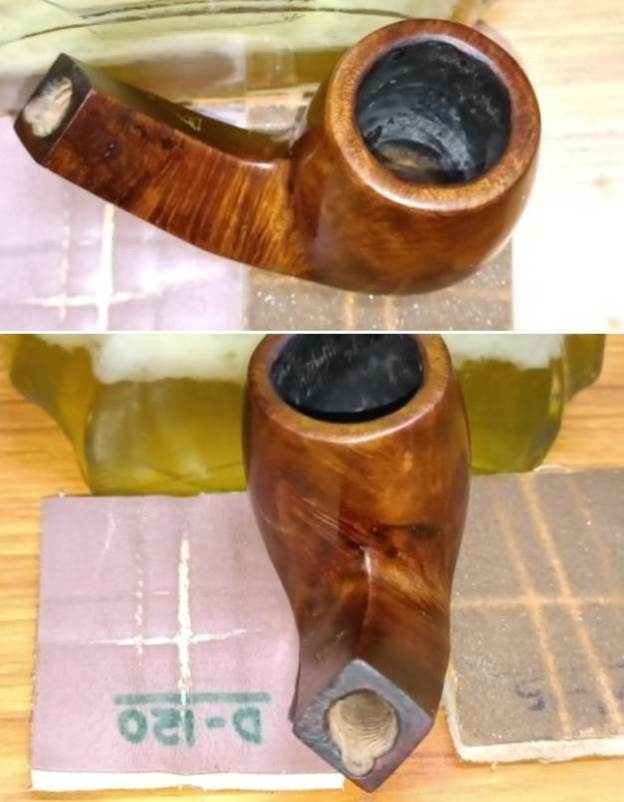
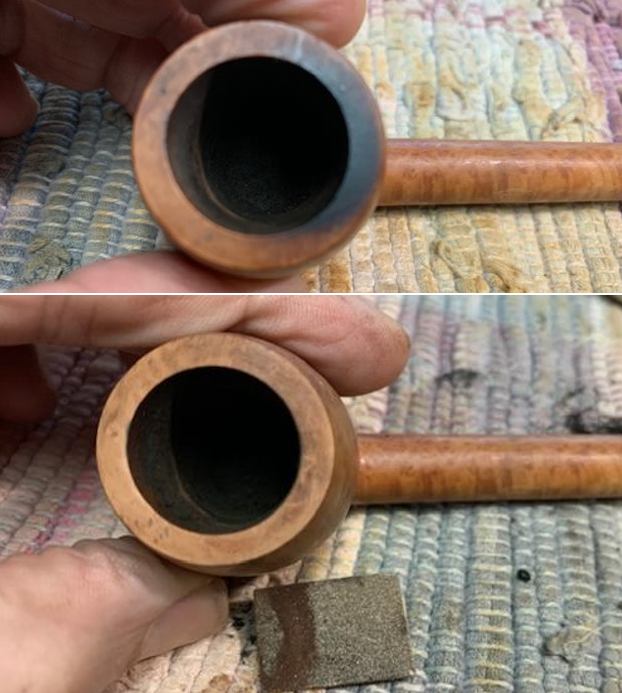
A thin layer of cake lines the walls of the chamber. There is no accumulation of overflowing crud over the rim surface but slight darkening is seen to the aft of the rim surface. The rim edges, both outer and inner, are sans any dents and dings. The rim top surface, however, shows a number of dents and dings likely caused due to either strikes against a hard edge or due to uncared for storage of the pipe.The stummel surface has attracted dust and dirt giving it a dull lackluster and lifeless appearance. There are a few scrub marks over the surface but these should be easily addressed during the polishing process. The briar wood has taken on a nice dark patina from the years of handling and smoking. It will be my endeavor to preserve and highlight this aspect. The stampings on the shank surface are all crisp and clearly discernible. The shank end of the stummel is adorned with a copper band. The unique feature of this pipe is a metal spacer that is stamped on the face as BREVETE and S.G.D.G as mentioned above. This spacer extends in to the mortise and is lined with cork extending up to an inch or so. The mortise is relatively clean with minor traces of residual ash and oils/ tars. The horn stem has a nice light and bright appearance with bite marks and tooth indentations on either surface in the bite zone. There are a couple of superficial cracks over the stem surface and should be addressed once the stem is sanded and polished. I think these superficial cracks are primarily the result of drying of the bone material. The long aluminum tenon is tapered and cinched at the tenon end to match the mortise opening. The tenon surface is clean but would benefit from some cleaning and polishing. The elliptical slot and tenon end shows traces of old residual oils and gunk. The button edges show a couple of minor teeth marks and would need to be sharpened. The Restoration Process
Whether to start with stem or the stummel refurbishing has always being a source of conflict for me as stem repairs and refurbishing almost always takes the longest time and efforts and hence prudent to be worked on first while the allure of unrevealing the beautiful grains of the briar weighs in favor for its refurbishing first. Well in ibid case, the lovely patina and straight grains won and I decided to start working on the stummel.

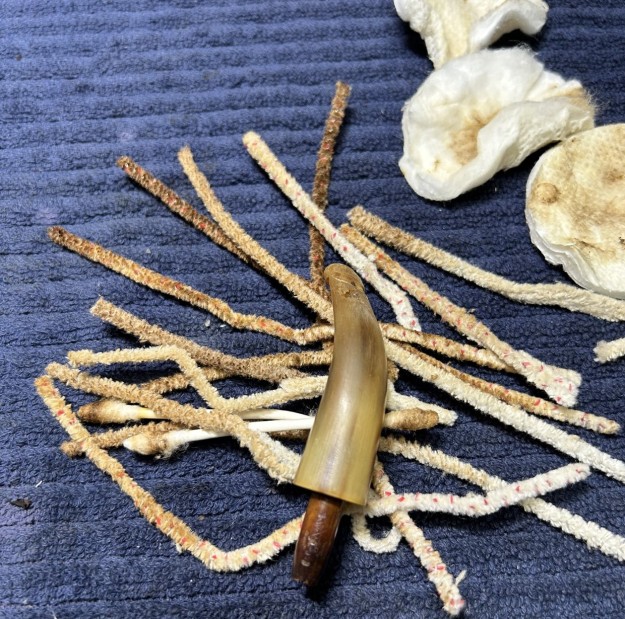
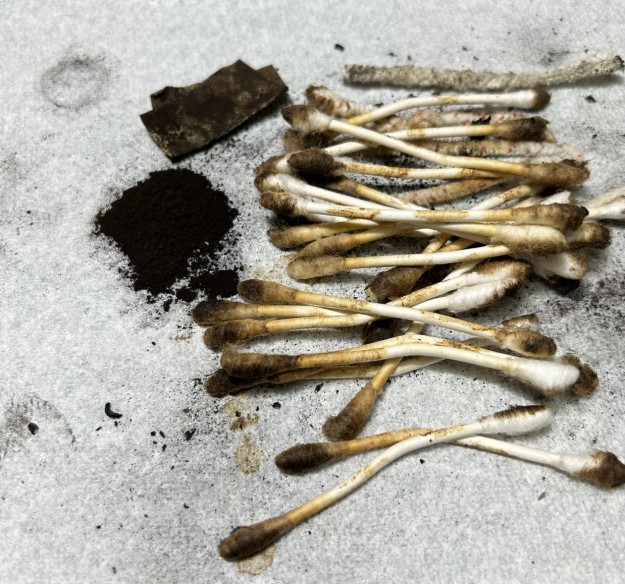
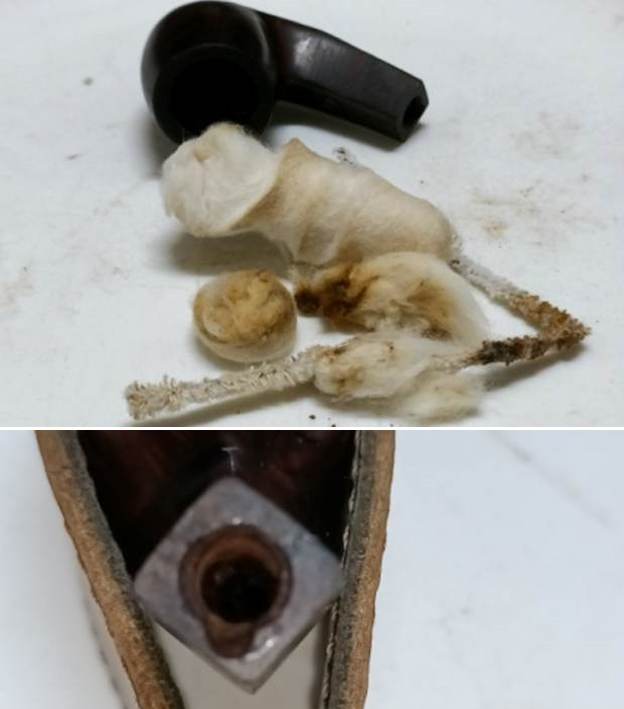
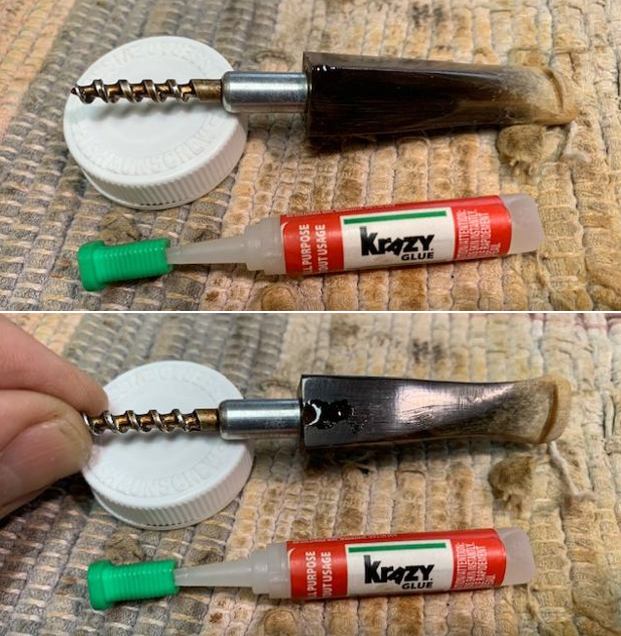
I started the process of refurbishing by reaming the chamber first. Using reamer head sizes 1 and 2 of the PipeNet pipe reamer, I took the cake down to the bare briar. The amount of carbon that was dislodged from the chamber was really surprising as I had appreciated a thin layer of carbon and the quantity of carbon that was removed was anything but a thin layer. With my fabricated knife, I removed all the cake and took it down to the bare briar. I further sand the chamber wall with a folded piece of 180 grit sandpaper to smooth out the wall and remove the last bit of stubborn carbon that remained stuck to the chamber. To finish the reaming process, I wiped the chamber walls with a cotton swab dipped in alcohol to clean the last traces of residual carbon dust. I was happy to note a clean and well seasoned solid chamber.Next, I cleaned out the shank internals. Early on, I realized that I could not pass a pipe cleaner trough the draught hole due to blockages in the shank airway. I used a modified poker tool to push through and dislodge this block of dried oils and gunk. I further scraped out all the dried and crumbly oils and tars from the walls of the mortise with my dental tool. I cleaned out the mortise and shank walls with pipe cleaners dipped in alcohol. I shall continue further cleaning of the shank and mortise while going through the other processes.Now on to de-ghosting the pipe…. I packed the chamber with cotton balls and drew out a wick from the cotton and along with a folded regular pipe cleaner, inserted it into the mortise and through the draught hole into the chamber. I tightly packed cotton balls in to the remaining portion of the mortise. Thereafter, I soaked the cotton balls with isopropyl alcohol up to the brim. About half an hour later, the level of alcohol had gone down, having being absorbed by the cotton. I topped it up once again and set it aside overnight. By next afternoon, the cotton and alcohol had drawn out all the remaining oils and tars from the chamber and mortise. I removed the cotton balls and ran pipe cleaners through the mortise and draught hole to clean out all the loosened tars and gunk that was lodged in the draught hole and mortise. The chamber and mortise now smelled clean, fresh and looked it too. I set the stummel to dry out naturally.With the night still being young and not wanting to break the momentum of work as the stummel soaked in cotton and alcohol bath, I decided to use the time to address the stem issues. I first ran a few pipe cleaners dipped in alcohol through the stem airway and they came out very dirty. To conserve pipe cleaners, I put off further cleaning of the airway and would continue the internal cleaning using shank brushes and oil soap under warm water. With a sharp dental tool, I scraped out the dried oils and gunk from the slot end and tenon face. I also cleaned the aluminum tenon surface with a cotton swab wetted with isopropyl alcohol.Continuing with the stem cleaning, I followed the internal cleaning of the stem with cleaning the airway using thin shank brushes and anti oil dish cleaning soap. I ran a couple of pipe cleaners to clean and dry out the airway. Using Scotch Brite pad and oil soap; I cleaned out the entire gunk from the aluminum tenon, elliptical slot end and the stem surface.The last agenda for the day before I turned in for the night was to address the bite marks on either surface in the bite zone. I cleaned the surface with alcohol on a cotton swab in preparation of the surface for a fill. I filled the deep tooth indentation in the bite zone on the upper stem surface with clear medium CA superglue. Once the fill had hardened sufficiently, I similarly filled the tooth indentation in the lower stem surface. I set the stem aside for the fills to cure.By the time I again sat at my work table the next evening, the alcohol and cotton had leached out all the old oils from the chamber walls and the stem fills had cured too.

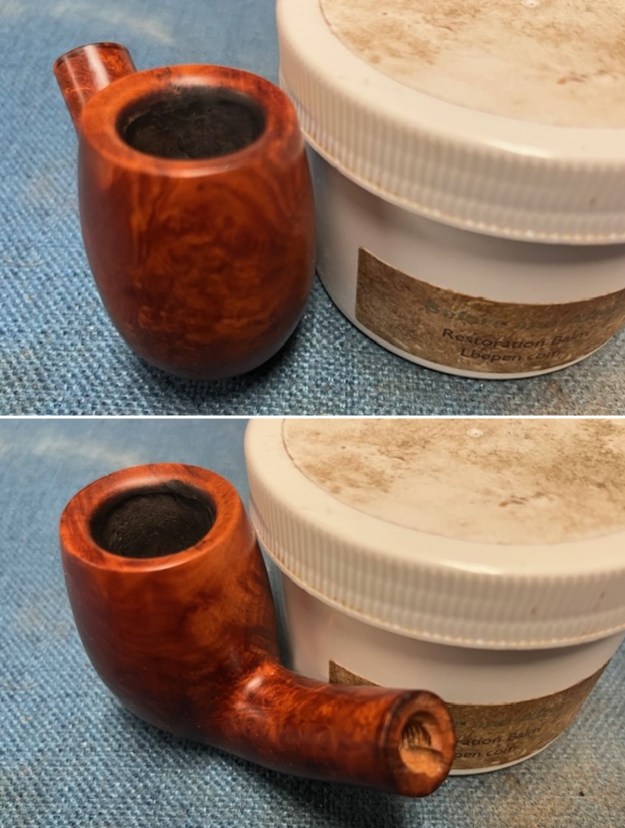
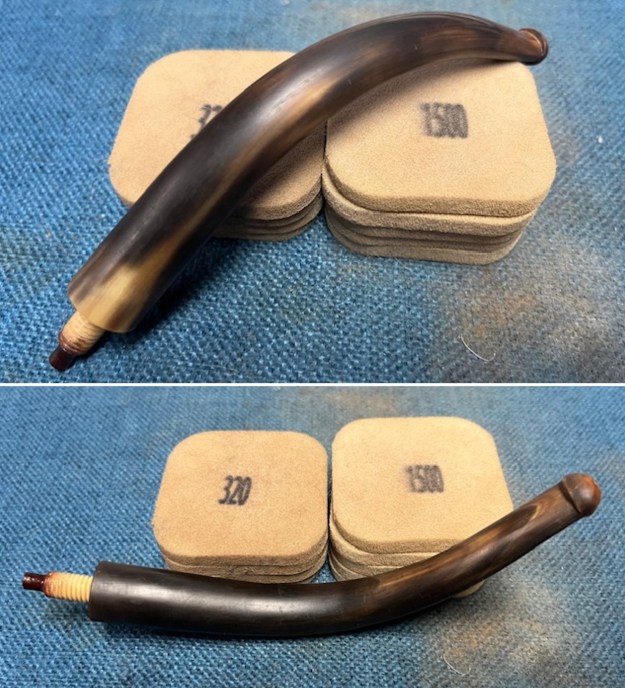
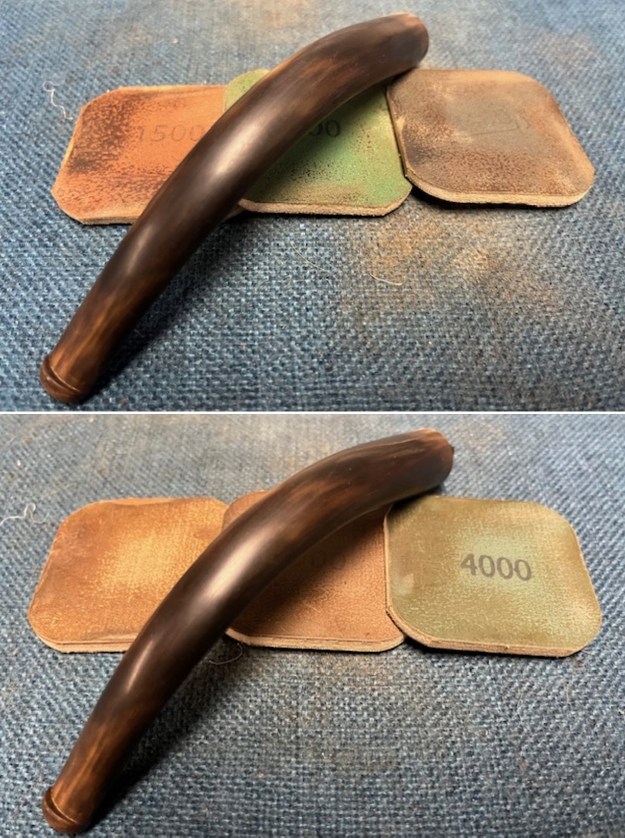
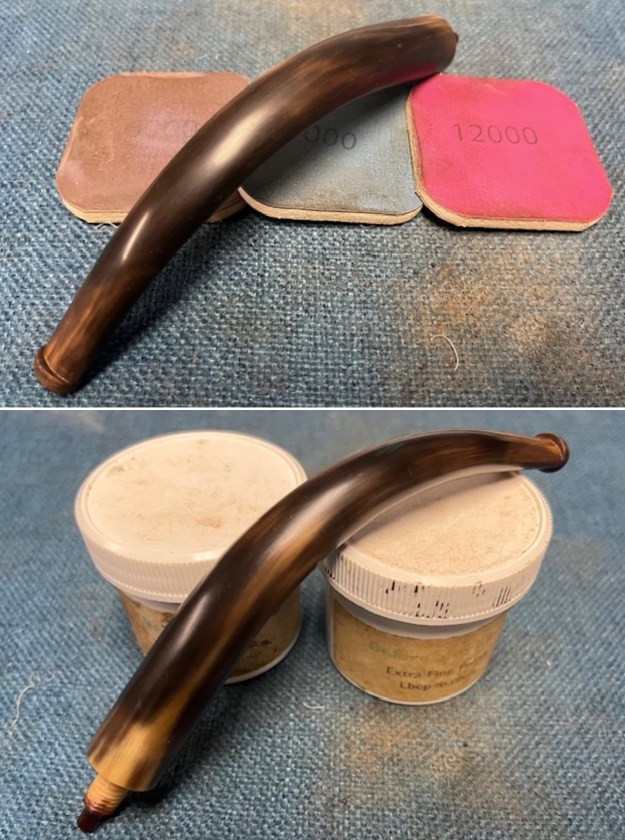
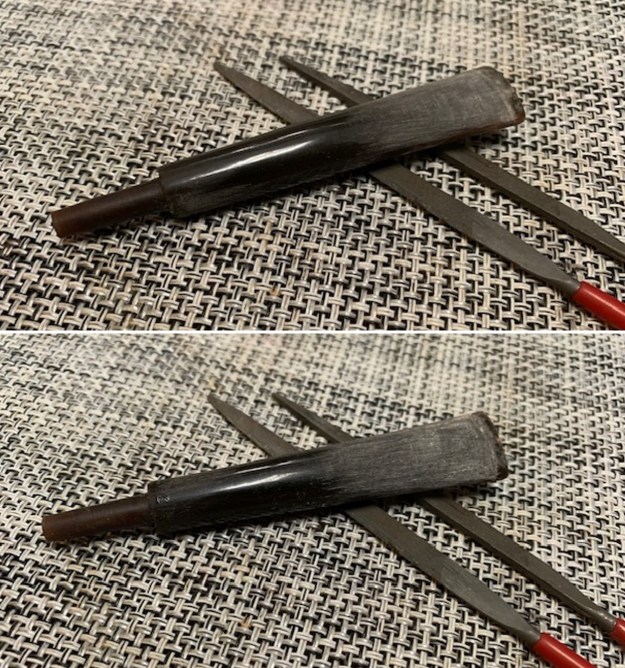
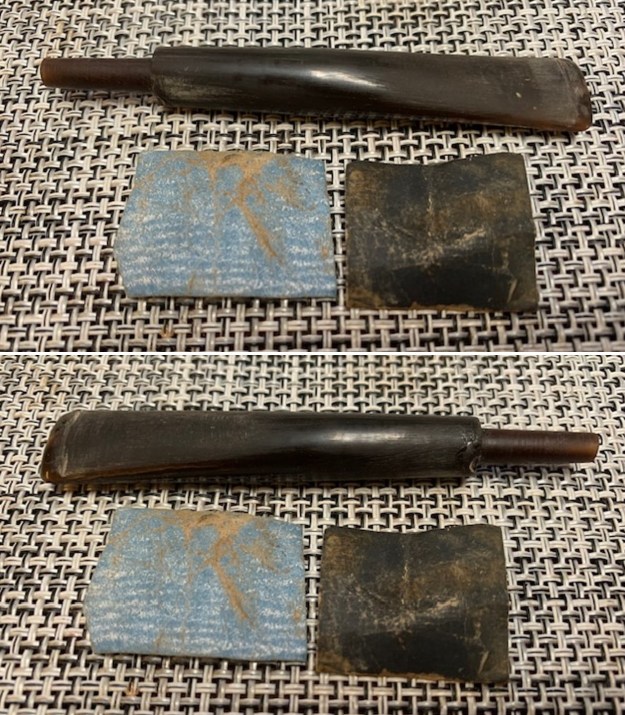
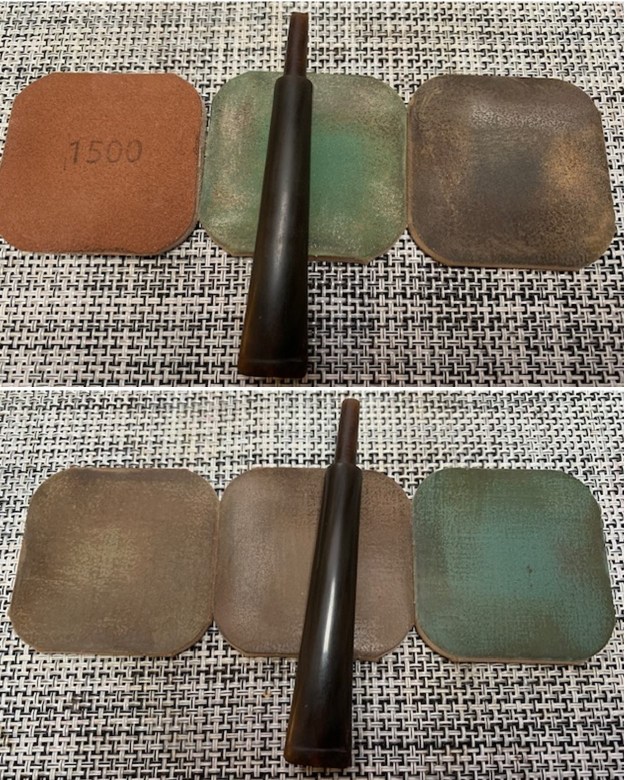
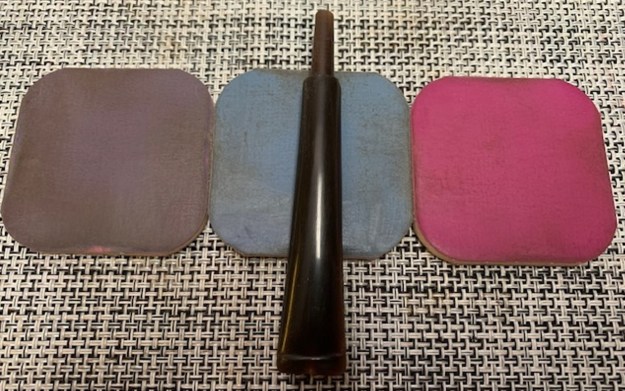
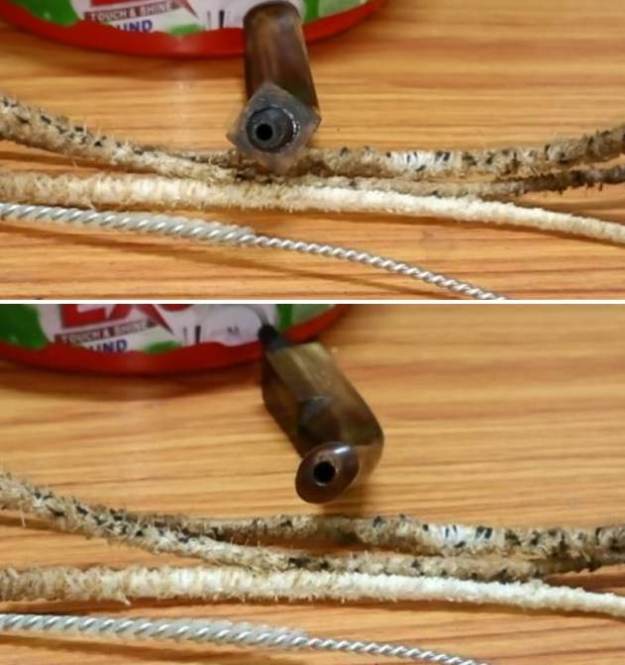
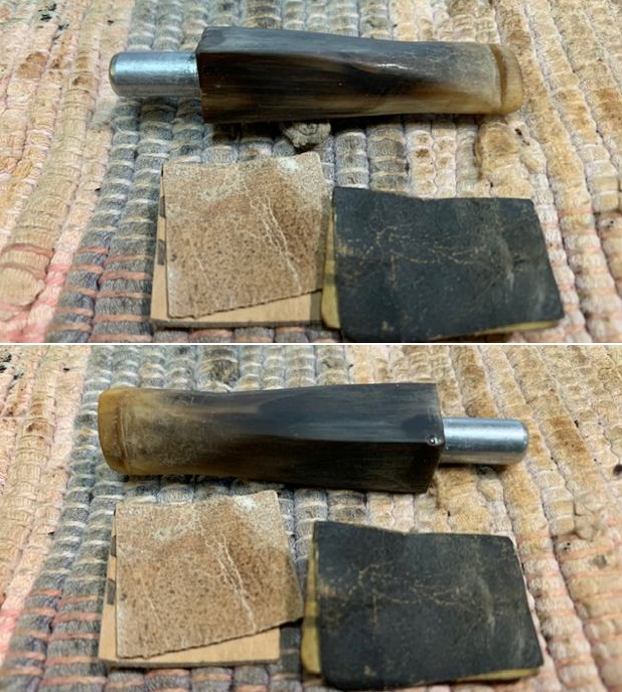
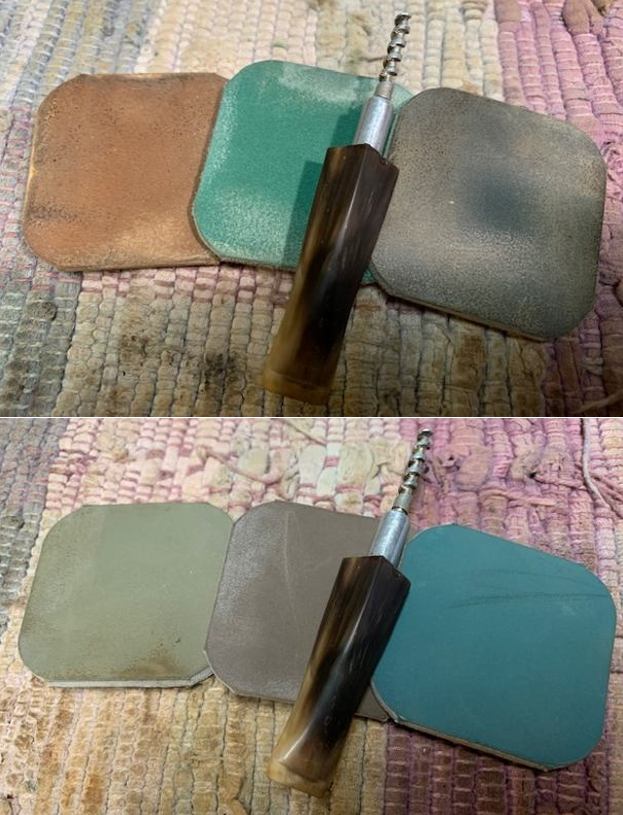
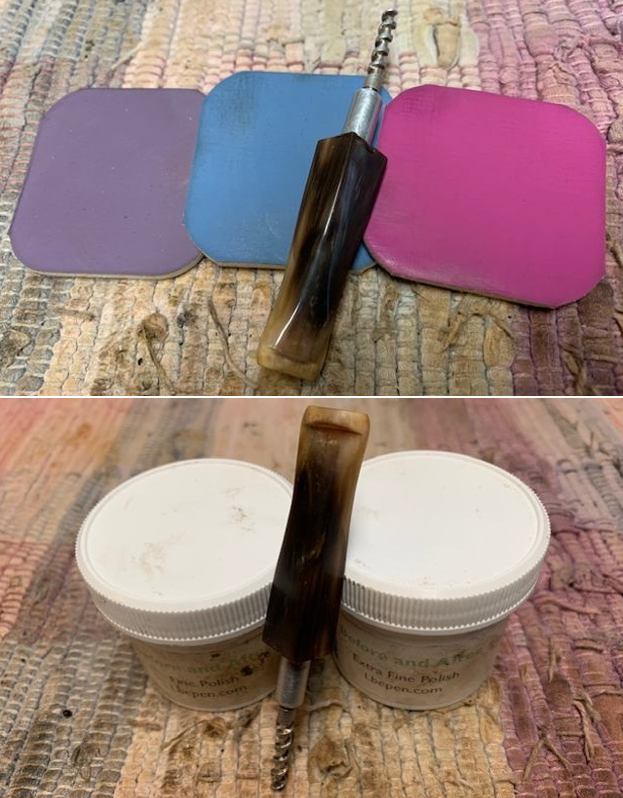
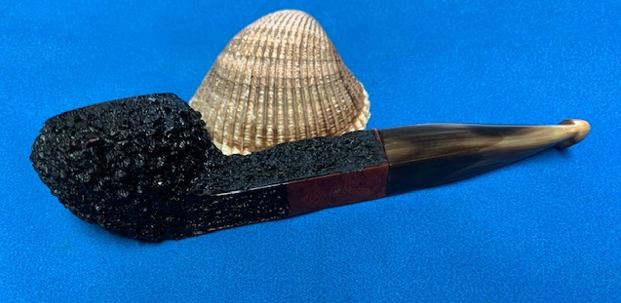
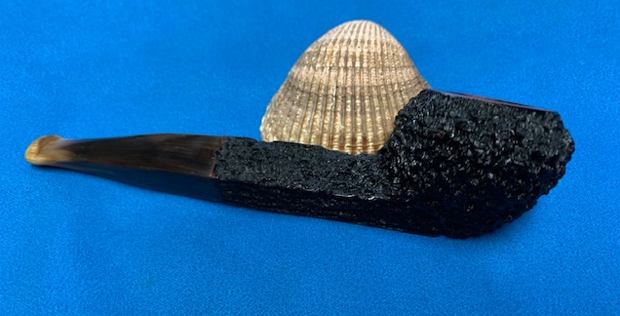
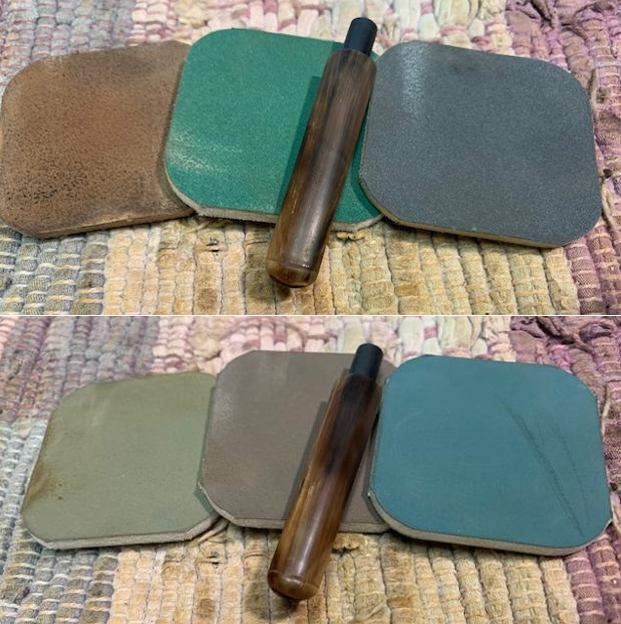
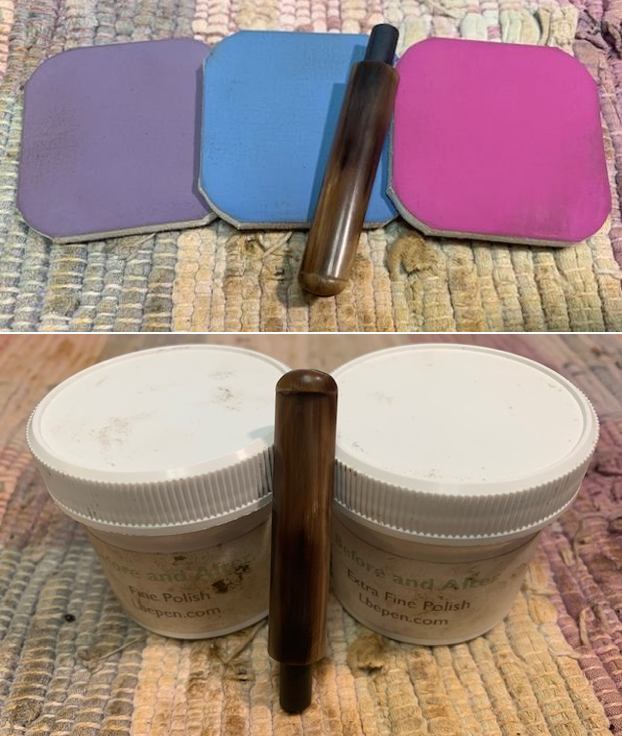
Next, I proceeded to clean the exterior of the stummel. I used a hard bristled tooth brush, Scotch Brite pad and Murphy’s Oil soap to scrub the stummel and rim top. For this stummel cleaning, I used Murphy’s Oil soap as I wanted to preserve the old patina that had developed on the stummel and this product really helps in cleaning the briar surface. After the scrub with oil soap, I washed the stummel under running warm water with anti oil dish washing detergent till the stummel surface was clean and dried it using paper towels and soft cotton cloth. I simultaneously cleaned the shank internals with the detergent and hard bristled shank brush and set the stummel aside to dry out. That the shank end is internally lined with cork is now apparent after the cleaning and this further restricts the cleaning process, adding caution to the equation while further cleaning the shank internals. I was fortunate that the alcohol bath has not loosened and removed this cork lining. To aid in the drying process, I heat the stummel under a 100 watt filament bulb as it is very important that the briar is completely dry as presence of slight moisture leads to growth of fungus over the surface subsequently.With the stummel set aside for drying, I used a needle file to sand the stem fill to achieve a rough match of the filling with the rest of the stem surface. To achieve a better blend, I sand the fill with a folded piece of 180 grit sandpaper. I also worked the button edges to a crisp edge with the file. By no means is the blending complete and shall be continued with during the sanding and polishing process.To bring a deep shine to the horn stem, I went through the complete set of micromesh pads, wet sanding with 1500 to 12000 grit pads. I wiped the stem with moist cloth after each pad and rubbed it down with Extra Virgin Olive oil to rejuvenate the horn which is very prone to drying and developing cracks over the surface. The finished stem is shown below.Remember the stummel that had been set aside to dry out under the bulb? Well, in the while that I completed the repairs and initial polishing of the stem, the briar had completely dried out and was ready to be worked on further.

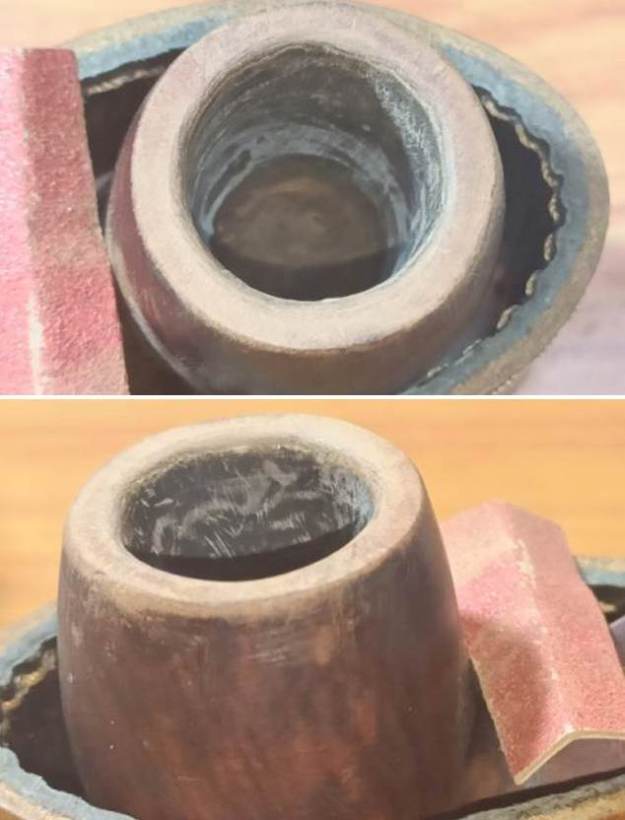
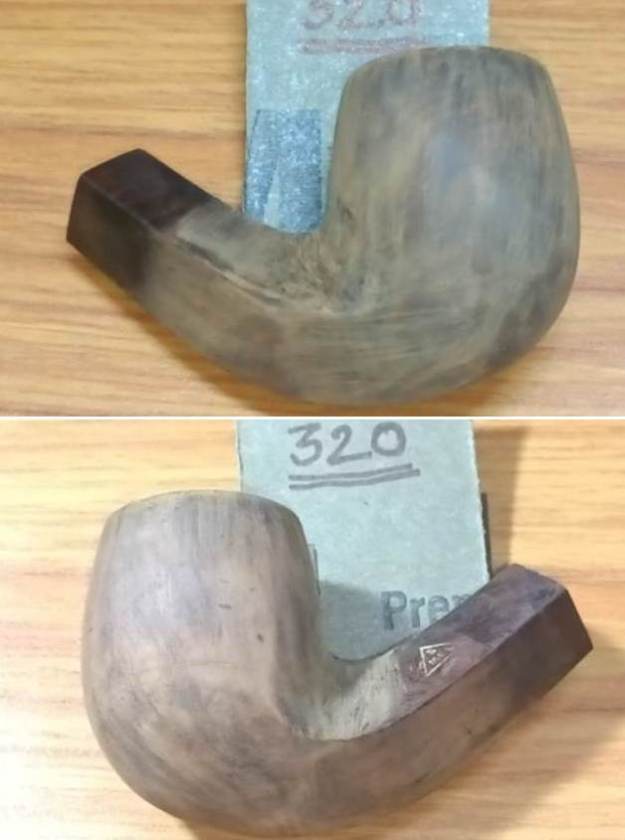
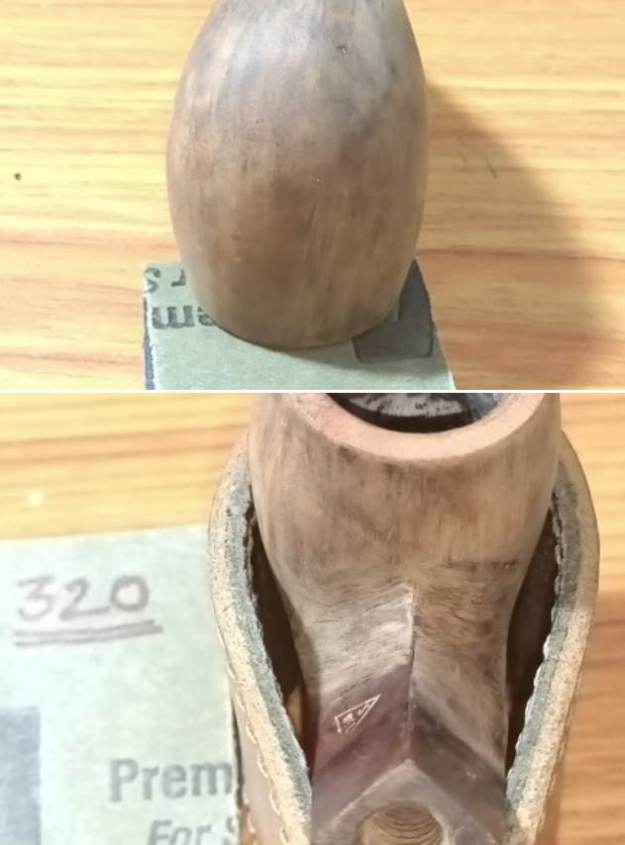
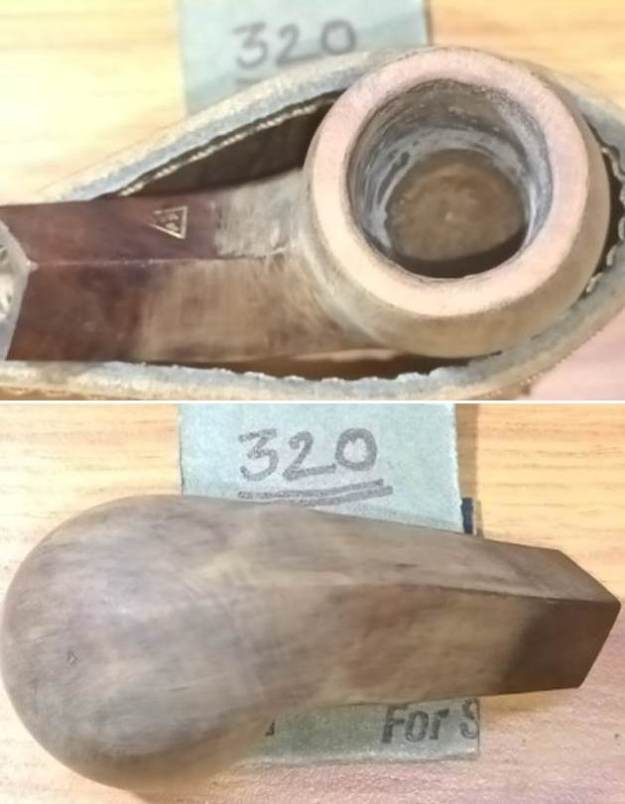
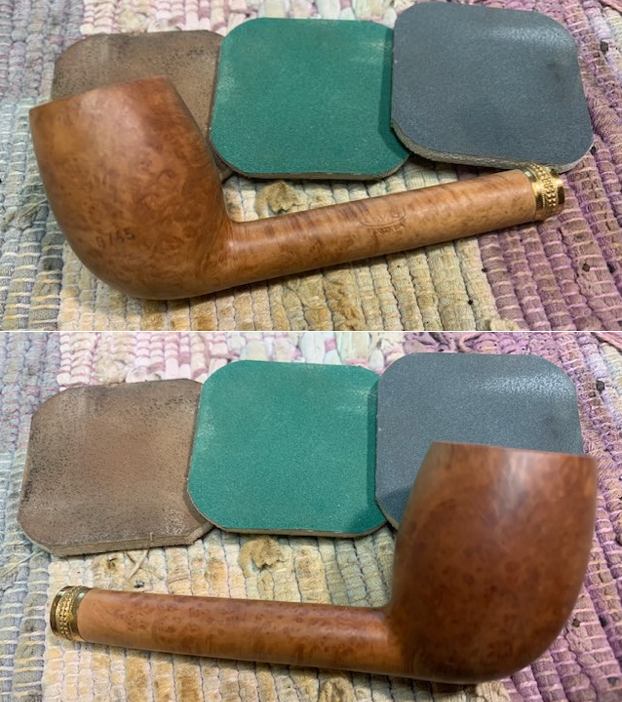
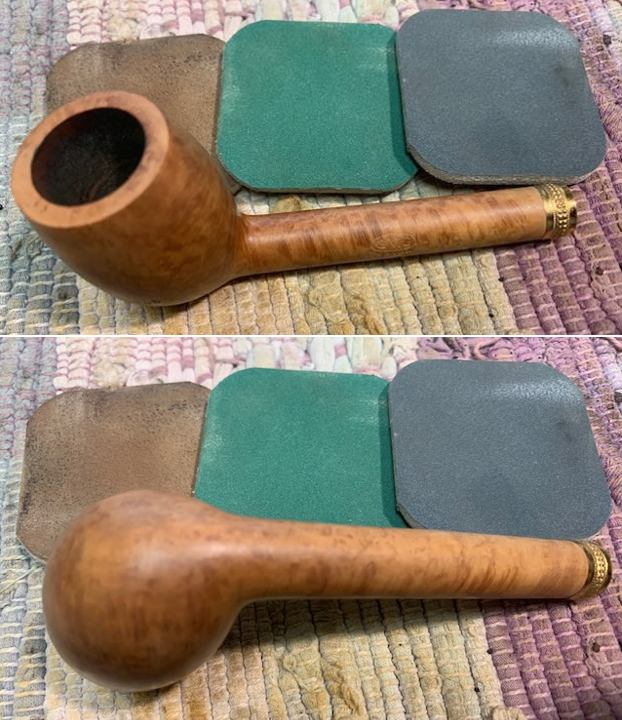
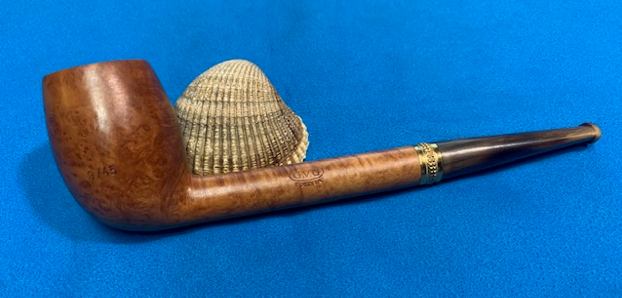
The issue that needed immediate attention was the number of dents and dings over the rim top surface. To address it, I topped the surface over a piece of 220 grit sandpaper till these damages all but disappeared. I am quite pleased with the appearance of the rim top at this stage.I followed it by wet sanding the entire stummel with 1500 to 12000 grit micromesh pads, wiping frequently with a moist cloth to check the progress. I really like the looks of the stummel at this point in restoration. The grains and the clean lines of this piece of briar is really appreciable. Next, I rubbed a small quantity of “Before and After Restoration Balm” deep in to the briar with my finger tips and let it rest for a few minutes. The balm almost immediately works its magic and the briar now has a nice vibrant appearance with the beautiful grain patterns displayed in their complete splendor. I further buffed it with a horse hair brush. The contrast of the dark browns of the Bird’s eye and straight grains with the dark natural patina of the rest of the stummel adds an interesting dimension to the appearance of the stummel that cannot be insufficiently described in words and be rather seen in person. I have now reached the homestretch in this restoration project. To complete the restoration, I mounted a cotton cloth buffing wheel on to my hand held rotary tool and polished the stummel and stem with Blue Diamond compound. This compound helps in polishing and also in removing the minor scratch marks that remained from the sanding process. I mounted another cotton buffing wheel that I have earmarked for carnauba wax and applied several coats of the wax. I finished the restoration by giving the entire pipe a rigorous hand buffing using a microfiber cloth to raise the shine further. The finished pipe looks amazingly beautiful and is ready to join my collection. I only wish it could share with me its life story of the past years while I enjoy smoking my favorite Virginia blend in it or maybe an English blend or maybe just keep admiring it!!!! Big thank you to all the readers who have joined me on this path by reading this write up as I restored and completed this project. P.S.: I came across an interesting flyer/ advertisement bearing the stamp  “RACINE, DE VIEILLE SOUCHE” in French language. I have included the same here and would be happy to receive any information on the pipe in English for the sake of enhancing my knowledge on this pipe.Thank you once again for your time and assistance.

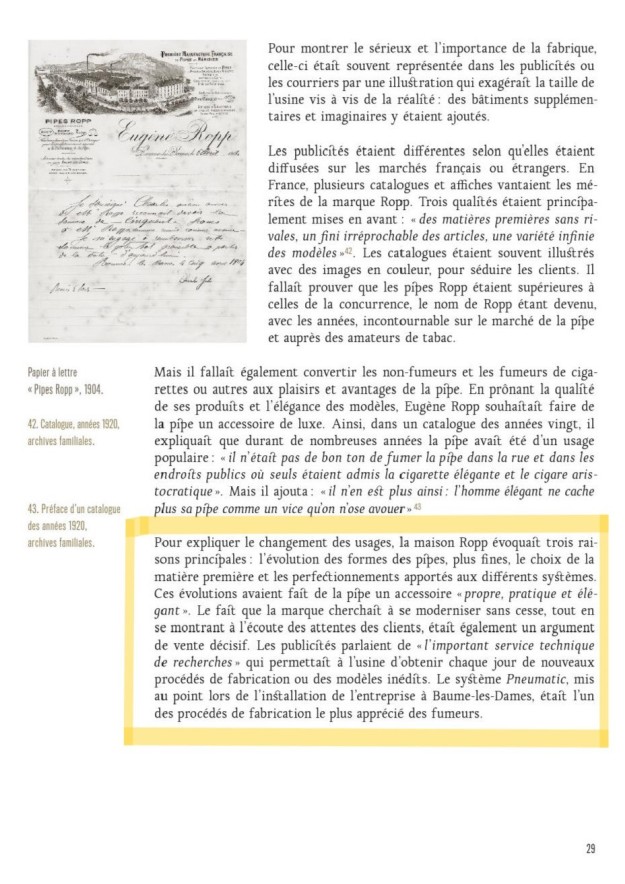
ADDENDUM – Pages 21,29 and 34 of the French Ropp Book (Ropp, ça ne fume plus). Kenneth Lieblich scanned the pages and translated them for Paresh.

Translation of the highlighted parts of page 21

Trademarks were registered for each of his creations: La Cosaque, La Pneumatic and La Norvégienne appeared at the beginning of the century, between 1904 and 1908. According to the INPI records, these brands were intended to be affixed to the pipes, smoking accessories and other handmade items as well as cases, boxes, packaging of pipes… The reasons for choosing most of these names are unknown.

Regarding La Pneumatic, we can see a link with current events. In fact, the tire was invented in 1888 by Irishman John Boyd Dunlop and the removable tire by Michelin in 1891. Its use became widespread at the beginning of the 20th century. Another pipe was named Pipe des aviateurs (1909) when, on July 25, 1909, Louis Blériot succeeded in crossing the Channel by plane for the first time.

Each pipe had several varieties of shapes, sizes and ornaments. La Pneumatic could be fitted with a fancy band: gold, silver or other metal; in straight or bent models; of medium to very large size; and with oval or round bowls. Then, the types of briar evolved with the appearance in 1910 of Cum-mer root, Cum-mer briar, blood briar and blood root, recalling both the raw material used and its particular red grain.Translation of the highlighted parts of page 29

To explain the changes, Ropp cited three main reasons: moving towards thinner pipes, the choice of raw materials and the improvements made to the different systems. These developments had made the pipe a “clean, practical and elegant” accessory. The fact that the brand sought to constantly modernize itself, while paying attention to consumer demand, was also an important selling point. The ads spoke of “the important technical research” which allowed the factory to frequently employ new manufacturing processes or new models. La Pneumatic system, developed when the company set up in Baume-les-Dames, was one of the manufacturing processes most appreciated by smokers.Translation of the highlighted parts of page 34

At the start of the 20th century, system pipes and other inventions aimed at better health were very popular with French smokers. Concerns about the harmful effects of tobacco and nicotine were in vogue, as were concerns about hygiene: pipes were sometimes difficult to clean and maintain. These were different from filter pipes since the piece inserted into the stem did not absorb the condensation but only stopped it. These system pipes, with different variations, appeared healthier and more hygienic. La Pneumatic is one of the system pipes that Ropp put on the market and patented. A separate ferrule was housed inside the stem while a piece of cork, providing friction, made it easier to separate the stem from the stummel and also made cleaning easier.

Amazing Research in the Restoration of a Classic French Pipe


Blog by Kenneth Lieblich

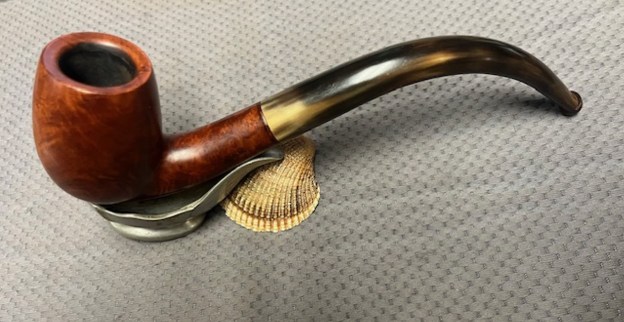
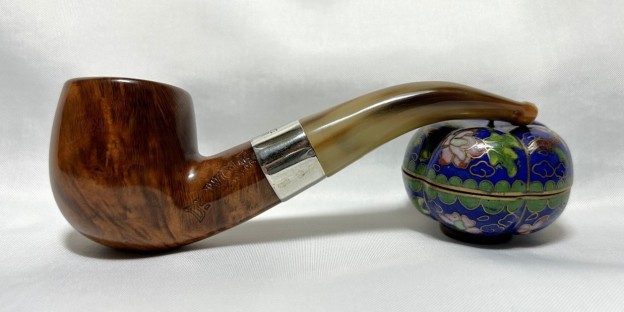
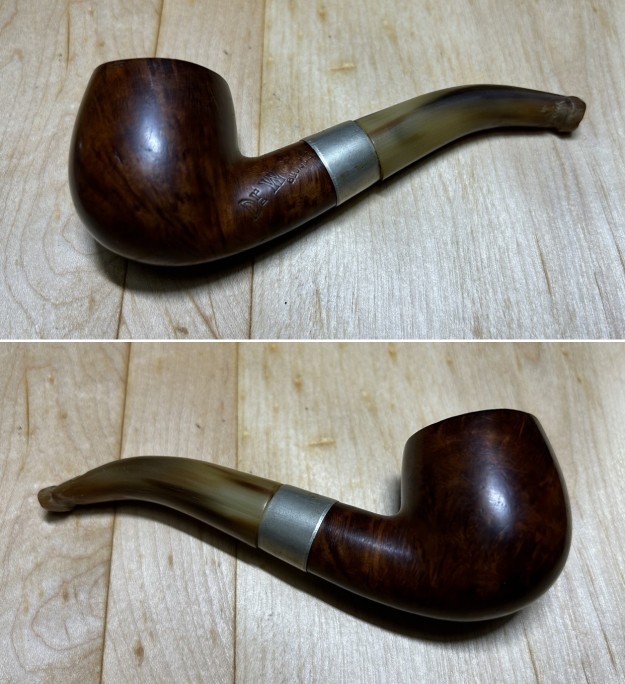
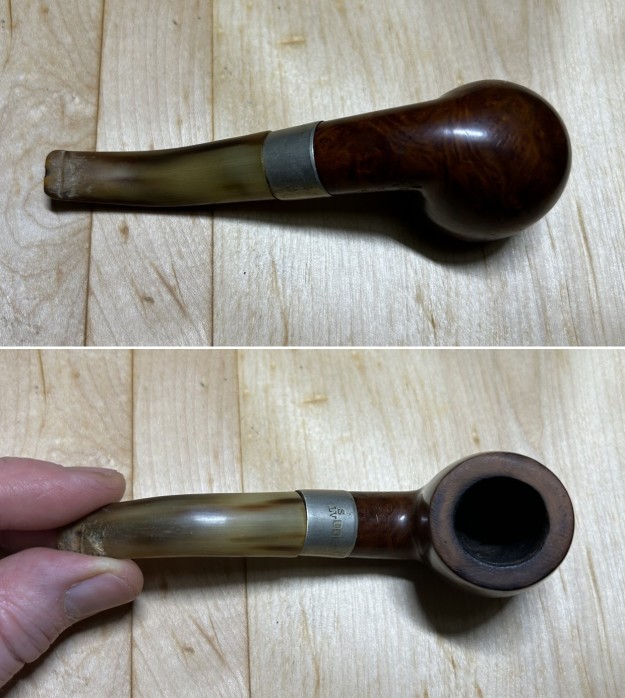
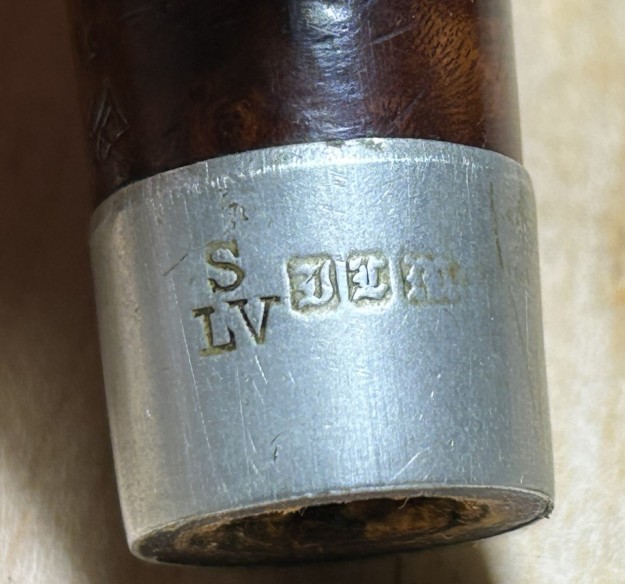
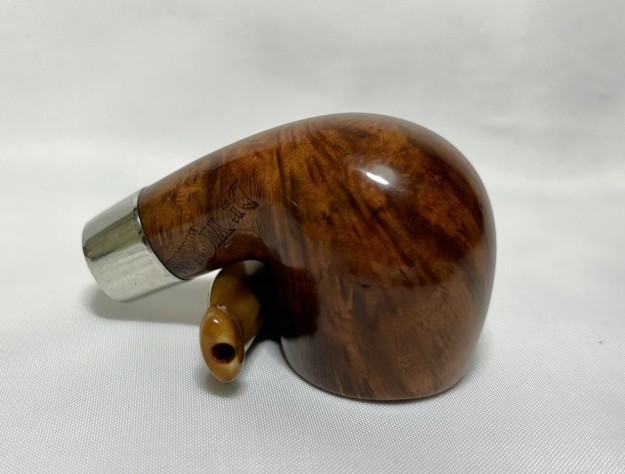
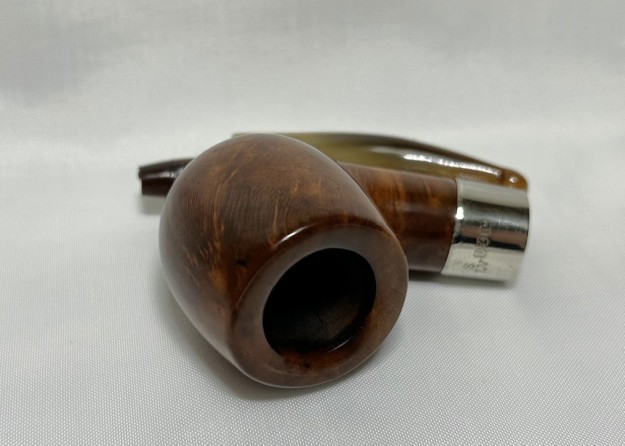
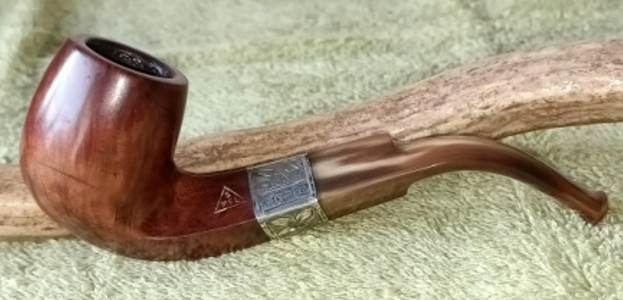
Next on ye olde chopping block is a charming pipe from France and it dates back a century – or more. It’s a very attractive bent billiard pipe that I acquired in a lot from France. Recently, I had the pleasure of meeting a young man studying for the priesthood. While he as visiting the Vancouver area, he told me he was interested in acquiring a pipe. I had him over to the house and showed him many pipes. He picked this very pipe. He wanted one of modest size and this fit the bill very well. The briar wood was quite lovely and it had an equally fetching stem made of horn. There was also a nickel band around the shank which read, S [over] LV. This was next to some blackletter characters that I couldn’t quite make out. Meanwhile, the markings on the left side of the shank read: Dr Wolf [over] BTE. S.G.D.G. The Dr Wolf part was clear enough, but I needed to confirm what the other letters referred to. I was fairly sure this was something to do with French patents, but I googled to make sure. Indeed, it was a type of French patent, extant between 1844 and 1968. The letters BTE. S.G.D.G. stand for Breveté Sans Garantie du Gouvernement, meaning “patent without government guarantee”. As Wikipedia explains:

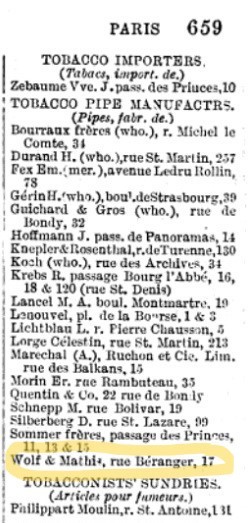
In France, the law of 1844 states that patents are issued “without prior examination, at the risk of the applicant and with no guarantee of function, novelty and merit of the invention also in terms of precision or accuracy of the description”. Back to the brand name, Dr Wolf. This was tricky – I wasn’t familiar with the brand Dr Wolf and there was nothing about it online – except for one seemingly unhelpful advertisement. This ad was on an antique shop’s website and it was listed as being from the “end of the 19th century”. I was annoyed by the lack of information, but I am nothing if not tenacious in discovering the history of pipes – especially French pipes, for which I have a particular fascination. I saved that advertising image to my computer, so I could show it in this article.My first step was consulting both Wilczak & Colwell and my own personal database of French pipe makers and, of course, there was no listing for “Dr Wolf”. However, in my database, the name, “Wolf”, did appear in the listing for a late-19th century pipe maker: CC Paris. Here is the write-up from Pipedia on CC Paris:

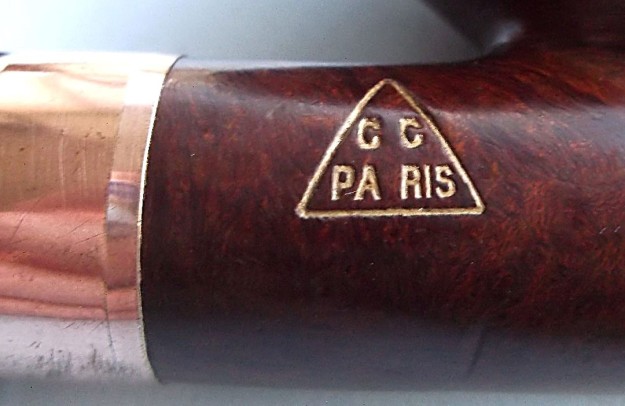
Every collector of antique pipes knows that pipe factory and retail store catalogs from the 1800s – early 1900s are as rare as hen’s teeth to find…and an even rarer occasion, when found complete and in good to better condition. This fragile catalog from this little-known French manufactory, merchandised its pipes with the logo of a triangle bearing the letters “C C Paris” embossed in fitted cases. Cases with this logo are known, but the Wolf and Mathiss name, until now, was not known as the factory behind the retail establishment.

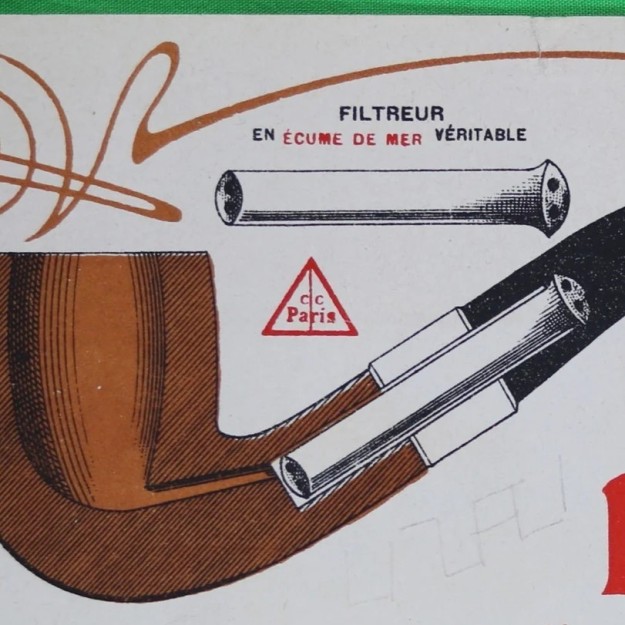
Wolf & Mathiss was originally known as Cawley & Henry, a pipe manufacturer founded in 1867. The product line was fairly robust, catering to not only pipe and cigar smokers, but also to cigarette consumers, because the catalog includes cigarette rolling papers that, according to company information, had received silver medals at two expositions, Anvers (1885) and Paris (1889).Unfortunately, the name “Wolf” is not uncommon and there was nothing to suggest that this Wolf was the same as Dr Wolf. There was also no indication of what the given names were for either Mr Wolf or Mr Mathis. As a side note, I assume that the correct spelling is “Mathiss”, not “Mathis”, as shown on Pipedia. A 1907 copy of Kelly’s Directory of Merchants, Manufacturers and Shippers lists the name with a single “S”.However, the Pipedia page for CC Paris made me wonder about a connection to Dr Wolf. First of all, the pipes on catalogue pages shown there bear some resemblance to my Dr Wolf pipe – hardly a definitive clue, but interesting nonetheless. The other thing that struck me was the logo, shown here:There is no obvious reason why the logo would be of interest, but I recognized it and couldn’t remember where I’d seen it. I love researching pipe history, but it’s always frustrating when one hits a dead end. And then it struck me! That logo! I’d seen it in the very same advertisement I downloaded earlier. Here it is (zoomed in) and look what it shows!!!So there we have it – the Wolf of Wolf & Mathiss must, in fact, be Dr Wolf. I am delighted to have made this discovery. It completes the loop between the relevant pipe makers and demonstrates the origin of the Dr Wolf name.

Clearly, this particular pipe had been well-loved, as it arrived well worn, with plenty of filth inside, a few dents in the work, gouges in the horn stem, and scratches all over the rim. Interestingly, this pipe had an orific button at the end of the stem, a feature that apparently disappeared by the 1930s, so it must be around a hundred years old. For more information on the orific button, take the time to read Steve’s interesting article on the subject. Well, time to get to work! I started by wiping the stem with Murphy’s Oil Soap on some cotton pads, then cleaned out the inside with pipe cleaners and isopropyl alcohol. Fortunately, it wasn’t overly dirty, and it only needed a handful of pipe cleaners. One of the odd features of this pipe was that the tenon was also made of horn. I quite liked that feature, but it did make it a pain to clean. I built up the bite marks and gouges on the stem with clear cyanoacrylate adhesive and let them fully cure. Following that, I sanded the adhesive down with 220- and 400-grit sandpapers to meld seamlessly into the stem. I then used all nine Micromesh pads (1,500 through 12,000 grit) to bring out the lovely grain of the horn on the stem, with some Obsidian Pipe Stem Oil in between each pad scrubbing.

Now for the stummel. Firstly, I decided to ream out the bowl. I used the PipNet Reamer to remove the built-up cake and followed that with 220-grit sandpaper taped to a dowel to eliminate as much as I could. I took the chamber down to bare briar, as I wanted to ensure there were no hidden flaws in the wall. I also took this opportunity to wash the stummel with Murphy’s Oil Soap and remove as much grime as I could. Following this, of course, I cleaned out the insides with the requisite pipe cleaners and isopropyl alcohol. Boy, it was dirty! One issue that complicated the cleaning of the stummel was the mortise was lined with cork. This was a nifty feature, but I had to ensure that I didn’t damage the cork as I used the alcohol and implements to clean the insides. In order to restore it a bit, I added petroleum jelly to the cork with a cotton swab.The rim was so badly scratched that I had to “top” the pipe – that is, I gently and evenly sanded the rim on a piece of 220-grit sandpaper. This effectively removed the damage without altering the look of the pipe.The old patina was nice enough that it didn’t need a new stain so I cleaned it with some Murphy’s and then set it for a de-ghosting. I followed that up by cleaning the insides with some Castile soap and tube brushes. Due to the wear on the rim of the pipe, I used my wood sphere, wrapped in 220-grit sandpaper, to create a beautiful, chamfered edge on the rim. This also helped return the opening of the bowl to round. I think the results turned out very nicely. I then finished it up by sanding with my Micromesh pads (1,500 through 12,000 grit). Then applying some Before & After Restoration Balm added that je ne sais quoi which brings out the wood’s beauty. One of the issues you will have noticed in the photos is that the stem’s tenon didn’t fit well in the shank’s mortise. In order to make it fit properly, I built up one side of the tenon with some clear cyanoacrylate adhesive. This worked like a charm and the fit was perfect after I fiddled with the adhesive for a bit.I also cleaned the nickel band with SoftScrub and that worked well. I also gave it a polish with a few of my finer MicroMesh pads – then finished with my jewellery cloth which added some much-needed pizzaz. Finally, it was off for a trip to the buffer. A dose of White Diamond and a few coats of carnauba wax were just what this pipe needed.This is a handsome pipe with a classic look and feels very comfortable in hand. The lovely shine made the wood very attractive, and I know that the new owner will enjoy smoking it for many years to come. I hope you enjoyed reading the story of this pipe as much as I did restoring it. If you are interested in more of my work, please follow me here on Steve’s website or email me directly at kenneth@knightsofthepipe.com. Thank you very much for reading and, as always, I welcome and encourage your comments.

A Welcome Mysterious Change of Pace – An Older Pipe with a Metal Cap and Horn stem


Blog by Steve Laug

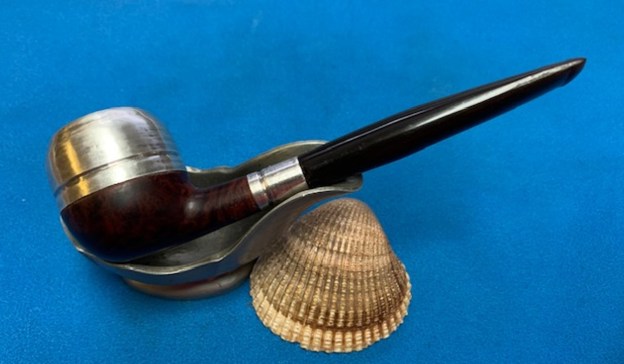
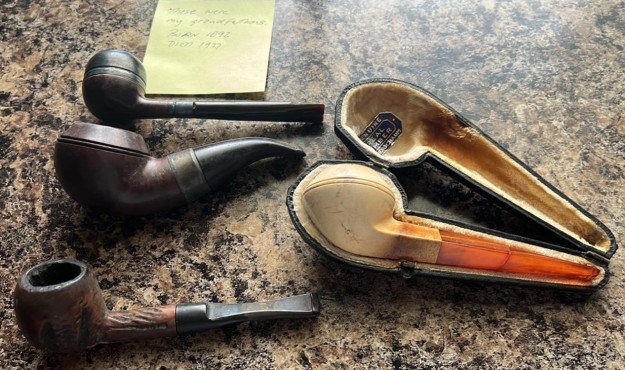
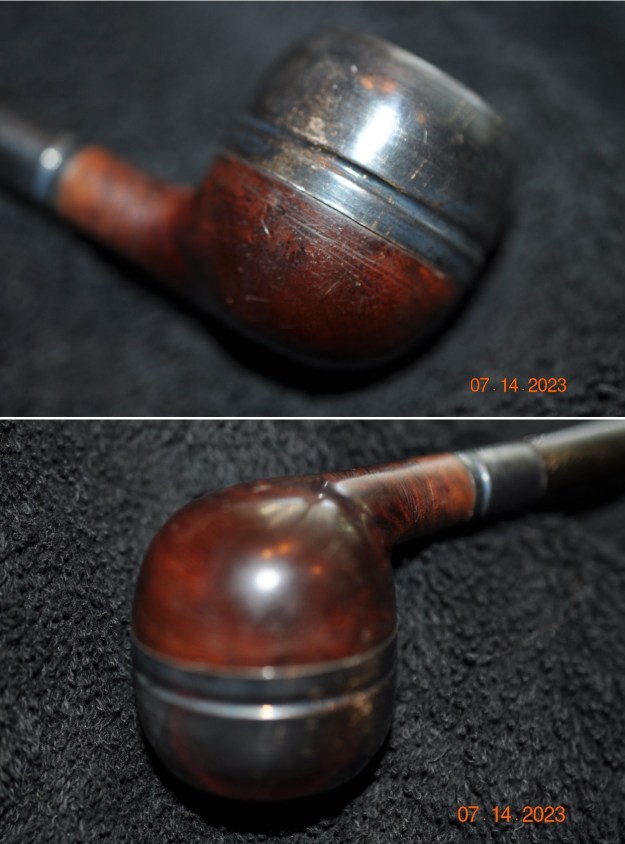
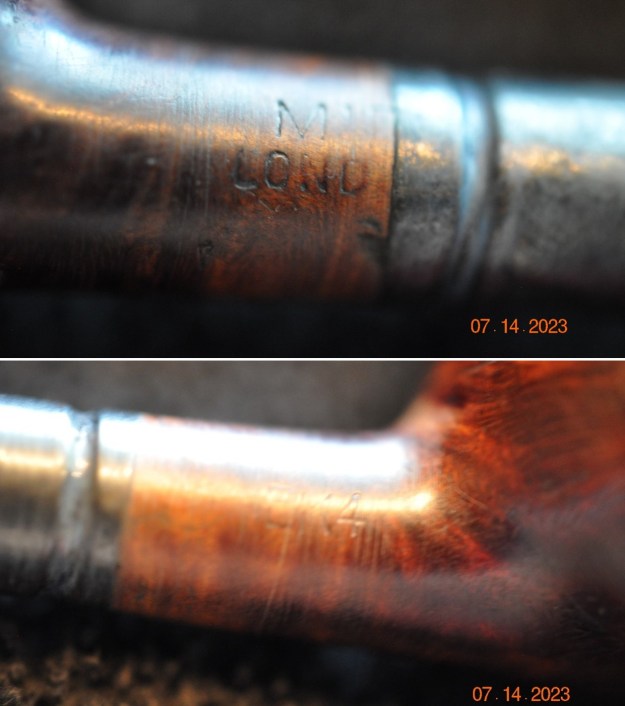
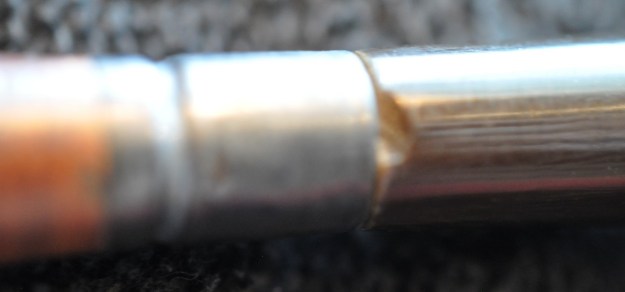
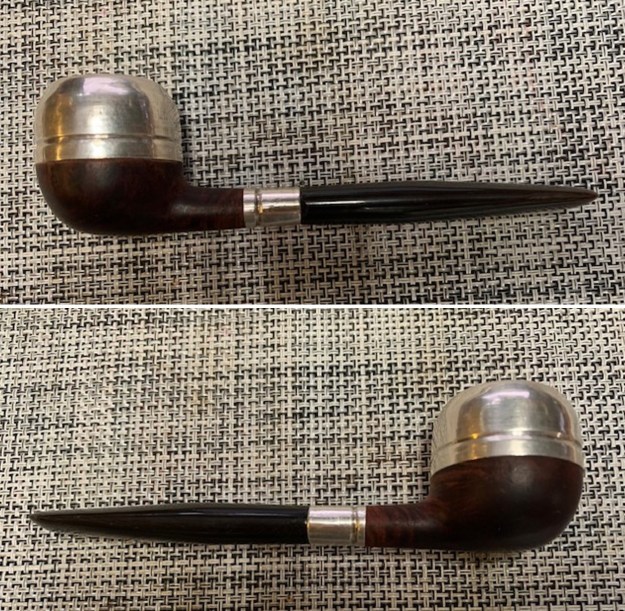
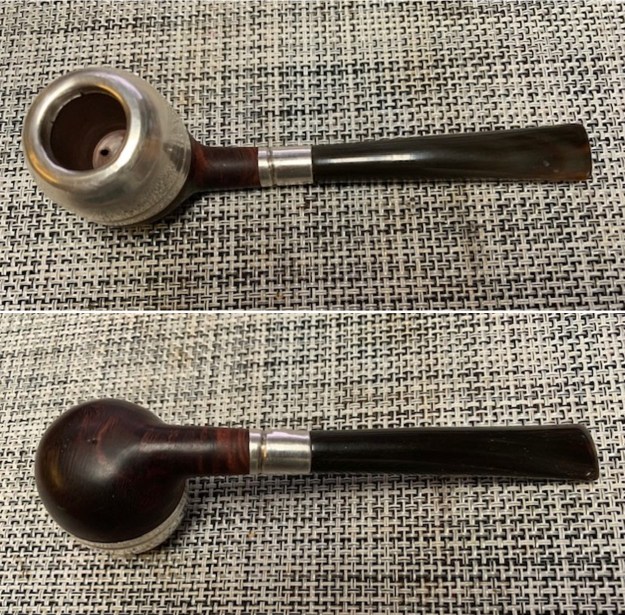
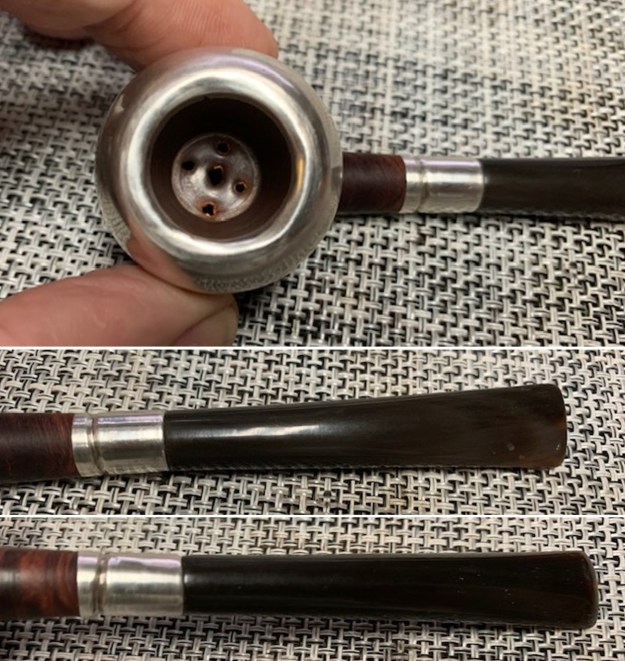
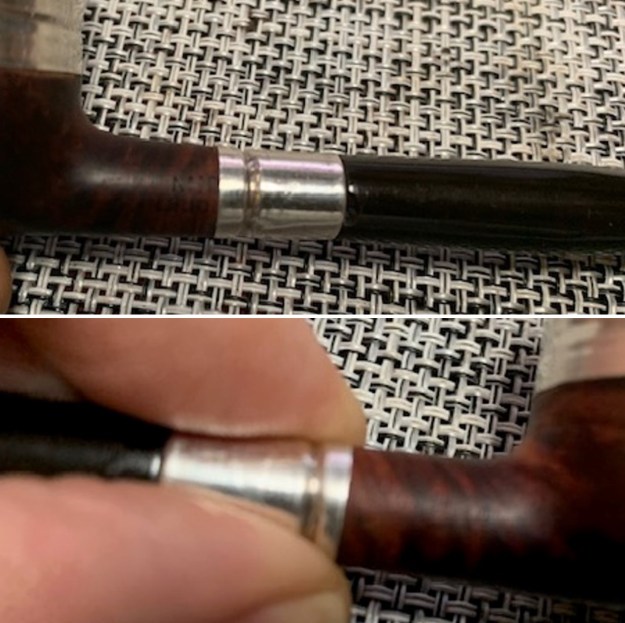
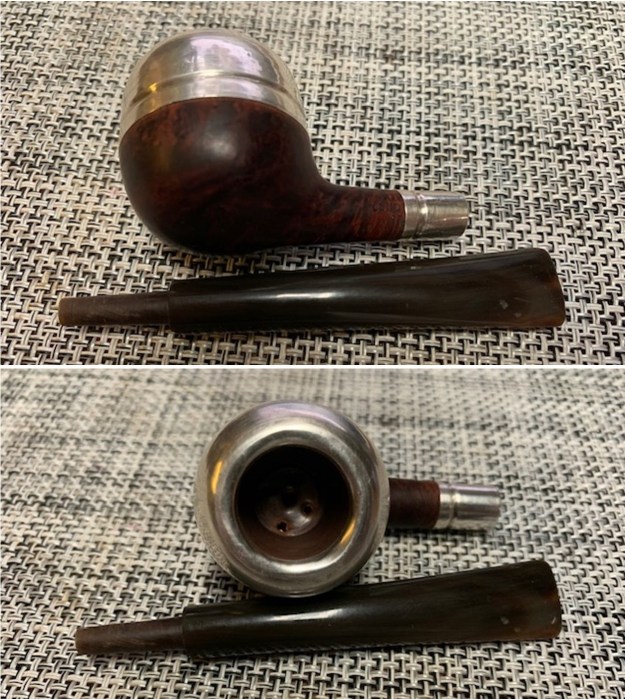
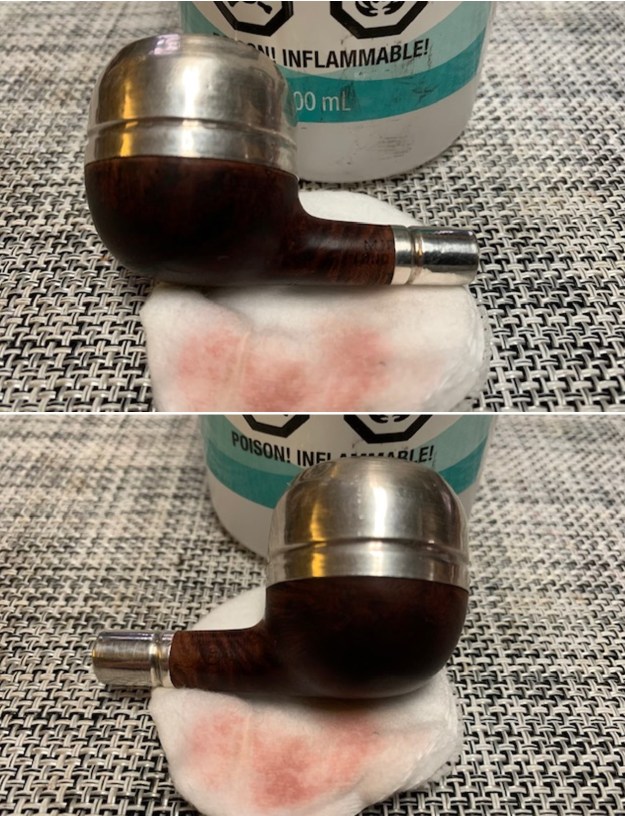
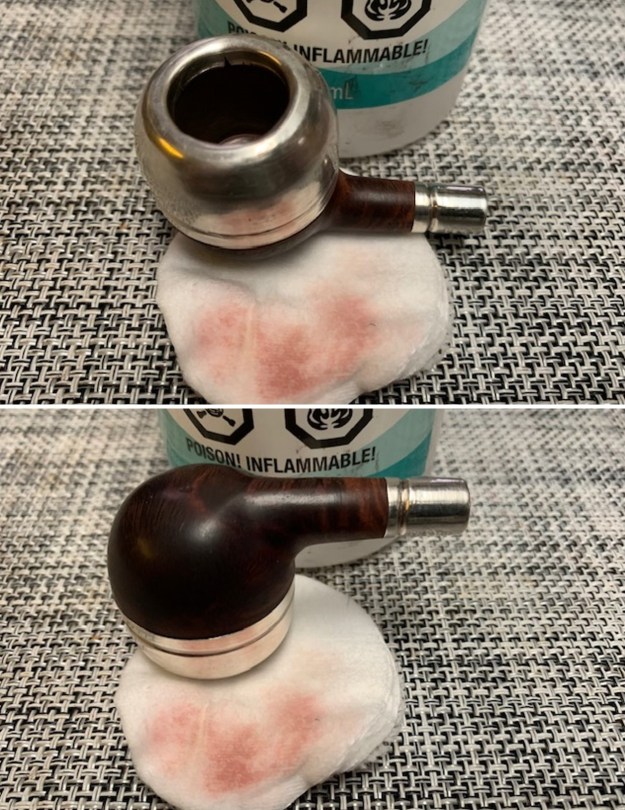
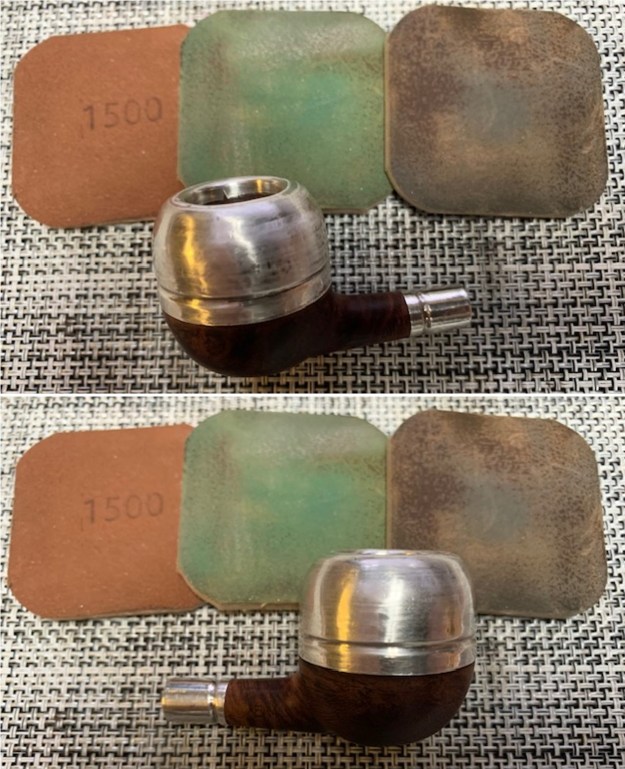
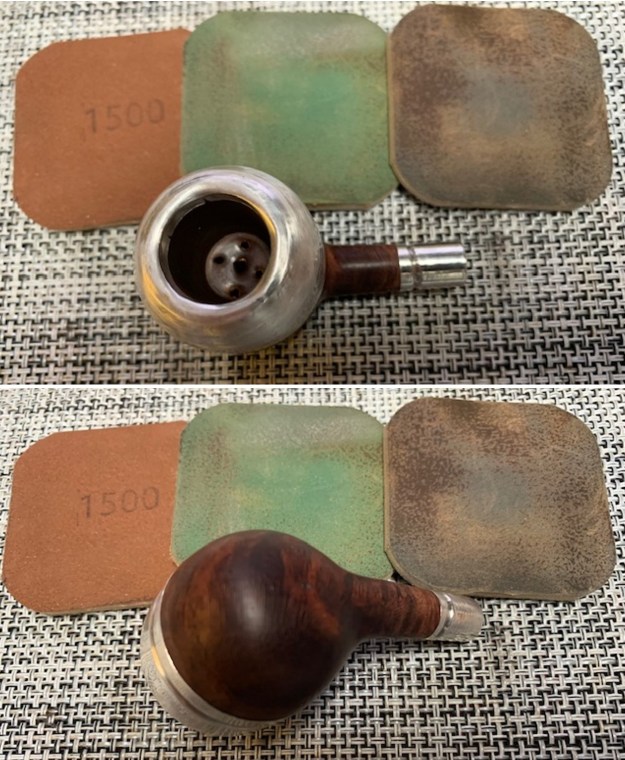
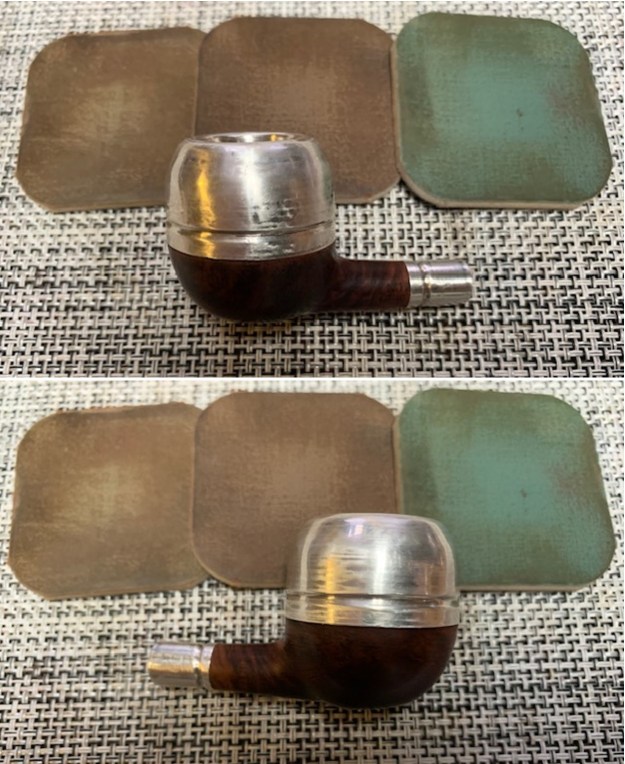
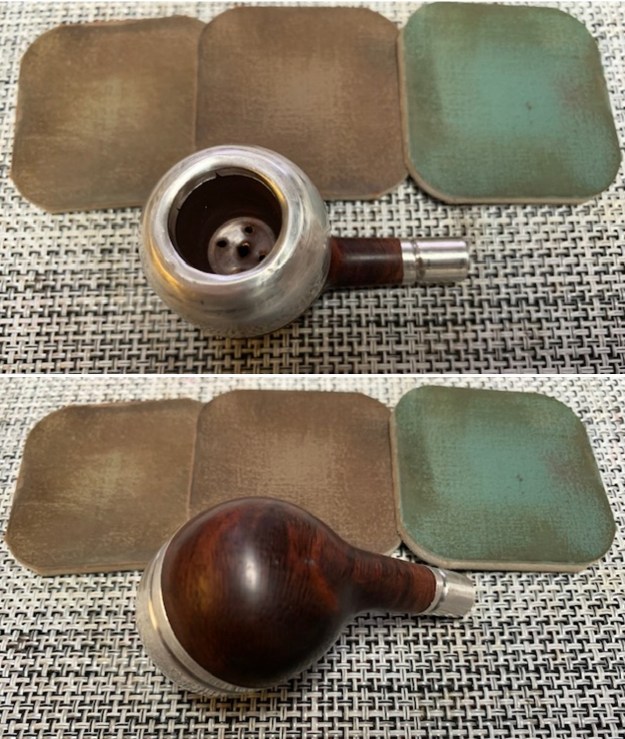
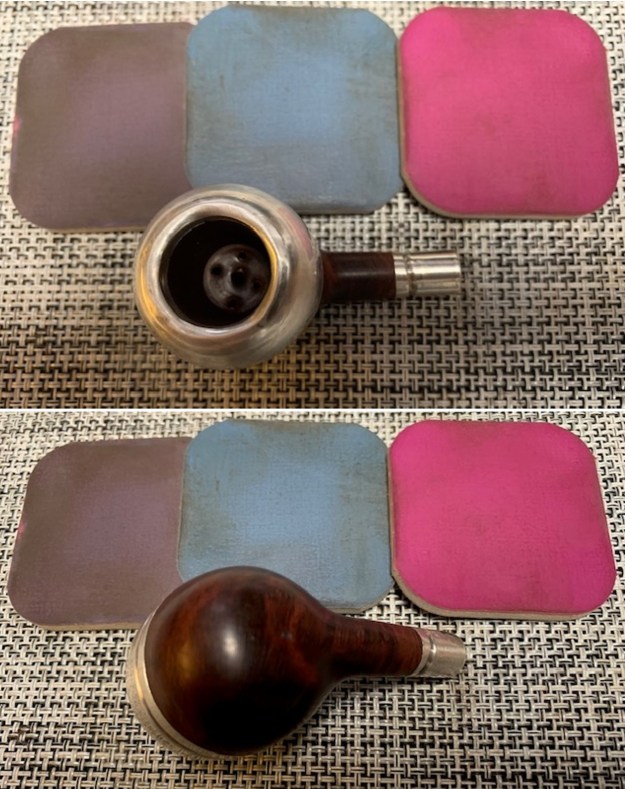
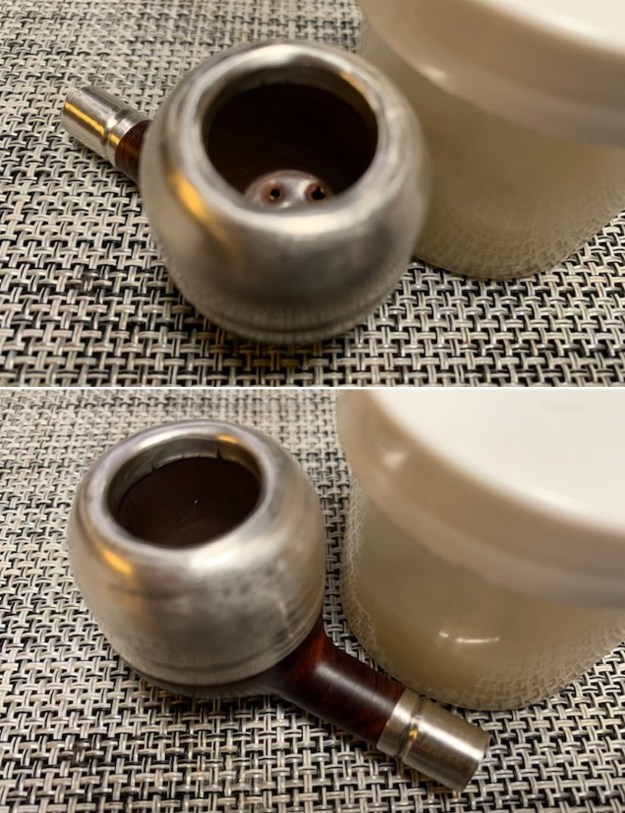
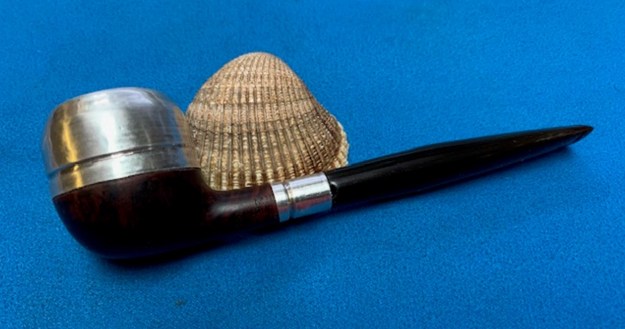
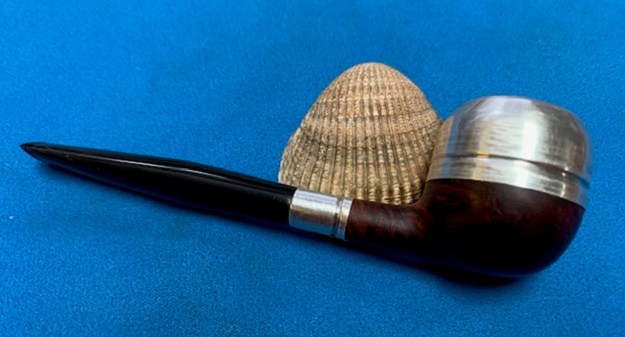
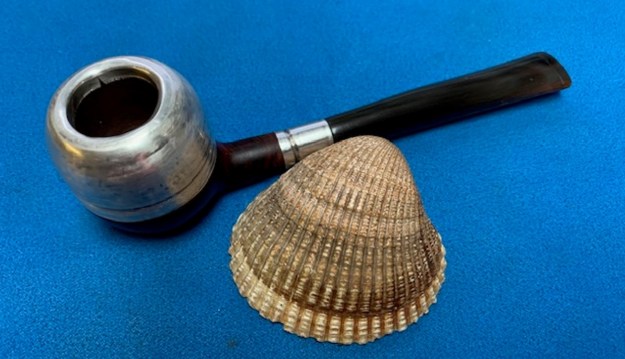
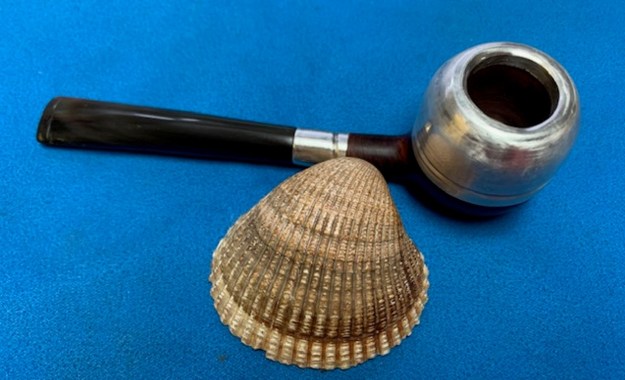
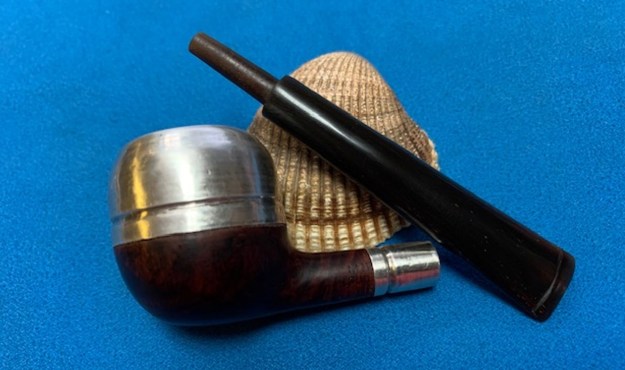
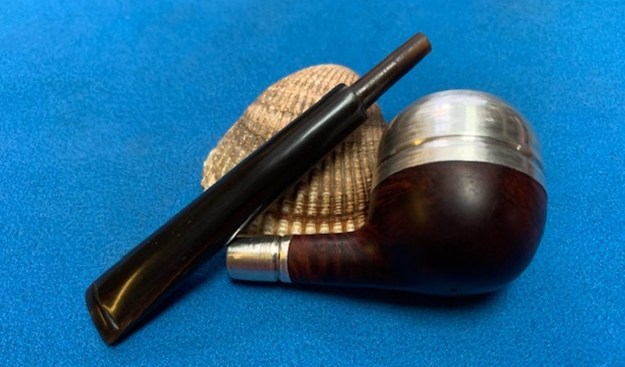
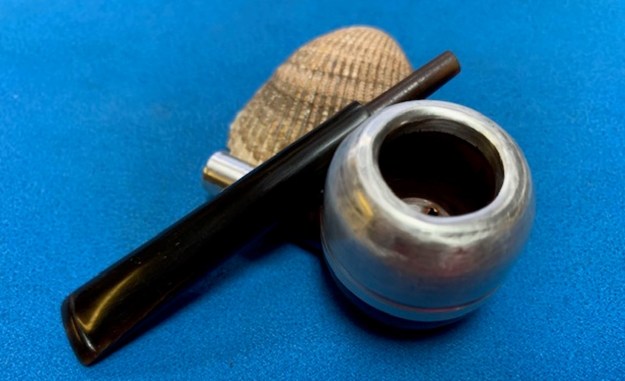
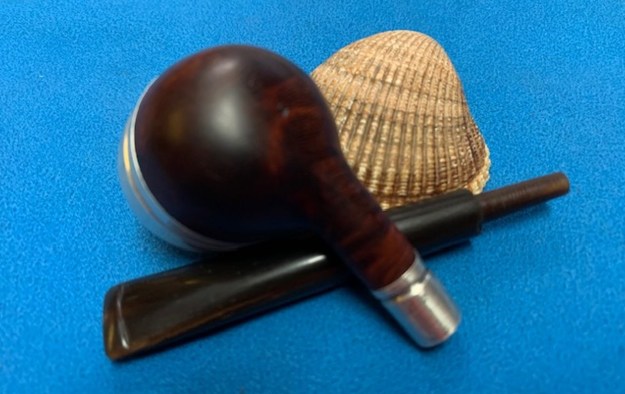
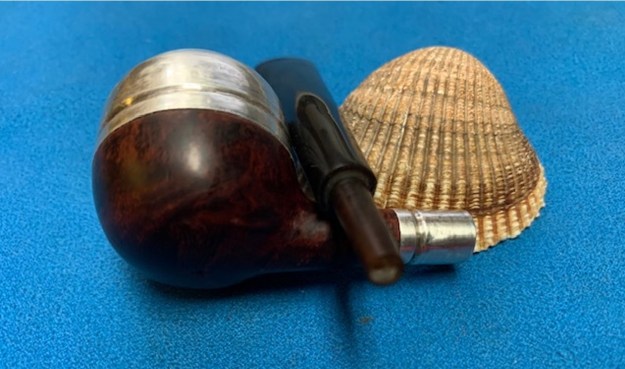
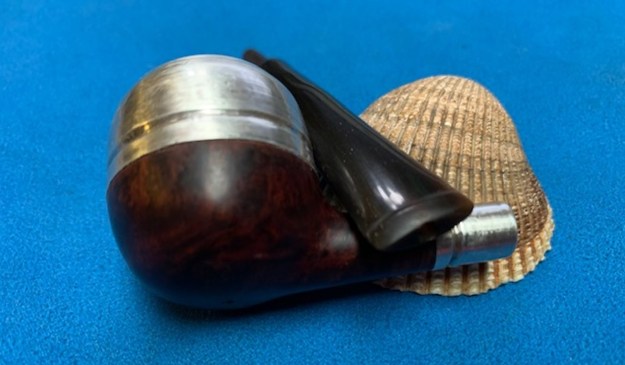
I decided I needed a change of pace in my restoration/clean up work. I went through my pipes waiting in the queue and chose pone from a group of four pipes that were given to us by a woman in Columbus, Ohio, USA. It had belonged to her Grandfather who lived from 1882 to 1977. There were four pipes that she sent us from his estate – the metal bowled apple, a cased meerschaum with a broken shank and an amber stem, a Whitehall rusticated apple and a BBB Glokar Fraternity Pipe.I chose the metal cap one because it seemed to call out to me with a voice of mystery. It is a very unique pipe with a briar base and silver rim cap. There seems to be a metal bowl insert under the inside lip of the cap. The bowl has five holes in the bottom of the bowl. The pipe has a silver ferrule on the shank end. It covers some of the stamping on the shank but what remains is readable. The partial stamp on the left side of the shank read… MID [over] LOND….The rest is covered by the ferrule. The stamp on the right side read BK4. The pipe was dirty and well used. The finish on the bowl was spotty showing damage to the varnish coat. The bowl had tobacco debris in it but little cake. The silver cap and ferrule were very tarnished. The stem was dark horn and there were some nicks in the edge where it sat against the ferrule. There was no button on the stem but was tapered down to a orific opening in the end of the stem. Jeff took photos of the pipe before he started his cleanup work.Jeff took photos of the rim top and bowl to show the condition. You can see the tarnish on the silver and some scratching in the rim top. The bowl is almost copper coloured but it is not entirely clear at this point. The horn stem is quite clean and polished. There were scratches on the button end of the stem and some nicks on the shank end. Jeff took photos of the sides and heel of the bowl to show the composition of the pipe. You can see the damage to the varnish and the tarnish on the silver rim cap. He took photos of the stamping on the shank sides. You can see what is readable and what has been cut off by the placement of the ferrule on both sides. It is clear and reads as noted above.He took a photo of the chip out the end of the tenon end of the stem where it is inserted into the silver ferrule.When the pipe arrived in Vancouver it was very clean. The briar, the metal bowl insert and the rim cap/top and silver ferrule were spotless and shiny. The silver shone in both places. The horn stem looked very good. There was a small chipped area where it fit in the ferrule but otherwise it was clean and tooth marks and chatter were absent. He had cleaned out the bowl, base and the airway in the stem and shank with pipe cleaners, cotton swabs and alcohol. He scrubbed the exterior of the bowl and shank with Murphy’s Oil Soap (undiluted) and a tooth brush. He rinsed the exterior with warm running water and dried. He polished the silver, bowl and stem with a small drop of olive oil. The pipe really looked very good. It was going to be a fun one to work on for my part.  I took photos of the pipe when I brought it to the table for my work. I took photos of the bowl and the polished metal insert and cap. It is clean and it is beautiful silver work. The bowl is very clean and there are small dents and nicks in the surface of the rim cap and bowl sides. The horn stem is in great condition. It is fascinating to me that there were no button edges but the stem just ran flush to the end. There were no tooth marks or chatter on the stem surface on either side. I tried to take photos of the shank sides to capture the stamping on the briar. It is faint but it is still readable. I took a photo of the bowl and shank separated to show the condition of the pipe. It really is a great looking pipe. I started my work on the pipe by wiping down the briar with alcohol and a cotton pad. I was able to remove the spotty remnants of the finish from the bowl. I was able to remove all of the remnants of the varnish and it really looked much better without it. The grain shown through really nicely. With the polished silver the briar looks really good! I polished the briar with micromesh sanding pads – 1500-12000 grit pads. I dry sanded the briar and then progressively brought a shine to the pipe. It looked really amazing – the combination of the silver and reddish briar. It is a beauty!   I rubbed the bowl down with Before & After Restoration Balm. I worked it into the finish with my fingertips. The product works to clean, preserve and protect the briar. I let it sit and absorb for 10 minutes. I buffed it off with a soft cloth and then gave it a rigorous buff to raise the shine. It looks good at this point. I set the bowl aside and turned my attention to the stem. I decided to give the stem a thinner profile and give it a button. I used needle files to shape the stem surface and give it a thin button. I like the new look for the stem.I sanded the filed areas and the area at the top of the stem near the tenon. I sanded it smooth with 220 grit sandpaper. I started the polishing of the stem by sanding it with 600 grit wet dry sandpaper. It is starting to look much better.I polished out the chatter and marks on the stem surface with micromesh sanding pads – dry sanding with 1500-12000 grit sanding pads. I wiped it down with Obsidian Oil on a cloth after the sanding pads. I finished the hand polishing of the stem with Before & After Pipe Polish – both the Fine and Extra Fine polishes. I gave it a final coat of Obsidian oil and set it aside to dry.I am really happy with the way that this Mystery Metal Insert Bowl with a Silver Cap and Ferrule and a Horn stem turned out. It really is a beautiful looking pipe with a great shape and smooth finished on the lower half of the bowl and silver rim cap. The original horn taper stem is really nice. The polished dark horn stem works well with the briar and the silver cap and ferrule. The briar really came alive with the buffing. The rich brown stains of the finish gave the pipe a sense of depth with the polishing and waxing. I put the stem back on the bowl and carefully buffed the pipe with Blue Diamond on the buffing wheel using a light touch on the briar. I gave the bowl and the stem multiple coats of carnauba wax on the buffing wheel. I buffed the pipe with a clean buffing pad to raise the shine. I hand buffed the pipe with a microfiber cloth to deepen the shine. The finished Silver Capped Mid…London BK4 Apple really is a beauty and feels great in the hand and looks very good. Give the finished pipe a look in the photos below. The dimensions of the pipe are Length: 5 inches, Height: 1 ½ inches, Outside diameter of the bowl: 1 ¼ inches, Chamber diameter: ¾ of an inch. The weight of the pipe is 31 grams/ 1.09 ounces. The pipe will be staying with me and joining my collection of older pipes. The horn stem, silver ferrule and rim cap look great with older dark briar. Thanks for reading this blog and my reflections on the pipe while I worked on it. It was a fun one to work on!

As always, I encourage your questions and comments as you read the blog. Thanks to each of you who are reading this blog. Remember we are not pipe owners; we are pipe men and women who hold our pipes in trust until they pass on into the trust of those who follow us.

Another Piece Of Pipe History Restored To It’s Former Glory; A c.1901 Samuel Mclardy”


Blog by Paresh Deshpande

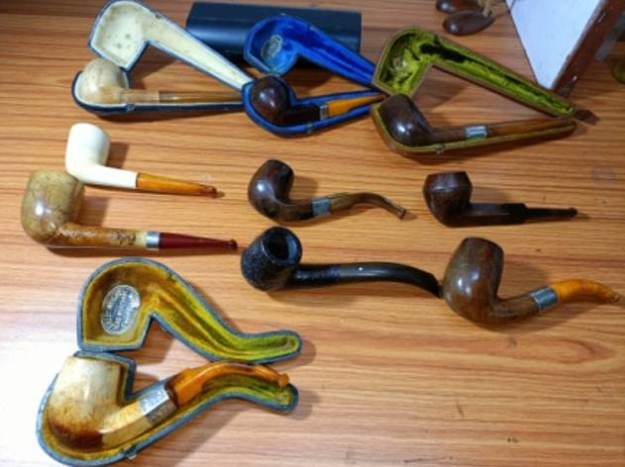
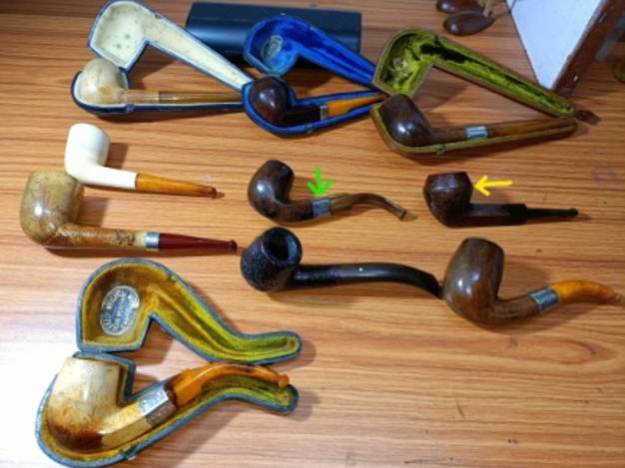
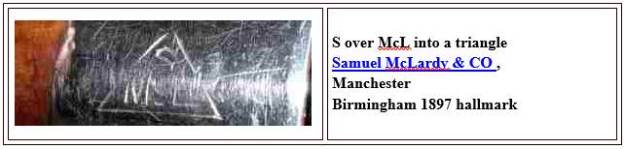
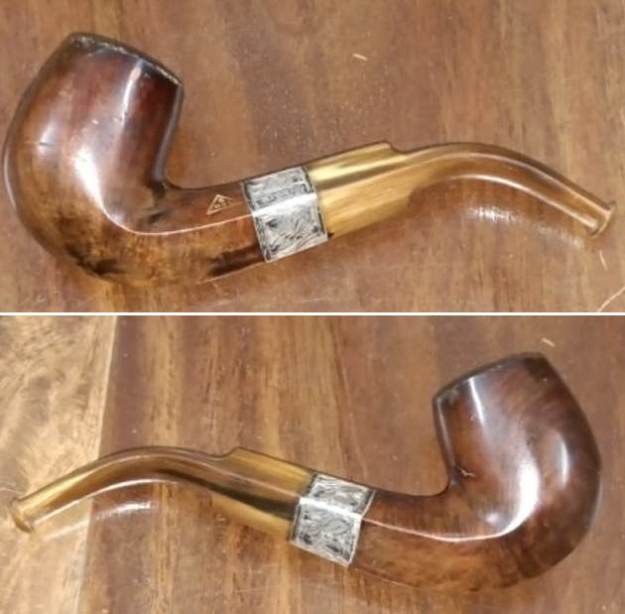
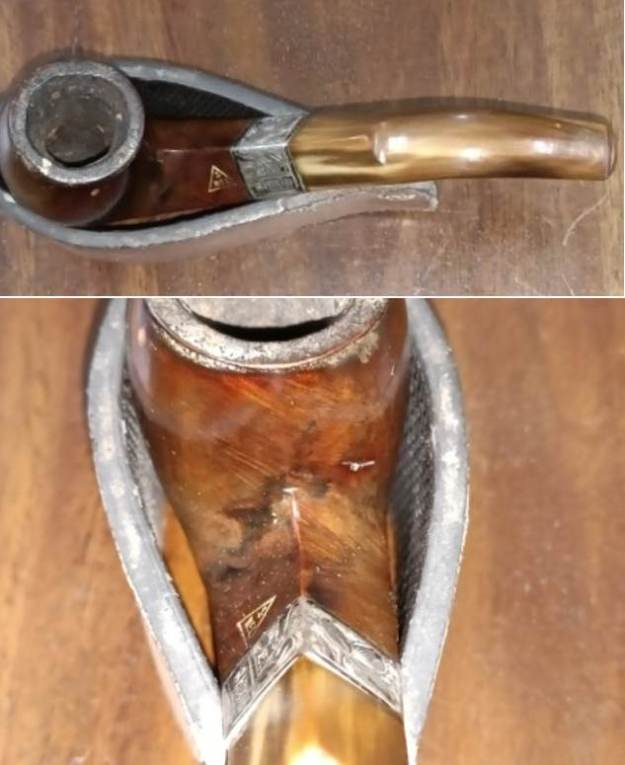
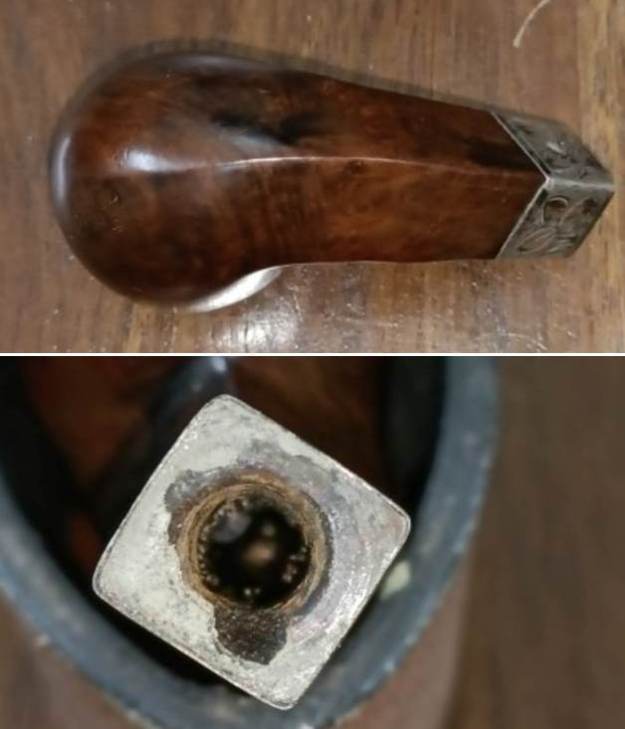
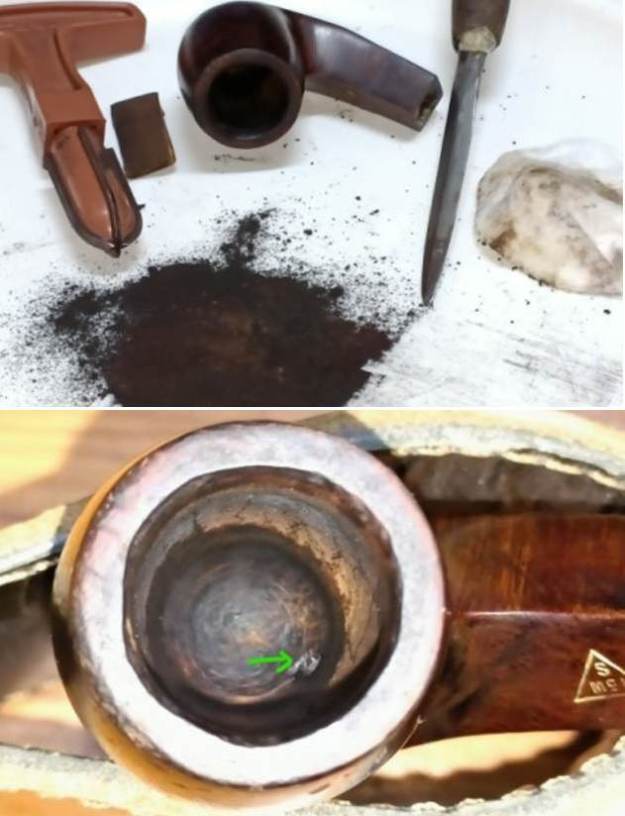
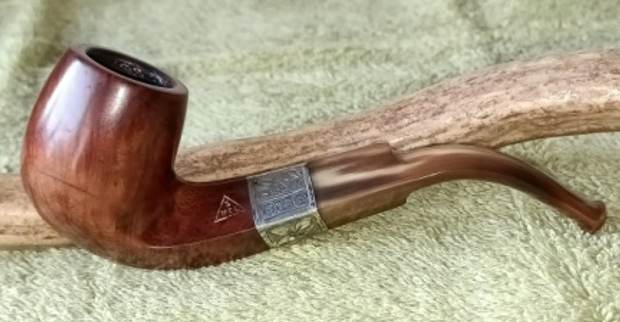
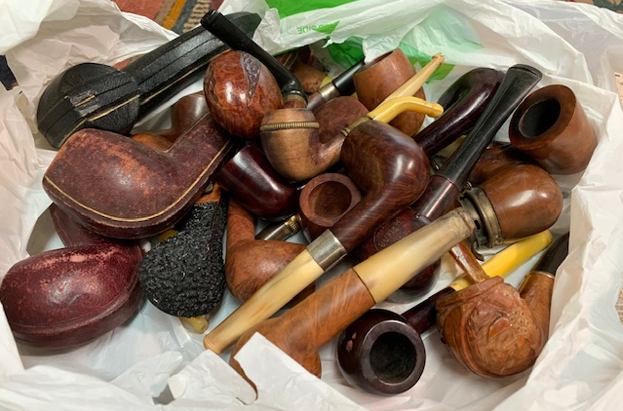
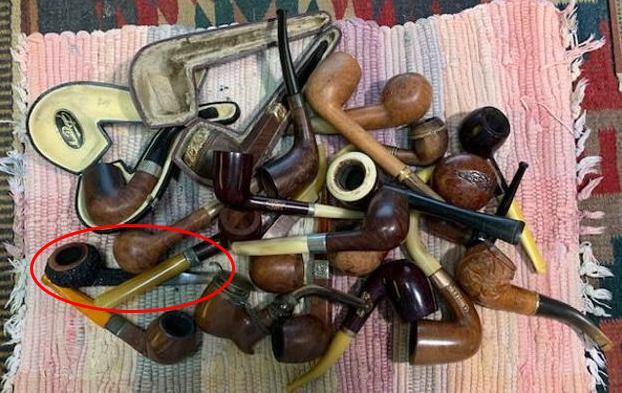
During the summer of last year while browsing on Pinterest, I came across pictures of some beautiful pipes and following the links led me to an old gentleman from the UK who was willing to sell these pipes either single or as a lot. There were around 60 odd pipes. I went through the pictures that were sent along with the rates and selected 10 pipes. After a prolonged and interesting interaction, we managed to arrive at a price point. Soon these pipes landed on the shores of India and went in to Customs hold for nearly a month. Finally, it was released and I laid my hands on these pipes after a wait of nearly 3 months! Here is a picture that I had taken moments after opening the parcel.I had restored a BARLING’S MAKE pipe from this lot earlier (indicated with a yellow pointer) and the next pipe that I have selected, again from this lot is a SMcL (indicated with a fluorescent green pointer) bent billiards with squared shank and horn stem.The pipe is a classic Bent Billiards with a square shank and a saddle horn stem with a threaded tenon. It is a typical English shaped quaint sized pipe with a nice hand feel and a light weight that makes it comfortable for clenching. It has a hallmarked silver band with filigree at the shank end. The silver filigree is stamped as “SMcL” in a triangle over three sterling silver hallmarks. From right to left the first cartouche is with a date code letter “b” followed by a cartouche with LION PASSANT certifying silver quality and the last cartouche contains the “Anchor” of the Birmingham Assay Office. The shank is likewise stamped with SMcL in a triangle in golden color while the horn stem is devoid of any stampings.This brand though faintly familiar to me through various reads and mentions, I haven’t ever worked on a pipe from this manufacturer and neither researched this old British marquee. I decided to follow the trail along the silver filigree ferrule at the shank end bearing the hallmarks. I visited www.silvercollection.it and upon searching through the index, I came across a maker’s mark that was as seen on the pipe in my hands. The maker’s mark was described as SAMUEL McLARDY & Co. Here is the link and screen shot of the details and relevant details are highlighted.

https://www.silvercollection.it/englishsilvermarksXS3.htmlThe next step was to date this pipe with the help of the hallmarks as seen on the silver filigree band at the shank end. The Birmingham City mark was easy to identify. The letter “b” perfectly matched up with the letter that identified it as being assayed by the Birmingham Assay office in 1901. Given below is the link that will take the readers to the relevant section of dating and the picture that I have taken with the date code letter marked in red.

https://www.silvercollection.it/englishsilverhallmarksBIR.html

I visited pipedia.org to know more the brand Samuel McLardy & Co. Given below is the link to the article on pipedia.org and have reproduced relevant information about the brand.

https://pipedia.org/wiki/Samuel_McLardy

The McLardy company thanks its existence to the entrepreneurial spirit of 1 person: Samuel McLardy, born in Glasgow in 1842. He was the son of a tobacconist who also produced his own clay pipes. In the paternal shop he must have learned the profession of pipe-maker. Shortly after his 20th birthday he decided to move to Manchester to start his own company. There is remarkably little known about the history of the factory. On an old advertisement it says “established 1865” so since then there must have been a steady growth. Within a couple of decades there was a massive production of clay pipes. Around 1895 the factory owned over 500 moulds which meant yearly production was around 5 million pipes! Similar to that of Dutch factory P. Goedewaagen & Zoon in that period. Over time we find Samuel McLardy at different locations. Before 1880 that was Miller Street number 16 in Manchester and it is there where the shop grew to the size of a factory. In 1890 the company moved to Shudehill number 67 where it remained active until after 1910.

The production of clay pipes was a large part of the McLardy operation and this interesting Pipe Manufacturers Catalogue shows several clay models displayed for sale. Duco’s article, referenced above, examines the historical realities impacting the Samuel McLardy Co., (typical of other UK pipe companies) by navigating through relatively prosperous years leading up to the turn of the century, the decline of interest in clay pipes, diversification of other product lines to cope with falling revenues, WWI, the growing economic bubble of the 20s leading ultimately to the collapse of the McLardy, Co., soon after the stock market crashes in September (for UK) and October (for US), 1929. I found this last statement regarding the Samuel McLardy, Co., as a matter of public record published in archives of The London Gazette regarding the liquidation of the company. Reflective of the times, there were several companies listed in the Gazette which were being “wound up”:

The Companies Act, 1929.

Special Resolution of SAMUEL McLARDY & CO. Limited.

Passed 13th January, 1930.

AT an Extraordinary General Meeting of the Members of the above named Company, duly convened, and held at No. 20, Swan-street, Manchester, on the 13th day of January, 1930, the following Resolution was duly passed as a Special Resolution: –

” That the Company be wound up voluntarily; and that Mr. George Elder, Chartered Accountant, of Edwin Collier & Co., 3, York-street, Manchester, be appointed Liquidator for the purposes of such winding-up”.

Thus to summarize, Samuel McLardy & Co. was established in 1865 by Mr. Samuel McLardy at the age of 23. This company was an established clay pipe maker and produced about 5 million pipes a year. By 1920s, the business was no longer profitable due to WW I, declining interest in clay pipes and financial meltdown of 1929. Samuel McLardy & Co was “wound up” on 13 Jan 1930 after 65 years of its existence.

With the provenance of the pipe established beyond doubts, it was logical for me to move ahead with restoration proper of this pipe.

Initial Inspection
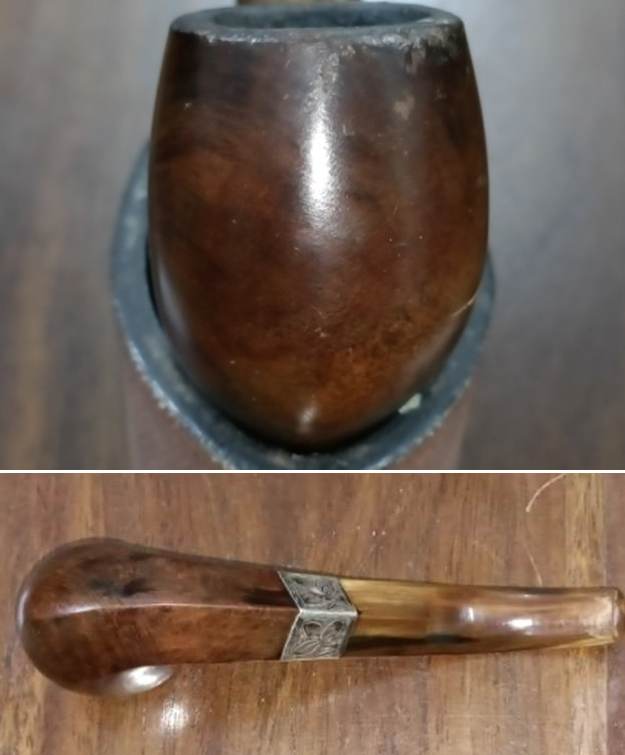
This pipe has the quintessential quaint size and shape that is nearly always seen on old British made pipes. The well seasoned briar is covered in dirt, dust and grime from decades of use. There are a couple of deep scratches on the stummel surface. There is a thick cake in the chamber with heavy overflow of cake, oils and tars over the rim top surface. The inner rim edge is uneven and charred. The outer rim edge, likewise, is peppered with dents and dings. The horn stem is in good condition with minor tooth chatter on both surfaces in the bite zone. The draw through the pipe is labored and constricted. This project should be an easy restoration, unless some gremlins are lurking unbeknown to me around the corner! Here are a few ‘before’ pictures of the pipe. Detailed Inspection
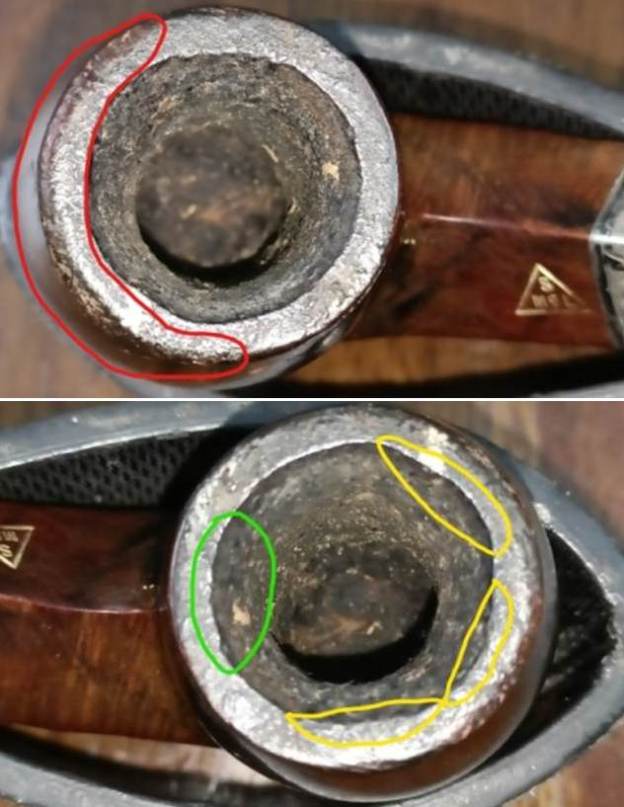
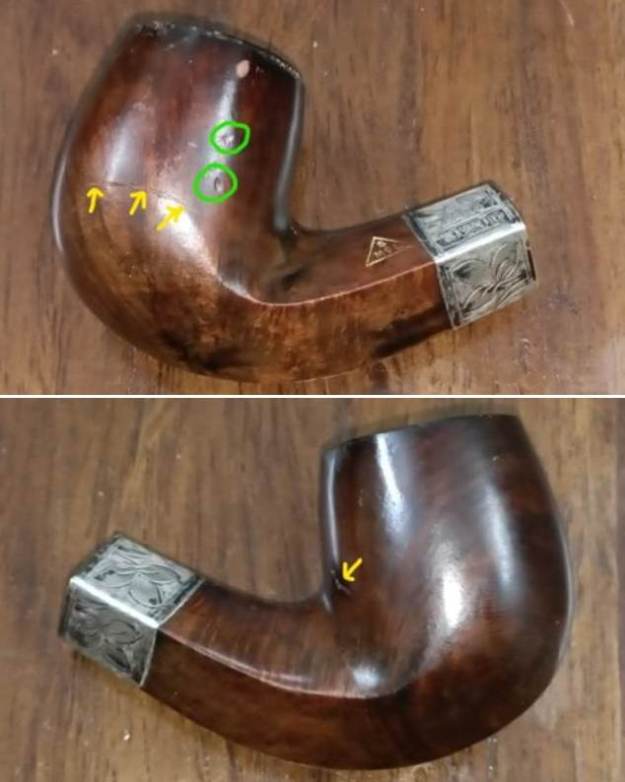
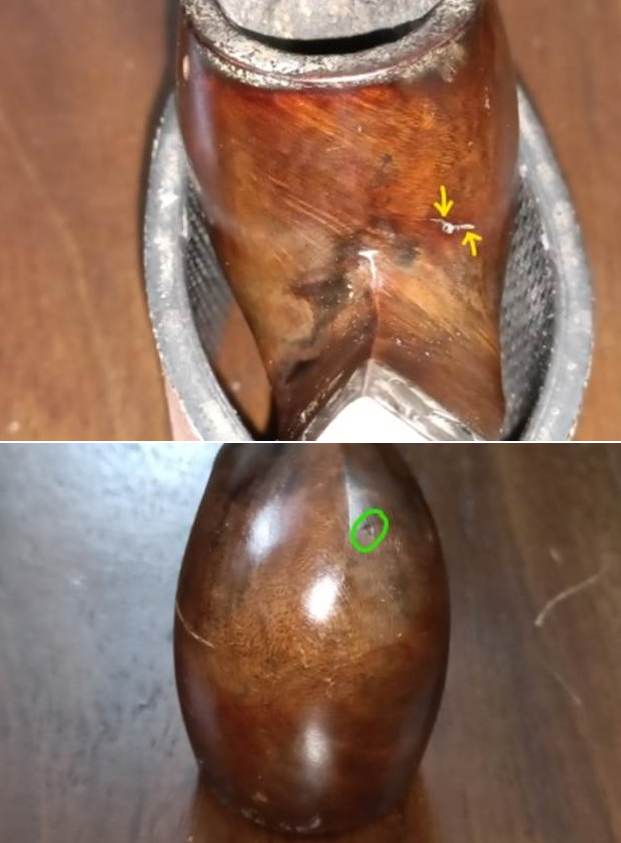
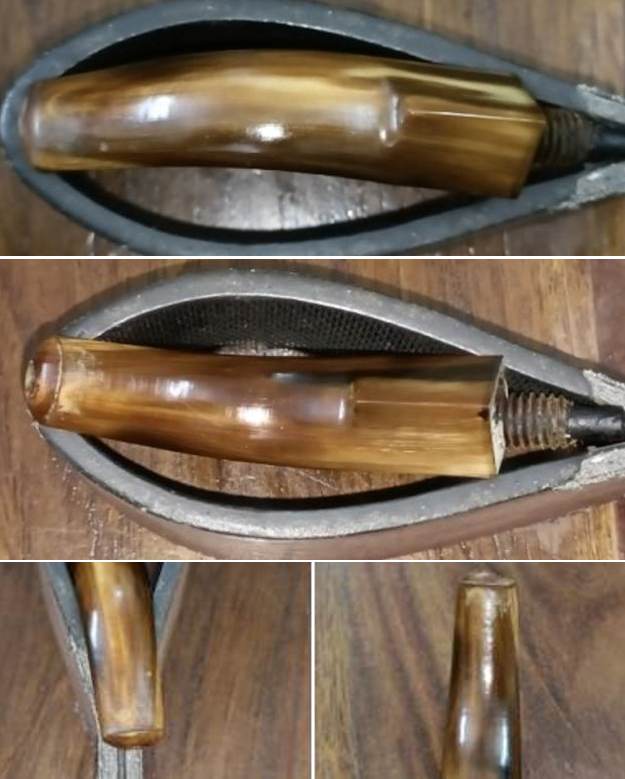
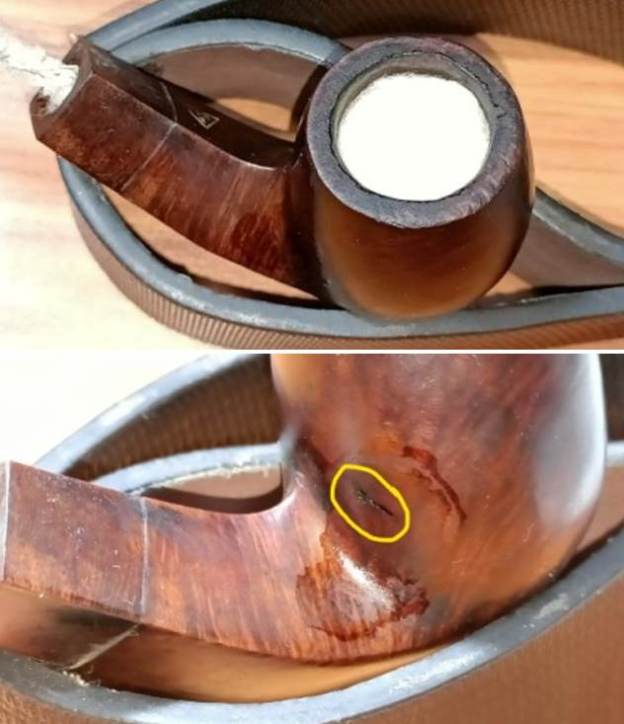
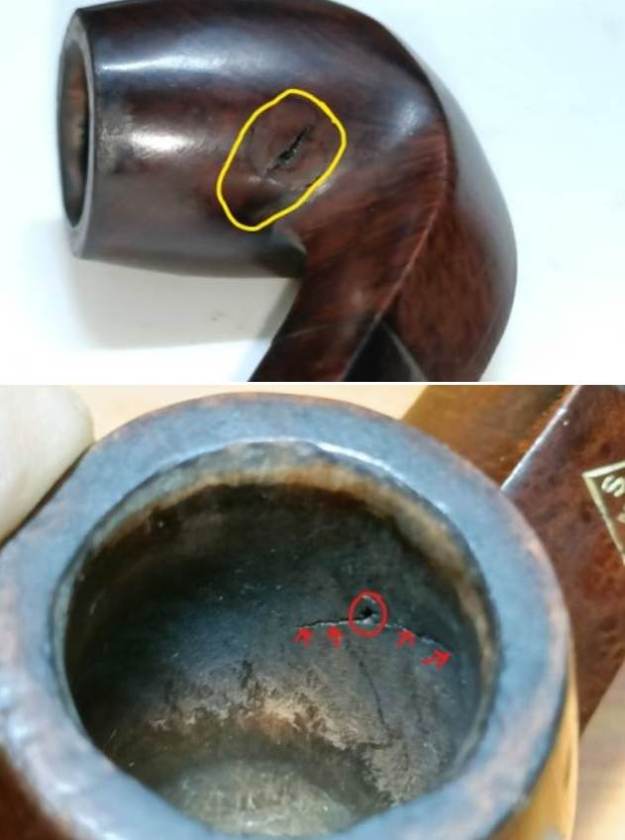
The chamber has a thick hard cake that has spilled over the rim top surface. The cake is thicker around the upper half of the chamber. The outer rim edge has dents and dings all around but is most severely damaged along the front half portion (encircled in red), a damage that can result only due to repeated strikes against a hard edged surface. The inner rim edge is unevenly gouged, probably due to use of a sharp knife to clean up the rim of the charring damage (encircled in yellow). The rim appears thinned out in a couple of places and is encircled in green. The condition of the inner walls of the chamber can be commented upon after the cake has been taken down to the bare briar. There is a strong ghost smell in the chamber which is all pervading. The stummel surface is covered in dust, dirt and grime giving a dull, lifeless and lackluster appearance to the pipe. However, the briar has taken on a nice dark patina, a result of more than 120 years of usage which would be worth preserving. However, eliminating/ addressing the deep scratches (indicated with yellow arrows) on both side of the stummel and the few dents and dings (encircled in green) would entail sacrificing the patina. This is a call that I would need to take at some stage in the restoration process. The mortise is chock-a-block with old oils, tars, ashes and grime making for a labored draw. The thick cake and blocked mortise hides the draught hole from view. These issues need to be addressed. The horn stem itself appears dull and lifeless and has some minor tooth chatter on both the surfaces of the stem. The slot is perfectly round and correct for the time period of the pipe and shows accumulation of dried tars and dirt. The threaded bone tenon also shows traces of deposition of gunk and grime within the threads and at the tenon end. The button edges are sharp and sans any major damage with a little dirt embedded at the bottom of the edges and some minor tooth chatter over the lower and upper button in the bite zone. The dark and light hues taken on by the stem over the years should polish out nicely and will add an additional touch of class to this already classy pipe. The Process
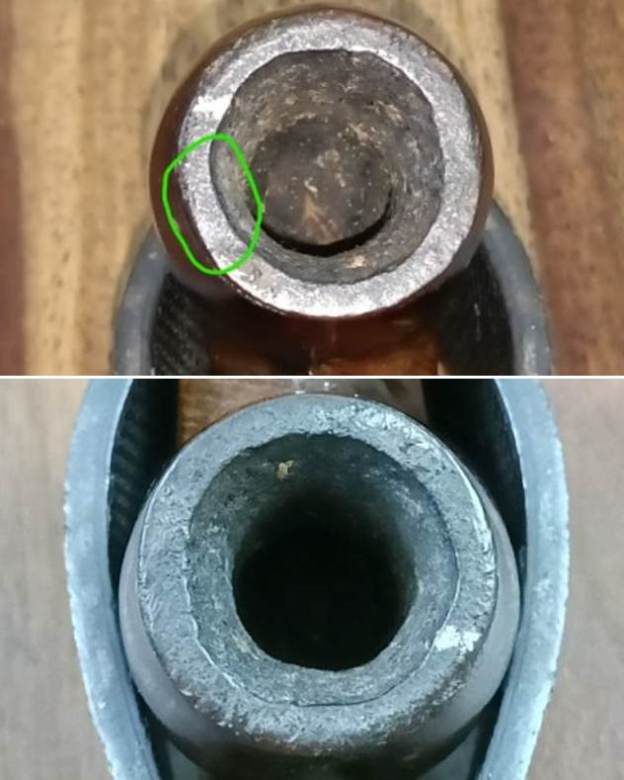
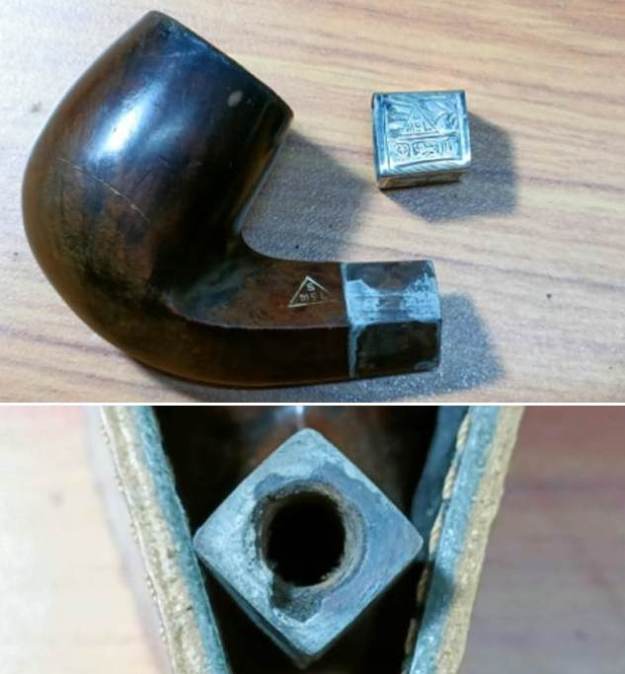
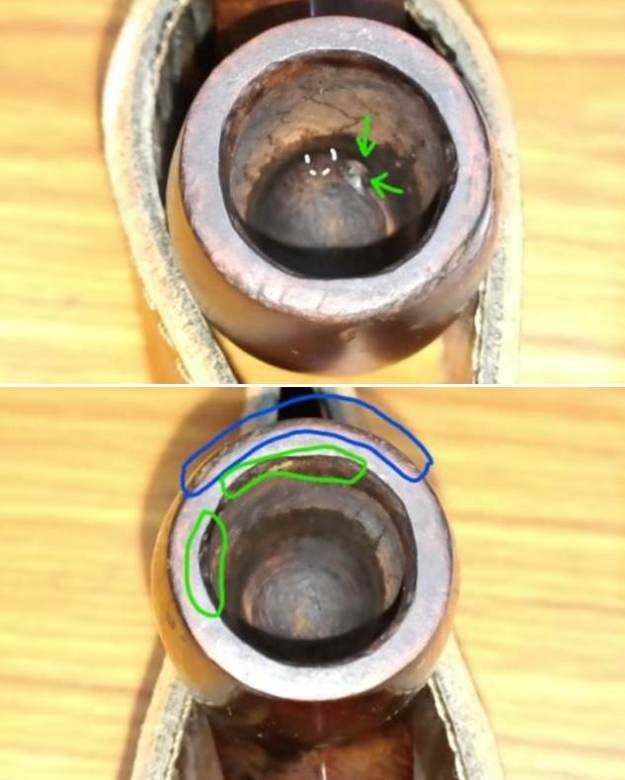
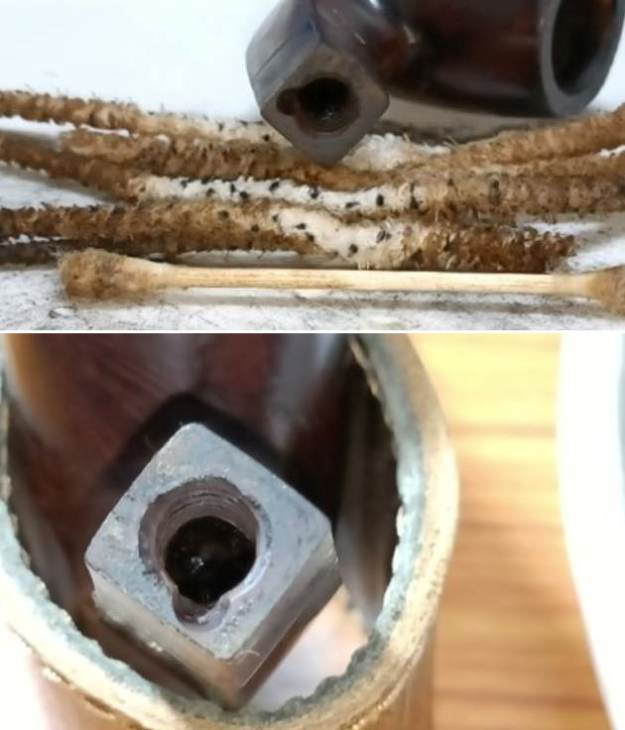
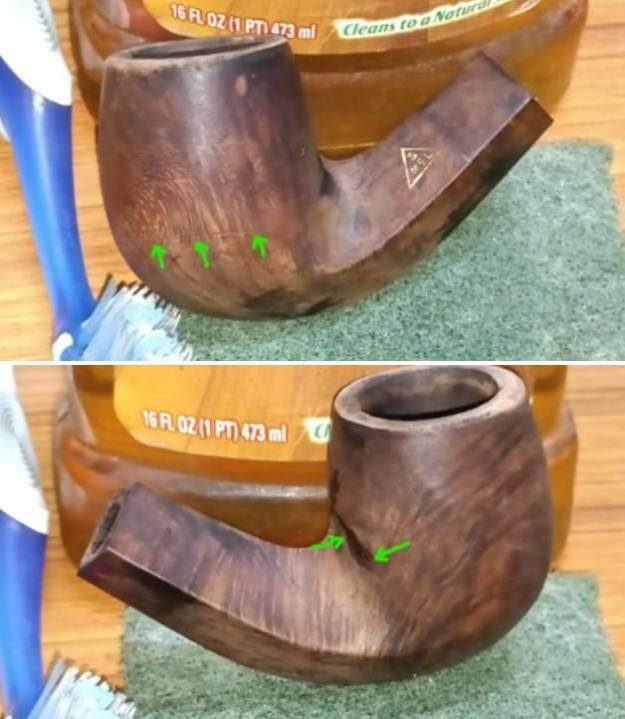
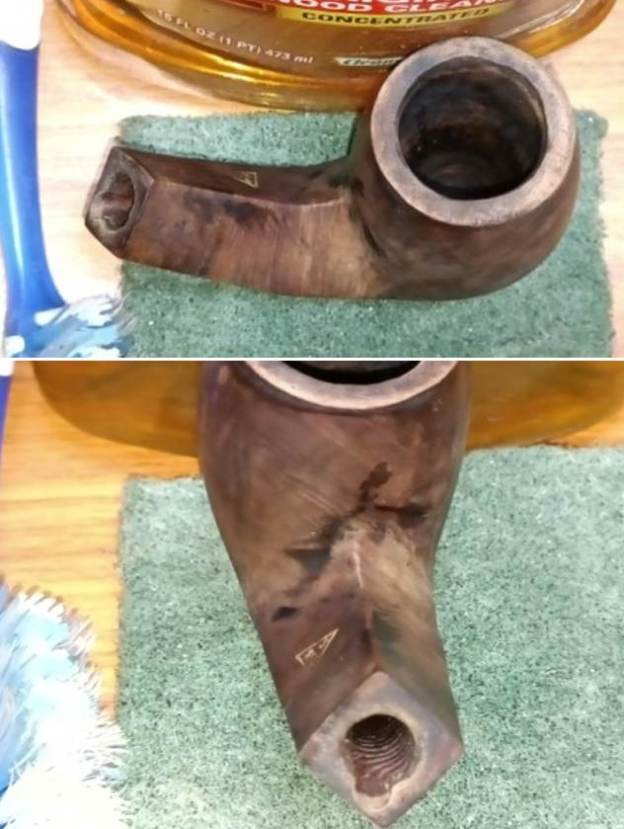
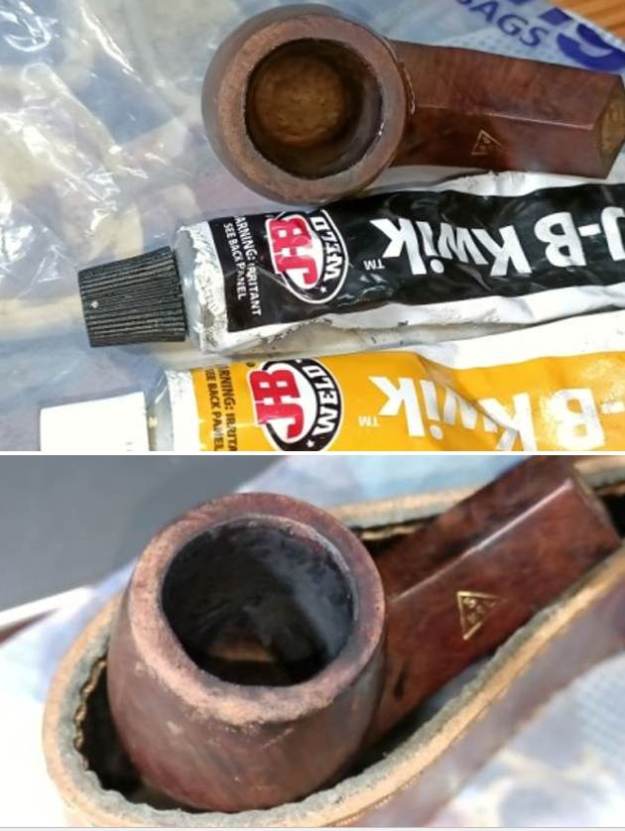
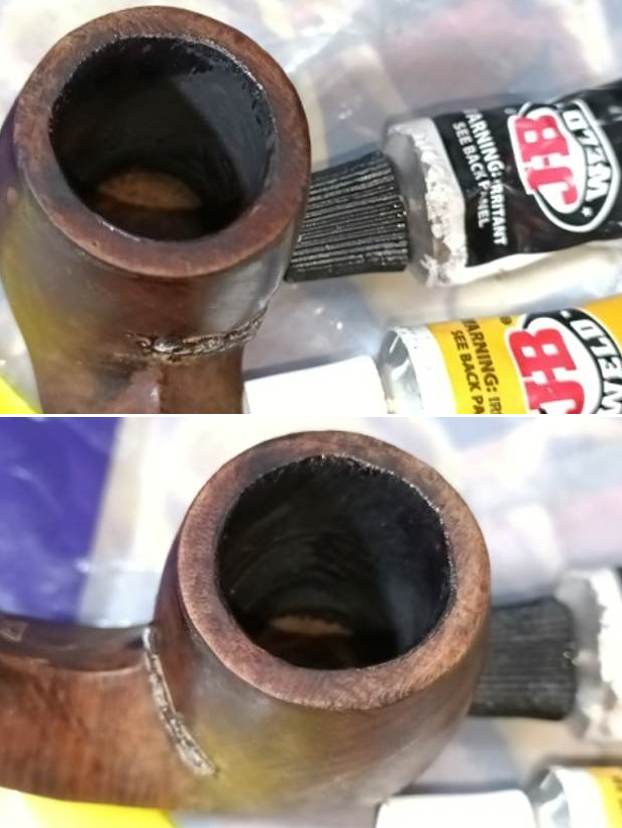
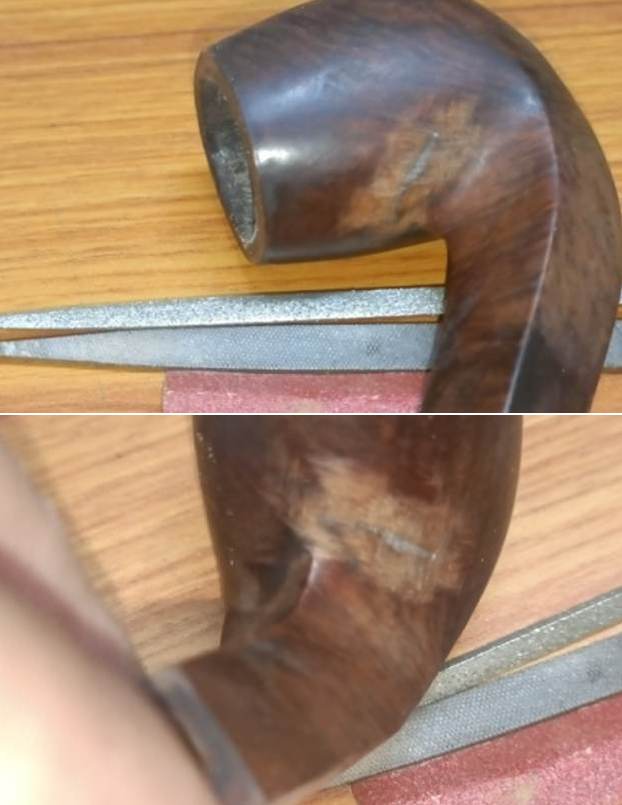
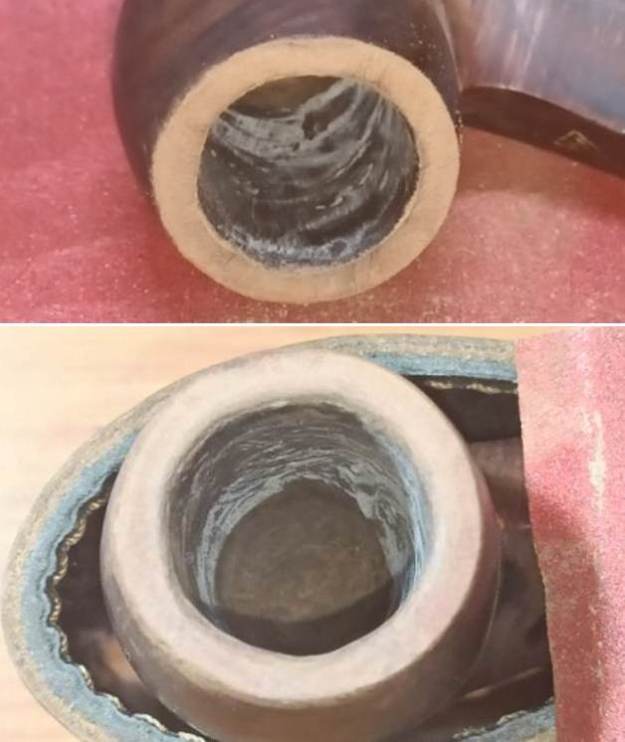
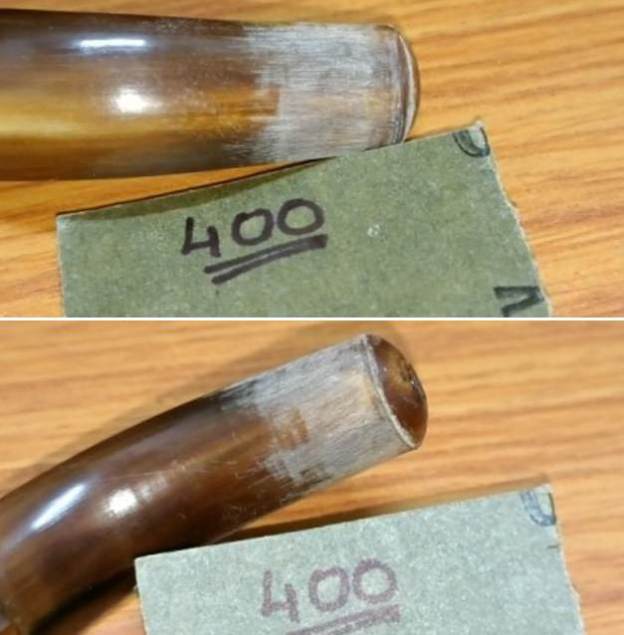
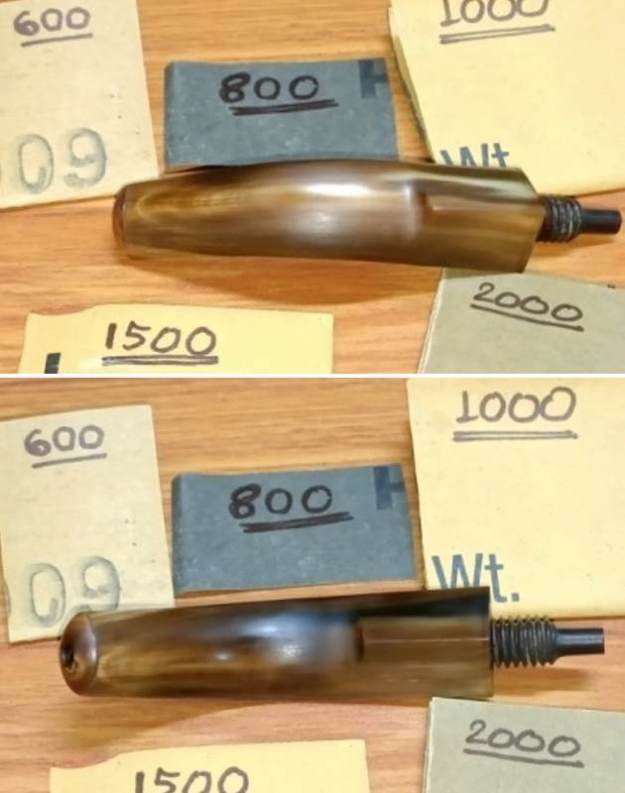
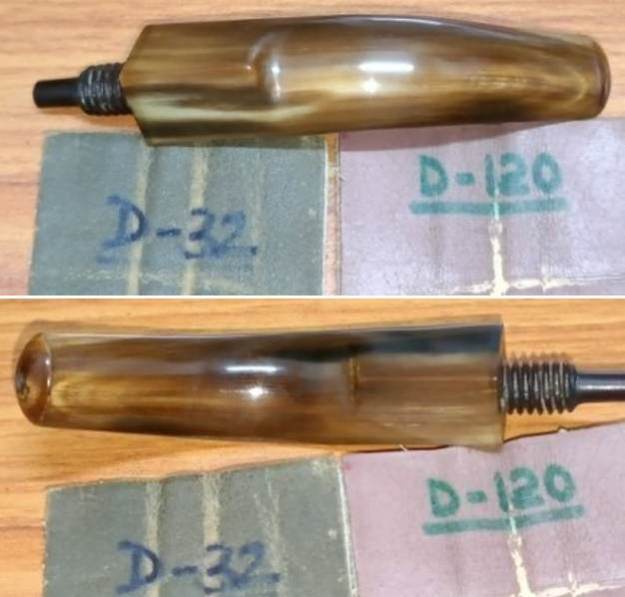
I first tried to remove the silver filigree band to check for any hidden gremlins over the shank end surface. The band came off quite easily and it was a relief to note that there were no cracks or chipped areas underneath the band as evidenced from the shank end face.Since the stummel is where maximum restoration efforts are needed, this was where I started my process to restore this pipe. I began the process of refurbishing this pipe by reaming the chamber with a PipNet reamer tool, using the second head. Using my fabricated knife; I further took the cake down to the bare briar. With a 220 grit sand paper, the walls of the chamber were rid of all the remnants of the cake, revealing smooth chamber walls. I further wiped the chamber with a cotton swab wetted with isopropyl alcohol to completely remove the sanding dust. I gently scraped the lava overflow from the rim top. Close observation of the chamber after the clean up revealed that the draught hole is not centered (centre position encircled in white) but towards the left side (indicated with green arrows). This being a manufacturing issue, there is nothing that I can do to right this wrong and even if there is something that can be done, I wouldn’t recommend it as it had previously over the last century served its owner well as can be seen from the thick cake in the chamber. The damage to the front outer edge (encircled in blue) and the out of round chamber due to damaged inner rim edge (encircled in green) can now be seen clearly and would need to be addressed. Using cotton buds, bristled and regular pipe cleaners wetted with 99.9% pure alcohol, I carried out the preliminary cleaning of the mortise. I shall continue deeper cleaning of the chamber and mortise with salt and alcohol treatment.Moving on to deeper cleaning of the chamber and the mortise…….. I use cotton balls which is an at par substitute to Kosher salt as I have realized over the years. I draw out a wick from the cotton and along with a folded regular pipe cleaner; insert it in to the mortise and through the draught hole in to the chamber. Thereafter, I pack the chamber with cotton balls to about quarter of an inch below the rim inner edge and soak the cotton balls with isopropyl alcohol up to the brim. About half an hour later, the level of alcohol had gone down, having being absorbed by the cotton. It was here that I noticed seepage on the right side of the stummel through what I had initially assumed to be a scratch. However, this patch of seepage points to a through crack which if left unattended would lead to a burn-out.  I topped it up once again with alcohol and set it aside overnight. By next afternoon, the cotton and alcohol had drawn out all the remaining oils and tars from the chamber and mortise, fulfilling its intended task. I removed the cotton balls and ran pipe cleaners through the mortise to clean out all the loosened tars and gunk. I set it aside to dry out naturally. It is such unexpected curve balls that are thrown at you which make any restoration a challenging one. Once the stummel had dried out completely, using my fabricated tool I scraped out the entire loosened gunk from the mortise and further cleaned it with alcohol and q-tips. I cleaned out all the debris and gunk in the crack from the outside (encircled in yellow). I also scraped the chamber walls to remove all the loosened cake and charred briar; especially form the corresponding insides of the external crack. A closer examination of the chamber walls shows the extent of damage (indicated by red arrows) and most likely this is a result of some flaw in the briar wood which was exposed during previous use and reaming to maintain cake. I would love to hear about your opinions on what had caused this damage. This issue needs to be addressed immediately to avoid ruining this 122 year old specimen of pipe history.Before moving on to addressing the above, I decided to clean the exterior surface of the stummel. I used a hard bristled tooth brush and Murphy’s oil Soap, to scrub the stummel, chamber walls and rim top. I washed the stummel under running warm water with anti oil dish washing detergent till the stummel surface was clean and dried it using paper towels and soft cotton cloth. The deep scratch on the left and the ‘now determined’ through crack on the right (indicated by green arrows) are all too clearly visible. I simultaneously cleaned the shank internals with the detergent and hard bristled shank brush and set the stummel aside to dry out naturally.With the stummel now clean both internally and externally, it was time for me to address the issue of the through crack on the right stummel surface. Using a sharp dental tool, I removed the charred and damaged briar from along the chamber wall until I reached the hard solid briar underneath. Similarly, I cleaned out the crack from the outside by clearing out the debris and grime and the damaged briar using the sharp dental tool. Next, I drilled counter holes at either ends of the crack using a 1mm drill bit. These counter holes will prevent spread of the crack any further in either direction. I was careful in ensuring that the counter holes are drilled at the exact end points of the crack and that these holes were not drilled through and through. I filled this crack and counter holes with a mix of briar dust and CA superglue and set it aside to cure.Next I decided to fill only the heat fissure from where I had removed the charred briar with layer of J B Weld. J B Weld is a two-part epoxy Cold Weld in two tubes; hardener and steel which are mixed in two equal parts (ratio of 1:1) with hardening time of 5-6 minutes and complete curing time of 6-8 hours. I poured the contents of the two tubes and mixed it well. I applied this mix, pressing as deep and as evenly as possible, over the heat lines in the chamber wall surface. As I was applying the mix, I decided to apply this coat over the entire chamber surface as I had some of the mix remaining and it wouldn’t harm in any which way. I worked fast to ensure an even coat before the weld could harden. I set the stummel aside for the application to harden and cure overnight. Once the external crack fill had cured completely, using a flat head needle file, I sand this fill to achieve a rough match with the rest of the stummel surface. I further fine tuned the matching of the fill by sanding fill surface with folded piece of 220 grit sandpaper. The stummel surface was now clean and even.Next, with a folded piece of 150 grit sandpaper, I sand the coat of J B Weld from the internal walls of the chamber keeping just a thin layer of coat along the wall; just enough to provide an inert and heat resistant layer between the burning tobacco and the damaged briar. I shall further enhance this separation by adding a bowl coat of activated charcoal and yogurt.Next I addressed the issue of the uneven rim top, damaged outer rim edges and out of round chamber. I began with topping the rim over a 220 grit sand paper, frequently checking for the progress being made. I stopped once the damaged outer rim edge was evened out to an acceptable- to- me level and the thickness of the rim top was close to even all round. To get the chamber back to round, I created a bevel over the inner and outer edge with a folded piece of 220 grit sand paper. I am pretty pleased with the progress being made thus far. I followed it by sanding the entire stummel surface using a piece of 320 grit sandpaper to address the scratches and the dents and dings. This was a decision which I had deliberated for a while. One of the major considerations in favor of sanding was the deep scratch on the left side which could be minimized by using sandpaper to sand it down to an acceptable level. Sanding will also help in addressing the few dents and dings and minor scratches from the surface. I had decided that the sanding would be kept to bare minimum and the scratches, dents and dings that remain shall be maintained as part of the pipe’s journey thus far. To remove the sanding marks and bring a deeper shine, I polished the stummel with micromesh pads, dry sanding with 1500 to 12000 pads. I wiped the surface with a soft cloth at the end of the micromesh cycle. The stummel looks amazing with a deep shine. Next, I rub a small quantity of “Before and After Restoration Balm” in to the briar with my finger tips and let it rest for a few minutes. The balm almost immediately works its magic and the briar now has a nice vibrant appearance with the beautiful darkened grain patterns on full display. I further buff it with a horse hair shoe brush. Now that the stummel repairs/ refurbishing are completed save for the final polish, it was time to work the stem. I cleaned the internals of the stem with a thin shank brush and anti-oil dish washing soap. This ensures a thorough cleaning of the stem airway while saving me number of pipe cleaners, elbow grease and most importantly, time. With the stem internals cleaned, I scrubbed the external surface with the dish soap and Scotch Brit pad. I was particularly careful while cleaning the threaded tenon surface as the old residual oils and tars were deeply embedded in to the threads. I rinsed the stem under warm running water and wiped it with a paper napkin to dry it.I addressed the minor tooth chatter in the bite zone by sanding the bite zone with a folded piece of 400 grit sand paper. I could have filled the tooth indentation with clear superglue, sanded and polished the stem, but decided against this since the stem was thick and the tooth chatter was superficial enough to be addressed just by sanding it out. To eliminate the sanding marks and also bring a deep shine to the bone stem, I wet sanded the entire stem surface with 600, 800, 1000, 1500 and 2000 grit sandpapers. I rubbed a small quantity of EVO in to surface and set it aside to be absorbed by the bone stem. To bring a deep shine to the horn stem, I went through the complete set of micromesh pads, wet sanding with 1500 to 12000 grit pads. I wiped the stem with moist cloth after each pad and rubbed it down with Extra Virgin Olive oil to rejuvenate the horn.   I completed the mundane but equally important task of polishing the Sterling Silver filigree band. I used a local product that is available only in India to polish the band. The liquid polish was applied to the band and wiped it out after a few seconds. The polish completely removed the oxidation and gave a nice shine to the band which was further improved by polishing it with a jeweler’s cloth. Using CA superglue, I reattached the band at the shank end.To complete the restoration, I mount a cotton cloth buffing wheel on to my hand held rotary tool and polished the stummel and stem with Blue Diamond compound. This compound helps to remove the minor scratch marks that remain from the sanding. I mounted another cotton buffing wheel that I have earmarked for carnauba wax and applied several coats of the wax. I finished the restoration by giving the entire pipe a rigorous hand buffing using a microfiber cloth to raise the shine further. The finished pipe looks amazingly beautiful and is ready to join my collection. I only wish it could share with me its life story of the past years while I enjoy smoking my favorite Virginia blend in it or maybe an English blend or maybe just keep admiring it!! P.S. There was only one more issue that needed to be addressed and one that could not be ignored, being a functional issue. After I had applied and sanded down the JB WELD to a thin coat, I wanted to further protect the chamber briar while adding another layer between the JB WELD and burning tobacco. I addressed this by mixing activated charcoal and plain yogurt to a thicker consistency, just enough that it would spread easily and applied it evenly all along the chamber walls after inserting a folded pipe cleaner through the draught hole to keep it open. Once dry and set, this will not only protect the walls but also aid in faster build up of cake.Big thank you to all the readers who have joined me on this path by reading this write up as I restored and completed this project.

Restoring a Clay Viennese Coffeehouse Pipe with Bamboo Shank and Horn Stem


Blog by Steve Laug

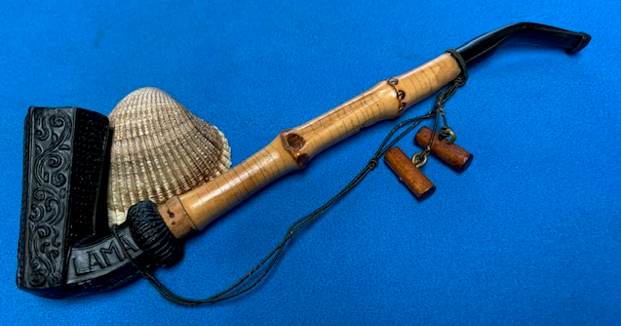
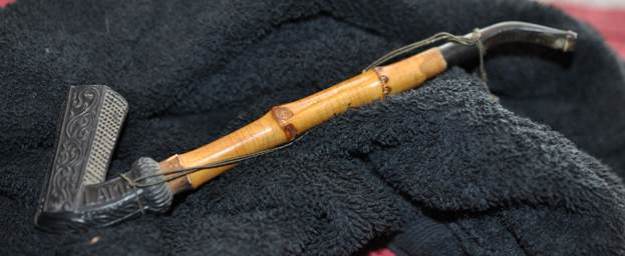
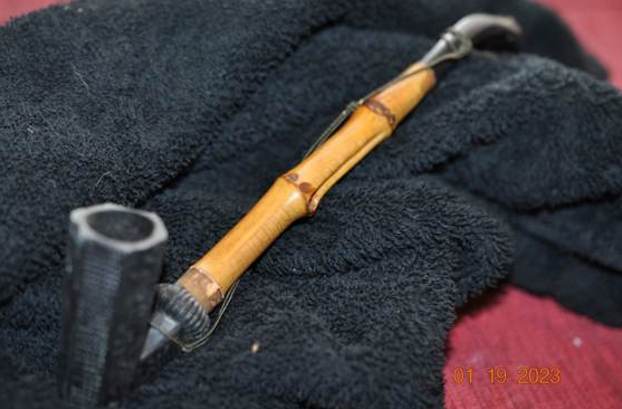
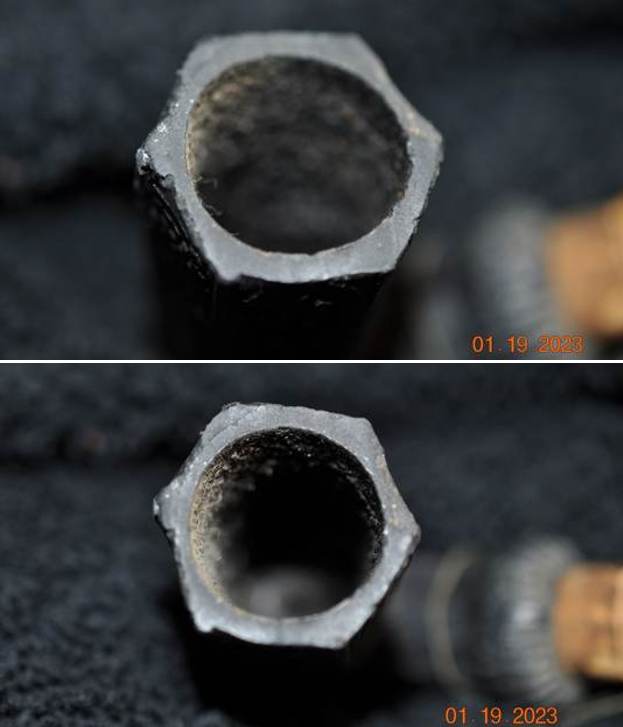
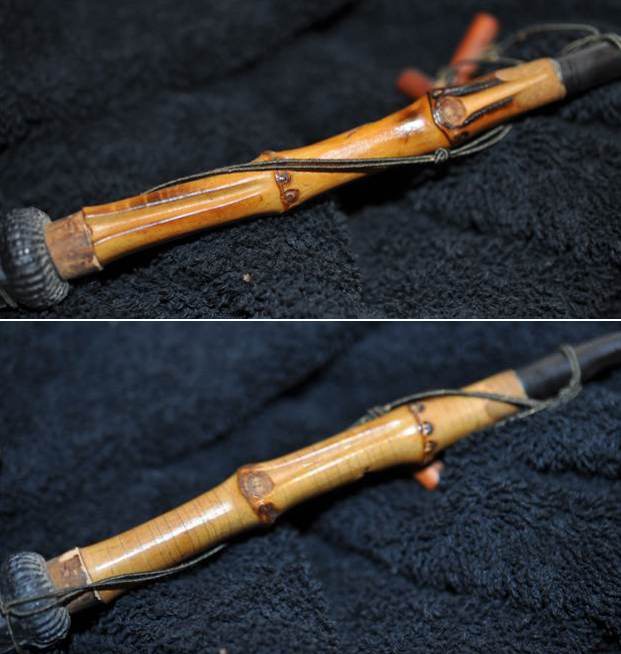
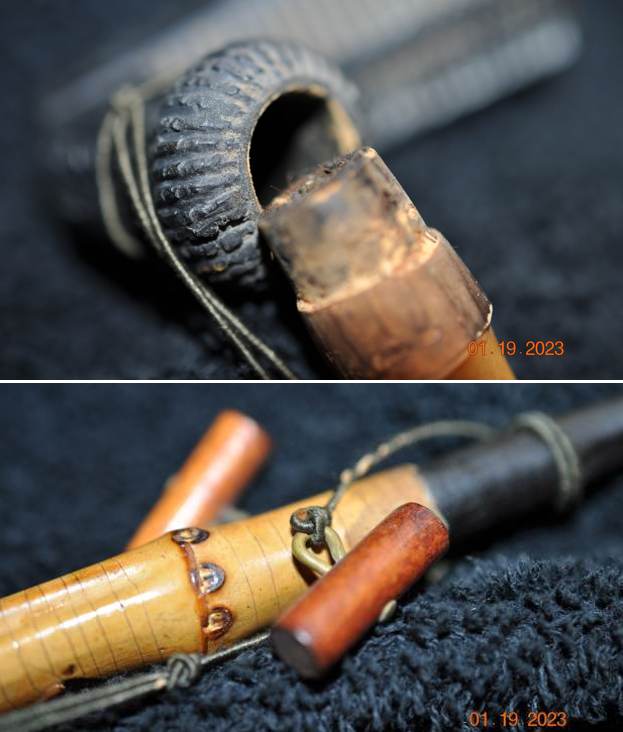
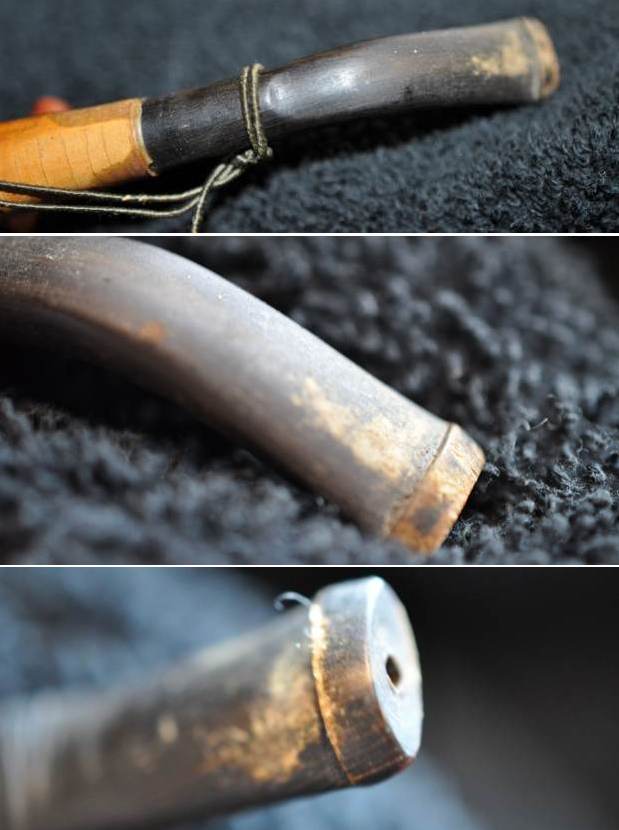
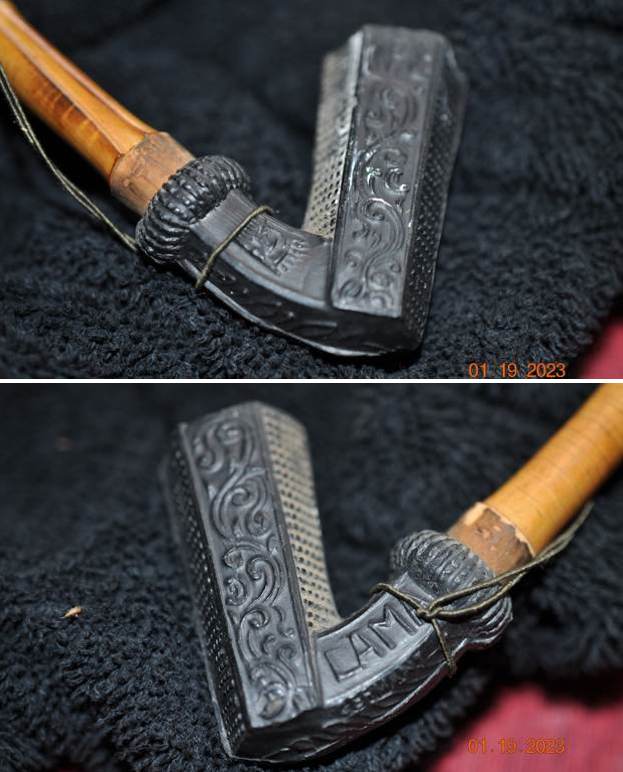
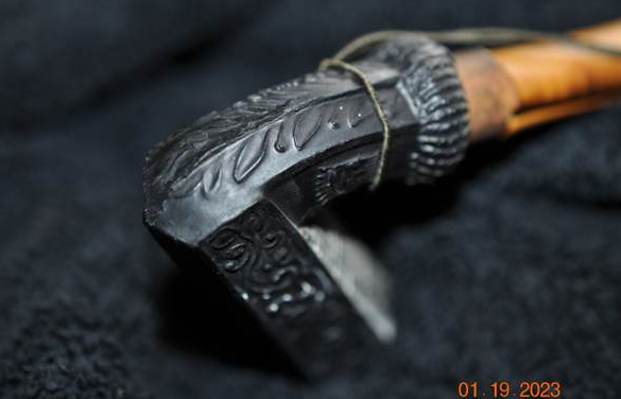
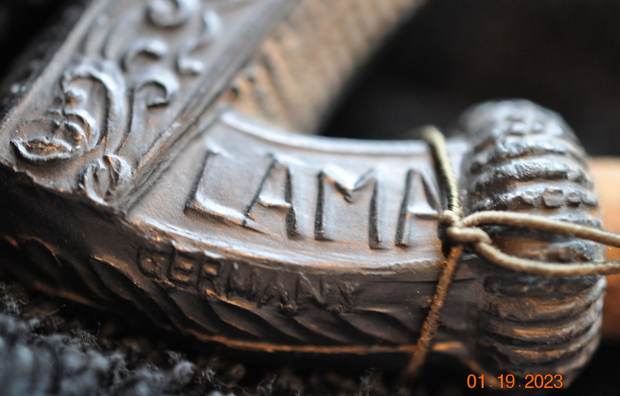
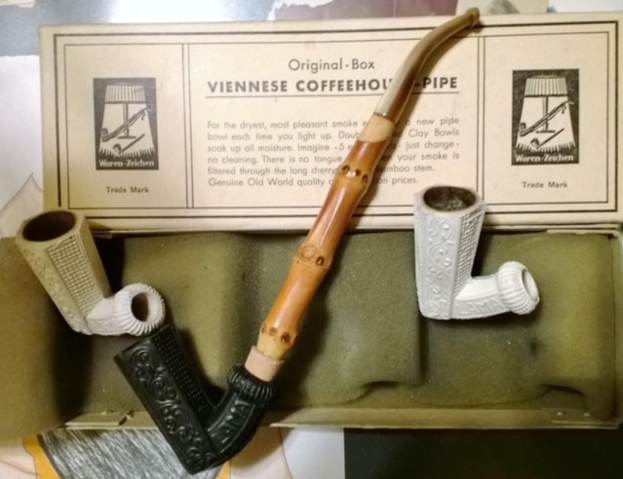
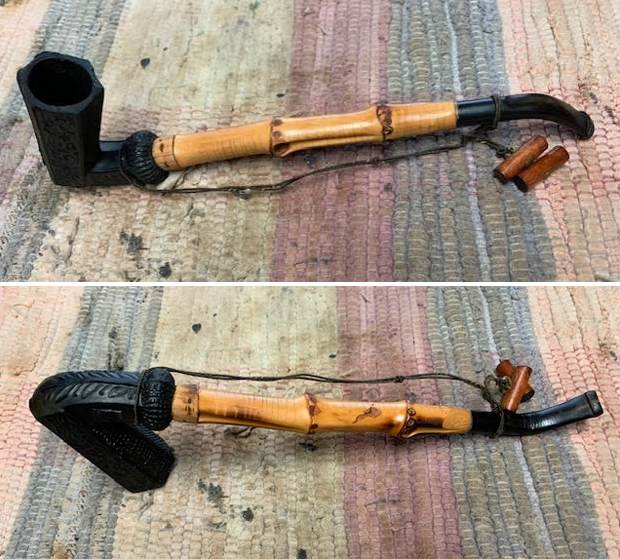
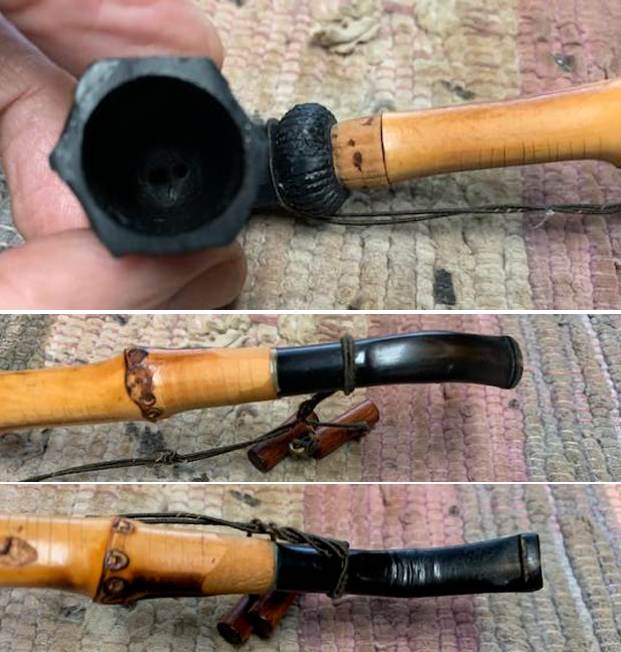
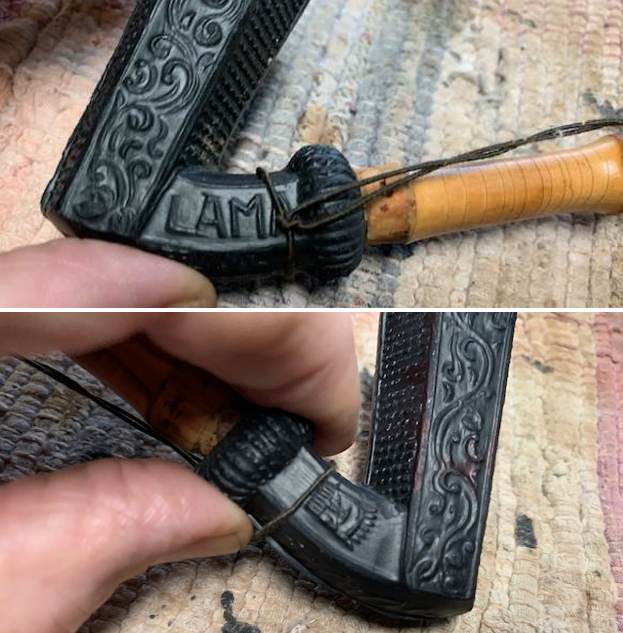
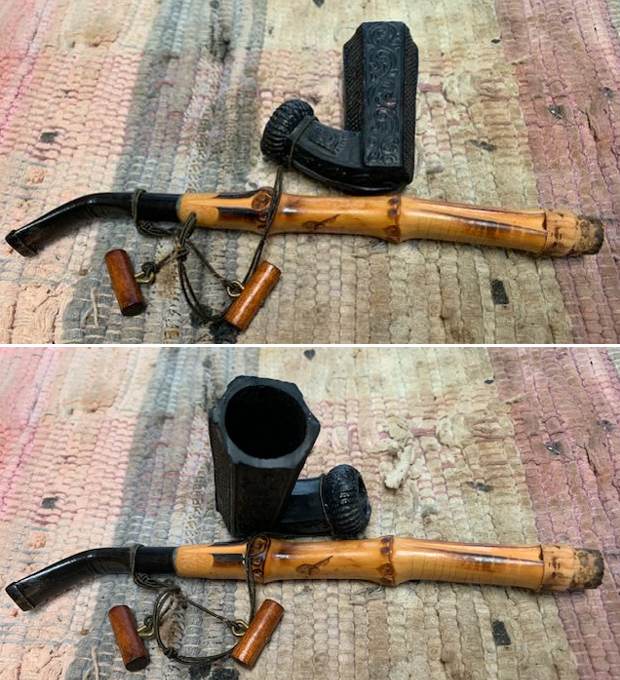
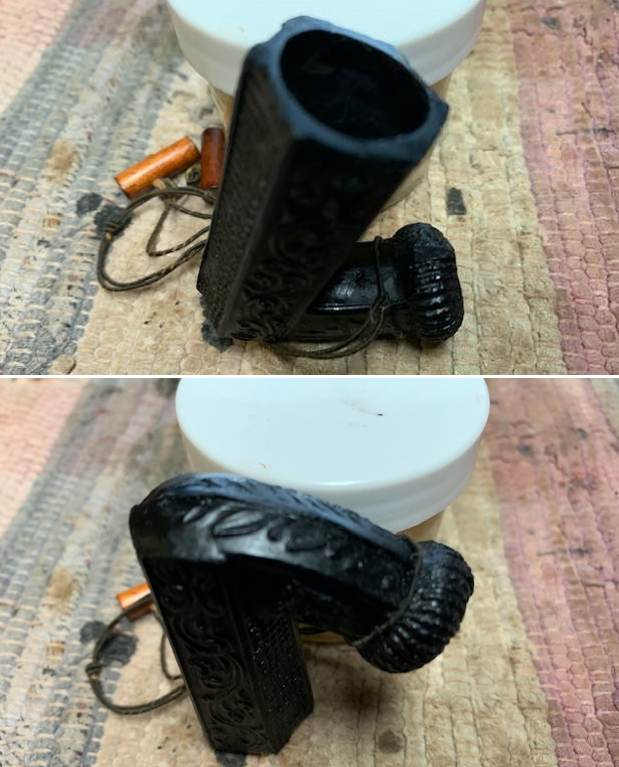
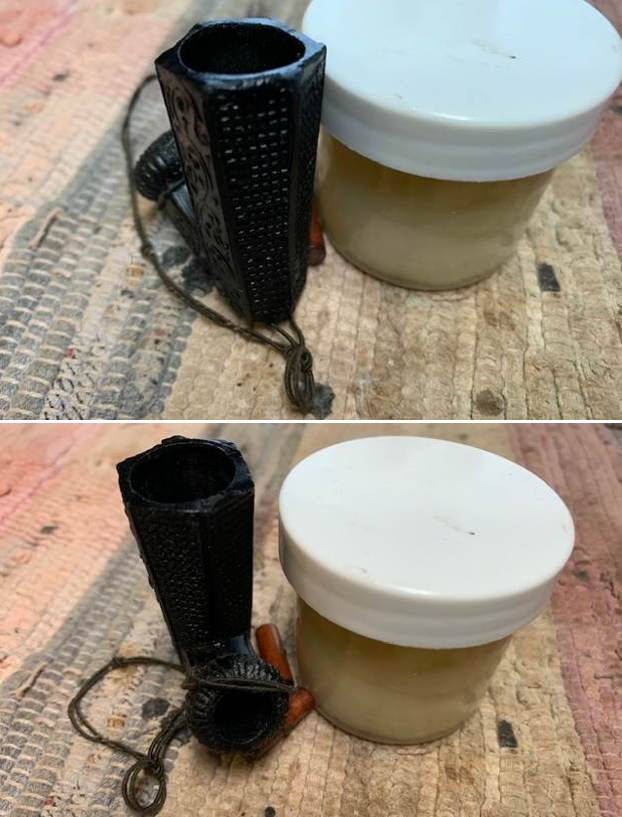
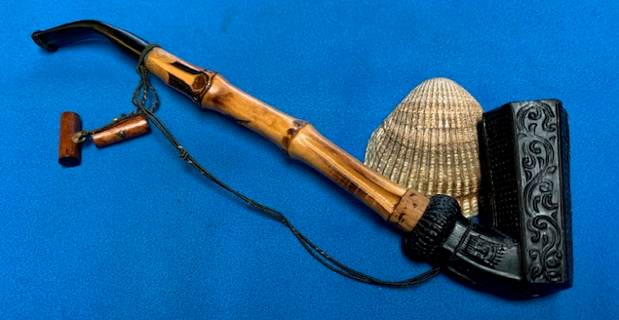
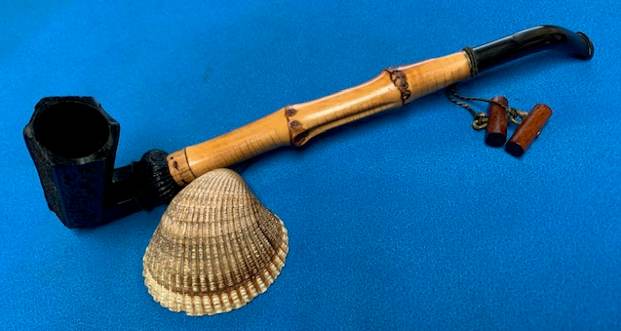
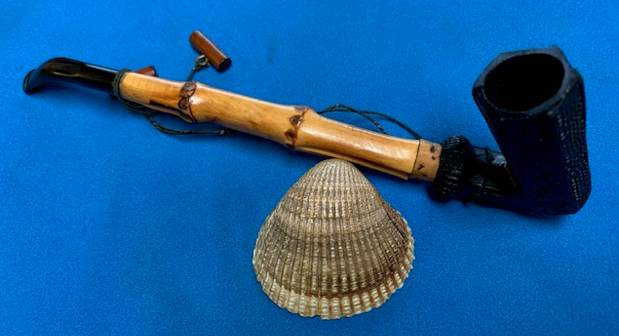
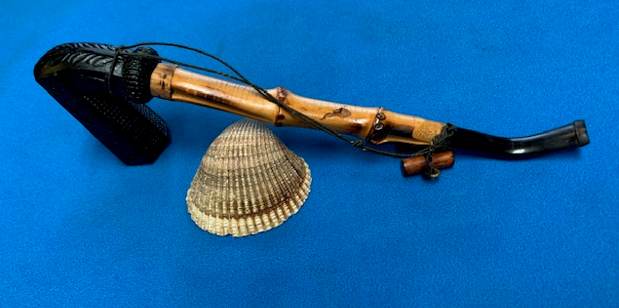
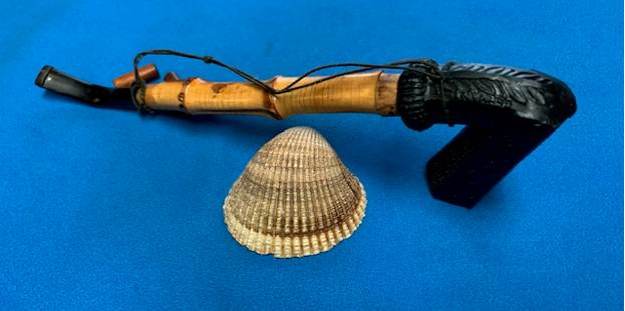
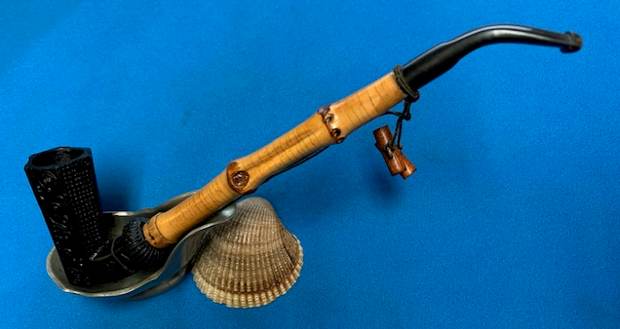
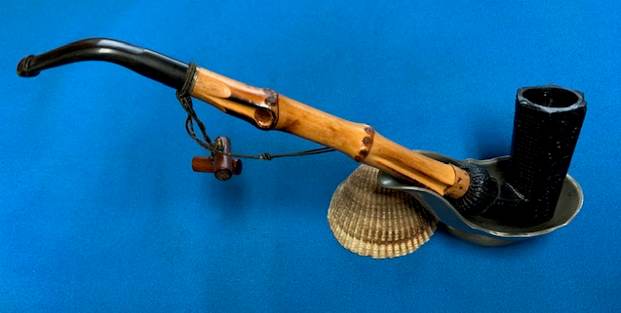
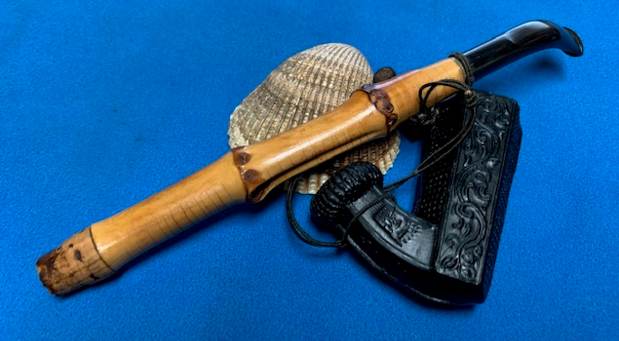
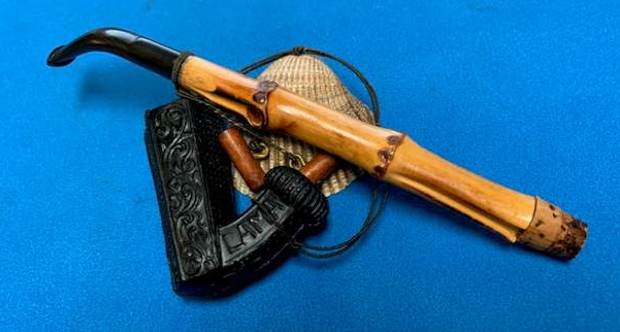
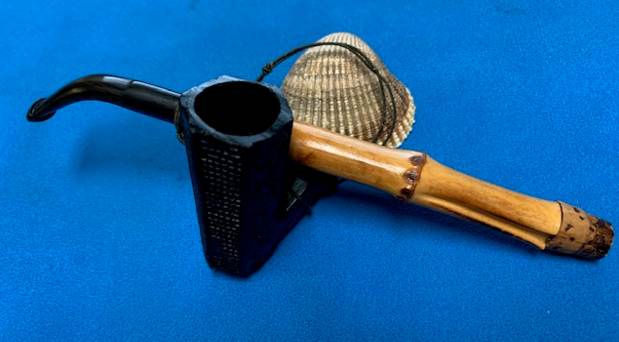
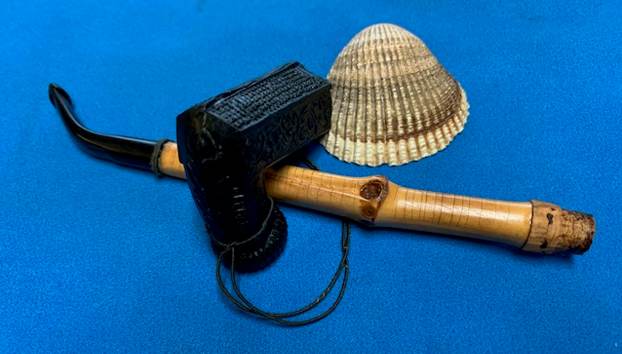
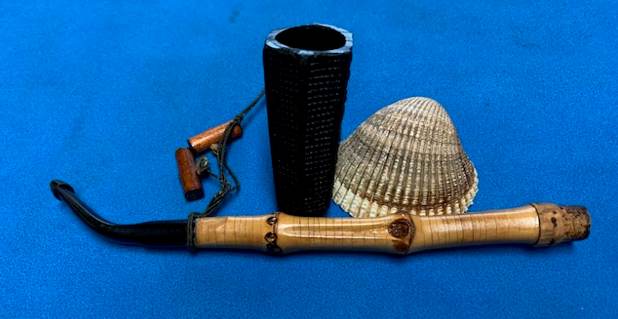
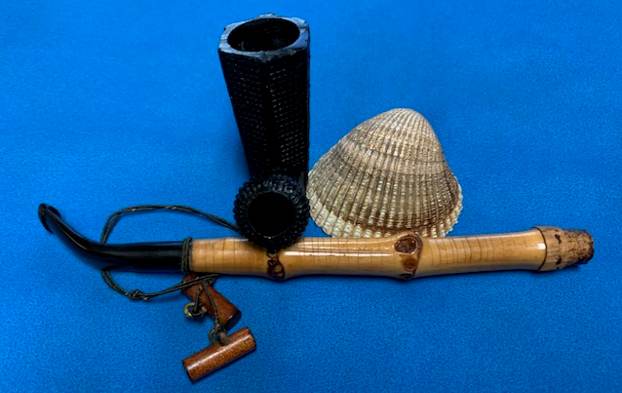
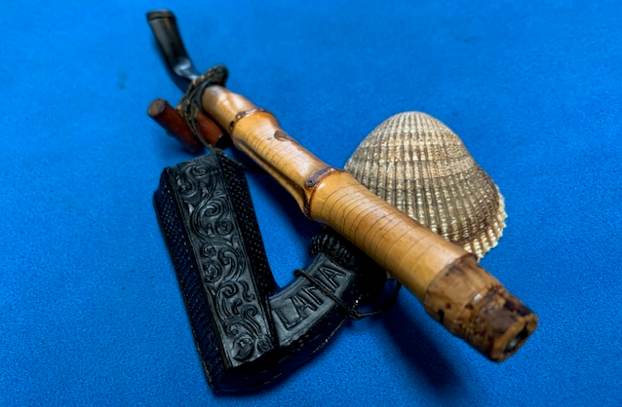
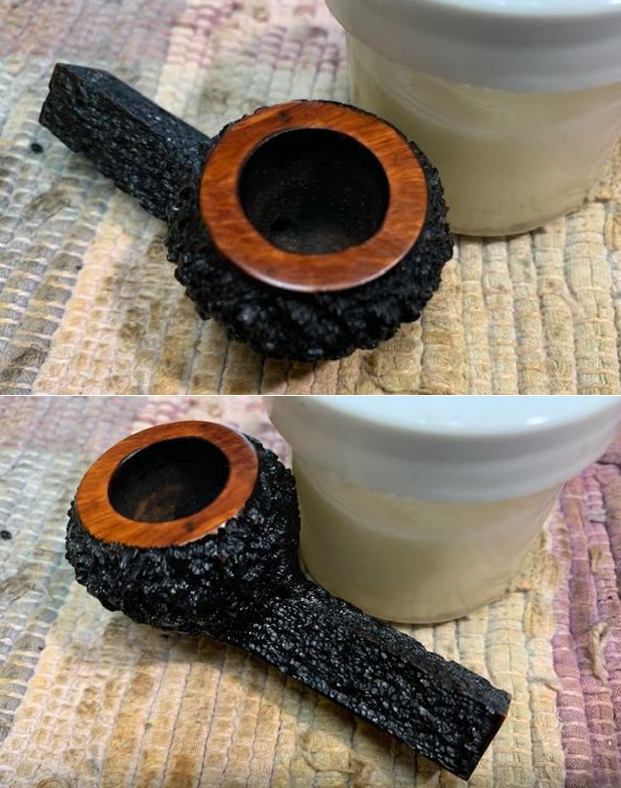
Jeff cleaned this pipe up recently and I received it in the mail last week. It is a unique pipe that caught my eye and made me want to work on it next. This pipe was purchased from an online auction on 07/28/22 in Manorville, New York, USA. The left side of the shank is stamped in the clay and reads LAMA. The right side is stamped with a banner with the letter “L” or maybe a “T” in the center and what looks like a pipe crossing the letter. The bowl of the pipe is clay with a double bottom to the bowl. The shank is Bamboo with a cork fitment on the end of the bamboo to hold it in the shank. There was a cord around the shank and then also around the horn stem. The pipe is well used and heavily smoked. There was a thick cake in the bowl with some lava spots on the rim top and inner edge. The exterior of the hexagonal clay bowl was stamped with unique and twisted/vine like patterns on the sides and a checked pattern on the other front and back of the bowl. The stamping patterns on the bowl are filled in with a lot of dust and debris. It is very dirty looking all the way around. The cork fitting is quite dirty but still has life in it. It is not chipping or torn. The cord is dirty. The Bamboo shank is a two knuckle piece with great patina and crackling in the finish. The horn stem is glued in the bamboo shank and the fit is very good. The horn stem has tooth marks and chatter on both sides near the button. There are some “wrinkles” in the bend of the stem that will need to be addressed. Jeff took the following photos of the pipe before he started his clean up work on it. He took photos of the bowl and rim top to show what they looked like before his clean up. He also took some of the bamboo shank to show the patina and crackled finish. You can also see the cork that secured the bamboo shank in the bowl. The photo of the horn stem show the condition of both sides. The photos of the sides and heel of the bowl show the stamping in the clay around the bowl and shank. The mixture of a fancy carved finish and the black stain on the clay give the pipe a sense of elegance and old age charm. Even under the grime it is a real beauty. The stamping on the left side the shank is shown in the photo below. It is clear and readable as noted above.I did a bit of digging on Google and found that the pipe that Jeff and I purchased was a Viennese Coffeehouse Pipe. The logo on the paper in the background of the photo below is the same stamp that is on the right side of the shank – the letter L or T with a pipe crossing the letter. The stamp on the right side of the shank is LAMA same as the one above. From there I turned to Pipedia to see what I could learn further about the Viennese Coffeehouse   Pipe (https://pipedia.org/wiki/Wiener_Kaffeehauspfeife). I quote from that article below:

Wiener Kaffeehauspfeifen (Viennese coffee house pipes) are a special type of clay pipes where only the stummel is made of unglazed clay. The shank is often made of wood and the mouthpiece may be made from horn.

“As early as the late 18th century, some Viennese coffee houses had their own rooms for smokers. Business-minded coffee house owners offered their guests pipes stuffed with tobacco as a service. They only paid for the tobacco, the use of the pipe was free. Which brings us to the classic Viennese coffee house pipe of the 19th century. Its tall, slender head with six facets, made of white pipe clay, is easy to recognize. In the ornament-friendly 19th century, of course, the charming ornamentation could not be missing. The repertoire included geometric patterns, delicate tendrils, flowers, vases and figures. These pipes intended for the Austro-Hungarian market were made in workshops in the Westerwald, Germany, southeast of Cologne – well into the 20th century. The astonishingly long stems were mostly made of cherry or sour cherry wood. In order to have enough suitable wood available for their production, trees were planted near Vienna, in Theresienfeld in Lower Austria. One can only hope that the horn mouthpieces of the rental pipes were replaced and washed after use …”[1]

“Anyone who wanted could rent such a pipe for a small fee or for free if it was a known person for the duration of a pipe filling. The guest got a new mouthpiece, mostly they were made of goose quill and then he could indulge in his smoking pleasure. Once it was smoked, the pipe was taken apart, cleaned by the servant of the coffee house and another guest could enjoy it. We know a similar custom from other large cities, including England. There, clay pipes were borrowed in the so-called Tabagie[2] for a small fee and could then be smoked by those who did not own a pipe or who had forgotten it at home. The Kaffee Neuner on Seilergasse was particularly famous in Vienna. Famous contemporaries liked and often frequented there: Lenau and Grillparzer, for example, they quietly smoked their borrowed pipes there.”[3]

Footnotes:

  1. https://stadtarchaeologie.at/aus-der-wundertuete-wiener-kaffeehauspfeifen/
  2. See https://en.wikipedia.org/wiki/Tabagie_(room)
  3. Peter Lehmann, http://169807.xobor.de/t4796f23-Rund-um-die-Pfeifen-von-und-mit-Peter-Lehmann.html#msg17103

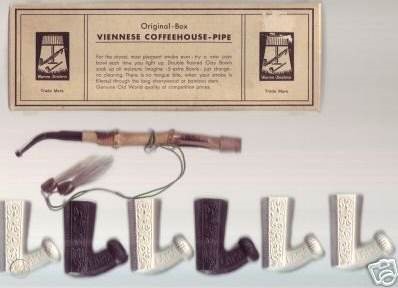
I followed some leads on Google to a link on Worthpoint which is an auction site that sells pipes (https://www.worthpoint.com/worthopedia/viennese-coffeehouse-pipe-by-waren-zeichen-w-6). There was a listing there with the same paper above the photo as the one I shared above. It is also interesting to note that the pipe came with one stem/shank unit and an assortment of dark and light coloured clay bowls. I still don’t know how large the pipe is at this point. I include the photo and the quote below:

VIENNESE COFFEEHOUSE – PIPE in original box with six bowls in black and white all in like new never used condition(bowls have no chips and no ash residue, they are not used). I am not sure of the age of these, however box has no UPC label and states; Waren – Zeichen Trade Mark with the number 5514 B on box ends and Made in Germany – (below description has complete box information from top cover). Box is in excellent condition with only a mild scuff where there was an old price label, metal staples on box corners are all intact and perfect. Individual pipe bowls have the word LAMA on them. Pipes are made from clay, stem is bamboo. Double floored Clay Bowls soak up all moisture. Imagine – 5 extra Bowls – just change – no cleaning.

From Jeff’s photos I made the erroneous assumption that this was quite a large pipe. I was thinking it had a large style bowl like some of the older Meerschaum pipes I have worked on from Germany – somewhere in the neighbourhood of 12 inches long and 3 inches tall or more. You can imagine my surprise when it arrived. The pipe really is quite petite and light weight. The dimensions are as follows – Length: 7 ½ inches, Height: 2 inches, Outside diameter of the bowl: 7/8 inches, Chamber diameter: ¾ of an inch. The weight of the pipe is 40 grams / 1.41 ounces.

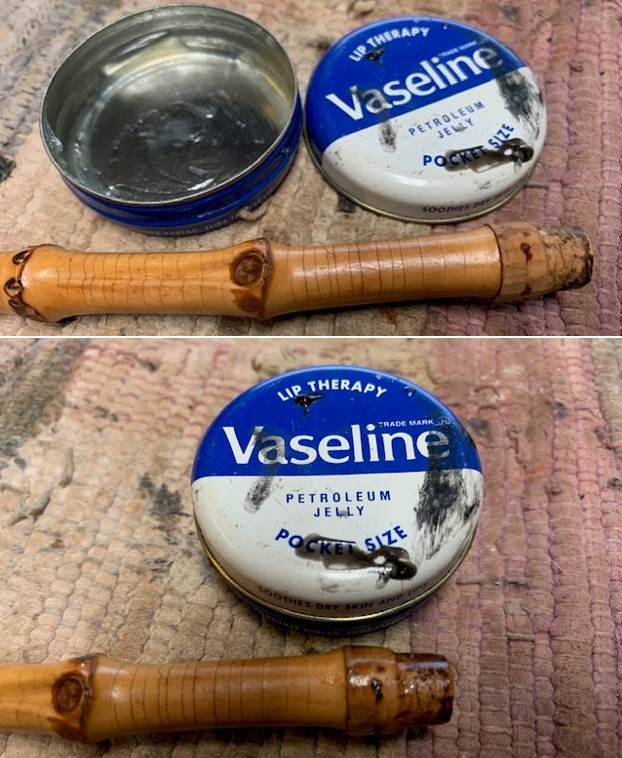
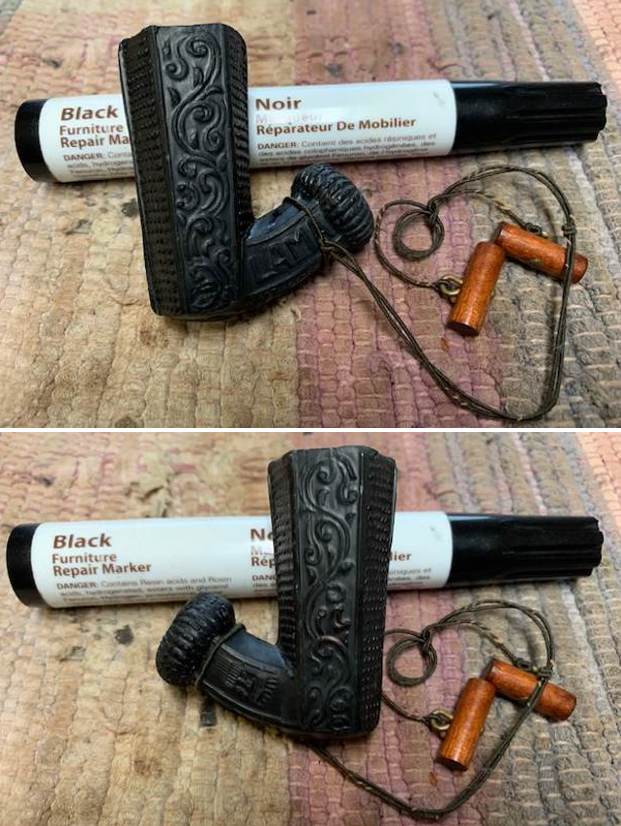
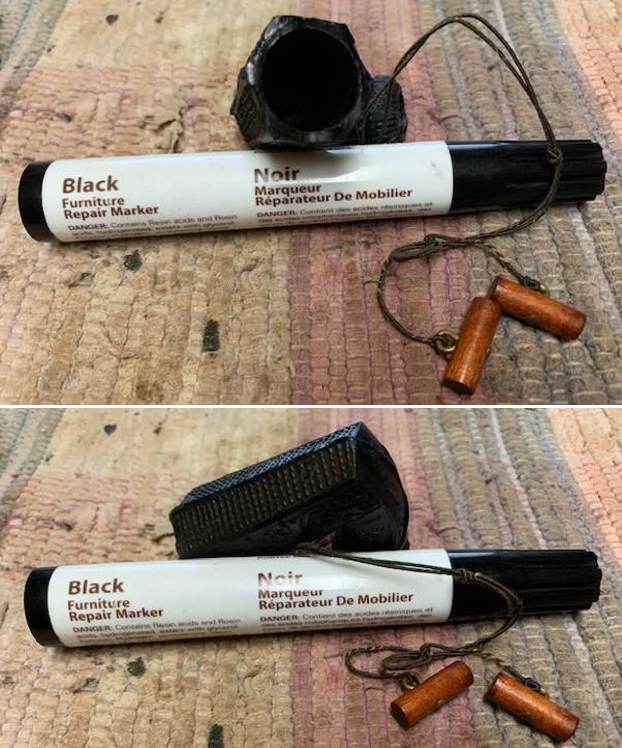
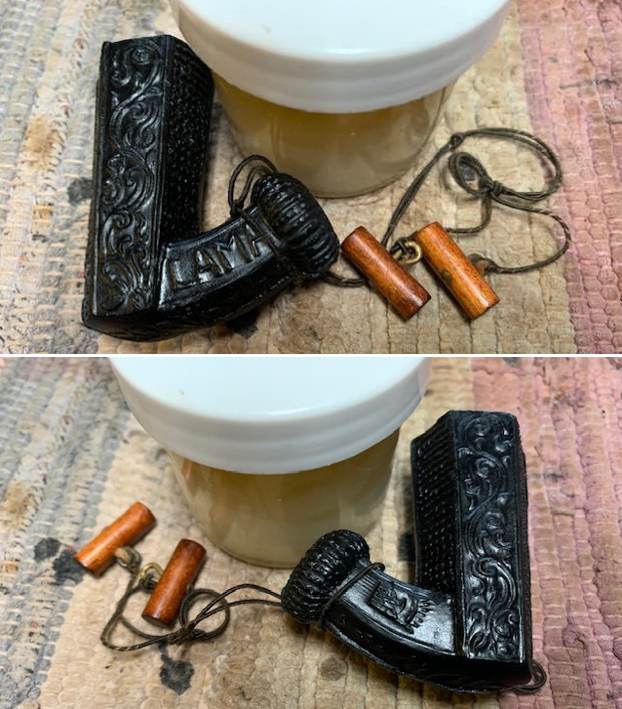
Jeff had thoroughly cleaned up the pipe. He reamed the pipe with a PipNet Pipe Reamer and cleaned up the remnants with a Savinelli Fitsall Pipe Knife.  He scrubbed the bowl with undiluted Murphy’s Oil Soap with a tooth brush. He rinsed it under running warm water to remove the soap and grime. He cleaned out the inside of the bamboo shank and the airway in the stem with alcohol, cotton swabs and pipe cleaners. He scrubbed the exterior of the stem with Soft Scrub to remove as much of the oxidation and calcification as possible. He soaked the stem in Before & After Deoxidizer and rinsed it off with warm water. I took close up photos of the bowl, rim and the stem. You can see how clean the bowl and rim top and edges are. The horn stem is in good condition with light tooth marks and some chatter as noted above.I took photos of the stamping on the sides of the shank. It is readable as noted above. I removed the stem and the shank from the clay bowl and took photos of the bowl an bamboo shank and horn stem to give a sense of the proportions of the pipe. I started my work on the pipe by working on the stem. I sanded out the tooth marks and the wrinkles on the bend on the underside of the stem sides with 220 grit sandpaper and started the polishing process with 600 grit wet dry sandpaper. I was able to polish horn stem and the shaved portion of the bamboo with micromesh sanding pads – 1500-12000 grit pads. I wiped it down with a damp cloth after each sanding pad. I used Before & After Pipe Polish – both Fine and Extra Fine to further polish the stem. I worked some Before & After Restoration Balm into the horn stem and also the Bamboo. I worked it in with my fingertips and a shoe brush. I let it sit and absorb into the surface of both. I buffed it off with a soft cloth. The Bamboo and the stem came alive. I worked some Vaseline Petroleum Jelly into the cork plug that fit on the end of the shank. It enables a snug fit of the shank in the clay bowl. The Vaseline softens the cork and gives it more flexibility and give.I laid the Bamboo shank and stem aside to let the Vaseline absorb into the cork.While it was sitting I turned m attention back to the bowl. I touched up the white spots on black bowl and shank with a black stain pen to blend it into the rest of the clay bowl. It looked much better. I rubbed the clay bowl down with Before & After Restoration Balm. I worked it into the surface of the clay with my finger tips. I worked it into the stampings on the clay bowl and shank sides with a shoe brush. I let it sit for 10 minutes and the Balm did its magic. It enlivens, cleans and preserves a pipe. It certainly brought this bowl back to life. I buffed it off with a clean cloth and took the following photos. This Lama Viennese Coffeehouse Pipe with a Bamboo Shank and horn stem is a great looking pipe now that it has been restored. The beautiful finish really highlights the grain and the polished finish is stunning. I put the stem back on the bowl and carefully buffed the pipe with Blue Diamond on the buffing wheel. I gave the bowl and the stem multiple coats of carnauba wax on the buffing wheel and followed that by buffing the entire pipe with a clean buffing pad. I hand buffed the pipe with a microfiber cloth to deepen the shine. The finished Lama Viennese Coffeehouse Pipe fits nicely in the hand and feels great. Give the finished pipe a look in the photos below. Once again the dimensions are as follows – Length: 7 ½ inches, Height: 2 inches, Outside diameter of the bowl: 7/8 inches, Chamber diameter: ¾ of an inch. The weight of the pipe is 40 grams / 1.41 ounces. I plan on holding on to this unique piece of history so that I can enjoy a transport back in time to Vienna. I will enjoy a bowl of tobacco while time traveling. Thanks for reading this blog and my reflections on the pipe while I worked on it.

An Anton Partsch Crafted Austrian Glazed Clay Long Pipe


Blog by Steve Laug

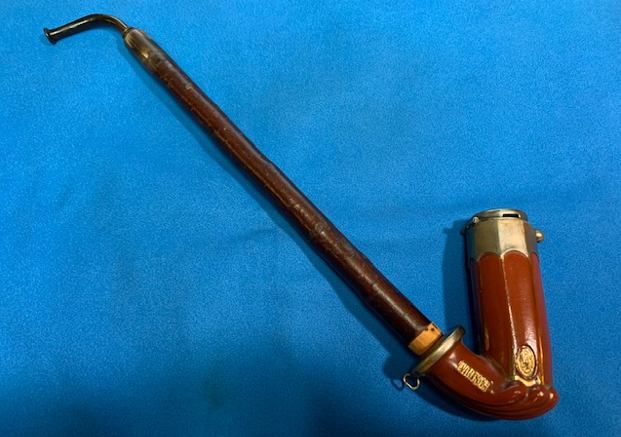
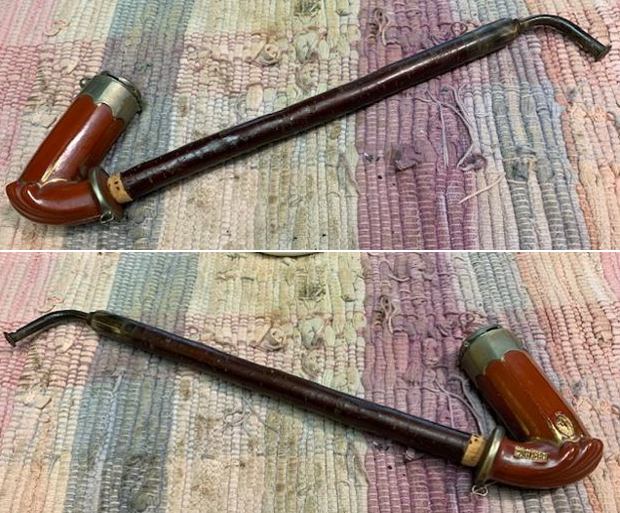
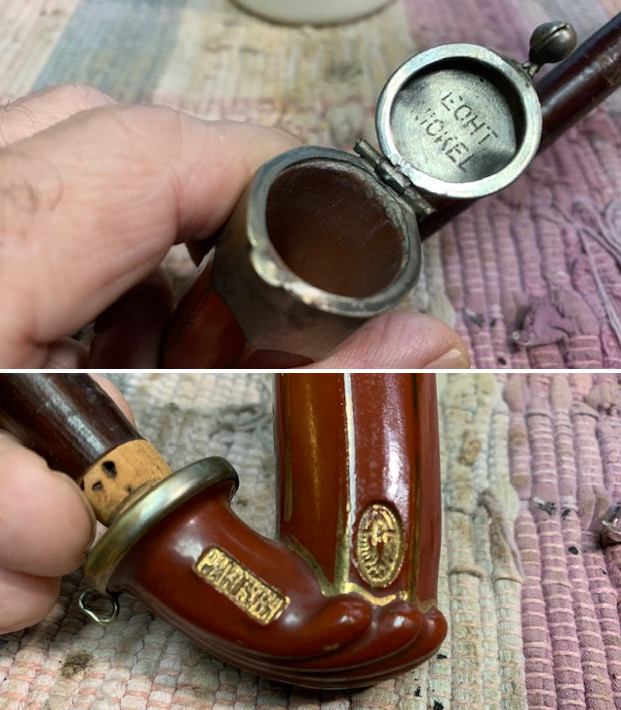
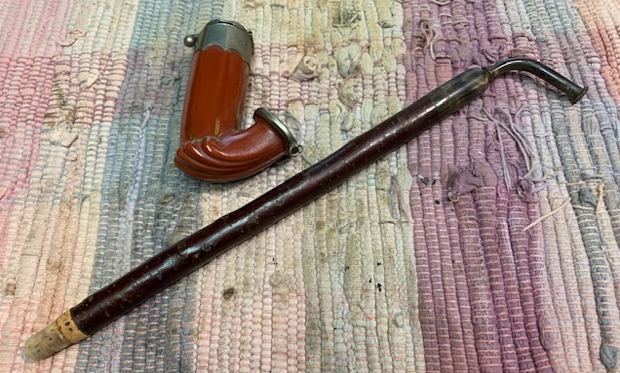
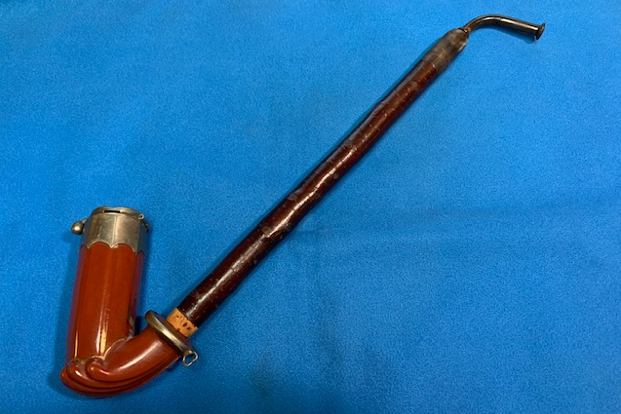
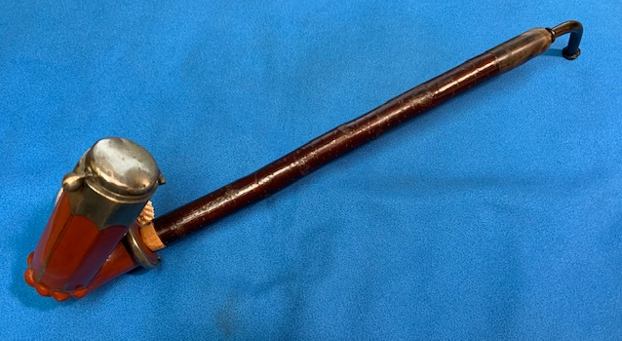
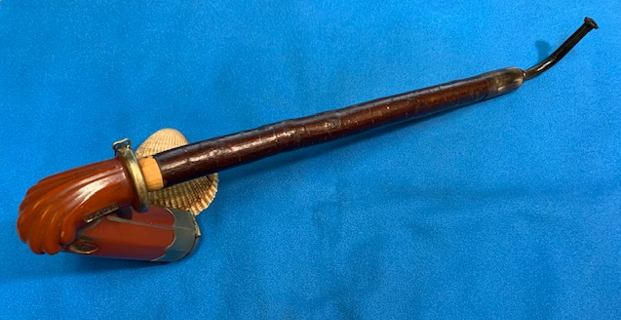
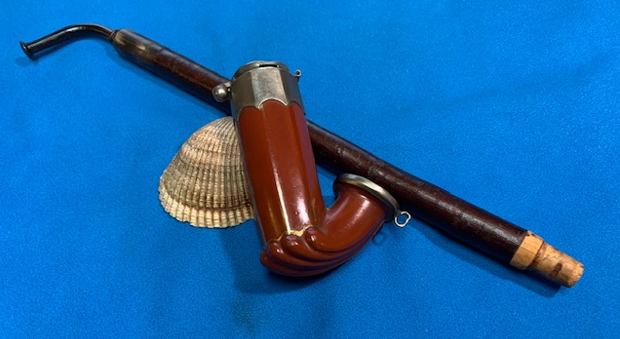
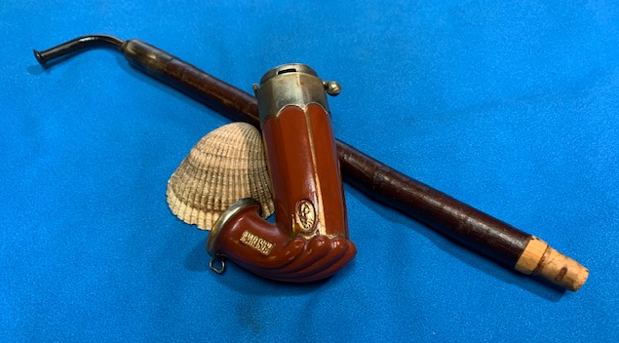
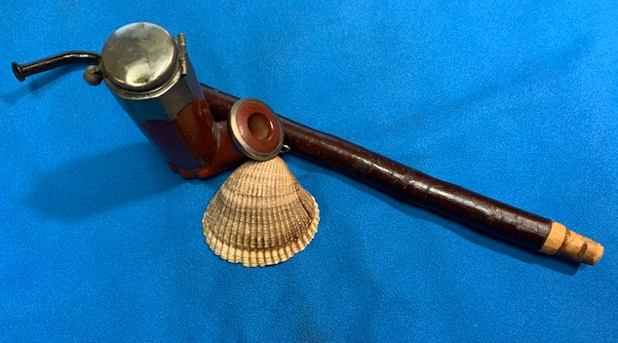
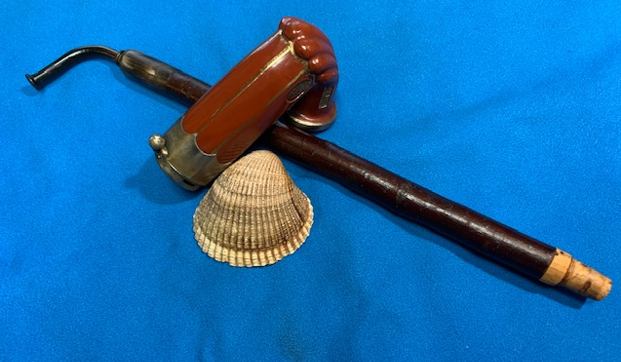
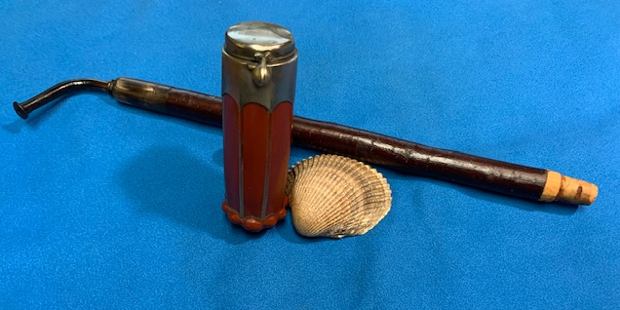
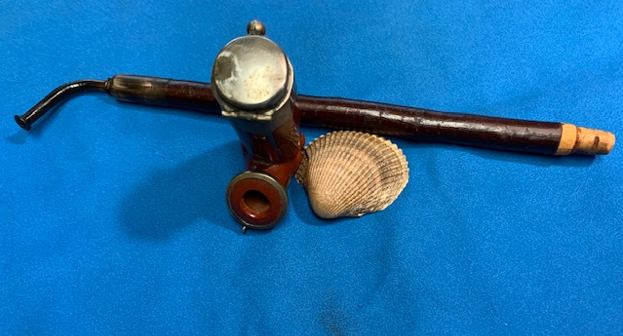
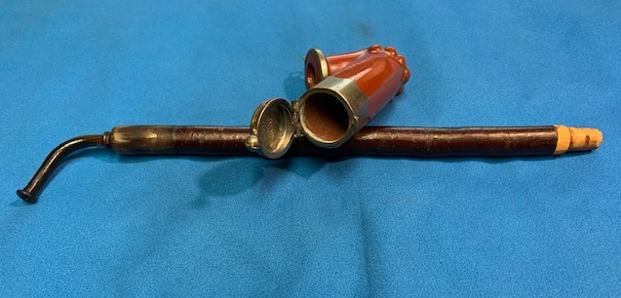
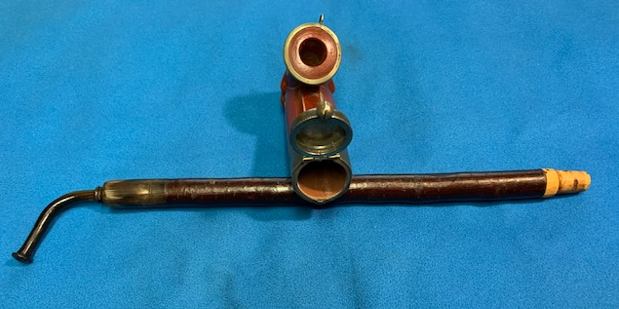
The next pipe has been here for quite a while and it is one that I have repeatedly looked at and passed over. I am guessing that it is an old timer from possibly the early 19th century. It has a red clay bowl that is unsmoked and the outside has been fired with a glaze that looks very good. It has gold paint on all eight of the angles of the octagonal bowl. The base of the bowl is a clam shell that holds the upright chimney of the bowl. There is a nickel rim cap and hinged wind cap on the bowl. There is a nickel band on the shank end with a ring for a piece of string that originally went from there to the top of the horn stem. The pipe has two embossed stamps on the left side of the bowl. The one on the bowl is an eagle with outstretched wings and the one on the base reads Partsch. Both have been embossed with gold. The shank has a corked end on the long cherry wood barked branch to keep it in the bowl end. The top of the cherry wood is capped with a polished horn ferrule and is threaded to receive a bent horn stem. There was some worm damage to the stem. The amazing thing about the pipe is that it has never been smoked. The pipe is quite large with an overall length from the front of the scallop to the tip of the stem of 12 inches. The parts of the pipe are even longer when apart – the cherry wood shank is 9 inches long, the bowl is 2 inches long and the stem is 2 inches long. The bowl is 3 inches tall to the rim top with the wind cap adding an extra ¼ of an inch.

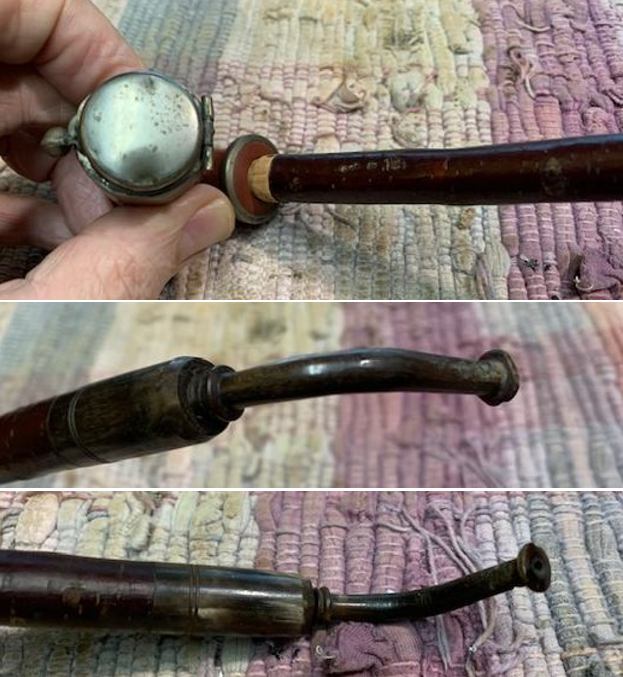
I took some photos of the parts of the pipe to give a better picture of it. The first one below shows the wind cap. You can see that the diameter is quite wide. The cap has some dents and scratches that I will probably leave as is rather than risk damaging it. The second and third photos show the horn ferrule and stem. The worm damage is on the right side of the stem at the button end. The other end is threaded and there is an extra ring where the cord and tassels were attached.The next photos show the stamping on the inside of the wind cap and the side of the bowl and base. The inside of the cap reads ECHT NICKEL which translates Genuine Nickel. On the right base side it reads PARTSCH in a gold rectangle. On the side of the bowl is an gold oval with an Eagle with extended wings.I took the cherry wood shank off the glazed clay base and took a photo of the pipe to give a sense of the proportions and size. The cork is in such good condition that I am almost certain that it has been replaced.That is the pipe as it stands before I did anything to it. Remember it was unsmoked so it would not be an intrusive or intensive restoration. Rather it would be a polishing and shining up an already beautiful pipe without doing any damage to the antiquity of the pipe. But before I started on that process I wanted to learn more about the brand. What, where and who made this red fired clay pipe. It was time to do some research and dig out what I could find out about the brand.

I turned to my usual sources to dig out any information that I could find and there was nothing on either Pipephil’s site or Pipedia. Both came up empty. I expanded the search to a general Google search for the Partsch label to see if I could find anything listed. That was a much more fruitful search. The first site that came up was picclick.co.uk and it had some information on the brand. I quote from the site below. https://picclick.co.uk/Partsch-red-tobacco-pipe-with-original-stem-Smoking-172799026344.html

Partsch red tobacco pipe with original stem. Partsch red tobacco pipe with original stem. A fine antique Partsch German long clay pipe. This beautiful long pipe has a red brown bowl with a nickel cap. The cap is stamped underneath ‘echt nickel’. The bowl is marked Partsch and has also an impressed Austrian eagle. This also appears to have its original cherry wood stem and original mouthpiece. Dimensions: 28.5cms long. Height of the bowl from cover to base 8.5cms. Cross section of the bowl 2.5cms x 2.5cms and bowl aperture is 2.1cms.Weight: 85gms Condition: Rare to get a pipe with all original parts.

The description of the pipe associates the ‘Echt Nickel’ stamp with German and identifies the pipe as a German made long clay pipe. I was not sure of that so the hunt continued.

The next mention on the Google hunt was to a pin on Pinterest. These often are unproductive so I was not overly hopeful regarding information, but I was wrong. I quote from the description on the pin below (https://www.pinterest.ca/pin/25051341664836403/).

This is a fine antique, long handle, smokers pipe that has been well used and well loved. It was made in Austria by Anton Partsch and bears the stamp “PARTSCH” as well as the “Austrian Eagle Crest” on its bowl. The bowl has a clamshell relief pattern at its base and is in a terra-cotta red glazed clay. The hinged metal wind cap has two slots and a turned down ball clasp for closure. There is a cord loop on the metal band around the shank but no cord. I believe the reddish bark coloured wood is cherry…

From that information I learned that I was dealing with a pipe made by Anton Partsch and that the stamps on the side were indeed what I thought they were. What was really helpful was the author identified the Eagle with outstretched wings as the “Austrian Eagle Crest”.

The next link provided more information. It was a pipe that was for sale/sold on Worthpoint and the description added new information to my growing understanding of the brand. (https://www.worthpoint.com/worthopedia/partsch-schemnitz-pipe-bowl-antique-1855443319) I quote below.

The vast majority were finished in subdued solid colors of carmine, terracotta, brown, and black, the last two being the most common. and occasionally found in mottled, marbled, or dappled green and blue. These early, paneled bowls were mass-produced in the town of Banská Štiavnica, Slovakia, Selmecbánya (Hungarian), Schemnitz (German), or Chemnitz (English), once the largest and most famous mining center of the Austro-Hungarian Empire. These pipe bowls are often identified in literature as hard stone, or stoneware, because of their highly polished and transparent-glazed surface finish, but they were not of a hard stone composition; they were fired, containing a mixture of white clay for strength and red clay for sheen.

This was the most detail of the area that the bowl came from in the Austro-Hungarian Empire and that they were made of a mixture of white clay from strength and red clay for sheen. They had a glazed surface that gave them the look of stone but were not made of that. Fascinating how the picture is growing.

The next piece of the puzzle came from a discussion on Pipesmagazine.com forums. I quote some of the pertinent parts of the discussion that added to my understanding. The initial poster refers to an article on Facebook that is no longer available. You can click on the link and read the discussion in its entirety if you so choose (https://pipesmagazine.com/forums/threads/antique-schemnitz-austro-hungarian-clay-pipe-rarity-age.36245/).

…The article says they’re most common in black and brown, less so in terra-cotta and red, and “occasionally” in blue or green. I found some closed auctions on eBay and posts elsewhere showing terra-cotta, mottled brown, and black ones. They usually seem to have a scalloped metal sleeve on the bowl with a hinged wind-cap, and some have a metal band around the end of the shank, presumably to prevent cracks.

…The bowl is glazed in cream color with softly-dappled green swirl patterns, the cream becoming a sort of buttercream yellow behind the green areas. The shell bottom and shank are black, with a tiny hint of gold on the scallops. The wind-cap has eight slots around the edge and a nice curled clasp that snaps down; I’ve seen photos of very plain bands on the bowl, solid with a scalloped lower edge, and some very ornate pierced ones, and this is somewhere in the middle, plain with a fancy, pierced border. The inside of the cap has “ECHT NICKEL” (genuine nickel) stamped in big block letters…

The maker’s mark, stamped into the shank and gold-glazed, is “PARTSCH,” which that article tells me is Anton Partsch. There is also, up on the lower part of the bowl, a gold oval stamp with a soft pattern in the center, I assume the maker’s company sigil. The shank has a plain metal band, with a loop for a cord…

…It has a bark-covered wood stem, with a cork-and-reed tip on the bottom and a turned horn ferrule (which has a tiny age crack) on top and a wooden mouthpiece (on closer examination just now, the lip is translucent under a very bright, focused light, so I think this must also be horn). The stem is kept with the bowl by a brown string or cord, tied around the mouthpiece and ending in two tassels, like many of the German wood and porcelain pipes…

I have highlighted the information that fits my pipe in bold in the quotes above. I did find from the conversation that the Terra Cotta version I have is a bit rarer to find than the black or brown versions of the pipe.

I found two scholarly articles. I have included the link to the first one below. It is a PDF on pipes made in Theresienfeld (Davey 2010 Theresienfeld pipes.pdf). I quote a portion of the paper on the PARTSCH pipes. It is very interesting and confirms the stamping.

These pipes bear a PARTSCH relief stamp in a rectangular  frame  on  the  side  of  the  socket  and  an  oval SCHUTZMARKE  relief  stamp  at  the  base  of  the  funnel  in which the legend surrounds the upper part of an eagle with spread wings.

The next information came from a Master’s Thesis for Oregon State University. I included the link and the identifying information below. I quote tow paragraphs that help give information on the Partsch pipe I am working on.

An Abstract Of The Thesis Of – Oregon State University

AN ABSTRACT OF THE THESIS OF Diane Zentgraf for the degree of Master of Science in Applied Anthropology presented on December 14, 2018.

Title:  Mid-Nineteenth Century Clay Smoking Pipes from Fort Hoskins (35BE15) and Fort

Yamhill (35PO75), Oregon.

 …Reed stem clay pipe manufacturing began in the Austro-Hungarian Empire during
the last quarter of the 17th century (Gačić 2011: 31), utilizing local clays in Northern and
Western Hungary (Gačić 2011:31, citing Ridovics 2009:64). During the 19th century, the
pipe making was concentrated in Wiener Neustadt, Theresienfeld and Pernitz, in the
southern section of Austria, with strong connections to production centers in Hungary
.

Twenty pipe making workshops have been identified by Bielich and Curny (2009: 342-
348), including pipe makers S. Boscovitz, Anton Partsch, Jacob Reinitz, S. Seiler, Károly
Zachar, Anton Ress, Michael Honig, M. Amstätter and Joseph Schmidt.

The Hapsburg dynasty required pipes be marked with a maker’s mark in the early 19th century (Bielich and Curney 2009:358).  In the literature these are termed Austro-Hungarian pipes and are characterized by a consistent form that was repeated with very little change (Gacic 2011:54).  The most common pipe form is termed a Schemnitz pipe and is described as made of good quality clay in molds and having a narrow “tall cylindrical head (with either round or polygonal cross-section) profiled like a shell at the bottom” (Gacic 2011:54). These pipes were popular and often copied (Figure 21) 49 (Morgenroth 2001:56), and are described as having muted colors, reddish to black in color, marbled black-grey color, often mixed with white clay.

I am pretty certain I have found the last piece of information I needed. It seems that there were many pipe making workshops in the early 19th century concentrated in three areas in southern Austria – Wiener Neustadt, Theresienfeld and Pernitz. It is in those areas that Anton Partsch is said to have been a pipe maker. It is also clear that during the Hapsburg Dynasty all pipes had to be marked with the maker’s mark in the early 19th century. That further locks the date down for the pipe I am working on.

Now that I had gathered a bit of an education on the maker and pipe it was time to do some polishing on the pipe. I polished the horn ferrule with micromesh sanding pads – dry sanding with 1500-12000 grit pads and wiped it down with Obsidian Oil. The horn took on a lot of life and depth from the polishing It is a nice looking piece. I rubbed the bark of the cherry wood shank piece with Before & After Restoration Balm. I worked it into the bark, cork and horn with my finger tips. It works to clean, preserve and protect wood. I let it sit for 15 minutes then buffed it off with a soft cotton cloth. The bent horn stem had some worm damage on the right side near the button. I filled it in with some clear CA glue and built up the damaged area. I reshaped the button as well as it had some nicks in it. I sanded the repaired area with 220 grit sandpaper to smooth it out and then started polishing the horn with 400 grit wet dry sandpaper. It looked better. I polished the horn with micromesh sanding pads – 1500-12000 grit pads. I wiped it down after each pad with some Obsidian Oil. I gave it a final polish with Before & After Stem Polish – both Fine and Extra Fine. I gave it another rub down with Obsidian Oil. The horn really began to shine as I finished the polishing. With the stem repaired and polished I was finished with my work on the pipe. I wiped down the nickel plated rim and wind cap as well as the nickel plated shank end cap with a jewelers cloth to remove the moderate oxidation and to protect it. I did not want to remove the dents in the wind cap as it could actually ruin the value of the pipe. I gave it a coat of Conservator’s Wax and a hand buff with a fluffy cloth to raise the shine. This Anton Partsch Red Glazed Pottery Bowled Long Pipe came out looking quite amazing. The horn ferrule and stem polished nicely as did the cherry wood shank. It all came together well. To think that the pipe is at least 200 years old and never been smoked is quite unbelievable. The dimensions of the pipe are, Length: 12 inches, Height: 3 inches, Outside diameter of the bowl: 1 inch, Chamber diameter: ¾ of an inch. The weight of the pipe is; 92 grams/3.25 ounces. I really enjoyed working on this beauty and felt a sense of touching the past in a tangible way. The pipe will stay in my own collection to be enjoyed and savored. I don’t think I will ever fire up a bowl as it has not been smoked since it was made and there is something unique about that. But then again, the right day may come and I will fire it up. We shall see. Thanks for walking through the restoration with me. As Paresh always says, “Stay Safe”.

Restoring a Diamond Black Extra Squat Bulldog


Blog by Steve Laug

I finished the restoration of four of the older horn stem pipes that I have posted the blogs about on rebornpipes, the first was a beautiful early 1900s KB&B Horn Stemmed Italian Billiard (https://rebornpipes.com/2021/08/29/reviving-another-older-horn-stemmed-pipe-my-next-choice/) then an early French made JSN Racine Bruyere Dublin with a horn stem (https://rebornpipes.com/2021/08/29/reviving-another-older-horn-stemmed-pipe-from-the-bag-of-old-timers/), then a lightly smoked GVG Liverpool made by the founder of Genod (https://rebornpipes.com/2021/08/31/reviving-a-lightly-smoked-horn-stem-gvg-extra-9745-liverpool/) and fourth a Belle D’ Or Vielle Bruyere “Double Or” French Made Bent Dublin (https://rebornpipes.com/2021/09/01/restoring-a-la-belle-dor-vielle-bruyere-double-or-horn-stem-bent-dublin/). I decided to keep working on the bag of older NOS/unsmoked and lightly smoked pipes. I chose another horn stemmed pipe from the lot and this time picked a bit of a mystery pipe. It is buried in the pile in the photo below but it is clear in the second photo.In the photo of the poured out bag on my desk top I have circled the pipe that is next on the table. This was a lightly smoked pipe with a cut glass rustication stained black. The rim top is smooth as is the panel where it is stamped. This squat Bulldog really intrigued me so it was next. I sat at my desk went over the pipe I had chosen. It is lightly smoked squat Bulldog with a diamond shank and a taper stem. It is stamped on the left underside of the shank on a smooth panel and reads Diamond [over] Black. Just above that toward the shank/stem junction it is also stamped Extra. The pipe is a bit of a mystery as there is no country of origin. The finish is rusticated with a cut glass style rugged rustication that is stained black. The rim top is smooth and stained with a medium brown. There was some thin lava on the back top and edge of the rim. The stem is horn and has tooth chatter on the top and underside ahead of the button. There were worm holes on the point of the diamond on the underside and on the top right side at the joint of the stem and shank. The tenon is metal/aluminum with twisted stinger in place. It is a push stem. The button end is slotted. Typically these metal tenon pipes came out during the war or directly after when horn was brought back into use when rubber was short. It really is a beautiful pipe. Here are a few photos of the pipe before I started my cleanup and restoration. I took photos of the bowl and stem. You can see the condition of the bowl and the rim top and edges. The drilling is centered in the bottom of the bowl. It is a good sized bowl. The interior walls of the pipe are smooth and do not have drilling marks or checks or chips. There was some lava on the rim top at the back of the inner edge of the bowl along with darkening and burn damage. The horn stem is in excellent condition other than a worm hole on the top and underside near the shank. The button has a slotted opening and is quite clean. I took a photo of the stamping on the left underside of the diamond shank. It reads as noted above.I took some photos of the worm holes in the stem surface. I have circled them in red in the photos below. I removed the stem from the shank. You can see the metal tenon and the turned stinger in the photo below. The proportions of this pipe are well done. The rustication around the bowl is very nice. I used a folded piece of 220 grit sandpaper to smooth out the inner edge and then polished the smooth rim top with micromesh sanding pads. I dry sanded with 1500 -12000 grit pads and wiped the bowl down with a damp cloth after each sanding pad. It began to really come alive. I rubbed the briar down with Before & After Restoration Balm. I worked it into the finish with my fingertips and a horsehair shoe brush. The product works to clean, enliven and protect briar finished. I let it sit for 10 minutes then buffed it off with a cotton cloth. The rustication on the bowl sides and the smooth rim top really came alive with the buffing. It is really a beautiful pipe.I set the bowl aside and turned my attention to the stem. I filled in the worm holes in the stem surface with clear CA glue. I layered it in until the surface was smooth. Once the repairs cured I sanded them smooth with 220 grit sandpaper and started polishing with 400 grit wet dry sandpaper. I also sanded the tooth chatter on the top and underside near the button. I cleaned up the twisted stinger apparatus with alcohol and cotton swabs until it was clean. It is removable which mean it can be smoked with it in place or removed.I polished the horn stem with micromesh sanding pads – 1500-12000 grit pads. I wiped the stem down after each pad with Obsidian Oil to protect and enliven the horn. It came out looking very good. This another interesting pipe – a ruggedly rusticated Diamond Black Extra Horn Stem Squat Bulldog. It turned out really well and it is a great looking pipe with a great shape to it. The rusticated finish on the briar and the sheen on the horn stem really popped when the pipe was lightly buffed with blue diamond on the buffing wheel. I gave the bowl multiple coats of Conservator’s Wax and the stem multiple coats of carnauba wax and buffed it with a clean buffing pad. I hand buffed the pipe with a microfiber cloth to deepen the shine. The Diamond Black Extra Squat Bulldog is tactile and comfortable to hold and is quite distinguished looking. Give the finished pipe a look in the photos below. The dimensions of the pipe are Length: 5 inches, Height: 1 ½ inches, Outside diameter of the bowl: 1 ½ inch, Chamber diameter: ¾ of an inch. The weight of the pipe is 29 grams/1.02 ounces. This is a beautiful pipe that I will soon be putting on the rebornpipes store in the French Pipemakers Section. Thanks for reading this blog and my reflections on the pipe while I worked on it. Keep an eye out on the blog as I have several other older horn stemmed pipes that will be coming up soon.

Resurrecting A Dreary No Name Briar Calabash Shaped Pipe


Blog by Paresh Deshpande

While surfing eBay for estate pipes, I came across this one ‘no name’ pipe with a horn stem and beautiful flowing calabash shape. The beautiful curvy shape apart, the pipe had some really hideous (IMHO) rustication on the stummel surface, a semblance of widely spaced scales with thin vertical lines. The perfect shape and spacing of the scales over the stummel surface points to machined and not hand crafted rustications. Notwithstanding the rustications on the stummel, I fell in love with the pipe and had already chalked out a plan for its transformation even before I had won the auction. As I had expected, there was only a couple of other bids and the pipe soon made its way to me. A month and a half later, the pipe had reached me and now it is on my work table.

As mentioned by the seller, the stummel and the stem are devoid of any stampings and there is absolutely no clue for me to establish the provenance of this beautiful pipe. However, the threaded bone tenon, horn stem and round orifice are indicative of this pipe being from the period 1900s to 1950s. It would be interesting if further light could be shed on this pipe as regards its origin, vintage etc by the esteemed readers of rebornpipes.

Initial Visual Inspection
The first thing one can notice is the lovely shape of the pipe and the second is its ultra light weight. The chamber has been neatly reamed and the rim top surface is devoid of any lava overflow. There is severe charring to the inner edge in 12 o’clock direction. There are a couple of minor tooth indentations in the bite zone of the otherwise pristine stem. The stem is overturned to the right and not in alignment with the shank/ stummel. The stummel is dirty, dull and lifeless to look at. Overall, it is in decent condition as can be seen from the pictures below. Dimensions Of The Pipe
(a) Overall length of the pipe: –          5 3/4 inches.

(b) Bowl height: –                               1.5 inches.

(c) Inner diameter of chamber: –         0.7 inches

(d) Outer diameter of chamber: –        1.3 inches

Once The Pipe Is On My Work Table……
It appears that an attempt has been made to refurbish this pipe, but for reasons best known to the previous restorer, it was abandoned. Save for a little dust and soot, the chamber is nicely reamed back to the bare briar. The chamber walls, though not very thick, are without any heat fissures or pits and that’s a big relief. The rim top surface is peppered with numerous minor hairline scratches. The inner rim edge shows severe charring at 12 o’clock direction (encircled in yellow) and it extends over more than half way towards the outer edge. There is a smooth band of briar wood below and adjoining the outer rim edge. There are no ghost smells in the chamber. Addressing the charred inner rim edge is going to be tricky as the topping required would be extensive to the extent that the profile of the stummel and pipe as a whole, would be considerably altered. I would top the rim surface well within the limits of the smooth briar band below the outer rim edge and up to the point where I reach solid, albeit darkened briar. I would, thereafter polish it and attempt to blend the darkened areas by a applying a dark stain to the rest of the rim top surface. The stummel surface is without any damage. There is dust and dirt embedded in to the rusticated nooks and crannies giving the briar an old and lifeless look. The patterned scaled rustications also do not help in the overall appearance of the stummel. The mortise is threaded into which seat the threaded bone tenon of the stem and appears to be clean. I plan on complete rustication of the stummel and thereafter contrast staining with black and brown stains. The only issue I need to keep in mind is that the walls of the stummel are not very thick and thus I need to be cautious least I end up gouging too deep into the chamber wall. The tapered horn stem is clean with no major issues. The upper stem surface has a couple of minor bite marks at the base of the button and also over the button edge. The lower surface has some minor tooth indentations in the bite zone. The button edges on both the surfaces need to be sharpened. The round orifice and the tenon end are clean.The seating of the stem in to the mortise is overturned to the right by a huge margin and is very loose. This would need something more permanent than the clear nail polish coat application. The following pictures will give the readers a correct perspective of the issue.The Process
The process of transforming this pipe began with cleaning the chamber that had been reamed and cleaned before it reached me. With my fabricated knife, I completely removed the dust and little residual carbon from the walls of the chamber. I further cleaned the walls with a folded piece of 220 grit sand paper to completely remove the carbon from the walls and wiped the chamber with a cotton pad and alcohol. The charred surface at the inner rim edge was also gently scraped with the knife and sandpaper to remove the burnt briar till I reached solid briar underneath. Next, I cleaned the mortise and shank with regular and bristled pipe cleaners dipped in alcohol. At first I just could not get the pipe cleaner to pass through the mortise and out through the draught hole. I then inserted the pipe cleaner through the draught hole and with some efforts; it came out through the mortise dislodging some dried gunk from the air way as it came out. Other than the stuck dried gunk, the mortise was clean and just a couple of pipe cleaners were put to use. I was particularly deliberate in cleaning the threads in the mortise in preparation of further repairs to improve the seating of the threaded tenon, the process for which will be covered subsequently.After I was done with the internal cleaning of the stummel, I cleaned the external surface. I generously applied Murphy’s oil soap with a hard bristled tooth brush and scrubbed the stummel and rim top with the soap. I washed the stummel under running warm water with anti oil dish washing detergent and brass wired brush till the stummel surface was clean and dried it using paper towels and soft cotton cloth. The rim top surface was deliberately cleaned with a Scotch Brite pad to further remove the charred wood from the rim edge. I simultaneously cleaned the shank internals with the detergent and hard bristled shank brush. The stummel surface has cleaned up nicely with the scaly and thin lined rustication plainly visible. Truth be told, the stummel now appear more dull and unattractive to my eyes! Once the internals and the external surface of the stummel had been cleaned, I progress to rusticating the stummel. To rusticate, I firmly held the stummel in my left hand and using my right hand began gouging out the briar with my fabricated rusticating tool. The technique is to firmly press the pointed four prongs of the modified Philips screwdriver into the surface, rotate and gouge out the removed chunk of briar. I worked diligently till I was satisfied with the rustications and the appearance of the stummel. I was careful to avoid gouging too deep as the walls are not very thick and I feared that deep rustications will lead to further thinning of the walls and subsequent burn out. As I reviewed the rusticated stummel, the rustication is prominent while the thickness of the wall is not compromised at all. I am very pleased with the progress thus far. I cleaned the stummel surface with a brass wired wheel brush mounted on a handheld rotary tool. While cleaning the surface of all the debris, this rotating brass brush wheel also creates subtle patterns of its own and this adds an additional dimension to the appearance of the stummel. I sanded down the jagged high points in the rustication to a smooth and even surface using a worn out piece of 150 grit sand paper without compromising on the tactile feel to the hand.Next I decided to work on the damage to the rim top and inner rim edge. I topped the rim on a piece of 220 grit sand paper, checking frequently till I was satisfied that the darkened surface is addressed to an acceptable extent without compromising on the stummel profile and the rim top surface is nice, smooth and even. The darkened rim is still evident but the briar in this area is nice and solid and so I shall leave it be. All this while that I was working on the stummel, Abha quietly worked on the stem. She cleaned the stem internals with regular and bristled pipe cleaners dipped in alcohol. It didn’t take many pipe cleaners to get the stem air way clean.Next she sanded the stem surface with a 320 grit paper. This addressed the minor tooth indentations and bite marks on either surface in the bite zone. She progressively moved to polishing the stem through 400, 600, 800 and 1000 grit sand paper. She finished the stem refurbishing by wet sanding the stem with 1500 to 12000 grit micromesh pads. She rubbed a little Extra Virgin Olive oil into the stem surface to hydrate it and set it aside to be absorbed into the bone. Next I polished the rim top and the high spots in the rustication using micromesh pads, wet sanding with 1500 to 12000 grit pads. I wiped the bowl with a moist cloth after each pad to clean the surface. I am happy with the appearance of the stummel at this point in the restoration. The stummel is now ready for a fresh coat of stain.I wanted to highlight the difference between the rusticated and the smooth stummel surface. I decided to stain the rusticated surface with a black dye which would contrast beautifully with the browns of the rim top and the raised knobs of the rustications. I heated the rusticated portion of the stummel surface with my heat gun to open up the pores on the stummel so that the stain is well absorbed. I used Fiebing’s Black Leather dye and liberally applied it over the heated surface, flaming it with a lighter as I went ahead to different self designated zones on the surface. This helps in the setting of the stain in the grain of the briar. I ensured that every inch of the rusticated surface is coated with the dye. I immediately followed it by wiping the raised portions of the rustication with cotton pad and alcohol to lighten the knobs. Once polished, these will contrast with the black of the rest of the stummel surface. I set the stummel aside overnight for the dye to set into the briar surface.  The following day, I again wiped the stummel with a cotton swab and alcohol to remove any excess stain and followed it up by sanding the raised rustication with a folded piece of 320 grit sand paper. This was followed up by careful dry sanding of the entire stummel, especially the raised rustications with 1500 to 12000 grit micromesh pads. This lightens and highlights the high spots in the rustications. Next, I rubbed a small quantity of “Before and After Restoration Balm” in to the briar with my finger tips, working it deep into the rustications and let it rest for a few minutes. The balm almost immediately works its magic and the briar now has a nice vibrant appearance over the smooth surface with the beautiful rusticated patterns on full display. I further buffed it with a horse hair shoe brush. The only issue that remains unaddressed at this stage is the issue of loose and overturned seating of the stem into the mortise. I had the option of using the clear nail polish to tighten the seating but that would have been a temporary solution as the threaded bone tenon was way too loose fitting in to the mortise and no amount of smoking would have tightened the mortise to the required extent and hence was dropped. I decided on using CA superglue for the purpose. I applied a coat of superglue over the threads of both the mortise and tenon and let it set for a few seconds.  Thereafter, I threaded the tenon in to the mortise till the stem was perfectly aligned and again held it in place for a few seconds for the superglue to take the shape of the threads. I repeated the process once over and achieved a perfectly aligned and snug seating of the stem in to mortise. It was at this juncture that a new issue came to the fore as I was taking pictures of the stem and shank junction under magnification. The green arrows tell the story!Closer inspection revealed that the cause of this gap was the uneven shank end and the tenon was not flush with the stem face (which by the way is also not perfectly shaped). The gap was more on the lower surface than the upper. To address these issues, I firstly topped the shank face on a piece of 220 grit sandpaper till it was even. I was extremely careful while topping so that there was minimum loss of briar as the tenon was already slightly long and I had no desire to increase this gap any further. Secondly, I bridged the gap between the shank face and stem by using a brass band. This also added a nice touch of bling to the entire pipe. I like the way the pipe has shaped up. To complete the restoration, I first mounted a cotton cloth buffing wheel that is dedicated for use with Blue Diamond, onto my hand held rotary tool.  I set the speed at about half of the full power and polished the stem. The Blue Diamond compound helps to erase the minor scratches that are left behind even after micromesh polishing cycle and followed it by applying several coats of carnauba wax with a cotton cloth buffing wheel dedicated to Carnauba Wax. I finished the restoration by giving the entire pipe a rigorous hand buffing using a microfiber cloth to deepen the shine further. The finished pipe looks amazingly beautiful and has undergone quite a transformation. With its perfectly balanced weight, a nice full bent shape and light weight, this is a perfect pipe for clenching while working. This is one pipe that will I feel will not disappoint either aesthetically or functionally. In case this beauty calls out to you, please let me know and we shall work out a mutually beneficial deal. I wish to thank our esteemed readers for sparing their valuable time to read through and any input or advice is always welcome. And how can I not thank Abha, my wife for her patient efforts in imparting glass like finish to the stem and rim top surface!

Praying for the safety and well being of you and yours…stay home, stay safe and get your vaccines please.

Reviving a Lightly Smoked Horn Stem GVG Extra 9745 Liverpool


Blog by Steve Laug

Having finished both an early 1900s KB&B Horn Stemmed Italian Billiard and posted the blog about the work on it (https://rebornpipes.com/2021/08/29/reviving-another-older-horn-stemmed-pipe-my-next-choice/) and the early French made JSN Racine Bruyere Dublin and posted the blog about it (https://rebornpipes.com/2021/08/29/reviving-another-older-horn-stemmed-pipe-from-the-bag-of-old-timers/) it was time to choose another pipe. I decided to keep working on the bag of older NOS/unsmoked and lightly smoked pipes. I chose another horn stemmed pipe from the lot and this I time picked another one from a French Maker. It is buried in the pile in the photo below but it is clear in the second photo. It was a lightly smoked pipe and not in bad condition.In the photo of the poured out bag on my desk top I have circled the pipe that is next on the table. This was a lightly smoked pipe with a natural finish that really intrigued me so it was next. I sat at my desk went over the pipe I had chosen. It is lightly smoked round shank and taper stem that put it in the category of a Liverpool. It is stamped on the left side of the shank and reads GVG in an oval over EXTRA. The shape number 9745 is stamped on the bowl just below the middle on the left side. That is something I have only seen once before and it was a mistake. This one looks purposefully and well stamped. There was fancy rose gold coloured wedding ring band on the shank end that was for decoration as the shank did not have cracks. The finish is natural and with the grain showing through dust of time it was quite stunning. There was some dark spots of dirt on the bowl sides and the rim top had some thin lava on the back top and edge. The stem is horn and it has a push tenon that does not fit my perception of the age of the pipe. It is chamfered Delrin and looks quite new. That was a bit of a mystery for me. The button end is slotted and very clean. It is a beauty that I want to refresh and probably add to my own collection. Here are a few photos of the pipe before I did anything to it. I took photos of the bowl and stem. You can see the condition of the bowl and the rim top and edges. The drilling is centered in the bottom of the bowl. It is a good sized bowl. The interior walls of the pipe are smooth and do not have drilling marks or checks or chips. There was tobacco debris on the bowl walls on the top 1/3 of the bowl and there was some lava on the rim top at the back of the bowl. There is also a fancy band on the shank. The horn stem is in excellent condition and has slotted button. There was some sticky substance on the top and underside mid stem – perhaps the residue of a price tag. I took a photo of the stamping on the left side of the shank. It reads as noted above. I also took a photo of the stamping on the left side of the bowl that showed the shape number.I removed the stem from the shank. You can see the new Delrin tenon in the photo below. The proportions of this pipe are well done. The grain around the bowl is very nice. You can also see the black marks on the side of the bowl in the photo below.I turned to Pipedia (https://pipedia.org/wiki/G.V.G.) for a review of the history of the brand and to try and pin down some information for this pipe. The GVG logo took me to Georges Vincent Genod of Genod pipes. I quote below:

G.V.G stands for Georges Vincent Genod, who was the Grand Father of Jacques Craen, the maker of the Genod Pipe for many, many years. The GVG stamp ensures that that stummel is quite old as that stamp was changed when Jacques started making the pipes, likely circa 1960’s. Jacques Craen, the original family owner of Genod pipes, found a number of these G.V.G marked stummels years ago in the “sub-basement” of the Genod factory, what a story that was! These were pre and turn of the century bowls (stummels) that he came upon and which were forgotten about from that time.
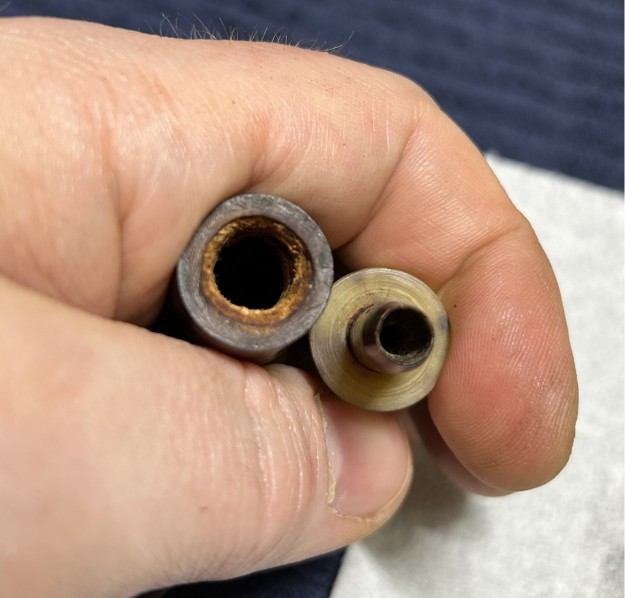
So I knew that the pipe was a early Genod pipe carved by Georges Vincent Genod, the grandfather of Jacques Craen of Genod pipes. The stamp means that the stummel is quite old as the stamp changed in the 1960s. The article said that Jacques found a number of these older GVG stummels in a sub-basement of the factory and he finished and stemmed them. This is obviously why this older looking stummel has a Delrin tenon in the horn stem. Now it was time to work on the pipe.
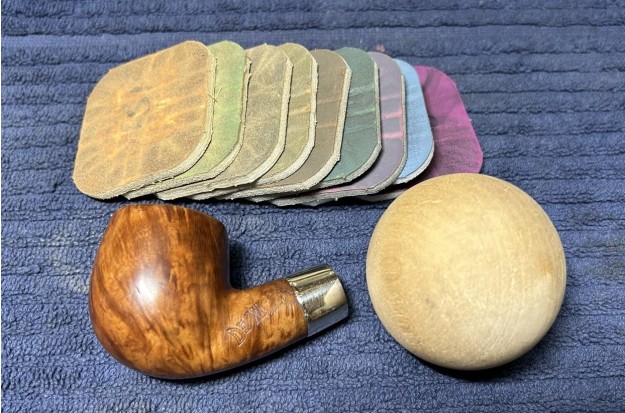
I scraped the bowl to remove the debris from the top half of the bowl. I sanded the darkened/lava crusted rim top to remove the darkening with a folded piece of 220 grit sandpaper. It cleaned up very well.I polished the bowl and shank with micromesh sanding pads. I dry sanded with 1500 -12000 grit pads and wiped the bowl down with a damp cloth after each sanding pad. It began to really come alive. I rubbed the briar down with Before & After Restoration Balm. I worked it into the finish with my fingertips. The product works to clean, enliven and protect briar finished. I let it sit for 10 minutes then buffed it off with a cotton cloth. The grain on the bowl really came alive with the buffing. It is really a beautiful pipe. I did a quick polish on the horn stem with micromesh sanding pads – 1500-12000 grit pads. I wiped the stem down after each pad with Obsidian Oil to protect and enliven the horn. It came out looking very good. This interesting GVG EXTRA 9745 Liverpool is an amazing pipe with a bowl turned by Georges Vincent Genod, the grandfather of Jacques Craen of Genod pipes. The stamp means that the stummel is quite old as the stamp changed in the 1960s. Jacques had finished and stemmed the pipe. It turned out really well and it is a great looking pipe with a great shape to it. The grain on the briar and the sheen on the horn stem really popped when the pipe was buffed with blue diamond on the buffing wheel. The golden coloured band also took on a sheen. I gave the bowl and stem multiple coats of carnauba wax and buffed it with a clean buffing pad. I hand buffed the pipe with a microfiber cloth to deepen the shine. The GVG Extra Liverpool is comfortable to hold and is quite distinguished looking. Give the finished pipe a look in the photos below. The dimensions of the pipe are Length: 6 inches, Height: 1 ¾ inches, Outside diameter of the bowl: 1 inch, Chamber diameter: ¾ of an inch. The weight of the pipe is 33 grams/1.16 ounces. This is a beautiful pipe that I am still thinking through what I am going to do with it. Should I sell it or add it to the collection? Not sure yet. Thanks for reading this blog and my reflections on the pipe while I worked on it. Keep an eye out on the blog as I have several other older horn stemmed pipes that will be coming up soon.
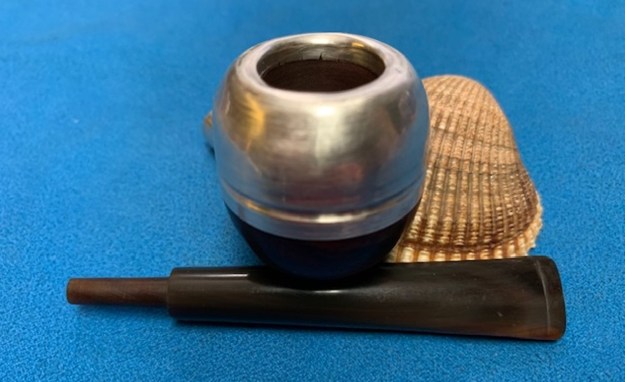
Reviving another Older Horn Stemmed Pipe from the Bag of Old Timers


Blog by Steve Laug

Having finished early 1900s KB&B Horn Stemmed Italian Billiard and posted the blog about the work on it (https://rebornpipes.com/2021/08/29/reviving-another-older-horn-stemmed-pipe-my-next-choice/) it was time to choose another pipe. I decided to keep working on the bag of older NOS/unsmoked pipes. I chose another horn stemmed pipe from the lot and this time picked one from a French Maker. It is kind of underneath the pile in the photo below but it is there nonetheless.In the photo of the poured out bag on my desk top I have circled the pipe that is next on the table. This was one of the unsmoked pipes that I had separated out before. I sat at my desk went over the pipe I had chosen. It is an unsmoked, new old stock (NOS) Dublin that is stamped on the left side of the shank and reads Racine De Bruyere arched over JSN in a diamond with Garantie arched under the diamond. There was narrow nickel band on the end of the shank that is decorative. The finish is dark and dirty but in relatively good condition. It was tired looking but under the dark oxblood finish and dust of time it was quite stunning. The stem is horn and it has a push tenon. The slot in the end of the stem is quite unique and goes from edge to edge of the button almost like the head of a screw. It is a beauty that I want to refresh and probably add to my own collection. Here are a few photos of the pipe before I did anything to it. I took photos of the bowl and stem. You can see the unused condition of the bowl and the clean rim top and edges. The drilling is centered in the bottom of the bowl. It is a good sized bowl. The interior walls of the pipe are smooth and do not have drilling marks or checks or chips. The horn stem is in excellent condition and has a very odd and unique button. It is slotted differently than I expected with the slot extending through the right and left edges (see the photos below). I took a photo of the stamping on the left side of the shank. It reads as noted above. The stamping is filled in with gold and is very readable.I removed the stem from the shank. You can see the new integral push tenon in the photo below. The proportions of this pipe are well done. The grain around the bowl is very nice. I turned to both Pipephil and Pipedia for a review of the history of the brand and to try and pin down a date for this pipe. I was unable to find anything on either site on the JSN brand. It appears it is a bit of a mystery. The least I could do was translate the French.

Racine = Root

Bruyere = Briar

Garantie = Guarantee/Genuine

So I knew that the pipe was a JSN from France and was Genuine or Guaranteed Root Briar pipe. That was all there was available at this point in the process. The style and stem all spoke to it being an older pipe probably of the same era as the KB&B billiard that I just finished. Now it was time to work on the pipe.

I polished the briar and smoothed out the repairs with the higher grit micromesh sanding pads. I dry sanded with 3200 -12000 grit pads and wiped the bowl down with a damp cloth after each sanding pad. It began to really come alive.  I rubbed the briar down with Before & After Restoration Balm. I worked it into the finish with my fingertips. The product works to clean, enliven and protect briar finished. I let it sit for 10 minutes then buffed it off with a cotton cloth. The grain on the bowl really came alive with the buffing. It is really a beautiful pipe. I did a quick polish on the horn stem with micromesh sanding pads – 1500-12000 grit pads. I wiped the stem down after each pad with Obsidian Oil to protect and enliven the horn. It came out looking very good. This interesting Early 1900s JSN Racine Bruyere Garantie Horn stem Dublin turned out really well and it is a great looking pipe with a great shape to it. The fact that it is New Old Stock (NOS)/unsmoked is an additional bonus. The grain on the briar and the sheen on the horn stem really popped when the pipe was buffed with blue diamond on the buffing wheel. The nickel band also took on a sheen. I gave the bowl and stem multiple coats of carnauba wax and buffed it with a clean buffing pad. I hand buffed the pipe with a microfiber cloth to deepen the shine. The petite JSN Horn Stem Dublin is comfortable to hold and is quite distinguished looking. Give the finished pipe a look in the photos below. The dimensions of the pipe are Length: 4 ¾ inches, Height: 1 ½ inches, Outside diameter of the bowl: 1 1/8 inches, Chamber diameter: ¾ of an inch. The weight of the pipe is 17 grams/.60 ounces. This is a beautiful pipe that I am still thinking through what I am going to do with it. Should I sell it or add it to the collection? Not sure yet. Thanks for reading this blog and my reflections on the pipe while I worked on it. Keep an eye out on the blog as I have several other older horn stemmed pipes that will be coming up soon.