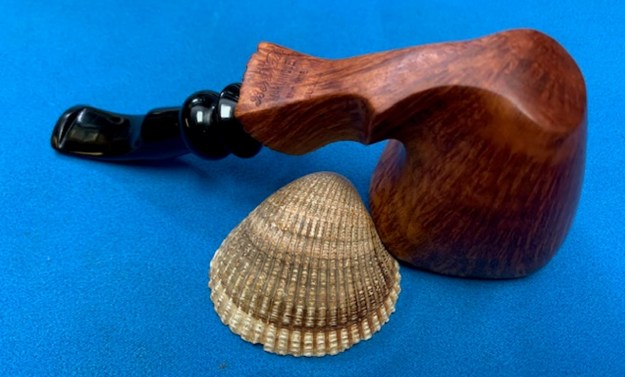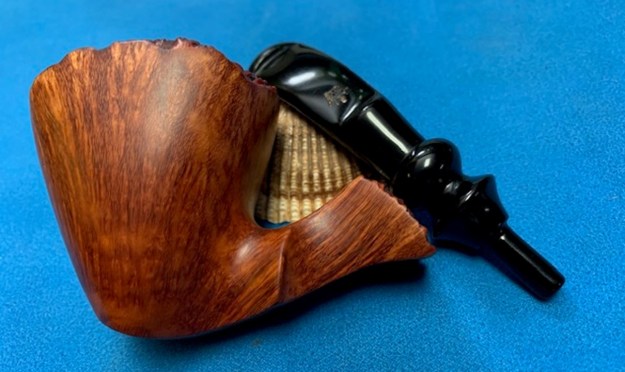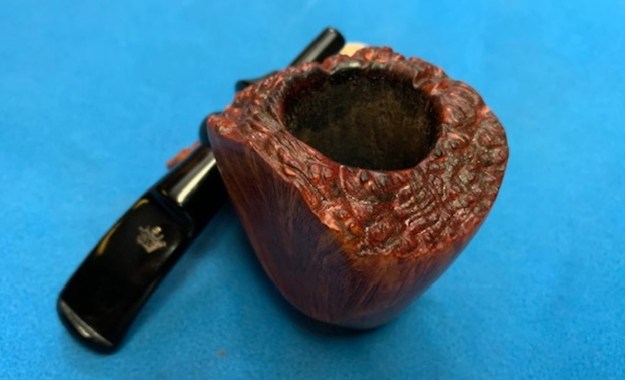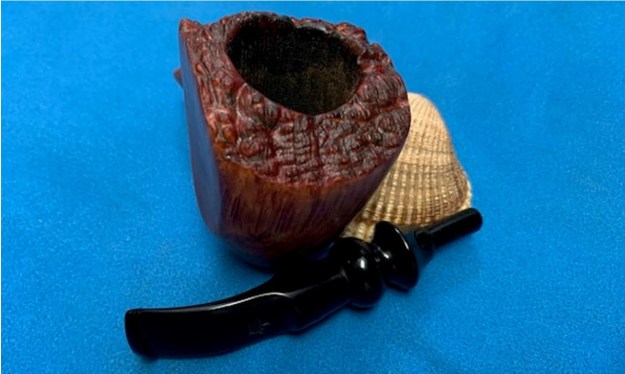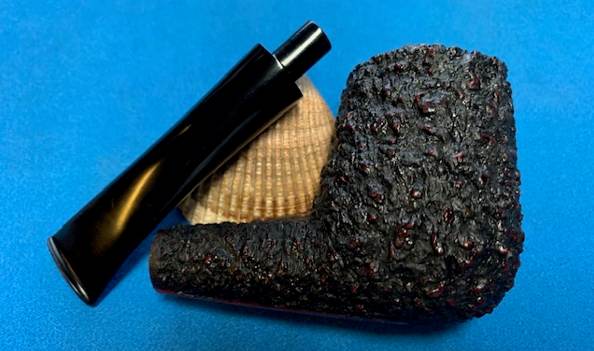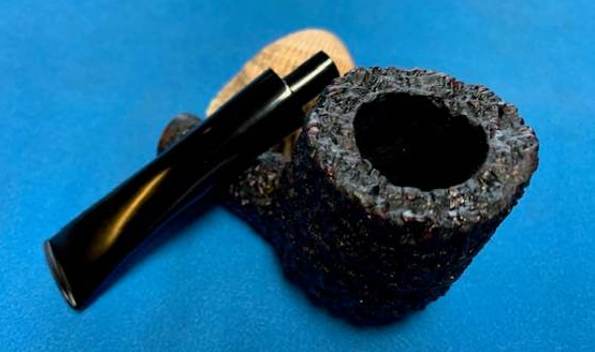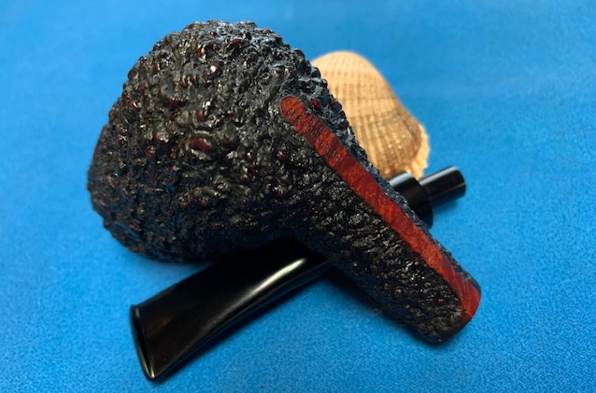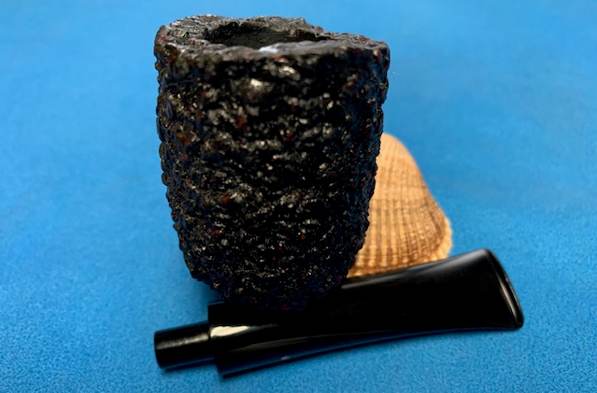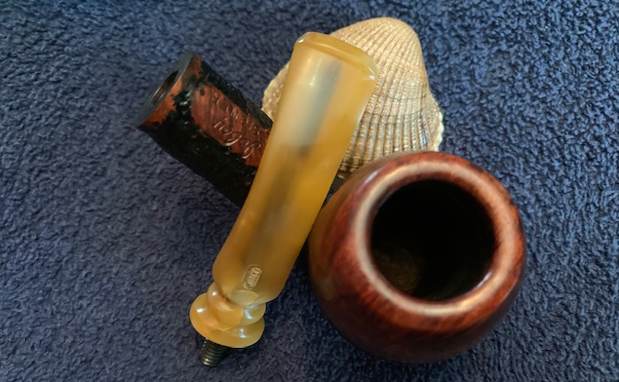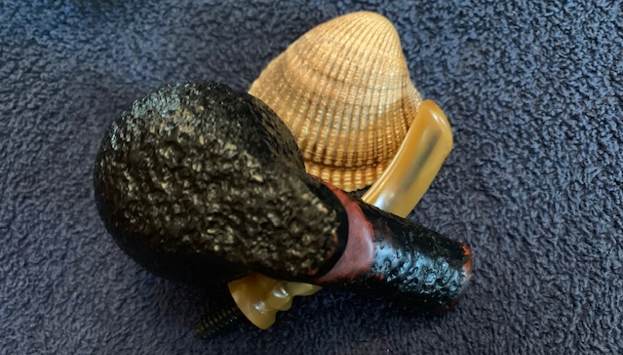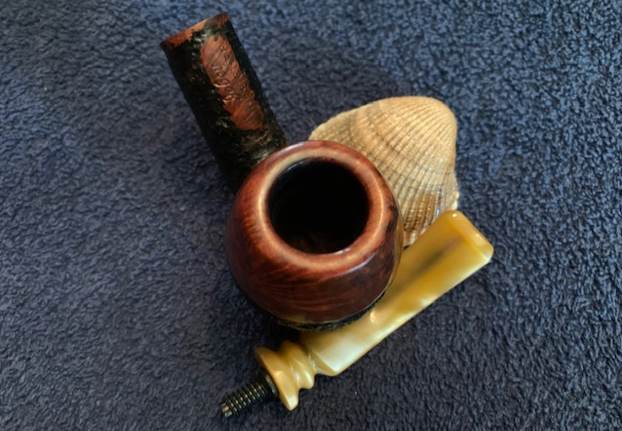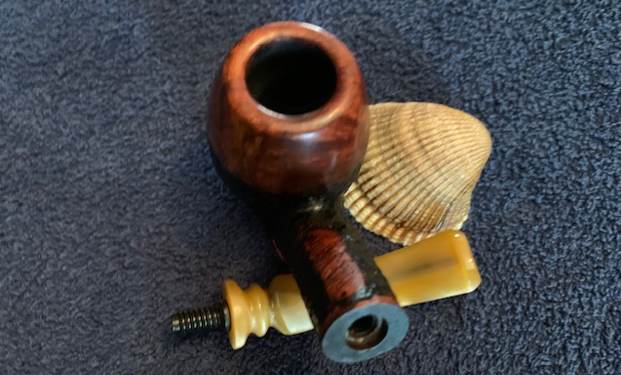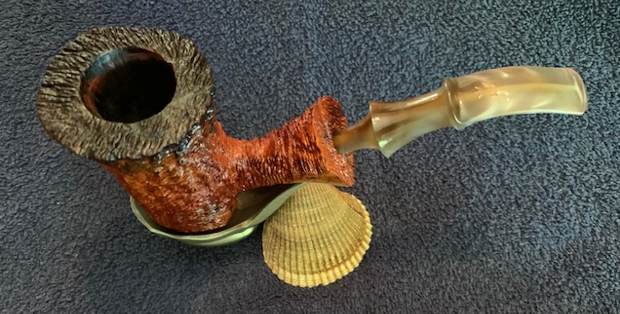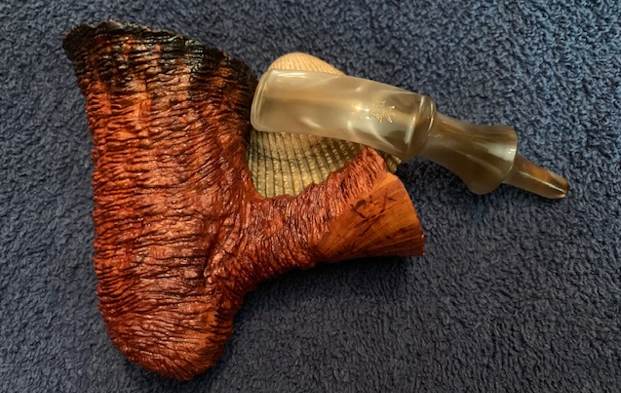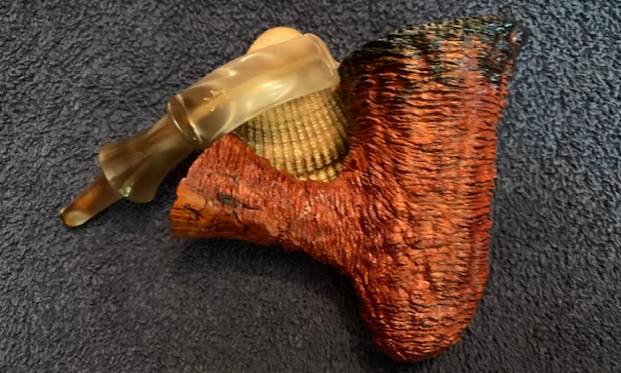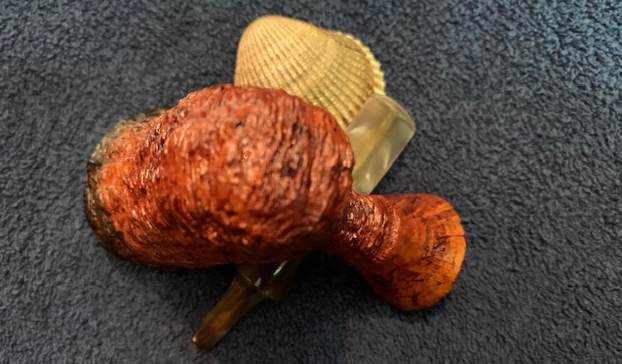
Tag Archives: polishing a Lucite stem

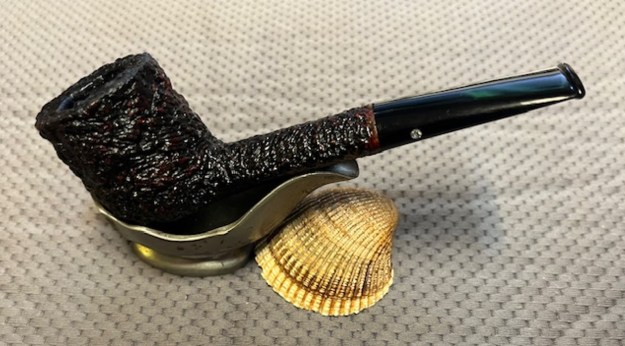
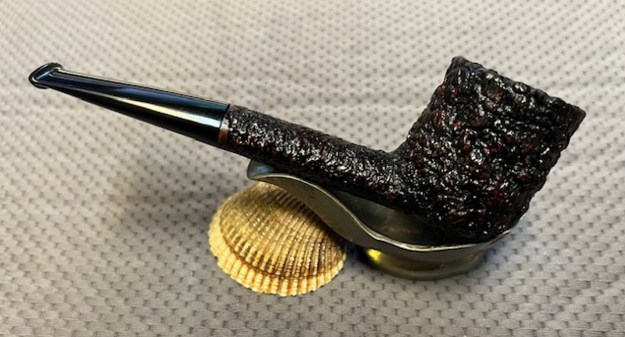
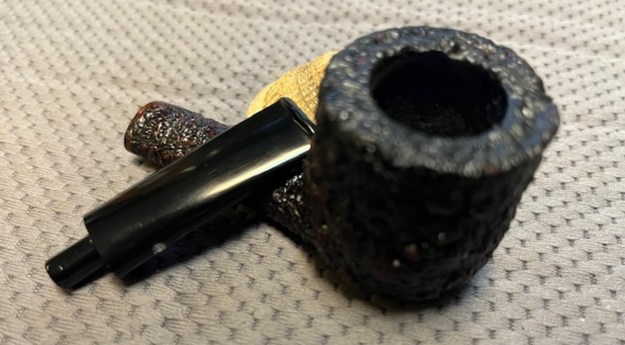
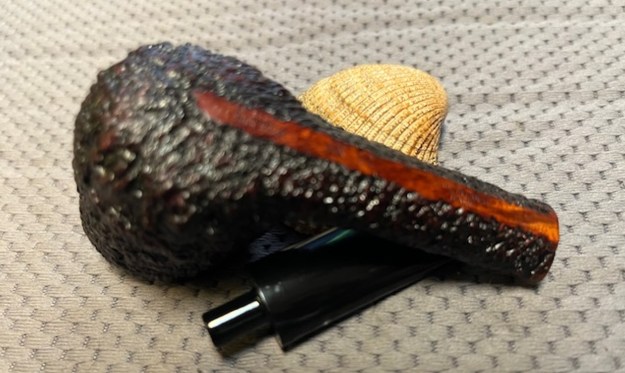
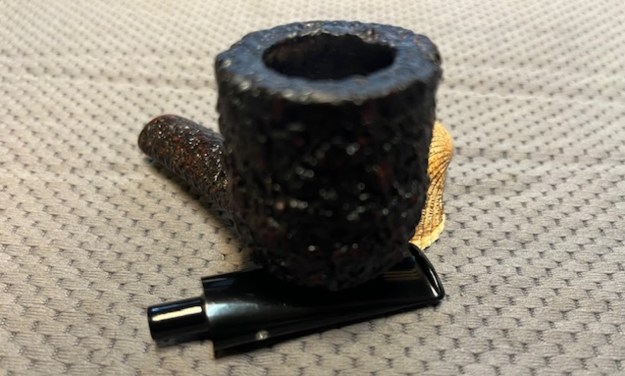
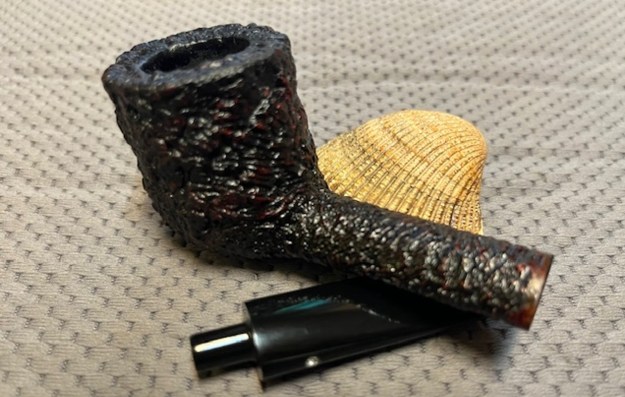
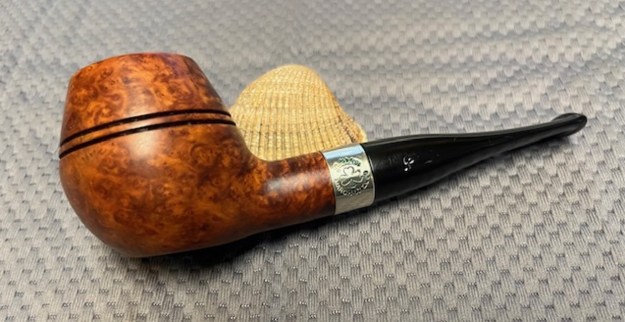
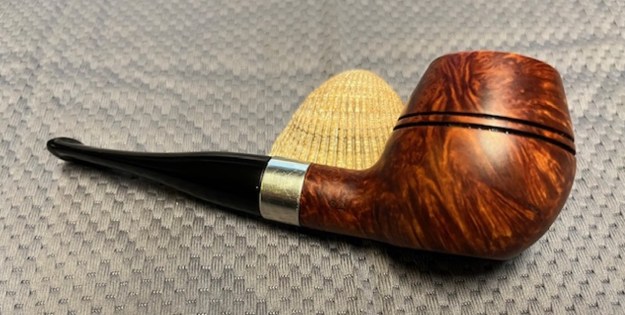
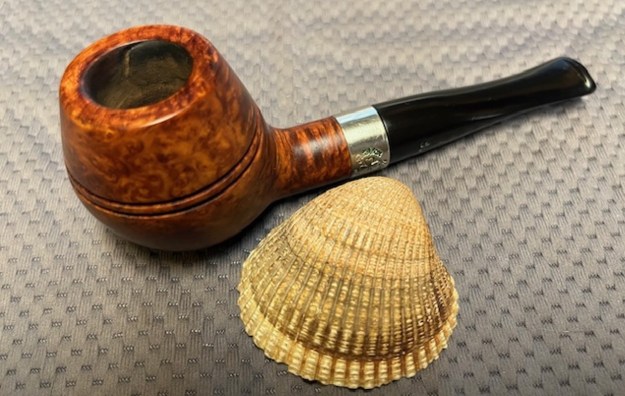
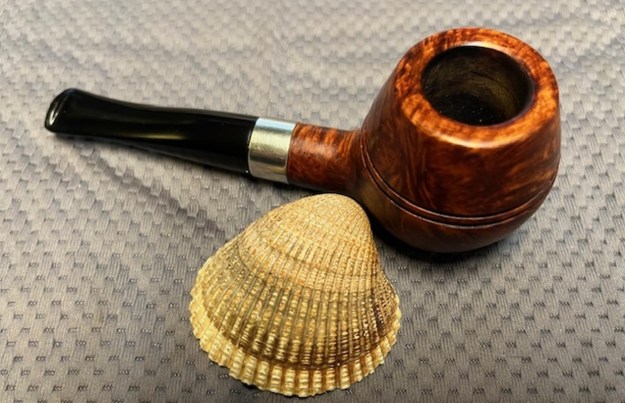
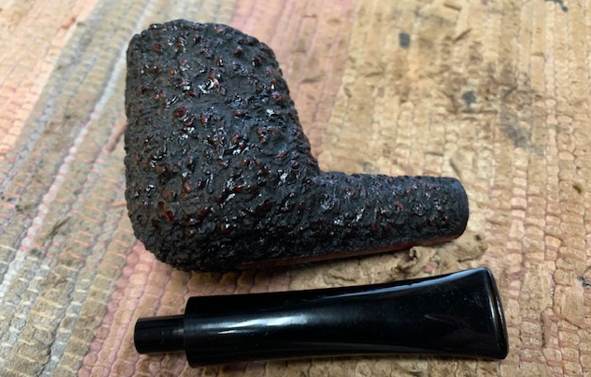
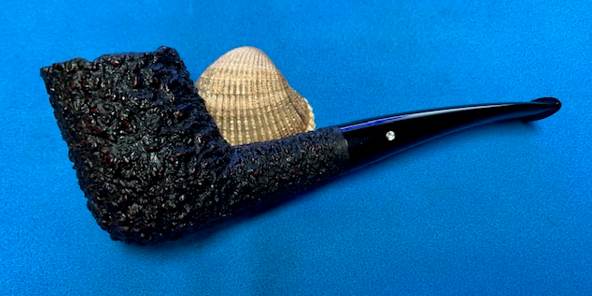
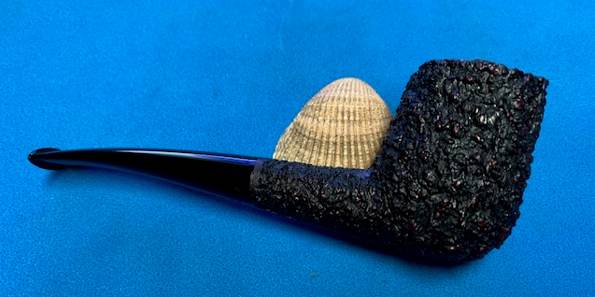
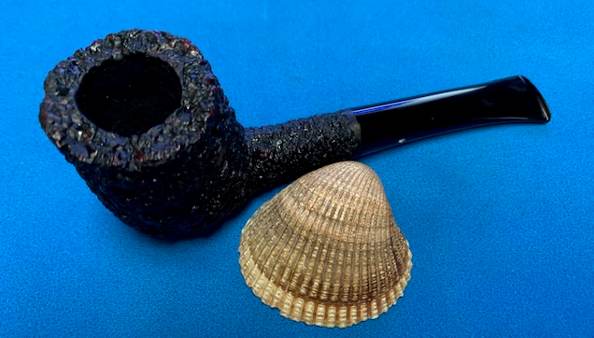
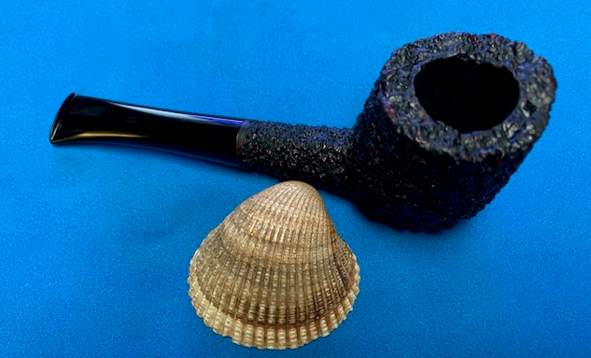
New Life for a Castello Sea Rock Briar KK32 Canadian


by Steve Laug

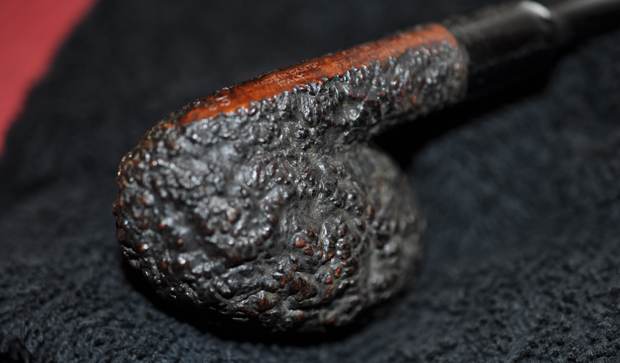
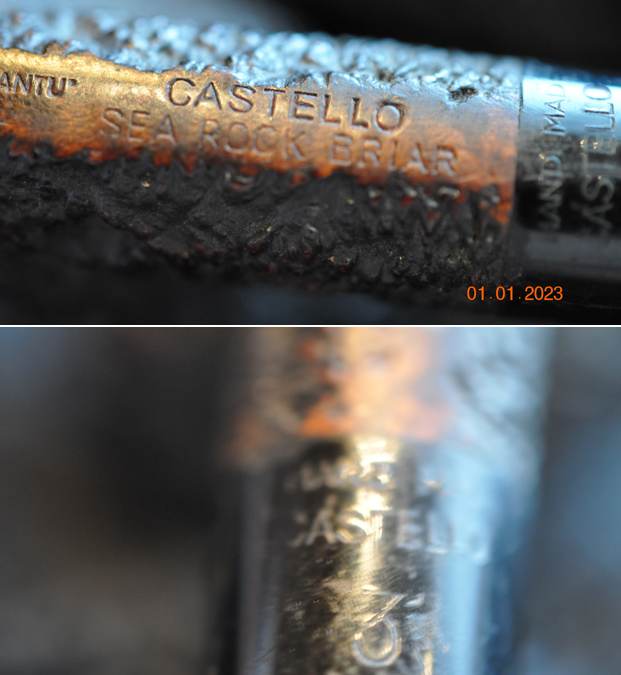
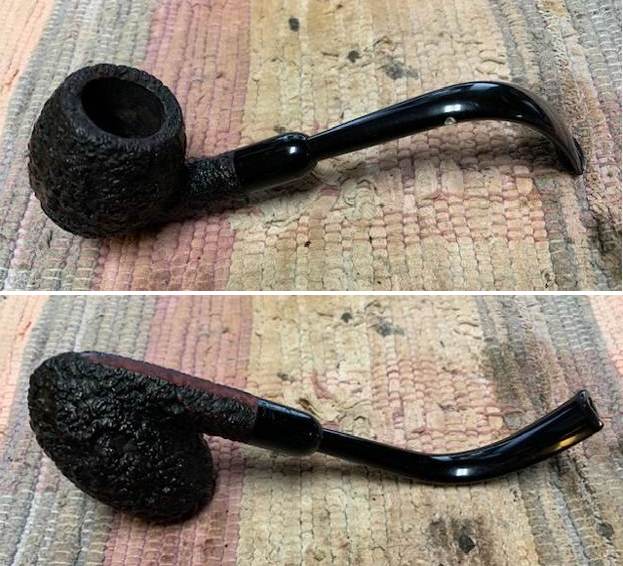
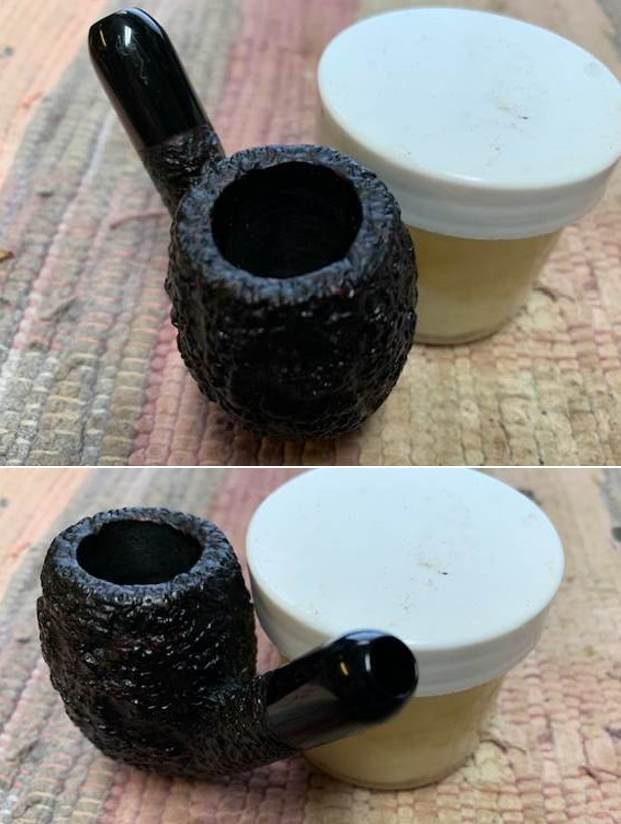
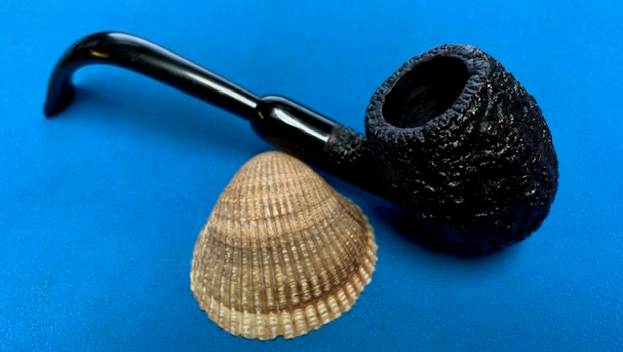
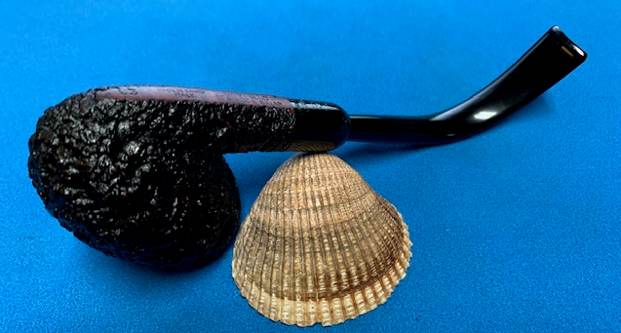
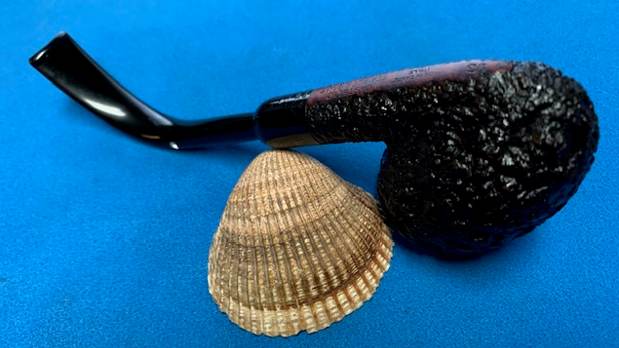
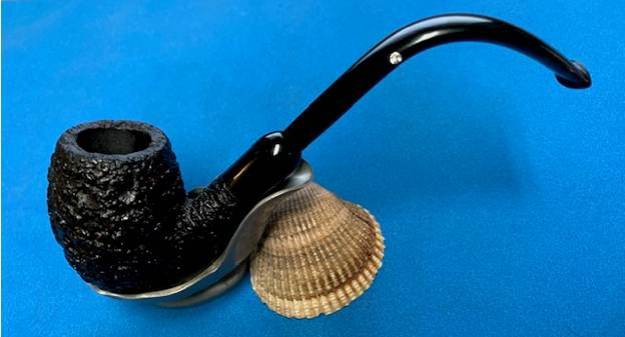
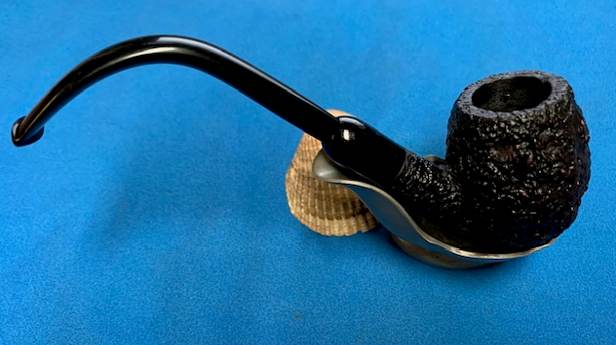
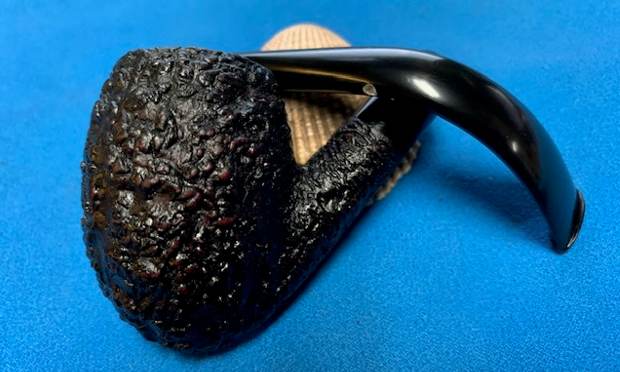
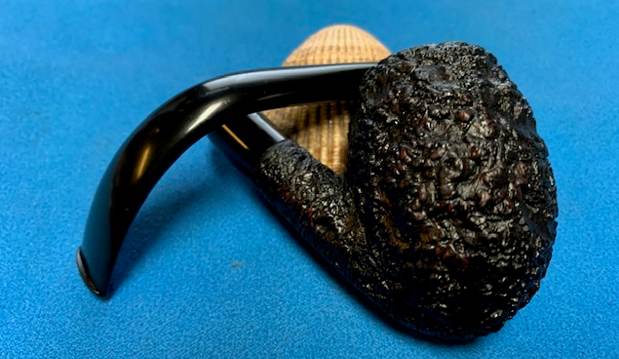
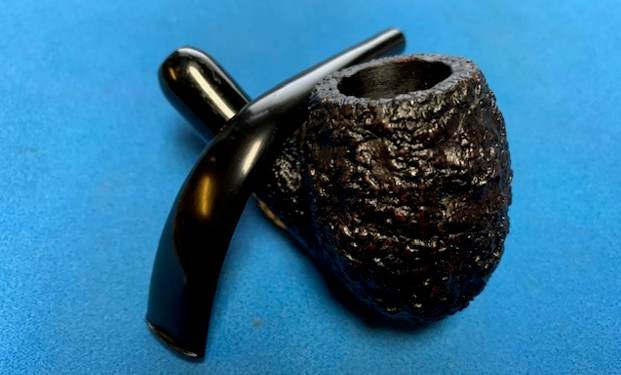
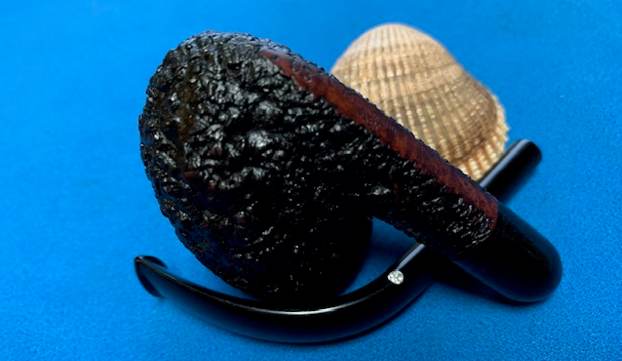
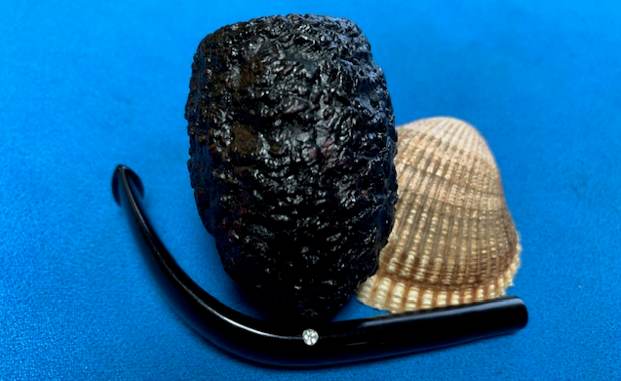
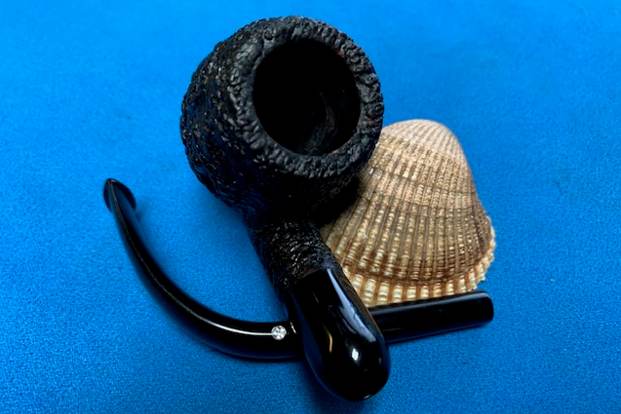
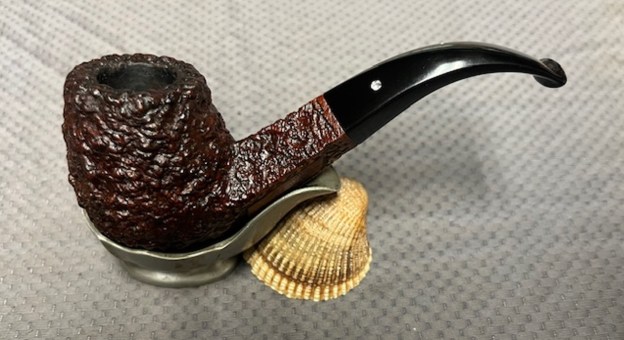
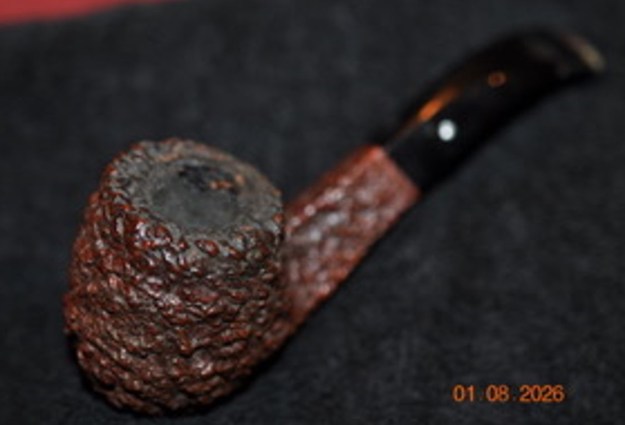
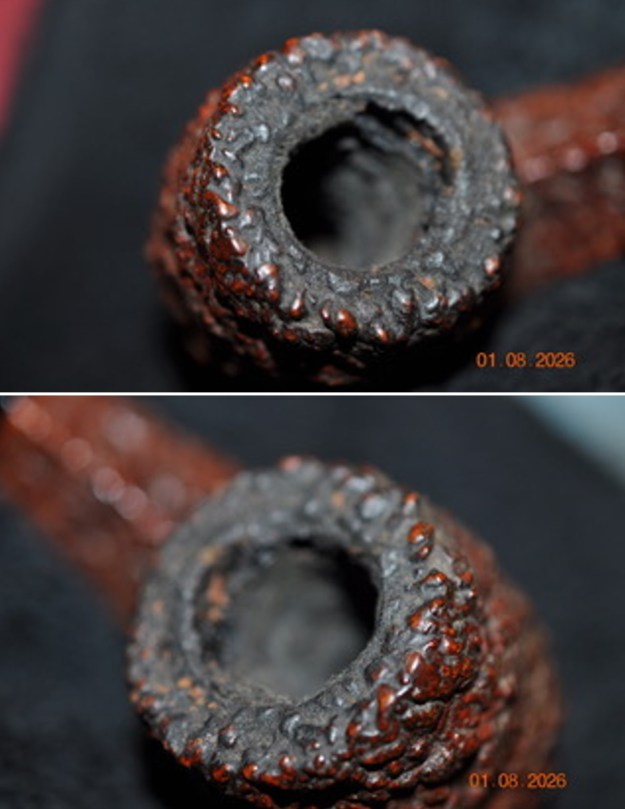
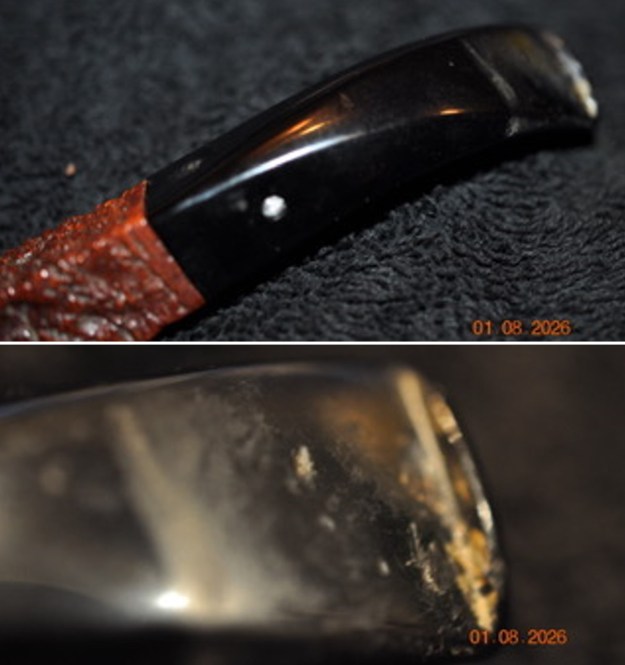
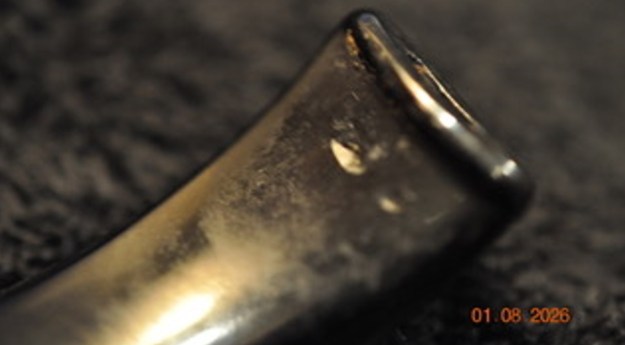
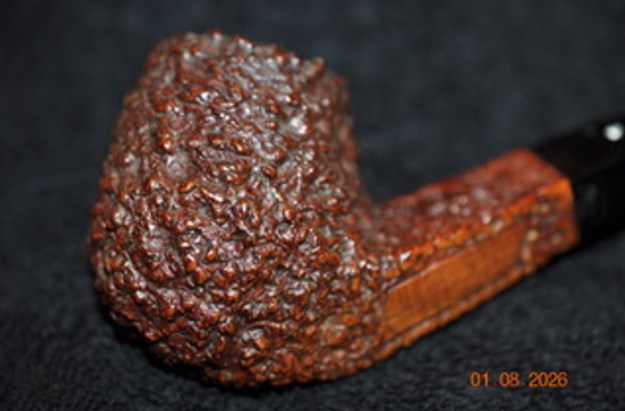
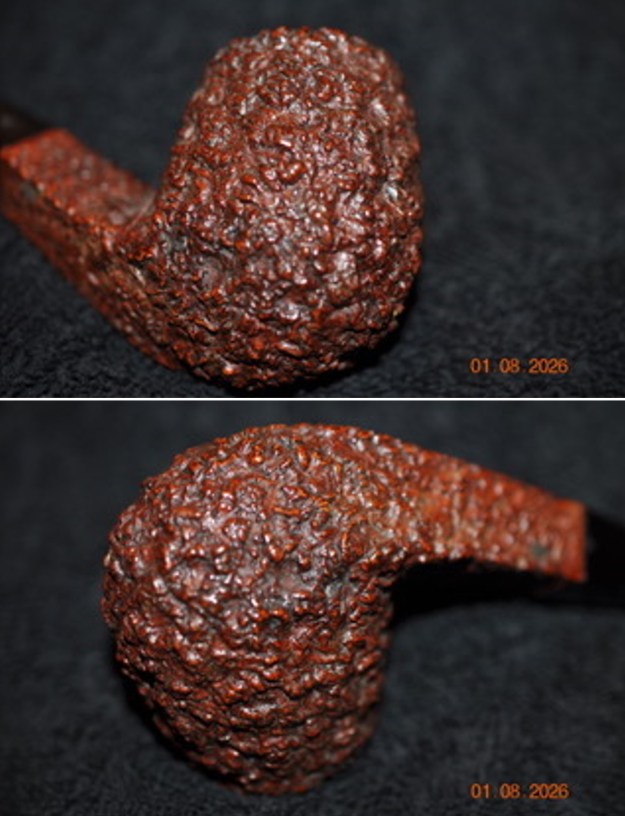
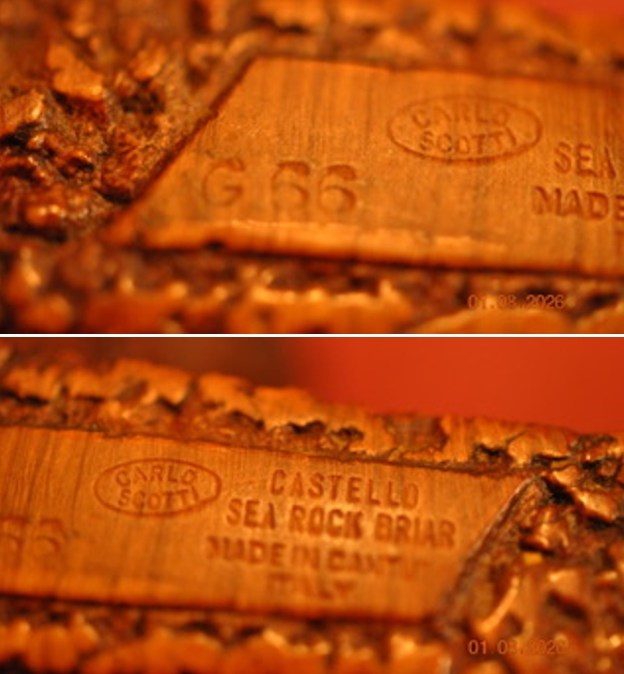
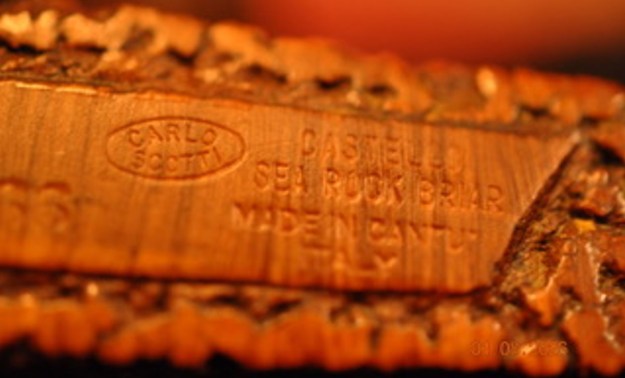
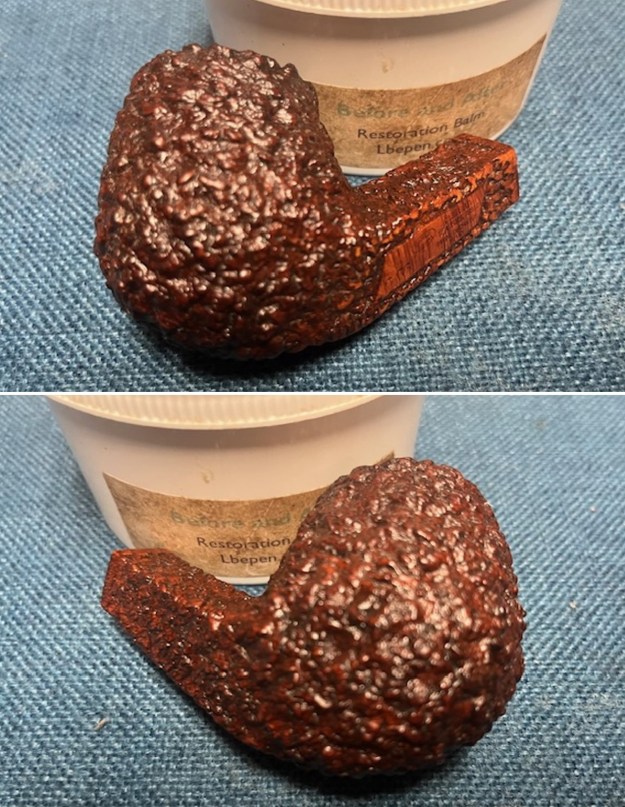
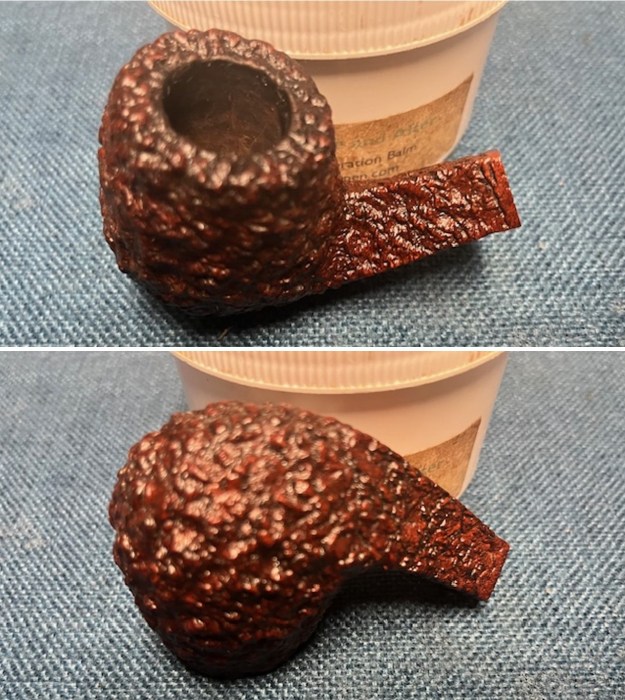
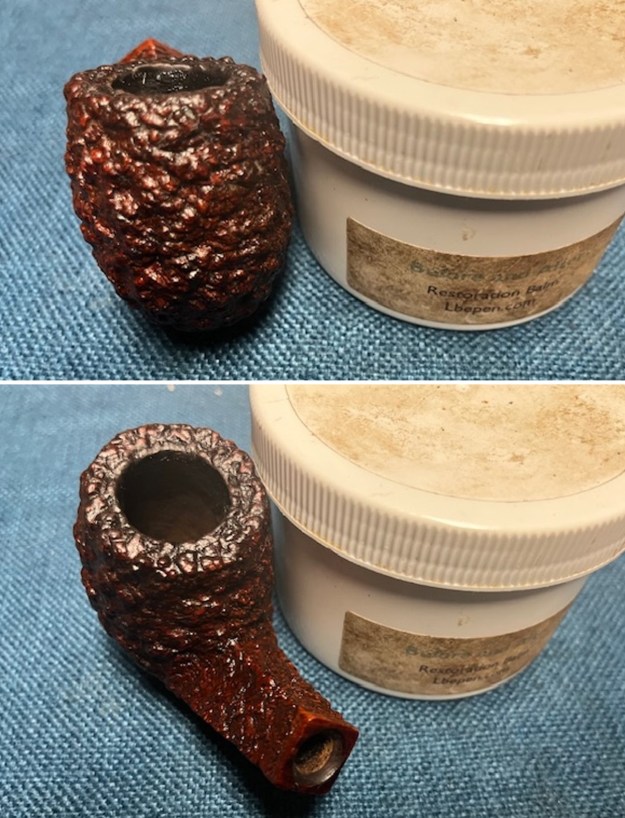
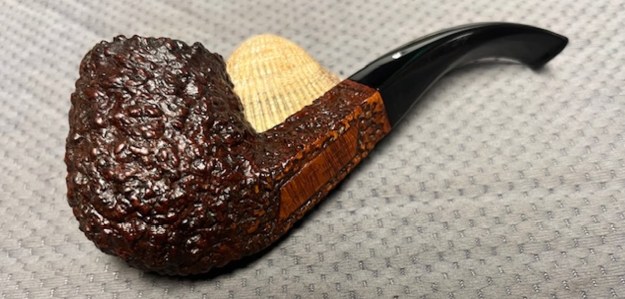
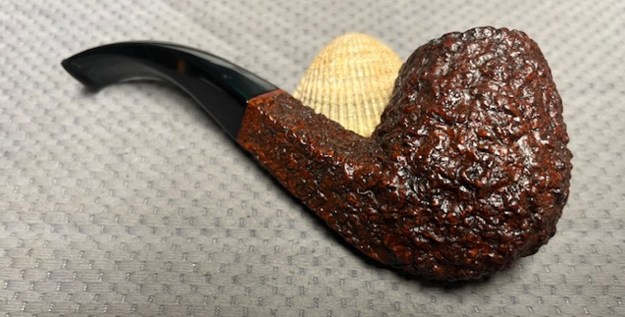
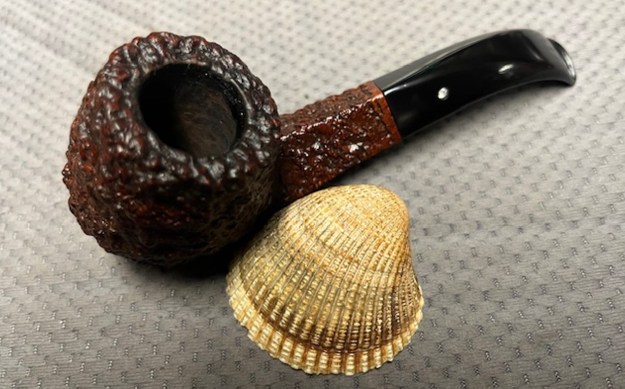
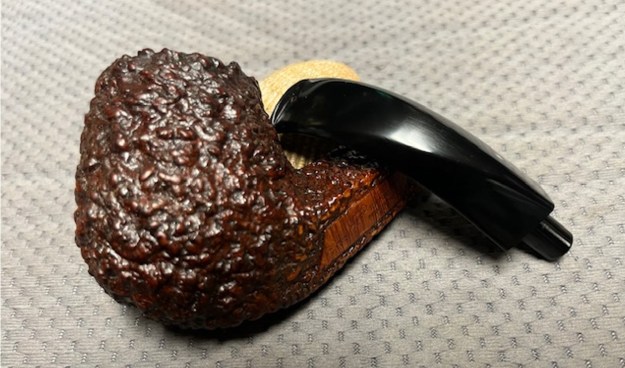
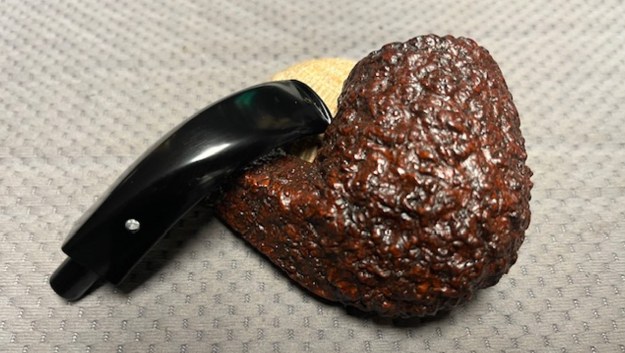
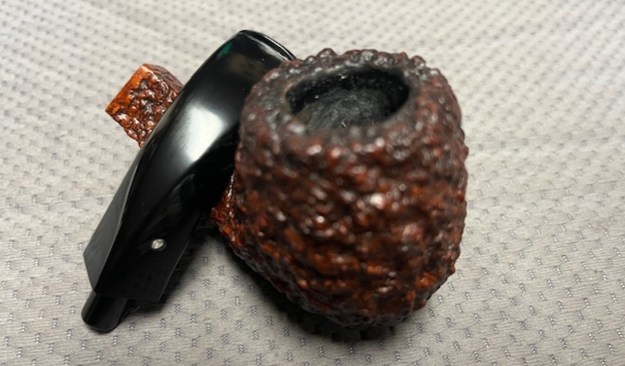
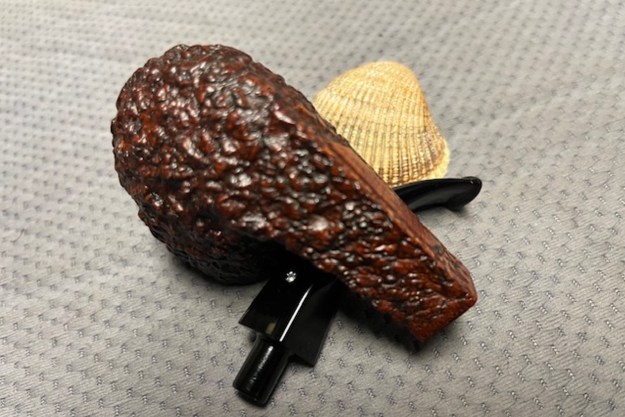
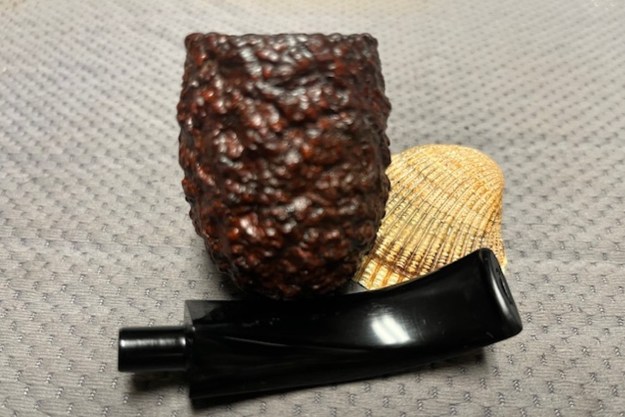
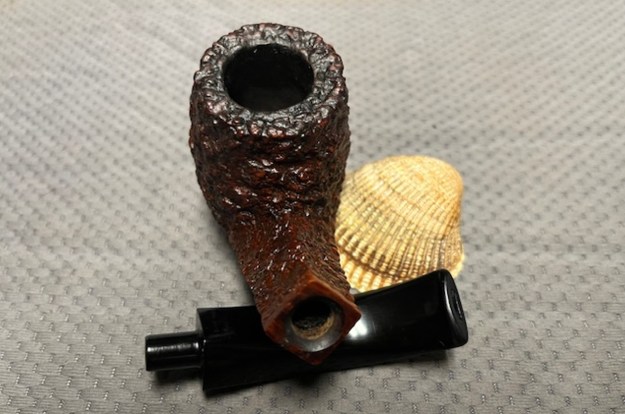
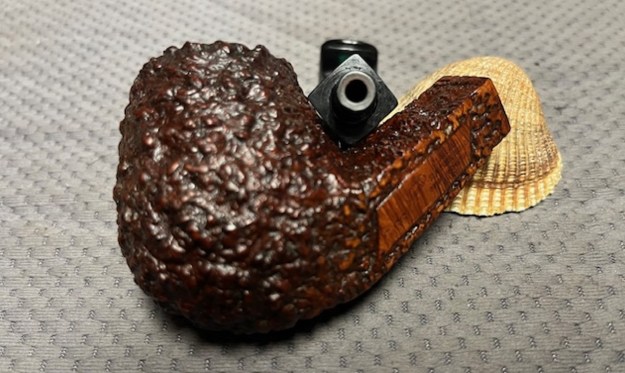
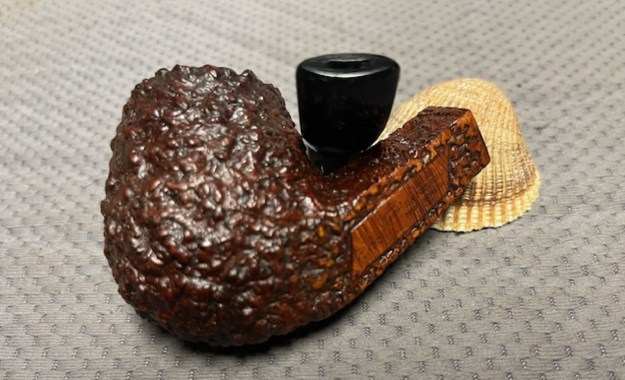
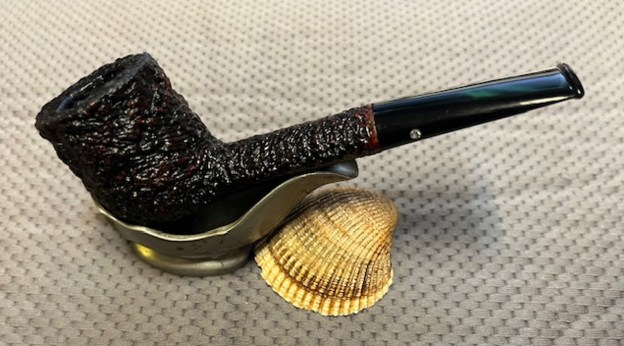
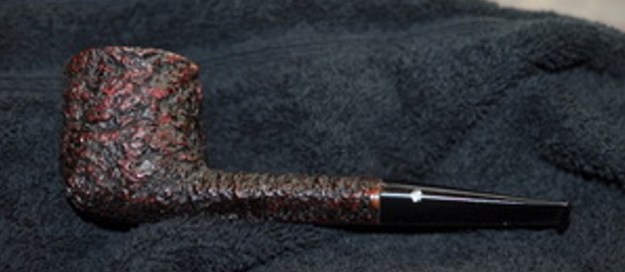
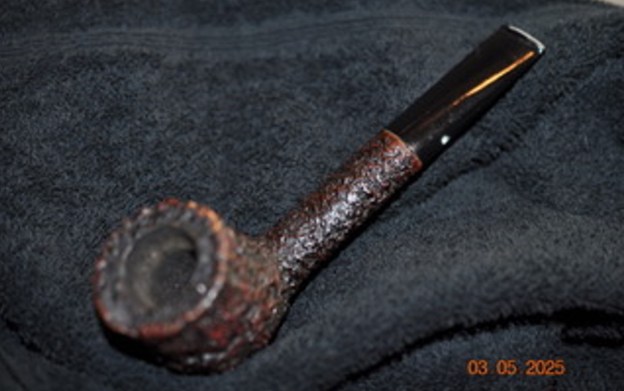
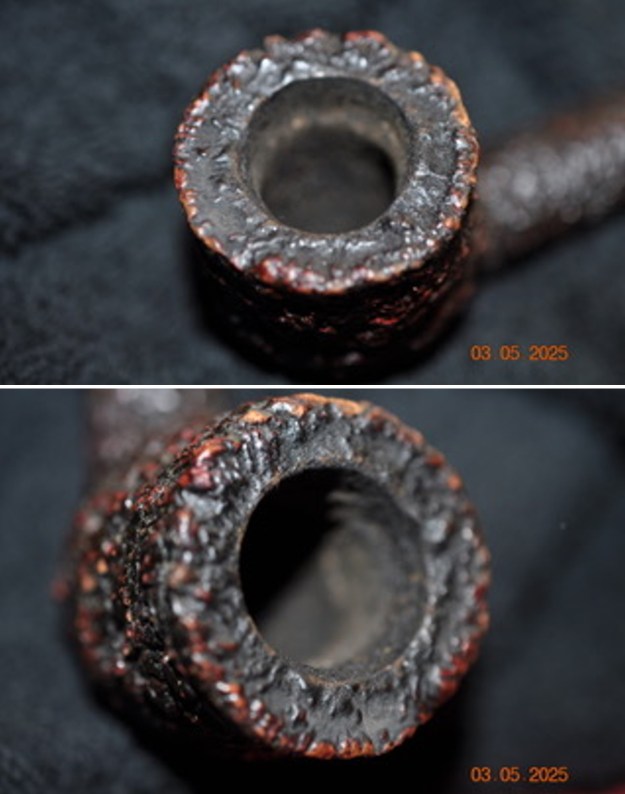
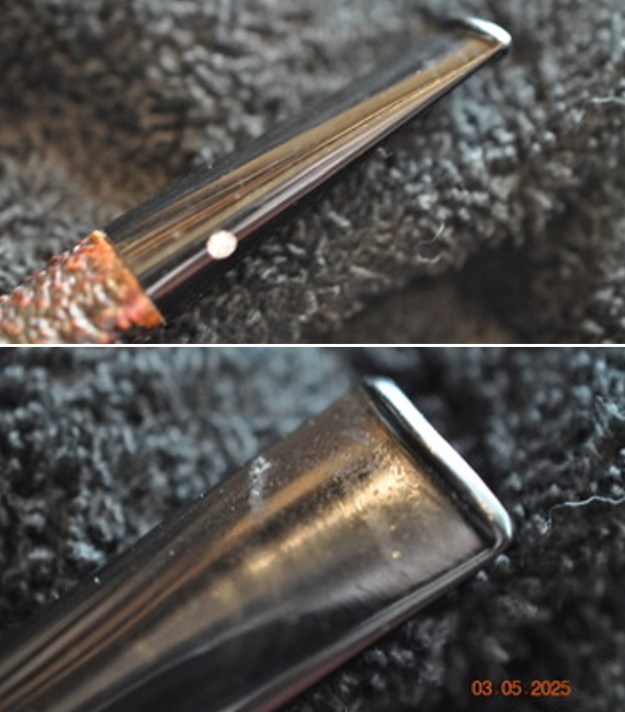
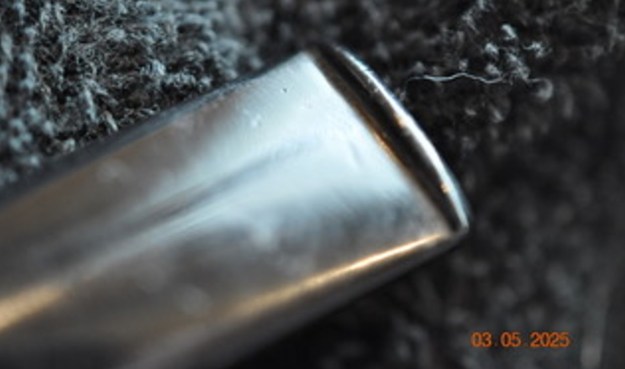
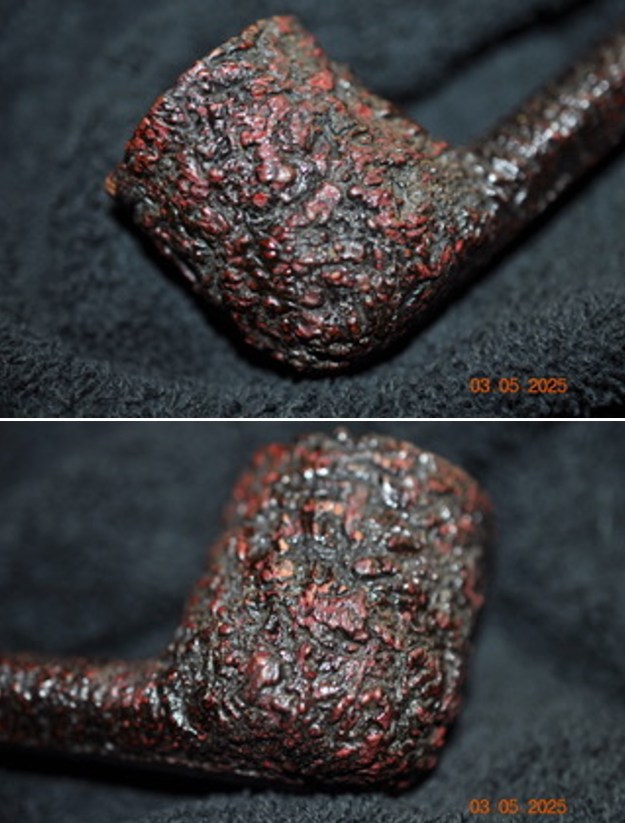
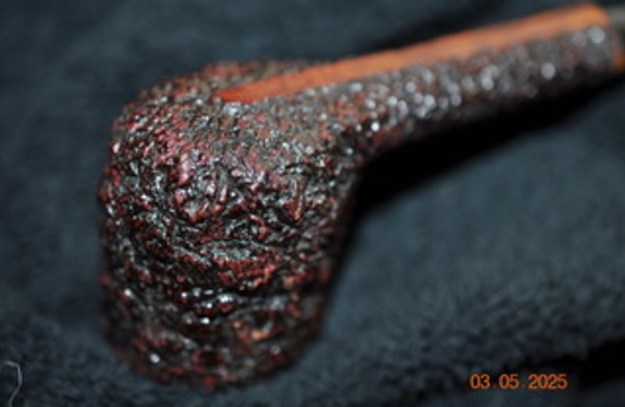
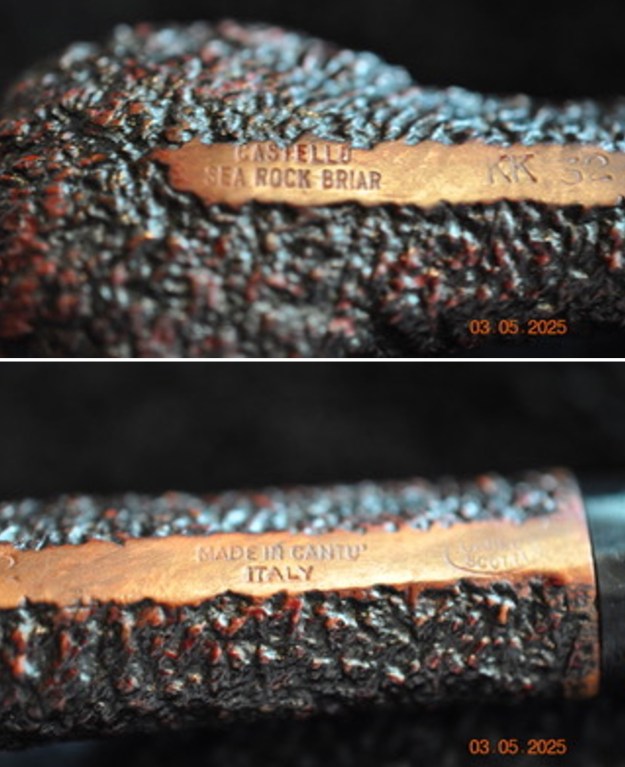
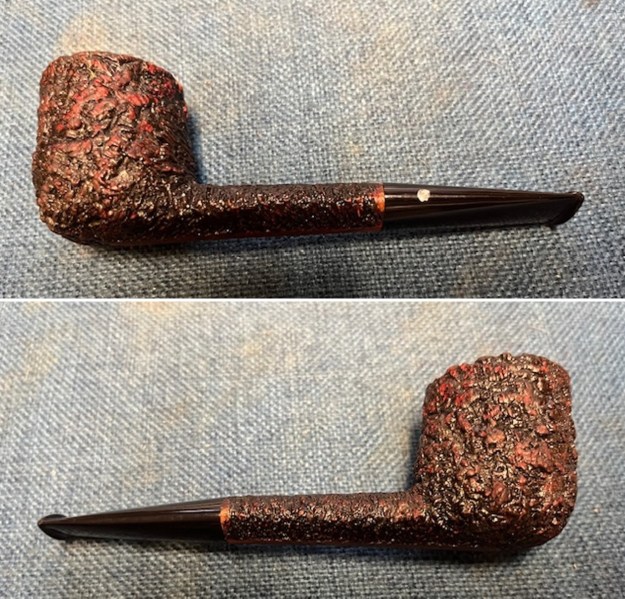
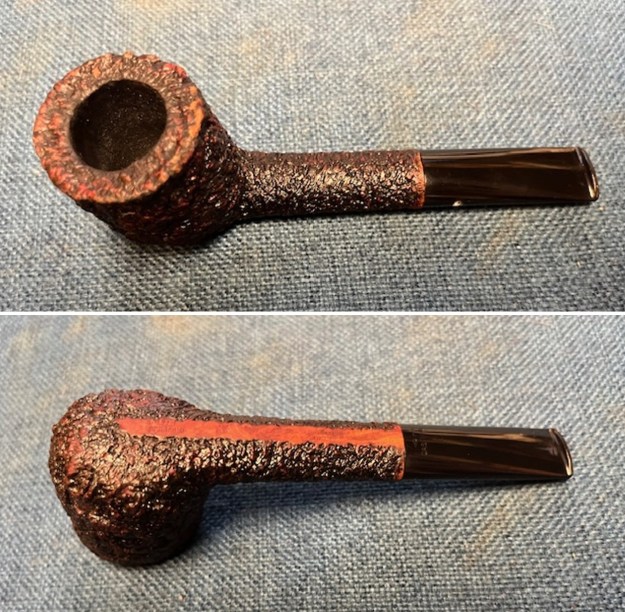
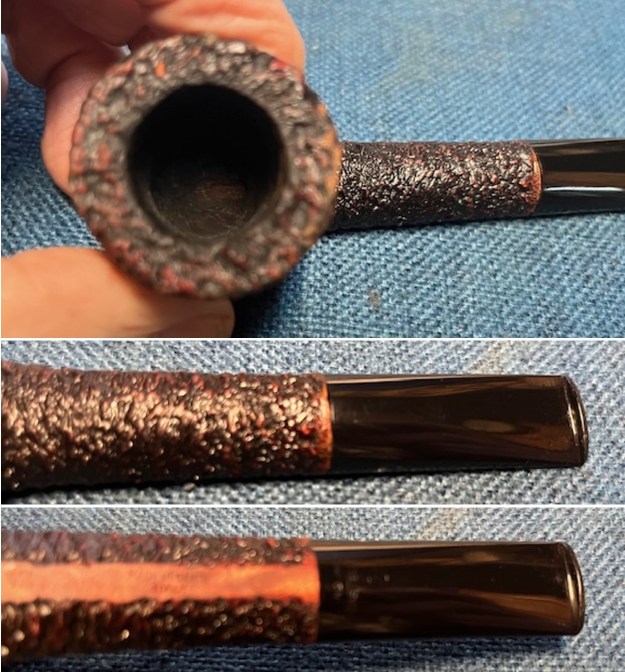
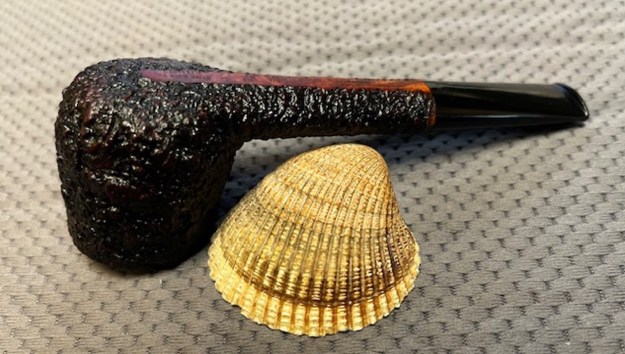
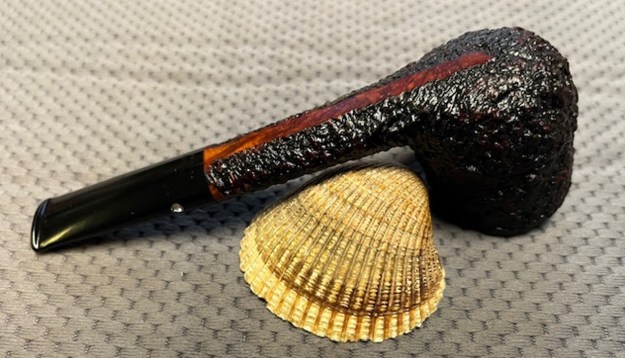
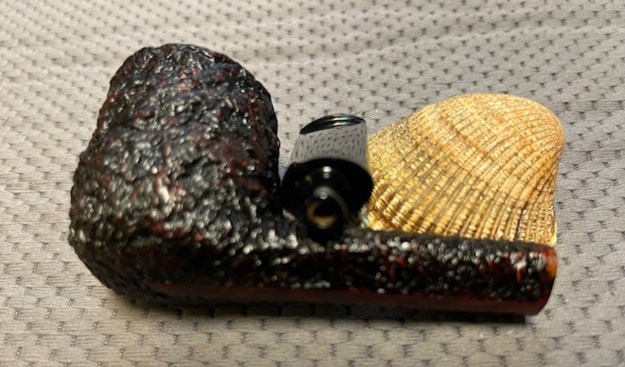
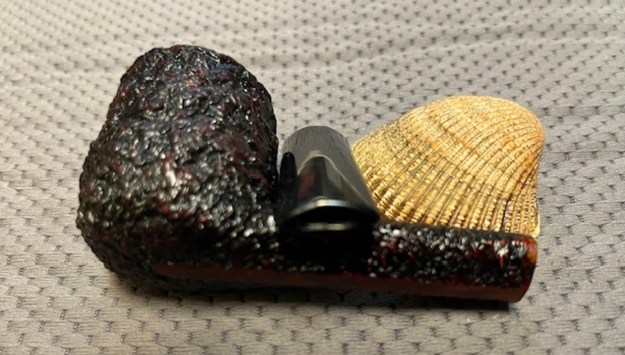
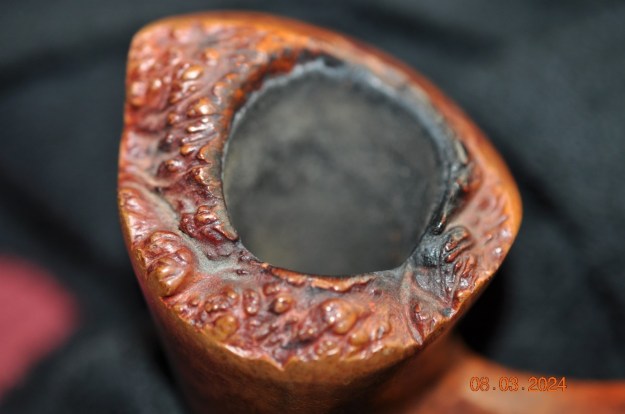
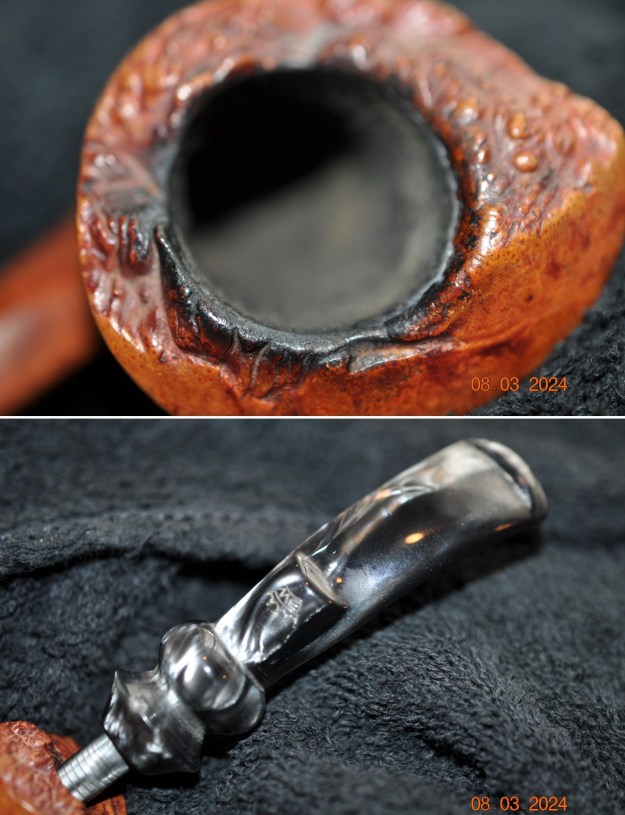
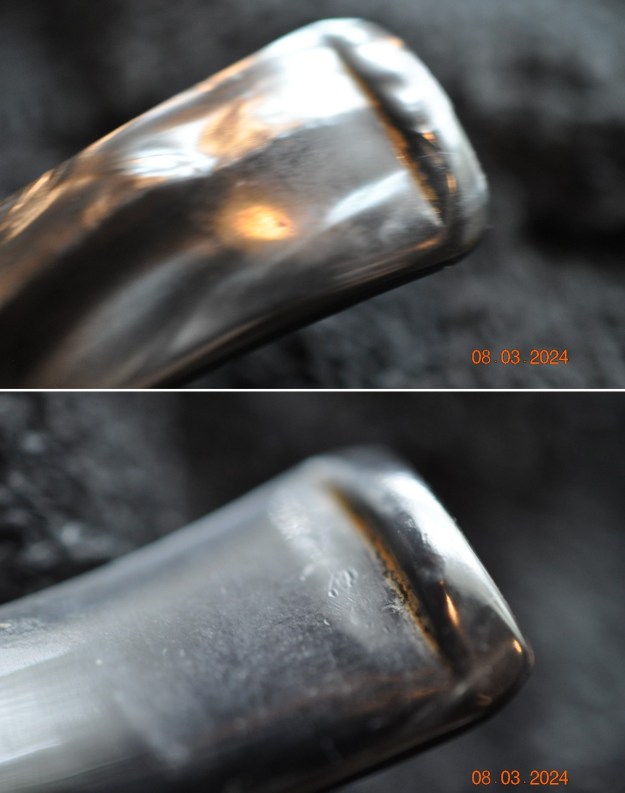
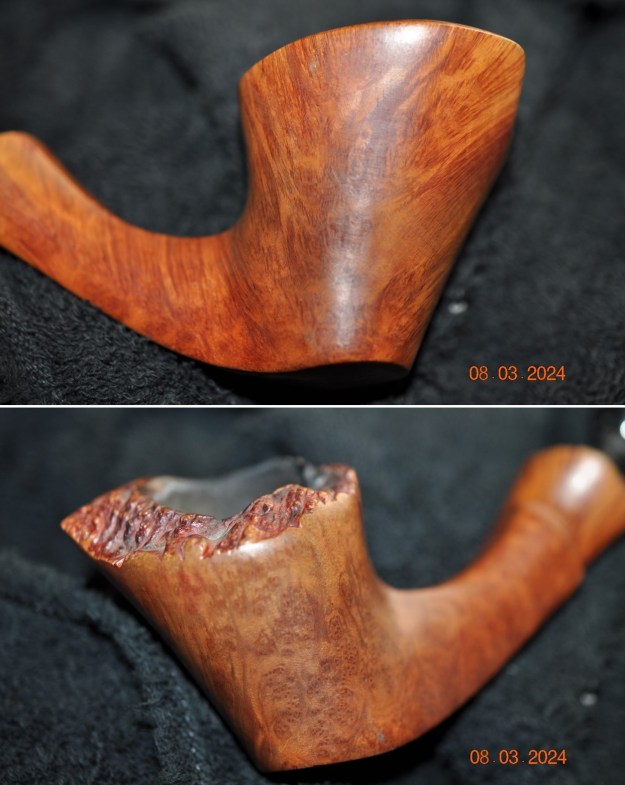
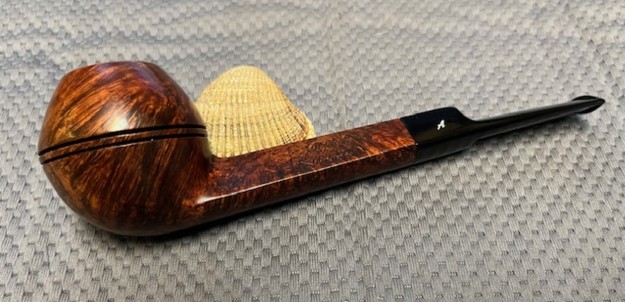
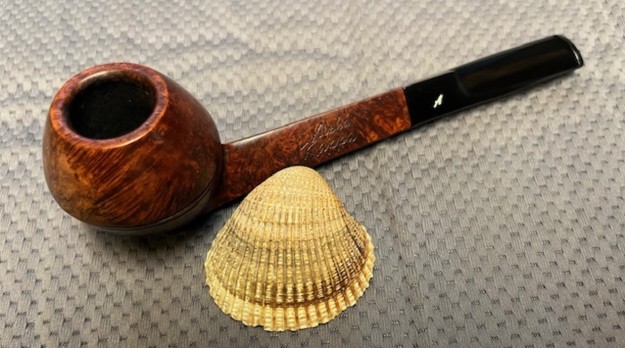
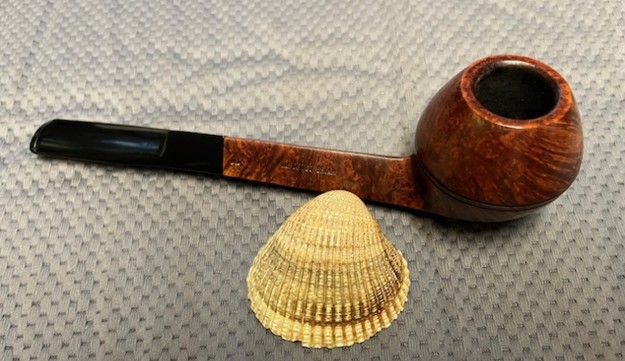
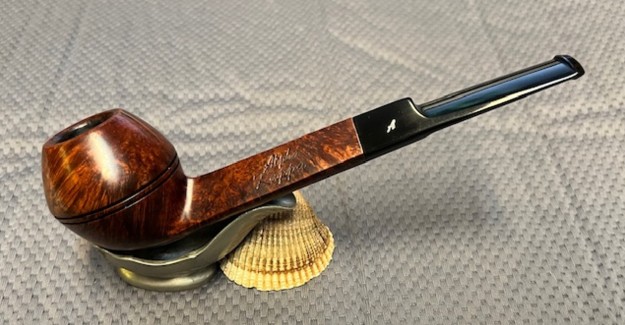
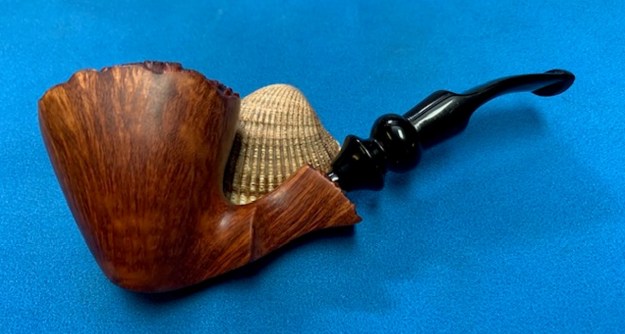
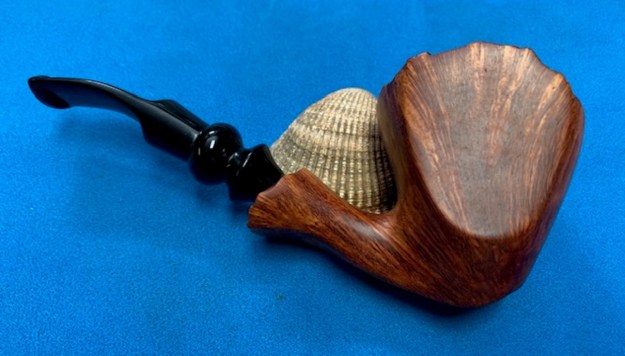
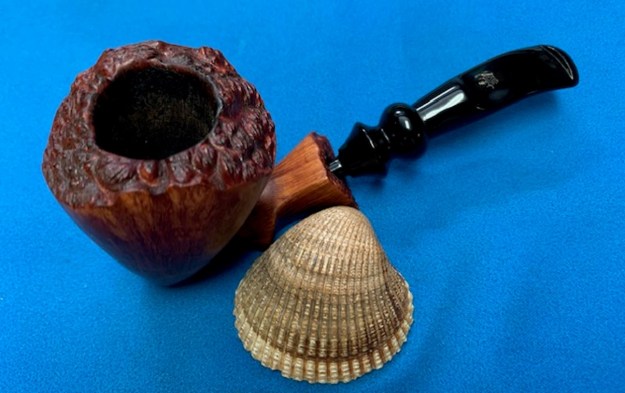
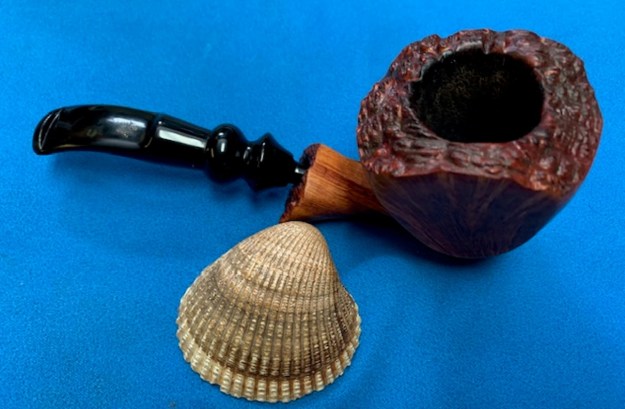
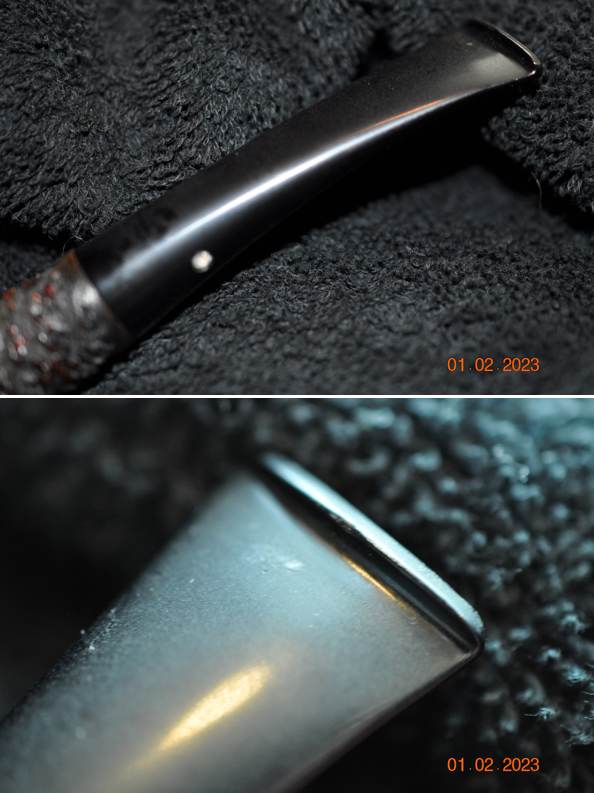
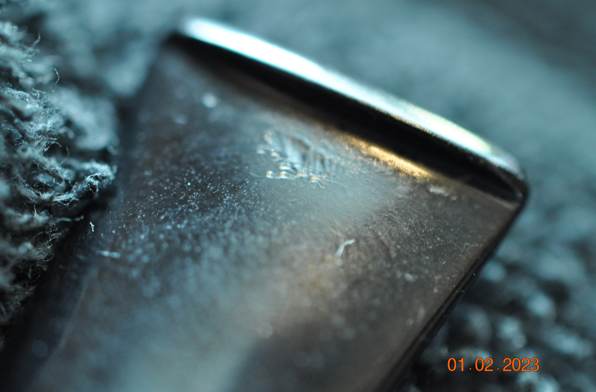
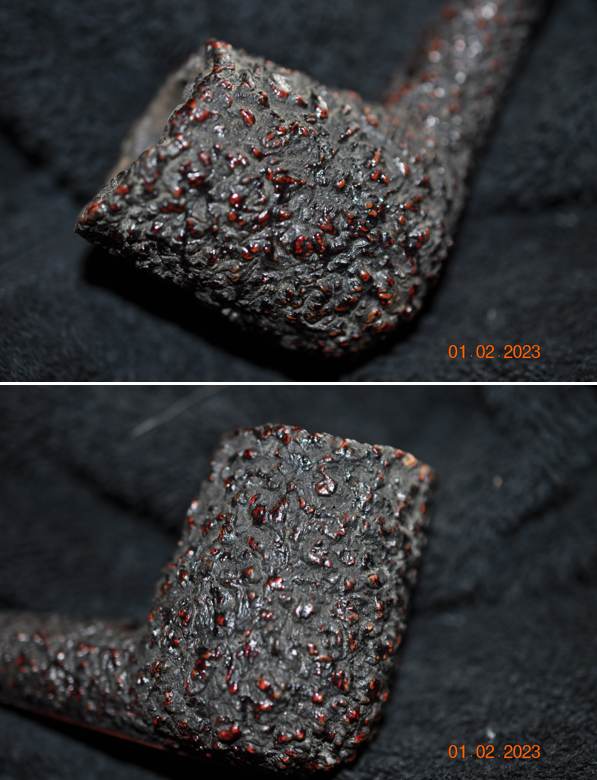
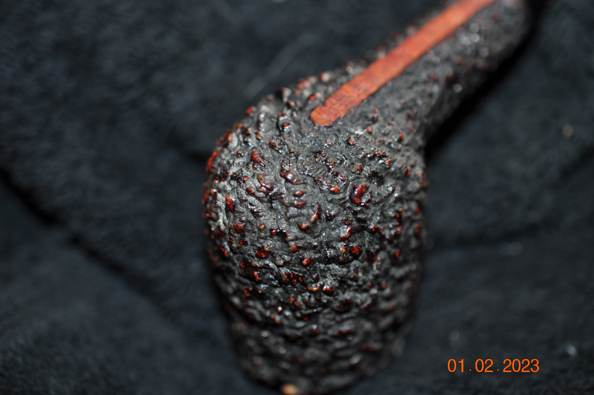
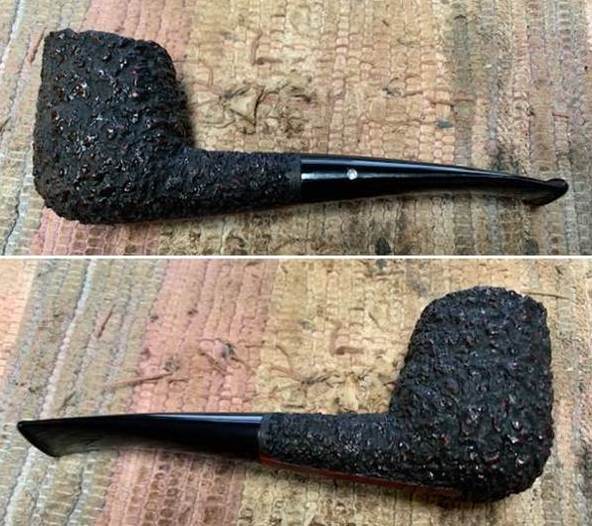
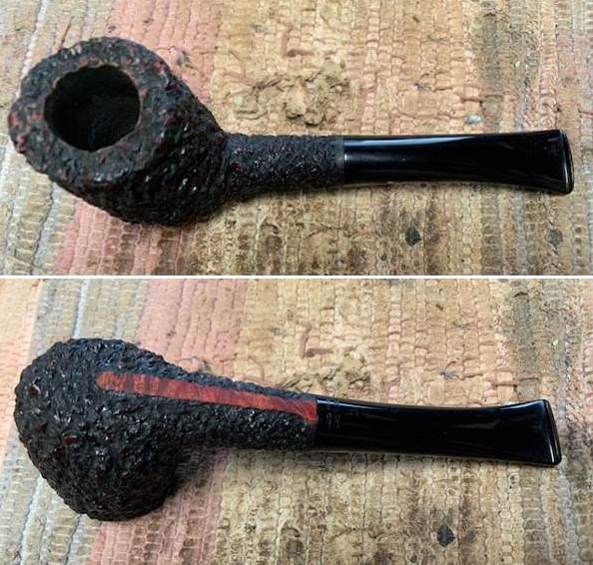
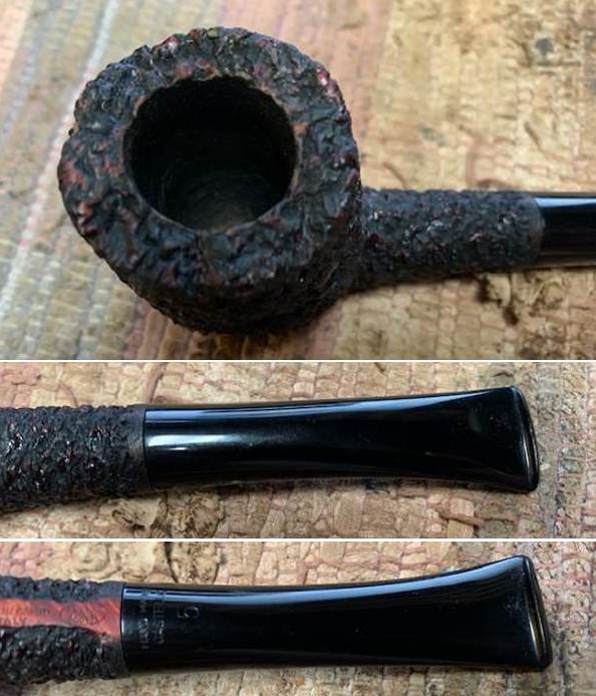
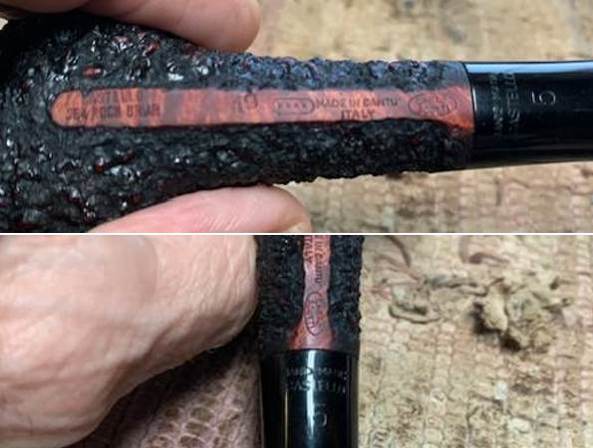
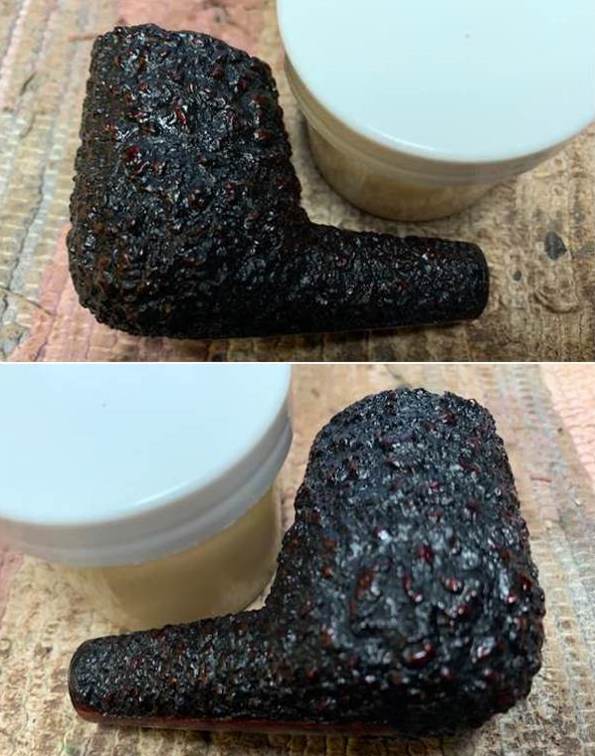
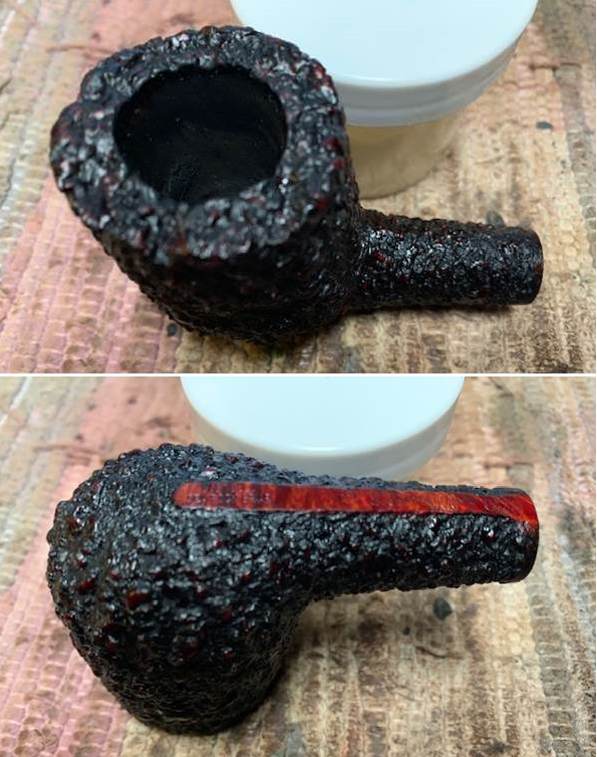
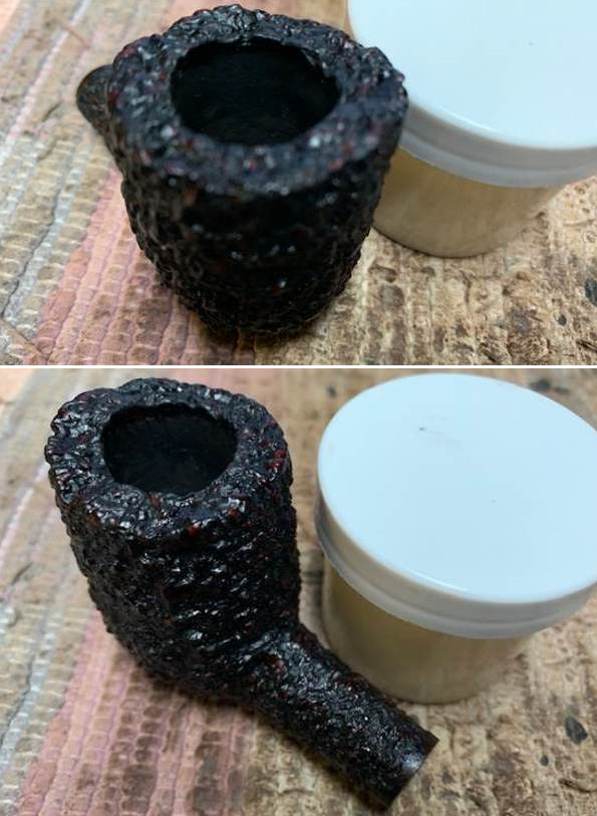
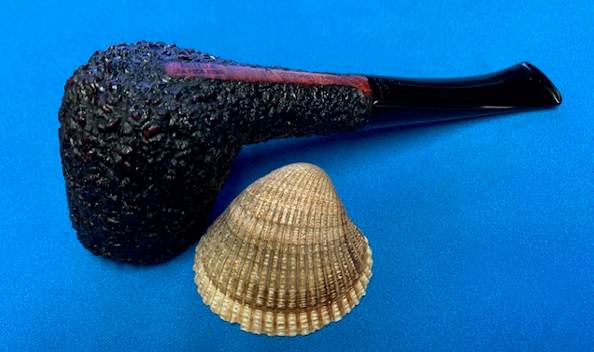
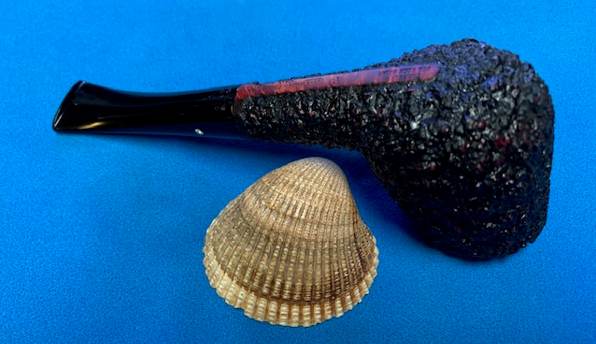
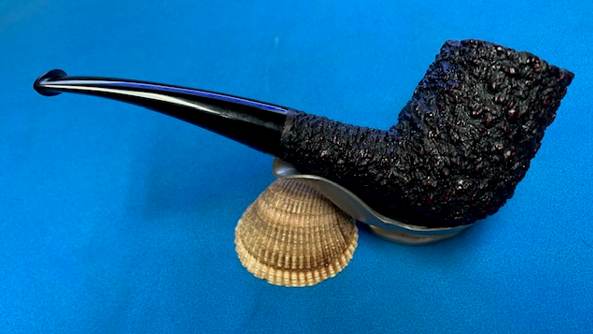
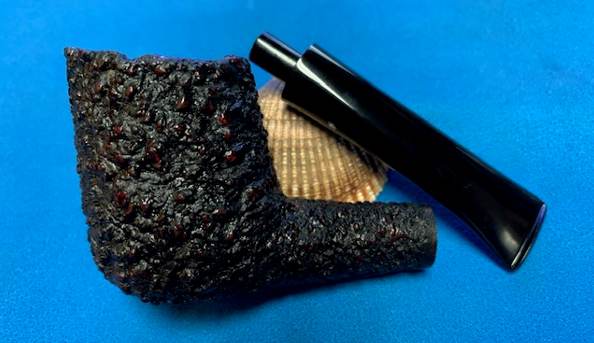
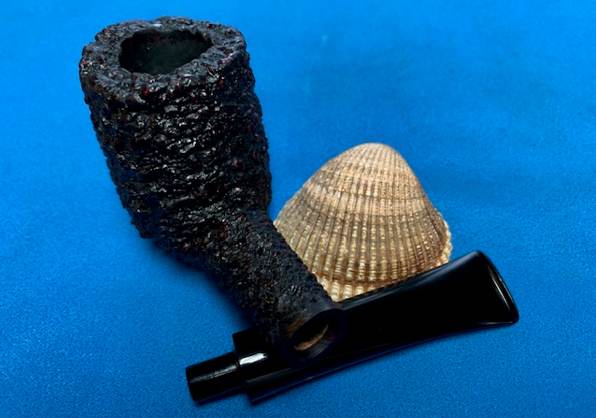
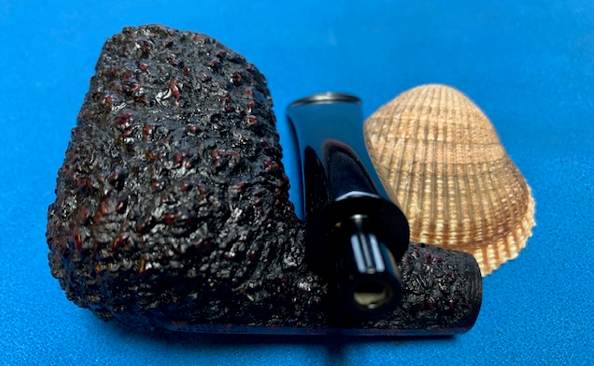
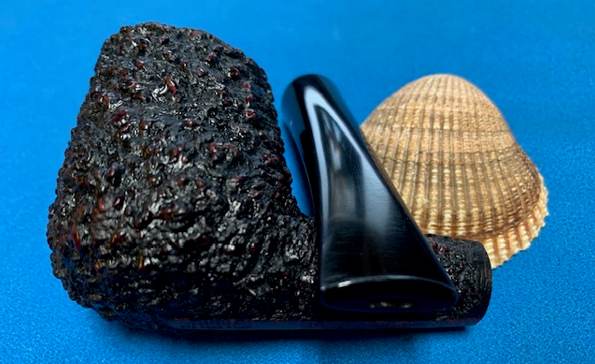
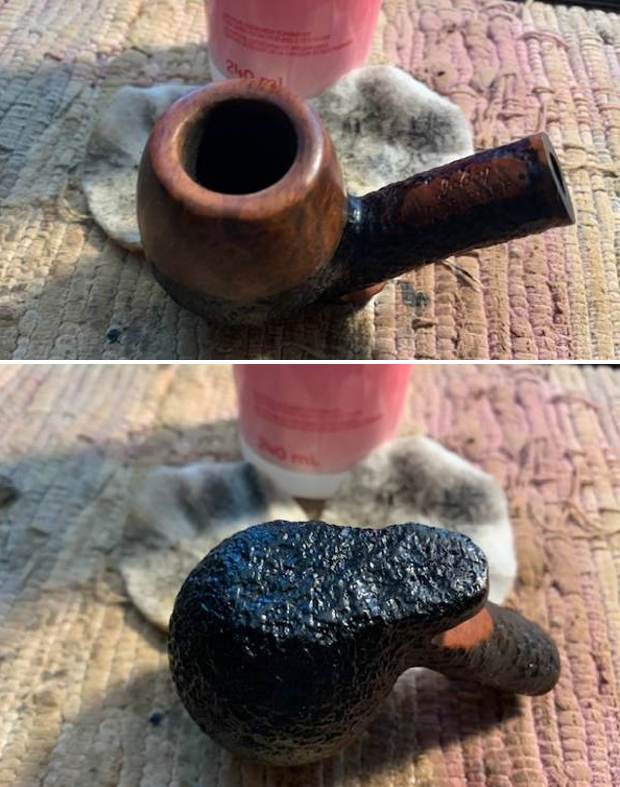
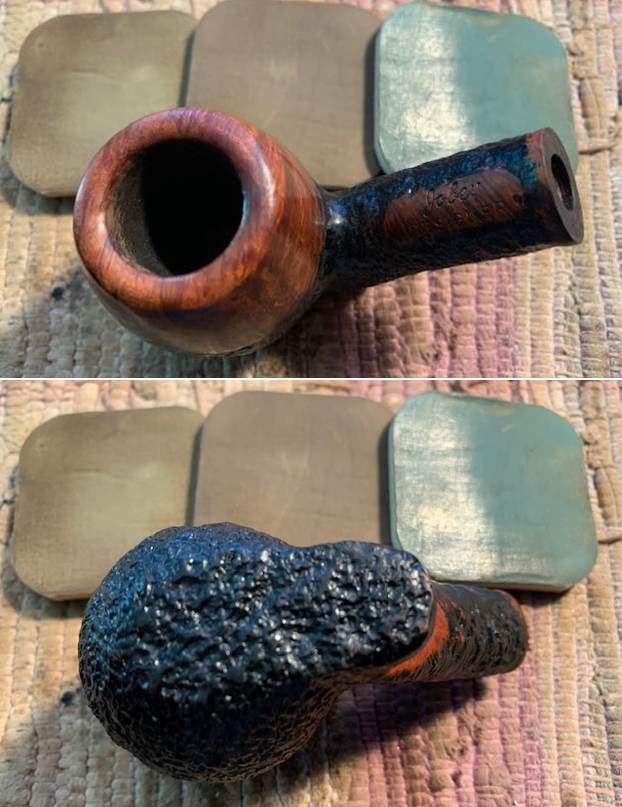
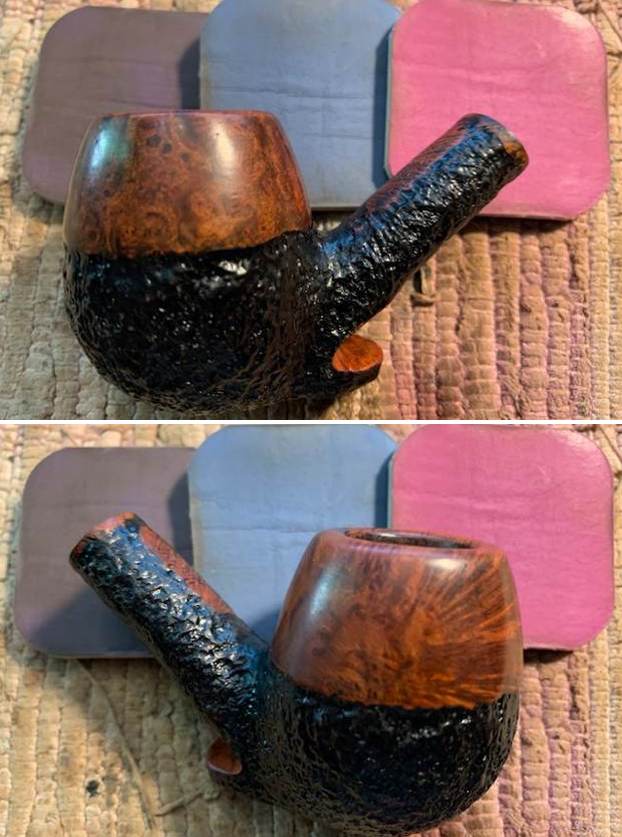
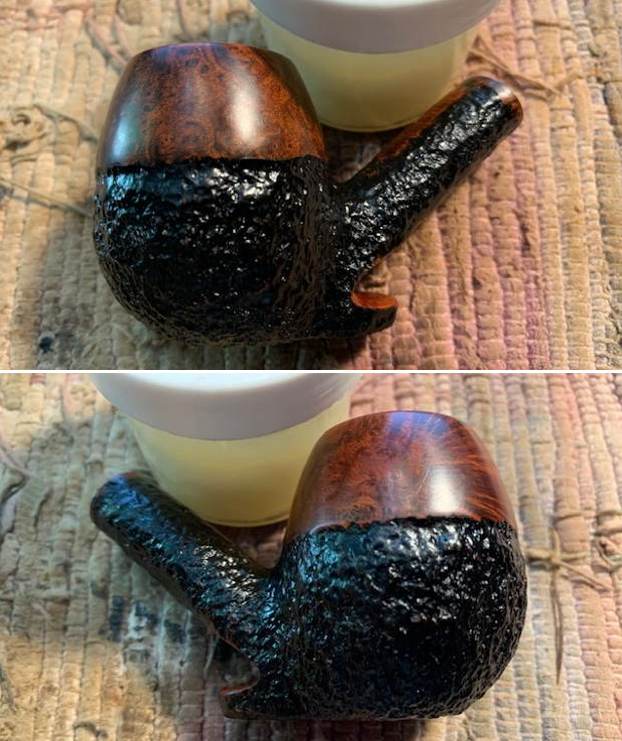
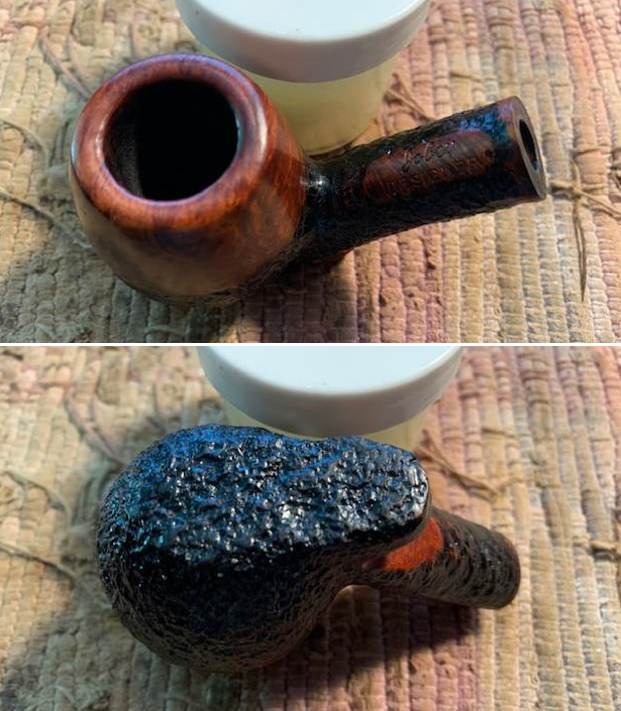
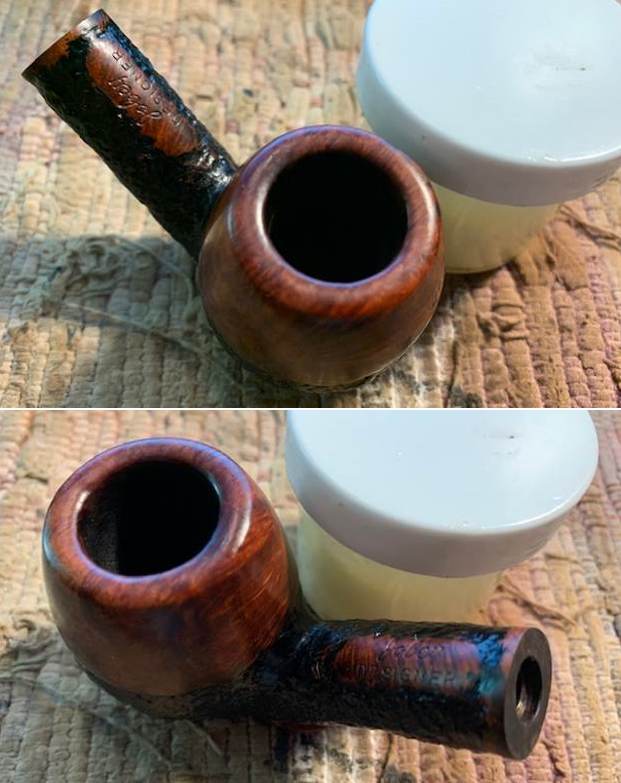
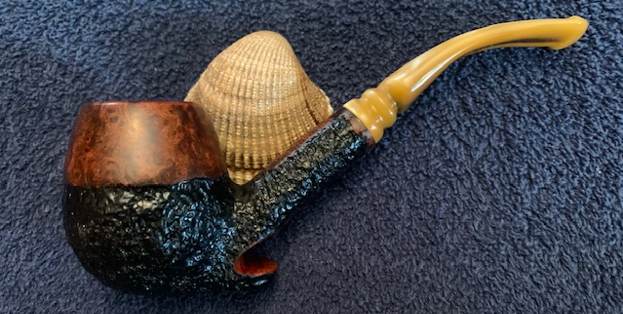
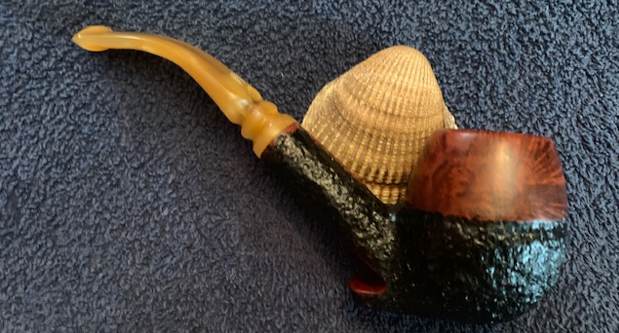
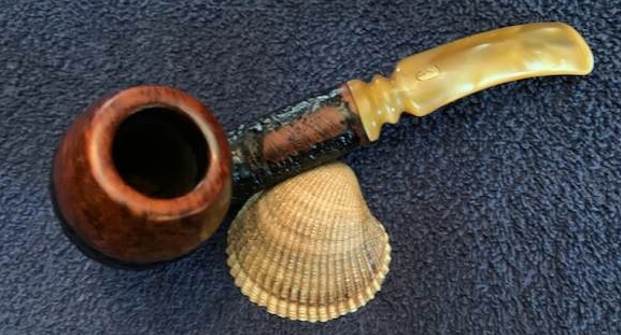
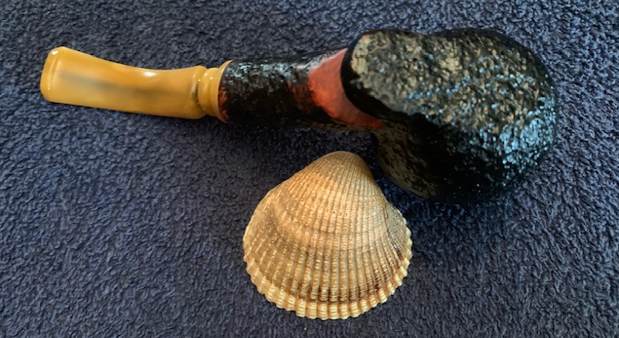
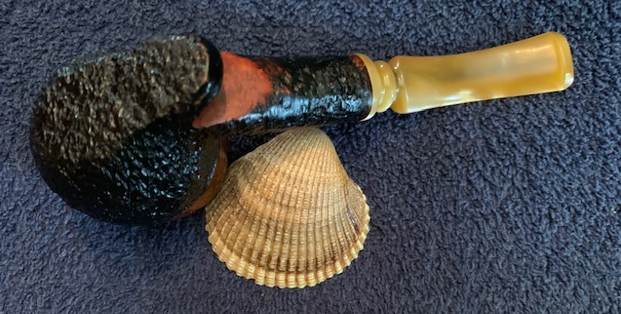
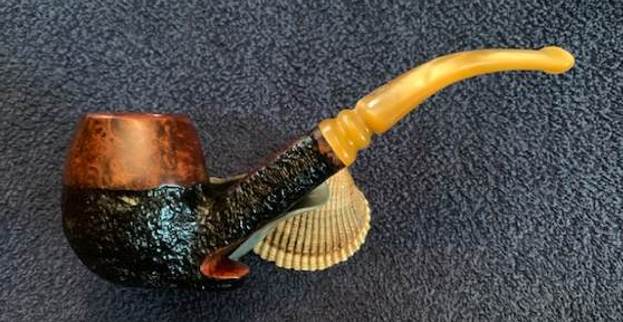
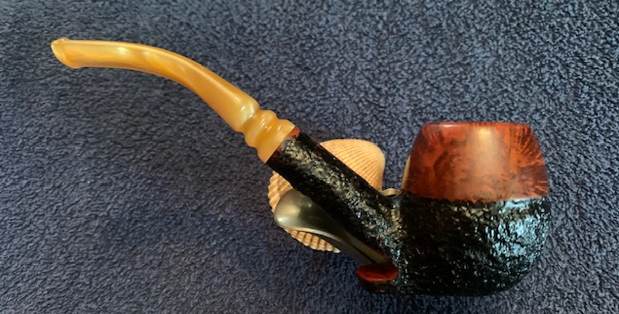
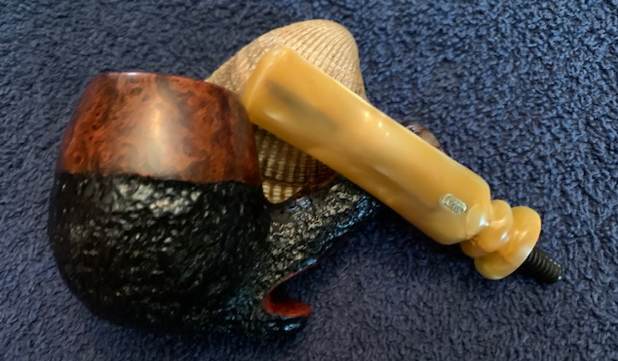
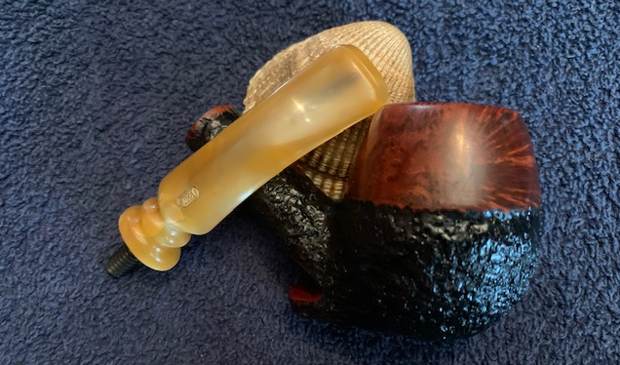
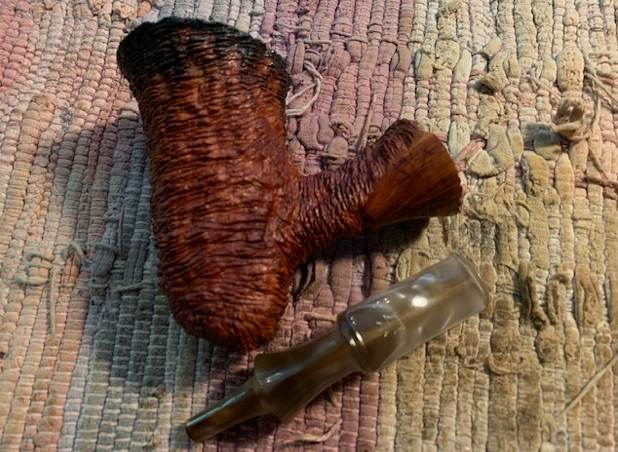
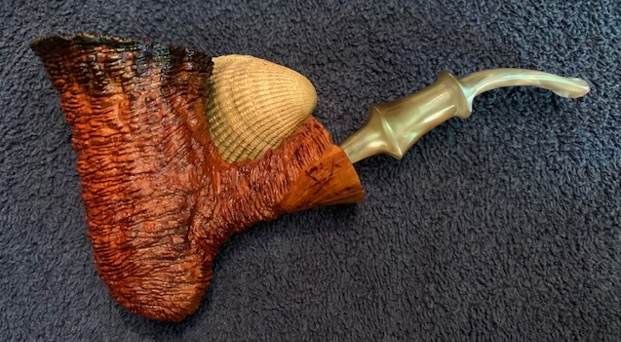
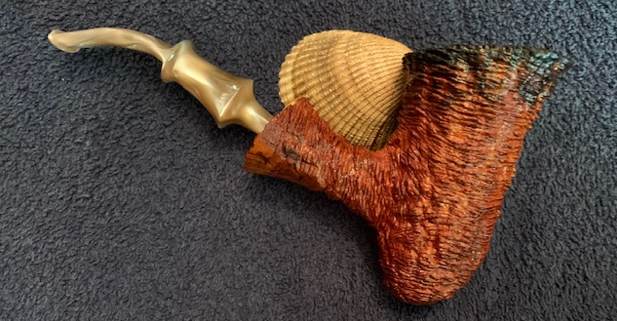
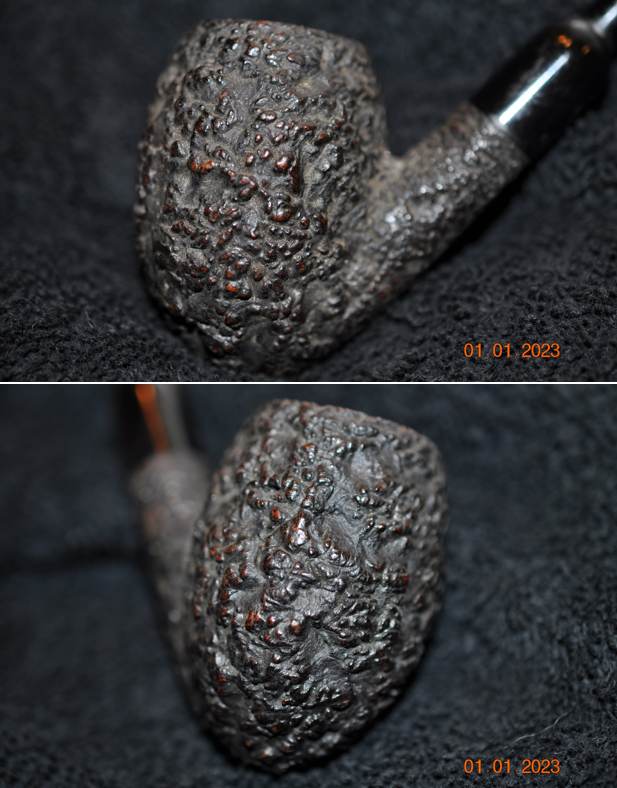
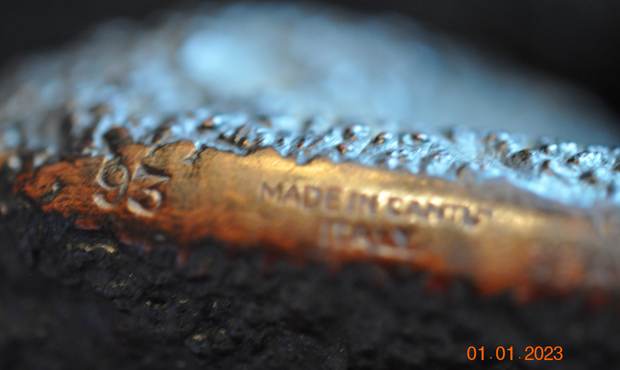
The next pipe on the table is one that we picked up in the lot from an eBay seller in Harrison Township, Michigan, USA on 08/22/2024. The Sea Rock Rusticated finish on this Italian made Canadian shaped pipe and the faux diamond inset on the left side of the oval taper stem are what caught our eye. It is stamped on the heel of the bowl and reads Castello [over] Sea Rock Briar. That is followed by KK 32 and to the right it reads Made in Cantu [over] Italy. That is followed Carlo Sciotti in an oval next to the stem/shank junction. It has a classic Reddish Black stain on the rusticated finish that is a stark contrast to the black acrylic taper stem. It has a deep rusticated finish on a straight oval, long shank Pot. The bowl was heavily caked and the inner edge and the top were covered with a thick lava coat in the rustication. The acrylic stem was dirty and had tooth marks and chatter on both sides ahead of the button. The faux diamond logo on the left side of the taper stem looks to be in good condition. Jeff took some photos of the pipe to show the general condition of the pipe before he started his clean up. He took some photos of the rim top and bowl from various angles to give me a clear picture of the condition of the rim top and bowl. The inside of the bowl is heavily caked with lava on the inner edge and in the sandblast on the rim top. He included photos that show the top and underside of the stem. It is as described above. Jeff took some photos of the sides and heel of the bowl to show the condition of the rusticated finish on the pipe. The photos showed some great grain around the bowl and shank even with the grime in the finish. It is a great looking piece of briar. He took a photo of the stamping on the heel of the bowl and the underside of the shank. It was clear and readable as noted above. As usual I cannot seem to retain the details on Castello pipes in my head for long for some reason. The stamping on this one – Castello and the Carlo Scotti stamp left me with some questions that I need to answer before I began to work on the pipe. I turned first to the Pipephil site (http://www.pipephil.eu/logos/en/logo-castello.html) because of the general quick summary of information I get there. I quote:

Castello PIPA CASTELLO di Carlo Scotti & C. was founded in 1947 by Carlo Scotti († 1988). Franco Coppo (AKA “Kino”) who married Carlo Scotti’s daughter Savina, manages (2012) the corporate since 1985.

The site also gave a good summary of the grading and sizes of the pipes. I quote that in full.

Sizes (ascending):

1K to 4K, G (Giant) and GG (Extra large)

Rusticated grading: SEA ROCK, OLD SEA ROCK, NATURAL VERGIN,

Sandblasted grading: ANTIQUARI, OLD ANTIQUARI

Smooth grading (ascending): TRADEMARK, CASTELLO, COLLECTION

Other stampings: Great Line (Non-standard or freestyle) Fiammata (Straight grain)

Production (2012): ~4000 pipes / year

I also found a note on the page that the Rhinestone logo was originally on pipes for the US market. It is occasionally used now.

I turned then to Pipedia for more information on the brand (https://pipedia.org/wiki/Castello). The majority of the information was what was already quoted above in abbreviated form. However there was a link to an article by Bob Hamlin that gave some interesting bits of information that I found helpful (http://www.pipes.org/BURST/FORMATTED/196.016.html). I quote in part from that article.

SEA ROCK [Carved Black or dark brown]:  This is the lowest grade of the Castello line and is the most common in the USA.  Sea Rocks are produced by taking a smooth bowl that has not been “final finished” and surface carving the finish with tools. This “carved” finish is then evened out using a steel wire brush, stained and then waxed. The Natural Vergin carved finish is left unstained and unwaxed as a rule, although we have seen waxed and partially waxed “Vergins”.

All carved Castello pipes are graded by the number of K’s that are stamped on each piece and are K-graded by SIZE.  1K is the smallest and fairly rare, 2K is small to medium, with 3K or 4K being the most common and ranges from medium to medium large. Large pieces are stamped “G” for giant and extra-large pieces are stamped “GG” for double giant.  In addition to the number of K’s on a carved Sea Rock piece the shape number is almost always added. As a rule a Sea Rock Castello is stained Black, although recently there have been quite a few coming in stained deep brown and still stamped “Sea Rock”.  American Logo’d Sea Rocks are all priced the same to the consumer, although most are 2 or 3 K’ed models. G/GG models are charged at a higher price on American pieces and are basically the same as their European counterparts.

The Castello Sea Rock Briar KK 32 I was working on was definitely one made for the American Market with the Rhinestone in the stem. It had the dark finish or black stain.

Pipedia also gave a link to Mike’s Briar Blues site for help in dating and determining shapes (http://www.briarblues.com/castello.htm).

Shape numbers. Shape numbers are all 2 digits. A 2 in front indicates a “fancy” interpretation, a 3 in front means that the carving is somehow unique. I don’t know when the change was made, but currently, a π symbol is used instead of the 3xx. I’ve only seen this on Sea Rocks, but that doesn’t mean anything…

Now I had more information to work with. The Castello Sea Rock Briar in my hands was 2K graded. That told me that it is a mid-sized pipe. The number 32 makes it a unique and a Canadian shape.

I turned to work on the pipe itself. Jeff had done an amazing cleanup of the pipe. He reamed the cake with a PipNet reamer and cleaned up that with a Savinelli Fitsall Pipe Knife. He scrubbed the internals of the bowl and stem with alcohol, cotton swabs, pipe cleaners and shank brushes. He scrubbed the externals with undiluted Murphy’s Oil Soap and rinsed the bowl off with running water. His scrubbing removed the varnish on the bowl with just a few spots remaining. He soaked the stem in Briarville’s Pipe stem Deoxidizer and once it had soaked rinsed it off with warm water to remove the residual solution. He dried it off and rubbed it down to remove any oxidation that was still on the stem. The soak did not penetrate the varnish on the stem at all but it certainly looked better. Other than the shiny spots in the finish where the varnish remained, the pipe looked very good when I received it.
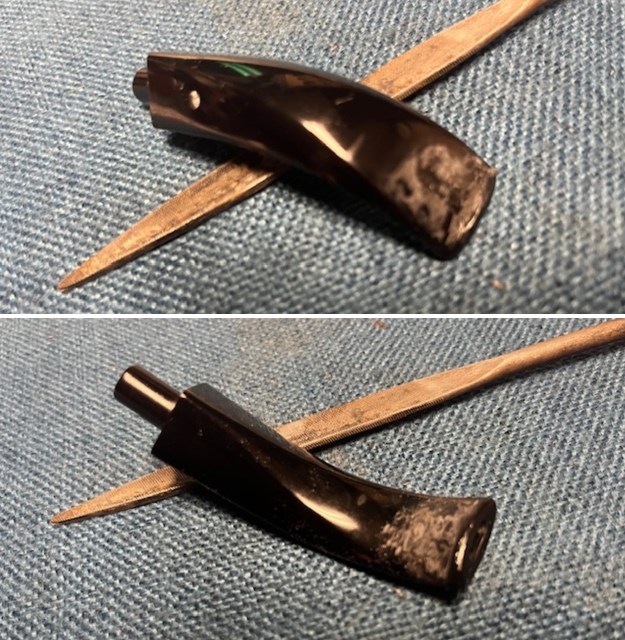
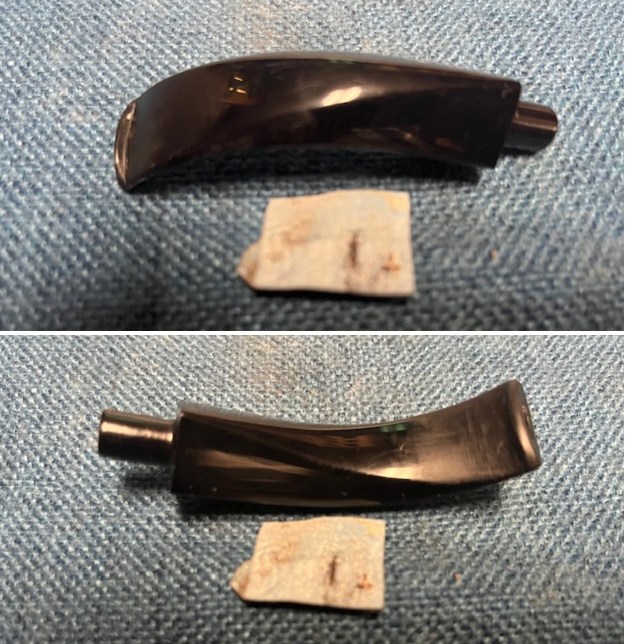
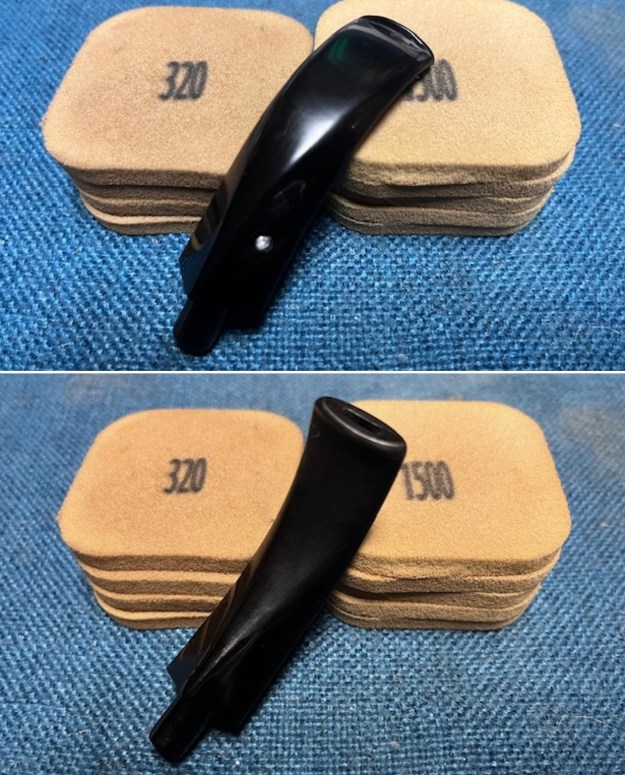
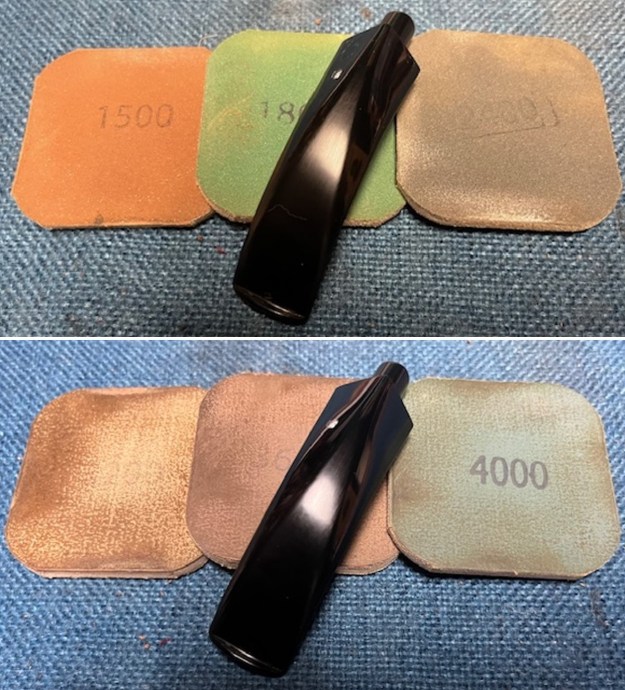
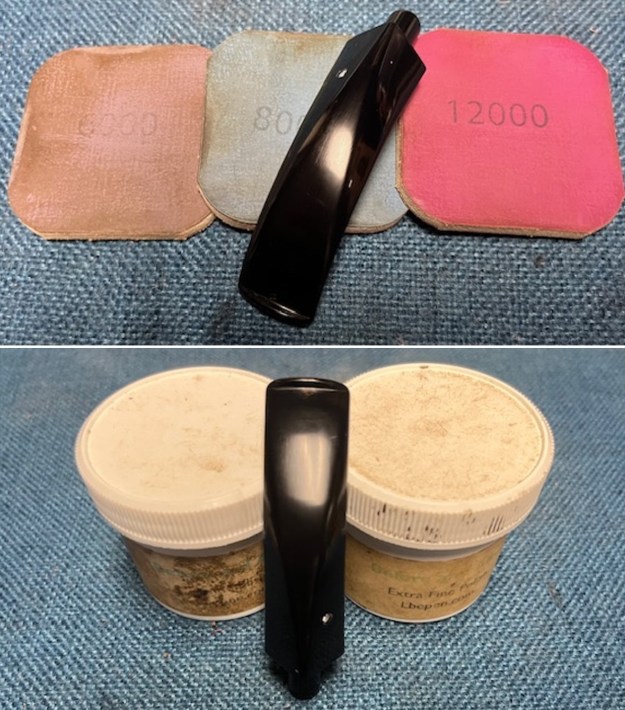
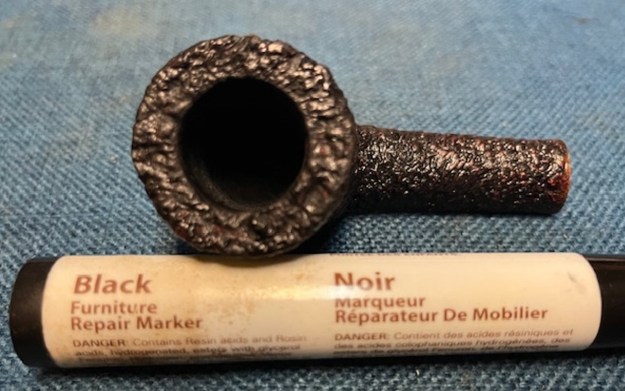
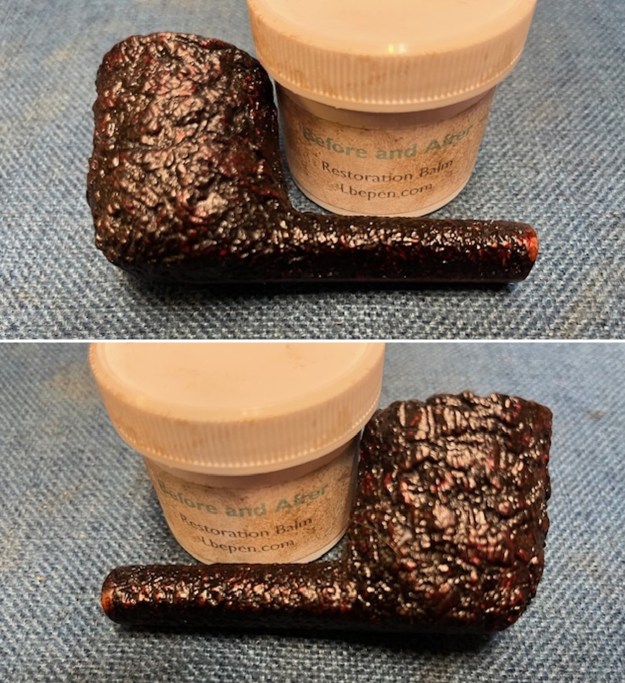
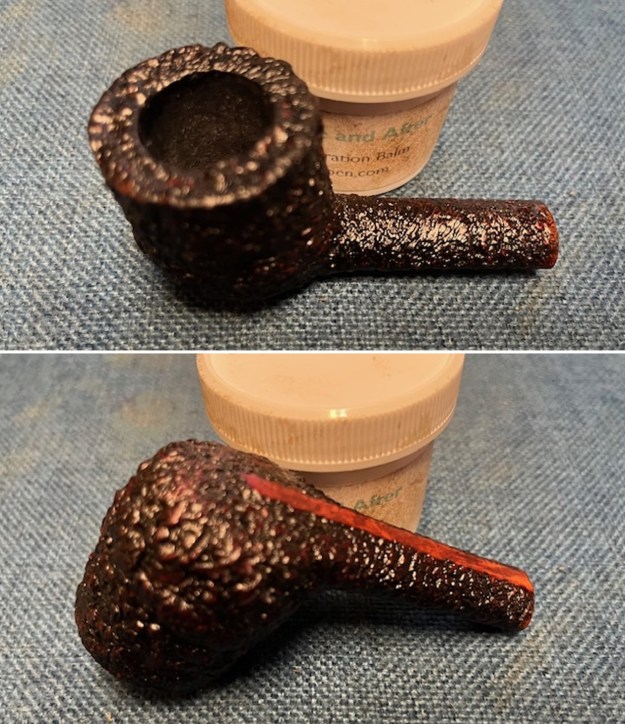
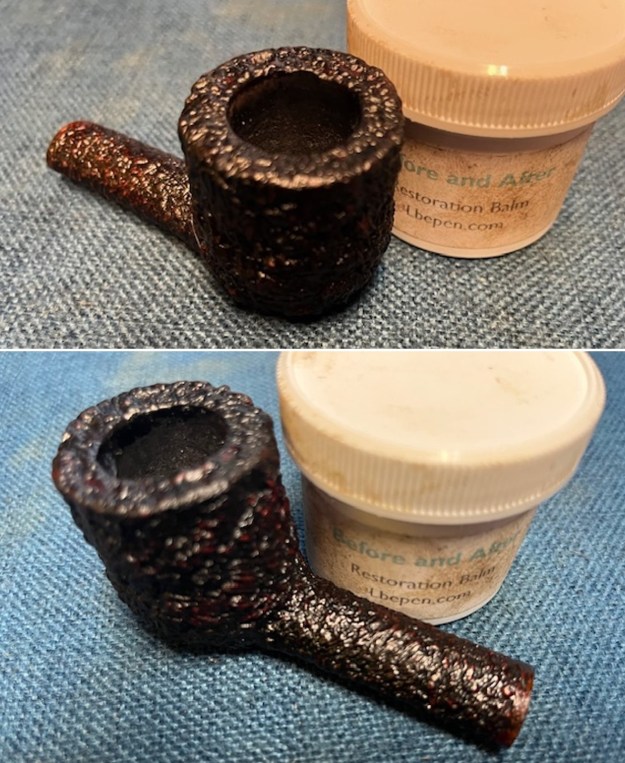
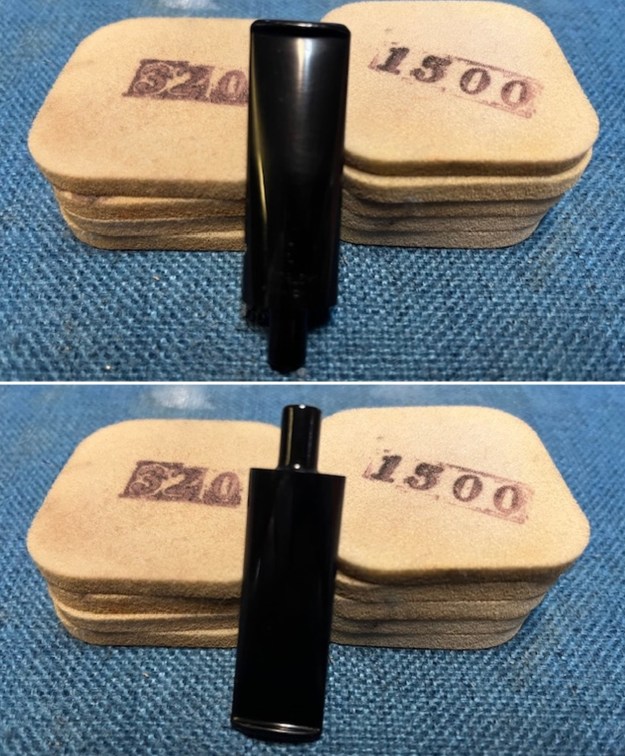
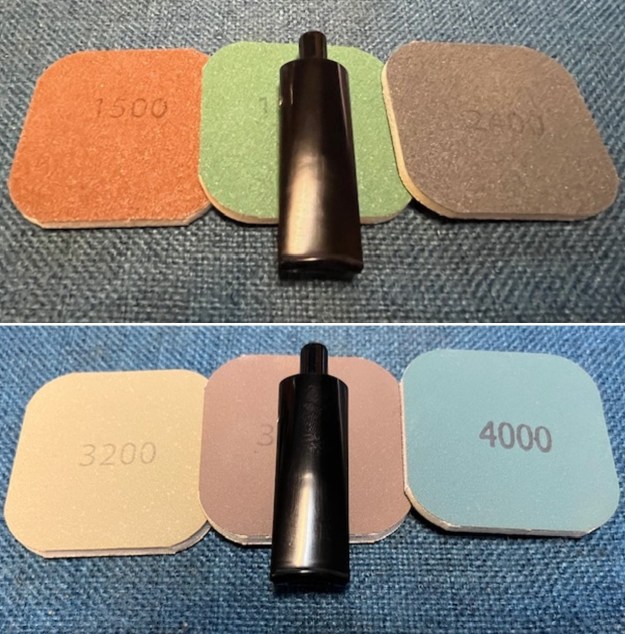
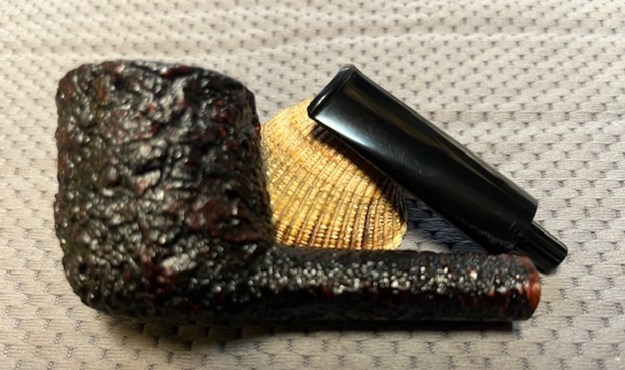
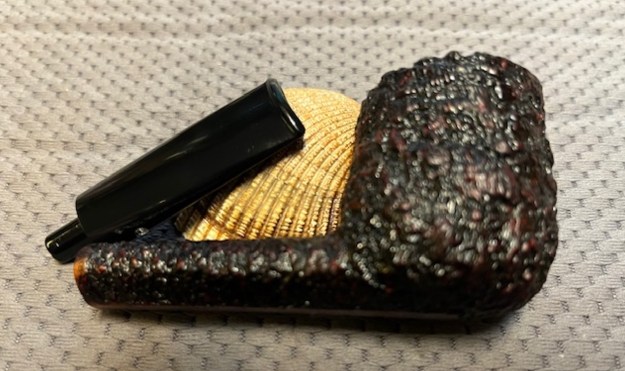
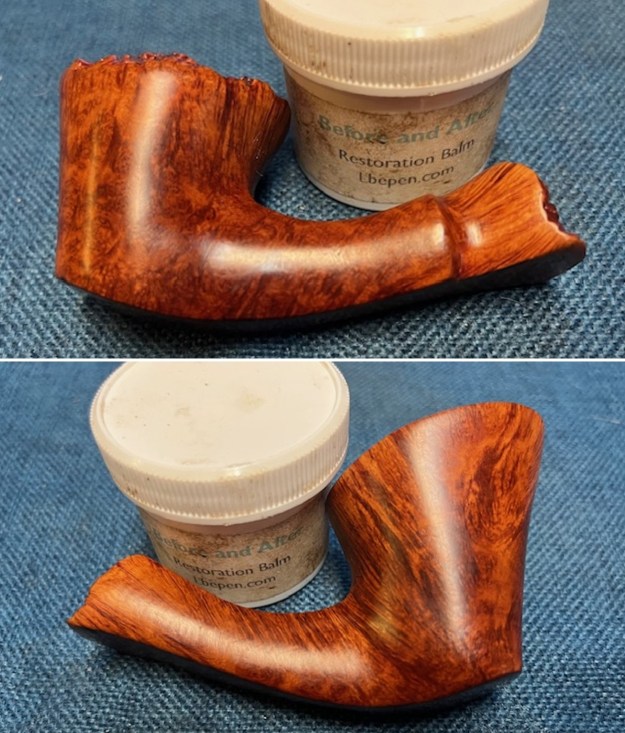
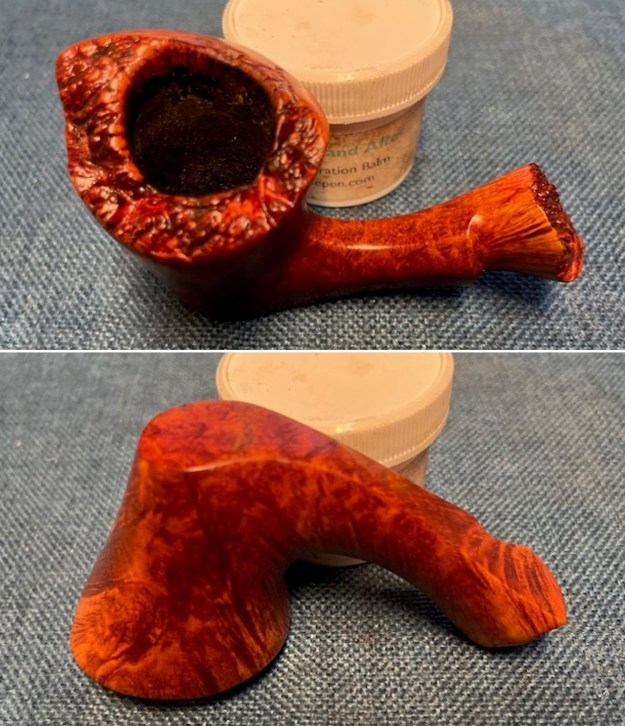
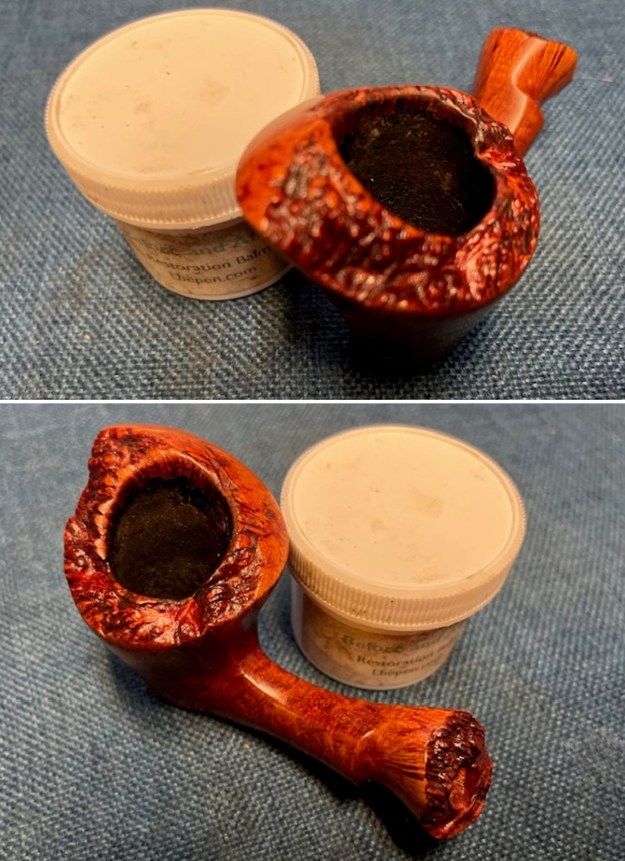
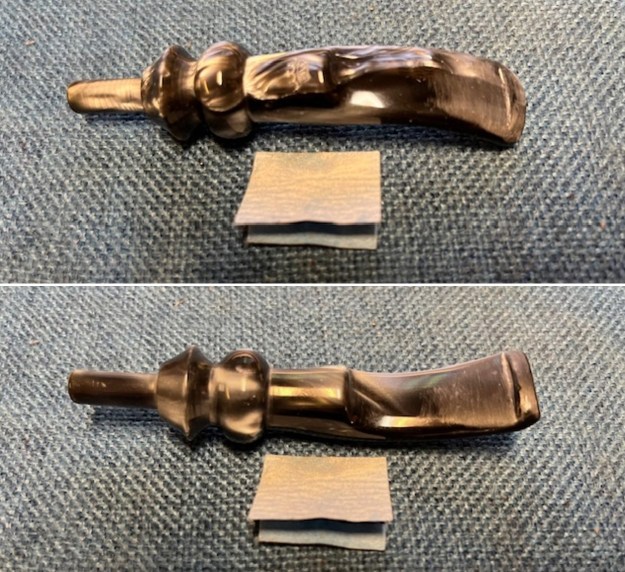
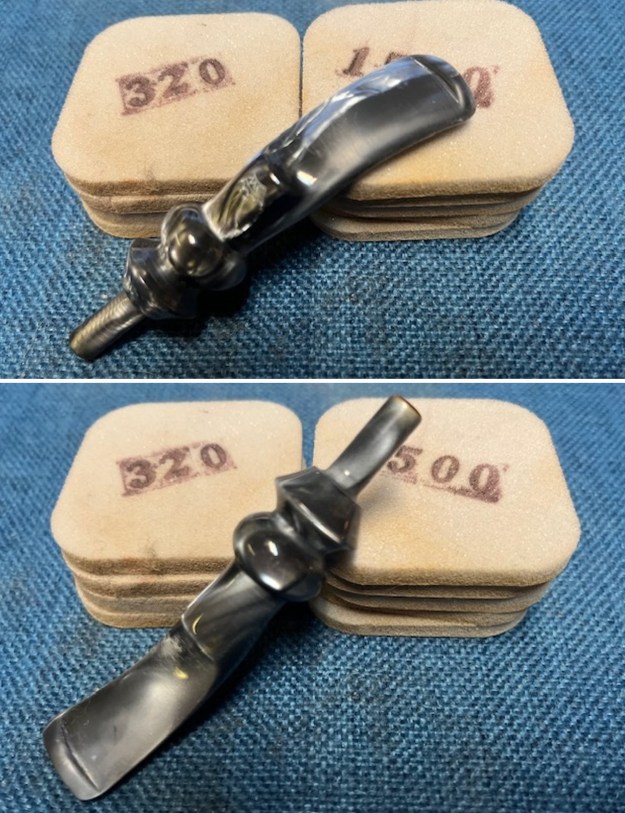
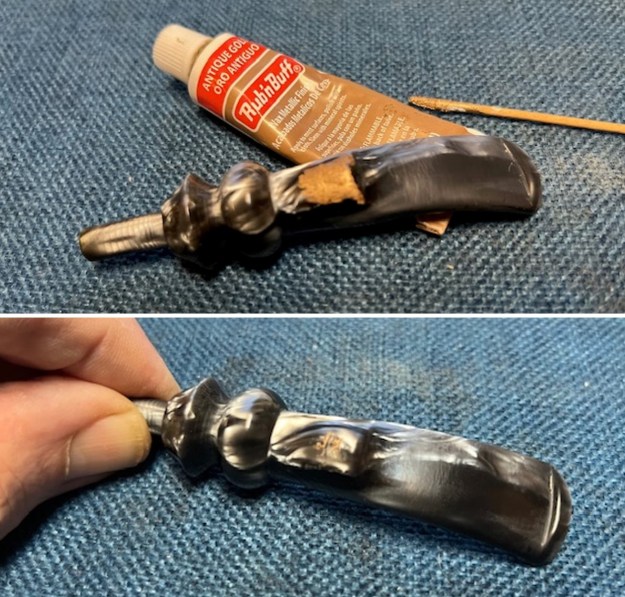
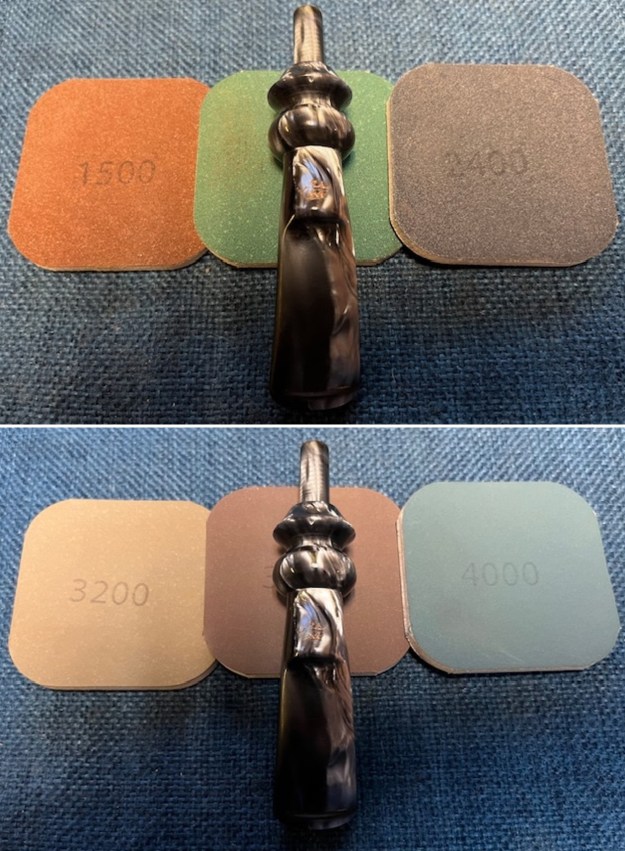
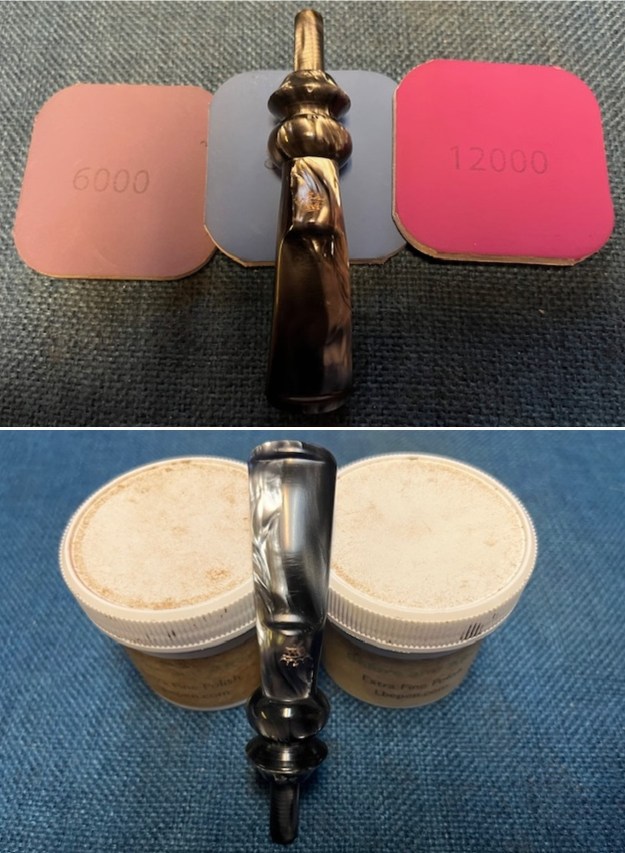
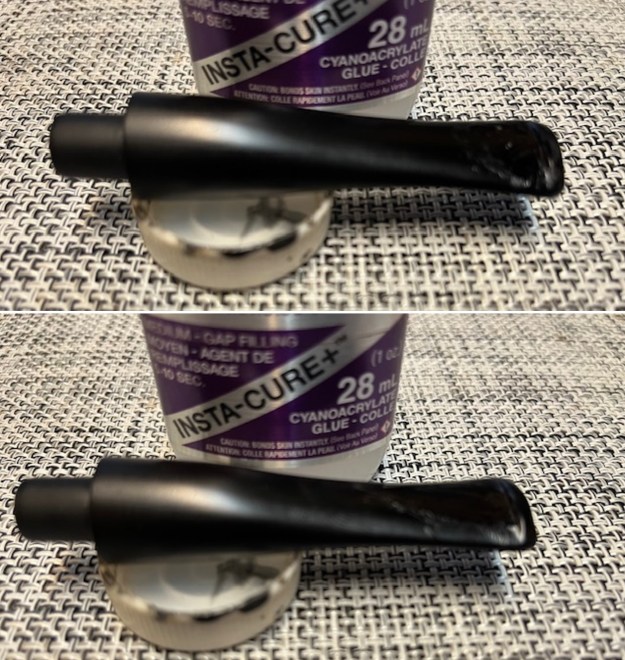
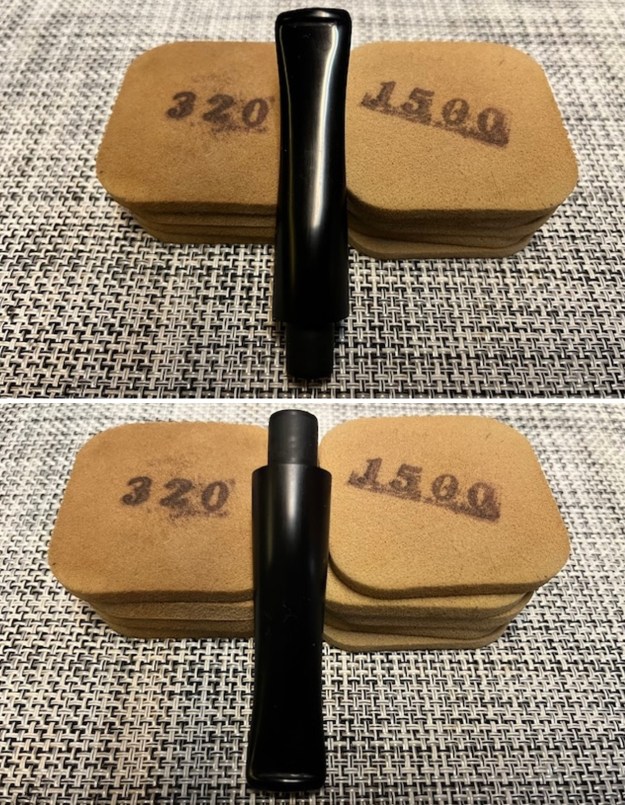
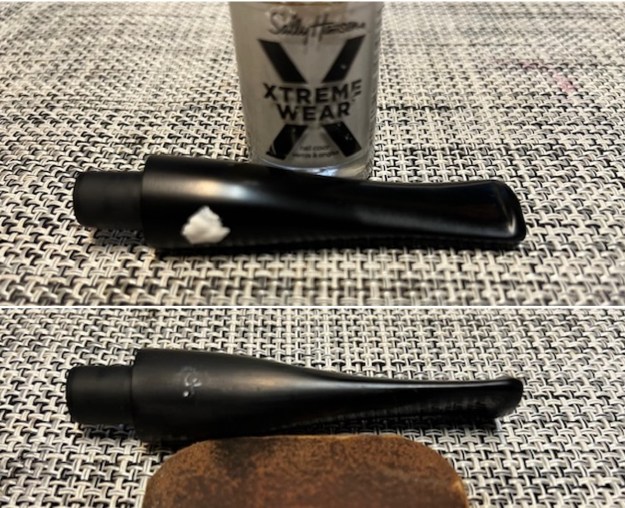
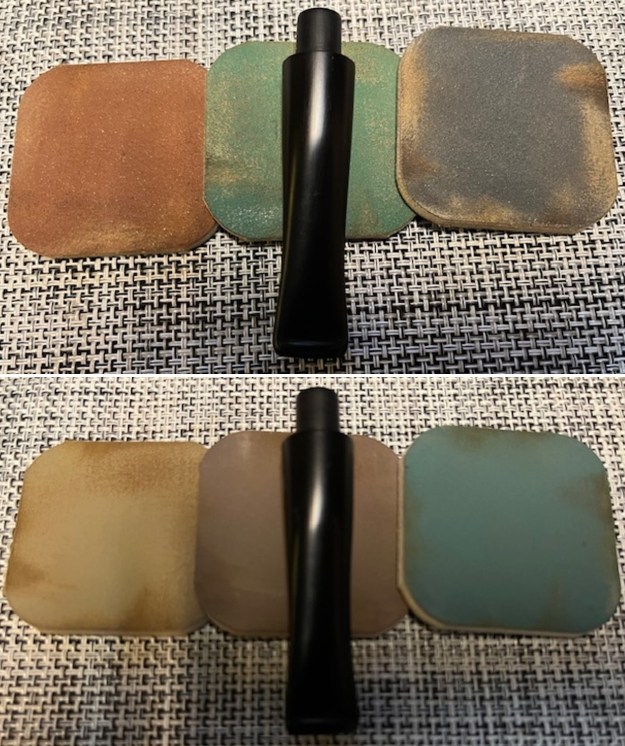
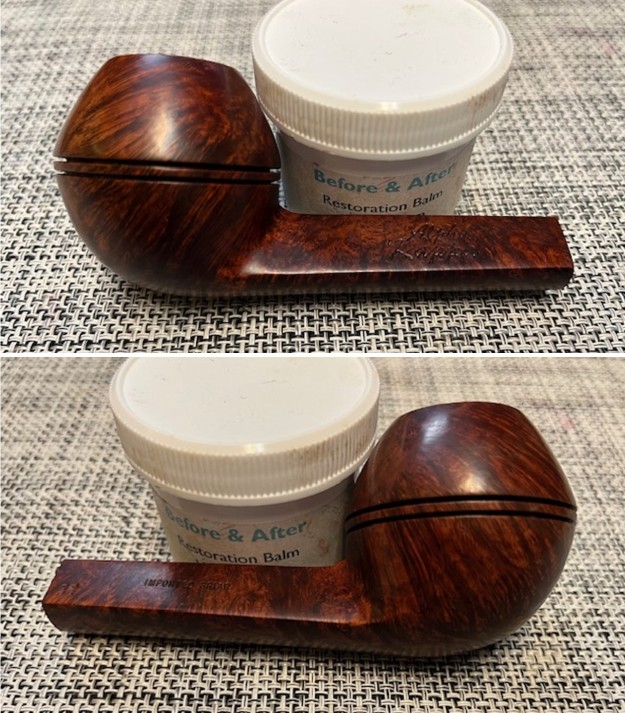
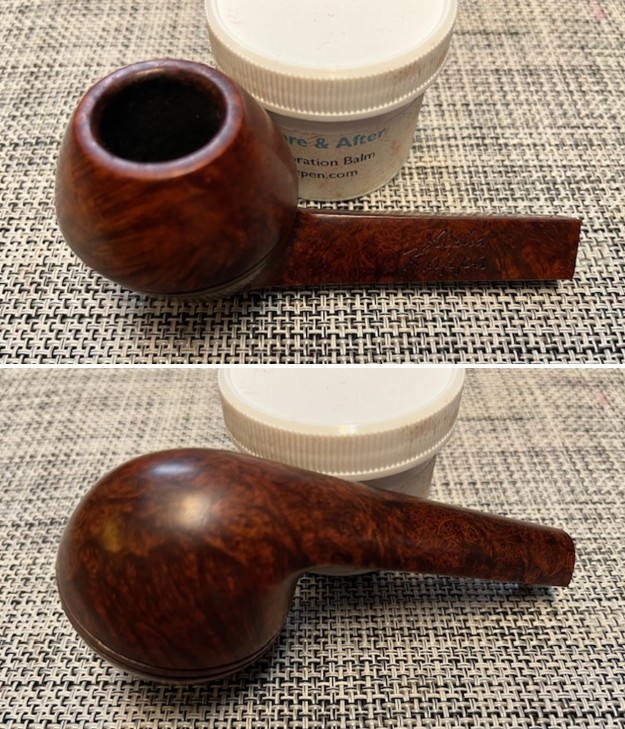
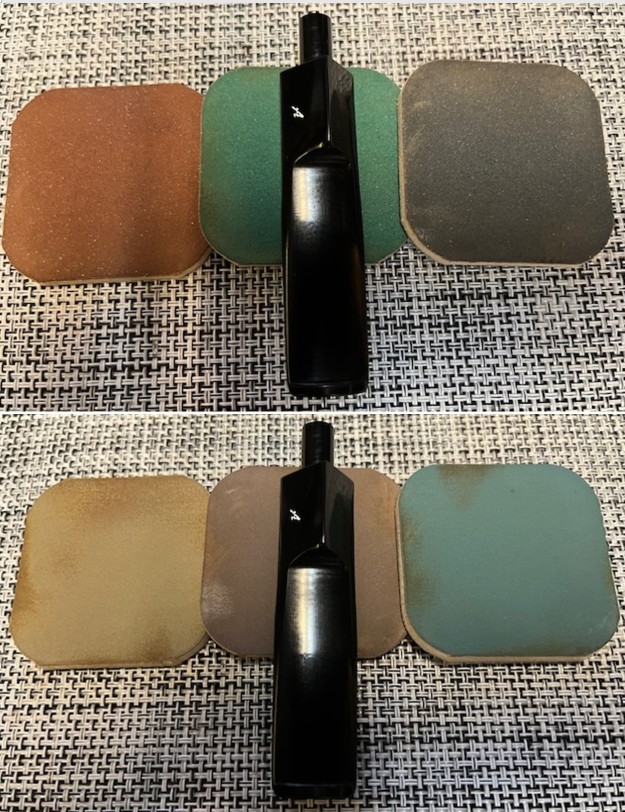
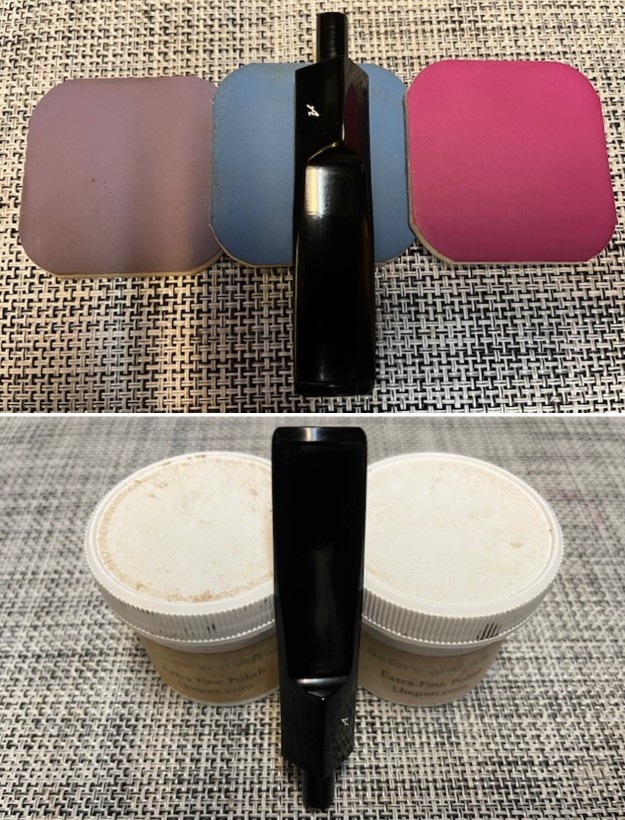
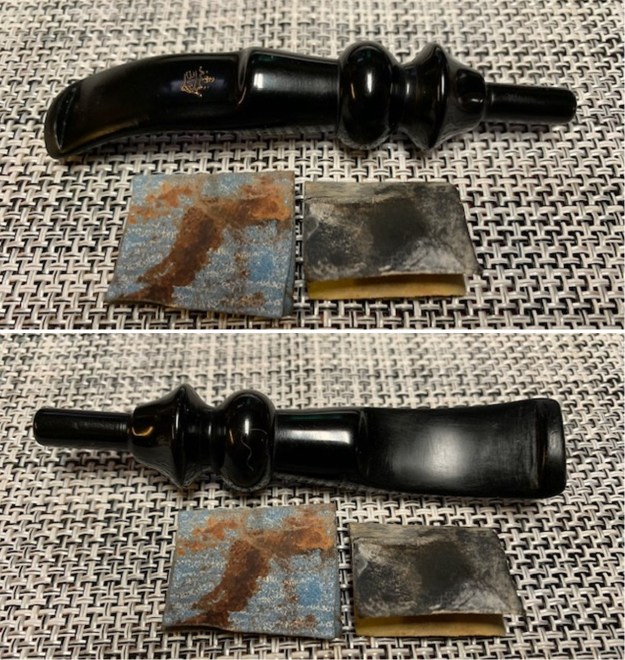
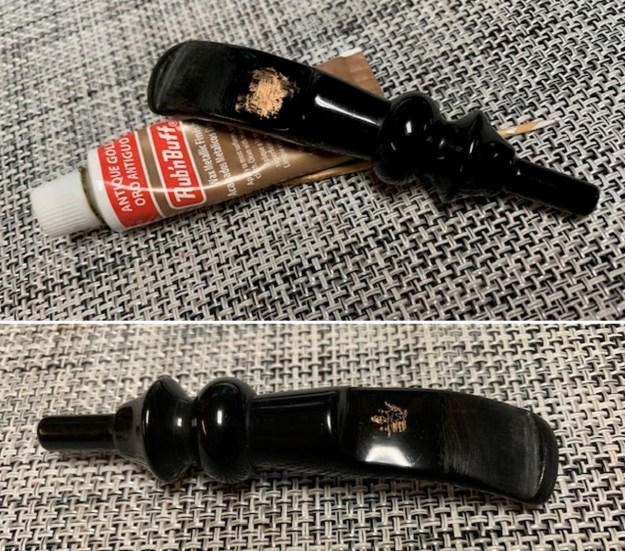
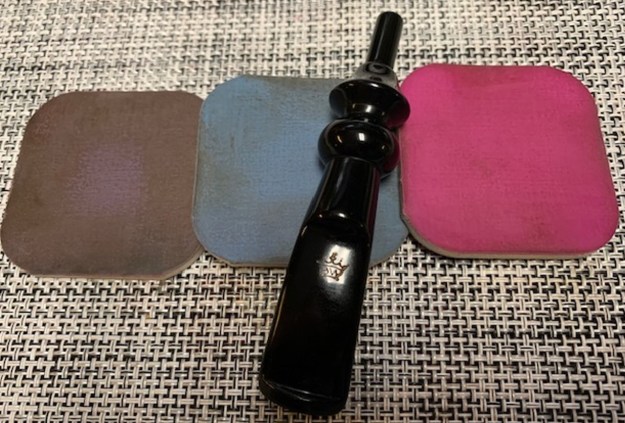
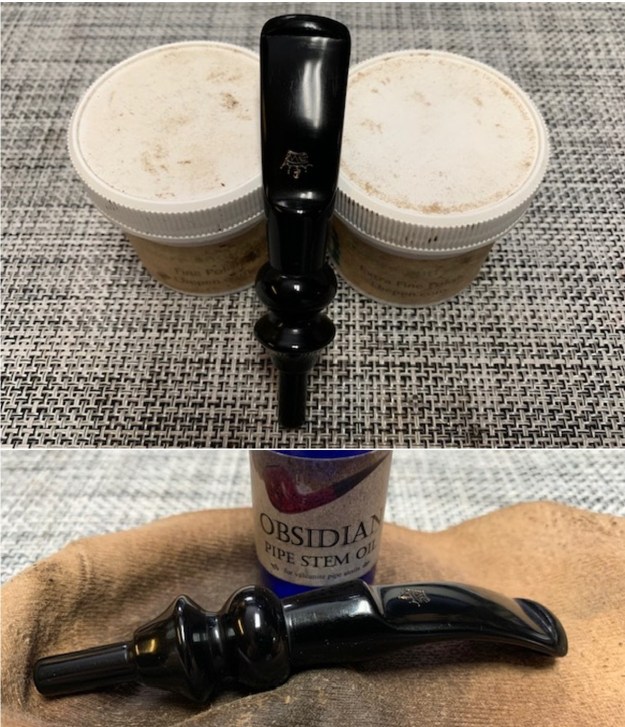
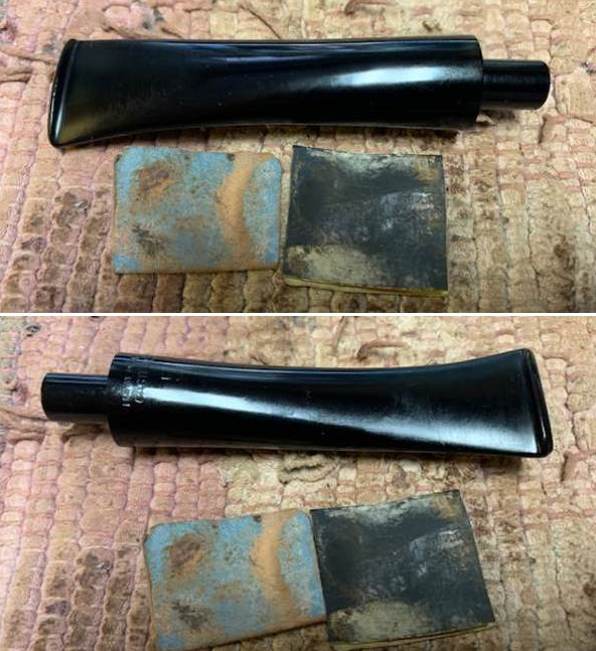
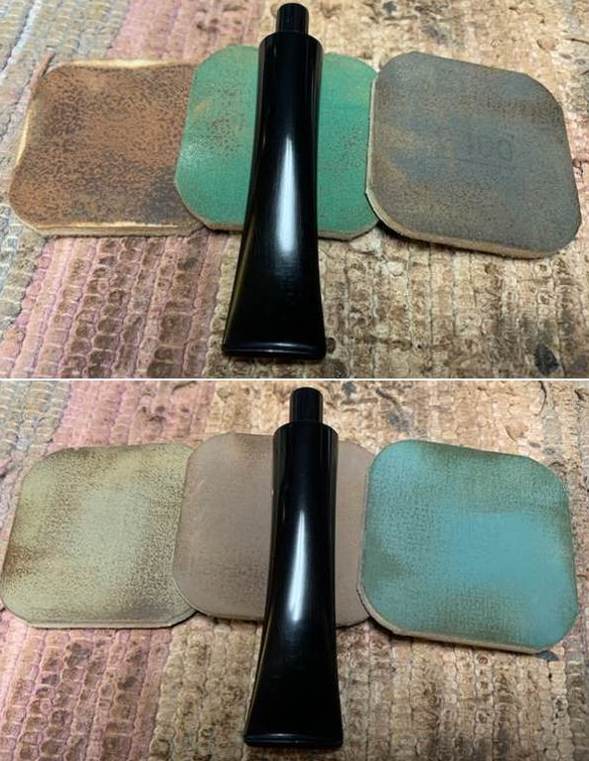
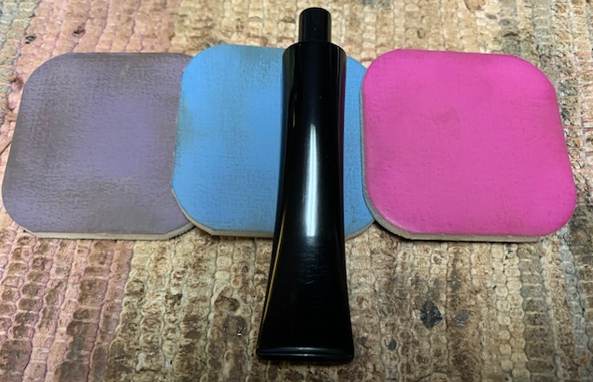
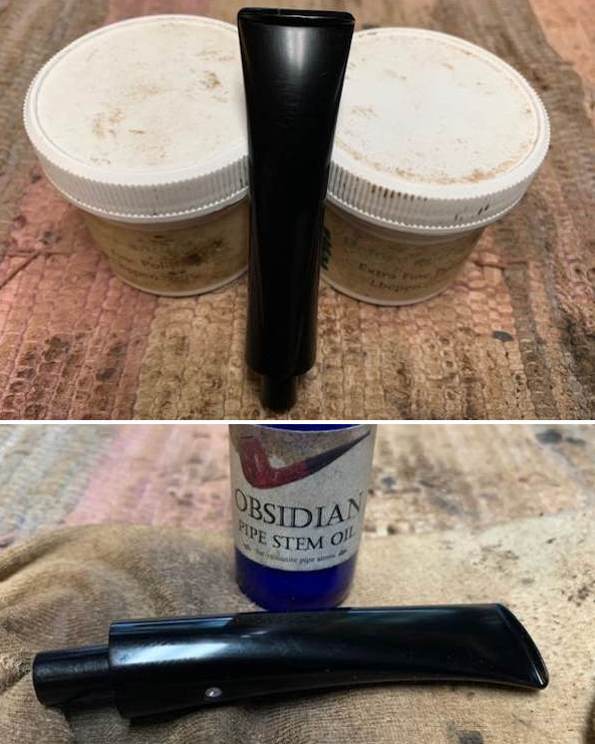
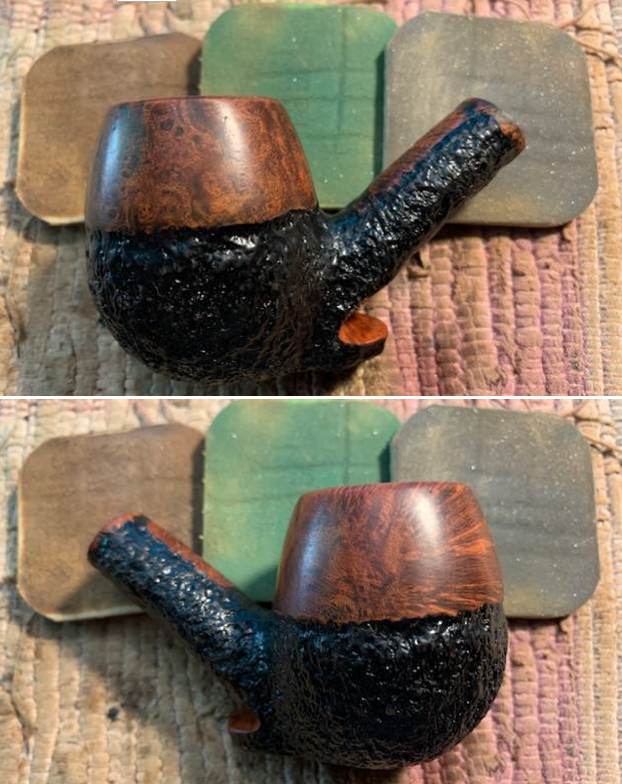
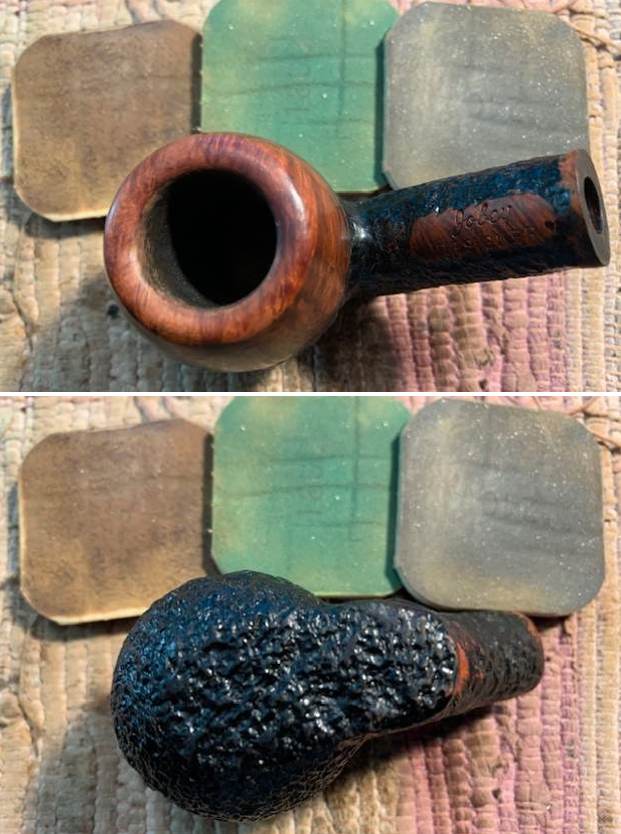
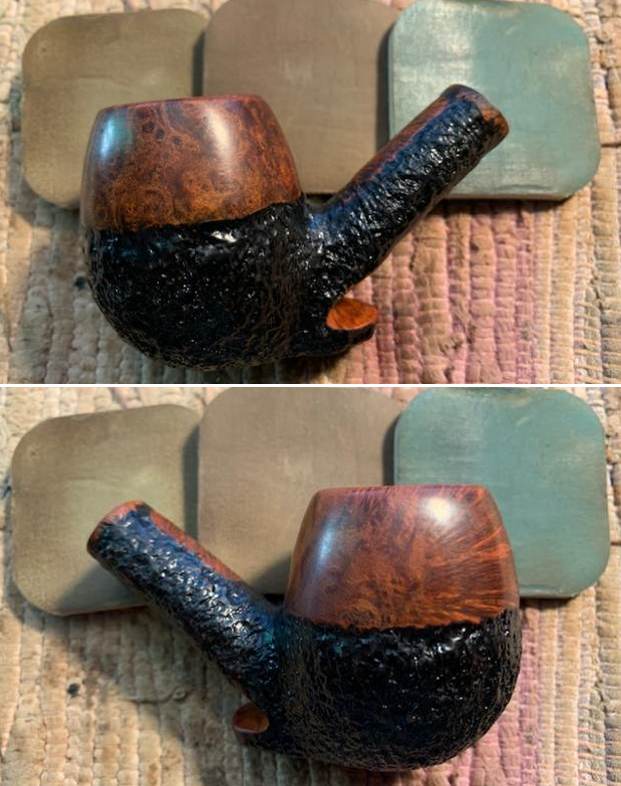
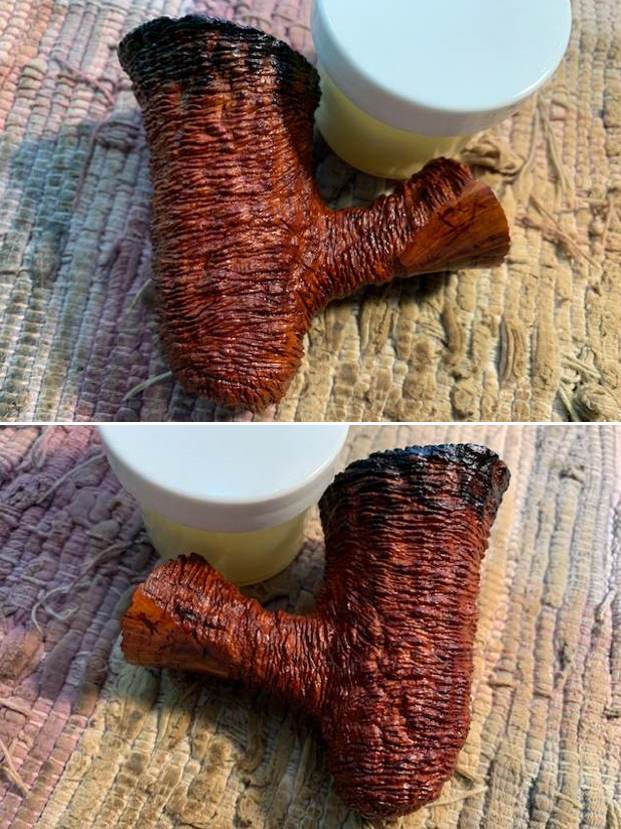
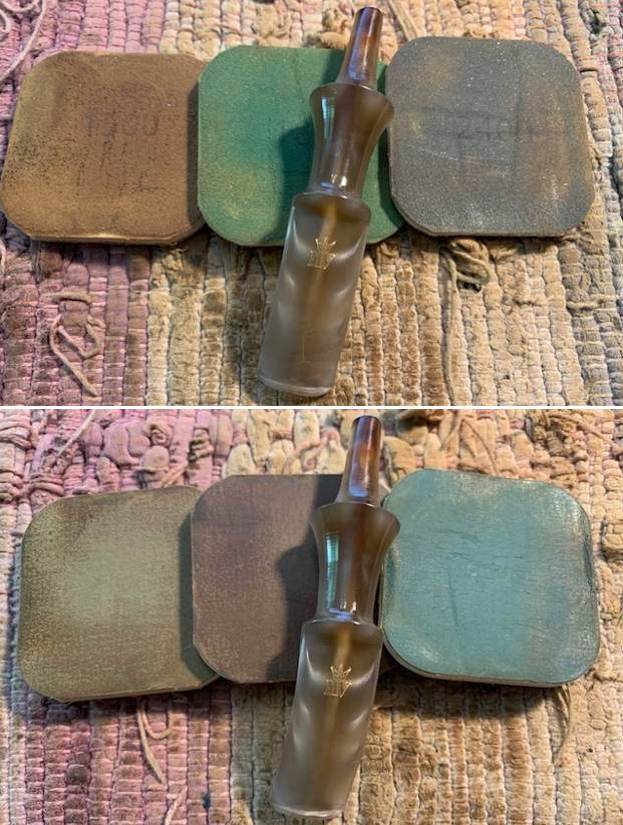
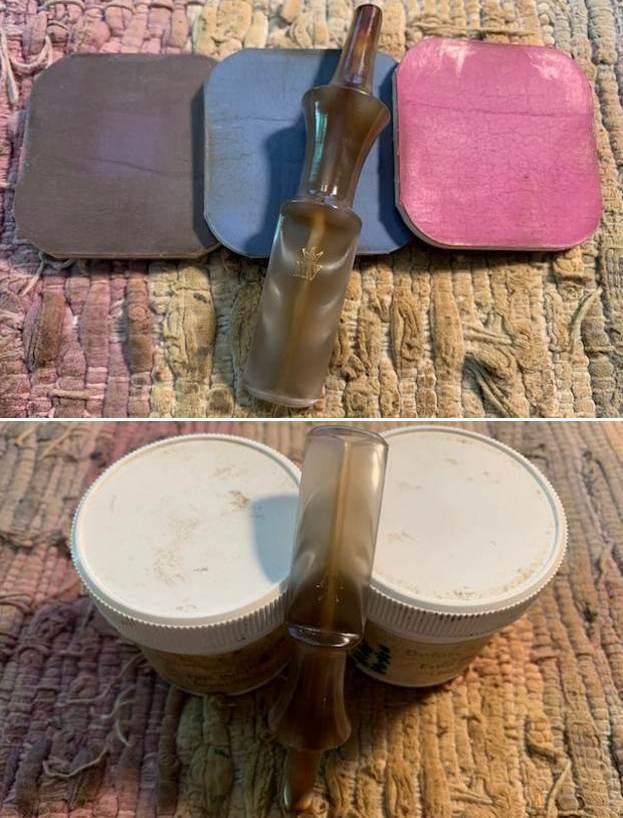
I took close up photos of the bowl, rim top and stem to show how clean the pipe was. The bowl was clean and the rim top and the inner edge look beautiful. I would need to touch up the stain but it was very clean. The stem was clean and the chatter is light and hardly visible.I took a photo of the stamping on the underside of the shank. It is very clear and readable and read as noted above. I also removed the stem from the shank and took photos of the pipe to show the look of the parts.I touched up the rim top with a black stain pen to match the rest of the bowl sides and top. Once it is polished and buffed the match will be perfect.The exterior of the bowl was beautiful. I worked some Before & After Restoration Balm into the briar with my finger tips and a shoe brush. I let it sit on the bowl for 10 minutes and then buffed it off with a paper towel and soft cloth. The product is a great addition to the restoration work. It enlivens, enriches and protects the briar while giving it a deep glow. It is a product I use on every pipe I restore. I set the bowl aside and turned to the stem. I sanded the it with 320-3500 grit sanding pads and wiped the stem down after each pad with some Obsidian Oil on a cloth. The shine is coming back beautifully.I polished it with micromesh sanding pads – dry sanding with 1500-12000 grit pads and wiping the surface down with Obsidian Oil after each sanding pad. It is really shining. I polished it further with Before & After Stem Polish – both Fine and Extra Fine. I gave it another coat of Obsidian Oil to finish this step. This Castello Sea Rock Briar KK32 Canadian with an acrylic taper stem is a great looking pipe now that it has been restored. The beautifully deep rusticated finish really works well with the shape and the polished finish is stunning. I put the stem back on the bowl and carefully buffed the bowl and the stem with Blue Diamond on the buffing wheel. I gave the bowl multiple coats of Conservator’s Wax and the stem multiple coats of carnauba wax on the buffing wheel and followed that by buffing the entire pipe with a clean buffing pad. I hand buffed the pipe with a microfiber cloth to deepen the shine. The finished Castello Sea Rock Briar KK32 Canadian fits nicely in the hand and feels great. Give the finished pipe a look in the photos below. The dimensions of the pipe are Length: 5 ¼ inches, Height: 1 ¾ inches, Outside diameter of the bowl: 1 ½ inches, Chamber diameter: ¾ of an inch. The weight of the pipe is 39 grams /1.38 ounces. I will be putting it on the rebornpipes store in the Italian Pipe Makers Section shortly. Let me know via email or a message if you are interested in adding this pipe to your collection.

As always, I encourage your questions and comments as you read the blog. Thanks to each of you who are reading this blog. Remember we are not pipe owners; we are pipe men and women who hold our pipes in trust until they pass on into the trust of those who follow us.

Restoring a Ben Wade Martinique Plateau Top Freehand


by Steve Laug

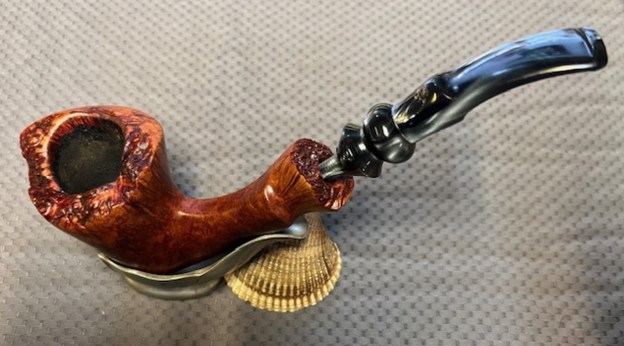
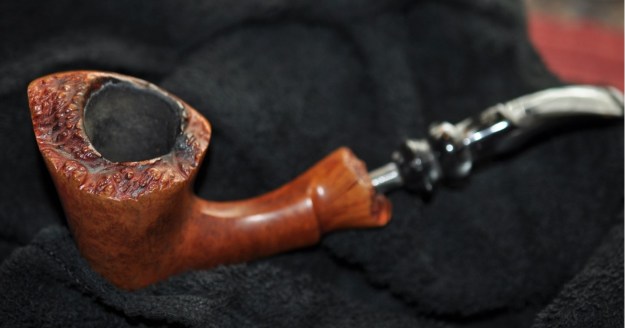
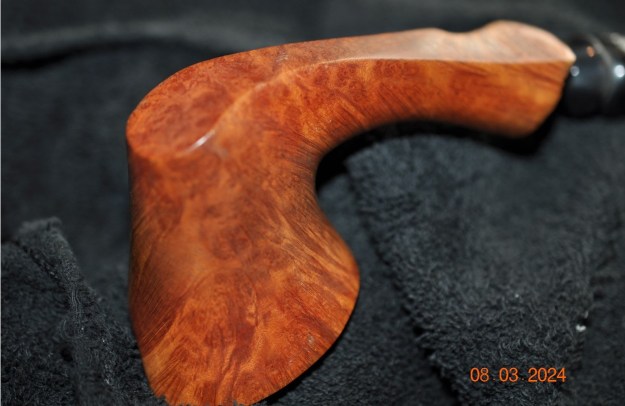
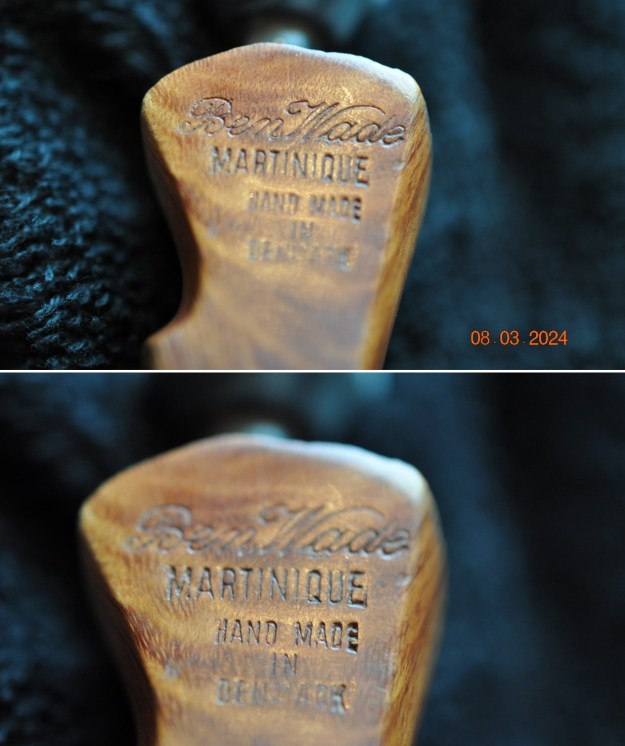
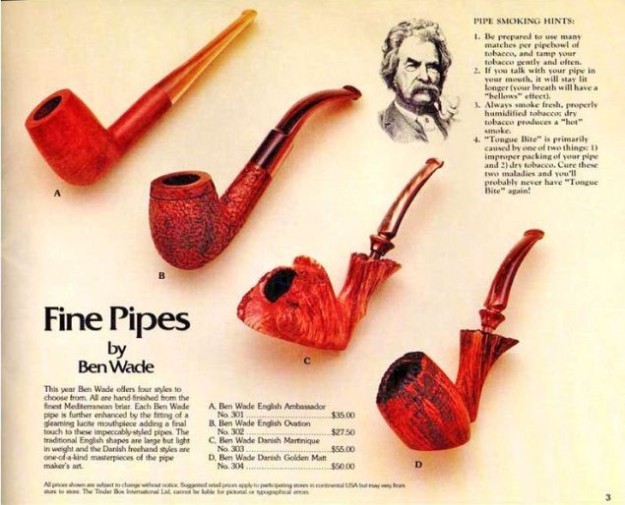
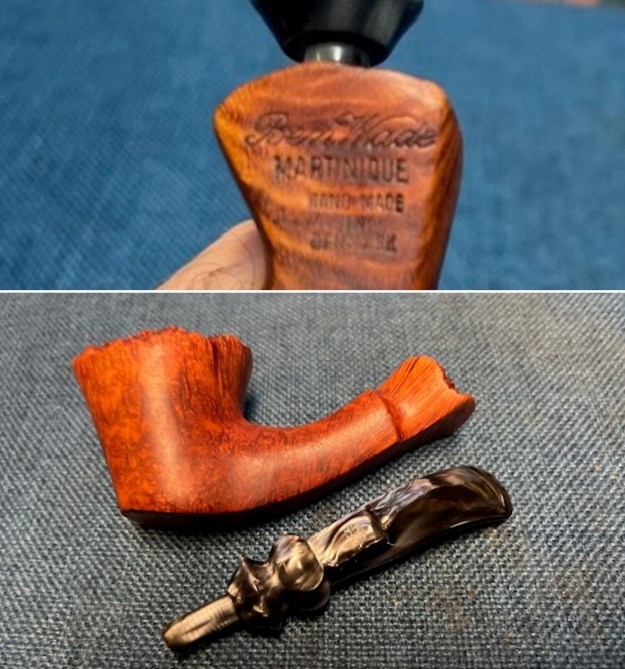
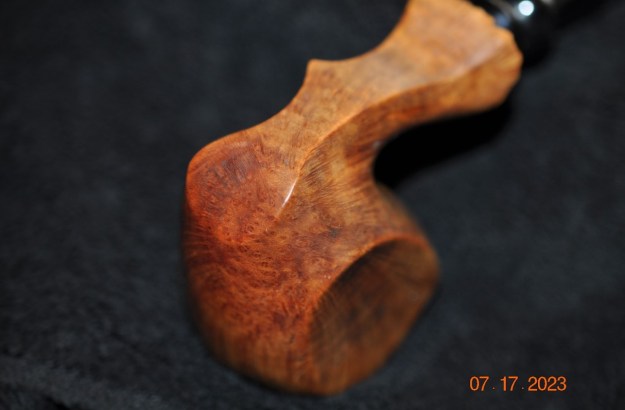
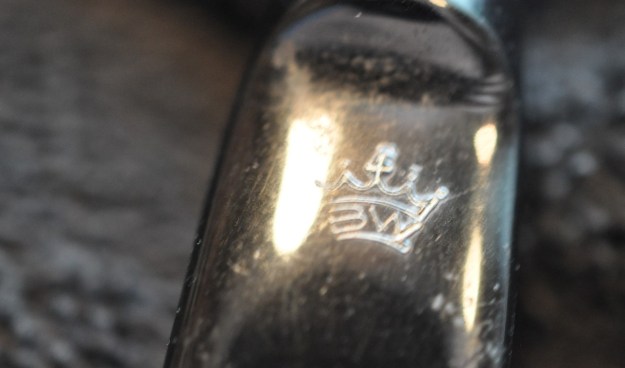
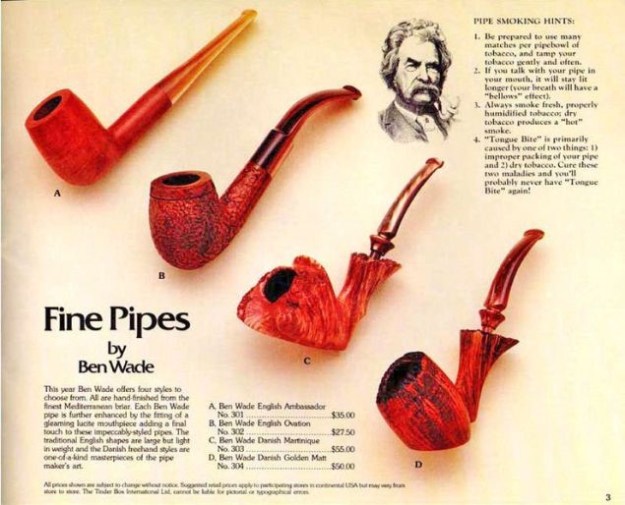
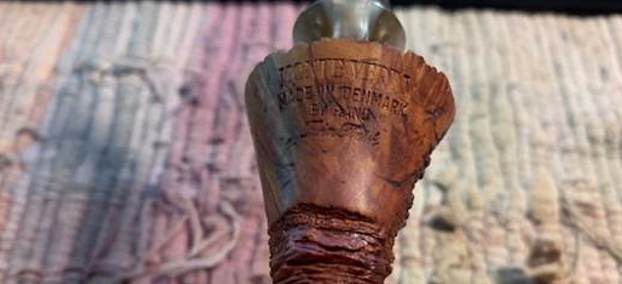
Today I am working on a Ben Wade Martinique Handmade in Denmark Freehand with silver/grey acrylic stem. Jeff and I picked it up in an estate we purchased from a seller in Santa Cruz, California, USA on 05/28/2024. It is very nice looking piece of briar and has fancy saddle stem. The pipe is stamped on the underside of the shank. It was clear and readable. It reads Ben Wade [over] Martinique [over] Hand Made [over] in [over] Denmark. The medium brown stained finish was very dirty with grime ground in the finish all over the whole bowl and shank. The mix of smooth and plateau rim top and plateau shank end are dirty with lava and darkening in the grooves of the plateau. The bowl had a thick cake and the rim top/inner edge had thick lava flowing up from the bowl. It was hard to know its full condition of the inner edge with certainty until it was cleaned. The acrylic saddle stem is was dirty and had light tooth marks and chatter on both sides ahead of the button. There was a BW Crown logo on the top of the stem. Jeff took photos of the pipe before he started his clean up work on it. He took photos of the bowl and rim top to show the thickness of the cake and the darkening and lava overflow in the plateau rim top. The photos of the stem show the dirty condition of the stem and the tooth marks on both sides ahead of the button. The photos of the sides and heel of the bowl show the great grain on the pipe. It is a beauty under the grime and dust. The stamping on the underside of the shank is shown in the photos below. It is clear and readable as noted above.I remembered a bit of history on the brand that Preben Holm pipes were marketed under the Ben Wade label in the US and imported through Lane Ltd. I turned to Pipedia and read the listing on the brand to refresh my memory and flesh out the knowledge of the brand and would encourage you to do the same (https://pipedia.org/wiki/Ben_Wade). I have included a photo from that site that was taken from a Tinderbox advertisement. (Ben Wade Ad in a Tinder Box catalog, courtesy Doug Valitchka.)I quote the portion of the article that summarizes the Danish period of the history of the brand:

Young Copenhagen master pipemaker Preben Holm had made a meteoric career heading a pipe manufacture employing 45 people at the age of 22! But around the turn of 1970/71 he was in major financial difficulties. His US distributor, Snug Harbour Ltd. in New York City, left him in the lurch. Holm had three unpaid invoices on his desk and another large shipment was ready for the USA, when Snug Harbour’s manager told him on the phone that there was no money at all on the account to pay him.

So the Dane went to New York for an almost desperate search for a new distribution partner. He made contacts with Lane Ltd. and met Herman G. Lane in February 1971. Lane Ltd. had no interest in Holm’s serial pipes produced at that time but so much the more in the hand-carved freehands because the hype for Danish freehands and fancies in the States was still on its way to the climax then. The meeting resulted in an agreement to start a cooperation. Lane insisted to improve the quality considerably and in return he assured to be able to sell essentially larger quantities.

Holm went back home to work on new samples with all-new designs and altered finishes for Lane. Both, Lane and Holm, agreed that it would be unwise to sell the pipes under Preben Holm’s name as long as Snug Harbour had a considerable stock of Preben Holm pipes and might sell them pipes at very low prices just to bring in some money.

So on Mr. Lane’s proposal it was determined to use the name Ben Wade belonging to Lane Ltd. Lane spent considerable amounts of money for advertising the new brand in the big magazines– the centerpiece being whole-page ads showing a very exclusive Seven Day’s Set.

The cooperation with Lane Ltd. proved to be an eminent business success for both partners. Within a very short time Ben Wade Handmade Denmark sold in much larger quantities and at higher prices than they had ever dreamed of. And the hype these freehands and fancy pipes caused went on unbroken long after Herman G. Lane deceased. Preben Holm – obviously much more brilliant in pipe making than in pipe business – was in major troubles again in 1986 and had to sack most of his staff. The Ben Wade production was significantly lowered but continued until his untimely death in June of 1989.

Up to now Preben Holm made Ben Wade pipes are cult and highly sought for on the estate markets.

With that information my initial thoughts were confirmed. This pipe was a Preben Holm made Freehand distributed in the US by Lane Ltd under the name Ben Wade. The freehand rage occurred in the late 70s and the pipes were made until Preben’s death in 1989. My guess would be that this pipe was made sometime during that time period and potentially in the late 70s.

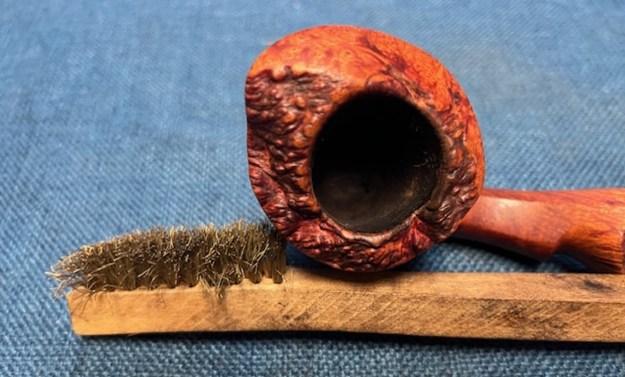
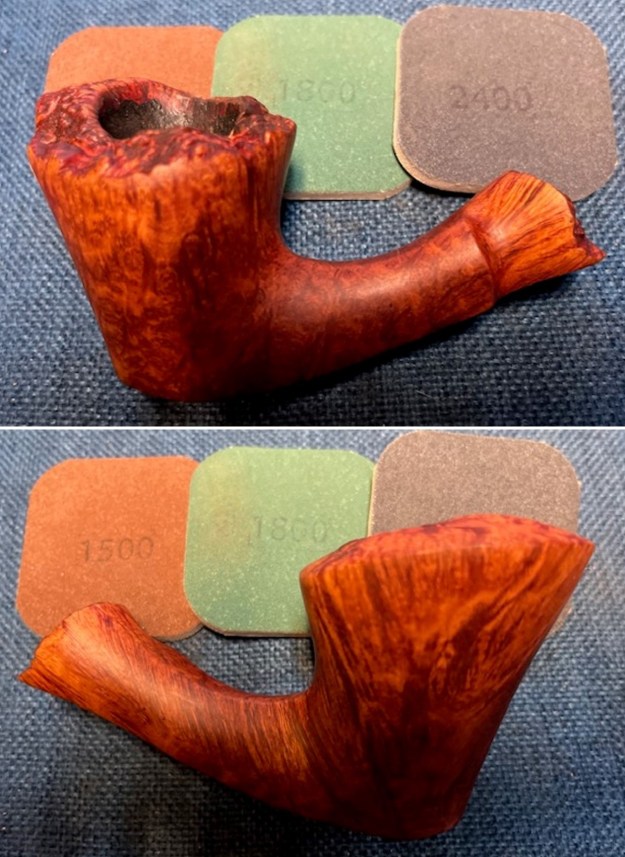
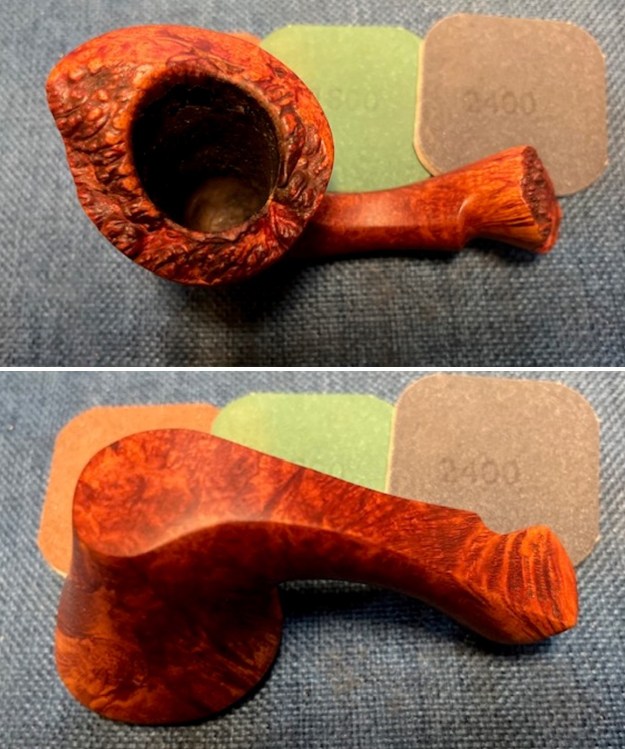
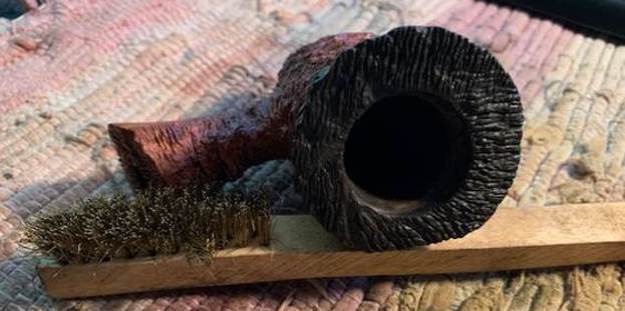
Jeff had cleaned up the pipe with his usual penchant for thoroughness. He reamed the pipe with a PipNet Pipe Reamer and cleaned up the remnants with a Savinelli Fitsall Pipe Knife.  He scrubbed the bowl with undiluted Murphy’s Oil Soap with a tooth brush. He rinsed it under running warm water to remove the soap and grime. He cleaned out the inside of the shank and the airway in the stem with alcohol, cotton swabs and pipe cleaners. He scrubbed the stem with Soft Scrub and cotton pads to remove the debris and oils on the stem. He rinsed it with warm water and dried it off. I took photos of the pipe once I received it. I took a photo of the rim top. Jeff had been able to remove the thick lava coat from the plateau rim top and inner edge. It looks very good at this point. A work over with a brass bristle wire brush will remove the remaining darkening in the grooves. The plateau on the shank end is clean and looks very good. The stem is clean but has some the tooth marks on both sides.I took photos of the stamping on the underside of the shank. It is faint but still readable as noted above. I took a photo of the pipe with the stem removed to get a sense of what the pipe looked like.I started my work on the pipe by addressing the debris still in the plateau rim top. I used a brass bristle wire brush to clean up the plateau on the top and shank end. It worked very well and the plateau looked significantly better once finished.I polished the briar with micromesh sanding pads – dry sanding it with 1500-12000 grit pads. I wiped the bowl down after each sanding pad with a damp cloth to remove the dust and debris from the surface of the briar. I worked some Before & After Restoration Balm into the surface of the briar with my fingertips and into the plateau with a shoe brush. The product works to clean, preserve and protect the briar. I let it sit and work into the briar for 10 minutes then wiped it off with a cotton cloth. I buffed the briar with a clean cloth. The bowl is starting to look beautiful and there is a shine developing. I set the bowl aside and turned my attention to the stem. I sanded out the tooth marks with 220 grit sandpaper and started polishing the stem with 320-3500 grit sanding pads. I wiped it down after each pad a damp cloth to remove the sanding debris. I touched up the Crown BW logo on the top of the stem with Antique Gold Rub’n Buff. I worked it into the stamp with a tooth pick. I buffed it off with a soft cloth and rubbed the stem down with some Obsidian Oil.I polished the stem surface 1500-12000 grit micromesh sanding pads. I dry sanded the stem with each pad and then wiped the stem down with some Obsidian Oil. I finished the hand polishing of the stem with Before & After Pipe Polish – both the Fine and Extra Fine polishes. I gave it a final coat of oil and set it aside to dry. I am really happy with the way that this Preben Holm made Ben Wade Martinique Danish Made Freehand turned out. It really is a beautiful looking pipe with a great shape and smooth finished bowl and plateau on the rim top and shank end. The fancy original acrylic saddle stem is really nice. The polished black/silver of the stem works well with the briar and the plateau portions. The briar really came alive with the buffing. The rich brown stains of the finish gave the pipe a sense of depth with the polishing and waxing. I put the stem back on the bowl and carefully buffed the pipe with Blue Diamond on the buffing wheel using a light touch on the briar. I gave the bowl and the stem multiple coats of carnauba wax on the buffing wheel. I buffed the pipe with a clean buffing pad to raise the shine. I hand buffed the pipe with a microfiber cloth to deepen the shine. The finished Ben Wade Martinique really is a beauty and feels great in the hand and looks very good. Give the finished pipe a look in the photos below. The dimensions of the pipe are Length: 7 inches, Height: 2 inches, Outside diameter of the bowl: 2 inches long x 2 inches wide, Chamber diameter: 1 inch. The weight of the pipe is 59 grams/2.08 oz. The pipe will be going on the rebornpipes store soon. It will be in the section on Danish Pipe Makers Section if you would like to add it to your collection. Thanks for reading this blog and my reflections on the pipe while I worked on it. It was a fun one to work on!

As always, I encourage your questions and comments as you read the blog. Thanks to each of you who are reading this blog. Remember we are not pipe owners; we are pipe men and women who hold our pipes in trust until they pass on into the trust of those who follow us.

A Rather Sad, Well Used Peterson March 17, 2009 B2 Bulldog


Blog by Steve Laug

In January Jeff found out about an estate sale in Pocatello, Idaho, USA. It turned out that the sale was for a fellow Jeff and I had purchased pipes from in the past, Gene. He had been the owner of Outwest Tobacco in Pocatello (long closed now) and I bought tobacco and other smoking items from him in the past. As I think about it now, it seems that I had known Gene for over 30 years Jeff and I had been to his home and enjoyed coffee and a few pipes together. I have no idea how many pipes we bought on those visits as well as to the antique shop of his daughter. I know that there were many pipes. When we heard that it was Gene’s personal collection that was for sale and that he had passed away we decided for Jeff to go to the house and have a look. He went on January 25, 2024 to scope it out as we had seen his personal collection of pipes and there were definitely some among those well smoked old warriors that would be great to pick up. Perhaps there would even be one that could join my own collection in memory of Gene.

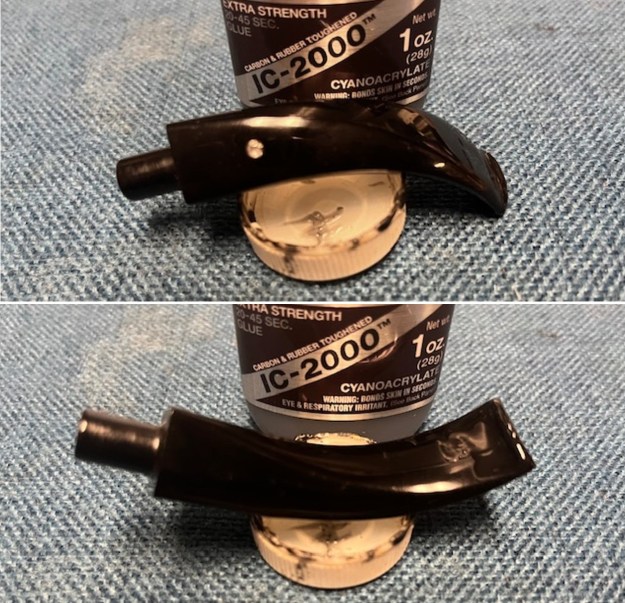
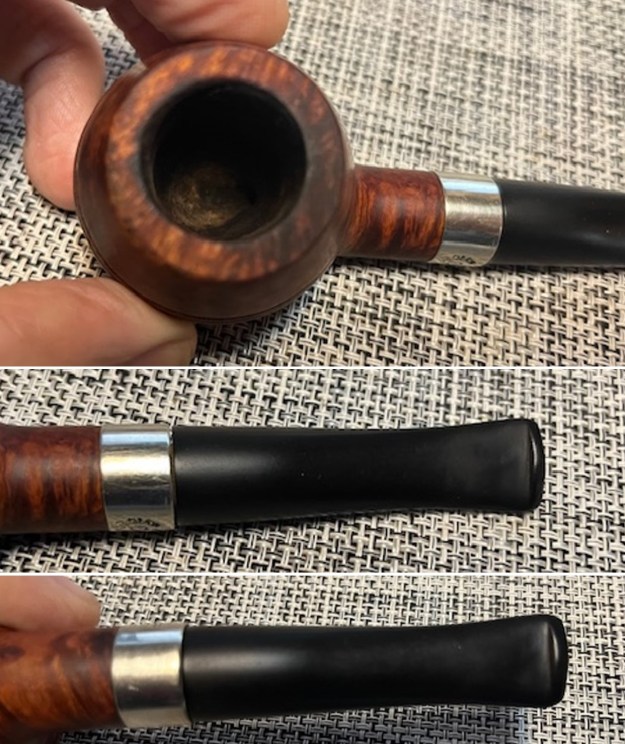
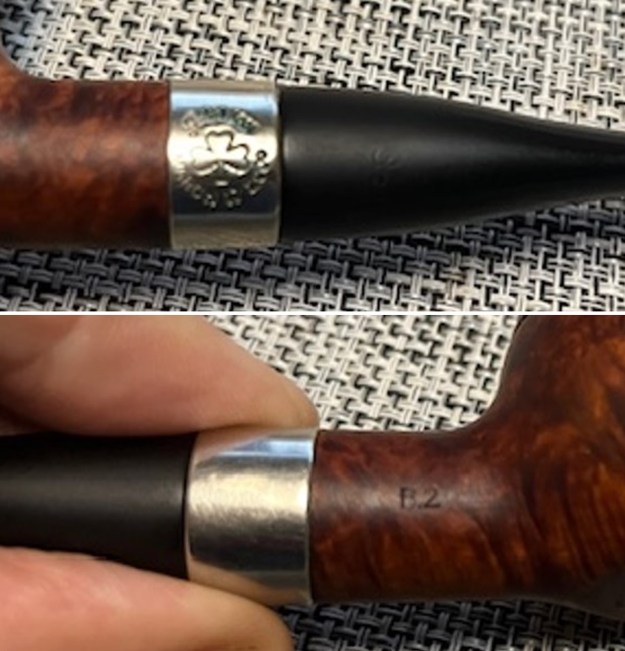
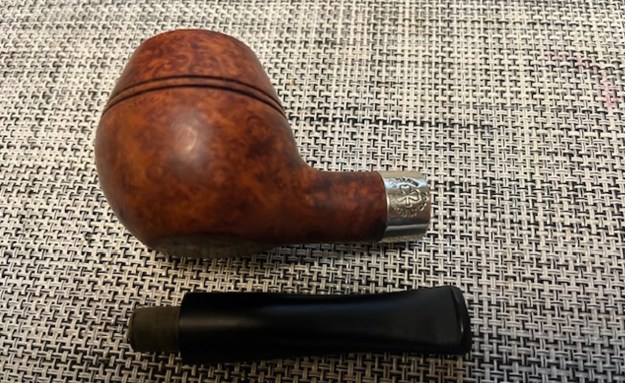
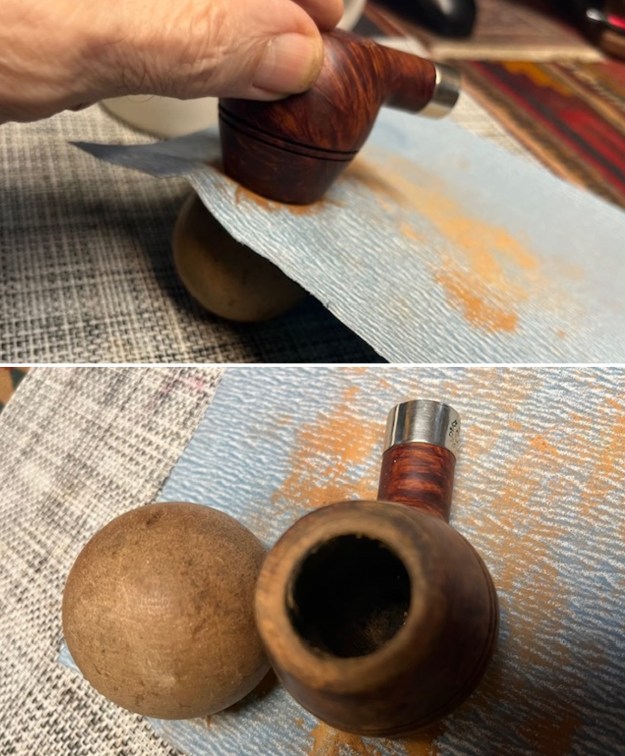
Jeff went to the house and looked through the racks, pipe bags, tobacco – both bulk and tinned as well as a variety of pipes. All the pipes were well smoked and needed serious cleaning. Another one of the pipes that he picked up was this Peterson March 17 2009 with a black vulcanite taper fish tail stem. It was very dirty and was a reddish, brown coloured pipe when it started. The smooth finish around the bowl was dirty and had hand oils ground into the grooves. The bowl had a thick cake that overflowed in lava onto the rim edge and top of the bowl. The bottom of the bowl was flattened so the pipe could be set on a desktop. The stem was vulcanite that was very dirty and had the marks of a rubber Softee Bit on the end. It had become discoloured and there was a line where the debris from smoking had accumulated along the edge and under the bit protector. The good news was that there were only light tooth marks or chatter. The rest of the stem was dirty and had lost the characteristic shine. The pipe was stamped on the polished nickel band on the shank and read Peterson [arched over] a Shamrock with March 17 2009 arched underneath. On the right side of the shank it was stamped with the shape number B2. Jeff took photos of the pipe so I could have a sense of what it looked like before he started his work on it.Jeff took photos of the stem surfaces and the bowl and rim to give a sense of condition of the pipe. You can see the thick cake in bowl and the lava overflow on the edges and rim top of the bowl. It is had to know if there is any damage as the cake and lava is quite thick. The stem surface is very dirty and you can see the area on the end of the stem where the Softee Bit had protected it from chewing but had left it dirty and discoloured. The stem no longer fit in the shank correctly. He also took photos of the sides of the bowl and the heel to show the interesting grain that went around the bowl. There were a few spots on the right side of the bowl that seemed to have a flaw or a shrunken fill. The grain is beautiful and you can see the oils and debris in the grooves of the rim cap.  He took photos of the stamping on the nickel band on the left side of the shank. He did not capture shape number on the right side. The stamping on the band is clear and readable as noted above.I did a bit of searching on the internet to see what I could find. Interestingly turning to Peterson’s Pipe Notes I found the pipe I have in my hand (https://petersonpipenotes.org/tag/st-patricks-day-pipe-2009/). Note that in Mark Irwin’s information below the date he gives for the shape I have is 2010 but the band on mine is definitely marked 2009. Ah well another Peterson anomaly. Either way it is a nicely shape Irish Bulldog.Now it was my turn to work on the pipe. Jeff had done an amazing cleanup of the pipe. He reamed the light cake with a PipNet reamer and cleaned up that with a Savinelli Fitsall Pipe Knife. He scrubbed the internals of the bowl and stem with alcohol, cotton swabs and pipe cleaners. He scrubbed the externals with undiluted Murphy’s Oil Soap and rinsed the bowl off with running water. He soaked the stem in Briarville’s Pipe stem Deoxidizer and once it had soaked rinsed it off with warm water to remove the residual solution. He dried it off and rubbed it down to remove any oxidation that was still on the stem. The pipe looked very good when I received it. I took a photo of the rim top to show the condition. You can see the clean bowl. The bowl is in excellent condition and is clean. The rim top has a small burn mark on the front inner edge and darkening on the back of the rim top and edges. The stem came out looking good. There were definitely light tooth marks and chatter on both sides. I took a photo of the stamping on the shank. The first photo shows that there is no stamping on the briar but the nickel band stamp is very clear. The shape number, B2 on the right side of the shank is also very clear. There was a faint remnant of the P stamp on the left side of the stem.  I removed the stem from the shank and took a photo of the pipe parts to show what I was working with. I also took photos of the pipe with the longer Churchwarden stem in place. It is a nice looking pipe. I started my work on the pipe by addressing the damage on the inner edge of the rim. I used a folded piece of 220 grit sandpaper to smooth out the roughness. I then used 220 grit sandpaper and a wooden ball to give the inner edge of the bowl a slight bevel. It looked much better at this point in the process. I touched up the stain on the rim top with a Cherry Stain Pen and the match to the rest of the bowl is perfect. Once the bowl is finished it will blend very well.I sanded the briar rim top and the sides of the bowl with 320-3500 grit sanding pads. I wiped the bowl down with a damp cloth after each pad. By the time I finished with the 3500 grit pad the briar had taken on a rich glow. The pipe had cleaned up so well that I turned to polish the briar with micromesh sanding pads. I dry sanded it with 1500-12000 grit sanding pads and wiped the bowl down after each pad with a damp cloth. By the final pads the briar really had a shine. I rubbed the briar down with Before & After Restoration Balm. I worked it into the briar with my fingertips and a horsehair shoe brush to work it into the nooks and crannies of the sandblast finish. The product works to clean, enliven and preserve the briar. I let it sit for 10 minutes then I buffed it with a cotton cloth to deepen the shine. The pipe really comes alive with the balm. I set aside the bowl and turned my attention to the stem. I “painted” the stem surface with the flame of a lighter. I was able to lift the tooth marks significantly. Those that remained were more like waves in the stem surface. I filled them in with a coat of clear CA glue and spread it across the surface with a dental spatula. Once the repairs cured I sanded it with a folded piece of 220 grit sandpaper to flatten it further. I sanded it with 320-3500 grit sanding pads to further blend them in and smooth out the surface of the stem.The P stamp on the left side of the stem was faint but I thought I would give it a shot and see how it work. I painted the stamp with white acrylic fingernail polish and let it dry. Once it had dried I scraped off the excess and polished it with a worn 1500 grit micromesh sanding pad. It was faint though it is still readable.I polished the vulcanite with micromesh sanding pads – 1500-12000 grit pads. I wiped it down with Obsidian Oil after each sanding pad. I used Before & After Pipe Polish – both Fine and Extra Fine to further polish the stem. I put the stem back on the Peterson March 17 2009 B2 Bulldog and took it to the buffer. I worked it over with Blue Diamond to polish out the remaining small scratches. I gave the bowl and the stem several coats of carnauba wax and buffed the pipe with a clean buffing pad to raise the shine. I hand buffed it with a microfiber cloth to deepen the shine. The pipe polished up really well and the rim top looked good. I was happy with the look of the finished pipe. The photos below show what the pipe looks like after the restoration. The Peterson St. Patrick’s Day March 17, 2009 Irish Bulldog is a beautiful and unique take on a classic shape. The polished vulcanite taper stem looks really good with the browns of the briar. The dimensions of the pipe are Length: 5 ½ inches, Height: 2 inches, Outside diameter of the bowl: 1 ¼ inches, Chamber diameter: ¾ of an inch. The weight of the pipe is 2.08 ounces/60 grams. This is another pipe that I will be putting it on the rebornpipes store in the Irish Pipe Makers Section shortly, if you are interested in adding it to your collection. The long shank and tall bowl look and feel great in the hand. This one should be a great smoker. Thanks for walking through the restoration with me on this beauty!

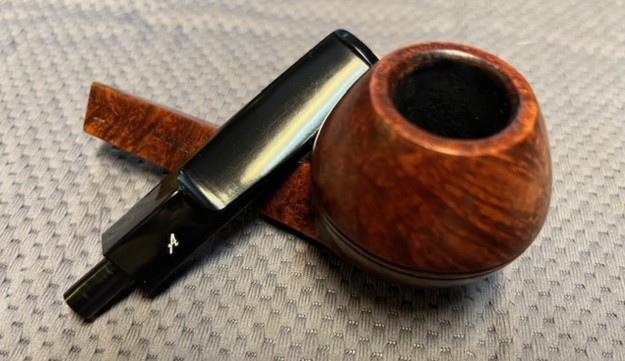
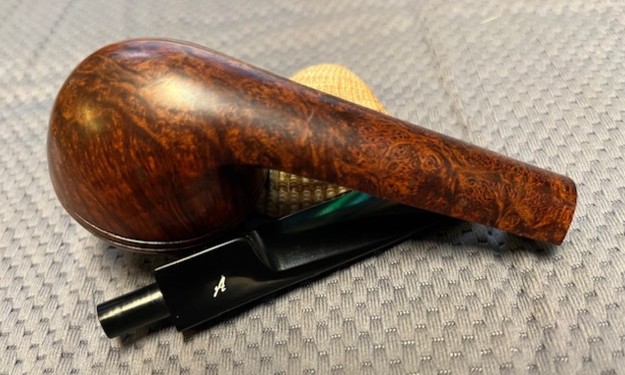
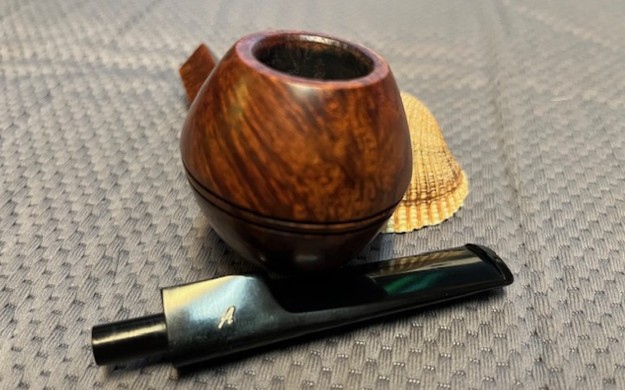
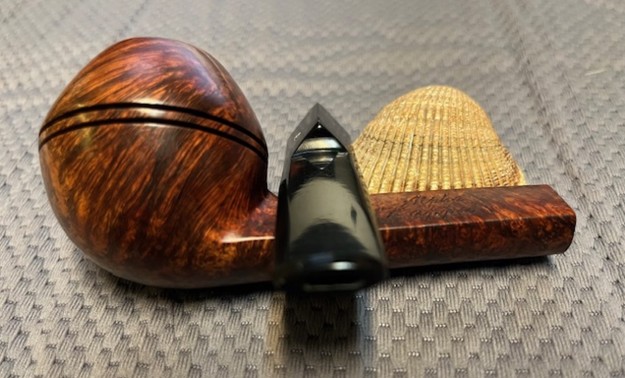
Restoring a Late 90’s Alpha Kappa Imported Briar 11 Long Shank Bulldog


Blog by Steve Laug

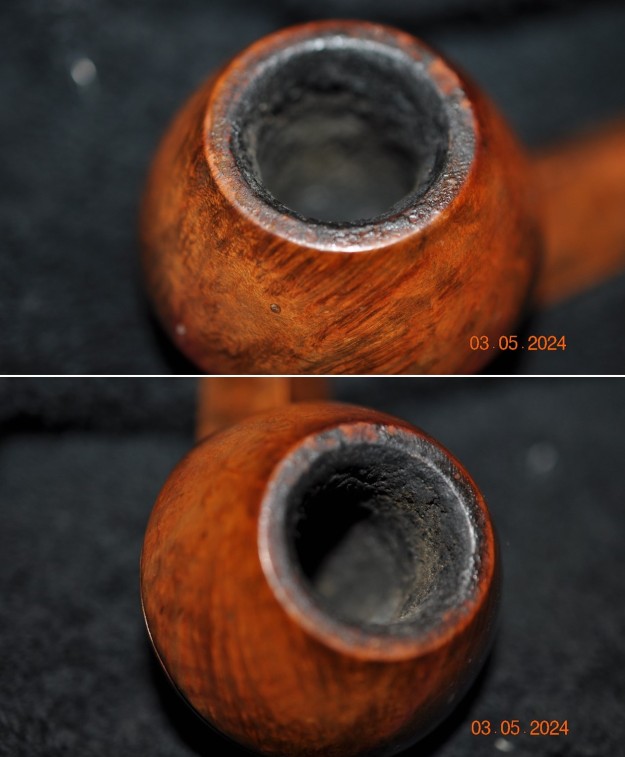
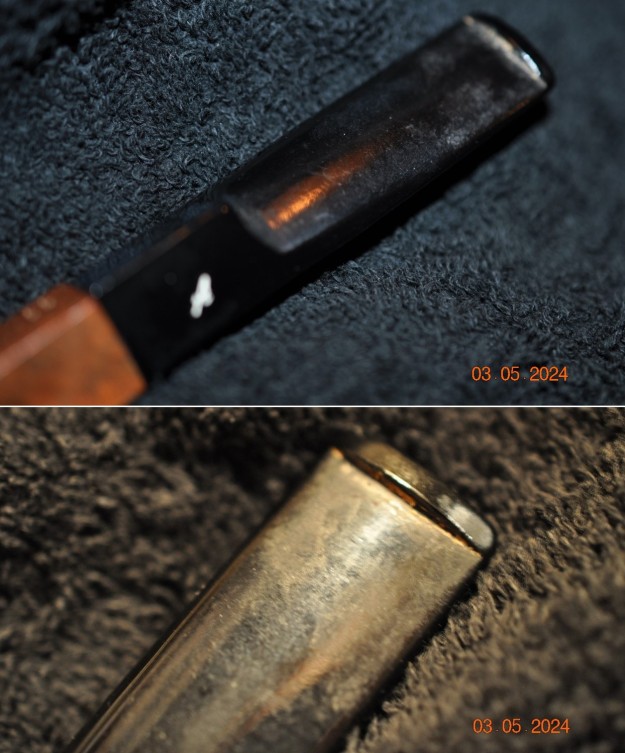
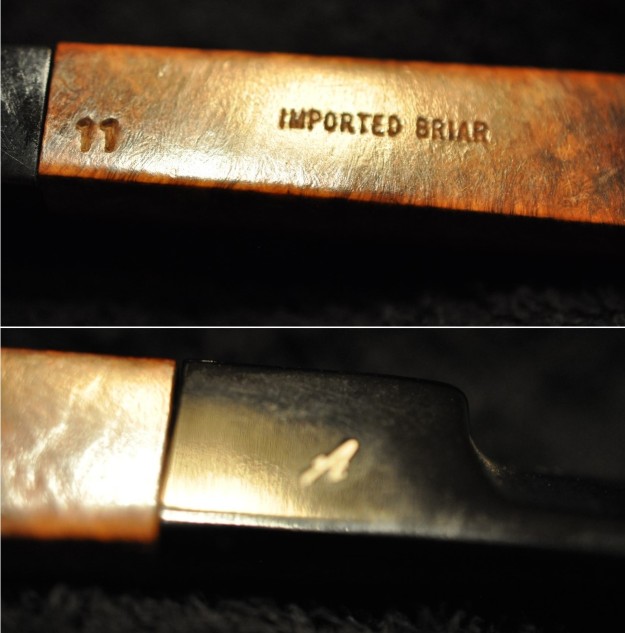
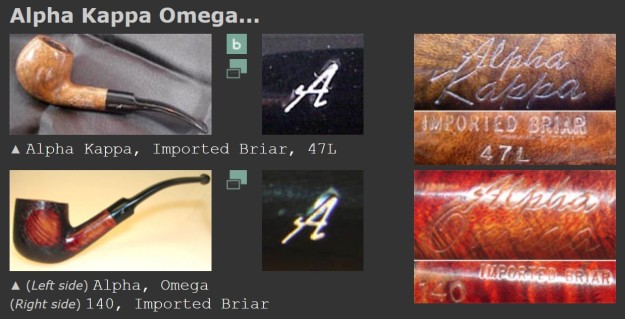
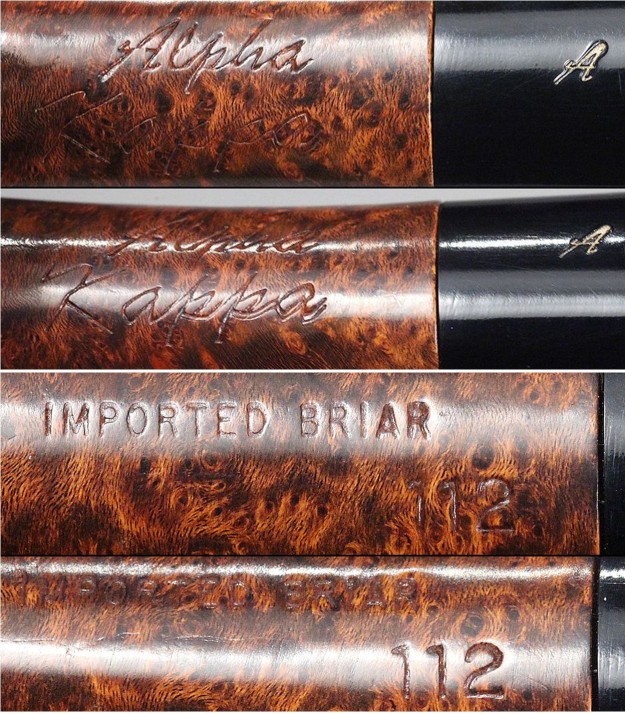
The next pipe on the table is a smooth finished long shank Bulldog with an acrylic stem. We purchased it from a seller on eBay from Jordan, Minnesota, USA on 01/22/2024. The pipe is stamped on the left side of the shank and reads Alpha [over] Kappa. On the right side of the shank it is stamped Imported Briar followed by the shape number 11. The rim was in good condition other than a lot of lava overflowing from the thick cake in the bowl onto the smooth rim top. There were oils and grime ground into the bowl sides gives the finish a flat look. The shank is a modified diamond shank. On the top it is shaped like a diamond. The underside of the shank is rounded. The shape of the saddle stem also matches the shank shape. It is a dirty stem with grime and grit on the surface. There were also light tooth marks on both the top and underside of the stem just ahead of the button. Jeff took photos of the pipe before he started his clean up work. I have included them below.He took photos of the pipe’s bowl and rim top to show the cake in the bowl and the lava coat overflowing onto the top. It is another dirty pipe. He also took photos to capture the light tooth marks on the top and underside of the stem near the button. He took photos of the sides and heel of the bowl to show the grain around the bowl and the amount of grime ground into the surface of the briar.   He took photos of the stamping on the sides of the shank. It is clear and quite readable. The inserted A logo for Alpha on the upper left side of the diamond stem looks very good. I turned first to Pipephil’s site (http://www.pipephil.eu/logos/en/logo-a4.html) to see what I could learn. I skipped over the section on the Israeli made Alphas as the stamping on the stem and the briar is very different. I turned instead to the Alpha Kappa Omega section and did a screen capture of the section. I have included it below as well as the side bar information following the capture.Alpha pipes with a cursive A on the stem and a Greek letter name are made at the Dr. Grabow/Lane Ltd. factory in North Carolina (USA).

  • Kappa: a smooth light brown finish
  • Beta: dark reddish brown
  • Epsilon: black sandblast with reddish highlights
  • Sigma: smooth finish, medium brown

From that information I saw the connection between Grabow/Lane Ltd and the Israeli company. I also learned that the Kappa pipe was finished in a smooth light brown finish.

With that information in hand, I turned to Pipedia (https://pipedia.org/wiki/Alpha) specifically to the page on the brand. I quote what was written there in full. It is quite interesting to read.

Alpha was originally a brand of the Shalom Pipe Factory in Israel, owned by Bernard Hochstein, former CEO of Mastercraft.

The Alpha line was made exclusively for export to the United States. They were made in Israel from the 1970s into the 1980s, at which point the name was sold to Mastercraft, and later to Lane, Ltd., who produced very few Lane Alpha pipes at the end of the 1990’s. Lane Alphas were sold in five finishes, each denoted with a Greek letter. After Lane, Mastercraft again marketed the Alpha, under the name Alpha USA, with finishes named Sierra, Delta, Mark V, Blue Ridge, Sabre, and Big Boy, some of which were not stamped with the Alpha name. Among others, the Israeli made Alpha pipes were available in a line marketed as “Citation”.

The item of interest to me is highlighted in red above. It made it clear to me that the pipe was one of the Lane Alpha pipes at the end of the 1990s. Lane Alphas were sold in five finishes each denoted with a Greek letter. In this case the pipe that I am working on is a KAPPA. I am including a photo of the Alpha Kappa and photos of the nomenclature on the left and right side of the shank and stem that was on Pipedia.

Alpha, Lane Ltd. Late 1990s, Kappa Finish (one of 5 designated by a Greek letter)Now I knew that pipe I was working on was one made by Lane Ltd for sale in the US as part of a series of pipes with five finishes. I also leared that the pipes were made at the end of the 1990s and that the Alpha KAPPA pipe was finished in a smooth light brown finish. That matched the pipe I had perfectly.

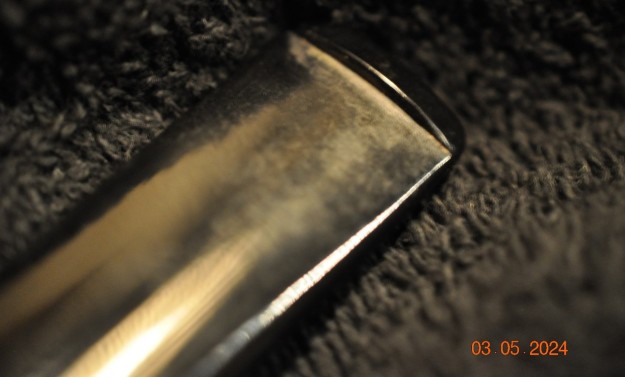
Armed with that information I turned to work on the pipe itself. Jeff had done a great job cleaning up the pipe as usual. He cleaned up the inside of the bowl with a PipNet reamer and a Savinelli Fitsall Pipe Knife. The bowl walls looked very good. He scrubbed the interior of the bowl and shank with pipe cleaners, cotton swabs and alcohol to remove the tars and oils. He scrubbed the exterior of the pipe with Murphy’s Oil Soap and a tooth brush to remove the grime from the finish. He worked on the rim top lava and darkening with the soap and tooth brush. He scrubbed the inside of the stem with alcohol and pipe cleaners. He scrubbed the exterior with Soft Scrub and then soaked it in Briarville’s Pipe Stem Deoxidizer. He washed it off with warm water to remove the deoxidizer. The pipe looked far better. I took photos of the pipe when I received it before I started working on it. I took photos of the bowl and rim top to show how clean it was. The top and the bevelled inner edge of the rim show some nicks and scratches. The stem looks clean of debris and grime. There are light tooth marks and chatter on both sides.I took photos of the stamping on the left and right sides of the shank. The stamping is clear and readable. I took a photo of the pipe with the stem removed to show the overall look of stem, tenon and profile of the pipe. The briar was in great condition so I started working on the bowl by polishing the briar bowl and shank with micromesh sanding pads – dry sanding with 1500-12000 grit sanding pads. I wiped it down with a damp cloth after each pad to remove the debris. The bowl took on a rich glow. I rubbed the bowl down with Before & After Restoration Balm. I worked it into the surface of the briar with my fingertips and a horsehair shoe brush to clean, enliven and protect it. I let the balm sit for 10 minutes and then buffed with a cotton cloth and shoe brush to raise the shine. Mark Hoover’s Balm is a product that I have come to appreciate and one I use on every pipe I have been working on. I set the bowl aside and polished the vulcanite with micromesh sanding pads – 1500-12000 grit pads. I wiped it down with a damp cloth after each sanding pad. I used Before & After Pipe Polish – both Fine and Extra Fine to further polish the stem. I put the stem back on the Alpha Kappa Imported Briar Long Shank 11 Bulldog and took it to the buffer. I worked it over with Blue Diamond to polish out the remaining small scratches. I gave the bowl and the stem several coats of carnauba wax and buffed the pipe with a clean buffing pad to raise the shine. I hand buffed it with a microfiber cloth to deepen the shine. The pipe polished up really well and the beveled rim top looked good. I was happy with the look of the finished pipe. The photos below show what the pipe looks like after the restoration. The long shank Bulldog is a beautiful and unique take on a classic shape. It was a bit of a blast from the past for me to pick up an Alpha again and work on it – taking me back to one of my first pipes a little Alpha author. The polished Black Acrylic stem looks really good with the browns of the briar. The dimensions of the Alpha Kappa 11 Bulldog are Length: 7 inches, Height: 2 inches, Outside diameter of the bowl: 1 ¼ inches, Chamber diameter: 7/8 of an inch. The weight of the pipe is 2.05 ounces/58 grams. This is another pipe that I will be putting it on the rebornpipes store in the American Pipe Makers Section shortly, if you are interested in adding it to your collection. The long shank and tall bowl look and feel great in the hand. This one should be a great smoker. Thanks for walking through the restoration with me on this beauty!

Cleaning up the worst used of the lot a Ben Wade Martinique Made in Denmark Freehand


Blog by Steve Laug

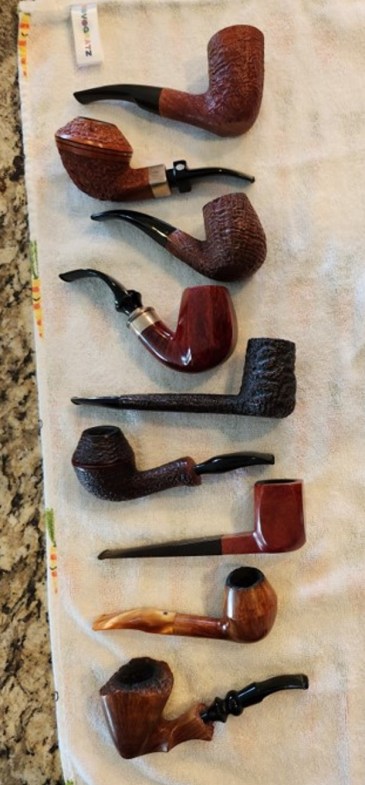
A few weeks ago I was contacted from a fellow in Montana who was selling his pipes as they had not been used for quite a few years. I asked him for a picture and he sent me the one to the left. It included the following brands (from the top to the bottom of the photo): Savinelli Autograph 5 Freehand, Mastro de Paja Ciocco 0C Bulldog, Mastro de Paja Media 1B Bent Billiard, Ser Jacopo Delecta Octagonal Bent Billiard, Caminetto Business KS 118 Canadian, Radici Rind Rhodesian, Dunhill Bruyere ODA 836 Panel Billiard, Barontini Straight Grain B3 Freehand and a Ben Wade Martinique Hand Made in Denmark Freehand.

Almost all of them were higher end pipes and all were hand made pipes. They were a mix of finishes – smooth, sandblast and also rusticated. They were a mix of shapes as well and the majority of them were Italian Made other than the Dunhill and the Ben Wade Martinique. They were beautiful pipes and after exchanging quite a few photos of the pipes from various angles to get a sense of what was there we struck a deal. We sent him the payment and the pipes arrived in Idaho a few days after I left for Vancouver. They were certainly more dirty than we were led to believe but that is not an issue.

Jeff cleaned them all and this week I received them in Vancouver. I am impressed with the way they cleaned up and the beauty of the brands. They truly are some beautiful pipes. I just need to put the final touches on each of them and address issues on the bowl tops, rims and stems and they should be good to go. I am really looking forward to working on each of them in the days ahead.

Today I am working on the last of the lot. It is another warm, late afternoon so after work I descended to the basement to continue working on the lot. The last pipe left to work on was the smooth Ben Wade Freehand. This one is a bit different than any of the other in this lot. It is very nice looking piece of briar and has fancy saddle stem. The pipe is stamped on the underside of the shank. It was clear and readable. It reads Ben Wade [over] Martinique [over] Hand Made in Denmark. The medium brown stained finish was very dirty with grime ground in the finish all over the whole bowl and shank. The plateau rim top and shank end are dirty with lava and darkening in the grooves of the plateau. The bowl had a thick cake and the rim top/inner edge had thick lava flowing up from the bowl. It was hard to know its full condition of the inner edge with certainty until it was cleaned. The acrylic saddle stem is was dirty and had deep tooth marks and chatter on both sides ahead of the button. There was a BW Crown logo on the top of the stem. Jeff took photos of the pipe before he started his clean up work on it. He took photos of the bowl and rim top to show the thickness of the cake and the darkening and lava overflow in the plateau rim top. The photos of the stem show the dirty condition of the stem and the tooth marks on both sides ahead of the button. The photos of the sides and heel of the bowl show the great grain on the pipe. It is a beauty under the grime and dust. The stamping on the underside of the shank is shown in the photos below. It is faint in spots but still readable. It read as noted and explained above. The third photo shows the Crown BW logo on the stem top. I remembered a bit of history on the brand that Preben Holm pipes were marketed under the Ben Wade label in the US and imported through Lane Ltd. I turned to Pipedia and read the listing on the brand to refresh my memory and flesh out the knowledge of the brand and would encourage you to do the same (https://pipedia.org/wiki/Ben_Wade). I have included a photo from that site that was taken from a Tinderbox advertisement. (Ben Wade Ad in a Tinder Box catalog, courtesy Doug Valitchka.)I quote the portion of the article that summarizes the Danish period of the history of the brand:

Young Copenhagen master pipemaker Preben Holm had made a meteoric career heading a pipe manufacture employing 45 people at the age of 22! But around the turn of 1970/71 he was in major financial difficulties. His US distributor, Snug Harbour Ltd. in New York City, left him in the lurch. Holm had three unpaid invoices on his desk and another large shipment was ready for the USA, when Snug Harbour’s manager told him on the phone that there was no money at all on the account to pay him.

So the Dane went to New York for an almost desperate search for a new distribution partner. He made contacts with Lane Ltd. and met Herman G. Lane in February 1971. Lane Ltd. had no interest in Holm’s serial pipes produced at that time but so much the more in the hand-carved freehands because the hype for Danish freehands and fancies in the States was still on its way to the climax then. The meeting resulted in an agreement to start a cooperation. Lane insisted to improve the quality considerably and in return he assured to be able to sell essentially larger quantities.

Holm went back home to work on new samples with all-new designs and altered finishes for Lane. Both, Lane and Holm, agreed that it would be unwise to sell the pipes under Preben Holm’s name as long as Snug Harbour had a considerable stock of Preben Holm pipes and might sell them pipes at very low prices just to bring in some money.

So on Mr. Lane’s proposal it was determined to use the name Ben Wade belonging to Lane Ltd. Lane spent considerable amounts of money for advertising the new brand in the big magazines– the centerpiece being whole-page ads showing a very exclusive Seven Day’s Set.

The cooperation with Lane Ltd. proved to be an eminent business success for both partners. Within a very short time Ben Wade Handmade Denmark sold in much larger quantities and at higher prices than they had ever dreamed of. And the hype these freehands and fancy pipes caused went on unbroken long after Herman G. Lane deceased. Preben Holm – obviously much more brilliant in pipe making than in pipe business – was in major troubles again in 1986 and had to sack most of his staff. The Ben Wade production was significantly lowered but continued until his untimely death in June of 1989.

Up to now Preben Holm made Ben Wade pipes are cult and highly sought for on the estate markets.

With that information my initial thoughts were confirmed. This pipe was a Preben Holm made Freehand distributed in the US by Lane Ltd under the name Ben Wade. The freehand rage occurred in the late 70s and the pipes were made until Preben’s death in 1989. My guess would be that this pipe was made sometime during that time period and potentially in the late 70s.

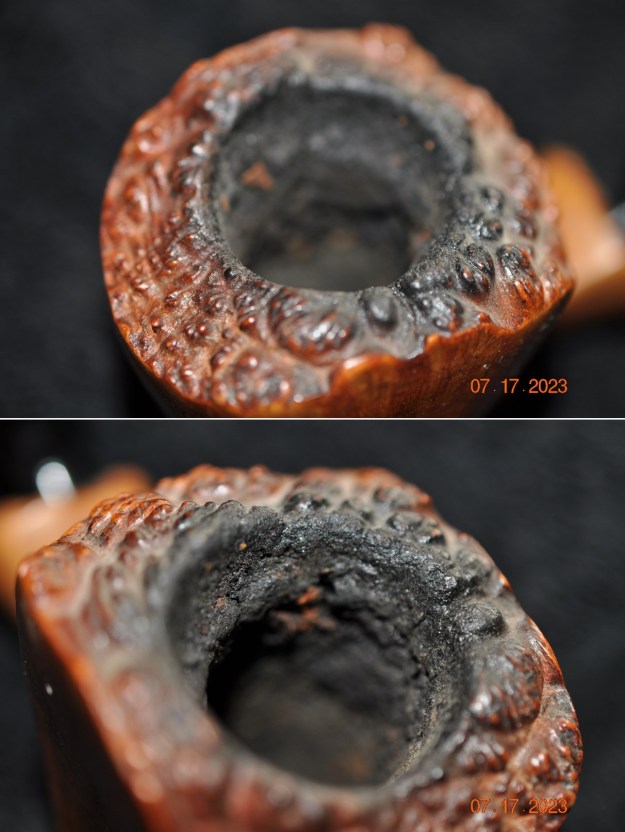
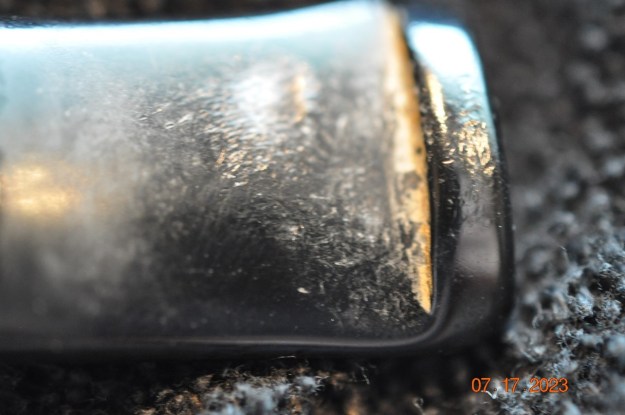
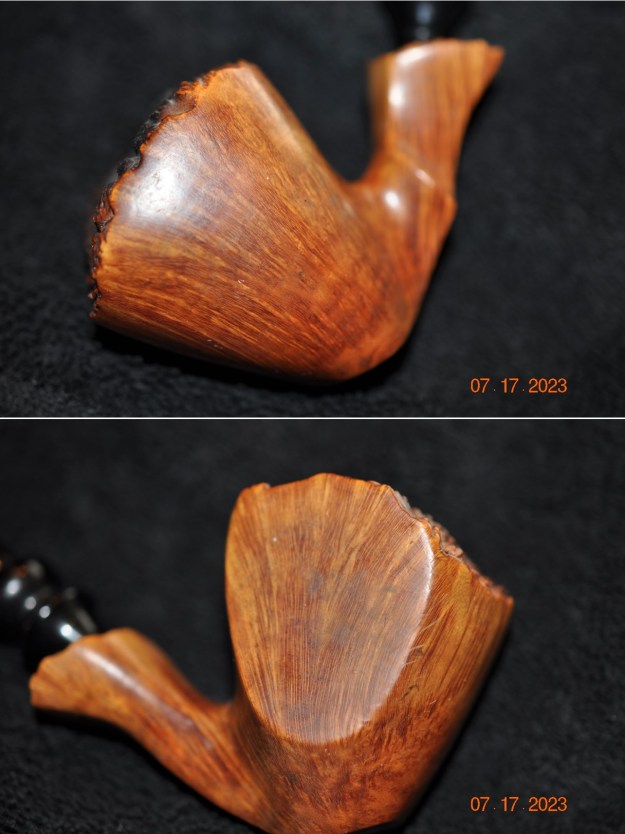
Jeff had cleaned up the pipe with his usual penchant for thoroughness. He reamed the pipe with a PipNet Pipe Reamer and cleaned up the remnants with a Savinelli Fitsall Pipe Knife.  He scrubbed the bowl with undiluted Murphy’s Oil Soap with a tooth brush. He rinsed it under running warm water to remove the soap and grime. He cleaned out the inside of the shank and the airway in the stem with alcohol, cotton swabs and pipe cleaners. He scrubbed the stem with Soft Scrub and cotton pads to remove the debris and oils on the stem. He rinsed it with warm water and dried it off. I took photos of the pipe once I received it.  I took a photo of the rim top. Jeff had been able to remove the thick lava coat from the plateau rim top and inner edge. It looks very good at this point. A work over with a brass bristle wire brush will remove the remaining darkening in the grooves. The plateau on the shank end is clean and looks very good. The stem is clean but has some the tooth marks on both side are deep and obvious. I took photos of the stamping on the underside of the shank. It is faint but still readable as noted above. I took a photo of the pipe with the stem removed to get a sense of what the pipe looked like.I started my work on the pipe by addressing the debris still in the plateau rim top. I used a brass bristle wire brush to clean up the plateau on the top and shank end. It worked very well and the plateau looked significantly better once finished.I polished the briar with micromesh sanding pads – dry sanding it with 1500-12000 grit pads. I wiped the bowl down after each sanding pad with a damp cloth to remove the dust and debris from the surface of the briar. I worked some Before & After Restoration Balm into the surface of the briar with my fingertips. The product works to clean, preserve and protect the briar. I let it sit and work into the briar for 10 minutes then wiped it off with a cotton cloth. I buffed the briar with a clean cloth. The bowl is starting to look beautiful and there is a shine developing. I set the bowl aside and turned my attention to the stem. I filled in the tooth marks on both sides of the stem ahead of the button with a black CA glue. Once the glue cured I sanded it smooth with 220 grit sandpaper and started polishing the stem with 600 grit wet dry sandpaper. I touched up the Crown BW logo on the top of the stem with Antique Gold Rub’n Buff. I worked it into the stamp with a tooth pick. I buffed it off with a soft cloth and rubbed the stem down with some Obsidian Oil.I polished the stem surface 1500-12000 grit micromesh sanding pads. I dry sanded the stem with each pad and then wiped the stem down with some Obsidian Oil. I finished the hand polishing of the stem with Before & After Pipe Polish – both the Fine and Extra Fine polishes. I gave it a final coat of oil and set it aside to dry.I am really happy with the way that this Preben Holm made Ben Wade Martinique Danish Made Freehand turned out. It really is a beautiful looking pipe with a great shape and smooth finished bowl and plateau on the rim top and shank end. The fancy original acrylic saddle stem is really nice. The polished black of the stem works well with the briar and the plateau portions. The briar really came alive with the buffing. The rich brown stains of the finish gave the pipe a sense of depth with the polishing and waxing. I put the stem back on the bowl and carefully buffed the pipe with Blue Diamond on the buffing wheel using a light touch on the briar. I gave the bowl and the stem multiple coats of carnauba wax on the buffing wheel. I buffed the pipe with a clean buffing pad to raise the shine. I hand buffed the pipe with a microfiber cloth to deepen the shine. The finished Ben Wade Martinique really is a beauty and feels great in the hand and looks very good. Give the finished pipe a look in the photos below. The dimensions of the pipe are Length: 6 inches, Height: 2 ½ inches, Outside diameter of the bowl: 2 inches long x 1 ¾ inches wide, Chamber diameter: 1 inch. The weight of the pipe is 6 grams/2.29 oz. The pipe will be going on the rebornpipes store soon. It will be in the section on Danish Pipe Makers Section if you would like to add it to your collection. Thanks for reading this blog and my reflections on the pipe while I worked on it. It was a fun one to work on!

As always, I encourage your questions and comments as you read the blog. Thanks to each of you who are reading this blog. Remember we are not pipe owners; we are pipe men and women who hold our pipes in trust until they pass on into the trust of those who follow us.

Restoring a Boxed Castello Sea Rock Briar 19 KKKK 1/8 Canted Billiard


Blog by Steve Laug

I thought it might be helpful to take you through my process of working on each pipe that we purchase. Jeff has set up a spread sheet to track where the pipe came from, the date of purchase and what we paid for it so that we know what we have invested in the pipe before we even work on it. This takes a lot of the guess work out of the process. This particular pipe was purchased on 03/30/2023 as part of an estate we purchased from Plano, Texas, USA. I also want you to understand why we take the photos we do. If you have followed for a while then you will see the familiar pattern of the photos we include both in the before and midstream process of working on a pipe. It is not accidental as the photos have been taken to help me make an assessment of the pipe Jeff sees before he starts his clean up work. We do this to record the condition that the pipe was in when received it and to assess what kind of work will need to be done on. When I look at these photos this is what I see.

  1. The first thing I see is a classic Italian Made Castello Sea Rock Briar canted Billiard with an acrylic stem. It is well proportioned and well made with a great classic Castello shape.
  2. The finish is dirty and there is grime and grit ground into the rugged rustication on the sides of the bowl and shank. It is dusty and dull looking but under the grime the pipe looks good.
  3. The rim top has some lava and debris in the valleys of the rustication on the top and the edges. It is dirty looking but cleaning will reveal a real beauty.
  4. The bowl has a thick cake and debris on the walls that hides the walls and some grime on the inner edge of the bowl but once it is clean we will know what the bowl and edges really look like. The outer edges look good and there does not appear to be any obvious burn damage to the top or bowl edges.
  5. The acrylic stem is in good condition – dirty and has tooth chatter and marks on both sides ahead of button. There are some deeper tooth marks on the underside near the button. There is a crinkled/Diamond insert logo on the left side of the stem.

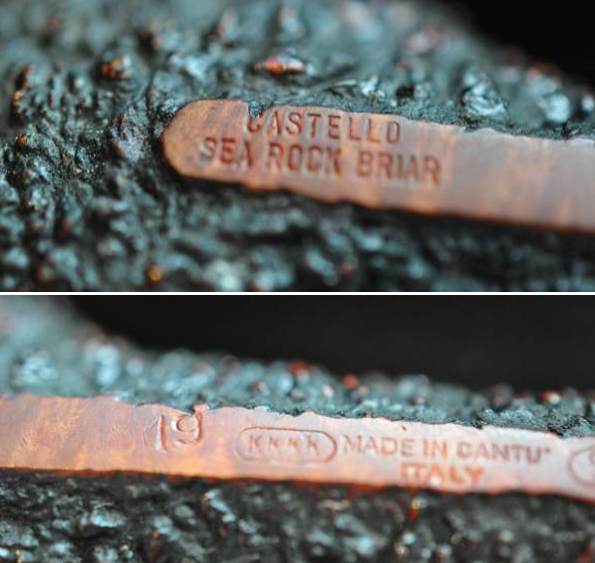
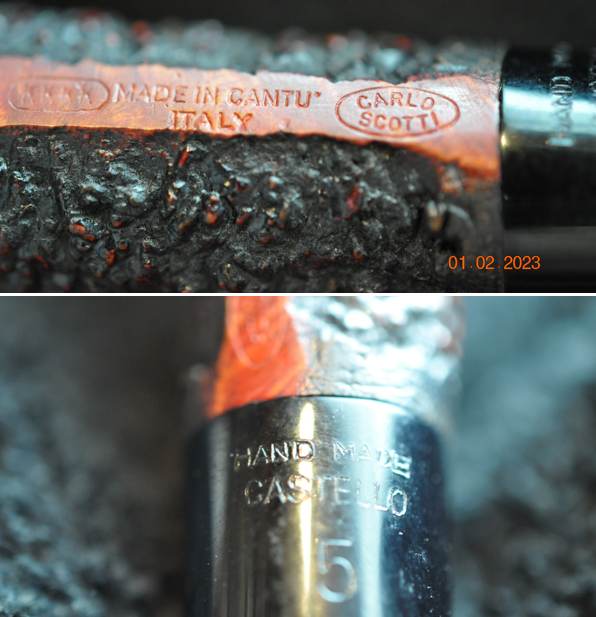
Overall my impressions of this pipe is that it is a beauty that once cleaned up will look pretty amazing. I love the tactile rustication on the Sea Rock Briars and have found nothing that comes close to it. The photos below confirm the assessment above. Jeff took close up photos so that I could have a clearer picture of the condition of the bowl, rim edges and top. The rim top photos confirm my assessment above. The cake in the bowl is thick but broken in some parts with tobacco debris stuck on the walls. The rim top has quite a bit of lava, grime and debris in the rusticated surface. You can also see the condition of the outer edge and the inner edge is in great condition. This is what I look for when assessing a pipe. There is no visible burn damage at this point. The bowl is still round and other than being in a used condition it is in great shape.The photos of the acrylic stem surface from various angles confirmed my assessment of its condition. You can see that it is dirty in the first photo below. The stem has some deeper tooth marks on the underside near the button and a lot of chatter.    Instead of telling you what I see in the next photos of the sides of the bowl and the heel I want to hear from you. Tell me what you see? What does the finish look like to you? Are there any visible problems or issues that stand out to you? Are the cracks or scratches in the valleys of the rustication or the high spots? Are there visible flaws or fissures in the briar? How random does the deep rustication look? Is there a pattern to it? Any visible issues on the heel of the bowl? These questions should help you to see what I am looking for when I see these photos.    He took photos of the stamping on the underside of the shank. On the heel of the bowl is stamped Castello [over] Sea Rock Briar. That is followed by the shape number for a 1/8 Canted Billiard -19. Next to that it is stamped with KKKK in an oval designating the sized of the pipe. It is then stamped Made in Cantu [over]. Next to the shank/stem union it is stamped Carlo Scotti in and oval. The acrylic stem is stamped on the underside and reads HAND MADE [over] Castello [over] the number 5. What stands out for you in the photos of the stamping on the pipe? What do you look for in the stamping? I know it is dirty but what do you see underneath the grime on the surface of the briar and the acrylic? I thought I would include a link to a great shape chart for Castello pipes on Maxim Engel’s Pipes2Smoke site. It is very helpful in that includes photos of the shapes and makes identification quite simple. Here is the link (https://pipes2smoke.com/pages/castello-shape-guide).
When I am working on Castello pipes the stamping always eludes my memory. I have partial recall but not clear on all the details. I find that getting the stamping clear in my head is an important part of restoring a pipe for me. I have several sites that I always check for information. I turned first to the Pipephil site (http://www.pipephil.eu/logos/en/logo-castello.html) because of the general quick summary of information I get there. I quote:

Castello PIPA CASTELLO di Carlo Scotti & C. was founded in 1947 by Carlo Scotti († 1988). Franco Coppo (AKA “Kino”) who married Carlo Scotti’s daughter Savina, manages (2012) the corporate since 1985.

The site also gave a good summary of the grading and sizes of the pipes. I quote that in full.

Sizes (ascending):

1K to 4K, G (Giant) and GG (Extra large)

Rusticated grading: SEA ROCK, OLD SEA ROCK, NATURAL VIRGIN,

Sandblasted grading: ANTIQUARI, OLD ANTIQUARI

Smooth grading (ascending): TRADEMARK, CASTELLO, COLLECTION

Other stampings: Great Line (Non-standard or freestyle) Fiammata (Straight grain)

Production (2012): ~4000 pipes / year

I also found a note on the page that the Rhinestone logo was originally on pipes for the US market. It is occasionally used now.

I turned then to Pipedia for more information on the brand (https://pipedia.org/wiki/Castello). The majority of the information was what was already quoted above in abbreviated form. However there was a link to an article by Bob Hamlin that gave some interesting bits of information that I found helpful (http://www.pipes.org/BURST/FORMATTED/196.016.html). I quote in part from that article.

SEA ROCK [Carved Black or dark brown]:  This is the lowest grade of the Castello line and is the most common in the USA.  Sea Rocks are produced by taking a smooth bowl that has not been “final finished” and surface carving the finish with tools. This “carved” finish is then evened out using a steel wire brush, stained and then waxed. The Natural Vergin carved finish is left unstained and unwaxed as a rule, although we have seen waxed and partially waxed “Vergins”. 

All carved Castello pipes  are graded by the number of K’s that are stamped on each piece and are K-graded by SIZE.  1K is the smallest and fairly rare, 2K is small to medium, with  3K or 4K being the most common and ranges from medium to medium large. Large pieces are stamped “G” for giant and extra large pieces are stamped “GG” for double giant.  In addition to the number of K’s on a carved Sea Rock piece the shape number is almost always added.  As a rule a Sea Rock Castello is stained Black, although recently there have been quite a few coming in stained deep brown and still stamped “Sea Rock”. American Logo’d Sea Rocks are all priced the same to the consumer, although most are 2 or 3 K’ed models.  G/GG models are charged at a higher price on American pieces and are basically the same as their European counterparts.

The Castello Sea Rock briar I was working on did a 4 K stamping so it was on the larger side. It definitely was made for the American Market with the Rhinestone in the stem. It had the black finish. The shape number is a 19 or a 1/8 Canted Billiard.

Pipedia also gave a link to Mike’s Briar Blues site for help in dating and determining shapes (http://www.briarblues.com/castello.htm). Give it a read for some helpful information.

Now it was time to do my part on the restoration…

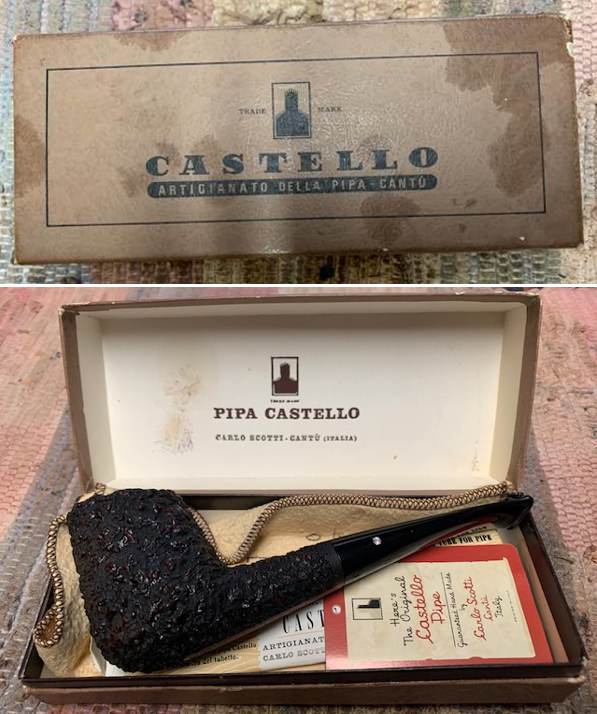
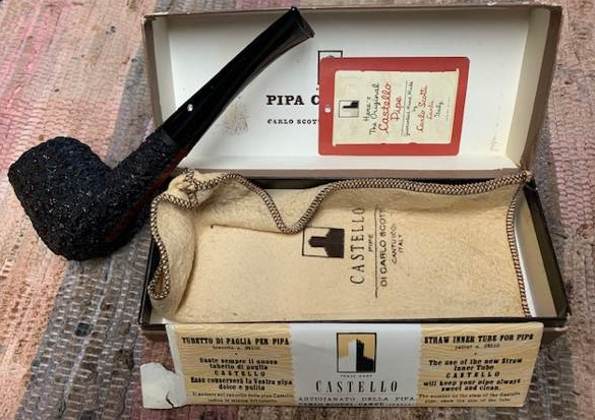
When Jeff sent me the box of pipes for my restoration work. The Castello was in a well used Castello box and included all of the marketing materials – a signed card, a pipe sock and a  package of pipe straws for use as filters in the shank. Here are some photos of the pipe and box.  When I took the pipe out of the box it is a clean pipe and I go over it keeping in mind my assessment shared in the opening paragraph above. Now that I have it in hand I am looking for confirmation of what I saw in the photos as well as any significant structural changes in the bowl and finish as I go over it.

  1. The classic Castello Sea Rock Briar Canted Billiard looks amazing. The rustication is beautiful and the acrylic stem works very well on the pipe.
  2. The finish is clean and the grime and grit have been removed from the finish on the bowl. The rustication and depth in the valleys has just come alive around the bowl sides.
  3. The lava, grime and dust on the rim top has been removed and it looks to be in good condition on the top and edges of the bowl.
  4. The walls of the bowl are clean and I do not see any checking or burn damage. The inner edge of the bowl looks good. The outer edges look good and there does not appear to be any obvious burn damage there.
  5. The acrylic stem is clean and has tooth chatter and marks on both sides. The Rhinestone/Diamond logo on the side of the stem looks very good.

Hopefully the steps above show you both what I look for when I go over the pipe when I bring it to the work table and also what I see when I look at the pipe in my hands. They also clearly spell out a restoration plan in short form. My work is clear and addressing it will be the next steps. I took photos of the whole pipe to give you a picture of what I see when I have it on the table. This is important to me in that it also shows that there was no damage done during the clean up work or the transit of the pipe from Idaho to here in Vancouver. I carefully went over the bowl and rim top to get a sense of what is happening there. In this case once the rim top and edges were cleaned, they looked very good. There was no damage on the edges or the top of the rim. It is clean should come back to its original beauty quite easily. I also go over the stem carefully. There were some tooth marks chatter on the surface of the stem. I took photos of the rim top and stem sides to show as best as I can what I see when I look at them.I always check to make sure that the clean up work did not damage the stamping on the shank in any way. It is in excellent condition and is very clear and readable. I really like the way that the carvers at Castello do the Sea Rock rustication. To me it stunning and very tactile. I love just looking at the beauty of the lay of the pipe and the proportion of the hand made pipes. I like to remove the stem from the shank to get a sense of what was in the mind of the pipe maker when he crafted the pipe. It is a beauty in flow and shape. When a rusticated finish is in as nice a condition as this one is immediately apply Before & After Restoration Balm to the briar. It is a paste/balm that is rubbed into the surface of the briar. The product works to deep clean the nooks and crannies of finish, enliven and protect the briar. I worked it into the briar with my finger tips and a horse hair shoe brush. I let it sit for 10 minutes to do its work. I wiped it off with a soft cloth then buffed it with a cotton cloth. The briar really began to have a deep shine in the briar and the grain shone through. The photos I took of the bowl at this point mark the progress in the restoration. It is a gorgeous pipe. I set the bowl aside and turn to work on the stem. I sanded out the tooth marks and chatter with 220 grit sandpaper and was able to blend them all into the surface of the acrylic. I started the polishing with 600 grit wet dry sandpaper. I wiped the stem down with some Obsidian Oil in preparation for polishing.I polished out the scratches left by the sand paper with micromesh sanding pads – 1500-12000 grit sanding pads and water to wet sand the stem. I wiped it down after each sanding pad with Obsidian Oil on a cotton rag after each sanding pad even though people say it does nothing for acrylic stems. I find it does two things – first it gives some protection to the stem and second it give the sanding pads bite in the polishing process. After finishing with the micromesh pads I rub the stem down with Before & After Fine and Extra Fine stem polish as it seems to really remove the fine scratches in the acrylic. I rub the Fine Polish on the stem and wipe it off with a paper towel and then repeat the process with the extra fine polish. I finish the polishing of the stem down with a final coat of Obsidian Oil and set the stem aside to let the oil absorb. This process gives the stem a shine and also a bit of protection. The final steps in my process involve using the buffer. I don’t buff a rusticated pipe with Blue Diamond as it can build up in the deep grooves of the finish. I used it on the stem and find that it works very well to polish out the light scratches in the acrylic. I finished with the Blue Diamond and moved on to buffing the pipe – I gave the bowl multiple coats of Conservator’s Wax and the stem multiple coats of carnauba wax. Once I have a good shine in the briar and vulcanite. I have found that I can get a deeper shine if I following up the wax buff with a clean buffing pad. It works to raise the shine and then I follow that up with a hand buff with a microfiber cloth to deepen the shine. It is always fun for me to see what the polished bowl looks like with the polished acrylic stem. It really is a beautiful pipe. The rusticated finish around the bowl sides and shank has some amazing depth and contrast with the rich black and dark brown stains. Castello Sea Rock Briar 19 KKKK 1/8 Canted Billiard feels great in my hand. It is light and well balanced. Have a look at it with the photos below. The dimensions are Length: 6 inches, Height: 2 inches, Outside diameter of the bowl: 1 ¼ inch, Chamber diameter: ¾ of an inch. The weight of the pipe is 1.32 ounces/41 grams. It is a beautiful pipe one I will be adding to the rebornpipes store in the Italian Pipe Makers Section. If you are interested in adding it to your collection let me know.

Hopefully the style of writing of this blog is helpful to you in some way. In it I wanted to show both what I am looking for and how I move forward in addressing what I see when work on a pipe. Let me know if it is helpful to you. It is probably the most straightforward detailed description of my work process that I have done. As always I encourage your questions and comments as you read the blog. Thanks to each of you who are reading this blog. Remember we are not pipe owners; we are pipe men and women who hold our pipes in trust until they pass on into the trust of those who follow us.

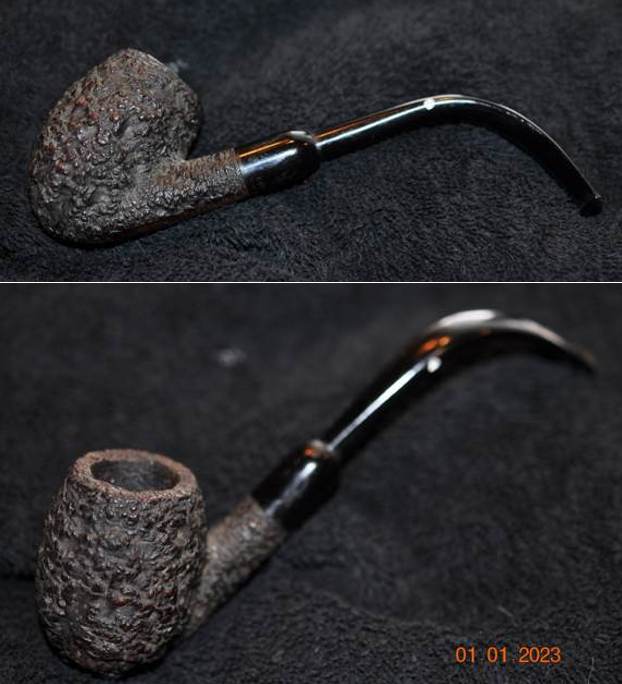
What a Lovely Castello Sea Rock Briar 93 Bent Egg


Blog by Steve Laug

I thought it might be helpful to take you through my process of working on each pipe that we purchase. Jeff has set up a spread sheet to track where the pipe came from, the date of purchase and what we paid for it so that we know what we have invested in the pipe before we even work on it. This takes a lot of the guess work out of the process. This particular pipe was purchased on 09/18/2020 from a seller in Los Angeles, California, USA. I also want you to understand why we take the photos we do. If you have followed for a while then you will see the familiar pattern of the photos we include both in the before and midstream process of working on a pipe. It is not accidental or chance as the photos have been taken to help me make an assessment of the pipe Jeff sees before he starts his clean up work. We do this to record the condition that the pipe was in when received it and to assess what kind of work will need to be done on. When I look at these photos this is what I see.

  1. The first thing I see is a classic Italian Made Castello Sea Rock Briar Bent Egg with a acrylic ferrule/shank extension and a military mount stem. It is well proportioned and well made with a Bent Egg shape.
  2. The finish is dirty and there is grime and grit ground into the rugged rustication on the sides of the bowl and shank. It is dusty and dull looking but under the grime the pipe looks good.
  3. The rim top has some lava and debris in the valleys of the rustication on the top and the edges. It is dirty looking but cleaning will reveal a real beauty.
  4. The bowl has a thick cake and debris on the walls that hides the walls and some grime on the inner edge of the bowl but once it is clean we will know what the bowl and edges really look like. The outer edges look good and there does not appear to be any obvious burn damage to the top or bowl edges.
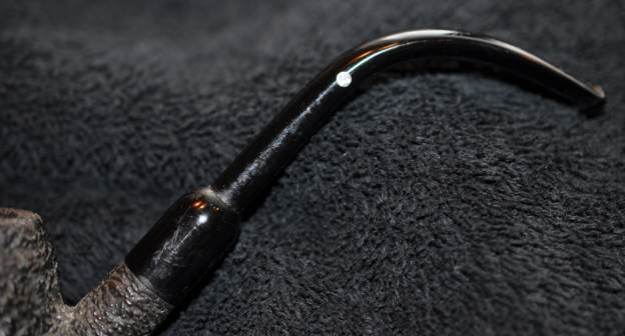
  5. The acrylic military mount acrylic stem is in good condition – dirty and has light tooth chatter and marks on both sides ahead of button. There is a crinkled/Diamond insert logo on the left side of the stem.

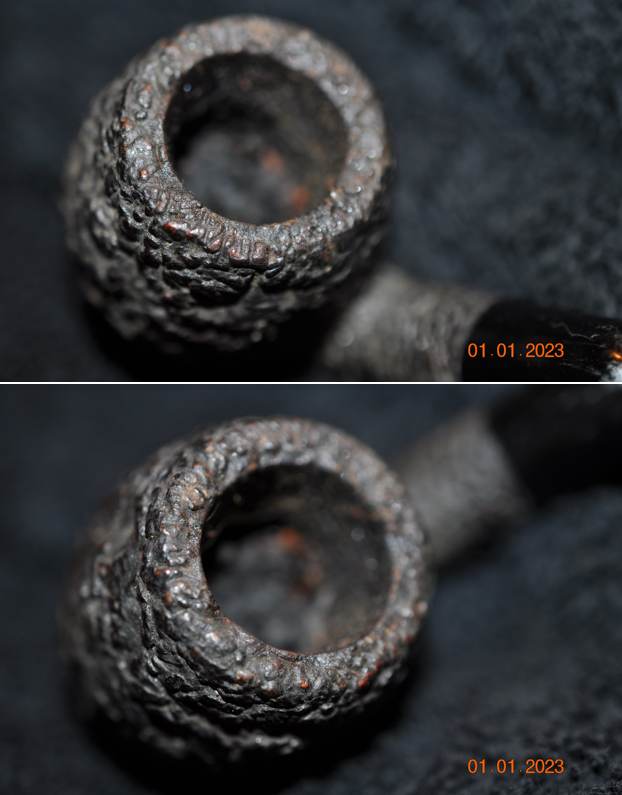
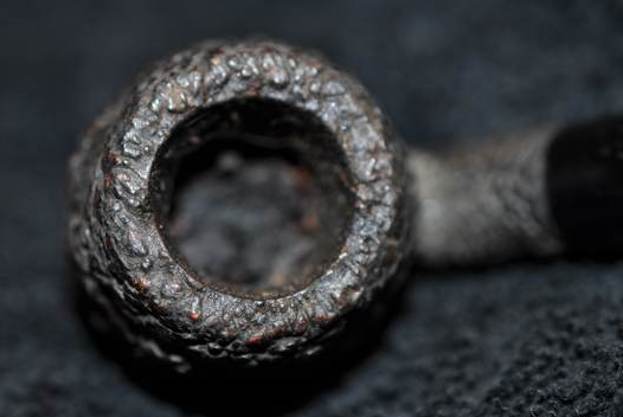
Overall my impressions of this pipe is that it is a beauty that once cleaned up will look pretty amazing. I love the tactile rustication on the Sea Rock Briars and have found nothing that comes close to it. The photos below confirm the assessment above. Jeff took close up photos so that I could have a clearer picture of the condition of the bowl, rim edges and top. The rim top photos confirm my assessment above. The cake in the bowl is moderate with tobacco debris stuck on the walls. The rim top has some lava, grime and debris in the rusticated surface. You can also see the condition of the outer edge and the inner edge is in great condition. This is what I look for when assessing a pipe. There is no visible burn damage at this point. The bowl is still round and other than being in a used condition it is in great shape. The photos of the acrylic stem surface from various angles confirmed my assessment of its condition. You can see the dirty/sticky substance on the stem in the first photo below. Fortunately the stem does not appear to have deep tooth marks – chatter yes, but no deep marks. The stem is quite dirty but otherwise undamaged. Instead of telling you what I see in the next photos of the sides of the bowl and the heel I want to hear from you. Tell me what you see? What does the finish look like to you? Are there any visible problems or issues that stand out to you? Are the cracks or scratches in the valleys of the rustication or the high spots? Are there visible flaws or fissures in the briar? How random does the deep rustication look? Is there a pattern to it? Any visible issues on the heel of the bowl? These questions should help you to see what I am looking for when I see these photos. He took photos of the stamping on the underside of the shank. On the heel of the bowl is stamped the shape number 93. That is followed by the Made in Cantu [over] Italy stamp (two lines) Next that it is stamped Castello [over] Sea Rock Briar. The acrylic ferrule is stamped on the underside and reads HAND MADE [over] Castello [over] the number 3. What stands out for you in the photos of the stamping on the pipe? What do you look for in the stamping? I know it is dirty but what do you see underneath the grime on the surface of the briar and the acrylic? As a part of the restoration of the pipe that I work on I love to research the background information on the stamping of this pipe to get an idea of the time period it was carved and a sense of when it left Italy for the export to the US. I turned to Pipephil’s site for a quick overview of the brand (http://pipephil.eu/logos/en/logo-castello.html). I have included a screen capture of the brand below as well as the sidebar notes below the photo.Rhinestone logo was originally on pipes for the US market. It is occasionally used now.
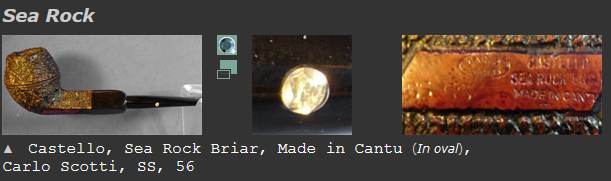
I knew now that the pipe was made for export to the US Market as noted above by the rhinestone or faux diamond logo on the stem side.

I quote further the introductory information at the top of the Pipephil page regarding the brand as I find it quite helpful to set a context.

Castello PIPA CASTELLO di Carlo Scotti & C. was founded in 1947 by Carlo Scotti (†1988). Franco Coppo (AKA “Kino”) who married Carlo Scotti’s daughter Savina, manages (2012) the corporate since 1985.

The site also gave a good summary of the grading and sizes of the pipes. I quote that in full so you can see where the Sea Rock Briar fits in the scheme of things Castello.

Sizes (ascending):

1K to 4K, G (Giant) and GG (Extra large)

Rusticated grading: SEA ROCK, OLD SEA ROCK, NATURAL VIRGIN,

Sandblasted grading: ANTIQUARI, OLD ANTIQUARI

Smooth grading (ascending): TRADEMARK, CASTELLO, COLLECTION

Other stampings: Great Line (Non-standard or freestyle) Fiammata (Straight grain)

Production (2012): ~4000 pipes / year

I turned then to Pipedia for more information on the brand (https://pipedia.org/wiki/Castello). The majority of the information was what was already quoted above in abbreviated form. However there was a link to an article by Bob Hamlin that gave some interesting bits of information that I found helpful (http://www.pipes.org/BURST/FORMATTED/196.016.html). I quote in part from that article.

SEA ROCK [Carved Black or dark brown]:  This is the lowest grade of the Castello line and is the most common in the USA.  Sea Rocks are produced by taking a smooth bowl that has not been “final finished” and surface carving the finish with tools. This “carved” finish is then evened out using a steel wire brush, stained and then waxed. The Natural Vergin carved finish is left unstained and unwaxed as a rule, although we have seen waxed and partially waxed “Vergins”.

All carved Castello pipes are graded by the number of K’s that are stamped on each piece and are K-graded by SIZE.  1K is the smallest and fairly rare, 2K is small to medium, with 3K or 4K being the most common and ranges from medium to medium large. Large pieces are stamped “G” for giant and extra large pieces are stamped “GG” for double giant.  In addition to the number of K’s on a carved Sea Rock piece the shape number is almost always added. As a rule a Sea Rock Castello is stained Black, although recently there have been quite a few coming in stained deep brown and still stamped “Sea Rock”.  American Logo’d Sea Rocks are all priced the same to the consumer, although most are 2 or 3 K’ed models.  G/GG models are charged at a higher price on American pieces and are basically the same as their European counterparts.

The Castello Sea Rock briar I was working on did not have any K designation in terms of the size of the pipe. It definitely was made for the American Market with the Rhinestone in the stem. It had the dark finish. The shape number still needed to be determined.

Pipedia also gave a link to Mike’s Briar Blues site for help in dating and determining shapes (http://www.briarblues.com/castello.htm). I quote a section on the shape numbers.

Shape numbers. Shape numbers are all 2 digits. A 2 in front indicates a “fancy” interpretation, a 3 in front means that the carving is somehow unique. I don’t know when the change was made, but currently, a π symbol is used instead of the 3xx. I’ve only seen this on Sea Rocks, but that doesn’t mean anything…

Now I had more information to work with. The Castello Sea Rock in my hands that probably came out in the late 1960s onward. The number 93 makes it a bent egg.

I am sure many of you will shake your head and ask maybe even out loud, “Why is he including this again?” However, please remember that the point of these blogs is not to wow your with the work or make you shake your heads but I want you to know the details of the work we do so you can do your own. Back in 2020 Jeff wrote a blog about his cleaning process. I am including a link to that now so you can see what I mean about his process. Do not skip it! Give it a read (https://rebornpipes.com/2020/01/20/got-a-filthy-estate-pipe-that-you-need-to-clean/). Here is the introduction to that blog and it is very true even to this day.

Several have asked about Jeff’s cleaning regimen as I generally summarize it in the blogs that I post rather than give a detailed procedure. I have had the question asked enough that I asked Jeff to put together this blog so that you can get a clear picture of the process he uses. Like everything else in our hobby, people have different methods they swear by. Some may question the method and that is fine. But it works very well for us and has for many years. Some of his steps may surprise you but I know that when I get the pipes from him for my part of the restoration they are impeccably clean and sanitized. I have come to appreciate the thoroughness of the process he has developed because I really like working on clean pipe!

For the benefit of some of you who may be unfamiliar with some of the products he uses I have included photos of three of the items that Jeff mentions in his list. This will make it easier for recognition. These three are definitely North American Products so you will need to find suitable replacements or order these directly on Amazon. The makeup pads are fairly universal as we were able to pick some up in India when we were with Paresh and his family.

In the blog itself he breaks his process down into two parts – cleaning the stem and cleaning the bowl. Each one has a large number of steps that he methodically does every time. I know because I have watched him do the work and I have seen the pipes after his work on them. He followed this process step by step and when the pipe got to me it was spotlessly clean and ready for my work. The inside of the stem, shank and bowl were clean and to me that is an amazing gift as it means that my work on this end is with a clean pipe! I cannot tell you how much difference that makes for my work.

When the pipe arrives here in Vancouver I have a clean pipe and I go over it keeping in mind my assessment shared in the opening paragraph above. Now that I have it in hand I am looking for confirmation of what I saw in the photos as well as any significant structural changes in the bowl and finish as I go over it.

  1. The classic Castello Sea Rock Bent Egg looks amazing. The rustication is beautiful and the acrylic ferrule and stem work very well on the pipe. It is probably a Castello version of an Oom Paul.
  2. The finish is clean and the grime and grit have been removed from the finish on the bowl. The rustication and depth in the valleys has just come alive around the bowl sides.
  3. The lava, grime and dust on the rim top has been removed and it looks to be in good condition on the top and edges of the bowl.
  4. The walls of the bowl are clean and I do not see any checking or burn damage. The inner edge of the bowl looks good. The outer edges look good and there does not appear to be any obvious burn damage there.
  5. The acrylic military mount stem is clean and has very light tooth chatter and marks on both sides. The Rhinestone/Diamond logo on the side of the stem looks very good.

Hopefully the steps above show you both what I look for when I go over the pipe when I bring it to the work table and also what I see when I look at the pipe in my hands. They also clearly spell out a restoration plan in short form. My work is clear and addressing it will be the next steps. I took photos of the whole pipe to give you a picture of what I see when I have it on the table. This is important to me in that it also shows that there was no damage done during the clean up work or the transit of the pipe from Idaho to here in Vancouver.  I carefully went over the bowl and rim top to get a sense of what is happening there. In this case once the rim top and edges were cleaned, they looked very good. There was no damage on the edges or the top of the rim. It is clean should come back to its original beauty quite easily. I also go over the stem carefully. There were just some faint tooth marks chatter on the surface of the stem. I took photos of the rim top and stem sides to show as best as I can what I see when I look at them. I always check to make sure that the clean up work did not damage the stamping on the shank in any way. It is in excellent condition and is very clear and readable. I really like the way that the carvers at Castello do the Sea Rock Briar rustication. To me it stunning and very tactile. I love just looking at the beauty of the lay of the pipe and the proportion of the hand made pipes. I like to remove the stem from the shank to get a sense of what was in the mind of the pipe maker when he crafted the pipe. It is a beauty in flow and shape. When a rusticated finish is in as nice a condition as this one is immediately apply Before & After Restoration Balm to the briar. It is a paste/balm that is rubbed into the surface of the briar and the plateau. The product works to deep clean the nooks and crannies of finish, enliven and protect the briar. I worked it into the briar with my finger tips and a horse hair shoe brush. I let it sit for 10 minutes to do its work. I wiped it off with a soft cloth then buffed it with a cotton cloth. The briar really began to have a deep shine in the briar and the grain shone through. The photos I took of the bowl at this point mark the progress in the restoration. It is a gorgeous pipe. I set the bowl aside and turn to work on the stem. Because the marks and chatter are so light I use micromesh sanding pads – 1500-12000 grit sanding pads and water to wet sand the stem. I wiped it down after each sanding pad with Obsidian Oil on a cotton rag after each sanding pad even though people say it does nothing for acrylic stems. But I find it does two things – first it gives some protection to the stem and second it give the sanding pads bite in the polishing process. After finishing with the micromesh pads I rub the stem down with Before & After Fine and Extra Fine stem polish as it seems to really remove the fine scratches in the acrylic. I rub the Fine Polish on the stem and wipe it off with a paper towel and then repeat the process with the extra fine polish. I finish the polishing of the stem down with a final coat of Obsidian Oil and set the stem aside to let the oil absorb. This process gives the stem a shine and also a bit of protection.  The final steps in my process involve using the buffer. I don’t buff a rusticated pipe with Blue Diamond as it can build up in the deep grooves of the finish. I used it on the stem and find that it works very well to polish out the light scratches in the acrylic. I finished with the Blue Diamond and moved on to buffing the pipe – I gave the bowl multiple coats of Conservator’s Wax and the stem multiple coats of carnauba wax. Once I have a good shine in the briar and acrylic. I have found that I can get a deeper shine if I following up the wax buff with a clean buffing pad. It works to raise the shine and then I follow that up with a hand buff with a microfiber cloth to deepen the shine. It is always fun for me to see what the polished bowl looks like with the polished acrylic stem. It really is a beautiful pipe. The rusticated finish around the bowl sides and shank has some amazing depth and contrast with the rich black and dark brown stains. Castello Sea Rock Briar 93 Bent Egg with a military bit feels great in my hand. It is light and well balanced. Have a look at it with the photos below. The dimensions are Length: 6 inches, Height: 2 inches, Outside diameter of the bowl: 1 ¼ inch, Chamber diameter: ¾ of an inch. The weight of the pipe is 1.32 ounces/41 grams. It is a beautiful pipe and a Castello shape I have been looking for to add to my own collection. I plan on loading it up and enjoying a bowl in it.
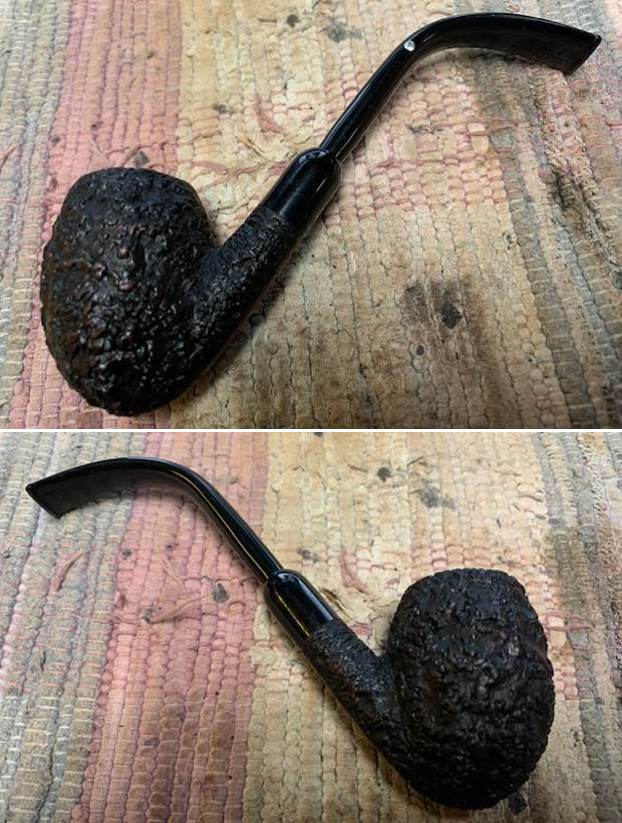
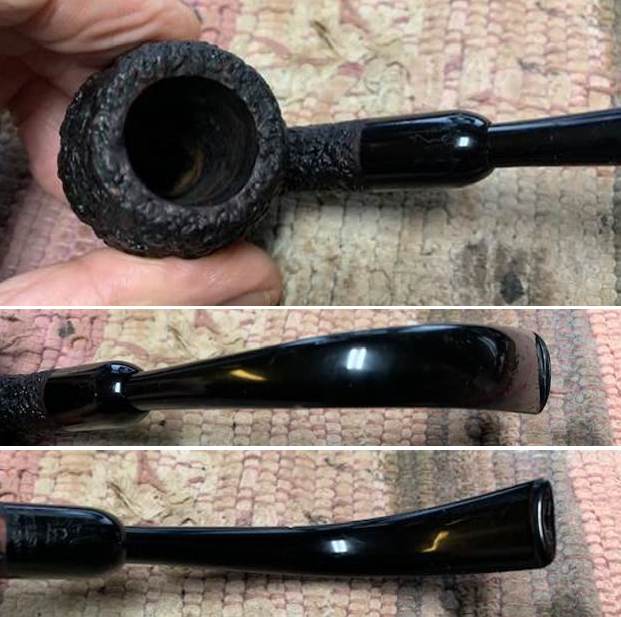
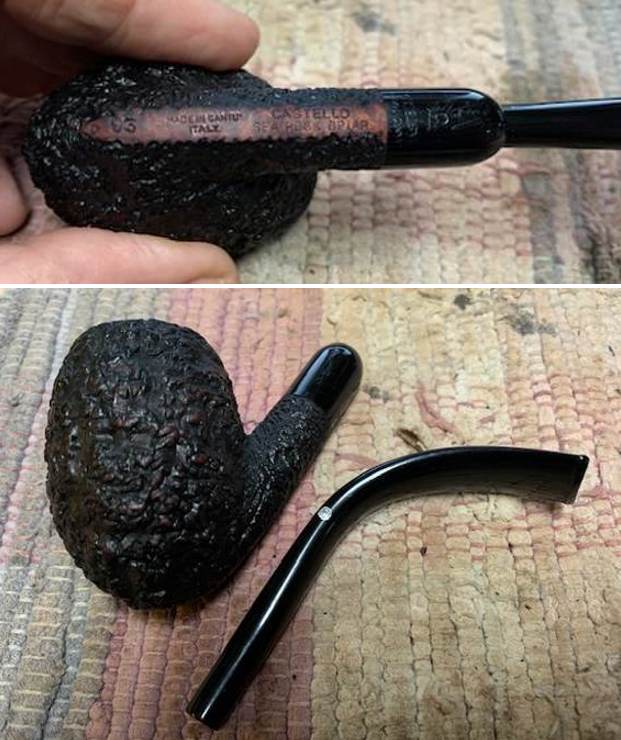
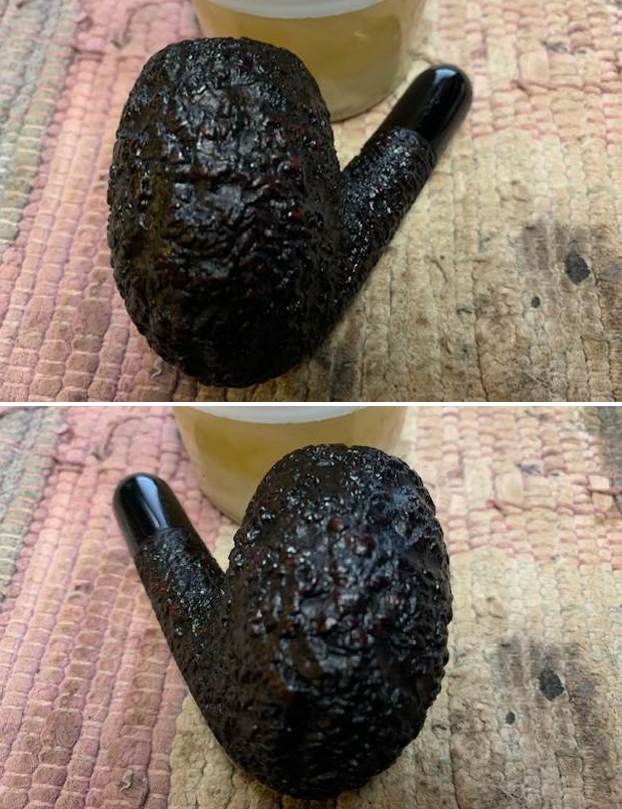
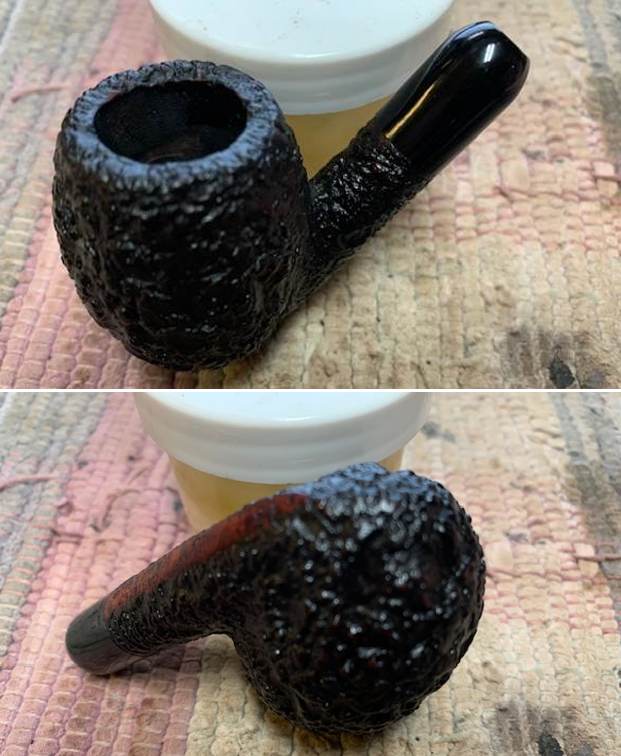
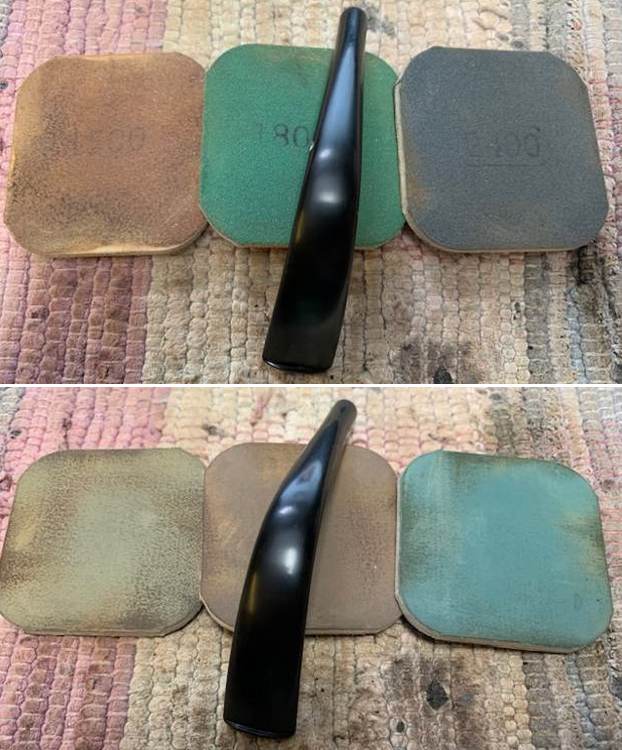
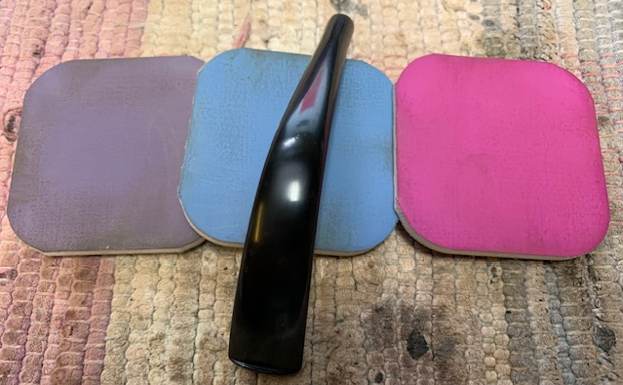
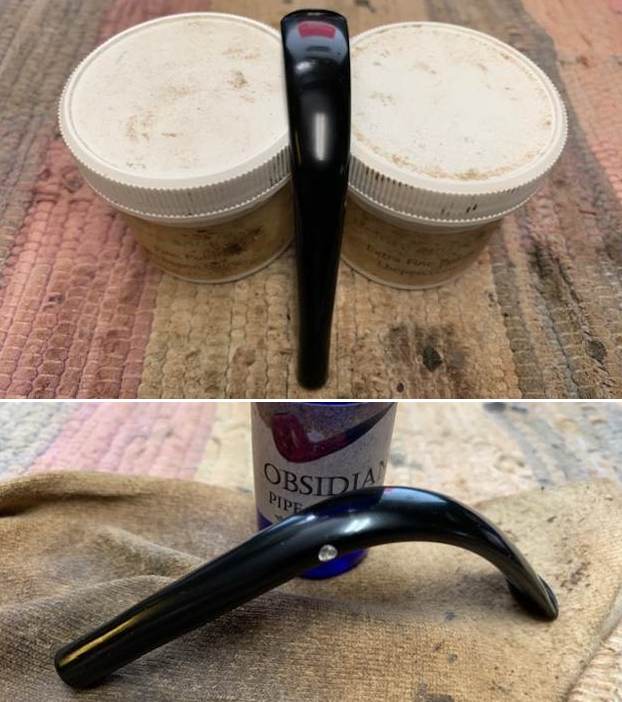
Hopefully the style of writing of this blog is helpful to you in some way. In it I wanted to show both what I am looking for and how I move forward in addressing what I see when work on a pipe. Let me know if it is helpful to you. It is probably the most straightforward detailed description of my work process that I have done. As always I encourage your questions and comments as you read the blog. Thanks to each of you who are reading this blog. Remember we are not pipe owners; we are pipe men and women who hold our pipes in trust until they pass on into the trust of those who follow us.
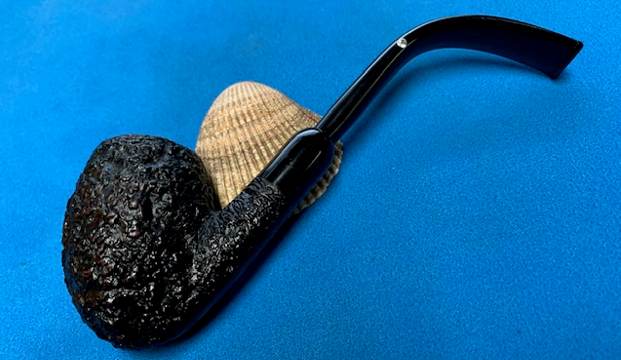
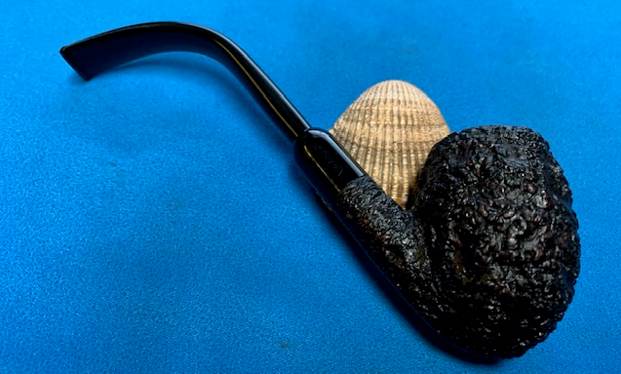
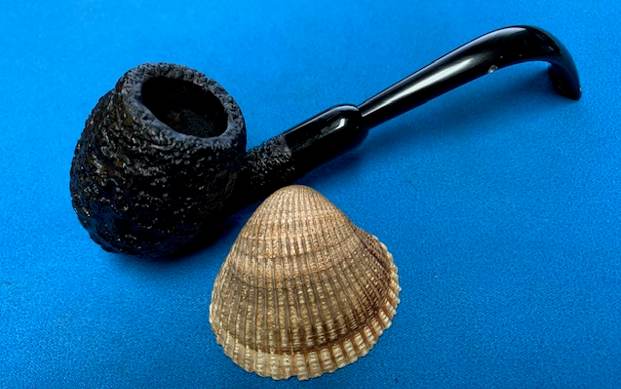
Restoring a Unique Jobey Designer Bent Egg Sitter


Blog by Steve Laug

The next pipe on the table was purchased on 05/10/22 from an antique mall in Astoria, Oregon, USA. This unique Jobey has a flat base with a short tail that stabilizes the sitter. It has a rugged, finish that looks like a combination of sandblast and rustication (blastication) with lots of nooks and crannies in the briar. The top of the shank and the upper 1/3 of the bowl are smooth briar. The come together and really are quite beautiful! The pipe is stamped on a smooth panel on the topside of the shank and reads Jobey [over] Designer. The valleys and ridges of the “blasticated” grain showing through the grime and dirt are a mixture that leaves a rich texture. It had rich dark and medium contrasting brown stains that do not look too bad. There was a thick cake in the bowl with remnants of tobacco stuck on the walls. There was a lava overflow on the crowned top of the rim and covering the inner edge. It was hard to know if the rim edges were damaged. It was a beautiful pipe that was dirty and tired looking but there was a thick coat of shiny varnish or shellac covering the whole thing. The stem was golden variegated acrylic that had fancy turnings on the saddle. The tenon was the patented Jobey Link System that was developed to protect the shank. There was a hairline crack on the top of the stem where the tenon fit but it was not open and was very fine. There were tooth marks and chatter on the stem near the button on both sides. There is a brass Jobey oval logo on the top of the stem identifying it as a Jobey pipe. Jeff took photos of the pipe before he cleaned it up. He took photos of the bowl and rim top to show the cake in the bowl and the lava build up on the rim top and edges of the bowl. It was thick and hard but hopefully it had protected the rim and edges from damage. It was hard to know for sure from the photos. Jeff took photos of the top and underside of the stem showing the tooth chatter, scratching on the stem surface and wear on the edges of the button. The airway in the stem was stained with the tars and oils that would need to be cleaned up. Jeff took photos of the sides and heel of the bowl to show the condition of the finish. You can see the rugged dark look of the blastication. There is a lot of dust and grime filling in the valleys. The smooth portions on the top 1/3 of the bowl, the underside of the shank and foot as well as the patch on the top of the shank.  He took a photo of the stamping on the smooth panel on the topside of the shank. The stamping was readable as you can see from the photos and read as noted above. He also captured the logo brass insert on the top of the stem.  I turned to Pipedia to see if I could find a Jobey Designer or any information on the line  (https://pipedia.org/wiki/Jobey). Along with the history of the brand that is there which you can read if you are interested there was also a photo of the same pipe that I am working on with a dark stem rather than the yellow of the one on the table. The shape and stamping are identical so I have included them below. I am also including and advertisement that was included on the site. I have included it below along with an enlargement of the section on Jobey Designer pipes. The Designer series combines real craftsmanship with a unique pipe design. This perfectly balanced briar features a smooth walnut finish, complemented by a golden Lucite stem. It sold for $50USD

Now it was time to work on the pipe. Jeff reamed it with a PipNet pipe reamer and cleaned up the reaming with a Savinelli Fitsall Pipe Knife. He scrubbed out the internals of the shank and stem with alcohol, pipe cleaners and cotton swabs until the pipe was clean. He scrubbed the exterior of the bowl with Murphy’s Oil Soap and a tooth brush to remove the grime and grit on the briar and the lava on the rim top. The finish looks very good with good looking sandblast around the bowl and shank. Jeff scrubbed the stem with Soft Scrub and rinsed it with running water. When the pipe arrived here in Vancouver for the second stop of its restoration tour it looked a lot better. The airway in the stem still had some darkening and would need to be cleaned up some more. I took photos before I started my part of the work. I took some close up photos of the rim top and also of the stem surface. I wanted to show what cleaned bowl and rim top looked like. The rim top and edges looked very good. I also took close up photos of the stem to show the light tooth marks and the staining in the airway on the stem.  The hairline crack is in the darkened spot near the shank end.I took a photo of the stamping on the topside of the shank and it is clear and readable. I also took a photo of the Jobey oval brass inset on the top of the stem.  I took the stem off the shank and took a photo to give a clear picture of the pipe from the left side profile and the top looking down. It is a really pretty pipe.I wiped down the briar with acetone on a cotton pad to remove the shiny varnish coat. It took some scrubbing but the grain really stood out on the smooth portion much better. I polished the extension with micromesh sanding pads – dry sanding with 1500-12000 grit pads. I wiped the surface off after each pad to remove sanding debris. It is becomes more shiny with each sanding pad.  I rubbed the bowl down with Before & After Restoration Balm. I worked it into the surface of the briar with my fingertips and a horsehair shoe brush to clean, enliven and protect it. I let the balm sit for 10 minutes and then buffed with a cotton cloth and shoe brush to raise the shine. Mark Hoover’s Balm is a product that I have come to appreciate and one I use on every pipe I have been working on. I set the bowl aside and turned my attention to trying to get some of the tars from the stem. I removed the Jobey Link Tenon from the stem and worked it over with cotton swabs, pipe cleaners and alcohol. It was amazing how much grit and grime came out of the stem. I then used some Soft Scrub on the pipe cleaners and continued to work on the airway and was able to remove a lot of it. I flushed it a final time with alcohol. It was much better when I finished. The only draw back (if it is one) is that the hairline crack was very visible after cleaning.There was a tooth mark that was deep on the top left side of the stem next to the button. There was also a small crack in the turned area of the stem and top. I filled both of them both in with clear CA glue and set the stem aside to cure. Once it cured I sanded the repaired areas smooth with 220 grit sandpaper and started polishing it with 400 grit wet dry sandpaper. I polished the Lucite stem with micromesh sanding pads – 1500-12000 grit pads. I wiped it down with a damp cloth after each sanding pad. I used Before & After Pipe Polish – both Fine and Extra Fine to further polish the stem. This Unique Jobey Designer Egg Sitter turned out to be a great looking pipe. The mix of dark stains highlights the smooth and rusticated portions around the bowl sides, top and bottom. The golden coloured acrylic stem works very well with the natural and dark finish on the bowl. I put the stem back on the bowl and carefully buffed the pipe with Blue Diamond on the buffing wheel using a light touch on the briar. I gave the bowl and the stem multiple coats of carnauba wax on the buffing wheel. I buffed the entire pipe with a clean buffing pad followed by hand buffing with a microfiber cloth to deepen the shine. The finished full bent Jobey Designer Bent Egg Sitter fits nicely in the hand and feels great. Give the finished pipe a look in the photos below. The dimensions of the pipe are Length: 5 ¾ inches, Height: 2 inches, Outside diameter of the bowl: 1 ¼ inches, Chamber diameter: ¾ of an inch. The weight of the pipe is 2.26 ounces/64 grams. I will be adding it to the American Pipe Makers Section on the rebornpipes store soon. If you are interested in carrying on the pipeman’s legacy with this pipe send me a message or an email. Thanks for reading this blog and my reflections on the pipe while I worked on it.

Cleaning up a Preben Holm made Monte Verde Twin Finish Freehand


Blog by Steve Laug

The next pipe on the table was purchased from an estate lot on 06/13/22 from Fort Myers, Florida, USA. It has that verve that I have come to associate with pipe made by Preben Holm and the fellow we purchase this lot from obviously love Preben Holm pipes because we acquired several from him in this lot from the IIS pipes to a Danish Pride still to come. They are unique and beautiful. The pipe is stamped on a smooth panel on the underside. It reads Monte Verde over Made in Denmark by Hand. Underneath that there is a script stamp that reads Twin Finish. I have refurbished several Monte Verde pipe so if you are interested in the brand here is a link to one I did back in 2019 that is very similar to this one (https://rebornpipes.com/2019/02/09/new-life-for-a-preben-holm-monte-verde-twin-finish-freehand/). It was quite dirty, like the rest of the pipes in this collection. There was a thick cake in the bowl and a heavy lava overflow on the rim top that filled in the rustication. The inner and outer edges of the bowl looked very good. The stem had some light tooth marks and chatter on both sides near the button but really was in quite remarkable condition. Jeff took photos of the pipe before he started his cleanup process. The next photos show a close up of the bowl and rim top as well as both sides of the stem. You can see the thick cake in the bowl and heavy overflow of lava on the rim top. The close up photos of the stem show the light tooth marks in the surface near the button on both sides. He took photos of the sides and heel of the bowl to show the look the double rustication on the sides and heel of the bowl. The curved shape of the pipe makes it a tall Dublinesque Stack but the rustication gives it a tactile look that can only mean an added dimension to the pipe when it is smoked.  The next photos show the stamping on the underside of the shank and the top of the saddle stem. It is quite clear and legible. The top of the stylized saddle stem has a Crown MV stamped into the surface. It appears to have originally been gold.   I turned to Pipephil’s site to get a read on the brand (http://pipephil.eu/logos/en/logo-m6.html). It confirms that the Monte Verdi line was made by Preben Holm. The pipe in the photo had a very similar rustication to the Monte Verdi I was working on. I did a screen capture of the section on Pipephil. I have included it below.   There were also photos that were included on Pipephil of what this particular pipe looked like when it left Denmark. The rustication around the bowl and shank is very similar. The pipe I have does not have a shank extension but otherwise the finish is much the same. The pipe in the photo had a fancy turned vulcanite stem. The stem on the one I have in front of me is the original stem on the pipe and it is a fancy double saddle pearlized acrylic or Lucite stem.I also Googled the brand and found a thread on Pipes Magazine about the brand that gave me some more information (http://pipesmagazine.com/forums/topic/monte-verde-pipes). I include that below.
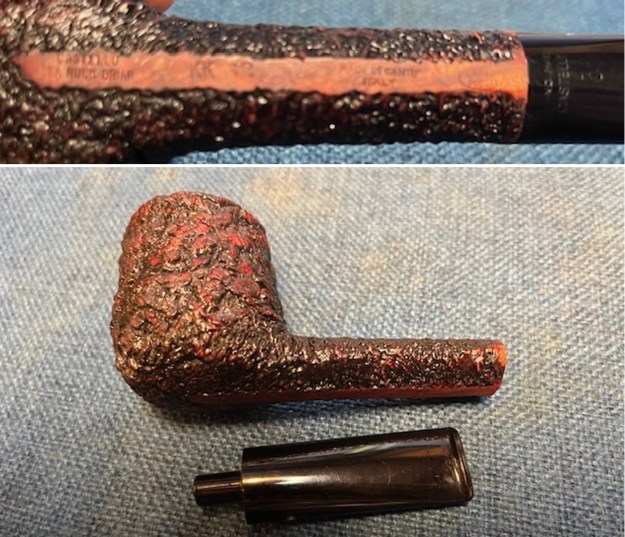
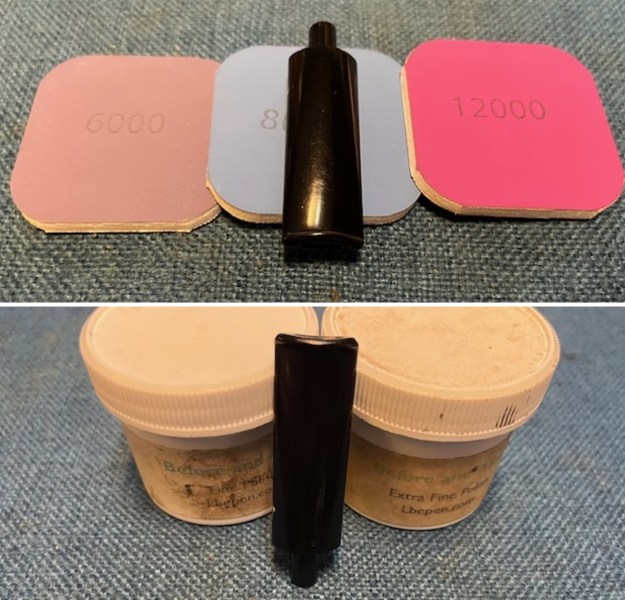
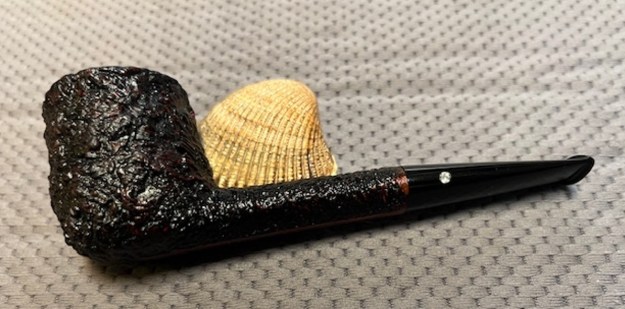
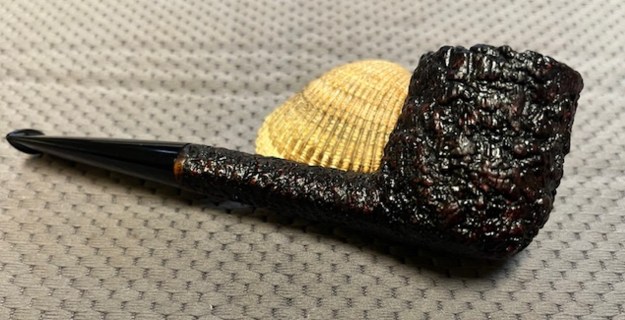
The Monte Verdi line was indeed a pipe style offered by Holm. It usually features heavily blasted and rusticated briar and smaller group sizes than some of his other lines. Some refer to this line as a “second”, but it provided an outlet for briar that had flaws and therefore unsuitable his other lines. Holm marketed many different lines featuring a variety of finishes in both stains and carvings and this is merely one of those. The ones I own are good pipes and smoke well. The blast finish is very interesting to look at and the tactile sensations make it fun to hold.

Jeff reamed the bowl with a PipNet pipe reamer and followed up with a Savinelli Fitsall pipe knife to remove the cake. He scrubbed out the mortise and the airway in the shank and the stem with alcohol, cotton swabs and pipe cleaners. He scrubbed the exterior of the bowl, rim, shank and stem with a tooth brush and Murphy’s Oil Soap to remove the oils and tars on the rim and the grime on the finish of the bowl. He rinsed it under running water. He dried it off with a soft cloth. He was able to remove most of the lava build up on the rim top and you could see a little remaining in the depths of the rustication. He cleaned out the inside of the stem with pipe cleaners, cotton swabs and alcohol. He scrubbed the surface o the stem with Soft Scrub Cleanser. The stem looked very good. I took photos of the pipe to show its condition before I started my work on it. I took close up photos of the bowl and rim top as well as the stem. You can see the condition of the rim top and bowl in the first photo. Jeff was able to remove almost all of the tar and oils but there was some deep lava in the rustication at the back of the rim. The Lucite stem had light tooth chatter and tooth marks on the top and underside of the stem near and on the button surface. The swirled browns, tans, blacks and greys of the Lucite looked good with the variegated browns of the briar.   I also took a photo of the stamping on the underside of the shank. The stamping is very clear and readable. You can also see the scratches in the smooth finish of the area in the photo below.I removed the stem from the shank and took a photo of the parts. It is a nice looking pipe with the flumed top, the rugged double rustication and the double saddle smoky acrylic stem.I started by working on the rim top. I used a brass bristle wire brush to clean off the remaining lava debris on the rim top. I was able to remove all of the remaining debris and the rim top looked really good. The deep rustication and the second wire rustication gave the pipe a very unique look.With the rim top cleaned I worked some Before & After Restoration Balm into the rusticated surface of the briar with my fingertips to clean, enliven and protect it. It took some time to really get it into the grooves and valleys of the rustication but I was able to work it in. I used a shoe brush to make sure it was deep in the grooves. I let the balm sit for 10 minutes and then buffed it with a cotton cloth to raise the shine. The following photos show the bowl at this point in the restoration process. The bowl and the rim top look really good and the darkening and lava are gone. I am very happy with the results.  I set aside the bowl at this point and turned my attention to the stem. I repaired the tooth marks with clear super glue. Once the glue cured I sanded the repairs with 220 grit sandpaper to blend them into the rest of the stem surface. I polished the sanding marks with 400 grit wet dry sandpaper. The photos tell the story. I touched up the stamping on the saddle portion of the stem with some Rub’n Buff Antique Gold. I let it dry in the stamping for a bit then buffed it off with a cotton pad. It looked much better. The MV was legible and the crown looked good. The side of the M was a little faint as the stamping was worn. I polished the Lucite stem with micromesh sanding pads – wet sanding with 1500-2400 grit sanding pads and dry sanding it with 3200-12000 grit sanding pads. I wiped it down after each sanding pad with a damp cloth. I polished it with Before & After Pipe Stem Polish and wiped it down a last time with the damp cloth.  This beautiful, double rusticated Preben Holm carved Monte Verde Twin Finish Large Freehand is a special looking pipe and it feels amazing in the hand. I polished stem with Blue Diamond polish on the buffing wheel. I gave the bowl multiple coats of Conservator’s Wax and the stem multiple coats of carnauba wax. I buffed the pipe with a clean buffing pad to raise the shine. I hand buffed it with a microfiber cloth to deepen the shine. The pipe polished up pretty nicely. The multi-coloured grain shining through the rustication came alive with the buffing. The rich contrasting brown colour works well with the polished swirling brown, tan, black and white Lucite stem. The finished pipe is a beauty and feels great in the hand. Have a look at it with the photos below. The dimensions are Length: 6 ½ inches, Height: 3 inches, Outside diameter of the bowl: 2 inches, Chamber diameter: 1 inch. The weight of the pipe is 2.75 ounces/ 78 grams. I will be putting this Monte Verde by Preben Holm on the Danish Pipe Making Section on the rebornpipes online store soon. It is such an interesting tactile pipe and if you have been looking for a freehand then this might be the one for you. Thanks for walking through the restoration with me on this interestingly shaped Preben Holm Hand made pipe.
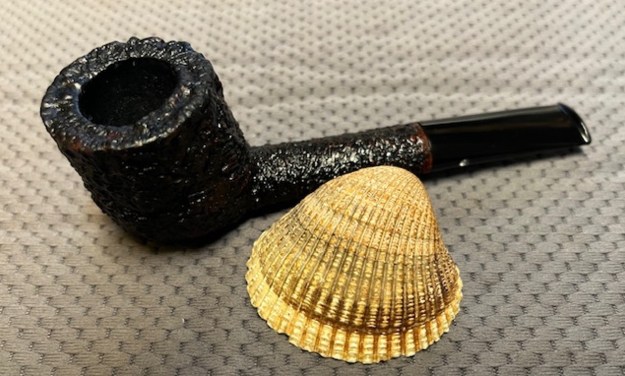
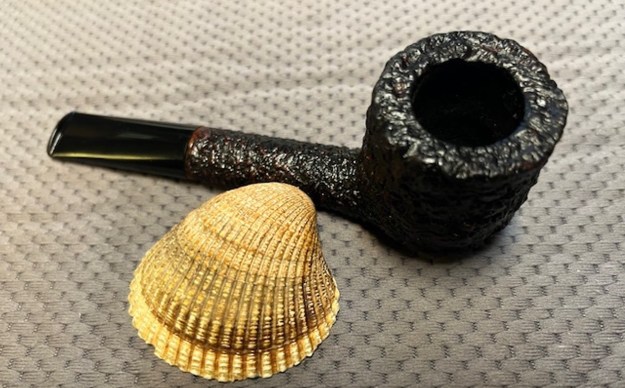
Restoring a Castello Sea Rock Briar 87P Poker


Blog by Steve Laug

The next pipe on the table is a beautiful Castello Sea Rock Briar Poker. I love the Sea Rock Briar finish and this was one that is quite exemplary of the finish. It has a less rugged and more refined rustication that is still tactile and I think will be a great smoker. It is a pipe that we purchased in September 2020 from a fellow in Los Angeles, California, USA.

This Castello Sea Rock Poker is stamped on the heel and the underside of the shank and reads 87P on the heel of the bowl. That is followed on the shank by Castello [over] Sea Rock Briar followed by Made in Cantu [over] Italy. The numbers and stamping tell me that the pipe is a Sea Rock rusticated finish and it is a Poker. The underside of the Lucite stem also had stamping that read Hand Made over Castello [over] the number 3. The finish was incredibly dirty with spots of grime and debris ground into the crevices and valleys of the rustication. The bowl had a thick cake in the and a heavy lava overflowing onto the smooth rim top. The rim top appeared to rough and beat up with dents. The inner and outer edge of the rim looked very good. The acrylic stem had tooth marks and chatter on both sides ahead of the button and on the button itself. Jeff took photos of the pipe before he started his clean up work on it. My brother took some close up photos of the rim top and the cake in the bowl to show what it looked like when we received it. You can see how thick the cake is and how much of the rim rustication has filled in with the overflow. The photos of the stem show the faux diamond logo on the top left side of the saddle. You can see the tooth marks and chatter near the button on both sides of the stem. Jeff took photos of the rusticated finish around the bowl sides and heel. It is nice looking if you can see through the grime and dust ground into the rugged, deep rustication.   He took a photo of the stamping on the left underside of the diamond shank. The stamping is readable but filthy. It reads as noted above. I recently wrote a blog on the Castello Sea Rock Briar Bulldog SC 54P. I reread the information and quote from a 54P Blog I wrote earlier (https://rebornpipes.com/2016/12/18/an-estate-sale-find-a-castello-sea-rock-sc-54p-bulldog/). It gives a short summary of the information I found.
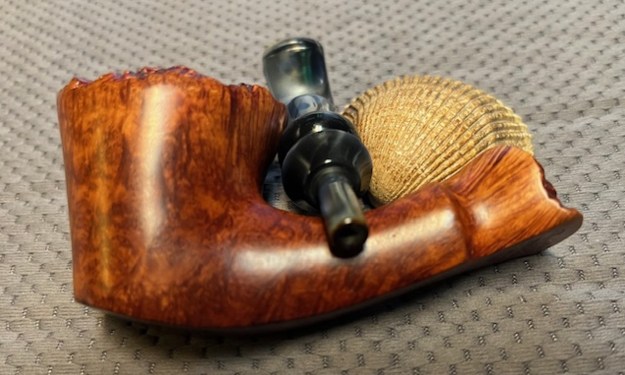
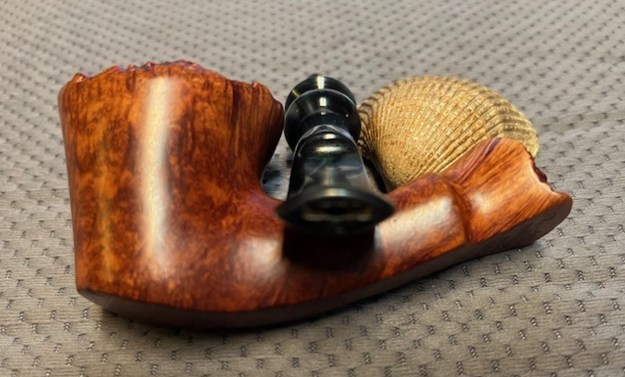
Before I worked on the pipe I wanted to do a bit of research to see if I could shed some more light on the pipe I had in hand. I learned from the pipephil website that the rhinestone logo was originally on pipes for the US market. There was no hint as to why that was done only that it was and that it is occasionally still used http://www.pipephil.eu/logos/en/logo-castello.html

I have an older article called PCCA’s Castello Grade & Style Guide. It was written by Robert C. Hamlin (c) 1988, 1992, 1994. Robert gathered some remarkable information on the Castello lines and I have often used his guide in the past to give me pertinent data. There I found more information regarding the shiny logo on the side of the stem.

“American logo’d Castello pipes use a small round “Diamond” (referred to and looking like, but it is NOT actually a diamond) inlaid into the mouthpiece. This was originally done so that the standard Castello white bar logo did not conflict with another brand and logo that was sold by Wally Frank called the “White Bar Pipe” (in the 1950’s).”

The above quote and the remainder of those following come from the same article by Robert Hamlin. You can read the full article at the following link: http://www.pipes.org/BURST/FORMATTED/196.016.html

I read further in the article to help me understand the stamping on the underside of the shank. My knowledge of Castello pipes is pretty limited so when I get one to restore I resort to this article and others to try to make heads or tails of the stamping.

I learned that the Sea Rock Briar stamp also signified something and told me more about the pipe. Robert pointed out:

“SEA ROCK [Carved Black or dark brown]: This is the lowest grade of the Castello line and is the most common in the USA. Sea Rocks are produced by taking a smooth bowl that has not been “final finished” and surface carving the finish with tools. This “carved” finish is then evened out using a steel wire brush, stained and then waxed. The Natural Vergin carved finish is left unstained and unwaxed as a rule, although we have seen waxed and partially waxed “Vergins”.” 

The remaining mystery for me was the meaning of the stamping on the stem. I of course understood the Hand Made and the Castello stamping but the number 3 was a mystery to me. I was not sure what it referred to. So once again Robert’s article gave me the information I needed to understand that last piece of the mystery.

“#2: All Castello standard shaped pipes have a number (3, 4, 5 or 6) stamped on the mouthpiece or sometimes on the Lucite ferrule. What does this number mean? Not much really, it is the number of the size for the proper straw tube or reed that fits the shank and stem of the pipe. These straw tubes are rarely used in the United States. The Castello reed is considered superfluous and useless to most, but with this number you will always know which one fits (the different numbers have to do with length, not diameter).”

Armed with that information I turned to work on the pipe itself. Before he sent it to me, Jeff had done an amazing job cleaning the pipe. It almost looked like a different pipe after his work. He reamed the pipe with a PipNet pipe reamer and removed the rest of it with a Savinelli Fitsall Pipe Knife.  He scrubbed the bowl with undiluted Murphy’s Oil Soap with a tooth brush. He rinsed it under running warm water to remove the soap and grime. He cleaned out the inside of the shank and the airway in the stem with isopropyl alcohol, cotton swabs and pipe cleaners. Even though the stem was acrylic he soaked the stem in Briarville’s Pipe Stem Deoxidizer and then rinsed it off with warm water. It really works well to remove internal and external grime and tars. He scrubbed the stem with Soft Scrub and a tooth brush and rinsed it off with warm water. It looked amazing when I took it out of the package of pipes he shipped me. I took photos of the pipe before I started my part of the restoration work.   The rim top was much cleaner and the edges looked good. However, the surface of the rim had been used as a hammer and it was in rough condition. Fortunately none of them were too deep – probably thanks to the think overflow of lava. It would take some work to clean up but it had great potential. The stem surface looked good but visible tooth marks and chatter showed clearly on either side of the stem. I took photos of the stamping on the underside of the bowl, shank and stem. It is clear and readable as noted above.I took the stem off the shank and took photos of the parts of the pipe. It is a great looking rusticated Poker. I worked on the rim top and the heel of the bowl to minimize the scratches and marks on both. I used micromesh sanding pads and wet sanded with 1500-12000 grit pads. I was fortunate that the scratches were not deep so I was able to polish them out and remove them. The rim top looked amazingly better and it is a pretty looking pipe. The bowl looked good at this point so I rubbed it down with Before & After Restoration Balm. I worked it into the surface of the bowl and shank with my fingertips and a horse hair shoe brush to clean, enliven and protect the briar. I let the balm sit for about 10-15 minutes and buffed with a cotton cloth to raise the shine. I set the bowl aside and turned my attention to the stem. I sanded the tooth marks out on both sides of the stem at the button using 220 grit sandpaper and also sanded the damage to the button surface itself. I started polishing the stem with 400 grit wet dry sandpaper.   I used micromesh sanding pads to polish the newly sanded areas on the Lucite stem surface. I dry sanded it with 1500-12000 grit pads and wiped it down with the damp pad after each sanding pad. In doing so I was able to remove all signs of the damage to stem in those spots along the edge and top of the button. I put the stem in place in the shank and  looked this beautiful Castello Sea Rock Briar 87P Poker. I lightly buffed the bowl on the buffing wheel. I buffed the stem with Blue Diamond polish on the buffing wheel I waxed the stem with carnauba wax on the wheel. I waxed the bowl with Conservator’s Wax and buffed the entire pipe with a clean buffing pad to raise the shine. I hand buffed it with a microfibre cloth to deepen the shine. The finished Castello Sea Rock Briar Poker is shown in the photos below. It is truly a beautiful little Poker. The dimensions of the pipe are Length: 5 ¾ inches, Height: 2 inches, Outside diameter of the bowl: 1 ½ inches, Chamber diameter: ¾ of an inch. The weight of the pipe is 45 grams/1.59 ounces. The shape and the rustication make it a pleasure to hold in the hand. It fits snug with my thumb curled around the back of the bowl and the rest of the fingers holding the bowl. The finish is extremely tactile and should be interesting in hand as the bowl heats up during smoking. I can testify to how well Castellos smoke. I will be adding it to the Italian Pipe Makers Section on the rebornpipes store soon. Thanks for walking with me through the restoration process.