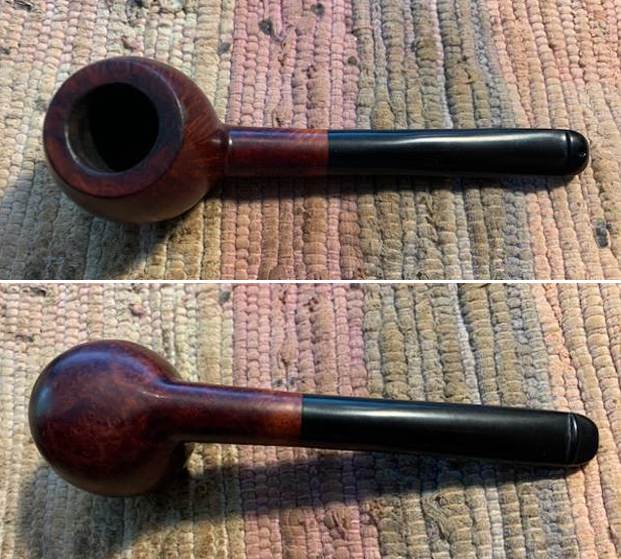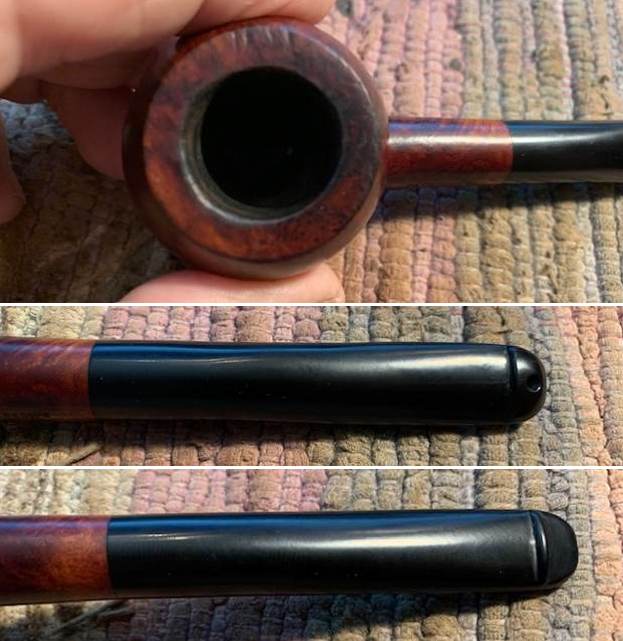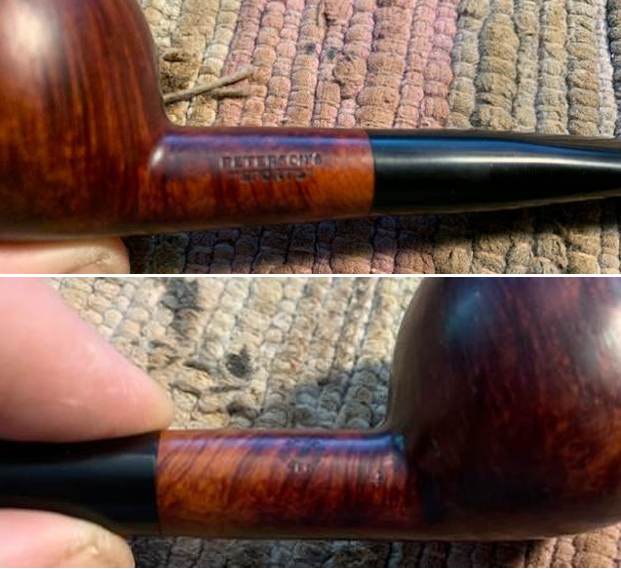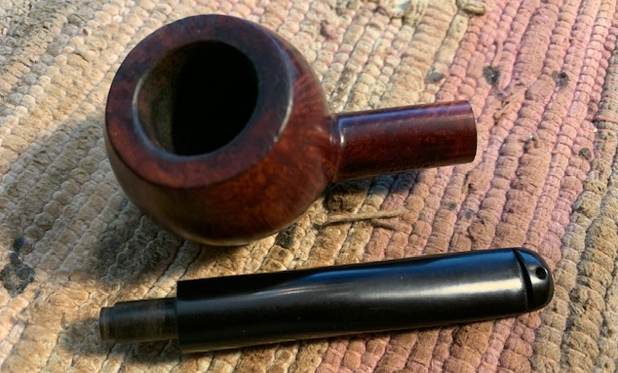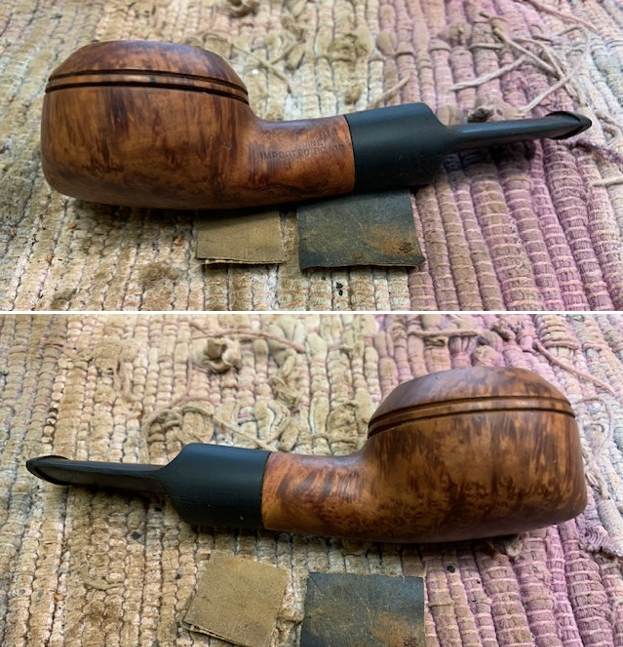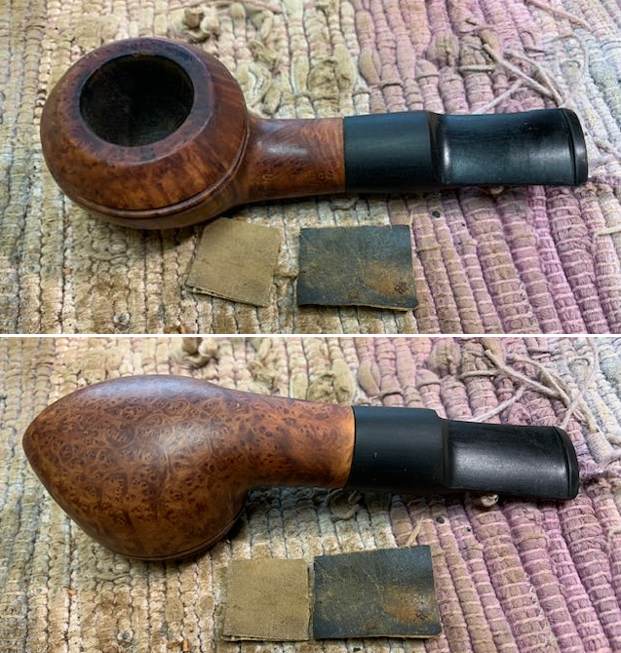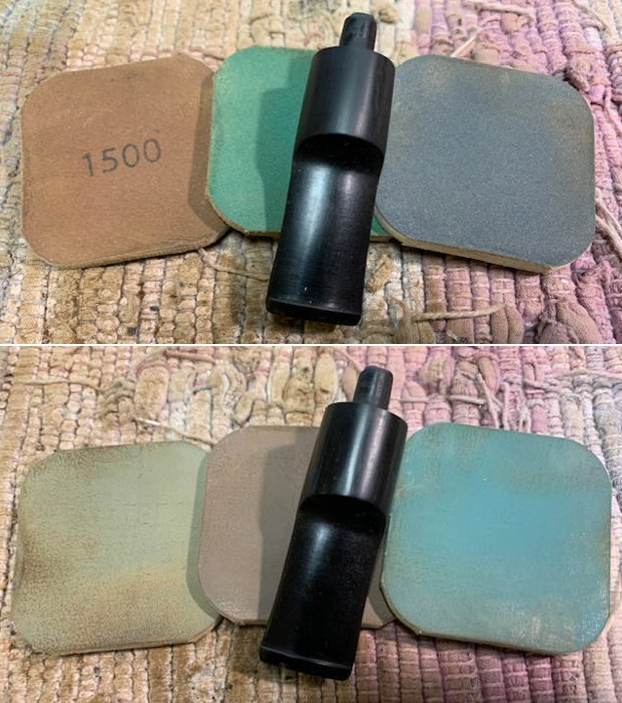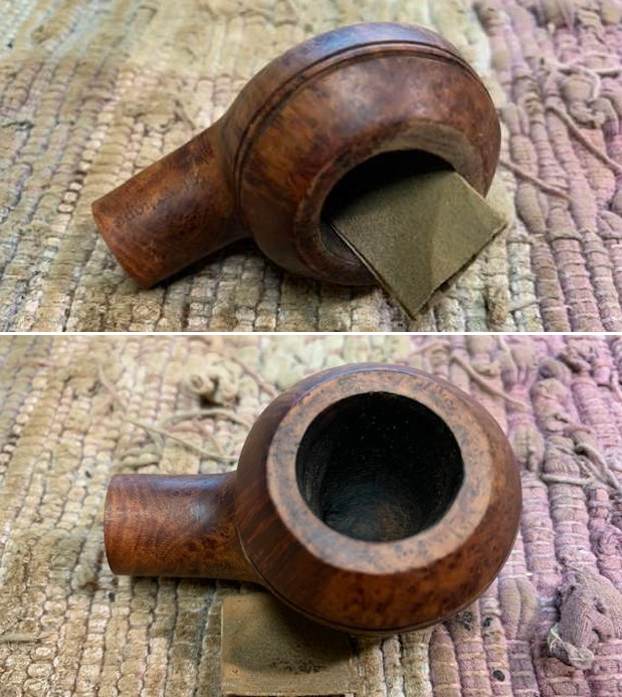
Tag Archives: pipe restemming

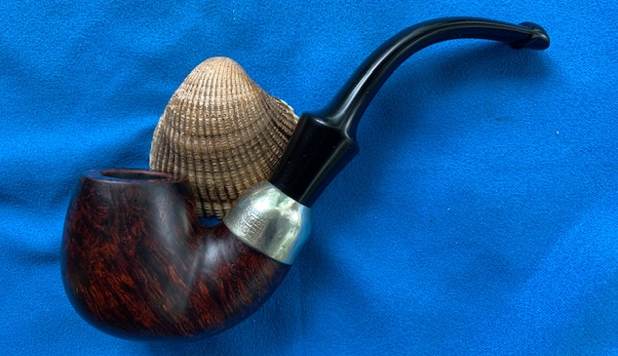
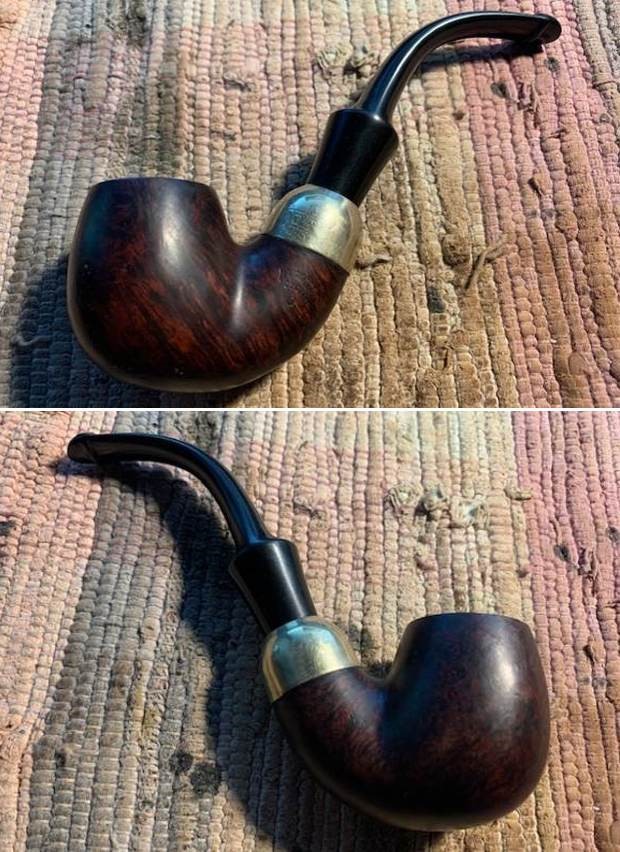
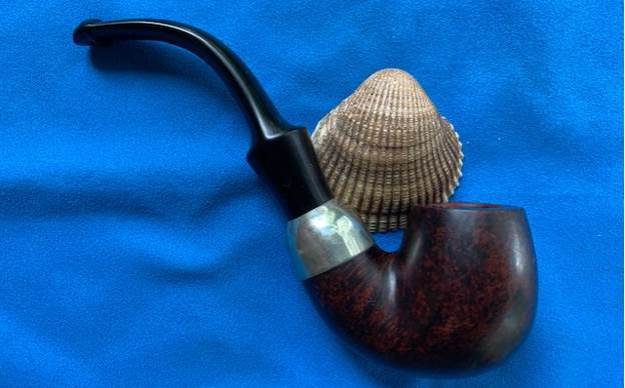
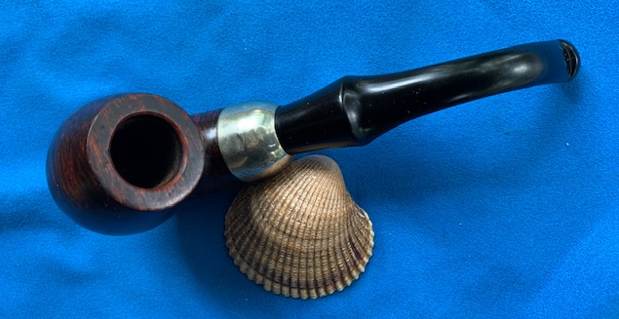
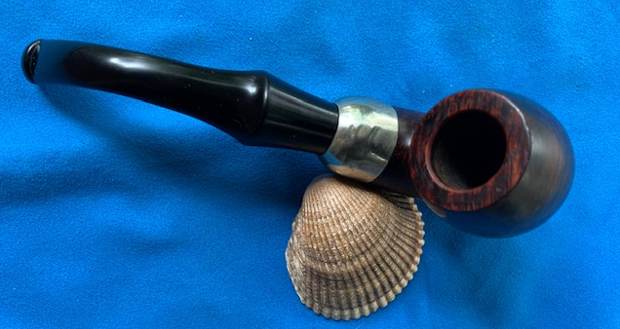
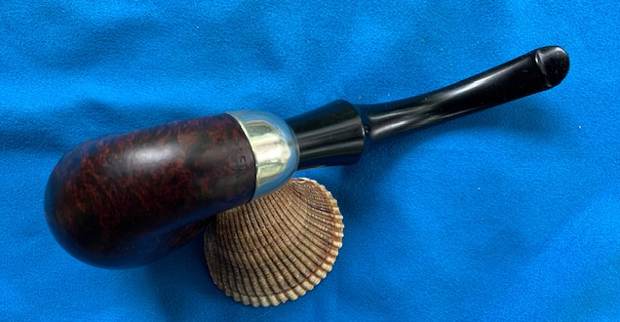
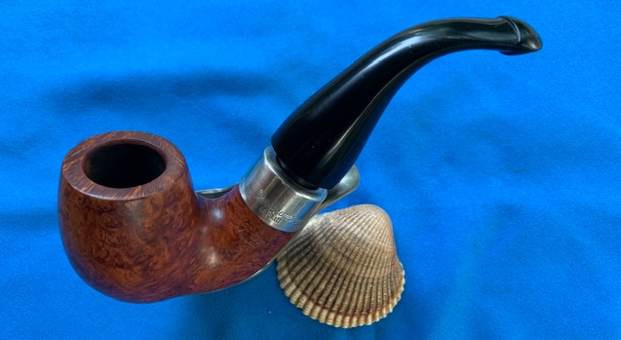
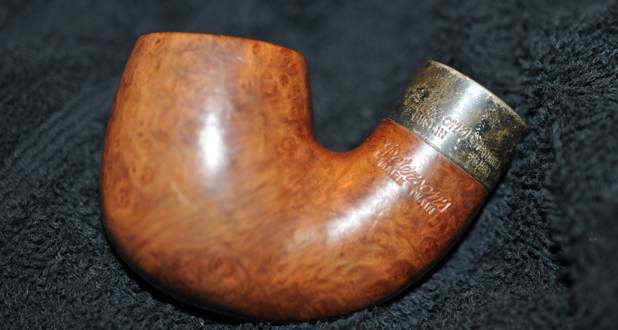
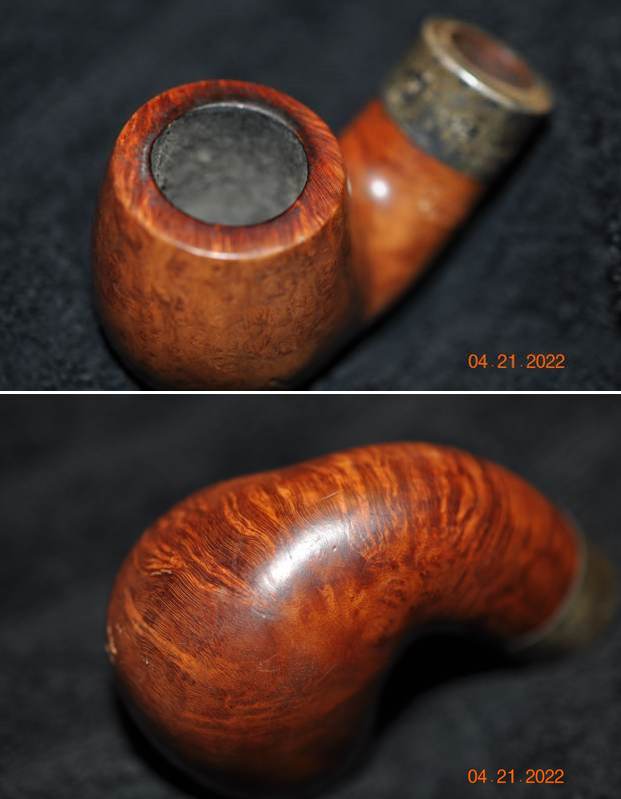
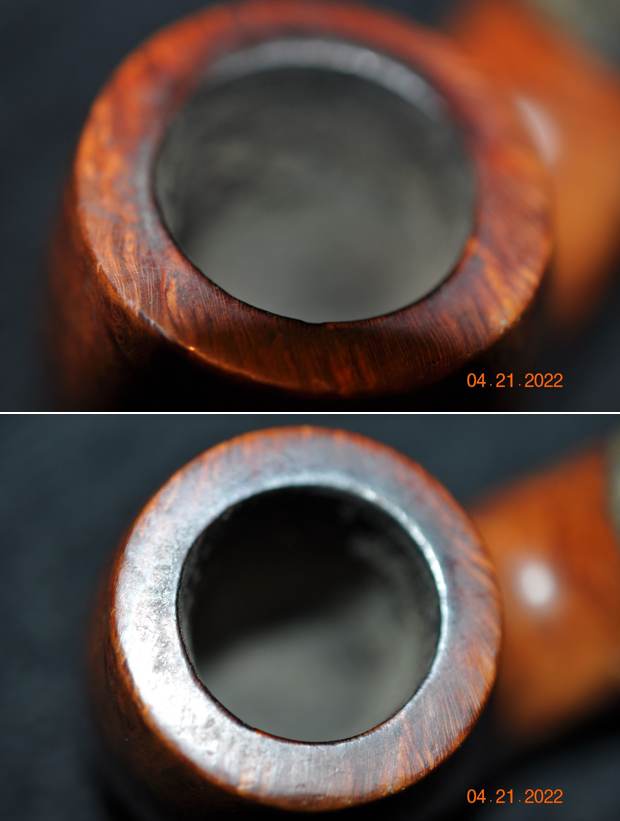
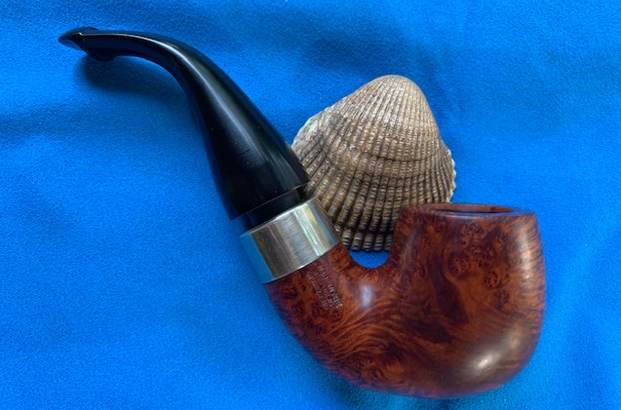
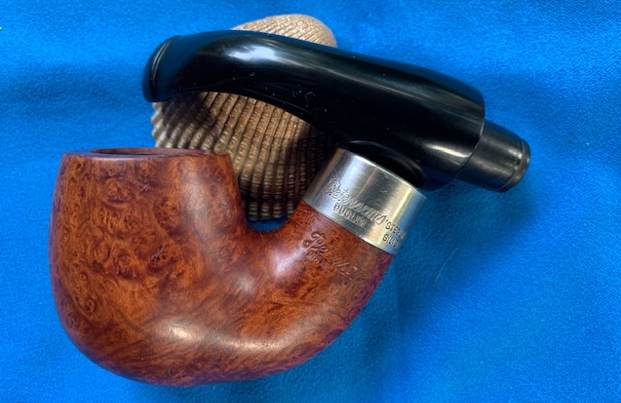
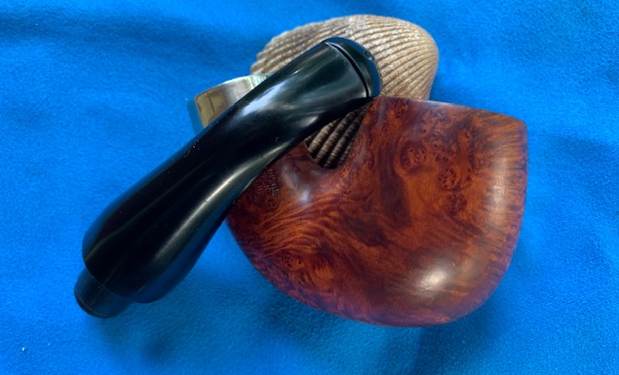
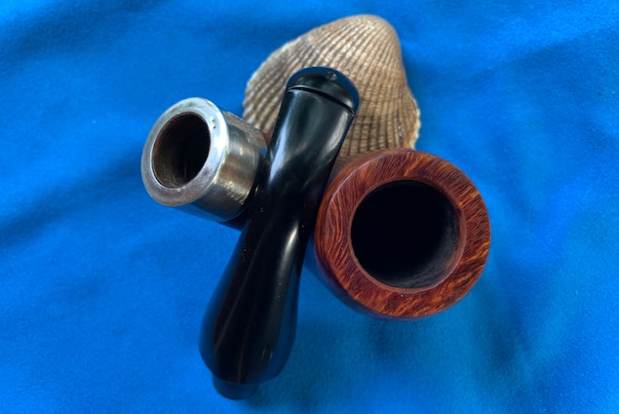
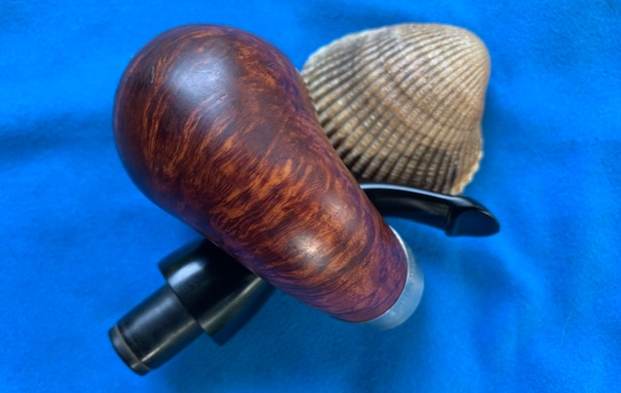
Restoring and Restemming a Republic Era Peterson’s Mark Twain Bent


Blog by Steve Laug

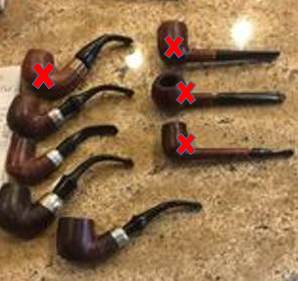
Jeff and I often purchase pipe bowl/stummels of brands that we like and want to restore. These have included a lot of different bowls. If you have followed us for long you know that some of these have included Peterson’s, Dunhill’s, and a wide range of Danish and English pipes. Awhile ago Jeff and I were sorting through the bowls in our collection and pulled out eight Peterson’s bowls that were dirty and stemless. A friend referred us to a contact named Silas Walls, of Walls Pipe Repair in Wallace, Idaho, USA as he seems to have a good supply of original Peterson’s stems. Our friend has had him fit stems for some of his Petes and was very happy with the work. We made contact with him and sent him eight bowls for restemming.

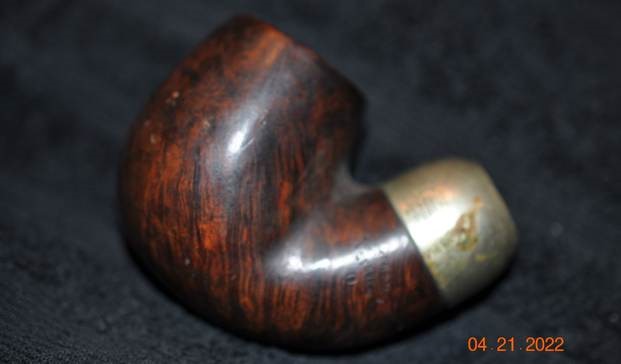
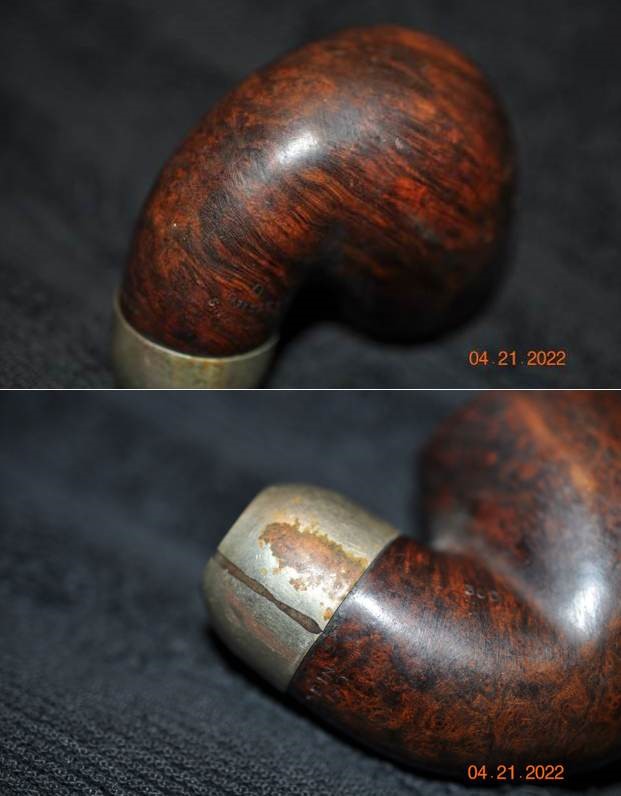
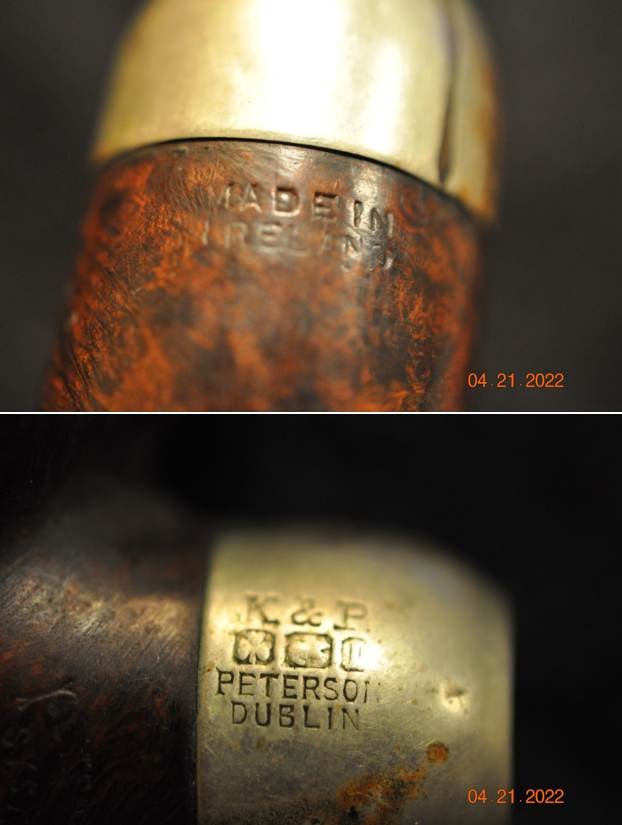
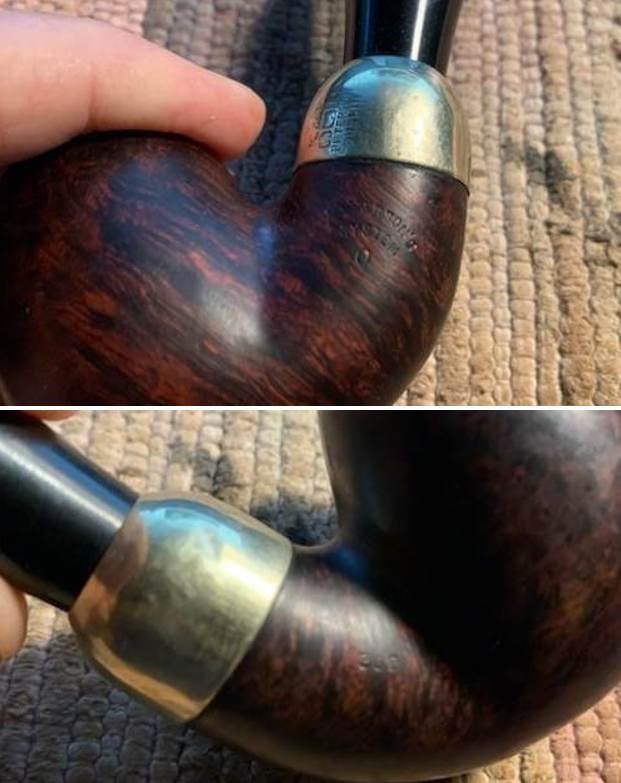
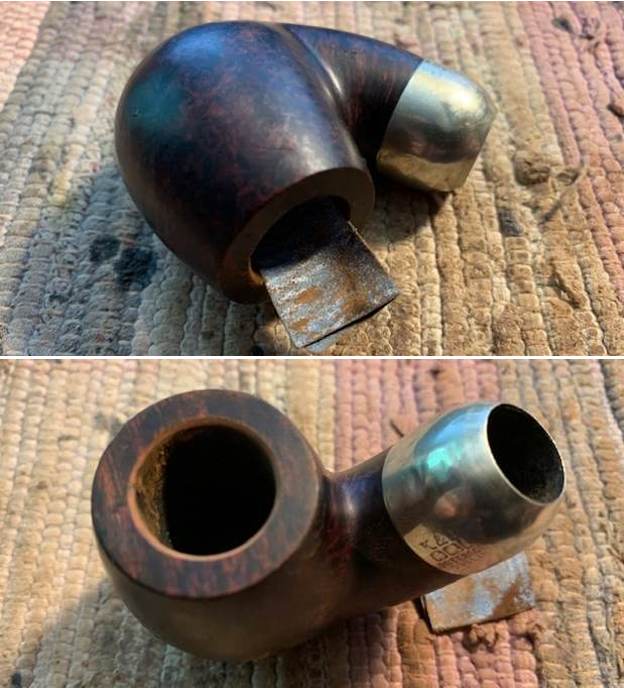
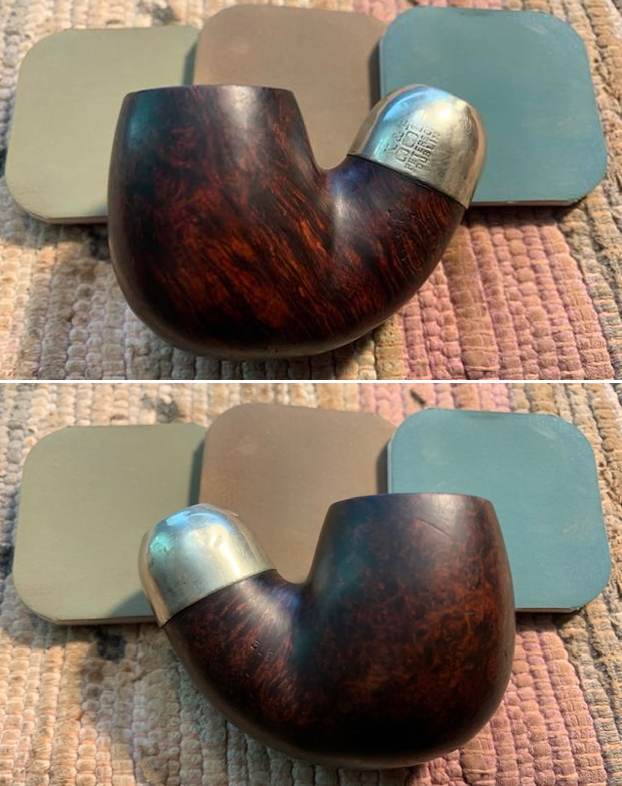
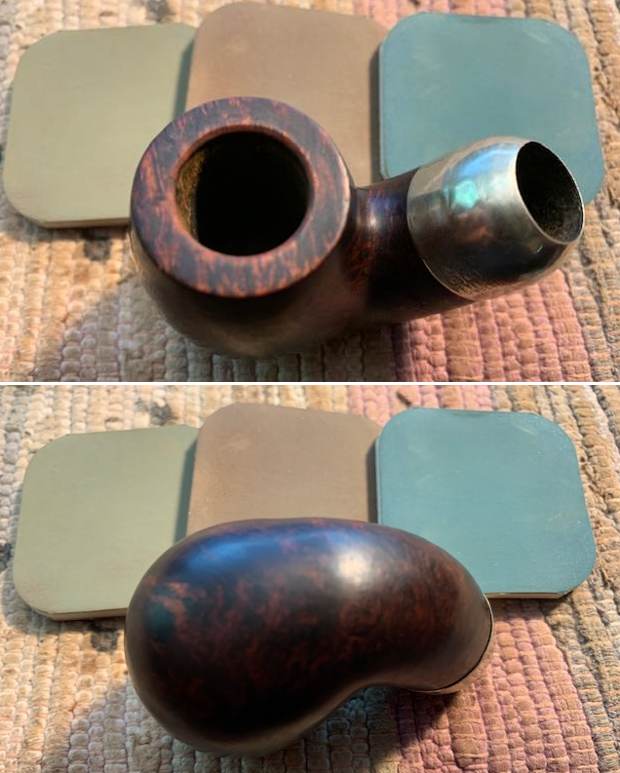
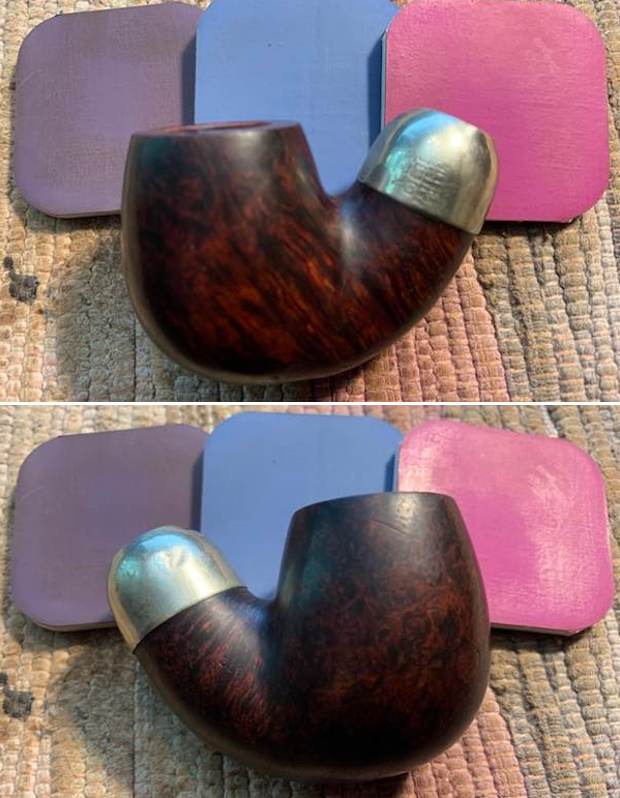
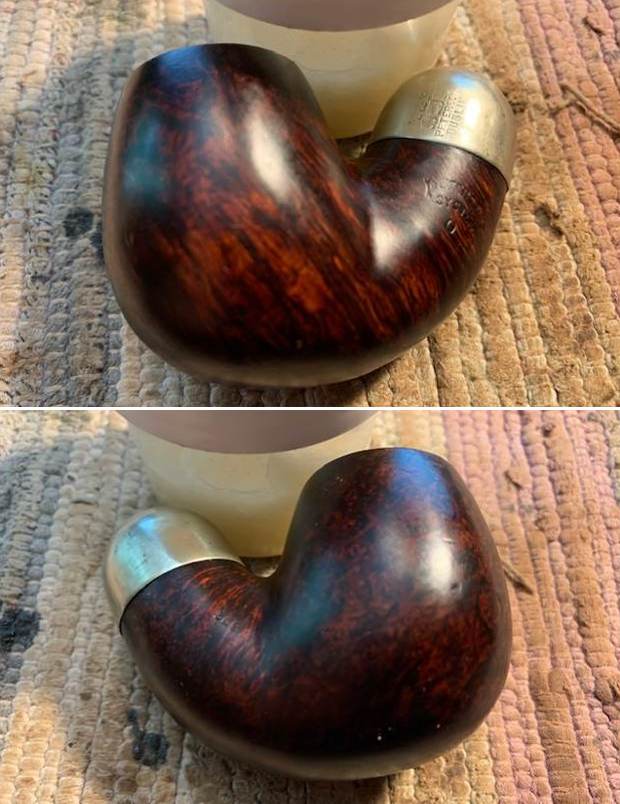
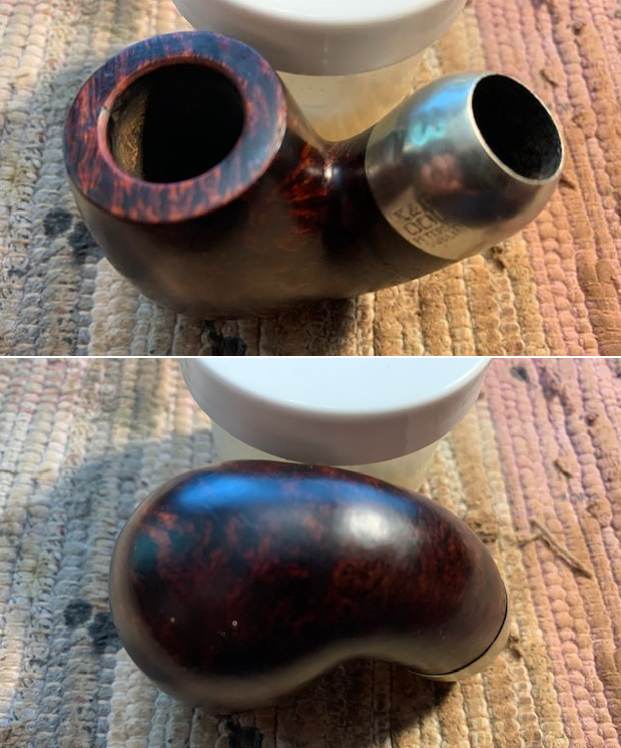
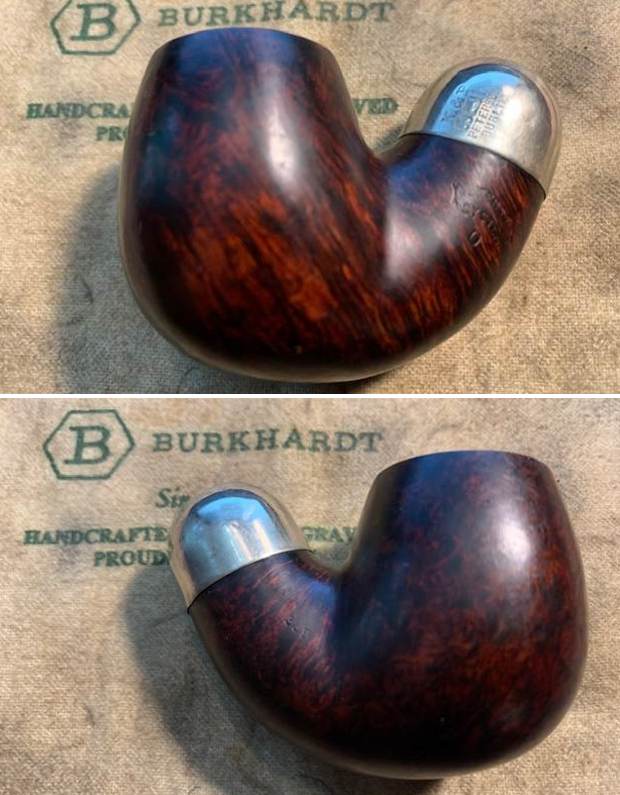
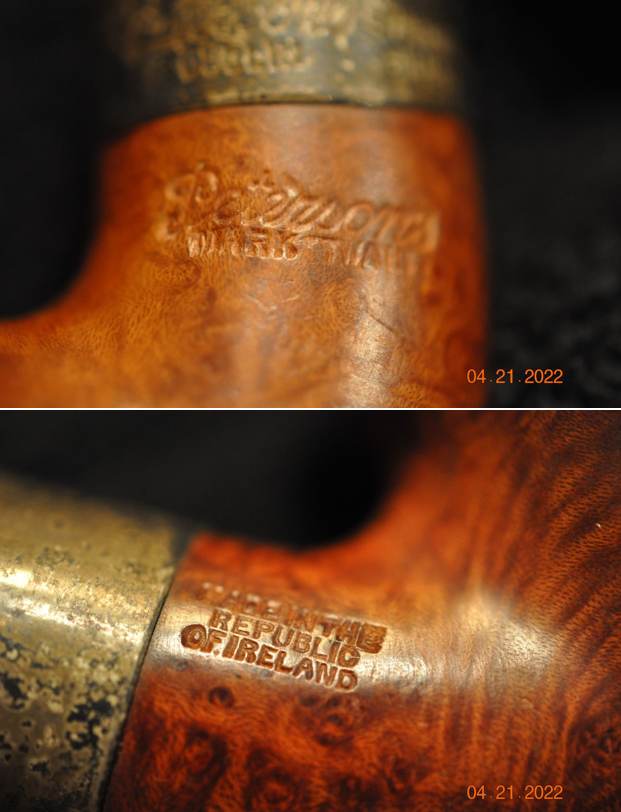
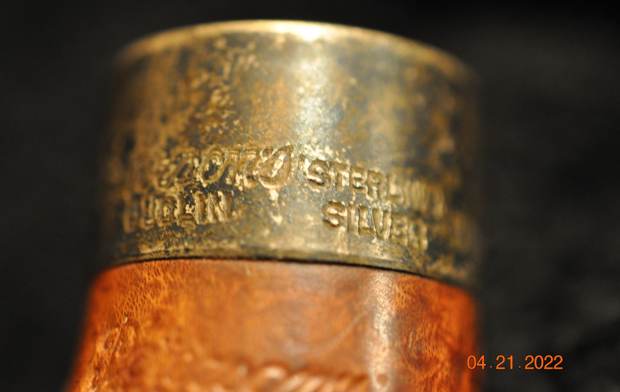
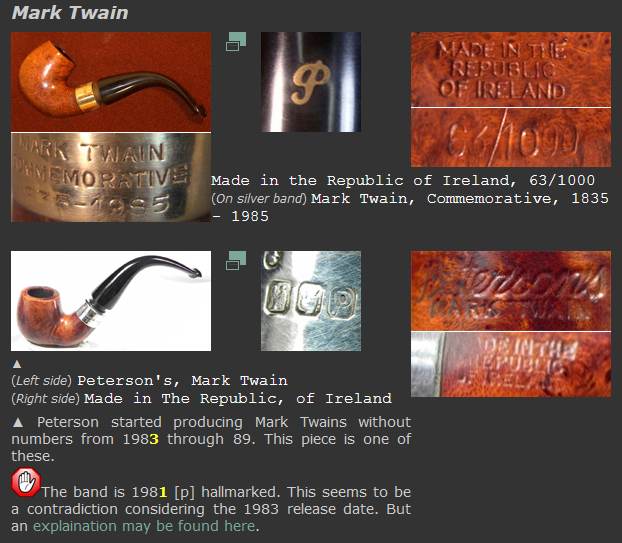
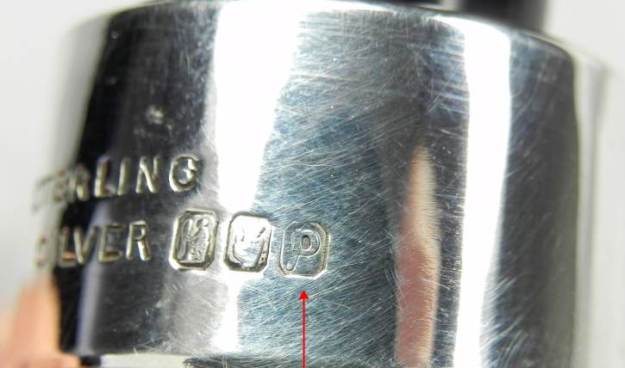
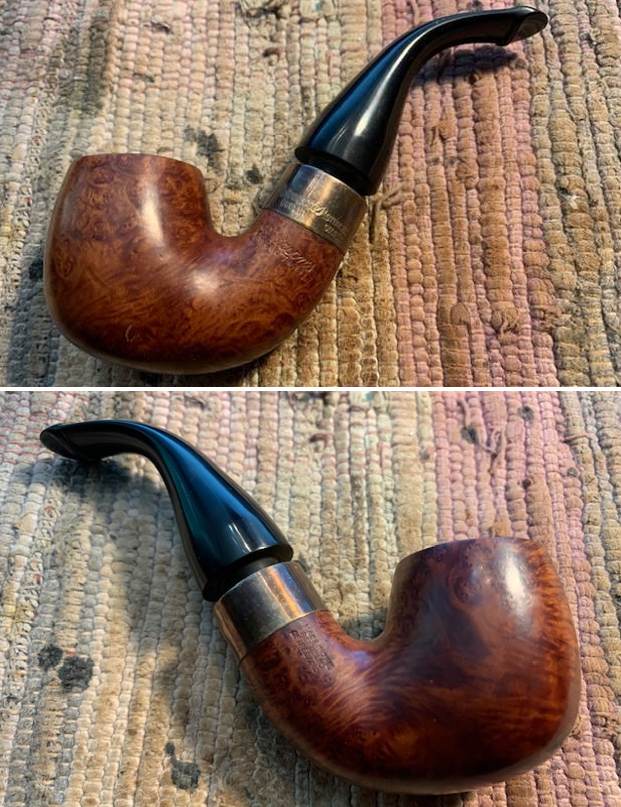
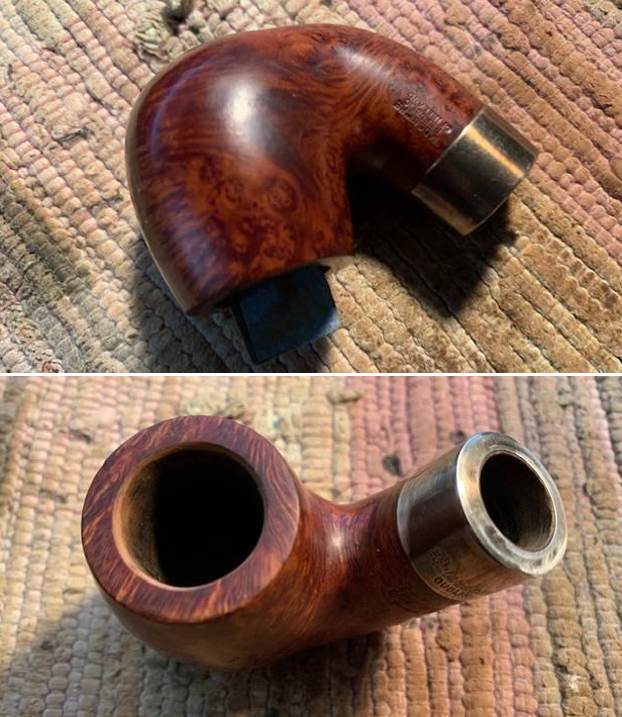
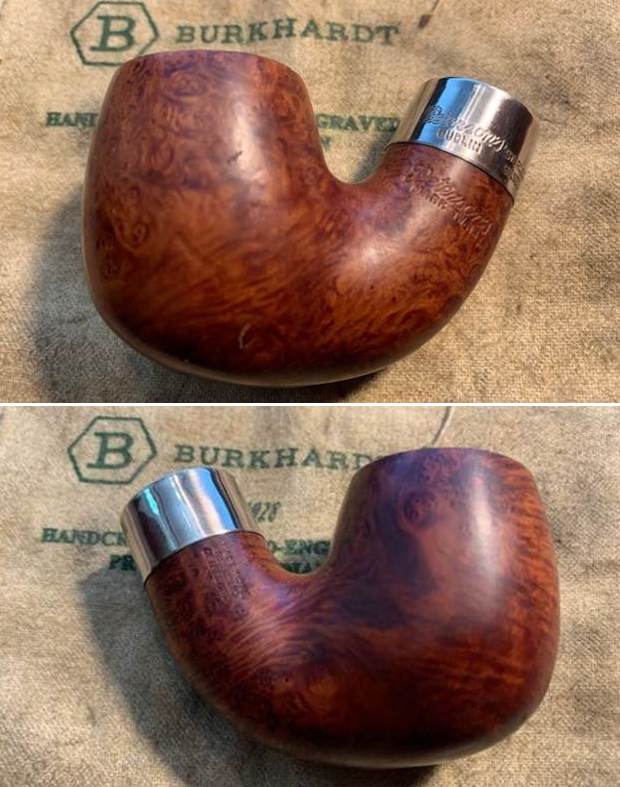
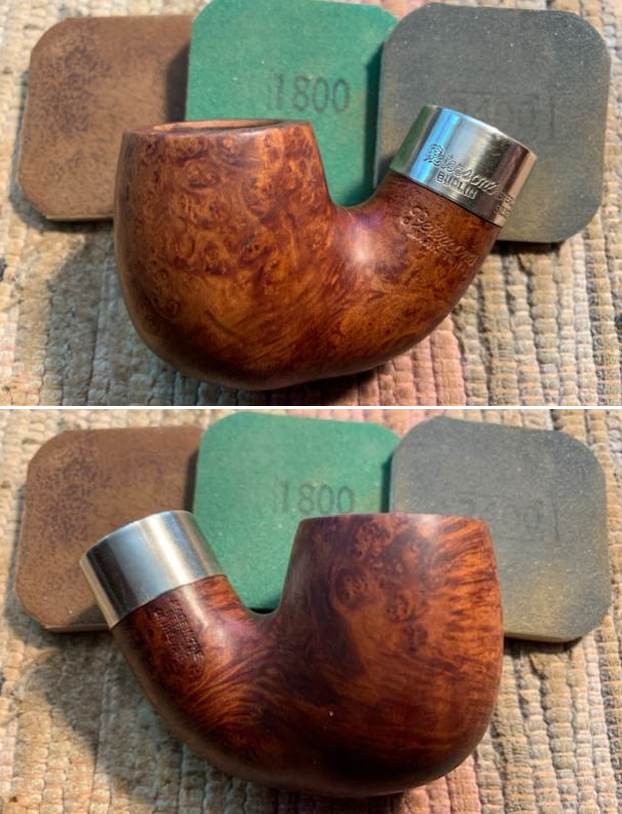
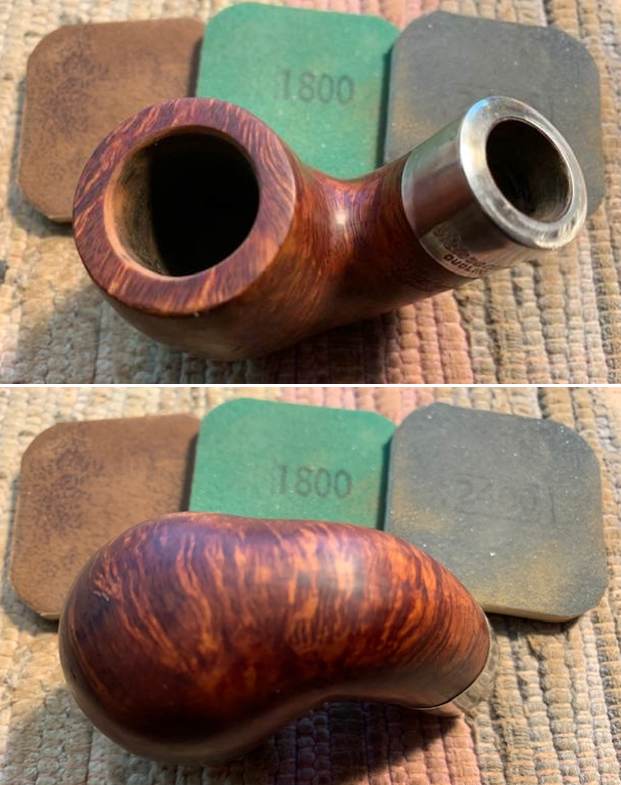
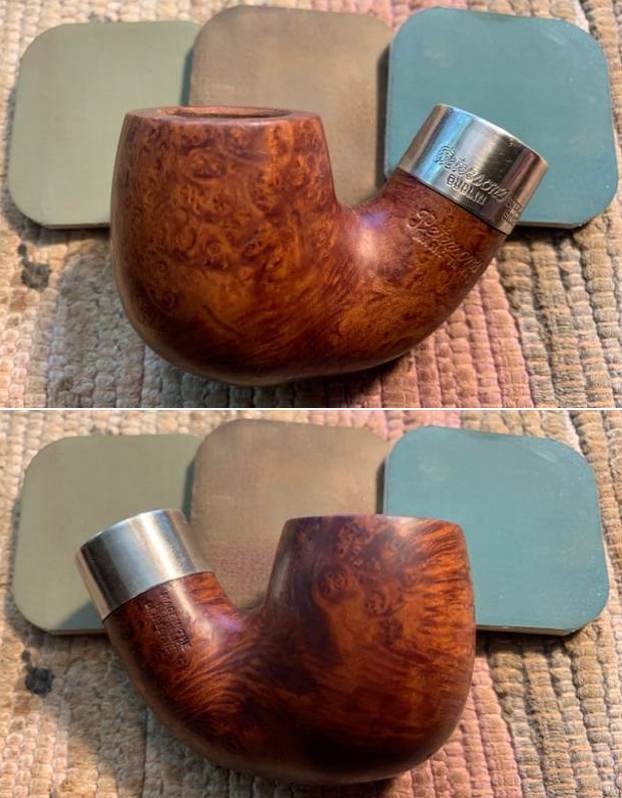
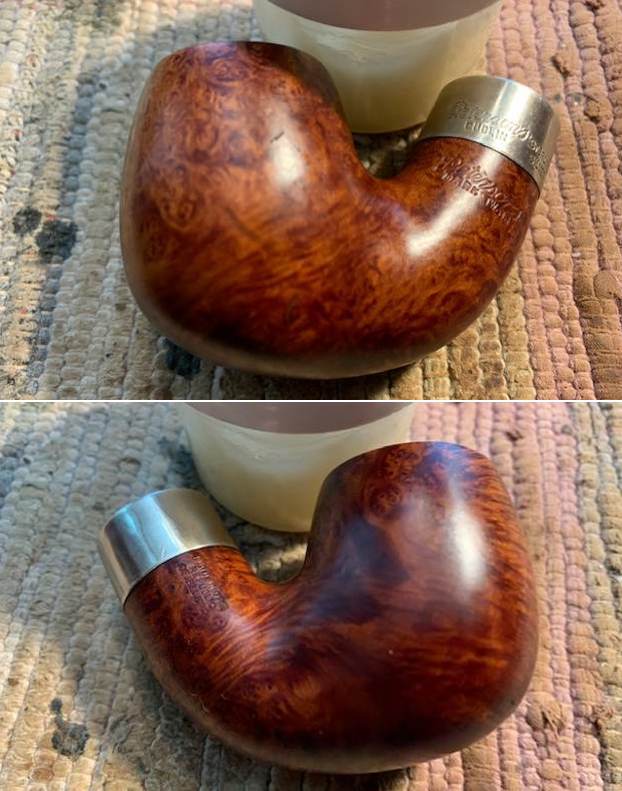
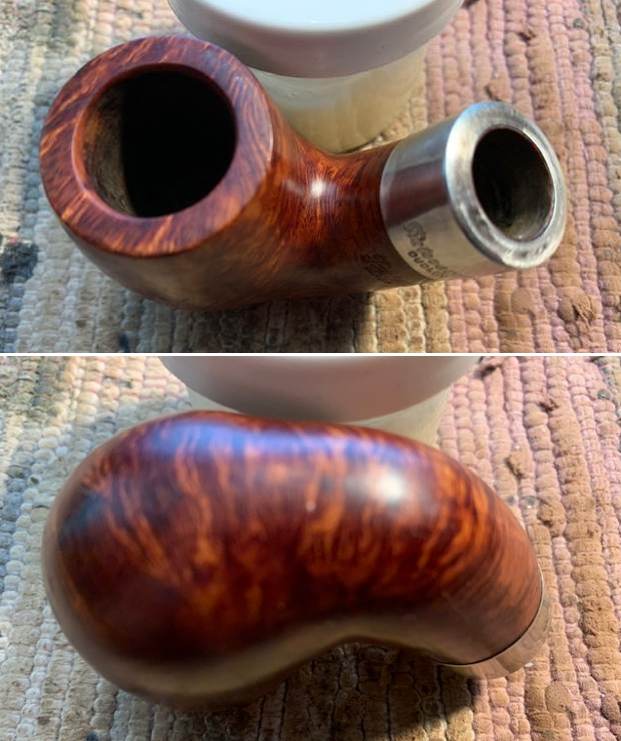
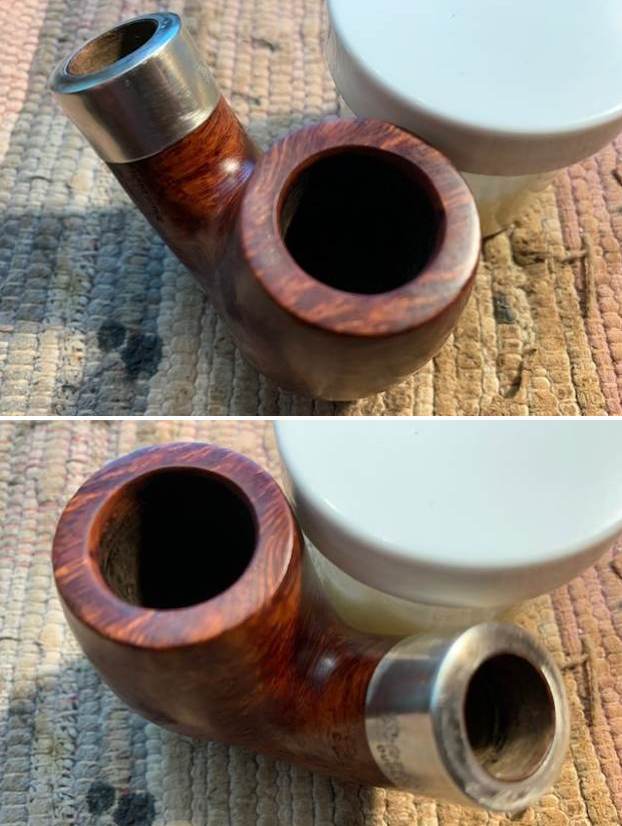
This fourth of them that we cleaned up before mailing them out was a bowl that we purchased on 09/04/2020 from Gonzales, Louisiana, USA. It is stamped on the left side of the shank and reads Peterson’s [over] Mark Twain. On the right side of the shank it is stamped Made in the Republic of Ireland (three lines). It has a tarnished silver ferrule on the shank that is stamped Peterson’s [over] Dublin. Further down the ferrule it is stamped Sterling [over] Silver. Below that are three silver hallmarks – a Hibernia symbol, a harp, and the letter P. This gives the information that it is Irish made, the harp is sign of the quality of silver and the P is the date code. (I will explore that  more below). The bowl was dirty with lava on the rim top, darkening on the edge and a moderate cake in the bowl. The finish had a lot of grime ground into the surface of the finish but some nice grain peeked through. The silver ferrule was heavily oxidized. Jeff took photos of the bowl before he did his cleanup work in preparation for sending them to Walls Pipe Repair for their new stem. The photos of the thick cake in the bowl and the lava build up and nicks/scratches in the surface and edges of the rim top. It showed a lot of promise.Jeff took photos of the stamping on the sides of the shank. It is clear and readable as noted above. There is also some great grain around the bowl and shank. As is my habit I turned to Pipephil (http://pipephil.eu/logos/en/logo-peterson-ser.html) to get a quick overview of the Mark Twain pipe.When I clicked on the photo of the second pipe above it took me to a photo of the hallmarks that looked identical to the ones on the pipe I am working on. It made me question the date mark and dig further. The note below the photo said, “Peterson Mark Twain (not from the two numbered editions). That photo has a red arrow pointing to the P date stamp. Now to dig a little deeper.I turned to Pipedia and there was nothing specific about that stamping. I am including the link to the Pipedia’s article on Peterson pipes. It is a great read in terms of the history of the brand (https://pipedia.org/wiki/Peterson).

I turned then to the definitive pipe book, The Peterson Pipe by Mark Irwin and Gary Malmberg to find more information on the pipe and the stamping on it. I turned first to the short entries and on page 308 found the following information.

Mark Twain (1981-) System pipe design copied from a photograph of Samuel L. Clemens’s pipe held at the Mark Twain Boyhood Home and Museum in Hannibal, Missouri. Arguably Peterson’s most famous and widely known commemorative, it was first introduced as a limited edition 400 numbered pipes in 1981 and offered in smooth and rusticated finishes to this day. Based on shape 14 from 1906 catalog…

There was also a note to turn to another chapter for further information. There is a section in the book on page 174-176 on the Mark Twain variations. There on page 176 in a paragraph entitled, “The Mark Twain System” I found some helpful information which I quote below.

The Mark Twain System. Usually known as the De Luxe, 2400 unnumbered pipes were originally released in 1981 with the hallmark P, and available in smooth as well as rusticated finishes. It is stamped PETERSON’S in script over Mark Twain on the obverse of the shank. The front side of the mouthpiece is stamped with a white P. The pipe retailed for $75 in a red oversized gift box and sometimes included a reproduction of the John Adams etching. De Luxe Quality models were released several times over the years, with later documented examples bearing hallmarks from 1982, 1984-1987, `990-1991, 1994 and 1997.

This section was extremely helpful in that it described the pipe I was working on to a T. So I knew that the pipe was a Mark Twain System known as the De Luxe. It was one of 2400 pipes that were released in 1981 with the hallmark on the silver ferrule – exactly like the one I was working on. I had no need to go further with the hallmarks in terms of dating the pipe.

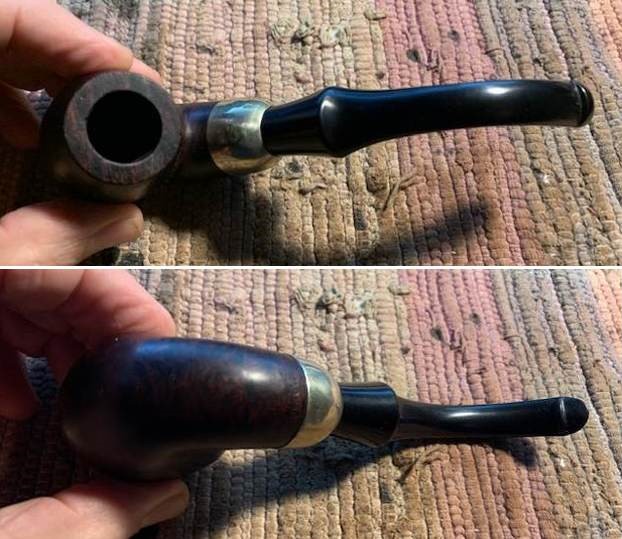
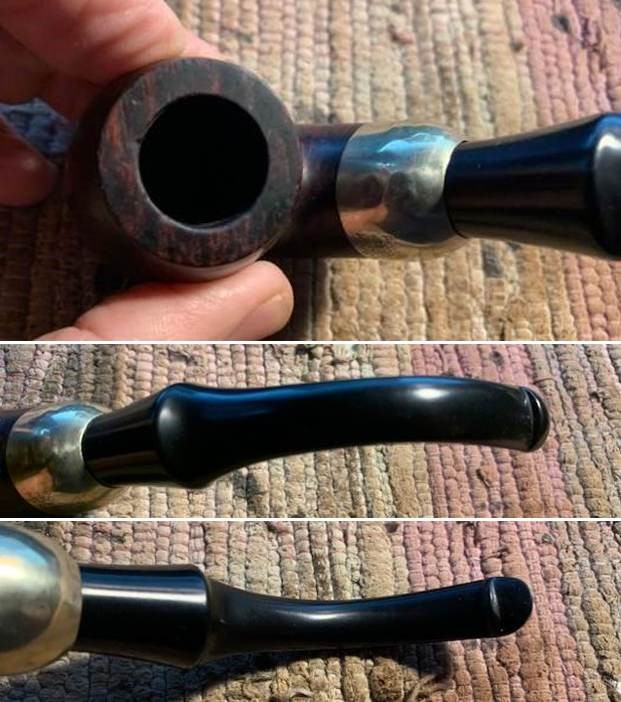
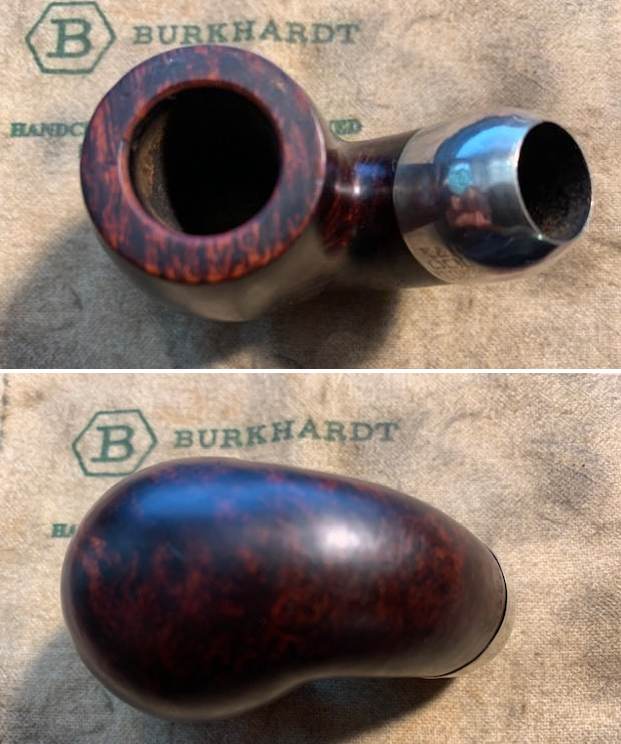
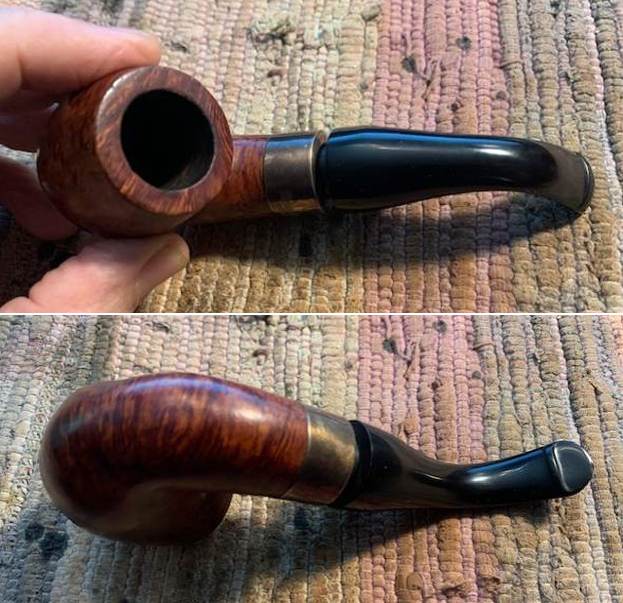
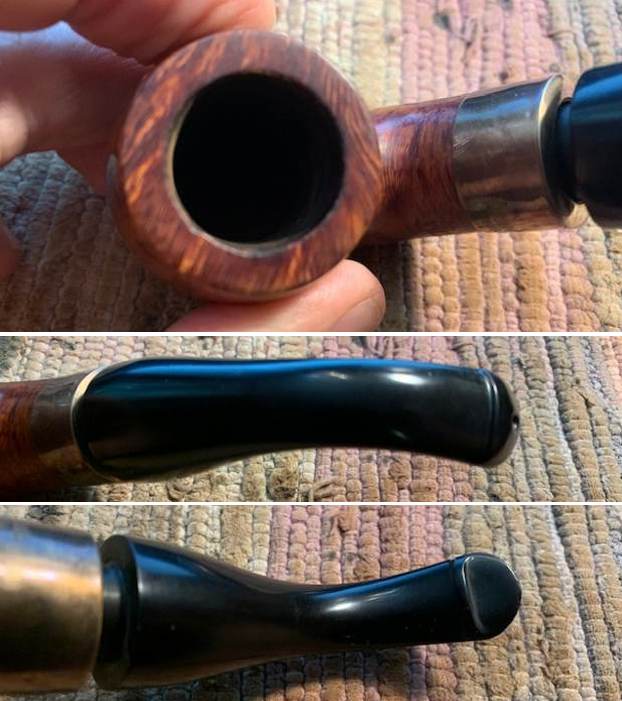
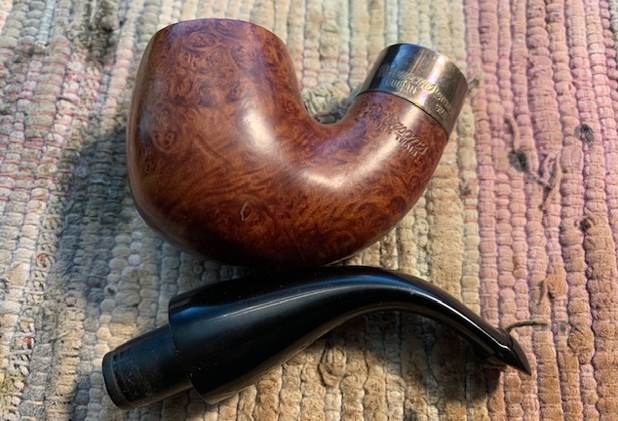
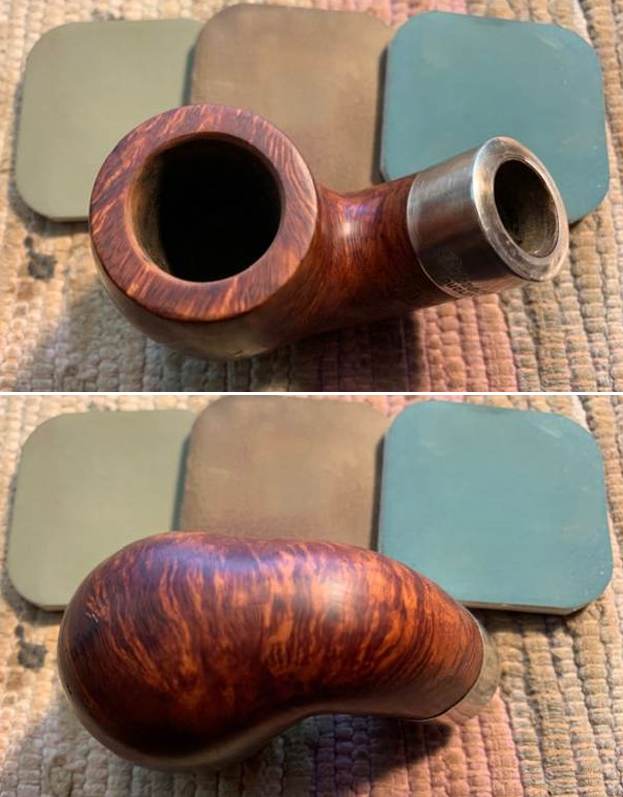
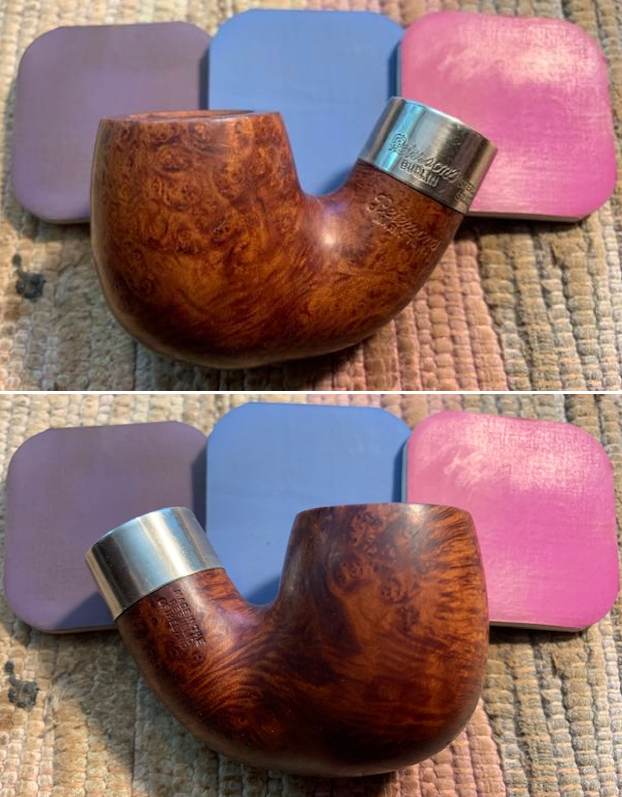
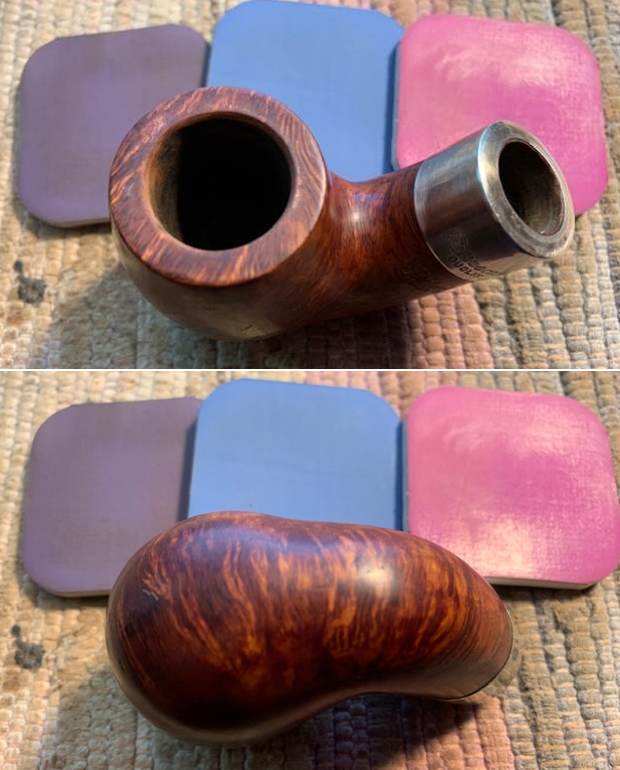
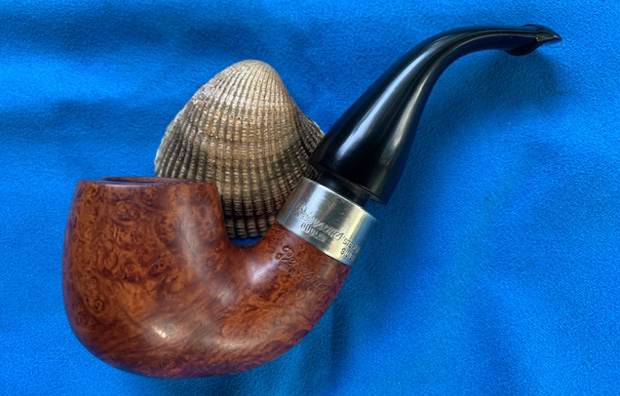
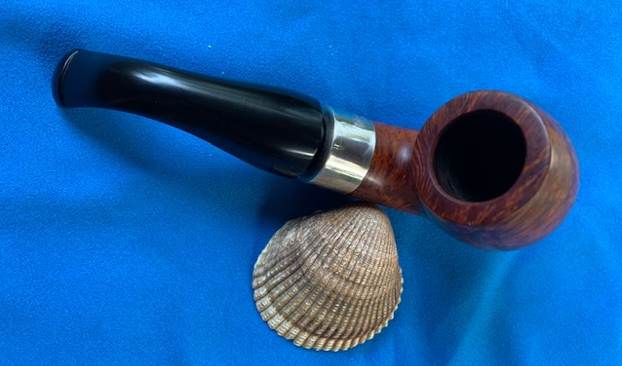
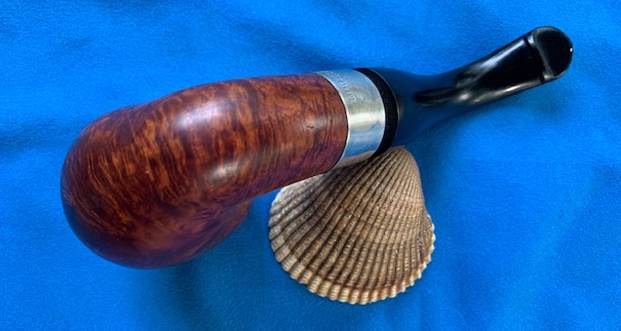
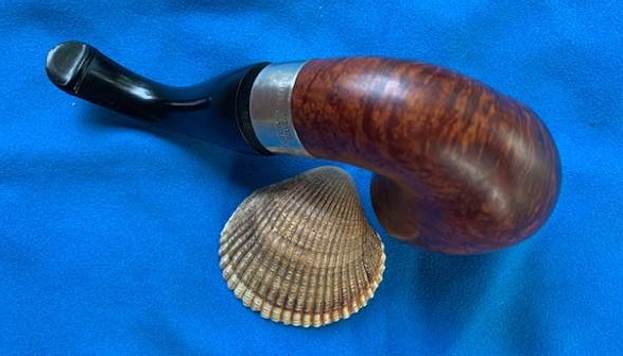
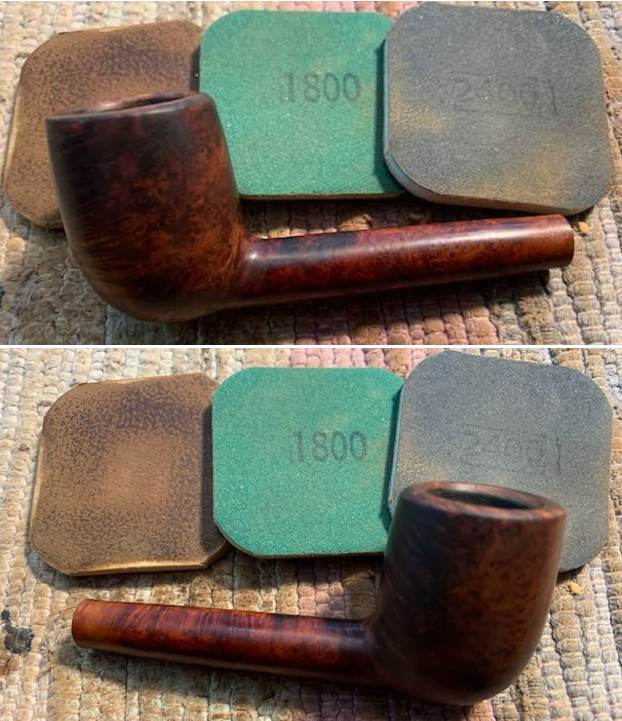
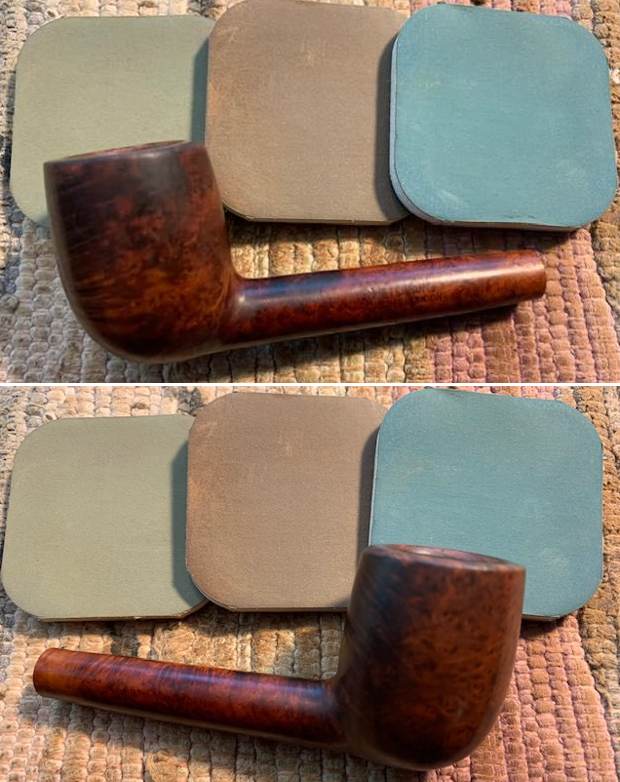
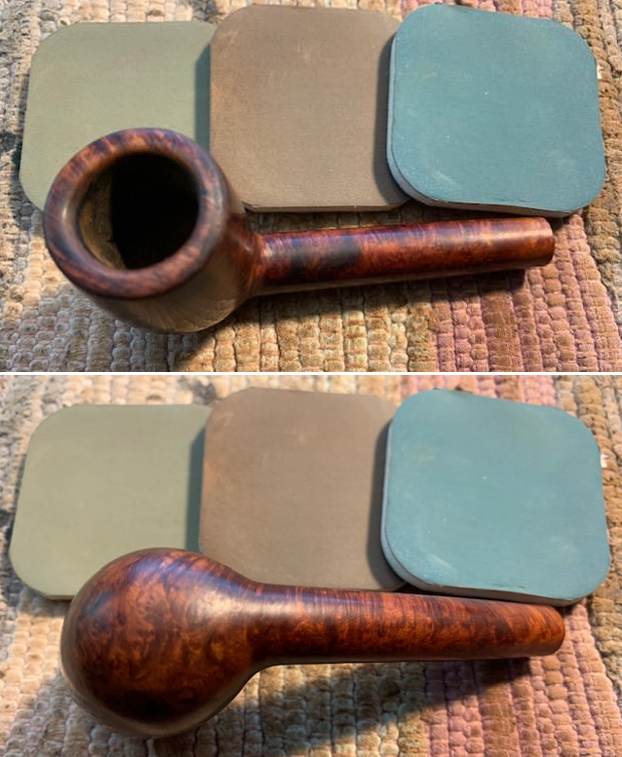
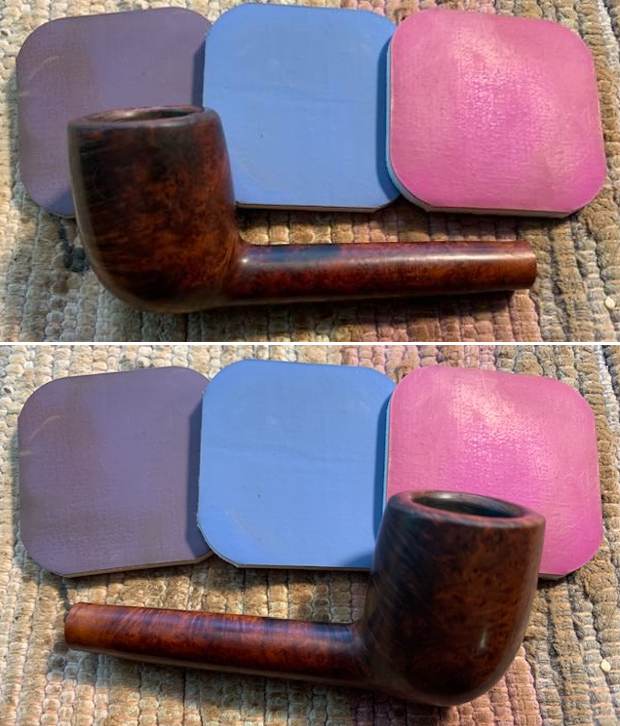
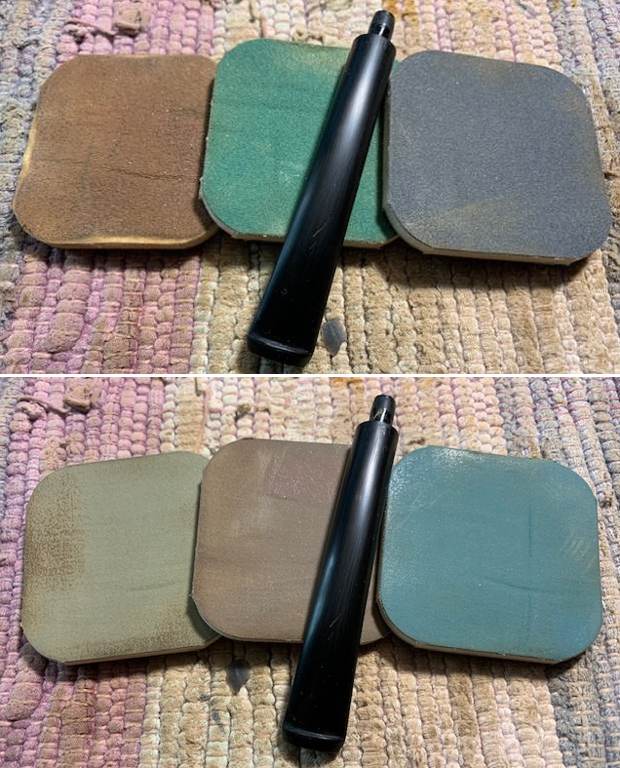
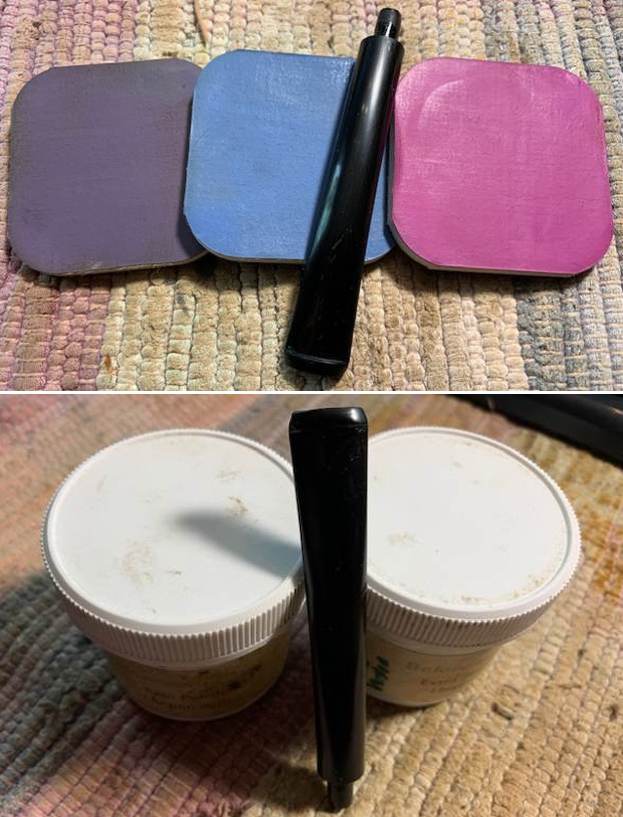
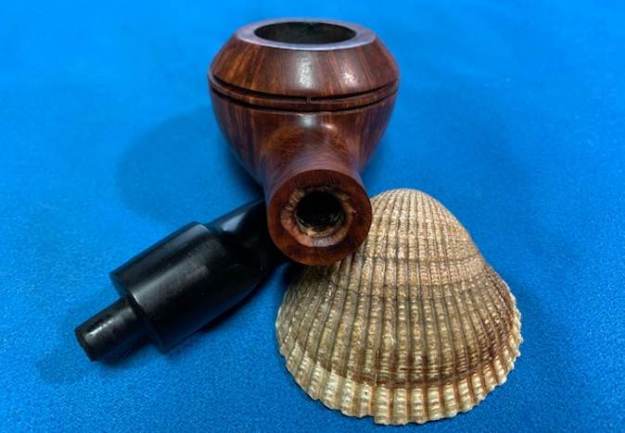
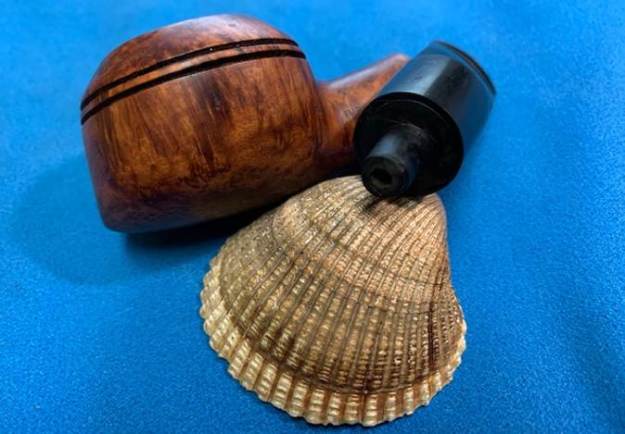
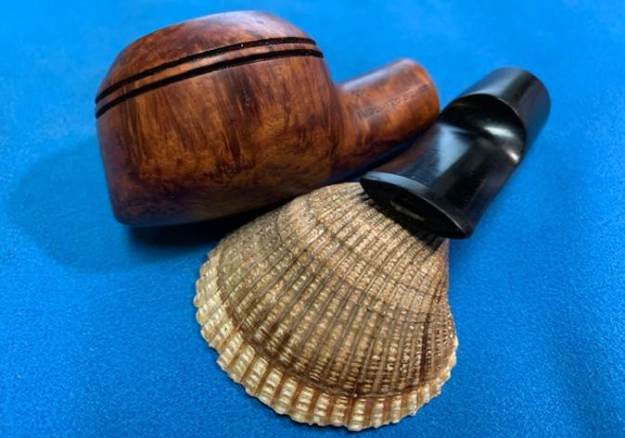
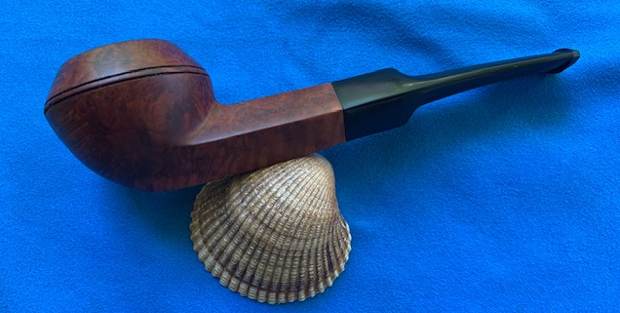
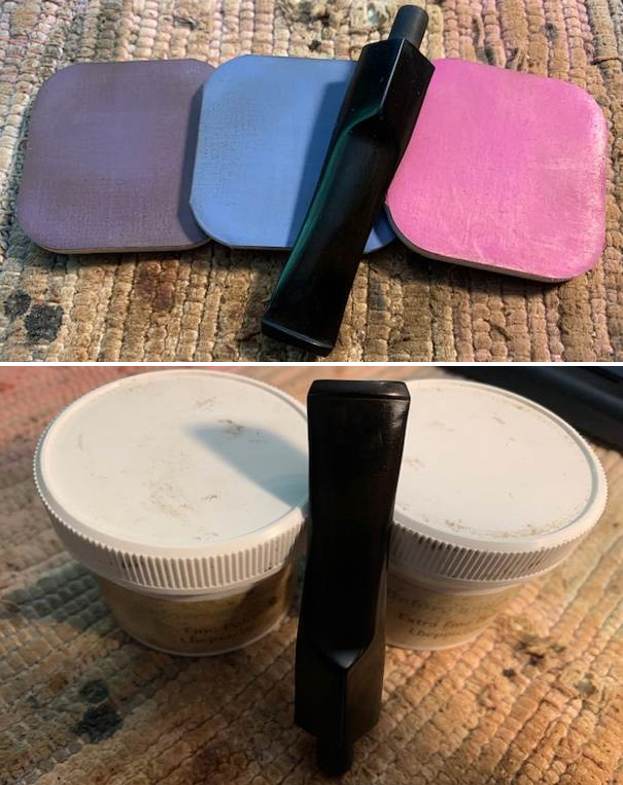
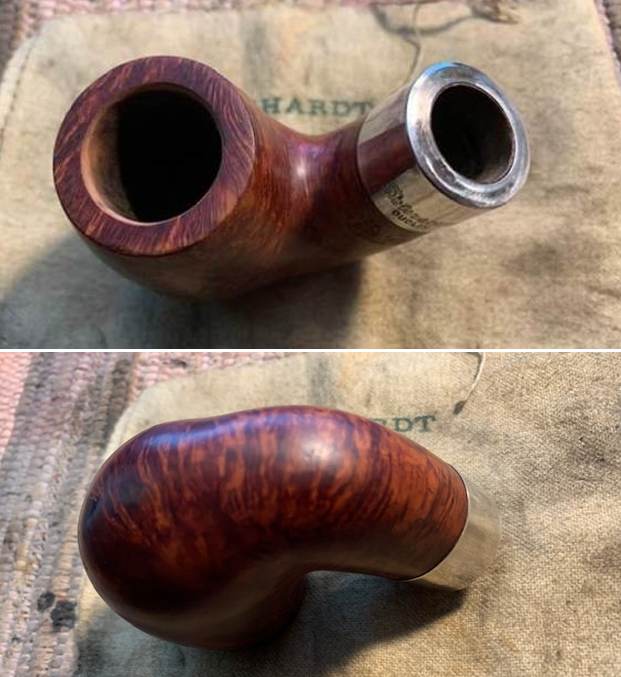
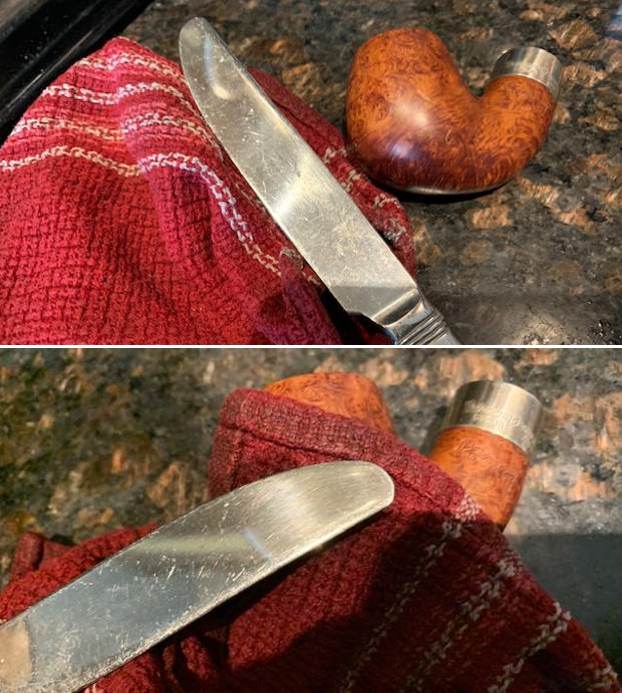
Now it was time to work on the pipe. Jeff had done a great job cleaning up the pipe as usual. He reamed the pipe with a PipNet reamer and cut back the cake back to the bare briar. He cleaned up the walls with a Savinelli Fitsall Pipe Knife. He scrubbed the interior of the bowl and shank with pipe cleaners, cotton swabs and alcohol to remove the tars and oils. He scrubbed the exterior of the pipe with Murphy’s Oil Soap and a tooth brush to remove the grime from the finish. He worked on the rim top lava and darkening with the soap and tooth brush. It looked much better. The silver ferrule had a tarnish that I would need to deal with. When the pipes came back to Jeff with their new stems they looked great. When the pipe arrived here this week I took photos of it with its stem so you can see what I see. It is a great looking pipe and the replacement stem works well. I took some close up photos of the rim top and also of the stem surface. I wanted to show how well it had cleaned up. The rim top looked quite good but there was some damage and darkening around the inner edge. It should clean up really well. I also took close up photos of the new stem to show how well it is made! Thanks to Walls Pipe Repair!! I took photos of the stamping on the sides of the shank. You can see that it is stamped as noted above. It is clear and readable. I removed the stem and took a photo of the pipe to have a look at the parts and overall look. The new stem looked really good with the bowl.Since the stem was in perfect condition and would not need work I set it aside and turned to work on the bowl. I decided to address the damage to the inner edge of the bowl and the rim top first. I used a folded piece of 220 grit sandpaper to give the inner edge of the bowl a slight bevel to minimize the darkening and damage and blend it into the surrounding briar.I polished the silver ferrule with a jeweler’s cloth to remove the tarnish and slow down the tarnishing process. I steamed out the dents and road rash on the left side of the bowl and on the heel with a flat butter knife heated on my gas stove top and a wet cloth. Once finished they were gone and the pipe looked very good.I polished the briar with micromesh sanding pads – dry sanding with 1500-12000 grit sanding pads. I wiped the bowl down with a damp cloth after each sanding pad.  The polishing of the rim top and inner edge brought the rim top colour to match the rest of the bowl. I worked some Before & After Restoration Balm into the surface of the briar with my fingertips to clean, enliven and protect the briar. I let the balm sit for 15 minutes and then buffed with a cotton cloth to raise the shine. The photos show the bowl at this point in the restoration process. Since the stem was new condition the pipe was basically finished. I am excited to put the final touches on this newly restemmed Made in the Republic of Ireland Peterson’s Mark Twain System Pipe. I put the pipe back together and buffed it with Blue Diamond on the buffing wheel. I gave the bowl and the stem multiple coats of carnauba wax. I hand buffed the pipe with a clean buffing pad to raise the shine. It is fun to see what the polished bowl looks like with beautiful mixed grain all around it. Added to that the polished black vulcanite stem combined with the bowl and made a stunning pipe. This smooth Classic Peterson’s Mark Twain System is great looking and the pipe feels great in my hand. It is light and well balanced. Have a look at it with the photos below. The dimensions are Length: 5 ½ inches, Height: 1 ¾ inches, Outside diameter of the bowl: 1 ¼ inches, Chamber diameter: ¾ of an inch. The weight of the pipe is 66 grams/2.33 ounces. I will be holding on to this one while I decide if I am going to sell it or smoke it. Thanks for walking through the restoration with me as I worked over this pipe. Thanks to each of you who are reading this blog.

Restoring and Restemming a Made in Ireland Peterson’s Dublin & London 36 Liverpool


Blog by Steve Laug

Jeff and I often purchase pipe bowl/stummels of brands that we like and want to restore. These have included a lot of different bowls. If you have followed us for long you know that some of these have included Peterson’s, Dunhill’s, and a wide range of Danish and English pipes. Awhile ago Jeff and I were sorting through the bowls in our collection and pulled out eight Peterson’s bowls that were dirty and stemless. A friend referred us to a contact named Silas Walls, of Walls Pipe Repair in Wallace, Idaho, USA as he seems to have a good supply of original Peterson’s stems. Our friend has had him fit stems for some of his Petes and was very happy with the work. We made contact with him and sent him eight bowls for restemming.

This third of those pipes that we cleaned up before mailing them out was a Petite, Pencil Shank Liverpool shaped bowl that we purchased on 05/22/21 from Facebook Marketplace. It came from Fruitland, Idaho. It is stamped on the left side of the shank and reads Peterson’s [over] Dublin & London. On the right side of the shank there is a number 36 stamped next to the bowl/shank junction followed by (faint stamp) Made in [over] Ireland stamp in two lines mid shank. The bowl was dirty with lava on the rim top and a thick cake in the bowl.  There was some damage to the inner edge and top with the bowl slightly out of round. The finish had a lot of grime ground into the surface of the finish but some nice grain peeked through. Jeff took photos of the bowl before he did his cleanup work in preparation for sending them to Walls Pipe Repair for their new stem. The images were corrupted on Jeff’s camera so we have no photos of the pipe before his clean up work.

The next photos I have included below are of the pipe when it arrived in Vancouver with its new stem. Jeff had done a great job cleaning up the pipe as usual. He reamed the pipe with a PipNet reamer and cut the cake back to the bare briar. He cleaned up the walls with a Savinelli Fitsall Pipe Knife. He scrubbed the interior of the bowl and shank with pipe cleaners, cotton swabs and alcohol to remove the tars and oils. He scrubbed the exterior of the pipe with Murphy’s Oil Soap and a tooth brush to remove the grime from the finish. He worked on the rim top lava and darkening with the soap and tooth brush. When the pipes came back to Jeff with their new stems they looked great. I took some close up photos of the rim top and also of the stem surface. I wanted to show how well it had cleaned up. The rim top had some darkening and damage on the top. The inner edge was out of round and had some damage on the front and the back of the bowl. It appears that the shank is slightly tapered toward the stem end. I don’t know if this is original or from a previous repair. It should clean up really well. I also took close up photos of the new stem to show how well it was fit to the shank. It is a tiny looking stem and thin shank! Thanks to Walls Pipe Repair!! I took photos of the stamping on the sides of the shank. It is faint but readable with a light and lens you can see that it is stamped as noted above. I removed the stem and took a photo of the pipe to have a look at the parts and overall look. The new stem looked really good with the bowl. I am impressed by how the stem was shaped to fit the stem. I have restored a few Peterson’s Dublin & London in the past so I turned to my blog to have a look at the background information that I included in those blogs. I found the following link to a one of those pipes (https://rebornpipes.com/2021/02/24/restoring-a-made-in-ireland-petersons-dublin-london-999-rhodesian/). I also am including the background information I had gathered on the line from the previous blog. I quote:

I am including the link to the Pipedia’s article on Peterson pipes. It is a great read in terms of the history of the brand (https://pipedia.org/wiki/Peterson).

I turned to “The Peterson Pipe” by Mark Irwin and Gary Malmberg to get some background on the Peterson’s Dublin & London Pipe. On page 298 it had the following information.

Dublin & London (c1940-97, 2016-) First mentioned in a 1940 brochure, but probably not widely distributed until ’45, Dublin & London was the highest quality line (aside from the Supreme, introduced in ’53) until about ’86. P-lip or fishtail mouthpiece, polished finish, although sandblast described in ’70 Iwan Ries & Co. catalog. COMs include MADE IN over IRELAND (1940-80) and MADE IN THE over REPUBLIC over OF IRELAND (c1980-97).

Judging from the description above, the pipe I am working on is stamped with the stamp noted in red above. It reads Made in Ireland which narrows the date to between approximately 1940-1980. It was also one of the highest quality lines available by Peterson when it was made. Now it was time to work on the pipe.

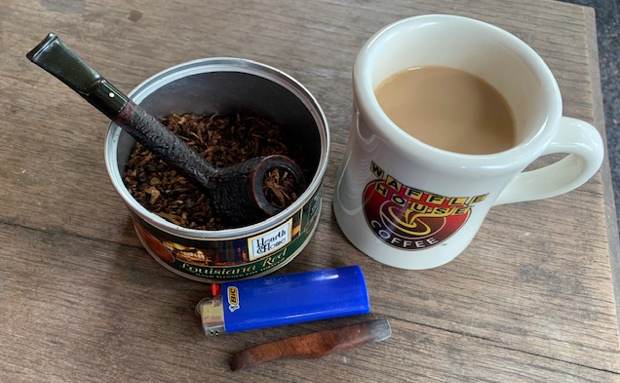
Before I started working on the pipe I took the little Dunhill Shell Briar Lovat for its inaugural smoke on the porch. I took a cup of fresh ground Honduran Medium Roast Coffee and a tin of Hearth and Home Louisiana Red with me. I loaded the bowl and sat watching the “world” walk by while I enjoyed the smoke. I finished the bowl and enjoyed a visit with Alex before getting back to the pipe. It is a great pipe and it was a great smoke.When I finally started to work on the pipe again I set the stem aside as it was in perfect condition and turned to work on the bowl. I decided to address the damage to the inner edge of the bowl and the rim top first. I used a folded piece of 220 grit sandpaper to give the inner edge of the bowl a slight bevel to minimize the darkening and damage and blend it into the surrounding briar.I polished the briar with micromesh sanding pads – dry sanding with 1500-12000 grit sanding pads. I wiped the bowl down with a damp cloth after each sanding pad. There was a dark spot on the top of the shank toward the bowl that appears to be a deep stain rather than a burn mark. It is solid and makes me wonder if the was just a spot on the briar that took the dark understain more deeply than the rest. The polishing of the rim top and inner edge brought the rim top colour to match the rest of the bowl. I did not need to stain the rim at all. I worked some Before & After Restoration Balm into the surface of the briar with my fingertips to clean, enliven and protect the briar. I let the balm sit for 15 minutes and then buffed with a cotton cloth to raise the shine. The photos show the bowl at this point in the restoration process. Since the stem was new condition the pipe was basically finished. I am excited to put the final touches on this newly restemmed Made in Ireland Peterson’s Dublin & London 36 Liverpool. I put the pipe back together and buffed it with Blue Diamond on the buffing wheel. I gave the bowl and the stem multiple coats of carnauba wax. I hand buffed the pipe with a clean buffing pad to raise the shine. It is fun to see what the polished bowl looks like with beautiful mixed grain all around it. Added to that the polished black vulcanite stem combined with the bowl and made a stunning pipe. This smooth Classic Older Peterson’s Liverpool 36 is great looking and the pipe feels great in my hand. It is light and well balanced. Have a look at it with the photos below. The dimensions are Length: 5 ½ inches, Height: 1 ½ inches, Outside diameter of the bowl: 1 1/8 inches, Chamber diameter: ¾ of an inch. The weight of the pipe is 39 grams/1.38 ounces. It is a beautiful pipe that I will soon be putting on the rebornpipes store in the Irish Pipe Makers section. If you are interested in adding it to your collection send me an email or a message. Thanks for walking through the restoration with me as I worked over this pipe. Thanks to each of you who are reading this blog.

Restoring and Restemming a Made in Ireland Peterson’s “Sports” 6 Pot


Blog by Steve Laug

Jeff and I often purchase pipe bowl/stummels of brands that we like and want to restore. These have included a lot of different bowls. If you have followed us for long you know that some of these have included Peterson’s, Dunhill’s, and a wide range of Danish and English pipes. Awhile ago Jeff and I were sorting through the bowls in our collection and pulled out eight Peterson’s bowls that were dirty and stemless. A friend referred us to a contact named Silas Walls, of Walls Pipe Repair in Wallace, Idaho, USA as he seems to have a good supply of original Peterson’s stems. Our friend has had him fit stems for some of his Petes and was very happy with the work. We made contact with him and sent him eight bowls for restemming.

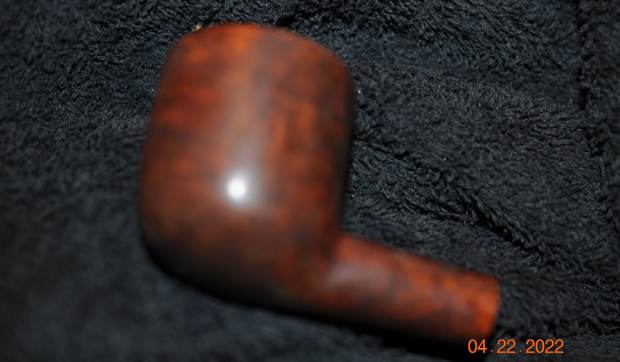
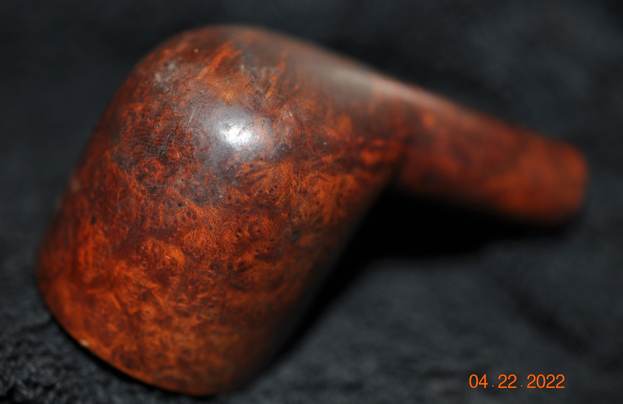
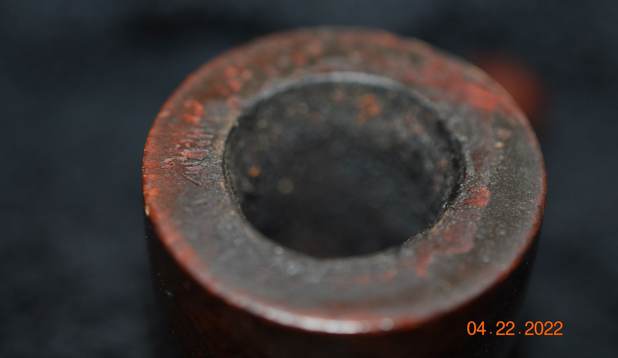
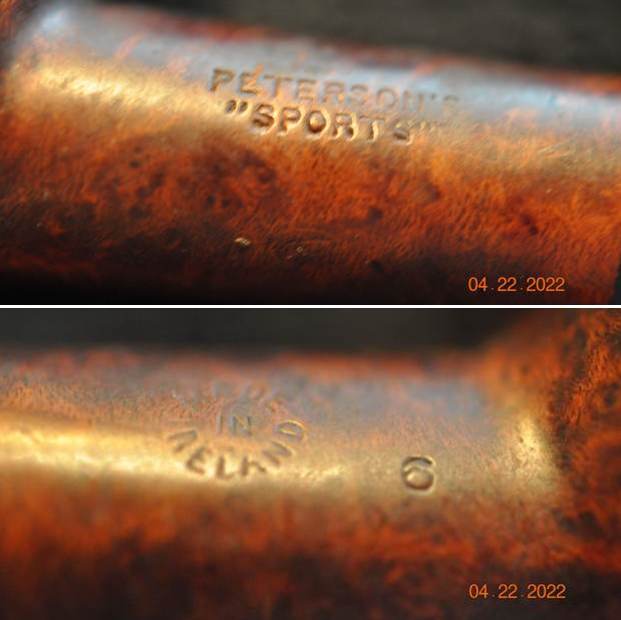
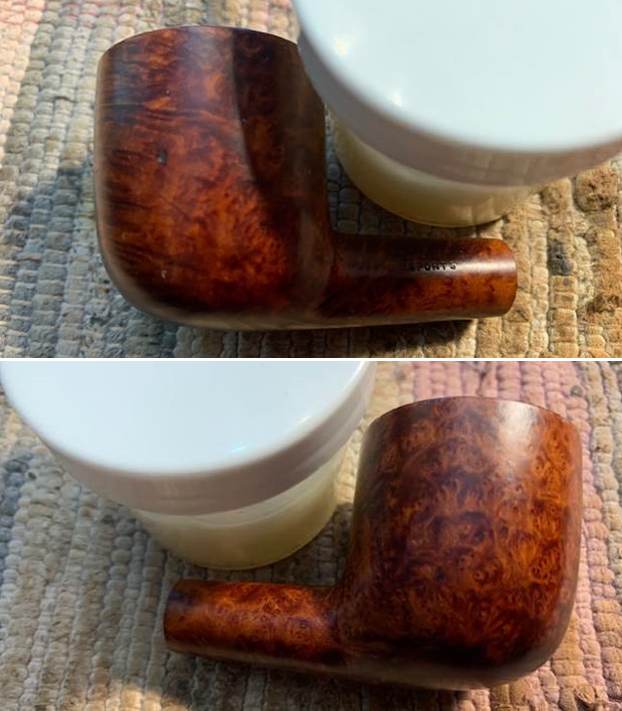
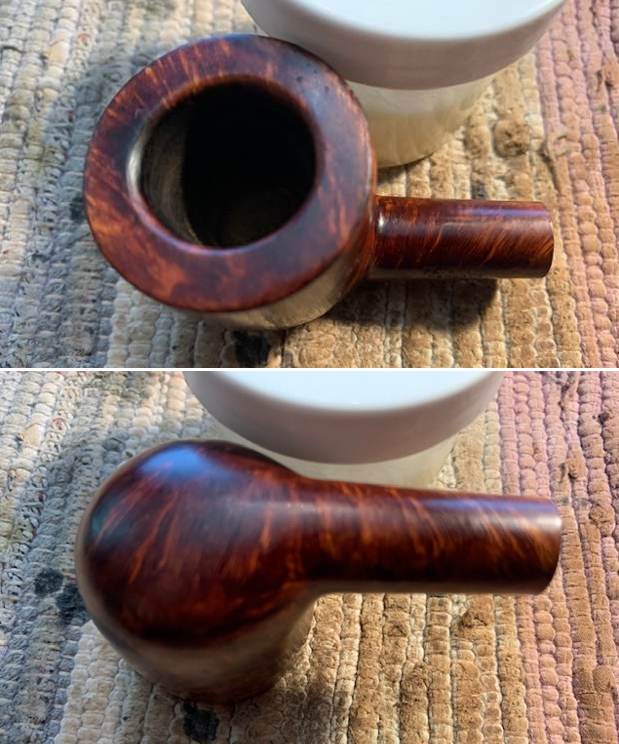
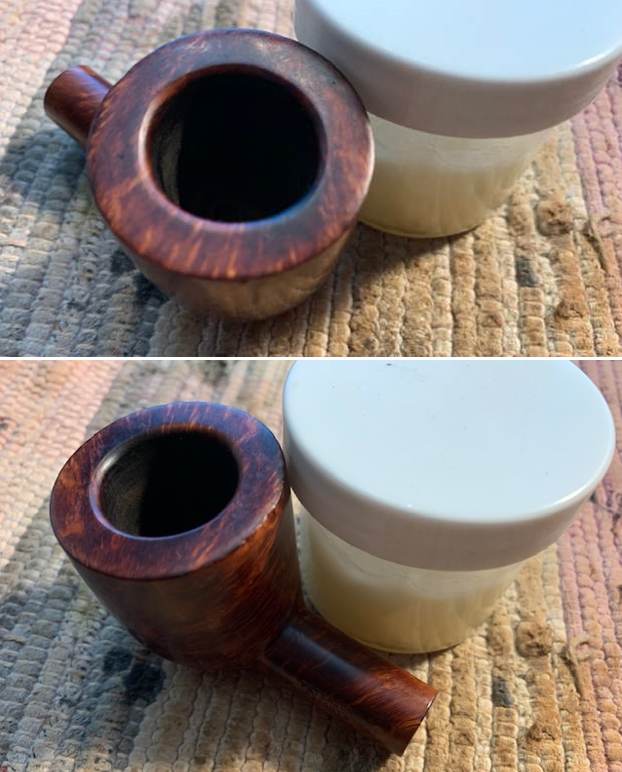
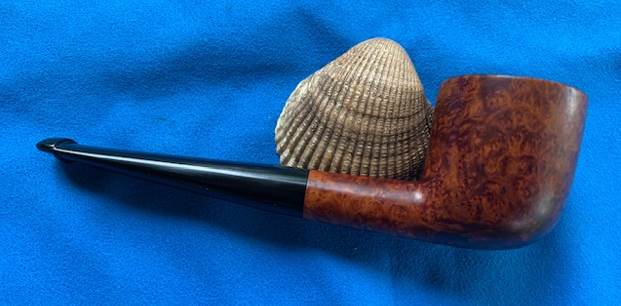
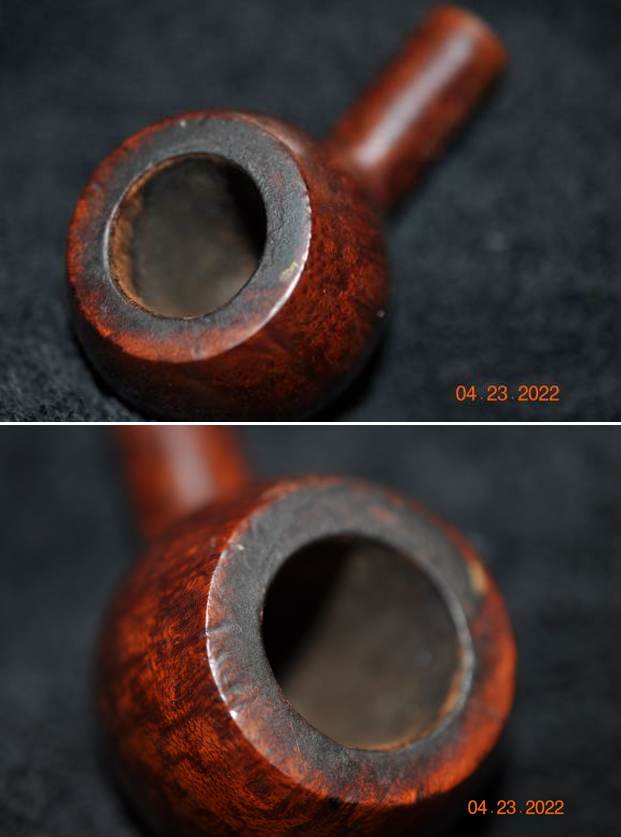
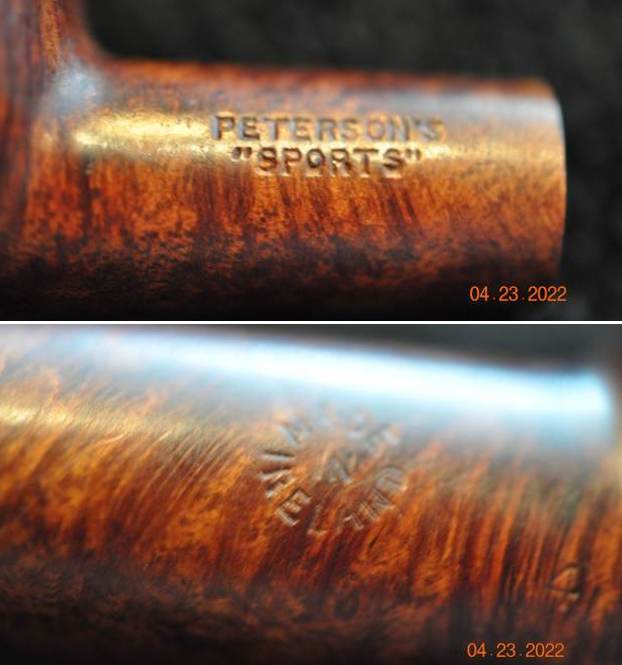
This second of them that we cleaned up before mailing them out was a bowl that we purchased on 05/22/21 from Facebook Marketplace. It came from Fruitland, Idaho. It is stamped on the left side of the shank and reads Peterson’s [over] “SPORTS”. On the right side of the shank there is a number 6 stamped next to the bowl shank junction followed by a circular Made in Ireland stamp with the “in” in the center of the circle mid shank. The bowl was dirty with lava on the rim top and a thick cake in the bowl. The finish had a lot of grime ground into the surface of the finish but some nice grain peeked through. Jeff took photos of the bowl before he did his cleanup work in preparation for sending them to Walls Pipe Repair for their new stem. The photos of the thick cake in the bowl and the lava build up and nicks/scratches in the surface and edges of the rim top. It showed a lot of promise.Jeff took photos of the stamping on the sides of the shank. It is clear and readable as noted above. There is also some great grain around the bowl and shank. I have restored a few Peterson’s “SPORTS” in the past so I turned to my blog to have a look at the background information that I included in those blogs. I found the following link to a “SPORTS” pipe (https://rebornpipes.com/2021/01/08/restoring-a-republic-era-petersons-sports-4-apple/). I also am including the background information I had gathered on the “SPORTS” line from the previous blog. I quote:

I am including the link to the Pipedia’s article on Peterson pipes. It is a great read in terms of the history of the brand (https://pipedia.org/wiki/Peterson).

I turned to “The Peterson Pipe” by Mark Irwin and Gary Malmberg to get some background on the Peterson’s Sports. On page 313-314 it had the following information.

“SPORTS” (1947-) A “Sport” is traditionally a compact pipe made for smokers engaged in athletic pursuits, most notably equestrian riders who do not want the bowl to bounce up and down. Six shapes described in 1947 shape chart. Occasional later catalogs show as many as 11 shapes. Last  appeared in shape chart in ’98, but still made in small numbers. Recorded specimens are stamped MADE IN IRELAND (forming a circle) or MADE IN THE over REPUBLIC over OF IRELAND. See Outdoor and Outdoor Sportsman.

The information was very helpful. I have highlighted the pertinent reference to the circular Made in Ireland stamp in the paragraph above. I also knew that my memory of it being a shorter “pocket” pipe was correct.

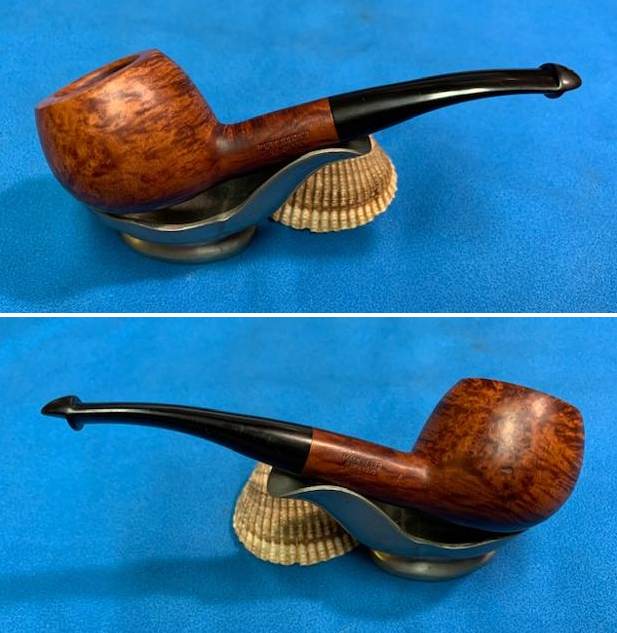
Now it was time to work on the pipe. Jeff had done a great job cleaning up the pipe as usual. He reamed the pipe with a PipNet reamer and cut back the cake back to the bare briar. He cleaned up the walls with a Savinelli Fitsall Pipe Knife. He scrubbed the interior of the bowl and shank with pipe cleaners, cotton swabs and alcohol to remove the tars and oils. He scrubbed the exterior of the pipe with Murphy’s Oil Soap and a tooth brush to remove the grime from the finish. He worked on the rim top lava and darkening with the soap and tooth brush. When the pipes came back to Jeff with their new stems they looked great. When the pipe arrived here this week I took photos of it with its stem so you can see what I see. The stem is a little longer than the 5 inches on the above SPORTS pipe. This stem is 5 ½ inches but it looks good on this little Pot. I took some close up photos of the rim top and also of the stem surface. I wanted to show how well it had cleaned up. The rim top had some scratches and marks on the top and some darkening around the inner edge. It should clean up really well. I also took close up photos of the new stem to show how well it is made! Thanks to Walls Pipe Repair!! I took photos of the stamping on the sides of the shank. You can see that it is stamped as noted above. It is clear and readable. I removed the stem and took a photo of the pipe to have a look at the parts and overall look. The new stem looked really good with the bowl.Since the stem was in perfect condition and would not need work I set it aside and turned to work on the bowl. I decided to address the damage to the inner edge of the bowl and the rim top first. I used a folded piece of 220 grit sandpaper to give the inner edge of the bowl a slight bevel to minimize the darkening and damage and blend it into the surrounding briar.I polished the briar with micromesh sanding pads – dry sanding with 1500-12000 grit sanding pads. I wiped the bowl down with a damp cloth after each sanding pad. The polishing of the rim top and inner edge brought the rim top colour to match the rest of the bowl. I did not need to stain the rim at all. I worked some Before & After Restoration Balm into the surface of the briar with my fingertips to clean, enliven and protect the briar. I let the balm sit for 15 minutes and then buffed with a cotton cloth to raise the shine. The photos show the bowl at this point in the restoration process. Since the stem was new condition the pipe was basically finished. I am excited to put the final touches on this newly restemmed Made in Ireland Peterson’s “Sports” 6 Pot. I put the pipe back together and buffed it with Blue Diamond on the buffing wheel. I gave the bowl and the stem multiple coats of carnauba wax. I hand buffed the pipe with a clean buffing pad to raise the shine. It is fun to see what the polished bowl looks like with beautiful mixed grain all around it. Added to that the polished black vulcanite stem combined with the bowl and made a stunning pipe. This smooth Classic Older Peterson’s “Sports” 6 Pot is great looking and the pipe feels great in my hand. It is light and well balanced. Have a look at it with the photos below. The dimensions are Length: 5 ½ inches, Height: 1 ½ inches, Outside diameter of the bowl: 1 ¼ inches, Chamber diameter: ¾ of an inch. The weight of the pipe is 39 grams/1.38 ounces. It is a beautiful pipe that I will soon be putting on the rebornpipes store in the Irish Pipe Makers section. If you are interested in adding it to your collection send me an email or a message. Thanks for walking through the restoration with me as I worked over this pipe. Thanks to each of you who are reading this blog.

Restoring and Restemming a Made in Ireland Peterson’s “Sports” 4 Prince


Blog by Steve Laug

Jeff and I often purchase pipe bowl/stummels of brands that we like and want to restore. These have included a lot of different bowls. If you have followed us for long you know that some of these have included Peterson’s, Dunhill’s, and a wide range of Danish and English pipes. Awhile ago Jeff and I were sorting through the bowls in our collection and pulled out eight Peterson’s bowls that were dirty and stemless. A friend referred us to a contact named Silas Walls, of Walls Pipe Repair in Wallace, Idaho, USA as he seems to have a good supply of original Peterson’s stems. Our friend has had him fit stems for some of his Petes and was very happy with the work. We made contact with him and sent him eight bowls for restemming.

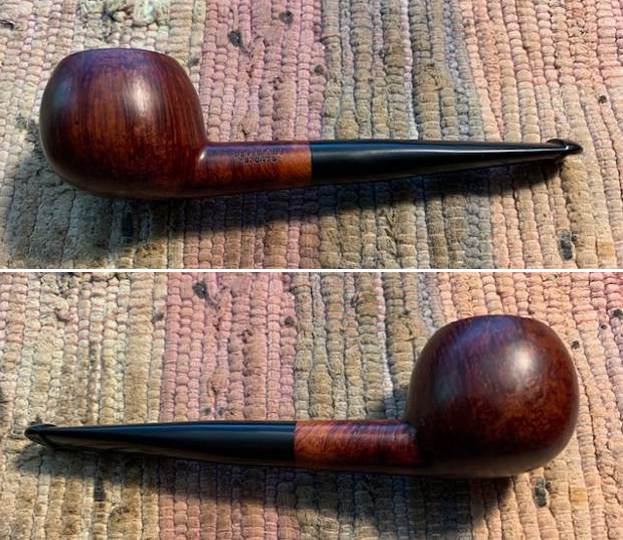
This first of them that we cleaned up before mailing them out was a bowl that we purchased on 05/22/21 from Facebook Marketplace. It came from Fruitland, Idaho. It is stamped on the left side of the shank and reads Peterson’s [over] “SPORTS”. On the right side of the shank there is a number 4 stamped next to the bowl shank junction followed by a circular Made in Ireland stamp with the “in” in the center of the circle mid shank. The bowl was dirty with lava on the rim top and a light cake in the bowl. It had been reamed quite recently and interestingly the bottom half of the bowl showed some raw briar. Jeff took photos of the bowl before he did his cleanup work in preparation for sending them to Walls Pipe Repair for their new stem.The photos of the bowl and rim top show the lava build up and nicks/scratches in the surface and edges. They also show the bowl with the reaming job that had been down before the pipe came to us. It showed a lot of promise.Jeff took photos of the stamping on the sides of the shank. It is clear and readable as noted above. There is also some great grain around the bowl and shank. I have restored a few Peterson’s “SPORTS” in the past so I turned to my blog to have a look at the background information that I included in those blogs. I found the following link to a similar pipe (https://rebornpipes.com/2021/01/08/restoring-a-republic-era-petersons-sports-4-apple/). It was a bit more round than the one I was working on but stamped similarly. I am including two photos of the finished pipe below for comparison.I remembered that the pipe was generally a “pocket” pipe so it was shorter than normal so I copied the dimensions from the above pipe for comparison of our restemmed one. The dimensions are Length: 5 inches, Height: 1 ¼ inches, Outside diameter of the bowl: 1 ½ inches, Chamber diameter: ¾ of an inch. The weight of the pipe is 33grams/1.16oz. It is a pretty compact pipe with some great shape and balance.

I also am including the background information I had gathered on the line from the previous blog below. I quote:

I am including the link to the Pipedia’s article on Peterson pipes. It is a great read in terms of the history of the brand (https://pipedia.org/wiki/Peterson).

I turned to “The Peterson Pipe” by Mark Irwin and Gary Malmberg to get some background on the Peterson’s Sports. On page 313-314 it had the following information.

“SPORTS” (1947-) A “Sport” is traditionally a compact pipe made for smokers engaged in athletic pursuits, most notably equestrian riders who do not want the bowl to bounce up and down. Six shapes described in 1947 shape chart. Occasional later catalogs show as many as 11 shapes. Last  appeared in shape chart in ’98, but still made in small numbers. Recorded specimens are stamped MADE IN IRELAND (forming a circle) or MADE IN THE over REPUBLIC over OF IRELAND. See Outdoor and Outdoor Sportsman.

The information was very helpful. I have highlighted the pertinent reference to the circular Made in Ireland stamp in the paragraph above. I also knew that my memory of it being a shorter “pocket” pipe was correct.

Now it was time to work on the pipe. Jeff had done a great job cleaning up the pipe as usual. He reamed the pipe with a PipNet reamer and cut back the cake back to the bare briar. He cleaned up the walls with a Savinelli Fitsall Pipe Knife. He scrubbed the interior of the bowl and shank with pipe cleaners, cotton swabs and alcohol to remove the tars and oils. He scrubbed the exterior of the pipe with Murphy’s Oil Soap and a tooth brush to remove the grime from the finish. He worked on the rim top lava and darkening with the soap and tooth brush. When the pipes came back to Jeff with their new stems they looked great. When the pipe arrived here this week I took photos of it with its stem so you can see what I see. The stem is a little longer than the 5 inches on the above SPORTS pipe. This stem is 5 ½ inches but it looks good on this little Prince. I took some close up photos of the rim top and also of the stem surface. I wanted to show how well it had cleaned up. The rim top had some scratches and marks on the top and some darkening around the inner edge. It should clean up really well. I also took close up photos of the new stem to show how well it is made! Thanks to Walls Pipe Repair!! I took photos of the stamping on the sides of the shank. You can see that it is stamped as noted above. It is clear and readable. I removed the stem and took a photo of the pipe to have a look at the parts and overall look. The new stem looked really good with the bowl.Since the stem was in perfect condition and would not need work I set it aside and turned to work on the bowl. I decided to address the damage to the inner edge of the bowl and the rim top first. I used a folded piece of 220 grit sandpaper to give the inner edge of the bowl a slight bevel to minimize the darkening and damage and blend it into the surrounding briar.I steamed out the dents on the rim top with a damp cloth and a knife heated over the flame of my stove. I applied the wet cloth to the dents and touched the cloth with the hot knife. The steam generated caused the dents to raise. I used a small folded piece of 220 grit sandpaper to smooth them out further. I started polishing the top with 400 grit wet dry sandpaper. I polished the briar with micromesh sanding pads – dry sanding with 1500-12000 grit sanding pads. I wiped the bowl down with a damp cloth after each sanding pad.  The polishing of the rim top brought the rim top colour to match the rest of the bowl. I did not need to stain the rim at all. I worked some Before & After Restoration Balm into the surface of the briar with my fingertips to clean, enliven and protect the briar. I let the balm sit for 15 minutes and then buffed with a cotton cloth to raise the shine. The photos show the bowl at this point in the restoration process. Since the stem was in such new condition the pipe was basically finished. I am excited to put the final touches on this newly restemmed Made in Ireland Peterson’s “Sports” 4 Prince. I put the pipe back together and buffed it with Blue Diamond on the buffing wheel. I gave the bowl and the stem multiple coats of carnauba wax. I hand buffed the pipe with a clean buffing pad to raise the shine. It is fun to see what the polished bowl looks like with beautiful mixed grain all around it. Added to that the polished black vulcanite stem combined with the bowl and made a stunning pipe. This smooth Classic Older Peterson’s “Sports” 4 Apple is great looking and the pipe feels great in my hand. It is light and well balanced. Have a look at it with the photos below. The dimensions are Length: 5 ½ inches, Height: 1 ½ inches, Outside diameter of the bowl: 1 ¼ inches, Chamber diameter: ¾ of an inch. The weight of the pipe is 39 grams/1.38 ounces. It is a beautiful pipe that I will soon be putting on the rebornpipes store in the Irish Pipe Makers section. If you are interested in adding it to your collection send me an email or a message. Thanks for walking through the restoration with me as I worked over this pipe. Thanks to each of you who are reading this blog.

Restoring and Restemming a Burl King Freehand Bowl


Blog by Steve Laug

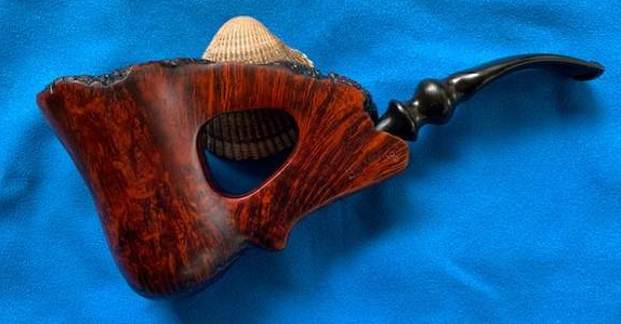
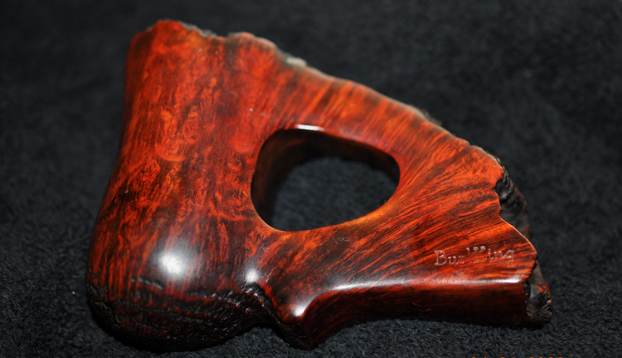
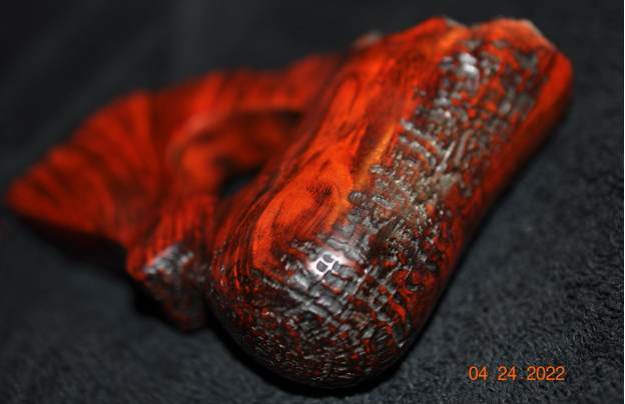
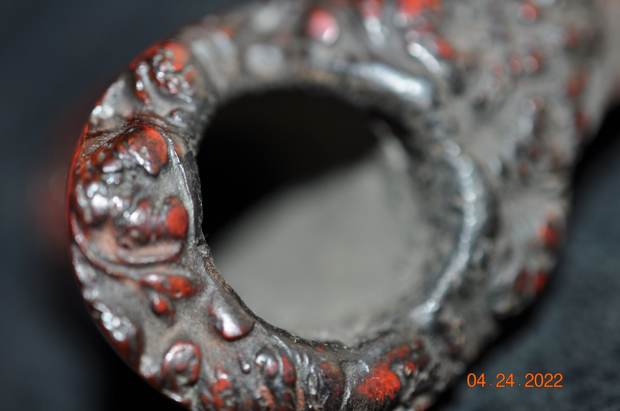
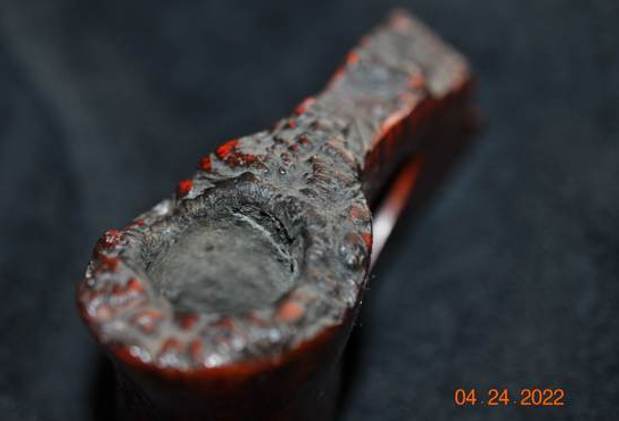
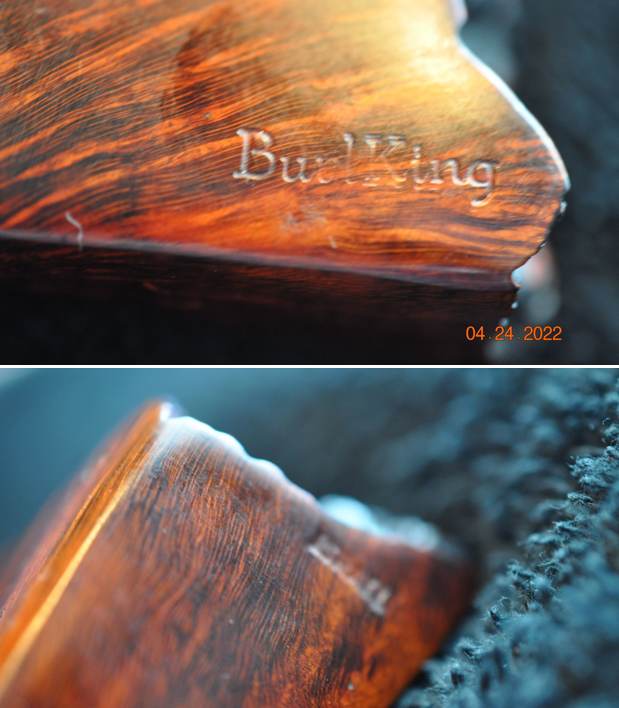
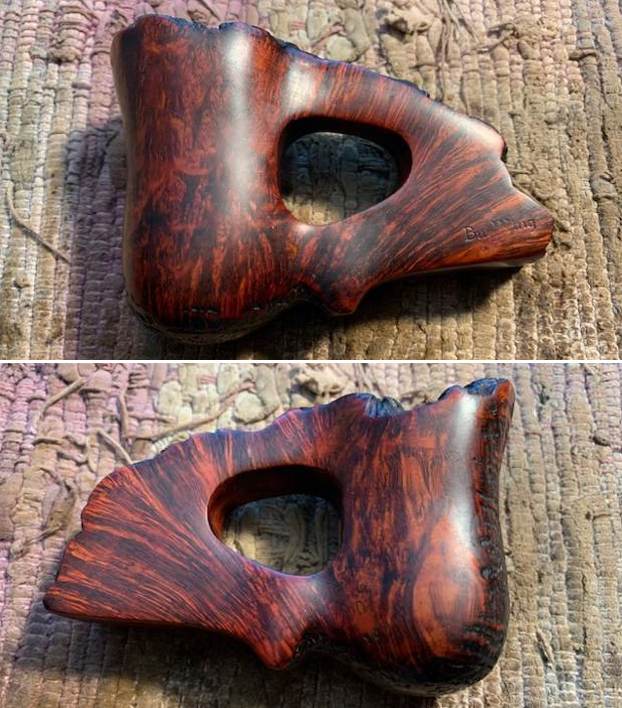
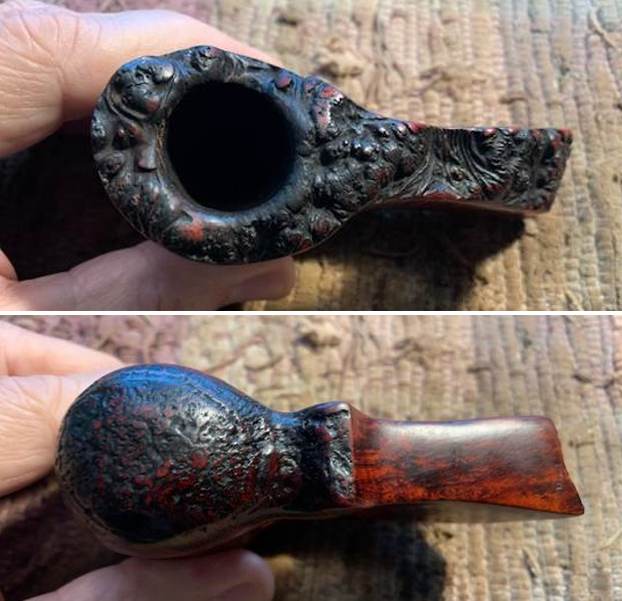
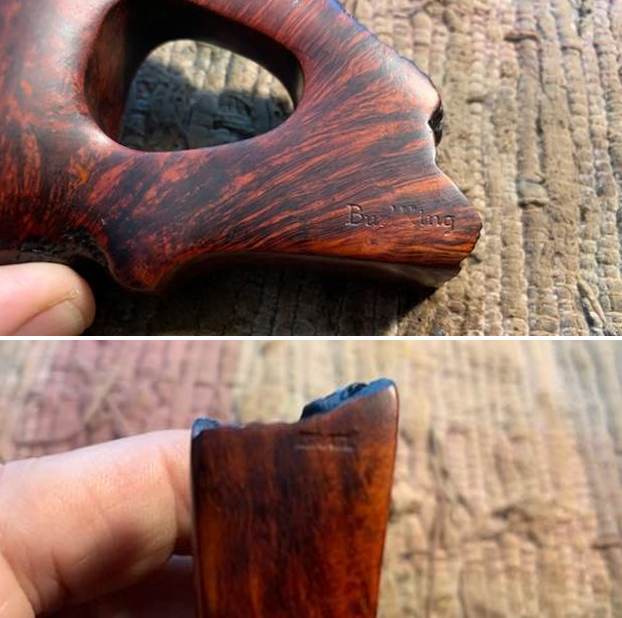
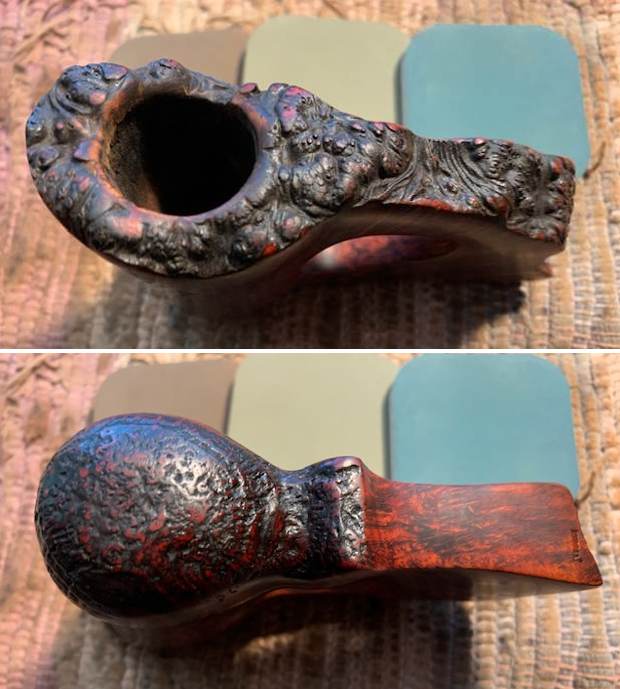
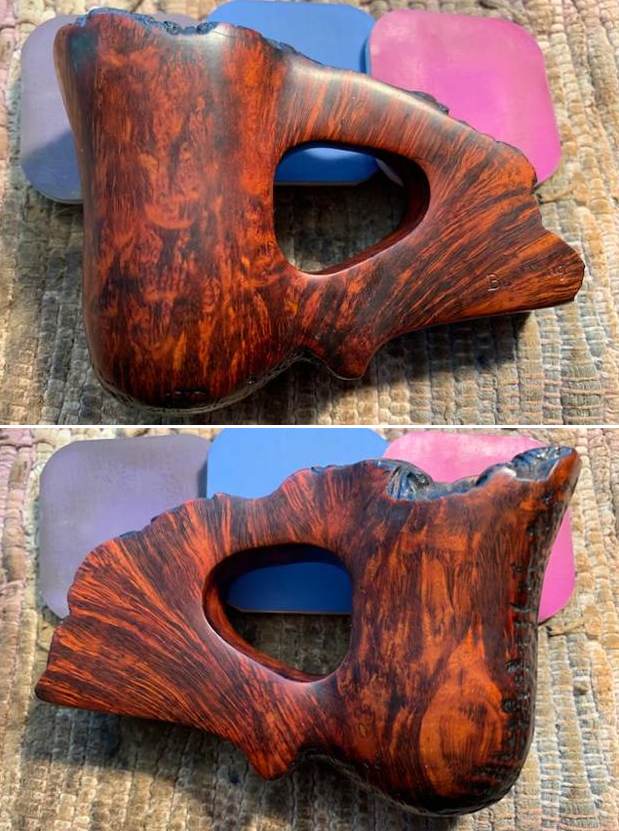
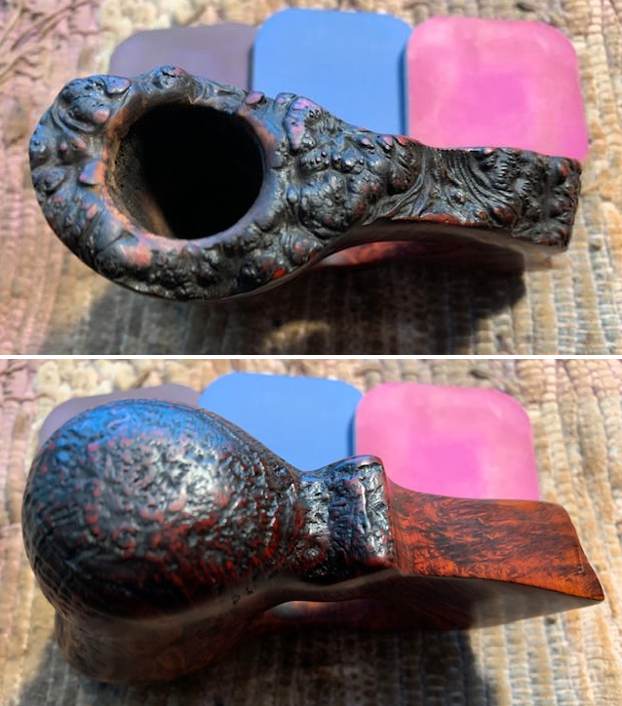
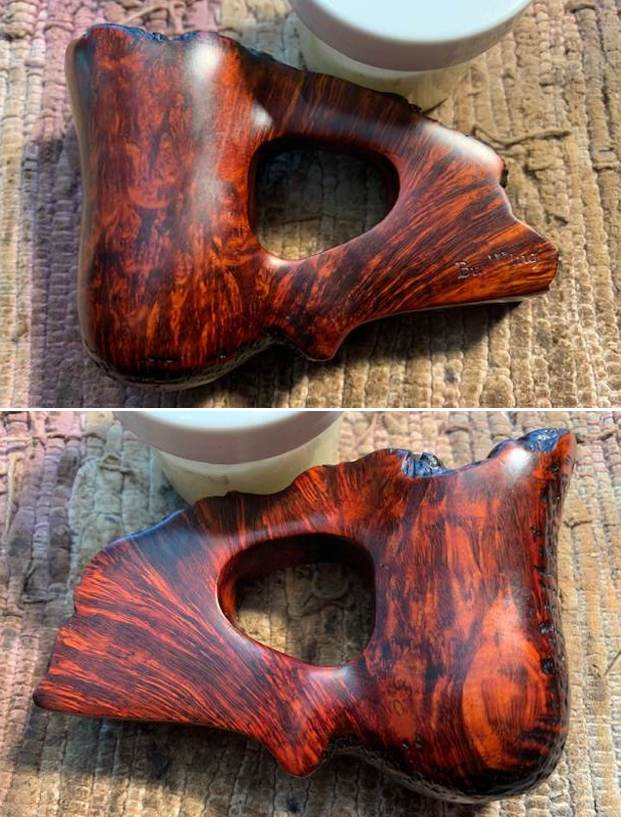
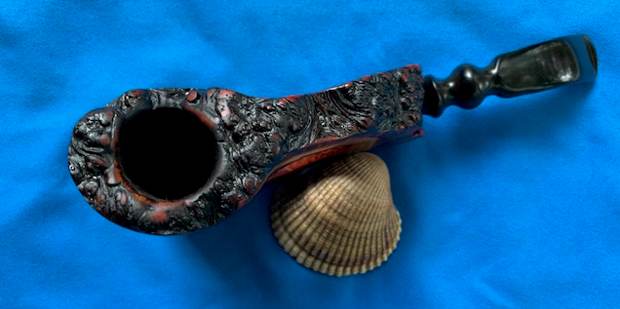
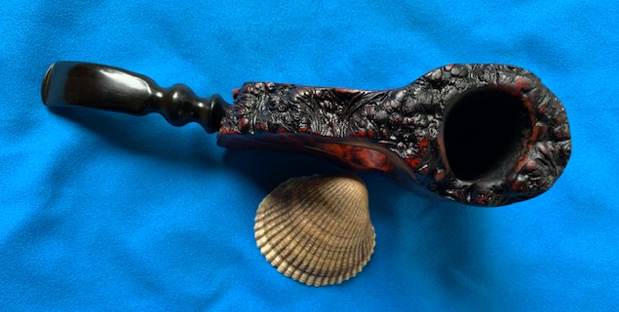
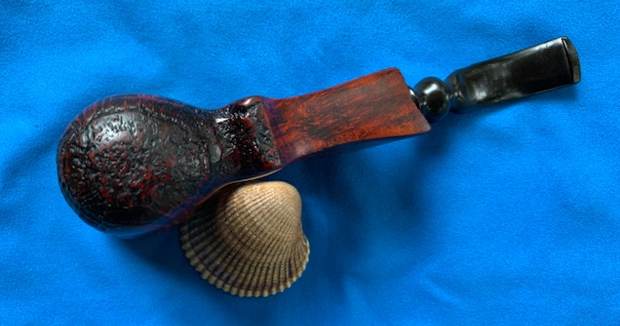
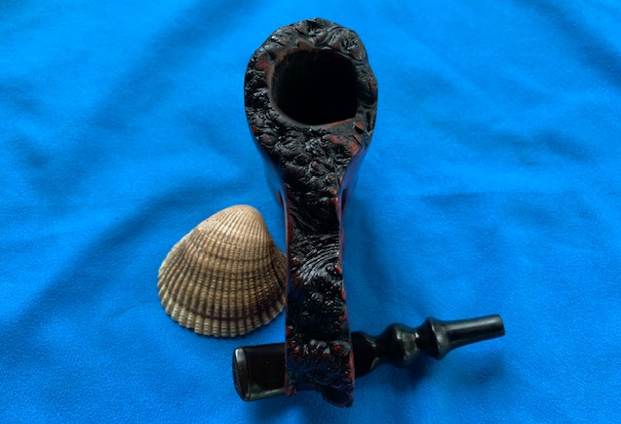
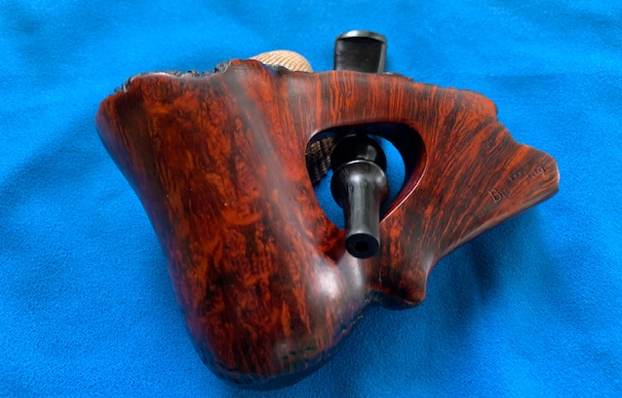
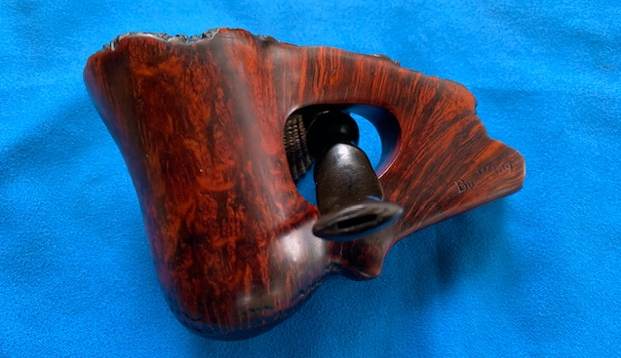
The next pipe in the queue came to us in August, 2020 from an Antique Mall in Logan, Utah, USA.  It is an interesting Freehand bowl that has a bridge over the top of the shank that forms a hole for the thumb when smoking. It has a smooth finish with a plateau on the top of the shank and bowl. I would need to find a fancy turned stem that would work with the bowl. The pipe is stamped on the left corner of the shank and clearly reads Burl King. On the underside of the shank it is stamped Israel. I think that this will be another nice looking piece once it is cleaned up and restemmed. The bowl is thickly caked with an overflow of lava on the rim top. The right side of the bowl toward the front and the heel were sandblasted. The top and edges of the bowl look good but I would be more certain once I reamed and cleaned it. The exterior of the briar was dirty with grime and dust. Jeff took photos of the pipe before my cleanup work. They tell the story and give a glimpse of the promise that we see in this pipe. He took photos of the plateau rim top to show the cake in the bowl, the lava on the rim top and the inner edge. He took photos of the stamping on the left corner of the shank and the underside. It is faint in spots but readable as noted above.Before working on the pipe I wanted to remind myself of the history and background of the brand. I remembered that I had restemmed and restored a Burl King stummel previously so I turned to the blog I had written. Here is the link to the previous blog and the pipe I had restored and restemmed (https://rebornpipes.com/2020/09/20/restemming-and-rebirthing-a-burl-king-freehand-bowl/).

From the blog I quote the following information on the brand and who made it. I find it interesting to note the various companies included in the manufacture and distribution of the pipe.

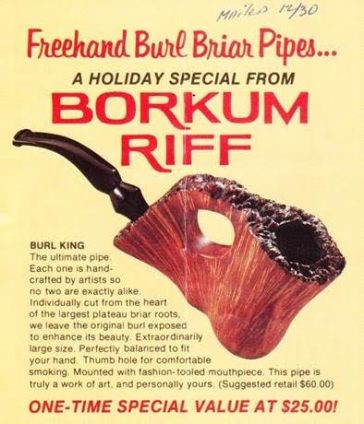
I turned to Pipedia to read about Burl King pipes (https://pipedia.org/wiki/Burl_King). I quote the entirety of the article and have included the advertisement that connects the pipe to Borkum Riff tobacco.

We need more information about Burl King. We can confirm that it was at one time a pipe used for promotion of Borkum Riff tobacco, as reported by Bob Taylor of the Seattle Pipe Club, who mailed in a coupon and received the pipe with a Postmark of Jan. 11, ’78, and a return address of Sparta, N. C., which indicates it may have come from the Dr. Grabow/Sparta Industries plant.

Bob recently noticed his “Burl King” was also marked, made in Israel, so it was likely made by the Shalom Pipe Factory, though apparently distributed through Sparta Industries. The box shipped for 50 cents and the return address said “After 5 days return to P. O. Box 21882 Greensboro, N. CC. 27240.” So apparently these pipes were made by Shalom, but distributed for Borkum Riff by Sparta Industries.

Others have indicated Burl King pipes were also made by Wally Frank.

I love the description as it truly captures the shape and beauty of this freehand pipe. The article above stated that the pipe is handcrafted by artists so that each one is a unique piece. It is cut from the plateau to leave that exposed on the top of the rim and down the shank to the end. It has a thumb hole cut for comfort in holding it while smoking. It is suggested that pipe sold for $60. Now to work on the pipe.

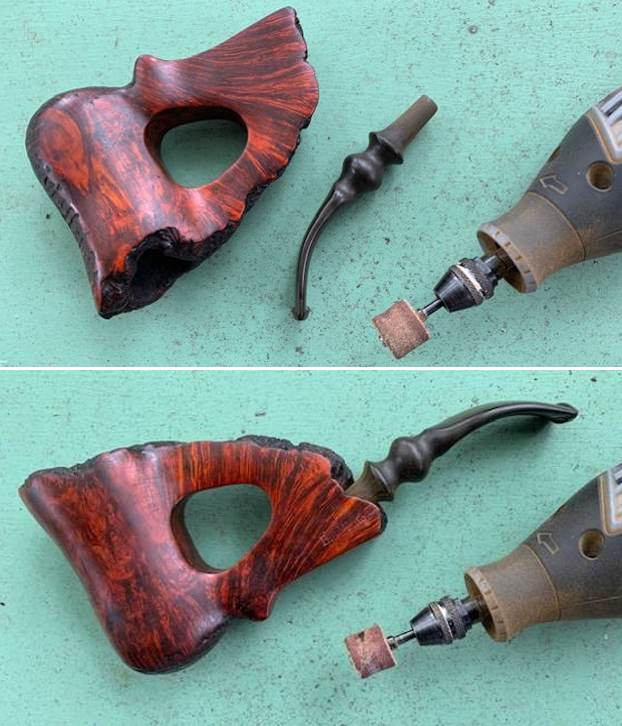
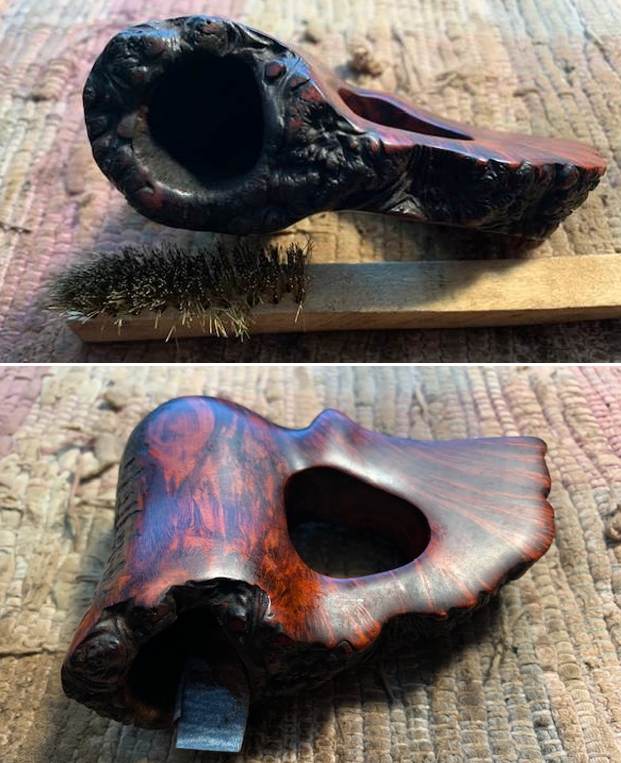
Jeff had cleaned up the pipe with his normal methods. He reamed the pipe with a PipNet pipe reamer and removed the rest of cake with a Savinelli Fitsall Pipe Knife.  He scrubbed the bowl with undiluted Murphy’s Oil Soap with a tooth brush. He rinsed it under running warm water to remove the soap and grime. He cleaned out the inside of the shank and the airway into the bowl with alcohol, cotton swabs and pipe cleaners. I took photos of the pipe once I received it. I took a close up photo of the rim top to show the general condition. You can see the darkening around the inner edge and some remaining lava in the crevices of the plateau but otherwise it looks good. The plateau extends all the way down the shank bridge and ends at the mortise end.I took photos of the stamping and though they are faint in spots in the pictures they are readable as noted above.I found a turned stem in my stem can that was a potential candidate for the pipe. The tenon on it was just a little bit to big in diameter and would need to be shaped to sit in the mortise properly. I used my Dremel and sanding drum to take off a little bit of the diameter until the fit was snug in the shank. Once I had the tenon adjusted I inserted it in the mortise and took photos of the pipe at this point. I set the stem aside and turned my attention to the bowl.I cleaned up the residual lava on the rim top with a brass bristle wire brush. I worked over the crevices in the plateau carefully to remove the debris. I used a folded piece of 220 grit sandpaper to sand the inner edge of the bowl and smooth it out. I polished the briar with micromesh sanding pads to clean up the finish and give it a shine. I wet sanded with 1500-12000 grit pads and wiped the bowl down after each pad with a damp cotton cloth. The photos tell the story. I worked some Before & After Restoration Balm into the surface of the briar with my fingertips and a horse hair shoe brush to clean, enliven and protect it. I let the balm sit for a little while and then buffed with a cotton cloth to raise the shine. I shaped the tenon end with 220 grit sandpaper to fine tune the fit in the shank. I still needed to polish it with 400 grit wet dry sandpaper to smooth out the marks left behind by the Dremel but it was getting there. I polished the vulcanite with micromesh sanding pads – 1500-12000 grit pads. I wiped it down with Obsidian Oil after each sanding pad. I used Before & After Pipe Polish – both Fine and Extra Fine to further polish the stem. With both parts of this unique Burl King Freehand finished, I polished the bowl and the stem with Blue Diamond polish on the buffing wheel. I gave the bowl and the stem multiple coats of carnauba wax. I buffed the pipe with a clean buffing pad to raise the shine. I hand buffed it with a microfiber cloth to deepen the shine. The pipe polished up pretty nicely. The mix of grain on the bowl came alive with the buffing. The finish on the briar works well with the polished black vulcanite stem. The finished pipe is a well-proportioned, nicely grained Burl King Freehand. Have a look at it with the photos below. The dimensions are Length: 7 ½ inches, Height: 3 inches, Outside diameter of the bowl: 1 ¾ inches, Chamber diameter: ¾ of an inch. This is a large pipe and weighs 102 grams/3.60 ounces. I will be putting this interestingly made Freehand in the American Pipe Maker Section of the rebornpipes store very soon. If you would like to purchase it and carry on the legacy of the previous pipe smoke send a message or an email to me. Thanks for walking through the restoration with me on this older Freehand collaboration between Shalom Pipe Factory, Israel, Borkum Riff Tobacco and Dr. Grabow.

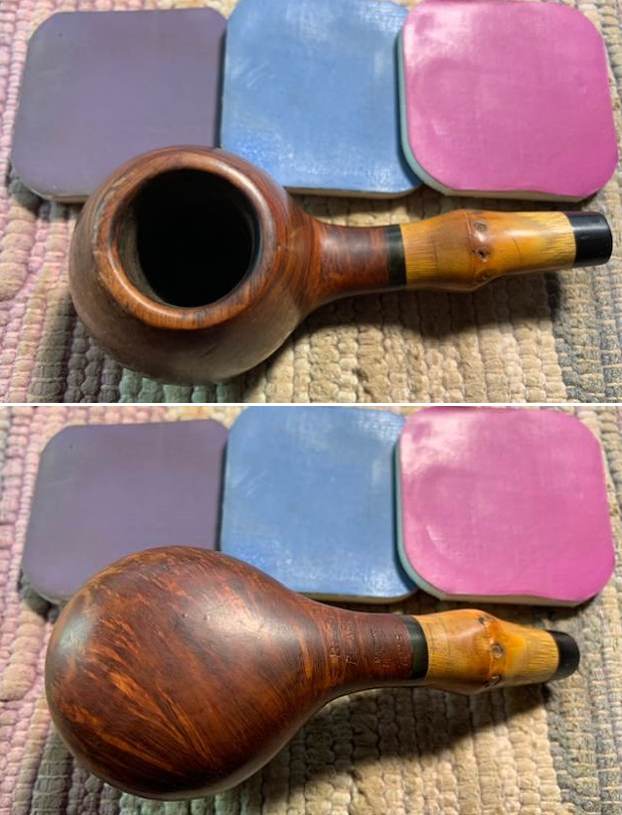
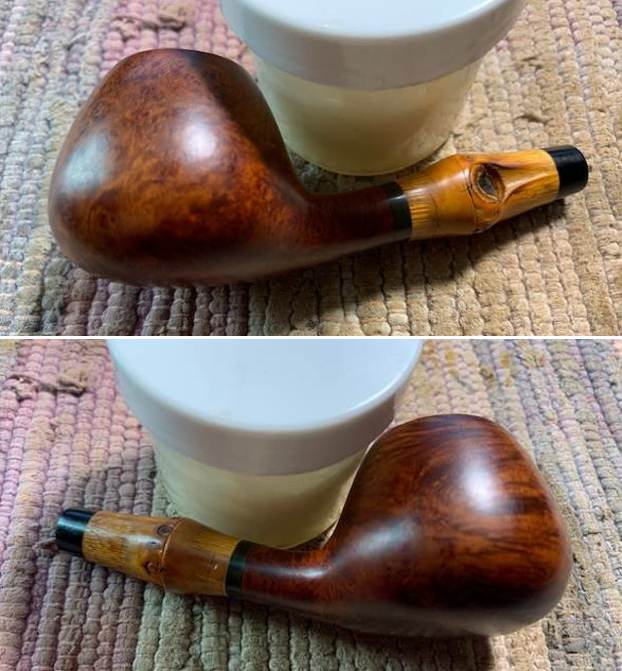
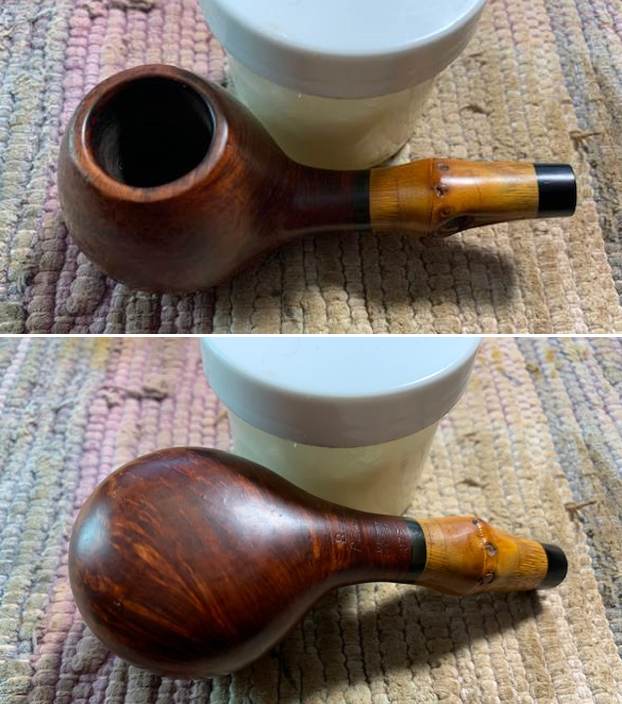
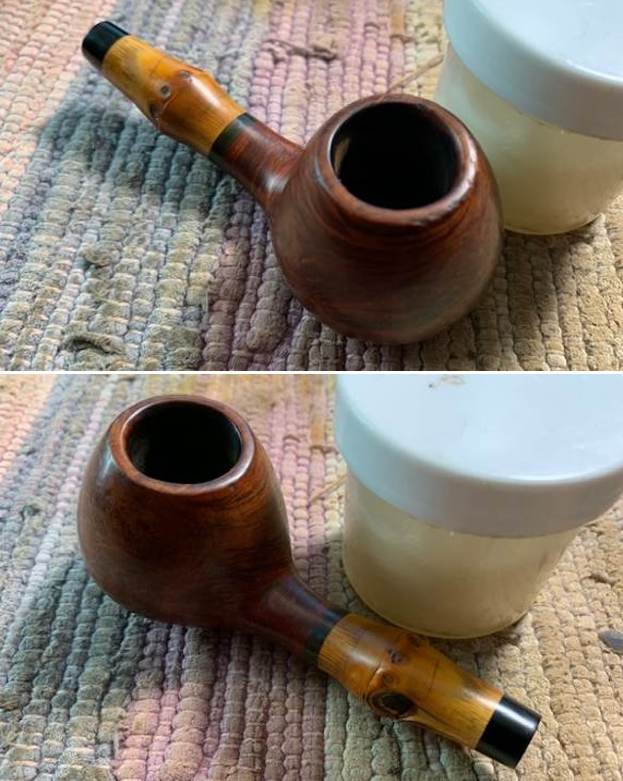
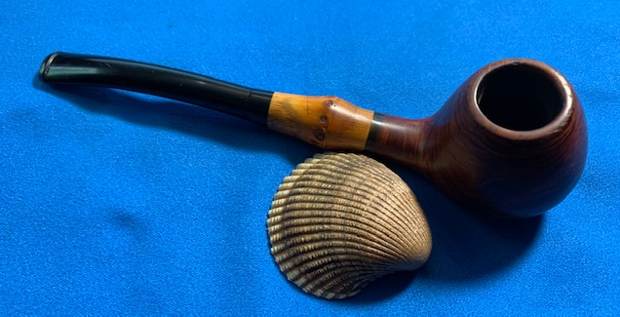
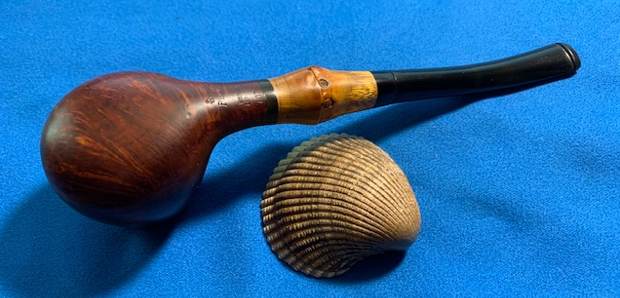
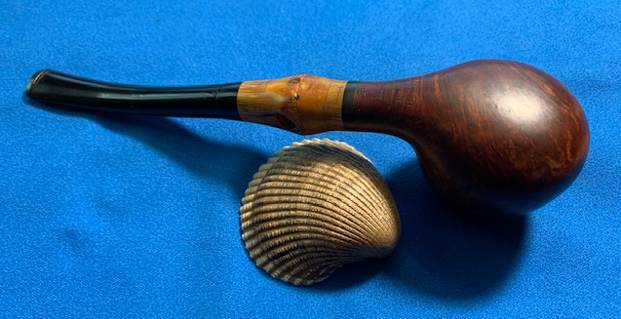
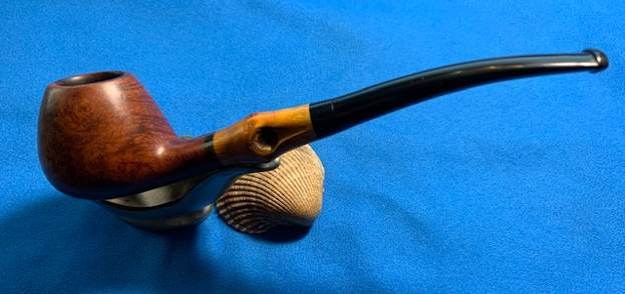
Restoring and Restemming a Bari Pearl 7075 with a Bamboo Shank


Blog by Steve Laug

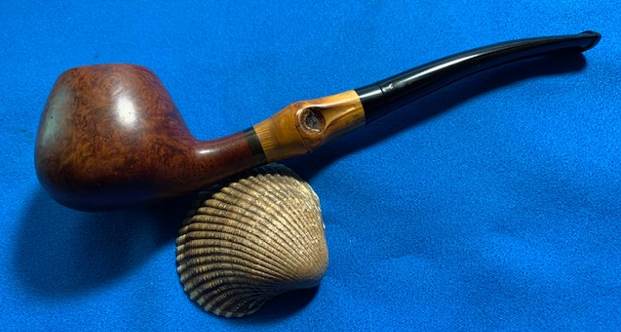
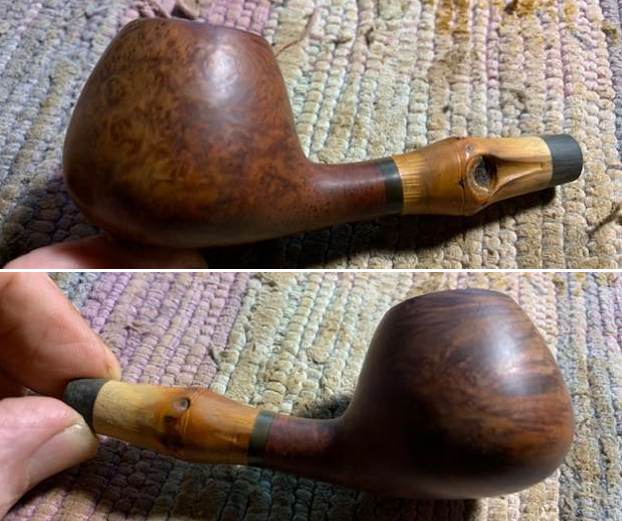
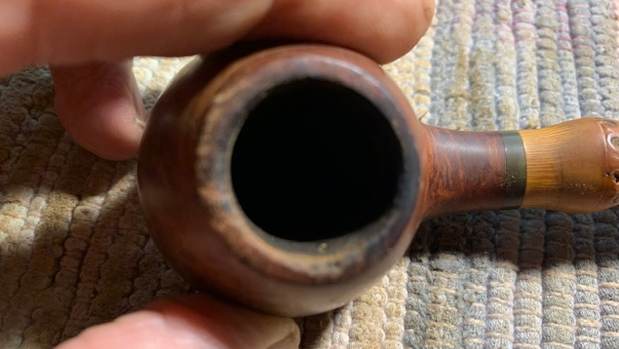
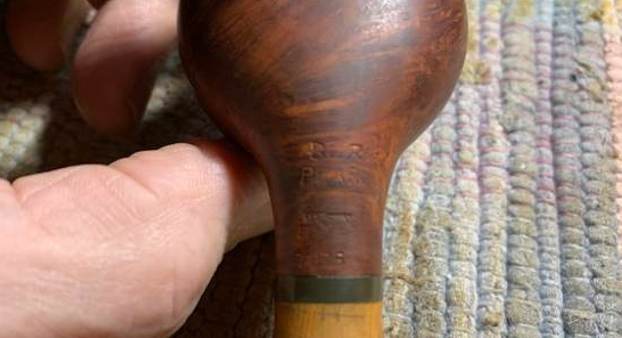
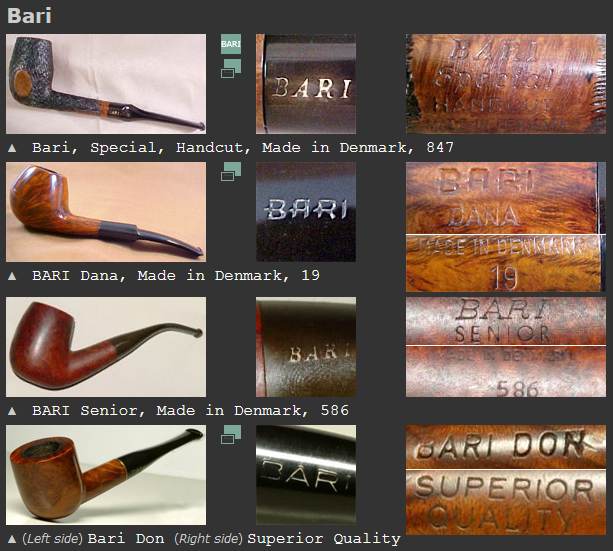
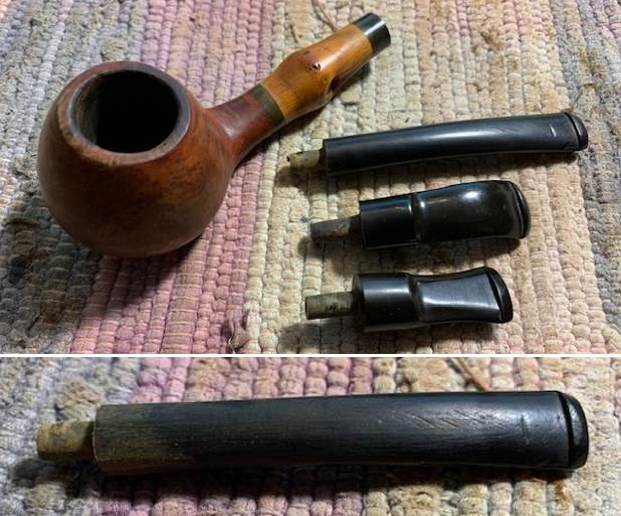
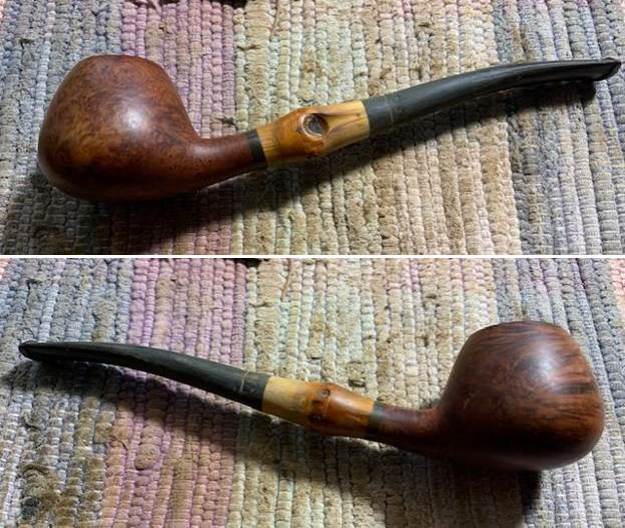
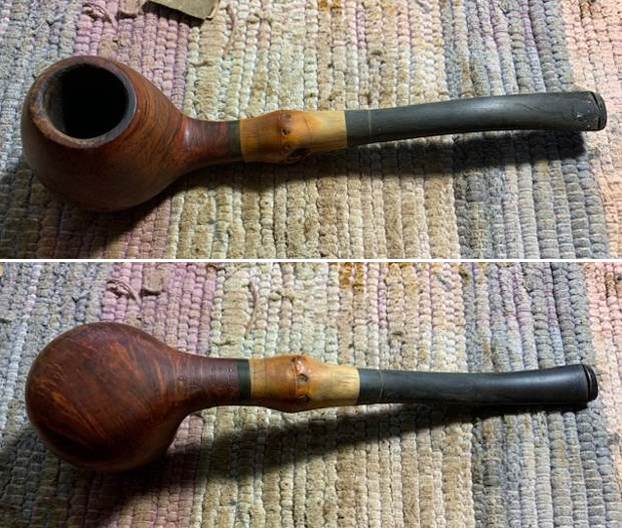
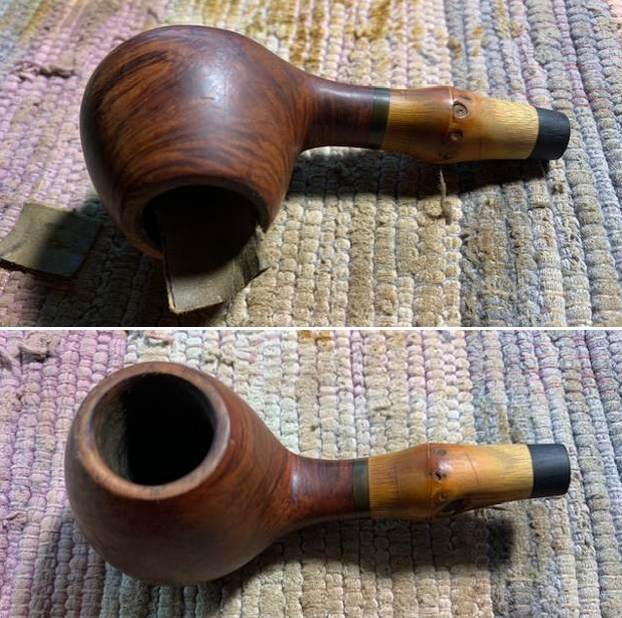
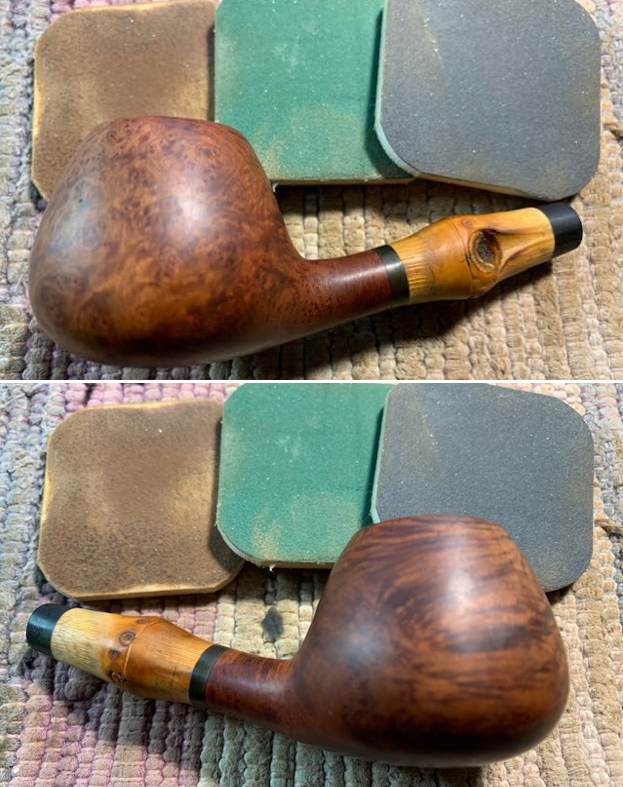
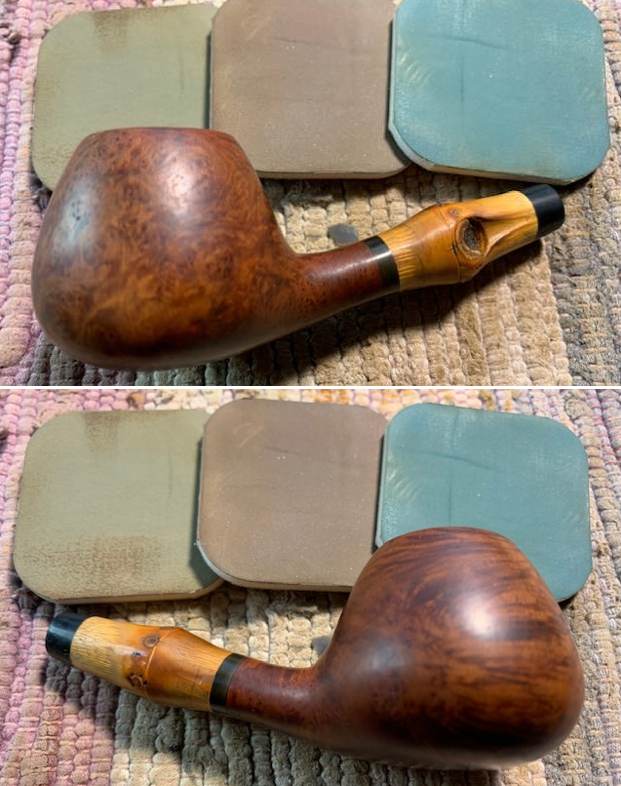
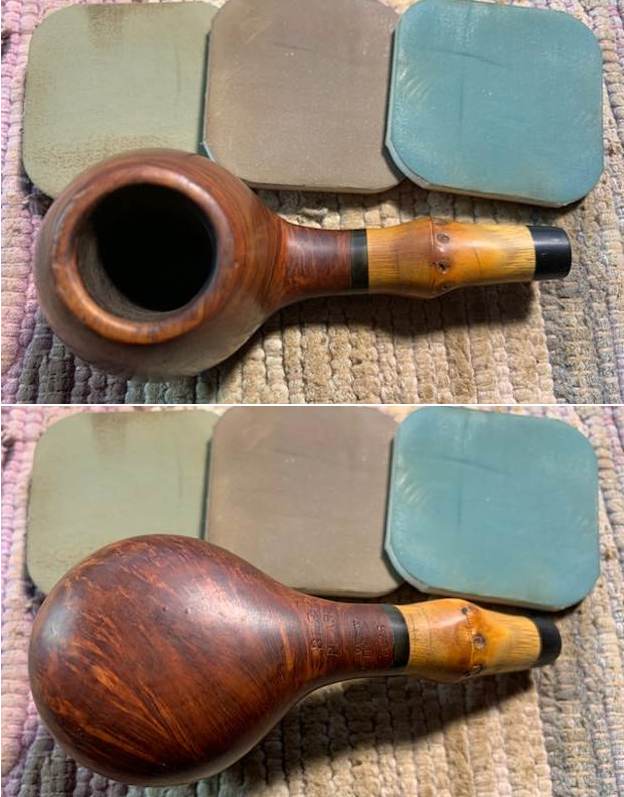
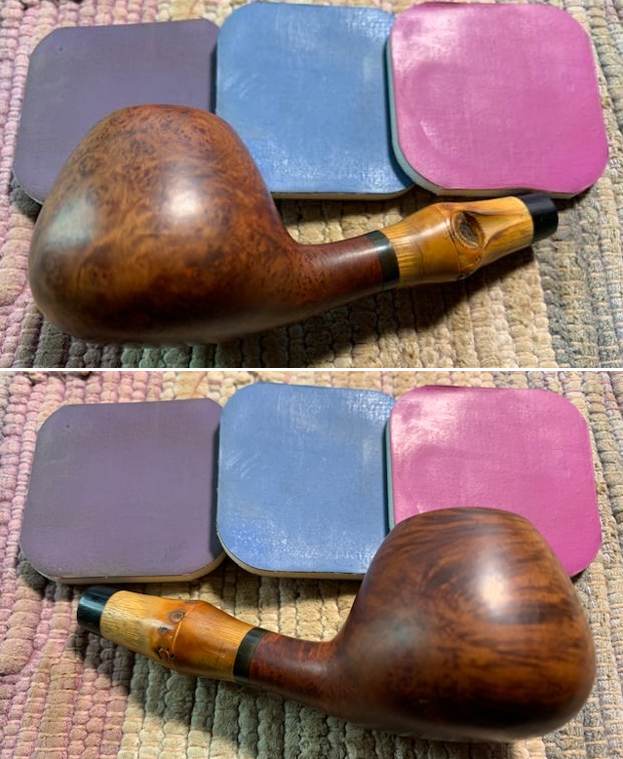
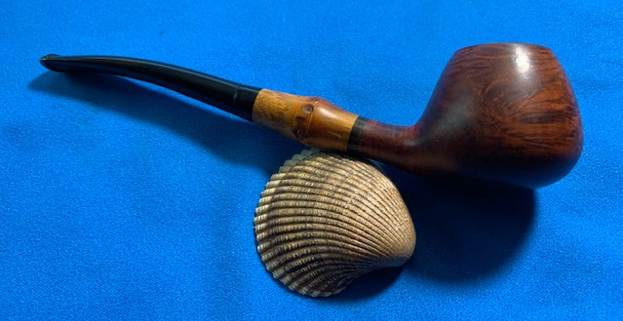
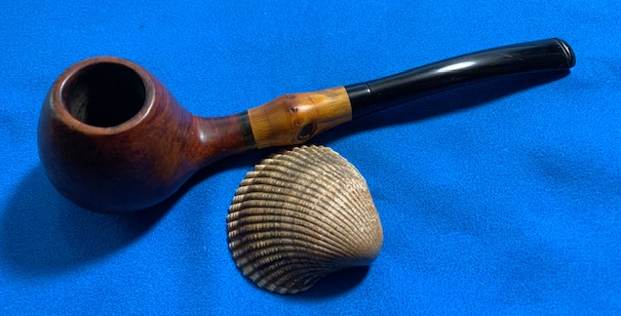
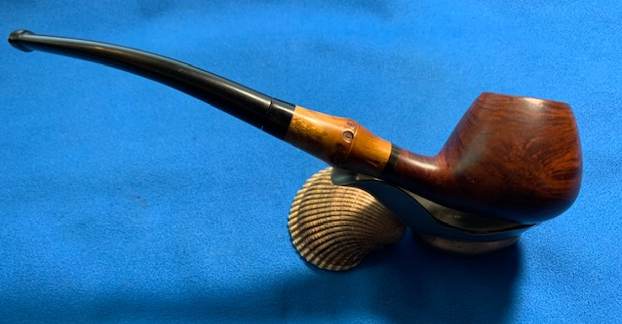
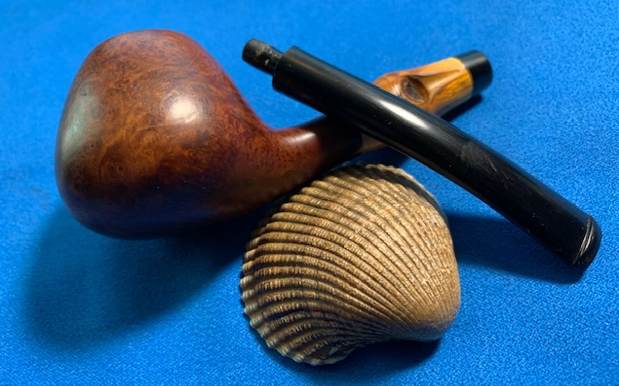
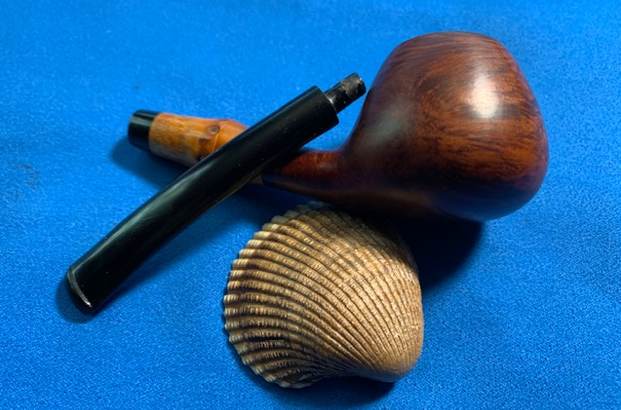
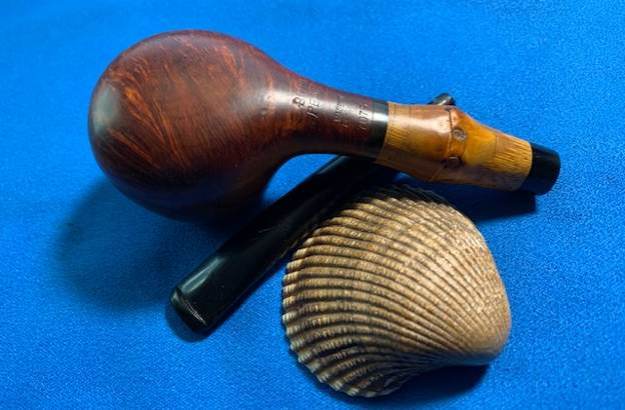
Jeff and I went through all the bowls that we had in boxes at his place recently. We wanted to consolidate them into one place and clean them all up. We sorted them as we went through them all. Many ended up being junk while a large number went into a box to be sent to me for restemming. One of those which caught my attention was an interesting bowl with a well coloured bamboo shank. It had a vulcanite spacer between the briar and the one knuckle piece of bamboo and another one at the shank end. It was a nice Brandy shape pipe with some great grain around the sides and shank. The bowl had been smoked and the top had some darkening and slight damage on the flat top and inner edge. The bamboo had a nice patina to it that showed that it had been someone’s favourite and had been well smoked. The shank end was smooth so a tight fit would be easy to do. It was stamped on the underside of the shank and read BARI [over] Pearl [over] Made In [over] Denmark [over] 7075 which is the shape number. Jeff had reamed and cleaned it before he sent it to me so it was in good shape when it arrived today. When I unpacked the box of bowls this one caught my eye. I wanted to restem it so I pulled it out to work on next. I took a photo of the rim top and edges to show the condition. You can see that it is damaged on the top and both edges. There is some darkening on the top and edges and there are some rough spots around the bowl top and edges. I took a photo of the stamping on the underside of the shank. It reads as noted above. It is clear and readable though faint in spots.I turned to Pipephil to see if I could find information on the Pearl model but there was nothing there on the model (http://pipephil.eu/logos/en/logo-b1.html). I quote from the sidebar below and also have included a screen capture of the information.
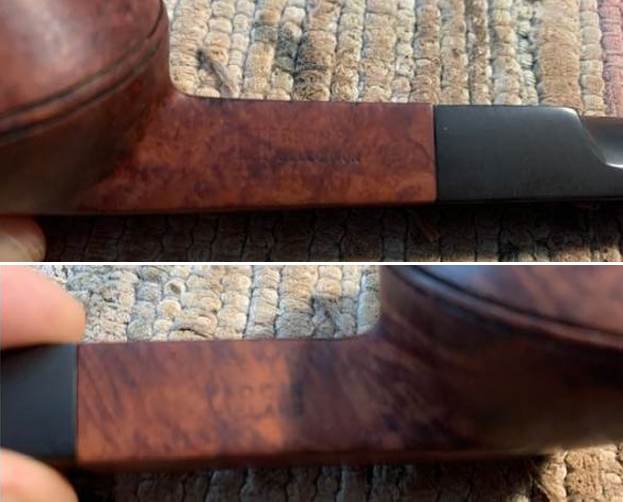
Brand founded by Viggo Nielsen in 1950 and sold to Van Eicken Tobaccos in 1978. At this time Age Bogelund managed Bari’s production. The company has been bought in 1993 by Helmer Thomsen. Bari’s second: Don, Proctus.  I then turned to Pipedia for some history of the brand and also to see if there as information on the Pearl model (https://pipedia.org/wiki/Bari). I have included the history below. There was also a photo that was done by Smoking Pipes.com and had a copy right so I did not include it. It did help me determine the kind of stem to use on the pipe.

Bari Piber was founded by Viggo Nielsen in Kolding around the turn of 1950/51. Viggo’s sons Kai Nielsen and Jørgen Nielsen both grew into their father’s business from a very young age and worked there till 1975.

Bari had very successfully adapted the new Danish Design that had been started mainly by Stanwell for it’s own models. When Viggo Nielsen sold Bari in 1978 to Joh. Wilh. von Eicken GmbH in Hamburg Bari counted 33 employees.

From 1978 to 1993 Åge Bogelund and Helmer Thomsen headed Bari’s pipe production. Thomson bought the company in 1993 re-naming it to Bari Piber Helmer Thomsen. The workshop moved to more convenient buildings in Vejen. Bogelund, who created very respectable freehands of his own during the time at Bari got lost somehow after 1993.

Bari’s basic conception fundamentally stayed the same for decades: series pipes pre-worked by machines and carefully finished by hand. Thus no spectacular highgrades but solid, reliable every day’s companions.

The most famous series are the smooth “Classic Diamond” and the blasted “Wiking”.

I did a quick Google search for the Bari Pearl pipe and found that Smokingpipes.com had quite a few different shapes of the model. It was interesting that all of them had a single knuckle like the one that I was working on and that the bamboo had been shaped and tapered on the front toward the bowl and toward the shank end. All of them had a vulcanite space on both ends of the bamboo. They were pretty pipes.

With that it was time to work on the pipe. I went through my cans of stems and found three possibilities. Two of them were short saddle stems and one was a longer taper stem. I tried all three of them and my daughters and I decided to use the tapered longer one. It is similar in shape to several of the ones I saw in the photos of the Pearl on Google.

I then turned to Pipedia for some history of the brand and also to see if there as information on the Pearl model (https://pipedia.org/wiki/Bari). I have included the history below. There was also a photo that was done by Smoking Pipes.com and had a copy right so I did not include it. It did help me determine the kind of stem to use on the pipe.

Bari Piber was founded by Viggo Nielsen in Kolding around the turn of 1950/51. Viggo’s sons Kai Nielsen and Jørgen Nielsen both grew into their father’s business from a very young age and worked there till 1975.

Bari had very successfully adapted the new Danish Design that had been started mainly by Stanwell for it’s own models. When Viggo Nielsen sold Bari in 1978 to Joh. Wilh. von Eicken GmbH in Hamburg Bari counted 33 employees.

From 1978 to 1993 Åge Bogelund and Helmer Thomsen headed Bari’s pipe production. Thomson bought the company in 1993 re-naming it to Bari Piber Helmer Thomsen. The workshop moved to more convenient buildings in Vejen. Bogelund, who created very respectable freehands of his own during the time at Bari got lost somehow after 1993.

Bari’s basic conception fundamentally stayed the same for decades: series pipes pre-worked by machines and carefully finished by hand. Thus no spectacular highgrades but solid, reliable every day’s companions.

The most famous series are the smooth “Classic Diamond” and the blasted “Wiking”.

I did a quick Google search for the Bari Pearl pipe and found that Smokingpipes.com had quite a few different shapes of the model. It was interesting that all of them had a single knuckle like the one that I was working on and that the bamboo had been shaped and tapered on the front toward the bowl and toward the shank end. All of them had a vulcanite space on both ends of the bamboo. They were pretty pipes.

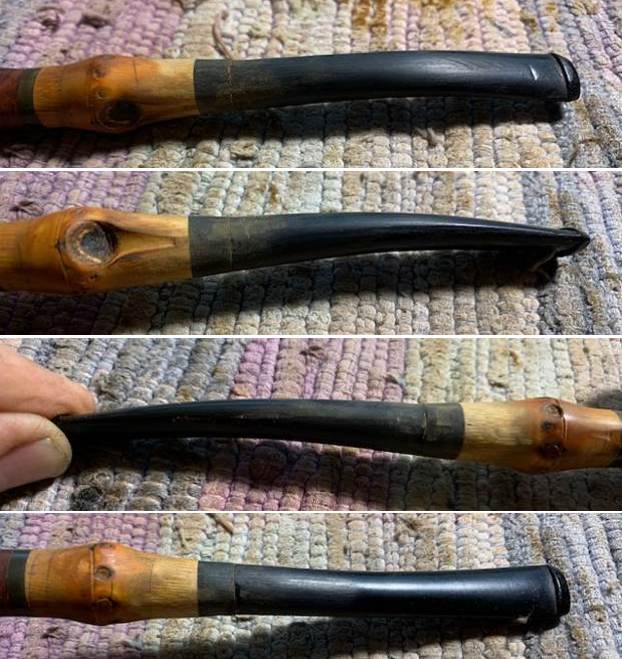
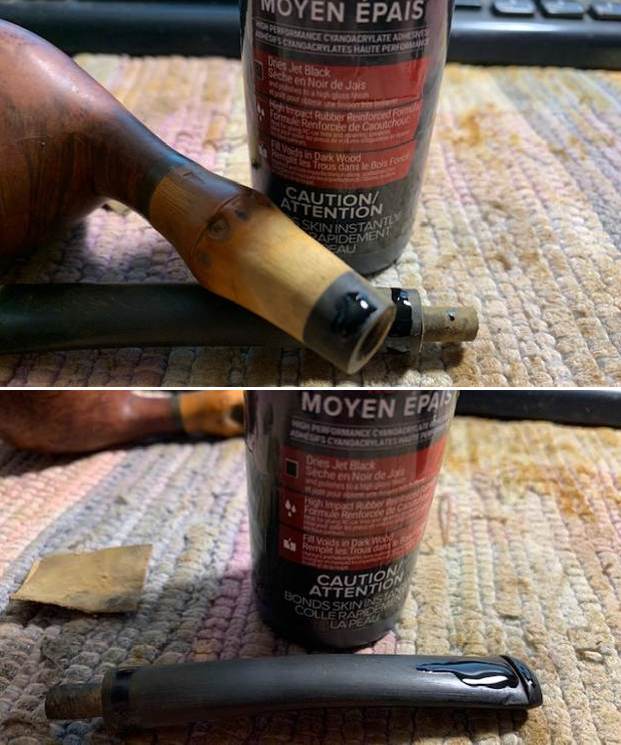
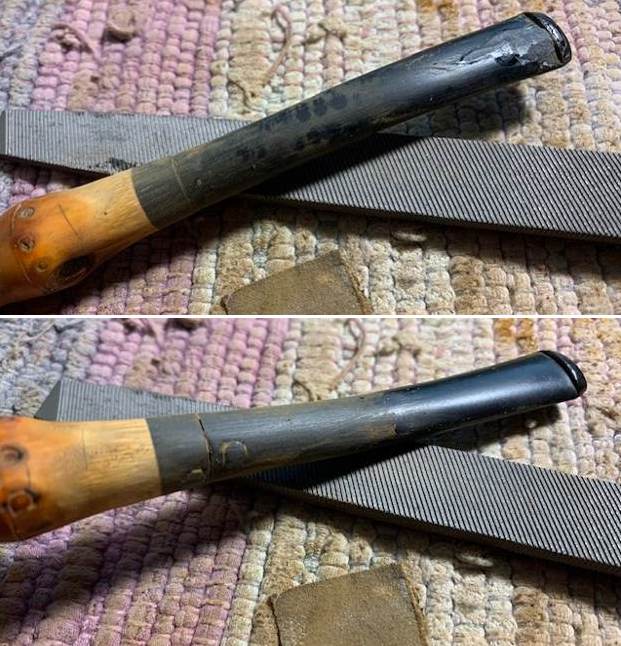
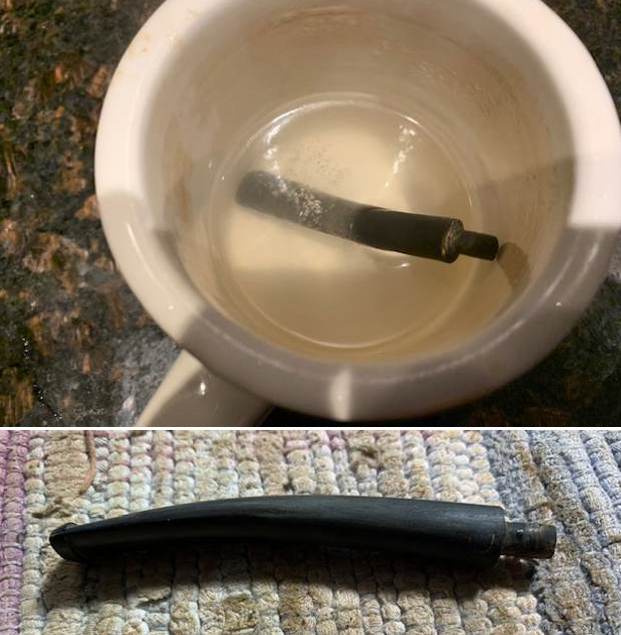
With that it was time to work on the pipe. I went through my cans of stems and found three possibilities. Two of them were short saddle stems and one was a longer taper stem. I tried all three of them and my daughters and I decided to use the tapered longer one. It is similar in shape to several of the ones I saw in the photos of the Pearl on Google. I lightly sanded the shank end of the stem and the tenon and fit it in the shank of the pipe. I took photos of it to give a sense of the look. The fit against the shank is very good. I reshaped the shank end to make the transition between the shank space and the stem smooth with my Dremel and a sanding drum. I need to fine tune the fit but the look is very good.I filled in some pits on the shank end and on the top of the stem surface ahead of the button using black super glue. I also filled in some damaged spots on the shank end of the stem with the glue. I flattened the repaired areas with a flat file to smooth them out and blend them into the surface. I started sanding the surface smooth with 220 grit sandpaper. I heated some water in a coffee mug and dipped the stem into the boiling water to soften it. Once it was pliable I gave it a slight bend to adjust the look of the shank and stem.I had some more sanding to do at the stem shank transition and the repaired area on the topside of the stem near the button but the fit and shape of the pipe and stem was starting to look very nice. I took photos of the pipe at this point in the process. I set the stem aside for awhile and turned my attention to the bowl. I worked over the rim top and edges of the bowl with 220 grit sandpaper. I smoothed out the nicks on the top and edges and reshaped the inner edge. The rim top and edges looked much better at this point.I polished the briar with micromesh sanding pads – dry sanding with 1500-12000 grit pads. After each pad I wiped the bowl down with a damp cloth to remove the sanding debris. It really took on a shine by the last three sanding pads. I rubbed the bowl down with Before & After Restoration Balm. I worked it into the surface of the briar where it works to clean, restore and preserve the briar. I let it do its magic for 15 minutes then buffed it off with a cotton cloth. The pipe looks incredibly good at this point in the process. With that the bowl had come a long way from when I started working on it. I set it aside and turned my attention to the stem. I sanded the stem surface with a folded piece of 220 grit sandpaper to finish removing the scratch a marks. I started the polishing with 400 grit wet dry sandpaper.I continued to polish the stem with micromesh sanding pads – wet sanding with 1500-12000 grit sanding pads. I wiped it down after each sanding pad with Obsidian Oil. I polished it with Before & After Pipe Stem Polish – both Fine and Extra Fine and wiped it down with Obsidian Oil one more time. I am excited to finish the restemming and restoration of this Bari Pearl 7075 Bamboo Shank Brandy. I put the pipe back together and buffed it with Blue Diamond on the buffing wheel. I gave the bowl and the stem multiple coats of carnauba wax. I hand buffed the pipe with a clean buffing pad to raise the shine. It is fun to see what the polished bowl looks like with beautiful mixed grain all around it. The polished grain on the pipe looks great with the black vulcanite stem. This smooth Bari Pearl Bamboo Shank Brandy is great looking and the pipe feels great in my hand. It is light and well balanced. Have a look at it with the photos below. The dimensions are Length: 7 inches, Height: 1 ½ inches, Outside diameter of the bowl: 1 inch, Chamber diameter: ¾ of an inch. The weight of the pipe is 46 grams/ 1.62 ounces. It turned out to be a beautiful pipe. I will be putting it on the rebornpipes store in the Danish Pipemakers Section soon. If you would like to add it to your collection let me know by email or message. Thanks for your time reading this blog and as Paresh says each time – Stay Safe.

Restemming & Restoring a Stanhope Genuine Imported Briar Smooth Bullmoose


Blog by Steve Laug

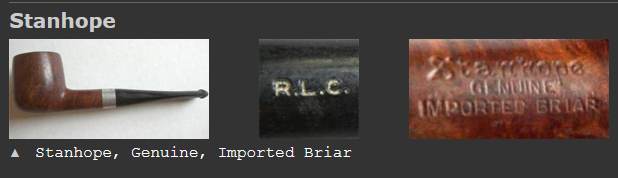
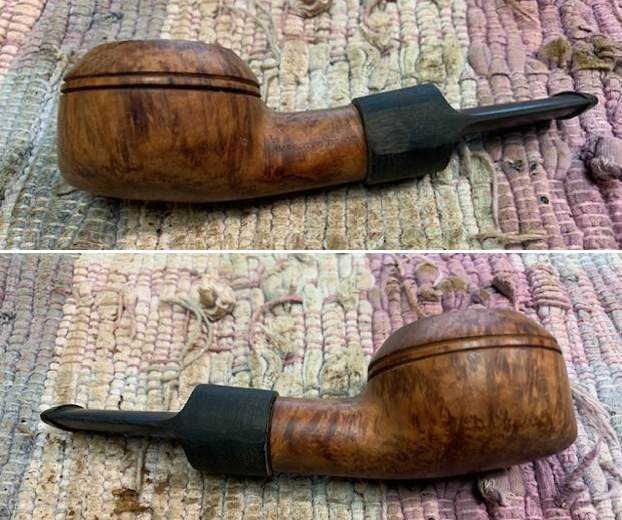
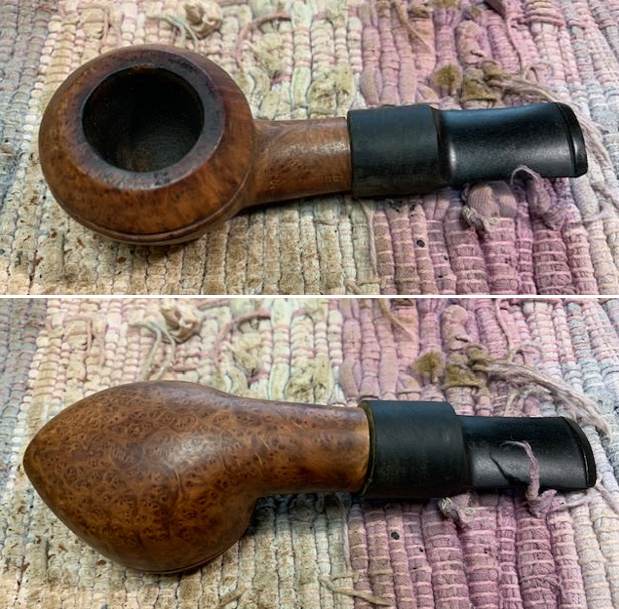
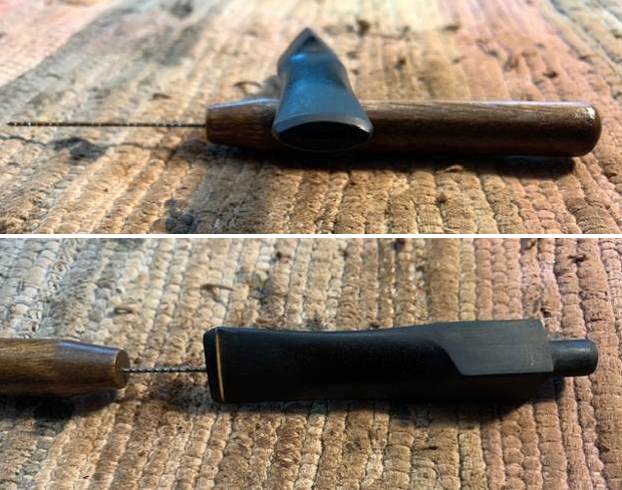
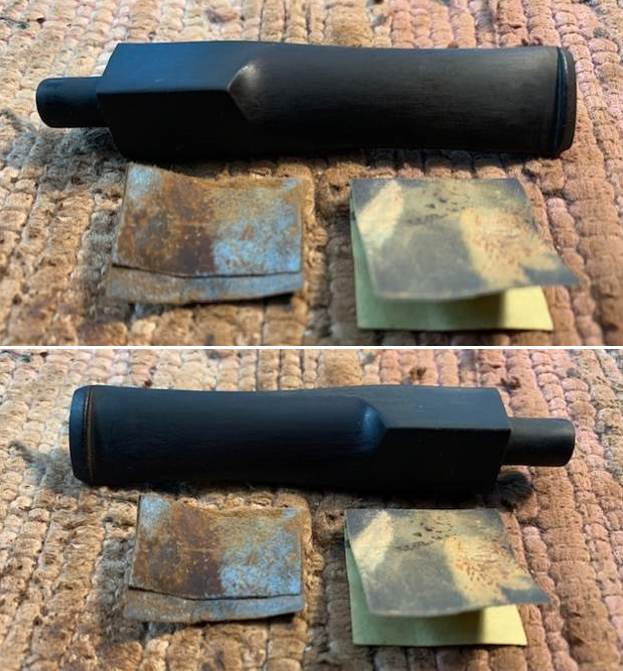
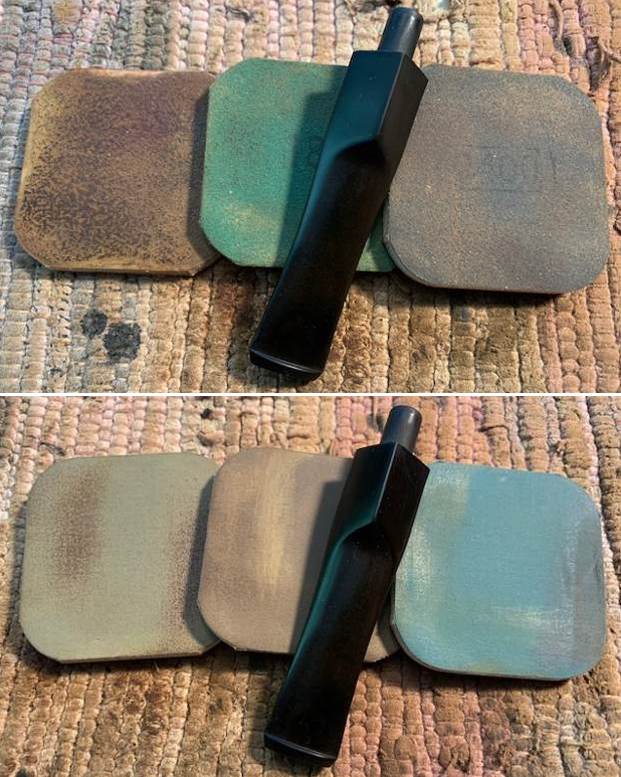
I continue on a restemming binge with stummels (bowls) that I periodically go through and see if I have a potential stem that would fit. This is the final bowl of the three stummels that took out to restem last week. The first one was the Malaga Second, the second was a Yorkshire Bullmoose. (https://rebornpipes.com/2022/01/20/restemming-restoring-a-malaga-second-long-shank-billiard/; https://rebornpipes.com/2022/01/21/restemming-restoring-a-yorkshire-imported-briar-bullmoose/). This particular bowl is a smooth Bullmoose style pipe. The grain on the bowl was quite nice with a mix of straight and birdseye. The rim top had some darkening but the inner and outer edges were in good condition. The interior of the bowl was clean and there were not any chips, cracks or checking on the walls. The mortise was clean and well drilled with no issues. The finish was clean and the grain stood out against the light background. It is worn and tired looking. The stamping was clear and readable. On the left side it read Stanhope [over] Genuine [over] Imported Briar. I took photos of the bowl before I started to work on it. I took a photo of the stamping on the side of the shank. It reads as noted above and is clear and though the Stanhope stamp is faint it is still readable.I went through some of stems and found this nice looking saddle stem blank that would work with the bowl. It had already been turned with a tenon tool so that portion of the work was finished. I would need to reduce the tenon diameter slightly for a snug fit. The stem was significantly larger in diameter than the shank. I decided to see what Pipephil’s site had on the brand (http://pipephil.eu/logos/en/logo-s11.html). I found that the pipe was made by LHS (L.H. Stern). I did a screen capture of the particular brand. I have included it below. Now it was time to work on the stem and fit it to the shank of the pipe. The diameter of the tenon was close. I used a flat file that I have here that works well for me to do the fine tuning of the fit. I used it to straighten out the sides of the tenon next to the surface that face the shank. It worked well and fit the shank. I used a Dremel and sanding drum to reduce the diameter of the stem as much as possible before I proceeded. I ran the sanding drum around the diameter of the saddle portion and stem sides to reduce it the also worked it lengthwise to remove more of material. The photos below show the fit at this point. Looking better but still a long ways to go. I continued to reduce the diameter of the stem with a flat file. It was taking quite a bit of time to finish the fit but it was getting there. I think that the stem would look very good once it was properly fit. The fit against the shank was better. There were spots where the stem diameter and the shank diameter did not match were greatly reduced. I used a folded piece of 220 grit sandpaper to smooth out the transition even more between the two. I left a slight Danish style flare to the flow of the saddle. I started polishing it with 400 grit wet dry sandpaper. I polished the stem with micromesh sanding pads – dry sanding with 1500-12000 grit pads. I wiped the stem down after each pad with a cloth and Obsidian Oil. I finished the polishing with Before & After Pipe Stem Polish – both Fine and Extra Fine. I gave it a final coat of Obsidian Oil. I set the stem aside and turned my attention to the bowl. I started by cleaning up the rim top and edges with a folded piece of 220 grit sandpaper. I was able to remove the darkening on the rim top and the inner edge of the bowl.I polished the briar with micromesh sanding pads – dry sanding with 1500-120000 grit pads. I wiped the bowl down after each pad with a damp cloth. The grain began to stand out and the briar took on a shine. I worked some Before & After Restoration Balm into the surface of the smooth briar with my finger tips and a horsehair shoe brush. The product is amazing and works to clean, enliven and protect the briar. I let it sit on the briar for 10 or more minutes and then buff it off with a soft cloth. It really makes the grain sing.   Now it was time to bent the stem to fit the flow of the pipe. I heated the stem with a heat gun on the low setting until the vulcanite was  pliable. I bent it to proper angle and then set it with cool water. I put the pipe back together – the bowl with its new stem. This smooth finished Stanhope Genuine Imported Briar Bullmoose is a real beauty and the chosen stem works well with it. It is an American made pipe with connections to L.H. Stern. The grain on the bowl is quite beautiful and came alive with the buffing. I used Blue Diamond on the buffing wheel on both the bowl and stem. I gave both multiple coats of carnauba wax on the wheel then buffed it with a clean buffing pad to raise the shine. I hand buffed it with a microfibre cloth to deepen the shine. The Stanhope Bullmoose feels great in the hand. It is lightweight and the contrast in the browns of the briar and the polished vulcanite stem is quite amazing. The dimensions of the pipe are Length: 5 inches, Height: 1 ½ inches, Outer diameter of the bowl: 1 ¾ inches, Chamber diameter: 7/8 of an inch. The weight of the pipe is 1.69 ounces/48 grams. It really is a beauty. I will be putting it on the rebornpipes store in the American (US) Pipe Makers section shortly if you are interested in adding it to your collection. Thanks for walking through the restemming and the restoration with me. Cheers.
Restemming & Restoring a Yorkshire Imported Briar Bullmoose


Blog by Steve Laug

I continue on a restemming binge. I have a box of stummels (bowls) here that I periodically go through and see if I have a potential stem that would fit them. This is the second of the three stummels that took out to restem. The first one was the Malaga Second (https://rebornpipes.com/2022/01/20/restemming-restoring-a-malaga-second-long-shank-billiard/). This particular bowl was a bit of a mystery to me. I honestly don’t remember where or when we picked it up but we had reamed and cleaned it before boxing it. It has a mix of smooth and Custom-Bilt style rustication on the bowl and shank. There were some deep groves and valleys around the bowl and rim. The grain on the smooth portions was quite nice worked well with the deep worm trail style rustication and craters. The rim top and edges were in good condition. The interior of the bowl was clean and there were not any chips, cracks or checking on the walls. The mortise was clean and well drilled with no issues. The finish was clean and the fills in the rustication stood out clearly in contrast to the dark stain. The stamping was clear and readable. On the left side it read Yorkshire (in old English Script) [over] Imported Briar. I took photos of the bowl before I started to work on it. I took a photo of the stamping on the side of the shank. It reads as noted above and is clear and though the Yorkshire stamp is faint it is still readable. I took some photos of the putty fills around various parts of the bowl and shank. Interestingly they were in the rusticated portions of the bowl – probably by design. They would need to be stained to blend them into the surrounding briar.I went through some of stems and found this nice looking taper stem blank that would work with the bowl. It had already been turned with a tenon tool so that portion of the work was finished. I would need to strip back the casting materials on the button and sides of the stem and reduce the tenon diameter slightly but the diameter of the stem itself was very close to that of the shank.I decided to see what Pipephil’s site had on the brand (http://pipephil.eu/logos/en/logo-y.html) and interestingly found two different Yorkshire Brands. The first had a plain stamp on the side of the shank that did not match the one I was working on. The second on had the same Old English Style stamp over Imported Briar. The difference of course was the one in the photo below was an all briar pipe. The one I had was a Custom-Bilt style that would have had a vulcanite stem.I followed the clue on the above screen capture and turned to the section on Barnaby Briars (http://pipephil.eu/logos/en/logo-b1.html#barnaby). There I found out that the company was a Smoking Pipe Retailer located at 28 Powell Str., Brooklyn (NY). They must have had the pipes made by someone else but they carried both the Barnaby Briar and the Yorkshire Imported Briar.Now it was time to work on the stem and fit it to the shank of the pipe. The diameter of the tenon was close. I used a flat file that I have here that works well for me to do the fine tuning of the fit. I used it to straighten out the sides of the tenon next to the surface that face the shank. It worked well and looked much better.I cleaned up the file marks with 220 grit sandpaper and the tenon fit well in the mortise. The fit against the shank was clean but there were spots where the stem diameter was slightly larger than the shank diameter. I worked these over with the file to clean up the transition. The photos below show the fit at this point. Looking better but still a long ways to go. The fit against the shank was better. There were spots where the stem diameter and the shank diameter did not match were greatly reduced. I used a folded piece of 220 grit sandpaper to smooth out the transition even more between the two. I started polishing it with 400 grit wet dry sandpaper. With the fit against the shank and diameter corrected and the stem sanded with 220 and 400 grit sandpaper it was now time to bent the stem to fit the flow of the pipe. I heated the stem with a heat gun on the low setting until the vulcanite was pliable. I bent it to proper angle and then set it with cool water. I polished the stem with micromesh sanding pads – dry sanding with 1500-12000 grit pads. I wiped the stem down after each pad with a cloth and Obsidian Oil. I finished the polishing with Before & After Pipe Stem Polish – both Fine and Extra Fine. I gave it a final coat of Obsidian Oil. I set the stem aside and turned my attention to the bowl. I started by touching up the visible fills. I used a Walnut Stain Pen to fill them in to match the other worm trail rustication around the shank and bowl sides. Once it dried the match was perfect. I worked some Before & After Restoration Balm into the surface of the smooth briar with my finger tips and a horsehair shoe brush. The product is amazing and works to clean, enliven and protect the briar. I let it sit on the briar for 10 or more minutes and then buff it off with a soft cloth. It really makes the grain sing. I put the pipe back together – the bowl with its new stem. This restored Partially Rusticated Yorkshire Bullmoose is a real beauty and the chosen stem works well with it. I don’t have a lot of information on the maker other than it is American made. The grain on the smooth portions of the bowl is quite beautiful and the deep worm trails and rugged crevices came alive with the buffing. I used Blue Diamond on the buffing wheel on both the bowl and stem. I gave both multiple coats of carnauba wax on the wheel then buffed it with a clean buffing pad to raise the shine. I hand buffed it with a microfibre cloth to deepen the shine. The Yorkshire Bullmoose feels great in the hand. It is lightweight and the contrast in the browns of the briar and the polished vulcanite stem is quite amazing. The dimensions of the pipe are Length: 6 inches, Height: 2 inches, Outer diameter of the bowl: 1 ½ inches, Chamber diameter: 7/8 of an inch. The weight of the pipe is 2.19 ounces/63 grams. It really is a beauty. I will be putting it on the rebornpipes store in the American (US) Pipe Makers section shortly if you are interested in adding it to your collection. Thanks for walking through the restemming and the restoration with me. Cheers.
Restemming & Restoring a Malaga Second Long Shank Billiard


Blog by Steve Laug

I have been on a restemming binge for the last week or so. I have a box of stummels (bowls) here that I periodically go through and see if I have a potential stem that would fit them. Yesterday when I finished the restoration and restem on the Viking Brandy, I went through the box and picked out three bowls and found workable stems for them. All were in different states of need but all had been thoroughly cleaned before I boxed them up. The first of those that I chose to restem and restore is a lovely Malaga Second Long Shank Billiard stummel. If you have followed me for long you will know that I have worked on a lot of Malaga pipes in the past so I am not a stranger to the brand. This particular bowl is actually quite beautiful and for the life of me I have no idea why is stamped a Second.

The bowl looked very good. The grain around the sides was quite nice and a mix of cross grain and birdseye grain. The rim top had light damage to the inner edge and some nicks of flaws in the outer edge. The rim top had been beat about a bit and showed the wear and damage and there was darkening around the top and edges. The interior of the bowl was clean and there was some light checking on the walls. Examining the mortise it was clean and well drilled with no issues. The finish was washed out and bit and tired but still quite redeemable. The stamping on the pipe was clear and readable. On the left side it read MALAGA [over] Second. I took some photos of the bowl before I started to work on it. I took a photo of the stamping on the side of the shank. It reads as noted above and is clear and readable.I went through some of stems and found this shorter taper stem that needed some work on the tenon and diameter at the shank but it was exactly what I wanted. It has a few tooth marks and chatter on both sides near the button but it would clean up well. I have worked on quite a few Malaga pipes and blogged their restorations, so rather than repeat previous blogs, I am including the link to one that gives some of the history of the Malaga brand and the Malaga Pipe Shop in Royal Oak, Michigan in the USA from a catalogue. It gives a sense of the brand and the history in their own words. Follow the link to get a feel for the brand and the pipemaker – https://rebornpipes.com/2013/02/09/george-khoubesser-and-malaga-pipes/.

Now it was time to work on the stem and fit it to the shank of the pipe. The diameter of the tenon was close. I used the Dremel and sanding drum to bring it close to a fit and then used two files that I have here that work well for me to do the fine tuning of the fit.I used a piece of 220 grit sandpaper to smooth out the file marks on the tenon and make sure it was round. It is an interesting stem in that it has a tube in the tenon for making it “unbreakable”. I fit it on the pipe and took photos of the fit at this point. The fit against the shank was perfect. There were spots where the stem diameter and the shank diameter did not match. I used a folded piece of 220 grit sandpaper to smooth out the transition between the two so it was smooth.I set the bowl aside and turned my attention to the remainder of the stem. I “painted” the stem surface with a Bic lighter flame to raise the tooth marks. I was able to lift some of them to the surface. I filled in what remained with clear CA glue. Once it cured I flattened the repairs and reshaped the button with a small flat file. I then repaired areas 220 grit sandpaper to blend them into the rest of the surrounding vulcanite. I finished this part of the process by starting the polishing of the stem with 400 grit wet dry sandpaper. I polished the stem with micromesh sanding pads – dry sanding with 1500-12000 grit pads. I wiped the stem down after each pad with a cloth and Obsidian Oil. I finished the polishing with Before & After Pipe Stem Polish – both Fine and Extra Fine. I gave it a final coat of Obsidian Oil. I set the stem aside and turned my attention to the bowl. I started with the rim top issues. I used a folded piece of 220 grit sandpaper to smooth out the inner and the outer edge of the rim. I topped the bowl on a topping board with 220 grit sandpaper to smooth out and minimize the damage on the rim top. The top and edges looked much better at this point in the process. I polished the briar with micromesh sanding pads – dry sanding with 1500-12000 grit pads and wiping it down with a damp cloth after each pad. It really began to shine. I worked some Before & After Restoration Balm into the surface of the smooth briar with my finger tips. The product is amazing and works to clean, enliven and protect the briar. I let it sit on the briar for 10 or more minutes and then buff it off with a soft cloth. It really makes the grain sing. Before I finished the buffing on the pipe I wanted to address the checking on the inside of the bowl. I noticed it while I was taking the photos. Sometimes it is part of the cake and sometimes not. This time I was able to clean out the majority of it with a Savinelli Fitsall Pipe Knife and then sandpaper wrapped around a piece of dowel. There is still some shallow checking on the front of the bowl toward the top and a little on the backside but it is far better and should be good for many years. I cleaned out the bowl, shank and stem with alcohol and pipe cleaners to remove the sanding and scraping debris.I put the pipe back together – the bowl with its new stem. This restored Malaga Second Long Shank Billiard is a real beauty and the chosen stem works well with it. I have no idea why it would be marked a second other than the pits on the rim top. The grain on the bowl is quite beautiful came alive with the buffing. I used Blue Diamond on the buffing wheel on both the bowl and stem. I gave both multiple coats of carnauba wax on the wheel then buffed it with a clean buffing pad to raise the shine. I hand buffed it with a microfibre cloth to deepen the shine. The Malaga Second Billiard feels great in the hand. It is lightweight and the contrast in the browns of the briar and the polished vulcanite stem is quite amazing. The dimensions of the pipe are Length: 6 inches, Height: 2 inches, Outer diameter of the bowl: 1 ½ inches, Chamber diameter: 7/8 of an inch. The weight of the pipe is 1.98 ounces/56 grams. It really is a beauty. I will be putting it on the rebornpipes store in the American (US) Pipe Makers section shortly if you are interested in adding it to your collection. Thanks for walking through the restemming and the restoration with me. Cheers.

Restemming & Restoring a French Made GBD Sauvage 1345 Poker/Pot


Blog by Steve Laug

The next pipe I chose to work on was another bowl from my box of bowls to restem. It is a different looking bowl that combines both a Pot and a Poker shape. It has a inward beveled rim, flat bottom and worm trails curled around the bowl sides. When I examined the shank it had a small hairline crack on the right side that would need to be repaired but otherwise it was solid. It was unique enough I wanted to work on it. It is stamped on the left side of the shank and has a GBD oval logo next to the bowl/shank union followed by Sauvage. On the right side of the shank it is stamped FRANCE [over] the shape number 1345. The stamping was clear and readable with a lens. The bowl had been cleaned and reamed somewhere along the way by either Jeff or me. I honestly don’t remember when or where we got this bowl. It looked very good and I was looking forward to seeing the finished pipe. The stem was long gone so this would be a restemming job. I took some photos of the bowl to give a sense of the condition of bowl. The stamping was on both sides of the shank and it is clear and readable as noted above. I have also drawn a red rectangle around the area where the crack in the shank is located in the photo below.The next photo shows the rounded rim top and edges. It also shows the condition of the bowl and rim top/edges. It is clean and looks quite good. There is some burn damage on the inner edge of the bowl and on the beveled rim top at the front and the back of the bowl.Now it was time to begin my restemming work on this pipe. I went through my can of stems and chose a stem that would work. I would need to remove some the diameter of the tenon and the saddle portion to fit the thin almost pencil shank of the pipe. I used a flat file to remove the small amount of excess on the tenon. It was a close fit but I did not want to make the crack in the shank worse by a tenon that was not correct.When I had finished shaping the tenon I sanded it with a piece of 220 grit sandpaper and inserted it in the shank. It was looking pretty good. I would need to trim back some of the diameter of the saddle portion but I liked it! I generally use a Dremel and sanding drum to reduce the diameter of the stem. I do this with the stem in place on the shank so that I do not overdo it. It is a touchy exercise and one slip and I could easily damage the shank and make more work for myself. I move carefully and take it back as close as I can at this point. Once I band the shank I will need to do some more work on it but it is starting to look right. With the fit close enough it was time to band the shank. I generally do the final adjustments on the stem diameter after I have fit the band in place. I picked a band out that would fit when heated. I took a photo of the crack in the shank to show what I was working with. I sanded the shank end and gave it a slight bevel to facilitate pressing the band in place. Once it was ready I put the band on the shank. It was tight so I heated it with a lighter and when it had expanded I pressed it against the pad on my desk and pushed it all the way onto the shank. It covered the “e” on Sauvage slightly but the length of the crack defined what I needed to band it. I used some 220 grit sandpaper to once again take a little bit off the diameter of the tenon and the band compresses the crack and the diameter of the mortise changes. When I was finished I put the stem in the shank and took photos of the newly banded shank. It was going to look good once I finished shaping the stem diameter but it is very close at this point. What do you think of the new look? I finished adjusting the fit of stem diameter with 220 grit sandpaper and everything was aligned. I started the polishing with 400 grit wet dry sandpaper and the stem was looking very good at this point. Now I needed to deal with the tooth marks and chatter on the end of the stem. I “painted” them with the flame of a lighter to lift them as much as possible. I filled in the ones that remained with clear super glue. Once the glue cured I flattened out the repairs with a small flat file. I followed that by sanding the stem with 220 grit sandpaper to blend them into the surface. I started polishing the stem with 400 grit wet dry sandpaper. I polished the stem with micromesh sanding pads – wet sanding with 1500-12000 grit pads. I wiped the stem down after each sanding pad with Obsidian Oil. I polished the stem with Before & After Pipe Stem Polish – both Fine and Extra Fine and buffed it with a cotton cloth. Once I had finished the polishing I gave it final coat of Obsidian Oil and set it aside to dry. With the stem finished (other than to buff the pipe at the end)I set it aside and I turned my attention to the bowl. I used a wooden ball that Kenneth gave me with a piece of 220 grit sandpaper to clean up the bevel. I finished with a folded piece of 220 grit sandpaper to further minimize the burn damage. I touched up the stain with an Oak Stain pen to match the surrounding briar of the bowl. It looked much better at this point. I polished the briar with micromesh sanding pads – dry sanding with 1500-12000 grit pads. I wiped the bowl down after each pad with a damp cloth to remove the sanding debris left behind. I rubbed the bowl and shank down with Before & After Restoration Balm. I worked it into the surface of the smooth and worm trails on the bowl and shank with my fingertips to clean, enliven and protect the briar. I let the balm sit for a little while and then buffed with a cotton cloth to raise the shine. The Balm did its magic and the grain really took on dimension and colour. I am excited to be on the homestretch with this petite French Made GBD Sauvage 1345 Poker/Pot. This is the part I look forward to when it all comes back together, polished and waxed. I put the bowl and the new stem together and polished the stem and bowl with Blue Diamond to polish out the scratches in the vulcanite and give a light shine to the bowl. I gave the bowl and the stem multiple coats of carnauba wax. I buffed the pipe with a clean buffing pad to raise the shine. I hand buffed it with a microfiber cloth to deepen the shine. The pipe polished up pretty nicely. The worm trail carving on the bowl actually looks okay with the rest of the smooth finish. The banded shank and new polished black saddle vulcanite stem works well with this little sitter. This GBD Sauvage Poker/Pot was another fun pipe to work on and came out looking great. It is a comfortable sized pipe to hold in the hand. The finished pipe is shown in the photos below. The dimensions of the pipe are Length: 5 ¾ inches, Height: 1 ½ inches, Outside diameter of the bowl: 1 ½ inches, Chamber diameter: ¾ of an inch. The weight of the pipe is 33 grams/1.16 ounces. If you are interested in adding this pipe to your rack it will be on the rebornpipes store in the French Pipemakers Section soon. Thanks for reading this blog and my reflections on the pipe while I worked on it.