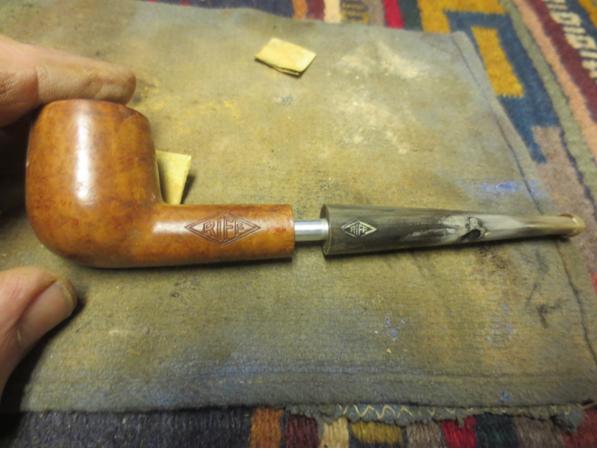
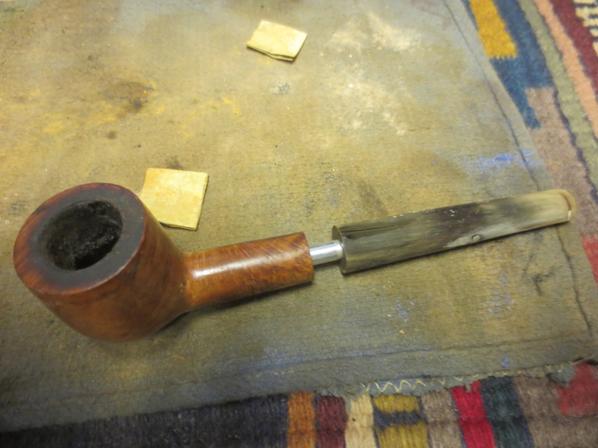
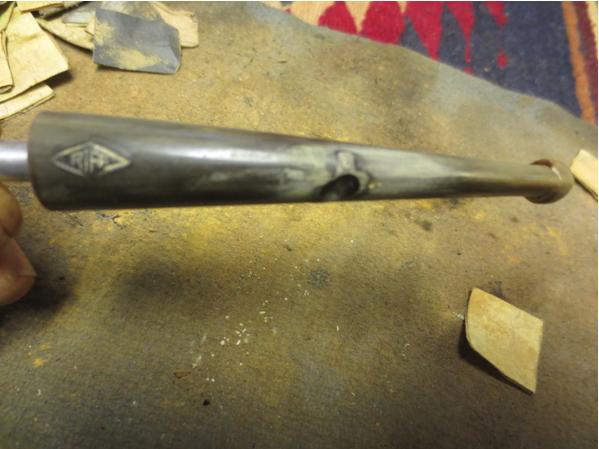
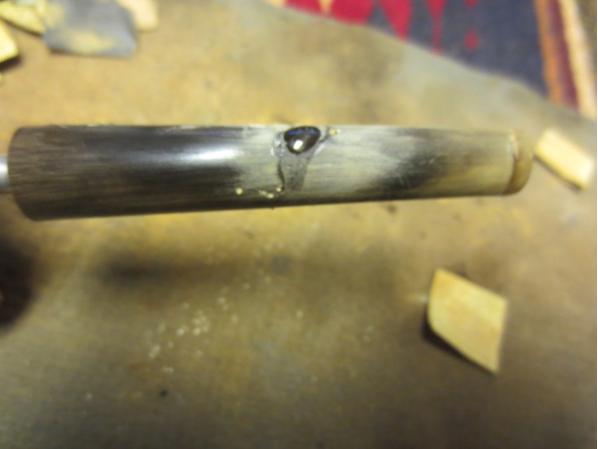
Tag Archives: pipe refurbishing

Dunhill Bulldog Gets a Facelift


Blog by Dutch Holland

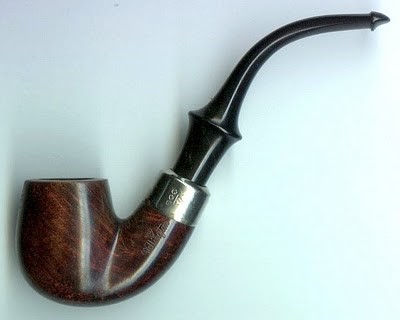
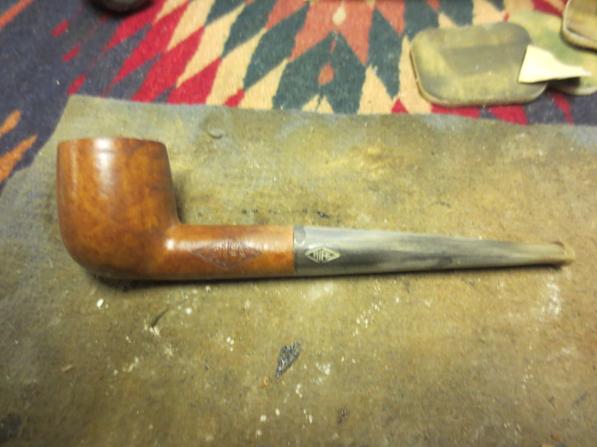
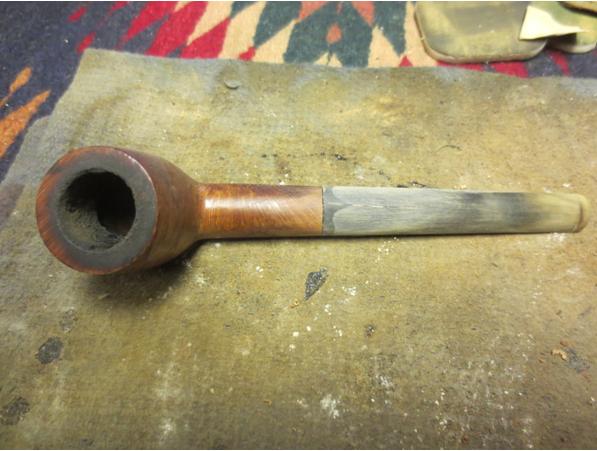
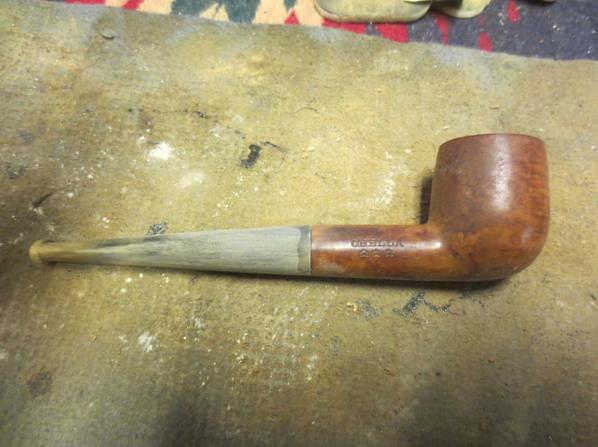
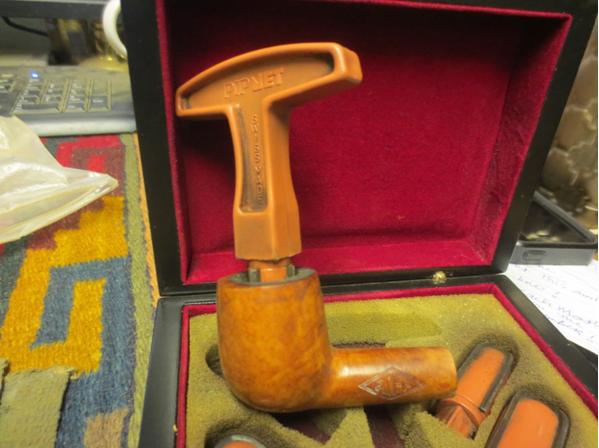
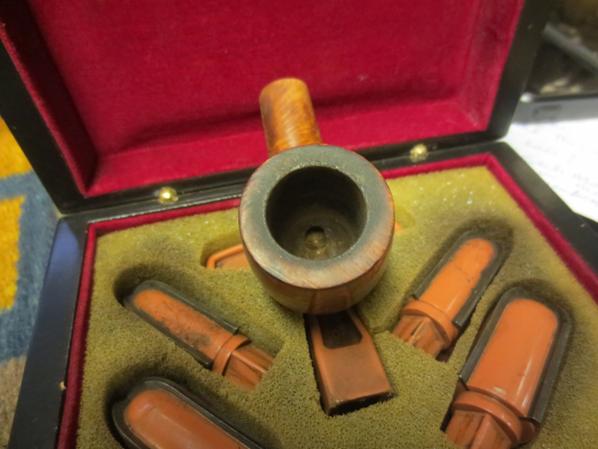
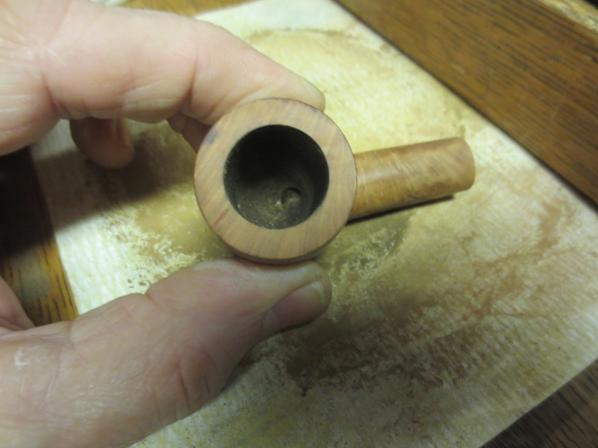
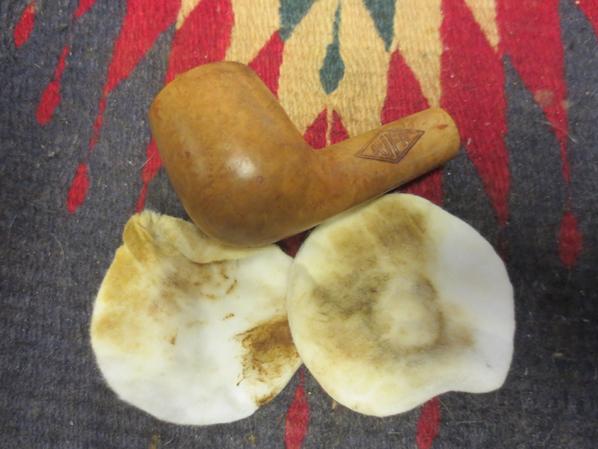
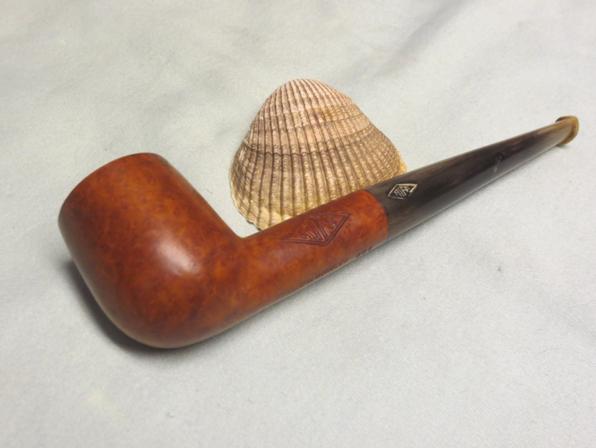
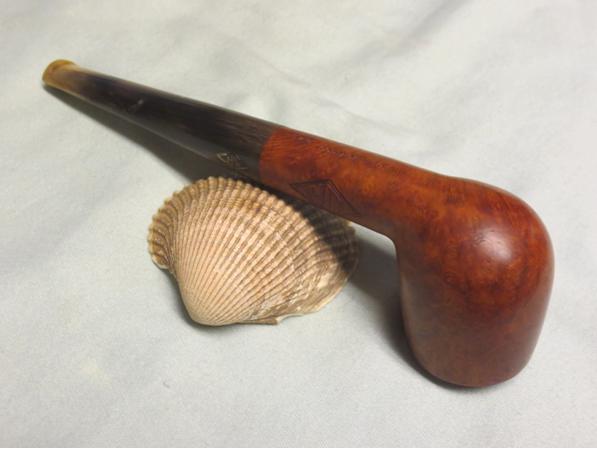
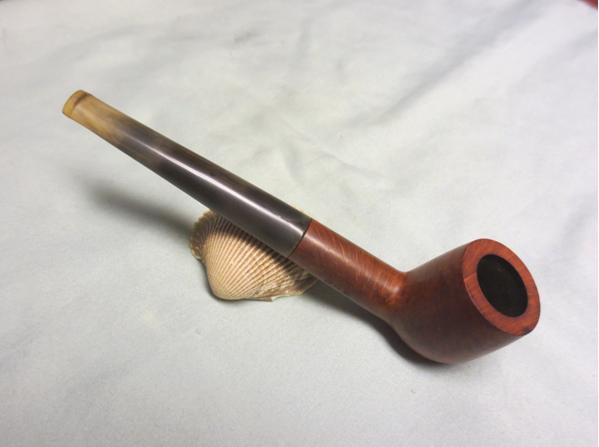
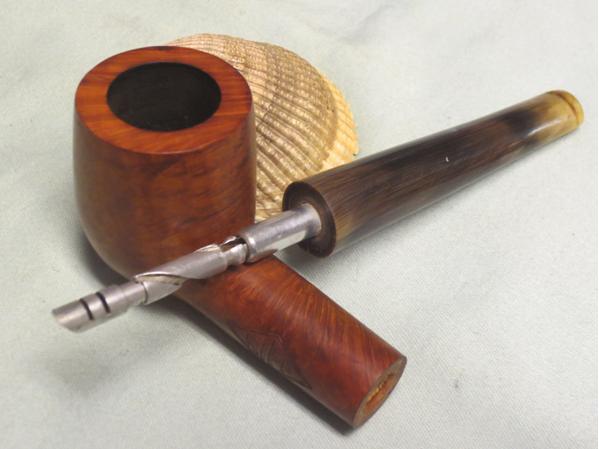
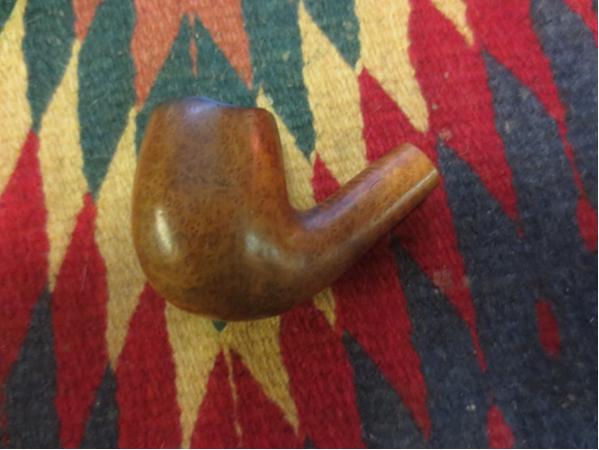
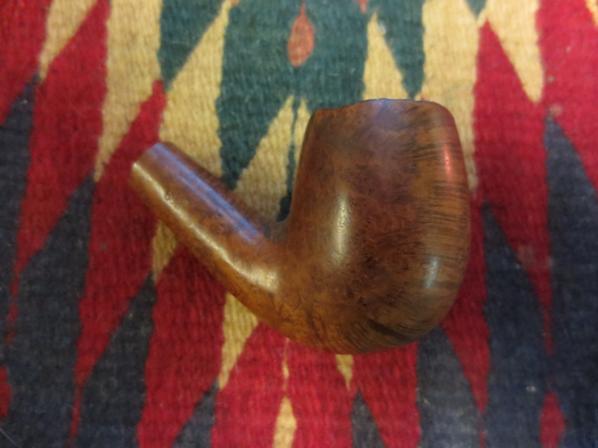
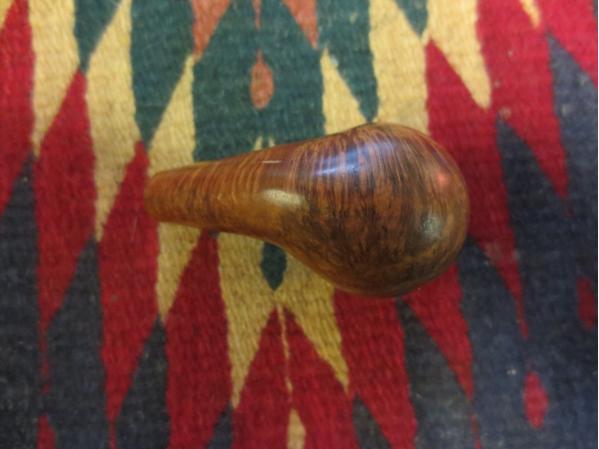
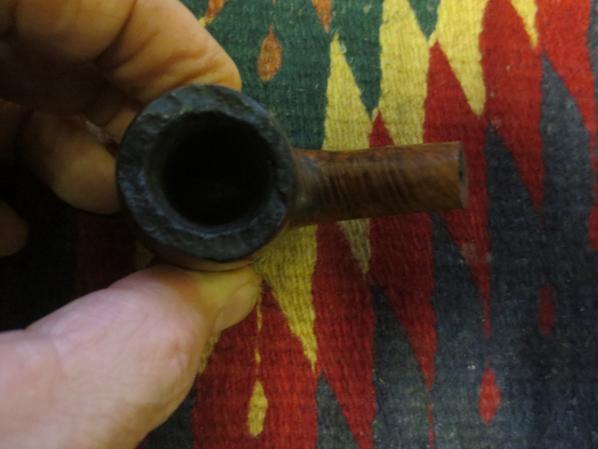
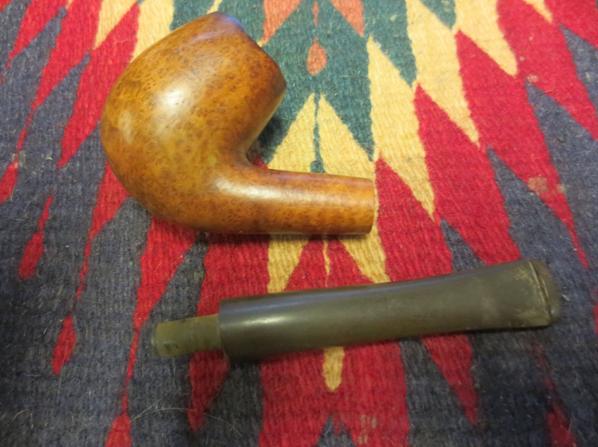
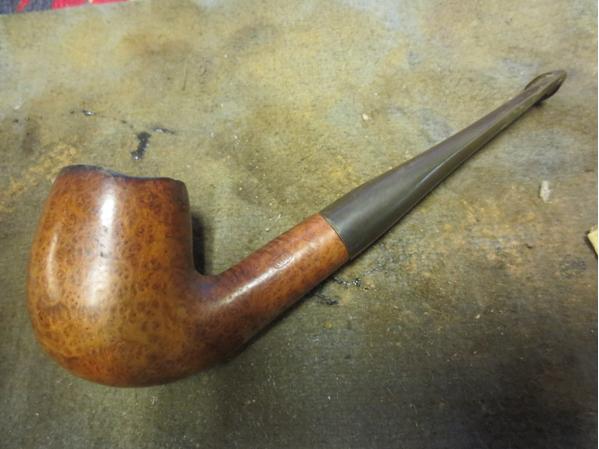
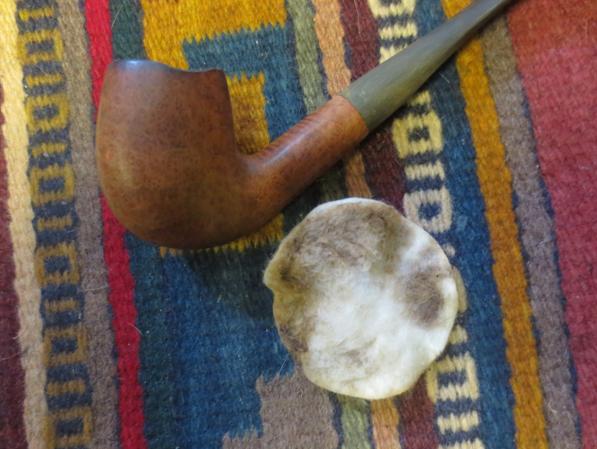
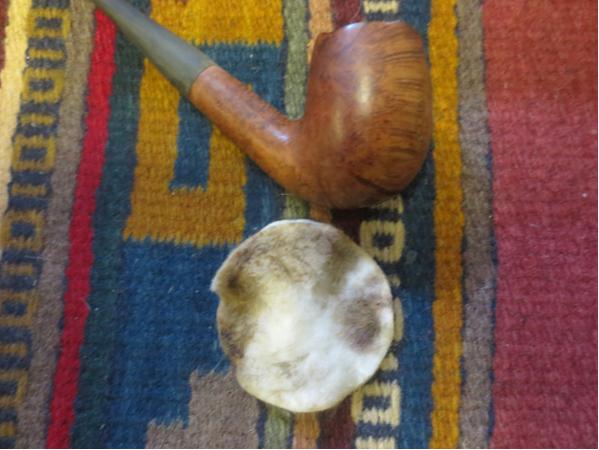
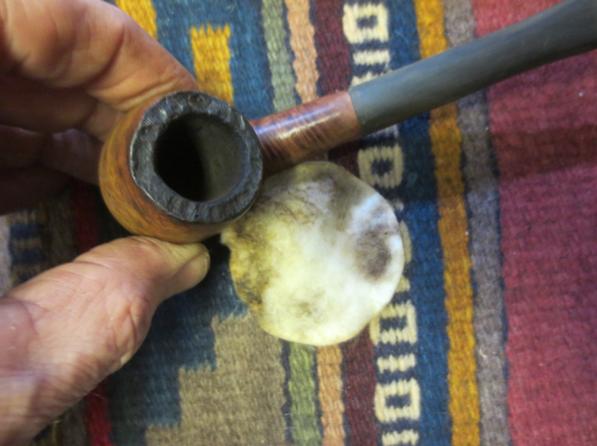
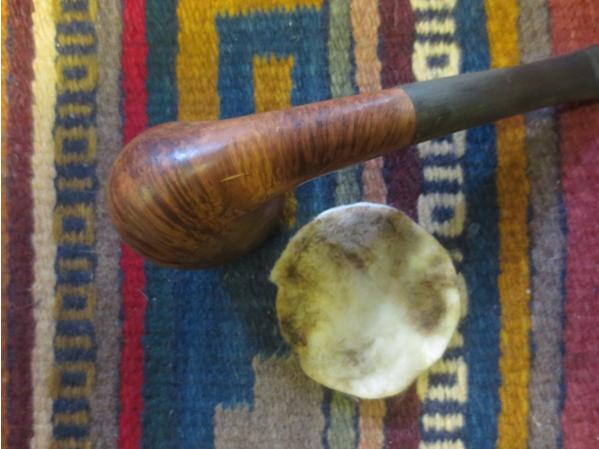
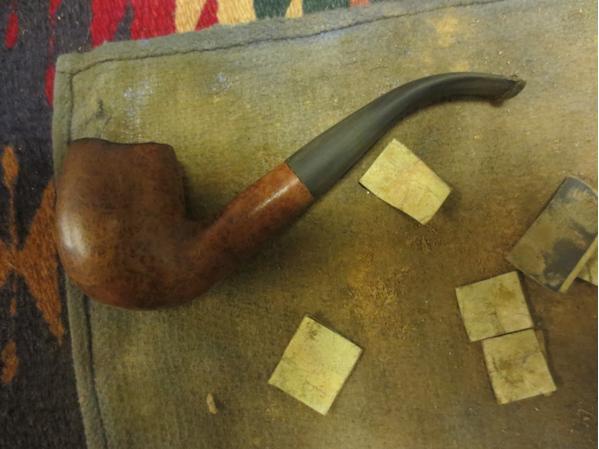
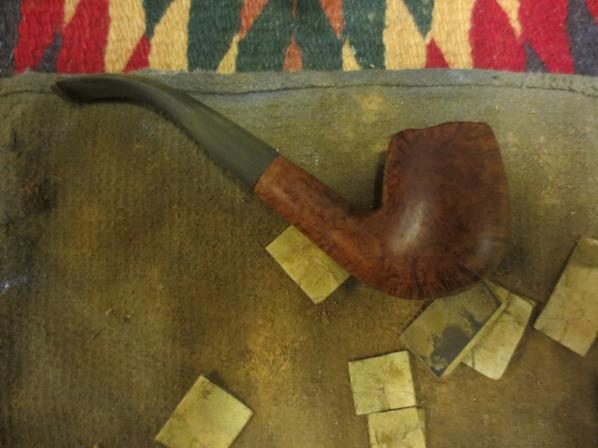
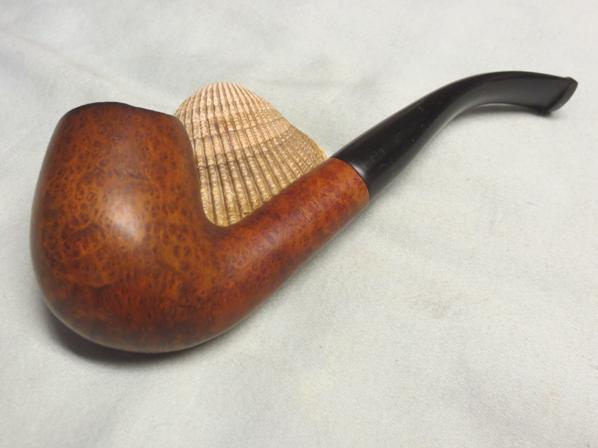
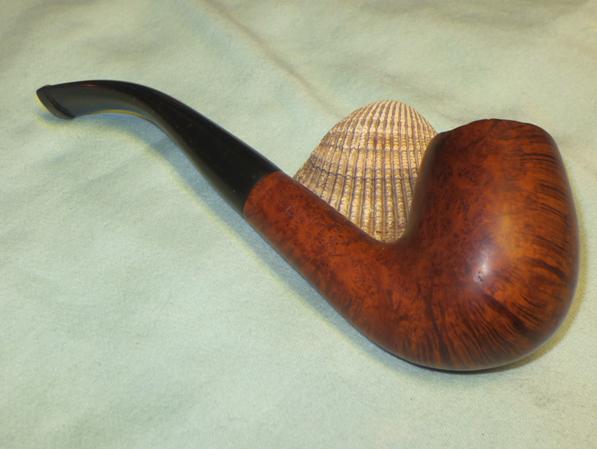
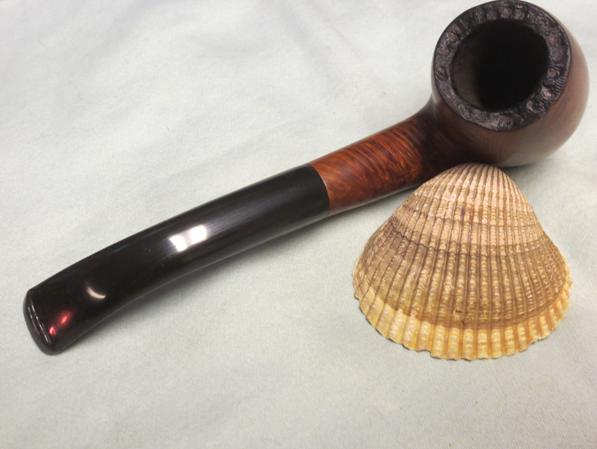
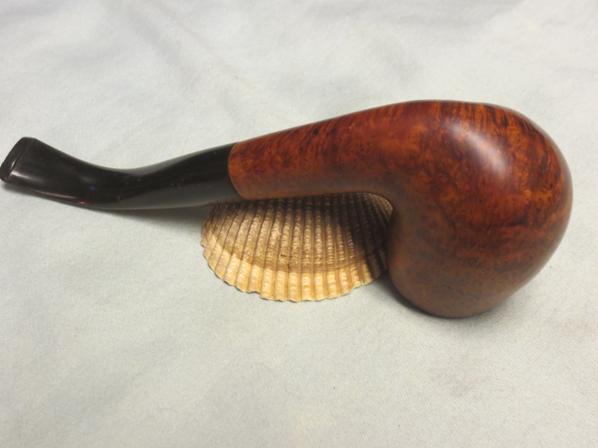
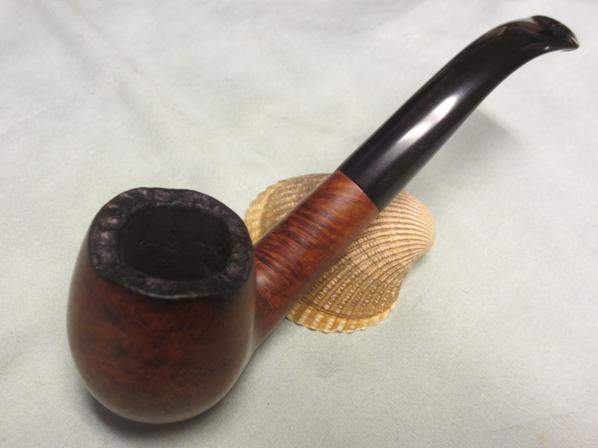
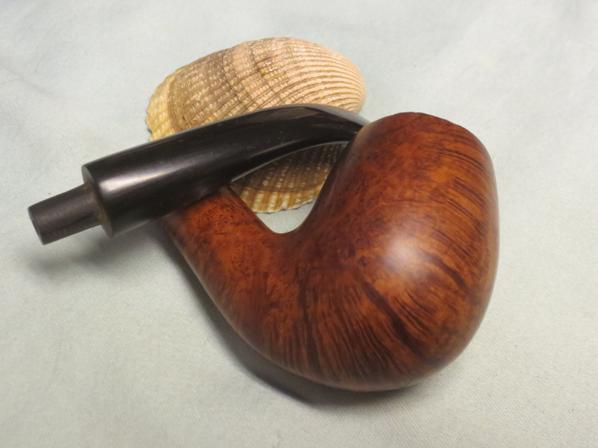
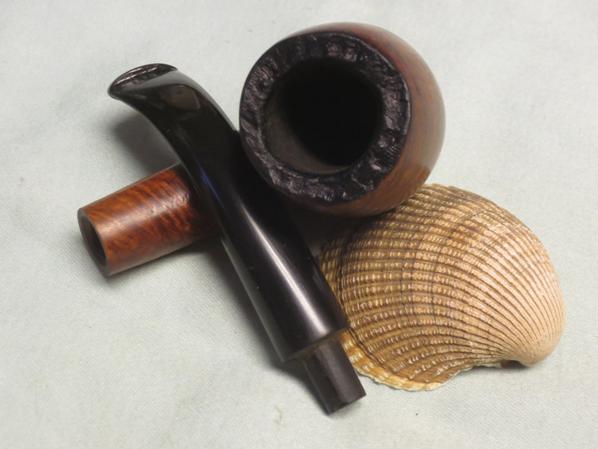
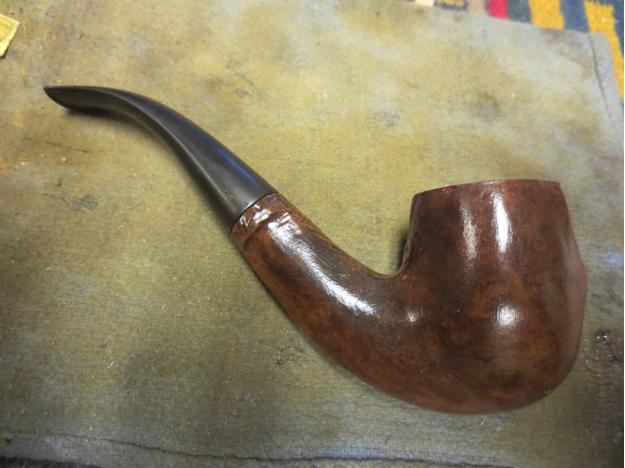
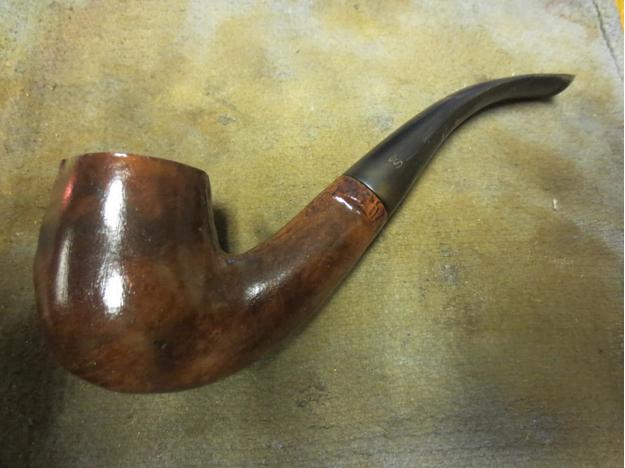
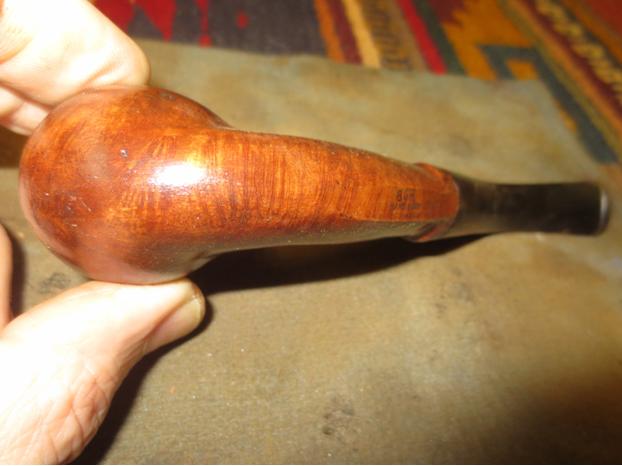
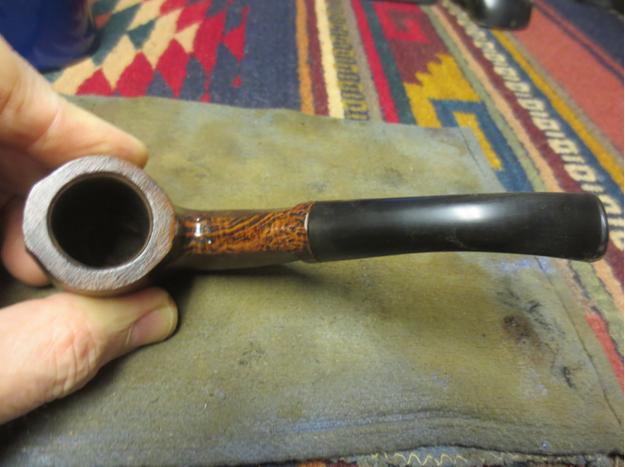
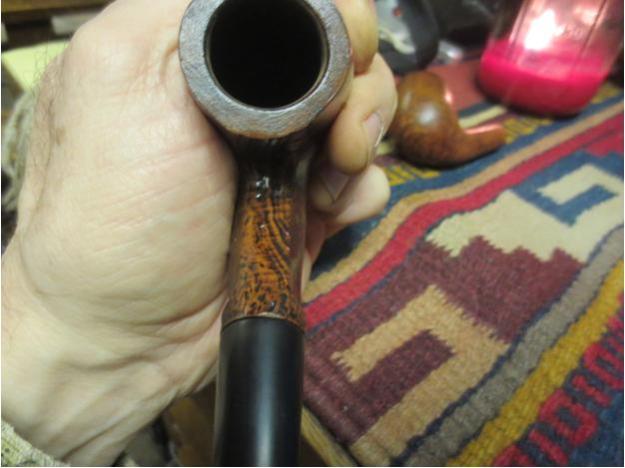
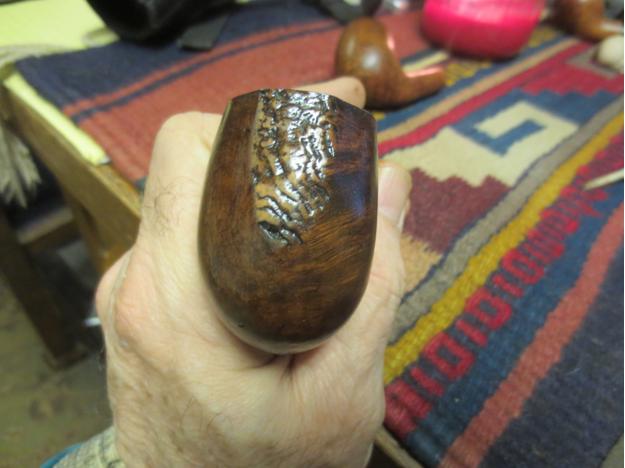
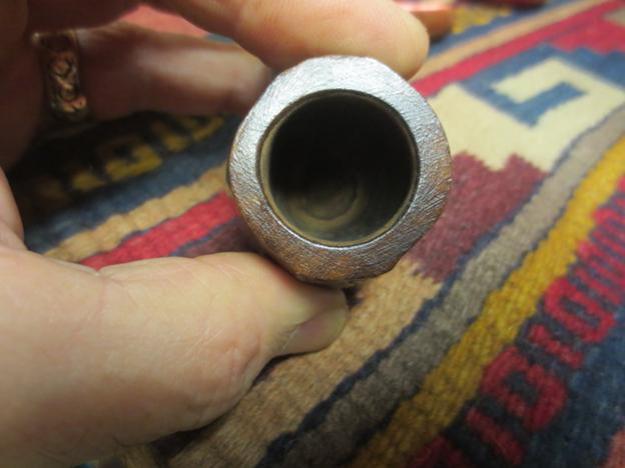
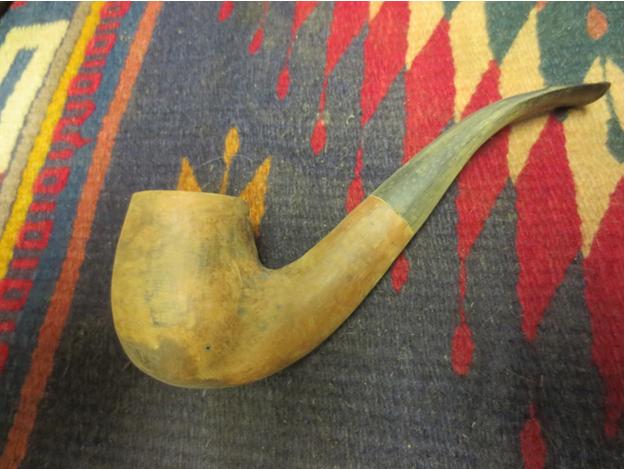
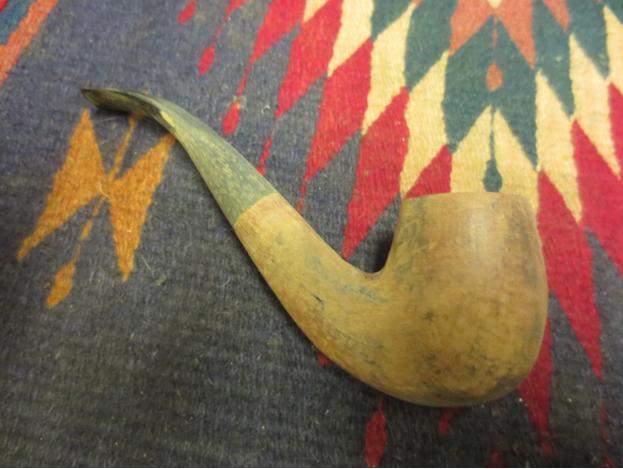
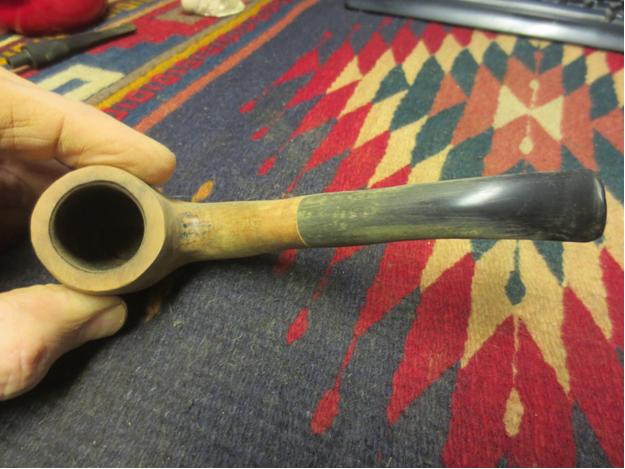
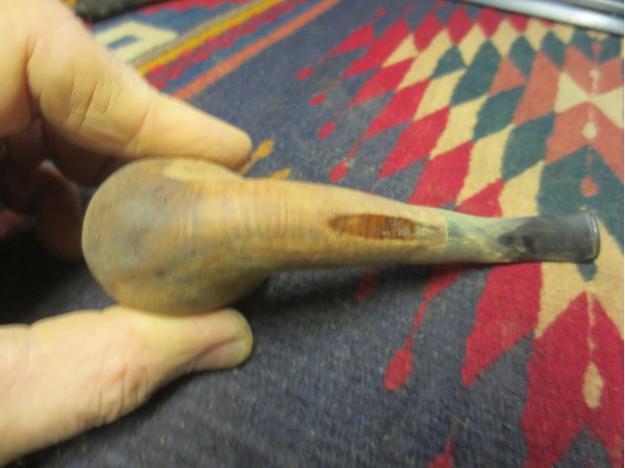
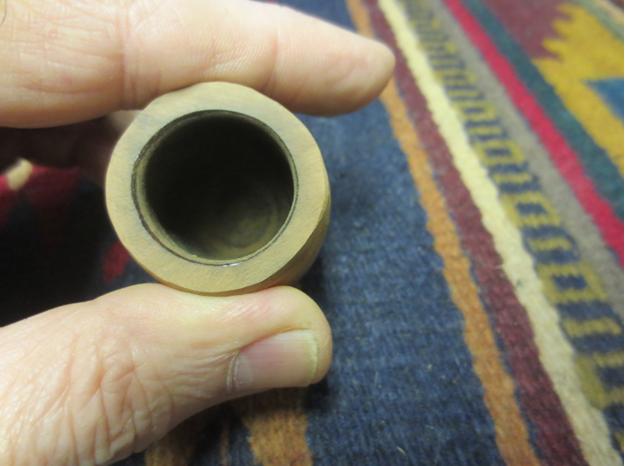
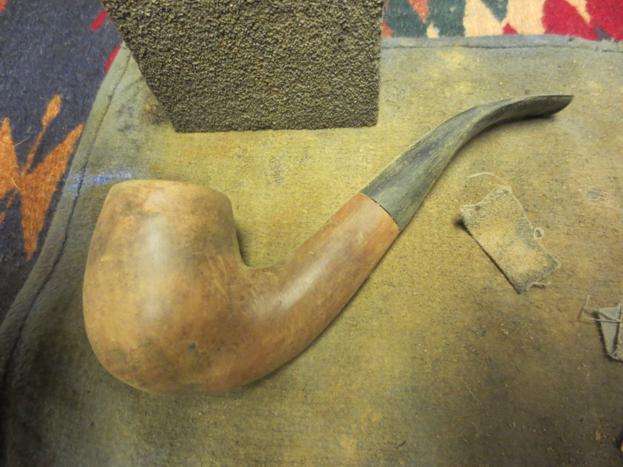
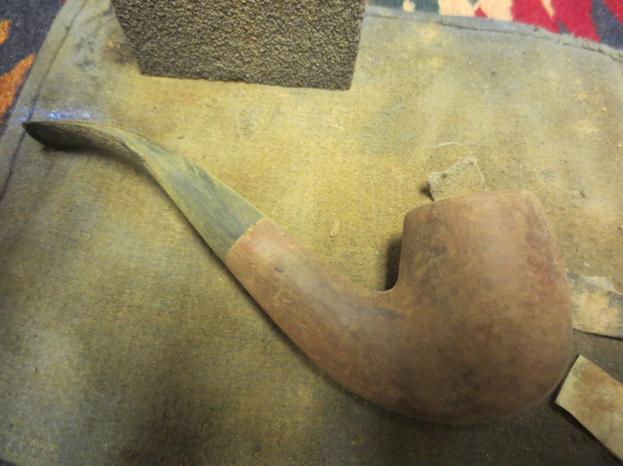
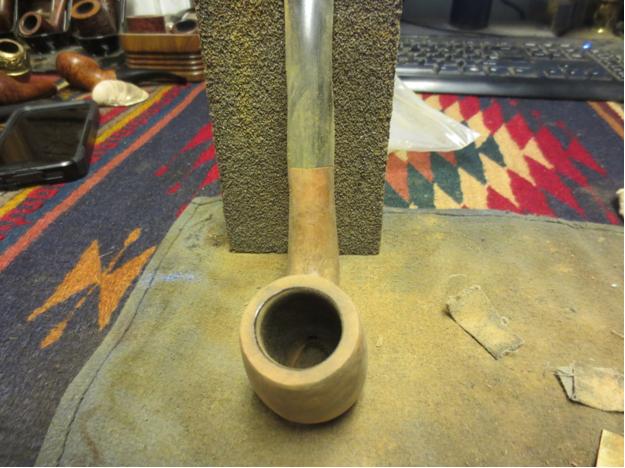
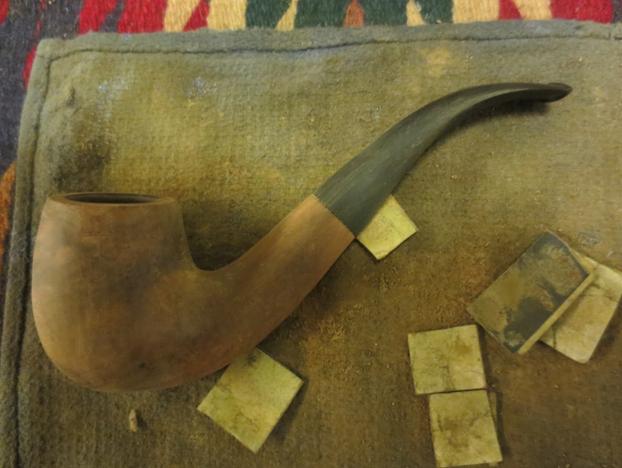
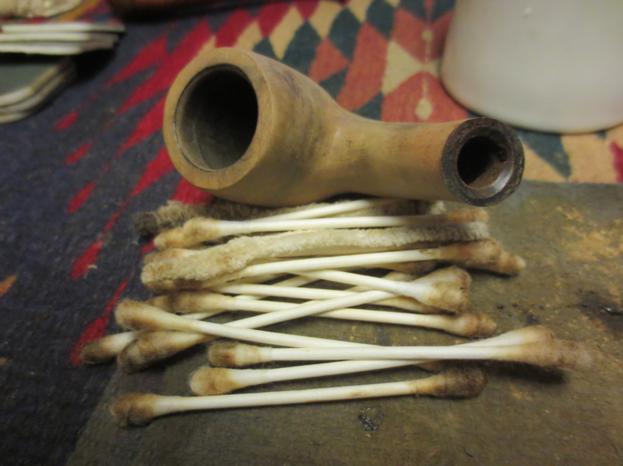
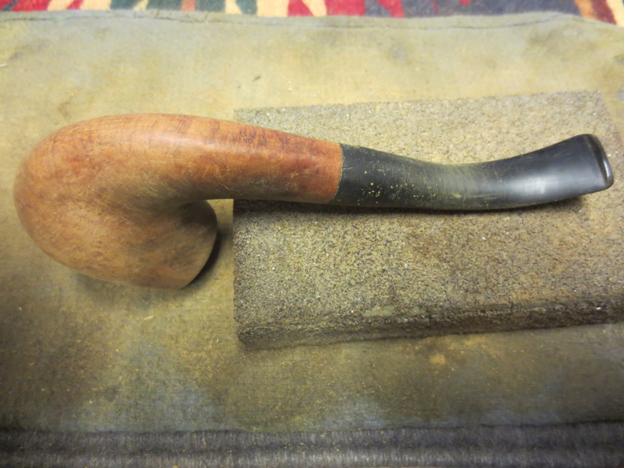
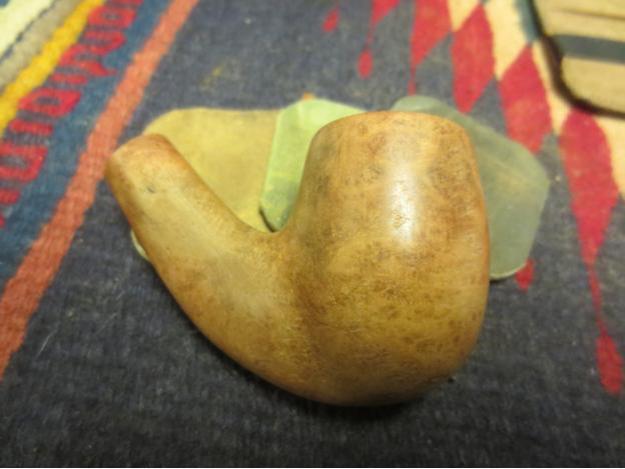
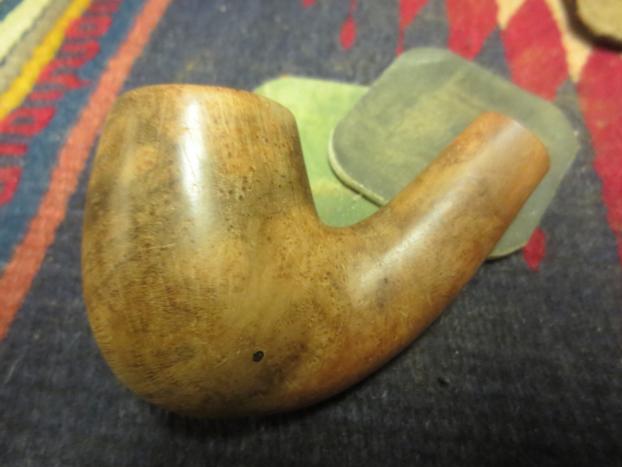
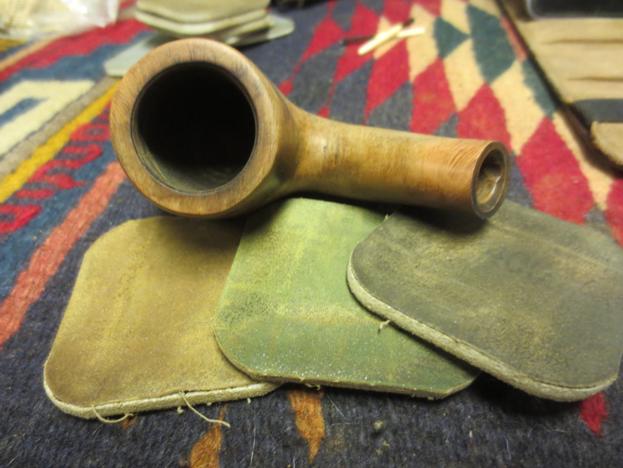
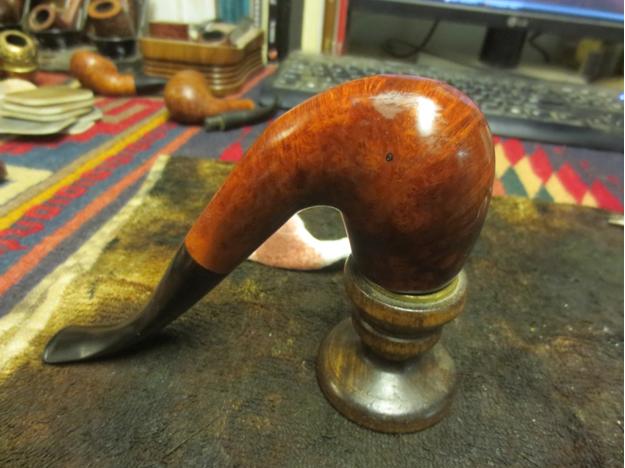
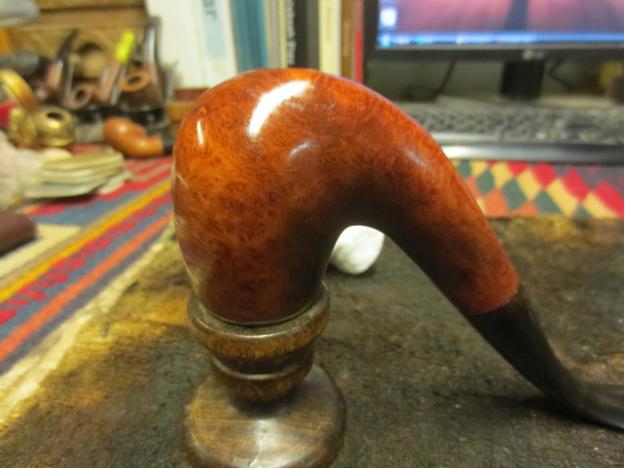
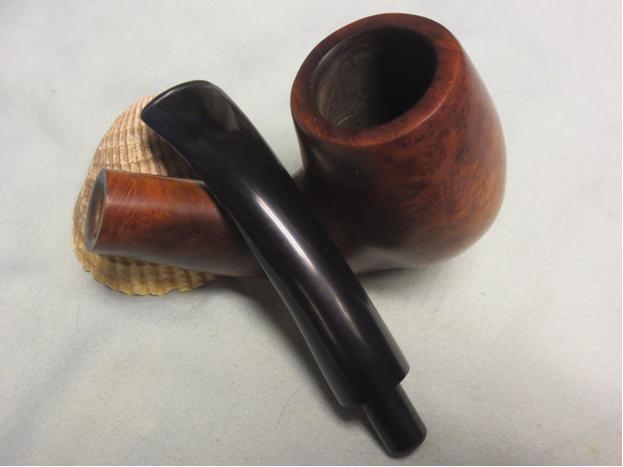
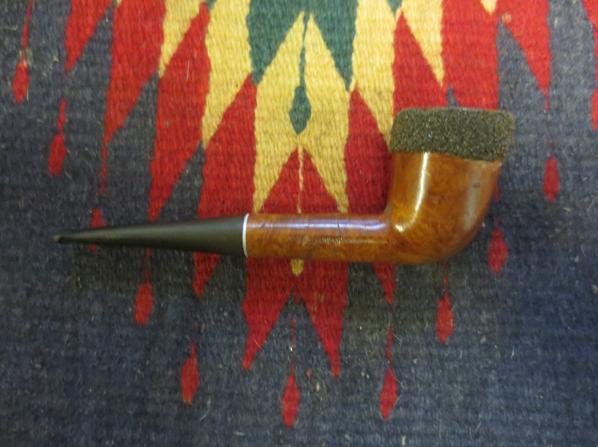
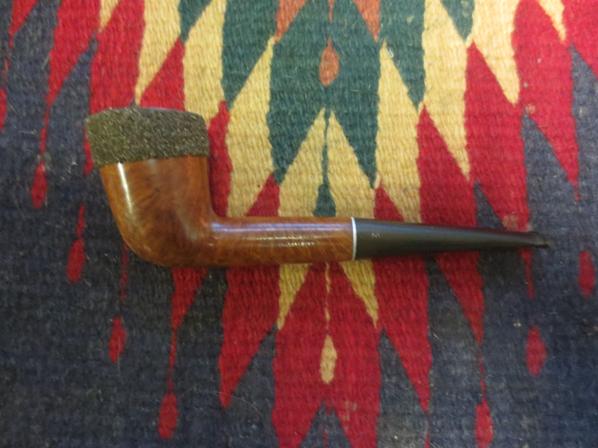
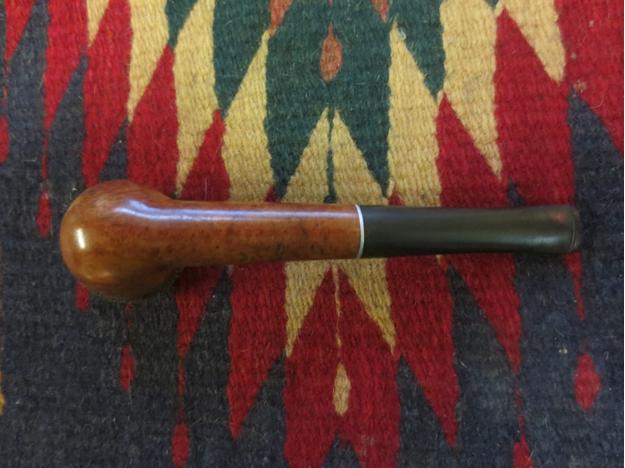
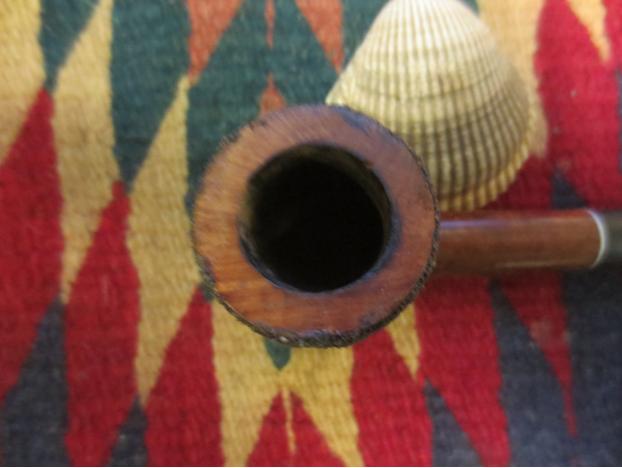
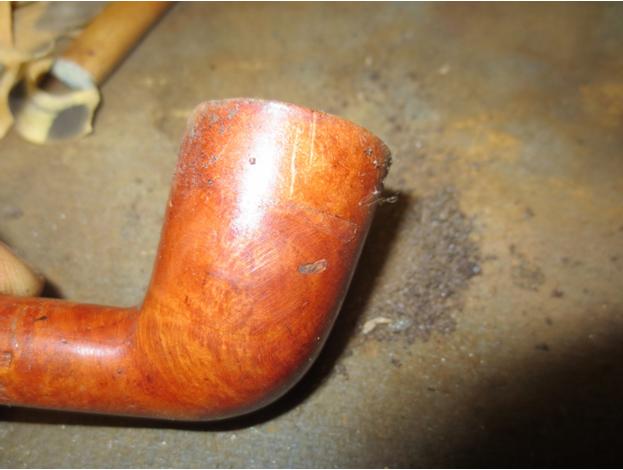
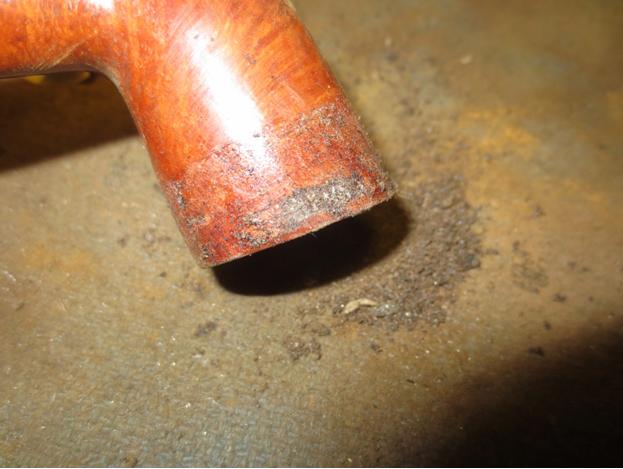
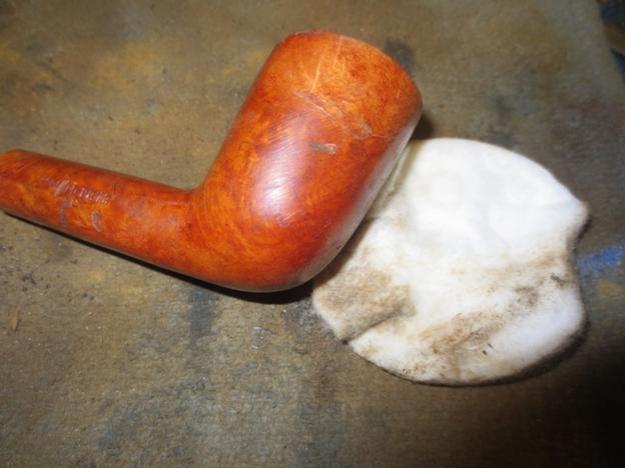
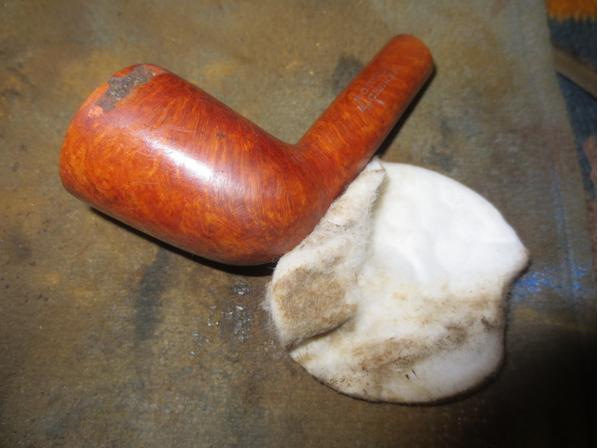
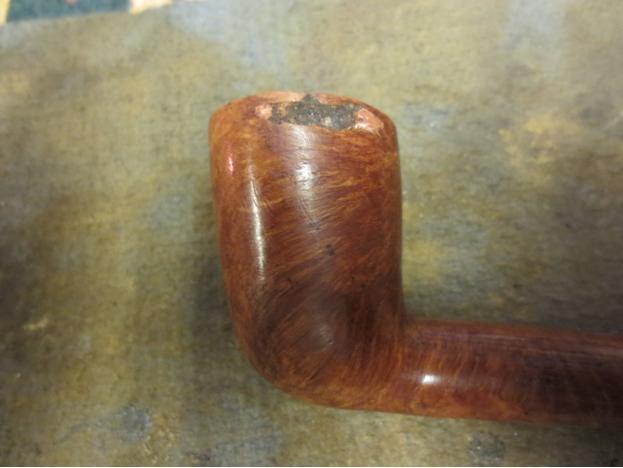
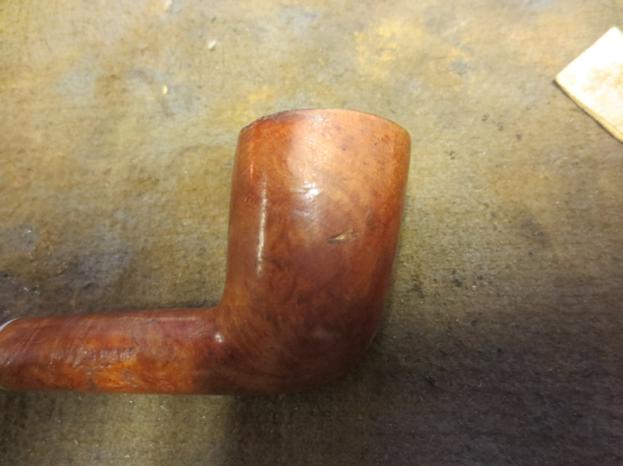
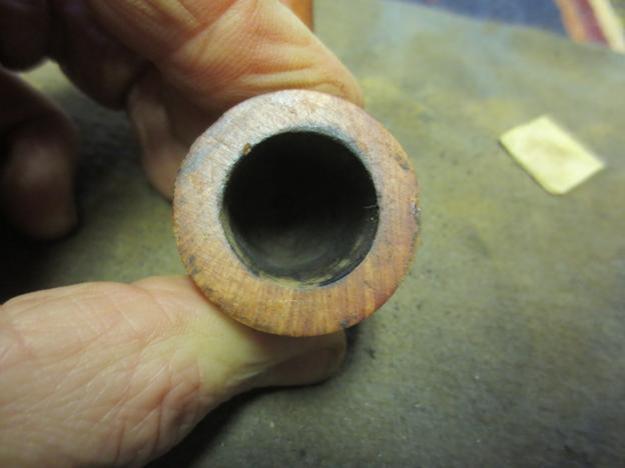
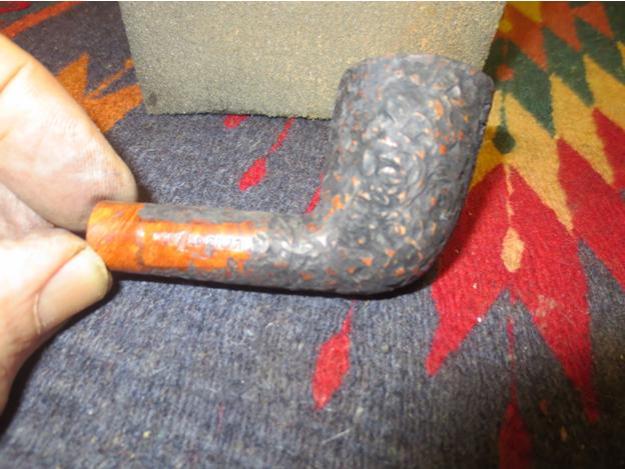
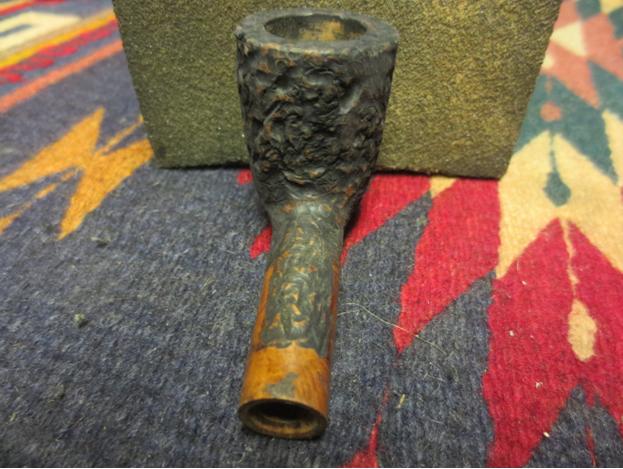
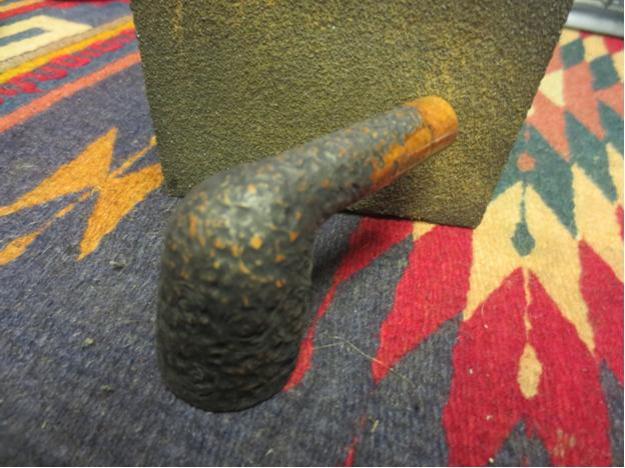
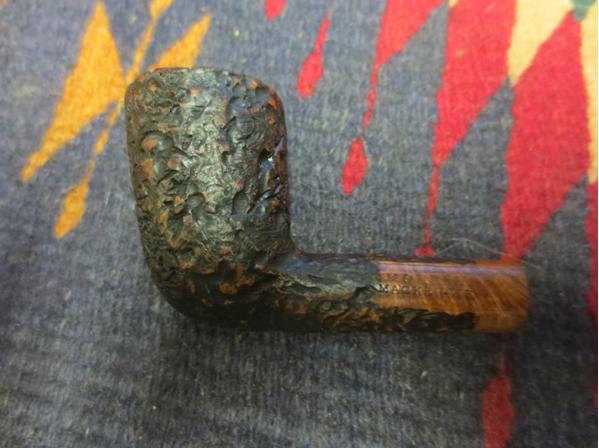
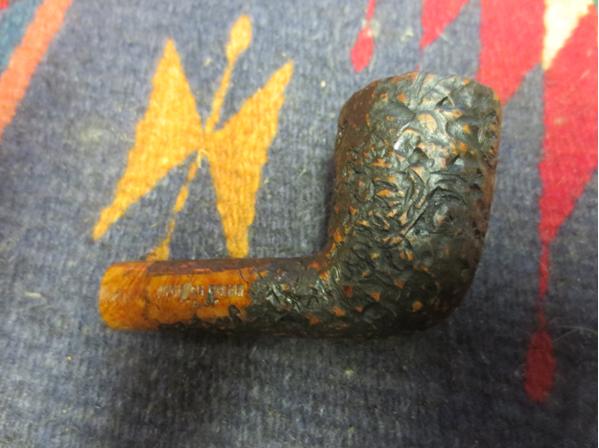
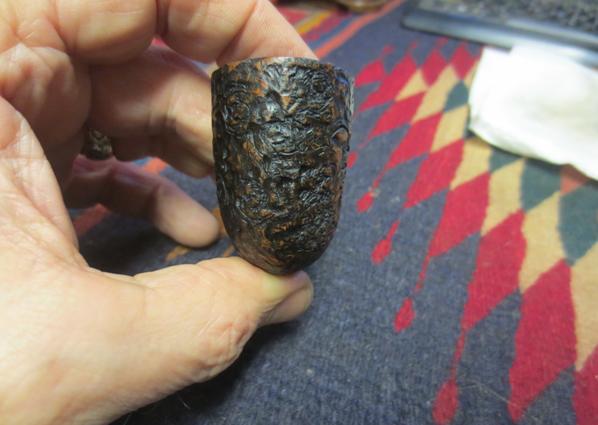
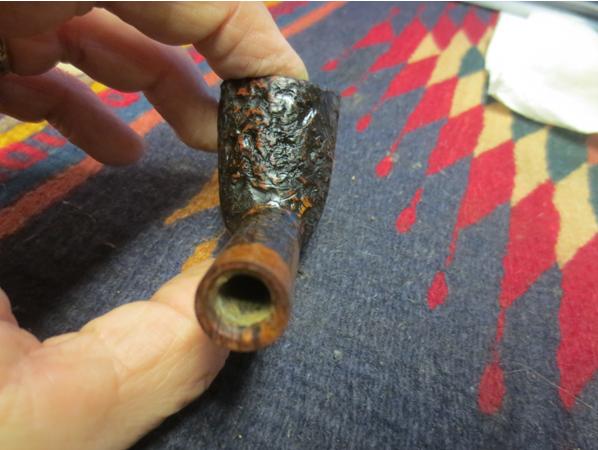
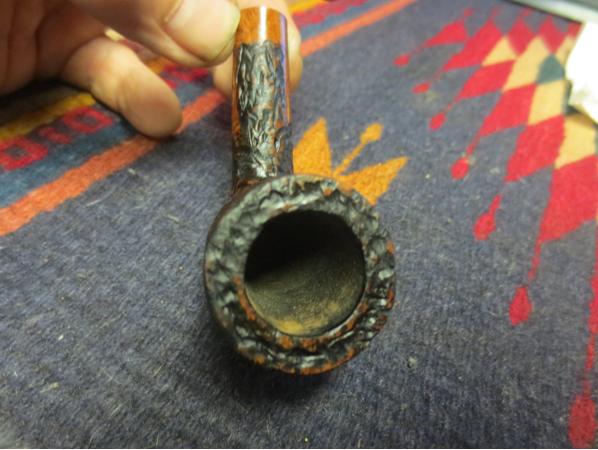
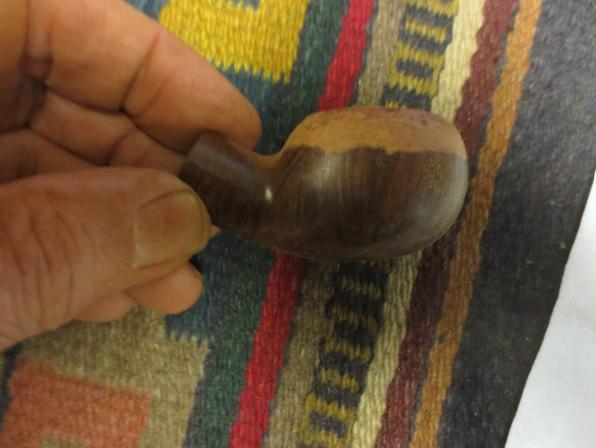
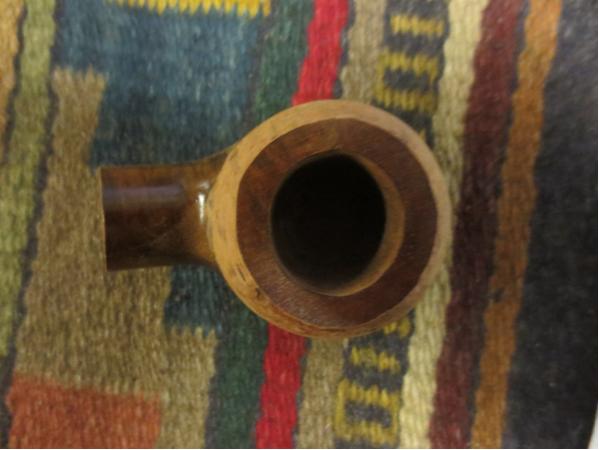
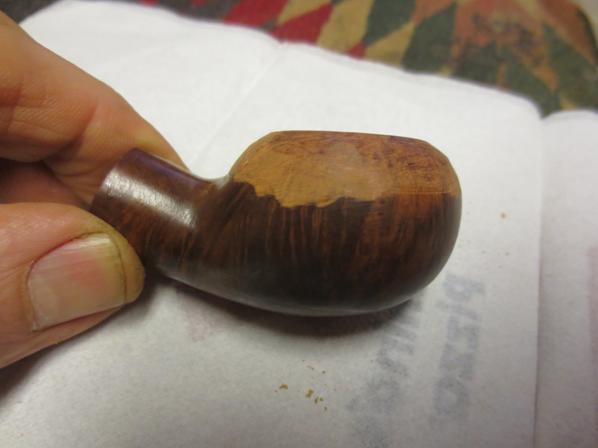
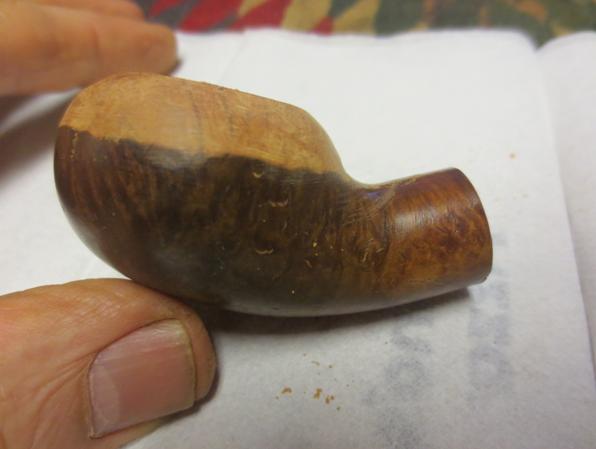
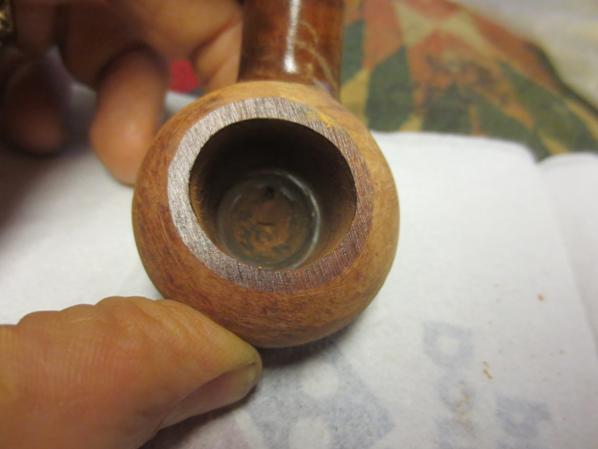
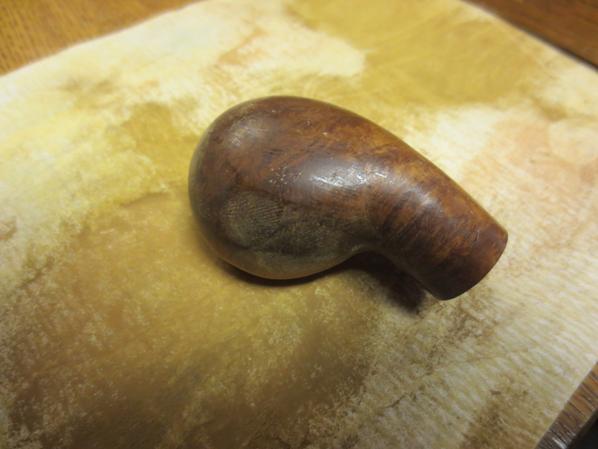
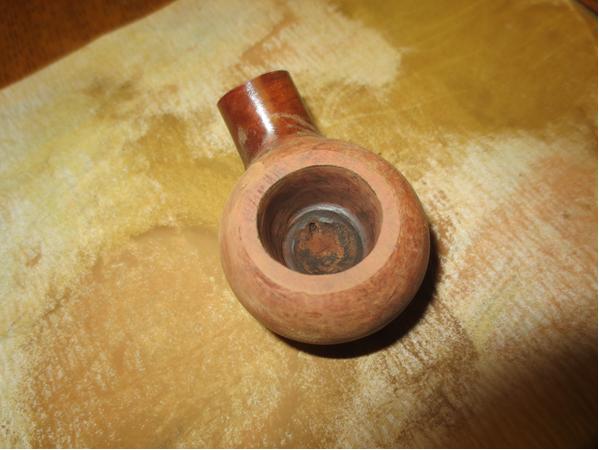
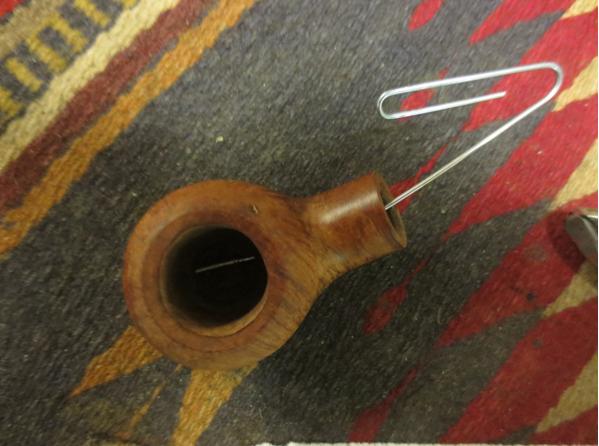
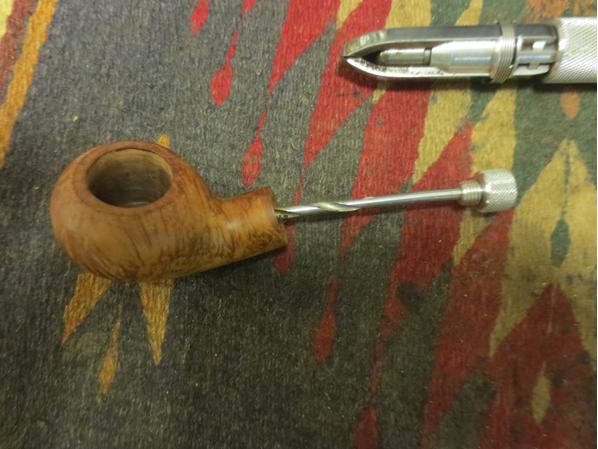
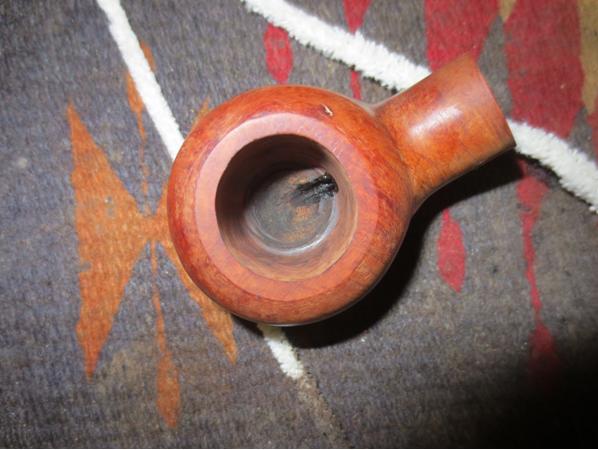
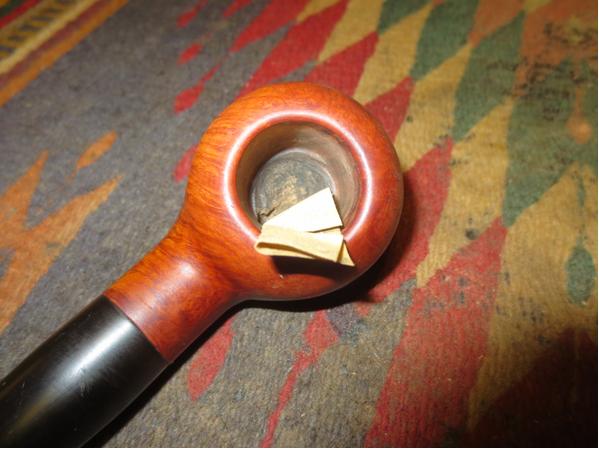
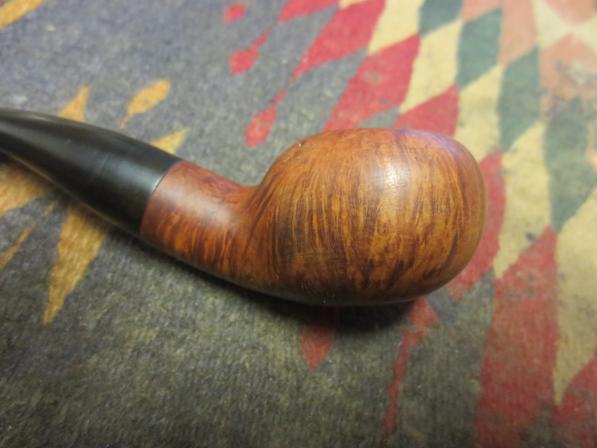
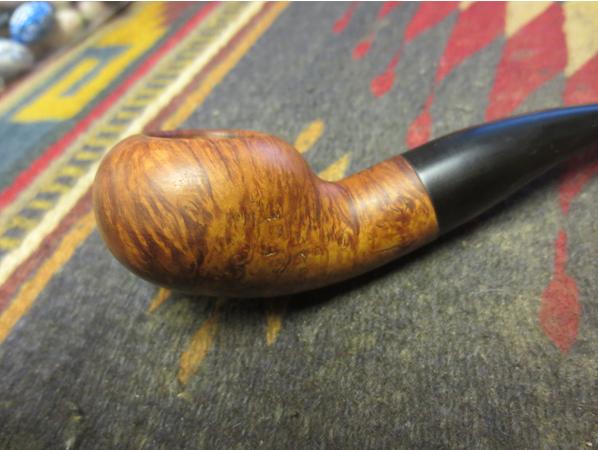
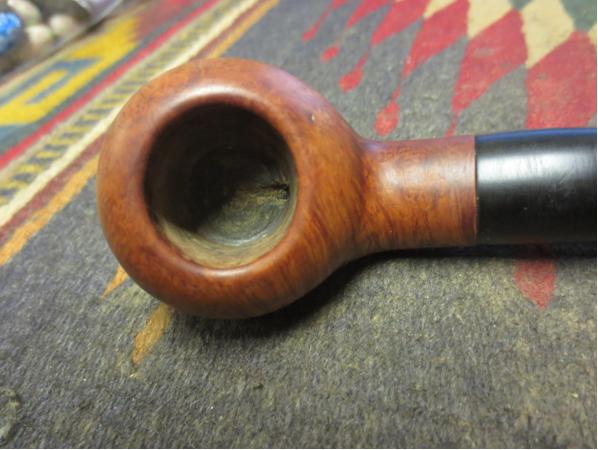
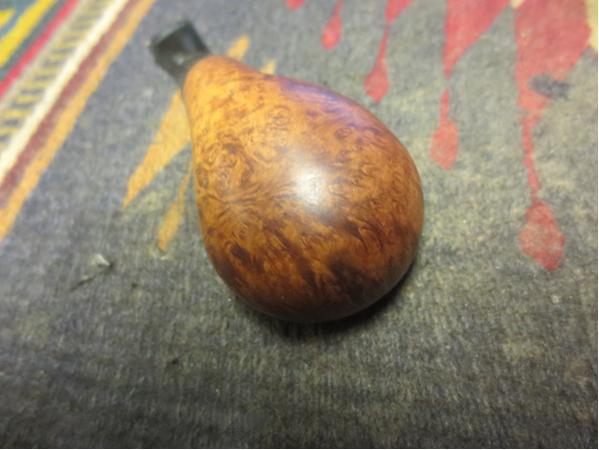
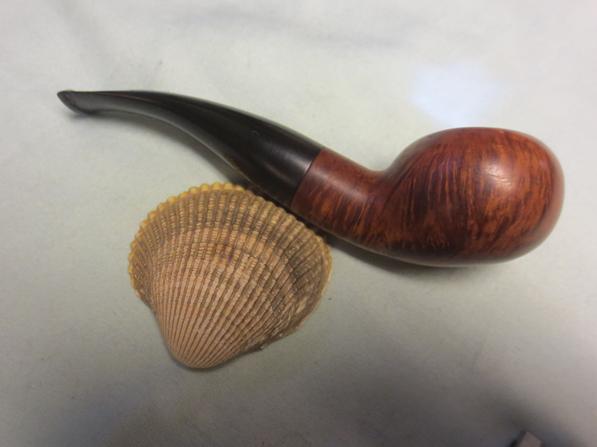
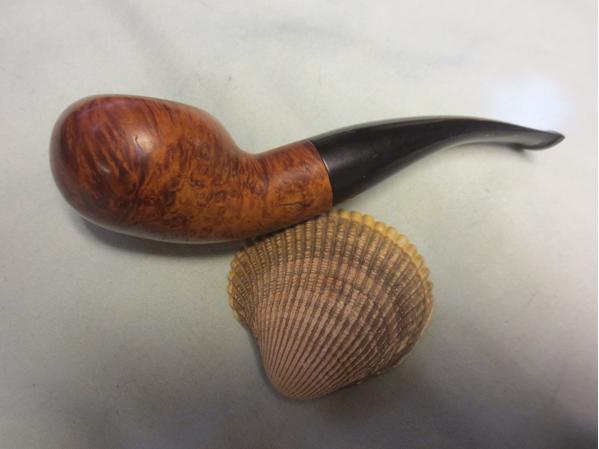
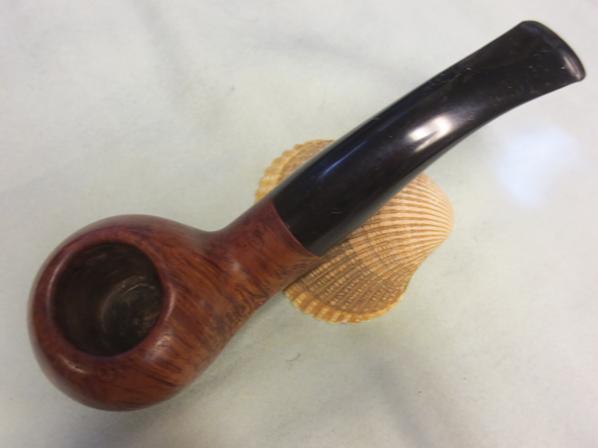
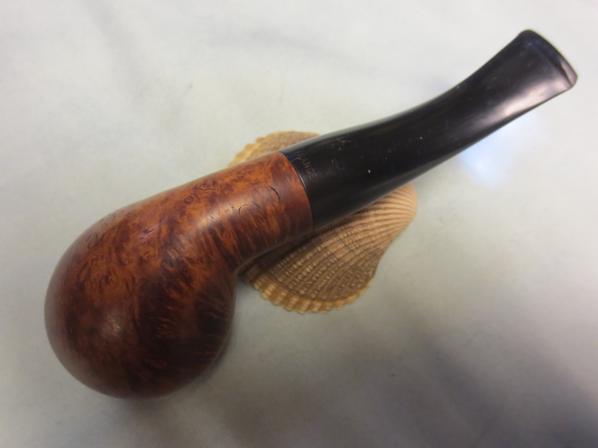
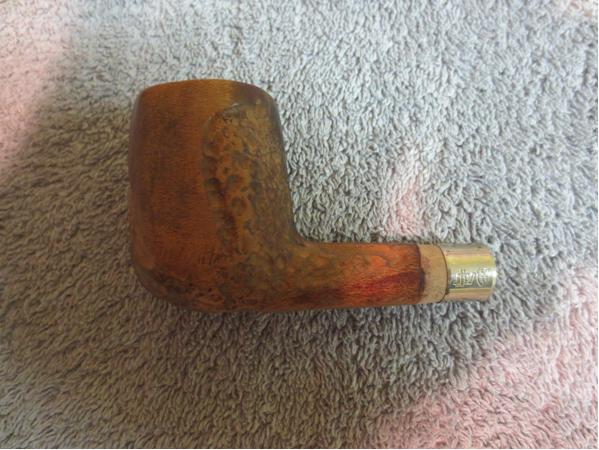
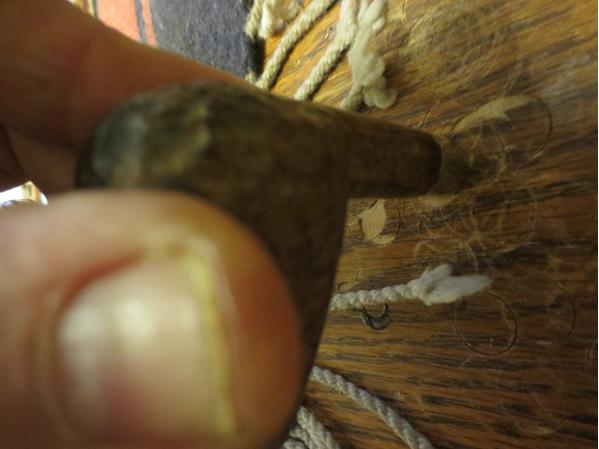
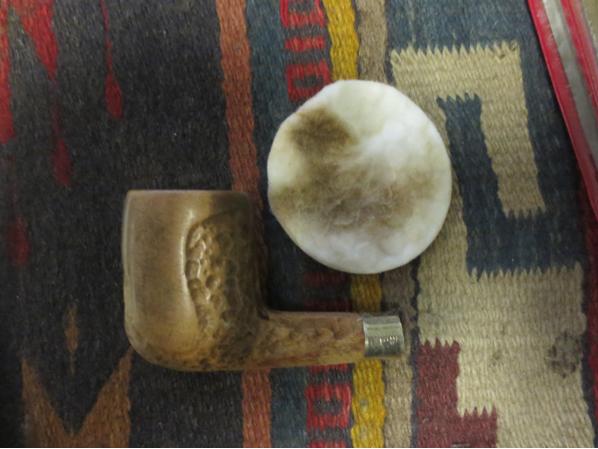
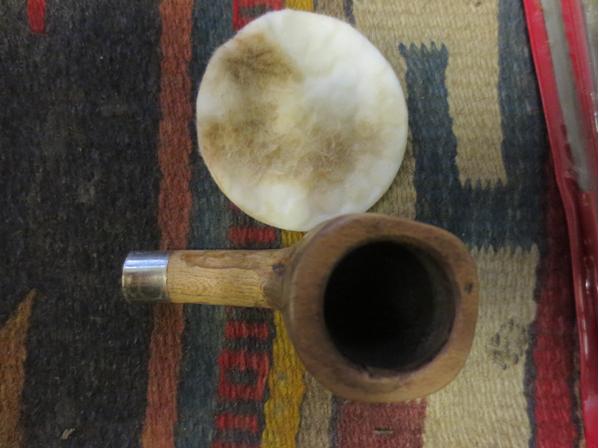
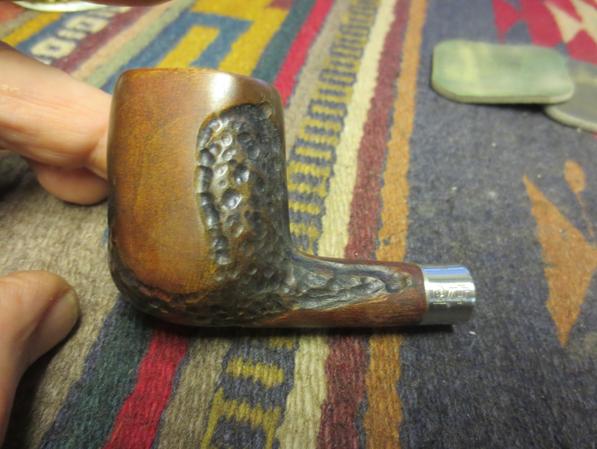
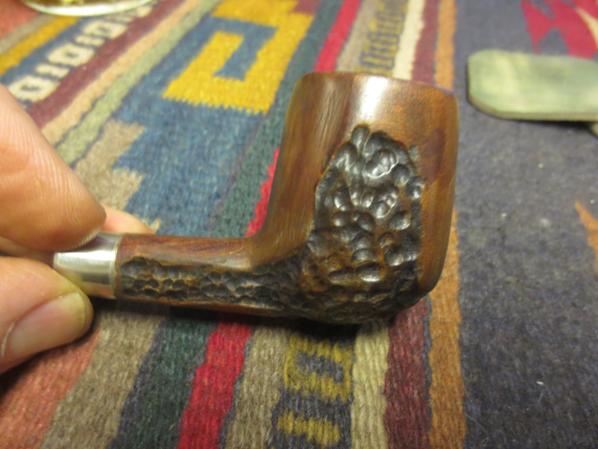
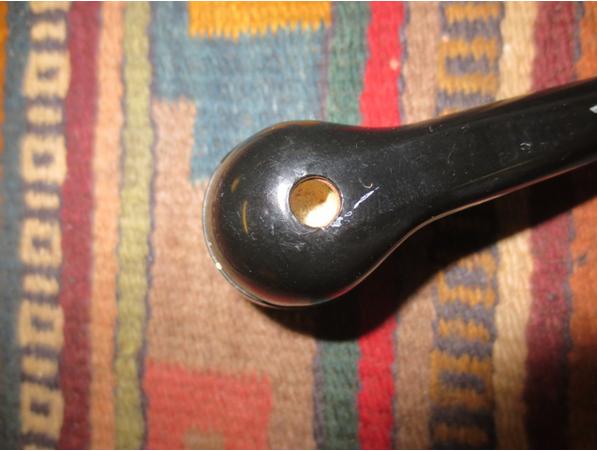
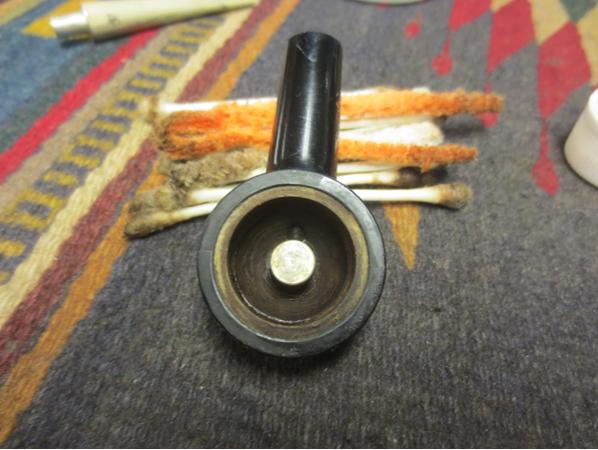
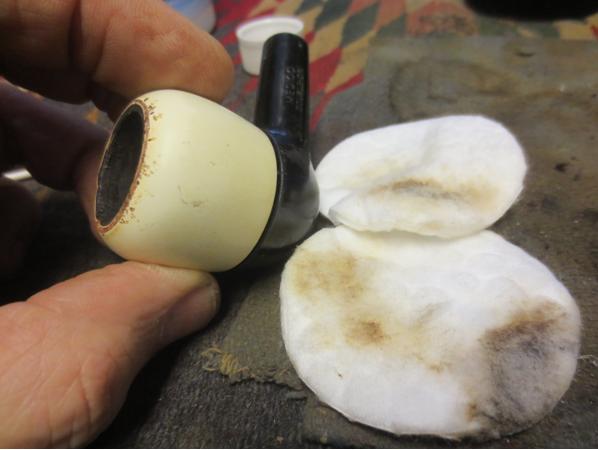
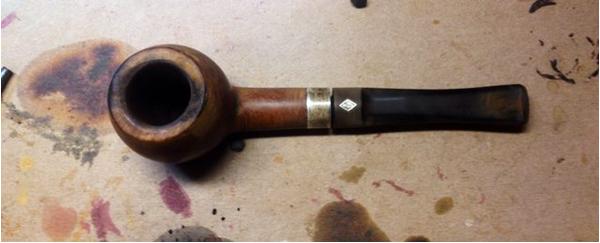
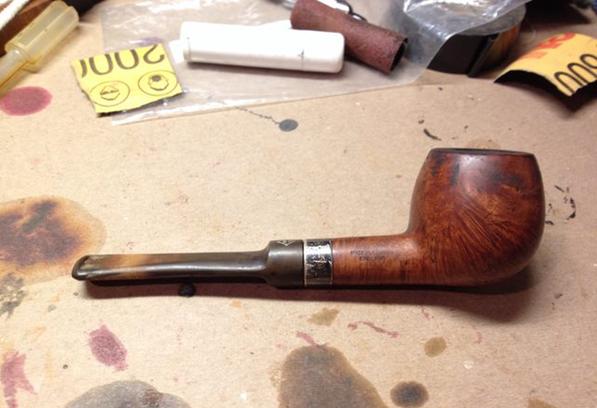
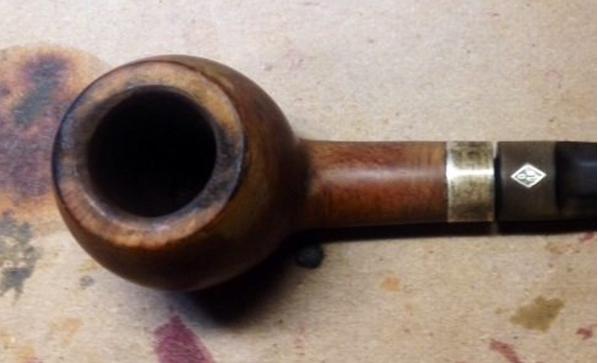
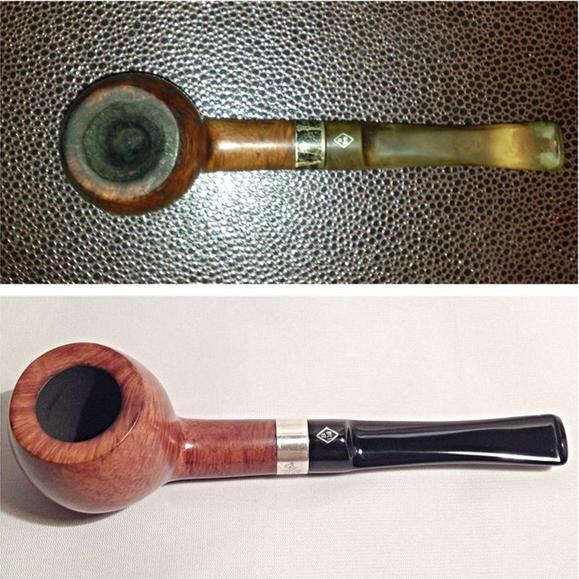
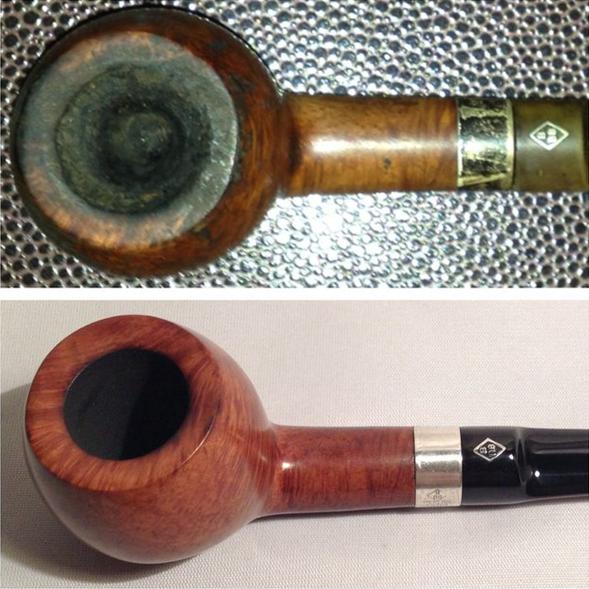
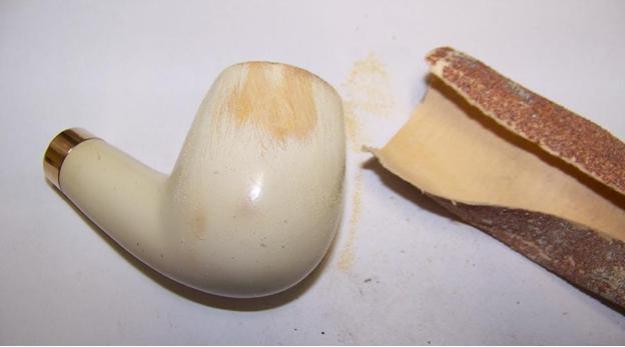
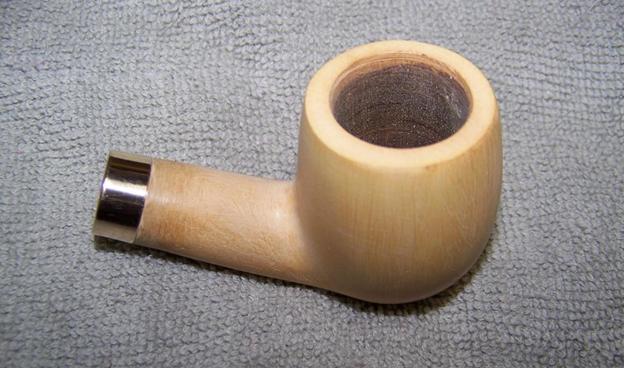
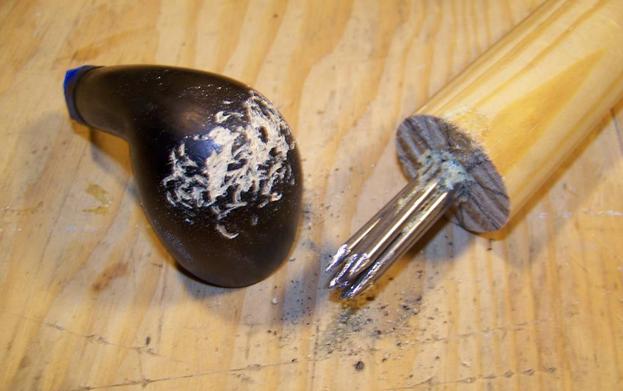
I had been looking for a small Dunhill Bulldog and recently found this one. It’s a 1962, style 148, Bruyere, Group 3 in need of some TLC. It’s quite petite, almost delicate compared to thDun1e GBD Rhodies I’m usually drawn to but the price was right so I pulled the trigger and several days later it arrived. Although not in really bad shape, it had some issues that would need attention. The bowl top hadn’t seen a cleaning in some time, carbon build-up had migrated onto the upper outside of the bowl and the tobacco chamber had a significant build-up of cake. At some point the pipe had apparently been dropped because there was a nasty crease and some dents surrounding it on the front. The shank had several tones of color, the cause is uncertain. After cleaning the rim area I discovered a number of edge scars and some charring on one side that made the inner edge look out of round. There would be no saving the finish, a stripping would be necessary. The nomenclature was clear and strong so attention to method would be important to preserve it. Dave G’s stripping formula worked out exceptionally well but who would expect anything less? Dun2I slightly topped the rim after beveling the inner edge to minimize the amount that needed removal. Topping was done with 1000 grit sandpaper on a flat surface following the application of some steam. The steam had all but eliminated the edge scars and a little softening of the outer edge did the rest. Treating the inner edge with a slight bevel took out the majority of the scorch so almost nothing needed to be removed. Preserving that classic profile was important. That came at the expense of giving the top a somewhat different look. One that seems to better compliment the delicate style of this pipe but that’s just a personal opinion.
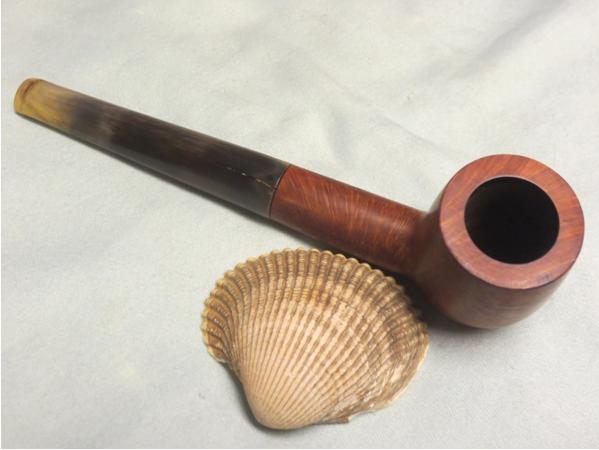
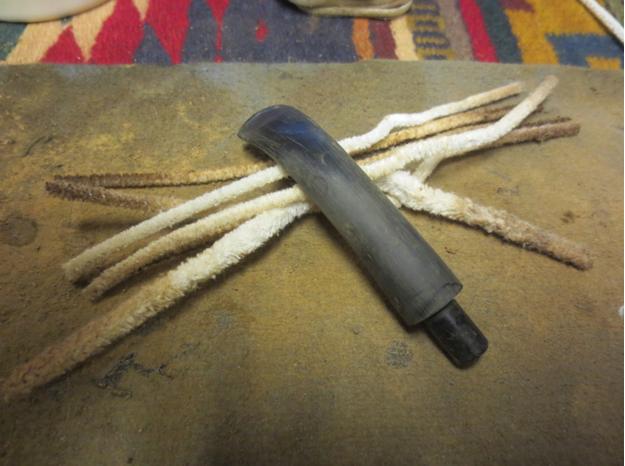
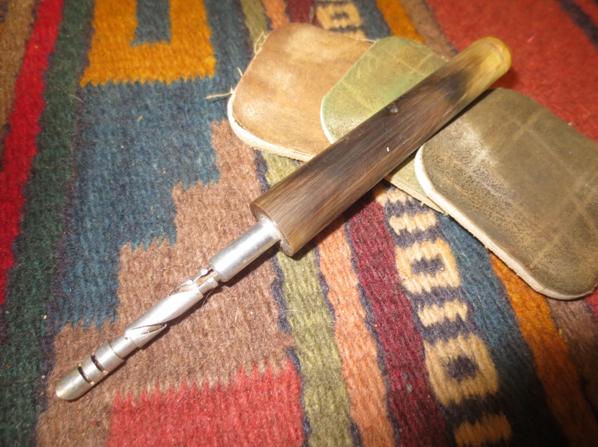
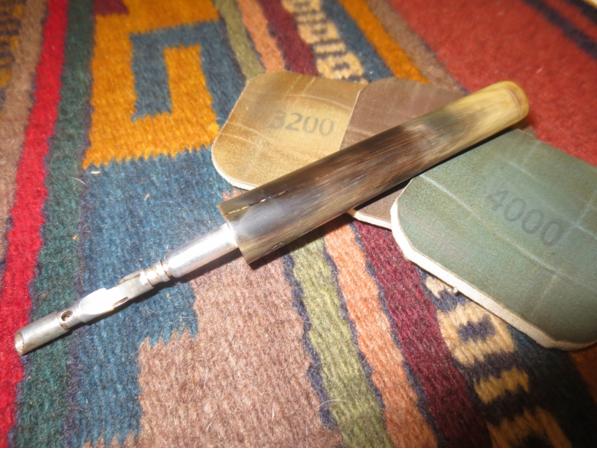
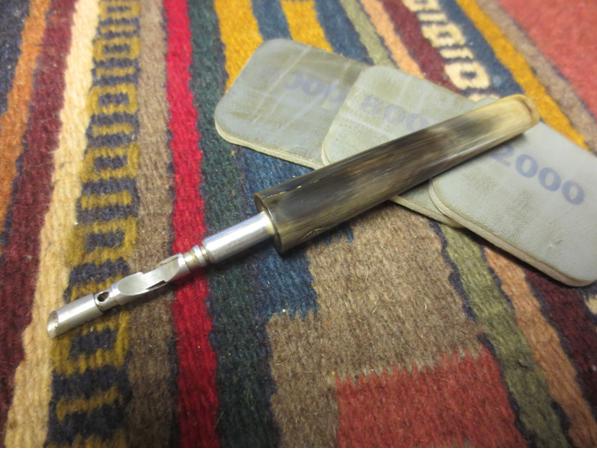
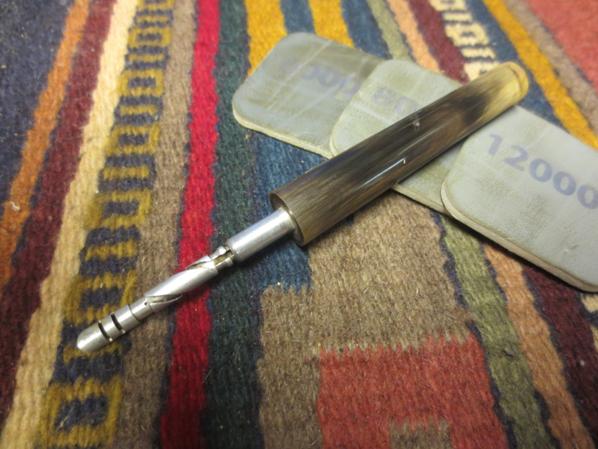
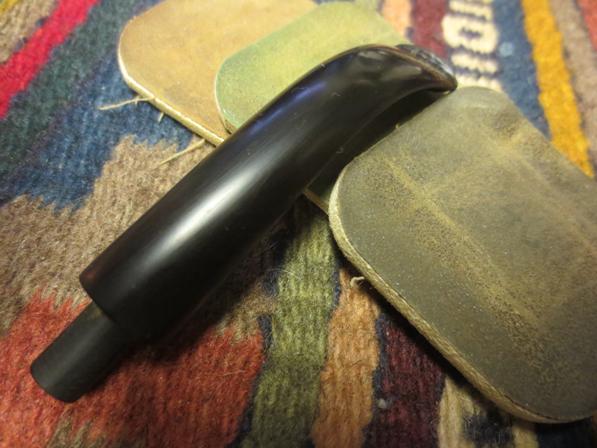
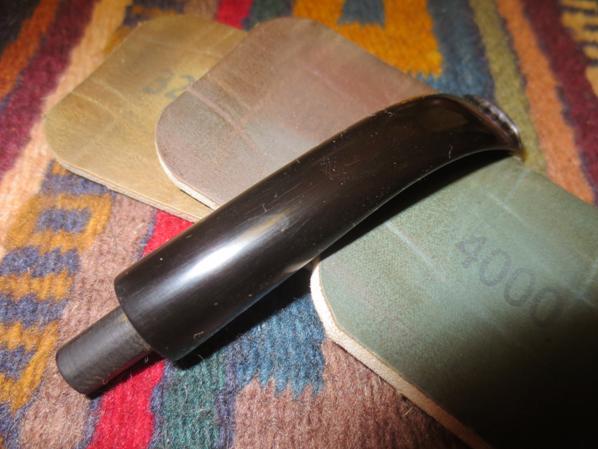
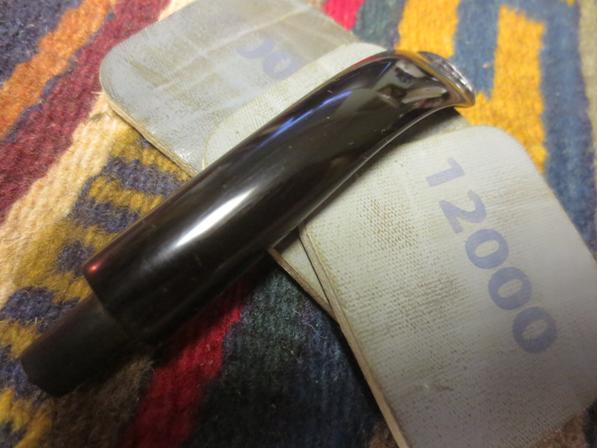
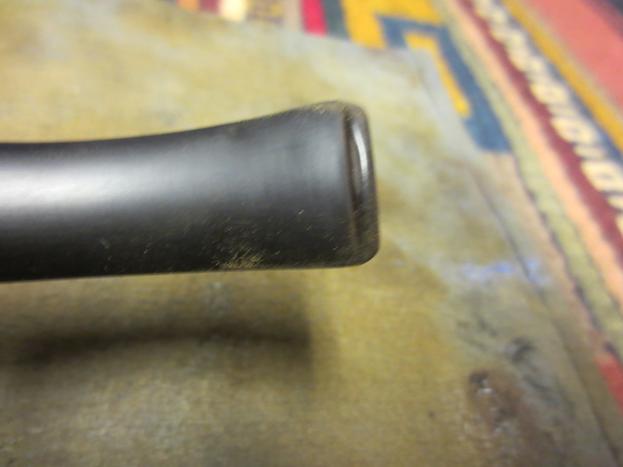
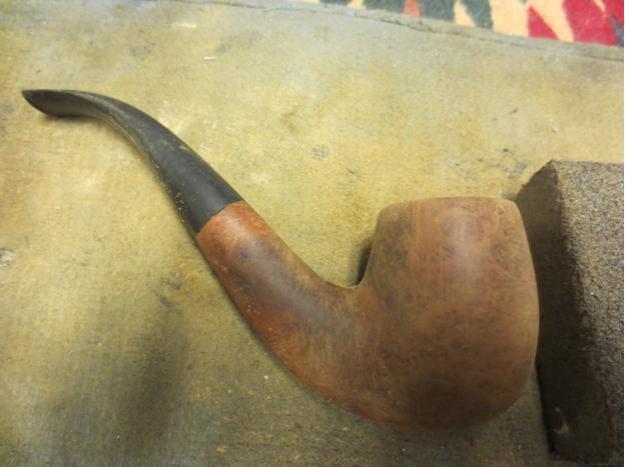
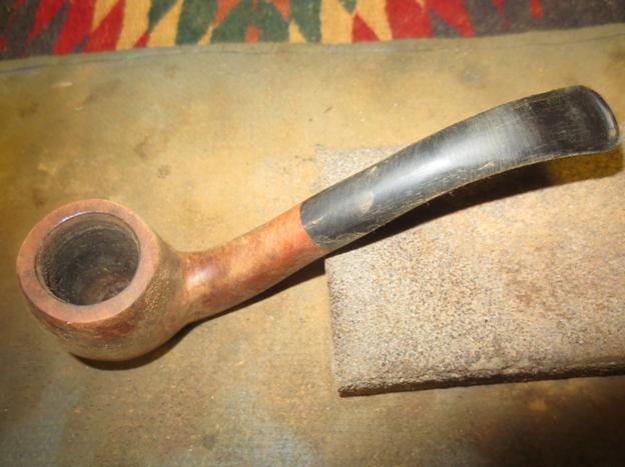
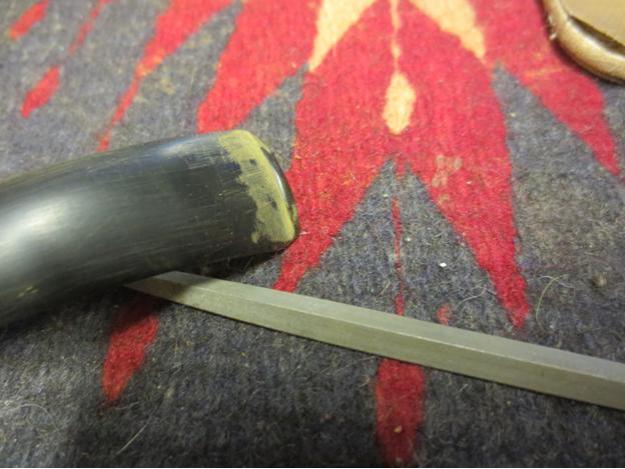
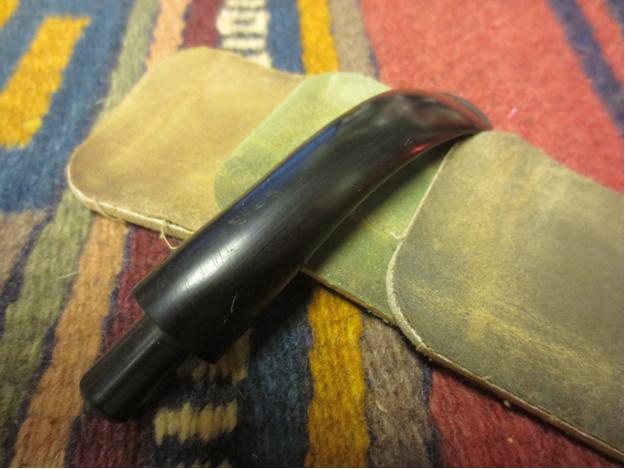
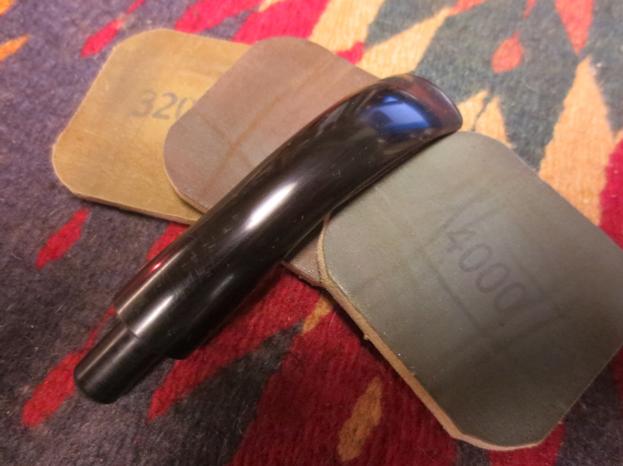
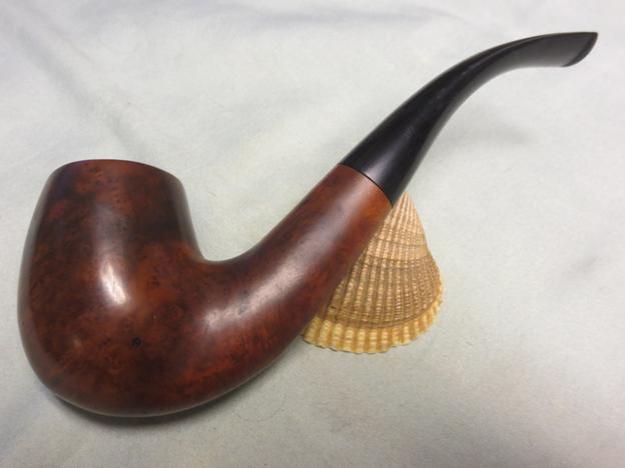
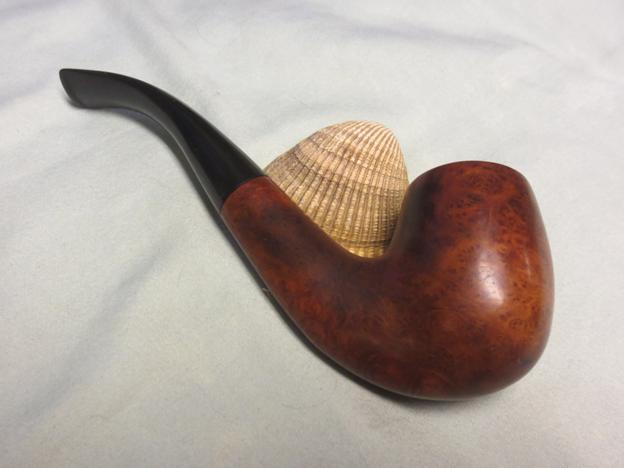
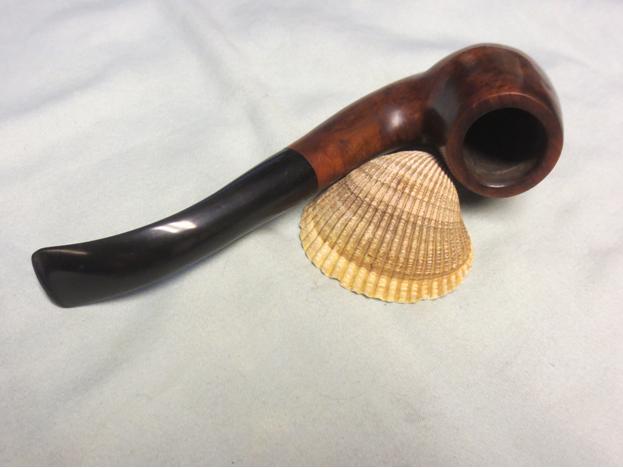
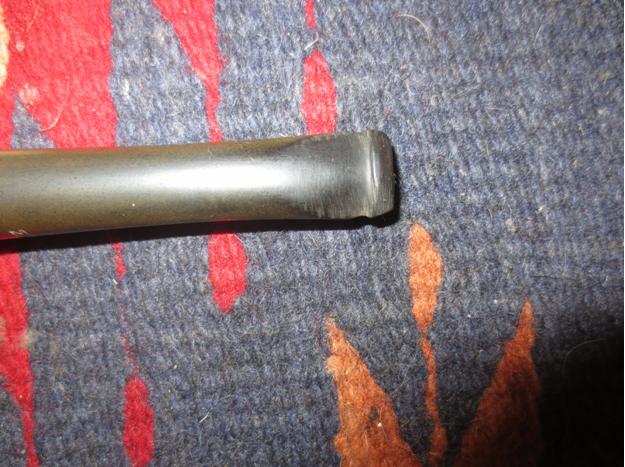
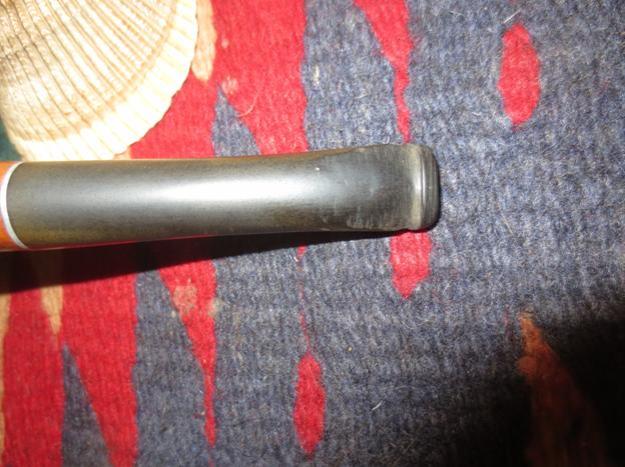
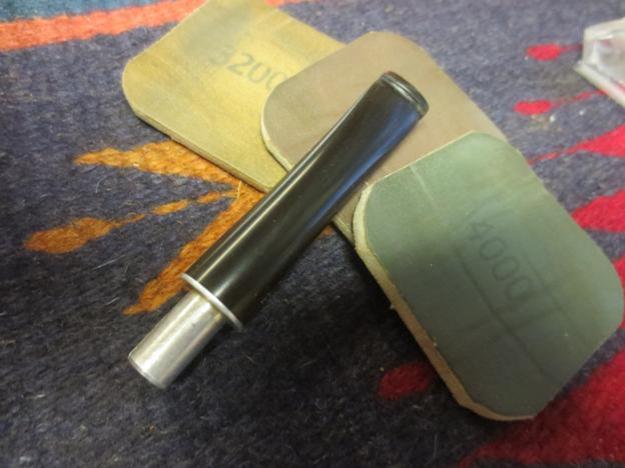
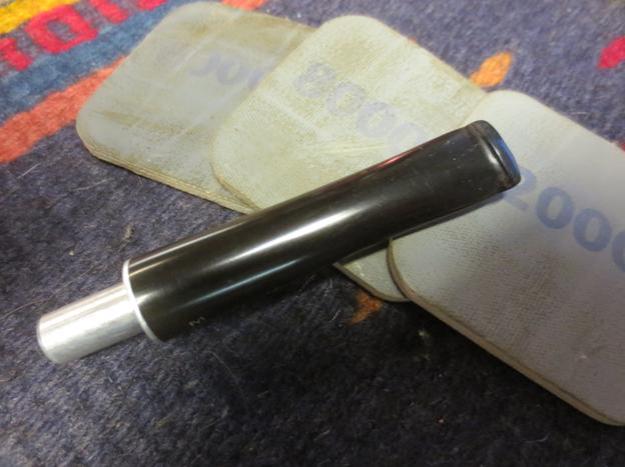
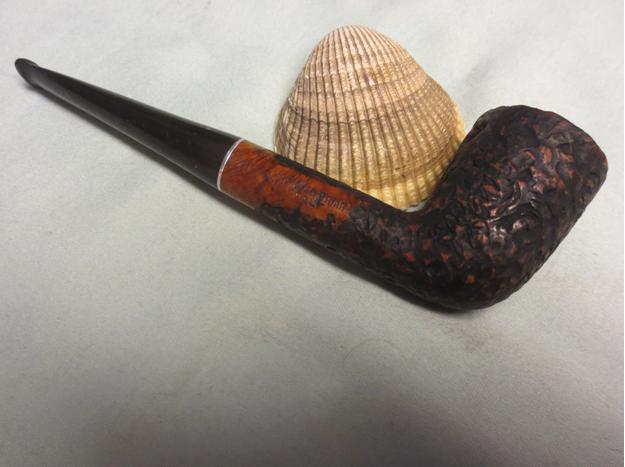
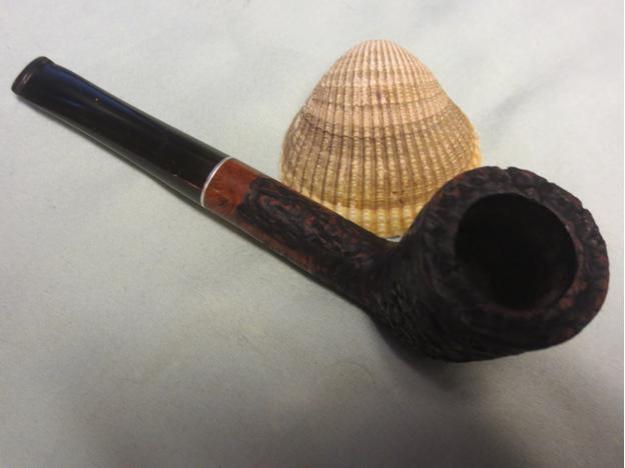
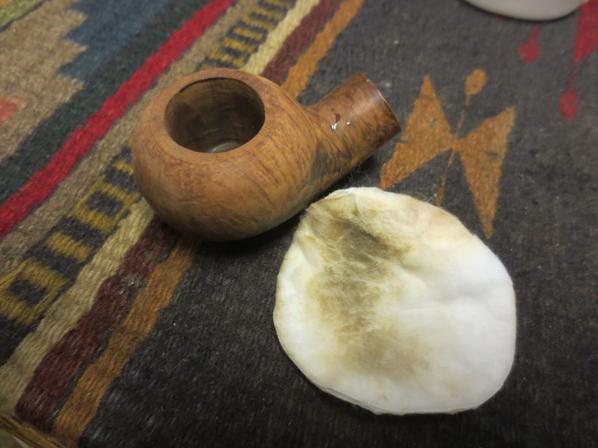
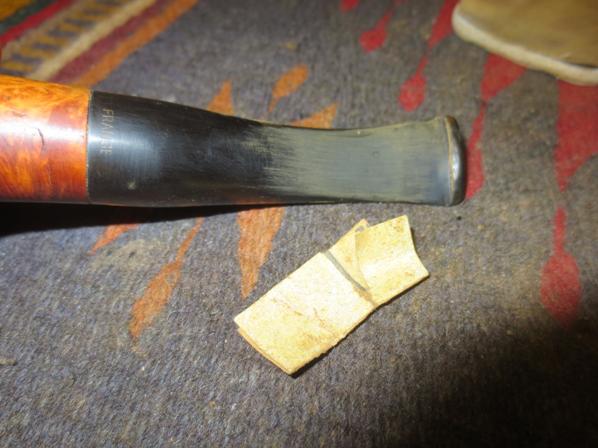
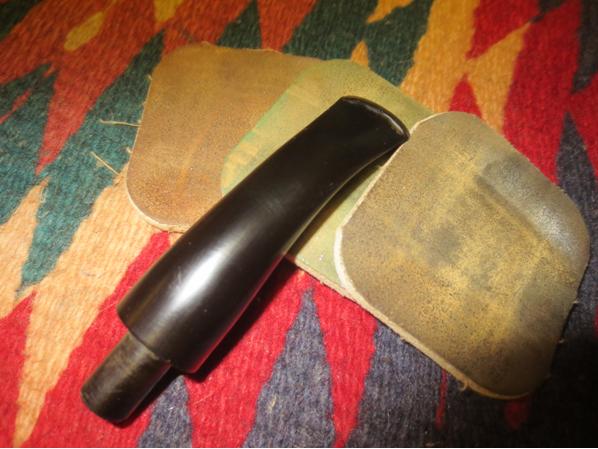
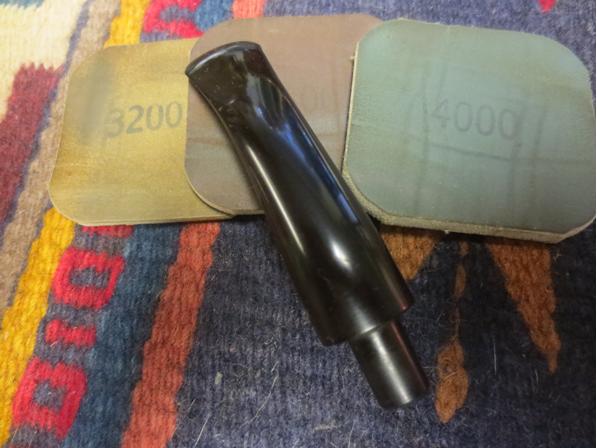
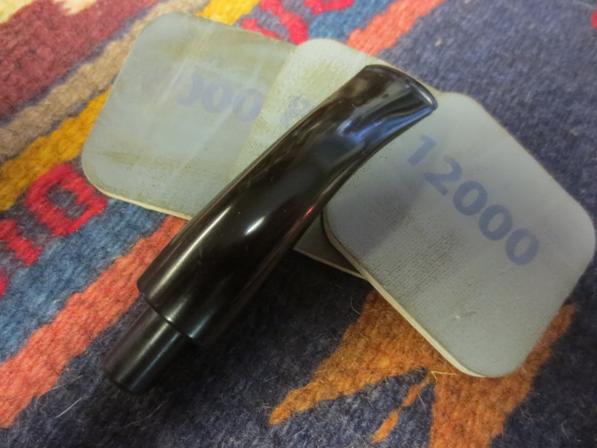
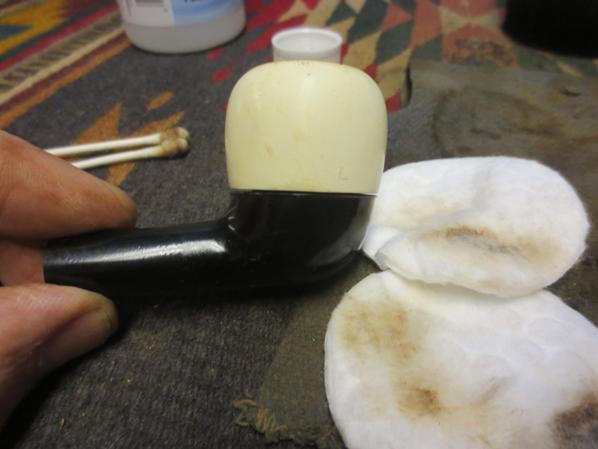
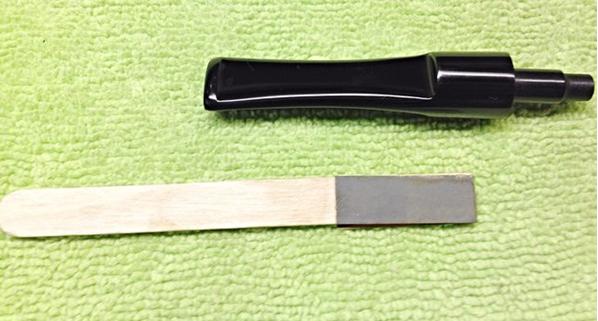
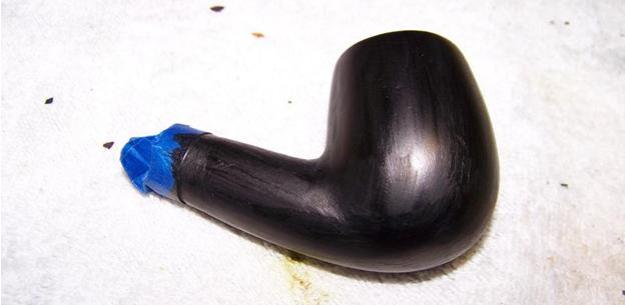
The crease and dents on the front were steamed out and the entire pipe stripped of wax and stain. I really wanted something darker than the original stain so I mixed 2 parts of medium brown with 1 part oxblood and applied it. After the color set I buffed it to a rich dark mahogany and then applied four coats of carnauba wax, giving each a chance to harden in between. The stem was worked with Micro-Mesh and then a final buff with white diamond to bring up the gloss. Dun3There are some who would consider changing the color of a Dunhill to be heretical but I’m not so constrained. This one’s for my pleasure, the next guy can restore it for authenticity. I really like the color and overall the pipe looks better than it did at the start so I don’t feel the slightest bit guilty. Burn me at the stake if you like, I’m unrepentant.

A Sparkling Metallic Dr. Grabow Viking with Three Bowls


Blog by Steve Laug

This older Dr. Grabow Viking came to me as a gift from a Facebook friend. He gave it to me along with some other pipes for me to enjoy restoring. This one is stamped next to the heel of the metal base – Viking Pat. Pend. The metal is sparkling metallic silver. It has flecks throughout the paint that make it sparkle and shine. When it came it was together in a plastic sandwich bag. The base unit was tired and dirty. The bowl on the base was caked with an over flow of lava onto the rim. The other two bowls had been reamed and cleaned. The finishes on all three were dirty and dull. The rims on all three bowls show damage from burns or being knocked out on a hard surface. When I removed the bowl the interior of the base was caked with the thick lacquer of the juices of tobacco as it burns. It looked to me like it had not been cleaned in a long time and the black thick oils had hardened like rock in the base. The airway was clogged with debris. The stem had collapsed from being bitten on. The tooth marks were deep but did not go through into the airway. The sharp edge of the button was worn almost smooth. I was not able to push a pipe cleaner through the airway from the button or from the airway in the bottom of the base.

G1G2G3

I took a few close-up photos. The first shows the inside of the base and the build up there. The second and third show the bite marks on the stem. The second photo shows the top of the stem and the bite mark on that surface, though not looking bad in the photo, collapsed the airway and made it impossible for a pipe cleaner to pass through. The fourth photo below shows the stamping on the bottom of the base.G4G5G6G7

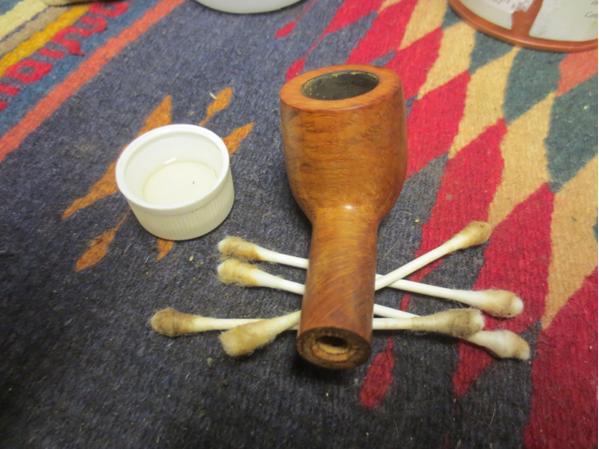
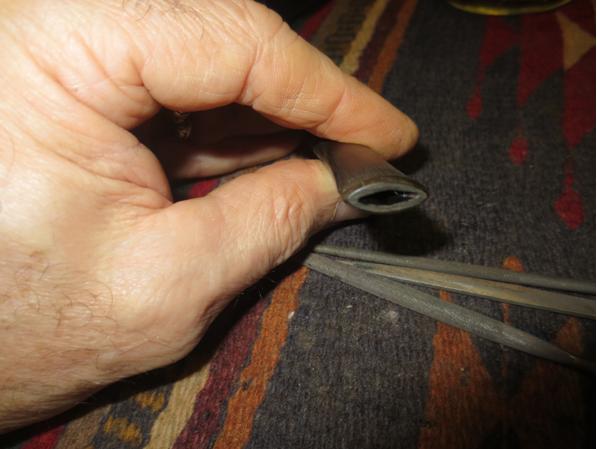
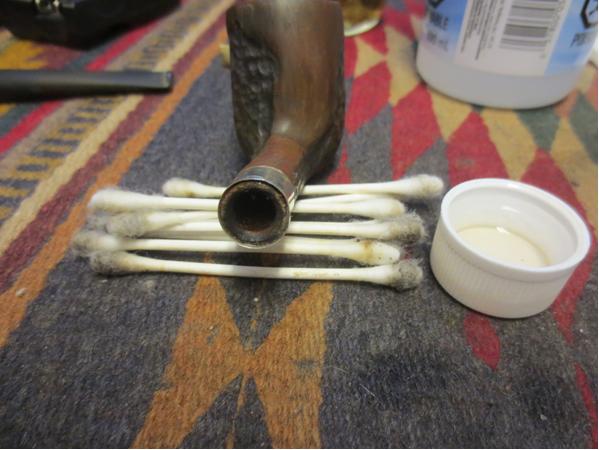
I scrubbed out the inside of the base with pipe cleaners, cotton swabs and alcohol. I also used a brass bristle brush. I opened the slot and airway in the stem with a flat needle file. I inserted the needle file and pushed the indentation on the top of the stem upward to clear the airway. It took a lot of fiddling with the file to open the slot completely. I cleaned the airway and stem with pipe cleaners and alcohol.

G8

I repaired the tooth marks with black super glue and set the pipe aside for the evening to allow the glue to cure. I have not had good luck with this kind of fill using the accelerator as it tends to cause air bubbles in the dried glue.

G9G10

I reamed the cake in the one bowl with a Pipnet reamer and took the cake back to bare briar.

G11G12

In the morning I sanded the repairs on the stem with 220 grit sandpaper to smooth the surface of the repair and blend it with the stem. I used a needle file to sharpen the edges on the button.

G13G14G15G17

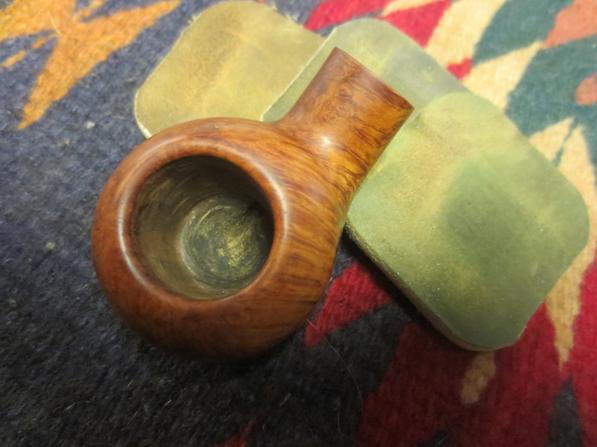
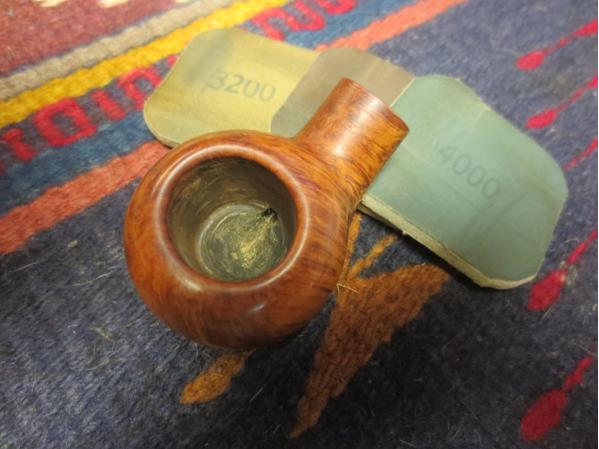
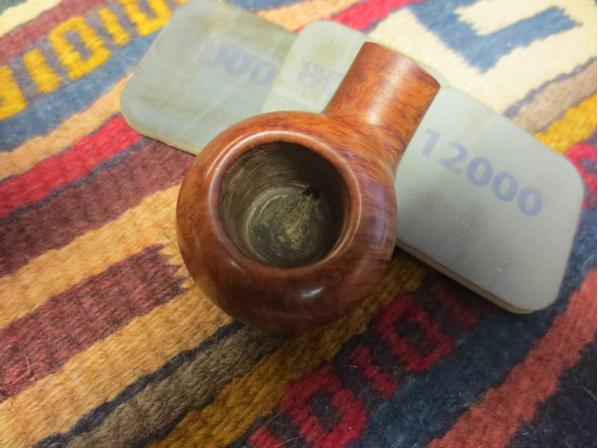
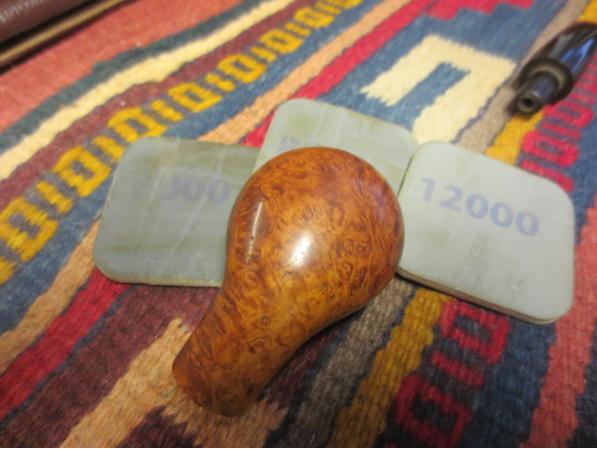
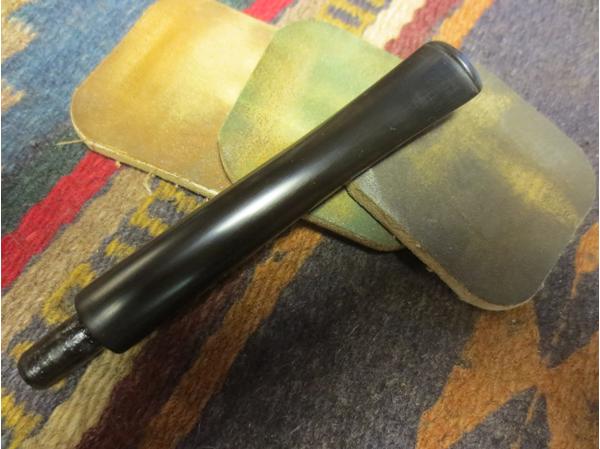
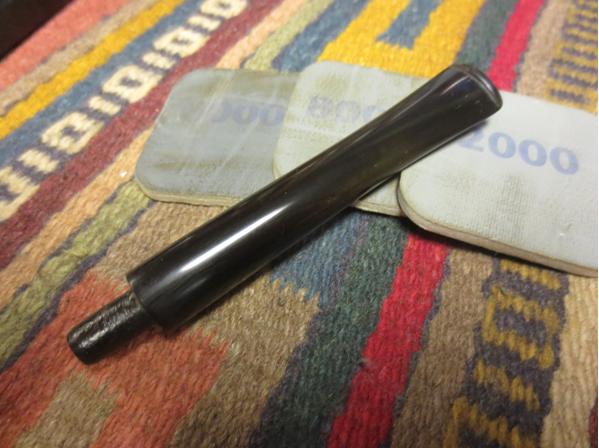
Once I had the surface smooth I sanded the stem with micromesh sanding pads. I wet sanded the stem with 1500-2400 grit pads and then rubbed it down with Obsidian Oil. I dry sanded the stem with 3200-4000 grit pads and gave it another coat of oil. I finished dry sanding it with 6000-12000 grit pads and gave it a final coat of Obsidian Oil. I set it aside to dry.

G18G19G20

With the base finished I set it aside and turned my attention to the bowls. I topped all three bowls on the topping board. The short bowl that I reamed had some dents and rim damage. The other two had burn marks and rounded edges that needed to be cleaned up.

G21G22

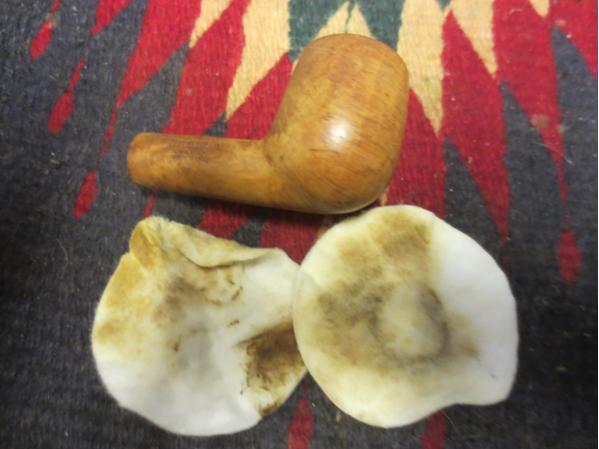
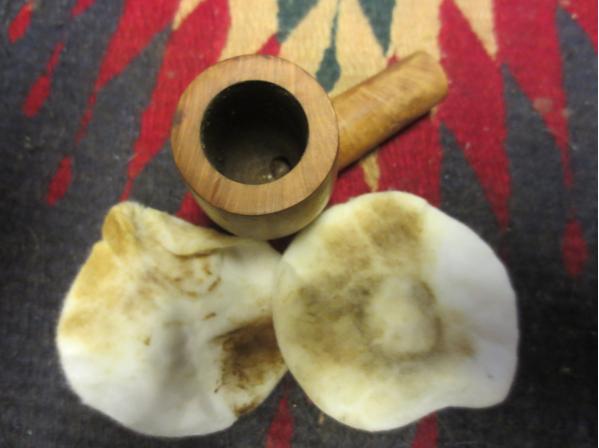
I wiped the bowls down with acetone on cotton pads to remove the finish and the grime.

G23G24

I stained all three rims with the light brown stain pen for the first coat. I then gave all three bowls several coats of Cherry stain Danish Oil and buffed them to a shine.

G25G26G27G28G29

I finished the restoration by buffing the bowls with Blue Diamond and then giving the bowls and the stem several coats of carnauba wax. I buffed the whole pipe with a clean buff and then with a microfibre cloth to raise the shine. The finished pipe is shown in the photos below. Each photo shows a different angle and includes the base with all of the bowls in place.

G30G31G32G33G34G35G36G37G38G39

More Work than I thought – A Real Briar Billiard with a horn stem


Blog by Steve Laug

When I saw this pipe on eBay when my brother and I were searching for pipes in the estate pipe area I thought it would be a simple restoration. The briar appeared to be in decent shape and the finish looked very good. The rim was dirty but looked undamaged under the grime and tars. The horn stem did not look too damaged and should also be an easy repair. When the pipe arrived at my brother’s home he took the following photos and sent them to me to have a look at the pipe. It still looked pretty straight forward to me.RB1

RB2

RB3

RB4

RB5 When the pipe arrived here in Canada I was in for a surprise. It definitely looked good but the more I dug deeper the more issues that I found. The rim was tarred and covered with lava and underneath the outer edges were rounded over. The bowl had a light cake at the top and half way down and a deep groove had been cut in the bottom of the bowl by aggressive insertion of the pipe cleaner. The groove or pit was below the airhole entry to the bowl. The shank had been repaired and the crack that I noted in the pictures had been well repaired and the band put in place to strengthen the shank. It would not take much to clean it up. The finish which at first glance looked good had deep gouges in the bottom of the bowl and on the left side of the bowl near the shank union. These were sharp cuts and could not be steamed out. There was a large fill on top of the shank where it met the bowl. It appeared to be pink putty but it was solid and tight. The stem was also nicked quite a bit on the top mid stem and on the left side near the band. The top and bottom sides had some deep tooth marks on them that I could not see from the photos. The stem was very tight in the shank and took some persuasion to remove.RB6

RB7 The next two photos show the repair work on the underside of the shank. It was very well done and would not need to be further dealt with. The third photo shows the rim with the rounded outer edge.RB8

RB9

RB10 I removed the stem from the shank with a bit of pulling and found that the metal tenon was covered with tar and had been stuck in the shank by the tars.RB11 I reamed the bowl back to bare wood to bring the rest of the bowl in line with the bottom half. I used a PipNet reamer with the second cutting head. In the second photo you can see the deep pit in the bottom of the bowl.RB12

RB13 I cleaned out the stem and the tenon with alcohol, cotton swabs and pipe cleaners.RB14 The next two photos show the tooth marks on both sides of the stem. They are quite deep and they will need to be repaired.RB15

RB16 I wiped down the stem with a cotton pad and alcohol and then put drops of super glue in the tooth marks. I sprayed them with accelerator.RB17

RB18 I scrubbed out the mortise, shank and bowl with alcohol, pipe cleaners and cotton swabs. I scrubbed until the pipe cleaners and cotton swabs came out clean.RB19 I topped the bowl to remove the damage to the bowl top and to clean up the round outer edge of the rim. Once again, note the deep pit in the bottom of the bowl that is visible in the second photo.RB20

RB21 I scrubbed the exterior of the bowl with cotton pads and acetone to remove the finish and the grime that was ground into the briar. I was going to need to do some work on the gouges on the bowl sides and bottom so I wanted it clean.RB22

RB23 The stem never sat completely tight against the shank so I beveled the inner edge of the mortise to accommodate the tenon/stem junction.RB24 With the externals cleaned I decided to do the repairs on the gouges on the bowl side and bottom. I put a drop of clear super glue in the divot and then pressed briar dust into the hole with a dental spatula. I pressed the dust deep into the glue to get a good fill. The second photo below shows the bowl side and bottom with what looks like a pox. The briar dust and glue fills are dry at this point and ready to sand. I sanded them with 220 grit sandpaper and then with 1500-2400 grit micromesh sanding pads.RB25

RB26

RB27

RB28 I used a light brown stain pen to give the fresh sanded briar on the bowl bottom and the rim an initial coat. I then stained the entire bowl with a dark brown aniline stain, flamed it and repeated the process. I set it aside to dry for about 30 minutes before buffing with Blue Diamond on the wheel.RB29

RB30

RB31

RB32 I mixed a batch of pipe mud (cigar ash and water) to fill the pit in the bottom of the bowl. I put a pipe cleaner in the airway with just the tip extending into the bowl. I used the spatula to put the mud in the bottom of the bowl and pressed it into the pit with the hand of the spatula. I added the pipe mud until the bowl bottom was level.RB33 I set the bowl aside to so that the pipe mud would cure and worked on the stem. I sanded the stem with 220 grit sandpaper to smooth out all of the nicks and scratches as well as blend in the super glue fills. It took a lot of sanding to smooth out the stem surface and remove as many of the scratches and dents as I could and still keep the profile. The super glue dried hard and the clear glue looks shiny and raises colour in the horn so it is very visible at this point.RB34

RB35 When I had smoothed out the surface of as many flaws as possible I worked on it with micromesh sanding pads. I wet sanded it with 1500-2400 grit pads. The repairs are starting to blend in. They will never be invisible but they are smooth. I rubbed the stem down with Obsidian Oil before continuing.RB36

RB37 I wet sanded the stem with 3200-4000 grit micromesh and then dry sanded with the same grit pads. I gave it another coat of the oil.RB38

RB39 I finished by dry sanding the stem with 6000-12000 grit micromesh sanding pads and then buffing the stem with Blue Diamond on the wheel. I gave it a final coat of Obsidian Oil and set it aside to dry.RB40

RB41 I polished the silver band with silver polish and brought the parts together. I gave the pipe a final buff on the wheel and gave it multiple coats of carnauba wax. I buffed it with a clean buff and the with a microfibre cloth to raise the final shine. The finished pipe is shown in the photos below. While the patches in the stem still show they are shiny and smooth to the touch and will give protection to the stem. The repairs to the cuts and gouges in the bowl look really good and virtually disappear under the stain and the polish. The pipe should live through at least another life time before it needs this kind of attention again.RB42

RB43

RB44

RB45

RB46

RB47

RB48

RB49

RB50

If it’s good enough for Bing then it’s good enough for me – Mastercraft Standard Oom Paul


Blog by Steve Laug

MCOver the years I have cleaned up quite a few Mastercraft pipes. My brother picked one up on Ebay for me recently. It looked like a good one when he sent me the photos of the pipe. I could not wait for it to arrive and I could begin to work on it. In one of my earlier blogs I wrote a bit about the history of the brand (https://rebornpipes.com/2014/06/22/learned-a-bit-of-american-pipe-history-mastercraft-executive-choice-pot-restored/). In that article I made the connection of the brand to Bing Crosby. I posted this old advertisement for the pipes with the old crooner himself.

The connection between the pipe in this advert and the Oom Paul I received from my brother. They both bear the same stamping. The both had the shield on the left side of the shank and then bore the same stamping. The Oom Paul was stamped Mastercraft over Standard in the shield. On the right side of the shank it was stamped I continued through the Google list for Mastercraft and one of the next listing was in Pipedia. http://pipedia.org/wiki/Mastercraft

It doesn’t appear that Mastercraft was ever a manufacturer and bought pipes from multiple factories — mostly French and English. It survived briefly the post war recovery and then was acquired by Grabow. As an importer of finished pipes M/C worked with many of the world’s foremost pipe makers and had in inventory finished product from the likes of… England: Hardcastle and Orlik. France: Ropp, Jeantet, Jean LaCroix. Italy: Lorenzo, Gasparini, Federico Rovera, Emilio Rovera, GIGI Pipe, Brebbia, Santambrogio, Fratelli Rossi. Israel: Shalom and Alpha. Plus all the tools, pouches and lighters from Hong Kong and Japan. The list of suppliers is enormous.

I had also found some older RTDA Almanac pages on Chris’ Pipe Pages site. http://pipepages.com/index.html. The first one of these shows the Mastercraft Standard. It sold for $3.50 and was a midrange pipe value as shown on the list below.The first of these shows the address of the Mastercraft Pipe Company in New York which was where they were prior to moving to North Carolina. I clipped this image from the 1949 RTDA Almanac. It is an early catalogue listing, since the brand was created in 1941.MCa My guess, judging from the previous advertisement and the 1949 RTDA Almanac clipping above, is that the pipe I have is from the period between the beginning of the company and the publication of this catalogue (1941-1949). After that period in the 50’s and 60’s the names of the pipes changed and I was not able to find the Mastercraft Standard in later catalogues.

MC1The photo to the left and the next two photos that follow are the ones my brother sent to me before I received the pipe. They give a good idea of the condition of the pipe when I received it. The pipe had a natural finish, no stain on the briar. Over the years the briar takes on a richer colour. This one had taken on a reddish tint. The stamping on the left side still showed the gold stamping in some of the grooves. There were specks of white paint on the bowl, shank and stem. There was also some darkening on the sides at the shank junction with the bowl from oils and soiling from the previous pipe man’s hands. The rim was thickly tarred with lava overflow. The bowl had a thin cake on the top 2/3 and the bottom 1/3 was still fresh briar showing raw briar. The pipe obviously had not been smoked to the heel. The stem was quality rubber and did not show signs of metal fragments in the mix that seem to appear in many of the war year pipes. There was little oxidation but there were tooth marks on the top and underside of the stem near the button. There was tooth chatter on both sides. The stem did not fit tight against the end of the shank.MC2

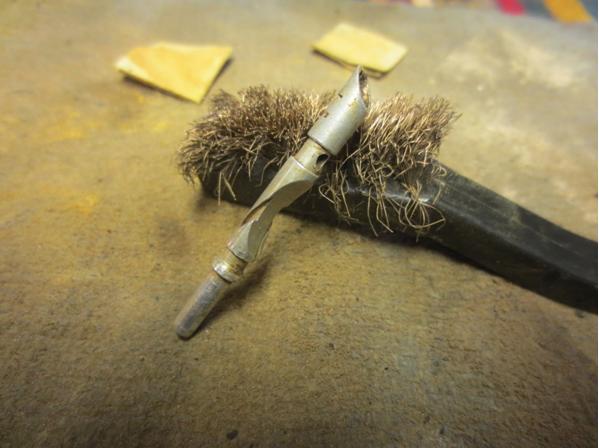
MC3 When the pipe arrived I put it in my refurbishing box and would eventually get to it. Today I took it out of the box to work on it. I removed the stem and was a bit surprised to see the interesting and unusual stinger apparatus in the end of the tenon. It had a flat blade that ended in a point. It was almost a spear point. It sat down in the sump of the shank. It ended at a spiral cylindrical piece with a slot in the last half of the cylinder. It fit into tenon by pressure and was easily twisted free.MC4

MC5 I scrubbed the bowl with acetone on cotton pads to remove the grime and soil in the briar and the white flecks of paint on the bowl and shank. I scrubbed the rim with the acetone as well to try to remove the lava overflow that was present. I used a pen knife and scraped at the lava between wipes of acetone and was able to remove the buildup without damaging the finish on the rim. I did not need to top the bowl!MC6

MC7 The acetone removed the grime from the briar and all of previous coats of wax that had given it a dull finish.MC8

MC9

MC10 Once I had cleaned the finish of the bowl and shank with the acetone I washed it down with alcohol and dried it off. I used some antique gold Rub ‘n Buff to restore the stamping to its previous look.MC11

MC12 I hand buffed the bowl with a shoe brush and a little Conservator’s Wax to protect it during the rest of the clean up. Though I probably should have done the next step before the work on the stamping I did not do so. But such is the way things go. I reamed the bowl with a PipNet reamer using the third cutting head to take back the cake to bare briar. Since the bottom 1/3 of the bowl was uncaked I wanted the transition between the sides of the bowl from top to bottom to be smooth.MC13

MC14 I scrubbed the stinger with alcohol and cotton swabs to remove the grime. I also scrubbed it with a brass tire brush.MC15 I cleaned out the airway in the stem with pipe cleaner, cotton swabs and alcohol to remove the tars and oils. I was surprised to find that the tenon was lined with an aluminum tube. The stinger pressed against the sides of the tube when it was inserted. I think it was also an attempt to strengthen the tenon.MC16 I scrubbed out the mortise, sump and airway on the bowl with cotton swabs, pipe cleaners and alcohol until they came out clean.MC17 I sanded the tooth chatter and tooth marks on the top and bottom of the stem with 220 grit sandpaper to remove them as they were not too deep.MC18

Mc19 I wet sanded the stem with 1500-2400 grit micromesh sanding pads and rubbed the stem down with Obsidian Oil. I dry sanded it with 3200-4000 grit pads and gave it another coat of oil. I finished sanding it with 6000-12000 grit pads and gave it a final coat of oil, then left it to dry.MC20

MC21

MC22 I rubbed down the bowl with a light coat of olive oil and then buffed it with Blue Diamond. I gave the bowl and stem multiple coats of carnauba wax and then buffed it with a clean buffing pad. I gave it a final buff with a microfiber cloth to raise the shine. The finished pipe is shown in the photos below. It should provide many years of service to the next pipe man whose rack it graces. It will likely outlive both that pipe man and me and be passed on it trust to the next person who will enjoy it companionship for the years that they have it in trust. These old pipes always outlive the pipe man who keeps them company if they are well cared for (and even sometimes when they are not!).MC23

Mc24

MC25

MC26

MC27

MC28

MC29

I love these old timers – this one is a GC Bulldog


Blog by Steve Laug

When I found this old bulldog on EBay I was drawn to it and immediately put in a bid. I won it as no one else saw the charm in this one. It was a hard to see the stamping in the photos and many of the photos the seller included were out of focus which even made it harder to figure out the state of the pipe. The seller identified the pipe as a GC Bulldog. The seller’s photos that I have chosen below show the condition of the pipe. The finish is dirty and there are definitely dings and nicks in the briar. The bead around the cap of the bowl is a nice touch and it too is worn. The stem is oversized and is larger in diameter than the bowl so it makes one wonder if it is original. The threaded bone tenon in the stem fits perfectly in the shank with the alignment matching. The angles of the shank and the stem match. The vulcanite stem is just slightly larger than the shank on the left side of the pipe but works on the right side. The button is rounded and has an orific opening that shows that it is the proper age for this pipe. All that I saw was enough for me.G1

G2

G3 When the pipe arrived my assessment from the photos was correct. The stem was a good fit but it was larger than the shank on the left side. The bone tenon was in excellent shape with no wear and tear on it. It was stained with the tobacco juices of the long smoking. The shank was dirty and the airway in the stem was dirty. The airway in the bowl was clogged so no air would go through it no matter how hard I blew on the shank. The rim had serious damage on the right side front. There was a chunk of briar missing from the inner edge of the bowl and there was a scar running part way down below that. The rim had a divot at that point and also on the front itself that looked to have been caused by overzealous lighting from the exact same point every time the pipe was smoked. The bowl had been reamed and looked clean and smooth other than the damage on the right top side. The finish was dark and dirty. The stem had tooth marks on the underside near the button and tooth chatter on the top side. The next four photos show the pipe when I brought it to the work table.G4

G5

G6 The next photo is a close-up of the rim to show the damage. I decided to top the bowl so I used the topping board and 220 grit sandpaper to remove the top surface damage to the rim edge. When I had topped as much as I could without changing the profile of the bowl it was time to decide how to address the damage. I set that aside for a bit and worked on the fit of the stem.G7

G8

G9 I sanded the stem sides with 220 grit sandpaper to bring it to the same height and dimensions as the shank. It took work on the left sides and some adjustments to the right side. I also needed to work over the points of the diamond to make the alignment straight and flowing. I sanded the tooth marks and tooth chatter at the same time and was able to remove it.G10

G11

G12

G13 I wiped the bowl down with acetone on cotton pads to remove the damaged and dirty finish that remained on the bowl. With these old finishes the grime and some of the clouded top coat disappears and the grain begins to poke through as the bowl is scrubbed.G14

G15 I worked on the internals of the mortise, airway and the airway in the stem. Since the airway in the mortise was plugged I used a round dental pick to push through the grime that plugged the airway. I reamed out the airway with the pick and then scrubbed it with pipe cleaners and a shank brush until it was clean. I scrubbed out the mortise with pipe cleaners, cotton swabs and alcohol until it was clean and smelled fresh. I swabbed out the inside of the bowl with cotton swabs and alcohol. I used pipe cleaners and alcohol in the stem airway and cleaned the threads on the bone tenon with cotton swabs.G16

G17

G18 With the interior of the bowl clean I lightly sanded the inner edge of the bowl in the damaged area. I put some small drops of super glue on the rim and inner edge and used a dental spatula to press briar dust into the glue.G19

G20 I retopped the bowl to smooth out the repair and sanded the inside with a folded piece of 220 grit sandpaper to smooth out the curve of the inner edge.G21

G22 I sanded the top and rim edge with 400 grit wet dry sandpaper and then with 1500 grit micromesh in preparation for staining. I stained the areas where I had sanded the shank to match the stem and the rim with a dark brown stain pen.G23

G24

G25 I hand buffed the stained areas and the rim and took the following photos.G26

G27

G28

G29 I wet sanded the stem with 1500-2400 grit micromesh sanding pads and then rubbed the stem down with Obsidian Oil. I dry sanded the stem with 3200-4000 grit pads and gave it another coat of oil. I finished sanding with 6000-12000 grit pads and gave it a final coat of oil. I set the stem aside until the oil dried.G30

G31

G32 I gave the bowl and stem several coats of Conservator’s Wax and hand buffed the pipe and stem with a shoe brush and a microfibre cloth to raise the shine. The finished pipe is shown in the photos below. There are still some dents and dings on the sides of the shank and bowl that I chose to leave there. Some of them are the very faint stampings that remain on the right and left topside of the diamond shank. Some of them are beauty marks that came with the long life and hard travel of this little pipe. I chose to leave them as they were and imagine the stories that go along with them. Thanks for looking.G33

G34

G35

G36

G37

G38

Putting the Rusticated Rim back on a Savinelli Capri 121 Pot


Blog by Steve Laug

One of the gift pipes received from a friend when I repaired his pipe was a beautiful little Savinelli Capri 121 Pot. I love the finish on the Capris. There is something about the rusticated finish that adds a tactile dimension to the pipe that I thoroughly appreciate. This pipe was no exception. The finish on the bowl was in excellent condition though at some point in its life it had been topped. The typical rustication on the rim surface had been sanded smooth and the rim had been stained with a reddish brown stain. The internals of the pipe were very clean. The bowl had been reamed and the airway in the mortise was spotless. The stamping on the bottom of the shank was sharp and legible – it reads Savinelli Capri over Root Briar and the Savinelli shield and next to that the shape #121 over Italy.

The stem had seen better days but it was still repairable. It was oxidized and the gold stamping was faint on top of the saddle. There were tooth marks on the top and the bottom of the stem. The ones on top had been repaired and filled with a white looking epoxy. It was hard and smooth but it was white and it looked really bad with the brown oxidation on the stem. These would need to be removed and repaired when I worked on the stem. The tooth marks on the underside of the stem were not as deep and could easily be remedied by sanding the stem. The inside of the stem was also very clean. I took the following photos when I brought the pipe to the work table.Capri1

Capri2

Capri3

Capri4 I took some close-up photos of the rim and the stem to show the condition of both. The topping job on the rim actually was very well done. The refinish on it was impeccable – no scratches or grooves, just a clean smooth surface. The stem shows the story I mentioned above. The top side view shows the repairs and the underside view shows the dents.Capri5

Capri6

Capri7 Taking care of the dents on the underside of the stem was an easy matter. They were not too deep so I sanded the stem with 220 grit sandpaper and they disappeared.Capri8 The top of the stem was another matter. I wanted to remove the white repairs. I sanded the stem until they were four distinct repairs. Then I used the dental pick to pick away at the white epoxy repair until it was pitted and gave me a new divot to work with. I used some black super glue to refill the divots and cover the white that had been present before.Capri9

Capri10 I sprayed the glue with an accelerator and then sanded the repair with 220 grit sandpaper to blend it into the surface of the stem. In the next photo you can see that the white no longer was visible. The trick would be to keep it that way!Capri11

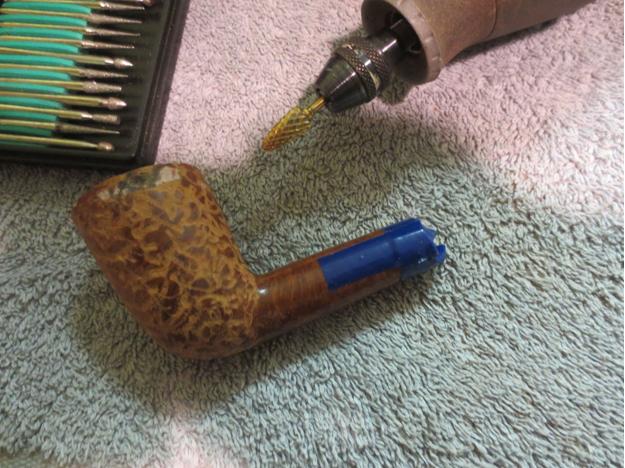
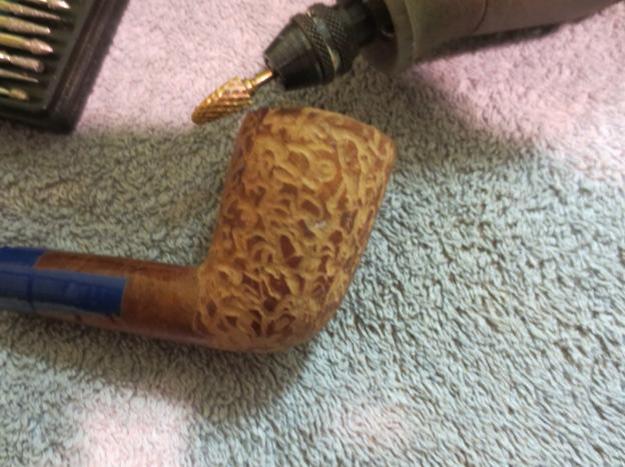
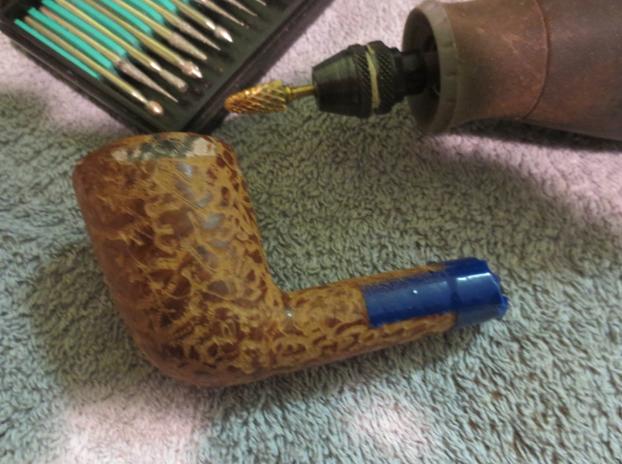
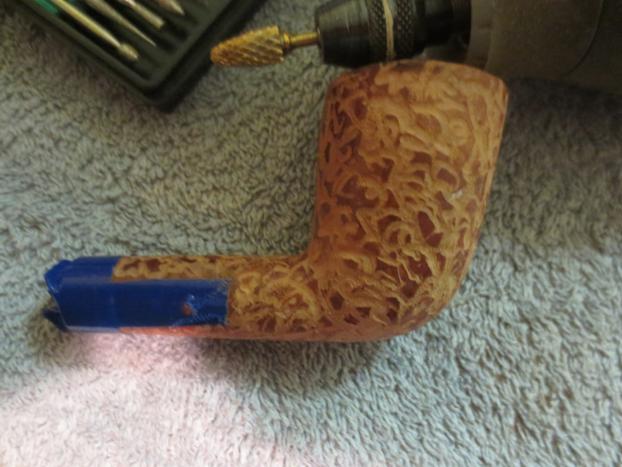
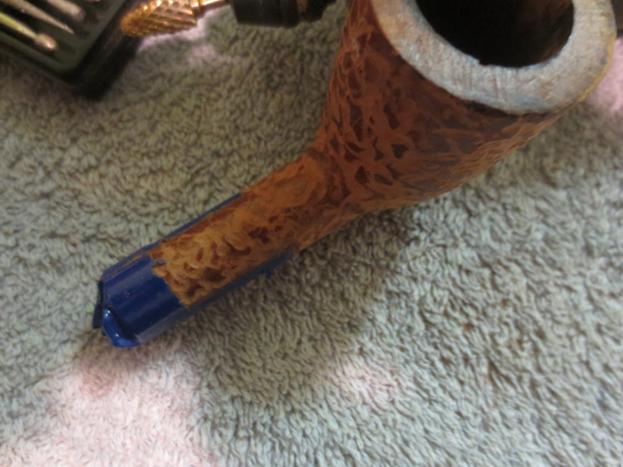
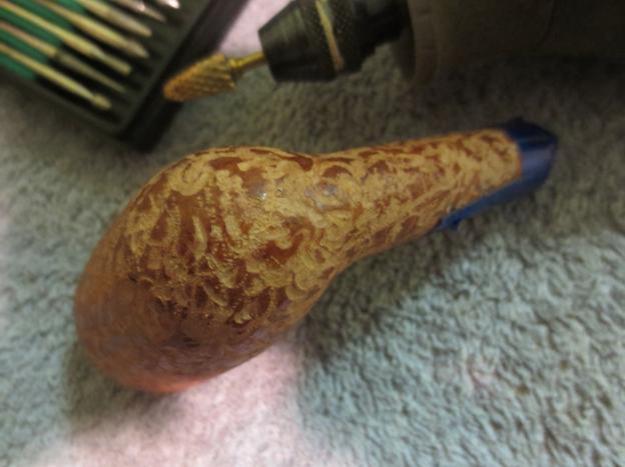
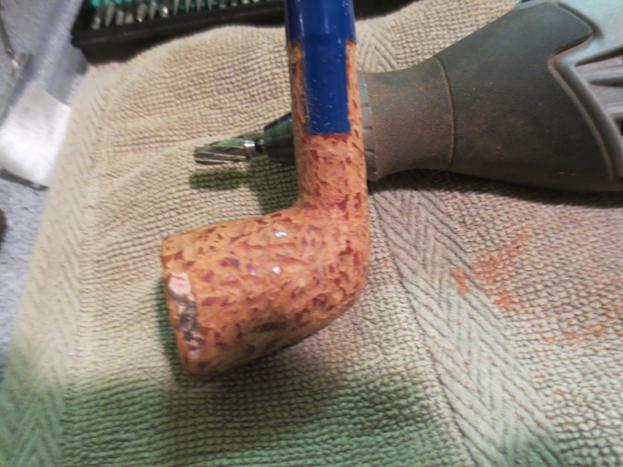
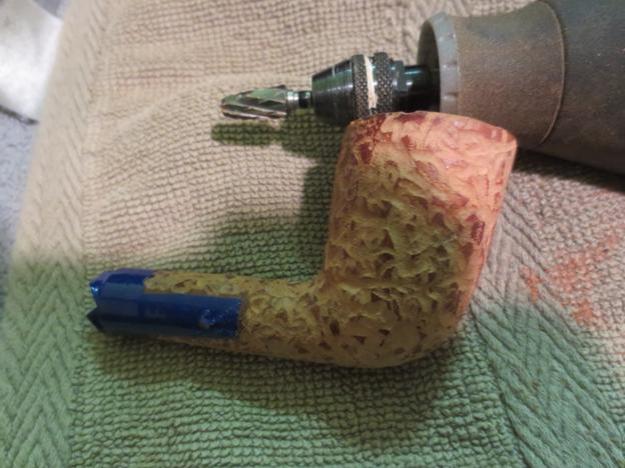
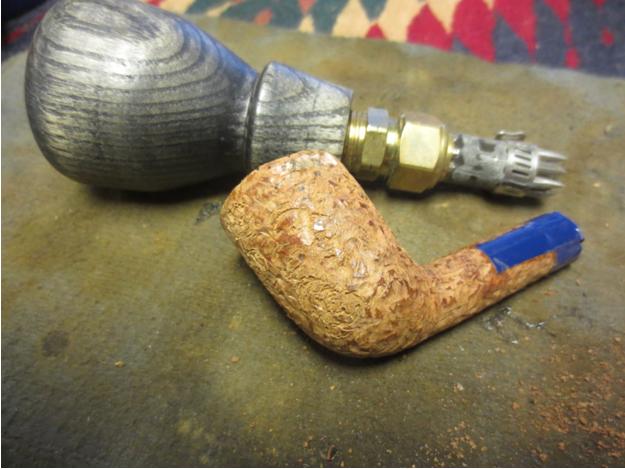
Capri12 Now it was time to address the rim. I was not sure about rusticating it because it actually looked quite fine the way it was. I went online and found a photo of a Capri that was the same shape and the rim was rusticated. I liked the look of the rim blending into the finish of the bowl. The decision was made. Now I had to work to get a similar look.Capri13 took out my Dremel and my assortment of burrs. I was pretty certain that I would use them all in the process of rusticating the rim with a deep and pebbled look.Capri14 I started with a simple cylindrical burr to carve some random swirls across the rim. I did this lightly at first and then deepened them. At this point I kept to the middle of the rim as I had ideas about rusticating the edges a little differently.Capri15 I followed that by using the ball burr to deepen the swirls and work on the inner and outer edges of the rim. At this point the surface was beginning to look good. But too me it was not rustic enough for the Capri finish on the bowl – it was too tame looking.Capri16 I used cone burr next with a cross hatch pattern to randomize the pattern even more and deepen the grooves in the surface and edges.Capri17 I next moved onto another cone burr with a spiral pattern and continued to work on the rim pattern. It was getting close to the point I was aiming for.Capri18 I used the last cone burr that had a swirl pattern in the opposite direction and went over the rim again to further accent the roughness.Capri19 I used the cylindrical burr to cut some of the lines between the divots and edges of the bowl and make it more craggy looking.Capri20 At this point in the process I was finished with the burrs and I put a coat of medium brown stain on the high points in the rustication using a stain pen. I followed that up with using a black Sharpie pen to fill in the divots and low spots on the rustication.Capri21

Capri22 I scrubbed the newly stained rim with a brass bristle brush to knock off some of the high spots and get a more burnished look like the bowl sides. I still was not happy with the stain so I used the sharpie again to darken the low spots and grooves. I then restained the rim with the dark brown stain pen. The colour was very close to the sides of the bowl.Capri23

Capri24

Capri25 I could have probably stopped there but I did not. I studied the photo of the rim above and noted that there were some striations or cuts in the surface of the rim that connected all the rustication and gave it a distressed look. I have a serrated edge letter opener here that I thought might work to give me more of that look. I cut the surface from every direction with the edge of the letter opener and carved and hacked it to distress it. I used the brass brush once again and then recut the rim with the opener.Capri26 I restained the rim with the black Sharpie and the dark brown pen. And then gave it a light buff on the wheel with Blue Diamond. I say light because if I had pressed any harder the polishing material would have gone into the grooves and made a mess. The rim looked good to me. The finish was done and all that remained was to wax it with some Conservator’s Wax.Capri27 I gave the bowl and rim several coats of Conservator’s Wax (works like Halcyon II on rusticated finishes) and buffed it with a shoe brush to polish and give a shine. I wet sanded the stem with 1500-2400 grit micromesh pads to begin the polishing process. It was tricky around the stamp on the shank so I had to work carefully with the pad to get as much of the oxidation as possible.Capri28

Capri29 I buffed the stem with White Diamond to further polish it and then sanded it with 4000 grit wet dry sandpaper to really work on the oxidation at the shank. It is a finicky part of the process because of the weak stamping. I rubbed the stem down with Obsidian Oil and then progressed to 3200-4000 grit micromesh pads. Another coat of oil preceded the final sanding with 6000-12000 grit pads. I gave the stem a final coat of oil and set it aside to dry.Capri30

Capri31 I buffed the pipe with a shoe brush and then with a microfibre cloth. I gave it several more coats of the Conservator’s Wax and polished it to a shine. I buffed the stem with Blue Diamond and gave it several coats of carnauba to protect it and then buffed the stem with a clean buff to raise the shine. I hand buffed the entirety one final time with a shoe brush and then took the finished photos below. This was a fun project. You can see that the white stem repairs have disappeared and the rustication on the rim fits the overall look of the pipe far better than the smooth finish that was there before. Thanks for looking. Capri32

Capri33

Capri34

Capri35

Capri36

Capri37

Mission Impossible: Operation Long Shot


Blog by Charles Lemon and Steve Laug

Charles posted this on his Dadspipes blog this morning and I reblogged it here on rebornpipes. I was thinking about it this evening and thought it was worth saving in total on both blogs so not only have I reblogged it but I also have put it here in the archives of this blog. That way it is easily accessible on both blogs. This was a fun project for both of us to do. We spoke this afternoon and already are working on another collaboration… Keep an eye out for it on both blogs.

The door opened and a man walked into the bar, pausing briefly in the doorway to allow his eyes to adapt to the dim light inside. The place was what optimists would euphemistically call a dive. The establishment was empty except for a few drunks and a large, bored-looking man behind the counter wiping glasses with a rag that was presumably once white but was now an indeterminate shade of grey.

The man walked through the room, turned in at a doorway marked “Gents” and scanned the room – two stalls, a urinal and a grimy sink – before spotting what he sought. Moving across the room, he fed a handful of coins into a coin-operated machine advertising cheap cologne. There was a rattle and then a small rectangular device dropped into a waiting hand. The man pushed his thumb against a small pad on the otherwise blank rectangle. A laser washed briefly up and down the pad and then a voice was heard.

“Good morning, Agent. You have been selected to join a small, two-man strike force for a delicate and potentially disastrous assignment. Your mission, should you choose to accept it…..”


A while back, Steve Laug of Reborn Pipes and I had a conversation about the limits of pipe restorations. Was a pipe ever truly beyond repair? We responded in the negative, and decided to put our theory to the test with this mission, code-named Operation Long Shot. We wanted a pipe that was so far gone that most people would immediately write it off as firewood or worse, the sort of thing barely recognizable as a pipe.

We selected as our test subject this Brigham 3-Dot Prince. As you can see in the photos below, it was in terrible condition when I came across it in a jumble of estate pipes I picked up about six months ago. I had been holding onto it with some vague notion of using it for spare parts.

The pipe was filthy, crusted with dirt and debris. The old finish was long gone, and the nomenclature was almost entirely worn away. Wiping the shank with a bit of water, however, revealed the thin, flowing script of the early Brigham logo stamped over “Can Pat 372982”. That stamp places the production date of this old warrior in the 1938-1955 range.

The pipe stem carried the three brass dots of Brigham’s mid-grade 300 series, but was deeply oxidized a gruesome yellow/green colour. It had been brutally chopped off at the bit and a crude button cut into the raw end. To add insult to injury, the bowl had suffered a burnout through the bottom, which had been “repaired” as delicately as the stem with a large clod of epoxy which spread over most of the bottom bowl surface. The interior of the bowl was in no better shape – the epoxy fill had been roughly wiped around the chamber floor, and the draft hole had been worn or burnt open to about double its original diameter. All in, this pipe was a train wreck, though evidently much prized by its previous owner who had refused to give up on it.

20160106_141017 20160106_141026
20160106_141059 20160106_141052
20160106_163456 20160106_163435

Mission Log: Agent Lemon. Phase I – Cleanup and Salvage

This restoration would be a great challenge, but Steve and I were up for it. We agreed to tag-team the job: I would clean up the stummel and salvage what I could from the hacked up stem, and then mail the briar across the country to Steve in Vancouver, BC. He would plug the burnout and tidy up the stummel and then send the pipe home to me in Kitchener, ON for re-stemming and the final fit and finish.

Wanting to get the pipe off to Steve as quickly as possible, I got going on the reaming and cleaning work. I used my Castleford reamer to remove as much carbon from the bowl as I could. I reamed very carefully, expecting the bowl to crumble in my hands, but the old girl held together. I think most of what came out was actually more dirt than cake, but at least the chamber walls looked ok except for the enlarged draft hole. I scrubbed the exterior of the stummel with Murphy’s Oil Soap and a soft toothbrush, and then dropped the briar into an isopropyl alcohol bath to soak overnight.

20160106_16380120160106_163811

While the stummel soaked, I had a good look at the stem. I have another Prince shape in my Brigham collection, and a quick comparison showed that the stem for this old pipe was missing about an inch of length. I decided that I would need to work up a new stem to replace the old one. A vulcanite stem would be relatively easy to get hold of, but an aluminum Brigham tenon was quite another matter. As the tenon on the junk stem was still in good shape (or would be after a good cleaning), I decided to salvage it to implant in the replacement stem. I heated the tenon and the end of the stem over a lighter flame until the vulcanite softened, then gently twisted the aluminum tenon out of the stem. One of the brass dots decided to come with it, demonstrating how Brigham used the first brass pin to help hold the tenon/filter holder in the stem.

20160106_164539
20160113_19515920160113_195700

The next morning, I pulled the stummel out of the alcohol bath and scrubbed it down with an old towel. This is when I ran into the first bit of luck on this project – the alcohol soak had softened the wide but thin patch of epoxy spread across the bottom of the bowl. I quickly grabbed a dental pick and scraped as much of the old adhesive from the briar as I could. I managed to remove most of the softened epoxy, revealing a central core of harder fill about 5/8″ in diameter. This then, was the original burnout.

20160108_09121920160108_091823
20160108_092022

I drilled out the core epoxy and used a tapered reamer to trip the opening to an even circle with fresh briar all around. This would be the hole Steve would need to plug.

20160110_10033420160110_101105
20160110_10120020160110_101206

My first stage of the mission was complete, so I packed the stummel securely and entrusted it to Canada Post for shipment to Steve in Vancouver.

Mission Log: Agent Laug. Phase II – Bowl Repair & Refinish

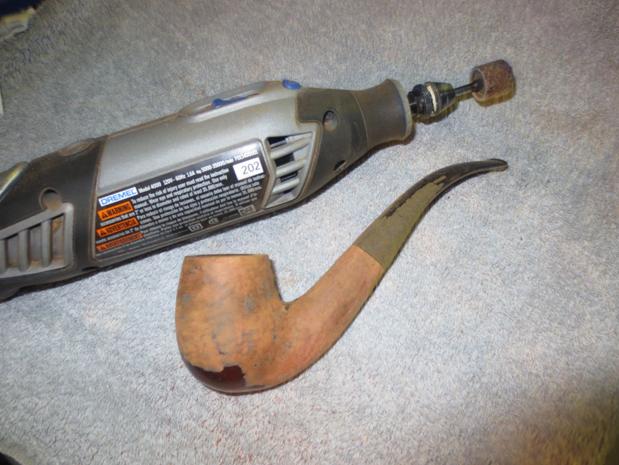
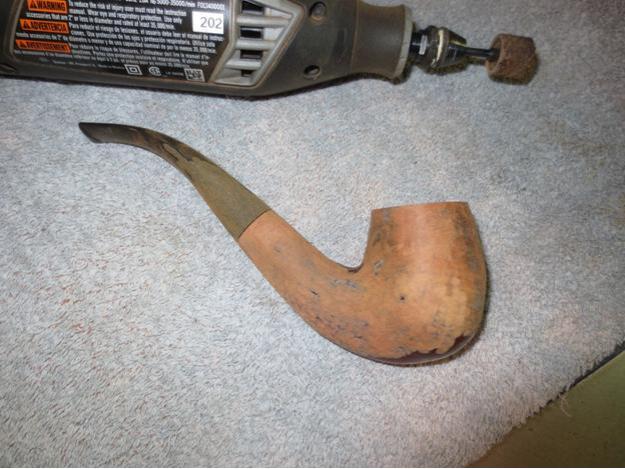
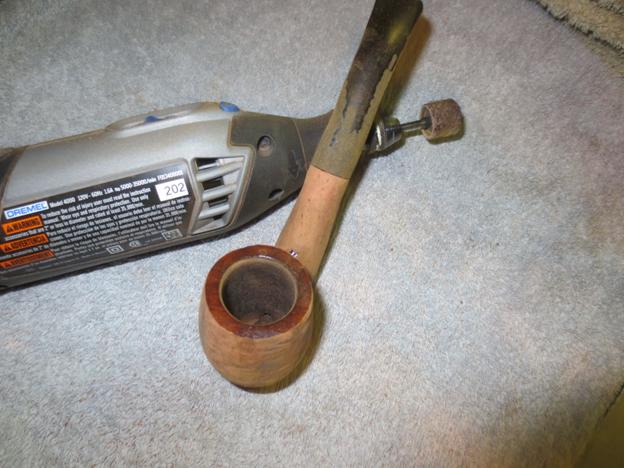
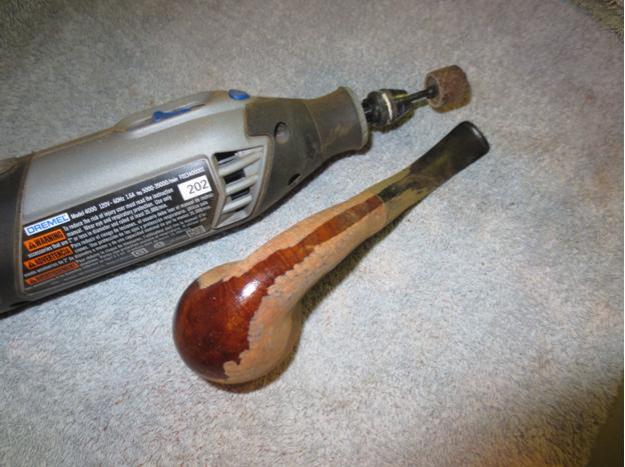
Charles Lemon of DadsPipes and I decided to collaborate on a refurbish that captured some of the essence of our conversation that we shared on our blogs regarding restoration. This old Brigham had major issues with the stem and the bowl. Charles tackled the stem and did the cleanup work on the bowl and then sent the stummel to me to work on. When it arrived I took it out of the small box and had a look at what he had sent to me. He had cleaned out the bowl which had been plugged with JB Weld and opened up the burn out in the bottom of the bowl. He drilled out the plug and when I got it the bowl had pretty much most of the bottom missing. I cut the side out of an old briar bowl I cannibalized for parts and shaped it for the plug. It was thick enough and big enough for me to cut the plug. I cut it and shaped it with a Dremel and sanding drum. The next two photos below shows the plug after the initial shaping. It is still too large in diameter and also needs to be flattened on the inside.

Steve 1Steve 2

I continued to shape and fine tune the plug until it fit into the hole in the bottom of the bowl. I flattened the inside surface to match the angles of the bowl bottom. The next two photos show that the plug is just about ready to press into place. Just a little more material needs to be sanded off the edges before it is a fit.

Steve 3Steve 4

I sanded the edges with the Dremel and sanding drum until I had a good fit and then pressed it into the bottom of the bowl. I sanded the outer surface of the plug with the Dremel and sanding drum until it was flush with the surface of the bowl. I used a black sharpie to draw a cross on the bottom of the bowl so that I could align the plug once I put the glue on and pressed it into place. I then coated the edges of the plug with slow drying super glue and pressed it into the hole in the bowl. The next two photos show how the plug looked in place from the outside and the inside of the bowl.

Steve 5
Steve 6

I used a dental pick to clean out the edges of the plug and bowl on the outside and then filled them with super glue and briar dust to take care of the chips and damage to the bowl bottom. Once it dried I sanded the bottom of the bowl with 220 grit sandpaper to blend in the plug.

Steve 7Steve 8

The next two photos show the state of the bowl repair at this point in the process. The plug has been set in the bowl and the crevices around the plug have been filled and repaired. The inside of the bowl is smooth and the plug sits nicely in place.

Steve 9
Steve 10

At this point in the process others may use JB Weld or Pipe Mud to finish up the bottom but I have found that a thin coat of Plaster of Paris gives a little bit of added protection to the bowl and also levels out the bowl bottom. In this case the bowl had a low spot in front of the entrance to the airway. I mixed a batch of Plaster, put a pipe cleaner in the airway and put it in the bottom of the bowl to level it out.

Steve 11 Steve 12

When the Plaster dried I applied a coat of pipe mud to the bowl bottom and sides, filling in some of the crevices in the bowl sides and smoothing out the surface. I used a dental spatula to press the pipe mud in place on the bowl sides and a pipe nail to press it into the bottom of the bowl.

Steve 13

I set the bowl aside at this point to cure for two days and then worked on the rustication of the bowl. I used a dental burr to follow the pattern on the bowl sides and deepen them. I cut a similar pattern on the bottom of the bowl with the burr. I used the burr to clean up the rustication on the shank as well – carefully avoiding the area where the faint Brigham stamping remained.

Steve 14
Steve 15

I used a black Sharpie permanent marker to stain the grooves in the bowl. I wanted a dark under tone to the bowl after I stained it. I like the way the stain looks with this underneath in the grooves.

Steve 18

I stained the bowl with a dark brown aniline stain and flamed it.

Steve 23
Steve 24

I wiped it down with alcohol on cotton pads to give it some more transparency and create the contrast with the black in the grooves of the rustication. I sanded the rim with a 1500-2400 grit micromesh sanding pad to smooth it out and to add to the contrast of the smooth rim.

Steve 27

I hand rubbed in several coats of Conservators Wax and then buffed the bowl with a shoe brush.

Steve 31
Steve 33

I mixed up a bowl coating of charcoal powder and sour cream and painted it on the inside walls of the bowl to give it further protection. When the bowl coating dried, it was time to pack the stummel back up for its return trip to Ontario.

Steve 38
Steve 40s

Mission Log: Agent Lemon. Phase III – Stem Work

Recreating a Patent Era Brigham stem requires only a few items – a vulcanite stem of appropriate length and sufficient diameter to hold a Brigham rock maple filter, an aluminum Brigham tenon/filter holder, a few drill bits and some epoxy.

I found a suitable stem in my box of stems, using a Brigham Prince pipe from my collection as a reference. I used a hacksaw to remove the vulcanite tenon, and then clamped the stem into a simple drilling jig in my drill press. The stem must be perfectly aligned in the press or you risk drilling through the side of the stem instead of down the airway. The goal is to enlarge the airway to make room for the filter, and then drill out a mortise in the face of the stem to accept the aluminum tenon/filter holder. A quick test fit verified my drilling, so I glued the original tenon into the new stem with a bit of JB Weld and let the assembly cure.

20160130_130036
20160130_13071720160130_130755
20160130_133236

When the repaired stummel arrived from Vancouver, I could fit the replacement stem. As I was working with the original tenon, it wasn’t a great surprise when the stem fit nicely into the shank. A little bit of filing and sanding to remove the stem’s molding marks and reduce the diameter to match the shank, and I was ready to install the Brigham dots.

20160201_094109
20160201_094840

The dots are made by inserting 1/16″ brass rod into holes drilled in the side of the stem. The first pin is located approximately 5/16″ from the end of the stem at the centre line, and the other pins in the 2, 3, and 4-dot patterns are built off the first dot. As this was a 300-level pipe, I’d be installing three pins in a triangle pattern. The first pin is the bottom left dot of the triangle.

I marked out the pinning pattern with a Sharpie and then drilled the holes, being careful not to drill through into the stem’s airway. Short segments of brass rod were then glued into the holes with clear CA glue. When the glue had cured, I used a combination of files and sandpapers to bring the dots flush with the surface of the stem. A final polishing with micromesh pads to remove any remaining scratches prepped the stem for buffing. Just before doing so, I gave the stem a 1/8th bend by holding it over the heat gun until pliable and shaping it over a round form. A dip in cool water set the bend in place.

20160201_204450
20160201_205613

Mission Log: Impossible Accomplished

The restored pipe sits on the desk in front of me. I hardly recognize it as being even remotely related to the broken-down shell of a pipe Steve and I started with only a few short weeks ago. Shipping the patient back and forth took a lot of time, but the results of this cross-country collaboration speak for themselves. This Patent Era Brigham 313 looks ready for another 60 years of smoking pleasure. Steve did a truly magnificent job on the stummel, and the new stem looks like it’s been there all along. I think we both learned something new during this restoration, and we proved our theory (in grand fashion) as we did it – every pipe, no matter the condition, can be restored to useful service with the right combination of skill and will.

I hope this project inspires other pipe refurbishers to take a second look at that written-off pipe you’ve held onto for some reason. I’m willing to bet there’s still a great smoke hiding in that old briar somewhere. It’s up to you to find it.

Here’s the finished pipe.

20160202_102012
20160202_102027
20160202_101927
20160202_101920
20160202_10193320160202_102106 20160202_10203920160202_102055

Mission Impossible: Operation Long Shot


This is an old Brigham that Charles and I did together and it was almost Mission Impossible. Wanted to post on both blogs.

Charles Lemon's avatar

The door opened and a man walked into the bar, pausing briefly in the doorway to allow his eyes to adapt to the dim light inside. The place was what optimists would euphemistically call a dive. The establishment was empty except for a few drunks and a large, bored-looking man behind the counter wiping glasses with a rag that was presumably once white but was now an indeterminate shade of grey.

The man walked through the room, turned in at a doorway marked “Gents” and scanned the room – two stalls, a urinal and a grimy sink – before spotting what he sought. Moving across the room, he fed a handful of coins into a coin-operated machine advertising cheap cologne. There was a rattle and then a small rectangular device dropped into a waiting hand. The man pushed his thumb against a small pad on the otherwise blank rectangle. A laser washed briefly…

View original post 2,428 more words

Breathing New Life into a Briarlee Scoop


Blog by Steve Laug

My brother Jeff and I were looking through Ebay and came upon this old Briarlee Scoop. The stem was badly overturned as these old pipes had a threaded metal tenon and shank insert. This one was turned upside down. Something about these 1960s era chunky pipes grabs my attention. They are very Minceresque, strongly resembling Custombilts. They have anice vintage look. Briarlee pipes were made by the Arlington Pipe Company.

I wanted to refresh my memory of the brand since it had been a while since I had worked on an Arlington made pipe. I checked my usual sources and found that Pipedia had some quick and helpful reminders for me https://pipedia.org/wiki/Arlington. The next photo came from that site and is a great advertisement for the brand.Briar1 I quote from Pipedia: “Arlington Briar Pipes Corporation was founded in 1919 in Brooklyn, New York, and produced the Arlington, Briarlee, Firethorn, Krona and Olde London brands among dozens of others, primarily acting as a subcontractor making pipes to be sold under other brand names. Among others, in the 1950’s, Arlington turned pipes for the famed Wilke Pipe Shop in New York City. The corporation was dissolved by the State of New York as inactive on December 6, 1978. Arlington Briar Pipe Corporation, located at 200 Kosciusko Street, Brooklyn, New York, registered only a single brand trademark, the Arlington brand, the trademark for which was applied for on November 13, 1962 and granted on February 25, 1964. Jack Kaye, of Arlington Briar, was also granted a patent for a combined mirror and stand in 1967.”

Pipedia also quotes José Manuel Lopes, Pipes Artisans and Trademarks; “Arlington is a North American brand that belonged to Arlington Briar Pipes Corp., Brooklyn, New York, founded in 1919. In the 1940s, Ludwig Rosenberger gave the company new life, and it continued until the 70s. His son, Mel Rosenberger, has recently launched the DiMonte brand. Jack Uhle was also linked to Arlington.” Arlington, as far as known, mainly operated as a sub-contractor for other brands. The Jobey pipes are said to be made by Arlington at an unknown point of time. Arlington’s own pipes are seldom seen.”

Now I had the information in hand and I started to work on this pipe. The next set of photos was the ones that the EBay seller posted. They give a good reference point for the state of the pipe.Briar2

Briar3

Briar4

Briar5 When it arrived I brought it to the work table and took my own set of photos. The overturned stem makes the pipe look awkward.Briar6

Briar7

Briar8

Briar9 I unscrewed the stem and heated the stinger and tenon with a lighter until the glue softened in the stem. Once it was warm the stem was quite easy to turn and align.Briar10 I took the next two close-up photos to show the size of the pink putty fills on both the right and left side of the bowl. These pink fills would have to go as they are very hard to stain or mask.Briar11

Briar12 I reamed the bowl with a PipNet reamer using the largest cutting head. I was able to ream back the cake to briar and at the same time clean up the inner edge of the rim. The edge was not as damaged as I thought it might have been.Briar13

Briar14 I cleaned the surface of the bowl with acetone on cotton pads to remove the finish and the grime. I scrubbed the lava on the rim to see if I could remove it.Briar15Briar16Briar17Briar18

I lightly sanded the rim to remove the hard tars on the surface while not scratching or damaging the bowl. I also sanded the inner edge of the rim to clean up the rough edges.

Briar19

I removed the pink putty fills with a dental pick and refilled them with briar dust and clear super glue.

Briar20Briar21

I sanded the repairs smooth and then used a black Sharpie permanent marker to stain the grooves on the sides and top of the bowl.

Briar22Briar23Briar24

I stained the bowl with a dark brown aniline stain for a top coat to contrast with the black trails in the briar.

Briar25Briar26

I buffed the bowl with White Diamond to give it a shine and get a feel for the coverage of the stains.

Briar27Briar28

Now it was time to work on the stem. I sanded the stem with 220 grit sand paper to remove the tooth chatter and bite marks on the underside near the button. I followed up by sanding with a medium grit sanding sponge.

Briar29Briar30

The inside of the shank was a mess as is often the case with these pipes with metal mortise fitments. It took a lot of scrubbing before I could remove the oils. The pile of cotton swabs is about half of what I used to clean out the shank. Cleaning the stem was a challenge as the stinger was not removable. I fit pipe cleaners through the slot in the stinger and drew them through the airway in the stem until it was clean. I scrubbed the stinger with alcohol and a brass bristle brush to remove the hardened tars that had collected and dried there. I wet sanded the stem with 1500-2400 grit micromesh pads but forgot to take a picture of the stem after the sanding. The effect of that sanding can be seen in the second photo below.

Briar31Briar32

With the internals clean I polished the stem with micromesh sanding pads. I dry sanded with 3200-4000 grit pads and then rubbed the stem down with Obsidian Oil. I continued sanding with 6000-12000 grit pads and gave the stem a final coat of oil and set it aside to dry.

Briar33Briar34

I buffed the bowl and stem with Blue Diamond on the wheel and then gave them both multiple coats of carnauba wax. I buffed them with a clean flannel buff and then hand buffed them with a microfibre cloth to raise the shine in the briar and the stem. The finished pipe is shown in the photos below. The old warrior is ready for ongoing service. Once again, thanks for looking.

Briar35Briar36Briar37Briar38Briar39Briar40Briar41


It was A Kaywoodie Metal Pipe that I had never seen before


Blog by Steve Laug

My brother, Jeff has caught the pipe hunting bug and that is a great thing for me. It won’t kill him and he won’t suffer too much harm from it unless he gets carried away and gets in trouble with the wife. But it is good news for me. It means that with him we can cover twice the ground looking for old pipes than I used to do by myself. It also means that he comes on things that I have never seen. He is in the US and I am in Canada and we have different stomping grounds for our hunt other than the odd time we are in the same place. I don’t remember if we found this one while we were looking at eBay together using Facetime or if it was a find on a hunt. But it does not really matter as we got it. It is an old Kaywoodie the style of which I have never seen before. The base unit is the typical long metal shank but rather than a cup the bowl threads into this one has a ring on the end. It is split on the end of the bowl and goes around the base of the bowl. When I first looked at it I was hooked. I wanted to see it and work on it. The thing that caught my eye was the unusual look of the pipe. I wanted to see how the bowl was held in the ring.Filter1

Filter2

Filter3

Filter4 The pipe was in pretty decent shape from the photos. The stem had the usual tooth chatter and oxidation around the button. The Kaywoodie club emblem on the stem looked rough. The embossed emblem in the aluminum shank was really clean. The entire base unit was oxidized but clean. The briar also was very clean. There was some darkening and lava on the back edge of hte rim and a thin cake in the bowl but no inner or outer edge rim damage.Filter5 The base plate was stamped Kaywoodie Filter Pipe Pat. Pend and there was a slot in the bowl. It appeared that someone had tried to use a screwdriver to turn the base plate and damaged it. To me the slot looks like it was made for a coin to turn the base.Filter6 The next photo shows the pin on the front of the briar bowl and the split in the ring of the base unit. To me it is hard to figure out how the bowl is to be removed.Filter7 While my brother had it in hand in the states looking it over and trying to figure out how to remove the bowl I did a quick search and found the pipe on the Smoking Metal site (http://www.smokingmetal.co.uk/pipe.php?page=132). The site had the following information and pictures that I have copied to use here. The first paragraph gave me the information I was searching for on how to remove the bowl. I read it to my brother and he tried it and bowl came free. He showed me the pieces on Facetime. I was fascinated.

“Many of these wrecked by folk not realising how the bowl is released. Pulling the bit out of the stem and twisting half turn in either direction releases the retaining pin and allows the bowl to come free of the stem. The lower and right hand adverts are from October 1962 Flying Magazine
The pipes were $6.95, bowls @ $3.50 and 3 filters were 25 cents.”

“In the base of the bowl is a screw cap which when undone releases a ceramic filter. These filters came in plastic tubes containing three filters. As with all metal pipes, frequent cleaning is advisable to prevent any screws from becoming irretrievably sealed into pipe. The filters are at times available on eBay, but I have been told by Rob that soaking in alcohol (Everclear or IPA) can extend their life.”

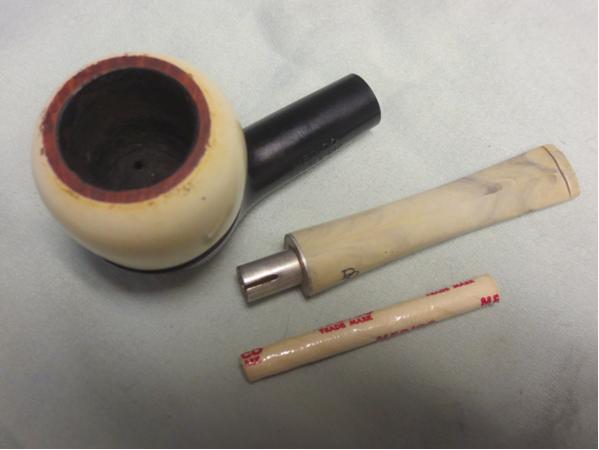
The second photo below of the bowls and the third photo of the boxed set also come from the Smoking Metals website. In the photo of the bowls you can see the clay filter piece that sits in the bottom of the bowl. It is shaped like a flattened spool and there are holes in the top of the spool as well as a stamped Kaywoodie Club emblem. The bottom of the spool is indented and sits in the metal threaded base cap. In the third photo you can see how the filters were sold in plastic tubes that held three filters and sold for $.25.

Given all of information found in these photos I could not wait until the pipe arrived in Canada and I could take it apart and clean it up.Filter8

Filter9

Filter10 When the pipe arrived I took the bowl off per the above instructions and it worked quite simply. I could easily see why the Smoking Metal website said that many of the pipes were damaged by improperly removing the bowl. Fortunately this one was not damaged by me. The metal base plate was solidly stuck in place and I read above that the clay filter was not damaged by alcohol so I dropped the bowl in an alcohol bath and let it sit all morning while I finished up some repairs I was doing. I took it out this afternoon and dried it off with a cotton cloth. The grime on the finish was gone and the bowl was clean. The lava on the rim was softened so I could work on it with more ease. It looked like I would not have to top the bowl to remove the lava. That is always a good thing. The rim edge was also not charred or burned which was a bonus as well.Filter11

Filter12

Filter13

Filter14

Filter15 I decided to take the bowl apart before working on cleaning it up. I inserted a quarter in the slot in the bottom plate and twisted it both directions until it came loose. Then I unscrewed it and took out the clay filter. The inside of the base and cap were thick with tars. The clay filter was black and goopy.Filter16

Filter17

Filter18

Filter19 I cleaned out the bottom half of the bowl, the filter and the base cap with alcohol and cotton swabs. I picked the threads clean with a dental pick and then scrubbed them with the cotton swabs. I scrubbed the clay filter and used the pick to clean out the holes in the top of the spool and also the build up on the middle and bottom of the spool. I wiped it down with alcohol and cotton swabs.Filter20

Filter21 I wiped down the outside of the bowl with alcohol and cleaned out the air hole on the side of the bowl. I used 0000 steel wool to scrub the inside of the base cap.Filter22 With the bottom half of the bowl cleaned I reamed the top half of the bowl with a PipNet reamer. I took the cake back to bare wood.Filter23

Filter24 I scrubbed the rim clean with cotton pads and saliva and was able to remove the lava build up. I sanded it lightly with a 3200 grit micromesh sanding pad and brought some shine to the rim.Filter25

Filter26 I set the bowl aside and went to work on the metal base and vulcanite stem. I cleaned out the interior of the shank and stem with pipe cleaners and alcohol. The stem is spring loaded and cannot be removed from the base without potential damage so I ran many pipe cleaners through to clean out the tars and oils.Filter27

Filter28 I sanded the stem to remove the oxidation and the tooth chatter. I used 220 grit sandpaper to break through the surface and then a medium grit sanding sponge.Filter29

Filter30 I rubbed down the stem with Obsidian Oil and then put the pipe back together. I dropped the filter into the bottom of the bowl with the holes upward, lubricated the threads on the bottom cap with Vaseline and screwed it in place. I pulled the stem back and turned it to retract the aluminum tube into the shank and dropped the bowl in place. I let the stem reseat and the tube entered the bowl. The bowl was anchored in place. Now I had a bit of a handle on the pipe while I worked over the stem with micromesh sanding pads.Filter31

Filter32

Filter33

Filter34 I started wet sanding with 1500-2400 grit micromesh pads and quickly found that the club logo was just pieces in the indent in the stem. It was broken and not complete. The ragged look that I had noted earlier was the grit and grim holding the broken logo in place.Filter35 I cleaned out the old pieces of logo with a dental pick and blew out the dust. I had a broken Kaywoodie stem with a club logo the same size as this one so I carefully liberated it from the broken stem for use on this one (it visible at the bottom of the first photo) I cleaned out the indent on the stem with air and then put some all purpose glue in the hole with the end of the dental pick. I pressed the new logo into the hole with the rounded handle of a dental spatula. The new logo looked good and it was smooth when you ran a finger over that area of the stem.Filter36

Filter37 I reworked the stem with the 1500-2400 grit micromesh, this time dry sanding it. There was no need to wet sand it again. I was careful while sanding around the newly set logo so as not to risk lifting it from the stem. I rubbed the stem down with Obsidian Oil and then dry sanded with 3200-4000 grit micromesh pads. The stem was beginning to take on a shine. I continued to polish it with 6000-12000 grit pads and gave it a final wipe down with Obsidian Oil. I let it dry.Filter38

Filter39 I gave the stem several coats of Conservator’s Wax and hand buffed the stem by hand so as not to damage to the logo. I also hand buffed the bowl and metal base by hand with the wax and then rubbed it down with a microfiber cloth to finish the shine. The finished pipe is shown in the photos below. I really like the looks and mechanics of this old Kaywoodie. It is a pleasure to add it to my collection of metal pipes.Filter40

Filter41

Filter42

Filter43