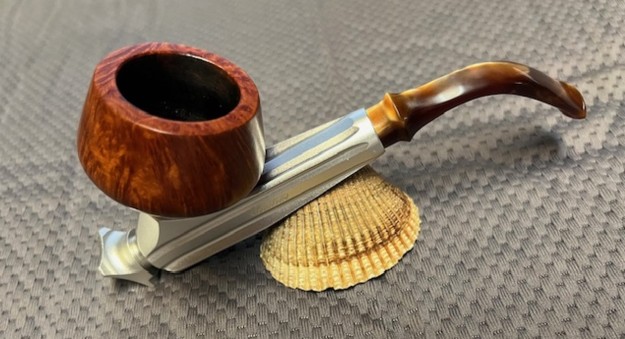
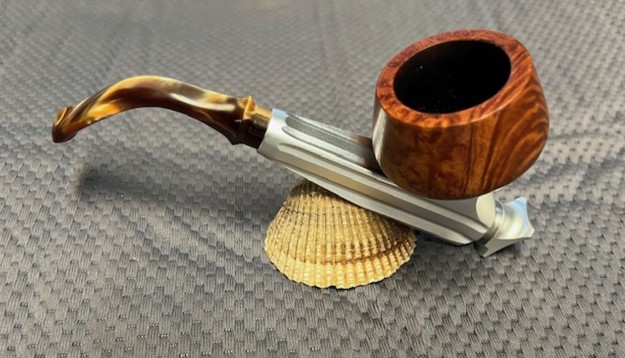
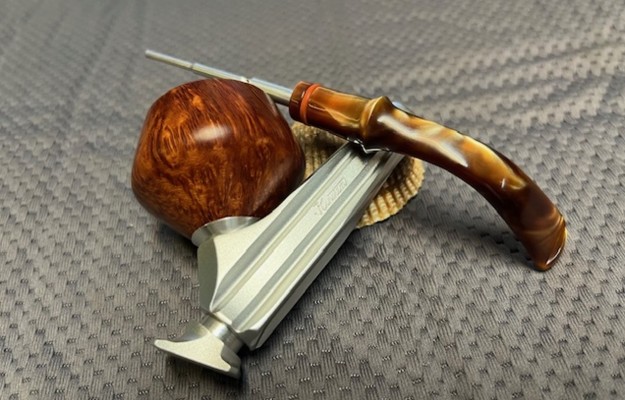
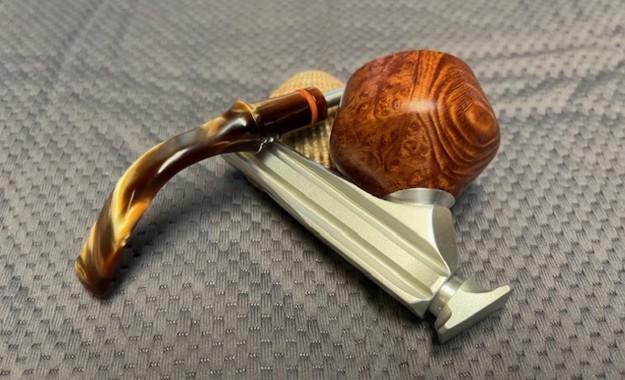
Tag Archives: Pipe History

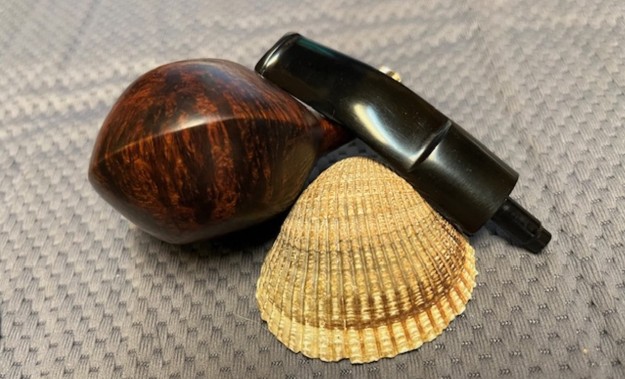
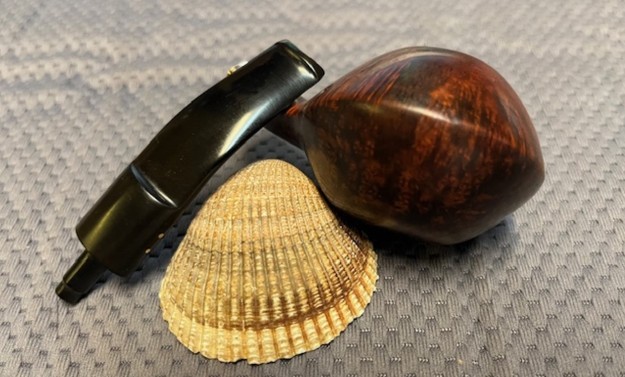
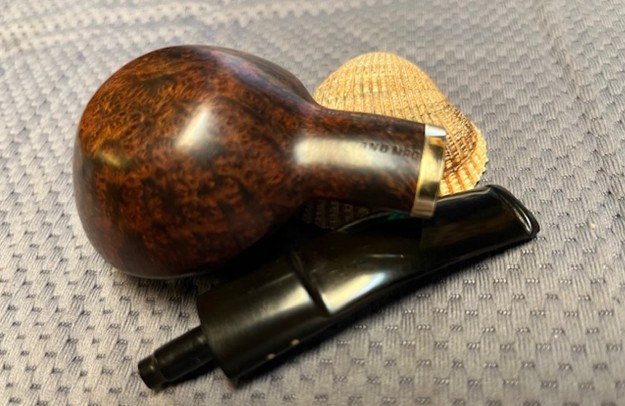
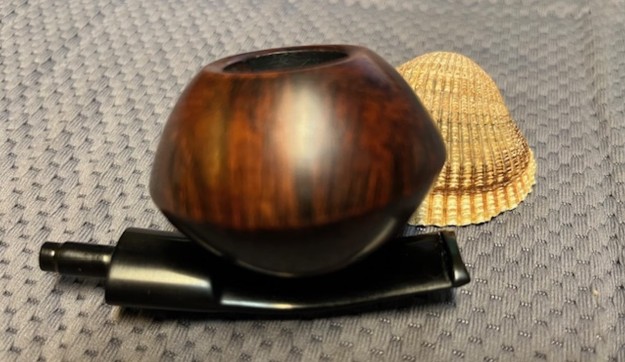
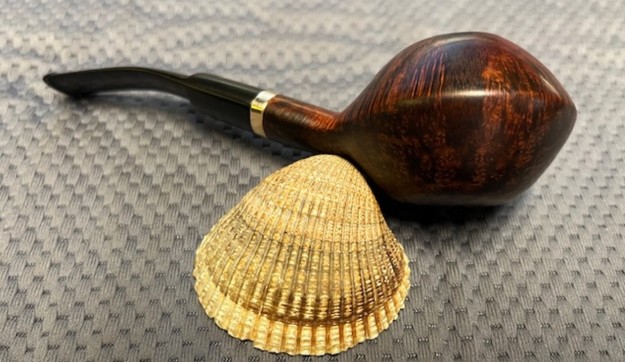
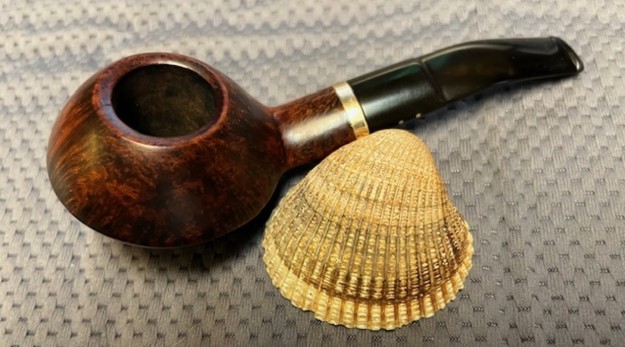
What a beautiful Hans Original Hand Made UFO


Blog by Steve Laug

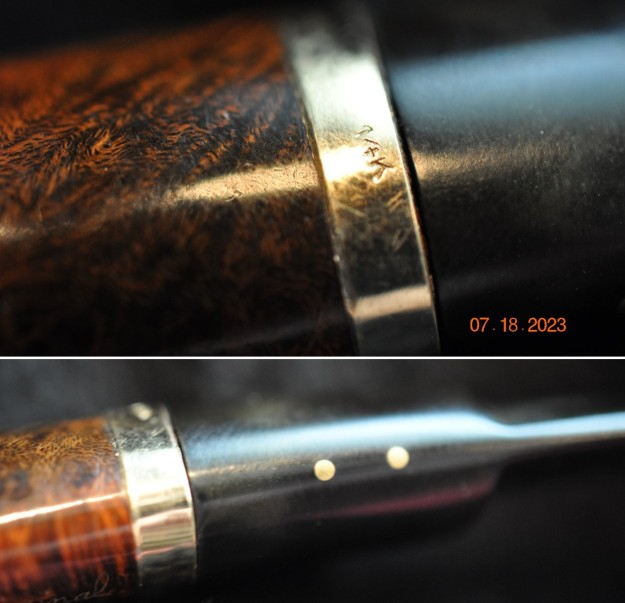
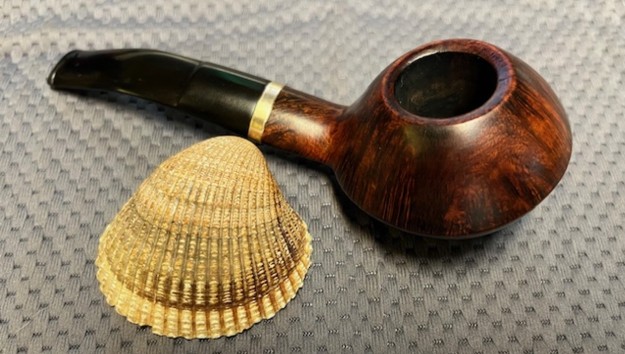
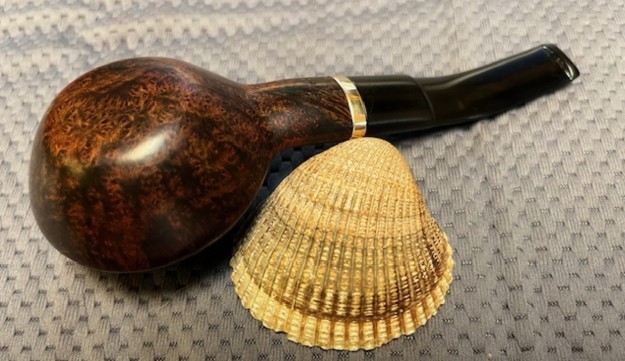
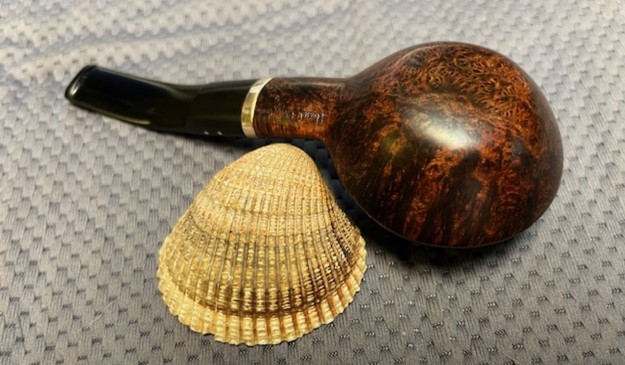
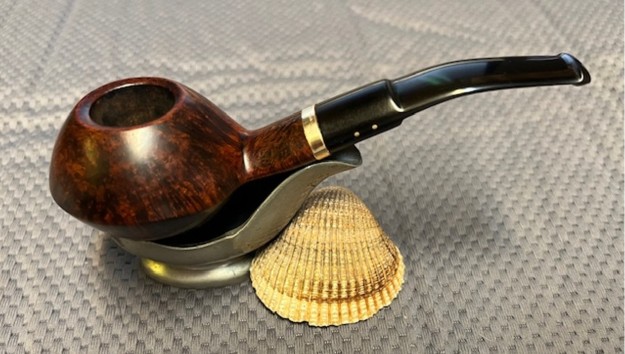
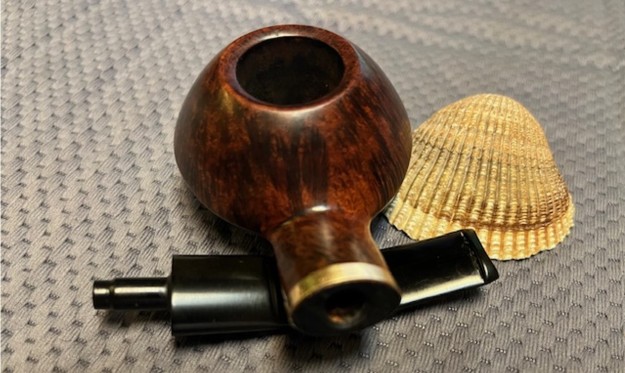
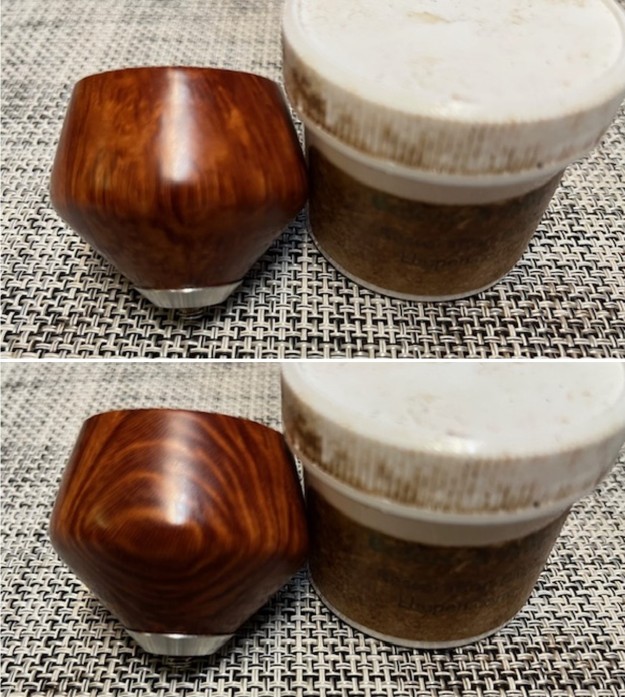
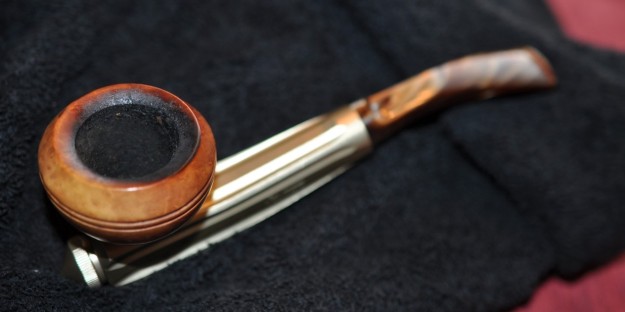
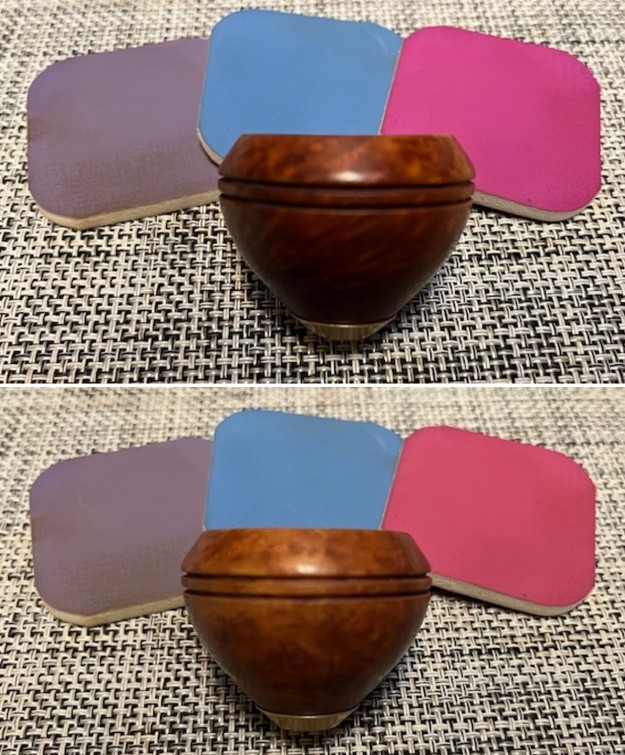
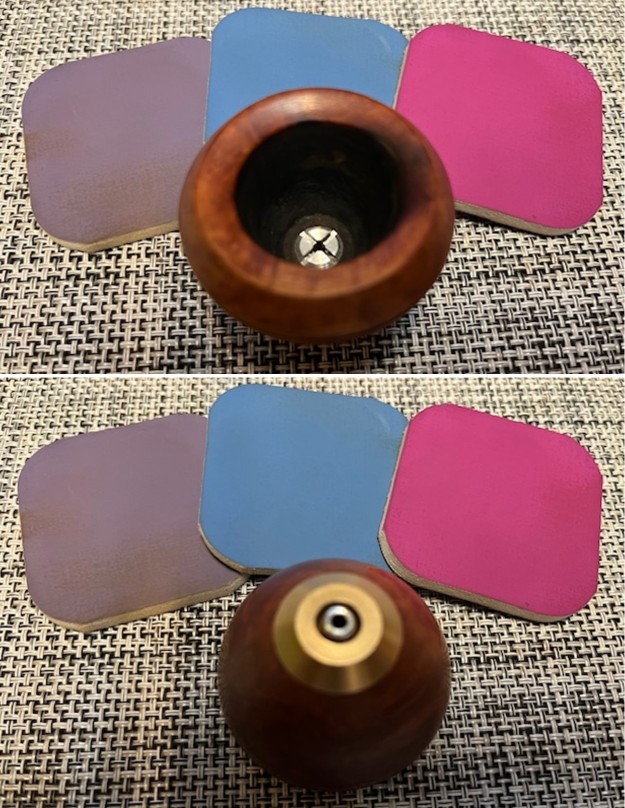
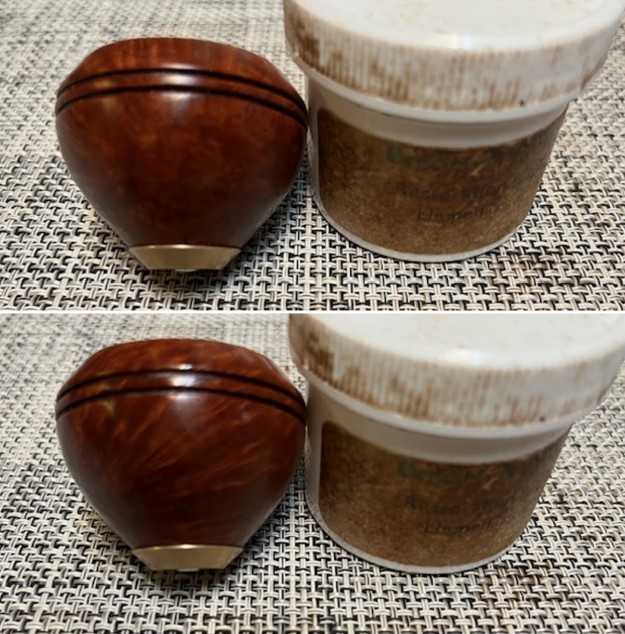
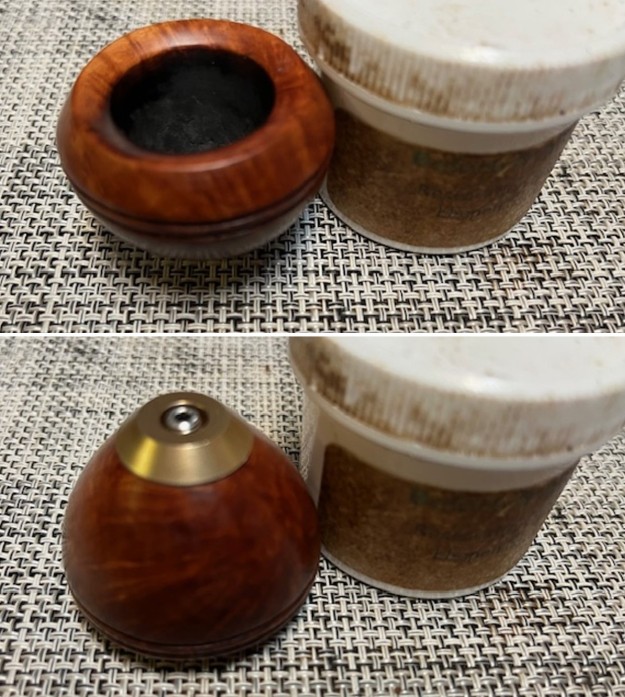
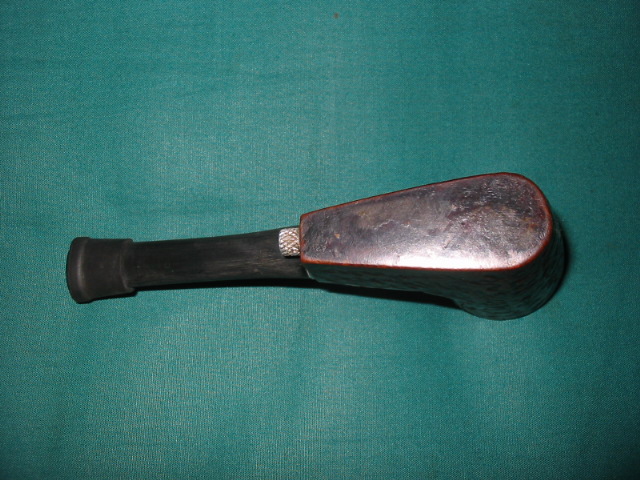
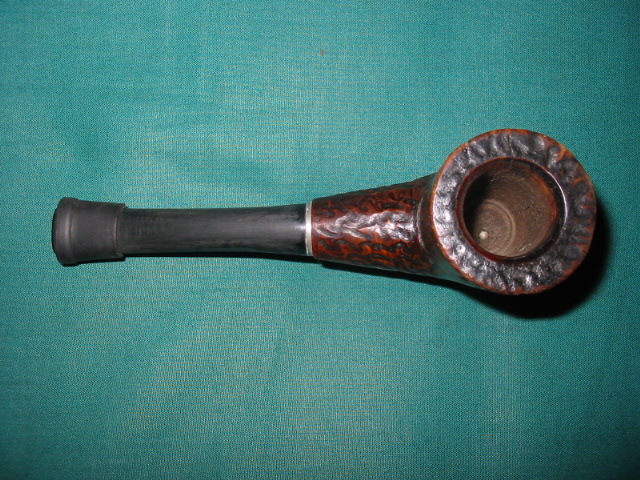
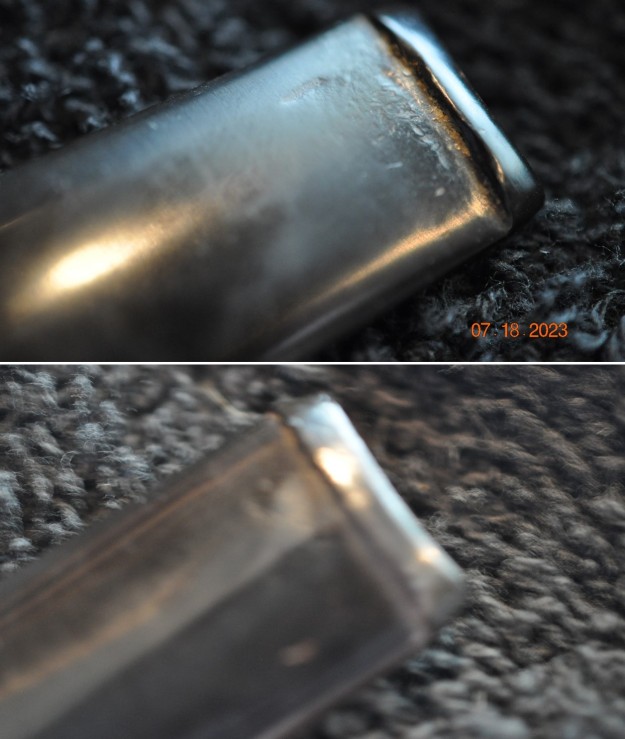
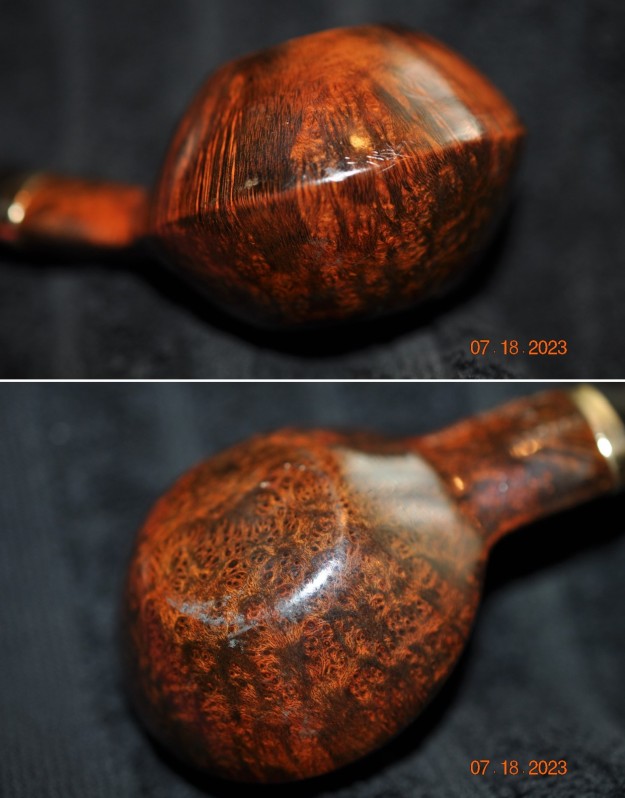
This interesting UFO/Flying Saucer/Disc shaped pipe was purchased from a sell in Chicago, Illinois, USA on 06/05/2021. It is a darkly stained briar with great grain around the bowl and shank. There is a thin 14K gold band on the shank and a vulcanite saddle stem. The smooth finished bowl has some great grain on it under the heavy grime on the surface. The bowl was thickly caked with a light lava coat on the rim top. It was hard to know the condition of the inner edge and rim top underneath the lava but cleaning that up will tell the story. The pipe is stamped on the underside of the shank and reads in script etching Hans Original [over] 6 [over] Hand Made. The “E” on Made is under the band. The gold band is stamped 14K on the topside. The vulcanite stem ha two brass dots side by side on the left side of the saddle. It had light tooth marks and chatter on both sides ahead of the button. It had a flattened heel on the bowl that allowed the pipe to sit on a desk top. Jeff took photos of it before he worked his magic in the cleanup process.The exterior of the pipe was very dirty – grime and grit ground in from years of use and sitting. The rim top was covered with a coat of thick lava that overflowed the bowl. There was also some darkening and lava on the rim top. The bowl itself had a thick cake with flecks of tobacco stuck in the cake on the sides. The vulcanite saddle stem surface was dirty and had some tooth marks and chatter on both sides. Jeff took photos of the sides of the bowl and shank to give a better feel for the condition of the bowl. You can see the interesting grain on the bowl side and front.The next photos show the stamping on the underside of the shank, the gold band and the twin brass dots on the left side of the stem. It is clear and is very readable as noted above. This pipe is a bit of a mystery in terms of the name of the maker. Han’s is not clear in terms of who it refers to. There is no identify COM stamp to point to a country of origin. It is a nice-looking Hand Made pipe that I know nothing about. If any of you who are reading this can help unravel the mystery please contact me. Thanks.
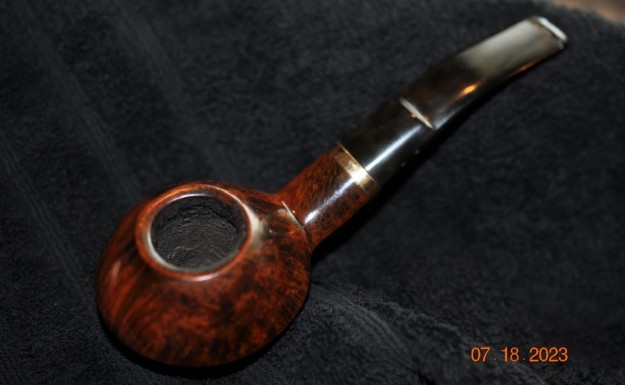
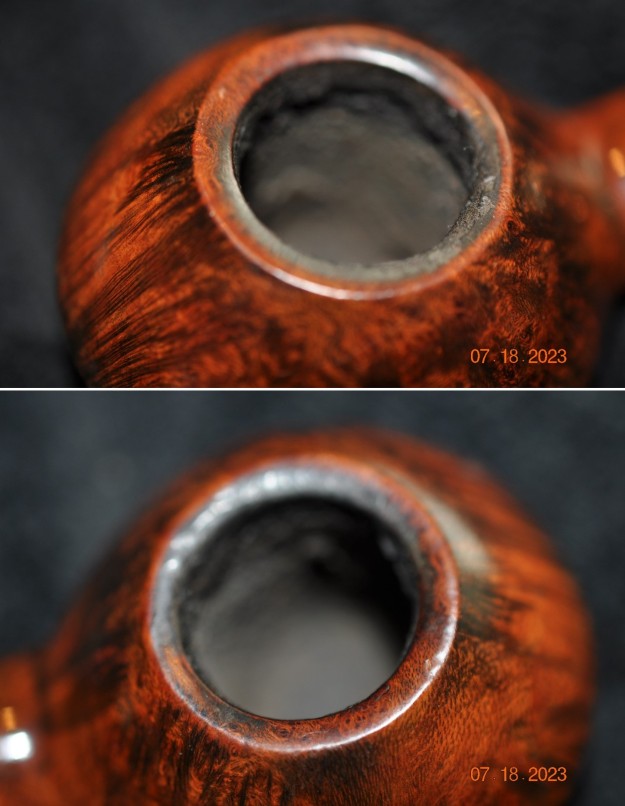
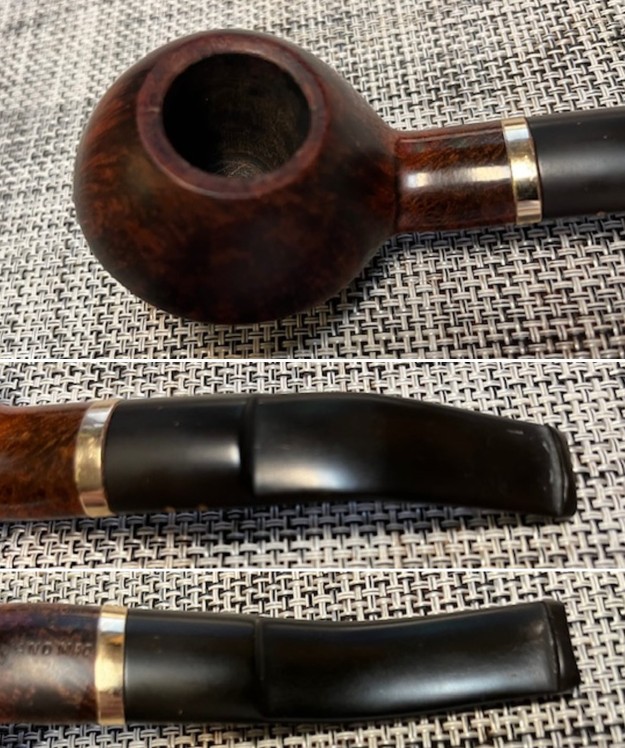
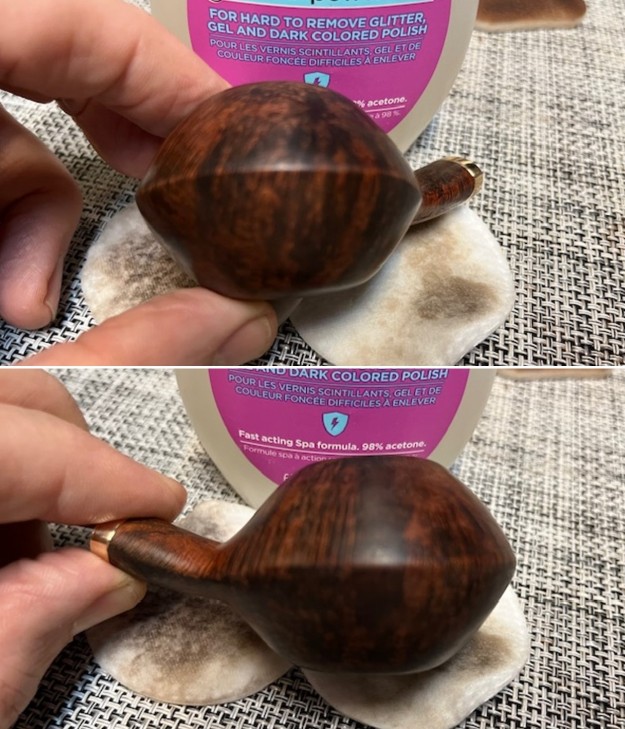
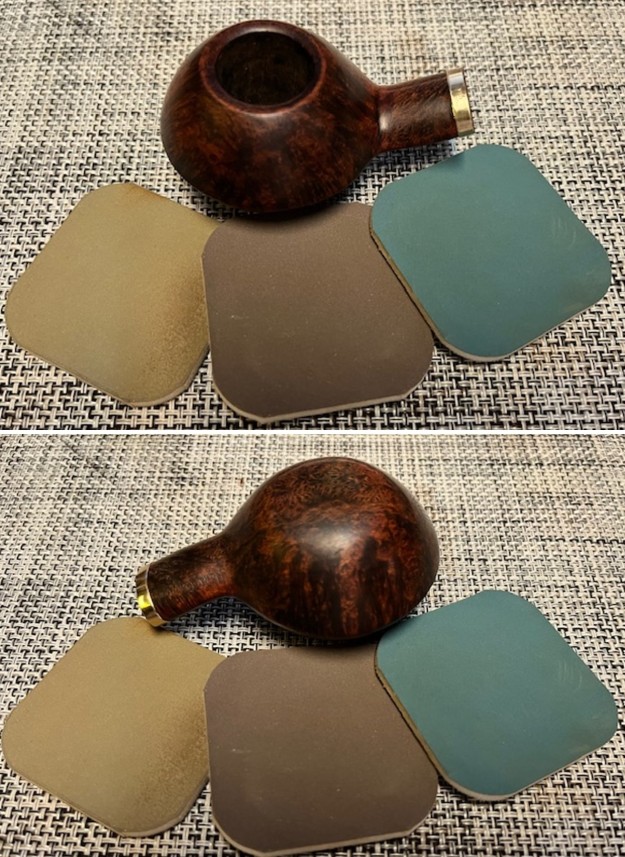
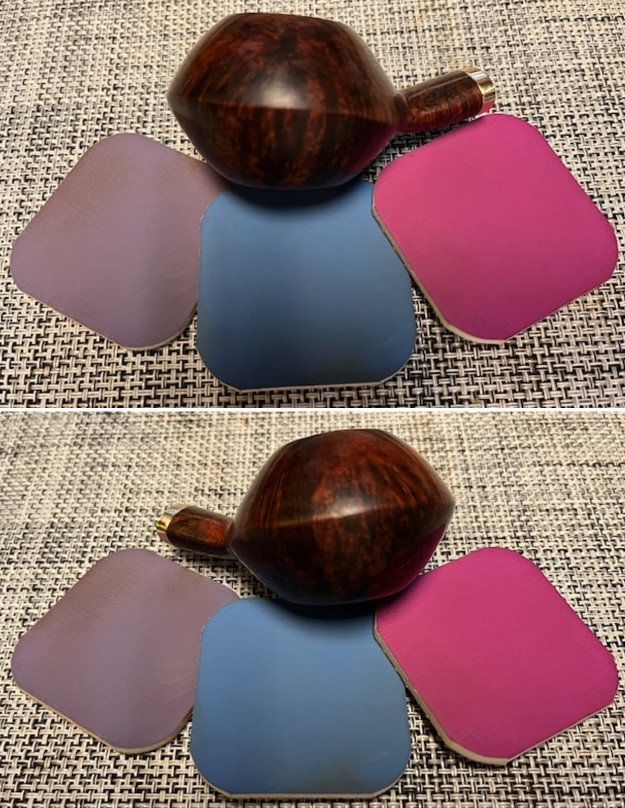
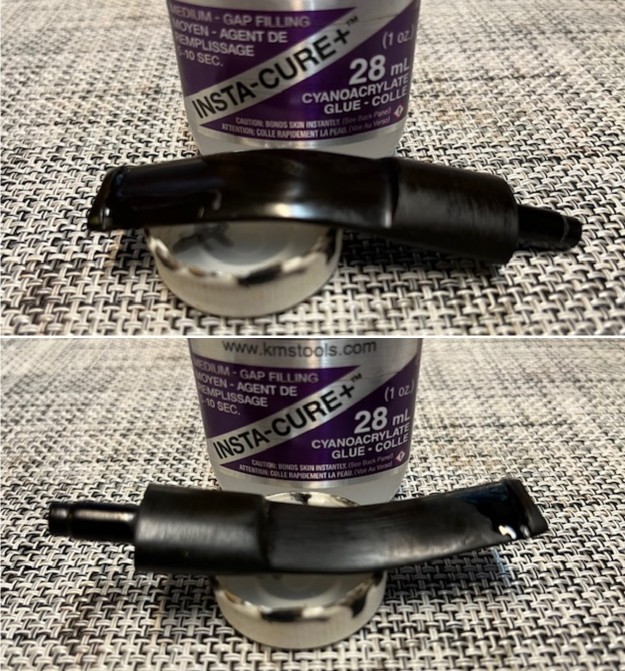
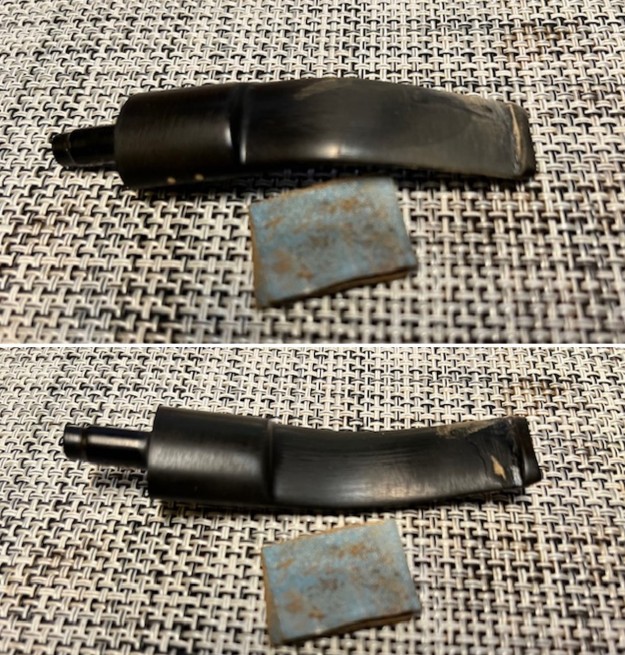
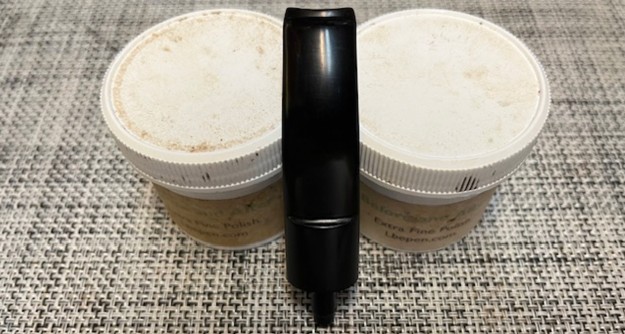
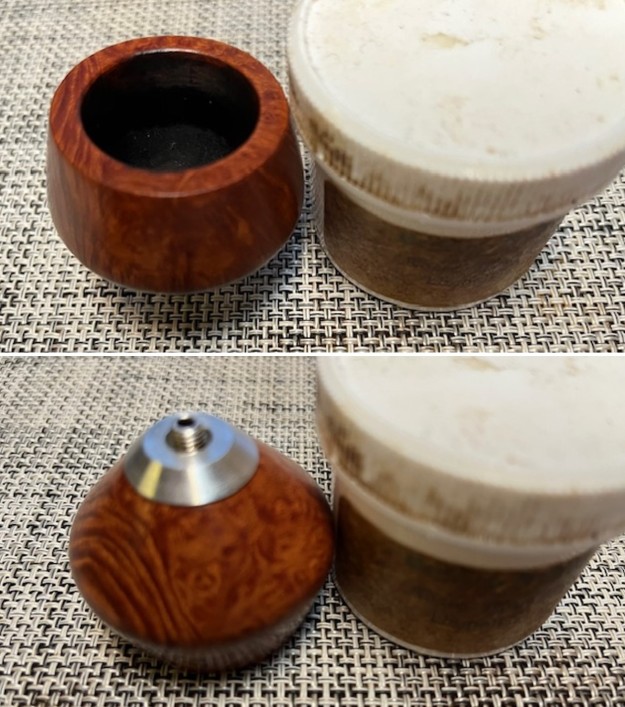
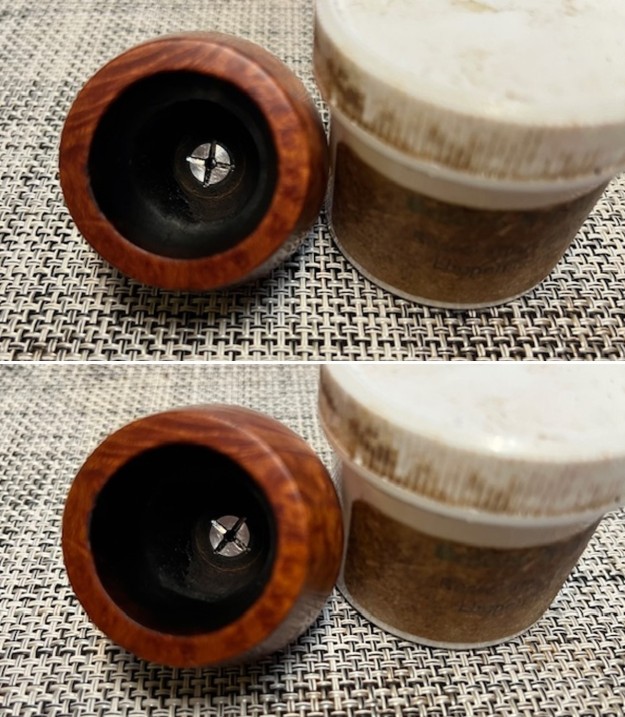
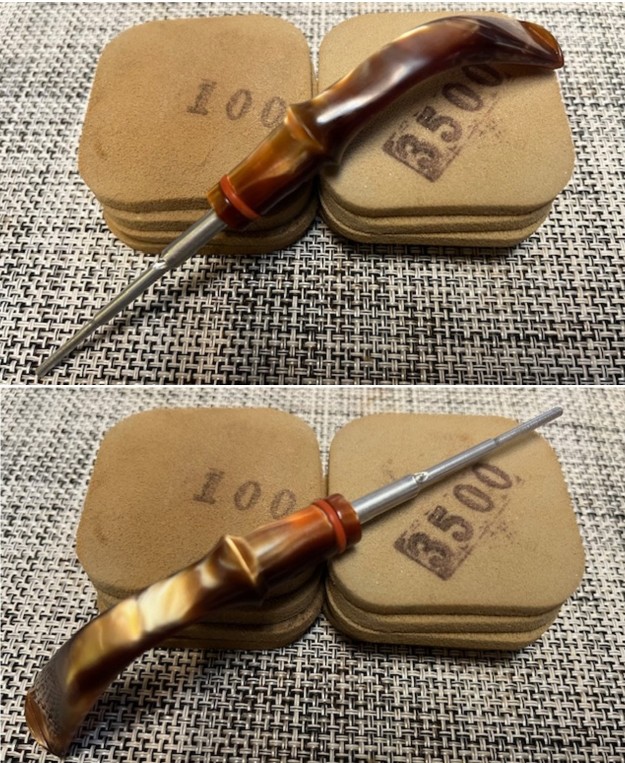
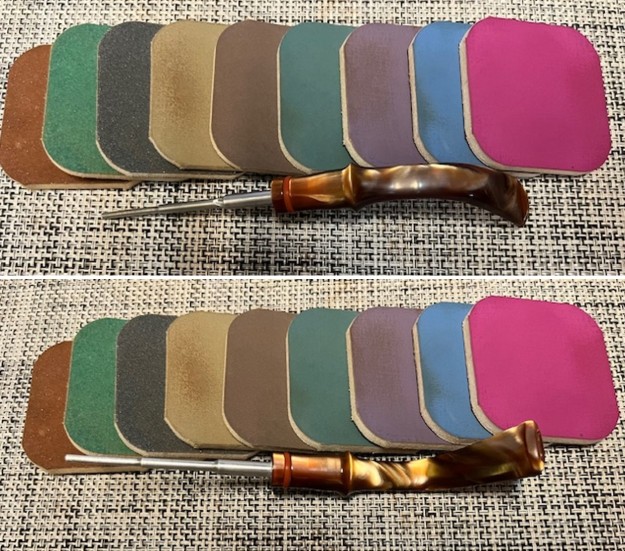
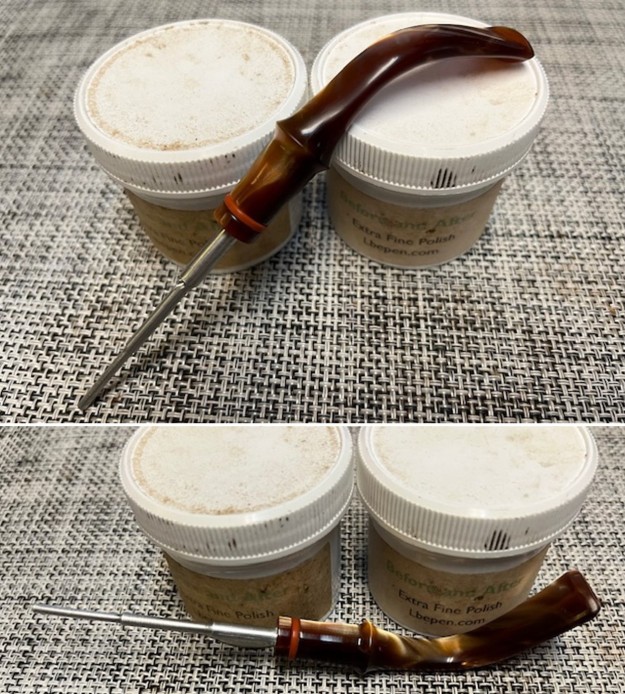
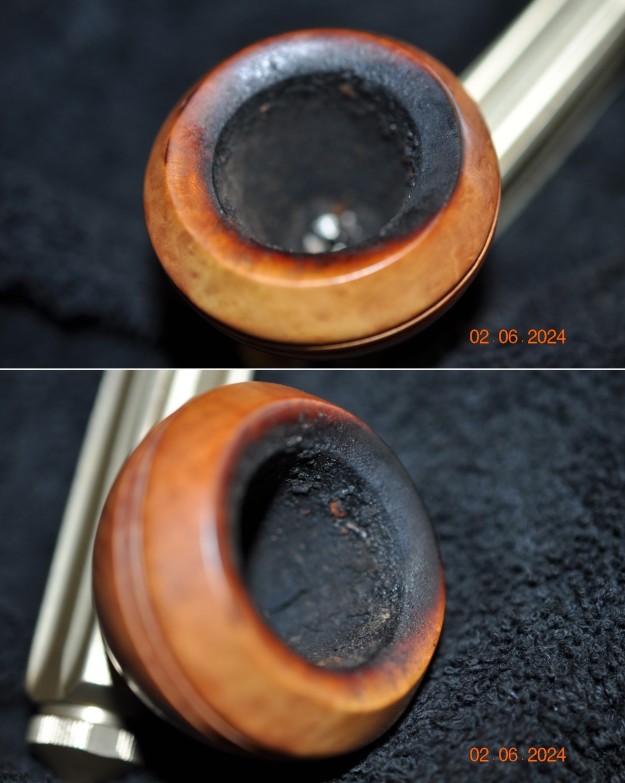
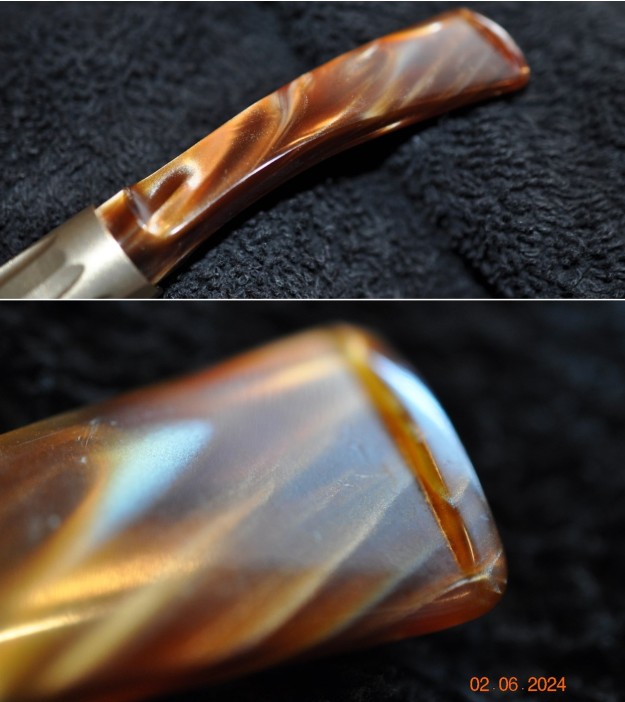
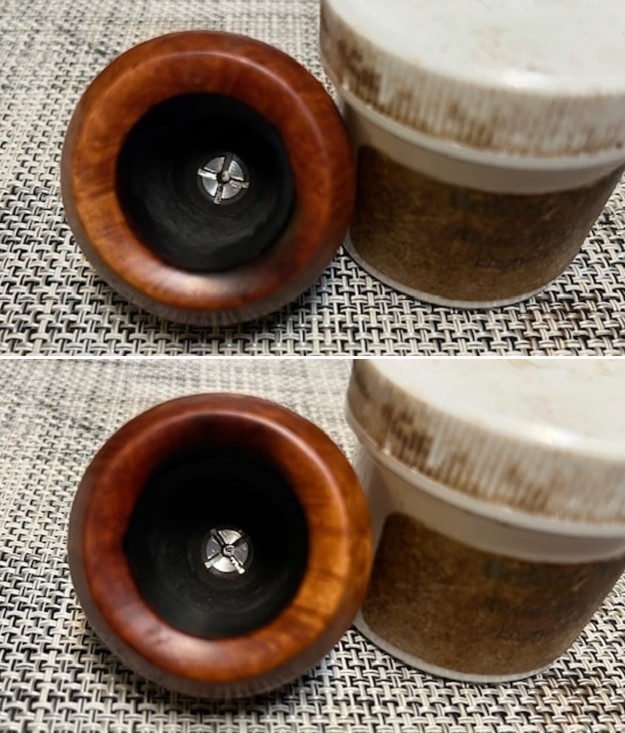
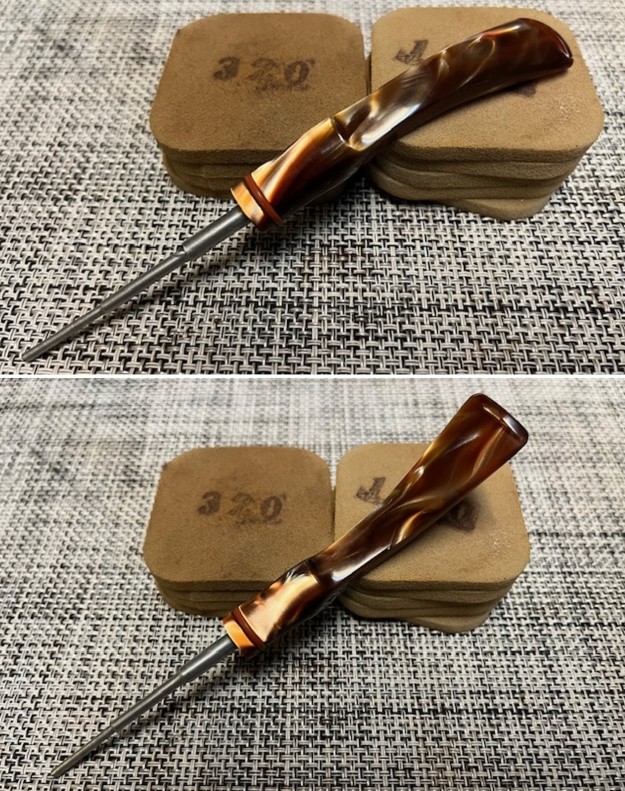
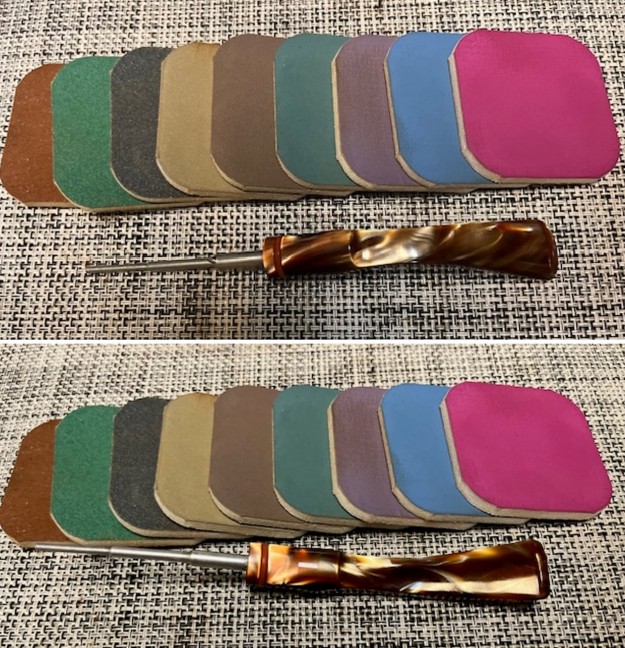
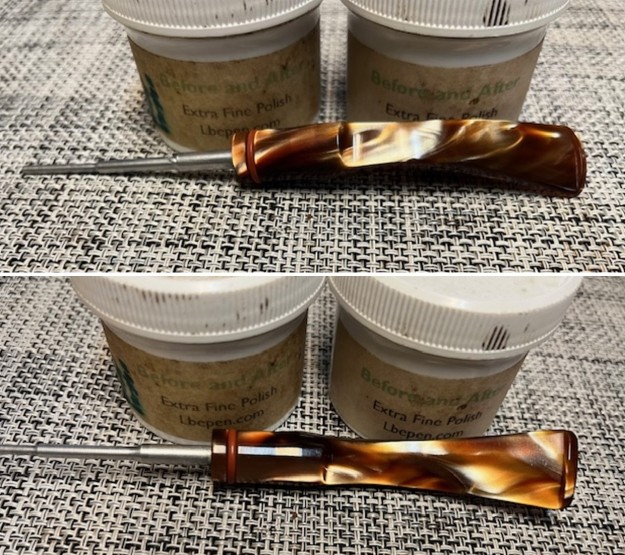
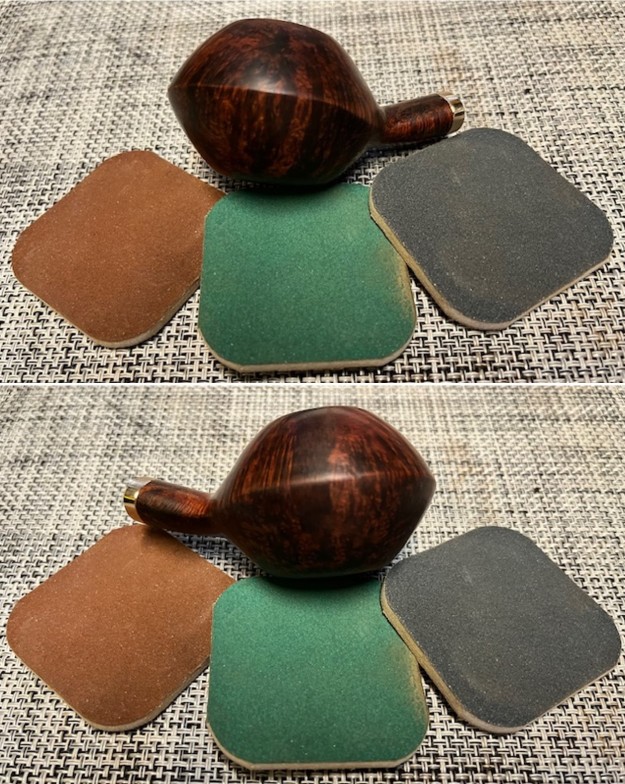
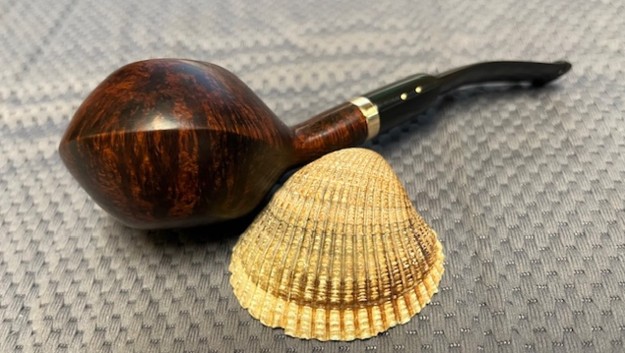
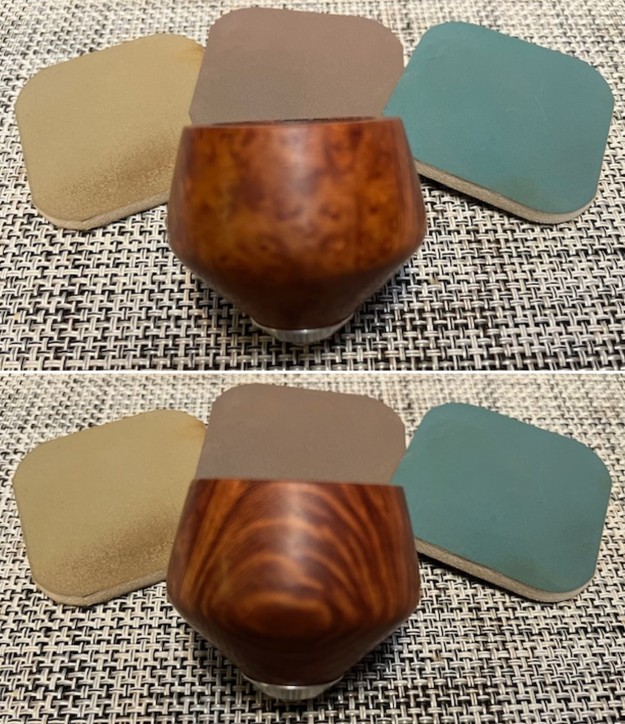
Jeff reamed it with a PipNet pipe reamer and cleaned up the remaining cake in the bowl with a Savinelli Fitsall Pipe Knife. He scrubbed out the internals with alcohol, pipe cleaners and cotton swabs until the pipe was clean. He scrubbed the exterior of the bowl with Murphy’s Oil Soap and a tooth brush to remove the grime and grit on the briar and the lava on the rim top. The finish looks very good with good looking grain around the bowl and shank. The rim top looked very good.  He scrubbed the stem with Soft Scrub and soaked it in Briarville’s Pipe Stem Deoxidizer to remove the grime on the acrylic. When the pipe arrived here in Vancouver for the second stop of its restoration tour it looked a lot better. I took photos before I started my part of the work. I took a photo of the bowl and rim top to show how well it had cleaned up. The top and the edges of the bowl are in very good condition. There does not seem to be any damage on either the inner or outer edges and the rim top. The stem had some tooth marks and chatter on both sides ahead of the button.I took photos of the stamping on the left side and underside of the shank. It is clear and readable.I removed the stem from the shank and took a photo. I wanted to give a sense of the proportion of the pipe and I think the photos gives a sense of that. I wiped off the spotty shiny varnish coat on the briar with cotton pads and acetone. It took a bit of scrubbing but I was able to remove all of the shiny coat on the bowl and the grain really shone through once it was gone. I started my work on the pipe by polishing the bowl and rim top with micromesh sanding pads – dry sanding with 1500-12000 grit pads. I wiped the bowl with a damp cotton pad after each sanding pad. The surface began to take on a nice shine. I worked Before & After Restoration Balm deep into the smooth finish to clean, enliven and protect the briar. I hand rubbed it with my fingers and worked it into the finish. I set it aside to dry for 10-15 minutes. I wiped it off with a soft cloth. I buffed the bowl with a cotton cloth to polish it. It really began to have a deep shine in the briar. I took some photos of the bowl at this point to mark the progress in the restoration. The grain on the bowl stands out with interesting lines moving across the sides of the bowl. I set the bowl aside and turned my attention to the stem. I “painted” the surface of the stem with the flame of a Bic lighter. I was able to lift the majority of the tooth marks. I filled in what remained with black CA glue. Once the repairs cured I sanded them smooth with 220 grit sandpaper to blend them into the surface of the stem. I sanded the repairs and the rest of the stem with the 2 inch square 320-3500 grit sanding pads. I wiped down the stem after each sanding pad. I was able to remove the tooth marks and chatter on both sides with the pads. The stem looked very good.I polished the vulcanite stem with micromesh sanding pads – dry sanding it with 1500-12000 grit pads. I wiped the stem down after each sanding pad with Obsidian Oil and set it aside to dry. I polished it further with Before & After Pipe Polish – using both the Fine and Extra Fine Polishes. I gave it a rubdown with Obsidian Oil one last time and set it aside. I put the Han’s Original Hand Made Saucer back together and worked the pipe over on the buffing wheel using Blue Diamond to lightly polish the bowl and the acrylic stem. I buffed the bowl and stem to raise the gloss on the briar and the acrylic. I gave the pipe multiple coats of carnauba wax. I buffed the entire pipe with a clean buffing pad to raise the shine. I hand buffed it with a microfiber cloth to deepen the shine. The finished the Han’s Original Hand Made Saucer is shown in the photos below. The medium brown stains on the smooth Saucer shaped bowl works well with the rich bronze Italian acrylic stem. The dimensions of the pipe are: Length: 5 ½ inches, Height: 1 ½ inches, Outside Diameter: 1 ¼ inches, Diameter of the chamber: ¾ of an inch. The weight of the pipe is 52 grams/1.83 ounces. This is an interesting piece of briar, cross grain and birdseye on the bowl and shank. I really like how the briar and the vulcanite work well together. This one will soon be on the rebornpipes store in the Pipes from Various Makers Section. If you are interested in adding this Han’s to your collection this may well be the one for you. Thanks for walking with me through the restoration process.

Restoring an Amazingly Grained Kirsten Full Bent Sitter E


Blog by Steve Laug

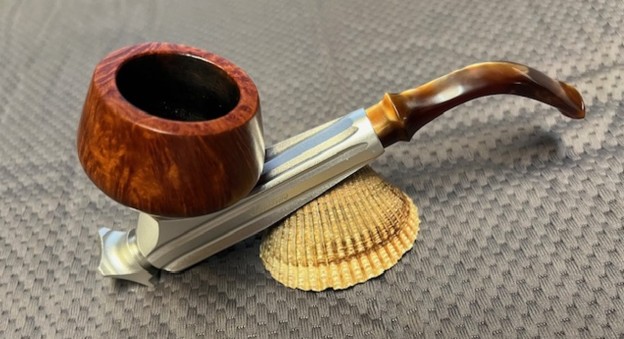
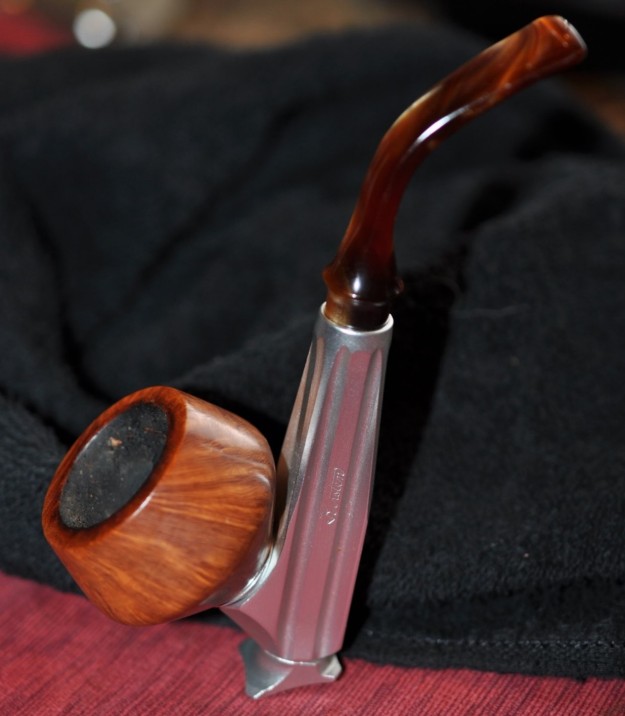
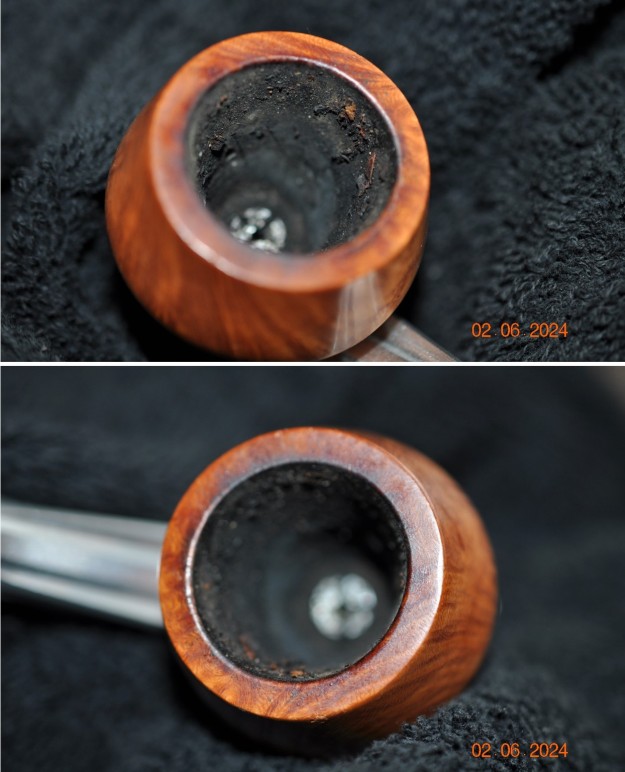
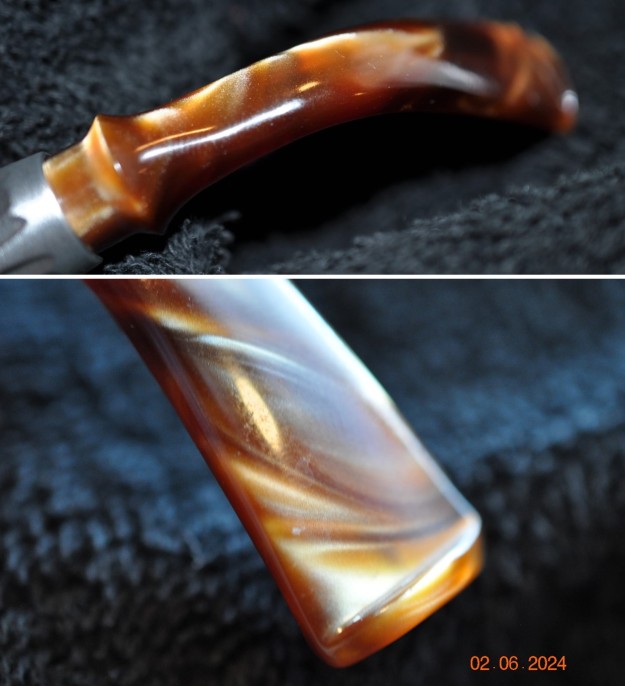
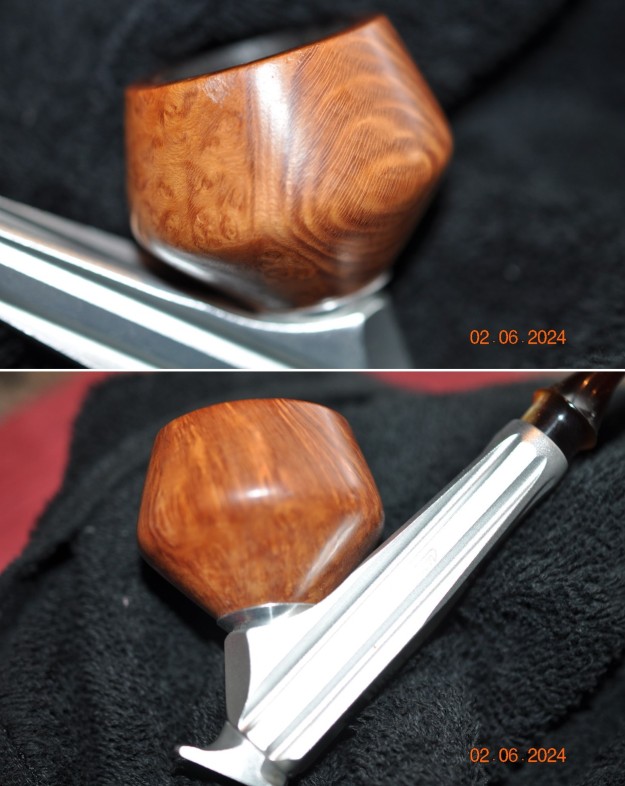
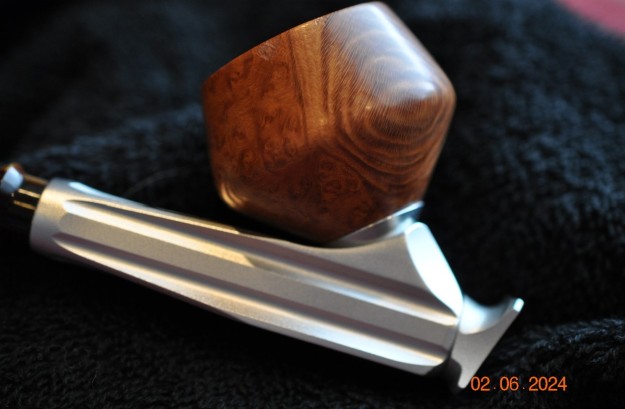
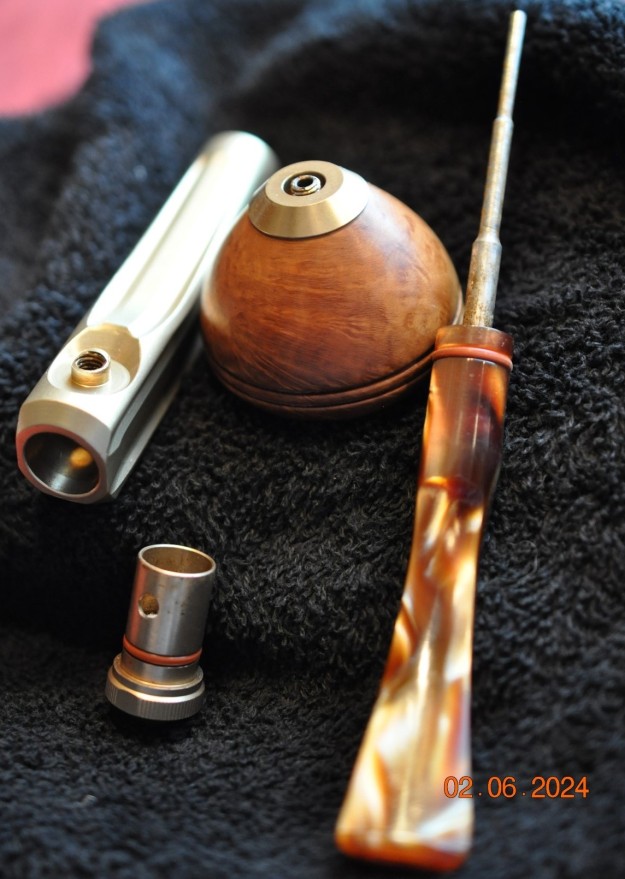
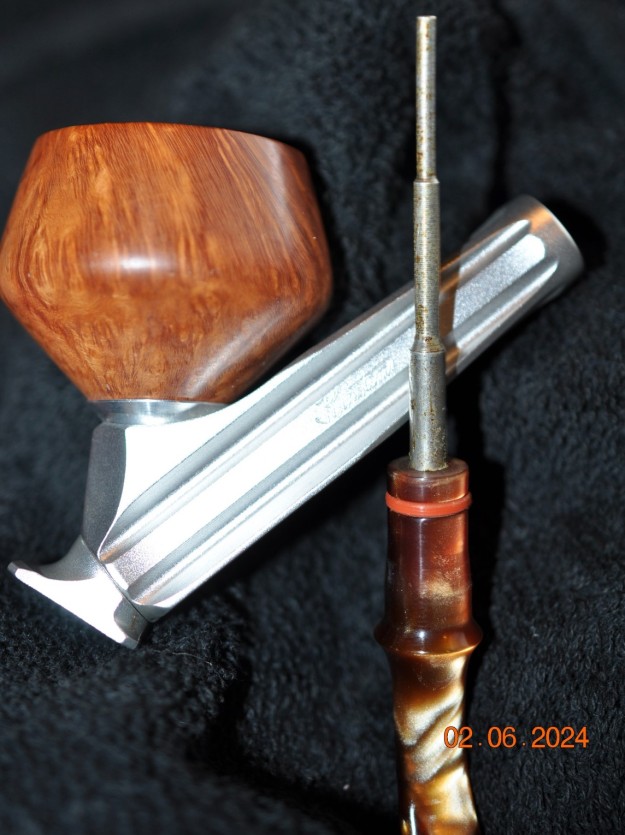
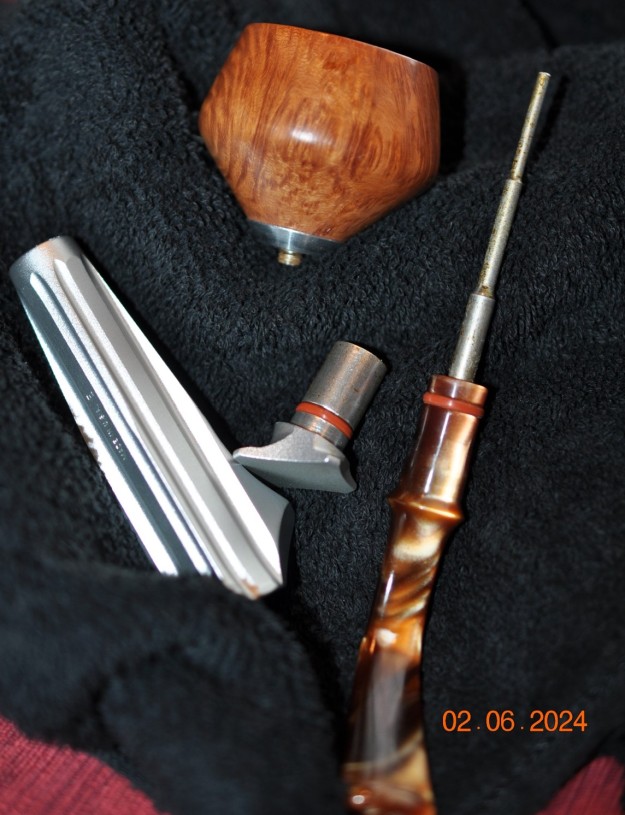
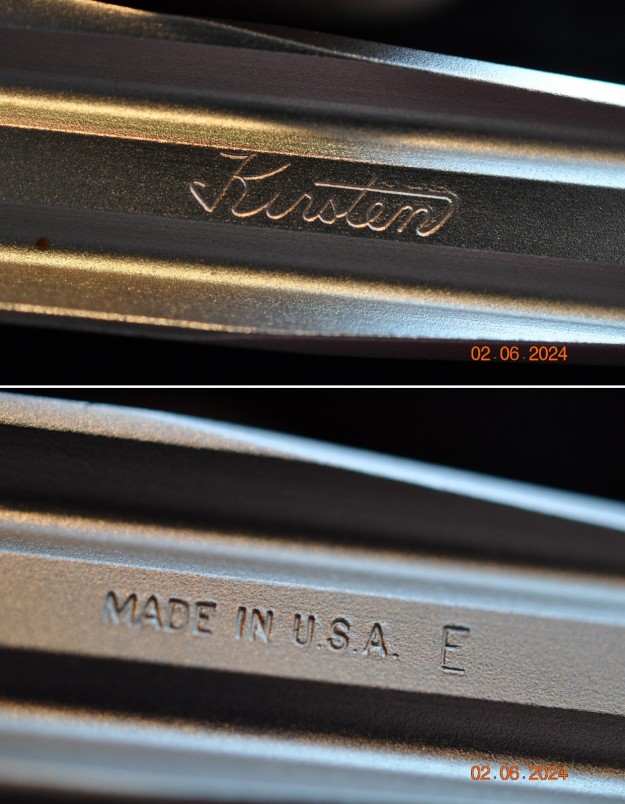
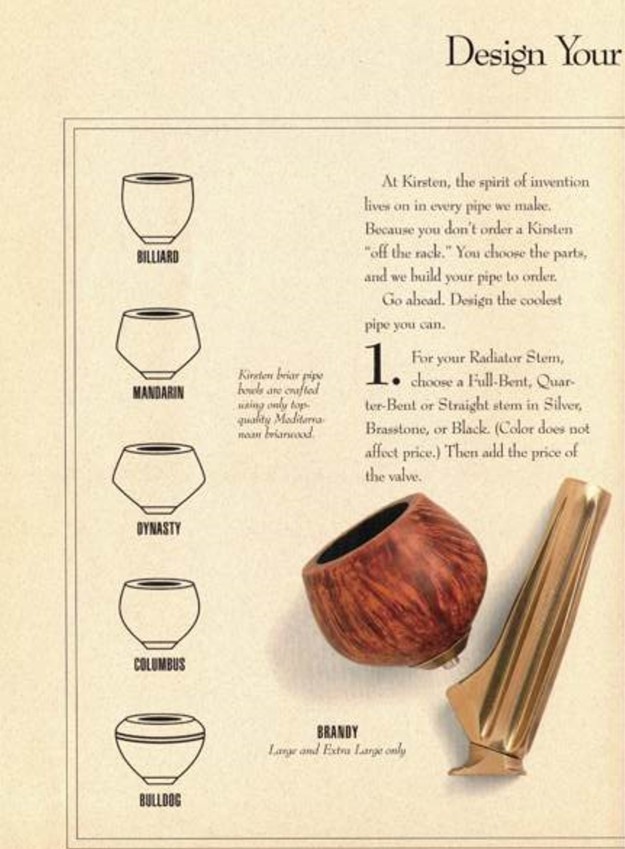
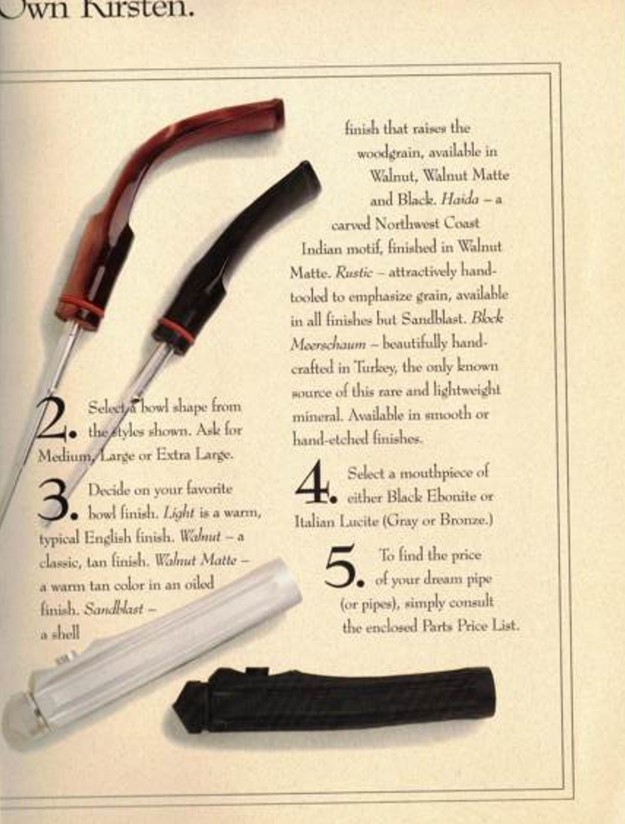
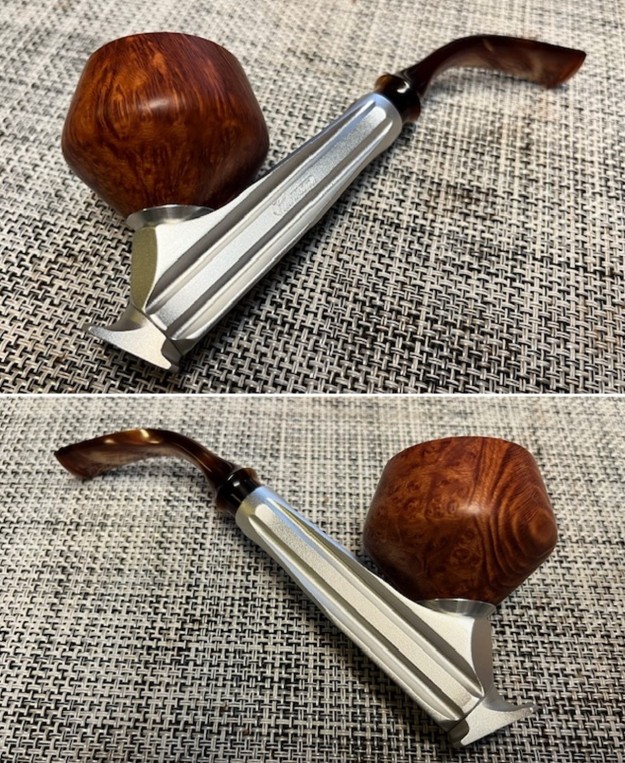
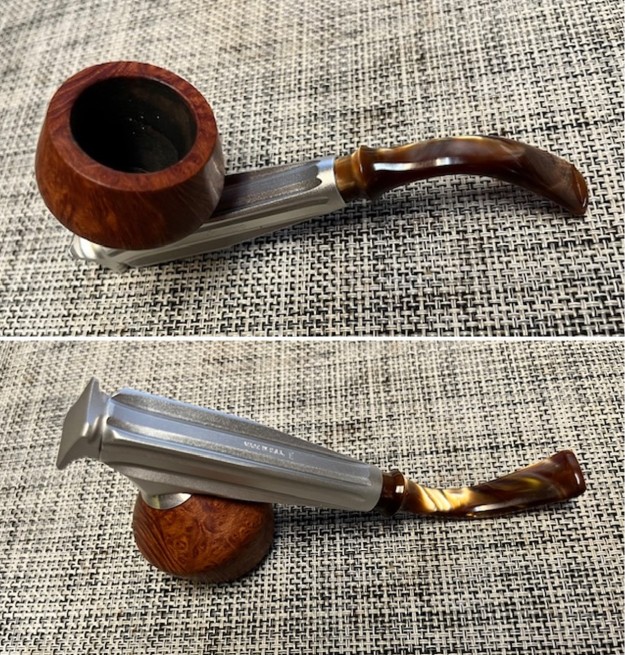
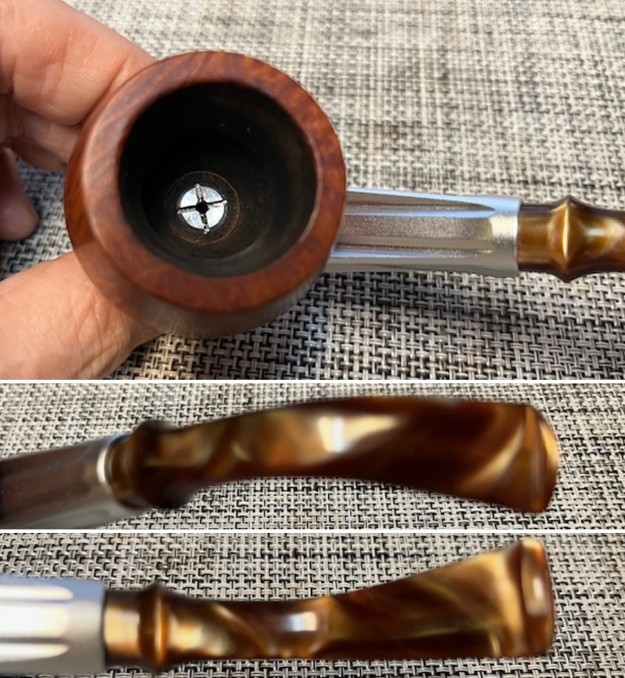
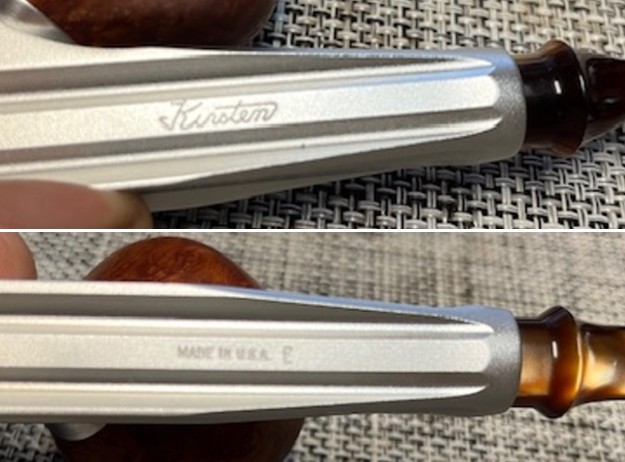
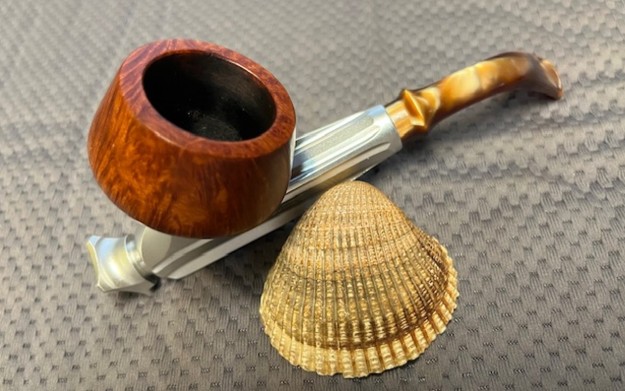
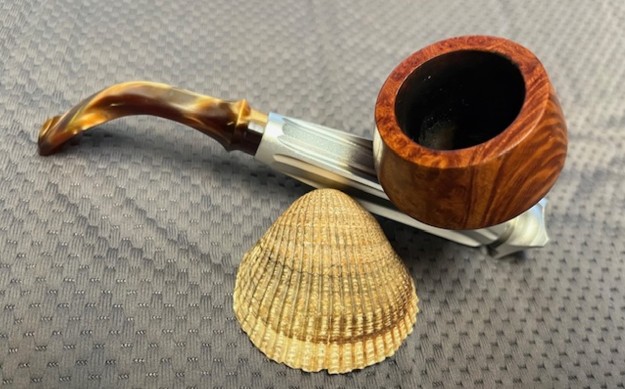
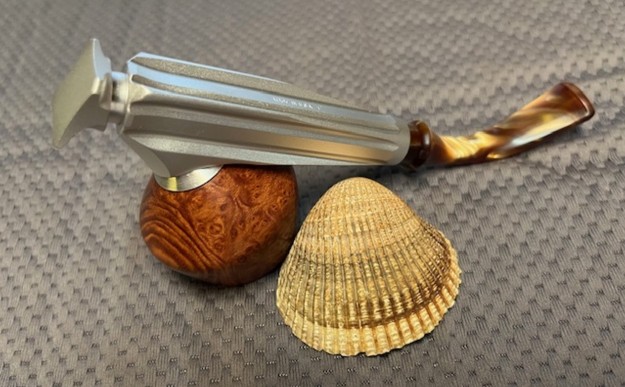
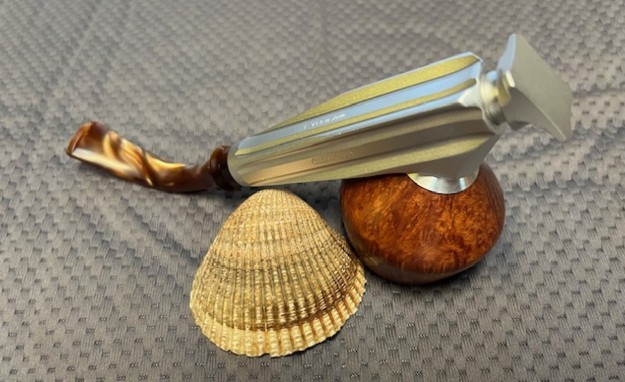
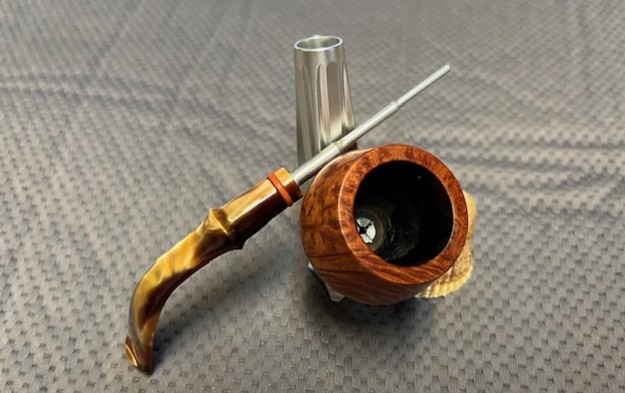
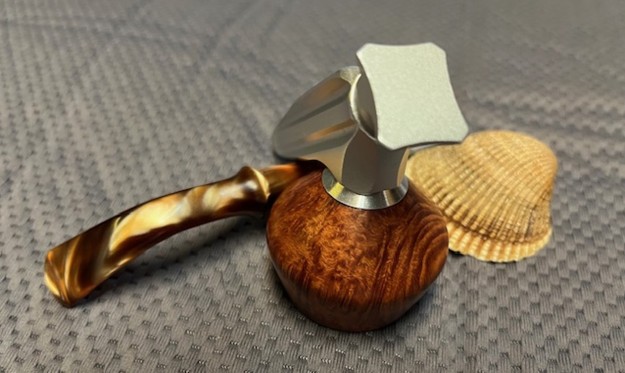
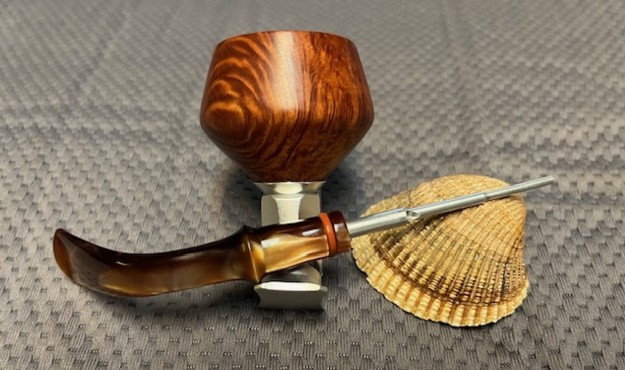
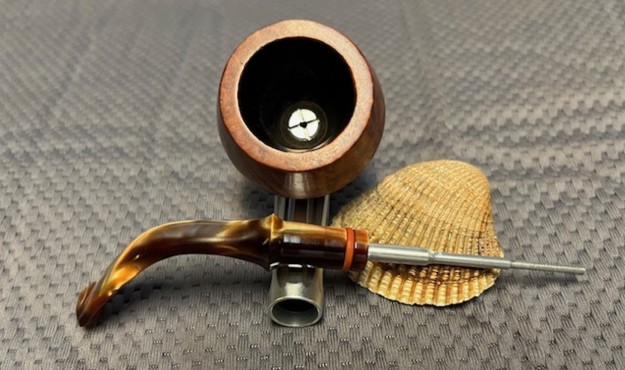
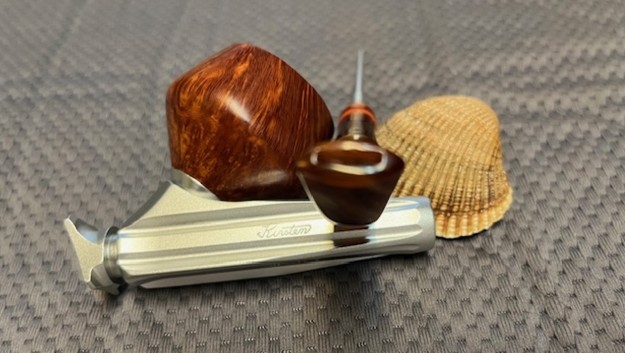
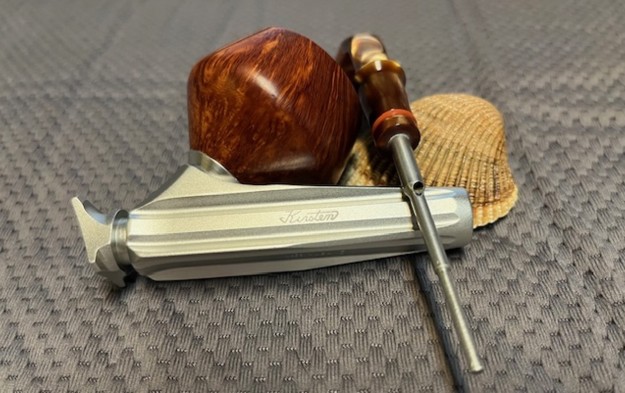
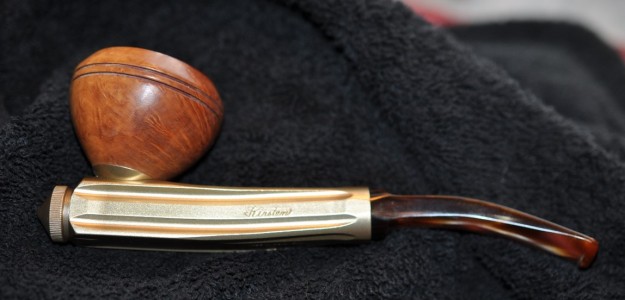
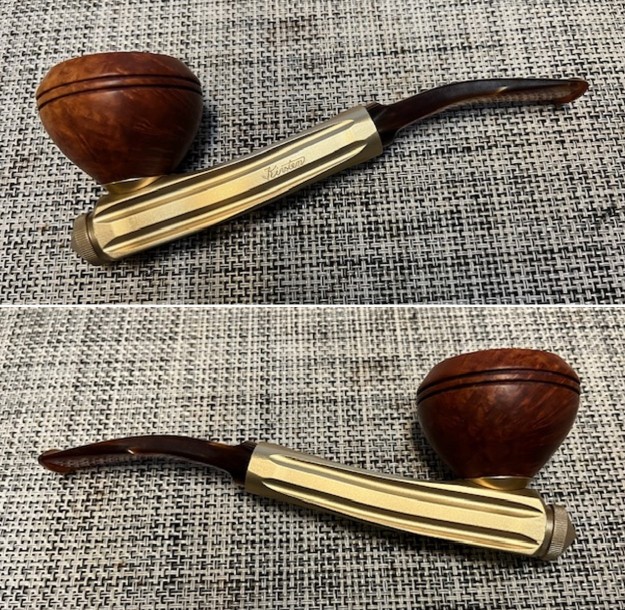
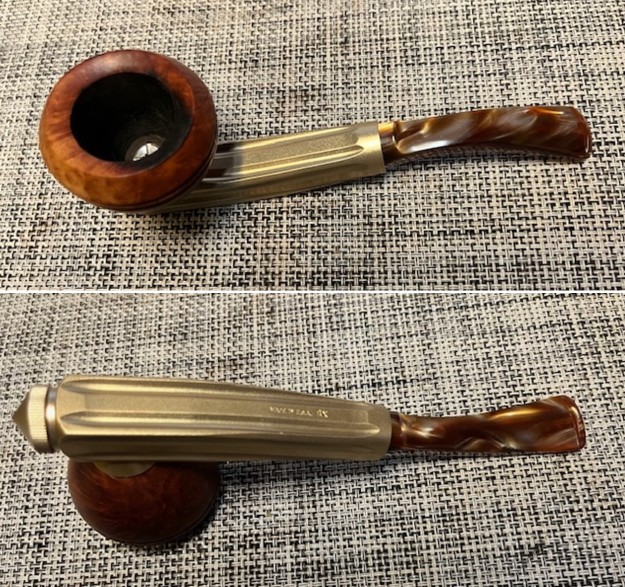
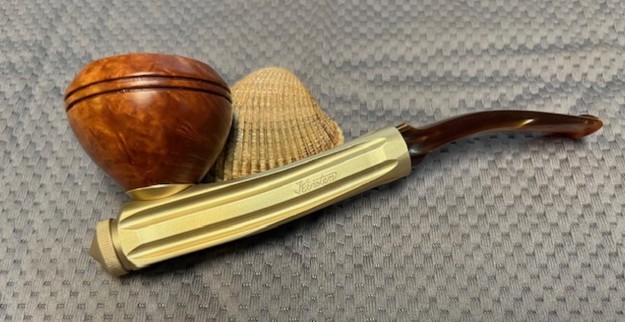
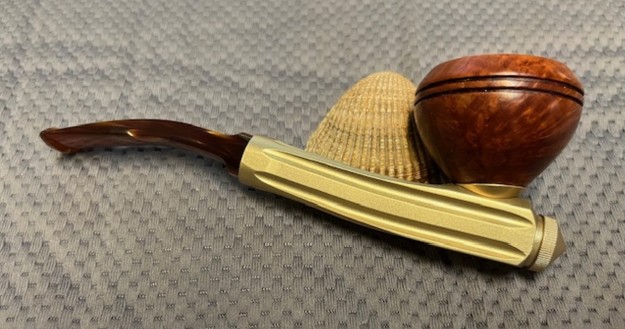
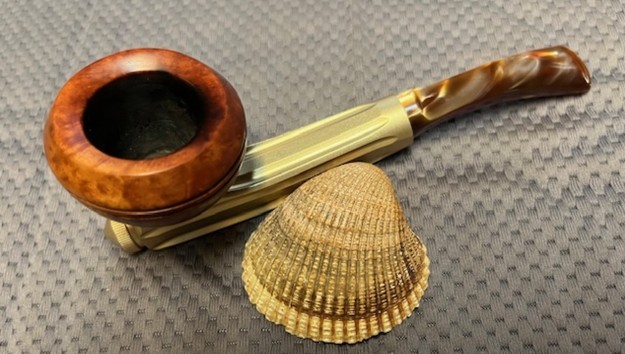
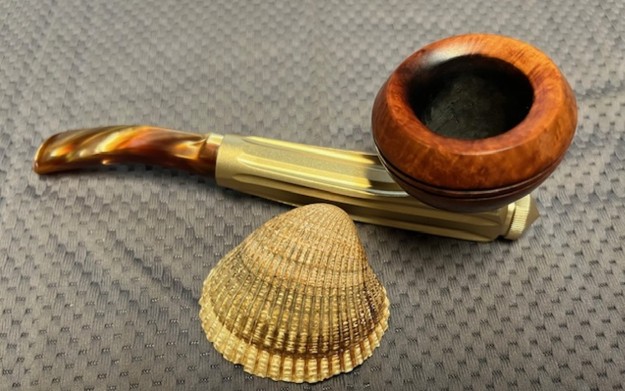
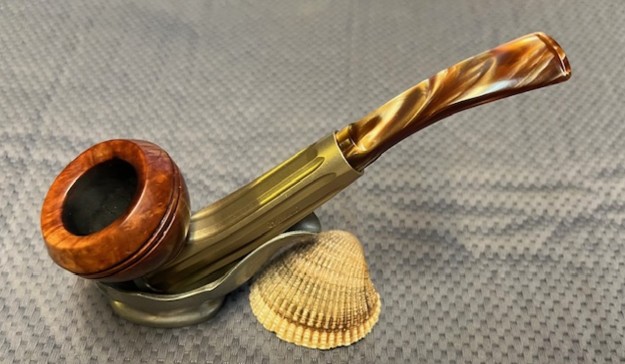
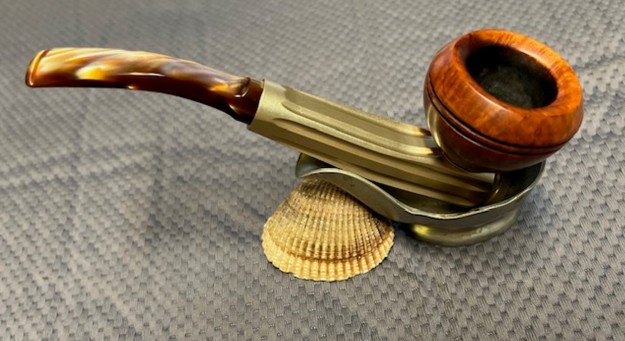
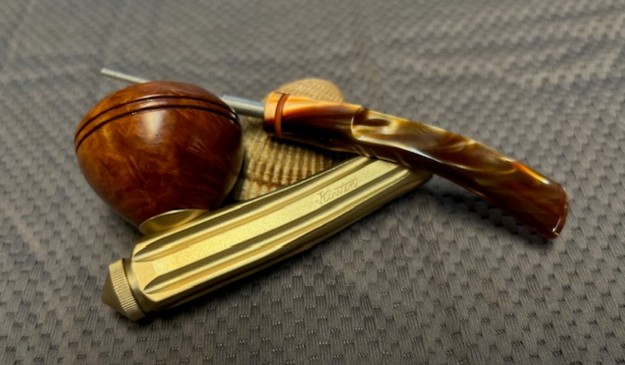
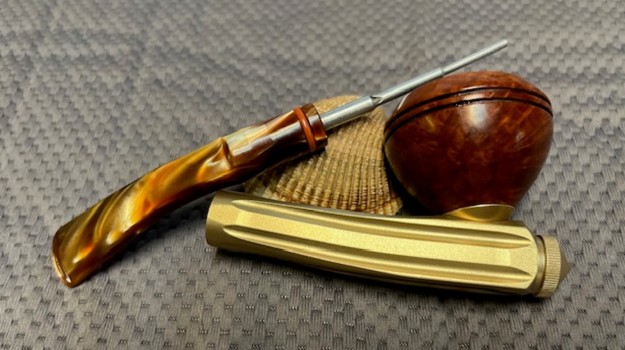
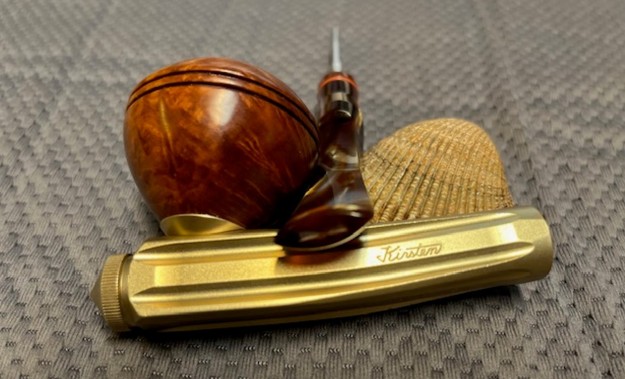
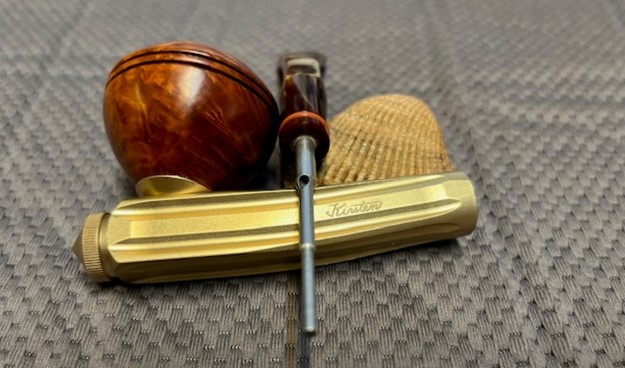
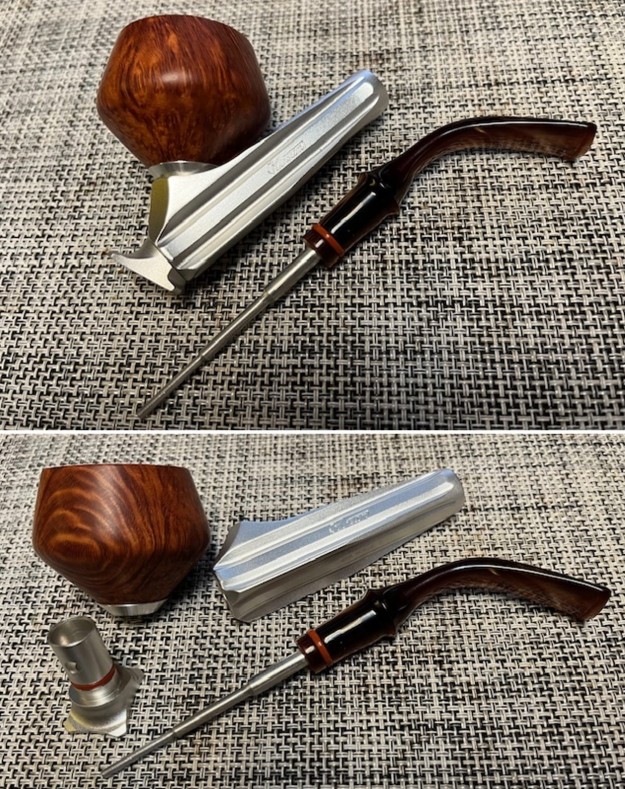
I bought my first Kirsten – a Mandarin in the early 80s from a pipe shop that specialized in them in Idaho Falls, Idaho. That shop is long since gone but there is still something about Kirsten pipes that attracts my attention. It may be the design look of the pipe and it may be the stubborn resolve that gave birth to it when Kirsten invented it after getting word from his doctor that he had to stop smoking. I don’t what it is but I like the boxy look of the base and shank, the grooves in the machined metal, the beautiful grain on the smooth bowls and the gentle curves of the stem. They always catch my eye. This one is no exception. We purchased it at an estate sale on 09/16/2023 in Idaho Falls, Idaho, USA. It has O rings on the stem and the end valve and a base on the bowl so I know that it is one of the more modern renditions. It also has the same kind of thick marbled acrylic stems that the one I purchased had. The pipe is a large one with a silver tone barrel. The smooth Mandarin style bowl has some great grain on it under the grime on the surface. The bowl was thickly caked with a light lava overflow pouring over the rim top. It was hard to know the condition of the inner edge and rim top underneath the lava but cleaning that up will tell the story. The acrylic stem had light tooth marks and chatter on both sides ahead of the button. The internals were heavily tarred and the metal tube and intake to the stem was also very dirty. The valve on the front of the bowl was tight but it was not frozen. It had a flattened base that allowed the stem to stand. Jeff took photos of it before he worked his magic in the cleanup process. The exterior of the pipe was very dirty – grime and grit ground in from years of use and sitting. The rim top was covered with a coat of thick lava that overflowed the bowl. There was also some darkening and lava on the rim top. The bowl itself had a thick cake with flecks of tobacco stuck in the cake on the sides. The acrylic stem surface was dirty and had some tooth marks and chatter on both sides. Jeff took photos of the sides of the bowl to give a better feel for the condition of the bowl. You can see the interesting grain on the bowl side and front. He took photos of the pipe taken apart to show the constituent part s of the pipe. IT really was a well-made piece of engineering from the Kirsten factory. I was looking forward to working on it. The next photos show the stamping on the sides of the barrel shank and it is very readable. It reads Kirsten on the left side of the barrel and on the underside Made in USA E.Before doing cleanup work on the pipe I decided to do some research on the pipe. I have several Kirsten catalogues on the site and turned to the 1993-94. Here is the link to that catalogue (https://rebornpipes.com/2022/11/17/1993-94-kirsten-pipe-catalogue/). I have included several of the pages below. The first shows the bowl shape and the Radiator barrel. The bowl is the Mandarin shape bowl below, the second from the top in the drawings of bowl shapes. The stem is shown in the second catalogue page below. It is a bronze coloured Italian Lucite with a bent. With that information in hand I went over the details of the stamping on a previous blog that I had posted by Dave Whitney who wrote Old Briar. He gave a helpful guide to dating a Kirsten pipe by the stamping and component parts. He separated them into generations – 1, 1.5, 2, 3. Going over the details I concluded that what I was dealing with a Generation 3 pipe that was made between 1985 and the present. Here is the link and a portion of the blog. I have italicized the portions that pertain to this particular pipe (https://rebornpipes.com/2012/11/03/kirsten-generation-1-1-5-2-3/).
Generation 3 – 1985 to the present                                                                         

All current models stamped “Made in U.S.A.” and all have O rings on both the valve and stem. They come in the following models:

Straights

JX Jewel Brass

M Mariner

L Lancer

Quarter-Bents

RX Regent Brass

H Horizon

Full bents

Advertisement

EX Esquire Brass

DX Designer Brass

FOOTNOTE ON VARIATIONS IN LETTER DESIGNATIONS:  Generally speaking, the X added to a model letter like “S” stands for brass tone finish, i.e., “SX.” There is one exception to this: In the 1960s Kirsten made a brass tone model with an “Eternalum” finish that gave the brass tone an antiqued look. They were marked with a “X” designation following the model letter. The B added to a model letter like “M” stands for black finish, i.e., “MB.”

He ended his answer to the questions with this great note: “Now the fun part…. this is how they came from the factory. What people did to them after they got them is what makes it an inexact science. Parts for the different sizes are not interchangeable, except for the bowls. I have a Gen 1 – M and -S…nothing interchanges but the bowls. If you get a Gen 1 that has been badly abused, you can end up losing either the bit or metal insert, or both, no matter what you do or how long you try.”

References used:

Whitney, Dave (2009) Old Briar – Pipe smoking on a budget. Pipesbywhitney http://www.kirstenpipe.com/

I now knew that the pipe I was working on was a Generation 3 made between 1985 and the present. It was a Full-Bent and the E made it an Esquire Version. The E is for Esquire shape and it has a silver finished. Now it was time to work on the pipe.

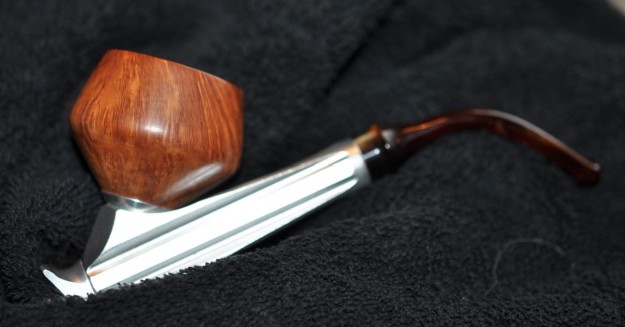
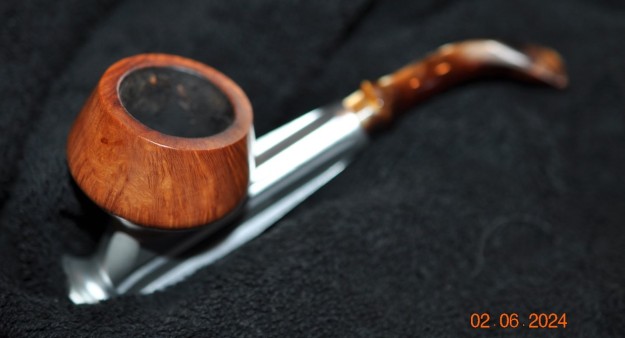
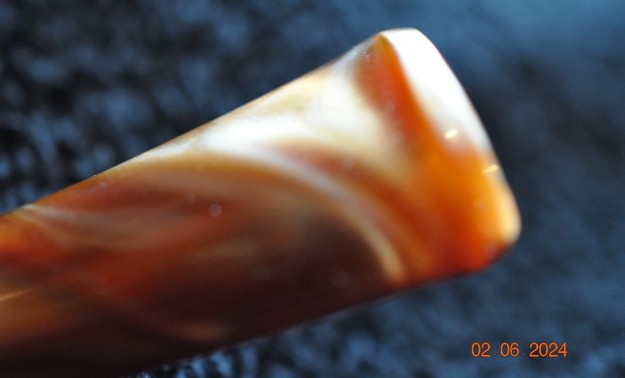
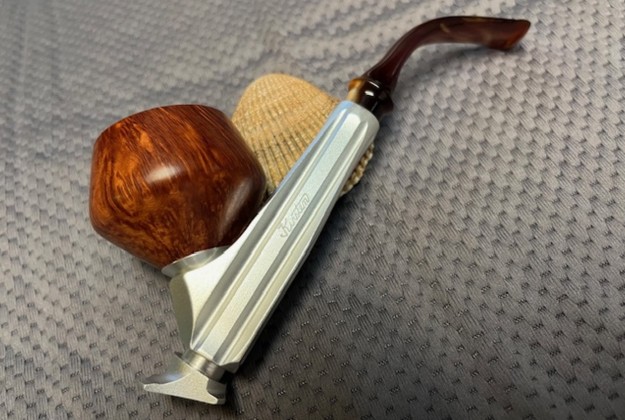
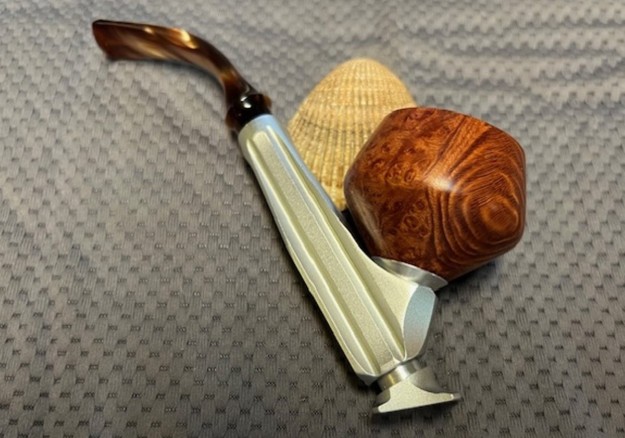
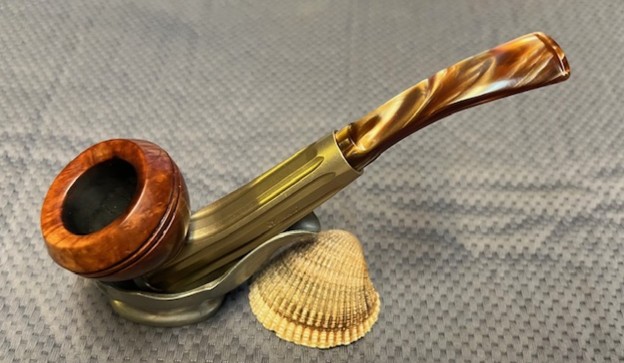
Jeff reamed it with a PipNet pipe reamer and cleaned up the remaining cake in the bowl with a Savinelli Fitsall Pipe Knife. He scrubbed out the internals with alcohol, pipe cleaners and cotton swabs until the pipe was clean. He scrubbed the exterior of the bowl with Murphy’s Oil Soap and a tooth brush to remove the grime and grit on the briar and the lava on the rim top. The finish looks very good with good looking grain around the bowl and shank. The rim top had some significant damage on the back part of the bowl. It had been burned from repeated lighting with a torch lighter. Jeff took the pipe apart and cleaned the barrel, the adjustable valve and the stem with alcohol, pipe cleaners and cotton swabs. He scrubbed the stem with Soft Scrub and soaked it in Briarville’s Pipe Stem Deoxidizer to remove the grime on the acrylic. When the pipe arrived here in Vancouver for the second stop of its restoration tour it looked a lot better. I took photos before I started my part of the work. I took a photo of the bowl and rim top to show how well it had cleaned up. The top and the edges of the bowl are in very good condition. There does not seem to be any damage on either the inner or outer edges and the rim top. The stem had light tooth marks and chatter on both sides ahead of the button.I took photos of the stamping on the left side and underside of the shank. It is clear and readable.I remove the stem from the barrel and took a photo. I removed the bowl from the barrel and took another photo.I started my work on the pipe by polishing the bowl and rim top with micromesh sanding pads – dry sanding with 1500-12000 grit pads. I wiped the bowl with a damp cotton pad after each sanding pad. The surface began to take on a nice shine. I worked Before & After Restoration Balm deep into the smooth finish to clean, enliven and protect the briar. I hand rubbed it with my fingers and worked it into the finish. I set it aside to dry for 10-15 minutes. I wiped it off with a soft cloth. I buffed the bowl with a cotton cloth to polish it. It really began to have a deep shine in the briar. I took some photos of the bowl at this point to mark the progress in the restoration. The grain on the bowl stands out with interesting lines moving across the sides of the bowl. I set the bowl aside and sanded the stem with the 2 inch square 320-3500 grit sanding pads. I wiped down the stem after each sanding pad. I was able to remove the tooth marks and chatter on both sides with the pads. The stem looked very good.I polished the acrylic stem with micromesh sanding pads – dry sanding it with 1500-12000 grit pads. I wiped the stem down after each sanding pad with Obsidian Oil and set it aside to dry.I polished it further with Before & After Pipe Polish – using both the Fine and Extra Fine Polishes. I gave it a rubdown with Obsidian Oil one last time and set it aside.I put the Kirsten Generation 3 Full Bent Mandarin E back together and worked the pipe over on the buffing wheel using Blue Diamond to lightly polish the bowl and the acrylic stem. I buffed the bowl and stem to raise the gloss on the briar and the acrylic. I gave the pipe multiple coats of carnauba wax. I buffed the entire pipe with a clean buffing pad to raise the shine. I hand buffed it with a microfiber cloth to deepen the shine. The finished the Kirsten Gen 3 Full Bent Mandarin is shown in the photos below. The medium brown stains on the smooth Bulldog shaped bowl works well with the rich bronze Italian acrylic stem. The dimensions of the pipe are: Length: 6 inches, Height: 2 ½ inches, Outside Diameter: 1 ½ inches, Diameter of the chamber: 1 inch. The weight of the pipe is 61 grams/2.15 ounces. This is an interesting piece of briar, cross grain and birdseye on the bowl and shank. I really like how the briar and the vulcanite work well together. This one will soon be on the rebornpipes store. If you are interested in adding a Kirsten to your collection this may well be the one for you. Thanks for walking with me through the restoration process.

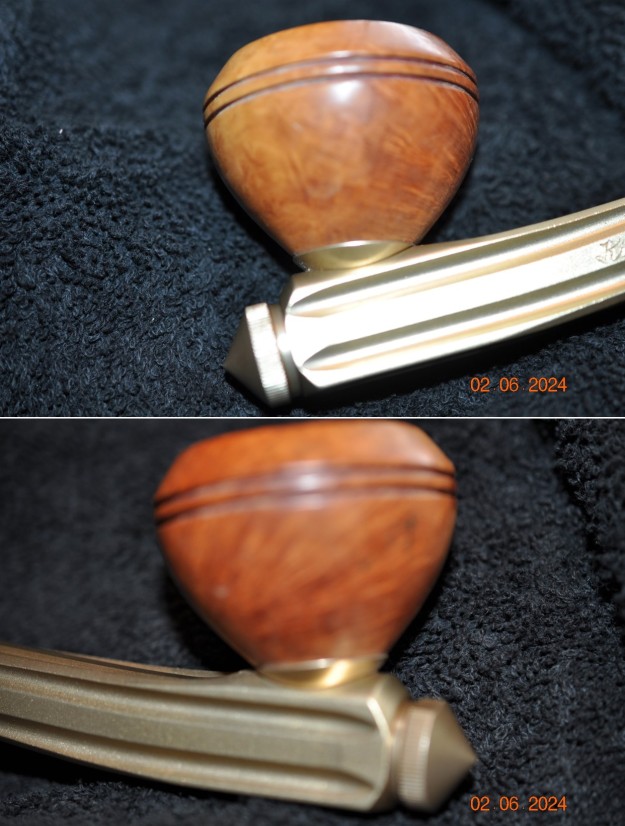
Restoring a Lovely Generation 3 Kirsten RX Brass Tone ¼ Bent Bulldog


Blog by Steve Laug

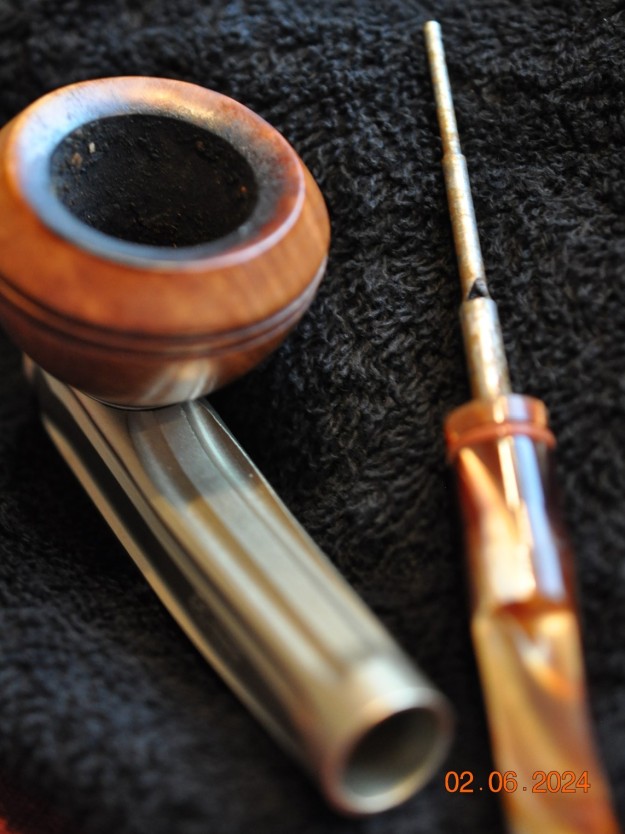
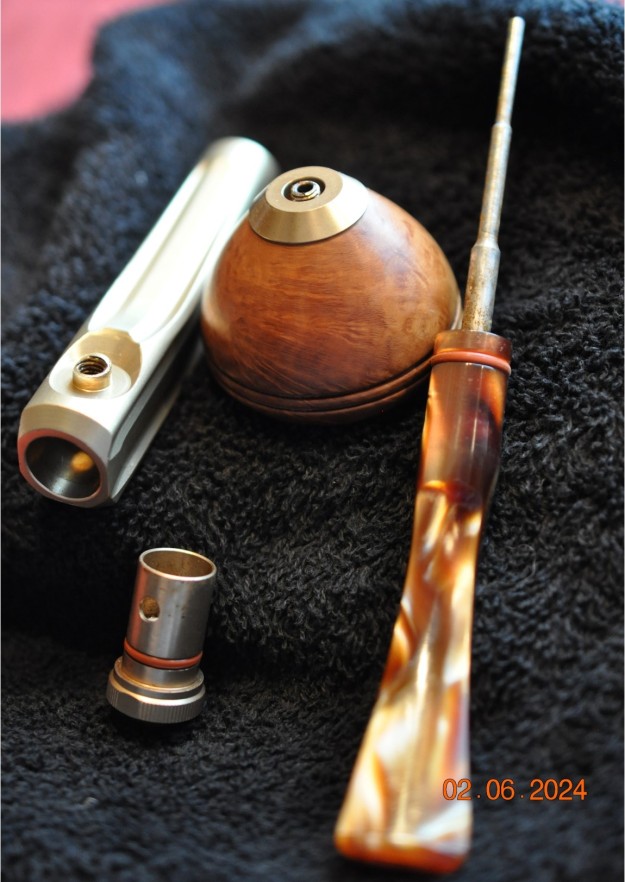
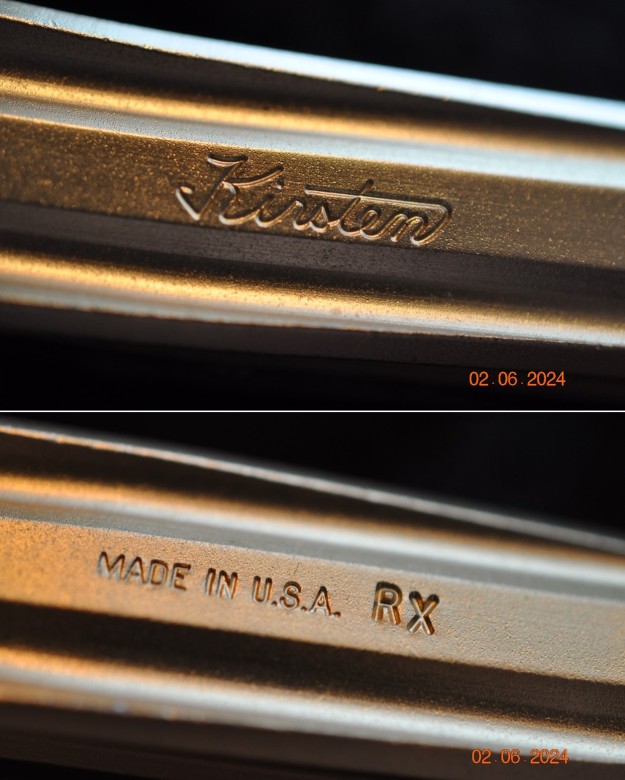
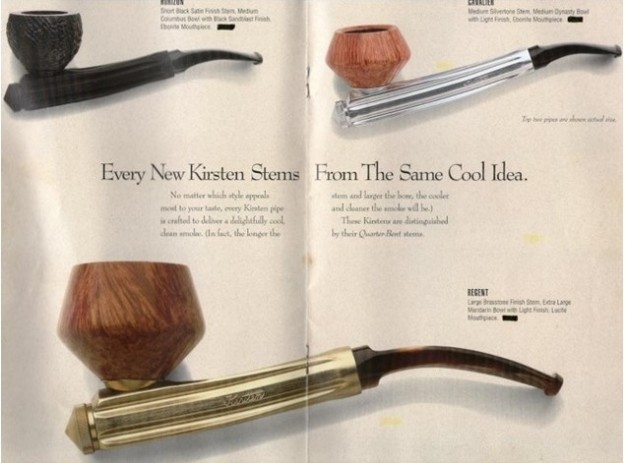
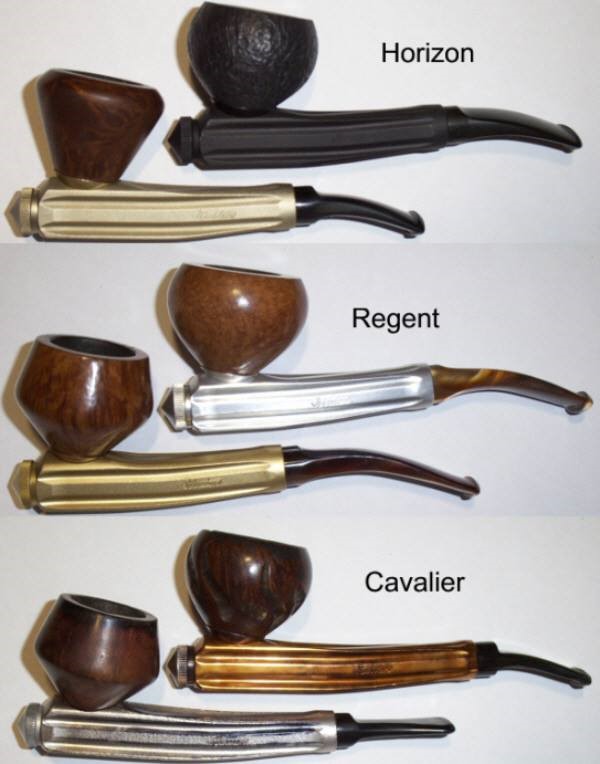
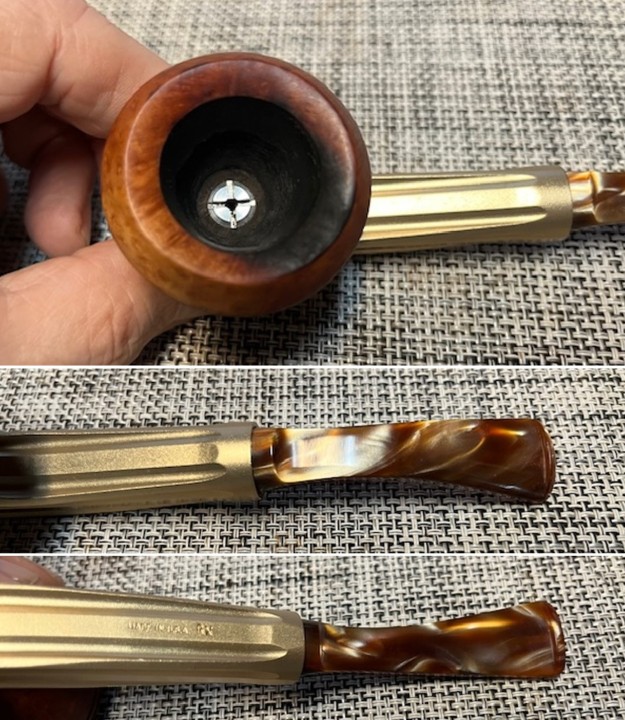
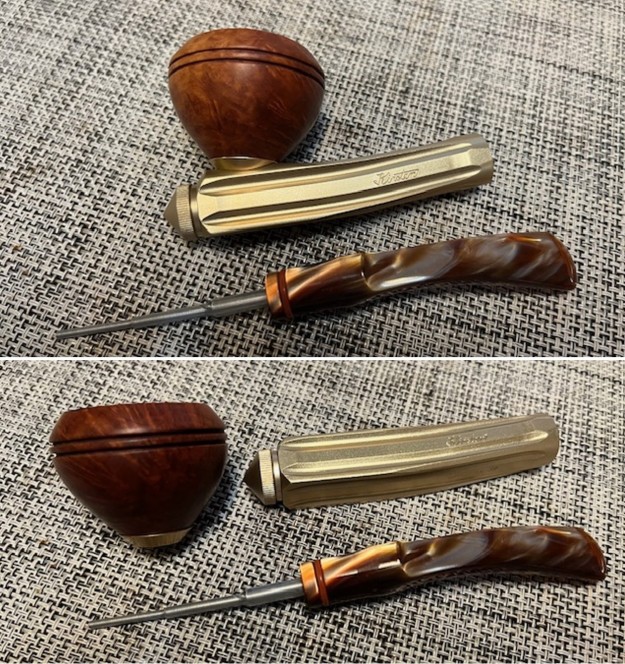
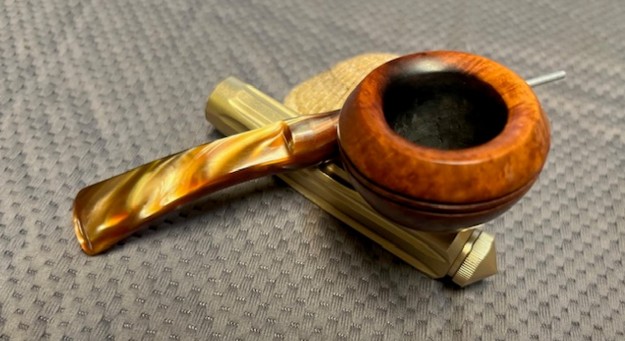
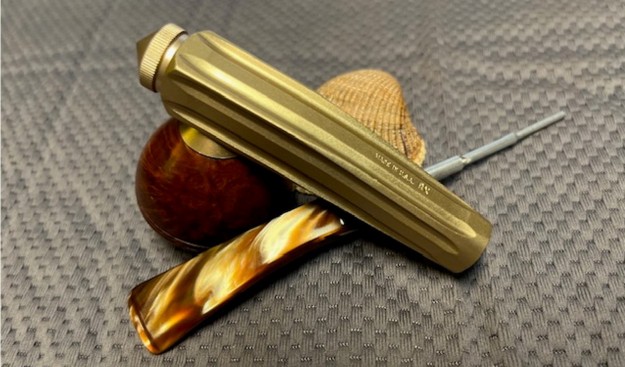
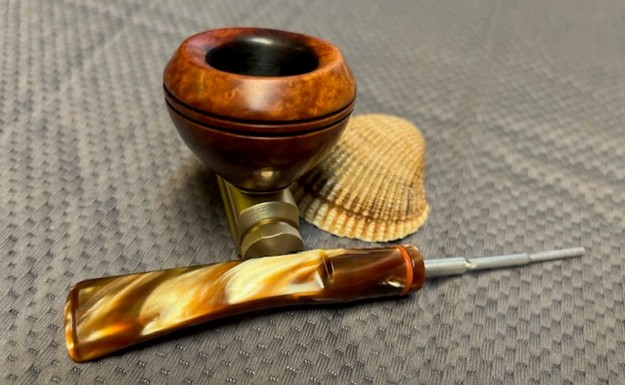
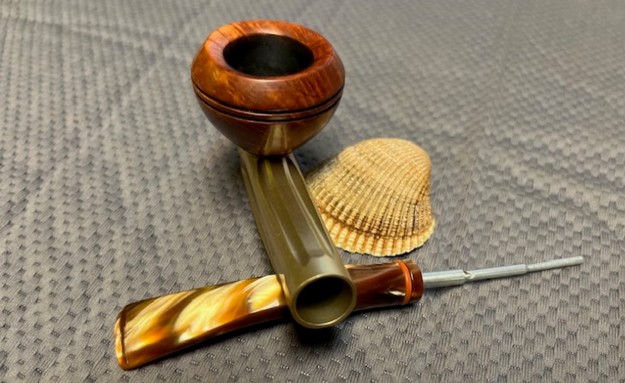
I bought my first Kirsten – a Mandarin in the early 80s from a pipe shop that specialized in them in Idaho Falls, Idaho. That shop is long since gone but there is still something about Kirsten pipes that attracts my attention. It may be the design look of the pipe and it may be the stubborn resolve that gave birth to it when Kirsten invented it after getting word from his doctor that he had to stop smoking. I don’t what it is but I like the boxy look of the base and shank, the grooves in the machined metal, the beautiful grain on the smooth bowls and the gentle curves of the stem. They always catch my eye. This one is no exception. We purchased it at an estate sale on 09/16/2023 in Idaho Falls, Idaho, USA. It has O rings on the stem and the end valve and a base on the bowl so I know that it is one of the more modern renditions. It also has the same kind of thick marbled acrylic stems that the one I purchased had. The pipe is a large one with a brass tone barrel. The smooth Bulldog style bowl has some great grain on it under the grime on the surface. The bowl was thickly caked with a thick lava overflow pouring over the inwardly beveled rim top. It was hard to know the condition of the inner edge and rim top underneath the lava but cleaning that up will tell the story. The acrylic stem had light tooth marks and chatter on both sides ahead of the button. The internals were heavily tarred and the metal tube and intake to the stem was also very dirty. The valve on the front of the bowl was tight but it was not frozen.  Jeff took photos of it before he worked his magic in the cleanup process. The exterior of the pipe was very dirty – grime and grit ground in from years of use and sitting. The rim top was covered with a coat of thick lava that overflowed the bowl. There was also some darkening and lava on the rim top. The bowl itself had a thick cake with flecks of tobacco stuck in the cake on the sides. The acrylic stem surface was dirty and had some tooth marks and chatter on both sides. Jeff took a photo of the sides of the bowl to give a better feel for the condition of the bowl. You can see the interesting grain on the bowl sides and front.He took photos of the pipe taken apart to show the constituent part s of the pipe. It really was a well-made piece of engineering from the Kirsten factory. I was looking forward to working on it. The next photos show the stamping on the sides of the barrel shank and it is very readable. It reads Kirsten on the left side of the barrel and on the underside Made in USA RX.Before doing cleanup work on the pipe I decided to do some research on the pipe. I have a catalogue for Kirsten pipes in my files and found this pipe in the catalogue. It is shown in the photo below in the bottom of the photo. The pipe I am working on is in the Regent Shape. I also have several Kirsten catalogues on the site and turned to the 1993-94. Here is the link to that catalogue (https://rebornpipes.com/2022/11/17/1993-94-kirsten-pipe-catalogue/). I have included several of the pages below. The first shows the bowl shape and the Radiator barrel. The bowl is the Bulldog shape bowl below at the bottom of the drawings of bowl shapes. The stem is shown in the second catalogue page below. It is a bronze coloured Italian Lucite with a ¼ bent. With that information in hand I went over the details of the stamping on a previous blog that I had posted by Dave Whitney who wrote Old Briar. He gave a helpful guide to dating a Kirsten pipe by the stamping and component parts. He separated them into generations – 1, 1.5, 2, 3. Going over the details I concluded that what I was dealing with a Generation 3 pipe that was made between 1958 and 1985. Here is the link and a portion of the blog. I have italicized the portions that pertain to this particular pipe (https://rebornpipes.com/2012/11/03/kirsten-generation-1-1-5-2-3/).

Generation 3 – 1985 to the present                                                                         

All current models stamped “Made in U.S.A.” and all have O rings on both the valve and stem. They come in the following models:

Straights

JX Jewel Brass

M Mariner

L Lancer

Quarter-Bents

RX Regent Brass

H Horizon

Full bents

Advertisement

EX Esquire Brass

DX Designer Brass

FOOTNOTE ON VARIATIONS IN LETTER DESIGNATIONS:  Generally speaking, the X added to a model letter like “S” stands for brass tone finish, i.e., “SX.” There is one exception to this: In the 1960s Kirsten made a brass tone model with an “Eternalum” finish that gave the brass tone an antiqued look. They were marked with a “X” designation following the model letter. The B added to a model letter like “M” stands for black finish, i.e., “MB.”

He ended his answer to the questions with this great note: “Now the fun part….this is how they came from the factory. What people did to them after they got them is what makes it an inexact science. Parts for the different sizes are not interchangeable, except for the bowls. I have a Gen 1 – M and -S…nothing interchanges but the bowls. If you get a Gen 1 that has been badly abused, you can end up losing either the bit or metal insert, or both, no matter what you do or how long you try.”

References used:

Whitney, Dave (2009) Old Briar – Pipe smoking on a budget. Pipesbywhitney http://www.kirstenpipe.com/

I now knew that the pipe I was working on was a Generation 3 made between 1985 and the present. It was a Quarter-Bent and the RX made it a Regent Brass Version. The R is for the Regent shape and the X stamp refers to the Brass finish. Now it was time to work on the pipe.

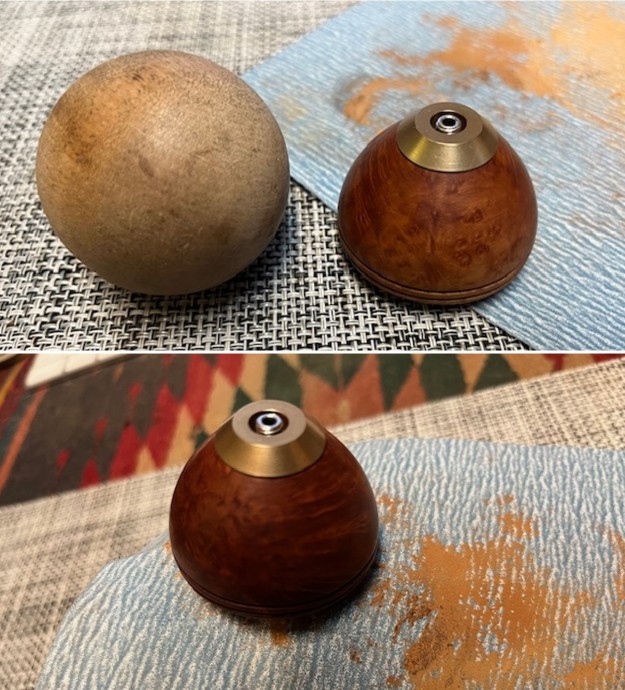
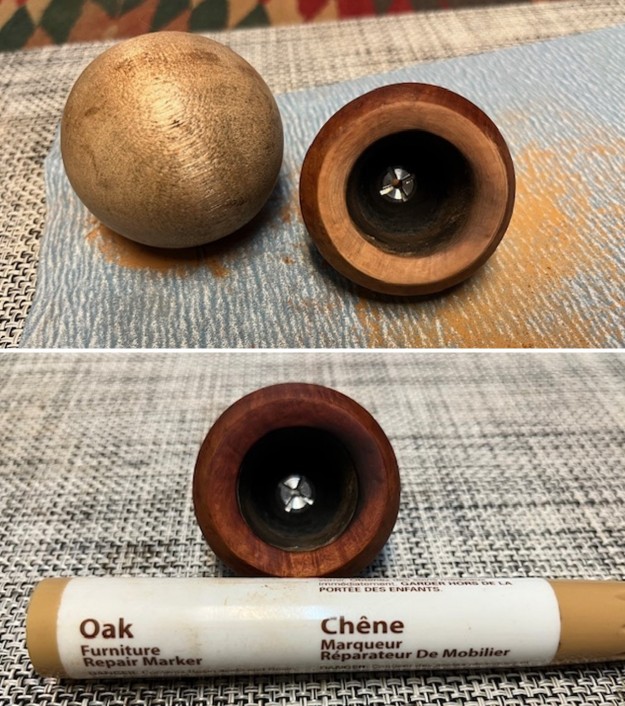
Jeff reamed it with a PipNet pipe reamer and cleaned up the remaining cake in the bowl with a Savinelli Fitsall Pipe Knife. He scrubbed out the internals with alcohol, pipe cleaners and cotton swabs until the pipe was clean. He scrubbed the exterior of the bowl with Murphy’s Oil Soap and a tooth brush to remove the grime and grit on the briar and the lava on the rim top. The finish looks very good with good looking grain around the bowl and shank. The rim top had some significant damage on the back part of the bowl. It had been burned from repeated lighting with a torch lighter. Jeff took the pipe apart and cleaned the barrel, the adjustable valve and the stem with alcohol, pipe cleaners and cotton swabs. He scrubbed the stem with Soft Scrub and soaked it in Briarville’s Pipe Stem Deoxidizer to remove the grime on the acrylic. When the pipe arrived here in Vancouver for the second stop of its restoration tour it looked a lot better. I took photos before I started my part of the work. I took a photo of the bowl and rim top to show how well it had cleaned up. There is some rim damage on the back of the beveled rim top from the outer edge to the inner edge. It was burned from repeated lighting from a torch lighter and the charring seemed quite deep but sanding would make that clear. The rest of the rim top had some darkening but it was very clean. The stem tooth marks and chatter are very light.I remove the stem from the barrel and took a photo. I removed the bowl from the barrel and took another photo.I started my work on the pipe by dealing with the burn damage on the beveled rim top, the inner edge of the rim and the general darkening on the rim top with a wooden bowl and some 220 grit sandpaper wrapped around it.Once it was finished it looked very good. The burn damage was minimized and the darkening around the top and edges was mostly removed. I restained the rim top and edges with an oak stain pen to match the rest of the bowl.I polished the bowl and rim top with micromesh sanding pads – dry sanding with 1500-12000 grit pads. I wiped the bowl with a damp cotton pad after each sanding pad. The surface began to take on a nice shine. I worked Before & After Restoration Balm deep into the smooth finish to clean, enliven and protect the briar. I hand rubbed it with my fingers and worked it into the finish and used the shoe brush to get in the twin rings. I set it aside to dry for 10-15 minutes. I wiped it off with a soft cloth. I buffed the bowl with a cotton cloth to polish it. It really began to have a deep shine in the briar. I took some photos of the bowl at this point to mark the progress in the restoration. The grain on the bowl stands out with interesting lines moving across the sides of the bowl and the shank. I set the bowl aside and sanded the stem with the 2 inch square 320-3500 grit sanding pads. I wiped down the stem after each sanding pad. I was able to remove the tooth marks and chatter on both sides with the pads. The stem looked very good.I polished the vulcanite stem with micromesh sanding pads – dry sanding it with 1500-12000 grit pads. I wiped the stem down after each sanding pad with Obsidian Oil and set it aside to dry.I polished it further with Before & After Pipe Polish – using both the Fine and Extra Fine Polishes. I gave it a rubdown with Obsidian Oil one last time and set it aside.I put the Kirsten Regent Brass (RX) Bulldog back together and worked the pipe over on the buffing wheel using Blue Diamond to lightly polish the bowl and the acrylic stem. I buffed the bowl and stem to raise the gloss on the briar and the acrylic. I gave the pipe multiple coats of carnauba wax. I buffed the entire pipe with a clean buffing pad to raise the shine. I hand buffed it with a microfiber cloth to deepen the shine. The finished the Kirsten Regent Brass Bulldog is shown in the photos below. The medium brown stains on the smooth Bulldog shaped bowl works well with the rich bronze Italian acrylic stem. The dimensions of the pipe are: Length: 6 inches, Height: 2 inches, Outside Diameter: 1 ½ inches, Diameter of the chamber: 1 inch. The weight of the pipe is 59 grams/2.08 ounces. This is an interesting piece of briar, cross grain and birdseye on the bowl and shank. I really like how the briar and the vulcanite work well together. This one will soon be on the rebornpipes store. If you are interested in adding a House of Robertson to your collection this may well be the one for you. Thanks for walking with me through the restoration process.
A Book Review – Barling’s International Exhibition, London 1851 Pipe Catalogue


Blog by Steve Laug

Barling Catalogue
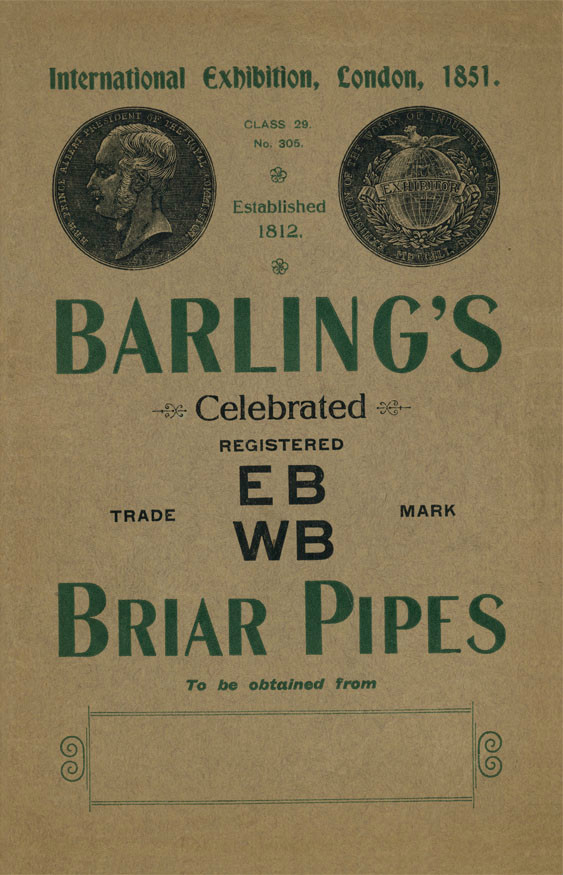
I purchased this facsimile/reproduction catalogue of 28 pages on EBay a bit ago. It cost approximately $20 USD and the seller had quite a few available at the buy it now price.

They printed a run of 200 copies and this one is 010 of 200. It is copyrighted by Jesse Silver. There is an email address included inside the cover should you want to order a copy of the catalogue noblebrush53@yahoo.com

Included with the catalogue is a print of the Barling’s Factory. The inside is nicely done and indeed looks vintage. The type is in two colours – a reddish brown and a black. There are also nice etchings of the various pipes. Each page shows four pipes, each one number and named. The names are quite catching. Here are a few for interest sake: The Goodwood, Birkenhead, Savernake, Aberdeen, Nymph, Bent Army, Corinthian, Sydney, Elegant, Trojan and Victorian. The names don’t always reflect the shape of the pipe but sometimes do as in the Bent and the Straight Army. Some of the short chubby pipes also have unique names: The Gordon, Sporting, Hunt, Jap are just a few of the names. The overall feel of the book is like a trip back in time to a simpler and quieter era. The catalogue opens with the words: these are just a few of the many shapes that are available in Barling’s Celebrated Pipes.

I wanted to include the opening page of the catalogue for your reading pleasure. It is a note from B. Barling & Sons, London and reads as follows:

“We have much pleasure in presenting our New Catalogue illustrating some of the principal shapes and specialties in our celebrated EB/WB Briar Pipes.

Our pipes being so well and universally known (without artificial aid of advertisements), we will not here dwell on their perfection, but would ask you to kindly peruse this book, which will no doubt introduce to you some new patterns.

If you are not already a smoker of our pipes, we hope that it will lead to your giving them a trial and thus testing their quality and workmanship, we ourselves being confident of your ultimate judgment and satisfaction.

Every department of our factory being under our own practical and personal supervision, ensures every pipe turned out by us coming under our direct notice. This fact, coupled with the excellence of the materials used in their manufacture, has given our pipes a reputation second to none in the smoking world, a reputation we firmly intend to maintain and strengthen.”

I find the introduction to the catalogue a fascinating read and one that has proven to be true even in our day over 150 years later. Barling’s Pipes are still seen as quality pipes that deliver a great smoke. I have Pre-transition, Transition and Post-transition pipes and though there are certainly differences in quality of workmanship in the later pipes they nonetheless are good smokers. The pages of the catalogue are full of information both in the form of the photos and shape names and numbers but also in the stampings on the pipes and the linking of certain shapes to others with a note on the size. For instance, the Hunt, No. 344 a diamond shank billiard, is a parallel shape to shape #324 which is larger and shape #566 which is smaller.

After the main shapes portion of the catalogue the pages turn toward specialty items such as Crocodile and Morocco cases which are noted to be “unsurpassed for durability and finish” and can be obtained for any Barling pipes as a Single or a Companion case. There are several pages o of pipes with unique covers – with shapes from flat to domed, with hinges and with chains holding them in place. These are truly beautiful looking pipes. Something I was unaware of was that Barling’s made Meerschaum lined pipes as well. They show three examples with a note that they can be made for any shape of Barling’s pipes. I had to laugh at the note (so contrary to much I read today on the forums regarding meer lined pipes) that “Our Meerschaum Lined Pipes we can recommend for cool and sweet smoking. They are suitable for hard smokers and also for those who do not like briar…”

The catalogue ends with what for me has become a bit of a wish book – Specialties in Companions and Cased Amber Briars. These are the beautiful cased singles and pairs of pipes – one with a vulcanite stem and one with an amber stem on matching pipes. Others have a bent pipe and straight pipe with a military bit with two sets of stems – vulcanite and amber. Some have stem extensions made out of albatross wing bone and others have three pipes in a case. These cases are the Crocodile and Morocco cases spoken of above. The economy of size and shape make these great pocket cases for the pipes they contain. I am forever on the prowl for a set like these to add to my collection.

If you want to have a piece of history in the form of a catalogue that gives you a real feel for a time long gone you could not do better than pick up a copy of this facsimile. It is a treat for the Barling’s pipe collector and smoker and would also be a great piece for anyone who wants a nostalgic glimpse at the past.

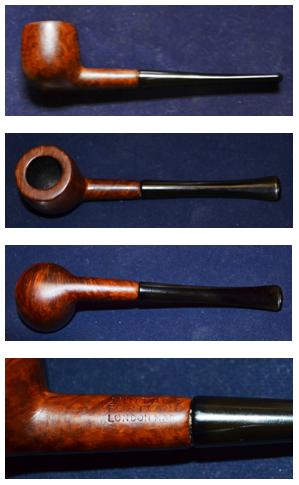
Concerning a Vintage Portland London Made – Robert M. Boughton


It is a pleasure to have another article by Robert Boughton. In this article he demonstrates his skills in the restoration of a Portland Pot shaped pipe. Thanks Robert for your additions to the blog.

The particulars of said pipe being that it is an elegant, very small straight pot (5’’ length with a 1.5” x 1.25” bowl), and is believed by the author to be a BB&S, or Barling, seconded to Topsall Portland
Guest Blog by Robert M. Boughton

Introduction
Irish author James Joyce, in a memorable example of poetic license, called his collection of short stories assembled in Dubliners his “little epiphanies.” Rare stones are known as gems. Wise men have written that the smoking pipe is “the poor man’s friend”and“the fountain of contemplation, the source of pleasure, the companion of the wise,” and that it “draws wisdom from the lips of the philosopher, and shuts up the mouth of the foolish.” To me, the moment I first saw on eBay this fine specimen of pipe-making, its simple and classic lines and curves shining through the obvious considerable use by its previous owner(s),“sudden as the spark from smitten steel” I was effected the same as the hammer striking metal in a forge. I had to have this pipe, and for a penny less than $20 it became mine. Knowing nothing at the time of purchase of its possible history, my only desire was to restore the beautiful little pot to its original splendor.

As I sit here on the only piece of comfortable furniture so far moved into my new apartment in a much better and safer part of town than I described in my previous blog, with the morning view of a golf course outside my window, I am smoking in my little Portland pot – now restored to the above-sought condition – a gentle bowl of Stokeby’s 4th Generation 1855 ready-rubbed mixture with its natural Virginia sweetness, and feeling so happy I made the small investment of money and time. Although I am comfortable taking credit for the full restoration of the pipe, this being my first such complete endeavor in the art and craft of such work, I must again give thanks for the collaborative contributions of several friends, in this case Chuck Richards, Hunter Brooks and Leigh Brady, whose parts in the task will be described in time.

Boughton1

Again, when I bought this pipe, I did so without any initial research. By the time it arrived in the mail four days later, however, I had found references online that seem to identify it as a BB&S (Barling’s) second made for a company known as Topsall Portland. Other sources include eBay and the Brothers of Briar. I am satisfied with the pipe regardless of its origins, though, and any better information would be appreciated.

Chuck Richards.  Photo © by the Author

Chuck Richards. Photo © by the Author

Hunter Brooks.  Photo © by the Author

Hunter Brooks. Photo © by the Author

Leigh Brady.  Photo courtesy of L. Brady

Leigh Brady. Photo courtesy of L. Brady


Restoring the Portland

First, there’s the sanding that I expected to reveal a small crack in the top of the shank near the stem, which in fact was my original excuse for the full restoration of the pipe as opposed to the initial refinish I had completed to remove the bad discoloration of the bowl and stem…but after sanding down the entire bowl and shank, the “crack,” I was actually disappointed to discover, was only a mirage created by the old finish.

Boughton5

Then, after the initial setback of discovering there was no need to fill a crack and use a metal band to seal the shank, I micro-meshed the wood:

Boughton6

Boughton7

Boughton8

Following the micro-mesh, I used a light brown leather stain recommended by Chuck, which I found at Hoffmantown Shoe and Boot Repair, after which Hunter at Stag Tobacconist(owing to my lack of supplies and equipment) buffed the bowl with Red Tripoli Wax and the stem with White Tripoli.
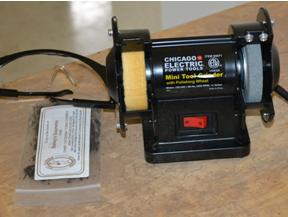
I bought a very cheap wheel buffer to apply Halcyon II Wax, which gave the pipe a decent but still somewhat wanting finish.

Chicago Electric Mini Grinder/Buffer

Chicago Electric Mini Grinder/Buffer

Finally, I tackled the hardest, and therefore most satisfying, task of micro-meshing the stem where it connected to the shank, which appeared to have been replaced at some point during the pipe’s long life. By my estimate, this Portland London Made pot was crafted no later than the 1960s. Perhaps this accounts in large part to my dread of fitting the stem to the shank, a job that even I could feel was necessary to call the overall work a full restoration but which I approached with considerable trepidation for fear of overdoing this step – and in so doing botching the entire effort! But, at Chuck’s insistence, I applied gentle, patient micro-meshing and at last achieved the desired effect. Again I am indebted to Chuck’s guidance, without which my own inclination to put the helpless stem to the wheel almost surely have obliterated all of my hard work!

The next Friday night, at our weekly pipe club meeting, I presented the pipe for scrutiny by my fellow members. I was gratified by Chuck’s initial pronouncement, which was a simple “Nice!” but even more so for his almost immediate observation that I had attached the stem upside-down – and his final contribution of a quick carnauba Wax spin on the shop’s high-speed buffer wheel as well as a small amount of beeswax to tighten the loose stem, rendering the following finished product:

Boughton10

Conclusion
It is with a sense of humility and responsibility for the admitted first attempt at such a work that I present this finished product to the pipe smoking world at large for its final judgment and, I hope, suggestions for how to approach future restorations.

My final word of appreciation is owed to Leigh, a fine British friend and fellow lifelong member of the Stag Pipe Club, for his contribution concerning this pipe’s possible history being linked to the Great Portland Street of London, which he wrote in an email is known for its tobacconists as well as being “very close geographically to the famous Baker Street which was the choice of abode for the great Sherlock Holmes.”

Reflections on the Historical Background on CPF Pipes


Blog by Steve Laug

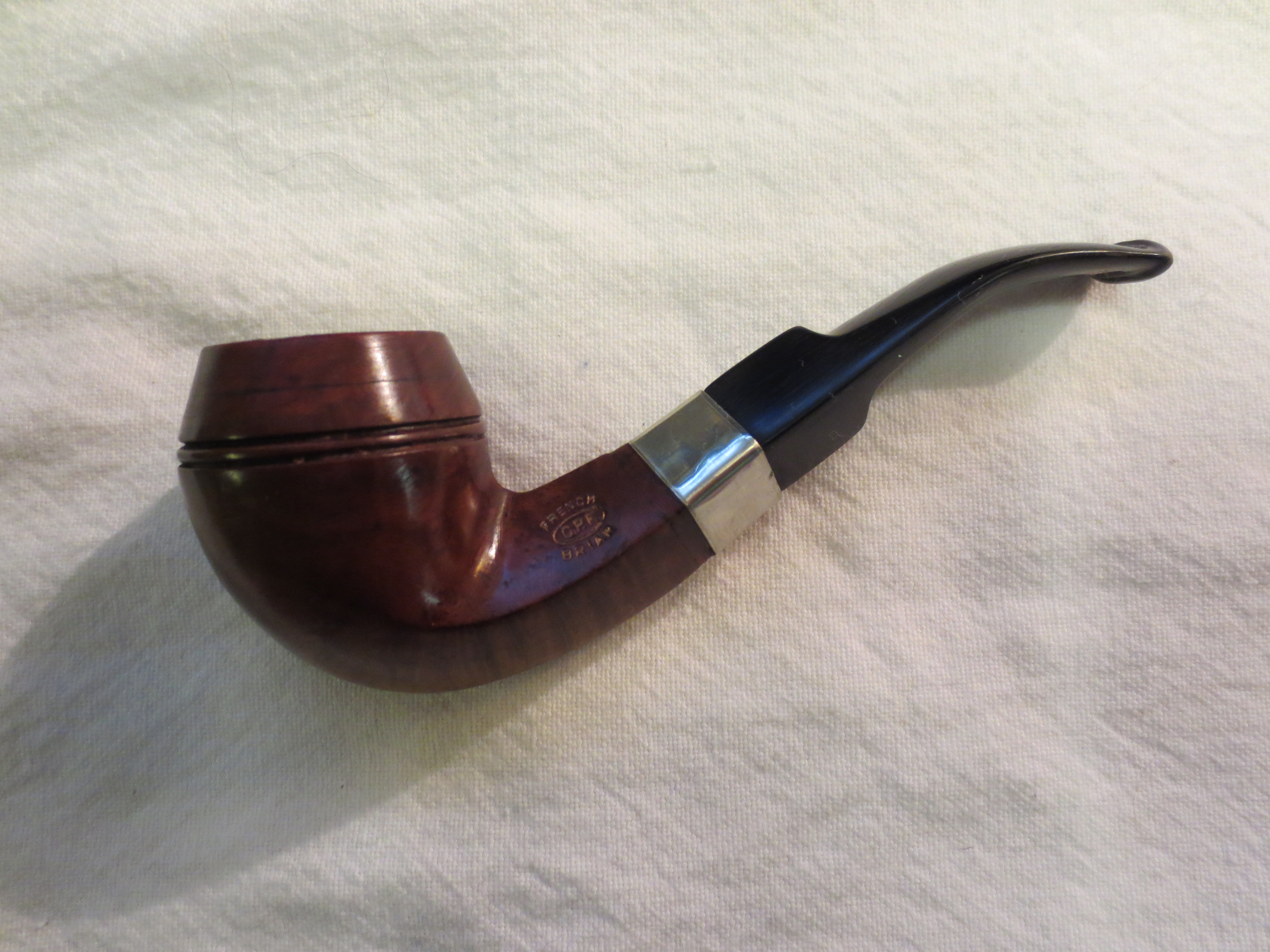
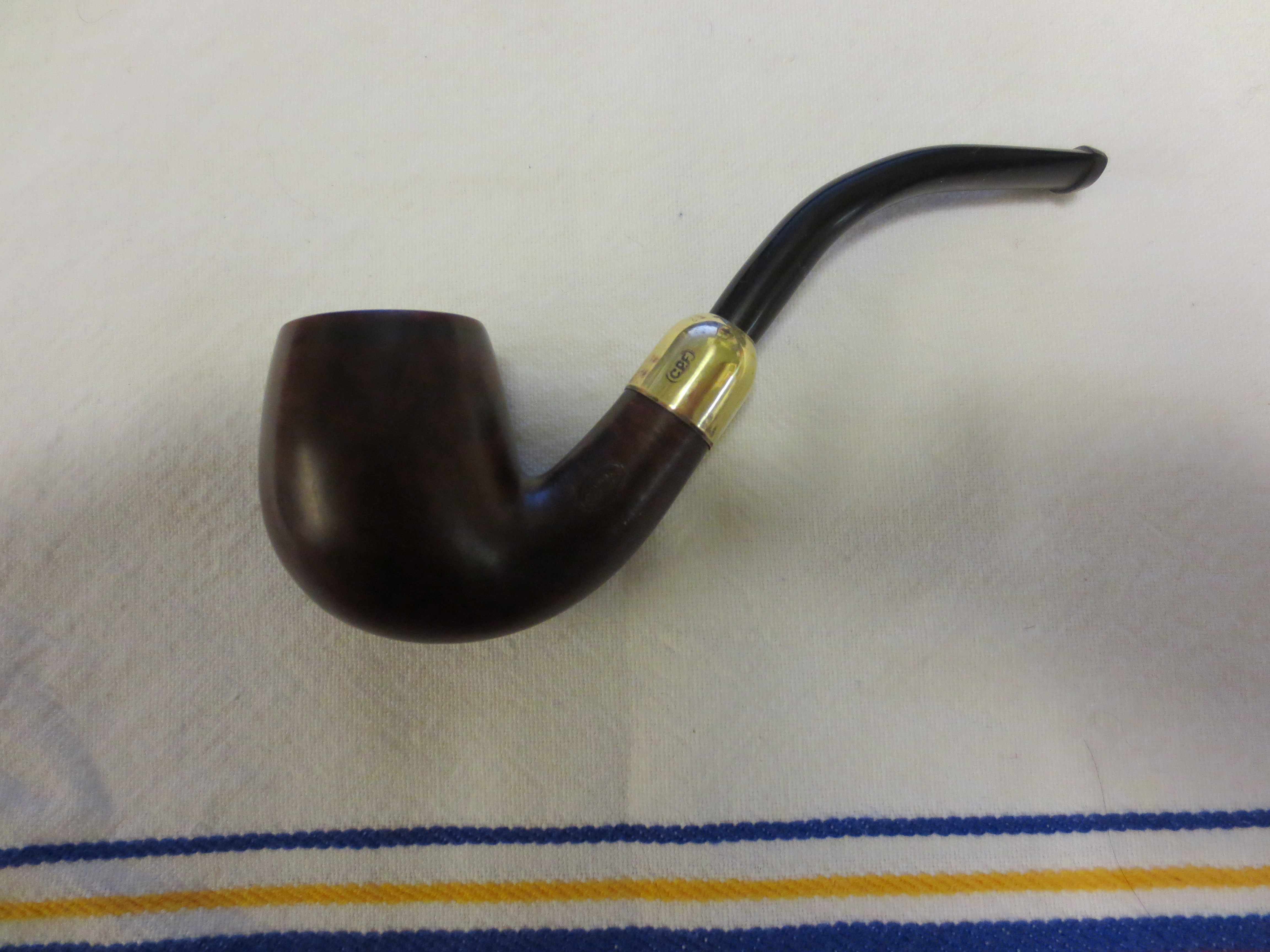
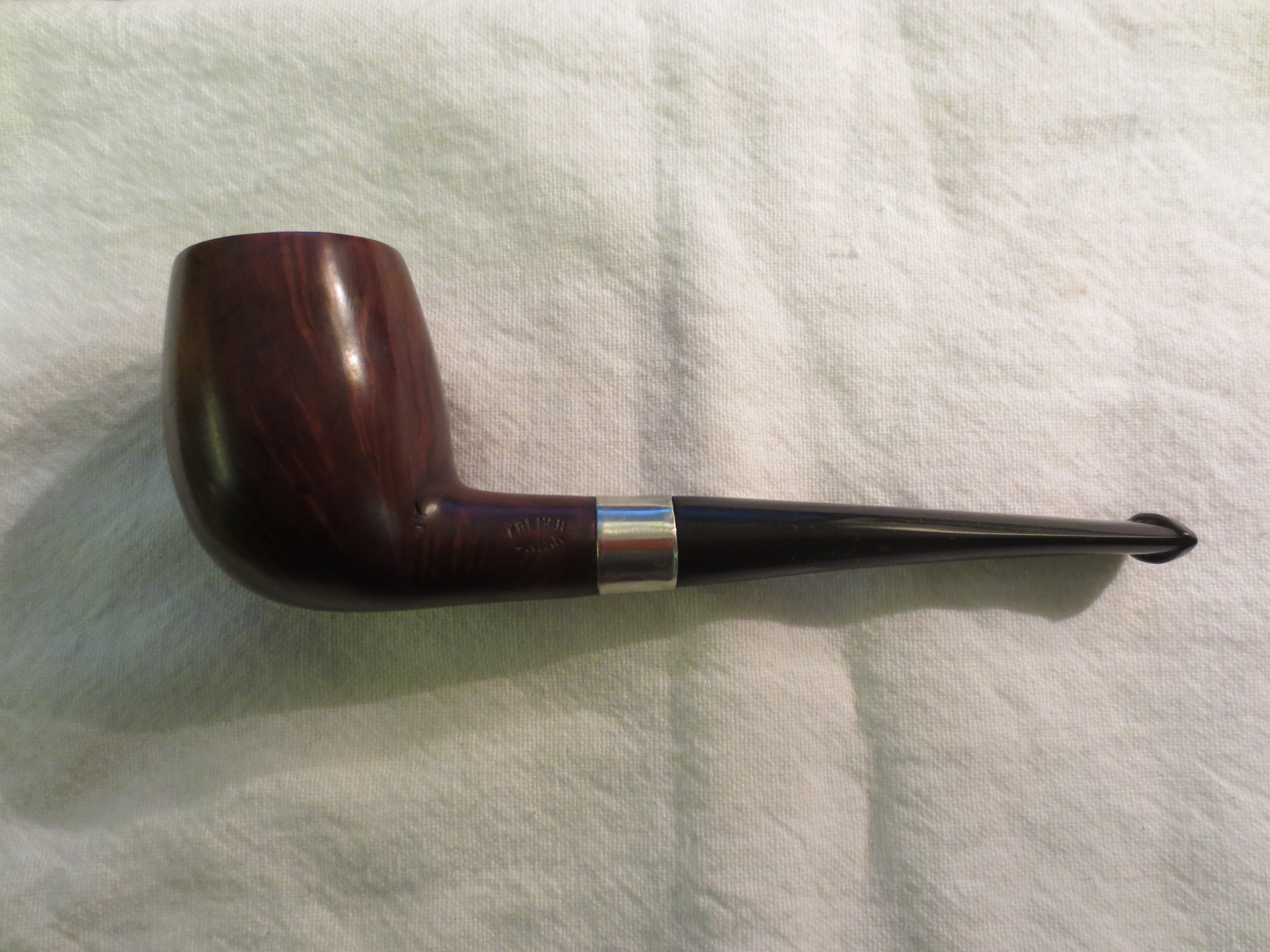
One of the secondary hobbies to pipe refurbishing that I enjoy doing is to research the history of a particular brand or make. In a recent EBay lot I bought there were 3 pipes that were stamped with the CPF logo – CPF in an oval with the word FRENCH stamped in an arch above the oval and the word BRIAR stamped in an arch below the oval. I had heard that the CPF stood for a variety of names from Consolidated Pipe Factory to Colossal Pipe Factory and even Chesterfield Pipe Company. There was a wide range of conflicting information available on the websites and forums that I looked read while looking into the brand. One evening while I was talking with Chuck Richards about the lot (I know that over the years he has seen quite a few old CPF brand pipes) he suggested that I ask Robert Boughton about it. Chuck said that Robert had done some work on the brand when he was given an old Meerschaum to refurbish. I contacted Robert and he sent me a variety of links that he had found. He had looked into the history and background of the CPF brand stamp. He wrote that he had found in his research that “…CPF definitely stands for Colossus Pipe Factory, a late 19th and early 20th century American venture that in its short, happy life created some of the most beautiful briar and Meerschaum pipes ever made”. He sent me a link to the stampings and logos site (1) http://pipephil.eu/logos/en/logo-c1.htmlbelowwhere he had found photos that showed the curved circular printing of French Briar around the CPF oval as well as some with a space between where the customary CPF mark was stamped within an oval enclosure. He had also looked into a variety of EBay offerings of CPF pipes and also on Worthpoint.com. He found some amazingly beautiful pipes for sale.

Throughout this article I have inserted photos of some of the CPF pipes that I have refurbished as examples. All of them showed the marks of having originally had rim caps and shank caps. Some of the older ones that I have seen have had beautiful filigree decorations in these areas.

Figure 1 CPF Bulldog - restored by Steve Laug

Figure 1 CPF Bulldog – restored by Steve Laug


Armed with the information that Robert sent I decided to do some more digging into the brand. I found information on the CPF brand that verified his findings on the meaning of initials. CPF stands for Colossus Pipe Factory. There is not much known about the Colossus Pipe Factory. I learned that by the mid 1890’s CPF was owned by Kaufman Brothers & Bondy (KB&B). They operated the factory at 129 Grand Street, in New York City, New York. I had a faint memory of some connection between CPF and Kaufmann Brothers & Bondy. But was unsure where I had heard or read that. In the process of reading information I came across this post by Bill Feuerbach on the Kaywoodie Forum: “About 10 years ago I picked up two original invoices from KB&B. One is dated February 5, 1884 and the other December 9, 1898. Both have the address as 129-131 Grand Street, which is in Soho, adjacent to the Bowery in New York City. The 1898 invoice has in the upper left hand corner the initials CPF and Trademark. So by 1898 KB&B was making it known to the trade that they owned the CPF trademark. The 1884 invoice does not have CPF on it. Therefore I think we can assume KB&B acquired or started the CPF line sometime between 1884 and 1898.” (2)
Figure 2 CPF Bent Billiard - restored by Steve Laug

Figure 2 CPF Bent Billiard – restored by Steve Laug


Robert Boughton also provided a link to a scan of a page from a trade magazine called “The Jeweler’s Circular”, dated August 23, 1899.(3) http://pipedia.org/index.php?title=C…s_Pipe_Factory In scanning through it I found that at the bottom of the center row of the clip a question sent in by a reader as follows, “Please inform as who manufactures briar pipes with the trademark, CPF?” The answer that was given in the article was, “These letters stand for Colossus Pipe Factory, the business being conducted by Kaufmann Bros. & Bondy, 129 Grand Street, New York.” I did a bit more digging as I wanted to find out the source of the Pipedia clipping. I found that the original source of this information was also Bill Feuerbach. He wrote the following on the Kaywoodie Free forum, “Now as for what CPF means. About 5 or 6 years ago Gary Schrier, pipe book author/publisher and pipe collector from Seattle sent me a copy of page 30 from the Jewelers’ Circular dated August 23, 1899. I assume this was a publication for the jewelry trade. On this particular page they have questions for the editor. One question is “Editor of the Jewelers’ Circular: Please inform us who manufactures briar pipes with the trade-mark rude cut: C.P.F. Thank you in advance for your trouble and kindness”. The answer was “Those letters stand for Colossus Pipe Factory, the business being conducted by Kaufmann Bros. & Bondy, 129 Grand St., New York.”

The address in the scanned document referred to above is the same address as the one on the invoices that Bill referred to in the quoted post in the previous paragraph. This industry/trade magazine, published at the time the CPF brand was being made, reports that the C in the CPF brand means Colossus rather than Consolidated or Chesterfield. To me that answers the question quite definitively.(4)

Figure 3 CPF Billiard - restored by Steve Laug

Figure 3 CPF Billiard – restored by Steve Laug


Even with that clear information from Bill, in both the invoices and the article in the trade jounal there still is some disagreement among pipemen as to the meaning of the letters in the brand. In my research I came across a few divergent opinions on the brand and I thought it important to cite them. The following information comes from Samuel Goldberger of Finepipes Estate pipe website as referenced below. On the page on his site dedicated to CPF pipes Sam wrote, “I have not found any clear history of CPF, but I have developed some ideas about them, based upon my study of early American made pipes. By the turn of the last century, a number of small pipe making factories had collected in and around New York City, including the William Demuth Company (WDC) and Kaufman Brothers and Bondi (KB&B), later to become Kaywoodie. From the design and quality of execution of these pipes, I believe the factories must have been staffed by European immigrants, probably Jewish, who had been trained in the older traditions of pipe making in France, Germany and Austria. The pipes they produced were in a similar style. They were expertly cut from very old, air-cured Algerian briar in classical shapes or from the finest grade of Turkish meerschaum; they sometimes rather small; they often had amber or Bakelite mouthpieces, gold or silver fittings. It’s my suspicion that pipes from these small makers were at one time sold or marketed under the name “Consolidated Pipe Factory.” Alternatively, CPF may have been the name of the distributor.” (5) Personally, not to disparage Sam’s ideas, I find the information provided by Bill Feuerbach in the paragraphs above to be conclusive that CPF stands for the Colossus Pipe Factory.

Further, in my research I found that others commented on the fact that they had seen pipes with both the CPF logo and KB&B logo on them that date to pre-1900. I too have seen, refurbished and sold some that bore both stampings/logos. This has led me to wonder if the dual stamping may have been a way to let pipe smokers of the time know that the companies were affiliated. From my reading and research it seems to me that CPF brand was discontinued sometime in the 1910-1920 range. Again, turning to Bill Feuerbach I found that he notes the following, which pins down the time frame of the discontinuation of the brand more specifically, “I have a CPF Chesterfield in our office display that has a nametag from way before my time that says 1900 CPF Chesterfield. It looks like most other Chesterfields you’ve seen, including the military type push stem, except this stem is horn and not vulcanite. As far as I have gathered the CPF brand was phased out sometime around 1915.” (6) Interestingly, he noted that the Chesterfield name and style was later introduced in the KB&B, Kaywoodie and Yello-Bole lines. He says that the 1924 KB&B catalog shows KB&B Chesterfields.

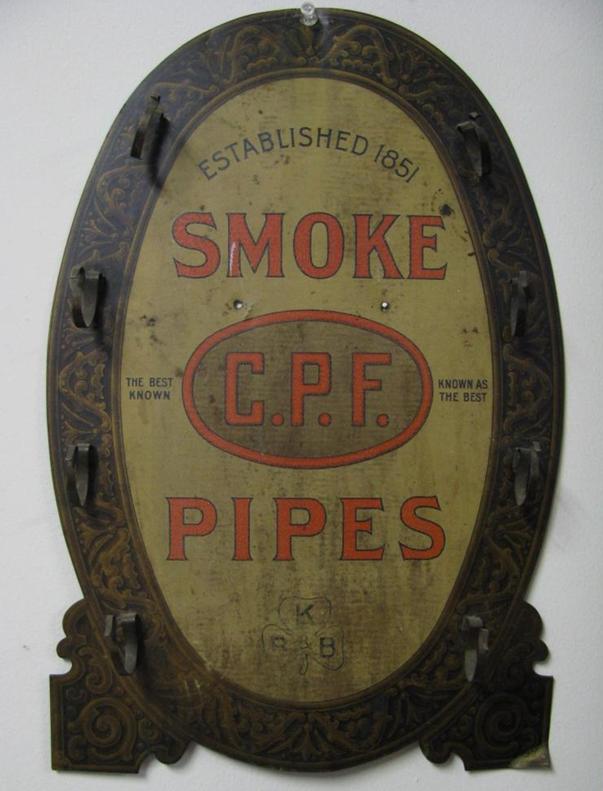
I also came across the following photo that comes from Bill Feuerbach which shows the dual stamping of the logo on this display placard for CPF pipes. Note the familiar KB&B logo and cloverleaf at the bottom of the placard. (7)

Figure 4 From the collection of Bill Feuerbach

Figure 4 From the collection of Bill Feuerbach


From my research I believe that we can definitively assert that the CPF logo stands for Colossus Pipe Factory. The brand was purchased by KB & B sometime between 1884 and 1898 and that it continued until 1915. That time frame gives help in dating some of the older CPF pipes you or I might find. It can be said that prior to the dual stamping it is fairly certain that the pipe is pre-1884 to 1898. After the dual stamping it can be placed post 1898 until the closure of the brand line in 1915. CPF made beautiful pipes. I believe Sam Goldberger was correct in his assertion of the potential carvers that made the pipes being of European training and the classic shapes and well aged briar. That coincides with all the CPF pipes that I have come across.
_____________________________________________________________
End notes
(1) http://pipephil.eu/logos/en/logo-c1.htmlbelow
(2) http://kaywoodie.myfreeforum.org/archive/cpf__o_t__t_161.html
(3) http://pipedia.org/index.php?title=C…s_Pipe_Factory
(4) http://kaywoodie.myfreeforum.org/archive/cpf__o_t__t_161.html
(5) http://www.finepipes.com/pipes/american/consolidated-pipe-factory-cpf
(6) http://kaywoodie.myfreeforum.org/archive/cpf__o_t__t_161.html
(7) http://kaywoodie.myfreeforum.org/viewtopic.php?t=161&start=0

An Interesting Weatherproof Wally Frank “Pepper Shaker”


I picked up this interesting piece of tobaciana somewhere though I no longer remember where it came from. It is an oval bowled pipe by Wally Frank and it has a briar wind cap that is attached via a brass peg. To me it looks like a Pepper shaker so that is what I have named it. I have a few other ones like this but the cap is made out of Bakelite and is on a side pin that allows it to flip forward. This one spins to the side or can be removed should the pipeman not want to use it covered.

It came to me unsmoked and clean on the inside. The finish was very poorly done. There was a coat of varnish or lacquer on the pipe. It was spotty and in some places seemed to have bubbled or ran when it was applied. The stain that was underneath obscured the grain on the pipe. I decided to refinish the bowl and give it a new stain. I soaked it in an alcohol bath and then wiped down the bowl with acetone to clean the finish off. Once it was removed I sanded it with micromesh pads to get it smooth. I restained it with a nice cherry aniline stain. I flamed the stain to set it in the grain and then buffed the bowl to remove the excess and surface stain. The stem and pipe were buffed as a whole with white Diamond and then several coats of carnauba. Here is the finished product.
Frank1

Frank2

Frank3

Frank4

Kirsten Generation 1, 1.5, 2, 3


Blog by Dave Whitney and Steve Laug

I wrote Dave Whitney for permission to use his material in this post. He wrote back granting that permission and asked that I credit it as coming from OLD BRIAR by Dave Whitney. Thanks Dave for allowing this information to be posted here. What follows is taken from correspondence with Dave that later became the article in his book.

Over the years I have had several Kirsten pipes of different ages and different composition. I have always found it difficult to tell the difference between the various pipes in terms of their age. I have ordered replacement parts from Kirsten in Seattle and I have also cannibalized older ones that I have here that are not useable. From these I have traded and bought others. One of the early ones I had stumped me in terms of the markings and stampings on the barrel and the bowl. I wrote to a fellow on one of the online pipe forums (I now know that it was Dave Whitney as I have since found an article by him on Kirsten pipes that I have read and have written to him. I kept the information he gave me and finally got around to editing it and putting it on the blog.) My questions to him revolved around how to tell age of Kirsten I had in my hands.

He replied with the below information. I found it very helpful and have not found other places to get this info so I thought I would post it here for all to use. (Since writing this I have found that Dave has developed the material in his book Old Briar – it should be consulted for more information).

“Kirsten’s are fun to try and figure out, especially when trying to buy then on eBay. Years ago, when I first started, I finally got a hold of a fellow who “Restored” Kirsten’s for quite a long time. He taught me about the Generation system, and it immediately made life easier. I could ask the seller to take the pipe apart and tell me about the O-rings. I could even call the company and refer to the Generation parts I wanted, and at that time they knew exactly what I was asking for…the last time I called was three years ago, so who knows now. This is all from memory……”

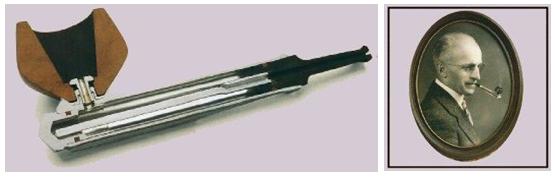
All Kirsten pipes are made up of five basic components – mouthpiece, radiator body or barrel, valve, bowl and bowl screw (a sixth component, the bowl ring, is found in many Kirstens. They were originally designed in 1936 by Professor Frederick Kirsten – the man who invented Boeing’s first wind tunnel – after he has been advised by his physician to stop smoking. Kirsten was looking for a way to trap the tars and moisture from tobacco and the Kirsten pipe was his solution.

Kirsten2

Generation 1 – 1936-1958
The wooden bowl on this generation connects directly to the metal barrel and there is no metal cup spacer. It is a pretty flush fit that goes flat against the barrel. On the underside of the metal barrel it is stamped with one or more of the following “Pat. Appl. For” (1936-38) and “Pats. & Pats. Pending” (1938-1958) over “Made in USA” – S” (or applicable size – S, M, L). There are no O-rings on the bit or metal shank insert. They came in the following models:

Straights

Companion First edition in rough finish.

S Standard 1st generation with full-length cooling fins

M Medium

L Large

A Aristocrat Extra large 1st generation

Generation 1.5 – transitional period – mid to late 50’s
This was an experimental stage. Kirsten realized that the bit and insert were prone to seizure as the condensate dried. This model always has O-rings on the metal insert, and later models can have O-rings on both. Same markings, as I remember it. There is no metal cup spacer under the bowl. This generation has O rings either on the valve or mouthpiece but no O rings on the other end. This transitional period is stamped “Pat. Pending” and “Pats. & Pats. Pending” some with “Made in U.S.A.  It seems like the company was using surplus parts to combine into this series of pipes. They came in the following models:

Straights

K Companion

M Medium

L Large

They came in a polished finish and later white Heritage finish. There were a few other Transition Models:

Thrifty – a nice early model with black offset valve that works in reverse. There is an O ring on valve but none on the stem

No Letter/No Name – This one is an unmarked short pipe with a different valve and O ring. There is not an O ring on stem

Generation 2 – 1958-1985
Markings on underside of metal shank “Made in USA XL” (or app. size) and “Pat. & Pats. Pending”. The presence of O rings on both the valve and the mouthpiece and the metal cup spacer under bowl are the biggest thing that separates the Generation 1 from the Generation 2 pipes. These O rings help provide a tighter seal when the stem and apparatus are inserted into the radiator stem. Instead of “O” rings, the machining of the Generation 1 pipes was so precise the fit was exact. This generation came in the following models:
Straights

K Companion

G Gem

S Sportsman

SX Sportsman Brass

M Mariner

MB Mariner Black

L Lancer

Quarter-Bents

A Aladdin

V Vagabond

CX Cavalier Brass

T Tyrolean

Full bents

W Westerner

B Beau Geste

P Premier

F Firesider

Generation 3 – 1985 to the present                                                                         

All current models stamped “Made in U.S.A.” and all have O rings on both the valve and stem. They come in the following models:

Straights

JX Jewel Brass

M Mariner

L Lancer

Quarter-Bents

RX Regent Brass

H Horizon

Full bents

EX Esquire Brass

DX Designer Brass

FOOTNOTE ON VARIATIONS IN LETTER DESIGNATIONS:  Generally speaking, the X added to a model letter like “S” stands for brass tone finish, i.e., “SX.” There is one exception to this: In the 1960s Kirsten made a brass tone model with an “Eternalum” finish that gave the brass tone an antiqued look. They were marked with a “X” designation following the model letter. The B added to a model letter like “M” stands for black finish, i.e., “MB.”

He ended his answer to the questions with this great note: “Now the fun part….this is how they came from the factory. What people did to them after they got them is what makes it an inexact science. Parts for the different sizes are not interchangeable, except for the bowls. I have a Gen 1 – M and -S…nothing interchanges but the bowls. If you get a Gen 1 that has been badly abused, you can end up losing either the bit or metal insert, or both, no matter what you do or how long you try.”

References used:

Whitney, Dave (2009) Old Briar – Pipe smoking on a budget. pipesbywhitney

http://www.kirstenpipe.com/

Another Piece of Tobacciana – A Hammered Metal Pipe Tobacco Humidor


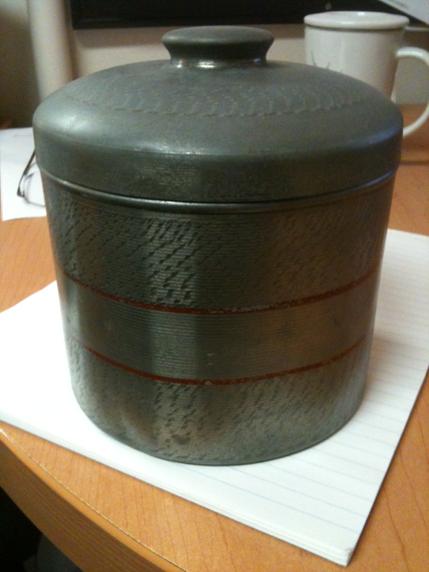
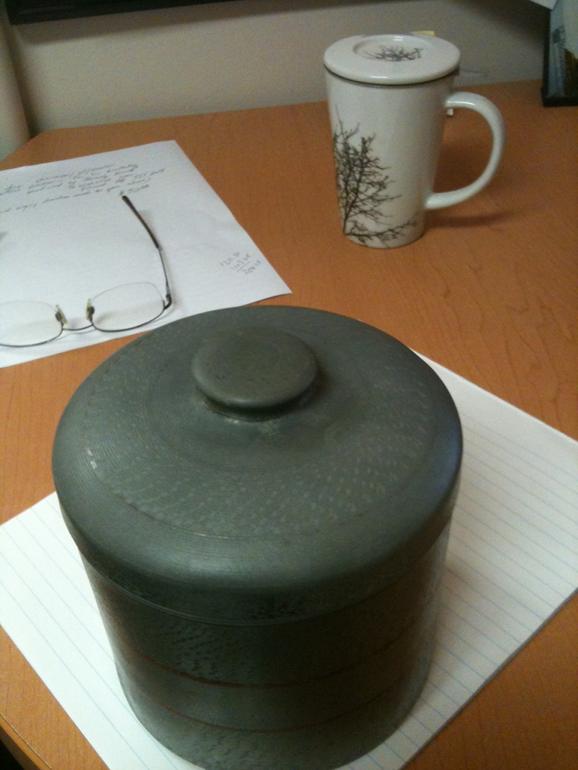
I finally took some pictures of this piece of pipe history – or pipe accessories that I have in my collection. I love the look and feel of this jar. It is relatively useless in keeping tobacco humidified as it is not even close to air tight. Over the years that I have had the humidor I have tried various tobaccos in it. I have even put humidifying disks in the lid and in the tobacco itself with no success. I even tried some aromatic that seemed to never dry out on its own and in the jar it dried within a week to a nice crisp dry corn flake like consistency! So it is no good for tobacco. The look and feel of the piece is nice though. I have no idea of the age of the piece. I call it metal in the title as I do not know what metal it is made of. It does not feel like aluminum so I am guessing steel.
humidor1

humidor2

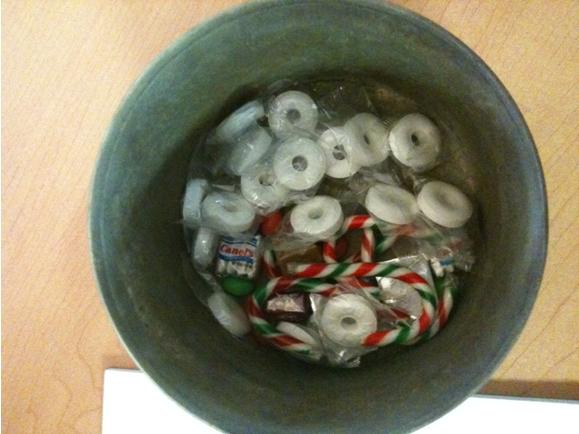
In the past I also used it to hold pipe tools and baggies of tobacco but I decided to jar them instead as the humidor did not keep them from drying out even that way. So it has been retired from that activity and currently resides on my desk in the office at the Foundation. It holds some of the candy that I keep on hand for myself and the folks we work with. It works well for that!
humidor3

A Creative Pipe Maker’s Anonymous Attempt at a Cool, Dry Smoke


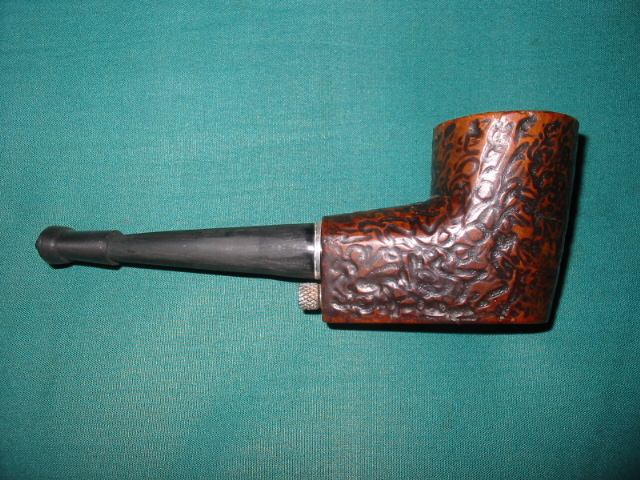
This is another interesting piece of pipe history. I seem to have trouble passing up odd and creative pipe making attempts. I have no idea who designed or made this one or what the patent information is as there is absolutely no stamping or identification on the pipe itself. I remember seeing one on EBay awhile ago but somehow missed keeping the information. If anyone has any information on it please leave a comment in response to this post.
The pipe itself was in rough shape when I got it. The stem is chewed up badly and I have not taken the time to rework the stem. It is the dreaded nylon stem so it always leaves me cold in wanting to work on it. It is probably the most unforgiving stem material there is in my opinion. You can sand and sand it and it does not seem to change the damage. The heat gun and boiling water do not seem to lift the dents and tooth marks at all. What is there seems to be permanent. The bowl was badly caked – in fact so badly caked that it had a split in the side of the bowl. The finish is strange – best I can say about it almost little worm trails in the briar. The stem was stuck in the shank. I thought at first it was a screw tenon it was so tight. Under the stem was the flat base with what looked like an adjustment screw of some kind. It was also stuck tightly.

I reamed the bowl and found that the draught hole was in the bottom of the bowl – like a calabash. I opened that with a dental pick and cleaned it out. I packed the bowl with cotton bolls and filled it with isopropyl alcohol. I use 99% as it has little water content and seems to work well in drawing out the oils and tars. It took quite a bit of alcohol as it filled the reservoir below the bowl. I put a pipe cleaner in the stem and laid it aside overnight. My hope was that the alcohol would not only draw out the tars and oils but loosen the adjusting screw on the bottom of the shank as well as the stem.
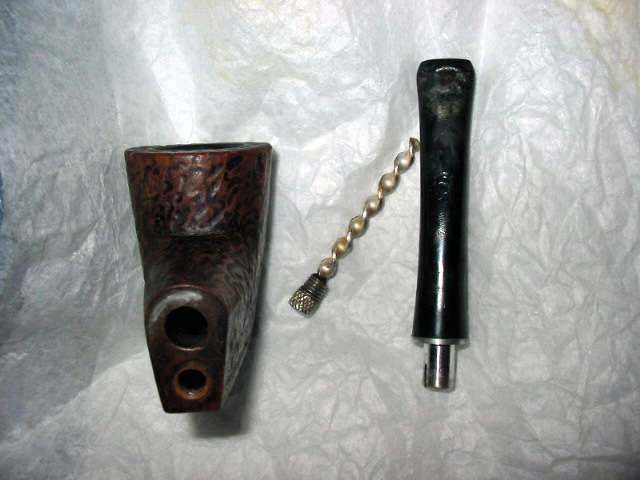
In the morning I removed the cotton bolls. They were almost black with the tars and oils that they drew out. The stem was actually loose – that happens so little that I was surprised when I turned on it and it came out. I was expecting a screw tenon and found that it was not at all. It was an aluminum tenon made to hold a Medico style paper filter. The one in the tenon was almost black with grime and now it was soggy as well. I am still trying to figure out the airflow on this pipe. I also was able to turn the adjusting screw under the stem and it came out as well. I expected that it would adjust the airflow somehow (kind of like a Kirsten). But it was not an adjusting screw at all; instead it was a stinger like apparatus with a long twisted blade on it. Now the airflow was becoming clearer. The smoker pulled the air through the bowl down through the air hole in the bottom of the bowl. Once there it entered the chamber that ran the length of the shank and bowl and contained the twisted stinger. That apparatus would pick up the liquids and oils of the tobacco. The smoke would go up through a hole in the top of the chamber and enter the shank where the paper filter would trap the remaining debris of the smoke (and in my opinion whatever flavour still remained) before delivering it out the slot at the end of the stem.

I cleaned out the chamber and the shank by filling them with isopropyl and plugging the holes and shaking the fluid for several minutes. I would unplug and dump the dirty alcohol down the drain. I repeated this until the fluid came out clear. Then I cleaned the chamber and shank with a shank brush and bristle and ordinary pipe cleaners and more isopropyl alcohol until they came out clean and fresh. The stinger soaked in alcohol and I scrubbed it with 0000 steel wool until it shone. The stem needed a lot of cleaning though it was more dirt and grime that came out rather than tars. I was able to polish the tenon inside and out and clean up the stem. The dents and tooth marks I left alone. One day I will have to work them over and see if I can remove them. But not that day!

I scrubbed the outside of the bowl with a bristle tooth brush and Murphy’s Oil Soap to remove all of the grime from the bowl surface. I cleaned out the crack in the bowl with my dental pick. I then wiped it down with acetone and restained it with a medium brown aniline stain, flamed it and then buffed it with Tripoli and White Diamond. Once it was polished and clean I coated it with several coats of carnauba wax and then buffed it with a clean flannel buff.

I finished up the pipe and put it back together. I added a pipe softee bit to cover the bites and dents on the stem and make it more comfortable in the mouth. I packed a bowl of nice Virginia in it to try it out. I decided to leave out the paper filter and just smoke it as it was. It was an interesting and cool smoke though it pretty much removed the flavour of the Virginias that I chose to smoke. This one will sit in the cupboard as a memorabilia item but will not enter the rotation.


Here are the pictures of the process of repair. I patched it with black super glue and built up the angle of the stem to give a clean flow. I filled the dents and bite throughs on both sides of the stem. I sanded and sanded with 240 grit sandpaper and micromesh 1500 through 12,000 grit. Then gave it a coat of Obsidian Oil and finally several coats of wax. The last four photos show the final product.