Tag Archives: Oxidation

Refurbishing a Lane Era Charatan’s Make “Special” # 260 DC


Blog by Paresh Deshpande

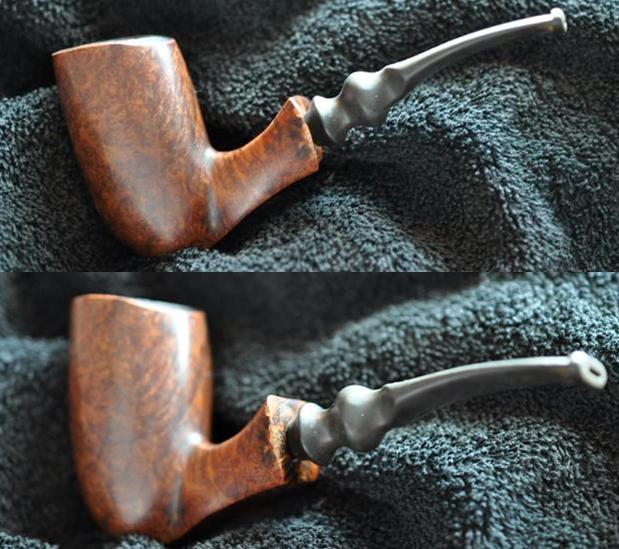
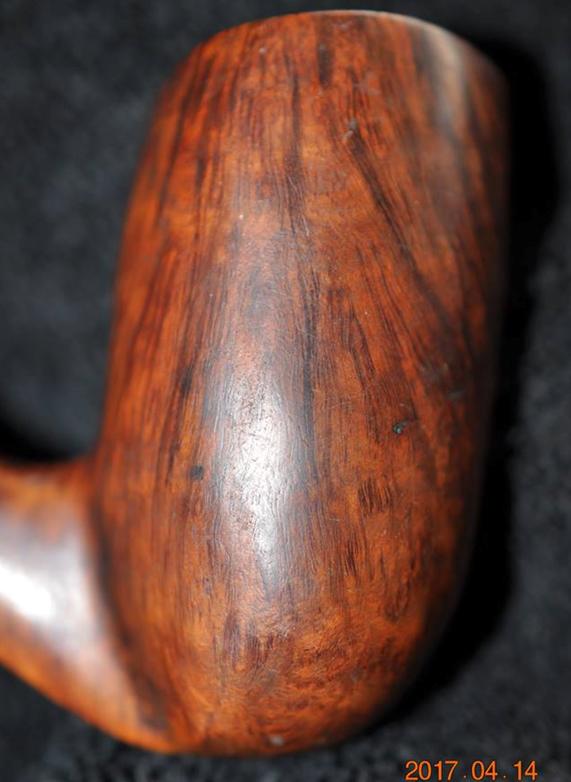
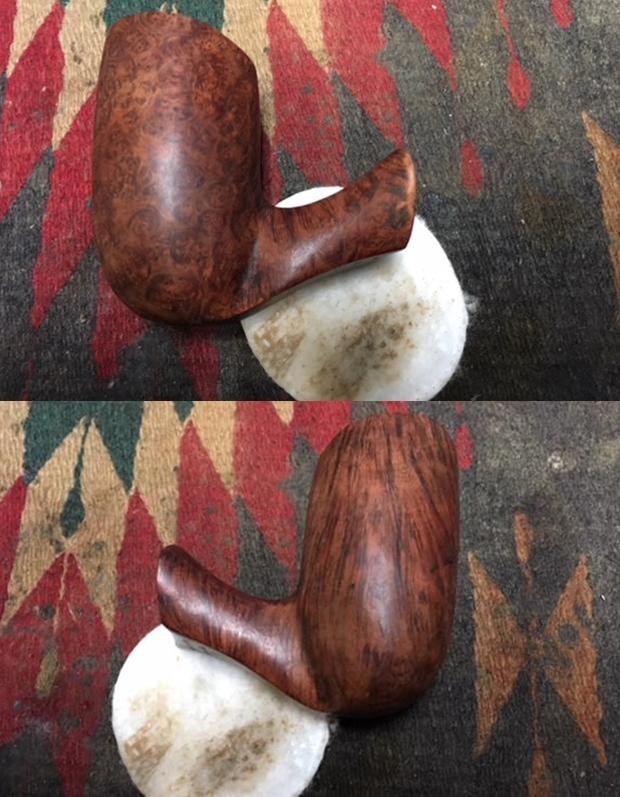
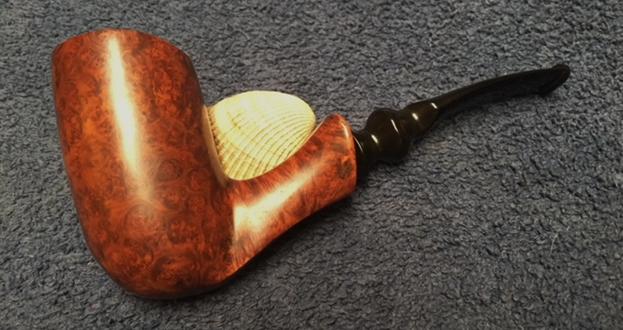
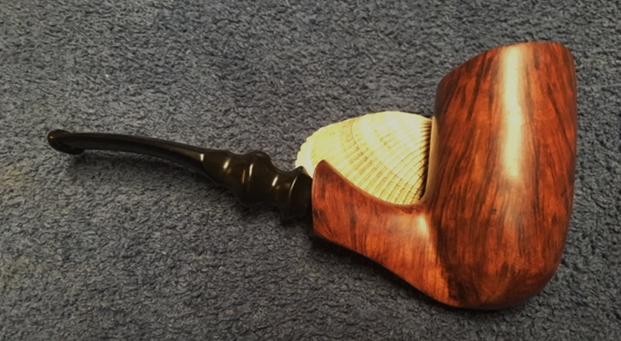
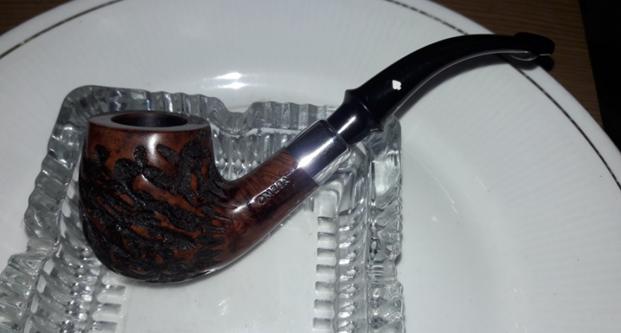
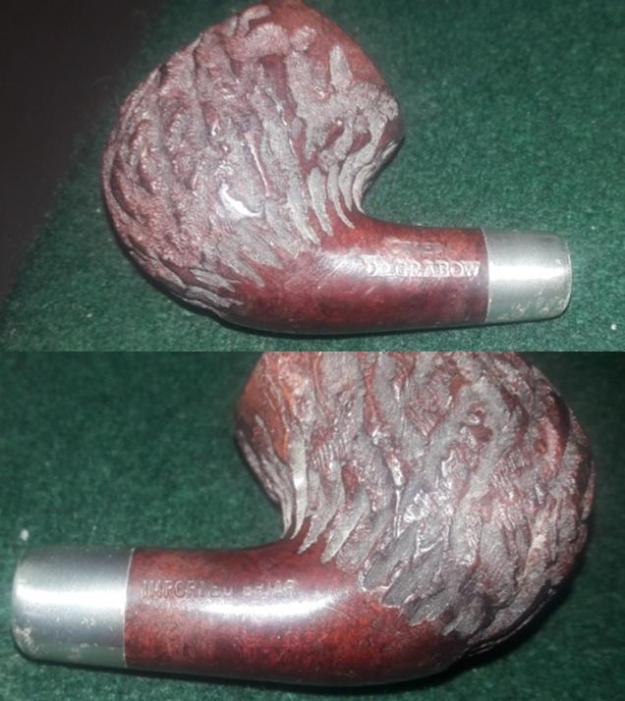
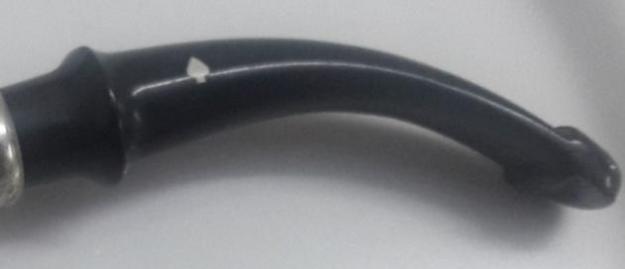
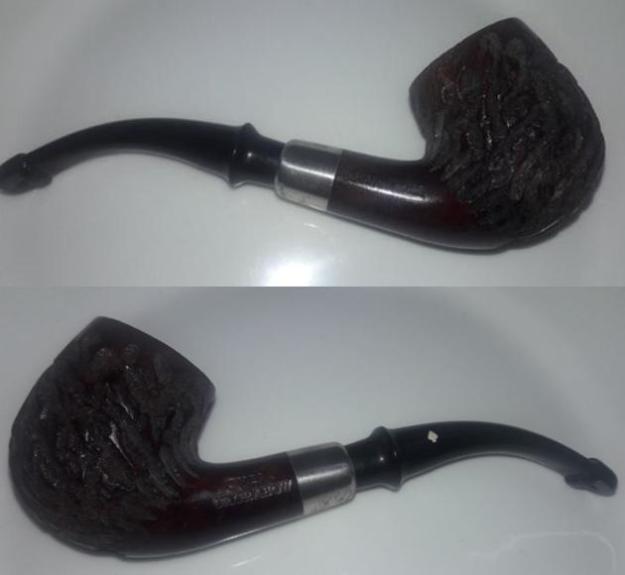
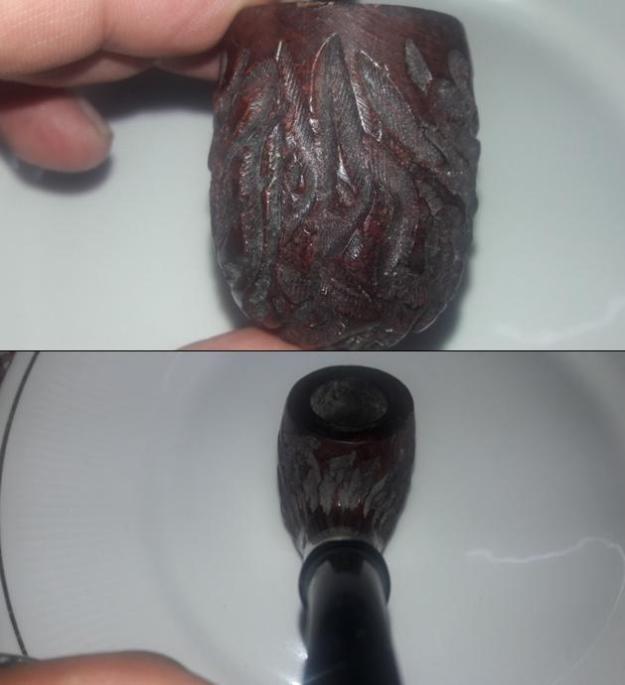
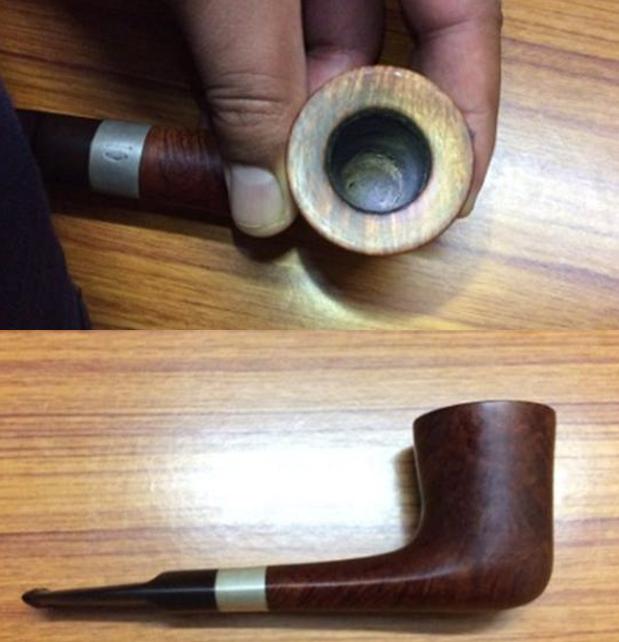
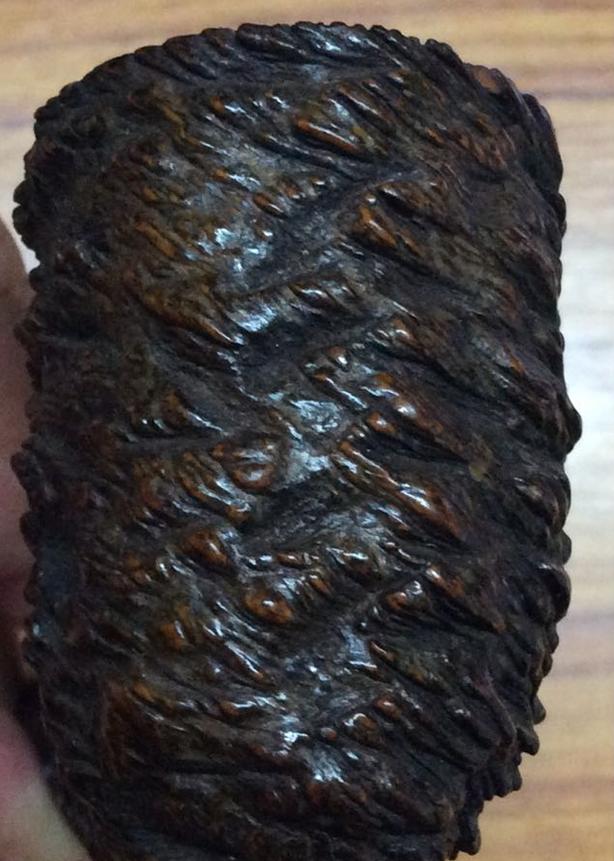
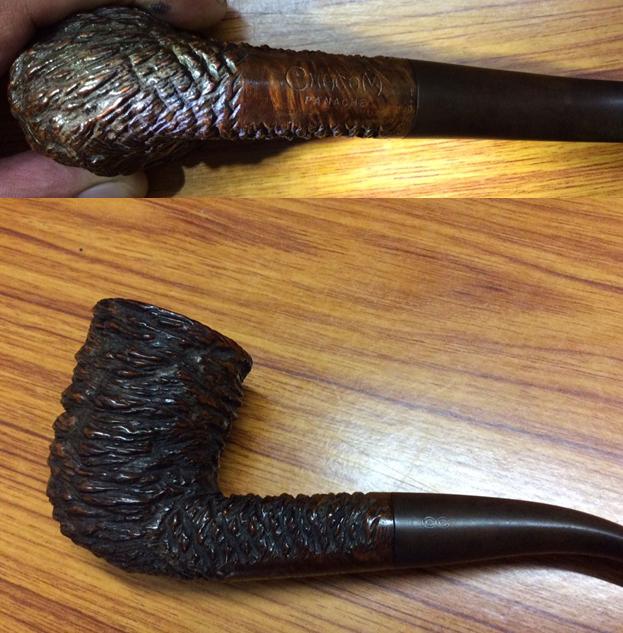
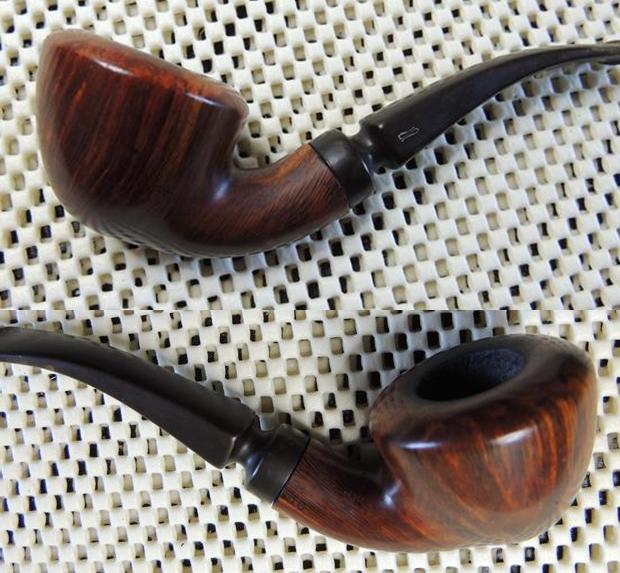
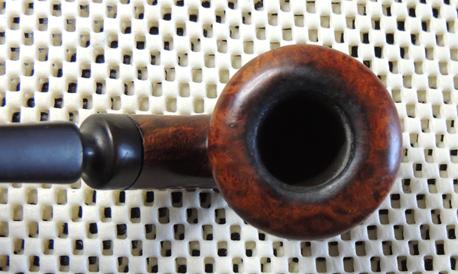
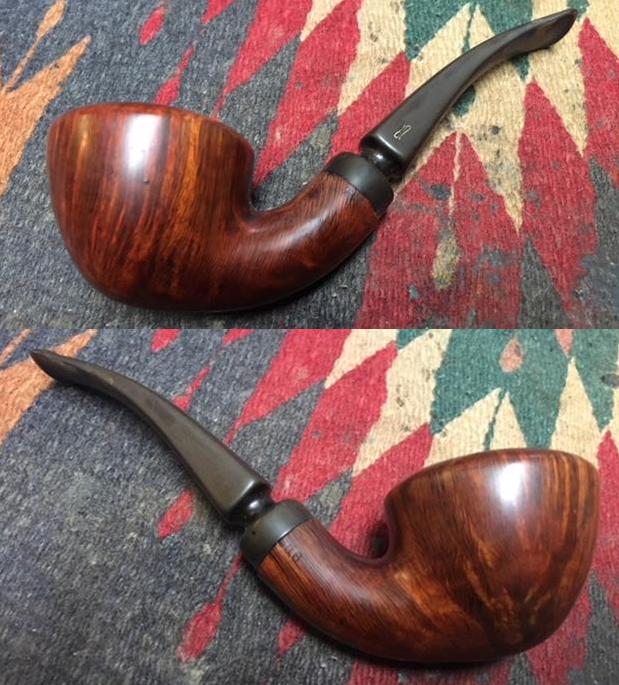
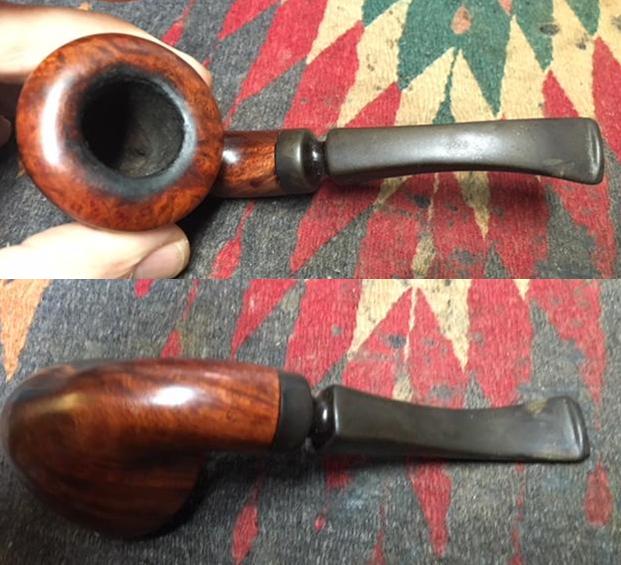
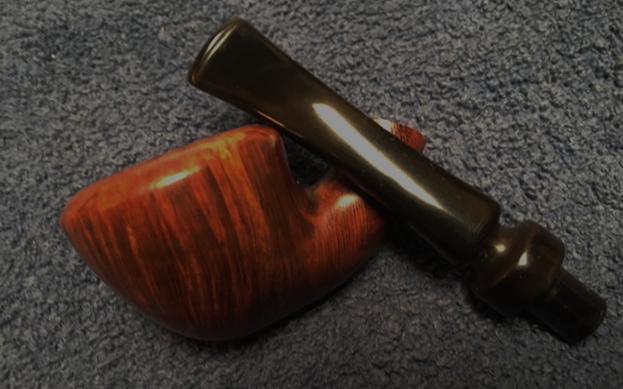
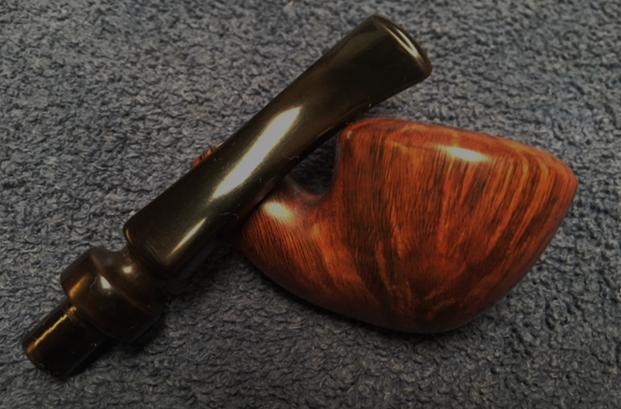
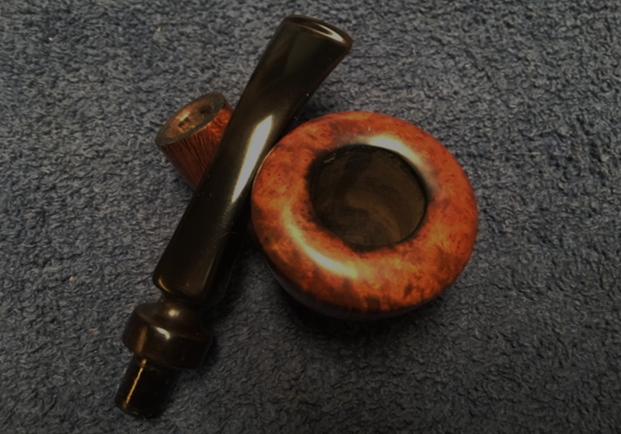
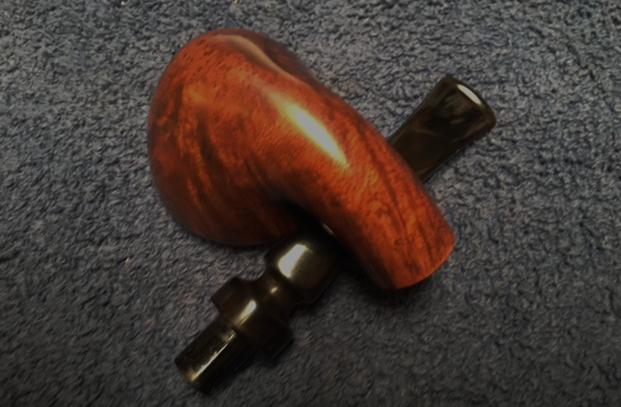
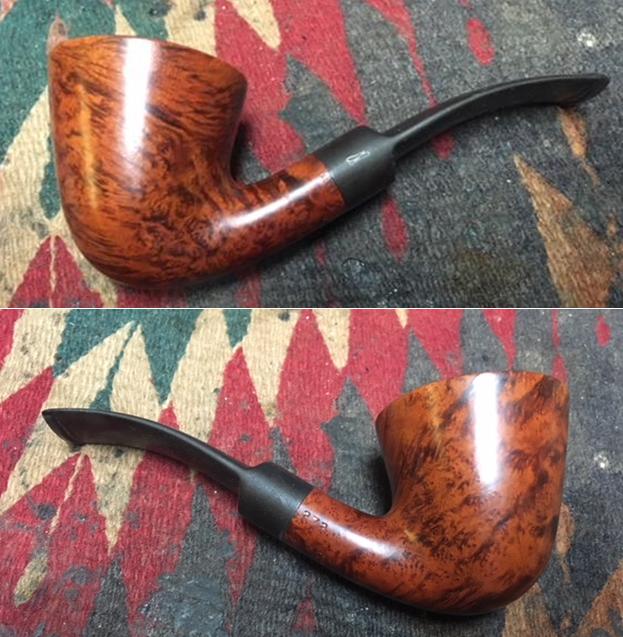
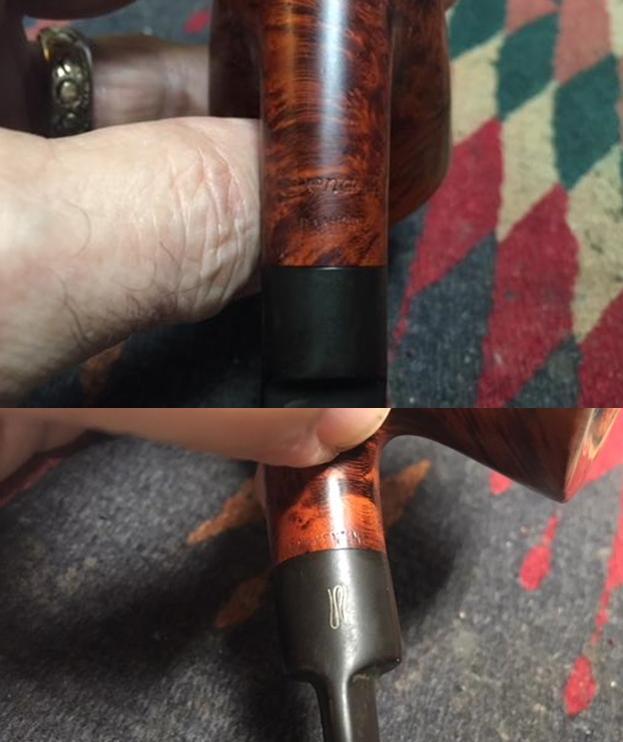
The next pipe that caught my attention was a CHARATAN’S which was in the box of pipes which I had received from my Uncle. This Dublin has beautiful birdseye on the sides and beautiful densely packed cross grains on the front and back of the bowl and also along the shank. The bowl delicately flares up towards the rim top and together with a subtle bend to the double step saddle stem, lends this pipe a lovely Dublin shape with a charm and grace that can be seen on a well crafted pipe from this quality brand!!!The pipe is stamped “CHARATAN’S MAKE” over “LONDON ENGLAND” over “SPECIAL” in block capital letters on the left side of the shank. Further towards the bowl on the same side, it is stamped with the letter “L” inside a circle in cursive letter. The right side of the shank is stamped as “260DC”. The left side of the stem is stamped on the saddle with “CP” logo, with the lower half of the “C” embedded within the letter “P”. The right side on the saddle is stamped with “REGD NO” over “203573” I searched Pipedia for more information about the brand and also to try to accurately date this pipe. I have reproduced the details which I could glean from this website:

“In 1863 Frederick Charatan, a Russian / Jewish immigrant, opened a shop in Mansell Street, located in the borough of Tower Hamlets, London E1, where he began to carve Meerschaum pipes.

Charatan was the first brand to make entirely hand-made briars from the rough block to the finished pipe including the stems. The nomenclature “Charatan’s make” refers to this method of production and was meant to differ Charatan from other brands who “assembled” pipes from pre-drilled bowls and delivered mouthpieces.

On the retirement of his father in 1910 Reuben Charatan took over the family business.

In 1950 Herman G. Lane, striving to expand his business in Great Britain, made contacts with the Charatan family. Apparently Lane got a certain influence soon, but it was not until 1955 that Lane Ltd. became the sole distributor for Charatan’s in the United States superseding Wally Frank. This can be documented in a “biography” written for Herman G. Lane titled “Leaves from a Tobaccoman’s Log”.

Thanks to Herman G. Lane’s dedicated labor Charatan became hugely popular in the States. As reported by Ken Barnes in an interview with Rick Newcombe, Reuben Charatan passed away in 1962, and his widow sold the firm to Herman Lane 1 or 2 years after his death [1]. In the early 1960’s Charatan pipes were the first to overstep the $100 Dollar line in US pipe sales. In 1978 Lane’s heirs sold the Charatan company to Dunhill. The Prescot Street factory was closed in March 1982. Thereafter the fame and quality of the make declined.

The pre-Lane period (prior to 1955) and the Lane era pipes (1955 to until sometime between 1979 – 1984) are of primary interest the collector. The Lane era is often quoted as beginning about 1950. Charatan records indicate the DC (Double Comfort) bit was introduced in the 50’s, but some report seeing them in earlier production. Still others indicate they were introduced by Lane in 1960. Regardless, the DC bit is not an accurate way to date a pipe because many Charatan’s were made with regular and saddle type bits throughout the “Lane Era”.

 An excellent article, Dating of Charatans has been translated for Pipedia by Mathias Acciai. This study by Fabio Ferrara of Monterubbiano – Italy is based on more than 2000 old Charatan pipes he studied from the “Basciano stock” purchased by Mario Lubinski – Fermo. This fantastic addition to the Charatan knowledge base is now in English here on Pipedia.

The first step on dating a Charatan is to carefully look to some details:

  1. a) Shape of the mouthpiece
  2. b) marking on the mouthpiece
  3. c) engraving on the shank
  4. d)shape and position of shank engraving/writing

This is because you can make the following conclusions:

a) From 1863 to 1960 the mouthpieces have a normal shape, saddle or tapered. From 1961 they use the ‘Double Comfort’ style still used today. By the way there are some saddle bits (without the double comfort) used in pipes that date after 1960 but these models are always characterized by a X (in the place of the DC) engraved after the shape number on the shank. This means that if a pipe has a tapered mouthpiece instead of a double comfort one, it is definitely a pre-Lane pipe before 1960. While if a pipe has a normal saddle bit stem, it could belong to every era. Nevertheless the pipe is pre 1961 if the shape code does not include an X, and is a pipe from after 1960 if the X is engraved.
Finally any pipe with the double comfort stem is definitely after 1960.

b) The CP logo on the stem is stamped in a different shape according the era it was used. Some differences are less obvious than others, however the glaring differences are detectable in 4 phases. The CP till the 1960 is very fine, the C penetrates the P.
From 1961 to 1977 the CP logo is more pronounced and the C penetrates the P.
From 1980 (approx.) the C does not penetrate the P any more, even though the two letters are joined.
The CP of Dunhill era has a different shape than the one of the French Russell era.

c) Pipes that belong to eras till the 1960 have the engraving ‘CHARATAN’S MAKE LONDON ENGLAND’ in two lines, the shape code is composed by numbers only. The X and the DC appear only on pipes after 1960.

The engraving ‘MADE BY HAND (in caps) -IN-City of London’ in three lines identifies pipes made between 1965 and 1966. The engraving in script font ‘Made by Hand -In-City of London’ on three lines identifies pipes made between 1966 and 1979. The circled £ (Lane) characterizes pipes produced from 1955 to 1980 (approx.)

d) engravings are different in both size and shape, depending on eras.

Identification of a third era pipe (First Lane era, 1961-1965)

Pipes of this period are quite common.

1) The mouthpiece is frequently double comfort, rarely saddle without the double comfort, never tapered. If the stem is not a double comfort but a saddle one, it is characterized by the letter X on the right of the shape code (e.g. 2502X), naturally in this case the letters DC are not displayed.

2) In the CP logo, the C enters the P

3) Presence of £ on the shank (note that from 1955 all the pipe imported in the USA by Lane has it, however that stamping is not synonymous of the Lane era)

4) Presence of the letter DC just after the shape number (e.g. 2502 DC) or of the letter X only if the stem is not a double comfort one

5) Presence in some models of the stamp “MADE BY HAND” on the shank (introduced for the first time in 1958)

6) Presence of the writing “CHARATAN’S MAKE LONDON ENGLAND” in 2 lines

7) The CP logo is thicker than in previous eras. 

From the above information, it can be safely assumed that this particular piece dates from somewhere from 1960 to 1965, that is the first Lane Era, which coincides with the period of the other pipes that belonged to my grandfather. With this information in mind, I moved ahead to the next process in the restoration.

INITIAL VISUAL INSPECTION
I always follow the advice of Mr. Steve given out in his blog on restoration process for novices like me and carry out initial visual inspection of the pipe. This helps a lot in formulating your POA for the restoration.

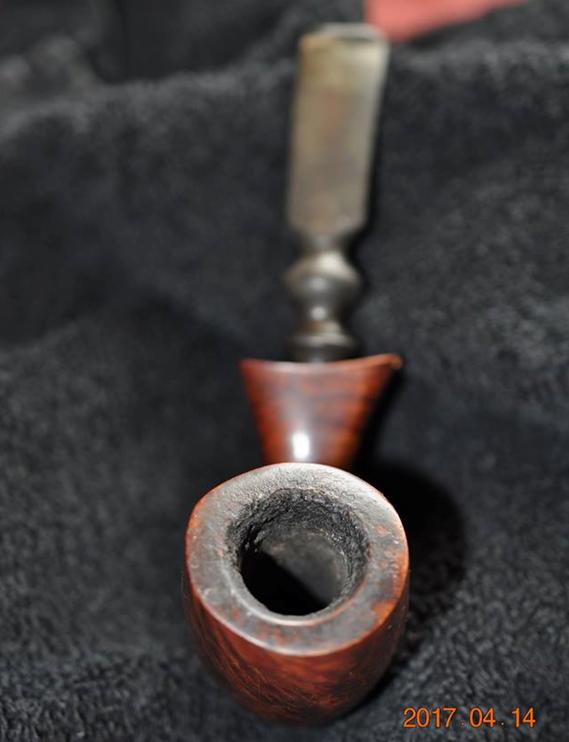
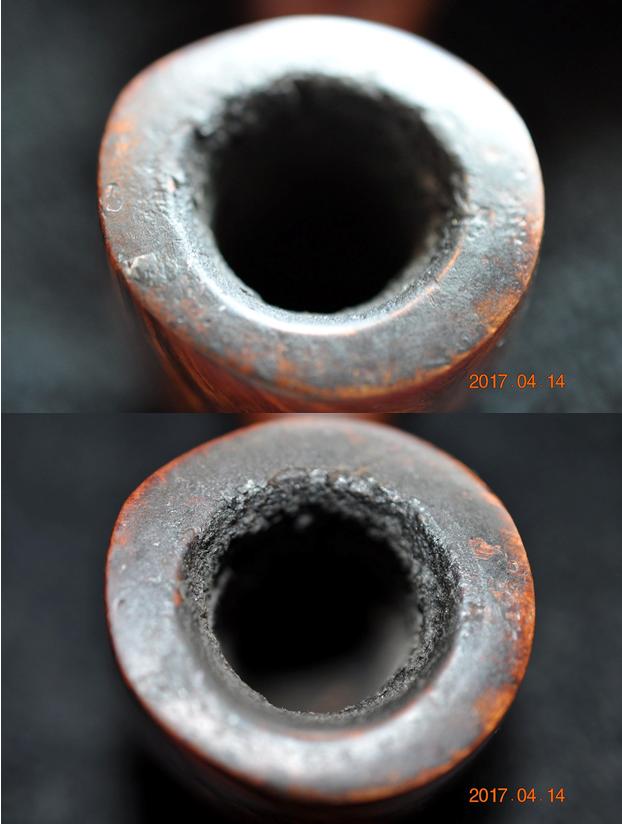
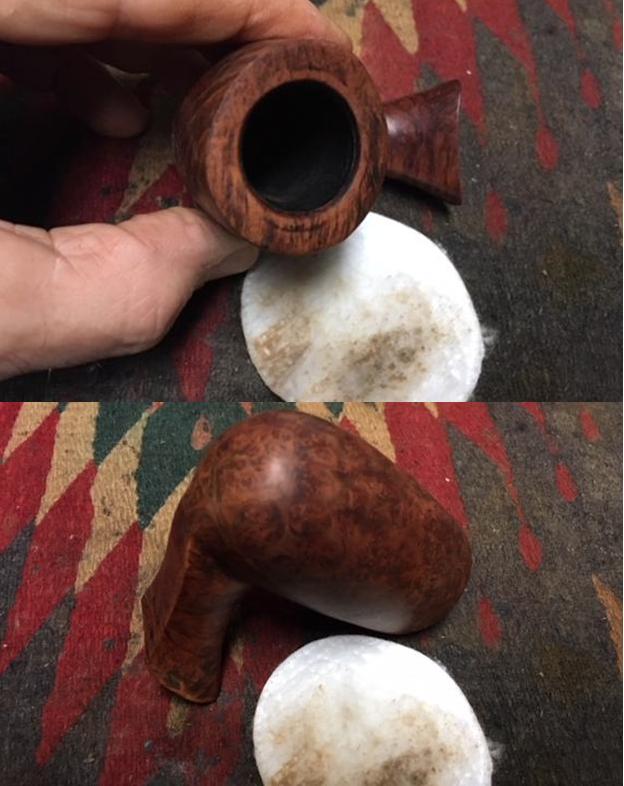
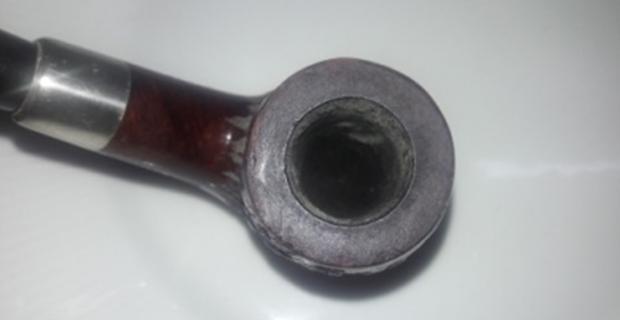
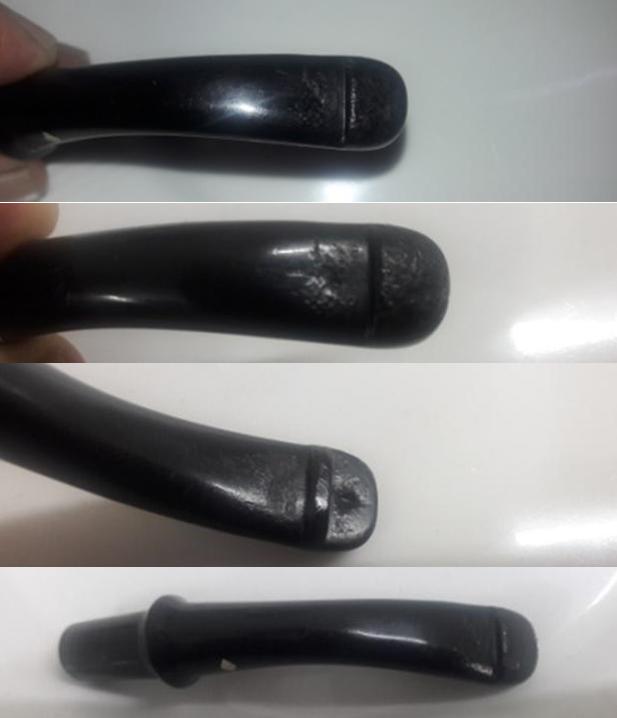
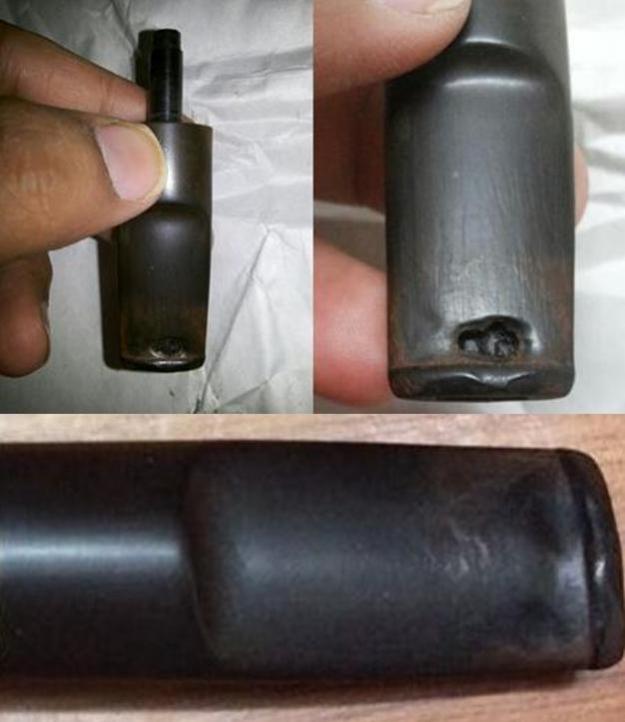
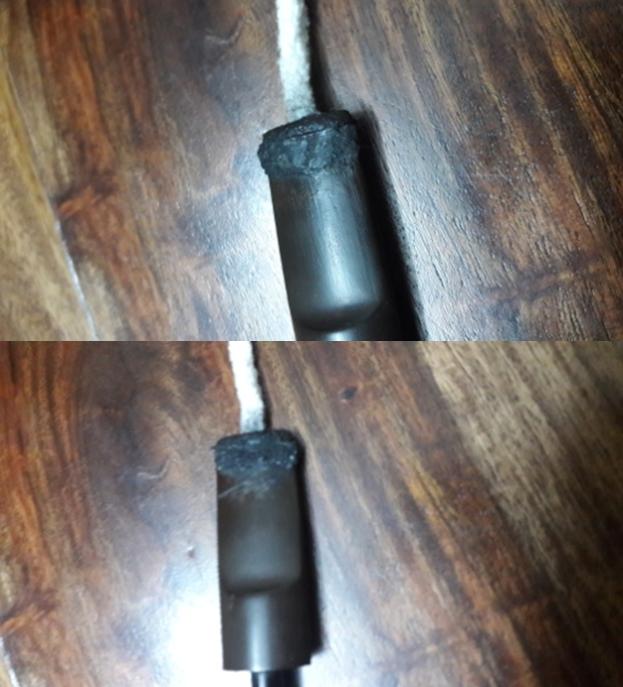
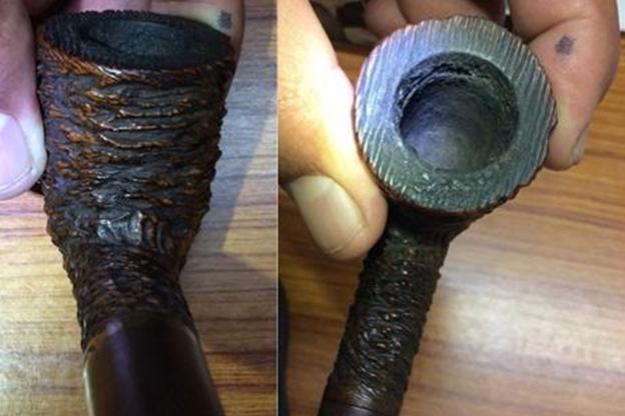
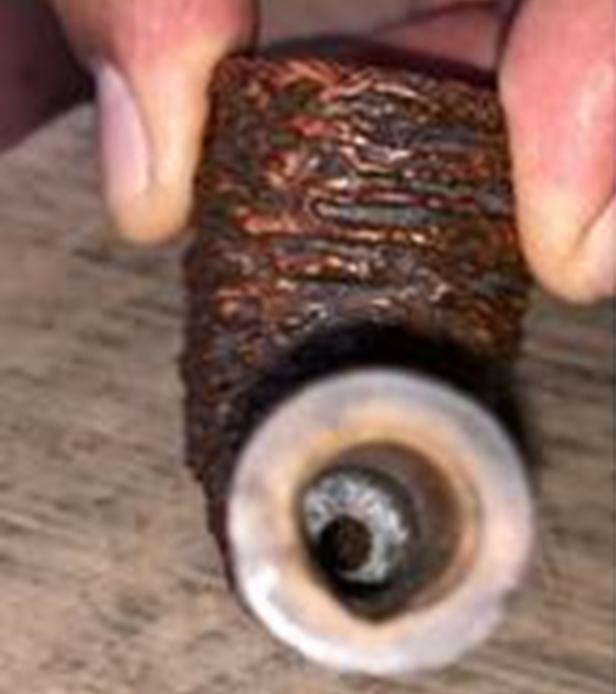
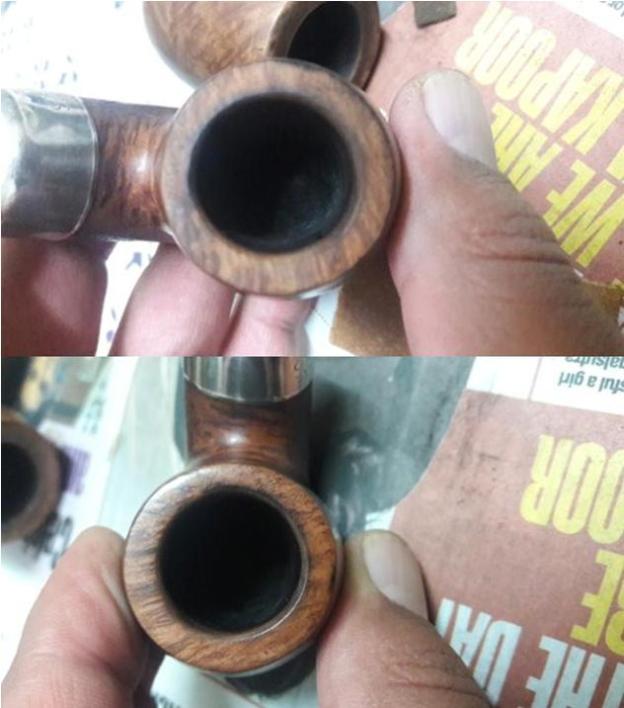
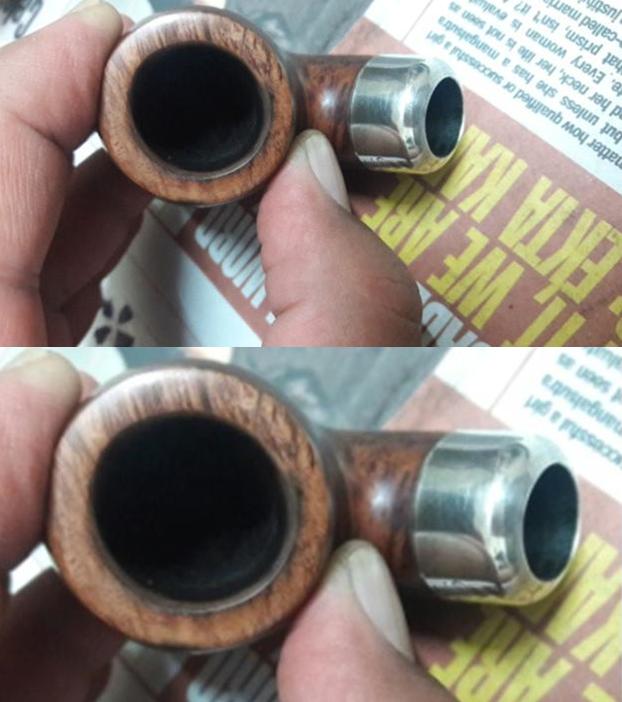
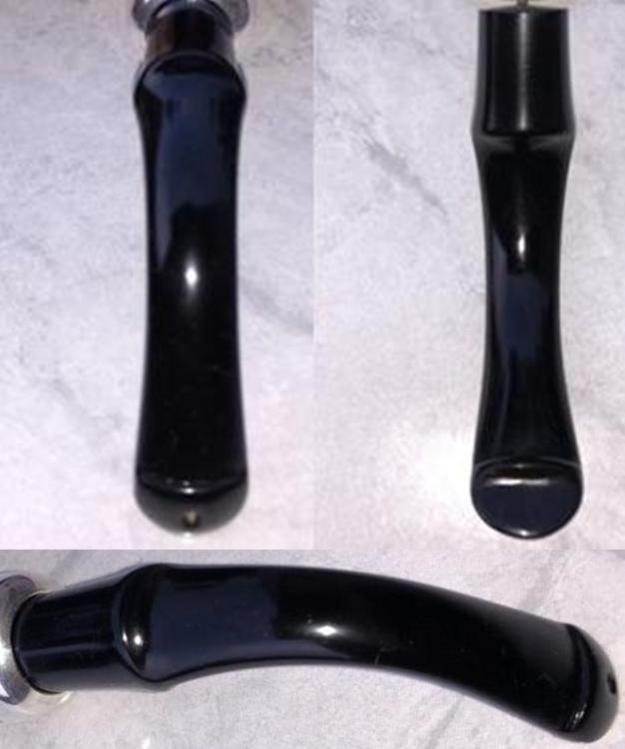
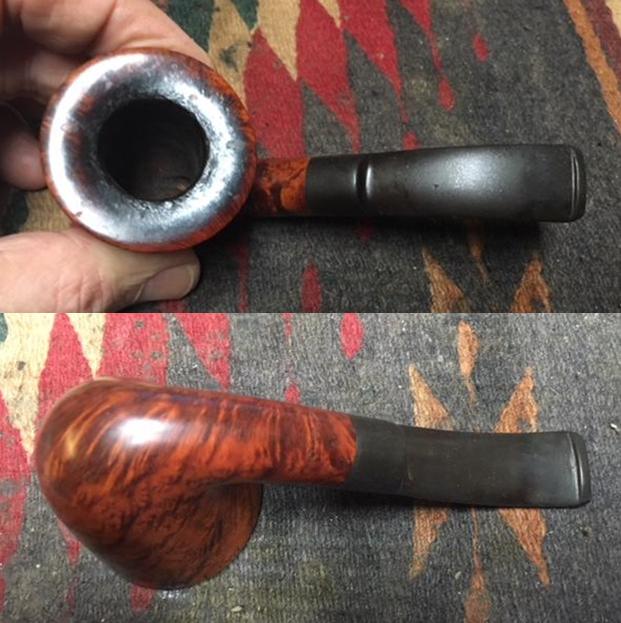
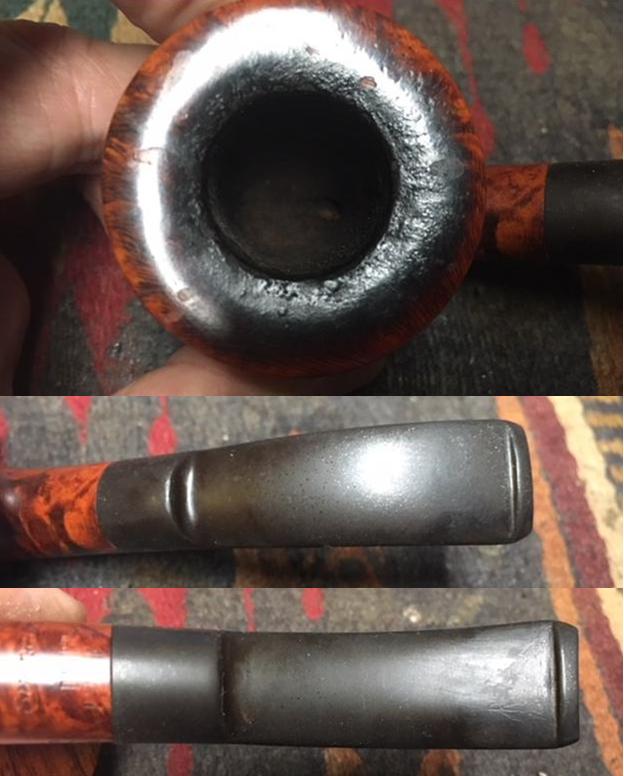
The bowl is heavily caked with an equally heavy overflow of lava on to the rim top. The outer edge of the rim appears to be intact save for the light charring on the left side in 9 ‘O’ clock direction. However, the inner edge of the rim is a totally different story!!!! Deep extensive charring can be seen on the inner edge in 1 ‘O’ clock direction on the right side and in 8 ‘O’ clock direction on the left side. The internal condition of the bowl and the exact extent of the char can only be ascertained after the process of reaming is completed. The stummel and the shank are covered in grime and dust of these years of use and subsequent storage, giving it a dull and lackluster appearance. This will need to be addressed. Air does not flow easily through the pipe and requires some lung power to do so. The airway in the stem and/ or in the shank is restricted and needs to be cleaned out. The stem is a Double Comfort stem which is correct for the period. Heavy calcification can be seen on the lower half of the DC stem with a few deep bite marks and lot of tooth chatter on both the lower and upper surface. The lip/ button is deformed and will need to be worked upon. All said and done, the major cause of concern which will require maximum attention and work is the rim top, rim inner edge and the extensive charring seen on the right and left inner edge!!!!

THE PROCESS
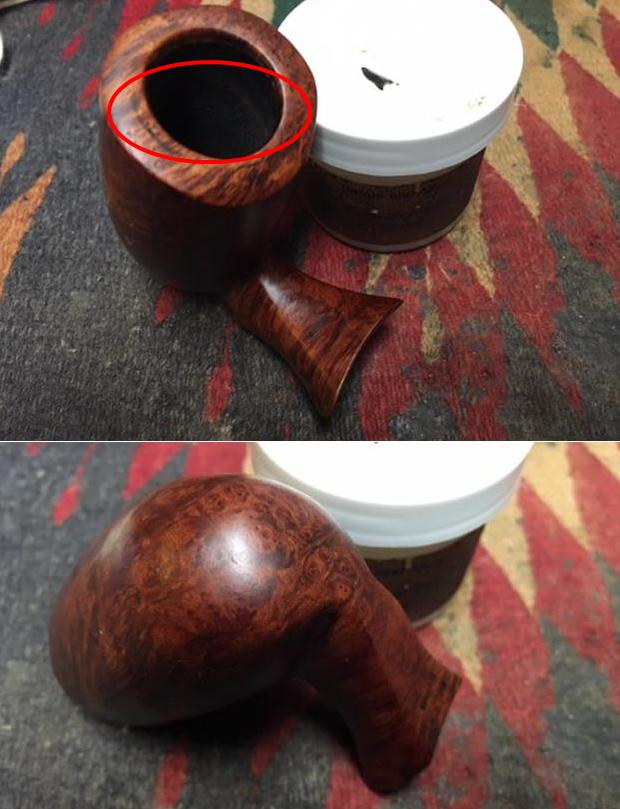
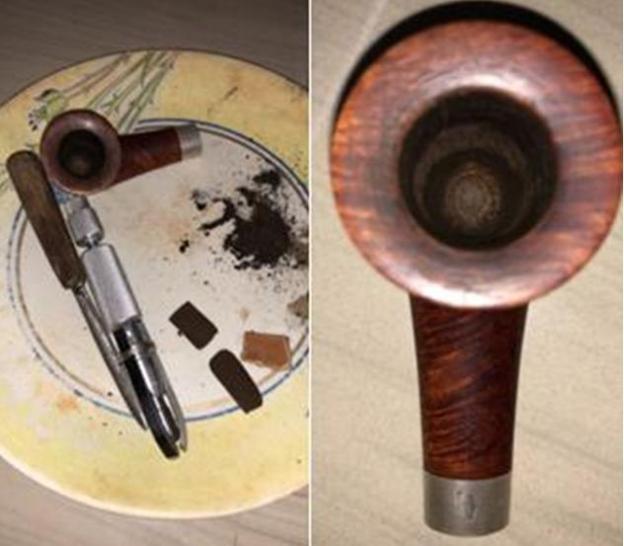
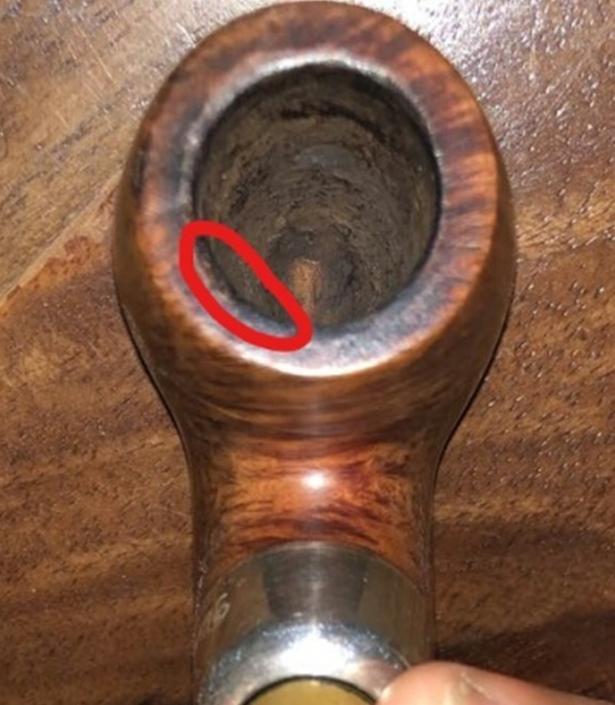
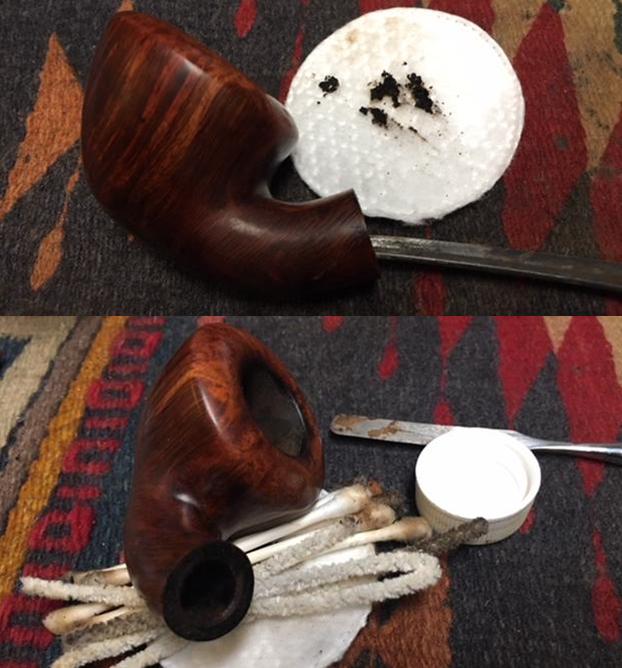
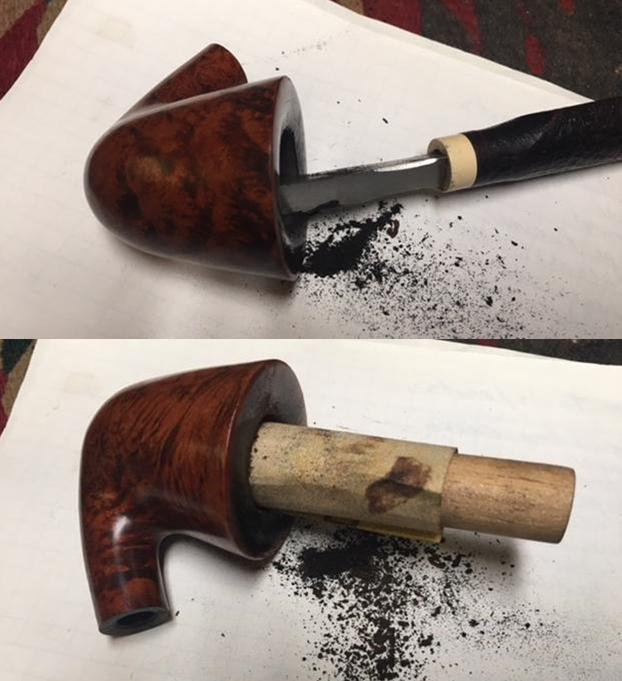
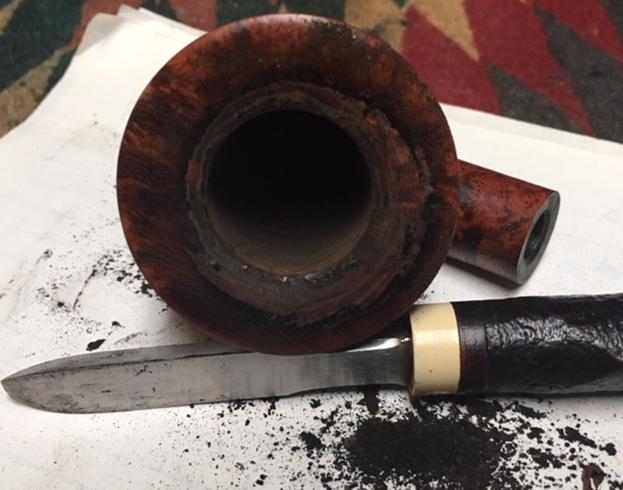
As usual, Abha, my wife took upon herself the task of reaming the bowl to get rid of all the grime, tars and oils accumulated in the chamber. Using a Kleen Reem pipe tool made short work of reaming and she was able to get rid of the thick cake. She gently removed all the remaining cake crust till she reached the briar using my fabricated knife set and thereafter sanding the chamber with a 220 grit sand paper. Thereafter, using the fabricated knife, I gently scraped and removed all the overflow of lava, tars and oil from the rim top. With hope in my heart and prayer on my lips, I gently scraped the charred wood from the inner edge on both sides till I reached solid briar. The picture below will tell the story of its condition!!!The char marks to the inner edge of the rim on the right side in 1 o’clock direction is the widest followed by the one on left side in 8 o’clock direction. The char on the outer left edge at 8 o’clock direction is not very severe. I decided to top the bowl and create a bevel on the inner edge to address these issues. I Facetimed with Mr. Steve and he too concurred with my POA.

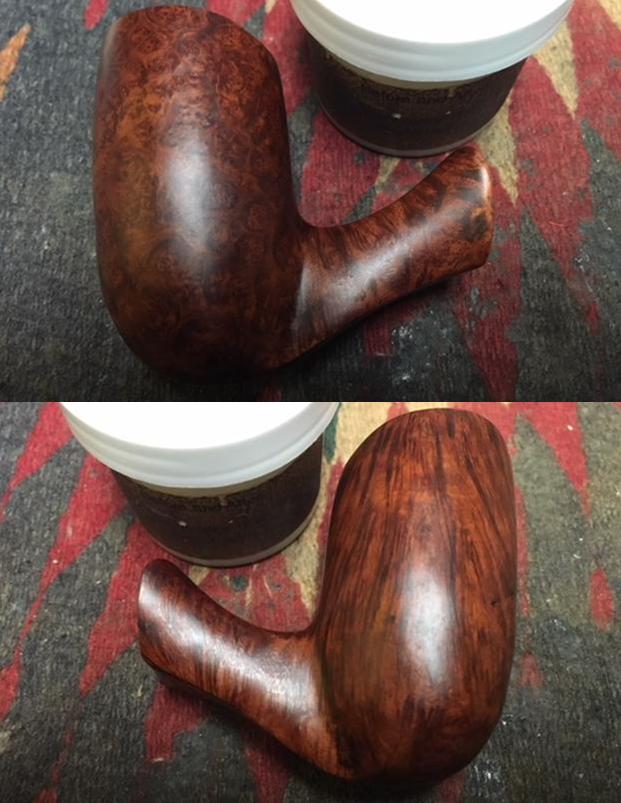
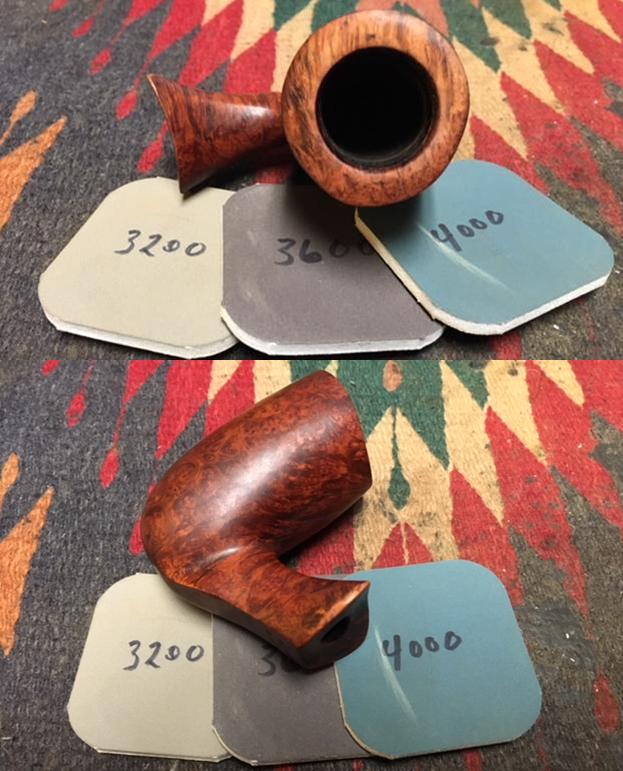
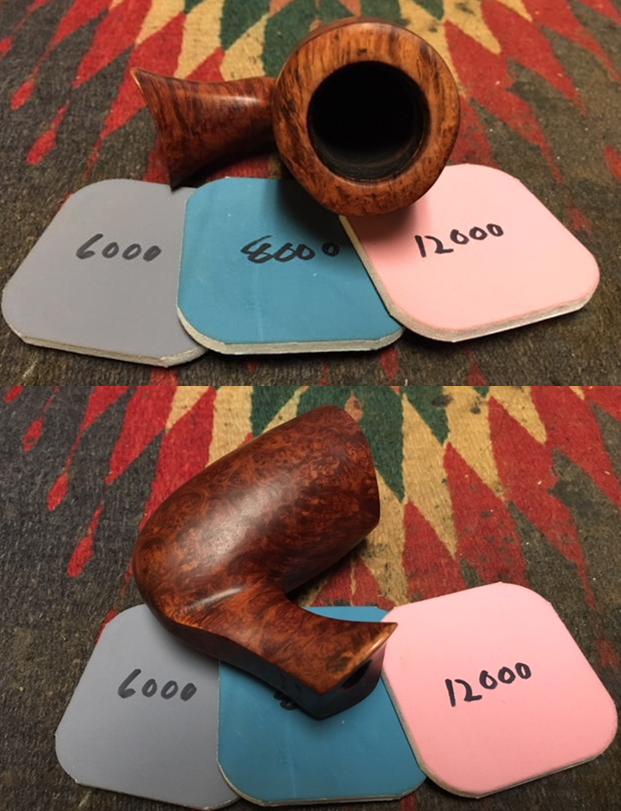
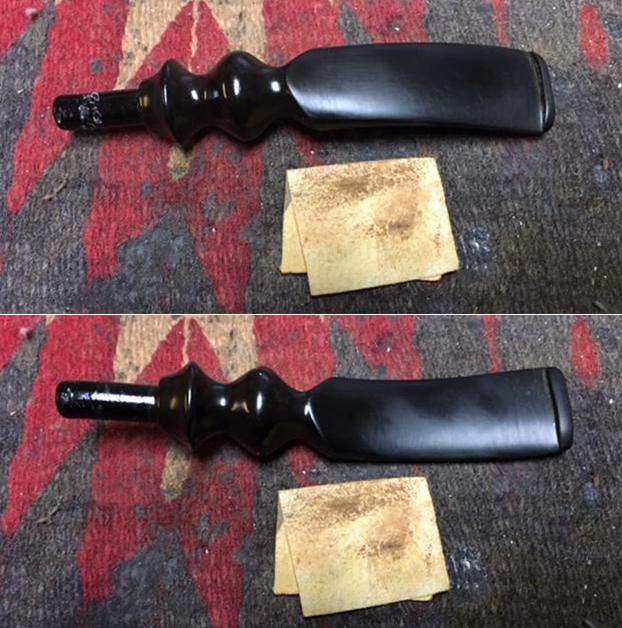
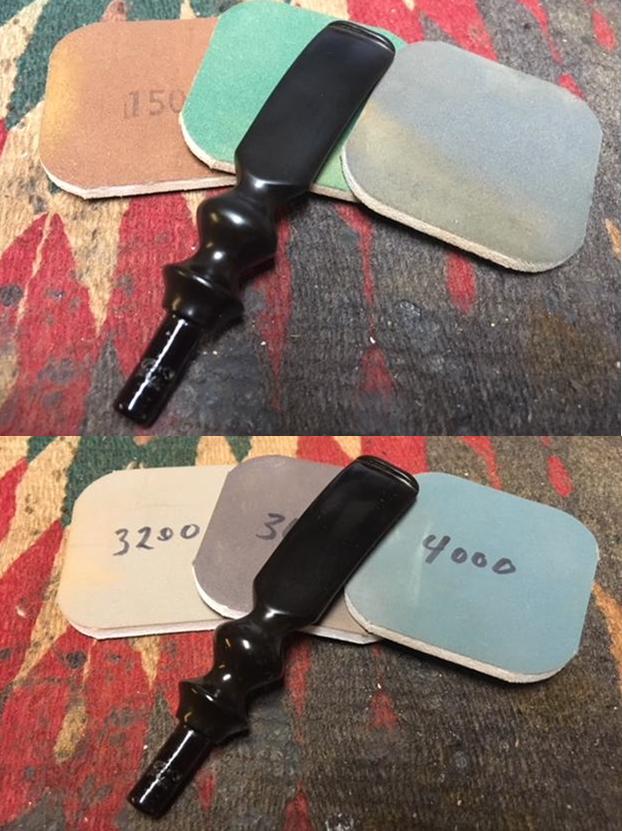
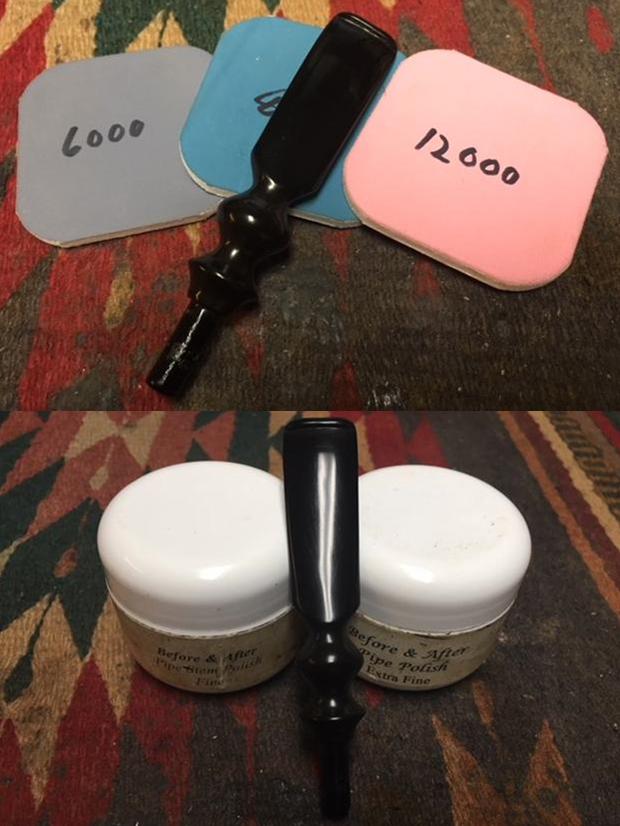
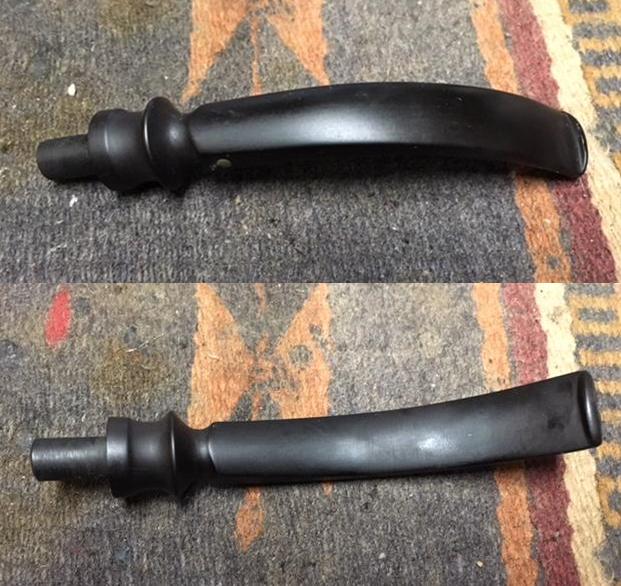
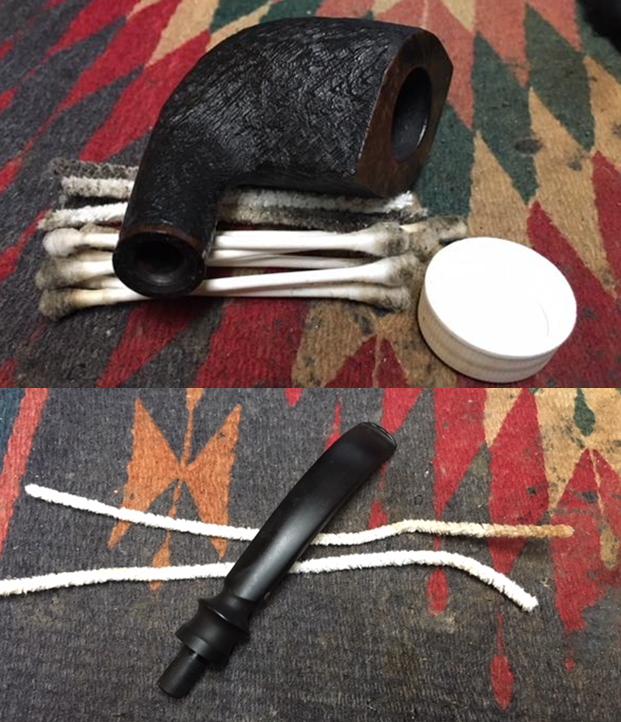
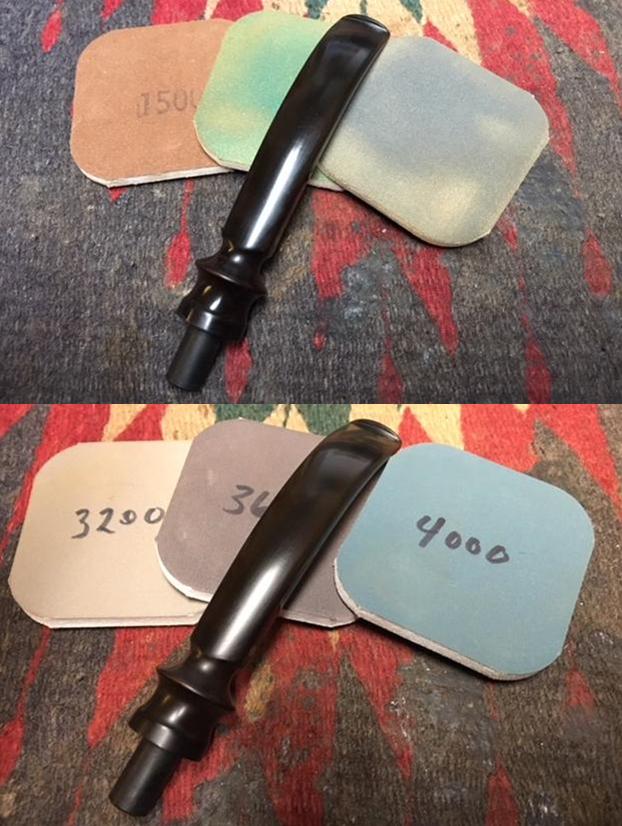
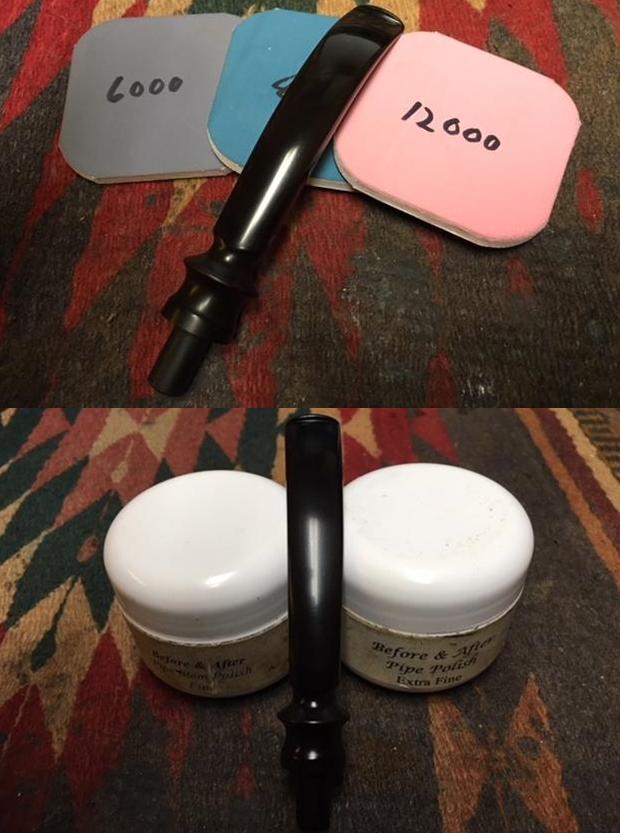
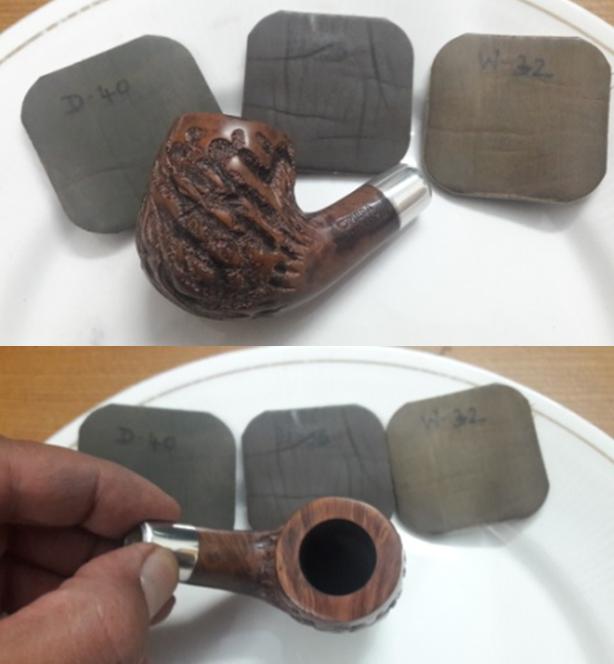
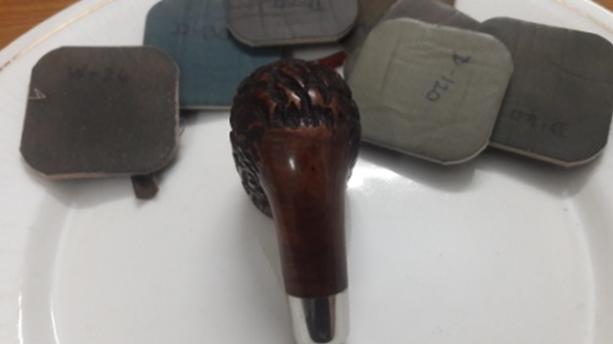
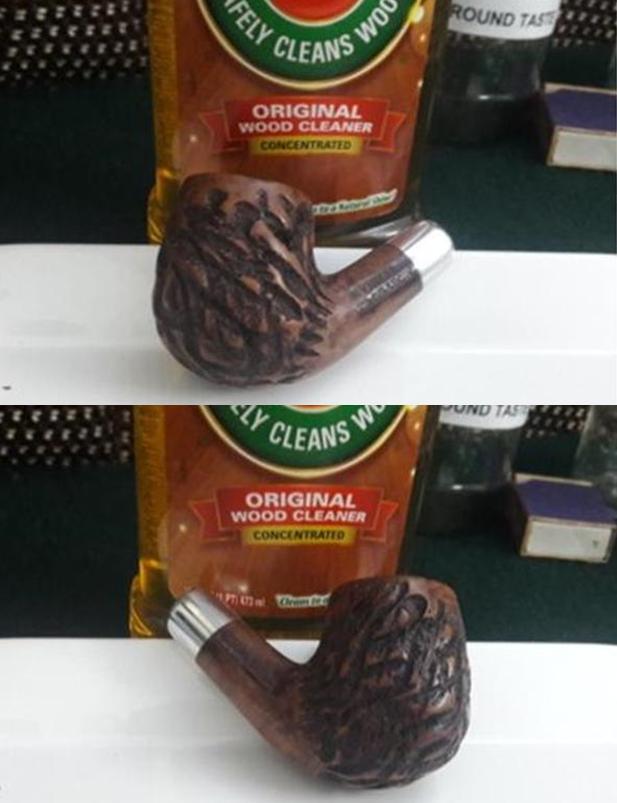
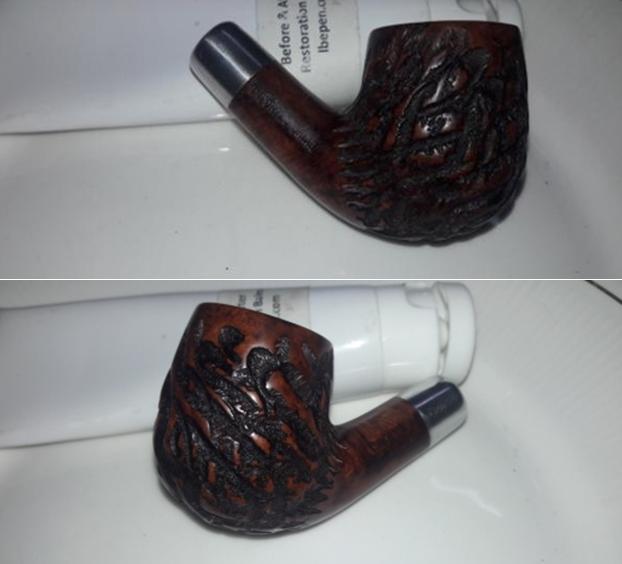
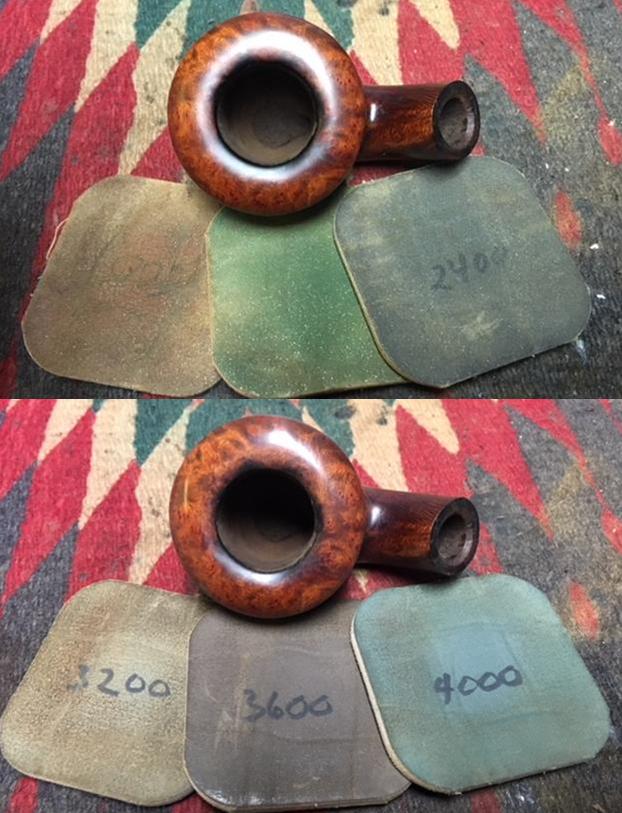
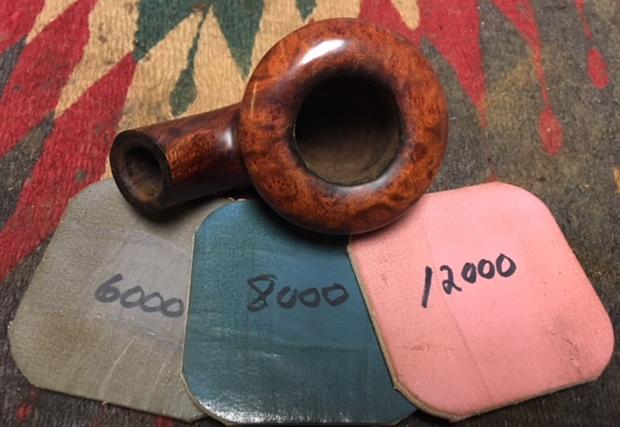
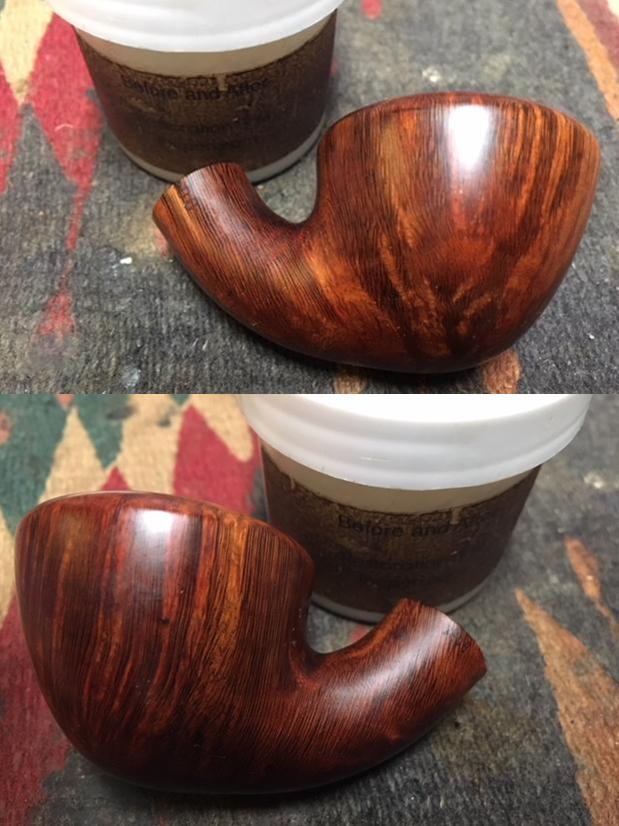
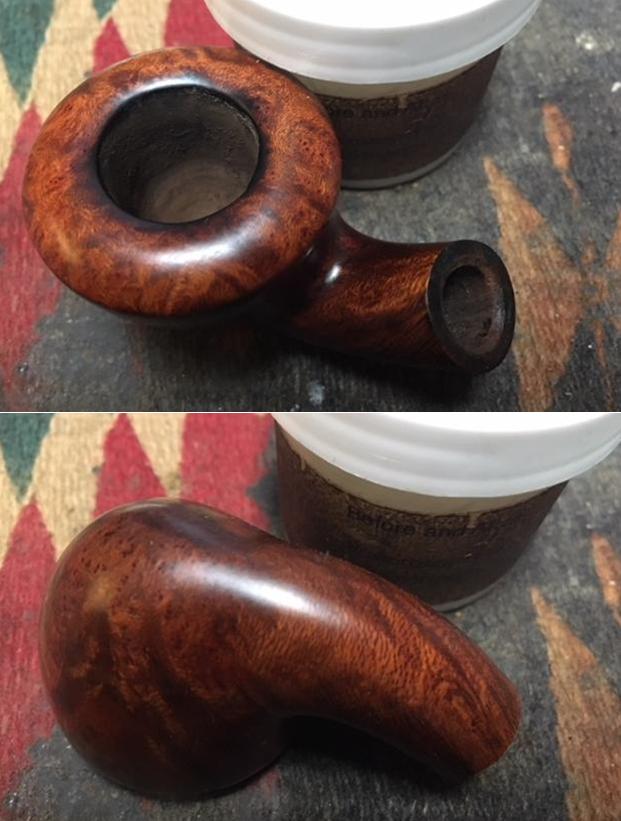
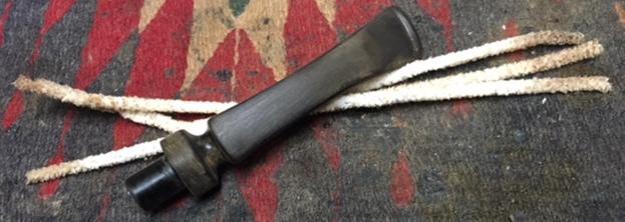
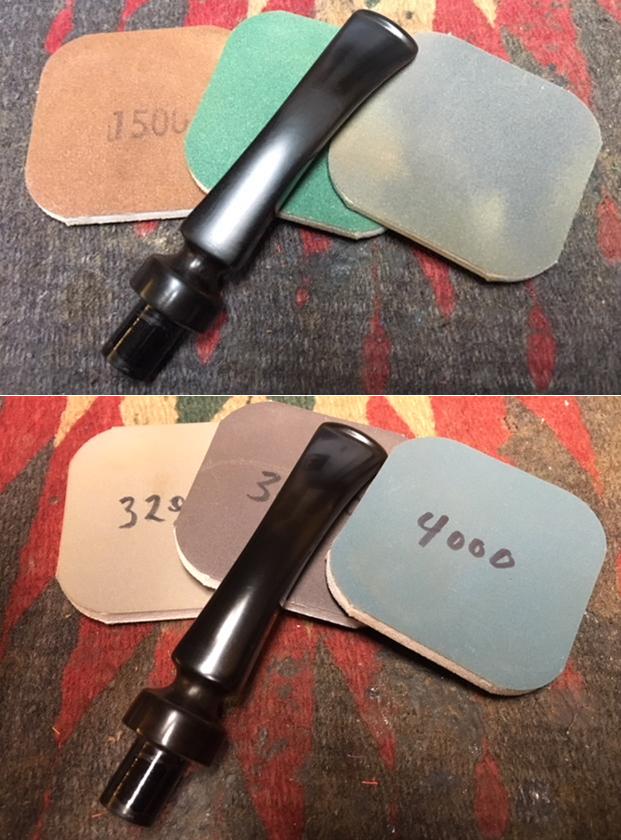
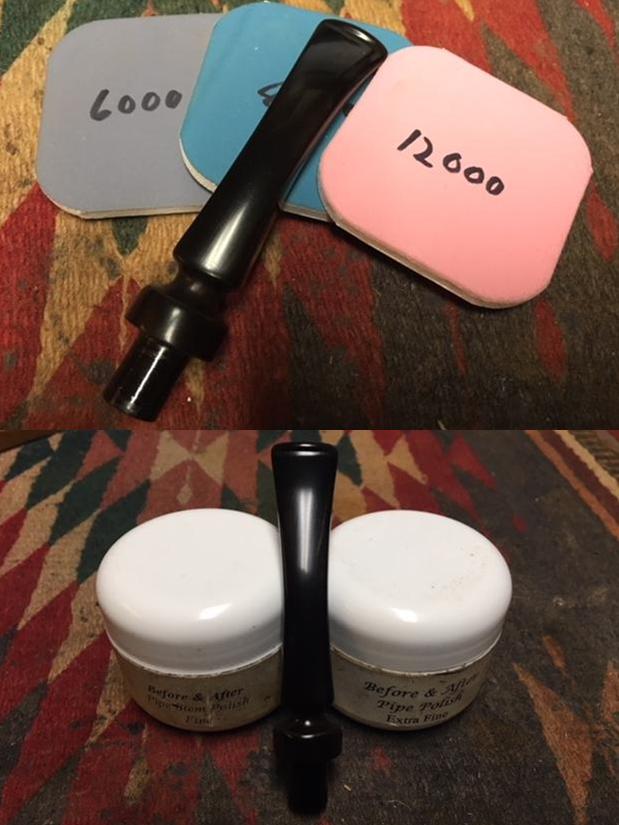
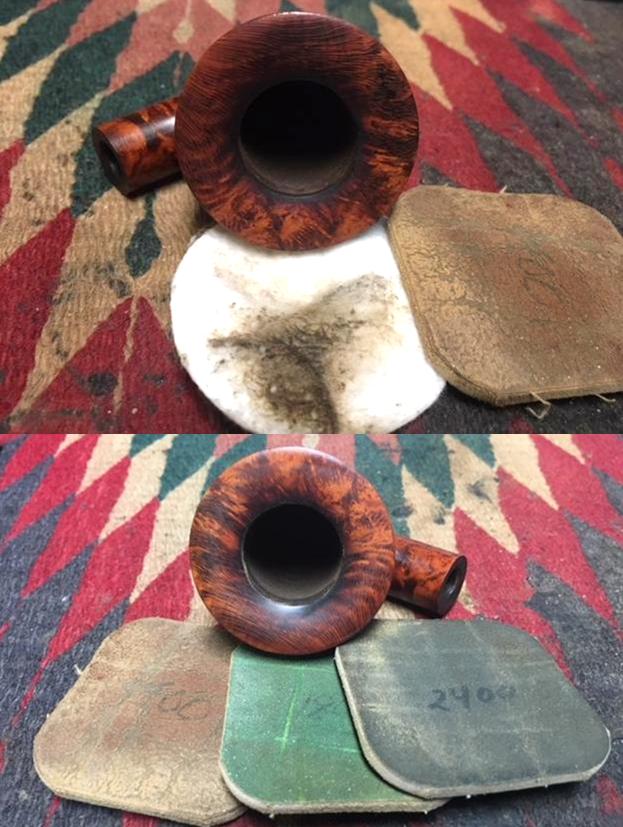
I started by topping the bowl with a 220 grit sand paper till the charred surface on the inner as well as outer edge of the rim was reduced. Using a folded piece of 180 grit sand paper, I gave a slight bevel to the inner edge. However, I was not very pleased to see the results. The charred surfaces stood out like sore thumbs on either sides of the rim.To further mask the charred inner edges, Abha suggested creating a deeper bevel and attempt to conceal the damaged inner edge within this bevel. After viewing the pictures, Mr. Steve also approved of this plan. Thus, I created a deep bevel making sure that the charred surfaces are within this bevel. The inner edge is looking much better and presentable as can be seen in the pictures below. It took me considerable time to complete this stage since I had to frequently check the progress so that I did not end up losing too much surface off the rim top. I, thereafter, cleaned the exteriors of the stummel, rim top and shank with undiluted Murphy’s Oil soap and a toothbrush, taking care that water does not enter into the chamber and the shank. I wiped it down with a soft cotton cloth and kept it aside to dry out. Turning my attention to the stem, I started by masking the “CP” logo and the Regd No. with whitener (pics…..). I painted both the surfaces of the stem with a Bic lighter to raise the tooth chatter and bite marks to the surface. Sanding the stem with 220 grit sand paper, I evened out the surface of the stem. The deeper tooth marks were spot filled with clear CA super glue and set aside to cure overnight. Back to the stummel, I dry sanded the exteriors of the bowl, rim top and the shank with 1500 to 2400 grit micromesh pads and wet sanding with 3200 to 12000 grit micromesh pads. The beautiful birdseye and the cross grains really popped out at this stage!!!!!(PICTUREs…..). Though the darkened areas of the inner edge caused due to charring were very much visible in pictures, in reality it does not look as bad. There is an option to further cover up the darkened areas by staining the complete bowl with a dark stain, I decided not to do so for two reasons, firstly, the pipe looked beautiful in this lighter hues with lovely grains in plain sight and secondly, I DO NOT HAVE THE MATERIAL AND EQUIPMENT FOR THE SAME and also have never tried this technique (this aspect WILL be my agenda during next leave!!!). With that decision made, I rubbed a small quantity of “BEFORE AND AFTER RESTORATION” balm into the briar surface and let it rest for 2-3 minutes for the balm to work its magic. I really feel that this is one product which every pipe smoker should have for routine maintenance of his/ her pipe. This balm infuses fresh breath of life into the briar while forming a protective layer over the briar surface. Using a soft cotton cloth and undiluted (LOL!!!) muscle power, I buffed it to a nice shine. Have a look at the bowl for yourself. With the stummel completed, save for a final polish with PARAGON WAX, I turned back towards working on the stem again. Using a flat head needle file, I sanded the fills to match the stem’s surface. I also worked on the button edge and created a crisp edge. Once I was satisfied, using micromesh sanding pads, I dry sanded the stem with 1500 to 2400 grit pads and wet sanding with 3200 to 12000 grit pads. I wiped the stem with moist cotton swab after every pad and rubbed in Extra Virgin Olive oil after ever three pads (Pictures….). Although I tried to take all care and precautions to preserve the stampings on the stem, I HAVE MANAGED TO OBLITERATE IT!!!!  Can anyone suggest an easy method to restore it???? Indentations are visible though, which is a saving grace!!!!Once I was finished with the stem, I cleaned out the internals of the stem and shank using Isopropyl alcohol, cue-tips, shank brush, regular and bristle pipe cleaners till air flow was open and free. Thereafter, I gave a final polish to the bowl with Paragon wax, rubbing and buffing it with a soft cloth and muscle power till cows came home!!!!!!!! The finished pipe can be seen in the pictures below. Thank you for walking with me on this journey of learning and resurrection of fond memories of my Old Man!!!!!

Restoring & Restemming a Zettervig Handmade 351 Freehand


Blog by Steve Laug

This is another pipe from the fellow here in Vancouver that he dropped off for me to work on. There were 8 pipes in the lot – I have finished five and this is the sixth. It is a Brandy shaped freehand bowl stamped on the underside of the shank and reads Zettervig over Copenhagen over Handmade over the shape number 351 over Denmark. The pipe came with a stem that was obviously not the original. It was another one of his pipe finds on a recent pipe hunt in Vancouver. The smooth finish had a burnt orange colour over a black undercoat. The plateau on the rim top and shank end were also black. The briar had been covered with a lacquer that had gone cloudy. The finish was very dirty and there was a thick cake in the bowl. The pipe needed to be cleaned thoroughly and a new stem fit to the shank that was more of a freehand style stem. I took close up photos of the rim top and the shank end. I believe that the plateau “style” top of the rim was carved rather than natural. The shank end has a combination of carved finish and genuine plateau. The inside of the bowl has a thick cake around the bowl and some tar and oil on the top of the rim filling in the finish. Some of the original black finish was also worn off.I took photos of the pipe with the stem it had on the bowl when it had been found. It is a saddle stem made to fit flush against a rounded shank. It was not made for plateau style freehand shank ends. I took a photo of the stamping on the underside of the shank. It is very clear and readable. The stamping is clearer than the photo shows.I decided that I would look up some information on the Zettervig brand before I started the clean up on the pipe. I looked up information on two of my favourite sites. The first was Pipedia. Here is the link: https://pipedia.org/wiki/Zettervig. I quote in full:

In the 1960’s and into the early 1970’s Ole Zettervig had a shop in Copenhagen, Denmark where he was carving high quality pipes equal to Stanwell, Larsen, Anne Julie, Thurmann, Bang and others. These early pipes were marked “Copenhagen” and are very collectible. He sold his shop at some point in the 70’s and moved to Kolding and continued to produce pipes as a hobby, but the quality of briar and workmanship is said to not equal the early production. The later pipes he now marked as Kobenhaven rather than Copenhagen, and these were sold by Ole at flea markets throughout Europe.

http://www.pipephil.eu/logos/en/logo-z.html

I started my clean up on the bowl with reaming and then cleaning out the airway to the bowl and the inside of the mortise. I reamed the bowl with a Savinelli Fitsall Pipe Knife to remove the cake on the walls. I used a dowel wrapped with sandpaper to sand down the walls on the bowl. I cleaned out the airway with alcohol (99% isopropyl), pipe cleaners and cotton swabs until they were clean on the inside. I tried to wipe down the bowl with acetone to remove the shiny coat. It did not even begin to permeate the surface. I scrubbed the surface hard to try to break through the finish. It did not work. I sanded the finish with micromesh sanding pads to break the topcoat on the finish down. I wet sanded with 1500-2400 grit micromesh pads. I dry sanded it with 3200-12000 grit pads. I wiped it down after each pad with a cotton pad and acetone. That combination of sanding pads and acetone worked to break down the finish. I used a black Sharpie Pen to restain the rim top and the shank end. It was originally black and I have found over the years that the black pen matches the colour of the original stain.I rubbed down the briar with Before & After Restoration Balm. I worked it into the finish and the plateau style rim and shank end with my fingertips and finished working it in with a shoe brush. The balm worked to clean, preserve and enliven the surface of the finish on the small bowl. The briar was coming alive so I took some photos of the pipe at this point. I buffed the plateau style rim top and shank end with a horsehair shoe brush to give it a shine. I went through my can of stems and found one that would work well on the freehand style Zettervig bowl. I had one was from a freehand pipe. I turned the end of the tenon down with the PIMO tenon turning tool. I did not need to remove too much material from the tenon so it did not take too long. Once I had turned it I sanded it smooth with a piece of sandpaper then tried it in the pipe for the fit and the look. It looked good but needed to be bent a little to follow the low of the bowl. I heated it with a Bic lighter until the vulcanite softened then bent it slightly to match the flow of the bowl.The stem had two dents in the top surface. There was also some heavy oxidation in the vulcanite. I cleaned the areas around the button and filled in the dents with clear super glue. When the repair cured I sanded the repairs and the oxidation with 220 grit sandpaper. I folded the paper and worked in the grooves turned areas of the stem.I polished the stem with micromesh sanding pads – wet sanding with 1500-2400 grit pads and dry sanding with 3200-12000 grit pads. I wiped the stem down with Obsidian Oil between each sanding pad. I put the stem back on the bowl and buffed the pipe with Blue Diamond polish on the buffing wheel. I lightly buffed the bowl so as not to fill in the sandblast finish. I also carefully avoided the stamping on the underside of the shank. I gave both the bowl and the stem multiple coats of carnauba wax and buffed the pipe with a clean buffing pad to raise the shine. I hand buffed it with a microfiber cloth to deepen the shine. The finished pipe is shown in the photos below. I have two more pipes to finish for him – both of them that are finds he made while pipe hunting. This is a fun bunch of pipes to work on. I look forward to moving through the rest of them. Thanks for looking. 

Creating a Churchwarden from a Billiard Bowl stamped LIGHT


Blog by Steve Laug

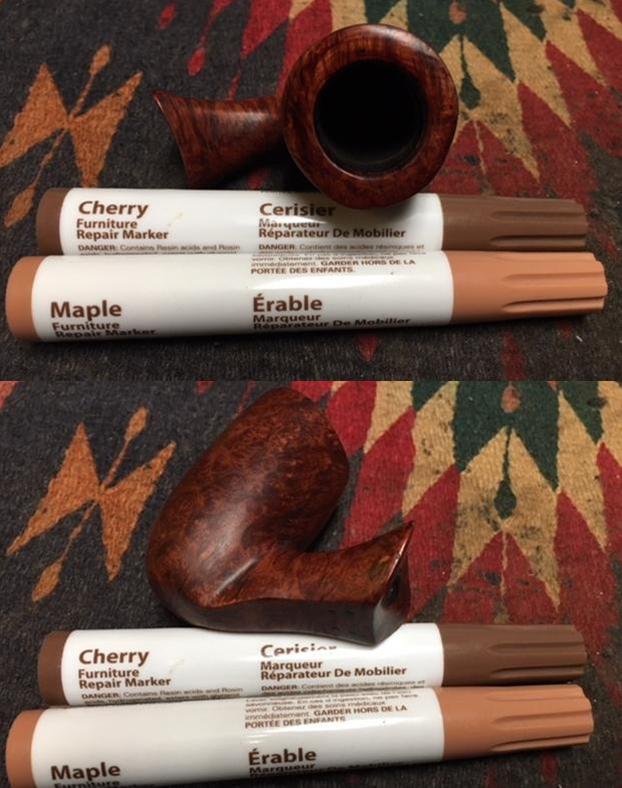
I finished up some pipes for a guy here in Vancouver and when he came to pick them up he brought more for me to work on. I have finished four of the pipes this is the fifth one. It is a small Billiard bowl that is stamped on the underside of the shank LIGHT. The pipe came without a stem and was one of his pipe finds on a recent pipe hunt in Vancouver.  It is a small billiard with a light sandblast finish. The colour is a mix of dark and medium brown stains. The finish was very dirty and there was a thick bake in the bowl. There was some damage on the inside edge of the rim toward the back of the bowl on the left side. Together we decided to make a churchwarden out of it. I thought he had a great idea so I ordered some stems from JH Lowe online. They arrived last week so I decided to fit a stem to the bowl today. I reamed the bowl with a PipNet pipe reamer with the smallest cutting head and took the cake back to bare walls. I cleaned up the remnants of cake with a Savinelli Fitsall Pipe Knife. I used a dowel wrapped with sandpaper to sand down the walls on the bowl. I cleaned up the inside rim edge with a folded piece of sandpaper and gave the rim a slight bevel. I took a photo of the inside of the bowl once it was cleaned. I touched up the stain on the bowl sides and rim with a Cherry Stain pen. I buffed it with a shoe brush.I rubbed down the briar with Before & After Restoration Balm. I worked it into the sandblast finish with my fingertips and finished working it in with a shoe brush. The balm worked to clean, preserve and enliven the surface of the finish on the small bowl. The briar was coming alive so I took some photos of the pipe at this point. I cleaned out the airway from the shank to the bowl and the mortise area with pipe cleaners, cotton swabs and alcohol. I use 99% isopropyl because it evaporates quickly and cleans the briar very well.I gave the bowl several coats of Conservator’s Wax and buffed it with a soft cloth. I would buff it later on the buffing wheel but I wanted to get a feel for the look at this point in the process. The stems I ordered arrived. They are approximately 9 inches long. The tenon was unturned and the casting excess was along both sides of the stem and the slot end. I used a drill bit to open the airway in the tenon end of the stem. It needed to be the same size as the guide pin on the PIMO tenon turning tool. I measured the diameter of the shank and adjusted the tenon turning tool to cut the new tenon. I used it on a cordless drill and turned the tenon on the stem. I turned it until it was a close fit and sanded it down until it fit snugly in the shank.I heated the stem over the flame of a candle until the vulcanite was soft. I bent it slightly over a small bottle.I sanded out the casting marks on the sides of the stem and the button end with 220 grit sandpaper. I sanded the rest of the stem smooth to remove all of the sanding marks on the diameter near the shank stem junction.I polished the stem with micromesh sanding pads – wet sanding with 1500-2400 grit pads and dry sanding with 3200-12000 grit pads. I wiped the stem down with Obsidian Oil between each sanding pad. I put the stem back on the bowl and buffed the pipe with Blue Diamond polish on the buffing wheel. I lightly buffed the bowl so as not to fill in the sandblast finish. I also carefully avoided the stamping on the underside of the shank. I gave both the bowl several coats of Conservator’s Wax and the stem multiple coats of carnauba wax and buffed the pipe with a clean buffing pad to raise the shine. I hand buffed it with a microfiber cloth to deepen the shine. The finished pipe is shown in the photos below. I have three more pipes to finish for him – all of them that are finds he made while pipe hunting. This is a fun bunch of pipes to work on. I look forward to moving through the rest of them. Thanks for looking. 


Restoring a Cased Set of Pipes – 2 JBV and 1 M&T Bent Military Mount Billiards – Part 3


Blog by Steve Laug

I have already introduced this set of pipes for you in Part 1 of this blog. It is an old cased set of three pipes. Two of them were stamped JBV in an oval and one was stamped M&T Best Briar & Bands. The set was missing the third JBV pipe which I would bet was a smooth meerschaum bent billiard bowl and a second stem. The second stem in the case was for the M&T pipe and was smaller in diameter than the stem for the JBV pipes. As I mentioned in Part 1 the silver was dirty and the bowls caked on all of the pipes but there was something about them that really attracted me. Here is the link to the first part of the blog – the restoration of the most damaged of the JBV pipes: https://rebornpipes.com/2018/07/22/restoring-a-cased-set-of-pipes-2-jbv-and-1-mt-bent-military-mount-billiards-part-1/.

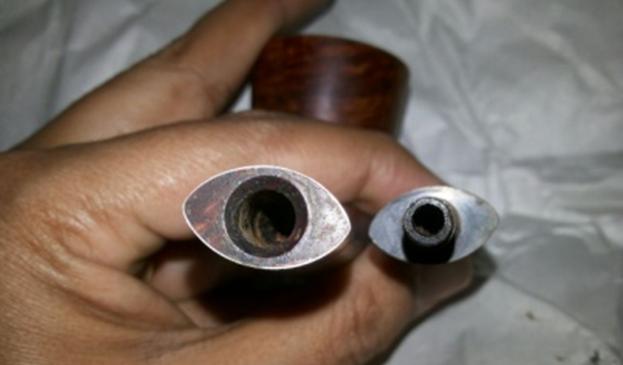
I am including a photo of the opened case showing the pipes and the stamping on the inside of the lid. It reads J.B. Vinche over “Au Nabab” over Bruxelles as far as I can interpret the blurred stamping on the felt lining. You can also see that the case has spots for what looks like a tamper tool and possibly a cigarette holder that are also missing.The next pipe that I chose to work on is the one on center of the case in the photo above. It is stamped M&T on the right side of the shank and Best Briar & Bands on the left side of the shank. The silver ferrule is also stamped BBB in three vertical boxes and the M&T is in an oval with pointed ends over three hallmarks that are hard to read. The pipe is in rough shape, but I am not sure I want to call it that after my experience with the first JBV splitting when I cleaned it. The finish on this one is also shot; there is silver polish on the shank ahead of the ferrule. The rim top is in the best condition of the three pipes and there are no deep nicks on the shank top or underside. There is a thick cake in the bowl and the rim top has some light dents. The inner edge is slightly out of round and there is a crack in the back of the bowl extending from the rim halfway down the bowl side. Like the rest of the pipes in this set the pipe is very dirty.   Throughout the process of  the restoration of the three pipes I have been hunting for information on the brand. I looked and found nothing searching for the M&T brand assuming that the pipe was also Belgian made. Today however I looked more broadly for M&T pipes and found one on Ebay that being sold. It tied the M&T stamping to a company called Müllenbach & Thewald.

Armed with this new information I looked on Pipedia and found a writeup on Müllenbach & Thewald (M&T). Here is the link: https://pipedia.org/wiki/M%C3%BCllenbach_%26_Thewald

I quote from that article in full. The company Müllenbach & Thewald was established in 1830 by Jakob Müllenbach (* 19/10/1800, † 29/03/1876) and Wilhelm Thewald (* 31/05/1807, † 11/06/1888) in Höhr (later named Höhr-Grenzhausen) in the Westerwald area. Having married two sisters, Maria Magdalena and Catharina Friesehahn, the brothers in law joined forces to start a business dedicated to manufacture and trade clay pipes and other pottery goods the Westerwald has been famous for throughout centuries.

After 1848 M&T, as the pipes were stamped later, began manufacturing pipes from different Germany homed woods and as early as 1860 the fabrication of briar pipes started. Previously completely turned by hand, machine fabrication was taken up in 1864. Shortly after the turn of the century a workshop in nearby Vallendar specialising in briar pipes was opened. M&T didn’t make it to the top ranks in German pipe industry but was acknowledgded as a well reputated brand even though.

On 05/01/1945 Höhr was vastly destroyed by a bombing raid including the buildings of the company’s administration and the pipe workshop among other things. But as soon as 01/05/1945 the re-construction began and on 15/01/1947 the pipe factory re-started it’s production. The new and bigger facilities in Höhr-Grenzhausen led to the closure of the older briar workshop in Vallendar. At the end of 1949 47 persons were busy in Müller & Thewald’s pipe production department, where still pipes from other woods than briar were made. As old pictures from the middle of the 1950’s show the share of women workers amounted to more than 35%.

Around 1970 M&T got into serious trouble. Especially M&T’s mainstay, the budget pipe segment, was swamped with pipes from Italy and France, who could produce cheap pipes even cheaper than German brands for they possessed the desired raw material briar in their own countries and in addition wages were substantially lower there. As well the bulk of M&T’s models was fairly old-fashioned and therefore even the better lines of the fabrication couldn’t compete with those of Oldenkott and VAUEN anymore on the most important German market.

So Müllenbach & Thewald ceased pipe production after more than 140 years in 1972. Norbert Gerharz, the last foreman of the workshop, continued as a pipemaker on his own. Müllenbach & Thewald company today is one of Germany’s biggest firms in clay mining.

Given the new information on the brand I was able to decipher the hallmarks on the silver band. The first mark on the left appears to be a crown, the middle one is 933 and the one on the right has a year letter – perhaps a J. From what I can find online using a German Hallmarks Website to try to read the hallmarks (http://www.925-1000.com/Fgerman_marks_a1884_7.html) and a Dutch Museum Catalogue (http://pipemuseum.nl/index.php?hm=4&dbm=1&dc1=1&datering_start=1875&datering_eind=1925&q=1&wmod=lijst&sortby=datering_kruis&startnum=240&id=23843) it appears the pipe was made between 1900-1920.

Now I knew what I was working on. Quite a journey from thinking was a BBB originally to recognizing that was wrong and thinking it was Belgian Made like the JB Vinche brand to finally identifying it as a German made pipe. It also helped to potentially identify a time period for the JBV pipes in the case as well. The make, shape and case all fit the time period.

I had reamed the bowl on the M&T pipe when I did the other pipes in this case. I wrote about it in Part 1 of this blog. I used a PipNet pipe reamer, starting with the first cutting head and working my way up to the second. I took the cake back to bare briar to check out the interior of the bowl. I followed up by cleaning it up with a Savinelli Fitsall Pipe knife and finally sanding the bowl with 180 grit sandpaper wrapped around a piece of dowel. I took the pipe out of the case and took photos of its condition before I started working on it. I put the original stem in the shank to give an idea of the overall look of things. I really like the shape of all three of the pipes in this case. The M&T pipe was more delicate than the JBV pipe with a smaller diameter mortise and stem. It was a nice piece of briar other than the crack in the back side of the bowl. The flow and bend of the briar and the layout of the grain is nicely done. I took a close up photo of the rim top to show the extent of the damage. The rim top is dented and nicked and there is damage on the inner and outer edge of the rim. There is a small crack on the bowl rim on the back right side extending half way down the side of the bowl. I also took photos of the stem to show its condition. It was dirty and oxidized. There was some chatter on the top and underside near the button but there was no serious damage. I took a photo of the back of the bowl to show the crack that was there that would need to be addressed.I also took close up photos of the stamping on both sides of the shank and ferrule. It is clear but not clear enough to read the hallmarks on the silver.I started the process of refurbishing this old German made pipe by lightly topping the rim to remove the damage to the inner and outer edge.Once I had the bowl topped I drilled small microdrill holes along the ends of the crack as under light it went all the way down to the shank bowl junction. I wiped the bowl down with alcohol and filled in the crack and the pilot holes with super glue and briar dust. When the repair had cured I sanded the repair on the rim top, down inside the bowl for about a ¼ inch and down the back side of the bowl with a folded piece of 220 grit sandpaper. I blended the surface of the repair into the rest of the rim top and bowl. I sanded the outer edge of the bowl and the surface of the bowl itself with 220 grit sandpaper. There were many nicks and scratches in the finish as well as the areas that I had repaired. The bowl is beginning to look good at this point. I sanded the rest of the bowl with 220 grit sandpaper and wiped the bowl down with a damp cloth. When sanding, I carefully avoided the stamping on the shank so as not to damage that area. I took some photos of the bowl at this point in the process. Things were looking very good. I rubbed the bowl down with a light coat of olive oil and worked it into the briar. I find that a little oil at this point makes the nicks and scratches stand out clearly on the finish and show me what still needs to be sanded. I cleaned out the inside of the mortise and shank as well as the airway into the bowl and stem with alcohol, pipe cleaners and cotton swabs. The airway was open on this one so pipe cleaners worked to quickly clean it up. The mortise on this pipe did not have a Peterson’s style sump but was still quite dirty. It took a lot of work to clean it out. The stem on the other hand was quite clean on the inside.I polished the ferrule with Hagerty’s Silver Polish to remove the tarnish on the silver. I rubbed it on with a cotton pad and polished it with the same pad.I polished the briar with micromesh sanding pads – wet sanding with 1500-2400 grit pads and dry sanding with 3200-12000 grit pads. I wiped it down with a damp cloth after each sanding pad to remove the dust.  The grain was really beginning to stand out nicely. I decided to leave this one with the original stain and not darken or change it. I rubbed the bowl down with Before & After Restoration Balm. It cleans, enlivens and protects the briar. In this case I also found that it blended the stain well on the surface of the briar.   I reapplied the gold to the stamping on both sides of the shank using Rub’n Buff Antique Gold. I applied it in the stamping using the tip of a sanding stick. I let the stamping sit for a few minutes then buffed off the excess product with a cotton pad. When I buffed the bowl the excess gold would be removed around the stamping. Once it cured it would come off easily. I set the bowl aside and turned my attention to the stem. This was the original JBV stem and was made out vulcanite. I sanded out the tooth chatter on both sides of the stem near the button with 220 grit sandpaper. I polished the stem with micromesh sanding pads – wet sanding with 1500-2400 grit pads and dry sanding with 3200-12000 grit pads. I wiped the stem down after each pad with Obsidian Oil to wipe away the sanding dust and bring some life to the vulcanite. With the stem and bowl completed, the third and final installment of this blog – Part 3, is also complete. It is time to reconnect things and take some final photos. I buffed the bowl and stem with Blue Diamond on the buffing wheel. I gave the entire pipe multiple coats of carnauba wax to protect. I buffed it with a clean buffing pad to raise the shine. I hand buffed it with a microfibre cloth to deepen the shine. The repaired crack on the back side of the bowl and the rim top looked pretty good. The repairs blend in nicely with the original colour of the briar. The repairs are visible up close but they look natural. Thanks for walking with me as I continue on the threesome. With this one the three pipes that came in the case are finished. They presented some interesting challenges in terms of the repairs on each of them. They were interesting to work on and all are in smoking condition. Thanks for reading.
Restoring a Cased Set of Pipes – 2 JBV and 1 M&T Bent Military Mount Billiards – Part 2


Blog by Steve Laug

I have already introduced this set of pipes for you in Part 1 of this blog. It is an old cased set of three pipes. Two of them were stamped JBV in an oval and one was stamped M&T Best Briar & Bands. The set was missing the third JBV pipe which I would bet was a smooth meerschaum bent billiard bowl and a second stem. The second stem in the case was for the M&T pipe and was smaller in diameter than the shank of the JBV pipes. As I mentioned in Part 1 the silver was dirty and the bowls caked on all of the pipes but there was something about them that really attracted me. Here is the link to the first part of the blog – the restoration of the most damaged of the JBV pipes: https://rebornpipes.com/2018/07/22/restoring-a-cased-set-of-pipes-2-jbv-and-1-mt-bent-military-mount-billiards-part-1/.

I am including a photo of the opened case showing the pipes and the stamping on the inside of the lid. It reads J.B. Vinche over “Au Nabab” over Bruxelles as far as I can interpret the blurred stamping on the felt lining. You can also see that the case has spots for what looks like a tamper tool and possibly a cigarette holder that are also missing.The next pipe that I chose to work on is the one on the right side of the case in the photo above. It is stamped JBV in an oval on the left side of the shank. The silver ferrule is also stamped JBV in an oval over BRUX over three hallmarks that are hard to read. The first appears to be a flower, the second a person and the third is ARG over 900. The pipe is in rough shape, but I am not sure I want to call it that after my experience with the first JBV splitting when I cleaned it. The finish on this one is shot; there is silver polish on the shank ahead of the ferrule. There are some gouges in the top and underside of the shank. There is a thick cake in the bowl and the rim top is beat up. There are big chunks of briar missing around the outer edge of the rim. The rim top is chipped and damaged and the inner edge is in rough condition. The JBV Oval was originally gold leaf. There looked like there could be a crack in the bowl down the left side. Like the rest of the pipes in this set the pipe is very dirty. I have included that research in Part 1 of this blog. I also included an old catalogue and some information from Pipephil’s site and Pipedia (https://rebornpipes.com/2018/07/22/restoring-a-cased-set-of-pipes-2-jbv-and-1-mt-bent-military-mount-billiards-part-1/).

I had reamed the bowl on the second JBV pipe and wrote about it in Part 1. I used a PipNet pipe reamer starting with the first cutting head and working my way up to the second and lightly working on it with the third one. I took the cake back to bare briar to check out the interior of the bowl. I followed up by reaming it with a Savinelli Fitsall Pipe knife and finally sanding the bowl with 180 grit sandpaper wrapped around a piece of dowel. I took the pipe out of the case and took photos of its condition before I started working on it. I put the original stem in the shank to give an idea of the overall look of things. I really like the shape of the JBV pipes in this case. The flow and bend of the briar and the layout of the grain is nicely done. It is a shame that the previous owner beat them to death. But one thing I know for certain is that the pipes must be great smokers to have been smoked to the condition they are in when I received them here. I took a close up photo of the rim top to show the extent of the damage. It affects the top and the inner and outer edge of the rim. There are huge chunks of briar missing from the surface and the edges of the bowl. The damage to the outer edge extends down the sides of the bowl. There is also a small crack on the bowl rim on the back right side. I also took photos of the stem to show its condition. It was dirty and had some chatter on the top and underside near the button but there was no serious damage. It is interesting to work on pipes with bowls in this horrible condition and have stems that are not gnawed to the point of no return.I also took a close up photo of the stamping on the shank and ferrule. It is clear but the hallmarks are too worn to read.I started the process of repairing the rim by topping the bowl. I want to even out the high spots on the back and left side of the bowl. Topping part of the bowl is a precarious operation because if you are not careful you can give the bowl a slant. My idea was that those areas had less damage than the rest of the rim and could provide a stable base to work from to address the damage that was on the front and the right side.Once I had the bowl topped I was ready to begin the rebuilding process on the damaged areas on the front and right side. I built those areas up with briar dust and clear super glue. I filled in the large chipped areas on the side and front of the bowl. I repaired the small crack on the right back side of the bowl rim.When the repair had cured I sanded the top by hand with a folded piece of 180 grit sandpaper to flatten the high spots in the repairs. I check the bowl against a hard surface to make sure that it sat firmly in place and did not rock. Once it sat well I topped the entire bowl on the topping board with 220 grit sandpaper to smooth out the repairs and make the top of the bowl flat.I sanded the outer edge of the bowl and the surface of the bowl itself with 220 grit sandpaper. There were many nicks and scratches in the finish as well as the areas that I had repaired. The bowl is beginning to look good at this point. I sanded the rest of the bowl with 220 grit sandpaper and wiped the bowl down with a damp cloth. When sanding, I carefully avoided the stamping on the shank so as not to damage that area. I took some photos of the bowl at this point in the process. Things were looking very good. I steamed out the dents on the underside of the bowl with a hot iron and a wet towel. The heat from the iron created steam and the heat and moisture lifted the dents in the briar until they were smooth.I rubbed the bowl down with a light coat of olive oil and worked it into the briar. I find that a little oil at this point makes the nicks and scratches stand out clearly on the finish and show me what still needs to be sanded.I took a few photos with my computer at work while I was on my lunch hour. The pipe is beginning to look very good. The dents on the underside of the shank and bottom of the bowl are no longer visible. I cleaned out the inside of the mortise and shank as well as the airway into the bowl and stem with alcohol, pipe cleaners and cotton swabs. The airway was clogged so I pushed a pipe cleaner through into the bowl. The mortise was like a Peterson’s sump and it was filthy. It took a lot of work to clean it out. The stem was quite clean on the inside.I polished the briar with micromesh sanding pads – wet sanding with 1500-2400 grit pads and dry sanding with 3200-12000 grit pads. I wiped it down with a damp cloth after each sanding pad to remove the dust.  (You can see a small dark spot on the right side toward the front.) I stained the bowl with a Tan aniline stain. I had found that the stain was probably mislabeled as it had a definite red cast to it. I applied it with the dauber and flamed it with a lighter to set the stain in the finish.Once the stain cured I rubbed the bowl down with Before & After Restoration Balm. It cleans, enlivens and protects the briar. In this case I also found that it blended the stain well on the surface of the briar. I polished the silver with a jeweler’s cloth to polish and remove the tarnish. I reapplied the gold to the stamping on the shank using Rub’n Buff Antique Gold. I applied it in the stamping using the tip of a sanding stick. I let the stamping sit for a few minutes then buffed off the excess product with a cotton pad.I set the bowl aside and turned my attention to the stem. This was the original JBV stem and was made out vulcanite. I sanded out the tooth chatter on both sides of the stem near the button with 220 grit sandpaper.I polished the stem with micromesh sanding pads – wet sanding with 1500-2400 grit pads and dry sanding with 3200-12000 grit pads. I wiped the stem down after each pad with Obsidian Oil to wipe away the sanding dust and bring some life to the vulcanite. With the stem and bowl completed, the second installment of this blog – Part 2, is also complete. It is time to reconnect things and take some final photos. I buffed the bowl and stem with Blue Diamond on the buffing wheel. I gave the entire pipe multiple coats of carnauba wax to protect. I buffed it with a clean buffing pad to raise the shine. I hand buffed it with a microfibre cloth to deepen the shine. The badly damaged rim on the pipe came together really well. The repairs blend in nicely with the stain colour. The repairs are visible up close but they look natural. Thanks for walking with me as I continue on the threesome. Part 3 will address the third pipe in the cased set. With this one both of the original JBV pipes are finished. Thanks for reading.
Restoration of a GBD Rockroot # 1345 Sitter


Blog by Paresh Deshpande

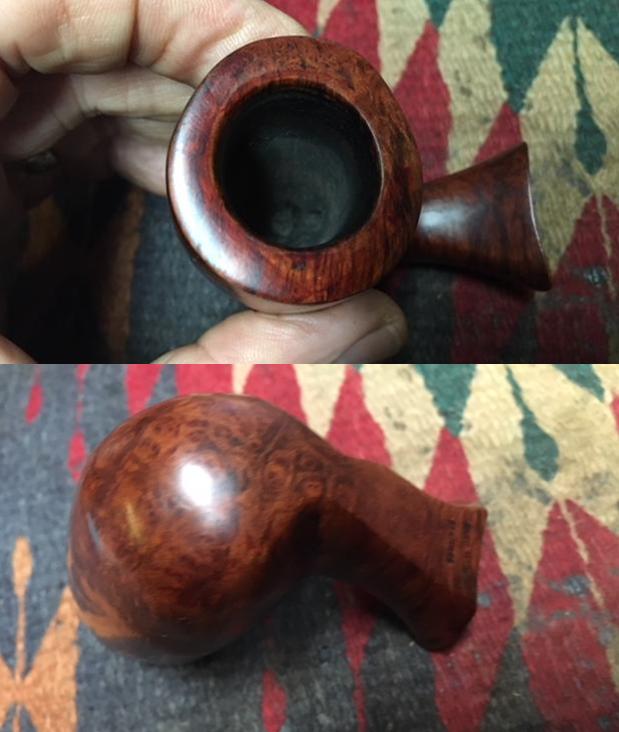
The next pipe that caught my fancy for restoration was a GBD ROCKROOT # 1345. This pipe has beaten Kriswill “Chief”  # 20 and Kriswill “ Golden Clipper” to the finish line, though not decisively since I do not have stain pens and I had to leave the rim top duly sanded to remove all the oils and tars and burn marks. Personally though, I rather liked the look of the contrast the rim provided to the dark coloured pipe bowl, shank and stem. But I have seen other similar GBDs and they all had the nice bowl coloured rim top which also looked beautiful!!!! Hence, my attempt at darkening the rim top. Without darkened rim top!! You decide and suggest please!!!

This pipe has a relatively smaller sized bowl with wire rustications running vertically along the bowl with circular wire rustications run around the shank. This wire rustication runs along the entire rim top. The bottom of the bowl is flat, smooth and bears crisp stampings with ‘GBD’ in oval over ‘ROCKROOT’ over ‘LONDON ENGLAND’ in a straight line over # ‘1345’. The saddle stem has a very subtle and delicate bend with just the lip touching the table top which coupled with the flat bottom of the bowl, makes it a perfectly balanced sitter. A brass oval roundel rim with embossed GBD is embedded in the saddle. This should polish up very nicely. INITIAL INSPECTION
The initial visual inspection of the pipe revealed the following:

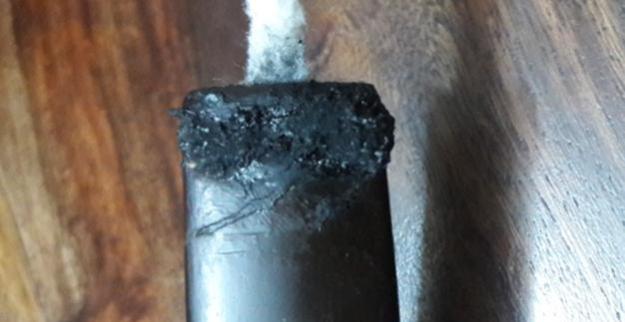
The bowl was heavily caked with oils, tars and grime overflowing onto the rim top and down the bowl along the vertical wire rustications. There appears to be some deep charring along the inner edge of the rim on the right hand side in 1’o’clock direction and on the left side in 7’o’clock direction. The extent of the damage to the rim can only be determined after reaming the bowl.The thin wire rustication on the rim top is worn out at certain places. The rest of the rustications along the bowl and shank is filled with dust, oils, gunk and dirt which has been accumulating over the years. Air did not pass through the stem. When the stem was removed from the shank, visual inspection revealed a completely blocked mortise and airway. The stem, too, was slightly blocked.The stem was heavily oxidized with heavy calcification near the lip. There was heavy tooth chatter extending up to an inch from the lip towards the saddle on both sides of the pipe. But thankfully there were no deep bite marks or holes. The lip on both sides has also been chewed out of shape.Dimensions:
Length – 5 inches
Bowl height – 1.5 inches
Bowl depth – 1 1/8th inches
Bowl inner diameter – 7/8  inch
Bowl outer diameter – 1.5 inches

THE PROCESS
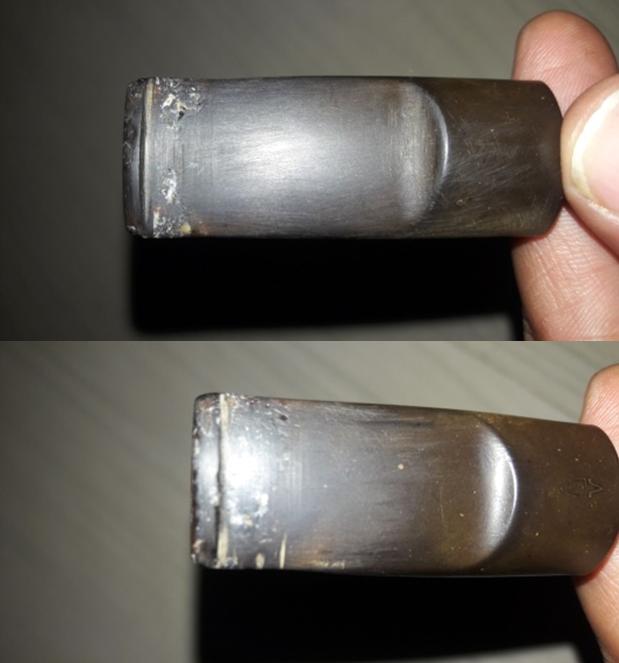
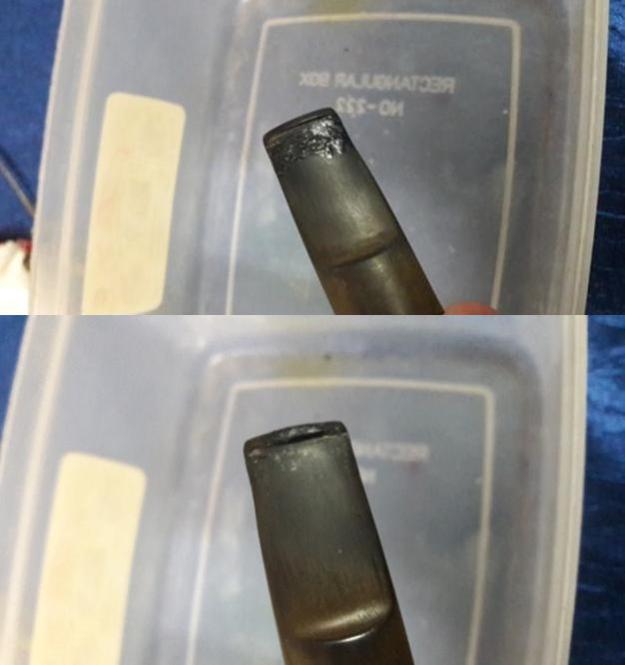
As usual Abha, my wife, started work on the bowl while I addressed the stem. Using a Kleen Reem reamer and British Buttner pipe reaming tool, Abha removed most of the thick cake in no time. The reason being a 1 inch deep bowl!!! She had been very careful in avoiding the edges which had the charred marks. While Abha was working her magic on the bowl, I painted the stem with the flame of a Bic lighter to try to lift the light tooth chatter. The lightest of the tooth chatter evened out and the remaining ones were lifted to the surface. I had to sand out the stem to smooth out the tooth chatter. At this point, using a 220 grit paper, I sanded down the stem till the surface felt even and smooth to the touch. I tightly folded a piece of the grit paper and using its edge tried to shape the edges of the lip. Then I applied Extra virgin olive oil to the stem and kept it aside to be absorbed by the stem. And as usual, I just forgot to take pictures of the stem at this stage!!!

Thereafter, I turned my attention to the bowl with hesitation. This was so because the reaming had revealed that the issue of charring was something I had not handled before. I immediately Facetimed  Mr. Steve and sought his advice. It was decided that a smooth surfaced rim, akin to the smooth bottom of the bowl, will add an interesting character to the pipe and will also take care of the charred inner edge of the bowl.

I began with cautiously sanding the inner edges of the bowl to remove as much of the charring as possible. Using Murphy’s oil soap and a hard bristled toothbrush I removed as much of the accumulated tars and lava from the rim top as I could. I lightly topped the bowl on a 220 grit sand paper. The charred portion of the briar came apart in chunks during the topping process. Thereafter, I tried to round off the inner edges of the bowl as much as I possibly could, by creating an inner bevel to cover up and address the charred portion. However, the bowl still remains out of shape.As can be seen, the bowl edge in the 1 o’clock (front right) and 7 o’clock (rear left) directions has moved out too far. I was not too inclined to sand down the other edges to merge with the moved out edges for fear of losing too much briar and further thinning the rim top. Any suggestions whether I should go all out with the inner edge to completely round it or leave it as is are welcome.  Once the bevel was made and I had sanded out as much of the charring as I was comfortable with, I sanded down the rim with micromesh pads, wet sanding with 1500 – 2400 grit and dry sanding with 3200 – 12000 grit. Using a brush and Murphy’s Oil soap, I cleaned the exteriors of the bowl, rim top and shank and rinsed it under running water. The bowl was wiped dry using a cotton cloth and left to dry out overnight. Turning my attention back to the stem, I wiped it down with a soft cotton cloth. On close inspection, I realized that there was one bite mark on both sides which was not raised and also that the lip edge was not defined/sharp. I mixed up activated charcoal powder with clear CA glue (the glue that was available to me here, has a tendency to come off in lumps. Hence I was skeptical about its function in this process) and applied it on both sides of the stem to fill in the bite mark as well as on the tip edge to define it further and set it aside to cure overnight. Next morning, I rubbed some “Before and After Restoration Balm” into the thin wire rustications of the dried out bowl. Every time I use this balm, I cannot help but appreciate how effectively it works to enliven and refresh an old briar bowl. I rubbed a small quantity of balm with my fingers into the thin wire rustications on the bowl and shank and kept it aside for a few seconds. Using a horse hair brush, I buffed the bowl and shank and worked the balm deeper into the closely packed rustication. I rubbed it down with a soft cloth to a bright shine. I had to use a lot of muscle power and time to get the desired shine since I do not have a wheel. I was satisfied with the way the bowl had turned out up to this point in the restoration.Thereafter I turned my attention to the stem. The fill of CA super glue and charcoal powder had cured sufficiently. Using needle files, I started filling away carefully and cautiously restricting the filing only to the filled areas. Using a flat head needle file, I filed away the excess filling and was satisfied with the end result. I used a 220 grit sand paper to further blend in the fill. I further polished the stem using micromesh sanding pads. Wet sanding with 1500 – 2400 grit pads helped reduce the sanding marks left behind by 220 grit papers to a great extent. I wiped it clean and coated the stem with extra virgin olive oil and let it rest for some time. This allows the vulcanite to absorb the oil. Thereafter I dry sanded the stem with 3200 – 12000 grit micromesh pads and applying olive oil after every third pad. The stem is now nice, smooth and shiny. I shared the pictures of the bowl and stem with Mr. Steve for his opinion and advice for further improvement. As is his style, Mr. Steve first appreciated the effort and suggested that a darker stain would look good. Since he was well aware that the stain pens I had ordered did not reach me, he suggested an ingenious and practical way of staining using local and readily available material. He suggested boiling black tea leaves in a little water and making a very strong and thick brew, letting it sit overnight. Using cotton swab/cue tip dipped in this brew, gently apply onto the area that is to be stained.

I followed his advice and applied it to the rim top of the Rockroot. After allowing it to rest for a few minutes, I gently wiped it off with a soft cotton cloth. The results are truly amazing. Mr. Steve further advised me to use regular black boot polish to further stain and bring back the shine to the rim top. The results of this can be seen in the following pictures of the finished pipe.This restoration has been a fantastic journey of learning, trials and frustrations which I enjoyed to the fullest. I cannot thank Mr. Steve enough for his wise, practical and timely advice and sharing his immense wealth of experience so readily with a novice like me. Thanks Steve!!!
Recommissioning a GBD International Carved Rim Bent Bulldog London Made


Blog by Dal Stanton

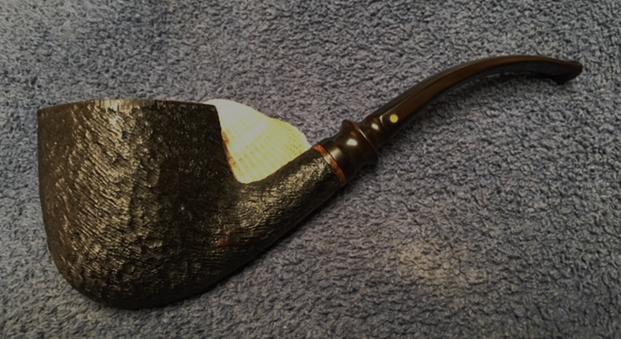
This Bulldog is simply cool.  It was one of those wonderful surprises one hopes for when you buy many pipes in one fell swoop on eBay.  In many of my restoration blogs I’ve mentioned the Lot of 66 which I landed last year while back in the US.  What can I say – God knew that I was restoring pipes to benefit the Daughters of Bulgaria and this Lot of 66 has been a gift that keeps on giving.  It isn’t possible to see all the pipes in the landscape pictures provided and one hopes in the percentages – there has to be some good pipes in the Lot!  Here is the Lot of 66 that I saw then and have pictured several times before.  I’m not positive, but the GBD Rustified Rim Bulldog is on the extreme lower right below – only his bowl showing.Many of my restorations for the Daughters come from people seeing a pipe in my “For ‘Pipe Dreamers’ Only” section on The Pipe Steward blog.  I came up with the idea of this ‘before restoration offerings’ when I found that when people visited us here in Bulgaria, they would know about our work with the Daughters of Bulgaria and that I restored pipes that benefited that cause.  Almost always they wanted to see what pipes I had in the “Help Me! Basket” and they would choose one to be restored.  The interesting thing I discovered was that people live in hope for what something can become.  Estate pipes can be pretty nasty, but people know the amazing wonders of what the restorative processes can produce and so they see the potential and trust me to realize that hope as I bring a pipe to The Pipe Steward worktable on the 10th floor of a former Communist apartment block in Sofia, Bulgaria!  What a story!  I’m living the dream 😊.
Chris, a dedicated pipe man and regular contributor on the Facebook group, ‘The Gentlemen’s Pipe Smoking Society’ was ‘Pipe Dreaming’ while tooling around looking at the offerings and saw the GBD International Bulldog.  What attracted him to the Bulldog was the unique rustified rim with hearty agreement from me.  It adds a flair that you don’t often see on a London Made Bulldog.  The bent stem is cool, too, adding a bit more flare.  Here are some of the pictures Chris saw in the “For ‘Pipe Dreamers’ Only” page: Chris commissioned the GBD Bulldog, which put it in the queue for restoration.  After the restoration is completed and published, I then place a value on the pipe resulting from my research.  The commissioner has the first opportunity to claim the pipe from The Pipe Steward Store.  Chris will have first dibs on this Bulldog when completed.
GBD (Pipedia’s article on GBD), was the handshake enterprise started by three French ‘Master Pipemakers’, Ganneval, Bondier and Donninger in Paris in 1850 to manufacture Meerschaum pipes, which was the primary material used in manufacturing pipes along with clay.  This was true until the discovery of briar in Saint Claude, France, a discovery that changed the pipe manufacturing world.  In 1902 Marechal and Ruchon sold GBD to A. Oppenheimer & Co. in London, which began the shift of GBD to being primarily a British enterprise, even though GBD pipes continued to be produced in Paris and Saint Claude, until 1981, with the closing of the French operation when the name, GBD, was merged with the Cadogan Group.  I enjoy rehearsing the historical developments of pipe names and companies because they add to the enjoyment and appreciation of restoring pipes.

I take some additional pictures of the GBD International Bulldog on my worktable. The nomenclature has on the left side of the shank, a GBD circled with an oval over INTERNATIONAL over LONDON MADE.  The right side has LONDON ENGLAND over 546, the shape number.  The shape number lines up as a Bulldog, ¼ bent, Diamond shank according to Jerry Hanna’s GBD shapes chart listings in Pipedia.  The dating of the pipe is pre-1980s.  The stem’s brass rondel along with the “London, England” stamp indicates a pre-Cadogan era GBD.  The merger was 1981.  This information is clear.

There’s some information that is proving to be a bit more difficult to mine in my research.  I’ve contacted Al Jones (Upshallfan), a regular contributor to rebornpipes, on a few GBDs I’ve restored in the past.  Al is a gold mine of information about GBDs and I appreciate his help.  Previously, he had sent me a PDF he had gleaned from now defunct www.perardua.net/ entitled ‘GBD Model Information’.  From that PDF I found this reference regarding the ‘International’ line of GBD.  I clipped it:I was excited to get a lead on what appears to be a GBD pipe line of “carved top rims” that were stained black.  The reference in the second line is to a 1976 catalog where I could hopefully find more about the International line.  Hopeful of finding this catalog, I went to the internet.  Unfortunately, I could find nothing.  Also disheartening, the usual go to page for catalogs, Chris’ Pipe Pages, I discovered some time ago, now seems to be defunct.  Sad.  So, again I sent Al a note with some questions.  His reply came very quickly with this picture of at least one ‘GBD International’ from the 1977 Tinderbox catalog.  The writing is not easy to make out but the “M.” example of the International line is a nice looking oval shank Volcano shape which I can make out has a carved rim like the Bulldog.  With this information, my thinking is that the GBD Bulldog I have is dated from 1976 but earlier than 1981.  Again, much thanks to Al Jones!Looking at the GBD International Bulldog itself, it is in decent condition.  There is some cake build up in the chamber and the carved rim shows some expected grime but not too much.  The twin dome grooves are full of debris and need to be cleaned.  The bowl itself looks very good – it has some expected grime, but the briar looks exceptional underneath.  It will look good when cleaned up.  The stem has some deep oxidation and the bit shows some dents and tooth chatter that will need correcting.

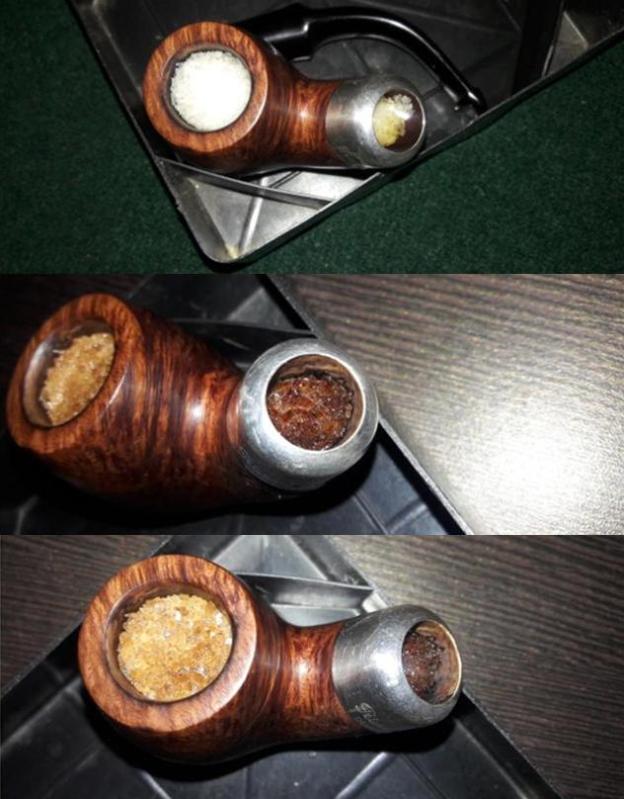
I begin the restoration of this GBD International Bulldog by adding the stem to a soak using Before & After Deoxidizer.  After running pipe cleaners dipped in isopropyl 95% through the internals of the stem, it joins 5 other pipe stems in queue for restoration.  I leave the stem in the soak for a few hours then fishing the GBD stem out, I wipe it off with a cotton pad wetted with light paraffin oil.  I also put a pipe cleaner through the stem to push the fluid out and follow with a pipe cleaner dipped in isopropyl 95% to assure that the airway is clear. After cleaning the stem of the Deoxidizer, I can still detect oxidation in the vulcanite.  I take another picture of the stem with the aperture open more to show what I’m seeing.I decide to give the stem another soak in an OxiClean solution.  After covering the rondel with petroleum jelly, I put it in the soak. I’m not sure if the brass rondel will react or not to the OxiClean, but I take no chances.While the stem is in the OxiClean cooker, I turn to the stummel.  First, I use the Pipnet Reaming Kit to remove the carbon cake from the Bulldog’s chamber.  It takes 2 of the 4 blade heads available in the kit.  I follow this using the Savinelli Fitsall Tool to fine tune more by scraping the chamber walls removing more carbon.  To get down to fresh briar, I then wrap a 240 grit piece of sanding paper around a Sharpie Pen and sand the chamber.  To clean up, I wipe out the carbon dust with a cotton pad wetted with isopropyl 95%.  The pictures show the progress. Moving along with the stummel, I use undiluted Murphy’s Oil Soap with a cotton pad to scrub the surface of the briar.  To clean the rim, I use a bristled tooth brush with Murphy’s to clean the carved angles and valleys.  I then rinse the bowl with cool tap water.  The last thing I do is take a sharp dental probe and run it through the twin dome grooves to remove the small debris that had lodged in the grooves.  With my wife’s help, I record a picture of this surgery.Since I like working on clean pipes and I know new stewards like smoking with clean pipes, I turn to the internals of the stummel.  Using cotton buds and pipe cleaners with isopropyl 95%, I go to work.  I’m thankful to discover that there is little resistance.  Later, at the end of the day, I’ll clean the internals further by using a kosher salt and alcohol soak.With the internals clean, I turn again to the briar surface.  To enliven the tired finish and to remove the small nicks and cuts that come from wear, I wet sand with micromesh pads 1500 to 2400, then dry sand with pads 3200 to 4000 and 6000 to 12000.  With each cycle, I enjoyed watching the grain emerge.  This GBD International Bulldog has nice grain – nice vertical flames rising to the carved plateau.  I’m liking this. I also want to freshen the carved black plateau – rim.  I use a black furniture dye stick to apply to the rim.  Later, when I apply compound, I’ll blend the black more, so it has more textured matte depth. Now, back to the stem.  The GBD stem has been soaking in OxiClean as a second salvo against the oxidation in the vulcanite.  After taking it out of the OxiClean bath, I use 600 grade paper and I wet sand the stem.  I work on the areas that show the deeper oxidation.  I then use 0000 steel wool and work over the entire stem, paying close attention to the area around the rondel.  I’m not 100% satisfied, but I may do more after I work on the bit. I take a picture of the upper bit and the lower bit to show the tooth dents.  The upper is not bad but the lower has two significant clinch bites and some damage to the button lip.To lessen the severity of the dents I heat the vulcanite using a Bic lighter by painting the dented areas with a flame.  As the vulcanite heats, it naturally expands and retakes some of the original ‘foot print’ of the dent.  I heat both upper and lower.  The upper will easily sand out but the lower still has work to do.To fill the dents and rebuild a little of the button, I use Starbond Black Medium CA glue.  I spot drop the black CA glue on the dents and then I use an accelerator to quicken the curing time.I then use a flat needle file and 240 grade sanding paper to sand down the patches.  I use the file to freshen the button – to reestablish crisp button edges.The following two pictures show the lower bit/button work – first in progress then completed with filing and 240 paper.I continue the smoothing and erasing of the 240 scratches by using 600 grade paper and then finishing with 0000 grade steel wool.  The patches look good, oxidation seems to be abated and the button shaping will be greatly appreciated by a new steward!I now turn to micromesh pads by first wet sanding with pads 1500 to 2400, then dry sanding with pads 3200 to 4000 then 6000 to 12000.  After each set of three I apply Obsidian Oil to revitalize the vulcanite.  The stem looks good. Turning now to the stummel, to enrich the briar grain I apply Before & After Restoration Balm.  I put a little on my finger and work it into the briar surface.  As I work it in, the liquid thickens into a wax-like substance.  After some minutes, I wipe off the Balm using a clean cloth.  As the Balm comes off, the surface buffs up nicely.With my day ending, I continue cleaning the internals of the stummel.  I use a kosher salt and alcohol soak.  I fashion a wick by stretching and twisting a cotton ball. I insert the ‘wick’ down the mortise into the airway.  I then fill the chamber with Kosher salt which, unlike iodized salt, leaves no aftertaste.  I then situate the stummel in an egg crate giving it stability and then add isopropyl 95% with a large eye dropper until it surfaces over the salt.  After a few minutes I top the alcohol once again and then turn out the lights.The next morning the soak had produced results with soiled salt and the wick absorbed more oils and tars.  I remove the expended salt to the waste and wipe the chamber with paper towel.  I also blow through the mortise to remove any remaining salt particles.  I then expend a few more pipe cleaners and cotton buds to clean up left overs from the soak.  The internals are as fresh as I can make them.I reunite stem and stummel and mount a cotton cloth buffing wheel to the Dremel, setting the speed at the slowest.  I then apply Blue Diamond compound to the entire pipe.  I also work on blending the black matte plateaued rim.  What I discover regarding the rim is that when I simply buff it with the Blue Diamond compound, is shines it up!  The exact opposite than dulling it down to a matte, charcoal look.  Then I came up with the idea of simply wetting a cotton pad with alcohol and dabbing it over the rim to dull the finish.  It worked like I was hoping.  I take a picture of before and after.  It’s difficult to see different shades of black in a photo!  But it does look good – the effect is striking. After completing the compound application and blending the rim, I wipe the pipe with a felt cloth to remove residue compound dust in preparation for the wax.  I then switch to another cotton cloth wheel on the Dremel, increase the speed to about 40% full power and apply a few coats of carnauba wax to both stummel and stem.  After application of the carnauba, I give the pipe a rigorous hand buffing to raise the shine.

Oh my.  The grain on this GBD International London Made shouts for attention!  I’m pleased with the results.  The flame grain emerges from the heel of the bowl – out of densely populated bird’s eye and swirls to reach toward the dome of the stummel, culminating in the craggy plateau of the rim.  There’s a lot going on with this bent Bulldog. It is headed to The Pipe Steward Store and since Chris saw the potential of this GBD International, he will have first dibs on bringing the Bulldog home.  The sale of this pipe benefits the Daughters of Bulgaria – helping women and girls (and their children) who have been trafficked and sexually exploited.  Thank you for joining me!  I can’t resist starting off with a before and after picture lest we forget!

Transforming a Stately Peterson’s System Standard Republic of Ireland 312


Blog by Dal Stanton

This Peterson’s System Standard Republic 312 came to me in the Lot of 66 that I secured last year on the eBay auction block.  This eclectic collection of pipes has been good to me and beneficial for the Daughters of Bulgaria as I’ve recommissioned many pipes of this Lot and they are now in the hands of new stewards.  This Pete can be found in the picture below just cattycorner to the lower left of the Sculpted Gourd Calabash that was already recommissioned and with a new steward in Washington State, USA – a US Airforce pipe man serving his country. The Pete now on my worktable was commissioned by a long-time friend and colleague who worked with us while we lived in Ukraine several years ago – before we lived here in Bulgaria.  Debbie contacted me from her present home in the US state of Montana about acquiring a special pipe for her husband’s birthday.  Unfortunately, James’ birthday was coming on a faster timetable than I could accommodate, so we settled on a special Christmas gift.  She looked through the offerings on the www.ThePipeSteward.com section called, For ‘Pipe Dreamers’ Only and after getting input from James’ best friend, settled on the Pete.  When I asked her why the Pete, the response was that it was a manly looking pipe as well as its origins – the Republic of Ireland.  James’ rich heritage finds Irish roots, and Debbie felt that this Pete’s disposition would suit James well.  What a great wife!  So, in the queue the Pete 312 went and now he’s on my worktable.

Not long ago, I enjoyed restoring my first Peterson’s – a System Standard 313 which allowed me the opportunity to look more closely at the history of this well-known Irish pipe name.  What I found interesting and helpful was the description of the classic Peterson System Pipe.  When this design hit the market in the late 1800s it was innovative then and continues to be popular today. Two design innovations were the focus: a trap (or sump) that collected the moisture in the mortise and the well-known ‘P-Lip’ stem, which stands for ‘Peterson’.  This design was supposed to be superior by directing the smoke to the upper part of the mouth rather than burning the tongue.  It is also engineered to compress the air as it moves toward the button with an internal narrowing of the airway.  I found this helpful cut-out of the System Pipe at Pipedia’s article about Peterson.The System 313, I last restored, was quite a bit smaller than this larger System Standard 312.  I found a very helpful Peterson’s System Standard shapes chart at the ‘Amazingmisterp’  blog site – link.  It helpfully situated the 313 and 312 next to each other for an easy comparison – circled below.  I enjoy looking at the nuanced shapes that Peterson has produced through the years.  I can understand why they continue to be a very collectable pipe name and why it would be a great challenge to add to your collection the entire roster!  As a ‘Made in the Republic of Ireland’ stamped Peterson, it is considered to be Republic Era which spans anywhere from 1949 until the present (from the Pipedia article:  A Peterson Dating Guide; A Rule of Thumb, by Mike Leverette).The Peterson history is captured in a short article found in Pipedia which included a bit here:

History pertinent to our purposes began in the year 1865; the year Charles Peterson opened a small tobacco shop in Dublin. Later in 1875, Charles Peterson approached the Kapp brothers, Friedrich and Heinrich, with a new pipe design and with this, a very long-lived partnership was formed, Kapp & Peterson. This new pipe design is the now famous Peterson Patented System Smoking Pipe. By 1890, Kapp & Peterson was the most respected pipe and tobacco manufacturer in Ireland and rapidly gaining followers in England and America. In 1898 another of Peterson’s remarkable inventions became available, the Peterson-Lip (P-Lip) mouthpiece, also known as the Steck mouthpiece. So, for the purpose of this dating guide, we will study Irish history, relevant to our pipe dating needs, from 1870s until now.

With the Peterson’s System Standard 312 now on my worktable, I take some pictures to get a closer look and assess his condition. The nomenclature is clear.  On the left side of the shank is stamped in arched fashion, ‘PETERSON’S’ over ‘SYSTEM’ over ‘STANDARD’ in straight letters.  Above this stamp, on the nickel ferule is ‘K&P PETERSONS’.  The right side of the shank bears the ‘MADE IN THE REPUBLIC OF IRELAND’ placing it in the Republic Era – from 1949 until the present (from the Pipedia article:  A Peterson Dating Guide; A Rule of Thumb, by Mike Leverette) The shape number, 312, is below it.

Assessing the condition of this larger, stately Pete, there’s cake in the chamber that needs to be cleared to allow fresh start.  The rim has some lava caked on it and some burn damage from lighting the tobacco.  The left front of the stummel is darkened from the briar over-heating in the same area that appears to be the lighting point over the rim.  I see very nice briar under the dull finish.  The heel of the stummel appears to have two larger fills that I’ll need to take a closer look at.  The heel is also skinned up.  The P-Lip stem has heavy and deep oxidation as well as calcification on the button and some tooth chatter.  I also detect two deep gashes on the upper and on the lower stem – almost like something sharp was clenching the stem.   That will need repair.

With the assessment completed, I start the restoration of James’ Christmas Pete by placing the heavily oxidized P-Lip stem in a bath of Before & After Deoxidizer along with five other pipes’ stems that are in queue for restoration.  The Pete is on the far left – first in line of this batch.While the stem is soaking for several hours in the Deoxidizer, I turn to the Peterson stummel.  I start my using the Pipnet Reaming Kit.  Starting with the smallest blade head, I go to work.  I use two of the four blades available to do the heavy lifting on cake removal.  I then fine tune the reaming by utilizing the Savinelli Fitsall Tool by scaping the chamber wall.  Then, after wrapping 240 grade paper around a Sharpie Pen, I sand the chamber revealing fresh briar.  Finally, I clean the chamber using cotton pads wetted with isopropyl 95% to remove the residual carbon dust.  With the carbon cake removed, I inspect the chamber and it looks great.  No problems with crack or heat fissures.  The pictures show the progress. Now I turn to cleaning the external bowl using undiluted Murphy’s Oil Soap and cotton pads. I also utilize a brass wire brush on the rim.  After scrubbing, I rinse the bowl in cool tap water.  The rim is not in good shape and will have to be topped to clean it up.  The two fills I saw on the heel of the stummel are not solid and are not flush with the surface.  I use a sharp dental probe to dig out the old filler.  I will patch these later. With my day ending, I decide to move forward on the heel fill patches to allow them time to cure through the night.  I do additional excavation of the old fill material with a sharp dental probe to remove what I can.  I then wipe the area with a cotton pad wetted with isopropyl 95% to assure that it is clean.  I mix a small batch of CA glue and briar dust to create a putty.  Using a toothpick, I gradually mix the CA glue with the briar dust until it reaches the viscosity of molasses and then apply the briar dust putty to the old fills using a dental spatula.  I apply more than needed to create a mound to be sanded down and blended after cured.  I set the stummel aside and turn off the lights. Morning has come and first order of business before heading out for the workday is to pluck the P-Lip military style stem out of the Before and After Deoxidizer bath.  I allow the stem to drain for a few minutes then I use cotton pads with light paraffin oil to wipe the raised oxidation off the stem.  I also use alcohol to clean the surface as well as with pipe cleaners to make sure the airway is cleared.  The Deoxidizer has done a good job, but I still detect oxidation that will require sanding the vulcanite.  The button also is rough with a combination of tooth dents and calcification ridges that linger.  Of course, the twin ‘pincer’ gashes remain at the mid-stem.  The Before & After Deoxidizer bath is the first salvo.I decide that the second more aggressive salvo to attack the deep oxidation, gashes and tooth dents is to use 240 grade sanding paper over the entire surface of the P-Lip stem – of course, care is given to safe-guard the ‘P’ embedded on the stem.  After completing sanding with 240 grade paper, I wet sand the stem using 600 grade paper.  Then, using 0000 grade steel wool, I sand/buff up the stem.  The sanding process removed the major difficulties with the dents and gashes.  I’m hopeful as well, that the oxidation was also dispatched.While my focus is still on the stem, I apply Before & After Fine Polish, working the polish in with my fingers.  After letting it set a few minutes I wipe the polish off with a cotton pad then in the same way, apply Before & After Extra Fine Polish and let it absorb for a few minutes.  I then wipe it down again with a cotton pad.  These polishes not only help to revitalize the vulcanite but also to continue removing the oxidation.Moving forward, using micromesh pads 1500 to 2400, I wet sand the stem.  Following this, I dry sand using pads 3200 to 4000 then 6000 to 12000.  After each set of 3 I apply Obsidian Oil to continue refreshing the vulcanite P-Stem.  I love the glossy pop of the vulcanite after the micromesh process.  I take pictures to show the progress and I put the stem aside to dry. Turning to the Peterson stummel, the briar dust and CA glue patches have cured and time to file and sand the mounds down.  First, using a flat needle file I file down the excess putty mounds almost to the briar surface.  I take a picture of the starting point, then the filing process.  Then, switching to 240 grit paper I continue the sanding process to the briar surface.  The picture below shows how after the excess is sanded away, the briar dust putty is left providing a new, stronger fill in the briar blemishes.  I then switch to 600 grade paper to finish the sanding to this point. Flipping the stummel over, I tackle the significant rim damage.  I take a picture to get a closer look.  The rim is darkened from scorching but also it has developed dips in the surface plane from burn damage.  To repair the rim and establish a clean, new plane surface, I top the bowl.  Using a kitchen chopping board, I place 240 grit paper on it and gently rotate the inverted stummel in circles – checking often to make sure I’m not leaning into a soft area. After a few rotations I take a picture of the rim.  The picture below shows the degree of damage to the rim by revealing where the board is not making contact with briar – the dips in the rim. The next picture shows where I stop topping with the 240 grit paper.  I don’t want to take more briar off the top.  I kept my eye on the nickel shank ferule which was very close to the rim plane as I was topping.  I did not want to scratch it up!  After the 240 grit, I replaced it with a sheet of 600 grit paper to erase the scratching created by the 240 grit paper.The darkened areas on the rim (picture above) are residual effects of scorching.  To minimize this, I will cut an internal rim bevel to remove the damage as well as adding a touch of class to this already classy Peterson’s System Standard.  I start with a coarse 120 grit paper to do the initial beveling. I pinch the rolled piece with my thumb and rotate it around the internal rim circumference creating the even bevel.  I follow the 120 paper with a rolled piece of 240 grade paper then 600.  I repeat the same process for the external rim circumference.  The bevel looks good.  The pictures show the progression. I just realize that I became so involved in the technical aspects of this restoration that I forgot to clean the internals of the stummel!  Back to the dirty work.  I use pipe cleaners and cotton buds dipped in isopropyl 95% and go to work.  I also use dental spatulas and probes to scrape the mortise walls.  I also utilize a shank brush to scrub the airway and the mortise walls. I read how challenging Petersons are in the clean-up and this one is no exception.  I expend a lot of cotton buds, alcohol and time and I seem to be making no dent in the gunk carnage.  I finally halt this approach and decide to let it cook overnight in a kosher salt and alcohol bath.  Using a cotton ball, I fashion a wick which I insert down the airway and into the sump area of the mortise. I fill the bowl with kosher salt, which, unlike iodized salt, does not leave an aftertaste. I then fill the bowl with alcohol and let it sit overnight.  Time to turn out the lights. The next morning the kosher salt/alcohol bath did the job through the night. The salt is discolored and the cotton ‘wick’ has drawn tars and oils out of the internals.  After removing the expended salt into the waste and wiping the old salt out of the chamber with paper towel, I blow through the mortise to clear out salt from the internals.  I then follow by using pipe cleaners and cotton buds to make sure things are clean.  Oh my….  The grunge continues unabated!  This is one of the nastiest pipes I’ve tackled!  I’ve read that Petersons are notoriously difficult to clean…. Since I’m running out of time – I need to go to work, I decide to do another kosher salt soak through the day while I’m working.  Off I go…hopeful that the second time is the charm.Several hours later, home from work, and again, the salt is discolored, and the wick shows evidence of gunk extraction.  Again, I clear the salt from the chamber and use additional cotton buds and pipe cleaners – I’m pleasantly surprised to find that the internals are indeed clean!  I use only one cotton bud and pipe cleaner.  I can almost guarantee, this Peterson is the cleanest it’s been since it came from the factory in Ireland!Turning to the stummel surface, to remove the old tired surface finish and nicks and cuts from normal wear, I wet sand the stummel using micromesh pads 1500 to 2400.  I follow by dry sanding using pads 3200 to 4000 and 6000 to 12000.  I take pictures recording each step of the micromesh process.  I enjoy watching the grain emerge – this is one of my favorite parts of restoration. To enrich and deepen the briar grain, I then apply Before & After Restoration Balm to the stummel surface.  I apply some to my finger and work the Balm into the briar.  It starts with having a light oil texture and then thickens as it’s worked into the surface – taking on a wax-like texture.  I take a picture of the Balm on the stummel surface and set it aside to allow the Balm to absorb.After about 45 minutes, I use a cloth and wipe the Before & After Restoration off the stummel.  As I wipe and rub it begins to start buffing up.  I like how the Balm works – it is a subtle enhancement to the briar grain hue that deepens the color. I now mount the Dremel with a cotton cloth buffing wheel, set the speed to the slowest, and apply Blue Diamond compound to both stem and stummel.  I apply the compound methodically around the briar surface using the table lamp to see the movement of the compound on the surface as I move the buffing wheel.  As a fine abrasive, the compound removes the very fine blemishes on the stem and stummel surface – buffing the surface to it natural sheen.  I change to another cotton cloth wheel and use the Blue Diamond to clean/buff the Peterson’s classic nickel ferule. When I finish applying the compound, I wipe the stummel and stem with a felt cloth to remove the compound dust in preparation for the carnauba wax application.Before I move on to applying the wax, I have one more project.  The Peterson ‘P’ stamp on the stem needs some touching up.  I use white acrylic paint to do the enhancement.  I lightly apply a coat of the paint over the ‘P’ stamping and while still wet, I dab it very lightly with a cotton pad leaving a film – in the second picture below.  It doesn’t take long to dry, leaving the ‘P’ filled with paint.  I then lightly scrape the dried paint off the surface using the middle, flat section of a toothpick.  The toothpick slides over the top of the ‘P’ leaving the freshened stamping.  It looks great! I now mount another cotton cloth wheel to the Dremel, increase the speed to about 40% of full power, and apply carnauba wax to both stummel and stem. I follow this by giving the stummel and P-Lip stem a hand buffing with a microfiber cloth to raise the shine.

My oh my, did this Peterson come out nicely – he is stately.  The stem reach gives a long flowing impression.  The briar grain is rich with bird’s eye and swirls – pleasing to the eye.  The 312 is a larger System pipe and feels full in the palm.  I’m sure James will appreciate the gift that his wife has provided him under the tree this year and I’m thankful their support of the Daughters of Bulgaria – women and girls who have been trafficked and sexually exploited.  Thank you, James and Debbie!  Debbie found this Peterson’s System Standard Republic 312 in the “For ‘Pipe Dreamers’ Only” section of The Pipe Steward website where many pipes are available to be commissioned – all benefitting the Daughters of Bulgaria – a great cause helping women who are/were enslaved.  Thank you for joining me!  I start with a ‘Before & After’ picture lest we forget – an amazing transformation!

Refurbishing a Gourd Calabash


Blog by Steve Laug

In the past weeks I finished up some pipes for a guy here in Vancouver and when he came to pick them up he brought some more for me to work on for him. I finished up some of the ones on the worktable so I decided it was time to work on these. The fourth pipe is a Gourd Calabash with a Meerschaum bowl. It is a nicely shaped gourd that makes up the base of the bowl. The meerschaum cup is in excellent condition – a few minor scratches and nicks in the bowl. The shank end is plastic/acrylic and seals the end of the gourd. It is made to fit a bent vulcanite stem. The meerschaum bowl had a thin and uneven cake. The upper half of the bowl was more thickly caked than the bottom half. I would need to ream it to even out the cake. There was some slight darkening around the inner edge of the rim top as well as some scratches and nicks in the top of the rim. The inside of the shank was dirty and needed to be cleaned. The black vulcanite stem had tooth marks and chatter on the top and underside of the stem near the button. I took photos of the bowl and stem to give a clear picture of the condition of the pipe before I started to work on it.I removed the bowl from the gourd bowl. The cork gasket was in tact but dry. The inside of the bowl had some build up of tars and oils on the walls.The bowl was dirty and the rim top scratched and worn. There was some darkening on the top and around the inner edge. There was also some uneven cake that is visible in the photo below. I scraped out the excesss cake with a Savinelli Fitsall Pipe Knife to even the cake on the walls of the bowl. I sanded the walls smooth with sandpaper wrapped around a piece of dowel. I worked over the top of the bowl and the inner edge of the rim top with micromesh sanding pads – wet sanding with 1500-2400 grit pads and dry sanding with 3200-12000 grit pads. I removed the most of the damage to the rim top with the micromesh sanding pads. I was able to smooth out the scratches with the micromesh pads. I wiped the bowl down after each pad with a damp cloth. I scraped out the hardened tars on the walls of the gourd with a Savinelli Fitsall Pipe Knife. This is done with care so as not to dig too deeply into the skin of the gourd. I just wanted to knock off the high spots and smooth it out. I blew out the debris onto a paper. I cleaned out the airway in the stem and shank, the mortise and shank interior with pipe cleaners, cotton swabs and alcohol. I forgot to take photos of this as I was on a roll and moving quickly through the process.I rubbed down the outer surface of the gourd with Before & After Restoration Balm. I worked it into the finish with my fingertips and finished working it in with a shoe brush. The balm worked to clean, preserve and enliven the surface of the gourd. I also rubbed some Vaseline into the cork gasket to soften and enliven it at the same time. I really like the effect of the product on the gourd bowl so I took some photos of the pipe at this point. Once the outside and inside of the gourd was as clean as I was going to get it I set the bowl aside and turned to address the stem. I sanded the tooth marks and chatter out of the stem surface with some folded 220 grit sandpaper.I polished the stem with micromesh sanding pads to remove the scratches in the acrylic. I wet sanded it with 1500-2400 grit pads and dry sanded it with 3200-12000 grit pads. I wiped the stem down with a damp cloth after each sanding pad. I polished the stem with Before & After Pipe Stem Polish – both Fine and Extra Fine polishes. I wiped it down with a cotton pad and gave it a final coat of Obsidian Oil. I set the stem aside to dry. I put the stem back on the gourd bowl and buffed the pipe with Blue Diamond polish on the buffing wheel. I gave the gourd outer bowl, the meerschaum inner bowl and the stem multiple coats of carnauba wax and buffed the pipe with a clean buffing pad to raise the shine. I hand buffed it with a microfiber cloth to deepen the shine. The finished pipe is shown in the photos below. I have four more pipes to finish for him – these are some finds he made while pipe hunting. This is a fun bunch of pipes to work on. I look forward to moving through the rest of them. Thanks for looking.  

FINDING THE NATURAL BEAUTY OF A KNUTE OF DENMARK FREEHAND


Blog by Robert M. Boughton
Copyright © Reborn Pipes and the Author except as cited
https://www.facebook.com/roadrunnerpipes/

For after all, the best thing one can do
When it is raining, is to let it rain.

— Henry Wadsworth Longfellow, in “The Poet’s Tale: The Birds of Killingworth,” in Tales of a Wayside Inn (1863)

INTRODUCTION
Longfellow’s powerful poem is about man’s intolerant bent for all things natural based on ignorance of the indispensability of even the smallest part in an ecosystem.  It speaks to acceptance and “gentleness, and mercy to the weak, and reverence for Life.”  The work is sad and satirical and, in the end, surprising in its song of survival, but, alas, will never be required reading in any public school.

Knute of Denmark is a second of Karl Erik, which Karl Erik Ottendahl (1942-2004) made his main brand.  Ottendahl, an underrated and generous pipe maker who was a low-paid lithographer before he took up pipe carving as a hobby until it became his full-time vocation, understood the average smoker who made far less money than those fortunate enough to afford expensive varieties of the Danish freehand style of which he was an early crafter.  He therefore dedicated his life and work to pipes of great natural beauty at bargain prices.  Here is one that very much resembles the pipe in this blog, suggesting Ottendahl may have had a hand in making this Knute of Denmark.I suspect, or at least like to think, that Ottendahl read Longfellow’s magnificent poem, a couplet of which I quoted above, and if he didn’t, he would have enjoyed it.  And it was raining in the Isotopes City while I restored this pipe.

RESTORATION The stem was savagely damaged, with the top lip all but gone and a small hole below it and the bottom having two gouges.  Such long-term acts of mayhem must have been inflicted by someone with clear and severe anger issues who masticated the mouthpiece the way some people chomp on gum to stop smoking coffin nails.  I gave it an OxiClean bath to start.  At the same time, I stripped whatever dirt and stain (the latter of which I could see no signs) were present with an Everclear soak.  The immediate appearance of dark reddish swirls in the alcohol surprised me. The OxiClean soak, which was complete first, shows in the pic below how filthy the stem was.  Afterward, all I can say is it was clean. Figuring I had at least an hour before the stummel would be stripped, I filed off fine shavings from an old otherwise useless stem and made a nice little pile.  The ironic part of that task was that the stem was once a fancy type similar to the one I was fixing and would have been a perfect replacement had it not been toasted!  Then I added a few drops of black Super Glue, mixed it together with the shavings and quickly and liberally applied it to the stem after dipping a cleaner in petroleum jelly and inserting in the mouthpiece past the hole.  WARNING: I forgot my usual process of lubricating a small sliver of card stock paper also and inserting it inside the stem in front of the cleaner, but it all worked out later – with some extreme difficulty. That done, I had 12-24 hours before it would be dried, way more than enough time to finish the stummel that was ready to come out of the Everclear.  Checking out the progress of the alcohol soak, I was amazed by the almost blood red color of the 190-proof grain alcohol and guessed it was from residual maroon stain.For the first time after an Everclear soak, I wiped the still drying wood with a cotton rag saturated with purified water.  The water took longer to dry, but the result was stunning.  Despite the sandblasting, I believe what I beheld was the finest piece of briar I’ve ever seen.  Its natural beauty shone through the crisp dullness. I reamed the chamber, used a small sharp pocket knife to cut away some excess buildup and sanded with 150-, 220, 320- and 600-grit papers, then retorted the pipe. The following shots show the tremendous improvement of the wood’s potential color and glow.  I used the super fine “0000” steel wool in two of the photos only on the rim and shank opening.  But look at the difference. Late that night, with the stem patch dry, I took out one of my files, a narrow triangle with medium-grit flat sides to remove the thick, uneven mess on the top of the stem that is a necessary by-product of the black Super Glue method of hole-filling.  I was also able to remove most of the deep chasms on the bottom of the stem.  I began the smoothing process with a dual 150- and 160-grit sanding pad and regular, rougher 150-grit paper.The effort to salvage the ruined old stem was worthwhile and a good start on a plan of total rehabilitation for personal use, but this pipe is for sale, and I know the more difficult work of re-building the bottom lip will take longer and not, in the end, be suitable to pass off to a buyer.
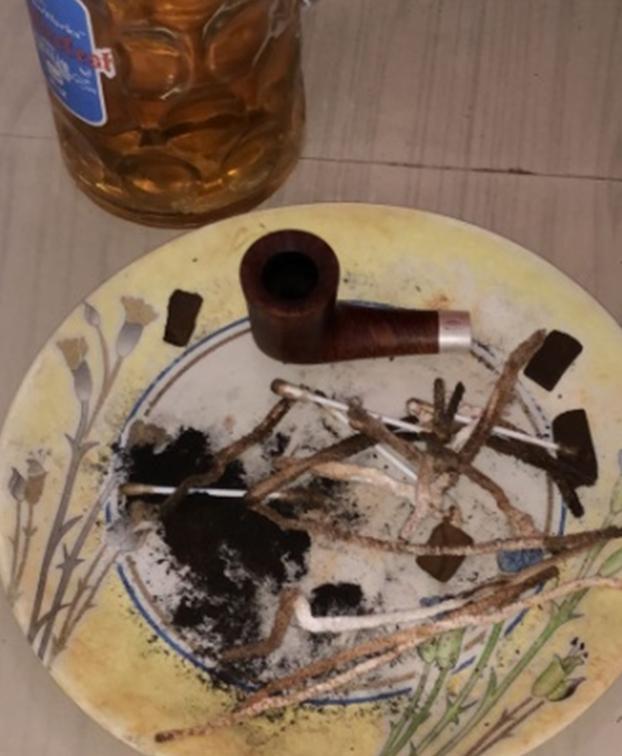
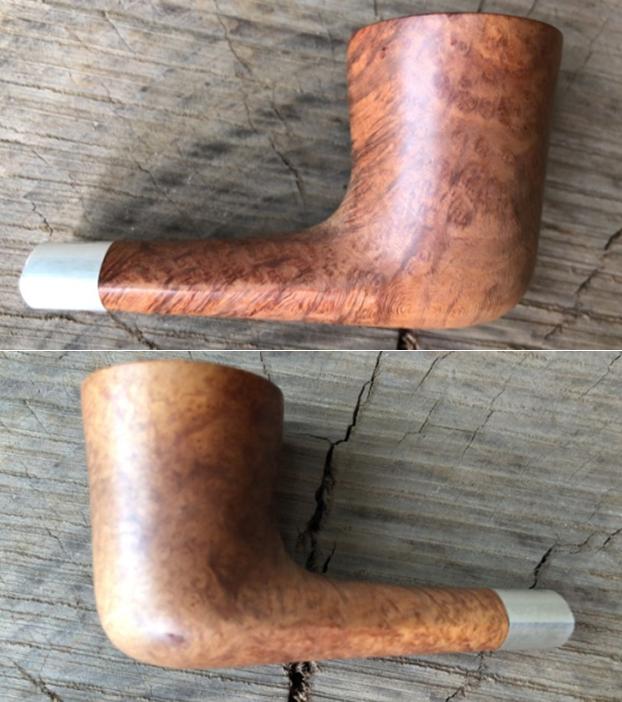
But as it happened, I had two other freehands with good fancy stems with which I could play musical chairs, a Ben Wade by Preben Holm I re-stemmed before and an estate Karl Erik I’m working on now that’s far too huge to support the smaller stem it came with.  For now, I’m enjoying the BW with the damaged Vulcanite stem as the yellow Lucite one fits the Karl Erik.  I liked the dark brown swirled Lucite stem that was on the Karl Erik better, and since the tenon of the BW by PH was too thin, the issue was settled.  I sanded down the elegant brown Lucite fancy stem’s tenon and smoothed it with steel wool before micro meshing it. A thorough buffing on the wheel with red and white rouge on the stem and stummel, and it was done. CONCLUSION
In the spirit of nature, I used no stain restoring this freehand that needed no artificial help to reveal its innate beauty.

SOURCES
http://www.pipephil.eu/logos/en/logo-k3.html
https://pipedia.org/wiki/Karl_Erik
http://www.hwlongfellow.org/poems_poem.php?pid=2047